Footnotes have been collected at the end of each chapter, and are
linked for ease of reference.
Minor errors, attributable to the printer, have been corrected. Please
see the transcriber’s note at the end of this text
for details regarding the handling of any textual issues encountered
during its preparation.
Any corrections are indicated using an underline
highlight. Placing the cursor over the correction will produce the
original text in a small popup.
Any corrections are indicated as hyperlinks, which will navigate the
reader to the corresponding entry in the corrections table in the
note at the end of the text.
A HOOSIER HOLIDAY
BY THEODORE DREISER
THE “GENIUS”
SISTER CARRIE
JENNIE GERHARDT
A TRAVELER AT FORTY
PLAYS OF THE NATURAL AND THE SUPERNATURAL
THE FINANCIER THE TITAN *** *****A TRILOGY OF DESIRE
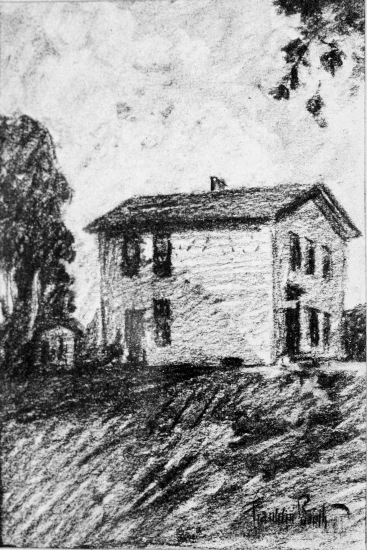
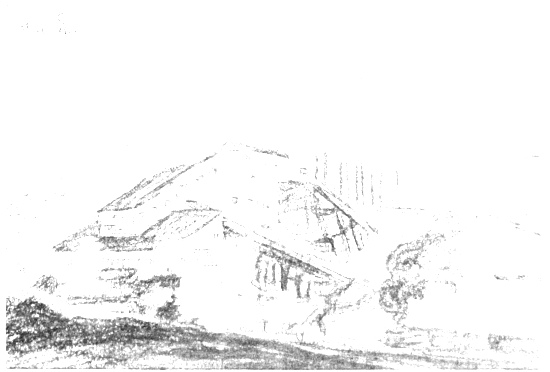
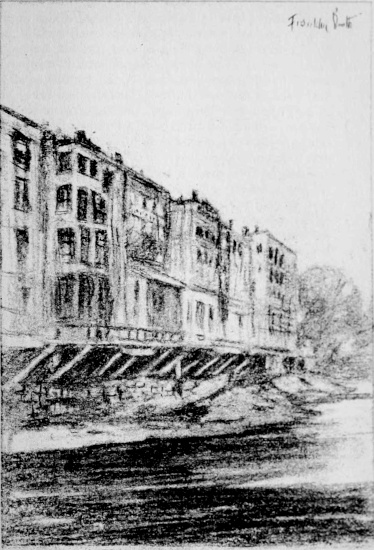
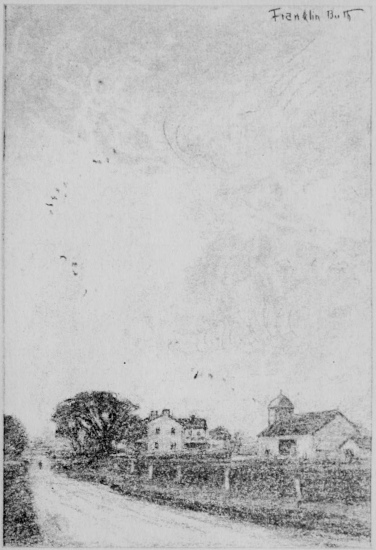
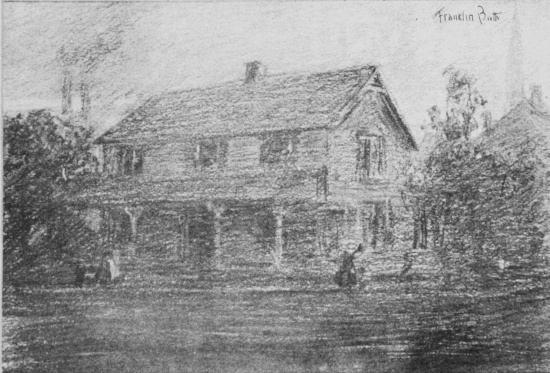
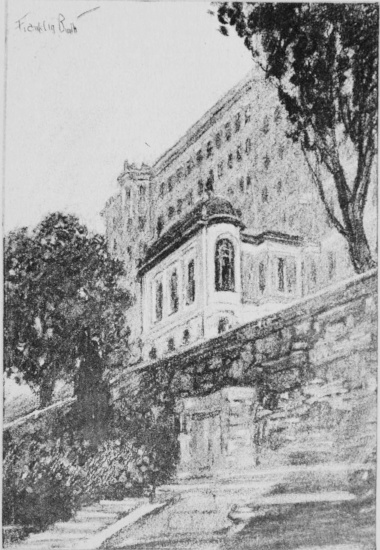
THE WARSAW HOME The Mecca of this trip Frontispiece
It was at a modest evening reception I happened to be
giving to a new poet of renown that the idea of the holiday
was first conceived. I had not seen Franklin, subsequent
companion of this pilgrimage, in all of eight or
nine months, his work calling him in one direction, mine
in another. He is an illustrator of repute, a master of
pen and ink, what you would call a really successful artist.
He has a studio in New York, another in Indiana—his
home town—a car, a chauffeur, and so on.
I first met Franklin ten years before, when he was
fresh from Indiana and working on the Sunday supplement
of a now defunct New York paper. I was doing
the same. I was drawn to him then because he had such
an air of unsophisticated and genial simplicity while looking
so much the artist. I liked his long, strong aquiline
nose, and his hair of a fine black and silver, though he
was then only twenty-seven or eight. It is now white—a
soft, artistic shock of it, glistening white. Franklin
is a Christian Scientist, or dreamy metaphysician, a fact
which may not commend him in the eyes of many, though
one would do better to await a full metaphysical interpretation
of his belief. It would do almost as well to call
him a Buddhist or a follower of the Bhagavad Gita.
He has no hard and fast Christian dogmas in mind. In
fact, he is not a Christian at all, in the accepted sense,
but a genial, liberal, platonic metaphysician. I know of
no better way to describe him. Socalled sin, as something
wherewith to reproach one, does not exist for him.
He has few complaints to make concerning people’s weaknesses
14or errors. Nearly everything is well. He lives
happily along, sketching landscapes and trees and drawing
many line simplicities and perfections. There is about
him a soothing repose which is not religious but human,
which I felt, during all the two thousand miles we subsequently
idled together. Franklin is also a very liberal
liver, one who does not believe in stinting himself of the
good things of the world as he goes—a very excellent
conclusion, I take it.
At the beginning of this particular evening nothing
was farther from my mind than the idea of going back
to Indiana. Twentyeight years before, at the age of
sixteen, I had left Warsaw, the last place in the state
where I had resided. I had not been in the town of my
birth, Terre Haute, Indiana, since I was seven. I had
not returned since I was twelve to Sullivan or Evansville
on the Ohio River, each of which towns had been my
home for two years. The State University of Indiana
at Bloomington, in the south central portion of the state,
which had known me for one year when I was eighteen,
had been free of my presence for twentysix years.
And in that time what illusions had I not built up in
connection with my native state! Who does not allow
fancy to color his primary experiences in the world?
Terre Haute! A small city in which, during my first
seven years, we lived in four houses. Sullivan, where
we had lived from my seventh to my tenth year, in one
house, a picturesque white frame on the edge of the
town. In Evansville, at 1413 East Franklin Street, in
a small brick, we had lived one year, and in Warsaw,
in the northern part of the state, in a comparatively large
brick house set in a grove of pines, we had spent four
years. My mother’s relatives were all residents of this
northern section. There had been three months, between
the time we left Evansville and the time we settled
in Warsaw, Kosciusko County, which we spent in Chicago—my
mother and nearly all of the children; also six
weeks, between the time we left Terre Haute and the
15time we settled in Sullivan, which we spent in Vincennes,
Indiana, visiting a kindly friend.
We were very poor in those days. My father had
only comparatively recently suffered severe reverses, from
which he really never recovered. My mother, a dreamy,
poetic, impractical soul, was serving to the best of her
ability as the captain of the family ship. Most of the ten
children had achieved comparative maturity and had
departed, or were preparing to depart, to shift for themselves.
Before us—us little ones—were all our lives.
At home, in a kind of intimacy which did not seem to
concern the others because we were the youngest, were
my brother Ed, two years younger than myself; my sister
Claire (or Tillie), two years older, and occasionally
my brother Albert, two years older than Claire, or my
sister Sylvia, four years older, alternating as it were
in the family home life. At other times they were out
in the world working. Sometimes there appeared on
the scene, usually one at a time, my elder brothers,
Mark and Paul, and my elder sisters, Emma, Theresa,
and Mary, each named in the order of their ascending
ages. As I have said, there were ten all told—a restless,
determined, halfeducated family who, had each
been properly trained according to his or her capacities,
I have always thought might have made a considerable
stir in the world. As it was—but I will try not to
become too technical.
But in regard to all this and the material and spiritual
character of our life at that time, and what I had
done and said, and what others had done and said, what
notions had not arisen! They were highly colored ones,
which might or might not have some relationship to the
character of the country out there as I had known it. I
did not know. Anyhow, it had been one of my dearly
cherished ideas that some day, when I had the time and
the money to spare, I was going to pay a return visit
to Indiana. My father had once owned a woolen mill
at Sullivan, still standing, I understood (or its duplicate
built after a fire), and he also had managed another
16at Terre Haute. I had a vague recollection of seeing
him at work in this one at Terre Haute, and of being
shown about, having a spinning jenny and a carder and
a weaver explained to me. I had fished in the Busseron
near Sullivan, nearly lost my life in the Ohio at Evansville
in the dead of winter, fallen in love with the first
girls I ever loved at Warsaw. The first girl who ever
kissed me and the first girl I ever ventured to kiss were
at Warsaw. Would not that cast a celestial light over
any midwestern village, however homely?
Well, be that as it may, I had this illusion. Someday
I was going back, only in my plans I saw myself taking
a train and loafing around in each village and hamlet
hours or days, or weeks if necessary. At Warsaw I
would try to find out about all the people I had ever
known, particularly the boys and girls who went to
school with me. At Terre Haute I would look up the
house where I was born and our old house in Seventh
Street, somewhere near a lumber yard and some railroad
tracks, where, in a cool, roomy, musty cellar, I had swung
in a swing hung from one of the rafters. Also in this
lumber yard and among these tracks where the cars
were, I had played with Al and Ed and other boys. Also
in Thirteenth Street, Terre Haute, somewhere there was
a small house (those were the darkest days of our poverty),
where I had been sick with the measles. My
father was an ardent Catholic. For the first fifteen years
of my life I was horrified by the grim spiritual punishments
enunciated by that faith. In this house in Thirteenth
Street I had been visited by a long, lank priest
in black, who held a silver crucifix to my lips to be kissed.
That little house remains the apotheosis of earthly gloom
to me even now.
At Sullivan I intended to go out to the Basler House,
where we lived, several blocks from the local or old
Evansville and Terre Haute depot. This house, as I recalled,
was a charming thing of six or seven rooms with
a large lawn, in which roses flourished, and with a truck
garden north of it and a wonderful clover field to the
17rear (or east) of it. This clover field—how shall I
describe it?—but I can’t. It wasn’t a clover field at all
as I had come to think of it, but a honey trove in Arcady.
An army of humble bees came here to gather honey. In
those early dawns of spring, summer and autumn, when,
for some reason not clear to me now, I was given to
rising at dawn, it was canopied by a wonderful veil of
clouds (tinted cirrus and nimbus effects), which seemed,
as I looked at them, too wonderful for words. Across
the fields was a grove of maples concealing a sugar camp
(not ours), where I would go in the early dawn to bring
home a bucket of maple sap. And directly to the north
of us was a large, bare Gethsemane of a field, in the
weedy hollows of which were endless whitening bones,
for here stood a small village slaughter house, the sacrificial
altar of one local butcher. It was not so gruesome
as it sounds—only dramatic.
But this field and the atmosphere of that home! I
shall have to tell you about them or the import of returning
there will be as nothing. It was between my
seventh and my tenth year that we lived there, among
the most impressionable of all my youth. We were very
hard pressed, as I understood it later, but I was too
young and too dreamy to feel the pinch of poverty.
This lower Wabash valley is an Egyptian realm—not
very cold in winter, and drowsy with heat in summer.
Corn and wheat and hay and melons grow here in heavy,
plethoric fashion. Rains come infrequently, then only in
deluging storms. The spring comes early, the autumn
lingers until quite New Year’s time. In the beech and
ash and hickory groves are many turtle doves. Great
hawks and buzzards and eagles soar high in the air.
House and barn martins circle in covies. The bluejay
and scarlet tanager flash and cry. In the eaves of our
cottage were bluebirds and wrens, and to our trumpet
vines and purple clematis came wondrous humming birds
to poise and glitter, tropic in their radiance. In old
Kirkwood’s orchard, a quarter of a mile away over the
18clover field, I can still hear the guinea fowls and the peacocks
“calling for rain.”
Sometimes the experiences of delicious years make a
stained glass window—the rose window of the west—in
the cathedral of our life. These three years in “dirty
old Sullivan,” as one of my sisters once called it (with a
lip-curl of contempt thrown in for good measure), form
such a flower of stained glass in mine. They are my rose
window. In symphonies of leaded glass, blue, violet,
gold and rose are the sweet harmonies of memory with
all the ills of youth discarded. A bare-foot boy is sitting
astride a high board fence at dawn. Above him
are the tinted fleeces of heaven, those golden argosies of
youthful seas of dream. Over the blooming clover are
scudding the swallows, “my heart remembers how.” I
look, and in a fence corner is a spider web impearled
with dew, a great yellow spider somewhere on its surface
is repairing a strand. At a window commanding
the field, a window in the kitchen, is my mother. My
brother Ed has not risen yet, nor my sister Tillie. The
boy looks at the sky. He loves the feel of the dawn.
He knows nothing of whence he is coming or where he
is going, only all is sensuously, deliriously gay and beautiful.
Youth is his: the tingle and response of a new
body; the bloom and fragrance of the clover in the air;
the sense of the mystery of flying. He sits and sings
some tuneless tune. Of such is the kingdom of heaven.
Or it is a great tree, say, a hundred yards from the
house. In its thick leaves and widespreading branches
the wind is stirring. Under its shade Ed and Tillie and
I are playing house. What am I? Oh, a son, a husband,
or indeed anything that the occasion requires. We
play at duties—getting breakfast, or going to work, or
coming home. Why? But a turtle dove is calling somewhere
in the depths of a woodland, and that gives me
pause. “Bob white” cries and I think of strange and
faroff things to come. A buzzard is poised in the high
blue above and I wish I might soar on wings as wide.
Or is it a day with a pet dog? Now they are running
19side by side over a stubbly field. Now the dog has wandered
away and the boy is calling. Now the boy is
sitting in a rocking chair by a window and holding the
dog in his lap, studying a gnarled tree in the distance,
where sits a hawk all day, meditating no doubt on his
midnight crimes. Now the dog is gone forever, shot
somewhere for chasing sheep, and the boy, disconsolate,
is standing under a tree, calling, calling, calling, until
the sadness of his own voice and the futility of his cries
moves him nearly to tears.
These and many scenes like these make my rose window
of the west.
CHAPTER II THE SCENIC ROUTE
20
It was a flash of all this that came to me when in the
midst of the blathering and fol de rol of a gay evening
Franklin suddenly approached me and said, quite apropos
of nothing: “How would you like to go out to Indiana
in my car?”
“I’ll tell you what, Franklin,” I answered, “all my
life I’ve been thinking of making a return trip to Indiana
and writing a book about it. I was born in Terre Haute,
down in the southwest there below you, and I was brought
up in Sullivan and Evansville in the southern part of
the state and in Warsaw up north. Agree to take me
to all those places after we get there, and I’ll go. What’s
more, you can illustrate the book if you will.”
“I’ll do that,” he said. “Warsaw is only about two
hours north of our place. Terre Haute is seventyfive
miles away. Evansville is a hundred and fifty. We’ll
make a oneday trip to the northern part and a three-day
trip to the southern. I stipulate but one thing. If
we ruin many tires, we split the cost.”
To this I agreed.
Franklin’s home was really central for all places. It
was at Carmel, fifteen miles north of Indianapolis. His
plan, once the trip was over, was to camp there in his
country studio, and paint during the autumn. Mine was
to return direct to New York.
We were to go up the Hudson to Albany and via
various perfect state roads to Buffalo. There we were
to follow other smooth roads along the shore of Lake
Erie to Cleveland and Toledo, and possibly Detroit.
There we were to cut southwest to Indianapolis—so close
to Carmel. It had not occurred to either of us yet to
21go direct to Warsaw from Toledo or thereabouts, and
thence south to Carmel. That was to come as an afterthought.
But this Hudson-Albany-State-road route irritated me
from the very first. Everyone traveling in an automobile
seemed inclined to travel that way. I had a vision of
thousands of cars which we would have to trail, consuming
their dust, or meet and pass, coming toward us.
By now the Hudson River was a chestnut. Having traveled
by the Pennsylvania and the Central over and over
to the west, all this mid-New York and southern Pennsylvania
territory was wearisome to think of. Give me the
poor, undernourished routes which the dull, imitative
rabble shun, and where, because of this very fact, you
have some peace and quiet. I traveled all the way uptown
the next day to voice my preference in regard to
this matter.
“I’d like to make a book out of this,” I explained, “if
the material is interesting enough, and there isn’t a thing
that you can say about the Hudson River or the central
part of New York State that hasn’t been said a thousand
times before. Poughkeepsie, Albany, Troy, Syracuse,
Rochester—all ghastly manufacturing towns. Why
don’t we cut due west and see how we make out? This
is the nicest, dryest time of the year. Let’s go west to
the Water Gap, and straight from there through Pennsylvania
to some point in Ohio, then on to Indianapolis.”
A vision of quaint, wild, unexpected regions in Pennsylvania
came to me.
“Very good,” he replied genially. He was playing
with a cheerful, pop-eyed French bull. “Perhaps that
would be better. The other would have the best roads,
but we’re not going for roads exactly. Do you know the
country out through there?”
“No,” I replied. “But we can find out. I suppose the
Automobile Club of America ought to help us. I might
go round there and see what I can discover.”
“Do that,” he applauded, and I was making to depart
22when Franklin’s brother and his chauffeur entered. The
latter he introduced as “Speed.”
“Speed,” he said, “this is Mr. Dreiser, who is going
with us. He wants to ride directly west across Pennsylvania
to Ohio and so on to Indianapolis. Do you think
you can take us through that way?”
A blond, lithe, gangling youth with an eerie farmerlike
look and smile ambled across the room and took
my hand. He seemed half mechanic, half street-car conductor,
half mentor, guide and friend.
“Sure,” he replied, with a kind of childish smile that
won instantly—a little girl smile, really. “If there are
any roads, I can. We can go anywhere the car’ll go.”
I liked him thoroughly. All the time I was trying
to think where I had seen Speed before. Suddenly it
came to me. There had been a car conductor in a recent
comedy. This was the stage character to life. Besides
he reeked of Indiana—the real Hoosier. If you
have ever seen one, you’ll know what I mean.
“Very good,” I said. “Fine. Are you as swift as
your name indicates, Speed?”
“I’m pretty swift,” he said, with the same glance that
a collie will give you at times—a gay, innocent light of
the eyes!
A little while later Franklin was saying to me that he
had no real complaint against Speed except this: “If you
drive up to the St. Regis and go in for half an hour, when
you come out the sidewalk is all covered with tools and
the engine dismantled—that is, if the police have not
interfered.”
“Just the same,” put in Fred Booth, “he is one of the
chauffeurs who led the procession of cars from New York
over the Alleghanies and Rockies to the coast, laying out
the Lincoln Highway.” (Afterwards I saw testimonials
and autographed plates which proved this.) “He can
take a car anywhere she’ll go.”
Then I proceeded to the great automobile club for
information.
23“Are you a member?” asked the smug attendant, a
polite, airy, bufferish character.
“No, only the temporary possessor of a car for a
tour.”
“Then we can do nothing for you. Only members are
provided with information.”
On the table by which I was standing lay an automobile
monthly. In its pages, which I had been idly thumbing
as I waited, were a dozen maps of tours, those deceptive
things gotten up by associated roadhouses and
hotels in their own interest. One was labeled “The
Scenic Route,” and showed a broad black line extending
from New York via the Water Gap, Stroudsburg, Wilkes-Barré,
Scranton, Binghamton, and a place called Watkins
Glen, to Buffalo and Niagara Falls. This interested me.
These places are in the heart of the Alleghanies and of
the anthracite coal region. Visions of green hills, deep
valleys, winding rivers, glistering cataracts and the like
leaped before my mind.
“The Scenic Route!” I ventured. “Here’s a map that
seems to cover what I want. What number is this?”
“Take it, take it!” replied the lofty attendant, as if
to shoo me out of the place. “You are welcome.”
“May I pay you?”
“No, no, you’re welcome to it.”
I bowed myself humbly away.
“Well, auto club or no auto club, here is something,
a real route,” I said to myself. “Anyhow it will do
to get us as far as Wilkes-Barré or Scranton. After
that we’ll just cut west if we have to.”
On the way home I mooned over such names as Tobyhanna,
Meshoppen, Blossburg, and Roaring Branch.
What sort of places were they? Oh, to be speeding along
in this fine warm August weather! To be looking at the
odd places, seeing mountains, going back to Warsaw and
Sullivan and Terre Haute and Evansville!
CHAPTER III ACROSS THE MEADOWS TO THE PASSAIC
24
I assume that automobiling, even to the extent of a
two-thousand-mile trip such as this proved to be, is an
old story to most people. Anybody can do it, apparently.
The difference is to the man who is making the
trip, and for me this one had the added fillip of including
that pilgrimage which I was certain of making some
time.
There was an unavoidable delay owing to the sudden
illness of Speed, and then the next morning, when I was
uncertain as to whether the trip had been abandoned or
no, the car appeared at my door in Tenth Street, and
off we sped. There were some amusing preliminaries.
I was introduced to Miss H——, a lady who was to
accompany us on the first day of our journey. A photograph
was taken, the bags had to be arranged and
strapped on the outside, and Speed had to examine his
engine most carefully. Finally we were off—up Eighth
Avenue and across Fortysecond Street to the West Fortysecond
Street Ferry, while we talked of non-skid chains
and Silvertown tires and the durability of the machines
in general—this one in particular. It proved to be a
handsome sixty-horsepower Pathfinder, only recently
purchased, very presentable and shiny.
As we crossed the West Fortysecond Street Ferry I
stood out on the front deck till we landed, looking at the
refreshing scene the river presented. The day was fine,
nearly mid-August, with a sky as blue as weak indigo.
Flocks of gulls that frequent the North River were dipping
and wheeling. A cool, fresh wind was blowing.
As we stood out in front Miss H—— deigned to tell
me something of her life. She is one of those self-conscious,
25carefully dressed, seemingly prosperous maidens
of some beauty who frequent the stage and the
studios. At present she was Franklin’s chief model.
Recently she had been in some pantomime, dancing. A
little wearied perhaps (for all her looks), she told me
her stage and art experiences. She had to do something.
She could sing, dance, act a little, and draw, she said.
Artists seemed to crave her as a model—so-—-
She lifted a thin silk veil and dabbed her nose with
a mere rumor of a handkerchief. Looking at her so
fresh and spick in the morning sunlight, I could not help
feeling that Franklin was to be congratulated in the
selection of his models.
But in a few minutes we were off again, Speed obviously
holding in the machine out of respect for officers
who appeared at intervals, even in Weehawken, to wave
us on or back. I could not help feeling as I looked
at them how rapidly the passion for regulating street
traffic had grown in the last few years. Everywhere we
seemed to be encountering them—the regulation New
York police cap (borrowed from the German army)
shading their eyes, their air of majesty beggaring the
memories of Rome—and scarcely a wagon to regulate.
At Passaic, at Paterson—but I anticipate.
As we hunted for a road across the meadows we got
lost in a maze of shabby streets where dirty children
were playing in the dust, and, as we gingerly picked our
way over rough cobbles, I began to fear that much of
this would make a disagreeable trip. But we would soon
be out of it, in all likelihood—miles and miles away from
the hot, dusty city.
I can think of nothing more suited to my temperament
than automobiling. It supplies just that mixture of
change in fixity which satisfies me—leaves me mentally
poised in inquiry, which is always delightful. Now, for
instance, we were coming out on a wide, smooth macadam
road, which led, without a break, as someone informed
us, into Passaic and then into Paterson. It was the first
opportunity that Speed had had to show what the machine
26could do, and instantly, though various signs read,
“Speed limit: 25 miles an hour,” I saw the speedometer
climb to thirtyfive and then forty and then fortyfive.
It was a smooth-running machine which, at its best (or
worst), gave vent to a tr-r-r-r-r-r-r-r-r-r which became
after a while somewhat like a croon.
Though it was a blazing hot day (as any momentary
pause proved, the leather cushions becoming like an
oven), on this smooth road, and at this speed, it was
almost too cool. I had decked myself out in a brown
linen outing shirt and low visored cap. Now I felt as
though I might require my overcoat. There was no dust
to speak of, and under the low branches of trees and
passing delightful dooryards all the homey flowers of
August were blooming in abundance. Now we were following
the Hackensack and the Passaic in spots, seeing
long, low brick sheds in the former set down in wind
rhythmed marsh grass, and on the latter towering stacks
and also simple clubs where canoes were to be seen—white,
red and green—and a kind of August summer life
prevailing for those who could not go further. I was
becoming enamored of our American country life once
more.
Paterson, to most New Yorkers, and for that matter
to most Americans, may be an old story. To me it is
one of the most interesting pools of life I know. There
is nothing in Paterson, most people will tell you, save silk
mills and five-and-ten-cent stores. It is true. Yet to me
it is a beautiful city in the creative sense—a place in which
to stage a great novel. These mills—have you ever seen
them? They line the Passaic river and various smooth
canals that branch out from it. It was no doubt the well-known
waterfall and rapids of this river that originally
drew manufacturers to Paterson, supplied the first mills
with water, and gave the city its start. Then along came
steam and all the wonders of modern electricity-driven
looms. The day we were there they were just completing
a power plant or city water supply system. The
ground around the falls had been parked, and standing
27on a new bridge one could look down into a great round,
grey-black pit or cup, into which tumbled the water of the
sturdy little river above. By the drop of eighty or a
hundred feet it was churned into a white spray which
bounded back almost to the bridge where we stood. In
this gay sunlight a rainbow was ever present—a fine five-striped
thing, which paled and then strengthened as the
spray thinned or thickened.
Below, over a great flume of rocks, that stretched outward
toward the city, the expended current was bubbling
away, spinning past the mills and the bridges. From the
mills themselves, as one drew near, came the crash of
shuttles and the thrum of spindles, where thousands of
workers were immured, weaving the silk which probably
they might never wear. I could not help thinking, as I
stood looking at them, of the great strike that had occurred
two years before, in which all sorts of nameless
brutalities had occurred, brutalities practised by judges,
manufacturers and the police no less than by the eager
workers themselves.
In spite of all the evidence I have that human nature is
much the same at the bottom as at the top, and that the
restless striker of today may be the oppressive manufacturer
or boss of tomorrow, I cannot help sympathizing
with the working rank and file. Why should the man at
the top, I ask myself, want more than a reasonable authority?
Why endless houses, and lands, and stocks, and
bonds to flaunt a prosperity that he does not need and cannot
feel? I am convinced that man in toto—the race
itself—is nothing more nor less as yet than an embryo
in the womb of something which we cannot see. We are
to be protected (as a race) and born into something
(some state) which we cannot as yet understand or even
feel. We, as individual atoms, may never know, any
more than the atoms or individual plasm cells which constructed
us ever knew. But we race atoms are being
driven to do something, construct something—(a race
man or woman, let us say)—and like the atoms in the
embryo, we are struggling and fetching and carrying. I
28did not always believe in some one “divine faroff event”
for the race. I do not accept the adjective divine even
now. But I do believe that these atoms are not toiling for
exactly nothing—or at least, that the nothingness is not
quite as undeniable as it was. There is something back
of man. An avatar, a devil, anything you will, is trying
to do something, and man is His medium, His brush,
His paint, His idea. Against the illimitable space of
things He is attempting to set forth his vision. Is the
vision good? Who knows! It may be as bad as that of
the lowest vaudeville performer clowning it before a
hoodlum audience. But good or bad, here it is, struggling
to make itself manifest, and we are of it!
What if it is all a mad, aimless farce, my masters?
Shan’t we clown it all together and make the best of it?
Ha ha! Ho ho! We are all crazy and He is crazy!
Ha ha! Ho ho!
Or do I hear someone crying?
CHAPTER IV THE PIETY AND EGGS OF PATERSON
29
But in addition to mills and the falls, Paterson offered
another subject of conversation. Only recently there had
been completed there an evangelical revival by one
“Billy” Sunday, who had addressed from eight to twenty
thousand people at each meeting in a specially constructed
tabernacle, and caused from one to five hundred or a
thousand a day to “hit the trail,” as he phrased it, or in
other words to declare that they were “converted to
Christ,” and hence saved.
America strikes me as an exceedingly intelligent land
at times, with its far-flung states, its fine mechanical
equipment, its good homes and liberal, rather non-interfering
form of government, but when one contemplates
such a mountebank spectacle as this, what is one to say?
I suppose one had really better go deeper than America
and contemplate nature itself. But then what is one to
say of nature?
We discussed this while passing various mills and
brown wooden streets, so poor that they were discouraging.
“It is curious, but it is just such places as Paterson
that seem to be afflicted with unreasoning emotions of this
kind,” observed Franklin wearily. “Gather together
hordes of working people who have little or no skill
above machines, and then comes the revivalist and waves
of religion. Look at Pittsburg and Philadelphia. See
how well Sunday did there. He converted thousands.”
He smiled heavily.
“‘Billy’ Sunday comes from out near your town,” volunteered
Speed informatively. “He lives at Winona
Lake. That’s a part of Warsaw now.”
30“Yes, and he conducts a summer revival right there
occasionally, I believe,” added Franklin, a little vindictively,
I thought.
“Save me!” I pleaded. “Anyhow, I wasn’t born there.
I only lived there for a little while.”
This revival came directly on the heels of a great
strike, during which thousands were compelled to obtain
their food at soup houses, or to report weekly to the local
officers of the union for some slight dole. The good God
was giving them wrathful, condemnatory manufacturers,
and clubbing, cynical police. Who was it, then, that
“revived” and “hit the trail”? The same who were
starved and clubbed and lived in camps, and were railroaded
to jail? Or were they the families of the bosses
and manufacturers, who had suppressed the strike and
were thankful for past favors (for they eventually won,
I believe)? Or was it some intermediate element that
had nothing to do with manufacturers or workers?
The day we went through, some Sunday school parade
was preparing. There were dozens of wagons and auto-trucks
and automobiles gaily bedecked with flags and
bunting and Sunday school banners. Hundreds, I might
almost guess thousands, of children in freshly ironed
white dresses and gay ribbons, carrying parasols, and
chaperoned by various serious looking mothers and
elders, were in these conveyances, all celebrating, presumably,
the glory and goodness of God!
A spectacle like this, I am free to say, invariably causes
me to scoff. I cannot help smiling at a world that cannot
devise some really poetical or ethical reason for worshiping
or celebrating or what you will, but must indulge
in shrines and genuflections and temples to false or impossible
ideas or deities. They have made a God of
Christ, who was at best a humanitarian poet—but not
on the basis on which he offered himself. Never! They
had to bind him up with the execrable yah-vah of the
Hebrews, and make him now a God of mercy, and now a
God of horror. They had to dig themselves a hell, and
they still cling to it. They had to secure a church organization
31and appoint strutting vicars of Christ to misinterpret
him, and all that he believed. This wretched
mountebank “who came here and converted thousands”—think
of him with his yapping about hell, his bar-room
and race-track slang, his base-ball vocabulary. And thousands
of poor worms who could not possibly offer one
reasonable or intelligible thought concerning their faith
or history or life, or indeed anything, fall on their knees
and “accept Christ.” And then they pass the collection
plate and build more temples and conduct more revivals.
What does the God of our universe want, anyway?
Slaves? Or beings who attempt to think? Is the fable
of Prometheus true after all? Is autocracy the true interpretation
of all things—or is this an accidental phase,
infinitely brief in the long flow of things, and eventually
to be done away with? I, for one, hope so.
Beyond Paterson we found a rather good road leading
to a place called Boonton, via Little Falls, Singac, and
other smaller towns, and still skirting the banks of the
Passaic River. In Paterson we had purchased four hard-boiled
eggs, two pies, four slices of ham and some slices
of bread, and four bottles of beer, and it being somewhere
near noon we decided to have lunch. The task of
finding an ideal spot was difficult, for we were in a holiday
mood and content with nothing less than perfection.
Although we were constantly passing idyllic scenes—waterfalls,
glens, a canal crossing over a stream—none
would do exactly. In most places there was no means of
bringing the car near enough to watch it. One spot
proved of considerable interest, however, for, although
we did not stay, in spying about we found an old moss-covered,
red granite block three feet square and at least
eight feet long, on which was carved a statement to the
effect that this canal had been completed in 1829, and
that the following gentlemen, as officers and directors,
had been responsible. Then followed a long list of names—Adoniram
this, and Cornelius that, good and true business
men all, whose carved symbols were now stuffed with
mud and dust. This same canal was very familiar to
32me, I having walked every inch of it from New York to
the Delaware River during various summer holidays.
But somehow I had never before come upon this memorial
stone. Here some twenty men, of a period so
late as 1829, caused their names to be graven on a great
stone which should attest their part in the construction
of a great canal—a canal reaching from New York Bay
to the Delaware River—and here lies the record under
dust and vines! The canal itself is now entirely obsolete.
Although the State of New Jersey annually spends some
little money to keep it clean, it is rarely if ever used by
boats. It was designed originally to bring hard coal from
that same region around Wilkes-Barré and Scranton, toward
which we were speeding. A powerful railroad corporation
crept in, paralleled it, and destroyed it. This
same corporation, eager to make its work complete, and
thinking that the mere existence of the canal might some
day cause it to be revived, and wanting no water competition
in the carrying of coal, had a bill introduced into the
State legislature of New Jersey, ordering, or at least
sanctioning that it should be filled in, in places. Some
citizens objected, several newspapers cried out, and so the
bill was dropped. But you may walk along a canal costing
originally fifty million dollars, and still ornamented
at regular intervals with locks and planes, and never encounter
anything larger than a canoe. Pretty farm
houses face it now; door yards come down to the very
water; ducks and swans float on its surface and cattle
graze nearby. I have spent as much as two long springtimes
idling along its banks. It is beautiful—but it is
useless.
We did eventually come to a place that suited us exactly
for our picnic. The river we were following widened
at this point and skirted so near the road that it was
no trouble to have our machine near at hand and still sit
under the trees by the waterside. Cottages and tents
were sprinkled cheerily along the farther shore, and the
river was dotted with canoes and punts of various colors.
Under a group of trees we stepped out and spread our
33feast. It was all so lovely that it seemed a bit out of
fairyland or a sketch by Watteau. Franklin being a
Christian Scientist, it was his duty, as I explained to him,
to “think” any flies or mosquitoes away—to “realize”
for us all that they could not be, and so leave us to enjoy
our meal in peace. Miss H—— was to be the background
of perfection, the color spot, the proof of holiday,
like all the ladies in Watteau and Boucher. The
machine and Speed, his cap adjusted to a rakish angle,
were to prove that we were gentlemen of leisure. On
leaving New York I saw that he had a moustache capable
of that upward twist so admired of the German Emperor,
and so now I began to urge him to make the ends stand
up so that he would be the embodiment of the distingué.
Nothing loath, he complied smilingly, that same collie-like
smile in his eyes that I so much enjoy.
It was Franklin who had purchased the eggs. He had
gone across the street in Paterson, his belted dust-coat
swinging most impressively, and entering a little quick
lunch room, had purchased these same eggs. Afterward
he admitted that as he was leaving he noticed the black
moustached face of a cook and the villainous head of a
scullion peering after him from a sort of cook’s galley
window with what seemed to him “a rumor of a sardonic
smile.” But suspecting nothing, he went his way. Now,
however, I peeled one of these eggs, and touching it with
salt, bit into it. Then I slowly turned my head, extracted
as much as I could silently with a paper napkin, and deposited
it with an air of great peace upon the ground. I
did not propose to be the butt of any ribald remarks.
Presently I saw Franklin preparing his. He crushed
the shell, and after stripping the glistening surface dipped
it in salt. I wondered would it be good. Then he bit
into it and paused, took up a napkin with a very graceful
and philosophic air, and wiped his mouth. I was not
quite sure what had happened.
“Was your egg good?” he said finally, examining me
with an odd expression.
“It was not,” I replied. “The most villainously bad
34egg I have had in years. And here it goes, straight to
the fishes.”
I threw it.
“Well, they can have mine,” observed Miss H——,
sniffing gingerly.
“What do you know about that?” exclaimed Speed,
who was sitting some distance from the rest of us and
consuming his share. “I think the man that sold you
those ought to be taken out and slapped gently,” and he
threw his away. “Say! And four of them all at once
too. I’d just like to get a camera and photograph him.
He’s a bird, he is.”
There was something amazingly comic to me in the
very sound of Speed’s voice. I cannot indicate just what,
but his attempt at scorn was so inadequate, so childlike.
“Well, anyhow, the fishes won’t mind,” I said. “They
like nice, fresh Franklin eggs. Franklin is their best
friend, aren’t you, Franklin? You love fishes, don’t
you?”
Booth sat there, his esoteric faith in the wellbeing of
everything permitting him to smile a gentle, tolerant
smile.
“You know, I wondered why those two fellows seemed
to smile at me,” he finally commented. “They must have
done this on purpose.”
“Oh no,” I replied, “not to a full fledged Christian
Scientist! Never! These eggs must be perfect. The
error is with us. We have thought bad eggs, that’s all.”
We got up and tossed the empty beer bottles into the
stream, trying to sink them with stones. I think I added
one hundred stones to the bed of the river without sinking
a single bottle. Speed threw in a rock pretending it
was a bottle and I even threw at that before discovering
my mistake. Finally we climbed into our car and sped
onward, new joys always glimmering in the distance.
“Just to think,” I said to myself, “there are to be two
whole weeks of this in this glorious August weather.
What lovely things we shall see!”
CHAPTER V ACROSS THE DELAWARE
35
The afternoon run was even more delightful than
that of the morning. Yet one does not really get free of
New York—its bustle and thickness of traffic—until one
gets west of Paterson, which is twentyfive miles west,
and not even then. New York is so all embracing. It
is supposed to be chiefly represented by Manhattan
Island, but the feel of it really extends to the Delaware
Water Gap, one hundred miles west, as it does to the
eastern end of Long Island, one hundred miles east, and
to Philadelphia, one hundred miles south, or Albany,
one hundred miles north. It is all New York.
But west of Paterson and Boonton the surge of traffic
was beginning to diminish, and we were beginning to taste
the real country. Not so many autotrucks and wagons
were encountered here, though automobiles proper were
even more numerous, if anything. This was a wealthy
residence section we were traversing, with large handsome
machines as common as wagons elsewhere, and the
occupants looked their material prosperity. The roads,
too, as far as Dover, our next large town, thirty miles
on, were beautiful—smooth, grey and white macadam,
lined mostly with kempt lawns, handsome hedges, charming
dwellings, and now and then yellow fields of wheat
or oats or rye, with intermediate acres of tall, ripe corn.
I never saw better fields of grain, and remembered reading
in the papers that this was a banner season for crops.
The sky, too, was wholly entrancing, a clear blue, with
great, fleecy clouds sailing along in the distance like immense
hills or ships. We passed various small hotels
and summer cottages, nestling among these low hills,
where summer boarders were sitting on verandas, reading
36books or swinging in hammocks or crocheting, American
fashion, in rocking chairs. All my dread of the conventional
American family arose as I surveyed them, for
somehow, as idyllic as all this might appear on the
surface, it smacked the least bit of the doldrums.
Youths and maidens playing croquet and tennis, mother
(and much more rarely father) seated near, reading and
watching. The three regular meals, the regular nine
o’clock hour for retiring! Well, I was glad we were
making forty miles an hour.
As we passed through Dover it was three o’clock. As
we passed Hopatcong, after pausing to sketch a bridge
over the canal, it was nearing four. There were pauses
constantly which interrupted our speed. Now it was a
flock of birds flying over a pool, all their fluttering wings
reflected in the water, and Franklin had to get out and
make a pencil note of it. Now a lovely view over some
distant hills, a small town in a valley, a factory stack by
some water side.
“Say, do these people here ever expect to get to Indiana?”
remarked Speed in an aside to Miss H——.
We had to stop in Dover—a city of thirty thousand—at
the principal drug store, for a glass of ice cream soda.
We had to stop at Hopatcong and get a time table in
order to learn whether Miss H—— could get a train in
from the Water Gap later in the evening. We had to
stop and admire a garden of goldenglows and old fashioned
August flowers.
Beyond Hopatcong we began to realize that we would
no more than make the Water Gap this day. The hills
and valleys were becoming more marked, the roads more
difficult to ascend. As we passed Stanhope, a small town
beyond Hopatcong, we got on the wrong road and had
to return, a common subsequent experience. Beyond
Stanhope we petitioned one family group—a mother and
three children—for some water, and were refused. A
half mile further on, seeing a small iron pump on a lawn,
we stopped again. A lean, dreamy woman came out and
we asked her. “Yes, surely,” she replied and re-entered
37the house, returning with a blue pitcher. Chained to a
nearby tree a collie bitch which looked for all the world
like a fox jumped and barked for joy.
“Are you going to Hackettstown?” asked our hostess
simply.
“We’re going through to Indiana,” confided Franklin
in a neighborly fashion.
A look of childlike wonder at the far off came into the
woman’s voice and eyes. “To Indiana?” she replied.
“That’s a long way, isn’t it?”
“Oh, about nine hundred miles,” volunteered Speed
briskly.
As we sped away—vain of our exploit, I fancy—she
stood there, pitcher in hand, looking after us. I wished
heartily she might ride all the long distances her moods
might crave. “Only,” I thought, “would it be a fair
exchange for all her delightsome wonder?”
This side of Hackettstown we careened along a ridge
under beautiful trees surveying someone’s splendid country
estate, with a great house, a lake and hills of sheep.
On the other side of Hackettstown we had a blow out
and had to stop and change a tire. A Russian moujik,
transplanted to America and farming in this region, interested
me. A reaper whirring in a splendid field of grain
informed me that we were abroad at harvest time—we
would see much reaping then. While the wheel was being
repaired I picked up a scrap of newspaper lying on the
road. It was of recent issue and contained an advertisement
of a great farm for sale which read “Winter is no
time to look at a farm, for then everything is out of commission
and you cannot tell what a farm is worth. Spring
is a dangerous time, for then everything is at its best, and
you are apt to be deceived by fields and houses which
later you would not think of buying. Mid-August is the
ideal time. Everything is bearing by then. If a field or
a yard or a house or cattle look good at that time you
may be sure that they will look as good or better at
others. Examine in mid-August. Examine now.”
“Ah,” I said, “now I shall see this eastern half of the
38United States at the best time. If it looks good now I
shall know pretty well how good eastern America is.”
And so we sped on, passing a little farther on a forlorn,
decadent, gloomy hamlet about which I wanted to
write a poem or an essay. Edgar Allan Poe might have
lived here and written “The Raven.” The house of
Usher might have been a dwelling in one of these hypochondriacal
streets. They were so dim and gloomy and
sad. Still farther on as we neared the Delaware we
came into a mountain country which seemed almost entirely
devoted to cattle and the dairy business. It was
not an ultra prosperous land—what mountain country is?
You can find it on the map if you choose, lying between
Phillipsburg and the river.
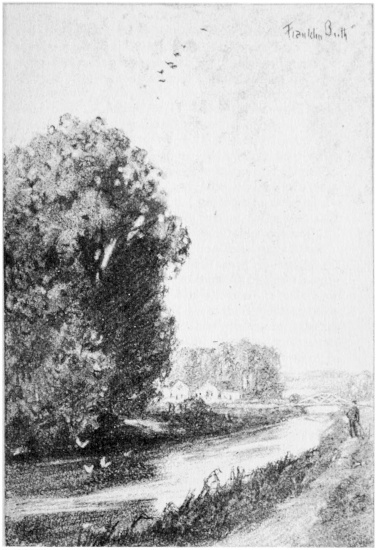
THE OLD ESSEX AND MORRIS CANAL
Something—perhaps the approach of evening, perhaps
the gloom of great hills which make darksome valleys
wherein lurk early shadows and cool, damp airs; perhaps
the tinkle of cowbells and the lowing of homing herds;
perhaps the presence of dooryards where laborers and
farmers, newly returned from work, were washing their
hands in pans outside of kitchen doors; or the smoke curl
of evening fires from chimneys, or the glint of evening
lamps through doors and windows—was very touching
about all this; anyhow, as we sped along I was greatly
moved. Life orchestrates itself at times so perfectly.
It sings like a prima donna of humble joys, and happy
homes and simple tasks. It creates like a great virtuoso,
bow in hand, or fingers upon invisible keys, a supreme
illusion. The heart hurts; one’s eyes fill with tears. We
skirted great hills so close that at times, as one looked up,
it seemed as though they might come crashing down on
us. We passed thick forests where in this mid-August
weather, one could look into deep shadows, feeling the
ancient childish terror of the woods and of the dark. I
looked up a cliff side—very high up—and saw a railroad
station labeled Manunka-Chunk. I looked into a
barnyard and saw pigs grunting over corn and swill, and
a few chickens trying to flutter up into a low tree. The
night was nigh.
39Presently, in this sweet gloom we reached a ferry which
crosses the river somewhere near the Water Gap and
which we were induced to approach because we knew of
no bridge. On the opposite side, anchored to a wire
which crossed the river, was a low flat punt, which looked
for all the world like a shallow saucepan. We called
“Yoho!” and back came the answer “All right!” Presently
the punt came over and in a silvery twilight Speed
maneuvered the car onto the craft. A tall, lank yokel
greeted us.
“Goin’ to the Water Gap?”
“Yes, how far is it?”
“Seven miles.”
“What time is it?”
“Seven o’clock.”
That gave us an hour in which to make Miss H——’s
train.
“That’s Pennsylvania over there, isn’t it?”
“Yep, that’s Pennsylvania. There ain’t nothing in
New Jersey ’cept cows and mountains.”
He grinned as though he had made a great joke.
Speed, as usual, was examining the engine. Franklin
and I were gazing enraptured at the stately hills which
sentinel this stream. In the distance was the Water Gap,
a great cleft in the hills where in unrecorded days the
river is believed to have cut its way through. One could
see the vast masonry of some bridge which had been constructed
farther up the stream.
We clambered up the bank on the farther side, the car
making a great noise. In this sweet twilight with fireflies
and spirals of gnats and “pinchin' bugs,” as Speed called
them, we tore the remainder of the distance, the eyes of
the car glowing like great flames. Along this river road
we encountered endless groups of strolling summer boarders—girls
with their arms about each other, quiescent
women and older maids idling in the evening damp.
“A land of summer hotels this, and summer boarding
houses,” I said.
40“Those are all old maids or school teachers,” insisted
Speed with Indiana assurance, “or I’ll eat my hat.”
In the midst of our flight Speed would tell stories,
tossing them back in the wind and perfumes. Miss
H—— was singing “There Was an Old Soldier.” In
no time at all—though not before it was dark—we were
entering a region compact of automobiles, gasoline
smoke, and half concealed hotel windows and balconies
which seemed to clamber up cliffs and disappear into the
skies. Below us, under a cliff, ran a railroad, its freight
and passenger trains seeming to thunder ominously near.
We were, as I could see, high on some embankment or
shelf cut in the hill. Presently we turned into a square
or open space which opened out at the foot of the hill, and
there appeared a huge caravansary, The Kittatinny, with
a fountain and basin in the foreground which imitated the
colored waters of the Orient. Lackeys were there to take
our bags—only, since Miss H—— had to make her train,
we had to go a mile farther on to the station under the
hill. To give Franklin and Miss H—— time Speed
parked the car somewhere near the station and I went to
look for colored picture cards.
I wandered off into a region of lesser hotels and stores—the
usual clutter of American mountain resort gayety.
It brought back to me Tannersville and Haines Corners
in the Catskills, Excelsior Springs and the Hot Springs of
Virginia and the Ozarks. American summer mountain
life is so naive, so gauche, so early Victorian. Nothing
could be duller, safer, more commonplace apparently,
and yet with such a lilt running through it, than this scene.
Here were windows of restaurants or ball rooms or hotel
promenades, all opened to the cool mountain air and all
gaily lighted. An orchestra was to be heard crooning
here and there. The one street was full of idlers, summer
cottagers, hotel guests, the natives—promenading.
Many electric lamps cast hard shadows provided by the
trees. It was all so delightfully cool and fragrant. All
these maidens were so bent on making catches, apparently,
so earnest to attract attention. They were decked
41out in all the fineries and fripperies of the American summer
resort scene. I never saw more diaphanous draperies—more
frail pinks, blues, yellows, creams. All the
brows of all the maidens seemed to be be-ribboned. All
the shoulders were flung about with light gauzy shawls.
Noses were powdered, lips faintly rouged, perhaps. The
air was vibrant with a kind of mating note—or search.
“Well, well,” I exclaimed, and bought me all the truly
indicative postcards I could find.
CHAPTER VI AN AMERICAN SUMMER RESORT
42
I have no quarrel with American summer resorts as
such—they are as good as any—but I must confess that
scenes like this do not move me as they once did. I can
well recall the time—and that not so many years ago—when
this one would have set me tingling, left me yearning
with a voiceless, indescribable pain. Life does such
queer things to one. It takes one’s utmost passions of
five years ago and puts them out like a spent fire. Standing
in this almost operatic street, I did my best to contrast
my feelings with those of twenty, fifteen and even
ten years before. What had come over the spirit of my
dreams? Well, twenty years before I knew nothing
about love, actually—ten years before I was not satisfied.
Was that it? Not exactly—no—I could not say that it
was. But now at least these maidens and this somewhat
banal stage setting were not to be accepted by me, at
least, at the value which unsophistication and youth place
on them. The scene was gay and lovely and innocent
really. One could feel the wonder of it. But the stage-craft
was a little too obvious.
Fifteen years before (or even ten) these gauche maidens
idling along would have seemed most fascinating.
Now the brow bands and diaphanous draperies and pink
and blue and green slippers were almost like trite stage
properties. Fifteen or twenty years before I would have
been ready to exclaim with any of the hundred youths I
saw bustling about here, yearning with their eyes: “Oh,
my goddess! Oh, my Venus! Oh, my perfect divinity!
But deign to cast one encouraging glance upon me, your
devoted slave, and I will grovel at your feet. Here is
my heart and hand and my most sacred vow—and my
43pocket book. I will work for you, slave for you, die for
you. Every night for the next two thousand nights of
my life, all my life in fact, I will come home regularly
from my small job and place all my earnings and hopes
and fears in your hands. I will build a house and I will
run a store. I will do anything to make you happy. We
will have three, seven, nine children. I will spade a garden
each spring, bring home a lawnmower and cut the
grass. I will prove thoroughly domesticated and never
look at another woman.”
That, in my nonage, was the way I used to feel.
And as I looked about me I could see much the same
emotions at work here. These young cubs—how enraptured
they were; how truly like young puppies with still
blinded eyes! The air was redolent of this illusion. That
was why the windows and balconies were hung with Japanese
lanterns. That was why the orchestras were playing
so—divinely! To me now it tanged rather hollowly
at moments, like a poor show. I couldn’t help seeing that
the maidens weren’t divinities at all, that most of them
were the dullest, most selfish, most shallow and strawy
mannikinesses one could expect to find. Poor little half-equipped
actors and actresses.
“But even so,” I said to myself, “this is the best the
master of the show has to offer. He is at most a strolling
player of limited equipment. Perhaps elsewhere, in some
other part of the universe, there may be a showman who
can do better, who has a bigger, better company. But
these——”
I returned to the hotel and waited for Franklin. We
were assigned a comfortable room on the second or third
floor, I forget which, down a mile of corridor. Supper
in the grill cost us five dollars. The next morning breakfast
in the Persian breakfast room cost us three more.
But that evening we had the privilege of sitting on a balcony
and watching a herd of deer come down to a wire
fence and eat grass in the glare of an adjacent arc light.
We had the joy of observing the colored fountains
(quenched at twelve) and seeing the motoring parties
44come tearing up or go flying past, wild with a nameless
gayety. In the parlors, the music rooms, the miles of
promenade balconies, were hosts of rich mammas and
daughters—the former nearly all fat, the latter all promising
to be, and a little gross. For the life of me I could
not help but think of breweries, distilleries, soap factories,
furniture factories, stove companies and the like.
Where did all these people come from? Where did they
all get the money to stay here weeks and weeks at six,
eight, and even fifteen and twenty a day a person? Our
poor little six dollar rooms! Good Heavens! Some of
them had suites with three baths. Think of all the factories,
the purpose of which (aside from supplying the
world with washtubs, flatirons, sealing wax, etc.) was to
supply these elderly and youthful females with plumpness
and fine raiment.
While we were in the grill eating our rather late dinner
(the Imperial Egyptian dining room was closed),
several families strolled in, “pa,” in one case, a frail, pale,
meditative, speculative little man who seemed about as
much at home in his dressy cutaway coat as a sheep would
in a lion’s skin. He was so very small and fidgety, but
had without doubt built up a wholesale grocery or an iron
foundry or something of that sort. And “ma” was so
short and aggressive, with such a firm chin and such
steady eyes. “Ma” had supplied “pa” with much of his
fighting courage, you could see that. As I looked at “pa”
I wondered how many thousand things he had been
driven to do to escape her wrath, even to coming up here
in August and wearing a cutaway coat and a stiff white
shirt and hard cuffs and collars. He did look as though
he would prefer some quiet small town veranda and his
daily newspaper.
And then there was “Cerise” or “Muriel” or “Albertina”
(I am sure she had some such name), sitting between
her parents and obviously speculating as to her fate.
Back at Wilson’s Corner there may have been some youth
at some time or other who thought her divine and implored
45her to look with favor on his suit, but behold “pa”
was getting rich and she was not for such as him.
“Jus' you let him be,” I could hear her mother counseling.
“Don’t you have anything to do with him. We’re
getting on and next summer we’re going up to the Kittatinny.
You’re sure to meet somebody there.”
And so here they were—Cerise dressed in the best
that Scranton or Wilkes-Barré or even New York could
afford. Such organdies, voiles, swisses, silk crepes—trunks
full of them, no doubt! Her plump arms were
quite bare, shoulders partly so, her hair done in a novel
way, white satin shoes were on her feet—oh dear! oh
dear! She looked dull and uninteresting and meaty.
But think of Harvey Anstruther Kupfermacher, son
of the celebrated trunk manufacturer of Punxsutawney,
who will shortly arrive and wed her! It will be a “love
match from the first.” The papers of Troy, Schenectady,
and Utica will be full of it. There will be a grand
church wedding. The happy couple will summer in the
Adirondacks or the Blue Ridge. If the trunk factory
and the iron foundry continue successful some day they
may even venture New York.
“Wilson’s Corner? Well I guess not!”
There was another family, the pater familias large and
heavy, with big hands, big feet, a bursting pink complexion,
and a vociferous grey suit. “Pa” leads his procession.
“Ma” is very simple, and daughter is comparatively
interesting, and rather sweet. “Pa” is going to
show by living at the Kittatinny what it means to work
hard and save your money and fight the labor unions and
push the little fellow to the wall. “Pa” thinks, actually,
that if he gets very rich—richer and richer—somehow
he is going to be supremely happy. Money is going to
do it. “Yessiree, money can do anything, good old American
dollars. Money can build a fine house, money can
buy a fine auto, money can give one a splendid office desk,
money can hire obsequious factotums, money can make
everyone pleasant and agreeable. Here I sit,” says Pa,
“right in the grill room of the Kittatinny. Outside are
46colored fountains. My shoes are new. My clothes are
of the best. I have an auto. What do I lack?”
“Not a thing, Pa,” I wanted to answer, “save certain
delicacies of perception, which you will never miss.”
“'Soul, take thine ease; eat, drink and be merry.'”
The next morning we were up bright and early for a
long drive. Owing to my bumptiousness in having set
aside the regular route of the trip I could see that Franklin
was now somewhat depending on me to complete my
career as a manager and decide when and where to go.
My sole idea was to cut direct through Pennsylvania, but
when I consulted a large map which hung on the wall of
the baggage room of the Kittatinny I was not so sure.
It was about six feet long and two feet high and showed
nothing but mountains, mountains, mountains, and no
towns, let alone cities of any size. We began to speculate
concerning Pennsylvania as a state, but meanwhile I consulted
our “Scenic Route” map. This led us but a little
way into Pennsylvania before it cut due north to Binghamton,
and the socalled “good roads” of New York
State. That did not please me at all. At any rate, after
consulting with a most discouraging porter who seemed
to be sure that there were no good roads in Pennsylvania,
I consoled myself with the thought that Wilkes-Barré
and Scranton were west of us, and that the “Scenic Route”
led through these places. We might go to Wilkes-Barré
or Scranton and then consult with the local automobile
association, who could give us further information.
Quite diplomatically I persuaded Franklin to do that.
The difficulty with this plan was that it left us worrying
over roads, for, after all, the best machine, as anyone
knows who has traveled much by automobiles, is a delicate
organism. Given good roads it can seemingly roll
on forever at top speed. Enter on a poor one and all the
ills that flesh or machinery is heir to seem at once to manifest
themselves. A little mud and water and you are in
danger of skidding into kingdom come. A few ruts and
you feel momentarily as though you were going to be
47thrown into high heaven. A bad patch of rocks and holes
and you soon discover where all the weak places in your
bones and muscles are. Punctures eventuate from nowhere.
Blowouts arrive one after another with sickening
frequency. The best of engines snort and growl on sharp
grades. Going down a steep hill a three-thousand-pound
car makes you think always—"My God! what if something
should break!" Then a spring may snap, a screw
work loose somewhere.
But before we left the Water Gap what joys of observation
were not mine! This was such an idle tour and
such idle atmosphere. There was really no great need
for hurry, as we realized once we got started, and I was
desirous of taking our time, as was Franklin, though having
no wish to stay long anywhere. We breakfasted
leisurely while Speed, somewhere, was doctoring up our
tires. Then we strolled out into this summer village,
seeing the Water Gappers get abroad thus early. The
town looked as kempt by day as it did by night. Our fat
visitors of heavy purses were still in bed in the great
hotels. Instead you saw the small town American busy
about his chores; an ancient dame, for instance, in black
bonnet and shawl, driving a lean horse and buggy, the
latter containing three milk cans all labeled “Sunset Farm
Dairy Co.”; a humpnosed, thinbodied, angular grocer,
or general store keeper, sweeping off his sidewalk and
dusting off his counters; various citizens in “vests” and
shirt sleeves crossing the heavily oiled roads at various
angles and exchanging the customary American morning
greetings:
“Howdy, Jake?”
“Hi, Si, been down t' the barn yet?”
“Did Ed get that wrench he was lookin' for?”
“Think so, yep.”
“Well, look at old Skeeter Cheevers comin' along, will
yuh”—this last apropos of some hobbling septuagenarian
with a willow basket.
I heaved a kind of sigh of relief. I was out of New
48York and back home, as it were—even here at the Delaware
River—so near does the west come to the east.
Sitting in willow chairs in front of a garage where
Speed was looking for a special kind of oil which evidently
the more pretentious hotel could not or would not
supply, Franklin and I discussed the things we had heard
and seen. I think I drew a parallel between this hotel
here and similar hotels at Monte Carlo and Nice, where
the prices would be no higher, if so high.
It so happened that in the morning, when I had been
dressing, there had been a knocking at the door of the
next room, and listening I had heard a man’s voice calling
“Ma! Ma! Have you got an undershirt in there
for me?”
I looked out to see a tall, greyheaded man of sixty
or more, very intelligent and very forceful looking, a real
American business chief.
“Yes,” came the answer after a moment. “Wait a
minute. I think there’s one in Ida’s satchel. Is Harry
up yet?”
“Yes, he’s gone out.”
This was at six A. M. Here stood the American in
the pretentious hall, his suspenders down, meekly importuning
his wife through the closed door.
Imagine this at Nice, or Cannes, or Trouville!
And then the lackadaisical store keeper where I bought
my postcards.
“Need any stamps, cap?” was his genial inquiry.
Why the “cap”? An American civility—the equivalent
of Mister, Monsieur, Sir,—anything you please.
I had of late been reading much magazine sociology
of the kind that is labeled “The Menace of Immigration,”
etc. I was saying to Franklin that I had been fast coming
to believe that America, east, west, north, and south, was
being overrun by foreigners who were completely changing
the American character, the American facial appearance,
the American everything. Do you recall the Hans
Christian Andersen story of the child who saw the king
naked? I was inclined to be that child. I could not see,
49from the first hundred miles or so we had traveled, that
there was any truth in the assertions of these magazine
sociologists. Franklin and I agreed that we could see no
change in American character here, or anywhere, though
it might be well to look sharply into this matter as we
went along. In the cities there were thousands of foreigners,
but they were not unamericanizing the cities,
and I was not prepared to believe that they are doing any
worse by the small towns. Certainly there was no evidence
of it here at the Water Gap. All was almost “offensively
American,” as an Englishman would say. The
“caps,” “docs,” and “howdys” were as common here as
in—Indiana, for instance—so Franklin seemed to think—and
he lives in Indiana a goodly part of the year. In
the Water Gap and Stroudsburg, and various towns hereabout
where, because of the various summer hotels and
cottages, one might expect a sprinkling of the foreign element,
at least in the capacity of servitors, in the streets
and stores, yet they were not even noticeably dotted with
them. If all that was American is being wiped out the
tide had not yet reached northern New Jersey or eastern
Pennsylvania. I began to take heart.
CHAPTER VII THE PENNSYLVANIANS
50
And then there was this matter of Pennsylvania and
its rumored poor roads to consider, and the smallness
and non-celebrity of its population, considering the vastness
of its territory—all of which consumed at least an
hour of words, once we were started. This matter interested
us greatly, for now that we had come to think of it
we could not recall anyone in American political history
or art or science who had come from Pennsylvania.
William Penn (a foreigner) occurred to me, Benjamin
Franklin and a certain Civil War governor of the name
of Cameron, and there I stuck. Certain financial geniuses,
as Franklin was quick to point out, had made money
there; a Carnegie, Scotchman; Frick, an American;
Widener, an American; Dolan, an Irishman; Elkins, and
others; although, as we both agreed, America could not
be vastly proud of these. The taint of greed or graft
seemed to hang heavy in their wake.
“But where are the poets, writers, painters?” asked
Franklin.
I paused. Not a name occurred to me.
“What Pennsylvanian ever did anything?” I asked.
“Here is a state one hundred and sixty miles wide, and
more than three hundred miles long from east to west,
and with five or six fair-sized cities in it, and not a name!”
We tried to explain it on the ground that mountainous
countries are never prolific of celebrities, but neither of us
seemed to know very much about mountainous countries,
and so we finally dropped the subject.
But what about Pennsylvania, anyhow? Why hasn’t
it produced anything in particular? How many millions
of men must live and die before a real figure arises? Or
do we need figures? Are just men better?
51The run from the Water Gap to Factoryville was accomplished
under varying conditions. The day promised
to be fine, a milky, hazy atmosphere which was still warm
and bright like an opal. We were all in the best of spirits,
Speed whistling gaily to himself as we raced along. Our
way led first through a string of small towns set in great
hills or mountains—Stroudsburg, Bartonsville, Tannersville,
Swiftwater. We were trying to make up our minds
as we rode whether we would cut Wilkes-Barré, since,
according to our map, it appeared to be considerably
south of a due west course, or whether, because of its
repute as a coal center, we would go there. Something,
a sense of mountains and picturesque valleys, lured me
on. I was for going to Wilkes-Barré if it took us as
much as fifty miles out of our course.
But meanwhile our enjoyment in seeing Pennsylvania
was such that we did not need to worry very much over
its lack of human distinction. Everything appeared to be
beautiful to such casual travelers. As we climbed and
climbed out of the Water Gap, we felt a distinct change
between the life of New Jersey and that of this hilly,
almost mountainous land. Great slopes rose on either
hand. We came upon long stretches of woodland and
barren, rocky fields. The country houses from here to
Wilkes-Barré, which we finally reached, were by no means
so prosperous. Stroudsburg seemed a stringy, mountain-top
town, composed principally of summer hotels, facing
the principal street, hotels and boarding houses. Bartonsville
and Tannersville, both much smaller, were much
the same. The air was much lighter here, almost feathery
compared to that of the lowlands farther east. But
the barns and houses and stock were so poor. At Swiftwater,
another small town or crossroads, we came to a
wood so dense, so deep, so black and even purple in its
shades that we exclaimed in surprise. The sun was still
shining in its opalescent way, but in here was a wonder of
rare darks and solitudes which seemed like the depths
of some untenanted cathedral at nightfall. And there
was a river or stream somewhere nearby, for stopping the
52car we could hear it tumbling over rough stones. We
dismounted, quite spontaneously, and without any “shall
we’s,” and wandered into this bit of forest which was
such a splendid natural wonder. Under these heavy
cedars and tangled vines all was still, save for the river,
and at the foot of trees, in a mulch of rich earth, were
growing whole colonies of Indian pipes, those rare fragile,
waxylooking orchids. Neither Franklin nor Speed
had ever seen any and I aired my knowledge with great
gusto. Speed was quite taken aback by the fact that they
really looked like pipes with a small fire in their bowls.
We sat down—it was too wonderful to leave instantly. I
felt that I must come back here some time and camp.
It was about here that our second blowout occurred.
Back in Stroudsburg, passing through the principal street,
I had spied a horseshoe lying in the road—a new shoe—and
jumped out to get it as a sign of good luck. For this
I was rewarded by an indulgent glance from Franklin and
considerable show of sympathetic interest from Speed.
The latter obviously shared my belief in horseshoes as
omens of good fortune. He promptly hung it over the
speedometer, but alas, within the next three-quarters of
an hour this first breakdown occurred. Speed was just
saying that now he was sure he would get through safely,
and I was smiling comfortably to think that my life was
thus charmingly guarded, when “whee!”—have you
heard a whistle blowout? It sounds like a spent bullet
instead of a revolver shot. Out we climbed to contemplate
a large jagged rent in the rim of the tire and the
loss of fifteen minutes. This rather dampened my ardor
for my omen. Luck signs and omens are rather difficult
things at best, for one can really never connect the result
with the fact. I have the most disturbing difficulties with
my luck signs. A cross-eyed man or boy should mean
immediate good luck, but alas, I have seen scores and
scores of cross-eyed boys at one time and another and
yet my life seemed to go on no better than usual. Cross-eyed
women should spell immediate disaster, but to my
intense satisfaction I am able to report that this does
53not seem to be invariably true. Then Franklin and I sat
back in the cushions and began to discuss blowouts in
general and the mystic power of mind to control such
matters—the esoteric or metaphysical knowledge that
there is no such thing as evil and that blowouts really
cannot occur.
This brings me again to Christian Science, which somehow
hung over this whole tour, not so much as a religious
irritant as a pleasant safeguard. It wasn’t religious
or obtrusive at all. Franklin, as I have said, is inclined
to believe that there is no evil, though he is perfectly
willing to admit that the material appearances seem all
against that assumption at times.
“It’s a curious thing,” he said to me and Speed, “but
that makes the fifth blowout to occur in that particular
wheel. All the trouble we have had this spring and summer
has been in that particular corner of the wagon. I
don’t understand it quite. It isn’t because we have been
using poor tires on that wheel or any other. As a matter
of fact I put a set of new Silvertown cord tires on the
wheels last May. It’s just that particular wheel.”
He gazed meditatively at the serene hills around us,
and I volunteered that it might be “just accident.” I
could see by Franklin’s face that he considered it a lesion
in the understanding of truth.
“It may be,” he said. “Still you’ll admit it’s a little
curious.”
A little later on we ran on to a wonderful tableland,
high up in the mountains, where were a lake, a golf course,
a perfect macadam road, and interesting inns and cottages—quite
like an ideal suburban section of a great city.
As we neared a four corners or railway station center I
spied there one of those peculiarly constructed wagons intended
originally to haul hay, latterly to convey straw-ride
parties around the country in mountain resorts—a
diversion which seems never to lose its charm for the
young. This one, or rather three, for there turned out to
be three in a row, was surrounded by a great group of
young girls, as I thought, all of them in short skirts and
54with a sort of gymnasium costume which seemed to indicate
that they were going out to indulge in outdoor exercises.
As we drew nearer we discovered, however, to our astonishment,
that a fair proportion were women over forty
or fifty. It seemed more like a school with many monitors
than a mountain outing.
Contemplating this very modern show of arms and
legs, I felt that we had come a very long way from the
puritanic views of the region in which I had been raised
if an inland summer resort permitted this freedom of
appearance. In my day the idea of any woman, young
or old, save those under fourteen, permitting anything
more than their shoe tip and ankles to be seen was not
to be thought of. And here were mothers and spinsters
of forty and fifty as freely garbed as any bather at a summer
resort.
Speed and Franklin and myself were fascinated by the
spectacle. There was a general store near at hand and
Franklin went to buy some chocolate. Speed sat upright
at his wheel and curled his mustachios. I leaned back
and endeavored to pick out the most beautiful of the
younger ones. It was a difficult task. There were many
beauties.
By this spectacle we were led to discuss for a few moments
whether sex—the tendency to greater freedom of
relationship between men and women—was taking
America or the world in an unsatisfactory direction.
There had been so much talk on the subject of late in the
newspapers and elsewhere that I could not resist sounding
Franklin as to his views. “Are we getting better or
worse?” I inquired.
“Oh, better,” he replied with the air of one who has
given the matter a great deal of thought. “I cannot feel
that there is any value in repression, or certainly very
little. Life as it appeals to me is a flowering out, not a
recession. If it is flowering it is becoming richer, fuller,
freer. I can see no harm in those girls showing their legs
or in peoples' bodies coming into greater and greater
55evidence. It seems to me it will make for a kind of natural
innocence after a while. The mystery will be taken
out of sex and only the natural magnetism left. I never
see boys bathing naked in the water but what I wish we
could all go naked if the climate would only permit.”
And then he told me about a group of boys in Carmel
whom he had once seen on a rainy day racing naked upon
the backs of some horses about a field near their swimming
hole, their white, rain-washed bodies under lowering
clouds making them look like centaurs and fawns.
Personally I follow life, or like to, with a hearty enthusiasm
wherever it leads.
As we were talking, it began to rain, and we decided
to drive on more speedily. A few miles back, after
some cogitation at a crossroads, we had decided to take
the road to Wilkes-Barré. I shall never feel grateful
enough for our decision, though for a time it looked as
though we had made a serious mistake. After a time
the fine macadam road ended and we took to a poorer
and finally a rutty dirt road. The grades became
steeper and steeper—more difficult to ascend and descend.
In a valley near a bounding stream—Stoddartsville
the place was—we had another blowout—or something
which caused a flat tire, in the same right rear
wheel; and this time in a driving rain. We had to get
out and help spread tools in the wet road and hunt leaks
in the rubber rim. When this was repaired and the
chains put on the wheels we proceeded, up hill and down
dale, past miles of apparently tenantless woods and rocky
fields—on and on in search of Wilkes-Barré. We had
concluded from our maps and some signs that it must
be about thirtysix miles farther. As it turned out it was
nearly seventy. The roads had a tendency to curve downwards
on each side into treacherous hollows, and as I
had recently read of an automobile skidding on one of
these, overturning and killing three people, I was not very
giddy about the prospect. Even with the chains the
machine was skidding and our able driver kept his eye
fixed on the road. I never saw a man pay more minute
56attention to his wheel nor work harder to keep his machine
evenly balanced. A good chauffeur is a jewel, and
Speed was one.
But this ride had other phases than a mere bad road.
The clouds were so lowery and the rain so heavy that for
a part of the way we had to have the storm curtains on.
We could see that it was a wonderful country that we
were traversing, deliciously picturesque, but a sopping
rain makes one’s spirits droop. Franklin sat in his corner
and I in mine with scarcely a word. Speed complained at
times that we were not making more than four miles an
hour. I began to calculate how long it would take to
get to Indiana at that rate. Franklin began to wonder
if we were not making a mistake trying to cut straight
across the poorly equipped state of Pennsylvania.
“Perhaps it would have been better after all if we had
gone up the Hudson.”
I felt like a criminal trying to wreck a three thousand
dollar car.
But beyond a place called Bear Creek things seemed to
get better. This was a town in a deep ravine with a railroad
and a thundering stream, plunging over a waterfall.
The houses were charming. It seemed as if many well-to-do
people must live here, for the summer anyhow.
But when we asked for food no one seemed to have any.
“Better go to Wilkes-Barré,” advised the local inn
keeper. “It’s only fifteen miles.” At four miles an hour
we would be there in four hours.
Out we started. The rain ceased for a time, though
the clouds hung low, and we took up the storm curtains.
It was now nearly two o’clock and by three it was plain
we were nearing Wilkes-Barré. The roads were better;
various railroads running in great cuts came into view.
We met miners with bright tin buckets, their faces as black
as coal, their caps ornamented with their small lamps.
There were troops of foreign women and poorly clad
children carrying buckets to or from the mines. Turning
a corner of the road we came suddenly upon one of the
most entrancing things in the way of a view that I have
57ever seen. There are city scapes that seem some to
mourn and some to sing. This was one that sang. It
reminded me of the pen and ink work of Rops or Vierge
or Whistler, the paintings of Turner and Moran. Low
hanging clouds, yellowish or black, or silvery like a fish,
mingled with a splendid filigree of smoke and chimneys
and odd sky lines. Beds of goldenglow ornamented and
relieved a group of tasteless low red houses or sheds in
the immediate foreground, which obviously sheltered the
heavy broods of foreign miners and their wives. The
lines of red, white, blue and grey wash, the honking flocks
of white geese, the flocks of pigeons overhead, the paintless
black fences protecting orderly truck gardens, as well
as the numerous babies playing about, all attested this.
As we stood there a group of heavy-hipped women and
girls (the stocky peasant type of the Hungarian-Silesian
plains) crossed the foreground with their buckets. Immense
mounds of coal and slag with glimpses of distant
breakers perfected the suggestion of an individual and
characterful working world. Anyhow we paused and applauded
while Franklin got his sketching board and I
sauntered to find more, if any, attractive angles. In the
middle distance a tall white skyscraper stood up, a prelude,
or a foretouch to a great yellowish black cloud
behind it. A rich, smoky, sketchy atmosphere seemed to
hang over everything.
“Isn’t Walkes-Barré wonderful?” I said to Franklin.
“Aren’t you glad now you’ve come?”
“I am coming down here to paint soon,” he said. “This
is the most wonderful thing I have seen in a long while.”
And so we stood on this hillside overlooking Wilkes-Barré
for a considerable period while Franklin sketched,
and finally, when he had finished and I had wandered a
mile down the road to see more, we entered.
CHAPTER VIII BEAUTIFUL WILKES-BARRÉ
58
My own interest in Wilkes-Barré and this entire region
indeed dated from the great anthracite coal strike in
1902, in my estimation one of the fiercest and best battles
between labor and capital ever seen in America. Who
does not know the history of it, and the troubles and ills
that preceded it? I recall it so keenly—the complaints
of the public against the rising price of coal, the rumors
of how the Morgans and the Vanderbilts had secured
control of all these coal lands (or the railroads that carried
their coal for them), and having this latter weapon
or club, proceeded to compel the independent coal operators
to do their will. How, for instance, they had detained
the cars of the latter, taxed them exorbitant carrying
charges, frequently declining to haul their coal at all
on the ground that they had no cars; how they charged
the independent mine operator three times as much for
handling his hard coal (the product of the Eastern
region) as they did the soft coal men of the west, and
when he complained and fought them, took out the
spur that led to his mine on the ground that it was
unprofitable.
WILKES-BARRE A rich, smoky, sketchy atmosphere
Those were great days in the capitalistic struggle for
control in America. The sword fish were among the
blue fish slaying and the sharks were after the sword fish.
Tremendous battles were on, with Morgan and Rockefeller
and Harriman and Gould after Morse and Heinze
and Hill and the lesser fry. We all saw the end in the
panic of 1907, when one multimillionaire, the scapegoat
of others no less guilty, went to the penitentiary for fifteen
years, and another put a revolver to his bowels and
died as do the Japanese. Posterity will long remember
59this time. It cannot help it. A new land was in the throes
of construction, a strange race of men with finance for
their weapon were fighting as desperately as ever men
fought with sword or cannon. Individual liberty among
the masses was being proved the thin dream it has always
been.
I have found in my book of quotations and labeled for
my own comfort “The Great Coal Appeal,” a statement
written by John Mitchell, then president of the United
Mine Workers of America, presenting the miners' side of
the case in this great strike of 1902 which was fought out
here in Wilkes-Barré, and Scranton and all the country
we were now traversing. It was written at the time when
the “Coal Barons,” as they were called, were riding
around in their private cars with curtains drawn to keep
out the vulgar gaze and were being wined and dined by
governors and presidents, while one hundred and fifty
thousand men and boys, all admittedly underpaid, out
on strike nearly one hundred and sixty days—a half a
year—waited patiently the arbitration of their difficulties.
The total duration of the strike was one hundred and
sixtythree days. It was a bitter and finally victorious
protest against an enlarged and burdensome ton, company
houses, company stores, powder at $2.75 a keg
which anywhere else could be bought for ninety cents or
$1.10.
The quotation from Mitchell reads:
In closing this statement I desire to say that we have entered
and are conducting this struggle without malice and without bitterness.
We believe that our antagonists are acting upon misrepresentation
rather than in bad faith, we regard them not as enemies
but as opponents, and we strike in patience until they shall
accede to our demands or submit to impartial arbitration the difference
between us. We are striking not to show our strength
but the justice of our cause, and we desire only the privilege of
presenting our case to a fair tribunal. We ask not for favors
but for justice and we appeal our case to the solemn judgment of
the American people.
Here followed a detailed statement of some of the ills
60they were compelled to hear and which I have in part
enumerated above. And then:
Involved in this fight are questions weightier than any question
of dollars and cents. The present miner has had his day. He
has been oppressed and ground down; but there is another generation
coming up, a generation of little children prematurely doomed
to the whirl of the mill and the noise and blackness of the breaker.
It is for these children that we are fighting. We have not underestimated
the strength of our opponents; we have not overestimated
our own power of resistance. Accustomed always to live
upon a little, a little less is no unendurable hardship. It was with
a quaking of hearts that we called for a strike. It was with a
quaking of hearts that we asked for our last pay envelopes. But
in the grimy, bruised hand of the miner was the little white hand
of the child, a child like the children of the rich, and in the heart
of the miner was the soul rooted determination to starve to the
last crust of bread and fight out the long dreary battle to the end,
in order to win a life for the child and secure for it a place in
the world in keeping with advancing civilization.
Messieurs, I know the strong must rule the weak, the
big brain the little one, but why not some small approximation
towards equilibrium, just a slightly less heavily
loaded table for Dives and a few more crumbs for Lazarus?
I beg you—a few more crumbs! You will appear
so much more pleasing because of your generosity.
Wilkes-Barré proved a city of charm—a city so instinct
with a certain constructive verve that merely to
enter it was to feel revivified. After our long, dreary
drive in the rain the sun was now shining through sultry
clouds and it was pleasant to see the welter of thriving
foundries and shops, smoky and black, which seemed to
sing of prosperity; the long, smooth red brick pavement
of the street by which we entered, so very kempt and
sanitary; the gay public square, one of the most pleasing
small parks I have ever seen, crowded with long distance
trolley cars and motors—the former bearing the names
of towns as much as a hundred and a hundred and fifty
miles away. The stores were bright, the throngs interesting
and cheerful. We actually, spontaneously and
unanimously exclaimed for joy.
61Most people seem to have concluded that America is
a most uninteresting land to travel in—not nearly so interesting
as Europe, or Asia or Africa—and from the
point of view of patina, ancient memories, and the presence
of great and desolate monuments, they are right.
But there is another phase of life which is equally interesting
to me and that is the youth of a great country.
America, for all its hundreds and some odd years of life,
is a mere child as yet, or an uncouth stripling at best—gaunt,
illogical, elate. It has so much to do before it
can call itself a well organized or historic land, and yet
humanly and even architecturally contrasted with Europe,
I am not so sure that it has far to go. Contrasted with
our mechanical equipment Europe is a child. Show me a
country abroad in which you can ride by trolley the distance
that New York is from Chicago, or a state as large
as Ohio or Indiana—let alone both together—gridironed
by comfortable lines, in such a way that you can travel
anywhere at almost any time of the night or day. Where
but in America can you at random step into a comfortable
telephone booth and telephone to any city, even one so
far as three thousand miles away; or board a train in
almost any direction at any time, which will take you a
thousand miles or more without change; or travel, as we
did, two hundred miles through a fruitful, prosperous land
with wonderful farms and farming machinery and a
general air of sound prosperity—even lush richness?
For this country in so far as we had traversed it seemed
wonderfully prosperous to me, full of airy, comfortable
homes, of spirited, genial and even witty people—a really
happy people. I take that to be worth something—and
a sight to see.
In Europe the country life did not always strike me
as prosperous, or the people as intelligent, or really free
in their souls. In England, for instance, the peasantry
were heavy, sad, dull.
But Wilkes-Barré gave evidences of a real charm.
All the streets about this central heart were thriving
marts of trade. The buildings were new, substantial
62and with a number of skyscrapers—these inevitable evidences
of America’s local mercantile ambitions, quite like
the cathedrals religionists of the twelfth and thirteenth
centuries loved to build. As the Florentines, Venetians
and European high mightinesses of the middle ages generally
went in for castles, palaces, and “hotels de Ville,”
so Americans of money today “go in” for high buildings.
We love them. We seem to think they are typical of
our strength and power. As the Florentines, Venetians,
Pisans and Genoese looked on their leaning towers and
campaniles, so we on these. When America is old, and
its present vigor and life hunger has gone and an
alien or degenerate race tramp where once we lived and
builded so vigorously, perhaps some visitors from a foreign
country will walk here among these ruins and sigh:
“Ah, yes. The Americans were a great people. Their
cities were so wonderful. These mouldy crumbling skyscrapers,
and fallen libraries and post offices and city
halls and state capitals!”
In Wilkes-Barré it was easy to find a very pretentious
restaurant of the “grill” and “rathskeller” type, so familiar
and so dear, apparently, to the American heart—a
partly underground affair, with the usual heavy Flemish
paneling, a colored frieze of knights and goose girls
and an immense yellow bill of fare. And here from our
waiter, who turned out to be one of those dreadful creatures
one sees tearing along country roads in khaki, army
boots and goggles—a motor cyclist—we learned there
were not good roads west of Wilkes-Barré. He had
motorcycled to all places within a hundred or so miles
east of here—Philadelphia, Dover, the Water Gap;
but he knew of no good roads west. They were all dirt
or rubble and full of ruts.
Later advice from a man who owned a drug and stationery
store, where we laid in a stock of picture postcards,
was to the same effect. There were no large towns
and no good roads west. He owned a Ford. We should
take the road to Binghamton, via Scranton (our original
“Scenic Route”), and from there on by various routes
63to Buffalo. We would save time going the long way
round. It seemed the only thing to do. Our motor-cycling
waiter had said as much.
A COAL BREAKER NEAR SCRANTON
By now it was nearly five o’clock. I was so enamored
of this town with its brisk world of shoppers and motorists
and its sprinkling of black faced miners that
I would have been perfectly willing to make a night of
it here—but the evening was turning out to be so fine
that I could think of nothing better than motoring on
and on. That feel of a cool breeze blowing against one,
of seeing towns and hills and open fields and humble
farm yards go scudding by! Of hearing the tr-r-r-r-r-r
of this sound machine! The sun was coming out or
at least great patches of blue were appearing in the heavy
clouds and we had nineteen miles of splendid road, we
understood, straight along the banks of the Susquehanna
into Scranton and thence beyond, if we wished. As much
as I had come to fancy Wilkes-Barré (I promised myself
that I would certainly return some day), I was perfectly
willing to go.
Right here began the most delightful portion of this
trip—indeed one of the most delightful rides I have
ever had anywhere. Hitherto the Susquehanna had
never been anything much more than a name to me. I
now learned that it takes its rise from Otsego Lake in
Otsego County, New York, flows west to Binghamton
and Owego and thence southeast via Scranton, Wilkes-Barré
and Harrisburg to the Chesapeake Bay at Havre
de Grace. Going west over the Pennsylvania I had occasionally
seen a small portion of it gemmed with rocky
islands and tumbling along, thinly bright it seemed to
me, over a wide area of stones and boulders. Here at
Wilkes-Barré, bordered for a part of the way by a public
park, alongside of which our road lay, it was quite
sizable, smooth and greenish grey. Perhaps it was due
to the recent heavy rains that it was so presentable.
At any rate, sentineled by great hills, it seemed to come
with gentle windings hither and yon, direct from the
north. And the valley through which it moved—how
64beautiful it really was! Here and there, on every hand
between Wilkes-Barré and Scranton were to be seen
immense breakers with their attendant hills of coal or
slag marking the mouths of mines. As we rode out tonight,
finding it easy to make five to thirty miles an hour,
even through the various mining towns we encountered
on the way, we were constantly passing groups of miners,
some on foot, some in trolleys, some in that new invention,
the jitney bus, which seemed to be employed even
on these stretches of road where one would have imagined
the street car service was ample. How many long
lines of miners' cottages and yellowish frame tenements
we passed! I wonder why it is that a certain form
of such poverty and work seems to be inseparably identified
with yellow or drab paints? So many of these cheap
wooden tenements were thus enameled, and then darkened
or smudged by grey soot.
Many of the dwellers in these hives were to be seen
camped upon their thresholds. We ran through one long
dreary street—all these towns followed the shores of the
river—and had the interest of seeing a runaway horse,
drawing a small load of fence posts, dashing toward us
and finally swerving and crashing into a tree. Again a
group of boys, seeing the New York license tag on our
car, hailed us with a disconcerting, “Eh, look at the
New York bums!” Still farther on, finding some difficulty
with the lamps, Speed drew up by the roadside to
attend to them while Franklin made a rough sketch of a
heavenly scene that was just below us—great hills, a wide
valley, some immense breakers in the foreground, a few
clouds tinted pink by the last expiring rays of the day.
This was such a sky and such a scene as might prelude
a voice from heaven.
CHAPTER IX IN AND OUT OF SCRANTON
65
Darkness had fallen when we reached Scranton. We
approached from the south along a ridge road which
skirted the city and could see it lying below to the east
and ablaze with arc lights. There is something so appealing
about a city in a valley at dark. Although we
had no reason for going in—our road lay really straight
on—I wanted to go down, because of my old weakness,
curiosity. Nothing is more interesting to me than the
general spectacle of life itself in these thriving towns of
our new land—though they are devoid of anything historic
or in the main artistic (no memories even of any great import).
I cannot help speculating as to what their future
will be. What writers, what statesmen, what arts, what
wars may not take their rise in some such place as this?
And there are the indefinable and yet sweet ways of
just life. We dwellers in big cities are inclined to overlook
or forget entirely the half or quarter cities in which
thousands upon thousands spend all their lives. For my
part, I am never tired of looking at just mills and factories
and those long lines of simple streets where just
common people, without a touch perhaps of anything that
we think of as great or beautiful or dramatic, dwell. I
was not particularly pleased with Scranton after I saw
it—a sprawling world of perhaps a hundred and fifty or
two hundred thousand people without the verve or snap
of a half hundred places half its size,—but still here
were all these people. It was a warm night and as we
descended into commonplace streets we could look
through the open windows of homes or “apartments” or
“flats” and see the usual humdrum type of furniture
and hangings, the inevitable lace curtains, the centre
66tables, the huge, junky lamps, the upright pianos or victrolas.
Whenever I see long, artless streets like these
in the hot, breathless summer time, I feel a wave of commiseration
sweep over me, and yet I am drawn to them
by something which makes me want to live among these
people.
Oh, to escape endless cogitation! To feel that a new
centre table or a new lamp or a new pair of shoes in the
autumn might add something to my happiness! To
believe that mere eating and drinking, the cooking of
meals, the prospect of promotion in some small job might
take away the misery of life, and so to escape chemistry
and physics and the horror of ultimate brutal law! “In
the streets of Ur,” says an old Chaldean chronicle, “the
women were weeping for that Bel was dead.” Bel was
their Christ and they were weeping as some people weep
on Good Friday to this day. Such women one might find
here in Scranton, no doubt; believers in old tales of old
things. After five or six thousand years there is still
weeping in simple streets over myths as vain!
Once down in the heart of Scranton, I did not care
for it at all. It was so customary—an American city like
Utica or Syracuse or Rochester or Buffalo—and American
cities of the hundred thousand class are so much
alike. They all have the long principal street—possibly
a mile long. They all have the one or two skyscrapers
and the principal dry goods store and the hotel and the
new post office building and the new Carnegie library and
sometimes the new court house (if it’s a county seat), or
the new city hall. Sometimes these structures are very
charming in themselves—tastefully done and all that—but
most American cities of this class have no more
imagination than an owl. They never think of doing an
original thing.
Do you think they would allow the natural configuration
of their land or any river front, or lake, or water
of any kind to do anything for them? Not at all. It’s
the rarest exception when, as at Wilkes-Barré for instance,
67a city will take the slightest æsthetic advantage of
any natural configuration of land or water.
What! put a park or esplanade or a wall along a handsome
river bank in the heart of the town! Impossible.
Put it far out in the residence section where it truly
belongs and let the river go hang. Isn’t the centre of
a city for business? What right has a park there?
Or perhaps it is a great lake front as at Buffalo or
Cleveland, which could or should be made into something
splendid—the municipal centre, for instance, or
the site of a great park. No. Instead the city will
bend all its energies to growing away from it and leave
it to shabby factories and warehouses and tumble-down
houses, while it constructs immense parks in some region
where a park could never possibly have as much charm
as on the water front.
Take the City of St. Louis as a case in point. Here
is a metropolis which has a naturally fascinating water
front along the Mississippi. Here is a stream that is
quite wonderful to look at—broad and deep. Years
ago, when St. Louis was small and river traffic was important,
all the stores were facing this river. Later railroads
came and the town built west. Today blocks and
blocks of the most interesting property in the city is
devoted to dead-alive stores, warehouses and tenements.
It would be an easy matter and a profitable one for the
city to condemn sufficient property to make a splendid
drive along this river and give the city a real air. It
would transform it instantly into a kind of wonder world
which thousands would travel a long way to see. It
would provide sites for splendid hotels and restaurants
and give the city a suitable front door or facade.
But do you think this would ever be seriously contemplated?
It would cost money. One had better build
a park away from the river where there are no old
houses. The mere thought of trading the old houses for
a wonderful scene which would add beauty and life to
the city is too much of a stretch of the imagination for
St. Louisians to accomplish. It can’t be done. American
68cities are not given to imagination outside the walks
of trade.
Scranton was no worse than many another American
city of the same size and class that I have seen—or indeed
than many of the newer European cities. It was
well paved, well lighted and dull. There were the usual
traffic policemen (like New York, b’gosh!), but with no
traffic to guide, the one hotel designed to impress, the
civic square surrounded by rows of thickly placed five-lamp
standards. It was presentable, and, because Speed
wanted to get oil and gasoline and we wanted to see what
the town was like, we ran the machine into a garage and
wandered forth, looking into shoe and bookstore windows
and studying the people.
Here again I could see no evidence of that transformation
of the American by the foreigner into something
different from what he has ever been—the peril which
has been so much discussed by our college going sociologists.
On the contrary, America seemed to me to be
making over the foreigner into its own image and likeness.
I learned here that there were thousands of Poles,
Czechs, Croatians, Silesians, Hungarians, etc., working
here in the coal mines and at Wilkes-Barré, but the young
men on the streets and in the stores were Americans.
Here were the American electric signs in great profusion,
the American bookstores and newsstands crowded with
all that mushy adventure fiction of which our lady critics
are so fond. Five hundred magazines and weekly publications
blazed the faces of alleged pretty girls. “The
automat,” the “dairy kitchen,” the “Boston,” “Milwaukee”
or “Chicago” lunch, and all the smart haberdasheries
so beloved of the ambitious American youth, were
in full bloom. I saw at least a half dozen moving-picture
theatres in as many blocks—and business and
correspondence schools in ample array.
What becomes of all the young Poles, Czechs, Croatians,
Serbians, etc., who are going to destroy us? I’ll
tell you. They gather on the street corners when their
parents will permit them, arrayed in yellow or red ties,
69yellow shoes, dinky fedoras or beribboned straw hats
and “style-plus” clothes, and talk about “when I was out
to Dreamland the other night,” or make some such observation
as “Say, you should have seen the beaut that
cut across here just now. Oh, mamma, some baby!”
That’s all the menace there is to the foreign invasion.
Whatever their original intentions may be, they can’t resist
the American yellow shoe, the American moving picture,
“Stein-Koop” clothes, “Dreamland,” the popular
song, the automobile, the jitney. They are completely undone
by our perfections. Instead of throwing bombs or
lowering our social level, all bogies of the sociologist,
they would rather stand on our street corners, go to the
nearest moving pictures, smoke cigarettes, wear high
white collars and braided yellow vests and yearn over
the girls who know exactly how to handle them, or work
to some day own an automobile and break the speed
laws. They are really not so bad as we seem to want
them to be. They are simple, gauche, de jeune, “the
limit.” In other words, they are fast becoming Americans.
I think it was during this evening at Scranton that
it first dawned on me what an agency for the transmission
of information and a certain kind of railway station
gossip the modern garage has become. In the old days,
when railroads were new or the post road was still in
force, the depot or the inn was always the centre for a
kind of gay travelers' atmosphere or way station exchange
for gossip, where strangers alighted, refreshed
themselves and did a little talking to pass the time. Today
the garage has become a third and even more notable
agency for this sort of exchange, automobile travelers
being for the most part a genial company and constantly
reaching out for information. Anyone who knows anything
about the roads of his native town and country
is always in demand, for he can fall into long conversation
with chauffeurs or tourists in general, who will
occasionally close the conversation with an offer of a
70drink or a cigar, or, if he is going in their direction, take
him for a part of the way at least as a guide.
Having found Scranton so dull that we could not make
up our minds to remain overnight, we returned to the
garage we were patronizing and found it crowded to
the doors with cars of all descriptions and constantly
being invaded by some others in search of something.
Here were a group of those typical American hangers-on
or loafers or city gossips or chair warmers—one
scarcely knows what to call them—who, like the Roman
frequenters of the Forum or the Greek “sitters at the
place of customs,” gather to pass the time by watching
the activity and the enthusiasm of others. Personally my
heart rather yearns over that peculiar temperament, common
enough to all the abodes of men, which for lack of
spirit or strength or opportunity in itself to get up and do,
is still so moved by the spectacle of life that it longs to be
where others are doing. Here they were, seven or eight
of them, leaning against handsome machines, talking,
gesticulating and proffering information to all and sundry
who would have it. Owing to the assertion of the
proprietor’s helper (who was eager, naturally enough,
to have the car housed here for the night, as he would
get a dollar for it) that the roads were bad between
here and Binghamton, a distance of sixtynine miles, we
were a little uncertain whether to go on or no. But this
charge of a dollar was an irritation, for in most garages,
as Speed informed us, the night charge was only fifty
cents. Besides, the same youth was foolish enough to
confess, after Speed questioned him, that the regular
charge to local patrons was only fifty cents.
Something in the youth’s description of the difficulties
of the road between here and Binghamton caused me
to feel that he was certainly laying it on a little thick.
According to him, there had been terrible rains in the
last few weeks. The road in spots was all but impassable.
There were great hills, impossible ravines, and
deadly railroad crossings. I am not so much of an
enthusiast for night riding as to want to go in the face
71of difficulties—indeed I would much rather ride by day,
when the beauties of the landscape can be seen,—still
this attempt to frighten us irritated me.
FRANKLIN STUDIES AN OBLITERATED SIGN
And then the hangers-on joined in. Obviously they
were friends of the owner and, like a Greek chorus, were
brought on at critical moments to emphasize the tragedy
or the terror or the joy, as the case might be. Instantly
we were assailed with new exaggerations—there were
dreadful, unguarded railway crossings, a number of robberies
had been committed recently, one bridge somewhere
was weak.
This finished me.
“They are just talking to get that dollar,” I whispered
to Franklin.
“Sure,” he replied; “it’s as plain as anything. I think
we might as well go on.”
“By all means,” I urged. “We’ve climbed higher
hills and traversed worse or as bad roads today as we
will anywhere else. I don’t like Scranton very well
anyhow.”
My opposition was complete. Speed looked a little
tired and I think would have preferred to stay. But
my feeling was that at least we could run on to some
small inn or country town hotel where the air would be
fresher and the noises less offensive. After a long year
spent in the heart of New York, I was sick of the city—any
city.
So we climbed in and were off again.
It was not so long after dark. The road lay north,
through summery crowded streets for a time and then
out under the stars. A cool wind was blowing. One
old working man whom we had met and of whom we
had asked the way had given us something to jest over.
“Which way to Dalton?” we called. This was the
next town on our road.
“Over the viderdock,” he replied, with a wave of his
arm, and thereafter all viaducts became “viderdocks”
for us. We sank into the deep leather cushions and,
encountering no bad roads, went comfortably on. The
72trees in places hung low and seemed to make arched
green arbors through which we were speeding, so powerful
were our lamps. At one place we came upon a
brilliantly lighted amusement resort and there we could
not resist stopping. There was music and dancing and
all the young clerks and beaus for miles around were
here with their girls. I was so entranced that I wanted
to stay on, hoping that some young girl might talk
to me, but not one gave me even so much as a smile.
Then we came to a country inn—an enticing looking
thing among great trees—but we were awake now, enjoying
the ride, and Speed was smoking a cigarette—why
quit now? So on and on, up hills and down dale, and
now and then we seemed to be skirting the Susquehanna.
At other times we seemed to be off in side hills where
there were no towns of any size. A railroad train came
into view and disappeared; a trolley track joined us
and disappeared; a toll road made us pay fifteen cents—and
disappeared. At last as it neared unto midnight I
began to get sleepy and then I argued that, whatever
town came next, we should pause there for the night.
“All right,” said Franklin genially, and then more
aisles and more streams and more stores—and then in
the distance some manufactories came into view, brightly
lighted windows reflected in some water.
“Here we are,” I sighed sleepily, but we weren’t, not
quite. This was a crossroad somewhere—a dividing
of the ways—but the readable signs to say which way
were not visible. We got out and struck matches to
make the words more intelligible. They had been obliterated
by rust. I saw a light in a house and went there.
A tall, spare man of fifty came out on the porch and
directed us. This was Factoryville or near it, he said—another
mile on we would find an inn. We were something
like twentyfive miles from Scranton. If you
stop and look at electric parks and watch the dancers,
you can’t expect to make very good time. In Factoryville,
as dark and silent as a small sleeping town may be,
73we found one light—or Franklin did—and behind it the
village barber reading a novel. In the shadow of his
doorway Franklin entered into a long and intimate discussion
with him—about heaven only knows what. I
had already noted of Franklin that he could take up more
time securing seeming information than any human being
I had ever known. It was astounding how he could
stand and gossip, coming back finally with such a simple
statement as, “He says turn to the right,” or “We go
north.” But why a week to discover this, I used to
think. Finally, almost arm in arm with the barber, they
disappeared around a corner. A weary string of moments
rolled past before Franklin strolled back to say
there was no real inn—no hotel that had a license—but
there was a man who kept a “kind of a hotel” and he
had a barn or shed, which would do as a garage.
“Better stay, eh?” he suggested.
“Well, rather,” I answered.
When we had unslung our bags and coats, Speed took
the car to the barn in the rear and up we went into a
typical American papier mâché room. The least step,
the least movement, and wooden floors and partitions
seemed to shout. But there were two large rooms with
three beds and, what was more, a porch with a wooden
swing. There was a large porcelain bath in a room at
the rear and pictures of all the proprietor’s relatives
done in crayon.
How we slept! There were plenty of windows, with
a fresh breeze blowing and no noises, except some katydids
sawing lustily. I caught the perfume of country
woods and fields and, afar off, as I stretched on an easy
bed, I could hear a train whistling and rumbling faintly—that
far off Ooh!—ooh!—oo!—oo!
I lay there thinking what a fine thing it was to motor
in this haphazard fashion—how pleasant it was not to
know where you were going or where you would be
tomorrow, exactly. Franklin’s car was so good, Speed
so careful. Then I seemed to be borne somewhere on
74great wings, until the dawn coming in at the window
awakened me. The birds were singing.
“Oh, yes, Factoryville,” I sighed. “That’s where we
are. We’re motoring to Indiana.”
And I turned over and slept another hour.
CHAPTER X A LITTLE AMERICAN TOWN
75
Factoryville, as we found this morning, was one
of these very small places which, to one weary of metropolitan
life, occasionally prove entertaining through an
extreme simplicity and a sense of rest and peace. It
was, as I saw sitting in my dressing gown in our convenient
wooden swing, a mere collection of white cottages
with large lawns or country yard spaces and flowers in
profusion and a few stores. Dr. A. B. Fitch, Druggist
(I could see this sign on the window before which he
stood), was over the way sweeping off the sidewalk in
front of his store. I knew it was Dr. A. B. Fitch by
his solemn proprietary air, his alpaca coat, his serious
growth of thick grey whiskers. He was hatless and
serene. I could almost hear him saying: “Now, Annie,
you tell your mother that this medicine is to be taken
one teaspoonful every three hours, do you hear?”
Farther down the street H. B. Wendel, hardware
dealer, was setting out a small red and green lawnmower
and some zinc cans capable of holding anything
from rain water to garbage. This was his inducement
to people to come and buy. Although it was still very
early, citizens were making their way down the street,
a working man or two, going to some distant factory
not in Factoryville, a woman in a gingham poke bonnet
standing at a corner of her small white home examining
her flowers, a small barefooted boy kicking the damp
dust of the road with his toes. It reminded me of the
time when, as a youth in a similar town, I used to get up
early and see my mother browsing over early, dew-laden
blossoms. I was for staying in Factoryville for
some time.
76But Franklin, energetic soul, would have none of
it. He had lived in a small town or on a farm for the
greater part of his life and, unlike me, had never really
deserted the country. Inside the room, on the balcony
of which I was already swinging and idly musing, he
was industriously shaving—a task I was reserving for
some city barber. Presently he came out and sat down.
“Isn’t it wonderful—the country!” I said. “This
town! See old Dr. Fitch over there, and that grocery
man putting out his goods.”
“Yes!” replied Franklin. “Carmel is very much like
this. There’s no particular life there. A little small-town
trading. Of course, Indianapolis has come so near
now that they can all go down there by trolley, and
that makes a difference.”
Forthwith he launched into amusing tales of Carmelite
character—bits too idle or too profane to be
narrated here. One only I remember—that of some
yokels who were compelled to find a new hangout because
the old building they frequented was torn down.
When Franklin encountered them in the new place he
said quite innocently: “This place hasn’t as much atmosphere
as the old one.” “Oh, yes, it has,” rejoined the
rural. “When you open the back windows.”
Speed was shaving too by now, inside, and, hearing me
sing the delights of rural life (windows and doors were
open), he put in:
“Yes, that’s all well enough, but after you’d lived
here awhile you mightn’t like it so much. Gee! people
in the country aren’t any different from people anywhere
else.”
Speed had a peculiarly pained and even frightened
look on his face at times, like a cloud passing over a
landscape or something that made me want to put my
hand on his shoulder and say, “There, there.” I wondered
sometimes whether he had often been hungry or
thrown out of a job or put upon in some unkind way.
He could seem momentarily so pathetic.
“I know, I know,” I said gaily, “but there are the
77cows and the trees and the little flower gardens and the
farmers mowing hay and——”
“Huh!” was all he deigned to reply, as he shaved.
Franklin, in his large tolerance of vagaries and mush,
did not condescend to comment. I did not even win
a smile. He was looking at the drugstore and the hardware
store and an old man in a shapeless, baggy suit
hobbling along on a cane.
“I like the country myself,” he said finally, “except
I wouldn’t want to have to farm for a living.”
I could not help thinking of all the days we (I am
referring to a part of our family) had lived in these
small towns and how as a boy I used to wish and wish
for so many things. The long trains going through!
The people who went to Chicago, or Evansville, or Terre
Haute, or Indianapolis! A place like Brazil, Indiana,
a mere shabby coal town of three or four thousand population,
seemed something wonderful. All the world was
outside and I, sitting on our porch—front or back—or
on the grass or under a tree, all alone, used to wonder
and wonder. When would I go out into the world?
Where would I go? What would I do? What see?
And then sometimes the thought of my father and
mother not being near any more—my mother being dead,
perhaps—and my sisters and brothers scattered far and
wide, and—I confess a little sadly even now—a lump
would swell in my throat and I would be ready to cry.
A sentimentalist?
Indeed!
In a little while we were called to breakfast in a
lovely, homely diningroom such as country hotels sometimes
boast—a diningroom of an indescribable artlessness
and crudity. It was so haphazard, so slung together
of old yellow factory made furniture, chromos,
lithographs, flychasers, five jar castors, ironstone “china,”
and heaven only knows what else, that it was delightful.
It was clean, yes; and sweet withal—very—just like so
many of our honest, frank, kindly psalm singing Methodists
and Baptists are. The father and mother were
78eating their breakfast here, at one table. The little fair
haired hired girl—with no more qualification as a waitress
than a Thibetan Llama—was waiting on table. The
traveling men, one or two of them at every breakfast
no doubt, were eating their fried ham and eggs or their
fried steak, and their fried potatoes, and drinking unbelievable
coffee or tea.
Dear, crude, asinine, illusioned Americans! How I
love them! And the great fields from the Atlantic to
the Pacific holding them all, and their dreams! How
they rise, how they hurry, how they run under the sun!
Here they are building a viaduct, there a great road,
yonder plowing fields or sowing grain, their faces lit
with eternal, futile hope of happiness. You can see them
religiously tending store, religiously running a small-town
country hotel, religiously mowing the grass, religiously
driving shrewd bargains or thinking that much
praying will carry them to heaven—the dear things!—and
then among them are the bad men, the loafers, the
people who chew tobacco and swear and go to the cities
Saturday nights and “cut up” and don’t save their
money!
Dear, dear, darling Yankee land—"my country tis"—when
I think of you and all your ills and all your dreams
and all your courage and your faith—I could cry over
you, wringing my hands.
But you, you great men of brains—you plotters of
treason, of taxes which are not honest, of burdens too
heavy to be borne, beware! These be simple souls, my
countrymen singing simple songs in childish ignorance
and peace, dreaming sweet dreams of life and love and
hope. Don’t awake them! Let them not once suspect,
let them not faintly glimpse the great tricks and subterfuges
by which they are led and harlequined and
cheated; let them not know that their faith is nothing,
their hope nothing, their love nothing—or you may
see the bonfires of wrath alight—in the “evening dews
and damp,” the camps of the hungry—the lifting aloft
of the fatal stripes—red for blood and white for spirit
79and blue for dreams of man; the white drawn faces of
earnest seeking souls carrying the symbols of their desire,
the guns and mortars and shells of their dreams!
Remember Valley Forge! Remember Germantown;
remember the Wilderness; remember Lookout Mountain!
These will not be disappointed. Their faith is
too deep—their hope too high. They will burn and slay,
but the fires of their dreams will bring other dreams to
make this old illusion seem true.
It can hardly be said that America has developed a
culinary art, because so many phases of our cooking are
not, as yet, common to all parts of the country. In the
southeast south you have fried chicken and gravy, cornpone,
corn pudding, biscuit, and Virginia ham, southern
style; in the southwest south you have broilers, chicken
tamales, chile con carne, and all the nuances acquired
from a proximity to Mexico. In New England one encounters
the baked bean, the cold biscuit, pie for breakfast,
and codfish cakes. In the great hotels and best
restaurants of the large cities, especially in the east, the
French cuisine dominates. In the smaller cities of the
east and west, where no French chef would deign to
waste his days, German, Italian and Greek—to say nothing
of Jewish—and purely American restaurants (the
dairy kitchen, for example) now contest with each
other for patronage. We have never developed a single,
dominating system of our own. The American “grill”
or its companion in dullness, the American “rathskeller,”
boast a mixture of everything and are not really anything.
In all cities large and small may be found these
horrible concoctions which in their superficial treatment
are supposed to be Flemish or Elizabethan or old German
combined with the worse imaginings of the socalled
mission school of furniture. Here German pancakes,
knackwurst and cheesecake come cheek by jowl with
American biscuit, English muffins, French rolls, Hungarian
goulash, chicken à la Maryland, steaks, chops,
and ham and eggs. It’s serviceable, and yet it’s offensive.
80The atmosphere is deadly—the idea atrocious. By comparison
with a French inn or a German family restaurant
such as one finds in Frankfort or Berlin, or even
an English chophouse, it is unbelievably bad. Yet it
seems to suit the present day spirit of America.
All restaurant forms are being tried out—French,
Greek, Italian, Turkish, English, Spanish, German—to
say nothing of teahouses of all lands. In the long run,
possibly some one school will become dominant or a
compromise among them all. By that time American
cooking will have become a complex of all the others.
I sincerely trust that in the internecine struggle fried
chicken, gravy, fresh hot biscuit, blackberry pie and fried
mush do not wholly disappear. I am fond of French
cooking and have a profound respect for the German
art—but there! Supposing that never anywhere, any
more, was there to be any fried mush or blackberry pie!!!
CHAPTER XI THE MAGIC OF THE ROAD AND SOME TALES
81
Our particular breakfast consisted of a choice of several
“flake” breakfast foods, a hard fried chop, an egg
or two, fried, some German fried potatoes, and all done
as an American small town hotelkeeper used to dealing
with farmers and storekeepers and “hands” would imagine
they ought to be done. Where did the average
American first get the idea that meals of nearly all kinds
need to be fried hard? Or that tea has to be made so
strong that it looks black and tastes like weeds? Or
that German fried potatoes ought to be soggy and that
’all people prefer German fried potatoes? If you should
ask for French fried potatoes or potatoes au gratin or
potatoes O'Brien in a small country town hotel you would
be greeted with a look of uncertainty if not of resentment.
French fried potatoes, pray—or meat medium
or broiled? Impossible! And as for weak, clear, tasteful
tea—shades of Buffalo Bill and Davy Crockett!
“Whoever heard of weak, clear tea? The man has gone
mad. He is some ‘city fellow,’ bent on showing off. It
is up to us to teach him not to get smart. We must
frown and delay and show that we do not approve of
him at all.”
While we were eating, I was thinking where our car
would take us this day, and the anticipation of new fields
and strange scenes was enough to make a mere poor
breakfast a very trivial matter indeed. Clouds and high
hills, and spinning along the bank of some winding
stream, were an ample exchange for any temporary inconvenience.
After breakfast and while Franklin and
I once more tightened up our belongings, Speed brought
about the machine and in the presence of a few residents—a
82young girl of fifteen for one, who looked at
us with wide, wishful eyes—we strapped on the bags
and took our seats. I could not help feeling as I looked
at some of them who observed us that they were wishing
they were in our places. The car was good to look
at. It was quite obvious from the various bags and
wraps that we were en route somewhere. Someone was
always asking us where we were from and where we were
going—questions which the magic name of New York,
particularly this distance away, seemed to make all the
more significant. The night before in the garage at
Scranton a youth, hearing us say that we were from there,
had observed with an air: “How is old New York anyway?”
And then, with a flourish: “I’ll have to be going
over there pretty soon now. I haven’t been over in some
time.”
Leaving Factoryville, we ran through country so beautiful
that before long I regretted sincerely that we had
done any traveling after dark the night before. We
were making our way up a wide valley as I could see, the
same green Susquehanna Valley, between high hills and
through a region given over entirely to dairy farming.
The hills looked as though they were bedded knee deep
in rich, succulent grass. Groups of black and white
Holstein cattle were everywhere to be seen. Some of
the hills were laid out in checkerboard fashion by fields
of grain or hay or buckwheat or great thick groves of
trees. Before many a farm dooryard was a platform
on which stood a milk can, or two or three: now and
then a neighborhood creamery would come into view,
where the local milk was churned wholesale and butter
prepared and shipped. The towns for the most part
were rarely factory towns, looking more as if they harbored
summer boarders or were but now starting on a
manufacturing career. Girls or women were reading or
sewing on porches. The region of the mines was far
behind.
And what a day! The everchanging panorama—how
wonderful it was! Tr-r-r-r-r-r and we were descending
83a steep hill, at the bottom of which lay a railroad track
(one of those against which we had been warned, no
doubt), and in the distance more great hills, sentineling
this wide valley; the road showing like a white thread,
miles and miles away.
Tr-r-r-r-r-r, and now we were passing a prosperous
farmyard, aglow with strident flowers, one woman sewing
at a window, others talking with a neighbor at the
door. Tr-r-r-r-r-r, here we were swinging around a sharp
curve, over an iron bridge, noisy and shaky and beneath
which ran a turbulent stream, and in the immediate foreground
was an old mill or a barnyard alive with cattle
and poultry. I had just time to think, “What if we
should crash through this bridge into the stream below,”
when T-r-r-r-r-r-r, and now came a small factory or foundry
section with tall smokestacks, and beyond it a fair-sized
town, clean, healthy, industrious. No tradition,
you see, anywhere. No monuments or cathedrals or
great hotels or any historic scene anywhere to look forward
to: but Tr-r-r-r-r-r and here we are at the farther
outskirts of this same small town with more green fields
in the distance, the scuff and scar of manufacturing gone
and only the blue sky and endless green fields and some
birds flying and a farmer cutting his grain with a great
reaper. Tr-r-r-r-r-r—how the miles do fly past, to be
sure!
And T-r-r-r-r-r-r (these motors are surely tireless
things), here is a lake now, just showing through the
tall, straight trunks of trees, a silvery flash with a grey
icehouse in the distance; and then, Tr-r-r-r-r-r, a thick
green wall of woods, so rich and dark, from which pour
the sweetest, richest, most invigorating odors and into
the depth of which the glance sinks only to find cooler
and darker shadows and even ultimate shadow or a green
blackness; and then—Tr-r-r-r-r—a line of small white
cottages facing a stream and a boy scuffing his toes in
the warm, golden dust—oh, happy boyland!—and then,
Tr-r-r-r-r—but why go on? It was all beautiful. It was
all so refreshing. It was all like a song—only—Tr-r-r-r-r—and
84here comes another great wide spreading view,
which Franklin wishes to sketch. He has a large pad
of some peculiarly white porous paper, on which he
works and from which he tears the sketches when they
are done and deposits them in a convenient portfolio.
By now Speed has become resigned to not getting to
Indiana as fast as he would like.
“Shucks!” I heard him say once, as he was oiling up
his engine, “if we didn’t have to stop this way every few
minutes, we’d soon get into Indiana. Give me half way
decent roads and this little old motor will eat up the
miles as good as anyone....” But when you have two
loons aboard who are forever calling “Whoa!” and jumping
up or out or both and exclaiming, “Well now, what
do you think of that?—isn’t it beautiful?”—what are you
going to do? No real chauffeur can get anywhere that
way—you know that.
Here we were now backing the machine in the shade
of a barn while Franklin fixed himself on the edge of a
grey, lichen covered wall and I strolled off down a steep
hill to get a better view of a railroad which here ran
through a granite gorge. Perhaps Franklin worked as
many as thirty or forty minutes. Perhaps I investigated
even longer. There was a field on this slope with a fine
spring on it. I had to speculate on what a fine pool could
be made here. In the distance some horizon clouds made
a procession like ships. I had to look at those. The
spear pines here at the edge of this field were very beautiful
and reminded me of the cypresses of Italy. I had
to speculate as to the difference. Then Tr-r-r-r-r-r, and
we were on again at about thirtyfive miles an hour.
While we were riding across this country in the bright
morning sunshine, Speed fell into a reminiscent or tale-telling
mood. Countrymen born have this trait at times
and Speed was country bred. He began, as I had already
found was his way, without any particular
announcement, or a “Didjah ever hear of the old fellow,”
etc., and then he would be off on a series of yarns
the exact flavor and charm of which I cannot hope to
85transcribe, but some of which I nevertheless feel I must
paraphrase as best I may.
Thus one of his stories concerned a wedding somewhere
in the country. All the neighbors had been
invited and the preacher and the justice of the peace.
The women were all in the house picking wool for a
pastime. The men were all out at the edge of the woods
around a log heap they had built, telling stories. The
bride-to-be was all washed and starched and her hair
done up for once, and she was picking wool, too. When
the fatal moment came the preacher and the prospective
husband came in, followed by all the men, and the two
stood in the proper position for a wedding before the
fireplace; but the girl never moved. She just called,
“Go on; it’ll be all right.” So the preacher read or
spoke the ceremony, and when it came to the place where
he asked her, “Do you take this man to be your lawful
wedded husband, etc.,” she stopped, took a chew of
tobacco out of her mouth, threw it in the fire, expectorated
in the same direction, and said, “I reckon.” Then
she went on working again.
Another of these yarns concerned the resurveying of
the county line between Brown and Monroe counties in
Indiana which a little while before had been moved west
about two hundred and fifty yards. That put the house
of an old Brown County farmer about ten yards over
the Monroe County line. A part of Monroe County in
this region was swampy and famous for chills and fever—or
infamous. When the old farmer came home that
night his wife met him at the gate and said: “Now we
just got tuh move, paw; that’s all there is to it. I’m
not goin' to live over there in Monroe with all these
here swamps. We’ll all die with chills and yuh know it.”
Fishing was great sport in some county in Indiana—I
forget which. They organized fishing parties, sometimes
thirty or forty in a drove, and went fishing, camping out
for two or three days at a time, only they weren’t so
86strong for hooks and lines, except for the mere sport
of it. To be sure of having enough fish to go ’round,
they always took a few sticks of dynamite and toward
evening or noon someone would light a fuse and attach
it to a stick of dynamite and, just as it was getting near
the danger line, throw it in the water.
Well, once upon a time there was just such a fishing
party and they had a stick of dynamite, or two or
three. There was also an old fat hotel man who had
come along and he had a very fine big dog with him—a
retriever—that he thought a great deal of. Whenever
anyone would shoot a duck or throw a stick into the
water, the dog would go and get it. On this occasion
toward evening someone threw a stick of dynamite in
the water with the fuse lit. Only instead of falling in
the water it fell on some brush floating there and the
darn fool dog seeing it jumped in and began to swim
out toward it. They all commenced to holler at the
dog to come back, but in vain. He swam to the dynamite
stick, got it in his mouth, and started for shore—the
fuse burning all the while. Then they all ran for
their lives—all but the old fat hotel man, who couldn’t
run very well, though he did his best, and it was his dog.
He lit out, though, through the green briars and brush,
hollering, “Go home, Tige! Go home, Tige!” at every
jump. But old Tige was just a-bounding on along behind
him and a-wagging his tail and a-shaking the water
off him. What saved the old man was that at one place
the dog stopped to shake the water off and that gave
him a fair start, but he only missed him by about forty
feet at that. The dog was just that near when, bang!
and say, there wasn’t a thing left but just about a half
inch of his tail, which somebody found and which the
old man used to wear as a watch-charm and for good
luck. He always said it was mighty good luck for him
that the dog didn’t get any nearer.
And once more upon a time there was a very stingy
old man who owned a field opposite the railway station
87of a small town. A shed was there which made a rather
good billboard and itinerant showmen and medicine men
occasionally posted bills on it—not without getting the
permission of the owner, however, who invariably extracted
tickets or something—medicine even.
One day, however, the station agent, who was idling in
front of his office, saw a man pasting showbills. He
fancied Zeke Peters' (the owner’s) permission had not
been obtained, but he wasn’t sure. It must be remembered
that he was in no way related to Peters. Walking
over to the man, he inquired:
“Does paw know you’re putting up them bills here?”
“Why, no, I didn’t think there’d be any trouble.
They’re only small bills, as you see.”
The agent pulled a long face.
“I know,” he replied, “but I don’t think paw’d like
this.”
The showman handed him a ticket for the circus—one
ticket.
“Well, I don’t know about this,” said the station agent
heavily. “If you didn’t ask paw, I don’t know whether
you’d better do this or not.”
The billposter handed him another ticket.
“Won’t that fix it?” he asked.
“Well,” replied the agent, seemingly somewhat mollified,
“paw’s awful particular, but I guess I can fix it.
I’ll try anyhow”—and he walked solemnly back to the
station.
Old Peters didn’t chance to see the bills until a day
or two before the circus. He was very angry, but at
this time there were no circus men around to complain
to. When the show came to town he looked up the box-office
and found he had been done. Then he hurried
to the agent.
“Where’s them tickets?” he demanded.
“What tickets?” replied the agent.
“That you got from that billposter.”
“Well, I’m usin' ’em. He gave ’em to me.”
88“What fer, I'd like to know? It’s my billboard, ain’t
it?”
“Well, it was my idea, wasn’t it?”
There Speed stopped.
“Well, did he get the tickets?” I asked.
“Course not. Nobody liked him, so he couldn’t do
nothing.”
I liked the ending philosophy of this the best of all.
And once upon a time in some backwoods county in
Indiana there was an election for president. There
weren’t but sixtynine voters in the district and they kept
straggling in from six A. M., when the polls opened, to
six P. M., when they closed. Then they all hung around
to see how the vote stood. And guess how it stood?
“Well?”
“It was this-a-way. W. J. Bryan, 15; Andrew Jackson,
12; Jeff Davis, 9; Abraham Lincoln, 8; Thomas Jefferson,
8; Moses, 6; Abraham, 15; John the Baptist, 3;
Daniel Boone, 2; William McKinley, 1.”
“What about George Washington, Speed?”
“Well, I guess they musta fergot him.”
And, once more now, not every family in Indiana or
elsewhere is strong for education, and especially in the
country. So once upon a time there was a family—father
and mother, that is—that got into a row over this
very thing. An old couple had married after each had
been married before and each had had children. Only,
now, each of ’em only had one son apiece left, that is,
home with ’em. The old man believed in education and
wanted his boy educated, whereas the woman didn’t.
“No, siree,” she said, “I don’t want any of my children
to ever git any of that book learnin'. None o' the others
had any and I ’low as Luke can git along just as well
as they did.”
But the old man he didn’t feel quite right about it and
somehow his boy liked books. So, since he was really
the stronger of the two, he sent the two boys off and
89made ’em go. The old woman grieved and grieved. She
felt as though her boy was being spoiled, and she said so.
FACTORYVILLE BIDS US FAREWELL
“Shucks!” said the old man, “he’ll git along all right.
What’s the matter with you, anyhow? If my boy don’t
go to school he’ll feel bad, and if I send him to school
and keep yours at home to work the neighbors will talk—now
I just can’t manage it, that’s all.”
So the two boys kept on going for awhile longer.
Only the old woman kept feelin' worse and worse about
it. All at once one day she got to feelin' so terrible
bad that she just gathered up her boy’s clothes and took
him over to his grandfather’s to live, and gee! the old
grandfather was sore about it. Say!
“Send that boy to school!” he says. “Never! Why,
he ain’t the same boy any more at all already. I’ll be
hanged if he ain’t even fergot how to cuss,” and he
wouldn’t even let the boy’s fosterfather come near him.
Not a bit of it, no siree.
And once upon a time, in the extreme southern part
of Indiana where the ice doesn’t get very thick—not
over three inches—there was a backwoods preacher who
made a trip to Evansville and saw an ice machine making
ice a foot thick, and he came back and told his congregation
about it.
“Whaddy think of that!” one of the old members exclaimed.
“The Lord can’t make it more’n three inches
around here, and he says men in Evansville can make it
a foot thick!”
So they turned the old preacher out for lying, b’gosh!
Once upon a time there was an old Irishman got
on the train at Carmel, Indiana, and walked in the car,
but the seats were all taken. One was occupied by an
Indiana farmer and his dog. The Irishman knew, if
he tried to make the dog get down and give him the
seat, he would have the farmer and the dog to fight.
“That’s a very fine darg ye have.”
“Yes, stranger; he’s the finest dog in the county.”
90“And he has the marks of a good coon darg.”
“That’s right. He can come as near findin' coons
where there ain’t any as the next one.”
“What brade of darg is he?”
“Well, he’s a cross between an Irishman and a
skunk.”
“Bejasus, then he must be related to the both of us!”
Somewhere in the country in Indiana they once built
a railroad where there never had been one and it
created great excitement. One old farmer who had
lived on his farm a great many years and had never
even seen a train or a track and had raised a large
family, mostly girls, was so interested that he put his
whole family in the wagon and drove up close to the
track so they could get a good view of the cars the first
time they came through. But before the train came he
got uneasy. He was afraid the old grey mare would
get scared and run away. So he got out, unhitched the
old horse and tied it to a tree, gave it some hay and
got back into the wagon. Pretty soon he saw the train
coming very fast, and as the old wagon was quite close
to the track he thought the train might jump the track
and kill them all, so he leaped out, got between the shafts
and started to pull the wagon a little farther down the
hill. Just then the train neared the station and he got
so excited that he lost all control of himself and away
he went down the hill, lickety split. He ran upon a
stump, upset the wagon and threw the old woman and
all the children out, and hurt them worse than ever
the old mare would have. The old woman was furious.
She didn’t have any bridle on him and while he was
running she missed seeing the train.
“Gol darn you,” she hollered, “if I didn’t have a
sprained ankle now, I’d fix you—runnin' away like the
crazy old fool that you are!”
“That’s all right, Maria,” he called back meekly. “I
was a leetle excited, I’ll admit; but next week when
the train goes through again you and the children kin
91come down and I’ll stay to home. I just can’t stand these
newfangled things, I reckon.”
And once upon a time (and this is the last one for the
present) there was a real wildcat fight somewhere—a
most wonderful wildcat fight. An old farmer was sitting
on a fence hoeing corn—that’s the way they hoe
corn in some places—and all at once he saw two Thomas
wildcats approaching each other from different directions
and swiftly. He was about to jump down and run
when suddenly the cats came together. It was all so
swift that he scarcely had time to move. They came
along on their hind feet and when they got together
each one began to claw and climb up the other. In fifteen
minutes they were out of sight in the air, each
one climbing rapidly up the other; but he could hear
them squalling for two hours after they were out of
sight, and froth and hair fell for two days!
CHAPTER XII RAILROADS AND A NEW WONDER OF THE WORLD
92
It wouldn’t surprise me in the least if the automobile,
as it is being perfected now, would make over the whole
world’s railway systems into something very different
from what they are today. Already the railways are
complaining that the automobile is seriously injuring
business, and this is not difficult to understand. It ought
to be so. At best the railways have become huge, clumsy,
unwieldy affairs little suited to the temperamental needs
and moods of the average human being. They are mass
carriers, freight handlers, great hurry conveniences for
overburdened commercial minds, but little more. After
all, travel, however much it may be a matter of necessity,
is in most instances, or should be, a matter of pleasure.
If not, why go forth to roam the world so wide? Are
not trees, flowers, attractive scenes, great mountains, interesting
cities, and streets and terminals the objective?
If not, why not? Should the discomforts become too
great, as in the case of the majority of railroads, and
any reasonable substitute offer itself, as the automobile,
the old form of conveyance will assuredly have to give
way.
Think what you have to endure on the ordinary railroad—and
what other kind is there—smoke, dust, cinders,
noise, the hurrying of masses of people, the ringing
of bells, the tooting of whistles, the brashness and
discourtesy of employes, cattle trains, coal trains, fruit
trains, milk trains in endless procession—and then they
tell you that these are necessary in order to give you the
service you get. Actually our huge railways are becoming
so freight logged and trainyard and train terminal
infested, and four tracked and cinder blown, that they
are a nuisance.
93Contrast travel by railroad with the charm of such
a trip as we were now making. Before the automobile,
this trip, if it had been made at all, would have had to
be made by train—in part at least. I would not have
ridden a horse or in any carriage to Indiana—whatever
I might have done after I reached there. Instead of
green fields and pleasant ways, with the pleasure of stopping
anywhere and proceeding at our leisure, substitute
the necessity of riding over a fixed route, which once or
twice seen, or ten times, as in my case, had already become
an old story. For this is one of the drawbacks to
modern railroading, in addition to all its other defects—it
is so fixed; it has no latitude, no elasticity. Who wants
to see the same old scenes over and over and over?
One can go up the Hudson or over the Alleghanies or
through the Grand Canyon of the Arizona once or twice,
but if you have to go that way always, if you go at
all—— But the prospect of new and varied roads, and
of that intimate contact with woodland silences, grassy
slopes, sudden and sheer vistas at sharp turns, streams
not followed by endless lines of cars—of being able to
change your mind and go by this route or that according
to your mood—what a difference! These constitute
a measureless superiority. And the cost per mile is not
so vastly much more by automobile. Today it is actually
making travel cheaper and quicker. Whether for a long
tour or a short one, it appears to make man independent
and give him a choice of life, which he must naturally
prefer. Only the dull can love sameness.
North of Factoryville a little way—perhaps a score
of miles—we encountered one of these amazing works
of man which, if they become numerous enough, eventually
make a country a great memory. They are the bones
or articulatory ligaments of the body politic which, like
the roads and viaducts and baths of ancient Rome, testify
to the prime of its physical strength and after its death
lie like whitening bones about the fields of the world
which once it occupied.
We were coming around a curve near Nicholsen, Pennsylvania,
94approaching a stream which traversed this great
valley, when across it from ridge’s edge to ridge’s edge
suddenly appeared a great white stone or concrete viaduct
or bridge—we could not tell at once which—a thing
so colossal and impressive that we instantly had Speed
stop the car so that we might remain and gaze at it.
Ten huge arches—each say two hundred feet wide and
two hundred feet high—were topped by eleven other
arches say fifteen feet wide and forty feet high, and this
whole surmounted by a great roadbed carrying several
railway tracks, we assumed. The builders were still at
work on it. As before the great Cathedral at Rouen or
Amiens or Canterbury, or those giant baths in Rome
which so gratify the imagination, so here, at Nicholsen,
in a valley celebrated for nothing in particular and at
the edge of a town of no size, we stood before this vast
structure, gazing in a kind of awe. These arches! How
really beautiful they were, how wide, how high, how
noble, how symmetrically planned! And the smaller
arches above, for all the actually huge size, how delicate
and lightsomely graceful! How could they carry a heavy
train so high in the air? But there they were, nearly
two hundred and forty feet above us from the stream’s
surface, as we discovered afterwards, and the whole
structure nearly twentyfour hundred feet long. We
learned that it was the work of a great railroad corporation—a
part of a scheme for straightening and shortening
its line about three miles!—which incidentally was
leaving a monument to the American of this day which
would be stared at in centuries to come as evidencing the
courage, the resourcefulness, the taste, the wealth, the
commerce and the force of the time in which we are
living—now.
THE GREAT BRIDGE AT NICHOLSEN
It is rather odd to stand in the presence of so great
a thing in the making and realize that you are looking
at one of the true wonders of the world. As I did so I
could not help thinking of all the great wonders
America has already produced—capitals, halls, universities,
bridges, monuments, water flumes, sea walls, dams,
95towering structures—yet the thought came to me how
little of all that will yet be accomplished have we seen.
What towers, what bridges, what palaces, what roads
will not yet come! Numerous as these great things
already are—a statue of Lincoln in Chicago, a building
by Woolworth in New York, a sea wall at Galveston, an
Ashokan dam in the Catskills, this bridge at Nicholsen—yet
in times to come there will be thousands of these
wonders—possibly hundreds of thousands where now
there are hundreds. A great free people is hard at work
day after day building, building, building—and for
what? Sometimes I think, like the forces and processes
which produce embryonic life here or the coral islands
in the Pacific, vast intelligences and personalities are at
work, producing worlds and nations. As a child is
builded in the womb, so is a star. We socalled individuals
are probably no more than mere cell forms constructing
something in whose subsequent movements, passions,
powers we shall have no share whatsoever. Does
the momentary cell life in the womb show in the subsequent
powers of the man? Will we show in the subsequent
life of the nation that we have helped build?
When one thinks of how little of all that is or will be
one has any part in—are we not such stuff as dreams are
made of, and can we feel anything but a slave’s resignation?
While we were sightseeing, Speed was conducting a
social conference of his own in the shade of some trees
in one of the quiet streets of Nicholsen. I think I have
never seen anyone with a greater innate attraction for
boys. Speed was only twentyfive himself. Boys seemed
to understand Speed and to be hail-fellow-well-met with
him, wherever he was. In Dover, at the Water Gap,
in Wilkes-Barré, Scranton—wherever we chanced to
stop, there was a boy or boys. He or they drew near
and a general conversation ensued. In so far as I could
see, the mystery consisted of nothing more than a natural
ability on Speed’s part to take them at their own value
96and on their own terms. He was just like any other
boy among them, questioning and answering quite as
if he and they were all grownups and very serious. Here
in Nicholsen, as we came back, no less than five youngsters
were explaining to him all the facts and wonders
of the great bridge.
“Yes, and one man fell from the top of them there
little arches way up there last winter down to the back
of the big arch and he almost died.”
“Those little arches are forty feet above the big ones,”
another went on.
“Yes, but he didn’t die,” put in another informatively.
“He just, now, broke his back. But he almost died,
though. He can’t do any more work.”
“That’s too bad,” I said, “and how does he manage
to live now?”
“Well, his wife supports him, I believe,” put in one
quietly.
“He’s goin' to get a pension, though,” said another.
“There’s a law now or something,” volunteered a
fourth. “They have to give him money.”
“Oh, I see,” I said. “That’s fine. Can any of you tell
me how wide those arches are—those big arches?”
“One hundred and eighty feet wide and two hundred
feet high,” volunteered one boy.
“And the little arches are sixteen feet and three inches
wide and forty feet high,” put in another.
“And how long is it?”
“Two thousand, three hundred and ninetyfive feet
from ridge to ridge,” came with schoolboy promptnesspromptness
from three at once.
I was flabbergasted.
“How do you know all this?” I inquired.
“We learned it at school,” said two. “Our teacher
knows.”
I was so entertained by the general spirit of this group
that I wanted to stay awhile and listen to them. American
boys—I know nothing of foreign ones—are so frank,
free and generally intelligent. There was not the slightest
97air of sycophancy about this group. They were not
seeking anything save temporary entertainment. Some
of them wanted to ride a little way,—perhaps to the
nearest store—but only a little way and then only when
invited. They all looked so bright, and yet in this group
you could easily detect the varying characteristics which,
other things being equal, would make some successes
materially and others failures, possibly. Here was the
comparatively dull boy, the bashful boy, the shrewd boy,
the easy going, pleasure loving boy. You could see it in
their eyes. One of them, a tallish, leanish youth, had
instantly on the appearance of Franklin and myself
crowded the others back and stood closest, his shrewd,
examining eyes taking in all our characteristics. By
looking into his eyes I could see how shrewd, independent,
and selfprotective he was. He was not in the
least overawed like some of the others, but rather superior,
like one who would have driven a clever bargain
with us, if he might have, and worsted us at it.
Except for this bridge and these children, Nicholsen
held nothing, at least nothing obvious. It was just a
small town with retail stores, at one of which, a druggist’s,
we stopped for picture cards. One would have
supposed, with so vast a thing as this bridge, there would
have been excellent photographs of it; but no, there was
none that was really good. The main street, some country
roads, a wheat field which some rural poet had
snapped—that was all. This country druggist’s store
was very flyspecked. I wished for Nicholsen’s sake, as
well as for my own, that something worthy had been
prepared, which the sightseeing public might take away
as a memento.
CHAPTER XIII A COUNTRY HOTEL
98
Beyond Nicholsen, somewhere in this same wondrous
valley and in a winelike atmosphere, came New Milford
and with it our noonday meal. We were rolling along
aimlessly, uncertain where next we would pause. The
sight of an old fashioned white hotel at a street corner
with several rurals standing about and a row of beautiful
elms over the way gave us our cue. “This looks
rather inviting,” said Franklin; and then, to the figure
of a heavy nondescript in brown jeans who was sitting
on a chair outside in the shade:
“Can’t we get something to eat here?”
“You can,” replied the countryman succinctlysuccinctly; “they’ll
be putting dinner on the table in a few minutes.”
We went into the bar, Franklin’s invariable opening
for these meals being a cocktail, when he could get one.
It was a cleanly room, but with such a field hand
atmosphere about those present that I was a little disappointed,
and yet interested. I always feel about most
American country saloons that they are patronized by
ditchers and men who do the rough underpaid work of
villages, while in England and France I had a very different
feeling.
I was much interested here by the proprietor, or, as
he turned out afterward, one of two brothers who owned
the hotel. He was an elderly man, stout and serious,
who in another place perhaps and with a slightly different
start in life might, I am sure, have been banker,
railroad officerofficer, or director. He was so circumspect,
polite, regardful. He came to inquire in a serious way
if we were going to take dinner? We were.
“You can come right in whenever you are ready,”
he commented.
99Something in his tone and presence touched me
pleasantly.
BecauseBecause of the great heat—it was blazing outside—I
had left my coat in the car and was arrayed in a brown
khaki shirt and grey woolen trousers, with a belt. Because
of the heat it did not occur to me that my appearance
would not pass muster. But, no. Life’s little rules
of conduct are not so easily set aside, even in a country
hotel. As I neared the diningroom door and was passing
the coatrack, mine host appeared and, with a grace
and tact which I have nowhere seen surpassed, and in
a voice which instantly obviated all possibility of a disagreeable
retort, he presented me a coat which he had
taken from a hook and, holding it ready, said: “Would
you mind slipping into this?”
“Pardon me,” I said, “I have a coat in the car; I will
get that.”
“Don’t trouble,” he said gently; “you can wear this if
you like. It will do.”
I had to smile, but in an entirely friendly way. Something
about the man’s manner made me ashamed of myself—not
that it would have been such a dreadful thing
to have gone into the diningroom looking as I was,
for I was entirely presentable, but that I had not taken
greater thought to respect his conventions more. He
was a gentleman running a country hotel—a real gentleman.
I was the brash, smart asininity from the city
seeking to have my own way in the country because the
city looks down on the country. It hurt me a little and
yet I felt repaid by having encountered a man who could
fence so skilfully with the little and yet irritable and
no doubt difficult problems of his daily life. I wanted
to make friends with him, for I could see so plainly that
he was really above the thing he was doing and yet content
in some philosophical way to make the best of it.
How this man came to be running a country hotel, with
a bar attached, I should like to know.
After luncheon, I fell into a conversation with him,
brief but interesting. He had lived here many years.
100The place over the way with the beautiful trees belonged
to a former congressman. (I could see the forgotten
dignitary making the best of his former laurels in
this out-of-the-way place.) New Milford, a very old
place, had been hurt by the growth of other towns.
But now the automobile was beginning to do something
for it. Last Sunday six hundred machines had passed
through here. Only last week the town had voted to
pave the principal street, in order to attract further
travel. One could see by mine host’s manner that his
hotel business was picking up. I venture to say he offered
to contribute liberally to the expense, so far as his
ability would permit.
I could not help thinking of this man as we rode away,
and I have been thinking of him from time to time ever
since. He was so simple, so sincere, so honorably dull
or conventional. I wish that I could believe there are
thousands of such men in the world. His hotel was tasteless;
so are the vast majority of other hotels, and homes
too, in America. The dining room was execrable from
one point of view; naïve, and pleasingly so, from another.
One could feel the desire to “set a good table”
and give a decent meal. The general ingredients were
good as far as they went, but, alas! the average American
does not make a good servant—for the public. The
girl who waited on us was a poor slip, well intentioned
enough, I am sure, but without the first idea of what to
do. I could see her being selected by mine host because
she was a good girl, or because her mother was poor
and needed the money—never because she had been
trained to do the things she was expected to do. Americans
live in a world of sentiment in spite of all their
business acumen, and somehow expect God to reward
good intentions with perfect results. I adore the spirit,
but I grieve for its inutility. No doubt this girl was
dreaming (all the time she was waiting on us) of some
four-corners merry-go-round where her beau would be
waiting. Dear, naïve America! When will it be different
101from a dreaming child, and, if ever that time arrives,
shall we ever like it as much again?
And then came Halstead and Binghamton, for we
were getting on. I never saw a finer day nor ever
enjoyed one more. Imagine smooth roads, a blue sky,
white and black cattle on the hills, lovely farms, the rich
green woods and yellow grainfields of a fecund August.
Life was going by in a Monticelli-esque mood. Dooryards
and houses seemed to be a compound of blowing
curtains, cool deep shadows, women in summery dresses
reading, and then an arabesque of bright flowers, golden-glow,
canna, flowering sage, sweet elyssum, geraniums
and sunflowers. At Halstead we passed an hotel facing
the Susquehanna River, which seemed to me the ideal of
what a summer hotel should be—gay with yellow and
white awnings and airy balconies and painted with flowers.
Before it was this blue river, a lovely thing, with
canoes and trees and a sense of summer life.
Beyond, on a smooth white road, we met a man who
was selling some kind of soap—a soap especially good
for motorists. He came to us out of Binghamton, driving
an old ramshackle vehicle, and hailed us as we were
pausing to examine something. He was a tall, lean,
shabby American, clothed in an ancient frock coat and
soft rumpled felt hat, and looked like some small-town
carpenter or bricklayer or maker of cement walks. By
his side sat a youngish man, who looked nothing and
said nothing, taking no part in what followed. He had
a dreamy, speculative and yet harassed look, made all
the more emphatic by a long pointed nose and narrow
pointed chin.
“I’ve got something here I’d like to show you, gentlemen,”
he called, drawing rein and looking hopefully
at Franklin and Speed.
“Well, we’re always willing to look at something
once,” replied Franklin cheerfully and in a bantering
tone.
“Very well, gentlemen,” said the stranger, “you’re just
102the people I’m looking for, and you’ll be glad you’ve met
me.” Even as he spoke he had been reaching under
the seat and produced a small can of something which
he now held dramatically aloft. “It’s the finest thing in
the way of a hand or machine soap that has ever been
invented, no akali (he did not seem to know there were
two ls in the word), good for man or woman. Won’t
soil the most delicate fabric or injure the daintiest hands.
I know, now, for I’ve been working on this for the last
three years. It’s my personal, private invention. The
basis of it is cornmeal and healing, soothing oils. You
rub it on your hands before you put them in water and
it takes off all these spots and stains that come from
machine oil and that ordinary turpentine won’t take out.
It softens them right up. Have you got any oil stains?”
he continued, seizing one of Speed’s genial hands. “Very
good. This will take it right out. You haven’t any
water in there, have you, or a pan? Never mind. I’m
sure this lady up here in this house will let me have
some,” and off he hustled with the air of a proselytizing
religionist.
I was interested. So much enthusiasm for so humble
a thing as a soap aroused me. Besides he was curious
to look at—a long, lean, shambling zealot. He was so
zealous, so earnest, so amusing, if you please, or hopeless.
“Here really,” I said, “is the basis of all zealotry,
of all hopeless invention, of struggle and dreams never
to be fulfilled.” He looked exactly like the average inventor
who is destined to invent and invent and invent
and never succeed in anything.
“Well, there is character there, anyhow,” said Franklin.
“That long nose, that thin dusty coat, that watery
blue, inventive eye—all mountebanks and charlatans and
street corner fakers have something of this man in them—and
yet——”
He came hustling back.
“Here you are now!” he exclaimed, as he put down
a small washpan full of water. “Now you just take this
and rub it in good. Don’t be afraid; it won’t hurt the
103finest fabric or skin. I know what all the ingredients
are. I worked on it three years before I discovered it.
Everybody in Binghamton knows me. If it don’t work,
just write me at any time and you can get your money
back.”
In his eager routine presentation of his material he
seemed to forget that we were present, here and now,
and could demand our money back before he left.
In a fitting spirit of camaraderie Speed rubbed the soap
on his hands and spots which had for several days defied
ordinary soap-cleansing processes immediately disappeared.
Similarly, Franklin, who had acquired a few stains,
salved his hands. He washed them in the pan of water
standing on the engine box, and declared the soap a
success. From my lofty perch in the car I now said
to Mr. Vallaurs (the name on the label of the bottle),
“Well, now you’ve made fifteen cents.”
“Not quite,” he corrected, with the eye of a holy
disputant. “There are eight ingredients in that besides
the cornmeal and the bottle alone costs me four and
one-half cents.”
“Is that so?” I continued—unable to take him seriously
and yet sympathizing with him, he seemed so futile
and so prodigal of his energy. “Then I really suppose
you don’t make much of anything?”
“Oh, yes, I do,” he replied, seemingly unconscious of
my jesting mood, and trying to be exact in the interpretation
of his profit. “I make a little, of course. I’m
only introducing it now, and it takes about all I make
to get it around. I’ve got it in all the stores of Binghamton.
I’ve been in the chemical business for years
now. I got up some perfumes here a few years ago, but
some fellows in the wholesale business did me out of
them.”
“I see,” I said, trying to tease him and so bring forth
any latent animosity which he might be concealing against
fate or life. He looked to me to be a man who had
been kicked about from pillar to post. “Well, when you
get this well started and it looks as though it would be
104a real success, some big soap or chemical manufacturer
will come along and take it away from you. You won’t
make anything out of it.”
“Won’t I?” he rejoined defiantly, taking me with entire
seriousness and developing a flash of opposition in
his eyes. “No, he won’t, either. I’ve had that done to
me before, but it won’t happen this time. I know the
tricks of them sharps. I’ve got all this patented. The
last time I only had my application in. That’s why I’m
out here on this road today interducin' this myself. I
lost the other company I was interested in. But I’m
going to take better care of this one. I want to see that
it gets a good start.”
He seemed a little like an animated scarecrow in his
mood.
“Oh, I know,” I continued dolefully, but purely in a
jesting way, “but they’ll get you, anyhow. They’ll swallow
you whole. You’re only a beginner; you’re all right
now, so long as your business is small, but just wait until
it looks good enough to fight for and they’ll come and
take it away from you. They’ll steal or imitate it, and
if you say anything they’ll look up your past and have
you arrested for something you did twenty or thirty
years ago in Oshkosh or Oskaloosa. Then they’ll have
your first wife show up and charge you with bigamy or
they’ll prove that you stole a horse or something. Sure—they’ll
get it away from you,” I concluded.
“No, they won’t either,” he insisted, a faint suspicion
that I was joking with him beginning to dawn on
him. “I ain’t never had but one wife and I never stole
any horses. I’ve got this patented now and I’ll make
some money out of it, I think. It’s the best soap”—(and
here as he thought of his invention once more his brow
cleared and his enthusiasm rose)—"the most all-round
useful article that has ever been put on the market. You
gentlemen ought really to take a thirty-cent bottle"—he
went back and produced a large one—"it will last you
a lifetime. I guarantee it not to soil, mar or injure the
finest fabric or skin. Cornmeal is the chief ingredient
105and eight other chemicals, no alkalialkali. I wish you’d take
a few of my cards"—he produced a handful of these—"and
if you find anyone along the road who stands in
need of a thing of this kind I wish you’d just be good
enough to give ’em one so’s they’ll know where to write.
I’m right here in Binghamton. I’ve been here now for
twenty years or more. Every druggist knows me."
He looked at us with an unconsciously speculative eye—as
though he were wondering what service we would
be to him.
Franklin took the cards and gave him fifteen cents.
Speed was still washing his hands, some new recalcitrant
spots having been discovered. I watched the man as he
proceeded to his rattletrap vehicle.
“Well, gentlemen, I’ll be saying good day to you.
Will you be so kind as to return that pan to that lady
up there, when you’re through with it? She was very
accommodating about it.”
“Certainly, certainly,” replied Franklin, “we’ll attend
to it.”
Once he had gone there ensued a long discussion of
inventors and their fates. Here was this one, fifty years
of age, if he was a day, and out on the public road, advertising
a small soap which could not possibly bring him
the reward he desired soon.
“You see, he’s going the wrong way about it,” Franklin
said. “He’s putting the emphasis on what he can
do personally, when he ought to be seeing about what
others can do for him; he should be directing as a manager,
instead of working as a salesman. And another
thing, he places too much emphasis upon local standards
ever to become broadly successful. He said over and
over that all the druggists and automobile supply houses
in Binghamton handle his soap. That’s nothing to us.
We are, as it were, overland citizens and the judgments
of Binghamton do not convince us of anything any more
than the judgments of other towns and crossroad communities
along our route. Every little community has
its standards and its locally successful ones. The thing
106that will determine actual success is a man’s ability or
inability to see outside and put upon himself the test
of a standard peculiar to no one community but common
to all. This man was not only apparently somewhat mystified
when we asked him what scheme he had to reach
the broader market with his soap; he appeared never
to have approached in his own mind that possibility at
all. So he could never become more than partially successful
or rich.”
“Very true,” I assented, “but a really capable man
wouldn’t work for him. He’d consider him too futile
and try to take his treasure away from him and then the
poor creature would be just where he was before, compelled
to invent something else. Any man who would
work for him wouldn’t actually be worth having. It
would be a case of the blind leading the blind.”
There was much more of this—a long discussion. We
agreed that any man who does anything must have so
much more than the mere idea—must have vision, the
ability to control and to organize men, a magnetism for
those who are successful—in short, that mysterious something
which we call personality. This man did not have
it. He was a poor scrub, blown hither and yon by all
the winds of circumstance, dreaming of some far-off supremacy
which he never could enjoy or understand, once
he had it.
CHAPTER XIV THE CITY OF SWAMP ROOT
107
Binghamton—"Bimington," as Franklin confusedly
called it in trying to ask the way of someone—now
dawned swiftly upon us. I wouldn’t devote a line to
those amazingly commercial towns and cities of America
which are so numerous if the very commercial life of
the average American weren’t so interesting to me. If
anyone should ask me “What’s in Binghamton?” I
should confess to a sense of confusion, as if he were
expecting me to refer to something artistic or connected
in any way with the world of high thought. But then,
what’s in Leeds or Sheffield or Nottingham, or in Stettin
or Hamburg or Bremen? Nothing save people, and people
are always interesting, when you get enough of them.
When we arrived in Binghamton there was a parade,
and a gala holiday atmosphere seemed everywhere
prevailing. Flags were out, banners were strung across
the roadway; in every street were rumbling, large flag-bedecked
autotrucks and vehicles of various descriptions
loaded with girls and boys in white (principally girls)
and frequently labeled “Boost Johnson City.”
“What in the world is Johnson City, do you suppose?”
I asked of Franklin. “Are they going to change the
name of Binghamton to Johnson City?”
Speed was interested in the crowds. “Gee, this is a
swell town for girls,” he commented; but after we had
alighted and walked about among them for a time, they
did not seem so attractive to me. But the place had a
real if somewhat staccato air of gayety.
“Where is Johnson City?” I asked of a drug clerk
of whom we were buying a sundae.
108“Oh, it’s a town out here—a suburb that used to be
called Leicestershire. They’re renaming it after a man
out there—R. G. Johnson.”
“Why?”
“Oh, well, he’s made a big success of a shoe business
out there that employs two thousand people and he’s
given money for different things.”
“So they’re naming the town after him?”
“Yes. He’s a pretty good fellow, I guess. They
say he is.”
Not knowing anything of Mr. Johnson, good, bad,
or indifferent, I agreed with myself to suspend judgment.
A man who can build up a shoe manufacturing business
that will employ two thousand people and get the
residents of a fair-sized city or town to rename it after
him is doing pretty well, I think. He couldn’t be a Dick
Turpin or a Jesse James; not openly, at least. People
don’t rename towns after Dick Turpins.
But Binghamton soon interested me from another
point of view, for stepping out of this store I saw a great
red, eight or nine story structure labeled the Kilmer
Building, and then I realized I was looking at the home
of “Swamp Root,” one of those amazing cure-all remedies
which arise, shine, make a fortune for some clever
compounder and advertiser, and then after a period disappear.
Think of Hood’s Sarsaparilla, Ayer’s Sarsaparilla,
Peruna, Omega Oil, Lydia E. Pinkham’s
Vegetable Compound! American inventions, each and
all, purchased by millions. Why don’t the historians tell
us of the cure-alls of Greece and Rome and Egypt and
Babylon? There must have been some.
Looking at Dr. Kilmer’s Swamp Root Building reminded
me of a winter spent in a mountain town in West
Virginia. It had a large and prosperous drug store,
where one night I happened to be loafing for a little
while, to take shelter from the snow that was falling
heavily. Presently there entered an old, decrepit negro
woman who hobbled up to the counter, and fumbling
109under her black shawl, produced a crumpled dollar bill.
“I want a bottle of Swamp Root,” she said.
“I’ll tell you how it is, mammy,” said the clerk, a dapper
country beau, with a most oily and ingratiating manner.
“If you want to take six bottles it’s only five dollars.
Six bottles make a complete cure. If you take the
whole six now, you’ve got ’em. Then you’ve got the
complete cure.”
The old woman hesitated. She was evidently as near
the grave with any remedy as without one.
“All right,” she said, after a moment’s pause.
So the clerk wrapped six bottles into a large, heavy
parcel, took the extra bills which she produced and rang
them up in his cash register. And meanwhile she gathered
her cure under her shawl, and hobbled forth, smiling
serenely. It depressed me at the time, but it was none
of my business.
Now as I looked at this large building, I wondered
how many other hobbling mammies had contributed to
its bricks and plate glass—and why.
There was another large building, occupied by a concern
called the Ansco Company, which seemed to arouse
the liveliest interest in Franklin. He had at some previous
time been greatly interested in cameras and happened
to know that a very large camera company,
situated somewhere in America, had once stolen from this
selfsame Ansco Company some secret process relating
to the manufacture of a flexible film and had proceeded
therewith to make so many millions that the user of the
stolen process eventually became one of the richest men
in America, one of our captains of great industries.
But the owners of the Ansco Company were dissatisfied.
Like the citizens in the ancient tale who are robbed
and cry “Stop thief!” they sued and sued and sued in the
courts. First they sued in a circuit court, then in a state
court of appeals, then in a federal court and then before
the United States Supreme Court. There were countless
lawyers and bags and bags of evidence: reversals,
new trials, stays, and errors in judgment, until finally, by
110some curious turn of events, the United States Supreme
Court decided that the process invented by the Ansco
Company really did belong to said Ansco Company and
that all other users of the process were interlopers and
would have to repay to said Ansco Company all they
had ever stolen and more—a royalty on every single
camera they had ever sold. So the Ansco Company,
like the virtuous but persecuted youth or girl in the fairy
tale, was able to collect the millions of which it had been
defrauded and live happily ever afterwards.
Leaving Binghamton, we went out along the beautiful
Susquehanna, which here in the heart of the city had
been parked for a little way, and saw all the fine houses
of all the very wealthy people of Binghamton. Then
we drove along a street crowded with more and more
beautiful homes, all fresh and airy with flowers and
lawns and awnings, and at last we came to Johnson City,
or Leicestershire as it once was. Here were the remains
of a most tremendous American celebration—flags and
buntings and signs and a merry-go-round. In front of a
new and very handsome Catholic Church which was just
building hung a large banner reading “The noblest Roman
of them all—R. G. Johnson”—a flare of enthusiasm
which I take it must have had some very solid substance
behind it. Down in a hollow, was a very, very,
very large red factory with its countless windows and
great towering stacks and a holiday atmosphere about
it, and all around it were houses and houses and houses,
all new and all very much alike. You could see that
Mr. Johnson and his factory and his protégés had grown
exceedingly fast. And in the streets still were wagons
with bunting on them and people in them, and we could
see that there had just been a procession, with soldiers
and boy scouts and girls—but alas, we had missed it.
FLORENCE AND THE ARNO, AT OWEGO
“Well,” I said to Franklin, “now you see how it is.
Here is the reward of virtue. A man builds a great
business and treats his employés fairly and everybody
loves him. Isn’t that so?”
111Franklin merely looked at me. He has a way of just
contemplating you, at times—noncommittally.
It was soon after leaving Binghamton that we encountered
the first of a series of socalled “detours,” occurring
at intervals all through the states of New York,
Ohio and Indiana, and which we later came to conclude
were the invention of the devil himself. Apparently
traffic on the roads of the states has increased so much
of late that it has necessitated the repairing of former
“made” roads and the conversion of old routes of clay
into macadam or vitrified brick. Here in western New
York (for we left Pennsylvania at Halstead for awhile)
they were all macadam, and in many places the state
roads socalled (roads paid for by the money of the
state and not of the county) were invariably supposed to
be the best. All strolling villagers and rurals would tell
you so. As a matter of fact, as we soon found for ourselves,
they were nearly always the worst, for they
hummed with a dusty, whitey traffic, which soon succeeded
in wearing holes in them of a size anywhere from
that of a dollar to that of a washtub or vat. Traveling
at a rate of much more than ten miles an hour over these
hollows and depressions was almost unendurable. Sometimes
local motorists and farmers in a spirit of despair
had cut out a new road in the common clay, while a few
feet higher up lay the supposedly model “state road,”
entirely unused. At any rate, wherever was the best and
shortest road, there were repairs most likely to be taking
place, and this meant a wide circle of anywhere from
two or three to nine miles. A wretched series of turns
and twists calculated to try your spirit and temper to
the breaking point.
“Detours! Detours! Detours!” I suddenly exclaimed
at one place in western Ohio. “I wish to heaven we
could find some part of this state which wasn’t full of
detours.” And Speed would remark: “Another damn
detour! Well, what do you think of that? I’d like to
have a picture of this one—I would!”
This, however, being the first we encountered, did not
112seem so bad. We jounced and bounced around it and
eventually regained the main road, spinning on to Owego,
some fifteen or twenty miles away.
Day was beginning to draw to a close. The wane of
our afternoons was invariably indicated these August
days by a little stir of cool air coming from somewhere—perhaps
hollows and groves—and seeming to have
a touch of dew and damp in it. Spirals of gnats appeared
spinning in the air, following us a little way and
then being left behind or overtaken and held flat against
our coats and caps. I was always brushing off gnats at
this hour. We were still in that same Susquehanna Valley
I have been describing, rolling on between hills anywhere
from eight hundred to a thousand feet high and
seeing the long shadows of them stretch out and cover
the valley. Wherever the sun struck the river it was
now golden—a bright, lustreful gold—and the hills
seemed dotted with cattle, some with bells that tinkled.
Always at this time evening smokes began to curl up
from chimneys and the labor of the day seemed to be
ending in a pastoral of delight.
“Oh, Franklin,” I once exclaimed, “this is the ideal
hour. Can you draw me this?”
At one point he was prompted to make a sketch. At
another I wanted to stop and contemplate a beautiful
bend in the river. Soon Owego appeared, a town say
of about five thousand, nestling down by the waterside
amid a great growth of elms, and showing every element
of wealth and placid comfort. A group of homes
along the Susquehanna, their backs perched out over
it, reminded us of the houses at Florence on the Arno
and Franklin had to make a sketch of these. Then we
entered the town over a long, shaky iron bridge and rejoiced
to see one of the prettiest cities we had yet found.
Curiously, I was most definitely moved by Owego.
There is something about the old fashioned, comfortable
American town at its best—the town where moderate
wealth and religion and a certain social tradition hold—which
is at once pleasing and yet comfortable—a gratifying
113and yet almost disturbingly exclusive state of affairs.
At least as far as I am concerned, such places and
people are antipodal to anything that I could ever again
think, believe or feel. From contemplating most of the
small towns with which I have come in contact and the
little streets of the cities as contrasted with the great, I
have come to dread the conventional point of view. The
small mind of the townsmen is antipolar to that of the
larger, more sophisticated wisdom of the city. It may
be that the still pools and backwaters of communal life
as represented by these places is necessary to the preservation
of the state and society. I do not know. Certainly
the larger visioned must have something to direct
and the small towns and little cities seem to provide
them. They are in the main fecundating centres—regions
where men and women are grown for more labor of the
same kind. The churches and moral theorists and the
principle of self preservation, which in the lowly and dull
works out into the rule of “live and let live,” provide
the rules of their existence. They do not gain a real
insight into the fact that they never practise what they
believe or that merely living, as man is compelled to
live, he cannot interpret his life in the terms of the religionist
or the moral enthusiast. Men are animals with
dreams of something superior to animality, but the small
town soul—or the little soul anywhere—never gets this
straight. These are the places in which the churches
flourish. Here is where your theologically schooled
numskull thrives, like the weed that he is. Here is
where the ordinary family with a little tradition puts an
inordinate value on that tradition. All the million and
one notions that have been generated to explain the universe
here float about in a nebulous mist and create a
dream world of error, a miasmatic swamp mist above
which these people never rise. I never was in such a
place for any period of time without feeling cabined,
cribbed, confined, intellectually if not emotionally.
Speed went around the corner to look for a garage and
Franklin departed in another direction for a bag of
114popcorn. Left alone, I contemplated a saloon which
stood next door and on the window of which was pasted
in gold glass letters “B. B. Delano.” Thirsting for a
glass of beer, I entered, and inside I found the customary
small town saloon atmosphere, only this room was very
large and clean and rather vacant. There was a smell
of whiskey in the cask, a good smell, and a number of
citizens drinking beer. A solemn looking bartender,
who was exceptionally bald, was waiting on them. Some
bits of cheese showed dolefully under a screen. I
ordered a beer and gazed ruefully about. I was really
not here, but back in Warsaw, Indiana, in 1886.
And in here was Mr. B. B. Delano himself, a small,
dapper, rusty, red faced man, who, though only moderately
intelligent, was pompous to the verge of bursting,
as befits a small man who has made a moderate success
in life. Yet Mr. B. B. Delano, as I was soon to
discover, had his private fox gnawing at his vitals. There
was a worm in the bud. Only recently there had been
a great anti-liquor agitation and a fair proportion of
the saloons all over the state had been closed. Three
months before in this very town, at the spring election,
“no license” had been voted. All the saloons here, to the
number of four, would have to be closed, including Mr.
Delano’s, in the heart of the town. That meant that Mr.
Delano would have to get another business of some kind
or quit. I saw him looking at me curiously, almost
mournfully.
“Touring the state?” he asked.
“We’re riding out to Indiana,” I explained. “I come
from there.”
“Oh, I see. Indiana! That’s a nice little trip, isn’t
it? Well, I see lots of machines going through here
these days, many more than I ever expected to see. It’s
made a difference in my business. Only”—and here
followed a long account of his troubles. He owned
houses and lands, a farm of three hundred acres not far
out, on which he lived, and other properties, but this
saloon obviously was his pet. “I’m thinking of making
115an eating place of it next fall,” he added. “‘No
license’ may not last—forever.” His eye had a shrewd,
calculating expression.
“That’s true,” I said.
“It keeps me worried, though,” he added doubtfully.
“I don’t like to leave now. Besides, I’m getting along.
I’m nearly sixty,” he straightened himself up as though
he meant to prove that he was only forty, “and I like
my farm. It really wouldn’t kill me if I never could
open this place any more.” But I could see that he was
talking just to hear himself talk, boasting. He was desperately
fond of his saloon and all that it represented;
not ashamed, by any means.
“But there’s Newark and New York,” I said. “I
should think you’d like to go down there.”
“I might,” he agreed; “perhaps I will. It’s a long
way for me, though. Won’t you have another drink—you
and your friends?” By now Franklin and Speed
were returning and Mr. Delano waved a ceremonious,
inclusive hand, as if to extend all the courtesies of the
establishment.
The bartender was most alert—a cautious, apprehensive person.
I could see that Mr. Delano was inclined
to be something of a martinet. For some reason
he had conceived of us as personages—richer than himself,
no doubt—and was anxious to live up to our ideas
of things and what he thought we might expect.
“Well, now,” he said, as we were leaving, “if you ever
come through here again you might stop and see if I’m
still here.”
As Speed threw on the ignition spark and the machine
began to rumble and shake, Mr. Delano proceeded up
the handsome small town street with quite a stride. I
could see that he felt himself very much of a personage—one
of the leading figures of Owego.
CHAPTER XV A RIDE BY NIGHT
116
It was a glorious night—quite wonderful. There are
certain summer evenings when nature produces a poetic,
emotionalizing mood. Life seems to talk to you in
soft whispers of wonderful things it is doing. Marshes
and pools, if you encounter any, exhale a mystic breath.
You can look into the profiles of trees and define
strange gorgon-like countenances—all the crones and
spectres of a thousand years. (What images of horror
have I not seen in the profiles of trees!) Every cottage
seems to contain a lamp of wonder and to sing. Every
garden suggests a tryst of lovers. A river, if you follow
one, glimmers and whimpers. The stars glow and
sing. They bend down like lambent eyes. All nature
improvises a harmony—a splendid harmony—one of her
rarest symphonies indeed.
And tonight as we sped out of Owego and I rested
in the deep cushions of the car it seemed as if some such
perfect symphony was being interpreted. Somewhere
out of the great mystery of the unknowable was coming
this rare and lovely something. What is God, I asked,
that he should build such scenes as this? His forces of
chemistry! His powers of physics! We complain and
complain, but scenes like these compensate for many
things. They weave and sing. But what are they?
Here now are treetoads cheep-cheeping. What do they
know of life—or do their small bodies contain a world
of wonder, all dark to my five dull senses? And these
sweet shadows—rich and fragrant—now mellowing,
now poignant! I looked over my right shoulder quite
by accident and there was a new moon hanging low in
the west, a mere feather, its faintness reflected in the
117bosom of a still stream. We were careening along a
cliff overhanging this river and as we did so along came
a brightly lighted train following the stream bed and
rushing somewhere, probably to New York. I thought
of all the people on it and what they were doing, what
dreaming, where going; what trysts, what plots, what
hopes nurturing. I looked into a cottage door and there
a group of people were singing and strumming—their
voices followed us down the wind in music and laughter.
Somewhere along this road at some wayside garage
we had to stop for oil and gas, as Speed referred to
gasoline—always one quart of oil, I noticed, and about
seven gallons of gasoline, the price being anywhere from
$1.25 to $1.75, according to where we chanced to be.
I was drowsing and dreaming, thinking how wonderful it
all was and how pleasant our route would surely be,
when a man came up on a motorcycle, a strained and
wiry looking individual, who said he had just come
through western New York and northern Ohio—one of
those fierce souls who cover a thousand miles a day on a
motorcycle. They terrify me.
Franklin, with an honest interest in the wellbeing of
his car, was for gathering information as to roads.
There was no mystery about our immediate course,
for we were in a region of populous towns—Waverley,
Elmira, Corning, Hornell—which on our map were
marked as easy of access. The roads were supposed to
be ideal. The great proposition before us, however, was
whether once having reached Elmira we would go due
north to Canandaigua and Rochester, thereby striking,
as someone told us, a wonderful state road to Buffalo—’the
road—or whether we would do as I had been wishing
and suggesting, cut due west, following the northern
Pennsylvania border, and thereby save perhaps as much
as a hundred and fifty miles in useless riding north and
south.
Franklin was for the region that offered the best roads.
I was for adventure, regardless of machines or roads.
We had half compromised on the thought that it might
118be well to visit Warsaw, New York, which lay about half
way between the two opposing routes with which we
were opposing each other, and this solely because the
name of one of my home towns in Indiana was Warsaw
and this Warsaw, as my pamphlet showed, was about
the same size. It was a sort of moonshiny, nonsensical
argument all around; and this man who had just come
through Warsaw from Buffalo had no particular good
word to say for the roads. It was a hilly country, he
said. “You climb one hill to get into Warsaw and five
others to get out, and they’re terrors.” I could see a
look of uncertainty pass over Franklin’s face. Farewell
to Warsaw, I thought.
But another bystander was not so sure. All the roads
from here on leading toward Buffalo were very good.
Many machines came through Warsaw. My spirits
rose. We decided to postpone further discussion until
we reached Elmira and could consult with an automobile
club, perhaps. We knew we would not get farther than
Elmira tonight; for we had chaffered away another hour,
and it was already dusk.
We never experienced a more delightful evening on
the whole trip. It was all so moving—the warm air, the
new silvery moon, the trees on the hills forming dark
shadows, the hills themselves gradually growing dim and
fading into black, the twinkling lights here and there, fire-flies,
the river, this highroad always high, high above
the stream. There were gnats but no mosquitoes—at
least none when we were in motion—and our friend
Speed, guiding the car with a splendid technique, was still
able between twists and turns and high speeds and low
speeds to toss back tale after tale of a daring and yet
childlike character, which kept me laughing all the while.
Speed was so naïve. He had such innocently gross and
yet comfortable human things to relate of horses, cows,
dogs, farm girls, farm boys, the studfarm business, with
which he was once connected, and so on.
“Put on a slip and come down,” he called to her.
“So she slipped on the stairs and came down.”
119(Do you remember that one? They were all like
that.)
Once out of Owego, we were soon in Waverley, a town
say of ten or fifteen thousand population, which we mistook
at first for Elmira. Its streets were so wide and
clean, its houses so large and comfortable, we saw on
entering. I called Franklin’s attention to the typical
American atmosphere of this town too—the America of
a slightly older day. There was a time not long ago
when Americans felt that the beginning and end of all
things was the home. Not anything great in construction
or tragically magnificent, but just a comfortable home in
which to grow and vegetate. Everything had to be sacrificed
to it. It came to have a sacrosanct character: all the
art, the joy, the hope which a youthful and ingenuous
people were feeling and believing, expressed, or attempted
to express themselves, in the home. It was a place of
great trees, numerous flowerbeds, a spacious lawn,
French windows, a square cupola, verandas, birdhouses.
All the romance of a youthful spirit crept into these things
and still lingers. You can feel as you look at them how
virtuous the owners felt themselves to be, and how perfect
their children, what marvels of men and women these
latter were to become—pure and above reproach.
Alas for a dusty world that would not permit it—that
will never permit any perfect thing to be. These houses,
a little faded now, a little puffy with damp, a little heavier
for paint, a little grey or brown or greenish black, suggest
by their atmosphere that they have yielded up crops
of children. We have seen several generations go by
since they were built. Have they been any better than
their sires, if as good? It seems to me as if I myself
have witnessed a great revolt against all the binding perfection
which these lovely homes represented. In my
youthful day it was taken for granted that we were to
be good and beautiful and true, and God was to reward
us in heaven. We were to die and go straight before
the throne of grace. Each of us was to take one wife or
one husband to our heart and hearth. We were never
120to swindle or steal or lie or do anything wrong whatsoever.
America was to make the sermon on the mount
come true—and look at us. Have we done it?
I call attention to Pittsburg, Chicago, and New York,
to go no further: to the orgies of trust building, stock
gambling, stock watering, get rich quick-ing; to the scandals
of politics and finance; to the endless divorces and
remarriages and all the license of the stage and the
hungry streets of harlots and kept women. Have we
made the ten commandments work? Do not these small
towns with their faded ideal homes stand almost as
Karnak and Memphis—in their frail way pointing the
vanity of religious and moral ideals in this world? We
have striven for some things but not the ideals of the
sermon on the mount. Our girls have not been virtuous
beyond those of any other nation—our boys more honest
than those of any other land. We have simply been
human, and a little more human for being told that we
were not or ought not to be so.
In Waverley, despite the fact that we had determined
to reach Elmira before stopping for dinner, we became
suddenly hungry and while “cruising,” as Speed put it,
down the principal street, about three quarters of a mile
long, with various stores and movies in full swing, we
discovered an irresistible “lunch car” crowded in between
two buildings. Inside was the usual “hash slinger,” at
his pots and pans. He was a swarthy skinned black-haired
youth, this impresario with a penchant for doing
his work gallantly, like an acrobat. He had nothing to
offer save pork and beans, ham and eggs, various sandwiches,
and one kind of pie. All the remainder of his
stock had been disposed of. I ordered ham and eggs—somehow
in small towns I always feel safest in so doing.
It was amusing to watch him “flip” an egg with a turn
of the wrist and at the same time hold bantering converse
with a frowsy headed youth whose face was pressed to
a small porthole giving out onto the sidewalk. Every
now and then, as we were eating, some familiar of the
town would tap on the window to give evidence of his
121passing, and soon the place was invaded by five evening
roysterers, smart boys of the town, who made all sorts
of quips and jests as to the limited bill of fare.
“How about a whole egg? Have you got one?”
“Do you ever keep any salt and pepper here, Jake?”
“Somebody said you’d have a new pie, tomorrow. Is
that right?”
“What’s the matter with the old one?” inquired someone.
“Why, a feller bit into it by mistake. They’re goin'
to sell it to the shootin' gallery for a target.”
“Why don’t you fellers get up a new line o' dope?”
interjected the host at one place. “My pies ain’t in it
with what you’re springin'.”
This drew a laugh and more chatter.
As I sat on a stool looking out and munching my
“ham-and” I could not help thinking of the high spirits
of all these towns we were passing. In Europe, in places
of four or five times the size of this—Rotterdam, Amsterdam,
The Hague, Dover, Amiens, Florence, Perugia,
even Venice, I might say, I found no such flare nor any
such zest for just living. What is it about Americans
that gives all their small towns such an air? Somebody
had already introduced the five-light lamp standard here,
in one or two places. The stores were all brightly
lighted and you could see boys and girls going up and
down in the hope of those chance encounters with adventure
which youths and maidens of all strata so crave.
Noting all this, I said to myself that in Europe somehow,
in towns of this size and much larger, things always
seemed duller. Here in America there are always these
boys and girls of no particular social caste, I take it,
whose homes are not very attractive, whose minds and
bodies are craving a touch of vitality—gay contact with
someone of the other sex—and who find their social life
in this way, on the streets. No doubt at this point someone
will rise to say that they need more supervision. I
am not so sure. As life expresses itself, so it should be,
I fancy. All my sympathies go out to such young people,
122for I recall with what earnestness as a boy I used to
do this same thing—how I wished and longed and how
my body tingled at the thoughts of love and the promise
of life to come.
Once on the road again, I hummed and meditated until
suddenly I found myself dreaming. I wasn’t on the high
road between Binghamton and Elmira at all but in some
happy land that hadn’t anything to do with motoring—a
land of youth and affection. Suddenly I sat up, wondering
whether I had keeled over toward Franklin, and
he had discovered that I had been asleep.
“We don’t have to spend the night in Elmira, do we?”
I ventured cautiously.
“Oh, no,” said Franklin, amiably.
“Since it’s so late, the next hotel we come to, we’d
better tie up, don’t you think,—I’m getting sleepy.”
“All right for me,” agreed Franklin. I couldn’t tell
whether he was sleepy or not.
Presently a great square old house came into view with
trees and flowers and a light burning before it. It was
so still now we seemed to have the night all to ourselves.
No automobiles were in sight. We debated whether we
would stay here.
“Oh, let’s risk it,” said Franklin. “It’s only for one
night, anyhow.”
We were greeted by a tall, angular country boy with
the air of one who is half asleep and a habit of running
his hand through his hair. He had been serving three
men in the rear with drinks. He led us up warm, stuffy,
carpeted halls, lighted by oil lamps, into a small, musty
chamber with a large, yellow, creaky bed. This and
another similar apartment for Speed were all he could
offer us.
It was hot. A few mosquitoes were buzzing. Still
the prospect of a deep black sky and stars through the
open window was soothing. I made a few joyless comments,
which Franklin received in silence; and then we
slept.
CHAPTER XVI CHEMUNG
123
Next morning I was aroused at dawn, it seemed to
me, by a pounding on a nearby door.
“Get up, you drunken hound!” called a voice which
was unmistakably that of the young man who had rented
us the room. “That’s right, snore, after you stay up all
night,” he added; and he beat the door vehemently again.
I wanted to get up and protest against his inconsiderateness
of the slumber of others and would have, I
think, only I was interested to discover who the “drunken
hound” might be and why this youth should be so abrupt
with him. After all, I reflected, we were in a very poor
hotel, the boy doing the knocking was a mere farm hand
translated to the country hotel business, and anyhow we
should soon be out of here. It was all life and color
and if I didn’t like it I needn’t have stayed here the
night before. Franklin would have gone on. But who
was the “drunken hound”? The sound had ceased
almost as abruptly as it had begun. The boy had gone
downstairs. After awhile the light grew stronger and
Franklin seemed to stir. I rose and pulled the shutters
to, but could not sleep any more. The world outside
looked so inviting. There were trees and great fields
of grass and a few white houses scattered here and there
and a heavy dew. I at once thought how delightful it
would be to get up and ride on again.
“This is a typical middle west country hotel, even
if it is in New York,” said Franklin, sitting up and running
his hand through his tousled hair. “That fellow
he’s calling a ‘drunken hound’ must be his father. I
heard him tell Speed last night that his father slept
in there.”
124Presently we threw open the shutters and made what
use we could of the bowl and pitcher and the two small
towels provided.
“How did you ever come to be an artist, Franklin?”
I inquired idly, as I watched him stare out at the surrounding
fields, while he sat putting on his shoes. “You
told me once that you were a farm hand until you were
nearly twentyfive.”
“Nearly twentysix,” he corrected. “Oh, I always
wanted to draw and did, a little, only I didn’t know anything
about it. Finally I took a course in a correspondence
school.”
“Get out,” I replied incredulously.
“Yes, I did,” he went on. “They sent me instructions
how to lay in with pen and ink various sorts of line
technique on sheets of paper that were ruled off in
squares—long lines, short lines, stipple, ‘crosspatch’
and that sort of thing. They made some other suggestions
that had some value: what kind of ink and pens and
paper to buy. I used to try to draw with ordinary writing
ink and pens.”
“But a correspondence school——” I protested.
“I know,” he said. “It seems ridiculous. It’s true,
just the same. I didn’t know where else to go and besides
I didn’t have the money. There was a school in
Indianapolis but they wanted too much—I tried it awhile
but the instructor knew very little. The correspondence
school wanted only six dollars for fifteen lessons, and
they took it in part payments.”
He smiled reminiscently.
“Well, how did you come to get started, finally?”
“Oh, I worked most of my method out for myself.
Art is a matter of feeling, anyhow. The drawing in
squares gave me an idea which made me abandon the
squares. I used to write poetry too, of sorts—or tried
to—and one day I wrote a poem and decided to illustrate
it and take it down to one of the Indianapolis newspapers,
because I had seen others in there somewhat like it—I
mean illustrated in pen and ink. It was a poem about
125October, or something. My father thought I was wasting
my time. He wanted me to tend the farm. But I
took the poem down and they bought it right away—gave
me six dollars for it.”
“And then what?” I asked, deeply interested.
“Well, that rather astonished my father—as much,
if not more, than it did me. He never imagined there
was any money in that sort of thing—and unless you
were going to make money——” He waved his hand
deprecatively.
“I know,” I agreed. “And then what?”
“Well, they bought another and my father began to
think there was something in it—in art, you know, if you
want to call it that, in Indiana, at that time!”—he paused.
“Still I can’t tell you how much feeling I put in those
things, either,—the trees, the birds flying, the shocked
corn. I used to stop when I was plowing or reaping
and stand and look at the sky and the trees and the clouds
and wish I could paint them or do something. The big
cities seemed so far off. But it’s Indiana that seems wonderful
to me now.”
“And to me,” I said. “Like a mother. Because we
were brought up there, I suppose.”
Sitting on the edge of this wretched hotel bed, Franklin
smiled vaguely, his fine hand moving through his glistening
white hair.
“And then?”
“Well, one day the editor in Indianapolis said I ought
to send some of my drawing down to New York, or go
down—that I would get along. He thought I ought to
study art.”
“Yes?”
“Well, I saved enough drawing for the Indianapolis
News and writing poetry and pitching hay and plowing
wheat to go that autumn to Chicago; I spent three
months in the Art Institute. Being in those days a good
Sunday School boy, a publisher of religious literature,
socalled, bought some work of me and at Christmas time
I sold a half page to the old Chicago Record. The following
126fall I went to New York. I found a little room
and sold sketches, and then I got on a paper—the News.
You remember.”
“Certainly. Was that your first place?”
“The very first.”
“And I thought you had been in New York years and
years.”
I can see Franklin even yet, standing before his drawingboard
in the newspaper office, making horrible Sunday
“layouts.” He was so gentle, good looking and altogether
attractive.
“Yes, and then what?”
“Well, after my year’s contract which started with
the News had expired, I tried freelancing. This didn’t
go very well; so I determined not to spend all my savings
visiting art editors. I boarded a boat one day and
went to Europe. Four months later, I returned to New
York and rented a studio. After I had paid my first
month’s rent I was broke. At the magazines I would
say that I had just returned from abroad, so that I got
plenty of work, but I owned neither easel nor chair.
After a few days the janitor, if you please, came to me
and said that he and his wife had been talking about me
and thought perhaps I needed some money and that they
had eighty dollars upstairs which I could have right
away if I wanted to use it. It sounds wild, but it’s true.
They said I could take it and pay it back whenever I got
ready, in six months or a year or two years.”
My estimate of poor old human nature was rapidly
rising.
“Did you take it?”
“Yes, a part of it. I had to, in a way; but I paid it
back in a little while. I often think of those people.”
We stopped talking about his career then and went
down to look in the diningroom and after our car. The
place was so unsatisfactory and it was still so early we
decided not to remain for breakfast.
As I was sitting on the porch, Franklin having gone
off to rout out Speed, an automobile approached containing
127a man and three women and bearing a plumcolored
pennant labeled “Lansing, Michigan.” Pennants seem
to be a habit with cars coming from the west. These
tourists halted, and I was morally certain that they did
so because of my presence here. They thought others
were breakfasting. With much fluttering of their motoring
regalia, the women stepped out and shook themselves
while their escort departed to make inquiries. Presently
he returned and with him our young host, who in the clear
morning light seemed much more a farmer than ever—a
plow hand. Something about his crude, untutored
strength and energy appealed to me. I thought of his
drunken father and how he might be trying to make the
best of this place, against lack of experience and with a
ne’er do well parent on his hands. Now he fixed me
with a steady eye.
“You people goin' to have breakfast?” he asked.
“No,” I replied, pleasantly.
“You ain’t?”
“No.”
“Well,” he went on, turning to the newcomers, “then
’you people can have breakfast.”
So, I thought, these people will have to eat the very
poor breakfast that is being prepared for us. It will
serve them right—the vulgar, showy creatures. As we
were departing, however, Franklin explained that there
was an extra charge which he had not troubled to dispute,
for something which we had apparently not had. I
explained that it was for the meal we had not eaten.
Once more, then, we drove off along more of those
delightful country roads which in the early morning sun,
with the fields glistening with dew, and laborers making
their way to work, and morning birds on the wing, were
too lovely. The air, after our stuffy room, was so refreshing,
’I began to sing. Little white houses hugged
distant green hillsides, their windows shining like burnished
gold. Green branches hung over and almost
brushed our faces. The sky, the shade, the dew was
heavenly. I thought of Franklin and his father and of
128him in his father’s fields at dawn, looking at the trees—those
fog wrapped trees of dawn—and wishing he was
an artist.
Meanwhile, my mind was busy with the sharp contrast
this whole progress was presenting to my tour of
Europe, even the poorest and most deserted regions I
visited. In England, France, Germany, Italy, Holland,
Belgium, Switzerland, there was so much to see—so
much that was memorable or quaint or strange or artistic—but
here; well, here there were just towns like this one
and Binghamton and Scranton and Wilkes-Barré, places
the best for which you could say was that they were brisk
and vivid and building something which in the future
will no doubt seem very beautiful,—I’m sure of it.
And yet I kept saying to myself that notwithstanding
all this, all I could sum up against America even, it was
actually better than Europe. And why? Well, because
of a certain indefinable something—either of hope or
courage or youth or vigor or illusion, what you will;
but the average American, or the average European
transplanted to America, is a better or at least a more
dynamic person than the average European at home,
even the Frenchman. He has more grit, verve, humor,
or a lackadaisical slapdash method which is at once efficient,
self-sustaining, comforting. His soul, in spite of
all the chains wherewith the ruling giants are seeking to
fetter him, is free. As yet, regardless of what is or
may be, he does not appear to realize that he is not
free or that he is in any way oppressed. There are no
ruling classes, to him. He sings, whistles, jests, laughs
boisterously; matches everybody for cigars, beers, meals;
chews tobacco, spits freely, smokes, swears, rolls to and
fro, cocks his hat on one side of his head, and altogether
by and large is a regular “hell of a feller.” He doesn’t
know anything about history, or very little, and doesn’t
give a damn. He doesn’t know anything about art,—but,
my God, who with the eternal hills and all nature for a
background cannot live without representative art? His
food isn’t extraordinarily good, though plentiful, his
129clothes are made by Stein-Bloch, or Hart, Schaffner &
Marx, and altogether he is a noisy, blatant, contented
mess—but oh, the gay, selfsufficient soul of him! no
moans! no tears! Into the teeth of destiny he marches,
whistling “Yankee Doodle” or “Turkey in the Straw.”
In the parlance of his own streets, “Can you beat him?”
Nevertheless my sympathies kept reverting to the
young innkeeper and I finally got out a map to see if
I could discover the name of the very small town or
crossroads where this hotel was situated. It proved to
be Chemung.
Instantly I recalled the story of a gubernatorial aspirant
of twenty years before who had come from this very
place or county in New York. Previously a district attorney
or lieutenant governor, he had one day been nominated
for the governorship, on the reigning ticket. His
chances were splendid. There was scarcely a cloud in
the sky. He was believed to be brilliant, promising, a
presidential possibility of the future. An important
meeting was called in New York, I believe, at Madison
Square Garden very likely, to ratify and celebrate his
nomination. All the élite politically who customarily
grace such events were present. The Garden was filled.
But, alas, at the sound of the applause called forth by
his opening burst of oratory, he paused and took off his
coat—quite as he would at an upstate rally, here in
Chemung. The audience gasped. The sophisticated
leaders of the city groaned. What! Take off your coat
at a political address in Madison Square Garden? A
candidate for governorship of the state of New York?
It completely destroyed him. He was never heard of
more. I, a mere stripling at the time, brooded long over
this sudden turn of fortune as exemplifying a need to
discriminate between audiences and classes. It put a
cool, jesuitical thought in my mind that I did not soon
forget. “Never remove your coat in the wrong place,”
was a maxim that dwelt with me for some time. And
here we were in Chemung, the place to which this man
subsequently retired, to meditate, no doubt, over the
130costly follies and errors we sometimes commit without
the ability or the knowledge to guard against them.
An hour and a half later we were having breakfast
at Elmira, a place much like Binghamton, in the customary
“Rathskeller-Grill-Café de Berlin.” This one
was all embossed with gold paper and Teutonic hunting
scenes, and contained the usual heavy mission tables, to
say nothing of a leftover smell of cigarettes burned
the night before. There were negro waiters too, and
another group of motorists having a most elaborate
breakfast and much talk of routes and cars and distant
cities. Here it was necessary for us to decide the course
of our future progress, so we shortly set off in search of
the local automobile club.
CHAPTER XVII CHICKEN AND WAFFLES AND THE TOON O' BATH
131
We found an official of the Elmira Automobile Club,
a small, stoop-shouldered, bald, eye-sockety person who
greeted us with a genial rub of his hands and a hearty
smirk as though we were just the persons, among all
others, whom he was most pleased to see.
“Come right in, gentlemen,” he called, as Franklin
and I appeared in the doorway. “What can I do for
you? Looking for maps or a route or something?”
“Tell me,” I inquired, anxious to make my point at
once, “are there any good roads due west of here which
would take us straight into Ohio, without going north to
Buffalo?”
He scratched his head.
“No, I don’t think there are,” he replied; “most of
the good roads are north of here, around Rochester,
where the main line of traffic is. Now there is a good
road—or a part of one”—and then he commenced a long
rambling account of some road that was about to be
built—but as yet—etc., etc. I saw my idea of a somewhat
different trip going glimmering.
“But here,” he went on, picking up one of those
maps which various hotels and towns combine to get up
to attract automobile trade, “what’s the matter with the
Onondaga trail from here on? That takes you up
through Corning, Bath, Avoca, Dansville, Geneseo, and
Avon, and up there you strike the main road through
Batavia right into Buffalo. That’s a fine road, good hard
macadam nearly all the way, and when you get to Avon
you strike one of the best hotels anywhere. When you
get up there you just roll your car right into the grounds—walk
into the restaurant and ask ’em to give you
132some of their chicken and waffles. You’ll just be about
ready for it when you get there and you’ll thank me
for telling you.”
I fancied I could see the cloven hoof of the Avon
hotel keeper mystically present in that speech. However,
far to the left on another branch of the same trail
I saw my beloved Warsaw, New York.
“What’s the matter with the road up through here?”
I asked, putting my finger on it.
“Well, I’ll tell you,” he said, “there it is mostly dirt
and there are no good dirt roads as you know, if you’ve
autoed much. A man called up here this morning and
wanted to know if there were any good dirt roads out of
here to Utica and I said to him, 'My dear sir, there aren’t
any good dirt roads anywhere. There ain’t any such
thing.'”
I seemed to see the Avon hotel keeper smiling and
beckoning once more—a chicken in one hand, a plate of
waffles in the other—but he didn’t appeal to me at all.
These hotel routes and these Americans who are so quick
to capitalize everything—motor routes, scenery, water
falls, everything! “Curses, curses, curses,” I said to myself
softly, “why must everything be turned into business?”
Besides, many portions of the roads over which
we had come in New Jersey and Pennsylvania were dirt
and they were excellent. I smiled serenely, determined
to make the best of whatever happened and however
much I might want to go to Warsaw, New York.
But our friend seemed determined to send us via Avon
and Batavia. He went on telling us how anxious he had
been to convince the man who had telephoned that there
were no good dirt roads, but I was happy to note that
apparently he had not been successful. The man probably
knew something about state and dirt roads, as we
had found them, and refused to take his direction. I
was pleased to think that whatever Franklin might be
concluding, because of his advice, we still had some distance
yet to travel before we would have to decide not
to go to Warsaw—all of seventyfive or a hundred miles
133anyhow. For, extending that distance our proposed
route was directly toward Warsaw, and that cheered me
a bit.
BEYOND ELMIRA Early morning
And now beyond Elmira for a distance of one hundred
and twenty miles or more, all the way into Warsaw, we
had one of the most delightful days of any—a perfectly
heavenly day, the weather so fine, the sky so blue, and
not a tinge of anything save harvesting weather anywhere.
As we rolled along the sound of the reaper was
heard in the land—great mechanical combinations of
engines and threshers and grain separators and straw
stack builders—a great flume or trough reaching high
in the air and carrying out the grainless straw and chaff,
blowing it on a single mound. It was really wonderful
to see America’s daily bread being garnered mile
after mile, and mile after mile.
And the marvelous herds of cattle, mostly Holstein,
which yield the milk supply for the trains that pour
nightly and daily towards that vast plexus of cities called
New York, with its eight million people.
In this Pennsylvania-New York valley alone, which
seemed to stretch unbroken from Wilkes-Barré to western
New York, from the Chesapeake really to the falls
of the Geneseo, there were indeed cattle on a thousand
hills.
There was too much traffic along the first portion of
the road out of Elmira and by now I was beginning to
get an idea of the magnitude of the revolution which
the automobile had effected. Thirty years ago these
roads would have been traveled as elsewhere, if at all,
by wagons and buggies, but now on this Saturday morning
the ways were crowded with farmers coming to town
in automobiles, or as Speed always put it, “in autos and
Fords.” Why this useful little machine should be sniffed
at is a puzzle to me, for it seemed to look nearly as well
and to travel quite as fast as any of the others. The
farmers were using it as a family carryall—taking in
sacks of wheat or other products to town and bringing
home groceries and other needfuls.
134In Corning, a town of about ten or twelve thousand
population, some twenty miles west of Elmira, we found
a city as prosperous as most of the others apparently,
and as naïve. It being Saturday, the natives from the
surrounding country were beginning to come in, but I
did not notice any of that rural flavor which had seemed
to characterize them in my youth. On leaving every
town where we had loitered too long we made a solemn
pact that we would not waste so much time in unimportant
towns that were nearly all alike; but whenever one
rose into view and we dashed into a principal street lined
with stores and crowded with people, it was beyond human
nature not to get out and look around a little.
There was always the excuse of picture cards for a record
of our trip, or meals or a drink of some kind or even
popcorn (Franklin’s favorite), or peanuts or candy.
Think of it—three grown men getting out to buy candy!
Here in Corning it was that I first noticed that Franklin
had a peculiarly sharp nose and eye for ferreting out
ideal rural types. Those who have read Hamlin Garland’s
“Main Traveled Roads” will understand instantly
what I mean—not the crude, obvious, one might almost
say burlesque types, but those more difficult and pathetic
characters who do their best not to seem to be of the
country and yet who are always so obviously of it. I
tried my best, as Franklin nudged my arm at different
times, to formulate to myself what it is about these interesting
individuals—the boy or woman or young man
from the country—dressed in those peculiarly new and
store-y store clothes that makes them so appealing and
so pathetic to me. In “Main Traveled Roads” one gets
a sense of it all. Times have changed a little since then
and yet here were the same types—the red-cheeked, wide-eyed
boy in the new brown suit and twentyfive cent hat
looking at people as if all the world and its every gesture
were a surprise, and the women walking about streets
impossible, one must say, from a social and intellectual
point of view, trying to look as if they had something to
do and some place to go. I always suspect them of
135eating their meals in some wagon back of some store—a
cold snack brought along for the occasion or asking the
privilege of adding a few things out of a basket to the
repast provided, say, by a glass of ice-cream soda.
Oh, the lovely roads by which they came, the sylvan
nooks where their homes are, the small schoolhouses,
the wide spacious fields with crows and blackbirds and
bluejays for company, the grey snowy fields in winter,
these black filigree trees for a border—and the great
cities which haunt the dreams of these boys and girls
and finally lure so many of them away.
Beyond Corning came more delightful small towns,
“Painted Post,” with a church so singularly plain, a small
spire so thin and tall that it was truly beautiful; Campbell,
with one of these typical rural streets of homes
which make you wish that you might stay for days, visiting
country relatives; Savona, a hot country store street
where Speed stopped for oil and gas. Anent Savona,
which hadn’t a tree to bless itself with, where Franklin
and I sat and baked while Speed replenished his stores,
Franklin told me the story of why the principal street of
Carmel, his home town, was treeless. Once there had
been trees there, beautiful ones, but with the arrival of
the metropolitan spirit and a desire to catch passing
automobile trade it was decided to widen the street somewhat
and make it more commercial and therefore more
attractive. The idea which first popped into the minds
of all who desired metropolitan improvement was that
the trees should come down.
“Why?” asked some lover of the trees as things of
beauty.
“Well, you don’t see any trees in Main Street, Indianapolis,
do you?” replied another triumphantly.
The battle was lost and won right there—Main Street,
Indianapolis, was the criterion. “Are we going to be
like Indianapolis—or Chicago or New York—or are
we not?” I can hear some sturdy rural asking. “If
not, let the trees stand.”
What rural would save any tree as against being like
136New York, I’d like to know. That is why, I suspect,
we baked for fifteen minutes in Savona.
And then came “the toon o' Bath,” as we forever after
called it, for a reason which will appear,—a dear, lovely,
summery town, with a square so delightful that on sight
of it we instantly got out and loitered in the shade for
over an hour, in spite of our resolution.
Here in the east, for some reason, this idea of a plain
green open square, without any execrable reproduction
of an American Civil War soldier perched high aloft
on a tall shaft, has remained untainted. Wilkes-Barré,
New Milford, Owego and now Bath had one, and in
New England and New Jersey I have seen scores. The
county offices are as a rule put around it, but not in it,
as is the rule farther west.
In the west—everywhere west of Pennsylvania and
sometimes east of it—a public square is not complete
without a courthouse or at least a soldiers' or sailors'
monument—or both—planted in the centre of it, and
these almost an exact reproduction of every other courthouse
or monument for one thousand miles about. The
idea of doing anything original is severely frowned upon.
Whatever else you may be in America or elsewhere, apparently
you must not be different. Hold fast to the
type, and do as your ancestors did! Build all courthouses
and monuments as courthouses and monuments
should be built—that is, true to tradition. If you don’t
believe this, visit any countyseat between New York and
Seattle.
FRANKLIN DREAMS OVER A RIVER BEYOND SAVONA
But this square, in Bath, like some others in New
England and that in Owego, was especially pleasing because
it had no courthouse and no monuments, merely a
bandstand and a great spread of benches placed under
wide-armed and sturdy trees. Under their high branches,
which spread as a canopy over the walks and benches
below, were festooned, on wires, a number of lights for
the illumination of the place at night. About it, on the
different sides, were residences, churches, a public school,
some county offices, and to the east stores, all with a
137peaceful, rural flavor. Several farmer families were
eating their meals from baskets as they sat in wagons,
their horses unhitched and fastened behind. On the
benches were seated a number of old soldiers idling in
the shade. Why old soldiers should be so numerous at
this day and date was more than I could understand, and
I said so. It was now fiftyfour years since the war began,
and here they were, scores of them apparently, all
fairly hale and looking scarcely sixtyfive. They must
have been at least seventy years each to have been of
any service in the great war of the rebellion.
Near here, we discovered, there was an old soldiers'
home—a state home—and this being Saturday afternoon,
the streets were full of them. They looked to be a
crotchety, cantankerous crew. Later on we saw many of
them in the road leading out to their institution—drunk.
In order to strike up a conversation with some of the
old soldiers, we asked three of them sitting on a bench
about a drunken woman who was pirouetting before them
in a frowzy, grimy gaiety.
“That,” said one, a little, thin-shouldered, clawy type
of man with a high, cracked voice, a clownish expression,
and a laugh as artificial and mechanical as any laugh
could be, a sort of standard, everyday habit laugh, “Oh,
that’s the Pete and Duck.” (I give it as it sounded.)
“The Pete and Duck!” I exclaimed.
“Yes, sir, the Pete and Duck”—and then came the
high, cackling, staccato laugh. “That’s what they call
her round here, the Pete and Duck. I dunno howsoever
they come to call her that, but that’s what they call her,
the Pete and Duck, and a drunken old —— she is, too,—just
an old drunken girl”—and then he went off into
a gale of pointless laughter, slapping his knees and opening
his mouth very wide.
"That’s all I’ve ever hearn her called. Ain’t that so,
Eddie—he, he! ho, ho! ha, ha! Yes—that’s what they
allus call ’er—the Pete and Duck. She’s nothin’ but
just a poor old drunken fool like many another in this
here toon o' Bath—he, he! ho, ho! ha, ha!
138“But then she ain’t the only funny thing in Bath
neither. There’s a buildin' they’re puttin' up over there,”
he continued, “that has front and back but no sides—the
only buildin' in the toon o' Bath that ain’t got no
sides but just front and back. He, he! ha, ha! ho, ho!”
We looked in the direction of this building, but it was
nothing more than an ordinary store building, being
erected between two others by the party wall process.
It was a bank, apparently, and the front was being put
together out of white marble.
“Yes, sir, the only buildin' in the toon o' Bath that
ain’t got no sides, but just front and back,” and he lapsed
again into his vacant, idle laughter. Evidently he had
been given over to the task of making sport, or trying to,
out of the merest trifles for so many years that he had
lost all sense of proportion and value. The least thing,
where there was so little to be gay over, took on exaggerated
lines of the comic. He was full of unconsciousunconscious
burlesque. Suddenly he added with a touch of seriousness,
“and they say that the front is goin' to cost seventeen
thousand dollars. Jee-hosaphat!” He hung onto
the “Jee” with breathless persistence. It was really evident
in this case that seventeen thousand dollars represented
an immense sum to his mind.
It was pathetic to see him sitting there in his faded,
almost ragged clothes, and all these other old lonely soldiers
about. I began to feel the undertow of this clanking
farce called life. What a boneyard old age seems, anyhow!
There was another old soldier, tall, heavy, oleaginous,
with some kind of hip trouble, who explained that he
lived in Brooklyn up to the year previous, and had
been with Grant before Richmond and in the battle
in the Wilderness. These endless, ancient tales seemed
a little pale just now beside the heavy storms of battle
raging in Europe. And I could not help thinking how
utterly indifferent life is to the individual. How trivial,
and useless and pointless we become in age! What’s the
good of all the clatter and pathos and fuss about war
139to these ancients? How does patriotism and newspaper
bluster and the fighting of other men’s battles avail them,
now they are old? Here they were, stranded, wrecked,
forgotten. Who cares, really, what becomes of them?
Fifty years ago they were fawned upon for the moment
as the saviors of their country. And now they hobble
about such squares as this, condemned by the smug gentry
of small towns, despised for indulging in the one salve
to disillusioned minds and meditating on things that are
no more. I wanted to leave, and we soon did leave,
anxious to feel the soothing waves of change.
Although in Bath the sun seemed suddenly overcast
by these reflections in regard to the remorseless tread of
time, outside, in the open fields, it was as inspiriting as
ever. A few miles out and we came to the banks of a
small river which flowed for a number of miles through
this region, tumbling thinly over rough boulders, or forming
itself into deep, grey-green pools. Gone were the ancient
soldiers in blue, the miseries of a hag like “the Pete
and Duck.” Just here the hills seemed to recede, and
the land was very flat, like a Dutch landscape. We came
to a section of the stream where it was sheltered by
groves of trees which came to its very edge, and by
small thickets of scrub willow. Just below a little way,
some girls, one of them in a red jacket, were fishing. A
little farther a few Holstein cows were standing in the
water, knee deep. It looked so inviting that I began to
urge that we all take a swim. A lovely bank coming
into view, and an iron bridge above, which was a poem
among trees, Franklin was inspired. “That looks rather
inviting,” he said.
As usual, Speed had something to do—heaven only
knows what—polishing some bolts, probably. But
Franklin and I struck out through waving patterns of
ox-eye daisies and goldenrod to the drab and pea green
willow groves, where, amid rank growths of weeds and
whitish pebbles and stones, we presently reached the
water’s edge and a little hillock of grass at the foot of a
tree. Here on bushes and twigs we hung our clothes and
140went out into the bright, tumbling waters. The current
was very swift, though very shallow—no deeper than
just above the knees. By clearing away the stones and
lying down on the pebbles and sand underneath, you
could have the water race over you at breakneck speed,
and feel as though you were being fingered by mystic
hands. It was about all we could do, lying thus, to brace
ourselves so that the stream would not keep moving
us on.
The sky, between the walls of green wood, was especially
blue. The great stones about us were all slippery
with a thin, green moss, and yet so clean and pretty, and
the water gurgled and sipped. Lying on my back I
could see robins and bluejays and catbirds in the trees
about. I amused myself kicking my feet in the air and
throwing stones at the farther bank and watching Franklin’s
antics. He had a strong, lean white body, which
showed that it had been shaped in hayfields in his youth.
His white hair and straight nose made him look somewhat
like an ancient Etruscan, stalking about in the waters.
We were undisturbed by any sound, and I could have
spent the rest of the day lying in this babbling current—it
was so warm—listening to the birds, watching the wind
shake the leaves, and contemplating the blue sky. It
was so warm that when one sat up the wind and sun
soon dried the flesh. I was loath to leave.
THE “TOON O’ BATH”
CHAPTER XVIII MR. HUBBARD AND AN AUTOMOBILE FLIRTATION
141
Avoca, just beyond here, was a pleasant little town,
with a white church steeple drowsing in the afternoon
sun. We tried to get something to eat and couldn’t—or
rather could only obtain sandwiches, curse them!—and
ham sandwiches at that. My God, how I do hate
ham sandwiches when I am hungry enough to want a
decent meal! And a place called Arkport was not better,
though we did get some bananas there—eight—and
I believe I ate them all. I forget, but I think I did.
Franklin confined himself almost exclusively to popcorn
and candy!
At Avoca we learned of two things which altered our
course considerably.
First, in leisurely dressing after our bath, Franklin
began browsing over a map to see where we were and
what the name of this stream was, when suddenly his
eye lighted on the magic name of East Aurora. (Imagine
a town named East Aurora!) Here had lived until
recently (when the Lusitania went down he and his wife
were drowned) a certain Elbert Hubbard, author, publisher,
lecturer, editor, manufacturer of “art” furniture
and articles of virtu, whose personal characteristics and
views seemed to have aroused more feverish interest in
the minds of a certain type of American than almost any
other man’s, unless, perchance, it might have been William
Jennings Bryan’s, or Billy Sunday’s.
In my youth, when he was first writing his interesting
“Little Journeys to the Homes of Good Men and
Great” (think of that for a title!), I thought him wonderful
too. I never heard of his stirring those hard,
sophisticated, unregerenate sanctums and halls of the
142great cities where lurk the shrewd, the sharp and evil,
to say nothing of the dullest of the dull; but when it came
to the rural places, there he shone. In the realms of the
vast and far flung Chautauqua, with its halls and shrines
of homage, he was au fait, a real prophet. Here he was
looked up to, admired, adored. These people bought
his furniture and read his books, and in the entertainment
halls of public schools, clubs, societies, circles for the
promotion of this, that, or the other, they quoted his
thoughts. Personally, I early outgrew Mr. Hubbard.
He appealed to me for about four months, in my twentyfourth
or twentyfifth year, and then he was gone again.
Later on his Roycroft furniture, book bindings, lamps
and the like came to have a savage distaste to me. They
seemed impossible, the height of the inane; but he went
on opening salesrooms in New York, Chicago and elsewhere,
and increasing his fame. He came to be little
more than a shabby charlatan, like so many of those other
itinerant evangelists that infest America.
This great man had established himself years before,
in this place called East Aurora, near Buffalo, and
there had erected what I always imagined were extensive
factories or studios, or mere rooms for the manufacture
and storage and sale of all the many products of art on
which he put the stamp of his approval. Here were
printed all those rare and wonderful books in limp
leather and handstitched silk linings and a host of artistic
blank flyleaves, which always sickened me a little
when I looked at them. Here were sawed and planed
and hand polished, no doubt, all the perfect woods that
went into his Roycroft furniture. Here were hammered
and polished and carefully shaped the various metals that
went into his objects of art. I always felt that really it
must be a remarkable institution, though I cared no whit
for the books or furniture or objects of art. They were
too fixy.
In all his writings he was the preacher of the severe,
the simple, the durable—that stern beauty that has its
birth in necessity, its continuance in use. With all such
143products, as he himself was forever indicating, art was
a by-product,—a natural outcome of the perfection impulse
of the life principle. Somewhere in all nature was
something which wanted and sought beauty, the clear,
strong, natural beauty of strength and necessity. Who
shaped the tiger? Who gave perfection to the lion?
Behold the tree. See the hill. Were they not beautiful,
and did they not conform to the laws of necessity and
conditional use? Verily, verily.
Whenever I looked at any of his books or objects of
art or furniture, while they had that massiveness or
durability or solidity which should be in anything built
for wear and severe use, they had something else which
did not seem to suggest these needs at all. There was
a luxuriousness of polish and ornamentation and inutile
excrescence about them which irritated me greatly.
“Here is a struggle,” I said to myself, “to mix together
two things which can never mix—oil and water,—luxury
and extreme, rugged durability.” It was as if one took
Abraham Lincoln and dressed him in the drawingroom
clothes of a fop, curling his hair, perfuming his beard,
encasing his feet in patent leather shoes, and then said,
“Gentlemen, behold the perfect man.”
Well, behold him!
And so it was with this furniture and these art objects.
They were log cabin necessities decked out in all the
gimcrackery of the Petit Trianon. They weren’t log-cabin
necessities any more, and they certainly bore no
close relationship to the perfection of a Heppelwhite or
a Sheraton, or the convincing charms of the great periods.
They were just a combination of country and city, as
their inventor understood them, without having the real
merit of either, and to me they seemed to groan of their
unhappy union. It was as if a man had taken all the
worst and best in American life and fastened them together
without really fusing them. It was a false idea.
The author of them was an artistic clown.
But when it came to the possibility of seeing his place
I was interested enough. Only a few weeks before the
144country had been ringing with the news of his death and
the tragedy of it. Long, appreciative editorials had appeared
in all our American papers (on what subjects
will not the American papers write long, appreciative
editorials!). So I was interested, as was Franklin. He
suggested going to East AuroraAurora, and I was pleased to
note that if we went there we would have to go through
Warsaw, New York. That settled it. I agreed at once.
Another thing that we discussed at Avoca was that
if we took the best road from there and followed it to
Portageville, we would be in the immediate vicinity of
the Falls of the Geneseo, “and they’re as fine as anything
I ever see in America,” was the way one countryman put
it. “I’ve seen Niagara and them falls down there on
the Big Kanawha in West Virginia, but I never expect to
see anything finer than these.” It was the village blacksmith
and garage owner of Avoca who was talking. And
Portageville was right on the road to Warsaw and East
Aurora.
We were off in a trice—ham sandwiches in hand.
It was while we were speeding out of Arkport and on
our way to Canaseraga and the Falls of the Geneseo that
I had my first taste of what might be called an automobile
flirtation. It was just after leaving Arkport and
while we were headed for a town called Canaseraga that
we caught up with and passed three maids in a machine
somewhat larger than our own, who were being piloted
at a very swift pace by a young chauffeur. It is a rule
of the road and a state law in most states that unless a
machine wishes to keep the lead by driving at the permitted
speed it must turn to the right to permit any
machine approaching from the rear and signaling to pass.
Most chauffeurs and all passengers I am sure resent
doing this. It is a cruel thing to have to admit that any
machine can go faster than yours or that you are in the
mood to take the dust of anyone. Still if a machine is
trailing you and making a great row for you to give way,
what can you do, unless you seek open conflict and possibly
disaster—a wreck—for chauffeurs and owners are
145occasionally choleric souls and like to pay out stubborn,
greedy “road hogs,” even if in paying them out you come
to grief yourself. Franklin had just finished a legal
argument of this kind some few weeks before, he told us,
in which some man who would not give the road and
had been “sideswiped” by his car (Franklin being absent
and his chauffeur who was out riding choleric) had been
threatening to bring suit for physical as well as material
injury. It was this threat to sue for physical injuries
which brought about a compromise in Franklin’s favor,
for it is against the law to threaten anyone, particularly
by mail, as in this instance; and so Franklin, by threatening
in return, was able to escape.
Be that as it may, these three maids, or their chauffeur,
when we first came up refused to give the road,
although they did increase their speed in an effort to
keep it. One of them, a gay creature in a pink hat,
looked back and half smiled at our discomfiture. I took
no more interest in her than did any of the others apparently,
at the time, for in a situation of this kind how is
one to tell which is the favored one?
As an able chauffeur, the master of a good machine,
and the ex-leader of the Lincoln Highway procession for
a certain distance, how was a man like Speed to take a
rebuff like this? Why, as all good and true chauffeurs
should, by increasing his own speed and trailing them so
close and making such a row that they would have to
give way. This he did and so for a distance of three
or four miles we were traveling in a cloud of dirt and
emitting a perfect uproar of squawks. In consequence
we finally were permitted to pass, not without certain
unkind and even contemptuous looks flung in our direction,
as who should say: “You think yourselves very
smart, don’t you?”—although in the case of the maiden
in the pink hat it did not seem to me that her rage was
very great. She was too amused and cheerful. I sat
serene and calm, viewing the surrounding landscape, only
I could not help noting that the young ladies were quite
attractive and that the one in the pink hat was interested
146in someone in our car—Speed or Franklin, I decided—preferably
Franklin, since he looked so very smart in
his carefully cut clothes. I did not think it could be
myself. As for Speed, mustachios up and a cigarette
between his teeth, he looked far too handsome to condescend
to flirt with a mere country—heiress, say. These
chauffeurs—you know! But a little later, as we were
careening along, having attained a good lead as we
thought and taking our ease, what should come trailing
up behind us but this same car, making a great clatter,
and because of a peculiar wide width of road and our
loitering mood, passing us before we could say “Jack
Robinson.” Again the maid in the pink hat smiled—it
seemed to me—but at whom? And again Speed bustled
to the task of overtaking them. I began to sit up and
take notice.
What a chase! There was a big, frail iron bridge
over a rocky, shallow stream somewhere, which carried
a sign reading: “Bridge weak, walk your horses. Speed
limit four miles an hour.” I think we crossed it in one
bound. There was a hollow where the road turned
sharply under a picturesque cliff and a house in a green
field seemed to possess especial beauty because of a grove
of pines. At another time I would have liked to linger
here. A sign read: “Danger ahead. Sharp Curve. Go
Slow.” We went about it as if we were being pursued
by the devil himself. Then came a rough place of stone
somewhere, where ordinarily Speed would have slowed
down and announced that he would “like to have a picture
of this road.” Do you think we slowed down this time?
Not much. We went over it as if it were as smooth
as glass. I was nearly jounced out of the car.
Still we did not catch up, quite. The ladies or the
chauffeur or all were agreed apparently to best us, but
we trailed them close and they kept looking back and
laughing at us. The pink-hatted one was all dimples.
“There you are, Mr. Dreiser,” called Speed. “She’s
decided which one she wants. She doesn’t seem to see
any of the rest of us.”
147Speed could be horribly flattering at times.
“No,” I said, “without a mustache or a cigarette or
a long Napoleonic lock over my brow, never. It’s Franklin
here.”
Franklin smiled—as Julius Cæsar might have smiled.
“Which one is it you’re talking about?” he inquired
innocently.
“Which one?—you sharp!” I scoffed. “Don’t come
the innocent, guileless soul on me. You know whom
she’s looking at. The rest of us haven’t a chance.”
Inwardly I was wondering whether by any chance
freak of fancy she could have taken a tentative interest
in me. While there is life—you know!
Alas, they beat us and for awhile actually disappeared
because of a too rough stretch at one point and then,
as I had given up all hope of seeing them any more, there
they were, just a little ahead of us, in the midst of a
most beatific landscape; and they were loitering—yes,
they were!—people can loiter, even in motors.
My mind was full of all the possibilities of a gay,
cheerful flirtation. Whose wouldn’t be, on a summery
evening like this, with a car full of girls and one bolder
and prettier than the others, smiling back at you. The
whole atmosphere was one of romance. It was after
four now, with that rather restful holiday feeling that
comes into the air of a Saturday afternoon when every
laborer and rich man is deciding to knock off for the day
and “call it a day,” as they express it, and you are wondering
why there is any need to hurry over anything.
The sky was so blue, the sun so warm. If you had been
there you would have voted to sit on the grass of one
of these lovely slopes and talk things over. I am sure
you would.
Alas, for some distance now we had been encountering
signs indicating that a place called Hornell was near
and not on our route. It was off to the left or south
and we were headed north, Canaseraga-ward. If our
car turned north at the critical juncture of the dividing
roads, would they miss us if we did not follow them
148and turn back, or was it not our duty to get the lead
and show them which way we were going, or failing that,
follow them into Hornell for a bit of food or something?
I began to puzzle.
“How about Hornell, for dinner?” I suggested mildly.
“I see that these signs indicate a place of about ten
thousand.”
“What’s got into you?” exclaimed my host. “Didn’t
you just eat eight bananas?”
“Oh, I know; but bananas, in this air——”
“But it isn’t any more than four thirty. It would
only be five by the time we got there. I thought you
wanted to see the falls yet tonight—and Warsaw?”
“I did—only—you know how beautiful falls are likely
to be in the morning——”
“Oh, of course, I see—only—but, seriously, do you
think we’d better? It might turn out all right, but again,
there are three of them, and two of them are not very
good looking and we’re only two actually.”
“Right! Right!” I sighed. “Well, if it must be——”
I sank heavily against the cushion.
And then they did let us pass them, not far from the
fatal juncture. Just as we neared it they decided to
pass us and turned off toward Hornell.
“Oh, heaven! heaven! Oh, woe! woe!” I sighed.
“And she’s looking back. How can such things be?”
Speed saw the point as quickly as anyone. Our better
judgment would naturally have asserted itself anyhow,
I presume.
“We turn to the right here, don’t we?” he called chipperly,
as we neared the signpost.
“Of course, of course,” I called gaily. “Don’t we,
Franklin?”
“Yes, that’s the way,” he smiled, and off we went,
northwest, while they were going southwest.
I began to wonder then whether they would have
sense enough to turn back and follow us, but they didn’t.
“And it is such a lovely afternoon,” I said to myself.
“I’d like to see Hornell.”
149“That was a good little car they had,” called back
Speed consolingly. “That girl in the pink hat certainly
had a fancy for someone here.”
“Not me,” said Franklin. “I know that.”
“Not me,” I replied. “She never looked at me.”
“Well, I know damn well she never looked at me,”
added Speed. “She must have liked the car.”
We both laughed.
I wonder what sort of place Hornell is, anyhow?
CHAPTER XIX THE REV. J. CADDEN McMICKENS
150
The last twelve miles of the run into Portageville had
seemed if anything the most perfect of all. Before we
reached Canaseraga we traversed a number of miles of
dirt road—"one of the finest dirt roads anywhere," a
local enthusiast described it,—and it was excellent, very
much above the average. After Canaseraga it continued
for twelve miles, right into Portageville and the Falls,
and even on to Warsaw and East Aurora, some forty
miles farther, as we found out later. Following it we
skirted a hillside with a fine valley below it, and few, if
any, houses to evidence the thriving farm life which the
fields seemed to suggest. Evening gnats were whirling
everywhere. Breaths of cool air were beginning to emanate
from the grove of woods which we occasionally
passed. The long rays of the sun slanted so heavily that
they came under my visor and found my eyes. A fine
vigorous type of farm boy swinging along with an axe
over his shoulder, and beads of perspiration on his brow,
informed us that we were on the right road. I envied
him his pink cheeks and his lithe body and his clear blue
eyes.
But the Falls, when we found them, were not quite
all that I expected. Three Falls—an upper, a lower and
a middle—were all included in a park called “Letchworth,”
but it did not seem to me that much parking had
been accomplished. A great house near them at the spot
where a railroad crosses on a high trestle, deceived us
into thinking that we had found a delightful hotel for
the night; but no, it was an institution of some kind.
Deep down in a valley below the Falls we found Portageville,
a small, crossroads place that looked for all the
151world like one of those cowboy towns one sees so persistently
displayed in the moving pictures. There were
two or three frame hotels of drab or green shades, facing
a large open square, and a collection of small white frame
houses, with a host of rather primitive looking Americans
sitting outside the hotels in rocking or arm chairs, the
men in their shirt sleeves. Franklin, who is precise in
his apparel, was rather irritated, I think. He was not
expecting anything quite so crude. We inquired as to
rooms and meals and found that we could have both, only
the evening meal should be eaten very soon, if we wanted
any. The hour for it was from six to seven, with no à la
carte service.
The individual who volunteered this information was
a little, short, stout man in belted trousers and shirt
sleeves who stood beside the car as it lay alongside the
hotel platform, picking his teeth with a toothpick. He
was so blandly unconscious of the fact that the process
might be a little annoying that he was amusing. I got the
feeling that things would not be so comfortable here as
they might be, and so I was glad when Franklin suggested
that we seek a more perfect view of the Falls, which
someone had said was to be obtained from below the
Falls. It would take only ten or fifteen minutes, so the
proprietor suggested,—straight up the road we were on—so
we went on seeking it. We did not return.
In the first place, we could not find the view indicated,
and in the second place, we encountered a man who
wanted to ride and who told such a queer story of being
robbed of his bicycle while assisting another man to repair
his machine, that we began to suspect he was a little crazy
or that he had some scheme in mind of robbing us,—just
which we could not determine. But in parleying with him
and baffling him by suggesting we were going back into
the village instead of the way he thought we were going,
we lost so much time that it was night, and we did not
think we would get a decent meal if we did return. So
we questioned another stranger as to the route to Warsaw,
152found that it was only twenty miles, and struck out
for it.
Over a road that was singularly smooth for a dirt
one, and through land as flat as Illinois, a tableland on
the top of a ridge,—which proved the last we were to
see—we raced Warsaw-ward. It was strangely like my
school days home, or I romanticised myself into the belief
that it was. It was the same size as Warsaw, Indiana,
when I left it—thirtyfive hundred—and its principal
east and west street, as I discovered the next morning,
was named Buffalo, as at home. It differed in one
respect greatly, and that was that it had no courthouse
square, and no lakes immediately adjoining it; but otherwise
its general atmosphere was quite the same. It had a
river, or small stream about the size of the Tippecanoe.
The similarity is not so startling when one considers how
many towns of thirtyfive hundred are county seats in the
middle west, and how limited their opportunities for difference
are. Assemble four or five hundred frame and
brick houses of slightly varying size and architecture and
roominess, surround them with trees and pleasing grass
plots, provide the town a main street and one cross street
of stores, place one or two red brick school houses at
varying points in them, add one white sandstone courthouse
in a public square, and a railroad station, and four
or five or six red brick churches, and there you have them
all. Give one town a lake, another a stream, another a
mill pond—it makes little difference.
And actually, as we dashed along toward Warsaw under
a starry sky, with a warm, summery wind blowing,
a wind so warm that it felt suspiciously like rain, I allowed
myself to sink into the most commemorative state. When
you forget the now and go back a number of years and
change yourself into a boy and view old scenes and see
old faces, what an unbelievably strange and inexplicable
thing life becomes! We attempt solutions of this thing,
but to me it is the most vacuous of all employments. I
rather prefer to take it as a strange, unbelievable, impossible
orchestral blending of sounds and scenes and moods
153and odors and sensations, which have no real meaning
and yet which, tinkling and kaleidoscopic as they are,
are important for that reason. I never ride this way at
night, or when I am tired by day or night, but that life
becomes this uncanny blur of nothingness.
Why should something want to produce two billion
people all alike,—ears, eyes, noses, hands, unless for
mere sensory purposes,—to sensitize fully and voluptuously
something that is delicious? Why billions of trees,
flowers, insects, animals, all seeking to feel, unless feeling
without socalled reason is the point? Why reason,
anyway? And to what end? Supposing, for instance,
that one could reason through to the socalled solution,
actually found it, and then had to live with that bit of
exact knowledge and no more forever and ever and ever!
Give me, instead, sound and fury, signifying nothing.
Give me the song sung by an idiot, dancing down the wind.
Give me this gay, sad, mad seeking and never finding
about which we are all so feverishly employed. It is so
perfect, this inexplicable mystery.
And it was with some such thoughts as these that I
was employed, sitting back in the car and spinning along
over these roads this night. I was only half awake and
half in a dreamland of my own creating. The houses
that we passed with open doors, lamp on table, people
reading, girls playing at pianos, people sitting in doorsteps,
were in the world of twentyfive or thirty years before,
and I was entering the Warsaw of my school days.
There was no real difference. “What ideas have we
today that we did not have then?” I was dreamily asking
myself. “How do people differ? Are the houses any
better, or the clothes? Or the people in their bodies and
minds? Or are their emotions any richer or keener or
sweeter?” Euripides wrote the Medea in 440 B. C.
Shakespeare wrote “Macbeth” in 1605 A. D. “The
Song of Songs”—how old is that? Or the Iliad? The
general feeling is that we are getting on, but I should like
to know what we can get on to, actually. And beyond
the delight of sensory response, what is there to get on
154to? Mechanicalizing the world does not, cannot, it seems
to me, add to the individual’s capacity for sensory response.
Life has always been vastly varied. How, by
inventing things, can we make it more so? As a matter
of fact, life, not man, is supplying its own inventions and
changes, adding some, discarding others. To what end?
Today we have the automobile. Three thousand years
ago we had the chariot. Today we fight with forty-centimeter
guns and destructive gases. Three thousand
years ago we fought with catapults and burning pitch and
oil. Man uses all the forces he can conceive, and he
seems to be able to conceive of greater and greater forces,
but he does not understand them, and his individual share
in the race’s sensory response to them is apparently no
greater than ever. We are capable of feeling so much
and no more. Has any writer, for instance, felt more
poignantly or more sweetly than those whose moods and
woes are now the Iliad? And when Medea speaks, can
anyone say it is ancient and therefore less than we can
feel today? We know that this is not true.
I may seem to grow dim in my researches, but I can
conceive of no least suggestion of real change in the
sensory capacity of life. As it was in the beginning, so
it appears that it is now—and shall I say, ever shall be?
I will not venture that. I am not all-wise and I do not
know.
When we entered Warsaw I had just such thoughts
in my mind, and a feeling that I would like very much
to have something to eat. Since it was early Saturday
evening, the streets were crowded with country
vehicles, many automobiles, and a larger percentage of
tumble-down buggies and wagons than I had so far seen
elsewhere. Why? The oldest, poorest, most ratty and
rickety looking auto I had seen in I don’t know when
was labeled “For Hire.”
“Gee whiz!” exclaimed Speed when he caught sight
of it. And I added, “Who would want to ride in that,
anyhow?”
155Yet, since it was there, it would seem as if somebody
might want to do so.
However, at the north end of the principal street, and
close to a small park, we discovered one of the most comfortable
little hotels imaginable. All the rooms were
done in bright, cheerful colors, and seemed to be properly
cared for. There were baths and an abundance of hot
water and towels, and electric lights and electric call
bells,—rather novel features for a country hotel of this
size. The lobby was as smart and brisk as most hotels
of a much more expensive character. We “spruced up”
considerably at the sight of it. Franklin proceeded with
his toilet in a most ambitious manner, whereupon I
changed to a better suit. I felt quite as though I were
dressing for an adventure of some kind, though I did not
think there was the slightest likelihood of our finding one
in a town of this size, nor was I eager for the prospect.
A half dozen years before—perhaps earlier—I would
have been most anxious to get into conversation with
some girl and play the gallant as best I could, or roam
the dark in search of adventure, but tonight I was interested
in no such thing, even if I might have.
Surely I must be getting along in years, I said to myself,
to be thus indifferent to these early enthusiasms.
Twenty years before, if anyone had told me that I could
go forth into a brisk Saturday evening crowd such as
was filling this one street, and, seeing the young girls
and boys and women and men going about, feel no least
thrill of possible encounters, I would have said that life,
under such circumstances, would not be worth living.
Yet here I was, and here we were, and this was exactly
what I was doing and life seemed fairly attractive.
Out in the buzzing country street we did nothing but
stroll about, buy picture postcards, write on and address
them, buy some camera films, get our shoes shined, and
finally go for our dinner to a commonplace country
restaurant. I was interested in the zealous, cadaverous,
overambitious young man who was the proprietor, and
a young, plump blonde girl acting as waitress, who might
156have been his wife or only a hired girl. Her eyes looked
swollen and as though she had been crying recently. And
he was in a crotchety, non-palliative mood, taking our
orders in a superior, contemptuous manner, and making
us feel as though we were of small import.
“What ails mine host, do you suppose?” I asked of
Franklin.
“Oh, he thinks that we think we’re something, I suppose,
and he’s going to prove to us that we’re not. You
know how country people are.”
I watched him thereafter, and I actually think Franklin’s
interpretation was correct.
As we ambled about afterwards, Speed told us the harrowing
story of the descent of the Rev. J. Cadden McMickens
on the fair city of Kokomo, Indiana, some few
years before, when he was working there as a test man
for one of the great automobile companies. After a
reasonable period of religious excitement and exhortation,
in which the Rev. J. Cadden conducted a series of
meetings in a public hall hired for the occasion and urged
people to reform and repent of their sins, he suddenly
announced that on a given day the end of the world would
certainly take place and that all those not reformed or
“saved” by that date would be damned. On the night
before the fatal morning on which the earth was to be
consumed by fire or water, or both, Speed suddenly awoke
to the fact that he was not “saved” and that he could not
get a train out of Kokomo to Carmel, Indiana, where his
mother lived. To him at that time the world was surely
coming to an end. Fire, brimstone, water, smoke, were
already in the air. As he related this story to us I got
the impression that his knees knocked under him. In
consequence of the thought of never being able to see
his dear mother any more, or his sister or brothers, he
nearly succumbed of heart failure. Afterwards, finding
that the earth was not destroyed and that he was as safe
and sound as ever, he was seized by a great rage against
the aforesaid Rev. J. Cadden McMickens, and went to
seek him out in order that he might give him “a damned
157good licking,” as he expressed it, but the Rev. J. Cadden,
having seen his immense prophecy come to nothing, had
already fled.
“But, Speed,” I protested, “how comes it that you, a
sensible young fellow, capable of being a test man for
a great automobile factory like that of the H—— Company,
could be taken in by such fol de rol? Didn’t you
know that the earth was not likely to be consumed all
of a sudden by fire or water? Didn’t you ever study
geology or astronomy or anything like that?”
“No, I never,” he replied, with the only true and perfect
Hoosier response to such a query. “I never had a
chance to go to school much. I had to go to work when
I was twelve.”
“Yes, I know, Speed,” I replied sympathetically, “but
you read the newspapers right along, don’t you? They
rather show that such things are not likely to happen—in
a general way they do.”
“Yes, I know,” he replied, “but I was just a kid then.
That doggone skunk! I’d just like to have a picture of
him, I would, frightening me like that.”
“But, Speed,” I said, “surely you didn’t believe that
the earth was going to be swallowed by fire that next
morning after you were so frightened?”
“Yes, I did, too,” he replied. “He was just agettin'
out papers and handbills with great big type, and hollerin'
there on the corner. It was enough to scare anybody.
Why wouldn’t I? Just the same, I wasn’t the
only one. There were hundreds—mostly everybody in
Kokomo. I went over to see an old lady I knew, and she
said she didn’t know if it would happen or not—she
wasn’t sure.”
“You poor kid,” I mumbled.
“Well, what did you do, Speed, when you found you
couldn’t get out of town?” inquired Franklin. “Why
didn’t you walk out?”
“Yes, walk out,” replied Speed resentfully. “I have
a picture of myself walking out, and Carmel forty miles
158away or more. I wanted to be with my mother when the
earth burned up.”
“And you couldn’t make it by morning,” I commented.
“No, I couldn’t,” he replied.
“Well, then, what did you do?” persisted Franklin.
“Well, I went to see this old lady where I boarded
once, and I just stayed with her. We sat and waited together.”
At this point I was troubled between a desire to laugh
and to weep. This poor youth! And the wild-eyed J.
Cadden McMickens! And Kokomo! And the hundreds
who believed! Can’t you see Speed and the old
lady—the young boy and the woman who didn’t know
and couldn’t be sure, and Kokomo, and the Rev. J. Cadden
McMic——
I feel as if I would like to get hold of the Rev. J.
Cadden even at this late date and shake him up a bit. I
won’t say kick him, but——
CHAPTER XX THE CAPITAL OF THE FRA
159
Next morning it was raining, and to pass the time before
breakfast I examined a large packet of photographs
which Speed had left with me the night before—mementoes
of that celebrated pioneer venture which had for
its object the laying out of the new Lincoln Highway from
New York to San Francisco. We had already en route
heard so much of this trip that by now we were fairly
familiar with it. It had been organized by a very wealthy
manufacturer, and he and his very good looking young
wife had been inclined to make a friend of Speed, so that
he saw much that would not ordinarily have fallen under
his vision. I was never tired of hearing of this particular
female, whom I would like to have met. Speed described
her as small, plump, rosy and very determined,—an iron-willed,
spiteful, jealous little creature—in other words,
a real woman, who had inherited more money than her
husband had ever made. Whenever anything displeased
her greatly she would sit in the car and weep, or even
yell. She refused to stay at any hotel which did not
just suit her and had once in a Chicago hotel diningroom
slapped the face of her spouse because he dared to contradict
her, and another time in some famous Kansas
City hostelry she had thrown the bread at him. Both
were always anxious to meet only the best people, only
Mr. Manufacturer would insist upon including prize-fighters
and auto-speed record men, greatly to her displeasure.
I wish you might have seen these pictures selected by
Speed to illustrate his trip. Crossing a great country like
America, from coast to coast, visiting new towns each
day and going by a route hitherto not much followed,
160one might gather much interesting information and many
pictures (if no more than postcards) of beautiful and
striking things.
Do you imagine there were any in this collection which
Speed left with me? Not one! The views, if you will
believe me, were all of mired cars and rutty roads and
great valleys which might have been attractive or impressive
if they had been properly photographed. The car
was always in the foreground, spoiling everything. He
had selected dull scenes of cars in procession—the same
cars always in the same procession, only in different order,
and never before any radically different scene.
As a matter of fact, as I looked at these photographs
I could tell exactly how Speed’s mind worked, and it was
about the way the average mind would work under such
circumstances. Here was a great automobile tour, including
say forty or fifty cars or more. The cars contained
important men and women, or were supposed to,
because the owners had money. Ergo, the cars and their
occupants were the great things about this trip, and wherever
the cars were, there was the interest—never elsewhere.
Hence, whenever the cars rolled into a town or
along a great valley or near a great mountain, let the
town be never so interesting, or the mountain, or the
valley, the great thing to photograph was the cars in the
procession. It never seemed to occur to the various
photographers to do anything different. Cars, cars, cars,—here
they were, and always in a row and always the
same. I finally put the whole bunch aside wearily and
gave them back to him, letting him think that they were
very, very remarkable—which they were.
Setting off after breakfast we encountered not the
striking mountain effects of the region about Delaware
Water Gap and Stroudsburg, nor yet the fine valley views
along the Susquehanna, but a spent hill country—the last
receding heaves and waves of all that mountainous country
east of us. As we climbed up and up out of Warsaw
onto a ridge which seemed to command all the country
about for miles, I thought of the words of that motorcyclist
161at Owego who said he had come through Warsaw
and that you climbed five hills to get in, but only one to
get out, going east. It was true. In our westward course
the hills we were to climb were before us. You could see
two or three of them—the road ascending straight like
a ribbon, ending suddenly at the top of each one and
jumping as a thin whitish line to the next hill crest
beyond.
The rain in which we began our day was already ceasing,
so that only a few miles out we could put down the
top. Presently the sun began to break through fleecy,
whitish clouds, giving the whole world an opalescent
tinge, and then later, as we neared East Aurora, it became
as brilliant as any sun lover could wish.
A Sabbath stillness was in the air. One could actually
feel the early morning preparations for church. As we
passed various farmyards, the crowing of roosters and
the barking of dogs seemed especially loud. Seeing a
hen cross the road and only escape being struck by the
car by a hair’s breath, Franklin announced that he had
solved the mystery of why hens invariably cross the road,
or seem to, in front of any swift moving vehicle.
“You don’t mean to tell me that it’s because they want
to get to the other side, do you?” I inquired, thereby
frustrating the possibility of the regulation Joe Miller.
“Actually, yes, but I’m not trying to put that old one
over on you. It’s because they always have the instinct,
when any dangerous object approaches, to run toward
their home—their coop, which is often just opposite
where they are eating. Now you watch these chickens
from now on. They’ll be picking peacefully on the side
of the road opposite the farmyard. Our car will come
along, and instead of moving a few feet farther away
from their home, and so escaping altogether, they will
wait until the car is near and then suddenly decide to
run for home—the longest way out of danger. Lots of
times they’ll start, as this last one did, and then find,
when they’re nearly half way over, that they can’t
162make it. Then they start to run ahead of the car and of
course nearly always they’re overtaken and killed.”
“Well, that’s an ingenious explanation, anyhow,” I
said.
“They lose their heads and then they lose their heads,”
he added.
“Franklin!” I exclaimed reproachfully and then turning
to Speed added: “Don’t let that make you nervous,
Speed. Be calm. We must get him to East Aurora,
even though he will do these trying things. Show that
you are above such difficulties, Speed. Never let a mere
attempt at humor, a beggarly jest, cause you to lose control
of the car.”
Speed never even smiled.
Just here we stopped for gas and oil. We were unexpectedly
entertained by a store clerk who seemed particularly
anxious to air his beliefs and his art knowledgeknowledge.
He was an interesting young man, very, with keen blue
eyes, light hair, a sharp nose and chin—and decidedly intelligent
and shrewd.
“How far is it to East Aurora from here?” inquired
Franklin.
“Oh, about fifteen miles,” answered the youth. “You’re
not from around here, eh?”
“No,” said Franklin, without volunteering anything
further.
“Not bound for Elbert Hubbard’s place, are you?”
“We thought we’d take dinner there,” replied Franklin.
“I ask because usually a number of people go through
here of a Sunday looking for his place, particularly now
that he’s dead. He’s got quite an institution over there,
I understand—or did have. They say his hotel is very
good.”
“Haven’t you ever been there?” I inquired, interested.
“No, but I’ve heard a good deal about it. It’s a sort
of new art place, as I understand it, heavy furniture and
big beams and copper and brass things. He had quite
a trade, too. He got into a bad way with some people
163over there on account of his divorcing his first wife and
taking up with this second woman for awhile without being
married to her. He was a pretty shrewd business
man, I guess, even if he wore his hair long. I saw him
once. He lectured around here—and everywhere else,
I suppose. I think he was a little too radical for most
people out this way.”
He looked as though he had vindicated his right to
a seat among the intellectuals.
I stared at him curiously. America is so brisk and
well informed. Here was a small, out of the way place,
with no railroad and only two or three stores, but this
youth was plainly well informed on all the current topics.
The few other youths and maids whom we saw here
seemed equally brisk. I was surprised to note the Broadway
styles in suits and dresses—those little nuances of
the ready made clothes manufacturers which make one
feel as if there were no longer any country nor any city,
but just smart, almost impudent life, everywhere. It was
quite diverting.
Looking at this fine country, dotted with red barns and
silos and ripe with grain, in which already the reapers
were standing in various places ready for the morrow’s
work, I could see how the mountains of the east were
puffing out. This was a spent mountain country. All
the real vigor of the hills was farther east. These were
too rolling—too easy of ascent and descent—long and
trying and difficult as some of them were. It seemed as
if we just climbed and climbed and climbed only to descend,
descend, descend, and then climb, climb, climb
again. Speed put on the chains,—his favorite employment
in hilly regions.
But presently, after a few more hills, which finally
gave way to a level country, we entered East Aurora.
It is curious how any fame, even meretricious or vulgar,
is likely to put one on the qui vive. I had never
been greatly impressed with the intellect or the taste of
Elbert Hubbard. He seemed too much the quack savior
and patent nostrum vender strayed into the realm of art.
164His face as photographed suggested the strolling Thespian
of country “opera house” fame. I could never look
upon his pictures without involuntarily smiling.
Just the same, once here, I was anxious to see what
he had achieved. Many people have I known who, after
visiting East Aurora and the Roycroft (that name!)
Shops, had commended its sacred precincts to my attention.
I have known poets who lived there and writers
to whom he allotted cottages within the classic precincts
of his farm because of their transcendent merits in literature.
Sic transit gloria mundi! I cannot even recall
their names!
But here we were, rolling up the tree shaded streets of
a handsome and obviously prosperous town of about
twentyfive hundred which is now one of the residential
suburbs of Buffalo. Our eyes were alert for any evidence
of the whereabouts of the Roycroft Inn. Finally in the
extreme western end of the city we found a Roycroft
“sign” in front of a campus like yard containing a building
which looked like a small college “addition” of some
kind—one of those small halls specially devoted to chemistry
or physics or literature. The whole place had the
semi-academic socio-religious atmosphere which is associated
by many with aspiration and intellectual supremacy
and sweetness and light. Here on the sidewalk we
encountered a youth who seemed to typify the happy
acolyte or fanner of the sacred flame. His hair was a
little long, his face and skin pale, quite waxen, and he
wore a loose shirt with a blowy tie, his sleeves being
rolled up and his negligee trousers belted at the waist.
He had an open and amiable countenance and looked as
though life had fortunately, but with rare discrimination,
revealed much to him.
“What is this?” I inquired, waving my hand at the
nearest building.
“Oh, one of the shops,” he replied pleasantly.
“Is it open?”
“Not on Sunday—not to the general public, no.”
He looked as though he thought we might gain special
165permission possibly, if we sought it. But instead we inquired
the location of the Inn and he accompanied us
thither on the running board of our machine. It turned
out to be a low, almost rectangular affair done in pea
green, with a fine line of veranda displaying swings,
rockers, wicker chairs and deep benches where a number
of passing visitors were already seated. It was a brisk,
summery and rather conventional hotel scene.
Within, just off the large lobby was a great music or
reception hall, finished as I had anticipated in the Albertian
vein of taste—a cross between a farm home and
the Petit Trianon. The furniture was of a solid, log-cabin
foundation but hopelessly bastardized with oil,
glaze, varnish and little metal gimcracks in imitation of
wooden pegs. A parqueted floor as slippery as glass,
great timbers to support the ceiling which was as meticulously
finished as a lorgnette, and a six-panel frieze of
Athens, Rome, Paris, London and New York—done in
a semi-impressionistic vein, and without real distinction,
somehow—completed the effect. There were a choice
array of those peculiar bindings for which the Roycroft
shop is noted—limp leather, silk linings and wrought-bronze
corners and clasps, and a number of odd lamps,
bookracks, candelabra and the like, which were far from
suggesting that rude durability which is the fine art of
poverty. One cannot take a leaf out of St. Francis of
Assisi, another out of the Grand Louis and a third out
of Davy Crockett and combine them into a new art. The
thing was bizarre, overloaded, soufflé, a kind of tawdry
botch. Through it all were tramping various American
citizens of that hybrid, commercial-intellectual variety
which always irritates me to the swearing stage. In the
lobby, the library, and various halls was more of the same
gimcrackery—Andrew Jackson attempting to masquerade
as Lord Chesterfield, and not succeeding, of course.
Franklin, a very tolerant and considerate person when it
comes to human idiosyncrasies, was at first inclined to
bestow a few mild words of praise. “After all, it did
166help some people, you know. It was an advance in its
way.”
After a time, though, I noticed that his interest began
to flag. We were scheduled to stay for dinner, which
was still three quarters of an hour away, and had registered
ourselves to that effect at the desk. In the meantime
the place was filling up with new arrivals who suggested
that last word of social investiture which the ownership
of a factory may somehow imply. They would not
qualify exactly as “high brow,” but they did make an
ordinary working artist seem a little de trop. As I
watched them I kept thinking that here at last I had a
very clear illustration in the flesh of a type that has always
been excessively offensive to me. It is the type which
everywhere having attained money by processes which at
times are too contemptible or too dull to mention, are,
by reason of the same astonishing dullness of mind or impulse,
attempting to do the thing which they think they
ought to do. Think of how many you personally know.
They have some hazy idea of a social standard to which
they are trying to attain or “up to” which they are trying
to live. Visit for example those ghastly gaucheries, the
Hotels Astor or Knickerbocker in New York or those
profitable Bohemian places in Greenwich village (how
speedily any decent rendezvous is spoiled once the rumor
of it gets abroad!) or any other presumably smart or
different place and you will see for yourself. A hotel
like the Astor or the Knickerbocker may be trying to be
conventionally smart as the mob understands that sort
of thing, the Bohemian places just the reverse. In either
place or case these visitors will be found trying to live
up to something which they do not understand and do
not really approve of but which, nevertheless, they feel
that they must do.
In this East Aurora restaurant the dinner hour was
one o’clock. That is the worst of these places outside the
very large cities. They have a fixed time and a fixed
way for nearly everything. I never could understand
here or anywhere else why a crowd should be made to
167wait and eat all at once. Where does that silly old mass
rule come from anyhow? Why not let them enter and
serve them as they come? The material is there as a rule
to serve and waiting. But, no. They have a fixed dinner
hour and neither love nor money will induce them to
change it or open the doors one moment before the hour
strikes. Then there is a rush, a pell-mell struggle! Think
of the dullness, the reducing shame of it, really. The
mere thought of it sickened me. I tried to talk to Franklin
about it. He, too, was irritated by it. He said something
about the average person loving a little authority
and rejoicing in rules and following a custom and being
unable to get an old idea or old ideas out their heads. It
was abominable.
There was the female here with the golden-rimmed eye-glasses
and the stern, accusing eye behind it. “Are you
or are you not of the best, artistically and socially?
Answer yes or avaunt.” There were tall, uncomfortable-looking
gentlemen in cutaway coats, and the stiffest of
stiff collars, led at chains' ends by stout, executive wives
who glared and stared and pawed things over. The
chains were not visible to the naked eye, but they
were there. Then there were nervous, fussy, somewhat
undersized gentlemen with white side whiskers and an air
of delicate and uncertain inquiry, going timidly to and
fro. There were old and young maids of a severe literary
and artistic turn. I never saw better materials nor
poorer taste than in their clothes. I remarked to Franklin
that there was not one easy, natural, beautiful woman
in the whole group, and after scrutinizing them all he
agreed with me.
“Now, Franklin,” I said, “this shows you what the best
circles of art and literature should really be like. Once
you’re truly successful and have established a colony of
your own—East Franklinia, let us say, or Booth-a-rootha—they
will come and visit you in this fashion.”
“Not if I know it, they won’t,” he replied.
The crowd increased. Those who in some institutions
might be known as waiters and waitresses, but who here
168were art directors and directoresses at the very least,
were bustling to and fro, armed with all authority and
not at all overawed by the standing throng which had
now gathered outside the diningroom door. I never
saw a more glistening array of fancy glass, plates, cups,
knives, forks, spoons, flowers. The small black mission
tables—Elbert Hubbardized, of course—were stuffed
with this sort of thing to the breaking point. The room
fairly sparkled as though the landlord had said, “I’ll
give these people their money’s worth if it takes all the
plate in the place. They love show and must have it.” I
began to feel a little sick and nervous. It was all so
grand, and the people about us so plainly avid for it,
that I said, “Oh, God, just for a simple, plain board,
with an humble yellow plate in the middle. What should
I be doing here, anyhow?”
“Well, Franklin,” I said, as gaily as I could, “this is
going to be a very sumptuous affair—a very, very
sumptuous affair.”
He looked at me wisely, at the crowd, at the long
curio case diningroom, and hesitated, but something
seemed to be stirring within him.
“What do you say to leaving?” he finally observed.
“It seems to me”—then he stopped. His essential good
nature and charity would not permit him to criticize. I
heaved a sigh of relief, hungry as I was.
We hustled out. I was so happy I forgot all about
dinner. There was dear old Speed, as human as anything,
sitting comfortably in the front seat, no coat on,
his feet amid the machinery for starting things, a cigarette
in his mouth, the comic supplement of some Sunday
paper spread out before him, as complacent and
serene as anyone could be.
He swung the car around in a trice, and was off. Before
us lay a long street, overhung with branches through
which the sunlight was falling in lovely mottled effects.
Overhead was the blue sky. Outward, to right and left,
were open fields—the great, enduring, open fields.
“It was a bit too much, wasn’t it?” said Franklin.
CHAPTER XXI BUFFALO OLD AND NEW
169
We had traveled now between six and seven hundred
miles, and but for a short half mile between Nicholsen
and New Milford, Pennsylvania, we could scarcely say
that we had seen any bad roads—seriously impeding ones.
To be sure, we had sought only the best ones in most
cases, not always, and there were those patches of state
road, cut up by heavy hauling, which we had to skirt;
but all things considered, the roads so far had been
wonderful. From East Aurora into Buffalo there was a
solid, smooth, red brick boulevard, thirty feet wide and
twelve miles long, over which we raced as though it
were a bowling alley. The bricks were all vitrified and
entirely new. I know nothing about the durability of
such a road, and this one gave no evidence of its wearing
qualities, but if many such roads are to be built, and
they stand the wear, America will have a road system unrivaled.
As we were spinning along, the factories and high
buildings and chimneys of Buffalo, coming into view
across a flat space of land, somehow reminded me of
those older hill cities of Europe which one sees across
a space of land from a train, but which are dead, dead.
“Here is life,” I said to myself, “only here nothing has
happened as yet, historically; whereas there, men have
fought to and fro over every inch of the ground.” How
would it be if one could say of Buffalo that in 2316 A. D.—four
hundred years after the writing of this—there was
a great labor leader who having endured many injuries
was tired of the exactions of the money barons and securing
a large following of the working people seized
the city and administered it cooperatively, until he had
170been routed by some capitalistic force and hanged from
the highest building, his followers also being put to
death? Or suppose a great rebellion had originated in
New Mexico, and it had reached Buffalo and Pittsburg
in its onsweep, and that here an enormous battle had been
fought—an Austerlitz or a Waterloo? How we should
stare at the towers as we came across this plain! How
great names would rise up and flash across the sky! We
would hear old war songs in our ears and dream old war
dreams. Or suppose there were a great cathedral or a
great museum crowded with the almost forgotten art of
the twentieth, twentyfirst and twentysecond centuries!
I dream. Yet such are the things which somehow make
a great city. But lacking in historic charm as Buffalo
might be, the city had a peculiar interest for me, a very
special one indeed, egoist that I am. For here, one
springtime, twenty years before this, I entered Buffalo
looking for work. Fear not, I am not going to begin
a romantic and sentimental account of my youth and
early struggles. It was still late March and very chilly.
There was snow on the ground, but a touch of Spring
in the air. I had come on from Cleveland, where I had
failed to find anything to do, and was destined to go on
to Pittsburg from here, for I could not make a permanent
connection with any Buffalo paper. I was a lonely, lank,
impossible newspaper type as I see myself now, and so
sentimental and wistful that I must have seemed a fool
to practical men. They never troubled to pay me a
decent salary, I know that. But instead of looking
briskly and earnestly for work, as you might think a boy
with only a few dollars in his pocket and no friends anywhere
within hundreds of miles would do, I spent my
time mooning over what seemed then great streets and
over the harbor waters near at hand, with their great
grain elevators and ships and coal pockets. Ah, those
small rivers with their boats and tugs and their romantic
suggestion of the sea,—how I yearned over them!
At that time I traveled by trolley to Niagara, nearly
forty miles away, and looked at that tumbling flood,
171which was then not chained or drained by turbine water
power sluices. I was impressed, but somehow not quite
so much as I thought I would be. Standing out on a
rock near the greatest volume of water, under a grey
sky, I got dizzy and felt as though I were being carried
along, whether I wanted to or not. Farther up stream
I stared at the water as it gathered force and speed, and
wondered how I should feel if I were in a small canoe
and were fighting it for my life. Below the falls I gazed
up at the splendid spray and wanted to shout, so vigorously
did the water fall and smash the rocks below.
When I returned to Buffalo and my room, I congratulated
myself that if I had got nothing else, so far, out of Buffalo,
at least I had gained this.
Beyond having traveled from Warsaw to Chicago and
thence to St. Louis and from St. Louis to this same city,
via Toledo, and Cleveland, I had never really been anywhere,
and life was all wonderful. No songs of Shelley,
nor those strange wild lines of Euripides could outsing
my mood at this time. I dreamed and dreamed here in
this crude manufacturing town, roaming about those
chilly streets, and now as I look back upon it, knowing
that never again can I feel as I then felt, I seem to know
that actually it was as wonderful as I had thought it
was.
The spirit of America at that time was so remarkable.
It was just entering on that vast, splendid, most lawless
and most savage period in which the great financiers, now
nearly all dead, were plotting and conniving the enslavement
of the people and belaboring each other for power.
Those crude and parvenu dynasties which now sit enthroned
in our democracy, threatening its very life with
their pretensions and assumptions, were just in the beginning.
John D. Rockefeller was still in Cleveland.
Flagler, William Rockefeller, H. H. Rogers, were still
comparatively young and secret agents. Carnegie was
still in Pittsburg—an iron master—and of all his brood
of powerful children only Frick had appeared. William
H. Vanderbilt and Jay Gould had only recently died.
172Cleveland was president and Mark Hanna was an unknown
business man in Cleveland. The great struggles
of the railroads, the coal companies, the gas companies,
the oil companies, were still in abeyance, or just beginning.
The multimillionaire had arrived, it is true, but
not the billionaire. Giants were plotting, fighting, dreaming
on every hand, and in this city, as in every other
American city I then visited, there was a singing, illusioned
spirit. Actually, the average American then believed
that the possession of money would certainly solve
all his earthly ills. You could see it in the faces of the
people, in their step and manner. Power, power, power,—everyone
was seeking power in the land of the free and
the home of the brave. There was almost an angry dissatisfaction
with inefficiency, or slowness, or age, or anything
which did not tend directly to the accumulation of
riches. The American world of that day wanted you
to eat, sleep and dream money and power.
And I, to whom my future was still a mystery (would
that it were so still!), was dreaming of love and power,
too, but with no theory of realizing them and with no
understanding, indeed, of any way in which I could
achieve the happiness and pleasures which I desired.
Knowing this, I was unhappy. All day, after a fifteen
cent breakfast in some cheap restaurant, or some twentyfive
cent dinner in another, I would wander about, staring
at these streets and their crowds, the high buildings,
the great hotels, uncertain whether to go on to Pittsburg
or to hang on here a little while longer in the hope
of getting a suitable position as a reporter. Ah, I
thought, if I could just be a great newspaper man, like
McCullagh of St. Louis, or Dana of New York! In
my pocket was a letter from the proprietor of the St.
Louis Republic, telling all and sundry what a remarkable
youth he had found me to be, but somehow I never felt
courageous enough to present it. It seemed so vainglorious!
Instead, I hung over the rails of bridges and
the walls of water fronts, watching the gulls, or stopped
before the windows of shops and stores, and outside
173great factories, and stared. At night I would return to
my gloomy room and sit and read, or having eaten somewhere,
walk the streets. I haunted the newspaper offices
at the proper hours, but finding nothing, finally departed.
Buffalo seemed a great but hard and cold city. Spinning
into it this day, over long viaducts and through
regions of seemingly endless factories and cars, it still
seemed quite as vigorous, only not so hard, because my
circumstances were different. Alas, I said to myself, I
am no longer young, no longer really poor in the sense
of being uncertain and inefficient, no longer so dreamy
or moony over a future the details of which I may not
know. Then all was uncertain, gay with hope or dark
with fear. It might bring me anything or nothing. But
now, now—what can it bring as wonderful as what I
thought it might bring? What youth, I said to myself,
is now walking about lonely, wistful, dreaming great
dreams, and wishing, wishing, wishing? I would be that
one if I could. Yes, I would go back for the dreams'
sake,—the illusion of life. I would take hold of life as
it was, and sigh and yearn and dream.
Or would I go back if I could?
We did not stay so long in Buffalo this day, but
longer than we would have if we could have discovered
at once that Canada had placed a heavy license
tax on all cars entering Canada, and that, because of
the European War, I presume, we would have to submit
to a more thorough and tedious examination of our
luggage than ordinarily. Naturally there was much excitement,
and on all sides were evidences of preparations
being made to send armaments and men to the Mother
Country. We had looked forward with the greatest
pleasure to a trip into Canada, but the conditions were
so unfavorable that we hesitated to chance it. We
didn’t go. In spite of our plans to cross into Canada
here and come out at Detroit at the west end of Lake
Erie, we listened to words of wisdom and refrained.
The automobile expert of the Statler assured us that
174we would have a great deal of trouble. There would
be an extra tax, delays, explanations, and examination of
our luggage. A very handsome cigar clerk in this same
hotel—what an expensive youth he was, in a very high
collar, a braided suit, and most roseate necktie!—told
us with an air of condescension that made me feel like
a mere beginner in this automobiling world: “It’s nothing
to do now. What car have you?”
We told him.
“Ah, no, you need a big racer like the —— (naming
a car which neither Franklin nor I had ever heard
of). Then you can make it in a day. There’s nothing
to see. You don’t wanta stop.”
He patronized us so thoroughly from the vantage
point of his youth (say eighteen years), and his knowledge
of all the makes of machines and the roads about
Buffalo, that I began to feel that perhaps as a boy I
had not lived at all. Such shoes, such a tie, such rings
and pins! Everything about him seemed to speak of
girls and barbers and florists and garages and tailors.
The Buffalo white light district rose up before me, and
all the giddy-gaudy whirl of local rathskellers and the
like.
“What a rowdy-dow boy it is, to be sure,” I observed
to Franklin.
“Yes, there you have it,” he replied. “Youth and inexperience
triumphing over any possible weight of knowledge.
What’s the Encyclopedia Britannica compared to
that?”
Our lunch at one of the big (I use the word advisedly)
restaurants, was another experience in the same way.
Speed had gone off somewhere with the car to some
smaller place and Franklin and I ambled into the large
place. It was as bad as the Roycroft Inn from the point
of view of pretentiousness and assumed perfection, but
from another it was even worse. When we try to be
luxurious in America, how luxurious we can really be!
The heaviness of our panelings and decorations! the
thickness of our carpets! the air of solidity and vigor and
175cost without very much taste! It is Teutonic without
that bizarre individuality which so often accompanies
Teutonic architecture and decoration. We are so fine,
and yet we are not—a sort of raw uncouthness showing
like shabby woodwork from behind curtains of velvet and
cloth of gold.
Sometimes, you know, I remember that we are a mongrel
race and think we may never achieve anything of
great import, so great is my dissatisfaction with the shows
and vulgar gaucheries to be seen on all sides. At other
times, viewing the upstanding middle class American
with his vivid suit, yellow shoes, flaring tie and conspicuous
money roll, I want to compose an ode in praise
of the final enfranchisement of the common soul. How
much better these millions, I ask you, with their derby
and fedora hats, their ready made suits, their flaring
jewelry, automobiles and a general sense of well being,
and even perfection, if you will, than a race of slaves
or serfs, dominated by grand dukes, barons, beperfumed
and beribboned counts, daimios and lords and ladies,
however cultivated and artistic these may appear! True,
the latter would eat more gracefully, but would they
be any the more desirable for that, actually? I hear
a thousand patrician minded souls exclaiming, “Yes, of
course,” and I hear a million lovers of democracy insisting
“No.” Personally, I would take a few giants in
every field, well curbed, and then a great and comfortable
mass such as I see about me in these restaurants, for
instance, well curbed also. Then I would let them mix
and mingle.
But, oh, these restaurants!
And how long will it be before we will have just a few
good ones in our cities?
CHAPTER XXII ALONG THE ERIE SHORE
176
If anyone doubts that this is fast becoming one of the
most interesting lands in the world, let him motor from
Buffalo to Detroit along the shore of Lake Erie, mile
after mile, over a solid, vitrified brick road fifteen feet
wide at the least, and approximately three hundred miles
long. As a matter of fact, the vitrified brick road of
this description appears to be seizing the imagination of
the middle west, and the onslaught of the motor and its
owner is making every town and hamlet desirous of sharing
the wonders of a new life. Truly, I have never seen
a finer road than this, parts of which we traversed between
Buffalo and Cleveland and between Cleveland and
Sandusky. There were great gaps in it everywhere,
where the newest portions were in process of completion,
and the horrific “detour” sign was constantly in evidence,
but traveling over the finished sections of it was something
like riding in paradise. Think of a long, smooth
red brick road stretching out before you mile after mile,
the blue waters of Lake Erie to your right, with its waves,
ships and gulls; a flat, Holland-like farming land to your
left, with occasional small white towns, factory centers,
and then field upon field of hay, corn, cabbages, wheat,
potatoes—mile after mile and mile after mile.
Ohio is too flat. It hasn’t the rural innocence and unsophistication
which Indiana seems still to retain, nor yet
the characteristics of a thoroughgoing manufacturing
world. There are too many factories and too many trolley
lines, and a somewhat unsettled and uncertain feeling
in the air, as if the state were undecided whether it would
be all city and manufacturing or not. I hate that mid-state,
uncertain feeling, which comes with a changing condition
177anywhere. It is something like that restless simmering
into which water bursts before it boils. One
wishes that it would either boil or stop simmering. This,
as nearly as I can suggest it, is the way the northern
portion of Ohio that we saw impressed me.
And, unlike my feeling of fifteen or twenty years ago,
I think I am just a little weary of manufacturing and
manufacturing towns, however well I recognize and applaud
their necessity. Some show a sense of harmony
and joy in labor and enthusiasm for getting on and being
happy; but others, such as Buffalo and Cleveland, seem to
have fallen into that secondary or tertiary state in which
all the enthusiasm of the original workers and seekers has
passed, money and power and privileges having fallen
into the hands of the few. There is nothing for the
many save a kind of spiritless drudgery which no one appreciates
and which gives a city a hard, unlovely and
workaday air. I felt this to be so, keenly, in the cases
of Buffalo and Cleveland, as of Manchester, Leeds and
Liverpool.
Years ago these American cities were increasing at
the rate of from ten to fifty thousand a year. Then there
was more of hope and enthusiasm about them than there
is now, more of happy anticipation. It is true that they
are still growing and that there is enthusiasm, but neither
the growth nor the enthusiasm is of the same quality. As
a nation, although we are only twentyfive to thirty years
older in point of time, we are centuries older in viewpoint.
We have experienced so much in these past few
years. We have endured so much. That brood of giants
that rose and wrought and fell between 1870 and 1910—children
of the dragon’s teeth, all of them—wrought
shackles in the night and bound us hand and foot. They
have seized nearly all our national privileges, they have
bedeviled the law and the courts and the national and
state seats of legislation, they have laid a heavy hand
upon our highways and all our means of communication,
poisoned our food and suborned our colleges and newspapers;
yet in spite of them, so young and strong are
178we, we have been going on, limping a little, but still advancing.
Giants who spring from dragon’s teeth are our
expensive luxury. In the high councils of nature there
must be some need for them, else they never would have
appeared. But I am convinced that these western cities
have no longer that younger, singing mood they once had.
We are soberer as a nation. Not every man can hope
to be president, as we once fancied,—nor a millionaire.
We are nearer the European standard of quiet, disillusioned
effort, without so many great dreams to stir us.
Departing from Buffalo, not stopping to revisit the
Falls or those immense turbine generators or indeed any
other thing thereabout, we encountered some men who
knew Speed and who were starting a new automobile
factory. They wanted him to come and work for them,
so well known was he as a test man and expert driver.
Then we came to a grimy section of factories on a canal
or pond, so black and rancidly stale that it interested us.
Factory sections have this in common with other purely
individual and utilitarian things,—they can be interesting
beyond any intention of those who plan them. This
canal or pond was so slimy or oily, or both, that it constantly
emitted bubbles of gas which gave the neighborhood
an acrid odor. The chimneys and roofs of these
warehouses rose in such an unusual way and composed
so well that Franklin decided he should like to sketch
them. So here we sat, he on the walking beam of a
great shovel derrick lowered to near the ground, behind
two tug boats anchored on the shore, while I made myself
comfortable on a pile of white gravel, some of which
I threw into the water. I spent my time speculating as
to what sort of people occupied the small drab houses
which faced this picturesque prospect. I imagined a poet
as great as Walt Whitman being able to live and take
an interest in this grimy beauty, with thieves and pick-pockets
and prostitutes of a low order for neighbors.
EGYPT AT BUFFALO A Grain Elevator
A few blocks farther on there came into view an
enormous grain elevator, standing up like a huge Egyptian
temple in a flat plain. This elevator was composed
179of a bundle of concrete tubes or stand pipes, capable of
being separately filled or emptied, thus facilitating the
loading and unloading of cars and allowing the separate
storage of different lots of grain. Before it, as before
the great bridge at Nicholsen, we paused, awestruck by
its size and design, something colossal and ancient suggested
by its lines.
Then we sped out among small yellow or drab workingmen’s
cottages, their yards treeless for the most part,
their walls smoky.
Lone women were hanging over gates and workingmen
plodding heavily about with pipes in their mouths,
and squeaky shoes and clothes too loose covering their
bodies. Every now and then a church appeared—one
of those noble institutions which represent to these poor
clowns heaven, pearly gates and jasper streets. Great
iron bridges came into view, or some small river or inlet
crowded with great ships. Then came the lake shore,
lit by a sinking and glorious afternoon sun, and a long
stretch of that wonderful brick road, with enormous
steel plants on either hand, thousands of automobiles,
and lines of foreign looking workingmen going in and
out of cottages straggling in conventional order across
distant fields. Out over the water was an occasional
white sail or a gull, or many gulls. Oh, gulls, gulls,
I thought, take me into your free, wild world when
I die!
Just outside Buffalo, on a spit of land between this
wonderful brick road and the lake, we came to the Tackawanna
Steel Company, its scores of tall, black stacks
belching clouds of smoke and its immense steel pillar
supported sheds showing the fires of the forges below.
The great war had evidently brought prosperity to this
concern, as to others. Thousands of men were evidently
working here, Sunday though it was, for the several
gates were crowded by foreign types of women carrying
baskets and buckets, and the road and the one trolley
line which ran along here for a distance were crowded
with grimy workers, mostly of fine physical build. I naturally
180thought of all the shells and machine guns and
cannon they might be making, and somehow it brought
the great war a little nearer. Personally, I felt at the
time that the war was likely to eventuate in favor of the
Germans because they were better prepared.
Be that as it may, my mood was not belligerent and
not pro-moral or pro-anything. I am too doubtful of
life and its tendencies to enthuse over theories. With
nations, as with individuals, the strongest or most desired
win, and in the crisis which was then the Germans seemed
to me the strongest. I merely hoped that America might
keep out of it, in order that she might attain sufficient
strength and judgment to battle for her own ideals in
the future. For battle she must, never doubt it, and that
from city to city and state to state. If she survives the
ultimate maelstrom, with her romantic ideals of faith
and love and truth, it will be a miracle.
This matter of manufacture and enormous industries
is always a fascinating thing to me, and careening along
this lake shore at breakneck speed, I could not help marveling
at it. It seems to point so clearly to a lordship
in life, a hierarchy of powers, against which the common
man is always struggling, but which he never quite overcomes,
anywhere. The world is always palavering about
the brotherhood of man and the freedom and independence
of the individual; yet when you go through a city
like Buffalo or Cleveland and see all its energy practically
devoted to great factories and corporations and their interests,
and when you see the common man, of whom
there is so much talk as to his interests and superiority,
living in cottages or long streets of flats without a vestige
of charm or beauty, his labor fixed in price and his ideas
circumscribed in part (else he would never be content
with so meager and grimy a world), you can scarcely
believe in the equality or even the brotherhood of man,
however much you may believe in the sympathy or good
intentions of some people.
These regions around Buffalo were most suggestive of
the great division that has arisen between the common
181man and the man of executive ability and ideas here in
America,—a division as old and as deep as life itself. I
have no least complaint against the common man toiling
for anybody with ideas and superior brains—who could
have?—if it were not for the fact that the superior man
inevitably seeks to arrange a dynasty of his blood, that
his children and his children’s children need never to
turn a hand, whereas it is he only who is deserving, and
not his children. Wealth tends to aristocracy, and your
strong man comes almost inevitably to the conclusion
that not only he but all that relates to him is of superior
fiber. This may be and sometimes is true, no doubt, but
not always, and it is the exception which causes all the
trouble. The ordinary mortal should not be compelled
to moil and delve for a fool. I refuse to think that it
is either necessary or inevitable that I, or any other man,
should work for a few dollars a day, skimping and longing,
while another, a dunce, who never did anything but
come into the world as the heir of a strong man, should
take the heavy profits of my work and stuff them into
his pockets. It has always been so, I’ll admit, and it
seems that there is an actual tendency in nature to continue
it; but I would just as lief contend with nature on
this subject, if possible, as any other. We are not sure
that nature inevitably wills it at that. Kings have been
slain and parasitic dynasties trampled into the earth.
Why not here and now?
CHAPTER XXIII THE APPROACH TO ERIE
182
Beyond the Tackawanna Steel Works there was a lake
beach with thousands of people bathing and sausage and
lemonade venders hawking their wares (I couldn’t resist
buying one “hot dog”); and after that a long line,
miles it seemed to me, of sumptuous country places facing
the lake, their roofs and gables showing through the
trees; then the lake proper with not much interruption
of view for a while; and then a detour, and then a flat,
open country road, oiled until it was black, and then a
white macadam road. Now that we were out of the hill
and mountain country, I was missing those splendid rises
and falls of earth which had so diverted me for days;
but one cannot have hill country everywhere, and so as
we sped along we endeavored to make the best of what
was to be seen. These small white and grey wooden
towns, with their white wooden churches and Sabbath
ambling citizens, began to interest me. What a life, I
said to myself, and what beliefs these people entertain!
One could discern their creeds by the number of wooden
and brick churches and the sense of a Sabbath stillness
and propriety investing everything. At dusk, tiny church
bells began to ring, church doors, revealing lighted interiors,
stood open, and the people began to come forth
from their homes and enter. I have no deadly opposition
to religion. The weak and troubled mind must have
something on which to rest. It is only when in the form
of priestcraft and ministerial conniving it becomes puffed
up and arrogant and decides that all the world must
think as it thinks, and do as it does, and that if one does
not one is a heretic and an outcast, that I resent it.
The effrontery of these theorists anyhow, with their
183sacraments and their catechisms! Think of that mad dog
Torquemada bestriding Spain like a Colossus, driving
out eight hundred thousand innocent Jews, burning at the
stake two thousand innocent doubters, stirring up all the
ignorant animal prejudice of the masses, and leaving
Spain the bleak and hungry land it is today! Think of
it!—a priest, a theorist, a damned speculator in monastic
abstrusities, being able to do anything like that! And
then the Inquisition as a whole, the burning of poor John
Huss, the sale of indulgences and the driving out of
Luther. Beware of the enthusiastic religionist and his
priestly servitors and leaders! Let not the theorist become
too secure! Think of those who, in the name of a
mystic unproven God, would seize on all your liberties
and privileges, and put them in leash to a wild-eyed exorcist
romancer of the type of Peter the Hermit, for instance.
Do not Asia and Africa show almost daily the
insane uprising of some crack-brained Messiah? Beware!
Look with suspicion upon all Billy Sundays and their ilk
generally. Let not the uplifter and the reformer become
too bold. They inflame the ignorant passions of the mob,
who never think and never will. Already America is being
too freely tramped over by liquor reformers, magazine
and book and picture censors, dreamers and cranks
and lunatics who think that mob judgment is better than
individual judgment, that the welfare of the ignorant
mass should guide and regulate the spiritual inspiration
of the individual. Think of one million, or one billion,
factory hands, led by priests and preachers, able to dictate
to a Spencer whether or not he should compile a
synthetic philosophy—or to a Synge, whether he should
write a “Play Boy of the Western World,” or to a Voltaire,
whether he should publish a “Candide.”
Out on them for a swinish mass! Shut up the churches,
knock down the steeples! Harry them until they know
the true place of religion,—a weak man’s shield! Let
us have no more balderdash concerning the duty of man
to respect any theory. He can if he chooses. That is
184his business. But when he seeks to dictate to his neighbor
what he shall think, then it is a different matter.
As I rode through this region this evening, I could
not help feeling and seeing still operating here all the
conditions which years ago I put safely behind me. Here
were the people who still believed that God gave the Ten
Commandments to Moses on Sinai and that Joshua made
the sun to stand still in Avalon. They would hound you
out of their midst for lack of faith in beliefs which otherwhere
are silly children’s tales,—or their leaders would.
About seven o’clock, or a little later, we reached the
town of Fredonia, still in New York State but near its
extreme western boundary. We came very near attending
church here, Franklin and I, because a church door
on the square stood open and the congregation were
singing. Instead, after strolling about for a time, we
compromised on a washup in a charming oldfashioned
white, square, colonnaded hotel facing the park. We went
to the only restaurant, the hotel diningroom being closed,
and after that, while Speed took on a supply of gas and
oil, we jested with an old Scotchman who had struck up
a friendship with Speed and was telling him the history
of his youth in Edinburgh, and how and why he wanted
America to keep out of the war. He, too, had a mechanical
laugh, like that odd creature in the square at
Bath, a kind of wild jackalesque grimace, which was
kindly and cheerfully meant, however. Finally he grew
so gay, having someone to talk to, that he executed a
Jack-knife-ish automaton dance which amused me greatly.
When Speed was ready we were off again, passing hamlet
after hamlet and town after town, and entering Pennsylvania
again a few miles west (that small bit which
cuts northward between Ohio and New York at Erie and
interferes with the natural continuation of New York).
The night was so fine and the wind so refreshing that
I went off into dreamland again, not into actual sleeping
dreams, but into something that was neither sleeping nor
waking. These states that I achieved in this way were
185so peculiar that I found myself dwelling on them afterward.
They were like the effects of a drug. In the
trees that we passed I could see strange forms, all the
more weird for the moonlight, which was very weak as
yet,—grotesque hags and demons whose hair and beards
were leaves and whose bony structures were branches.
They quite moved me, as in childhood. And on the road
we saw strolling lovers occasionally, arm in arm, sometimes
clasped in each other’s arms, kissing, couples whom
the flare of our headlights illumined with a cruel realism.
A town called Brocton was passed, a fire arch over
its principal street corner bidding all and sundry to stop
and consider the joys of Brocton. A town called Pomfret,
sweet as trees and snug little houses could make it,
had an hotel facing a principal corner, which caused us
to pause and debate whether we would go on, it was so
homelike. But having set our hearts, or our duty, on
Erie, we felt it to be a weakness thus to pause and debate.
On and on, through Westfield, Ripley, Northeast,
Harbor Creek. It was growing late. At one of these
towns we saw a most charming small hotel, snuggled in
trees, with rocking chairs on a veranda in front and a
light in the office which suggested a kind of expectancy
of the stranger. It was after midnight now and I was
so sleepy that the thought of a bed was like that of
heaven to a good Christian. The most colorful, the most
soothing sensations were playing over my body and in
my brain. I was in that halcyon state where these things
were either real or not, just as you chose—so intoxicating
or soothing is fresh air. Sometimes I was here, sometimes
in Warsaw or Sullivan or Evansville, Indiana,
thirty years before, sometimes back in New York. Occasionally
a jolt had brought me to, but I was soon back
again in this twilight land where all was so lovely and
where I wanted to remain.
“Why should we go on into Erie?” I sighed, once we
were aroused. “It’ll be hot and stuffy.”
Franklin got down and rang a bell, but no one answered.
It was nearing one o’clock. Finally he came
186back and said, “Well, I can’t seem to rout anybody out
over there. Do you want to try?”
Warm and sleepy, I climbed down.
On the porch outside were a number of comfortable
chairs. In the small, clean office was a light and more
chairs. It looked like an ideal abiding place.
I rang and rang and rang. The fact that I had been
so drowsy made me irritable, and the fact that I could
hear the bell tinkling and sputtering, but no voice replying
and no step, irritated me all the more. Then I kicked
for a while and then I tried beating.
Not a sound in response.
“This is one swell hotel,” I groaned irritably, and
Speed, lighting a cigarette, added,
“Well, I’d like to have a picture of that hotel keeper.
He must be a sight, his nose up, his mouth open.”
Still no answer. Finally, in despair, I went out in the
middle of the road and surveyed the hotel. It was most
attractive in the moonlight, but absolutely dead to the
world.
“The blank, blank, blank, blank, blank, blank, blank,”
I called, resuscitating all my best and fiercest oaths. “To
think that a blank, blank, blank, blank, blank could sleep
that way anyhow. Here we are, trying to bring him a
little business, and off he goes to bed, or she. Blank,
blank, blank, the blank, blank, blanked old place anyhow,”
and back I went and got into the car.
“Say,” called Speed, derisively, “ain’t he a bird?
Whaddy y’know. He’s a great hotel keeper.”
“Oh, well,” I said hopelessly, and Franklin added,
“We’re sure to get a good bed in Erie.”
So on we went, tearing along the road, eager to get
anywhere, it was so late.
PLEASURE BEFORE BUSINESS The Tackawanna Steel Works
But if we had known what was in store for us we
would have returned to that small hotel, I think, and
broken in its door, for a few miles farther on, an arrow,
pointing northward, read, “Erie Main Road Closed.”
Then we recalled that there had been a great storm a
few days or weeks before and that houses had been
187washed out by a freshet and a number of people had been
killed. The road grew very bad. It was a dirt road, a
kind of marshy, oily, mucky looking thing, cut into deep
ruts. After a short distance under darksome trees, it
turned into a wide, marshy looking area, with a number
of railroad tracks crossing it from east to west and
numerous freight trains and switch engines jangling to
and fro in the dark. A considerable distance off to the
north, over a seeming waste of marshy land, was an
immense fire sign which read, “Edison General Electric
Company, Erie.” Overhead, in a fine midnight translucence,
hung the stars, innumerable and clear, and I
was content to lie back for a while, jolting as we were,
and look at them.
“Well, there’s Erie, anyhow,” I commented. “We
can’t lose that fire sign.”
“Yes, but look what’s ahead of us,” sighed Speed.
As it developed, that fire sign had nothing to do with
Erie proper but was stuck off on some windy beach or
marsh, no doubt, miles from the city. To the west of
it, a considerable distance, was a faint glow in the sky,
a light that looked like anything save the reflection of a
city, but so it was. And this road grew worse and worse.
The car lurched so at times that I thought we might be
thrown out. Speed was constantly stopping it and examining
the nature of certain ruts and pools farther on.
He would stop and climb down and walk say four or five
hundred feet and then come back, and bump on a little
further. Finally, having gone a considerable distance on
this course, we seemed to be mired. We would dash
into a muddy slough and there the wheels would just spin
without making any progress. The way out of this was
to trample earth behind the wheels and then back up.
I began to think we were good for a night in the open.
Franklin and I walked back blocks and blocks to see
whether by chance we hadn’t gotten on the wrong road.
Having decided that we were doing as well as could be
expected under the circumstances, we returned and sat
in the car. After much time wasted we struck a better
188portion of the road, coming to where it turned at right
angles over the maze of unguarded tracks which we had
been paralleling all this while. It was a treacherous
place, with neither gates nor watchmen, but just a great
welter of dark tracks with freight cars standing here
and there, signal lights glimmering in the distance, and
engines and trains switching up and down.
“Shall we risk it?” asked Speed cautiously.
“Sure, we’ll have to,” replied Franklin. “It’s dangerous
but it’s the only way.”
We raced over it at breakneck speed and into more
unfriendly marshy country beyond. We reached a street,
a far-out one, but nevertheless a street, without a house
on it and only a few gas lamps flickering in the warm
night air. In a region of small wooden cottages, so
small as to be pathetic, we suddenly encountered one
of those mounted police for which Pennsylvania is famous,
sitting by the curbing of a street corner, his gun
in his hand and a saddle horse standing near.
“Which way into Erie?” we called.
“Straight on.”
“Is this where the storm was?” we asked.
“Where the washout was,” he replied.
We could see where houses had been torn down or
broken into or flung askew by some turbulent element
much superior to these little shells in which people dwelt.
Through brightly lighted but apparently deserted
streets we sped on, and finally found a public square with
which Speed was familiar. He had been here before.
We hurried up to an hotel, which was largely darkened
for the night. Out of the door, just as we arrived, were
coming two girls in frills and flounces, so conspicuously
arrayed that they looked as though they must have been
attending an affair of some kind. An hotel attendant was
showing them to a taxi. Franklin went in to arrange for
three adjoining rooms if possible, and as I followed I
heard one attendant say to another,—they had both been
showing the girls out—"Can you beat it? Say, they make
theirs easy."
189I wondered. The hotel was quite dark inside.
In a few minutes we had adjusted our accommodations
and were in our rooms, I in one with a tall window looking
out into a spacious court. The bed was large and
soft. I fairly fell out of my clothes and sank into it, just
having sense enough to turn out the light. In a minute I
fancy I was sound asleep, for the next thing I was conscious
of was three maids gossiping outside my door.
“Blank, blank, blank,” I began. “Am I not going to be
allowed to get any sleep tonight?”
To my astonishment, I discovered the window behind
the curtains was blazing with light.
I looked at my watch. It was nine o’clock. And we
had turned in at three thirty.
CHAPTER XXIV THE WRECKAGE OF A STORM
190
The next day was another of travel in a hot sun over
a country that in part lacked charm, in other parts was
idyllically beautiful. We should have reached Sandusky
and even the Indiana line by night, if we had been traveling
as we expected. But to begin with, we made a late
start, did not get out of Erie until noon, and that for various
reasons,—a late rising, a very good breakfast and
therefore a long one, a shave, a search for picture cards
and what not. Our examination of the wreck made by
the great storm and flood was extended, and having been
up late the night before we were in a lazy mood anyhow.
Erie proved exceedingly interesting to me because of
two things. One of these was this: that the effects of
the reported storm or flood were much more startling
than I had supposed. The night before we had entered
by some streets which apparently skirted the afflicted district,
but today we saw it in all its casual naturalness, and
it struck me as something well worth seeing. Blocks upon
blocks of houses washed away, upset, piled in heaps, the
debris including machinery, lumber, household goods,
wagons and carts. Through one wall front torn away I
saw a mass of sewing machines dumped in a heap. It
had been an agency. In another there was a mass of
wool in bags stacked up, all muddied by the water but
otherwise intact. Grocery stores, butcher shops, a candy
store, a drug store, factories and homes of all kinds
had been broken into by the water or knocked down by
the cataclysmic onslaught of water and nearly shaken
to pieces. Ceilings were down, plaster stripped from the
walls, bricks stacked in great heaps,—a sorry sight.
We learned that thirtyfive people had been killed and
many others injured.
191Another was that, aside from this Greek-like tragedy,
it looked like the native town of Jennie Gerhardt, my
pet heroine, though I wrote that she was born in Columbus,
a place I have never visited in my life.
[That reminds me that a Columbus book reviewer once
remarked that it was easy to identify the various places
mentioned in Columbus, that the study was so accurate!]
But never having seen Columbus, and having another
small city in mind, it chanced now that Erie answered the
description exactly. These long, narrow, small housed,
tree-shaded streets (in many instances saplings) dominated
at intervals by large churches or factories,—this
indubitably was the world in which Jennie originally
moved, breathed, and had her being. I was fascinated
when I arose in the morning, to find that this hotel was
one such as the pretentious Senator Brander might have
chosen to live in, and the polished brasses of whose handrails
and stairsteps a woman of Mrs. Gerhardt’s limited
capabilities would have been employed to polish or scrub.
Even the great plate-glass windows lined within and without
by comfortable chairs commanding, as they did,
the principal public square or park and all the fascinating
forces of so vigorous and young a town, were such as
would naturally be occupied by the bloods and sports of
the village, the traveling salesmen, and the idling big-wigs
of political and other realms. It was an excellent
hotel, none better; as clean, comfortable and tasteful as
one would wish in this workaday world; and past its windows
when I first came down looking for a morning
paper, were tripping a few shop girls and belated workers
carrying lunch boxes.
“Jennie’s world to the life,” I thought. “Poor little
girl.”
But the seventyfive thousand people here—how did
they manage to pass their lives without the manifold
opportunities and diversions which fill, or can, at least,
the minds of the citizens of Paris, Rome, London, Chicago,
New York? Here were all these thousands, working
and dreaming perhaps, but how did they fill their
192lives? I pictured them as dressing at breakfast time,
going to work each morning, and then after a day at
machines or in stores, with lunches on counter or workbench,
returning at night, a fair proportion of them at
any rate, to the very little houses we had seen coming in;
and after reading those impossible, helter-skelter, higgledy-piggledy,
hodge-podges of rumor, false witness,
romance, malice, evil glamour and what not—the evening
newspapers—retiring to their virtuous couches, socalled,
to rise again the next day.
I am under no illusions as to these towns, and I hold
no highflown notions as to our splendid citizenry, and
yet I am intensely sympathetic with them. I have had
too much evidence in my time of how they do and feel.
I always wonder how it is that people who entertain
such highflown ideas of how people are and what they
think and say—in writing, theorizing, editorializing—manage
to hold such practical and even fierce relations
with life itself. Every one of those simple American
towns through which we had been passing had its red
light district. Every one had its quota of saloons and
dives, as well as churches and honorable homes. Who
keeps the vulgar, shabby, gross, immoral, inartistic end
of things going, if we are all so splendid and worthy as
so many current, top-lofty theorizers would have us believe?
Here in this little city of Erie, as in every other
peaceful American hamlet, you would find the more animal
and vigorous among them turning to those same red
streets and dives we have been speaking of, while the
paler, more storm-beaten, less animal or vigorous, more
life-harried, take to the darksome doors of the church.
Necessity drives the vast majority of them along paths
which they fain would not travel, and the factories and
stores in which they work eat up a vitality which otherwise
might show itself in wild and unpleasant ways.
Here, as I have said, in these plain, uninteresting
streets was more evidence of that stern destiny and inconsiderateness
of the gods which the Greeks so well
understood and with such majesty noted, and which always
193causes me to wonder how religion manages to survive
in any form. For here, several weeks before, was
this simple, virtuous town (if we are to believe the moralistic
tosh which runs through all our American papers),
sitting down after its dinner and a hard day’s work to
read the evening paper. It was deserving not only of
the encomiums of men, but of gods, presumably. And
then, the gods presiding over and regulating all things in
the interest of man, a rainstorm comes up and swells a
small creek or rivulet running through the heart of the
town and under small bridges, culverts and even houses—so
small is it—into a kind of foaming torrent. All is going
well so far. The culverts and bridges and stream beds
are large enough to permit the water to be carried away.
Only a few roofs are blown off, a few churches struck by
lightning, one or two people killed in an ordinary, electric
storm way.
Enters then the element of human error. This is
always the great point with all moralists. Once the
crimes or mistakes or indifferences of the ruling powers
could be frankly and squarely placed on the shoulders of
the devil. No one could explain how a devil who could
commit so much error came to live and reign in the same
universe with an omnipotent God, but even so. The
devil, however, having become a mythical and threadbare
scapegoat, it finally became necessary to invent some new
palliative of omnipotent action, and so human error came
into being as a whipping dummy—man’s troubles are
due to his own mistaken tendencies, though there is a
God who creates and can guide him and who does punish
him for doing the things which he ought to know better
than to do.
Selah! So be it. But here in Erie is this honest or
reprehensible community, as you will, and here is the
extra severe thunder and rain storm,—a cloudburst, no
less. The small brook or rivulet swells and swells. People
notice it, perhaps, looking out of their doors and
windows, but it seems to be doing well enough. Then,
unknown to the great majority of them, a barn a number
194of blocks out, a poor, humanly erroneous barn, is
washed away against a fair-sized culvert, blocking it
completely.
The gully beyond the culvert, upstream, is very large
and it fills and fills with water. Because of its somewhat
widening character a small lake forms,—a heavy
body of water pressing every moment more and more
heavily against the culvert. When the former has
swollen to a great size this latter gives way. There is
a downward rush of water—a small mountain of water,
no less. Bridges, culverts, houses built over the brook,
houses for two blocks on either hand, are suddenly
pressed against or even partially filled by water. Citizens
reading their evening newspapers, or playing the accordeon
or the victrola or cards or checkers or what you
will, feel their houses begin to move. Chimneys and
plaster fall. Houses collapse completely. In one house
eight are instantly killed,—a judgment of God, no doubt,
on their particular kind of wickedness. In another house
three, in another house four; death being apportioned,
no doubt, according to the quality of their crimes.
Altogether, thirtyfive die, many are injured, and scores
upon scores of houses, covering an area of twentysix
blocks in length, are moved, upset, floated blocks from
their normal position, or shaken to pieces or consumed
by fire.
The fire department is called out and the Pennsylvania
mounted police. The moving picture camera men come
and turn an honest penny. Picture postcard dealers who
make money out of cards at a cent apiece photograph
all the horrors. The newspapers get out extras, thereby
profiting a few dollars, and all Erie, and even all America
is interested, entertained, emotionalized. Even we, coming
several weeks later and seeing only carpenters, masons,
and plumbers at work, where houses are lying about
in ruins, are intensely concerned. We ride about examining
all the debris and getting a fine wonder out of it,
until we are ordered back, at one place, by a thick-witted
mounted policeman whose horse has taken fright at our
195machine; a thing which a mounted policeman’s horse
should never do, and which makes a sort of fool of him
and so irritates him greatly.
“Get out of here!” he shouted angrily at one street
corner, glaring at us, “sticking your damn noses into
everything!”
“What the hell ails you anyhow?” I replied, equally
irritable, for we had just been directed by another mounted
policeman whose horse had not been frightened by us, to
come down in here and see some real tragedy—"The
policeman at the last corner told us to come in here."
“Well, you can’t come in. Get out!” and he flicked
his boot with his hand in a contemptuous way.
“Ah, go to hell,” I replied angrily, but we had to move
just the same. The law in boots and a wide rimmed hat,
à la Silver City, was before us.
We got out, cursing the mounted policeman, for who
wants to argue with a long, lean, thin-faced, sallow Pennsylvanian
armed with a great sixteen shot revolver? God
has never been just to me. He has never made me a
mounted policeman. As we cruised about in Franklin’s
car, looking at all the debris and ruin, I speculated on
this problem in ethics and morals or theism or what you
will: Why didn’t God stop this flood if he loved these
people? Or is there no God or force or intelligence to
think about them at all? Why are we here, anyhow?
Were there any unjust, or only just among them? Why
select Erie when He might have assailed Pittsburg or
Broadway and Fortysecond Street, New York, or Philadelphia?
Think of what a splendid evidence of judgment
that last would have been, or Brooklyn! Oh, God, why
not Brooklyn? Why eight people in one house and only
one in another and none in many others? Do I seem
much too ribald, dear reader? Were the people themselves
responsible for not building good barns or culverts
or anticipating freshets? Will it come about after a
while that every single man will think of the welfare of
all other men before he does anything, and so build and
so do that no other man will be injured by any action of
196his? And will every man have the brains (given by God)
so to do—or will God prevent freshets and washouts
and barns being swept against weak culverts?
I am an honest inquirer. I was asking myself these
very questions, wondering over the justice or injustice of
life. Do you think there is any such thing as justice, or
will you agree with Euripides, as I invariably feel that
I must?
“Great treasure halls hath Zeus in heaven,
From whence to man strange dooms are given Past hope or fear.
And the end looked for cometh not,
And a path is there where no man thought. So hath it fallen here.”
CHAPTER XXV CONNEAUT
197
More splendid lake road beyond Erie, though we
were constantly running into detours which took us through
sections dreadful to contemplate. The next place of any
importance was the city of Conneaut, Ohio, which revealed
one form of mechanical advance I had never
dreamed existed. Conneaut being “contagious,” as Philosopher
Dooley used to say, to the coal fields of Pennsylvania—hard
and soft—and incidentally (by water) to
the iron and copper mines “up Superior way” in northern
Michigan, a kind of transshipping business has sprung
up, the coal from these mines being brought here and
loaded onto boats for all points on the Great Lakes.
Similarly copper and iron coming down from upper
Michigan and Wisconsin on boats are here taken out and
loaded into cars. I never knew before that iron ore was
powdered for shipment—it looks just like a dull red
earth—or that they stored it in great hills pending a day
of use,—hills which looked to me as though a thousand
ships might not lower them in a year. John D. Rockefeller,
I am told, was the guiding spirit in all this development
here, having first seen the profit and convenience
of bringing ore from the mines in northern Michigan
south by water to the mills of Pennsylvania and incidentally
returning in the same carriers coal to all parts of the
Great Lakes and elsewhere. A canny man, that. Won’t
some American Homer kindly sing of him as one of the
great wonders of the world?
Optically and for a material thrill, the machinery for
transshipping these enormous supplies was most interesting
to me.
Suppose you were able to take an iron car weighing
198say thirty or forty thousand pounds, load it with coal
weighing thirty or forty thousand pounds more, and turn
it up, quite as you would a coal scuttle, and empty the
contents into a waiting ship.... Then suppose you
looked in the car and saw three or four pieces of coal
still lying in it and said to yourself, “Oh, well, I might
as well dump these in, too,” and then you lifted up the
car and dumped the remaining two or three pieces out—wouldn’t
you feel rather strong?
Well, that is what is being done at Conneaut, Ohio,
morning, noon and night, and often all night, as all day.
The boats bringing these immense loads of iron ore
are waiting to take back coal, and so this enormous process
of loading and unloading goes on continually. Franklin
and I were standing on a high bank commanding all
this and a wonderful view of Lake Erie, never dreaming
that the little box-like things we saw in the distance being
elevated and turned over were steel coal cars, when he
suddenly exclaimed, “I do believe those things over there
are cars, Dreiser,—steel coal cars.”
“Get out!” I replied incredulously.
“That’s what they are,” he insisted. “We’ll have
Speed run the machine over onto that other hill, and then
we can be sure.”
From this second vantage point it was all very clear—great
cars being run upon a platform, elevated quickly
to a given position over a runway or coal chute leading
down into the hold of a waiting steamer, and then quickly
and completely upset; the last few coals being shaken
out as though each grain were precious.
“How long do you think it takes them to fill a ship like
that?” I queried.
“Oh, I don’t know,” replied Franklin meditatively.
“Let’s see how long it takes to empty a car.”
We timed them—one car every three minutes.
“That means twenty cars an hour,” I figured, “or one
hundred cars in five hours. That ought to fill any
steamer.”
A little farther along this same shore, reaching out
199toward the lake, where eventually was a small, white
lighthouse, were those same hills of red powdered iron
I have been telling you about—great long hills that it
must have taken ships and ships and ships of iron to
build. I thought of the ownership of all those things,
the iron and copper mines in northern Michigan, the vast
coal beds in Pennsylvania and elsewhere, and how they
were acquired. Did you ever read a true history of
them? I’ll wager you haven’t. Well, there is one, not
so detached as it might be, a little propagandistic in tone
in spots, but for all that a true and effective work. It is
entitled “A History of the Great American Fortunes,”
by one Gustavus Myers, a curious soul, and ill repaid, as
I have reason to know, for his untiring energy. It is
really a most important work, and can be had in three
compact volumes for about six dollars. It is almost too
good to be true, a thorough going, forthright statement
of the whole process. Some of his expositions make clear
the almost hopeless nature of democracy,—and that is a
very important thing to discover.
As I have said, this northern portion of Ohio is a mixture
of half city and half country, and this little city of
Conneaut was an interesting illustration of the rural
American grappling with the metropolitan idea. In one
imposing drug or candy store (the two are almost synonymous
these days) to which Franklin and I went for
a drink of soda, we met a striking example of the rural
fixity of idea, or perhaps better, religiosity of mind or
prejudice, in regard to certain normal human appetites
or vices. In most of these small towns and cities in Ohio
these days, total abstinence from all intoxicating liquors
is enforced by local option. In Conneaut local option had
decided that no intoxicating liquor of any kind should
be sold there. But since human nature is as it is and must
have some small outlet for its human naturalness, apparently
they now get what are sometimes called near-drinks,
which are sold under such enticing names as
“Sparkade” (which is nothing more than a carbonated
cider or apple juice), “Gayola,” “Cheercoala,” and a
200score of other,—all dosed, no doubt, with a trace of some
temporarily bracing drug, like caffeine or kolanut. The
one which I tried on this occasion was “Sparkade,” a
feeble, watery thing, which was advertised to have all
the invigorating qualities of champagne and to taste the
same.
“Has this any real champagne in it?” I asked the
conventional but rosy cheeked girl who waited on me,
jestingly.
“No, sir. I don’t think so, sir. I’ve never tried it,
though.”
“What?” I said, “Never tried this wonderful drink?
Have you ever tasted champagne?”
“Indeed, not!” she replied, with a concerned and self-preservative
air.
“What, never? Well, then, there’s your chance. I’m
going to drink a bottle of Sparkade and you can taste
mine.”
I poured out the bubbling stuff and offered it to her.
“No, thank you,” she replied haughtily, and as I still
held it toward her, “’No, thank you! I never touch anything
of that kind.”
“But you say it is a nonintoxicant?”
“Well, I think it is, but I’m not sure. And anyhow, I
don’t think I’d care for it.”
“Don’t you belong to some society that is opposed to
intoxicants of all kinds?” I queried teasingly.
“Yes, sir. Our church is opposed to liquor in any
form.”
“Even Sparkade?” I persisted.
She made a contemptuous mouth.
“There you have it, Franklin,” I said to him. “You
see—the Church rules here—a moral opinion. That’s
the way to bring up the rising generation—above corruption.”
CONNEAUT, OHIO Trading Coal for Iron
But outside Conneaut was so delightful. There was
such a downpour of sunlight upon great, wide armed trees
and mottling the sidewalks and roadways. In the local
garage where we stopped for oil and some tools all was
201so orderly and clean—a veritable cosmos of mechanical
intricacies which set me to meditating on the vast array
of specialties into which the human mind may delve and
make a living. Citizens were drifting about in an easy,
summery way it seemed to me,—not with that hard
pressure which seems to afflict the members of many larger
cities. I felt so comfortable here, so much like idling.
And Franklin and Speed seemed in the same mood.
Query. Was it the noon hour? or the gay, delicious
sunlight seen through trees? or some inherent, spiritual
quality in Conneaut itself? Query.
Beyond Conneaut we scuttled over more of that wonderful
road, always in sight of the lake and so fine that
when completed it will be the peer of any scenic route
in the world, I fancy. Though as yet but earth, it was
fast being made into brick. And positively I may assure
you that you need never believe people you meet on the
road and of whom you seek information as to shortest
routes, places to eat, condition of road or the best roads.
No traveling motorist seems to know, and no local resident
or wiseacre anywhere is to be trusted. People tell
you all sorts of things and without the slightest positive
information. Franklin told me that out in his home town,
Carmel, he had discovered that the wise loafers who
hang about the post office and public stores, and had
lived in Hamilton County all their lives, had been for
years uniformly misdirecting passing automobilists as to
the best or shortest route between Carmel and Nobelsville,
Indiana. In some cases it might be done, he thought,
in a spirit of deviltry, in others prejudice as to routes was
responsible, in still others nothing more than blank ignorance
as to what constitutes good roads!
Here in Conneaut, as we were entering the city by
“the largest viaduct in the world,” we asked an old toll
keeper, who collected thirty cents from us as a token of
his esteem, which was the shortest and best road to Ashtabula
and whether there wasn’t a good shore road.
“Well, now, I’ll tell you,” he began, striking a position
202and beginning to smooth his abundant whiskers. “There
is a shore road that runs along the lake, but it hain’t no
good. If you’re a-goin' fer business you’ll take the Ridge
Road, but if you’re just out joy ridin' and don’t care
where you go, you can go by the lake. The Ridge Road’s
the business man’s road. There hain’t no good road along
the lake at this time o' year, with all the rain we’ve been
havin'.”
Franklin, I am sure, was inclined to heed his advice at
first, whereas I, having listened to similar bits of misinformation
all the way out from New York, was inclined
to be skeptical and even angry, and besides the car wasn’t
mine. These wretched old fixtures, I said to myself, who
had never been in an automobile more than a half dozen
times in their lives, were the most convinced, apparently,
as to the soundness of their information. They infuriated
me at times, particularly when their advice tended
to drive us out of the course I was interested in, and
the shore road was the road I wanted to follow. I persuaded
Franklin to pay no attention to this old fussbutton.
“What does he know?” I inquired. “There he sits at
that bridge day in and day out and takes toll. Farmers
with heavy loads may report all sorts of things, but we’ve
seen how fine the dirt roads have been everywhere we’ve
followed them.”
Speed agreed with me.
So we struck out along the shore road and nothing
could have been better. It was not exactly smooth, but
it was soft with a light dust and so close to the lake that
you could see the tumbling waves and throw a stone into
them if you chose; and at certain points where a cove
gave a wider view, there were people bathing and tents
tacked down along the shore against the wind. It was
wonderful. Every now and then we would encounter
young men and women bathers ambling along the road
in their water costumes, and in one instance the girl was
so very shapely and so young and attractive that we exclaimed
with pleasure. When she saw us looking at her
203she merely laughed and waved her hands. At another
point two young girls standing beside a fence called,
“Don’t you wish you could take us along?” They were
attractive enough to make anybody wish it.
CHAPTER XXVI THE GAY LIFE OF THE LAKE SHORE
204
Then came Ashtabula with another such scene as
that at Conneaut, only somewhat more picturesque, since
the road lay on high ground and we had a most striking
view of the lake, with a world of coal cars waiting
to be unloaded into ships, and ships and cranes and
great moving derricks which formed a kind of filigree of
iron in the distance with all the delicacy of an etching.
These coal and iron towns of Ohio were as like in
their way as the larger manufacturing centers of the
East in theirs. Coming into this place we passed through
a small slum section at the end of the bridge by which
we were entering, and because there was a water scene
here which suggested the Chicago River in its palmiest
days before it was renovated and practically deserted,
I suggested that we stop and look at it. Three bums of
the “Chimmie” Fadden—“Chuck” Connors type were
standing in a doorway adjoining a saloon. No sooner
did they see us pause than they nudged each other and
whispered. Franklin and I passed them to look at the
scene. Coming back we climbed in the car, and as we
did so the huskiest of the three stepped up and, with a
look of humility assumed for the occasion, whimpered:
“Say, boss, could you help a poor down-and-out to a
mouthful of food?”
I looked at him wearily, because the bluff was too
much.
Franklin, however, reached in his pocket and gave
him fifteen cents.
“Why fifteen cents, Franklin?” I enquired.
“Oh, well,” he replied, “it’s an easy way to get rid
of them. I don’t like the looks of this place.”
205I turned to look at the recipient back among his
friends. His mouth was pulled down at one corner as
he related, with a leer of contempt, how easy it was to
bleed these suckers. He even smiled at me as much as
to say, “You mark!” I leered back with the greatest
contempt I could assemble on such short notice—a great
deal—but it did not cheer me any. He had the fifteen
cents. He was of the same order of brain that today
can be hired to kill a man for fifty dollars, or will undertake
to rob or burn a house.
And after Ashtabula, which was as charming as any
of these little cities to look at, with wide shady streets
of homes and children playing gaily on lawns and in
open lots everywhere, came Geneva-on-the-Lake, or
Geneva Beach, as it seemed to be called—one of those
new-sprung summer resorts of the middle west, which always
amuse me by their endless gaucheries and the things
they have not and never seem to miss. One thing they
do have is the charm of newness and hope and possibility,
which excels almost anything of the kind you can
find elsewhere.
America can be the rawest, most awkward and inept
land at times. You look at some of its scenes and people
on occasions, and you wonder why the calves don’t eat
them. They are so verdant. And yet right in the midst
of a thought like this you will be touched by a sense
of youth and beauty and freedom and strength and happiness
in a vigorous, garish way which will disarm you
completely and make you want to become a part of it
all, for a time anyhow.
Here lay this particular beach, high up above the lake,
for all along this northern portion of Ohio the land
comes close to the water, retaining an altitude of sixty
or seventy feet and then suddenly dropping, giving room
for a sandy beach say sixty or seventy feet wide, where
a few tents may sometimes be found. And on this
higher land, facing the water, are strung out all the cottages
and small hotels or summer boarding places, with
occasionally some stores and merry-go-rounds and restaurants,
206though not as a rule the gaudy rumble-jumble
of a beach like Coney Island.
And the costumes! Heaven bless and preserve us!
The patrons of this beach, as I learned by inquiry, come
mostly from Pittsburg and points south in Ohio—Columbus,
Dayton, Youngstown. They bring their rattan bags
and small trunks stuffed to bursting with all the contraptions
of assumed high life, and here for a period of
anywhere from two days to three months, according to
their means, associations, social position, they may be
seen disporting themselves in the most colorful and
bizarre ways. There was a gay welter of yellow coats
with sky-blue, or white, or black-and-white skirts—and
of blue, green, red or brown coats, mostly knit of silk
or near-silk—with dresses or skirts of as sharply contrasting
shades. Hats were a minus quantity, and ribbons
for the hair ranged all the way from thin blue or
red threads to great flaring bands of ribbon done into
enormous bows and fastened over one ear or the other.
Green, blue, red and white striped stick candy is nothing
by comparison.
There were youths in tan, blue and white suits, but
mostly white with sailor shirts open at the neck, white
tennis shoes and little round white navy caps, which gave
the majority of them a jocular, inconsequential air.
And the lawns of these places! In England, and most
other countries abroad, I noticed the inhabitants seek a
kind of privacy even in their summer gaieties—an air
of reserve and exclusiveness even at Monte Carlo—but
here!! The lawns, doors and windows of the cottages
and boarding houses were open to the eyes of all the
world. There were no fences. Croquet, tennis, basketball
were being played at intervals by the most vivid
groups. There were swings, hammocks, rockers and
camp chairs scattered about on lawns and porches. All
the immediate vicinity seemed to be a-summering, and
it wanted everyone to know it.
As we sped into this region and stopped in front of
a restaurant with a general store attachment at one side,
207two youths of that summering texture I have indicated,
and both in white, drew near. They were of a shallow,
vacant character. The sight of a dusty car, carrying
a license tag not of their own state, and with bags
and other paraphernalia strapped onto it, seemed to
interest them.
“From New York, eh?” inquired the taller, a cool,
somewhat shrewd and calculating type, but with that
shallowness of soul which I have indicated—quite vacant
indeed. “Did you come all the way from New York
City?”
“Yes,” said Franklin. “Is there a good restaurant
anywhere hereabout?”
“Well, this is about the best, outside the boarding
houses and inns around here. You might find it nicer
if you stayed at one of the inns, though.”
“Why?” asked Franklin. “Is the food better?”
“Well, not so much better—no. But you’d meet nicer
people. They’re more sociable.”
“Yes, now our inn,” put in the smaller one of the
two, a veritable quip in his ultra-summer appearance.
“Why don’t you come over to our place? It’s very nice
there—lots of nice people.”
I began to look at them curiously. This sudden burst
of friendship or genial companionship—taking up with
the stranger so swiftly—interested me. Why should they
be so quick to invite one to that intimacy which in most
places is attained only after a period—and yet, when you
come to think of it, I suddenly asked myself why not.
Is chemistry such a slow thing that it can only detect
its affinities through long, slow formal movements? I
knew this was not true, but also I knew that there was
no affinity here, of any kind—merely a shallow, butterfly
contact. These two seemed so very lightminded that
I had to smile.
“They’re nice genial people, are they?” I put in. “Do
you suppose we could introduce ourselves and be
friendly?”
208“Oh, we’d introduce you—that’s all right,” put in this
latest Sancho. “We can say you’re friends of ours.”
“Shades of the Hall Room Boys!” I exclaimed to myself.
“What kind of world is this anyway—what sort
of people? Here we ride up to a casino door in the
heart of a summering community, and two soufflé youths
in white offer to introduce us to their friends as friends
of theirs. Is it my looks, or Franklin’s, or the car, or
what?”
A spirit of adventure began to well up in me.
I thought of a few days spent here and what they might
be made to mean. Thus introduced, we might soon find
interesting companionship.
But I looked at Franklin and my enthusiasm cooled
slightly. For an adventure of any kind one needs an
absolutely unified enthusiasm for the same thing, and
I was by no means sure that it existed here. Franklin
is so solemn at times—such a moral and social mainstay.
I argued that it was best, perhaps, not to say
all that was in my mind, but I looked about me hopefully.
Here were all those costumes I have indicated.
“This seems to be quite a place,” I said to this camp
follower. “Where do they all come from?”
“Oh, Pittsburg principally, and Cleveland. Most of
the people right around here are from Pittsburg.”
“Is there very good bathing here?”
“Wonderful. As good as anywhere.”
I wondered what he knew about bathing anywhere but
here.
“And what else is there?”
“Oh, tennis, golf, riding, boating.” He fairly bristled
with the social importance of the things he was suggesting.
“They seem to have bright colors here,” I went on.
“You bet they do,” he continued. “There are a lot
of swell dressers here, aren’t there, Ed?”
“That’s right,” replied his summery friend. “Some
beauts here. George! You ought to see ’em some
days.”
209“They’re very glorious, are they?”
“That’s what.”
The conversation now turned back to us. Where were
we going? What were we going for? Were we enjoying
the trip? Were the roads good?
We told them of Indiana, and rose immediately in
their estimation. We finally declined the invitation to
be introduced into their circle. Instead we went into
this restaurant, where the reception room was also a
salesroom of sorts, and here we idled, while awaiting
dinner.
I was still examining picture postcards when a young
man, quite young, with a pink face and yellowish hair—a
Scandinavian, I took it—came up beside me and stood
looking at the pictures—almost over my shoulder I
thought, though there was plenty of room in either direction.
After a few moments I turned, somewhat irritated
by his familiarity, and glanced at his shoes and suit,
which were not of the best by any means, and at his
hands, which were strong and well formed but rough.
“Nice pictures of things about here,” he observed, in
a voice which seemed to have a trace of the Scandinavian
in it.
“Yes, very,” I replied, wondering a little, uncertain
whether it was merely another genial American seeking
anyone to talk to or someone desirous of aid. You never
can tell.
“Yes,” he went on a little nervously, with a touch of
strain in his voice, “it is nice to come to these places
if you have the money. We all like to come to them
when we can. Now I would like to come to a place
like this, but I haven’t any money. I just walked in and
I thought maybe I might get something to do here. It’s
a nice brisk place with lots of people working.”
“Now, what’s his game?” I asked myself, turning
toward him and then away, for his manner smacked a
little of that unctuous type of religious and charitable
emotion which one encounters in side-street missions—a
210most despicable type of sanctimonious religiosity and
duty worship.
“Yes, it seems to be quite brisk,” I replied, a little
coldly.
“But I have to get something yet tonight, that is sure,
if I am to have a place to sleep and something to eat.”
He paused, and I looked at him, quite annoyed I am
sure. “A beggar,” I thought. “Beggars, tramps, and
ne’er-do-wells and beginners are always selecting me.
Well, I’ll not give him anything. I’m tired of it. I did
not come in here to be annoyed, and I won’t be. Why
should I always be annoyed? Why didn’t he pick on
Franklin?” I felt myself dreadfully aggrieved, I know.
“You’ll find the manager back there somewhere, I
presume,” I said, aloud. “I’m only a stranger here myself.”
Then I turned away, but only to turn back as he
started off. Something about him touched me—his
youth, his strength, his ambitions, the interesting way he
had addressed me. My rage wilted. I began to think
of times when I was seeking work. “Wait a minute,” I
said; “here’s the price of a meal, at least,” and I handed
him a bit of change. His face, which had remained
rather tense and expressionless up to this time—the face
that one always puts on in the presence of menacing
degradation—softened.
“Thank you, thank you,” he said feverishly. “I haven’t
eaten today yet. Really I haven’t. But I may get something
to do here.” He smiled gratefully.
I turned away and he approached the small dark
American who was running this place, but I’m not sure
that he got anything. The latter was a very irritable,
waspish person, with no doubt many troubles of his own.
Franklin approached and I turned to him, and when I
looked again my beggar was gone.
I often wish that I had more means and a kindlier
demeanor wherewith to serve difficult, struggling youth.
I could not help noticing that the whole region, as
well as this restaurant, seemed new and crudely assembled.
211The very management of this restaurant, the best
in the place, was in all likelihood not the same which
had obtained in the previous year. A thing like that is
so characteristic of these mid-western resort atmospheres.
The help (you could by no means call them waiters, for
they were untrained in that branch of service) were girls,
and mostly healthy, attractive ones—here, no doubt, in
order to catch a beau or to be in a summer resort
atmosphere. As I have previously indicated, anybody,
according to the lay mind west of the Atlantic, can run
a restaurant. If you have been a cook on a farm for
some hay workers or reapers, so much the better.
You are thereby entitled to cook and to be hailed
as a restaurateur. Any domestic can “wait on table.”
All you have to do is to bring in the dishes and
take them out again. All you need to do to steak or
fish or fowl is to fry it. The art of selection, arrangement,
combination are still mysteries of the decadent
East. The West is above these things—the new West—God
bless it! And if you ask for black coffee in a small
cup, or potatoes prepared in any other way than fried,
or should you desire a fish that carried with it its own
peculiar sauce, they would stare at you as peculiar, or,
better yet, with uncomprehending eyes.
But these girls, outside and in—what a contrast in
American social relationships they presented! During
our dinner the two youths had departed and got two
maids from somewhere—maids of the mildest, most
summery aspect—and were now hanging about, pending
our return, in order to have more words and to indicate
to us the true extent of their skill as beaux and summer
gentlemen in waiting. As I looked through the windows
at those outside and contrasted them with those within
and now waiting on us, I was struck with the difference,
class for class, between the girl who chooses to work
and the girl of the same station practically who would
rather do something else. The girls outside were of the
gum-chewing, typewriter brand of summer siren, decked
in white and blue dresses of the most feathery, flouncy
212character, and sport coats or jackets in broad, heavy
stripes, one black and white, another orange and blue,
and the usual ribbon in their hair. They seemed to me
to be obsessed by the idea of being summery and nonchalant
and sporty and preternaturally gay—indeed, all
the things which the Sunday newspaper summer girl
should be—a most amazing concoction at best, and purely
a reflection or imitation of the vagrant thoughts of others—copies,
marsh fire. Incidentally it struck me that in
the very value of things they were destined to be nothing
more than the toys and playthings of men—such men as
they might be able to attract—not very important, perhaps,
but as vigorous and inconsequential as themselves.
On the other hand, those on the inside were so much more
attractive because they lacked the cunning or silly sophistication
of these others and because, by the very
chemistry of their being, apparently, they were drawn to
routine motherhood, legitimate or otherwise.
Personally I am by no means a conventionalist. I
have never been able to decide which earthly state is
best. All life is good, all life, to the individual who is
enjoying himself and to the Creator of all things. The
sting of existence is the great thing—the sensory sting,
not its vocal theories—but that shuts out the religionist
and the moralist and they will damn me forever. But
still I so believe. Those girls outside, and for all their
fineness and fripperies, were dull; whereas, those inside
(some of them anyhow) had a dreamy, placid attractiveness
which needed no particular smartness of speech or
clothing to set them off. One of them, the one who
waited on us, was a veritable Tess, large, placid, sensuous,
unconsciously seductive. Many of the others seemed of a
life they could not master but only gaze after. Where are
the sensible males to see them, I thought. How is it that
they escape while those others flaunt their dizzy gauds?
But I soon consoled myself with the thought that they
would not escape—for long. The strong male knows
the real woman. Over and above ornament is the chemic
213attraction which laughs at ornament. I could see how
the waitresses might fare better in love than the others.
But outside were the two youths and their maids waiting
for us and we were intensely interested and as genial
and companionable as might be. One of these girls was
dark, svelte, languorous, rouged—a veritable siren of
the modern moving picture school—or rather a copy
of a siren. The other was younger, blonde, less made-up-ish,
but so shallow. Dear, kind heaven, how shallow
some people really are! And their clothes!
The conversation going on between them, for our
benefit largely, was a thing to rejoice in or weep over,
as you will. It was a hodge-podge of shallow humor
and innuendo, the innuendo that conceals references to
sex and brings smiles of understanding to the lips of the
initiated.
“Lelah here is some girl, I’d have you know.” This
from the taller of the two summer men, who was feeling
of her arm familiarly.
“How do you know?” This from Lelah, with a quizzical,
evasive smile.
“Don’t I?”
“Do you?”
“Well, you ought to know.”
“I notice that you have to ask.”
Or this other gem from the two men:
“Ella has nice shoes on today.”
“That isn’t all Ella has on, is it?”
“Well, not quite. She has a pretty smile.”
I gathered from the many things thus said, and the
way the girls were parading up and down in all directions
in their very pronounced costumes, that if sex were
not freely indulged in here, the beholding of it with the
eyes and the formulation of it in thought and appearance
were great factors in the daily life and charm of the
place. There are ways and ways for the natural tendency
of the world to show itself. The flaunting of desire, in
its various aspects, is an old process. It was so being
flaunted here.
CHAPTER XXVII A SUMMER STORM AND SOME COMMENTS ON THE PICTURE POSTCARD
214
Shortly after leaving Ashtabula we ran into a storm—one
of those fine, windy, dusty, tree-groaning rains
that come up simply and magnificently and make you feel
that you are going to be blown into kingdom come and
struck by lightning en route. As we sped through great
aisles of trees and through little towns all bare to our
view through their open doors, as though they had not
a thing to conceal or a marauder to fear, the wind began
to rise and the trees to swish and whistle, and by the
glare of our own powerful headlight we saw clouds of
dust rolling toward us. A few heavy drops of water hit
my head and face and someone, I suppose Franklin (let
me put all the blame I can on him in this story—what
else are hosts for?), suggested that we put up the top.
Now I, for one, vote automobile tops a nuisance.
They are a crime, really. Here was a fine electric storm,
with the heavens torn with great poles of light and the
woods and the fields and distant little cottages revealed
every few seconds with startling definiteness—and we
had to put up the top. Why? Well, there were bags
and coats and a camera and I know not what else, and
these things had to be protected. My own glasses began
to drip and my chin and my hair were very wet. So
up went the top.
But, worse than that, the sides had to go up, for now
the wind was driving the rain sidewise and we were all
getting soaked anyhow—so up went the sides. Then,
thus protected and with all the real beauty of the night
shut out, we rattled along, I pressing my nose to the
isinglass windows and wishing that I might see it all. I
215cursed God and man and close, stuffy automobiles. I
snuggled down in my corner and began to dream again
when presently, say one hour later, or two or three (it
must have been two or three, now that I think of it),
another enormous bridge such as that we had seen at
Nicholsen, Pennsylvania, hove into view, down a curve
which our lamps illuminated with amazing clearness.
“Whoa!” I called to Speed, as though he were a horse.
“You’re right,” commented Franklin, without further
observation on my part. “That is interesting, isn’t it?”
Though it was still raining, we opened those storm curtains
and clambered out, walking on ahead of the car to
stand and look at it. As we did a train came from somewhere—a
long, brightly lighted passenger train—and
sped over it as noiselessly as if it had been on solid
ground. A large arch rose before us, an enormous thing,
with another following in the distance and bridging a
stream.
“Think I’d better sketch that?” queried Franklin.
“Indeed I do,” I replied, “if it interests you. It’s
wonderful to me.”
We wandered on down the curve and under it, through
a great arch. A second bridge came into view—this time
of iron—the one over which our road ran, and beyond
that a third, of iron or steel also, much higher than either
of the others. This last was a trolley bridge, and as
we stood here a trolley car approached and sped over
it. At the same time another train glided over the great
stone arch.
“What is this—Bridge Centre?” I inquired.
“Transportationsburg,” replied Franklin. “Can’t you
see?”
We fell to discussing lights and shadows and the best
angle at which to make the drawing.
But there was no umbrella between us—useless things,
umbrellas—and so I had to lay my mackintosh on Franklin’s
head and hold it out in front of him like an awning,
while he peered under it and sketched and I played
porch posts. Sketching so, we talked of the great walls
216of Europe—Spain and Italy—old Roman walls—and
how these new things being built here in this fashion must
endure—long after we were gone—and leave traces of
what a wonderful nation we were, we Americans
(German-Americans, Austro-Americans, Greek-Americans,
Italian-Americans, French-Americans, English-Americans,
Hindu-Americans).
“Just think, Franklin,” I chortled, “you and I may be
remembered for thousands and thousands of years as
having stood here tonight and sketched this very bridge.”
“Uh, huh,” he commented.
"It may be written that 'In A. D. 1915, Theodore
Dreiser, accompanied by one Franklin Booth, an artist,
visited the site of this bridge, which was then in perfect
condition, and made a sketch of it, preserved now in
that famous volume entitled “A Hoosier Holiday,” by
Theodore Dreiser.'"
“You know how to advertise your own wares, don’t
you?” he said. “Who made the sketch?”
“Why, Franklin Booth, of course.”
“But you didn’t say so.”
“Why didn’t I?”
“Because you didn’t.”
“Oh, well. We’ll correct all little errors like that in
the proof. You’ll be safe enough.”
“Will I?”
“Surely you will.”
“Well, in that case I’ll finish the sketch. For a moment
I thought I wouldn’t. But now that I’m sure to be
preserved for posterity——”
He went scratching on.
The lights we saw ahead of us were those of Painesville,
Ohio, another manufacturing and trans-shipping
city like Conneaut and Ashtabula, and this was the Grand
River we were crossing, a rather modest stream, it
seemed to me, for so large a name. (I learned its
title from a picture postcard later in the city.)
One should be impressed with the development of this
217picture postcard business in American towns. What is
there to photograph, you might ask, of any of these
places, large or small? Well, waterworks and soldiers'
monuments and the residences of principal citizens, and
so on and so forth. When I was a boy in Warsaw and
earlier in Evansville and Sullivan, there wasn’t a single
picture postcard of this kind—only those highly colored
“panoramas” or group views of the principal cities, like
New York and Chicago, which sold for a quarter or at
least fifteen cents. Of the smaller towns there was nothing,
literally nothing. No small American town of that
date would have presumed to suppose that it had anything
of interest to photograph, yet on this trip there
was scarcely a village that did not contain a rack somewhere
of local views, if no more than of clouds and rills
and cattle standing in water near an old bridge. By
hunting out the leading drug store first, we could almost
invariably discover all there was to know about a town
in a scenic way, or nearly all. It was most gratifying.
This change in the number and character of our national
facilities as they affect the very small towns had
been impressing me all the way. When I was from eight
to sixteen years of age, there was not a telephone or a
trolley car or an ice cream soda fountain (in the modern
sense of that treasure) or a roller-skating rink or a
roller skate or a bicycle, or an automobile or phonograph,
or a moving picture theatre, or indeed anything
like the number of interesting and new things we have
now—flying machines and submarines, for instance. It
is true that just about that time—1880-1886—when I
left Warsaw for the world outside, I was beginning
to encounter the first or some solitary examples of these
things. Thus the first picture postcards I ever found
were in Chicago in 1896 or thereabouts, several years
after I had visited the principal eastern cities, and I
would have seen them if there had been any. The first
electric light I ever saw was in Evansville, Indiana, in
1882, where to my youthful delight and amazement they
were erecting tall, thin skeleton towers of steel, not less
218than one hundred and twentyfive feet high, and only
about four feet in diameter—(you may still see them
in Fort Wayne, Indiana)—and carrying four arc lights
each at the top. Fifty such towers were supposed to
light the whole city of Evansville, a place of between
forty and fifty thousand, and they did, in a dim, mooney
way. I remember as a boy of twelve standing in wonder,
watching them being put up. Evansville seemed such
a great city to me then. These towers were more interesting
as a spectacle than useful as a lighting system,
however, and were subsequently taken down.
The first telephone I ever saw was one being installed
in the Central Fire Station at Vincennes, Indiana,
in 1880 or thereabouts. At the time my mother was
paying the enforced visit, later to be mentioned, to the
wife of the captain of this particular institution, a girl
who had worked for her as a seamstress years before.
I was no more than eight at the time, and full of a
natural curiosity, and I remember distinctly staring at
the peculiar instrument which was being hung on a post
in the centre of the fire station, and how the various
firemen and citizens stood about and gaped. There was
much excitement among the men because of the peculiar
powers of the strange novelty. I think, from the way
they stared at it, while Frank Bellett, the Captain, first
talked through it to some other office in the little city,
they felt there must be something spooky about it—some
legerdemain by which the person talking at the other
end made himself small and came along the wire, or
that there was some sprite with a voice inside the box
which as an intermediary did all the talking for both
parties. I know I felt that there must be some such
supernatural arrangement about it, and for this reason
I too looked with awe and wonder. As days passed,
however, and considerable talking was done through it,
and my own mother, putting the receiver to her ear, listened
while her friend, the wife, called from somewhere
outside, my awe, if not the wonder, wore off. For years,
though, perhaps because I never used one until nearly
219ten years later, the mystic character of the thing stuck
in my mind.
THE BRIDGE THAT IS TO MAKE FRANKLIN FAMOUS
It was much the same thing with the trolley car and
the roller skate and the bicycle. I never saw a trolley
car until I was seventeen or eighteen years of age, and
then only an experimental one conducted on a mile of
track laid on North Avenue, Chicago, by the late Charles
T. Yerkes, at that time the principal traction magnate of
Chicago. He was endeavoring to find out whether the
underground trolley was a feasible thing for use in Chicago
or not and had laid a short experimental section, or
had had it laid for him. I was greatly astonished, when
I first saw it, to think it would go without any visible
means of propulsion—and that in spite of the fact that I
had already seen the second cable road built in America
running in State Street, Chicago, as early as 1884. At
that time, our family having come to Chicago for the
summer, I ran an errand for a West Madison Street
confectioner which took me to a candy manufacturer’s
basement in State Street. There, through a window in
the front of the store, underground, I saw great engines
going, and a cable on wheels spinning by. Every now
and then the grip of a car would appear and disappear
past an opening under the track, which was here. It
was most astonishing, and gave me a sense of vast inexplicable
mystery which is just as lively today as it ever
was, and as warranted.
In regard to the bicycle, the first one I ever saw was
in Warsaw in 1884—a high-wheeled one, not a safety!—and
the first pair of roller skates I ever saw was in the
same place in 1885, when some adventurous amusement
provider came there and opened a roller-skating parlor.
It was a great craze for a while, and my brother Ed
became an expert, though I never learned. There were
various storms in our family over the fact that he was
so eager for it, staying out late and running away, and
because my mother, sympathetic soul, aided and abetted
him, so keen was her sympathy with childhood and play,
whereas my father, stern disciplinarian that he was, objected.
220Often have I seen Ed hanging about my mother’s
skirts, and she, distressed and puzzled, finally giving him
a quarter out of her hard earned store to enjoy himself.
He ought certainly to have the most tender memories
of her.
The first ice cream soda fountain I ever saw, or the
first ice cream soda I ever tasted, was served to me in
Warsaw, Indiana, at the corner book store, opposite the
courthouse, subsequently destroyed. That was in 1885.
It was called to my attention by a boy named Judson
Morris, whose father owned the store, and it served as
an introduction and a basis for future friendship, our
family having newly moved to Warsaw. It had just
succeeded a drink known as the milk shake, which had
attained great popularity everywhere the preceding year.
But ice cream soda! By my troth, how pale and watery
milk shake seemed in comparison! I fell, a giddy victim,
and have never since recovered myself or become as enthusiastic
over any other beverage.
And so I could continue—leaving Franklin and Speed
waiting patiently in Painesville, Ohio, in the rain, but I
won’t. We hastened in after Franklin made his sketch,
and, owing to some extraordinary rush of business which
had filled the principal hotel, were compelled to take
refuge in a rickety barn of a house known as “The Annex”—an
annex to this other and much better one.
CHAPTER XXVIII IN CLEVELAND
221
The next morning we set off under grey, lowery clouds,
over the shore road to Cleveland, which proved better
than that between Erie and Painesville, having no breaks
and being as smooth as a table. At one place we had
to stop in an oatfield where the grain had been newly cut
and shocked, to see if we could still jump over the shocks
as in days of yore, this being a true test, according to
Speed, as to whether one was in a fit condition to live
eighty years, and also whether one had ever been a true
farmer. Franklin and Speed leaped over the shocks with
ease, Franklin’s coat skirts flying out behind in a most
bird-like manner, and Speed’s legs and arms taking most
peculiar angles. When it came my turn to do it, I funked
miserably. Actually, I failed so badly that I felt very
much distressed, being haunted for miles by the thought
of increasing age and impending death, for once I was
fairly athletic and could run three miles at a steady jog
and not feel it. But now—well now, whenever I reached
the jumping point I couldn’t make it. My feet refused
to leave the ground. I felt heavy.
Alas! Alas!
And then we had to pause and look at the lake, which
because of the storm the night before and the stiff
northwest wind blowing this morning, offered a fine
tumbling spectacle. As to dignity and impressiveness I
could see no difference between this lake shore and most
of the best sea beaches which I have seen elsewhere. The
waves were long and dark and foamy, rolling in, from a
long distance out, with a thump and a roar which was as
fierce as that of any sea. The beach was of smooth, grey
sand, with occasional piles of driftwood scattered along
222its length, and twisted and tortured trees hanging over
the banks of the highland above. In the distance we
could see the faint outlines of the city of Cleveland, a
penciled blur, and over it a cloud of dark smoke, the
customary banner of our manufacturing world. I decided
that here would be a delightful place to set up a
writing shack or a studio, transferring all my effects from
my various other dream homes, and spending my latter
days. I should have been a carpenter and builder, I
think. It would save me money constructing houses for
myself.
In the suburbs of Cleveland were being built the many
comfortable homes of those who could afford this handsome
land facing the lake. Hundreds of cottages we
passed were done in the newer moods of our American
architects, and some of them were quite free of the
horrible banalities to which the American country architect
seems addicted. There were homes of real taste, with
gardens arranged with a sense of their architectural value
and trees and shrubs which enhanced their beauty. Here,
as I could tell by my nerves, all the ethical and social
conventions of the middle class American and the middle
West were being practised, or at least preached. Right
was as plain as the nose on your face; truth as definite
a thing as the box hedges and macadam roads which surrounded
them; virtue a chill and even frozen maid. If
I had had the implements I would have tacked up a sign
reading “Non-conformists beware! Detour south
through factory regions.”
WHERE I LEARN THAT I AM NOT TO LIVE EIGHTY YEARS
As we drew nearer Cleveland, this same atmosphere
continued, only becoming more dense. Houses, instead
of being five hundred feet apart and set in impressive
and exclusive spaces, were one hundred feet apart or less.
They were smartly suburban and ultra-respectable and
refined. The most imposing of churches began to appear—I
never saw finer—and schools and heavily tree-shaded
streets. Presently we ran into Euclid Avenue, an
amazingly long and wide street, once Cleveland’s pride
and the centre of all her wealthy and fashionable life,
223but now threaded by a new double tracked trolley line
and fallen on lesser, if not absolutely evil, days. This
street was once the home, and still may be for all I know
(his immortal residence was pointed out to us by a policeman),
of the sacrosanct John D. Rockefeller. Yes, in his
earlier and poorer years, when he was worth only from
seventy to eighty millions, he lived here, and the house
seemed to me, as I looked at it this morning, actually to
reflect all the stodgy conservatism with which he is
credited. It was not smart—what rich American’s house
of forty or fifty years ago ever is?—but it was solid and
impressive and cold. Yes, cold is the word,—a large,
roomy, silent thing of grey stone, with a wide smooth
lawn at least a hundred feet wide spreading before it, and
houses of its same character flanking it on either hand.
Here lived John D. and plotted, no doubt, and from
here he issued to those local religious meetings and church
socials for which he is so famous. And no doubt some
one or more of the heavy chambers of this house consumed
in their spaciousness the soft, smooth words which
meant wealth or poverty to many an oil man or competitor
or railroad manipulator whose rates were subsequently
undermined. For John D. knew how to outplot
the best of them. As an American I forgive him for outplotting
the rest of the world. As an individual, well, if
he weren’t intellectually and artistically so dull I could
forgive him everything.
“What is this?” I queried of Franklin. “Surely
Euclid Avenue isn’t being given over to trade, is it? See
that drug store there, built in front of an old home—and
that garage tacked on to that mansion—impossible!”
But so it was. These great old mansions set back in
their tremendous spaces of lawn were seeing the very
last of their former glory. The business heart of the
city was apparently overtaking them, and these car tracks
were so new I was uncertain whether they were being
put down or taken up.
I hailed a policeman.
“Are these tracks being removed or put in?”
224“Put in,” he replied. “They’ve just finished a long
fight here. The rich people didn’t want it, but the people
won. Tom Johnson began fighting for this years ago.”
Tom Johnson! What an odd sense of the passing of
all things the name gave me. Between 1895 and 1910
his name was on nearly everyone’s tongue. How he was
hated by the growing rich! In the face of the upspringing
horde of financial buccaneers of that time—Hanna,
Rockefeller, Morgan, Harriman, Ryan—he stood out as
a kind of tribune of the people. He had made money
in business, and by much the same methods as every other
man, taking and keeping, but now he declared himself
desirous of seeing something done for the people—of
doing something—and so he fought for three cent fares
in Cleveland, to be extended, afterwards, everywhere, I
suppose.
Don’t smile, dear reader. I know it sounds like a joke.
In the face of the steady settling of all powers and privileges
in America in the hands of a powerful oligarchy,
the richest and most glittering the world has ever seen,
the feeble dreamings of an idealist, and a but slightly
equipped one at that, are foolish; but then, there is something
poetic about it, just the same, quite as there is about
all the other poets and dreamers the world has ever
known. We always want to help the mass, we idealists,
’at first. We look about and see human beings like ourselves,
struggling, complaining, dying, pinching along with
little or nothing, and our first thought is that some one
human being or some group of beings is responsible, that
nature has designed all to have plenty, and that all we
have to do is to clear away the greed of a few individuals
who stand between man and nature, and presto, all is well
again. I used to feel that way and do yet, at times. I
should hate to think it was all over with America and its
lovely morning dreams.
And it’s fine poetry, whether it will work or not. It
fits in with the ideas of all prophets and reformers since
the world began. Think of Henry George, that lovely
soul, dying in New York in a cheap hotel, fighting the
225battle of a labor party—he, the dreamer of “Progress
and Poverty.” And Doctor (The Reverend Father)
McGlynn, declaring that some day we would have an
American Pope strolling down Broadway under a silk
hat and being thoroughly social and helpful and democratic;
and then being excommunicated from the church
for it or silenced—which was it? And W. J. Bryan,
with his long hair and his perfect voice (that moving,
bell-like voice), wishing to solve all the ills of man by
sixteen to one—the double standard of gold and silver;
and John P. Altgeld, high, clear, dreamy soul, with his
blue eyes and his sympathy for the betrayed anarchists
and the poor; and “Potato” Pingree, as they used to call
him, once governor of Michigan, who wanted all idle
land in Detroit and elsewhere turned over to the deserving
poor in order that they might grow potatoes or something
else on it. And Henry Ford with his “peace ship”
and his minimum of five dollars a day for every man, and
Hart, Schaffner and Marx with their minimum of two
dollars for every little seamstress and poorest floor
washer. What does it all mean?
I’ll tell you.
It means a sense of equilibrium, or the disturbance of
it. Contrasts remain forever,—vast differences in brain,
in heart, in opportunity, in everything; but now and then
when the contrasts become too sharp or are too closely
juxtaposed, up rises some tender spirit—Isaiah, or Jeremiah,
or Christ, or St. Francis, or John Huss, or Savanarola,
or Robert Owen, or John Brown, or Abraham Lincoln,
or William Lloyd Garrison, or Walt Whitman, or
Lloyd George, or Henry Ford, or John P. Altgeld, or
W. J. Bryan—and begins to cry “Ho! Assyrian” or its
equivalent. It is wonderful. It is positively beautiful
and thrilling, this love of balance and “fair play” in
nature. These men are not always thinking of themselves,
you may depend on it. It is inherent in the
scheme of things, just as are high mountains and deep
valleys, but oh, those who have the sense of it—those
dreamers and poets and seekers after the ideal!
226
“They can kill my body but not what I stand for.”—John
Brown.
“Blessed are the merciful, for they shall obtain mercy.”—Christ.
“Though I speak with the tongues of men and of angels and
have not charity, I am become as sounding brass or a tinkling
cymbal.”—St. Paul.
“Oh, poorest Jesus, the grace I beg of Thee is to bestow on me
the grace of the highest poverty.”—St. Francis.
“I with my barbaric yawp, yawping over the roofs of the world.”—Walt
Whitman.
Are things to be made right by law? I will admit that
some wide and sweeping differences can be eliminated.
Tyrants can occasionally be pulled down and humanitarians
elevated for the time being. Yes, yes. A rough
equation can be struck always, and it is something of
that of which these men were dreaming. But even so,
in the face of all the physical, temperamental, spiritual,
intellectual, to say nothing of climatic and planetary differences,
what matter? Will law save an idiot or undo
a Shelley or a Caesar? Will law pull down the sun and
set the moon in its place? My masters, we can only
sympathize at times where we cannot possibly act,—and
we can act and aid where we cannot cure. But of a universal
panacea there is only a dream—or so I feel. Yet
it is because we can and do dream—and must, at times—and
because of our dreams and the fact that they must
so often be shattered, that we have art and the joy of
this thing called Life. Without contrast there is no
life. And without dreams there might not be any alteration
in these too sharp contrasts. But where would our
dreams be, I ask you—or the need of them—if all of that
of which we are compelled to dream and seek in an
agony of sweat and despair were present and we did not
need to dream? Then what?
But let us away with abstrusities. Let us sing over
Life as it is. These tall, poetic souls—are they not beautiful?
And would you not have it so that they may
appear?
In riding up this same street I was on familiar ground,
227for here, twentytwo years before, in that same raw spring
which took me to Buffalo, I stopped, looking for work—and
found some, of sorts. I connected myself for a very
little while (a week or two) with the Sunday issue of the
Plain Dealer and did a few specials, trying to prove to
the incumbent of the high office of Sunday editor that I
was a remarkable man. He did not see it—or me. He
commented once that my work was too lofty in tone, that
I loved to rhapsodize too much. I know he was right.
Nevertheless, the second city afterwards (Pittsburg),
like the others from which I had just come (Toledo, St.
Louis, and Chicago), liked me passing well. But my ambition
did not run to a permanent position in Cleveland
anyhow.
Just the same, and what was of interest to me this
morning as I rode into Cleveland, was that here, after a
most wonderful ramble east from St. Louis, I had arrived,
quite as in Buffalo, spiritually very hungry and lorn. As
I look back on it now I know that I must have been a
very peculiar youth, for nothing I could find or do contented
me for so much as an hour. I had achieved a
considerable newspaper success in St. Louis, but had
dropped it as being meaningless; and because of a silly
dream about running a country newspaper (which I shall
narrate later) in a town called Grand Rapids, Ohio, I
had a chance to take over said country paper, but when
I looked it over and pictured to myself what the local life
would be, I fled in horror. In Toledo I encountered a
poet and an enthusiast, a youth destined to prove one of
the most helpful influences in my whole career, with whom
I enjoyed a period of intense mental cerebration, yet him
I left also, partly because I lacked money and an interesting
future there, but more because I felt restless and
wanted to see more of the world.
One of my principal trials at this time was that I was
in love and had left the object of my adoration behind
me, and was not sure that I would ever earn enough
money to go and fetch her,—so uncertain were my talents
and my opportunities in my own eyes.
228And like Buffalo, which came after Cleveland in my
experience, this city seemed dirty and raw and black,
but forceful. America was in the furnace stage of its
existence. Everything was in the making,—fortunes, art,
its social and commercial life, everything. The most astonishing
thing in it was its rich men, their houses, factories,
institutions of commerce and pleasure. Nothing
else had occurred. There was nothing to see but business
and a few hotels,—one, really—and theatres. I
remember looking at a great soldiers' monument (it is
still here in the principal square) and wondering why so
large a monument. I do not recall that any man of Cleveland
particularly distinguished himself in the Civil War.
But the one thing that struck me as of greatest import
in those days was Euclid Avenue with its large houses
and lawns which are now so close to the business heart,
and its rich men, John D. Rockefeller and Mark Hanna
and Henry M. Flagler and Tom Johnson. Rockefeller
had just given millions and millions to revivify the almost
defunct University of Chicago, then a small Baptist
College, to say nothing of being hailed (newly then)
as the richest man in America. All of these people were
living here in Euclid Avenue, and I looked up their houses
and all the other places of interest, envying the rich and
wishing that I was famous or a member of a wealthy
family, and that I might meet some one of the beautiful
girls I imagined I saw here and have her fall in love with
me.
Tra, la! Tra, la! There’s nothing like being a passionate,
romantic dunce if you want to taste this wine of
wizardry which is life. I was and I did....
CHAPTER XXIX THE FLAT LANDS OF OHIO
229
But now Cleveland by no means moved me as it once
had. Not that there was anything wrong with Cleveland.
The change was in me, no doubt—a septicæmia which
makes things look different in middle life. We breakfasted
at a rather attractive looking restaurant which
graced a very lively outlying corner, where a most stately
and perfect featured young woman cashier claimed our
almost undivided attention. (Hail, Eros!) And then we
sped on to the Hollenden, an hotel which I recalled as
being the best in my day, to consult the Cleveland Automobile
Club as to the condition of the roads west.
Sitting before this hotel in our car, under a grey sky
and with the wind whipping about rather chilly for an
August morning, I was reminded of other days spent in
this same hotel, not as a guest but as a youthful chair
warmer between such hours as I was not working on the
Cleveland Plain Dealer or walking the streets of the city,
or sleeping in the very dull room I had engaged in a very
dingy and smoky looking old house. Why didn’t I get
a better place? Well, my uncertainty as to whether I
should long remain in Cleveland was very great. This
house was convenient to the business heart, the rooms
were clean, and from the several windows on the second
floor I could see a wide sweep of the lake, with its
white caps and gulls and ships, and closer at hand the
imposing buildings of the city. It was a great spectacle,
and I was somewhat of a recluse and fonder of spectacles
than I was of people.
But the Hollenden, which was then the principal hotel
of the city and centre of all the extravagant transient
life of the time, appealed to me as a convenient method
230of obtaining comfort of sorts without any expense. Newspaper
men have a habit of making themselves at home
almost anywhere. Their kaleidoscopic contact with the
rough facts of life, and their commercial compulsion to
go, do, see, under all circumstances and at all hours, soon
robs them of that nervous fear or awe which possesses
less sophisticated souls. When you are sent in the morning
to attend a wedding or a fire, at noon to interview a
celebrity or describe a trial, and at night to report an explosion,
a political meeting or a murder, you soon lose
all that sense of unwelcomed intrusion which restrains the
average citizen. Celebrities become mere people.
Gorgeous functions melt into commonplace affairs, no
better than any other function that has been or will be
again; an hotel like this is little more than a mere lounging
place to the itinerant scribe, to the comforts of which
as a representative of the press he is entitled.
If not awe or mystery, then certainly nervous anticipation
attaches to the movements and personality of nearly
all reporters. At least it does in my case. To this day,
though I have been one in my time, I stand in fear of
them. I never know what to expect, what scarifying
question they are going to hurtle at me, or what cold,
examining eyes are going to strip me to the bone—eyes
that represent brains so shrewd and merciless that one
wonders why they do not startle the world long before
they usually do.
In those days this hotel was the most luxurious in Cleveland,
and here, between hours, because it was cold and
I was lonely, I came to sit and stare out at all the passing
throng, vigorous and active enough to entertain anyone.
It was a brisk life that Cleveland presented, and young.
The great question with me always was, how did people
come to be, in the first place? What were the underlying
laws of our being? How did it come that human beings
could separate themselves from cosmic solidarity and
navigate alone? Why did we all have much the same
tastes, appetites, desires? Why should two billion people
on earth have two feet, two eyes, two hands? The fact
231that Darwin had already set forward his facts as to evolution
did not clear things up for me at all. I wanted to
know who started the thing evolving, and why. And so
I loved to sit about in places like this where I could see
people and think about it.
Incidentally I wanted to think about government and
the growth of cities and the value and charm of different
professions, and whether my own somewhat enforced
profession (since I had no cunning, apparently, for anything
else) was to be of any value to me. I was just at
the age when the enjoyment of my life and strength
seemed the most important thing in the world. I wanted
to live, to have money, to be somebody, to meet and
enjoy the companionship of interesting and well placed
people, to seem to be better than I was. While I by no
means condemned those above or beneath, nor ignored
the claims of any individual or element to fair and courteous
treatment, still, materialist that I was, I wanted to
share on equal terms with the best, in all the more and
most exclusive doings and beings. The fact that the
world (in part) was busy about feasts and pleasures, that
there were drawingrooms lighted for receptions, diningrooms
for dinner, ballrooms for dancing, and that I was
nowhere included, was an aching thorn. I used to stroll
about where theatres were just receiving their influx of
evening patrons or where some function of note was being
held, and stare with avid eyes at the preparations. I
felt lone and lorn. A rather weak and profitless tendency,
say you? Quite so; I admit it. It interests me now quite
as much as it possibly could you. I am now writing of
myself not as I am, but as I was.
We gained the information that the best road to Fort
Wayne was not via the lake shore, as we wished, but
through a town called Elyria and Vermilion, and so
on through various Ohio towns to the Indiana line. I
did not favor that at all. I argued that we should go
by the lake anyhow, but somehow we started for Elyria—or
“Delirious,” as we called it.
232In leaving Cleveland I urged Franklin to visit the region
where originally stood the house in which I had
stopped, and to my surprise I found the place entirely
done over—cleared of all the old tracks, houses and
docks which, from the formal point of view, once marred
the waterfront. In their stead were several stately municipal
buildings facing the wide bosom of the lake and
surrounded by great spaces of smooth grass. It was
very imposing. So the spot I had chosen as most
interesting to me had become the civic centre of the city! This
flattered me not a little.
But Elyria and Vermilion—what about them?
Nothing. Just Ohio towns.
At Elyria we found a stream which had been diverted
and made to run a turbine engine in order that the town
might have light; but it was discovered afterward that
there wasn’t enough water power after all to supply the
town, and so extra light had to be bought and paid for.
The works were very picturesque—a deep, craggy cave,
at the bottom of which was the turbine engine room, cut
out of the solid rock apparently, the water pouring down
through it. I thought what a delightful place it was for
the town boys to play!
But this inland country was really too dreary. All the
uncomfortable experiences of my early youth began to
come back as I viewed these small cottages set in endless
spaces of flat land, with nothing but scrubby trees, wire
fences and occasionally desolately small and bare white
churches to vary the landscape. “What a life!” I kept
saying to myself. “What a life!” And I still say it,
“What a life!” It would require endless friends to make
such a landscape endurable.
Before reaching the lake again, we traversed about
twenty miles of a region that seemed to me must be devoted
to the chicken raising business, we saw so many of
them. In one place we encountered a huge natural amphitheatre
or depression which could easily have been turned
into a large lake—the same hollowed out by a stream
known as the Vermilion River. In another we came to
233a fine threshing scene with all the implements for the
work in full motion—a scene so attractive that we stopped
and loafed a while, inquiring as to the rewards of farming
in this region. In still another place we passed a
small river pleasure ground, a boating and bathing place
which was probably patronized by the villagers hereabout.
It suggested all sorts of sweet, simple summer
romances.
Then Vermilion came into view with a Chautauqua
meeting announced as “coming soon,” and a cove with
a lighthouse and pretty launches and sailboats at anchor.
Speed announced that if we were going to idle here, as
usual, he would stop at the first garage and get oil and
effect certain repairs, and there we left him, happy at his
task, his body under the machine, while we walked on
into the heart of the village. It being noontime, the hope
of finding a restaurant lured us, as well as that possibility
of seeing something different and interesting which
the sight of every new town held out, at least to me.
Here we had lunch then, and quite a good one too, with
a piece of cherry pie thrown in for good measure, if you
please, and then because the restaurant was conducted
by a Japanese by the name of B. Kagi, and because the
girl who waited on us looked like an Americanized
product of the Flowery Kingdom, I asked her if she was
Japanese.
I never got a blacker look in my life. For a moment
her dark eyes seemed to shoot sparks. Her whole demeanor,
which hitherto had been pleasant and helpful,
changed to one of deadly opposition. “Certainly not,”
she replied with a sting in her voice, and I saw clearly
that I had made a most painful faux pas. I felt called
upon to explain or apologize to Franklin, who heard and
saw it all. He was most helpful.
“I suppose,” he commented, “in these small middle
West towns it is declassé to be Japanese. They don’t discriminate
much between Japanese and Chinese. To suggest
anything like that probably hurts her feelings dreadfully.
234If people here discover it, it lowers her in their
eyes, or that is what she thinks.”
“But she looks Japanese to you, doesn’t she?” I
queried, humbly.
“Not very, no.”
I looked again and it seemed very obvious. Back in the
kitchen was occasionally visible B. Kagi, and it seemed to
me even then that the girl looked like him. However, the
air was so frigid from then on that I scarcely enjoyed my
meal. And to confound me, as it were, several townspeople
came in and my supposedly purely Japanese maid
talked in the normal middle West fashion, even to a kind
of a nasal intonation which we all have. Obviously she
was American born and raised in this region. “But why
the likeness?” I kept saying to myself in my worst and
most suspicious manner. And then I began to build up
a kind of fictional background for her, with this B. Kagi
as her real, but for reasons of policy, concealed father,
and so on and so forth, until I had quite a short story
in mind. But I don’t suppose I’ll ever come to the pleasure
of writing it.
CHAPTER XXX OSTEND PURGED OF SIN
235
At Vermilion the sun suddenly burst forth once more,
clear and warm from a blanket of grey, and the whole
world looked different and much more alluring. Speed
arrived with the car just when we had finished luncheon,
and we had the pleasure of sitting outside and feeling
thoroughly warm and gay while he ate. Betimes Franklin
commented on the probable character of the life in a
community like this. He was of the conviction that it
never rose above a certain dead level of mediocrity—however
charming and grateful the same might be as
life—and that all the ideas of all concerned ran to simple
duties and in grooves of amusing, if not deadly prejudice;
which was entirely satisfactory, so long as they did
not interfere with or destroy your life. He was convinced
that there was this narrow, solemn prejudice which
made all life a sham, or a kind of rural show piece, in
which all played a prescribed part, some thinking one
thing, perhaps, and secretly conforming to it as much
as possible, while publicly professing another and conforming
to that, publicly, or, as is the case with the majority,
actually believing in and conforming to life as
they found it here. I know there were many such in
the home communities in which I was brought up. Franklin
was not one to charge general and widespread hypocrisy,
as do some, but rather to sympathize with and
appreciate the simple beliefs, tastes, and appetites of all
concerned.
“Now take those four town loafers sitting over there
on that bin in front of that store,” he commented, apropos
of four old cronies who had come out to sun themselves.
“They haven’t a single thing in their minds above petty
236little humors which do not seriously affect anyone but
themselves. They sit and comment and jest and talk
about people in the town who are doing things, quite as
four ducks might quack. They haven’t a single thing to
do, not an important ambition. Crime of any kind is
nearly beyond them.”
Just then a boy came by crying a Cleveland afternoon
paper. He was calling, “All about the lynching of Leo
Frank.” This was a young Jew who had been arrested
in Atlanta, Georgia, some months before, charged with
the very disturbing crime of attempted rape and subsequent
murder, the victim being a pretty working girl in
a factory of which the murderer, socalled, was foreman
or superintendent. The trick by which the crime was supposed
to have been accomplished, as it was charged, was
that of causing the girl to stay after work and then, when
alone, attempting to seduce or force her. In this instance
a struggle seems to have ensued. The girl may
have fallen and crushed her head against a table, or she
may have been struck on the head. The man arrested
denied vigorously that he had anything to do with it. He
attempted, I believe, to throw the blame on a negro janitor,
or, if not that, he did nothing to aid in clearing him
of suspicion. And there is the bare possibility that the
negro did commit the crime, though personally I doubted
it. When, upon trial, Frank’s conviction of murder in
the first degree followed, a great uproar ensued, Jews and
other citizens in all parts of the country protested and
contributed money for a new trial. The case was appealed
to the supreme court, but without result. Local
or state sentiment was too strong. It was charged by
the friends of the condemned man that the trial had been
grossly unfair, and that Southern opposition to all manner
of sex offenses was so abnormal and peculiar, having
a curious relationship to the inversion of the psychoanalyst,
that no fair trial could be expected in that section.
Personally, I had felt that the man should have
been tried elsewhere because of this very sectional characteristic,
which I had noticed myself.
237It had been charged that a southern mob overawed the
jury in the very court room in which the case had been
conducted, that the act of rape had never really been
proved, that the death had really been accidental as described,
that the very suspicious circumstance of the body
being found in the cellar was due to fear on the part of
the murderer, whoever he was, of being found out, and
that the girl had not been brutally slain at all. Nevertheless,
when the reigning governor, whose term was about
to expire, commuted the sentence from death to life imprisonment,
he had to leave the state under armed protection,
and a few weeks later the criminal, if he was one,
was set upon by a fellow convict in the penitentiary at
Atlanta and his throat cut. It was assumed that the convict
was employed by the element inimical to Frank at
the trial. A little later, while he was still in the hospital,
practically dying from this wound, Frank was taken out
by a lynching party, taken to the small home town of the
girl, Marietta, Georgia, and there lynched. It was this
latest development which was being hawked about by
the small newsboy at Vermilion.
Personally, as I say, I had the feeling that Frank had
been unjustly dealt with. This seemed another exhibition
of that blood lust of the South which produces feuds,
duels, lynchings and burning at the stake even to this
day and which I invariably relate to the enforced suppression
of very natural desires in another direction.
Southerners are usually so avid of women and so loud
in their assertions that they are not. I have no opposition
to Southerners as such. In many respects they are
an interesting and charming people, courteous, hospitable,
a little inclined to over-emphasis of gallantry and chivalry
and their alleged moral purity, but otherwise interesting.
But this sort of thing always strikes me as a definite indictment
of the real native sense of the people. Have
they brains, poise, judgment? Why, then, indulge in the
antics and furies of children and savages?
I raged at the South for its narrowness and inefficiency
and ignorance. Franklin, stung by the crime, no doubt,
238agreed with me. He told me of being in a quick lunch
room in New York one day when a young Southerner
entered and found a negro in the place, eating. Now
as everyone knows, this is a commonplace. I, often, have
sat next to a negro and eaten in peace and comfort. But
according to Franklin, the first impulse of this Southerner
was to make a scene and stir up as much prejudice as
possible, beginning, as usual, with “What the hell is a
damned negro doing in here, anyhow?”
“He looked about for sympathy,” said Franklin, “but
no one paid the slightest attention to him. Then he began
pushing his chair about irritably and swaggering,
but still no one heeded him. Finally, reducing his voice
to a grumble, he went quietly and secured his sandwich,
his coffee and his pie, like any other downtrodden American.”
“But what a blow it must have been to him to find
himself swamped by a sea of indifference!” I said—"not
a soul to share his views!"
“It is that sort of thing that makes the South a jest
to me,” continued Franklin. “I can’t stand it.”
His face was quite sour, much more so than I had seen
it on any other occasion on this tour.
“Oh, well,” I said, “those things adjust themselves in
the long run. Frank is dead, but who knows, lynching
may be killed by this act. The whole North and West
is grieved by this. They will take it out of the South
in contempt and money. Brutality must pay for itself
like a stone flung in the water, if no more than by rings
of water. The South cannot go on forever doing this
sort of thing.”
After we had raged sufficiently we rode on, for by now
Speed had finished his lunch. Here, following that lake
road I have mentioned, we were in an ideal realm for
a time again, free of all the dreary monotony of the land
farther south. The sun shone, the wind blew, and we forgot
all about Frank and careened along the shore looking
at the tumbling waves. Once we climbed down
a steep bank and stood on the shore, expatiating on how
239fine it all was. Another time we got off to pick a few
apples ready to our hand. There were many detours
and we passed a fair sized town called Huron, basking in
a blaze of afternoon light, but for once not stopping because
it lay a little to the right of our road to Sandusky.
In another hour we were entering the latter place, a clean,
smooth paved city of brick and frame cottages, with
women reading or sewing on doorsteps and porches, and
a sense of American solidarity and belief in all the virtues
hovering over it all.
CEDAR POINT, LAKE ERIE A Norse Sky
I never knew until I reached there and beheld it with
my own eyes that Sandusky has near it one of the finest
fresh water beaches in the world—and I have seen
beaches and beaches and beaches, from those at Monte
Carlo, Nice and Mentone to those that lie between Portland,
Maine, and New Brunswick, Georgia. It is called
Cedar Point, and is not much more than twenty minutes
from the pier at the foot of Columbus Avenue, in the
heart of the city—if you go by boat. They have not been
enterprising enough as yet to provide a ferry for automobiles.
Once you get there by a very roundabout trip
of twelve miles, you can ride for seven miles along a
cement road which parallels exactly the white sand of the
beach and allows you to enjoy the cool lake winds and
even the spray of the waves when the wind is high. It is
backed by marsh land, some of which has been drained
and is now offered as an ideal and exclusive residence
park.
But the trip was worth the long twelve miles—splendidly
worth it—once we had made up our minds to return
there,—for coming we had passed it without knowing
it. What induced us to go was a number of picture
cards we saw in the principal department store here,
showing Cedar Point Beach in a storm, Cedar Point
Beach crowded with thousands of bathers, Cedar Point
Beach Pier accommodating three or four steamers at
once, and so forth, all very gay and summery and all
seeming to indicate a world of Monte Carloesque proportions.
240As a matter of fact, it was nothing like Monte Carlo
or any other beach, except for its physical beauty as a
sea beach, for how could a watering place on a lake in
Ohio have any of the features of a cosmopolitan ocean
resort? In spite of the fact that it boasted two very
large hotels, a literally enormous casino and bathing pavilion,
and various forms of amusement pavilions, it was
without the privilege of selling a drop of intoxicants,
and its patrons, to the number of thousands, were anything
but smart—just plain, Middle West family people.
What’ll we do with the Middle West and the South?
Are they gradually and unconsciously sinking into the
demnition doldrums? Suppose our largest soap factories,
our largest reaper works, and our largest chewing gum
emporiums are out there—what of it? It doesn’t help
much to amass large fortunes making routine things that
merely increase the multitude who then sit back and do
dull, routine things. Life was intended for the spectacular,
I take it. It was intended to sting and hurt so that
songs and dreams might come forth. When it becomes
mere plethora and fixity, it is nothing—a stultifying world.
When a great crisis comes—as come it surely will at
some time or other—if people have just eaten and played
and not dreamed vastly and beautifully, they are as chaff
blown by the wind or burned in the oven. They do
not even make a good spectacle. They are just pushed
aside, destroyed, forgotten.
But this resort was so splendid in its natural aspects
I could not help contrasting its material use by these
middle westerners with what would have been the case
if it were situate say in the South of France, or on the
shores of Holland or Belgium. Anyone who has visited
Scheveningen or Ostend, or Nice or Cannes, need scarcely
be told there is a certain smartness not even suggested
by the best of our American resorts. Contrasted even
with these latter, this island place was lower in the scale.
(I presume the Christian Middle West would say it was
higher.) We motored out there positively thrilled by a
halcyon evening in which a blood red sun, aided by tattered,
241wind whipped clouds, combined to give the day’s
close a fabled, almost Norse aspect. The long beach
was so beautiful that it evoked exclamations of surprise
and delight. Think of being able to tear along for
seven miles and more, the open water to your right, a
weird, grass grown marsh world dotted with tall, gaunt
trees to your left, this splendid cloud world above, turgid
with red and pink, and a perfect road to ride on! We
tore. But when we reached the extreme point of land
known as Cedar Point, and devoted, as I have said, to
the more definite entertainment of the stranger, things
were very different. The exterior of all that I saw was
quite charming, but imagine an immense casino devoted
to tables for people who bring their own lunch or dinner
and merely want to buy coffee or milk or soda!!—No
beer sold here, if you please. A perfectly legitimate and
laudable atmosphere, say you? Quite so, only——
And then the large hotels! We looked at them. The
prices of the best one ranged from two to four dollars
a day; the other from one to two!!! Shades of Atlantic
City and Long Beach!—And remember that these were
well built, well equipped hotels. The beach pavilions
were attractive, but the crowd was of a simple, inexperienced
character. I am not sniffing. Did I not praise
Geneva Beach? I did. And before I left here I was
fond of this place and would not have changed it in any
least detail. I would not have even these mid-westerners
different, in spite of anything I may have said. They
seem to know that Sunday School meetings are important
and that one must succeed in business in some very small
way; but even so, they are a vivacious, hopeful crew, and
as such deserving of all praise.
Franklin and I walked about talking about them and
contrasting them with the East. Our conclusion was that
the East is more schooled in vice and sensuality, and show
and luxury, perhaps, and that these people were sweet
and amusing and all right—here. We found a girl tending
a cigar counter in the principal casino—a very angular,
not too attractive creature, but not homely either, and
242decidedly vivacious. I could not help contrasting her
with the maidens who wait on you at telephone booths
and stands generally in New York, and who fix you with
an icy stare and, at telephone booths, inquire, “Numbah,
please?” She was quite set up, in a pleasantly human
way, by the fact that she was in charge of a cigar stand
in so vivacious a world, and communicated her thoughts
to us with the greatest pleasure and fluency.
“Do you have many people here every day?” I asked,
thinking that because I had seen three excursion steamers
lying at anchor at the foot of the principal street in Sandusky
it might merely be overrun by holiday crowds occasionally.
“Indeed, yes,” she replied briskly. “The two big hotels
here are always full, and on the coldest days we
have four or five hundred in bathing. Haven’t you been
here in the day time yet? Well, ya just ought to be here
when it’s very hot and the sun is bright. Crowds!
Course, I haven’t been to Atlantic City or any of them
swell eastern places, but people that have tell me that
this is one of the finest beaches anywhere. Style! You
just oughta see. And the crowds! The bathing pavilions
are packed, and the board walk. There are thousands
of people here.”
“I suppose, then, this casino fills up completely?” I
said, looking round and seeing a few empty tables here
and there.
It had evidently been raining the day before, and even
early this morning, for it was pleasantly cool tonight and
this seemed to have kept away some people.
“Well, you just oughta see it on a real hot night, if
you don’t think we have crowds here. Full! Why people
stand around and wait. It’s wonderful!”
“Indeed? And is there much money spent here?”
“Well, I suppose as much as anywhere. I don’t know
about them big resorts in the East, but there’s enough
money spent here. Goodness! People come and take
whole soots of rooms at these big hotels. You see some
mighty rich people here.”
243Franklin and I availed ourselves of the cafeteria system
of this place to serve ourselves and be in the life.
We walked along the beach looking at the lights come
out on the hotel verandas and in the pavilions and under
the trees. We walked under these same trees and
watched the lovers courting, and noted the old urge of
youth and blood on every hand. There was dancing in
one place, and at a long pier reaching out into the bay
on the landward side, a large ferry steamer was unloading
hundreds more. Finally at ten o’clock we returned
Sanduskyward, listening to the splash of the waves on the
shore, and observing the curious cloud formations which
hung overhead, interspersed with stars. In them once
I saw a Russian moujik’s head with the fur cap pulled
low over the ears—that immemorial cap worn by the
Assyrians and Chaldeans. Again I saw an old hag pursuing
a wisp of cloud that looked like a fleeing hare, and
then two horsemen riding side by side in the sky. Again
I saw a whale and a stag, and finally a great hand, its
fingers outspread—a hand that seemed to be reaching
up helplessly and as if for aid.
The night was so fine that I would have counseled riding
onward toward Fort Wayne, but when we reached
Sandusky again and saw its pleasant streets and a clean-looking
hotel, we concluded that we would stay by the
ills we knew rather than to fly toward others that we
knew not of.
CHAPTER XXXI WHEN HOPE HOPPED HIGH
244
It is Anatole France, I think, who says somewhere
that “robbery is to be condoned; the result of robbery
respected.” Even so, listen to this story. We came into
this hotel at eleven P. M. or thereabouts. Franklin, who
is good at bargaining, or thinks he is, sallied up to the
desk and asked for two rooms with bath, and an arrangement
whereby our chauffeur could be entertained for
less—the custom. There was a convention of some kind
in town—traveling salesmen in certain lines, I believe—and
all but one room in this hotel, according to the clerk,
was taken. However, it was a large room—very, he
said, with three beds and a good bath. Would we take
that? If so, we could have it, without breakfast, of
course, for three dollars.
“Done,” said Franklin, putting all three names on the
registry.
It was a good room, large and clean, with porcelain
bath of good size. We arose fairly early and breakfasted
on the usual hotel breakfast. I made the painful
mistake of being betrayed by the legend “pan fish
and fried mush” from taking ham and eggs.
After our breakfast we came downstairs prepared
to pay and depart, when, in a polite voice—oh, very
suave—the day clerk, a different one from him of the
night—announced to Franklin, who was at the window,
“Seven-fifty, please.”
“How do you make that out?” inquired Franklin,
taken aback.
“Three people in one room at three dollars a day
each (two dollars each for the night)—six dollars.
Breakfast, fifty cents each, extra—one-fifty. Total, seven-fifty.”
245“But I thought you said this room was three for the
night for three?”
“Oh, no—three dollars each per day. Two dollars
each for the night. We always let it that way.”
“Oh, I see,” said Franklin, curiously. “You know
what the night clerk said to me, do you?”
“I know the regular rate we charge for this room.”
For the fraction of a moment Franklin hesitated, then
laid down a ten dollar bill.
“Why do you do that, Franklin?” I protested. “It
isn’t fair. I wouldn’t. Let’s see the manager.”
“Oh, well,” he half whispered in weariness. “What
can you do about it? They have you at their mercy.”
In the meantime, the clerk had slipped the bill in the
drawer and handed back two-fifty in change.
“But, Franklin,” I exclaimed, “this is an outrage. This
man doesn’t know anything about it, or if he does, he’s
swindling. Why doesn’t he get the manager here if he’s
on the level?”
This gentle clerk merely smiled at me. He had a
comfortable, even cynical, grin on his face, which enraged
me all the more.
“You know what you are?” I asked him asudden.
“You’re a damned, third rate fakir and swindler! You
know you’re lying when you say that room rents for three
per person when three occupy it. That’s nine dollars a
day for a room in an hotel that gets two or three dollars
at the outside.”
He smiled, unperturbed, and then turned to wait on
other people.
I raged and swore. I called him a few more names,
but it never disturbed him the least. I demanded to see
the mythical manager—but he remained mythical. Franklin,
shocked, went off to get a cigar, and then helped Speed
carry out the bags, porters being scarce. Meanwhile, I
hung around hoping that glaring and offering to fight
would produce some result. Not at all. Do you think
I got back our three dollars, or that I ever saw the manager?
Never. The car was ready. Franklin was waiting.
246He looked at me as much as to say, “Well, you do
love to fight, don’t you?” Finally I submitted to the inevitable,
and, considerably crestfallen, clambered into the
car, while Franklin uttered various soothing comments
about the futility of attempting to cope with scoundrels
en route. What was a dollar or two, more or less? But
as we rode out of Sandusky I saw myself (1) beating
the hotel clerk to death, (2) tearing the hotel down and
throwing it into the lake, (3) killing the manager and all
the clerks and help, (4) marching a triumphant army
against the city at some future time, and razing it to the
last stone.
“I would show them, by George! I would fix them!”
“Aren’t the clouds fine this morning?” observed Franklin,
looking up at the sky, as we rolled out of the city.
“See that fine patch of woods over there. Now that
we’re getting near the Indiana line the scenery is beginning
to improve a little, don’t you think?”
We were in a more fertile land, I thought—smoother,
more prosperous. The houses looked a little better, more
rural and homey.
“Yes, I think so,” I grumbled.
“And that’s the lake off there. Isn’t the wind fresh
and fine?”
It was.
In a little while he was telling me of some Quakers who
inhabited a Quaker community just north of his home
town, and how one of them said to another once, in a
fit of anger:
“Wilbur, thee knows I can lick thee, the best day thee
ever lived.”
The idea of two Quakers fighting cheered me. I felt
much better.
But now tell me—don’t you think I ought to destroy
Sandusky anyhow, as a warning?
After we left Sandusky I began to feel at home again,
for somehow this territory southwest was more like Indiana
than any we had seen—smooth and placid and
247fertile—it was a homelike land. We scudded through a
place called Clyde, hung madly with hundreds of little
blue and white triangular banners announcing that a Chautauqua
was to be held here within a few days—one of
those simple, country life Chautauquas which do so much,
apparently, to enliven this mid-western world. And then
we came to a place called Fremont, which had once had
the honor of being the home and death place (if not birthplace)
of the Hon. Rutherford B. Hayes, once President
of the United States by accident—the man who stole the
office from Samuel J. Tilden, who was elected. A queer
honor—but dishonor is as good as honor any day for
ensuring one a place in the memory of posterity.
And after that we drove through places called Woodside
and Pemberton and Portage—you know the size—only
in these towns, by now, I was seeing exact duplicates
of men I had known in my earliest days. Thus
at Woodside where we asked our way to Pemberton and
Bowling Green, Ohio, the man who leaned against our
car was an exact duplicate of a man I had known in
Sullivan, over thirty years before, who used to drive a
delivery wagon, and the gentleman he was driving (a
local merchant of some import, I took it) was exactly
like old Leonard B. Welles, who used to run one of the
four or five successful grocery stores in Warsaw. He
had a short, pointed, and yet full beard, with steely blue
eyes and a straight, thin-lipped mouth—but not an unkindly
expression about them. I began to think of the
days when I used to wait for old Mr. Welles to serve me.
Later we came to a river called Portage, yellow and
placid and flowing between winding banks that separated
fields of hay from fields of grain; and then we
began to draw near to a territory with which I had been
exceedingly familiar twenty years before—so much so
that it remains as fresh as though it had been yesterday.
You must know, because I propose to tell you, that in
the fair city of St. Louis, at the age of twentytwo, I was
fairly prosperous as a working newspaper man’s prosperity
goes, and in a position to get or make or even keep
248a place not only for myself but for various others—such
friends, for instance, as I chose to aid. I do not record
this boastfully. I was a harum scarum youth, who was
fairly well liked by his elders, but with no least faculty,
apparently, of taking care of his own interests. From
Chicago one of those fine days blew a young newspaper
man whom I had known and liked up there. He was
not a very good newspaper man, humdrum and good
natured, but a veritable satellite of mine. He wanted me
to get him a place and I did. Then he wanted counsel as
to whether he should get married, and I aided and abetted
him in that. Then he lost his job through his inability to
imagine something properly one night, and I had to get
him another one. Then he began to dream of running
a country paper with me as a fellow aspirer to rural
honors and emoluments, and if you will believe me, so
rackbrained was I, and so restless and uncertain as to my
proper future, that I listened to him with willing ears.
Yes, I had some vague, impossible idea of being first
State Assemblyman Dreiser of some rural region, and
then, perchance, State Senator Dreiser, and then Congressman
Dreiser, or Governor Dreiser, if you please,
and all at once, owing to my amazing facility and savoir
faire, and my clear understanding of the rights, privileges,
duties and emoluments of private citizens, and of
public officers, and because of my deep and abiding interest
in the welfare of the nation—President Dreiser—the
distinguished son of the state of Indiana, or Ohio, or
Michigan, or wherever I happened to bestow myself.
I had only one hundred and fifty dollars all told in
the world at the time—but somehow money didn’t seem
so very important. Perhaps that was why I listened to
him. Anyhow, he hailed from this northern section of
Ohio. His father lived just outside of the village of
Grand Rapids (Ohio, not Michigan), and between there
and a town called Bowling Green, which we were now
approaching, lay the region which we were to improve
with our efforts and presence.
Looking at the country now, and remembering it as it
249was then, I could see little, if any, change. Oh, yes—one.
At that time it was dotted on every hand with tall
skeleton derricks for driving oil wells. The farming
world was crazy about oil wells, believing them to be the
open sesame to a world of luxury and every blessed thing
which they happened to desire. And every man who
owned so much as a foot of land was sinking an oil well
on it. The spectacle which I beheld when I first ventured
into this region was one to stir the soul of avarice, if
not of oil. As far as the eye could see, the still wintry
fields were dotted with these gaunt structures standing
up naked and cold—a more or less unsatisfactory sight.
I remember asking myself rather ruefully why it was
that I couldn’t own an oil well and be happy. Now when
I entered this region again all these derricks had disappeared,
giving place to small dummy engines, or some
automatic arrangement lying close to the ground, and
controlled from afar, by which the oil pumping was done.
These engines were very dirty, but fortunately inconspicuous.
And apparently nearly all the wells which I
had seen being dug in 1893 had proved successful. In
every field was at least one of these pumping devices, and
sometimes two and three, all in active working order.
They looked odd in fields of corn and wheat. But where
were the palaces of great beauty which the farmers of
1893 expected if they struck oil? I saw none; merely
many fairly comfortable, and I trust happy, homes.
But to return to my venture into this region. The most
disturbing thing about it, as I look back on it now, is that
it shows me how nebulous and impractical I was at that
time. Clearly I had had a sharp desire to be rich and
famous, without any understanding of how to achieve
these terms of comfort. On the other hand, I had the
true spirit of adventure, else I would never have dropped
so comfortable a berth as I had, where I was well liked,
to come up here where I knew nothing of what the future
held in store. Great dreams invariably shoot past the
possibilities of life.
Those cold, snowy, silent streets, those small bleak
250homes, shut in from the February or March cold, with
all the force of their country life centered around the
parlor stove! H——, my fellow adventurer, had preceded
me, occupying with his wife a comfortable portion
of his father’s home, and it was he who met me at the
train. He could live here comfortably and indefinitely,
and think nothing of it. He was home. After a single
day’s investigation, I now saw that there was nothing to
his proposition as far as I or Grand Rapids was concerned—not
a thing. The paper which he had outlined
to me as having a working circulation of sixteen hundred
and advertising to the value of a thousand or more had
really nothing at all. The county, which had only perhaps
10,000 population, had already more papers than
it could support. The last editor had decamped, leaving
a novice who worked for the leading druggist, owner of
the printing press and other materials of construction, to
potter about, endeavoring to explain what was useless to
explain. And I had thrown up a good position to pursue
a chimera.
But in spite of this, H—— wished to see all the leading
citizens to discover what encouragement they would
offer to two aspiring souls like ourselves! I can see them
yet—one a tall, bony man of a ministerial cast of countenance.
He was the druggist, and by the same token one
of several doctors living here. There was a short, fat,
fussy man, who ran the principal feed and livery stable.
He had advertised occasionally in other days. Then
there were the local banker and four or five others, all of
them meager, unimportant intellects.
They looked us over as if we were adventurers from
Mars. They weren’t sure whether they needed a newspaper
here or not. I agree now that they did not. They
talked about small advertisements which they might or
might not run, but which they were certain had never
paid when they did—advertisements which they had
placed as a favor to the former editor or editors. In
addition, they wanted assurances as to how the paper
would be run and whether we were good, moral boys and
251whether we would work hard for the interests of the town
and against certain unsatisfactory elements. It was amazing.
Oh, yes, the paper had to be Republican in politics.
“No, no, no,” I finally said to H——, in a spirit of
dissatisfaction and at the end of a long, cold, windy day.
We had walked out the country road toward his house
and I had stopped to stare at an array of crows occupying
a bleak woodpatch, and at the red sun, smiling over a
floor of white. “There’s nothing in this. It would set
me crazy. It’s a wild goose chase. Is there anything
else around here, or shall I skip out tonight?”
He wanted me to stay and visit Bowling Green, a town
near at hand. (This was the one we were now approaching.)
There was another newspaper there for sale on
easy terms. I agreed after some coaxing, and, having
lingered three days to secure suitable roads—the distance
was twentyfive miles—we drove over. That was the
time I saw the gas wells. It was a better place than
Grand Rapids, but the price of the paper, when we
reached there, was much more than we could pay. I
think we figured, between us, that we could put down two
hundred dollars and the owners wanted five hundred,
with the balance on mortgage and a total selling price of
eight thousand. So that dream went glimmering. In
the meanwhile, I browsed about studying country life,
admiring the Maumee River at Grand Rapids (H——'s
home faced it from a beautiful rise). Then one fine
spring day the sun rose on fields from which the snow
had suddenly melted, and I felt that I must be off. I
went, as I have said, to Toledo first. Here I encountered
the youth to whom I have frequently referred and with
whom I was destined to lead a curious career.
But now that I am upon the subject, perhaps I might
as well include the story of my journey into Toledo,
where was a principal paper called the Blade with which
I wished to connect myself, if possible. The place only
had a hundred thousand at the time, and I did not think
it worth the remaining years of my life, but I thought it
might be good for a little while—say six months. Although
252I was considered (I am merely quoting others)
an exceptional newspaper man, I did not know what I
wanted to be. Already the newspaper profession was
boring me. It seemed a hopeless, unremunerative, more
or less degrading form of work, and yet I could think of
nothing else to do. Apparently I had no other talent.
I shall never forget the first morning I went into Toledo.
The train followed the bank of a canal and ran
between that canal and the Maumee River. The snow
which had troubled us so much a day or two before had
gone off, and it was as bright and encouraging as one
might wish. I was particularly elated by the natural aspects
of this region, for the Maumee River, beginning at
Fort Wayne, Indiana, and flowing northeastward, makes
a peculiarly attractive scenic diversion. It is a beautiful
stream, with gently sloping banks on either hand, and in
places rapids and even slight falls. At Grand Rapids
and farther along it broadened out into something essentially
romantic to look upon, and Toledo itself, when I
reached it, was so clean and new and industrious—without
all the depressing areas of factory and tenement life
which lowers the charm of some cities. It seemed to me
as I looked at it this Spring morning as if life must
be better here than in cities older, or at least greater—cities
like St. Louis and Chicago, where so much of the
oppressive struggle for existence had already manifested
itself. And yet I knew I liked those cities better. Be
that as it may, it was a happy prospect which I contemplated,
and I sought out the office of the Blade with the
air of one who is certain of his powers and not likely to
be daunted by mere outward circumstances.
I have always felt of life that it is more fortuitous
than anything else. People strive so mightily to do
things—to arrange life according to some scheme of their
own—but little, if anything, comes of it in most cases.
Children are taught by their parents that they must be
this, that, or the other to get along—economical, industrious,
sober, truthful and the like—and what comes of
it? Unless they are peculiarly talented and able to use
253life in a direct and forceful way—unless they have qualities
or charms which draw life to them, or compel life to
come, willy-nilly, they are used and then discarded. A
profound schooling in manners, morals and every other
virtue and pleasantry will not make up for lack of looks
in a girl. Honesty, sobriety, industry, and even other
solemn virtues, will not raise a lad to a seat of dignity.
Life is above these petty rules, however essential they
may be to the strong in ruling the weak, or to a state
or nation in the task of keeping itself in order. We succeed
or fail not by the socalled virtues or their absence,
but by something more or less than these things. All
good things are gifts—beauty, strength, grace, magnetism,
swiftness and subtlety of mind, the urge or compulsion
to do. Taking thought will not bring them to
anyone. Effort never avails save by grace or luck or
something else. The illusion of the self made is one of
the greatest of all.
Here in Toledo I came upon one of the happiest illustrations
of this. In the office of the Blade in the city editorial
room, sat a young man as city editor who was
destined to take a definite and inspiriting part in my life.
He was small, very much smaller than myself, plump,
rosy cheeked, with a complexion of milk and cream, soft
light brown hair, a clear, observing blue eye. Without
effort you could detect the speculative thinker and
dreamer. In the rôle of city editor of a western manufacturing
town paper, one must have the air, if not the
substance, of commercial understanding and ability (executive
control and all that), and so in this instance, my
young city editor seemed to breathe a determination to
be very executive and forceful.
“You’re a St. Louis newspaper man, eh?” he said,
estimating me casually and in a glance. “Never worked
in a town of this size though? Well, the conditions are
very different. We pay much more attention to small
items—make a good deal out of nothing,” he smiled.
“But there isn’t a thing that I can see anyhow. Nothing
much beyond a three or four day job, which you wouldn’t
254want, I’m sure. As a matter of fact, there’s a street car
strike on—you may have noticed it—and I could use a
man who would have nerve enough to ride round on the
cars which the company is attempting to run and report
how things are. But I’ll tell you frankly, it’s dangerous.
You may be shot or hit with a brick.”
“Yes,” I said, smiling and thinking of my need of
experience and cash. “Just how many days' work would
you guarantee me, if any?”
“Well, four. I could guarantee you that many.”
He looked at me in a mock serious and yet approving
way. I could see that he was attracted to me—fate only
knows why. Something about me (as he told me later)
affected him vigorously. He could not, he admitted, get
me out of his mind. He was slightly ashamed of offering
me so wretched a task, and yet urged by the necessity of
making a showing in the face of crisis. He, too, was
comparatively new to his task.
I will not go into this story further than to say that
it resulted in an enduring and yet stormy and disillusioning
friendship. If he had been a girl he would have married
me, of course. It would have been inevitable, even
though he was already married, as he was. That other
marriage would have been broken up. We were intellectual
affinities, as it were. Our dreams were practically
identical, approaching them though we were, at different
angles. He was more the sentimentalist in thought,
though the realist in action; I the realist in thought, and
sentimentalist in action. He kept looking at me and that
same morning, when having ridden about over all the
short lines unharmed and made up a dramatic story,
and when, in addition, for a “Romance Column” which
the paper ran, I had written one or two brief descriptions
of farm life about Toledo, he came over to tell me
that he was impressed. My descriptions were beautiful,
he said.
We went out to lunch, and stayed nearly three hours.
He took me out to dinner. Though he was newly married
and his delightful young wife was awaiting him in
255their home a few miles out of the city, duty compelled him
to stay in town. Damon had met Pythias—Gawayne,
Ivaine. We talked and talked and talked. He had
worked in Chicago; so had I. He had known various
newspaper geniuses there—so had I. He had dreams
of becoming a poet and novelist—I of becoming a playwright.
Before the second day had gone, a book of
fairytales and some poems he had completed and was
publishing locally had been shown me. Under the action
of our joint chemistries I was magically impressed. I
became enamoured of him—the victim of a delightful
illusion—one of the most perfect I have ever entertained.
Because he was so fond of me, so strikingly adoring,
he wanted me to stay on. There was no immediate place,
and he could not make one for me at once, but would
I not wait until an opening might come? Or better yet—would
I not wander on toward Cleveland and Buffalo,
working at what I chose, and then, if a place opened,
come back? He would telegraph me (as he subsequently
did at Pittsburg). Meanwhile we reveled in that wonderful
possession—intellectual affection—a passionate intellectual
rapprochement, in youth. I thought he was
beautiful, great, perfect. He thought—well, I have
heard him tell in after years what he thought. Even now,
at times, he fixes me with hungry, welcoming eyes.
Alas, alas, for the dreams and the perfections which
never stay!
CHAPTER XXXII THE FRONTIER OF INDIANA
256
To me, therefore, this region was holy Ganges—Mecca,
Medina—the blessed isles of the West. In approaching
Bowling Green, Ohio, I was saying to myself
how strange it will be to see H—— again, should he
chance to be there! What an interesting talk I will have
with him! And after Bowling Green how interesting to
pass through Grand Rapids, even though there was not
a soul whom I would wish to greet again! Toledo was
too far north to bother about.
When we entered Bowling Green, however, by a
smooth macadam road under a blazing sun, it was really
not interesting at all; indeed it was most disappointing.
The houses were small and low and everything was still,
and after one sees town after town for eight hundred or
a thousand miles, all more or less alike, one town must
be different and possessed of some intrinsic merit not
previously encountered to attract attention.
I persuaded Franklin to stop at the office of the principal
newspaper, in order that I might make inquiry as
to the present whereabouts of H——. He had written
me, about for years before, to say that he was connected
with a paper here. He wanted me to teach
him how to write short stories! It was a dull room or
store, facing the principal street, like a bank. In it were
a young, reporterish looking boy, very trig and brisk
and curious as to his glance, and a middle aged man,
bald, red faced, roundly constructed like a pigeon, and
about as active.
“Do you happen to recall a man by the name of H——
who used to work here in Bowling Green?” I inquired
of the elder, not willing to believe that he had controlled
257a paper, though I had understood from someone that
he had.
“B—— H——?” he replied, looking me over.
“Yes, that’s the man.”
“He did work here on the other paper for a while,”
he replied with what seemed to me a faint look of contempt,
though it may not have been. “He hasn’t been here
for four or five years at the least. He’s up in Michigan
now, I believe—Battle Creek, or Sheboygan, or some
such place as that. They might tell you over at the other
office.” He waved his hand toward some outside institution—the
other paper.
“You didn’t happen to know him personally, I presume?”
“No, I saw him a few times. He was their general
utility man, I believe.”
I went out, uncertain whether to bother any more or
not. Twentythree years is a long time. I had not seen
him in all of that. I started to walk toward the other
newspaper office, but the sight of the bare street, with a
buggy or two and an automobile, and the low, quiet store
buildings, deterred me.
“What’s the use?” I asked myself. “This is a stale,
impossible atmosphere. There isn’t an idea above hay
and feed in the whole place.”
I climbed back in the car and we fled.
It was not much better for some distance beyond here
until we began to draw near Napoleon, Ohio. The country
for at least twenty miles was dreadfully flat and uninteresting—houses
with low fences and prominent
chicken coops, orchards laden with apples of a still greenish
yellow color, fields of yellowing wheat or green corn—oh,
so very flat. Not a spire of an interesting church
anywhere, not a respectable piece of architecture, nothing.
Outside of one town, where we stopped for a glass
of water, we did encounter a brick and plaster mausoleum—the
adjunct, I believe, of a crematory—set down
at the junction of two macadam crossroads, and enclosed
by a most offensive wooden fence. Although there were
258some wide fields and some patches of woods, which might
have been utilized to give an institution of this kind a
little grace—it had none, not the faintest trace. The
ground was grassless, or only patched in spots with it.
The stained glass windows which ornamented its four
sides were botches—done by some wholesale stained-glass
window company, very likely of Peoria, Illinois.
“Kind heaven,” I exclaimed, on sight of it, “what is
the matter with a country where such things can be?
What’s the trouble with their minds anyhow? What a
deadly yearning for the commonplace and crude and offensive
possesses them!”
“Yes, and they slave to do it,” replied Franklin. “You
haven’t any idea how people will toil for years under a
hot sun or in cold or snow to be able to build a thing like
that”—and he pointed to a new yellow house of the most
repulsive design.
“You’re right! You’re right!” I replied.
“This country isn’t so bad, perhaps, but the intellectual
or temperamental condition of the people spoils it—their
point of view. I feel a kind of chicken raising mind
to be dominant here. If another kind of creature lived
on this soil it would be lovely, I’m sure of it.”
We sank into a deep silence. The car raced on. Once
Franklin, seeing some fine apples on a tree, stopped the
car, climbed a fence, and helped himself to a dozen.
They were better to look at than to eat.
It was only when we reached the region of the Maumee
that things began to brighten up again. We were entering
a much fairer land—a region extending from the
Maumee here at Grand Rapids, Ohio, to Fort Wayne,
Warsaw and North Manchester, Indiana, and indeed,
nearly all the rest of our journey. We were leaving the
manufacturing section of Ohio and the East, and entering
the grain growing, rural life loving middle West. The
Maumee, when we reached it again, revivified all my
earliest and best impressions of it. It was a beautiful
stream, dimpling smoothly between raised banks of dark
earth and fringed for the most of the way by lines of
259poplar, willow, and sycamore. Great patches of the
parasite gold thread flourished here—more gold thread
than I ever saw in my life before—looking like flames of
light on a grey day, and covering whole small islands and
steep banks for distances of thirty or forty feet or more
at a stretch. We might have ridden into and through
Grand Rapids, but I thought it scarcely worth while.
What would I see anyhow? Another town like Bowling
Green, only smaller, and the farm of H——'s parents,
perhaps, if I could find it. All this would take time, and
would it be worth while? I decided not. The Maumee,
once we began to skirt its banks, was so poetic that I
knew it could not be better nor more reminiscent of those
older days, even though I followed it into Toledo.
But truly, this section, now that we were out of the
cruder, coarser manufacturing and farming region which
lay to the east of it, appealed to me mightily. I was beginning
to feel as if I were in good company again—better
company than we had been in for some time. Perhaps
the people were not so pushing, so manufacturing,—for
which heaven be praised. We encountered three
towns, Napoleon, Defiance and Hicksville, before nightfall,
which revived all the happiest days and ideals of my
youth. Indeed, Napoleon was Warsaw over again, with
its stone and red brick courthouse,—surmounted by a
statute of Napoleon Bonaparte (gosh!)—and its O. N.
G. Armory, and its pretty red brick Methodist and brown
stone Presbyterian Churches and its iron bridges over
the Maumee. The river here was as wide and shallow
a thing as had been the Tippecanoe at home, at its best,
with a few small boat houses at one place, and lawns or
gardens which came down to the water’s edge at others.
The principal street was crowded with ramshackle buggies
and very good automobiles (exceedingly fancy ones,
in many instances) and farmers and idlers in patched
brown coats and baggy, shapeless trousers—delightful
pictures, every one of them. We eventually agreed to
stop, and got out and hung about, while Speed went back
260to a garage which we had seen and treated himself to
oil and gas.
Truly, if I were a poet, I would now attempt a “Rubaiyat
of a Middle West Town,” or I would compose
“The Ballad of Napoleon, Ohio,” or “Verses on Hicksville,”
or “Rondels of Warsaw.” You have no idea what
a charm these places have—what a song they sing—to
one who has ever been of them and then gone out into the
world and changed and cannot see life any more through
the medium—the stained glass medium, if you will—of
the time and the mood which we call our youth.
Here, as at Warsaw, the railroad station of an older
day was hidden away in a side street, where possibly six
trains a day may have stopped. At Warsaw we had the
village bus, which took passengers to the one hotel.
Here they had a Ford, by heck!
“None o' your cheap busses for us any more!”
And in the plain red brick business street was this
motley and yet charming collection of people. I have
indicated farmers and farmers' wives in (the equivalent
of) homespun and linen. Behold, now, your town dandy,
bustling into the bank or bookstore at two P. M. of this
fine afternoon, a veritable village Beau Brummell, very
conscious of his charms. He is between twentyone and
twentythree, and very likely papar owns the book or the
clothing store and is proud of his son’s appearance. In
my day son would have had a smart runabout, with red
or yellow wheels, in which he would have arrived, picking
up a very pretty girl by the way. Now he has an
automobile—even if it is only a Buick—and he feels
himself to be the most perfect of youths.
And here come three girls, arm in arm, village belles,
so pretty in their bright, summery washdresses. Do you
think New York can teach them anything—or Paris?
Tush! Not so fast. Look at our skirts, scarcely below
the knees, with pointed ruffles, and flaring flounces, and
our bright grey kid slippers, and the delicate frills about
our necks, and the soft bloomy gaiety of our “sport”
hats. New York teach us anything? We teach New
261York, rather! We are down for mail, or stationery, or
an ice cream soda, and to see and be seen. Perhaps Beau
Brummell will drive us home in his car, or we may refuse
and just laugh at him.
And, if you please, here is one of the town’s young
scarlet women. No companionship for her. She is
dressed like the others, only more so, but to emphasize
the difference she is rouged as to cheeks and lips. Those
eager, seeking eyes! No woman will openly look at her,
nor any girl. But the men—these farmers and lawyers
and town politicians! Which one of them will seek her
out first tonight, do you suppose—the lawyer, the doctor,
or the storekeeper?
How good it all tasted after New York! And what a
spell it cast. I can scarcely make you understand, I fear.
Indiana is a world all unto itself, and this extreme western
portion of Ohio is a part of it, not by official, but
rather by natural arrangement. The air felt different—the
sky and trees and streets here were sweeter. They
really were. The intervening years frizzled away and
once more I saw myself quite clearly in this region, with
the ideas and moods of my youth still dominant. I was
a “kid” again, and these streets and stores were as familiar
to me as though I had lived in them all my life.
Franklin and I were looking in at the window of the
one combined music and piano store, to see what they
sold. All the popular songs were there—"I Didn’t
Raise My Boy To Be a Soldier," “It’s a Long, Long Way
to Tipperary,” “He’s a Devil in His Own Home Town,”
and others such as “Goodbye, Goodbye” and “Though
We Should Never Meet Again.” As I looked at these
things, so redolent of small town love affairs and of calling
Wednesdays and Saturdays, my mind went back to all
the similar matters I had known (not my own—I never
had any) and the condition of the attractive girl
and the average young men in a town like this. How
careful is their upbringing—supposedly. How earnestly
is the Sunday School and the precept and the maxim invoked,
and how persistently so many of them go their
262own way. They do not know what it is all about, all
this talk about religion and morality and duty. In their
blood is a certain something which responds to the light
of the sun and the blue of the sky.
Did you ever read “The Ballad of the Nun,” by John
Davidson? See if this doesn’t suggest what I’m talking
about:
"The adventurous sun took heaven by storm,
Clouds scattered largesses of rain,
The sounding cities, rich and warm,
Smouldered and glittered in the plain.
"Sometimes it was a wandering wind,
Sometimes the fragrance of the pine,
Sometimes the thought how others sinned,
That turned her sweet blood into wine.
"Sometimes she heard a serenade,
Complaining, sweetly, far away.
She said, ‘A young man woos a maid’;
And dreamt of love till break of day.
. . . . .
“For still night’s starry scroll unfurled,
And still the day came like a flood:
It was the greatness of the world
That made her long to use her blood.”
Somehow this region suggested this poem.
But, oh, these youngsters, the object of so much attention
and solicitation, once they break away from these
sheltering confines and precepts and enter the great world
outside—then what? Do they fulfil any or all of the
ideals here dreamed for them? I often think of them in
the springtime going forth to the towns and the cities,
their eyes lit with the sheen of new life. Ninetynine per
cent. of them, as you and I know, end in the most humdrum
fashion—not desperately or dramatically—just
humdrum and nothing at all. Death, disease, the doldrums,
small jobs, smaller ideas claim the majority of
them. They grow up thinking that to be a drug clerk or
a dentist or a shoe dealer is a great thing. Well, maybe
it is—I don’t know. Spinoza was a watch repairer. But
263in youth all are so promising. They look so fine. And
in a small town like this, they buzz about so ecstatically,
dreaming and planning.
Seeing young boys walking through the streets of Napoleon
and greeting each other and looking at the girls—sidewise
or with a debonair security—brought back all
the boys of my youth—all those who had been so promising
and of such high hopes in my day. Where are
they? Well, I do not need to guess. In most cases I
know. They would make gloomy or dull tales. Why
bother? In spring the sun-god breeds a new crop. Each
autumn a new class enters school. Each spring time, at
school’s end, a group break away to go to the city.
Oh bright young hopes! Oh visions! visions!—mirages
of success that hang so alluringly in amethyst skies!
CHAPTER XXXIII ACROSS THE BORDER OF BOYLAND
264
As we were looking in this same window, I saw a man
who looked exactly like a man who used to be a lawyer
politician in Warsaw, a small town lawyer politician,
such as you find in every town of the kind, pettifogging
their lives away, but doing it unconsciously, you may well
believe. This one had that peculiar something about him
which marks the citizen who would like to be a tribune
of the people but lacks the capacity. His clothes, nondescript,
durable garments, were worn with the air of one
who says “It is good to dress plainly. That is what my
clients expect. Besides, I am a poor man, a commoner,
and proud of it. I know that my constituents
are proud of it too.” He was standing at the foot of a
law office stairs from which quite plainly he had just
descended. This was not quite enough to confirm me in
my idea that he was a country lawyer—he might have
been a client—but I went further and asked him, in a
roundabout way.
“What is the best road to Defiance?”
“Well,” he replied, with quite an air, as who should
say, “now here is a pleasant opportunity and diversion”—"There
are two of them. One runs to the north of
here, a hard, macadam road, and the other follows the
canal and the river most of the way. Personally, I would
choose the canal. It isn’t quite as good a road, but the
scenery is so much better. You have the river nearly
always in view to your left. To the right the scenery is
very attractive." He raised his hand in a slightly oratorical
way.
“By the way, if you will pardon me, you are a lawyer,
aren’t you?”
265“Well, yes, I suppose I might lay claim to that distinction,”
he replied, with a faintly dry smile. “I practice
law here.”
His coat was as brown as old brass, nearly, his shoes
thick and unpolished, his trousers baggy. The soft hat he
wore was pulled down indifferently over his eyes.
“I ask,” I said, “because years ago, in Warsaw, Indiana,
I knew a lawyer who looked very much like you.”
“Indeed! I’ve never been in Warsaw, but I’ve heard
of it. We have people here that go to Winona Lake.
That’s right near there, isn’t it?”
“Practically the same place,” I replied.
“Well, when there are so many people in the world,
I suppose some of us must look alike,” he continued.
“Yes,” I replied, “I’ve met my counterpart more than
once.”
He began to expatiate on the charms of this region,
but seeing that we were plainly rather anxious to be off,
finally concluded and let us go. I could not help thinking,
as he looked after us, that perhaps he would like very
much to be going himself.
From here on the scenery was so simple and yet so
beautiful that it was like a dream—such a land as Goldsmith
and Gray had in mind when they wrote. This
little stream, the Maumee, was delightful. It was, as he
said, paralleled by a canal nearly all the way into Defiance
and between canal and river were many little summer
cottages, quaint and idle looking.
It had become excessively hot, so much so that I felt
that now, at last, I was beginning to sunburn badly, but
in spite of this we had no thought of putting up the top
or of seeking shelter by lingering in the shade. It was
so hot that I perspired sitting in the car, but even so it
was too lovely, just moving along with what breeze the
motion provided. At Napoleon, Booth had bought a
light rubber ball, and with this, a few miles out, we
stopped to play. The automobile gave us this freedom
to seek ideal nooks and secluded places, and thus disport
ourselves. The grass and trees were still green, not
266burned. Wheat fields newly shorn or still standing had
that radiant gold hue which so pleases the eye at this
season of the year. It was so hot and still that even all
insects seemed to have taken to cover. We tossed our
ball in a green field opposite a grove and looking up I
could see a lonely buzzard soaring in the sky. Truly
this is my own, my native land, I said to myself. I have
rejoiced in hundreds of days just like this. All the middle
West is like it—this dry heat, these clear skies, this
sleepy baking atmosphere. For hundreds of miles, in
my mind’s eye, I could see people idling on their porches
or under their trees, making the best of it. The farmer’s
wain was creaking along in the sun, the cattle were idling
in the water, swishing their tails. Girls and boys home
from school for the summer were idling in hammocks,
reading or loafing. Few great thoughts or turmoils were
breeding in this region. It was a pleasant land of drowsy
mind and idle eye—I could feel it.
By winding ways, but always with a glimpse of this
same Maumee or its parallel canal, we arrived at Defiance,
and a little while later, at dusk, at Hicksville.
Both of these towns, like Napoleon, were of the temperament
of which I am most fond—nebulous, speculative,
dreamy. You could tell by their very looks that that
definite commercial sense which was so marked in places
farther East was not here abounding. They were still,
as at Warsaw in my day, outside the keen, shrill whip of
things. Everyone was not strutting around with the all-too-evident
feeling that they must get on. (I hate greedy,
commercial people.) Things were drifting in a slow,
romantic, speculative way. Actually I said to Franklin,
and he will bear witness to it, that now we were in the
exact atmosphere which was most grateful to me. I
looked on all the simple little streets, the one and a half
story houses with sloping roofs, the rows of good trees
and unfenced lawns, and wished and wished and wished.
If one only could go back—supposing one could—unreel
like a film, and then represent one’s life to oneself. What
elisions would we not make, and what extensions! Some
267incidents I would make so much more perfect than they
were—others would not be in the film at all.
In Defiance we all indulged in shaves, shoe shines,
drinks. As we were nearing Hicksville we overtook two
farmers—evidently brothers, on a load of hay. It was
so beautiful, the charm of the land so great, that we were
all in the best of spirits. To the south of us was a little
town looking like one of those villages in Holland which
you see over a wide stretch of flat land, a distant church
spire or windmill being the most conspicuous object anywhere.
Here it was a slate church steeple and a red
factory chimney that stood up and broke the sky line. It
was fairyland with a red sun, just sinking below the
horizon, the trees taking on a smoky harmony in the
distance. Spirals of gnats were in the air, and we were
on one of those wonderful brick roads I have previously
mentioned, running from Defiance to Hicksville, as
smooth and picturesque to view as an old Dutch tile oven.
Once we stopped the car to listen to the evening sounds,
the calls of farmers after pigs, the mooing of cows, the
rasping of guinea hens, and the last faint twitterings of
birds and chickens. That evening hush, with a tinge of
cool in the air, and the fragrant emanation of the soil
and trees, was upon us. It needed only some voice singing
somewhere, I thought, or the sound of a bell, to make it
complete. And even those were added.
As we were idling so, these two farmers came along
seated on a load of hay, making a truly Ruysdaelish picture
in the amethyst light. We made sure to greet them.
“What town is that one there?” Franklin inquired,
jovially.
“Squiresburg,” the driver replied, grinning. His
brother was sitting far back on the hay.
“This is the road to Hicksville all right, isn’t it?” I
put in.
“Yes, this is the road,” he returned.
“How large a place is Squiresburg, anyhow?” I
queried.
“Oh, seven or eight hundred.”
268“And how big is Hicksville?”
“Oh, two or three thousand.”
“But Squiresburg’s a better place than Hicksville,”
put in the brother, who sat behind, chewing a stalk of hay
and smiling broadly.
“How’s that?” inquired Franklin.
The fellow’s manner was contagious.
“Oh, they’re not as hard on yuh over in Squiresburg as
they are in Hicksville.” He munched his straw suggestively.
“Y' kin have a better time there.”
He smiled again, most elusively.
“Oh, this,” said Speed, quickly, forming his fingers into
a cup and upending it before his lips.
“That’s it,” said the man. “There ain’t no license in
Hicksville.”
“Alas!” I exclaimed. “And we’re bound for Hicksville.”
“Well, tain’t too late,” said the man in front.
“There’s Squiresburg right over there.”
“I’m afraid, I’m afraid,” I sighed, and yet the thought
came to me what a fine thing it would be to turn aside
here and loaf in Squiresburg in one of its loutish country
saloons, say, until midnight, seeing what might happen.
The Dutch inns of Jan Steen were somehow in my mind.
But just the same we didn’t. Those things must be taken
on the jump. An opportunity to be a success must provoke
a spontaneous burst of enthusiasm. This suggestion
of theirs, if it appealed to the others, provoked no vocal
acquiescence. We smiled at them approvingly, and then
rode on, only to comment later on what an adventure it
might have proved—how rurally revealing.
HICKSVILLE A Rembrandt effect
As we entered Hicksville the lamps were being
trimmed in a cottage or two, and I got a sense once more
of the epic that life is day after day, year after year, century
after century, cycle after cycle. Poets may come
and poets may go, a Gray, a Goldsmith, a Burns in every
generation, but this thing which they seek to interpret
remains forever. A Daubigny, a Corot, a Ruysdael, a
Vermeer, all American born, might well interpret this
269from generation to generation. It would never tire.
Passing up this simple village street, with its small cottages
on every hand, I could not help thinking of what a
Monticelli or an Inness would make it. The shadows
at this hour were somewhat flamboyant, like those in
“The Night Watch.” A sprinkling of people in the two
blocks which comprised the heart of things was Rembrandtish
in character. Positively, it was a comfort now
to know that Franklin was with me, and that subsequently
he would register this or something like it either in pen
and ink or charcoal. It was so delightful to me in all its
rural naïveté and crudity, that I wanted to sing about it
or sit down in some corner somewhere and rhapsodize
on paper. As it was, after exchanging a few words with
a farmer who wanted to hear the story of our tour, we
went to look for some picture postcards of Hicksville,
and then to get something to eat.
It would seem at times as if life needed not so much
action as atmosphere—certainly not action of any vigorous
character—to make it transcendently pleasing. Insofar
as I could see, there was no action in this town
worthy of the name. Indeed, the people seemed to me
to be of a lackadaisical turn, rurals of a very simple and
unpretentious character, and, for the most part, as to
the men, of an uncouth and workaday aspect. Many of
them were of the stuff of which railroad hands are made,
only here with the farm lands and the isolation of country
life to fall back on, they were not so sophisticated.
The country lunch room which we encountered amused
us all from one point of view and another. It was so
typically your male center of rural life, swarming with
all the wits and wags of the community and for miles
around. Here raw yokels and noisy pretenders were eating,
playing cards, pool, billiards, and indulging in rural
wit, and we heard all the standard jests of country life.
I gained the impression that the place had once been a
barroom before the no-license limitation had descended
upon it, and that many of its former patrons were making
the best of the new conditions.
270And here it was that for the first time in my life I tasted
banana pie. Did you ever eat banana pie? Well! The
piece I had here, in lieu of apple for which I inquired, a
quarter section, with a larger layer of meringue on top,
filled a long felt want and a void. It made up for the
fact that I had to content myself with a ham sandwich
and two fried eggs. It was thick—all of an inch and a
half—and very pastryish. I asked the clerk (I cannot
conscientiously call him a waiter) if he knew how to make
it, but he did not. And I have been seeking ever since for
a recipe as good as that from which this pie was made.
Next door to this restaurant was the Hotel Swilley—mark
the name—and farther up the street, “Mr. and
Mrs. C. J. Holmes, Undertaker.” In the one drug and
book and stationery store, where the only picture postcards
we could find were of the depot and the “residence
of N. C. Giffen,” whoever he might be, several very
young girls, “downtown for a soda,” were calling up some
other girl at home.
“Hello, Esther! Is this you, Esther? Well, don’t you
know who this is, Esther? Can’t you tell? Oh, listen,
Esther! Listen to my voice. Now can’t you tell, Esther?
I thought you could. It’s Etta, of course. Wait a minute,
Esther, Mabel wants to speak to you. Well, goodbye,
Esther.” (This last after Mabel had spoken to
much the same effect as Etta.)
After idling about in what seemed an almost Saturday
night throng, so chipper and brisk was it, we made our
way to Fort Wayne. It was a brisk, cool ride. The
moon was on high, very clear, and a light wind blowing
which made overcoats comfortable. Just outside Hicksville
we encountered another detour, which shut us off
from our fine road and enraged us so that we decided to
ignore the sign warning us to keep out under penalty of
the law and to go on anyhow. There seemed a good road
ahead in spite of the sign, and so we deliberately separated
the boards on posts which barred the way and
sped on.
But the way of the transgressor—remember! Scarcely
271a mile had gone before the road broke into fragments,
partially made passable by a filling of crushed stone, but
after that it swiftly degenerated into mud, rubble and
ruts, and we began to think we had made a dreadful mistake.
Supposing we were stalled here and found? What
would become of my trip to Indiana! Fined and detained,
Franklin might get very much out of sorts and
not care to go on. Oh, dear! Oh, dear!
We bumped along over rocks and stumps in the most
uncomfortable fashion. The car rocked like a boat on a
helter-skelter at Coney Island. Finally we came to a
dead stop and looked into our condition, fore and aft.
Things were becoming serious. Perspiration began to
flow and regrets for our sinful tendencies to exude, when,
in the distance, the fence at the other end appeared.
Immediately we cheered up. Poof! What was a
small adventure like this?—a jolly lark, that was all.
Who wouldn’t risk a car being stuck in order to achieve
a cutoff like this and outwit the officers of the law? One
had to take a sporting chance always. Why certainly!
Nevertheless, I secretly thanked God or whatever gods
there be, and Franklin and Speed looked intensely relieved.
We jogged along another eight hundred feet, tore
down the wire screen at the other end, and rushed on—a
little fearfully, I think, since there was a farm house
near at hand with a lot of road-making machinery in the
yard. Perhaps it was the home of the road foreman!
I hope he doesn’t ever read this book, and come and
arrest us. Or if he does I hope he only arrests Franklin
and Speed. On reflection a month or so in jail would not
hurt them any, I think.
And then, after an hour or so, the city of Fort Wayne
appeared in the distance. It does not lie on high ground,
or in a hollow, but the presence of some twenty or thirty
of those antiquated light towers which I mentioned as
having been installed at Evansville, Indiana, in 1882,
and which were still in evidence here, gave it that appearance.
It seemed at first as though this town must
be on a rise and we looking up at it from a valley; as we
272drew nearer, as though it were in a valley and we looking
down from a height. We soon came to one of those pretentious
private streets, so common in the cities of the
West in these days—a street with a great gate at either
end, open and unguarded and set with a superfluity of
lights; which arrangement, plus houses of a certain grade
of costliness, give that necessary exclusiveness the newly
rich require, apparently. It was quite impressive. And
then we came to a place where, quite in the heart of the
city, two rivers, the St. Mary and the St. Joseph, joined
to make the Maumee; and here, most intelligently, I
thought, a small park had been made. It was indeed
pleasing. And then we raced into the unescapable Main
Street of the city, in this instance a thoroughfare so blazing
with lights that I was much impressed. One would
scarcely see more light on the Great White Way in New
York.
CHAPTER XXXIV A MIDDLE WESTERN CROWD
273
Though a city of seventyfive thousand, or thereabouts,
Fort Wayne made scarcely any impression upon
me. Now that I was back in Indiana and a few miles
from my native heath, as it were, I expected, or perhaps
I only half imagined, that I might gain impressions and
sensations commensurate with my anticipations. But I
didn’t. This was the city, or town, as it was then, to
which my parents had originally traveled after their marriage
in Dayton, Ohio, and where my father worked in a
woolen mill as foreman, perhaps, before subsequently becoming
its manager. It had always been a place of interest,
if not happy memory, to my mother, who seemed
to feel that she had been very happy here.
When our family, such as it was (greatly depleted by
the departure of most of the children), came north to
Warsaw, Fort Wayne, so much nearer than Chicago and
a city of forty thousand, was the Mecca for the sporting
youth of our town. To go to Fort Wayne! What a
week end treat! For most of our youth who had sufficient
means to travel so far, it was a city of great adventure.
The fare was quite one dollar and seventyfive
cents for the round trip, and only the bloods and sports,
as we knew them, attempted it. I never had money
enough to go, as much as I wanted to, nor yet the friends
who were eager for my companionship.
But what tales did I not hear of restaurants, saloons,
theatres, and other resorts of pleasure visited, and what
veiled hints were not cast forth of secret pleasures indulged
in—flirtations, if not more vigorous escapades.
Life was such a phantasm of delight to me then. Nameless
and formless pleasures danced constantly before my
274eyes. Principally, not quite entirely, they were connected
with the beauty of girls, though money and privilege and
future success were other forms. And there were a few
youths and some girls in Warsaw, who to my inexperienced
judgment, possessed nearly all that life had to
offer!
At this late date, however, Fort Wayne, looking at it
in the cold, practical light of a middle-aged automobile
tourist, offered but few titillations, either reminiscent or
otherwise. Here it was, to me, sacred ground, and here
had these various things occurred, yet as I viewed it now
it seemed a rather dull, middle West town, with scarcely
anything save a brisk commerce to commend it. Abroad
one finds many cities of the same size of great interest,
historically and architecturally—but here! By night and
day it seemed bright enough, and decidedly clean. All
that I could think of as Franklin and I drifted about it
on this first night was that it was a very humble copy of
every other larger American city in all that it attempted—streets,
cabarets, high buildings and so on. Every
small city in America desires to be like Chicago or New
York or both, to reproduce what is built and done in these
places—the most obvious things, I mean.
After dining at a cabaret Hofbräu House and sleeping
in a very comfortable room which admitted the clangor
of endless street car bells, however, I awoke next morning
with a sick stomach and a jaded interest in all material
things, and I had neither eaten nor drunk much of
anything the night before—truly, truly! We had sought
out the principal resort and sat in it as a resource against
greater boredom, nothing more. And now, being without
appetite, I wandered forth to the nearest drug store
to have put up the best remedy I know for a sick stomach—nux
vomica and gentian, whatever that may be.
It was in this drug store that the one interesting thing
in Fort Wayne occurred—at least to me. There were,
as it was still early, a negro sweeping the place, and one
clerk, a lean apothecary with roached and pointed hair,
who was concealed in some rear room. He came forward
275after a time, took my prescription, and told me I would
have to wait ten minutes. Later another man hobbled in,
a creature who looked like the “before” picture of a
country newspaper patent medicine advertisement. He
was so gaunt and blue and sunken-seamed as to face that
he rather frightened me, as if a corpse should walk into
your room and begin to look around. His clothes were
old and brown and looked as though they had been worn
heaven knows what length of time. The clerk came out,
and he asked for something the name of which I did not
catch. Presently the clerk came back with his prescription
and mine, and going to him and putting down a bottle
and a box of pills, said of the former, holding it up,
“Now this is for your blood. You understand, do you?
You take this three times a day, every day until it is
gone.” The sick man nodded like an automaton. “And
these”—he now held up the pills—"are for your bowels.
You take two o' these every night."
“This is for my blood and these are for my bowels,”
said the man slowly.
The nostrums were wrapped up very neatly in grey
paper, and tied with a pink string. The corpse extracted
out of a worn leather book sixtyfive cents in small pieces,
and put them down. Then he shuffled slowly out.
“What ails him, do you suppose?” I asked of the dapper,
beau-like clerk.
“Oh, chronic anæmia. He can’t live long.”
“Will that medicine do him any good, do you think?”
“Not a bit. He can’t live. He’sHe’s all worn out. But
he goes to some doctor around here and gets a prescription
and we have to fill it. If we didn’t, someone else
would.”
He smiled on me most genially.
What a shame to take his money, I thought. He looks
as though food or decent clothes would be better for him,
but what might one say? I recalled how when I was
young and chronically ailing, how eagerly I clung to the
thought of life, and would I not now if I were in his
place? Here was I with a prescription of my own in my
276hand which I scarcely touched afterwards. But how near
to his grave that man really was. And how futile and
silly that advice about his blood sounded!
Without any special interest in Fort Wayne to delay
us, and without any desire to see or do anything in particular,
we made finally that memorable start for Warsaw
toward which I had been looking ever since I stepped
into the car in New York. Now in an hour or two or
three, at the best, I would be seeing our old home, or one
of them, at least, and gazing at the things which of all
things identified with my youth appealed to me most.
Here I had had my first taste of the public school as opposed
to the Catholic or parochial school, and a delightful
change it was. Warsaw was so beautiful, or seemed to
me so at the time, a love of a place, with a river or small
stream and several lakes and all the atmosphere of a prosperous
and yet homey and home-loving resort. My
mother and father and sisters and brothers were so interesting
to me in those days. As in the poem of Davidson’s,
“The sounding cities, rich and warm
Smouldered and glittered in the plain.”
I was thirteen, fourteen, fifteen, sixteen. The sun and
the air and some responsive chemistry which I do not
understand were making my blood into wine. Would I
now be dreadfully disappointed?
Our way lay through a country more or less familiar
as to its character, though I had never actually been
through it except on a train. All about were small towns
and lakes which I had heard of but never visited. Now
it was my privilege to see them if I chose, and I felt very
much elated over it all. I was interested, amused, curiosity
stirred.
WITH THE OLD SETTLERS AT COLUMBIA CITY, INDIANA
But it was not until we reached Columbia City, only
twenty miles from Warsaw, that my imagination was
keenly aroused. Columbia City, small as it was, say fifteen
or eighteen hundred at that time, and not much larger
now, was another spot to which our small-town life-seeking
277gadabouts were wont to run on a Saturday night—for
what purpose I scarcely know, since I never had sufficient
means to accompany them. At that time, in that vigorously
imaginative period, I conjured up all sorts of sybaritic
delights, as being the end and aim of these expeditions,
since the youths who comprised them were so keen
in regard to all matters of sex. They seemed to be able
to think of nothing else, and talked girls, girls, girls
from morning to night, or made sly references to these
jaunts which thereby became all the more exciting to me.
Warsaw at that time was peculiarly favored with a bevy
of attractive girls who kept all our youths on the qui vive
as to love and their favor. With an imagination that
probably far outran my years, I built up a fancy as to
Columbia City which far exceeded its import, of course.
To me it was a kind of Cairo of the Egyptians, with two
horned Hathor in the skies, and what breaths of palms
and dulcet quavers of strings and drums I know not.
These youths, who were quite smart and possessed of
considerable pocket money, much more than I ever had
or could get, would not have me as a companion. I was
a betwixt and between soul at that time, not entirely debarred
from certain phases of association and companionship
with youths somewhat older than myself, and
yet never included in these more private and intimate adventures
to which they were constantly referring. They
kept me on tenter hooks, as did the ravishing charms of so
many girls about us, without my ever being satisfied. Besides,
from this very town had come a girl to our Warsaw
High School whom I used to contemplate with adoring
eyes, she was so rounded and pink and gay. But
that was all it ever came to, just that—I contemplated
her from afar. I never had the courage to go near her.
In the presence of most girls, especially the attractive
ones, I was dumb, frozen by a nameless fear.
So this place, now we reached it, had interest to this
extent, that I wanted to see what it was like although I
really knew—courthouse, courthouse square, surrounding
stores, and then a few streets with simple homes and
278churches. Exactly. It was like all the others, only
somewhat poorer—not so good as Napoleon, Ohio, or
even Hicksville.
But there was something that was much better than
anything we had encountered yet—an Old Settler’s Day,
no less—which had filled the streets with people and
wagons and the public square with tents, for resting
rooms, had spread table cloths out on the public lawn for
eating, while a merry-go-round whirled in the middle of
one street, and various tents and stands on several sides
of the square were crowded with eatables and drinkables
of sorts. I believe they have dubbed these small aisles of
tents a “Broadway,” in the middle West. Of course,
there were popcorn, candy, hot “weenies,” as sausages are
known hereabouts, and lemonade. I never saw a more
typically rural crowd, nor one that seemed to get more
satisfaction out of its modest pleasures.
But the very old farmers and their wives, the old settlers
and settleresses and their children and their grandchildren,
and their great grandchildren! Life takes on
at once comic and yet poetic and pathetic phases the moment
you view a crowd of this kind in the detached way
that we were doing it. Here were men and women so
old and worn and bent and crumpled by the ageing processes
of life that they looked like the yellow leaves of the
autumn. Compared with the fresh young people who
were to be seen spinning about on the merry-go-round,
or walking the streets in twos and threes, they were infinitely
worn. Such coats and trousers, actually cut and
sewn at home! And such hats and whiskers and canes
and shoes! I called Franklin’s attention to two stocky,
pinky rustics wearing Charlie Chaplin hats and carrying
Charlie Chaplin canes, and then to group after group of
men and women so astonishing that they seemed figures
out of some gnome or troll world, figures so distorted as
to seem only fit fancies for a dream. We sat down by
one so weird that he seemed the creation of a genius bent
on depicting age. I tried to strike up a conversation, but
he would not. He did not seem to hear. I began to
279whisper to Franklin concerning the difference between a
figure like this and those aspirations which we held in our
youth concerning “getting on.” Life seems to mock itself
with these walking commentaries on ambition. Of
what good are the fruits of earthly triumph anyhow?
Nearly all of the older ones, to add to their picturesqueness,
wore bits of gold lettered cloth which stated
clearly that they were old settlers. They stalked or hobbled
or stood about talking in a mechanical manner.
They rasped and cackled—"grandthers," “gaffers,” “Polichinelles,”
“Pantaloons.” I had to smile, and yet if
the least breath of the blood mood of sixteen were to
return, one would cry.
And then came the younger generations! I wish those
who are so sure that democracy is a great success and
never to be upset by the cunning and self-interestedness
of wily and unscrupulous men, would make a face to face
study of these people. I am in favor of the dream of
democracy, on whatever basis it can be worked out. It
is an ideal. But how, I should like to ask, is a proletariat
such as this, and poorer specimens yet, as we all
know, to hold its own against the keen, resourceful oligarchs
at the top? Certainly ever since I have been in the
world, I have seen nothing but Americans who were so
sure that the people were fit to rule, and did rule, and that
nothing but the widest interests of all the people were
ever really sought by our statesmen and leaders in various
fields. The people are all right and to be trusted.
They are capable of understanding their public and private
affairs in such a manner as to bring the greatest
happiness to the greatest number—but are they? I was
taught this in the adjacent schools of Warsaw, quite as
I was taught that the Christian ideal was right and true,
and that it really prevailed in life, and that those who did
not agree with it were thieves and scoundrels. Actually,
I went into life from this very region believing largely in
all this, only to find by degrees that this theory had no
relationship to the facts. Life was persistently demonstrating
to me that self-interest and only self-interest
280ruled—that strength dominated weakness, that large
ideas superseded and ruled small ones, and so on and so
forth, ad infinitum. It was interesting and even astonishing
to find that we were not only being dominated
mentally by a theory that had no relationship to life
whatsoever, but that large, forceful brains were even
then plotting the downfall of the republic. Big minds
were ruling little ones, big thoughts superseding little
ones. The will to power was in all individuals above the
grade of amœba, and even there. All of us were mouthing
one set of ideas and acting according to a set of instincts
entirely opposed to our so called ideas. I, for one,
was always charging individuals with failing to live up to
the Christian idea and its derived moral code, whereas
no detail of the latter affected my own conduct in the
least.
Looking at this crowd of people here in the streets of
Columbia City, I was more affected by their futility and
pathos—life’s futility and pathos for the mass—than by
anything else so far. What could these people do, even
by banding together, to control the giants at the top?
Here they were, entertained like babies by the most pathetic
toys—a badge, a little conversation, a little face-to-face
contemplation of other futilitarians as badly
placed as themselves. The merry-go-round was spinning
and grinding out a wheezy tune. I saw young girls sitting
sidewise of wooden horses, lions and the like, their
dresses (because of the short skirt craze) drawn to the
knee, or nearly so. Imagine the storm which would
have ensued in my day had any girl dared to display
more than an ankle! (Custom! Custom!) About
it were small boys and big boys and big girls, for
the most part too poor to indulge in its circular madness
very often, who were contenting themselves with contemplating
the ecstasy of others.
“Franklin,” I said, “you were raised out in this region
about the time I was. How would such a spectacle as
that have been received in our day?” (I was referring to
281the exhibition of legs, and I was very pleased with it as
such, not quarreling with it at all.)
“Oh, shocking,” he replied, smiling reminiscently, “it
just wouldn’t have occurred.”
“And how do you explain its possibility now? These
people are just as religious, aren’t they?”
“Nearly so—but fashion, fashion, the mass love of
imitation. If the mass want to do it and can find an excuse
or permission in the eyes of others, or even if they
don’t want to do it, but their superiors do, they will suffer
it. I haven’t the slightest doubt but that there is many
a girl sitting on a wooden horse in there who would
rather not have her skirt pulled up to her knees, but since
others do it she does it. She wants to be ‘in the swim.’
And she’d rather be unhappy or a little ashamed than
not be in the swim. Nothing hurts like being out of
style, you know, especially out in the country these days—not
even the twinges of a Puritan conscience.”
“Franklin,” I said, “I’ll tell you. You were raised on
a farm and know farmer boys at sight. Pick me out a
farmer’s boy here and now, who hasn’t money enough to
ride in this thing, and I’ll give him a dime. We’ll see
how he takes it.”
Franklin smiled and looked around carefully. The
thing interested him so much that he finally circled the
merry-go-round and lighted on one youth whose short
pants and ungainly shoes and cheap but clean little dotted
shirt and small fifteen or twentyfive cent hat and pink
cheeks, as well as his open mouth and rapt attention, indicated
that here was a wonder with which he was thoroughly
unfamiliar. I waited to see if he would step
aboard at the next stop of the car, or the next, but no, he
was merely an onlooker. At the next start of the car or
platform I watched his eager eyes follow those who got
on. It was pathetic, and when the merry-go-round
started again he gazed aloft at the whirling thing in an
ecstasy of delight. As it was slowing down for the second
or third time, preparatory to taking on a new load, I
reached over his shoulder and quite unheeded, at first,
282put a quarter before his eyes. For a moment he stopped
quite dazed and looked at it, then at me, then at the
quarter, then at me.
“Go on! Ride!” I commanded. “Get on!” The
carousel was almost still.
Suddenly, with a mixture of reverence, awe, and a
world of surprise in his eyes, he seemed to comprehend
what I meant. He looked at his shabby father who had
been standing near him all this while, but finding him interested
in other things, clambered aboard. I watched
him take his place beside a horse, not on it. I watched it
start with almost as much pleasure as came to him, I
think. Then as the speed increased, I turned to urge
Franklin to photograph two old men, who were near.
They were so wonderful. We were still at that when the
machine stopped, only I did not notice. I was watching the
two old men. All at once I saw this boy making his way
through the crowd. He had his hand out before him,
and as he reached me he opened it and there were the
four nickels change.
“Oh, no,” I said. “I didn’t mean you to give them
back. Run quick! Ride again! Get on before it starts
again.”
I can see those round, surprised blue eyes with the uncertain
light of vague comprehension and happiness in
them. He could scarcely make it out.
“Run quick,” I said. “Ride four times, or do anything
you please.”
His eyes seemed to get rounder and bigger for a second,
then his hand wavered, and the hungry fingers shut
tight on the money. He ran.
“How’s that for getting a thousand dollars' worth of
fun for a nickel, Franklin?” I inquired.
“Right-o,” he replied. “We ought to be ashamed to
take it.”
And it was literally true, so subtle are the ways by
which one can come by what does not belong to him, even
though partially paid for.
CHAPTER XXXV WARSAW AT LAST !
283
Getting to Warsaw was a matter of an hour or so at
most from here. I think my principal sensation on entering
Indiana and getting thus far was one of disappointment
that nothing had happened, and worse, nothing
could happen. From here on it was even worse. It is
all very well to dream of revisiting your native soil and
finding at least traces, if no more, of your early world,
but I tell you it is a dismal and painful business. Life is
a shifting and changing thing. Not only your own
thoughts and moods, but those of all others who endure,
undergo a mighty alteration. Houses and landscapes
and people go by and return no more. The very land
itself changes. All that is left of what you were, or of
what was, in your own brain, is a dwindling and spindling
thing.
Not many miles out from Warsaw, we passed through
the town of Pierceton, where lived two girls I barely
knew at school, and here we picked up a typical Hoosier,
who, because we asked the road of the principal storekeeper,
volunteered to ride along and show us. “I’m
going for a couple of miles in that direction. If you don’t
mind I’ll get in and show you.”
Franklin welcomed him. I objected to the shrewd type,
a cross between a country politician and a sales agent, who
manages his errands in this way, but I said nothing. He
made himself comfortable alongside Speed and talked to
him principally the small change of country life.
As we sped along I began to feel an ugly resentment
toward all life and change, and the driving, destroying
urge of things. The remorselessness of time, how bitterly,
irritatingly clear it stood out here! We talk about
284the hardness and cruelty of men! Contrast their sharpest,
most brutal connivings with the slow, indifferent sapping
of strength and hope and joy which nature practices upon
each and every one of us. See the utter brutality with
which every great dream is filched from the mind, all the
delicate, tendril-like responsiveness of youth is taken
away, your friends and pleasures and aspirations slain. I
looked about me, and beginning to recognize familiar soil,
such as a long stretch of white road ending in an old ice
house, a railroad track out which I had walked, felt a
sudden, overpowering, almost sickening depression at the
lapse of time and all that had gone with it. Thirty years,
nearly, had passed and with them all the people and all
the atmosphere that surrounded them, or nearly so, and
all my old intimacies and loves and romantic feelings.
A dead world like this is such a compound—a stained-glass
window at its best; a bone yard at its worst.
Approaching Warsaw after thirty years, my mind was
busy gathering up a thousand threads long since fallen
and even rotting in the grass of time. Here was the
place, I said to myself, where we, the depleted portion
of our family that constituted “we” at the time, came to
stabilize our troubled fortunes and (it was my mother’s
idea) to give the three youngest children, of whom I was
one, an opportunity to get a sensible American free school
education. Hitherto our family (to introduce a little
private history) had been more or less under the domination
of my dogmatic father, who was a Catholic and a
bigot. I never knew a narrower, more hidebound religionist,
nor one more tender and loving in his narrow
way. He was a crank, a tenth rate Saint Simon or Francis
of Assisi, and yet a charming person if it had been
possible to get his mind off the subject of religion for
more than three seconds at a time. He worked, ate,
played, slept and dreamed religion. With no other
thought than the sanctity and glory and joy of the Catholic
Church, he was constantly attempting to drive a decidedly
recalcitrant family into a similar point of view.
In the main (there were ten of us living) we would
285none of it. The majority, by some trick of chemistry
which produces unheard of reactions in the strangest
manner (though he and, to a much less extent, my mother,
were religiously minded) were caught fast by the material,
unreligious aspect of things. They were, one and
all, mastered by the pagan life stream which flows fresh
and clean under all our religions and all our views, moralistic
and otherwise. It will have none of the petty,
narrowing traps and gins wherewith the mistaken processes
of the so-called minds of some would seek to enslave
it. Life will not be boxed in boxes. It will not be
wrapped and tied up with strings and set aside on a shelf
to await a particular religious or moral use. As yet we
do not understand life, we do not know what it is, what
the laws are that govern it. At best we see ourselves
hobbling along, responding to this dream and that lust
and unable to compel ourselves to gainsay the fires and
appetites and desires of our bodies and minds. Some of
these, in some of us, strangely enough (and purely accidentally,
of that I am convinced) conform to the current
needs or beliefs of a given society; and if we should
be so fortunate as to find ourselves in that society, we are
by reason of these ideals, favorites, statesmen, children of
fortune, poets of the race. On the other hand, others of
us who do not and cannot conform (who are left-over
phases of ancient streams, perhaps, or portentous striæ
of new forces coming into play) are looked upon as horrific,
and to be stabilized, or standardized, and brought
into the normal systole-diastole of things. Those of us
endowed with these things in mind and blood are truly
terrible to the mass—pariahs, failures, shams, disgraces.
Yet life is no better than its worst elements, no worse
than its best. Its perfections are changing temporalities,
illusions of perfection that will be something very different
tomorrow. Again I say, we do not know what life is—not
nearly enough to set forth a fixed code of any kind,
religious or otherwise. But we do know that it sings and
stings, that it has perfections, entrancements, shames—each
according to his blood flux and its chemical character.
286Life is rich, gorgeous, an opium eater’s dream of
something paradisiacal—but it is never the thin thing
that thin blood and a weak, ill nourished, poorly responding
brain would make it, and that is where the majority
of our religions, morals, rules and safeguards come from.
From thin, petered out blood, and poor, nervous, noncommanding
weak brains.
Life is greater than anything we know.
It is stronger.
It is wilder.
It is more horrible.
It is more beautiful.
We need not stop and think we have found a solution.
We have not even found a beginning. We do not know.
And my patriotic father wanted us all to believe in the
Catholic church and the infallibility of the Pope and
confession and communion!
Great Pan of the Greeks, and you, Isis of the Egyptians,
save me! These moderns are all insane!
But I was talking of the effect of the approach of
Warsaw upon me. And I want to get back to my mother,
for she was the center of all my experiences here. Such
a woman! Truly, when I think of my mother I feel that
I had best keep silent. I certainly had one of the most
perfect mothers ever a man had. Warsaw, in fact, really
means my mother to me, for here I first came to partially
understand her, to view her as a woman and to
know how remarkable she was. An open, uneducated,
wondering, dreamy mind, none of the customary, conscious
principles with which so many conventional souls
are afflicted. A happy, hopeful, animal mother, with a
desire to live, and not much constructive ability wherewith
to make real her dreams. A pagan mother taken
over into the Catholic Church at marriage, because she
loved a Catholic and would follow her love anywhere.
A great poet mother, because she loved fables and fairies
and half believed in them, and once saw the Virgin Mary
standing in our garden (this was at Sullivan), blue robes,
287crown and all, and was sure it was she! She loved the
trees and the flowers and the clouds and the sound of the
wind, and was wont to cry over tales of poverty almost
as readily as over poverty itself, and to laugh over the
mannikin fol de rols of all too responsive souls. A great
hearted mother—loving, tender, charitable, who loved
the ne’er do well a little better than those staid favorites
of society who keep all laws. Her own children frequently
complained of her errors and tempers (what mortal
ever failed so to do?) and forgot their own beams to
be annoyed by her motes. But at that they loved her,
each and every one, and could not stay away from her
very long at a time, so potent and alive she was.
I always say I know how great some souls can be because
I know how splendid that of my mother was.
Hail, you! wherever you are!
In drawing near to Warsaw, I felt some of this as of a
thousand other things which had been at that time and
now were no more.
We came in past the new outlying section of Winona,
a region of summer homes, boat houses and casinos scattered
about a lake which in my day was entirely surrounded
by woods, green and still, and thence along a
street which I found out later was an extension of the
very street on which we had originally lived, only now
very much lengthened to provide a road out to Winona.
Lined on either side by the most modern of cottages,
these new style verandaed, summer resorty things hung
with swings and couch hammocks which one sees at all
the modern American watering places, it was too new and
smart to suit me exactly and carried with it no suggestion
of anything that I had been familiar with. A little farther
on, though, it merged into something that I did know.
There were houses that looked as though they might
have endured all of forty years and been the same ones I
had known as the houses of some of my youthful companions.
I tried to find the home of Loretta Brown, for
instance, who was killed a few years later in a wreck in
288the West, and of Bertha Stillmayer, who used to hold
my youthful fancy, at a distance. I could not find them.
There was a church, also, at one corner, which I was
almost sure I knew, and then suddenly, as we neared another
corner, I recognized two residences. One was that
of the principal lumber dealer of our town, a man who
with his son and daughter and a few other families constituted
the elite, and next to it, the home of the former
owner of the principal dry goods store; very fine houses
both of them, and suggesting by their architecture and
the arrangement of their grounds all that at one time I
thought was perfect—the topmost rung of taste and respectability!
In my day these were very close to the business heart,
but so was everything in Warsaw then. In the first and
better one, rather that of the wealthier of the two men,
for they were both very much alike in their physical details,
was, of all things, an automobile show room—an
interesting establishment of its kind, made possible, no
doubt, by the presence of the prosperous summer resort
we had just passed. On the porch of this house and its
once exclusive walk were exhibition tires and posters of
the latest automobiles. In the other house, more precious
to me still because of various memories, was the present
home of the local Knights of Pythias, an organization I
surely need not describe. In front of it hung a long,
perpendicular glass sign or box, which could be lighted
from within by incandescent globes. The lettering was
merely “K. of P.”
In years and years I cannot recall anything giving me
a sharper wrench. I was so surprised, although I was
fully prepared not to be—not that I cared, really, whether
these houses had changed or not—I didn’t. But in one of
them, the present home of the K. of P., had lived in my
time the Yaisley family, and this family was endeared to
me, partly by its wealth (qualify this by the inexperience
of youth and our personal poverty) and partly by the
presence of Dora Yaisley, the youngest daughter, who
was a girl of about my own age, possibly younger, and
289who, to me, was so beautiful that I used to dream about
her all the time. As a matter of fact, from my fourteenth
to my sixteenth year, from the first time I saw her until a
long time after I had seen her no more, she was the one
girl whose perfection I was sure of. Perhaps she would
not be called beautiful by many. No doubt, if I could
see her today, she would not appeal to me at all. But
then——
CHAPTER XXXVI WARSAW IN 1884-6
290
And right here I began to ponder on the mystery
of association and contact, the chemistry and physics
of transference by which a sky or a scene becomes a
delicious presence in the human brain or the human blood,
carried around for years in that mystic condition described
as “a memory” and later transferred, perhaps,
or not, by conversation, paint, music, or the written
word, to the brains of others, there to be carried
around again and possibly extended in ever widening
and yet fading circles in accordance with that curious,
so-called law (is it a law?) of the transmutation of energy.
That sounds so fine, that law of transmutation,
and yet it makes such short work of that other fine
palaver about the immortality of the soul. How many
impressions have you transferred in this way? How
much of you has gone from you in this way and died?
A thin and pathetic end, I say, if all go on, being thinned
and transmuted as they go.
Warsaw was an idyllic town for a youth of my temperament
and age to have been brought to just at that
time. It was so young, vigorous and hopeful. I recall
with never-ending delight the intense sense of beauty its
surrounding landscape gave me, its three lakes, the Tippecanoe
River, which drained two of them, the fine woods
and roads and bathing places which lay in various directions.
People were always coming to Warsaw to shoot
ducks in the marshes about, or to fish or summer on the
lakes. Its streets were graced with many trees—they
were still here in various places as we rode about today,
and not so much larger, as I could see, than when I was
here years before. The courthouse, new in my day,
291standing in an open square and built of white Indiana
limestone, was as imposing as ever, and, as we came upon
it now turning a corner, it seemed a really handsome
building, one of the few in towns of this size which I
had seen which I could honestly say I liked. The principal
streets, Centre, Buffalo and South, were better built,
if anything, than in my time, and actually wider than I
had recalled them as being. They were imbued with a
spirit not different to that which I had felt while living
here. Only on the northwest corner of Centre and Buffalo
Streets (the principal street corner opposite this
courthouse) where once had stood a bookstore, and
next to that a small restaurant with an oyster counter,
and next to that a billiard and pool room, the three constituting
in themselves the principal meeting or loafing
place for the idle young of all ages, the clever workers,
school boys, clerks and what not of the entire town, and
I presume county—all this was entirely done away with,
and in its place was a stiff, indifferent, exclusive looking
bank building of three stories in height, which gave
no least suggestion of an opportunity for such life as we
had known to exist here.
Where do the boys meet now, I asked myself, and
what boys? I should like to see. Why, this was the
very center and axis of all youthful joy and life in my
day. There is a kind of freemasonry of generations
which binds together the youths of one season, plus those
of a season or two elder, and a season or two younger.
At this corner, and in these places, to say nothing of the
village post office, Peter’s Shoe Repairing and Shine Parlor,
and Moon’s and Thompson’s grocery stores, we of
ages ranging from fourteen to seventeen and eighteen—never
beyond nineteen or twenty—knew only those who
fell within these masonic periods. To be of years not
much less nor more than these was the sine qua non of
happy companionship. To have a little money, to be in
the high or common school (upper grades), to have a
little gaiety, wit, and intelligence, to be able to think and
292talk of girls in a clever, flirtatious (albeit secretly nervous
manner), were almost as seriously essential.
A fellow by the name of Pierre (we always called him
Peary) Morris ran this bookstore, which was the most
popular meeting place of all. Here, beginning with the
earliest days after our arrival, I recognized a sympathetic
atmosphere, though I was somewhat too young to share
in it. My mother (my father was still working in Terre
Haute) placed us in what was known as the West Ward
School. It adjoined an old but very comfortable house
we had rented; the school yard and our yard touched.
Here we dwelt for one year and part of another, then
moved directly across the street, south, into an old brick
house known as the Thralls Mansion, one of the first—as
I understood it, actually the first—brick house to be
built in the county years and years before. Here, in
these two houses, we spent all the time that I was in
Warsaw. From the frame or “old Grant house,” I sallied
each day to my studies of the seventh grade in the
school next door. From the Thralls house I accompanied
my sister Tillie each day to the high school, in the heart
of the town, not far from this court house, where I completed
my work in the eighth grade and first year high.
I have (in spite of the fact that I have been myself all
these years) but a very poor conception of the type of
youth I was, and yet I love him dearly. For one thing,
I know that he was a dreamer. For another, somewhat
cowardly, but still adventurous and willing, on most occasions,
to take a reasonable chance. For a third, he
was definitely enthusiastic about girls or beauty in the
female form, and what was more, about beauty in all
forms, natural and otherwise. What clouds meant to
him! What morning and evening skies! What the
murmur of the wind, the beauty of small sails on our
lakes, birds a-wing, the color and flaunt and rhythm of
things!
Walking, playing, dreaming, studying, I had finally
come to feel myself an integral part of the group of
youths, if not girls, who centered about this bookstore
293and this corner. Judson Morris, or Jud Morris, as we
called him, a hunchback, and the son of the proprietor,
was a fairly sympathetic and interesting friend. Frank
Yaisley, the brother of Dora, and two years older;
George Reed, since elevated to a circuit judgeship somewhere
in the West; “Mick” or Will McConnell, who died
a few years later of lockjaw contracted by accidentally
running a rusty nail into his foot; Harry Croxton, subsequently
a mining engineer who died in Mexico and was
buried there, and John and George Sharp, sons of the
local flour mill owner and grandnephews of my mother;
Rutger Miller, Orren Skiff, and various others were all
of this group. There were still others of an older group
who belonged to the best families and somehow seemed
to exchange courtesies here and, in addition, members of
a younger group than ourselves, who were to succeed us,
as freshman class succeeds freshman class at college.
My joy in this small world and these small groups of
youths, and what the future held in store for us, was
very great. As I figured it out, the whole duty of men
was to grow, get strong, eat, drink, sleep, get married,
have children and found a family, and so fulfill the
Biblical injunction to “multiply and replenish the earth.”
Even at this late date I was dull to such things as fame,
lives of artistic achievement, the canniness and subtlety
of wealth, and all such things, although I knew from
hearing everyone talk that one must and did get rich
eventually if one amounted to anything at all. A perfect,
worldly wise dogma, but not truer, really, than any
other dogma.
But what a change was here, not so much materially
as spiritually! Have you ever picked up an empty beetle
shell at the end of the summer—that pale, transparent
thing which once held a live and flying thing? Did it not
bring with it a sense of transmutation and lapse—the passing
of all good things? Here was this attractive small
town, as brisk and gay as any other, no doubt, but to me
now how empty! Here in these streets, in the two houses
in which we had lived, in this corner bookstore and its
294adjacent restaurant, in the West Ward and Central High
Schools, in the local Catholic Church where mass was
said only once a month, and in the post office, swimming
holes, and on the lakes which surrounded us like gems,
had been spent the three happiest years of my boyhood.
Only the year before we came here I had been taken
out of a Catholic school at Evansville, Indiana. The
public school was to me like a paradise after the stern
religiosity of this other school. Education began to
mean something to me. I wanted to read and to
know. There was a lovely simplicity about the whole
public school world which had nothing binding or
driving about it. The children were urged, coaxed,
pleaded with—not driven. Force was a last resort, and
rarely indulged in. Can’t you see how it was that I soon
fell half in love with my first teacher, a big, soft, pink-cheeked,
buxom blonde, and with our home and our life
here?
But I was concerned now only with this corner book
store and how it looked today. Coming out from New
York, I kept thinking how it would look and how the
square would look and whether there would be any of
the old atmosphere about the schools or the lakes, or
our two houses, or the houses of my friends, or the
Catholic Church or anything. I wanted to see our ex-homes
and the schools and all these things. Turning
into the square after passing the first two houses mentioned,
I looked at this corner, and here was this new
bank building and nothing more. It looked cold and
remote. A through car of a state-wide trolley system,
which ran all the way from Michigan City and Gary on
Lake Michigan to Indianapolis, Evansville, Terre Haute,
and other places in the extreme south, stood over the
way. There had been no street car of any kind here in
my day. The court house was the same, the store in
which Nueweiler’s clothing store used to be (and because
of Frank Nueweiler, an elderly figure in “our
crowd,” one of our rendezvous) was now a bookstore,
the successor, really, to the one I was looking for. The
295post office had been moved to a new store building erected
by the government. (I think in every town we passed
we had found a new post office erected by the government.)
The Harry Oram wagon works was in exactly
the same position at the northwest corner of the square,
only larger. There was no trace of Epstein’s Wool,
Hide and Tallow Exchange, which had stood on another
corner directly across the way from the bookstore. A
new building had replaced that. All Epstein’s children
had gone to Chicago, so a neighboring hardware clerk
told me, and Epstein himself had died fifteen years before.
But what of the Yaisleys? What of the Yaisleys? I
kept asking myself that. Where had they gone? To
satisfy myself as to that, before going any farther, I
went into this new bookstore in Nueweiler’s old clothing
emporium, and asked the man who waited on me while
I selected postcards.
“What became of the Nueweilers who used to run this
place as a clothing store?” I asked as a feeler, before
going into the more delicate matter of the Yaisleys.
“Nueweiler?” he replied, with an air of slight surprise.
“Why, he has the dry goods store at the next corner—Yaisley’s
old place.”
“Well, and what has become of Yaisley, then?”
“Oh, he died all of twenty years ago. You must be
quite a stranger about here.”
“I am,” I volunteered. “I used to live here, but I
haven’t been here now for nearly thirty years, and that’s
why I’m anxious to know. I used to know Frank and
Will and Dora Yaisley, and even her elder sister, Bertha,
by sight, at least.”
“Oh, yes, Will Yaisley. There was an interesting
case for you,” he observed reminiscently. “I remember
him, though I don’t remember the others so well. I
only came here in 1905, and he was back here then. Why,
he had been out West by then and had come back here
broke. His father was dead then, and the rest of the
296family scattered. He was so down and out that he hung
around the saloons, doing odd jobs of cleaning and that
sort of thing—and at other times laid cement sidewalks.”
“How old was he at that time, do you think?” I inquired.
“Oh, about forty, I should say.”
This unhappy end of Will Yaisley was all the more
startling when I contrasted it with what I had known of
him (1884-1886). Then he was a youth of twenty or
twentyone or two, clerking in his father’s store, which
was the largest in town, and living in this fine house
which was now a K. of P. Club. He was brisk and stocky
and red-headed—his sister Dora had glints of red in
her hair—and, like the rest of this family, was vain and
supercilious.
Aphrodite had many devotees in this simple Christian
village. The soil of the town, its lakes and groves,
seemed to generate a kind of madness in us all. I recall
that during the short time I was there, there was scandal
after scandal, and seemingly innocent sex attractions,
which sprang up between boys and girls whom I knew,
ended disastrously after I had departed. One of the
boys already referred to was found, after he was dead, to
have left a pretty, oversexed school girl, whom I also
knew, enceinte. The son of one of the richest land owners
and a brother of a very pretty school girl who sat
near me in first year high, was found, the year after I
left, to have seduced a lovely tall girl with fair hair and
blue eyes, who lived only two blocks from us. The story
went round (it was retailed to me in Chicago) that she
got down on her knees to him (how should anyone have
seen her do that?) and on his refusing to marry her,
committed suicide by swallowing poison. Her death by
suicide, and the fact that he had been courting her, were
true enough. I personally know of three other girls, all
beauties, and all feverish with desire (how keen is the
natural urge to sex!) who were easily persuaded, no
doubt, and had to be sent away so that the scandal of
297having a child at home, without having a husband to
vouch for it, might be hushed up.
Poor, dogma-bound humanity! How painfully we
weave our way through the mysteries, once desire has
trapped us!
CHAPTER XXXVII THE OLD HOUSE
298
Dora Yaisley and her sister, insofar as I could learn
this day, had fared no better than some of the others.
Indeed, life had slipped along for all and made my generation,
or many of the figures in it, at least, seem like
the decaying leaves that one finds under the new green
shoots and foliage of a later spring. Dora had married
a lawyer from some other town, so my gossip believed,
but later, talking to another old resident and one who
remembered me, I was told that she had run away and
turned up married—to leave again and live in another
place. As for another beauty of my day, it was said
that she had been seen in hotels in Indianapolis and Fort
Wayne with some man not her husband. The book man
with whom I first talked volunteered this information.
“But she’s working now right here in Warsaw,” he volunteered
a little later. “If you know her, you might go
to see her. I’m sure she’d be glad to see you. She hasn’t
any relative around now.”
“You don’t say!” I exclaimed, astonished. “Is she as
good looking as ever?”
“No,” he replied with a faint wryness of expression,
“she’s not beautiful any more. She must be over forty.
But she’s a very nice woman. I see her around here
occasionally. She goes regularly to my church.”
After browsing here so long with this man, Franklin
having gone to seek something else, I returned to the
car and requested that we proceed out Centre Street to
the second house in which we had lived—the Thralls
Mansion—that having been the most important and the
more picturesque of the two. On nearing it I was again
surprised and indeed given a sharp, psychic wrench which
299endured for hours and subsequently gave me a splitting
headache. It was not gone, oh, no, not the formal walls,
but everything else was. Formerly, in my day, there had
been a large grove of pines here, with interludes, in one
of which flourished five chestnut trees, yielding us all
the chestnuts we could use; in another a group of orchard
trees, apples, pears, peaches, cherries. The house itself
stood on a slope which led down to a pond of considerable
size, on which of a moonlight night, when our parents
would not permit us to go farther, we were wont to skate.
On the other side of this pond, to the southeast of it, was
a saw and furniture mill, and about it, on at least two
sides, were scattered dozens upon dozens of oak, walnut
and other varieties of logs, stored here pending their
use in the mill. Jumping logs was a favorite sport of
all us school boys from all parts of the town—getting
poles and leaping from pile to pile like flying squirrels.
It was a regular Saturday morning and week day evening
performance, until our mother’s or sister’s or brother’s
warning voices could be heard calling us hence. From
my bedroom window on the second floor, I could contemplate
this pond and field, hear the pleasant droning of the
saw and planes of the mill, and see the face of the town
clock in the court house tower, lighted at night, and hear
the voice of its bell tolling the hours regularly day and
night.
This house found and has retained a place in my affections
which has never been disturbed by any other—and
I have lived in many. It was so simple—two stories
on the north side, three on the south, where the hill declined
sharply, and containing eleven rooms and two
cellar rooms, most convenient to our kitchen and dining-room.
It was, as I have said, a very old house. Even when
we took it age had marred it considerably. We had to
replace certain window sashes and panes and fix the
chimney and patch the roof in several places where it
leaked. The stairs creaked. Being almost entirely surrounded
by pines which sighed and whispered continually,
300it was supposed to be damp but it was not. In
grey or rainy weather the aspect of the whole place was
solemn, historic. In snowy or stormy weather, it took on
a kind of patriarchal significance. When the wind was
high these thick, tall trees swirled and danced in a wild
ecstasy. When the snow was heavy they bent low with
their majestic plumes of white. Underneath them was a
floor of soft brown pine needles as soft and brown as
a rug. We could gather basket upon basket of resiny
cones with which to start our morning fires. In spring
and summer these trees were full of birds, the grackle of
blackbird particularly, for these seemed to preempt the
place early in March and were inclined to fight others
for possession. Nevertheless, robins, bluebirds, wrens
and other of the less aggressive feathers built their nests
here. I could always tell when spring was certainly at
hand by the noise made by a tree full of newly arrived
blackbirds on some chill March morning. Though snow
might still be about, they were strutting about on the
bits of lawn we were able to maintain between groups of
pines, or hopping on the branches of trees, rasping out
their odd speech.
But now, as we rolled out my familiar street, I noted
that the sawmill was no longer. The furniture factory
had been converted into an electrical supply works. Furthermore,
the pond at the foot of our house was filled
up, not a trace of it remaining, and all saw logs, of course,
long since cleaned away. Worse and worse, the pine
grove had disappeared completely. In the front or west
part of our premises now stood two new houses of a
commonplace character, with considerable lawn space
about them, but not a tree. And there had been so many
fine ones! Furthermore, the ground about the house
proper was stripped bare, save for one lone crab apple
tree which stood near our north side door. It was still
vigorous, and the ground under it was littered with
bright red-yellow crabs which were being allowed to decay.
From the front door, which once looked out upon
a long cobble and brick walk, which ran between double
301rows of pine trees to our very distant gate (all gone
now) protruded a sign which read, “Saws Filed.” A
path ran from this door southward over the very pond
on which we used to skate! Near at hand was the “old
Grant house” in which we had lived before we moved
into this one, and it was still there, only it had been
moved over closer to the school and another house
crowded in beside it, on what was once our somewhat
spacious lawn. The old school lawn, which once led
down to the street that passed its gate, was gone, and
instead this street came up to the school door, meeting
the one which had formerly passed our house and ended
at a stile, giving on to the school lawn. The school yard
trees were gone, and facing the new street made of the
old school lawn were houses. Only our old Thralls
house remained standing as it was, on the right hand
side.
I can only repeat that I was psychically wrenched, although
I was saying to myself that I felt no least interest
in the visible scene. I had lived here, true, but what
of it? There was this of it, that somewhere down in
myself, far below my surface emotions and my frothy
reasoning faculties, something was hurting. It was not
I, exactly. It was like something else that had once
been me and was still in me, somewhere, another person
or soul that was grieving, but was now overlayed or shut
away like a ghost in a sealed room. I felt it the while
I bustled about examining this and that detail.
First I went up to the old house and walked about it
trying to replace each detail as it was, and as I did so,
restoring to my mind scene after scene and mood after
mood of my younger days. What becomes of old scenes
and old moods in cosmic substance? Here had been the
pump, and here it was still, thank heaven, unchanged.
Here, under a wide-armed fir which once stood here, Ed,
Al, Tillie and I had once taken turns stirring a huge iron
pot full of apple butter which was boiling over pine
twigs and cones, and also gathered cones to keep it
going. Here, also, to the right of the front door as you
302faced west, was my favorite lounging place, a hammock
strung between two trees, where of a summer day, or
when the weather was favorable at any time, I used to lie
and read, looking up between times through the branches
of the trees to the sky overhead and wondering over and
rejoicing in the beauty of life. We were poor in the
main, and, worse yet, because of certain early errors of
some of the children (how many have I committed since!)
and the foolish imaginings of my parents, my father in
particular, we considered ourselves socially discredited.
We hadn’t done so well as some people. We weren’t
rich. Some of us hadn’t been good!! But in books and
nature, even at this age, I managed to find solace for all
our fancied shortcomings, or nearly all, and though I
grieved to think that we had so little of what seemed to
give others so much pleasure, and the right to strut and
stare, I also fancied that life must and probably did
hold something better for me than was indicated here.
After I had made the rounds once, Franklin sitting in
the offing in his car and sketching the house, I knocked
at the front door and received no answer. Finally I went
inside and knocked at the first inside door, which originally
gave into our parlor. The place looked really
very tatterdemalion, like an isolated Eleventh Avenue,
New York, tenement. No one answered, but finally from
what was formerly my sister Theresa’s room, on the second
floor, a stocky and somewhat frowsy woman of
plainly Slavic origin put her head over the balustrade
of the handsome old carved walnut staircase, and called,
“Well?”
“I beg your pardon,” I said, “but once, a number of
years ago, our family used to live in this house, and I
have come back to look it over. Can you tell me who
occupies it now?”
“Well, no one family has it now,” she replied pleasantly
on hearing of my mission. “There are four families
in it, two on this floor up here, one on that floor
(indicating) and one in the basement. The people on
the first floor rent that front room to a boarder.”
303“A tenement!” I exclaimed to myself.
“Well, there doesn’t appear to be anyone at home
here,” I said to her. “Do you mind if I look at your
rooms? The room at the end of the hall there was once
my sleeping room.”
“Oh, not at all. Certainly. Certainly. Come right
up.”
I mounted the stairs, now creakier than ever, and entered
a room which in our day seemed comparatively
well furnished. It was memorable to me because of a
serious siege of illness which my sister, Theresa, had
undergone there, and because of several nights in which
I had tried to sit up and keep watch. Once from this
room, at two in the morning, I had issued forth to find
our family physician, an old, grey-bearded man, who,
once I had knocked him up, came down to his door,
lamp in hand, a long white nightgown protecting his
stocky figure, his whiskers spreading like a sheaf of
wheat, and demanded to know what I meant by disturbing
him.
“But, doctor,” I said timorously, “she’s very sick.
She has a high fever. She asked me to beg you to come
right away.”
“A high fever! Shucks! Wasn’t I just there at four?
Here I am, an old man, needing my sleep, and I never
get a decent night’s rest. It’s always the way. As though
I didn’t know. Suppose she has a little fever. It won’t
hurt her.”
“But will you come, doctor?” I pleaded, knowing full
well that he would, although he had begun irritably to
close the door.
“Yes, I’ll come. Of course I’ll come, though I know
it isn’t a bit necessary. You run on back. I’ll be there.”
I hurried away through the dark, a little fearful of
the silent streets, and presently he came, fussing and
fuming at the inconsiderateness of some people.
I always think of old Dr. Woolley as being one of
the nicest, kindest old doctors that ever was.
But now this room, instead of being a happy combination
304of bed room and study, was a kitchen, dining room
and living room combined. There were prints and pots
and pans hung on the walls, and no carpet, and a big
iron cook stove and a plain deal table and various chairs
and boxes, all very humble and old. But the place was
clean, I was glad to see, and the warm, August sun was
streaming through the west windows, a cheering sight.
I missed the sheltering pine boughs outside, and was just
thinking “how different” and asking myself “what is
time, anyhow” when there came up the stairs a Slavic
workingman of small but vigorous build. He had on
grey jean trousers and a blue shirt, and carried a bucket
and a shovel.
“The gentleman once lived in this house. He’s come
back to see it,” explained his wife courteously.
“Well, I suppose it’s changed, eh?” he replied.
“Oh, very much,” I sighed. “I used to sleep in this
end bedroom as a boy.”
“Well, you’ll find another boy sleeping there if you
look,” he said, opening the door, and as he did so I saw
a small, chubby, curly-haired boy of four or five snoozing
on his pillow, his face turned away from the golden
sun which poured into the room. The beauty of it
touched me deeply. It brought back the lapse of time
with a crash.
How nature dashes its generations of new childhood
against the beaches of this old, old world, I thought.
Our little day in the sun is so short. Our tenure of the
things of earth so brief. And we fight over land and
buildings and position. To my host and hostess I said,
“beautiful,” and then that whimpering thing in the sealed
room began to cry and I hurried down the stairs.
CHAPTER XXXVIII DAY DREAMS
305
But I could not bear to tear myself away so swiftly.
I went round to the side door on the north side, where
often of a morning, before going to school, or of an
afternoon, after school, or of a Saturday or Sunday, I
was wont to sit and rock and look out at the grass and
trees. As I see it now, I must have been a very peculiar
youth, a dreamer, for I loved to sit and dream all the
while. Just outside this door was the one best patch
of lawn we possessed, very smooth and green. In late
October and early November days it was most wonderful
to me to sit and look at the leaves falling from the
trees and think on the recurrent spectacles of spring, summer,
autumn and winter, and wonder at the beauty and
fragrance and hope of life. Everything was before me
then. That is the great riches and advantage of youth.
Experience was still to come—love, travel, knowledge,
friends, the spectacle and stress of life. As age creeps
on one says to one’s self, Well, I will never do that any
more—or that—or that. I did it once, but now it would
not be interesting. The joy of its being a new thing is
gone once and for all.
And so now, as I looked at this door, the thought of
all this came upon me most forcibly. I could actually
see myself sitting there in an old rocking chair, with
my books on my knees, waiting to hear the last school
bell ring, which would give me just fifteen minutes in
which to get to school. It was all so perfect. Knowledge
was such a solution—were they not always telling me so?
If one studied one could find out about life, I thought.
Somebody must know. Somebody did know. Weren’t
there books here on every hand, and schools and teachers
to teach us?
306And there was my mother, slipping about in her old
grey dress working for us, for me, and wishing so wistfully
that life might do better for us all. What a wonderful
woman she was, and how I really adored her—only
I think she never quite understood me, or what I
represented. She was so truly earnest in her efforts for
us all, so eager for more life for each and every one. I
can see her now with her large, round grey eyes, her
placid face, her hopeful, wistful, tender expression!
Dear, dear soul! Sweet dreamer of vagrom dreams!
In my heart is an altar. It is of jasper and chalcedony
and set with precious stones. Before it hangs a light,
the lamp of memory, and to that casket which holds your
poet’s soul, I offer, daily, attar and bergamot and musk
and myrrh. As I write, you must know. As I write,
you must understand. Your shrine is ever fragrant here.
Inside this door, when I knocked, I found a two-room
apartment not much better than that of my Slavic friends
upstairs. Although the young married woman, a mere
girl, who opened the door, spoke English plainly, she
seemed of marked Hungarian extraction, an American
revision of the European peasant, but with most of the
old world worn off. I had never been familiar with this
type in my day. There was a baby here and a clutter
of nondescript things—colored calendars and chromos
on the walls; clap-trap instalment-sold furniture and
the like. I made my very best bow, which is never a
very graceful one, and explained why I was here. The
young woman was sympathetic. Wouldn’t I come right
in?
“So this is the room,” I said, standing in the first one.
“My mother used to use this as a living room, and this
(I walked into the next one, looking south over the
vanished pond to the courthouse tower) as a sewing
room. There was always such a fine morning light
here.”
“Yes, there is,” she replied.
As I stood here, a host of memories crowded upon
me. I might as well have been surrounded by spirits of
307an older day suggesting former things. There sat my
father by that window, reading, in the morning, when he
was not working, the Lives of the Saints; in the evening
the Chicago Daily News or Die Wahrheit’s Freund,
issued in Cincinnati, or Die Waisenfreund, issued in Dayton.
A hardy, industrious man he was, so religious that
he was ridiculous to me even at that time. He carried
no weight with me, though he had the power and authority
to make me and nearly all the others obey. I
was alwaysalways doubtful as to just how far his temper and
fuming rages would carry him. As for my mother, she
usually sat in a rocking chair close to this very north
door, which looked out on the grass, to read. Her
favorite publications were Leslie’s Magazine and Godey’s
Lady Book, or some of the newer but then not startlingly
brilliant magazines—Scribner’s or Harper’s. For my
part I preferred Truth, or Life, or Puck, or Judge, publications
which had been introduced into our family by
my brother Paul when we were living in Evansville. At
this time I had found Dickens, Scott, Thackeray, Hawthorne,
Fielding, Defoe, and a score of others, and had
been reading, reading, reading, swiftly and with enjoyment.
Cooper, Irving and Lew Wallace (“Ben Hur” at
least) were a part of my mental pabulum. From the
public library I drew Dryden, Pope, Shakespeare, Herrick
and a dozen other English and American poets, and
brought them here. I was so keenly interested in love
at this time—so inoculated with the virus of the ideal in
the shape of physical beauty—that any least passage in
Dryden, Herrick, Pope, Shakespeare, held me as in a
vise. I loved the beauty of girls. A face piquant in
its delicacy, with pink cheeks, light or dark eyes, long
lashes—how I tingled at the import of it! Girlhood ravished
me. It set my brain and my blood aflame. I was
living in some ecstatic realm which had little if anything
in common with the humdrum life about me, and yet it
had. Any picture or paragraph anywhere which referred
to or hinted at love lifted me up into the empyrean. I
was like that nun in Davidson’s poem to whom the
308thought of how others sinned was so moving. I never
tired of hauling out and secretly reading and rereading
every thought and sentence that had a suggestive, poetic
turn in relation to love.
I can see some asinine moralist now preparing to rise
and make a few remarks. My comment is that I despise
the frozen, perverted religiosity which would make a sin
of sex. Imagine the torture, the pains, the miseries
which have ensued since self immolation has been raised
to a virtue and a duty. Think of it—healthy animals all
of us, or we ought to be—and it is a crime to think of
love and sex!
CHAPTER XXXIX THE KISS OF FAIR GUSTA
309
Standing in this room, looking at the place where our
open fire used to be, but which was now closed up and
a cooking stove substituted, and at the window where I
often sat of a morning “studying” history, physical geography,
geography, physiology, botany, and waiting for
breakfast, or if it were afternoon and after school, for
dinner, I asked myself, if I could, would I restore it all—and
my answer was unhesitatingly yes. I have seen
a great many things in my time, done a lot of dull ones,
suffered intense shames, disgraces and privations, but
all taken into account and notwithstanding, I would gladly
be born again and do it all over, so much have I loved
the life I have been permitted to live. Here, at this
time, I was suffering from a boyish bashfulness which
made me afraid of every girl. I was following this
girl and that, nearly every beautiful one of my own age,
with hungry eyes, too timid to speak, and yet as much
as I longed and suffered on that account, I now said to
myself I would gladly have it all back. I asked myself
would I have mother and father, and my sisters and
brothers, and all our old relatives and friends back as
I knew them here, and my answer was, if it would not be
an injustice to them, and if I could be as I was then and
stand in the same unwitting relationship, yes. Life was
intensely beautiful to me here. For all its drawbacks of
money and clothes and friends it was nearly perfect. I
was all but too happy, ecstatic, drunk with the spirit of
all young and new things. If I were to have even more
pain than I had, I think I would undertake it all gladly
again.
The woman who permitted me to linger in these two
310rooms a few minutes informed me that the man who
occupied the rooms just overhead—those back of the
day laborer—was the same whose sign, “Saws Filed,”
protruded from the front door. “It’s Mr. Gridley and
his boy. He isn’t in yet, I think. He usually comes in,
though, about this time. If you want to wait, I’m sure
he’ll be glad to let you see his rooms.”
She spoke as if she knew Mr. Gridley, and I had the
feeling from her very assuring words that he must be a
pleasant and accommodating character.
As I went out and around to the front door again to
have one more look, I saw an old man approaching across
the quondam pond, carrying a small saw, and I felt sure,
at sight of him, that it was Mr. Gridley. He was tall,
emaciated, stoop shouldered, a pleasant and even conciliatory
type, whose leathern cheeks and sunken eyes combined
with a simple, unaffected and somewhat tired manner
seemed to suggest one to whom life had done much,
but whose courage, gentleness and patience were not by
any means as yet exhausted. As he came up I observed:
“This isn’t Mr. Gridley, is it?”
“Yes, sir,” he smiled. “What can I do for you?”
“You live in the rear rooms upstairs, I believe. My
family used to live here, years ago. I wonder if you
would mind my looking in for a moment. I merely want
to see—for old time’s sake.”
His face warmed sympathetically.
“Come right up, neighbor,” he volunteered. “I’ll be
only too glad to let you see. You’ll have to excuse the
looks of the place. My son and I live here alone, bachelor
style. I’ve been out in the country today with him
hunting. He’s only fifteen years old.”
We ascended the stairs, and he unlocked the door to
my old rooms and let me in—the rooms where Ed and
I and Tillie (or whichever other brother or sister happened
to be here at the time) were separately provided
for. It was a suite of three rooms, one large and two
small, opening out on the north, east, and south, via windows
to the garden below. In summer, and even in winter,
311these rooms were always ideal, warmed as they were
by an open fire, but in summer they were especially cool
and refreshing, there being an attic above which broke
the heat—delightful chambers in which to read or sleep.
We never had much furniture (a blessing, I take it, because
of the sense of space which results) but what we
had was comfortable enough and ample for all our needs.
In my day there was a bed and a dressing stand and
mirror in each of these rooms, and then chairs, and in
the larger room of the three, quite double the size of the
other two, a square reading table of cheap oak by which
I used to sit and work at times, getting my lessons. In
the main it was a delight to sit here of a hot summer
day, looking out on the surrounding world and the trees,
and reading betimes. Here I read Shakespeare and a
part of Macaulay’s “History of England” and Taine’s
“History of English Literature” and a part of Guizot’s
“History of France.” I was not an omnivorous reader—just
a slow, idle, rambling one—but these rooms and these
books, and the thought of happy days to come, made it
all a wonder world to me. We had enough to live on.
The problem of financing our lives was not as yet distracting
me. I longed for a little money, but not much,
and life, life, life—all its brilliant pyrotechnic meanings—was
before me, still to come.
“It’s not very tidy in here,” said my host, apologetically,
as he opened the door. “Take a chair, neighbor.
We live as though we were camping out. Ever since my
wife died and my oldest boy went into the navy, I stopped
trying to keep house much. Me and Harry—that’s my
youngest boy—take pot luck here. We do our own housekeeping.
I’ve just suffered a great blow in the death of
my oldest boy over at the Dardanelles. When he left
the navy he went into the Australian Army, and they
made him a captain and then when this war broke out
his company was sent to the Dardanelles and he went
along and has just been killed over there.”
“It’s very sad,” I said, looking about at the beggarly
and disorderly furniture. In one room I could see a
312shabbily gotten up and unmade bed. In this room was
an iron cook stove, pots and pans, a litter of guns, saws,
fishing poles, and the like.
“Yes,” went on my host heavily, and with a keen narrative
sense which was very pleasing to listen to, “he was
an extra fine boy, really. He graduated here at the high
school before he went into the marines, and stood high
in all his classes. Everybody liked him,—a nice, straight-talking
young fellow, if I do say it.”
He arose, crossed to an old yellow bureau, and took
out a picture of a young fellow of about twentysix or
twentyeight, in the uniform of an Australian captain of
infantry.
“The way he came to get into the Australian Army,”
he went on, looking fondly at the picture, “was—he was
over there with one of our ships and they took a liking to
him and offered him more pay. He was always a great
fellow for athletics and he used to send me pictures of
himself as amateur champion of this or that ship, boxing.
They got his regiment over there on that peninsula, and
just mowed it down, I hear. You know,” he said suddenly,
his voice beginning to tremble and break, “I just
can’t believe it. I had a letter from him only three weeks
ago saying how fine he was feeling, and how interesting
it all was.—And now he’s dead.”
A hot tear fell on a wrinkled hand.
“Yes, I know,” I replied, moved at last. I had been
so interested in my own connection with this place and the
memories that were swarming upon me that I had been
overlooking his. I now felt very sorry for him.
“You know,” he persisted, surveying me with aged
and wrinkled eyes, “he wasn’t just an ordinary boy. I
have letters here”—and now he fumbled around for
something else—"from Lord Kitchener and the King and
Queen of England and the Colonel of his regiment."
(His voice broke completely, but after a time he went
on:) “They all said what a fine fellow he was and what
a loss his death is. It’s pretty hard when you’re so fond
of anybody.”
313He stopped, and I had difficulty in restraining a tendency
to cry a little myself. When one gets so old and
a boy is so precious—!
He rubbed his nose with the back of his hand, while I
read the formal acknowledgments of Colonel Barclay
Sattersley, D.S.O., of Field Marshal Earl Kitchener,
K.G., Secretary of State for War, and of Their Majesties,
the King and Queen, formal policy letters all, intended
to assuage all brokenhearted contributors to the
great war. But it all rang very futile and hollow to me.
The phrases of the ruling classes of England rattle like
whitening bones of dead souls, anyhow.
“You know,” he added, after a time, “I can’t help
thinking that there’s been an awful mistake made about
that whole thing down there. His letters told me what
a hard time they had landing, and how the trenches were
just full of dead boys after every charge. It seems to
me they might have found some other way. It looks terribly
heartless to let whole regiments be wiped out.”
I learned a great deal about Warsaw and its environs
from this man, for he had lived in this county and near
here all his life. This house, as he described it, had
been here since 1848 or thereabouts. The original
owner and builder had been a judge at one time, but a
loss of fortune and ill health had compelled him to part
with it. His oldest and most intelligent son had been
a wastrel. He occasionally came to Warsaw to look at
this very house, as he had once, in our day, and to my
surprise he told me he was here now, in town, loafing
about the place—an old man. The houses in front had
been built only a year before, so if I had come a year
earlier I would still have seen the ground space about as
it was, all the old trees still standing. The trees had all
been cut down thirteen months before! The Grant
house, in which we had first lived here, had been moved
over about five years before. The school yard had been
cut away about seven years before, and so it went. I
asked him about George and John Sharp, Odin Oldfather,
Pet Wall, Vesta Switzer, Myrtle Taylor, Judson
314Morris, and so on—boys and girls with whom I had gone
to school. Of some he knew a little something; of others
he imagined his youngest boy Harry might know.
Through his eyes and his words I began to see what a
long way I had come, and how my life was rounding out
into something different and disturbingly remote from
all I had ever known. I felt as though I were in a tomb
or a garden of wraiths and shadows.
But if I was depressed here, I was even more so when
I came to study the Grant house and the school itself.
The former having been inhabited when my mind was
in its most formative period, I was struck by the fact
that nearly all its then pleasing traces had been obliterated.
There was a tree outside the kitchen door from
which a swing had once been suspended, and where of a
morning or an evening I used to sit and meditate, admiring
the skies, the schoolhouse tower, the trees, the
freshness of the year. Swing and tree were gone, the
house having been moved, and even a longish, parallel
window through which, so often, I could see my mother
cooking or working at something in the kitchen, had
been done over into something else and was now no more.
There had been a medium sized, handsome spear pine in
the shade of which I used to lie and read of a summer
(“Water Babies,” “Westward Ho,” “The Scarlet Letter”
and “The House of the Seven Gables,” to say nothing
of much of Irving and Goldsmith). It was gone. It
was around this tree that once, of a late November
evening not long after we had arrived here and I had
been placed in the public school, that I was chased by
Augusta Nueweiler (the daughter of the clothier who
now owned the dry goods store once owned by Yaisley)
in a determined desire to kiss me; which she succeeded
in doing. If you will believe it, although I was thirteen
years of age, I had never been kissed before. Why she
had been attracted to me I do not know. She was
plump and pretty, with a cap of short, dark ringlets
swirling about her eyes and ears, and a red and brown
315complexion, and an open, pretty mouth. I thought she
was very beautiful.
Back of this house had been a large garden or truck
patch, which we planted richly that first summer, and
back of that again, a grove of tall ash trees two acres in
extent. To this, during that first summer and winter, I
had been wont to repair in order to climb the trees and
look out upon a large marsh (it seemed large to me at
that time) which contained, as its principal feature, the
winding Tippecanoe River or creek, making silvery S's
between the tall sedges and their brown cat tails. It was
a delightful sight to me then. I used to climb so high
(all alone and often) that the wind would easily rock
the tall spear to which I was clinging, and then it seemed
as though I were a part of heaven and the winds and all
rhythmic and colorful elements above man—elements
which had no part or share with him.
It was to this grove that my brother Ed and I once
repaired of a Saturday morning after a Friday night
party—our very first—at which a kissing game had been
played and we had been kissed. Life was just dawning
upon us as a garden of flowers, in which girls were the
flowers. We had already been commenting on various
girls at school during the past two or three months,
learning to talk about and discriminate between them,
and now, at this party, given at the house of one girl
whom I thought to be the most perfect of all, we had
been able to see twenty or thirty, decked in fineries so
delicate and entrancing, that I was quite beside myself.
All the girls, really, that we had come to single out as
beautiful were there—wonderful girls, to my entranced
eyes—and each of us, as it happened, had been called in
to be kissed by girls to whom we had scarce dared to lift
our eyes before. It was all in the game, and not to be
repeated afterward. The moralists tell us that such
games are pernicious and infective in their influence, but
to memory they are entrancing. Whatever it is that is
making life—throwing us on a screen of ether quite as
moving pictures are thrown on canvas, to strut through
316our little parts—its supremest achievements, so far, are
occasions such as I have been describing—moments in
which the blood of youth in a boy speaks to its fellow
atoms in the body of a girl and produces that astonishing
reaction which causes the cheeks to mantle, the eyes to
sparkle or burn, the heart to beat faster, the lungs to
become suffocatingly slow in their labors.
On this particular morning, sitting in this grove now
no longer present and sawing a log of wood which was
ours, Ed and I tried to recall how wonderful it had been
and how we felt, but it was scarcely possible. It could
not be done. Instead, we merely glowed and shivered
with the memory of intense emotions. And today it
comes back as astonishing and perfect as ever—a chemical
state, a rich, phantasmagoric memory, and never to
be recaptured. I have changed too much. All of us of
that day have changed too much.
I saw Ed on the street not long ago and his hair was
slightly grey and he was heavy and mature. Having
been here, I was tempted to ask him whether he remembered,
but I refrained because I half fancied that he
would not, or that he would comment on it from a lately
acquired religious point of view—and then we might
have quarreled.
CHAPTER XL OLD HAUNTS AND OLD DREAMS
317
But the school next door gave me the cruellest shock
of all. I went into it because, it being mid August, the
preliminary autumn repairs were under way and the
place was open. Workingmen were scattered about—carpenters,
painters, glaziers. I had no idea how sound
my memory was for these old scenes until I stepped inside
the door and saw the closets where we used to hang
our hats and coats on our nails and walked up the stairs
to the seventh grade room, which is the one in which I
had been placed on our arrival in Warsaw.
Here it was, just as I had left it, apparently—the same
walls, the same benches, the same teacher’s table. But
how small the benches had grown, scarcely large enough
for me to squeeze into now, even though I allowed for
a tight fit! The ceiling and walls seemed not nearly so
high or so far as they had once seemed. At that very
table sat Mae Calvert, our teacher—dead now, so someone
told me later—a blooming girl of nineteen or twenty
who at that time seemed one of the most entrancing creatures
in all the world. She had such fine blue eyes, such
light brown hair, such a rounded, healthy, vigorous body.
And she had been so fond of me. Once, sitting at my little
desk (it was the fifth from the front in the second aisle,
counting from the west side of the room), she paused
and put her hand on my head and cheek, pinching my
neck and ear, and I colored the while I thrilled with
pleasure. You see, hitherto, I had been trained in a
Catholic school, what little I had been, and the process
had proved most depressing—black garbed, straight
laced nuns. But here in this warm, friendly room, with
girls who were attractive and boys who were for the
318larger part genial and companionable, and with a teacher
who took an interest in me, I felt as though I were in a
kind of school paradise, the Nirvana of the compulsorily
trained.
Another time (it was in reading class) she asked me
to read a paragraph and when I had and paused, she
said: “I can’t tell you how beautifully you read, Theodore.
It is so natural; you make everything so real.”
I blushed again, for I felt for the moment by some odd
transposition that she was making fun of me. When I
looked up into her face and saw her eyes—the way in
which she looked at me—I understood. She was actually
fond of me.
At later times and in various ways during this year
she drew me out of an intense dreamy shyness by watching
over me, expending an affection which I scarcely
knew how to take. She would occasionally keep me after
school to help me with my grammar—a profound mystery,
no least rudiment of which I ever mastered—and
when she gradually discovered that I knew absolutely
nothing concerning it, she merely looked at me and
pinched my cheek.
“Well, don’t you worry; you can get along without
grammar for a while yet. You’ll understand it later
on.”
She passed me in all my examinations, regardless I
presume, though I have reason to believe that I was
highly intelligent in respect to some things. At the end
of the year, when we were clearing up our papers and I
was getting ready to leave, she put her arms about me
and kissed me goodbye. I remember the day, the warm,
spring sunlit afternoon, the beauty and the haunting sense
of the waning of things that possessed me at the time.
I went home, to think and wonder about her.
I saw her a year or so later, a much stouter person,
married and with a baby, and I remember being very
shocked. She didn’t seem the same, but she remembered
me and smiled on me. For my part, not having seen her
for so long a time, I felt very strange and bashful-almost
319as though I were in the presence of one I had
never known.
But the feeling which I had here today passed over
this last unheeded. It concerned only the particular days
in which I was here, the days of a new birth and freedom
from horrific Spartan restraint, plus the overawing
weight of the lapse of time. Never before I think, certainly
not since my mother’s death, was I so impressed
by the lapse of time, the diaphanous nothingness of
things. I was here thirtytwo years before and all that I
saw then had body and substance—a glaring material
state. Here was some of the same material, the same
sunlight, a few of the same people, perhaps, but time had
filched away nearly all our characteristics. That boy—was
his spiritual substance inside of me still unchanged,
merely overlaid by experience like the heart of a palm?
I could not even answer that to myself. The soul within
me could not say. And at least foursevenths of my
allotted three score years and ten had gone.
Down the street from this school about five doors was
another house which was very familiar. I went up the
narrow brick walk and knocked. A tall, lean, sallow
creature of no particular figure but with piercing black
eyes and long, thin hands came to the door. Her hair,
once jet black, was thinly streaked with grey. She must
have been all of thirtyfive or forty when I knew her as
a boy. That made her sixtyfive or seventy now; yet I
could see no particular change, so vigorous and energetic
was she.
“Well, Ed,” she exclaimed, “or is it Theodore? Well,
of all things! Come right in here. I’m glad to see you.
Land o' goodness! And Nate will be pleased to death.
Nate! Nate!” she called into an adjoining room. “Come
in here. If here isn’t Theodore—or is it Ed?” (“It’s
Theodore,” I interjected quickly.) “You know it’s been
so long since I’ve seen you two I can scarcely tell you
apart. But I remember both as well as if it were yesterday.
And it’s been—let me see—how long has it been?
Nearly thirty years now, hasn’t it? Well, of all things!
320I do declare! And you’re getting stout, too. And you’ve
grown to be over six feet, at least. Well, I do declare!
To think of your walking in on me like this. Just you sit
right down here and make yourself comfortable. Well,
of all things!”
By now I must have been smiling like a Cheshire cat.
Nate, or Nathaniel, one-time carpenter and builder
(and still such, for all I know), strolled in. It was late
in the afternoon, and he was lounging about in a white
cotton shirt and grey trousers, his suspenders down about
his hips, a pipe in his mouth and an evening paper in his
hand.
“Well, Dorse,” he called, “where do you come from?”
I told him.
“Think of that, now,” exclaimed Mrs. McConnell,
“and a car! And you came all the way through from
New York? Well, lots of them do that now. Charlie
Biggers went through from here to Pennsylvania in a
Ford not long ago.”
She cackled stridently. I was fascinated by her vigor
in age.
“Nate here,” she went on, “says he thinks we ought to
get a machine one of these days, but lawsie! I don’t know
whether I could learn to run it, and I’m certain he
couldn’t.” Her keen birdlike eyes devoured me, and she
smiled. “And so you’re a writer? Well, what do you
write? Novels?”
“Well, some people condescend to call them that,” I
answered. “I’d hesitate to tell you what some others call
them.”
“It’s funny I never heard of any of ’em. What’s the
names of some of ’em?”
I enlightened her.
“Well, now, that’s strange. I never heard of a one of
them—I must get two or three and see how you write.”
“That’s good of you,” I chuckled, in the best of spirits.
“Bertie Wilkerson—you remember Bertie, don’t you?—he
was the son of the justice of the peace here—well,
he’s on one of the Cleveland papers now, writing in some
321way. There’s a woman over here in Wabash (I knew
the name of the novelist coming now) has made a big
reputation for herself with her books. They have whole
stacks of ’em here in the stores, I see. I read one of ’em.
They tell me she’s worth four or five hundred thousand
dollars by now. You’ve heard of her, haven’t you?”
She gave me her name.
“Yes,” I replied very humbly, “I have.”
“Well, I don’t suppose you make that much, anyhow,
do you?” she queried.
“No,” I replied. “I’m very sorry, I don’t.”
I could see by the stress she laid on the four or five
hundred thousand dollars and the stacks of books in the
local store that my type of authorship would never appeal
to her.
Be that as it may, we found other things equally interesting
to both to talk about. The town had changed.
She began to tell when and in what manner and why the
old pond had been filled in; why the leading banker,
whose wide verandahed house had been a subject of
wonder and envy to me, had moved it off the old property
and built an even more splendiferous home. Children
and grand-children had come to live with him. I
could see the old house in its new position on the other
side of the pond—a poor affair compared to what I
thought it was. Why do our memories lie so? Could
anyone or anything be a greater liar than the average
memory?
When I came out of there after a time and returned
to the car Franklin was still patiently sketching, making
good use of his time, whereas Speed was sitting with his
feet on a part of his engine equipment cleaning a chain.
They were partly surrounded now: (1) by old Mr. Gridley,
he of my former room, who was retailing the story
of his son’s death; (2) by a short, dusty, rotund, rather
oily-haired man who announced that he was the owner of
the property which had formerly sheltered me, and who
by virtue of having cut down all the trees and built the
two abominable houses in front seemed to think that
322he was entitled to my friendship and admiration—a non
sequitur which irritated me greatly; (3) by a small boy
from somewhere in the vicinity who stood with his legs
very far apart, his hands in his pockets, and merely
stared and listened while Mr. Gridley related the moving
details of his son’s death and the futility of the campaign
at the Dardanelles. The owner of the houses in
front kept trying to interject bits of his personal history
as carpenter, builder, land speculator, and the like. It
was most entertaining.
“I was just saying to your friend here,” said the latter,
who had never met me until this moment, “that if you’re
in town long enough you must come and take dinner with
me. We’re just plain people, but we can give you plenty
to eat. Anyone who lived here as long ago as you
did——”
I felt no least desire to dine with him, largely because
he had cut down all the fine trees and built such trashy
houses.
He chattered on in an impossible fashion. I could see
he was greatly impressed by our possession of this car.
And to have come all the way from New York! I
wanted to annihilate him for having destroyed the trees—the
wretch!
But I felt that we ought to be getting on. Here it was
after five and I still had various things to see—the old
Central High School, where so long ago I finished my
eighth grade common and my first year German and algebra;
the lakes, Centre and Pike, where with many
others I had been accustomed to row, swim, skate, fish,
and camp; the old swimming hole out in the Tippecanoe
(three miles out, I thought, at least); our old Catholic
Church, where I regularly went to confession and communion;
the woods where I had once found a dead peddler,
lying face down, self-finished, at the foot of a great
oak; and so on and so forth—endless places, indeed. Besides,
there were various people I wanted to see, people
who, like the wiry Mrs. McConnell, could tell me much—perhaps.
323Alas for intentions and opportunities! I suppose I
might have spent days browsing and communing, but now
that I was here and actually seeing things, I did not feel
inclined to do it. What was there really to see, I asked
myself, aside from the mere exterior or surface of things?
In one more hour I could examine exteriorly or in perspective
all of these things—the lakes, the school, the
swimming hole, the church—they were all near at hand—unless
I wanted to linger here for weeks. Did I really
want to stay longer than this dusk?
Franklin was eager to get on. When first he invited
me he had planned no such extended tour as this, and
these were not his sacred scenes. It was all very well—but——
Nevertheless, we did cruise (as Speed was wont to
express it), first to Centre Lake, where many a moonlight
when the ice was as thick as a beam and as smooth
as glass Ed, Tillie and I, along with a half hundred town
boys and girls, had skated to our hearts' content or fished
through the ice. My, how wonderful it was! To see
them cutting ice on the lake with horses and fishing
through holes only large enough to permit the extraction
of a small sized fish when one bit. To my astonishment
the waters of the lake had receded or diminished fully a
fifth of its original circumference, and all the houses and
boathouses which formerly stood close to its edge were
now fully two hundred feet inland. In addition, all the
smartness and superiority which once invested this section
were now gone—the region of the summer conferences
at Winona having superseded this. Houses I was
sure I would be able to recall, should they chance to be
here—those of Maud Rutter, Augusta Nueweiler (she of
the fir tree kiss), Ada Sanguiat, were not discernible at
all. I knew they were here unchanged, but I could not
find them.
We went out past an old bridge to the northeast of
the town (scarcely a half mile out) and found to my astonishment
that the stream it once spanned—the Tippecanoe,
if you please—and that once drained Centre and
324Pike Lakes, was now no more. There was only a new
stone culvert here, not the old iron and plank wagon
bridge of my day—and no water underneath it at all,
only a seepy muck, overgrown with marsh grass!! The
whole river, a clear sandy-bottomed stream, was now
gone—due to the recession of the lake, I suppose. The
swimming hole that I fancied must be all of two or three
miles out was not more than one, and it had disappeared,
of course, with the rest. There was not even a sign of
the footpath that led across the fields to it. All was
changed. The wild rice fields that once stood about here
for what seemed miles to me, and overrun in the summertime
(July, August, and September, in particular)
with thousands upon thousands of blackbirds and crows,
were now well plowed cornland! I could not see more
than the vaguest outlines of the region I had known, and
I could not recapture, save in the vaguest way, any of
the boyish moods that held me at the time. In my heart
was a clear stream and a sandy bottom and a troop of
half-forgotten boys, and birds, and blue skies, and men
fishing by this bridge where was now this culvert—Ed and
I among them occasionally—and here was nothing at all—a
changed world.
“Oh, it’s all gone!” I cried to Franklin. “Why, an
iron wagon bridge used to hang here. This was a beautiful
fishing pool. A path went across here. Let’s go
back.”
We went up to the old Central High School, looking
exactly as it did in my day, only now a ward instead of
a high school—a new high having been built since I left—and
here I tried to recapture some of the emotions I
have always had in my dreams of it and have still. I saw
troops of boys and girls coming out of it at noon and at
four in the afternoon—I and my sister Tillie among
them. I saw Dora Yaisley and Myrtle Taylor (of the
pale flower face and violet eyes), and Jess Beasley and
Sadie and Dolly Varnum—what a company! And there
were George and John Sharp—always more or less companionable
with me, and “Jud” Morris and Frank Yaisley
325and Al Besseler and a score of others—interesting
souls all and now scattered to the four corners of the
earth.
But sitting in the car—suddenly I saw myself in my
seat upstairs looking out the north window which was
nearest me, and dreaming of the future. From where I
sat in those days I could see up a long, clean alley, with
people crossing at its different street intersections for
blocks away. I could see far off to where the station was
and the flour mill and where the trains came in. I could
hear their whistles—distant and beckoning—feeling the
tug and pull of my future life to come out and away.
I could see clouds and trees and little houses and birds
over the court house tower, and then I wanted to get
out and fly too—to walk up and down the great earth and
be happy.
I tell you, in those days, wonderful, amazing moods
were generated in the blood of me. I felt and saw things
which have never come true—glories, moods, gayeties,
perfections. There was a lilt in my heart and my soul.
I wanted, oh! I wanted all that Nature can breed in her
wealth of stars and universes—and I found—what have
I found——?
The frame of any man is an infinitesimal shell. The
soul of him so small, a pale lamp which he carries in his
hands! The passions of which we boast or from whose
imagined horrors we flee are such little things—rush
lights—scarcely able to glimmer in so great a dark. People
rage at men and women for their passions! At best,
granting a Hero, a Caligula, an Alexander, a Napoleon—what
small, greedy insects indeed they were. They blazed
and bestrode the earth. They fought, conquered, reveled.
Against the vast illimitable substance and force of things,
what pale flames they really were, after all; so trivial, so
unimportant. As well seek out the captains and generals
and emperors of ants. In the vast something or nothing
of life they are as much worth recording personally. I
have eaten and drunken, and thirsted after all, but should
326the curtain descend now, how little have I had! How
little could any man ever have!
Oh, great, scheming, dreaming Prince of Life—what
is that you are after? What blood moods in your soul
is it that we, your atoms, hurry to fulfill? Do you love?
Do you hate? By billions sweating, blazing, do we fulfill
some quaint desire of yours? Drop you the curtain
then on me. I do not care—I am very tired. Drop it
and let me dream no more the endless wonders and delights
that never, never, can be.
CHAPTER XLI BILL ARNOLD AND HIS BROOD
327
West of Warsaw about twelve miles lies the town of
Silver Lake, on a small picturesque lake of the same name—a
place to which, during our residence at Warsaw, Ed
and I more than once repaired to visit a ne’er-do-well
uncle and his wife, the latter my mother’s half sister.
This family was so peculiar and so indifferent to all
worldly success and precedence, so utterly trifling and
useless, that I am tempted to tell about them even though
they do not properly belong in this narrative. William
or “Bill” Arnold, as he was called locally, was really the
cause of it all. He was the father, but little more than a
country wastrel. He had a fiddle on which he could play
a little. He had a slightly cocked eye and a nasal voice,
high and thin. He had no more education than a squirrel
and no more care for things of place and position than
any rabbit or woodchuck. His wife, a kindly, inarticulate
and meditative woman, who looked like my mother,
was all out of sorts and down at heels in soul and body
because of his indifference to all things material or spiritual.
They lived in an old tumble-down, paintless house,
the roof of which leaked and the eaves sagged, and here,
and in other houses like it, no doubt, they had had four
children, one of whom, the eldest, became a thief (but a
very clever one, I have heard); the second a railroad
brakeman; the third the wife of an idle country loafer as
worthless as her father; the fourth, a hunchbacked boy,
was to me, at least, a veritable sprite of iniquity, thinking
up small deviltries the whole day long. He was fond of
fighting with his sister and parents, shouting vile names
when angry, and so conducting himself generally that he
was an object almost of loathing to such of our family
as knew him.
328Their home was a delightful place for me to come to,
so fresh, so new, so natural—not at all like our ordered
home. I felt as though I were housed with a kind of
genial wild animal—a fox or prairie dog or squirrel or
coyote. Old Arnold had no more morals than a fox or
squirrel. He never bathed. He would get up in the
morning and feed his pigs and two horses, the only animals
he owned—and then, if the weather was suitable
and he had no absolutely compelling work to do, he
would hunt rabbits (in winter) or squirrel or “patridges,”
or go fishing, or go down to the saloon to fiddle
and sing or to a dance. He was always driving off to
some dance where he earned a few cents as a fiddler (it
was his great excuse), and then coming home at two or
three in the morning, slightly tipsy and genial, to relate
his experiences to anyone who would listen. He was not
afraid of his wife or children exactly, and yet he was not
the master of them either, and it used to scandalize me
to have him called a loafer and an “old fool,” not by her
so much as by them. My own father was so strict, so
industrious, so moral, that I could scarcely believe my
ears.
I used to love to walk west from Warsaw on a fine
summer’s day, when my mother would permit me, and
visit them—walk the whole twelve miles. Once she empowered
me to negotiate for a cow which this family
owned and for which we paid twentyfive dollars. Ed
and I drove the cow up from Silver Lake. Another time
we bought three (or four) pigs, and drove them (Ed
and I) the whole twelve miles on a hot July day. Great
heavens! What a time we had to get them to come along
straight! They ran into bogs and woods—wherever
there was a fence down—and we had to chase them until
they fell exhausted—too far gone to run us farther.
Once they invaded a tangled, low growing swamp, to
wallow in the muck, and we had to get down on our
hands and knees—our bellies actually—to see where they
had gone. We were not wearing shoes and stockings;
but we took off our trousers, hung them over our arms,
329and went in after them. If we didn’t beat those pigs
when we got near enough! Say! We chased them for
nearly a mile to exhaust and punish them, and then we
switched them along the rest of the way to “get even.”
I remember one hot July afternoon, when I was visiting
here, how my Aunt Susan read my fortune in the
grounds of a coffee cup. It was after a one o’clock farmhand
dinner. Uncle Bill and one or two of the other
children had come and gone. I was alone with her, and
we sat in the shade of an east porch, comfortable in the
afternoon. I can see the wall of trees over the way, even
yet, the bees buzzing about an adjacent trumpet vine, the
grass hot and dry but oh! so summery.
“Now, let’s see what it says about you in your cup,”
and she took it and turned it round and round, upside
down three times. Then she looked into it meditatively
and after a while began: “Oh, I see cities, cities, cities,
and great crowds, and bridges, and chimneys. You are
going to travel a long way—all over the world, perhaps.
And there are girls in your cup! I see their faces.” (I
thrilled at that.) “You won’t stay here long. You’ll be
going soon, out into the world. Do you want to travel?”
she asked.
“Yes, indeed I do,” I replied.
“Well, you will. It’s all here.”
Her face was so grave! She looked like one of the
three fates, so old, so wrinkled, so distant.
I thought nothing of her at the time, but only of myself.
How beautiful would be that outside world! And
I would be going to it soon! Walking up and down in
it! Oh, wonderful, wonderful, wonderful!
When we were traveling toward Warsaw it had been
my idea that we would visit Silver Lake and if I could
find nothing more I could at least look at that body of
water and the fields that surrounded it and the streets
with which I had been fairly familiar. The lake had
seemed such a glorious thing to me in those days. It
was so sylvan and silent. A high growth of trees surrounded
330it like a wall. Its waters reflected in turn blue,
grey, green, black. It was so still within its wall of trees
that our voices echoed hollowly. A fish leaping out of
the water could be heard, and the echo of the splash.
Often I sat here gazing at the blue sky and the trees, and
waiting for a small red and green cork on my line to
bob.
But my aunt and my uncle were long since dead, I
knew. The children had gone—where? There was
probably no least trace of them anywhere here, and I
was in no mood to hunt them down. Still, in coming
West, I had the desire to come here, to look, to stand in
some one of these old places and recover if I might a
boyhood mood.
Now, as we were leaving Warsaw, however, I was
too physically tired and too spiritually distrait to be very
much interested. My old home town had done for me
completely—the shadows of older days. For one thing,
I had a splitting headache, which I was carefully concealing,
and a fine young heartache into the bargain. I
was dreadfully depressed and gloomy.
But it was a fine warm night, with a splendid half
moon in the sky and delicious wood and field fragrances
about. Such odors! Is there anything more moving
than the odors, the suspirings of the good earth, in summer?
As we neared Silver Lake (as I thought) we ran
down into a valley where a small rivulet made its way
and under the darkling trees we encountered a homing
woman, coming from a milking shed which was close to
the stream. Five children were with her, the oldest boy
packing the youngest, an infant of two or three years. It
reminded me of all the country families I had known in
my time—a typical mid-Western and American procession.
The mother, a not unprepossessing woman of
forty, was clothed in a shapeless grey calico print with a
sunbonnet to match, and without shoes. The children
were all barefooted and ragged but as brown and healthy
and fresh looking as young animals should be. It so
331chanced that Speed had to do something here—look
after the light or supply the motor with a cooling draught—and
so we paused, and the children gathered around
us, intensely curious.
CENTRAL INDIANA A Farm and Silo
“Gee, ain’t it a big one!” exclaimed the eldest. “Look
at the silver.”
He was descanting on the lamp.
“I’ll bet it ain’t no bigger than that jackdigger that
went through here yesterday,” observed the second eldest
boastfully.
“What’s a jackdigger?” I inquired helplessly.
“Oh, it’s a car,” replied the eldest, one of the handsomest
boys one would want to look at—beautiful, really—all
the more so because of his torn shirt and trousers
and his bare feet and head.
“Yes, but what kind of car? What make?”
“Oh, I can’t think. We see ’em around here now and
then—great big fellers.”
And now the next to the youngest, a boy of five or six,
had come alongside where I was sitting and was looking
up at me—a fat little cherub in panties so small you could
have made them out of a good sized handkerchief.
“There you are,” I said to him helpfully. “Won’t
you come up and sit with me here—such a nice big boy
as you are?”
He shook his head and backed away a little.
“Huhuh,” he said, after a pause.
“Why not?” I queried, a little yearningly, for I wanted
him to come and sit with me.
“I can’t,” he replied, eyeing me solemnly. “I’m
'fraid.”
“Oh, no,” I said, “not afraid of me, surely? Don’t
you know that no one would think of hurting a little boy
like you—not a person in all the world? Won’t you
come now and sit with me? It’s so nice up here.”
I held out my arms.
“I’m ’fraid,” he repeated.
“Oh, no,” I insisted. “You mustn’t say that, not of
me? You couldn’t be. Can’t you see how much I like
332you? See here”—and I reached into my pocket—"I
have pennies and picturecards and I don’t know what all.
Won’t you come now? Please do."
“Go on, Charlie,” called a brother. “Whatcha ’fraid
of? Go on.” This brother came around then and tried
to persuade him.
All the while he was staring at me doubtfully, his eyes
getting very round, but finally he ventured a step forward,
and I picked him up and snuggled him in my arms.
“There, now,” I said. “Now, you see? You’re not
afraid of me, are you? Up here in the nice, big car?
And now here’s your other brother come to sit beside
us”—(this because the next oldest had clambered in)—"and
here’s a nickel and here’s a picturecard and——"
“Who’s ’fraid!” he crowed, sitting up in my lap. “I
ain’t ’fraid, am I?”
“Indeed not,” I returned. “Big boys like you are not
afraid of anything. And now here’s a fine big nickel”—I
went on because he had ignored the previous offer.
“And here’s a card. Isn’t that nice?”
“Huhuh,” he replied.
“You mean you don’t like it—don’t want it?”
“Huhuh,” he repeated.
“And why not?”
“My mother won’t let me.”
“Your mother won’t let you take any money?”
“Huhuh.”
“Is that right?” I asked of the eldest boy, rather
taken aback by the morals of this group—they were so
orderly and sweet.
“That’s right,” he replied, “she won’t let us.”
“Well, now, I wouldn’t have you do anything to displease
mother—not for worlds—but I’m sorry just the
same,” observing her in the distance. She was bending
over several full milk pails. Even as I looked she picked
them up and came trudging toward us.
“Well, anyhow, you can take a card, can’t you?” I
333continued, and I gave each several pictures of Warsaw
scenes. “They won’t hurt, will they?”
“Huhuh,” answered the little one, taking them.
As the mother neared us I suffered a keen recrudescence
of the mood that used to grip me when my mother
would go out of an evening like this to milk or walk
about the garden or look after the roses at Sullivan, and
Ed and Tillie and I would follow her. She was so dear
and gentle. Under the trees or about our lawn we would
follow her, and here under these odorous trees, in the
light of this clear moon, the smell of cattle and wild
flowers about, my mother came back and took me by the
hand. I held onto her skirt and rubbed against her legs
self protectingly. She was all in all to us in those years—the
whole world—my one refuge and strength.
How benign is the power that makes mothers—and
mothers' love!
Soon we were off again, speeding under the shade of
overhanging trees or out in the open between level fields,
and after racing about fourteen miles or thereabouts, we
discovered that we were not near Silver Lake any more
at all—had passed it by seven miles or so. We were
really within six miles of North Manchester, Indiana, a
place where a half uncle of mine had once lived, a stingy,
greedy, well meaning Baptist, and his wife. He had a
very large farm here, one of the best, and was noted for
the amount of hay and corn he raised and the fine cattle
he kept. My brother Albert, shortly after the family’s
fortune had come to its worst smash—far back in 1878—had
been sent up here by mother to work and board.
She was very distraught at the time—at her wits' ends—and
her brood was large. So here he had come, had
been reasonably well received by this stern pair and had
finally become so much of a favorite that they wanted to
adopt him. Incidentally he became very vigorous physically,
a perfect little giant, with swelling calves and biceps
and a desire to exhibit his strength by lifting everybody
and everything—a trait which my sister Tillie soon
shamed out of him. When we had finally settled in Sullivan,
334in 1880, for a year or two he rejoined us and
would not return to his foster parents. They begged him
but the family atmosphere at Sullivan, restricted and
poverty stricken as it was, proved too much for him. He
preferred after a time to follow us to Evansville and
eventually to Warsaw. Like all the rest of us, he was
inoculated with the charm of my mother. No one of us
could resist her. She was too wonderful.
And now as we neared this city I was thinking of all
this and speculating where Al might be now—I had not
heard from him in years—and how my half-uncle had
really lived (I had never seen him) and what my mother
would think if she could follow this ramble with her
eyes. But also my head was feeling as though it might
break open and my eyes ached and burned dreadfully.
I wanted to go back to Warsaw and stay there for a
while—not the new Warsaw as I had just seen it, but
the old Warsaw. I wanted to see my mother and Ed
and Tillie as we were then, not now, and I couldn’t. We
rolled into this other town, which I had never seen before,
and having found the one hotel, carried in our
bags and engaged our rooms. Outside, katy-dids and
other insects were sawing lustily. There was a fine, clean
bathroom with hot and cold water at hand, but I was
too flat for that. I wished so much that I was younger
and not so sick just now. I could think of nothing but to
undress and sleep. I wanted to forget as quickly as possible,
and while Franklin and Speed sallied forth to
find something to eat I slipped between the sheets and
tried to rest. In about an hour or less I slept—a deep,
dreamless sleep;—and the next morning on opening
my eyes I heard a wood dove outside my window and
some sparrows and two neighbor women gossiping in
good old Indiana style over a back fence, and then I felt
more at ease, a little wistful but happy.
CHAPTER XLII IN THE CHAUTAUQUA BELT
335
The centre of Indiana is a region of calm and simplicity,
untroubled to a large extent, as I have often felt,
by the stormy emotions and distresses which so often affect
other parts of America and the world. It is a region
of smooth and fertile soil, small, but comfortable homes,
large grey or red barns, the American type of windmill,
the American silo, the American motor car—a happy
land of churches, Sunday schools, public schools and a
general faith in God and humanity as laid down by the
Presbyterian or the Baptist or the Methodist Church and
by the ten commandments, which is at once reassuring
and yet disturbing.
This day as we traveled through Wabash, Peru (the
winter home of Hagenbeck’s and Wallace’s combined
shows, b’gosh!), Kokomo, where the world very nearly
came to an end for Speed and where James Whitcomb
Riley once worked in a printer’s shop (I understood he
had no love for my work)—and so on through Westfield,
an old Quaker settlement, and to Carmel (where
Franklin lives), and really to Indianapolis, for Carmel is
little more than a suburb of the former,—I was more and
more struck with the facts as I have outlined them here.
Certain parts of the world are always in turmoil. Across
the rasping grasses of Siberia or the dry sands of Egypt
blow winds cold or hot, which make of the people restless,
wandering tribes. To peaceful Holland and Belgium,
the lowlands of Germany, the plains of France
and Italy, and indeed all the region of the ancient world,
come periodic storms of ambition or hate, which make
of those old soils burying grounds not only of individual
souls but of races. Here in America we have already
336had proof that certain sections of our land are destined
apparently to tempestuous lives—the Atlantic and Pacific
seaboards, Texas, Colorado, Kentucky, various parts
of the South and the West and the Northwest, where
conditions appear to engender the mood dynamic. From
Chicago, or Colorado, or San Francisco one may expect
a giant labor war or social upheaval of any kind; from
Boston or Pennsylvania or New Mexico new religious
movements may come—and have; New York, Pennsylvania,
Kansas, Nebraska and Illinois can and have contributed
vast political upheavals. This is even true of
Ohio, its next door neighbor.
But Indiana lies in between all this—simple, unpretentious,
not indifferent but quiescent,—a happy land of
farms and simple industries which can scarcely be said
to have worked any harm to any man.
Its largest cities have grown in an unobtrusive and almost
unheralded way. Its largest contributions to American
life so far have been a mildly soporific love literature
of sorts, and an uncertain political vote. Anyone
could look at these towns—all that we saw—and be sure
that the natives were of an orderly, saving, genial and
religious turn. I never saw neater small towns anywhere,
nor more imposing churches and public buildings, nor
fewer saloons, nor cleaner streets, nor better roads. A
happy land, truly, where the local papers give large and
serious attention to the most innocuous of social doings
and the farmers take good care that all their land is under
cultivation and well looked after.
As we were passing through Wabash, for instance—or
was it Peru?—we came upon a very neat and pleasing
church and churchyard, the front lawn of which an old
man of a very energetic and respectable appearance—quite
your “first citizen” type—was mowing with a lawnmower.
“Why should a man of that character be doing that
work this weekday, do you suppose?” I inquired of
Franklin.
“To get to heaven, of course. Can’t you see? Heaven
337is a literal, material thing to him. It’s like this church
building and its grass. The closer he can identify himself
with that here the nearer he will come to walking into
his heaven there. I’ve noticed at home that the more
prosperous and well to do farmers are usually the leaders
in the church. They apply the same rules of getting
on in religion that they do to their business. It is all a
phase of the instinct of a man to provide for himself and
his family. I tell you, these people expect to find more or
less a duplication of what they have here—with all the
ills and pinches taken out and all the refinements of their
fancy, such as it is, added.”
I felt as I thought of that old man that this was true.
He reminded me of my father, to whom to do the most
menial work about a Catholic church was an honor—such
as carrying in wood, building a fire, and the like. You
were nearer God and the angels for doing it. Actually
you were just outside the pearly gates. And if one could
only die in a church—presto!—the gates would open and
there you would be inside.
Truly, this day of riding south after my depressing
afternoon in Warsaw was one of the most pleasant of
any that had come to me. Now that I had recovered
from my mood of the night before—a chemic and psychic
disturbance which quite did for me—I was in a very
cheerful frame of mind. Long before either Franklin
or Speed had risen this morning—they had spent the
evening looking around the town—I was up, had a cold
bath, and had written various letters and visited the post
office and studied the town in general.
It was a halcyon morning, partly grey with a faint tint
of pink in the East, when I first looked out, and such an
array of house martins on five telegraph or telephone
wires over the way as I had not seen in a long time. Birds
are odd creatures. Their gregariousness without speech
always fascinates me. These, ranged as they were on
the different wires, looked exactly like the notes of a
complicated and difficult fugue—so much so that I said to
a passing citizen who seemed to show an interest: “Now,
338if you had a piano or an organ just how would you play
that?”
He looked up at the wires which a wave of my hand
indicated, then at me. He was a man of over forty, who
looked as though he might be a traveling salesman or
hotelkeeper.
“They do look like notes, don’t they?” he agreed.
We both smiled, and then he added: “Now you make
me wonder.” And so we parted.
Towns of this size, particularly in the Middle West—and
I can scarcely say why—have an intense literary and
artistic interest for me. Whether it is because of a certain
comic grandioseness which accompanies some of
their characters or an ultra seriousness entirely out of
proportion to the seeming import of events here—or
whether one senses a flow of secret and subconscious desires
hindered or trammeled perhaps by cluttering or suffocating
beliefs or weaknesses, or a lightness and simplicity
of character due to the soil and the air—I do not
know; but it is so. In this region I am always stirred or
appealed to by something which I cannot quite explain.
The air seems lighter, the soil more grateful; a sense of
something delicately and gracefully romantic is abroad.
Like children they are, these people, so often concerned
with little things which do not matter at all—neighborhood
opinions, neighborhood desires, neighborhood
failures and contempts which a little more mind
could solve or dissolve so readily. Whenever I see a town
of this size in Indiana I think of our family and its relation
to one or many like it. My mother and sisters and
brothers suffered so much from conventional local notions.
They made such a pathetic struggle to rid themselves of
trammeling, minor local beliefs.
And did they succeed?
Not quite. Who does? Small life surrounds one like
a sea. We swim in it, whether we will or no. In high
halls somewhere are tremendous councils of gods and
supermen, but they will not admit us. Zeus and Apollo
will not suffer the feeble judgments of humble man. And
339so here we sit and slave and are weary—insects with an
appointed task.
North Manchester, like all the small Indiana towns,
appealed to me on the very grounds I have outlined. As
I went up the street this early morning with my letters I
encountered an old man, evidently a citizen of importance—present
or past—being led down by his daughter (I
took her to be). The latter was a thin, anæmic person
who looked endless devotion—a pathetic, yearning solicitude
for this man. He was blind, and yet quite an
impressive figure, large, protuberant as to stomach, a
broad, well-modeled face somewhat like that of the late
Henry Ward Beecher, long, snow white hair, a silk hat,
a swinging cutaway coat of broadcloth, a pleated soft-bosomed
shirt ornamented with a black string tie, and an
ivory-headed cane. Under his arm were papers and
books. His sightless eyes were fixed on nothing—straight
ahead. To me he looked like a lawyer or judge or congressman
or politician—a local big-wig of some kind yet
stricken in this most pathetic of all ways. The girl who
was with him was so intent on his welfare. She was his
eyes, his ears, his voice, really. It was wonderful—the
resignation and self-effacement of her expression. It was
quite moving.
“Who is that man?” I asked of a grocer clerk putting
out a barrel of potatoes.
“That? Oh, that’s Judge Shellenberger—or he was
judge. He’s a lawyer now for the Monon (a railroad
that runs through here). He used to be judge of the
circuit court.”
I watched them down the street, and as they turned
into a block of buildings where I suppose was his office,
my mind was busy conjuring up the background which
enmeshed them. Life is so full of great tales—every
life in its way a masterpiece if seen in its entirety and
against the vast background of life itself. Poor, fluttering,
summer loving man! The bones of him make the
chalk cliffs of time.
To the curb in front of another grocery store as I
340was coming back to the hotel drew up a small, rickety
buggy—so dilapidated and antique, scarcely worthy or
safe to be hauled about rough country roads any longer.
In it were “my Grandfather Squeers”—jackknife legs and
all—and his wife, a most spare and crotchety female, in a
very plain black dress, so inexpensive, a grey linseywoolsey
shawl and a grey poke bonnet. She looked so set
and fixed and yet humanly interesting in her way. I felt
sorry for the two of them at once, as I always do for age
and that limited array of thoughts which has produced
only a hard, toilsome life. (We laugh at ignorance or
dullness or condemn them so loudly, but sometimes they
are combined with such earnestness and effort that one
would rather cry.) “My Grandfather Squeers” was
plainly a little rheumatic and crotchety, too. He reminded
me of that Mr. Gridley who was occupying my
old room in Warsaw, only he was much older and not
quite so intelligent. He was having a hard time getting
down between the wheels and straightening out some
parcels under the seat, the while Aunt Sally stared on
straight ahead and the horse looked back at them—a not
overfed bay mare which seemed very much concerned in
their affairs and what they were going to do next.
“Now, don’t you forget about them seed onions,”
came a definite caution from the figure on the seat.
“No, I won’t,” he replied.
“And ast about the potatoes.”
“Yes.”
He cricketed his way into the store and presently came
out with a small bag followed by a boy carrying a large
bag—of potatoes, I assumed.
“I guess we can put them right in front—eh, mother?”
he called.
“Yes, I suppose so,” she assented, rather sharply, I
thought, but not angrily.
The while the boy roughly bestowed the bag between
them he went back for something, then came out and readjusted
the potatoes properly.
341“He didn’t have any red tape,” he called loudly, as
though it was a matter of considerable importance.
“Well, all right,” she said. “Come on and get in.”
With much straining of his thin, stiff legs he got up
and as he did so I noticed that his coat and trousers were
home-made—cut, oh! most amazingly—and out of some
old, faded wine colored cloth to begin with, probably
worn years before by someone else. It made me think
of all the old people I had known in my time, scrimping
along on little or nothing, and of the thousands and thousands
perhaps in every land for whom life is so hard, so
meagre! If an artist takes a special case in hand and
depicts it, one weeps, but no scheme has been devised to
relieve the intense pressure on the many; and we forget
so easily. I most of all. If I were a god, I have often
said to myself, I would try to leaven the whole thing a
little more evenly—but would I? Perhaps if I were a
god I would see a reason for things as they are—a
strangeness, a beauty, a requital not present to these mortal
eyes.
These streets of North Manchester were hung with
those same triangular banners—red, white, blue, green,
pink, orange—which we had seen in the East and which
announced the imminence of a local Chautauqua. I do
not know much about that organization, but it certainly
knows how to advertise in country towns. In the store
windows were quite striking pictures of Stromboli, the
celebrated band leader, a chrysanthemum haired, thin
bodied Italian in a braided white suit, who had been
photographed crouching, as though he were about to
spring, and with one thin hand raised high in the air
holding a bâton. His appearance was that of one who
was saying: “One more crash now and I have won all.”
And adjoining him in every window was the picture of
Madame Adelina Scherzo, the celebrated soprano prima
donna “straight from the Metropolitan Opera House,
New York,” who was shown photographed with manager
and friends on the observation platform of her private
342car. Madame Scherzo was in black velvet, with bare
arms, shoulders and throat, an entrancing sight. She
was rather pretty too, and a line under the picture made
it clear that she was costing the management "$800.00 a
day," a charge which interested me, considering the size
of the town and county and the probable audiences which
could be got out to see anything.
“How large is the hall where the Chautauqua entertainments
are held?” I asked of the local bookstore man
where I was buying some picturecards.
“It isn’t a hall; it’s a tent,” he replied. “They bring
their own tent.”
“Well, how many will it seat or hold?”
“Oh, about fifteen hundred people.”
“And how many can they count on at any given performance?”
“Oh, about a thousand.”
“Not more than that?” I queried.
“A thousand is a good crowd for a fair night,” he
persisted.
“And how much can they average per head?” I continued.
“Oh, not more than twentyfive cents. The seats run
fifteen, twentyfive, thirtyfive and fifty cents.”
“Then say they average forty cents,” I said to myself.
“That would mean that they took in four hundred dollars
at a single performance—or if there are two a day,
between seven and eight hundred dollars a day. And
this one singer costs them eight hundred.”
I saw the horns and hoofs of the ubiquitous press
agent.
“Do you think that Madame Scherzo gets the sum
they say she does?” I asked of this same bookstore man,
wondering whether he was taken in by their announcement.
He looked fairly intelligent.
“Yes, indeed! She comes from the Metropolitan
Opera House. I don’t suppose she’d come out here for
any less than that.”
I wondered whether he intended this as a reflection on
343Indiana or a compliment to North Manchester. It was
a little dubious.
“Well, that’s a good deal for a tent that only seats
fifteen hundred,” I replied.
“But you don’t want to forget that they play to two
audiences a day,” he returned solemnly, as though he had
solved it all.
I thought it unkind to argue with him. Why shouldn’t
North Manchester have a celebrated prima donna costing
eight hundred dollars a day? Think how the knowledge
of that would add to the natives' enjoyment of her
music!
“You’re right,” I said. “I hadn’t thought of that.”
And out I went.
While we were trifling about getting ready to start, a
singular combination of circumstances produced an odd
case of repetition or duplication of a set of facts which
had occurred the year before, which impressed me greatly,
the more so as it corresponded exactly with a number
of similar instances in my own life.
I might preface my remarks by saying that throughout
my life experiences and scenes have to a certain extent
tended to duplicate or repeat themselves. Nietzsche remarks
somewhere that we all have our typical experiences.
It is not a particularly brilliant deduction, considering the
marked predilections of certain temperaments. But when
we connect up the fact with chemical or physical law, as
we are likely some day to do, it becomes highly significant.
Personally, I am one who believes that as yet we have not
scratched the surface of underlying fact and law. I once
believed, for instance, that nature was a blind, stumbling
force or combination of forces which knew not what or
whither. I drew that conclusion largely from the fumbling
nonintelligence (relatively speaking) of men and
all sentient creatures. Of late years I have inclined to
think just the reverse, i. e., that nature is merely dark to
us because of her tremendous subtlety and our own very
limited powers of comprehension; also that in common
344with many other minor forces and forms of intelligence—insects
and trees, for example—we are merely tools or
implements—slaves, to be exact—and that collectively
we are used as any other tool or implement would be used
by us.
Thus there is a certain species of ant, the Dorylii,
which is plainly a scavenger so far as the surface of the
earth is concerned, appearing at the precise moment when
a dead body is becoming offensive and burying and
devouring it. This may be said to be equally true of
buzzards, jackals, carrion crows, creatures which a Darwinian
naturalist would explain as the result of an unintentional
pressure—and natural selection. On the other
hand, current biology tends to indicate that all is foreshadowed,
prearranged; that indications of what will be
are given ages before it is permitted to appear. Ontogenetic
Orthogenesis it is called, I believe. The creative
forces have an amazing way of working. They may use
strange means—races of men and insects, of no particular
value to them—to accomplish certain results. Thus
man might well be a tool intended to release certain
forces in the soil—coal, iron, stone, copper, gold—and all
his social organization and social striving merely the
physico-legal aspects or expression of the processes by
which all things are done. Multiple unit forces must
work in some harmonious way, and all these harmonious
processes would therefore need to be provided for. They
may be the chemical and physical laws by which we are
governed. How otherwise can one explain the fact that
although there is apparently sufficient wisdom in the universe
to sustain immense sidereal systems in order and
to generate all the complex organisms which we see and
can examine at our leisure, yet man remains blind and
dumb as to the processes by which he comes and goes?
He has examined a little. He has prepared a lexicon of
laws whose workings he has detected. Beyond these
must be additional laws, or so he suspects, but what are
they? In the meantime, instead of nature permitting
him to go on (once he has his mind prepared for thought
345along these lines), it strikes him down and puts new,
ignorant youth in his place—new, ignorant generations
of youths.
Actually (I sincerely believe this) it is not intended
that man should ever be permitted to know anything.
The temperaments of the powers to whom we pray are
not magnanimous. Man is a slave, a tool. The fable of
Prometheus and the divine fire has more of fact than of
poetry in it. At every turn of man’s affairs he is arbitrarily
and ruthlessly and mockingly confused. New
generations of the dull and thick are put forth. False
prophets arise. Religionists, warriors, dreamers without
the slightest conception of the import of that which they
seek or do, arise, slay, burn, confuse. Man stands confounded
for a time, a slave to illusion, toiling with forces
and by aid of forces which he does not understand, and
effecting results the ultimate use of which he cannot possibly
grasp. We burn gas! For ourselves alone? We
generate electricity! For ourselves alone? We mine
coal, iron, lead, etc.—release it into space eventually.
For ourselves alone? Who knows, really? By reason
of the flaming, generative chemistry of our bodies we are
compelled to go on. Why?
At the critical moment when man becomes too inquisitive
he may be once more chained to the rock, Prometheus-like,
and the eagles of ignorance and duty set at his
vitals. Why the astounding bludgeoning of each other
by the nations of Europe? Cosmically—permanently—what
can they gain?
CHAPTER XLIII THE MYSTERY OF COINCIDENCE
346
As we were starting for Wabash from here, a distance
of twenty miles or so, and at ten o’clock in the morning, it
began to sprinkle. Now the night before, as we were
entering this place, Franklin had been telling me that as
he had gone through here the year before about this time
in the morning, homebound from a small lake in this vicinity,
some defect in the insulation of the wiring had
caused a small fire which threatened to burn the car.
They detected it in time by smelling burning rubber.
Incidentally, it had started to rain, and they had to go
back to the local garage for repairs.
“I bet it rains tomorrow,” Speed had observed as he
heard Franklin’s story.
“Why?” I asked.
“There’s a ring around the moon.”
“That always means rain, does it?” I chaffed.
He did not answer direct, but concluded: “I bet it
will be raining by tomorrow noon.”
Just as we were leaving town, and before we reached
a bridge which spans the Eel River at this place, I detected
the odor of burning rubber and called Franklin’s
attention to it. At the same time Speed smelt it
too, and stopped the car. We got out and made a search.
Sure enough, a rubber covering protecting and separating
some wires which joined in a box was on fire, and
the smoke was making a fine odor. We put it out, but
as we did so Franklin observed, “That’s funny.”
“What?” I inquired.
“Why, this,” he replied. “At this place last year, in
a rain, this very spot, nearly, we got out because we
smelled burning rubber and put out a fire in this same
box.”
347“That is odd,” I said, and then I began to think of
my own experiences in this line and the fact that so often
things have repeated themselves in my life, in little and
in big, in such a curious way.
Once, as I told Franklin now—the only other time,
in fact, that I took an important trip in this way—a certain
Englishman whom I had not seen in years burst in
upon me with a proposition that I go to England and
Europe with him, offering to see that the money for the
trip was raised and without my turning a hand in the
matter—and quite in the same way, only a week before,
Franklin himself had burst in upon me with a similar
proposition, which I had accepted. Another time, at
the opening of a critical period of my life, I was compelled
to undergo an operation in the process of which,
under ether, certain characters appeared to me, acting in
a particular way and saying various things to me which
impressed me greatly at the time; and later, at another
critical period when, strangely enough, I was, much
against my wishes, undergoing another operation, these
same characters appeared to me and said much the same
things in the same way.
One of the commonest of my experiences, as I now
told Franklin, had been a thing like this. I would be
walking along thinking of nothing in particular when
some person, male or female, about whom I cared nothing,
would appear, stop me, and chat about nothing in
particular. Let us say he or she carried a book, or a
green parasol, or a yellow stick, and congratulated me
upon or complained to me concerning something I had or
had not done. As for my part, at that particular moment
I might be trying to solve some problem in relation
to fiction or finance—a crucial problem. It would
be raining or beautifully clear or snowing. A year or
two later, under almost exactly the same circumstances,
when I would be trying to solve a similar problem, in
rain or snow or clear weather, as the case might be, I
would meet the same person, dressed almost as before,
carrying a book or a cane or green parasol, and we would
348talk, about nothing in particular, and I would say to myself,
after he or she were gone, perhaps: “Why, last year,
at just about this place, when I was thinking of just some
such problem as this, I met this same person looking about
like this.”
I am not attempting to theorize concerning this. I
am merely stating a fact.
This system of recurrence applies not only to situations
of this kind, but to many others. The appearance
of a certain person in my life has always been heralded
by a number of hunchbacks who came forward, passed—sometimes
touching my elbow—and frequently looking
at me in a solemn manner, as though some subconscious
force, of which they were the tool, were saying to me,
“See, here is the sign.”
For a period of over fifteen years in my life, at the
approach of every marked change—usually before I
have passed from an old set of surroundings to a new—I
have met a certain smug, kindly little Jew, always
the same Jew, who has greeted me most warmly, held
my hand affectionately for a few moments, and wished
me well. I have never known him any more intimately
than that. Our friendship began at a sanatorium, at a
time when I was quite ill. Thereafter my life changed
and I was much better. Since then, as I say, always
at the critical moment, he has never failed. I have met
him in New York, Chicago, the South, in trains, on
shipboard. It is always the same. Only the other day,
after an absence of three years, I saw him again. I
am not theorizing; I am stating facts. I have a feeling,
at times, as I say, that life is nothing but a repetition
of very old circumstances, and that we are practically
immortal, only not very conscious of it.
Going south from North Manchester, we had another
blowout in the right rear tire and in connection
with this there was a discussion which may relate itself
to what I have just been saying or it may not. The
reader may recall that between Stroudsburg and Wilkes-Barré,
in Pennsylvania, we had had two blowouts in
349this same right rear wheel, or tire, and in connection
with the last of these two blowouts just east of Wilkes-Barré,
Franklin had told me that hitherto—ever since
he had had the car, in fact—all the trouble had been
in the same right rear wheel and that, being a good mystic,
he had finally to realize for himself that there was
nothing the matter with the perfect idea of this car as
it existed before it was built or, in other words, its
psychic unity, and hence that there couldn’t be anything
wrong with this right rear wheel. You see? After that,
once this had been clearly realized by him, there had been
no more trouble of any kind in connection with this particular
quarter or wheel until this particular trip began.
“Now see here, Speed,” I heard him say on this particular
occasion. “Here’s a psychic fact I want you to
get. We’ll have to get that right hand tire off our minds.
This car is an embodiment of a perfect idea, an idea
that existed clear and sound before this car was ever
built. There is nothing wrong with that idea, or that tire.
It can’t be injured. It is in existence outside this car
and they are building other cars according to it right
now. This car is as perfect as that idea. It’s a whole—a
unit. It’s intact. Nothing can happen to it. It can’t
be injured. Do you get me? Now you’re going to think
that and we’re not going to have any trouble. We’re
going to enjoy this trip.”
Speed looked at Franklin, and I felt as though something
had definitely been “put over,” as we say—just
what I am not quite able to explain myself. Anyhow we
had no more tire trouble of any kind until just as we
were nearing Wabash or about half way between the two
towns. Then came the significant whistle and we climbed
down.
“There you have it!” exclaimed Franklin enigmatically.
“You shouldn’t have knocked on wood, Speed.”
“What was that?” I inquired, interested.
“Well, you remember where we had the last blowout,
don’t you?”
“Yes,” I said, “east of Wilkes-Barré.”
350“We haven’t had any trouble since, have we?”
“Not a bit.”
“Last night, after you had gone to bed, Speed and I
went to a restaurant. As we were eating, I said: ‘We’ve
had some great tire luck, haven’t we?’ Perhaps I
shouldn’t have thought of it as luck. Anyhow he said,
‘Yes, but we’re not home yet,’ and he knocked on wood.
I said: ‘You shouldn’t knock on wood. That’s a confession
of lack of understanding. It’s a puncture in the
perfect idea of the car. We’re likely to have a blowout
in the morning.’ And here it is.”
He looked at me and smiled.
“What is this,” I said, “a real trip or an illusion?”
He smiled again.
“It’s a real trip, but it wants to be as perfect as the
idea of it.”
I felt my conception of a solid earth begin to spin a
little, but I said nothing more. Anyhow, the wheel was
fixed, as well as the psychic idea of it. And we didn’t
have any more tire trouble this side of Carmel, where
Speed left us.
Going south from North Manchester, we came to
Wabash, a place about as handsome as Warsaw, if not
more so, with various charming new buildings. It was on
the Wabash River—the river about which my brother
Paul once composed the song entitled, “On the Banks of
the Wabash Far Away” (I wrote the first verse and
chorus!), and here we found a picture postcard on sale
which celebrated this fact. “On the Banks of the Wabash
Far Away,” it said under a highly colored scene
of some sycamore trees hanging over the stream. As
my brother Paul was very proud of his authorship of this
song, I was glad.
From here, since it was raining and we were in a
hurry to reach Carmel before dark, we hustled west to
Peru, about twenty miles, the cover up and the storm
curtains on, for we were in a driving rain. I could not
help noting how flat Indiana was in this region, how
351numerous were the beech and ash groves, how good the
roads, and how Hollandesque the whole distant scene.
Unlike Ohio, there was no sense here of a struggle
between manufacture and trade and a more or less
simple country life. The farmers had it all, or nearly
so. The rural homes were most of them substantial,
if not markedly interesting to look upon, and the small
towns charming. There were no great factory chimneys
cutting the sky in every direction, as farther east, but
instead, windmills, and silos and red or grey barns, and
cows, or horses, or sheep in the fields. At Peru I asked
a little girl who worked in the five-and-ten-cent store if
she liked living in Peru.
“Like it? This old town? I should say not.”
“Why not?” I replied.
“Well, you ought to live here for a while, and you’d
soon find out. It’s all right to go through in a machine,
I suppose.”
“Well, where would you rather be, if not here?” I
questioned.
“Oh, what’s the use wishing—lots of places,” she replied
irritably, and as if desiring to end the vain discussion.
“It never does me any good to wish.”
She walked off to wait upon another customer, and I
departed.
South of Peru were several county seats and towns of
small size, which we might have visited had we chosen
to take the time; but aside from passing through Kokomo,
in order to see an enormous automobile works
with which Speed had formerly been connected, and from
whence, earlier in his life, he had attempted to flee at
the approach of the end of all things, we avoided all
these towns. It was raining too hard, and there would
have been no pleasure in stopping.
At Kokomo, which appeared presently out of a grey
mist and across a middle distance of wet green grass
and small, far scattered trees, we had a most interesting
experience. We met the man who made the
first automobile in America, and saw his factory—the
352Haynes Automobile Company, of which he was president
and principal stockholder, and which was employing,
at the time we were there, nearly three thousand
men and turning out over two thousand cars a year,
nearly a car apiece for every man and woman in the
place. I saw no children employed.
The history of this man, as sketched to me beforehand
by Franklin and Speed, was most interesting.
Years before he had been a traveling salesman, using a
light runabout in this very vicinity. Later he had interested
himself in motors of the gas and steam variety
and had entered upon the manufacture of them. Still
later, when the problem of direct transmission was
solved in France and the automobile began to appear
abroad, he, in conjunction with a man named Apperson,
decided to attempt to construct a car here which would
avoid infringing all the French patents. Alone, really,
without any inventive aid from Apperson, so to speak,
Haynes solved the problem, at least in part. It was
claimed later, and no doubt it was true, that he, along
with many other mechanicians attempting to perfect an
American car which would avoid French lawsuits, had
merely rearranged, not improved upon, the French idea
of direct transmission. At any rate, he was sued, along
with others; but the American automobile manufacturers
eventually beat the French patentees and remained in
possession of their designs. Of all of these, Haynes was
the first American to put an American automobile in
the field.
We were shown over his factory before meeting him,
however, and a fascinating spectacle it proved. We
arrived in a driving rain, with the clouds so thick and
low that you would have thought it dusk. All the lights
in the great concern were glowing as though it were
night. A friendly odor of smoke and hot mould sand
and grease and shellac and ground metal permeated the
air for blocks around. Inside were great rooms, three
to four hundred feet long, all of a hundred feet wide,
and glassed over top and sides for light, in which were
353droves of men, great companies of them, in jeans and
jumpers, their faces and hands and hair stained brown
or black with oil and smoke, their eyes alight with that
keen interest which the intelligent workman always has
in his work.
I never saw so many automobiles and parts of automobiles
in all my life. It was interesting to look at
whole rooms piled high with auto carriage frames or
auto motors, or auto tops or auto bodies. I never imagined
that there were so many processes through which
all parts of a machine have to be put to perfect them,
or that literally thousands of men do some one little
thing to every machine turned out. We stood and gazed
at men who were polishing the lacquered sides of automobile
bodies with their thumbs, dipping them in oil and
so rubbing down certain rough places; or at others hovering
over automobile motors attached in rows to gasoline
tanks and being driven at an enormous rate of speed
for days at a time without ever stopping, to test their
durability and speed capacity. It was interesting to see
these test men listening carefully for any untoward sound
or flash, however slight, which might indicate an error.
We pay very little, comparatively, for what we buy, considering
the amount of time spent by thousands in supplying
our idlest wants.
And there were other chambers where small steel, or
brass, or copper parts were being turned out by the thousand,
men hovering over giant machines so intricate in
their motions that I was quite lost and could only develop
a headache thinking about them afterward. Actually,
life loses itself at every turn for the individual in just
such a maze. You gaze, but you never see more than a
very little of what is going on about you. If we could
see not only all the processes that are at work simultaneously
everywhere, supplying us with what we use here,
but in addition, only a fraction—that nearest us—of the
mechanics and physics of the universe, what a stricken
state would we be in! Actually, unless we were protected
by lack of capacity for comprehension, I should
354think one might go mad. The thunder, the speed, the
light, the shuttle flashes of all the process—how they
would confuse and perhaps terrify! For try as we will,
without a tremendous enlargement of the reasoning faculty,
we can never comprehend. Vast, amazing processes
cover or encircle us at every turn, and we never
know. Like the blind we walk, our hands out before
us, feeling our way. Like moths we turn about the auto-genetic
flame of human mystery and never learn—until
we are burned, and not then—not even a little.
After inspecting the factory we came into the presence
of the man who had built up all this enterprise.
He was relatively undersized, quite stocky, with a round,
dumpling-like body, and a big, round head which looked
as though it might contain a very solid mass of useful
brains. He had the air of one who has met thousands,
a diplomatic, cordial, experienced man of wealth. I
sensed his body and his mind to be in no very healthy
condition, however, and he looked quite sickly and preoccupied.
He had a habit, I observed, contracted no
doubt through years of meditation and introspection, of
folding both arms over his stout chest, and then lifting
one or the other forearm and supporting his head with
it, as though it might fall over too far if he did not.
He had grey-blue eyes, the eyes of the thinker and organizer,
and like all strong men, a certain poise and
ease very reassuring, I should think, to anyone compelled
or desiring to converse with him.
The story he told us of how he came to build the
first automobile (in America) was most interesting.
Franklin had seemed to be greatly interested to discover
whether as an Indiana pioneer this man had borrowed
the all-important idea of transmission from either
Daimler or Panhard, two Europeans, who in the
early stages of the automobile had solved this problem
for themselves in slightly different ways, or whether he
had worked out for himself an entirely independent
scheme of transmission and control. Franklin went
after him on this, but he could get nothing very
355satisfactory. The man, affable and courteous, explained
in a roundabout way that he had made use of two
clutches, and then toward the end of the interview, when
Franklin remarked, “You know, of course, that the idea
of transmission was worked out some time before 1893”
(the year Haynes built his first car), he replied, “You
have to give those fellows credit for a great deal”—a
very indefinite answer, as you see.
But to me the man was fascinating as a man, and
I was pleased to hear him explain anything he would.
“I was already interested in gas and steam engines
and motors of this type,” he said, “and I just couldn’t
keep out of it.”
“In other words, you put an old idea into a new
form,” I suggested.
“Yes—just that.”
“Tell me—who bought your first car?” I inquired.
“A doctor up in Chicago,” he smiled. “He has it
yet.”
“Of course, you thought you could make money out
of it?”
“Well, I built my first car with the idea of having
one for myself, really. I have a turn for mechanics. I
borrowed enough money to begin manufacturing at once—took
in a partner.”
“And then what?”
“Well, the machine was a success. We just grew.
In a few months we were behind on our orders, and always
have been since.”
He appeared too tired and weary to be actively at the
head of any business at this time. Yet he went on telling
us a little of his trade struggles and what he thought
of the future of the automobile—in connection with
farming, railroads and the like—then he suddenly
changed to another subject.
“But I’m not nearly so interested in automobiles as
I was,” he observed smilingly, at the same time diving
into his pocket and producing what looked like a silver
knife. “My son and I”—he waved an inclusive hand
356toward an adjoining room built of red brick, and which
seemed to be flickering romantically as to its walls with
the flame reflections of small furnace fires—"have invented
a thing which we call stellak, which is five hundred
times harder than steel and cuts steel just as you
would cut wood with an ordinary knife."
“Well, how did you invent that?” I asked.
“We had need of something of that kind here, and my
son and I invented it.”
“You just decided what to do, did you? But why did
you call it stellak?” I persisted.
“After stella, star, because the metal turned out to
be so bright. It has some steel in it, too.”
He shifted his arms, sank his head into the palm of
his left hand, and gazed at me solemnly.
“All the processes are patented,” he added, with a
kind of unconscious caution which amused me. I felt as
though he imagined we were looking too curiously into
the workshop, where the perfecting processes were still
going on, and might desire to steal his ideas.
“There ought to be a real fortune in that,” I said.
“Yes,” he replied, with a kind of lust for money showing
in his face, although he was already comfortably rich
and daily growing richer as well as sicker, “we’re already
behind on our orders. Everybody wants to see it. We
can use a lot ourselves if we can just make it fast enough.”
There was a time in my life when I would have envied
a man of this type, or his son, the mere possession
of money seemed such an important thing to me. Later
on, it became the sign manual of certain limitations of
thought which at first irritated and then bored me. Now
I can scarcely endure the presence of a mind that sees
something in money as money—the mere possession of
it. If the mind does not race on to lovelier or more
important things than money can buy, it has no import
to the world, no more, at least, than is involved in the
syphoning of a clam. We must have grocers and brewers
and butchers and bakers—but if we were never to
have more than these or anything different or new!!
CHAPTER XLIV THE FOLKS AT CARMEL
357
The run to Carmel, Franklin’s home, was not long—say,
forty miles—and we made it in a downpour and
were silent most of the way. It was so dark and damp
and gloomy that no one seemed to want to talk, and
yet I took a melancholy comfort in considering how absolutely
cheerless the day was. I could not help reflecting,
as we sped along, how at its worst life persistently
develops charm, so that if one were compelled to
live always in so gloomy a world, one would shortly become
inured to it, or the race would, and think nothing
of it.
Once Speed called my attention to a group of cattle
with their heads to wind and rain, and asked, “Do you
know why they stand that way?”
“No,” I replied.
“Well, all animals turn their fighting end to any trouble.
If those were horses, now, their rump would be
to the rain.”
“I see,” I said. “They fight with their heels.”
“Like some soldiers,” said Franklin drily.
In another place we saw another great stretch of
beech woods, silvery in the rain, and Franklin commented
on the characteristic presence of these groves everywhere
in Indiana. There was one near his home, he said, and
there had been one in every town I had ever lived in in
this state.
At dusk we reached Westfield, only six miles from
his home, where the Quakers lived. This was one of
those typical community towns, with standardized cottages
of grey-white wood and rather stately trees in
orderly rows. Because of a difficulty here with one of
358the lamps, which would not light, we had to stop a while,
until it grew quite dark. A lost chicken ran crying out
of a neighboring cornfield, and we shooed it back towards
its supposed home, wondering whether the rain and wind
or some night prowler would not kill it. It was very
much excited, running and squeaking constantly—a fine
call to any fox or weasel. Chickens are so stupid.
Presently we came into Carmel, in the night and rain,
but there being few lights, I could not make out anything.
The car turned into a yard somewhere and
stopped at a side door, or porch. We got out and a little
woman, grey and small, cheerful and affectionate, as
became a doting mother, came out and greeted us, kissing
Franklin.
“What kept you so long?” she asked, in a familiar
motherly fashion. “We thought you were going to get
here by noon.”
“So did we,” replied Franklin drily. “I wired you,
though.”
“Yes, I know. Your father’s gone to bed. He stayed
up as long as he could. Come right in here, please,”
she said to me, leading the way, while Franklin stopped
to search the car. I followed, damp and heavy, wondering
if the house would be as cheerful as I hoped.
It was. It was the usual American small-town home,
built with the number of rooms supposed to be appropriate
for a given number of people or according to your
station in life. A middle class family of some means,
I believe, is supposed to have a house containing ten
or twelve rooms, whether they need them or not. A
veranda, as I could see, ran about two sides, and there
was a lawn with trees. Within, the furnishings were
substantial after their kind—good middle-west furniture.
(Franklin’s studio, at the back, as I discovered later, was
charmingly appointed.) There were some of his early
drawings on the wall, which love had framed and preserved.
They reminded me of my family’s interest in
me. A tall, slim, dark girl, anæmic but with glistening
black eyes, came in and greeted me. She was a sister,
359I understood—a milliner, by trade, taking her vacation
here. As she came, she called to another girl who would
not come—why I could not at first comprehend. This
was a niece to whom Franklin more than once on the
way out had referred as being superiorly endowed temperamentally,
and as possessing what spiritualists or
theosophists refer to as an “old soul,” she was so intelligent.
He could not explain her natural wisdom save on
the ground of her having lived before.
“Some people just insist on being shy,” said the sister.
“They are so temperamental.”
She showed me to my room, and then went off to help
get us something to eat.
Alone, I examined my surroundings, unpacked my
things, opened a double handful of mail, and then came
down and sat with the mother and sister at supper. It
being late, bacon and eggs were our portion, and some
cake—a typical late provision for anyone in America.
I wish I might accurately portray, in all its simplicity,
and placidity, the atmosphere I found here. This house
was so still—and the town. Mrs. Booth, Franklin’s
mother, seemed so essentially the middle West, even Indiana
mother, with convictions and yet a genial tolerance
of much. Making the best of a difficult world was written
all over the place. There was a little boy here,
adopted from somewhere because his parents were dead,
who seemed inordinately fond of Franklin, as indeed
Franklin seemed of him. I had had stories of this boy
all the way out, and how through him Franklin was
gaining (or regaining, perhaps, I had better say) a
knowledge of the ethics and governing rules of boy-land.
It was amusing to see them together now, the boy with
sharp, bird-like eyes devouring every detail of his older
friend’s appearance and character—Franklin amused,
fatherly, meditative, trying to make the most and best
of all the opportunities of life. We sat in the “front
room,” or “parlor,” and listened to the Victrola rendering
pieces by Bert Williams and James Whitcomb Riley
and Tchaikowsky and Weber and Fields and Beethoven—the
360usual medley of the sublime and the ridiculous
found in so many musical collections. Franklin had told
me that of late—only in the last two or three years—his
father had begun to imagine that there might or must
be in music something which would explain the world’s,
to him, curious interest in it! Hitherto, on his farm,
where there had been none, he had scoffed at it!
The next morning I arose early, as I thought—eight
o’clock—and going out on the front porch encountered
an old, grizzled man, who looked very much like the
last portraits of the late General Sherman, and who
seemed very much what he was, or had been—a soldier,
and then latterly a farmer. Now he was all gnarled and
bent. His face was grizzled with a short, stubby grey
beard. The eyes were rather small and brown and
looked canny. He got up with difficulty, a cane assisting
him, and offered me a withered hand. I felt sympathy
for all age.
“Well, ya got here, did ya?” he inquired shortly.
There was a choppy brevity about his voice which I
liked. He seemed very self sufficient, genial and shrewd,
for all his years. “We expected ya last night. I couldn’t
wait up, though. I did stay up till eight. That’s pretty
late for me—usually go to bed at seven. Have a nice
trip?”
We sat down and I told him. His eyes went over
me like a swift feeling hand.
“Well, you’re just the man I want to talk to,” he said,
with a kind of crude eagerness. “You from New York
State?”
“Yes.”
“Franklin tells me that Governor Whitman has got
in bad, refusing to pardon that fellow Becker. He says
he thinks it will hurt him politically. What do you
think?”
“No,” I replied. “I think not. I believe it will help
him, if he doesn’t injure himself in any other way.”
“That’s what I think,” he exclaimed, with a kind of
361defiant chuckle. “I never did think he knew what he was
talking about.”
On our way west, as I have indicated, Franklin had
been telling me much of his father’s and his own upbringing.
They were types, as I judged, not much calculated
either to understand or sympathize with each
other—Franklin the sensitive, perceptive artist; his father
the sheer, aggressive political soldier type. The one
had artistic imagination, the other scarcely any imagination
at all. I could see that. Yet both had a certain
amount of practical understanding backed by conviction,
which could easily bring them into conflict. I felt a touch
of something here, as though this father would be rather
gratified if he could prove his son to be in a false position.
It amused me, for I knew from what I had heard
that Franklin would be amused too. He was so tolerant.
More than that, I discovered a streak in the father
which I think is to be found in thousands of countrymen
the world over, in all lands, namely, that of pruriency,
and that in the face of a rural conventionalism and even
a religious bent which frowns on evidence of any tendency
in that direction on the part of others, especially
those most immediately related to them. Rural life is peculiar
in this respect, somewhat different to that of the tribes
of the city, who have so much more with which to satisfy
themselves. Most isolated countrymen—or perhaps
I had better modify that and say many confined to the
silences of the woods and fields and the ministrations
of one woman, or none—have an intense curiosity in regard
to sex; which works out in strange, often naïve ways.
In this instance it showed itself shortly in connection
with some inquiry I made in regard to local politics—how
the next election was coming out (I knew that would interest
him) and who the local leaders were. Soon this
resulted in the production of a worn and dingy slip of
paper which he handed me, chuckling.
“What do you think of that?” he asked. I took it
and read it, smiling the while.
It seemed that some local wag—the owner of the principal
362drug store—had written and circulated a humorous
double entendre description of a golf game and someone’s
failure as a golfer, which was intended really to
show that the man in the case was impotent. You can
easily imagine how the thing was worked out. It was
cleverly done, and to a grown-up person was quite harmless.
But the old gentleman was obviously greatly stirred
by it. It fascinated and no doubt shocked him a little
(all the more so since sex was over for him) and aroused
in him a spirit of mischief.
“Well, it’s very funny,” I said. “Rather good. What
of it?”
“What do you think of a man that’ll get up a thing
like that and hand it around where children are apt to
get a hold of it?”
“As regards the children,” I commented, “it’s rather
bad, I suppose, although I’ve seen but few children in
my life that weren’t as sexually minded, if not more so,
than their elders. I wouldn’t advise putting this in their
hands, however. As for grownups, well, it’s just a trivial
bit of business, I should say,” I concluded.
“You think so?” he said, restoring the paper to his
vest pocket and twinkling his grey eyes.
“Yes,” I persisted.
“Well, the fellow that got this up and handed it
around here wants to head the republican county ticket
this fall. I think I’ve got him, with this. I don’t mean
that he shall.”
“Do you mean he’s a bad character?” I smiled.
“Oh, no, not that exactly. He’s not a bad fellow, but
he’s not a good leader. He’s got too big a head. He
can’t win and he oughtn’t to be nominated, and I don’t
mean that he shall be, if I can prevent it.”
He was chewing tobacco as he talked, quite as a farmer
at a fence corner, and now he expectorated solemnly,
defiantly, conclusively.
IN CARMEL Franklin’s Home Town
“You don’t like him personally, then?” I queried, curious
as to the reason for this procedure.
363“Oh, I like him well enough. He ain’t no good as a
leader, though—not to my way of thinking.”
“Do you mean to say you intend to use this against him
in the campaign?”
“I told him so, and some of the other fellows too,
down at the post office the other day. I told him they’d
better not nominate him. If they did, I’d circulate this.
He knows it’ll kill him if I do. I showed it to the Quaker
minister here the other night, and he ’lowed it ’ud do for
him.”
“What’s a Quaker minister?” I asked, suddenly interrupting
the main theme of our conversation, curious as
to the existence of such an official. “I never heard of the
Quakers having a minister. I know they have elders and
ministers in a general or democratic sense—men whose
counsels are given more or less precedence over that of othersover that of others,
but no particular minister.”
“Well, they have out here,” he replied. "I don’t know
where or when they got ’em. This one lives right over
there next the Quaker Church.
“So you have a Quaker Church instead of a meeting
house, do you?” I commented.
“Yes, and they have congregational singing and an
organ,” observed the dark-eyed sister, who was just coming
up now. “You don’t hear of anything like that in
a Friends' meeting house in the East, but you will here
tomorrow.” She smiled and called us in to breakfast.
It appeared that our host had eaten at six A. M., or
five, but he came in with me for sociability’s sake.
The discussion of the pornographic jocosity and its
political use was suspended while we had breakfast, but
a little later, the veranda being cleared and the old gentleman
still sitting here, rocking and ruminating, I said:
“Do you mean to say you intend to use that leaflet
against this man in case he runs?”
“I intend to use it,” he replied definitely, but still with
a kind of pleasant, chuckling manner, as though it were
a great joke. “I don’t think they’ll nominate him,
though, but if they do, it’ll kill him sure.”
364He smiled enigmatically and went on rocking.
“But you’re a republican?”
“Yes, I’m a republican.”
“And he’s a republican?”
“Yes.”
“Well, politics must certainly be stirring things out
here,” I commented.
He chuckled silently, like an old rooster in a garden,
the while he moved to and fro in his rocker, ruminating
his chew of tobacco, and then finally he added, “It’ll do
for him sure.”
I had to smile. The idea of stirring up a fight over
so pornographic a document in a strictly religious community,
and thus giving it a wider circulation than ever
it could have in any other way, by a man who would
have called himself religious, I suppose, had an element
of humor in it.
At breakfast it was that I met the girl who refused
to greet me the night before. As I looked at her for
the first time, it struck me that life is constantly brewing
new draughts of femininity, calculated to bewray or
affright the world—Helens or Circes. The moralists
and religionists and those who are saintly minded and
believe that nature seeks only a conservative or coolly
virtuous state have these questions to answer:
(1) How is it that for every saint born into the world
there is also a cruel or evil minded genius born practically
at the same time? The twain are ever present.
(2) That for every virtuous maid there is one who has
no trace of virtue?—possibly many?
(3) That while an evil minded person may be reforming,
or an immoral person becoming moral, nature itself
(which religion is supposed to be reforming) is breeding
others constantly, fresh and fresh, new types of those
who, sex hungry or wealth hungry or adventure hungry,
have no part or parcel with morality? The best religion
or morals appear to be able to do is to contend with
nature, which is constantly breeding the un- or immoral,
and generating blood lusts which result in all the crimes
365we know, and by the same token, all the religions. How
is that?
These thoughts were generated, more or less, by my
observation of this girl, for as I looked at her, solid
and dimpling, I felt certain that here nature had bred
another example of that type of person whom the moralists
are determined to look upon as oversexed. She had
all the provocative force that goes with a certain kind of
beauty. I am not saying that she was so—merely that
it was so she impressed me. Her mouth, for one thing,
was full—pouty—and she was constantly changing its
expression, as if aware of its import. Her eyes were
velvety and swimming. Her neck and arms were heavy—rounded
in a sensuous way. She walked with what to
me seemed a distinct consciousness of the lines of her
body, although as a matter of fact she may not have
been. She was preternaturally shy and evasive, looking
about as if something very serious were about to happen,
as if she had to be most careful of her ways and looks,
and yet really not being so. Her whole manner was at
once an invitation and repulsion—the two carefully balanced
so as to produce a static and yet an irritating state.
I half liked and disliked her. If she had been especially
friendly, no doubt I should have liked her very much.
Since she was so wholly evasive, I fancied that I could
dislike her quite as much.
And at that we got on fairly well. I made no friendly
overtures of any kind, and yet I half felt as if she might
be expecting something of the kind. She hung about for
a time, came to and fro, and then disappeared. She
changed her dress while we were down town, and seemed
even more attractive. She came out and sat on the porch
next to me for a time, and I tried to talk to her, but she
made me feel uncomfortable, as though I were trying
to force attentions on her.
Apparently she was as much a puzzle to some others
as she was to me, for Franklin told me that she had once
run away from the academy where she was being
schooled, and had come here instead, her parents being
366dead and these being her nearest friends or relatives.
Her guardian, appointed by law, was greatly troubled by
her. Also, that she had quite a little money coming
to her, and that once she had expressed a desire to be
given a horse and gun and allowed to go west—a sixteen-year-old
girl! She told me, among other things, that she
wanted to go on the stage, or into moving picture work.
I could not help looking at her and wondering what
storms and disasters might not follow in the wake of
such a temperament. She would be so truly fascinating
and possibly utterly destructive.
In connection with this type of temperament or
at any rate the temperament which is not easily fixed in
one passional vise, I have this to say: that, in spite of all
the theories which hold in regard to morals and monogamy,
life in general appears to be chronically and
perhaps incurably varietistic and pluralistic in its tastes
and emotions. We hear much of one life, one love, but
how many actually attain to that ideal—if it is one. Personally
I have found it not only possible, but by a curious
and entirely fortuitous combination of circumstances almost
affectionately unavoidable, to hold three, four—even
as many as five and six—women in regard or the
emotional compass of myself, at one and the same time,
not all to the same degree, perhaps, or in the same way,
but each for certain qualities which the others do not
possess. I will not attempt to dignify this by the name
of love. I do not assume for a moment that it is love,
but that it is a related state is scarcely to be questioned.
Whether it is a weakness or a strength remains to be
tested by results in individual cases. To some it might
prove fatal, to others not. Witness the Mormons! As
for myself I do not think it is. Some of my most dramatic
experiences and sufferings, as well as my keenest
mental illuminations, have resulted from intimate, affectionate
contact with women. I have learned most from
those strange, affectionately dependent and yet artistic
souls who somehow crave physical and spiritual sympathy
in the great dark or light in which we find ourselves—this
367very brief hour here. Observing their moods, their
vanities, their sanities, their affectional needs, I have
seen how absolutely impossible it is to balance up the
socalled needs of life in any satisfactory manner, or to
establish an order which, however seemingly secure for
the time being, will not in the end dry rot or decay.
I say it out of the depths of my life and observation
that there is no system ever established anywhere which
is wholly good. If you establish matrimony and monogamy,
let us say, and prove that it is wholly ideal for
social entertainment, or the rearing and care of children,
you at once shut out the fact that it is the death
of affectional and social experience—that it is absolutely
inimical to the roving and free soul which must comb
the world for understanding, and that the spectacles
which entertain the sober and stationary in art, literature,
science, indeed every phase of life, would never be
if all maintained the order and quiet which monogamy
suggests.
Yet monogamy is good—nothing better for its purpose.
Two souls are entitled to cling together in affectional
embrace forever and ever, if they can. It is wholly
wonderful and beautiful. But if all did so, where, then,
would be a story like Carmen, for instance, or an opera
like Tristan and Isolde, or I Pagliacci, or Madame Butterfly,
or Louise? If we all accepted a lock-step routine,
or were compelled to—but need I really argue? Is not
life at its very best anachronistic? Does it not grow by
horrible alternatives—going so far along one line, on
one leg, as it were, and then suddenly abandoning everything
in that direction (to sudden decay and death, perhaps)
and as suddenly proceeding in an entirely different
direction (apparently) on the other leg? All those who
find their fixed conditions, their orders and stable states
suddenly crumbling about them are inclined to cry:
“There is no God,” “Life is a cruel hell,” “Man is a
beast—an insane egoist.”
Friends, let me suggest something. Have faith to
believe that there is a larger intelligence at work which
368does not care for you or me at all—or if it does, only
to this extent, that it desires to use us as a carpenter
does his tools, and does use us, whether we will or no.
There is some idle scheme of entertainment (possibly
self-entertainment) which is being accomplished by some
power which is not necessarily outside man, but working
through him, of which he, in part, is the expression. This
power, in so far as we happen to be essential or useful
to it, appears beneficent. A great or successful person
might be inclined to look on it in that light. On the
other hand, one not so useful, a physical failure, for
instance—one blind or halt or maimed—would look upon
it as maleficent, a brooding, destructive demon, rejoicing
in evil. Neither hypothesis is correct. It is as good
as the successful and happy feel it to be—as bad as the
miserable think it is bad—only it is neither. It is something
so large and strange and above our understanding
that it can scarcely sense the pain or joy of one single
individual—only the pains or joys of masses.
It recognizes only a mass delight or a mass sorrow.
Can you share, or understand, the pains or delights of
any one single atom in your body? You cannot. Why
may there not be an oversoul that bears the same relationship
to you that you bear to the individual atoms or
ions of your physical cosmos? Some undernourished,
partially developed ion in you may cry, “The power
which rules me is a devil.” But you are not a devil. Nor
does it necessarily follow that the thing that makes you
is one. You really could not help that particular atom
if you would. So over us may be this oversoul which
is as helpless in regard to us as we are in regard to our
constituent atoms. It is a product of something else
still larger—above it. There is no use trying to find
out what that is. Let the religionist call it God if he
will, or the sufferer a devil. Do you bring all your fortitude
and courage to bear, and do all that you can to
keep yourself busy—serenely employed. There is no
other answer. Get all you can that will make you or
others happy. Think as seriously as you may. Count
369all the costs and all the dangers—or don’t count them,
just as you will—but live as fully and intelligently as you
can. If, in spite of cross currents of mood and passion,
you can make any other or others happy, do so. It will
be hard at best. But strive to be employed. It is the
only surcease against the evil of too much thought.
CHAPTER XLV AN INDIANA VILLAGE
370
While we were sitting on the veranda—Franklin’s
father and myself—Speed came by on his way down town,
and Mr. Booth, having gathered a sense of approval,
perhaps, for the pornographic document from my attitude,
drew it out and showed it to him.
“Gee!” exclaimed Speed, after reading it. “I must
get some of those.”
Soon after, Franklin came out and, seeing the document
and reading it, seemed troubled over the fact that
his father should be interested in such a thing. I think
he felt that it threw an unsatisfactory light on his sire,
or that I, not understanding, might think so; but, after
I made it clear that it was more or less of a Cervantesque
bit of humor to me, he became more cheerful.
A little while thereafter we went downtown, Franklin
and I, to inspect the village, and to see some of those
peculiar natives of whom he had been talking. I think
he must have a much better eye for rural and countryside
types and their idiosyncrasies than I have, for I failed
to gather any of those gay nuances which somehow he
had made me feel were there. Little things in rural
life which probably attract and hold his attention entirely
escape me, as, for instance, the gaunt and spectacled old
gentleman looking over his glasses into the troublesome
works of his very small Ford. My own powers of observation
in that direction, and my delight in them, are
limited to a considerable extent by my sense of drama. Is
a thing dramatic? Or at least potentially so? If not, it
is apt to lose interest for me. As for Franklin, he was
never weary of pointing out little things, and I enjoyed
almost more of what was to be seen here and elsewhere
371because of his powers of indication than from my own
observation.
Thus, on the way west, he had been telling me of one
man who was almost always more or less sick, or thought
he was, because, through one of the eccentricities of hypochondria,
he discovered that one got more attention, if
not sympathy, being sick than well. And when we came
to the postoffice door here he was before it, complaining
of a pain in his chest! It seemed to me, in looking at
him, that by a process of thinking, if that were really
true, he had made himself ill. He looked “very poorly,”
as he expressed it, and as though he might readily sink
into a destructive illness. Yet Franklin assured me that
there had really been nothing the matter with him to
begin with, but that jealousy of sympathy bestowed upon
a cripple, the one who was to run our car for us south
from here, had caused him to resort to this method of
getting some for himself!
Also, there was another young man who had been
described to me as a village wag—one of three or four
who were certain to amuse me; but when he now came
forward to greet me, and I was told that this was the
person, I was not very much interested. He was of the
type that has learned to consider himself humorous,
necessarily so, with a reputation for humor to sustain.
“I must be witty,” says such a one to himself, and so the
eye is always cocked, the tongue or body set for a comic
remark or movement. The stranger feels obliged by the
very atmosphere which goes with such a person to smile
anticipatorially, as who should say, something deliciously
funny is soon to be said. I did not hear anything very
humorous said, however.
Incidentally, I also met Bert, the crippled boy, who
was to be our chauffeur south from this point. He was
a youth in whose career Franklin seemed greatly interested,
largely, I think, because other people of the village
were inclined to be indifferent to or make sport of
him. The boy was very bright and of a decidedly determined
and characterful nature. Although both legs,
372below the hips, but not below the ankles, were practically
useless, due to a schooltime wrestling bout and
fall, he managed with the aid of a pair of crutches to get
about with considerable ease and speed. There was no
least trace of weakness or complaint or need of sympathy
in his manner. Indeed, he seemed more self-reliant and
upstanding than most of the other people I met here.
How, so crippled, he would manage to run the car puzzled
me. Franklin’s father had already expressed himself
to me as opposed to the idea.
“I can’t understand what he sees in that fellow,” he
said to me early this morning. “He’s a reckless little
devil, and I don’t think he really knows anything about
machinery. Frank will stick to him, though. If it were
my machine, I wouldn’t have him near it.”
Now that I looked at Bert, though, I felt that he had
so much courage and hope and optimism—such an intriguing
look in his eyes—that I quite envied him. He
was assistant mail clerk or something at the post office,
and when I came up and had been introduced through
the window, he promptly handed me out several letters.
When I told Franklin what his father had said, he merely
smiled. “The old man is always talking like that,” he
said. “Bert’s all right. He’s better than Speed.”
It takes a certain slow-moving type of intellect to
enjoy or endure life in a small country town. To be a
doctor in a place like this! or a lawyer! or a merchant!
or a clerk!
In the main, in spite of many preliminary descriptions,
Carmel did not interest me as much as I thought it would,
or might. It was interesting—as one says with the wave
of a hand or a shrug of the shoulders. Of more import
to me was the Booth household, and the peculiar
girl who would not come out to greet me at first, and
Franklin’s father and mother and sister. This day
passed rather dully, reading proofs which had been sent
me and listening to passing expresses which tore through
here northward and southward, to and from Indianapolis,
only fifteen miles away—never even hesitating, as
373the negro said—and listening to the phonograph, on
which I put all the records I could find. Three recitations
by James Whitcomb Riley, “Little Orphant Annie,”
“The Raggedy Man” and “My Grandfather Squeers,”
captured my fancy so strongly that I spent several hours
just listening to them over and over, they were so delightful.
Then I would vary my diet with Tchaikowsky,
Mendelssohn, Beethoven and Bert Williams.
During the afternoon Franklin and I went for a walk
in a nearby woods—a beech and oak grove—the beeches
occupying one section and the oaks another. Truly, grey
and lowery described this day. It was raining, but in
addition the clouds hung so low and thick and dark that
they were almost smothery in their sense of closeness.
And it was warm and damp, quite like a Turkish bath.
I had arrayed myself in great thigh-length rubber boots
borrowed from Franklin’s father, and my raincoat and
a worthless old cap, so that I was independent of the
long, dripping wet grass and the frequent pools of water.
“I know what I’ll do,” I exclaimed suddenly. “I’ll go
in swimming. It’s just the day. Fine!”
When we reached the stream in the depth of the woods
I was even more enchanted with the idea, the leafy depth
of the hollow was so dark and wet, the water so seething
and yellow, a veritable whirlpool, made so by the
heavy rains everywhere about. Franklin would not come
in with me. Instead, he stood on the shore and told
me local tales of growths and deaths and mishaps and
joys to many.
My problem was how to undress without getting my
clothes wet and my feet so muddy when I came out
that I could not put on my boots. By thought I solved
it. I took off my raincoat, spread it down on the shore
as a floor, then took off my boots and stood on it, dry
and clean. Under one corner of it I tucked all my
clothes to protect them from the rain; then, naked, I
plunged into the swirling, boiling flood. It nearly swept
me away, so terrific was the onslaught of the waters. I
caught a branch hanging low, and, with my feet braced
374against a few rocks below, lay flat and let the water rush
over me. It was wonderful to lie in this warm, yellow
water, a bright gold color, really, and feel it go foaming
over my breast and arms and legs. It tugged at me
so, quite like a wrestling man, that I had to fight it to
keep up. My arms ached after a time, but I hung on,
loving the feel of it. Sticks and leaves went racing past.
I would kick up a stone and instantly it would be swept
onward toward some better lodging place farther down.
I figured an angle finally by which I could make shore,
letting go and paddling sidewise, and so I did, coming
up bumped and scratched, but happy. Then I dipped
my feet in the water, stood on my raincoat, drying myself
with my handkerchief, and finally, dressed and refreshed,
strode up shore.
Then we went off flower gathering, and made a big
bouquet of iron weed. He told me how for years he
had been coming to this place, how he loved the great
oaks and the silvery beeches, huddled in a friendly company
to the north, and how he had always wanted to
paint them and some day would. The mania people have
for cutting their names on beech trunks came up, for here
were so many covered with lover’s hearts—their names
inside—and so many inscriptions, all but obliterated by
time that I could not help thinking how lives flow by
quite like the water in the stream below.
Then we went back, to a fine chicken dinner and a
banana pie made especially for me, and the phonograph
and the rushing trains, the whistles of which I was never
tired hearing—they sounded so sad.
Another black, rainy night, and then the next morning
the sun came up on one of the most perfect days
imaginable. It was dewy and glistening and fragrant
and colorful—a wonder world. What with the new wet
trees and grass as cool and delightful as any day could
be, it was like paradise. There was a warm south wind.
I went out on the lawn and played ball with Franklin,
missing three fourths of all throws and nearly breaking
my thumb. I sat on the porch and looked over the morning
375paper, watching the outing automobiles of many natives
go spinning by and feeling my share in that thrill
and tingle which comes over the world on a warm Sunday
morning in summer. It was so lovely. You could just
feel that everybody everywhere was preparing to have
a good time and that nothing mattered much. All the
best Sunday suits, all the new straw hats, all the dainty
frocks, all the everything were being brought forth and
put on. Franklin disappeared for an hour and came back
looking so spick and span and altogether Sunday—summery—and
like Ormonde and Miami Beach, that I felt
quite out of it. I had a linen suit and white shoes and
a sport hat, but somehow I felt that they were a little
uncalled for here, and my next best wasn’t as good as his.
Curses! He even had on perfect, glistening, glorious
patent leather shoes, and a new blue suit.
It was while I was sitting here inwardly groaning over
my fate that a young girl came swinging up, one of the
most engaging I had seen anywhere on this trip—a lithe,
dancing figure, with bright blue eyes, chestnut hair and
an infectious smile. I had observed her approaching
some seventy feet away, and beside her Speed, and I
was wondering whether she was merely a town girl of
his acquaintance or by any chance that half sister of
whom I had heard Franklin and Speed speaking on the
way west, saying that she was very talented and was
hoping to come to New York to study music. Before I
had time to do more than compliment her in my mind,
she was here before me, having tripped across the grass
in a fascinating way, and was holding out a hand and
laughing into my eyes.
“We’ve been hearing about your coming for several
days now. Speed wrote us nearly a week ago that you
might come.”
It flattered me to be so much thought of.
“I’ve been hearing nice things of you, too,” I said,
studying her pretty nose and chin and the curls about
her forehead. In any apologia pro vita sua which I may
376ever compose, I will confess frankly and heartily to a
weakness for beauty in the opposite sex.
She seemed inclined to talk, but was a little bashful.
From her general appearance I gathered that she was
not only of a gay, lightsome disposition, but a free soul,
spiritually as yet not depressed by the local morality
of the day—the confining chains of outward appearances
and inward, bonehead fears. I had the feeling that she
was beginning to be slightly sex conscious without having
solved any of its intricacies as yet—just a humming bird,
newly on the wing. She hung about, answering and asking
questions of no import. Presently Speed had to leave
and she went along, with a brisk, swinging step. As she
neared the corner of the lawn she turned just for a
second and smiled.
Apropos of this situation and these two girls who
curiously and almost in spite of myself were uppermost
in my mind—the second one most particularly, I should
like to say—that of all things in life which seem to me
to be dull and false, it is the tendency of weak souls
in letters and in life to gloze over this natural chemical
action and reaction between the sexes, to which we are
all subject, and to make a pretence that our thoughts
are something which they are not—sweet, lovely, noble,
pure. It has become a duty among males and females,
quite too much so, I think, to conceal from each other
and from themselves, even, the fact that physical beauty
in the opposite sex stirs them physically and mentally,
naturally leading to thoughts of union.
What has come over life that it has become so super-fine
in its moods? Why should we make such a puritanic
row over the natural instincts of man? I will admit
that in part nature herself is the cause of this, the instinct
to restrain being possibly as great as the instinct to
liberate, and that she demands that you make a pretence
and live a lie, only it seems to me it would be a little
better for the mental health of the race if it were more
definitely aware of this. Certainly it ought not be connected
377with religious illusion. It may not be possible,
because of the varying temperaments of people, for anyone
to express what he feels or thinks at any precise
moment—its reception is too uncertain—but surely it
is permissible in print, which is not unakin in its character
to the Catholic confessional, to say what one knows
to be so.
All normal men crave women—and particularly beautiful
women. All married men and priests are supposed,
by the mere sacrament of matrimony or holy orders,
thereafter to feel no interest in any but one (or in the
case of the priest none) of the other sex—or if they do,
to rigidly suppress such desires. But men are men! And
the women—many married and unmarried ones—don’t
want them to be otherwise. Life is a dizzy, glittering
game of trapping and fishing and evading, and slaying
and pursuing, despite all the religious and socalled moral
details by which we surround it. Nature itself has an
intense love of the chase. It loves snares, pitfalls, gins,
traps, masks and mummeries, and even murder and death—yes,
very much murder and death. It loves nothing so
much as to build up a papier-mâché wall of convention,
and then slip round or crash through it. It has erected
a phantasmagoria of laws which no one can understand,
and no one can strictly adhere to without disaster, and
to which few do strictly adhere. Justice, truth, mercy,
right are all abstractions and not to be come at
by any series of weights or measures. We pocket our
unfair losses or unearned gains and smile at our luck.
Curiously, in finance and commercial affairs men understand
this and accept it as a not altogether bad game.
It has the element in it which they recognize as sport.
When it comes to sex, the feeling becomes somewhat more
serious. A man who will smile at the loss of a hundred,
a thousand, or even a million dollars, will pull a grim
countenance over the loss of a wife or a daughter. Death
is the price in the judgment of some temperaments. In
others it is despair. Why? And yet nature plans these
traps and pitfalls. It is the all mother who schemes the
378Circe and Hellenic temperaments—the fox, the wolf, the
lion. A raging, destroying bull, which insists on gormandizing
all the females of a herd, is the product of
nature, not of man. Man did not make the bull or the
stallion, nor did they make themselves. Is nature to be
controlled, made over, by man, according to some theory
which man, a product of nature, has discovered?
Gentlemen, here is food for a dozen schools of philosophy!
Personally, I do not see that any theory or
any code or any religion that has yet been devised solves
anything. All that one can intelligently say is that they
satisfy certain temperaments. Like those theorems and
formulæ in algebra and chemistry, which aid the student
without solving anything in themselves, they make the
living of life a little easier—for some. They are not
a solution. They do not make over temperaments which
are not adapted to their purposes. They do not assist
the preternaturally weak, or restrain the super-strong.
They merely, like a certain weave of mesh in fishing, hold
some and let others get away—the very big and the
very little.
What sort of moralic scheme is that, anyhow, which
governs thus? And why is poor, dull man such a universal
victim of it?
CHAPTER XLVI A SENTIMENTAL INTERLUDE
379
As we had planned it, we were to stay in Carmel only
three days—from Friday until Monday—and then race
south to Indianapolis, Terre Haute, Sullivan, Evansville,
French Lick, Bloomington, back to Indianapolis, and
after a day or night at Carmel for preparation, I might
depart as I had planned, or I could stay here. Franklin
suggested that I make his home my summering place—my
room was mine for weeks if I cared to use it.
Actually up to now I had been anxious to get on and
have the whole trip done with, but here in Carmel I
developed a desire to stay and rest awhile, the country
about was so very simple and homey; but I concluded
that I must not.
Franklin had prepared a trip for Sunday afternoon
which interested me very much. It was to be to the
home of a celebrated automobile manufacturer, now
dead, whose name, incidentally, had been in the papers
for years, first as the President of the American Manufacturers
Association, a very noble organization of materialists,
I take it, and secondarily as the most strenuous
opponent of organized labor that the country up to his
day had produced. I hold no brief for organized labor
any more than I do for organized manufacturers, being
firmly convinced that both are entitled to organize and
fight and that to the victors should belong the spoils;
but at the present writing I would certainly sympathize
with organized labor as being in the main the underdog,
and wish it all the luck in the world. Personally, I believe
in equilibrium, with a healthy swinging of the
pendulum of life and time to and fro between the rich
380and the poor—a pendulum which should cast down the
rich of today and elevate them again tomorrow, or others
like them, giving the underdog the pleasure of being
the overdog quite regularly, and vice versa. I think
that is what makes life interesting, if it is interesting.
But as to this manufacturer, in spite of the entirely
friendly things Franklin had to say of him, I had heard
many other stories relating to him—his contentiousness,
his rule of underpaying his labor, the way he finally broke
down on a trip somewhere and forgot all the details of
it, a blank space in his mind covering a period of two
years. Franklin told me of his home, which was much
more pleasant to hear about—a place down by a river
near Indianapolis. According to Franklin, a good part
of the estate was covered with a grove of wonderful
trees, mostly beech. As you came to the place there was
a keeper’s lodge by the gate which made you feel as if
you were entering the historic domain of some old nobleman.
The house was along a beautiful winding drive,
bordered with a hedge of all sorts of flowers usually in
bloom all through the summer. The house was very
much hidden among the beech trees, a large red brick
structure with many windows and tall chimneys; the lower
story constructed of large field boulders, such as are
found here. At the front and at the left of the main
entrance this masonry projected to make an immense
porch, with wide massive arches and posts of the same
great boulders.
“The first time I ever saw it,” Franklin explained, “I
stepped out of the car and went up to ring the bell. It
was a warm day, and Mrs. —— was sitting alone at
the left end of this great porch, quietly observing a colored
man servant who was playing a hose on the vines
and the main inside wall of the porch, apparently to
partly cool the atmosphere. She is a little, sweet, quiet
woman, and as she rose to greet me, something in the
great house and the boulders and in the quietness of
the forest air about us, and perhaps in the gentle humility
of the woman herself, came to me and impressed
381me with the utter futility of building houses at all; and
of any man building a house beyond the ability of a
woman to touch lovingly with her hands and to care
for and make a home of. Some time later when I entered
the house she was sitting alone in the great hall in
the sort of dusk that pervaded it. I somehow felt that
the house opposed her; that it was her enemy. I don’t
know; I may be wrong; it was only an impression.”
I have reproduced Franklin’s description as near as
I can.
Of course I was interested to go. It promised a fine
afternoon; only when the hour struck and we were off in
our best feathers, two tires blew up and we were lucky
to get to a garage. We limped back to Carmel, and I
returned to my rocking chair on the front porch, watching
cars from apparently all over the state go by, and
wondering what had become of the two girls I had met—they
had disappeared for the day, apparently—and
what could I do to amuse myself. I listened to stories
of local eccentricities, freaks of character, a man who had
died and left a most remarkable collection of stuffed birds
and animals, quite a museum, which he had elaborated
while running a bakery, or something of that sort—and
so on and so forth. Local morality came in for its usual
drubbing—the lies which people live—the things which
they seem and are not. Personally, I like this subtlety of
nature—I would not have all things open and aboveboard
for anything. I like pretence when it is not snivelling,
Pecksniffery, calculated to injure someone for the very
crimes or deceits which you yourself are committing.
Such rats should always be pulled from their holes and
exposed to the light.
Sitting on the veranda—Franklin felt called upon to
do some work in his studio, a very attractive building
at the rear of the lawn—I grew lonely and even
despondent! It is a peculiarity of my nature that I suffer
these spells out of a clear sky and at a moment’s
notice. I can be having the best time in the world, apparently
(I am often amused thinking about it), and then
382of a sudden, the entertainment ceasing, the situation
changing, I find myself heavily charged with gloom. I
am getting old! (I had these same spells at nineteen and
twenty.) Life is slipping on and away! Relatives and
friends are dying! Nothing endures! Fame is a
damned mockery! Affection is insecure or self-destroying!
Soon I am in the last stages of despair and looking
around for some means (speculatively purely) to end it
all. It is really too amusing—’afterwards.
While I was so meditating the first young girl came
back, with that elusive, enigmatic smile of hers, and two
underdone striplings of about eighteen or nineteen, and
another girl, intended largely as a foil. She was most
becomingly and tantalizingly dressed in something which
defies description, and played croquet—with the two
youths who were persistently seeking her favor and ignoring
the other maiden. I watched her until I became irritated
by her coy self sufficiency, and the art with which
she was managing the situation,—a thing which included
me as someone to disturb, too. I got up and moved
round to the other side of the house.
That night after dinner, Franklin and I went to Indianapolis
on the trolley, and ignoring all the sights
went to a great hotel grill, where, entirely surrounded
by onyx and gilt and prism-hung candelabra, we had beer
in a teapot, with teacups as drinking vessels, it being
“against the law” to serve beer on Sunday. For the
same reason it cost seventy cents—two humble “schooners”
of beer—for of course there was the service and
the dear waiter with his itching palm.
By ten-thirty the next morning the car, overhauled and
cleaned, was at the door, our new chauffeur at the wheel,
ready for the run south.
THE BEST OF INDIANAPOLIS
I carried my bags down, put them into the car, and
sat in it to wait. Franklin was off somewhere, in the
heart of the village, arranging something. Suddenly I
heard a voice. It had the tone I expected. Actually, I
had anticipated it, in a psychic way. Looking up and
383across a space of lawn two houses away, I saw the second
girl of this meeting place standing out under an apple
tree, with a little boy beside her, an infant the Speed
family had adopted.
She was most gay in her dress and mood—something
eery and sylph-like.
“Aren’t you coming over to say goodby?” she called.
I jumped up, ashamed of my lack of gallantry, and
yet excusing myself on the ground that I was too timid
to intrude before, and strolled over. She received me
with a disturbed cordiality which was charming.
“It’s right mean of you,” she said.
“I was coming,” I protested, “only I expected to put
it over until Thursday—on my way back. That sounds
rather bad, doesn’t it, but really I wanted to come, only
I was a little bit afraid.”
“You—afraid?”
“Yes. Don’t you think I can be?”
“Yes, but not of us, I should think. I thought maybe
you were going away for good without saying goodby.”
“Now, how could you?” I protested, knowing full well
to the contrary. “How nice we look today. Such a
pretty dress and the clean white shoes—and the ribbon.”
She was as gay and fluffy as a bit out of a bandbox.
“Oh, no, I just put these on because I had to wear
them about the house this morning.” She smiled in a
simple, agreeable way, only I fancied that she might have
dressed on purpose.
“Well, anyhow,” I said—and we began to talk of
school and her life and what she wanted to do. Just
as I was becoming really interested, Franklin appeared,
carrying a package. “Alas, here he is. And now I’ll
have to be going soon.”
“Yes,” she said, quite simply, and with a little feeling.
“You’ll be coming back, though.”
“But only for a day, I’m afraid.”
“But you won’t go away the next time without saying
goodby, will you?”
384“Isn’t that kind of you,” I replied. “Are you sure
you want me to say goodby?”
“Indeed I do. I’ll feel hurt if you don’t.” She held
out her hand. There was a naïve simplicity about it all
that quite disarmed me and made it all innocent and
charming.
“Don’t you think I won’t?” I asked, teasingly. And
then as I looked at her she blanched in an odd, disturbed
way, and turning to the boy called, “Come on,
Billy,” and ran to a side porch door, smiling back at me.
“You won’t forget,” she called back from that safe
place.
CHAPTER XLVII INDIANAPOLIS AND A GLIMPSE OF FAIRYLAND
385
Indianapolis, the first city on our way south and
west, was another like Cleveland, Buffalo, Toledo, only
without the advantage of a great lake shore which those
cities possess. It is boasted as one of the principal railroad
centers of America, or the world. Good, but what
of it? Once you have seen the others, it has nothing
to teach you, and I grow tired of the mere trade
city devoid of any plan or charm of natural surroundings.
The best of the European cities, or of
later years, Chicago and New York—Chicago from
the lake, vast, frowning giant that it is, and New
York, like a pearly cloud lying beyond her great green
wet meadows on her sea—ho, Americans, there are
two pictures! Travel far and wide, see all that the earth
has to show, view Delhi, Venice, Karnak, the sacred temples
of the Ganges—there are no such scenes as these.
Already one beholds them with a kind of awe, conscious
that they may not be duplicated within a thousand or
two thousands of years. What could be more astounding
than New York’s financial area, or Chicago’s commercial
heart!
All that these minor American cities like Indianapolis
(and I do not wish to belittle my own state or its capital)
have to show is a few high buildings in imitation of New
York or Chicago. If any one of them had any natural
advantages which would suggest a difference in treatment,
they would not follow it. No, no, let us be like
Chicago or New York—as like as we may. A few
artistic low buildings might have more appeal, but that
would not be like New York. A city may even have
been laid out perfectly, like Savannah, but do you think
386it appreciates its difference sufficiently to wish to remain
so? Never! Destroy the old, the different, and let’s
be like New York! Every time I see one of these tenth-rate
imitations, copying these great whales, I want to
swear.
Yet, aside from this, Indianapolis was not so bad—not
unpleasing in places, really. There is a river there,
the White, with which nothing seems to have been
done except to build factories on it at one place; but, on
the other hand, a creek called Broad Ripple—pretty
name, that—has been walled and parked and made most
agreeable to look upon.
One or two streets, it seemed to me, were rather striking,
lined as they were with pretentious dwellings and
surrounded by gardens and enclosed in walls—but, oh,
the little streets, the little streets!
“Here is where Senator Fairbanks lives.”
“There is where Benjamin Harrison lived before he
became President.”
Quite so! Quite so! But I am thinking of the little
streets just the same, and the great, inordinate differences
between things at times.
Franklin pointed out the First and Second Churches
of Christ, Scientist—large, artistic, snow-white buildings—and
a little later, at my request, the home of James
Whitcomb Riley, laureate of all that perfect company
of Hoosiers to be found in his sympathetic, if small, volumes.
I revere James Whitcomb with a whole heart.
There is something so delicate, so tender, so innocent
not only about his work but about him. His house in
Lockerbie Street was about as old and homely as it could
be, as indeed was Lockerbie Street itself—but, shucks,
who cares. Let the senators and the ex-presidents and
the beef packers have the big places. What should the
creator of “Old Doc Sifers” be doing in a great house,
anyhow? Think of “Little Orphant Annie” being born in
a mansion! Never. Only over my dead body. We didn’t
go in. I wanted to, but I felt a little bashful. As I say,
I had heard that he didn’t approve of me. I suggested
387that we might come another time, Franklin knowing him
quite well; but I knew I wouldn’t. Yet all my loving
thoughts went out to him—most sympathetic and pleasing
wishes for a long life and a happy life.
The run to Terre Haute was more or less uninteresting,
a flat and lifeless country. We arrived there at
nearly dusk, entering along a street whose name was
changed to Wabash shortly after my brother’s song became
so popular. Among the first things I saw were
the buildings and grounds of the Rose Polytechnic Institute—an
institution which, famous though it is, was only
of interest to me because the man who founded it, Chauncey
Rose, was once a friend and admirer of my father’s.
At the time my father’s mill burned in Sullivan and he
was made penniless, it was this man who came forward
and urged him to begin anew, offering to advance him
the money. But my father was too much of a religious
and financial and moral coward to risk it. He was doubtful
of success—his nerve had been broken—and he feared
he might not be able to repay Mr. Rose and so, in event
of his dying, his soul would be in danger of purgatory.
Of such is the religious mind.
. . . . . . .
But this city of my birth! Now that I was in it, it
had a strong and mournful fascination for me. Nothing
that I was doing or being was altered thereby, but——
Suppose, once upon a time in a very strange wonderland,
so wonderful that no mere earthborn mortal could
tell anything about it or make you feel how wonderful
it was, you had been a very little boy who had gotten
in there somehow (how, he could not tell) and after a
very few years had been taken out again, and never after
that saw it any more. And that during that time many
strange and curious things happened—things so strange
and curious that, though you lived many years afterward
and wandered here and there and to and fro upon the
earth, still the things that happened in that wonderland,
the colors of it and the sounds and the voices and the
388trees, were ever present, like a distant mirage or a background
of very far off hills, but still present.
And supposing, let us say, that in this strange land
there was once a house, or two or three or four or five
houses, what difference? In one of them (someone later
said it stood at Twelfth and Walnut in a city called Terre
Haute, but if you went there now you could not find it)
there was a cellar, damp and dark. The mother of the
little boy, to whose skirts he used to cling when anything
troubled or frightened him, once told him that in
the cellar of this house lived a Cat-man, and that if he
went near it, let alone down into it, the Cat-man might
appear and seize him and carry him off.
The small boy firmly believed in the Cat-man. He listened
at times and thought he heard him below stairs,
stirring about among the boxes and barrels there. In
his mind’s eye he saw him, large and dark and toothy,
a Hottentot’s dream of a demon. Finally, after meditating
over it awhile, he got his brother Ed and conferred
with him about it. They decided that Prince,
the family dog, might help to chase the Cat-man out,
and so rid them of this evil. Prince, the dog, was no
coward; a friendly, gay, and yet ferocious animal. He
was yellow and lithe, a fighter. He plainly believed in
the Cat-man too (upon request, anyhow), for the cellar
stairs door being opened and the presence of the Cat-man
indicated, he sniffed and barked and made such an
uproar that the mother of the children came out and
made them go into the yard. And then they heard her
laughing over the reality of the Cat-man, and exclaiming:
“Yes, indeed, you’d just better be careful and not go
down there. He’ll catch Prince too!”
But then there was a certain tree in this same yard
or garden where once of a spring evening, at dusk, there
was a strange sound being made, a sawing and rasping
which in later years the boy was made quite well aware
was a locust. But just at that time, at that age, in that
strange land, with the soft, amethystine shadows pouring
about the world, it seemed as though it must be the Catman
389come at last out of the cellar and gotten into the
tree. The child was all alone. His mother was in the
house. Sitting on the back porch meditating over the
childish interests of the day, this sound began—and then
the next minute he was frantically clasping his mother’s
knees, burying his face in her skirts and weeping. “The
Cat-man! The Cat-man!” (Oh, what a horror! sawing
there in that tree and leering! The child saw his
eyes!)
And then the mother said: “No, there isn’t any Cat-man;
it is all a foolish fancy. There, there!” But to
the child, for a long time, he was real enough, just the
same.
And then there was “Old Mr. Watchman,” an old man
with one arm who used to come by the house where the
small boy lived. He was a watchman somewhere at
a railroad crossing, a solid, weary, brown faced white
haired man who in winter wore a heavy great coat, in
summer a loose, brown jacket, the pockets of which, or
one pocket, at least, always, and every day, nearly, contained
something which, if the little boy would only hurry
out each morning or evening and climb on the fence and
reach for, he might have.
“Mr. Watchman! Mr. Watchman!” I can hear him
crying yet.
And somehow I seem to see a kindly gleam in the
old blue eyes, and a smile on the brown face, and a big,
rough hand going over a very little head.
“Yes, there we have it. That’s the nice boy.”
And then someone would call from the house or the
gate, a father or mother, perhaps, “And now what do we
say?”
“Oh, thank you, Mr. Watchman. Thank you.”
And then the old watchman would go trudging onward
with his bucket on his arm, and the boy would
munch his candy or his peanuts or his apple and forget
how kind and strange old Mr. Watchman really was—and
how pathetic.
Then one day, some time later, after a considerable
390absence or silence on the part of Mr. Watchman, the
small boy was taken to see him where he was lying very
still in a very humble little cottage, in a black box, with
nickels on his eyes—and the little boy wanted to take
the nickels, too.
Don’t you suppose Mr. Watchman must have smiled,
wherever he was, if he could?
And then one last picture, though I might recall a
hundred from fairyland—a thousand. It is a hot day
and a house with closed shutters and drawn blinds, and
in the center of a cool, still room a woman sitting in
a loose negligée, and at her feet the child playing with
the loose, worn slippers on her feet. The boy is very
interested in his mother, he loves her, and for that reason,
to his small mind her feet and her worn slippers
are very dear to him.
“See poor mama’s shoes. Aren’t you sorry for her?
Think how she has to wear such poor torn shoes and
how hard she has to work.”
“Yes, poor shoes. Poor mummy.”
“When you grow up are you going to get work and
buy poor mother a good pair—like a nice, strong, big
man?”
“Yes, work. Yes, I get mummy shoes.”
Suddenly, something in the mother’s voice is too moving.
Some mystic thread binding the two operates to
convey and enlarge a mood. The child bursts into tears
over the old pattens. He is gathered up close, wet eyed,
and the mother cries too.
At the same time, this city of my birth was identified
with so much struggle on the part of my parents, so
many dramas and tragedies in connection with relatives
and friends, that by now it seemed quite wonderful as
the scene of almost an epic. I might try to indicate the
exact character of it as it related to me; but instead, here
at any rate, I will only say that from the time the mill
burned until after various futile attempts to right ourselves,
at Sullivan and Evansville, we finally left this part
391of the country for good, it was one unbroken stretch of
privation and misery.
THE STANDARD BRIDGE OF FIFTY YEARS AGO Reelsville, Indiana
In that brilliant and yet defective story entitled “The
Turn of the Balance,” by Brand Whitlock, there is narrated
the career of an unfortunate German family which
might almost have been ours, only in order to deal with
so many children as there were in our family, the causes
would necessarily have been further enlarged, or the data
greatly condensed. In addition, there was no such complete
collapse involved. The more I think of my father,
and the more I consider the religious and fearful type
of mind in general, the more certain I am that mere
breeding of lives (raising a family without the skill
to engineer it through the difficulties of infancy and
youth) is one of the most pathetic, albeit humanly essential,
blunders which the world contains. Yet, and perhaps
wisely so, it is repeated over and over, age in and
age out, ad infinitum. Governments love large families.
These provide population, recruit large armies and
navies, add the necessary percentage to the growth of
cities and countries, fill the gaping maws of the factories.
The churches love large families, for they bring recruits
to them and give proof of that solid morality which
requires that sex shall result in more children and that
these shall be adequately raised in the fear of God, if not
in the comforts of life. Manufacturers and strong men
generally like large families. Where else would they
get the tools wherewith they work—the cheap labor—and
the amazing contrasts between poverty and wealth,
the contemplation of which gives them such a satisfaction
in their own worth and force? Nature loves large
families, apparently, because she makes so many of them.
Vice must love large families because from them, and out
of their needs and miseries, it is principally recruited.
Death must love them too, for it gathers its principal toll
there. But if an ordinary working man, or one without
a serene and forceful capacity for toil and provision,
could see the ramifications and miseries of birth in poverty,
he would not reproduce himself so freely.
392My father was of that happy religionistic frame of
mind which sees in a large family—a very large family
indeed, for there were thirteen of us—the be all and
the end all of human existence. For him work, the rearing
of children, the obligations of his religion and the
liberal fulfilling of all his social obligations, imaginary
or otherwise, were all that life contained. He took life
to be not what it is, but what it is said to be, or written
to be, by others. The Catholic volumes containing that
inane balderdash, “The Lives of the Saints,” were truer
than any true history—if there is such a thing—to him.
He believed them absolutely. The pope was infallible.
If you didn’t go to confession and communion at least
once a year, you were eternally damned. I recall his
once telling me that, if a small bird were to come only
once every million or trillion years and rub its bill on a
rock as big as the earth, the rock would be worn out
before a man would see the end of hell—eternal, fiery
torture—once he was in it. And then he would not see
the end of it, but merely the beginning, as it were. I
recall invoking his rather heated contempt, on this occasion,
by asking (or suggesting, I forget which) whether
God might not change His mind about hell and let somebody
out after a time. It seemed to him that I was
evidently blasphemously bumptious, and that I was
trifling with sacred things!
Unfortunately for him, though really not for us, I
think, in the long run, his children were differently
minded. Owing to an arrogant and domineering disposition,
he insisted on the first ten, or first five, let us say,
being educated in the then Catholic parochial schools,
where they learned nothing at all. Just before his failure,
or the fire which ruined him, he gave the ground on
which the church and school of St. Joseph in Terre Haute
now stand, to the rector of that parish. Priests and
bishops had the run of our home in the days when we
were prosperous. After that they did not come so much,
except to demand to know this, that, or the other, or to
complain of our conduct. After my father’s failure, and
393because he did not feel himself courageous enough to venture
on a new enterprise with the aid of the wealthy
Mr. Rose, the then sufficiently grown children were supposed
to go to work, the girls as housemaids, if necessary
(for their education having been nothing, they had
no skill for anything else), the boys as “hands” in the
mill, the one thing my father knew most about, if they
would (which they wouldn’t), in order to learn a trade
of some kind.
Instead there was a revolt. They broke out into the
world to suit themselves. To save expenses, my mother
had taken the three youngest, Ed, Clair (or Tillie, as we
always called her) and myself, first to a friend at Vincennes,
Indiana, for a few weeks' stay, then to Sullivan,
where we remained two years trying to maintain ourselves
as best we could; thence to Evansville, where, my
brother Paul having established himself rather comfortably,
we remained two more; thence to Warsaw (via
Chicago), where we remained three years and where I
received my only intelligent schooling; thence out into
the world, for the three youngest of us, at least, to become,
as chance might have it, such failures or successes
as may be. The others, too, after one type of career and
another, did well enough. Paul, for one, managed to
get a national reputation as a song writer and to live
in comfort and even luxury. All of the girls, after varying
years and degrees of success or failure, married
and settled down to the average troubles of the married.
One of these, the third from the eldest, was killed by a
train in Chicago in her thirtysecond year, in 1897. One
brother—the youngest (two years younger than myself)—became
an actor. The brother next older than myself
became an electrician. The fourth eldest, and one of
the most interesting of all, as it seemed to me, a railroad
man by profession, finally died of drunkenness (alcoholism
is a nicer word) in a South Clark Street dive
in Chicago, about 1905. So it goes. But all of them,
in their way, were fairly intelligent people, no worse
and no better than the average.
394I can see the average smug, conventional soul, if one
such should ever chance to get so deep into this book,
chilling and sniffing over this frank confession. My
answer is that, if he knows as much about life as I do
or has the courage to say what he really knows or believes,
he would neither be chilling or sniffing. If any
individual in this dusty world has anything to be ashamed
of, it is certainly not the accidents, ignorances and stark
vicissitudes with which we are all more or less confronted.
These last may be pathetic, but they have the merit nearly
always of great and even beautiful drama; whereas, the
treacheries, shams and poltrooneries which make for the
creation and sustenance of the sniffy and the smug are
really the things to be ashamed of. I can only think of
Christ’s scathing denunciation of scribes, hypocrites and
pharisees and his reference to the mote and the beam.
In Terre Haute, not elsewhere, we moved so often for
want of means to pay our rent, or to obtain cheaper
places, that it is almost painful to think of it in retrospect,
though at the time I was too young to know anything
much about it. There was so much sickness in the
family, and at this time a certain amount of ill feeling
between my mother and father. Several of the girls
ran away and (in seeming, only in so far as the beliefs of
my father were concerned) went to the bad. They did
not go to the bad actually as time subsequently proved,
though I might disagree with many as to what is bad
and what good. One of the boys, Paul, got into jail,
quite innocently it seems, and was turned out by my
father, only to be received back again and subsequently
to become his almost sole source of support in his later
years. There was gloom, no work, often no bread, or
scarcely any, in the house. Strange shifts were resorted
to. My mother, and my father, for that matter,
worked and slaved. Both, but she in particular, I am
sure, because of her ambitious, romantic temperament,
suffered the tortures of the damned.
395Alas, she never lived to see our better days! My
father did.
But Terre Haute! Terre Haute!
Here I was entering it now for the first time since I had
left it, between seven and eight years of age, exactly
thirtyseven years before.
CHAPTER XLVIII THE SPIRIT OF TERRE HAUTE
396
Aside from these perfervid memories in connection
with it, Terre Haute was not so different from Fort
Wayne, or even Sandusky, minus the lake. It had the
usual main street (Wabash Avenue) lighted with many
lamps, the city hall, postoffice, principal hotel, and theatres;
but I will say this for it, it seemed more vital than
most of these other places—more like Wilkes-Barré or
Binghamton. I asked Franklin about this, and he said
that he felt it had exceptional vitality—something different.
“I can’t tell you what it is,” he said. “I have heard
boys up in Carmel and Indianapolis who have been down
here say it was a ‘hot town.’ I can understand now something
of what they mean. It has a young, hopeful, seeking
atmosphere. I like it.”
That was just how it seemed to me, after he had expressed
it—"a seeking atmosphere." Although it
claimed a population of only sixtyseven thousand or
thereabouts, it had the tang and go of a much larger
place. That something which I have always noticed about
American cities and missed abroad, more or less, unless
it was in Rome, Paris and Berlin, was here,—a crude,
sweet illusion about the importance of all things material.
What lesser god, under the high arch of life itself, weaves
this spell? What is it man is seeking, that he is so hungry,
so lustful? These little girls and boys, these half-developed
men and women with their white faces and
their seeking hands—oh, the pathos of it all!
Before going to an hotel for dinner, we drove across
the Wabash River on a long, partially covered bridge,
to what I thought was the Illinois side, but which was
397only a trans-Wabash extension of Vigo County. Coming
back, the night view of the city was so fine—tall chimneys
and factories darkling along the upper and lower shores
with a glow of gold in the center—that Franklin insisted
he must make a memory note, something to help him do
a better thing later, so we paused on the bridge while he
sketched the lovely scene by arc light. Then we came
back to the Terre Haute House (or the Terrible Hot
House, as my brother Paul used to call it), where, for
sentimental reasons, I preferred to stop, though there
was a newer and better hotel, the Deming, farther up the
street. For here, once upon a time, my brother Rome,
at that time a seeking boy like any of those we now saw
pouring up and down this well lighted street—(up and
down, up and down, day after day, like those poor moths
we see about the lamp)—was in the habit of coming,
and, as my father described it, in his best suit of clothes
and his best shoes, a toothpick in his mouth, standing in
or near the doorway of the hotel, to give the impression
that he had just dined there.
“Loafers! Idle, good-for-nothings!” I can hear my
father exclaiming even now.
Yet he was not a loafer by any means—just a hungry,
thirsty, curious boy, all too eager for the little life his
limited experience or skill would buy. He was the one
who finally took to drink and disappeared into the maelstrom
of death—or is it life?
And here, once in her worst days, my mother came to
look for work, and got it. In later years, Paul came here
to be tendered a banquet by friends in the city because of
his song about this river—"a tribute to the state"—as one
admirer expressed it.
Not that I cared at all, really. I didn’t. It wouldn’t
have made any vast difference if we had gone to the
other hotel—only it would have, too! We arranged
our belongings in our adjoining rooms and then went out
for a stroll, examining the central court and the low halls
and the lobby as we passed. I thought of my mother—and
Rome, outside on the corner—and Paul at his sentimental
398banquet, and then—well, then I felt “very sad
like,” as we would say in Indiana.
Up the street from our hotel was the Deming, the
principal hotel of this city—"our largest," as the average
American would say—just like every other hotel in America
which at this day and date aspires to be “our largest”
and to provide the native with that something which he
thinks is at once recherché (curse that word!) and
“grand,” or “gorgeous.” Thus, there must be (1) a
group of flamboyantly uniformed hall boys and porters,
all braids and buttons, whose chief, if not sole duty, is
to exact gratuities from the unwilling and yet ecstatic
visitor; (2) an hotel clerk, or three or five, who will make
him feel that he is a mere upstart or intruder, and that
it is only by the generosity of a watchful and yet kindly
management (which does not really approve of him)
that he is permitted to enter at all; (3) maids, manicuresses,
and newsstand salesladies, who are present solely
to make him understand what he has missed by marrying,
and how little his wife knows about dress, or taste, or
life; (4) a lobby, lounging room, shoeshining parlor and
barber shop, done entirely in imitation onyx; (5) a diningroom
in imitation of one of the principal chambers of
the Palace of Vairsigh; (6) a grill or men’s restaurant,
made to look exactly like a western architect’s dream of
a Burgundian baronial hall; (7) a head waiter who can
be friends only with millionaires or their equivalent, the
local richest men; (9) a taxi service which can charge
as much if not more than any other city’s. This last is
absolutely indispensable, as showing the importance of
the city. But nevertheless we went here, after prowling
about the city for some time, to enjoy a later supper—or
rather to see if there were any people here who were
worth observing at this favorite American midnight
pastime. There were—in their way.
Those that we saw here—in the grill—suggested at
once the aspirations and the limitations of a city of this
size and its commercial and social predilections. For
here, between eleven and one, came many that might be
399called “our largest” or “our most successful” men, of a
solid, resonant, generative materiality. The flare of the
cloth of their suits! The blaze of their skins and eyes!
The hardy, animal implication of their eyes!
FRANKLIN'S IMPRESSION OF MY BIRTHPLACE
And the women—elder and younger! wives and
daughters of those men who have only recently begun to
make money in easy sums and so to enjoy life. They
reminded me of those I had seen in the Kittatinny at
Delaware Water Gap. What breweries, what wagon
works, what automobile factories may not have been
grinding day and night for their benefit! Here they
were, most circumspect, most quiescent, a gaudy and yet
reserved company; but as I looked at some of them
I could not help thinking of some of the places I had
seen abroad, more especially the Abbaye Thélème in
Paris and the Carlton at Monte Carlo, where, freed from
the prying eyes of Terre Haute or Columbus or Peoria
in summer or winter, the eager American abroad is free
to dance and carouse and make up, in part, for some
of the shortcomings of his or her situation here. Yes,
you may see them there, the sons and daughters of these
factory builders and paint manufacturers, a feverish
hunger in their faces, making up for what Indiana or
Illinois or Iowa would never permit them to do. Blood
will tell, and the brooding earth forces weaving these
things must have tremendous moods and yearnings which
require expression thus.
But what interested me more, and this was sad too,
were the tribes and shoals of the incomplete, the botched,
the semi-articulate, all hungry and helpless, who never get
to come to a place like this at all—who yearn for a taste
of this show and flare and never attain to the least taste
of it. Somehow the streets of this city suggested them
to me. I know the moralists will not agree with me as to
this, but what of it? Haven’t you seen them of a
morning—very early morning and late evening, in their
shabby skirts, their shapeless waists, their messes of hats,
their worn shoes, trudging to and from one wretched
task and another, through the great streets and the splendid
400places? And are you content always to dismiss them
as just dull, or weak, or incapable of understanding those
finer things which you think you understand so well? Are
there not some possibly who are different? Oh, you brash
thinkers who dismiss them all so lightly—Not so fast,
pray! Do not lean too heavily upon the significance of
your present state. Tonight, tomorrow, may begin the
fierce blasts that will sweep away the last vestige of
what was strength, or pride, or beauty, or power,
or understanding. Even now the winds of disaster may
be whining under your door. A good body is something,
a brain is more. Taste, beauty, these are great gifts,
not achievements. And that which gave so generously
can as certainly take away again. When you see them
trudging so hopelessly, so painfully, their eyes riveted by
the flashing wonders of life, let it be not all contempt
or all pride with which you view them. Hold to your
strength if you will, or your subtlety; but this night, in
your heart, on your knees, make obeisance. These are
tremendous forces among which we walk. With their
powers and their results we may have neither part nor
lot. What, slave, do you strut and stare and make light
of your fellow? This night may you be with them,
not in paradise, but in eternal nothingness—voiceless,
dreamless, not even so much as a memory of anything
elsewhere. Nothing!
Even so! Even so!
CHAPTER XLIX TERRE HAUTE AFTER THIRTYSEVEN YEARS
401
For good, bad, or indifferent, whether it had been
painful or pleasant, the youth time that I had spent in
Terre Haute had gone and would never come back again.
My mother, as I remembered her then—and when is a
mother more of a mother than in one’s babyhood?—was
by now merely a collection of incidents and pains and
sweetnesses lingering in a few minds! And my father,
earnest, serious-minded German, striving to do the best
he knew, was gone also—all of thirteen years. Those
brothers and sisters whose ambitions were then so keen,
whose blood moods were so high, were now tamed and
sober, scattered over all the eastern portion of America.
And here was I walking about, not knowing a single soul
here really, intent upon finding one man perhaps who had
known my father and had been kind to him; for the rest,
looking up the houses in which we had lived, the first
school which I had ever attended, the first church, and
thinking over all the ills we had endured rather than the
pleasures we had enjoyed (for of the latter I could
scarcely recall any), was all with which I had to employ
myself.
In the first place, the night before coming in, because it
was nearly dark and because neither Franklin nor I cared
to spend any more time in this southern extension than
we could help, I wanted to find and look at as many of
the old places as was possible in the summer twilight,
for more than look at them once I could scarcely, or at
least, would not care to do. It was not a difficult matter.
At the time we lived there, the city was much smaller,
scarcely more than one-third its present size, and the
places which then seemed remote from the business heart
402were now a five-minute walk, if so much. I could see,
in coming in, that to get to Ninth and Chestnut, where
I was born, I would have to go almost into the business
section, or nearly so. Again, the house at Twelfth and
Walnut, where the first few years of my life were spent—say
from one to five—was first on our route in, and it
was best to have Bert turn in there, for the street labelings
were all very plain and it was easy to find our way.
It was very evident that Terre Haute was another manufacturing
city, and a prosperous one, for smoke filled the
air and there was a somewhat inspiriting display of chimneys
and manufacturing buildings in one direction and
another. The sound of engine bells and factory whistles
at six o’clock seemed to indicate a cheerful prosperity not
always present in larger and seemingly more successful
cities. Franklin, as I have said, noted a temper or flare
of youth and hope about the town, for he spoke of it.
“I like this place. It is interesting,” he said. “I had
no idea Terre Haute was so fine as this.”
As for me, my mind was recurring to old scenes and
old miseries, commingled with a child’s sensations. Once
in this town, in company with Ed and Al, I picked coal
off the tracks because we had no coal at home. Somewhere
here Ed and I, going for a sack of cornmeal, lost
the fifty cents with which to buy it, and it was our last
fifty cents. In a small house in Thirteenth Street, as I
have elsewhere indicated, the three youngest of us were
sick, while my father was out of work, and my mother
was compelled to take in washing. In some other house
here—Seventh and Chestnut, I believe—there was a
swing in a basement where I used to swing all alone by
the hour, enjoying my own moods even at that time.
From a small brick house in Fourteenth Street, the last
I ever knew of Terre Haute, I carried my father’s dinner
to him in a pail at a woolen mill, of which he was foreman
or manager or something. He was never exactly a
day laborer for anyone. I remember a “carder” and a
“fuller” and a “blower” and a “spinning jenny” and his
explaining their functions to me. Somewhere in this town
403was the remainder of St. Joseph’s School, or its site, at
least, where at five years of age I was taken to learn my
A B C's, and where a nun in a great flaring white bonnet
and a black habit, with a rattling string of great beads,
pointed at a blackboard with a stick and asked us what
certain symbols stood for. I recall even now, very faintly,
it is true, having trouble remembering what the sounds
of certain letters were.
I remember the church attached to this school, and a
bell in a tower that used to get turned over and wouldn’t
ring until some one of us boys climbed up and turned it
back—a great treat. I remember boating on a small,
muddy pool, on boards, and getting my feet very wet, and
almost falling in, and a serious sore throat afterwards. I
remember a band—the first I ever heard—(Kleinbind’s
Terre Haute Ringold Band as my father afterwards explained
was its official title)—marching up the street, the
men wearing red jackets with white shoulder straps and
tall black Russian shakos. They frightened me, and I
cried. I remember once being on the Wabash River with
my brother Rome in a small boat—the yellow water
seemed more of a wonder and terror to me then than it
does now—and of his rocking the boat and of my screaming,
and of his wanting to whip me—a brotherly bit of
tenderness, quite natural, don’t you think? I remember,
at Twelfth and Walnut, a great summer rainstorm, when
I was very young, and my mother undressing me and telling
me to run out naked in the great splattering drops
making bubbles everywhere—an adventure which seemed
very splendid and quite to my taste. I remember my
brothers Paul and Rome as grownups—men really—when
they were only boys, and of my elder sisters—girls
of thirteen, fifteen, seventeen, seeming like great strong
women.
Life was a strange, colorful, kaleidoscopic welter then.
It has remained so ever since.
Here I was now, and it was evening. As we turned
into Walnut Street at Twelfth I recognized one of the
houses by pictures in the family and by faint memories
404and we stopped to give Franklin time to sketch it. It
was a smoky, somewhat treeless neighborhood, with
a number of children playing about, and long rows
of one-story workingmen’s cottages receding in every
direction. Once it had a large yard with a garden at
the back, apple, pear and cherry trees along the fence,
a small barn or cow shed, and rows of gooseberry and
currant bushes bordering several sides. Now all that
was gone, of course. The house had been moved over to
the very corner. Small houses, all smoky, had been
crowded in on either hand so tightly that there were
scarcely sidewalks between them. I asked a little girl
who came running over as the car stopped and Franklin
began sketching, “Who lives over there?”
“Kifer,” she replied.
“What does he do?”
“He works. They keep boarders. What are you
making?”
“A picture.”
“Of that house?”
“Yes.”
“What for?”
“Well, I used to live there and I’ve come back all the
way from New York to see it.”
“Oh!” And with that she climbed up on the running
board to look on, but Franklin shooed her off.
“You mustn’t shake the car,” he said.
TERRE HAUTE FROM WEST OF THE WABASH
She got down, but only to confer with six or seven
other children who had gathered by now, and all of whom
had to be enlightened. They ran back for a moment or
two to inform inquisitive parents, but soon returned, increased
in number. They stood in a group and surveyed
the house as though they had never seen it before. Obviously,
it had taken on a little luster in their eyes. They
climbed up on the running boards and shook the car until
Franklin was compelled to order them down again,
though it was plain that he was not anxious so to do.
Bats were circling in the air overhead—those fine, ricocheting
winged mice. There were mosquitoes about, annoying
405numbers of them—horrible clouds, in fact, which
caused me to wonder how people endured living in the
neighborhood. People walked by on their way home
from work, or going out somewhere, young men in the
most dandified and conspicuous garbs, and on porches and
front steps were their fathers in shirt sleeves, and women
in calico dresses, reading the evening paper. I studied
each detail of the house, getting out and looking at it
from one side and another, but I could get no least touch
of the earlier atmosphere, and I did not want to go in.
Interiorly it held no interest for me. I could not remember
how it looked on the inside anyhow.
After leaving this house, I decided to look up Ninth
and Chestnut, where I was born, but not knowing the
exact corner (no one in our family having been able to
tell me) I gave it up, only to notice that at that moment
I was passing the corner. I looked. There were small
houses on every hand. Which one was ours, or had been?
Or was it there at all any more? Useless speculation. I
did not even trouble to stop the car.
But from here I directed the car to Eighth and Chestnut,
a corner at which, in an old red brick house still
standing, my mother, as someone had informed me, had
once essayed keeping borders. I was so young at the
time I could scarcely remember—say six or seven. All
I could recall of it was that here once was a little girl in
blue velvet, with yellow hair, the daughter of some woman
of comparative (it is a guess) means, who was stopping
with us, and who, because of her blue velvet dress and
her airs, seemed most amazing to me, a creature out of
the skies. I remember standing at the head of the stairs
and looking into her room—or her mother’s, and seeing
a dresser loaded with silver bits, and marveling at the
excellence of such a life. Just that, and nothing more,
out of a whole period of months. Now I could only
recall that the house was of brick, that it had a lawn and
trees, a basement with a brick floor, and a sense of abandonment
and departed merit. Finding it at this late date
was not likely, but we ran the car around there and
406stopped and looked. There was a brick house there, old
but improved. Was it the same? Who can tell, or what
matter, really? The difference was to me.
We think of life as a definite, enduring thing, some of
us; but what a thin shadow, or nothingness, it must be,
really, when the past and your youth and all connected
with it goes glimmering thus like smoke. I always think
of that passage in Job (XIV: 1-2) “Man that is born of a
woman is of few days, and full of trouble. He cometh
forth like a flower and is cut down; he fleeth also as a
shadow, and continueth not.” When I think of that, and
how ideas and notions and fames and blames go glimmering,
I often ask myself what is it all about, anyhow, and
what are we here for, and why should anyone worry
whether they are low or high, or moral or immoral.
What difference does it really make? And to whom?
Who actually cares, in the long run, whether you are
good, bad or indifferent? There is much talk and much
strutting to and fro and much concealment of our past
ills and shames, and much parading of our present luxuries
and well beings. But, my good friends, the wise
know better. You cannot talk to a man or woman of
capacity or insight or experience of any of these sharp
distinctions. To them they do not exist. We are all low
or high according to our dynamic energy to get and keep
fame, money, notoriety, information, skill—no more. As
for the virtuous, and those supposedly lacking in virtue—the
honest and those who are dishonest—kind heaven, we
haven’t the first inklings of necessary data wherewith to
begin even to formulate a theory of difference! We do
not know, and I had almost said we cannot know, though
I am not one to be cocksure of anything—not even of the
impossibility of perfection.
Allons! Then we moved the car to Seventh and Chestnut
Streets, where had stood another house near a lumber
yard. In this house was the swing in the basement where
I used to swing, the sunlight pouring through a low cellar
window, such days as I chose to play there. Outside was
a great yard or garden with trees, and close at hand
407a large lumber yard—it seemed immense to me at the
time—pleasingly filled with odoriferous woods, and offering
a great opportunity for climbing, playing hide and
seek, running and jumping from pile to pile, and avoiding
the watchman who wanted to catch us and give us a good
beating for coming into it at all.
And beyond that was a train yard full of engines and
cars and old broken down cabooses and a repair shop.
When I was most adventurous I used to wander even
beyond the lumber yard (there was a spur track going
out into this greater world), staring at all I saw, and
risking no doubt my young life more than once. At one
time I fell off a car on which I had adventurously
climbed and bruised my hand quite seriously. At another
time I climbed up into a worn out and discarded
engine, and examined all the machinery with the utmost
curiosity. It all seemed so amazing to me. Engineers,
firemen, brakemen, yard men—how astonishing they all
seemed—the whole clangorous, jangling compact called
life.
But this house was now a mere myth or rumor—something
that may never have existed at all—so unreal are
our realities. It had gone glimmering. There was no
house here anything like that which I had in mind. There
was a railroad yard, quite a large one, probably greatly
enlarged since my day. There was a lumber yard adjoining
it, very prosperous looking, and enclosed by a
high board fence, well painted, and a long, old, low
white house with green shutters. We stopped the car
here and I meditated on my mother and sisters and on
some laughing school teachers who took meals with us
here at this time. Then we moved on. I was glad to go.
I was getting depressed.
The last place we tried for was that much mentioned
in Thirteenth Street, Thirteenth between Walnut and
Chestnut, as some one of my relatives had said, but I
could not find it. When we reached the immediate vicinity
we found a hundred such houses—I had almost said a
thousand—and it was a poor, sorrowful street, the homes
408of the most deficient or oppressed or defeated. I wanted
to hurry on, and did so, but musingly and romantically,
in passing, I picked out one which stood next to an alley—an
old, small, black, faded house, and said to myself,
that must be ours. But was it? Because of uncertainty
my heart could not go out to it. It went out only to that
other house back in the clouds of memory, where my
mother and my sisters and brothers were all assembled.
And this street—yes, my heart went out to it—oh, very
much. I felt as though I would be willing to trade places
with and take up the burden of the least efficient and
most depressed of all of those assembled here, in memory
of—in memory of——
CHAPTER L A LUSH, EGYPTIAN LAND
409
The next morning, after purchasing our customary
picture cards, we were about to achieve an early start
when I suddenly remembered that I had not tried to find
the one man I really wanted to see—a man for whom my
father had worked in years gone by, the son of a mill
owner who after his father’s death with a brother had
inherited this mill and employed my father to run it.
Although he was very much younger than my father at
that time, there had always been a bond of sympathy
and understanding between them. But even in my father’s
lifetime the woolen industry in this region had fallen on
hard lines—the East and some patents on machinery held
by Massachusetts manufacturers crowding these westerners
to the wall—so that this boy and his brother, who had
been such good friends to my father, had been compelled
to abandon their woolen properties entirely and Adam
Shattuck had gone into the electric lighting business, and
had helped, I understand, to organize the local electric
light plant here and for a while anyhow was its first vice-president
and treasurer. After that I heard nothing
more.
I had never seen him, but as is always the case with
someone commercially connected with a family—a successful
and so helpful a personality—I had heard a great
deal about him. Indeed, in our worst days here, the
Shattuck family had represented to me the height of all
that was important and durable, and to such an extent
that even now, and after all these years, I hesitated
whether to inflict myself on him, even for so laudable a
purpose as inquiring the exact site of the old mill or
whether he recalled where my father first lived, on moving
410to Terre Haute from Sullivan, and which was the
house where I was born. Nevertheless, I looked him up
in the city directory and could find only one Adam B.
Shattuck, “hay, grain, and feed, 230 South Fourth
Street,” a region and a business which did not seem likely
to contain so important a person. Nevertheless, because
I was anxious to see the old mill which my father had
managed under his ownership (I knew it stood somewhere
down near the river’s edge), I ventured to go to
this address, to find perchance if he could tell me where
the true Adam B. Shattuck was to be found.
And on the way, because it was only a few blocks at
most in any direction, I decided to look up the old St.
Joseph’s Church and school which I had attended as a
child, my first school, to see if possibly I could recognize
anything in connection with that. A picture postcard
which I had found showed a quite imposing church on the
site my father had given, but no school.
Imagine my surprise on reaching it to be able to recognize
in a rear building to which a new front had, in years
gone by, been added, the exact small, square red brick
building in which I had first been drilled in my A B C's.
Owing to a high brick wall and the presence of an encroaching
building it was barely visible any longer from
the street, but stripped of these later accretions I could
see exactly how it looked—and remember it! As I gazed,
the yard, the pond, the old church, the surrounding neighborhood,
all came back to me. I saw it quite clearly. As
at Warsaw, Indiana, I now suffered a slight upheaval in
my vitals. A kind of nostalgia set in. The very earth
seemed slipping out from under my feet. I looked
through the small paned windows into one of the old
rooms and then, because it was exactly the same, I wanted
to get away. I went round by the church side and seeing
a funeral train in front walked through the door into this
newer building. Before the altar rail, surrounded by tall
candles, lay a coffin. And I said to myself: “Yes, it is
symbolic. Death and change have taken much, so far.
They will soon take all.”
411Then I climbed back into the car.
It was only a few blocks to the hay, grain and feed
emporium of this bogus Adam Shattuck, and when I saw
it, a low, drab, one story brick building, in a very dilapidated
condition, I felt more convinced than ever that this
man could have nothing to do with my father’s quondam
employer. I went through the dusty, hay strewn door
and at a small, tall, dusty and worn clerical desk saw an
old man in a threadbare grey alpaca coat, making some
entries in a cheap, reddish paper backed cashbook. There
was a scale behind him. The shadowy, windowless walls
in the rear and to the sides were lined with bins, containing
sacks of oats and bran, bales of hay and other feed.
Just as I entered a boy from the vicinity followed me,
pushing a small truck, and laid a yellow slip on the desk.
“He says to make it four half sacks of bran.”
“Can you tell me where I will find a Mr. Adam B.
Shattuck, who used to own the Wabash Woolen Mills
here?” I inquired.
“I’m the man—Adam B. Shattuck. Just excuse me a
minute, will you, while I wait on this boy.”
I stared at him in rude astonishment, for he seemed so
worn, so physically concluded. His face was seamed and
sunken, his eyes deep tired, his hands wrinkled.
“You’re Mr. Shattuck, are you? Well, I’m the son of
Paul Dreiser, who used to work for you. You don’t
remember me, of course—I was too young——”
“This isn’t by any chance Theodore, is it?” he commented,
his eyes brightening slightly with recognition.
“Yes, that’s me,” I said.
“Your brother Paul,” he said, “when he was out here a
few years ago, was telling me about you. You write, I
believe——”
“Yes.”
“Well, of course, I’ve never known of you except indirectly,
but—how long are you going to be in town?”
“Only this morning,” I replied. “I’m just passing
through. This isn’t my car. I’m traveling in it with a
friend. I’m visiting all the old places just for the fun of
412it. I was just coming to you to ask if you could tell me
where the old mill stood—whether it’s still standing.”
“Right at the foot of the street here,” he commented
very cheerfully, at the same time bustling about and getting
out the half sacks of bran and other things. “It’s
just as it was in your father’s day, only it is a wagon company
now. All the woolen mills in this section died out
long ago. Your father foresaw that. He told me they
would. I went into the electric lighting business afterward,
but they crowded me out of it—consolidation and
all that. Then I got into this business. It isn’t much
but it’s a living. One seventyfive,” he said to the boy,
who put the money on the desk and went out.
“Yes, indeed, I knew your father. He was a fine man.
He worked for us off and on for pretty near fifteen year,
after his own mill went up. This was no country for
woolen manufacture, though. We couldn’t compete with
the East. Why, I read here not long ago that two hundred
mills in Indiana, Ohio and Illinois had closed up in
twenty years—two hundred! Well, that’s all over. So
you’re Theodore! You couldn’t stay and have lunch with
me, could you?”
“Thank you, I couldn’t possibly,” I replied. “I’m only
a guest in this car and I can’t detain them too long. I
did want to see you, though, and so I came.”
“That’s right; that’s right,” he said. “It’s good of
you. Times have changed with me some, but then, I’ve
lived a long time. I’ve a son in New York. He’s with
... (he mentioned a large and successful company).
You ought to call on him some time. He’d be glad to
see you, I’m sure.”
He rambled on about one thing and another and followed
me ... to the door.
“You couldn’t tell me, by any chance, where the first
house my father ever occupied in Terre Haute stands?”
I said idly.
“Yes, I can. It’s right around here in Second Street,
one block south, next to a grocery store. You can’t miss
it. It’s a two story brick now, but they added a story a
413long time ago. It was a one story house in his time, but
then it had a big yard and lots of trees. I remember it
well. I used to go there occasionally to see him....
Right down there at the foot of the street,” he called
after me.
I climbed into the car and down we went to the old
mill to stare at that, now whirring with new sounds and
looking fairly brisk and prosperous; then back to the old
brick house, looking so old and so commonplace that I
could well imagine it a fine refuge after a storm. But I
had never even heard of this before and was not expecting
to find it. Then we raced forth Sullivan-ward and I
was heartily glad to be gone.
The territory into which we were now passing was that
described in the first chapter of this book—of all places
that I ever lived in my youth the most pleasing to me and
full of the most colorful and poetic of memories. Infancy
and its complete non-understanding had just gone. For
me, when we arrived here, adolescence—the inquisitive
boy of twelve to sixteen—had not yet arrived. This was
the region of the wonder period of youth, when trees,
clouds, the sky, the progression of the days, the sun, the
rains, the grass all filled me with delight, an overpowering
sense of beauty, charm, mystery. How eager I was
to know, at times—and yet at other times not. How I
loved to sit and gaze just drinking it all in, the sensory
feel and glory of it. And then I had gone on to other
ideas and other places and this had never come back—not
once in any least way—and now I was to see it all
again, or the region of it——
Sullivan, as we found on consulting our map, lay only
twentyfive miles south, or thereabouts. Our road lay
through a perfectly flat region, so flat and featureless that
it should have been uninteresting and yet it was not. I
have observed this of regions as of people, that however
much alike they may appear to be in character there is,
nevertheless, a vast difference in their charm or lack of it.
This section in which I had been partially reared had
414charm—not the charm of personal predisposition, as others
will testify, but real charm. The soil was rich—a
sandy loam. The trees were shapely and healthy—peaceful
trees, not beaten by angry winds and rains. The fields
were lush with grass or grain—warm bottom lands these,
composed of soil carried down by ancient rivers—now, in
the last hundred years or so, given names. As we came
out of Terre Haute I turned and looked back at it, a
prosperous, vigorous town. East of it, in a healthy,
fruitful region, in that hill country around Reelsville and
Brazil, there had been coal mines—soft coal mines, providing
work and fuel. Here on our route to Sullivan
were other mines, at Farmersburg, seven miles out, a
town by the way which I recalled as being somehow an
outpost of the priest who read mass at Sullivan, at Shelburne
and other places still farther south. You could see
the black, dirty breakers across flat green fields in which
stood round healthy trees.
As we went south, one of those warm sudden rains
sprang up, or came down—one of those quick, heavy rains
which I recognized as characteristic of the region of my
infancy. We saw it coming in the distance, a thickening
of smoke clouds over some groves in the west. Then a
green fog seemed to settle between us and the trees, and
I knew it was raining.
“Here it comes,” I called. “Had we better get the
top up?”
Bert, who was now the master of motion and a radically
different temperament to Speed, paid no heed. He
was very taciturn or meditative at times, but equally gay
at others, and much more self sufficient and reliant, if
anything. I had been most interested by the quiet, controlling
way in which he had gone about getting himself
housed and fed at night and at other times. Porters and
garage managers gave no least care to Bert. He managed
them and suggested ways and means to us occasionally.
Whenever anything happened to the car he leisurely
extracted himself with the aid of his crutches and set about
415adjusting it as though there were not the least thing defective
about him. It was interesting, almost amusing.
But now, as I say, he paid no heed and soon a few
heavy drops fell, great, splattering globules that left inch
size wet spots on our clothing, and then we were in the
storm. It gushed.
“Now, will you listen?” I observed as we jumped down.
Franklin and I bustled about the task of getting the hood
up. Before we could do it, though—almost before we
could get our raincoats on—it was pouring—a torrent.
It seemed to come down in bucketfuls. Then, once we
had the hood up and the seats dried and our raincoats on
and were suffocating of heat, the storm was gone. The
sun came out, the road looked golden, the grass was heavenly.
In the distance one could see it raining elsewhere,
far across the fields.
“Yes,” I observed feelingly and tenderly, “‘this is me
own, me native land;’ only I wish it wouldn’t make its
remembered characteristics quite so obvious. I can be
shown that it is just as it used to be, without being killed.”
The land smiled. I’m sure it did. Aren’t there such
things as smiling lands?
And a little farther on, without any suggestion from
me, for I am well satisfied that he would never be so influenced,
Franklin was commenting on the luxurious character
of the region. The houses were all small and simple,
very tasteless little cottages, but very good and new
and seemingly comfortable, sheltering no doubt the sons
and daughters of people who had been here when I was.
Excellent automobiles were speeding along the roads,
handsome western makes of cars—not so many Fords.
The cattle in the fields looked healthy, fat. Timothy and
corn were standing waist high. It was hot, as it should
be in a fat riverland like this. We had not gone far before
we had to get out to examine a hay baling machine—the
first hay baler (for the use of individual farmers) I
had ever seen. There had been a haypress at Sullivan,
a most wonderful thing to me to contemplate in my day—a
horse going round in a ring and so lifting and dropping
416a great weight which compressed the hay in a box; but
this was different. It was standing out in an open field
near three haystacks and was driven by a gasoline motor,
a force which made short work of the vast quantities of
hay piled on the feeder. Three men operated it. The
horses that drew it stood idle to one side.
“How much hay can you bale in a day?” I asked of one
of the farmers.
“Depends on the number working,” he replied. “We
three men can do up a couple of stacks like that.” He
was referring to two goodly mounds of sweet brown hay
that stood to the left.
“Do you call it hard work?” I asked.
“No, not very,” he answered. “Pitching hay from the
stacks down onto it and pulling the bales away.”
“What will the farmer not get next?” I inquired of
Franklin. “It seems that nearly all the heavy labor of
the old days is gone.”
“It’s true,” he said. “I never saw a machine like this
before. I’ve heard of them. All that they need now is a
good, cheap traction plow and farming will be a weak
man’s job—like golf—and twice as healthy.”
We climbed back.
Scudding along under green trees and through stretches
of meadow and under a hot, almost baking sun, we came
at last to various signs reading: “For Fine Dry Goods
Visit Squibbs, South Side Square,” or “If You Want The
Best Hardware In Sullivan Go To Beach & Gens.”
“Ha! then someone of the Beach family has gone into
the hardware business,” I commented.
Presently a huge sign appeared hanging across the
road. It read:
“Sullivan Welcomes You.”
“Imagine ‘dirty old Sullivan’ venturing to welcome anyone!”
I commented, quoting my sister. “If she could
only see that!” I added.
“There’s another name I recognize, anyhow,” I commented
417to Franklin, as another sign came into view.
“Some member of that family owned the clover field back
of our house in my time. Good luck to him, if it’s in good
condition.”
In a few minutes we were rolling up a street which
would have taken us to the public square if we had followed
it; instantly I was on the qui vive to see what if
anything I could remember. This was a section, the north-west
corner of Sullivan, which I recalled as having been a
great open common in my time, filled principally with dog
fennel and dandelion and thistles and containing only one
house, a red one, occupied by an Irish section boss, whose
wife (my mother having befriended her years before
when first she and her husband came to Sullivan) had
now, at the time my mother was compelled to make this
return pilgrimage, befriended us by letting us stay—mother
and us three youngsters—until she could find a
house. It was a period of three or four days, as I recall
it. The father of this family, Thomas Brogan, was a
great, heavy handed, hulking, red faced Irishman who
knew only work and Catholicism. On Sunday in some
weird, stiff combination of Sunday clothes and squeaky
shoes, he was accustomed to lead in single file procession
his more or less recalcitrant family through weeds and
along the broken board walks of this poorly equipped
region to mass. I saw him often, even in my day. His
youngest son, Harry Brogan, often played with Ed and
me and once he instigated some other, older boys, to lick
us—a tale too long and too sad to be told here. His second
youngest son, Jim—alias Red Brogan and subsequently
known to fame as “Red Oliphant,” a bank robber
(finally electrocuted by the state of New York at Sing
Sing for murder—he and three or four others shot a night
watchman, or so the police said)—was often beaten by
his father with a horsewhip because he would not work
in the local coal mine or perhaps do other drudging about
his home. This coal mine, by the way, had killed his
elder brother Frank some three or four years before by
explosion, a tragedy which you might have thought would
418have ended coal mining in that family. Not at all. Far
from it. These beatings had continued until the boy ran
away, uneducated of course, and became the character he
subsequently was or was alleged to have been. I do not
know. If you want to know of a fairly good boy who died
a criminal in the chair owing to conditions over which he
had no least control or certainly very little, this was one.
If I were Red Brogan and were summoned before the
eternal throne—would that there were one—I would
show Him the stripes on my back and my neglected brain
and ask Him why, if He were God, He had forsaken me.
I have heard my mother tell how she was present at
the time this older brother’s body was brought up out of
the mine (eight men were killed at the time) and how
tragic seemingly was the grief of both Mr. and Mrs.
Brogan. Later on, after we left Sullivan, the family became
somewhat more prosperous and it is likely that the
youngest son was not compelled to work as the others had.
CHAPTER LI ANOTHER “OLD HOME”
419
Be that as it may, it was much of this and related matters
that I was ruminating as I came through this region.
But I could find no traces of what had formerly been.
There was no red house anywhere—repainted probably.
The coal mine, which I had remembered as being visible
from this section, was not to be seen. Later I learned
that it had been worked out and abandoned. The coal
had all been dug out. Many new small houses in orderly,
compact rows now made streets here. We had Bert follow
this road a few blocks and then turn discreetly to the
east until we should cross the railroad tracks, for I recalled
that it was across these tracks or track facing
another weed-grown square, and what was then a mildly
industrious institution of the town, the hay press, that
our house stood.
This square had always seemed a fascinating thing to
me, for despite the fact that it was on the extreme outskirts
of the town and in a district where (a little farther
out) stood the village slaughterhouse, emitting uncomfortable
odors when the wind was blowing right, still it
was near the town’s one railroad station and switching
yards—there was a turntable near the hay press—and we
could see the trains go by and watch the principal industry
of the place, switching, the taking on or dropping off of
cars. Every morning at ten-thirty and every afternoon
at two there was a freight train—the one in the morning
from the south, the other in the afternoon from the north—which
stopped and switched here. As an eight to ten-year-old
boy how often I have sat on our porch, playing
“engine” or “freight” with empty cigar boxes for cars
(an extra big one for a caboose) and a spool for a smokestack,
420and imitated the switching and “making up” which
I saw going on across the common. A delicious sense of
wonder and delight always lingered in my mind in connection
with Sullivan, for although we were apparently
desperately poor there were compensations which the inscrutable
treasure of youth trebled and quadrupled—nay
multiplied an hundred and a thousand fold.
This indeed, I said to myself, as I looked at it now
trying eagerly to get it all back and failing so dismally
in the main, was that Egyptian land of which I have
spoken. Here were those blue skies, those warm rains.
Back of this house which I am now to see once more
perhaps will be that perfect field of clover—only remembered
in the summer state, so naturally optimistic
is the human soul. In the sky will be soaring buzzards,
surely. Over a field of green will stand a tall, gnarled
dead tree trunk, its gauntness concealed by a cape of wild
ivy. On its topmost level will sit a brown hawk or a
grey headed eagle calculating on methods of capture.
Across the street, up the road a little way, will be the
brown home of “crazy old Bowles,” who used to come to
our well for water singing and sometimes executing a
weird step, or gazing vacantly and insanely at the sky.
He was an ex-army man, shot in the head at Lookout
Mountain and now a little daffy. He had been pensioned
and was spending his declining years here. “Crazy old
Bowles” was his local name.
A few steps farther out this same road, the last house
but one (which was ours) would be the house of Mrs.
Hudson, a lonely and somewhat demented old widow
whose children had long since gone and left her to live
here quite alone. We children thought her a witch.
Down in a hollow, beyond our house, where lay the whitening
skulls and bones of many an ox and cow, stood the
tumbledown slaughterhouse, to me a fearsome place. I
always imagined dead cows prowling about at night.
Over the way from our house had been a great elm, in
which Ed and I used to climb to swing on its branches.
In its shade, in summer time, Tillie, Ed and I played
421house. I can hear the wind in the leaves yet. Beyond
the slaughterhouse eastward was a great cornfield. In
autumn, when the frost was whitening the trees, I have
seen thousands of crows on their way southward resting
on the rail fences which surrounded this field, and on the
slaughterhouse roof and on a few lone trees here and
there, holding a conference. Such a cawing and chattering!
Beyond the clover field again, in a southeasterly direction,
was the fine farm of Mr. Beach, his white house,
his red barn, his trees sheltering peacocks that in summer
“called for rain.” In the fields all about were blackberries,
raspberries, dewberries, wild plums, wild crabapple
trees—a host of things which we could gather free. If
either Ed or I had had the least turn of ingenuity we
might have trapped or shot enough wild animals to have
kept us in meat—possibly even in funds, so numerous
were various forms of small game. In summer we could
have picked unlimited quantities of berries and helped
mother preserve them against dark days. We did—some.
But in the main all we did was to fish a little—as the
thought of pleasure moved us.
But oh, this pleasing realm! Once here I could not see
it as it really was at the moment, nor can I now write of
it intelligently or dispassionately. It is all too involved
with things which have no habitat in land or sea or sky.
The light of early morning, the feet of youth, dreams,
dreams, dreams—— Yes, here once, I told myself now,
we carried coal in winter, Ed and Al and I, but what
matter? Was not youth then ours to comfort us? My
father was gloomy, depressed, in no position or mood to
put right his disordered affairs. But even so, oh Sullivan!
Sullivan! of what wonders and dreams are not your
poorest and most commonplace aspects compounded!
As we crossed the tracks by the railroad station, only
two long blocks from “our house” in the old days, I began
to recognize familiar landmarks. At the first corner
beyond the station where I always turned north had been
four young trees and here now were four quite large ones.
422I was convinced they were the same. Looking up the
street north I recognized the open common still intact,
and as we neared the house the identical hay press, if you
please, newly covered with tin and perhaps otherwise
repaired, but standing close to the tracks, where formerly
the hay was loaded onto cars. By the sounds issuing
from it, it must have been busy indeed. At the spot where
we now were at the moment should have been Bowles'
house, a low, one story yellow affair, but now only a patch
of weeds and a broken well top indicated that a house
had once stood there. Looking quickly for “our house”
I distinguished it, one of a row of seemingly new and
much poorer ones, but this older house was still the best
of them all. Beyond, where Mrs. Hudson’s house should
have been and the great elm, and the Poe-like slaughter-house,
was nothing but a railroad track curving Y-fashion
and joining another which ran where once the slaughter-house
hollow had been. There was no hollow any more,
no tree, no nothing. Only a right-angled railroad track
or switching Y.
My field of clover!
It was an unkempt weed patch, small, disreputable,
disillusionizing—a thing that had never been large at all
or had shrunk to insignificant proportions. My tree—the
column of the brooding hawk—it was gone. There was
no fine fecund truck patch alongside our house, where
once we had raised corn, potatoes, peas, onions, beans—almost
our total summer and winter fare. Three other
small shabby houses and their grounds occupied the field
we had cultivated. I realized now in looking at this what
an earnest, industrious woman my mother must have been.
A band of ragamuffin children were playing out in
front, children with bare legs, bare arms, in most cases
half bare bodies, and so dirty! When they saw our car
they gathered in a group and surveyed us. One of the
littlest of them had a sore-eyed puppy elevated to his
loving breast. It was a “poor white trash” neighborhood.
MY FATHER'S MILL Sullivan, Indiana
“My brother’s got tabuckalosis of the bones,” one little
girl said to me, nodding at a skimpy, distrait looking
423youth who stood to one side, rather pleased than not that
his ailment should attract so much attention.
“Oh, no,” I said, “surely not. He doesn’t look as
though he had anything but a good appetite, does he,
Franklin?”
“Certainly not,” replied the latter cheerfully.
The youth gazed at me solemnly.
“Oh, yes, he has,” continued his sister, “the doctor
said so.”
“But don’t you know that doctors don’t know everything?”
put in Franklin. “Doctors just imagine things,
the same as other people. Why, look at him—he’s nice
and healthy.”
“No, he ain’t either,” replied this protector argumentatively.
“If he don’t get better he’ll haff to go to the
'ospital. Our doctor says so. My mother ain’t got the
money or he’d go now.”
“Dear! Dear!” I exclaimed, looking at the youth
sympathetically. “But there, he looks so well. You feel
all right, don’t you?” I asked of the contemplative victim,
who was staring at me with big eyes.
“Yes, sir.”
“You’re never sick in bed?”
“No, sir.”
“Well, now here’s a nickel. And don’t you get sick.
You’ll be well so long as you think so.”
“Ooh, let’s see it,” commanded the advertising sister,
drawing near and trying to take the hand with the coin.
“No.”
“Well, let’s see how it looks.”
“No.”
“Well, then, keep it, smarty! You’ll have to give it to
maw, anyhow.”
I began to wonder whether “tabuckalosis” of the bones
was not something developed for trade purposes or
whether it was really true.
The house was in exactly the same position and physically
unchanged save that in our day the paint was new
and white; whereas, now, it was drab and dirty. The
424yard, or garden as the English would call it, had all been
cut away, or nearly so, leaving only a dusty strip of faded
grass to the right as one looked in. In “our” time there
was a neat white picket fence and gate in front. It was
gone now. Inside, once, were roses in profusion, planted
by mother, and a few small fruit trees—a peach, a cherry,
an apple tree. Now there were none. The fence on
which I used to sit of a morning—the adored back fence—and
watch the swallows skimming over the clover and
the yellow humble bees among the blooms was gone also.
Not a trace of all the beauty that once was mine. I stood
here and thought of the smooth green grass that I had
rejoiced in, the morning and evening skies, the cloud formations,
the bluebird that built a nest under one corner
of our roof, the swallows that built their hard bony nests
in our chimneys and lost them occasionally—they and
their poor naked young tumbling to ruin on our cool
hearthstones. Had it been in fact or only in my own
soul?
I thought of my mother walking about in the cool of
the morning and the evening, rejoicing in nature. I saw
her with us on the back porch or the front—Tillie, Ed,
myself, and some of our elders gathered about her—listening
to stories or basking in the unbelievable comfort
of her presence.
Here, at dusk, I said, Ed and I used to throw cinders
and small rocks at the encircling bats, hoping, as Ed used
to say, to “paralyze” them. From our doorstep at night
we could hear the whistle of incoming and outgoing trains
and see the lighted coaches as they passed. An old grist
mill a half mile “down the track,” as we always referred
to the region due south, ground grain all night and we
could hear the poetic rumble of the stones. Here, occasionally,
my brooding father would come from Terre
Haute, to sit with us and bring a little money—the money
that he could spare from past accumulated debts.
My brother Rome came here once—"to get drunk and
disgrace us," as my sister said. My elder sisters came, to
avoid their father and have the consoling counsel and love
425of their mother. My brother Al came from my Uncle
Martin’s fruit farm at North Manchester, if you please,
to lord it over us with his rustic strength, to defeat and
terrorize all our accumulated enemies (Ed and I had a
genius for storing up enemies for him) and to elicit our
contempt for his country bumpkin manners. And here
finally when my mother was distrait as to means of weathering
the persistent storm and we were actually cold and
hungry, my brother Paul, now a successful minstrel man
and the author of “The Paul Dresser Comic Songster”
(containing all the songs sung in the show) and now traveling
in this region, came to her aid and removed us all
to Evansville—the spring following this worst of winters.
In addition to all this my father’s first mill was still
here at that time—and even now as I later discovered—only
two blocks away, behind the station—burned once
but restored afterward—and also an old house which he
had built and owned but had been compelled to sell. In
those days these were the signs and emblems of our former
greatness, which kept our drooping spirits from sinking
too low and made us decide not to be put upon forever
and ever by life.
As I stood looking at this I had once more that sinking
sensation I experienced in Warsaw and Terre Haute.
Life moves so insensibly out from under you. It slips
away like a slow moving tide. You look and the box or
straw that once was at your doorstep is far down stream—or
rather you are the box, the straw. Your native
castle is miles removed. I went in and knocked at the
door while Franklin, without, sketched and photographed
to suit himself. A slattern of a woman, small, young,
stodgy, greasy, but not exactly unattractive, came to the
door and stared at me in no particularly friendly way.
Why are some animals so almost unconsciously savage?
“I beg your pardon,” I said. “I lived here once, years
ago. Would you let me come in and look over the
house?”
As I spoke a tall, gaunt yokel of not over twentysix
ambled out from an inner room. He was an attractive
426specimen physically but so crude and ignorant. He
looked me over superficially. I might have been a policeman
or an enemy.
I repeated my question.
“Yes, I guess you kin look it over,” he said distantly.
“It ain’t quite made up yet. The boarders don’t keep
their rooms just as spick as might be.”
Boarders! In this unkempt house! It was a litter.
The best pictures were flyspecked lithographs or chromos.
The floors when they were laid with anything were
covered with earthy looking rag carpets—creaky, yellow,
nondescript furniture. A litter and crush of useless things—tin
and glass lamps, papers, cheap pamphlets—a red
tablecloth or two—and there were flies and odors and
unmade beds.
I went through, looking into each room, restoring it to
my mind as it had been. We had not had much—the
rooms in our day were sparely and poorly furnished, tastelessly
so no doubt—but there is an art in spareness and
bareness and cleanliness, and still more in a pervasive personality
like my mother’s. What we had, thanks to her,
was clean and neat, with flowers permitted to approach
as near as summer and soil and pots made possible. I
realized now that it was her temperament which like a
benediction or a perfume had pervaded, surrounded, suffused
this whole region and this home for me. It was
my mother and myself and my brothers and sisters in
part whom I was remembering—not just the house and
the grounds.
Aside from this house there was not much that I
wanted to see—not much with which I was intimately
identified. A Catholic church to which a priest came once
a month and in which the Catholic school was held—an
institution which, fortunately, I was not permitted to attend
very long, for want of shoes to wear; the old mill
which my father built and which after a fire was restored,
and in the mill pond of which Ed and I were wont to fish,
on occasion; the courthouse square and postoffice, in the
latter of which I have often waited eagerly for the distribution
427of mail—not that it meant anything to me personally,
but because my mother was so pathetically eager
for word of some kind; the Busseron river or creek,
which I knew we would see as we left town. We left this
group of chattering children, one of whom, a girl, wanted
to sell us the small dog in order, as she said, to buy herself
a new riding whip. I could not decide whether she
was indulging in a flight of fancy—so poverty stricken
was her home—or whether on some farm near by was a
horse she was actually permitted to ride. She was brisk
and stodgy—a black eyed, garrulous little creature with
a fondness for great words, but no real charm.
With one backward glance on my part we were off to
the mill, which stood just as it was in my day, only instead
of running full time as it did then there was an assignee’s
sign on the door saying that all the stock and fixtures of
the Sullivan Woolen Mills Company would be sold under
the hammer at a given date to satisfy certain judgments—a
proof I thought of Mr. Shattuck’s assertions. The
small white Catholic Church, still at hand, was no longer
a Catholic Church but a hall, the Catholics having moved
to a more imposing edifice. The county courthouse
was entirely new, a thing in the usual fashion and scarcely
so attractive as the old. The little old postoffice in its
brown shell was replaced by a brick and glass structure,
owned no doubt by the government. There was a Carnegie
Library of sorts—what town has been skipped? A
new central public school, various new churches, Baptist,
Methodist, Presbyterian, showing where a part of the
savings of the American people are being put. We
stopped for lunch and picture postcards—and found only
sleepy, lackadaisical merchants and clerks, a type of indolence
befitting a hot, inter-river region. For to the
east of this town about twenty miles was the White river
(which we crossed at Indianapolis), and to the west about
ten miles the Wabash, and all between was low, alluvial
soil—a wonderful region for abundant crops—a region
frequently overflowed in the springtime by the down rushing
floods of the north.
CHAPTER LII HAIL, INDIANA!
428
Going out of Sullivan I made an observation, based
on the sight of many men and women, sitting on doorsteps
or by open windows or riding by in buggies or automobiles,
or standing in yards or fields—that a lush, fecund
land of this kind produces a lush, fecund population—and
I think this was well demonstrated here. There was
a certain plumpness about many people that I saw—men
and women—a ruddy roundness of flesh and body, which
indicated as much. I saw mothers on doorsteps or lawns
with kicking, crowing children in their arms or youngsters
playing about them, who illustrated the point exactly.
The farmers that I saw were all robust, chunky
men. The women—farm girls and town wives—had almost
a Dutch stolidity. I gazed, hardly willing to believe,
and yet convinced. It was the richness of this soil—black,
sandy muck—of which these people partook.
It made me think that governments ought to take starving
populations off unfertile soils and put them on land
like this.
Going south from here Franklin and I fell into a very
curious and intricate discussion. The subtlety of some
people’s private speculations at times astonishes me. Not
that our conversation was at all extraordinary from any
point of view, but it was so peculiar in spots. I am not
wildly intoxicated by the spirit of my native state, not
utterly so at any rate; yet I must admit that there is something
curiously different about it—delicate, poetic, generative—I
hardly know what I want to say. On the way
there I had been saying to Franklin that I doubted whether
I should find the West still the same or whether it was as
generative and significant as I had half come to make
429myself believe it was. After leaving Warsaw I had remarked
that either I or the town had changed greatly,
and since the town looked the same, it must be me. To
this he assented and now added:
“You should go sometime to a Speedway race at Indianapolis,
as I have often, year after year since it was
first built. There, just when the first real summer days
begin to take on that wonderful light, and a kind of luminous
silence over things suggests growing corn and ripening
wheat and quails whistling in the meadows over by
the woods, you will find an assemblage of people from
all over this country and from other countries—cars by
the thousands with foreign licenses; which make you feel
that this is the center of things. I’ve been there, and getting
a bit tired of watching the cars have gone over into
the woods inside the grounds and lain down on the grass
on my back. There would be the same familiar things
about me, the sugar and hickory trees, the little cool
breeze that comes up in the middle of the day, through
the foliage, the same fine sky that I used to look up into
when a boy; but, circling around me continuously for
hours, coming up from the south and along the great
stretches, and from the north bank of the track, were
the weird roar and thunder of an international conflict.
Then I would get up and look away south along the
grandstands and see flying in the Indiana sunlight the
flags of all the great nations, Italy and England, France
and Belgium, Holland and Germany. So I sometimes
think the spirit that has been instrumental in distinguishing
this particular section from other sections of the country
is something still effective; that it does not always lead
away from itself; that it has established its freedom from
isolation and mere locality and accomplished here a quite
vital contact with universal thought.”
“That’s all very flattering to Indiana,” I said, “but do
you really believe that?”
“Indeed I do,” he replied. “This is a most peculiar
state. Almost invariably, on socalled clear days in July
and August out here, an indescribable haze over everything
430leaves the horizons unaccounted for and the distance
a sort of mystery. This, it has always seemed to
me, is bound to produce in certain types of mind a kind of
unrest. In such light, buzzards hanging high above you
or crows flying over the woods are no longer merely the
things that they are but become the symbols of a spiritual,
if I may use the word, or æsthetic, suggestiveness that is
unescapable. The forests here also, or such as used to be
here, must have had their influence. Temples and cathedrals,
all works of art, are designed to impress men’s
minds, leading them into varying conditions of consciousness.
The forests of sugar and beech and poplar and
oak and hickory about here originally, it has been said,
were the most wonderful on the face of the earth. No
one had ever experimented with the action of such things
as these on people’s minds, to determine specific results,
but I fancy they have them. In fact I sometimes think
there is something about soil and light, a magnetism or
creative power like the electric generative field of a dynamo,
which produces strange, new, interesting things.
How else can you explain the fact that ‘Ben Hur’ was
written out here at Crawfordville, under a beech tree, or
why the first automobile course, after Brooklands, England,
was built here at Indianapolis, or why La Salle, with
a company of adventurers, should come canoeing down
the St. Joseph and the Maumee into this region? I believe
thoroughly in the presence of a great resource of
relative truth, constituted of the facts of all human
things; that this resource is available to anyone whoever
or wherever he may be, who can, in his mind, achieve a
clear understanding of his own freedom from the necessities
of mere physical communication. This may seem
to be getting a little thin but it is not beside the actual
point if you trouble to think of it.”
“That’s rather flattering to dear old Indiana,” I repeated,
“but still I’m not sure that I’m absolutely convinced.
You make out a fairly plausible case.”
“Look at the tin plate trust,” he continued, “one of
the first and most successful. It originated in Kokomo
431and expanded until it controlled the Rock Island Railway,
Diamond Match, and other corporations. Look at the
first American automobile—it came from here—and
James Whitcomb Riley and George Ade and Tarkington,
and other things like that.”
“Yes, ‘and other things like that,’” I quoted. “You’re
right.”
I did not manage to break in on his dream, however.
“Take this man Haynes, for instance, and his car.
Here is a case where the soil or the light or the general
texture of the country generated a sense of freedom, right
here in Indiana in a single mind, and to a great result;
but instead of his going away or its taking that direction,
Haynes developed his own sense of freedom right here
by building his motor car here. He rose above his local
limitations without leaving. Through his accomplishment
he has made possible a fine freedom for some of the
rest of us. After all, individual freedom is not simply
the inclination and the liberty to get up and go elsewhere;
nor is it, as people seem to think, something only to be
embodied in forms of government. I consider it something
quite detached from any kind of government whatever,
a thing which exists in the human mind and, indeed,
is mind.”
Franklin was at his very best, I thought.
“This is getting very esoteric, Franklin,” I commented,
“very, very esoteric.”
“Just the same,” he continued, “the automobile is a
part of this same sense of freedom, the desire for freedom
made manifest; not the freedom of the group but the
freedom of the individual. That’s about what it amounts
to in the ultimate. Here we have been traveling across
country, not limited in our ability to respond as we chose
to the ‘call of the road’ and of the outdoors in general;
and we have been bound by no rule save our own, not
by the schedule of any organization. That same freedom
was in Haynes' mind in the first instance, and right
here, stationary in Indiana,—and it was generated by
Indiana,—the conditions here.”
432“Yes,” I agreed.
“Well, to me Indiana is noteworthy in having done and
in still doing just that sort of thing. It stands unique in
having produced a great many celebrated men and women
in all departments of work, not only those who have departed
from the state but those who have remained and
gained a publicity for their achievements far outside its
boundaries. It was, I’m confident, primarily this soil-generated
call that came to you. It came to me. It must
have come the same to many others, or to all I should say
who have accomplished things, those who have grasped
at or struggled for, if you wish to speak of it that way,
universal standards and scope. You felt it and picked up
and went away some years ago; now on your return you
do not feel the old generative impulse any more; everything
seems miserably changed and the beauty to a large
extent faded. But it is not. I also do not find things the
same any more. Yet I am convinced the old call is still
here; and when I return I have a feeling that out here on
the farms, driving the cows in the morning and at evening,
in the small towns, and hanging around the old watergaps
along the creeks, are boys just like we used to be, to
whom the most vital thing in life is this call and the longing—to
be free. Not to be free necessarily or at all, of
these local experiences, but to achieve a working contact
with universal things.”
“That sounds very well, at least,” I commented.
“There’s something in it, I tell you,” he insisted, “and
what’s more, though I’m not inclined to make so very
much of that, Indiana was originally French territory and
La Salle and his companions coming down here may have
brought a psychic sprig of the original French spirit,
which has resulted in all these things we have been discussing.”
“You surely don’t believe that?” I questioned.
VINCENNES The Knox County Fair
“Well, I don’t know. Certainly Indiana is different—inquisitive,
speculative, constructive—the characteristics
which have most distinguished the French. And, by the
way,” he added, returning to Haynes and his car for a
433moment, “a short time before Haynes developed his
automobile, though not long enough, I’m sure, or to such
an extent that he could have known much of its progress,
the same problem was being studied and worked out in
France by Levasser.”
He looked at me as though he thought this was significant,
then continued: “But I’m really not inclined to
think that all this stuff is true or that there is a deep laid
spiritual connection between France and Indiana. I
don’t. It’s all amusing speculation, but I do believe there
is something in the soil and light idea.”
He leaned back and we ceased talking.
CHAPTER LIII FISHING IN THE BUSSERON AND A COUNTY FAIR
434
It was just outside of Sullivan, a mile or two or
three, that we encountered the Busseron, the first stream
in which, as a boy, I ever fished. The strangeness of that
experience comes back to me even now—the wonder, the
beauty of a shallow stream, pooled in places, its banks
sentineled by tall trees, its immediate shoreline ornamented
by arrogant weeds and bushes blooming violently.
The stillness of the woods, the novelty of a long bamboo
pole and a white line and a red and green cork; a
hook, worms, the nibble of the unseen creature below the
yellow surface of the stream. Even now I hear a distant
gun shot—hunters prowling after birds. I see a dragon
fly, steely blue and gauze of wing, fluttering and shimmering
above my cork (why should they love cork floats so
much?). My brother Ed has a nibble! Great, kind
heaven, his cork is gone—once! twice!!
“Pull him out, Ed.”
“For God’s sake, pull him out!”
“Gee, look at that!”
Oh, a black and white silvery fish—or a dark, wet, slippery
cat—as lovely and lustrous as porcelain. Oh, it’s
on the grass now, flipping here and there. My nerves are
all a-tingle, my hair on end, with delight. I can scarcely
wait until I get a bite—hours perhaps—for my brother
Ed was always a luckier fisherman than I, or a better one.
And then late in the afternoon, after hours of this
wonder world, we trudge home, along the warm, dusty,
yellow country road; the evening sun is red in the
West, our feet buried in the dust. Not a wagon, not
a sound, save that of wood doves, bluejays, the spiritual,
soulful, lyric thrush. On a long, limp twig with a
435fork at the end is strung our fish, so small and stiff now—so
large, glistening, brilliant, when we caught them. On
every hand are field fragrances, the distant low of cows
and the grunts of pigs. I hear the voice of a farmer—"Poo-gy!
Poo-gy! Poogy! Poogy!"
“Gee, ma kin fry these—huh?”
“You bet.”
Brown-legged, dusty, tired, we tramp back to the
kitchen door. There she is, plump, tolerant, smiling—a
gentle, loving understanding of boys and their hungry,
restless ways written all over her face.
“Yes, they’re fine. We’ll have them for supper. Wash
and clean them, and then wash your hands and feet and
come in.”
On the grass we sit, a pan between us, cleaning those
penny catches. The day has been so wonderful that we
think the fish must be perfect. And they are, to us. And
then the after-supper grouping on the porch, the velvety
dusk descending, the bats, the mosquitoes, the smudge
carried about the house to drive out the mosquitoes, tales
of Indians and battle chiefs long dead, the stars, slumber.
I can feel my mother’s hand as I lean against her knee
and sleep.
By just such long, hot yellow roads as Ed and I traversed
as boys Franklin and I came eventually to Vincennes,
Indiana, but only after traversing a region so flat
and yet so rich that it was a delight to look upon. I had
never really seen it before—or its small, sweet simple
towns—Paxton, Carlisle, Oaktown, Busseron. The fields
were so rich and warm and moist that they were given
over almost entirely to the growing of melons—water
and cantaloupe, great far flung stretches of fields. Large,
deep-bodied, green-painted wagons came creaking by,
four, five, and six in a row, hauling melons to the nearest
siding where were cars. There were melon packing
sheds to be seen here and there, where muskmelons were
being labeled and crated. It was lovely. At one point
we stopped a man and bought two watermelons and sat
down by the roadside to eat. Other machines passed and
436the occupants looked at us as though we had stolen them.
“Here we are,” I said to Franklin, “three honest men,
eating our hard-earned melons, and these people believe
we stole them.”
“Yes, but think of our other crimes,” he replied, “and
anyhow, who wouldn’t—three men eating melons by a
roadside, the adjoining fields of which are dotted with
melons.”
The man who had passed in the buggy had leered at
us in such a convicting way.
And yet I have Franklin and Bert to witness we paid
ten cents each for two of the best melons we ever tasted.
At Paxton and at Carlisle again we came upon coal
mines—that vein of soft coal which seems to underlie this
whole region. Miners in droves were to be seen walking
along the roads as at Wilkes-Barré, their faces smudgy,
their little lamps standing up from their caps, their big
tin buckets hanging on or tucked under their arms. We
stopped at one town and examined the exterior of a mine
because it was so near the road. Every few seconds out
of its subterranean depths (three hundred and fifty feet,
the man told me) up a deep, dripping shaft would come a
small platform carrying several small cars of coal, which
would be shunted onto a runway and “empties” pushed in
to take their places. I asked the man who ran the engine
in the nearby shed how many tons of coal they would
take out in a day. “Oh, about four hundred,” he said.
“Any men ever killed here?”
“Yes, occasionally.”
“Recently?”
“Well, there was an explosion two years ago.”
“Many men killed?”
“Eight.”
“Were there any before that?”
“Two, about three years before.”
He wiped his sweaty forehead with a grimy hand.
“Wouldn’t like to go down, would you?” he asked
genially, after a time—quite unconscious of our earlier
conversation, I think.
437“No, thanks,” I replied.
I had a sicky feeling, conveyed by that dark, dripping
shaft. Three hundred and fifty feet—not me!
But I said to myself as I looked at all the healthy,
smiling miners we met farther on, “If I were a prince or
a president and these were my subjects, how proud I
would be of a land that contained such—how earnest for
their well being”—I had so little courage to do what they
were doing.
But in spite of these mines, which were deep and far-reaching,
as we learned, in many districts stretching for
miles in different directions, the soil manifested that same
fertility and the land grew flatter and flatter. All the
towns in here were apparently dependent upon them.
There were no rises of ground. Interesting groves of
trees crowded to the roadside at times, providing a cooling
shade, and excessively marshy lands appeared, packed
with hazel bushes and goldenrod, but no iron weed as in
the East. The roads were sped over by handsome automobiles—much
finer in many instances than ours—and I
took it that they were representative of the real farmer
wealth here, a wealth we as a family had never been permitted
to taste.
In about two hours we entered Vincennes—a front tire
having blown up just outside Sullivan on the banks of
the Busseron. At its edge we came upon a fairgrounds
so gaily bedecked with tents and flags that we parked
our car and went in—to see the sights. The Knox County
Fair. It seemed to me that this farmers' show supported
my belief in their prosperity, for to me at least it turned
out to be the most interesting county fair I had ever seen.
The animals displayed—prize sows and boars, horses and
sheep of different breeds, chickens and domestic animals
of various kinds,—were intensely interesting to look at
and so attractively displayed. I never saw so many fat
sheep, dams and rams, nor more astonishing hogs, great,
sleek rolling animals that blinked at us with their little
eyes and sniffed and grunted. Great white pleasant tents
were devoted to farm machinery and automobiles and
438by these alone one could tell that here was a prosperous
and buying population, else the manufacturers had never
troubled to send so much and such expensive machinery.
All that the farmer could use—machines for ploughing,
planting, cutting, reaping, binding, fertilizing, baling (I
think I counted a score of separate machines of this
kind), to others intended for use around the home—kerosene
cook stoves, well pumps, cream separators,
churns, washing machines—a whole host of these—to
the latest inventions in motor ploughs and motor driven
farm wagons—were here. The display of automobiles
was lavish—really all the important makes were represented
and in addition there was a racetrack with races
going on and a large number of tented amusements—the
wild men from Boola-Boola; Calgero, the mindreader,
several moving picture shows, a gypsy dancer, and the
like.
Franklin and I browsed around at our leisure. On so
fine and so hot an afternoon it was amusing to idle under
these great trees and study the country throng. A hungry
boy was treated to “weenies” (the Indiana version of
“hot dog”) and coffee by him—a treat he was very backward
about accepting. Hundreds, judging by the parked
cars outside, possessed automobiles. Various church congregations
of the region had established restaurant booths
to aid one or other of their religious causes. At a table in
the booth of the Holy Trinity Roman Catholic Church of
Vincennes I ate a dish of chicken dumplings, a piece of
cherry pie, and drank several glasses of milk, thereby
demonstrating, I think, that no inalienable enmity existed
between myself and the Catholic Church, at least not on
the subject of food. At this booth, besides the several becalicoed
and bestarched old ladies who were in attendance,
I noticed a tall Bernhardtesque girl of very graceful
and sinuous lines who was helping to wait on people. She
had red hair, long delicate tapering fingers, a wasplike but
apparently uncorseted waist, and almond shaped greenish
grey eyes. No edict of the Church prevented her from
wearing hip tight skirts or one that came lower than
439perhaps four or five inches below the knee. She had on
rings and pins and, quite unconsciously I think, took graceful
and dreamful attitudes. There was a kind of high
scorn—if not rebellion—in her mood, for one aiding a
religious cause——
I wondered how long Vincennes and the sacred precincts
of the Church would retain her.
CHAPTER LIV THE FERRY AT DECKER
440
Is it an illusion of romance, merely, or is it true that,
in spite of the fact that the French, governmentally
speaking, have been out of old Vincennes—the very region
of it—for over a hundred and fifty years, and that
nearly all we know of the town of twenty thousand has
come into existence in the last fifty years, there still
exists in it, hovers over it, the atmosphere of old France?
Do we see, always, what we would like to see, or is there
something in this matter of predisposition, the planting
of a seed, however small, which eventually results in a
tree of the parent stock? I was scarcely prepared to
believe that there was anything of old France about this
town—it seemed quite too much to ask, and yet rolling
leisurely through these streets, it seemed to me that there
was a great deal of it. The houses, quite a number of
them, had that American French Colonial aspect which
we have all come to associate with their forbears, the
palaces and decorative arts of the high Louis! France,
the modifier of the flamboyant dreams of the Renaissance!
France, the mother, really, of the classic styles
of England! The cooler, more meditative and Puritan
spirit took all that was best in the dreams and super-grand
taste of the France of the Kings and Emperors
and gave us HepplewhiteHepplewhite and Sheraton, and those
charming architectural fancies known as Georgian. Or
am I wrong?
And here in Vincennes, in the homes at least, there was
something reminiscent of this latter, while in the principal
streets—Third and Second—and in the names of
some of the others, there was a suggestion of such towns
or cities as Rouen and Amiens—a mere suggestion, perhaps,
441some might insist, but definite enough to me. As
a matter of fact, tucked away in this southern river region
of Indiana, it seemed very French, and I recalled
now that my first and only other connection with it had
been through a French woman, a girl protégé of my
mother, who had married (she was a wild, pagan creature,
as I can testify) the manager or captain of the principal
fire station in the then city of twelve thousand. Before
her marriage, at Terre Haute, she had done sewing
for my mother, in our more prosperous days, and when
conditions grew so bad that my mother felt that she
must get out of Terre Haute, instead of going to Sullivan
direct (I do not think her original intention was to go
to Sullivan at all) she wrote this French woman of her
troubles, and upon her invitation visited her there. For
a period of six weeks, or longer, we lived in the apartment
which was a part of the fire captain’s perquisites, and
a part of the central fire station itself—the rear half
of the second floor. There must have been some unimportant
connection between this and the county jail or
central police station, or both, for in a building adjoining
at the rear I remember there was a jail, and that I
could go back, if I chose, downstairs and out, and see
some of the incarcerated looking out through the bars.
It was a pleasant enough place as such things go, and
my mother must have had some idea of remaining in
Vincennes, for not long after we arrived my sister and
brother and I were put in another Catholic School,—the
bane of my youthful life. This did not last very long,
however, for shortly thereafter we were taken out and
removed to Sullivan. Eleven years later, at the time of
my mother’s death in Chicago, this woman, who was
then and there a dressmaker, came to cry over her coffin
and to declare my mother the best friend she ever had.
My youthful impressions of Vincennes, sharp as they
may have been at the time, had by now become very
vague. I remember that from the fire tower, where hung
an alarm bell and to which we were occasionally permitted
to ascend, the straight flowing Wabash River was
442to be seen; also that northward, toward Sullivan, were
Merom Bluffs, where pleasure seekers from Vincennes
were accustomed to drive. My mother went once. Also,
that certain tow headed and dark girls seemed very numerous
about the fire station at night. Also that once,
during our stay, there was a big fire, and that we all
arose and went out to join the great throng watching it.
Our host, the captain, was seen to mount a ladder and
break in a window and disappear in a red glow, much
to my mother’s and my own horror. But he came back
alive.
In ambling about, I found the exact firehouse, enlarged
and improved, “where it has always been,” as one of the
neighboring tradesmen told me—new automobile engines
and trucks in it—and then I was ready to go. I had seen
all I could hope to remember, even dimly. We hurried
to a neighboring garage, took on a store of oil and gasoline,
and were off in the twilight and the moonlight, for
Evansville.
Uncertain is the outcome of all automobilists' plans
forever and ever, as with all other plans. Although
we had inquired and inquired, getting the exact way (and
Franklin’s conferences on these matters were always extended
and minute) we were soon safely on the wrong
road. We had been told to make for a place called
Decker, via a town called Purcell, but soon in the shades
of a fast falling night we were scuttling up a cowpath,
under dark and ghostly trees.
“How would it do to call on some squirrel or chipmunk
and pay our respects?” suggested Franklin. “They
appear to be about the only people living here.”
We decided to go back.
Once more on a fairly good road again, a mile or so
back, we met a charming milkmaid, with fine arms, pink
cheeks, and two brimming buckets of milk. Modestly,
she told us we were on the wrong road.
“You should have kept the macadam road to Purcell.
This goes to St. Francisville across the river. But if you
443go up here a mile or two and take the first road to your
left, it will bring you to St. Thomas, and there’s a road
on from there to Decker. But it would be better if you
went back.”
“Back? Never!” I said to Franklin, as the girl went
on, and thinking of the miles we had come. “It’s a fine
night. Look at the moon.” (There was an almost full
moon showing a golden tip in the eastern sky.) “Soon
it will be as bright as day. Let’s ride on. We’ll get to
Evansville by morning, anyhow. It’s only sixty miles or
so.”
“Yes, if we could go straight,” amended Bert, pessimistically.
“Oh, we’ll go straight enough. She says St. Thomas
is only eight miles to our left.”
So on we went. The moon rose. Across flat meadows
in the pale light, lamps in distant houses looked like ships
at sea, sailing off a sandy coast. There were clumps of
pines or poplars gracefully distributed about the landscape.
The air was moist, but so fragrant and warm!
These were the bottom lands of the White and Wabash
Rivers, quite marshy in places, and fifteen miles farther
south we would have to cross the White River on a ferry.
We sped on. The road became sandy and soft. Now
and then it broke into muddy stretches where we had
to go slow. From straggling teamsters we gathered characteristic
and sometimes amusing directions.
“Yuh go up here about four miles to Ed Peters' place.
It’s the big white store on the corner—yuh can’t miss it.
Then yuh turn to yer left about three miles, till yuh come
to the school on the high ground there (a rise of about
eight feet it was). Then yuh turn to yer right and go
down through the marsh to the iron bridge, and that’ll
bring yer right into the Decker Road.”
We gathered this as we were leaving St. Thomas, a
lonely Catholic outpost, with a church and sisters' school
of some kind.
On and on. Riding is delightful in such a country.
In lovely cottages as we tore past I heard mellifluous
444voices singing in some archaic way. You could see
lighted lamps on the family tables,—a man or woman
or both sitting by reading. On doorsteps, in dooryards
now and then were loungers, possibly indifferent to the
mosquitoes. The moon cleared to a silvery perfection
and lighted all the fields and trees. There were owl
voices and bats. In Ed Peters' place a crowd of country
bumpkins were disporting themselves.
“Har, har, har! Whee-oh!”
You should have heard the laughter. It was infectious.
A man outside directed us further. We came to the
school, the iron bridge in the marsh, and then by a wrong
road away from Decker, but we found it finally.
It was a railroad town. On the long steps of a very
imposing country store, lighted by flaring oil lamps, a
great crowd of country residents (all men) were gathered
to see the train come in,—an event soon to happen,
I gathered. They swam in a Vierge or Goyaesque haze,—a
full hundred of them, their ivory faces picked out
in spots by the uncertain light. We asked of one the
road to Evansville, and he told us to go back over the
bridge and south, or to our left, as we crossed the bridge.
“The ferry hain’t here. It may be as ye can’t get
across t’night. The river’s runnin' purty high.”
“That would be a nice note, wouldn’t it?” commented
Bert.
“Well, Decker looks interesting to me,” observed
Franklin. “What’s the matter with Decker? I’d like to
sketch that crowd anyhow.”
We went on down to the ferry to see.
THE FERRY AT DECKER
En route we encountered a perfectly horrible stretch
of road—great, mucky ruts that almost stalled the car—and
in the midst of it an oil well, or the flaring industry
of driving one. There was a great towering well frame
in the air, a plunger, a forge, an engine, and various
flaring torches set about and men working. It was so
attractive that, although up to this moment we had been
worrying about the car, we got out and went over, leaving
445it standing in inches and inches of mud. Watching
the blaze of furnaces for sharpening drills and listening
to the monotonous plunging of the drill, we sat about
here for half an hour basking in the eerie effect of the
torches in the moonlight and against the dark wood. It
was fascinating.
A little later we came to the waterside and the alleged
ferry. It was only a road that led straight into the
river—a condition which caused Franklin to remark that
they must expect us to drive under. At the shore was
a bell on a post, with a rope attached. No sign indicated
its import, but since far on the other side we could see
lights, we pulled it vigorously. It clanged loud and long.
Between us and the lights rolled a wide flood, smooth and
yet swiftly moving, apparently. Small bits of things could
be seen going by in the pale light. The moon on the
water had the luster of an oyster shell. There was a
faint haze or fog which prevented a clear reflection.
But our bell brought no response. We stood here between
bushes and trees admiring the misty, pearly river,
but we wanted to get on, too. On the other side was a
town. You could hear laughing voices occasionally, and
scraps of piano playing or a voice singing, but the immediate
shore line was dark. I seized the rope again
and clanged and clanged “like a house afire,” Bert said.
Still no response.
“Maybe they don’t run at night,” suggested Bert.
“He said the water might be too high,” commented
Franklin. “It looks simple enough.”
Once more I pulled the bell.
Then after another drift of moments there was a faint
sound as of scraping chains or oars, and after a few
moments more, a low something began to outline itself
in the mist. It was a flat boat and it was coming, rigged
to an overhead wire and propelled by the water. It was
coming quite fast, I thought. Soon it was off shore and
one of the two men aboard—an old man and a young
one—was doing something with the rear chain, pulling
the boat farther upstream, nearer the wire.
446“Git that end pole out of the way,” called the older of
the two men, the one nearer us, and then the long, flat
dish scraped the shore and they were pushing it far inland
with poles to make it fast.
“What’s the matter? Couldn’t you hear the bell?” I
inquired jocundly.
“Yes, I heard the bell, all right,” replied the older
man truculently. “This here boat ain’t supposed to run
nights anyhow in this here flood. Y'can’t tell what’ll
happen, logs and drifts comin' down. We’ve lost three
automobiles in her already as it is.”
I speculated nervously as to that while he grumbled
and fussed.
“Hook ’er up tight,” he called to his assistant. “She
might slip out yet.”
“But up at Decker,” I added mischievously, “they said
you ran all night.”
“They said! They said! Whadda they know about
this here ferry? I’m runnin' this, I guess. Havin' to
git out here nights, tar-erd (he was meaning tired) as
I am, an' take this thing back an' forth. I’m gittin' sick
on it. I hain’t got to do it.”
“I know,” observed Franklin, “but we’re very anxious
to get across tonight. We have to be in Evansville by
morning anyhow.”
“Well, I don’t know nothin' about that. All I know
is everybody’s in a all-fired hurry to git across.”
“Well, that’s all right now, doctor,” I soothed.
“We’ll fix this up on the other side. You just take us
over like a good sort.”
The aroma of a tip seemed to soothe him a little.
“Be keerful how you run that car,” he commented
to Bert. “One feller ran his car on an' up-ended this
thing an' off he went. We never did get the machine
out. She was carried on down stream.”
Bert manœuvred the car very gingerly. Then we poled
off in the moonlight, and I could see plainly that there
was a flood. We were slow getting out to where the
main current was, but once there its speed shocked me.
447A vast, sullen volume of water was pouring down—on
and away into the Wabash, the Ohio, the Mississippi,
the Gulf. I was thinking how wonderful water is anyhow—out
of the unknown, into the unknown, like ourselves,
it comes and goes. And here, like petty actors
in a passing play, we were crossing under the moon—the
water as much a passing actor as any of us.
“Better pay out more at the stern there,” called the
old man to his helper. “She’s pushin' her pretty hard.”
The water was fairly boiling along the upstream side.
“At any minute now,” he continued, “a bundle of drift
or logs or weeds is like to come along and foul us, and
then if that there wire gave way, where’d we be?”
I felt a little uncomfortable at the thought, I confess—Franklin’s
good machine, his inability to swim, the
eddying swiftness of this stream.
Fortunately, at this rate, the center was soon passed
and we began to near the other shore. The current drove
us up into a deep-cut shallow inlet, where they poled
the punt close to shore and fastened it.
Then Bert had to make a swift run with the machine,
for just beyond the end of the boat was a steep incline
up which we all had to clamber.
“Don’t let ’er slip back on yer,” he cautioned. “If
yer do, she’s like to go back in the water” ... and Bert
sent “her” snorting uphill.
We paid the bill—fifty cents—(twentyfive of that being
tacked on as a penalty for routing him out “tar-erd
as he was” and fifteen cents extra for disturbing observations
about drifts, lost automobiles, and the like). Then
we bustled up and through an interesting, cleanly looking
place called Hazleton (population twentyfive hundred)
and so on toward Evansville, which we hoped surely to
reach by midnight.
CHAPTER LV A MINSTREL BROTHER
448
But we didn’t reach Evansville, for all our declaration
and pretence of our need. A delightful run along a
delightful road, overhung with trees (and now that we
were out of the valley between the two rivers, cut between
high banks of tree shaded earth), brought us to
Princeton, a town so bright and clean looking that we
were persuaded, almost against our wishes, to pass the
night here. Some towns have just so much personality.
They speak to you of pleasant homes and pleasant people—a
genial atmosphere. Here, as elsewhere, indeed,
in all but the poorest of these small midwestern towns,
the center of it was graced by the court house, a very presentable
building, and four brightly lighted business sides.
The walks about the square were outlined, every fifty feet
or less, by a five-lamp standard. The stores were large
and clean and bright. A drug store we visited contained
such an interesting array of postcards that I bought a
dozen—pictures of great grain elevators, four or five
of which we had seen on entering the town, sylvan scenes
along the banks of the Patoka, a small lake or watering
place called “Long Pond,” and scenes along tree sheltered
roads. I liked the spirit of these small towns, quite
common everywhere today, which seeks out the charms
of the local life and embodies them in colored prints, and
I said so.
Walk into any drug or book store of any up to date
small town today, and you will find in a trice nearly
every scene of importance and really learn the character
and charms of the vicinity. Thus at Conneaut,
Ohio, but for the picture postcards which chronicled the
fact, we would never have seen the giant cranes which
449emptied steel cars like coalscuttles. Again, except for
the picture postcards displayed, I would never have
sensed the astonishing charms of Wilkes-Barré, Sandusky,
or even my native Terre Haute. The picture
cards told all, in a group, of what there was to see.
We discovered a most interesting and attractive quick
lunch here, quite snowy and clean, with a bright, open
grill at the back, and here, since we now were hungry
again, we decided to eat. Franklin saw cantaloupes in
the window and I announced that I had bought a picture
card of a cantaloupe packing scene in a town called
Cantaloupe, which, according to my ever ready map, was
back on the road we had just come through.
“They ought to be good around here,” he commented,
rather avidly, I thought. “Nice, fresh cantaloupe right
out of the field.”
We entered.
I did not know, really, how seriously Franklin craved
fresh, ripe, cold muskmelon in hot weather until we
got inside.
“We’ll have muskmelon, eh?” he observed eagerly.
“All right. I’ll divide one with you.”
“Oh, no,” he returned, with the faintest rise in his
inflection. “I’d like a whole one.”
“Delighted, Franklin,” I replied. “On with the dance.
Let muskmelon, etc.”
He went to the counter and persuaded the waiter maid
to set forth for him two of the very largest—they were
like small watermelons—which he brought over.
“These look like fine melons,” he observed.
“They’re splendid,” said the girl. “This is a melon
country.”
A traveling salesman who was eating over at another
table exclaimed, “I can vouch for that.”
Franklin and I began. They were delicious—fragrant,
a luscious product of a rich soil. We ate in silence, and
when his was consumed, he observed, eyeing me speculatively,
“I believe I could stand another one.”
“Franklin!” I exclaimed reproachfully.
450“Yes, I could,” he insisted. “They’re great, don’t you
think so?”
“As good as ever I have eaten—better even.”
“That settles it. I’m going to have one more.”
He brought it over and ate it alone, while I sat and
talked to him and marveled. Once more, when he was
finished, he fixed me with his eye.
“Well, now, how do you feel?” I inquired.
“Fine. You know—you’ll think it’s funny—but I
could eat another—a half anyhow.”
“Franklin!” I exclaimed. “This is too much. Two
whole melons and now a third!”
“Do you think it’s too much?”
There was a sort of childish naïveté about the inquiry
which moved me to laughter—and firmness. Franklin
achieves this quite unconsciously, at times—a certain self-abnegating
shyness.
“I certainly do. Here it is after eleven. We are supposed
to be up early and off—and here you sit eating
muskmelons by the crate. This is shameful. Besides,
you can get more tomorrow. We are in the land of
the muskmelon.”
“Oh, all right,” he consented, quite crestfallen.
I did not realize at the time that I was actually stopping
him, and before he had enough. It was a joke on
my part.
The next day was Wednesday, a bright, sunny day, and
pleasantly cool. The sun streaming under my black
shades at six and earlier awoke me, and I arose and
surveyed the small town, as much of it as I could see
from my window and through encircling trees. It was as
clean and homey and pleasing as it had seemed the night
before. By now Franklin, hearing me stirring, was up too,
and we awakened Bert, who was still asleep. If we were
to get to Evansville and on to Indianapolis and Carmel
again in this one day, it would have to be a long and
speedy run, but even now I began to doubt whether we
should make it. Evansville was too interesting to me,
as one of my home towns. It was all of fifty miles away
451as we would ride, and after that would come a cross-country
run of one hundred and fortyfive miles as the
crow flies, or counting the twists and turns we would
make, say one hundred and seventyfive miles—a scant
calculation. There were, as my map showed, at least
seven counties to cross on returning. In our path lay
French Lick and West Baden—the advertised Carlsbads
of America. North of that would be Bedford, the home
of the world’s supply of Indiana limestone, and beyond
it Bloomington, the seat of the State University, where
I had spent one dreamy, lackadaisical year. After that
a run of at least sixtyfive miles straight, let alone winding,
before we could enter Carmel.
“It can’t be done, Franklin,” I argued, as we dressed.
“You said three days, but it will be four at the earliest,
if not five. I want to see a little of Evansville and
Bloomington.”
“Well, if we have decent roads, we can come pretty
near doing it,” he insisted. “Certainly we can get home
by tomorrow night. I ought to. I have a lot of things
to do in town Friday.”
“Well, you’re the doctor,” I agreed, “so long as I see
what I want to see.”
We bustled downstairs, agreeing to breakfast in
Evansville. It was six thirty. Those favored souls who
enjoy rising early in the morning and looking after their
flowers were abroad, admiring, pinching, cutting, watering.
It was a cheering spectacle. I respect all people
who love flowers. It seems to me one of the preliminary,
initiative steps in a love and understanding of beauty.
Evansville came nearer at a surprising rate. I began
to brush up my local geography and list in my mind the
things I must see—the houses in which we had lived, the
church and school which I was made to attend, the Ohio
River, at the foot of Main Street—where once in January,
playing with some boys, I fell into the river, knocked
off a floating gangway, and came desperately near being
swept away by the ice. Then I must see Blount’s Plow
Works, and the chair factory of Messrs. Nienaber and
452Fitton, where my brother Al worked for a time, and
where of a Saturday I often went to help him. And the
Evansville Ironstone Pottery Company must be found,
too, at whose low windows I was wont to stand and delightedly
watch the men form cups, plates, pitchers, etc.,
out of grey, wet clay. This seemed to me the most wonderful
manufacturing process of all those witnessed by
me in my youth. It was so gracefully and delicately accomplished.
There was only one other thing that compared
in interest, and that was the heating and melting
of iron in great furnaces in an enormous iron foundry
on the same street with the Catholic School which I
used to pass every day and where the pouring of the
glistening metal into cauldrons and the pouring of that
into wondrously intricate moulds of sand, whereby were
shaped iron fences, gratings, culvert tops, had always
been of the intensest interest to me.
The essential interest of Evansville to me, however,
was that at that particular time in my youth, and just
at the time when seemingly things had reached a crisis
for my mother—whose moods were invariably my own—Evansville
had appeared like a splendid new chapter
in our lives, and resolved all of our difficulties, for the
time being, into nothing. How was this done? Well,
as I have indicated somewhere, I believe, our oldest
brother, the oldest living member of the family of children,
had come to my mother’s rescue in the nick of time.
By now he was a successful, though up to this time wandering,
minstrel man—an “end man,” no less. But, more
recently still, he had secured a position with a permanent
or stock minstrel company located in the Evansville Opera
House, where he was honored with the position of interlocutor
and end man, as the mood prompted him, and
where nightly he was supposed to execute a humorous
monologue. Incidentally, he was singing his own songs.
Also, incidentally he was conducting a humorous column
in a local paper, the Evansville Argus. The fences and
billboards of the city attested to his comparative popularity,
453for a large red and yellow single sheet print of
his face was conspicuously displayed in many windows.
His life so far had proved a charming version of the
prodigal son. As a boy of seventeen, for errors which
need not be recounted here, he was driven out of the
home. As a man of twentyseven (or boy) he had now
returned (the winter previous to our moving) adorned
with a fur coat, a high silk hat, a gold-headed cane.
My mother cried on his shoulder and he on hers. He
really loved her so tenderly, so unwaveringly, that this in
itself constituted a fine romance. At once he promised to
solve all her difficulties. She must come out of this. He
was going to Evansville now. There is a bit of private
history which should be included here, but which I do
not wish to relate, at present. The result was that
thereafter a weekly letter containing a few dollars—three
or four—arrived every Monday. (How often have I
gone to the postoffice to get it!) Then there was
some talk of a small house he was going to rent, and
of the fact that we were soon to move. Then one
summer day we did go, and I recall so well how, arriving
in Evansville at about nine o’clock at night (my
mother and we three youngest), we were met at the station
by the same smiling, happy brother, and taken to
the house at 1413 East Franklin Street; where on seeing
her new home and its rather comfortable equipment, my
mother stood in the doorway and cried—and he with
her. I cannot say more than that. It all seems too wonderful—too
beautiful, even now.
CHAPTER LVI EVANSVILLE
454
But I cannot possibly hope to convey the delicious
sting life had in it for me at this time as a spectacle, a
dream, something in which to bathe and be enfolded, as
only youth and love know life. Not Evansville alone but
life itself was beautiful—the sky, the trees, the sun, the
visible scene. People hurrying to and fro or idling in
the shade, the sound of church bells, of whistles, a wide
stretch of common. Getting up in the morning, going
to bed at night. The stars, the winds, hunger, thirst,
the joy of playing or of idly musing.
In Evansville I was just beginning to come out of the
dream period which held for me between the years of
seven and eleven. The significance of necessity and effort
were for the first time beginning to suggest themselves.
Still, I was not awake, only vaguely disturbed at times,
like a silky, shimmery sea, faintly touched by vagrom
winds. The gales and storms were to come fast enough.
I was really not old enough to understand all or even any
of the troublesome conditions affecting our family. Like
my companionable brother and sister, I was too young,
undaunted, hopeful. Sometimes, in my dreams, a faint
suggestion of my mood at the time comes back, and then
I know how I have changed—the very chemistry of me.
I do not respond now as I did then, or at any rate, I
think not.
As we neared the city we could see the ground elevating
itself in the distance, and soon we were riding along a
ridge or elevated highroad, suggestively alive with traffic
and dotted with houses.
Evansville is a southern city, in spite of the fact that
455it is Indiana, and has all the characteristic marks of a
southern city—a hot, drowsy, almost enervating summer,
an early spring, a mild winter, a long, agreeable autumn.
Snow falls but rarely and does not endure long. Darkies
abound, whole sections of them, and work on the levee,
the railroad, and at scores of tasks given over to whites
in the north. You see them ambling about carrying packages,
washing windows, driving trucks and autos, waiting
on table. It is as though the extreme south had reached
up and just touched this projecting section of Indiana.
Again, it is a German city, strangely enough, a city to
which thousands of the best type of German have migrated.
Despite the fact that Vincennes and Terre Haute
were originally French, and then English, except for
small sections through here, the German seems to predominate.
We saw many German farmers, the Americanized
type, coming up from Terre Haute, and here in
Evansville German names abounded. It was as true of
my days as a boy here as it is now—even more so, I
believe. There are a number of purely German Catholic
or Lutheran churches controlled by Bavarian priests or
ministers.
Again it is a distinctly river type of town, with that
floating population of river squatters—you can always
tell them—drifting about. I saw a dozen in the little
while I was there, river nomads or gypsies bustling about,
dark, sallow, small, rugged. I have seen them at St.
Louis, at Memphis, in Savannah, where the boats come
up from the sea and down from Augusta. I can always
tell them.
Once inside the city, I was interested to note that most
cities, like people, retain their characteristics permanently.
Thus in my day, Evansville was already noted
as a furniture manufacturing city. Plainly it was so still.
In half a dozen blocks we passed as many large furniture
companies, all their windows open and the whir and drone
of their wheels and saws and planes pouring forth a
happy melody. Again, it was already at that time establishing
a reputation for the manufacture of cheap pottery;
456and here, to our left, was a pottery crowded in
among other things, not large, but still a pottery. If
there was one, we might expect others.
At the edge of the town, making its way through a
notable gorge, was Pigeon Creek, a stream in which Ed,
Al and I had often bathed and fished, and to the shore
of which we had been led, on divers occasions, by a stout
German Catholic priest, or three or four of them, giving
an annual or semiannual picnic. The fact that the land
rises at this section was probably what attracted the first
settlers here, and gives to this creek and the heart of the
city a picturesque and somewhat differentiated character.
Not far from the center of the city, in a region which
I once considered very remote, we passed the double-steepled
church of St. Anthony, an institution which, because
I was taken to its dedication by my father, I had
retained in memory as something imposing. It was not
at all—a rather commonplace church in red brick and
white stone, such as any carpenter and builder of Teutonic
extraction might design and execute. A little farther
on, facing my much beloved Vine Street, where stood
Holy Trinity Catholic Church and School, and along
which, morning and evening, I used to walk, I discovered
the Vanderburg County Court House, filling a space of
ground which had once been our public school playground.
It was very large, very florate, and very like
every other court house in America.
Friends, why is it that American architects can design
nothing different—or is it that our splendidly free and
unconventional people will not permit them? I sometimes
feel that there could not exist a more dull witted
nation architecturally than we are. In so far as intelligence
is supposed to manifest itself in the matter of
taste, we give no evidence of having any—positively
none. Our ratiocinations are of the flock, herd or school
variety. We run with the pack. Some mountebank
Simon in art, literature, politics, architecture, cries
“thumbs up,” and up goes every blessed thumb from
the Atlantic to the Pacific. Then some other pseudo-ratiocinating
457ass calls “thumbs down,” and down go
all thumbs—not a few, but all. Let a shyster moralist
cry that Shakespeare is immoral and his plays are at once
barred from all the schools of a dozen states. Let a
quack nostrum peddling zany declare that the young must
not be contaminated, and out go all the works of Montagne,
Ibsen, Hauptmann, Balzac, on the ground, forsooth,
that they will injure the young. Save the sixteen
year old girl, if you must make mushheads and loons,
absolute naturals, of every citizen from ocean to ocean!
I despair, really. I call for water and wash my hands.
A land with such tendencies can scarcely be saved, unless
it be by disaster. We need to be tried by fire or born
again. We do not grasp the first principles of intellectual
progress.
But our breakfast! Our breakfast! Before getting it
I had to take Franklin to view the Ohio River from
Water Street (I do believe they have changed the name
to Riverside Drive, since New York has one) for I could
not rest until he had seen one of the most striking American
river scenes of which I know anything. I know how
the Hudson joins the ocean at New York, the Missouri
the Mississippi at St. Louis, the Moselle the Rhine, at
Coblenz, the New and Big Kanawha in the picturesque
mountains of West Virginia, and the Alleghany the Monongahela
to make the Ohio in Pittsburg—but this sweep
of the Ohio, coming up from the South and turning immediately
south again in a mighty elbow which pushes at
the low hill on which the city stands, is tremendous. You
know this is a mighty river, bearing the muddy waters of
half a continent, by merely looking at it. It speaks for
itself.
Standing on this fronting street of this purely commercial
city, whose sloping levee sinks to the water’s edge,
you see it coming, miles and miles away, this vast body
of water; and turning, you see it disappearing around a
lowland, over whose few wreak and yellow trees the water
frequently passes. In high water, whole towns and valleys
fall before it. Houses and cabins go by on its flood.
458On it ride those picturesque sternwheelers, relics of an
older order of navigation, and here on this bright August
morning were several anchored at our feet. They were
fastened to floating wharves, chained to the shore. On
the long, downward slope of cobble stones were lying
boxes and bales, the evidence of a river traffic that no
inimical railroad management can utterly kill. A river
capable of bearing almost all the slow freight of a half
score of states is left to distribute the minor shipments of
perhaps four or five. Franklin and Bert were struck with
it, which pleased me greatly, for it is pleasant to bring
another to a great view. They exclaimed over its scope
and beauty.
Then we went looking for a restaurant. Although the
killing of game was still out of season, we found one
where broiled squirrels were being offered for the humble
sum of sixty cents. We feasted. Our conservative chauffeur
declared, as we sat down, that he did not care for
anything much, and then ordered a steak, three eggs, a
pot of coffee, a bowl of wheatena, muffins and hashed
brown potatoes, topped off with a light plate of waffles
and maple syrup.
“Bert,” exclaimed Franklin, “you really aren’t as
strong as you might be this morning. You must look
after yourself.”
He scarcely heard. Lost in a sea of provender, he
toiled on, an honest driver worthy of his hire.
And here it was that the question of muskmelons once
more arose—this time to plague me—melons which, as
we have seen, were as plentiful as manna in the desert.
“Now,” Franklin observed with unction as we sat
down, “I’m going to have another muskmelon.”
“Right,” I congratulated him, with the air of a generous
host, “now’s the time.”
“Give me a nice large, cold muskmelon,” he observed
to the darky who now appeared, napkin on arm.
THE OHIO AT EVANSVILLE
“Sorry, boss,” replied that worthy, “we ain’t got no
mushmelers dis mawnin. Dey ain’t none to be had in de
maaket.”
459“What’s that?” I demanded, looking up and getting
nervous, for we were in the very best restaurant the city
afforded. “No muskmelons! What are you talking
about? We saw fields of them—miles of them—between
here and Vincennes and Sullivan.”
“Da’s right, boss. Da’s where dey grows. You see
'um dere all right. But dey don’t allus bring ’um down
here. Dis ain’t no maaket. Dey go noth and east—to
New Yawk and Chicago. Da’s what it is.”
“You mean to say you can’t get me a single melon?”
queried Franklin feebly, a distinct note of reproach in his
voice. He even glanced my way.
“Sorry, boss. If dey wuz to be had, we’d have ’um.
Yessir—dis is de place. We cain’t git ’um—da’s it.”
Franklin turned upon me coldly.
“That’s what comes of not eating all that I wanted to
when I wanted to. Hang it all.”
“Franklin,” I said. “I am stricken to the earth. I
crawl before you. Here is dust and here are ashes.” I
gesticulated with my arms. “If I had thought for one
moment——”
“And all those fine melons up there!”
“I agree,” I said.
He buried his face in the bill of fare and paid no attention
to me. Only Bert’s declining state of health restored
him, eventually, and we left quite cheerful.
Only a block or two from our restaurant was the St.
George Hotel, my brother’s resort, unchanged and as
old fashioned as ever, white, with green lattices, rocking-chairs
out in front, an airy, restful, summery look about
it. How, once upon a time, he loved to disport himself
here with all the smart idlers of the town! I can see him
yet, clothed to perfection, happy in his youth, health and
new found honors, such as they were. Then came Holy
Trinity (church and school), at Third and Vine, an
absolutely unchanged institution. It had shrunk and lost
quality, as had everything else nearly with which I had
been connected. The school fence, the principal’s red
460brick house at the back (how I used to dread it), the
church next door, with the rear passage by which, when
we were extra good, we went to receive colored picture
cards of the saints or Jesus or Mary, and when we were
bad—to be warned by the priest.
The latter adventure was terrible. It had never befallen
me, but other boys had experienced it.
I cannot possibly convey to you, I fear, how very definitely
this particular school and church impressed me at
the time. Although I had started in several schools, this
was really my first. By this time my mother was beginning
to doubt the efficacy of Catholic schools in general
(how they would have condemned her for that!), but as
yet she was not quite positive enough in her own mind to
insist on a change. When I found it was another Catholic
school I was to attend I was very downhearted. I
was terrorized by the curriculum, the admixture of priests,
nuns and one bewhiskered Herr Professor, very young
and as he seemed to me very terrible, a veritable ogre,
who ruled the principal school room here. Really he was
a most amazing person in his way. He had blazing eyes,
heavy black eyebrows, black hair, a full black beard, and
he walked with a dynamic stride which, as it seemed to
me, was sufficient to shake the earth. He controlled the
principal or highest grade, and I, now eleven years of age
and with a tendency to read a little of everything, was
deemed fit to be put there—why I never can tell.
Oh, those two terrible years! The best I can say for
them or the worst is this, that outside the school and at
home was heaven; inside was hell. This young professor
had the German idea of stern, vigorous control; in which
he was supported by the parish rector. He whipped boys
vigorously, and possibly for the type of youth under him
this was just the thing. They were unquestionably a
tough, thick-bottomed lot, and they made my life a nightmare
into the bargain. It seems to me now as I look
back on it that I learned nothing at all, not even catechism.
The school rooms were always being prowled over by
the rector and various nuns and sisters superior, whose
461sole concern seemed to be that we should learn our catechism
and be “graduated,” at twelve years of age,
whether we knew anything or not. Think of it! I am
not grossly lying or exaggerating about the Catholic
Church and its methods. I am telling you what I felt,
saw, endured.
During these two years, as it seems to me, I never
learned anything about anything. There was a “Bible
history” there which entertained me so much that I read
in it constantly, to the neglect of nearly everything else;
and some of the boys brought “Diamond Dick” or its
that day equivalent, and these we read under the seats, I
among others, though I liked my “Bible history” and my
geography (such as it was) better. On several occasions
I had my hands severely marked by a ruler, wielded by
the Herr Professor Falk—great red welts put across
both my palms, because I whispered or laughed or did not
pay attention. And once he pulled my ear so hard that I
cried. He had a “habit” (shall I call it) of striking disorderly
boys across the cheek so hard and so fiercely that
their faces blazed for an hour; or of seizing them, laying
them over a bench and beating them with a short rawhide
whip. Once I saw a boy whom he intended so to whip
turn on him, strike him across the face, and run and jump
out the window to the ground, say seven feet below. To
me, at that time, with my viewpoint on life, it was dreadful.
My heart used to beat so I thought I would faint,
and I lived in constant dread lest I be seized and handled
in the same way. Whenever we met him or the Catholic
priest or any other dignitary connected with the school
or church we were supposed (compelled is the right word)
to take off our hats. And if it was a priest we had to
say, in German, “praised be Jesus Christ,” to which he
would reply “Amen.” When school was over, at four
P. M., I would creep away, haunted by the thought that
on the morrow I would have to return.
Next to the school was the Church, and this also had
been more or less of a torture to me, though not quite
so much so. Here the Reverend Anton Dudenhausen (I
462am not inventing his name) was supreme, and here I
made my first confession (no real sins at all, really—fibbing
to my mother was the worst), and received my
first communion. It was not a very striking church, but
then with its gilt altars, the candles, the stained glass windows,
the statues and stations of the cross, it seemed quite
wonderful—only I was always afraid of it all! It seemed
alien to the soul of me.
Entering it this day I found it just the same, not quite
as large as I had fancied but still of good size as such
churches go.
I recalled now with a kind of half pleasure, half pain,
all the important functions that went on in this church,
the celebrations of Easter, Christmas (the whole Christ-child
manger fable set forth life size and surrounded by
candles), Palm Sunday, Good (or Black) Friday, when
everything in the church was draped in black, the forty
days of Lent, and the masses, high or low, sung on every
great saint’s day or when bishops or missionaries (the
latter to billysunday us) or other dignitaries came to visit
us. My father was always much wrought up about these
things when he was at home and the church always seemed
to blaze with banners, candles and crowds of acolytes in
red and white or visiting priests in white and gold. I
always felt as though heaven must be an amazing and difficult
place to reach if so much fuss over the mere trying
for it here was necessary.
Then, in addition, there were the collections, communions,
church fairs, picnics, raffles—a long line of amazing
events, the chief importance of which was, as it seemed
to me, the getting of money for the church. Certainly
the Catholics know how to keep their communicants busy,
and even worried. My recollection of school and church
life here is one confused jumble of masses, funerals, processions
lessons in catechism, the fierce beating of recalcitrant
pupils, instructions preparatory to my first confession
and communion, the meeting of huge dull sodalities
or church societies with endless banners and emblems—(the
463men a poor type of workingmen)—and then marching
off somewhere to funerals, picnics and the like out of
the school or church yard.
Inside (and these were partly what I was coming to
see today) were the confessional, where I once told my
sins to the Reverend Anton, and the altar rail and the
altar, where once I had been received in Holy Communion
and was confirmed by the Bishop, sitting on a high throne
and arrayed in golden canonicals of the church. I can
see him now—a pale, severe German, with a fine nose and
hard blue eyes. I can feel his cool fingers anointing my
forehead. Think of the influence of such formulas and
all gorgeous flummery on the average mind! Is it any
wonder that so many succumb permanently to theories
and isms so gloriously arrayed? The wonder to me is
that any child should ever be able to throw off the oppressive
weight—the binding chains thus riveted on him.
Today, because it was so near September, they were
cleaning the schoolrooms and preparing them for a new
batch of victims. Think of the dull functioning of dogma,
century after century, age after age. How many millions
and billions have been led—shunted along dogmatic
runways from the dark into the dark again. They do not
fell them with an axe as at the stockyards, nor open their
veins with a knife as befalls the squealing swine, but they
fell and bleed them just the same. I am not ranting
against Catholicism alone. As much may be said of Mohammedanism,
Confucianism, Shintoism, Brahmanism,
Buddhism—the Methodist, Presbyterian, Baptist yokes.
It is possible that for the latter it may be said that the
chains are not so difficult to break. I don’t know. But
here they come, endless billions; and at the gates dogma,
ignorance, vice, cruelty seize them and clamp this or that
band about their brains or their feet. Then hobbled, or
hamstrung, they are turned loose, to think, to grow if
possible. As well ask of a eunuch to procreate, or of an
ox to charge. The incentive to discover is gone.
Says the dogmatist, “See, this is the manner of it. If
464you dare to think otherwise, you are damned. Your soul
will grill in hell—and here is the nature of that hell.”
Poor life! I wonder that ever an Athens came to pass
or a Rome arose, to have so glorious a fall!
CHAPTER LVII THE BACKWOODS OF INDIANA
465
Stopping to look at the old school door I went in. I
recalled how, once upon a time, when we were first starting
to school here, we tried to induce Ed to enter, he being
the youngest and very shy as to education. But he refused
to go and ran back home. The next day my sister Sylvia
and I and Tillie took him, but at the gate he once more
balked and refused to enter. It was a dreadful situation,
for already we others had found the discipline here to
be very stern. Perhaps it was Ed’s subconscious realization
of what was about to be done to his soul that terrified
him. At any rate, when pressed to come he cried and
even screamed, making such an uproar that that same
Herr Professor Ludwig Falk, ogreific soul that he was,
came rushing out, grabbed him, and carried him, squalling,
within. For a time he was not to be dealt with even
there, but finding eventually that no one harmed him,
he sat down and from that day to the time he left, two
years later, learned nothing at all, not even his catechism—for
which same I am truly grateful. But the formalism
of the church caught him, its gold and colors and thunderings
as to hell, and now he is as good a Catholic as
any and as fearful of terrific fires.
Once inside, in the same room in which I used to sit
and fear for my life and learned nothing, I encountered a
black-garbed sister, her beads dangling at her waist, the
same kind that used to overawe and terrify me in my
youth. Because she looked at me curiously I bowed and
then explained: “Once I went to school here—over
thirty years ago.” (I could see she assumed I was still
a good Catholic.) I went on: “I sat in this seat here.
It was the third row from the wall, about six seats back.
466A Mr. Falk was my teacher here then, and a Father
Dudenhausen the pastor.”
“Yes,” she said simply, “I have heard of Mr. Falk—but
he has not been here for years. He left many years
ago. Father Dudenhausen died fifteen years ago.”
“Yes, so I heard,” I replied, “and Father Livermann—do
you know of him?”
“No, I never heard of him, but if you will go to the
pastor in the house back of the church, he can tell you.
He would be pleased to see someone who had been here so
long ago.”
I smiled. I was only fortyfour, but how old I really
was, after all.
Then Franklin came in with his camera.
“Do you mind if we take a picture of it?” I asked.
“Not at all,” she replied. “It would be nice.”
“How would you like to sit at the desk there? I have
sat in rooms where a sister was my teacher.”
“Oh, I think I’d better not,” she replied. “I’m not
sure if it’s permissible. I——”
Just then another, an older, nun came in, and she put
the matter to her in soft whispers.
She was dying to do it. I could see that.
“Well, the rules,” I heard the other say aloud.
There was more whispering, and then she mounted the
platform and turned her head sidewise so that her bonnet
concealed her face. Franklin snapped her.
“Would you like a copy of it, if it turns out well?” I
inquired.
“Oh, it would please me very much.”
“And your name?”
“Sister Mary Caroline—316 Vine Street.”
I took one last look and went out.
Outside was the yard in which we had always played.
As an eleven and twelve-year-old boy, this had seemed a
dreadful place to me—one of brawls and arguments. I
was not a fighter nor tough enough physically to share in
the rough sports that went on here—leap frog, snap the
whip, and bean bag. I did, but I was always getting
467the worst of it and in addition, for some unaccountable
reason, I was always finding myself involved in fights.
Suddenly, out of a clear sky, without my having said a
word to anybody, I would be the object of some bucky
little American’s or German-American’s rage or opposition—a
fist would be shaken in my face. I would be told
to “wait till after school.” After school a crowd would
gather. I would be led, as it were, like a lamb to the
slaughter. The crowd would divide into “sides.” I
would be urged to take off my coat and “go for him.”
But I was never much on the go. Somehow I did not
know how to fight; even when at times I thought I ought
to, or might win. A chance blow once won me a victory
and great applause. I knocked my opponent flat—and all
the fight out of him apparently—but quite by accident. I
hadn’t intended to at all. At other times I received undeserved
beatings, which left me wondering what I had
done and why life was so fierce. It made me shy of other
boys. I kept out of trouble by keeping away from them,
wandering about by myself and rejoicing in the beauty
of life as a whole—its splendid, spectacular reality.
Inside the Church was nothing to disturb me or cause
me to alter my point of view. It was just the same.
There was the Reverend Anton Dudenhausen’s confessional,
front, left; and here were all the altars, statues,
stations, windows, just as I had left them. I looked up
at the organ loft where I had pumped air for the organ,
weekdays and Sundays. It was apparently as I had left
it. Kind heaven, I exclaimed to myself, standing in here,
what a farce life is anyhow. Here is this same Church,
from the errors and terrors of which I managed by such
hard straits of thought to escape, and here is a city and a
school pouring more and more victims into its jaws and
maw year after year, year after year! Supposing one
does escape? Think of all the others! And if this were
the middle ages I would not even dare write this. They
would burn me at the stake. As it is, if any attention is
paid to me at all I will be denounced as a liar, a maligner,
a person with a diseased brain, as one of my dear relatives
468(Catholic of course) condescended to remark. Yet
at my elbow as I write stands the Encyclopedia Britannica
and Van Ranke’s “History of The Papacy,” and a
life of Torquemada, to say nothing of scores of volumes
demolishing the folly of religious dogma completely—and
yet—and yet—the poor victims of such unbelievable
tommyrot as this would be among the first to destroy me
and these things—the very first.
A little way down Vine Street from the school was the
old foundry, now enlarged and doing a good business in
old metal melting and recasting. We turned into Main,
where it joined Vine, and there a block away was Blounts
Iron Works unchanged. Thirtythree years had not
made a particle of difference. The walls were as red and
dusty, the noise as great. I went along the windows, looking
in, and so interesting were the processes that Franklin
joined me. In exactly the same positions, at the same
windows, were seemingly the same men at the exact machines,
heating, welding, shaping and grinding shares. It
was astonishing. I felt young for the moment. At these
windows, with my books under my arm, I had always
lingered as long as I dared, only I recalled now that my
eyes then came just above the window sills, whereas now
the sills touched my middle chest. It was almost too
good to be true.
And there, up Main Street, quite plainly was the railroad
station we entered the night we came from Sullivan,
and whence we departed two years later for Chicago and
Warsaw—only it had been rebuilt. It was a newer, a
grander affair—a Union Station, no less. Then we had
slipped in, my mother and her helpless brood, and were
met by Paul and put on a little one horse street car which
had no conductor at the rear but only a small step, and in
which, after depositing coins in a case where a light was,
we rode a few blocks to Franklin Street. I recalled the
night, the stars, the clang of summer engine bells, the
city’s confusing lights. It seemed so wonderful, this city;
after Sullivan, so great. It had forty or fifty thousand
people then (seventyfive thousand today). On the train,
469as we came in, it seemed as if we were coming into fairy-land.
A BEAUTIFUL TREE ON A VILE ROAD Warwick County, Indiana
“Mister,” I said to a passing Southern water type, a
small, gypsyish, swarthy little man, “can you tell us where
Franklin Street is?”
“Why, sweetheart, right they it is—right they at the
conoh.”
The eyes poured forth a volume of gentle sunny humor.
I smiled back. It was like being handed a bouquet
of roses.
We turned into Franklin Street and rode such a little
way—two blocks say. The house was easy to identify,
even though the number had now been made 1415. It
was now crowded in between a long row of brick and
frame houses, of better construction, and the neighborhood
had changed entirely in physical appearance though
not in atmosphere. Formerly, save for our house, all
was open common here. You could see from our house
to the station at which we had arrived—from our house
to the interesting potteries which I still hoped to find, east
or toward the country. You could see north to the woods
and an outlying Catholic Orphan Asylum.
Now all that was changed. It was all filled with
houses. Streets that in my time had not even been platted
now ran east and west and north and south. Our large
yard and barn were gone. The house had no lawn at all,
or just a tiny scrap in front. The fine commons at the
back where all the neighborhood boys gathered to play
ball, circus, top, marbles, was solidly built over with
houses. I remembered how I used to run, kicking my bare
toes in clover blooms in the summer. Once a bee stung
me and I sat down and cried; then getting no aid, I made
a paste of mud and saliva and held that on—instructions
from big Ed Fisher, one of our neighborhood gang. I
recalled how Ed and I played one old cat here with Harry
Trochee, the gypsy trader’s son, up the street, and how
we both hated to have to run up the street to Main Street
to the grocer’s or butcher’s for anything. Here I could
stand and see the steeple of Holy Trinity, clear across the
470city at Third and Pine, and hear the Angelus tolled, morning,
noon and night. It was beautiful to me—I have
often paused to listen—and to feel. Across the common
of a Saturday I have wandered to the potteries to look in
at the windows at so many interesting things that were
being made.
“Shall we stop?” asked Franklin, as we neared the
door.
“Please don’t. I don’t want to go in.”
Some little children were playing on our small front
porch.
And next came the potteries themselves, over in the
exact region where they should have been, but now swollen
to enormous proportions. The buildings extended for
blocks. Hundreds, if not thousands, of men and women
must have been at work here. You could see them at all
the windows, turning cups, saucers, plates, bowls, pitchers,
tureens—thousands in a day. The size and the swing of
it all was like a song. We got out and wandered about
up and down the low red walls, looking at windows and
doors, seeing the thousands upon thousands of bits of
clay being shaped into the forms which they retain for a
little while only to be returned to their native nothingness
again. So may we be shaped and cast back broken—to
be used some day for something else.
“The methods have changed,” said one man, talking
to me through a window. “Twenty years ago a lot of the
work was still done by hand, but now we do it all by machinery.
We have forms like this”—and he held up one.
“You see we put just so much clay in and press this down
and that makes the exact thickness. It can’t be more or
less. I make a hundred and twenty plates an hour.”
He made twenty while we looked on.
Another man, at the next window, was putting handles
on cups.
After this there was nothing of interest to see, so we
consulted the map and decided that our best plan was to
go first to Boonville in Warwick County, the next county
east; then northeast to Huntingberg and Jasper in Dubois
471County, and then still northeast through Kellerville and
Norton into Orange County, and so reach French Lick
and West Baden.
Neither of us had ever been there. It was of some
slight interest to me as being famous—a great cure and
the quondam resort of my brother Paul, who was fond of
places of this kind. Indeed, he was a kind of modern
Falstaff, roystering with drinkers and women and having
a gay time of it wherever he was—a vigorous animal soul,
with a world of sentiment and a capacity for living which
was the admiration and the marvel of all beholders.
So we were off.
In so far as this part of the trip was concerned, I can
truthfully say the attraction was off. There was still
Bloomington, my one year university town, but beside
Warsaw and Terre Haute and Sullivan and Evansville—how
it paled! Chicago was really of much more interest
to me, the Chicago that I visited between Evansville and
Warsaw, but this trip did not include that. Besides, I
had been to Chicago so often since.
We followed hot, wet bottom lands to Boonville, a
poorer town even than Sullivan, with unpaved streets and
a skimpy county fair not to be compared with the one of
Knox County, in which Vincennes was situated. Then we
struck northeast through a region where the roads were
so bad that it seemed we should never come through with
the car. Water puddles, and streams even, blocked the
way. At one place we shot over a bridge the far end of
which sank as we crossed, and a ditch of nine feet of depth
yawned beside the track, separated by but one foot of
earth! Death seemed to zip close to my ear at that moment.
We saw poor homes, poor stores, wretched farms,
shabby, almost ragged people. At one town, Selvin, on
the road to Huntingberg, a pretty country girl “tending”
the general store there asked us if we were coming from
Boonville, and when we said yes, asked if we had seen
the fair.
“Yes,” replied Franklin.
“It’s fine, isn’t it?” she commented.
472“Yes,” he replied gently.
You can imagine the isolation of this region when I tell
you that our automobile attracted universal attention;
that we saw only one other between Boonville and Huntingberg;
that dogs and horses ran away frightened at the
horn; and that children ran out to see. This did not seem
quite possible.
At Holland, however, in the southwest corner of Dubois
County, we encountered a splendid road, smooth and
white, along which we tore. Indeed, this whole county
proved a revelation, for whereas the two preceding ones
were poor, wretched even, this was prosperous and delightful
to look upon. Great meadows of emerald were
interspersed with splendid forests of ash and beech. One
saw sheep and Jersey and Holstein cattle in the fields, and
for a novelty, new for me in America, repeated flocks of
snow white geese, great droves of them,—a region, no
doubt, given to feather raising.
Huntingberg was alive and clean—a truly handsome
little town with well built houses, wide streets, attractive
stores, a brisk, businesslike atmosphere. It was really
charming, romantically so. Beyond it was an equally fine
road leading to Jasper, the county seat. On this we encountered
a beech grove so noble and well planned that
it had the sanctity and aroma of a great cathedral.
Through the columns of trees one could see the sun sinking—a
great red ball of fire. The sky was sapphire and
the air cool. Those lowings and bleatings and callings
and tinklings of evening were just beginning. We ran
the car into a fence pocket, and letting down the bars of
a gate walked into this great hall. I was deeply impressed—moved
really. I put my arms behind my back
and gazed aloft into the silvery branches. I laid reverent
hands on their smooth, silvery trunks—and my cheek. I
almost asked them to bless me—to help me grow strong,
natural, frank—all that a struggling mind in a mystic
world should become. I spoke to the red sun in the West
and bade it adieu for another night. I looked into the
small still pools of water to be found here, wherein stars
473would see their faces latterly, and begged of all wood
sprites and water nymphs, nixies and pixies, that some
day, soon perhaps, they would make me one in their
happy councils and revels. I looked up through the trees
to the sky, and told myself again, as I do each day, that
life is good, that in spite of contest and bitterness and
defeated hopes and lost ambitions and sickness and envy
and hate and death—still, still, there is this wondrous
spectacle which, though it may have no part or lot with
us, or we with it, yet provides all we know of life. The
sigh of winds, the lap of waters, the call of birds—all
color, fragrance, yearning, hope, sweet memory—of what
old mysteries are these compounded!
A CATHEDRAL OF TREES Jasper, Indiana
Jasper, the county seat, was another town of which I
most heartily approved. It was beautiful, like the rest of
this striking county. The court house, like most of those
in this region and elsewhere, was new, but in this instance
built with considerable taste and individuality—not a
slavish copy—and set in a square at the intersection of
four wide streets on a slight rise of ground, so that coming
townward from any direction, and from a long way
off, one could see it commanding one of these striking approaches.
What a charming place in which to grow up, I
thought!
Again, there was a river here, that selfsame Patoka of
Princeton, and as we entered from the south, it provided
some most interesting views, sylvan and delicate. Still
once more there was a church here—St. Joseph’s Roman
Catholic—which was a triumph of taste. Most Roman
Catholic Churches, and for that matter every other denominational
church in America, have enough spent on
them to insure originality and charm in design, if only
taste were not wanting—but taste, that priceless, inexpensive
thing, is rarely ever present. They build and
build, slavish copies of European models, usually of cathedrals,
so that when one sees an original design it is like
a breath of fresh air entering a stuffy room. This Church
was built of a faintly greenish gray stone, and possessed
474a soaring, yet delicate bell tower at one corner. It stood
on a considerable rise, in an open space and at right
angles with a low flat brown convent or school, which
gave its entrance way a plaza-like atmosphere. But for
the fact that it was late and we were in a hurry, and it
was locked, we would have entered, but we would have
had to go for a key.
CHAPTER LVIII FRENCH LICK
475
After passing through Jasper and Dubois Counties,
where we had seen more good automobiles, good roads
and brisk life than we had since the very best sections of
northern Indiana and Ohio, our luck in roads left off.
Around the courthouse square at Jasper we had seen machines
of the best make, and parties of well to do people
driving; but on our road to Kellerville and Norton and
French Lick we passed nothing but rumbling wagons and
some few, not very good, cars.
And now the landscape changed rapidly. I had always
heard that Brown County, east of Monroe (the seat
of our state university), was the roughest and most picturesque
in the state, containing a hill, the highest in
Indiana, of over five hundred feet! As a student I had
walked there with a geologizing party, but if my memory
served me correctly, it did not compare in picturesqueness
with the region through which we were now making
our way. Heights and depths are variable matters anyway,
and the impression of something stupendous or
amazingly precipitous which one can get from a region of
comparatively low altitude depends on the arrangement
of its miniature gorges and crevasses. Here in Orange
County I had an impression of great hills and deep ravines
and steep inclines which quite equalled anything we
had seen. It suggested the vicinity of Stroudsburg in
Pennsylvania, and as we sped along there were sudden
drops down which we ground at breakneck speed, which
quite took my breath away. It was a true and beautiful
mountain country, becabined, lonely, for the most part
bridgeless—and such roads! We bumped and jounced
and floundered along. Now and again we were at the
476very bottom of a ravine, with lovely misty hills rising
sheer above us. Again, we were on some seeming mountain
side, the valleys falling sharply away from the road
and showing some rocky rivulet at the bottom. More
than once we shot the machine through a tumbling, sparkling,
moonlit stream.
At the bottom of one ravine I saw a light, and we being
very uncertain of our way, I climbed out at the gate and
went up under some vines and bushes to knock at the
door. Inside, since it was open, I beheld a quite metropolitan
interior—craftsman furniture, a wall of well-built
shelves loaded with books, a table strewn with magazines
and papers, and the room lighted by a silk shaded
lamp. When I knocked a short, stocky, legal looking
youth of most precise manners and attire and a large pair
of horn glasses on his nose, arose from a small secretary
and came over.
“French Lick?” I inquired.
“About eighteen miles,” he replied. “You are on the
right road.”
I felt quite reduced. I had expected to find a picturesque,
ambling, drawling mountaineer.
Between bounces and jounces and “holding back”
against declivities to which Bert seemed amazingly indifferent,
I sat and dreamed over those moonlit hills.
What a possession for a state like Indiana, I thought—a
small, quaint, wonderful Alpine region within its very
center. As time went on and population increased, I
thought, this would afford pleasure and recreation to
thousands, perhaps hundreds of thousands, who knows,
who could not afford to go farther. Plainly it had already
evinced its charm to the world, for were we not on the
very outskirts of two of the most remarkable curative
spring resorts in America, if not in the world? Who had
not heard of French Lick—West Baden? And yet when
I went to school at the state university, these places had
not been heard of locally, let alone nationally.
I recall a long, lanky student from this very county
who was studying law at “our college,” who told me of
477French Lick, and that “a lot of people around there
thought the waters were good for rheumatism.” I expected,
somehow, as we rode along, to see some evidence
in the way of improved mountain conditions—better
houses, more of them, possibly—now that we were in
the vicinity of such a prosperous resort, but not a sign was
there. Ten o’clock came and then eleven. We were told
that we were within nine miles, seven miles, four miles,
two miles—still no houses to speak of, and only the poorest
type of cabin. At one mile there was still no sign.
Then suddenly, at the bend of a road, came summer cottages
of the customary resort type, a street of them.
Bright lamps appeared. A great wall of cream colored
brick, ablaze with lights, arose at the bottom of the
ravine into which we were descending. I was sure this
was the principal hotel. Then as we approached gardens
and grounds most extensive and formal in character appeared,
and in their depths, to the left, through a faint
pearly haze, appeared a much larger and much more
imposing structure. This was The hotel. The other was
an annex for servants!
All the gaudy luxury of a Lausanne or Biarritz resort
was here in evidence. A railroad spur adjoining a private
hotel station contained three or four private cars,
idling here while their owners rested. A darkened Pullman
train was evidently awaiting some particular hour
to depart. At the foot of a long iron and glass awning,
protecting a yellow marble staircase of exceedingly florate
design, a liveried flunky stood waiting to open automobile
doors. As we sped up he greeted us. Various black
porters pounced on our bags like vultures. We were escorted
through a marble lobby such as Arabian romances
once dreamed of as rare, and to an altar like desk, where
a high priest of American profit deigned to permit us to
register. We were assigned rooms (separate quarters
for our chauffeur) at six dollars the day, and subsequently
ushered down two miles of hall on the fifth or sixth floor
to our very plain, very white, but tastefully furnished
478rooms, where we were permitted to pay the various slaves
who had attended us.
“George,” I said to the robustious soul who carried my
bag, “how many rooms has this hotel?”
“Eight hundred, suh, Ah believe.”
“And how many miles is it from here to the diningroom?”
“We don’t serve no meals aftah nine o’clock, suh, but
Ah expects if you wanted a lil' sumfin sent up to yo room,
de chef would see you done got it.”
“No, George, I’m afraid of these chefs. I think I’ll
go out instead. Isn’t there a restaurant around here
somewhere?”
“Nothin' as you-all’d like to patronize, suh, no suh.
Dey is one restaurant. It keeps open most all night. It’s
right outside de grounds here. I think you might get a
lil' sumfin dayah. Dey has a kinda pie countah.”
“That’s it, George,” I replied. “That’s me. A plain,
humble pie counter. And now good night to you,
George.”
“Good night, suh.”
And he went out grinning.
FRENCH LICK The Hotel and Fresh Water Spring
I may seem to be exaggerating, but I say it in all seriousness.
These enormous American watering place hotels,
with their armies of servants, heavy, serious-faced
guests, solemn state diningrooms, miles of halls and the
like, more or less frighten me. They are so enormous.
Their guests are so stiff, starchy, captain-of-industry-like.
And they are so often (not always) accompanied by such
pursy, fussy, heavily bejeweled or besilked and velveted
females, whose very presence seems to exude a kind of
opposition to or contempt for simple things, which puts
me on tenter hooks. I don’t seem quite to belong. I
may have the necessary money to pay for all and sundry
services such as great hostelries provide—for a period
anyhow—but even so, I still feel small. I look about me
furtively and suspect every man I see of being at least a
millionaire. I feel as though I were entirely surrounded
by judges, merchant princes, eminent doctors, lawyers,
479priests, senators and presidents, and that if I dare say a
word, some one might cry—"That man! Who is he,
anyhow? Put him out." And so, as I say, I “kinda-sorta”
slip along and never make any more noise or fuss
or show than I have to. If a head waiter doesn’t put me
in exactly the place I would like to be, or the room clerk
doesn’t give me just the room I would like, I always say,
“Ah, well, I’m just a writer, and perhaps I’d better not
say anything. They might put me out. Bishops and doctors
and lawyers ought to have all the center tables or
window seats, and so——” It’s really uncomfortable to
be so humble—just nothing at all.
But notwithstanding this rather tragic state, my room
was a good one, and the windows, once opened to the
moonlight, commanded a fine view of the grounds, with
the walks, spring pavilions and artificial grottoes and
flower beds all picked out clearly by the pale, ethereal
light. The restaurant over the way was all that George
said it was and more—very bad. The whole town seemed
to be comprised of this one great hotel and an enormous
annex for servants and chauffeurs, and then a few tatter-demalion
resorts and the town cottages. The springs in
the grounds were four or five in number, all handsomely
hooded with Moorish pavilions. In each case these latter
were floored with colored marbles, and you went down
steps into them, carrying your own glass and drinking all
of the peculiar tasting fluid you could endure. Resident
physicians prescribe treatments or methods, for a price.
The very wealthy visitors or patients often bring their
own physicians, who resent, no doubt, all local medical
advice. The victims, or lovers of leisure, idle about these
far-flung grounds, enjoying the walks, the smooth grass,
the views, the golf links and the tennis courts. The
hours for meals are the principal hours—and dinner from
seven to nine is an event—a dress affair. The grand
parade to the diningroom seems to begin at six fortyfive
or six fifty. At that time you can sit in the long hall leading
480to that very essential chamber and see the personages
go by.
For this occasion, at breakfast the next morning and
luncheon, which here is a kind of an affair of state, Franklin
and I did well enough. We were given tables with a
pleasant view, walked over the grounds, drank at all the
springs, bought picture postcards, and after idling and getting
thoroughly refreshed, decided to be on our way.
West Baden, as it proved, was directly on our route out
of town, not more than three quarters of a mile off; and
to this we repaired, also, merely to see.
If anything, it was more assuming in its appearance
than French Lick. The principal hotel, an enormous one
of cream brick and white stone, with a low, flat, red oval
dome, Byzantine or Moroccan in spirit, was almost of the
size and the general appearance of the Trocadero in
Paris. As in the case of the hotel at French Lick, the
grounds were very extensive and gardened to within an
inch of their life. Pagodas and smart kiosks indicated
the springs. A great wide circular driveway admitted to
the entrance of the principal hotel. Banked and parked
with stone, there was a stream here which ran through
the principal grounds, and there were other hotels by no
means humble in their appearance.
Satisfied at having at least seen these twin resorts, I
was content to make short work of the rest of the journey.
At Paoli (what a rural sounding midwestern name),
the county seat of this poor and rather backwoods county,
we found a courthouse so small and countrified that we
could not resist the desire to pause and observe it—it
was so nondescript—a cross between a Greek temple and
a country school. The Greek temple was surmounted by
a small, somewhat German looking belfry. About it, on
all sides, ran the old time hitching rail for wagons, an
unpretentious note which indicated the nonarrival of the
automobile. To it were fastened a collection of nondescript
wagons, buggies, and buckboards, intermingled with
three or four small automobiles. I got out and walked
through it only to see the county treasurer, or someone in
481his office, sawing away on a fiddle. The music was not
exactly entrancing, but jolly. Outside stood a rather
gaunt and malarial looking farmer in the poorest of
crinkly jeans, threadbare and worn at the elbows. “Tell
me,” I said. “I see on the map here a place called Lost
River. Is there a river here and does it disappear underground?”
“That’s just what it does, mister,” he replied most
courteously, “but thar ain’t nothin' to see. The water
just sorta peters out as it goes along. You can’t see
nothin' but just dry stones. I don’t know exactly where
it does come up again. Out here Orangeville way, I
think. There are a lot of underground caves around
here.”
We went on, but on discovering a splendid stretch of
road and speeding on it, we forgot all about Lost River.
Throughout this and the next county north, the roads
seemed to attain a maximum of perfection, possibly due
to the amazing quarries at Bedford, beyond. We traveled
so fast that we ran down a hen and left it fluttering in the
road, a sight which gave me the creeps and started a new
train of speculation. I predicted then, to myself privately,
that having run down one thing we would run down another
before the trip was over, for, as I said before, this
is the sort of thing that is always happening to me—what
Nietzsche would call my typical experience. If I should
stop at one pretentious hotel like the Kittatinny, on a trip
like this, I would be sure to stop at another, like French
Lick, before I was through, or if I lost a valuable ring on
Monday, I would be sure to lose a valuable pin on Thursday
or thereabouts. Life goes on in pairs for me. My
one fear in connection with this chicken incident was that
the loss might prove something much more valuable than
a chicken, and the thought of death by accident, to others
than myself, always terrifies me.
Through the region that suggested the beauty and
sweep of western New York, we now sped into Bedford
City, a city that seemed to have devoted hundreds of
thousands of dollars to churches. I never saw so many
482large and even quite remarkable churches in so small a
town. It only had twelve thousand population, yet the
churches looked as though they might minister to thirty
thousand.
Just at the edge of this town, north, we came to quarries,
the extent and impressiveness of which seemed to me
a matter of the greatest import. Carrara, in Italy, is
really nothing compared with this. There some of the
pure white stone is mined—cut from tunnels in the
sides of the hills. Here the quarries are all open to the
sky and reaching for miles, apparently, on every hand.
Our road lay along a high ridge which divided two immense
fields of stone, and sitting in our car we could see
derricks and hear electrically driven stone drills on every
hand for miles. There were sheer walls of stone, thirty,
forty, and as it seemed to me, even fifty feet high, cut
true to plummet, and which revealed veins of unquarried
stone suggesting almost untold wealth. At the bottom
of these walls were pools of dull green water, the color of
a smoky emerald, and looking like a precious stone. In
the distance, on every hand, were hills of discarded stone,
or at least stone for which there was no present use. I
fancy they were veined or broken or slightly defective
blocks which are of no great value now, but which a more
frugal generation may discover how to use. In every
direction were car tracks, spurs, with flat cars loaded or
waiting to be loaded with these handsome blocks. As we
went north from here, following a line of railroad that
led to Bloomington, Indiana, the ways seemed to be lined
with freight trains hauling this stone. We must have
passed a dozen such in our rapid run to Bloomington.
In approaching this town my mind was busy with another
group of reminiscences. As I thought back over
them now, it seemed to me that I must have been a most
unsatisfactory youth to contemplate at this time, one who
lacked nearly all of the firm, self-directive qualities which
most youths of my age at that time were supposed to
have. I was eighteen then, and all romance and moonshine.
483I had come down from Chicago after these several
years at Warsaw and two in Chicago, in which I had
been trying to connect commercially with life, and as I
may say now, I feel myself to have been a rather poor
specimen. I had no money other than about three hundred
dollars loaned to me, or rather forced upon me, by an
ex-teacher of mine (one who had conducted the recitation
room in the high school at Warsaw) who, finding me
working for a large wholesale hardware company in
Chicago, insisted that I should leave and come here to be
educated.
“You may never learn anything directly there, Theodore,”
she counseled, “but something will come to you
indirectly. You will see what education means, what its
aim is, and that will be worth a great deal. Just go one
year, at least, and then you can decide for yourself what
you want to do after that.”
She was an old maid, with a set of false upper teeth,
and a heavenly, irradiating smile. She had led a very
hard life herself, and did not wish me to. She was possessed
of a wondrously delicate perception of romance,
and was of so good a heart that I can scarcely ever think
of her without a tendency to rhapsodize. She was not
beautiful, and yet she was not unattractive either. Four
years later, having eventually married, she died in child-birth.
At this time, for some reason not clear to myself,
she yearned over me in a tender, delicate, motherly way.
I have never forgotten the look in her eyes when she
found me in the wholesale hardware house (they called
me down to the office and I came in my overalls), nor
how she said, smiling a delicate, whimsical, emotional
smile:
“Theodore, work of this kind isn’t meant for you,
really. It will injure your spirit. I want you to let me
help you go to school again.”
I cannot go into the romance of this—it is too long a
story. I forget, really, whether I protested much or not.
My lungs and stomach were troubling me greatly and I
was coughing and agonizing with dyspepsia nearly all the
484while. After some conferences and arrangements made
with my mother, I came—and for an entire college year
dreamed and wondered.
I know now for a fact that I never learned, all the
time I was there, quite what it was all about. I heard
much talk of -ologies and -tries and -isms without quite
grasping the fundamental fact that they were really dealing
with plain, ordinary, everyday life—the forces about
us. Somehow I had the vague uncertain notion that they
did not concern ordinary life at all. I remember one
brisk youth telling me that in addition to law, which he
was studying, he was taking up politics, taxation, economics,
and the like, as aids. I wondered of what possible
use those things could be to him, and how much superior
his mind must be to mine, since he could grasp them and I,
no doubt, could not.
Again, the professors there were such a wondrous company
to me, quite marvelous. They were such an outré
company, your heavy-domed, owl-like wiseacres, who see
in books and the storing up of human knowledge in books
the sum and substance of life’s significance. As I look
back on them now I marvel at my awe of them then, and
at that time I was not very much awestricken either—rather
nonplussed.
Suffice it to say that the one thing that I really wanted
to see in connection with this college was a ground floor
parlor I had occupied in an old, rusty, vine-covered house,
which stood in the center of a pleasing village lawn and
had for a neighbor a small, one-story frame, where dwelt
a hoyden of a girl who made it her business to bait me the
first semester I was there. This room I had occupied
with a law student by the name of William or Bill Wadhams,
center rush and almost guiding spirit of the whole
college football team, and afterwards county treasurer of
and state senator from an adjacent Indiana county. He
was a romping, stamping, vigorous, black-haired, white-faced
pagan, who cursed and drank a little and played
cards and flirted with the girls. He could be so mild
and so engaging that when I first saw him I liked him
485immensely, and what was much more curious he seemed
to take a fancy to me. We made an agreement as to
expenditures and occupying the same room. It did not
seem in the least odd to me, at that time, that he should
occupy the same bed with me. I had always been sleeping
with one or the other of my brothers. It was more odd
that, although he at once surrounded himself with the
crême-de-la-crême of the college football world, who made
of our humble chamber a conference and card room, I
got along well enough with them all to endure it, and even
made friends out of some of them. They were charming—so
robust and boisterous and contentious and yet genial.
Through his personality or my own—I can never quite
make out which—I was drawn into a veritable maelstrom
of college life. I had no least idea what I wanted to
study, but because I had been deficient in certain things
in high school, I took up those,—first-year Latin, geometry,
English literature, history and Old English. How I
ever got along I do not know. I think I failed in most
things because I never mastered grammar or mathematics.
However, I staggered on, worrying considerably
and feeling that my life, and indeed my character, was a
failure. Between whiles, I found time and the mood for
associating with and enjoying all sorts of odd
personalities—youth of the most diverse temperaments and ambitions,
who seemed to find in me something which they
liked,—a Michigan law student, an Indiana minister’s
son, a boy who was soon to be heir to a large fortune
and so on and so on. I was actually popular with some,
after a fashion, and if I had known how to make use of
my abilities in this line—had I really craved friendship
and connections—I might have built up some enduring
relationships which would have stood me in good stead,
commercially and socially, later. As it was, my year
ended, I left college, dropping all but half a dozen youths
from my list of even occasional correspondents, and
finally losing track of all of them, finding in different
scenes and interests all that I seemed to require in the
way of mental and social diversion.
CHAPTER LIX A COLLEGE TOWN
486
Bloomington, as we sped into it, did not seem much
changed from the last time I had laid eyes upon it,
twentyfive years before, only now, having seen the more
picturesque country to the south of it, I did not think the
region in which it lay seemed as broken and diversified as
it did the year I first came to it. Then I had seen only the
more or less level regions of northern and southern Indiana
and the territory about Chicago, and so Bloomington
had seemed quite remarkable, physically. Now it
seemed more or less tame, and in addition, it had grown
so in size and architectural pretentiousness as to have
obliterated most of that rural inadequacy and backwoods
charm which had been its most delightful characteristic
to me in 1889.
Then it was so poor and so very simple. The court
house square had been a gem of moss-back simplicity and
poverty, more attractive even, rurally speaking, than that
court house I just mentioned as being the charm of Paoli.
Here, also, the hitching rail had extended all around the
square. I saw more tumble-down wagons, rheumatic and
broken-down men, old, brown, almost moss covered coats
and thin, bony, spavined horses in the Bloomington of
1889 than I ever saw anywhere before or since. In addition
to this, in spite of the smallness of the college, many
of the six hundred students had considerable money, for
Indiana was a prosperous state and these youths and girls
were very well provided for. Secret or Greek letter societies
and college social circles of different degrees of
import abounded. There were college rakes and college
loafers and college swells. At that time the university
chanced to have a faculty which, because of force and
487brains, was attracting considerable attention. David
Starr Jordan, afterwards President of Leland Stanford,
was president here. William Gifford Swain, afterwards
President of Swarthmore, was professor of mathematics.
Rufus L. Green, a man who made considerable stir in
mathematics and astronomy in later years, was associate
in the chair of mathematics. Jeremiah Jenks, a
man who figured conspicuously in American sociological
and political discussion in after life and added considerable
luster to the fame of Cornell, was occupying the chair
of sociology and political economy. Edward Howard
Griggs, a man who has carried culture, with a large C,
into all the women’s clubs and intellectual movements of
one kind and another from ocean to ocean, was occupying
an assistant professorship in literature. There was Von
Holst, called to the chair of history at the University of
Chicago, and so on—a quite interesting and scintillating
galaxy of educative minds.
The student body, of which I was such an unsatisfactory
unit, seemed quite well aware of the character and
import of the men above them, educationally. There was
constant and great talk concerning the relative merits of
each and every one. As Miss Fielding, my sponsor and
mentor, had predicted, I learned more concerning the
seeming import of education, the branches of knowledge
and the avenues and vocations open to men and women
in the intellectual world than I had ever dreamed existed—and
just from hearing the students argue, apotheosize,
anathematize, or apostrophize one course or one professor
or another. Here I met my first true radicals—young
men who disagreed vigorously and at every point
with the social scheme and dogma as they found it.
Here I found the smug conventionalists and grinds seeking
only to carve out the details of a profession and subsequently
make a living. Here I found the flirt, the college
widow, and the youth with purely socializing tendencies,
who found in college life a means of gratifying
an intense and almost chronic desire for dancing, dressing,
spooning, living in a world of social airs and dreams.
488There were, oddly enough, hard and chronic religionists
even among the incoming class, who were bent upon
preaching “the kingdom of God is at hand” to all the
world. They seemed a little late to me, even at that day
and date, though I was still not quite sure myself.
Catholicism had almost made heaven and hell a reality
to me. And here were attractive and intellectual women—the
first I had ever seen, really—who in those parliamentary
and social discussions incidental to student class
and social life as represented by professorial entertainments
and receptions, could rise and discuss intelligently
subjects which were still more or less nebulous to me.
They gave me my first inkling of the third sex. Indeed,
it was all so interesting, so new, so fascinating, that I was
set agape and remained so until the college year was over.
I regained my health, which I had thought all but lost,
and in addition began to realize that perhaps there were
certain things I might intelligently investigate over a
period of years, with profit to myself. I began to see that
however unsuited certain forms of intellectual training
and certain professions might be to me, they offered distinct
and worthy means of employment to others.
Though I had been aroused at first, now I began to be
troubled and unhappy. I felt distinctly that I had wasted
a year, or worse yet, had not been sufficiently well
equipped mentally to make the most of it. I began to be
troubled over my future, and while I was not willing to
accept my sponsor’s kind offer and return the following
year (I realized now that without some basic training
it would do me no good), still, I was not willing to admit
to myself that I was intellectually hopeless. There must
be some avenue of approach to the intellectual life for
me, too, I said to myself,—only how find it? I finally left
unhappy, distrait, scarcely knowing which way to turn,
but resolved to be something above a mere cog in a commercial
machine. This proved, really, one of the most
vitalizing years of my life.
During my stay here, what novel sensations did I not
experience! It was all so different from the commercial
489life from which I had been extricated in Chicago. There
I had been rising at five thirty, eating an almost impossible
breakfast (often the condition of my stomach would
not permit me to eat at all), taking a slow, long distance
horse car to the business heart, working from seven to
six with an hour for lunch, in a crowded, foreman bossed
loft, and then taking the car home again to eat, and because
I was always very tired, to go to bed almost at
once. Only Saturday afternoons in summer (the Saturday
half holiday idea was then becoming known in America)
and Sunday in winter offered sufficient time for me
to recuperate and see a little of the world to make life
somewhat endurable for me,—a situation which I greatly
resented. It was most exasperating.
In college all that was changed. From the smoky,
noisy city, I was transported once more to the really
peaceful country, where all was green and sweet, and
where owing to the peculiarly equable climate of this
region, flowers bloomed until late December. The college
curriculum necessitated my presence in class only
from nine until twelve thirty or so. After that I was free
to study or do as I chose. Outside my window in this
lovely old house where I had a room were flowers and
vines and a grape arbor heavy with blue grapes, and a
stretch of grass that was like balm to my soul. The college
campus, while it contained but a few humble and
unattractive buildings, was so strewn with great trees and
threaded through one corner of it (where I entered by a
stile) with a crystal clear brook, that I was entranced.
Many a morning on my way to class or at noon on my
way out, I have thrown myself down by the side of this
stream, stretched out my arms and rested, thinking of the
difference between my state here and in Chicago. There
I was so unhappy in the thing that I was doing. The Irish
superintendent who was over my floor despised me—very
rightly so, perhaps,—and was at no pains to conceal
it, threatening always to see that I was discharged at the
end of the year. Our home life was now not so unpleasant,
490only I found no time to enjoy it; my work was too
arduous.
Here were no pots and kettles to pile in bins, no endless
loads of tinware and woodenware to unpack out of
straw or crates and store away, only to get them out
again on orders. There I felt myself a pointless, unimportant
bondslave. Here I was a free, intellectual
agent, to come or go as I chose. I could even attend
classes or not as I chose. Study was something I must
do for myself or not. There was no one present to urge
me on. Various youths, as I have said, at once gathered
about me. Prospective lawyers, doctors, politicians,
preachers, educators in embryo, walked by my side or sat
by me at the club boarding table, or dropped in between
four and six of an afternoon, or walked with me in the
country, or played cards on Saturday afternoonafternoon or Sunday,
or proposed an evening at church or at a debating
society to discuss philosophy or read, or even a call upon
a girl. I was not very well equipped materially, but
neither was I absolutely unpresentable, and aside from
the various Greek letter and social fraternities, it did not
make so much difference. I was never actually tapped
for membership in one of these latter, and yet I was told
afterwards that two different fraternities had been seriously
divided over the question of my eligibility—another
typical experience of mine. But I went out a great deal
nevertheless, dreamed much, idled, rested; and if at the
end of the year I was mentally disgruntled and unhappy,
physically I was very much improved. There can be no
question of that. And my outlook and ambitions were
better.
It was during this winter that I experienced several
of those early, and because I was young and very impressionable,
somewhat memorable love affairs which,
however sharp the impression they made at the time, came
to nothing. Owing to a very retiring and nervous disposition
I could never keep my countenance or find my
tongue in the presence of the fair. If a girl was pretty
491and in the least coquettish or self conscious, I was at once
stricken as if with the palsy, or left rigid and played over
by chills and fever.
Adjoining this house, in the cottage previously mentioned,
was a young, tow headed hoyden, who no sooner
saw that I was in this house as a guest, than she plotted
my discomfiture and unrest.
It was my custom, because there was a space between
two windows outside of which were flowers, to study in
the east side of my room, looking out on the lawn. In
the cottage adjoining were several windows through
which, on divers occasions during the first and second
week, I saw a girl looking at me, at first closing the shutters
when she saw me looking; but later, finding me bashful,
no doubt, and inclined to keep my eyes on my books,
leaving them open and even singing or laughing in a ringing,
disturbing way. On several occasions when our eyes
met, she half smiled, or seemed to, but I was too terrified
by the thought of a possible encounter on the strength of
this to be able to continue my gaze, or to do what would
seem the logical thing to most, to speak, or nod, or smile.
Nevertheless, in spite of my inability to meet her overtures
in the spirit in which they were made, she was apparently
not discouraged. She continued to half smile—to
give me the shaking realization that some day soon I
might have to talk to her whether I would or not—and
then where would I find words?
One afternoon, as I was brooding over my Latin, attempting
to unravel the mysteries of conjugations and
modifications, I saw her come out of her back door and
run across the lawn to the kitchen of the old widow lady
who kept this house. I was not at all disturbed by this,
only interested, and keenly so, even jealous of the pleasure
the old lady was to have in the girl’s company. She
was exceedingly pretty, and by now there were other male
students in the house, though not on my floor. I thought
of her graceful body and bright hair and pink cheeks,
when suddenly there was a knock at my door, and opening
it I encountered the feeble old lady who kept the place,
492very nervous and bashful herself, but smiling amusedly in
a sly, senile way.
“The young lady next door wants to know if you won’t
help her with her Latin. There’s something she can’t
quite understand,” she said weakly.
Actually my blood ran cold. My hair writhed and
rose, then wilted. I felt shooting pains in my arms and
knees.
“Why certainly,” I managed to articulate, not knowing
anything about Latin grammar, but being dizzard enough
to imagine that any educational information was required
on this occasion.
I followed into the old fashioned diningroom, with
its table covered with a red cotton cloth, and there was
the girl simpering and mock-shy, looking down after one
appealing glance at me, and wanting to know if I wouldn’t
please show her how to translate this sentence!
We sat down in adjoining chairs. It was well, for my
knees were rapidly giving way. I was dunce enough to
look at her book instead of her, but at that her head came
so close that her hair brushed my cheek. My tongue by
then was swollen to nine times its normal proportions.
Nevertheless I managed to say something—God only
knows what. My hands were shaking like leaves. She
could not have failed to notice. Possibly she took pity on
me, for she looked at me coyly, laughed off her alleged
need, inquired if I was taking Latin, and wanted to know
if I wasn’t from Fort Wayne, Indiana. She knew a boy
who had been here the year before who looked like me,
and he was from Fort Wayne.
With all these aids I could do nothing. I couldn’t
talk. I couldn’t think of a single blessed thing to say. It
never occurred to me to tease her, or to tell her how
pretty she looked, or frankly to confess that I knew nothing
of Latin but that I liked her, and to jest with her
about love and boys. That was years beyond me. I was
actually so helpless that in pity, or disgust, she finally exclaimed,
“Oh, well, I think I can get along now. I’m so
493much obliged to you”—and then jumped up and ran
away.
I went back to my room to hide my head and to bemoan
my cowardice and think over the things I should
have said and done and the things I would do tomorrow
or the next time I met her. But there never was any next
time. She never troubled to look so teasingly out of her
window. Thereafter when she passed the house she ran
and seemed absorbed in something else. If, unavoidably,
our eyes met, she nodded, but only in a neighborly way.
And then in a few days, the aforesaid William Wadhams
appeared upon the scene, gallant roysterer that he was,
and made short work of her. One glance and there was
a smile, a wave of the hand. The next afternoon he was
leaning over her fence talking in the most gallant fashion.
There was a gay chase a day or two later, in and
out of bushes and around trees, in an attempt to kiss her,
but she got away, leaving a slipper behind her which he
captured and kept while he argued with her through her
window. Later on there were other meetings. She went
on a drive with him somewhere one Sunday afternoon.
In my chagrined presence he discanted on having kissed
her, and on what a peach she was. It was a pathetic, discouraging
situation for me, but the race is to the swift,
the battle to the strong, and so I told myself at the time.
I really did not resent his victory. I liked him too much.
But I developed a kind of horror of my own cowardice, a
contempt for my ineptness, which in later years, year by
year, finally built up a kind of courage.
There was another girl, fifteen or sixteen, across the
street from me, the daughter of a doctor, living in a low,
graceful, romantic cottage, fronted by trees and flowers.
She inspired me with an entirely different kind of passion.
The first was heavily admixed with desire—the
girl who approached me inspired it. In the second case
it was wholly sexless, something which sprang like a
white flame at the sight of a delicate, romantic face,
and while it tortured me for years, never went beyond
494the utmost outposts of romance. Although later I often
fell in love with others, still I could never quite get her
out of my mind. And though she colored this whole year
for me, desperately, I never even spoke to her.
I first saw her coming home from school, a slim,
delicate, tenuous type, her black hair smoothed back from
her brow, her thin, slender white hands holding a few
books, a long cape or mackintosh hung loosely about her
shoulders, and—I adored her at sight. The fictional representations
of Dante’s Beatrice are the only ones that
have ever represented her to me. I looked after her
day after day until finally she noticed me. Once she
paused as she went into her home, her books under her
arm, and picking a flower stood and held it to her face,
glancing only once in my direction. Then she danced
lightly up her steps and disappeared. At other times,
as she would pass, she would glance at me furtively, and
then seem to hurry on. She seemed terrorized by my
admiration. I did my best to screw up my courage to
the point of being able to address her, and yet I never
did. There were so many opportunities, too! Daily she
went to the post office or down town for something or
other, nearly every afternoon she came home along the
same street, and most often alone. With some girls,
or her sister, who was learning to play the violin, she
went to church of a Wednesday and Sunday evening. I
followed her and attended that church—or waited outside.
Once in January, right after the Christmas holidays,
there was a heavy snow fall and we had sleighing
on this very street. She came out with her sled one
Saturday morning and looked over at me where I was
sitting by my window, studying. I wanted to go forth
and speak to her on this hill—there were so few there—but
I was afraid. And she sledded alone!
Then as the year drifted toward spring, I wrote her
a note. I composed fifteen before I wrote this one, asking
her if she would not come down to the campus stile
after she had put her books away—that I wanted to talk
with her. It was a foolish note, quite an impossible
495proposition for a girl of her years—frightening. All I
had to say I could have said, falling in step with her
at some point, and beginning a friendly, innocent conversation.
But I was too wrought up and too cowardly to
be able to do the natural thing.
After days of preliminary meditation I finally met her
in her accustomed path, and handed her the paper. She
took it with a frightened, averted glance—there was a
look of actual fear in her eyes—and hurried on. I went
to the stile, but she did not come. I saw her afterward,
but she turned away, not in opposition, I could see that,
but in fright. That night I saw her come to the window
and look over at my window, but when she saw me
looking she quickly drew the blind. Thereafter she would
look regularly, and one evening, after putting away her
books, I saw her walk down to the stile, but now I was
too frightened to follow. And so it went until the end
of the second semester, when, because of room changes
and most of the crowd I was familiar with moving to
the district immediately south of the college, I felt
obliged to move also. Besides, by now I had given up
in despair. I felt that she must feel and see that I was
without vitality—and as for my opinion of myself, it is
beyond description.
I left, but often of an evening in the spring I used
to come and look at her windows, the lighted lamp inside
communicating a pale luster to them. I was miserably,
painfully unhappy and sad. But I never spoke.
The very last day of my stay but one, in the evening,
I went again—just to see.
What better tribute could I pay to beauty in youth!
CHAPTER LX “BOOSTER DAY” AND A MEMORY
496
Entering Bloomington this afternoon, the memories
of all my old aches and pains were exceedingly dim. We
say to ourselves at many particular times, “I will never
forget this,” or, “The pain of this will endure forever,”
but, alas! even our most treasured pains and sufferings
escape us. We are compelled to admit that the memory
of that which rankled so is very dim. Marsh fires, all
of us. We are made to glow by the heat and radiance of
certain days, but we fade—and we vanish.
Nevertheless, entering Bloomington now it had some
charm, only as I thought the whole thing over the memory
of my various sex failures still rankled. “I was not
really happy here,” I told myself. “I was in too transient
and inadequate a mood.” And perhaps that was true.
At any rate, I wanted to see this one principal room I
have previously mentioned, and the college and the court
house, and feel the general atmosphere of the place.
As a whole, the town was greatly changed, but not
enough to make it utterly different. One could still see
the old town in the new. For although the old, ramshackle,
picturesque attractive court house had been substituted
by a much larger and more imposing building
of red brick and white stone—a not uninteresting
design—still a number of the buildings which had formerly
surrounded it were here. The former small and
by no means cleanly post office, with its dingy paper and
knife marked writing shelf on one side, had been replaced
by a handsome government building suitable for
a town of thirty or forty thousand. A new city hall, a
thing unthought of in my day, was being erected in a
street just south of the square. New bank buildings, dry-goods
497stores, drug store, restaurants, were all in evidence.
In my time there had been but two restaurants,
both small, and one almost impossible. Now there were
four or five quite respectable ones, and one of considerable
pretensions. In addition, down the Main Street
could be seen the college, or university, a striking group
of buildings entirely different from those I had known.
A picture postcard, referring to one of the buildings,
spoke of five thousand population for the city, and a
four thousand attendance for the University.
Feeling that too much had disappeared to make our
stop of any particular import, still I was eager to see
what had become of the old rooming house, and whether
the little cottage next door and the home of Beatrice over
the way were still in existence. Under my guidance we
turned at the exact corner, and stopped the car at the
curb. I was by no means uncertain, for on the corner
diagonal from my old room was a quondam student’s
rooming house too obviously the same to be mistaken.
But where was the one in which I had lived? Apparently
it was gone. There was an old house on the corner
looking somewhat like it, and the second from it on
the same side was evidently the small house in which
Miss T—— had lived; and over the way—yes, save for
another house crowded in beside it, that was the same too.
Only in the case of this house on the corner....
All at once it came to me. I could see what had been
done.
“Willie,” I said, to a boy who was playing marbles
with two other boys, right in front of us, “how long has
this second house been here—this one next to the
corner?”
“I don’t know. I’ve only been here since Booster
Day.”
“Booster Day?” I queried, suddenly and entirely diverted
by this curious comment. “What in the world is
Booster Day?”
“Booster Day!” He stared incredulously, as though
498he had not quite heard. “Aw, gwann, you know what
Booster Day is.”
“I give you my solemn word,” I replied, very seriously.
“I don’t. I never heard of it before. Believe
it or not—I never did. I don’t live anywhere around
here, you know.”
“Hey, Tozer,” he called to another boy who was up
in a tree in front of the house, and who up to this
moment had been keeping another youth from coming
near by striking at him with a stick, “here’s a feller says
he never heard of Booster Day. Aw, haw!”
“It’s the truth,” I persisted. “I’m perfectly serious.
You think I’m teasing you, but I’m not. I never heard
of it.”
“Where dya live then?” he asked.
“New York,” I replied.
“City?”
“Yes.”
“Didya come out here in that car?”
“Yes.”
“And they ain’t got a Booster Day in New York?”
“I never heard of one before.”
“Well, we have one here.”
“Well, when does it come, then?” I asked, hoping
to get at it in that way.
“In summer time,” he replied, smiling, “now—about
August.”
“No, it don’t,” commented the boy in the tree. “It
comes in the spring. I know because we were still in
school yet last year, and they let us out that day.”
“Well, what month was it in then?” I went on. “April,
May, June?”
“May, I think,” said the boy in the tree. “I know we
were still in school anyhow.”
“Well, what do they do on Booster Day?” I inquired
of the boy on the ground. “What do you do?”
“Well,” he said, kicking the bricks with his toes, “they,
now, send up balloons and shoot off firecrackers and have
499a parade, and someone goes up in a flying machine, at
least he did last year.”
“Yes, what for, though?” I inquired.
“Because it’s Booster Day,” he insisted.
“But don’t you see that isn’t an answer?” I pleaded.
“I want to know what Booster Day is for—why they have
it, why they send up balloons and call it Booster Day.
They didn’t have a Booster Day when I lived out here.”
“I know,” called the boy in the tree gallantly. He
had evidently been turning this problem over in his own
mind, and now came to the other’s rescue. “It’s the day
all the stores advertise to get people to come into town.
It’s to boost the town.”
“Well, now, that sounds reasonable,” I commented.
“And does it come on the same day every year?”
“I don’t know. I think so.”
“Well, how long have you been here?”
“I was born here.”
“And have you always had a Booster Day?”
“Yes, sir.”
“Well now, there you have it,” I said to the first boy.
“Booster Day is the day you boost the town—advertising
day. You think it’s always been and yet you don’t
even know what day it comes on. I’ll bet you haven’t
had such a day out here for more than ten years.”
“Ooh!” chimed in one of the little ones, quite apropos
of so great a flight of time. “I was born—now—three
years ago.”
“Were you?” I said. “Then you scarcely know of
Booster Day, do you?”
“No.”
“Ya do, too,” put in the ground boy. “Ya said awhile
ago ya saw the parade last summer.”
“No, I never.”
“Ya did too.”
To prevent hostilities over this very important point,
I said to another boy, drawn near, and who was standing
by open-mouthed: “Where do you live?”
500“In there,” he pointed, indicating my old study. “We
keep boarders.”
“Then you can tell me maybe—did that house always
have a porch?”
“No, sir. They put that one on two years ago.”
“And was it always on the corner?”
“No, sir. They moved it over when they built this
house in here. I know ’cause, now, we lived down there
before we moved up here, and I seen ’em do it.”
“That settles it,” I said cheerfully. “Do you suppose
your mother would let me go in and look at that corner
room?”
“My mother’s away to the country. It’s only my sister’s
at home. But you can come in. The room ain’t
rented now.”
He marched briskly up the steps and opened the door.
I followed while Franklin, who had been idly listening
to the conversation as he sketched, stood outside and
watched me. It was quite the same, save for a new,
smooth, hardwood floor and the porch. The window
where I always sat commanded no view of any lawn, but,
looking across the way and at the house diagonally opposite,
I could get it all back. And it touched me in a way—like
the dim, far-off echo or suggestion of something—a
sound, an odor—one could scarcely say what. At best
it was not cheerful, a slight pain in it,—and I was glad
to leave.
Once outside I sat under the wide spreading elms waiting
for Franklin to finish his sketch and thinking of old
days. Over there, in the house diagonally opposite, on
the second floor, had lived Thompson, the vain, in his
delightfully furnished room. I always thought of him
as vain, even in school. He was so tall, so superior,
with a slight curl to his fine lips, with good clothes, a
burning interest in football and hockey, and money, apparently,
to gratify his every whim. He had a kindly,
curious and yet supercilious interest in me, and occasionally
stopped in to stare at me, apparently, and ask casually
after my work.
501And around the corner of the next block, in a large
square house, but poorly provided with trees, lived one
of the most interesting of the few who took an interest
in me at the time. I could write a long and exhaustive
character study of this youth, but it would be of no great
import here. He was a kind of fox or wolf in his way,
with an urbane and enticing way of showing his teeth in
a smile which quite disarmed my opposition and interested
me in him. He was a card sharp and as much a
gambler as any young boy may be. He drank, too,
though rarely to excess. All the mechanistic religious
and moral propaganda of the college intended to keep
the young straight were to him a laughing matter. He
was his own boss and instructor. Evidently his family
had some money, for they seemed to provide him freely.
Once he came to me with the proposal that we take two
girls, both of whom he knew and to whom he seemed
perfectly willing to recommend me in the most ardent
fashion, to Louisville over a certain holiday—Washington’s
Birthday, I think—he to arrange all details and
expenses. At first I refused, but after listening to him I
was persuaded and agreed to go. The result, as I feared,
proved decidedly disastrous to my vanity.
His girl, whom he took me to see, was petite, dark,
attractive, by no means shy or inexperienced; and at her
house I was introduced to a plump, seductive blonde of
about seventeen, who was quite ready for any adventure.
She had been told about me, almost persuaded against
her will, I fancy, to like me. But I had no tongue. I
could not talk to her. I was afraid of her. Still, by
reason of a superhuman effort on my part to seem at
ease, and not dull, I got through this evening; how I
don’t know. At any rate, I had not alienated her
completely.
The following Sunday we went, and had I had the
least sang froid or presence, I might then and there
have been instructed in all the mysteries of love. This
girl was out for an adventure. She was jealous of the
attention showered upon her friend by W——. Secretly
502I think she admired him, only in this instance
loyalty to her friend and indifference on his part made
any expression of it a little difficult. I was a poor substitute—a
lay figure—of which she was perfectly willing
to make use.
On the way on the train we sat in the same seat and
I took her hand. A little later I gallantly compelled
myself to slip my arm around her waist, though it was
almost with fear and trembling. I could not think of
any witty, interesting things to say, and I was deadly conscious
of the fact. So I struggled along torturing myself
all the way with thoughts of my inadequacy.
Arrived at Louisville, we walked about to see the
sights. There had been a great tornado a few days
before, and the tremendous damage was still very much
in evidence. Then we went to the principal hotel for
dinner. My friend, with an effrontery which to me
passed over into the realm of the unbelievable, registered
for the four of us, taking two rooms. I never even saw
the form of registration. Then we went up, and my girl
companion, having by now concluded that I was a stick,
went into the room whither W—— and his sweetheart
had retired. W—— came to my room for me, and we
went down to dinner. He even urged more boldness
on my part.
After dinner, which passed heavily enough for me,
for I was conscious of failure, we had five hours before
our train should be due to return. That time was spent
in part by myself and this girl idling in the general parlors,
because W—— and his mate had mysteriously
disappeared. Then after an hour or more they sought
us out and suggested a drive. Since we had brought
bags, we had to return to the hotel to get them and pay
the bill. There was still three quarters of an hour.
After perfecting her toilet in the room belonging to my
friend, my girl came downstairs to the parlor and, a
half hour later, just in time to make the train, W——
and his charmer appeared. The day was done. The
503opportunity gone. As in the previous cases, I heaped
mounds of obloquy upon my head. I told myself over
and over that never again would I venture to make overtures
to any woman—that it would be useless. “I am
doomed to failure,” I said. “No girl will ever look at
me. I am a fool, a dunce, homely, pathetic, inadequate.”
Back in Bloomington I parted from them in a black
despair, concealing my chagrin under a masque of pseudo-gaiety.
But when I was alone I could have cried. I
never saw that maiden any more. Afterwards W——
took me to see his girl again. He had no feeling of disappointment
in me, apparently, or rather he was careful
to conceal it. He seemed to like me quite as much as
ever, but he proposed no more outings of that kind.
And there were C. C. Hall, who lived in a small hall
bedroom over me, and used to insist, for policy’s sake,
I fancy, that he thought better in a small room, and that
too much heat was not very healthy; and Short Bill
Haughey, expert on the violin and a seeker after knowledge
in connection with politics and taxation; Arthur
Pendleton, solemn delver into the intricacies of the law;
Russell Ratliff, embryo metaphysician and stoic—a long
company. I can see them now, all life before them, the
old, including men and women, merely so much baggage
to be cleared away—’their careers, their loves, their hopes
all that was important in life. And life then felt so
fresh and good, so inviting.
After this came the university, wholly changed, but
far more attractive than it had been in my day—a really
beautiful school. I could find only a few things—Wylie
Hall, the brook, a portion of some building which had
formerly been our library. It had been so added to
that it was scarcely recognizable. I ran back in memory
to all those whom I had known here—the young
men, the women, the professors. Where were they all?
Suddenly I felt dreadfully lonely, as though I had been
shipwrecked on a desert island. Not a soul did I know
any more of all those who had been here; scarcely one
504could I definitely place. What is life that it can thus
obliterate itself, I asked myself. If a whole realm of
interests and emotions can thus definitely pass, what is
anything?
CHAPTER LXI THE END OF THE JOURNEY
505
We sped north in the gathering dusk, and I was glad
to go. It was as though I had been to see something
that I had better not have seen—a house that is tenantless,
a garden that is broken down and ravished and run
to weeds and wild vines, naked and open to the moon—a
place of which people say in whispers that it is haunted.
Yes, this whole region was haunted for me.
I took small interest in the once pleasing and even dramatic
ravine where, in my college year, I had so often
rambled, and which then seemed so beautiful. Now I
was lonely. If I were to add one chamber to Dante’s
profound collection in the Inferno, it would be one in
which, alone and lonely, sits one who contemplates the
emotions and the fascinations of a world that is no more.
For a little way the country had some of the aspects
of the regions south of French Lick, but we were soon
out of that, at a place called Gosport, and once more
in that flat valley lying between the White and Wabash
rivers. At Gosport, though it was almost dark, we could
see an immense grassy plain or marsh which the overflowing
river had made for itself in times past, a region
which might easily be protected by dykes and made into
a paradise of wheat or corn. America, however, is still
a young and extravagant country, not nearly done sowing
its wild oats, let alone making use of its opportunities,
and so such improvements are a long time off.
At Gosport, a very poorly lighted town, quite dark,
we were told that the quickest way to Martinsville, which
was on our route to Indianapolis, was to follow the river
road, and because the moon had not risen yet, we were
halloing at every crossroads to find out whether we were
on the right one.
506“Hallo-o-o!”
“Hallo! What do you want?”
“This the right road to Martinsville?”
“Straight on!”
How often this little hail and farewell occurred outside
houses set back far from the road!
And the night lights of machines coming toward us
were once more as picturesque as those east of Warsaw,
New York. From afar we could see them coming
along this flat bottomland, like giant fireflies, their rays,
especially when they swept about turns, seeming to stand
out before them like the long feeling antennæ of insects,
white and cautious. They were all headed in the direction
of Gosport, though it did not seem quite possible
that they were all going there.
In this warm, sensuous wind that was blowing here,
it seemed as though nature must be about some fruitful
labor. Sometimes a night achieves a quality of this sort,
something so human and sympathetic that it is like a
seeking hand. I sat back in the car meditating on all
I had seen, how soon now we would be in Indianapolis
and Carmel,—and then this trip would be over. Already
with turns and twists and bypaths we had registered about
two thousand miles. We had crossed four states and
traversed this fifth one from end to end nearly. I had
seen every place in which I had ever lived up to sixteen
years of age, and touched, helplessly, on every pleasant
and unpleasant memory that I had known in that period.
The land had yielded a strange crop of memories and of
characteristics to be observed. What did I think of all
I had seen, I asked myself. Had the trip been worth
while? Was it wise to disinter those shades of the past
and brood over them? I recalled the comment of the
poet to whom I had given the reception when I told him
I was coming out here. “You won’t get anything out
of it. It will bore you.” But had I been bored? Had
I not gotten something out of it? Somehow the lines
of the ghost in Hamlet kept repeating themselves:
507“I am thy father’s spirit, doomed for a certain time
to walk the earth—”
Martinsville, about half way to Indianapolis, counting
from Gosport, was another county seat, and in stopping
there for a shave and a mouthful of something to eat,
I learned that this, also, was a locally celebrated watering
place, that there were not less than six different sanatoriums
here, and always as many as fifteen hundred patients
taking the baths and drinking the water for rheumatism
and gout—and I had scarcely ever heard of the
place. The center of the town looked as though it might
be enjoying some form of prosperity, for the court house
on all sides was surrounded by large and rather tasteful
and even metropolitan looking shops. This portion of
the city was illuminated by five-lamp standards and even
boasted two or three small fire signs. I began to wonder
when, if ever, these towns would take on more than
the significance of just newness and prosperity. Or is
it better that people should live well always, rather than
that their haunts should be lighted by the fires of tragedy?
Did Rome really need to be sacked? Did Troy
need to fall?
Franklin seemed to consider that peace and human
comfort were of more import than great tragic records,
and I thought of this, but to no purpose. One can never
solve the riddle, really. It twists and turns, heaves and
changes color, like a cauldron that glows and bubbles
but is never still.
And then we settled ourselves once more for the last
run of thirtyfive miles to Indianapolis. It was after
nine, and by eleven, anyhow, if not before, barring accidents,
we should be there. The country north of here,
so far as I could see, retained none of the interesting
variations of the land to the south. It was all level and
the roads, if one could judge by the feel, as smooth as
a table. There were no towns, apparently, on this particular
road, and not many houses, but we encountered
market wagon after market wagon, heavily loaded with
country produce, a single light swinging between their
508wheels, all making their way north to the young, colorless
city of three hundred thousand or more.
And when we were still within ten miles of it occurred
the second of these psychic accidents which always come
in twos for me. South of Bedford we had killed a hen.
In the glow of our lamp, perhaps a hundred yards away,
there suddenly appeared out of the dark a brown pig,
young but quite as large as a dog, which at sight of the
lights seemed to make straight for us. It was squealing
plaintively, as though seeking human care, and yet we
bore down on it, quite unable, as Bert explained afterward,
to turn quickly enough to save it.
There was a smash, a grunt, and then silence. We
were speeding along quite as swiftly as before.
“I tried to turn,” Bert called back, “but the darn little
fool made straight for us. They always do for some
reason.”
“Yes, it’s odd about pigs that way,” commented
Franklin.
“Number two,” I said to myself.
And in a mile or two more the lights of Indianapolis
began to appear. It had clouded up, as I have said, as
we neared Martinsville, and now the heavens reflected
the glow of the city below. We passed those remote
houses which people seeking to make a little money out
of their real estate, or to live where rents are low, build
and occupy. I thought of the walled cities of the middle
ages, when people crowded together as compactly as
possible, in order to gain the feeling of comfort and
security. In these days we are so safe that the loneliest
cabin in the mountains fears no unfriendly intruder.
In a few moments more we were trundling up a rough
street, avoiding street cars, crossing railroad and car
tracks and soon stopping at the main entrance of one of
those skyscraper hotels which every American town of
any size must now boast or forever hang its head in
shame. Anything under nine stories is a failure—a sore
shame.
509“We’ll have a bite of something before we run out to
Carmel, won’t we?” commented Franklin.
“Let’s end this historic pilgrimage with a drink,” I
suggested. “Only mine shall be so humble a thing as a
Scotch and soda.”
“Well, I think I’ll have some tea!” said Franklin.
So in we went.
I was not at all tired, but the wind had made me
sleepy. It had been a pleasant day, like all these days—save
for the evoked spirits of dead things. We drank
and smiled and paid and then sped out of Indianapolis’s
best street, north, and on to Carmel. We were within
a mile and a half of Franklin’s home when we had our
last blowout in the front right wheel—the two rear ones
carried new tires.
“I knew it!” exclaimed Bert crustily, reaching for his
crutches and getting himself out. “I knew we’d never
get back without one. I was just wondering where it was
going to happen.”
“That’s funny, Bert!” exclaimed Franklin. “The last
time we came north from Indianapolis, do you remember,
we broke down right here.”
“I remember all right,” said Bert, getting out the
tools and starting to loosen the tire clamps. “You’d
better get out your note book, Mr. Dreiser, and make
a note of this; the trip’s not done yet.”
Bert had seen me draw my deadly pencil and paper
so often that he could not resist that one comment.
“I’ll try and remember this, Bert, without notes, if
you’ll just get the wheel on,” I commented wearily.
“This is what comes of thinking evil,” called Franklin
jocosely. “If Bert hadn’t been thinking that we ought
to have a breakdown here, we wouldn’t have had one.
The puncture was really in his psychic unity.”
“What’s that?” asked Bert, looking up.
“Well, it’s something connected with the gizzard,” I
was about to say, but instead I observed: “It’s your spiritual
consciousness of well being, Bert. You’re all
510right only you don’t know it. You want to get so that
you always know it.”
“Uh huh!” he grunted heavily. “I see.”
But I don’t think he did.
Then we climbed in, and in about two more minutes
we were carrying our bags up Franklin’s front steps and
dismissing the car for the night. Mrs. Booth came out
and welcomed us.
“We thought you were going to get back last night.
What delayed you?”
“Oh, we just took a little longer,” laughed Franklin.
There were letters and a telegram, and instead of my
being able to stay a few days, as I had hoped, it seemed
necessary that I should go the next day. My train left
at two, and to get various things left at Indianapolis on
my way south, I would have to leave a little before one.
Speed appeared the next morning to say he would like
to accompany me as far as Indianapolis. Bert came to
say goodby early. He was off to join a high school picnic,
composed exclusively of ex-classmates of a certain
high school year. I was beginning to think I should see
no more of my charming friend of a few days before,
when,—but that——
On my long, meditative ride back to New York, I had
time to think over the details of my trip and the nature
of our land and the things I had seen and what I really
thought of them. I concluded that my native state and
my country are as yet children, politically and socially—a
child state and a child country. They have all the
health, wealth, strength, enthusiasm for life that is necessary,
but their problems are all before them. We are
indeed a free people, in part, bound only by our illusions,
but we are a heavily though sweetly illusioned people
nevertheless. A little over a hundred years ago we began
with great dreams, most wondrous dreams, really—impossible
ideals, and we are still dreaming them.
“Man,” says our national constitution, “is endowed
511by his creator with certain inalienable rights.” But is
he? Are we born free? Equal? I cannot see it. Some
of us may achieve freedom, equality—but that is not a
right, certainly not an inalienable right. It is a stroke,
almost, of unparalleled fortune. But it is such a beautiful
dream.
As for the American people, at least that limited section
of it that lies between New York and Indiana, the
lakes and the Ohio River—what of them? Sometimes I
think of America as a country already composed of or
divided into distinct types or nationalities, which may
merge or not as time goes on;—or they may be diverging
phases of American life, destined to grow sharper
and clearer—New England, the South, the Far West, the
Middle West. Really, this region between New York
and Indiana—New York and the Mississippi really—may
be looked upon as a distinct section. It has little
in common with New England, the South, or the Far
West, temperamentally. It is a healthy, happy land in
which Americans accept their pale religions and their
politics and their financial and social fortunes with an
easy grace. Here flourishes the harmless secret order;
the church and the moving picture entertain where they
do not “save”; the newspapers browbeat, lie, threaten,
cajole; the plethoric trusts tax them of their last cent
by high prices, rents, fares and interest on mortgages,—and
yet they rarely, if ever, complain. It is still a new
land—a rich one. Are they not free and equal? Does
not the sacred American constitution, long since buried
under a mass of decisions, say so? And have they not
free speech to say what the newspapers, controlled by
the trusts, will permit them to say? Happy, happy
people!
Yet for the dream’s sake, as I told myself at this time,
and as against an illimitable background of natural chance
and craft, I would like to see this and the other sections
with which it is so closely allied, this vast republic, live
on. It is so splendid, so tireless. Its people, in spite
of their defects and limitations, sing so at their tasks.
512There are dark places, but there are splendid points of
light, too. One is their innocence, complete and enduring;
another is their faith in ideals and the Republic.
A third is their optimism or buoyancy of soul, their courage
to get up in the morning and go up and down the
world, whistling and singing. Oh, the whistling, singing
American, with his jest and his sound heart and that
light of humorous apprehension in his eye! How wonderful
it all is! It isn’t English, or French, or German,
or Spanish, or Russian, or Swedish, or Greek. It’s American,
“Good Old United States,”—and for that reason I
liked this region and all these other portions of America
that I have ever seen. New England isn’t so kindly,
the South not so hopeful, the Far West more so, but they
all have something of these characteristics which I have
been describing.
And for these reasons I would have this tremendous,
bubbling Republic live on, as a protest perhaps against
the apparently too unbreakable rule that democracy,
equality, or the illusion of it, is destined to end in disaster.
It cannot survive ultimately, I think. In the vast,
universal sea of motion, where change and decay are
laws, and individual power is almost always uppermost,
it must go under—but until then——
We are all such pathetic victims of chance, anyhow.
We are born, we struggle, we plan, and chance blows all
our dreams away. If, therefore, one country, one state
dares to dream the impossible, why cast it down before
its ultimate hour? Why not dream with it? It is so
gloriously, so truly a poetic land. We were conceived
in ecstasy and born in dreams.
And so, were I one of sufficient import to be able to
speak to my native land, the galaxy of states of which
it is composed, I would say: Dream on. Believe. Perhaps
it is unwise, foolish, childlike, but dream anyhow.
Disillusionment is destined to appear. You may vanish
as have other great dreams, but even so, what a glorious,
an imperishable memory!
“Once,” will say those historians of far distant nations
513of times yet unborn, perchance, “once there was a great
republic. And its domain lay between a sea and sea—a
great continent. In its youth and strength it dared
assert that all men were free and equal, endowed with
certain inalienable rights. Then came the black storms
of life—individual passions and envies, treasons, stratagems,
spoils. The very gods, seeing it young, dreamful,
of great cheer, were filled with envy. They smote and
it fell. But, oh, the wondrous memory of it! For in
those days men were free, because they imagined they
were free——”
Of dreams and the memory of them is life compounded.
THE END
Transcriber’s Note
The text most frequently omits the customary hyphen in a compound number
(e.g., twentyfive). The sole exception is in the phrase ‘twenty-seven or eight’.
Such hyphens, occurring at a line break, were removed. Dreiser seems to
have had a penchant for eliminating hyphens in other compound words as well
(‘socalled’, ‘faroff’, ‘widespreading’, etc.)
On p. 57, the narrator refers, in conversation, to ‘Walkes-Barré’, and
given the peripatetic nature of their rambles, we assume it to be intentional.
Errors deemed most likely to be the printer’s have been corrected, and
are noted here. The references are to the page and line in the original.
 A TRILOGY OF DESIRE