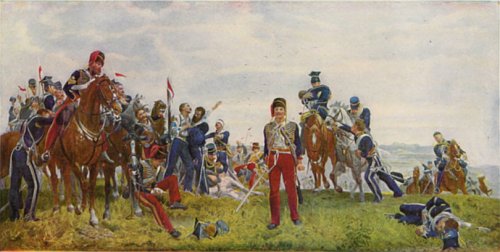
THE long seething discontent of the lower classes in Italy, fomented by the
national aspirations of such radical leaders as Mazzini and Manin, had
reached its culmination by this time. The centenary of the expulsion of the
Austrians from Genoa had just been celebrated with such enthusiasm
throughout central Italy that Austria was forewarned of the storm that was
Revolution in Palermo
about to burst. Metternich wrote to Apponyi, "The world is very sick. The
general condition of Europe is dangerous." Communications passed between
the patriots in northern Italy and the opponents of the Bourbon government
in Sicily. On January 12, the people of Palermo rose in revolt. The
government troops were driven from the city. Palermo was bombarded and
fighting continued for a full fortnight. In the end the insurgents were
victorious, and a provisional government was established. Other towns in
Sicily followed suit. On January 27, revolutionary riots broke out in
Naples. Threatened by revolution throughout his dominions, King Ferdinand
Neapolitan constitution granted
II. of Naples and Sicily, like his grandfather, made haste to proclaim a
popular constitution. A Liberal Ministry was called in on January 29. The
city of Messina was still in full insurrection when the standard of revolt
was raised in northern Italy. In order to deprive the Austrian Government
of one of its chief financial supports, the patriotic societies of Italy
Anti-Austrian riots at Milan
formed a resolution to abstain from the use of tobacco, on which the
government had a monopoly. On the following Sunday, Austrian officers,
smoking in the streets of Milan, were attacked by the populace. The troops
had to be called to arms, and blood was shed on both sides. Similar
outbreaks followed in Padua and elsewhere. Radetzky, the Austrian
Northern Italy aflame
commander-in-chief, proclaimed martial law. On February 15, the people rose
in Tuscany, and compelled their grandduke to proclaim a constitution. In
March the insurrectionary movement spread from Lombardy to Piedmont. The
republic of Venice was proclaimed. The King of Sardinia declared himself in
sympathy with the liberation of Venice from Austrian rule. For a while Pope
Pio Nono showed similar leanings. On March 15, the Nationalists of Rome
Revolt at Rome
declared against the Pope. The National Guards joined in the movement. The
Papal troops had to be called out to put down the revolt by force of arms.
The hordes of Roman lazzaroni or beggars profited by the confusion to
commit hideous crimes. The Pope created a high council and Chamber of
Deputies with privileges of limited legislation, the Pope retaining his
full veto power on whatever they might decree. But on April 29, after the
Jesuits had been expelled from Sardinia, Pio Nono turned his back on these
reforms, and returned to the conservative policy of his immediate
predecessors in
Rome bombarded
the chair of St. Peter. His definite refusal to declare
against Austria provoked another insurrection at Rome. This time the revolt
grew to such proportions that the city had to be subjected to bombardment
by artillery.
In the meanwhile a revolution of far more serious proportions had broken
Spread of the revolution
out at Paris. Successful from the start, the contagion of its example had
spread from France to most of the various principalities of Germany, to
Austria, Bohemia and Hungary, and thence to almost every quarter in Europe.
Few other events afford so striking an illustration of the modern
cosmopolitan spirit that had arisen in Europe during the first half of the
Nineteenth Century. The great revolutions of England, of America and of
France, in previous times, affected the rest of humanity only long after
their occurrence. The overthrow of Charles X. in 1830 gave rise to more or
less abortive revolutions in Belgium, Italy and Poland, as well as some of
the smaller German States. But the French February revolution of 1848
Democratic governments spared
spread instantly to all the civilized communities of the world, except
Switzerland, Great Britain, and the United States of North America. The
exemption of these three countries, where alone true democratic forms of
government prevailed, was in itself a revelation of the general discontent
of European peoples. Other explanations in plenty have been given, every
one of which contained its measure of truth. To Polish refugees the
upheavals of this year have been in part attributed. The rise of the new
national spirit in literature was revealed in Italy and Germany as well as
among the Magyars, Slavs and Greeks. The apparently epidemic character of
the movement found another explanation in the improved means of transit and
communication, and the great development of the public press.
In the countries untouched by revolution internal progress kept pace with
the continued spread of civilization. In Switzerland, the expulsion of the
Jesuits resulted in the attempted secession of the seven Catholic cantons.
Changes in Switzerland
This was frustrated by General Dufour's prompt occupation of Freibourg and
Luzerne. The so-called Sonderbund of the seceding cantons was dissolved. In
place of the former union of sovereign cantons, the Swiss republic was now
reconstituted after the model of the United States of North America, as a
union of States with a central federal government at Berne. The Swiss army,
postal system and finances were put under federal control and a national
coinage was established. The separate interest of the cantons found
representation in the Stænderat, while the Swiss people at large were
represented in the Nationalrath, the members of which were elected from
districts apportioned among the cantons according to equal numbers of
population.
The people of England, though the stirring events on the Continent were
England unaffected
brought home to them by so many eminent refugees seeking shelter in their
land, held the issues at stake too well settled by their own great
revolution of 1649 to find a sufficient incentive for another such
movement. The popularity of the young Queen doubtless contributed its share
to the stability of the government. The renewed demonstrations of the
Chartists in London were merely co-incident with the revolutionary
demonstrations abroad. Still the influence of contemporaneous events in
Insurrection in Tipperary
Europe was strong enough to frighten Parliament into passing an act which
made the utterance of seditious speeches a felony. A popular insurrection
in Tipperary, Ireland, was made the pretext for once more suspending the
habeas corpus act in Ireland. By the end of July the revolt was put down.
Its leaders, John Mitchell, O'Brien and others were apprehended and tried
in court for high treason. They were sentenced to death, but the Queen
mitigated their sentences to transportation. A calming effect on Ireland
Queen Victoria in Ireland
was produced by the personal visit of the young Queen and her royal consort
to Ireland. When she held her court at Dublin in midsummer, the most
poignant causes for discontent were lost sight of amid wild demonstrations
of apparently universal loyalty. A constitution on home rule principles was
proclaimed in West Australia. In South Africa, Sir Harry Smith, the
Orange River territory annexed to England
Governor of Cape Colony, after his successful termination of a fourth war
with the Kaffirs, proclaimed the authority of Great Britain over the Orange
River territory. The Boer settlers there under the leadership of Pretorius
found themselves unable to maintain their independence. The adjoining lands
of the Basutos were declared under British protectorate.
Early in the year, Lord Dalhousie had relieved Lord Hardinge as
Governor-General of India. Up to that time the British occupation of the
Punjab had continued without material change. Now a new fiscal system was
to be introduced there to settle up the arrears of Viceroy Mulraj of
Multan. In April, Vance Agnew, a British commissioner, with a military
escort of three hundred men, arrived at Multan to occupy the citadel as
Massacre of Multan
surety for these arrears. The British officers were admitted to the city,
but as they emerged from the citadel they were attacked, and all the
Englishmen were massacred. Mulraj called upon the Sikhs to rise against the
English. A force of seven thousand British troops were sent against Multan.
When they reached the city all the native troops turned against them. The
Punjab up in arms
whole of the Punjab revolted and a holy war was proclaimed against England.
Lord Dalhousie rose to the occasion. As he left Bengal to go to the front
he delivered a characteristic speech containing the historic declaration:
"Unwarned by precedent, uninfluenced by example, the Sikh nation have
called for war. On my word, sirs, they shall have it with vengeance!" The
Sikhs and Afghans join revolt
Sikh garrisons of Peshawar joined in the revolt, which was quickly taken up
by the Afghans. George Lawrence, the British Resident there, was carried
off as a prisoner. In the fort of Attock, Captain Herbert held out for a
while, but in the end was forced to succumb. The first general engagement
between Lord Gough and Sagr Singh at Ramluggar, late in the year, resulted
in a drawn battle. On both sides reinforcements were hurried up wherewith
to wage the coming year's campaign.
From England, during this time, two more expeditions had been sent out in
search of Sir John Franklin. The first of these was commanded by Sir James
More Arctic expeditions
Ross, the famous Antarctic explorer. The second expedition, while
discovering no trace of Franklin, claimed that it had discovered the long
sought for Northwest Passage. The science of astronomy lost one of its most
distinguished representatives in England by the death of Caroline Herschel,
the sister of the famous discoverer of Uranus. Besides her the necrology of
the year in England included the two authors, Isaac d'Israeli, the father
of Lord Beaconsfield, and Captain Frederick Marryat, the romancer of the
Death of George Stephenson
sea; Lord Alexander Ashburton, the framer of the Canadian boundary treaty
that commemorates his name, and George Stephenson, the inventor of the
first practicable locomotive. Stephenson began life as a pit-engine boy at
twopence a day near Newcastle-on-Tyne. Having risen to the grade of
engineman, he was employed in the collieries of Lord Ravensworth improving
the wagon way and railway planes under ground. In 1814 he completed a
locomotive steam-engine, which was successfully tried on the Killingworth
Railway. The locomotive "Rocket," constructed by Stephenson and his son
Robert, which won the premium of five hundred pounds in 1829, offered by
the Liverpool and Manchester Railway Company, ushered in the greatest
mechanical revolution since the invention of the steam-engine by Watt.
After this Stephenson became a locomotive builder on a large scale and
Stephenson's career
acquired enormous wealth. Another invention standing to the credit of
Stephenson was one of the earliest safety lamps, but a committee which
investigated the subject accorded to Sir Humphry Davy the priority of this
invention. During this year Sir Austin Henry Layard published the results
of his original researches of Nineveh and its remains. Macaulay printed the
first two volumes of his "History of England," while Matthew Arnold brought
out his "Strayed Reveller" and other poems. Elizabeth Gaskell published
"Mary Barton."
Of the various expeditions undertaken in search of Sir John Franklin, the
most noteworthy perhaps was Dr. John Rae's overland journey through the
northwestern territory of America from the Mackenzie to the Copper Mine
River. This opened up a vast tract of country to adventurous Canadians.
Another lasting benefit was conferred upon Upper Canada by the
reorganization of the public school system of Ontario.
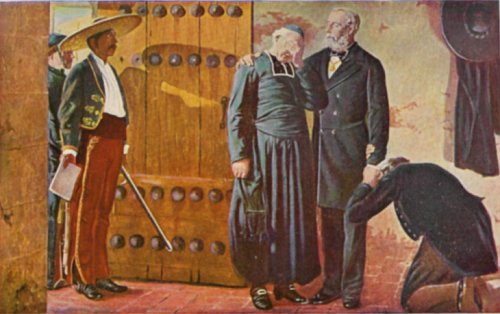
On the part of the United States the war with Mexico was brought to a
Peace with Mexico
close. The President of the Mexican Congress assumed provisional authority,
and, on February 2, that body at Guadaloupe Hidalgo concluded peace with
the United States. With slight amendments the treaty was ratified by the
United States Senate on March 10, and by the Mexican Congress at Queratero
Treaty of Guadaloupe Hidalgo
on the 30th of May. President Polk, on July 4 following, finally proclaimed
peace. The Americans under the terms of the treaty evacuated Mexico within
three months, paid Mexico $3,000,000 immediately, and $12,000,000 in three
annual instalments, and assumed debts of $3,500,000 due from Mexico to
American citizens. These payments were made in consideration of new
American expansion
accessions of territory which gave to the United States not only Texas, but
Arizona, New Mexico and California. The war had cost the United States
approximately $25,000,000 and 25,000 men.
While these negotiations were under way, Colonel Sutter had begun the
erection of a mill at Colonna on the American branch of the Sacramento
River. In January one Marshall, who was engaged in digging a race-way for
Gold found in California
the mill for Colonel Sutter, found a metal which he had not seen before,
and, on testing it in the fire, found that it was gold. The "finds" were
sent to Sacramento and tested, with the result that they were declared to
be pure gold. The mint at Philadelphia also declared the metal to be gold,
and the President referred to the fact in his annual message to Congress.
Then the gold seekers poured into California. They arrived in multitudes
from all parts of America and other countries—thousands tracking across
the plains and mountains with ox-teams and on foot, and other thousands
Influx of Gold Seekers
crossing the Isthmus with scarcely less difficulty, while around the Horn a
steady procession of ships passed up the coast of South America and Mexico
to the new El Dorado. In two years the population of California increased
100,000, and still the hordes of gold seekers came.
Wisconsin, the thirtieth State, was admitted May 29. It had been one of the
first districts to receive the visits of the fur traders and the French
missionaries, who went thither in 1639.
John Quincy Adams was overtaken by death in the midst of his career. On
Death of John Quincy Adams
February 21 he entered the House and took his seat. Suddenly he fell to the
floor, stricken with apoplexy. As he was carried to the Speaker's room and
was laid on a lounge, he feebly murmured: "This is the last of earth. I am
content." He died on February 23.
John Quincy Adams's long career is unique in American history. At the age
of eleven he accompanied his father on a diplomatic mission to Europe, and
early acquired a knowledge of French and German. When barely fourteen he
went to St. Petersburg as private secretary to the American Minister, Dana.
At sixteen Adams served as one of the secretaries of the American
His diplomatic career
Plenipotentiaries during the negotiations resulting in the treaty of peace
and independence of 1783. At the age of twenty-seven he was appointed
Minister to Holland by President Washington, and afterward was Minister to
Berlin and Commissioner to Sweden. After serving for some years in the
United States Senate he was sent, in 1809, as Minister to Russia, where he
remained till 1815. Then he was transferred to London, where he resided
till 1817, when he became Secretary of State. His career as President of
the United States and his subsequent Congressional life was honorable in
the extreme. Yet Adams's biographer, Morse, has aptly said: "Never did a
Morse on Adams
man of pure life and just purposes have fewer friends or more enemies....
If he could ever have gathered even a small personal following, his
character and abilities would have insured him a brilliant and prolonged
success; but for a man of his calibre and influence, we see him as one of
the most lonely and desolate of the great men of history."
During this year James Russell Lowell published his "Bigelow Papers," a
James Russell Lowell
humorous satire on the Mexican war in Yankee dialect, the "Indian Summer
Reverie," and "A Fable for Critics."
On April 8, Gaetano Donizetti—who together with Rossini and Bellini formed
Death of Donizetti
the brilliant triumvirate of Italian composers in the first half of the
Nineteenth Century—died in his native town of Bergamo. Donizetti composed
his first opera, "Enrico di Borgogna," in 1819, while serving as a soldier
in Venice. Three other operas followed quickly. His fourth, "Zoraide di
Granada," was such a success that he was exempted from further military
Early operas
service in 1822. During the following six years he wrote no less than
twenty-three operas, many of which were cheap imitations of Rossini. In
1880, stung by the success of Bellini, he wrote "Anna Bolena," which
inaugurated his second more original period, which included "Lucrecia
Borgia" and the immensely popular "Lucia di Lammermoor." The prohibition of
his opera "Poliecto," while he was serving as a director of the Naples
Conservatory, so exasperated Donizetti that he betook himself to Paris in
1838. There he brought out the "Daughter of the Regiment" and "La
Favorita." After a few years he went to Vienna, where his "Linda di
Chamounix," sung in 1842, achieved an immense success. Having returned to
Prolific compositions
Italy he was stricken with paralysis from overwork in 1845. He never
recovered. Besides more than threescore of operas, Donizetti composed seven
masses, twelve string quartets, and a host of songs, cantatas and vespers,
as well as pianoforte music.
Another figure of world-wide renown was lost by the death of the French
Death of Chateaubriand
poet François René de Chateaubriand. Born at château Combourg in 1768, the
scion of one of the noblest families of France, he received a careful
education at château Combourg. Roaming about on the sea-shore and in the
famous forest of Brezilien, the youth received his earliest impressions of
the grandeurs of nature. Shortly before the outbreak of the French
Revolution he was sent to Paris, where he received a commission in the
royal army. It was then he published his first poem, "L'Amour de la
New world inspirations
Campagne," in the Almanach des Muses. Dissatisfied with the revolutionary
turn of affairs, he resigned his commission in 1790, and journeyed to North
America. There he travelled extensively, seeking poetic inspiration from
the wilderness and the primitive customs of the Indians. After the downfall
of King Louis XVI. and the French nobility, Chateaubriand hastily returned
to France and joined the army of émigrés under Prince Condé. At the siege
of Thionville he was wounded and went to England. By
"Essay on Revolutions"the time
Chateaubriand recovered he found himself in abject poverty, and had to
spend his days in bed for lack of fuel. In England, he wrote his "Essai sur
les Révolutions," in which he compared the recent rising in France to that
of the English Commonwealth. On the fall of the Directorate he returned to
"Atala"
France, and became one of the editors of Fontaine's "Mercure de France." At
the opening of the Nineteenth Century he published "Atala," an episode of
his epic poem "Les Natchez," treating of the suicide of an Indian virgin,
"Réné"
who sought death rather than violate a solemn vow of chastity given to her
mother. In 1802 appeared the second episode, "Réné," a subjective story
treating of the hapless love of a sister for her brother, full of a French
form of maladie du monde akin to Goethe's Weltschmerz in the "Sorrows
"Genius of Christianity"
of Werther." During the same year, Chateaubriand brought out his famous
"Genius of Christianity, or the Beauties of the Christian Religion," which
achieved an immense success. It won the approbation even of Napoleon, who
appointed Chateaubriand to diplomatic posts at Rome and Vallis. The
execution of the Duc d'Enghien was so horrifying to Chateaubriand that he
forthwith resigned his appointments. After extensive travels through
"The Last of the Abencerrages"
Greece, Egypt and the Holy Land, Chateaubriand went to Spain, where he
found inspiration at the Alhambra to write "Le dernier des Abencerrages."
There, too, he wrote his story of "The Martyrs, or the Triumph of the
Christian Religion," brought out in Paris in 1809. Less successful was his
tragedy "Moses." In
"The monarchy under the Charter"
1810, Chateaubriand published the famous political
pamphlet "La Monarchie selon la Charte," which was made the basis of the
subsequent royal constitution of France. On the restoration of the Bourbons
he wrote another political pamphlet, directed against Bonaparte, which sent
him into exile together with Louis XVIII. during the Hundred Days. On the
return of Louis XVIII. he was made a member of State, a peer of France, and
member of the French Academy. In 1820 he was sent as ambassador to Berlin
and then to London, from where he was recalled into the Cabinet. Crowded
The poet's political career
out of the Cabinet by Villèle, he became one of the leaders of the
opposition. In 1828, he went on another diplomatic mission to Rome. The
rest of his life was uneventful. Shortly before his death he brought out
his complete works, including his latest "Etudes Historiques." A posthumous
work was his "Mémoires d'Outre-Tombe," containing the famous comparison
between the characters of George Washington and Napoleon Bonaparte.
In the French Chambers, early in February, a great debate had been held on
the Reform Bill. Guizot, the Prime Minister, held firm in his opposition to
Paris reform banquet
all the proposed reforms. It was now proposed to hold the reform banquet,
that had repeatedly been prohibited and postponed, on February 22. The
banquet was once more interdicted, and it was announced that any unlawful
assemblage would be dispersed by force. Thereupon the banquet was
abandoned. The evening papers declared that the deputies of the opposition
had agreed to abstain from the proposed manifestation. A manifesto
Ministry impeached
published by the "Journal National" was the cause of a noisy demonstration
in the streets of the 12th Arrondissement. The National Guards were called
out. On the same day fifty-two deputies of the Left laid before the
Chambers a bill of impeachment against the Ministry. The King and his
advisers were in a state of blind security.
On the morning of the eventful 22d of February, the Parisian populace
congregated by thousands near the Madeleine and the Rue Royale, shouting
Street demonstrations
"Vive la réforme; à bas les ministres!" and singing the "Marseillaise." No
troops made their appearance; but encounters occurred at several points
between the mob and the municipal guards. Still the day passed over without
serious hostilities. On the next day, the National Guards of Paris were
called out. Their cry, as they marched through the different quarters of
the city, was "Vive la réforme!" This emboldened the leaders of the
revolutionists. The members of the secret societies flew to arms; and in
the skirmishes which followed between the populace and the regular troops,
National Guard disaffected
the National Guard everywhere interfered in favor of the former. Thus
confronted, officers and soldiers hesitated to commit a general assault
upon their fellow citizens. They allowed themselves to be reduced to
inaction. The insurrection thus triumphed almost without actual strife.
The King at length became acquainted with the true situation. In the
afternoon of the 23d, Guizot
Fall of Guizot's Ministry
tendered his resignation, which was promptly
accepted, and published as an act of satisfaction on the part of the King
to the demands of the people. Count Molé was charged with the formation of
a new Ministry. It was now generally expected that tranquillity would be at
once restored. But late at night the detachment of troops posted at the
Office of Foreign Affairs was attacked by a band of rioters. The commanding
officer ordered them to fire, and several persons in the crowd were shot
Barricades erected
down. Their dead bodies were paraded through the city. This spectacle
raised the indignation of the multitude to the highest pitch. Fresh
barricades were erected in all the most populous quarters of the city, and
the soldiers, stupefied and panic-struck, renounced all further opposition
to the revolt. The King now named Marshal Bugeaud to the supreme command of
the whole military force at Paris. Molé having declined the task of
constructing a Ministry, the King summoned Thiers to the head of affairs.
Thiers' manifesto
This statesman, in conjunction with Odillon-Barrot, immediately issued a
proclamation announcing their appointment as Ministers, and stating that
orders had been given to the troops to withdraw and abandon the contest.
This gave the last blow to the monarchy of Louis Philippe. Marshal Bugeaud
The last stroke
resigned his command. The soldiers quitted their ranks, giving up arms and
ammunition to the insurgents. The National Guard openly joined the masses
of the people and marched with them upon the Tuileries. The catastrophe was
now inevitable. Louis Philippe, feeling that all
Louis Philippe succumbs
was lost, signed an act
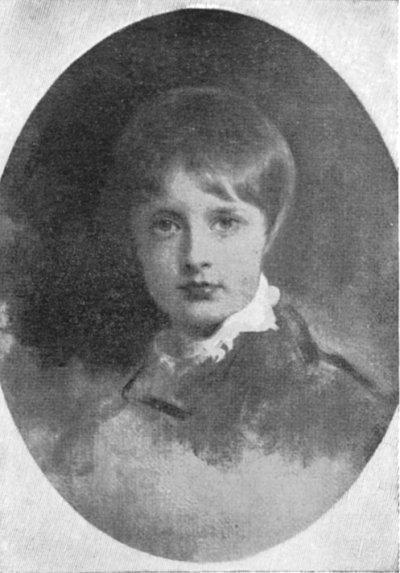
of abdication in favor of his grandson the Comte de Paris, and withdrew to
St. Cloud.
An attempt was made to obtain the recognition of the Duchess of Orleans as
regent, and thus to preserve the throne to the heir of Louis Philippe,
according to the terms of his abdication. The Duchess went to the Chamber
of Deputies, holding by the hand her sons the Comte de Paris and the Duc de
Mob invades the Chamber
Chartres. They took their seats in front of the tribune. More than one
member spoke earnestly in favor of the regency. In the midst of the debate
the Chamber was invaded by a tumultuous throng of armed men. One of them
was Arnold Böcklin, the Swiss artist, who subsequently rose to highest rank
among the painters of the Nineteenth Century. Marie, a violent Republican,
ascending the tribune, announced that the first duty of the Legislature was
to appoint a strong provisional government capable of re-establishing
public confidence and order. Cremieux, Ledru-Rollin and Lamartine in turn
insisted on a new government and constitution to be sanctioned by the
sovereign people. The proposition was hailed with tumultuous acclamations.
The Duchess of Orleans and her children retired precipitately.
The Republicans remained masters of the field. A provisional government was
Provisional Government formed
forthwith nominated. It included the poet Lamartine, Ledru-Rollin,
Garnier-Pagès and Arago. While the mob was searching the Hôtel de Ville
these men conferred in a small out-of-the-way chamber behind locked doors.
Louis Blanc, the great socialistic writer, and one Albert, a locksmith,
were added to the provisional government. Every half hour Lamartine had to
confront some new crowd of rioters preferring fresh claims. The confusion
lasted several days. Throughout this time more barricades were thrown up,
Fulsome promises
until the government gained a breathing space by a promise to distribute
one million francs among the laboring men. Louis Blanc and Ledru-Rollin
signed another decree whereby they pledged the government to furnish every
Frenchman with work. With the help of National Guardsmen, and an organized
body of students, Caussidière, the new police prefect, succeeded at last in
keeping the mob out of the Hôtel de Ville and the Palais Bourbon. On
Proclamation of French Republic
February 27, the Republic was formally proclaimed from the Place de la
Bastille. The barricades were levelled and the crowds that had surged
through the streets of Paris gradually dispersed. Throughout France the
Republic was accepted without serious opposition.
For a while it was feared that Louis Philippe's sons in Algiers, the Duke
d'Aumale and Prince de Joinville, who commanded the French army and navy,
disposing of more than a hundred thousand men, might make a stroke on their
father's behalf. This hope of the Royalists was doomed to disappointment.
Flight of royal family
Both princes resigned their command, to be succeeded by General Cavignac,
who took charge of the forces in the name of the French Republic. The other
members of the dynasty accomplished their escape from France amid many
curious adventures. After leaving Paris the party separated so as to avoid
suspicion. Louis Philippe and the Queen with a few attendants fled to
Honfleur, where they lay for nearly a week in concealment. At length the
packet steamer "Express" was placed at their disposal by the British
Government. On March 4, Louis Philippe, having assumed the name of William
Smith, landed at Newhaven in Sussex. With the Queen he proceeded to
Claremont, a country-seat belonging to his son-in-law, King Leopold of
Belgium. The Duke of Montpensier with the Duchess of Nemours fled to
Belgium, as did the Duchess of Orleans.
The French Revolution gave quickening impulse to the Chartist movement in
English Chartists encouraged
England. Feargus O'Connor had been returned at the General Election of 1847
as member for Nottingham. He threw himself into a renewal of the agitation
with all the strength and vigor of a madman. A National Convention was
summoned, and it was determined that another monster petition should be
carried to the House of Commons, to be followed by a procession of half a
Inflammatory speeches
million persons. The idea got abroad that a revolution might break out in
London on the presentation of the petition. Ernest Jones had exclaimed on
Kensington Common, "Never fear the vile men of the law; the police, the
troops, sympathize with you. Down with the Ministry! Dissolve the
Parliament! The Charter, and no surrender!" At the National Convention,
Vernon declared: "If a few hundreds do fall on each side, they will only be
the casualties in a mighty movement." On April 10 a great demonstration
was to be held on Kensington Common. In anticipation, special constables to
the number of 170,000 were sworn in to keep the peace; troops were
quartered in the houses of the main thoroughfares; two thousand stands of
arms were supplied to the officials of the General Post-Office; the Custom
House, Bank, Exchange, and other public buildings were similarly equipped;
London ready for revolution
the Admiralty was garrisoned by a body of marines, and the Tower guns were
mounted. On the eventful morning, London assumed a military guise such as
it had never worn before. Traffic was suspended along the streets for fear
that the vehicles should be employed, as in France, in the construction of
barricades. Finally a proclamation was issued warning people against
collecting for disorderly purposes. The military arrangements were in the
Rioters discouraged
hands of the Duke of Wellington. Owing to these thorough precautions the
threatened mass meeting collapsed. The procession was never held. The whole
affair was covered with ridicule. The "monster petition" was found to
contain not six million signatures as was alleged, but only 1,975,469, and
many of these proved to be fictitious, whole sheets being found to be in
the same handwriting, and containing such names as Victoria Rex, Prince
Albert, Punch, and so forth.
In the words of a contemporary, "Chartism had received its death-blow.
Collapse of Chartism
O'Brien, Vincent, and others endeavored to revive it, but in vain. Its
members fell off in disappointment and allied themselves with reformers of
greater moderation, and Feargus O'Connor, who for ten years had madly
spent his force and energy in carrying forward the movement, gave it up in
despair. Everything he had touched had proved a failure. From being an
End of Feargus O'Connor
object of terror, Chartism had become an object of ridicule. O'Connor took
the matter so much to heart that he soon became an inmate of a lunatic
asylum, and never recovered his reason."
All Italy now, from the southern shores of Sicily to the Alps, was in a
blaze of insurrection. Venice, Piedmont and Lombardy were in arms. Charles
Albert, the King of Sardinia, put himself at the head of the movement in
Progress of Italian Revolution
northern Italy. From all parts of Italy volunteers crowded to his banners.
In defiance of the Pope's orders a compact body of these volunteers marched
from Rome. Radetzky, the Austrian commander, a veteran of all the Austrian
wars since the outbreak of the French Revolution, had long prepared for
this struggle by formidable fortifications at Verona. When Milan revolted
Austrians driven northward
and the Austrian Vice-Governor, O'Donnell, was captured, Radetzky evacuated
the city at the approach of Charles Albert's army from Piedmont. His
outlying garrison was cut off by the Italians. Preferring the loss of Milan
to a possible annihilation of the army, Radetzky fell back upon Verona. On
the banks of the Adige, about twenty-five miles east of the Mincio, he
rapidly concentrated all available forces, while the Italians threw up
intrenchments on the Mincio. There, with the armies of Piedmont and
Lombardy in front of him and the revolutionary forces of Venice behind him,
Radetzky seeks refuge
Radetzky stubbornly held his ground. Nothing remained to Austria on
Italian ground but Verona and the neighboring fortresses on the Adige and
Mincio.
The Austrian Empire itself, by this time, was shaken to its foundations.
When the news of the February Revolution in Paris reached Austria the
Magyar Diet was in session in Hungary. The success of the revolutionists in
Kossuth's appeal
France inflamed the Liberal leaders in Hungary. Casting aside all reserve,
Kossuth declared in the Diet: "From the charnel house of the Viennese
system a poison-laden atmosphere steals over us. It would paralyze our
nerves and pin us down when we might soar. The future of Hungary can never
be secured while Austria maintains a system of government in direct
antagonism to every constitutional principle. Our task is to found a
happier future on the brotherhood of all the races in Austria. For a union
Magyar Constitution proclaimed
enforced by bayonets and police spies let us substitute the enduring bond
of a free constitution!" On March 3, the Hungarian Lower House triumphantly
passed a resolution to that effect. The cry for a liberal constitution was
instantly taken up in the other dominions of Austria. It so happened that
the Provincial Estates of Lower Austria were to meet about this time. It
was planned that an address embodying demands similar to those of Hungary
should be forwarded to the Emperor by this assembly. The political
agitation in Vienna became feverish. The students indulged in noisy
demonstrations. Rumors of the impending repudiation of the paper currency
Stocks fall in Vienna
and of State bankruptcy
made matters worse. A sharp decline in stocks
showed Metternich that a public catastrophe was near at hand.
On March 13, the Provincial Diet met. Dense crowds surged about the Diet
Hall. The students marched around in procession. Street orators harangued
the crowds. The tumult was at its height when a slip of paper was let down
Viennese Diet stormed
from one of the windows of the hall, stating that the Diet was inclining to
half measures. An announcement to this effect was received with a roar of
fury. The mob overran the guards and burst into the Diet Hall. All debate
was stopped, and the leading members of the Estates were forced to head a
deputation to the Emperor's palace to exact a hearing. All the approaches
to the palace were choked with people. Street fighting had already begun.
Detachments of soldiers were hurried to the palace and to the Diet Hall.
From the roof and windows of the Diet Hall missiles were hurled upon the
soldiery. The interior of the Hall was demolished. The soldiers now fired a
Fighting in the street
volley and cleared the Hall with their bayonets. Blood flowed freely and
many were killed. The sound of the shots was received by the crowds around
the palace with howls of rage. The whole city was in an uproar. Barricades
were thrown up and the gunsmith shops were sacked. At the palace, where the
Emperor himself remained invisible, Metternich and his assembled Council
received the deputation in state. The Council urged the aged Prime Minister
to grant the demanded concession. At length he withdrew into an
Imperial palace invaded
adjoining
chamber to draft an order annulling the censorship of the press. While he
was thus engaged the cry was raised, "Down with Metternich!" The deputies
in the Council Chamber peremptorily demanded his dismissal. When the old
statesman returned he found himself abandoned even by his colleagues.
Downfall of Metternich
Metternich realized that the end had come. He made a brief farewell speech,
marked by all the dignity and self-possession of his greatest days, and
left the Council Chamber to announce his resignation to the Emperor.
The news of Metternich's downfall was received with deafening cheers. His
personality was so closely identified with all that was most hateful in
Quiet restored
Austrian politics that the mere announcement of his resignation sufficed to
quell the popular tumult. On the night of March 14, Metternich contrived to
escape from Vienna unobserved, and fled across the frontier. On the same
day a National Guard was established in Vienna, and was supplied with arms
taken from the government arsenal. The Viennese outbreak gave irresistible
force to the national movement in Hungary. Now the Chamber of Magnates,
which had hitherto opposed the demands of the Lower House, adopted the same
by a unanimous vote. On March 15, a deputation was despatched to Vienna to
Hungarian demands
demand from the Emperor not only a liberal constitution, but a separate
Ministry, absolute freedom of the press, trial by jury, equality of
religion, and a free public-school system. The Hungarians, with Kossuth in
the lead, were received in triumph in Vienna. They paraded through the
streets, and were greeted by Emperor Ferdinand in person. He consented to
Kossuth in Vienna
everything and issued an imperial rescript, promising a liberal
constitution to the rest of Austria as well. The light-hearted Viennese
indulged in indescribable jubilations. On March 18, the Emperor drove
through the city. Somebody put a revolutionary banner into his hands. The
black, red and gold ensign of united Germany was hoisted over the tower of
Demonstrations of enthusiasm
St. Stephen. In an intoxication of joy the people took the horses from the
imperial carriage and drew it triumphantly through the streets. The regular
troops around the imperial palace were superseded by the new National
Guards.
By this time the same storm of revolution was sweeping over Germany.
Germany in a ferment
Popular demonstrations occurred at Mannheim, Cassel, Breslau, Kœnigsberg
and along the Rhine region in Cologne, Düsseldorf and Aix-la-Chapelle. A
popular convention at Heidelberg, on March 5, had resolved upon a national
assembly to be held at Frankfort-on-the-Main by the end of March. Elections
for this assembly were being held throughout Germany. The long-desired
union of Germany was at last to be accomplished. On March 14, King
Prussian Assembly convoked
Frederick William of Prussia convoked the Prussian Assembly for April 27,
to deliberate upon Prussia's part in the proposed German union. Then came
the news of the events in Vienna. Crowds gathered in the streets excitedly
discussing the events of the day. Attempts on the part of the police to
disperse them led to threatening encounters. Under the stress of alarming
King of Prussia cowed
bulletins from Vienna, the King issued a rescript on March 18, in which he
not only convoked the Prussian Assembly for the earlier date of April 2,
but himself proposed such reforms as constitutional government, liberty of
speech, liberty of the press, and the reconstitution of the Germanic
Federation as a national union of states—a realization in brief of all the
most ardent ideals of the German Liberals. Now the popular agitators
proposed a monster demonstration to thank the King for his concessions.
Shortly after noon, on March 18, the processions converged upon the palace.
Immense crowds filled the streets. The appearance of the King upon the
balcony was greeted with cheers. King Frederick William tried to speak but
could not make himself heard. The troops set out to clear the palace
grounds. Angry shouts arose for the withdrawal of the soldiery. In the
Revolt in Berlin
confusion two shots were fired. A panic ensued: "We are betrayed," cried
the leaders, and called the people to arms. The troops of the garrison
charged into the rioters. Barricades were thrown up, and here and there
church bells rang the tocsin. From three in the afternoon until early the
next morning, fighting continued in the streets. The entire garrison of
Prince William's part
Berlin was called out and with the help of the bright moonlight succeeded
in clearing one street after another. Prince William, the future German
Emperor, gained unenviable notoriety by his zeal. At two in the morning
the King gave orders to stop firing. He issued a proclamation: "To my dear
people of Berlin," the mild tone of which only betrayed his weakness. On
the following day all the troops were withdrawn and ordered out of the
city. Prince William likewise left Berlin in deep chagrin and departed for
England. His palace had to be protected from the fury of the people by
placards pronouncing it the property of the nation. Once more the rioters
appeared before the royal palace with the bodies of some of their slain.
The King convoked a new Ministry and consented to substitute armed citizens
and students for his royal guards. A general amnesty was proclaimed. On
March 21, the King agreed to adopt "the sacred colors of the German Empire"
King of Prussia submissive
for those of Prussia. After the manner of the weak Emperor of Austria, he
rode through the streets of Berlin wearing a tricolor sash. Not satisfied
with this, the revolutionists, on March 22, paraded before the palace with
the open biers of 187 men that had been killed during the riots. Standing
on his balcony with bared head, King Frederick William reviewed the ghastly
procession. In a manifesto published at the close of the day he declared:
"Germany is in ferment within and exposed from without to danger from more
than one side. Deliverance from this danger can come only from the most
Royal promises
intimate union of the German princes and people under a single leadership.
I take this leadership upon me for the hour of peril. I have to-day assumed
the old German colors, and placed myself and my people under the venerable
banner of the German Empire. Prussia is henceforth merged into Germany."
Thus Frederick William, by word and acts, which he afterward described as a
comedy, directly encouraged the imperial aspirations of liberal Germany.
The passage of his address in which he spoke of external dangers
threatening Germany came true sooner than was expected. King Christian
VIII. of Denmark had died early in the year. The fear of revolution at
Copenhagen drove his son Frederick VII., the last of the Oldenburg line, to
prick the war bubble blown by his father. On March 22, he called the
leaders of the Eider-Dane party—the party which regarded the Eider as the
boundary of the Danish dominions, thus converting Schleswig into a Danish
Rising of Schleswig-Holstein
province—to take the reins of government. The people of Schleswig and
Holstein protested. The King was checkmated at Kiel by the appointment of a
provisional government. The troops joined the people, and the insurrection
spread over the whole province. The struggle then began. Volunteers from
all parts of Germany rushed to the northern frontier. The German Bundestag
admitted a representative of the threatened Duchies, and intrusted Prussia
with their defence. An attempt was made to organize a German fleet. General
Wrangel was placed in command of the Prussian forces despatched toward
Reverse at Bau
Denmark. Before he could arrive, the untrained volunteer army of
Schleswig-Holsteiners suffered defeat at Bau. A corps of students from the
University of Kiel was all but annihilated.
An attempted rising of the Poles, in the Prussian province of Posen and at
Cracow, was quickly suppressed. As soon as the news of the revolution in
Paris reached Russia, the absolute ruler of that vast empire mobilized his
armies, "so that, if circumstances should demand it, the tide of Anarchy
Russia stems revolution
could be dammed." After the abortive revolt at Cracow, Czar Nicholas issued
an imperial manifesto, closing with a quotation from Isaiah: "Listen, ye
heathen, and submit, for with us is God." When the spirit of revolt spread
to Moldavia and Wallachia, Emperor Nicholas without further ado despatched
a Russian army corps across the Pruth. The Sultan of Turkey was prevailed
upon to do the same. Russian and Turkish troops occupied Jassy and
Bucharest during the summer.
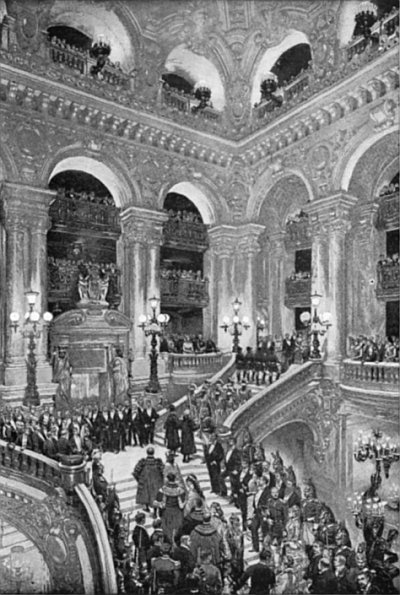 OPENING OF THE OPERA
Painted by Edouard Detaille
Copyright by M. Knoedler & Co.
OPENING OF THE OPERA
Painted by Edouard Detaille
Copyright by M. Knoedler & Co.
The German preliminary Parliament of five hundred delegates had met at
Frankfort Vor-Parlament
Frankfort in April. It lasted but five days. The Republicans found
themselves outnumbered, when they submitted their scheme for a national
constitution. Repulsed in this, the Liberals proposed that they should
continue in session until the real National Parliament should meet, thus
extending their function beyond the limits of a mere constituent assembly.
Outvoted in this, the leaders of the extreme Republicans resorted to armed
revolt. Assisted by Polish refugees and men from France, they raised the
Revolution in Baden
red flag in Baden. Friedrich Hecker, a popular orator and representative of
Baden, headed the movement. George Herwegh, the poet, took charge of the
refugees from Switzerland and a group of German operatives recently
returned from France. A provisional government was declared in the lake
district of Baden. The Parliamentary majority of Frankfort, on breaking up,
left behind a committee of fifty to prepare the draft of a constitution.
The Bundestag meeting at the same time called for military measures against
the insurgents. From three sides troops advanced into Baden. A Bavarian
detachment marched from Lindau, Swabian troops came from the Black Forest,
while from the north Hessian forces were led by General von Gagern, a
General Gagern shot
brother of the new Prime Minister of Hesse. On April 19, Von Gagern
encountered the revolutionists under Hecker at Kandern. While haranguing
the insurgents, he was shot from his horse. The troops charged the
insurgents with the bayonet and dispersed them in less than an hour. Four
days later the revolutionary intrenchments at Freiburg were stormed. On the
27th, Herwegh's corps of 1,000 refugees was dispersed by General Miller.
Hecker fled to America. The other leaders likewise made good their escape.
Flight of rebels
On April 29 they issued a manifesto at Strasburg: "An overwhelming number
of imported bestial mercenaries have crushed Republican aspirations in
Baden, and have once more subjected the people to the hateful tyranny of
princes."
The unexpected outbreak of revolution in Vienna and Hungary had inspired
the Italians to rebel against Austrian rule with new confidence. On March
30, Pio Nono at Rome issued a proclamation to the people of Italy, in which
he said: "The events which have followed one another with such astounding
rapidity during the last two months are not the work of man. Woe to him
The cause of Italy
who, in this storm that shatters cedars as well as oaks, hears not the
voice of the Lord." Under the command of General Durando, a band of
Crociati, or crusaders, marched from Rome against the Austrians. Count
Balbo was placed in command of the Piedmontese army. To the remonstrances
of the British Ambassador at Turin, King Charles Albert replied that he
must either march against Austria or lose his crown. England, indeed, was
emphatic in its disapproval of the Italian national movement. In the pages
of the "Edinburgh Review," Sir Archibald Allison, the court historian,
wrote: "It is utterly repugnant to the first principles of English policy,
and to every page in English history, to lend encouragement to the
separation of nationalities from other empires." The new republican
Other Powers hostile
government in France, on its part, had no desire to see a strong Italian
national State spring up on its southern frontier. Lamartine, the French
Foreign Minister, declined Charles Albert's request to sanction his
military occupation of Lombardy. A strong French army of observation was
concentrated on the Italian frontier in the Alps. Germany, which in later
years was destined to become the strongest ally of Italy, was still so
bound up with Austria that when Arnold Ruge in the Frankfort Parliament
dared to express a wish for the victory of Italian arms against Austria, a
great storm of indignation broke out in Germany. As a last resort, Charles
Albert, on April 6, proposed an offensive and defensive alliance to
Switzerland, but the little republic wisely declined to emerge from its
Italy isolated
traditional neutrality. It was then that the Italians raised the defiant
cry: "Italia fara de se" (Italy will fight her own battles). When the hard
beset Austrian Government, in a confidential communication of Minister
Wessendberg to Count Casati, showed itself inclined to yield Lombardy upon
payment of Lombardy's share in the Austrian national debt, the proposition
was curtly declined.
It was a fatal move. The course of Italy, as Dante once sang, seemed like
that of "a ship without stars in a wild storm." Affairs took a wrong turn
in Naples. There a new popular Parliament had just been elected, which was
about to meet, when there were some final difficulties between the King and
his Liberal Ministers over the exact wording of the oath of allegiance. The
Set-back at Naples
excitable Neapolitan populace forthwith became unmanageable. The Swiss
Guards, who had long been the butt of the people, put down the revolt
without mercy. Once more King Ferdinand was master. He hastened to dismiss
his Cabinet and dissolved the Parliament before it could come to order.
Orders were sent to General Pepe, who had marched to the front in northern
Italy with 14,000 men, to return at once. General Pepe, who had already
Neapolitan forces recalled
reached Bologna and had entered hostilities under Charles Albert's command,
declined to obey the orders of his sovereign. His rank and file trooped
back to Naples. Only fifteen hundred Neapolitan volunteers remained with
Pepe at the front. A number of the officers who returned felt their
disgrace so keenly that they committed suicide. The Neapolitan fleet, which
had already succeeded in raising the Austrian blockade of Venice, was
likewise ordered home. A more serious blow to the cause of Italy was Pio
Pio Nono's allocution
Nono's apparent change of front. On April 29, without previous consultation
with his new Ministry, the Pope issued the famous "Allocution," in which he
declared that he had despatched his troops northward only for the defence
of the Papal dominions, and that it was far from his intentions to join
with the other Italian princes and peoples in the war against Austria. The
Papal Ministry immediately handed in its resignation. The Municipal Council
of Rome called upon the Pope to abstain from interference with his army.
General Durando, commanding the Papal troops at the front, had already
yielded to their entreaties by crossing the Po. Now he threw in his lot
with Charles Albert. Pio Nono sent a confidential messenger to Naples to
arrange for an asylum there, in case the people should turn against him at
Rome.
Charles Albert on the Mincio lost three precious weeks. His army now
Garibaldi
numbered nearly one hundred thousand men, only sixty thousand of whom were
trained soldiers. About this time he was joined by Giuseppe Garibaldi, who
had just returned from the revolutionary battlefields of South America,
whither he had been driven an exile from Charles Albert's own dominions. He
was received with honor, and was put in charge of a volunteer corps which
he had raised at Milan. The Austrian commander profited by the delay of his
opponents to place his army between the strong fortresses of Verona,
Mantua, Legnano and Peschiera, and to draw reinforcements from the Tyrol,
Battle of Goito
until the situation in Austria itself became so threatening that no further
aid could be given him. In truth, the fate of the Austrian empire now
rested on the aged shoulders of Radetzky. On April 8, the Sardinian army,
in a sharp engagement at Goito, effected the passage of the Mincio. The
Austrians lost one thousand men. Siege was now laid to Peschiera. A Tuscan
division moved on Mantua, while the bulk of Charles Albert's army cut off
Cortatone
Verona from the roads to the Tyrol. Radetzky was driven to take the
offensive. In a fight at Cortatone he defeated the Tuscans, but within
twenty-four hours the Austrian garrison of Peschiera was brought to the
point of capitulation. The Italians took two thousand one hundred and fifty
Surrender of Peschiera
men. On May 6, Charles Albert made an attempt to drive the Austrians out of
their positions in front of Verona. Repulsed at Santa Lucia, he was forced
to fall back on the Mincio. Under the influence of the peace party, the
Austrian Emperor now directed Radetzky to offer an armistice to the
Italians. Simultaneously with this, Austrian reinforcements cut their way
through to Verona. Radetzky sent Prince Felix Schwarzenberg to Innsbruck to
implore the Emperor for permission to continue the combat. This was
reluctantly given. Fearing another reversal of his orders, Radetzky
forthwith
Radetzky firm
threw his army into Venetia. General Durando and his Papal army
were shut up in Vicenza, and compelled to capitulate. The capture of
Vicenza was followed by that of all the Venetian mainland east of the
Adige.
The republic of St. Mark sought shelter under the royal Ægis of Piedmont.
Manin, the liberator of Venice, resigned his presidency and went into
retirement. Charles Albert now moved on Mantua, leaving half his army at
Peschiera and further north. Radetzky instantly threw himself on the weakly
Custozza
guarded centre of the long Sardinian line. Charles Albert sought too late
to rejoin his northern detachments. At Custozza, on July 25, he suffered a
signal defeat. While he was thrown back over the Mincio the northern
divisions were also overcome. Charles Albert retreated to Milan closely
followed by Radetzky. He declared himself unable to hold the city. The
Fall of Milan
people rose against him. On the night of August 5, he escaped with
difficulty, protected by General La Marmora and a few guards. Milan
capitulated on the following day. When the Austrians made their triumphant
entry, half of the population left their homes to emigrate to Piedmont and
Switzerland. On August 9, an armistice was arranged at Vigevano. Venice
Truce of Vigevano
refused to accept it, and detaching itself once more from Sardinia,
restored Manin to power. Garibaldi with his volunteers likewise held aloof
and carried the fight into the northern mountains. From there he was
eventually dislodged by D'Aspre and crossed the frontier into Switzerland.
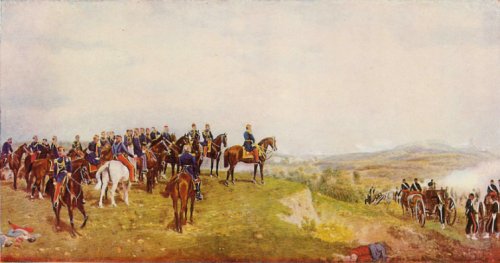
The picturesque scenes of the revolutionary struggle in Italy have been
perpetuated by Denis-Auguste-Marie Raffet, a pupil of Charlot and of Gros,
Raffet's battle scenes
who had already distinguished himself by his lithographs of the brief
Belgian war of 1832, and by his Russian and Oriental sketches made while
travelling with Prince Demidov. The motley uniforms of the volunteers of
Garibaldi, the Swiss Papal Guards and the Austrian, Piedmontese and French
troops, as well as the picturesque costumes of the Italian peasantry,
afforded a great scope for Raffet's brush. One of the most characteristic
specimens of Raffet's art during this period is his well-known picture of
"The Evening of the Battle of Novara."
The success of Radetzky restored a measure of confidence in Austria. The
Emperor and his court, who had sought refuge at Innsbruck, consented to
return to Vienna. There the promised elections had been held, and an
Austrian court returns
assembly representing all the provinces of the Empire, excepting Hungary
and Italy, had met in the third week of July. With the armies of Radetzky
and Windischgrätz within call, the Emperor and his Ministry assumed a
bolder front toward the Magyars. The concessions exacted by Hungary in
April had raised that kingdom almost to the position of an independent
state. Under its separate management of the Hungarian army, Austria found
it difficult even to use her Magyar troops at the front in Italy. The
Magyars showed the same haughty spirit toward the Austrian Serbs, Slavs and
Croatians. After Hungary's successful emancipation in March, the Serbs of
southern Hungary demanded from Kossuth the restoration of their own local
autonomy. The Magyars insisted on maintaining their ascendency, and decreed
that only the Magyar language should be the language of the state. Slavic
race feeling was kindled to sudden hatred. The Croatian national committee
Jellacic ban of Croatia
at Agram, that had assumed charge of affairs after the catastrophe in
March, elected Jellacic, the colonel of the first Croatian regiment, Ban of
Croatia. The appointment was confirmed at Vienna, even before formal
notification had reached the Emperor. On assuming office, Jellacic caused
all Magyar officials to be driven out of the country, and broke off all
relations with the Hungarian government at Pesth. Batthyany, the Hungarian
Premier, hastened to Vienna, and obtained the disavowal of Jellacic. No
attention was paid to this at Agram. Now, General Hrabovsky, commanding the
Croats and Serbs secede from Magyars
troops in the southern provinces, received orders from Pesth to suspend
Jellacic from office and bring him to trial for high treason. In the
meanwhile the Serbs, meeting in Congress at Carlowitz on the Lower Danube,
proclaimed home rule, elected a Voiovode of their own and authorized him to
enter into intimate relations with their fellow Slavs in Croatia. This was
in the middle of May. Vienna during these same days was in a continual
uproar. Early in May a report that the Austrian Ambassador at London had
given a formal reception to Prince Metternich upon his arrival in England
caused an outbreak of popular wrath in
Riots in Vienna
Vienna. A mob surrounded the house
of Count Ficquelmont, the Minister of Foreign Affairs, and compelled him to
resign his office. Detachments of troops patrolled the streets at night. On
May 15, the people revolted against this measure before the Palace, and
compelled Minister Pillersdorf to sign an order for the withdrawal of the
troops. The Emperor and his family fled to the Tyrol. At Innsbruck, where
he was received with great demonstrations of loyalty, the Emperor issued a
rescript in which he declined to return to his capital or to open the
national assembly until order should be restored. In Croatia, on hearing of
Hrabovsky's orders, the Palatine was burned in effigy. Batthyany hastened
to Innsbruck to turn this Slavic affront to the crown to account. By
Jellacic disavowed
assuring to the Emperor the support of Hungary's troops against the
Italians, Batthyany obtained the Emperor's signature to an emphatic
condemnation of Jellacic and his suspension from office. Jellacic then set
out for Innsbruck, accompanied by a large deputation of Croats and Serbs.
On the day that he arrived at Innsbruck, Batthyany at Pesth published the
text of the Emperor's orders against the Ban. Still Jellacic held his
ground. He regained the Emperor's favor by issuing an address to the
Croatian soldiers serving in Italy, enjoining them to stand by the colors
no matter what reports reached them from home. He was permitted to return
to Croatia and to resume his government at Agram. As soon as he reached
home, he declared himself the champion of Austrian unity, and assumed
Civil War in Hungary
dictatorial
powers. Civil war broke out in Lower Hungary. General
Hrabovsky, when he attempted to occupy Carlowitz, encountered serious
opposition. He was attacked with such vehemence, by the Serbs led by
Stratimirovic, that he had to beat a retreat. The Hungarian Diet at Pesth
called for a levy of 200,000 men to crush the Slavic rebellion. In the face
of a letter from the Emperor, condemning the resistance offered to the
Hungarian government by the Slavs, Kossuth charged the Austrian Court with
instigating the civil war. Evidence was brought forward to show that the
Minister of War at Vienna was encouraging Austrian officers to join the
insurrection. Such was the situation in Austria at midsummer. A
characteristic comment on this apparently sudden disintegration of the
Austrian Empire at this time was furnished by Prince Metternich to his
fellow refugee, François Pierre Guizot, the fallen Prime Minister of
Metternich's comment
France. "During the catastrophes of 1848," writes Guizot, in his "Mémoires
pour servir a l'Histoire de mon Temps," "meeting Prince Metternich at
London one day, I said to him: 'Explain to me the causes of your revolution
in Austria. I know why and how things happened in Paris; but in Austria,
under your government, I cannot understand.' He replied with a smile of
mingled pride and sadness: 'I have sometimes ruled Europe, but Austria
never.'"
At Frankfort, during this interval, the national parliament of Germany was
convened on May 18. The event was celebrated throughout Germany with
The Frankfort Parliament
the
ringing of bells and bonfires at night. In truth, the assembly was such
that Germany might well be proud of it. Of the 586 delegates, more than a
hundred were university professors and scholars of eminence. Among them
were such men as Arndt, the poet, Gervinus and Dahlberg, the historians,
with others of like note. A promising unity of ideals seemed to prevail.
Heinrich von Gagern, a man of high character and parliamentary experience,
was elected chairman by a majority of 305 out of 397 votes. It was his
John of Austria elected leader
proposal to create a central executive in the person of a Reichsverweser.
Archduke John of Austria, one of the most popular of German princes, was
elected to this office by an overwhelming majority of 436 votes. The
Archduke, who was then presiding over the new Austrian Assembly at Vienna,
accepted the honor. By the time the German Bundestag adjourned, on July 13,
everything seemed full of promise. The minor German States formally
acknowledged the new Reichsverweser. King Frederick William of Prussia
invited him, together with many members of the Frankfort Parliament, to the
Cologne Cathedral festival on August 14. There the King pledged the
Archduke at a public banquet: "May he give us," declared the King, "united
Prussia discredited
and free German peoples; may he give us united and free sovereigns." A few
days later an event occurred which opened the eyes of the Germans to
Prussia's real part in the destinies of Germany. This was the armistice of
Malmö, concluded on August 26, between Denmark and Prussia. The early
German victories at Dannewirk and Oversee had borne no fruit. The Danes
were masters of the sea, and mercilessly ravaged the German coasts,
unprotected by any navy. As King Frederick William remarked, it was like a
fight between a hound and a fish. The Danes took innumerable prizes and
crippled the commerce of the Hanseatic cities. General Wrangel thereupon
exacted a contribution of 2,000,000 thalers in Jutland. For every
fisherman's hut that the Danish fleet might injure on the German coast, he
Foreign Powers intervene
threatened to lay a Danish village in ashes. The foreign Powers objected to
such ruthless campaigning. The Scandinavian States intervened on behalf of
Denmark. Emperor Nicholas of Russia, who regarded the Schleswig-Holstein
movement as an unjustifiable rebellion, came to their support. Lord
Palmerston, who had once proposed to end the quarrel by simply cutting the
disputed territory in two, according to the preferences of the inhabitants,
now threw in the weight of England with the other Powers. Prussia was
Truce of Malmö
constrained to withdraw her army. According to the provisions of the seven
months' truce forced upon Prussia at Malmö in Sweden, all prisoners were to
be returned, the Schleswig-Holstein army was to be disbanded, while a
temporary government of the duchies was to be administered by
representatives of Denmark and Prussia. All Germany was in an uproar. The
Frankfort Parliament repudiated the armistice by 238 against 221 votes. The
new-formed German Ministry resigned. Prof. Dahlmann, one of the
protagonists of the Schleswig-Holstein movement, was commissioned to form a
new Ministry.
Frankfort Parliament powerless
His efforts resulted only in failure. The conviction grew
that the German Parliament was powerless. Presently the Parliament revoked
its own decision, approving the armistice by 258 over 236 votes. After all,
it was plain that the most momentous German question of the day had been
settled independently of united Germany by Prussia standing alone. In South
Germany the revolutionists were once more called to arms.
The new republican government of France had been kept far too busy by the
logical consequences of its revolutionary measures to take any active part
The French Republic
in the international settlement of the Schleswig-Holstein question. The
majority of the provisional government were moderate republicans,
representing the bourgeoisie, or middle class, rather than the workmen,
but associated with them were such radicals as Louis Blanc, Ledru-Rollin
and Albert, a locksmith. During the first few days of the installation they
undertook to guarantee employment to every citizen. It proved a gigantic
National workshops
engagement. The mere distribution of idle workmen among the various
industries in which they were employed called for a new branch of the
administration. The task outgrew all expectations. Within four weeks the
number of applicants for government work rose from 140 to 65,000. Under the
stimulus of government competition, a series of labor strikes were declared
against private factories and establishments. The scheme, as then
attempted, grew utterly unmanageable. As Fyffe has said in his chapter on
this subject: "If, instead of a group of benevolent theorists,
the
Fyffe's judgment
experiment of 1848 had had for its authors a company of millionaires
anxious to dispel all hope that mankind might ever rise to a higher order
than that of unrestricted competition of man against man, it could not have
been conducted under more fatal conditions."
The elections of April 23 gave the moderate element a handsome majority. An
Radicals outvoted
attempt to change the elections was frustrated by the National Guard.
Strengthened by this manifestation of popular approval, Lamartine and his
colleagues got rid of their radical associates in the Cabinet. The excluded
radicals now planned a new revolution. On May 15, simultaneously with the
renewed riots in Vienna, an attempt was made to overthrow the government.
On the pretext of presenting a petition on behalf of Poland, a mob invaded
Another attempted revolution
the Chambers and dissolved the Assembly. A provisional government was
installed at the Hôtel de Ville. The government supporters rallied the
National Guard. The leaders at the Hôtel de Ville were taken captive. The
Palais Bourbon was cleared, and the Deputies were reconvened in their
assembly hall. Encouraged by this success, the government resolved to rid
itself of the incubus of the national workshops, after a variety of schemes
National workshop abolished
with this purpose in view had been brought forward in the Assembly. The
government cut the Gordian knot by a violent stroke. On June 21, an edict
was issued that all beneficiaries of the public workshops between the ages
of seventeen and twenty-five must enlist in the army or cease to receive
support from the State.
At this time more than a hundred thousand destitute men had flocked to the
national workshops. They rose as of one accord. The rising of June 23 was
Paris up in arms
the most formidable yet experienced in Paris. The number of the workmen
alone exceeded that of several army corps. The unity of grievances and
interests gave them an esprit de corps similar to that of an army. The
whole eastern part of Paris was barricaded like a fortified camp. Instead
of a mere revolt, the government found itself entering upon a civil war.
General Cavaignac, the Minister of War, was placed in supreme command, the
executive commission resigning its powers. He summoned all available troops
into the capital. Regardless of private interests, Paris was treated as a
great battlefield in which the enemy was to be attacked in a mass and
dislodged from all his main lines. The barricades were battered down with
field and siege artillery. Four days and nights the fight lasted. Whole
Archbishop killed
houses and blocks in which the insurgents had found a lodgment had to be
demolished. On the third day the Archbishop of Paris was struck by a bullet
while trying to stop the bloodshed. On both sides the fight was waged with
inexcusable savagery. The National Guard, with a few exceptions, fought
side by side with the regular troops. The workmen, threatened with the loss
End of bloodshed
of their subsistence, fought with the courage of despair. At the point of
the bayonet they were at last driven into the northeastern quarter of the
city. There, plied with grape and canister from every direction, they were
brought to the point of surrender.
After this hard-won victory, the government did not hesitate to transport
without trial the whole mass of prisoners taken alive. A policy of reaction
Cavaignac
set in. The government workshops and other concessions to socialism were
abandoned. General Cavaignac, at the direction of the Assembly, retained
his dictatorial powers until a new Constitution could be drafted. It seemed
as if Cavaignac was marked to become the permanent ruler of France, but his
own rigid republicanism stood in his way. It was at this time that Prince
Louis Napoleon once more came into prominence. When he first made his
reappearance in Paris he was requested to leave by the Provisional
Louis Napoleon
Government. Retiring to England, he awaited developments, while his friends
and supporters agitated in his behalf. During the supplementary elections
he was nominated for the Chambers by four districts at once, and, despite
the government's efforts, he obtained a fourfold election. A vote of the
Assembly declared the election valid. With unwonted self-command the Prince
declined to take his seat, on the ground that it might embarrass the
government in its difficult situation. His letter to the president of the
Assembly ended with the significant declaration that if duties should be
imposed upon him by the will of the people he would know how to fulfil
them.
Three months later, in the midst of the debates on the constitution, while
Cavaignac was still in power, Louis Napoleon was re-elected to the
Assembly—this time by five departments. His hour had come. From this
moment he was a recognized aspirant for power. The great name of his uncle
shed its glory upon him. The new constitution of the Republic provided that
France spellbound
a President with executive powers should be elected by a direct vote of all
citizens. Louis Napoleon at once became a candidate. In an address to the
people he declared that he would devote himself without stint to the
maintenance of the Republic. In well-worded generalities something was
promised to all the classes and parties of France. The other candidates
were Cavaignac and Lamartine. Out of seven millions of votes cast in this
election, five million went to Louis Napoleon. The mere glamour of an
imperial name cast a new spell over France.
In the midst of these stirring events in Paris, Frederick Chopin, the piano
Death of Chopin
composer, died on October 17. Born at Jelisovaya-Volia in Poland, he
received his early musical education at Warsaw. At the age of nine he
played a pianoforte concerto with improvisations in public. His first
compositions were Polish dances. In his fifteenth year he published a rondo
and a fantasie. Having perfected himself as a pianist, he set out on a
concert tour through Vienna, Munich, Paris and London. After his first
appearance in Vienna, the foremost musical critic there wrote of him: "From
the outset Chopin took place in the front rank of masters. The perfect
delicacy of his touch, his indescribable mechanical dexterity, the
melancholy tints in his style of shading, and the rare clearness of his
delivery are in him qualities which bear the stamp of genius. He must be
regarded as one of the most remarkable meteors
The pianist's career
blazing on the musical
horizon." In Paris he gave a concert at Pleyel's house. His reception was
such that he gave up all idea of proceeding further and made Paris his home
for life. He was welcomed to the intimacy of men like Liszt, Berlioz,
Meyerbeer, Bellini, Balzac and Heine. As one after another of his unique
compositions for the piano appeared, he took rank as the foremost composer
for that instrument. On the publication of his preludes and new Polish
dances, Schumann wrote of Chopin: "He is and ever will be the most daring
and proud poetic spirit of the time."
In 1836, Chopin met Madame Dudevant, better known as the celebrated
Chopin and Georges Sand
novelist Georges Sand. Their attachment was mutual. For her he wrote some
of his most inspired pieces. They spent the winter of 1838-39 together on
the Island of Majorca, where Georges Sand nursed Chopin through a severe
attack of bronchitis. Of this episode, which had its profound effect on
Chopin's music, Georges Sand has left an unengaging record in the novel
"Lucreticia Floriani," published shortly afterward, and another in her
"Histoire de ma Vie." Chopin returned from Majorca broken in health. He was
supplanted in Georges Sand's affections by Alfred de Musset. During the
season of 1848-49 he gave concerts in London, whence he returned to Paris
only to die. He was buried at Père la Chaise, between Bellini and
Cherubini's graves.
In Italy, after the armistice between the Austrians and the Piedmontese,
matters went from bad to worse. In Sicily, a National Parliament had met
Sicilian elections
and put Ruggiero Settimo at the head of affairs by a unanimous vote. King
Ferdinand and the House of Bourbon were declared to have forfeited the
crown of Sicily forever. Elections were ordered to call another Prince to
the vacant throne. England, interested as ever in Sicilian affairs,
impressed upon the Sicilian leaders the urgency of an early settlement. The
elections were held in haste. On July 12, at two in the morning, the vote
was announced in Parliament. The Duke of Genoa, Albert Amadeus of Savoy,
Charles Albert's second son, was elected King. The British and French
warships in Sicilian waters fired a royal salute. For Charles Albert this
only meant fresh embarrassment. In case of acceptance, he was sure to be
King of Sardinia wary
involved in war with Naples in the south, as well as with Austria in the
north. When the Sicilian deputies submitted their proposition in Piedmont,
on August 27, they obtained no definite reply.
Meanwhile King Ferdinand of Naples gathered his forces to win back Sicily.
In the north the cause of Italy was on the wane. Francis V. was reinstated
as Duke of Modena, with the help of Austrian arms. On his return in August
he granted an amnesty, from the benefits of which "only those who had taken
part in the revolution" were to be excluded. Austrian troops under Count
Thurn likewise occupied the Duchy of Parma, the Duke remaining in Germany.
In Tuscany, the Archduke found it difficult to maintain himself at
Florence. His principality was overrun by radical refugees. A revolutionary
junta at Leghorn threatened to proclaim the republic unless the Duke of
Venice steadfast
Tuscany should appoint a governor in sympathy with their ideas. In his
extremity the Duke sent them Montanelli, a political dreamer, who
proclaimed Jesus Christ as the father of democracy. At Venice the Republic
of St. Mark, under Manin's able leadership, still held its own. Austria's
occupation of Ferrara and the Romagna brought new embarrassment to the
Pope. Baron Von Welden, the Austrian general, made matters worse in the
Romagna by his threatening language: "Woe to those who dare to oppose me!"
Formal protests were made in vain by Pope Pio Nono and the diplomatic
representatives of France and England. The Papal Ministry of Mamiani
Riots at Bologna
resigned. The Roman Radicals, under the leadership of Prince Canino, a
Bonaparte, clamored for war, and some Austrian officers dared to show
themselves in Bologna. They were attacked in the streets and murdered by
the mob. Fighting began around Bologna. Too late the Austrians consented to
relieve the Pope from this embarrassment by withdrawing their troops from
his dominions. The Pope's new Minister, Count Pellegrino Rossi, an
Rossi, Papal Minister
unusually able and forceful man who had once acted as an envoy for Louis
Philippe, was denounced as a Frenchman and an enemy to Italy.
In September, King Ferdinand of Naples, having got rid of his Parliament,
launched his forces upon Sicily. General Filangieri, with 12,000 men, was
sent against Messina. There the Neapolitan garrison still held the
citadel—all that remained to
Bombardment of Messina
Ferdinand of his Sicilian kingdom. Three
days before Filangieri landed, the gunners in the citadel began to bombard
the helpless town lying beneath them. Half of the city was laid in ruins.
The foreign warships in the harbor were filled with refugees. It was this
outrage that gave to King Ferdinand the nickname of "King Bomba." The
inhabitants remained steadfast. When Filangieri effected his landing, the
fight was carried on with ferocity. The fall of the city was followed by
barbarous excesses. For three days incendiary fires raged in the hapless
town. At last the foreign admirals, Parker and Baudin, put a stop to the
horrors, "as against all canons of civilized nations." An armistice was
established between the Neapolitans and the Sicilians. King Ferdinand's
dogged resistance to the remonstrances of the French and English
Ambassadors was strengthened by the latest event in Rome.
On November 15, as the Roman Chambers were about to be opened, Prime
Assassination of Rossi
Minister Rossi was assassinated as he left his carriage to enter the
Chambers. It was the signal for a new revolt. The delegates in the Hall of
Chambers sought safety in flight. The National Guards made common cause
with the insurgents. A howling mob beset the Quirinal. But for the resolute
stand of the Pope's Swiss mercenaries, the palace would have been stormed.
As bullets penetrated the walls of the Pope's ante-chamber, Pio Nono
exclaimed: "Has Heaven no lightning?" For a while the Pope was practically
a prisoner in his palace, while the Prince of Panino and Sterbini, the
Flight of Pio Nono
President of the Circolo Popolare, ruled Rome. At last, on the night of
November 24, Pio Nono, in the disguise of a groom, escaped from Rome,
seated on the box of the carriage of the Bavarian Ambassador, Count Spaur.
He fled to Naples. From the Neapolitan fortress Gaeta he sent a letter to
his "dearest son," the Emperor of Austria, imploring his help against the
Republic of Rome.
At Frankfort, the ratification of the armistice of Malmö by the German
Parliament had aroused the Radicals to fury. On September 17, the day after
the second vote on this matter, a mass meeting was called at Frankfort. One
delegate, Zitz, proposed the abolition of the Parliament; another, Ludwig
Simon, declared the time had come to discuss all further questions from
Revolt in Frankfort
behind barricades. The Municipal Senate of Frankfort, taking alarm, ordered
out the city troops and appealed for help to Prussia. On the morrow
fighting began in the streets of Frankfort. Barricades had been erected
overnight, and all day long the insurgents held their ground. It was known
that a Prussian column was approaching. Prince Lichnovsky and General Von
Auerswald, two leaders of the Conservative majority in the Parliament,
rashly undertook to meet the Prussian troops halfway. At the gates of
Frankfort both men were seized by the insurgents and were lynched by the
mob. Shortly before midnight the Prussian troops arrived and soon overran
the barricades with their bayonets. On the following day the city was under
military rule.
In other parts of South Germany revolution had broken out anew. The Prince
South Germany restive
of Sigmaringen was driven from his little domain, which was proclaimed a
republic. Insurgent expeditions were organized in Wurtemberg and Baden.
There Karl Blind and Gustav Struve made another attempt on Freiburg. At
Staufen, on September 24, they were beaten back by regular troops under
General Hoffmann and fled toward Switzerland. Struve himself was captured
near the frontier. On the same day the German Cabinet at Frankfort was
reinstated. Still the ill success of popular government in Germany brought
the Parliament into lasting disrepute.
The reaction was first felt at Berlin. There the return of General
Wrangel's troops from Denmark was followed by friction between the soldiers
and the democratic agitators in the streets. A resolution was passed in the
popular Parliament of Prussia that all officers out of sympathy with
Reaction in Berlin
democratic government should be encouraged to leave the army. The failure
of the Minister of War to act on this suggestion was followed by his
downfall. Having succeeded in this, the parliamentary majority next passed
a vote to eliminate the words "by the grace of God" from the titles of the
King. Toward the end of October a national convention of democrats met at
Berlin, and held its sessions amid tumultuous scenes in the streets. In
exasperation, the King dissolved the Cabinet that had been forced upon him,
Brandenburg Prime Minister
and commissioned Count Brandenburg, a natural son of Frederick William II.,
to form another. It included Major-General von Strotha, Minister of War,
and Otto von Manteuffel, Minister of the Interior. The Parliament sent a
deputation to remonstrate with the King. One of the delegates, Jacoby, as
the King terminated the audience, called after him: "Behold the chief
misfortune of kings, that they will not listen to the truth!" Immediately
after this King Frederick William IV. prorogued the Parliament to the town
of Brandenburg. The majority of the delegates declined to adjourn. The
Cabinet Ministers, followed by the members that had been outvoted, left the
hall. On November 15, the remaining Parliament issued a proclamation to the
Prussian Parliament dissolved
people to withhold all further payment of taxes. General Wrangel posted his
troops throughout Berlin. The Municipal Guards of Berlin were dissolved. An
attempt on the part of the Parliament to meet again was easily frustrated.
The taxes were collected as before. When the Parliamentary minority came to
order at Brandenburg their sessions were dissolved by royal order. On his
own initiative, King Frederick William IV. now proclaimed a constitution.
The Chambers, provisions for which were contained in this royal
constitution, were to meet at Berlin on February 24, 1849. Such was the end
of the People's Parliament in Prussia.
 WAGNER AND LISZT
Painted by W. Beckmann
WAGNER AND LISZT
Painted by W. Beckmann
About the same time Robert Blum, one of the radical Parliamentarians of
Frankfort, was shot in Austria. Together with Froebel, he had been
despatched to Vienna by the Parliamentary minority in Frankfort with
messages of sympathy for the popular cause in Austria. To offset this, the
majority sent two delegates to the Emperor to offer the Parliament's good
services for mediation with his rebellious subjects. They were coolly
received.
All Austria was in a state of civil war. After the example of the Slavs in
Servia and Croatia, the Czechs of Bohemia rose at Prague. Austrian-German
Slav Congress of Prague
authority there collapsed. A National Guard was organized, and a popular
Assembly convened. In midsummer a Congress of Slavs from all parts of
Austria met at Prague. Popular excitement rose to a threatening pitch. On
the day that the Panslavistic Congress broke up, barricades were erected
and fighting began in the streets of Prague. The wife of Count
Windischgrätz, the military commandant, was killed by a bullet.
Windischgrätz, after withdrawing his troops, threatened to bombard the city
Bohemian revolt suppressed
unless the barricades were removed. This was not done. Windischgrätz then
took the city by storm. Military law was proclaimed. This success, like
that of Radetzky's arms in Italy, gave new hope to the Austrian Emperor. He
pronounced his veto on Hungary's military measures against Croatia. A
hundred delegates from the Magyar Diet at Pesth posted to Vienna to exact
from the Emperor the fulfilment of his promises to Hungary. On September 9,
the Emperor received them at his palace with renewed assurances that he
Ferdinand's duplicity
would keep his plighted word. A few hours afterward the official "Gazette"
published a letter over the Emperor's signature, expressing his full
approval of Jellacic's measures in Croatia. This was all Jellacic had been
waiting for. On September 11, he crossed the Drave with his Croatians and
marched upon Pesth. Archduke Stephen, the Hungarian Palatine, took command
of the Magyar army and went to the front. At Lake Balaton he requested a
Archduke Stephen withdraws
conference with Jellacic. The Ban paid no attention to it. Realizing the
secret support given to Jellacic by the Crown, Archduke Stephen resigned
his command in Hungary. The Emperor now appointed General Lamberg at Vienna
to the supreme command over the military forces of Hungary as well as
Croatia. At the same time the Austrian Cabinet submitted a memorial
suggesting that the laws establishing Hungarian autonomy be declared null
Kossuth in power
and void. On the publication of this memorial in Pesth, Batthyany's
Ministry resigned. Kossuth openly proposed war with Austria. When Lamberg
arrived at Pesth, Kossuth prevailed upon the Diet to withhold its
ratification of Lamberg's appointment. Should Lamberg attempt to resume his
military command Kossuth demanded that he should be outlawed as a traitor.
Murder of General Lamberg
As General Lamberg crossed the bridge at Budapesth he was recognized by the
populace. A cry was raised that he meant to seize the citadel and bombard
the town. He was dragged from his carriage and torn to pieces by the mob.
His body was dragged through the streets, and finally strung up before one
of the government buildings. A few days later, Count Zichy, one of the
Magyar magnates, was court-martialled by order of Arthur Goergey, the
Count Zichy shot
Hungarian Honved leader, for entering into a correspondence with Jellacic,
and was shot.
On the receipt of this news, Emperor Ferdinand
declared the Hungarian
Parliament dissolved, and pronounced all its acts null and void. Jellacic
Imperial rescript repudiated
was appointed representative of Austria in Hungary with command of all the
forces. The Magyar Diet repudiated the Emperor's manifesto as a breach of
the constitution, and pronounced Jellacic a traitor. Jellacic's forces were
checked by the Hungarian army in their advance upon Pesth. General Latour,
the Austrian Minister of War, ordered a division of troops at Vienna to go
Troops mutiny in Vienna
to the support of Jellacic. The Magyar sympathizers at Vienna raised a
fearful uproar. As the troops were marching out of the city several
battalions were prevailed upon to mutiny. The Hungarian flag was hoisted
above the Cathedral of St. Stephen. The National Guard joined the mutiny.
Other battalions of the line were driven out of the city. The guards at the
arsenal capitulated. Vienna was at the mercy of the insurgents. The
Flight of Emperor
Emperor, who had sought refuge at Schœnbrunn, left his palace at four on
the morning of October 1, and fled to Olmütz.
As soon as the news of these events reached Jellacic he evacuated his
threatened positions on the banks of the Raab and marched for Vienna.
Jellacic marches on Vienna
Windischgrätz, with his garrison, set out from Prague. Revolutionists of
all races flocked into Vienna. Among them were the German delegates Froebel
and Blum, and the Polish general, Bem. The Hungarians pursued Jellacic no
further than their frontier. The regiments expelled from Vienna, under the
command of Count Auersperg, joined forces with Jellacic. The insurgents at
Vienna manned their fortifications as well as they could, and called upon
the people throughout Austria to take up arms. Emperor Ferdinand, at
Olmütz, offset this by an imperial proclamation to his people in which he
guaranteed all peasant rights. Prince Windischgrätz was created a field
marshal, with full command over all the forces in the empire, except those
under Radetzky in Italy. Windischgrätz took immediate steps to effect a
Windischgrätz moves from Bohemia
junction with Jellacic by seizing the bridges at Krems and Stein. In vain
did the delegates from Frankfort, who now appeared upon the scene, present
their offer of intervention. Windischgrätz would not listen to them. On
October 23, the Austrian army, 80,000 strong, appeared before Vienna. The
defence of the city had been intrusted to Captain Messenhauser, an officer
of the regular army, and to General Bem. Robert Blum, the German
Parliamentarian, fought in the ranks. While Windischgrätz was wasting his
time in parleys, an army of 18,000 Hungarians crossed the frontier and
threatened Jellacic's rear. On October 28, twenty-four hours after the time
fixed in Windischgrätz's last ultimatum, he began his assault on the city.
Assault on Vienna
In the course of an all-day fight the troops succeeded in taking the
suburbs. The scenes of that night were frightful. The troops bivouacked on
the ramparts. The following Sunday was spent in further parleys. Already
the terms of capitulation had been settled, when Messenhauser, from the top
of the church of St. Stephen, made out the approaching columns of the
Hungarians. The news of their arrival was signalled to the city by a column
of
Arrival of Hungarians
smoke rising from the top of the tower. All negotiations for surrender
were dropped. The Hungarians attacked Jellacic on the banks of the
Schwechat, within a few leagues of the capital. The boom of their artillery
could be plainly heard in Vienna. In a frenzy of enthusiasm the Viennese
resumed the struggle. A corps of students attempted a sortie. Unfortunately
Battle of the Schwechat
for them, the engagement on the banks of the Schwechat turned against the
Hungarians. Shortly after noon they gave way all along the line and fell
back toward Hungary. On the ramparts of Vienna the hopeless fight of a few
thousand civilians against an army of 90,000 men was continued until
nightfall. At six in the evening the troops broke into the city.
On the following day, November 1, Prince Windischgrätz declared Vienna
Fall of Vienna
under military law. All arms had to be delivered within forty-eight hours.
Arrests and courts-martial followed in profusion. Robert Blum was one of
the first to be shot. His colleague, Froebel, owed his life to a political
pamphlet signed with his name, in which he had defended the interests of
Austria against those of a united Germany. A new Ministry was installed,
Stadion's Ministry
under the leadership of the notorious Prince Felix Schwarzenberg and Count
Stadion. They announced their programme to be the maintenance of a strong
central government and the integrity of the Austrian Empire, with quick
suppression of the civil war in Hungary. A new Reichsrath was convoked at
the village of Kremsier, near Olmütz. On December 2, it was announced that
Emperor Ferdinand had resolved to abdicate his throne. His brother,
Abdication of Ferdinand
Archduke Francis Charles, renounced the succession. The Archduke's son,
Francis Joseph, a youth of eighteen, was declared by a family council to
have attained his majority. In virtue of this he ascended the throne as
Emperor.
The Hungarian Diet, on learning of this transfer of the crown, refused to
Francis Joseph, Emperor
acknowledge Francis Joseph as King of Hungary. The whole nation was
summoned to arms. The command of the army was given to Goergey. His first
serious problem was a rising of the Roumanians in Transylvania against
Magyar rule. The Roumanian peasants committed all conceivable atrocities.
When they raised the standard of the Empire, the Austrian commander,
General Puchner, espoused their cause. Transylvania was lost to Hungary.
The Roumanians led by Puchner co-operated with Jellacic's forces in
The war in Hungary
Croatia, and moved on Hungary from that quarter. On December 15, the main
Austrian army, under Windischgrätz, crossed over the River Leitha and
invaded Hungary. Goergey declared from the first that Pesth would have to
be abandoned. Kossuth's frantic efforts to prevent this only served to
hamper Goergey's able campaign. One line after another had to be abandoned.
At last, toward the close of the year, Kossuth and his Magyar Diet were
compelled to evacuate Pesth. The Hungarian army fell back over the River
Theiss, upon the fortress of Comorn, and the mountainous regions of
northern Hungary. Kossuth's government was established at Debreczin.