“Voilà la plus merveilleuse de toutes les Machines; le Mécanisme ressemble
à celui des animaux. La chaleur est le principe de son mouvement;
il se fait dans ses différens tuyaux une circulation, comme celle du sang
dans les veines, ayant des valvules qui s’ouvrent et se ferment à propos;
elles se nourrit, s’évacue d’elle même dans les temps réglés, et tire de son travail
tout ce qu’il lui faut pour subsister. Cette Machine a pris sa naissance
en Angleterre, et toutes les Machines à feu qu’on a construites ailleurs
que dans la Grande Brétagne ont été exécutées par des
Anglais.”—Belidor.
Among the most obviously important and most inconceivably
fruitful of all the applications of steam which marked
the period we are now studying, is that of the steam-engine
to the propulsion of vessels. This direction of application
has been that which has, from the earliest period in
the history of the steam-engine, attracted the attention of
the political economist and the historian, as well as the
mechanician, whenever a new improvement, or the revival
of an old device, has awakened a faint conception of the
possibilities attendant upon the introduction of a machine
capable of making so great a force available. The realization
of the hopes, the prophecies, and the aspirations of
earlier times, in the modern marine steam-engine, may be
justly regarded as the greatest of all the triumphs of mechanical
engineering. Although, as has already been stated,
attempts were made at a very early period to effect this
application of steam-power, they were not successful, and
the steamship is a product of the present century. No
such attempts were commercially successful until after the
time of Newcomen and Watt, and at the commencement of
the nineteenth century. It is, indeed, but a few years since
the passage across the Atlantic was frequently made in
sailing-vessels, and the dangers, the discomforts, and the
irregularities of their trips were most serious. Now, hardly
a day passes that does not see several large and powerful
steamers leaving the ports of New York and Liverpool to
make the same voyages, and their passages are made with
such regularity and safety, that travelers can anticipate with
confidence the time of their arrival at the termination of
their voyage to a day, and can cross with safety and with
comparative comfort even amid the storms of winter. Yet all
that we to-day see of the extent and the efficiency of steam-navigation
has been the work of the present century, and it
may well excite our wonder and our admiration.
The history of this development of the use of steam-power
illustrates most perfectly that process of growth of
this invention which has been already referred to; and
we can here trace it, step by step, from the earliest and
rudest devices up to those most recent and most perfect designs
which represent the most successful existing types of
the heat-engine—whether considered with reference to its
design and construction, or as the highest application of
known scientific principles—that have yet been seen in even
the present advanced state of the mechanic arts.
The paddle-wheel was used as a substitute for oars at a
very early date, and a description of paddle-wheels applied
to vessels, curiously illustrated by a large wood-cut, may be
found in the work of Fammelli, “De l’artificioses machines,”
published in old French in 1588. Clark[58] quotes from
Ogilby’s edition of the “Odyssey” a stanza which reads
like a prophecy, and almost awakens a belief that the
great poet had a knowledge of steam-vessels in those early
times—a thousand years before the Christian era. The
prince thus addresses Ulysses:
“We use nor Helm nor Helms-man. Our tall ships
Have Souls, and plow with Reason up the deeps;
All cities, Countries know, and where they list,
Through billows glide, veiled in obscuring Mist;
Nor fear they Rocks, nor Dangers on the way.”
Pope’s translation[59] furnishes the following rendering of
Homer’s prophecy:
“So shalt thou instant reach the realm assigned,
In wondrous ships, self-moved, instinct with mind;
...
Though clouds and darkness veil the encumbered sky,
Fearless, through darkness and through clouds they fly.
Though tempests rage, though rolls the swelling main,
The seas may roll, the tempests swell in vain;
E’en the stern god that o’er the waves presides,
Safe as they pass and safe repass the tide,
With fury burns; while, careless, they convey
Promiscuous every guest to every bay.”
It is stated that the Roman army under Claudius Caudex
was taken across to Sicily in boats propelled by paddle-wheels
turned by oxen. Vulturius gives pictures of such
vessels.
This application of the force of steam was very possibly
anticipated 600 years ago by Roger Bacon, the learned
Franciscan monk, who, in an age of ignorance and intellectual
torpor, wrote:
“I will now mention some wonderful works of art and
nature, in which there is nothing of magic, and which magic
could not perform. Instruments may be made by which
the largest ships, with only one man guiding them, will be
carried with greater velocity than if they were full of sailors,”
etc., etc.
Darwin’s poetical prophecy was published long years
before Watt’s engine rendered its partial fulfillment a possibility;
and thus, for many years before even the first
promising effort had been made, the minds of the more intelligent
had been prepared to appreciate the invention
when it should finally be brought forward.
The earliest attempt to propel a vessel by steam is
claimed by Spanish authorities, as has been stated, to have
been made by Blasco de Garay, in the harbor of Barcelona,
Spain, in 1543. The record, claimed as having been extracted
from the Spanish archives at Simancas, states the
vessel to have been of 200 tons burden, and to have been
moved by paddle-wheels; and it is added that the spectators
saw, although not allowed closely to inspect the apparatus,
that one part of it was a “vessel of boiling water”;
and it is also stated that objection was made to the use of
this part of the machine, because of the danger of explosion.
The account seems somewhat apocryphal, and it certainly
led to no useful results.
In an anonymous English pamphlet, published in 1651,
which is supposed by Stuart to have been written by the
Marquis of Worcester, an indefinite reference to what may
probably have been the steam-engine is made, and it is
there stated to be capable of successful application to propelling
boats.
In 1690, Papin proposed to use his piston-engine to
drive paddle-wheels to propel vessels; and in 1707 he applied
the steam-engine, which he had proposed as a pumping-engine,
to driving a model boat on the Fulda at Cassel.
In this trial he used the arrangement of which a sketch has
been shown, his pumping-engine forcing up water to turn a
water-wheel, which, in turn, was made to drive the paddles.
An account of his experiments is to be found in manuscript
in the correspondence between Leibnitz and Papin, preserved
in the Royal Library at Hanover. Professor Joy
found there the following letter:[60]
“Dionysius Papin, Councillor and Physician to his Royal Highness the
Elector of Cassel, also Professor of Mathematics at Marburg, is about to
dispatch a vessel of singular construction down the river Weser to Bremen.
As he learns that all ships coming from Cassel, or any point on the Fulda,
are not permitted to enter the Weser, but are required to unload at Münden,
and as he anticipates some difficulty, although those vessels have a different
object, his own not being intended for freight, he begs most humbly
that a gracious order be granted that his ship may be allowed to pass unmolested
through the Electoral domain; which petition I most humbly support.
G. W. Leibnitz.
“Hanover, July 13, 1707.”
This letter was returned to Leibnitz, with the following
indorsement:
“The Electoral Councillors have found serious obstacles in the way of
granting the above petition, and, without giving their reasons, have directed
me to inform you of their decision, and that, in consequence, the request is
not granted by his Electoral Highness.
H. Reiche.
“Hanover, July 25, 1707.”
This failure of Papin’s petition was the death-blow to
his effort to establish steam-navigation. A mob of boatmen,
who thought they saw in the embryo steamship the
ruin of their business, attacked the vessel at night, and utterly
destroyed it. Papin narrowly escaped with his life,
and fled to England.
In the year 1736, Jonathan Hulls took out an English
patent for the use of a steam-engine for ship-propulsion,
proposing to employ his steamboat in towing. In 1737 he
published a well-written pamphlet, describing this apparatus,
which is shown in Fig. 66, a reduced fac-simile of
the plate accompanying his paper.
He proposed using the Newcomen engine, fitted with a
counterpoise-weight and a system of ropes and grooved
wheels, which, by a peculiar ratchet-like action, gave a continuous
rotary motion. His vessel was to have been used
as a tow-boat. He says, in his description: “In some convenient
part of the Tow-boat there is placed a Vessel about
two-3rds full of water, with the Top closed; and this Vessel
being kept Boiling, rarifies the Water into a Steam, this
Steam being convey’d thro’ a large pipe into a cylindrical
Vessel, and there condensed, makes a Vacuum, which causes
the weight of the atmosphere to press down on this Vessel,
and so presses down a Piston that is fitted into this Cylindrical
Vessel, in the same manner as in Mr. Newcomen’s
Engine, with which he raises Water by Fire.
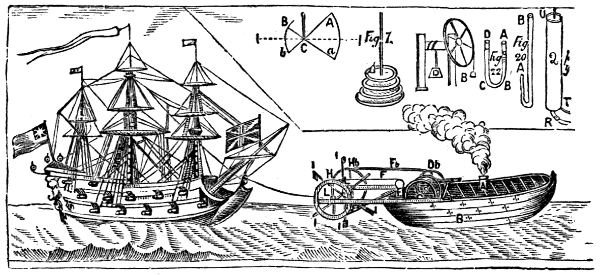
Fig. 66.—Hulls’s Steamboat, 1736.
“P, the Pipe coming from the Furnace to the Cylinder.
Q, the Cylinder wherein the steam is condensed. R, the
Valve that stops the Steam from coming into the Cylinder,
whilst the Steam within the same is condensed. S, the
Pipe to convey the condensing Water into the Cylinder.
T, a cock to let in the condensing Water when the Cylinder
is full of Steam and the Valve, P, is shut. U, a Rope fixed
to the Piston that slides up and down in the Cylinder.
“Note. This Rope, U, is the same Rope that goes round
the wheel, D, in the machine.”
In the large division of his plate, A is the chimney;
B
is the tow-boat; CC is the frame carrying the engine;
Da, D, and Db are three wheels carrying the ropes M,
Fb, and Fa, M being the rope U of his smaller figure, 30.
Ha and Hb are two wheels on the paddle-shafts, II, arranged
with pawls so that the paddle-wheel, II, always
turns the same way, though the wheels Ha and Hb are
given a reciprocating motion; Fb is a rope connecting
the wheels in the vessel, Db, with the wheels at the stern.
Hulls says:
“When the Weight, G, is so raised, while the wheels
Da, D, and Db are moving backward, the Rope Fa gives
way, and the Power of the Weight, G, brings the Wheel
Ha forward, and the Fans with it, so that the Fans always
keep going forward, notwithstanding the Wheels Da, D,
and Db move backward and forward as the Piston moves
up and down in the Cylinder. LL are Teeth for a Catch
to drop in from the Axis, and are so contrived that they
catch in an alternate manner, to cause the Fan to move
always forward, for the Wheel Ha, by the power of the
weight, G, is performing his Office while the other wheel,
Hb, goes back in order to fetch another stroke.
“Note. The weight, G, must contain but half the weight
of the Pillar of Air pressing on the Piston, because the
weight, G, is raised at the same time as the Wheel Hb performs
its Office, so that it is in effect two Machines acting
alternately, by the weight of one Pillar of Air, of such a
Diameter as the Diameter of the Cylinder is.”
The inventor suggests the use of timber guards to protect
the wheels from injury, and, in shallow water, the attachment
to the paddle-shafts of cranks “to strike a Shaft
to the Bottom of the River, which will drive the Vessel
forward with the greater Force.” He concludes: “Thus I
have endeavoured to give a clear and satisfactory Account
of my New-invented Machine, for carrying Vessels out of
and into any Port, Harbour, or River, against Wind and
Tide, or in a Calm; and I doubt not but whoever shall
give himself the Trouble to peruse this Essay, will be so
candid as to excuse or overlook any Imperfections in the
diction or manner of writing, considering the Hand it comes
from, if what I have imagined may only appear as plain to
others as it has done to me, viz., That the Scheme I now
offer is Practicable, and if encouraged will be Useful.”
There is no positive evidence that Hulls ever put his
scheme to the test of experiment, although tradition does
say that he made a model, which he tried with such ill success
as to prevent his prosecution of the experiment further;
and doggerel rhymes are still extant which were sung
by his neighbors in derision of his folly, as they considered
it.
A prize was awarded by the French Academy of Sciences,
in 1752, for the best essay on the manner of impelling
vessels without wind. It was given to Bernouilli, who,
in his paper, proposed a set of vanes like those of a windmill—a
screw, in fact—one to be placed on each side of the
vessel, and two more behind. For a vessel of 100 tons, he
proposed a shaft 14 feet long and 2 inches in diameter, carrying
“eight wheels, for acting on the water, to each of
which it” (the shaft) “is perpendicular, and forms an axis
for them all; the wheels should be at equal distances from
each other. Each wheel consists of 8 arms of iron, each 3
feet long, so that the whole diameter of the wheel is 6 feet.
Each of these arms, at the distance of 20 inches from the
centre, carries a sheet-iron plane (or paddle) 16 inches
square, which is inclined so as to form an angle of 60 degrees,
both with the arbor and keel of the vessel, to which
the arbor is placed parallel. To sustain this arbor and
the wheels, two strong bars of iron, between 2 and 3
inches thick, proceed from the side of the vessel at right
angles to it, about 21∕2 feet below the surface of the water.”
He proposed similar screw-propellers at the stern, and
suggested that they could be driven by animal or by steam-power.
But a more remarkable essay is quoted by Figuier[61]—the
paper of l’Abbé Gauthier, published in the “Mémoires de
la Société Royale des Sciences et Lettres de Nancy.” Bernouilli
had expressed the belief that the best steam-engine
then known—that of Newcomen—was not superior to some
other motors. Gauthier proposed to use that engine in
the propulsion of paddle-wheels placed at the side of
the vessel. His plan was not brought into use, but his
paper embodied a glowing description of the advantages
to be secured by its adoption. He states that a
galley urged by 26 oars on a side made but 4,320 toises
(8,420 meters), or about 5 miles, an hour, and required
a crew of 260 men. A steam-engine, doing the same
work, would be ready for action at all times, could
be applied, when not driving the vessel, to raising the
anchor, working the pumps, and to ventilating the ship,
while the fire would also serve to cook with. The engine
would occupy less space and weight than the men, would
require less aliment, and that of a less expensive kind, etc.
He would make the boiler safe against explosions by bands
of iron; would make the fire-box of iron, with a water-filled
ash-pit and base-plate. His injection-water was to
come from the sea, and return by a delivery-pipe placed
above the water-line. The chains, usually leading from the
end of the beam to the pump-rods, were to be carried
around wheels on the paddle-shaft, which were to be provided
with pawls entering a ratchet, and thus the paddles,
having been given several revolutions by the descent of the
piston and the unwinding of the chain, were to revolve
freely while the return-stroke was made, the chain being
hauled down and rewound by the wheel on the shaft, the
latter being moved by a weight. The engine was proposed
to be of 6 feet stroke, and to make 15 strokes per minute,
with a force of 11,000 pounds.
A little later (1760), a Swiss clergyman, J. A. Genevois,
published in London a paper relating to the improvement
of navigation,[62]
in which his plan was proposed of compressing
springs by steam or other power, and applying their
effort while recovering their form to ship-propulsion.
It was at this time that the first attempts were made in
the United States to solve this problem, which had begun
to be recognized as one of the greatest which had presented
itself to the mechanic and the engineer.
William Henry was a prominent citizen of the then little
village of Lancaster, Pa., and was noted as an ingenious
and successful mechanic.[63] He was still living at the beginning
of the present century. Mr. Henry was the first to make
the “rag” carpet, and was the inventor of the screw-auger.
He was of a Scotch and North-of-Ireland family, his father,
John Henry, and his two older brothers, Robert and James,
having come to the United States about 1720. Robert settled,
finally, in Virginia, and it is said that Patrick Henry,
the patriot and orator, was of his family. The others remained
in Chester County, Pa., where William was born,
in 1729. He learned the trade of a gunsmith, and, driven
from his home during the Indian war (1755 to 1760), settled
in Lancaster.
In the year 1760 he went to England on business, where
his attention was attracted to the invention—then new, and
the subject of discussion in every circle—of James Watt.
He saw the possibility of its application to navigation and to
driving carriages, and, on his return home, commenced the
construction of a steam-engine, and finished it in 1763.
Placing it in a boat fitted with paddle-wheels, he made
a trial of the new machine on the Conestoga River, near
Lancaster, where the craft, by some accident, sank,[64] and
was lost. He was not discouraged by this failure, but
made a second model, adding some improvements. Among
the records of the Pennsylvania Philosophical Society is, or
was, a design, presented by Henry in 1782, of one of his
steamboats. The German traveler Schöpff visited the
United States in 1783, and at Mr. Henry’s house, at Lancaster,
was shown “a machine by Mr. Henry, intended for
the propelling of boats, etc.; ‘but,’ said Mr. Henry, ‘I am
doubtful whether such a machine would find favor with
the public, as every one considers it impracticable against
wind and tide;’ but that such a Boat will come into use
and navigate on the waters of the Ohio and Mississippi,
he had not the least doubt of, but the time had not yet
arrived of its being appreciated and applied.”
John Fitch, whose experiments will presently be referred
to, was an acquaintance and frequent visitor to the
house of Mr. Henry, and may probably have there received
the earliest suggestions of the importance of this application
of steam. About 1777, when Henry was engaged in
making mathematical and philosophical instruments, and
the screw-auger, which at that time could only be obtained
of him, Robert Fulton, then twelve years old, visited him,
to study the paintings of Benjamin West, who had long
been a friend and protégé of Henry. He, too, not improbably
received there the first suggestion which afterward led
him to desert the art to which he at first devoted himself,
and which made of the young portrait-painter a successful
inventor and engineer. West’s acquaintance with Henry
had no such result. The young painter was led by his
patron and friend to attempt historical pictures,[65] and probably
owes his fame greatly to the kindly and discerning
mechanic. Says Galt, in his “Memoirs of Sir Benjamin
West” (London, 1816): “Towards his old friend, William
Henry, of Lancaster City, he always cherished the most
grateful affection; he was the first who urged him to attempt
historical composition.”
When, after the invention of Watt, the steam-engine
had taken such shape that it could really work the propelling
apparatus of a paddle or screw vessel, a new impetus
was given to the work of its adaptation. In France, the
Marquis de Jouffroy was one of the earliest to perceive that
the improvements of Watt, rendering the engine more compact,
more powerful, and, at the same time, more regular
and positive in its action, had made it, at last, readily applicable
to the propulsion of vessels. The brothers Périer
had imported a Watt engine from Soho, and this was attentively
studied by the marquis,[66] and its application to the
paddle-wheels of a steam-vessel seemed to him a simple
problem. Comte d’Auxiron and Chevalier Charles Mounin,
of Follenai, friends and companions of Jouffroy, were
similarly interested, and the three are said to have often
discussed the scheme together, and to have united in devising
methods of applying the new motor.
In the year 1770, D’Auxiron determined to attempt the
realization of the plans which he had conceived. He resigned
his position in the army, prepared his plans and
drawings, and presented them to M. Bertin, the Prime
Minister, in the year 1771 or 1772. The Minister was favorably
impressed, and the King (May 22, 1772) granted
D’Auxiron a monopoly of the use of steam in river-navigation
for 15 years, provided he should prove his plans practicable,
and they should be so adjudged by the Academy.
A company had been formed, the day previous, consisting
of D’Auxiron, Jouffroy, Comte de Dijon, the Marquis
d’Yonne, and Follenai, which advanced the requisite
funds. The first vessel was commenced in December, 1772.
When nearly completed, in September, 1774, the boat
sprung a leak, and, one night, foundered at the wharf.
After some angry discussion, during which d’Auxiron was
rudely, and probably unjustly, accused of bad faith, the
company declined to advance the money needed to recover
and complete the vessel. They were, however, compelled
by the court to furnish it; but, meantime, d’Auxiron died
of apoplexy, the matter dropped, and the company dissolved.
The cost of the experiment had been something
more than 15,000 francs.
The heirs of d’Auxiron turned the papers of the deceased
inventor over to Jouffroy, and the King transferred
to him the monopoly held by the former. Follenai retained
all his interest in the project, and the two friends soon enlisted
a powerful adherent and patron, the Marquis Ducrest,
a well-known soldier, courtier, and member of the Academy,
who took an active part in the prosecution of the
scheme. M. Jacques Périer, the then distinguished mechanic,
was consulted, and prepared plans, which were
adopted in place of those of Jouffroy. The boat was built
by Périer, and a trial took place in 1774, on the Seine.
The result was unsatisfactory. The little craft could hardly
stem the sluggish current of the river, and the failure caused
the immediate abandonment of the scheme by Périer.
Still undiscouraged, Jouffroy retired to his country
home, at Baume-les-Dames, on the river Doubs. There he
carried on his experiments, getting his work done as best
he could, with the rude tools and insufficient apparatus of a
village blacksmith. A Watt engine and a chain carrying
“duck-foot” paddles were his propelling apparatus. The
boat, which was about 14 feet long and 6 wide, was started
in June, 1776. The duck’s-foot system of paddles proved
unsatisfactory, and Jouffroy gave it up, and renewed his
experiments with a new arrangement. He placed on the
paddle-wheel shaft a ratchet-wheel, and on the piston-rod
of his engine, which was placed horizontally in the boat,
a double rack, into the upper and the lower parts of which
the ratchet-wheel geared. Thus the wheels turned in the
same direction, whichever way the piston was moving.
The new engine was built at Lyons in 1780, by Messrs.
Frères-Jean. The new boat was about 140 feet long and
14 feet wide; the wheels were 14 feet in diameter, their
floats 6 feet long, and the “dip,” or depth to which they
reached, was about 2 feet. The boat drew 3 feet of water,
and had a total weight of about 150 tons.
At a public trial of the vessel at Lyons, July 15, 1783,
the little steamer was so successful as to justify the publication
of the fact by a report and a proclamation. The
fact that the experiment was not made at Paris was made
an excuse on the part of the Academy for withholding its
indorsement, and on the part of the Government for declining
to confirm to Jouffroy the guaranteed monopoly. Impoverished
and discouraged, Jouffroy gave up all hope of
prosecuting his plans successfully, and reëntered the army.
Thus France lost an honor which was already within her
grasp, as she had already lost that of the introduction of
the steam-engine, in the time of Papin.
About 1785, John Fitch and James Rumsey were engaged
in experiments having in view the application of
steam to navigation.
Rumsey’s experiments began in 1774, and in 1786 he
succeeded in driving a boat at the rate of four miles an hour
against the current of the Potomac at Shepherdstown, W.
Va., in presence of General Washington. His method of
propulsion has often been reinvented since, and its adoption
urged with that enthusiasm and persistence which is a peculiar
characteristic of inventors.
Rumsey employed his engine to drive a great pump
which forced a stream of water aft, thus propelling the
boat forward, as proposed earlier by Bernouilli. This
same method has been recently tried again by the British
Admiralty, in a gunboat of moderate size, using a centrifugal
pump to set in motion the propelling stream, and with
some other modifications which are decided improvements
upon Rumsey’s rude arrangements, but which have not
done much more than his toward the introduction of
“Hydraulic or Jet Propulsion,” as it is now called.
In 1787 he obtained a patent from the State of Virginia
for steam-navigation. He wrote a treatise “On the Application
of Steam,” which was printed at Philadelphia, where
a Rumsey society was organized for the encouragement of
attempts at steam-navigation.
Rumsey died of apoplexy, while explaining some of his
schemes before a London society a short time later, December
23, 1793, at the age of fifty years. A boat, then in
process of construction from his plans, was afterward tried
on the Thames, in 1793, and steamed at the rate of four
miles an hour. The State of Kentucky, in 1839, presented
his son with a gold medal, commemorative of his father’s
services “in giving to the world the benefit of the steamboat.”
John Fitch was an unfortunate and eccentric, but very
ingenious, Connecticut mechanic. After roaming about
until forty years of age, he finally settled on the banks of
the Delaware, where he built his first steamboat.
In April, 1785, as Fitch himself states, at Neshamony,
Bucks County, Pa., he suddenly conceived the idea that a
carriage might be driven by steam. After considering the
subject a few days, his attention was led to the plan of
using steam to propel vessels, and from that time to the
day of his death he was a persistent advocate of the introduction
of the steamboat. At this time, Fitch says, “I
did not know that there was a steam-engine on the earth;”
and he was somewhat disappointed when his friend, the
Rev. Mr. Irwin, of Neshamony, showed him a sketch of
one in “Martin’s Philosophy.”
Fitch’s first model was at once built, and was soon after
tried on a small stream near Davisville. The machinery
was made of brass, and the boat was impelled by paddle-wheels.
A rough model of his steamboat was shown to
Dr. John Ewing, Provost of the University of Pennsylvania,
who, August 20, 1785, addressed a commendatory
letter to an ex-Member of Congress, William C. Houston,
asking him to assist Fitch in securing the aid of the General
Government. The latter referred the inventor, by a letter
of recommendation, to a delegate from New Jersey, Mr.
Lambert Cadwalader. With this, and other letters, Fitch
proceeded to New York, where Congress then met, and
made his application in proper form. He was unsuccessful,
and equally so in attempting to secure aid from the
Spanish minister, who desired that the profits should be
secured, by a monopoly of the invention, to the King of
Spain. Fitch declined further negotiation, determined
that, if successful at all, the benefit should accrue to his
own countrymen.
In September, 1785, Fitch presented to the American
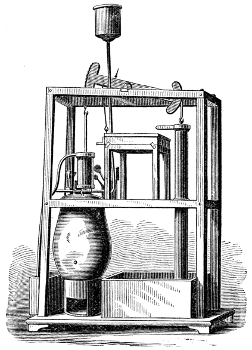
Philosophical Society, at Philadelphia, a model in which he
had substituted an endless chain and floats for the paddle-wheels,
with drawings and a descriptive account of his
scheme. This model is shown in the accompanying figure.
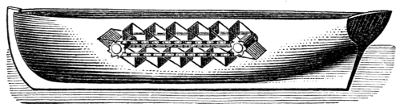
Fig. 67.—Fitch’s Model, 1785.
In March, 1786, Fitch was granted a patent by the
State of New Jersey, for the exclusive right to the navigation
of the waters of the State by steam, for 14 years. A
month later, he was in Philadelphia, seeking a similar
patent from the State of Pennsylvania. He did not at once
succeed, but in a few days he had formed a company, raised
$300, and set about finding a place in which to construct
his engine. Henry Voight, a Dutch watchmaker, a good
mechanic, and a very ingenious man, took an interest in the
company, and with him Fitch set about his work with great
enthusiasm. After making a little model, having a steam-cylinder
but one inch in diameter, they built a model boat
and engine, the latter having a diameter of cylinder of three
inches. They tried the endless chain, and other methods of
propulsion, without success, and finally succeeded with a set
of oars worked by the engine. In August, 1786, it was determined
by the company to authorize the construction of a
larger vessel; but the money was not readily obtained.
Meantime, Fitch continued his efforts to secure a patent
from the State, and was finally, March 28, 1787, successful.
He also obtained a similar grant from the State of
Delaware, in February of the same year, and from New
York, March 19.
Money was now subscribed more freely, and the work
on the boat continued uninterruptedly until May, 1787,
when a trial was made, which revealed many defects in the
machinery. The cylinder-heads were of wood, and leaked
badly; the piston leaked; the condenser was imperfect;
the valves were not tight. All these defects were remedied,
and a condenser invented by Voight—the “pipe-condenser”—was
substituted for that defective detail as previously
made.
The steamboat was finally placed in working order, and
was found capable, on trial, of making three or four miles
an hour. But now the boiler proved to be too small to furnish
steam steadily in sufficient quantity to sustain the
higher speed. After some delay, and much distress on the
part of the sanguine inventor, who feared that he might be
at last defeated when on the very verge of success, the
necessary changes were finally made, and a trial took place
at Philadelphia, in presence of the members of the Convention—then
in session at Philadelphia framing the Federal
Constitution—August 22, 1787. Many of the distinguished
spectators gave letters to Fitch certifying his success. Fitch
now went to Virginia, where he succeeded in obtaining a
patent, November 7, 1787, and then returned to ask a patent
of the General Government.
A controversy with Rumsey now followed, in which
Fitch asserted his claims to the invention of the steamboat,
and denied that Rumsey had done more than to revive the
scheme which Bernouilli, Franklin, Henry, Paine, and
others, had previously proposed, and that Rumsey’s steamboat
was not made until 1786.
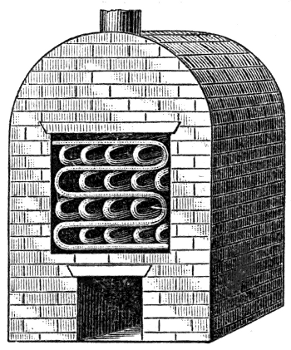
Fig. 68.—Fitch and Voight’s Boiler, 1787.
The boiler adopted in Fitch’s boat of 1787 was a “pipe-boiler,”
which he had described in a communication to the
Philosophical Society, in September, 1785. It consisted
(Fig. 68) of a small water-pipe, winding backward and forward
in the furnace, and terminating at one end at the
point at which the feed-water was introduced, and at the
other uniting with the steam-pipe leading to the engine.
Voight’s condenser was similarly constructed. Rumsey
claimed that this boiler was copied from his designs. Fitch
brought evidence to prove that Rumsey had not built such
a boiler until after his own.
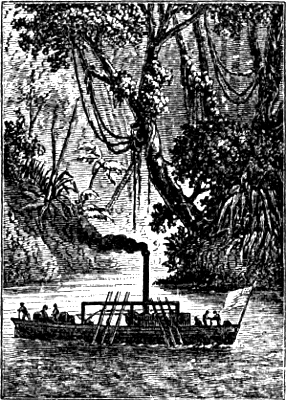
Fig. 69.—Fitch’s First Boat, 1787.
Fitch’s first boat-engine had a steam-cylinder 12 inches
in diameter. A second engine was now built (1788) with a
cylinder 18 inches in diameter, and a new boat. The first
vessel was 45 feet long and 12 feet wide; the new boat was
60 feet long and of but 8 feet breadth of beam. The first
boat (Fig. 69) had paddles worked at the sides, with the
motion given the Indian paddle in propelling a canoe; in
the second boat (Fig. 70) they were similarly worked, but
were placed at the stern. There were three of these paddles.
The boat was finally finished in July, 1788, and made
a trip to Burlington, 20 miles from Philadelphia. When
just reaching their destination, their boiler gave out, and
they made their return-trip to Philadelphia floating with
the tide. Subsequently, the boat made a number of excursions
on the Delaware River, making three or four miles an
hour.
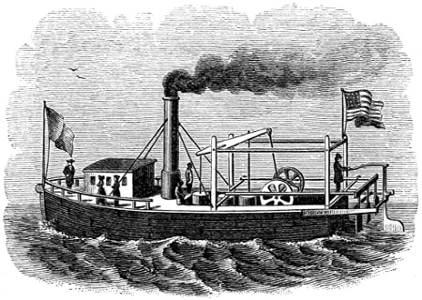
Fig. 70.—John Fitch, 1788.
Another of Fitch’s boats, in April, 1790, made seven
miles an hour. Fitch, writing of this boat, says that “on
the 16th of April we got our work completed, and tried
our boat again; and, although the wind blew very fresh at
the east, we reigned lord high admirals of the Delaware,
and no boat on the river could hold way with us.” In
June of that year it was placed as a passenger-boat on a
line from Philadelphia to Burlington, Bristol, Bordentown,
and Trenton, occasionally leaving that route to take excursions
to Wilmington and Chester. During this period, the
boat probably ran between 2,000 and 3,000 miles,[67] and with
no serious accident. During the winter of 1790-’91, Fitch
commenced another steamboat, the “Perseverance,” and
gave considerable time to the prosecution of his claim for a
patent from the United States. The boat was never completed,
although he received his patent, after a long and
spirited contest with other claimants, on the 26th of August,
1791, and Fitch lost all hope of success. He went to
France in 1793, hoping to obtain the privilege of building
steam-vessels there, but was again disappointed, and worked
his passage home in the following year.
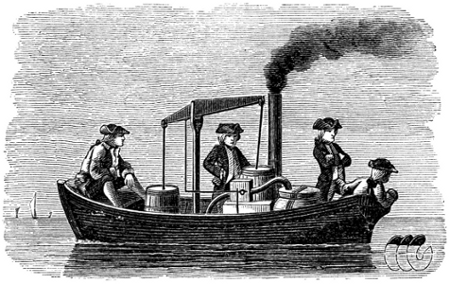
Fig. 71.—John Fitch, 1796.
In the year 1796, Fitch was again in New York City,
experimenting with a little screw steamboat on the “Collect”
Pond, which then covered that part of the city now
occupied by the “Tombs,” the city prison. This little boat
was a ship’s yawl fitted with a screw, like that adopted later
by Woodcroft, and driven by a rudely-made engine.
Fitch, while in the city of Philadelphia at about this
time, met Oliver Evans, and discussed with him the probable
future of steam-navigation, and proposed to form a
company in the West, to promote the introduction of steam
on the great rivers of that part of the country. He settled
at last in Kentucky, on his land-grant, and there amused
himself with a model steamboat, which he placed in a small
stream near Bardstown. His death occurred there in July,
1798, and his body still lies in the village cemetery, with
only a rough stone to mark the spot.
Both Rumsey and Fitch endeavored to introduce their
methods in Great Britain; and Fitch, while urging the importance
and the advantages of his plan, confidently stated
his belief that the ocean would soon be crossed by steam-vessels,
and that the navigation of the Mississippi would
also become exclusively a steam-navigation. His reiterated
assertion, “The day will come when some more
powerful man will get fame and riches from my invention;
but no one will believe that poor John Fitch can do anything
worthy of attention,” now almost sounds like a
prophecy.
During this period, an interest which had never diminished
in Great Britain had led to the introduction of experimental
steamboats in that country. Patrick Miller, of
Dalswinton, had commenced experimenting, in 1786-’87,
with boats having double or triple hulls, and propelled by
paddle-wheels placed between the parts of the compound
vessel. James Taylor, a young man who had been engaged
as tutor for Mr. Miller’s sons, suggested, in 1787, the substitution
of steam for the manual power which had been,
up to that time, relied upon in their propulsion. Mr. Miller,
in 1787, printed a description of his plan of propelling
apparatus, and in it stated that he had “reason to believe
that the power of the Steam-Engine may be applied to work
the wheels.”
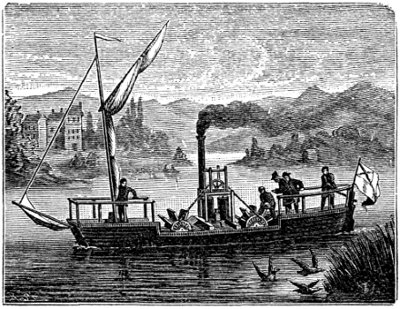
Fig. 72.—Miller, Taylor, and Symmington, 1788.
In the winter of 1787-’88, William Symmington, who
had planned a new form of steam-engine, and made a successful
working-model, was employed by Mr. Miller to construct
an engine for a new boat. This was built; the little engine,
having two cylinders of but four inches in diameter, was
placed on board, and a trial was made October 14, 1788.
The vessel (Fig. 72) was 25 feet long, of 7 feet beam, and
made 5 miles an hour.
In the year 1789, a large vessel was built, with an engine
having a steam-cylinder 18 inches in diameter, and this vessel
was ready for trial in November of that year. On the
first trial, the paddle-wheels proved too slight, and broke
down; they were replaced by stronger wheels, and, in December,
the boat, on trial, made seven miles an hour.
Miller, like many other inventors, seems to have lost his
interest in the matter as soon as success seemed assured,
and dropped it to take up other incomplete plans. More
than a quarter of a century later, the British Government
gave Taylor a pension of £50 per annum, and, in 1837, his
four daughters were each given a similar annuity. Mr.
Miller received no reward, although he is said to have expended
over £30,000. The engine of Symmington was
condemned by Miller as “the most improper of all steam-engines
for giving motion to a vessel.” Nothing more was
done in Great Britain until early in the succeeding century.
In the United States, several mechanics were now at
work besides Fitch. Samuel Morey and Nathan Read were
among these. Nicholas Roosevelt was another. It had
just been found that American mechanics were able to do
the required shop-work. The first experimental steam-engine
built in America is stated to have been made in 1773
by Christopher Colles, a lecturer before the American Philosophical
Society at Philadelphia. The first steam-cylinder
of any considerable size is said[68] to have been made by
Sharpe & Curtenius, of New York City.
Samuel Morey was the son of one of the first settlers
of Orford, N. H. He was naturally fond of science and
mechanics, and became something of an inventor. He began
experimenting with the steamboat in 1790 or earlier,
building a small vessel, and fitting it with paddle-wheels
driven by a steam-engine of his own design, and constructed
by himself.[69] He made a trial-trip one Sunday morning in
the summer of 1790, a friend to accompany him, from Oxford,
up the Connecticut River, to Fairlee, Vt., a distance
of several miles, and returned safely. He then went to
New York, and spent the summer of each year until 1793
in experimenting with his boat and modifications of his
engine. In 1793 he made a trip to Hartford, returning to
New York the next summer. His boat was a “stern-wheeler,”
and is stated to have been capable of steaming
five miles an hour. He next went to Bordentown, N. J.,
where he built a larger boat, which is said to have been a
side-wheel boat, and to have worked satisfactorily. His
funds finally gave out, and he gave up his project after
having, in 1797, made a trip to Philadelphia. Fulton,
Livingston, and Stevens met Morey at New York, inspected
his boat, and made an excursion to Greenwich with him.[70]
Livingston is said[71]
to have offered to assist Morey if he
should succeed in attaining a speed of eight miles an hour.
Morey’s experiments seem to have been conducted very
quietly, however, and almost nothing is known of them.
The author has not been able to learn any particulars of
the engines used by him, and nothing definite is known of
the dimensions of either boat or machinery. Morey never,
like Fitch and Rumsey, sought publicity for his plans or
notoriety for himself.
Nathan Read, who has already been mentioned, a native
of Warren, Mass., where he was born in the year 1759,
and a graduate of Harvard College, was a student of medicine,
and subsequently a manufacturer of chain-cables and
other iron-work for ships. He invented, and in 1798 patented,
a nail-making machine. He was at one time (1800-1803)
a Member of Congress, and, later, a Justice of the
Court of Common Pleas, and Chief Justice in Hancock
County, Me., after his removal to that State in 1807. He
died in Belfast, Me., in 1849, at the age of ninety years.
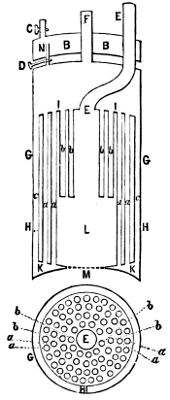
Fig. 73.—Read’s Boiler in
Section, 1788.
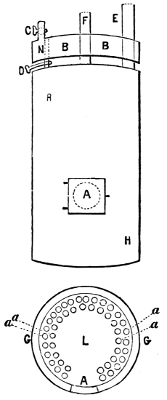
Fig. 74.—Read’s Multi-Tubular
Boiler, 1788.
In the year 1788 he became interested in the problem
of steam-navigation, and learned something of the work of
Fitch. He first attempted to design a boiler that should be
strong, light, and compact, as well as safe. His first plan
was that of the “Portable Furnace-Boiler,” as he called it;
it was patented August 26, 1791. As designed, it consisted,
as seen in Figs. 73 and 74, which are reduced from his
patent drawings, of a shell of cylindrical form, like the
now common vertical tubular boiler. A is the furnace-door,
B a heater and feed-water reservoir, D a pipe leading
the feed-water into the boiler,[72] E the smoke-pipe, and F
the steam-pipe leading to the engine. G is the “shell” of
the boiler, and H the fire-box. The crown-sheet, I I, has
depending from it, in the furnace, a set of water-tubes, b b,
closed at their lower ends, and another set, a a, which connect
the water-space above the furnace with the water-bottom,
K K. L is the furnace, and M the draught-space
between the boiler and the ash-pit, in which the grates
are set.
This boiler was intended to be used in both steamboats
and steam-carriages. The first drawings were made in
1788 or 1789, as were those of a peculiar form of steam-engine
which also resembled very closely that afterward
constructed in Great Britain by Trevithick.[73] He built a
boat in 1789, which he fitted with paddle-wheels and a
crank, which was turned by hand, and, by trial, satisfied
himself that the system would work satisfactorily.
He then applied for his patent, and spent the greater
part of the winter of 1789-’90 in New York, where Congress
then met, endeavoring to secure it. In January, 1791,
Read withdrew his petitions for patents, proposing to incorporate
accounts of new devices, and renewed them a few
months later. His patents were finally issued, dated August
26, 1791. John Fitch, James Rumsey, and John Stevens,
also, all received patents at the same date, for various
methods of applying steam to the propulsion of vessels.
Read appears to have never succeeded in even experimentally
making his plans successful. He deserves credit
for his early and intelligent perception of the importance
of the subject, and for the ingenuity of his devices. As
the inventor of the vertical multi-tubular fire-box boiler, he
has also entitled himself to great distinction. This boiler
is now in very general use, and is a standard form.
In 1792, Elijah Ormsbee, a Rhode Island mechanic,
assisted pecuniarily by David Wilkinson, built a small
steamboat at Winsor’s Cove, Narragansett Bay, and made
a successful trial-trip on the Seekonk River. Ormsbee
used an “atmospheric engine” and “duck’s-foot” paddles.
His boat attained a speed of from three to four miles an
hour.
In Great Britain, Lord Dundas and William Symmington,
the former as the purveyor of funds and the latter as
engineer, followed by Henry Bell, were the first to make
the introduction of the steam-engine for the propulsion of
ships so completely successful that no interruption subsequently
took place in the growth of the new system of
water-transportation.
Thomas, Lord Dundas, of Kerse, had taken great interest
in the experiments of Miller, and had hoped to be able
to apply the new motor on the Forth and Clyde Canal, in
which he held a large interest. After the failure of the
earlier experiments, he did not forget the matter; but subsequently,
meeting with Symmington, who had been Miller’s
constructing engineer, he engaged him to continue
the experiments, and furnished all required capital, about
£7,000. This was ten years after Miller had abandoned
his scheme.
Symmington commenced work in 1801. The first boat
built for Lord Dundas, which has been claimed to have
been the “first practical steamboat,” was finished ready for
trial early in 1802. The vessel was called the “Charlotte
Dundas,” in honor of a daughter of Lord Dundas, who became
Lady Milton.
The vessel (Fig. 75) was driven by a Watt double-acting
engine, turning a crank on the paddle-wheel shaft.
The sectional sketch below exhibits the arrangement of the
machinery. A is the steam-cylinder, driving, by means of
the connecting-rod, B C, a stern-wheel, E E. F is the
boiler, and G the tall smoke-pipe. An air-pump and condenser,
H, is seen under the steam-cylinder.
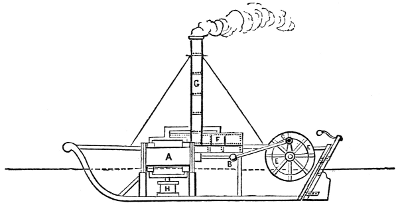
Fig. 75.—The “Charlotte Dundas,” 1801.
In March, 1802, the boat was brought to Lock No. 20
on the Forth and Clyde Canal, and two vessels of 70 tons
burden each taken in tow. Lord Dundas, William Symmington,
and a party of invited guests, were taken on board,
and the boat steamed down to Port Glasgow, a distance of
about 20 miles, against a strong head-wind, in six hours.
The proprietors of the canal were now urged to adopt
the new plan of towing; but, fearing injury to the banks
of the canal, they declined to do so. Lord Dundas then
laid the matter before the Duke of Bridgewater, who gave
Symmington an order for eight boats like the Charlotte
Dundas, to be used on his canal. The death of the Duke,
however, prevented the contract from being carried into
effect, and Symmington again gave up the project in despair.
A quarter of a century later, Symmington received
from the British Government £100, and, a little later, £50
additional, as an acknowledgment of his services. The
Charlotte Dundas was laid up, and we hear nothing more
of that vessel.
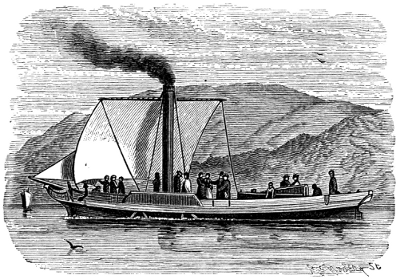
Fig. 76.—The “Comet,” 1812.
Among those who saw the Charlotte Dundas, and who
appreciated the importance of the success achieved by Symmington,
was Henry Bell, who, 10 years afterward, constructed
the Comet (Fig. 76), the first passenger-vessel
built
in Europe. This vessel was built in 1811, and completed
January 18, 1812. The craft was of 30 tons burden, 40 feet
in length, and 101∕2 feet breadth of beam. There were two
paddle-wheels on each side, driven by engines rated at
three horse-power.
Bell had, it is said, been an enthusiastic believer in the
advantages to be secured by this application of steam, from
about 1786. In 1800, and again in 1803, he applied to the
British Admiralty for aid in securing those advantages by
experimentally determining the proper form and proportions
of machinery and vessel; but was not able to convince
the Admiralty of “the practicability and great utility
of applying steam to the propelling of vessels against
winds and tides, and every obstruction on rivers and seas
where there was depth of water.” He also wrote to the
United States Government, urging his views in a similar
strain.
Bell’s boat was, when finished, advertised as a passenger-boat,
to leave Greenock, where the vessel was built, on
Mondays, Wednesdays, and Fridays, for Glasgow, 24 miles
distant, returning Tuesdays, Thursdays, and Saturdays.
The fare was made “four shillings for the best cabin, and
three shillings for the second.” It was some months before
the vessel became considered a trustworthy means of conveyance.
Bell, on the whole, was at first a heavy loser by
his venture, although his boat proved itself a safe, stanch
vessel.
Bell constructed several other boats in 1815, and with
his success steam-navigation in Great Britain was fairly
inaugurated. In 1814 there were five steamers, all Scotch,
regularly working in British waters; in 1820 there were
34, one-half of which were in England, 14 in Scotland, and
the remainder in Ireland. Twenty years later, at the close
of the period to which this chapter is especially devoted,
there were about 1,325 steam-vessels in that kingdom, of
which 1,000 were English and 250 Scotch.
But we must return to America, to witness the first and
most complete success, commercially, in the introduction of
the steamboat.
The Messrs. Stevens, Livingston, Fulton, and Roosevelt
were there the most successful pioneers. The latter is said
to have built the “Polacca,” a small steamboat launched on
the Passaic River in 1798. The vessel was 60 feet long,
and had an engine of 20 inches diameter of cylinder and
2 feet stroke, which drove the boat 8 miles an hour, carrying
a party of invited guests, which included the Spanish
Minister. Livingston and John Stevens had induced Roosevelt
to try their plans still earlier,[74] paying the expense of
the experiments. The former adopted the plan of Bernouilli
and Rumsey, using a centrifugal pump to force a jet of
water from the stern; the latter used the screw. Livingston
going to France as United States Minister, Barlow
carried over the plans of the “Polacca,” and Roosevelt’s
friends state that a boat built by them, in conjunction with
Fulton, was a “sister-ship” to that vessel. In 1798, Roosevelt
patented a double engine, having cranks set at right
angles. As late as 1814 he received a patent for a steam-vessel,
fitted with paddle-wheels having adjustable floats.
His boat of 1798 is stated by some writers to have been
made by him on joint account of himself, Livingston, and
Stevens. Roosevelt, some years later, was again at work,
associating himself with Fulton in the introduction of
steam-navigation of the rivers of the West.[75]
In 1798, the Legislature of New York passed a law giving
Chancellor Livingston the exclusive right to steam-navigation
in the waters of the State for a period of 20
years, provided that he should succeed, within a twelve-month,
in producing a boat that should steam four miles
an hour.
Livingston did not succeed in complying with the terms
of the act, but, in 1803, he procured the reënactment of the
law in favor of himself and Robert Fulton, who was then
experimenting in France, after having, in England, watched
the progress of steam-navigation there, and then taken a
patent in this country.
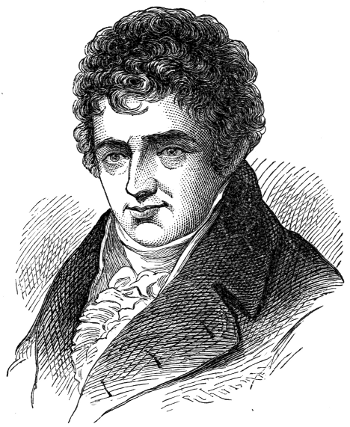
Robert Fulton.
Robert Fulton was a native of Little Britain, Lancaster
County, Pa., born 1765. He commenced experimenting
with paddle-wheels when a mere boy, in 1779, visiting an
aunt living on the bank of the Conestoga.[76] During his
youth he spent much of his time in the workshops of his
neighborhood, and learned the trade of a watchmaker; but
he adopted, finally, the profession of an artist, and exhibited
great skill in portrait-painting. While his tastes were
at this time taking a decided bent, he is said to have visited
frequently the house of William Henry, already mentioned,
to see the paintings of Benjamin West, who in his youth
had been a kind of protégé of Mr. Henry; and he may
probably have seen there the model steamboats which Mr.
Henry exhibited, in 1783 or 1784, to the German traveler
Schöpff. In later years, Thomas Paine, the author of
“Common Sense,” at one time lived with Mr. Henry, and
afterward, in 1788, proposed that Congress take up the
subject for the benefit of the country.
Fulton went to England when he came of age, and
studied painting with Benjamin West. He afterward
spent two years in Devonshire, where he met the Duke of
Bridgewater, who afterward so promptly took advantage
of the success of the “Charlotte Dundas.”
While in England and in France—where he went in
1797, and resided some time—he may have seen something
of the attempts which were beginning to be made to introduce
steam-navigation in both of those countries.
At about this time—perhaps in 1793—Fulton gave up
painting as a profession, and became a civil engineer. In
1797 he went to Paris, and commenced experimenting with
submarine torpedoes and torpedo-boats. In 1801 he had
succeeded so well with them as to create much anxiety in
the minds of the English, then at war with France.
He had, as early as 1793, proposed plans for steam-vessels,
both to the United States and the British Governments,
and seems never entirely to have lost sight of the
subject.[77]
While in France he lived with Joel Barlow, who
subsequently became known as a poet, and as Embassador
to France from the United States, but who was then engaged
in business in Paris.
When about leaving the country, Fulton met Robert
Livingston (Chancellor Livingston, as he is often called),
who was then (1801) Embassador of the United States at
the court of France. Together they discussed the project
of applying steam to navigation, and determined to attempt
the construction of a steamboat on the Seine; and in the
early spring of the year 1802, Fulton having attended Mrs.
Barlow to Plombières, where she had been sent by her physician,
he there made drawings and models, which were
sent or described to Livingston. In the following winter
Fulton completed a model side-wheel boat.
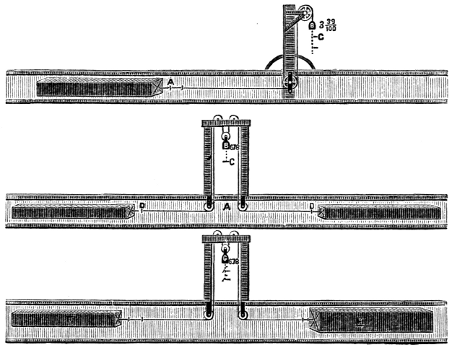
Fig. 77.—Fulton’s Experiments.
January 24, 1803, he delivered this model to MM.
Molar, Bordel, and Montgolfier, with a descriptive memoir,
in which he stated that he had, by experiment, proven that
side-wheels were better than the “chaplet” (paddle-floats
set on an endless chain).[78] These gentlemen were then
building for Fulton and Livingston their first boat, on
L’Isle des Cygnes, in the Seine. In planning this boat, Fulton
had devised many different methods of applying steam
to its propulsion, and had made some experiments to determine
the resistance of fluids. He therefore had been
able to calculate, more accurately than had any earlier inventor,
the relative size and proportions of boat and machinery.
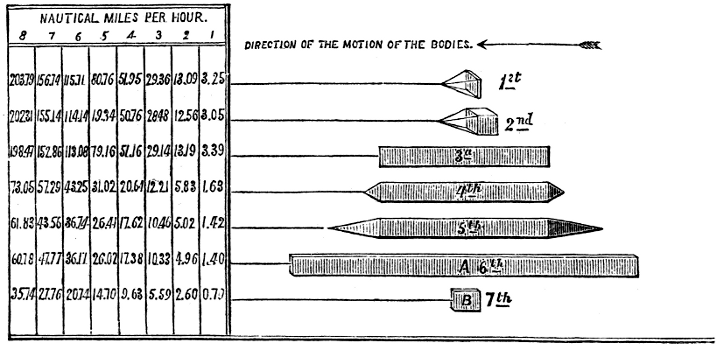
Fig. 78.—Fulton’s Table of Resistances.
The author has examined a large collection of Fulton’s
drawings, among which are sketches, very neatly executed,
of many of these plans, including the chaplet, side-wheel,
and stern-wheel boats, driven by various forms of steam-engine,
some working direct, and some geared to the paddle-wheel
shaft. Figs. 77 and 78 are engraved from
two of these sheets. The first represents the method
adopted by Fulton to determine the resistance of masses of
wood of various forms and proportions, when towed through
water. The other is “A Table of the resistance of bodies
moved through water, taken from experiments made in
England by a society for improving Naval architecture, between
the years 1793 and 1798” (Fig. 78). This latter is
from a certified copy of “The Original Drawing on file in
the Office of the Clerk of the New York District, making
a part of the Demonstration of the patent granted to Robert
Fulton, Esqr., on the 11th day of February, 1809. Dated
this 3rd March, 1814,” and is signed by Theron Rudd, Clerk
of the New York District. Resistances are given in pounds
per square foot.
Guided by these experiments and calculations, therefore,
Fulton directed the construction of his vessel. It was completed
in the spring of 1803. But, unfortunately, the hull
of the little vessel was too weak for its heavy machinery,
and it broke in two and sank to the bottom of the Seine.
Undiscouraged, Fulton at once set about repairing damages.
He was compelled to direct the rebuilding of the
hull. The machinery was little injured. In June, 1803,
the reconstruction was completed, and the vessel was set
afloat in July. The hull was 66 feet long, of 8 feet beam,
and of light draught.
August 9, 1803, this boat was cast loose, and steamed
up the Seine, in presence of an immense concourse of spectators.
A committee of the National Academy, consisting
of Bougainville, Bossuet, Carnot, and Périer, were present
to witness the experiment. The boat moved but slowly,
making only between 3 and 4 miles an hour against the
current, the speed through the water being about 41∕2 miles;
but this was, all things considered, a great success.
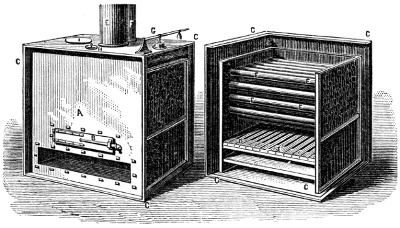
Fig. 79.—Barlow’s Water-Tube Boiler, 1793.
The experiment was successful, but it attracted little
attention, notwithstanding the fact that its success had
been witnessed by the committee of the Academy and by
many well-known savants and mechanics, and by officers on
Napoleon’s staff. The boat remained a long time on the
Seine, near the palace. The water-tube boiler of this vessel
(Fig. 79) is still preserved at the Conservatoire des Arts et
Métiers at Paris, where it is known as Barlow’s boiler. Barlow
patented it in France as early as 1793, as a steamboat-boiler,
and states that the object of his construction was to
obtain the greatest possible extent of heating-surface.
Fulton endeavored to secure the pecuniary aid and the
countenance of the First Consul, but in vain.
Livingston wrote home, describing the trial of this steamboat
and its results, and procured the passage of an act by
the Legislature of the State of New York, extending a
monopoly granted him in 1798 for the term of 20 years
from April 5, 1803, the date of the new law, and extending
the time allowed for proving the practicability of driving
a boat four miles an hour by steam to two years from the
same date. A later act further extended the time to April,
1807.
In May, 1804, Fulton went to England, giving up all
hope of success in France with either his steamboats or his
torpedoes. Fulton had already written to Boulton & Watt,
ordering an engine to be built from plans which he furnished
them; but he had not informed them of the purpose
to which it was to be applied. This engine was to have a
steam-cylinder 2 feet in diameter and of 4 feet stroke. The
engine of the Charlotte Dundas was of very nearly the
same size; and this fact, and the visit of Fulton to Symmington
in 1801, as described by the latter, have been made
the basis of a claim that Fulton was a copyist of the plans
of others. The general accordance of the dimensions of
his boat on the Seine with those of the “Polacca” of Roosevelt
is also made the basis of similar claims by the friends
of the latter. It would appear, however, that Symmington’s
statement is incorrect, as Fulton was in France, experimenting
with torpedoes, at the time (July, 1801[79]) when
he is accused of having obtained from the English engineer
the dimensions and a statement of the performance of his
vessel. Yet a fireman employed by Symmington has made
an affidavit to the same statement. It is evident, however,
from what has preceded, that those inventors and builders
who were at that time working with the object of introducing
the steamboat were usually well acquainted with what
had been done by others, and with what was being done
by their contemporaries; and it is undoubtedly the fact
that each profited, so far as he was able, by the experience
of others.
While in England, however, Fulton was certainly not
so entirely absorbed in the torpedo experiments with which
he was occupied in the years 1804-’6 as to forget his plans
for a steamboat; and he saw the engine ordered by him in
1804 completed in the latter year, and preceded it to New
York, sailing from Falmouth in October, 1806, and reaching
the United States December 13, 1806.
The engine was soon received, and Fulton immediately
contracted for a hull in which to set it up. Meantime, Livingston
had also returned to the United States, and the two
enthusiasts worked together on a larger steamer than any
which had yet been constructed.
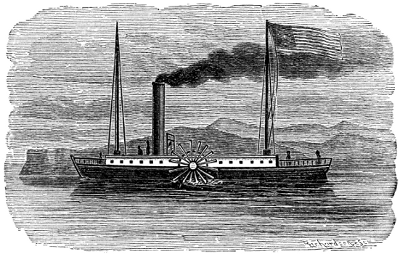
Fig. 80.—The Clermont, 1807.
In the spring of 1807, the “Clermont” (Fig. 80), as the
new boat was christened, was launched from the ship-yard of
Charles Brown, on the East River, New York. In August
the machinery was on board and in successful operation.
The hull of this boat was 133 feet long, 18 wide, and 9
deep. The boat soon made a trip to Albany, running the
distance of 150 miles in 32 hours running time, and returning
in 30 hours. The sails were not used on either occasion.
This was the first voyage of considerable length ever
made by a steam-vessel; and Fulton, though not to be
classed with James Watt as an inventor, is entitled to the
great honor of having been the first to make steam-navigation
an every-day commercial success, and of having thus
made the first application of the steam-engine to ship-propulsion,
which was not followed by the retirement of the
experimenter from the field of his labors before success
was permanently insured.
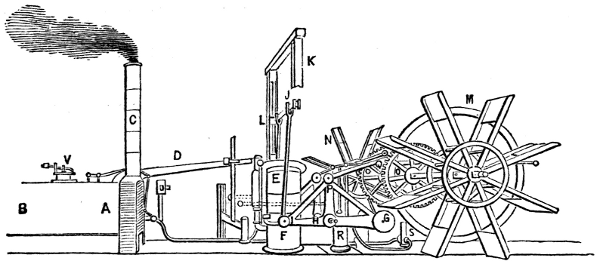
Fig. 81.—Engine of the Clermont, 1808.
The engine of the Clermont (Fig. 81)
was of rather peculiar
form, the piston, E, being coupled to the crank-shaft,
O, by a bell-crank, I H P, and a connecting-rod, P Q, the
paddle-wheel shaft, M N, being separate from the crank-shaft,
and connected with the latter by gearing, O O. The
cylinders were 24 inches in diameter by 4 feet stroke. The
paddle-wheels had buckets 4 feet long, with a dip of 2 feet.
Old drawings, made by Fulton’s own hand, and showing
the engine as it was in 1808, and the engine of a later
steamer, the Chancellor Livingston, are in the lecture-room
of the author at the Stevens Institute of Technology.
The voyage of the Clermont to Albany was attended
by some ludicrous incidents, which found their counterparts
wherever, subsequently, steamers were for the first time
introduced. Mr. Colden, the biographer of Fulton, says
that she was described, by persons who had seen her passing
by night, “as a monster moving on the waters, defying
wind and tide, and breathing flames and smoke.”
This first steamboat used dry pine wood for fuel, and
the flames rose to a considerable distance above the smoke-pipe.
When the fires were disturbed, mingled smoke and
sparks would rise high in the air. “This uncommon light,”
says Colden, “first attracted the attention of the crews of
other vessels. Notwithstanding the wind and tide were
averse to its approach, they saw with astonishment that it
was rapidly coming toward them; and when it came so
near that the noise of the machinery and paddles was
heard, the crews (if what was said in the newspapers of the
time be true), in some instances, shrank beneath their decks
from the terrific sight, and left their vessels to go on shore;
while others prostrated themselves, and besought Providence
to protect them from the approach of the horrible
monster which was marching on the tides, and lighting its
path by the fires which it vomited.”
In the Clermont, Fulton used several of the now characteristic
features of the American river steamboat, and
subsequently introduced others. His most important and
creditable work, aside from that of the introduction of the
steamboat into every-day use, was the experimental determination
of the magnitude and the laws of ship-resistance,
and the systematic proportioning of vessel and machinery
to the work to be done by them.
The success of the Clermont on the trial-trip was such
that Fulton soon after advertised the vessel as a regular
passenger-boat between New York and Albany.[80]
During the next winter the Clermont was repaired and
enlarged, and in the summer of 1808 was again on the
route to Albany; and, meantime, two new steamboats—the
Raritan and the Car of Neptune—had been built by Fulton.
In the year 1811 he built the Paragon. Both of the
two vessels last named were of nearly double the size of the
Clermont. A steam ferry-boat was built to ply between
New York and Jersey City in 1812, and the next year two
others, to connect the metropolis with Brooklyn. These
were “twin-boats,” the two parallel hulls being connected
by a “bridge” or deck common to both. The Jersey ferry
was crossed in fifteen minutes, the distance being a mile
and a half. To-day, the time occupied at the same ferry
is about ten minutes. Fulton’s ferry-boat carried, at one
load, 8 carriages, and about 30 horses, and still had room
for 300 or 400 foot-passengers. Fulton also designed steam-vessels
for use on the Western rivers, and, in 1815, some of
his boats were started as “packets” on the line between
New York and Providence, R. I.
Meantime, the War of 1812 was in progress, and Fulton
designed a steam vessel-of-war, which was then considered
a wonderfully formidable craft. His plans were submitted
to a commission of experienced naval officers, among whom
were Commodores Decatur and Perry, Captain John Paul
Jones, Captain Evans, and others whose names are still familiar,
and were favorably commended. Fulton proposed
to build a steam-vessel capable of carrying a heavy battery,
and of steaming four miles an hour. The ship was to be
fitted with furnaces for red-hot shot. Some of her guns
were to be discharged below the water-line. The estimated
cost was $320,000.
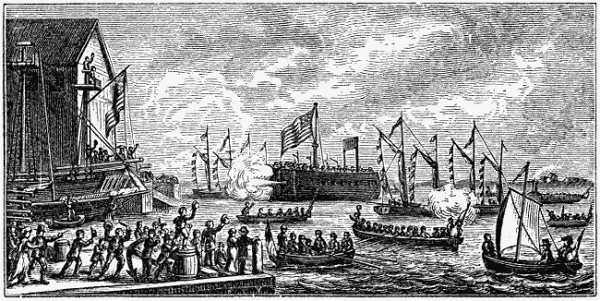
Fig. 82.—Launch of the “Fulton the First,” 1804.
The construction of the vessel was authorized by Congress
in March, 1814; the keel was laid June 20, 1814, and
the vessel was launched October 29th of the same year.
The “Fulton the First,” as she was called, was considered
an enormous vessel at that time. The hull was double, 156
feet long, 56 feet wide, and 20 feet deep, measuring 2,475
tons. In the following May the ship was ready for her
engine, and in July was so far completed as to steam, on
a trial-trip, to the ocean at Sandy Hook and back—53 miles—in
8 hours and 20 minutes. In September of the same
year, with armament and stores on board, the same route
was traversed again, the vessel making 51∕2 miles an hour.
The vessel, as thus completed, had a double hull, each
about 20 feet longer than the Clermont, and separated by a
space 15 feet across. Her engine, having a steam-cylinder
48 inches in diameter and of 5 feet stroke of piston, was
furnished with steam by a copper boiler 22 feet long, 12
feet wide, and 8 feet high, and turned a wheel between the
two hulls which was 16 feet in diameter, and carried
“floats” or “buckets” 14 feet long, and with a dip of 4
feet. The engine was in one of the two hulls, and the
boiler in the other. The sides, at the gun-deck, were 4 feet
10 inches thick, and her spar-deck was surrounded by heavy
musket-proof bulwarks. The armament consisted of 30
32-pounders, which were intended to discharge red-hot
shot. There was one heavy mast for each hull, fitted with
large latteen sails. Each end of each hull was fitted with
a rudder. Large pumps were carried, which were intended
to throw heavy streams of water upon the decks of the enemy,
with a view to disabling the foe by wetting his ordnance
and ammunition. A submarine gun was to have
been carried at each bow, to discharge shot weighing 100
pounds, at a depth of 10 feet below the water-line.
This was the first application of the steam-engine to
naval purposes, and, for the time, it was an exceedingly
creditable one. Fulton, however, did not live to see the
ship completed. He was engaged in a contest with Livingston,
who was then endeavoring to obtain permission
from the State of New Jersey to operate a line of steamboats
in the waters of the Hudson River and New York
Bay, and, while returning from attending a session of the
Legislature at Trenton, in January, 1815, was exposed to
the weather on the bay at a time when he was ill prepared
to withstand it. He was taken ill, and died February 24th of
that year. His death was mourned as a national calamity.
From the above brief sketch of this distinguished man
and his work, it is seen that, although Robert Fulton is not
entitled to distinction as an inventor, he was one of the
ablest, most persistent, and most successful of those who
have done so much for the world by the introduction of the
inventions of others. He was an intelligent engineer and
an enterprising business-man, whose skill, acuteness, and
energy have given the world the fruits of the inventive
genius of all who preceded him, and have thus justly
earned for him a fame that can never be lost.
Fulton had some active and enterprising rivals.
Oliver Evans had, in 1801 or 1802, sent one of his engines,
of about 150 horse-power, to New Orleans, for the
purpose of using it to propel a vessel owned by Messrs.
McKeever and Valcourt, which was there awaiting it. The
engine was actually set up in the boat, but at a low stage
of the river, and no trial could be made until the river
should again rise, some months later. Having no funds to
carry them through so long a period, Evans’s agents were
induced to remove the engine again, and to set it up in a
saw-mill, where it created great astonishment by its extraordinary
performance in sawing lumber.
Livingston and Roosevelt were also engaged in experiments
quite as early as Fulton, and perhaps earlier.
The prize gained by Fulton was, however, most closely
contested by Colonel John Stevens, of Hoboken, who has
been already mentioned in connection with the early history
of railroads, and who had been since 1791 engaged in
similar experiments. In 1789 he had petitioned the Legislature
of the State of New York for a grant similar to that
accorded to Livingston, and he then stated that his plans
were complete, and on paper.
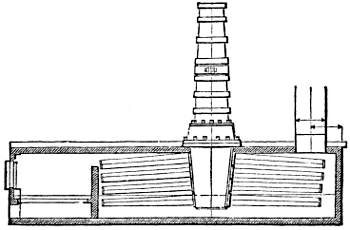
Fig. 83.—Section of Steam-Boiler, 1804.
In 1804, while Fulton was in Europe, Stevens had completed
a steamboat, 68 feet long and of 14 feet beam, which
combined novelties and merits of design in a manner that
exhibited the best possible evidence of remarkable inventive
talent, as well as of the most perfect appreciation of the
nature of the problem which he had proposed to himself to
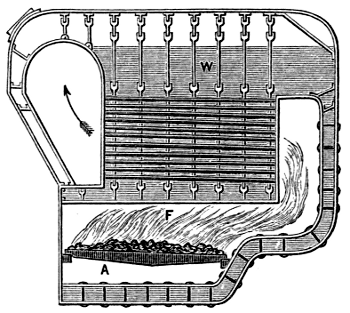
solve. Its boiler (Fig. 83) was of what is now known as the
water-tubular variety. It was quite similar to some now
known as sectional boilers, and contained 100 tubes 2 inches
in diameter and 18 inches long, each fastened at one end to
a central water-leg and steam-drum, and plugged at the
other end. The flames from the furnace passed around and
among the tubes, the water being inside them. The engine
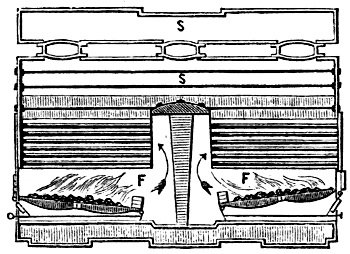
(Fig. 84) was a direct-acting high-pressure condensing engine,
having a 10-inch cylinder, 2 feet stroke of piston, and
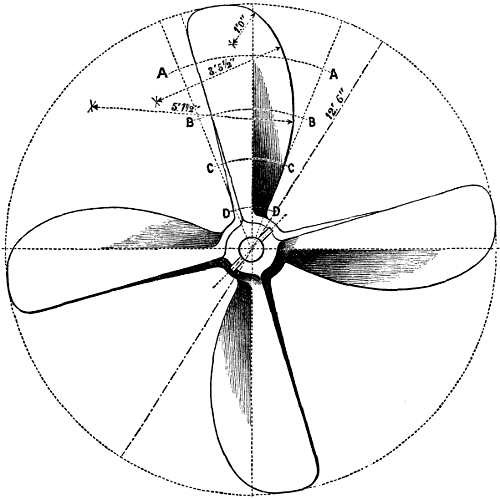
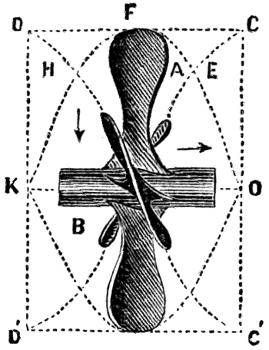
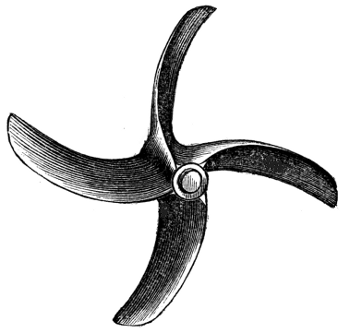
drove a screw having four blades, and of a form which, even
to-day, appears quite good. The whole is a most remarkable
piece of early engineering.
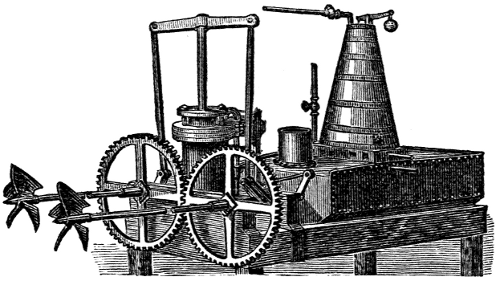
Fig. 84.—Engine, Boiler, and Screw-Propellers used by Stevens, 1804.
A model of this little steamer, built in 1804, is preserved
in the lecture-room of the Department of Mechanical Engineering
at the Stevens Institute of Technology; and the
machinery itself, consisting of the high-pressure “sectional”
or “safety” tubular boiler, as it would be called to-day, the
high-pressure condensing engine, with rotating valves, and
twin screw-propellers, as just described, is given a place of
honor in the model-room, or museum, where it contrasts
singularly with the mechanism contributed to the collection
by manufacturers and inventors of our own time. The hub
and blade of a single screw, also used with the same machinery,
is likewise to be seen there.
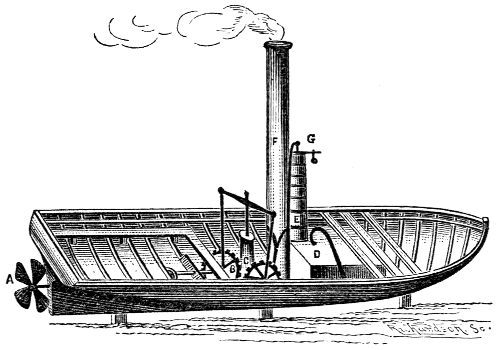
Fig. 85.—Stevens’s Screw Steamer, 1804.
Stevens seems to have been the first to fully recognize
the importance of the principle involved in the construction
of the sectional steam-boiler. His eldest son, John Cox
Stevens, was in Great Britain in the year 1805, and, while
there, patented another modification of this type of boiler.
In his specification, he details both the method of construction
and the principles which determine its form. He says
that he describes this invention as it was made known to
him by his father, and adds:
“From a series of experiments made in France, in 1790,
by M. Belamour, under the auspices of the Royal Academy
of Sciences, it has been found that, within a certain range
the elasticity of steam is nearly doubled by every addition
of temperature equal to 30° of Fahrenheit’s thermometer.
These experiments were carried no higher than 280°, at
which temperature the elasticity of steam was found equal
to about four times the pressure of the atmosphere. By
experiments which have lately been made by myself, the
elasticity of steam at the temperature of boiling oil, which
has been estimated at about 600°, was found to equal 40
times the pressure of the atmosphere.
“To the discovery of this principle or law, which obtains
when water assumes a state of vapor, I certainly
can lay no claim; but to the application of it, upon certain
principles, to the improvement of the steam-engine, I do
claim exclusive right.
“It is obvious that, to derive advantage from an application
of this principle, it is absolutely necessary that
the vessel or vessels for generating steam should have
strength sufficient to withstand the great pressure from an
increase of elasticity in the steam; but this pressure is increased
or diminished in proportion to the capacity of the
containing vessel. The principle, then, of this invention
consists in forming a boiler by means of a system, or combination
of a number of small vessels, instead of using, as
in the usual mode, one large one; the relative strength of
the materials of which these vessels are composed increasing
in proportion to the diminution of capacity. It will
readily occur that there are an infinite variety of possible
modes of effecting such combinations; but, from the nature
of the case, there are certain limits beyond which it becomes
impracticable to carry on improvement. In the boiler I am
about to describe, I apprehend that the improvement is carried
to the utmost extent of which the principle is capable.
Suppose a plate of brass of one foot square, in which a
number of holes are perforated; into each of which holes is
fixed one end of a copper tube, of about an inch in diameter
and two feet long; and the other ends of these tubes
inserted in like manner into a similar piece of brass; the
tubes, to insure their tightness, to be cast in the plates;
these plates are to be inclosed at each end of the pipes by
a strong cap of cast-iron or brass, so as to leave a space of
an inch or two between the plates or ends of the pipes and
the cast-iron cap at each end; the caps at each end are to
be fastened by screw-bolts passing through them into the
plates; the necessary supply of water is to be injected by
means of a forcing-pump into the cap at one end, and
through a tube inserted into the cap at the other end the
steam is to be conveyed to the cylinder of the steam-engine;
the whole is then to be encircled in brickwork or masonry
in the usual manner, placed either horizontally or perpendicularly,
at option.
“I conceive that the boiler above described embraces
the most eligible mode of applying the principle before
mentioned, and that it is unnecessary to give descriptions
of the variations in form and construction that may be
adopted, especially as these forms may be diversified in
many different modes.”
Boilers of the character of those described in the specification
given above were used on the locomotive built by
John Stevens in 1824-’25, and one of them remains in the
collections of the Stevens Institute of Technology.
The use of such a boiler 70 years ago is even more remarkable
than the adoption of the screw-propeller, in such
excellent proportions, 30 years before the labors of Smith
and of Ericsson brought the screw into general use; and
we have, in this strikingly original combination, as good
evidence of the existence of unusual engineering talent in
this great engineer as we found of his political and statesmanlike
ability in his efforts to forward the introduction of
railways.
Colonel John Stevens designed a peculiar form of iron-clad
in the year 1812, which has been since reproduced by
no less distinguished and successful an engineer than the
late John Elder, of Glasgow, Scotland. It consisted of a
saucer-shaped hull, carrying a heavy battery, and plated
with iron of ample thickness to resist the shot fired from
the heaviest ordnance then known. This vessel was secured
to a swivel, and was anchored in the channel to be defended.
A set of screw-propellers, driven by steam-engines, and situated
beneath the vessel, where they were safe against
injury by shot, were so arranged as to permit the vessel to
be rapidly revolved about its centre. As each gun was
brought into line of fire, it was discharged, and was then
reloaded before coming around again. This was probably
the earliest embodiment of the now well-established “Monitor”
principle. It was probably the first iron-clad ever
designed. It has recently been again brought out and introduced
into the Russian navy, and is there called the
“Popoffka.”
The first of Stevens’s boats performed so well, that he
immediately built another one, using the same engine as
before, but employing a larger boiler, and propelling the
vessel by twin screws, the latter being another instance of
his use of a device brought forward long afterward as new,
and frequently adopted. This boat was sufficiently successful
to prove the practicability of making steam-navigation a
commercial success; and Stevens, assisted by his sons, built
a boat which he named the “Phœnix,” and made the first
trial in 1807, but just too late to anticipate Fulton. This
boat was driven by paddle-wheels.
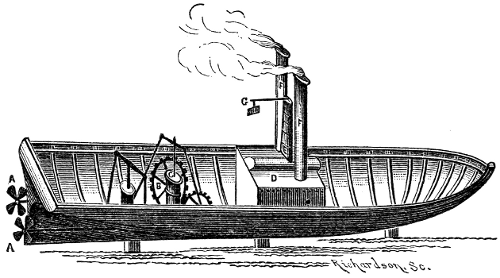
Fig. 86.—Stevens’s Twin-Screw Steamer, 1805.
The Phœnix, being shut out of the waters of the State
of New York by the monopoly held by Fulton and Livingston,
was used for a time between New York and New
Brunswick, and then, anticipating a better pecuniary return,
it was concluded to send her to Philadelphia, to ply on the
Delaware.
At that time no canal offered the opportunity to make
an inland passage; and in June, 1808, Robert L. Stevens,
a son of John, started with her to make the passage by sea.
Although meeting a gale of wind, he arrived at Philadelphia
safely, having been the first to trust himself on the
open sea in a vessel relying entirely upon steam-power.
From this time forward the Stevenses, father and sons,
continued to construct steam-vessels; and, after the breaking
down of the Fulton monopoly by the courts, they built
the most successful steamboats that ran on the Hudson
River.
After Fulton and Stevens had thus led the way, steam-navigation
was introduced very rapidly on both sides of the
ocean; and on the Mississippi the number of boats set afloat
was soon large enough to fulfill Evans’s prediction that the
navigation of that river would ultimately be effected by
steam-vessels.
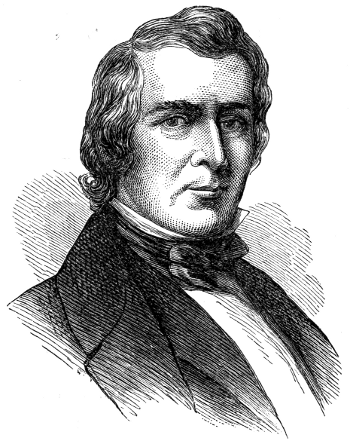
Robert L. Stevens.
The changes and improvements which, during the 20
years succeeding the time of Fulton and of John Stevens,
gradually led to the adoption of the now recognized type
of “American river-boat” and its steam-engine, were principally
made by that son of the senior Stevens, who has
already been mentioned—Robert L. Stevens—and who
became known later as the designer and builder of the first
well-planned iron-clad ever constructed, the Stevens Battery.
Much of his best work was done during his father’s
lifetime.
He made many extended and most valuable, as well
as interesting, experiments on ship-propulsion, expending
much time and large sums of money upon them; and many
years before they became generally understood, he had arrived
at a knowledge not only of the laws governing the
variation of resistance at excessive speeds, but he had determined,
and had introduced into his practice, those forms
of least resistance and those graceful water-lines which have
only recently distinguished the practice of other successful
naval architects.
Referring to his invaluable services, President King,
who seems to have been the first to thoroughly appreciate
the immense amount of original invention and the surprising
excellence of the engineering of this family, in a lecture
delivered in New York in 1851, gave, for the first time, a
connected and probably accurate description of their work,
upon which nearly all later accounts have been based.
Young Stevens began working in his father’s machine-shop
in 1804 or 1805, when a mere boy, and thus acquired
at a very early age that familiarity with practical details of
work and of business which is essential to perfect success.
It was he who introduced the now common “hollow water-line”
in the Phœnix, and thus anticipated the claims of the
builders of the once famous “Baltimore clippers,” and of
the inventors of the “wave-line” form of vessels. In the
same vessel he adopted a feathering paddle-wheel and the
guard-beam now universally seen in our river steamboats.
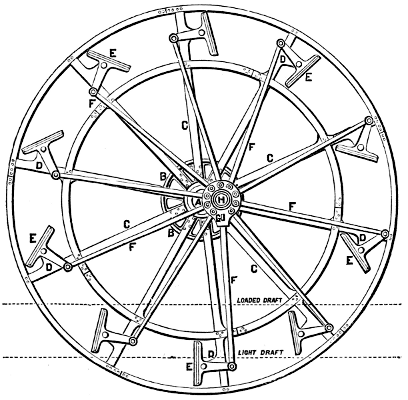
Fig. 87.—The Feathering Paddle-Wheel.
As usually constructed, this arrangement of float is as
shown in Fig. 87. The rods, F F, connect the eccentrically-set
collar, G, carried on H, a pin mounted on the paddle-beam
outside the wheel, or an eccentric secured to the
vessel, with the short arms, D D, by which the paddles are
turned upon the pins, E E. A is the centre of the paddle-wheel,
and C C are arms. Circular hoops, or bands, connect
all of the arms, each of which carries a float. They
are all thus tied together, forming a very firm and powerful
combination to resist external forces.
The steamboat Philadelphia was built in the year 1813,
and the young naval architect took advantage of the opportunity
to introduce several new devices, including screw-bolts
in place of tree-nails, and diagonal knees of wood and
of iron. Two years later he altered the engines of this boat,
and arranged them to work steam expansively. A little
later he commenced using anthracite coal, which had been
discovered in 1791 by Philip Ginter, and introduced at
Wilkesbarre, Pa., in the smith-shops, some years before the
Revolution. It had been used in a peculiar grate devised by
Judge Fell, of that town, in 1808. Oliver Evans also had
used it in stoves even earlier than the latter date, and at
about the same time it had been used in the blast-furnace[81]
at Kingston. Stevens was the first of whom we have record
who was thoroughly successful in using, as a steam-coal,
the new and almost unmanageable fuel. He fitted up the
boiler of the steamboat Passaic for it in 1818, and adopted
anthracite as a steaming-coal. He used it in a cupola-furnace
in the same year, and its use then rapidly became general
in the Eastern States.
Stevens continued his work of improving the beam-engine
for many years. He designed the now universally-used
“skeleton-beam,” which is one of the characteristic features
of the American engine, and placed the first example of this
light and elegant, yet strong, construction on the steamer
Hoboken in the year 1822. He built the Trenton, which was
then considered an extraordinarily powerful, fast, and handsome
vessel, two years afterward, and placed the two boilers
on the guards—a custom which is still general on the river
steamboats of the Eastern States. In this vessel he also
adopted the plan of making the paddle-wheel floats in two
parts, placing one above the other, and securing the upper
half on the forward and the lower half on the after side of
the arm, thus obtaining a smoother action of the wheel,
and less loss by oblique pressures.
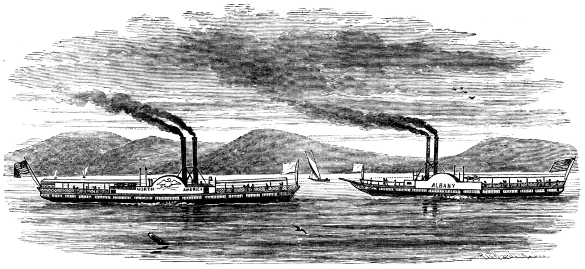
Fig. 88.—The North America and Albany, 1827-’30.
In 1827 he built the North America (Fig. 88), one of
his largest and most successful steamers, a vessel fitted with
a pair of engines each 441∕2 inches in diameter of cylinder
and 8 feet stroke of piston, making 24 revolutions per minute,
driving the boat 15 to 16 miles an hour. Anticipating
difficulty in keeping the long, light, shallow vessel in shape
when irregularly laden, and when steaming at the high
speed expected to be obtained when her powerful engine
was exerting its maximum effort, he adopted the expedient
of stiffening the hull by means of a truss of simple form.
This proved thoroughly satisfactory, and the “hog-frame,”
as it has since been inelegantly but universally called, is
still one of the peculiar features of every American river-steamer
of any considerable size. It was in the North
America, also, that he first introduced the artificial blast
for forcing the fires, which is still another detail of now
usual practice.
Stevens next turned his attention to the engine again,
and adopted spring bearings under the paddle-shaft of the
New Philadelphia in 1828, and fitted the steam-cylinder
with the “double-poppet” valve, which is now universally
used on beam-engines. This consists of two disk-valves,
connected by the valve-spindle. The disks are of unequal
sizes, the smaller passing through the seat of the larger.
When seated, the pressure of the steam is, in the steam-valve,
taken on the upper side of the larger and the lower
side of the smaller disk, thus producing a partial balancing
of the valve, and rendering it easy to work the heaviest engine
by the hand-gear. The two valve-seats are formed in
the top and the bottom, respectively, of the steam-passage
leading to the cylinder; and when the valve is raised, the
steam enters at the top and the bottom at the same time,
and the two currents, uniting, flow together into the steam-cylinder.
The same form of valve is used as an exhaust-valve.
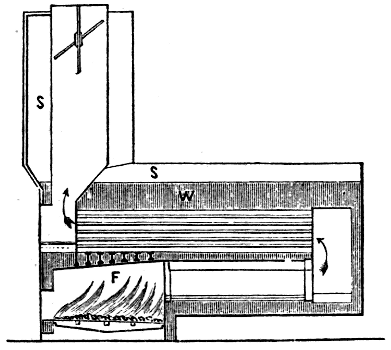
Fig. 89.—Stevens’s Return Tubular Boiler, 1832.
At about the same time he built the now standard form
of return tubular boilers for moderate pressures. In the
figure, S is the steam and W the water space, and F the
furnace. The direction of the currents of smoke and gas
are shown by the arrows.
Some years later (1840), Stevens commenced using
steam-packed pistons on the Trenton, in which steam was
admitted by self-adjusting valves behind the metallic packing-rings,
setting them out more effectively than did the
steel springs then (and still) usually employed.
His pistons, thus fitted, worked well for many years. A
set of the small brass check-valves used in a piston of this
kind, built by Stevens, and preserved in the cabinets of the
Stevens Institute of Technology, are good evidence of the
ingenuity and excellent workmanship which distinguished
the machinery constructed under the direction of this great
engineer.
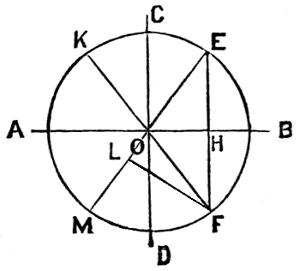
Fig. 90.—Stevens’s Valve-Motion.
The now familiar “Stevens cut-off,” a peculiar device
for securing the expansion of steam in the steam-cylinder,
was the invention (1841) of Robert L. Stevens and a nephew,
who inherited the same constructive talent which distinguished
the first of these great men—Mr. Francis B. Stevens.
In this form of valve-gear, the steam and exhaust
valves are independently worked by separate eccentrics, the
latter being set in the usual manner, opening and closing
the exhaust-passages just before the crank passes its centre.
The steam-eccentric is so placed that the steam-valve is
opened as usual, but closed when but about one-half the
stroke has been made. This result is accomplished by giving
the eccentric a greater throw than
is required by the motion of the valve,
and permitting it to move through a
portion of its path without moving the
valve. Thus, in Fig. 90, if A B be the
direction of motion of the eccentric-rod,
the valve would ordinarily open
the steam-port when the eccentric assumes
the position O C, closing when
the eccentric has passed around to O D. With the Stevens
valve-gear, the valve is opened when the eccentric reaches
O E, and closes when it arrives at O F. The steam-valve
of the opposite end of the cylinder is open while the eccentric
is moving from O M to O K. Between K and E,
and
between F and M, both valves are seated. H B is proportional
to the lift of the valve, and O H to the motion of
the valve-gear when out of contact with the valve-lifters.
While the crank is moving through an arc, E F, steam is
entering the cylinder; from F to M the steam is expanding.
At M the stroke is completed, and the other steam-valve
opens. The ratio E M∕E L is the ratio of expansion.
This form of cut-off motion is still a very usual one,
and can be seen in nearly all steamers in the United States
not using the device of Sickles. It was at about this time,
also, that Stevens, having succeeded his father in the business
of introducing the steam-engine in land-transportation,
as well as on the water, adopted the use of steam expansively
on the locomotives of the Camden & Amboy Railroad,
which was controlled and built by capital furnished principally
by the Messrs. Stevens. He at the same time constructed
eight-wheeled engines for heavy work, and adopted
anthracite coal as fuel. In the latter change he was thoroughly
successful, and the same improvement was made
with engines built for fast traffic in 1848.
The most remarkable of all the applications of steam-power
proposed by Robert L. Stevens was that known as
the Stevens Steam Iron-Clad Battery. As has already been
stated, Colonel John Stevens had proposed, as early as 1812,
to build a circular or saucer-shaped iron-clad, like those
built 60 years later for the Russian Navy. Nothing was
done, however, although the son revived the idea in a modified
form 20 years afterward. In the years 1813-’14, the
war with England being then in progress, he invented,
after numerous and hazardous experiments, an elongated
shell, to be fired from ordinary smooth-bored cannon. Having
perfected this invention, he sold the secret to the
United States, after making experiments to prove their destructiveness
so decisive as to leave no doubt of the efficacy
of such projectiles.
As early as 1837 he had perfected a plan of an iron-clad
war-vessel, and in August, 1841, his brothers, James C. and
Edwin A. Stevens, representing Robert L., addressed a
letter to the Secretary of the Navy, proposing to build an
iron-clad vessel of high speed, with all its machinery below
the water-line, and having submerged screw-propellers.
The armament was to consist of the most powerful rifled
guns, loading at the breech, and provided with elongated
shot and shell. In the year 1842, having contracted to build
for the United States Government a large war-steamer on
this plan, which should be shot and shell proof, Robert L.
Stevens built a steamboat at Bordentown, for the sole purpose
of experimenting on the forms and curves of propeller-blades,
as compared with side-wheels, and continued his experiments
for many months. After some delay, during
which Mr. Stevens and his brothers were engaged with their
experiments and in perfecting their plans, the keel of an
iron-clad was laid down in a dry-dock which had been constructed
for the purpose at great cost. This vessel was to
have been 250 feet long, of 40 feet beam, and 28 feet deep.
The machinery was designed to furnish 700 indicated horse-power.
The plating was proposed to be 41∕2 inches thick—the
same thickness of armor as was adopted 10 years later
by the French for their comparatively rude constructions.
In 1854, such marked progress had been made in the
construction of ordnance that Mr. Stevens was no longer
willing to proceed with the original plans, fearing that,
were the ship completed, it might prove not invulnerable,
and might throw some discredit upon its designer, as well
as upon the navy of which it was to form a part. The
work, which had, in those years of peace, progressed very
slowly and intermittently, was therefore stopped entirely,
the vessel given up, and in 1854 the keel of a ship of vastly
greater size and power was laid down. The new design
was 415 feet long, of 45 feet beam, and of something over
5,000 tons displacement. The thickness of armor proposed
was 63∕4
inches—21∕4 inches thicker than that of the first
French and British iron-clads—and the machinery was designed
by Mr. Stevens to be of 8,624 indicated horse-power,
driving twin-screws, and propelling the vessel 20 miles or
more an hour. As with the preceding design, the progress
of construction was intermittent and very slow. Government
advanced funds, and then refused to continue the
work; successive administrations alternately encouraged
and discouraged the engineer; and he finally, cutting loose
entirely from all official connections, went on with the work
at his own expense.
The remarkable genius of the elder Stevens was well
reflected in the character of his son, and is in no way better
exemplified than by the accuracy with which, in this great
ship, those forms and proportions, both of hull and machinery,
were adopted which are now, twenty-five years later,
recognized as most correct under similar conditions. The
lines of the vessel are beautifully fair and fine, and are what
J. Scott Russell has called “wave-lines,” or trochoidal lines,
such as Rankine has shown to be the best possible for easy
propulsion. The proportion of length to midship dimensions
is such as to secure the speed proposed with a minimum
resistance, and to accord closely with the proportions
arrived at and adopted by common consent in present
transoceanic navigation by the best—not to say radical—builders.
The death of Robert L. Stevens occurred in April, 1856,
when this larger vessel had advanced so far toward completion
that the hull and machinery were practically finished,
and it only remained to add the armor-plating, and to decide
upon the form of fighting-house and upon the number
and size of guns. The construction of the vessel, which had
proceeded slowly and intermittently during the years of
peace, as successive administrations had considered it necessary
to continue the payment of appropriations, or had
stopped temporarily in the absence of any apparent immediate
necessity for continuance of the work, was again interrupted
by his death.
The name of Robert L. Stevens will be long remembered
as that of one of the greatest of American mechanics, the
most intelligent of naval architects, and as the first, and
one of the greatest, of those to whom we are indebted for
the commencement of the mightiest of revolutions in the
methods and implements of modern naval warfare. American
mechanical genius and engineering skill have rarely
been too promptly recognized, and no excuse will be required
for an attempt (which it is hoped may yet be made)
to place such splendid work as that of the Messrs. Stevens
in a light which shall reveal both its variety and extent and
its immense importance.
While Fulton was introducing the steamboat upon the
waters of New York Bay and the Hudson River, and while
the Stevenses, father and sons, were rapidly bringing out a
fleet of steamers on the Delaware River and Bay, other
mechanics were preparing to contest the field with them as
opportunity offered, and as legislative acts authorizing monopoly
expired by limitation or were repealed.
About 1821, Robert L. Thurston, John Babcock, and
Captain Stephen T. Northam, of Newport, R. I., commenced
building steamboats, beginning with a small craft
intended for use at Slade’s Ferry, on an arm of Narragansett
Bay, near Fall River. They afterward built vessels to
ply on Long Island Sound. One of their earliest boats was
the Babcock, built at Newport in 1826. The engine was
built by Thurston and Babcock, at Portsmouth, R. I.
They were assisted in their work by Richard Sanford, and
with funds by Northam. The engine was of 10 or 12
inches diameter of cylinder, and 3 or 4 feet stroke of piston.
The boiler was a form of “pipe-boiler,” subsequently
(1824) patented by Babcock. The water used was injected
into the hot boiler as fast as required to furnish steam, no
water being retained in the steam-generator. This boat
was succeeded, in 1827-’28, by a larger vessel, the Rushlight,
for which the engine was built by James P. Allaire,
at New York, while the boat was built at Newport. The
boilers of both vessels had tubes of cast-iron. The smaller
of these boats was of 80 tons burden; it steamed from
Newport to Providence, 30 miles, in 31∕2 hours, and to New
York, a distance of 175 miles, in 25 hours, using 13∕4 cord
of wood.[82]
Thurston and Babcock subsequently removed
to Providence, where the latter soon died. Thurston continued
to build steam-engines at this place until nearly a
half-century later, dying in 1874.[83] The establishment
founded by him, after various changes, became the Providence
Steam-Engine Works.
James P. Allaire, of New York, the West Point Iron
Foundery, at West Point, on the Hudson River, and Daniel
Copeland and his son, Charles W. Copeland, on the
Connecticut River, were also early builders of engines for
steam-vessels. Daniel Copeland was probably the first
(1850) to adopt a slide-valve working with a lap to secure
the expansion of steam. His steamboats were then usually
stern-wheel vessels, and were built to ply on several routes
on the Connecticut River and Long Island Sound. The
son, Charles W. Copeland, went to West Point, and while
there designed some heavy marine steam-machinery, and
subsequently designed several steam vessels-of-war for the
United States Navy. He was the earliest designer of iron
steamers in the United States, building the Siamese in 1838.
This steamer was intended for use on Lake Pontchartrain
and the canal to New Orleans. It had two hulls, was 110
feet long, and drew but 22 inches of water, loaded. The
two horizontal non-condensing engines turned a single
paddle-wheel placed between the two hulls, driving the
boat 10 miles an hour. The hull was constructed of plates
of iron 10 feet long, formed on blocks after having been
heated in a furnace constructed especially for the purpose.
The frames were of T-iron, which was probably here used
for the first time. The same engineer, associated with Samuel
Hart, a well-known naval constructor, built, in 1841, for
the United States Navy, the iron steamer Michigan, a war-vessel
intended for service on the great northern lakes.
This vessel is still in service, and in good order. The hull
is 1621∕2 feet in length, 27 feet in breadth,
and 121∕2 feet in
depth, measuring 500 tons. The frames were made of
T-iron, stiffened by reverse bars of L-iron. The keel-plate
was 5∕8 inch thick, the bottom plates
3∕8, and the sides
3∕16 inch.
The deck-beams were of iron, and the vessel, as a whole,
was a good specimen of iron-ship building.
During the period from 1830 to 1840, a considerable
number of the now standard details of steam-engine and
steamboat construction were devised or introduced by Copeland.
He was probably the first to use (on the Fulton, 1840)
an independent engine to drive the blowing-fans where an
artificial draught was required. He made a practice of
fitting his steamers with a “bilge-injection,” by means of
which the vessel could be freed of water, through the condenser
and air-pump, when leaking seriously; the condensing-water
is, in such a case, taken from inside the vessel,
instead of from the sea. This is probably an American device.
It was in use in the United States previously to 1835,
as was the use of anthracite coal on steamers, which was continued
by Copeland in manufacturing and in air-furnaces, as
well as on steamboats. He also modified the form of Stevens’s
double-poppet valve, giving it such shape that it was comparatively
easy to grind it tight and to keep it in order.
In 1825, James P. Allaire, of New York, built compound
engines for the Henry Eckford, and subsequently
constructed similar engines for several other steamers, one
of which, the Sun, made the trip from New York to Albany
in 12 hours 18 minutes. He used steam at 100 pounds
pressure. Erastus W. Smith afterward introduced this
form of engine on the Great Lakes, and still later they were
introduced into British steamers. The machinery of the
steamer Buckeye State was constructed at the Allaire
Works, New York, in 1850, from the designs of John
Baird and Erastus W. Smith, the latter being the designing
and constructing engineer. The steamer was placed
on the route between Buffalo, Cleveland, and Detroit, in
1851, and gave most satisfactory results, consuming less
than two-thirds the fuel required by a similar vessel of the
same line fitted with the single-cylinder engine. The steam-cylinders
of this engine were placed one within the other,
the low-pressure exterior cylinder being annular. They
were 37 and 80 inches in diameter respectively, and the
stroke was 11 feet. Both pistons were connected to one
cross-head, and the general arrangement of the engine was
similar to that of the common form of beam-engine. The
steam-pressure was from 70 to 75 pounds—about the maximum
pressure adopted a quarter of a century later on transatlantic
lines. This steamer was of high speed, as well as
economical of fuel.
In the year 1830, there were 86 steamers on the Hudson
River and in Long Island Sound.
During the early part of the nineteenth century, the
introduction of the steamboat upon the waters of the great
rivers of the interior of the United States was one of the
most notable details of its history. Inaugurated by the
unsuccessful experiment of Evans, the building of steamboats
on those waters, once commenced, never ceased; and
a generation after Fitch’s burial on the shore of the Ohio,
his last wish—that he might lie “where the song of the
boatman would enliven the stillness of his resting-place, and
the music of the steam-engine soothe his spirit”—was fulfilled
day by day unceasingly.
Nicholas J. Roosevelt was, as has been already stated,
the first to take a steamboat down the great rivers. His
boat was built at Pittsburgh in 1811, under an arrangement
with Fulton and Livingston, from Fulton’s plans. It was
called the “New Orleans,” was of about 200 tons burden,
and was propelled by a stern-wheel, assisted, when the
winds were favorable, by sails carried on two masts. The
hull was 138 feet long, 30 feet beam, and the cost of the
whole, including engines, was about $40,000. The builder,
with his family, an engineer, a pilot, and six “deck-hands,”
left Pittsburgh in October, 1811, reaching Louisville in 70
hours (steaming about 10 miles an hour), and New Orleans
in 14 days, steaming from Natchez.
The next steamers built on Western waters were probably
the Comet and the Vesuvius, both of which were in
service some time. The Comet was finally laid aside, and
the engine used to drive a mill, and the Vesuvius was destroyed
by the explosion of her boilers. As early as 1813
there were two shops at Pittsburgh building steam-engines.
Steamboat-building now became an important and lucrative
business in the West; and it is stated that as early as 1840
there were a thousand steamers on the Mississippi and its
tributaries.
In the Washington, built at Wheeling, Va., in 1816,
under the direction of Captain Henry M. Shreve, the boilers,
which had previously been placed in the hold, were
carried on the main-deck, and a “hurricane-deck” was
built over them. Shreve substituted two horizontal direct-acting
engines for the single upright engine used by Fulton,
drove them by high-pressure steam without condensation,
and attached them, one on each side the boat, to
cranks placed at right angles. He adopted a cam cut-off
expanding the steam considerably, and the flue-boiler of
Evans. At that time the voyage from New Orleans to
Louisville occupied three weeks, and Shreve was made the
subject of many witticisms when he predicted that the time
would ultimately be shortened to ten days. It is now made
in four days. The Washington was seized at New Orleans,
in 1817, by order of Livingston, who claimed that his rights
included the monopoly of the navigation of the Mississippi
and its tributaries. The courts decided adversely on this
claim, and the release of the Washington was the act which
removed every obstacle to the introduction of steam-navigation
throughout the United States.
The first steamer on the Great Lakes was the Ontario,
built in 1816, at Sackett’s Harbor. Fifteen years later,
Western steamboats had taken the peculiar form which has
since usually distinguished them.
The use of the steam-engine for ocean-navigation kept
pace with its introduction on inland waters. Begun by
Robert L. Stevens in the United States, in the year 1808,
and by his contemporaries, Bell and Dodd, in Great Britain,
it steadily and rapidly advanced in effectiveness and importance,
and has now nearly driven the sailing fleet from the
ocean. Transatlantic steam-navigation began with the voyage
of the American steamer Savannah from Savannah, Ga.,
to St. Petersburg, Russia, via Great Britain and the North-European
ports, in the year 1819. Fulton, not long before
his death, planned a vessel, which it was proposed to place
in service in the Baltic Sea; but circumstances compelled a
change of plan finally, and the steamer was placed on a
line between Newport, R. I., and the city of New York;
and the Savannah, several years later, made the voyage then
proposed for Fulton’s ship. The Savannah measured 350
tons, and was constructed by Crocker & Fickett, at Corlears
Hook, N. Y. She was purchased by Mr. Scarborough, of
Savannah, who placed Captain Moses Rogers, previously in
command of the Clermont and of Stevens’s boat, the Phœnix,
in charge. The ship was fitted with steam-machinery
and paddle-wheels, and sailed for Savannah April 27, 1819,
making the voyage successfully in seven days. From Savannah,
the vessel sailed for Liverpool May 26th, and arrived
at that port June 20th. During this trip the engines
were used 18 days, and the remainder of the voyage was
made under sail. From Liverpool the Savannah sailed,
July 23d, for the Baltic, touching at Copenhagen, Stockholm,
St. Petersburg, and other ports. At St. Petersburg,
Lord Lyndock, who had been a passenger, was landed; and,
on taking leave of the commander of the steamer, the distinguished
guest presented him with a silver tea-kettle, suitably
inscribed with a legend referring to the importance of
the event which afforded him the opportunity. The Savannah
left St. Petersburg in November, passing New York
December 9th, and reaching Savannah in 50 days from the
date of departure, stopping four days at Copenhagen, Denmark,
and an equal length of time at Arundel, Norway.
Several severe gales were met in the Atlantic, but no serious
injury was done to the ship.
The Savannah was a full-rigged ship. The wheels
were turned by an inclined direct-acting low-pressure engine,
having a steam-cylinder 40 inches in diameter and 6
feet stroke of piston. The paddle-wheels were of wrought-iron,
and were so attached that they could be detached and
hoisted on board when it was desired. After the return of
the ship to the United States, the machinery was removed
and was sold to the Allaire Works, of New York. The
steam-cylinder was exhibited by the purchasers at the
“World’s Fair” at New York thirty years later. The vessel
was employed, as a sailing-vessel, on a line between
New York and Savannah, and was finally lost in the year
1822. Under sail, with a moderate breeze, this ship is said
to have sailed about three knots, and to have steamed five
knots. Pine-wood was used as the fuel, which fact accounts
for the necessity of making the transatlantic voyage partly
under sail.
Renwick states that another vessel, ship-rigged and
fitted with a steam-engine, was built at New York in 1819,
to ply between New York and Charleston, and to New Orleans
and Havana, and that it proved perfectly successful
as a steamer, having good speed, and proving an excellent
sea-boat. The enterprise was, however, pecuniarily a failure,
and the vessel was sold to the Brazilian Government
after the removal of the engine. In 1825 the steamer Enterprise
made a voyage to India, sailing and steaming as
the weather and the supply of fuel permitted. The voyage
occupied 47 days.
Notwithstanding these successful passages across the
ocean, and the complete success of the steamboat in rivers
and harbors, it was asserted, as late as 1838, by many who
were regarded as authority, that the passage of the ocean
by steamers was quite impracticable, unless possibly they
could steam from the coasts of Europe to Newfoundland or
to the Azores, and, replenishing their coal-bunkers, resume
their voyages to the larger American ports. The voyage
was, however, actually accomplished by two steamers in
the year just mentioned. These were the Sirius, a ship of
700 tons and of 250 horse-power, and the Great Western,
of 1,340 tons and 450 horse-power. The latter was built
for this service, and was a large ship for that time, measuring
236 feet in length. Her wheels were 28 feet in diameter,
and 10 feet in breadth of face. The Sirius sailed from
Cork April 4, 1838, and the Great Western from Bristol
April 8th, both arriving at New York on the same day—April
23d—the Sirius in the morning, and the Great Western
in the afternoon.
The Great Western carried out of Bristol 660 tons of
coal. Seven passengers chose to take advantage of the opportunity,
and made the voyage in one-half the time usually
occupied by the sailing-packets of that day. Throughout
the voyage the wind and sea were nearly ahead, and
the two vessels pursued the same course, under very similar
conditions. Arriving at New York, they were received
with the greatest possible enthusiasm. They were saluted
by the forts and the men-of-war in the harbor; the merchant-vessels
dipped their flags, and the citizens assembled
on the Battery, and, coming to meet them in boats of all
kinds and sizes, cheered heartily. The newspapers of the
time were filled with the story of the voyage and with descriptions
of the steamers themselves and of their machinery.
A few days later the two steamers started on their return
to Great Britain, the Sirius reaching Falmouth safely
in 18 days, and the Great Western making the voyage to
Bristol in 15 days, the latter meeting with head-winds and
working, during a part of the time, against a heavy gale
and in a high sea, at the rate of but two knots an hour. The
Sirius was thought too small for this long and boisterous
route, and was withdrawn and replaced on the line between
London and Cork, where the ship had previously been employed.
The Great Western continued several years in
the transatlantic trade.
Thus these two voyages inaugurated a transoceanic
steam-service, which has steadily grown in extent and in
importance. The use of steam-power for this work of extended
ocean-transportation has never since been interrupted.
During the succeeding six years the Great Western
made 70 passages across the Atlantic, occupying on the
voyages to the westward an average of 151∕2 days, and eastward
131∕2. The quickest passage to New York was made
in May, 1843, in 12 days and 18 hours, and the fastest
steaming was logged 12 months earlier, when the voyage
from New York was made in 12 days and 7 hours.
Meantime, several other steamers were built and placed
in the transatlantic trade. Among these were the Royal
William, the British Queen, the President, the Liverpool,
and the Great Britain. The latter, the finest of the fleet,
was launched in 1843. This steamer was 300 feet long, 50
feet beam, and of 1,000 horse-power. The hull was of iron,
and the whole ship was an example of the very best work
of that time. After several voyages, this vessel went
ashore on the coast of Ireland, and there remained several
weeks, but was finally got off, without having suffered serious
injury—a remarkable illustration of the stanchness
of an iron hull when well built and of good material. The
vessel was repaired, and many years afterward was still
afloat, and engaged in the transportation of passengers and
merchandise to Australia.
The “Cunard Line” of transatlantic steamers was established
in the year 1840. The first of the line—the Britannia—sailed
from Liverpool for New York, July 4th of
that year, and was followed, on regular sailing-days, by the
other three of the four ships with which the company commenced
business. These four vessels had an aggregate tonnage
of 4,600 tons, and their speed was less than eight
knots. To-day, the tonnage of a single vessel of the fleet
exceeds that of the four; the total tonnage has risen to
many times that above given. There are 50 steamers in
the line, aggregating nearly 50,000 horse-power. The
speed of the steamships of the present time is double that
of the vessels of that date, and passages are not infrequently
made in eight days.
The form of steam-engine in most general use at this
time, on transatlantic steamers, was that known as the
“side-lever engine.” It was first given the standard form
by Messrs. Maudsley & Co., of London, about 1835, and
was built by them for steamers supplied to the British Government
for general mail service.
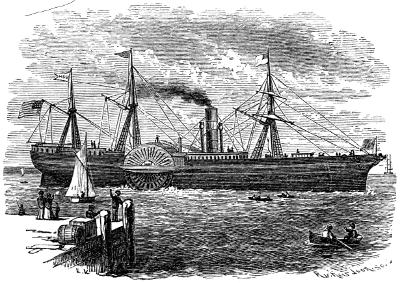
Fig. 91.—The Atlantic, 1851.
The steam-vessels of the time are well represented in
the accompanying engraving (Fig. 91) of the steamship
Atlantic—a vessel which was shortly afterward (1851) built
as the pioneer steamer of the American “Collins Line.”
This steamship was one of several which formed the earliest
of American steamship-lines, and is one of the finest examples
of the type of paddle-steamers which was finally superseded
by the later screw-fleets. The “Collins Line” existed
but a very few years, and its failure was probably determined
as much by the evident and inevitable success of
screw-propulsion as by the difficulty of securing ample capital,
complete organization, and efficient general management.
This steamer was built at New York—the hull
by William Brown, and the machinery by the Novelty
Iron-Works. The length of the hull was 276 feet, its
breadth 45 feet, and the depth of hold 311∕2 feet. The
width over the paddle-boxes was 75 feet. The ship measured
2,860 tons. The form of the hull was then peculiar
in the fineness of its lines; the bow was sharp, and the
stern fine and smooth, and the general outline such as best
adapted the ship for high speed. The main saloon was
about 70 feet long, and the dining-room was 60 feet in
length and 20 feet wide. The state-rooms were arranged
on each side the dining “saloon,” and accommodated 150
passengers. These vessels were beautifully fitted up, and
with them was inaugurated that wonderful system of passenger-transportation
which has since always been distinguished
by those comforts and conveniences which the
American traveler has learned to consider his by right.
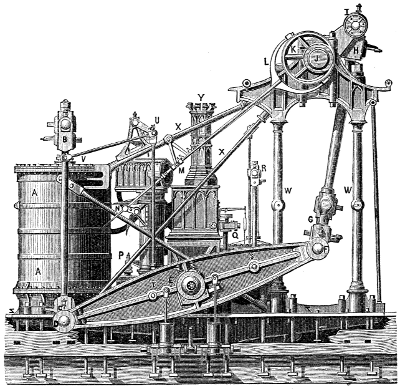
Fig. 92.—The Side-Lever Engine, 1849.
The machinery of these ships was, for that time, remarkably
powerful and efficient. The engines were of the
side-lever type, as illustrated in Fig. 92, which represents
the engine of the Pacific, designed by Mr. Charles W.
Copeland, and built by the Allaire Works.
In this type of engine, as is seen, the piston-rod was
attached to a cross-head working vertically, from which, at
each side, links, B C, connected with the “side-lever,”
D E F. The latter vibrated about a “main centre” at E,
like the overhead beam of the more common form of engine;
from its other end, a “connecting-rod,” H, led to the
“cross-tail,” W, which was, in turn, connected to the crank-pin,
I. The condenser, M, and air-pump, Q, were constructed
in the same manner as those of other engines, their
only peculiarities being such as were incident to their location
between the cylinder, A, and the crank, I J. The
paddle-wheels were of the common “radial” form, covered
in by paddle-boxes so strongly built that they were rarely
injured by the heaviest seas.
These vessels surpassed, for a time, all other sea-going
steamers in speed and comfort, and made their passages
with great regularity. The minimum length of voyage
of the Baltic and Pacific, of this line, was 9 days 19
hours.
During the latter part of the period the history of which
has been here given, the marine steam-engine became subject
to very marked changes in type and in details, and a
complete revolution was effected in the method of propulsion.
This change has finally resulted in the universal
adoption of a new propelling instrument, and in driving the
whole fleet of paddle-steamers from the ocean. The Great
Britain was a screw-steamer.
The screw-propeller, which, as has been stated, was
probably first proposed by Dr. Hooke in 1681, and by Dr.
Bernouilli, of Groningen, at about the middle of the eighteenth
century, and by Watt in 1784, was, at the end of the
century, tried experimentally in the United States by David
Bushnell, an ingenious American, who was then conducting
the experiments with torpedoes which were the cause of the
incident which originated that celebrated song by Francis
Hopkinson, the “Battle of the Kegs,” using the screw to
propel one of his submarine boats, and by John Fitch, and
by Dallery in France.
Joseph Bramah, of Great Britain, May 9, 1785, patented
a screw-propeller identical in general arrangement with
those used to-day. His sketch exhibits a screw, apparently
of very fair shape, carried on an horizontal shaft, which
passes out of the vessel through a stuffing-box, the screw
being wholly submerged. Bramah does not seem to have
put his plan in practice. It was patented again in England,
also, by Littleton in 1794, and by Shorter in 1800.
John Stevens, however, first gave the screw a practically
useful form, and used it successfully, in 1804 and 1805, on the
single and the twin screw boats which he built at that time.
This propelling instrument was also tried by Trevithick,
who planned a vessel to be propelled by a steam-engine
driving a screw, at about this time, and his scheme was laid
before the Navy Board in the year 1812. His plans included
an iron hull. Francis Pettit Smith tried the screw also in
the year 1808, and subsequently.
Joseph Ressel, a Bohemian, proposed to use a screw in
the propulsion of balloons, about 1812, and in the year
1826 proposed its use for marine propulsion. He is said to
have built a screw-boat in the year 1829, at Trieste, which
he named the Civetta. The little craft met with an accident
on the trial-trip, and nothing more was done.
The screw was finally brought into general use through
the exertions of John Ericsson, a skillful Swedish engineer,
who was residing in England in the year 1836, and of Mr.
F. P. Smith, an English farmer. Ericsson patented a peculiar
form of screw-propeller, and designed a steamer 40
feet in length, of 8 feet beam, and drawing 3 feet of water.
The screw was double, two shafts being placed the one
within the other, revolving in opposite directions, and carrying
the one a right-hand and the other a left-hand
screw. These screws were 51∕4 feet in diameter. On her
trial-trip this little steamer attained a speed of 10 miles an
hour. Its power as a “tug” was found to be very satisfactory;
it towed a schooner of 140 tons burden at the rate of
7 miles, and the large American packet-ship Toronto was
towed on the Thames at a speed of 5 miles an hour.
Ericsson endeavored to interest the British Admiralty
in his improvements, and succeeded only so far as to induce
the Lords of the Admiralty to make an excursion with him
on the river. No interest was awakened in the new system,
and nothing was done by the naval authorities. A note to
the inventor from Captain Beaufort—one of the party—was
received shortly afterward, in which it was stated that the
excursionists had not found the performance of the little
vessel to equal their hopes and expectations. All the interests
of the then existing engine-building establishments
were opposed to the innovation, and the proverbial conservatism
of naval men and naval administrations aided in
procuring the rejection of Ericsson’s plans.
Fortunately for the United States, it happened, at that
time, that we had in Great Britain both civil and naval representatives
of greater intelligence, or of greater boldness
and enterprise. The consul at Liverpool was Mr. Francis
B. Ogden, of New Jersey, a gentleman who was somewhat
familiar with the steam-engine and with steam-navigation.
He had seen Ericsson’s plans at an earlier period, and had
at once seen their probable value. He was sufficiently confident
of success to place capital at the disposal of the inventor.
The little screw-boat just described was built with
funds of which he furnished a part, and was named, in his
honor, the Francis B. Ogden.
Captain Robert F. Stockton, an officer of the United
States Navy, and also a resident of New Jersey, was in
London at the time, and made an excursion with Ericsson
on the Ogden. He was also at once convinced of the value
of the new method of application of steam-power to ship-propulsion,
and gave the engineer an order to build two
iron screw-steamboats for use in the United States. Ericsson
was induced, by Messrs. Ogden and Stockton, to take up
his residence in the United States.[84] The Stockton was sent
over to the United States in April, 1839, under sail, and
was sold to the Delaware & Raritan Canal Company. Her
name was changed, and, as the New Jersey, she remained
in service many years.
The success of the boat built by Ericsson was so evident
that, although the naval authorities remained inactive,
a private company was formed, in 1839, to work the patents
of F. P. Smith, and this “Ship-Propeller Company” built
an experimental craft called the Archimedes, and its trial-trip
was made October 14th of the same year. The speed
attained was 9.64 miles an hour. The result was in every
respect satisfactory, and the vessel, subsequently, made
many voyages from port to port, and finally circumnavigated
the island of Great Britain. The proprietors of
the ship were not pecuniarily successful in their venture,
however, and the sale of the vessel left the company a
heavy loser. The Archimedes was 125 feet long, of 21 feet
10 inches beam, and 10 feet draught, registering 232 tons.
The engines were rated at 80 horse-power. Smith’s earlier
experiments (1837) were made with a little craft of 6 tons
burden, driven by an engine having a steam-cylinder 6
inches in diameter and 15 inches stroke of piston. The
funds needed were furnished by a London banker—Mr.
Wright.
Bennett Woodcroft had also used the screw experimentally
as early as 1832, on the Irwell, near Manchester, England,
in a boat of 55 tons burden. Twin-screws were used,
right and left handed respectively; they were each two feet
in diameter, and were given an expanding pitch. The boat
attained a speed of four miles an hour.
Experiments made subsequently (1843) with this form of
screw, and in competition with the “true” screw of Smith,
brought out very distinctly the superiority of the former,
and gave some knowledge of the proper proportions for
maximum efficiency. In later examples of the Woodcroft
screw, the blades were made detachable and adjustable—a
plan which is still a usual one, and which has proved to be,
in some respects, very convenient.
When Ericsson reached the United States, he was almost
immediately given an opportunity to build the Princeton—a
large screw-steamer—and at about the same time the
English and French Governments also had screw-steamers
built from his plans, or from those of his agent in England,
the Count de Rosen. In these latter ships—the Amphion
and the Pomona—the first horizontal direct-acting engines
ever built were used, and they were fitted with double-acting
air-pumps, having canvas valves and other novel
features. The great advantages exhibited by these vessels
over the paddle-steamers of the time did for screw-propulsion
what Stephenson’s locomotive—the Rocket—did for
railroad locomotion ten years earlier.
Congress, in 1839, had authorized the construction of
three war-vessels, and the Secretary of the Navy ordered
that two be at once built in the succeeding year. Of these,
one was the Princeton, the screw-steamer of which the machinery
was designed by Ericsson. The length of this vessel
was 164 feet, beam 301∕2
feet, and depth 211∕2 feet. The
ship drew from 161∕2 to 18 feet of water, displacing at those
draughts 950 and 1,050 tons. The hull had a broad, flat
floor, with sharp entrance and fine run, and the lines were
considered at that time remarkably fine.
The screw was of gun-bronze, six-bladed, and was 14
feet in diameter and of 35 feet pitch; i. e., were there no
slip, the screw working as if in a solid nut, the ship would
have been driven forward 35 feet at each revolution.
The engines were two in number, and very peculiar in
form; the cylinder was, in fact, a semi-cylinder, and the
place of the piston-rod, as usually built, was taken by a vibrating
shaft, or “rock-shaft,” which carried a piston of
rectangular form, and which vibrated like a door on its
hinges as the steam was alternately let into and exhausted
from each side of it. The great rock-shaft carried, at the
outer end, an arm from which a connecting-rod led to the
crank, thus forming a “direct-acting engine.”
The draught in the boilers was urged by blowers.
Ericsson had adopted this method of securing an artificial
draught ten years before, in one of his earlier vessels, the
Corsair. The Princeton carried a XII-inch wrought-iron
gun. This gun exploded after a few trials, with terribly
disastrous results, causing the death of several distinguished
men, including members of the President’s cabinet.
The Princeton proved very successful as a screw-steamer,
attaining a speed of 13 knots, and was then considered
very remarkably fast. Captain Stockton, who commanded
the vessel, was most enthusiastic in praise of her.
Immediately there began a revolution in both civil and
naval ship-building, which progressed with great rapidity.
The Princeton was the first of the screw-propelled navy
which has now entirely displaced the older type of steam-vessel.
The introduction of the screw now took place with
great rapidity. Six steamers were fitted with Ericsson’s
screw in 1841, 9 in 1842, and nearly 30 in the year 1843.
In Great Britain, France, Germany, and other European
countries, the revolution was also finally effected, and was
equally complete. Nearly all sea-going vessels built toward
the close of the period here considered were screw-steamers,
fitted with direct-acting, quick-working engines. It was,
however, many years before the experience of engineers in
the designing and in the construction and management of
this new machinery enabled them to properly proportion it
for the various kinds of service to which they were called
upon to adapt it. Among other modifications of earlier practice
introduced by Ericsson was the surface-condenser with
a circulating pump driven by a small independent engine.
The screw was found to possess many advantages over
the paddle-wheel as an instrument for ship-propulsion.
The cost of machinery was greatly reduced by its use; the
expense of maintenance in working order was, however,
somewhat increased. The latter disadvantage was, nevertheless,
much more than compensated by an immense increase
in the economy of ship-propulsion, which marked
the substitution of the new instrument and its impelling
machinery.
When a ship is propelled by paddles, the motion of the
vessel creates, in consequence of the friction of the fluid
against the sides and bottom, a current of water which
flows in the direction in which the ship is moving, and
forms a current following the ship for a time, and finally
losing all motion by contact with the surrounding mass of
water. All the power expended in the production of this
great stream is, in the case of the paddle-steamer, entirely
lost. In screw-steamers, however, the propelling instrument
works in this following current, and the tendency of
its action is to bring the agitated fluid to rest, taking up
and thus restoring, usefully, a large part of that energy
which would otherwise have been lost. The screw is also
completely covered by the water, and acts with comparative
efficiency in consequence of its submersion. The rotation
of the screw is comparatively rapid and smooth, also,
and this permits the use of small, light, fast-running engines.
The latter condition leads to economy of weight
and space, and consequently saves not only the cost of
transportation of the excess of weight of the larger kind of
engine, but, leaving so much more room for paying cargo,
the gain is found to be a double one. Still further, the
quick-running engine is, other things being equal, the most
economical of steam; and thus some expense is saved not
only in the purchase of fuel, but in its transportation, and
some still additional gain is derived from the increased
amount of paying cargo which the vessel is thus enabled to
carry. The change here described was thus found to be
productive of enormous direct gain. Indirectly, also, some
advantage was derived from the greater convenience of a
deck clear from machinery and the great paddle-shaft, in
the better storage of the lading, the greater facility with
which the masts and sails could be fitted and used; and
directly, again, in clear sides unencumbered by great paddle-boxes
which impeded the vessel by catching both sea
and wind.
The screw was, for some years, generally regarded as
simply auxiliary in large vessels, assisting the sails. Ultimately
the screw became the essential feature, and vessels
were lightly sparred and were given smaller areas of sail,
the latter becoming the auxiliary power.
In November of the year 1843, the screw-steamer Midas,
Captain Poor, a small schooner-rigged craft, left New
York for China, on probably the first voyage of such length
ever undertaken by a steamer; and in the following January
the Edith, Captain Lewis, a bark-rigged screw-vessel,
sailed from the same port for India and China. The Massachusetts,
Captain Forbes, a screw-steamship of about 800
tons, sailed for Liverpool September 15, 1845, the first voyage
of an American transatlantic passenger-steamer since
the Savannah’s pioneer adventure a quarter of a century
before. Two years later, American enterprise had placed
both screw and paddle steamers on the rivers of China—principally
through the exertions of Captain R. B. Forbes—and
steam-navigation was fairly established throughout
the world.
On comparing the screw-steamer of the present time
with the best examples of steamers propelled by paddle-wheels,
the superiority of the former is so marked that it
may cause some surprise that the revolution just described
should have progressed no more rapidly. The reason of
this slow progress, however, was probably that the introduction
of the rapidly-revolving screw, in place of the slow-moving
paddle-wheel, necessitated a complete revolution in
the design of their steam-engines; and the unavoidable
change from the heavy, long-stroked, low-speed engines
previously in use, to the light engines, with small cylinders
and high piston-speed, called for by the new system of propulsion,
was one that necessarily occurred slowly, and was
accompanied by its share of those engineering blunders and
accidents that invariably take place during such periods of
transition. Engineers had first to learn to design such engines
as should be reliable under the then novel conditions
of screw-propulsion, and their experience could only be
gained through the occurrence of many mishaps and costly
failures. The best proportions of engines and screws, for a
given ship, were determined only by long experience, although
great assistance was derived from the extensive series
of experiments made with the French steamer Pelican.
It also became necessary to train up a body of engine-drivers
who should be capable of managing these new engines; for
they required the exercise of a then unprecedented amount
of care and skill. Finally, with the accomplishment of
these two requisites to success must simultaneously occur
the enlightenment of the public, professional as well as
non-professional, in regard to their advantages. Thus it
happens that it is only after a considerable time that the
screw attained its proper place as an instrument of propulsion,
and finally drove the paddle-wheel quite out of use,
except in shoal water.
Now our large screw-steamers are of higher speed than
any paddle-steamers on the ocean, and develop their power
at far less cost. This increased economy is due not only to
the use of a more efficient propelling instrument, and to
changes already described, but also, in a great degree, to
the economy which has followed as a consequence of other
changes in the steam-engine driving it. The earliest days
of screw-propulsion witnessed the use of steam of from 5
to 15 pounds pressure, in a geared engine using jet-condensation,
and giving a horse-power at an expense of perhaps
7 to 10, or even more, pounds of coal per hour. A little
later came direct-acting engines with jet-condensation and
steam at 20 pounds pressure, costing about 5 or 6 pounds
per horse-power per hour. The steam-pressure rose a little
higher with the use of greater expansion, and the economy
of fuel was further improved. The introduction of the surface-condenser,
which began to be generally adopted some
ten years ago, brought down the cost of power to from 3
to 4 pounds in the better class of engines. At about the
same time, this change to surface-condensation helping
greatly to overcome those troubles arising from boiler-incrustation
which had prevented the rise of steam-pressure
above about 25 pounds per square inch, and as, at the same
time, it was learned by engineers that the deposit of lime-scale
in the marine boiler was determined by temperature
rather than by the degree of concentration, and that all the
lime entering the boiler was deposited at the pressure just
mentioned, a sudden advance took place. Careful design,
good workmanship, and skillful management, made the surface-condenser
an efficient apparatus; and, the dangers of
incrustation being thus lessened, the movement toward
higher pressures recommenced, and progressed so rapidly
that now 75 pounds per square inch is very usual, and
more than 125 pounds has since been attained.
The close of this period was marked by the construction
of the most successful types of paddle-steamers, the
complete success of transoceanic steam-transportation, the
introduction of the screw-propeller and the peculiar engine
appropriate to it, and, finally, a general improvement, which
had finally become marked both in direction and in rapidity
of movement, leading toward the use of higher steam-pressure,
greater expansion, lighter and more rapidly-working
machinery, and decidedly better design and construction,
and the use of better material. The result of these
changes was seen in economy of first cost and maintenance,
and the ability to attain greater speed, and to assure greater
safety to passengers and less risk to cargo.
The introduction of the changes just noted finally led
to the last great change in the form of the marine steam-engine,
and a revolution was inaugurated, which, however,
only became complete in the succeeding period. The non-success
of Hornblower and of Wolff, and others who had
attempted to introduce the “compound” or double-cylinder
engine on land, had not convinced all engineers that it
might not yet be made a successful rival of the then standard
type; and the three or four steamers which were built
for the Hudson River at the end of the first quarter of the
nineteenth century are said to have been very successful
vessels. Carrying 75 to 100 pounds of steam in their boilers,
the Swiftsure and her contemporaries were by that circumstance
well fitted to make that form of engine economically
a success. This form of engine was built occasionally
during the succeeding quarter of a century, but only became
a recognized standard type after the close of the epoch to
the history of which this chapter is devoted. That latest
and greatest advance in the direction of increased efficiency
in the marine steam-engine was, however, commenced very
soon after Watt’s death, and its completion was the work
of nearly a half-century.

[303]