HISTORY OF DURHAM
MINERS' ASSOCIATION
The Association was not a sudden and startling
phenomenon, but was a pure evolution. It was
no growth of a day like Jonah's gourd, but it was
the outcome and the harvest of a long, painful
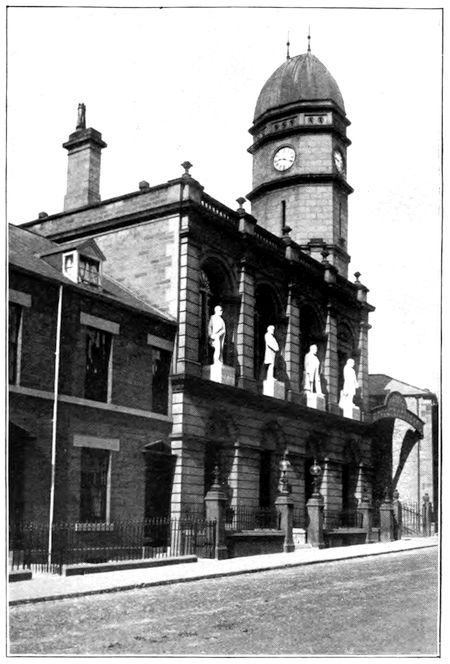
sowing-time. In our Hall we have two busts.
These are no doubt looked upon (if noticed at all)
with casual indifference. Few of us regard them as
expressions of important periods in our struggle
for Right and Equality, and as part of the preparatory
process, the consummation of which is our
grand Institution, of which we are justly proud,
for our history fully illustrates the sentiment:
"Truth struck to earth will rise again."
It is not my intention to take a long and detailed
retrospect, but just to enumerate a few of
the events happening after 1860, all of which were
assisting in clearing the ground, and inciting our
formation and preparing men's minds gradually for,
such an institution. These I will place in chronological
order. First, there was the Mines Act which
came into force in July 1861, which amongst other
important provisions provided that no boy should
go down the mine under twelve unless he could
produce a certificate that he could read and write;
that boys under twelve should go to school five
hours per day; that minerals should be weighed,
and that the workmen should be at liberty to
appoint a checkweighman.
Another of the series was the Hartley calamity on
the 16th of January 1862—a calamity which is unique
in the history of mining disasters, which moved the
heart of the nation, and turned the minds of men
everywhere to two very important matters—first,
the sinking of two shafts to every mine; and
second, to the provision for the relatives of those
who lose their lives, or for the workmen who are
injured. And thus it has ever been: our industry
has offered up its human sacrifices before necessary
reforms have been introduced. Death has in many
instances opened the gateway to life and blessing.
It is sad, but yet true.
Then we had two very notable strikes—one
at the Brancepeth Collieries, which is known as the
"Rocking Strike." The name arose from the custom
which obtained of setting out the tubs if they were
not level full when they came to bank. In order
that this might be attained the hewer used to walk
around the tub and strike it with his "mell," or
rock and shake it so that the jolting on the road
out-by might not lower the coals below the rim of
the tub, and thus result in the forfeiture of the
entire contents. This system was enforced even
after the Act of 1861, and in such a glaring manner,
that the master's weighman was paid a commission
upon every light tub he found. The demands of
the workmen were payment by weight and an advance
in wages. Those whose memory goes back
to that period will remember the meetings that
were held, and especially one not far from Mr
Love's (the owner of the collieries) house, just outside
Durham city, then called Mount Beulah, now by
the more earthly name of Springwell Hall.
At that meeting on the platform was a working
model of a miner rocking a tub, and a song composed
by a local poet (Mr Cooke of Trimdon
Grange) was sung. Part of the refrain was, as near
as I can remember, as follows:—
"The rocking so shocking long, long we have bore,
Farewell to the rocking, we will rock them no more."
The second strike took place at Wearmouth, and
was the real, although not formal, starting-point
of our Union.
This strike commenced about the middle of April
1869, and arose out of the conditions contained in
the "Bond" of that year, which was brought out
as usual in the month of March, when the hewers
were told that, owing to the depressed condition
of trade, there would have to be a considerable
reduction in prices. In one instance the score price
was reduced from 7s. to 5s. 10d., and the yard price
from 1s. to 8d. There was no opposition offered
at the time, as the men were willing to give the
lower rate a fair trial. Afterwards they found they
were not able to make a fair day's wage. They
worked on until the 18th of May, when after going
into the pit they all came out, and held a meeting
on the green, and appointed a deputation of six
to wait upon the manager and Mr Stobart. No
concession being made the report was given, when
the men declared it was impossible to maintain their
families, and resolved that they would not resume
work until the previous prices were paid. It is not
part of my purpose to enter into all the phases of
the strike, but one thing I will set forth, as it shows
the method adopted to break the ranks of the workmen.
The manager of the colliery was a man well-known
in the North of England Coal Trade, Mr
R. Heckles. He, believing there was great power
in the beer jug, when the strike had continued for
a fortnight sent six notes for fifty men each to get
a quart of ale per man. These were placed before
a meeting of 250 men. "On the offer of the beer
being announced the men replied that the notes
were to be sent back, as the day had gone by when
the men were to be bought with beer, but that beef
and bread would be better, and a resolution was
carried not to resume work except at last year's
prices."
The breaking of the bond brought the workmen
into collision with the law, and four of them were
summoned to appear at the Sunderland Court, on
the 21st of June 1869. They were charged under
the Masters and Servants Act. One of the cases,
that of Thomas Fenwick, was taken. The magistrates
were told they could impose a fine of £20,
or commit to prison for three months. The defence
was conducted by Mr Roberts, the "Pitmen's
Attorney-General." The Bench decided that the
defendant should give sureties of £20 to return to
work, or be committed to prison for one month.
Mr Roberts took objection, and pointed out that
there was no attesting witness to the signing of the
contract, and asked for a case to the Queen's Bench
on the point. On that being raised the case was adjourned
for a fortnight.
On the 6th of July the case again came up for
hearing. The objection raised by Mr Roberts was
then gone into. It was to the effect that the defendant
was a marksman (that is, made his mark
and did not sign his name), and that the bond was
never read over to him. The matter was contested
for a considerable time. Eventually Mr Roberts said
he had "been told by the most influential men
among the workmen that they wanted to be free
from the villainous and iniquitous bond, and they
would undertake to leave the houses within nine
days." On that promise being made and accepted
by the solicitor for the owners the bond by mutual
consent was cancelled.
The men immediately arranged for vacating the
houses and handing in their lamps. In one instance
this was done in a unique and striking manner.
The men formed in procession, over 300 in number,
each man carrying his lamp and a copy of the
colliery rules. Marching to the colliery they handed
in their lamps, and returned the rules to the overman.
The effect of the trial was speedily seen
in the solidifying of the whole of the workmen at
Wearmouth, as the deputies and others (while
passively remaining from work, had never taken
active part in the strike) now threw themselves into
the struggle, and made common cause with the
hewers, and the further effect was the impetus
given to the cause of unionism throughout the
county until it consummated in the Durham Miners'
Union.
Another element assisting our formation was the
desire for association which was burning in the
breast of a few men whose ardour could not be
damped by repeated failures or retarded by opposition
or hardship. The last of the series of these
attempts was in 1863, the meeting being held in
the Victoria Hotel, Newcastle. There were 30
delegates present—27 from Northumberland, and
only 3 from Durham, Whitworth, Washington, and
Usworth, the membership being slightly over 4000.
We are told by Fynes in his history that it was
resolved to hold meetings in Durham "with the view
of moving the men of this county to join them."
At the next meeting Mr Crawford was appointed
agent and secretary, with Mr Joseph Sheldon as a
colleague. In that capacity the writer first saw
Mr Crawford. He was the principal speaker at a
meeting held on Sherburn Hill. He was on his way
from the Leeds National Conference, and we find
by reference to the report of that meeting that he
was Chairman of the Committee on Law. This
union of the two counties continued until the
Northumberland men felt that to them it was like
being connected with a body of death, and they
realised that the connection would in the end be
fatal, and in 1865 resolved to separate. This
resolution was carried into effect, and county
organisations were formed. The two agents were
allotted as follows:—Mr Crawford being kept in
Northumberland, and Mr Sheldon became the agent
in Durham. His term of office was very short, as
the Union here very soon died out. At the united
meeting, embracing the two counties, held on November
21st, E. Rhymer was the only delegate, and
he delivered a very characteristic speech, of which
the following is a portion:—
"With respect to the county of Durham he was
sorry that they appeared as a black spot in England
respecting the Miners' Association. They numbered
about 1000, but there were only 74 represented at
that meeting. The hours of the men were eight
hours working. The average wage being from 4s.
to 4s. 6d. The hours of the boys upon an average
were fourteen per day. The system with respect
to the boys was the most wretched in the civilised
world. They never saw the light of the blessed
sun from Sabbath to Sabbath. He had authority
to tell them that the district which he represented
begged of them through him to send help to save
them from starvation and misery."
These are very strong words and true, for the state
throughout was deplorable. Here and there small
societies existed having no federal connection, but
they were of no earthly use. They only showed in
darker colours the disorganisation which had set in.
To use Milton's illustration, they made the darkness
more visible. Still, there were some brave spirits
who not only deplored the condition, but, as Fynes
says, "set themselves the almost Herculean task of
revising the Union and substituting harmony for
the discord which then prevailed." For that purpose
meetings were held in various parts of the
county. The speakers who attended them ofttimes
found themselves sleeping in a room whose walls
were the horizon and the roof studded with the
stars of heaven. Prominent we find the names of
W. Crake and J. Richardson (two men who were
sacrificed as the result of the Wearmouth strike),
W. Patterson, T. Ramsey, and N. Wilkinson.
Not only were there local men at these meetings,
but strangers were sent from other districts, seeking
to infuse new life into the apathetical and indifferent
men of Durham. The most notable of these meetings
was held at Thornley on Saturday, the 25th of
September 1869. Amongst the speeches delivered
I find two given at great length in The Durham
Chronicle of the 1st of October by Mr T. Burt and Mr
W. Brown, who was then residing in Yorkshire, but
who afterwards became the agent for the North
Staffordshire miners. The chair was occupied by Mr
W. Patterson (our Patterson), and there were about
1000 men in attendance. If it were convenient I
would place on record in this history those speeches
in full, as they were worthy of the men and the
occasion. One or two sentences may be quoted
from Mr Burt's speech. He urged that "there were
many reasons why men should be united: wages,
better conditions, and safety at work." Their
wages were not so high as they ought to be,
neither was their social condition what it might
have been, and he would candidly confess that the
miners themselves were most to blame that such
was the state of affairs. Had they worked together
and exercised confidence where they displayed little
else but petty jealousy, had they not spent their
money for naught, their position might have been
different that day. If proof were needed let them
look at other classes and districts. "If the miners
of the county of Durham compared their condition
with any of the great combined bodies of English
workmen they would at once see how different their
position might have been had they been united.
If they compared non-Union districts with Union
districts they would contrast the rate of wages paid
in Lancashire, Wales, Yorkshire, and Northumberland;
and they would see a striking example of the
effects of Union and non-Union." These remarks
suggest a curious contrast between our relative
position compared with other districts now and then,
and the comparison proves the force and wisdom of
Mr Burt's exhortation.
In this connection I find a letter from Mr
Crawford bearing on the same subject, and published
in The Durham Chronicle of the 15th of October
1869, which I insert in full.
Sir,—Seeing that the Durham miners are again
trying to form amongst themselves an organisation
for mutual protection, you will perhaps allow me
to say a few words, having had some experience
in connection with their last one some six years
ago. Many of your readers will remember the
strenuous efforts then made to organise the whole
county, and at least the partial success which attended
that undertaking. A great portion of the
county did become united, and at one time promised
satisfactory success. But those who expected such
an accomplishment were doomed to be disappointed.
After a short time the whole fabric collapsed, and
miners were again subjected to all those difficulties
and impositions which necessarily follow in the train
of disorganisation. Since that time my mind has
often been occupied in trying to ascertain the cause
or causes of that disastrous downfall, and I have
long since concluded that the following were the
main if not the only causes which led to such a
direful result:—
1st. Yearly hirings. For years before the Union
began, these had existed in the county, and their
baneful effects had been to reduce the wages of the
miners from fifteen to thirty per cent. The coal was
no better to get, and its market value ranged
about the same. What, then, was the cause of men
being reduced in some instances from 13s. 6d. to
9s. per score? It may be truly attributed to disorganisation
and yearly hirings. When the Union
began these still continued, and hence the impossibility
of men gradually recovering that which they
had lost. These yearly hirings had brought the
county to the lowest possible social condition, and
when brought, kept it there, rendering organisation
difficult, and when attained making its continuance
more difficult still. They have been the curse, the
withering blighting curse, of thousands of miners in
that county.
Again, the county is too wide and extensive for one
association. To make the work not only practical,
but effective, it ought to be divided into three, or
perhaps four separate districts. These districts
ought to be thoroughly independent of each other;
not only doing their own business, but being self-supporting.
Of course, in many instances, one
district would find its interests best furthered by
rendering assistance to a neighbouring one. In such
cases let relief be unsparingly given. The more
mutual support and sympathy there existed between
the districts, the greater the chance of permanent
success. Yet, in their working, collecting, and distribution
of their finances, let an entire separation
exist. We have not space to go fully into this
matter here; but if the past will prove anything,
it will prove what I have just said. And, if an instance
is wanted, it will be found in the two distinct,
but successful associations, which for years
have existed in Yorkshire. Other causes operated
to make short the existence of the last organisation;
but these were unquestionably the main ones,
and ought, therefore, to be avoided this time, especially
the latter, that power being now with themselves,
to put into immediate effect, while the
former must be a work of time, at least for a few
months.
The present condition of the Durham miners calls
aloud for a change, and the power to effect that
change is with themselves. Let them bestir, set to
work in right earnest, and if that work be
characterised by prudence and determination, I
doubt not but that ultimate and entire success will
crown their efforts.
William Crawford.
Bedlington, Northumberland,
October 11th, 1869.
Currently with these meetings arising out of the
Wearmouth strike, and the other matters mentioned,
the young Union was gathering strength.
Delegate meetings were being held, the machinery
of the Association was taking shape, and the constitution
outlined. The first of these was held on
Saturday the 3rd of July 1869, the chairman being
Mr J. Richardson of Wearmouth. In his opening
remarks he said: "They had met not as delegates
of an organised body of miners, but as representatives
of collieries not yet united, to devise means
whereby an organisation could be established
throughout the county of Durham." No attempt
was made to transact any business, but a number
of addresses were delivered. The speakers were Mr
Lynney of Wearmouth, Mr B. Irving and Mr
Scranghann of Houghton, Mr Noull, Windy Nook,
and Mr G. Parker of Spennymoor. All spoke of
the deplorable condition of the county, and expressed
their firm belief that nothing but union
would bring about an amelioration.
The next meeting was held in the Market Hotel,
Durham. I again quote from The Durham Chronicle
report:
At the hour named there was only a limited
attendance of delegates and, no others coming up
as time passed on, no business was done, and the
delegates present merely contented themselves with
discussing the project of a county Union, to which
the delegates from Thornley and Houghton stated
the men in their respective districts gave perfect
accordance, uniting with the Union in both cases the
scheme of a benefit society. Mr Richardson of
Wearmouth thought they ought to form their Union
first, and leave the question of benefit and emigration
societies in connection with it to a future time. A
resolution that Wearmouth, Thornley, and Houghton
form the nucleus of an organisation or union
among the miners of the county, and that a paid
agent be appointed to explain to the men the aim,
object, and principles of the proposed association,
was then passed. The following is the district set
out for the lecturer to visit:—Ryhope, Seaton (and
Seaham), Hetton, South Hetton, Haswell, Shotton,
Castle Eden, Wingate, Trimdon, Fire Houses (Trimdon
Grange), and Thornley. The agitation of the
proposed organisation to be directed against the
yearly bond.
The next account available is that of a meeting
held at the half-way house near Thornley on the 23rd
of September. It was held in connection with the
demonstration referred to above, at which Mr Burt
and Mr Brown spoke. The following are the names
of the delegates who answered the roll, with the
collieries represented:—
| W. Crake, Wearmouth. | R. Bousfield, Houghton. |
| H. Robson, Ryhope. | J. Colledge, Murton. |
| W. H. Patterson, Heworth. | A. Cairns, Thornley. |
| T. Ramsey, Trimdon. | N. Wilkinson, Trimdon Grange. |
| J. Wylde, Quarrington Hill. | C. Flynn, Shiny Row. |
| E. Furneval, Felling. | C. Nichlson, Seaham. |
This meeting was the most ambitious of any held,
as a properly arranged business programme was
before the delegates. The items discussed were
the wages and expenses of the agent. The point
discussed was not merely the amount per week, but
whether he should be charged for stamps and all
cost of correspondence. The meeting was equally
divided, when the question was remitted to the
lodges.
Next came the "Formation of a Central Fund."
In this matter there was great fear as to the permanency
of the movement. The predominant feeling
was that it was better to wait until the roll of
members reached a few thousands. Mr Patterson
was among those who hesitated, and expressed
himself in the following terms:—
"They had several times tried to form a Union,
but had failed, the men appearing somehow to have
little confidence in them." The Wearmouth delegate
was more optimistic. He did not think it was
necessary that they should have 5000 members
before the fund was formed. Mr Patterson had
hinted the Union might fail, but there was not the
least fear in his mind that such would be the case.
Following these came the persons to attend the
delegate meetings (whether strangers should be
admitted), the pay for attending (this was fixed at
6s. 6d. and third-class fare), the appointment of a
committee to draw up rules, the adoption of a "Pass
Card" as a guarantee of membership, the collieries
for the agent to visit, and the appointment of an
Agent, Secretary, and Treasurer. These offices were
filled as follows:—Mr J. Richardson, Agent for three
weeks; Mr Isaac Parks, Secretary; and Mr N.
Wilkinson, Treasurer for three months.
The next meeting was held on Saturday, 20th
November. It is important that we should note this
meeting, as it was the real beginning of the Association.
The following is the full report from The
Durham Chronicle:—
DURHAM MINERS' MUTUAL ASSOCIATION
"A meeting of the delegates of this Association
was held in the Market Hotel in this city on Saturday,
when the delegates present represented 4328 members.
The following resolutions were passed:—(1)
Resolved that Stanley be exempted from paying any
contributions this day. (2) That all members receive
rules free. (3) That each delegate speak in rotation
as on the list, and not to speak more than five
minutes each time. (4) The following were appointed
trustees:—Alan Murray, W. Crake, Isaac
Parks, W. Patterson, R. Carr, W. Wilson, John
Armstrong, and T. Noble. (5) That each delegate
have one vote. (6) That Mr John Richardson be
Agent and Secretary, and be paid 32s. per week,
and allowed third-class railway fare when on the
business of the Association when such business calls
him more than four miles from his residence, the
delegates to decide his place of residence. (7) That
the delegates should manage the business at present,
and that in future a president should be chosen at
each meeting of delegates who shall have a casting
vote. (8) That each delegate be prepared with
security for the person proposed by his district for
the office of treasurer. (9) That all suggestions be
sent in at least seven days before the meeting. (10)
That the miners of the county of Durham have their
attention called to the objects contemplated by the
Association by hand-bills, and that 500 be printed.
(11) That the agent go into the Crook and Spennymoor
districts and explain the advantages of the
society."
Here we have the Union for the whole county
fairly established on a weak foundation. Sufficient
to dishearten, looking from our present proud
position, but it must be remembered that there
were giants in those days—brave, hopeful men,
who were not to be turned from their purpose by
any hindrance. They felt that united effort was
the breath of our life, and they kept their eyes on
that goal. A united Durham was their battle-cry
and inspiration. If there had been any possibility
of diverting them, the next meeting, which was
held on 18th December 1869, was sufficient. That
meeting was held again in the Market Hotel. There
were delegates from only 19 collieries, representing
1964½ members. The outlay for the previous
fortnight was £8, 11s. 5d., and there was a saving
of £50, 11s. 1½d. Mr N. Wilkinson was appointed
treasurer. Rules were submitted from various
collieries. The agent was instructed to visit the
Derwent District, and a very wise provision was
made that no suggestion should be put on the programme
that infringed the general rules. It was a
little anticipatory, seeing the rules were not formed,
but those men knew well that without order and
law it was impossible to have any useful progress.
Later experience proves the wisdom of their provision.
The end of 1869 saw the foundation of the
structure laid. The beginning of 1870 found the
builders hard at work raising it. The first move
made was to hold fortnightly delegate meetings.
These appear to have been of the nature of Committee
and Council Meetings combined, and were
usually held in the Market Hotel, Durham. The
first in the year was held on Saturday, 1st January.
The first business, even in this early stage, was to
deal with that permanent disease of Trades Unionism,
the unfinancial member; for from the origin of
things there have been men who were ready to take
all and give nothing. Various schemes were suggested
for dealing with such people, many of which
were crude, but in the end the means most favoured
by the delegates was analogous to, but somewhat
more drastic than, the rule at present in operation
for compelling members to keep themselves straight
on the books. The other questions dealt with were
the proposed formation of a sick fund, with sundry
minor or local matters.
Passing over the meeting held on January 15th,
except to note that the number of men represented
was 2500, and the fortnightly contributions amounted
to £48, 18s. 1½d., we come to an important one held
on the 29th. The numbers in union were the same
as a fortnight before. The meeting was important,
because it is the first time we find the yearly bond as
part of the business of the council. There was a
very lengthy discussion upon, or rather expression of
condemnation of, the bond. The most noteworthy
portion of the proceedings was a letter from Mr
A. Macdonald, as President of the Miners' National
Association. The letter is worthy of note, because
it is the first recorded instance of his official connection
with Durham, and because of its opposition
to the system of yearly bindings. He was desirous
to ascertain what were the views of the miners in
the county upon it. The Government were pledged
to bring in a Mines Regulation Bill during the next
session of Parliament, and it was necessary that
their views should be expressed with a view to
insert a clause in the new Bill to provide for
fortnightly or monthly agreements. In Mr
Macdonald's opinion, as in that of other leading
gentlemen connected with the organised coal districts
in Great Britain, it was useless to attempt
to better the condition of the miners in Durham so
long as that system existed.
The unanimous agreement of the meeting upon the
subject was "that Mr Macdonald should be informed
that the miners of the county of Durham considered
the bond to be a great evil, and would hail
with the greatest gratification any legislative enactment
providing for its abolition."
At the meeting held on 12th February a much
more satisfactory report was presented. The
membership had increased to 3537½, and the contributions
to £80, 4s. 8d. There had been a deposit
of £70, making the banking account £288. In
addition to this large increase in funds and numbers
encouraging reports were given by the delegates
as to the requests which were made from unorganised
collieries for someone to attend to assist in inducing
the men to join. In connection with this desire
there came a question from Mr Macdonald and Mr
Burt asking whether the young Association would
take an active part in arranging for meetings,
passing of resolutions, and getting up petitions in
furtherance of the Mines Bill about to be introduced
into Parliament. These gentlemen were
extremely desirous that a series of meetings should
be held, and they were willing to attend them if
arranged. The result of the request was an agreement
to hold three meetings at Sunderland, Bishop
Auckland, and Durham, and the appointment of a
committee to make the necessary arrangements.
At this meeting we have the first mention of an
entrance fee, which was to be 6d. for a month, the
payment of delegates out of the local funds, the
attendance of trustees at every delegate meeting,
and the most important appointment of President
and Executive Committee. The custom had been
to appoint a president from each delegate meeting
pro tem., but now it was deemed advisable to elect
for a longer period. The appointments were as
follows:—
President
W. Crake, Monkwearmouth.
Committee
Christopher Nicholson, Seaham.
Isaac Parks, Trimdon.
Martin Thompson, Murton.
John Jackson, Thornley.
Mr Allonby, South Hetton.
W. H. Patterson, Heworth.
W. Anderson, Murton.
These with the treasurer formed the committee.
It was further arranged that the delegate meetings
should be held once a month, and that the contributions
be forwarded fortnightly to the general
treasurer.
As a result of the arrangements for holding mass
meetings in the county, two were held: on the 25th
of February at Bishop Auckland, and on the 26th
at Sunderland. These were addressed by Messrs
Burt and Macdonald. Both meetings were very
well attended; the object was to discuss the proposed
new Mines Bill. Strong speeches were made against
it. "It was too narrow in its application. It would
permit a boy to be employed for 14 hours in the
mine, and he would have to work a length of time
equal to 62 days in the year, more than the child
in the factory. There was a deficiency with regard
to weighing. That they demanded should be remedied,
because the system of measuring and gauging
simply meant robbery and double robbery. In
some districts the arithmetical tables had been
altered to make a ton equal to 25 and even 28 cwt.
Then there was a great need for more inspectors
and for properly trained managers, for the absence
of competent men had been a fruitful source of
colliery accidents. Deputies and overlookers were
not chosen, as they all knew, because of their excellence
and skill, or their high moral qualities, but
more because they were sycophants and tyrants in
the hands of those who owned the mines."
There came a powerful appeal from Mr Burt on
behalf of the Union. "Every great movement in
the world was carried on by combined efforts.
Single individuals had never been able to accomplish
much. In all parts of the world one heard the
declaration made that workmen were doing too
much work, and receiving too little remuneration,
and it needed but the organisation of this great
army to gain for themselves justice. If they joined
that army they would have education, temperance,
prudence, and virtue rising up in the place of moral
degradation; happiness in the place of misery;
and comfort in every home where wretchedness now
only prevailed."
At the monthly meeting held on the 12th of March
1870 there were delegates from 28 collieries, with a
membership of 3650, being an increase for the month
of over 100. The monthly income was £138, 17s.
3d. Of that sum £57 was paid for collecting the
signatures for the petition to Parliament re the
Mines Bill, and a balance of £70 was added to the
banking account. Two petitions were in evidence,
one being 35 and the other 36 yards long—the cost
in the former case being over £12, and in the latter
over £4. A deputation attended this meeting from
Yorkshire soliciting subscriptions for a colliery on
strike in that county. In response to the appeal
£10 was sent, so that very early in its history the
young society was learning the luxury that comes
from doing good to your neighbour—a lesson it has
not forgotten in its older and stronger days. The
next monthly meeting was held on the 9th of April.
There was a sad falling off in the membership represented.
The chairman was able to "congratulate
the meeting on the fact that the bindings had
passed off so satisfactorily, and that a slight increase
in price had been secured."
There were only 25 collieries represented, with a
membership of 2898. The variation in the number
of delegates may be accounted for by the system
of paying the delegates, it being borne by the
lodges, and not as at present. A complaint was
made by the delegates in regard to the dismissal
of men at the late bindings. It was said that
there were 30 at Trimdon Grange who had been
treated in that manner. The owners had shifted
16 of them, but a claim was made for removal
allowance from the Union at the rate of 5s. for
the first mile and 1s. per mile afterwards.
The meeting held on the 23rd of April had a very
full programme of business. The county was called
upon to deal with another serious strike at Wearmouth,
and the support of the men severely taxed
the energies of the Union. A great deal depended
upon the result of that contest. The business part
of the meeting, apart from Wearmouth, was the
appointment of a secretary and extra agents. The
points under consideration were the number to be
appointed, whether they should be in districts or
be centralised, and what should be the salary.
The decision was there should be two agents, and
the salary 27s. 6d. per week, with house and firing.
With respect to the secretary, it was resolved
to appoint one—the choice in this, as in the agents,
being left to a subsequent meeting.
On the 7th of May a full detailed list of the collieries
and members was given, which it may be interesting
to set forth.
| Name of Colliery | Number of
Members | Income for
Month |
|---|
| Trimdon | 165½ | £8 5 6 |
| Trimdon Grange | 64½ | 3 4 6 |
| Shiney Row | 62 | 3 2 0 |
| Philadelphia | 40 | 2 0 0 |
| Murton | 342½ | 17 4 6 |
| Ludworth | 32 | 0 16 0 |
| South Hetton | 90 | 3 18 0 |
| Whitworth | 107 | 5 7 0 |
| Addison | 120 | 5 12 0 |
| Norwood | 33 | 1 11 0 |
| Evenwood | 63 | 2 1 0 |
| Shildon Lodge | 41 | 2 1 0 |
| Page Bank | 28 | 0 14 0 |
| Black Boy | 77 | 5 3 0 |
| Tudhoe | 120 | 6 0 0 |
| Adelaide | 90 | 4 15 0 |
| Thornley | 230 | 11 10 0 |
| Heworth | 70 | 3 10 0 |
| Seaham | 150 | 4 3 0 |
| Felling | 20 | 1 0 0 |
Quarrington Hill
and Coxhoe | 52 | 2 11 6 |
| Derwent | 174 | 4 7 0 |
The appointment of agents and secretary was
then taken, the following being the result:—
As agents, Mr Munson, Philadelphia; Mr Crawford
Bedlington, and Mr J. Richardson; the secretary
being A. Cairns, Thornley. Mr Richardson was
assigned to North East, Mr Crawford, Central, and
Mr Munson, South-West. Each district to have
a sub-delegate meeting, Birtley, Thornley and
Bishop Auckland being the places of meeting.
Mr Crawford was not long in the county before
he began to make himself felt, and let the people
know he was around, as the Yankee would say.
In The Durham Chronicle for the 3rd of June 1870
there is a very striking letter in his best style. Those
of us who knew him are well aware what his best
meant in 1870. He was writing in defence of Trades
Unions—some writers had been speaking about the
"terrible tyranny" of these unions. He turned on
them, and showed that, "if there were tyranny anywhere,
it lay on the side of the employers, and that
the workmen were at all times inclined to act in
a right and courteous manner. Still, while they so
act, they have to be utterly and fiercely condemned,
and the employing class applauded and eulogised
for acting in a manner diametrically opposite, and
about as near an approximation to truth and right,
as are the North and South Poles. This seems a
most anomalous condition of things, that with one
class right should be called wrong, while with an
opposite class that which is really wrong should be
called right. But I have no hesitation in saying
that, if the doings of working men's associations
be closely and impartially sought into, it will be
found that, instead of any of their members receiving
full licence to do as they like, every
action is closely watched, and not over-considerately
examined, and that, if there be a fault, it often is in
the executive power pressing rather too hardly any
portion of their fellows who may wish to seek for
an amelioration of their wrongs. Let the general
public examine both the origin and mode of conducting
our trade disputes, and, as a rule, it will be
found that, instead of the toiling population deserving
their unsparing contumely, the employing class
are alone the undivided cause of these struggles,
and the course they generally afterwards pursue
ought to call forth the bitterest indignation, and
often does beget in the heart of the working men a
feeling of dislike and disregard not unmixed with
contempt."
At the meeting held on the 4th of June a fourth
district was formed. It was called the South-Western,
and Mr Patterson was appointed agent to
it. As a further consequence of this additional district
the Executive Committee was increased from
seven to nine, the wages of the agents being fixed
at 25s. 6d. and expenses. At this meeting we have
the first safeguarding rule against collieries striking
illegally:
"That any colliery coming out on strike in an
unconstitutional way be not allowed any support
from the Central Fund, or have their case considered
at the Central Board."
The next delegate meeting was held on the 30th
of July. There was an attendance of thirty-two
delegates. The only matters needing a place in our
history were the appointment of another agent or
assistant, and an increase in the wages of the agents.
It was decided to appoint "Tommy Ramsey," and
his wage to be 28s. per week. The wage of the
other agents was fixed at 25s. per week, with
10s. travelling expenses and 5s. per week house
rent. These sums to include all expenses within
their respective districts.
The first Annual Meeting was held on December
3rd, 1870, in the Market Hotel, Durham, and the
proceedings and programme occupy three columns
of The Durham Chronicle.
The reason arises out of the dual nature of the
meeting, it being council and committee. The
secretary's report showed that there were 1891
financial members on the books, and the total worth
of the Society was 7s. 1½d. per member. Our purpose
will be met if we select the main points,
leaving those of a local and temporary character.
First, in that general category we have a request
for Durham to join the Amalgamated Association
of Miners. This was not acceded to, but copies of
the rules were written for. Second, the appointment
of treasurer and his payment. Mr N. Wilkinson
was appointed, and his salary was to be 25s. per
quarter (much less than many of our local treasurers
receive now). Yet Mr Wilkinson felt proud
of the office, and promised to merit their confidence
during the year. Third, the question of sending a
delegate to the Miners' National Conference, and the
business, which was to discuss the Mines Bill. It is
very obvious that the county was feeling its way
very carefully, and with great regard to economy,
for one delegate said it would take one-twelfth of
the income to send a representative, independently
of the entrance fee. It was finally agreed to send Mr
Crawford. Fourth, the question of cumulative
voting was brought forward by Murton as follows:—"That
each delegate have an additional vote for
every 100 members he represented." The proposal,
however, was lost by fourteen to eight. Fifth, the
appointment of the officers for the year. These
were elected as follows:—
Secretary, A. Cairns; Treasurer, N. Wilkinson;
President, W. Crawford; Vice-President, W. H.
Patterson; the Committee being Mr Munson, T.
Mitcheson, M. Thompson, M'Mann, J. Jackson,
W. Coulthard, and I. Perks.
A very fitting finish to the year 1870 will be a
reference to another letter by Mr Crawford. The
object of his attack was the Rev. Mr Blagdon,
Newbottle. This gentleman had said he hated and
detested unions, and this roused the temper of
Crawford, and plainly he talked to him. He reminded
the parson of the condition of the miner,
and he pointed to the contrast between his conduct
and that of Christ.
"But I suppose," said Crawford, "things are
changed. Of course, we live in an age of progression,
and we ought to leave behind us those old and
antiquated practices of practical philanthropy.
Christ always spoke the truth too. When He made
a promise it was always kept."
Then he asks:
"What wrong are the workmen doing? Our only
aim is the establishment of common justice amongst
mankind. We have myriads of men, women, and
children who but seldom receive an approximate
sufficiency of the commonest necessaries of life.
And it is a self-evident fact that nothing will
render human existence so miserable and short
as social destitution, bringing, as a matter of consequence,
mental pressure or anxiety of mind. Even
comparative want is prejudicial to physical health.
This brings care and anxiety. They act and react
on each other, often doing their deadly work ere
men have passed half their allotted threescore
years and ten. That these things exist are incontrovertible
facts. And does their removal by moral
and philosophical means not in part pertain to
the work which this gentleman has chosen for himself
in life? History and observation alike teach
that, where a people are socially depressed, moral
culture is a most difficult matter, and, where moral
cultivation is no easy task, to spiritualise is next to an
utter impossibility. So that in reality, when rightly
viewed, there is a very near kinship, and ought to be,
in working a very close connection between the Union
to which the Philadelphia Society belongs and the
work in which this reverend gentleman is engaged.
Whether or not Mr Blagdon will endorse these sentiments
I cannot say; however, be that as it may,
when in future he makes a promise let him keep
it, and likewise cease to give utterance to such
vehement expressions as hating and detesting that
about which he seems to understand but little
indeed. By pursuing such a course he will in future
save himself the merited contempt of his parishioners."
This quotation will serve a twofold purpose: it
will give an example of Mr Crawford's vigorous style
of writing when roused and at his best, and it will
indicate the kind of opposition the young Association
was met with at this very delicate and important
period of its existence. Those who should have
welcomed all effort towards better things should have
assisted instead of thwarting and maligning.
The year 1871 found the builders of the Association
untiring in their efforts, but still meeting great
discouragements. These came mainly from the
apathy of the people whom they were trying to
help. Like Nehemiah they had their Sanballats,
who did their best to prevent the work; but,
inspired by the belief in the power of a united people
to better their own condition, they fought and built,
making headway but slowly. In the early part of
January a Miners' Conference was held in Manchester
to consider the Mines Regulation Bill, the Trades
Union Bill, the Truck Bill, and kindred subjects.
The delegate from Durham was Mr W. Crawford,
and the number he represented was 18,000.
Before proceeding further with the account of
the building we will place on record the first
collective action taken by the young Association.
This was in relation to the inundation which happened
at Wheatley Hill on Thursday, the 19th of
January 1871. The colliery had been in operation
about six months; there were thirteen hewers, five
putters, and three helpers up, with the necessary
deputies and others, at the time it occurred.
There were five lives lost, and others had a very
narrow escape. There is no need to describe in detail
the whole circumstances. It will be sufficient to say
that a man named Roberts was in a place which
was being driven in the main coal at Thornley for
the purpose of tapping some water which was lying
on the Thornley side in order that it might be run
to the other colliery which lies to the "dip." In
addition to those who lost their lives, other two
were rescued after being in the mine fifty-four hours.
The Miners' Association was not slow in taking
part in the subsequent proceedings, and at the inquest
which opened on the 25th at the Colliery Office,
Wheatley Hill, by Mr Crofton Maynard (whose able
services are still given to inquiries into the sad
accidents in the Easington Ward), the Association
was represented by Mr W. Crawford. On his application
that witnesses should be summoned on behalf of
the workmen the Coroner readily consented to an
adjournment until Wednesday, the 8th of February.
The adjourned inquest was held at Wingate Grange,
when Mr A. Cairns, Secretary, and Mr W. Crawford,
Agent, were present on behalf of the Association,
with Mr Kewney, Solicitor, of North Shields, to
watch the proceedings. After a very long and exhaustive
inquiry the verdict was "that the deceased
were killed on the 19th of January by a burst of water
in the Wheatley Hill pit, through the gross negligence
of W. Spencer, head viewer, W. Hay, resident viewer,
and Thomas Watson, overman; and that the said
W. Spencer, W. Hay, and T. Watson did kill and slay
the five deceased previously mentioned by neglecting
to put in proper bore holes for the safe working of
the mine." On that verdict the Coroner committed
the accused for trial at the Assizes on a charge of
manslaughter.
The trial took place at the March Assizes before
Baron Martin. The counsel for the Association were
Mr Herschell (afterwards Lord Chancellor) and Mr
J. Edge. The writer of this history was in court,
and heard the trial, and the able speech made by
Mr Herschell, whose object was to show that there
had been a violation of the Mines Act of 1860, the
fifteenth rule of which was to the effect "that bore
holes should be kept in advance, and if necessary on
both sides, on approaching places likely to contain
a large quantity of water." The Grand Jury had
thrown out the Bill, but the case was still proceeded
with. It was clear the judge was against the proceedings
after the throwing out of the Bill; and
eventually the workmen's counsel withdrew the case,
because the judge was of the opinion that Roberts
(the hewer in whose place the water broke away)
should have known as well as the manager how near
the water was to them, and because, on the technical
point, it was quite clear how the judge would direct
the jury. The accused were therefore acquitted.
One little piece of funny puzzling of the judge is very
vividly remembered. Roberts was not a native of
the county, but was doing his best to train himself
in the peculiarities of a dialect which, when spoken
by a Durham man, is to a stranger difficult to understand,
but more so when it comes from a Welsh
tongue. At one part of the proceedings the judge
asked Roberts what he was doing when the water
broke in. The reply was: "Aw hed getten me jud
korved, and the hole marked off, and was gannen
back for the drills." With surprise the judge repeated
the question, and received the same answer.
Perplexed, but not enlightened, a second query was
put: "What did you do then?" "Aw run doon
the board and up the stenton." Innocently the judge
put a supplementary question: "Was it a wide
plank you ran along?" thinking the word board
meant a piece of timber laid for Roberts to walk
on. Upon an explanation being given he confessed
that, in the whole of his experience, he had never
been so much puzzled before.
In our review of the building of the Association it
will not be necessary to mention the work in the
county except so far as it relates to the object we are
dealing with: the raising and strengthening of the
organisation and the changes in policy and procedure.
The first Council in 1871 was held on March 25th.
The attendance of delegates was moderate, and Mr
Crawford, the President of the Association, was
called to the chair.
At this meeting we have the first mention of the
Yearly Demonstration. It was moved "that the
Council take into consideration the desirability of
holding a general meeting of miners in the central
district, the expenses of such to be paid from the
Central Fund." The time named was shortly after
Easter. It was likewise arranged for the agents
to live in Durham. Mr Crawford at that time was
residing in Sunderland, and Mr Patterson in Bishop
Auckland. This, it was felt, interfered very much
with the necessary consultation and arranging of
work. A series of resolutions was brought forward
by Mr Crawford. First, that "minerals be weighed
only, seeing that measuring and gauging are sources
of endless losses to the hewers." Second, "that
miners ought to be allowed to place on the pit bank
as checkweighman a man of their own choice,
whether such person be one of the workmen or
not." Third, the appointment of an additional
number of inspectors or sub-inspectors is required—the
number of pits in 1869 in the whole country
being 3206, and only 12 inspectors, which gave an
average of 267 pits each. The following resolution
was carried:—
"We believe that to make inspection thoroughly
effective, mines ought to be inspected at intervals
not exceeding three months."
The fourth resolution was "that no boy should be
allowed to work more than ten hours a day." The
Murton delegate seconded the resolution, and said:
"Miners were often referred to as an ignorant set
of men, but if they received more attention than
they did in the seed-time of life perhaps better fruit
would be received. At present their boys went to
work at half-past four in the morning, and did not
leave the mine till half-past five in the evening. By
the time they got home, washed themselves, and had
a little refreshment it was seven o'clock. Certainly
night schools were provided for the boys, but he
could not see the utility of them, as the minds of
the lads after being so many hours in the pit were
incapable of receiving instruction. Providing schools
under these circumstances for pit lads was like
preparing food for persons who had no appetite."
That speech is worth quoting and remembering,
because it gives us so clearly the condition in that
year and shows so graphically the change since
then. The young men at least will do well to ponder
the lesson. To them it means much, and tells them
the benefit they have (in this alone) received from
the labours of those men who so unselfishly toiled
in the early days.
At this time a question arose which evoked great
feeling in the Thornley district in particular, and
throughout the county in general. This was the refusal
by Mr Cooper, the manager at Thornley, to
bind Mr A. Cairns, the Secretary of the Association,
who was checkweighman, and Mr J. Jackson, one
of the Executive Committee. At that time, it
should be remembered, a man to be a checkweighman
must be, and remain, a workman on the
colliery, and therefore be "bound" as all other men
were. The situation is interesting for two points—first,
because it was productive of some very strong
letter writing by Mr Crawford in defence of the two
men; and second, because it is the first recorded
instance of an offer from the men to apply arbitration
as a means of settling disputes between employers
and workmen under this Association. The
offer was contained in a resolution passed at a special
Council held in the Market Hotel, Durham, on
8th April. The following is a portion of the resolution:—
"This meeting strongly urges on the Thornley
workmen the propriety of offering to submit the
whole case to arbitration, the members of the Board
chosen to be composed of an equal number from
both sides; the arbitrators to elect an umpire
whose decision shall be final."
I quote two sentences from one of Mr Crawford's
letters:
"The entire transactions both on the part of the
masters, and these perfidious hirelings [certain blacklegs]
is contemptible in the extreme, clearly showing
to working men that where they have not, by combination,
the power to protect themselves they will
only be endured so long as they are passive slaves
in the hands of grasping greediness. Men need to
arise, and by an active concentration of organised
power frustrate that intolerance so rampant among
them, an intolerance diametrically opposed to the
spirit of the age, and one that will not hesitate to
build its own advancement on the spoliation and
desolation, and if necessary the damnation, of
myriads of immortal beings."
The first in the long series of meetings was
held in Wharton's Park, Durham, on Saturday, the
12th of August 1871. For some time prior district
meetings had been held in different parts of the
county, and great efforts made to secure a good
gathering. In addition, a "sum amounting to £20
was offered in three prizes for a Band Contest, and
liberal money prizes for various athletic sports."
There was a charge for admission, and it was
estimated that between 4000 and 5000 paid for
admission. The speakers outside the Association
were A. Macdonald, W. Brown, Staffordshire, and
John Normansell, Yorkshire. The local speakers
were Mr W. H. Patterson, Mr Hendry, Addison
Colliery; Mr T. Ramsey, Mr N. Wilkinson, Mr
Allens, Mr Young, Addison Colliery; and Mr
Ferguson, Edmondsley. The platform was decorated
with the Thornley banner, and in the arena
was a banner bearing the inscription: "A fair
day's wage for a fair day's work." The chairman
was Mr W. Crawford. His first words were: "This
is the first great Gala Day of the Durham Miner's
Mutual Confident Association, and I only pray that
it will not be the last." He reminded them that he
and his colleagues had only been trying to organise
the county. They had met with great difficulties, but
they were still alive, and more likely to continue
alive than ever. "I can assure you," he said,
"that on this, the 12th day of August 1871, the
Durham Miners' Association was never in a more
healthy position; never more healthy with regard
to its feeling and determination to carry on its
great work of organising the county; never more
healthy with respect to its funds; and never more
healthy in reference to the general progressive
tendency of its operations, since the first day the
Association was established." To quote the
speeches would be foreign to the purpose of this
history. The speakers were men who did great
work in the Trades Union movement in the period
with which we are now dealing. William Brown
had peculiar methods, partaking more of a religious
revivalist. He ofttimes at home opened his meetings
with prayer, and had a small collection of songs
(entitled melodies and poems), from which he would
sing before he commenced to speak (and he was a
singer). For some months it was the privilege of the
writer to be engaged as a lecturer in the Midlands by
the Miners' National Union in 1878, three weeks of
which were spent with Brown in North Stafford,
and therefore there was a good opportunity of judging.
At this first Gala Brown sang two of these
songs, and recited the following poem:—
WORKING MEN
"Think what power lies within you,
For what triumphs you are formed;
Think, but not alone of living
Like the horse from day to day;
Think, but not alone of giving
Health for pelf, and soul for pay.
Think, oh! be machines no longer,
Engines made of flesh and blood;
Thought will make you fresher, stronger,
Link you to the great and good;
Thought is a wand of power,
Power to make oppression shrink,
Grasp ye then the precious dower,
Poise it, wield it, work and think."
These men, heroes of the highest order, who
inaugurated one of the finest series of labour
meetings ever held in this or any other county, who
saw the possibilities which lay within us, and who
spoke such words of hope, have all passed to the
reward which awaits the good and the true who
battle for the right in whatever clime or sphere
of life. Their spirits still live and move and have
being in many to-day, bearing testimony that "the
good men do lives after them."
A delegate meeting was held on the 9th of
September 1871, Mr Crawford presiding, at which
three general matters were transacted. It was decided
to retain a solicitor to transact the legal business
of the Association and act as adviser.
Arrangements were to be made to open a proper
banking account, and it was resolved to join the
Miners' National Association.
The next delegate meeting of importance was held
in the Shakespeare Hall, North Road, Durham.
Mr J. Forman was now chairman (although still
continuing to live at Roddymoor)—Mr Crawford
being appointed secretary, Mr Wilkinson treasurer,
and Mr Patterson agent. The matter under discussion
was the wage settlement, some dissatisfaction
being manifested at the difference between the
men underground and those at bank, and a report
was made of the first case settled by arbitration.
This was at the Lizzie Colliery, the arbitrators being
T. Taylor-Smith and Mr W. Crawford.
With the Council meeting held on Tuesday,
March 26th, 1872, by the election of Mr Forman as
president and Mr Crawford as secretary, and the
regular meetings with the employers being recognised,
we have the Association fully and solidly
established. Before we proceed further it will be in
natural order if we take a short glance at the men
who were at the head of it. There is no need to
enlarge upon them; a bare outline will be sufficient.
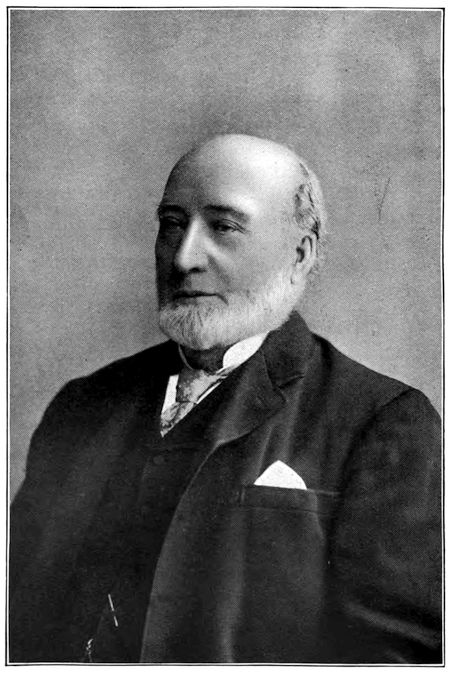
The first in prominence and force was Mr W. Crawford.
When appointed he was outside the county, but
owing to his having been secretary of the combined
counties he was known to the Durham men as an
able and forcible Trades Unionist. When the separation
between the two counties took place he was
engaged as secretary of the Northumberland
Association. This post, says Fynes in his history,
he filled "with great ability until June 1865, and
made himself a great favourite in Northumberland,
but he then left the Association in order to take the
secretaryship of the Cowpen Co-operative Store at
Blyth." Mr Burt was elected to succeed him. In
1870, when Mr Crawford applied for the position of
agent in Durham, he was selected from a number of
candidates. It was at this time that the writer had
the pleasure of making his acquaintance, and had
large opportunities of forming an estimate of his
ability. Never had any man more force of character
or more executive power. His individuality
was very large. He had no love for platform work,
and the love for that sphere lessened as he grew
older; but he had no superior and few equals in his
grasp of, and power to find a solution of, the
peculiar difficulties and complications which arise in
an occupation like the miners. He was a solver of
difficulty and a manager of men, and in every way
fitted for the post of secretary of a trades organisation.
From his appointment to his death he
filled it with a skill few men can command.
N. Wilkinson, the first treasurer of the Association,
had worked at Trimdon Grange as a fireman.
At the date of his appointment he was earning a
living by tea selling, having lost his employment on
account of his Trades Union principles. His first
appointment was temporary, and when elected permanently
he was living at Coxhoe. As soon as the
Union was fairly started he was made treasurer
permanently, and so acted till 1882. As a speaker
he was of a blunt, straightforward order. As Othello
says: "His was a round unvarnished tale and he
told it right on." At the commencement, when
announced on the bills it was as "Nicky Wilkinson,"
and no man could be in the least doubt but that
when he spoke to them on the Union and its usefulness
it was from the heart. As a man in those stern
and trying times he was, as those who were his
colleagues would testify, a man upon whom they
could depend in any testing circumstances.
Mr J. Forman.—He was the first regular chairman.
At the time of his appointment he was
checkweighman at Roddymoor, and when spoken
of it was as "Forman of Roddymoor." He came
from Northumberland to Annfield Plain when a
young man. He acted as president of the Association
for a time, and followed his occupation as checkweighman;
then in 1874 he was appointed a
permanent official, and removed to Durham. He
continued in that position until his death on the 2nd
of September 1900, at the age of seventy-seven. He
was an ideal president. It is not saying too much—his
superior could not be found. The fact of his
appointment to that position indicated the prominent
part he took in the formation of the Union. He
was more of an adviser than a platform speaker. He
preferred a quiet, retiring life in which he could be
useful rather than ornamental. Although shunning
public notoriety he was no shirker when danger
demanded the presence of men, for in all the
explosions which happened during the term of his
office he was one of the foremost; and almost single-handed
he stood out for the dust theory when men
of noted scientific knowledge were against him.
W. H. Patterson.—His life's work, from start to
finish, was the most conclusive testimony as to the
sincerity of his purpose. There were men then, as
now, whose motive is the loaves and fishes, willing
to gather where they strew not and reap where they
have not sown; but Patterson was not one of these.
From the time when, but a mere boy living at Windy
Nook, he threw himself into the work, with earnestness
and energy, until his death, when a comparatively
young man, he devoted himself and the
best he could give to the establishment of and care
for the Union. When it prospered no man was
more cheerful, and when dark times came upon it
his sorrow was genuine and large. He was not a
Crawford (few were), yet for persistent plodding he
was equal to any. With youthful buoyancy, and a
heart full of desire and determination, he was the
very man for the position in which he was placed.
It would have been a useful addition to our own
literature if he had placed on record the hardships
he, with "Tommy Ramsey" endured in 1870-72.
They lodged many a time in a room the walls of
which were the horizon and the lamps the stars
above them. Money was not plentiful, and it was
not every person who dared to take an agitator in
to lodge. It was in many quarters considered a
crime almost deserving of capital punishment.
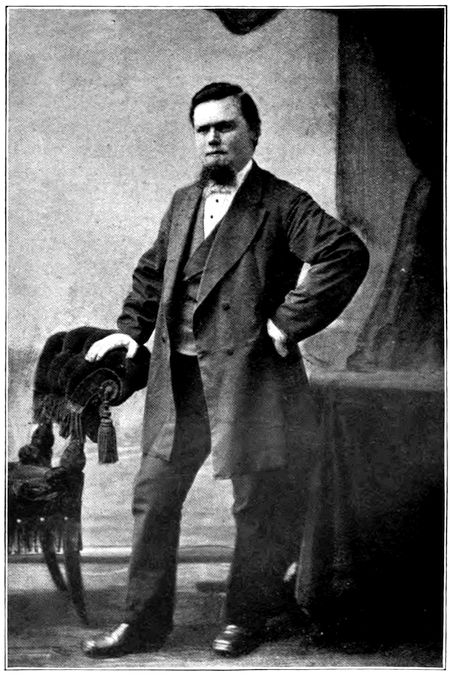
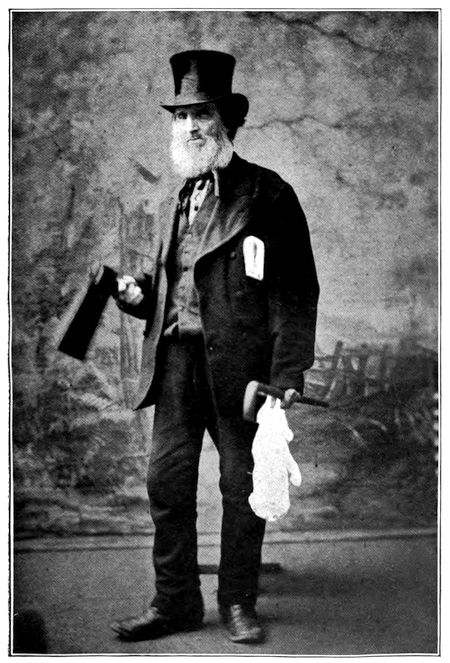
"Tommy Ramsey."—What can be said of
"Tommy"? He was a most perfect type of an
old school miner, and a sound Trades Unionist, one
of the heroes of '44. There are numbers of men in
the county who will remember the rugged old warrior
in the noble cause, just as the picture hanging in
the Hall describes him—a rough but true diamond
of the first water. With bills under his arm and
crake in hand he went from row to row announcing
the meetings and urging the men to attend. His
words were few, but forcible; not polished, but very
pointed—and they went home. Like Longfellow's
arrow shot in the air, they found a resting-place.
He had one speech, the peroration of which was
something like the following:—"Lads, unite and
better your condition. When eggs are scarce, eggs
are dear; when men are scarce, men are dear." It
was impossible to miss the meaning in those words.
Their simplicity was their greatest eloquence. His
work was far from pleasant or safe. The writer of
this was witness of a brutal attack on the old man
by a bully who would disgrace any place in which
he lived. This antipodes of a man, to curry favour
with the manager, and to please those who bought
him body and what soul he had, ill used Ramsey,
and burnt his crake. At the subsequent meeting
Crawford was wild in his denunciations. The words
still ring in my ears. Brave old "Tommy" cared
not; he got a new crake, and turned it with more
emphasis. Grand old Ramsey, you are right now;
if not, many of us have a poor chance. You in your
way, in accordance with your ability, tried to open
the prison doors to those who were bound, and to
stir up a love of freedom in the breast of those who
were in willing slavery.
This was fourfold, and it may be interesting to
look at these seriatim. The first was not in the
least unexpected. At that time Capital and Labour
were looked upon as being natural enemies, and all
their relations were on that principle. We see now
how foolish is that idea. Then conflict and doubt
formed the atmosphere which surrounded the two
great parties in the industrial world. If men having
common interest joined themselves, in order that
they might act for the common welfare, the leaders
were to be dealt with harshly, and if necessary
banished. It was no infrequent occurrence, when
the spirit of Union was abroad, for men to be driven
away from localities they loved and from associations
endeared by years of enjoyment. This was
done with the view that terror might be struck into
the hearts of others. The principle was: Drive
away the shepherd and the sheep will flee. So
much was that spirit abroad that in many places
the establishment of the Permanent Relief Fund
was treated coldly, obstacles thrown in its way, if
not bitterly opposed, because it was regarded as
the thin edge of the Union wedge. What more
natural than for fierce opposition to rear itself, with
threats for the braver spirits, and bribes and allurements
for those whose nature was susceptible to
such influences? Ale-houses were used as a means
for preventing Unionism taking root and spreading.
The sorrow of it is there have always been spirits
who are ready to act meanly when required.
This opposition was, therefore, to meet and bear
down and convince that a trades organisation was
not an institution prone to evil, and set up for no
other purpose. The men who are alive to-day, and
who took part in that opposition, would, we may
assert with confidence, confess their mistake if they
were interviewed on the subject.
Then the law was against the Trades Unionists.
We complain now, but they had more reason in those
days. We must lift ourselves into the condition of
things prior to the 1875 Act, which did a great deal
towards equalising the positions of the employer and
employed. The Master and Servants Act, with all
its one-sided applications, was in force. For a long
time an agitation was carried on for its repeal, but
after twenty years the only result was the appointment
of a select committee to inquire into the
operation of the law. The law was very unequal.
It had been framed on the principle that the
workman alone was inclined to do wrong, and therefore
wanted hedging in and punishing. In the
year 1865 there were 1100 arrests under the Act in
the country. Eight hundred of the accused were
sent to prison. An Amending Act was passed in
1867, but between that time and 1875, 774 were convicted.
"The state of the law was simply infamous.
Its provisions made it a criminal act if a workman
broke a contract, even under the most justifiable
circumstances. He was arrested by warrant, and if
the breach of contract was proved the magistrate
was bound to inflict the punishment of imprisonment
with hard labour. If, on the other hand, the
employer broke the contract, ever so flagrantly, he
could only be summoned by a civil process, and his
punishment was simply a fine."
Then they were hindered by a system of boycotting
before the word became proverbial. It was
not merely difficult, but impossible in some places
to get a meeting-place. The writer knows of one
colliery where a place could not be got. Even the
co-operative hall was closed against the Union, and
the Union money had to be taken in the corner of a
field. Beyond this, in Durham the printers refused
to do the Union printing—all except Mr J. H.
Veitch, who dared almost social ostracism and took
the work, and the connection then formed has continued
up till now. The refusal arose from two
reasons—first, there was a fear that the Union would
not be able to pay for the printing; and second,
Trades Unions were in bad odour in the county
generally, and none the less in Durham. There
was none of the respectability about the institutions
there is now, and little hope of them. Broadheadism
at Sheffield, with its destructive policy, had
filled men's minds with fear. The form of reasoning
was: "Trades Unions are guilty of these evil
things; this is a Trades Union, therefore it will be
guilty of doing evil." Just as logical as if a man
had said: "Murder is committed in England;
these people are English, therefore they will commit
murder." Mr J. H. Veitch (all honour to him) had
none of those fears, nor that false logic. He took
the work when social ostracism was in the air.
We cannot forget the act nor the man.
Another great obstacle against which they had to
contend was a host of anonymous writers, who wrote
behind a variety of nom de plumes—such as "Geordie
Close," which covered W. P. Shield, and "Jacky
Close," but none under their own names. These
writers used the most scurrilous and slanderous
language about, and attributed the vilest motives to
the men who were at the head of the movement.
The situation was a complete analogue to that
when Nehemiah commenced to build the walls of
Jerusalem. Sanballat and Tobiah and Geshem
laughed him to scorn, and despised him, and said:
"What is this thing that ye do; will ye rebel
against the king?" But as those sneerers in the
far-off Jewish times had no effect on the builders
of that day, so in those days the founders of our
Association, the builders of our broken walls, heeded
not those snarlers of thirty-six years ago, and the
result is an all-round benefit.
The greatest of all the species of opposition they
had to meet arose from the apathy and indifference
of the people. Although the condition was bad in
the extreme, yet often the earnest spirits and
others scattered about the county had to ask each
other, in the query of the prophet: "Who hath
believed our report?" The state of apathy was
quite natural. It was not because there was no real
love of Union; it was the outcome of repeated
failures. "Hope deferred maketh the heart sick."
There had been spasmodic attempts at associated
effort. The result was a feeling of hopelessness.
Like men of whom we read in waterlogged ships or
analogous situations on land, having tried oft to
save themselves, they give up in despair, and say
"Kismet," like an Eastern fatalist. The hold this
feeling had on the mind is seen in the small results
for a considerable time after the Association commenced.
A thousand or two was their whole membership,
their council was their committee as well,
and the numbers so small that a room in an ordinary
hotel could with ease contain them. At their meetings,
sparse in attendance, they were often insulted
and sometimes maltreated by the men they had
come to help.
In this alone there was sufficient to deter them, and
to lead men of talent and energy (such as they were)
to turn themselves to other objects in life; but they
loved their class, and, while they had aspirations
for better conditions, they desired to raise their
fellows with themselves. Any one of them could
have made a position in other directions if their
aims had been selfish; but they were men of
different mould, and they were inspired by the love
of the cause, and confident in its ultimate success if
once they could clear away the dark pessimism
which had fixed itself in the minds of the workmen.
For this they endured the hardship and faced the
opposition, until finally men saw the solidity and
permanency of their work, with the result that the
institution they founded occupies a rightly deserved
foremost place among Trades Unions.
The Coal Owners' Association—The Abolition of the Bond—First
general Advance—Formation of the Joint
Committee—First Gala—Mines Regulation Act—Second
Advance
The Coal Owners' Association.—One of the results
of the formation of the organisation was the commencement
of the Durham Coal Owners' Association.
There had been an association under the name of
"The North of England United Coal Trade Association,"
but its functions were vastly different from
those of the present organisation. Then the sphere
of operations was parliamentary and legal, but the
new body was formed for trade purposes. The
first meeting to consider such a step was held on
February 1st, 1872. There was an adjournment
for a fortnight, when a set of rules was submitted
setting forth the conditions of membership, contributions,
the assistance to be rendered, and the
appointment of officers. The chairman and vice-chairman
were respectively Hugh Taylor and W.
Stobart, and the secretary was T. W. Bunning.
No sooner was the Association formed than communications
were opened with the Miners' Association,
as the following letter will show:—
Neville Hall, Coal Trade Office,
Newcastle-on-Tyne, Feb. 5th, 1872.
Mr Crawford, my dear Sir,—I am directed to
inform you that, at a large meeting of the representatives
of the household coal collieries, held here last
Saturday, it was resolved—
That it is considered desirable that a meeting
should be held between the coal owners and a
deputation of the representatives of the workmen,
at one o'clock on Saturday, the 17th
instant, at the Coal Trade Office, to discuss the
various questions now in agitation by the
workmen, with a view to their adjustment,
and that a copy of this resolution be forwarded
to Mr Crawford.
Will you be as kind as to acknowledge the receipt
of this letter, and let me have the names of the
deputation who will attend.
I beg to remain, dear Sir, very respectfully yours,
Theo. Wood Bunning.
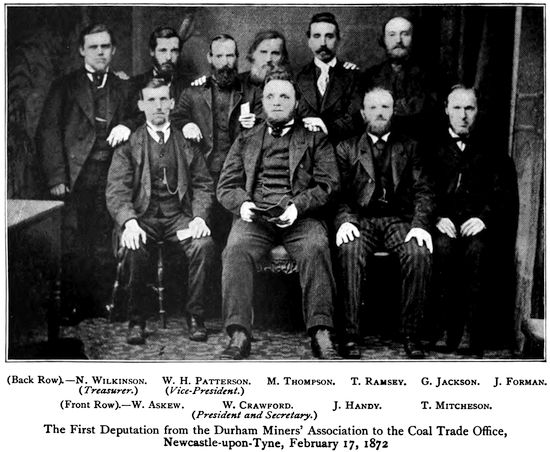
There were about a score of representatives of
the employers present during the meeting, while
ten delegates, representing 20,000 workmen, took
part in the conference on the latter's behalf.
Mr Hugh Taylor occupied the chair, and the
delegates were introduced by Mr Crawford. The
first question for discussion by the conference was
then brought forward—viz. the yearly bindings.
At the outset the employers intimated that they
were perfectly willing to abolish the bond, and
establish in its place either monthly or fortnightly
agreements, giving preference to the former. The
workmen's delegates at once intimated their readiness
to abolish the yearly bond, and thanked the masters
most kindly for the manner in which they had met
them on that question. The men proposed in the
place of the yearly bond to establish a fortnightly
agreement, and it was ultimately decided to discuss
the terms of the agreement at a second meeting to
be held shortly.
The next matter was the question of the hours
of boy labour, but after a short conversation it
was also agreed to allow this question to stand over
until the second meeting. The next question was with
reference to an advance of wages. On this point
the owners admitted that the men ought to share
the present prosperous condition of the trade, the
only difference of opinion that arose being what that
share ought to be. The employers were of opinion
that they and the men ought to meet as two
associations—the combined masters on the one side
and the combined workmen on the other—and
discuss the question as to what would be fair to
both parties. It was suggested at the same time
that any advance asked or conceded should be
based on prices in force at bound and unbound
collieries of the county of Durham in April 1871.
On the part of the employers it was pointed out
that a great many collieries had at the present
time presented petitions for an advance of wages,
and in some cases they had intimated their decision
of laying the pits idle in case their demands were
not conceded, and it was now suggested that the
delegates from the workmen present should do their
utmost to get the petitions placed in abeyance until
the next conference was held. This was readily
agreed to, and the meeting then terminated.
It is satisfactory to note that during the continuance
of the conference a most pleasant and amicable
feeling prevailed on both sides.
The Association being formed and officered preparation
was made for the removal of grievances.
The first to which attention was turned was the
abolition of the "Yearly Bond." For a long time
there had been a protest against the system of
partial slavery implied in a contract covering a
year. The system was as follows:—On a Saturday
near the 20th of March the whole of the workmen
were called to the colliery office, and there the
manager would read over (nearly always in tones
inaudible to all except those who were close to him)
the conditions of labour for the next twelve months.
There was usually a balancing of the prices. As an
inducement to the men there was, say, a sovereign
given to the first man bound, ten shillings to the
second, five shillings to the third, and then two
shillings and sixpence to every man after. The
crush to secure the first place was generally so great
that the manager was fortunate if he were not carried
off his feet. As a preparation for this rush certain
men would be bribed to incite, and thus induce men
to act in an unthinking manner.
This bare outline will suffice to show the evil
of the "Bond," and that it was a wise step on the
part of the newly-formed organisation to attempt to
substitute a shorter term of contract. The first
meeting for that purpose between the employers and
workmen was held on February 17th, 1872. As this
was the first united meeting in a series which has
been for the benefit of all concerned it will be interesting
to place on record the letter from the
employers inviting the representatives of the Miners'
Association to meet them. Of course, the employers
were made aware of the desire amongst the people
for this and other reforms, and that knowledge induced
them to arrange matters amicably if possible.
Another thing was in favour of the workmen:
not only was their Union gathering strength, but
the state of trade was in their favour. One result of
the war between France and Prussia was to increase
the demand for British coal, the result being a coal
famine and excessive prices. The old pit heaps even
were sent away, and a common saying at the time
was: "Anything black was sold for coal." A conflict,
therefore, would have been a dangerous and
destructive thing.
(First General Advance)
(Durham Chronicle Account)
Agreeably to an arrangement made at the conference
between the colliery owners and the miners'
delegates held on the 17th inst. an adjourned meeting
between the two bodies took place on Saturday at
the Wood Memorial Hall, Newcastle. There was
a large attendance of the masters, Mr Hugh Taylor,
Chipchase, being in the chair. Mr W. Crawford,
President of the Durham Miners' Mutual Confident
Association, acted as principal spokesman for the
miners' delegates, who were eight in number.
It will be remembered that at the last meeting the
masters agreed to the abolition of the yearly bond,
and the first question, therefore, taken into consideration
at the present conference, was the nature
of the future agreement between the masters and
the men. On the one hand, the employers suggested
monthly notices on both sides; but the men on
the other hand were unanimous in the request for
a fortnightly notice, with the option of either giving
or receiving the same on any day except Sunday.
After some discussion, the masters acceded to the
wishes of the men on this point. The next question
taken into consideration was the advance in pay
demanded by the men.
A proposition for an increase of 35 per cent.
on all prices paid in April last was submitted by
the delegates, who, in answer to questions by the
owners, admitted that the advance requested appeared
to be a large one, but they urged that it
was made in consequence of the low rate of remuneration
received by the miners of the county
at the time referred to.
To this advance the owners objected on the
ground that it was excessive.
They also urged that for several years past coal
had been low in the market, and the working of
pits had been unremunerative, and submitted that
it was unfair on the part of the workmen, when a
slightly better price had been obtained, to make
an exorbitant demand. They also pointed out that
the advance asked for was greatly in excess of that
obtained by the miners in other parts of the country.
To this argument the delegates replied that they
were of opinion that the advance asked for was not
greater than the excessive profits of the masters
would allow to pay; in fact they only wanted a
reasonable ratio of the profits made by their labour,
and they were also of opinion that the 35 per
cent. advance would not place the miners of the
county of Durham on an equality with the workmen
of other counties. After some further discussion,
the delegates intimated that they would be satisfied,
if the owners did not feel disposed to give the increase
asked for, with the average score price paid
in Northumberland and South Yorkshire. They
were willing, if the masters would divide the two
last mentioned counties into four quarters each,
and would select, according to arrangement, two
collieries from each of the eight quarters, to accept
the averages of the prices paid at the sixteen
collieries as the standard scale in the county of
Durham. The owners, after hearing this proposition,
asked the deputation if the average would be accepted
by the men at those collieries in the county
who were at present working for only 5 per cent.
less than the proposed standard. The delegates
replied that every such colliery would accept the
average if the masters would give it to the men of
those collieries who were at present working for
50 per cent. less than the average named.
After some further discussion the delegates retired.
On being called back into the room they were informed
by the chairman that the owners did not
think it was desirable to go to either Northumberland
or South Yorkshire for an average, as they were of
opinion that they were quite competent to manage
their own affairs; and that they had agreed, in a
spirit of conciliation, to offer an advance of 20 per
cent. on all prices over and above all consideration
money paid on April last.
The deputation stated that they had no authority
to accept the offer of the owners, but they would in
due course communicate it to the general body of
the men. The conference shortly afterwards broke
up.
The day fixed for a meeting on this question was
the 2nd of March. In the meantime a special Council
meeting was held in the Town Hall, Durham, Mr W.
Crawford, as President, occupying the chair. There
were present 160 delegates, and the members represented
were about 20,000. The business was the
discussion of the matters to come before the employers
and the appointment of a deputation to
attend the meeting.
The adjourned conference was held on Thursday,
March 21st, and for the purpose of giving a proper
knowledge I herewith record the press report from
The Durham Chronicle.
CONFERENCE BETWEEN DURHAM COAL OWNERS
AND WORKMEN
Another conference between the Durham coal
owners and a deputation of the workmen of the
county took place on Thursday sennight in the
Wood Memorial Hall, Newcastle. The chair was
occupied by Mr J. B. Simpson, Low Hedgefield,
and there was a good attendance of the representatives
of the owners, the deputation being, as at
previous meetings, headed by Mr W. Crawford.
Before proceeding to the disposal of the questions
for which the conference had been convened, it was
intimated to the deputation that Haswell Colliery
was idle. It was explained that the workmen at
that colliery had received an advance of 6d. per
score on last April's prices in November last, and
they now wanted an advance of 20 per cent. on
that concession. A telegram was also produced
which intimated that a strike on the same
ground had occurred that morning at Castle Eden
Colliery. The course adopted by these two
collieries was utterly opposed to the arrangement
which had been made between the two Associations
of employers and workmen at their conference, and
the representatives of the former body intimated
that if such constant violations of the arrangements
arrived at at these interviews were to continue, it
would be better to break off all negotiations at once,
and each side follow its own policy. The members
of the deputation expressed their utter surprise and
utter ignorance of the events that had occurred at
the collieries named, the first intimation of which
they had received was at that meeting, and they
desired to be allowed a private consultation before
they proceeded further. After a short consultation
in private, the deputation drew up the following
telegram, the substance of which they communicated
to the employers:—
We regret to hear that Haswell and Castle
Eden Collieries are idle.
You must know that you are wrong, and we
strongly advise you to commence work to-morrow,
otherwise steps will be taken to repudiate
such reprehensible conduct, and if
necessary the strongest action will be taken in
the matter.
This was deemed satisfactory, and the conference
then proceeded to the business which had drawn
them together—viz. the remuneration of the offhanded
men and boys. The employers stated that
they had agreed to give all offhanded men and boys
who work underground 20 per cent. advance on last
April's prices, the same as they had conceded to
the hewers. To the men who work above ground—viz.
to the cinder drawers, joiners, blacksmiths,
firemen, screenmen, and banksmen, and all other
men and boys, with the exception of the enginemen
and a few rare cases of cinder drawers—they
offered an advance of 12½ per cent. on last April's
prices.
The deputation, while expressing their perfect
satisfaction with the underground men and boys'
advance, suggested the propriety of the same advance
being extended to all those men, as enumerated,
who work above bank. On the part of the
employers, however, it was stated that the reason
only 12½ per cent. was offered to the above-bank
men was that a reduction of 8 per cent. in their
working hours had been conceded; and further that
their work was not of so risky and dangerous a
nature as that of the underground men, and also
that there was always a superabundance of men
willing to work on the screens, and to do other
work above bank. After a conversation, the terms
offered by the employers for both descriptions of
men were accepted.
The report of the interview was given to a delegate
meeting, Mr Crawford again presiding. The
number of delegates was very large. The points
under discussion were the two offers contained in
the report above. It was agreed that the offer of the
owners should be accepted, with the understanding
that it come into operation at once.
This was the whole of the important business
discussed.
It will serve no useful purpose to deal with
every local strike, they are incidental to the main
course. Mention will only be made when any incident
cognate to the general purpose be connected
with them. With that idea in view I refer to the
strike at Seaham. This strike commenced on
Monday, 17th May. The main causes of the stoppage
were the length of the hours of the hewers
and the time when the shifts should be worked.
The hours of the putters had been reduced from
twelve to ten, the pit at the time being a single or
day shift. With the reduction of the hours the
employers wanted to arrange for two shifts of putters
and three shifts of hewers. Against this the workmen
not only protested, but stopped work without
notice. Two things are noticeable, and of interest
to us. We have the first breach of discipline, and
the first instance of censure of the general officials,
because, in accordance with the obligations of their
office, they enforced the rules of the Association,
and candidly and clearly told the men their
opinion.
The cause of complaint with reference to Mr Crawford
and the officials of the Union, was a telegram
sent to the lodge, which, with slight verbal variation,
has formed the model of all sent since under
the same circumstances. It read as follows:—"Do
go to work. You must know you are wrong. You
will get no support. Liable to punishment. Do
return." For sending that message Mr Crawford
was subject to some very scurrilous remarks at the
meetings which were held in connection with the
strike. These remarks called forth a public reply.
In the press of that day is found a letter which contains
an unflinching and manly statement of the
facts of the case: the cause of the strike, the illegal
position of the men, and an extenuation of the
action of himself and his colleagues. I quote the
concluding words. After pointing out how expeditious
the agents had been in their attendance to
the matter in dispute, how they (the men) were
striking against their own agreement, how he had
been vilified, and how his views were still unchanged,
he wrote:
The report of yesterday's proceedings at Seaham
Colliery has not changed my views on this matter.
I repeat it, the men are in the wrong, and even
liable to punishment. A miner characterised the
telegram as an insult to the men at that colliery.
Of this I have not the slightest doubt. I have
recently been accused of both insults and incivility;
and why? Because, as in the case of Seaham, my
opinion has been asked, or advice sought, and where
such opinion or advice has been adverse to their
own preconceived ideas of right or wrong, and they
have been told so decisively but courteously, then
I became uncivil! These are the men who can
prate about liberty of speech and freedom of action,
and yet, because they are supposed to subscribe
their mite towards a person's maintenance,—every
penny of which is doubly worked for,—would only
allow his tongue to utter words in accordance with
their own crude and contracted views, even though
such words were a mere utterance of the most
glaring untruths, and a flagrant violation of all
the rules now in operation as between masters and
servants in their respective relations to each other.
I willingly admit that these are but a small
minority among the 30,000 members now composing
our Association. From the men I have
received the utmost consideration, demonstrating
by their conduct, that they will give to those whom
they employ that treatment which they would like
to receive from those by whom they themselves are
employed. I commenced my present agency
amongst the miners of Durham on May 16th, 1870.
From then, till now, I have done my utmost to
protect and further their interests in a fair and
equitable manner. Where I have deemed the doings
of owners or agents to be wrong, I have not been
slow to condemn them, and what I have done will
do again; and where I have found the workmen to
be wrong, I have pursued the same course, unhesitatingly
making known my views without the
slightest hesitation. If any man or number of men
are mean and cowardly enough to think that I shall
sit and become a mere machine of repetition, I beg
to clearly intimate that they are sadly mistaken.
I shall retain my individuality intact, holding
myself free to unreservedly express my opinion of
all matters which in any way may effect the welfare
of our Association, being always willing to retrace
my steps, if shown wherein I am wrong; but
holding on, amid the folly of fools and the abuse of
knaves, if convinced that I am right. And in
conclusion, allow me to say that, if such doings are
not in keeping with those of the men, the sooner I
am replaced the better.
A Council meeting was held on the 25th of May in
the Town Hall, Durham. The only thing of note
was a proposition for the establishment of an institution
for the benefit of old men. Nothing definite
was done in the matter. After discussing it the
Council decided to refer the matter to the Executive
Committee, with instructions to draw up a plan or
plans to be submitted to the county for acceptance
or rejection. In this we have the germ which eventually
developed, through the Permanent Relief
Fund, into the Superannuation Fund, which has been
such a blessing to hundreds of aged miners in the
northern counties.
On Saturday, June 1st, an important conference
was held between the coal owners and a
deputation of representatives of the Association.
The deputation consisted of J. Forman (President),
W. Crawford (Secretary), W. H. Patterson (Agent),
N. Wilkinson (Treasurer), T. Mitcheson, Coundon,
M. Thompson, Murton, G. Jackson, and H. Davison,
Thornley. The first question was the dispute at
Seaham and the night shift in general. There
was a long discussion, and eventually the employers
promised not to commence any more night-shift
pits unless it were a case of absolute necessity.
The conference next turned its attention to the
first rank for pony putters. The proposal of
the men was that the distance should be 100
yards. It will be as well to say here that afterwards
the distance was fixed at that number of
yards.
The next subject was as to how many tubs
should constitute a score. There was no uniformity
in the county. Although twenty of anything is
generally reckoned a score, yet at some collieries
it was as high as twenty-five. The object was to
reduce it to twenty, and the deputation was willing
to rearrange the prices wherever the number was
reduced. The owners thought it unwise to alter
the arrangements, and suggested an adjournment,
which was agreed to.
The last question was the arrangement of a
uniform time for the foreshift men to go down.
The custom varied; at some places it was as early
as one or two in the morning. The hour named by
the representatives of the workmen was from four
o'clock. The employers had no very strong objection,
except that of interfering with other classes
of labour—such as cokemen, waiters-on, and others
who would have to commence later, and therefore
be later at work. The deputation replied by
instancing the Peases firm, where the system had
been introduced and was working satisfactorily.
The employers asked for time to consult the
trade, and promised to inform the coal trade how
emphatic the workmen were in their desire for the
change.
Beyond this gala, which may be truly classed
as the first, there will not be any need to mention
the yearly gatherings in this history. Its importance
compels notice. Important it was, for two reasons—first,
its place in the series; and second, because
of the public feeling, and in many quarters fear,
which was felt as to the consequence of bringing
such a large number of the miners and massing
them in the city. As showing the state of feeling
I will insert a portion of an article which appeared
in The Durham Chronicle for Friday, June 14th,
1872.
The coming demonstration has occasioned not
a few timid residents much uneasiness during the
past few days, on account, as they imagine, of the
extreme likelihood of the affair resulting in a scene
of riot and disorder, and two or three nervous
females in business in the town have so far given
way to their fears that they have actually consulted
their friends as to the propriety of closing their
shops in order to protect their persons and property
from "those horrid pitmen!" Even the
borough magistrates, too, seem to have had an
idea that the dog-fighting and pitch-and-toss
portion of the mining community was going to
be introduced into the city by the approaching
gathering, for they declined when first requested
to grant the usual licences to the proprietors of
the refreshment booths. A full meeting of the
borough magistrates was, however, subsequently
held, and the Bench after hearing a statement
from Mr Crawford, the principal agent of the
Durham Miners' Association, relative to the object
of the miners in assembling together agreed to
issue the required certificates. For our own part,
we have not the slightest doubt of the proceedings
being characterised by anything but the best of
feeling and order on the part of the men taking
part in the demonstration, which we are sure is
intended to partake more of the character of a
monster "outing" of a class of men whose only
desire is to discuss amongst themselves the best
means of improving, in a rational and legal manner,
their condition, rather than an assemblage of either
political or social conspirators and agitators. Almost
the worst contingency, however, has been anticipated,
as there will be a force of 40 policemen on the
ground, the expense of the attendance of 20 of
whom will be borne by the Miners' Association,
whilst the remuneration of the remaining 20 will
be defrayed from the funds of the borough watch
rate.
In addition to this, many tradesmen barricaded
their shop windows, and an urgent request was
made to the Mayor to have soldiers in readiness.
Mr J. Fowler stood in defence. His reply was
characteristic, but correct: "I know the pitmen
better than you, and there is no fear." He was
borne out by the proceedings, which were in the
highest degree satisfactory. The first part of the
procession came in at 7.30 A.M., and from first to
last the most complete good order obtained. There
were in all 180 collieries present—the membership
of the Association being 32,000. The speakers were
A. M'Donald, then President of the National
Association of Miners; W. Brown, Stafford; and
T. Burt, Northumberland. The local speakers were
W. Crawford, W. H. Patterson, H. Davison
(Thornley), N. Wilkinson, T. Mitcheson, G.
("General") Jackson, T. Ramsey, and W. Askew.
The following resolutions were submitted:—
1. The change which during the past twelve
months has taken place in the position of the Durham
Miners' Association, both numerically and financially,
ought to be encouraging to all who take an
interest in its welfare. During that period differences,
as in other places, have arisen; but, so far, they
have been managed without a single pit having been
stopped, or the loss of any work whatever. This
is a condition of things which, taken all together,
ought to give the utmost satisfaction to all parties
concerned.
2. This meeting begs to utter its indignant protest
against the action of the Select Committee in the
way they have amended the Payment of Wages
Bill. It at the same time most earnestly calls upon
Government to restore it to its original form by
amendment whilst it is under the consideration of
the committee of the whole House. It further begs
to state that no measure will be satisfactory to the
miners of the county of Durham that does not contain
payment of wages weekly without any reduction
whatever.
3. That this meeting also has learnt with surprise
that it has been stated that the miners of Durham
do not want weekly payment of their wages, and
that they are not aggrieved with the present reduction.
They beg to give the statement, by whomsoever
made, an unqualified denial.
4. This meeting likewise looks upon the Criminal
Law Amendment Act of 1871 as an insult to the
working classes of this country. It at the same time
pledges itself to every legal means to have the law
repealed or so modified as that all classes in the
country will be alike in the eye of the law.
5. That this meeting regards arbitration as a
logical way of settling those differences which in
trade necessarily arise between employers and employed.
Arbitration recognises the right of both
parties to put forth views, and leads to examination
or investigation, which tends to avoid strikes and
lockouts, with all their commercial ruin and social
misery. It has now for a short time been in operation
amongst the miners of Durham, and we are able
to speak to beneficial results; and we most heartily
wish to have a continuance and extension of the
principle.
6. That a copy of the foregoing resolutions be sent
to the Prime Minister and Home Secretary.
With this all too brief reference we must leave
this, our first race-course gathering. If anyone be
desirous of reading a very full description of the
collieries attending, with their numbers on the books,
the banners with their inscriptions and designs,
and the speeches, let him refer to The Durham
Chronicle for June 21st of that year. Suffice it
here to say that the day was all that could be
desired. The old city was enlivened and its trade
enhanced. The great crowd came and went in good
order. The fears of the fearful were shown to be
groundless, and the good behaviour initiated that
day, amid the firing of the cannons in Wharton
Park, has never varied up to the last of this
series of gatherings. The cannons were fired at
the expense of T. Ramsey.
On Friday, the 12th of July 1872, a meeting took
place between the employers' and workmen's representatives.
The meeting was arranged in response
to a request for an advance of fifteen per cent. on
the rate of wages. Mr H. Taylor occupied the chair.
The deputation was headed by Mr W. Crawford.
At the outset of the meeting the owners complained
that the men were neglecting work to a very great
extent, causing a diminution in the output of not
less than twenty per cent. as compared with the
previous twelve months. Statistics showed that
the average working time of the hewers was not more
than eight days per fortnight. That entailed heavy
loss on the owners, and while such neglect of work
continued they could not grant the advance asked
for, and they suggested the propriety of having a
clause inserted in all agreements, that the men
should be compelled to work at least thirty-five
hours per week before claiming the highest price
paid at the colliery. That meant the system of
bonus money paid at many collieries, and the
deputation emphatically refused it, and said they
were not asking because of the state of trade only,
but because of the very low condition of their wages
which had obtained in Durham for so long, and
which they hoped to raise, even if trade became
depressed. The deputation was asked to retire,
and on their return were handed the following
resolution:—
The Association [Owners'] has decided to give
10 per cent. advance to all underground workmen,
including banking-out men; but excepting pony
putters, who are to be dealt with after the putting
question has been settled in Northumberland; and
7½ per cent. to the whole of the above-ground
labour; enginemen, both above and below ground,
to be excepted. This advance to be on present
prices, and to date from the pay commencing nearest
the first day of August.
This offer was brought before a special Council
meeting held on Saturday, the 13th, Mr John Forman
presiding. The report of the meeting with the employers
was given by Mr Crawford, who went very
fully into the reasons why the advance of fifteen per
cent. was claimed. The Council adopted the following
series of resolutions:—
1. That in the opinion of this meeting we are
more than justified in asking the 15 per cent. on
present prices, which is being sought by our Association.
There never was a time when the price of
coals approximated to what they are at the present
time, and in justice we believe that we ought to
fully share in that increase and increasing prosperity.
On the 8th day of the present month the following
are quotations from the London Coal Market:—Kelloe,
26s. 3d.; South Hetton and Lambton, 27s.;
and Hetton, 27s. 6d.
Having seen coals sold in the same market for
as little as 13s. per ton, or more than cent. per cent.
less than now, we certainly conclude that we are
more than justified in seeking 6d. or even 1s. out of
14s. or 15s. This being so, we abide by the 15 per
cent. now being asked for all classes of workmen,
above and below ground.
2. That the owners be requested to meet our
deputation on Friday next for the purpose of
reconsidering the 15 per cent. advance, or if possible
on a more early day.
3. That this meeting deplores the oft-repeated
statement of coal owners and others relative to the
amount of work at present lost by the miners in
the county of Durham. We cannot with our present
knowledge admit the accuracy of these statements,
but believe, on the contrary, that such statements
are very greatly overdrawn, and thus an entire false
impression is being conveyed to the public mind,
and a positive injury done to a large body of men.
We have again and again declared that in our
opinion men ought to attend their work as regularly
as possible, believing that to do so is for the
benefit of themselves as well as the employers, and
we again urge our members to be as regular as
possible in their attendance at work, so as alike to
benefit themselves and deprive all parties from so
maligning them.
The adjourned meeting with the owners took place
on Friday, July 19th, when Mr H. Taylor again
occupied the chair. The owners repeated their
complaint about the loss of work, and asked whether
the deputation were willing to give any guarantee
that the men would in future work more regularly.
They could not give such a guarantee, but said their
Council meeting had agreed to recommend the men
to work as regularly as possible. With this assurance
the owners then handed the following resolution to
the deputation:—
We have decided to give 15 per cent. advance
to all underground workmen—including banking-out
men—except pony putters (who are to be dealt with
after the putting question has been settled in
Northumberland), and 10 per cent. to the whole of
the above-ground workmen, enginemen (both above
and below) excepted. This advance to be on present
prices, and to date from pays commencing nearest to
Monday the 22nd and Monday the 29th of July.
The deputation were not satisfied with the reservation
as to the putters, and after some further discussion
it was agreed to make the advance applicable
to them as to the other underground workmen.
It will be interesting to give this important step
in detail. It was first mentioned in connection
with certain meetings which were held mainly on
the wages question or the abolition of the yearly
bond. While discussing these matters Mr Crawford,
on behalf of the deputation, mentioned the advisability
of forming a committee of six on either
side to consider local disputes and changes in wages.
The first formal action taken by the employers was
on July 12th, 1872, when the following resolution
was adopted at their meeting:—
Joint Committee.—Mr Crawford was also informed
that on the motion of Mr Lindsay Wood,
seconded by Mr Hunter, a Committee consisting of
the following gentlemen:—Hugh Taylor, W.
Stobart, W. Hunter, C. Berkley, R. F. Matthews
and Lindsay Wood had been appointed to meet a
Committee from the Miners' Union, to draw up
rules for guiding the Association in receiving demands
from the workmen.
It was arranged with Mr Crawford, that the
Committee from the Miners' Union should meet the
above-formed Committee at 10.30 on Friday, the
19th inst.
The suggested meeting was held on 19th July,
when the following recommendation was agreed
to:—
Joint Committee.—It was agreed to recommend—That
six members of each Association should
meet every fortnight and discuss all demands except
cases of consideration in temporary bad places, the
consideration to be given in such places to be settled
from fortnight to fortnight by the agents of the
collieries affected. All demands to come through
Mr Crawford, who is to give the agents of the
colliery and the Secretary of this Association, at
least three clear days' notice of the nature of the
demands that it is intended to prefer at the next
meeting.
As a result of this recommendation a meeting was
held on the 2nd of August, and the first code of
rules was arranged. The names of the parties at the
meeting are in the following list:—
| Owners | Workmen |
|---|
| Hugh Taylor. | W. Crawford. |
| W. Stobart. | W. H. Patterson. |
| Lindsay Wood. | N. Wilkinson. |
| John Taylor. | J. Jackson. |
| J. B. Simpson. | J. Forman. |
| C. Berkley. | T. Mitcheson. |
| P. Cooper. |
| W. Hunter. |
| R. F. Matthews. |
| T. T. Smith. |
R. B. Sanderson occupied the chair. The following
rules were agreed to:—
The object of the Committee shall be to arbitrate,
appoint arbitrators, or otherwise settle all questions
(except such as may be termed county questions or
questions affecting the general trade) relating to
matters of wages, practices or working, or any other
subject which may arise from time to time at any
particular colliery, and which shall be referred to
the consideration of the Committee by the parties
concerned. The Committee shall have full power
to settle all disputes, and their decision shall be
final and binding upon all parties in such manner
as the Committee may direct.
The Committee shall consist of six representatives
chosen by the Miners' Union and six representatives
chosen by the Coal Owners' Association.
At meetings of this Committee it shall be deemed
that there shall be no quorum unless at least three
members of each Association be present.
Each meeting shall nominate its own chairman,
who shall have no casting vote. In case of equality
of votes upon any question, it shall be referred to
two arbitrators, one to be chosen by the members of
each Association present at the meeting. These
arbitrators to appoint an umpire in the usual way.
Each party to pay its own expenses. The expenses
of the umpire to be borne equally by the
two Associations.
Should any alteration of or addition to these
rules be desired, notice of such change shall be given
at the meeting previous to its discussion.
If any member of the Committee is directly interested
in any question under discussion, he shall
abstain from voting, and a member of the opposite
party shall also abstain from voting.
When any subject is to be considered by the
Committee, the Secretary of the Association by
whom it is brought forward shall give notice thereof
to the Secretary of the other Association, at least
three clear days before the meeting at which it is
to be considered.
The Committee to meet every alternate Friday
at half-past eleven o'clock.
The first meeting of Joint Committee was held
on 16th August. The members were:
| Owners | Workmen |
|---|
| R. B. Sanderson, Chairman. | W. Crawford. |
| C. Berkley. | W. H. Patterson. |
| J. B. Simpson. | J. Forman. |
| J. Taylor. | N. Wilkinson. |
| P. Cooper. | J. Jackson. |
| R. F. Matthews. | T. Mitcheson. |
There were in all six cases, which, with their
decisions, are as follows:—
August 16th, 1872.
Murton (Stonemen).—Demand for an advance of
from 6d. to 8d. per day. To stand over for a fortnight
to ascertain the average wages of the district.
Oakenshaw.—Demand for 1s. per score on the
broken and a sliding scale similar to that in the
whole. The 1s. per score in the broken was granted
to date from (uncertain?).
The sliding scale was waived by Mr Crawford and
his Committee.
Seaham.—Mr Matthews' report objected to,—referred,
together with a question of removing
bottom coal (Mr T. Taylor was chosen arbitrator by
the Association); any concessions made by the
arbitrators to date from Monday the 19th August.
Etherley.—Complaint that the banksmen and
others have not received the different advances
granted by the Association. Mr Lishman was desired
to carry out the resolutions of the Association
in their entirety.
South Derwent.—Complaint that the deputies
have not got the 20 per cent. advance. Mr Dickenson,
having stated the circumstances of the case and
the wages paid, the complaint was withdrawn; it
being considered that the deputies are fully in the
receipt of the advances decided upon.
Wardley.—Longwall skirting.—This turned upon
the question as to whether it was intended by the
arbitrators to include skirting in their award of the
25th March 1872, but it was decided that it was not
so included, and that 8d. per yard extra should be
given for skirting.
Shifters' Wages.—Demand withdrawn.
Ramble.—To be considered at the next meeting.
It was agreed that full particulars of subjects
to be discussed before the meeting should be given
at least three clear days before the meeting.
In the session of 1871 a Mines Bill was under
discussion, but was not carried through its various
stages. It was again introduced in the session of
1872, and for a long time its fate was uncertain.
Men from all the districts were up lobbying on
behalf of the Bill. Mr Crawford was sent from
Durham. A Council meeting was held on Saturday,
27th July. While the meeting was in progress
a telegram was received from Mr Crawford as
follows:—
Crawford, London, to Mr John Forman, Town
Hall, Durham.—Many hours in the Lords last
night. Happily disappointed. Bill passed satisfactory.
Weighing clause safe. Boys ten hours
from bank to bank.
A vote of thanks was carried to Mr Crawford, the
Government, and to the Home Secretary for the
able manner in which he had conducted the Bill
through Parliament.
At the ordinary Council meeting held on Saturday,
7th September, the number of members reported
was 35,000. Mr Crawford gave the result of a
conference which had taken place with the coal
owners with respect to another advance of fifteen
per cent. Nothing definite had been done, as the
employers were indisposed to comply with the request,
and it was adjourned for a fortnight.
That meeting was held on Friday, September 27th,
in Newcastle. The deputation was informed that
the subject had been fully considered. Coals were
falling in price, the demand was declining, and the
commercial prospects were assuming a more unfavourable
aspect, and therefore they could not
give any further advance in wages. The meeting
terminated, but the deputation expressed their dissatisfaction
with the result, and they were supported
in their objection by a Council which was held on
Saturday, September 28th, and they were instructed
to again meet the employers.
The Mines Act—The third Advance—Death of "Tommy"
Ramsey—The drawing Hours—The second Gala—Advance
in Wages
On January 1st the new Mines Act came into force.
It is no part of this history to enter into all the
changes made by the new measure, but there are
three portions of it which deserve a brief notice—these
are the weighing of minerals, the position of
the checkweighman, and the hours of the boys.
The weighing of minerals clause was to provide
against the "Rocking" customs such as had obtained
at the Brancepeth Collieries, and which had
caused the "Rocking" strike. The new Act set
forth that:
Where the amount of wages paid to any of the
persons employed in a mine to which this Act
applies depends on the amount of mineral gotten
by them, such persons shall, after the first day of
August one thousand eight hundred and seventy-three,
unless the mine is exempted by a Secretary
of State, be paid according to the weight of the
mineral gotten by them, and such mineral shall
be truly weighed accordingly.
The clause further provided for deductions and for
exemptions by the Secretary of State from the
weighing clause if it were proved that the exigencies
of the mine warranted it. In a note to this section
Mr Maskell W. Peace, Solicitor to the Mining
Association of Great Britain, warned the employers
that: "This is an entirely new enactment. Care
must be taken to provide the necessary machines
for carrying out the provisions by the 1st of August
1872."
The portion of the Act relating to the appointment
of the checkweighman was a great advance
in the direction of freedom of choice. Prior to
this the choice of the workmen was confined to those
employed on the colliery subject to the confirmation
of the manager, and the man chosen was as liable
to be discharged as any other of the workmen for
any reason. The new Act provided that one of
the workmen could be chosen either from the mine
or under the firm. He need not be sanctioned by
the manager, and could only be removed "on the
ground that such checkweigher has impeded or
interfered with the working of the mine, or interfered
with the weighing or has otherwise misconducted
himself." The last provision gave rise to
some very glaring removals for acts done away from
the mine. These anomalies were corrected by the
Act of 1887.
There were two provisions in the new Act relating
to the hours of boys. One was for those between the
ages of ten and twelve, and they were for the purpose
of employment in thin seams; their time was
to be for only "six hours in any one day." The
other provision (which still exists) was for boys
between twelve and sixteen years. The weekly
hours were fixed at fifty-four. This latter provision
was the cause of some confusion, seeing the
hours of drawing coal were twelve, and the difficulty
was to bring these boys away without interfering
with that.
A very important Council was held in the Town
Hall, Durham. There were two questions before
the meeting—first, the demand for fifteen per cent.
advance; and second, the working hours under the
new Mines Regulation Act. As stated in the review
of the previous year, meetings had been held on the
advance in September, but the employers would
not give way, and asked us to wait. In consequence
there was a very strong feeling in the
county which found expression at the Council.
There was some complaint that the Executive Committee
had not been so energetic in the matter as
they ought to have been. Mr Crawford defended
the Committee. An attempt was made to increase
the amount claimed to thirty-five per cent., but in
the end the original request was confirmed. The
question of the number of hours the pits should draw
coal was next considered. The employers were
asking for eleven hours, but this was felt to be
difficult because of the Act in its application to
the boys under sixteen. There was a desire on the
part of many delegates that the coal drawing should
be limited to ten. During the discussion Mr Crawford
said:
No more important question could occupy their
attention than that before the meeting. Not even
the question of an advance exceeded it in importance,
because whether or not that was given
a great deal depended on how they settled the
question of the hours. He might hold views very
different to what were entertained by many in that
room, but he was bound to state them. The question
had occupied his attention, and he was of the
opinion that the owners would be unable to keep
the men fully employed for eleven hours. They
had, however, requested to be allowed to work
those hours, and they had a perfect right to do so if
they could employ the men. At the same time, he
did not believe they could keep the men employed
during the last hour after the lads had gone to
bank.
Eventually it was resolved that the employers
should have the unreserved right to draw coal
eleven hours per day, providing they did not
violate the Mines Act relative to the boys under
sixteen, nor keep the men in the pit the last hour
doing nothing.
The meeting with the employers on the advance
was held on February 8th, Mr Hugh Taylor presiding.
In a very long statement he reviewed the
state of the coal trade. He reminded the deputation
that, although there had been delay, there had not
been any breach of faith. He brought before
them the question of short time, which was an
evil not only to those engaged in the coal trade,
but to the country at large. He urged again the
request of the employers that there should be an
agreement binding men to work so many hours at
the coal face. The Mines Act had been passed.
It did not satisfy anyone. All they asked was
that the men should do their duty. In the face of
these difficulties, but in the hope that the men
would help them, they had decided on an all-round
advance of fifteen per cent.
There were some of the lodges who refused to carry
out the eleven hours' arrangement, and with a view
to induce them to do so the following circular was
issued:—
TO THE MEMBERS OF THE DURHAM MINERS' ASSOCIATION
Fellow-workmen,—In the inauguration of any
new system, difficulties always occur; whether
these difficulties are easily overcome, or otherwise,
will much depend on the manner and extent to
which men, or classes, are affected thereby. As
a matter of consequence, we have found these
difficulties amongst ourselves in putting into operation
the new "Mines Regulation Bill."
These have arisen from various causes.
We have, first, a very erroneous impression
gone forth, to the effect, that after the commencement
of the new Mines Bill, on the first day of the
present year, no pit, or no person in a pit, must
work more than 10 hours per day, or 54 hours in
any one week. In the Minutes of Committee Meeting,
held on the 4th inst., we clearly and distinctly
stated that this view was a wrong one. We again
beg to emphatically state that the law, in this
particular, affects only boys under 16 years of age,
and that so far as regards all parties above this
age, matters remain identically as they have been.
It would appear, however, that in the face of this
intimation, some collieries of men are still insisting
on the general adoption of the 10 hours per day,
and 54 hours per week. In addition to this, we
have existing at many collieries, both where men
work two and three shifts per day, difficulties as to
what the working hours ought to be.
Under these circumstances, the owners asked your
deputation to meet them last week, for the purpose
of discussing, and if possible arranging, some understood
mode of action. This meeting took place, at
Newcastle, on Friday last.
The first question asked was, what objection we
had to owners working their pits 11 hours per day,
and 11 or 12 days per fortnight as usual, so long
as they did not violate the Act of Parliament relative
to boys under 16 years of age? After talking over
the matter for a long time, we retired, and in consulting
among ourselves, failed to see any reason
why pits should not draw coals 11 hours per day
as heretofore they had done. We returned and told
them that we could see nothing to prevent them
from working the pits 11 hours per day, if they
thought desirable to do so, and they could find men
or boys to bring the coals to bank; but that, in
trying to carry this into effect, they must not keep
men laying at their work for the last hour doing
absolutely nothing, as, if such cases did occur, they
would most certainly be complained of, and a remedy
sought by an appeal to the Joint Committee, in
which case they would be exposed to the entire
county throughout.
Respecting boys being brought into the pit an
hour or two after work commences, or sent home
an hour or two before the pit is done at night, we
cannot see that any difficulties should exist. The
question was asked, should a boy be sent home for
the first 5 days, having worked less by far than the
allotted 10 hours' per day, and such boy should
purposely remain at home on the Saturday, would
such boy claim his 5 days' pay, remembering that
for 5 days he had worked short time for the very
purpose of going to work on the Saturday? To this
the owners demurred, when we suggested the desirability
of seeing boys, or their parents, and making
with them necessary arrangements.
We may be told that the boys are sent home to
suit the owner's convenience, but we must not forget,
for whatever purpose sent home, that while they
worked short time they were paid full hours, and we
certainly cannot see the wisdom of preventing boys
from receiving 6 days' pay for working 54 hours,
when, but a short time ago, they worked 66 hours
for the same money.
The employers, by Act of Parliament, are compelled
to reduce the working hours of boys under
16 years of age, but we cannot expect them to
reduce the hours of all datal men, if work can be
found for them for the ordinary time. We must not
lose sight of one very important fact, viz., that a
reduction of working hours to those who are paid a
datal wage means an advance of price, a reduction
of hours, from 11 to 10 per day, is equal to 9 per
cent., which practically means 9 per cent. advance,
seeing that the productive powers are lessened by
so much. In this manner it must be seen too, that
no boy under 16 years of age is allowed to be in
the pit more than 10 hours in any one single day,
or 54 hours in any one week. If this is strictly seen
to, a great work has been accomplished, and don't
let us spoil that which is really good by trying to
accomplish too much.
Those lodges who object to the pit drawing coal
11 hours per day, ought to bear in mind that a
reduction to 10 hours is a very serious curtailment
in the drawing or producing powers of the pit, and
as such only tends to lessen the power of owners to
pay good wages. The profits arising from the produce
of any article are up to a given quantity consumed
in paying current expenses; and, therefore,
the more the produce is restricted, the less means
are there at command wherewith to pay all classes
of workmen. The disadvantages arising from the
operation of the new Mines Act must necessarily tell
heavily on the mine owners in the two Northern
Counties, where the double-shift system is worked,
and it would be an act of imprudence—not to say
injustice—and materially militate against our own
interests, to increase drawbacks beyond an absolutely
necessary point. We would, therefore, strongly urge
on all our associated collieries to allow the employers
(1) to work their pits 11 hours per day, where they
can find men or boys to keep them going that time,
without, of course, infringing the law, relative to
boys under 16 years of age. And (2) to allow boys
to be sent home on one or more days, so as to
make up six nine-hour shifts in the week. By this
plan no workman can lose, while the boys would
materially gain thereby.
We have so far worked successfully, but that
success has been greatly, if not altogether, owing to
the caution we have exercised, and the general
reasonableness of our requests, having at all times
a respect for the right, while we have tried to bring
into active operation the duties of capitalists. Let
us not then mar that success by an imprudent or
forward act of ours, particularly at a time when a
change which must tell very severely on the interests
of mine owners, and which, moreover, is of our own
seeking, is just being introduced amongst us, and
from which boys at least must gain immense advantages.
By order of the Committee,
Wm. Crawford, Secretary.
Offices—16 North Road, Durham.
Jan. 20th, 1873.
While these questions were claiming and received
the attention of Mr Crawford and his colleagues a
foul attack was made upon him by G. ("General")
Jackson of Nettlesworth. He published a number
of letters, which were not very choice in language,
but prolific in the lowest form of abuse. He spoke
of "that fellow Crawford," "that bully" who was
feathering his nest by defrauding. This went on
until the Executive came to the defence of Mr
Crawford. They published a circular, pointing out the
false charges which had been made, and that Jackson
was a member of the Committee during the period
in which he alleged the misappropriation of money
had taken place. They reminded him of the neglect
of duty implied in his not exposing such things
before, and ended the circular by saying: "Further
this Committee begs respectfully to say that they
have the greatest esteem for their secretary, Mr
Crawford, and are fully convinced that he has always
acted in harmony with the highest principles of moral
rectitude."
On Thursday, 8th of May, the first of the pioneers
who crossed the border line, "Tommy" Ramsey,
died at the house of his brother at Blaydon at the
age of sixty-two. He was buried in the cemetery at
Blaydon on Monday, the 12th. The number of people
attending his funeral was a proof of the high esteem
in which he was held. According to the account
there were fifty of the Trimdon miners, where he
worked last, present, while from collieries around
Durham large numbers also attended. The procession
was headed by the Blaydon Main banner. We
have made a note about him, as one of the leaders,
but we may add a few words from an obituary which
was published at the time of his death.
"Old Tommy," as his brother miners of every
degree loved to call him, was chiefly known to the
pitmen at large as a Unionist. With a face furrowed
with care and the hardships of his laborious calling,
and scarred by many an accident in the pits, he was
never afraid to stand up before his brethren and
agitate for that amelioration in the condition of the
working pitmen which has at length been conceded.
His style of oratory, if it were not strictly grammatical,
was gifted with a warmth of expression that
told forcibly on his hearers of his own class, and his
perfect knowledge of the one subject he engaged
upon—the danger and the excessive toil of the
miner's life—caused him to be held in respect by
masters and men alike. In every movement that
had for its object the freedom from the bondage
the miner was held in, Ramsey was always to the
front, and none mourned in bygone years more
sincerely than he did the failure to establish on a
firm and lasting basis the Union, by which alone he
maintained were they likely to obtain their rights
as workmen. When the present Association was
started, amongst the dozen delegates or so who
assembled at the Market Hall, Durham, bent if they
could on forming a union, was "Old Tommy"; and
there he attended every meeting, when to be identified
as a delegate was to almost sign his own death
warrant so far as employment was concerned. "Men
and brothers," he said, addressing a public meeting
near Thornley a few weeks after the Association was
formed, "I've been a Unionist all my days, and with
the help of God I will remain one to the end of the
chapter."
At the Council meeting held on 31st May we have
the first mention of a hall for the use of the Association,
with offices and agents' houses. After a lengthy
discussion the project was endorsed, the money to
be taken from the general funds, and the Executive
were appointed a Building Committee. The Committee
immediately commenced operations by purchasing
a block of houses known as Monks Buildings,
the site of the Hall and houses, and offering
a premium of £25 for the best design for hall and
offices. This was won by Mr T. Oliver, Architect,
of Newcastle.
The other important question was the eleven
hours' drawing of coals. The system received
general condemnation. At the conclusion of the
consideration a very long resolution was adopted.
It set forth that when the Mines Act came into
operation the workmen did not think it right to
curtail the producing powers of the pits, and they,
therefore, fell in with the views of the owners.
Having tried the system they had no hesitation in
pronouncing it an utter failure on the following
grounds:—
"1. Because of the great difficulty, if not impossibility,
of working the pits full time on both the
first and last hour of the day, thus inflicting a
positive injustice on large bodies of men. We have
the testimony of Lindsay Wood, Esq., in his evidence
before the Coal Committee that the system of
eleven hours' work entails great danger on the boys
going and coming out of the mine while the pit is
at full work. We regret to say that this system
has already borne fruit in the slaughter of one or
more boys in going and coming out of the mine
during the day. This being so we now find ourselves
compelled to make an emphatic appeal to
the mine owners of the county to work their pits
only ten hours per diem in order to obviate both
this injustice and danger."
As I have said, it will not assist the history we
have on hand if we dwell upon the whole series of
our galas, and therefore we will only make a reference
to the second one in the series. It was held
on Saturday, the 14th of June, and the gathering
was larger than the year prior. There were three
platforms. The chairmen were J. Cowen, J.
Laverick, and J. Fowler. The speakers outside
were P. Casey, Yorkshire; A. M'Donald, Scotland;
B. Pickard, Yorkshire; Lloyd Jones, London; J.
Shepherd, Cleveland; T. Burt, Northumberland;
and R. Fynes, Blyth, with the addition of the
Executive Committee. The speeches need not be
referred to beyond the references by Mr Crawford, as
indicating the progress of the Association during
the year. They had added 5000 to their numbers,
bringing the membership up to 40,000, and they
had increased their funds from £12,000 to £34,000.
They had proved their leading principle was
amicability. "That principle had been not to get
a thing because they had the power, but first of all
to ask the question was it right that they ought to
have it."
The ordinary Council meeting was held in the
Town Hall on July 26th. It is important because
of the attempt that was made to censure Mr
Crawford. For some weeks a personal controversy
had been taking place between Mr E. Rhymer and
Mr Crawford. Mr Rhymer had complained that,
although the miners had invited him to the demonstration,
yet Mr Crawford had stood in his way.
This was denied very strongly, and some very
curious epithets were applied to him (Mr Crawford)
for making the statement. At the Council a resolution
was on the programme from Ushaw Moor
as follows:—
"That Mr Crawford receive three months' notice
from next delegates' meeting, for his behaviour to
E. Rhymer and also the Bearpark men."
In a note he sent out with the programme he
said "he was prepared to account for all he had
done in open day, and after that, if the Association
was so minded, he was prepared to leave them not
in three months, but in three days or three hours."
The result of the discussion was the withdrawal
of the Ushaw Moor resolution and the carrying
of one from Hetton which not only exonerated
him, but expressed their high approval of his conduct
and work in the county.
On the 4th of October a Council meeting was
held. The object of the meeting was to consider
the advisability of applying for a twenty per cent.
advance. In the end the resolution was carried,
and Mr Crawford was instructed to arrange for a
meeting with the employers. This meeting was held
on October 17th, but was refused by the owners,
and in refusing they intimated that, as the state
of trade was, they would shortly be making a
claim for a reduction. The refusal was reported to
a special Council, when the deputation was again
instructed to meet the employers. The second
meeting was held on November 14th. After the
question had been discussed the following resolution
was handed the deputation:—
"This Association cannot accede to the application
of the Durham Miners' Association for an
advance in wages, but is prepared to refer to
arbitration the question of whether since the last
settlement of wages in February 1873 there has
been such a change in the condition of the Durham
coal trade as to call for an alteration in the wages
now paid, and if so whether by way of advance or
reduction and the amount in either case."
This offer was discussed at a Council meeting,
when the arbitration was agreed to; but the submission
was disapproved of, and the Executive
Committee instructed to draw up a counter proposal,
to be submitted to a subsequent meeting for
approval.
Another meeting with the employers was held on
Friday, the 12th of December. At the conclusion
of the meeting the employers intimated that they
would send their decision to Mr Crawford. On the
13th a Council meeting was held. A letter was
read from the employers, in which they objected
to accede to the request of the workmen for an alteration
of the submission they had proposed. After a
further discussion the following resolution was
proposed:—
"Having fully considered the objections of the
employers to our suggested basis for arbitration
we fail to see the soundness of such objections.
Nevertheless in order that no difficulties may arise
in carrying out this matter, we are willing to alter
that basis by leaving the question entirely open.
Allowing both parties to bring forward all reliant
matter which may bear upon their respective
positions, leaving it to the arbitrator to say whether
any advance ought to be given and that the
Durham Coal Owners' Association be urgently requested
to consider this matter on the earliest day
possible."
There are two matters which deserve a brief notice
here, although not essentially part of the Association.
These were the Royal Commission to inquire
into the coal supply and the causes of the high
prices, and the rise of the Franchise Association.
The former of these was appointed on 21st February
1873 by the following resolution of the House of
Commons:—
"That a Select Committee be appointed to inquire
into the causes of the present dearness and duration
of coal, and report thereon to the House."
This Committee examined a large number of
witnesses, including all classes connected with the
coal trade. The following is a portion of their
report:—
"1. Considering the great extent of the coal
fields in Great Britain, the number of collieries at
work, and the variety of coals produced, which
though primarily used for particular purposes, will,
at certain prices, be used for others, your Committee,
notwithstanding intermittent and startling
fluctuations in price due to temporary causes, do
not believe that any combination either of employers
or workmen can by artificial means succeed in
permanently affecting the ordinary results of the
relations of demand and supply in adjusting the
quantity of coal produced to the demand, or can
permanently affect the price resulting from the
state of the market; nor do your Committee believe
that the interference of Parliament with the course
of industry and trade in coal could produce any
useful or beneficial result to the public beyond what
has been arrived at in recent legislation, namely,
the prevention of injury to the health and morals
of young children and young persons, and the prevention
of accidents from wilful neglect of recognised
precautions.
"2. Much evidence has however been given to
show the great increase in the rate of wages, and
the earnings of the working miners; but whilst it
is true that in some cases the earnings have
enormously increased, and have been improvidently
spent, your Committee conclude that in general
the condition of the workmen has been much improved,
and that the rise in the rate of wages has
not, under the exceptional circumstances, been
unreasonable, nor been unattended with considerable
benefit to the workers; indeed in some cases the
workmen have preferred improving the conditions
under which they work to increasing the amount
of their wages in money.
"3. It is clearly shown that the real order of
events has been the rise in the price of iron, the
rise in the price of coal, and the rise in the rate
of wages. The increased payment per ton for labour
employed in getting the coal cannot therefore be
considered as the primary cause of the large increase
in the price of coal; a rise in wages followed upon
rather than preceded a rise in the price of coal.
To the extent to which increased rates of wages
have induced workmen to labour for a shorter
number of hours than heretofore, resulting in a
reduced output per man, a higher payment for
labour has contributed indirectly in an important
degree to maintain the high price of coal, but having
regard to the great danger to which coal miners
are exposed, and the character of their labour, the
average rate of wages in collieries has not been more
than sufficient to attract the requisite labour to the
mine. The workmen, like all others connected with
coal mining, should only regard their present earnings
as a temporary profit, which may, at no distant
day, approach towards former rates."
With respect to the Franchise Association, during
the year there was a strong agitation in favour of
an extension of the Franchise to the householders
in the county, as such had been done by the Act of
1868 to those in the borough. The spirit of reform
found ready response in the minds of the Durham
miners, and a very active Association was formed.
Although incidental to the labour organisation, and
with a voluntary contribution, it was managed by
the leading men in that Association. The names
found prominently in one are found in the other.
A Council meeting of the Miners' Association was
held in November of this year, at which it was proposed
that Mr Crawford should be nominated for
one of the county divisions, and the matter was
remitted to the Franchise Association. There were
but two of these divisions at that time—the North
and South, each having two members. There was a
General Election in prospect, and it was deemed
advisable to run Mr Crawford as a Liberal candidate.
To anticipate a little, he was duly put forward on
Wednesday, the 28th of January 1874. His candidature
was publicly announced, but on Friday, the
30th, at a meeting of the ex-Committee, he withdrew.
His aim in so doing was to avoid a division of the
Liberal forces. There were two Tories in the field
and three Liberals, and it was highly necessary that
this should be avoided. This decision was reported
to a Council held on the 31st. There was a general
consensus of opinion that he had acted wisely,
although the delegates regretted the necessity. Some
of them had brought money—as much as £30 in one
instance—towards the election expenses. A resolution
was adopted which had for its object the
formation of an election fund with the view to
strengthen the hands of the Franchise Association,
and it was agreed that whenever there was a
vacancy in the county, where there was a chance of
success, he should be at once brought forward.
The first Reduction—Co-operative Colliery—The Strike of
1874—The Wheatley Hill Revolt and Evictions—Second
Reduction—First Arbitration
We finished 1873 with a demand for an advance and
a difference as to the submission for a reference to
arbitration. During the interval the trade had
declined to such an extent that the employers sent
a claim for a reduction, and thus the young Society
was beginning to find itself entering its first dark
cloud of depression. Up to that moment the
booming times arising out of the Franco-Prussian
War had been with it, but now the relapse which
generally follows a fever in trade had set in, and
the demand for coals had fallen off seriously; and
whereas a month or two previously they had expected
another advance, it was felt by Mr Crawford and
his colleagues that it would not be possible to stave
off a reduction.
Before coming to the consideration of the first
reduction let us, for the sake of chronological order,
note one or two matters of some importance. The
first of these is the demand for men being trained
before being left to themselves in a mine. At the
Council meeting held on Saturday, 21st March, the
following resolution was carried:—
"We have again to protest against the introduction
of strangers into our mines—men to whom
mining with all its dangers is thoroughly unknown,
whereby the limbs and lives of other men are constantly
endangered. We therefore emphatically ask
the owners to put such men under the care of some
practical miner for a period of not less than six
months, who will be responsible for any danger
arising from such person's ignorance of mines."
Another point worthy of note was the resolve to
join in the movement to form a co-operative mining
company. At the Council meeting on 4th April it
was resolved:
"That we take £5000 out of the General Fund,
and invest it in the Co-operative Mining Co., as we
believe productive co-operation to be the only solution
to the many difficulties that exist between
Capital and Labour."
At the same Council a copy of the owners' request
for a reduction was read. It conveyed the decision
of their full meeting: "That the state of the Durham
Coal Trade imperatively calls for a reduction of
twenty per cent. in all colliery wages, both above
and below ground, to take effect from the 18th of
next month." A meeting was held between the two
Associations on the 16th of April, when the employers
stated the reasons for their demand. They held
"(1) that there was no connection between profit
and wages, and the workmen had, therefore, no
legitimate right to interfere in such a matter; (2) that
trade was vastly more dull, and prices materially
less, than was supposed; (3) that in various parts of
our own country and also in Germany, reductions
had taken place, in the latter 25 per cent., and
having to compete in the same markets with firms
and districts so brought down, they had no choice
but to enforce the reduction."
This was brought before a Council meeting on
April 25th, but the delegates refused to discuss it
then, and referred the question to a special meeting
to be held on the 29th. Steps were taken to
prepare for a stop should a reduction take place,
and men were arranged to visit various districts.
Those going to Ireland and Scotland had
£30 each. The owners had in the meantime given
notice at certain collieries, and the workmen were
told to remain at their own collieries. On the
27th the Executive Committee issued the following
circular:—
April 27th, 1874.
Fellow Workmen,—According to arrangement,
Messrs Patterson, Wilkinson and Crawford, saw
Messrs Burt and Nixon yesterday, and from information
received it appears that the 10 per cent., or a
reduction from 50 to 40, has to affect all, both above
and below ground.
We cannot but call your attention to our present
position. The adjoining county, much more compact
than ours, and many years older in organisation,—two
elements of strength and power,—have just
accepted a reduction of wages. Miners, immediately
south of us,—West Yorkshire,—have expressed their
willingness to accept a reduction of 12½ per cent. on
wages all round. This, however, the owners refused
to accept. They seek a reduction of 25 per cent.,
and the matter is, therefore, going to arbitration.
With these facts before us, is it possible that we can,
at the present time, by any means, which we might
adopt, altogether stave off a reduction, more or less,
without referring it to arbitration, in some way or
other? We will not attempt to point out all the
terrible effects which must arise from anything like
a general strike. Many of you experimentally know
the direful effect and heartrending destitution which
has arisen from partial strikes amongst ourselves.
Suppose a general stop now ensues, what are the
probabilities of success? Can we make our efforts
successful? Suppose we should strike against a receding
market, and a surplus number of men, and
lose, what would be the consequences? These are
questions worthy your earnest consideration, because
on them depend your weal or woe for years to
come.
We have to-day very fully thought over the matter,
and considering everything, we think it wise, if not
absolutely necessary, to make some advances, with
a view to a settlement of this important question.
We, therefore, strongly advise that an offer of 10
per cent. reduction be made to the owners; and
should they refuse this, let the whole matter go to
arbitration. If arbitration be offered and accepted,
we would suggest the appointment of two men on
both sides, and let these four men find a basis or
starting-point for arbitration. Should they fail to
agree as to what such basis ought to be, let the
matter go to an umpire, appointed by the four
arbitrators.
Let no one regard this as in the slightest degree
dictatorial. We have too much respect for your
collective judgment to attempt anything of the
kind. But we think it our duty to point out that,
if not careful, we may drift amongst shoals and
quicksands, which may endanger the very existence
of our Association. And if this should come to
pass, we need not name—not our probable, but
certain condition, for years to come.
On the 29th of April the special Council was held,
which approved of the Committee's circular by offering
a reduction of ten per cent. This decision was
conveyed by telegram to Mr Bunning, the employers'
secretary. No sooner was it known in the county
than a general protest was made, not only by the
miners, but by the mechanics and enginemen. They
objected to being included in the reduction. These
bodies held meetings in Durham on the race-course
on May 2nd, and passed resolutions not to accept
any reduction. The spirit of revolt was rampant
in the county amongst the members of the Miners'
Association. Meetings to protest against it were
held throughout the county. Circulars were sent
out by District Councils, in which the Executive
Committee was held up to ridicule. To these the
agents replied, boldly pointing out the danger of the
course which was being adopted and the disaster
which would assuredly follow if more moderate
action were not taken. Some of the members of the
Executive Committee were found amongst the protestors
and the loudest in their condemnation of Mr
Crawford, who came in for a large share of abuse.
It was calculated that at one of those meetings
in Houghton there were 10,000 people present.
On May 5th the coal owners held a meeting. The
resolutions dealt mainly with the action of the
enginemen. From these the employers offered to
accept five per cent. if acceded promptly, but no
man should be allowed to work for less reduction
than that offer. During the owners' meeting a
telegram was read from Mr Crawford as follows:—
"For reasons previously given both to the Standing
Committee and full meeting of owners, we shall
begin on Monday to work five days per week or pits
be laid idle on Saturday, so far as the working and
drawing of coal is concerned."
To that telegram the owners sent the following
reply:—
"The Provisional Committee give notice to the
Durham Miners' Association that unless the Owners'
Association receive before the end of the week a
satisfactory assurance that collieries will continue to
work the same number of days per fortnight, as heretofore,
they will advise the Coal Owners' Association
to insist upon the full twenty per cent.—first demanded;
such demand only having been withdrawn
on the condition that no change whatever was to
be made in the usual mode of working."
On the 7th of May a Council meeting was held,
when the ten per cent. was under consideration. By
a majority of 15 the delegates decided in favour of
the ten per cent., 112 voting for it and 97 against.
This brought the dispute to an end so far as the
wages were concerned.
The strike, if it could be called such, was of the
most desultory kind, there being a division as to the
acceptance of the ten per cent. reduction. It is
generally known as the "Week's Strike"; but even
the Executive were in ignorance of the time off, and
sent out a slip asking the lodges to tell them "what
number of days they were off, when they stopped,
and when they resumed work and the reasons why
they were off." The returns show that there were
none off more than a week. None of them were
entitled to strike pay seeing that a colliery had to
be off a fortnight before they could claim. The
Executive by their Minute of June 5th, 1874, said the
strike commenced on May 8th and ended on
the 14th.
The strike being settled generally, all the collieries
commenced work except Wheatley Hill, Thornley,
and Ludworth. These were in a peculiar position.
For some time they had been ten-day collieries, and
at Wheatley Hill the hours of stonemen, shifters,
and wastemen had been six every day. When the
strike ended the Executive Committee sent word
out to the county that work should be resumed
under the same conditions as obtained before the
strike. The workmen at the three collieries claimed
they should work the ten days. That position the
following Minute of the Executive Committee bears
out:—
"We have again had the case of Thornley, Ludworth
and Wheatley Hill brought before us, and beg
to give the following statement: As will be understood
by all lodges, before the stop these places were
working ten days under protest. After the settlement
of the working days matter at our Council,
the question arose between the manager and men
whether these were ten or eleven day collieries, the
men holding to the former, while the manager held
to the latter. On Friday, May 15th, Mr Bunning
telegraphed, stating that the owners still held these
to be eleven-day places. We replied that they had
been working ten days under protest, and that in
some way or other they ought to recommence on the
same conditions."
The three collieries, on the strength of the notice
to resume work, corroborated by the above Minute,
refused to start except as ten-day collieries. The
owners offered arbitration, but conditioned it by
asking for the men to work eleven days, and suspended
the Joint Committee until the case was
settled. The letter from Mr Bunning contained the
words: "The action of the Thornley etc. men renders
the resumption of the Joint Committee impossible,"
and asked whether the Executive were supporting
them or not. The men were willing to go to arbitration,
but asked to be allowed to start at the ten
days. The Executive ordered them to work on the
employers' terms, summoned a representative from
each colliery to the Committee, and sent out large
deputations to attend meetings. Still the men stood
firm. On Monday, June 1st, the evicting of the
men from the houses commenced. A very large
contingent of "Candymen" were imported, and a
force of seventy or eighty policemen, in charge of
Superintendent Scott, to maintain order. There
never was an occasion where better humour prevailed
throughout and where there was so little need of
police. It would afford a break in this dry matter-of-fact
history if some of the incidents were related:
how a Jew who had come to gather his fortnightly
instalments wrung his hands, and, Shylock-like,
cried about his "monish"; how some of the
women were to carry out in arm-chairs, and one of
them stuck hat pins in the Candymen, to the hilarity
of all but themselves; how once in a while a
"Candyman," sick of the work, broke through the
crowd, and ran off, chased by the police and the
cheers of the crowd; and how the people dwelt in
tents for three weeks, having continuous sunshine
by day and jollity by night, making a continual
round of "picnicking."
We must, however, leave the pleasurable for the
historical. The lodge made an attempt at Council
to get strike pay on an appeal against the Committee.
The merits of the case were with them, but their
case was prejudiced by the temper of the delegate,
Mr J. Wood. During the discussion of the question
some contention rose as to Wood (who could write
shorthand) taking notes. Mr Wilkinson (the
treasurer) expressed himself in doubt as to Wood's
honesty, and the latter struck at the treasurer on
the platform—the consequence being the Council
decided against, and the men were left to their own
resources.
An attempt was made to settle the strike by the
Rev. W. Mayor of Thornley. He called upon some
of the leading men, and asked them to meet Mr
Cooper, the manager, who with Mr Bunning agreed
to allow the pit to resume work on the old conditions
with regard to the number of days, and that the
dispute should be left to the two Associations. The
arrangement was come to on the Monday, and on the
Tuesday the horses and ponies were sent down, and
about 100 men commenced. It then transpired
that Mr Cooper objected to three of the leading men,
and the men alleged that there had been some
reduction in prices. The result was the stoppage
again. The dispute was as to the submission for the
arbitration. The difference lay in this: the owners
wanted the men to start as an eleven-hour colliery,
and then arbitrate. The workmen were willing to
start as at ten hours, and arbitrate. In the end that
was accepted. The arbitrators decided that the
men were right in considering their collieries ten-day
collieries and refusing to resume work except
as such; but they concluded that the collieries should
work eleven days, "although at the same time we
strongly censure the conduct of Mr Cooper, the
manager, throughout the entire struggle." They
further awarded that the whole expense of the
arbitration should be borne by the owners, thus
proving the men to be right in their contention as
to starting.
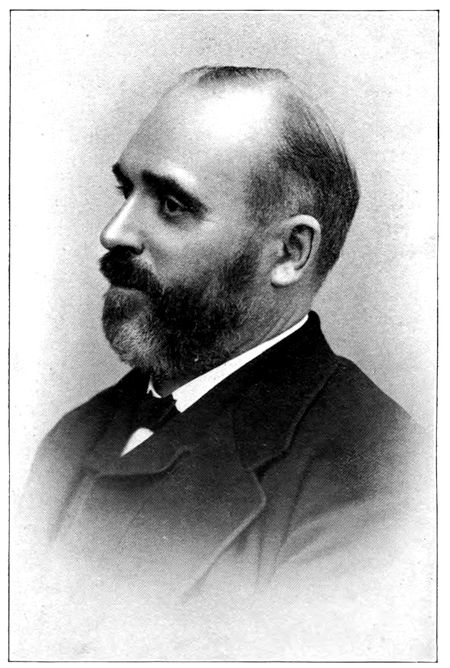
We now come to the second claim for a reduction
in wages. On July 17th Mr Crawford read to the
Committee a resolution he had received from the
employers making a claim for a reduction:
"That the Durham Coal Miners' Association,
through Mr Crawford, be informed that the associated
Coal Owners consider that it is necessary to
reduce wages substantially and promptly. That
the amount of such reduction, as well as the date of
the commencement, will be considered by the owners
on the 7th day of August next, and that in the meantime
the Association will be ready to give their
best consideration to anything the representatives
of the workmen may desire to lay before it."
To this request the Executive Committee could not
accede, and on 7th August the employers sent
another claim for a reduction of twenty per cent.
They said "that the best policy to pursue in the
exigencies of the trade, and to restore the activity of
the coal and iron trades, was for the men to submit
to a twenty per cent. reduction." In the event of
the workmen not agreeing to such a reduction the
owners would be prepared to leave the whole case to
the arbitration of any gentleman mutually appointed,
each party being left free to produce such evidence
as they may think fit and satisfactory, arrangement
being made for prompt decision, and for securing
the operation of the arbitrator's award from the
29th of this month.
Mr Crawford was instructed by the Executive
Committee to inform the employers that, while they
did not offer any opinion on the reduction, they
would call the attention of the owners to the last
portion of their resolution, wherein the date of the
reduction was fixed, and said:
"In seeking advances we never yet fixed a date,
even when coal was going up in an unparalleled
manner and certainly very much more rapidly than
ever it has come down. Both in March last and now
you wish to fix the date in what seems to us rather
an arbitrary manner. Had we in seeking advances
pursued this course, you would have been more than
justified in doing the same thing, but having pursued
a course diametrically opposite, we fail to see the
grounds of your justification for the course you
are at present pursuing."
A Council meeting was held on August 22nd, when
the first question discussed was the owners' application
for the twenty per cent. reduction. The following
resolution was carried:—
(1) We cannot see where in the Cleveland, or the
Coasting, or other markets the prices of coal and
coke are down sufficiently low to warrant a further
reduction of wages. (2) The stacking of coal and
coke may be made to have—but ought not to have—any
very material effect on the workmen's wages,
seeing that, if too much is being produced, we have
no objection to be put on short time, or any other
fair process whereby a reduction of wages can be
averted.
We fail to see why the employers ought to seek
arbitration. We are now in the same position which
they were in during the last two and a half years.
They were at that time so fully certain that trade
would not give any further advance that arbitration
was pointedly refused. We are now so sure that
the present, as compared with past prices of coal
and coke, does not warrant any further reduction,
that we think arbitration is only an unnecessary
waste of time and money, causing no end of annoyance
without any good resulting therefrom.
This resolution was sent, accompanied by a demand
for fifteen per cent. advance, to the employers, who
held a meeting on 28th August, under the presidency
of Mr Stobart, for the purpose of considering it and
what action they should take. After considerable
discussion a resolution was passed to enforce the
twenty per cent. reduction and to give the men
fourteen days' notice, to expire on the 19th of
September, seeing that their claim and arbitration
had been refused. The notices were issued in keeping
with that resolve, but not to all men alike. The
form of notice was as follows:—
On behalf of—— Colliery I do hereby give you
notice to determine your existing hiring on the
nineteenth day of September eighteen hundred and
seventy-four, and that the wages and prices heretofore
paid at this colliery will from that date be reduced to
the rate of twenty per cent. and that if your service
be continued, it must be on these terms.
In these circumstances the Executive Committee
issued a circular and called a special Council. The
lodges were asked to send their delegates prepared
to discuss and decide upon three questions:
"1. Ought bankmen, horsekeepers, furnacemen,
etc., to give in their notices?
"2. Ought collieries of men (hewers included)
who have not received any notice to give in their
notices?
"3. The matter of arbitration."
We will quote a portion or two of the circular. It
is very serious and impressive:
"It must be clear to all that we are passing
through the most important crisis which has marked
the history of the present organisation on the need
or otherwise of a further reduction; we here offer
no opinion, that being a matter which will take
the collective wisdom of the county to determine.
We wish, however, to point out what seems to
us to be one of two ultimatums to the present
unpleasant condition of matters in the county. If a
stolid and unreasoning resistance be persevered in,
a strike is inevitable. We feel certain that nothing
can or will prevent a stop. How long such struggle
might continue it is impossible to say. But whether
it might be for a longer or a shorter period an
immense amount of suffering would be entailed. We
want you therefore to very carefully consider the
whole matter. View the entire position with an
unbiased mind, not from the standpoint of mere
abstract justice, but from that of probabilities or
even possibilities. We are offered arbitration. If
we refuse, the press and public will most assuredly
say that our position is untenable. If we persistently
refuse to submit the entire matter to arbitration, we
must prepare to cope with the following difficulties
in conducting a struggle.
"(1) The strongest combination of employers the
North of England ever saw.
"(2) Stacks of coal and coke laid up in every
direction of the county.
"(3) Coal and coke brought from other districts
to supply what we may be short of supplying from
our own heaps.
"(4) The press and public opinion would be
against us."
The dispute was brought to an amicable settlement
by the whole question being referred to open arbitration.
By that decision the Association passed out of
the era of negotiations into that of arbitration re
underground wages. As that was the first step in
the path of conciliation it may be useful to give in
detail the proceedings. The inquirer after further
information may very usefully consult the printed
proceedings of the case. There were for arbitrators
Mr G. Leeman and Mr D. Dale acting for the
owners, and Mr L. Jones and Mr T. Burt for the
workmen. The case was conducted by Mr W.
Armstrong and Mr L. Wood (now Sir Lindsay Wood)
on behalf of the employers. Mr W. Crawford
and Mr J. Forman were for the employed. There
were with these arbitrators and conductors other
gentlemen, whose names we can find no record of
either in the press, the owners' books, or in ours.
The first meeting was held on Tuesday, 13th
October, in the Queen's Head Hotel (now the
Liberal Club), Newcastle. After a long sitting the
case was adjourned until the 15th, when Mr Forman
on behalf of the workmen, and because there had
not been sufficient time to prepare a reply to the
employers' case, asked for an adjournment. Mr
Crawford said they had "sat twenty-eight consecutive
hours, and never moved the whole of the time."
It was therefore decided to adjourn until the 16th.
During the discussion Mr Crawford made the request
that the owners should produce their books in order
that both costs of production and the selling prices
of coal might be obtained. The fourth day's
proceedings was held on the 19th. The arbitrators
met on the 26th in London. Failing to agree, they
agreed to refer the question to the Right Hon. Russell
Gurney, M.P., whom they met on the 30th in the
Abbey Hotel, Malvern. On November 3rd he gave
his award. Without giving the whole of the award
it will be explained by a quotation from a circular
sent out by Mr Crawford: "The reduction is as
follows:—At present time our advances amount to
43 per cent. over 1871 prices. This by Mr Gurney's
award is reduced to 30. That is a reduction of 9
per cent. on the gross wages and will take effect
from Monday, November 2nd."
At that time the attention of the county was
turned to the sanitary condition of the mining
villages. The Committee took a return in which
they asked eleven questions:
"What is the size of your best houses? What size
are the rooms, and how many to a house? Size of
single houses? Is there attached to your houses
or on the colliery any private accommodation? Are
there any channels or underground sewers to take
away the dirty water and other refuse made in the
houses? Are the houses damp and incompatible
with health, or dry and healthy? Are there many
of the members who have houses of their own?
What number of double and single houses have
you? Have you a good or bad supply of water and
whence supplied? What is your school accommodation,
national or colliery? Have you a
Mechanics' Institute? Is it colliery or private property?
Are there any gardens to the houses?"
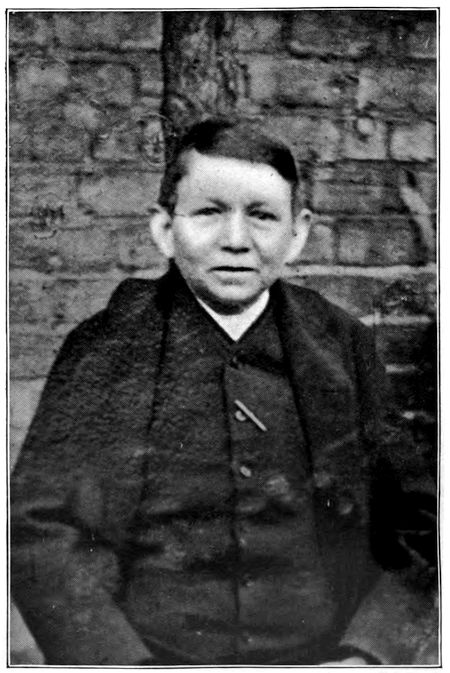
On Saturday, November 7th, the owners made
a claim for a reduction from all the men at bank.
This was before the Executive Committee. They
by resolution expressed their surprise, and their
opinion that they had not been treated fairly, as
the employers ought to have dealt with the classes
now to be affected in the arbitration just concluded.
They considered that "such a mode of procedure
cannot but have an injurious effect on that good and
desirable understanding which has so long existed
between the two Associations." The owners gave
the surface men notice to terminate their engagement
on 12th December. A special Council meeting
was called. The questions to be decided were—first,
should the Miners' Committee act for the
cokemen, seeing those men were forming an association
of their own, and over two-thirds of that class
had joined it? Of the other classes three questions
were asked: "Ought these men to follow Russell
Gurney's award? Ought the reduction to be resisted
or ought arbitration to be sought?" The Council
decided on Saturday, December 5th, that the
Cokemen's Association meet the employers themselves,
but "that the members of the Joint Committee
should meet them on the banksmen, screeners,
labourers, etc." The arrangement come to by the
Joint Committee was:
"The banking-out men having been generally
classed with the underground men, should in all
cases be dealt with strictly according to the terms
of Mr Gurney's award, that is, remain 30 per cent.
in excess of March 1871 and it was recommended
that the case of men earning less than 3s. per diem
be left to the consideration of individual owners."
There are two matters not dealt with in the general
statement of this year. These are the appointment
of Mr Forman as permanent president on 2nd May
and the appointment of the first clerk. The first
was Mr A. Hall Shotton; but his stay was short, and
he was succeeded by Mr W. Golightly, who was in
the office for over thirty-one years.
The third Reduction—Co-operative Colliery—The demand
for better Houses—The fourth Reduction
Early in the year the Association was called upon
to face another reduction in wages. The Executive
Committee had sent some requests with respect to
hewers putting in the foreshifts and working hard
places. The owners sent a reply on January 15th
refusing the requests, and at the same time saying,
such things being asked of them in depressed times
were offensive, and would not have to be repeated.
In the same letter Mr Crawford was told that the
employers had that day "unanimously decided to
ask for a reduction in the wages of all men employed
about coal mines and that the Standing (Joint)
Committee be instructed to discuss the matter of
such reductions and the date when it should
commence."
To this the Executive Committee replied that they
would pass over the question of reduction as it was
premature to interfere with it, but they complained
of the tone of the letter sent to them, which was
very unbecoming, to say the least. They had a perfect
right to send the requests. No doubt they were
annoying. "But however annoying a request properly
made may be, it ought, in keeping with the
common courtesies of life, to be denied without
imperiousness. It was annoying to them as workmen
to receive an application for a reduction."
The response to that reached Mr Crawford on the
30th. It informed him that they (the owners) felt it
needful to claim such reduction as will leave the
wages of both underground and surface men ten per
cent. in excess of 1871, to take effect from the pay
ending 13th March. Mr Bunning added: "As it is
our usual custom not to carry out a resolution of
this nature without first having a consultation
with you, I am requested to ask you to make
such arrangements with your clients as may enable
you to meet our Committee at an early date to
decide."
A special Council meeting was called for the 6th of
February to consider whether a deputation should
meet the employers; if so, how many and whom they
should be. The Council decided that as a deputation
the members of the Joint Committee should meet
the employers, and Mr Crawford was deputed to go
to South Wales to inquire into the condition of
things amongst the miners there.
At an adjourned Council held on February 10th
it was again considered, and the following resolution
carried:—
In looking at the last reduction, and the undue
advantage the coal owners have taken on us in
making a call on the bankmen so soon after the
arbitration case, that we in future entertain no more
reductions on one separate class of workmen, without
knowing their intentions as to the rest of the
workmen in our Association.
The meeting with the employers took place on 16th
February, when six reasons were given by them why
the reduction was needed: Many collieries were
working at ruinous losses; a terribly increased cost of
production; at many collieries the men were restricting
their work; a greatly increased number of men
were needed; the increased cost owing to the great
decrease in the working hours; and the fact that Mr
Gurney's award was delayed two months.
The employers again issued notices, but not to all
men or all collieries. The Committee immediately
called a Council, and drew the attention of the lodges
to two resolutions which were passed on April 21st
and December 5th, 1874.
That in future when there are notices given for
a reduction of wages throughout the county, and
where a colliery or collieries of men do not get their
notices, they be requested to give them in.
Where men who are members of our Association
and who have not received notice should these refuse
to give in their notices, their names be struck from
our books and never again re-entered.
In addition to this the Committee issued a circular
in which they reviewed the condition of trade, and
pointed out that in many districts life and death
struggles were taking place. These men were being
supported by voluntary contributions from other
mining districts and the public. If Durham came
out large support would be cut off, and the state
here rendered more dangerous. In Northumberland
and Cleveland arbitrations were proceeding. There
was only two weeks' money in the funds, therefore
the best policy was to accept arbitration. Facing
these circumstances they advised the acceptance of
arbitration. The employers would be compelled to
show sufficient reasons for a reduction. If this were
not done no umpire would reduce the wages. This
advice was accepted at the Council on 8th March,
and it was resolved to refer the whole matter to
arbitration on the prices and wages ruling at hearing
of the last case, that Mr L. Jones and W. Crawford
be arbitrators, and the preparing and conducting of
the case be left to the Executive Committee. On
March 10th they met the employers, and made
arrangements for the proceedings and the withdrawal
of the notices, and they informed the members that
in every case where the workmen had given notices
they must at once be withdrawn.
The first meeting on the arbitration case was held
on April 15th in the Queen's Head Hotel, Newcastle.
The Right Hon. W. E. Forster, M.P., was the umpire.
The arbitrators for the employers were Mr W. Armstrong
and Mr D. Dale; for the workmen Mr L.
Jones and Mr W. Crawford. The case was a dual
one, a combination of the Miners' and Cokemen's
Associations. The latter agreed to accept the statement
made by the employers in the miners' case and
then put in a separate reply. The following was
the order of the procedure:—The employers stated
their case. Then the miners replied on the first day.
Second day, the owners' reply to the miners, the
miners' rejoinder; the cokemen's reply to the
employers, then their reply to the cokemen. The
third day's sitting was taken up by the cokemen's
rejoinder. The same arbitrators acted in both cases,
but Mr Jackson Wilson presented the cokemen's case.
The umpire gave his award on the 23rd of April—the
reduction being five per cent. from the underground
wages and four per cent. from those of the surface men.
At the Council meeting held on May 4th a resolution
was carried urging upon the Miners' National
Association to use their influence to have established
an important Board of Arbitration, such Board to
say: "First, what amount of interest ought to be
claimed for capital invested in coal-mining operations;
secondly, whether or not the books showing
the profit and loss accounts of the employers ought
to be laid before the Arbitrators in deciding a matter
in dispute as to the rise or fall of the wages of their
workmen; and thirdly, what portion of the profits
ought to go to the capitalist and what portion to
the labourer."
The programme for a Council meeting held on 21st
August 1875 contained a resolution dealing with the
providing of a better class of houses.
"That we appeal to the owners to have better
houses right throughout the county for the members
of the Durham Miners' Association, and not to make
such difference between brakesmen and members of
the Association. We believe that one man has the
same right to a good house as another."
In the balance sheet for the first quarter of the year
is found an item relating to the Coop Colliery—3100
shares in the Coop Mining Company, £15,500. For
some time, and especially during 1874, the idea of a
co-operative mine had been agitating the two
northern counties. Meetings were held in various
parts, addressed chiefly by gentlemen from Northumberland.
The idea fell upon good ground in Durham,
for from time to time it was found on the Council
programme, and, so far as the Association is concerned,
bore fruit in the shares mentioned. The
fruit was not merely collective, but on every hand
those who could took out shares, even to the extent
of all their savings. The Committee of management
were:
Dr J. H. Rutherford,
Chairman. | Mr W. Crawford. |
| Mr T. Burt, M.P. | Mr J. Forman. |
| Mr J. Nixon. | Mr W. H. Patterson. |
| Mr R. Young. | Mr J. Byson. |
| Mr J. Brown. | Mr G. Fryer. |
| Mr R. Cramon. | E. Lowther, Secretary. |
—all good men, and, if it could have been established,
would have been. They were all tried co-operators
and ardent believers in productive co-operation.
But the enterprise was doomed from the first. The
name of the colliery was Monkwood, near Chesterfield,
Derbyshire.
On the 25th of September 1875 the Committee
submitted a balance sheet for the year ending 30th
June. The auditors were Benson, Eland & Co. They
informed the members that after depreciation as per
rule the net loss up to date was £10,863, 15s. 8d.
The Committee in presenting the balance sheet said
it had arisen from circumstances over which they
had no control. The output of the colliery had never
reached to their anticipations. The cost of production,
and the unsatisfactory state in which the
Society found the colliery, had occasioned the loss.
The vendor had not truthfully represented the
output. They had filed a Bill in Chancery against
him for the recision of the contract and the return
of the purchase money. The loss to Durham was
£15,500.
On 6th November the ex-Committee was called
upon to face the fourth reduction. They received
a letter on that date from the employers conveying
to them a demand for twenty per cent. reduction
from all underground earnings, including banksmen,
and twelve and a half per cent. off all above-ground
labour, to take effect from the 27th. The Committee
replied protesting against the imperative way
in which the demand was made, and resolved to ask
the county whether a deputation should attend
Newcastle to hear the reasons assigned for the reduction.
The county agreed to send a deputation
and offer open arbitration, the deputation being the
Joint Committee, and that a Council meeting be
held on the 27th to hear the report. The Committee
met the owners on Monday, the 22nd, and
the offer of open arbitration was accepted, the Court
to consist of four arbitrators and an umpire.
Death of Burdon Sanderson—Appointment of Mr Meynell—The
third Arbitration—The General Treasurer and
Executive—The new Hall—Deputies' Association
In January 1876 the Joint Committee chairman,
Mr R. B. Sanderson, was in a serious railway collision
on the Great Northern Railway at Abbots Ripton.
He was not killed outright, but was so seriously
injured that he died shortly afterwards. He was
the first chairman, and sat all through the meetings
up to his death. The Joint Committee at their
meeting on January 28th passed a resolution paying
high respect to his character and to his ability and
impartiality in his decisions. From that time until
11th September the chairman was selected from the
meeting pro tem. On that date Mr Meynell was
appointed, and from that time until his death in
1900 he occupied that position to his credit and
with fairness to everyone concerned. It would be
incorrect to say that no fault was ever found with
him; but it is well known that at his death all who
had been at the Joint Committee regretted it, and
he has been sorely missed, because he had years of
experience—experience which is worth a great deal
in that position.
The proceedings in the arbitration did not proceed
further in 1875, but rested over until January 1876.
The arbitrators were the same as in the previous case,
and the umpire chosen by them was C. H. Hopwood,
M.P. The advocates for the owners were Mr H. T.
Morton, Mr Lindsay Wood, and Mr T. Wood
Bunning, the Secretary of the Owners' Association,
and for the workmen Mr J. Forman and Mr W. H.
Patterson. The names of the Committee who
assisted were:
| N. Wilkinson. | J. Holliday. |
| M. Thompson. | W. Prentice. |
| G. Parker. | J. Cummings. |
| C. Kidd. | C. Cooper. |
| J. Crowther. | F. Smith. |
| G. Jackson. | J. Day. |
| G. Newton. |
The first meeting was held on Tuesday, 18th
January 1876, in the Queen's Head Hotel, Newcastle.
There were two days' sittings. At the close
of the sittings in Newcastle the arbitrators and
umpire held a meeting in London on 16th February,
when the umpire gave his award that there
should be a reduction of seven per cent. underground
and four per cent. on the surface.
Out of this case and the meeting in London there
arose a serious disturbance. The treasurer (Mr
Wilkinson) refused to pay the Committee for going
to London. He alleged that they went without
authority. They went on the vote of seven out
of seventeen members of the Committee, the rest
being either absent or lying neutral. Their going,
he said, was a waste of public money. He finally
showed there had been an extravagant expenditure
and charges for unnecessary meetings. Along with
his explanation he sent out a detailed statement in
which it is shown that for one fortnight they had
received sums varying from £7, 1s. 9d. to £11, 15s.
7d., or an average of £8, 14s. 11d. per man. For
another fortnight the average worked out at £12,
12s. each. To this the Committee made a long reply,
but all unavailing, for at the Council meeting held
on March 4th, 1876, the following resolution was
carried:—
"That the members of Executive Committee who
went to London be expelled, and that they have no
payment for going."
By another resolution the number of the Committee
was reduced to nine.
The result was to leave only three Committee men
to transact the business until a new Committee was
elected. A word of explanation may be necessary.
At the election of Committee in December 1875
three new men were elected. These were C. Simpson,
W. Gordon, and J. Wilson. As the arbitration was
proceeding when the election of 1875 took place
the Executive Committee asked the members
whether they should be allowed to continue in
office until it was finished. This was granted, and
as a consequence the newly elected members did not
take their places until the decision was given. The
Durham Miners' Triumvirate ruled until May 4th,
when the full Committee was elected.
As a further result of the dispute between the
treasurer and Committee certain rules were suggested
by the Executive Committee and approved by
Council on 29th April.
(1) That in future there be no night sittings of
the Committee.
(2) For a long time, a custom has existed of the
Committee, asking questions on their reassembling
after dinner hours. These questions were put on
paper during the forenoon and handed in to be read
after dinner. It will be seen, that this practice can
be abused, and made to lengthen out Committee
meetings to any extent. That this practice be
entirely abolished unless it be a mere asking a question
from the Secretary. The question and answer to be
printed on the Minutes; but no discussion whatever
to be held on the matter.
(3) That the General Secretary alone have the
power both to call and disperse Committee meetings.
(4) That the Committee have no power to either
shorten their hours or alter modes of payment.
In a letter bearing date May 19th the employers
made another demand for a considerable reduction
of wages both above and below ground, and fixing
Saturday, the 27th, as the date for a meeting upon
the matter. On that date nothing definite was
done, and an adjournment took place until 13th
June. A special Council was called for June 17th,
when lodges were asked to instruct their representatives
what should be done in the matter. In
the meantime the Committee issued a circular, giving
an account of the meeting with the employers,
and informing the members that the owners' demand
was for fifteen per cent. off underground
labour and ten per cent. off surface labour, or they
were willing to refer the whole question to arbitration
in order to avoid a stoppage of work. They
(the Committee) then urged the acceptance of
arbitration at once. To refuse it would be to run
counter to the efforts of working men in the past
who "had fought some of their most severe struggles
in trying to enforce arbitration as a means of settling
their trade disputes." Many hundreds of thousands
of pounds had to be spent before the employers
would even recognise the right of the workmen to
the merest inquiry in advances or reductions of wages.
The employers claimed the right to be the sole judges
in matters of that kind.
"When the employers arrogated to themselves
the right to judge both for them and us, we were not
slow in applying the words tyranny, despotism, and
even villainy to their actions. Don't let us then be
guilty of an imprudence, both by a repudiation of
our own principles and going into a battle when
everything is against us."
The Committee supported that bold and candid
statement by drawing attention to the success which
had attended the arbitration in the past. "If ever
a body of men ought to be satisfied with a means
of adjusting differences we ought with arbitration.
It has in every instance so far immensely reduced
the application of the owners. There is no other
means by which we could have fared better. On
every occasion the owners complained about the
insufficient amount awarded them." The alternative
to arbitration was a strike. That course would
be madness. There was a complete stagnation in
trade, nowhere more felt than in Durham. Pits
were working half time, and there were hundreds
of men who could not find an hour's work. To
strike would be to jeopardise "an organisation
which in the very short space of time has done more
for its members than any other trades' organisation
that ever existed." They urged other reasons
in as forcible a manner, and concluded by saying,
if arbitration were refused and a struggle entered
upon, there could be but one end, "that of utter and
terrible defeat for the miners of this county."
Towards the end of May preparations were being
made for opening the new Hall, and a return was
taken as to the mode of procedure. The place of
meetings had been on a movable plan. At first the
Committee meetings were held in 58 North Road,
Durham. Then both Councils and Committees were
held in the Market Hall. As the organisation increased
the Councils alternated between the Shakespeare
Hall and the Town Hall, and the Committees
in the Western Hotel, Western Hill, Durham. The
opening of the Hall took place on Saturday, June
3rd, the occasion being the consideration of a ten
per cent. reduction at a special Council meeting.
The cost of the buildings was £6000, and the architect,
Mr T. Oliver, Newcastle—the council-room fifty-two
feet by thirty-four; the tower thirty feet above
the body of the Hall. The clock cost £130. The
arrangements as to the lighting of the clock are:
the city authorities pay for the gas, while the
miners keep the clock in repair. For some time
the City Council refused to bear the charge for
lighting, and at first only agreed for six months as
a trial.
There was no opening ceremony beyond a few
words from the president, Mr Forman. The
delegates took their places as per number of seat.
Mr Forman then said he was glad to welcome them
to their new Hall.
"The noble building had been built with the
money of the working miners of the county of
Durham. It was a great example of their forethought,
their economy, industry, enterprise and
unity, and he hoped that it would be one more link
that would bind them together in the cause of
mutual help and mutual endeavour, and be another
great supporting prop to the noble edifice they had
reared in their Association. He was sorry that the
first business at the opening was to be the unpleasant
one of discussing a ten per cent. reduction."
The first Council meeting was held in the new Hall
on 17th June, and the first resolution was "that we
refuse to send the reduction question to arbitration."
The spirit of war was in the air, at least
among the men who attended the lodge meeting
to consider the subject at first. During the next
week, however, a ballot of the members was taken,
the result of which was declared at a special
Council meeting—the voting being for arbitration,
20,190; against, 16,435; majority for, 3,755. There
were resolutions passed to remit the question to
open arbitration: That the Committee get up the
case, but "if any person has to accompany the
arbitrators out of the county, only the two men
who conduct the case do so." At the same meeting
Mr N. Thompson and T. Mitcheson (two of the
London Committee) were removed from the trusteeship,
and their places filled by John Wilson, Wheatley
Hill, and W. Gordon, Ravensworth.
The arbitration commenced on 29th August in the
Queen's Head Hotel, Newcastle, the umpire being
G. J. Shaw-Lefevre, M.P. The arbitrators for the
employers were Mr W. Armstrong and H. T. Morton,
Mr L. Jones and Mr W. Crawford acting again for
the workmen. The advocates on the owners' side were
Mr Lindsay Wood and Mr J. B. Simpson and Mr T.
W. Bunning; for the workmen were Mr J. Forman
and Mr N. Wilkinson. There were two sittings.
There is no need to review the arguments or facts
in these cases, as that would extend our work too
much, but there is one interesting point advanced by
the employers in their rejoinder to the workmen's
case. It refers to the cost of production at that
time over 1871. The increase was thirty-seven or
thirty-five per cent. higher than 1871—the items
being, wages 14.68 per cent., and the effect of the
Mines Bill 22.67 per cent. Assuming that the cost
arising from the operation of the mines was divided
between employers and workmen—eleven per cent.
to each—there was still 26.35 per cent. to the disadvantage
of the employer. On the credit side coal
was only 5½ or 8.8 per cent. higher than in 1871,
and therefore their conclusion was that the claim
for fifteen and ten per cent. reduction was amply
justified. At the conclusion of the two days'
sitting it was agreed that the arbitrators should
meet on the 16th of September, and if they failed to
agree the umpire would decide. That meeting took
place, and the umpire was asked to decide, which
he did on September 25th, and awarded a reduction
of six per cent. in the wages underground and four
per cent. in the wages paid to surface men.
No sooner was the arbitration finished than the
Association found itself face to face with a difficulty
of a different but yet perplexing nature. The employers
conceived the idea of separating the deputies
from the miners. Their reasons for taking this step
are stated in a subsequent letter. The mode of procedure
they adopted was to exempt the deputies
from the six per cent. reduction, providing a majority
of the deputies on any colliery would leave the
Miners' Association. The employers said their action
was in response to a request by some of the deputies.
The action drew from the Executive Committee a
strong remonstrance. They pleaded with the deputies
and protested against the action of the owners.
The circular they issued was a lengthy one. Our
object will be served if we quote a few portions.
Addressing the deputies, they said:
"It appears in response to some application made
by some of you the Owners' Committee have agreed
that where a majority of deputies on any colliery are
not members of ours, they will recommend that such
deputies be freed from the recent reduction. Call
this offer by what name you will it is neither more
nor less than a special kind of bribery held out to
you and we regret to hear, that some of you have
been imprudent enough to accept it. Why make
this difference between those who belong and those
who do not belong to our Association? It is not
because they respect the one party more than the
other, or that the party who have left us are any
better workmen or in any way more useful to the
owners than those deputies who still belong to our
Association. The most unknown amongst you as to
your past history, or the most casual observer of
present doings, ought to know that the motive which
has induced the Owners' Committee to make this
offer is not respect for you as a class, is not because
they think your responsibilities are increased more
than heretofore, neither is it because they think you
underpaid, but it is because they want to induce
you to sever your connection with an Association
which has hitherto been able to gain many advantages
for members and for none more than for your
class. They offer you an inch now in order that
they may take from you a foot hereafter. Most of
you can remember the time (only five years ago)
when your wages varied from 3s. 4d. to 3s. 8d. per
day of eight hours' working, while with the recent
reduction of six per cent. your wages are now 4s. 8d.
for 7½ hours' working, or an advance in time and
money of 39.58 per cent."
The circular then draws attention to a portion of
a letter from the deputies who had left the miners
to those of another colliery, and to the resolution of
the Owners' Association. The portion of the deputies'
letter said:
"If any member of our [the Deputies'] Association
leaves and starts to hew, and has to go back to the
Hewers' Association, the two pounds' entrance fee
will be paid out of the Deputies' Association."
The resolution of the Owners read:
That this Association thinks that deputies, like
overmen, should be the agents of the masters, and
that under these circumstances it is imperative that
they should not be restricted by any Trades Union
resolutions.
In relation to these the Committee point out that
they (the deputies) could not honestly be members even
of the Deputies' Association, for by the stipulation
of the employers they were not to be restricted by
any Trade Union regulations. "It will thus be seen
that if you do this, you sell your birthright, your
independence, your manhood, your all, not even for
a necessitous 'mess of pottage' but for an insignificant
present advantage, in order that you may bring
upon yourselves a future permanent and great evil."
Some of the deputies were desirous of serving two
masters: they wanted to remain in the Miners' and
at the same time enter the Deputies' Association for
the sake of the six per cent. At the Council held
on Saturday, 30th September, a resolution was
carried declaring "that the Deputies be not allowed
to remain in our Association and also become
members of what is called the Deputies' Association."
At the same time a sharp correspondence
took place between the Owners' Association and the
Miners', in which Mr Bunning sent a letter, bearing
date 3rd November, which contained a protest and
an extenuation.
November 3rd, 1876.
RESOLUTION OF COAL OWNERS
The members of this Association regret that the
Representatives of the Miners' Association after five
years' amicable correspondence, should have thought
it necessary to communicate to them so uncourteous
and offensive a document as that bearing date 24th
October 1876, and relating to the resolution passed
respecting the deputies, on October 11th, 1876.
And, as this resolution was arrived at after mature
deliberation, and from the conviction that both the
safety of the mine, and discipline of the pits, are
seriously endangered, by having the deputies subject
to the restrictions imposed by the Miners' Union, no
good can possibly arise from any discussion of the
subject at a meeting of the two Associations.
The reply sent by the Executive repudiated all
intention to be uncourteous or offensive in language,
but at the same time they repeated the charge of
bribery, for, said they, "viewed from the most
favourable standpoint, your action in the matter
can only be characterised as that of holding out a
manifestly unfair inducement to the deputies."
They asked what the employers would have
thought, if, having the power, the Miners' Association
had held out inducements to charge men?
They reminded the owners that they asked for a reduction
off all wages, and the award of six per cent.
applied to all underground labour. Considering
these facts they could not but look upon the action
as a covert attack on the Association.
The Executive acting on instruction from Council
took a return, which resulted as follows:—
Total number of Deputies—2557.
Total number in our Association—936.
Total number in Deputies' Association—1621.
Total number paid old wage—1449.
Total number paid reduced wage—1044.
Deputies—Sliding Scale—Relief Fund—Emigration
The dispute about the deputies opened the year.
A very lengthy correspondence took place on the
subject between the Employers' and Miners' Associations.
On January 23rd the whole of it was
sent to the lodges. They were informed that the
Committee had done all they could to avert a conflict
on the question. In keeping with a resolution of
Council, the owners had been offered arbitration,
which they had refused. The resolution referred
to contained the alternative of giving the whole of
the notices providing arbitration was refused. Now,
to carry out the instructions contained in that
resolution the Committee forwarded the ballot
tickets for the purpose of taking the vote in accordance
with the rule. They concluded by saying:
"Whatever the result may be arising out of this
case the entire onus of blame must rest with the
owners themselves." A resolution was placed on
the programme for Council on February 3rd by
the ex-Committee asking "that the deputies who
are still with us be paid the 6 per cent. out of the
General Fund of the Association," but it lost. In
addition, the subject was laid before the Central
Board of the Miners' National Union. They expressed
regret and surprise at the action of the
employers in paying one portion of the deputies
more than the others, and were of the opinion
"that there can only be one object in view in this
policy, the disruption of the Miners' Union. The
Board earnestly appeal to the mine owners to
withdraw from the position they have taken up.
Should they fail to do this the Board will feel called
upon to ask the members of the National Union
to yield all the support to the Durham Miners'
Association they can under the circumstances."
Nothing further was done in the matter during 1877
except an occasional Council resolution. We shall,
however, meet the same question in a few years.
Early in the year the Association was entering
seriously into a new phase of our industrial relation
with the employers and taking another step
in the path of amicability by the arrangement of
the sliding scale. For some time there had been
an inclination in that direction. By the Minutes
of the Executive Committee members were informed
that negotiations were proceeding with a view to
establishing a scale, and at the Council meeting
held on December 9th, 1876, the following resolution
was on the programme:—"Seeing that coals are
up, we ask for 25 per cent. advance." The decision
was that the question rest over until the sliding
scale question is settled.
On February 16th a letter was received from the
employers containing the following resolution:—
"This Association having anxiously considered
the further serious depression in the Durham coal
trade and the necessity for endeavouring to avert
in some prompt and thorough manner the complete
collapse which has set in to the ruin of many owners,
and the casting adrift of large bodies of men, feels
compelled to ask the Miners' Association to concur
in a further reduction in wages and readjustment
of hours."
The Executive Committee met the owners on
Thursday, February 22nd, when they were informed
that the depressed trade and lower prices demanded
a reduction of ten per cent. from underground and
six per cent. from the bank workmen, "coupled with
an increase in the working hours which would, in a
great measure, compensate the men for the reduction
in their wages." The Committee could neither see
the necessity for a reduction nor could they see the
compensation in the lengthening of hours. They,
however, arranged another meeting for Friday, 9th
March, when they would further discuss the sliding
scale, and, failing that, the reduction. In the statement
explaining these proceedings the Committee
placed before the members two scales—one proposed
by them and the other by the owners. It will be
interesting and instructive to give these scales.
December 22nd, 1876.
SLIDING SCALE PROPOSED BY THE DURHAM COAL
OWNERS
| Price | Per cent. | Wage |
|---|
| s. d. | | s. d. |
| 5 2 | 0 | 4 8.0 |
| 5 10 | 5 | 4 10.8 |
| 6 6 | 10 | 5 1.6 |
| 7 2 | 15 | 5 4.4 |
| 7 10 | 20 | 5 7.2 |
| 8 6 | 25 | 5 10.0 |
| 9 2 | 30 | 6 0.8 |
| 9 10 | 35 | 6 3.6 |
| 10 6 | 40 | 6 6.4 |
| 11 2 | 45 | 6 9.2 |
| 11 10 | 50 | 7 0.0 |
| 12 6 | 55 | 7 2.8 |
| 13 2 | 60 | 7 5.6 |
January 2nd, 1877.
SLIDING SCALE AS PROPOSED BY THE DURHAM MINERS'
ASSOCIATION
| Price | Per cent. | Wage |
|---|
| s. d. | | s. d. |
| 5 6 | 0 | 5 0 |
| 6 2 | 5 | 5 3 |
| 6 10 | 10 | 5 6 |
| 7 6 | 15 | 5 9 |
| 8 2 | 20 | 6 0 |
| 8 10 | 25 | 6 3 |
| 9 6 | 30 | 6 6 |
| 10 2 | 35 | 6 9 |
| 10 10 | 40 | 7 0 |
| 11 6 | 45 | 7 3 |
| 12 2 | 50 | 7 6 |
| 12 10 | 55 | 7 9 |
| 13 6 | 60 | 8 0 |
In the explanation sent out it was shown that
each scale would carry a minimum wage. Theirs
would be five shillings, while the employers' would
be 4s. 8d. The wages in the scale were for coal
hewers only. The reduction the employers were
asking for would bring the wages down twopence
per man below the lowest wages offered in the
owners' scale. They asked the members to leave
the question entirely in their hands, as in their
opinion a better settlement would be got than by
any other way. A special Council was called for
the 8th of March, and two subjects were sent out
for discussion—(1) Should a sliding scale be adopted;
if so, under what condition? (2) Should the
owners be offered arbitration? The result was
that the arranging of the scale was placed in the
hands of the Committee, and on 14th March the
first sliding scale was signed for two years.
THE FIRST SCALE
The following scale shall regulate the wages of
hewers and labour below ground:—
SCALE
| Price | |
| at and above | but below | Wage |
| 5 4 | 7½ per cent. reduction |
| 5 4 | 5 8 | 5 " " |
| 5 8 | 6 4 | Present Rate |
| 6 4 | 7 0 | 5 per cent. advance |
| 7 0 | 7 8 | 10 " " |
| 7 8 | 8 4 | 15 " " |
| 8 4 | 9 0 | 20 " " |
| 9 0 | 9 8 | 25 " " |
| 9 8 | 10 4 | 30 " " |
| 10 4 | 11 0 | 35 " " |
| 11 0 | 11 8 | 40 " " |
| 11 8 | 12 4 | 45 " " |
| 12 4 | 13 0 | 50 " " |
| 13 0 | 13 8 | 55 " " |
| 13 8 | | 60 " " |
| And so on. |
It will be observed that the grades were eightpence,
and for that amount the change in wages was four
per cent. Next, there was to be a minimum wage
of 4s. 8½d. per day. This is worthy of special notice
in the light of subsequent events, especially during
the time the minimum existed, which was until
1879, and especially in view of the desire of many
people to have a minimum established again.
Another point was the amount of reduction, which
would depend upon an ascertainment by accountants.
Messrs Monkhouse, Goddard & Miller acted for the
owners, and Messrs Benson, Eland & Co. for the
workmen. The ascertainment was made known on
the 31st of March, the average net price realised
being certified at 5s. 3.97d. The Committee accompanied
the ascertainment with a short circular, and
informed the members "that a reduction of 7½ per
cent. on underground men and boys and 'banksmen'
wages and 6 per cent. on 'bankmen's' wages will
take place on the pays commencing April 2nd and
April 9th."
As a consequence of the depressed state of trade
very large numbers of men were thrown out of work,
and the rules of the Association made no provision
for them. Opinion had been ripening for some
months, and the Committee realising that the time
was opportune, and acting on a Council resolution,
suggested the formation of a Relief Fund. In furtherance
of the object they sent out the following:—
SUGGESTIONS FOR RELIEF FUND
Fellow Workmen,—At last Council meeting, you
put into the hands of the Committee, the work of
suggesting some plan to relieve the numbers of
men now idle at various collieries in the county.
After mature consideration, they suggest the following
as a means of forming a Relief Fund:—
1. To take from the General Fund the sum
of five thousand pounds to form the nucleus of
such Relief Fund.
2. That this Fund be afterwards kept up by
the payment of a levy, or extra contribution,
of 2d. per member per fortnight.
These two are the basis of their suggestions, details
can be discussed and arranged afterwards. But to
make these suggestions—and especially the second
one—a success, the Committee believe that the
county will require to have brought before them
our exact position. The best, if not the only,
means of doing this is to hold a series of public
meetings at the various lodges and districts in the
county, grouping lodges together where such can
be done. What they now ask is, can they have your
consent to assist the agents in attending such a
series of public meetings? It is the only means of
rendering successful the getting of necessary means
and would not cost more than an ordinary Council
meeting.
In support of their proposals they adopted two
modes of advocacy—first, to issue a circular, and
second, to hold a series of meetings at all the lodges.
This latter step they considered most essential, as
they would thus be enabled to state the matter more
clearly by speech and answer to the members. This
view they placed before the lodges, and received sanction
with very little objection; and, acting upon it,
they arranged themselves into deputations of two
each, and for about three weeks either addressed
lodge meetings or groups of collieries where convenient,
and as a consequence the Relief Fund was
formed on the lines suggested. While it existed it
proved itself a very useful institution for that period,
which was the darkest through which the Association
had to pass.
The amount paid, although small, was useful to
the public as well as the members—to the latter
by easing off the pinch of poverty, and to the former
by the help to the rates, which would assuredly have
been much more heavily weighted if the fund had
not existed. It only existed a year, however, for the
Committee placed a statement before the county on
November 2nd which showed that, while there had
only been £4144 contributed to the Relief Fund,
the expenditure had been £9695, and that, adding
the £5000 grant from the General Fund, the
expenditure had exceeded by £551 the whole
amount paid into it.
EMIGRATION AGENCY
During 1876 and up to July 1877 the agents had
acted as emigration agents, and had been very useful
in their advice to people who were inclined to
emigrate by giving them advice upon points and
matters of importance to them. All they did was
done free of charge, and only with the view to help
those who were members of the Association; but as
in every movement there are men of the "viler
sort," whose envy prompts them to attribute ill
motives to those they envy, so in this case there
were some who, instead of giving the agents credit
for good motives, were not slow to charge them with
selfishness and exploiting the volume of emigration
for their own benefit. The agents bore this until
the Council meeting held on July 21st, when Mr
Crawford and his colleagues resolved to give it up.
In doing so they gave their reasons in the following
circular:—
EMIGRATION AGENCY
To the Members.
Gentlemen,—As announced at Council Meeting on
Saturday last, we intend to give up the agency. It
was taken with two objects—(1) To have ourselves
well posted up in emigration news, so that we
might be able to give the best advice possible; (2)
to aid our members by allowing them the commission
money, which is a very important item indeed.
It was not taken with the view of making one penny
of profit, but solely to assist our members by advice
and also an abatement of their fares. But as some
poltroon fellows, who are directly interested in
getting emigrants in order that they may get the
commission money, are causing some stir, and as,
further, some of our lodges are listening to their
statements, we think it necessary to give it up.
You will be the only losers by it, but remember
that it is amongst our own members that the real
grumblers are found.
The Hours Arbitration—Position of the Association—Federation
Board
The first item of interest in 1878 was initiated on 15th
March by a letter received from the employers re
the lengthening of the coal-drawing hours. It was
addressed to Mr Crawford as follows:—
Dear Sir,—I am desired to inform you that the
present state of the coal trade in Durham seems to
render it imperative to extend the hours of work
and increase the facilities for drawing coal. And
that the members of this Association would be glad
to discuss the matter with you and your Committee
with a view to arriving at some decision on the
subject.
Could you fix Thursday next, the 21st, at two
o'clock to meet our Committee here? An answer at
your earliest convenience will oblige.
The Executive met the employers as requested,
and found that the change was to increase from ten
hours to eleven all the collieries working ten hours,
that drawing time being the outcome of an arrangement.
The owners were reminded that it was
inconsistent with the sliding scale, and the demand
should be withdrawn. They replied by quoting a
portion of the scale: "Both parties shall remain at
liberty to raise any question not inconsistent with
the maintenance of the sliding scale." "Should
any dispute arise as to the carrying out of these
arrangements the question in dispute shall be submitted
to the chairman of the Joint Committee,
who, if he cannot act, shall appoint some other
umpire to act in his place. The award in either case
to be final." These were discussed at great length;
finally three proposals suggested by the Executive
Committee, subject to the approval of their members,
were agreed to:
1st. Is it consistent with the sliding scale to even
discuss a lengthening of the hours?
2nd. If it is consistent with the sliding scale to
discuss the matter, is it necessary to lengthen such
hours?
3rd. If the hours are lengthened, should there
follow any increase in wages, and if so, how much?
The Committee were not sure whether the full
body of owners would agree to them, as those present
at the meeting objected to No. 2 being a
question of reference. They informed the lodges
that Mr Meynell had fixed 9th April for the hearing
of the case. They were convinced that the employers
could make the demand under the arrangements,
and therefore all that was necessary was to
say how many persons should attend and who they
should be. The question was eventually placed in
the hands of the members of Joint Committee to
make the best settlement they could. On 15th
April Mr Meynell gave the following award:—
COAL DRAWING
(Award)
Whereas the Durham Coal Owners' Association,
being of opinion, that it is absolutely necessary that
the working hours of all men and boys above 16
years of age should be increased, if they thought fit
to place it before me, and to leave me to decide the
question. And whereas it was also agreed that the
following questions should be left to me for my
decision:—
1st. Is it consistent with the sliding scale to discuss
a lengthening of the hours?
2nd. If it is consistent with the sliding scale to
discuss the matter, is it necessary to lengthen such
hours?
3rd. If the hours are lengthened, should there
follow any increase in wages, and, if so, how much?
Now, having heard and carefully considered the
arguments on each side, I award, decide, and determine
that it is not inconsistent with the sliding scale
to discuss the question of lengthening the working
hours; 2nd. that it is necessary to lengthen such
hours; 3rd. that there should be an increase in the
wages where the hours are lengthened.
I award and decide that the working hours of
all men and boys above 16 years of age shall, or
may be increased in accordance with my award, that
the minimum wage to be paid to the hewers shall
be, when the pit works 10½ hours, 4s. 10½d.; and
when the pit works 11 hours, 5s. 0½d.; and that the
wages of the datal men shall be increased in strict
arithmetical proportion to the wages they are earning
at the time of such increase in the hours. I
determine that the increased hours shall or may
commence on and after the first pays after the date
of this my award.
As witness my hand, this 15th day of April 1878.
E. J. Meynell.
There immediately arose some dispute as to the
application of the award, and he was called upon
to define it, which he did in a decision given at Joint
Committee on May 10th.
May 10th, 1878.
"I further award and decide that where the working
hours shall be increased in accordance with my
award, that the minimum wages to be paid to the
miners shall be where the pit works 10 hours and a
half, 4s. 10½d. and where the pit works 11 hours,
5s. 0½d. is intended to mean—that where the hewers
are increased one quarter hour per shift, the county
average wage shall, in that case, be considered as
4s. 10½d. instead of 4s. 8½d. as hithertofore; and
where their hours are increased half-an-hour per
shift, the county average wage shall be 5s. 0½d.
instead of the present average of 4s. 8½d.
It is also intended that the working hours of any
or all classes of workmen may be increased on the
payment to them of proportionate increased rates
as set out in the award; and that the maximum
working hours for drawing coals be 11 hours per
day in day-shift pits, and double shifts proportionately."
The employers then asked that there should be
an allowance for the time taken by boys under age
descending and ascending. With the ten hours the
boys under sixteen came out after coal drawing was
done, but under the eleven hours some were taken
in at six A.M. and "rode" at four P.M. Some were
taken at seven A.M. and came out at five P.M., when
the coal drawing finished. There was, therefore, a
loss of time at either seven or at four, and this
should be allowed for. The matter was arranged
on the following principle:—Whatever time was
taken either at seven to send the under-age boys
down, or at four to bring them up, should be added
to the eleven hours. If it took ten minutes, then
the coal drawing would be from six A.M. to five-ten
P.M., but in no case was the time allowed to be more
than a quarter of an hour.
As the year progressed the trade became more
depressed. Pits were being laid in or batches of
men were being discharged. The price of coals was
rushing down; the ascertainment for the four months
ending November showed the average was 4s. 7.65d.
per ton, a reduction of 8.32d. per ton since the scale
was established without any reduction in wages.
The evil of this was seen in the numbers of men
being discharged and in the sad falling away in the
membership. The extent of this may be gathered
by a reference to the Executive Committee Minutes
for May 13th. Without mentioning names here,
suffice it to say that at one large colliery a deputation
was sent from the Executive with power to
"appoint someone to act as checkweighman and
secretary and to guarantee his wages for six
months," and that if the men at that colliery
wished "the President attend as either steward or
treasurer." The state of the county was growing
so desperate that the Committee issued two circulars,
the object being to place it clearly before the
members. In the first they dealt with the Relief
Fund. They commenced by saying:
"We are passing through a crisis in the coal
trade, and during its continuance every step we take
requires careful watching. We may even find it
necessary to retrace our steps, by undoing what we
have hithertofore done. We are well aware, that to
many men this kind of conduct seems to portray a
want of stability and necessary perseverance. Perseverance
in a good and successful cause is highly
commendable, but to persevere in a course of conduct,
where perseverance means ultimate ruin is
neither wise nor commendable. A renowned writer
has said that "while fools persevere in their ways,
wise men change their opinions and course of conduct."
A body of men who either cannot or will
not adapt themselves to existing exigencies must
not expect success to attend their efforts."
Passing from these calm, wise words of warning
they bring before the members the position of the
Relief Fund. A year prior they (the Committee)
had asked them to subscribe to assist those thrown
out of employment by the bad condition of trade.
To this there had been a response of twopence per
fortnight. That had not been adequate to meet the
demand, and the twopence had been increased to
fivepence. Still the income did not keep pace with
the outlay. For the six weeks previous there had
been a loss of £2145. There was not only this
monetary loss, but there was the more serious one,
its effect on the membership.
Thousands of members are refusing to pay the
fivepence per fortnight, and great numbers of men
have left the Association, so that we are not only
losing the fivepence but their ordinary labour contributions.
This being our position, we would
strongly advise you to at once abolish the payment
of the Relief Fund levy.
While this was their opinion they would continue
the benefits for three months. At the Council held
on 15th June it was decided "that the benefits of
the Relief Fund be continued for 12 weeks longer,
but the contributions cease forthwith and the
money required to meet the demands thereof be
taken from the General Fund." This was done in
order that the men in receipt of relief should not
suddenly have their small resources cut off, but
should have a little time to look round.
The second circular dealt with the General Fund
in its relation to the demands upon it. As a preface
to their suggested alteration they said:
The history of Trades Unions during the last 30
years would form a very curious chapter in the
annals of our country. The vicissitudes which
have happened to organised bodies of workmen have
been manifold, and varied; but the disastrous consequences
which have so often overtaken them
have generally been the result of a want of policy,
prudence, and forethought, on the part of those who
have composed such Associations. It is just as
much the study of those who have the more direct
management of Associations like ours to look facts
fully in the face before it is too late, as it is that
of the head of a household to weigh his position
and measure his stores both present and prospective,
before he rushes into irretrievable ruin. Believing
this to be our duty we now place before you our
position both present and prospective.
They then point out that the expenditure was just
double the income. During the previous nine months
there had been £20,000 drawn from the deposit account.
In the face of these facts there needed to
be retrenchment. They then show that in 1869 the
contribution was fixed at 6d. per fortnight, while
the strike and breakage allowance was 10s. per
week (and a colliery must be off two weeks before
receiving anything), and the sacrificed allowance
was 13s. per week, with 1s. per week for each child.
These benefits continued until 1872, when work was
plentiful and wages good. Then the strike and
breakage allowance was raised to 15s. (and only to
be off a week before being entitled), and the
sacrificed allowance was made 20s., with 2s. 6d. for
each child, per week. They therefore suggested a
reversion to the original payment (except in the case
of the week) and the reduction of the death legacy
for children from £3 to £2, and they wound up by
saying:
"It is not now a matter of choice, but one of
positive compulsion. An Association wanting
money is like a ship wanting a rudder in a
boisterous sea. We would soon find ourselves
driven on to the rocks of discontent, disaffection,
and disunion, and in all probability shattered to
pieces in the struggle. To pursue longer the course
we are now pursuing must shortly leave us in that
pitiable and helpless condition."
A special Council meeting was held on 11th
October which gave sanction to the whole of the
Committee's recommendation.
As soon as the other sections of labour had formed
themselves into separate organisations in 1873-4,
there sprang up a desire for a federation of forces,
and from time to time there appeared resolutions on
the Council programme all aiming at that end. In
this year it took a more definite shape. On the
Committee Minutes for January 28th there is a
resolution as follows:—
That a deputation of three agents attend a
meeting of cokemen, mechanics and enginemen as to
the amalgamation of all those Associations.
In October a meeting was held at which a set of
rules was drawn up and sent out to the county with
an explanation. The members were informed that
the suggestions were not unalterable, but in their
crude form were submitted subject to their approval
or amendment. And they were informed that:
"The Federation was formed to protect their joint
interests. There might have been divisions but these
must be forgotten. The workmen were unconnected,
whilst acting against a thoroughly organised
body of owners. There had been no cohesion, nor
the remotest understanding, while at the same time
they were dealing with the same combined body of
capitalists. It must be clear to everyone that while
in our present divided condition and negotiating
with owners who act as one body we must be
placed at a very serious disadvantage."
The county approved of the idea, and on November
13th the rules were issued to the county. At the
Annual Meeting held on 6th December the first
members of the Board were elected. Their names
were J. Forman, W. Crawford, W. H. Patterson,
N. Wilkinson, J. Wilson, and W. Johnson. Slightly
anticipating the events happening in 1879, and for
the purpose of keeping ourselves in as close sequence
as possible, it may be stated here that the first
meeting of the Board was held on January 28th,
1879, when Mr Crawford was appointed secretary,
and Mr J. Dover (mechanic) treasurer. With
respect to the chairman, it was decided to appoint
an independent one for six months. He should only
have a casting vote, and be paid 21s. per day and
expenses. At the meeting held on February 7th
Mr John Coward of Durham was elected to that
position, and occupied it for some months, and
during the strike of 1879, assisted by his counsel.
By being unaffected in wage by that stoppage he
was able to bring a cool and dispassionate feeling
to bear upon the questions in dispute. It is due
to him to say he took no remuneration for his
services.
Demand for Reduction—Strike of 1879—Dual Arbitration—Renewal
of Sliding Scale
The Board was just formed when it was called
upon to face one of the most serious crises in our
history. At the Council meeting held on December
7th, 1878, it was decided that the average wages in
the county should be taken, and that the formation
of another scale should be remitted to the Committee,
with power to renew it. The Committee
were not satisfied with that indefinite resolution,
and asked for more explicit instructions. There
were certain alterations required, and therefore they
asked for "full and uncontrolled power." They
knew that in adopting that course they would risk
a large amount of unpleasantness, but they were
willing to risk it if they were assured of the confidence
of the majority of the members. Further,
they asked that the retiring members of the Committee
should be allowed to remain in office until
the scale was arranged and the crisis over. These
requests as to power and suggestion as to the
Committee were both accepted. The formation of
the Federation Board, however, somewhat altered,
and at first complicated, the situation, for the result
was a complex and dual authority. The Board was
not then, as now, the sole conductor of the wages
disputes, but the various Committees acted collaterally,
the Miners' Committee taking the leading part
in the negotiations. The demands made by the
employers were handed to the Miners' Committee on
February 4th. The conditions were as under:
(1) That a reduction of 20 per cent. on present
underground wages is a condition precedent to the
re-establishment of a sliding scale.
(2) That a reduction of 12½ per cent. should be
made in surface labour, but so that the wages of
able-bodied men be not brought below 2s. 6d. per
day.
(3) In the event of a scale being established, it
shall have no limit upward or downward, and shall
be subject to termination on 12 months' notice.
The Committee could not grant the request, but
at once made an offer of seven and a half per cent.,
to take effect on Monday, the 10th, or they would
submit the entire matter to arbitration. These
offers were refused by the owners, and as a consequence
the meeting was adjourned until the 20th.
The Committee called a Council for the 15th of
February. On the 7th the Federation Board met,
and passed the following resolution:—
This Board feels that the position of the county
in reference to wages is anomalous. The owners
having as a body demanded a reduction of wages,
and as such reduction includes all classes of labour
in connection with collieries, we recommend that
each Association call a Council meeting to discuss
the advisability of adjusting a sliding scale for the
regulation of wages, consistent with all our interests.
That the Secretary write and ask that at the
meeting on the 20th inst. all the four Associations
be represented.
The Miners' Council decided against the seven
and a half per cent., but by the following resolution
offered arbitration:—
"That having heard the report of the Committee
on their interview with the owners on the reduction
now asked by the latter, this meeting is of opinion
that the best means of settling the difficulty is, to
refer it to open arbitration as heretofore."
The owners refused to meet the Federation Board
as a whole, and as a consequence the Miners' Committee
met them on the 20th, in keeping with the
Board Minute, on February 18th. At that meeting
the owners modified their demand.
OWNERS' MODIFIED OFFER
February 22nd, 1879.
"1. That a reduction of 10 per cent. in underground,
and 7½ per cent. in surface labour, be
brought into operation in the first pay beginning
March next.
2. That the additional 10 per cent. in underground,
and 5 per cent. in surface labour, claimed
by the owners in their Minute of January 11th,
be referred to arbitration in the following manner,
viz.:—
Representatives of the two Associations to
meet within the first week of March, and if they
can agree on a sole arbitrator, the matter to be
forthwith referred to him; and if they cannot
so agree, each side to appoint an arbitrator,
which two arbitrators shall forthwith appoint
an umpire, and if they fail to do so by March
15th, such umpire shall, on the application of
either arbitrator, be appointed by Mr Meynell,
County Court Judge of Durham.
In the event of there being two arbitrators
and an umpire, they shall sit together to hear
the case; and the award shall take effect in
the first pay in April.
3. The expediency of re-establishing a sliding
scale, to be left for consideration after the award
has been given."
This was submitted to the Federation Board, who
met the modification by the following:—
FEDERATION BOARD'S OFFER
March 6th, 1879.
1st. To offer the owners the 10 per cent. for
underground workmen, and 7½ per cent. for bank
workmen as a settlement of the whole question.
2nd. To offer them 7½ per cent. from underground,
and 6 per cent. from above-bank workmen,
and to refer any further claim they might make to
arbitration.
The Miners' Committee supported the Board, and
did this in a circular which contained some very
plain and urgent statements.
"At best, the lookout is but a gloomy one, and
we must try to bridge over the difficulty as best we
can, and if possible, without the pits being stopped.
We have no wish to descant on the generally
depressed condition of trade, or the evil effects
producible by a large surplus number of men.
At the present time, both these things are operating
amongst us, and the owners know this, and seem
determined to use them in this crisis. Looking
at the general condition of things, we would very
strongly advise you to adopt one of the suggestions
contained in this circular. They are the best we
can get at the present time, and a refusal of one
of the methods suggested cannot result in better
terms for the great body of our members. You
must remember that these are times when prudent
men do the best, and get the most they can without
running all the risks which always attend a
stoppage of the pits when trade is paralysed and
men both suffering and disorganised."
Immediately these offers were made known there
arose a fierce agitation in the county, and on every
hand mass meetings were held protesting against
the terms. As is the case in matters of this kind,
orators vehement if not polished sprang up from
every quarter, whose stock-in-trade consisted of
foul epithets which they hurled at the Committee
and Federation Board. So desperate was the
situation that certain of the Committee were in
fear, and came into public view as little as possible.
A personal incident may be excused here. A
mass meeting was held on the sands in Durham.
The writer, as chairman of the Wheatley Hill
Lodge, marched to it. The first words heard were:
"There's one of the——; let us put him in the
river." The crowd surged and rocked. What the
consequence might have been it is hard to tell, but
just when the feeling ran highest and he was most
in danger a man was knocked back over on to a
drum which stood end up, and it went off with a
loud report, and the cry was: "They are firing
guns." In a moment a panic seized the people,
and, as is recorded of the battle of Stanhope over
the moor hen, "those who ran fastest got soonest
out of town." There was a low wall (low on one
side, high on the other) over which hundreds fell
head foremost, and a good, kind lady who had
come from Wheatley Hill to take care of her
husband (the man whose presence was the cause
of all the hubbub) was carried away by the crowd,
and was so rushed along by the panic-stricken
stream of humanity that she was with twenty
others landed in a stable, the door of which stood
invitingly open like a city of refuge. And so the
result was the meeting was disturbed, and the
culprit, one of the malodorous Committee, was left
unhurt, Providence in the shape of a drum being
the means of saving him.
Apart from the ludicrous incident of the bursting
drum the feeling manifested towards the Committee
there was only on a par with that found everywhere
throughout the county. If one of those at
the head of affairs appeared in the street and
passed a group of men insult was rampant—slander,
being cowardly, feels safe in a crowd. Still
the Committee were not to be driven from their
task. They regretted the action of the employers
in refusing open arbitration, and who, knowing the
condition of the Union, were determined to force
their full demand; and they were sorry for the
opposition of their members, but they knew they
were moved by sheer desperation, and played upon
by designing men who cared more for popularity,
even if it were fleeting, than the welfare of
the Union, and who would not hesitate to bring
ruin if perchance small gain would come to them
from it.
The Committee prepared for the struggle which
they saw was inevitable if the employers did not
move from the position they had taken up. Knowing
this they set themselves to ascertain the
true state of affairs in the county. They took
the actual average of the hewers and reductions
which at each colliery had been suffered at Joint
Committee, or had been forced upon them since
March 1877, with the hewing prices. It was found
that while there was a nominal minimum wage of
4s. 8½d. where the drawing hours were ten, 4s.
10½d. where the hours were ten and a half, and
5s. 0½d. where the eleven hours prevailed, the
actual average of the hewers throughout the entire
county was only 4s. 6¾d. It was therefore about
5d. per day or seven per cent. below the theoretical
minimum. This is worth considering when we
are desirous of establishing it again. It may work
in the summer of trade, but not in the winter of
depression.
This state of things was brought about as the
result of local reductions. There were well-known
instances where whole collieries of men petitioned
the Executive Committee to be allowed to work
at twenty per cent. below the minimum wage. In
the final arbitration of 1879, before Lord Derby,
the employers admitted the actual average was
only 4s. 6¾d. This they had taken just prior to the
strike. They likewise stated in their case that
many and considerable reductions were privately
agreed to, and particularly where the owners
possessed little capital or worked inferior or
costly seams. The average taken by the Committee
harmonised with the 4s. 6¾d.
Quotation from Owners' Case
34. At 43 separate pits arrangements for abatements
of wages were made in the working of 65
different seams, varying from 2½ per cent. to 20 per
cent. and upwards, and this state of things continued
up to the close of the period to which the
sliding scale applied, when negotiations for a
general reduction of wages were entered into by
the two Associations which eventually ended in
the strike.
35. These local arrangements, as we have stated,
were private, and between the individual worker
owner and his workmen, and without the official
knowledge of the Owners' Association.
It is believed that, if not in every case, certainly
very many of the private agreements had
the approval of the Miners' Executive, for some of
these negotiations were conducted personally by
their staff, who had the strong motive in thus
keeping their constituents employed at the best
wages they could obtain for them, of saving the
Union funds from supporting every man, who,
under the rules of the Association, was entitled to
support when thrown out of employment.
The Committee in their reply before Lord Derby
acknowledged that these reductions took place,
but to strengthen their case they charged the
whole blame on the employers. They said:
Sometimes this was done by threatening to stop
the pits and sometimes by the more reprehensible
practice of dismissing portions of men, in proof of
which we can testify that men were personally
canvassed, and if not found pliable were threatened
and coerced. That reductions took place, and, as the
owners state, in some cases they amounted to 20 per
cent., is correct, thus making the wages of numerous
bodies of hewers (in place of reaching the owners
asserted 4s. 8d. or 5s. per day) fall far below even
4s. per day and proving what we have all along
stated, that the average wages of the best paid class
of men in the county, viz.—the hewers, are at least
10 per cent. and even more below the rate named
by the owners. This proves the inability of our
men to suffer any further reduction.
In their rejoinder the employers returned to the
subject. They asserted that for two years the great
bulk of the owners had kept faith with the workmen,
at a loss to themselves when the selling price fell below
the scale. In the cases where arrangements had
been made they had been assisted and concurred in
by the Miners' Executive. "We assert and challenge
contradiction that the Executive were parties, if
not to every abatement of wage in 1878-79, most
certainly they were parties to many, and hence the
folly of accusing the owners of conniving at the
reductions when the Executive were straining every
nerve to assist them, with the object, as we again
assert, of saving their Union funds."
In addition to the general poverty of the workmen
through low wages and slack work the Committee had
to face a serious disorganisation. At some very large
collieries the numbers had decreased very much.
This fact was as well known to the owners as the
Committee, for it was brought out very prominently
at the meeting with the employers, when the
Committee made the offer of ten and seven and a
half per cent. as a full settlement. One of the
employers, urging the acceptance of their claim,
said: "There are a large number of men outside
the Union, and these are not with you. The logic
of events will decide the issue." The reply of one
of the Executive was: "You mean the logic of
circumstances, the logic of the cupboard. You have
a good ally in our poverty."
Then there was a sadly depleted fund, which in
itself was sufficient to fill them with pessimism,
for every man deserving of being at the head of
Trade Unions is bound to feel when faced by these
circumstances—not in a cowardly manner, but a
feeling evolved out of the dark background of
poverty and hunger, not of men, but of the children.
There was only £22,688 in property and bank. From
this was to be deducted £4861 as money invested in
the Industrial Bank and Houghton and Shotton
Workmen's Hall, which was not available for strike
purposes; therefore the war chest was very small,
especially to enter upon a struggle such as lay
before them.
In the face of these adverse circumstances—owners
persistent in their demands, wages very
low, partial disorganisation, small resources, and
an angry people—the Committee stood firm. Their
attitude was unflinching, and their advice fearless
and clear, as witness the following quotation from a
circular:—
The time has now come when there must be
unmistakably plain speaking. It is now clear,
beyond a doubt, that if you persist in your
adherence to open arbitration alone, the owners
will allow the sliding scale to run out without further
interference or negotiation and at the end of that
time they will take all that they can get, either
along the whole line or piecemeal, whichever course
may best suit their purpose, by enabling them to
punish you by lowering wages and reintroducing
pernicious practices. To attempt to fight at the
present time without offering the terms which we
shall further on advise you to offer, would be
suicidal. Look around you, and what do you find?
On every hand you can count idle men by hundreds
and thousands. Many of these men have been
idle for weeks and months. All their means have
long since been spent, and they are waiting for work,
begging for work, and cannot find it. We have spent
in two years over strikes amongst our own members,
at large and small collieries, nearly one hundred
thousand pounds and there is not a single strike,
either of large or small dimensions, where we have
not signally failed.
The offer mentioned in the above was a ten per
cent. off underground men and seven and a half per
cent. off surface men as a final settlement, or seven
and a half per cent. off underground wages and six
per cent. off surface wages, and any further claim
referred to open arbitration. The circular was submitted
to a Council, and refused, but Mr Crawford
was instructed to offer open arbitration on the whole
question. This was done by telegram:
To T. W. Bunning, Coal Trade Hall, Newcastle.
Open arbitration having for many years been
resorted to by your Association and ours in the
settlement of wages questions, our members again
wish to have recourse to it in the settlement of
your present demand for a further reduction of
wages.
On the same day a reply was received:
W. Crawford, 16 North Road, Durham.
The following resolution was passed by a full
meeting of the Employers' Association before the
receipt of your telegram and has since been
unanimously confirmed—At a meeting of this body
held to-day arrangements were made for giving
notice to expire on April 5th to all men whose wages
have been hitherto regulated by the Durham Miners'
sliding scale, that from that date underground wages
will be reduced fifteen and surface wages ten per
cent.
It will be seen the offer of the owners confines it
to the miners, as they alone were in the scale. This
modification of demand and threat of notice was
sent out in a circular on the 17th of March. They
reviewed the whole situation both at home and in
other counties. At home, within the previous six
days, four collieries had received notice for depression
of trade. In South Wales heavy reductions
had taken place. In Scotland nearly the whole of
the notices had been served for further reductions,
while wages were as low as 2s. 6d. per day. In
other parts of the country a similar state of things
existed. In stating these matters there was no
attempt to terrify. It was a simple statement of
facts. It would require the pen of a master to
place before them a true picture of "all the comparative
and positive destitution to be found in the
houses of thousands of men at the present time.
With this dreadfully adverse condition of things is
it possible to go into a struggle with a body of men,
strong in their own cause, determined to fight, and
who have every possible advantage on their side?
To do so can only end in results the most damaging
to our organisation and ruinous to ourselves and
families. True valour is not shown in reckless
and heedless action, but by waiting until a foe can
be met on at least equal terms." It was no use
offering arbitration, for the owners had persistently
refused that. They urged the whole matter should
be left in the hands of somebody chosen by themselves
to make the best settlement they could. The
voting at the Council was taken on the two questions:
the Committee's suggestion or arbitration. The
result was 118 for the former and 155 for the
latter—being a majority of 37 for open arbitration
on the whole question.
It will be obvious that the tendency of the owners'
offer only being made to the miners would be to disintegrate.
It would not be right to say such was
the intention, yet that was assuredly the bias. The
justification lies in this, the miners were the only
parties to the scale at its formation. None of the
other sections were parties to it, and therefore the
negotiations only applied to them. The terms of
the requests were very embracive: they are "underground
wages" and "surface wages." This is
certain, that no division took place. The action,
right or wrong, was as solid as could be expected.
The voting on the questions, Committee suggestion
or arbitration, did not give a satisfactory decision,
and a second ballot was taken on the questions:
"Strike" or "Owners' terms," with a result that
the workmen refused the terms. The strike was
entered upon, the notices terminating on 5th April.
Some of the managers threatened to withhold the
wages until the houses were vacant, and it was feared
that this might provoke disturbance. Notice was
sent out by the Committee, in which the action
of such managers was condemned as "not only an
illegal, but also an inhuman act." "But whatever
course they may adopt, either in this or any other
matter, be very careful not to be guilty of any
breach of the law. Let nothing induce you to
pursue a course which at all times is to be deplored,
but which just now would be aggravated into the
most heinous of crimes." As a result the conduct
during the strike was most commendable, the only
persons suffering being the Committee and Federation
Board.
There were certain collieries to whom notice was
not given, and the Committee felt it necessary to
ask whether these should continue working or give
in their notices. The returns of the voting were
224 for stopping the whole of the collieries and
only 7 for working on. They were, therefore,
ordered to give in their notices, and instructions
were sent out as to the mode of procedure. That
vote was taken on April 22nd, but on the 30th at a
special Council meeting it was qualified by the
following resolution:—
"This meeting deems it highly necessary that all
those firms ought to be allowed to work their pits
who will agree to arbitration as a settlement of
their difficulties, or who will agree to a continuation
of present prices without being affected by any
county change."
An offer was made to the enginemen, which
their representative brought before the Federation
Board. At the meeting on April 21st they were advised
"to only take such a reduction as the sliding
scale would have warranted them in asking, had it
been operative downwards as well as upwards.
Should this be refused by the owners, this board
would further recommend the enginemen, mechanics
and cokemen who are yet employed to give in their
notices and thus legally terminate their agreement."
The Board met again on the 28th of April, when
the enginemen reported a change in their position,
and the following resolution was passed:—
This meeting has heard with satisfaction that the
owners on Saturday last offered the enginemen open
arbitration in the settlement of their present wages
difficulty. But it cannot but express its surprise at
the conduct of the owners in so determinedly refusing
to adopt the same principle in the settlement
of the wages difficulty now existing between
the miners and them. If the adoption of arbitration
in the enginemen's case would have been a right
and equitable way of settling, it surely must be right
also in the case of the miners.
So the strike proceeded. The Committee were
formed into a Strike Committee, with full power to
manage it. They were called upon to defend themselves
in the press. Every effort was made to get
help from other districts. On the 4th of May a
communication was received from the owners.
copy of a resolution unanimously passed
at a meeting of the durham coal owners' association, May 3rd, 1879
The Durham Coal Owners' Association recognising
(1) That the public, as well as private interests, so
seriously prejudiced by the strike, render it a duty
to adopt a course most likely to bring about a settlement;
(2) That the proposition for each side appointing
a Committee with the full powers seems to have
met with general approval;
(3) That such Committee would undoubtedly provide
the means by which difficult negotiations can
be most successfully conducted;
Resolves:
That a Committee of 14 members of this Association
be and are hereby appointed to meet a similar
Committee, if such should be appointed by the
Miners' Association, with full power to settle the
matter at issue.
That the foregoing Resolution be communicated
to the Miners' Association, and they be invited to
adopt a similar course.
The Committee in response to that Resolution
met the Owners' Committee on Saturday, the 10th
of May, but failed to come to any agreement, and
the meeting was adjourned until the 14th. The
county was informed of the failure, and told to
remain as they were until they heard from the
Committee again. Mr Forman and Mr Crawford
met Mr L. Wood and Mr D. Dale on the 14th.
No settlement was come to as to amount of reduction,
but it was arranged there should be a pro
tem. arbitration, with Mr Bradshaw, County Court
Judge, as umpire. The arrangement was that there
should be an arbitration to say how the collieries
should commence, and a second case after work
was resumed to decide what further reduction
should be granted. The preliminary case was heard
on May 15th, and Judge Bradshaw, after passing in
review the various stages of the dispute, decided
"that there should be an absolute reduction in
wages of 8¾ per cent. on underground and of 6¾ per
cent. on surface labour, to take effect from that
date, and the question whether any further reduction
should be made be left to a future
arbitration."
AWARD
In the matter of disputes relating to wages
between the coal owners, members of the Durham
Coal Owners' Association, and their workmen,
members of the Durham Miners' Association:
Whereas the owners claimed a considerable
reduction of wages, to take effect from the fifth day
of April last, and the miners refusing to accept such
reductions the collieries in the county of Durham
have for some time been, and still are idle.
And whereas, with a view of settling the matter
in difference between them, the Owners' Association
appointed a Committee of 14 persons, and the
Miners' Committee appointed a Committee of like
number, with full power to determine the question
at issue.
And whereas, after long negotiations, the Owners'
Committee deputed to Messrs Lindsay Wood and
David Dale, and the Miners' Committee deputed to
Messrs William Crawford and John Forman, their
respective powers.
And whereas, the said Lindsay Wood, David
Dale, William Crawford, and John Forman having
applied to me, the undersigned, for my advice and
decision in the premises, and have laid before me
the following statements, which are admitted by the
parties on both sides, namely:—
1. That on February 20th last, the owners
offered to accept an absolute reduction in wages of
10 per cent. on underground, and 7½ per cent. on
surface labour, and to leave to arbitration the
question whether any, and what further reduction
should be made.
2. That on April 2nd last, the Miners' Association
offered to concede an absolute reduction in wages
of 7½ per cent. on underground, and 6 per cent. on
surface labour, and to leave to arbitration the
question, whether any, and what further reduction
should be made.
3. That on the 10th inst., the Owners' Committee
offered to accept an absolute reduction in wages of
8¾ per cent. on underground and 6¾ per cent. on
surface labour, and to leave to arbitration the
question, whether any, and what further reduction
should be made.
4. That on the 10th inst., the Miners' Committee
offered to concede an absolute reduction in wages
of 6¼ per cent. on underground, and 5 per cent. on
surface labour, and to leave to arbitration whether
any, and what further reduction should be
made.
Now, I, the undersigned, having duly weighed
and considered the foregoing statement, and what
has been alleged before me by the respective
parties, Do Decide and Award, that there be an
absolute reduction in wages of 8¾ per cent. on
underground, and of 6¾ per cent. on surface labour,
to take effect from the date of these presents;
and the question, whether any, and what further
reduction should be made, be left to future
arbitration.
In witness whereof, I have hereunto set my
hand, in duplicate, this fifteenth day of May, one
thousand eight hundred and seventy-nine.
Thos. Bradshaw.
Then there arose a dispute as to whether it were
competent for the men to show cause before the
future arbitrator why there should be a rebatement
of the eight and three quarters and six and three
quarters per cent. It was again referred to the
umpire. He decided that the contention of the
workmen's representatives could not be sustained.
The employers accepted his decision as an instalment
of their claim, and to get the pits to work,
but they in no way waived or relinquished their
right to refer to arbitration, whether or not they
were entitled to any, and if any, what further reduction
over and above the absolute reduction by
his award.
That definition the Committee accepted. Immediately
the spirit of revolt ran through the
county, and for a few days some lodges objected
to resume work. Whenever the Executive appeared
they were greeted with cries of "Judge Bradshaw"
and "Eight and three quarters." Gradually the
resumption of work became universal, and on the
22nd of July the arbitration was opened, with Lord
Derby as umpire, in 12 Great George Street, London.
Mr W. Armstrong and Mr D. Dale were arbitrators
for the employers, with Mr L. Jones and Mr W.
Crawford for the workmen. Advocates for the
owners were H. T. Morton, L. Wood, and W. T.
Bunning; for the employees J. Forman, N. Wilkinson,
and W. H. Patterson. The names of the
Executive Committee were:
| W. Johnson. | W. Robinson. |
| G. Newton. | W. Longstaff. |
| J. Scott. | G. Parker. |
| J. Bell. | W. Gordon. |
| W. R. Fairley. | J. Wilson. |
There were two days' sittings, and on the 28th
of July Lord Derby gave his award. He said it
was agreed that the award should apply to all underground
and surface men, except enginemen, firemen,
joiners, smiths, masons, labourers, and cokemen. He
awarded a reduction of one and a quarter per cent.
in the present rate of wages paid to underground
and surface men affected by his award.
Thus ended a stoppage of work—it is a misnomer
to call it a strike—which should never have taken
place. The men from the first were ready to appeal
to reason, and the final decision proved the Executive
Committee right in their offer. There is a closer
spirit abroad now. The county has been in an
atmosphere of amicability. May that better state
take full possession and the day of strikes be gone
for ever.
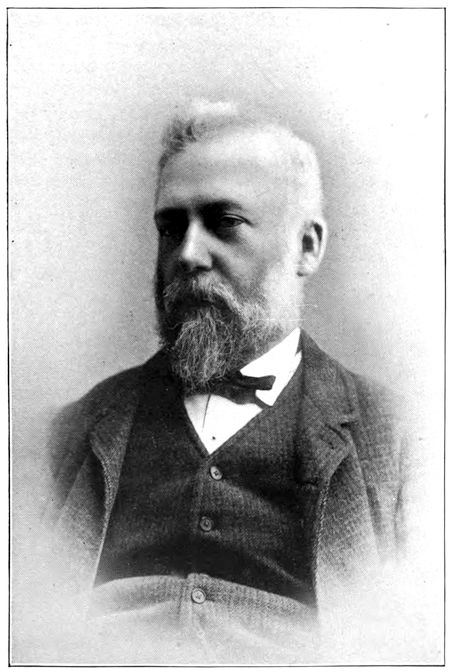
The strike ended, the Committee set themselves
to work to repair the broken places and put the
Association on to a solid foundation again. They
found themselves financially insolvent and shattered
numerically. They were unable to meet the benefits
provided by rule, and there was a great cry of distress
from those who were out of work owing to
depression of trade. A return was taken as to a
levy to meet the latter class, but it was very unsatisfactory,
not one half of the votes being cast, and
the suggestions included levies varying from 2d. up
to 1s. They therefore decided to call a special
Council, warning the members that these people
could not be paid from the General Fund. They had
been compelled to pay those who were on the funds
short allowance. The position was so desperate
that "either the contributions must be increased
or the benefits reduced," and at the Council the two
questions were—first, the general question of contributions
and outlay; second, the men idle from
depression: how to raise money for their support
and how much should they be paid? The Council
acting on the advice of the Committee decided that
the benefits for strike, lockout, and breakage should
be 6s. and 3s. per week for members and half members
respectively, and that these payments should
only be paid for six months, when they should cease
without appeal, the sacrificed allowance being reduced
to 10s. per week without a reduction in time.
Their next difficulty was the unconstitutional
district meetings which were held. At these the
wildest statements were made, and as a consequence
the minds of the members (as will always be the
case when these meetings are in vogue) became
unsettled, and disunion followed. Amid the natural
difficulties of the situation the Committee were
called upon to defend themselves. A circular was
sent out which, after renewing the argument of the
promoters of the meetings, said:
"If you determine to let those men go on, doing
their endeavours to undermine your Association,
then be prepared to accept with that choice all the
evil consequences which must arise therefrom.
These are the men who would "rather rule in hell
than serve in heaven!" They have yet to learn the
most important of all attainments—viz. how to rule
themselves, before presuming to guide the thousands
of people in this county. If complaints are to be
made, let them be made regularly and right. If
reformations are needed, let them be sought in keeping
with the constitution."
History is apt to repeat itself in this mode of procedure
as in others. Nothing but evil can result.
We are not in Russia; we are a democracy, and
have a free tribunal.
There were other four questions calling for arrangement:
the fixing of the county average; the arranging
for official recognition and the operation of the
Federation Board; the rearrangement of the sliding
scale; and the resumption of the Joint Committee.
A dispute as to the average for hewers arose in reference
to the figures from which the eight and three
quarters per cent. and one and a quarter per cent.
should be taken. The employers contended they
should be deducted from the actual wage of the
county for the three pays prior to the strike, which
was found to be 4s. 6¾d. The Committee contended
they should be deducted from the nominal minimum
wage of 5s. 0½d. for the eleven-hour pits and
4s. 8½d. for the ten-hour pits. These were the wages
from which the reductions were sought. If they
were averaged as per the number of pits at each
it worked out at 4s. 11d. It was therefore obvious
that there would be a great difference in the result.
If the two reductions were taken from the 4s. 11d.
the average would be 4s. 5.16d.; if from the 4s. 6¾d.
it would be 4s. 1.33d., or 3.83d. of a difference. It was
finally agreed that the average for hewers should be
4s. 5d. for the eleven and 4s. 2d. for the ten hour pits.
The official recognition of the Federation Board
was at first objected to by the employers. At a
meeting of the Board held on the 23rd of September
the details of the sliding scale were discussed.
They were in doubt as to whether the owners would
discuss it with them, or the miners alone. Eventually
a joint meeting was held, and the second sliding
scale was arranged on October 11th. The date of its
commencement was fixed for December.
SLIDING SCALE, 1879
| When the Net Average Selling Price of Coal |
There shall be made the following percentage additions
to, or deductions from, the now prevailing tonnage rates and wages |
| Reaches | But does
not reach | Additions | Deductions |
| s. d. | s. d. |
| 4 2 | 4 6 | None | None |
| 4 6 | 4 10 | 2½ per cent. | " |
| 4 10 | 5 2 | 5 " | " |
| 5 2 | 5 6 | 7½ " | " |
| 5 6 | 5 10 | 10 " | " |
| 5 10 | 6 2 | 15 " | " |
| 6 2 | 6 6 | 17½ " | " |
| 6 6 | 6 10 | 20 " | " |
And so on upwards, 2½ per cent. for each 4d.; the 5
per cent. variation for the 4d. range in price
between 5s. 10d. and 6s. 2d. being limited to that
special range.
| s. d. | s. d. | Deductions. |
| 3 10 | 4 2 | 2½ per cent. |
| 3 6 | 3 10 | " |
And so on downwards.
The difference between this and the previous one
consists in the lessened grades. The 8d. grade was
reduced to 4d. for two and a half per cent. change
in underground wages and two per cent. in surface
wages. Another variation was the giving up of
the minimum wage. All parties were agreed on
this point, as all had felt the evil arising from the
operation of it during the two years of its existence.
Long may it be before such another condition arises
here, for the days were dark indeed; as witness the
first ascertainment, which showed the average selling
price of coal to be 4s. 3.3d. per ton. The accountants
were, as now (1906), E. Spark, and Monkhouse,
Goddard & Co.
The Joint Committee was suspended at the
commencement of the strike on April 5th, and did not
resume its sittings until December 12th. During
the time intervening the rules were revised. A
special Committee (which might be called an interregnum
Committee) met, and transacted business
of the same nature as that within the purview of
the Joint Committee.
Before leaving the strike and the consequences it
may be of interest to quote from Mr Crawford's first
monthly circular his estimate of it.
The strike which took place in the months of
April and May last will ever remain an epoch in
the history of the Association. A more complete
success never took place. At its beginning, strong
doubts were expressed and great fears entertained
as to what would be the ultimate consequences of
such a step.
I was amongst those who doubted, but did not
despair, and the end more than justified the expectations
of the most sanguine. If we take the
entire history of trade disputes, it will be found that
not one ever commanded so much public sympathy.
We had justice and right on our sides, and we took
the only wise course—viz. to let the public know it.
We deplore strikes as much as anyone can do, but
there are times when they become necessary and
such a climax had we arrived at in April 1879.
Numbers of men who were outside our Association
then came forward and joined with us
and fought the battle side by side. There never
was a more complete stoppage of work or one
which to the workmen, at least, ended more satisfactorily.
We may fittingly close the year by a reference
to the strong tide of emigration that was running.
A miners' conference to consider a scheme to assist
prospective emigrants and draw up a code of rules
was called in Manchester in November. Such a
scheme was formulated and the rules suggested, but
nothing ever came of it. In connection with this
large volume of emigration from the mining districts
Mr Crawford took a trip to America in one of the
Inman liners, and wrote an account of it in a pamphlet
entitled "In the Steerage." A report was
circulated in the press describing what purported
to be the foul condition of the accommodation
provided for the third-class passengers. With a
desire to ascertain the truth or otherwise of these
statements Mr Crawford went to New York in one
of the Inman boats, and completely exposed the
untruthfulness of it, and did a great deal towards
easing the minds of many of the miners who were
preparing for leaving the country.
Violations of Scale—Restriction of Labour—Working Hours
Arbitration—Deputies' Wage Arbitration—Employers'
Liability
By the end of 1879 the consequence of the strike,
as seen in disarranged collective machinery, had
been reconstructed. One beneficial effect of the
stoppage was the great number of men who joined
the Union. When the notices terminated there were
collieries where the numbers were few; but these
men, as if moved by the instinct of self-preservation,
ceased work, and to a very large extent became members,
remaining until this day. It was the greatest
piece of missionary effort ever seen. Instead of
disunion and isolated action there were manifest
loyal adhesion and solidity.
There were sure to be exceptions to this as to all
rules, and early in the year the Federation Board
was called upon to meet a class of trouble which
was entirely illegal, and which arises occasionally
now. Without specifying places (but dealing generally)
it will suffice to say that in a few instances
notices were given for advances beyond what the
sliding scale gave. The employers requested the
Board to meet them. This they did, and two resolutions,
one dealing with the cokemen and the
other with the miners at one colliery, were unanimously
carried. The workmen were told that
they had violated the rules of the Federation Board
and sliding scale agreement. They were told (by a
circular sent out by the Federation Board) that
they were parties to the arrangement, and yet had
given in their notices for an advance in direct contravention
of its provisions. Having been parties
to the scale they ought not to violate it with impunity.
If this individual or lodge action were
allowed it would end in disruption, and therefore it
must be checked. The wisdom of that advice is
obvious, and not only in that day, but for the
present time. If agreements are made for men they
should be adhered to. To violate them is lawlessness,
which in the end is hurtful beyond the immediate
act. If conditions are forced upon people it
is right to repudiate, but for the last thirty-four
years in this county there has been freedom and
equality.
At the Council meeting held on January 17th it
was decided that there should be a restriction, and
that no coal hewer should make more than 4s. 5d.
or 4s. 2d. per shift, but this was never carried out
in any general manner. On March 13th the Council
again dealt with it, and declared all lodges unfinancial
where it was not put in force. In furtherance
of that resolution the Seaham Lodge put a
notice on the pit heap to inform the members "that
the restriction had commenced, and that a list be
drawn up stating the number of tubs each man had
to fill in his respective district or flat, no man to
make more than the county average in any one
day." To that notice the Owners' Association took
objection. A letter was sent to Mr Crawford asking
him whether the workmen had determined to enforce
restriction, and if so, were they then acting on
it. These questions Mr Crawford did not answer,
but brought them before the Committee. As a
result a circular was issued reviewing the whole
case. They pointed out that when the Council
carried it very few of the lodges put it in force, and
the few who did soon left off, and that at the
Council to enforce it the voting was 145 for, 126
against. They reminded the majority that "surely
a minority so strong ought to have led to a reconsideration
of a matter not only so vitally important,
but which has at all times been found so very
difficult to carry out in practice." Lodges were
sending in resolutions refusing to carry out the
Council resolution. That resolution said those lodges
should be expelled. The position would be that
whole collieries of men would be cut off from the
Association because they were determined to abide
by the scale agreement. In view of these facts, they
resolved to call a special Council. They pointed
out that one or two lodges had sent in motions of
censure because advice had been given, and they
met the censures by saying:
One or two lodges have sent motions seeking to
pass a vote of censure on us for issuing the last
circular. It would seem that these lodges would like
to see us sit and do nothing, even though we were
certain that an impending evil was threatening our
very existence. We cannot regard this as our province.
What we did was for the preservation of
the Association. The moment we see that our
efforts have not ended more satisfactorily we have
called a special Council meeting to further consider
the matter. Take our advice, and inasmuch as we
have only done our duty, spare your censures.
We have quite enough to do at present without
wasting our energies in useless and pernicious
quarrelling amongst ourselves.
The result of the special meeting proved the
Committee right. A tabulated vote was taken—the
voting being against restriction 130, for 117;
majority against, 13. Thus ended the only county
attempt to carry out a uniformity in piecework. It
ended as all such will end. Human nature is too
strong for such arrangements.
This case arose out of the hewers' hours at some
of the collieries. Amongst them were Gurney Pit,
Leasingthorne, Letch, and Wingate. These were
eleven-hour pits, but during the depression of 1877-79
the hewers had been induced or coerced to go in
at three A.M. instead of four A.M. The Executive
Committee in their negotiations contended that this
was a violation of Mr Meynell's award, and therefore
ought not to exist. On the employers' side it
was held that the award named only dealt with the
coal drawing. After attempts to settle it was finally
agreed to refer it to arbitration, with Lord Rowton
as umpire. The arbitrators on the owners' side were
Mr R. F. Mathews and Mr W. T. Hall, and for the
workmen Mr L. Jones and Mr W. Crawford. There
were two days' sitting in the Westminster Palace
Hotel, London. On the 20th of August the umpire
decided that the hours complained of should remain
as they were.
This question of the deputies being paid a higher
wage if they were not in the Miners' Association
came up in a renewed application for uniformity of
wage. This was sent to the owners amongst a
number of other requests. The reply was that they
were strongly of the opinion that the deputies
should not be members of the Miners' Association.
The Executive could not accept that reply. They
had never asked about the Associations, but a just
wage, and they considered the reply was an insult.
They recommended to their members that it should
be sent to the Federation Board. This was done,
and on the 19th of March the Board offered to
submit the matter to arbitration. The offer was
refused by the following resolution:—
MINERS' REQUEST AND REPLY FORWARDED TO
MR CRAWFORD
June 17th, 1880.
Deputies.—That deputies who are not members
of the Deputies' Association be paid the same wages
as those who are.
Considering the position in which the deputies
stand to the hewers and other workmen, any change
in the present arrangement is undesirable.
On the receipt of this the Board notified the
county, and resolved to call a joint meeting of the
four Associations. Their advice was that the whole
of the notices be given in, and work to cease until
the claim was conceded or arbitration granted. The
meeting was held on August 26th. Negotiations
proceeded, and in November the employers agreed
to accept arbitration. The case was not heard
until February 1881. The umpire on that occasion
was Mr I. Hinde Palmer, M.P.; the advocates were
Mr L. Wood, Mr W. Armstrong, Mr L. Jones, and
Mr W. Crawford. The hearing lasted two days,
and was held in the Westminster Hotel, London.
The umpire decided upon two points:
(1) That it is competent under the sliding scale
agreement of October 1879 for the deputies who are
members of the Miners' Association to require that
their wages be advanced.
(2) That the advance shall be such a sum as will
make the amount of their wages respectively the
same as the wages paid to those deputies who are
not members of the Miners' Association.
It is not intended to review the introduction and
passing of Acts of Parliament, but mention may
be made of the Employers' Liability of 1880, not
with a view to explain its provisions, but to indicate
steps which were taken towards contraction
out of it. In Lancashire contracting out was made
one of the conditions of hiring, and a strike took
place in an attempt to resist it. With us in the
north (for the two counties worked together) the
same end was sought, but by different means. The
aim of the employers here was to avoid litigation
if possible, and, with that end in view, would have
increased their contributions to the Permanent
Relief Fund. The officials of that fund were desirous
of bringing an arrangement about, believing
it would strengthen their position. There were a
few men outside the ranks of those officials who
advised the miners to enter into a contract. At
a meeting of the Permanent Fund Committee it was
just on the point of being carried when a suggestion
was made to the effect "that it was not a matter
pertaining to the fund, but belonged to the Workmen's
Associations, and that a joint meeting should
be held." Such did take place, with the result
that the proposal was defeated. The leaders of the
Associations were very strong against it. Among
the strongest was Mr Crawford, whose monthly
circular for December contained some very clear
and explicit reasons in opposition to the idea.
There were threats from some employers as to
smart money and subscriptions to the Permanent
Relief Fund, but still the workmen refused to give
way.
Deputies' Wage again—Third Sliding Scale—Death of
Mr Macdonald—Change in the Treasurership
In February this question was again in evidence. By
reference to the award as given above it will be
seen that the umpire decided clearly in the workmen's
favour, but there arose a complication in the
mode of application adopted by the owners. The
mode of calculation was skilful and peculiar. The
dispute arose in 1876 when, as an inducement for
the deputies to form an organisation of their own,
they were to be exempt from the six per cent. reduction;
therefore, said the employers, we will give
those deputies who are in the Miners' Union the six
per cent. given in 1876, and then deduct all the reductions
since, by this process bringing them to 4s.
1½d. per day. They seemed to forget that the
deputies' arbitration was for the difference between
the actual wages at that time—the difference being
6d. or 8d. per day. The anomaly was that two
men might be doing the same work with equal
responsibilities (in some cases the lower paid the best
workman) and yet one have a much higher wage
than the other.
Mr Bunning (on behalf of the owners) sent a copy
of the instructions to the managers to Mr Crawford,
asking him if they met with his approval. The
answer was sharp. Instead of agreeing with them
he considered them a clear violation of Mr Palmer's
award. It was not based upon Shaw Lefevre's award,
but upon the existing difference in the wages. And
he informed the owners, that they would demand
the higher wages. The negotiations continued until
May, when the umpire by joint letter was asked to
meet Mr L. Wood and Mr Crawford. He informed
them he would write each of them an explanation,
and save the journey. This he did, and said the
award was clear and intelligible, and that he meant
those who were in the Miners' Association to be paid
the highest wages. On the strength of that interpretation
the owners paid the wage, with everything
kept off since the award.
As the two years for which the sliding scale was
definitely fixed drew near completion it was obvious
that there was a strong feeling against it. The circumstances
were against it. Introduced at the conclusion
of a very disastrous strike the whole of its
operation was in the worst times—trade bad, wages
low. There was no wonder that the men had little
love for it. Recognising the opposition the Committee
placed a motion on the Council programme
suggesting that notice be given to terminate it at
the end of the two years. This was adopted, and
notice given at the proper time. In the meantime
the miners generally were turning their attention to
the question. A sliding scale conference was held on
April 20th, 1881, in the Midland Hotel, Birmingham.
The conference affirmed "that the principle of sliding
scales is an equitable mode of settling wages questions,
if rightly worked out in detail: That the best mode
of taking out the selling price will generally be to
take the price of coal sold, but that no coals should
be taken which were sold on contract; only those
sold at the current market price." In the matter of
leaving firms out each district was left to its own
option. It was considered desirous that the accountants
should have more freedom in regard to the
matters they were permitted to divulge. A second
conference on the same question was called for
October 19th in Birmingham, with a programme on
very similar lines.
A Council meeting was held, and two delegates
selected to represent Durham. Certain instructions
were given them: sliding scales were the best
arrangements for regulating wages; the open markets
were preferable to the existing mode of ascertainment,
with others of a kindred nature. On January
18th the Federation Board had under discussion a
proposal from the employers. It was not accepted,
but they were told the Board was ready to meet
them at any time. At a special Council held on
25th February 1882 the situation was complicated
by the miners deciding to ask for an advance of
twenty per cent. if the owners refused the sliding
scale drawn up by the Federation Board, and that
body was instructed to meet the employers. The
meeting took place on March 13th on the two
questions, when the owners gave the Board the
following:—
OWNERS' OFFER
March 13th, 1882.
The Durham Coal Owners' Association is unable to
accept either of the propositions suggested in the
Federation Board Minutes of February 25th, that is
to say,—
1. The Association cannot regard "the sliding scale
drawn up by the Federation Board as just and
equitable," and consequently cannot adopt it.
2. The Association cannot grant "an immediate
advance of 20 per cent. in the wages of all men and
boys," nor admit "that trade warrants such an
application," or any advance at all.
Having regard to the difference of view between
the Owners' Association and the Federation Board,
the Association can only suggest that the question
whether wages shall be varied, and if so, to what
extent, and in what direction, shall be left to open
arbitration.
The Miners' Council then decided to take a ballot
on the twenty per cent. If the question were not
carried by a two-thirds majority, to arbitrate on the
advance. When this was sent to the owners they
replied that the advance could not be granted, but
they were quite ready to leave it to open arbitration.
The Federation Board as a whole considered itself
in an anomalous position if any section were allowed
to act as the miners were doing. If this were allowed
to proceed, then on wage questions there was an end
to all usefulness. Either the power must be taken
away altogether, or they must unreservedly trust
them. As the position was, they were in a crippled
condition. "This renders our work on general
questions nil, and the Federation instead of being
a tower of strength is a source of weakness, inasmuch
as it exposes to the owners our want of agreement
and diversity of thought and action." They had,
therefore, come to the conclusion to take a vote,
with the view to have the matter settled. The
response of the county was in favour of the Board
by a large majority. Immediately they decided to
ask for a scale with a minimum wage, and that the
variations should be two and one and a half per cent.
A meeting between the Board and the owners was
held on April 17th, when the workmen asked for an
advance of seven and a half per cent. To this the
employers objected, but said they would pay a wage
as if the coals had reached 4s. 8d., which was equal
to an advance of three and three quarters per cent.,
and would be an advantage of two and a half per
cent., during the continuance of the scale. The
Board strongly urged the acceptance of the offer,
which in their opinion was preferable to arbitration.
The workmen accepted their advice, and the following
scale was signed on April 29th:—
THIRD SLIDING SCALE
| When the Net Average Selling Price of Coal |
There shall be made the following percentage additions
to, or deductions from, the now prevailing tonnage rates and wages,
being those prevailing at November 1879 |
| Reaches | But does not reach | Additions | Deductions |
| s. d. | s. d. |
| 3 10 | 4 0 | None | None |
| 4 0 | 4 2 | 1¼ | " |
| 4 2 | 4 4 | 2½ | " |
| 4 4 | 4 6 | 3¾ | " |
| 4 6 | 4 8 | 5 | " |
| 4 8 | 4 10 | 6¼ | " |
| 4 10 | 5 0 | 7½ | " |
| 5 0 | 5 2 | 8¾ | " |
| 5 2 | 5 4 | 10 | " |
| 5 4 | 5 6 | 11¼ | " |
| 5 6 | 5 8 | 12½ | " |
| 5 8 | 5 10 | 13¾ | " |
| 5 10 | 6 0 | 16¼ | " |
| 6 0 | 6 2 | 18¾ | " |
| 6 2 | 6 4 | 20 | " |
| 6 4 | 6 6 | 21¼ | " |
| 6 6 | 6 8 | 22½ | " |
| And so on upwards, 1¼ per cent. for each 2d., the
2½ per cent. variations for the two ranges of 2d.
each in price between 5s. 10d. and 6s. 2d. being
limited to those special ranges. |
| 3 8 | 3 10 | — | 1¼ |
| 3 6 | 3 8 | — | 2½ |
And so on downwards.
It had to continue in force until 30th June 1883,
to be terminated by six months' notice given any
time after that date.
It will be of interest if we insert the scales proposed
by the owners and Board before the agreement.
OWNERS' SCALE
| When the Net Average Selling Price of Coal |
There shall be made the following percentage additions
to, or deductions from, the now prevailing tonnage rates and wages,
being those prevailing at November 1879 |
| Reaches | But does not reach | Additions | Deductions |
| s. d. | s. d. |
| 4 2 | 4 4 | None | None |
| 4 4 | 4 6 | 1¼ | " |
| 4 6 | 4 8 | 2½ | " |
| 4 8 | 4 10 | 3¾ | " |
| 4 10 | 5 0 | 5 | " |
| 5 0 | 5 2 | 6¼ | " |
| 5 2 | 5 4 | 7½ | " |
| 5 4 | 5 6 | 8¾ | " |
| 5 6 | 5 8 | 10 | " |
| 5 8 | 5 10 | 11¼ | " |
| 5 10 | 6 0 | 13¾ | " |
| 6 0 | 6 2 | 16¼ | " |
| 6 2 | 6 4 | 17¼ | " |
| 6 4 | 6 6 | 18¾ | " |
| 6 6 | 6 8 | 20 | " |
| And so on upwards, 1¼ per cent. for each 2d., the
2½ per cent. variations for the two ranges of 2d.
each in price between 5s. 10d. and 6s. 2d. being
limited to those special ranges. |
| 4 0 | 4 2 | — | 1¼ |
| 3 10 | 4 0 | — | 2½ |
| 3 8 | 3 10 | — | 3¾ |
| 3 6 | 3 8 | — | 5 |
And so on downwards.
WORKMEN'S SCALE
| When the Net Average Selling Price of Coal |
There shall be made the following percentage additions
to, or deductions from, the now prevailing tonnage rates and wages,
being those prevailing at November 1879 |
| Reaches | But does not reach | Additions |
| s. d. | s. d. | (5s minimum wage) |
| 4 8 | 4 10 | 2½ | " |
| 4 10 | 5 0 | 5 | " |
| 5 0 | 5 2 | 7½ | " |
| 5 2 | 5 4 | 10 | " |
| 5 4 | 5 6 | 12½ | " |
| 5 6 | 5 8 | 15 | " |
| 5 8 | 6 0 | 17½ | " |
| 6 0 | 6 2 | 20 | " |
| 6 2 | 6 4 | 22½ | " |
| 6 4 | 6 6 | 25 | " |
| 6 6 | 6 8 | 27½ | " |
| 6 8 | 6 10 | 30 | " |
| 6 10 | 7 0 | | " |
And so on upwards, 2½ per cent. for each 2d.
It will be obvious that the difference between the
two is very wide. The workmen sought to renew
the minimum wage, although but two years had
intervened since the dark experience of 1877-79, and
when it was impossible for the condition to have
been forgotten.
On October 31st, 1881, Mr Macdonald, M.P., died
at Wellhall, near Hamilton, Scotland. He was the
ablest leader the miners of Scotland had, and one
of the first Labour representatives in the House,
being elected with our good friend Mr Burt in
1874. He was often called the "Miners' Friend."
Although not a Durham man he was so intimately
and closely connected with our early history and
progress up to his death that there would be a great
hiatus if no mention were made of him. The Executive
Committee was represented at his funeral, and
the first Council meeting after his death passed a
resolution expressing deep sorrow at his death, and
regarding it as an irreparable loss and national
calamity to the mining population of England,
Scotland, and Wales. His self-sacrificing efforts for
a number of years on their behalf cannot be fully
known, but his memory will ever be held dear by a
grateful people. A movement was immediately
started to commemorate his work, the result of
which was the statue which is in front of the Hall
in Durham. As Mr Crawford said, "It is the last
tribute of respect we can pay to one who through
good and evil report kept steadily in view the one
object of his life—viz. to reduce the misery, and
alleviate the sorrows of the mining population, while
following their hazardous occupation."
It will be interesting to place on record an outline
of his life. He was born in the year 1821, and began
work at eight years of age. When he was born the
condition of the mining population was dreadful.
There was no law to protect the miner, and there
was little regard for health or life. The hours were
fearfully long. Women worked in the mines under
the most debasing conditions. In the midst of this
he set himself the uphill task of self-education—uphill
now, but how much more so then! In early
life he left the mines, and became a teacher. The
knowledge he acquired he determined to devote to
bettering the condition of the miners. Between
1850 and 1855 he was assiduous in procuring
amended Miners' Acts, and those of 1855 and 1860
were mainly due to his efforts. From that time
until his death he was earnestly working in efforts to
ameliorate the conditions of the life he knew so
well, and at his death was busily engaged in further
amending the Mines Act. He was a sample of men
who have been endowed with splendid powers, and
who might have made a fortune if they had followed
commercial pursuits as eagerly as they followed after
reform and better temporal conditions for others,
but who, when there was nothing to gain, counted
it their highest good if they could in any way assist
their class on to a higher platform and into brighter
conditions of life. They chose rather to suffer with
the people in their affliction, and help those who
needed it, than to make for themselves monetary
positions. When he died a truly great man left the
ranks of reformers, and to the honour of Englishmen
be it said, they honoured him in death as they
appreciated him in life, as witness the splendid
statue which was unveiled on 17th November 1883
by his colleague in Union and Labour representation
in Parliament, Mr T. Burt.
In the beginning of 1882 a matter arose which,
were it not for the fact that it would leave an incompleteness
in our record, might have been passed over
unnoticed. Some doubts were felt as to the state
of the accounts, and it was resolved to have a
thorough inquiry into and examination of the books.
Mr John Staton, the accountant, was employed for
the purpose. His report was to the effect that the
treasurer was indebted to the Association to the
amount of £282, 11s. 1d. This examination covered
the period commencing with December 1876. He
not only described the amount, but he suggested
a system of book-keeping. The result of the affair
was the suspension of the treasurer (Mr Forman
acting pro tem.), and his removal on the 6th of
May, and the appointment of Mr J. Wilson. The
whole circumstance was unfortunate. There were
many (the writer among them) who doubted if there
had been any defrauding, and who were convinced
he had only been careless. He was an earnest
worker in the Association.
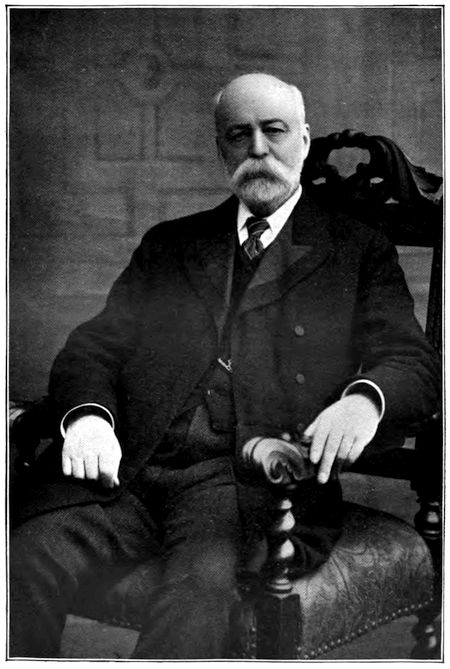
Alderman John Wilson, J.P., M.P.
Five Days per Week Movement—Fourth Sliding Scale—Second
Relief Fund—Wheatley Hill "Putt Pay"
The question of restriction of the output was again
brought under discussion at the beginning of the
year. It was not peculiar to nor spontaneous in
Durham, but was of extraneous suggestion. It was
the result of a miners' conference in Leeds, and was
set forth under two phases: the reduction in the
hours per day and the days per week to five—all
the pits being off on the Saturday. The members
were told plainly by Mr Crawford what the real
issue was and what was the condition of the mining
districts. While in other districts the hours had to
be reduced, in Durham they would remain, but the
days per week would apply to all alike. He, however,
pointed out that there was only one-sixth of
the miners of the county represented. A special
Council was called, and the matter placed before it,
when it was decided "that pits ought to work not
more than five days per week and draw coal not
more than ten hours per day—each and every pit
being idle every Saturday, irrespective of how many
of the preceding days of the week have been
worked."
A Second National Conference was held on the
question. A report was issued by the representatives,
Messrs Crawford and Wilson, which showed
the fallacy of attempting any national movement.
The conference was called to hear how far the
decision had been carried out. The report showed
that there were only 81,000 paying members in the
districts represented, the total number employed
being about 379,000; that there were only 9500
persons who had adopted the Leeds Resolution of
Restriction, and some districts positively refused to
carry it out. In the face of these facts the conference
reaffirmed the restriction resolution, and
resolved that the ballot should be taken in each
district, and that there should be an adjournment
to hear the result.
In the meantime a meeting was held between
the Executive Committee in Durham and the owners.
The Committee stated their reasons for requesting
the meeting, and hoped the owners would assist
them to carry the conference decisions into effect.
The reply was that the question was so important to
both employers and employed that it would require
serious consideration. Could the workmen point out
any probable good which would result? How far
it had been carried out? Unless it were generally
adopted it would mean ruin to those districts
attempting it. They were willing to take part in
a national conference for the purpose of discussing
the subject. The matter was again brought before
a conference in Birmingham on April 10th. There
were twenty-seven delegates present from districts
where 229,000 men were employed. The only item
of business was the appointment of a Committee to
meet the Mine Owners' National Association, each
district to appoint its own representative on the
Committee. Mr Crawford was afterwards appointed
to act for Durham. The request for a meeting was
sent to Mr Maskell W. Peace, the owners' secretary.
It was refused, as they considered it outside their
province. Beyond the disorganisation in the other
districts it was found in Durham to be incompatible
with the sliding scale, and as a consequence the
attempt at a national regulation of labour proved
abortive. That which oft looks easy when at a
distance is often found impracticable when we are
brought face to face with it. If a national restriction
be ever carried out it will need solid unions,
and all men of one mind, or it will fail at the start.
As the period approached when the definite year
of the scale would end there were growing signs
that the requisite six months' notice would be given.
At a meeting of the Federation Board held on May
23rd it was decided to give such notice to terminate
the scale at the end of the year, and the Board prepared
to meet the emergency, and if possible renew the
scale or modify it. A resolution was come to at their
meeting in October, expressive of their opinion that
"a sliding scale is the best mode of adjusting the wages
questions." They further resolved that each section
should meet the owners for the purpose of discussing
any alteration peculiar to themselves. Acting on
that arrangement the Executive Committee sent
out a circular urging the maintenance of the
principle. In addition they called a special Council,
and asked for suggested amendments. In response
there were seventy-seven suggestions returned, embracing
every kind of alteration or grievance, to be
considered before the scale was re-established. These
were sent to the employers, who replied by sending
a counter list containing (if not as many) a very large
number of questions. The Federation Board asked
why they were making so many claims. These
reasons were supplied, each section being taken
seriatim. The various Committees and the Federation
Board were doing their best to get the settlement
placed in the hands of some body of men, so that
the scale might be rearranged. This advice was not
accepted, for at a special Council the power to settle
was retained by the county so far as the miners were
concerned.
The reasons assigned by the owners in support
of their claims were unacceptable to the Board. They
felt justified, they said, in refusing, but were willing
to meet to discuss the respective alterations. The
meeting took place, but it was found that the
representatives of the miners could not proceed, as
their Council had refused to accept the scale until
all the notices of men who were discharged for depression
of trade were withdrawn and all the pits recommenced.
"The owners said that such a thing was
an impossibility, seeing that a want of trade was
the only cause of pits being stopped and men dismissed.
If the pits could be worked they would
work them, but this they could not do in consequence
of the terrible depression of trade. It was nonsense
to say that the pits were stopped by an arrangement
among the owners. That was a monstrous absurdity."
These remarks were sent out to the miners with a
most earnest appeal not to delay the matter any
longer, because it could only result in danger. A form
accompanied the circular upon which the lodges were
asked to vote whether they would place the question
of a sliding scale in the hands of the Federation
Board. This appeal was successful, and the Board
was instructed to proceed with it by a majority of
104. At the earliest possible moment a meeting was
arranged, and the scale agreed to on the lines of the
previous one, to commence on 1st August 1884, and
to continue for two years certain, subject to two
calendar months' notice. But such notice was to be
given on a date to permit of a termination on the
31st of July. This fourth sliding scale was similar to
the third one, which appears on page 177, so we need
not reproduce it.
The formation of the Second Relief Fund was
forced upon the county by the fact that there were
so many men out of work, and their poverty was a
peril to those who were in employment. Men's
necessities are a strong force, oft compelling them to
do things they would otherwise shrink from. It was
thought, therefore, it would be sound economy to
ease off the poverty, if luxury could not be afforded,
and thus save men from overcrowding the labour
market, or at least from accepting conditions which,
if once established, would prove a general injury.
Then there was a feeling of sympathy for the distress
seen on all hands, and a desire to alleviate, if not
obliterate it; for the miners of Durham may have
little, but they never hesitate to share it. They
are not the men "who, seeing their brother in distress,
shut up their bowels of compassion against him."
The sight of distress, or a knowledge that someone
is in danger, never appeals in vain.
The Council meeting held on May 3rd, 1884, dealt
with the question of providing for the relief of those
men who were discharged through depression of
trade. It decided that a special Council should be
called on the 7th for the purpose of discussing the
best means, and in the meantime suggestions might
be sent in—"motions of all kinds, including levies, to
be admissible." Without describing these in detail,
suffice it to say that there were eighty-eight in
number, covering all phases of the subject, both as to
means of raising money and amount of benefit. The
Council decided for a levy of 3d. per full and 1½d.
per half member per fortnight. That £2000 should
be advanced from the General Fund, to be redeemed
by the levy, and "that the amount of money the
levy will bring be equally divided by the Executive
Committee amongst the men idle or who may be
idle." It was soon found that the income from the
levy would not give anything near 10s., and often
it was found to run as low as 5s., per week.
As this, although belonging to an individual
colliery, is yet of a peculiar character, it will be
well to note it here. On the pay Friday falling on
April 4th it was found that the company had become
bankrupt, and the wages of the workmen were not
forthcoming. This being the second occasion at
these collieries, and only half the amount for the
previous occasion having been paid, there was great
consternation, and the presence of an agent was
urgently requested. The treasurer immediately went
out, and found the people ready for a riot. This,
of course, was to be expected. Mr Ramsay, the
agent of the colliery, desirous to meet in part the
wants of the people, sold a branch engine, but when
the N.E.R. engine came to take it away men, women,
and children commenced and pulled the rails up,
thus keeping both engines as it were in "pound."
It was arranged that there should be a mass meeting
the next day (Saturday), and the treasurer was to
attend to persuade the men to allow the sale to
proceed, and accept the money as an instalment of
their wages. The meeting was held in a field. The
day was fine, there was a large crowd, and the
treasurer was in his most eloquent mood, when a
very laughable incident occurred. There was a
pigeon-flying match from Newcastle to Thornley.
It was about the time when the birds were expected.
Some of the men were watching the heavens more
closely than they were listening to the speaker or
at the time thinking about their wages. Just when
the orator was in the midst of one of his best
sentences a voice was heard (which was the descent
from the sublime to the ridiculous): "Haud thee
hand till th' 'Slate Cock' comes in." In a moment
speaker and occasion were lost, and the gathering
generally watched the bird, hero of the hour, as,
like an arrow shot from some great bow, he came
right on to his "ducket." Then in deliberate manner
the same voice was heard exclaiming: "There, he's
landed; thoo can gan on wi' thee speech." But
rhetoric and reason were both ineffective after the
"Slate Cock" had landed.
The Executive Committee, however, were quick
in their action, and put in men as bailiffs at each
colliery to prevent anything being taken away. After
a year had been taken up by the process of law,
and £1000 spent in money, the entire wages, slightly
over £4724, with the colliery pay sheets, were handed
over to the treasurer. That sum included the wages
of Union and non-Union men alike, and was paid
to all with this difference, that the members got their
money free of cost, but the non-members were
charged 7s. each towards the cost incurred in procuring
the money. This sum was all paid out as
per the pay sheets. The last man to turn up was
five years after.
Industrial Remuneration Conference—Extension of the
Franchise—Labour Representation—Lloyd Jones
In January 1884 a peculiar but very useful conference
was held in London. It was, and is, known as the
"Industrial Remuneration Conference." In the
preface to the proceedings, which were published,
we are told why the conference was called.
"In the spring of 1884, a gentleman of Edinburgh
determined to devote a considerable sum of money to
the purpose of keeping before the public mind this
vital question, viz.: What are the best means, consistent
with justice and equity, for bringing about
equal division of the daily products of industry
between Capital and Labour, so that it may become
possible for all to enjoy a fair share of material comfort
and intellectual culture, and possible for all to
lead a dignified life, and less difficult for all to lead
a good life?"
For the purpose indicated he gave £1000, vested
in seven trustees, Mr T. Burt being one of them.
To the trustees there was a Committee added, and
Mr Crawford was, by the consent of the Miners'
Council, amongst the number. That Committee
considered that the best means of carrying out the
trust was by organising a conference and inviting
all sorts and conditions of opinion. There were two
main branches of inquiry: "Is the present system
or manner whereby the products of industry are
distributed between the various persons and classes
of the community satisfactory; or if not, are there
any means by which that system could be improved?"
These general propositions were divided
into many branches. The purpose of this historical
outline is served by mentioning the connecting link
being Mr Crawford's appointment on the Committee.
The chairman of the conference was Sir C. Dilke.
While these important industrial matters were
taking place the political affairs had not been
neglected. The Franchise Association had kept up
a close and instructive agitation not only at home,
but outside the county, pressing the demand for an
assimilation of county to borough. They urged that
it was a glaring anomaly for a man to be eligible to
vote in a borough, and because he passed over an
arbitrary line (yet in all respects the same man in
trade and duties of citizenship) he was not permitted
to do so. At the Trades Union Congress held in
Nottingham in 1883 the following resolution was
proposed by the representatives from Durham:—
That, without accepting an equalisation of the
county with the borough franchise as a final solution
of the great question of Parliamentary Reform, this
congress is of opinion that the Government should lose
no time in introducing their promised measure, and
calls upon the organised trades of the country to
assist by every means in their power in promoting
the popular movement in support of this long-expected
reform, and authorises the Parliamentary
Committee to join with the Durham Franchise
Association and other Associations of all kinds in
the proposed deputation to the Prime Minister.
The result of this resolution was the reception
by Mr Gladstone of a very large deputation, representative
of all the Trades Unions in the country,
on January 3rd, 1884. Three speakers—J. Arch, A.
Wilkie, and J. Wilson—were selected, and they
received the assurance that the Government would
introduce the Bill. It was introduced, and occupied
nearly the whole of the session; was carried through
the Commons, but was defeated by the Lords, or as
Mr Gladstone said, they put "an effectual stoppage
on the Bill; or in other words, they did practically
reject it." The Liberals, however, were determined
that the matter should be settled, and for that
purpose summoned an autumn session. By the tact
and eloquence of the Prime Minister the great
measure was carried in spite of the most bitter
opposition, in which constitutional means were
stretched to their utmost limit, and the deepest
depths of vulgarity were ransacked for the foulest
epithets to use against the working classes, some of
whom appear to have very short memories, as they
forget this and other great acts done for them by
the Liberals.
The passing of the Act did not take the miners of
Durham or their colleagues over the Tyne by surprise,
but found them expectant, and ready to use their
newly acquired power. The twelve years of the
teaching of the Franchise Association bore fruit at
once. During the summer of 1884 numerous district
meetings were held. The Miners' Executive and the
Committee of the Franchise worked together. The
two great questions were the political right withheld
and the action of the irresponsible House of Lords in
thwarting the will of the nation as expressed by the
duly elected representatives of the people. The 4th
of October was the appointed day to hold district
meetings simultaneously all over the county. The
people were urged to make them a success. The
Committee was appointed to take charge, and the
owners were notified that all the collieries would be
off on that day. The whole county was in a political
fever. John Morley had uttered his memorable
words, which have passed into one of our epigrams:
"End them or mend them." The political creed of
the progressives was "Down with the Lords" and
"Faith in Gladstone." One sentence may be quoted
from Mr Crawford's circular of that time:
Mr Gladstone and the Government deserve the
highest praise for their action in this matter, and
with the support of the people they will yet carry the
Bill against the organised and determined opposition
of a class of men who have amassed immense wealth
by, in past times, taking that which belonged to the
people.
The practical effect of the Act in Durham was
seen on January 24th, 1885, when the Federation
Board called a special Council to consider the following
programme:—
programme, 1885
(1) Shall there be Labour Representatives?
(2) If so, how many?
(3) If it be decided to have Labour Representatives,
who shall he or they be?
(4) The ways and means of supporting such person
or persons from the Associations.
(5) What should the salary of such man or men
be?
(6) Should we nominate men other than Labour
Representatives? That is, men who hold similar
views to ourselves, but who will pay their own costs,
both in contesting and otherwise.
(7) If this be done, who should they be?
(8) The selection of divisions.
The resolutions come to were—(1) there should be
Labour representatives; (2) there should be bona fide
Labour candidates selected from the workmen, but
run in connection with the Liberals; (3) the candidates
should be J. Wilson, W. Crawford, and
L. Trotter; (4) the ways and means should be left in
the hands of the Federation Board, and that the salaries
should be £500 per year. On the same day the
Board met, and decided to select the Bishop Auckland,
Mid-Durham, and Houghton-le-Spring divisions—Mr
Trotter for Bishop Auckland; Mid-Durham,
W. Crawford; Houghton-le-Spring, J. Wilson.
They further decided to inform the North and South
Durham Liberal Associations what had been done,
and asked them if they would co-operate with the
Board.
A meeting between the representatives of the
Liberal Associations, the Federation Board, and the
Franchise Association was held in the County Hotel,
Durham, when the following resolutions were agreed
to:—
resolutions, 1885
That it is highly desirable for all sections of the
new electorate to arrange for the object of securing
the return of Liberal Members at the next election,
and that this meeting is prepared to give support to
the persons nominated by the Miners' Federation
Board, providing their candidature is endorsed by
the Liberals in each division.
That this meeting requests the constituencies to
form Liberal organisations, and that small committees
from the South and North Durham Liberal
Associations, the Federation Board, and the Miners'
Franchise Association be appointed to aid such
organisations.
January 24th, 1885.
So far as the Mid-Durham and the Houghton
divisions were concerned, all went on smoothly.
The candidates were accepted with complete unanimity,
but in the Auckland division the feeling in
some quarters was in strong opposition. The Board
were asked to withdraw Mr Trotter, which they refused
to do. There were other two gentlemen in
nomination, and he was asked to put himself in
competition with them, and if rejected retire. He
refused, and they, the Board, approved of his refusal,
and arranged a meeting of the lodges in the division
for the purpose of explaining the situation. At
this point there arose a complication of a different
order. At their meeting on October 22nd, 1885,
the Board decided "that each candidate must be
responsible for the returning officer's fees in their
respective divisions." Shortly after this was made
known Mr Trotter withdrew, the reason assigned
being the refusal of the Board to pay the returning
officer's fees, although all the candidates were
treated alike. As a consequence the division was
vacant, and open to any candidate. This only
need be added, that at the General Election in
November Mr Crawford and Mr Wilson were both
returned by great majorities—the latter being defeated
in 1886, but succeeding Mr Crawford in 1890
as the Member for Mid-Durham.
This may be a fitting place to try to remove a
false impression, which has lingered in some minds
unto this day, as to what they are pleased to call
"the shameful treatment" of Mr Lloyd Jones,
while in the Chester-le-Street division, by the
Federation Board. There never was a grosser misstatement.
The Board did nothing but what was
fair and honourable throughout the whole proceedings,
although they were made the object of
a somewhat bitter attack by The Newcastle Chronicle,
which attack was entirely founded upon a too slight
knowledge of the facts. As mentioned above, an
arrangement was made whereby the workmen were
to have their divisions undisputed, and with the rest
there was no claim for interferences set up. Mr J.
(now Lord) Joicey was selected by the Liberals
for the Chester-le-Street division, the Federation
Board having no part or lot in the transaction.
Mr Jones, who was an intimate friend of Mr J.
Cowen, was brought out, it is well known, as Mr
Cowen's nominee, and as such, contested the division.
The Board, as such, did nothing in it in any way.
If they had, their action would have been dishonourable
in the light of the agreement. This,
however, they did do: as soon as Mr Trotter
withdrew from Bishop Auckland, they sent a deputation
to interview Mr Jones and to make him
an offer of that division. The writer was one of the
deputation, and with the others did all possible to
persuade him, but he refused. It was felt he was not
free, or he would have accepted. This can be said
without fear of contradiction: the Board as a
whole regretted the refusal, for Mr Jones was a
great orator, respected very much by the miners in
Durham, as witness their continual choice of him for
their arbitration cases, and he could have had a safe
seat.
In Dark Days—The Eight Hours—The Sliding Scale—Advance
of Ten per Cent.—Second Advance of Ten per
Cent.—Death of the Scale—The County Council
The year 1886 passed over uneventfully, and in a
routine manner, except in the matter of trade, which
continued very much depressed, and wages very
low. At the beginning of 1887 the average selling
price at the pit mouth was 4s. 5.56d. The Relief
Fund (even with the principle of division of income)
was in debt to the General Fund £3548, 4s. 11d. as
per the balance sheet for quarter ending December
1886. The condition of trade was so bad generally
that a Royal Commission was appointed to inquire
into it, the present county court judge of Durham
being one of the members. He differed from the
majority report, and signed a minority report.
This objection was in relation to the fragmentary
character of the evidence. In the coal and iron
industries the witnesses were entirely from the
employers. Without stating the whole of his able
report, dealing as it did with every phase of our
industrial life, a portion may be mentioned. Four
causes of depression and low wages upon which he
laid emphasis, were the land question and the
royalties, way leaves and dead rents. Those who
hold the land, claim these from the employers and
employed who risk their capital and their lives
to get the mineral which he, as landlord, does
nothing to assist. In the midst of the dark times
the Executive Committee was compelled to face
two evils: a small banking account, and a heavy
expenditure. The banking account for the quarter
ending December 1886 was £16,000, exclusive of
the deposit and shares in the Industrial Bank,
which amounted to £1841, but which were nominal
and, so far as use was concerned, simply on paper.
In addition, there was a sum nearing £900 invested
in buildings. In a short circular the Committee
placed the whole financial position before
the members. For the year 1886 the income was
£44,506, with an expenditure of £54,126. "You
will thus see that we cannot exist long at the rate
of £9620 on the wrong side of the ledger. Soon all
our funds will be gone, and nothing left for the
members who have paid so long." They were compelled
by rule to keep £10,000 in the funds, and
were therefore driven to consider two propositions:
either to increase the subscription by 3d. a fortnight
or reduce the benefits. For that purpose they
proposed to call a special Council to consider the
questions. The reductions suggested would reduce
the expenditure by £1600 per quarter. At the
Council meeting an all-round reduction of 2s. per
week for sickness, breakage, strikes, and sacrificed
allowance was made, and £1 off the death legacies,
to take place from the rising of the Council, which
was held on 9th April. Happily, however, the trade
began to turn and the position of the Association
to amend, for on August 27th a slip was sent out
informing the members "that the funds have so far
recouped as to enable the Society to pay all
benefits according to rule from Monday the 29th."
On October 11th, 1887, and three following days a
miners' conference was held in Edinburgh. The
main purpose of the conference was the limitation
of the output. There were a large number and
variety of propositions discussed: five days per
week, a week or fortnight's holiday, and the eight
hours per day. Part of the resolution on the last
question was in words that have become familiar to
Durham in these later years: "That no miner be
allowed to work more than eight hours in the
twenty-four." The first resolution on the question
did not appeal to the State, but on the fourth day
it was brought forward containing an appeal to
the legislature, and carried. The position of
Durham was the same then as now (1906), and the
opposition of to-day is based upon the thought of
that day. Before the conference was held the
Executive Committee gave their opinion upon the
various questions on the programme of business.
On the eight hours they said:
EIGHT HOURS' RESOLUTION
Eight Hours.—This is to be sought for by Act
of Parliament. To seek to fix the hours of men
by Act of Parliament is, in the year 1887, a
monstrous and illogical proceeding. If you fix the
working hours by Act of Parliament, why not fix
the rate of wages also? In the old feudal times
wages were so fixed by Act of Parliament. Under
such laws, men were serfs and slaves, and became
as much the property of their employers as the
horses that filled his stables. To demand eight
hours, and even less, is in the hands of all men if
they will only utilise their own organised power.
But if such an Act were passed, it would result
in our own county in one of two ways, (1) the turning
off of 10,000 or 15,000 hands; or (2) the
adoption of two shifts of hewers, and two shifts of
offhanded men and lads, and thus increase the
hewers' hours by one hour, and, in many cases, one
and a half hours per day. Again, if you seek by
Act of Parliament an Eight Hours' Bill, it logically
follows that you regard eight hours as the number
of hours men should work. In such a case, you
endanger your own position, and would strongly
tend to bring upon you an eight hours' system.
But why is this sought? It is sought because men
are indifferent, apathetic, and consequently disorganised.
If this law passed to-morrow, it would
be an inducement to indifference and disorganisation,
and as such materially injure you.
In September 1887 the Trades Union Congress
decided to take a ballot of all the unions on the
general eight hours. The questions submitted were:
Should an eight hours' day be sought; if so, by
what means, by Trades Union effort or by law?
Again the Executive Committee advised the
members to vote against it, which they did. "If
this became law to-morrow," they said, "you could
not make it operative. To do so you must turn
off some thousands of coal hewers, or have two
shifts of offhanded men and boys, and draw coals
sixteen hours per day instead of as now drawing
them ten and eleven hours. If this be sought it
follows by clear implication that the men voting for
it regard eight hours as a normal and fair time to
work per day." The Congress of 1888 decided in
favour of eight hours by law.
The question came again before a miners' conference
held in Birmingham on 8th October 1889.
There were three items discussed: "The International
Miners' Congress, an advance in wages,
and the eight hours." The delegates from Durham,
Mr J. Johnson and Mr J. Wilson, drew up a report
of the proceedings, which was sent out to the
members. They were sent to the conference with
definite instructions from the Council: "That we
don't take any part in the agitation for an eight
hours' day for underground workmen." The representatives
in the report say:
Beyond that we could not (nor desired to) go.
When the conference came to discuss the question
we laid our position before the meeting, and told
them we could not take any part in the agitation.
We make no remarks about the sarcastic reflections
which were made by some of the delegates on our
position. They were no doubt natural reflections,
although their repetition was galling, and evoked
from us replies which were not of the calmest
order. We stood firm to our instructions, and
abstained from either voting or speaking, except in
self-defence.
The conference resolved that on the 1st of
January all men and boys represented there should
commence working eight hours from bank to bank.
Northumberland and the Forest of Dean voted
against, with Durham neutral. Then followed a
resolution pledging all the districts to give in
notices to terminate with the year. This placed
the conference in a dilemma. They were ready
to pass resolutions, but few were prepared to say
their members would give their notices in for it.
Then it was decided to take a ballot and hold
another conference in November. At our Council
meeting on November 9th it was decided not to be
represented.
The programme for the Council to be held on
February 2nd, 1889, contained a resolution asking
for a ballot to be taken for or against the sliding
scale. In their notes on the questions to be discussed
the Committee strongly urged the maintenance
of the scale. It steadied trade, made work
and wages more regular than any other means.
Where sliding scales existed the districts were in
better condition. They (the Committee) were as
much interested as the members. The gain or loss
was alike. Having fully considered the question
they were convinced that it was the most just and
equitable way of fixing and settling wages. The
resolution to ballot was carried. About the same
time the mechanics decided to give notice to have
the scale amended. The Federation Board not
only found themselves called upon to consider the
scale, but they had to deal with a demand for an
advance in wages. A meeting was held on June
17th. The employers placed before the Board
three propositions: arbitration, two and a half per
cent. to commence on July 1st, and two and a half
on September 1st. These advances would raise the
wages to ten per cent. above the standard, or they
were willing to arrange for a new scale. The Board
were reminded that the scale would run until July
31st, and therefore their application was in violation
of that agreement. These offers were recommended
to the members, with a request that they, the
Board, should be vested with full power to negotiate
a settlement, which should be submitted to the
county. The offer and request were refused, and
another meeting took place on July 9th. The
employers then modified their offer, and were
willing to give five per cent. advance for the
months of August, September, and October, and a
further five per cent. for November, December,
and January, or they would refer it to open
arbitration. Again the question was submitted to
the members. The Board said: "There were
three courses to pursue: accept the owners' offer,
go to arbitration, or ballot the county." Of the
three they strongly preferred the offer, as to take
the ballot was a repudiation of arbitration as a
means of settlement. Arbitration was a lingering
and uncertain course. It would last three months,
and they would thus lose for that time a clear five
per cent., or something like from four to five
thousand pounds per week in wages. "Remembering
all the difficulties which now surround
us, and looking at all the facts, we would very
strongly advise you, as men alike interested with
yourselves, to accept the offer the owners now
make." The reply of the county was to demand
twenty per cent. advance. The Federation Board
was driven to take the ballot. The result of the
ballot was for pressing the demand, and the Miners'
Executive made preparation for giving in the notices
on August 1st. The employers made another offer:
instead of giving two fives they offered a full and
immediate ten per cent.
durham coal owners' association
The Owners' Wages Committee is unable to recommend
its Association to give an advance of 15
per cent.
The actual invoice price of coals and coke has
not yet materially advanced. Recent contracts at
high prices can only have a gradual and deferred
influence. The owners have already given a special
advance of 10 per cent., which has been in operation
less than four months. Any advance which they
now give must, like that previous advance, be in
anticipation of the higher prices which will alone
allow of higher wages being paid.
They are willing to stretch a point in this respect
in the expectation that wages will be thereby
settled for a period which will allow of equivalent
prices being actually realised, but they are not
prepared to do more than recommend a general
advance of 10 per cent. on the basis rates, to take
effect in the first pay commencing after the date of
acceptance of this offer.
Reginald Guthrie,
Secretary.
Newcastle-on-Tyne,
November 23rd, 1889.
The Federation Board urged the acceptance of
that offer. "Everyone (unless it be the unobservant
and inexperienced) must be fully alive to all the
dangers to our social, and it may be our permanent
condition, which always follows a strike, such as we
should have in this county. It does not mean a
few hands, but the entire county, comprising
500,000 folks laid commercially prostrate; and
who can conceive the social and moral disaster arising
from such a state of things." They felt confident
that it would be for the good of the whole
county, for they would reap an immediate and
certain gain of from £8000 to £10,000 per week.
The ballot was taken. The miners' vote was in
favour of a strike, but the whole vote of the Federation
was in favour of accepting the ten per cent.
Within three months of the acceptance the Miners'
Council on September 14th decided that the Committee
should demand a further advance of fifteen
per cent., to commence on November 1st; if refused,
the county to be balloted at once. That request
was forwarded to the employers from the Federation
Board. They were informed that, after very carefully
considering the improved condition of trade
and the increased prices at which coal and coke
were sold in the open market, the Board considered
that they had a just claim for an advance of fifteen
per cent. The reply of the employers was contained
in the following resolution:—
The Owners' Association, taking an account of
the fact that the ascertained price of coal for the
quarter just ended is only 5s. 2.93d. (or 4.44d. above
the price of the previous quarter), is not prepared
to give an advance approaching that which is asked,
but is willing to appoint a Committee to confer with
the Federation Board, having full authority to
negotiate for a settlement of wages, to begin at
such a date, and extend over such period, as may
afford a reasonable opportunity of actually realising
those higher prices which would alone allow higher
wages to be paid.
The question arose whether the miners should seek
the advances themselves or through the medium of
the Federation Board, as that was the only regular
and effective means. It was at the same time
pointed out to the workmen that their claim for the
fifteen per cent. was in violation of the understanding
that three months must elapse from the date of
a previous change before a new application could be
considered. The voting on the body to negotiate
resulted in favour of the Board, but there was a
further question to decide. What was to be the
line of procedure? Had the Board to make the
best settlement, or should they press for the full
fifteen per cent., and, if refused, the members be
balloted? The miners' special Council voted by a
large majority for the full demand or strike, the
voting being 297 for strike and 45 for placing the
power in the hands of the Board. It was found
that the other three sections had remitted the
question absolutely to the Federation by large
majorities, and the Miners' Executive naturally felt
the advance was being delayed for weeks, whereas
the Board might have settled it, and the workmen
have got an early increase in wages. It was, therefore,
felt imperative that the miners should be asked
to reconsider their position, seeing that in the other
sections there was unanimity. The Committee resolved
to again submit it to a Council meeting,
but there was no change, the instruction of the
previous one being repeated, the majority being
slightly decreased. That Council was held on November
14th. The Federation Board met the same
night, and on the 15th Mr Crawford handed Mr R.
Guthrie (who had been appointed secretary as
successor to Mr Bunning, deceased) a request for a
meeting. That was fixed for the 23rd of November.
When the Board met the owners they were asked
what power they had, and the reply was simply to
ask for the fifteen per cent. Mr L. Wood, the
owners' chairman, then said: "We only agreed to
meet the Federation Board on condition that they
had power to settle the entire matter. Have you
that power?" The Board had to give the humiliating
answer: "No." An adjournment for three
hours took place, when an offer of ten per cent.
was handed to the Board. They then resolved to
take a ballot of the whole of the sections, the
decision being to accept the offer.
There are two remarks necessary anent the
industrial matters of 1889—first, the termination
of the sliding scale, which happened on the 31st of
July; several attempts were made to revive it again.
The latest in the year was a new scale submitted
by the Enginemen's Association. It was drawn up
by Mr T. Hindmarsh, the treasurer of that Association
(who was a very useful man), but it was never
proceeded with. The scales had been in existence
twelve years. The misfortune was that the trial of
the system took place in a series of years which
covered the most unbroken period of depression
within the experience of the Association. The
ascertainment showed that prices never reached
(except at the last stage) higher than 5s. per ton,
being most of the time below 4s. 8d. We are so
much inclined to judge from appearances and not
righteous judgment that the blame for bad trade
was thrown entirely upon the scale, as if its existence
or non-existence could influence the coal
markets and their prices. To the superficial observer
the collateral conditions of the scale would
appeal with force; but men who look at the fitness
of things, and who do not measure that fitness by
a small period or single phase of our industrial life,
are fully aware that all kind of trade seasons are
required to supply a proper test—these recognise
that the scale, with proper adjustments, is bound
to be an equitable means of adjusting wages.
There was this coincidence which strengthened the
position of the objector: the scale ended just when
a boom in trade set in, and many men believed that
it had been the incubus which had in an evil manner
weighted the trade and kept wages down. "See,"
they said, "how the conditions have altered since
its removal, and shall we not be foolish if we give it
another lease of life?"
The second remark applied to the delay in securing
the advance through not trusting those at the head
to negotiate a settlement, and this in spite of urgent
appeals. This remark applies not merely to the distrust
of that day, but to all such occasions. The
foolishness is not merely for a day, but for all time.
It is a great check upon men's ardour to find themselves
doubted, and it is a grand incitant and inspiration
to feel they have the confidence of their people
behind them. If a leader is not such as can be relied
upon to do his best he is not fit to be in the position.
Generals win battles most assuredly when the men
trust them. There is always danger when with suspicion
those in the ranks are watching the head.
For a considerable time prior to 1888 there had
been a great desire amongst the people for a more
active part in local affairs. This was running
currently with the national and parliamentary idea.
The opposition which reared itself against the
national was found striving to prevent an extension
of home affairs. It was in relation to this that the
Marquis of Salisbury, "that master of jeer and
gibe," said what the people wanted was a circus, as
they were more eager for that class of amusement
than seriously taking part in the management of
parish or county business. However, as in the parliamentary
suffrage, so in the transferring of the
local affairs from the parish magnates and the petty
sessions to the people; the spirit of reform, the
friends of freedom, and the trustees of the people
were too strong. Those who were in power—the
masters in the art of "grasping the skirts of happy
chance"—those skilful plagiarisers of other people's
ideas, calling them their original property, those
who have always waited to be forced to do right,
introduced and carried the "Local Government
Act."
As the men of Durham were eager and expectant
in 1885 with reference to the extension of the
suffrage—not merely eager to receive, but to use—so
in relation to the county affairs, they were earnestly
desiring to receive the long withheld right and to
put it into operation. In this matter they were and
are unique. The system of political teaching carried
on by their Franchise Association had not been in
vain. While in other parts of the country men had
been at fever heat until they were incorporated into
the electorate, and then lapsed into indifference
or misuse, in Durham the same keen zest was
manifest after the passing of the Act as before.
Between the Royal assent being given and the time
of operation a serious preparation took place. A
very large number of meetings were held, and in a
business manner the election was prepared for, with
the result that about one-fourth of the new-formed
Council were working men, and fully seventy per
cent. of the parish and district councillors were from
their ranks. In this respect the county occupied a
proud and peculiar position, for in no other county
was any such use made of the Act. Instead of that,
the lethargy seen in other counties was such as to
justify the Salisburian jeer as to the circus. It may
be said without fear of contradiction that no selfish
or ill use was made of the power thus gained. No
county anywhere more needed reform in matters
pertaining to the home life of the people, for in
matters of convenience and sanitation the condition
of many parts was deplorable. There was a general
idea that these working men when they were placed
in this responsible and new position, with the public
purse to draw upon, would act the part of prodigals,
and run into all kinds of waste. Those who said
that, based their reasoning on a very false position.
They said (and no doubt believed) that the miners
did not contribute to the rates, and therefore would
rush into useless expenditure. Some of the miners
asked where the rates came from if not from them.
The fear has been falsified. There was great need in
the home surroundings for rushing, but with all that,
gradual reforms were the order of the day, and no
one suffered.
Another Advance sought—Death of Mr Crawford—The
Ten Hours' Drawing and Hewers' Hours—The second
Advance—International Miners' Conference
This year opened with another claim for an advance.
In the Federation Minutes for January 8th is the
following:—
That the secretary write to the secretary of the
Coal Owners' Association asking a meeting requesting
an advance of 15 per cent. on all classes.
That motion was the outcome of a resolution
passed at the Miners' Council on the 4th. Not
merely was the amount of advance named, but the
1st of February was to be the date of its commencement,
with the alternative that the ballot be taken
if it were refused. The Board met the owners on
the 21st of January, when they were given the
following resolution:—
The Durham Coal Owners' Association is unable
to make any further advance in wages unless,
or until, a much higher invoice price of coal is
realised than has yet been attained. The owners'
accountants have ascertained the selling price for
the last three months (ending December 31st, 1889)
and they certify the net average invoice price to
be 5s. 9.88d. This, according to the recent sliding
scale agreement, would make wages 13¾ per cent.
above the standard of 1879. Wages are, as a
matter of fact, now 25 per cent. in advance of that
standard brought up to this point, by the special
advance of 10 per cent. given only 5 or 6 weeks
ago, in anticipation, as the owners then declared,
of higher prices yet to be got.
The owners invite the Federation Board to verify
these figures, and to join in a further ascertainment
for the first three months of this year, with a view
to thus determining whether any advance in wages
is justified, either now or in April next.
The owners regard it as all-important that the
men employed in the collieries in the county of
Durham should be afforded, and should avail themselves
of, an opportunity of correcting the serious
misapprehension under which they labour from
regarding the prices quoted in the newspapers for
what is but a small proportion of the output as
representing the entire volume of trade.
Lindsay Wood,
Chairman.
Coal Trade Office, Newcastle,
January 21st, 1890.
The Federation Board resolved to submit the
question to a ballot, as it was found that the miners
were not in favour of either joining the owners in an
ascertainment, or allowing their representatives to
meet the employers. The result of the miners' ballot
was most perplexing. At that time there were only
48,500 full members, and of these only 25,807
voted for a strike, those against the strike and
neutrals amounting to 22,708. Taking the Federation
as a whole, the situation was unsatisfactory.
For a strike there were 29,048, and against 26,696.
There were more than 15,000 unrecorded votes.
Under these circumstances they considered their
best policy was to call sectional councils, to be held
on February 13th. The voting at the Miners'
Council was a very large majority for giving in the
notices on the 24th. The Federation Board met
on the same day, when it was found that the
enginemen refused to give in their notices; but
the Board decided that the other three sections
should tender theirs, and the owners should be
informed of the same. Great regret was shown at
the refusal of the enginemen. Mr Crawford, acting
on the instruction of the Board, at once notified
the employers, and received from them a long
reply. They were surprised to find no reference
made, either in the letter or in the submission to
the members, as to the joint ascertainment of the
selling price of coal. They reaffirmed their statement
that the average price did not warrant the
advance. If a strike were entered upon, the responsibility
would rest with the side which refused
to avail themselves of the full opportunities offered
for ascertaining the condition and prospects of the
trade. They were prepared to consider whether by
arbitration, or by any other course, a strike might be
averted, and they invited the Board to meet them
again on February 22nd. At that meeting the
owners offered an advance of five per cent., making
the underground men thirty, and the surface men
twenty-seven, per cent. above the standard of 1879.
Another ballot was taken—(1) upon this offer;
(2) open arbitration; (3) strike. The result of the
ballot was to accept the offer of five per cent.
On the 9th of May another demand was made
for fifteen per cent. advance. This meeting was in
response to a letter sent by Mr Crawford from the
Executive Committee notifying the employers of
the demand. This they could not accede to.
Their reasons were the serious reaction which had
set in in the coal trade. Whether it would continue,
or there would be a recovery, was uncertain.
The most they could offer was to leave wages where
they were, and reconsider them in a month. For
some time there had been a growing desire for
shorter hours, and it was felt by some of the leaders
of the Union that instead of pressing for wages
it would be better to devote all their attention to
the shortening of the hours, and even going so far
as giving up the advance. In keeping with that
idea the question was introduced to the owners;
but the Executive felt that these two subjects were
too much for successful consideration at the same
time, and they therefore asked the lodges to send
delegates to a special Council on May 31st to say
whether—(1) they had to press for the entire programme—viz.
fifteen per cent., with ten hours' drawing
and seven hours from bank to bank; (2) should
the cases be separated; (3) which one should be
preferred. Finally, it was agreed that the claim for
an advance should be withdrawn and the whole
attention of the county placed upon the shortening
of the hours. A more beneficial decision has never
been come to in the whole of our history. In this
case time has meant money, and has proved the
wisdom of applying the spirit of compromise and
arrangement to these matters by men who know
the technicalities of the trade.
We must stay our record of industrial changes
to consider a serious blow which fell upon the
Association in the death of Mr Crawford on July 1st
1890. It was a blow the force of which can only be
realised by those who were intimately acquainted
with him, and whose good fortune it was to be colleagues
with him. Never yet had an Association a
stronger or more capable leader. To see him at his
best one had to be with him in a complex question
and in a committee. He was not an eloquent
orator, moving men's minds by speech, but he was
a pilot skilful in guiding their affairs through the
perilous times. No man was ever more attacked by
men who were never able to reach his excellence in
the sphere of life in which he was placed; but this
was always certain, those who made the attack
were sure to receive cent per cent. in return. His
ability was only fully known by those who were in
close contact with him. His temper was sudden,
fierce for a short time, but soon burnt out. Ofttimes,
therefore, he was apt to give offence. He
had his failings. Is he to be for that condemned,
for where is there a man without them? The Pecksniffs
of life may pose as being pure, but men know
how far they fall short of that state. Pure spirits
are a terror to common mortals, and beyond their
reach, and especially to men whose lives, like
Crawford's, are cast amid the complexities and
complications of an earnest Trades Union leader.
Let us place on record the opinion of his colleagues
in the circular notifying the county of his
death:
"It is our sorrowful duty to announce to you
that Mr Crawford died this morning at 6 A.M. On
this occasion our words will be few, but they must
not be taken as the measure of our feelings. We are
in a position which enables us to form an estimate
of his worth to us as secretary of our Association,
and we are therefore the more fully conscious of
the loss sustained. He has died doing his duty—as
he was at Newcastle at Joint Committee on Monday
the 30th of June, and took part both in discussions
inside and settling cases outside. He went
to that meeting in opposition to the persuasions
of his colleagues, who saw the delicate state of his
health, and how dangerous it was for him to go to
the meeting."
He died comparatively young, aged only fifty-eight.
If any of the young men want to see his
style let them turn to his circulars, which are scattered
profusely through our documents. He had
been feeble for some time before his death, but
when in health he was ready and vigorous with his
pen. He passed from us, but his work still lives, and
will live so long as the Durham Miners' organisation
remains; and if the workmen in folly should allow
it to fall, then the work he did for them will be their
greatest condemnation.
The vacancies caused by his death were filled up
by Mr Patterson becoming corresponding secretary,
Mr Wilson being made financial secretary, and Mr
Johnson being elected treasurer. The political
vacancy was supplied by the nomination and election
of Mr Wilson for Mid-Durham.
At the Executive Committee meeting on July 3rd
this matter was under discussion, and it was resolved
to ask for a meeting with the owners "on the seven
hours' and ten hours' drawing." The interview did
not effect a settlement, and the Committee decided
to ballot the county. It was submitted as "Strike,"
"No strike," and the result was, for strike 30,484,
with 2728 against. This result was sent to the employers,
with a request for an early meeting. It was
held on August 14th. The original request was a
reversion to the hours worked prior to Mr Meynell's
award:
"Foreshift men to go down at 4 A.M., back shift
to be loosed to commence to ride at 4 P.M., and no
colliery to draw coals more than ten hours per day,
for two shifts of hewers. The drawing hours in the
night-shift collieries to be in proportion to the day
shift."
In that request there is no mention of the seven
hours. This omission the Committee explained. If
they had asked for seven hours they would have
lengthened the hours of those men who were loosed
by their marrows in the face. In their opinion the
plain request of seven hours would have increased
the hours in those cases on an average of at least
half-an-hour per day, and would have compelled a
system of overlapping in all such cases, because a
signed agreement would supersede all customs. As
a counter proposal the employers submitted the
following:—
August 19th, 1890.
seven hours' and ten hours' coal drawing
The Owners' Committee offer as a settlement that
hewers' shifts be on an average of foreshift, and
back shift not more than seven hours, reckoned from
the last cage descending to the first cage ascending,
and from the last cage descending to the last cage
ascending; the present coal-drawing arrangements
remaining unchanged. The custom of shifts changing
in the face to be maintained. Failing the acceptance
of this offer, the Owners' Committee propose that
the whole question of hours be referred to arbitration.
You, on the other hand, have urged that there
should be simply a return to the drawing hours,
and arrangements consequent thereon, prevailing
prior to Mr Meynell's award in April 1878.
It will be the duty of the Owners' Committee to
report this to a general meeting, but in order that
that meeting may fully understand what such a
proposal means, it is necessary to obtain information
from each colliery as to its hours and arrangements
prior to April 1878. The Owners' Committee will
proceed to ascertain this, and it suggests that your
deputation meet the Owners' Committee on Friday,
the 29th inst., at 1.30, for a further discussion prior
to the owners' general meeting which will be called
for this day fortnight.
Yours faithfully,
Reginald Guthrie,
Secretary.
The whole subject was placed before a special
meeting, and sundry questions were asked. Should
the question stand adjourned as the owners requested?
Should the seven hours be withdrawn?
Should the owners' offer be accepted? Should
arbitration be offered? Should the notices go in;
if so, when? The conclusions of the Council were
to wait for another meeting with the employers, and
to withdraw the seven hours as a separate question.
At the meeting held on August 29th the employers
placed before the Committee their proposals. Their
chief objection lay in the serious loss of output
which would follow a reduction of one hour in the
coal-drawing time. In any case it would be impossible
to bring the change into operation till the
contract engagements could be adapted to new conditions;
that the change should not take effect till
the first pay in January; that if there were a reduction
in hours there should be a proportionate
reduction in wages; that the Committees of the two
Associations should have full power to settle certain
points: "Mode of reckoning the hours in ten and
twenty hour pits; for coal drawing; for offhanded
men and boys above and below ground; arrangements
in cases of accidental stoppage; drawing
hours on Saturdays; changing at the face; 'Led
tubs'; travelling time in relation to distance; co-operation
of miners in making the ten hours of coal
drawing as full and effective as possible." The
Council meeting before which these were placed
decided to accept the owners' offer of ten hours, to
operate on January 1st, 1891, and that the Executive
Committee meet the owners, with full power to
settle the conditions.
The appointment of the Committee resulted in the
"Ten Hours' Agreement," which need not be inserted
here, but a difference arose as to the number
of hours the double-shift pits should draw coals.
Finding they could not agree, the Committees
arranged to refer the matter to an umpire, and
two on either side were appointed to place the case
before him. The umpire chosen was Mr J. R. D.
Lynn, coroner in Northumberland. He decided as
follows on December 22nd, 1890:—
durham coal owners' association
and the
durham miners' association
re drawing hours of double-shift pits
Whereas, by an agreement between the Durham
Miners' Association and the Durham Coal Owners'
Association, the question of whether the coal-drawing
hours of double-shift pits should be 19 or 20 hours
per day was left to my decision; Mr Hall and Mr
Parrington on behalf of the Owners' Association;
and Mr Forman and Mr Patterson on behalf of the
Miners' Association.
Now having taken upon myself the said reference,
and heard what was alleged by Messrs Hall and
Parrington and Messrs Forman and Patterson, on
behalf of the said parties respectively, and having
heard and considered all the evidence produced
to me, and duly weighed and considered the terms
of the request of the Miners' Association, contained
in their resolution of August 14th, 1890—the terms
of the offer of the owners—the terms of the agreement
or qualified acceptance of the owners' offer
by the Council of the Miners' Association—the agreed
working hours of the datal men and boys—the
time occupied by the different classes of men and
boys descending and ascending the pits—the prevailing
custom of the county and all the matters
and things bearing upon the question referred to
me—I am forced to the conclusion that the drawing
hours of double-shift collieries can only be reduced
in proportion to the agreed reduction of the drawing
hours of the single-shift collieries, and not in proportion
to the number of hewers' shifts; and now
make and publish this, my award, in writing, as
follows:—
I do Award and Determine that the coal-drawing
hours of double-shift pits shall be twenty
hours per day.
J. R. D. Lynn.
Dec. 22nd, 1890.
The negotiations were complicated and a settlement
hindered by the action of the Wearmouth
Lodge. It arose out of the seven hours' resolution.
When the Council carried the resolution that the
hewers' day should be seven hours, that lodge, without
waiting for any general action on the question,
commenced to put it into operation. We need not
mention the circumstances beyond saying that the
colliery was on strike, causing great friction between
them and the Committee, and delaying a settlement
of the general question, although they were told
repeatedly that they were violating rule, and retarding
progress.
Before the hours agreement was come to another
advance was asked for. As usual, it emanated from
the miners. The amount claimed was twenty per
cent., and again the date was fixed for commencing,
with the alternative of the ballot, and notices if refused.
The resolution was brought before the
Federation Board, accepted by them, and sent on
to the owners, with a request for an early meeting.
The discussion on the subject took place on October
27th, when the employers said: "As the application
was based upon an alleged increase in the price
of coal they must have time to verify the price by
the accountants' ascertainment, and as soon as this
was done they would meet the Board and give a
definite answer."
The Federation Board, feeling the anomaly of
their position, and being loath to meet the owners
with restricted powers, resolved to ask their constituents
to give them full power to negotiate as to
the amount of the advance. The result of this
voting was a large majority in favour of placing the
whole matter in their hands. As soon as possible
(November 14th) a meeting with the employers was
held. The first question asked of the Board was
what was the extent of their powers, and they, the
owners, were informed the workmen had placed the
matter entirely in the hands of the Board to settle.
This, the owners said, cleared the ground and prepared
for a settlement, as they had resolved not to
make any offer if such had not been the case.
It was, however, ultimately resolved to give an advance
of five per cent., making the percentage above
the standard of 1879 thirty-five for the underground
workmen, banksmen, mechanics, enginemen, and
cokemen, and thirty-two per cent. for the surface
workmen, the agreement to take effect with the pays
commencing December 29th, 1890, and January
5th, 1891, according to the pays at the various collieries.
By that arrangement the shortened hours
and the increase in wages were simultaneous.
Before leaving 1890 we will notice a very important
step taken by the miners of Great Britain—the
holding of the first International Miners' Conference
at Jolimont in Belgium. As this was the first
of the series it will be interesting if we give the
origin.
The first idea originated in 1889. In that year
two Labour Congresses were held in Paris: the Marx
or Socialist, and the Possibilist or Trades Unionist.
To the latter the Northumberland miners sent
Messrs Burt and Fenwick. Prior to the meeting
of the Congress those gentlemen sent a joint letter
inviting the miners' representatives attending either
the Marx or Trades Union Congress to meet for the
purpose of a friendly interchange of opinions on
questions relating to the condition of the miners.
Some eighteen delegates responded, and the meeting
took place in a dingy coffee-house in a back street.
The interpreter on that occasion was Miss Edith
Simcox. The result was the miners of Great Britain
were requested to take the initiative in the formation
of an International. This request was conveyed
to the Central Board of the National Miners' Union
(Mr Crawford being at that time secretary). The
matter was brought forward at a subsequent miners'
conference at Birmingham. The outcome was the
Congress held at Jolimont in Belgium in 1890.
Silksworth Strike—Claim for a Reduction—The General
Strike—Aftermath of the Strike—The Eight Hours
again
The year opened with a strike at Silksworth. It
is mentioned here because of its being connected
with, and being the last of, the disputes about the
deputies. In order that there may be a proper
understanding it will be necessary to retrace our
steps a little. At the Miners' Council held on
August 16th, 1890, a resolution was carried giving
the Silksworth Lodge power "to take the ballot
with a view of giving in their notices to compel
the deputies to join the Union." The ballot resulted
in the notices being tendered. They expired
on November 22nd, and on November 26th,
at a Federation Board Meeting, it was reported
that the dispute between the deputies and the
lodge had been settled amongst themselves, and
they were ready to return to work. This had
been forwarded to the employers by Mr Patterson
and Mr Forman, from whom they had received a
reply acknowledging the receipt of the information.
They having, however, been informed "that many
of the deputies, non-members of the Miners' Association,
have been compelled by coercion and violence
to join that Association, are not prepared to take
any further steps with regard to the strike until
they have consulted a general meeting of the
owners, and this they will take an early opportunity
of doing." Mr Patterson and Mr Forman
wrote denying all knowledge of any force, reminding
the owners that in all previous cases, whether
general or local, the withdrawal of notices had
always been mutual, and that they had instructed
the workmen to present themselves for work. This
action produced a deadlock, and three meetings
were held between the Federation Board and the
owners—on November 29th in Durham, and on
December 1st and 2nd in Newcastle. The owners
said they were convinced that some of the deputies
had been driven through fear to join the Miners'
Association, and therefore they could not sanction
the resumption of work at Silksworth until the
Federation agreed to provide for the security and
freedom of the deputies who refused to join the
Miners' Association pending the consideration of
the question "whether it is consistent with the
duties and responsibilities of deputies to belong to
the Miners' Association, and that the deputies at
Silksworth should have the opportunity, under
proper safeguards, of freely declaring whether they
wished to remain in the Miners' Association."
To these the workmen made reply that the action
of the owners was against all former arrangements
made between the two Associations. "In every
case that has taken place the men either before
or after giving the notices have had to agree to
resume work" before the Urgency Committee was
appointed, and yet the employers were asking, in
the Silksworth case, to reverse that well-established
practice, and were demanding that the pit should
stand until a settlement was come to. That course
of action the Board repudiated, and expressed
their willingness to join any body or committee
as soon as the pit started. The employers then
modified the claim, and asked that a Joint Committee
should be formed, and the deputies who
had been compelled to join the miners should be
allowed to appear before that Committee, and say
whether they wanted to remain in such Association.
With that understanding the pit should go to work
as soon as got ready, and the Committee meet
within the next three days, which would mean prior
to work being resumed, except very partially. The
Board was willing to agree to form the Committee.
No settlement was come to, although strong endeavours
were made. At last the employers decided
to evict the men from the houses. The evictions
commenced on February 19th, 1891, and in all there
were 106 families turned out, many of whom found
shelter with their friends and in the places of worship.
To effect that purpose a very large contingent of
police was drafted in from other parts of the country,
with the usual accessories to these circumstances,
the "candymen," to whom the occasion was a
harvest, and just the kind of work their natures
were akin to, and their minds eagerly desiring, and
therefore ready to accept. There were most serious
riots, and at one time a violent collision took place,
between the crowd and the police. It was not the
result of any action on the part of the Silksworth
people, but was owing to the presence of strangers.
It was customary for the police to escort the candymen
out of the village to a large house a short
distance off, which afterwards was given the name
of "Candy Hall" because of the use it was put to.
On a certain night when the escorting took place,
the police and their charge were followed by a large
concourse of people, some of whom threw stones
and various kinds of missiles. In a few instances
the officers were hurt. This they bore until they
got outside the village, when suddenly wheeling they
charged with their batons upon the crowd, many of
whom were seriously injured. Before the whole of
the people were evicted negotiations re-opened, and
the proceedings stayed, which eventuated in the
following agreement:—
It is agreed that the Owners' Committee advise
the Silksworth deputies who joined the Durham
Miners' Association after the notices were handed in
to pay up at once their arrears of subscriptions to
the present date, on the distinct understanding that
they are to be at perfect liberty from this date to
be members or non-members of the Miners' or
any other Association pending the settlement of
the general question of deputies between the two
Associations.
On the arrears being paid work to be resumed at
Silksworth, Seaham, and Rainton, all men being
reinstated in the positions occupied by them before
work ceased.
That ended the last of the privileges given to
deputies.
In the beginning of July the Federation Board
met the owners. The employers had made a claim
for a reduction on April 25th which the Board met
by asking for an advance. As this is the first of the
series of events and negotiations which led up to the
strike of 1892 it will enable us to better understand
that occurrence if we record it in detail. At the
meeting referred to, the employers said that as the
Board had asserted that the state of trade did not
warrant a reduction, but, on the contrary, an
advance, they would officially ascertain present and
prospective invoice prices, and would then ask the
Board to meet and consider them. If that did not
lead to an agreement they would ask that the
question should be submitted to arbitration. The
matter was delayed until November 27th, when
another meeting took place. The following statement
was handed to the Federation Board:—
owners' statement
The Durham Coal Owners' Association feel that
the time has come when they must press for a substantial
reduction of wages. They are paying 35 per
cent. above the standard rates, whilst the ascertainment
of selling prices for the quarter ending
September 30th last brought out results corresponding
with wages only 23¾ per cent. above the
standard. The excess measured in this manner is
therefore 11¼ per cent.; but prices are continuing to
decline, and this should also be taken into account
in considering what reduction ought to be made.
The last advance of 5 per cent. arranged in
November 1890, to take effect from January 1st,
1891, was given in the expectation that prices were
likely to rise; instead of this proving to be the case
they have declined to an extent equivalent to a 5
per cent. reduction in wages, thus placing the owners
in a worse position to the extent of 10 per cent.
as compared with this time last year.
This is the smallest amount of reduction that the
owners feel ought to at once be conceded, and they
are willing either to accept this as an instalment of
the relief that the state of trade imperatively calls
for, or to submit to open arbitration the question
of what change in wages ought to be made.
Lindsay Wood,
Chairman.
Coal Trade Office,
November 27th, 1891.
The Board promised to place the statement before
the members as soon as they had time to examine
it, and at the same time they would send the
employers a statement with regard to the application
for an advance.
Nothing more was heard of the subject until the
19th of December, when the owners wrote to the
Federation Board as follows:—
I am desired to ask you when the Owners'
Association may expect the reply to the proposal
as to the reduction of wages made to your Federation
Board at the meeting on November 27th.
This was brought before the Board, when they
suggested that the questions should lie in abeyance
until the New Year, after which they would be
prepared to arrange for an early meeting. On
January 14th, 1892, the Board met the Owners'
Wages Committee, when three propositions were
handed to them—(1) An immediate reduction of ten
per cent.; (2) to submit to open arbitration the
question of what change in wages ought to be
made; (3) to submit any proposal the Board
might have to make to the Coal Owners' Association.
Failing to receive an intimation from the Board
at the earliest date that they accepted one of those
propositions, then the Wage Committee must at
once lay the position of affairs before their Association,
and obtain instructions as to the steps to be
taken to press for an immediate reduction.
These questions were at once placed before the
workmen by the Board. They, in the first instance,
said they did not consider they had the power to
make any settlement, and therefore were compelled
to take that course. Then they reminded their
constituents that when the markets were advancing
(and on sufficient reason being shown) the employers
gave advances by mutual arrangement, and
therefore that mutuality should be reciprocated.
They hoped the members would not be rash nor
doubtful, for these were dangerous and destructive
to their interests. "We must meet these situations
like business men. The greatest safeguard is confidence
in each other, and, as in the past, we have
done all we could to merit that confidence from you,
so in this most critical period, if you entrust us
with the care of this matter, we shall do all we can
to bring about the greatest benefit for our various
Associations."
There were three modes of settlement open to
them: the first to grant the immediate reduction of
ten per cent.—this they would not recommend;
the second was arbitration; and the third to place
the matter in the hands of the Board to negotiate
the best settlement possible. They pointed to the
last advance of five per cent., which was got so
speedily by acting in the latter manner. Upon
these three questions the ballot would be taken,
the papers to be returned on or before February
3rd. The voting was: for accepting the ten per
cent., 605; arbitration, 2050; Board to have power
to settle, 7102; for refusing the whole, 41,887.
The Board then put in operation Rule 14, which
gives them power to call the Committees of the
four sections if they deem it necessary. They
arranged for such a meeting, and laid before it an
amended offer made by the employers: an immediate
reduction of seven and a half per cent., or five per
cent. immediate, and five per cent. on the first of
May. If neither of these was accepted then notices
would be given on February 27th. With these
offers the united Committees sent out a circular.
In it they supplemented the one sent out by the
Board in January, prior to the last voting being
taken, and they warned the county not to be
deceived, because it was quite clear that the owners
were in earnest, and resolved not to be put off any
longer. The question had waited six months. If
they accepted one of the alternatives the dispute
would be arranged. If they chose a strike, then
they must prepare for taking the consequences. On
the 27th of February, the day upon which the
notices were given, they met and decided:
"That all members of any of the four sections
who have not received notice from the owners must
put them in at once, except the collieries who are
not associated with the Durham Coal Owners'
Association, who must work on, providing their
wages are not interfered with."
These instructions were altered three days after,
and the members were informed that "all workmen,
whether employed at associated or non-associated
collieries, and who have not received notices, must
give them in at once."
The voting on the amended proposals of the employers
was largely in favour of a strike. For
agreeing to the seven and a half per cent. 926
voted, for the two five per cents. 1153; for giving
the Board full power 12,956, and for strike 40,468.
It was then resolved to submit the two highest
to another ballot. In the meantime the Board
endeavoured to induce the owners to modify their
demand still further. On the 10th of March, two
days before the notices expired, numerous telegrams
passed between the two parties. Those from the
Board were urgent; those from the employers as
if inspired by indifference, the last one reading:
"Owners regret position, but have no suggestion
to make."
The Board then turned their attention to the
prevention of the filling of the coals that were
stacked, and they promised that, if any man or
men refused to fill at the pits in the county during
the strike, they would see them reinstated into
their former work. In some places the colliery
officials interfered with the enginemen. The Committee
of that Association entered their protest,
and brought the matter before the Board, who
decided:
That we endorse the action of the Enginemen's
Association in the prompt means taken by them in
reference to officials of collieries tampering with the
enginemen, and should any action be taken against
the enginemen they will have the protection of this
Board.
On March 11th the Miners' Executive decided to
call a special Council meeting of their members on
the 12th to consider the situation, and informed
the Federation Board of their decision. After a
long discussion the Council decided against any
reduction, and on the 16th the votes of the whole
Federation as per ballot showed:
| Strike | Federation to Settle |
| Miners | 39,390 | 8,473 | |
| Enginemen | 664 | 821 |
| Mechanics | 1,875 | 1,122 |
| Cokemen | 1,127 | 1,440 |
| ——— | ——— |
| 43,056 | 11,856 |
In spite of all these efforts to prevent the strike and
induce the members to settle there were some who
charged the leaders with not giving the members
full information and not daring to put the matter
as clearly and as forcibly as they should. In defence
they asked the lodge secretaries to look at the
circulars and minutes which had been sent to them,
and they would find these people were speaking
either without full knowledge of the facts or
maliciously stating that which they knew was untrue.
The Board had placed before the members
the various offers, and had in an unequivocal manner
advised them that the most beneficial mode of
procedure was to give the Board power to settle.
"To this we still adhere, as the wisest, surest,
and best course to be pursued, and we have no
doubt that, were it adopted, a speedy settlement
might be arrived at, and all the misery and hardships
that are necessarily attached to a strike or
lockout, whether it be long or short, would be
obviated."
The question of the sick members was somewhat
perplexing, for the members of the sick
department who were not receiving anything
beyond the small amount of strike pay, found they
could not keep their payments up, and the question
was brought before the Council, when the following
resolution was carried:—
This meeting deems it advisable to let the sick
members who are now on strike cease paying their
contributions for the present, and at the same time
they be not allowed to come on to the Sick Fund.
But those who are now on the Sick Fund have their
sick pay continued until they recover from such
illness, and at the same time they will have to continue
paying their contributions, but death benefits
to be paid to all.
The banking account as per the balance sheet
for December 1891 was £36,000. There was
£15,834 in property in the various halls in the
county, and there had been so much money spent in
local strikes that it had been impossible to accumulate
money to the extent they should have done. The
members were informed that the amount available
would only enable the Committee to pay 10s. to each
full member and 5s. to each half member, for they
were compelled by rule to reserve £10,000 for the Sick
Fund.
The strike being fairly started the Federation
Board found themselves in a position analogous to
that of 1879. The best they did receive (from a
large number of people) was slander and vile names,
and all because they, realising the dangers of the
situation, dared to advise the county and take an
unpalatable but manly stand. Meetings were held
everywhere, and the speeches delivered were interlarded
with epithets of the lowest order; and
if the estimate of the agents was even only approximately
true they were fit for no place outside a
prison, for the most corrupt motives were attributed
to them. They were betrayers of their trust, and
were selling the interest of the men for their own
gain. The main spreaders of those untruths were
men from the outside: sailors who loved to sail
on land better than sea, and coal porters from
London, who thought they knew more about the
miners' affairs than the men of the county did. In
addition, there were those who believed in brotherhood,
and thought the most effective means to
establish it was by sowing discord broadcast among
a people engaged in an industrial death struggle.
The severity of the struggle may be gathered from
the fact that 10s. per member and 5s. per half
member was all that was available in the funds, and
after being off nearly eight weeks the money gathered
in from helping friends amounted to 5s. and 2s. 6d.
respectively. It took £1000 to give each member
of the Federation 4d. each.
After being off work close upon eight weeks the
Federation Board sought a meeting with the owners
for the purpose of talking "over the situation with
a view of putting before the members of the various
Associations any suggestions that might arise."
Three days after the parties met, when the whole
question was fully discussed. The position taken up
by the Board was that, according to Joint Committee
rules, no question could be negotiated during a
stoppage, and therefore the owners should open the
pits, after which the men would consider their demands
for a reduction. That offer was refused, and
a reduction of 2s. in the £ was pressed. In connection
with it they suggested the formation of a Wage
Board as a means of preventing the recurrence of a
suspension of work. They were then asked if they
would refer the question to arbitration. Their reply
was very short and decisive: "No; thirteen and a
half per cent. reduction must be conceded before we
will agree to open the pits." When asked why they
increased their demand they said they had done so
because the stoppage of the pits had entailed a great
loss upon them, and they thought the men should
pay for it. In addition, they chided the Board with
simply being message carriers instead of men of
influence.
There were three results from the action of the
owners. The first was to bring the Federation Board
and Committees into closer relations with the people
as a whole. There had been a tendency towards
peace, when the employers took the false step. They
had an idea that the workmen were beaten, and
there is no doubt there would have been a much
earlier settlement but for that mistake. Before, the
leaders were doing their best to persuade their people
to let them settle the dispute, but afterwards they
were in determined opposition to the settlement on
the lines of the increased demand.
The second result was to throw public sentiment
against the owners. It was very clear that, so long
as the employers stood by their original demand,
there was at least a silent condemnation of the
workmen for refusing to place confidence in their
leaders, but after the thirteen and a half per cent.
was asked for the public veered round to the side of
the workmen.
The third result was to change the feeling of the
miners in relation to their trust in the leaders. What
persuasion could not do the extreme demand did.
At a Miners' Council held on May 7th it was decided
to leave the entire case in the hands of the Board.
On the 9th, at a united meeting of the four Committees,
the subject was discussed for a considerable
time, when it was decided that the Board meet the
owners, but the Committees to be in attendance. A
telegram was sent to Mr Guthrie informing him that:
"The Federation Board having received full power
to settle the wages question, can you fix a day as
soon as possible for us to meet your Wages Committee?
Board waiting reply."
To this Mr Guthrie replied that he would call a
meeting for the 11th, and lay the message before
their members. The meeting took place on the 13th
of May. The owners stood firm to their thirteen and
a half per cent. The united Committees offered to
give five per cent. That offer was refused. The
Committees then proposed the following:—
workmen's offer
May 13th, 1892.
That we, the united Committees, representing the
four sections of the workmen employed in the county,
cannot accede to the demands of the owners for a
thirteen and a half per cent., but in order that we
may end this dispute, with the consequent stoppage
of trade and deprivation amongst the people, we
are willing to accept an immediate reduction of seven
and a half per cent. from the thirty-five per cent.,
leaving the wages twenty-seven and a half per cent.
above the 1879 basis; and further, that we are
willing at the earliest moment after the starting of
work to recommend to our members the formation
of a Wages Board for the settlement of all county
wage questions in the future.
W. H. Patterson.
owners' reply
The Owners' Wages Committee regrets that it is
impossible to accept the offer of the united Committees
for an immediate reduction of seven and a
half per cent. only. In other respects the Committees'
proposal is acceptable.
The Wages Committee must again point out that
the ascertainment of selling price for the month of
February showed that the owners are entitled—according
to the relation of wages to prices that so
long prevailed, and which the owners still regard
as fairly and fully measuring the rates that can be
afforded—to a reduction of fifteen per cent. from
the standards. In asking for thirteen and a half
per cent. only the owners feel that this is the smallest
reduction that they would be justified in accepting.
They believe, having regard to the deepening depression
of trade, that any higher rate of wages than
would be thus established must lead to a serious
diminution in the amount of employment that could
be afforded.
Reginald Guthrie.
These were sent out with a statement of the case,
with three questions upon which the members were
asked to vote: Should the owners' terms be accepted?
Should the strike continue? What suggestion had
they to offer? In the circular sent out four days
after these questions the Federation Board pointed
out the seriousness of the position. It was difficult
to carry on the struggle much longer. Arbitration
had been offered to the employers, the pits commencing
at the old rate. That had been emphatically
refused, although it might have been accepted, if
agreed to at the first. One suggestion had come
to them—viz. to offer to accept a reduction of ten
per cent. This was sent out as from themselves, and
was carried by a majority of nearly four to one.
When forwarded to the owners it was refused. The
following is the resolution:—
May 23rd, 1892.
resolution
That we, the united Committees, representing the
four sections of the workmen employed in the county,
adhere to our refusal to accede to the demand of
the owners for a thirteen and a half per cent. reduction,
but in order that we may end this dispute,
with the consequent stoppage of trade and deprivation
amongst the people, we are willing to accept ten
per cent. reduction from the thirty-five per cent.,
leaving the wages twenty-five per cent. above the
1879 basis; and further, that we will at the earliest
moment after the starting of work recommend to
our members the formation of a Wages Board for the
settlement of all county wage questions in the future.
Seeing the Owners' Committee have refused our
offer of ten per cent. reduction, and press for their
full claim of thirteen and a half per cent. in wages
as a settlement of the present dispute, we offer to
submit the whole question to open arbitration,
providing the pits be opened out at once.
On the refusal of this offer it became clear to the
workmen that they were being most harshly dealt
with, and as a natural consequence there were a few
outbursts of temper and disturbances. There were
numbers of policemen imported into the county.
Against this the united Committees protested, and
pointed out that the massing of these men was
likely to cause disturbance, where otherwise there
would be peace. They likewise thought the rate-payers
should demand the withdrawal of the
policemen, as they were an unnecessary burden
upon the county. At the same time they placed
before the county a detailed account of the whole
proceedings from the initiation of it. They showed
that they had done all they could in the interests
of peace. They had offered to submit to a reduction,
the justice of which had never been sufficiently
proved; in fact, they were willing to give two and
a half more than the owners asked for when they
came out, which was equal to the fullest demand
before the stoppage. They concluded by saying:
The future of this awful struggle is with the
owners. We have done our part. We cannot and
do not ask you to accept the unjust and exorbitant
demand made upon you. So far as we can see, the
struggle must continue, that is, unless you are prepared
to submit to the unjust demands of the
owners. Are you prepared to do this?
We implore you to be patient under the strain
placed upon you by the latest action of the owners,
from which it is evident that they would crush you,
and reduce your manhood to the level of serfdom.
We urge you to be law-abiding and still continue to
show, as you have done in the past, that the men
of Durham are a credit, not only to Trade Unionism,
but to the country at large.
The owners are aware that our ability to successfully
resist their demands depends upon our being
able to procure the necessaries of life. It is a
matter which they have no need to personally fear,
but which they appear determined to use as a
weapon to force us to accept their terms. We must
all do our best to defeat their projects, and nothing
shall be left undone that we can do to secure subscriptions
in order that our people may have food.
We are thankful to those friends who have helped
us, and we hope that workmen and all lovers of
justice will respond to our appeal.
As Committees, we tender our thanks to the
leaders and friends at our local lodges, who have
so untiringly and unceasingly given their labours
for that purpose. They are in a good cause, and we
are sure they will not weary in their well-doing.
Their action is made more necessary by the determination
of the owners.
The offer of the employers (thirteen and a half per
cent.) was submitted to the county along with the
alternative of strike, with the result that every
section voted by large majorities for a continuance
of the strike, the least majority of any section
being near four to one, and in one section nine to
one. The resources of the men were gone, but their
spirit of determination was strong. The owners by
a statement tried to put themselves right with the
public, but the Board replied by a counter statement.
Then some of the influential men in the county
(including Bishop Westcott) thought it was time
to interfere, and letters were written by them to the
Board, for which thanks were sent in reply. Among
the communications was one from N. Wood, Esq.,
M.P., in which he expressed his regret at the failure
to settle and the great misery among the people,
and suggested that the Board should make an offer
of eleven and a half. A letter of thanks was sent
to him, expressing surprise that he should make
the suggestion, and informing him that they would
feel glad if he would try to get the owners to see
that they were preventing a settlement by their
stubborn refusal to shift from their demand for
thirteen and a half per cent. The good Bishop,
however, was not satisfied, and persisted in his endeavours
to get the parties together. He was told
that as soon as the owners were willing the Board
would meet, and an arrangement was made on
June 1st at Auckland Castle. A very long joint
meeting took place, and then each party met in
a separate room, the Bishop passing from room to
room, full of solicitude for a settlement. At nearly
the final stage of the proceedings he tried his best
to persuade the workmen to offer eleven per cent.,
and he was told that, while he had their most
profound respect, and they were sorry to refuse him,
yet if they thought ten and a half would settle the
dispute they would refuse, and continue the strike.
At that point the parties met jointly again, when the
following resolution was handed to the workmen:—
owners' offer
The Federation Board have offered explanations
as to the establishment of a system of conciliation
in the future, which the Bishop of Durham recommends
the owners to accept as satisfactory,
and the Bishop having strongly appealed to the
owners—not on the ground of any judgment on
his part of the reasonableness or otherwise of the
owners' claim of 13½ per cent., but solely on the
ground of consideration for the impoverished condition
of the men and of the general prevailing distress—to
reopen the pits at a present reduction of 10
per cent. (that is, from 35 to 25 above standard),
with the full expectation that wages will hereafter
be amicably settled by the system of conciliation
contemplated, the owners yield to the Bishop's appeal
on these grounds, and assent thereto.
Bishop Auckland,
June 1st, 1892.
It was thought desirable to settle certain details
before work was resumed. Amongst these was
the restarting of all men as they came out. Some
of the owners demurred, and thereupon the meeting
broke up, and adjourned until Friday, the 3rd. The
workmen at that meeting asked for a plain statement
that every man would be engaged at his own
work. The proposal of the owners was as follows:—
owners' resolution
1. The Owners' Association have decided that no
person shall be refused employment in consequence
of having taken part in the affairs of the Workmen's
Associations during the strike; they cannot, however,
give a pledge to re-employ all their workmen,
but they will recommend their members to employ
as large a number as possible, and that the re-engagement
of hewers be as follows:—That the
places in each pit be cavilled for according to the
last cavilling sheet, and that men cavilled to the
places not intended to commence again shall be
the ones not to be employed, it being understood
that one hewer in a family being cavilled to a place
that is to work is equal to the engagement of the
whole family. In cases where a whole seam is
stopped, it having been previously cavilled separately,
the men belonging to such seam shall not be
entitled to have a cavil put in for any other seam.
This mode of re-engagement shall not be adopted as
precedent in future cases, either in discharging or
employing workmen.
2. That the owners are not prepared to discharge
or remove the workmen whom they have employed
during the strike for the purpose of reinstating other
workmen who were previously employed, but will
use their best endeavours to re-engage those previously
employed as vacancies occur.
Reginald Guthrie,
Secretary.
Durham Coal Owners' Association,
June 3rd, 1892.
The united Committees objected to the second
portion, but were willing to accept the first. No
definite agreement was come to, but there was an
understanding that the matter would be allowed
to adjust itself smoothly, which it did, and no
disturbance whatever took place in the absence of an
agreement. The united Committees guarded themselves
by drawing up a resolution, in which they interpreted
the owners' resolution to mean that every
man would be re-employed as before the stoppage.
At the same time they informed their members
that if any case of refusal took place, then all
the other men must refuse to work.
Thus ended one of the most memorable strikes in
this or any other country, not on account of its
length, but the circumstances which were connected
with it. The workmen were poor in funds at the
start, and the help (although generous from some
quarters) was small per individual; the total benefit
for the three months did not exceed 25s. each full
member. With these poor resources and prospects
they entered upon what was felt would be a strike of
a very determined kind—this, too, with the minimum
amount of friction. The only event of much importance
happened at Castle Eden. The disturbance
took place on May 7th. It arose in reference
to a man named Stogdale, who would not abstain
from working during the strike. Four of the workmen
at Castle Eden were tried for intimidation.
Their names were Michael Forbes, W. R. Robbins,
T. Jones, and T. H. Cann. They were tried at the
Durham Assizes in July 1892, before Judge Day.
They were tried under the Intimidation Act. The
judge summed up in a very strong manner against
all the men except Robbins, who was discharged,
but the other three were sent to prison. The
judge said they had been found guilty by the jury
of the offence with which they were charged—namely,
with the object of preventing a certain
person from pursuing his legal occupation "you in
a disorderly manner, with other people, followed
him along the road." After making a long speech
in a similar strain, to show how beneficent the law
was in his opinion and what a trio of desperadoes
they were, he sentenced Forbes to a month, Jones
to six weeks, and Cann, because the judge thought
he was the ringleader, to two months.
If the strike was unique in its endurance and order
it was none the less important in its lessons. In it,
as in 1879, was seen the result that followed the lack
of confidence. A strike is the harvest field of the
agitator, who cares not what is destroyed so long
as he prospers. What would have been the gain
to the individual member and to the Association
if the resolve taken in the last few weeks had been
taken before the tools were brought to bank? The
funds, such as they were, would have been kept
intact instead of being wasted. The great loss in
individual income would have been avoided; in that
respect the savings banks and co-operative societies
(which in many cases are the poor man's bank)
could have told a tale of hardly saved stores used
up which had been kept for a "rainy day" of unavoidable
troubles. The unnecessary and destructive
friction which is sure to arise in these matters, no
matter how peaceably the struggle be conducted,
would have been avoided. Two great bodies, such as
the two great Associations in Durham, are two great
armies, and in the struggle and strivings anger will
arise, and regrettable things will be said in the heat
of the moment. These have a more far-reaching
effect than people are apt to credit.
Then the loss in wages. This was twofold. There
was the three months' irredeemable loss and there
was the lessening of the reduction. It was admitted
on all hands that less than the ten per cent. would
have kept the pits working if the Federation Board
had been trusted with power to settle, even up to the
eve of the strike. In saying this there is no intention
of measuring the result of a strike by the
money loss or gain. The world would not have
been so far as it is in the path of reform and better
life if the forlorn hopes of labour had not been
fought, but it would be a piece of false logic if we
were to infer that strikes should, therefore, be
entered upon at all times. And certainly no one
who in 1892 was able to appreciate the situation
then would say it was one of those necessities of
our industrial life. It was far from that; the gain
would have been greater by the avoidance of the
quarrel. If in writing our history this is emphasised,
it is not in the spirit of reflection, but rather that
we may learn wisdom; for in these matters it cries
aloud in the street, and we can from a remembrance
of such events escape the like evils. If this
be done, then the strike of that day will be useful in
the greatest degree to those of us who are active in
this. Using Longfellow's figure, it is part of our
dead selves, of which we can make a ladder, by
which we can rise to higher things.
Another part of the aftermath was the burden
which was thrown upon the funds. This was twofold.
There were the men who could not get
started, in the first instance, because of the state
some of the pits were in; and second, because of
the dislocation of trade, which was sure to follow a
stoppage of work for three months. Business connections
are liable to break, and the difficulty is to
heal them again. The consequence was that there
were men out of work for a long time after the
actual strike was settled, and these were to
maintain for a considerable time, many of them so
long that they had to be transferred to the Relief
Fund. The money paid to them was the outcome
of a levy, which pressed heavily on those at work.
Then there was another burden, the result of the
strike, but which was not any portion of the
obligations of rule, the payment of the back rent
of those who were living in rented houses. There
was one peculiar and pleasing feature in connection
with that strike, as with that of 1879, there was no
interference with the men who were living in the
colliery houses. There was in one or two places
some little talk of a rent obligation from such men,
but it came to nothing. Perhaps it was never intended
that it should. This much it is our duty to
state, to the credit of the employers: the men who
were in battle with them were allowed to live in
their houses, and were not prevented from gathering
coal wherever such was lying about. To the
men who were in rented houses the case was vastly
different. Every week off work added to their debt,
which they were bound to pay when they resumed
work. With a spirit of generosity which is not
restricted the whole of the members recognised the
debt of those men as belonging to the whole
county, and resolved to pay a levy for the purpose
of paying the back rent. The resolution was
carried at the Council meeting on June 18th, 1892:
"That a levy of 3d. per full member and 1½d.
per half member throughout the county be made
to help to pay the house rent of the members living
in rented houses."
At the same meeting the present (1906) Relief
Fund was formed, to support men who were out of
work. The system adopted in paying rent was to
cavil the collieries, and pay them as they were
drawn, with this provision, that if any colliery were
drawn, but had not paid the levy, no rent was
allowed until the levy was paid.
The only remaining subject in 1892 was the ballot
on the legal eight hours. We have noted previously
how and when this was first introduced,
with some plain advice given by Mr Crawford—advice
which has never been shown to be wrong.
It was decided at the Council meeting held on
August 13th "that the county be balloted for and
against the eight hours." On September 21st the
Committee took the ballot, and issued a circular
setting forth their views on the subject. As we
have now (1906) reached a crucial stage in the discussion,
it will be useful to place on record what the
Committee of that date thought of the question
and the difficulties it involved. In their opinion
there were two modes of procedure by which the
hours of labour might be shortened: legal interference
and Trades Union effort. The latter was
the one they had adopted, and it had been successful.
No man could think they were against short
hours; any opportunity to shorten them would
be welcomed. They referred the members to the
action in 1890: how they had given up a claim for
ten per cent. and accepted a shorter day. "We
are not now to set up a show of weakness, and
sacrifice our manhood and independence, by handing
ourselves over to the supervision and control of
the House of Commons, which is not acquainted
with the peculiarities of our occupation."
If it were the function of the State to fix hours of
labour, was it not logically its function to fix the
wages of the workman? "It is said that some of
the organisations are weak, and therefore the State
should protect." The reply was: "Where weak
organisations exist low wages are found. It is therefore
necessary for the State to fix the amount of
wages men should be paid, for men require bread
as well as hours." They then turned to the
difficulty.
eight hours
Those who favour legal eight hours must consider
how it would work. There would be serious alteration
needed in our present mode of working. We must
either have two shifts of 8 hours, making 16 hours'
coal drawing and 8 hours' shifts, increasing the hours
of hewers by 1 to 1½ hours per diem, and deputies
half hour per day. This would increase the output,
and consequently the price of coal, and necessarily
the wages of all men. The other alternative is an 8
hours' shift for all men and boys, which would throw
into the labour market thousands of men. Consequently,
competition amongst ourselves such as we
experienced in '76 and '77 would arise, and thus we
would have a repetition of the hardships we underwent
in those disastrous times. Much is made of the
hours of boys; these we will shorten at the earliest
opportunity. Under our present system, and taking
a number of years, we work less than we should do
under eight hours by law.
We therefore strongly urge on you to vote to
a man against any Parliament fixing the hours of
labour, as in our opinion it would be injurious to
the working classes generally, and to ourselves in
particular. Do not be led away by the idea that
the short hours we have obtained for the hewers
will be maintained. The request is eight hours from
bank to bank for all and every man who works down
the pit. To this, it may be said, it is a maximum
number of hours, and that, therefore, some might be
allowed to work less. That will depend upon the
arrangement. If the employers get the sanction of
the law, and they require us to work eight hours, we
shall be expected to so work.
There is another point which demands consideration.
It is a question of wages. Let us suppose the
Act passed, and those who work ten hours (both below
and above ground) were reduced to eight, how much
should the wages be reduced? If we shorten the
hours by negotiation, it will be done gradually, and
wages could be arranged.
The result of the ballot was: for parliamentary
eight hours, 12,684; against it, 28,217.
The Wages Board—The Miners' Federation
During the negotiations for a settlement of the
strike in 1892 the employers laid emphasis upon what
they designated the Wages Board, but which afterwards
was known as the Conciliation Board. Their
idea (commendable in every point) was to bring the
parties closer together, and avoid the recurrence of
the stoppage, which they felt (as all must feel) had
been a disaster to the whole of them. The question
rested over until the beginning of the year, when
the owners made application for a reduction in
wages, and at the same time asked that the formation
of the Board might be taken into consideration.
The meeting took place, and on February 27th the
Executive Committee issued a circular, putting the
whole position before the members. The miners at
the time were in a complicated position, being
connected with the Durham Federation, and they
had a short time before become members of the
Miners' Federation of Great Britain. Under Rule
20 that Federation claimed to have control of the
wages disputes in all the districts identified with
them. In order that the position may be properly
understood we will insert the rule.
20. That whenever any county, federation, or
district is attacked on the wage question, or any
action taken by a general conference, all members
connected with the Society shall tender a notice to
terminate their contracts, if approved by a conference
called to consider the advisability of such action
being taken.
The application of that rule to Durham, in the
situation it was in, would have been to leave the
whole matter in the hands of the Miners' Federation,
which would have taken full charge of the question,
and have told the Durham Association what they
must do—whether to accept or reject. The complication
arose from the fact that they were members
of the home Federation as well, and there would
be confusion if two bodies, one in the county and the
other at a distance, were to have supervision. It
was impossible to go on in that state. One body was
on the spot, and knew the whole bearings of the
case; the other was at a distance, and therefore
bound to be in comparative ignorance of the facts
of the situation.
The Executive Committee felt they were compelled
to put the position clearly before the Federation
Board and the county, and inform them they were
members of the Miners' Federation. In addition,
they resolved to call a special Council, and place
before it the plain issue. "Let us state the position
to you," they said. "Prior to our becoming members
of the Federation of Great Britain we acted on all
general and wage questions with the Durham Federation
Board. Our action was a whole one with the
cokemen, mechanics, and enginemen, the last strike
being the most recent and clearest illustration of
that. You will remember with what loyalty the
four sections worked together on that occasion."
If they were resolved to remain members of the
Miners' Federation, and accept Rule 20, they must
prepare for leaving the county Federation. That
would result in sectional action in Durham, for
the other sections would naturally seek to make
the best of themselves they could. It was not
reasonable to ask them to wait until the Miners'
Federation had decided, as per Rule 20, for Durham
to strike, and then ask the cokemen, mechanics, and
enginemen to join in it. There was needed some
definiteness on the point, and the Council would be
asked to decide two questions: First, "Shall it be
settled by the Federation of Great Britain?"
Second, "Shall it be settled by the Durham Federation
Board and the united Committees?" At the
Council held on March 6th the decision was in favour
of the latter question.
In accordance with that resolution the united
Committees met the owners on March 13th, and
asked them to reduce their demand for ten per
cent. to five, and they (the Committee) would
at once accept it. The employers accepted the
offer, the following being their resolution:—
The Durham Coal Owners' Wages Committee
feels the responsibility of accepting a less reduction
than the 10 per cent. claimed, because upon an
adequate reduction really depends the extent of
employment that can be afforded. Whilst, therefore,
the owners' judgment is that the true interest of
both parties lies in at once bringing into operation a
reduction of at least 10 per cent., the owners, desiring
to show a spirit of conciliation, accept the Federation
Board's offer to submit to a reduction of 5 per cent.,
to come into operation from the next pay of each
colliery; but in doing so the owners feel it their
duty to point out that so small a reduction as 5 per
cent. falls far short of meeting the urgent necessities
of the trade, and can therefore be regarded only
as a temporary settlement.
This reduction brought the percentage above
the standard down to twenty. But the employers
were not satisfied; they pressed upon the Board
the formation of a Wages Board. On May 27th
Mr Guthrie wrote to Mr Patterson as follows:—
I am directed by the Durham Coal Owners' Association
to press strongly upon you the honourable
obligation we come under to the Bishop of Durham,
and to each other, to endeavour to establish a
Wages Board which would secure by conciliation
or arbitration the pacific settlement of all questions
outside the jurisdiction of the Joint Committee.
That honourable obligation has been more than
once reaffirmed by your Federation Board, but no
steps have been mutually taken to give effect to it,
and my Association feels that such steps should not
be longer delayed, and therefore instructs me to ask
your Board to meet the Owners' Committee in
order to advance the matter.
The members of the Federation Board were eager,
as individuals, to come to an arrangement, but were
not sure how the membership would receive it. It
was a new but necessary departure in an industry
such as the Durham coal trade, but in order that it
might be acceptable they were desirous that some
scheme (beyond a mere name) should be outlined
at least, and placed before the various sections for
consideration. They asked the owners, therefore,
for certain information:
"(1) The allocation of the 3s. 10d. basis price of
coal under the following heads:—wages, salaries,
material, royalties, and profits. (2) The proportion
of coal required to make a ton of coke in 1893 as
compared with 1877. (3) The cost of producing a
ton of coke in 1893 as compared with the same in
1877. (4) A statement setting forth the various
objects to which the 2d. per ton was allocated.
(5) A statement showing the percentage of steam
coal, gas coal, household coal, manufacturing coal,
and coal converted into coke. (6) The average
lengths of contracts, with the periods when they are
ordinarily made."
A reply to these questions was received on
December 7th. This was in conjunction with an
application for an advance made by the Federation
Board. They were informed that the Owners' Committee
was willing to meet and discuss the question
at the same meeting when the proposed Wages
Board was considered. In reference to the list of
questions the letter contained the following:—
"The meaning of some of your questions does
not seem clear, and generally my Committee failed
to understand how they bear on the expediency or
otherwise of forming the proposed Board, or arise
prior to its establishment, but the Committee accepts
your suggestion that a meeting should be held to
discuss your communication."
The meeting was held on December 19th.
Nothing was done in relation to the Wages Board,
but an arrangement was made with respect to the
advance. The Owners' Committee were convinced
that the tendency of prices was downward. These
had been somewhat higher during the strike in the
Midlands, but the effect of that was passing away,
and they had very grave reasons to doubt whether
the first quarter in 1894 would justify the rate of
wages then paid. They had given a temporary
advance in October for six pays only, and they
were prepared to make that permanent, and bring
the wages to twenty-five and twenty-two per cent.
respectively above basis rates.
In order that we may make the chronology of our
history as close and sequential as possible, we will
postpone the Wages Board until 1894, and take up
a subject which is within the year we are dealing with.
In the autumn of 1892 Durham decided to join the
Miners' Federation of Great Britain. The membership
continued without any difference (except that
arising from the eight hours, and the case of the reduction
in Durham mentioned above) until the
month of July 1893, when a demand was made upon
the Miners' Federation for a reduction of twenty-five
per cent. In connection therewith a conference was
held in Birmingham (the proverbial Hen and
Chickens' Conference) to consider the situation.
Two delegates were sent from Durham (Mr J.
Johnson and Mr J. Wilson). It was found that in
some districts organisation was in a very poor condition.
The delegates from Durham were sent to
move the whole question be referred to arbitration,
but when they brought it forward as the best
mode of procedure, they were prevented for some
time, but finally were permitted, with the result
that, by a majority of four to one, they were outvoted.
A resolution was carried pledging all the
districts within the Federation area to give in
notices. If they had suffered reductions within
two years, then they had to apply for an advance
equal to the amount lost, without regard to the
state of trade or any other consideration. The
absolute order was to give in notices, the aim being
to bring all into the struggle which was impending,
and these had to be given within a fortnight.
When these proceedings were reported to the
county a circular was sent out by the Executive
Committee, in which they commented upon the
situation, and asked the members what should be
done. They said there were two questions for
them to decide upon—first, the position in the
south; and second, the demand they had to make
for fifteen per cent. advance, as per the Birmingham
resolution. These could have been sent out in a
bald form, but it was their duty to give the
county guidance, for if a Committee be appointed
for anything at all, it is to watch, warn, and guide
the members of the organisation. There could be
no doubt but that Durham was in favour of
arbitration, for the last vote taken on the instructions
to the delegates proved that. This
was refused, and instead they were ordered to
make a demand for fifteen per cent. advance. The
question which they must answer first was: Is trade
favourable for such a demand? Unless trade is
prosperous now, could they expect to succeed in
such a claim? What support could they get?
Their own funds were gone entirely. If the
Federation strike took place, then there was no
source of income anywhere.
There were at that moment 5000 men out of work,
some of whom had never started since the late
strike. The small support these men had been
receiving would be cut off. They would have to
commence a strike, not in comparative, but absolute
poverty. Where, then, was the hope?
But suppose notice was not given in for an
advance, then Durham must give in notice to
terminate their engagement when they had no
dispute with their employers. If they were asked
"what they were striking about" what answer could
be given, except the following:—"Nothing whatever
in our own county; we have no difference."
Further, if the employers were to offer a ten per
cent. advance, it could not be taken without the
leave of the Federation. Neither could they accept
arbitration, for they had been told the No. 20
Rule of the Federation would not admit of it.
Therefore they must strike, or be expelled from
the Federation. But, said the Committee, "much
as we desire national federation, and may regret
our expulsion from that body, we cannot urge
you to a course that would in our opinion be
disastrous."
The questions involved were then placed before a
special Council, when it was decided to ask for an
advance of fifteen per cent., but that they would
not join the Miners' Federation in the strike. The
Council likewise resolved to ask the cokemen,
mechanics, and enginemen to join them in their
demand for the fifteen per cent. If not, then the
Miners' Executive should apply themselves. The
Federation Board considered the decision of the
miners. They regretted the circumstances which
had led to the great dilemma in which they
were found, but, having a desire to keep the solidity
of the Board, they would accede to the request,
and meet the owners, but if it were refused, it
would be desirable to refer the question to their
respective sections for further instructions, and at
the same time they would ask the united Committees
to accompany the Board. The owners
could not accede to the request, and it was
necessary that the will of the members should be
ascertained by the miners. This was the position:
they had been ordered by the Birmingham conference
to make a demand for fifteen per cent., and
if not conceded, to give in their notices. None of
the other sections had received the same orders.
The questions were: Should there be a strike to
force the demand, or should they work on? But
before that stage was reached, it was necessary that
they should ascertain whether the ballot should be
the whole of the Durham Federation, or simply the
miners. The voting was: for the whole Federation
Board, 267; for the miners' vote alone to decide,
167. It was then found that the other sections
could not join the ballot until they had consulted
their members, and the Executive Committee determined
to take a ballot of their members alone. The
result of the ballot was: for a strike, 20,782;
against, 19,704. The rule, therefore, was against
a strike. The consequence of that vote was to
place Durham in direct conflict with the Miners'
Federation. That body had a conference arranged
for August 22nd in London. Messrs Johnson and
Wilson were sent to it by a nearly unanimous vote.
The first business of the conference was to consider
the action of Durham, and the following resolution
was moved and carried with great unanimity:—
That we, the representatives of this Federation,
cannot allow the Durham delegates to sit in this
conference, seeing that this district through its
officials has not carried out the resolution of the
Birmingham conference.
There are two very notable things in the resolution
and its setting. Durham was expelled from the
Federation, and the officials of that organisation
were charged with preventing the carrying out of
the Birmingham resolution. The first of these is
very clear, for on that point the motion is specific;
but it will be seen the second is not correct when we
consider the two votes recorded above—the first
placing it in the hands of the Federation Board and
the second by a ballot being against the strike.
This is a history, and not a record of any man's
opinion. It is necessary that the state of things that
existed should be recorded, not a mere theory as to
how things should be. The history would be incomplete
if we were not to follow the sequence a little
further. No sooner had the expulsion taken place
than there was an introduction of speakers from the
Miners' Federation, who came with the avowed object
of trying to induce the county to continue its membership.
The only complete illustration of that
circumstance would be for a man to kick another
out of his house, and the next minute go himself,
or send some of his relations, to ask the man to come
in again, doing his best to show that he who was
kicked out was the offender, and ought to feel
thankful for the usage he had received, and to
supplicate to be taken in again. It was a curious
mode of procedure, to say the least, and, most
surprising of all, they were assisted by some of the
people in the county, who did not feel the slightest
ignobleness in the treatment they had received by
the expulsion.
The Conciliation Board—Lord Davey's Arbitration
The formation of a Conciliation Board was again
brought forward by a request from Bishop Westcott
to the Federation Board asking them to meet him for
the purpose of discussing the subject. The Board
acceded to his request, but did not appoint a definite
deputation except the four secretaries, leaving any
others to join them who thought proper. The result
of the interview was the calling of the four Committees
to discuss the proposal. The decision of the
Miners' Council on March 10th was:
That the Committee meet the owners and discuss
the advisability of forming a joint Board for fixing
the correct selling price of coal, and the other
sections of the Federation (county) be asked to join
the negotiations and report to the county; that
there be a Conciliation Board formed, to consist of
members from the owners on the one part and
members of the Durham Federation Board on the
other part. The said Board shall be formed of
equal representatives of the before-named parties,
who shall meet on terms of absolute equality.
This resolution was brought before the Federation
Board, when it was found that the other three
sections had not been instructed by their members,
and it was resolved that the question be deferred
until "they had an opportunity of bringing the
matter before their Associations, and that the
Board recommend the acceptance of the principle
for their adoption, and the four secretaries meet
and draw up a code of rules for the guidance of the
Conciliation Board." A difficulty arose from a
resolution passed by the Cokemen's Association.
Dr R. S. Watson had given an award in a cokeman's
case shortly before, which in the opinion of the
cokemen was not being carried out by the owners,
and therefore, while they were in favour of the
principle of conciliation, they decided not to take
any part in the formation until the owners brought
the award into practical operation. The Federation
Board regretted the action of the cokemen, as in
their opinion "such a Board would be the most
effective means of bringing a full recognition of that
award. As, however, the other three sections were
in favour of proceeding with the formation of the
Board, we ask the employers for an early meeting,
and we would urge upon the cokemen to reconsider
their resolution of March 31st, and give their representatives
power to proceed with us in that formation."
The owners were desirous that the Board should
join them in meeting the Bishop, but they were
informed that a previous understanding had been
come to, by which it was arranged that each side
should meet him separately, and then the joint
meeting should take place. They had carried out
their part of the bargain, and were ready to meet
jointly as soon as his lordship should ask them, as
they were very wishful not to throw any obstacle
in the way of the formation of the Board. On July
27th the formalities were settled, and the rules were
left to the four secretaries, with instructions to draw
up a circular recommending such rules to the
members.
proposed conciliation board
Gentlemen,—We hereby desire your attention and
consideration to the rules of the "Proposed Conciliation
Board," which you instructed us to form. We
have always told you that, however carefully we
might draft such rules, the acceptance, amendment,
or rejection thereof is with you. We were proud
to receive the commission of the duty, and we place
before you the result of our work, and are hopeful
that great benefits will accrue to the trade of the
county if these rules are adopted. We do not
claim perfection for them, but we do assert that
they are in advance of any method ever arranged
here for the settlement of disputes.
We will not trouble you by any lengthy statement
by way of urging you to accept the rules,
for in our opinion their fitness is clear, but we will
in as brief a manner as possible draw your attention
to three of their leading features or principles.
First, the scope of the operations of the Board;
second, its duration; and third, the machinery by
which it arrives at its decisions.
The scope of the Board is set forth under the
headings of "Objects." We do not quote those
objects, but ask you to refer to and consider them
carefully. They are clear in their intention and
comprehension. What can be more interesting and
important to us than the prevention of disputes?
We speak for you, as well as ourselves, and say we
desire them not, and welcome any mode of settlement
which will minimise friction, and help both
employers and employed to avoid any irritating
action, while it does not interfere with the right of and
justice to either party. You will observe that the
Board is intended to be more than a Wages Board.
It will take into its cognisance and decision any
questions which may arise and for which the Joint
Committee rules do not provide.
You know as well as we do the numerous cases
that arise which have no standing at the Joint
Committee, and you will, therefore, easily recognise
the value and importance of any tribunal which
will deal with such matters in a ready and expeditious
manner. There is no need to enumerate those
questions. We hope you will not merely glance at
the latter portion of the "Objects," but give it your
careful attention.
The duration is fixed by rule three. The limit
is 1895, and, therefore, if the rules should fail to meet
our views, we can terminate the existence of the
Board in less than a year and a half from now,
which is a short time in the history of our industrial
relations. A shorter time than this will not give
us the opportunity of testing the usefulness of the
arrangement, neither is it long enough to allow any
serious evil to arise therefrom.
The machinery or mode of operation is contained
in rule four and subsequent rules. If you examine
these rules you will see, that while they provide for
the appointment of an umpire (which is necessary),
yet his services are not to be called in until the
Board have tried to settle by negotiation and conciliation.
We recommend to your special notice the
main features of this portion of the rules. These are
the provisions for the play of conciliation and mutual
confidence. Anything that will beget a feeling
of trust and mutuality, that will remove the desire
to overreach and withhold on the one hand, and of
suspicion and doubt on the other, should be welcomed
and tried, and if possible strengthened.
There were a number of suggested objects and
provisions sent in, which were afterwards commented
upon by the united Committees. Amongst
these was a minimum wage. The Committees, in
relation to that question, drew attention to the
period between 1877-79, when, in little more than a
year and a half, the miners spent £23,000 in the
maintenance of men out of work; that, so severe
was the pressure, they were compelled to
abolish the Relief Fund; that there were collieries
where the men asked to be allowed to work at
twenty per cent. below the minimum; and that
the actual average went down to nearly 6d. per day
below the minimum. The second suggestion was "a
voice in the selling price of coals." This, the Committees
thought, was a very good ideal, but it was
yet a great way off. It implied more mutuality than
was in existence, and it was a state which must
evolve, rather than be fixed arbitrarily. "The voting
to be by ballot at the Board meetings." This was
thought to be unbusiness-like, as secret voting was
a strange thing for a business meeting. Then it
was thought by some lodges that the question of
sacrificed men, and arranging for all men to be in
the Associations, were matters to come within the
purview of the Board, but it was found that they
were not compatible with its objects. The rules
as framed were not perfect, but were far in advance
of any to be found in the country. "Many other
districts and trades have adopted the principle, but
we venture to say that in no instance has a Conciliation
Board been formed which, for breadth of
scope in its operation and dealing with questions
that can arise, is in any way equal to that proposed
for this county. We have had the opportunity of
studying the rules of all the Boards already formed,
we have watched the work of those, and we unhesitatingly
declare that in no single instance have
such equitable rules been found."
When these views were put before the four sections
they were accepted by the other three, but the
miners hesitated. The Executive pointed out to
them that by a Council resolution the power had
been given to the Board to arrange rules and conditions,
and therefore theirs was an anomalous
position for them to take up by their objection.
Under the circumstances they had resolved to call a
special Council, in order that the matter might be
fully considered. They were confident that if the
common good were the aim, and all were imbued
by that idea, the Conciliation Board would be formed
on the lines suggested by the united Committees.
The result of the Council was the acceptance of the
proposed constitution, with the alteration of the
number of members from fifteen to eighteen on
each side, and the owners were informed that the
Federation Board was ready to meet and sign the
rules. The rules were signed on the 18th of February
1895.
There is no need to insert the rules here, as they
can at all times be seen in the office, if any person
feels desirous of doing so. The election of the first
members took place on the 12th February 1895, the
following persons being elected:—
| J. Wilson. | W. H. Patterson. | S. Galbraith. |
| J. Johnson. | T. H. Cann. | W. House. |
| J. Forman. | W. Golightly. | H. Jemison. |
At the first meeting of the Conciliation Board the
employers asked for a reduction of wages. Many
people thought they were in a hurry. Such a conclusion
was hardly justifiable when we remember that
they had been pressing for a reduction for some time,
and the delay had arisen from the length of time
taken in the negotiations to establish the Board.
The employers felt themselves injured by the delay,
and therefore took the first opportunity of having
their claim put forward and settled. The Federation
Board in their circular on the situation acknowledged
that, for they said:
We cannot but regret that the first meeting of the
Board should have been convened to consider a
reduction of wages, yet we feel confident that,
however distasteful and unpleasant it may be to
submit to a fall in percentage, all who have observed
the condition of trade, taken note of the prices prevailing
generally, and the serious lessening of the
number of hands, during the past six months, could
not be otherwise than prepared for a reduction in
the rates of wages which were got when the condition
of trade was different and prices higher.
While the Board were prepared for a demand for
a reduction they were not prepared for the amount
asked. The demand was for fifteen per cent., which
would bring the wages down to a point to which the
scale of 1889 would have brought them. The price
of coal in 1889 was 4s. 8d., in 1895 it was 5s. 2d.
Wages had risen thirty-five per cent., and therefore
they had a claim (said the owners) for at least fifteen
per cent. The arguments against that claim we
need not state in full. The main one was that,
taking the whole period since 1889, wages had been
between seven and nine per cent. higher than the
periodically quoted net selling prices would have
given. That argument, as all are aware, was of
great weight, and that it influenced the decision,
there is not the slightest doubt. The decision of
the umpire was a reduction of seven and a half
per cent., but it left the wages higher by that amount
than the old arrangement would have done. Under
it 5s. 2d. per ton would have given a wage ten per
cent. above the standard; the award of Lord Davey
in May 1895 left it seventeen and a half above the
standard.
Although they had been called upon to suffer this
reduction so early in the era of conciliation, the
Federation Board did not lose faith in it as an advance
in wage settlements. They said:
It may not be out of place to allude to a feature
or two of the newly adopted method of dealing
with wages regulations as disclosed by recent applications,
and we may modestly, yet rightly, claim
for it a superiority of character and practice over
preceding modes. As already stated, it has by its
earliest results confirmed the conviction previously
held, that the standard relation of wages to prices
governing previous methods was not correct, and
established the increased average amount obtained
by the negotiations of the past years.
At the next meeting of the Board the owners made
another application for a reduction. When the July
meeting took place the claim was brought forward.
It was objected to at first, on the grounds that there
had not been sufficient time, seeing the three months
had not elapsed. The notice was withdrawn and
renewed. The reasons assigned were the declension
in the markets and the inadequacy of the previous
reduction. These reasons were not accepted, and
the umpire was again called in. His decision, after
two days' hearing, was a reduction of two and a
half per cent. In spite of this adverse circumstance
the Federation Board were still strong in their belief
in the utility of the system. They said:
We are not going to say that its course, so far as
it has gone, has been pleasant, for there have been
two reductions, but these do not shake our confidence
in it. It is an unfortunate coincidence, the initiation
of a new system when circumstances are unfavourable
and its changes are downward. The true test of institutions,
as of men, is their action in a variety of
conditions. No arrangement can make trade
prosperous. They are dreamers who think so, and
are liable to a rude awakening. Wise men recognise
the ever-recurring changes, and employ the means
which are most expeditious, easy, and equitable in
their responses. Friction between employer and
employed is a foe to any trade, uncertainty is a
sure and hurtful detriment, hastening and enlarging
the times of adversity. Our opinion is that, if we
have not the best system, we have one which will
ward off friction, allay uncertainty, and induce
steadiness in the trade of the county.
That clear and bold statement of their confidence
in the Board was not effective in maintaining it, for
at the Miners' Council held on November 16th it
was resolved to take a ballot to test its continuance.
The Federation Board, on being informed of that
action, resolved to take it of all the sections. They
at the same time advised their members to keep it
intact. They did not find fault with the decision
to take the ballot. Their advice was therefore not
prompted by a spirit of complaint. It was right
that these matters should rest on the will of the
members. Their duty, however, was to guide the
members and advise, even on subjects that were
unpalatable. In October they placed before them
their views in as clear a manner as possible. Those
views they adhered to, and did not swerve from their
belief in conciliation as the best system yet tried.
It was condemned, because there had been reductions.
If advances had come there would have been loud
praise. Would wages not have been reduced if the
Board had never been formed?
"Without hesitation we tell you that, in our
opinion, he is a foolish or a designing man, or
ignorant of commercial relations, who attempts to
teach such a doctrine. We have never told you
such an absurdity. When we asked you in the
spring of the year to adopt conciliation we never
dreamt of it as a fixed, immovable machine. To us
it was (and is) a more mutual, closer, and smoother
principle than we have ever had, taking within its
comprehension other and important matters outside
wages."
In spite of this pleading on the part of the
Federation Board the voting was: for the Conciliation
Board, 11,974; against it, 29,000; neutrals,
17,000, as a result of the miners' vote. The whole
Federation vote was: for, 14,894; against, 30,587;
neutrals, 20,000.
On the strength of that vote notice was given to
terminate the Conciliation Board in accordance
with rule.
The Conciliation Board—Death of Mr Patterson
The Federation Board were still in hope that the
decision to terminate the Conciliation Board might
be reconsidered, and they again brought the question
before the members. They asked what system
was to be substituted for it. They were firm in their
belief in conciliation, but, if the members still persisted
in abolishing it, what other form was to be
adopted?
"The situation in which we as a county find
ourselves makes it imperative that we should address
you. We do not refer to our own organisations, for
these are strong, but to our relation with the employers
and the settlement of our transactions with
them. How are these to be managed in the future?
Has our attitude to be one of repulsion or attraction?
Have the employers and ourselves to act
like two antagonistic forces, looking with suspicion
upon each other, and ready to take every advantage,
as if we were in a continual wrestling match on the
catch-who-can principle, where those who get the
hold win, whether their cause be righteous or not?
If the members persisted in their resolve to have no
Conciliation Board, or some substituted machinery,
who would suffer most? If there were two parties
before you of equal strength and similarly conditioned,
then the issue would be uncertain, and the victory
would depend upon some unforeseen circumstances.
Such is not the case with us. Given a solid
organisation of labour, and the same of employers
numerically—still the balance of the chances in a
wear-and-tear and struggling policy will he on the
side of the party who is the best ammunitioned and
provisioned. In this case, which in your opinion
as the advantage?"
They pointed out that they were mutual sufferers
with the members, if there were suffering; that there
was not time in the lodge meetings to discuss the
utility of such a system; and that as a consequence
they, as one of the obligations of their office, were
bound to have a fuller knowledge of the subject
than the members. It was an unfortunate circumstance
that the system had been tried in a receding
market, but the proper test was not by one condition
of trade. If conciliation were tested by an
increasing as well as a falling market it would then
be seen how useful it was. Some people seemed to
charge the Conciliation Board with being the cause
of the depression.
"There cannot be a greater fallacy. The causes
of the reductions lie outside the purview of any
system yet arranged, and the control of them is not
within the possibility of an arrangement yet thought
of. But the question that faces us now, and
demands an answer from us, is, would they have
come if the Board had never been formed? There
needs no philosophical knowledge to satisfy the mind
on that point, except it be the philosophy of matter-of-fact,
everyday life, which in these matters is not
an unsafe test. Let experience guide, and it will
afford a sure refutation of the unfounded idea that
it is possible to fix, firmly and permanently, wages
by any scheme within the knowledge of man."
They were desirous of giving them another chance,
as the ballot on the previous occasion was very unsatisfactory,
and some of the sections had made a
request for such to be done. And they were hopeful
that, before the notice of termination ran out, the
Conciliation Board would be reaffirmed, as "the
hope of all true reformers is centred in the cultivation
of amicability and friendly intercourse between
employers and employed, with a conciliatory method
of settling any difference that may arise, monetary
or otherwise, and in the ultimate blending of the
two forces—Capital and Labour—for the mutual and
equal benefit of all concerned. Consider seriously
every step we as an organisation take, and let all
we do tend towards the attainment of the much-needed
object." The result of the second ballot was
against the Board, the numbers being in close
similarity to the previous vote—the miners being
very largely against, while the other three sections
were in favour. We may add here that it terminated
on August 4th, and for a short time the county
entered the region of uncertainty again, which all
must acknowledge is no help to trade or district.
The month of July had been fatal to the organisation,
for in it, in 1890, Mr Crawford died, and on July
16th of this year Mr Patterson passed away from
the labour to which he gave his youth and manhood.
He had filled the position of agent and financial
secretary for twenty-five years.
It will not be out of place if we insert a portion
of the Monthly Circular for the month in which he
died. It contains the sincere estimate of one who
knew him intimately, who had the highest respect
for him while he lived, and who now has pleasant
recollections of his manly and reliable actions. He
was no self-seeker or panderer for self-profit; he
was the antipodes of that mean and despicable
character. You might have difference of opinion
with Patterson, but you could at all times depend
upon the open honesty of his nature.
monthly circular
July 1896.
My first word must be a note of sorrow. July to
us, as regards the agency, has been a fatal month.
In it we lost Crawford, and now Patterson has joined
the great majority. This is the common lot of all.
Happy is the man who leaves this world for the next
without regret, feeling that his life has been of some
service to his kind, and that the people amongst
whom he has lived express their recognition of his
worth by their sorrow and appreciation of his
labours. Such was our friend. If we, who stood by
his bedside in the last moments of the final struggle,
could have been cognisant of his thoughts there
would have been no regret; for W. H. Patterson
was the enemy of no living man, but the friend of
all. We were not so privileged, but we were so glad
to see the large crowd of people who gathered to pay
a tribute to his memory. The gathering was diversified
in its character, spontaneous in its gathering,
and truly sympathetic in its manner and spirit.
But from our regret for his loss let us turn to the
influence of his life. The true test of a man is his
work. Our friend stood the test. The real measure
of a man's life is its actions; he was full measure.
He was not showy, but solid, and as such, being
dead, yet speaketh—speaks in no uncertain sounds;
let us turn no indifferent ear. The main work of
his life, in conjunction with others, was the inception,
promotion, and solidifying of our organisation.
It will be the most real expression of our sorrow if
we do our best to carry forward that upon which he
set his mind, and which he endeavoured on all
occasions to enforce. Would it not be sham sorrow
and unreal regret on the part of a son who
on the death of a father ... a father who by
the toil and care of his life had made a position
... if he were careless of that work, and had
regard only to self-indulgence? Little as we may
think of it, there has a fortune come to this generation
and a position been gained for it by the labours
of our friend and others which cannot be estimated
in money. We are apt to test everything by a
monetary standard, but in this case the test fails.
Within the life of Mr Patterson there have been
effected changes which he outside the range of
wages, but which are none the less valuable to us.
These are only known to those whose working life
commenced anterior to thirty years ago. There
are many who have not the experience, and who
cannot, therefore, realise to the full, the contrast.
Lightly as these may be inclined to look upon the
changed conditions, and think because these conditions
exist now they have always existed, there
are numbers who know, and who are able to
compare, and rejoice in the change made.
I would not say that all is attributable to the
labours of our lost friend. No man would have
protested more strongly against such an idea than
himself; but he did what he could; he never
devolved his share of work upon others.
He was earnest and determined at the foundation
of the Society, and anxious for its welfare during
the whole course of our existence. We shall best
show our respect to his memory by doing what we
can to preserve and perfect the Institution.
The loss of Mr Patterson was followed by the
election of Mr T. H. Cann to the office of treasurer,
Mr Wilson being appointed corresponding secretary,
and Mr Johnson financial secretary. We will close
our reference to our friend by placing on record
the estimate placed upon him by the Committee who
knew him.
committee notice
(Death of Mr W. H. Patterson)
Gentlemen,—It is with very great regret that we
announce to you the death of Mr W. H. Patterson,
which took place at 6-15 P.M. on July 16th. Our
regrets on this occasion are not those of formality,
but are prompted by a recognition of his worth
as an official of our organisation and his character
as a fellow-worker and a man. Never yet had any
organisation a more earnest officer, nor any body
of men a more willing colleague, nor any community
a more upright, honest, and straightforward
man, than our friend who has been taken from us.
He has not lived the years allotted to man, but the
best part, and by far the largest part, of his life
has been spent in the cause of his fellows. He has
gone to his rest at the age of forty-nine years.
Twenty-eight of these have been spent in active,
diligent service—and useful service. He was one
of the band of men who twenty-seven years ago,
in the face of difficulty, laid the foundation of our
organisation; and since that time he has been
watchful over its interests, consistent in his desire
to benefit the members, and unwearied and uncomplaining
in his endeavours to strengthen the
structure he helped to rear. It was not his privilege
"to die in harness," as we are confident it would
have been his pleasure; but those of us who had
the opportunity of judging know how anxious he
was, so long as he could get about, to do and
advise whenever he could. The name of W. H.
Patterson is wove into the web of our Institution,
and his life will be a blessing after he has gone
from our midst. The good that he has done will
live after him. Happy shall we be if the same be
said of us when Death gathers us in.
July 17th, 1896.
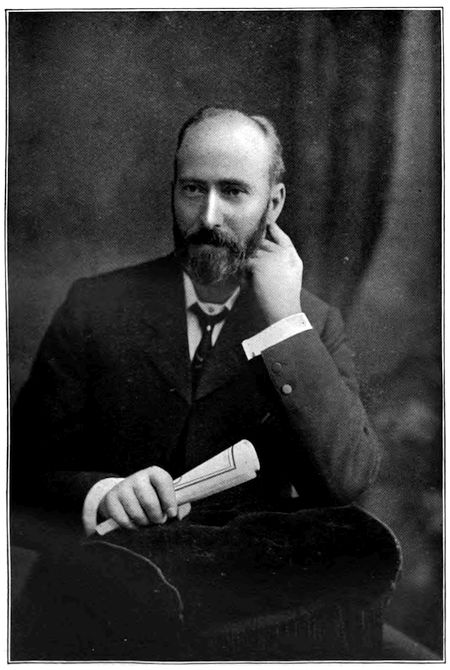
Miners' Federation—Washington Strike
The year 1897 was memorable for two things: the
refusal of the Miners' Federation to accept Durham
as a member unless the county would agree to
support a legislative Eight Hours' Bill, and the
conflict between the Executive Committee and
Washington Lodge, which settled the question
once for all whether money could be paid if a
colliery were stopped illegally, even if the Council
decided to pay. These we will take in the order
stated. Towards the end of 1896 it was decided
to join the Miners' Federation. The information
was sent to Mr Ashton, the secretary of the Federation,
and the application was accepted. Then arose
the question as to the meaning of Object 5:
"To seek and obtain an eight hours' day from
bank to bank in all mines for all persons working
underground."
In order that the intention might be made clear
the Executive passed the following resolution:—
That Mr Ashton be written to, asking whether
Object 5 in the Miners' Federation Rules means
that the eight hours have to be obtained by State
interference alone, or by organised efforts, and
whether the districts have any option or choice in
the matter.
Mr Ashton replied that Object 5 was to be brought
about by organised effort or legislation, or both.
As far as the district having option or choice was
concerned all members were expected to be loyal to
the Federation, to be guided by the rules, and assist
in carrying out the resolutions passed at the conferences
of the Federation. That was interpreted to
mean that if Durham became a member, as all the
other districts were voting for legislative action, it
would be virtually bound to join in the demand for
eight hours by State, and the Executive placed the
question on the programme for the Council held on
February 6th in the following form:—
That the county having decided to join the
Miners' Federation, and we having been informed
that we must agree to support a legislative eight
hours as a condition of membership, and as we
remember that the county has decided, by ballot in
1892 and by resolution in 1895, not to support such
a measure, we cannot agree to accept that condition
until the county alter the previous resolution on the
question, either by Council, motion, or ballot.
Will delegates come prepared to say what shall be
done in this matter?
(1) Shall we rescind the previous resolutions?
(2) Shall we support an Eight Hours' Bill?
(3) Shall a ballot be taken on the subject?
The Council passed a general resolution:
"We adhere to the resolutions now standing in the
Association's minute-books—viz. that we do not go
in for the parliamentary eight hours' day, and that
there be no ballot taken on the question."
That decision was sent to Mr Ashton on February
10th, the following being the letter:—
At our Council meeting held on February 6th our
members decided to abide by their previous resolution
to oppose any State interference with the hours
of labour. I am instructed by our Committee to
inform you of this decision and to ask you to let us
know whether under these conditions your Executive
Committee accept us as members of the Miners'
Federation of Great Britain. On the presumption
that you will accept us as members on those conditions,
I enclose you a cheque on the National
Provincial Bank, value £59 (fifty-nine pounds),
being our entrance fee at one pound per thousand
members.—I am yours,
John Wilson.
The receipt for the entrance fee not being
sent the Executive Committee wrote again on
February 18th:
If you do not send the receipt the inference on
all sides must be that you do not accept us on the
conditions stated (our opposition to State interference
with hours). If you do send a receipt, then we
shall conclude that you do accept us on the conditions,
and there will be no need to repeal the
resolution of exclusion of 1893.
Two days after that was sent Mr Ashton sent a
receipt, and said:
I have no desire to delay the matter of your
district becoming connected with the Federation. I
enclose receipt for the entrance fee.
As this was written two days after the Committee
placed the alternative before the Federation it was
assumed that Durham was not to be bound to the
legal eight hours. This impression was communicated
to Mr Ashton on February 25th, and on the
27th the Committee was surprised to be told:
"In reply to your letter of yesterday, Durham
has been accepted into the Federation as all other
districts have been. Whatever resolutions you may
pass on general questions in your Council or Committee
meetings you must be governed by majorities
at the Federation."
Then there arose a dispute about some contributions
which were sent to Mr Ashton. The
amount was £245, 16s. 8d. The dispute was as to
the period which was covered by the payment. On
June 30th, in a letter dealing with the disputed
point, Mr Ashton said:
I think you will agree with me that the difference
on the hours question is so great that until Durham
can agree to withdraw their opposition to the Miners'
Eight Hours' Bill, it is most unwise to keep their
connection with the Federation.
And on July 10th the cheque for the £245, 16s.
8d. was returned to Durham, and the separation
mentioned above was effected by the return of the
contributions.
The Executive Committee then summarised the
situation as follows:—
We decided to join the Federation. We then
found that we had resolutions standing against the
eight hours. By our own decision of February 6th
we resolved to abide by those previous resolutions.
We then informed Mr Ashton, as secretary of the
Federation, that we had so resolved, and enclosed
the cheque for our entrance fee, with the understanding
that if the receipt were sent we were
accepted on those conditions. Our Council again
on May 29th reaffirmed our opposition to the eight
hours, and we wrote to Mr Ashton and sent our
quarter's contributions, and said we were desirous
of remaining members on wage questions. We
were then asked to say whether we could pledge
the county to come out on strike, which we could
not do. The conclusion of the whole matter then
is, because we could not give a pledge to come out
on strike on every occasion when so ordered, and
because we were resolved to oppose the eight hours
by State interference, our contributions are returned,
and we are told by actions—which speak louder than
words—that we are not to be members. We are
not to be allowed to judge of our own circumstances
and peculiarities, but must submit the
most important part of the conditions of our
labour to those whose conditions are widely
different from ours, and who, knowing nothing of
our circumstances, would force us to be guided by
the changes they require in the hours of labour.
It will be observed that there has been no mention
of local strikes except there be some peculiarity
related to them. There is such in connection with
this strike. It was of great importance to the
Association and the maintenance of the rules.
There had been numbers of illegal stoppages,
and although the leaders and members at the lodges
affected knew they were breaking the rule, yet
they persisted, and were enabled to carry a vote
in Council that they should be paid from the General
Fund. It was felt that once and for all the question
should be decided, and it should be shown that
where the constitution of the Association was
violated the violation should entail forfeiture of
benefit, or else of what use was it to have rules or
Committee of Management? To go on in such a
loose manner was to make the rules a byword
and a mockery. It was time they should have
the seal of reality, and be placed on a sure foundation,
so that order should be maintained, or at least
those who with open eye did wrong should know that
their action would not receive condonement, and they
be paid the benefit of the Association, as if they
had obeyed its provisions.
That was the question to be decided. Should
the rule be the guide, and the Executive Committee
have the management, or should lodges be
allowed to stop their colliery in opposition to the
constitution, and suffer none of the consequences?
The Washington case afforded the opportunity for
the settlement, and that is the reason why it is
made part of this history. The dispute arose about
the application of an agreement made by themselves.
The nature of the agreement is of no
import now. The action of the lodge and its
relation to the rule is what we have to consider.
The manager put one interpretation on the agreement,
the workmen another, and they were the
signatories. Numbers of agreements had been
disputed prior to that, and had been brought before
Joint Committee or some other properly arranged
tribunal, and managed by the agents, or Executive,
in accordance with rule. Washington, however, set
rule aside, disregarded the Committee, and stopped
the pit on the 10th of August. On the 11th the
corresponding secretary met their deputation in
Newcastle, and told them they were acting illegally,
and that they could not be paid from the funds.
The deputation, however, were confident the
Council would grant them strike pay, although
they admitted they were breaking the rule. Other
means were adopted to induce them to resume
work. The lodge appealed to the Council for a
grant; it was not put on the programme. The
trustees objected to the treasurer paying the
money. They had taken the opinion of Mr
Atherley Jones previously. The question submitted
to the Counsel was: "Supposing a lodge
came out on strike in violation of the rule, without
first having obtained the permission of the Committee
or Council, would the fact that the Council,
after the men came out on strike, approved of their
action alter the position or liability of the trustees?"
The opinion was as follows:—
MR JONES' OPINION
August 30th, 1897.
With regard to the question raised, whether,
under the circumstances described, the trustees
have power to allow payments to be made to the
men on strike who have violated Rule 50, I am of
opinion that they have no such powers, and any
payment so made would appear to be a direct
breach of trust. Nor do I think the position or
liability of the trustees would in any way be altered
by the subsequent vote of the Council approving
such payments. The wording of Rule 51 is quite
clear:—
"Any lodge ceasing work" "under the circumstances
which have happened" "shall forfeit all
claims on this Association"; and even though the
whole Association were to vote in favour of strike
pay being granted, I cannot see how the effect of
that rule could be removed.
Standing upon that advice, the trustees refused
to allow the money to be paid. The lodge requested
the Executive to call a special Council to
consider whether a grant should be given them.
The request was refused, because, as the rules had
been violated and the trustees had decided that no
money should be paid, it was no use calling the
Council, seeing, if the vote were given to pay, the
decision could not be carried out. However, the
question was brought forward at the conclusion of a
Council, and the delegates decided to pay a grant
equal to strike allowance, but the trustees refused to
allow the money to be drawn from the bank.
The Executive then placed the position before
the members. They said the giving of a grant was
but a form of evading the provisions of the constitution.
The decision of the Council placed the
treasurer in a dilemma: either he had to refuse to
pay, or face a prosecution in court for paying
money contrary to rule. The Committee had, therefore,
either to leave the treasurer to his own devices,
or call the trustees together, and place the whole
question before them. The meeting was held in
the office of Dr R. S. Watson, who was one of the
trustees. They decided to take the case to the
Court of Chancery, and to inform the Washington
Lodge of their intention, and give them the
opportunity of being parties to the case. Mr
Isaacs (the Association lawyer) was instructed to
write the lodge, which he did. He said he was
instructed to inquire whether they wished "to be
a party to the proceedings, and if so, to kindly
supply me with the name and address of any one
of your members whom you may appoint to represent
the lodge."
After some negotiations, and with the view to
make the matter mutual, the Executive agreed to
bear the cost of the trial for both sides. The
hearing did not take place until the 8th of February
1900, but in order that we may keep it in close
connection it will be well to consider it here. It
was heard in the Chancery Court, before Justice
Cozens Hardy. The Association was represented
by Mr I. Isaacs, its legal adviser, and the lodge by
Mr C. W. Newlands of South Shields. There were
able barristers on both sides. The judge decided:
If these men came within Section 22 it must be
because these particular men must be considered deserving,
and also within the objects of the Association.
He thought unless there was something to
strike them out the argument on their behalf was
well founded. The real question was whether,
although the language of Rule 3 defining the
objects of the Association included them, they
had not by 51 been removed. He thought that
was the case. He did not think he could limit the
effect of that rule so as to make it mean that they
should forfeit only the absolute right to have 10s.
per week under Rule 52, which it was admitted
they had lost. He thought the exclusion applied
not merely to claims as of right, but to all protection
from the Association, and they could not be deemed
legally or properly objects of the benefits of the
Association.
So far as the Executive and trustees were concerned
that trial and decision were satisfactory, but
the lodge said they wanted it taken to the Court
of Appeal. So far as bearing the cost of the trial
was concerned the pledge had been carried out, and
the Committee were surprised when it was suggested
to carry the case to a higher court. However, as
they were desirous to have the case properly decided,
and that there should be no room for doubt (the
welfare of the Association being their great consideration),
they agreed, and guaranteed the payment
of the entire costs. The appeal was heard on
November 11th and 12th, the Judges being Rigby,
Romer, and Vaughan Williams.
A strong effort was made to reverse the decision.
All the skill, plausibility, and sophistry of very
able lawyers were used. The rules were purposely
disparaged and travestied, in order that a prejudice
might be created against them, but the judges
unanimously agreed with the finding of the Court
of Chancery.
This is a bare record of facts of a dispute and
trial which was fraught with importance to the
Association. It generated a great deal of bitterness.
The leaders could have had no personal ends to
serve. Their aim will be truly set forth by a
quotation from the Monthly Circular for November
1900.
MONTHLY CIRCULAR, 1900
(The Lessons of the Trial)
The trial is over, and, so far as any personal
feelings are concerned, the sooner it is forgotten the
better it will be for our Association. To guard and
strengthen that should be our first thought and
care. But while it will be beneficial for us to forget
any attribution of ill motives, and evil speaking
or ruffled feelings consequential thereto, we shall be
wise men if we gather up the lessons which come
to us. This battle has been fought for one purpose
only, and that is to support the authority of the
rules. To that end, and that alone, have our efforts
been devoted. The great question at this moment
is:
Whether it is better to have a set of rules
which requires that the Committee of picked
men (responsible year by year to the will of
the members) should have a knowledge of, and
be called in to assist in, the settlement of disputes
before a large colliery is stopped, and a
serious expenditure thrown upon the Association;
or whether a lodge shall have a free
hand to stop a colliery at will, and then run
a chance of creating a favourable feeling, and
receiving large sums from the funds, when, if
the Committee had been consulted, the matter
might have been settled; or if not, a strike
entered upon legally.
Another lesson is that, having received the sanction
of the courts to our rules, and having lifted them
out of the uncertainty by which they were surrounded,
we shall do well to keep them in the
certainty in which they have been placed. It is
very clear that an attempt will be made to alter
the rules which guide this matter. If so, a lax
(and ruinous) state of things will be introduced.
For the last two or three years the same attempts
have been made, and again this year resolutions
with the same object are sent in. The rules which
place the affairs of the Association in the hands
of the Committee (before a stoppage) have to be
erased or mutilated, and rendered useless. Surely
it is better, and more conducive to the welfare of
the Society, to have our affairs placed on business
lines, than to have a code of rules which will admit
of loose procedure, and spending illegally large
sums of money, which will be wanted whenever
the depression of trade sets in.
My advice to you is to consider carefully every
amendment which may come before you. Trades
organisations will prosper most when they are
founded upon, and guided by, business principles.
The Wages Question—The Compensation Act
The uncertainty which the Federation Board had
pointed out as the inevitable result of the abolition
of the Conciliation Board soon made itself manifest.
There were continual demands being made upon
the Federation Board to seek advances, but they
felt how difficult it was to get reliable data upon
which to found a claim. On March 22nd they gave
the county an account of an interview they had
with the employers on the 12th of that month.
The suggestion as to the claim for an advance being
made was not supported by any data, and when
they met, the employers pointed out that the indications
were in the direction of depression more than
the expansion of trade, and therefore the Wage
Committee could not recommend to the owners to
concede an advance. That refusal the Board advised
the workmen to accept until there was some better
trade prospects.
"Like prudent men, and, acting upon the lines
you would have us proceed upon, we are convinced
it will be more hurtful than useful to initiate or
press a demand for an advance unless the state of
the markets warrant such a course."
Another meeting on the wages question was held
on May 25th. A strike took place in South Wales
in the beginning of April, the effect of which was
felt in an increased demand for the class of coal
produced in this district. Their supply being cut
off consumers turned to other sources, and as a
consequence there was a natural feeling of unrest
in Durham among the workmen. They had the
impression that the whole of the produce of the
county would be affected by the demand, and
therefore the increase in price would be an all-round
one. The Federation Board met that "false impression
which we fear rests in the minds of many
of our members" in a statement they sent out on
the 26th of May. They pointed out two very
important considerations, which the generality of
members would lose sight of. There was a large
amount of coal sold under contract, which would
not be affected by the temporarily increased price,
even if all the output of Durham had been steam
coal, but it must be remembered that only nine per
cent. was of that class. They then gave a calculation
to show how a rise on a small percentage
would affect the whole. The steam coal being the
only part feeling the increase, and that class forming
only nine per cent. of the total, what would
be its universal effect?
"Without contending for the accuracy of the
quantities let us give a calculation which may
suggest a key to the position. Of the nine per
cent. of steam coal let us suppose two-thirds of it
was sold under contract at a normal market price.
We should then have only three per cent. of the
entire output getting a higher price. Let us further
suppose that this three per cent. secured an advance
in the abnormal state of the market of 6s.
per ton during the strike; we should only have
realised a general increase equal to, say, 2.16d. per
ton over the whole of the coals produced."
Considering, then, the purely temporary nature
of the rise in price the Board agreed to accept
an advance of five per cent.—two and a half on
basis rates under the usual conditions, and, with the
view of meeting the exceptional circumstances, a
temporary advance of two and a half for six pays.
The advances were to date back for a fortnight in
each case, the understanding being that if the
prices fell at the end of the six pays the temporary
two and a half would be discontinued. On July
22nd the Board met the employers, when the
temporary advance was continued for other six
pays. A subsequent meeting was held on October
29th. The employers offered to increase the
temporary advance of two and a half to five for a
further period of six pays. The Board was willing
to take the five per cent. if it were considered a
permanent advance. The settlement agreed to was
an advance of two and a half, and a continuance of
the temporary advance of two and a half for six
pays more.
During the Parliamentary session of 1897 the first
Compensation Act was passed. The date of commencement
was fixed for the 1st of July 1898.
While the Act was under discussion the representative
of the Durham Miners in Parliament urged
strongly that, not only should facilities be given for
the formation of Committees, but means should be
adopted to induce employers and employed to take
steps in that direction as a means of avoiding the
friction and litigation which the new law involved.
The idea of a Compensation Committee was from
the very commencement very favourably received
by the members of the Association, and the employers
were as desirous on their part to join in the endeavour.
There was a natural desire on the part of the Permanent
Fund officials to formulate a scheme to
strengthen their fund. It was found that the attempt
between the Trade Unions of Northumberland,
the Federation Board, and the Permanent Relief
Fund to arrange a Scheme was a failure. A number
of meetings of Joint Committees and Sub-Committees,
representative of the various Associations, and between
those Sub-Committees and the Employers,
were held. The failure arose from the character of
the proposition—that there should be an Insurance
Fund, which would take over all the liabilities of
the owners, and insure all the workmen, which, said
the employers, was the primary condition. The
Miners' Executive in Durham could not accept such
a scheme, and they turned to the formation of a
Committee representative of their Association alone,
and the owners. Negotiations went on with the
owners, and finally the Executive Committee asked
for full power on lines which they indicated. This
the county agreed to give, and an agreement was
come to in time for the commencement of the Act
on July 1st. The system of class average obtaining
in the county lent itself to the formation and working
of such a Committee. This the men readily
adopted, and it was another illustration of the hold
mutuality and compromise had on the men of the
county as a whole. Some men would have made
above the average wage, and have worked more than
the agreed number of days, and as a consequence
their compensation would have been greater, but it
would have entailed a large amount of labour if it
had been on an individual basis. But by the
Committee arrangement the system worked automatically.
In the formation of the Compensation
Committee Durham stood alone. There was nothing
like it in any other district or trade, and its action
was of the greatest benefit to employers and workmen
alike.
Election of Mr House—The Wages again—The second Conciliation
Board—The Aged Miners' Homes—Deputies'
Basis Wage
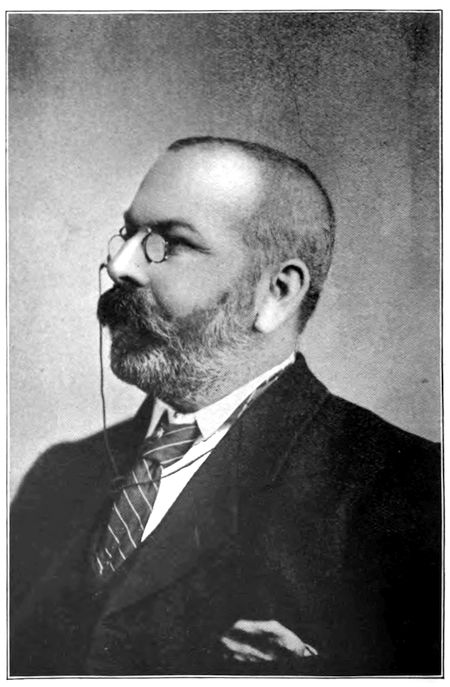
For some time there had been a growing desire for
a further subdivision of the labour in connection
with the agency. It was thought that it might be
useful if, instead of the Joint Committee business
being in the corresponding secretary's department,
an agent was appointed, who should have sole
charge of that Committee. This rearrangement was
hastened by the passing of the Compensation Act.
The work thrown upon the organisation as a result
of that measure was immense owing to the very
great liability there is to accidents in the miners'
occupation, and consequently the large number of
delicate questions that were sure to arise in the
application of a complex and complicated measure
such as the new Act. The Executive Committee
felt that it was imperative something should be
done, and, acting on their suggestion, a new department
was formed. Mr W. House was the gentleman
selected to fill the new office. Mr House brought
to the work a very essential qualification. His
ability was unquestioned, but he was also experienced,
having served on the Executive and Joint
Committees for some years, and was thus thoroughly
prepared for taking upon himself the duties of the
new office.
In considering the wage negotiations for 1898
mention was made of a temporary advance of two
and a half per cent., which was given for six pays,
and then carried forward other two periods of the
same duration, and extended into 1899. On the
14th of January the Federation Board met the
owners, their errand being to get if possible the temporary
advance (which would terminate on January
21st) incorporated into the ordinary percentage.
That request the employers could not grant, as the
ascertained price for October and November was
less than for the three months previous.
"They are willing, however, to continue the temporary
advance for a further period of six pays, or
as an alternative they suggest that this meeting be
adjourned until Saturday, the 28th inst., by which
time the selling price for the quarter ending 31st of
December will be ascertained."
The Federation Board chose the extension for a
further six pays, as they believed it was the most
beneficial course.
The next meeting was held on April 5th. Nothing
was arranged, and there was an adjournment for
three weeks. At that meeting the owners said there
had been a declension in the prices. After a long
discussion they offered an advance of three and
three quarters, bringing the percentage above the
standard up to twenty-six and a quarter; and, in
consideration of special circumstances, to give a
temporary advance for three months of one and a
quarter, and they were prepared to date it back a
fortnight. The arrangement was a very unique one,
and, said the Federation Board in their explanation
to the members, "it arises from the operation of
the two and a half temporary advance, and the
fact that the adjourned meeting was not held until
after the dates fixed for its termination."
The delay and uncertainty, both as to time for
making application for, and the data upon which to
found, the claim, turned the minds of the members
to a renewal of the Conciliation Board, or some
similar system by which wages could be regulated
more smoothly and expeditiously than the policy
they were pursuing. On the programme for the
Council held on May 27th there appeared a resolution
from Marley Hill:
"We move that the county be balloted for and
against forming a Conciliation Board."
The Executive Committee in their note on that
resolution strongly recommended its adoption. It
was highly desirable that the feeling of the county
should be ascertained. They said:
We have previously expressed the opinion that
the steadier we can make our trade, and the more
certainty we can infuse into our industrial relationship
with our employers, the better it will be for
the workmen; and there is nothing more calculated
to foster this desirable condition than the principle
of conciliation. It was a mistake when we terminated
the previous Board, and this has been revealed
more fully in our negotiations with the owners in a
rising market. We feel sure we would have done
better, and it would have saved a great deal of
friction, if we had had the Board. There are other
questions of great importance besides the wage
question which a Conciliation Board could deal
with. We therefore advise that you carry this
resolution.
Acting on that advice the Council adopted the
ballot, and by a majority of 580 in a total vote
of 39,713 the Board was re-established. The Bishop
(Westcott), who had been anxiously watching the
course of events, came forward to offer his congratulations
and assistance if required. No time
was lost. The four sections were called together,
and they recommended that the old rules should be
adopted, and that a circular be sent out urging the
acceptance of the same as the constitution of the
new Board. The objects may be inserted here.
"By conciliatory means to prevent disputes and
to put an end to any that may arise, and with this
view to consider and decide upon all claims that
either party may, from time to time, make for a
change in county wages or county practices, and
upon any other questions not falling within the jurisdiction
of the Joint Committee that it may be
agreed between the parties to refer to the Board."
The following was the voting on the adoption of
the old rules:—
| For the old Rules | Against | Majority |
| Miners | 258 | 125 | 133 |
| Enginemen | 125 | — | 125 |
| Cokemen | 52 | 3 | 49 |
| Mechanics | 75 | — | 75 |
At the earliest moment after the result of the
vote was known a meeting was arranged with the
employers. At that meeting the employers wanted
to alter the rules in one or two particulars, but the
Federation Board informed them that their powers
only extended to the adoption of the old rules, and
if any alterations were made they would have to be
referred to the members for sanction.
"It was agreed that the employers should take the
statement to a full meeting of their members, and
if they persisted in desiring amendments a further
meeting should be held, but if not, then the two
secretaries should get the rules signed by the Owners'
Committee and the Federation Board."
The latter alternative was adopted. The old rules
were signed as suggested. The first meeting of the
Board was held on November 4th. The officers
elected were Sir David Dale, Chairman; W. H.
Lambton, Vice-Chairman; R. Guthrie and J.
Wilson, Secretaries of their respective Associations;
and Lord Davey, Umpire. It was further resolved:
"That with pays commencing 6th and 13th of
November 1899, wages should be advanced by 3¾ per
cent., making the wages of underground men,
mechanics, enginemen, cokemen, and banksmen to
be 33¾ per cent. above the basis of 1879, other
classes of surface labour 30¾ per cent. above the
basis."
In October 1899 was initiated a movement of
which Durham may justly claim to be the pioneers—viz.
the provision (as far as it can possibly be done)
of free houses and coal for the aged mine workers.
For a few years the subject had been assuming
shape. Vague in its inception, by the perseverance
of the originators it was inaugurated in this year.
The first to make mention of such a movement was
Mr J. Hopper, who subsequently became Secretary
and Clerk of the Works. To him was soon joined Mr
H. Wallace, land steward to Earl Ravensworth; and
then other three: the Rev. Canon Moore Ede, J.
Johnson, and J. Wilson. Their first step was to
secure a large hall and two acres of ground near
Boldon which could be made into tenements. The
building was the property of the Ecclesiastical
Commissioners, but was rented at an easy rent.
That was taken over by the Boldon workmen for
their own old men. Then the Committee turned to
the Ecclesiastical Commissioners again. Without
entering into all the stages of the negotiations, the
final result was the renting of nine acres of land in
three plots situated in three different parts of the
county. Just at this juncture there was an opportunity
to purchase the colliery village known as
Haswell Moor, consisting of 112 houses, to each of
which was attached a garden. The whole of it was
freehold. This fortunate bargain gave inspiration to
the Committee, as it was very cheap, and an impetus
to the effort, as it formed a very nice colony of old
people, the cost per house being about £25.
The scheme rested on a voluntary basis. The
Committee in initiating the movement resolved to
keep it clear of all compulsion. Their proposition
was 1s. per member from all in the Miners'
Association per year, which would give £3000. The
lodges responded very readily to the appeal, and
were soon joined by the other three sections of the
Federation Board and the deputies. In addition,
the outside public sent large and generous help.
One very striking letter was received, enclosing a
cheque for £25, which we will record.
"Mrs Graham and I are very pleased to find that
you are making such good progress with this most
useful and laudable scheme. We are quite sure that
the old folks would be more at home and more
comfortable in cottages such as they have been used
to all their lives instead of being placed in specially
built almshouses or hospitals.
"We would like to feel that we have made one old
couple happy by paying the cost of one of the
Haswell Moor cottages, as intended to be made fit
for habitation, and therefore propose to subscribe
£25."
That encouraging letter and generous gift were
from Coroner Graham of Findon Hill, near Durham,
and was soon followed by other expressions of
sympathy and substantial help. Bishop Westcott
rendered great assistance, and opened his castle at
Auckland for one of the sectional meetings the
Committee called as a means of bringing the question
before the lodges. His lordship allowed the use of
his splendid drawing-room, and presided over the
meeting, and on every hand the workmen were
praised for their grand work. The best commendation,
however, was the comfort of the old people,
and when the opening day came there could not
have been found prouder men anywhere than the
Committee of Management.
The opening of the first batch of houses took
place at Haswell Moor in October. The ceremony
was performed by Mr J. Wilson, the chairman of
the General Committee, and the inaugural address
was delivered by the Bishop. A quotation from
the Monthly Circular giving an account of the proceedings
will be fitting here.
It was a great occasion, and the address was
worthy of it. There was a very large company in
the tent to listen to the eloquent remarks, but there
was a larger outside who were excluded from the
privilege. To the men of mature years there was
the rejoicing coming from the past, and an exhortation
to act in unity, and not to be simply
receivers, but givers of strength to the common
cause. They were not alone, not isolated separate
units, but members of the great body; strong with
the strength of all, and glad with the service which
they could render to their fellows. A man who
received all and gave nothing was like the Dead
Sea. However rich the floods might be that flowed
into it, it retained no life-giving, no glad force—all
was lost. In addition, there was the urging to
avoid despair and have hope. Nothing could be
more fatal than to declare that, because we were not
moving with greater rapidity, the goal was unattainable.
"Do not listen to such a vision of
despair, cherish the full vigour of hope."
Let me finish with the words to the young men. I
wish all could have heard the words of wisdom as
they fell from the lips of our respected and
honoured Bishop. As they could not, let me quote
them, "they had received a splendid inheritance,
splendid with noble achievements and noble
traditions, and they—as men who had mastered
themselves and realised their obligations—would
use it well, guard it well, and hand it down to those
who came after, enriched by the fulfilment of hopes
cherished long ago, and illuminated by the brightness
of hopes which those who came after them would
perhaps be allowed to fulfil."
On that day, by the inauguration, the Durham
miners took a long step in the path of benevolence,
and raised themselves to a proud and prominent
position amongst true reformers. It was a grand
illustration of the truth that they who most practise
self-help are best able and most eager to help
others. A working man's income limits the possibility
of giving large sums; but the many small
rills make the large river. There is large philanthropy
in a small gift. The volume and value of it
lies in the spirit and intent which prompts it; and
the ultimate success of a movement like the Aged
Miners' Homes Scheme lies in the willingness of the
thousands of workmen in and about the mines to
assist. Based on that, the county can be studded
with homes where the aged and worn-out miner and
his partner can find home comfort and warmth
when the sun of their life is nearing the setting and
the shadows of life's evening are gathering thick
around them. No young man can measure the full
meaning of such provision, but all can feel the
rich mental luxury which will assuredly result from
taking part in the providing.
We will close this year by a reference to a
settlement made during it. This was in respect to
the fixing of a basis wage for deputies. Prior to
the agreement there had been a fixed wage, which
was altered by adding a penny or twopence, or more,
to it, or reducing in that way if the wages were
decreased. It was a very unsatisfactory mode of
procedure, and always involved a meeting between
the Owners' and the Deputies' Association after the
Federation Board had dealt with the wages. For
some time there had been a strong desire on the part
of the deputies who were in the Miners' Association
to have their wages regulated by a percentage, the
same as the other classes of workmen. In July the
following agreement was signed:—
It is hereby agreed that with pays commencing
24th and 31st of July 1899 the basis wage of
deputies shall be fixed at 4s. 8½d. (four shillings and
eightpence halfpenny) per shift for back-bye shifts,
and that these basis rates shall be subject to the
same percentage, advances, and reductions as may
be from time to time arranged with regard to the
wages of the miners.
Death of Mr Forman—Election of Mr Galbraith—Agreements
made during the Year
On the 2nd of September death made another inroad
upon the original leaders of the organisation by
carrying off the president, Mr J. Forman. For over
twenty-seven years he had been in that position,
and from first to last he carried out the obligations
of the office in a manner equalled by few and
excelled by none. He was fitted at all points for
being president of an organisation of workers such as
the Durham miners. The best estimate of his
character will be found in quotations from the
Monthly Circular and the Executive Committee's
Minute.
DEATH OF OUR RESPECTED PRESIDENT
I am sorry to say Death has made one of its most
serious inroads into our ranks, and taken from us
one of the most prominent figures in our Association.
Our much respected and gentlemanly President is no
more, and his services, over more than the average
length of a generation, are ended. We long for the
sound of a voice that is for ever still, and the touch
of a hand that had a friendly grasp. For nearly
thirty years the name of Forman has been a household
word amongst the miners of Durham. He
was not ambitious of "spreading a sounding name
abroad," but he had a deep desire to do his duty
to his own people. His was a quiet nature; but
among men, as in nature, the quiet forces are the
most productive of good. In the movements that
make for progress in men, as in our physical surroundings,
the clamour of violent action and noise are not
the most useful. In the history of our Association,
from its very commencement, our departed friend
has been one of the binding and consolidating influences.
Wise in counsel, when a spirit of rashness and
impatience seized some of us, he has many a time
helped to steady the mind and temper, and tone the
action. Prolific in suggestion he has oft pointed a
way out of difficulty in the time of stress and strain;
in fact, he was well and amply equipped and qualified
for the important position he filled amongst us. He
took upon himself the office when times were vastly
different from what they are now; when capital
and labour were in this county like two opposing
forces, separated by a spirit of doubt and animosity;
and he has done much to establish a better feeling
between employers and employed. He knew by
experience the position of inferiority and harsh
conditions in which our lot was cast before the
foundations of the Society were laid. He has assisted
and rejoiced over every step towards equality and
relationship, and he was very anxious lest anything
should be done to mar our usefulness.
Mr Forman was more than an agent, he was a
friend and an example. A man may be appointed
to a position and do his work in a mechanical and
perfunctory manner, like a hireling waiting for the
shadow of the day, but that is not sufficient, and
it did not satisfy him whose loss we mourn. He
was an example in conduct and in mental cultivation
worthy of imitation by all our young men. He
looked upon the workmen as something more than
machines, and he was desirous that they should pay
more attention to the improvement of their minds,
and the formation of thrifty and studious habits.
In that he was no theorist, for he was a man of
very extensive reading, especially upon scientific
subjects, and, as a consequence, he was able to
approach and deal with our questions in a most
intelligent manner.
He has gone, but his work is with us. It is our
heritage, not merely for enjoyment, but for employment.
We can best show our respect for his memory
by our acceptance and proper use of that legacy.
These men whose lives like his stretch back into the
dark days are decreasing in number year by year.
Let us do nothing to damage the Institution they
helped to establish and consolidate, and let our effort
be to strive for the goal they sought to attain.
DEATH OF MR JOHN FORMAN
(Executive Committee's Notice)
September, 1900.
Our regrets on this occasion are not those of
formality, but are prompted by a recognition of his
worth as an official of our organisation and his
character as a fellow-worker and a man. Never
yet had any organisation a more earnest officer, any
body of men a more willing colleague, nor any
community a more upright, honest, and straightforward
man than our friend who has been taken
from us. He was privileged to live to the ripe old
age of 77 years, and for more than a quarter of a
century has devoted the whole of his time and the
best of his energies to the upbuilding and consolidation
of our Society, and the betterment of the working
classes generally. We shall miss his genial presence
and guiding counsel from all our business meetings.
He was on all occasions a reliable guide and counsellor
in our deliberations on complicated questions, and
in the general matters pertaining to the work of the
Association in the midst of dark times and difficult
circumstances. We feel that by his death we have
not only lost an able and efficient President and
colleague, but the workers in and about the mines
in Durham have been deprived of a friend whose
lifelong services have been devoted to the bettering
of their conditions as wage earners.
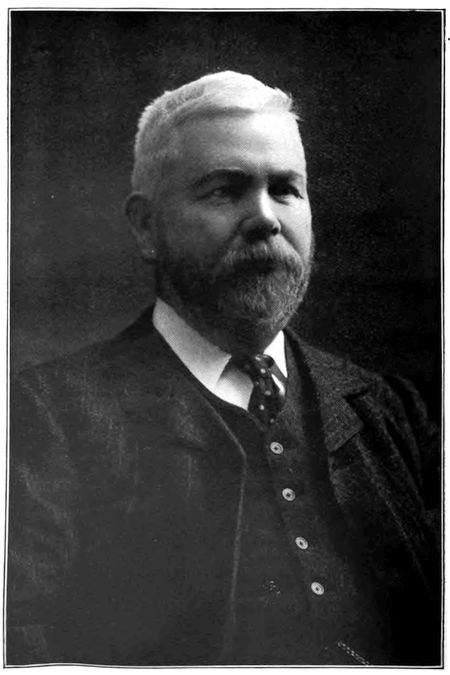
And further, we would tender to the family our
sympathy in the great bereavement which has
fallen upon them, and the hope that they may
be strengthened by the assurance that, although
dead, he still lives in the grateful remembrance of
the people amongst whom he lived, and for whom he
laboured.
The vacancy caused by his death was filled by Mr
House being transferred from the Joint Committee
agency to the presidency, and the election of Mr
S. Galbraith as his successor in the Joint Committee.
In the election the county chose a well-tried and
very trustworthy man. He had been checkweighman
at the Browney Colliery for twenty-one and a
half years. Those workmen placed absolute reliance
in him, and without reserve allowed him to manage
the affairs of the lodge. The condition of the
colliery, the peace and harmony which obtained,
and the fact that only one deputation visited them
to make inquiry into a grievance during the whole
time he was there, are clear proof that he had great
care for the interests of the men, and that they were
well repaid for their confidence in him. His tactful
management of the local business specially fitted him
for the wider sphere of labour. The members
reasoned safely when they concluded that he who
had been faithful in the local would be faithful
in the general. Those who knew Mr Galbraith were
in perfect agreement as to the opinion formed by
the men who had been in such long and profitable
business contact with him.
Screenmen—Labourers—Datal Wage—Hewers' Datal—Houses
and House Rent—Boys' Advance
The first of these was the raising of the basis wage
of the screenmen and labourers. That wage was
fixed by an arbitration at 2s. 7½d., but was never
quite accepted by the county. Negotiations had
been proceeding, and on 31st March 1900 it was
agreed "that the basis wage of bona fide screenmen
and labourers on and about the pit-heap and on the
colliery branches should be 2s. 10d. per day." This
was a clear advance of 2½d. per day, and meant
nearly a day's wage increase in the fortnight.
The second was in reference to the hewers' datal
wage. There was no settled or uniform principle of
payment for the back-bye work. On August 16th
it was arranged that:
"When coal hewers are taken from hewing to do
other work for a shift or shifts (or portions of a shift),
during which they would otherwise have been employed
at coal hewing, they shall, for not exceeding
three consecutive shifts employed at such other
work, be paid the hewers' county average wage."
The third settlement was the "Houses and House
Rent." This had been on hand for six or seven
years. It was placed on the agenda of the Conciliation
Board in 1895. After that Board terminated
the question lapsed, but was brought forward by
the owners at the Board meeting on May 1st, 1900.
It was at first part of a general application, but
shortly before the meeting the mechanics introduced
a house question, and therefore the request of the
owners was made to apply solely to miners. The
subject was adjourned to give the employers a
chance to rearrange their claim.
Before the meeting held on August 3rd the Owners'
and Miners' Committee held two meetings, and an
agreement had been come to, subject to the approval
of the miners' lodges. The Conciliation Board was
informed of this; further, that a return was being
taken, and that the agreement was being strongly
recommended. It was adjourned on the understanding
that the owners could put it on the next
agenda, if not settled in the meantime, and could
then ask the Board or umpire to decide. The request
of the owners was as follows:—
That the general question of the supply of houses
and coals be considered by the Board of Conciliation
with a view to the points of difference between the
Owners' and Miners' Associations being decided by
the Board.
The return mentioned above resulted in a refusal
of the agreement, although large material changes
had been made in it to the advantage of the workmen.
The return was most unsatisfactory, as fifty-two
collieries, representing 112 votes, did not vote.
The Executive Committee decided to call a special
Council, and informed their members of the position.
The subject was sure to be settled at the next
Conciliation Board meeting.
"We have pointed out to you on one or two occasions
that if it is not settled by us it will come
before the next Conciliation Board, who will be
asked by the owners to deal with it or refer it to the
umpire."
The special Council was held, and a discussion
took place on the agreement, but no vote was taken.
In due course the subject came before the Board.
It was felt that the refusal was caused by the exclusion
of the shifters and wastemen. The owners
were willing to include these, and the Board agreed
to the list of classes and conditions contained in
the agreement of November 1900.
The agreement settled a long-standing dispute,
and established for twelve classes the right to a free
house, or rent if houses were not found. In respect
to the other classes not specifically named in the
list, their right would rest on the custom of the
colliery obtaining on the 1st of June 1900. Under
the circumstances the agreement was the best that
could be got, and was a very long way ahead of the
uncertain condition of things which existed prior
to its signing. There was this to be considered:
if the Board had not settled it then the umpire
would have been called in, and there was no assurance
that he would have gone so far. With respect
to the rent, which was dependent upon the custom of
the colliery, the right of the classes named to a
rent (if not the amount) was guaranteed. Before
the arrangement was made, if there were not
sufficient houses, the men belonging to the colliery
had to prove, at Joint Committee, it was the custom
to pay rent at that colliery. If they failed to
establish the custom, then they were non-suited,
and without rent. That which was indefinite and
uncertain was lifted out of the region of contention
once and for all, and that in itself was no small
advantage. In judging of the merits of the
"Houses and House Rent Agreement" it must be
remembered that the Executive Committee and
Federation Board had to contend against time and
precedent. These were no mean forces. Practices
which in some cases had existed for thirty years
were difficult to alter by the party seeking the
alteration. If the effort had been made twenty-five
years before it would have been comparatively
easy: "Customs would have admitted of easy
proof, and the data would have been new and
readily substantiated." Keeping those things in
remembrance, the conclusion will be that the agreement
was a good one.
On the 29th of December other two small agreements
were signed. One of them had reference to
boys whose wages were below 1s. and those having
a basis wage of 1s. and 5d. or less. The former were
raised to 1s., and the latter had to have 1d. increase.
The other change was in relation to smart money
for beat hands. It was agreed that, as the Compensation
Act did not cover that injury, the smart
money should be continued where it had been the
custom to pay it before the Act was passed.
The Coal Tax—The Death of Bishop Westcott—The
Appointment of an Accountant
In the spring of the year the whole of the mining
industry was startled by a proposal made by the
Chancellor of the Exchequer to place an export
duty of 1s. per ton upon all exported coal. It was
done to enable him to meet the heavy expenditure
which had been thrown upon the nation by the
Boer War. The entire cost was over £250,000,000.
The year or two previous the coal trade had been
prosperous. The profits of the employers and the
wages of the miners loomed up very large, and he
being in a desperate position (having a deficit of
£50,000,000 to meet) thought it safe to make an
attack on the trade. His proposition was a very
disastrous one. The arguments advanced in support
were uneconomic and fallacious, but were forced
upon the House of Commons by the sheer weight
and force of a great and obedient majority—a
majority whose party loyalty covered a large
number of political sins.
His main arguments (upon which the changes
were rung) were as follows:—Coals were a great
national asset, and the exportation should be
checked, and even if exported under the 1s. tax the
foreigners would pay it. To say the least, the
former of these arguments was too narrow to be
considered at all seriously, because if the necessities
of the nation demanded a preservation of our coal
supply, then it could only be done by a total prohibition
of the export. Further, it lost sight of
the large mining population, the amount of capital
sunk in the mines, the ships and sailors employed
in the carrying of coal, and the interchange of
trade, which would be interfered with if the policy
were effected. The argument as to the foreigners
paying the 1s. was fallacious and selfish; fallacious
because it assumed the foreign consumer would not
seek the cheapest market, which would be opened
out to him by the development of the Continental
coal fields; and selfish because, if correct, it was an
endeavour to throw upon him a part of the cost of
a mad and wasteful war, when he took no part in
the initiation of it.
His proposal was met by fierce opposition in all the
mining districts, both exporting and non-exporting,
but in none more than in Durham. Employer and
employed united in opposing it. To such an extent
was this joint action carried that the pits were all
laid idle for the purpose of affording the workmen an
opportunity to hold mass meetings. In a circular
issued on April 22nd the Executive Committee informed
the lodges that they intended to hold seven
simultaneous meetings, and to join the Northumberland
miners on the Town Moor, Newcastle. In the
circular they said:
The occasion is important. Time is short. The
question is urgent. A more injurious tax was never
proposed. If carried, it will cripple our trade, but
more especially that of Northumberland and South
Wales. Our export trade is not so large as theirs,
but we are so closely bound together that we are
sure to suffer with them. Let our protest be as
large and emphatic as the tax will be injurious, and
then the pressure of public opinion will compel a
withdrawal of the Chancellor's proposal.
In connection with the national protest large
conferences were held. The first of these took place
on April 25th and 26th, at which a deputation was
appointed to meet the Chancellor on the 29th; but
he held out no hope. The conference was resumed
on the 30th, and on May 1st. There was a very
strong feeling in favour of stopping all the mines in
the country, and a resolution in that direction was
adopted. The main obstacle to an immediate
stoppage was the fact that certain districts had not
considered it, and the conference was adjourned for
a week to give them time to call Council meetings
and consult their members. The adjourned meeting
took place on May 7th, but it was found that there
was a more peaceful spirit abroad. Durham was in
favour of the stoppage, and the delegates, acting on
instruction from the Council, voted for that course
of action. The conference was against it. An
arrangement was come to in view of any district
being asked to submit to a reduction in consequence
of the coal tax. If that occurred, then
"another conference should be called to consider
and determine whether the whole of the mines of
the country should be laid idle until such intimated
reduction is withdrawn."
So far as any stoppage of work was concerned,
the agitation was at an end, but the protest did
not cease with it, for year after year it was brought
forward, and at all the galas it was made part of
the resolutions. Deputations met the Chancellor,
and in Parliament the spokesmen of the miners
brought forward the question on every opportunity.
At the very outset they compelled him to exempt
all coals sold for 6s. per ton and under. And (to
anticipate a little) one of the first effects of the
return of the Liberal party in 1906 was the removal
of the tax, to take effect on the 1st of November
that year.
The history would be incomplete if we did not
make a reference to the death of Bishop Westcott.
He was known amongst us as "The Pitmen's
Bishop," and well he deserved the designation, for
from the time of his coming to the county he
sought on all occasions to make himself acquainted
with our conditions, and was ever ready to assist in
the work of amelioration. In every effort in that
direction he was ready to counsel. He was one of
England's greatest scholars, but his learning did not
blunt his sympathies nor check his desires to help
the people in their struggles. He was highly
religious, but it was not the religion of the visionary.
It found expression in actions. He proved his faith
by his works, and demonstrated it by that higher
and truer exponent of a man's creed, his active
participation in every movement which tended to
purify the conditions of our working and home
life.
His death was a unique circumstance. At the
gala held on July 20th he delivered a masterly
address in the cathedral. His closing words were
prophetic. He informed the large gathering, mainly
miners, that it would be the last time he would address
them. Whether this was the presentiment of
the coming of the last messenger or not we cannot
tell, but it is certain that the kindly heart and
eloquent tongue were both stilled by death, and the
miners were in sorrow longing for the sound of a
voice that was gone, within a short week after he had
thrilled the hearts of his hearers, and a great sorrow
fell upon the county without regard to class, creed,
or social status.
The following resolution passed by the Executive
Committee will show the appreciation of his worth
expressed by them in the name of the miners:—
That we, the Executive Committee of the Durham
Miners' Association, in the name of our members,
express our universal sorrow at the death of our
respected Bishop and friend, the late Bishop
Westcott. We recognise that we have lost a
sympathiser, counsellor, and helper in all our
efforts for better conditions both in our home surroundings
and our working life. From the first day
of his residence amongst us we felt that it was his
desire to be the Bishop of the diocese in the truest
and best sense of the term; and as the years have
passed that feeling has been strengthened by the
words of kindly counsel he has given us and by
his generous and helpful actions. While, therefore,
we share in the loss that has fallen upon the whole
community we join in the expression of regret and
sorrow which will be felt in every portion of the
sphere in which he moved, and we tender our
sympathy to the relations of the truly great and
kindly Christian, who has been taken from a life in
which he lived usefully and well to a reward which
awaits all who try to correct the wrongs and brighten
the darkness of this life.
Under the sliding scale there were joint ascertainments
of prices by each side having a firm
of accountants, who agreed to the average realised
selling price of coals. When the scales terminated
the services of the accountants on the miners' side
were dispensed with, and the selling price was
gathered by the Federation Board visiting various
depôts, the ports whence coal was exported, and
the coal exchange in London. Now it was obvious
that such a system was at its best very uncertain,
and while the data gathered might be asserted it
never could be put forward as accurate. Without
the accountants, the mode adopted was necessary,
but it was difficult, expensive, and unreliable. The
Federation Board, upon whom the burden of seeking
the prices fell, was never satisfied, and in the end
the members came round to that way of thinking.
On the Miners' Council programme for September
28th the following resolution appeared:—
Accountant be engaged for the purpose of ascertaining
the price of coal, the mode of procedure to
be arranged by the Executive Committee.
The resolution was carried, and was sent to the
Federation, and by them placed before the other
sections, and finally adopted. At the Board meeting
held on November 28th it was decided "that Mr
E. Sparks be appointed as the accountant for the
Board in the ascertainment of coal prices on the
terms which obtained under the sliding scale, and
that he be asked to meet the Board at the next
meeting."
Between the loose system which obtained prior
to his appointment and that which resulted from it
there was a very great contrast. Without the
definite figures he was able to supply the workmen
were always in an atmosphere of uncertainty on two
points—first, the time when to apply for an advance;
and second, as to the amount to ask for. Further,
whatever demand the owners might make it was a
matter of guesswork as to the accuracy of the change
in the markets. With the quarterly ascertainment
the state of the trade was given to the very smallest
decimal, it gave reliability as to data, and guaranteed
the stability of trade and the regularity of work,
which is a great consideration to the workmen.
Hours of Datal Boys and Firemen—Bank Holiday—Mr
Patterson's Statue—Ballot on Eight Hours—Coal
Drawing after Loose—Agreement of 15th August—Surface
Firemen's Wages
On Monday, the 27th of January, the Executive
Committee met the Employers' Committee on six
requests. Three of them were the hours of timber
leaders and others, putters at datal work, and the
hours of firemen at the week-ends. Those three
were settled by the allowing agreement:—
It is hereby agreed between the Durham Coal
Owners' Association and the Durham Miners' Association
as follows:—
Putters at Datal Work.—That the hours of putters
when sent to datal work shall be those applicable to
the particular class of work which they are required
to perform.
Firemen's Week-end Shifts.—That the hours of
firemen employed at boilers attached to stationary
colliery engines which work continuously between
6 A.M. on Saturday and 6 A.M. on Monday shall be
eight per shift between these hours.
Timber and Water Leaders.—That the hours of the
following classes of boys shall be in future eight per
day—namely, timber leaders, stone putters and
water leaders, and those boys who for a full shifter's
shift may be working with shifters whose hours are
eight. Those whose hours are reduced to suffer a
proportionate reduction of wage.
This agreement to take effect with pays commencing
the 3rd and 10th February 1902.
For the Durham Coal Owners' Association,
Reginald Guthrie,
Secretary.
For the Durham Miners' Association,
John Wilson.
The result of the settlement so far as it affects the
young men will be seen by the following table, and
it must be remembered that the total number of
days reduced was for any one day, and not for a
fortnight:—
| Timber leaders | 80 |
| Water leaders | 234 |
| Stone putters | 76 |
| Number of putters at datal work on any given day | 220 |
| Other boys so engaged | 220 |
| —— |
| Total days reduced | 830 |
These figures were taken from the Associated
Collieries. There were a number of others, which
would increase the total somewhat. It will be
observed that the hours shortened did not in any
way affect the coal-drawing time, and were indications
of the willingness to meet the shortening of the hours
if it were expedient to do so. It was in complete
harmony with the general policy of the Association—self-effort
even if the end were a little longer in being
reached, and negotiation in preference to an appeal
to the legislature. Further, the settlement proved
that the inexpediency and difficulty of applying the
eight hours a day was the only obstacle in the way
of the Durham men, and not their unwillingness to
shorten the working time, as was alleged by many
outside the county.
For some years there had been complaints from
the employers in reference to the pits being laid
idle on Bank Holidays, without any arrangement
being made for the same. The logic of their position
was incontrovertible. They stated it in the following
manner:—
As Associations we have had business relations
for over thirty years. We have in that time made
many agreements, and have arranged tribunals for
every class of difference, and yet you, one of the
Associations, have deliberately set all that machinery
to a side, have ruthlessly broken all precedents and
procedure, and have for some years laid the pits idle,
without even consulting the owners' side.
They then brought the subject before the Conciliation
Board in August 1902, but while they were
wishful to call in the umpire they agreed to defer
it for three months. Their request was in the
following form:—
The owners complain of the action of the workmen
in laying collieries idle on August and December
Bank Holidays, and ask that the Conciliation Board
take this matter into consideration with a view of
requiring the workmen to continue previously existing
county arrangements until such are altered, either
through negotiations between the Owners' and
Workmen's Associations or by the Conciliation
Board.
After being discussed it was decided that:
The claim of the owners, that this Board shall
restrain the growing practice of laying pits idle on
the August and December Bank Holidays, is to be
considered and dealt with at the November meeting
of the Board.
At that meeting the question was again brought
forward; but it was thought desirable that the
miners and the employers should have a chance of
settling without a reference to the umpire, and for
that purpose another adjournment took place, it
being understood that if no arrangement were come
to the reference should be made as soon as possible.
The umpire was not called in until the 8th of July
1903. The hearing of the case took place in London
in the Westminster Palace Hotel. On the 13th Lord
Davey gave his award: "On the question referred
to me at the meeting on July 8th I award that the
workmen be allowed the August Bank Holiday, but
go to work on the day after Christmas Day."
The statue was unveiled on Saturday, 31st of
January 1903, at two P.M. The ceremony consisted
of a formal unveiling in front of the Hall, and a
meeting in the Council Chamber immediately after.
The Executive Committee, in a short circular sent
out to inform the members of the event, said:
It will not be necessary to urge upon you to send a
deputation to represent you, and thus show respect
to a man who did as much as he could to establish
our Association and to promote its usefulness. Don't
let this be a mere ceremonial function, but let us
show by our presence as much as by the statue we
are placing in front of the Hall how we appreciate
the labours of men like our departed friend.
There was a great response to the circular, and
both the unveiling and the meeting inside were well
attended. The ceremony was performed by the
corresponding secretary (J. Wilson), who gave the
address. The proceedings were presided over by
Mr W. House, the president of the Association, and
a number of speeches were delivered by representative
men, and many who had been with him
during the greater part of his life, and throughout
the highest testimony was given to the good qualities
and disinterestedness of Mr Patterson.
His would be a narrow mind who could say anything
else. If true virtue consists of desire to do
good, and he is only great who loves his fellow-men,
then Patterson was truly great. And that was the
standard by which the county judged him, and on
that he carried their appreciation. It will be fitting
to quote in connection with the unveiling a portion
of the Monthly Circular written by one who had
lived and worked with Mr Patterson and knew him.
But the most cheering part of the unveiling to me
does not lie in the appreciation as expressed by the
marble, but in the numbers who attended the ceremony
and the feeling manifested during the whole
of it. If it showed our respect for a colleague and
friend, it reflected honour upon us because there
was nothing of the cold and formal about it. The
gathering was truly representative, and from first
to last friendship was in the air and in every heart.
There were very few lodges (if any) that were not
represented, and in addition there were gentlemen
who, although outside our ranks as Trades Unionists,
came uninvited to pay a last tribute to a man who
in life they had known and learned to respect, and
warm were their words in reference to him.
This question assumed a new and more prominent
shape at the annual Council meeting in 1903. It was
decided "to seek for a living wage for all workers in
and about the mines and for no man or lad to be
more than eight hours from bank to bank in one
day." It will be observed that the county had to
seek, but it did not define by what means the
object had to be sought. The Executive was in
a strait between the legal eight hours and negotiation
with the employers. They therefore resolved to
take the opinion of the county by submitting the
question to the ballot. On June 25th they issued
the voting papers, accompanied by the following
circular:—
Gentlemen,—It will be observed that the word
"seek" is the word we invariably use when we send
cases before the owners for negotiation. It would
have been competent for the Executive Committee
to have interpreted the new object in that light, and
have looked upon it as being a point to aim at,
rather than take it as absolute, and especially when
you remember that, recognising the evils of a sudden
introduction of a shortening of the hours from ten to
eight hours, we have always been against the State
regulation of hours, and by ballot before we have
so decided. The Committee, however, think it will
be best to submit the question to you to say whether
we are to proceed by negotiation, or by an appeal
to the State, and for that purpose the ballot papers
have been drawn up, so that we may have a plain
issue upon the two methods. There can be no
mistake.
There are three things I would like to mention.
First, let every full member (and no other) vote, as
it affects all, and will affect all; second, I ask the
lodge officials to let the ballot be such in nature
more than name. Let it be as secret as possible;
and third, let me urge upon you not to be led away
by sentiment, but consider the effect it may have
upon the position of every man, lest we may make
things worse than they are. It will be too late to
regret after. We had better weigh well the result
before the step is taken.
J. Wilson.
June 25th, 1903.
The result of the ballot was as follows:—for
Trades Union effort, 30,841; for State interference,
12,899; majority, 17,942.
There were 161 lodges voted. Some lodges refused
to vote, expressing their opposition to any
change in the hours, but some refused without
assigning any reason. The vote, however, was very
decisive, and reaffirmed the opposition to legal
enactment in respect to the eight hours.
The question of drawing coals after loose had been
for some time in dispute between the two Associations.
A number of meetings were held. In the
discussion the employers claimed the right to draw
coals, if it suited their convenience, at any time.
This could not be granted. Then they asked for
an arrangement which would allow them to draw
coals if it were the custom prior to 1890, and in case
of a break up to draw coals to make up the loss.
If this were granted they would concede four of the
requests the workmen were making. The Executive
Committee was not willing to retrospect so far as
1890, but was willing to date back to 1900, and to
allow the employers the opportunity for proper
preparation for the pit starting the day after an
accident, if it were long. This concession formed
the basis of settlement, and the following agreement
was made:—
It is this day agreed between the Durham Coal
Owners' and the Durham Miners' Association as
follows:—
1. That at all collieries where at the end of
December 1900 it was customary for coals to be
drawn at other times than the ordinary coal-drawing
hours, such customs shall continue to the same
extent.
2. That at all collieries the owners shall have the
right of drawing after the 10 or 20 hours' coal drawing
time, as the case may be, such of the coals
standing in the shaft sidings as owing to accident it
may be necessary to send to bank for any of the
following purposes:—
(a) To enable stones to be drawn;
(b) To enable pit timber or other material to
be got down and clear of the shaft sidings.
3. That at all collieries, in case of an accident or
breakdown which is not remedied one hour before
loose, such coals shall be drawn as may be necessary
to prepare the pit for working the next shift, such
preparations to mean drawing such a quantity of
coal as will enable one empty set (or 45 tubs where
endless rope haulage is employed) to be taken to
each landing affected by the accident.
For the Durham Coal Owners' Association,
Reginald Guthrie.
For the Durham Miners' Association,
John Wilson.
John Johnson.
Three of the concessions on the part of the employers
are contained in the following agreement:—
It is hereby agreed between the Durham Coal
Owners' Association and the Durham Miners'
Association as follows:—
Hand Putters' Basis Wage.—That the basis wage
for hand putters when employed on datal work shall
be 3s. 4d. per day.
Stone Putters' Short Shifts.—That stone putters
when working with stonemen and shifters shall be
allowed the same short shifts as those granted to
the men with whom they are working.
Boys' Minimum Wage.—That the minimum basis
wage of boys employed at bank shall be one shilling
per day.
For the Durham Coal Owners' Association,
Reginald Guthrie.
For the Durham Miners' Association,
John Wilson.
BROKEN PRICE
There was a fourth question which was not put in
the agreement because it was so complicated—viz.
the fixing of a relative price between the whole and
broken prices. The custom at some collieries had been
to fix a whole and broken price for the seam, the definite
figure being named of, say, 2d. per ton difference.
In every case where a future broken started it was
at the original price, no matter how much the whole
prices might have increased. The effect was that
there were men who might be working at 2s. or
2s. 6d. per ton on the Saturday, and through the area
of goaf being taken out they would have a reduction
of in some cases 1s. and 1s. 4d. per ton on Monday.
It was always difficult to get a rectification at Joint
Committee, and it was thought best to arrange a
uniform or relative price between the whole and
broken prices, so that, no matter how the prices in
the former might alter, the relative difference would
never vary. The arrangement removed a very
great anomaly and grievance, it being left to the
Joint Committee to decide.
SURFACE FIREMEN'S WAGES
This was a settlement made by the Conciliation
Board. Some years prior, by an arbitration, it was
decided "that the standard or basis average wage of
firemen at bank working twelve hours per day is
3s. 3d. per day of twelve hours." The operation of
that award was that before a man could claim the
3s. 3d. he must be working the full twelve hours per
day; if not, the employer could claim a proportionate
reduction. The arrangement made on November 6th,
1903, reduced the time to eleven hours for the 3s. 3d.,
those above that time receiving an advance of 3d.
per day. By a return taken at the time the number
of men and hours at the Associated Collieries was
found to be as follows:—
| 12 | hours per shift | 506 | men |
| 11½ | " | 1 | man |
| 11 | " | 37 | men |
| 10½ | " | 78 | " |
| 10 | " | 38 | " |
| 8 | " | 3 | " |
| | — |
| | 563 |
Average hours per shift, 11.63; and the result,
therefore, was an all-round increase of 3d. per day.
Labour Representation—Mr Johnson and Gateshead—Suspension
of Joint Committee—Conciliation Board—The
Fillers' Agreement
It will be necessary to retrace our steps a year or
two to keep this question in consecutive order. The
action taken in 1885 has been set forth, with the
result thereof. The matter rested with one representative
until the Council meeting held on June
7th, 1902, when the Executive Committee placed on
the programme the following resolution:—
The time is now opportune for considering the
question of increased Labour representation in
Parliament for the county of Durham.
On the Council programme for September 12th,
1902, the Committee placed another resolution:
With a view of giving effect to Council resolution,
with regard to further Labour representation, we
ask that the whole matter be relegated to the
sections comprising the Federation Board.
On November 1st that resolution came before the
Federation Board, when it was resolved as follows:—
That we express our belief that the time has fully
arrived when we ought to have increased Labour
representation in Parliament, and that the other
three sections be requested to consult their members
on the subject, and as soon as they intimate their
decision to the secretary a meeting of the Board be
called.
The course of action indicated in that resolution
was followed. The idea was accepted nearly universally.
The Federation Board, therefore, resolved
to place the matter before the four Committees on
January 31st in the Miners' Hall, Durham. It was
decided to call a special delegate meeting, to be
held in the Town Hall, Durham, the following programme
to be submitted:—
(1) Shall there be an increase in the number of
Labour representatives in the county?
(2) If so, how many more shall be chosen?
(3) Who shall they be?
(4) That the selections of divisions be left to
the four Committees.
(5) Ways and means.
The united Committees advised that there should
be an increase of two. This was not done because
they believed it to be a mathematically fair proportion
of the county, but because it was best to
move safely. They left the choice of candidates to
the Council, but suggested that the selection of
divisions should be remitted to them (the four
Committees), and that as regards the ways and means
the same system as obtained in the case of Mr
Wilson should apply to those chosen.
Having regard to our space we need not enlarge
upon the various steps in the procedure. It will be
sufficient to say that the Council accepted the advice,
leaving the carrying out of the details to the four
Committees. The candidates selected were Mr J.
Johnson and Mr J. W. Taylor. Shortly after the
selection was made, and while the Committees were
trying to arrange for the division, a communication
was received from the South-East Durham Liberal
Association asking that Mr J. Johnson should be sent
there as a candidate. In the end the request was
acceded to, but before much was done beyond the
acceptance Sir W. Allan, M.P. for Gateshead, died
suddenly, and within a day or two the Liberal
Association made overtures, and invited Mr Johnson.
A meeting was called, and in response he was transferred
to Gateshead.
It would not serve any good purpose nor assist our
history if notice were made of some objections and
some objectors. It will be sufficient if we record
that he was returned on January 20th, 1904, by a
majority of 1205, and we make mention of two
matters—first, a resolution of the Federation Board:
That we, the Federation Board, representing the
whole of the workers in and about the mines in
Durham, desire to tender our thanks to the electors
of Gateshead for the splendid majority with which
they have returned Mr Johnson as Member of Parliament
for their borough, and all who worked to secure
his return.
Second, a portion of the Monthly Circular for
January:
There are many matters worthy of notice this
month, but the one nearest your hearts and mine is
our success at Gateshead. Mr Johnson is the M.P.
for that borough, but the victory is ours. I have
no envy for the state of mind of any man or men
who can find room for carping or faddism in connection
with the election. We are the last people among
whom such should be found. The invitation to
contest the seat was spontaneous. The workers
were numerous, energetic, and of all classes, and the
rejoicing when the result was known was of the
most enthusiastic nature. It was encouraging to
receive from a number of our lodges good wishes
during the contest, and their congratulations since
the victory was secured.
Through a dispute which arose over a decision
given by the chairman of Joint Committee the meetings
were entirely suspended, the employers alleging
that the decision was against the rules of the Joint
Committee. This objection was not taken until after
the decision was given. The Federation Board, as
the authority dealing with the Joint Committee, considered
the question, and decided:
That in the opinion of this Board the protest
entered by the owners' side of the Joint Committee
on January 15th, 1904, is entirely in opposition to
the tenth rule of the Joint Committee constitution,
and that whatever stoppage there may be in the proceedings
of that Board the blame rests only with
them. And further, we protest against the refusal
of the owners to meet the other sections of the Board,
as in our opinion it is in violation of all past procedure,
and cannot conduce to the harmonious
relation between the Employers' and Workmen's
Associations; and we hope that, whether the difference
between the miners and employers be settled
or not, no objection will be raised to the business of
the other sections being proceeded with.
In the opinion of the Federation Board there was
something lying behind the objection to the decision.
"If," said they, "that was the sole cause for the
suspension, why not go on with the other sections?"
They felt (rightly or wrongly) that the main objection
was against the chairman. It was time for the appointment
or reappointment of the chairman, and
by the refusal of the owners to reappoint Judge
O'Connor the Board was strengthened in their
opinion that it was the man—more than the single
decision—the objection was taken to. The secretary
received a letter from Mr Guthrie asking the Board
to meet for the purpose of appointing a chairman,
and he was instructed to say they were ready to
meet at any time convenient to the owners. That
reply was repeated again on April 6th. The business
was suspended from January 15th until July 4th,
when it was resumed, the chairman being appointed
pro tem. until the appointment of Colonel Blake,
who occupied the position for the first time on
October 31st.
A mention of this is made here because of a
unique circumstance which arose at the August
meeting of the Board. The ascertainment showed
a fall in price sufficient to warrant a reduction of
one and a quarter per cent. The Federation Board
objected to it. Then the employers asked for the
umpire to be called in, and requested it should be
done as speedily as possible. There was a difficulty
in the way. Mr Wilson was arranging to go to
America, and had paid an instalment of his passage
money. Either he must forfeit the money he had
paid or the meeting must be delayed. In their
circular for November the Federation Board placed
the following statement of the case:—
Neither of these alternatives was acceptable, and
in order to meet the situation the following resolution
was submitted by the owners and accepted by
us:—
In order to meet the convenience of Mr
Wilson it is agreed that consideration of the
claim for a reduction of wages be postponed
until the meeting of the Board in November,
when Lord Davey shall be invited to attend
and, failing agreement, to decide on the claim
after consideration of the information which
may then be put before him as to the state of
trade, a preliminary meeting of the Board to
be held on October 29th, in order if possible
to effect a settlement without the intervention
of the umpire.
In harmony with that resolution we met on the
29th of October. There were two courses open to
us, as you will see: either we must consider the
circumstances warranted the reduction asked for, or
on the 5th of November—which is the date of the
ordinary quarterly meeting—meet the umpire. One
thing more let us point out: on the 24th of October
we received the accountants' ascertainment for the
quarter ending September, which showed a further
fall in the realised selling price of coal. You will
easily perceive the force of the situation which he
had to meet. Let us enumerate the circumstances.
In August the employers claimed a reduction on
the result of the ascertainment then obtained.
Although they were (as they said) convinced of the
validity of their claim, we have kept the higher
wage for three months, and you will know how much
that means to us as a county, with our large wage
fund and the thousands of men and boys employed.
Furthermore, there had been another fall in price.
If we had gone to the umpire these facts faced us.
These facts were fully considered, and the probabilities
of the case carefully investigated, and we
were convinced that the course most conducive to
the best interest of those we represent was the
acceptance of the one and a quarter per cent.
reduction, and we are as fully convinced that the
action will carry your general approval.
As is seen by the circular, a settlement was made
without the umpire. Lord Davey was informed,
and replied as follows:—
86 Brook Street, W.,
October 30, 1904.
Dear Sirs,—I deplore the existence of the circumstances
which have admittedly rendered some reduction
of wages necessary. But I congratulate
both parties on having been able to settle the question
themselves by amicable discussion without the
intervention of a third party. Nothing affords me
greater pleasure than to hear that they have done
so. I say this not from any desire to spare myself
any trouble in your service, but because it is the
best earnest for future harmony and co-operation
in which the joint claims both of capital and of
labour will be recognised.—I am, dear sirs, yours
very faithfully,
Davey.
The Joint Secretaries,
Durham Board of Conciliation.
With this notice we will conclude our history.
For some time there had been a gradual introduction
of "Mechanical Coal Cutters," and it was
necessary that an arrangement should be made for
a new class of workmen known as "Fillers," whose
work consisted solely of filling the coals after they
had been got down. One main feature had obtained
from the commencement in the policy of the Association—viz.
the permission to the employers to work
the mines as they thought proper (consistent with
the safety of the workmen), providing the workmen
were paid a recognised wage; and second, no objection
was ever raised to the introduction of new
machinery, if regard were had to safety and wage.
When these machines were brought in their utility
was recognised. It was seen they were to ease the
heaviest portion of the hewers' work, and the attention
was turned to the two considerations named.
After many meetings and much negotiation the
following agreement was made:—
Agreement made this day, 26th day of November
1904, between the Durham Coal Owners' and
Durham Miners' Association:—
1. That the standard basis piece rate of wages for
"Fillers" who follow mechanical coal cutters shall
be four shillings and sixpence per shift, and that
the length of shift shall be eight hours from bank to
bank, except on Saturdays, when it shall be less in
proportion to the reduced coal-drawing hours on
that day at the respective collieries.
2. That the above standard piece rate shall be
the basis for Joint Committee purposes, or for the
purpose of any adjustment of "filling" prices,
either as to advance, reduction, or revision thereof
as the case may be, provided that each one and a
quarter per cent. advance or reduction in the county
percentage shall be held for Joint Committee purposes
to vary the wages of "Fillers" by three
farthings per shift.
3. That the duties of "Fillers" shall be held to
embrace, according to the requirements of the
management of the particular colliery concerned,
breaking up, casting, and filling (into such receptacle
as may be provided by the said management) coal
kirved by mechanical coal cutters; the squaring of
the coal face so as to leave it straight and perpendicular;
the picking out and casting back under
an agreed "laid-out" penalty of all material which
the hewers are expected to pick out at the respective
collieries; timbering in the absence of the
deputy and according to the special and timbering
rules; preparing the face and leaving it clean and
free for the subsequent operations of the coal
cutter.
4. That the "Fillers" shall be included among
the classes of men entitled to free houses or the
customary allowance for house rent under the conditions
of the Conciliation Board resolution of
November 5th, 1900, regarding "Houses and House
Rent."
For the Durham Coal Owners' Association,
Reginald Guthrie.
For the Durham Miners' Association,
John Wilson.
The noticeable features in the agreement are—first,
the wages, which are 4d. per day (as a basis
wage) higher than those of the coal getter, the hours
being eight from bank to bank; second, the percentage
is regulated as it is for the hewers, five per
cent. in price meaning 3d. per day in wages; third,
the duties they are called upon to perform are
plainly set forth; and fourth, they are entitled to
free houses or the customary allowance for rent
as the other acknowledged classes.
P.S.—Inadvertently the death of Mr Meynell,
chairman of the Joint Committee, and the appointment
of Judge O'Connor to that office has been
omitted and this P.S. supplies the omission. The
last meeting at which Mr Meynell presided was held
on December 14th, 1900. The first under the presidency
of Mr O'Connor was on April 9th, 1901; the
chair in the interim being filled pro tem.
The Lawyers—The Changes
We leave the history of the organisation for the time
being, but before closing the volume, it would leave
a vacuum if there were not some mention (even if it
were little) of the legal advisers who have been connected
with the Association, and have helped it in
the questions of law which from time to time are
inevitable in such a large organisation. The first
regular lawyer was Mr "Harry" Marshall, the leading
solicitor in the city of Durham. He was well on
in life when the Association was founded, but he
was retained until the time of his death. His
offices were in the Market Place, Durham. He was
followed by Mr H. Forrest, who was heir to the
business and offices of Mr Marshall, and by a natural
sequence the legal matters of the organisation fell
into his practice; but they did not remain there
long. Gradually Mr I. Isaacs of Sunderland was
called in, until finally he was appointed officially
to the position. In Mr Isaacs the Association had
a very skilful and painstaking adviser, and a gentleman
who stood well with the magistrates in every
district in the county. He died a young man, but
he had attained to a position which was one of the
envied positions by the whole of the legal gentlemen
in the county. He was made clerk to the
Castle Eden magistrates, but, unfortunately, died
shortly after; in fact, before he had rightly taken
over his duties. He was a man of the highest type,
a Jew by religion, upright in all his dealings. The
standard he lived up to was high enough for all to
aim at.
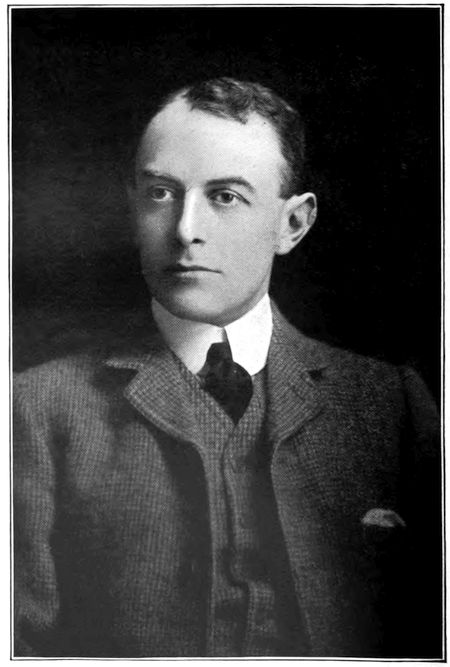
To keep the succession complete we may insert
here a notice of his successor, Mr H. F. Heath. He
was in Mr Isaacs' office until a very short time
prior to the decease of the latter, and from the time
of his appointment has proved himself a reliable
guide. His advice is given for the good of the
Association, and not on the low ground of personal
profit. He is as skilful in the stating of a case, or
detecting the weak places in the position of his opponents,
as he is versed in law. Having to deal with
mining matters he has made himself thoroughly
acquainted with the technicalities of the mine, and
is most desirous for the success of the business
which is placed in his hands. No member of the
Durham Miners' Association has more regard to its
welfare and prosperity than has the miners' solicitor
and advocate.
Within the period of our associated life there
have been many changes, a few of which we may
with profit enumerate. The "Yearly Bond" has
been dealt with as one of the first actions of the
Associations. It was considered a species of slavery,
and a remnant of the old feudal times when men
were part of the estate. We need not dwell further
upon it nor its abolition.
The change in the "First Caller" is no mean one,
apart from its implied shortening of the hours.
It uniformed the time for men commencing work in
the foreshift, and it gave them two or three hours
more time to rest when it was most natural and
most needed. The writer of this (as all men who
were hewers at that time would go) went to work, if
in the whole, at one in the morning. The "caller"
made his rounds then, but there were many men
who never waited until he came. They were at the
pit and down before the time. At some collieries
the back shift men went in at six or six-thirty A.M.
If they were out until the latter time they were
the last to go in. It was not considered necessary
to suspend the coal-drawing to send them down.
The man and his picks were put into an empty
tub, and went down against the full tubs coming
up. The engineman was told there was a "man on,"
and the only difference in the running was the
easing up a little at the bottom. When the back-shift
hewer got to the face he had the company of
his marrow for some two or three hours. In 1872
the calling time was changed, and the loosing in
the face established.
Take the position of checkweighmen. Prior to
the commencement of the Union (and at the time)
the workmen's choice of their weighman was merely
nominal. They selected, but the selection was
subject to the approval of the employer or manager,
and he was at all times liable to receive his notice,
not from the men for whom he worked, but from the
manager—and it could be given for anything which
did not harmonise with the will of the manager. A
breach of the law was not considered except it was
colliery-made law.
It will be obvious that his freedom of action (so
far as the advocacy of the rights of workmen was
concerned) would be very much restricted. In the
generality of cases the policy was to "lie low." In
this there has been a great and useful change. Now
the checkweighman is employed by the workmen,
and can only be removed by them, except he violates
the conditions of the Mines' Regulation Act; and
now he is (with rare exceptions) the mouthpiece of
the men when meeting the manager, the leader in
public movements, and the most prominent in
matters relating to the Association.
No less important is the facility for meeting the
employers, and the spirit of equality which obtains.
What a contrast between 1869 and 1904! Then
it was truly a meeting of the superior with his inferiors,
and as a natural consequence there was an
absence of free discussion, which is so essential to
the proper settlement of the questions arising
between employers and workmen. Happily, that
feeling has died out. There is less of the dictator
and dictated to, and more of the meeting of equals.
Then it was thought to employ men was to confer
a favour upon them, and that consequently they
were to consider themselves under patronage, and
be satisfied with the treatment meted out to the
patronised. Now it is realised that if the employers
employ a man's labour the workmen employ their
capital, that reciprocity and mutuality form the
platform upon which the two sides can meet, and
that free, unrestrained, courteous expression is not
merely the right, but the safest and most beneficial
course.
There has not only been an economic benefit
accruing to both sides alike, as a result of this
equality, but there has been a mental stimulus
given to the workmen. It is true that, concurrently
with the life of the Association, the schoolmaster
has been more abroad amongst the people. The
boys commence work later in life, and with a larger
mental capital, and that as a consequence there is
more ability at command for the use of workmen,
but it is a safe assertion that the fact of the organisation
operating in our midst has been no mean
factor in stimulating the use of the learning so
acquired. The young men think it no small attainment
to take part in the various offices which are
held out to them in the Union, and they know as
well that they must be prepared to fill those offices
in an intelligent manner. It would be a difficult,
but yet a most interesting, calculation if it could be
shown how many men have been incited to mental
activity in the manner indicated. From the very
inception the Association has demonstrated that the
industrial relations in this county were passing out
of the region of brute force into that of reason, and
the play of mind against mind, and that the body
of working men who desire to hold their own, and
progress, must do so by the mental force they could
command. The greater that force the safer the
position, and the more assured the amelioration
of their conditions. By that will they conquer.
The contrast between the number of able men now
and in 1869 is encouraging. It gives the young
assurance, and rejoices the heart of the aged, who
in their youth saw this day as in a vision, but desired
it.
A natural corollary from the equality in meeting
and the mental impetus is the amended mode of
settling disputes and conducting our negotiations.
We have come from a chronic state of open and
avowed antagonism to (if not complete conciliation)
at least a great approach to it. The history in
describing the various stages in our path, will
prove that the old era of contention was wearying
and wasteful, as it was sure to be when the two
parties considered themselves as two armies, and
their strength of numbers and increase in capital
were for purposes of crushing the other side. These
ideas, like that of national superiority and large
armaments, were hard to destroy on either side.
Their presence made the attempts at compromise
more difficult, and often helped those who were
wishful to retrograde. They brought about the
abolition of the sliding scales and the first Conciliation
Board. It may be at some future stage
they will effect the same with the second. This
will not be, if the past teaches any lessons and the
workmen of Durham recognise the tendency of the
times. That is towards conciliation, and no step
should be taken except to perfect it. If wisdom
rules, that backward action will be avoided as a
great danger.
A very pleasing change is the greater care for life
manifest during the last thirty-six years. The
county has had its share of explosions in the
period indicated. The following table will give us
a view as to the extent of the life-saving in the
mines of the nation. The table deals with three
decades, and 1905 singly, and gives the deaths per
year, the numbers of persons employed, with the
number of tons, the average of each ten years being
taken.
| Ten Years ending | Deaths per Year | Number of Persons Employed | Number of Tons |
| 1882 | 1129 | 558,816 | 152,221,629 |
| 1892 | 1032 | 614,200 | 182,646,507 |
| 1902 | 1015 | 666,060 | 215,790,835 |
| 1905 | 1159 | 887,524 | 249,782,594 |
The table is very cheering. The full value of it
will be realised if we take the decade ending 1882
and compare it with 1905. There we have thirty
more deaths, but we have 300,000 more people
employed, and an increase of over 97,000,000 tons
in output. The proportionate reduction in the
saving of life is great.
Three more changes remain to be noted. First,
the political change. In 1869 the political power
in the hands of the miners (as of all county
dwellers) was a very small quantity. The logic of
the situation was curious. Above a certain monetary
position or size of a house, or possession of land,
or living on one side of a line, men were allowed to
vote; without those, and being over the line, they
were prohibited. The law of England was an open
declaration that houses, money, land, all insensate,
could guarantee a man a qualification for doing that
which alone can be done properly by the operation
of mind, and living within an arbitrary area imparted
to him full competency for the right of
citizenship. He might have them to-day, and live
on the borough side of the line, and be qualified;
but the vicissitudes of life might strip him of his
possessions—or the necessities of his occupation
might compel him to move to-morrow—and he
would be considered unfit to take part in the
election of those who had to make the laws he was
bound to obey, which is certainly a most sacred
right. That anomaly was swept away. The Durham
miners took their share of the work, and set
the example as to the proper use of the power.
Another of the changes we note is the strong
desire there is for an improved home life. It is
not an extraneous feeling forced upon the miners
by outsiders, but is within them. There is a great
change in that respect. There has been much done
in the direction of the much-needed reform. The
present is a long way from being satisfactory, but
it is far in advance of the state at the inception of
the Association. That only existed because it was
born of use. The old-time houses are a standing
witness of the opinion those who built them had
of the workmen. How should we know that the
merciful man regarded the life of his beast except
by the manner of his feeding and housing? There
is a change in that respect, but there is a more
hopeful one, and that is the desire on the part of
those who live in them for betterment. The man
who is content with a hovel, or room in a slum,
will never look higher. To be dissatisfied with
them is healthy, and is the sure road to a better
state. May the feeling grow until bad houses and
insanitation are removed; but it should never be
forgotten that a house itself does not make a
home—the life in it alone can do that.
The last of the changes, but not the least, is the
altered opinion about, and the more accurate knowledge
of, the miner there is in the country. Forty
years ago, to many of the people of London the
northern miner was a dweller in remote regions,
and a man of uncouth and rude speech and habits.
Some believed he remained down in the mine, never
coming to bank except for a holiday. The writer was
once asked by a man not far from London how long
he had been in the mines. He replied eight or nine
years. Then said the querist: "Have you never been
up till now?" He was informed that the miner came
up every day. With surprise he exclaimed: "I
thought you lived down in the mines altogether."
That is only one of the numerous instances which
could safely be quoted expressive of the ignorance
about the miner and his life. They knew his product
because it warmed them and cooked their food,
but that was the extent of their correct information.
But the change in the geographical and domestic
knowledge is not all, nor the most important; the
altered opinion of the miner as a man is more. The
common name was the "Geordies," and that was
used as being indicative of something low rather
than a class cognomen. It was the idea as seen
in the attitude of many in Durham when the first
gala was held—as stated above. That is all
changed during the thirty-six years we have existed
as an Association. The man who speaks lightly of
the class does it in the face of the clearest light,
and from malice. It is of the class we speak here.
If we reason from the individual our logic will be
unsound, and all classes stand condemned. Taken
in the bulk, as compared with our start, the miner
has been raised on to a pedestal of respect. That
is a result of his own self-respect. Without the
latter the former will never be attained. It is the
compelling force. It is the philosophy of Shakespeare's
"To thine own self be true," which finds exemplification
in every sphere and grade of life.
The Durham miners have shown this in a marked
degree. They may be void of some of the polish
which is to be found amid the complaisances and
conventionalities of the finer trades or higher walks
of life—their battle for bread is a rough one—but
he who wants honesty, uprightness, and bravery
will not be disappointed if he turns to them. He
need not seek far.
We have finished our history for the present,
and traced it in rapid outline for thirty years. With
the benefits we are enjoying from it, the enjoyment
must not induce forgetfulness of the brave men
who laid the foundations of our little kingdom, for
such it is. We enter into their labours, but we will
do so with gratitude, and not indifference. Their
memory deserves more than a mere casual place
with us. We should not be true men if we gave it
only that. Let us remember that in reality the
position we have realised and the solidity of our
Association have been won and made possible by
their spirit and foresight, and because we have
kept ourselves close to the lines of their procedure.
Ours is a great organisation, not because of its
numbers (bulk may be weakness), but because of
its principles. If it were not so, instead of standing
out prominently as we do we should be in a dwarfed
and stunted condition, and comparatively useless.
The structure we now possess has risen by slow
growth from very small beginnings and opposing
forces. Every new idea, all the teaching of experience,
were used as blocks by those patient builders
laying the foundation for those who were to follow
them. It is true there might be some mistake and
bungling in the building. But in spite of these
the structure has arisen with solidity, and from the
rubble of that time we have reared up great walls
and fair outlines, giving promise of future strength,
durability, and usefulness. Truly the little one has
become a great nation, and the weak one a strong
force, and as long as we do not harm ourselves no
power outside can.
How shall we show our respect for them? We
have no possible way except by carrying on their
work and seeking to give effect and volume to it.
The end of their policy was reform, not revolution—not
only in a political way, but in every direction
where it was needed. Every hindrance in the
whole round of working conditions was to them an
evil, and as such should be removed. Where
immediate abolition was not possible they tried to
reduce its magnitude. They preached the ideal life,
seized the possible, and made the best of circumstances.
And is the wisdom of their action not
evident? The spasmodic has been succeeded by
the settled and the orderly. Where hate was endangering
the general weal by its unreasoning action
we now have regular business relations. No doubt
to many whose main feature is ardency and rush
they were slow-paced. These would have gone
faster, but there would have been slower progress.
To the Israelites Moses was slow-paced, but the
wilderness was their portion as a result of their
grumbling. There were grumblers in our start from
Egypt to a better position (some of them remain to
this day), but these are not the spirits who would
either lay foundations or rear structures. The
live men before us now were not grumblers. They
were too busy; the work before them was too imperative.
They were discontented; but in essence
there is a wide difference between that and a
grumbler. Never since the world began has any
grievance been removed by the latter class. They
may have hindered, but never helped. They are
the drags on the wheels, and complain because
more speed is not made. The men of 1869 were
men of different mettle, or the fear is we should
never have had the Association we have, nor stood
in the proud position we enjoy among the trades
organisations of the nation. We are reaping where
they sowed, and while we enjoy the harvest let us
remember the sowers.
We have placed their statues in a prominent
position; but what do they mean to us? They are
reminders of a state of things in a large part passed
away, and as suggesters of a hope of a larger life in
the future they contain a recognition and a resolve—a
recognition of their work and a resolve to carry
it forward: a recognition of the debt we owe to
them, which can only be paid by service rendered to
others. It is a debt which no statue, no matter how
costly or lifelike, can liquidate. It can only be
paid in kind. That is a truth we should not
forget, but on all occasions give expression to. It
is that expression which stamps real dignity upon
the life of any man. Position, rank, title, wealth
are all useless, for the true index is manliness and
useful service. The true reformers have been (and
are) men who assisted the good and resisted the evil,
not simply because it would pay or bring preferment
or popularity, but because they felt in their
hearts the impulses (and compulsions, if you will)
of duty. The love of man constrained them, and
the imperative I must forced them onward. The
world's progress has not depended on the acts of
the so-called great men, but on the endeavours
and self-denials of men who were lost often amid
the mists and struggles and poverty of life, and to
whom its heavy burdens were not theoretical, but
terribly near in their contact, and fearful in their
weight and trial.
The deeds of the workers of the race are not
recorded to decorate history, but for strengthening
the generations to come. For such purpose has
prominence been given here to our workers. "The
measure of a nation's civilisation is the number of
the brave men it has had, whose qualities have
been harvested for children and youth." We have
had our brave men. They did not live to themselves.
In this we must be their imitators.
I have had many pleasant occupations in connection
with our Association, and the writing of this outline
of our history is not the least pleasing among them.
It has taken much time, but the result has been
(not to be burdensome, but) to impart a somewhat
hurried and loose character to the writing,
and perhaps some slight omissions of facts, not
material to the general course of the history. It
has been compiled in the rush of other matters, and
in odd minutes as they offered themselves, but its
purpose will be attained if a desire to form a closer
acquaintance with our growth and transactions be
provoked, especially in the minds of our young
men, in the hope that they may be rooted and
grounded in their faith in Trades Unionism. The
dependence of the future is upon them. What is
more important than for them to have a full knowledge
of our policy and procedure?
The subject is to me of the most interesting
nature. From start to finish it has been running
the current of my own life, because in nearly all the
incidents I have had some small share—as one in
the ranks at first, and in these later years as one of
the officials. I saw the start, have seen the growth,
and feel proud of its position. With those who
helped to form it I shared the evil speaking and
unfair treatment when we made the attempt, and
have never hesitated to be a partner in the blame
and slanders which small-minded men have seen fit
to bestow upon those who were doing their duty.
The narrow mind always feels a pleasure in censuring
others. I say nothing of the work which has
been done except this: in all I have had any part in
there has been pleasure, and none of the hireling
waiting for the shadow of the day. I have shared
the regrets of those who regretted the failures, and
now I am thankful there is large room to rejoice
over the progress made and the position attained.
This feeling, you will permit me to say, is bound
to be stronger in me than in most men. It is part
of my life. Thirty-seven years is a long time. A
man is a fool, or worse, if, living in contact with an
institution (one in which he has lived and moved
and had his being), it has not made more than a
mechanical impression upon him. I have passed
from youth to age in that contact. It commenced
in the prime of manhood, and continues when life's
day is declining, and the gathering shades indicate
the sun has dipped far to the west, and to find myself
in active service, even with the limited powers
resulting from the weight of threescore years and
ten, is the crown of my rejoicing.
I have been a long time the colleague of some
of you. In the battle we have been shoulder to
shoulder, and our hair has turned grey in the fight.
We have been together in good and evil, for the
web of our life has been of mingled yarn. Good
and evil together have been mixed, but the good
has predominated—how much we alone can tell.
I rejoice with you that we have lived to see this day,
and that we are still fighting the good fight, with
the hopeful spirit, if the physical energies are less
than when we commenced. There is a great distance
between the point we have attained and the
valley whence we started—a distance not measured
by time. The true standard is an experience such
as our life alone can supply.
My final word is to my young brothers. It is
that of exhortation to appreciate not merely the
conditions you enjoy, but the possibilities opened
out to you. The thought of these should stir you
up to the enjoyment of one and the use of the
other. Believe me, about this I am very anxious,
and shall rejoice if something in this book, or suggested
by it, tends to stir you to good and profitable
use of the facilities and time the Association
has opened out to you. The opening out of these
devolves upon you a twofold duty: to yourselves
first, and then devoting yourselves to the improvement,
solidifying, strengthening, and perfecting of
the organisation. Let me quote a few words I have
written to you before:
To omit the duty you owe to yourselves; to
neglect the opportunities which are open to you; to
think all of pleasure and sport, and nothing of
mental culture; to leave the institutes which are
opening out to you, with their libraries, and which
with their stores of knowledge bring you into
living, thoughtful contact with the mental giants
of the race; to live only for present enjoyment, with
no preparation for to-morrow, which will need and
make demands upon you, is surely a lack of forethought,
which is condemnable for two reasons,
because it stunts your own nature (for no uneducated
man is complete), and hinders your usefulness
when matured manhood calls upon you to take
your place in the affairs of your class and nation,
to assist in the progress of one and the rectification
of the national evils. Put not your trust
in other people entirely; look not to some power
outside yourselves to raise you higher in the social
scale, whether it be parliamentary or otherwise.
The most effective means for further progress lies
in us. We want to be true to ourselves, resting
not satisfied with foul conditions and surroundings
nor ignorance. An educated people is a powerful
people; for where is there a man who knows what
is due to a man who will be satisfied with less than
what a man requires and deserves?
These thoughts form the raison-d'être of this
history. The aim is to make it a reliable record
of facts and an inspiration to those who read.
There has been no attempt at literary display.
There has been a desire to give prominence to the
principles of the founders, and to urge adherence
to them, for by them we have come, and by them we
shall progress. Our course has been gradual, but
it has been safe. We have a record of which all
may justly feel proud. It has not been rushing
nor spasmodic. In these ofttimes lies ruin, and this
we have found when we as an Association have
tried that method. Carefulness and caution are
not cowardice. These feelings may not be heroic,
but they have proved their fitness in the years that
are gone. "Discretion is the better part of valour."
"More firm and sure the hand of courage strikes
When it obeys the watchful eye of caution."
This was the leading feature of those who made
our present possible. No one would dare charge
them with lack of true heroism. Let me urge upon
you the same spirit. The road may seem longer,
and the processes more painful and slow, but these
need not damp your spirits. They should brace
you for the struggle, strengthen your purpose, fix
more firmly your hopes, give you larger faith in
the future, induce you to realise your place in life
and not be drifters with the current. There are
too many who are satisfied to merely exist. They
have no aspiration nor ideal nor hope. No man
has a right to pass through life indifferent to the
wrongs around him. Two things we must avoid:
impetuosity in associated work and stagnation in the
individual life. Each life should be a clear current,
invigorating, not a mere moral miasmatic pool, but
cleansing, elevating, ennobling. There are three
voices calling upon this generation: the past with
the work done for us; the present with its demands
upon our help for rectification; and the future with
its possibilities of a better and purer life. There are
many powers opened out to you, but there are
three which stand out prominently: sobriety,
education, association. These used, the darkness
will disperse, the downtrodden be raised, and
England made truly a home for her people. The
continuous sunshine in which some dwell and the
dark poverty in which thousands exist will be
blended, every soul-enslaving fetter be bruised and
broken and cast away, and the world be brighter for
our living in it; and we, when called to our account,
will feel cheered that we have done what
we could to cast out the old and cruel conditions
and ring in the Christ that is to be, when want
and hunger shall be no more and that state which
the rich provision in nature and the wonderful
production around us provides for shall be realised.
THE GALAS, WITH THE DAY AND DATE UPON WHICH THEY
WERE HELD
| 1871 | Saturday, | August 12th, | at Wharton Park, | Durham. |
| 1872 | " | June 15th, | on Race-course, | Durham. |
| 1873 | " | June 14th | " | " |
| 1874 | " | August 15th | " | " |
| 1875 | " | July 3rd | " | " |
| 1876 | Monday | July 3rd | " | " |
| 1877 | " | July 16th | " | " |
| 1878 | Saturday | July 6th | " | " |
| 1879 | " | July 5th | " | " |
| 1880 | " | July 31st | " | " |
| 1881 | " | July 30th | " | " |
| 1882 | " | July 1st | " | " |
| 1883 | " | July 14th | " | " |
| 1884 | " | July 5th | " | " |
| 1885 | " | July 25th | " | " |
| 1886 | " | July 31st | " | " |
| 1887 | " | July 23rd | " | " |
| 1888 | " | July 14th | " | " |
| 1889 | " | July 6th | " | " |
| 1890 | " | July 12th | " | " |
| 1891 | " | July 4th | " | " |
| 1892 | " | July 23rd | " | " |
| 1893 | " | July 29th | " | " |
| 1894 | " | July 21st | " | " |
| 1895 | " | July 27th | " | " |
| 1896 | " | July 18th | " | " |
| 1897 | " | July 24th | " | " |
| 1898 | " | July 16th | " | " |
| 1899 | " | July 22nd | " | " |
| 1900 | " | July 28th | " | " |
| 1901 | " | July 20th | " | " |
| 1902 | " | July 26th | " | " |
| 1903 | " | July 18th | " | " |
| 1904 | " | July 23rd | " | " |
| 1905 | " | July 29th | " | " |
| 1906 | " | July 21st | " | " |
CHANGES IN WAGES FROM 1872
| Date of change | Advance | Reduction |
| taking effect | per cent. | per cent. |
| February 1872 | 20 | — |
| July 1872 | 15 | — |
| February 1873 | 15 | — |
| April 1874 | — | 10 |
| November 1874 | — | 9 |
| April 1875 | — | 5 |
| February 1876 | — | 7 |
| September 1876 | — | 6 |
| April 1877 | — | 7½ |
| May 1879 | — | 8¾ |
| July 1879 | — | 1¼ |
| December 1880 | 2½ | — |
| April 1882 | 3¾ | — |
| August 1882 | — | 1¼ |
| November 1882 | 1¼ | — |
| February 1883 | 1¼ | — |
| August 1884 | — | 1¼ |
| May 1885 | — | 1¼ |
| May 1886 | — | 1¼ |
| February 1888 | 1¼ | — |
| May 1888 | — | 1¼ |
| August 1888 | — | 1¼ |
| November 1888 | 1¼ | — |
| February 1889 | 1¼ | — |
| August 1889 | 10 | — |
| December 1889 | 10 | — |
| March 3-10, 1890 | 5 | — |
| December 29, 1890 | 5 | — |
| January 5, 1891 | — | — |
| June 1, 1892 | — | 10 |
| March 1893 | — | 5 |
| 1October 16, 1893 | 5 | — |
| May 6-13, 1895 | — | 7½ |
| October 7-14, 1895 | — | 2½ |
| August 14-21, 1897 | 2½ | — |
| 2May 16-23, 1898 | 2½ | — |
| May 16-23, 1898 | 2½ | — |
| Oct. 31-Nov. 7, 1898 | 2½ | — |
| 3April 17-24, 1899 | 2½ | — |
| July 24-31, 1899 | 2½ | — |
| November 6-13, 1899 | 3¾ | — |
| February 12-19, 1900 | 5 | — |
| May 14-21, 1900 | 7½ | — |
| August 13-20, 1900 | 10 | — |
| November 12-19, 1900 | 10 | — |
| February 11-18, 1901 | — | 1¼ |
| May 13-20, 1901 | — | 11¼ |
| August 12-19, 1901 | — | 7½ |
| November 12-19, 1901 | — | 5 |
| February 17-24, 1902 | — | 1¼ |
| May 12-19, 1902 | — | 2½ |
| August 11-18, 1902 | — | 2½ |
| February 9-16, 1903 | 1¼ | — |
| May 11-18, 1903 | — | 1¼ |
| August 10-17, 1903 | — | 1¼ |
| February 8-15, 1904 | — | 1¼ |
| May 16-23, 1904 | — | 2½ |
| November 7-14, 1904 | — | 1¼ |
| February 5-12, 1906 | 1¼ | — |
| August 6-13, 1906 | 2½ | — |
| November 12-19, 1906 | 1¼ | — |
Table showing the explosions and inundations, with
the date and number of lives lost, since the beginning
of 1869, in Durham, brought down to the end of 1906,
with two statements on the dust theory by Mr J. Forman.
| Lives lost |
| 1869—May 25, Monkwearmouth | 7 |
| 1871—October 25, Seaham | 30 |
| 1878—July 6, Craghead exploded | 4 |
| 1880—September 8, Seaham Colliery exploded | 168 |
| 1882—February 16, Trimdon Colliery exploded | 74 |
| 1882—April 18, Tudhoe exploded | 36 |
| 1882—April 13, West Stanley exploded | 13 |
| 1885—March 2, Usworth exploded | 41 |
| 1885—June 3, Houghton-le-Spring | 12 |
| 1885—December 2, Elemore | 28 |
| 1889—November 2, Hebburn | 6 |
| 1895—December 13, Eppleton | 3 |
| 1896—April 13, Brancepeth A Pit | 20 |
| 1897—May 6, East Hetton, inundation | 10 |
| 1899—August 15, Brandon C Pit | 6 |
| 1902—May 20, Deaf Hill | 1 |
| 1903—November 16, Sacriston, inundation | 3 |
| 1906—October 14, Wingate, explosion | 24 |
| 1906—December 17, Urpeth Busty, explosion | 4 |
A THEORY SHOWING HOW COAL DUST IS IGNITED AND
EXPLODED IN A COAL MINE, MORE ESPECIALLY ON
IN-TAKE AIR ROADS
In the first place, there must be a considerable
quantity of very fine and dry coal dust in the immediate
proximity of a shot when fired; and if the shot is a
strong one the concussion will be very great.
This force, acting on the air, throws the finest particles
of coal dust into the circulating current, in a finely
divided state, with orbid motion, thereby causing each
particle of coal dust to be surrounded with air, and
these particles of dust in this condition coming in contact
with the flame of a shot, are easily ignited.
At the moment of ignition the temperature of the
particles of dust is low, but as the ignition extends to
other particles, and they become ignited in quantity,
the temperature rises, so that the motion of the heated
particles becomes more rapid by expanding and compressing
the air, until their velocity is so great that the
temperature of the burning dust is raised to the temperature
of gas flame, exploding the coal dust in its course.
At this high temperature, the expansion of the air
will develop great force, which acting on the dust at rest,
will whirl it into the air current, and this will be continued
so long as there is a sufficient quantity of coal
dust and air to feed the flame.
John Forman.
To J. Wilson, Esq.,
Secretary to the Royal Commission on
Explosions from Coal Dust in Mines.
Dear Sir,—In October 1871 an explosion occurred at
Seaham Colliery, and my attention was called to it;
and, after considering all the circumstances of the case,
I eventually came to the conclusion that the shot fired
by the two Simpsons ignited the coal dust and caused
the explosion.
In September 1880 another explosion took place
at Seaham Colliery. I went down the pit in the evening
of the day of the explosion with Mr Stratton (the
manager) and other Mining Engineers, and I remained
at Seaham Colliery for 12 months, until the last body
was found, and was, during that time, down the pit
almost every day as an explorer. I also attended
the inquest and gave evidence. I was satisfied from
what I saw that the shot fired by Simpson and Brown
ignited the coal dust and caused the explosion.
In February 1882 an explosion occurred at Trimdon
Grange Colliery. I went down the pit and attended
the inquest, and from what I saw and heard I concluded
that the explosion was caused by a flushed kitty
or straw at Maitland's shot firing a small quantity of
fire-damp, which ignited the coal dust and caused the
explosion.
In April 1882 an explosion occurred at West Stanley
Colliery. I attended the inquest, and from what I
could learn the shot fired by the two men (Douglas
and Hutchinson) ignited a small portion of fire-damp,
which fired the coal dust, and brought on an explosion.
In March 1885 an explosion happened at Usworth
Colliery. I attended the inquest, and came to an
opinion that the shot fired by the two men, named
Brown, ignited the coal dust, which produced an explosion.
In December 1886 an explosion occurred at Elemore
Colliery. I went down the pit and attended the inquest.
I was satisfied, in my mind, that the shot fired by the
three men (Johnson, Appleby and Luke) ignited the
coal dust, thereby causing the explosion.—Yours, etc.
John Forman.
December 1886.
- A
- Accountants, 128, 164, 314
- Aftermath of 1892 strike, 245
- Agents' districts, 23-24
- Alteration of the "First Caller,"59, 337
- Amicability in disputes, 340
- Arbitration, Deputies', 170
- — earliest, 33
- — first general, 85, 103
- — second, 109
- — third, 113
- — fourth, 118
- — owners refuse, 152
- — working hours, 169
- Armstrong, W., 103, 109
- Attempts to form Union, 6
- Average, county, 162
- — theoretical and real, 147
- Award, 1879, pro tem., 157
- — J. R. Lyn's, 220
- Awards, Lord Davey's, 1895, 267-269
- Award, Lord Davey's, 1902, 319
- B
- Bank Holiday, 318
- Banking account, 18
- Benefits, reduction of, 199
- Blagdon, Rev. M., 26
- Bond, yearly, 17, 47, 49
- Boys' wages, 309, 324
- Broken price agreement, 325
- Brown, W., 8, 35
- Building, the, 16
- Bunning, T. W., 47
- Burt, T., 8, 20, 103, 182
- C
- Cairns, A., 23, 26, 32
- "Caller, First," 59, 337
- Candymen, 96
- Cann, T. H., appointed treasurer, 276
- Care for life, 341
- Changes, 337
- Checkweighmen, 73, 338
- Clerk, first appointed, 105
- Coal-drawing agreement, 323
- Coal Owners' Association formed, 46
- Coal Tax, 310
- Commission, Royal, 86
- Committee, 1879, 160
- Compensation Act 1897, 291
- Conciliation Board, 263
- — first members of, 266
- — renewed, 294, 331
- Co-operative colliery, 90, 110
- — Committee, 110
- County Council, 209
- Crake, W., 7, 13
- Crawford, W., 6, 9, 23, 26, 31, 33, 37, 103, 109
- — attack on, 80
- — censure on, 84
- — candidature of, 88
- — death of, 215
- D
- Dale, D., Sir, 103, 109, 157
- Dark Days, 197
- Deputies' basis wage fixed, 301
- — difference as to, 120
- — hours, 1870, 121
- — wage, 1870, 121
- — wage, 173
- Derby, Lord, 160
- Desire for better houses, 343
- E
- Educational benefit of Union, 340
- Emigration, 131, 165
- Employers' Liability Act, 172
- Entrance fee, first, 18, 121
- Equality, 339
- Evictions, Wheatley Hill, 96
- Ex-Committee condemned, 145
- — expelled, 114
- — rules, 114
- F
- Federation Board formed, 140
- — condemned, 145
- — first members of the, 141
- Federation, Miners',
- — Durham miners and the, 251, 256
- — expulsion from the, 259
- — refuses Durham, 277
- Fillers' agreement, 333
- Firemen's week-end shifts, 316
- Five days per week, 183
- Forman, J., 36, 38, 103, 105, 119
- — death of, 302
- Forsters', W. E., award, 109
- Fowler, J., 61
- Franchise Association, 88
- — extension of, 191
- G
- Gala, first, 31-34
- — first on the race-course, 59
- Galbraith, S., appointed, 305
- Golightly, W., 105
- Gordon, W., 114, 118
- Graham, Coroner, 298
- Gurney's, Russell, award, 103
- Guthrie, R., 207
- H
- Hall, the new, 82, 118
- Hand putters' basis wage, 324
- Heath, Mr, 337
- Hewers' datal wage, 306
- Homes, Aged Miners', 297
- Hopwood's, C. H., award, 113
- Hours arbitration, 132
- Hours', arrangement, ten, 214, 217
- — eight, 199
- — ballot on, 248
- — second ballot on, 321
- — of boys, 32, 48, 74, 77, 83
- Houses and house rent, 307
- Housing condition, 104, 110
- House, W., appointed to Joint Committee, 292
- — appointed President, 305
- I
- Imprisonment of Messrs Cann, Jones, and Forbes, 244
- Increased knowledge of the miners, 343
- Industrial Remuneration Conference, 190
- Isaacs, Mr, 336
- J
- Johnson, J., appointed treasurer, 217
- — fin. secretary, 276
- Johnson, Mr, and Gateshead, 328
- Joint Committee, formation of, 66
- — first meeting, 69
- — suspended, 164, 329
- Jones, L., 83, 103, 109, 119, 196
- Judge, a, puzzled, 30
- L
- Labourers' basis wage, 306
- Labour representation, 194, 326
- Leaders, the first, 37
- Lords, House of, 192
- M
- Macdonald, A., 17
- — death of, 180
- Meynell, Mr E., 112, 335
- — award, 134
- Miners' demand for trained miners, 90
- — International Congress, formed, 223
- — National Conference, 25, 124
- — Act 1861, 1
- — Act 1871, 71
- — Act 1872, 71, 72
- N
- Negotiations of 1890, 211
- Notices given to enforce a reduction, 101
- — again given by owners, 107
- O
- O'Connor, Judge, 197, 335
- Officers, first, 14
- Opposition, 41, 42, 43, 44
- P
- Patterson, W. H., 8, 13, 26, 39, 113
- — appointed corres. secretary, 216
- — death of, 273
- Patterson's, Mr, statue, 319
- Political power, 342
- Position of the Association, 136
- President, first, 19
- President, permanent, 105
- Putters' hours at datal work, 316
- — short shift, stone, 324
- R
- Ramsey, T., 8, 25, 80
- Reduction, first, 89, 91
- — second, 98
- — third, 105
- — fourth, 111
- — fifth, 115
- — of bankmen, 104
- — of 1879, 141
- Reductions, private, 148
- Relief Fund, first, 129
- — second, 187
- Rent paying in 1892, 247
- Resolutions, first gala, 61
- Restriction of output, 167
- Rhymer, E., 6, 84
- Richardson, J., 7, 11
- Rocking Strike, 2
- S
- Salary of first treasurer, 25
- Sanderson, R. B., 68, 112
- Screenmen's basis wage, 306
- Seaham strike, 55
- Shaw Lefevre's award, 119
- Simpson, C., 114
- Sliding Scale, first, 124
- — second, 163
- — third, 174
- — fourth, 185
- — abolished, 202
- — violation of, 167
- Smart money, 309
- Stobart, W., 46
- Strike at Silksworth, 223
- — at Wheatley Hill, 95
- — of 1874, 93
- — of 1879, 154
- — of 1892, 231
- Strikes illegal, 24
- Surface firemen's wages, 325
- T
- Taylor, Hugh, 47, 63
- — J. W., 328
- Thornley meeting, 13
- Timber leaders' hours, 317
- Trotter, L., 197
- Trustees, first, 14
- W
- Wage Board, first mention of, 235, 251, 254
- Wages, advance in, 48, 50, 63, 71, 76
- Wages in 1898-99, 288, 293
- Washington strike, 281
- Water leaders' hours, 317
- Wearmouth strike, 3
- Westcott, Bishop, 241, 262, 299
- — death of, 313
- Wheatley Hill inundation, 28
- — "Putt Pay,"188
- Wilkinson, N., 8, 14, 38, 113, 119, 182
- Wilson, J., 114, 118, 182, 192
- — appointed fin. secretary, 217
- — appointed corres. secretary, 276
- Wood, Lindsay, Mr, 68, 83, 157, 207
J. H. VEITCH AND SONS
DURHAM
Transcriber's Notes
Obvious typographical errors have been silently corrected.
Hyphenation has been rationalised.
Variations in spelling and punctuation have been retained.