Flight of Napoleon from the field of Waterloo—Reaction in Paris—Napoleon’s abdication—Surrender
to Captain Maitland—Provisional Government set up in France—Advance
of the Allies from Waterloo—Operations of Marshal Grouchy—Allies hope
to cut the enemy off from Paris—Blücher’s energy to secure that object—Unsuccessful
efforts of the Provisional Government to obtain a suspension of hostilities—The
Allies before Paris—The Prussians move round to the south of the city—Cooperation
of Wellington—Capitulation of the capital, July 3rd—Advance of Austrians
and Russians—“Waterloo men”—The “Wellington pension”—Rank of Lieutenant
granted to Ensigns of the Brigade of Guards—The soldier’s small account-book
introduced into the British army.
The battle of Waterloo broke the power of Napoleon for ever. So
confident of victory had that great soldier been, that he did not
even make any preparations for retreat, and hence, when he was
defeated, a terrible rout ensued. The wreck of the French army,
blocking the only road which was available, hurried from the scene
of disaster in a confused mass of fugitives. The Prussians, who
were comparatively fresh, took up the pursuit, and relentlessly
they pressed it home, driving the enemy back, increasing his
panic, and completing his misfortunes. Through the whole night of
the 18th-19th of June, a fierce and active pursuit was maintained;
2while the British troops, exhausted by the labours and anxieties
of the day, bivouacked as they stood, on the bloody but glorious
field of victory.
Napoleon, stupefied by the unexpected result of the battle,
forced his way through the surging mass of his now disorganized
troops to Quatre-Bras, and as he went along, he had ever increasing
evidence of the catastrophe that had overwhelmed him.
He sent a message to Grouchy, announced his defeat, but gave
the Marshal no orders. He then rode to Charleroi, and, almost
unattended, pushed on to Philippeville, where he made his first
effort to repair his broken fortunes. He ordered Marshal Soult
to rally the débris of his forces at Laon; he despatched a letter
to General Rapp, who was in command on the German frontier,
and to General Lamarque, engaged in La Vendée, with orders to
march to Paris; and he was sanguine enough to declare that he
could reorganize a sufficient force to cover the capital, and to give
time for the concentration of a much larger army, wherewith to
renew the war and to save France from the invasion that
threatened her.[3] But he was far from being reassured. He could
scarcely deny even to himself that the end of his career had at
last come in earnest, and that the stupendous ascendency which
he exercised over his countrymen had disappeared now and for
ever. Once before had he been obliged to acknowledge himself
vanquished, and the glamour of invincibility no longer surrounded
his person. He had engaged in a desperate undertaking. The
whole of Europe was arming against him, and was determined to
put him down. His first bold venture to try and beat the Allies
in detail had signally failed. The armies of Great Britain and of
Prussia had hopelessly crushed the flower of his forces. He had
henceforward to reckon with Austria and Russia, and with a
formidable coalition flushed with victory. His countrymen never
forgave a military leader who had suffered a disaster in the field.
He knew that his prestige was weakened, that the influence which
his name inspired was shaken, that his resources were at an end,
and that his enemies were gathering about him from every quarter.
Tormented by these gloomy thoughts, he pursued his journey,
and reached Philippeville; and there he snatched a few hours
repose. But the fear of the Prussians haunted his followers, and
3he was hurried on, still in a state of indecision.[4] The momentous
question had now to be faced, and immediately decided. What
was Napoleon to do? Should he remain in the field in command
of his troops, rally the shattered remnants of the grand army, and
cover Paris, or should he fly to the capital, assert his authority
there, and trust to the magic of his name to retain his supremacy
over France? His own desire was to stay among his men, and
to abide the result at the head of an army, devoted to his person
and to his interests. Had he done so, his fate would have been
less humiliating than it eventually proved to be. But his failing
health, and the shock he had experienced, paralysed the active
energies of the man, and, dreading a revolution in the seat of
government, he agreed, against his better judgment, to start at
once for Paris. He reached his destination early on the 21st,
exhausted and shaken both in body and mind.
Paris was struck dumb by this event. On the 18th, the guns
of the Invalides thundered a salute in honour of the battle of
Ligny, and on the two following days the details of the French
victory over the Prussians were published in glowing colours; but
towards the evening of the 20th, the news of trouble began to
leak out, and on the morrow the Emperor arrived at the Elysée
palace attended only by a few of his personal Staff. “Dans le
premier moment on refusa à croire; ce fut ensuite une anxiété
cruelle; puis une morne stupeur.”[5] And now at length the fatal
news was fully realized, and spread like wildfire through the
excited people, and all knew for certain that the army of Napoleon
had been annihilated, that his military genius had played him
false, and that the catastrophe was at once complete and irretrievable.
Then the weakness of the Emperor’s power began to show
itself, and the instability of the foundation upon which he had
constructed his Imperial system became apparent. France, who
drained her resources freely to serve her passion for glory, now
spurned the defeated hero who had made her glorious. His rule,
though it pandered to her vanity, did not rest upon the true
affections of the people; and his want of success at the critical
moment was an unpardonable offence, to be atoned only by
4abdication. Enemies created everywhere by his arbitrary will,
by his reckless policy, and by the jealousy his brilliant genius
inspired, now saw their opportunity to revenge themselves, and
they arose to crush him. Alone in Paris, without an army,
he was almost a prisoner in the hands of his foes, where he
could not hope to recover from the disaster which had overwhelmed
him, or employ his talents for the military protection of
the country. The Chambers took the control of public affairs;
and Napoleon, prostrated by recent events, and unable to
resolve upon any definite course of action, acquiesced sullenly
in allowing the reins of government to be snatched from his
hands. He was forced to await the decision of a special
Council of State that was summoned to settle the future
of the Emperor and the policy to be pursued by the nation.
Lafayette, who was named member of the Council, and was its
leading spirit, insisted that the defence of the country should
not be the only question discussed, but that negotiations for
the restoration of peace should be also proceeded with; and
he succeeded in carrying a resolution, to the effect that,
as the Allies had signified their determination not to treat
with Napoleon, the two Chambers should themselves nominate
negotiators, who were, under their authority alone, to come to
terms with the conquerors.[6] It was a revolution; and it was
nearly complete on the morning of the 22nd. In the divided
councils of the Emperor, Lafayette gained a great advantage, and
giving voice to the one thought that filled all minds in that
moment of anguish, he resolved that Napoleon’s deposition should
forthwith, and at all hazards, be carried into immediate execution.
A struggle—a one-sided struggle—took place between the
Emperor and the Chambers. The former could only rely upon his
previous military prestige and upon the halo of influence that still
might be supposed to surround his name; but he did nothing to
rouse himself out of the lethargy that oppressed his moral
faculties. The latter, representing the reactionary and Republican
parties, were tired of Napoleon and of his greatness. They
regarded him as the sole obstacle to peace, and as a fallen leader
who must be swept away in the interests of the country. So fickle
were the French to the man they received as their ruler in defiance
of Europe four months before, and who had been their unquestioned
5master for nearly fifteen years, and so intent were they to be rid
of him, that they only granted him—and that with difficulty—but
one short hour to make up his mind to vacate his throne; in
default, he was to be discrowned by force. Napoleon was indignant,
but he did not resist. “I have not returned from Elba,” he
said, “to deluge Paris with blood;”[7] and, fearing to provoke a
civil war, he accepted the inevitable, and abdicated in favour of
his son within thirty-six hours of his arrival in the capital.
And yet his overweening pride was still thirsting for power, and
this act of renunciation was neither tendered nor accepted in good
faith. Napoleon II., as he was called, was a child, and was in
Austria, and the Emperor still clung to the delusive hope that he
might be re-installed in the power he had lost, though he could
only wield it in the name of his son. On the other hand, the
Chambers, fearing to drive their antagonist to extremes, and dreading
above all things a revival of his wonted energy, agreed to an
equivocal recognition of Napoleon II. In this way they also
satisfied the cravings of the army for Imperialism; but the assent
was a mere fictitious one, which was intended to have no meaning
and which had no result. The Empire was indeed doomed, its
founder dishonoured, and his dynasty destroyed. It was a wretched
end to a glorious career, not even redeemed by that fortitude and
personal dignity which mark the fall of the truly great. This
final downfall is without parallel in history, and the weakness of
human nature and the vanity of man’s personal ambition stand
out prominently, as the main features of the drama. The last
scene was approaching, and may be described in a few words.
The moment Napoleon abdicated, he ceased to be a factor in
the great events that followed. He was even an obstacle in the
way of those who had usurped his place, and was treated with a
contumely he had little deserved at the hands of flatterers, who,
having basked in his smiles, had now constituted themselves the
arbiters of his lot. Driven almost with indignity to the suburban
retreat of La Malmaison, where his personality could not affect
the Parisians, he still dreamt of power, but did nothing to grasp
it. At last he was obliged to fly to the coast before the Allies,
who were approaching the capital. Despairing of making good
his escape, and feeling keenly the humiliation of his position,
should capture await him in the land where for so long he had
6been the idol, he yielded himself a prisoner to Captain Maitland,
who commanded H.M.S. Bellerophon—stationed near Rochfort to
intercept the Imperial fugitive,—as to the representative of “the
most powerful, the most constant, and the most generous” of
his enemies (July 15th). This is the last of Napoleon, and henceforward
he lived and died a captive in the island of St. Helena,
hated by his gaolers, forgotten by his country, and forsaken by his
kindred.
“But where is he, the modern, mightier far,
Who, born no king, made monarchs draw his car;
The new Sesostris, whose unharness’d kings,
Freed from the bit, believe themselves with wings,
And spurn the dust o’er which they crawl’d of late,
Chain’d to the chariot of the chieftain’s state?
Yes! where is he, the champion and the child
Of all that’s great or little, wise or wild?
Whose game was empires, and whose stake was thrones?
Whose table earth—whose dice were human bones?
Behold the grand result in yon lone isle,
And as thy nature urges, weep or smile.”
[8]
The overthrow of her great military hero brought no satisfaction
or relief to France. She needed a chief to direct, and a policy
to shape her actions; but at the most critical moment, when the
Allies were thundering at her gates, she deliberately deprived
herself of the one, and had not thought of the other. Napoleon
was rejected; but who was to take his place, and who was to
safeguard her interests? The noisy demagogues had effectively
stirred up a revolution, and had deposed the only soldier who
could have stood between her and the victorious enemy. Their
momentary success was complete; but they left nothing except
chaos behind them, and their work was folly because it was
destructive. It is true, they did conceive some hope that they
could rear up a Republic or a Constitutional Monarchy upon the
ruins of the Imperial system, and none for a moment believed
that the unconditional restoration of the Royal Family was imminent.
The “obstacle to peace” was removed; but the peace that
France desired was denied her, and she was not to be allowed to
have a voice in shaping her own destinies. The Allies were
masters of the situation; and they were as intent upon taking
7ample securities against the people who had for so long scourged
Europe, as against the man who had led them on to plunder
Christendom. The man was gone, but the people remained; and
in their eagerness to repudiate him, they forgot that they too had
some account to render to the conquerors.[9]
A Provisional Government was set up in Paris on the evening
of the 22nd of June, composed of five persons, among whom was
Fouché, Duc d'Otranto, late Minister of Police under Napoleon,
and one of his bitterest enemies. He had the address to be
named President, and in the anarchy produced by the panic which
the crisis created, he alone preserved his faculties unimpaired.
Seizing the supreme control of the State during the moment of
interregnum, he became dictator, and the sole and irresponsible
advocate of his country’s cause. A Republican by conviction, a
regicide, and holding to the extravagant tenets which were
enunciated in 1789, he was far more keenly alive to his own
immediate interests than to his avowed principles; and perceiving
clearly that his credit and reward could best be secured by obliging
France to accept—even against her will—a Bourbon régime, he
devoted his great talents and his incomparable powers of intrigue
to bring about the unconditional restoration of King Louis. His
treachery was deeply resented by the nation, but what could they
do? Napoleon had been abandoned, and there was no one to
replace him,—none to form a patriotic administration, none to give
effect to the national aspirations of the people, none to cope with
the difficulties that had arisen, none to secure those terms which
a proud and vigorous race had a right to expect, even when
overwhelmed by adversity. In the universal prostration which
succeeded the battle of Waterloo, Fouché, “one of the most hateful
among the hateful tribunes of the Terror,”[10] reigned in France, an
autocrat, hated by all, feared by all, and obeyed by all.[11]
While these events were taking place in Paris, the victorious
Allies were advancing towards that city, there to reap the fruits
of their success, to restore the peace of Europe, and to impose
their will upon the now distracted country that lay at their mercy.
After the battle there was a meeting between the Duke of
8Wellington and Marshal Blücher, at which operations for the
immediate future were decided. The former engaged to advance
the following day, and returned for the night to his head-quarters
at Waterloo; the latter agreed to pursue the enemy without delay,
and to endeavour to cut off Grouchy. He then went to Genappe,
and, on the 20th, his advanced troops were in French territory.
Early on the 19th, the army commanded by Wellington left their
bivouacs, the 2nd Battalion Coldstream Guards starting from the
farm of Hougomont, which they had held—in conjunction with
the 2nd Battalion of the Third Guards, and with the light
companies of the First Guards (2nd and 3rd Battalions)—with
such credit to themselves. They reached Nivelles that evening,
where Major-General Sir John Byng wrote his despatch on the
battle, and on the stubborn contest that centred round Hougomont.[12]
On the 20th, the Guards Division reached Binche, and on that
day the Duke of Wellington issued a General Order, which not
only conveyed his thanks to the army under his command,
for their conduct in the decisive action on the 18th, but which
also warned the troops of the absolute necessity of treating the
inhabitants of France as a friendly people.[13] This admonition
of the rules which prevail in war time among civilized nations,
was not indeed needed by the seasoned troops of British origin,
who had been trained in the humane usages invariably adopted by
England, to respect the liberties and the property of the people
over whose lands war has to be waged. It was rather addressed
to the Anglo-allies (Dutch, Belgians, and Germans), to enforce
the maxim that hostilities are not conducted against the population,
and that ill treatment of peasants only exasperates the
enemy, and does nothing to secure his final subjugation. It is to
be remarked that this policy was not followed by the Prussians,
with the result that the latter never gained the good will of the
French, while the British, on the contrary, were looked upon by
that proud and sensitive people with respect, and almost without
distrust.
On the morning of the 22nd of June, Wellington was at
Malplaquet, the scene of one of Marlborough’s greatest triumphs
over the same enemy. Before leaving, he issued a proclamation
in French to the people whose territories were then entered by the
9British troops, to the effect that the invaders had come to deliver
them from the iron yoke that oppressed them; and that the
population would be well treated by the army, provided they did
not join the cause of the “Usurper” (Napoleon), who had been
“pronounced to be the enemy of the human race, with whom neither
peace nor truce could be made.”[14] Neither in this effort to conciliate
the population did Prince Blücher follow the example of his
colleague; on the contrary he displayed resentment against the
natives of a country whose military genius had, in the past, humbled
in the dust the pride of his own nation. It was perhaps natural
that he should assume this attitude when the provocation which
the Prussians received is taken into account, but it was not
calculated to reassure the French in their despair, nor to reconcile
them to the restoration of the Royal Family.
In order to give a general view of the whole military situation,
it will now be necessary to refer briefly to the incidents of the
war that took place close to Waterloo, on the day of the battle,
where Marshal Grouchy was struggling with Blücher’s rear-guard.
On the 18th he was at Wavre, with 32,000 men, of whom 5000
were cavalry; and there he was held in check during the whole
day by Thieleman’s Prussian Corps, only 15,000 strong. It was not
until evening that he turned the right of the Prussians, when at
length he opened a road for his troops, whereon to advance to the
main body of the French army, known to be somewhere near
Waterloo. As it was then too late to continue the action, Grouchy
hoped next day to complete the victory he had achieved, ere he
pushed forward to join his chief. On the morning of the 19th he
received no tidings from the Emperor, and he believed that all was
well; but Thieleman, though he was not informed of the full
details of the disaster to which the French had been subjected,
heard that a great battle had been fought, and that they were
defeated; so he, too, determined to attack Grouchy in the morning.
A battle consequently took place on the 19th, in which the
Prussians, though they contested the ground inch by inch, were
forced to fall back towards Louvain by the superiority of the masses
they engaged. At the very moment of victory, Grouchy received
the message which Napoleon had sent him from Quatre-Bras,
announcing the total destruction of the French army, and thus
revealing to him the full extent of the danger in which he was
10placed. Perceiving at once the necessity that his corps should be
saved from the general wreck, he determined to retreat through
Namur upon Givet, and began to move without delay. General
Pirch I., having been detached from the main Prussian army on
the evening of the 18th to intercept him, joined Thieleman,
who also advanced as soon as he perceived that he was no longer
being pursued by the corps which had defeated him. Both Prussian
Generals endeavoured to arrest the enemy, but they failed to do so;
and Grouchy, who marched with great rapidity and resolution, ably
seconded by the valour of his subordinate Generals, reached Givet
on the 21st, and entered French territory in safety. He was then
ordered to join Marshal Soult, who was attempting to rally the
broken fragments of the main army at Laon. This occurred on
the fatal 22nd, the same day that Napoleon, coerced by the political
leaders in Paris, closed his public career, and signed his abdication
of the French throne in favour of his son.
Grouchy’s corps was the only one that, having taken part in
the campaign in Belgium, remained intact. The main French
army had been panic-stricken at Waterloo, and a large mass of
those who survived the battle fled straight to Paris, or deserted
their standards, and were nowhere to be found; many flung away
their arms, and dispersed to their homes. The disruption of the
great army was complete, and the defeat signal and decided
beyond all former precedent. The co-operation of the greater
bulk of Napoleon's forces in subsequent military events was
impossible, and little resistance was to be apprehended from these
men. But there was a remnant of true soldiers still available, who,
seeking their Colours, concentrated some 20,000 strong near
Philippeville. On the 22nd they were at Laon, and about that
time the French could dispose of some 50,000 men for the defence
of the northern frontier.frontier. The situation was a desperate one, and
would have been fatal even to Napoleon himself in the full vigour
of his military genius; but the position was all the more impossible,
since the Saxons, the Austrians, and the Russians were by this time
upon the eastern frontier of France, and were ready to advance in
a concentrated and concentric march upon the capital.
On the 22nd of June, Wellington reached Le Cateau Cambresis.
He had three divisions at Bavay, and four echeloned along the
road to Le Cateau—the Guards Division being at Gommignie.
Besides this, other troops were employed against Le Quesnoi
11and Valenciennes, which were occupied by men of the Garde
Nationale. Blücher was at Catillon-sur-Sambre with his troops in
the vicinity, including Thieleman, who had returned from the
pursuit of Grouchy, but excluding Pirch I., who was ordered to
remain in rear for the purpose of reducing the fortresses which
defended the French frontier. The Prussians were also at that
time blockading Landrecies and Maubeuge—also garrisoned by
local levies, from whom little resistance was to be expected. The
Anglo-Prussian Allies halted on the 23rd, for the purpose of
collecting their stragglers, and of bringing up ammunition; and
thereby a much-needed rest was afforded to men who, for more
than eight days, had been constantly and actively occupied in the
arduous labours of the war. During the halt the two Generals,
Wellington and Blücher, met to decide how a united advance
could best be made upon Paris. As a result of this conference, it
was agreed that the Allies should not pursue the enemy directly,
but, covered by the Oise, push along the right bank of that river,
upon Compiègne and Creil, so as to turn his left, and if possible,
cut him off from Paris,—the movement to be masked by the Prussian
cavalry, whose presence, it was hoped, would induce the French to
retard their retreat.[15] Wellington, moreover, anxious that the
moral effect of the battle of Waterloo should be fully reaped, and
that Napoleon should have no time to recover from the disaster,
hastened the arrival of King Louis into French territory, offering
to secure Cambrai as his residence until Paris should be captured.
Hearing, also, that that fortress was imperfectly guarded, he sent
Sir Charles Colville forward with a detachment to seize it (June
23rd). The attack was successful, in so far that the town was
taken with little loss; but the citadel held out until the 25th, when
the Governor capitulated to the King. His Majesty by this time
reached the British head-quarters, and he temporarily established
his Court in Cambrai.
On the 24th the combined armies continued their advance.
The British pushed on two brigades towards Cambrai, but otherwise
only altered their position slightly, as they were waiting for
their pontoon train. The Prussians, however, moved forward,
taking Guise and St. Ouentin. During the day, intelligence was
received of Napoleon’s abdication, but the news was at first
12discredited. Later, it became confirmed; but both Commanders
determined that terms of peace could only be signed at Paris,
and they rejected all overtures made to them by the Provisional
Government to arrest their march upon the capital. On the 25th
of June, the British head-quarters were at Joncourt, the Coldstream
Guards being at Le Cateau.
Blücher, on the other hand, hearing that the French had not been
deceived by the cavalry demonstration made in the direction of
Laon, now came to the conclusion that they were hastening towards
Paris; he therefore determined to secure the passages over the Oise,
and he pushed on to these points with the utmost rapidity. A
squadron entered Compiègne in the evening of the 26th, and early
the following day a Prussian brigade supported it, just in time to prevent
this place from falling into the hands of the enemy; for Grouchy,
who had superseded Soult, ordered D'Erlon to occupy the bridge
with the remnants of his Corps, about 4000 strong. D'Erlon, finding
the Prussians in position, cannonaded it, and very soon afterwards
retired, unpursued by the Prussians, who were too much exhausted
to advance; so that it was mid-day before the advantage gained
could be pressed home. These operations were connected with
the movements of other Prussian columns, one of which also succeeded
in capturing the bridge of Creil just before the French
arrived there. Brushing the enemy away, the invaders continued
to march to Senlis, where D'Erlon was met and driven off the
straight line of his retreat. The bridge of St. Maxence was found
partially destroyed, and the river had to be crossed in boats, but
that of Verberie was taken. By the evening of the 27th, Blücher’s
advanced troops were on the left of Grouchy, intercepting the
road to Paris, and with every hope of being able to prevent him
from reaching the capital before the Prussians.[16] At dawn of
the 28th, a small force under Pirch II. came into collision with
the enemy near Villers-Cotterets, and, being greatly outnumbered
at that point, they were in some danger of being overpowered.
The French, however, were in no condition to fight; they had
lost heart, and many were deserting their Colours. Being disorganized
by their reverses, and by the fear that Blücher’s energy
inspired, they now allowed Pirch to get away unhurt. The latter
had succeeded by his manœuvre to delay them, so that during the
day they were repeatedly attacked with considerable loss, and most
13of them were forced to turn to their left to cross the river Marne,
and so reach Paris by a circuitous route. By the evening of the 28th,
the Prussians had not only captured sixteen guns and four thousand
prisoners, forced the French from their true line of retreat, and
increased the terror and confusion which prevailed among them,
but they also succeeded in following some few detachments of
the enemy, who had been enabled to fly straight to Paris. In
this manner their advanced posts were within five miles of the
capital, near Le Bourget and Stains, where they carried panic and
dismay into the heart of the city.[17] Blücher established his head-quarters
at Senlis.
During this vigorous pursuit, the Anglo-allies were also
advancing southwards. On the 26th, Sir John Byng assaulted
the fortress of Peronne with the 1st Guards Brigade, who
carried the outworks by storm with little loss, soon after which
the town capitulated. The British head-quarters were at Vermand
and the army in the vicinity, advanced cavalry patrols having
penetrated as far as Roye. The Coldstream Guards halted at
Coulaincourt. Next day the army crossed the river Somme at
Willecourt; the Duke was at Nesle, and Roye was occupied. On
the 28th, the British right was near St. Just, and Montdidier was
occupied; the left was in rear of La Tulle, where the roads meet
that run from Compiègne and Roye; the reserve reached the
latter place, and the Guards Division was at Conchy, where the
rest of the First Army-Corps was posted.
The rapid approach of the invaders upon Paris made it plain
to the Provisional Government that they had no power to arrest
the progress of the Allies for a single moment; and although the
north side of the city was secured by a line of fortified works,
sufficiently strong to resist a coup de main, yet the wreck of
Napoleon’s army had not reached the capital, and time was
imperatively required to bring them there and to organize some
defence. An armistice was once more sought on the 27th, and
again on the 28th, in the despairing hope that the Government
might be allowed some breathing-time in which to consider their
position, and make some show of resistance, in order to save
France the humiliation which was clearly in store for her. But
the allied Commanders were inexorable, and, refusing all such
negotiations, they pursued their operations with the same activity
14as in the past. Wellington indeed frankly told the Commissioners
who approached him on behalf of the Provisional Government,
that he—
“must see some steps taken to re-establish a government in France which
should afford the Allies some chance of peace” before he could sanction
a suspension of hostilities; that he personally “conceived the best security
for Europe was the restoration of the King, and that the establishment of
any other government than the King’s in France must inevitably lead to
new and endless wars;” and he concluded by these words: “That, in my
opinion, Europe had no hope of peace if any person excepting the King
were called to the throne of France; that any person so called must be
considered an usurper, whatever his rank and quality; that he must act
as an usurper, and must endeavour to turn the attention of the country
from the defects of his title towards war and foreign conquests; that the
Powers of Europe must, in such a case, guard themselves against this evil;
and that I could only assure them” (the Commissioners) “that, unless
otherwise ordered by my Government, I would exert any influence I might
possess over the Allied Sovereigns to induce them to insist upon securities
for the preservation of peace, besides the treaty itself, if such an arrangement
as they had stated were adopted”—viz., any arrangement whereby
a prince, other than the King, were called to the throne of France.[18]
On the 29th, Blücher pressed on towards Paris, and reconnoitred
the defences thrown round the northern side of the city. The
remnants of the great army which had been shattered at Waterloo
also entered the capital on that day, and the French mustered
some 80,000 to 90,000 men there—troops from the provincial
depôts and from the country having been called for the defence
of the seat of government, and as many discharged veterans
as could be collected having been assembled in a special corps
some 17,000 strong. Besides this, there was plenty of artillery
available, and about 30,000 of the Garde Nationale; but on the
latter no great reliance could be placed. Marshal Davoût, Prince
d'Eckmühl, was appointed Commander-in-chief. The British
forces were still in rear, and occupied positions between Gournay
and St. Maxence, the Guards Division being near St. Martin
Longeau. At dawn, on the 30th of June, the advanced French
post at Aubervilliers was attacked by the 4th Prussian Corps
under Bülow, and the enemy was driven back, and pursued as far
as the canal in rear of that village; but it became evident that to
dislodge him from that line, a more serious effort would be necessary.
15The Duke of Wellington having proceeded to Blücher’s head-quarters
during the night of the 29th-30th, a conference was held as
to the future operations to be pursued. It was then agreed to
move the Prussians to their right, to take advantage of the capture
of the bridge of St. Germains which had already been effected, and
to extend the investment of the capital round the west and south
of the city, threatening to cut it off from those provinces that
furnished it with supplies. The British army at the same time
was to move into the posts which their allies had taken up
north of the city, and to mask the defences which the enemy
had erected there. During the night of the 29th-30th and the following
day, these operations were carried out, the 4th Prussian
Corps covering the movement until the British arrived. In the
evening, the latter were about Louvres, twelve miles away from
Paris; the Guards Division being at La Chapelle. The two Prussian
Corps, under Thieleman and Ziethen, were close to St. Germain;
while two regiments of Hussars, under Lieut.-Colonel von Sohr,
having been thrown forward, bivouacked at Marley, on the road
to Versailles. During the day, Bülow’s Corps had been engaged,
as we have seen. On the 1st of July he began to move off,
and in the afternoon he was relieved by the advanced British
forces, who took his place; the Guards Division were at Le
Bourget and the forest of Bondy, five miles from the capital.
On this day the enemy gained an advantage over the Prussians—the
only one of the campaign, except the delusive victory
at Ligny,—for the cavalry brigade under von Sohr, ordered to
reconnoitre round the southern suburbs, proceeding too far away
from its supports, was attacked, and, though the men defended
themselves bravely, they were cut to pieces. This transient success,
however, produced no effect upon the main result, and was but a
passing incident in the drama now soon to close. Next day, the
2nd, Blücher continued his march round Paris; and his troops,
under Ziethen, came into collision with the enemy near Sèvres,
who was driven back to Issy, and, later in the evening, into the
town. Thieleman pushed forward advanced troops to Chatillon;
and the reserve, under Bülow, was near Versailles. The British
remained in the positions on the north front of the capital, sending
detachments across the Seine, which occupied the villages of
Asnières, Courbevoie, and Suresnes, to keep up communications
with the Prussians. On the 3rd, Vandamme made an attempt to
16drive Ziethen’s troops out of Issy, and a battle took place, which,
lasting about four hours, ended disastrously for the French, who
were repulsed, and forced to take refuge within the barriers of the
city. This effort was the end of the operations, and no more
fighting took place, for the Provisional Government, holding that
the defence of Paris was not practicable against the victorious
Allies, now agreed to treat for a capitulation.
A great change had by this time come over public feeling in
Paris, and this was mainly the work of Fouché. France, left
without a chief in the moment of her abasement, fell into the
hands of Napoleon’s ex-Minister of Police. Once installed in
power, he issued a proclamation to the people he was deliberately
deluding (June 24th). It held out extravagant hopes that, under
his guidance, France would at last be contented with an honourable
peace. It was a dishonest proclamation, for it made
impossible promises; and yet, in the national degradation which
marked the crisis, the people had perforce to obey the man, who,
while in secret correspondence with the Allies for the restoration
of the King, told them—
“After twenty-five years of political tempests, the moment has arrived
when everything wise and sublime that has been conceived respecting
social institutions may be perfected in yours. Let reason and genius
speak, and from whatever side their voices may proceed, they shall be
heard.... Who is the man, that, born on the soil of France, whatever
may be his party or political opinions, will not range himself under the
national standard, to defend the independence of his country! Armies
may be in part destroyed, but the experience of all ages and of all nations
proves that a brave people, combating for justice and liberty, cannot be
vanquished. The Emperor, in abdicating, has offered himself a sacrifice.
The members of the Government devote themselves to the due execution
of the authority with which they have been invested by your representatives.”[19]
Nor was it long before Fouché gained sufficient influence over
Davoût to make it clear to him that the Empire had come to an
end, and that the only solution possible out of the impasse in
which France had become involved, was submission to the will
of the conquerors and the restoration of the Bourbons. Once
gained over, the Marshal did not hesitate to obey, and efforts to
ensure the defence of the capital were undertaken with deliberate
17half-hearted vigour.[20] The Parisians were rapidly becoming
indifferent to their fate; they cared not who was to rule them,
provided they were allowed to live in peace. The era of glory
had afforded them some satisfaction, but it had its drawbacks,
and late events had brought these to a crisis; therefore they were
glad to welcome the strongest, and to have done with conquests.
The Chambers, also, had exhausted all their energies in destroying
the man whose military genius might have served the country at
this terrible juncture. They succeeded admirably in their design;
and now they devoted themselves to academical studies, and busied
themselves in discussing a new constitution, quite oblivious of the
fact that their labours must be fruitless. All sections of the nation
were easily dealt with by Fouché; and even the army, devoted to
their late incomparable leader, soon submitted to his will.
Besides the efforts already made to obtain a suspension of
hostilities from the allied Commanders, Marshal Davoût approached
them on the 30th of June, but again unsuccessfully. On the same
day, he also joined in a protest addressed to the Chambers against
the return of the Bourbons—a protest intended, perhaps, rather to
satisfy the susceptibilities of the army than for any other purpose.
The Chambers, in their reply, alluded to their proposed constitution;
and stated that, while they were prepared to accept whatever
dynasty the Allies might insist on fixing upon the throne, they
were convinced that the accession of the new Monarch could only
become an accomplished fact, when he had agreed to the conditions
they meant to impose upon his prerogative. They “will never,”
they said, “acknowledge as legitimate Chief of the State him who,
on ascending the throne, shall refuse to acknowledge the rights of
the nation, and to consecrate them by a solemn compact.”[21]
But neither the Chambers nor the army were to determine the
fate of the country; for Fouché, alone among Frenchmen, was
possessed of power, and he only had any voice in shaping its
policy in this crisis. Wellington, anxious above all things that
Paris should submit without further bloodshed, consented, on the 2nd
of July, to a suspension of hostilities, on the basis of the evacuation
of the capital by the army. But he was not altogether master of
the situation, for Marshal Blücher, to whom he was so greatly
indebted for his victory over the enemy, had different ideas, and
wished to humble the French in a manner that would have been
18impolitic as well as hostile to the best interests of a stable peace.
It required, therefore, all the Duke’s tact to make him understand,
that the best way to end the war, was to accept a capitulation,
and to give up all ideas of incurring the responsibility of taking
so large a city as Paris by force of arms. Blücher, fortunately,
had some respect for the good sense of his colleague, and agreed
to these views, and, on the 3rd, he consented to treat. Thereupon
hostilities ceased abruptly, while Vandamme was being driven back,
in the manner that has been already described, near Issy.[22]
Commissioners met on the 3rd, at the Palace of Saint-Cloud,
and speedily agreed to a Military Convention, which stipulated the
following conditions:—
(1) The army to evacuate Paris within three days, and to take
up a position in rear of the Loire, the movement to be complete
within eight days; (2) St. Denis, St. Ouen, Clichy, and Neuilly
to be given up to the Allies on the 4th, Montmartre on the 5th,
and, on the 6th, all barriers, giving access into the city, to be placed
in the power of the Allies; (3) Order to be maintained in Paris
by the Garde Nationale, and by the municipal Gens d’armerie;
(4) The actual authorities to be respected “so long as they shall
exist;” (5) Private and public property, except that which relates
to war, to be respected, and all individuals to enjoy their rights
and liberties, “without being disturbed or called to account, either
as to the situations which they hold, or may have held, or as to
their conduct or political opinions;” (6) The capital to be furnished
with supplies.[23]
These stipulations, ratified by the British and Prussian
Commanders, were carried out by the French with scrupulous
fidelity. In spite of the violence of the troops, whose enthusiasm
for the Imperial system had scarcely abated, the army, 70,000
men and 200 guns, marched towards the Loire on the 4th, under
Marshal Davoût.[24] The Chambers continued their sittings, still
intent upon their proposed constitution. On the 7th, the Allies
determined to enter Paris, heralding the re-instatement of
Louis XVIII., the Bourbon king.
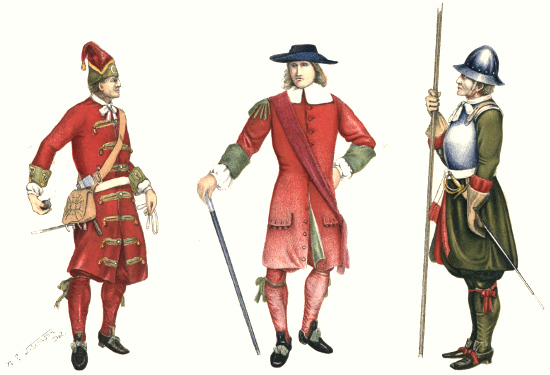
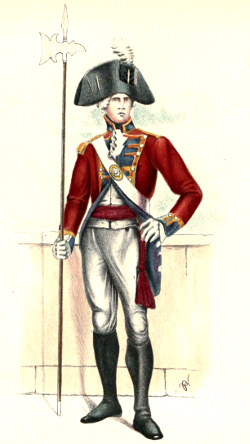
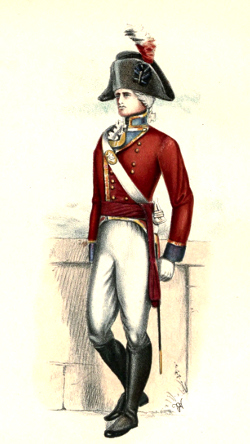
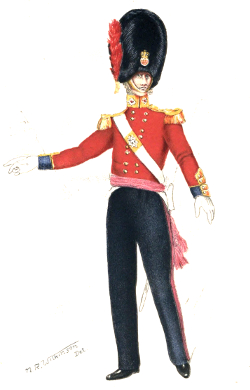
GRENADIER COMPANY 1670. DRUM MAJOR 1670. PIKEMAN 1669.
N. R. Wilkinson del. A. D. Innes &Co London Mintern Bros Chromo.
19During this time the Germans, Austrians, and Russians were
advancing to the capital, and, although the war was practically concluded
by the Military Convention just signed, yet it languished for
a few months longer in some of the provinces. The North-German
Corps (26,000 men), formed of contingents brought together by
the petty Princes, was occupied in the beginning of July, in reducing
some of the French fortresses on the north-east frontier. The
Austrian army, under Prince Schwartzenburg, including Saxons
and South Germans, and amounting to more than 250,000 men,
had its advanced troops between the Seine and the Marne, near
La Ferté-sous-Jouarre, on the 10th of July. The Russians, under
Marshal Barclay de Tolly (nearly 170,000 men), were at Paris
and in its vicinity by the middle of July. A combined Austro-Sardinian
army (60,000) was in the south-east of France, and
completed, during that month, the subjugation of the districts in
that quarter.[25]
Besides the various expressions of thanks to the gallant army
that destroyed the power of Napoleon at Waterloo, to which
allusion has already been made, letters were published in General
Orders, July 2nd, from the Commander-in-Chief, H.R.H. the
Duke of York, and from the Secretary of State for the Colonies
and for War, Earl Bathurst, conveying the admiration felt at the
conduct of the troops.[26] On the 5th, the resolutions of thanks
passed by the House of Lords and by the House of Commons
were published in General Orders;[27] and, on the 17th, those of the
Common Council of the City of London (dated July 7th) were
communicated to the troops in the same manner.
Towards the end of July it was determined, in recognition of
the “conspicuous valour” displayed by the army “in the late
glorious victory,” to grant: (1) increase to the pensions allowed to
Officers for wounds, according as they might be promoted in the
service; (2) to all Subalterns in the Infantry of the Line and in the
Cavalry, and to all Ensigns of the Guards, at Waterloo, two years'
service, so as to qualify them for extra pay after five, instead of
seven, years' service; (3) to every Non-commissioned officer, private,
etc., present at the battle, the distinction of being called a
20“Waterloo man,” and to every “Waterloo man” two years' service
in reckoning his service for increase of pay or for pension, when
discharged,—but this indulgence was not otherwise to affect the
conditions of his original enlistment. These arrangements were
notified on the 5th of August.[28]
The Reverend John Norcross, Framlingham Rectory, Suffolk,
having promised to settle an annuity of ten pounds—to be called
the “Wellington Pension”—upon one of his “brave countrymen
who fought in the late tremendous but glorious conflict,” to be
selected by the Duke, the latter chose Lance-Sergeant Graham,
Coldstream Guards, for that honour. The record shows that
Sergeant Graham “assisted Lieut.-Colonel Macdonell in closing
the gate” (at Hougomont) “which had been left open for the
communication, and which the enemy was in the act of forcing;
he shot the leading man. His brother, a corporal in the same
company, was lying wounded in a barn on fire; Sergeant Graham
removed him a short distance secure from the fire, and returned
again to his duty. Three years and two months in the Regiment.”
Another man, also recommended to the Duke, was Private John
Lister, Third Guards, whose conduct was noted for particular
bravery during the whole day.[29]
On the 29th of July, H.R.H. the Prince Regent granted to all
Ensigns of the three Regiments of Foot Guards then serving, and
afterwards to be appointed, the rank of Lieutenant, as a mark of
Royal approbation of the distinguished gallantry of the Brigade
of Guards in the important battle which had just taken place.
Thereby was completed the system of the “double rank” which
had existed in the Household Infantry for many years. Captains
of the First and Coldstream Guards had been given the rank of
Lieutenant-Colonel in 1687, and four years later, in 1691, Captains
of the Scots Guards received the same privilege; while all Lieutenants
of the three Regiments of Foot Guards were upon that
occasion given commissions of Captains in the army.[30]
During the halt which was made at Le Cateau on the 23rd
21of June, a return was ordered, giving the number of killed, wounded,
and missing, casualties of the fighting that took place between
the 16th and 18th inclusive.[31]
Some changes took place in the army during the six months
that followed the battle of Waterloo.
The Prince of Orange, having to return to Holland, on the 22nd
of June, Major-General Sir John Byng assumed temporarily the
command of the First Army-Corps until the 12th of July, when
he reverted to his position of Commander of the Division of Guards
until the 23rd; he was then replaced by Major-General Sir Kenneth
Howard (late Coldstream Guards), and he re-assumed the command
of the 2nd Guards Brigade, the 1st being still under Major-General
Maitland. Owing to the absence of the Prince of Orange, the
command of the First Army-Corps devolved upon Sir Kenneth
Howard on the 22nd of August, when Sir J. Byng again reverted
to the Guards Division, and remained at their head till further
orders; thereupon Colonel Hepburn (Third Guards) became
Brigadier of the 2nd Guards Brigade. On the 2nd of October,
Sir J. Byng having obtained leave of absence to proceed to
England, Major-General Maitland took command of the Division
until his return.
22On the 20th of June, Captain Walton, Coldstream Guards, was
temporarily appointed Brigade-Major of the 2nd Guards Brigade,
vice Stothert, Third Guards, who was severely wounded, and who
subsequently died. On the 6th of November, Captain Prince was
appointed Adjutant of the 2nd Battalion Coldstream Guards vice
Major C. Bentinck, who, upon the death of Captain Lascelles, was
posted to the 1st Battalion as Senior Adjutant.[32]
The following Officers, belonging to the 1st Battalion, were
ordered, on the 22nd of June, to hold themselves in readiness for
foreign service, viz. Colonel Sir. H. Bouverie, Captains Shirley
and Girardot, and Ensigns Clifton and Salwey; next day Captain
Sandilands received a similar order. With the exception of
Sir H. Bouverie and Ensign Clifton, these Officers were posted
to the 2nd Battalion on the 27th till further orders, and at the
head of a detachment of two hundred men, they reached Paris on
the 19th of July. Previous to this date, on the 1st, a redistribution
of Subaltern Officers of the Battalion in France had been made, by
which: Captain Anstruther was posted to the Grenadier company,
Captain Sowerby and Ensign Short to the 1st, Ensign Hon. J.
Forbes to the 2nd, Captain Cowell and Ensign Hon. W. Forbes
to the 3rd, Ensign Gordon to the 4th, Ensign Douglas to the 5th,
Captain Lord Hotham to the 6th, Ensign Buckley to the 7th,
Ensign Hervey to the 8th, Captain Bowles and Ensigns Gooch
and Buller to the Light-infantry companies.
It was about this time that the present soldier’s small account-book
was introduced into the British army. By a letter from
Lord Palmerston, the Secretary-at-War, to the Duke of Wellington,
dated War Office, August 31, 1815, “in order to remedy the
inconvenience and delay experienced in the adjustment of the
claims of the soldiers,” it was determined that “a book should be
kept by every Non-commissioned officer, trumpeter, drummer, fifer,
and private man of His Majesty’s regular forces, calculated to show
the actual state of his accounts.”[33] This book was introduced by
Horse Guards letter on the 6th of October following, and regulations
were made to ensure that the accounts should be correctly
23made up to the 24th of each month, and to oblige the men to keep
their small books in their own possession, and in good order.
The Coldstream Guards contained the following Officers, in
November, 1815:—
Colonel.—Field-Marshal H.R.H. Adolphus, Duke of Cambridge, K.G.
Lieut.-Colonel.—Colonel Hon. H. Brand, C.B.
Majors.—First Major—Colonel Sir R. D. Jackson, K.C.B.
Second ” —Colonel A. Woodford, C.B.
Captains.—Colonel Sir H. Bouverie, K.C.B.; Lieut.-Colonels James
Macdonell, C.B.; J. Hamilton; and L. Adams (Mounted).
Lieut.-Colonels H. Loftus; W. H. Raikes; F. Sutton; F. Milman;
T. Gore; T. Barrow; D. MacKinnon; Hon. J. Walpole; H. Dawkins;
Colonels Hon. A. Abercromby, C.B.; Sir C. Campbell, K.C.B.;
Lieut.-Colonel Hon. E. Acheson, C.B.; Colonel Sir R. Arbuthnot,
K.C.B.; Lieut.-Colonels Sir W. Gomm, K.C.B.; Hon. H. Pakenham,
C.B.; and H. Wyndham.
Lieutenants.—Lieut.-Colonel T. Steele; Major G. Bowles; Captains T.
Sowerby; P. Sandilands; Lieut.-Colonel J. Fremantle, C.B.; Captains
J. Prince (Adjutant); J. V. Harvey; W. Walton (Brigade-Major in
France); A. Wedderburn; C. White; T. Bligh; C. Shawe; Major C.
Bentinck (Adjutant); Captains J. Talbot; W. Baynes; W. Stothert;
J. S. Cowell; W. Grimstead; Lord Hotham; W. Anstruther; Hon.
J. Rous; C. Shirley; J. Drummond; Hon. R. Moore; C. Girardot;
T. Chaplin; E. Clifton; H. Salwey; G. G. Morgan.
Ensigns.—Lieutenants T. Duncombe; Hon. J. Forbes; T. Powys; H.
Gooch; A. Cuyler; M. Beaufoy; W. Kortright; H. Armytage; Hon.
W. Rous; H. Bentinck; F. Shawe; H. St. J. Mildmay; F. Buller;
H. Griffiths; J. Buller; J. Montagu; J. Hervey; H. Vane; F.
Douglas; R. Bowen; F. FitzClarence; A. Gordon; Hon. W. Forbes;
C. Short; H. Serjeantson; R. Beamish; Lord Wallscourt; Jasper
Hall; J. Jenkinson; W. Cornwall; H. Murray; and E. Duke.
Quartermasters.—T. Dwelly; and B. Selway.
Surgeon-Major.—J. Simpson. Battalion Surgeons.—J. Rose; and W.
Whymper. Assistant Surgeons.—T. Maynard; G. Smith; S. Worrell;
and W. Hunter.
Solicitor.—J. Wilkinson, Esq.
CHAPTER II. MILITARY OCCUPATION OF FRANCE
24
Termination of the war—Difficulties of the situation—The Allies occupy Paris—Dissolution
of the Provisional Government—Entry of Louis XVIII. into the capital—New
French Government formed—Blücher and the Pont de Jena—Arrival of the
Allied Sovereigns—Reviews in France—Paris in the hands of the Allies—Treatment
of the French by the Prussians; by the British—The wreck of the French
Imperial forces disbanded—Life in Paris—The Louvre stripped of its treasures of
art—Prosecution of Imperialist leaders—Labedoyère, Ney, Lavalette—Peace of
Paris, November 20th.
The long period of the wars of the French Revolution, which
devastated the continent of Europe for more than twenty years,
had now definitely come to an end, and another era was about
to dawn upon the civilized world. France, who had provoked the
struggle and prolonged the strife to satisfy the craving of a restless
ambition, was at last crushed; and the military chief, whose
genius had called into activity the warlike character of her inhabitants,
was captured. The common enemy was no longer to be
feared; but the balance of power in Europe had been rudely
shaken, and new ideas had taken deep root in France into the
political and social life of the people. A government had to be
established in Paris, of a nature calculated to repress disorder,
to calm the natural turbulence of the nation, and to give the
Allies pledges for future good behaviour. In short, the French
were to be invited to re-enter into the European comity of nations,
and to conform to the re-settlement which was rendered necessary
after the general disturbance that had taken place. But, in effecting
this, the interests of the enemy could not be taken into account.
Once before, France had been subdued, and, in 1814, the Allies had
expelled Napoleon, and sought to restore a general peace without
unduly oppressing the people who had been the aggressors. The
attempt failed, for the Emperor returned to Paris, and thereby he
25re-kindled the torch of war, and revived the baneful policy which
threatened his neighbours with destruction. France had participated
in Napoleon’s act, and had received him once more as her
ruler; and, being defeated, she had little to expect from the forbearance
of the victors. She was thus treated as a conquered
country, and was subjected to some of the indignities which her
soldiery had, in their turn, inflicted for so long a time upon her
present masters.
And yet the task of a French reconstruction was by no means
an easy one. The vitality of the nation, homogeneous and patriotic,
at once forbade the Allies from any attempt to dismember it, even
if their mutual jealousies had allowed them to adopt such a proposal.
The only feasible plan was to give the people a ruler who
could and would control the explosive forces which existed among
them, and put an end to the dangers that menaced Europe by
reason of the warlike and unscrupulous character they had displayed
in the past. But the Allies, in carrying out this policy,
forgot that it was of the first consequence to the future wellbeing
of the Monarchy, to place Louis in an independent position,
and, instead of restoring him to his kingdom by force of hostile
bayonets only, to attain to the same end, by fostering the movement
towards Royalism, which France began to develop after the battle
of Waterloo. The downfall of Napoleon and the rejection of his
dynasty had left three solutions, and only three, for the future
government of the country. A Republic might have been formed;
a popular King might be set up in the person of an Orleanist prince,
who would accept the tricolor flag; and, lastly, the legitimate rule
of Louis could be established. The first two solutions were contrary
to the spirit of the age, they gave no security for future
tranquillity, and the Allies set their faces firmly against either of
them. There remained the third, which was the avowed object
of the conquerors, and it was obvious that it could best be reached
by causing the people to recall their King of their own accord.
This had been the proposition of Marshal Davoût and of others;
and, while their views were possibly more in advance than could
have been agreed to without modification, yet, had the matter been
left in English hands, there is little doubt that the King’s restoration
would have been effected, with the least shock possible to
French susceptibilities, and the new order based on a firmer
foundation than was given to it. But the British Government
26had others to consult, and the Allies, smarting under the injuries
to which they had been subjected for more than twenty years,
were not inclined to be too conciliatory.
Nor was this the only difficulty; for the French themselves,
hopelessly divided into two hostile camps, were unable to come
to any satisfactory agreement. On the one hand, there were the
followers of the King, reactionary in feeling, who remembered
with bitterness the cruelties they had experienced during revolutionary
times, and who, now that they were supported by victorious
armies, demanded the revival pure and simple of the ancien
régime. On the other hand, there was Imperial and Revolutionary
France—the nation itself,—who, having irrevocably adopted new
canons of social and political existence, endeavoured to make
terms with the party in power for the protection of the people.
There was little sympathy between the two; but the latter had
no leader, and had placed themselves unreservedly in the unworthy
hands of Fouché, who, having gauged the situation, deserted those
he was bound to support, and sought his own personal aggrandisement
by joining the party that attached itself to the King.
The keen anxiety of Louis XVIII. to save France from the
humiliations that were to be imposed upon her was undoubted;
so also was his earnest desire to reign in accordance with the
liberal spirit which the times required. He hoped to reconcile
all sections of the population, and to prove himself their deliverer,
not only from internal disorder, but also from foreign oppression.
But though his good will and generosity were unquestioned, his
prejudices remained, and were not to be eradicated even by
misfortune, and his followers and intimate counsellors were not
endowed with a similar noble spirit of forgetfulness for past
ill-treatment. France, therefore, by the will of the Allies and
with the full consent of the Royalist faction, was again to be
unconditionally placed in the King’s hands, his prerogative was
to be unfettered, and his power was to be absolute. Nor were his
first proclamations, issued to his subjects and dated the 25th and
28th of June, calculated to give much satisfaction to a people
who dreaded his rule. The King’s party, in short, had not the
wisdom to perceive that a stable Restoration must be accompanied
by a complete amnesty in favour of those, at least, who had no
further power to resist—and resistance to the old French
Monarchy had entirely ceased in the country. Hence, although
27Louis repudiated all intentions of restoring feudal rights, or of
dispossessing those who had illegally acquired lands during the
Revolution, yet he did not hesitate to threaten with punishment
the men by whose assistance he imagined Napoleon had been
able to install himself once again as Emperor.[34]
“Up to the moment of the capitulation of Paris,” says a contemporary
writer, “the Chambers continued their deliberations, and on the day when
the humiliation of the country seemed complete, the national representatives
issued a declaration of the rights of Frenchmen, resembling in its spirit and
in its principal features the Bill of Rights claimed by the Parliament of
England from William III., and it is surely a tribute of no ordinary value
offered to the Constitution of England, that, at the very time when her
army was at the gates of the French capital, our national institutions were
the objects of the perpetual eulogy, and the subjects of the imitation, of the
statesmen of the hostile nation. The constancy of the Chambers was put
to a severe trial. The King had arrived at Compiègne, and nearly a million
of foreign troops were hastening from every quarter to re-instate him on
the throne, and yet not one member in either House thought proper to
propose his restoration.... The national representatives also addressed
the people with a firmness of tone, and in a spirit of independence, that
will entitle them to the admiration of future ages:—'A Monarch,' say they,
in language similar to that held by the Convention Parliament of England,
'cannot offer any guarantee, if he does not swear to observe the Constitution
framed by the national representation, and accepted by the people; it hence
follows, that any government which shall have no other title than the
acclamation and the will of a party, or which shall be imposed by force,
and every government which shall not guarantee the rights and liberties of
a people claiming the privileges of freemen, will have only an ephemeral
existence, and will neither secure the tranquillity of France nor of
Europe.'”[35]
28How little the arrangements made in 1815 secured the
permanent tranquillity of France, is shown by the history of
that country during the last eighty years; but to these events it
is not our intention to revert, for our object is only to give as
faithful a picture as possible of what did occur at this crisis, to
describe the part which was taken in these events by the Regiment
whose annals we are engaged in recording, and to explain the
condition of affairs which presented itself to both Officers and men
during this moment of victory and of anxiety.
The barriers of Paris were placed in the hands of the Allies in
the afternoon of the 6th—in accordance with the terms of the
Military Convention—amid persistent cries from the populace of:
“No Bourbons!” “The Representative Government for ever!”
intermingled with some in favour of the fallen Emperor. On the
7th, the Prussians under Blücher marched into the town in force,
and took possession of the Luxembourg and of other places.
The Duke of Wellington, with the tact which distinguished his
conduct during this moment of triumph, contented himself with
taking part in this demonstration by despatching one brigade only
into the city, “with orders to camp in the Champs Elysées, and
near to the Place Louis Quinze, where the Duke of Wellington
will have his head-quarters to-day.”[36] The main body of the
British army were encamped in the Bois de Boulogne, to which
place the Guards Division were also brought, without any display.display.
As soon as Paris was occupied by foreign troops, the Provisional
Government dissolved itself, on the plea that the country had been
deceived by the conquerors! The message of dissolution communicated
to the Chambers, written by Fouché himself, asserted
that up to the 6th it had been believed that “the Allied Sovereigns
were not unanimous upon the choice of a prince who was to reign
in France;” that it was only then declared that “all the Sovereigns
had engaged to place Louis XVIII. upon the throne.”
The message went on to say that, as foreign troops had just
occupied the Tuileries, where the Government was sitting, “we can
only breathe wishes for our country; and, our deliberations being
no longer free, we think it our duty to separate.” Upon receiving
this news, the Chamber of Peers immediately followed the example
29given, and also dissolved. The Deputies, however, determined to
show a bolder front; and proclaiming that they were at their posts
by the will of the people, and that bayonets only could disperse them,
they continued their deliberations upon the proposed Constitution,
which they determined to offer to the King for his acceptance, as
if there was still a government in the country, and as if nothing
had happened to disturb their equanimity. But the following day
(July 8th), the farce came to an end, and they were excluded
from their place of meeting by the bayonet; the gates were locked,
a body of the Garde Nationale warned them off and made them
retire, and thus they too were obliged to dissolve.[37]
Paris was now ready to receive Louis, and his public entry
took place on the 8th. The tricolor flag was everywhere replaced
by the white standard of the Bourbons, and the people, who had
vociferously welcomed Napoleon on his return from Elba, not four
months before, now came in immense crowds to greet the King,
and acclaimed his restoration with enthusiastic joy. The scene was
gay, and the sight that presented itself to the inhabitants such as
they loved to behold; but, beneath the surface of these outward
appearances, the minds of those who had any power of reflection
were filled with depression and sadness. “Even the Royalists
were downcast: their patriotic feelings were deeply wounded by the
defeat of France; they augured ill of the restoration of the King
in the rear of the English bayonets.”[38]
Next day, the new Government was formed, and announced to
the public, at the head of which was Prince Talleyrand, who also
became Minister for Foreign Affairs. It included, besides, men
belonging to different parties, for Louis was anxious to get the
confidence of all; and lastly, it contained the name of Fouché,
who, having succeeded in shaping the anarchy, which followed the
30fatal 18th of June, to the benefit of the Royal cause, received,
much against the King’s inclination, the portfolio of Minister of
Police!
“Louis XVIII. was thus once more seated upon the throne of his fathers,
but he reigned only in the Tuileries. To the foreign troops by which he
was surrounded he was solely indebted for his elevation. The national
will had not been consulted; and the same potent agency which placed
him on the throne could alone maintain him in his present position.
Indebted to the enemies of his country for his elevation, surrounded by a
discordant ministry, compelled to impose heavy burdens upon his people
as the price of his restoration, and forced to subscribe to conditions
humiliating to the glory of France, the opening of his second reign was
inauspicious in the extreme; but it was not utterly hopeless. Whatever
might have been the errors of his former government, or however unpromising
his present circumstances, he enjoyed personally the respect of
the French nation. The people were wearied with revolutions. Their
military passion, which, before the return of Napoleon, constituted the
great danger of the French Monarchy, was subdued; and the nation wished
for peace and a moderate share of freedom, both of which the King
possessed the power and the inclination to confer.”[39]
The difficulties of the situation were not lightened by the
extraordinary conduct of Marshal Blücher at this juncture. That
brave Commander could never forget the sufferings which the
Imperial armies had caused in Prussia, nor the indignities imposed
upon his country by the intolerance and the arrogance of Napoleon,
when at the zenith of his power, in Berlin. He regarded the
French nation as responsible for the outrages which had been
inflicted, and, now that he was able to have his revenge, he determined
to take it. He refused to hold any communications with
the King, or with the new authorities who had been re-introduced
into office by the co-operation of his own Government; and he
desired Baron Müffling, appointed Military Governor of Paris, to
levy a contribution of 100,000,000 francs on the town, as well as
clothing sufficient for 110,000 men.[40] But not content, he went
still further, and insisted that one of the bridges over the Seine,
known as the bridge of Jena, should be destroyed, because it bore
the name of the battle which had been so disastrous to Prussia.
Wellington, informed of this mad project, endeavoured to intervene;
31but so blinded was his impetuous and hot-headed colleague,
that he declined to listen to any remonstrance, and began forthwith
to undermine the arches. The Duke thereupon placed a guard
of British soldiers on the threatened bridge, with orders to drive
away by force any one who should attempt to damage it; and he
intimated his determination to prevent this senseless destruction
by arms if necessary.[41] Blücher now at last was brought to reason,
and gave way; and thus an act of vandalism was prevented which
was not only a distinct infraction of the Convention of July 3rd,
stipulating that all property was to be respected, but would
also have cast a deep and lasting stain on the honour and good
name of the Allies.
Shortly after this (July 11th), the Emperors of Austria and
Russia and the King of Prussia arrived in Paris, when Guards of
Honour were found by the Brigade of Guards.[42]
About the same time, Lord Castlereagh and the other statesmen
of the allied Powers reached the capital, to negotiate the terms
of peace to which France was to be obliged to subscribe. The
conclusions agreed to, and the incidents which took place during
the occupation of Paris, will be noticed presently, but, meanwhile,
we must make a short allusion to certain military displays made
by the Allies during this period. On the 24th of July a celebrated
review of the Anglo-allied army, which had just been reinforced
by several regiments who had come to France from America—where
peace had been concluded—took place near Paris, before the
Emperor of Russia and the other Allied Sovereigns. There were as
many as 60,000 British soldiers present, the whole of the troops
being under the command of the Duke of Wellington.[43] The
demonstration was more of a pageant than anything else, and as
correct a representation as possible was given of the battle of
Salamanca. It is perhaps worth remarking that, in the General
32Orders issued, dated July 22nd, these words occur, “The Field
Marshal begs that Officers may be dressed uniformly, and, if
possible, according to the King’s orders;”[44] while the following
was also published in Battalion Orders of the 2nd Battalion Coldstream
Guards: “Officers are to appear in plain grey overalls,
jackets hooked and buttoned regimentally, sashes to be tied on
the left side.” On the 10th of September, a great review, which
seems to have created a considerable impression at the time, also
took place of all the Russian troops that were in France, near
Chalons, where 160,000 men (including 28,000 cavalry) and 540
guns were brought together.[45]
These displays, having as much for object an easy demonstration
to the inhabitants that they were completely in the power of Europe,
as an exhibition made for the purpose of satisfying the national
vanity of the different armies concerned, were perhaps not necessary
to prove to the French that their new Government rested only upon
alien arms for support. Everywhere, except south of the Loire,—where
the last remnants of Napoleon’s army had collected under
Marshal Davoût,—was the country in the military occupation of
foreigners; and in Paris especially, there were no regular troops to
be seen, other than those of Great Britain, of Prussia, and of their
allies. They guarded the King and the Royal palaces; they stood
at the barriers of the town, and they performed all the military duties
of the capital. They were to be seen at all the public buildings, at
the various and numerous hôtels where the Allied Sovereigns and
their Counsellors and principal Officers lodged, and even at the places
of entertainment where the people flocked during the balmy weather
of a French summer. Nor were these duties of a ceremonial
33character; for guard-houses were placed in nearly all the principal
thoroughfares, the bridges were held by troops, there were chains of
sentries everywhere, patrols were constantly on the move and on the
alert, and guns were kept loaded and ready for any serious emergency.
Paris was placed under the command of Baron Müffling; his
orders, dated July 23rd, for the preservation of order, were thus
conceived:—
“The Garde Nationale will perform police duties, and the garrison,
composed of the Allied troops, occupying the great centres of the town, will
remain in reserve. In case the latter have to act, for the Garde Nationale
may refuse to quell disturbances, guns will be fired, when the regular forces
will assemble at their alarm posts. The British brigade will form up in the
Avenue de Neuilly, one battalion in Place Beauveau, and another at the
junction of the Boulevard de la Madeleine and Rue St. Honoré. The
Austrian brigade will have two battalions and a battery in Place Vendôme,
a battalion guarding the Emperor, and a fourth battalion in Rue du
Montblanc, near the Boulevards des Capucins and des Italiens; the
cavalry to be in the Boulevard de la Madeleine. The brigade of Prussian
Guards will occupy the Esplanade des Invalides with two battalions; they
will have a third battalion at the Quay d'Orsay, a fourth on the Pont Royal,
a fifth on the Pont Neuf, a sixth in the Luxembourg, and a seventh,
together with the cavalry and the artillery, in the Champs de Mars. The
Prussian Grenadier brigade will occupy the Place de la Bastille, the Pont
du Jardin des Plantes, and the Place du Panthéon, with a battalion each;
and the Quai de la Tournelle and l'Ile du Palais with two battalions each;
the cavalry and artillery to be posted in the Place Walhubert. Guards in
the town and at the barriers to remain at their posts. The Governor’s
head-quarters are in Place Vendôme; the Commandants of the north and
south of the city, in Place Louis XV. and on Pont Neuf, respectively.
Patrols to keep up communication between the different stations.”[46]
An English traveller who, having visited France in 1814, returned
in 1815, thus describes some of his experiences:—
“The state of things had entirely altered, and plain indications were
given on the road to Paris, and at its entrance, that the visitor in 1815
would find it placed in circumstances very different from those which it
held in the preceding year. The time for the real humiliation and severe
punishment of the nation had now arrived; there was no longer a
disposition to save it from drinking out the bitter contents of the cup of
defeat; in short, Paris, as representing France, was now in the condition
34of one that is beaten and bound, previously to being mulcted in a heavy
forfeiture.... I found Paris in a state of very discomposed feeling and
opinion. Every Frenchman seemed acutely alive to the calamity that had
fallen upon France, and all diversities of political sentiment met in one
point of union, namely that of indignation against those who acted as the
conquerors of the country. A Royalist would say, 'Ah, it is very impolitic
in the Allies to think of taking any territory or money from France, for
good Frenchmen, united under the Bourbons, will become more formidable
than the nation ever was under Bonaparte, and woe to Europe, in the
course of a year or two, for what she now inflicts on us.' A military man
would gurgle a sacré out of his throat, and anticipate the day of revenge,
under some new leader, when France would show that she had not been
beaten, although she had been betrayed.... Going round, late in the
evening, by one of the more unfrequented walks, running through the
woods of Saint-Cloud, I came suddenly upon a strong column of British
infantry, posted in silence and order among the trees, on the hill
immediately above the amusements, that jingled upon the ear from below.
The regiment was in complete order for action, the Officers were all at
their posts; and as I passed them by in the deep shadow, I heard not a
word or even a breath, though I was close to five or six hundred men.
The Allied Sovereigns were seldom seen except at reviews, for they did
not now, as at a former time, go about to public places to scrape acquaintance
with the Parisians and keep them in good spirits. The aspect of the
alliance, as it was now settled on the inhabitants of Paris, was clouded and
severe; and a very considerable degree of reserve was maintained by the
representatives of the various Powers. Even the Court of the Tuileries
was not frequently visited by them; there were few or no courtly entertainments
and ceremonies. However friendly the Allied Sovereigns might feel
towards Louis personally, their determination to make France know that
the consequences of war are sometimes serious, occasioned a sense of
restraint, and an appearance of coolness, as between them and the Royal
Family of the Bourbons.”[47]
The military occupation of France, painful as it was to the
inordinate pride of the people—especially after their armies had
run riot in every capital of the Continent,—was rendered still
more unbearable by the excesses which the Prussians indulged
in. Following the example set by their gallant, but irrational,
Commander, both Officers and men exercised their authority in a
harsh and often in a brutal manner. Forgetful of what they owed
to Louis XVIII., whose restoration absolved the French from past
offences, and mindful only of the grievous tyranny which they had
35experienced, they made the unfortunate inhabitants feel the full
measure of their revenge, by their arrogance and exactions.
“Blücher’s troops were billeted in every house; he obliged the inhabitants
to feed and clothe them; and he issued an order (which I well recollect
seeing), commanding the authorities to supply each soldier with a bedstead
containing a bolster, a woollen mattress, two new blankets, and a pair of
linen sheets. The rations per day, for each man, were two pounds of
butcher’s meat, a bottle of wine, a quarter of a pound of butter, ditto rice,
a glass of brandy, and some tobacco[48].... Blücher’s Generals occupied
all the best hôtels in the Faubourg St. Germain; General Thieleman that
of Marshal Ney, where he forcibly took possession of the plate, carriages,
and horses. Other Prussian Generals acted in a similar manner. The
Russian and Austrian armies with the two Emperors entered Paris soon
after our arrival. The Emperors imitated Blücher in some respects; they
refused to quarter their soldiers in the large and wholesome barracks which
were in readiness to receive them; they preferred billeting them with the
peaceable merchants and tradespeople, whom they plundered and bullied
in the most outrageous manner.”[49]
It is pleasant to record that the Duke of Wellington adopted an
entirely different system in his relations with the inhabitants; everything
was paid for regularly, property was respected, and the people
were unmolested. In short, the British army set an example of
humanity, generosity, and forbearance, which not only did honour
to their country and to their noble profession, but which also (notwithstanding
national antipathies), gained them the respect and
almost the affection of the French themselves.[50]
In this connection, a quaint conversation between the English
traveller (already quoted) and some Highlanders he came across in
Peronne, may be noticed here. The latter, bivouacked, not billeted,—they
said they seldom troubled the inhabitants for billets,—had only
one thing to regret, viz. that they did not get the liberty “that ither
sogers get—the Prussians and them,” for “there’s nae use in our
36being mealy-mou’d, if the ithers are to tak' what they like, the d—d
Prussians ken better what they’re about,” and although, “ilka body
praises us, but very few gie us ony thing.” In reply to the question,
whether the Duke of Wellington took severe measures to enforce
his principles regarding the lives and property of the inhabitants
at the seat of war, they said: “Na, sir, no here, for the men ken him
gailies now; but in Spain we aften had ugly jobs. He hung fifteen
men in ae day there, after he had been ordering about it God knows
how long. And d—n me if he didna ance gar the Provost-Marshal
flog mare than a dizen of the wimen; for the wimen thought themselves
safe, and so they were war’ than the men. They got sax and
therty lashes a piece on the bare doup, and it was lang afore it was
forgotten on ’em. Ane o’ ’em was Meg Donaldson, the best woman
in our regiment, for whatever she might tak’ she didna keep it a’
to hersel’.”[51]
The demeanour of the British troops was friendly to the French,
and few brawls took place between them; this contrasted with what
occurred to the Prussians, who had frequent and fierce encounters
with the populace. The English soldiers were usually to be seen
on the Boulevard du Temple, which at that time was an open space
(but has since then been built over), and there they used to amuse
themselves by watching jugglers, mountebanks, rope-dancers and
other shows. A certain number of men of the armies of occupation
were admitted free into the theatres; and we are told that a party
of Guardsmen, headed by a sergeant, saw a piece admirably put on
the stage, entitled Les Anglaises pour rire, in which Englishwomen
were grotesquely caricatured. Not understanding the language, nor
the acting, and being indignant at the insults they supposed were
levelled against their countrywomen, the honest fellows stormed the
stage, and drove off, not only the actors, but the police who attempted
to arrest them. “It must be remembered that the only revenge which
the Parisians were able to take upon their conquerors, was to ridicule
them; and the English generally took it in good humour, and
laughed at the extravagant drollery of the burlesque.” Notwithstanding
these minor disputes, good feeling existed; and although
numerous Prussians were assassinated in Paris and in the country,
there was only one soldier of British nationality found dead in the
streets of the capital, and, in his case, there were no signs of violence
upon him.[52]
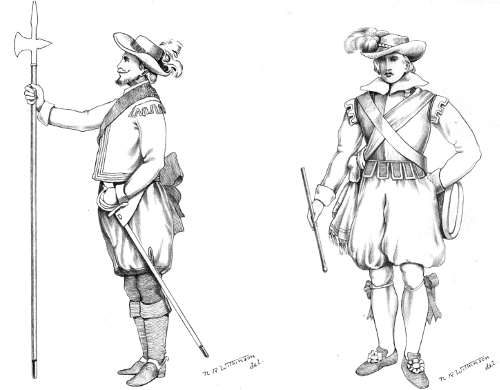
SERGEANT. 1658. DRUMMER. 1658.
N.R. Wilkinson del. A.D. Innes & Co London. Mintern Bros. lith.
37That Wellington should be appealed to, to lighten the burden
placed on the miserable people who groaned under the invader’s
despotism, is natural enough; and there are petitions recorded
on the part of the inhabitants of Le Cateau and Roye, asking
that British troops might continue to garrison those towns, so that
they might be placed under their protection.[53] But it was not always
that he could do anything for them. We find, for instance, M. de
Breteuil, who, according to himself, was “one of the most faithful
subjects of Louis XVIII.” and who had “given the King proofs of
devotion,” complaining bitterly that not only was his house and
property, situated at three leagues distant from St. Quentin, pillaged,
but that the town itself was mulcted in a sum of 1,200,000 francs, of
which he had to pay 20,000 (£800), because he had a single house
there, “which brings in nothing, and is, on the contrary, full of
soldiers.” To this complaint, Wellington could only reply, “I have
no troops in St. Quentin, and never had any in that town. I think
you ought to address yourself to Marshal Prince Blücher.”[54]
Nor was the King unmindful of what he owed to the British army
for their discipline; for, having invited the principal Officers to the
Tuileries, and having formed them in a circle about him, he told
them, in broken English, in the presence of the Emperor of Austria,
“I congratulate you, gentlemen, upon the result of your valour and
conduct; but I am most grateful to you for your generosity and
humanity towards my poor misguided people; the father and the
family will for ever hold it remembrance.”[55]
In order to give employment to the men under his command,
and to help the French peasants, at a time when labour was very
scarce, the Duke of Wellington allowed British soldiers to reap the
harvest. The owners of the harvest were to make their own bargains
with the men direct, but application for labourers were to be made
38by the mayors of districts, and not by private individuals.
Commanding Officers also were to know exactly where each soldier
was employed; and the men were to return to their regiments every
night, if possible, or at all events twice a week.[56]
Towards the end of October, the Division of Guards, hitherto in
the Bois de Boulogne, marched into Paris, and occupied on the
30th, the Casernes Rue Verte, Montblanc, and Rue Temple, the
Palais Louis XV., and the Abbatoire de Roule. The 2nd Battalion
Coldstream Guards were thus lodged in barracks in the capital;
and the general alarm post for the Division was the Palais Louis
XV.[57] At the same time, a general change of quarters took place
among the whole of the British troops, and camps were abandoned
for houses. Wellington issued on the 28th of October, strict orders
for the protection of the inhabitants, to apply whenever men were
to be billeted, or when they were marching through the country.[58]
We left the wreck of Napoleon’s beaten army south of the Loire,
where they were under the command of Marshal Davoût. There
was nothing more for them now to hope, and their Commander soon
persuaded them to conform to the circumstances of the hour, and,
throwing aside their Eagles, to hoist the white flag of the Bourbons,
and to adopt the white cockade. This they did, and shortly after,
by Royal decree, dated the 23rd of July, they were disbanded.
At the same time, a new army was forthwith to be formed, to
consist of eighty Legions of infantry (103 officers and 1,687 men
each), one to be raised in every Department, and to bear its name;
forty-seven regiments of cavalry, and twelve regiments of artillery,—or
a military force of some 200,000 regular troops. Disbanded
39Imperialists were allowed to engage after proper examination.[59]
The command was entrusted to Marshal Macdonald, who had remained
firm in his allegiance to the King, during the whole of the
Hundred Days of the second French Empire; and he replaced
Davoût, who resigned.
Immediately hostilities came to an end by the Convention of
the 3rd, a large number of English people went over to Paris, on
business or pleasure, and settled in that gay capital, almost as if it
had been their own. Coaches were soon brought over, and horse-racing
introduced, contrasting very much in the disfavour of the
native sport, which the King endeavoured to encourage, but which
was then quite in its infancy. In short, the English made themselves
thoroughly at home.
“Going along the Rue du Faubourg St. Denis, we saw many of the British
privates sauntering with a lazy air of enjoyment, looking at the print stalls
where they were caricatured, cheapening grapes with the fruit girls, or
treating themselves to a glass of lemonade. Our Officers, too, swarmed
about, mounted—some well, some very badly; for those who could not
procure a decent animal, put up with almost any creature that had four
legs. Contrasting remarkably with the heavy cabriolets and clumsy dirty
coaches—the awkward calèches and grotesque voitures—English equipages,
complete, light, and genteel, glanced rapidly by, spattering, as foreigners,
mortification from their wheels on the vehicles of the country. To estimate
this exhibition properly, it is necessary to fancy its counterpart displayed
by Frenchmen in London; to imagine a Frenchman of fashion, vested with
magnificent amplitude of box-coat and commanding longitude of whip,
spanking his four blood greys down Bond Street and St. James’s Street, or
drawing up smartly, in a knowing style of driving, to talk over the topics
of the morning with the Officer of the French Guards, on duty at the Palace
of the King of England!”[60]
All eyes were turned to Paris at that time. Many Sovereigns
were living there—the Monarchs of Austria, Russia, Prussia, Holland,
Bavaria, Wurtemburg, and France, and several independent
Princes of Germany. They were accompanied by some of the
most distinguished statesmen and diplomatists of the age; and
military leaders were also present who enjoyed a European reputation
for their achievements in the field. Events of transcendent
importance were taking place in this capital; and the fate of a
40great and gallant nation, outlawed for a quarter of a century,
and now reduced to submission, was being decided. Curiosity
urged many to go to France, from all parts of Europe, at this
historic juncture; the pleasures of society moved others, and duty
took a still larger number there. “All the world’s in Paris,”[61] was
indeed true, and crowds flocked to that city; while the discordant
elements to be found there, and the strange medley of Frenchmen,
Englishmen, and foreigners of almost every nationality, brought
together and kept together, at such a time and at such a place,
presented at once a scene that was both unique and remarkable.
Paris was gay and dissolute, and the Palais Royal might be
called the centre of dissipation.
“Mingled together, and moving about the area of this oblong square
block of buildings, might be seen, about seven o’clock p.m., a crowd of
English, Russian, Prussian, Austrian, and other Officers of the Allied armies,
together with countless foreigners from all parts of the world. Here, too,
might have been seen the present King of Prussia” (the late Emperor
William I. of Germany), “with his father and brother, the Dukes of Nassau,
Baden, and a host of Continental Princes, who entered familiarly into the
amusements of ordinary mortals, dining incog. at the most renowned
restaurants, and flirting with painted female frailty.”[62]
The Palais Royal contained the principal, but by no means the
only, gambling hell in Paris, and these constituted the “very
fountains of immorality.” “There were tables for all classes; the
workman might play with twenty sous, or the gentleman with ten
thousand francs. The law did not prevent any class from indulging
in a vice that assisted to fill the coffers of the municipality of
Paris.”[63]
In such a society it was only natural that constant disputes
should arise between men who gave way to dissipation, and who,
full of life and spirits and of national prejudices, had little to
occupy them beyond the mere routine of military duty. Men’s
minds were in a state of excitement, and all were engaged in
defending interests which frequently conflicted with those of their
temporary companions. These disputes could only be settled at
that time by the sword or pistol. Numerous duels accordingly
took place, sometimes between Royalists and Imperialists, and
often between Frenchmen and the representatives of the invaders.
41It is stated that in almost every case the aggressors were the
French; and while the English Officers had sometimes to defend
themselves against the insolence of the natives, it appears that the
Prussians, who used to congregate at the Café Foy in the Palais
Royal, were the principal victims of Gallic fury, and were assailed
more pertinaciously than the rest by half-pay French Officers, who
went on purpose to pick quarrels with them.
“Swords were quickly drawn, and frequently the most bloody frays took
place; these originated, not in any personal hatred, but from national
jealousy on the part of the French, who could not bear the sight of foreign
soldiers in the capital.... On one occasion our Guards, who were on duty
at the Palais Royal, were called out to put an end to one of these encounters,
in which fourteen Prussians and ten Frenchmen were either killed or
wounded.”[64]
France was the possessor of the most extensive collection of
works of art ever before known; acquired, not by the genius of
her people, but by the grasping policy of her Imperial master.
Napoleon, having taken possession of every large city in continental
Europe, during the plenitude of his power, had systematically
seized all that was remarkable therein, and had transferred
his plunder to Paris. The French were inordinately proud of this
vast and unique collection, which served to flatter their vanity and
to form a lasting monument of their extraordinary military successes.
It had been untouched by the Allies in 1814, but in 1815
the disturbers of Europe were to be severely punished, and the
stolen property was to be restored to its former owners. Attempts
having failed to effect a restoration amicably, owing to the opposition
of Talleyrand, forcible possession of the Louvre was taken
on the 23rd of September, by a body of British troops, and with
the assistance of Austrians and Prussians, the splendid galleries of
that palace were stripped of those treasures of art, which belonged
principally to Italy and to the Netherlands. Out of fifteen hundred
celebrated pictures, it is said that only seventy-four were left in
Paris. The restoration of the statuary was not less complete; and
the well-known antique Corinthian bronze horses, taken from
Venice, to form, in the Place Carrousel, the supporters of the great
monument, designed—but not finished—to perpetuate Napoleon’s
fame, were taken down and conveyed back to that city. Nothing
42affected the Parisians so much as this act of strict justice; for it
showed them their own absolute weakness and humiliation, and it
wounded their pride in the most sensitive point.[65]
The policy of revenge and proscription against persons who
aided and abetted Napoleon in the early part of 1815, which had
been announced in the proclamations issued by Louis at Cambrai
before he entered Paris (June 25th and 28th), was not to
remain a dead letter; and we have now to mention some of the
saddest incidents which took place at this crisis in French history,
and which were witnessed by the British army. Fouché had
become Minister of Police. He justified his acceptance of that
post by declaring that he wished to save the men who were
threatened with vengeance.[66] Upon him it devolved to carry out
this policy, and though he did so with outward reluctance, and told
the King that there had been no conspiracy to dethrone him in
favour of Napoleon—which appears to have been quite true, for
all acted on the wild impulse of the moment,—yet still he was not
ashamed to come forward in the odious light of an accuser against
his former friends. On the 24th of July, two ordinances, countersigned
by himself, were published, by which thirty-two Peers who
had joined Napoleon’s Upper House, established since the 20th
of March, were declared to have forfeited their rights to the
French Peerage; twenty Officers and other Officials were at the
same time ordered to be arrested, and brought to trial before a
court-martial; and thirty-nine more were desired to quit Paris in
three days, to places pointed out by the Minister of Police, and to
remain there under his supervision, until the new Chambers should
decide whether they were to be banished, or delivered over for trial
to the tribunals.[67]
43The first victim put upon his trial was General Labedoyère,
who commanded the regiment at Grenoble that deserted its post
and joined Napoleon in his famous march from Cannes to Paris.
His defection had given the first signal to the universal revolt
against the King’s authority that followed, and was one of the causes
of the Emperor’s success; the partisans of the King were therefore
more than ordinarily embittered against him. He admitted
the facts of his treachery; he contented himself by defending his
honour by declaring that, though he might have been misled by
illusions, by recollections of his former master, and by a false idea
of honour and of what was due to his country, he was no traitor
or conspirator, and hoped that his death might atone his error. He
was shot on the 19th of August.August.
Next day Marshal Ney, who had been previously apprehended
in the Department of Lot, was examined at the Conciergerie; but
his case was adjourned till later in the year. Meanwhile the
King’s Government was overthrown, in September, and an ultra-Royalist
Ministry established, with the avowed intention of showing
no clemency to the proscribed. Ney’s trial accordingly took
place early in November, and he was at first arraigned before a
court-martial of four Marshals.[68] But the latter decided that the
prisoner, being a Peer, was entitled to be judged by his peers, and
it devolved upon the Upper House to do so. His guilt was
44clearly established, and it was rendered all the more heinous by
the protestations of loyalty with which he quitted Louis when he
left Paris to arrest the progress of Napoleon, promising to bring
the latter back in an iron cage. For some days he remained true
to his duty, but, though a brave man, he was singularly impulsive,
and was not endowed with much discretion or judgment. A frenzy
of delirium had seized hold of the Royal troops, who were flocking
to Napoleon’s standards, and Ney began to fear that he had not
sufficient force to resist his former master; his moral courage
began to fail. Dreading, above all things, a civil war, he resolved
that no step of his should precipitate such a calamity; believing
that the cause of the Bourbons was irretrievably lost, and, carried
away by the violent excitement of the moment, he forgot his
promises and the trust reposed in him, and wildly threw in his lot
with the Emperor.[69] Thereby he dealt a final blow to the fortunes
of the King. For his defence, it was pleaded that the Military
Convention of the 3rd, had guaranteed that no person in the
capital should be disturbed or called to account, for his conduct
or political opinions; but the Chamber refused to entertain the
plea, and he was condemned to death by one hundred and thirty-nine
votes against seventeen (December 6th). Strenuous efforts
were made to obtain the prisoner’s release on account of the
Convention, and applications were addressed to the Duke of Wellington,
Lord Liverpool, and even to the Prince Regent on the
subject. But these high authorities declined to do anything for
him, on the ground that the Convention related only to the military
occupation of Paris, and that, while the article in question prevented
the Allies from adopting measures of severity towards
persons in the capital, yet it did not, and could not, prevent the
French Government from acting in this respect, as they might
deem fit.[70]
The execution took place in the gardens of the Luxembourg
palace, at nine o’clock in the morning of December 7th, when
Ney met his death with calmness and courage. It shed a deep
gloom over Paris, and did little, as might have been expected,
to serve the King. Had Louis shown clemency to the man who
had deeply wronged him, and whose reputation had thereby
45become sullied, instead of proceeding to extremities by violating
the Convention of July 3rd, his credit would have been raised.
While the justice of such action becomes all the more clear, since
it was stipulated that, in the case of difficulties arising, a favourable
interpretation was to be given to the claims of the French army
and of the city of Paris. Further, as foreign armies have no right
to punish the inhabitants of a conquered State for political opinions
or conduct, the Convention either bound Louis, on whose behalf
the capital was taken, or else it had no value whatsoever.[71]
The third and last victim selected for vengeance by the ultra-Royal
party was General Lavalette, a relation by marriage of the
Emperor, and Director of Posts, who was convicted of having
misused his power in favour of Napoleon, when the latter reached
Fontainebleau in March. Having been in civil employ, he was
condemned to death by the guillotine; and the sentence, in spite
of appeals to the mercy of the King, was to be carried out on
December 21st. In this case, however, the Government were
baulked of their prey, and the prisoner made good his escape by
the courage and devotion of his wife, with the assistance of three
Englishmen. His wife having exchanged dresses with him, Lavalette
got out of prison; but he remained in hiding in Paris for
more than twelve days, not being able to leave the closely guarded
city until the 8th of January; when, by the co-operation of Mr.
Bruce, and Captain Hutchinson, Grenadier Guards (afterwards Earl
of Donoughmore), he drove to Compiègne in an open carriage, disguised
as a British Officer, and accompanied by General Sir Robert
Wilson. It was with difficulty that the latter piloted him out of
France, but this was at last managed successfully. Sir Robert then
returned to Paris on the 10th, and the police, having received information
of the facts of the case, he, Captain Hutchinson, and
Mr. Bruce were immediately arrested and confined, awaiting trial,
till the 22nd of April, 1816, when they were condemned to be imprisoned
for three months. That a distinguished Officer of high
rank in the British army, and well known in Europe for his personal
animosity against Napoleon, should have actively interfered to save
the life of one of the latter’s best friends, was a sufficient reason to
put a stop to further acts of the bloodshed, which cast so unnecessary
a shadow over the first months of the restoration of King Louis.[72]
46The negotiations which had been going on continually between
the Allied Sovereigns and Louis XVIII., ever since they and
their counsellors arrived in Paris, terminated at last by a treaty
of peace, dated November 20th. There were matters of considerable
difficulty to be discussed, before a general agreement
could be arrived at between so many independent nations, whose
interests were not all identical. The situation, moreover, was
somewhat complex, and this is shown by Lord Liverpool who,
writing to Mr. Canning, on the 4th of August, says:—
“By demanding considerable sacrifices from France for the security of
Europe, we unavoidably lower the character of the Government, which it is
our wish to uphold; on the other hand, the stability of that Government,
after the Allies shall have evacuated France, is so very problematical, that
we should not do our duty to Europe if we looked to no other security than
that which the legitimate government of the King of France could in itself
hold out to us.”[73]
By the Treaty, the eastern frontier, from the North Sea to the
Mediterranean, was restricted generally, to the line that existed in
1790; and thus the French lost a strip of territory which, in
1814, had been ceded to them, including the fortresses of Landau,
Sarre-Louis, Philippeville, and Marienburg. France had moreover
to pay a war indemnity of 700,000,000 francs, for the expenses
of the war. Further, an army of not more than 150,000 men,
formed of British, Russian, Austrian, Prussian, and German troops,
in about equal proportions, and under a Commander-in-chief
appointed by the Allied Sovereigns, was to occupy seventeen
fortresses along the northern frontier, from Condé, Valenciennes,
Bouchain, and Cambrai, to the tête de pont of Fort Louis on the
Rhine. The occupation was to continue for three years certain,
and might last for another two years. This mixed army was
placed under the supreme command of the Duke of Wellington,
and all the expenses incurred by it were to be defrayed by the
French. It was understood that the primary object of these latter
stipulations was to preserve Louis on the throne, and to give time
for the consolidation of his government. Lastly, a sum of 835,000,000
francs was exacted by way of compensation to the Powers, for the
spoliations and losses which they suffered during the Revolution,
47and to indemnify the minor States for their recent expenses. Thus,
the French had to submit to the payment of more than sixty-one
million sterling, as the result of their defeat; and this sum did not
include the vast amounts which were otherwise taken from them,
under the head of contributions for the armies that invaded their
country, or that were to be maintained there, for the purpose of
inducing them to conform to the new order which had just been
established.[74]
CHAPTER III. OCCUPATION OF FRENCH FORTRESSES.
48
Organization of the Allied army of occupation, under the supreme command of the Duke
of Wellington—Return of the remainder to their respective countries—Instructions
of the Allied Courts to Wellington—Convention relating to the occupation, attached
to the Treaty of Paris—Positions assigned to each contingent on the north-eastern
frontier of France—March from Paris to Cambrai—Military precautions—Camps of
instruction and field exercises—Reduction of the army of occupation—Difficulties
with the French—Congress of Aix-la-Chapelle—Evacuation of France—The Guards
Brigade leave Cambrai, after nearly three years' stay there, and embark at Calais—Valedictory
Orders—The Coldstream sent to Chatham—Conclusion of military
service in French territory.
In consequence of the Treaty of Paris, November 20, 1815, the
capital was to be relieved of the unwelcome presence of the invader,
and all the troops not required for the occupation of the north-eastern
frontier were to evacuate France as soon as possible, and
to be sent back to their respective homes. Of the Allied army
of occupation, 150,000 strong, Great Britain, Prussia, Austria, and
Russia supplied a contingent of 30,000 men each; of the remainder
10,000 were Bavarians, while Denmark, Saxony, Hanover, and
Wurtemburg furnished each a force of 5000 men.
By a General Order, dated the 30th of November, the future
organization of the British contingent was notified. It was formed
of 3 brigades of cavalry (3 regiments each), 3 divisions of infantry,
and 60 guns; the cavalry under the command of Lieut.-General
Lord Combermere, and the infantry under Lieut.-General Lord
Hill. The First Division (Lieut.-General Sir L. Cole) was composed
of 3 brigades (8 battalions); the Second Division (Lieut.-General
Sir H. Clinton) of 3 brigades (9 battalions); and the
Third Division (Lieut.-General Sir C. Colville) of 3 brigades (8
battalions). The 3rd Battalion Grenadier Guards, and the 2nd
Battalion Coldstream Guards, who were ordered to remain in
49France, formed the 1st Brigade of the First Division, under Major-General
Sir P. Maitland.[75] The Duke of Wellington, having in
the same General Order provided for the return home of the rest
of the army, took leave of the gallant troops now about to be
dispersed, in these words:—
“Upon breaking up the army which the Field-Marshal has had the
honour of commanding, he begs leave again to return thanks to the
General Officers and the Officers and troops, for their uniform good
conduct. In the short but memorable campaign they have given proofs
to the world that they possess in an eminent degree all the good qualities
of soldiers; and the Field-Marshal is happy to be able to applaud their
regular good conduct in their camps and cantonments, not less than when
engaged with the enemy in the field. Whatever may be the future
destination of those brave troops of which the Field-Marshal now takes
his leave, he trusts that every individual will believe that he will ever feel
the deepest interest in their honour and welfare, and will always be happy
to promote either.”[76]
The despatch upon which the above arrangements were made
was communicated to Wellington by H.R.H. the Duke of York
by letter, dated the 9th of November, and is reproduced in an
Appendix.[77]
50The Prussian contingent was commanded by Lieut.-General
von Ziethen, and consisted of 10 infantry regiments (thirty battalions),
1 battalion of Jägers, 9 regiments of cavalry (thirty-six
squadrons), and 80 guns, formed into five brigades of infantry,
and three of cavalry.
The Austrian corps, under General Baron von Frimont, contained
22½ battalions, 28½ squadrons, and 96 guns, divided into three
divisions of two brigades each.
The Russians, under Lieut.-General Count Woronzow,—24
battalions, 6 regiments of cavalry (thirty-four squadrons),
and 84 guns: two infantry divisions (of three brigades each), and
the cavalry division (also of three brigades).
Prince Frederick of Hesse commanded the Danish contingent,—5
battalions, 4 squadrons, and 20 guns (two brigades). Major-General
Sir J. Lyon (relieved afterwards by Count Alten),
the Hanoverians,—6 battalions, 4 squadrons, and 6 guns (two
brigades). Lieut.-General Baron de Wöllwarth (replaced afterwards
by General Count Scheler), the Wurtemburgers,—6
battalions, 4 squadrons, and 6 guns. Major-General von
Gablenz, the Saxons,—5 battalions, 4 squadrons, and 8 guns.
And Lieut.-General de la Motte, the Bavarians,—3 regiments of
infantry, and 2 of cavalry.[78]
It had already been agreed by the four great Powers (Great
Britain, Austria, Russia, and Prussia), on the 22nd of October, that
the Allied armies—other than the corps required for the occupation—should
51evacuate French territory as soon as possible, and
Wellington was commissioned to make the necessary arrangements
for this purpose. Even before that date, the Russians, having a
long way to march home before the winter set in, began to move
eastwards; and Blücher intimated, as far back as the 8th of October,
that, having been desired to withdraw towards Prussian territory,
he was giving orders for the purpose of carrying out the intentions
of his Government. The evacuation, however, by the British troops,
did not begin till the middle of December, when, marching to
Calais, they were shipped over to England with the least delay
possible under the supervision of Major-General Sir D. Pack; but
adverse winds retarded the operation, and it was only completed
on the 4th of February, 1816.
When the Allied Sovereigns placed the supreme command of
the army of occupation in the hands of Wellington, they gave him
instructions to enable him to carry out the duty with which they
entrusted him. On the 20th of November, they dealt with the
political situation, by reminding him that the objects for which
their troops were stationed in France were: (1) to secure the execution
of the treaties concluded with that country, and (2) to protect
Europe from French violence, and from internal revolutionary
upheavals which were liable to take place among the people. They
said their hopes of tranquillity were founded upon the system which
they had established in the country, and they attached the greatest
importance to the maintenance of a legitimate Sovereign, in the
person of Louis XVIII. Until such times, therefore, as the forces
of the King were organized, it was to be the duty of the Allied
armies, in concert with the French Government, to protect the
capital and the Royal family from popular effervescence; with this
view the Commander-in-chief was empowered to delay his march
from Paris until His Most Christian Majesty should notify to
him that his presence in the capital was no longer necessary.
The Allied Sovereigns, moreover, did not desire their troops
to perform mere police duties, or to interfere in the internal
administration of the country; but this did not exempt them from
the obligation they were under, to maintain Louis on the throne
of France, and “to support him against every revolutionary
convulsion which might tend to upset by force the order just
established, and to compromise the general tranquillity.” They
did not disguise from themselves that it would be a delicate matter
52to judge when intervention might become necessary, but they
announced their entire confidence in the British Commander-in-chief,
to whose discretion they left the matter, should it ever arise.
In order, however, to enable him to form a correct opinion upon
it, they instructed him to take into consideration the views of the
diplomatic Agents of the Powers residing in Paris. Finally, the
latter were directed to send him, at least once a week, a united
and common report, when he was absent from the capital; and
they were also to transmit, in their corporate capacity, any communication
which he might think it proper to address to the
French Government.[79]
The military situation had been considered at an earlier date
(October 22nd), with the following conclusions: Full authority over
the Allied army was given to the Commander-in-chief, who was
enjoined to consult, as far as he could, the usages which prevailed
in each contingent. The troops of each nationality were to be
quartered as much as possible together, and on the lines of communications
leading to their respective countries; they were to be
under the immediate command of their own Generals, and everything
relating to the discipline or to the interior economy of the
various corps was to be dealt with by their own Officers. General
Officers commanding contingents were formally placed under the
supreme command of the Duke of Wellington; they were ordered
to send their reports to him, and to obey him in all the dispositions
which he might deem it his duty to make. Lastly, the French
Government were invited to arrange with him, without delay, all
matters affecting the occupation and the maintenance of the troops,
as well as the “execution of particular conventions to regulate both
these objects.”[80]
Attached to the Treaty of the 20th of November there was a
Convention, which was “as valid as if inserted word for word” in
the Treaty, and, by Article No. 4,—
(1) The Allied troops were to occupy the Departments of Pas
de Calais, Nord, Ardennes, Meuse, Moselle, Lower and Upper
Rhine, their line of demarcation being the frontiers of these
Departments respectively.
(2) A neutral zone was established between the above-mentioned
strip of French territory in foreign occupation, and the remainder
of the kingdom, in which neither the French nor the Allies were
53to maintain any military force, except for some special reason,
and then only by mutual agreement. This zone was bounded on
the south and west, by the river Somme to Ham, thence in nearly
a straight line to Chalons-sur-Marne, whence it continued to a
point between Joinville and Chaumont; from that place it took an
easterly direction to Blamont, and then ran south to the Swiss
frontier near St. Hypolite.
(3) The French were to have power to garrison certain places
within the territory to be occupied by the Allies; but the forces
to be quartered there were not to exceed the number which was
laid down, and only such war matériel and stores as properly
belonged to these places were to be kept there, the remainder to
be removed into the kingdom west of the neutral zone. Altogether
22,000 men were allowed to garrison these places, the largest
number being in the following fortresses, viz. Calais, where the
garrison was not to exceed 1000 men; St. Omer, 1500; Arras, 1000;
Lille, 3000; Dunkerque, 1000; Douai and Fort Scarpe, 1000; Metz,
3000; Strasburg, 3000; Schelstadt, 1000; Neu Brisach and Fort
Mortier, 1000; and Belfort, 1000 men.[81]
The British contingent was ready to move to its allotted stations
by the beginning of the year 1816; but a delay occurred in
consequence of the representations made by the Duc de Richelieu,
the French Minister of Foreign affairs, who believed that it would
be dangerous to leave Paris unguarded until the discussions on
the law of Amnesty, which was then being debated, had terminated.[82]
Wellington adds, “From what I have seen and heard likewise of
the King’s Guard, I don’t conceive it is as yet a body in which much
confidence could be placed, in case there should be any disturbance
in this town.”[83]
54These difficulties, however, were speedily overcome; and on the
24th of January, the Commander-in-chief of the army of occupation
wrote to the Ambassador of Great Britain and to the Plenipotentiaries
of the other Allied Powers, saying that he proposed forthwith to
evacuate the capital. These Ministers having agreed, the troops
began their march towards the fortresses on the north-eastern
frontier of France, which they were to occupy, and, before the end
of the month, Paris was left to the King and to the new system
that had been established by the Treaty. No disturbances occurred,
and Louis was enabled to maintain his authority without the intervention
of a foreign force; but Wellington found that it would be
expedient to remain a short time longer in the capital, believing
that his presence there was “very useful to the Government and to
the King, in a variety of ways, and gives confidence to that party
which brought back the King.” As he was alone in the capital,
and without British troops, Marshal Oudinot sent a detachment of
French soldiers to mount guard over his quarters.[84]
No. 1.
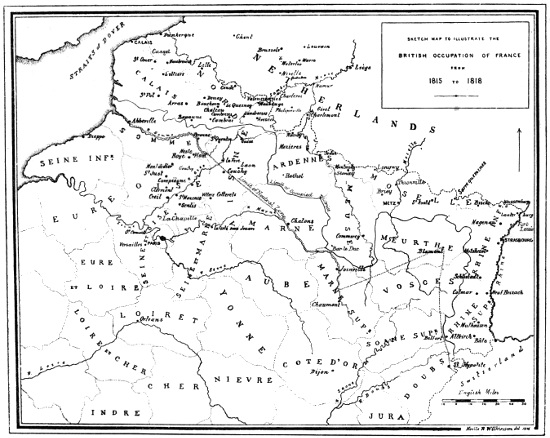
SKETCH MAP TO ILLUSTRATE THE
BRITISH OCCUPATION OF FRANCE
FROM
1815 to 1818
A. D. Innes & Co. London.
The positions occupied by the Allied contingents were as
follows: The British corps had their head-quarters at Cambrai, and
were quartered in the Departments of Pas de Calais and Nord, at
Cassel, Hazebrouck, Lillers, St. Pol, Bapaume, Cambrai, Valenciennes,
etc.; near them, in the Department Nord, the Danes were
stationed at Bouchain, the Hanoverians at Condé, and the Saxons
at Le Quesnoi. Occupying the eastern portion of the latter Department,
as well as nearly the whole of the Ardennes, the Russians
placed their head-quarters at Maubeuge, and were quartered in
Landrecies, Avesnes, Charlemont, Givet, Réthel, etc. The Prussians
were in the Departments of Meuse and Moselle, their head-quarters
at Sédan, occupying Mezières, Montmédy, Longwy, Briey, Thionville,
Commercy, Bar-le-Duc. The Baravians were close to them
and to the Palatinate, at St. Avold, Sarreguemines (head-quarters),
and Bische; the Wurtemburgers at Weissemburg and Lauterburg.[85]
The Austrian contingent took possession of the Departments of
Upper and Lower Rhine, head-quarters at Colmar, and the principal
55garrisons were at Hagenau, Molsheim, Bischweiler, Mulhausen, and
Altkirch.[86]
The Coldstream Guards were the last troops to leave Paris. On
the 26th of January all the public duties in the capital were found
by the Battalion,[87] and the 4th and 5th companies, under Lieutenant-Colonel
MacKinnon, were ordered to relieve the 23rd Regiment at
Montmartre. Next day, the Guards Brigade with Captain Sinclair’s
brigade (field battery) of Artillery and the Sappers and Miners
attached to the First Division, marched off from the barrière de
Villette; the Grenadier Guards and the Sappers and Miners to
Louvres, the Coldstream and the Artillery to Gonesse. The public
duties were collected by Lieut.-Colonel Dawkins at the barrière
des Martyrs, where they were joined by Lieut.-Colonel MacKinnon’s
detachment, and the whole followed to Gonesse after
the rest of the troops had left Paris. The march was continued to
Cambrai in detachments, the Battalion being billeted at each halt
in several villages,[88] and the route taken was by Senlis and Peronne
to Cambrai, which was reached by the head-quarters, together with
the Grenadier and the 1st companies, on the 6th of February.
The 3rd Battalion Grenadier Guards and the two companies of
the Coldstream just mentioned, formed the garrison of Cambrai,
while the remainder of the latter Battalion occupied the following
villages:—2nd company, Villers Ploich; 3rd and 4th companies,
under Lieut.-Colonel MacKinnon, Marcoing; 5th company,
Banteau and Bantouzelle; 6th and 7th companies, Gouzecourt;
8th and the Light-infantry companies, Villers Glishain, under
Lieut.-Colonel Dawkins, who had orders “to detach an Officer’s
party to Honnecourt, if he deemed it desirable;” Lieut.-Colonel
Macdonell was quartered at Gonnelieu, and took command of the
2nd, 5th, 6th, and 7th companies.[89]
56Though peace had been concluded, the foreign contingents were
kept ready for active service, and the fortresses were held closely
guarded, as if an enemy were in the field. Thus at Cambrai, the
gates of the town were carefully locked under the superintendence
of an Officer of the main guard, and were kept closed from sunset
to dawn; no one was allowed to enter at such times, except under
peculiar circumstances, (and then only when the main guard was
turned out). Patrols were sent out constantly at uncertain hours;
Non-commissioned officers and men were not permitted to leave
their quarters after dark, without a pass; sentries were relieved
hourly, both by day and by night; and even the Field-Officer of the
day was not admitted into the Citadel by night, and the Officer of
the guard there had to communicate with him from the ramparts.[90]
The occupation of French territory lasted three years, until
November, 1818, and during the whole of this time, the British troops
were kept actively employed on their military duties. It was a
period in which the efficiency of the army was maintained at a high
standard. The Coldstream were continually exercised in route
marching, in drill, in musketry,[91] and, the Officers and selected Non-commissioned
officers and men, in sword exercise. Every detail
of interior economy was carefully attended to, under the company
Officers, who were held responsible to the Commanding Officer for
the arms and accoutrements, for the men’s regimental necessaries,
for the cleanliness and good order of the barrack rooms, and for the
regular closing of the accounts, which at the time was done on the
24th of each month.[92] In the summer as many of the troops as
57could be spared from fortress duty were encamped wherever open
spaces were available, the Guards Brigade upon the glacis of Cambrai,
for the purpose of carrying out the Field exercises then practised
by the army. The Duke of Wellington paid minute attention to
the drill of the contingent, and issued repeated orders on the movements
in which he desired the regiments to perfect themselves.[93]
Reviews on a larger scale took place in the autumn of each
year, in the neighbourhood of Denain. In October, 1816, the English,
Danish, Saxon, and Hanoverian contingents were assembled,
36,000 men and 84 guns strong (of which nearly 26,000 men and
60 guns were furnished by the British army); a detailed programme
of the operations to be performed was prepared, a feigned enemy
was told off, and the whole concluded by a march past, according
to the accustomed forms of the different corps present.[94]
Their Royal Highnesses the Duke of Kent and the Duke of
Cambridge were present on this occasion, and were received by
Guards of Honour furnished by the Coldstream Guards. Similar
manœuvres took place in the middle of October next year, near Bouchain,
at which the King of Prussia and the Prince of Orange assisted,
and again the same thing was repeated in September, 1818. Finally,
another military display was given on the 23rd of October, 1818,
just before France was evacuated by the Allies, near Villers-en-Couchies,
in the presence of the Emperor of Russia and of the King
of Prussia; 51,000 men and 168 guns were then brought together,
of which 23,000 and 84 guns were Russians, 19,000 and 60 guns
58British, 3000 and 10 guns Danish, 3000 and 8 guns Saxons, and
3000 and 6 guns Hanoverians.[95] The enemy was represented by
a detachment of Cossacks and of Russian infantry and artillery,
and by the British cavalry, three companies of Sappers and Miners,
and three brigades of artillery; the latter under Lieut.-Colonel Sir
G. Scovell, and the whole under the general direction of Major-General
Narishkin.
“It is supposed that the enemy is master of Bouchain, Le Quesnoi, and
Valenciennes, and occupies a position behind the Escaillon.... The
object of the army is to reconnoitre Valenciennes from the heights of
Famars, and for this purpose the enemy’s corps is to be forced back upon
the place; having been in the first instance dislodged from his position
on the Escaillon, the direct attack upon the front of which, is to be
facilitated by a movement to turn his left.”
The movements to be executed were all published beforehand, and
the operations ended by a march past.[96]
Soon after the British contingent reached its quarters in the
Departments of Pas de Calais and Nord, a reduction was effected
in its strength by three regiments of cavalry,[97] by drafts of men
entitled to their discharge or unfit for service, and by 400 men
from the Guards Brigade (200 from each Battalion, so as to bring
them to 1000 instead of 1200 men per Battalion). By this means,
taking into account some 800 recruits who joined the contingent,
the latter amounted to a little more than 29,000 Officers and men
in the beginning of May, 1816.[98]
There were found to be some 60 men unfit for service in the
2nd Coldstream Guards about this time, and the 200 were made
up by selecting 15 of the most unserviceable men per company
(or 150 from the Battalion). Captain Shirley, and Lieutenants
FitzClarence and Douglas, proceeded to England in charge of this
59party (April 23rd), which, together with that belonging to the
3rd Battalion Grenadier Guards, was placed under the command of
Lieut.-Colonel D. MacKinnon, Coldstream Guards.
In the course of the year, the Duc de Richelieu endeavoured to
secure from the Allies a more solid and more general reduction of
the army of occupation, in order to lessen the financial strain that
burdened France, at a moment when she was oppressed by debt
and afflicted by a bad harvest. He hoped thereby to render the
King more popular. But he experienced considerable reluctance
on the part of the British Government and of Wellington to agree
to any such proposition, until the Chambers had proved by their
acts that they were prepared to support the rule of Louis XVIII.,
and so “dissipate all reasonable apprehension as to the fulfilment
of the late Treaty.”[99] The Duke, indeed, was at first much opposed
to it, and wrote strongly against it from Cambrai even as late as
December, 1816, being of opinion that any real reduction of the
Allied forces would tend to excite the French malcontents, and do
harm to the Royal cause and to good government, and that “we
ought to reduce only gradually and in proportion to our casualties.”[100]
A little later, however, being in Paris (January 9th), he modified
his opinion on account of the successful negotiation of a French
loan in London, which might “recall to the recollection of public
men in France the obligations they owe to the Allied Sovereigns,
and again reconcile them to measures which France herself, and not
foreign Powers, rendered necessary.”[101] Under these circumstances,
he proposed a reduction of 30,000 men (or one-fifth from each
contingent), to be made on the 1st of April, 1817, and to be
announced “in the manner most likely to produce a favourable
effect on the public mind,” as soon as the budget passed and the
measures for ensuring the loan were definitely adopted.[102] These
proposals were accepted by the Allies, and were embodied in an
official note, which was presented to the French Government on
the 10th of February, 1817.[103]
In pursuance of these arrangements, six battalions returned to
England, proceeding there by Calais, to which were added detachments
of 200 men from each of the Guards Battalions, or about
606000 men in all. The staffs, moreover, of the Third Division
(Sir C. Colville) and of two brigades (Sir R. O'Callaghan and Sir
J. Keane) were broken up.[104]
In June, 1818, Sir P. Maitland having been sent to Upper
Canada as Lieut.-Governor of that province, Major-General Sir J.
Lambert was appointed to the Guards Brigade at Cambrai; but
as he was on leave, Colonel Woodford, Coldstream Guards, remained
in temporary command until August. In June, also, Major-General
Sir R. O'Callaghan replaced Sir J. Lambert as Brigadier of the 7th
Brigade, and Sir C. Colville assumed command of the Second
Division, vice Sir H. Clinton.
The Band of the Grenadier Guards had been sent for a few
months to Paris, during the autumn of 1815, and left London on the
1st of September, proceeding by Brighton to Dieppe. Next year,
the Coldstream Band went to Cambrai, on the 10th of June, by
Dover and Calais, and remained there till the following October.[105]
The health of the troops in France, during the three and a half
years succeeding Waterloo, seems to have been satisfactory. By a
return, dated Paris, July 15, 1816, it appears that the number of
sick amounted to 1060 men in the whole British contingent, of
which only 43 belonged to the Coldstream, out of a total strength
of 1104 Officers and men belonging to the Battalion at that time.[106]
The principal cause of illness arose from the prevalence of ophthalmia,
which, beginning in Paris in the winter of 1815, continued
to affect the men until they left the country in 1818. Numerous
orders were issued to prevent the spread of this evil.
Two Officers belonging to the Regiment died in France during
this period, viz. Lieutenant J. Buller, in Paris, in January, 1816,
and Lieutenant A. Gordon, killed in a duel with a French Officer,
at Cambrai, in April, 1818.
61There were not many incidents of any great importance to
mark the occupation of French fortresses by European contingents.
France, deprived of her incomparable military Chief, destitute of
popular leaders, and exhausted by the wars that drained her resources
during the past twenty-five years, settled gradually down,
and accepted, though very reluctantly, the government which the
Allied Powers had imposed upon her. The alien force did the
work which had been contemplated; for, keeping the people under
control, and repressing all revolutionary ebullitions, while Louis was
consolidating his rule, the occupation did not come to an end until
he had established his power in the country. Subsequent events
have proved that the settlement thus effected by the will of Europe
was not a permanent arrangement; France never consented to it,
and we now know that it was overthrown within the brief space of
fifteen years.[107] But when the Allied forces finally returned to their
homes, and left the conquered people to their own resources, the
Bourbon régime seemed, at all events outwardly, to be restored, and
the new authority to be unquestioned.
The British troops conformed in every respect to the laws of the
country, and to the various and frequently vexatious police regulations
that prevailed at the time.[108] They conducted themselves peaceably
in their various cantonments, and contrived to get on well with the
62population. So generally quiet was the state of affairs, that a
liberal allowance of leave could be granted to the Officers of the
contingent, soon after their arrival in the north of France.[109] The
same relations existed between the inhabitants and the troops of
the other Powers.[110] But, nevertheless, the occupation raised many
controversies,—easily to be accounted for by the temper which the
people were ready to display towards the invader, after a crushing
military defeat. Irregularities committed by the troops, when they
took place, were rectified without delay, and measures were adopted
to prevent their recurrence; in this respect, at least, the French had
nothing to complain of. On the other hand, there were repeated
difficulties with the civil officials of the country, and with the turbulence
that moved many of the inhabitants to be disorderly. The
French Préfets and Maires too often refused to discharge their
functions, the magistrates to convict on the clearest evidence, and
the police to repress riots when the natives were found to be
engaged in disputes with the foreign troops. Wellington continually
protested strongly on this subject to the King’s Government,
and assured the Ministers that, unless the local authorities did their
duty, the troops would be provoked to retaliate and revenge the
injuries they had too often to put up with.[111] The irritation felt by
a certain portion of the population against the foreign contingents,
led to constant brawls, which became a source of danger when
they occasioned the people to assemble tumultuously. The danger
of frequent collisions was increased by the habit, then adopted by
the British Officers, of using their fists for their personal protection,
when drawn into scuffles with the natives in the streets. To stop
this, the Duke insisted that all Officers should wear “their side-arms
... whenever they appeared out of their quarters or tents,
except when hunting or shooting.”[112]
63A grave incident occurred at Cambrai, where a riot took place
in June, 1816; hearing which, Wellington wrote to Sir. P. Maitland,
then in command of that fortress, as follows:—
“I beg you will tell the Sous-Préfet that I am surprised that after the
many examples he has had of our desire to do justice to those who have
to complain of our people, the police at Cambrai should have suffered
such a riot to take place without noticing it. You have my orders to turn
out the troops and fire whenever the people attempt to riot again. I repeat
them now, and I beg you will tell the Sous-Préfet that I have reminded
you of them; and particularly that the troops are not to be turned out to
quell a riot without firing in earnest. I beg you will also tell the Sous-Préfet
of Cambrai, that I can no longer allow the Garde Nationale of
Cambrai to remain armed. They must be paraded in an hour after you
will make this communication, and must lodge their arms in the great
square, and go to their homes. You will take possession of their arms, for
which you will give a receipt. They are to be lodged in store. Inform
the Sous-Préfet that I consider him and the Maire responsible to me that
no arms are kept by the individuals of the Garde Nationale. I understand
that people from the gaming-houses have been sent down to all the
garrisons; and I beg you will tell the Sous-Préfet that I will not allow
them to remain; and they had better therefore remove without obliging
me to use force.”[113]
The questions that arose out of the peculiar conditions in which
the occupied districts were placed, caused difficulties, which differed
in certain respects from those arising out of other military occupations.
In 1871, for instance, after the peace of Versailles, Germany
64occupied some French provinces; and, in this case, the conquering
armies had only to deal with the inhabitants—there were no hostile
troops in their vicinity. But, in 1816, the Allies were placed in
another position, and French soldiers were in their neighbourhood.
Europe, moreover, had caused a revolution in France, and had to
support the new government, until its power was established. The
army of occupation, therefore, was not only exacting redress from
the vanquished nation, according to treaty, but it was also in close
alliance with the Government of the latter. Hence it was not
unnatural that some delicate points should be raised, embarrassing
to the French Ministers, who, while they posed as patriotic Frenchmen,
had much to fear from the Imperialists and other malcontents
that roamed over the country. A question arose in the Prussian
districts, regarding the disbanded troops of Napoleon’s armies,
which is perhaps best explained by quoting an extract from a
letter addressed by the Commander-in-chief to General Ziethen,
dated February 15, 1816:—
“The soldiers of the Imperialist armies,” says Wellington, “are viewed
with suspicion, not only by the chiefs of the Allied army of occupation, but
also by the King of France and by the French Government.... Your
Excellency is therefore right to watch these persons, and I am sure that your
measures, taken with this object, have the approval of the King of France.
But I beg you to be careful that you do not trespass upon those powers
which belong to the King or to the legislature. It is true, the King of France
has ordered disbanded soldiers to return to their homes, and they do not
obey if, having their domiciles elsewhere, they persist in congregating in those
Departments, which are occupied by the troops under Your Excellency’s
command. You are therefore right in obliging these persons to obey their
Sovereign’s order, and in sending them out of the Prussian districts. But
to oblige all these soldiers who inhabit your districts, to be in possession of
a card of residence, to be submitted to your Brigadiers, is a step in advance.
This is more than a police measure, which in my opinion should be limited
to putting the existing law in motion; it is an act of sovereignty, and even
of legislation; because it obliges soldiers who are subjects of the King, and
who are residing in their homes by the King’s command, to furnish themselves
with papers for their personal security, which neither the King nor
the laws of the country require of them. I think, therefore, that your order
ought only to oblige such soldiers who are not domiciled in your Departments
to quit them, and to command your Officers to carry out your order,
if they find these unauthorized persons. At the same time, in order to clear
up the subject, you can demand from the mayors, the Sous-Préfets, etc., a
65list of the men who have a right to live in your Departments, and you
can remove all those, whose names are not to be found on the lists. This
you may do, because you would be only carrying out the decrees of the
Sovereign authority; but I do not think we should be justified in doing
more than this.”[114]
Owing to the arrangement sanctioned by the Convention of
the 20th of November, 1815, attached to the Treaty of the same
date, by which the French were allowed to maintain garrisons in
certain specified places in the Departments under foreign occupation,
further complications arose, which increased the tension
between the King’s Government and the Allied forces. While
manœuvres were going on in the summer of 1816, the Governor
of St. Omer raised a note of alarm, on seeing British troops in the
vicinity of the fortress; and the excitement became such, that
Wellington was obliged to write to the Duc de Feltre (the War
Minister), a letter of strong remonstrance, in which, having first
defended himself against a ridiculous charge that he intended to
seize a French fort, he declared that the occupation was a measure
calculated to secure the peace of Europe and the consolidation of
the Royal power, that the foreign contingents were the allies of
the King, and that he would not suffer his soldiers to be disarmed
when they had occasion to march through a French garrison.[115]
66The passage of troops through fortified places had an unfortunate
result at Cambrai; for, on the 10th of May, 1818, when a
French detachment marched through the town from Paris to
Douai, a riot ensued, in which three or four men of the Coldstream
were injured. The British garrison behaved well in the emergency,
and the following order was published by Colonel Woodford, then
in command:—
“Colonel Woodford desires to express his satisfaction at the temperance
and forbearance shown by the Non-commissioned officers and soldiers of
the Brigade, in the affray between them and the French soldiers and the
inhabitants yesterday evening; to this temperate conduct, so highly
creditable to brave troops, and to the activity of the Officers and Non-commissioned
officers who were present, is to be attributed the early
restoration of order and tranquillity throughout the town.”[116]
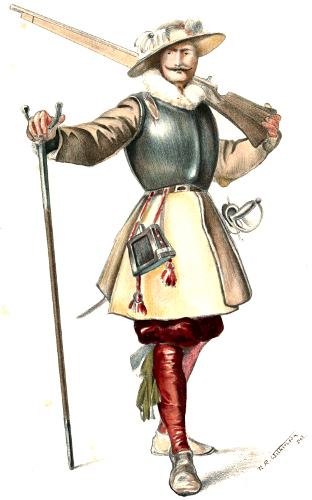
N. R. Wilkinson del. MUSQUETEER 1650. Mintern Bros. Chromo.
The Allied forces were now soon to quit French territory. It
had been stipulated by treaty that the occupation was to last five
years, but it was also expressly stated that it might terminate in
three, and all parties by this time wished to bring it to a conclusion
as soon as possible. The French naturally pined for
emancipation; and the words of the Duc de Richelieu, delivered
in the Chambers, that “every heart throbbed at the thought of
seeing on the soil of the country, no other banner but that of
France,” found a responsive echo throughout the length and
breadth of the land, and awoke a passionate longing for freedom
in the minds of the people, which was very difficult to resist.
67Wellington, also, was disposed to assist them. The Government of
the King had been showing increased hostility to the foreign
contingents, who were becoming daily more hateful in the eyes
of the French nation. He expressed himself clearly on this subject
to Lord Bathurst, on the 8th of March, 1818:—
“As soon as the occupation becomes odious to the people, and that
we are liable to the attacks which they are daily excited to make upon us,
and that, under these circumstances, we are to begin a new lease, as it were,
of the occupation, we must close up, and take our real position with our
whole force between the Meuse and the Scheldt, and our occupation must
become more burthensome to the country in which we shall be placed, and
in fact, become one of war. Of course that state of things could not last,
and the Powers of Europe must be prepared to support their troops left in
such a situation in this country.”[117]
It was apparent to all that this condition of tension must come
to an end; and, though there was no certainty that the King could
maintain himself on the throne without foreign support, yet it
was evident that the cure for the evils to be dreaded, was liable
to become a greater misfortune to Europe, than the apprehension
itself. The French, moreover, had made great efforts to discharge
their financial obligations to the Allies; and in these efforts they
were successful, aided by the Duke of Wellington, who, upon the
proposal of the Emperor of Russia, was appointed president of
the diplomatic and finance committee charged with the regulation
of these liabilities.[118] Added to this, the fortifications of the
Netherlands frontier were by this time nearly completed, and as
this was done to form a barrier against France, the moment had
arrived when the country could be delivered from the burden that
oppressed it, as well as from the cause which produced so much
irritation.
In the autumn, therefore, of 1818, a Congress was convened at
Aix-la-Chapelle, for the purpose of determining the question;[119] and
68an agreement was made, on the 1st of October, by which the foreign
forces were to leave the soil of France on or before the 30th of
November. To this compact was added an invitation to His Most
Christian Majesty to join the four Great European Powers, and to
take part in their deliberations, present or future, for the maintenance
of peace, and for the mutual guarantee of the rights of nations.
The conference, however, did not end there; for a secret convention
was also signed, by the four Powers only, stipulating that, in case
France should resume her revolutionary ways, and again threaten
the tranquillity of the civilized world, British, Prussian, Austrian,
and Russian corps d’armées were to assemble forthwith at Brussels,
Cologne, Stuttgart, and Mainz respectively, for the suppression
of these disorders.[120]
Wellington took early measures to effect the evacuation by
the army of occupation, and hastened the operation with all possible
despatch. General von Frimont reported (October 23rd)
that the Austrian contingent would send the first column across
the Rhine on the 1st of November, and that the whole corps
would quit French territory on the 11th. The Prussians moved
off early in the month, and were directed upon Cologne, Bonn,
and Coblentz. The Russians marched in two columns immediately
after the review, which had taken place near Villers-en-Couchies
on the 23rd of October, the first through the Netherlands, the
other following the Prussians to the Rhine at Mannheim. After
this latter column, came the Saxons, who left Le Quesnoi on the
7th and 9th, and moved to Forbach. The Bavarians began to
evacuate their cantonments on the 12th; while the Hanoverians
and the Danes marched northwards, through the Netherlands, the
former between the 4th and the 9th, and the latter between the
12th and the 19th. The British troops, who were placed under
canvas during their march, were sent to Calais immediately after
the review just mentioned, where they were embarked under the
orders of Major-General Sir M. Power. The embarkation began
on the 29th of October. As soon as the fortresses were permanently
evacuated by the Allies, the French, who had been specially
authorized to enter the occupied Departments for the purpose,
marched into them without delay, and, hoisting the white flag,
69under a Royal salute, once more took possession of their own
territory, amidst the universal enthusiasm and joy of the military
and of the inhabitants. The British stores, which could not be
conveyed to Calais, were shipped at Valenciennes, and were taken
by water to Antwerp; a portion were sold to the King of the
Netherlands.[121]
The progress of the evacuation being sufficiently advanced, the
Field-Marshal commanding the Allied forces, issued, on the 10th
of November, a valedictory address, and on the same day similar
orders were communicated to the British army. Later, on the 1st
of December, a letter from H.R.H. the Commander-in-Chief was
published, conveying to the British contingent the thanks of the
Prince Regent “for the discipline and good order which have been
so successfully maintained, to the honour of the British arms, during
the period it has been stationed in France.”[122]
On the 6th of November, a letter was received from the Préfet
of the Department of Nord, recording his gratitude and that of
his subordinates, for the rigid discipline which prevailed in the
army of occupation, “to which has been due the harmony which
existed between the troops and the inhabitants.” He added that
he felt a real satisfaction in testifying to the excellent conduct of
the British corps, and to the zeal with which all the Officers carried
out the views of the Duke, to alleviate as much as possible the
burden of the occupation.[123]
The Guards Brigade did not leave France with the rest of the
British army, but remained at head-quarters at Cambrai, with the
Chief of the Staff, Lieut.-General Sir G. Murray (the Duke being
obliged to return to Aix-la-Chapelle after the review of the
23rd of October), until the morning of the 18th of November;
when, evacuating the fortress, they moved, at eleven o’clock, to
Cantin. The march of the Coldstream was made in six columns,
four being composed of two companies; and was continued to
Calais, the port of embarkation, avoiding as much as possible all
large towns and centres of French patriotism. Marching by Lillers,
70Racquingham, and Louches, the Brigade reached Calais on the 23rd,
and immediately embarked for Dover. On this date Sir J. Lambert
published the following order of farewell to the Guards, who had
completed their service in France:—
“Calais, November 23, 1818. Major-General Sir J. Lambert cannot
relinquish the command of the Brigade without congratulating the Officers
and soldiers on the termination of a service of four years' duration, during
which they have acquired to themselves on many occasions the greatest
honour and credit. The Major-General requests that the Officers will be
assured that he was perfectly sensible of the honour conferred upon him
on his appointment to the Brigade, and feels certain, had circumstances
permitted that its exertions in the field might have been more efficiently
called for, that he should now have had the satisfaction of expressing his
admiration of that distinguished conduct which has ever called forth the
encomiums of those who have had the good fortune to be in command.”[124]
Arrived at Dover, the Coldstream marched to Chatham, where
they arrived on the 28th of November, and remained quartered
in that garrison till further orders.
Thus ended this stirring drama that began in March, 1815,
and in which the Coldstream Guards participated to the fullest
extent. During these eventful years, services were not only
rendered to King and country, on the field of battle, at one of the
most momentous crises of modern history; but duty was also
zealously performed, in a less acknowledged sphere, when a war-like
nation was induced, with much difficulty, to abate her military
ardour, to renounce her menacing attitude, and to resume a pacific
policy towards her neighbours. The years spent in France were
useful to the British troops quartered there. It was a time when
they had to be prepared for every emergency, when they had to
cultivate amicable relations with a foreign people who resented
deeply their presence among them, when their demeanour towards
the inhabitants had to be both firm and conciliatory, and when
their military efficiency and discipline could alone enable them to
discharge the delicate duties with which they were entrusted.
This chapter must not conclude without recording that, at the
end of the occupation, the Duke of Wellington was created a Field-Marshal
in the armies of Austria, Russia, and Prussia; and that
his services to Europe, which could not be further rewarded by
71his own Sovereign, were acknowledged in simple language, which
expressed the difficulties of the situation, and the Royal approbation
at the manner in which they had been overcome.
“The command of the army,” said Lord Bathurst, “composed of so
many nations, and belonging to Sovereigns eminently distinguished for
their military exploits, not stationed within any of their own dominions,
but in temporary and partial occupation of a given district within the
territories of a martial people, with whom His Majesty had so recently
closed an almost uninterrupted warfare of more than twenty years' duration,
presented difficulties of no ordinary magnitude, which could only be
surmounted by no ordinary measure of judgment and discretion. In this
command your Grace maintained the British army (divided for the relief
of the inhabitants in separate and distant quarters) unimpaired in their
discipline, and even improved in their condition. You preserved the
several contingents composing the Allied army in the utmost harmony with
each other, and in the best understanding with the authorities of the
country which they occupied. You won so much upon the esteem and
confidence of His Majesty’s Allies, that they all spontaneously applied for
your arbitration of their respective claims upon France; and you impressed
that Government with such a sense of your justice, impartiality, and exertions,
that you had the gratification of receiving assurances from His Most
Christian Majesty that, but for your intervention, that intricate negotiation
could not have been satisfactorily concluded. Amidst, therefore, the
signal achievements which will carry your name and the glory of the
British Empire down to the latest posterity, it will not form the least part
of your Grace’s renown, that you have exercised and concluded a command,
unexampled in its character, with the concurrent voice of approbation from
all whom it could concern.”[125]
CHAPTER IV. FIRST PART OF THE LONG EUROPEAN PEACE.
72
Distress in England after the war—Reductions in the Army and Navy—Stations of the
Brigade—French Eagles captured, deposited in the Chapel Royal, Whitehall—Reforms
in interior economy—Death of George III., and Accession of George IV.—Cato
Street Conspiracy—Trial of Queen Caroline—Coronation of George IV.—Guards
in Dublin—Distress in 1826—Death of the Duke of York—Changes in
uniform—Death of George IV.; succeeded by William IV.—Political agitation at
home, revolution abroad; the Reform Act—Coronation of William IV.—First
appearance of cholera—Death of the King, and Accession of Her Majesty Queen
Victoria—Changes and reforms introduced during the reign of William IV.
The defeat of Napoleon brought about a period of peace in Europe,
which, lasting till 1853, almost entirely undisturbed by the clash
of arms, is chiefly conspicuous in history for the internal changes,
and for the popular and national ideas that were then developed,
both in England and on the Continent. This period, containing
necessarily, as far as the Coldstream is concerned, few of those
stirring incidents which invest the annals of a regiment with public
interest, marks the introduction to our present modern society,
and exhibits a rapid growth in the British Empire, and a great
improvement in the material lot of the people. But it opened
inauspiciously, and was at its commencement tinged with gloom.
The principles of the French Revolution, generating dangerous
and violent forces, and threatening Christendom with anarchy
and destruction, were at length laid low, and, to outward appearances
at least, they were finally crushed and eradicated. The
victory rested with England, to whose indomitable energy, national
power, and vast financial resources, the result of the gigantic contest
had been due. And as men who have conquered in a desperate
struggle, to rest and refreshment as the fruit of their labours,
so did Great Britain indulge in the expectation that, the enemy
being vanquished, she would at once be compensated for her
innumerable sacrifices by the quiet and unalloyed enjoyment of the
73rewards of her valour. Nor was this an extravagant hope. Even
during the war, while the people were oppressed by a crushing
taxation, and when the country was in the very throes of an
exhausting and terrible conflict, England, thanks to her commanding
maritime supremacy, that alone endowed her with extraordinary
strength, advanced steadily in riches and in population.[126] It may,
then, be readily conceived that, if such was the case in the hour of
darkness, the nation had cause to look forward with confidence, to
a rapidly accelerating progress in material prosperity, as soon as the
millennium of a general peace should dawn upon the civilized world.
But anticipations are frequently disappointed, and in this case they
were not immediately realized. The cessation of hostilities, instead
of heralding an era of plenty, was the signal of much misery and
distress, which cast a dark shadow over the last few years of the
reign of George III., and chastened the rejoicings that followed the
successful termination of the greatest war of modern times.
Various causes are assigned for this unexpected suffering, into
which we cannot enter. Suffice it to record the fact, and to note,
that the widespread poverty that then prevailed, led to disorder,
which, breaking out in many parts of the country, had to be quelled
by the interference of military force. In London there were also
disturbances or threats of riots, so that, from the end of 1816 until
the autumn of 1817—and, indeed, upon many occasions afterwards—the
Guards quartered in the Metropolis were constantly kept
ready for the preservation of the public peace; the troops were
often confined to barracks, the Officers recalled from leave, the
public duties strengthened, and piquets temporarily sent to protect
vulnerable points in the city. The rabble, urged by leaders, who
endeavoured, as usual, to convert the distress to their own purposes,
began to display a rising animosity towards the soldiery;[127] and
schemes were formed for the purpose of burning the barracks in
London, and of attacking the Tower, the Bank, and other places of
74importance. No actual outbreak occurred until the 2nd of December,
when a disturbance took place, known as the Spafield riots, in which
the mob, having procured arms, marched into the City and retained
possession of the Minories for some hours. After doing much
damage, they were dislodged by the troops sent to put them down,
and the district was patrolled till order was completely restored.[128]
The abrupt cessation of hostilities occasioned reductions in the
large naval and military establishments which had to be maintained
for the vigorous prosecution of the war; and the promptitude
with which they were effected, aggravated not a little the
general distress that followed. The Government, defeated in their
proposal to continue the property tax, and having thereupon voluntarily
given up the war duty on malt, found themselves suddenly
deprived of £17,000,000 of revenue, and had no option but to discharge
forthwith, and in no sparing manner, a large portion of the
forces of the Crown. Of the 100,000 men required for the Navy
in 1815, only 33,000 were retained in 1816; the military establishment
was also fixed during the Session, at 111,756 men, not
counting the regiments serving in India, paid by the East India
Company, nor the contingent quartered in France and provided for
by that nation. To effect the necessary reductions in the land
services, some 50,000 of the regular Army, the Militia 80,000
strong, and of course the foreign corps, nearly 21,000 men, were
disbanded.[129] Some of these changes did not take place until 1817,
but they affected the Coldstream as early as the 24th of December,
1815, when the Regiment lost 400 men; on the 24th of March,
1817, simultaneously with the reduction effected in the army of
occupation in France, another diminution of 200 men was made
in the establishment; again, shortly after the 2nd Battalion
75returned from Cambrai (December, 1818), the services of four
Lieutenants, sixteen Ensigns, two Assistant-Surgeons, and 200 men
were further dispensed with; and lastly, on the 25th of August, 1821,
four companies were abolished, twelve Officers were seconded, and
216 Non-commissioned officers and men were discharged.[130] The
sweeping nature of these reductions, rendered necessary by the
termination of the war, is perhaps best appreciated by comparing
the Regimental establishment as it stood in the spring of 1814, with
that which was in force in the autumn of 1821:—
| |
1814. |
|
1821. |
| 22 |
Companies. |
16 |
Companies. |
| 4 |
Field-Officers (Colonel, Lieutenant-Colonel, and 2 Majors). |
4 |
Field-Officers (Colonel, Lieutenant-Colonel, and 2 Majors). |
| 22 |
Captains. |
16 |
Captains. |
| 46 |
Lieutenants. |
20 |
Lieutenants. |
| 20 |
Ensigns. |
12 |
Ensigns. |
| 2 |
Adjutants. |
2 |
Adjutants. |
| 2 |
Quartermasters. |
2 |
Quartermasters. |
| 3 |
Surgeon-Major and Battalion Surgeons. |
3 |
Surgeon-Major and Battalion Surgeons. |
| 4 |
Assistant-Surgeons. |
2 |
Assistant-Surgeons. |
| 1 |
Solicitor. |
1 |
Solicitor. |
| 2 |
Drum-Majors. |
2 |
Drum-Majors. |
| 1 |
Deputy Marshal. |
1 |
Deputy Marshal.[131] |
| 2 |
Sergeants-Major. |
2 |
Sergeants-Major. |
| 2 |
Quartermaster-Sergeants. |
2 |
Quartermaster-Sergeants. |
| 2 |
Armourer-Sergeants. |
2 |
Armourer-Sergeants. |
| 2 |
Schoolmaster-Sergeants. |
2 |
Schoolmaster-Sergeants. |
| 176 |
Sergeants. |
64 |
Sergeants. |
| 176 |
Corporals |
63 |
Corporals. |
| 47 |
Drummers and Fifers. |
35 |
Drummers and Fifers. |
| 2706 |
Privates. |
1344 |
Privates. |
| —— |
|
—— |
|
| 3220 |
Total. |
1580 |
Total. |
76In consequence of these changes, the King’s Guard and the
Buckingham House Guard were reduced to ninety and thirty
privates respectively, and the other public duties were lightened
(January 1, 1822); very shortly afterwards (February 14th), the
guards furnished by the Tower Battalion at the East and West
India Docks were also abolished, and the Dock companies were
thereby obliged to provide themselves with adequate protection.
During the war of 1815, and the subsequent occupation of Paris,
there were only three Battalions of the Brigade in England, and
they were all quartered in the West-end of London. In the winter
of 1815-16, after the conclusion of the peace, two more Battalions
returned home, when Windsor and the Tower were again occupied.
On the 20th of August, 1816, a roster was published for the regular
half-yearly change of quarters, viz. from the Tower, to Windsor, to
Lower Westminster, to Portman Street barracks, to Knightsbridge
barracks. This arrangement was slightly altered in December, 1818,
when French territory was evacuated, and Finsbury and Chatham
were added to the list.[132] The quarters at these last two places were
shortly afterwards vacated, or irregularly occupied, and Holborn and
Brighton (or Portsmouth) substituted for them; in the end of 1821,
a Battalion of Foot Guards proceeded to Dublin, and six months
later the Brigade was stationed as follows:—Grenadier Guards,
1st Battalion, Dublin; 2nd Battalion, Tower; 3rd Battalion, Knightsbridge:
Coldstream Guards, 1st Battalion, King’s Mews barracks
(now known as St. George’s barracks); 2nd Battalion, Portman
Street: Third Guards, 1st Battalion, Lower Westminster; 2nd
Battalion, Windsor.[133]
As there was not, at this time, sufficient accommodation for a
battalion at any of the London barracks, that portion of the men
who could not be lodged there were billeted in the vicinity. At
Windsor, also, the Foot Guards, though sometimes furnishing
detachments at Hungerford, Reading, Kew, and Sandhurst, had not
77enough room in the barracks, and a portion of the men were similarly
provided with quarters in the town. The system of billeting was
gradually brought to an end, but it does not seem to have entirely
disappeared, in London at least, until 1837, when barrack accommodation
was provided for the whole Brigade. The discipline of
the men in quarters was specially looked after, each company being
told off into squads under proper superintendence; the men were
frequently visited, and were efficiently controlled, and reports were
made of any complaint either on the part of the soldiers, or on the
part of the landlords.[134] The following appears in the 1st Battalion
Orders of the 25th of February, 1820:—
Colonel Woodford feels certain, from the excellent conduct of the Battalion
throughout the past year, that he may look forward with confidence
to a continuance of good order, sobriety, and discipline in quarters, and
although many soldiers will be dispersed in the public-houses, he trusts
that they will never dishonour themselves by associating with any disaffected
or ill-disposed people. The men must be regular and clean in their
quarters, and they may expect to be visited frequently and at uncertain
times and hours, both by day and in the evening; and any man reported
for improper behaviour will be removed to barracks immediately.
From May, 1816, until the summer of 1820, the West-end
Battalions supplied a detachment of some 250 men, at Deptford and
Woolwich, to protect the Government establishments maintained
there. The detachment was relieved every fortnight at first, and
afterwards once a month. Later, the Brigade supplied detachments
of variable strength, for the same purpose, at irregular periods,
to both, or to either of, these places, viz.: April, 1836-April, 1837;
June, 1847-November, 1847; July, 1850; March, 1851; October 28,
1853-February 8, 1854.
On the 18th of January, 1816, the Eagles captured at Waterloo,
were deposited with great solemnity in the Chapel Royal, Whitehall.
An escort, consisting of Officers and men of the three Regiments,
who had all been present at the battle (of which the Coldstream
furnished 1 sergeant, 1 corporal, and 23 privates), marched past
the public duties and the rest of the Brigade, assembled on the
Horse Guards parade, lowering the Eagles as they approached the
78King’s Colour, and proceeded thence to Whitehall, accompanied
by the band of the Coldstream. Divine Service was then read,
during which, the trophies were brought in, and were lodged in
the Chapel.
It is perhaps worthy of remark that, as early as 1817, Government
granted to soldiers the privilege of sending their own letters by post,
at the then very cheap rate of one penny.[135]
The supply of Regimental necessaries had hitherto not been
satisfactorily managed. The Commanding Officer accordingly
established stores, from which all the articles required by the men
could be procured, of good quality, at the cheapest rate, and at fixed
and known prices; and he published an order, January 23, 1817,
directing that, for the future, all the men’s necessaries should be got
for them there, and at no other place.[136] This order was enforced in
the 2nd Battalion, then at Cambrai, on the 9th of February.[137]
Increased attention was paid about this time to interior economy,
and former orders on the subject, issued piecemeal, were summarized.
The method of paying the men and of keeping their accounts,
established by the Commanding Officer, was enforced by Regimental
Orders of January 19, 1818, and July 28, 1820; the messing was
more closely looked after; and the duties of the company Officers,
and of the Officer of the day, were better defined. By a Regimental
Order of June 20, 1822,[138] Officers commanding companies were
directed frequently to visit the barrack rooms, and to see the messes,
also to inspect the men’s necessaries weekly, instead of monthly as
heretofore; marching order parades every Sunday morning were
then instituted for this purpose, and the custom was not abolished
79until the year 1843, when Saturday was finally substituted for Sunday,
as the day upon which the inspection was to take place.
Colonel Sir Richard Jackson, K.C.B. (First Major of the Regiment),
having left the Coldstream, Colonel Alexander Woodford,
C.B., succeeded him in the command of the 1st Battalion, and
Colonel Sir Henry Bouverie, K.C.B., promoted Second Major,
assumed the command of the 2nd Battalion (January 18, 1820).
George III., after a long and glorious reign of sixty years, died
on the 29th of January, 1820, and was succeeded by the Prince of
Wales, who, through the illness of the King, had been Prince
Regent, or Monarch in fact, though not in name, ever since the end
of 1810. The ten years during which George IV. occupied the
Throne, did not differ generally from the five that succeeded
Waterloo: they were marked by disturbances and political commotions,
which, lasting until the reign of his successor, William IV.,
brought about important and radical changes in the constitution of
the country. During this period, moreover, the power of steam was
brought into practical use, and railways and steam-ships began to
take the place of stage coaches and sailing vessels. England, in
short, was passing through a phase of transition, when a new order
was being established both in the political and social life of the
people.
The first Battalions of the three Regiments of Foot Guards
attended the obsequies of George III., which took place at Windsor,
February 16th, and received from General Earl Cathcart, Gold
Stick in Waiting, in chief command of the troops, through Colonel
Askew, the Field-Officer in Brigade Waiting, “the entire approbation
of H.R.H. the Commander-in-Chief of their appearance,
attention, and regularity, on that most melancholy occasion, and his
sincere thanks for the propriety of their conduct in performing the
several services assigned to them.” Next day the 1st Battalion
Coldstream proceeded for four months to Portsmouth, returning to
Windsor in June.
The 2nd Battalion meanwhile remained at Portman Street, and
rendered good service on the occasion of the apprehension of the
Cato Street conspirators, on the 23rd of February. It was ascertained
that the latter, not unlike a modern gang of anarchists,
were plotting to murder the King’s ministers, and to overturn
every form of government; that they were well armed, and were
lying concealed in a loft over a stable in Cato Street, the only
80approach to which was by a ladder and through a trap-door.
Some police, accompanied by a detachment of thirty men of the
2nd Battalion, under Lieutenant F. FitzClarence, stormed the loft,
garrisoned by twenty-five desperate characters, and a fight ensued
in the dark, under circumstances of great confusion. Several conspirators
succeeded in making their escape, but nine were secured,
and sufficient arms and ammunition for one hundred persons were
seized; not, however, before one of the policemen was killed, and
a sergeant of the 2nd Battalion, named Legge, wounded.[139] A
Regimental Order, dated February 25th, was issued, referring to
this incident:—
The Commanding Officer has great pleasure in expressing his satisfaction
with the piquet of the 2nd Battalion commanded by Lieutenant FitzClarence,
on the night of the 23rd instant. The gallantry and moderation
with which they performed their duty, are in the highest degree creditable.
The new reign began with an event that stirred the whole
nation to the very depths, and wrought irreparable scandal through
every grade of society—the trial of the unfortunate Caroline,
Queen of George IV. Happily, the episode is now forgotten,
and there is no necessity to revive it. But the trial of a Queen,
publicly charged with degrading personal conduct, is unique in
modern history, and it created naturally an extraordinary excitement
among all classes at the time; and, as feeling upon the
subject ran exceedingly high, and a spirit of disorder and disaffection
was widespread, the Brigade had a part to play in it, which
cannot entirely be passed over. The trial itself took the form of
a Bill of Pains and Penalties, read a first time in the House of
Lords, July 5th. On the second reading, evidence was heard, and
the proceedings, beginning on the 17th of August, did not end
until the 6th of November, when there was a majority of twenty-eight
in favour of the measure. At the third reading (November
10th), the majority sank to nine votes, and thereupon Government
abandoned the Bill. The populace had ever been the partisans of
the unhappy Queen, and, when she arrived in England in June,
she met with a reception which could only compare with that
which greeted Charles II. on the restoration of the Monarchy in
1660. So, also, when the withdrawal of the Bill was announced,
81London was illuminated on three successive nights, and, the results
of the inquiry being forgotten, a universal joy manifested itself
through the whole country, which almost equalled the unbounded
enthusiasm displayed after the fall of Napoleon.
During this trying time, the Battalions of the Brigade quartered
in the Metropolis formed the main force for the repression of
disorder, and arrangements of the most comprehensive nature
were made to prevent an outbreak that was almost hourly expected.
A detachment of 350 rank and file was furnished daily, from the
17th of August, for the protection of the House of Lords. For
this purpose, 50 men were added to the Tylt, a guard of 50 men
was stationed during the trial, in the Cotton Yard behind Westminster
Palace, the piquet at Carlton Palace was permanently
posted, and a force was held as a reserve in St. James’s Park.
The guard at the British Museum was doubled, the Tower Battalion
was prepared to supply 200 men at any moment, on the requisition
of the Lord Mayor, while a Captain’s piquet of 100 rank and file
was kept constantly ready at each of the three principal West-end
barracks—the King’s Mews, Knightsbridge, and Portman Street.
The usual half-yearly change of quarters took place on the 26th
of August, when the 1st Battalion Coldstream proceeded from
Windsor to the Tower, and the 2nd Battalion from Portman
Street to Knightsbridge barracks, and to that part of Upper
Westminster contiguous thereto. The military arrangements
made for the trial were sometimes modified during its procedure,
now being reduced and again increased. During October, a guard
was placed in Westminster Hall, and the Bank piquet remained
on duty for twenty-four hours. These precautions were finally
discontinued on the 15th of November, and the ordinary leave
granted to Officers; though we find, on the 28th, riots were again
apprehended, and the 1st Battalion was directed to attend to the
Lord Mayor’s requisition to the extent of 300 men.
The violence of popular excitement soon subsides, and, the
inquiry over, the Queen’s partisans lost interest in her cause.
The King, too, became more popular with the mob, and it was
possible to fix a date for his Coronation. This great event was
solemnized upon the 19th of July, 1821, with all the magnificent
pomp and quaint ceremonial of past ages, and is more than
usually interesting in that it was carefully conducted upon ancient
models, and that it is the last pageant of its kind which is ever
82likely to be seen in England. The Royal procession, in gorgeous
and mediæval array, moved from Westminster Hall to the Abbey
by a covered platform, 1500 feet long, by 25 broad, fitted with a
lower edging three feet wide on each side, and returned by the
same route, after the religious ceremony was concluded. The
whole of the Foot Guards (except the 1st Battalion Third Guards)
were present (the 2nd Battalion Coldstream having been brought
up from Windsor for the purpose), and were commanded by
Colonel Hon. H. Brand, Lieut.-Colonel of the Regiment. The
two Grenadier companies of the Coldstream were stationed in the
Abbey with the State Colours. The platform was lined throughout
by 1500 men standing in single file on each side, on the lower
portions just mentioned. They were divided into three divisions,
each under a Field-Officer, with a part of the bands, drums, etc.
Forty Officers and 1141 men were employed in furnishing strong
piquets, extra guards, and Guards of Honour, in strengthening the
public duties, and in patrolling the neighbourhood of Westminster.
A portion of the streets was also lined, the Coldstream having its
right at the west gate of the Abbey, and extending towards
Westminster Hall. The troops got into position at one o’clock in
the night preceding the ceremony; and a large force of cavalry,
aided by Yeomanry, the Light Horse Volunteers, and the Honourable
Artillery Company, were also present under Major-General
Lord Edward Somerset, and furnished patrols throughout the
Metropolis. These ample precautions were rendered necessary by
the apprehension of a riot; for the Queen, whose application to
be crowned had been refused, expressed a determination, nevertheless,
to appear in person, and serious disturbances were expected
to be the result. To such an extent did the panic spread, that, we
are told, places to see the procession, which had been selling for
ten guineas, were to be had, on the morning of the ceremony, for
half a crown.[140]
The following General Order was published on the day after
the Coronation:—
“The Commander-in-Chief has received the King’s gracious command
to express to the troops employed yesterday in aid of the arrangements for
the Coronation, His Majesty’s thanks for the orderly, soldierlike, and
83exemplary conduct which they have evinced upon the occasion. The
Commander-in-Chief has received the King’s further command, through
the Secretary of State, to convey to the Light Horse, His Majesty’s thanks
for their services upon the same occasion, and his full sense and approbation
of the loyalty and zeal which they have manifested in the offer
of them.”
Next day, on the appointment of Colonel Brand, C.B., to the
rank of Major-General, Colonel Woodford, who had commanded
the Coldstream Battalion at Waterloo, became Lieut.-Colonel of
the Regiment, and Colonel Macdonell, C.B., promoted Major, was
posted to the command of the 2nd Battalion.
On the 3rd of September, the sum of £665 was distributed
among the Non-commissioned officers and men of the Brigade
who had taken part in the King’s Coronation, under the name
of “Platform money.” The 6 Sergeants-Major received each
14s. 1½d.; 226 Sergeants, 7s. 1½d.; 225 Corporals, 4s. 8¾d.; and
3575 Drummers and Privates, 2s. 11¼d. A little more than £100
was allotted per Battalion, the Coldstream receiving £212 2s. 1½d.
It seems unnecessary to record the various and numerous
reviews that have at all times taken place; it would be monotonous
to do so, and little interest would thereby be afforded. For the
most part, therefore, they will be omitted. It was usual upon
these and other occasions, for the inspecting Officer to record
publicly his opinion of the state of the troops reviewed; thus very
many testimonials exist—speaking of the efficiency which has ever
distinguished the Coldstream, and thanking the Officers and men
for their zeal and exertions—written by order of the Sovereign,
the Commander-in-Chief, the Colonel of the Regiment, the Lieut.-Colonel,
Generals under whom a Battalion happened to be serving,
and also giving messages from foreign Princes. These communications
to the Regiment have also been generally omitted, as their
number renders it difficult to reproduce them, and as their repetition
would be tedious.
It has been already mentioned that a Battalion of the Foot
Guards was sent to Dublin at the end of 1821. The step was
rendered advisable by the increasing trouble which afflicted Ireland,
where discontent prevailed, and where the recent currency laws had
reduced the value of agricultural produce, on which alone the
peasants had to depend. Each Battalion was kept there for a
year, the change being made in the summer. It became the turn
84of the 1st Battalion Coldstream to proceed to Dublin in July, 1823,
and on the 25th the troops were conveyed in canal boats from
Paddington on the road to Liverpool, whence they were sent to
their destination. The Lieut.-Colonel of the Regiment thus published
his opinion on the manner in which the start was effected
from London:—
Regimental Order, July 25, 1823. Colonel Woodford desires to express
the satisfaction he felt at witnessing the highly creditable manner in which
the 1st Battalion turned out for the embarkation this morning; he has
particularly to notice the sobriety of the men, and the activity and
propriety with which the Non-commissioned officers performed their duties,
and he has made a favourable report to H.R.H. the Duke of York on
the subject.
During their stay in Ireland, this Battalion gained the unqualified
approbation and praise of the Lieut.-General, the Commander of
the Forces, and of the Major-General commanding the District;
and this will be best shown by giving two orders issued in Dublin.
The first appeared in Regimental Orders of February 19, 1824:
Garrison Orders, Dublin, January 24, 1824. Major-General Sir C.
Grant has great pleasure in expressing to the garrison of Dublin, the satisfaction
the Lieutenant-General Commanding the Forces experienced
yesterday in making the inspection of the Coldstream Guards. The order,
cleanliness, and regularity which were so observable, reflect much credit
on Lieut.-Colonel Milman and the Officers of this distinguished corps,
generally, and the great attention which has been paid to that essential
branch of interior economy. As all Commanding Officers in Garrison were
present at this inspection, they have had an opportunity of seeing how
much can be done, even in very indifferent barracks, by a little care and
attention. The Major-General will expect to find all the barracks of the
Garrison of Dublin in the same creditable state as those of the Coldstream
Guards.
The second was published as follows:—
“Regimental Order, August 7, 1824. Colonel Woodford has great
pleasure in communicating to the 2nd Battalion, the General Order issued
in Dublin, so flattering to the Officers, Non-commissioned officers, and
men of the 1st Battalion.”
“General Order, Adjutant-General’s Office, Dublin, August 2, 1824.
The 1st Battalion of the Coldstream Guards being on the point of embarkation
to return to England, Lieut.-General Lord Combermere feels he
cannot in too strong terms, express his approbation of the good conduct
85and discipline of this fine Battalion, during the time it has been employed
in this command. The Lieutenant-General could not but be highly
gratified in his recent inspection of the Battalion, by the soldierlike
appearance, steadiness, and extreme precision with which the movements
were executed. The Battalion has no less claim to merit for the extreme
order and regularity which prevail in the barracks, affording ample proof
of excellent interior arrangement, unremitting attention on the part of all
ranks, and of the zeal and ability with which the command is conducted.
In conveying his best thanks to the Battalion generally, Lord Combermere
feels desirous to express particularly to Colonel Sir H. Bouverie, the sense
he entertains of his zeal and exertion in the performance of every point
of duty, and especially during the period he had the superintendence and
command of this Garrison.”
The Duke of York recorded his appreciation of the conduct
of the Battalion, by causing a letter, dated August 12th, to be
addressed to Colonel Woodford, which was published in Regimental
Orders of the 14th:—
H.R.H. has learnt with great satisfaction from your letter, as well as
from the reports from Ireland, that the conduct of the 1st Battalion of the
Coldstream has received the unqualified approbation of the Commander
of the Forces, which would offer a confirmation, if any had been necessary,
of the favourable opinion he has always entertained of the discipline, and
meritorious discharge of every duty.
Alterations in the Regimental Hospital in Vincent Square,
established in 1814, were completed in September, 1823, and the
building was re-occupied on the 9th; quarters were provided therein
for a Medical Officer, under whose care the recruits of the Regiment
(then at the Recruit House in London) were also placed.[141] About
the same time, 1824, another Medical Officer took up his residence
in barracks, and was made specially responsible for the men, women,
and children of the Battalion stationed there. After an inspection
made by the Duke of Cambridge, the Colonel of the Regiment,
an order was published, dated August 10, 1825, expressing to
Dr. Whymper and the Medical Officers His Royal Highness'
satisfaction and pleasure at the perfect state, regularity, comfort,
and cleanliness of the Regimental Hospital.[142]
A boat-race against time was got up in 1824, the conditions
being, that “six Officers of the Guards belonging to aquatic
86clubs” should row in a six-oared wherry from Oxford to Westminster
Bridge in sixteen consecutive hours, the crew to choose
their own coxwain. The distance is 118 miles; there were no
outriggers in those days, and many locks intervene and obstruct
the course to be rowed over, which, however, on application to
the Thames Commissioners, were kept in readiness to let the
boat through without delay. An attempt had previously been
made to perform the same feat in seventeen hours, by Lord
Newry (the late Lord Kilmorey), with a crew selected by himself
from among his own people, but it failed. The present match
was looked forward to with considerable interest, and large sums
of money were laid upon the event. Captain Short (Coldstream
Guards) seems to have been captain of the boat, the other oars
being Captains Gordon-Douglas (afterwards Lord Penrhyn), and
H. S. Blane (Grenadier Guards), and Captains G. F. H. Hudson,
G. D. Standen, and Hon. J. C. Westenra (Third Guards). The
wherry left Oxford at 3 a.m. on the 14th of May, and, reaching
Bolter’s Lock at 11.30, Windsor Bridge at 1 p.m., Teddington Lock
at 5.30, Putney Bridge at 6, and Battersea Bridge at 6.30, arrived
at Westminster Bridge, at 6.45, “amidst the acclamations of
thousands of spectators,” with just a quarter of an hour to spare.
“They were assisted out of the boat, carried on shore, and put
to bed.” The average rate was about seven and a half miles an
hour, counting stoppages for refreshment and those occasioned by
going through the locks, and the feat was remarkable, considering
the class of boat that existed at that time. We are told, moreover,
that all the crew were in a state of great exhaustion at the
conclusion of the race, and that one or two could not stand
without support.[143]
On the 16th of July, 1825, Major-General Woodford, promoted
to that rank on May 27thMay 27th, retired from the command of the
Regiment, and was succeeded by Colonel Macdonell, Sir H.
Bouverie having also been appointed a General Officer in May.
Thereupon Colonel Hamilton became Senior Major (commanding
the 1st Battalion), and Colonel Raikes, Junior Major (2nd Battalion).[144]
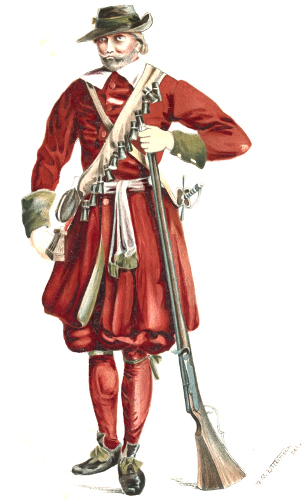
N. R. Wilkinson del MUSKETEER 1669. Mintern Bros. Chromo.
87In July, 1825, the Regiment contained the following Officers:—
Colonel.—Field-Marshal H.R.H. the Duke of Cambridge, K.G., G.C.B., etc.
Lieutenant-Colonel.—Colonel J. Macdonell, C.B.
Majors.—Colonels J. Hamilton; and W. H. Raikes.
Captains.—Lieut.-Colonels F. Milman; T. Barrow; D. MacKinnon; and
H. Dawkins; (Mounted).
Colonel Sir R. Arbuthnot, K.C.B.; Lieut.-Colonel Sir W. Gomm,
K.C.B.; Colonel Waters, C.B.; Lieut.-Colonels T. Steele; J. Fremantle,
C.B.; W. Walton; A. Wedderburn; C. Shawe; G. Bowles;
C. Bentinck; G. FitzClarence; F. Russell.
Lieutenants.—Major J. S. Cowell; Captains J. Drummond; C. Girardot;
T. Chaplin; H. Salwey; Hon. J. Forbes; A. Cuyler; W. Kortright;
H. Armytage; H. Gooch; T. Powys; H. Bentinck (Adjutant); F.
Shawe; F. Buller; J. Montagu; H. Vane; R. Bowen; C. Short; J.
Hall; Hon. H. Dundas; W. Cornwall; Hon. W. Graves; H. Murray;
B. Broadhead.
Ensigns.—Lieutenants C. Hay; G. Bentinck; W. Northey (Adjutant);
J. D. Rawdon; Hon. T. Ashburnham; Hon. E. Erskine; W. J.
Codrington; E. D. Wigram; St. J. Dent; Hon. H. Fane; Hon. J.
Hope; W. Cotton; Hon. A. Upton; F. Paget; B. Manningham;
E. B. Wilbraham; Lord M. W. Graham.
Quartermasters.—T. Dwelly and B. Selway.
Surgeon-Major.—J. Simpson. Battalion Surgeons.—W. Whymper, M.D.,
and T. Maynard. Assistant Surgeons.—G. Smith and F. Gilder.
Solicitor.—W. G. Carter, Esq.
The year 1826 was one of distress in England, which led to
considerable disorder, especially in the manufacturing parts of
Lancashire. The workmen, believing that the introduction of
machinery, then beginning to be used, was the cause of their
sufferings, committed many acts of outrage, and, during the last
week of April, a large amount of property was destroyed by
riotous mobs in that county. In order to strengthen the military
force required to suppress these disturbances, the 2nd Battalion
Coldstream and the 1st Battalion Third Guards proceeded to
Manchester (by canal from Paddington) on the 1st and 2nd of
May respectively. The 2nd Battalion were stationed there until
the end of July, when they were sent to Dublin to relieve the 2nd
Battalion Grenadiers, which, on reaching Liverpool, were ordered to
remain in the Northern District.
On leaving this District, the following letter was addressed by
the Lieut.-General Commanding (Sir J. Byng) to the Commanding
88Officer, 2nd Battalion Coldstream, dated July 23rd, and published
in Regimental Orders, August 8th:—
The Battalion of Coldstream Guards under your command, being on the
point of its departure for Ireland, Sir John Byng thinks it but due to the
Officers and men, to notice to them the very creditable reports which have
reached him of the orderly and soldierlike conduct of the Battalion during
the time it has been stationed at Manchester—testimonials which, joined
to what he has observed himself when on the spot, are the more gratifying
to the Lieutenant-General, because, whilst they afford him an opportunity
of thanking them for their useful services in the District under his orders,
another occasion presents itself of recording his unqualified approbation
of a corps which so highly distinguished itself under his command at the
Battle of Waterloo; and for whose welfare and high character he must
ever feel sincerely interested. In communicating the above to you, the
Lieutenant-General requests you will be so good to make it known to the
Battalion in such manner as you may judge proper.
Colonel Raikes having retired from the service, June 21, 1826,
Colonel MacKinnon became Junior Major, commanding the 2nd
Battalion.
It was not until towards the end of the year that the two
Battalions of Guards quartered in Lancashire were brought back
to London, and then a fresh duty awaited the Brigade. There
was trouble between Spain and Portugal, and the Government
determined to support the latter Power. The resolution to do so,
was hastily formed or tardily published, and on the same day that
it was announced in Parliament (December 11th), orders were
issued for six companies of the 1st Grenadiers and of the 2nd
Battalion Third Guards, made up to 84 rank and file each,
to be held in readiness for foreign service; the Brigade so
formed, to be commanded by Major-General Sir H. Bouverie
(late of the Coldstream). The expedition, numbering 5000 men,
under Sir H. Clinton, started immediately afterwards, and, before
Christmas, the troops began to land at Lisbon. As no portion
of the Coldstream took part in this service, it is unnecessary to
make any further allusion to it in this volume, except to note that
it lasted more than a year, and that the two Battalions did not
return home until the spring of 1828.
The death of the Duke of York, January 5, 1827, brought to
a close the career of an able military administrator who, for twenty-one
years of his early life (1784-1805), had been Colonel of the
89Coldstream Guards. His unremitting devotion to the best interests
of the service, during a period of thirty-two years (broken by a
short interval only), in which he served as Commander-in-Chief
(1795-1827), earned for him an enduring fame in the annals of
the country. When he first was entrusted with this high office,
the British army was still afflicted by that inefficiency which caused
disaster in North America, and brought ruin and disgrace upon
our arms; but, at the end of his life, greatly owing to his vigour
and ability, this lamentable state of things was completely changed,
and victory and glory once more shone upon our banners.
“It is not on account of his early services,” wrote Sir Walter Scott, “that
we now venture to bring forward the late Duke of York’s claims to the
perpetual gratitude of his country. It is as the reformer and regenerator
of the British army, which he brought, from a state nearly allied to general
contempt, to such a pitch of excellence, that we may, without much
hesitation, claim for them an equality with, if not a superiority over, any
troops in Europe.”[145]
At the funeral, which took place at Windsor, the Brigade was
represented by a force of about 1400 Officers and men, of whom
the 1st Battalion Coldstream furnished 12 Officers and 269 Non-commissioned
officers and men.
In the summer of this year, the 2nd Battalion returned from
Ireland, and was quartered in Portman Street, the 1st Battalion
being stationed in King’s Mews barracks (August 1st).
Next year, the 1st Battalion marched to Manchester (October
1st),[146] and remained there for ten months, when they were sent to
Dublin, by Liverpool (July, 1829), for a year’s service in Ireland,
returning to London (Portman Street) in August, 1830. During
this period, the Battalion continued to receive the highest commendation
for the excellent discipline and good conduct that
prevailed among all ranks, and the following extract from Major-General
Dalbiac’s confidential report, dated May 6th, and sent by
order of the Commander-in-Chief (Lord Hill) to the Lieut.-Colonel,
for the information of the Colonel of the Regiment, Field-Marshal
H.R.H. the Duke of Cambridge, will be read with interest:—
90
“It is impossible to speak in terms too commendable of the good
order, the interior economy, and the general efficiency of the 1st Battalion
Coldstream Guards, which I consider to be a corps of the first value.
The body of men is particularly good; the Battalion thoroughly instructed
in its duties in garrison and in the field; the conduct of the men very
exemplary. The Commanding Officers have severally afforded me much
valuable assistance in upholding the discipline of the Garrison.”[147]
In this connection, a Battalion Order of February 11th, published
in Dublin, may also be quoted:—
In consequence of the diminution in the list of defaulters, Lieut.-Colonel
Fremantle requests that Officers will set at liberty the defaulters
in their respective companies.
On May 16, 1829May 16, 1829, Colonel Hamilton having retired, Colonel
MacKinnon became Senior Major (1st Battalion), and Colonel Sir
W. Gomm was promoted Junior Major (2nd Battalion).
It should be noted here, that, about this time, a mistake began
to creep in with respect to the title of the Regiment, which, being
placed in the Army List between the First, or Grenadier, and the
Third Regiment of Foot Guards, was occasionally described as
the “Second Foot Guards.” In December, 1829, the Lieut.-Colonel
(Colonel Macdonell) protested against this innovation; and, in
reply, Sir H. Hardinge, then Secretary at War, had it stopped,
and regretted that a clerical error should have accidentally been
made.[148]
Some changes had been made in the uniform of the Officers of
91the Brigade after 1815, especially in the beginning of the reign of
George IV.; but a more complete and permanent change began
to be adopted in the year 1830, and was not finally effected until
1834. It may be sufficient to state here, that blue trousers with
gold lace, those of Oxford grey mixture with the red stripe (for
winter wear), and the present gold and crimson sashes were then
introduced. The gorget, the white pantaloons, or breeches and
stockings (worn in the evening), and the cap-lines and tassels of
Non-commissioned officers were discontinued; and the bearskin cap
became the head-dress of the whole Regiment instead of the
Grenadier company only, as was formerly the case. The Rose—one
of the distinctive badges of the Coldstream, which has now,
unfortunately, entirely disappeared from the uniform of Officers,
though still happily to be seen on that belonging to Non-commissioned
officers and men—was then retained on the epaulettes,
and was not removed until a quarter of a century later.
Further, a braided great-coat was allotted to Officers of the Brigade,
of the same pattern for the three Regiments, to distinguish them
from the Line. Lastly, Field-Officers of the Guards were ordered by
the King (Brigade Order , March 2, 1831) to wear the same sword
belt, as that of a General Officer. Uniform, at that time, seems to
have been worn in out-quarters more frequently than is customary
at present; and orders exist, which show that Officers stationed in
Dublin, were not allowed to appear in plain clothes, unless going
to some distance in the country, and remaining absent all night
from their quarters. On the other hand, there was no special
mess-dress; but uniform at mess was nevertheless the rule, and
Officers did not dine in barracks in plain clothes.
The death of George IV. occurred on June 26, 1830, and
William IV. ascended the Throne. The funeral of the late King
took place at Windsor, and was attended by the 2nd Coldstream
(the 1st Battalion was in Dublin). Upon this occasion an order
was issued intimating that, “Colonel Macdonell has been honoured
by His Majesty’s commands to communicate to the 2nd Battalion,
in the strongest possible terms, his approbation of their conduct
during the ceremonial of the Funeral of His late Majesty King
George IV.,” adding that “the King has further directed Colonel
Macdonell to say that it affords him the greatest pleasure thus to
express his satisfaction, on the first opportunity he has had of
seeing them since his accession to the Throne.” An order couched
92in similar terms was addressed to that part of the Brigade, employed
in the ceremonial just mentioned, viz. 1st Grenadiers, quartered
at Windsor, 100 men each from the 2nd and 3rd Grenadiers, the
2nd Coldstream, and the 1st Battalion Third Guards.
During the early years of his reign, William IV. frequently
inspected the Foot Guards. The 2nd Battalion Coldstream was
the first reviewed (July 19th), and on the same day, the King
granted the Regiment the privilege of receiving His Majesty with
the Coldstream March instead of the National Anthem. This
was communicated by the following Regimental Order:—
“Colonel Macdonell has received His Majesty’s commands to communicate
to the Officers, Non-commissioned officers and men, his entire
satisfaction with their appearance this morning. His Majesty has been
further pleased to command that hereafter, when he is received by either
Battalion of the Regiment, the band is to play the Coldstream Regimental
March instead of 'God save the King.'”[149]
On the same day, the King commanded that the Field-Officer
in Brigade Waiting, accompanied by the Adjutant in Waiting, and
an Orderly Sergeant from each Regiment of Foot Guards, should
attend His Majesty’s carriage on State occasions. The former
practice was that the Field-Officer attended the Sovereign, and
had a place in a Royal carriage assigned to him.
A few days later the members of the Nulli Secundus Club
were honoured by an invitation to dine with His Majesty (July
31st). Upon this occasion, the King was pleased to express the
attachment which he felt, especially, for the Coldstream Guards,
and the sincere interest he took in the continued prosperity of the
Nulli Secundus Club, and he intimated it to be his intention to
receive the members at dinner every year.[150]
93On the 22nd of July, Colonel Macdonell, having been promoted
Major-General, was succeeded in the command of the Regiment
by Colonel MacKinnon; thereupon Colonel Sir. W. Gomm became
Senior Major (1st Battalion), and Colonel Milman, Junior Major
(2nd Battalion).
The period 1829-1832, will ever be memorable in English
history as one of great trouble, anxiety, and difficulty. There
was considerable distress among the working classes, especially in
1829,—due, according to some writers, to the currency laws which
then came into operation.[151] But besides this, and far more
important, a wave of agitation swept over the face of the country
with a terrific force, unknown since the great Rebellion. Violent
riots and great disorder were of frequent occurrence; and civil
war, though happily it never broke out, was imminent, and was
believed by some to be inevitable. During this period, Catholic
Emancipation was carried and Reform was passed; the landmarks
of the then existing British Constitution were obliterated, and
the political principles, which were held by many to be the basis
of national prosperity, were uprooted. The death of George IV.
at this critical juncture, contributed in no small degree to fan the
flames of discontent, and to produce the uncompromising changes
in the government of the country, which were effected in 1832.
But events abroad also served to shape the destinies of England;
for, added to the trouble at home, Europe, too, was convulsed
by mighty disturbances, which shook to their foundations some
of the principal Continental nations, and influenced the course of
agitation in this country. Belgium, at that time subject to the
Crown of Holland, rebelled, declared her independence, and
succeeded in establishing herself as a separate Monarchy under the
rule of a Prince of Saxe-Coburg, who assumed the title of King
Leopold I.[152] In France the spirit of revolution, vainly smothered
in 1815, and ignorantly dealt with by the Bourbons, again reared
its head, and Charles X. was hurled from his throne. The ancient
Monarchy of France was finally and for ever extinguished, and a
Citizen-King, surrounded by Republican institutions, was invited
94to reign by the favour of the Garde Nationale—the armed representatives
of the populace. The insurrection, that succeeded in
vesting Louis-Philippe with a semblance of Royal power, and that
effectually tore to shreds the constitution fixed by the Allies in
1815, began in Paris on the 26th of July, 1830, just two days
after the dissolution of Parliament in London. The general election
took place about a month later; and in the excited state of men’s
minds, when widespread sympathy was felt and expressed for
the aspirations of the Orleanist faction in France, the result could
not but reflect the movement that was carried on there, and give
impetus to an agitation which had already acquired considerable
strength.
Parliament opened on the 26th of October, and three weeks
later, on the fall of the administration of the Duke of Wellington,
Lord Grey was called to office. The winter passed gloomily,
and a wild spirit of revolt was abroad. The southern counties
around London were “in a state of open insurrection;” the
agitators, frequently referring to events in Belgium and France,
inflamed the passions of the people; outrages and excesses were
committed, and so great was the consternation created by the fear
of disorder, that the King’s visit to the city (November 9th) had to
be given up. It is unnecessary to describe the various vicissitudes
which attended the great struggle for Reform. Suffice it to say
that the country continued to be the prey to an increasing
agitation, unparalleled in modern British history, and that the Bill
was finally passed into law by a large majority, June 7, 1832,
because those that opposed it were intimidated into silence, believing
that further resistance would end by plunging the nation into the
abyss of civil war.
The army, taking no part in the effervescence that seethed
around, was occupied in the uncongenial duty of preserving the
public peace, wherever it was disturbed. In London, a system of
Metropolitan Police had just been organized (1829), to replace the
watchmen, who up to that time were responsible for good order
and for the prevention of crime. The new force had only come
into existence, nor was it sufficiently strong to cope with the
serious emergency that had arisen. The Brigade, therefore, was
frequently held in readiness to aid the civil power, and in
November, 1830, all Officers were recalled from leave, while Non-commissioned
officers and men on furlough were ordered to
95rejoin their corps without delay. A detachment of two Subalterns
and fifty-seven men were stationed at North Hyde, furnished by
each Battalion in turn, the reliefs being made fortnightly, until
March 1, 1831, when it was found by the 1st Battalion Coldstream,
who proceeded to Windsor on that date.[153]
The Coronation of the King and Queen took place in
Westminster Abbey, September 8, 1831, the day after the Reform
Bill had passed the committee stage in the Commons. The
ceremony was sufficiently magnificent, but was shorn of much of
its ancient splendour, and, in accordance with the economy of the
age, His Majesty was prevented from giving the usual Coronation
Banquet in Westminster Hall.[154] The Brigade lined the streets in
the vicinity, the 1st and 2nd Battalions Grenadiers and the 1st
Scots Fusilier Guards[155] occupying the west side, the 1st and the
2nd Battalions Coldstream—a portion of which had been brought
from Windsor—and the 2nd Scots Fusiliers, the east side, the left
of the Coldstream being posted near the Abbey. Piquets were also
held in readiness in case of disorder, which happily did not occur.
The troops, in review order, wearing white trousers, and Officers in
gold sashes, were in position at 7 a.m. The largesse of “Platform
money” was not distributed upon this occasion, but an allowance
of one shilling, to each Non-commissioned officer and private
under arms, was made for refreshments, half of which was spent,
the remainder being given to the men in the evening.[156]
The pleasures of political agitation were somewhat marred, and
the intensity of the strife was perhaps blunted, by the first
appearance in England of the plague of cholera, which occurred
96towards the end of 1831. This terrible disease, having broken
out in Bengal in 1817, spread to Persia in 1823, where it remained
in a more or less dormant state, until 1830, when it revived,
and extended rapidly through Russia, into Austria, and North
Germany. In spite of severe quarantine regulations, cases of this
fatal illness were reported in Sunderland on October 26, 1831;
and before the end of the year many persons were attacked, and
succumbed to its violence, in the north of England and in Scotland.
In February, it appeared in the port of London, and from thence
it spread through every part of the kingdom, and continued its
ravages into Ireland. The panic created by this unknown epidemic
was great. Medical men were naturally at a loss to understand,
much more at a loss to treat effectively, the new disorder; but,
though severe, it was everywhere less fatal than preconceived
notions had anticipated, and, when it gradually disappeared in
the autumn, surprise seems to have been general that so much
apprehension had been entertained.[157]
The results of cholera were not, however, unimportant, for the
visitation served to introduce more sanitary and cleanly habits
among the people, and to put an end to the billeting system
and to overcrowding in military barracks. Every precaution was
naturally taken to preserve the health of the troops, and to guard
them against infection. The 2nd Battalion, being at the Tower,
in a dangerous quarter, stringent orders were issued to secure
this object. Frequent medical inspections took place, certain
districts were placed out of bounds, drunken men were isolated
until visited by the Surgeon, the water supply was not neglected,
and the men were “earnestly desired to report themselves directly
they felt unwell, as it is found when remedies are applied in time
fatal results seldom ensue.” The order (dated March 21, 1832)
added that—
the Commanding Officer has great pleasure in observing the orderly
behaviour of the men in general during the last week, and he trusts that
by abstaining from absence from barracks, drunkenness, and other excesses,
and a strict compliance with the above regulations, they will continue to
second his efforts as much as possible, to keep the barracks free from
disease.
In February, moreover, Warley was converted into a Depôt for
97all Brigade recruits, who were taken from the Recruit House in
London; and the Royal Waggon Train, being removed from
Croydon, the barracks there, were placed at the disposal of
the Foot Guards for the occupation of those convalescents or
weakly men, who were unable to perform the usual military
duties in town. During the same month, married soldiers and
others were sent to Croydon, Chatham, and Brighton—at which
latter place there was then accommodation for 336 men. In
March, also, certain houses in Hanley Road, Hornsey, were hired
for a year, fit to receive five Officers and 463 men. New barracks
were constructed, or the old ones improved, and, in November,
1833, the King’s Mews were changed into St. George’s barracks,[158]
and the Recruit House into the present old wing of Wellington
barracks, called at that time, for a few months only, Westminster
barracks. On March 1, 1834, the Brigade occupied the following
quarters: Grenadier Guards—1st Battalion, Tower; 2nd Battalion,
Portman Street; 3rd Battalion, Wellington (Westminster) barracks:
Coldstream Guards—1st Battalion, Windsor; 2nd Battalion,
Knightsbridge, Kensington, and the Magazine barracks: Scots
Fusilier Guards—1st Battalion, St. George’s barracks; 2nd Battalion,
Dublin.
It may be stated here, that a company was also stationed in
Buckingham House, usually found by the Battalion occupying
Knightsbridge, and that the latter barracks were given up in May,
1836, and St. John’s Wood substituted for them. The Brigade
continued to occupy these West-end quarters until the Crimean
war broke out—that is, Portman Street, St. George’s, and Wellington
barracks accommodated one Battalion each, while the fourth Battalion
was divided into detachments, the head-quarters and three
or four companies being in St. John’s Wood, the remainder in
Kensington, the Magazine, Buckingham Palace, and St. George’s or
Wellington barracks.
In July, 1832, the 2nd Battalion proceeded to Dublin by
Bristol, returning to London in the following summer. Ireland
was then passing through one of the phases of popular discontent
and resistance to law so common in her history, and which have
for so long troubled the government of that island. The anti-tithe
agitation was then in full swing, and was accompanied by
98incidents very similar to those that occurred during the recent
anti-rent struggle, with which we are familiar. As a means of
pacifying the disturbed districts, troops were quartered in them,
just as was done in 1880. The 2nd Battalion furnished three
companies for this duty during the latter end of October, when it
appears that this force, under the command of Lieut.-Colonel
Hon. J. Forbes, was stationed at Leighlin Bridge, in Carlow, and
was quartered there for a fortnight. The Battalion gained the
approbation of the military authorities in Dublin, shown by two
orders (dated May 23 and August 12, 1833), testifying to the
high opinion entertained by them of the “exemplary conduct,”
and of the discipline of the corps whilst serving in Ireland.
The next two years passed without much incident until 1836,
when the Regiment was put into mourning by the unexpected
death of the Lieut.-Colonel (Colonel MacKinnon), who, having
served in the Coldstream throughout the whole of his military
career, from the early age of fourteen to the day of his death, in
every rank from Ensign to Lieut.-Colonel, through the Peninsular
war and at Waterloo, where he was wounded, may be considered as
an Officer peculiarly belonging to the Regiment.[159] In spite of
illness, he remained at his post until the middle of June, when he
obtained a year’s leave; but he was unable to avail himself of it,
for a few days later, on the 22nd, he died, only forty-six years of
age, respected alike by the Officers and the men. The public
exercises of the Regiment were immediately suspended till after
the interment of the Commanding Officer, and, on the 8th of July,
the following order was promulgated by Colonel Sir W. Gomm,
who succeeded him, on the occasion of an inspection of the two
Battalions by Lord Hill, the Commander-in-Chief:—
The Lieutenant-Colonel feels much pride in communicating to Colonel
Milman, Colonel Fremantle,[160] and the Officers and men of both Battalions
of the Coldstream, the marked satisfaction expressed by the General
Commanding-in-Chief at the high soldierlike appearance, steadiness under
arms, and precision of movement, which they both displayed at the
inspection—qualities pronounced by Lord Hill to be so eminently
characteristic at all times of the Corps to which they belong. The
99Lieutenant-Colonel, while imparting these gratifying sentiments of Lord
Hill to the Regiment, would be greatly wanting in what he feels to be due
to his Lordship and to the Corps at large, to the memory no less of its late
distinguished Commanding Officer, did he fail to communicate, at the same
time, the strong expression of condolence and regret with which Lord Hill
adverted to the loss freshly sustained by the Regiment, and the Army in
general, in the death of Colonel MacKinnon—a regret which Lord Hill
felt assured was so largely and so duly shared with him by all ranks and
orders of the Regiment.
Sir W. Gomm did not long retain the command of the Regiment;
but, as will be seen, he returned to the Coldstream a quarter of a
century after he had left it, when he was appointed Colonel of
the Regiment. Becoming Major-General, the Lieut.-Colonelcy
devolved upon Colonel Milman, and Colonels Fremantle and
Walton succeeded as Senior and Junior Majors respectively
(January 10, 1837).
The Coldstream now stood—
Colonel.—Field-Marshal H.R.H. the Duke of Cambridge, K.G., etc.
Lieut.-Colonel.—Colonel F. Milman.
Majors.—Colonels J. Fremantle, C.B.; and W. Walton.
Captains.—Lieut.-Colonels A. Wedderburn; C. Shawe; G. Bowles; and
C. Bentinck; (Mounted).
Lieut.-Colonels T. Chaplin; H. Armytage; H. Bentinck; C.
Short; W. Cornwall; B. Broadhead; C. Hay; H. Gooch; J. Rawdon;
Hon. T. Ashburnham; W. Codrington; E. Wigram.
Lieutenants.—Captains W. Stewart; Hon. J. Hope (Adjutant); G. Knox;
Hon. A. Upton; F. Paget; Hon. E. Wilbraham; Lord M. W. Graham;
J. Pringle; J. Clitherow; Gordon Drummond; Lord F. Paulet;
C. Horton (Adjutant); J. Forbes; R. Vansittart; C. Windham;
C. Wilbraham; W. Tollemache; J. Elrington; H. Daniell; Hon.
R. Boyle; F. Halkett; H. Dent.
Ensigns.—Lieutenants C. Dundas; R. Hulse; D. Chisholm; S. Conroy;
Hon. F. Villiers; H. Brand; G. Herbert; Viscount Alexander; Hon.
R. Lambart; G. Johnson; W. S. Newton; Hon. C. Grimston; G.
Mundy; P. Bathurst; E. Milman; Hon. L. Hope; Spencer Perceval.
Quartermasters.—T. Dwelly; and W. Morse.
Surgeon-Major.—G. Chenevix. Battalion Surgeon.—W. Hunter, M.D.
Assistant-Surgeons.—F. Gilder; and J. Wedderburn.
Solicitor.—W. G. Carter, Esq.
The reign of William IV. was now drawing to a close, and a
few months only elapsed, when, by the death of the Sovereign,
100June 20, 1837, our present Gracious Queen, then just eighteen
years old, ascended the Throne. The funeral obsequies took place
as usual at Windsor, and were fixed for the 8th of July. The
1st Grenadiers were stationed there at the time; and the 1st
Coldstream had gone to Dublin in 1836, whence they did not
return until August, 1837. About one hundred men from each of
the other Battalions of the former Regiment, as well as four
companies from each Battalion of the Scots Fusiliers, and the
whole of the 2nd Coldstream Guards proceeded to Windsor to
take part in the ceremony.
Before closing this chapter, it may be well briefly to record
one or two points which affected the Regiment during the reign
that has just come to a conclusion. Towards the end of 1829,
gratuities, in addition to the pension, were granted, on discharge,
to specially selected Non-commissioned officers and men, who, by
their length of service and meritorious conduct, were recommended
for reward; and on the 30th of July of the following year, the
silver medal for “Long service and good conduct” was instituted,
and presented to them. Later, in 1836, good conduct badges—or
“marks of distinction,” as they were then called—were introduced,
and worn on their uniform, by men whose character deserved
recognition. Each “mark” added a penny a day to the recipient’s
pay; and, if in uninterrupted possession of it for five years
immediately preceding discharge, the same amount was added to
the pension.[161] During this reign, moreover, a Commission inquired
101into military discipline, more especially into the system of flogging,
then in force in the army. The final report, dated March 15,
1836, was in favour of retaining corporal punishment, but recommended
that “no pains may be spared to endeavour to make its
infliction less frequent.”[162] Regimental numbers, identifying soldiers,
appear to have been introduced into the army about this time;
they were at first applied only to the men’s records, but gradually
they were more generally adopted (Regimental Order , January
2, 1836).
In the summer of 1836 it was ordered that the Battalions of
the Foot Guards, and not the light companies only, should be
practised in light infantry movements in extended order (Brigade
Order , July 11, 1836).
We have seen that the Brigade Depôt was transferred from
London to Warley early in 1832. It appears, that the recruits of
the Coldstream and of the Scots Fusiliers were ordered to Croydon
in June, 1833, and the rest followed to the same place next year.
A Subaltern Officer was placed in command of the station; but in
January, 1837, a Regimental Lieutenant (bearing rank of Captain)
was ordered to perform this duty, and he remained there for a
fortnight at a time. An Assistant Surgeon, relieved every two
months, was also quartered at the Depôt.
The control exercised by the Lieutenant-Colonel over the two
Battalions of the Regiment was made somewhat more direct by
the introduction of weekly reports, which were furnished to him
by Officers commanding Battalions, and which stated what drills,
exercises, etc., were performed, and whether there had been ball
practice or marching (Regimental Order , April 12, 1833). A
scale of punishment was instituted, to equalize, as far as possible,
awards made for minor offences (1st Battalion Order, May 24,
1831). On July 14, 1832, a Regimental Order was issued, which
gives some idea of the system then pursued in the Regiment, as
regards the discipline of the men:—
102
“Battalions will have evening parades. In London the Battalions will
always parade in Guard Order, when finding the public duties. No leave
is to be given from church parade, inspection of necessaries, or Surgeon’s
inspection, unless absolutely necessary. Men unfit for duty, or parade,
caused by liquor, to be punished as drunk. When a drunkard appears in
a suspicious state at evening parade, and that by leaving barracks he would
probably get intoxicated, he must be kept in, and on no account be permitted
to enter the canteen.... No soldier to have leave all night, and
only six men a company to have leave from parade, or till twelve o’clock.
To receive leave or other indulgence, the soldier must have been clear of
all defaulter’s list at least a month. To get a pass or furlough, he must
have a good general character, and have been clear of the defaulter’s list
two months. Soldiers must have been two years in the Regiment, before
they can apply for a pass.”
Lastly, it may be stated that His Majesty’s Commands for the
part to be taken by the Brigade, at investitures of the Order of
the Bath, were published in 1835 (Brigade Order , August 19th),
and were to be considered as a Standing Order for the future,
when the ceremony should take place in St. George’s Hall, Windsor
Castle. The Sergeant-Major and fifteen Sergeants from the
Windsor Battalion, and the Sergeants-Major and forty-two Sergeants
of the West-end Battalions, were stationed in the Hall; the former
at each of the doors right and left of the Throne, the latter forming
a line from the Throne to the entrance; the whole under the Adjutant
of the Windsor Battalion, whose place was near the King. At
the subsequent banquet in the Waterloo Chamber, the Colours of
the Battalion were crossed over the south fireplace, six Sergeants
of the same corps stood at the doors, and the remainder formed
a line from St. George’s to the Banqueting Hall, as the procession
passed to and from the Waterloo Chamber; the Band was placed
in the latter room, the Drums at the top of the grand staircase.
Additional sentries were mounted, eight in the Quadrangle, and
one on Queen Elizabeth’s Gate.
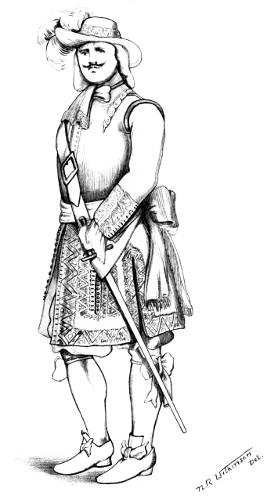
N. R. Wilkinson del OFFICER TEMP. JAMES II. Mintern Bros. lith.
A. D. Innes & Co. London
CHAPTER V. SECOND PART OF THE LONG EUROPEAN PEACE.
103
Beginning of the reign of Queen Victoria—Troops during Parliamentary elections—Coronation
of the Queen—Fire at the Tower of London, 1841—Rebellion in Canada—Two
Guards Battalions sent there, 1838, of which one the 2nd Battalion Coldstream
Guards—Return home, 1842—Visit of the Russian Tsar Nicholas I. to England—European
revolution—Bi-centenary celebration of the formation of the Coldstream
Guards, 1850—Death of the Colonel of the Regiment, H.R.H. the Duke of Cambridge;
succeeded by General the Earl of Strafford—Exhibition in London—Death
of the Duke of Wellington—Changes and reforms up to 1854—Camp at Chobham.
The young Queen had only reigned a few months, when it became
necessary to send a military expedition to Canada, where for some
time trouble had been brewing, and where reinforcements were
required to maintain the authority of the Crown, and to settle the
difficulties that had arisen. The 2nd Battalion Coldstream formed
part of this expedition, and left London March 28, 1838; but before
we refer to the events which occurred in that colony, we propose
to deal shortly with those that took place at home, until the year
1842, when the Battalion returned to England.
During the General Election that followed immediately after
Her Majesty’s Accession, the troops quartered at Portman Street
and in St. John’s Wood, were ordered to march away from the
borough of Marylebone. The 2nd Coldstream being at the former
station, proceeded, in consequence, to “Hammersmith and adjacents,”
July 22nd, until the 28th. The system of removing soldiers from
the place of an election seems never to have been adopted in Westminster,
nor does it appear to have been a usual practice elsewhere
in the Metropolis, except in the City, where the Bank piquet was
often suspended for two or three days; as a general rule the troops
were confined to barracks. On one other occasion, however (June
28, 1841), the 1st Battalion Coldstream vacated Portman Street, and
104marched to Fulham, Parson’s Green, and Walham Green, while an
election was taking place in Marylebone; and from thence, on the
3rd of July, proceeded to Hounslow and Twickenham during an
election in the county of Middlesex; the Battalion returned to
London on the 9th. Upon the same occasion, the recruits at
Croydon were marched to London, July 5th, to their respective
Regiments, until after the termination of the East Surrey election,
July 12th; during the interval, the Assistant Surgeon, the Hospital
establishment, and a corporal and an old soldier from each Regiment,
only remained in barracks.
On the retirement of Colonel Milman to half-pay, August 8, 1837,
Colonel Fremantle succeeded as Lieutenant-Colonel, and Lieut.-Colonel
Shawe was promoted Major. Colonel Walton took
command of the 1st Battalion, and Colonel Shawe of the 2nd.
The expedition to Canada put an end to the Dublin quarter,
which was not again renewed for nearly twenty years; and the 1st
Battalion Scots Fusiliers, who had proceeded there in the summer
of 1837, returned to London in the following March. Moreover,
during the absence of two Battalions of the Brigade in North
America, the Tower was not occupied by Guards in 1838, and duty
was done in Windsor, 1839-1842, by a regiment of the Line.
On May 6, 1838, the Royal Military Chapel in Wellington
Barracks was opened for the first time; and a year later (July,
1839), the three Regiments took it in turn to send their Bands
there to attend Divine Service.
The Queen’s Coronation, June 28, 1838, was conducted on the
abridged model of that of William IV.; but in some respects it was
more magnificent and stately than the latter, and it included a
public procession to and from Westminster Abbey, which had been
absent in former ceremonies of the kind, since the reign of Charles
II. As the personality of Her Majesty, moreover, roused enthusiasm
among all classes to a far greater degree than had been the case with
many of her predecessors, the people, drawn in dense crowds to the
splendour of the spectacle, were not slow to display the feelings of
genuine loyalty and affection, with which they were filled towards
their youthful Sovereign; and the effect produced on the public
mind, was even greater than if, under ordinary circumstances, the
older forms of mediæval pageantry had been adopted. The streets
were lined by troops from Buckingham Palace to the Abbey, the
infantry in single rank on either side of the road; the Brigade
105occupied the distance from Westminster to Marlborough House,
and the five Battalions were present. The 1st Coldstream, having
been brought up from Windsor, were in Pall Mall, the Scots Fusiliers
thence to the Horse Guards, and the Grenadiers took up the remaining
ground. On the other side of the Coldstream, in St. James’s
Street, Piccadilly, and Constitution Hill, there were Marines, Rifles,
and the 20th Regiment (then at the Tower). In the Abbey a line was
kept by a detachment of the Queen’s company, Grenadier Guards,
the Ensign of which carried the Royal Standard, and men of the
Grenadier companies of the 1st Coldstream and of the 1st and 2nd
Scots Fusiliers, under Subaltern Officers of their own corps.[163]
Her Majesty held her first review in Hyde Park on the 9th of
July following, at which the Coldstream was not present, being at
Windsor, but a detachment under Lieut.-Colonel Gooch went
up to London and found the public duties upon that occasion. It
may be interesting to note that each man of the force inspected, was
supplied “with thirty rounds blank cartridge, a good flint, and a
spare one in his pouch.”
Colonel Fremantle having retired December 31, 1839, Colonel
Walton became Lieutenant-Colonel, and Colonel Bowles was promoted
Major (2nd Battalion), Colonel Shawe assuming command of
the 1st Battalion. In the Regimental Order of farewell, Colonel Fremantle,
after referring to his services of nearly thirty-five years in
the Regiment, dwells on “his proud satisfaction of participating
in those fields of honour in which the Coldstream acquired its noble
perfection,” and continues:—
“Since the peace, I have served in it, with the approbation and protection
of our Royal Colonel, and in harmony and good fellowship with my brother
Officers. My earnest desire in thus taking leave, is a continuation of the
same honour and happiness. However much I may personally regret
resigning the command of the Coldstream Guards, I avail myself of the
painful occasion to perform a pleasing duty, to express my thanks to
Sergeant-Major Lundie, the Non-commissioned officers and soldiers of the
Regiment, and to congratulate them upon that system of discipline which,
of late years, has tended so much to the diminution of crime and consequent
106punishment. I trust that the same spirit of loyalty which has rendered the
Coldstream Regiment 'Second to None,' will ever continue to be prominent
in its duty to Her Majesty.”
Among the miscellaneous duties performed by the Brigade in
London, was that relating to the extinguishing of metropolitan
fires,—one even now discharged, but which was of more importance
in days when the Fire Brigade was imperfectly organized.
In October, 1834, when the Houses of Parliament were destroyed,
the exertions of the troops to arrest the flames were warmly recognized
by the Home Secretary; and again, in January, 1836, the thanks
of Lord Palmerston were published, with the intimation that, but
for the timely assistance of the Brigade, the Foreign Office would
have been burnt down. On the night of October 30, 1841, a conflagration
took place in the Tower, which, having spread with alarming
rapidity, completely gutted the Armoury, and destroyed many
of the trophies of former wars which had been deposited there.
Owing to the exertions of the Battalion quartered in the Tower
(1st Scots Fusiliers), and other portions of the Brigade, that hurried
to the disaster, the Regalia was saved, and many interesting parts
of that historic fortress and prison were preserved.[164] On the 5th of
November the following Regimental Order was issued:—
“Field-Marshal the Duke of Wellington, Constable of the Tower, having
brought to the notice of the General Commanding-in-Chief the meritorious
conduct of the troops, who assisted in checking the conflagration which
unfortunately took place in that fortress on the night of Saturday last, the
30th ulto., I have Lord Hill’s command to desire that you will be pleased
to convey, to the portion of the Brigade of Guards employed upon that
occasion, the gratification which his Lordship feels, at receiving this report
of their exertions, and of the great service which they rendered, not only
in stopping the progress of the flames, but in saving the public property
thus threatened with destruction. Lord Hill anticipates the additional
pleasure, which the Guards cannot but experience, from the circumstance
of this report of their conduct having emanated from the Duke of
Wellington.”
Officers who have so often seen the piece of plate, representing
the Sphinx, on the table of St. James’s Palace, may be interested
in knowing, that it was received at a general meeting of the Guards
Club, on May 5, 1842. The Duke of Bedford, executor of General
107Earl of Ludlow, Scots Fusilier Guards, gave it, in accordance with
the latter’s will, by which he left “the Egyptian vase, presented to
him by the Brigade of Guards in the camp before Alexandria, to
the Guards Club, with his grateful thanks.”
It is now time to revert to the more serious affairs, which engaged
the attention of the 2nd Battalion in North America. Canada at
that period was divided into two distinct colonies—the Lower
province, inhabited almost entirely by old French settlers, and the
Upper province, peopled by immigrants of British nationality. In
the former, a simmering of discontent had prevailed for some years;
the colonists resented the system by which, under a semblance
of constitutional government, their popular representatives were
excluded from all control and authority over their own affairs. In
the month of November, 1837, things came to a head, and a rebellion
broke out, led by one Papineau. Encouraged to violence by this
evil example, assisted by free-booters from the United States, and
having some grievances of their own to complain of, another
insurrection occurred almost simultaneously in Upper Canada. In
both cases, the disorder was instantly put down by Sir J. Colborne
(afterwards Lord Seaton), with a military force in Lower Canada,
and by the local militia in the other province. But the news reaching
home, that an actual outbreak had taken place, created the
utmost sensation in England. It was immediately determined to
strengthen the troops in the colony, and to send out Lord Durham
as Governor-General and High Commissioner, with large powers to
deal with the difficulty.
On the 23rd of January, the 2nd Grenadiers and the 2nd Coldstream
were ordered to be held in readiness for embarkation for
Quebec, each to be made up to 800 rank and file; and the Brigade,
so formed, was placed under the command of Major-General Sir J.
Macdonell, K.C.B. (late of the Coldstream). Captain Arthur
Torrens, Grenadier Guards, was appointed Major of Brigade; and
Captain J. Elrington, Coldstream Guards, Aide-de-camp to the
Major-General. On the 22nd of March this body of men was
inspected by Lord Hill, when a congratulatory order was issued
upon their appearance, expressing the Commander-in-Chief’s conviction
that they “would do honour to the high reputation of the
Brigade of Guards,” and concluding with his “best wishes for
their welfare while employed abroad in the service of the country.”
After the Officers had attended a Levée “to take leave,” and had
108been entertained at dinner by the Colonel, the Duke of Cambridge,
the 2nd Coldstream left London for Winchester, in four divisions,
on the 28th and 29th.
1st Division, Lieut.-Colonel Hon. T. Ashburnham, Commanding (Nos. 1
and 2 Companies); Captains W. Tollemache, Hon. R. Boyle;
Lieutenants Hon. L. Hope, G. Mundy.
2nd Division, Colonel G. Bowles, Commanding (Nos. 3 and 4 Companies);
Captains R. Vansittart, C. Wilbraham; Lieutenants M. Tierney,
Hon. A. Graves.
3rd Division, Lieut.-Colonel W. Stewart-Balfour, Commanding (Nos. 5 and
6 Companies); Captains C. Windham, R. Hulse; Lieutenants W.
Clayton, Lord Alexander.
4th Division, Lieut.-Colonel E. Wigram, Commanding (Nos. 7 and 8
Companies); Lieutenants S. Perceval, E. Milman, P. Bathurst.
Head-quarters, Colonel C. Shawe, Commanding the Battalion; Lieutenant
D. M. Chisholm, Adjutant; Quartermaster T. Lee; and Surgeon F.
Gilder, and Assistant-Surgeons E. Greatrex and W. Robinson.
The following Officers belonging to the Battalion were allowed
to find their own way out to Canada: Lieut.-Colonels W. Codrington,
Hon. J. Hope, and T. Chaplin; Captains H. Daniell,
F. Halkett, and H. Dent. Lieutenant Hon. F. Villiers was appointed
Aide-de-camp to Lord Durham. The Battalion embarked at Portsmouth
on the 17th of April, in H.M.S. Edinburgh and Athol, and
landed at Quebec on the 11th of May, a few days before the arrival
of the new Governor-General, who reached the Colony towards the
end of the month, and was received in state by the newly arrived
Guards Brigade.
The situation in Lower Canada was one of outward tranquillity,
the rebellion had been crushed, and order was restored; but serious
complications still remained to be adjusted. Numerous prisoners
were in custody awaiting trial, for their treason; and as it would
have been impossible to obtain a conviction by a local jury, Sir
J. Colborne, the temporary Governor, confined most of them in
prison, 161 in number, until the decision of the High Commissioner
could be given. On the 28th of June, Lord Durham
issued an Ordinance, by which he granted a complete amnesty to
all, with the exception of eight of the principal ringleaders; these
men he transported to Bermuda. He also declared that if these
men, or if Papineau and other fifteen chiefs of the insurrection—who
had absconded and had fled for safety into the United States,
109directly they were in danger of capture—were again found at large
without permission, they would suffer death as traitors. The
Ordinance, though humane and calculated to bring about peace
without further bloodshed, was adjudged to be illegal or unconstitutional.
There was no power to transport offenders nor to
threaten, with the extreme rigour of the law, those who had not
been tried. It would have been necessary to pass an Act of
Parliament to make it valid, and the state of parties at home
rendered any such course impossible. Government was weak, a
strong Opposition was ready to oust the Ministers from office, and
Lord Durham had many personal enemies. Lord Melbourne, the
Prime Minister, disavowed the Ordinance, and threw over the High
Commissioner, and thereupon the latter resigned his post, and left
Canada, November 1st.[165] But before quitting North America, he
committed an act for which he has been gravely censured; for, he
announced to the rebels (October 9th), that the general amnesty
he granted had been ratified by Her Majesty’s Proclamation, and
that the exceptions to the amnesty had been disallowed, and he
told them that there was no further impediment to prevent them
from returning to the colony.[166] The exiles were not slow to avail
themselves of this welcome intelligence, and in the month of
October they came back, freed from the consequences of their
former guilt, and determined to light afresh the torch of civil war.[167]
During the first six months, the troops had little to do beyond
their ordinary duties,[168] and in the summer leave was freely given to
many of the Officers to see the country, on the understanding,
110however, that none were to enter the United States. But, in spite
of the appearance of outward tranquillity, there was a spirit of disaffection
abroad, the authorities were resisted, the jury system had
broken down, and the population of one nationality were bitterly
divided from that of another. The execution of the law was
difficult, as a Battalion Order of the 11th of July may perhaps
exemplify—publishing the good conduct of several privates of the
Coldstream for assisting the Superintendent of Police in the execution
of his duty; “but for them, two prisoners would have escaped,
and he would have received a severe beating from the crowd.”
Feeling ran high among the loyal inhabitants, at the weakness
and timidity of the Home Government, and at the ungenerous
treatment their Commissioner had received at their hands.
Addresses poured in upon him from all quarters, expressing sorrow
at his departure. A farewell dinner was also given to him by the
Officers of the Guards Brigade, at which Sir J. Macdonell spoke
of him and his policy in eulogistic terms—an incident which raised
some comment, as it was supposed by some to be an interference
by a military Officer in a political question; though undoubtedly it
testified to the sentiments that prevailed among the well-disposed.
It was universally felt in the province, that the welfare of the colony
had been sacrificed to the evils of party exigencies.
Already, before the departure of Lord Durham, a rising had
been prepared, under the leadership of the returned exiles, and it
broke out on the 3rd of November, 1838, in the neighbourhood of
Beauharnois, a place on the right bank of the St. Lawrence river,
not very far distant from Montreal.
Troops were at once despatched to quell the disturbance. The
Grenadiers joined the expedition, and did not return to Quebec
till the end of April, 1840; but the Coldstream Battalion being
ordered to remain in that town to secure its tranquillity during the
crisis, did not form part of the column sent forward to disperse the
rebels.[169] The outbreak was sudden, and caused considerable alarm
while it lasted; but the operations were of short duration, nor were
they of much importance from a military point of view. Volunteer
111forces also lent their aid to put down the rebellion, and on the
17th of November they were cordially thanked by the Commander
of the Forces (Sir J. Colborne, who, since Lord Durham’s departure,
was also Governor), “for defeating the traitors and invaders” by
“their heroic perseverance and devotion to the service of their
country, which they have displayed from the first moment of this
second revolt.” The disaffected made little or no resistance, and,
unable to maintain themselves in the field, they soon dispersed or
surrendered. The insurrection thus came to an end almost immediately,
and many of the prisoners were taken to Montreal, where
a Court-Martial sat continuously for six months to try them. The
Coldstream, still at Quebec, did not furnish Officers for these trials.
After the suppression of the insurrection, there was still cause
for the presence of troops in the colony. First, to protect the loyal
portion of the population from the evil influence of agitators, who
continued to lurk in the country; and secondly, to maintain order,
while reforms were being introduced, calculated to put an end to
discontent for the future. Volunteer corps were raised, and Officers
appointed to command and organize them. Lieut.-Colonel Hon.
James Hope (Coldstream Guards) was placed in command of the
“Queen’s Volunteers,” and reported, Dec. 10, 1839, that this corps
was then composed of 2 staff-sergeants, 24 sergeants, 6 drummers,
and 432 rank and file, of whom 381 were taking their share of
garrison duty.[170] Captain Halkett (Coldstream Guards), appointed
Assistant Military Secretary in Upper Canada, also superintended
the formation of another corps.[171] About the same time, the Royal
112Canadian Regiment was raised, and some Non-commissioned officers
and men from the Guards were allowed to volunteer for service
therein. As it appears to have offered special advantages to
married men, the latter readily endeavoured to be allowed to obtain
a transfer to its ranks.
Although Lord Durham’s action in Canada was repudiated by
the Government in England, the efforts he made to reconcile the
people to British rule were in the end very successful. Before
he left North America, he made a masterly and comprehensive
report upon the position of affairs in the colony, and he recommended
remedies to redress the grievances, which he perceived
kept the people in a state of ferment. “As Mr. Mill has said,
these recommendations laid the foundation of political success and
social prosperity, not only of Canada, but of all the other important
colonies.... In brief, Lord Durham proposed to make the
Canadas self-governing as regards their internal affairs, and the
germ of a federal union.”[172] His report was accepted, and it
became the basis of the policy which Government now adopted.
Mr. Paulet Thompson, created shortly afterwards Lord Sydenham,
was sent to North America at the end of 1839, in the capacity
of Governor-General of the two Canadas, to carry out the recommendations
which he proposed. At the same time, Sir J. Colborne
returned to England, being relieved as Commander of the Forces
by Lieut.-General Sir Richard Jackson (late of the Coldstream
Guards). Early in 1841, the legislative union of the two provinces
was carried into execution, and from this act the new system of
colonial life, as now understood in the British Empire, may be
said to date.
The Coldstream continued all this time to remain at Quebec,
nor were they moved therefrom until they left North America in
1842. During these years small drafts were annually sent out to
keep up the Battalion to its proper strength, and upon almost
every occasion they were inspected previous to departure by the
113Colonel of the Regiment, H.R.H. the Duke of Cambridge. Arrangements
for winter clothing were made by the Commanding Officer,
who authorized a coat and cap to be worn by the Officers, in cold
weather, the former to replace the ordinary red coatee, then used
instead of the present tunic. An allowance was made by the
Treasury, calculated at £1 10s. for every effective soldier serving
in Canada for the first winter, and at 5s. for subsequent winters.
This money formed a fund, from which a supply of winter clothing
was provided for Non-commissioned officers and men. These
articles were to be considered public property, and could, if
necessary, be transferred from one man to another.
In the winter, parties were sent out into the woods when snow
lay deep on the ground, to be practised in “camping, etc.,” or
rather, in constructing log huts. The public duties in Quebec
appear to have averaged two Subalterns (on guard at the Castle
and at the citadel), 10 sergeants, 15 corporals, 2 drummers, and
from 110 to 180 men,—besides ten to fourteen men of the Royal
Artillery. It may here be mentioned that the stuffed goose’s head,
adorned with a gorget (to be seen in the Regimental Orderly
Room), records an incident which took place at this time. The
goose, having attached itself to the Battalion, became the constant
companion of one of the sentries in the citadel, and a humble,
though faithful friend and follower of the Regiment. While it lived
it wore the gorget that now is to be found round its neck; and a
picture, also in the Orderly Room, testifies to its never varying
attendance on the beat of the sentry it had chosen to follow.
On March 27, 1841, Officers were posted to companies as under:—
| Compy. |
Lieutenant-Colonels. |
Captains. |
Lieutenants. |
| No. 1. |
Hon. James Hope. |
J. Forbes. |
Hon. L. Hope. |
| |
|
Hon. C. Grimston. |
|
| No. 2. |
Hon. T. Ashburnham. |
J. Elrington. |
Hon. A. Graves. |
| No. 3. |
C. Hay. |
R. Hulse. |
M. Tierney. |
| |
|
|
S. Perceval. |
| No. 4. |
H. Bentinck. |
P. Bathurst. |
W. Clayton. |
| No. 5. |
T. Chaplin. |
H. Daniell. |
J. Kirkland. |
| |
|
|
W. Verner. |
| No. 6. |
W. Codrington. |
R. Vansittart. |
P. Somerset. |
| No. 7. |
W. Stewart-Balfour. |
Earl of Caledon. |
G. Whyte-Melville. |
| No. 8. |
E. Wigram. |
C. Windham. |
T. Wigram. |
| |
|
E. Milman. |
|
114Sir James Macdonell left Canada (June, 1842), having been
promoted Lieut.-General some time before; thereupon, Colonel
Bowles, commanding the 2nd Coldstream, assumed the command,
as Guards Brigadier, of the two Battalions, until they left for
England. Also on the promotion of Captain Torrens (September,
1840), Captain Lord Frederick Paulet, Adjutant of the 2nd Battalion,
was appointed to succeed him as Major of the Brigade in
Canada, when Captain Forbes became Acting Adjutant.
The reforms introduced by Lord Sydenham produced a speedy
and salutary effect in Canada, and the recollection of the period
of rebellion soon passed away. Tranquillity, order, and stable
government were restored by the new policy, and the improvement
effected, appeared to be of a permanent character. The Guards
might have gone back to England in 1841, for, as far as affairs
in the colony were concerned, their presence was no longer required.
But we had still a question with Washington, and, as the two
Battalions happened to be in North America, it was naturally
deemed advisable to keep them there until this matter should be adjusted.
Previous treaties had not properly defined the north-eastern
frontier of the United States, nor traced a clear line of demarcation
between the State of Maine and the British possessions which lay
to the north of it. Both Governments desired to come to an
amicable conclusion on the subject, and, early in 1842, Lord
Ashburton was sent out to settle it. A Treaty was agreed to and
approved at Washington on the 9th of August. Our American
cousins were not displeased with the result, for it gave them
advantages, which perhaps, in strict right, they had little reason to
expect. But in a sense, it was also satisfactory to the British
Government, as at least it put an end to a dispute, or to a cause
of future trouble, of long standing. The arrangement was therefore
ratified without demur, and we were content to abide by it.[173]
The Brigade had now been for more than four years in North
America, and the time had been passed pleasantly and profitably
by all ranks. Seldom have the Guards had an opportunity of
observing for themselves the life of a thriving British colony, and
the development of our national energy across the ocean. The
experience was a useful and a novel one, and was very different
to that which they are wont to feel, when sent to a foreign country
115to maintain the interests of the Empire in times of war, or of
disturbance. In Canada, at least, we were among our own people,
among settlers loyal to the British Crown, who form a part of
our own commonwealth. Difficulties did exist among them, but
these were capable of easy adjustment by the light which the
British Constitution will always afford in such cases; and guided
by this light, it was not long before statesmen found a remedy
for the evils that were complained of. If the troops were necessary
to put down the disorder of the few, and to guard the introduction
of reforms from the impatience of popular agitation, so is it also
true, that the intelligence of the whole colony ranged itself on
the side of the authorities and of the soldiers, who saved the
Canadian communities from the tyranny, and the rapacity of
revolutionary leaders.
Thus did a cordial feeling of respect and of mutual good will
spring up between the Guards and the colonists; and the former,
adhering closely to their Regimental traditions, that have formed
their character, and guided them in every position in which they
have been placed, maintained their discipline unimpaired in the
midst of surrounding temptations.[174] Some of our men acquired
a taste for colonial life, and wished to settle in the country. For
this purpose, it was necessary to obtain their discharge in Canada,
and an application was accordingly made to that effect. The
order for the return of the Brigade to Europe, was dated
August 18, 1842, and, two days later, Sir H. Hardinge, the
Secretary at War, agreed that a certain number of men might be
allowed to receive their discharge with a modified pension. He
specially desired that it should be known “that this extensive
indulgence had been assented to, in consequence of the very
exemplary manner in which the Guards have conducted themselves,
during the time they have performed Colonial service in North
America.”
The movement towards home took place in the autumn of 1842,
the bulk of the Grenadier Guards leaving a few days before the
Coldstream. Six companies of the latter, having embarked at
Quebec on the 5th of October, on board H.M.S. Calcutta, sailed
116therefrom on the 6th, and reached Spithead on October 31st, whence
they proceeded by train in two detachments to Winchester. After
an inspection by Major-General Sir H. Pakenham, on the 1st of
November, the Officer Commanding, in communicating the Major-General’s
“high approbation of the steadiness and appearance” of
the men, expressed his own “sense of their soldier-like conduct
during the late voyage and up to the present moment, which he
will take the earliest opportunity of bringing to the notice of the
Officer Commanding the Regiment.” The remaining two companies
followed from Canada, together with two companies of the
Grenadiers, in H.M.S. Pique, and left on the 19th of October,
arriving at Spithead on the 12th of November. The Battalion,
reunited at Winchester, remained there until the 22nd of November,
when they were sent to London (St. George’s barracks).[175] On the
30th of November, the Lieutenant-Colonel issued the following
Regimental Order:—
Colonel Walton has much pleasure in congratulating the 2nd Battalion
on their highly soldierlike appearance and steadiness under arms at the
inspection this morning. In welcoming the return of this fine Battalion to
England, the Lieutenant-Colonel takes the opportunity of expressing to
Colonel Bowles and the Officers and Non-commissioned officers and privates,
the feelings of pride and satisfaction he has experienced, in hearing the
good accounts, which have from time to time been received of the conduct
and soldierlike feeling exhibited by the Battalion, from the commencement
of its period of service in America, so fully borne testimony to by every
Officer under whom it served. It is worthy of remark, that, during a period
of nearly five years, so few cases of desertion have taken place in a Battalion
800 strong; nine only of which have occurred among the duty
men, and this in a country where temptations to the commission of this
crime were particularly strong. The Lieutenant-Colonel feels assured that
such old soldiers who, for the purpose of equalizing the two Battalions,
may shortly be transferred from one to the other, will by their example,
impress upon their younger comrades the necessity of a ready submission
to discipline, and due subordination to those placed over them, by which
117the individual comfort of the soldier is so much advanced, and the credit
of his corps firmly established.
On the return of the Brigade from Canada, Windsor was again
occupied by the Foot Guards, and Winchester remained an out-quarter
until June 24, 1847, when Chichester was substituted for
it. A Battalion was stationed at this latter place up to 1854.
Colonel Bowles, who had joined the Regiment in December,
1804, having retired upon half-pay, after nearly thirty-nine years
service, on May 30, 1843, Colonel C. Bentinck was promoted Major,
and commanded the 2nd Battalion.
As far back as January, 1832, a sergeant and corporal from
each of the three Regiments were sent to the Fencing Rooms of
Mr. Angelo (at that time in Old Bond Street), to learn a system
of bayonet exercise which he had invented, and were inspected
the following month by Lord Hill. The latter appears not to
have considered the results satisfactory, and nothing more was
done in the matter.[176] But later, in February, 1843, Mr. Angelo’s
services were again requisitioned, and several Non-commissioned
officers were sent to his School of Arms, in St. James’s Street, to be
instructed in the sword exercise, and with a view to their drilling
the men of their Battalions in the use of the bayonet. Mr. Angelo,
moreover, held periodical inspections of the Officers and men of
every Battalion of the Brigade. He commenced this duty in
December, 1843, and continued to perform it until the spring of
1852. The bayonet exercise thus begun in the Brigade, was not
extended generally to the rest of the army, until after the Crimean
war.
A review took place at Windsor on June 5, 1844, before the
Emperor of Russia, attended by the 2nd Scots Fusiliers, then
stationed there, and by the 2nd Grenadiers and 2nd Coldstream,
who proceeded from London for the purpose. Lord Saltoun
commanded the Brigade; the whole, including infantry of the
Line, cavalry, and artillery, being under Lord Combermere. It is
perhaps of interest to remark that His Majesty the Tsar, who
within ten short years, was engaged in a serious war with this
country, conveyed his approbation and thanks to the troops, and
desired that they should be spoken of as “his comrades in arms.”
Three years later, another review on a large scale, but of infantry
118only, was held in Hyde Park, June 17, 1847, before H.I.H. the
Grand-Duke Constantine of Russia, and was attended by the
Duke of Wellington. Five Battalions of the Brigade were present
(1st and 2nd Grenadiers, 1st and 2nd Coldstream, and the 2nd
Scots Fusiliers), divided into two brigades—the Coldstream in one,
under Colonel C. Bentinck,—and a brigade of the Line. The
whole under the command of H.R.H. Prince George of Cambridge,
who expressed the pleasure it afforded him to command a body of
the Brigade of Guards for the first time.
On the retirement of Colonel Walton (May 8, 1846), Colonel
Shawe became Lieutenant-Colonel, and Colonel Chaplin was promoted
Major (2nd Battalion). A few months later (November 9thNovember 9th),
Colonel Shawe being appointed Major-General, Colonel C. Bentinck
succeeded to the Lieutenant-Colonelcy of the Regiment, and his
brother, Colonel H. Bentinck, became Junior Major. Thereupon
Colonel Chaplin commanded the 1st, and Colonel H. Bentinck the
2nd Battalion. It will be remembered that Colonel C. Bentinck had
served as Deputy Assistant Adjutant-General at Waterloo; and
that Colonel Walton, then Acting Adjutant of the 2nd Battalion,
had been appointed Brigade-Major of the 2nd Guards Brigade,
June 20, 1815, until the corps was dissolved, after the treaty of
Paris, November 20, 1815. Again, in 1848 (April 25), there was
another change in the command of the Regiment, when, on the
retirement of Colonel C. Bentinck, Colonel Chaplin was promoted
Lieutenant-Colonel, and Colonel Hay became Major. According to
the rule then prevailing, the latter commanded the 2nd Battalion,
and Colonel H. Bentinck was transferred to the 1st Battalion.
In May, 1848, the Regiment stood as follows:—
Colonel.—Field-Marshal H.R.H. the Duke of Cambridge, K.G., etc.
Lieutenant-Colonel.—Colonel T. Chaplin.
Majors.—Colonels H. Bentinck; C. Hay.
Captains.—Colonels W. Cornwall; W. Codrington: Lieut.-Colonels Hon.
A. Upton; F. Paget; (Mounted).
Lieut.-Colonels Hon. G. Upton; J. Clitherow; Gordon Drummond;
Lord F. Paulet; J. Forbes; R. Vansittart; C. Windham;
H. Daniell; Hon. R. Boyle; W. S. Newton; E. Milman; G. A.
Vernon.
Lieutenants.—Captains G. Johnson; Spencer Perceval; M. Tierney; Hon.
V. Dawson; H. Cumming; T. Steele; W. M. Wood; W. Eccles;
C. White; W. Baring; C. Cocks; P. Somerset (Adjutant); J. Cowell;
119J. Halkett (Adjutant); Sir J. Harington, Bart.; D. Carleton; Lord
A. C. FitzRoy; C. Burdett; F. Newdigate; L. MacKinnon; Sir G.
Walker, Bart.; G. Warrender; W. Dawkins.
Ensigns.—Lieutenants H. Jolliffe; Lord Dunkellin; F. Burton; Hon. P.
Feilding; E. Dering; W. Reeve; Hon. G. Eliot; C. Baring; H.
Bouverie; H. Armytage; Hon. H. Byng; C. Morgan; A. Thellusson;
T. Rolt; R. Sulivan; H. Cust; D. Williamson.
Quartermasters.—W. Morse; T. Lee.
Surgeon-Major.—E. Greatrex. Battalion Surgeon.—W. Robinson. Assistant-Surgeons.—J.
Munro; J. Skelton.
Solicitor.—W. G. Carter, Esq.
The fever of revolution again attacked the continent of Europe,
and the year 1848 was one of confusion and disturbance. Insurrections
of a violent character were the order of the day, and
convulsed every country. France more especially was affected,
where Louis-Philippe, the Citizen-King, was swept away, and a
Republic erected. England alone was preserved free from rebellion,
in spite of the efforts of a body of malcontents, called
Chartists, who sought to involve the country in serious trouble.
For some time this body had been at work to undermine the
British Constitution by every means in their power. They selected
the 10th of April upon which to give a great display of their
strength and numbers, and so to “overawe Government into a concession
of their demands, as the only means of averting a violent
revolution.”[177] But these efforts entirely failed; for the people, firm
in their love of order, had no sympathy with agitators, whose sole
desire was to disturb the public peace. Preparations on an extensive
scale, were made by the Duke of Wellington to resist any
unlawful attempts that might be made to coerce the constituted
authorities. But the troops, as far as possible, were kept out of
sight, as a reserve, to come to the aid of the numerous special
constables, who, drawn from every class of society, eagerly
enrolled themselves for the occasion. Early in March, when the
trouble was brewing, the Guards were confined to barracks, and
piquets were held in readiness to assist the civil power; these
arrangements continued intermittently during the month. On the
10th of April, however, more elaborate precautions were taken:
the 1st Coldstream, then at the Tower, having left detachments in
the Mint and Bank, were stationed for the day in Blackfriars; the
1202nd Grenadiers, brought up from Chichester, occupied Somerset
House; the West-end Battalions being placed at Wellington
barracks, at Buckingham Palace, in the Magazine (Hyde Park),
in the Royal Mews (Pimlico), and at St. George’s and Portman
Street barracks.[178] The day passed without riot or disturbance;
after which, the effervescence gradually cooled down, and the
normal state of public tranquillity soon prevailed again.
The year 1850 was the two hundredth anniversary of the
formation of the Regiment, and it was celebrated, with due
solemnity and much enthusiasm, on the 22nd of May. The 1st
Battalion was quartered in Portman Street, the 2nd in St. George’s
barracks. In the forenoon, the Regiment paraded in Hyde Park,
and the men of the two Battalions were formed into one corps of
eight companies, those belonging to a company of one Battalion
being mixed up with those of the corresponding company of the
other. In this order the Regiment, 1400 strong, were marched to
Portman Street, under Colonel H. Bentinck. A substantial dinner
was then provided for Non-commissioned officers and men in the
barrack yard, which had been completely covered with canvas, and
suitably decorated with emblems, flags, and banners; and conspicuous
among them were the tattered Waterloo Colours wreathed
in laurel, presented to the Regiment the day before, by Lieut.-General
Sir Alexander Woodford, who had commanded the 2nd
Battalion at that battle. Sergeant-Major Hurle presided, and the
Colonel and all the Officers were present, H.R.H. the Duke of
Cambridge occupying a seat among the privates. After some
time spent together, during which the warm relations existing
between the various ranks of the Regiment were manifested, the
Officers left at four in the afternoon, and dancing and other
amusements terminated the day. In the evening, the bicentenary
festival was also celebrated by a dinner held in the Banqueting
Hall, St. James’s Palace, and attended by all the Officers past
and present, together with a few guests, among whom was the
Duke of Wellington, Colonel of the Grenadier Guards, and then
Commander-in-Chief. Altogether 140 persons sat down to table;
Colonel Chaplin presided. In the course of the entertainment,
many toasts were proposed and honoured, among them “the
Marquis of Huntly, the oldest Coldstreamer present,” who, as Lord
Strathavon, had left the Regiment in 1792, and was now nearly
121ninety years of age. The Duke of Wellington also made a speech,
from which, on account of his great military position and authority,
it may be interesting to give the following extract:—
I may well be gratified and flattered at the honour you have done me
in inviting me to attend your festival on this occasion. Long before I had
the honour of holding a commission in the corps of Guards, I had every
reason to respect that corps on account of their display of every military
quality as soldiers, in every situation in which they could be placed. I
have had the good fortune to see them in the presence of the enemy—in
situations of difficulty under every possible circumstance, and on every
such occasion they have conducted themselves with distinction, and have
displayed every quality which could be expected from the best class of
soldiers. Among these, the least distinguished have not been the Coldstream
Guards. I see many around me whose conduct I have had occasion
to applaud under every variety of circumstance—in the field, in cantonments,
and in quarters. Gentlemen, I know also it is impossible to see
troops equal to the efficiency of the Guards.
The recollections of the bicentenary celebration were still vividly
in the minds of the Coldstream, when the Regiment was plunged
into mourning by the death of their veteran Colonel (July 8, 1850),
who, appointed in September, 1805, was the oldest soldier in the
corps, and “the Father of the Coldstreamers,” as he himself delighted
to be called. H.R.H. Prince Adolphus Frederick, Duke of
Cambridge, was born in 1774, and was the seventh and youngest
surviving son of George III. He saw active service in Flanders,—where
he was twice wounded—in 1793, under his brother the
Duke of York and Marshal Freytag, and again in the two subsequent
years. Later, he was given appointments in Hanover, and
was Governor there until the death of William IV., when the Duke
of Cumberland became Sovereign of that State, and when the
kingdom was finally separated from the Crown of England.
The funeral took place at Kew on the 16th, and it was attended
by both Battalions, each of which furnished a Guard of Honour,
the 2nd Battalion at Cambridge House, Piccadilly, and the 1st
Battalion at Kew. On the 25th the following Regimental Order
was issued:—
The Commanding Officer is desired by H.R.H. the Duke of Cambridge
to express to the Officers, Non-commissioned officers, and privates, his
thanks, and those of the Duchess of Cambridge and family, for the feeling
122manner in which they conducted themselves at Kew, on the occasion of
the funeral of His late Royal Highness.
Shortly afterwards (August 15th), the Colonelcy of the Regiment
was bestowed by Her Majesty upon General the Earl of Strafford,
G.C.B. (late of the Third Guards), and better known in the Coldstream
as Sir John Byng, the gallant commander of the 2nd
Guards Brigade during the campaign of 1815, and (when Sir G.
Cooke was wounded) of the Guards Division at Waterloo.
London, in the summer of 1851, was the scene of the first great
Exhibition of the Industry of all Nations—a scheme to promote
the peaceable development of commerce, which was conceived,
initiated, and organized by the enlightened energy of the late
Prince Consort. This splendid display of the arts and sciences
created extraordinary interest among all classes, both at home
and abroad. The Brigade took its part in this undertaking by
guarding the building, and by furnishing a piquet of one Officer
and 50 men in case of emergency. The latter were quartered in
the disused Knightsbridge barracks, and the usual autumn change
of quarters was put off until the end of October.
On the 22nd of August, Colonel H. Bentinck was promoted
Lieutenant-Colonel on the retirement of Colonel Chaplin, when
Colonel Hon. A. Upton became Junior Major (2nd Battalion).
The year 1852 (September 14th) saw the death of the now
aged Duke of Wellington—the great Commander who broke
the power of Napoleon, and who, above all other Generals, raised
the military prestige of England to that high standard of fame
and glory, that made the British nation invincible in the field,
and enabled her to stand single-handed against the conqueror of
Europe. It is quite impossible in a work of this kind, to attempt
to recapitulate a tithe even of the services which this great
man rendered to his country. They stand recorded in history,
and in the annals of the Coldstream they are partially described
in the events which occurred up to 1818, when his active military
career, as a General in the field, came to an end. Suffice it here
to reproduce the touching General Order which Her Majesty caused
to be published to the Army as soon as she learnt that her faithful
soldier and servant had breathed his last:—
“The Queen feels assured that the Army will participate in the deep grief
with which Her Majesty has received the intelligence of the irreparable
123loss sustained by herself, and by the country, in the sudden death of Field-Marshal
the Duke of Wellington. In him Her Majesty has to deplore
a firm supporter of her Throne; a faithful, wise, and devoted councillor;
and a valued and honoured friend. In him the Army will lament the loss
of a Commander-in-Chief unequalled for the brilliancy, the magnitude,
and the success of his military achievements; but hardly less distinguished
for the indefatigable and earnest zeal with which, in time of peace, he
laboured to maintain the efficiency and promote the interests of that Army,
which he had often led to victory. The discipline which he exacted from
others, as the main foundation of the military character, he sternly imposed
upon himself; and the Queen desires to impress upon the Army, that the
greatest Commander whom England ever saw, has left an example for the
imitation of every soldier, in taking as his guiding principle, in every relation
of life, an energetic and unhesitating obedience to the call of duty.”[179]
The remains of the illustrious dead having been removed from
Walmer to London (November 10th), the lying-in-state lasted some
days in Chelsea Hospital, when Guards of Honour were furnished
daily by the Battalion finding the public duties; and thousands
flocked to the scene to pay a last tribute to the memory of the
greatest Englishman of the century. The funeral was fixed for
the 18th, and the ceremony was on as imposing and magnificent
a scale as a grateful country could devise upon so solemn an
occasion of universal mourning and public sorrow. The procession
started from the Horse Guards Parade, under an escort of six
battalions, eight squadrons, and nineteen guns, together with
representatives of every available regiment of the British Army,[180]
the whole under the command of Major-General H.R.H. the
Duke of Cambridge.
The infantry consisted of two brigades, one of which, under
Major-General Shawe (late of the Coldstream), was composed of
124the 1st Battalions of the Grenadiers, Coldstream, and Scots Fusilier
Guards. The 2nd Coldstream, then at the Tower, was posted near
St. Paul’s, where the interment took place, while the flank companies
of the 2nd and 3rd Grenadiers, the late Duke’s Regiment,
took up a position within the iron railings there.[181]
Eighteen months had barely elapsed, after the disappearance
of the chief actor in the glories of the great wars that disturbed
the beginning of the century, when the long European peace came
to an end, and again there was a call to arms, and the nation
was involved in the harassing anxieties of a sanguinary struggle
in the East with Russia. The Crimean war opens up a new era
in the military history of the country, and as the Coldstream
participated largely in it, it will be described in the subsequent
chapters. Meanwhile, it may be convenient to mention, as briefly
as possible, some few of the changes and reforms that affected
the army at large, and the Regiment in particular, during the
period (1837-54), with which we are now more immediately
concerned.
It may be stated that, during the reign of William IV., there
was only a sergeant’s guard at Buckingham Palace; but in July,
1837, when Her Majesty took up her residence there, it was
increased to one Subaltern and forty-four Non-commissioned officers
and men. Again, before the Queen’s Accession, guard-mounting,
attended by the flank companies of the Brigade, seems often to
have been held more than once during the year; but since that
time, it took place more regularly as a Birthday ceremonial.
Moreover, prior to 1841, the public duties mounted, as a rule,
all the year round from the Horse Guards Parade; from that
date, however, they appear to have paraded there during the
summer months only (May 1st-October 1st), when white trousers
were worn by the troops. The practice of mounting the public
duties from the battalion parades during the whole year, except
for about a month, as at present, began about 1849.
As early as 1829, efforts were made to increase the comfort
of the men on guard, by providing them with means to cook, or at
least to warm, their dinners, which, prior to that date, had been
served up to them in a very unsatisfactory manner. Later, other
improvements were introduced into barracks. Suitable washing
125and cooking arrangements began to be organized (1838 and
1843), and fuel and light were authorized for a room to serve as
a “library” for the use of men (1839). These changes, however,
were not finally complete until 1849, in which year also, the new
barracks at the Tower (Waterloo barracks) were finished and
ready for occupation. It may be interesting to note that, in 1850,
by an order from the Horse Guards, all bagatelle tables in barracks
were forbidden; and this was interpreted to entail the removal
of a billiard table which had been set up at Chichester, as the
Field-Officer in Brigade Waiting considered it “in the same light
as the bagatelle boards which have been so recently done away
with by the Commander-in-Chief” (Brigade Order , July 24,
1850).
Regimental Savings Banks were established in the end of 1843,
and were brought into operation in the Coldstream by a Regimental
Order, dated January 22, 1844.
Considerable attention was paid to the well-being of the Recruit
Depôt at Croydon, and it is satisfactory to record a Regimental
Order of the 20th of June, 1843, showing that the system then
adopted, met the requirements which it was intended to supply.
The Commanding Officer has not failed to observe the state of
efficiency in which the recruits from Croydon have been sent up to join
their respective Battalions, so highly creditable to Sergeant Trew and the
Non-commissioned officers under his command in the superintendence of
that establishment.
In 1849 new school arrangements were introduced there, and
a routine of duty, both for the winter and summer, was fixed to
enable the recruits to attend the classes regularly.
On the 19th of December, 1845, a medal for “Meritorious
Service” was introduced into the army, to be presented, in addition
to an annuity not exceeding £20, to sergeants recommended for distinguished
service, and to be held while doing duty or together with
pension. A yearly sum of £2000 was set apart for this purpose.[182]
126It may be remarked that in April, 1850, a modification was
made in the manner of keeping the men’s accounts, and Officers
were held responsible, as heretofore, to inspect and sign the pay
and soldiers' settling books, as well as to see that any balances
deposited in the Savings Bank were duly entered. A certificate to
this effect was signed once a month.
Events contributed to cause the country generally, to bestow
some greater attention on military matters than had been the
case for many a long year. The fear that we might become
involved in a serious dispute with the French, owing to affairs in
Syria in 1841; the increasing hostility displayed by that people;
and the revolution that disturbed Europe in 1848-49, induced us
to make some augmentations to the regular forces, to reform the
system of army service, and to reconstitute the militia.[183] But the
value of these changes would not have been complete unless other
means had also been taken to improve the state of the army.
It is known, and recognised with gratitude, that H.R.H. the Prince
Consort devoted his great talents, with the earnestness that marked
his character so strongly, to the well-being of the army, and
laboured indefatigably to secure reforms and to increase efficiency.[184]
Lord Hardinge, the new Commander-in-Chief, successor to the
Duke of Wellington, also took immense interest in the subject,
with the result that the soldier’s firearm was improved, and that
some system of practical training was at last provided for both
Officers and men.

N.R. Wilkinson del. A.D. Innes & Co. London Mintern Bros. lith.
The armament of the Brigade underwent a change during the
first sixteen years of Her Majesty’s reign. As far back as 1836,
the Quartermasters of the 1st Coldstream and of the 3rd Grenadiers
received “percussion muskets intended for trial;” but the old flintlock
was still retained, until about the year 1843, when percussion
caps were introduced, and the “pickers and brushes,” worn by the
127corporals and privates, were discontinued in the Regiment. The
Minié musket-rifle was produced in 1851, and Brigade Orders,
dated February 26th, and April 1, 1852, directed the seven Battalions
of the Foot Guards to send two intelligent Non-commissioned
officers to Woolwich, for the purpose of being instructed
in its use. Early the following year, a few of these firearms were
served out, when each Battalion of the Regiment received 200.
A general distribution of the new musket-rifle, however, was not
by any means complete when hostilities broke out in 1854, nor
had the authorities apparently quite made up their minds upon
its value; but, fortunately, sufficient progress had been made in its
construction, and the Guards and the greater portion of the British
Army, that took the field, were all armed with it before they met
the Russians. It may therefore be stated at once, that the weapon
which we had in the Crimea, was much superior to that used by
the majority of the enemy’s troops. Another pattern was adopted
in 1853, but it was not issued till later.
Prior to the introduction of the Minié rifle, musketry was
imperfectly and irregularly practised. Battalions in out-quarters
(Chichester and Dublin) contrived to do so, but in London it was
not attempted. Officers took much interest in teaching the men
the use of their firelock, and encouraged them to shoot by
offering prizes for which they competed. The ranges were, of
course, short—100 yards,—the results inferior, and only five or ten
rounds per man were fired. The target, some 6 feet by 2 feet
broad, was often embellished with a figure of a French Grenadier,
to give the men zest in their efforts to hit it. In 1853, a range
was procured near Kilburn, and on the 25th of August, the four
Battalions in London were ordered to commence ball practice
there as soon as possible. The year following, it was but natural
that “incessant” musketry should be ordered, and in March a
party was sent to the school of Hythe, which appears to have
been opened about that time. In May, a return was called for
on the musketry as practised at Kilburn, and Captain Le Couteur
(Coldstream Guards), “having made himself acquainted with the
method of instruction as carried on at Hythe,” was ordered to
superintend all target practice of the 2nd Battalion which was
then at home. It may be added, that drafts going out to the
Crimea, were also ordered to practise musketry during the voyage
out, and ammunition was provided for that special purpose. The
128present system of musketry now adopted in the army, appears to
have grown out of these beginnings.
In 1852, several detachments, consisting of one Officer and 20
to 25 men of the 1st Battalion, were sent to Chatham for the
purpose of being instructed in siege operations, and in the
construction of field-works.
The next year was one of considerable military activity, brought
about by the efforts of the Prince Consort, and by the fact that
other nations, more especially Prussia, were devoting much attention
to the training of their troops. A camp of instruction was formed
at Chobham, under the command of Lieut.-General Lord Seaton,
which lasted for two months, commencing from the middle of
June. The Foot Guards proceeded there for their training in two
Brigades, each remaining for a month,—the first consisting of the
1st and 3rd Grenadiers, 1st Coldstream, and 1st Scots Fusiliers,
under Colonel H. Bentinck; the second, of the 2nd Grenadiers,
2nd Coldstream, and 2nd Scots Fusiliers, under Colonel Godfrey
Thornton (Grenadier Guards). Captain Frederick Stephenson
(Scots Fusilier Guards) was appointed Major of Brigade of both
Brigades.
The instruction was of a practical character, and the troops
acquired a knowledge of their duties in the field, which could in
no other way be imparted to them. Some 16,000 were altogether
present. Being the first peace manœuvres held in England (we
should perhaps, in the present day, call them only summer drills),
the camp at Chobham evoked much interest among all classes; and
as the Queen, accompanied by the Prince Consort, frequently
inspected the troops or was present when military exercises were
performed, it became a centre of attraction to thousands of
spectators, who flocked to see those unwonted displays of mimic
warfare.
Thus ended the year 1853, the forerunner of the great war
with Russia, which was so soon to try the value of the British
army under the cruel test of hardships, difficulties, and privations.
The army at that time had passed through a long period of peace;
it had little theoretical knowledge of its profession, and was
imperfectly served by those departments that are indispensable to
its efficiency in the field. But it was a thoroughly disciplined
army, one that knew its duty, that respected and obeyed authority,
and that bore unflinchingly and without murmur, all the sufferings
129which it was called upon to endure. This was the army with
which England again engaged in a serious European war. Nor
was the country disappointed with the work that was performed.
For, in spite of many shortcomings in administration and organization,
and notwithstanding innumerable trials and difficulties, the
troops maintained unsullied the honour of their Sovereign, by the
conspicuous display of those pre-eminent and fundamental military
virtues,—discipline and fortitude.
CHAPTER VI. BEGINNING OF THE WAR IN THE EAST.
130
Position of Russia in Europe—State of the Continent in 1853—British alliance with
France—The Tsar’s quarrel with Turkey—Commencement of hostilities on the
Danube—The affair of Sinope—How it drew England and France into the war—Three
Battalions of the Brigade of Guards ordered on foreign service—Concentration
of the Allies in the Mediterranean—Guards Brigade at Malta—Thence to Scutari—Want
of transport—The Allies moved to Varna—Good feeling between the British
and French troops—Course of the war on the Danube—Siege of Silistria—Retreat
of the Russians into Bessarabia—Intervention of Austria—The Allies in Bulgaria—Sickness
among the troops—Return to Varna—Preparations for the invasion of the
Crimea—The organization and strength of the Allies.
The Empire of Russia—except for the great expansion in Central
Asia which has taken place during the last forty years, and which
has now brought its frontiers close to India—was scarcely less vast
and formidable in 1853 than it is at present. Stretching from
Germany on the west, to the Pacific Ocean on the east, bordering
the Black Sea, and pressing on Turkey, Persia, and China, it
occupies an immense and continuous territory, both in Europe and
in Asia, and exercises many and important influences over the
civilization of the world. Inhabited generally, by a docile agricultural
population who live in the plains, and whose liberties and
property are at the mercy of a strong executive power, it is ruled
by an Autocrat both in name and in reality, and is governed by a
trained army of ubiquitous administrators and officials, who enforce
his decrees, and coerce the whole people to spend their existence
in the service of the Tsar. The organization of Russia, less
adapted, perhaps, to secure the welfare of her subjects than to
accomplish the will of her rulers, is skilfully constructed; and the
sagacity she displays in the conduct of her affairs, is as conspicuous
in the manner she brings fresh conquests within her
grasp, as in that by which she controls and assimilates the
131numerous and heterogeneous nationalities, that are to be found
within her borders. But here her advantages end. Russia has no
seaboard, and her foreign commerce, incommensurate to her size
and importance, is not sufficient to enable her to develop her vast
resources, or to consolidate the stupendous forces with which her
disciplined intelligence, large possessions, and teeming population
should endow her. A glance at the map reveals the disability
under which she labours. Fettered in the north by an ice-bound
ocean, she has but two outlets through which to reveal her
strength, and these are blocked by the narrow channels of the
Sound and the Bosphorus.
That Russia is ambitious and greedy of power, few will deny;
but her encroachments are not altogether due to the mere love
of extending her territories. Her existence, as a nation of the first
rank, is menaced by her maritime weakness, and until she frees
herself from the shackles that cripple her commercial activity on
the sea, she is the ready and easy victim of the Power that holds,
and has strength to use, the keys of her house. But, added to
this, her statesmen have long perceived that, as soon as they shall
have gained the Bosphorus, they will win a commanding supremacy
over the destinies of the world. While, therefore, they are impelled
to a system of aggrandisement, in order to force their way to the
sea and to preserve the life of their Imperial structure, they by
no means despise the glorious goal of wide dominion, to which
the success of this policy must infallibly conduct them. This, then,
is, and has been for many generations, ever since their genius conceived
the design, the reason which has urged them relentlessly to
enlarge their possessions in Poland, Persia, and in Central Asia,
and to exhibit undying hostility towards the Turkish Empire.
The Western Powers have not failed to recognise the danger
to which they are exposed by this active and aggressive policy,
and Great Britain, having vital interests of her own in the far
East, has never been able to view with unconcern the absorption
of Turkey by her Northern rival. Hence, it has come about that,
when the Sultan has been threatened, many nations of the West
have endeavoured to go to his assistance, and to ward off the
disaster that seemed to be imminent. But their efforts have been
badly directed; for, divided among themselves, pursuing divergent
interests, interfering without wisdom, or led away by false conceptions
of the real situation, they too often manacled the defensive
132power of Turkey, and gave victory to the Russians, when the latter
had not won it by their own strength. In this way Russia advanced
and prospered,—by the ascendency that organized intelligence will
ever command over a policy of mere sentimental or unreflective
expediency,—until 1853, when another crisis was impending in the
East, which produced a great European war, and terminated the
long peace that had existed since 1815.
It is not necessary to dwell upon the origin of the war. It
arose from a trivial incident—the possession of the keys of the
Holy Places in Palestine. The Emperor Nicholas I. reigned
at St. Petersburg at that time, and he claimed these emblems of
superiority as head of the Greek Church; so also did the French,
in virtue of an old Treaty made in the sixteenth century, which,
they affirmed, constituted them protectors of the Latin Church in
the East. The Sultan adjusted the petty cause of dispute, and
thereupon the Tsar made fresh demands, which the Porte resisted.
These will be adverted to presently, but a word will be necessary
here to describe briefly the position of affairs, that existed on the
continent of Europe.
France did not long maintain the Republic set up by the
Revolution of 1848. Louis Napoleon, nephew and political heir
of the first great Napoleon—in spite of the old decree banishing
the family of the late Emperor,—was elected President for four
years by a large majority (December 20th). Strengthening his
position with the army, by appeals to past glory, and with the
people generally, by the maintenance of order in troublous times,
he resolved to revive the Empire, and succeeded in December,
1851, in constituting himself President for ten years, with largely
increased powers, and with the title of Prince. Twelve months
later (December 2, 1852), he was proclaimed Emperor under the
name of Napoleon III., and was so acknowledged by Europe.
The new Sovereign was not blind to the advantages which a
friendship with England would confer upon him; he was even
anxious to conciliate a people he had known and respected in the
days of his exile. The defect in his title, moreover, was best
obliterated by the adoption of a policy of adventure. The appearance
of the Eastern cloud furnished him with an opportunity he was
glad to seize; and, as it became darker, so did he, the more readily,
co-operate with the British Cabinet, in their attempt to disperse it.
When it was determined that peace could no longer be maintained,
133an alliance was cemented between the two countries, and England
and France, so often in the past unhappily opposed in war, were
at length found side by side in the strife, combating the same foe
and loyally supporting each other in the field of battle—rivals only
in the honour and glory to be derived therefrom. And yet this
union was not without serious drawbacks. Seldom can a confederacy
of independent States be satisfactory; for each has
different interests to serve, and conflicting opinions too frequently
weaken the efforts of those who have banded themselves together
to accomplish an object avowedly dear to all. In 1854 the
alliance was definitely established; it became l’entente cordiale, as
it was felicitously termed, and, when the war was in progress,
harmony and mutual respect and confidence reigned between the
armies engaged. But, as a price, to please Napoleon, England
gave up some of her most cherished customs of naval warfare—a
sacrifice which the armed forces of Europe had in vain sought
to wring from her,—and hostilities assumed a direction which, as
will be seen, did the least damage to the enemy, and effected
injury to the cause which the British nation had most at
heart.
The popular explosion in France in 1848, affected not only
that country, but produced widespread results, and its consequences
were felt, like the Revolution of 1830, all over the continent
of Europe. In Austria the crisis had been peculiarly acute,
and the Hungarians and Italians rose in rebellion against the
authority of their Sovereign. The latter was able to re-assert his
power in Lombardy by his own resources; but in Hungary the
resistance was so strong that, when the Tsar offered the assistance
of his troops, the proposal was accepted, and Russian bayonets
reduced the Magyars to obedience, and placed them once more
under the Austrian Emperor (1849). In Prussia and in the petty
States of Germany less difficulties had been experienced; but the
temper of the people had been aroused, and they clamoured for
reform and a greater control over their own affairs. The German
Princes were alarmed; they distrusted their subjects, and relied
for counsel and aid upon Russia—the only Power whose government,
like theirs, was despotic, but who, unlike them, had no fear
of a popular ebullition. In truth, the credit of the Tsar was in
the ascendent in Central Europe: he ostensibly saved Austria
from disaster, if not from dissolution; he intervened in the
134question of the Danish Duchies,[185] which then agitated the whole
of Germany; and he mediated successfully between Austria and
Prussia, when they became rivals and jealous of each other, on
account of the efforts of the latter to restore in her own favour
the Imperial Constitution of Germany, which had come to an
end in 1806. In short, the Emperor Nicholas controlled the
German nations; he arbitrated in their differences; and could
involve them in serious trouble should they see fit to dispute
his pleasure.
When Russia, therefore, not content with the settlement effected
with respect to the Holy Places, determined still to provoke a
quarrel with Turkey, the Western Powers were not united upon the
problem that invited their attention. England and France alone
resolved to resist her pretensions, while the others—Austria, Prussia,
and the minor States of Germany—practically ranged themselves
on her side. The demands made upon the Porte are of little importance;
any pretext is good, where an object is to be gained.
The Sultan was required to accept the protection of Russia over his
Christian subjects, and he refused to submit (May 23, 1853). In this
determination England agreed; indeed, it is clear that it would have
been impossible for him to deliver over a very considerable section
of his people into the hands of his hereditary enemy. Thereupon
a Russian force, under Prince Michael Gortchakoff, crossed the
Pruth (July 2nd), occupied the Principalities (now the kingdom of
Roumania), and established itself upon the Danube. The Turks
immediately made great efforts to meet the emergency, by collecting
troops and despatching them both into Asia Minor, and
into Bulgaria. But no declaration of war took place, for the
Western Powers persuaded the aggrieved party to have patience,
while they sent representatives to Vienna to try to avert hostilities
by the arts of diplomacy.
These endeavours failed entirely, not to say ridiculously. An
Instrument was drafted, called the Vienna Note, to which both the
Tsar and the Sultan were to consent, as a basis for a future arrangement.
The former did so readily, but the latter peremptorily refused
his adhesion to it. That he was right, is shown by the fact that the
Note was so loosely drawn, as to be capable of an interpretation,
whereby the full demands of Russia would have been agreed to by
Turkey; and in the negotiations which followed, it became apparent
135that this was the only interpretation which the Emperor Nicholas
had adopted! So the intervention projected at this centre of Russian
intrigue, came to an end with the full concurrence of the British and
French Governments, who were obliged to recognize that they had
been duped. In October, the Porte formally called upon General
Gortchakoff to evacuate the Danubian Principalities, and ordered
Omar Pasha, the Turkish Commander-in-chief in Bulgaria, “to
commence hostilities if, after fifteen days from the arrival of his
despatch at the Russian head-quarters, an answer in the negative
should be returned.” After the stated interval, towards the end of
the month, the war commenced, not only on the Danube, but also
on the Armenian frontier in Asia.
Interesting as is the campaign that now began, to the student of
military history, it will be impossible to describe it at any length
in these pages. It must suffice to say that, at the end of the year,
the results in Asia were unimportant. There were victories on both
sides, but no great progress was achieved by either of the combatants.
It was different in Europe, for there, thanks to the skill
and energy of Omar Pasha, and to the gallantry of his troops, the
Turks gained many and considerable advantages. Crossing the
Danube at Turtukai, they secured a position on the northern bank
of the river at Oltenitza, in the face of superior forces, and repulsed
every attempt to dislodge them. Again, having established themselves
firmly at Kalafat, opposite Widin, they attacked and dealt
a crushing defeat (early in January, 1854) on a strong corps, which
had entrenched itself in their vicinity near Citate. The Ottoman
troops were everywhere victorious in this theatre of operations; the
Russians, on the other hand, were beaten and disorganized, their
morale shaken, and their losses, on their own admission, amounted
to 35,000 men.
While these successes were being won, an incident occurred
which caused the war to spread, and drew England and France into
its meshes. A small Turkish squadron of a few frigates and smaller
vessels lay at anchor at Sinope; whereupon, a far more powerful
Russian fleet, consisting of heavily armed and large ships, approached
under cover of a fog, surprised them, and completely
destroyed them (November 30th). The attack was conducted
under circumstances of considerable barbarity; no quarter was
given, the ships were sunk, the wounded and the helpless were not
spared, and 4000 men were slaughtered or drowned. When the
136news of this action reached Europe, indignation, already aroused
by previous events, could not be restrained in England, and so
strong was the feeling evoked in the country, that war could no
longer be avoided. At first sight it may appear strange, that the
story of useless butchery, perpetrated in war time, should produce
so violent a resentment; but when events are reviewed, the reasons
for it will be perceived. It is necessary to glance at these events,
in order to understand some features connected with subsequent
operations.
The guiding line of thought that influenced the statesmen of
the two Powers, interested in curbing the aggression of St. Petersburg,
was the conviction that Russia was at that time overwhelmingly
powerful, and that the Ottoman Empire was in the last gasp of
impotence and decrepitude. The Emperor Nicholas had for long
fostered this idea, and had carefully instilled it into our Government.
With this object, he made a journey to this country as early
as 1844, and he pressed it upon our Ambassador at his Court, in
secret communications held in the spring of 1853, before the actual
crisis had taken place. We were then told that Turkey was “a
sick man—a very sick man” who might at any moment “die upon
our hands,” and that it was therefore advisable to divide his inheritance;
and our cupidity was tempted by the offer of Egypt, and
even of the island of Crete, if we would take these bribes, and give
Russia a free hand. We believed these assertions of omnipotence
on the one hand, and of prostration on the other, though needless
to say we had no desire to share in the spoils. Our minds instantly
recurred to the campaigns of 1828-29, when the Russians crossed
the Balkans, and forced a disastrous treaty upon the Sultan at
Adrianople. We dwelt upon these results, showing only Russian
victories and Turkish defeat, and we drew our conclusions therefrom.
But we forgot a few historical facts connected with that war.
We forgot that the Russians could only undertake a successful
invasion of Turkey, when they had the command of the Black Sea,
and that we ourselves had secured this for them, in 1828, by
annihilating the Turkish fleet the year before (August, 1827), at
the unfortunate victory of Navarino. We forgot, also, that the
Balkans do not form the last line of defence, but that the difficulties
of an invader increase materially as he approaches the Sea of
Marmora. In 1829, the Russian army had achieved a great deal,
but it had not attained to victory. It was exhausted, and unable to
137maintain itself at the end of a long line of communications; while
Turkey, on the other hand, was gathering her forces together. We
surely, then, failed to recollect, that we seized the opportunity at
that very critical moment to force the Sultan to make a shameful
peace; thereby saving the aggressor from disaster, and securing to
him advantages which otherwise he could never have hoped to gain.
As a consequence of the exaggerated dread inspired by the
great Northern Power, the Turks were not allowed to act in their
own defence in 1853; they were obstructed by severe diplomatic
pressure, and harassed by vexatious interference. At last, after the
fiasco at Vienna, they could no longer be restrained by their timid
friends, and, in spite of them, they at length declared war, in the
autumn of 1853. Now, when the Emperor Nicholas ordered an
advance into the Ottoman Empire (viz. the Danubian Principalities),
in July, and when the Porte, dissuaded from using force to repel
the invasion, was obliged to allow her enemy quietly to consolidate
himself therein, Russia, to appease Europe, made an announcement
that she intended only to seize a material guarantee, and would
engage in no further offensive operations. She would only meet any
assault directed against her. England and France had sent their
ships to a port near the Dardanelles (September 11th), and, as soon
as the Sultan commenced hostilities, they ordered them up to
Constantinople, to protect Turkey from Russian aggression (October
22nd). Conscious of the dangers surrounding the small Turkish
squadron in the Black Sea, very urgent requests were made, that
the friendly fleets should pass through the Bosphorus, to prevent
its falling into the power of the enemy. But these applications were
all peremptorily refused.[186] To make the matter very much worse,
and, indeed, to render the whole course of action unintelligible, the
Turkish fleet itself, by the strong representations of the Sultan’s
Western advisers, was also kept back idly in the Bosphorus, and
was prevented from sailing to the support of the exposed squadron![187]
138Hence the disaster at Sinope became inevitable. When this state
of affairs was realized in England,—when it was seen that our
diplomatic skill was again at fault, that the assurances of Russia
were not to be relied upon, and that our naval demonstrations were
held in contempt,—then the natural consequences followed, and the
British people, their Government notwithstanding, determined that
the disturber of the peace of Europe should be punished.
Early in 1854, the English, French, and Turkish fleets entered
the Black Sea; but the Russian flag had everywhere disappeared.
The victorious Admiral at Sinope,—never dreaming that our
extreme caution and fear of giving offence to his Imperial Master
would prevent us from taking some action, or from giving the Sultan
leave to pursue and capture him,—had betaken himself back to
Sevastopol with the utmost speed; he only waited to make the
necessary repairs to secure a safe passage, for “the Russian
squadron had suffered considerably.” Nor was the Emperor
Nicholas cast down by recent events, except for the fact that
Omar Pasha was steadily destroying his military prestige on the
Danube, and was revealing to the world the real weakness of his
supposed power in the field. He ordered his Ambassadors in
London and Paris to demand their passports, and they left those
capitals on the 6th of February. Meanwhile the tedious and
fruitless negotiations continued at Vienna, and Russia, far from
showing any conciliatory disposition, increased her demands.
But these conferences came to nothing, and on the 13th the British
Ambassador was invited to quit St. Petersburg.[188] An Ultimatum
followed, calling upon the Tsar to evacuate the Principalities,
and the formal declaration of war was issued on the 28th of
March.
Before this date, preparations for the coming strife had already
been made. Treaties of alliance were concluded with France and
Turkey, and the expeditionary force was sent to Malta. On the
10th of February a Brigade Order was issued, whereby a Brigade
of Foot Guards, consisting of the 3rd Battalion Grenadiers and
the 1st Battalions Coldstream and Scots Fusilier Guards, were to
be held in readiness to proceed on foreign service by the 18th,
each Battalion to be completed to 40 sergeants, besides the usual
Staff-sergeants, and 850 rank and file. The 1st Coldstream, then
quartered at St. George’s barracks, were sent on the 14th of
139February to Chichester, where the 2nd Battalion were stationed,[189]
there to be made up to field strength, and to transfer weakly or
unfit men to the latter. This was the first movement of the troops
in London, and the people, eager for war to commence, and ever
ready to welcome their brave defenders, hailed the appearance of
the men with unbounded enthusiasm. A contemporary writer thus
describes the scene:—
“It was just noon when the Battalion left, ... the whole line of streets,
from the barracks, along the Strand, over Waterloo Bridge, to the terminus
of the South Western Railway, was literally blocked by multitudes, all
eager to show some token of sympathy. Many a hand was stretched out
to the brave fellows as they passed, which they had never clasped before—men
of the humblest station grasped hands in which the best blood of England
flowed. 'Fair women and brave men' waved their parting
adieus. The windows and even the housetops were peopled with spectators,
whose cheers, and waving of hats, and kerchiefs, testified their
interest in the scene. Many of the Officers were young-looking men,
and the rank and file seemed to be in the very bloom of youth and
manhood, and to have attained that soldierly bearing which only a
perfect discipline, united to professional pride, ever thoroughly forms.”[190]
The Battalion, having been inspected at Chichester on the
17th, proceeded to Southampton, and, amid the hearty cheers of
a dense crowd, embarked on board the steamship Orinoco (22nd)
for Malta. Arriving there after a prosperous voyage, on the 4th
of March, they were stationed at Fort Manoel (4 companies), Fort
Tigne (1 company), and in the Lazarette (3 companies). The
strength was 35 Officers, 919 men, and 32 women, the average age
and service of the men being twenty-nine and seven years
respectively.[191] The following Officers embarked:—
Colonel C. Hay (Commanding Battalion).
Colonels W. Codrington; and G. Drummond (Mounted).
Lieut.-Colonels W. S. Newton; Hon. V. Dawson; M. Tierney;
T. Crombie; and H. Cumming.
Captains C. Cocks; J. Cowell; L. D. MacKinnon; W. Dawkins; H.
Jolliffe; C. T. Wilson; Hon. A. Hardinge; Hon. Percy Feilding
(Adjutant); Charles Baring; Hon. G. Eliot; H. Bouverie; H. Cust;
H. Armytage; and Hon. H. Byng.
140Lieutenants A. Thellusson; P. Crawley; Sir James Dunlop, Bart.; G.
Goodlake; Lord Bingham; F. Ramsden; H. Tower; Hon. R.
Drummond; and P. Wyndham.
Battalion Surgeon J. Skelton. Assistant Surgeons F. Wildbore; and J.
Wyatt.
Quartermaster A. Falconer.
The three Guards Battalions reached Malta about the same
time, and were commanded by Colonel Bentinck (Coldstream
Guards), who was appointed Brigadier-General, February 21st.
There they remained for about seven weeks, awaiting events; while
other troops, all infantry, poured into the island, without General
Officers, Staffs, or Departments, wherewith to form an army. At
first it seemed somewhat doubtful whether they would go further.
Our Government at home still dreamt of peace, and could not
make up their minds that war was upon them; they even seemed
to have thought that, though a naval demonstration had signally
failed at Constantinople, a military display in the Mediterranean
might frighten the Russians! The interval, however, was not
misspent; it was utilized in preparing the men for active service,
principally in the exercise of musketry, which was practised
without interruption. With reference to this important subject,
the following, written by a Coldstream Officer (Colonel Wilson),
who was present with the Battalion, will be of interest:—
“When the Household Brigade was ordered abroad, the military Court
of Chancery had come to no decision relative to the suitableness of the
Minié rifle for the general use of infantry. As yet that amazing tool was
in the possession of only a few select men in every regiment.[192] Hence,
Lord Hardinge, who, it must be confessed, did much for the improvement
of English small arms, judged it expedient that the Guards should take
'Brown Bess' to Malta; but, at the same time, he despatched thither
cases of Miniés, under the charge of a competent instructor of musketry,
Captain Lane-Fox [now General Pitt-Rivers, late Grenadier Guards]....
Thanks to Captain Fox’s exertions in favour of modern betterment, and
a few experiments, a right verdict was at length delivered. At Scutari,
old Brown Bess was marched off ignominiously to the Ordnance stores, and
141the Minié maiden became the faithful consort of every foot soldier. How
completely have subsequent events substantiated the truth of Fox’s arguments!”[193]
Towards the end of March our French allies, already formed
into fighting units, began to appear in Malta on their way to
Gallipoli, when they fraternized freely and cordially with their
British friends. A few days later, Lieut.-General Sir George Brown
reached the island, and started for the same destination, where he
was joined by five battalions of infantry. Shortly afterwards,
Scutari, opposite Constantinople on the Asiatic side of the
Bosphorus, was occupied by our troops, and the British forces in
the East began to collect there. The Guards Brigade left Malta
on the 21st of April, in three ships, seven companies of the
Coldstream embarking on H.M.S. Vulcan, the eighth accompanying
the Grenadier Guards on board the Golden Fleece; and, landing at
Scutari on the 29th, they encamped there. Next day a General
Order was issued, which announced to the troops the arrival and
appointment of General Lord Raglan, G.C.B., to the command of
the army in Turkey,[194] whose composition into divisions and
brigades, “to replace the provisional arrangement hitherto made
by Lieut.-General Sir G. Brown,” was also notified. The organization
and strength of the Allies will be given later, when they
were more complete, but it may be stated here, that Captain
F. Stephenson (Scots Fusilier Guards) was appointed Brigade-Major
of the Guards Brigade, and that the following Officers
belonging to the Coldstream were placed upon the Staff: Lieut.-Colonel
T. M. Steele, Military Secretary, and Lieut.-Colonel
P. Somerset, Aide-de-camp to Lord Raglan; Captain Hon. A.
Hardinge, Deputy Assistant Adjutant-General, First Division;
Captain Hon. H. Byng, Aide-de-camp to Brigadier-General
Bentinck; and Lieutenant Lord Bingham, extra Aide-de-camp to
Major-General Earl of Lucan.[195]
142
“The army, or rather the infantry element of an army,” writes Colonel
Wilson, “accumulated apace. Most mornings saw leviathian steamers
letting go anchor in the Bosphorus; and an evening seldom passed
without a fresh uprising of tents. But cavalry, artillery, military stores
of all sorts, were yet afar off, tossing somewhere in sailing transports.
In too many quarters, indeed, there were indications that the administration
still clung to the fatal hallucination of peace, when there could
be no peace,—still tried to believe that a demonstration within a mile of
Constantinople, must be successful. 'Floriana and its parades failed,'
some said, 'because Malta is so distant from the Pruth; but this concentration
of ours at Scutari has a real business look, which must tell!'
Unluckily, the Tsar knew that the government of England was built up
of incoherent materials. He had faith in his old familiar friend, 'ce cher
Aberdeen.' His Greek spies informed him, how on the heights of
Chalcedon stood no army ready to combat, only a stout corps of the
unrivalled British Foot; therefore, he stayed not his hand. Old birds
are not to be caught with chaff.”[196]
The six weeks spent at Scutari passed pleasantly enough.
The scenes around them were new to the rank and file, and many,
in the Household Brigade certainly, had never dreamt of the East
and its marvels. There was much to excite the interest of the men,
and little to mar their enjoyment. British sports and pastimes
were freely indulged in; the food was good; stores of groceries
and other material comforts were provided; no hardships were
endured; the heat was not too oppressive; the military authorities
even relaxed some of their old-fashioned and most cherished
regulations, and the dog collar, called the stock, which then
throttled our soldiers, was happily discarded. Cavalry and artillery
began, moreover, to arrive in camp, and we seemed at length to
be consolidating into a field army. The troops were turned out
on the Queen’s birthday, and again on the 31st of May, for the
inspection of the Sultan; and, as usual, they presented a splendid
appearance, both in physique and discipline; moreover, they also
began to look like an organized force. Still there was no transport,
and the medical service left much to be desired. With no
efficiency in these departments, how was war to be conducted?
And as the deficiency was absolute, did our Government really
mean that we should take the field? At last a makeshift was
proposed, which is best described in Colonel Wilson’s words:—
143
“The utter insufficiency of means of land-transport greatly perplexed the
authorities, and, judging from the ever-varying complexion of the memoranda,
orders, and notifications on the subject, which issued continually
from the bureaux of Selimnieh, it was unlikely a satisfactory solution of
the problem would be promptly reached. At one moment, we were
assured that the commissariat (hapless institution! doomed from the very
beginning to be the scape-goat of every administrative failure or shortcoming)
would provide for the conveyance of tents, sick, baggage, and the
like; an hour afterwards, it was noised abroad that that department
declined to engage in such duties, that the poor Treasury camel, starved
and cuffed about as it was, had quite enough to do to provide the troops
with daily bread, without undertaking any fresh burdens. Then did a
public-spirited man in authority, hit upon the policy of making the
Captains responsible for the carriage of the impedimenta of their respective
companies; naturally enough, this scheme was unfavourably received by
those so seriously menaced in that delicate point—the pocket. The
intended victims remonstrated, inquiring whence the purchase-money of
so many horses and mules was to be derived? how losses were to be
indemnified? meekly adding, that the project was unprecedented in
military finance. These objections silenced the prescriber of the nostrum.
The alarmed centurions heard no further about the matter.”[197]
After this, orders were issued to all Officers to provide themselves
with bât-horses.[198] Twenty-one were allotted to each
battalion, of which two belonged to every company for the
transport of tents (General Order , June 1, 1854). Baggage
parades frequently took place, to instruct the men how to pack
the loads, and to accustom the animals to carry them.
During the stay at Scutari, the question arose as to what
further should be done, and, to resolve it, the British and French
Commanders-in-chief proceeded to visit Omar Pasha in Bulgaria.
The latter naturally desired to have the Allies at his back, and
he urged that they should occupy Varna. This was agreed to,
and the armies of England and France were at last to be
transferred to the seat of war. On the 29th of May, Sir G.
Brown’s division began to move, and a fortnight later (June 13th),
the Guards and Highland Brigades, forming the First Division,
steamed up the Bosphorus for their new destination. The Coldstream
were conveyed there in the steam-transport Andes. The
144men started in light order; a reduced kit was carried in the
knapsacks, the great coats, smock frocks, and blankets rolled on
the top, but the rest of the clothing and necessaries were packed
in the squad bags and left behind.[199]
It may strike the modern reader as strange, that a proportion
of women were allowed to accompany their husbands belonging
to the force destined for the East. In Scutari they were lodged
in huts in the camp, and though inadequately provided for, badly
housed, and subject to inconveniences which could not be permitted
in the present day, their existence still was tolerable. But seeing
how incomplete were the transport arrangements, our astonishment
must be extreme, when we learn that the British army, about to
take the field in a quarter where no depôt or base of operations
existed, was to be accompanied by these women, whose presence
under such circumstances, could not fail to be a misery to themselves,
as well as a serious burden to our defective military
organization. Yet this was done, and we find two tents per
battalion, making a total of ninety-six, allotted for their accommodation.
In the subsequent operations these unfortunate women,
as might have been easily anticipated, suffered considerably.
They remained in camp until the embarkation for the Crimea took
place. A few were even allowed to sail with the army to that
coast, and during the passage the wife of a sergeant of the
Coldstream gave birth to a daughter, who was appropriately
christened “Euxina.” Fortunately they did not all land.[200] They
were sent back to Scutari, where the main depôt and primary
base of operations of the army in the East was formed, of which
a Brevet Major of the 30th Regiment was appointed Commandant.[201]
Arriving at Varna (June 14th), the 1st Coldstream landed late
145in the evening, and had to pitch their camp in the dark. The
site was unfortunately selected, both for the Brigade and for the
rest of the British army, being situated on a slimy flat, close to a
large lake of stagnant water, three-quarters of a mile from the
town. Before a week elapsed, the intense heat, bad water,
indifferent and insufficient food, and the monotony of inaction
began to tell upon the men; they were afflicted with diarrhœa and
other ailments, so that the health of the troops, hitherto entirely
satisfactory, rapidly deteriorated. The French, on the other hand,
had taken greater care of themselves; they occupied higher ground,
and they suffered less. During the stay there—about a fortnight,
for, on the 1st of July, an advance was made to Aladyn, some
ten miles in the interior—the masses of the allied soldiery met
each other for the first time, and the warmest good-fellowship
existed between them. The French Chiefs, Marshal St. Arnaud
and General Canrobert, often rode through our camps, and the
men invariably turned out and cheered them with the utmost
heartiness and good will—a welcome which was always much
appreciated. In spite of the sickness that oppressed our troops,
the Officers amused themselves, as they are always sure to do,
in various ways, not least of which was a hunt, extemporized (but
without hounds), after the wild mongrel dogs that were driven
out of the town, and infested the district. In the month of June,
the armies continued their concentration in Bulgaria; and by the
21st the bulk had arrived there, when, in addition to the detachments
of Turkish and Egyptian troops that were stationed in
the neighbourhood, they mustered some 60,000 men.[202]
Meanwhile the forces under Omar Pasha were seriously engaged
with the enemy, and a few words will be necessary to explain
briefly the military events that took place. After the victory at
Citate, there was a pause in the operations till the middle of
February, owing to the severity of the winter and to the
temporary illness of the Turkish Commander. The Russians
made strenuous efforts to repair their failures and their losses
sustained in 1853, and they poured large reinforcements into
the Principalities. In March, the Ottoman troops gained several
successes. On the 4th, they crossed to the northern bank of
the Danube and made a raid on Kalarashi; they repulsed an
attack at Kalafat on the 11th, and on the 15th they prevented a
146passage at Turtukai, while a like attempt upon Rustchuk was also
defeated. But the enemy, under General Luders, succeeded about
the same time in crossing the river lower down, near its mouth,
at Galatz, and invaded the Dobrudsha—an unhealthy district, full
of swamps, and badly suited to military operations. Overjoyed
with this advantage, Gortchakoff now reinforced Luders. After
a series of well-contested engagements, at the price of great
losses, the principal fortresses of the province, as far as Trajan’s
wall (which extends from Rassova to Kustendji, on the Black Sea),
were reduced; while Omar left them to their fate, and took no
steps to retrieve the fortunes of the campaign in this quarter.
These reverses, however, were partially compensated by another
victory near Kalafat, and, as the Russians retired before the Turks
in this direction, Krajova was occupied by the latter. This
retreat was in reality a change of plan, for the enemy moved a
portion of his forces to the east, and pressed on the right of Omar’s
line, with the design of establishing himself between Varna and
Silistria.[203] His design was now to lay siege to the latter place,
which interposed, and which he had to take, if he meant to try
and establish a footing in Eastern Bulgaria.
The protracted siege of Silistria has become famous in the
annals of the war, indeed in the history of military achievements.
Space does not allow a proper description of the gallant and desperate
resistance, which was then made by the Turks against overwhelming
odds; but the principal points connected therewith may
be glanced at in this work, if only because the British Officer, Major
Butler, to whom, with Major Nasmyth, great glory is due for the
defence, was transferred to the Coldstream Guards, as a reward for
his brilliant services, though he never belonged to the Regiment,
for his death occurred before he was actually gazetted.[204]
Silistria was attacked on the 14th of April, but it was three
weeks later before a partial investment of the place was effected.
The Russians were determined to take the place at any cost,
and they made desperate efforts to accomplish their object; they
brought up all their available forces, and placed their most
147renowned and capable Officers in command. During the siege, the
war seemed almost everywhere else to stand still in Eastern Bulgaria,
and all eyes were fixed on the memorable drama, that was being
enacted in this part of the theatre of operations. The garrison
was weak, and the indifferent works were only hastily repaired
and strengthened; but the defenders were well led, while the
matchless bravery and the military virtues of the Turk were
fully displayed. Among the leaders, Mussa Pasha, the Commander,
stood pre-eminent for intrepidity and firmness. He
was admirably supported by the two British Officers, Captain
Butler and Lieutenant Nasmyth, whose scientific knowledge,
ardent valour, and cool judgment made their services of the
utmost value, and gained for them undying renown. The enemy
having drawn his lines as close as possible to the fortifications,
resorted to every art to carry them. His principal efforts were
directed towards an open work, called Arab Tabia, whose fall
would have disconcerted the whole defence. Time after time,
during the month of May, the besiegers bombarded the stronghold,
sapped up to it, tried to mine it, and assaulted it both by day
and by night. All to no purpose; every attempt was repulsed
with slaughter and disgrace. The Turks held fast to their entrenchments,
repaired them, met the enemy underground by
countermines, and made continual sorties, which they always
pressed home. Nowhere was a lodgment made; the troops of the
Tsar gained no single advantage, but were harassed and beaten.
During this time Omar Pasha was at Shumla, only some fifty
miles distant, at the head of a formidable corps. Contrary to his
well-known character and to his previous conduct in the war, he
unaccountably remained inactive, and his subordinates near him
followed his example. But in the beginning of June, he broke loose
from the fetters that seemed to numb his faculties, and once more
began to display something of his wonted energy. He ordered
attacks to be made on various points of the Danube, which were
successful; and he pushed a brigade to Silistria, which entered it
and reinforced it. The Russians were now thoroughly disheartened,
and, under cover of a final assault, they raised the siege on the
23rd of June, and fled in disorder from the scene of their disaster.
In the siege alone they lost as many as 12,000 men, and all their
principal leaders were severely wounded. Of the Turks, 4000 to
5000 men fell, but among them were counted the brave Mussa
148and the heroic Butler, who succumbed to his wounds on the 22nd,
the day before victory crowned his noble deeds.[205]
Nor was this the only success gained by the Ottoman troops.
During May, the Turkish army based on Western Bulgaria, and
operating from Kalafat, was not idle, and defeated the enemy in
several engagements, pushing him back towards the east. By the
end of the month, this advance began to have some effect on
the fortunes of the siege, and to be inconvenient to the communications
of the Russians. When, therefore, the latter gave up
all hope of taking Silistria, and left it in despair, they also
soon after evacuated all the strong places they had taken in the
Dobrudsha, and, re-crossing the river, they abandoned that
province. This event was followed by an attack on Giurgevo,
opposite Rustchuk, where the Russians still endeavoured to
maintain a position; but the Turks drove them out, and forced
them to fall back towards Bucharest, in the middle of July.
Shortly afterwards, the enemy made a disorderly retreat towards
the Pruth, pursued by the victorious Turks, who entered the
Roumanian capital in triumph on August 8th.
“The retreat of Gortchakoff was neither dignified nor skilful; his whining
appeals to the inhabitants for mercy, and his haste to get his troops
beyond the reach of their enemies, contrasted ludicrously with the braggart
bulletins and proclamations which were so profusely scattered, when there
was no armed foe to dispute the seizure of the 'material guarantee.'”[206]
No. 2.
BLACK SEA
AND SURROUNDING COUNTRY
A.D. Innes & Co London.
About this time another element was introduced into the tangled
web of Eastern affairs, which had great influence over the course
of events, and over the future conduct of the Anglo-French Allies.
Austria now intervened; and her action at this juncture led to
important results. This action must be taken briefly into consideration
before we can understand the causes that led to the invasion
of the Crimea. The geographical position of this Empire necessarily
exercises a deciding control over the communications of an army
entering the Ottoman territory from the north. Austria, in short,
commands the lid of the Turkish box; she can open it, and she
can shut it, and prevent the hand of Russia from trying to snatch
the prize—Constantinople—which lies at the bottom. In 1853, she
held the lid wide open; but in 1854 another course was adopted,
149more pleasing to the Allies, though not less gratifying to the Tsar.
It would not have suited the Government of Vienna to run directly
counter to the two maritime Powers of Europe, and to declare
themselves openly on the side of Russia; a diversion in Italy might
have been serious to their prosperity. So the plain policy of opening
the lid could no longer be maintained with safety. They
therefore concentrated a force of observation on the south-eastern
frontier early in spring, and, having prudently made an offensive
and defensive treaty with Prussia, whom they did not trust, they
calmly awaited events; and nothing was done till the summer.
Austria then prepared for future contingencies, by inducing the
Porte to sign a convention (June 14, 1854), by which she undertook
to make Russia evacuate the Principalities, and to occupy
them herself while hostilities lasted. Still she avoided any dispute
with the Emperor Nicholas; she remained inactive, until the
fortunes of the war should decide which of the belligerents was
going to win in the field. On the 20th of August, however, when
victory had declared itself entirely on the side of the Ottoman
armies, then, and then only, her forces entered the Principalities,
under the agreement that had been already signed, and thereby
she rendered several important services to the Russians. She
protected their retreat, saved them from disaster, and enabled
them to proceed undisturbed into the Crimea, by preventing the
Turks from pressing upon them, during their unfortunate march
to the Pruth. She became a barrier in the way of the Allies
should they deem it necessary to invade Bessarabia, and take a
“material guarantee” for the repression of future encroachments
in Turkey. And, lastly, she upheld the false prestige of the Tsar’s
omnipotence, by making it appear that the Russians had evacuated
the Danubian Principalities, not because they were forced to do
so by the unaided valour of the Turks, but because the strategic
position of the Austrian Empire had obliged them to retire.
Meanwhile, little or nothing had been done by the Allies.
Their fleets, indeed, found no enemy to oppose them. Except,
therefore, bombarding Odessa (April 22nd) to avenge an outrage
on a flag of truce, and destroying batteries erected at the mouth
of the Danube, there is nothing of interest to record. It is to be
noted that we neither utilized, nor assisted the Turks to utilize,
this great and important river—over which our naval superiority
gave us considerable power—for the purpose of the war; but if
150our Ministry had the intention of remaining inactive in Bulgaria,
the want of all enterprise is easily understood, and was the
natural result of the policy pursued in London. In the military
sphere, a few squadrons, under Lord Cardigan, were sent, in the
end of June, when the fighting was all but over, to reconnoitre
towards the Dobrudsha, and returned about the 10th of July.
They acquired no information that could be of service, but, owing
to the heat, exposure, and insufficiency of food, many of the horses
perished or were disabled, and our small body of cavalry was
uselessly weakened. After their return, a large French force was
pushed forward from Varna as far as Kustendji. There was
obviously nothing to be done in this quarter at this period, so no
advantage was or could be gained; but cholera attacked the
expedition, causing enormous loss, and they, too, were needlessly
weakened.[207]
We left the Guards Brigade at Aladyn, close to Varna, which
they reached on July 1st. Here a halt was called, and the humdrum
of camp life was resumed. In the morning, the men were
drilled, they practised musketry, made fascines and gabions, or
threw up earthworks; in the heat of the day they lay about and
slept; in the evening, the more energetic endeavoured to obtain
some addition to the ordinary scanty and insipid supper. The
peasants were conciliated, and a bazaar was established, under
the auspices of Colonel Gordon Drummond of the Coldstream,
which was fairly successful. It may be also noted that, after
some discussion, the old-fashioned regulations were further relaxed
at this time, and, shaving being dispensed with, beards were at
length allowed to be worn in the field.[208]
The Brigade was inspected by Omar Pasha on the 6th of
July, and his presence inspired the men with genuine admiration.
Here at last, was a General who had really seen the Russians, who
had fought against them, and who had beaten them. The sight
of such a leader gladdened our gallant soldiers not a little; for they
were sadly disappointed with their forced inaction in Bulgaria,—so
close to scenes of martial glory. Now at last they buoyed
themselves up with hope; they would move to the front and take
151the field in earnest against the enemy. But this, alas! was not yet
to be, and before their warlike ardour was to be satisfied, many
trials were still to be endured.
Next day, the Brevet, dated June 20th, arrived in camp, and
made considerable changes in the Coldstream. By this gazette,
Brigadier-General Bentinck and Colonels Hay and Codrington
were promoted Major-Generals. The first of these Officers
continued to command the Guards Brigade in Turkey; the second,
appointed to the Mauritius, returned home; while General Codrington
remained at the seat of war, and shortly afterwards
obtained a brigade there;[209] and before the peace, he became
Commander-in-chief of the British army in the Crimea. Owing
to these changes, Colonel Hon. A. Upton became Lieutenant-Colonel
of the Regiment, while Colonel Hon. G. Upton was posted
to the command of the 1st Battalion, and Colonel G. Drummond
to the 2nd Battalion. The latter accordingly, as soon as he was
relieved, was ordered to proceed to England, as also were the
following Officers, who were transferred on promotion to the home
Battalion: Lieut.-Colonel Newton, Captains Halkett, Cowell, and
Lieutenant Thellusson. By Brigade Order (London, June 6th) a
draft of 150 men for each Battalion in Turkey, was held in
readiness to proceed to the East on the 1st of July. The Coldstream
detachment, under the command of Colonel Hon. G. Upton
and nine other Officers, including a Medical Officer, embarked in
H.M.S. Vulcan on the 27th, and reached Aladyn on the 20th of
July. About the same time, on the promotion of Captain F.
Stephenson, Captain Hon. P. Feilding temporarily took his place
as Brigade Major, and Captain Hon. G. Eliot became Acting
Adjutant of the Battalion.[210]
152The camp at Aladyn was placed near the lake of Devna in a
singularly beautiful spot, “the seventh heaven of the artist;” but
it was terribly unhealthy, and entirely unsuited to a military station.[211]
Sickness, in the shape of typhus, dysentery, and ague, was not
long in appearing among the troops. It assumed increasing and
alarming proportions, and it was found very difficult to restore
the strength of those who were once attacked. During July, about
a fifth of the Battalion were admitted into hospital; the men lost
their elasticity, and their spirits drooped. On the 27th of the
month, it was determined to move to a higher situation near
Gevreklek, a village about three miles away. It was hoped that
the change would produce an improvement, and everything was
done to endeavour to stay the disorders that had broken out; but
without avail, and cholera appearing, added its ghastly horrors to
the general distress. In spite of the efforts of the military
authorities, and the devotion of the doctors, the medical department
was unable to bear the strain thus suddenly put upon it, and
the sick, placed in small bell tents, and unprotected from the
scorching heat, suffered terribly. The rest, weakened by disease,
awed by the plague that burst upon them, and doomed to passive
inactivity, were depressed and nerveless.
“A heavy torpor hung about the camp, voices rarely to be heard, except
when the sergeants warned the duties, or summoned a funeral party to
turn out. The poor men lounged about pallid, gloomy, depressed, and,
worst of signs, their appetites were remarkably affected; not half of their
daily portion of pork or beef could they consume; and yet, with strange
perversity, the authorities chose this moment as the apt time for superadding
an extra half pound of meat to the rations—the original allowance
being overmuch for our feeble digestions, we were to get still more!”[212]
153At length the stricken troops were moved out of the pestilential
place in which they were stationed; a new decision was made,
and the British army was to be taken back to Varna. The
Brigade left Gevreklek early on the 16th of August, and such was
the condition to which they were reduced, that three days were
required to accomplish a distance of less than fifteen miles; the
health of the men was so entirely broken down, that they were
unable to carry their packs during the short stages of five miles
each.
“Seldom has there been a more dismal march. The men, very ghosts of
the rosy giants who, but six short months before, had stepped so cheerily
across Waterloo Bridge, now plodded along in gloomy silence. Not the
most tremulous version of a song, not the feeblest effort at a joke proceeded
from the haggard ranks; and, worst sign of all, even tobacco had
fallen to a discount; ... and yet 'twas the flesh alone that ailed, the
spirit was willing as ever; ay, that it was!”[213]
During the period the Battalion was stationed in Bulgaria, 57
men died in the camp hospital, 28 of them from cholera and 25
from typhus fever. The chief mortality occurred among the men
lately arrived from England, who appear to have been very young,
with an average age and service of 21¾ and less than 2 years
respectively. Many Officers were also affected by the pestilence,
and the Regiment had to mourn the loss of two among them—Colonel
Trevelyan, and Lieut.-Colonel Hon. R. Boyle, M.P. Five
others were invalided.[214]
Arrived at Varna, the sea breezes, the prospects of at last
getting a glimpse of the enemy, and possibly the new site selected
for encampment—away from the influence of the plague-breeding
lake, in the position which Omar Pasha had originally advised
before the British army left Scutari—produced beneficial effects
upon the men. Though they were still sickly and weak, and
cholera lurked among them, their health improved, and their
spirits revived.[215] On the 29th of August, the Brigade embarked
154for the much talked of invasion of the Crimea, but the start was
not made till some days later. The Coldstream, 26 Officers and
737 men, were divided into two wings; the left wing and head-quarters
on board the Tonning, the right in the Simoon with
the Grenadier Guards. From the latter, to prevent overcrowding,
two companies, under Colonel Lord F. Paulet, were subsequently
trans-shipped to the Vengeance, and, on the 4th of September,
to H.M.S. Bellerophon. The sick of the Battalion, 89 in number,
and 30 convalescents, were left behind in the camp hospital, in
charge of Assistant-Surgeon Trotter; shortly afterwards they were
sent to Scutari with the same Medical Officer, who rejoined the
Battalion on the 9th of November. A Brigade detachment, moreover,
consisting of three Officers (under a Captain and Lieutenant-Colonel),
four sergeants, and 100 rank and file, selected from
convalescents and those unfit for active service, were left behind at
Varna; of these the Coldstream furnished a sergeant and 33 rank
and file, under Captain MacKinnon, who rejoined the Battalion in
the Crimea, on the 4th of October.
The fleet weighed anchor on the 7th of September, and, getting
into communication with our French and Turkish allies, the united
armada started on its errand to the Crimea. The events that now
took place will be described in the next and subsequent chapters,
but, before concluding this one, it will be necessary to give some
idea of the forces and organization of the Allied hosts that sailed
on this memorable occasion to invade the Empire of the Tsar of
All the Russias.
The British army, under the command of General Lord Raglan,
consisted of five infantry divisions and of one cavalry division,
each of two brigades. The First Division, under Lieut.-General
H.R.H. the Duke of Cambridge, consisted of the Guards (3rd
Grenadiers, 1st Coldstream, and 1st Scots Fusilier Guards, Major-General
Bentinck), and the Highland brigades (the 42nd, 79th,
and 93rd Regiments, Major-General Sir Colin Campbell), and of
two field batteries of artillery. The Second Division, under Lieut.-General
Sir de Lacy Evans, consisted of Major-General Pennefather’s
(30th, 55th, and 95th Regiments), and Brigadier-General
Adams' brigades (41st, 47th, and 49th), and of two field batteries.
The Third Division, under Lieut.-General Sir R. England, consisted
of the brigades of Brigadier-Generals Sir J. Campbell, Bart.
(1st, 38th, and 50th), and Eyre (4th, 28th, and 44th), and of two
155field batteries. The Fourth Division, under Lieut.-General Hon.
Sir G. Cathcart, was still incomplete, as two battalions had not yet
arrived; the remainder was formed of the 20th, 21st, 63rd, 68th
Regiments and the 1st Battalion Rifle Brigade, together with one
field battery; the brigades being commanded by Major-Generals
Arthur Torrens and Goldie. The Fifth or Light Division, commanded
by Lieut.-General Sir G. Brown, was formed of the
brigades of Major-General Codrington (7th, 23rd, and 33rd), and
of Major-General Buller (19th, 77th, and 88th), also of the 2nd
Battalion Rifle Brigade, and of one troop horse artillery, and one
field battery. The Cavalry Division, under Lieut.-General Earl of
Lucan, was formed of the Light (4th and 13th Light Dragoons,
the 8th and 11th Hussars, and the 17th Lancers, Major-General
Earl of Cardigan), and of the Heavy brigades (4th and 5th Dragoon
Guards, and 1st Royal Dragoons, the Scots Greys, and 6th Inniskilling
Dragoons, Major-General Hon. J. Scarlett), also of one troop
of horse artillery. General Scarlett’s brigade left Varna later than
the rest of the army, and reached the Crimea in October. A
siege train had also been provided; but it was temporarily left
behind. Each division was about 5000 men strong, and the
English army numbered altogether some 26,000 infantry, nearly
2000 cavalry, and 60 guns.[216]
The French, under the command of Marshal St. Arnaud, were
formed into four infantry divisions, each about 7000 strong,
commanded by:—Generals Canrobert 1st Division; Bosquet, 2nd;
Prince Napoleon, 3rd; and Forey, 4th Division. At first they
brought no cavalry with them to the Crimea, but they had 68 guns.
They were also accompanied by some 7000 Turks, who, commanded
by Suleiman Pasha, were attached to the French Marshal’s army.
CHAPTER VII. THE INVASION OF THE CRIMEA.
156
Small results gained by the Allies—Sudden determination to attack Sevastopol—Russian
position in the Trans-Caucasian provinces—Conditions under which the Crimea was
invaded—The allied Armada sails from Varna to Eupatoria—Landing effected at
“Old Fort”—The move to Sevastopol; the order of march—The enemy on the
Alma river, opposes the advance of the Allies—Description of the field of battle;
strength and position of the enemy—Commencement of the battle of the Alma—Advance
of the Light and the Second Divisions—Deployment of the First Division—Advance
of the Guards and Highland Brigades—Defeat of the Russians—No
pursuit—Losses—Bravery and steadiness of the British troops—The Allies lose
valuable time after the battle—Arriving at last before their objective, Sevastopol,
they refuse to attack it—General description of Sevastopol.
Hitherto the Anglo-French Allies had done nothing in the
great struggle, which had been raging between Russia and Turkey
since the autumn of 1853, though they had been officially at war
with the former for more than five months, and were preparing
for the strife before hostilities had been declared. There was much
cause for disappointment at this inglorious result; and it was
humiliating to the gallant armies of the two foremost nations of
Europe, to be sent to the East, merely to eat out their hearts in
inactivity, when feats of valour against the enemy were performed
almost within earshot of their camps. Nor was the excuse put
forward for this apathy—the want of transport—of any value; for
every member of the Government knew that transport is indispensable
to an army’s motion, and that without it no campaign
is possible. That it could have been obtained is not to be
denied; and the conclusion is irresistible, that the intention of
taking the field in earnest, did not enter into the calculations
of our Cabinet. But now, when the enemy, driven out of the
Principalities, effected his escape under the friendly cover of an
Austrian force, when the Tsar, moreover, in no mood to sue for
peace, still breathed defiance, our Government were placed in a
157difficulty. They had undertaken to make Russia submit; but
their diplomacy was unsuccessful, and their demonstrations were
disregarded; added to these failures, valuable time had slipped
away, and the season was wasted. Something, then, had to be
done at once to retrieve the past, for the country was losing its
patience, and would brook no further vacillation. Hence a change
in policy became inevitable.
The Government had been cautious, not to say timid; but
they now entirely altered their demeanour. They suddenly became
bold to the verge of rashness, and resolved at any price to take
Sevastopol by a coup de main. It is true they were in complete
ignorance of the strength, defences, armament, and capacity of
that fortress; they knew little of its position, and nothing of the
peninsula in which it is situated; and, while the transport of the
army was more than defective, the commissariat and medical
services were not in a much better condition. But these things
seem to have pressed them lightly. Their opinion was strong,
that Sevastopol was sure to fall, directly the Allied forces appeared
before its ramparts; and its destruction, they doubted not, would
bring about a peace, and cause the Tsar to relinquish his arrogant
pretensions. As soon, therefore, as the raising of the siege of
Silistria put an end to the war on Ottoman territory, they
hastened to frame a despatch to Lord Raglan, dated June 29th,
directing that an expedition against Sevastopol should be prepared.
The despatch was so worded, that it left the British Commander
little option but to comply. He therefore accepted the arduous
undertaking which was pressed upon him, though he did so very
much against his better judgment, and he announced his intention
to the Government in a letter, dated July 19th.[217] It was early in
September, as we have seen, before the armada was ready to sail
from Varna.
There can be no doubt, that it was anomalous and very
inconvenient to send out a military expedition to check Russian
aggression with no rational plan of action. In the beginning of the
158year, the terror which the supposed omnipotence of the Emperor
Nicholas inspired, made us believe that all our efforts would be
required to save Turkey from certain and swift destruction. We
even imagined that Constantinople was in imminent danger; and
the French rushed to Gallipoli, to take up a flanking position
against the hostile columns, which were almost immediately
expected to assault that city. This was our only plan, and we
trusted to events to develop another for us, should it be required.
When, therefore, we found that the result of the war on the
Danube had overturned all our preconceived ideas, we were
unprepared for such an event; and we drifted towards the first
plausible scheme put forward, irrespective of ways and means.
Hence, the descent on Sevastopol was in the nature of an afterthought:
a crude design, hastily proposed and rashly adopted,
without reflection or calculation, and concerted without reference
to the Commanders at the seat of war, who, nevertheless, were
forced to accept it, and were held responsible for its execution.
After the collapse of the campaign in the Principalities, the
urgent question naturally arose—where was Russia to be attacked,
and how was she to be coerced by the Western Powers? There
were vitally delicate joints in the armour of that Empire, not
inaccessible to our resources, in Poland and in Finland. But the
resuscitation of the oppressed northern nationalities formed no
part of our policy; they were held to be beyond the scope of our
aspirations. So we confined ourselves to a few inconclusive descents
on the coast of the Baltic, and the enemy had no serious cause of
disquietude in this important portion of his dominions. Our intervention,
therefore, in these quarters need not further be discussed.[218]
The army being in the Levant, principal operations were to be
conducted there.[219] The Crimea, no doubt, occupies an important
position in the Black Sea, and its conquest would necessarily
cramp the future plans of Russian aggrandisement. But who
159was to hold it, if it were taken? Sevastopol, also, situated in the
peninsula, is a land-locked harbour, and a base of naval operations,
defended from the sea, and, in 1854, it was partially protected, on
the land fronts, by some indifferent works. If there were a good
prospect of rapidly capturing it, the design to do so had much to
recommend it. Such an event would injure the prestige of Russia,
on which she greatly relies for acquiring power; it would temporarily
put an end to a secure harbour suitable to maintain her fleet in
the Black Sea, and it would be one step towards the conquest of
the Crimean Peninsula. But was the chance—the slender chance—of
prompt success worth the risk? Why enchain our whole
forces before the walls of a single and isolated fortress, if the
coup de main were to miscarry, and a lengthened siege became
necessary? Was not the Euxine in our sole possession, and, as
long as this remained so, was not Sevastopol outside the sphere
of military operations, and entirely innocuous?
Austria had been allowed to close the western theatre of
operations against the belligerent Powers. But it never seemed
to have occurred to them to cast a thought on that other theatre
of war, which still lay open to their attack in Asia. During 1854,
the Turks were in disorder there; acrimonious quarrels broke
out among the leaders of their forces, and, though the Russians
made no great progress, the fortunes of the war were deciding
against our allies, to the detriment of the cause we had undertaken
to defend. In this quarter, moreover, we had every
prospect of success; we should have exposed ourselves to the least
risk, and, if victory crowned our efforts there, we should have
secured the most brilliant results. This field of operations, not
distant from the Crimea, offered ample scope for our energies,
and, as we approached it in 1855, though we did not avail ourselves
of its advantages, a brief allusion to it must here be made.
The Caspian Sea is connected with the Euxine by a chain of
lofty mountains (the Caucasus), which runs from Baku, on the
former, to near Poti, on the latter, and then, taking a north-westerly
direction, skirts the shore as far as Anapa, close to the
straits of Yeni-kale. The Caucasus forms the natural southern
limit of Russia, but, in the course of years, by the incomparable
ability and, perhaps, by the unscrupulous character of the policy
pursued at St. Petersburg, the frontiers of the Empire have been
pushed south of these mountains, pressing upon Persia on the
160Araxes, and on the Ottoman Empire in Armenia. Now, communications
with these Trans-Caucasian provinces (Mingrelia,
Georgia, etc.) were insecure in 1854; for, inhabiting the northern
slopes of the great range were vigorous, unsubdued races of hardy
mountaineers, called by the general name Circassians, who for
years had preserved their liberties and independence, in spite of
the efforts of the Tsar to enthrall them. This eastern Switzerland
had some claim upon our sympathy, if not because of the cause
of freedom for which the people struggled, at least on account of
the peculiar position they occupied on the Russian line of communications.
Nor should it be forgotten that the subjugation of
these mountaineers affected, in no slight degree, the tranquillity
and the future security of India; for, until they were overcome,
the systematic advance of Russia into Central Asia was not easily
accomplished. Operations to support the Circassians and the
kindred tribes in the Caucasus, had the advantage, then, of directly
protecting, in the far East, those interests, to secure which, we had
embarked in the war; and, if they had been successful, as they
could not fail to be successful, even by the employment of a
moderate force, the enemy must have lost Trans-Caucasia. The
Russian Empire, considered to be safe from attack, was very vulnerable
in this quarter, at a time when the mountain region was still
unsubdued; and a blow struck there, making the Allies masters of
the situation, would necessarily have enabled them to settle the
Eastern Question as they thought best for the welfare of Europe.
But the influence which was exercised over the Tsar’s aggressions
in Turkey, by the brave races, who for so long held the passes
against tremendous odds in defence of their homes, was scarcely
recognized and hardly noticed in the West in 1854.[220]
We have already seen that, owing to the benevolence displayed
by Austria to the Russians, the latter were enabled to retire from the
161Danube into Bessarabia unmolested by the pursuing Turks. This
act on the part of a Power regarded as a friend by Great Britain,
cost us dear shortly after this time. Its immediate consequences
were, however, not unnoticed, and it was plain both to the allied
Governments and to the Commanders, that the enemy would push
his forces into the Crimea, without delay, if he got an inkling that
an attempt on Sevastopol were imminent. Unfortunately the enemy
got more than a hint as to our intentions. In order to prepare for
the success of a coup de main on a position, it is evident that one
essential condition to be observed is secrecy; nor is it immaterial
to mislead the enemy by false attacks, alarms, and reports. But
exactly the reverse took place. No demonstrations were made,
and we blazoned our design to the whole world; the English press
spoke of it freely and openly, since the end of June; and Marshal
St. Arnaud had the imprudence to issue a vainglorious proclamation
to his army, on the 25th of August, which ended with the following
inflated words: “Bientôt nous saluerons ensemble les trois drapeaux
réunis flottant sur les remparts de Sévastopol de notre cri
national, Vive l'Empereur!”
A plan, previously concerted with the Officers who were to carry
it out, upon so difficult a subject as the operation in hand, could not
have been matured and adopted, unless the means of isolating the
Crimea from the rest of Russia, had also been considered. There
are two principal lines by which the peninsula is fed from the main
land. The isthmus of Perekop and the Sea of Azof. The former,
unconnected with the great river system of the Empire, was of service
mainly to bring portions of the army of Bessarabia to the neighbourhood
of Sevastopol. The latter, however, receiving the waters of
the Don, served to take down reinforcements and supplies from the
interior to the new seat of war. The despatch of the 29th of June
already alluded to, contains a passage on this matter: “As all
communications by sea are now in the hands of the Allied Powers,
it becomes of importance to endeavour to cut off all communication
by land, between the Crimea and the other parts of the Russian
dominions.” It would have been fortunate if, in accordance with
these instructions, we could have seized the narrow isthmus of
Perekop, but we did not do so, and it remained open to the enemy.
On the other hand, a small body of troops could have gained a
footing near Kertch, and have maintained itself there; for, the Allied
naval resources were more than ample to support it, to occupy and
162dominate the Sea of Azof, and to cut the Crimea off completely
from the supplies sent down the river Don, from the large depôts
and magazines established in its vicinity. Such an expedition,
moreover, would have served to blind the enemy as to the intentions
of the invaders with regard to Sevastopol, and have made him
uncertain whether the ultimate aim was not to operate in the neighbourhood
of the Caucasus. Having much to lose in this quarter,
he was all the more sensitive to pressure there, and greater deception
could thus have been practised on his fears.
That these expeditions did not take place at that time, is probably
to be ascribed to the belief of the Commanders that the whole
force was little enough, in order successfully to carry Sevastopol by
storm. The orders they received from home did not contemplate a
lengthy operation. Not for an instant did any one suppose, that it
could last through the winter. It was late in the year; barely six
weeks, or at least two months, of good weather could be expected
to continue. It was known that the winter in the Black Sea region
was intensely severe and cold; there was no provision made for the
army against the terrible hardships which the snow, frost, and
hurricanes of the Crimea must entail. The plan proposed to the
allied Commanders was a short operation, and by them it was so
accepted; it was a descent upon a coast, a march, and an assault.
Fixing their eyes intently upon this plan, the importance of attacks
on the enemy’s communications, dwindled in their estimation, and
lost much of its value. Expeditions of this nature, were fitted
rather to a regular siege, which might be expected to last for many
months, and were scarcely essential to carry out the object which was
then in hand, viz. to bring up every available battalion to the point,
where a ready-prepared and decisive victory was to be gained.
These preliminary observations are necessary to a Regimental
history, as an introduction to the events which are now to be
recorded. For if they were not stated, it would be impossible
for the reader to understand the reasons for the hardships, which
our troops had soon to suffer, or to appreciate the glorious part
they played in a calamitous war, where their fortitude and
courage not only saved, but enhanced, the military greatness of
Great Britain, and stood out in bright relief to so much that was
unfortunate and damaging to our reputation as a nation of the first
magnitude in Europe. It may in truth be stated, that to the British
soldiers, and to the Officers who led them, the country owes it
163that a national catastrophe did not occur. Their discipline and
dogged resolution never wavered for an instant, and they carried
England unscathed through the ordeal. A history dealing with the
actions of a Regiment engaged on that memorable occasion, would
be sadly incomplete, if it failed to show this truth, or to describe
the false positions in which the vital interests of this country became
unhappily involved, and from which it was extricated solely by the
manly bearing, and unflinching self-sacrifice of the army.
The armada, which left the shores of Bulgaria on the 7th of
September, did not immediately sail to its destination; part of the
Allied fleet had started before that date, but the whole met together
on the 8th, and next day the British portion anchored in deep water
some miles east of the Isle of Serpents. Lord Raglan now left to
reconnoitre the coast, and to select a landing-place. His French
colleague was ill, and could not accompany him. Proceeding from
Balaklava to Eupatoria, he finally selected a stretch of sandy beach,
covered by lagoons, at a spot marked on the maps as “Old Fort,”
situated some twelve miles south of the latter town, and about twenty-five
from Sevastopol.[221] Meanwhile, the Allied flotilla again got into
communication, the slower sailing ships coming up to the rendez-vous.
On the 12th, the magnificent and orderly array of the united
fleets, occupying nearly nine miles of sea room, approached the
Crimea, and converged on Old Fort; and then our men got a first
welcome glimpse of the strange and unknown country they were
about to invade. Next day, Eupatoria was summoned, and surrendered
without a shot being fired; and on the 14th, exactly the
forty-second anniversary of the triumphant entry of Napoleon I. into
Moscow, the Allies began to land, the Turks on the right, then the
French, and the British on the left.
The sea voyage braced up the health of the men; they were
fast losing the lassitude and despondency that so lately oppressed
them, and were regaining their usual strength, elasticity, and good
spirits. “Notwithstanding there is no casting loose the foul fiend—cholera,”
and many casualties were reported; but the Coldstream
seem to have been spared by the scourge during the passage, though
eight sick were unable to disembark, and were sent to the Simoon.
A foretaste of cold weather was also unexpectedly experienced, for
on the 12th, there was a hail-storm “abundantly accompanied by
snow.”[222]
164Before leaving their ships, the troops had the temporary character
of the expedition brought strongly before their imagination. The
bât-horses, collected with difficulty at Scutari, were left behind in
Bulgaria; there was no transport for regimental baggage, except
an animal to carry the medicine-panniers. Officers loaded their
haversacks and their persons with three days' salt pork, biscuit, and
such indispensable articles, that a short campaign required. Dressed
in tight-fitting swallow-tailed coatees, resplendent with gold lace,
now sadly tarnished, their clothing was scarcely adapted to the
harsh trials of actual warfare; added to which, they were weighted
and encumbered, and had the appearance of “animated lumps of
undigested packages, all cloak, bundle, and hairy cap.” Nor did
the men fare any better. It appears that the only heavy part of the
knapsack was its wooden frame, and this had been discarded some
weeks before; when this was done, it served as a light and fairly
good valise in which to carry the necessary kit safely and secure
from rain. At the last moment, however, it was feared that the
men were still too weak to carry even their lightened packs. But,
instead of reducing the articles to be taken therein to a minimum,
this minimum, in the shape of a pair of boots, a pair of socks, a
shirt, and a forage cap, was ordered to be wrapped in the blanket
and great coat; while the knapsack itself, designed to hold them, was
left behind on board ship, together with all other articles of private
property brought from Varna. Thus an unsightly and most inconvenient
bundle was formed, ill-adapted to its purpose, and a doubtful
place for the safe keeping of the few articles that were considered
indispensable to the soldier’s welfare.[223] Three days' rations, some
cooking utensils, wooden water-kegs, and sixty rounds of ammunition
completed the personal equipment brought into the enemy’s country.
No. 3.
COUNTRY BETWEEN
EUPATORIA AND SEVASTOPOL
Compiled from Hamley’s Crimea by kind permission.
From the 14th to the 18th, the disembarkation of the Allies
continued, observed by Cossack horsemen until driven away, and
interrupted only by the rolling waves, which, tumbling on the
beach, made it sometimes unsafe to land the horses and guns. The
Light and First Divisions were on shore on the 14th; the Guards
Brigade, remaining in formation till the afternoon, marched inland
for about three miles, after the Light Division had started, where
165they bivouacked for the night. The morning was fine, but the evening
turned very cold, the wind rose, and the rain came down in
torrents, drenching all ranks and conditions, from the Divisional
Commander, H.R.H. the Duke of Cambridge, to the youngest
drummer. It was an inhospitable welcome that awaited our first
night on the Crimean coast, but the men were in good heart, and
made light of their misfortunes. On the 16th, a few tents were
landed, but, for want of transport, they had to be returned on
board the following day,—except one, which was retained for the
sick, and was to be carried between the medicine-panniers on the
hospital bât-horse. The story of the halt near Old Fort, would
not have been complete had there been no “scare” to record. Was
it ever wanting among troops, who for the first time await the
approach of an enemy? Here it took place about midnight on
the 16th, when an alarm was raised of the approach of Cossacks,
and the troops turned out hurriedly; nor was it unlikely that the
Russians would endeavour to attack the Allies, before they were
ready to advance from the coast. Upon this occasion, however,
a false report only had gained credence; there was no enemy in
the vicinity, and the occurrence, though startling for the moment,
doubtless, eventually served to steady the nerves of men who had
never yet heard a shot fired in anger. In one way, things went
smoothly enough, at all events in the camp of the Brigade, who,
placed near a friendly Tartar village, bought small sheep at two
shillings each, and fowls for fourpence or fivepence; but the
dreaded cholera still hovered about, and one man of the Battalion
died, after a few hours' sickness, on the 17th.
At last, early on the 19th, all arrangements being completed,
the troops, horses, and guns landed, a small number (250) of
country carts collected, and some cattle, sheep, and other supplies
procured from the neighbourhood, the Allies began their march
to Sevastopol, supported by the fleets that steamed slowly along
the coast in the same direction. They numbered rather less than
60,000 men and 128 guns, and as the French and Turks had no
cavalry with them, the united army had only one brigade (Lord
Cardigan) to rely on. Marshal St. Arnaud marched near the
sea; Bosquet’s division was in front, followed by Prince Napoleon
on the left, by Canrobert on the right, and by Forey in rear; and,
lastly, the Turks and the baggage and reserve ammunition, were
in the open space which was surrounded by these four divisions.
166The British army moved on the left of the French, and were thus
placed on the exposed flank; the Second and Light Divisions
leading, the former nearest our allies, followed respectively by
the Third and First Divisions, the Fourth marching after the
First. The guns were on the right of their divisions, the infantry
in double column of companies from the centre of battalions, and
the cavalry divided, two regiments on the left flank, two covering
the advance, and one in rear. This formation was adopted,
because, the left of the Allies being undefended, it was not
improbable that the enemy might venture to make an onslaught
upon that flank from Simferopol. The weather was sultry, and
the advance lay across a vast rolling plain, destitute of trees and
shrubs, and swept bare of inhabitants and supplies by the Russian
cavalry. After two hours, the heat affected some of the men, and,
the ever-recurring plague of cholera still dogging their footsteps,
victims to its ravages began to fall out.
“And now an astounding fact became patent to all—we had no
ambulance! We had invaded an enemy’s country without means of
transporting the sick and wounded, beyond a few stretchers in the hands
of bandsmen and drum-boys! The sick and wounded of 27,000 British
soldiers were to be carried bodily over burning steppes, where water was
not, by drummers and fifers! These lads being physically unequal to the
duty expected of them, we endeavoured to supply their places with files of
the heavy-weighted soldiery: but of course this hard expedient broke down
too; the work could not be done by human muscle, in fact; hence, tall
fellows, not a few, were left behind, to take their chance of being picked
up—God help them!”[224]
But in the afternoon the attention of the troops was diverted
from these scenes of suffering; shots were heard in the front.
The enemy was expected to take up a position near one of the
rivers that flow at right angles across the Eupatoria post-road,
on both sides of which the Allies were advancing; and here, at
length, on the Bulganak, the divisions in rear thought that they
were going to try conclusions with the enemy. In a very short time,
however, the firing proved to be but a skirmish; for, after the expenditure
of a few rounds, the Russians—6000 infantry, 2000 cavalry,
and two batteries—moved back, before they had made us deploy
167much of our force, and left us in possession of the stream without
further resistance. There we bivouacked for the night, in the full
assurance that a great action would be fought on the following day.
According to an estimate of the enemy’s forces in the Crimea,
made by the Foreign Office at home, it was computed that there
were some 45,000 men near and in Sevastopol, excluding troops
which might be drawn from the Caucasus and Bessarabia. Of
this estimate Lord Raglan had been informed, but it seems he
placed no great reliance upon it. He knew, however, that the
Russians were relatively strong in cavalry, and that their army
was commanded by Prince Menshikoff.
It was between nine and ten before the Allies moved from
their bivouacs on the morning of the 20th, the British army
bringing their left shoulders up, to get into closer communication
with the French. On reaching the top of a grassy ridge which
looks over the valley of the Alma, the position taken up by the
enemy on the heights above that stream, first came into sight,
and immediate preparations were made to dislodge him. The
field of battle is a sloping plain from the north to the river, which
is fordable in summer, from whence springs abruptly on the south
bank, to a height of 300 to 400 feet, a commanding range of hills
overlooking the plain, and running from the sea, for a distance of
five miles, to a bluff called Kurgané Hill.[225] The river makes a
trifling bend, forming a slightly re-entering angle towards these
heights, on the western side of the Kurgané; and here the post-road
crosses the stream, close to the village of Burliuk, by a
wooden bridge, which had not been destroyed. This point marked
the junction of the English right and the French left. On the
French section of the field, the heights press close and cliff-like
to the river, but they recede and become more accessible for a
mile to the west of the angle mentioned. Roads available for
guns ascend the hills at the mouth of the Alma, at the village of
Almatamak, at a farm a mile further up, and again close to
Burliuk, where, on the Russian side, the ground is more practicable;
this last road leads to a height known as the Telegraph Hill.
On the English section, the heights are further from the river, and
the ascent is everywhere easy for all arms; but on that very
account it was the more difficult to storm, for here the ground
could be swept with fire, and the defenders had every facility for
168making counter-attacks. The tops of the hills form a wide plateau,
stretching southwards towards the Katcha river, indented only near
the angle, by a depression between the Kurgané and Telegraph
Hills, through which the post-road rises, as it proceeds to Sevastopol.[226]
The Russian army, numerically weaker than the Allies, being
33,000 infantry, 3400 cavalry, and 120 guns, occupied the plateau.
The main portion, 21,000 infantry, 3000 cavalry, and 84 guns,
was placed on Kurgané and on the post-road, opposite the English
section; the remainder, 12000 infantry, 400 cavalry, and 36 guns,
near the post-road and on Telegraph Hill, were opposed to the
French. The cavalry took post on the enemy’s right and rear,
supported by horse artillery; but no troops were further to the
west, where the ground was under fire from the war-ships. Menshikoff,
however, forgot, though he had time at his disposal, to
block the roads which ascend the cliff and the rough precipitous
hillsides opposite the French position. Nor did he construct fieldworks
on his front and right flank, contenting himself with only
two gun-epaulments on Kurgané, one of which, about 300 yards
from the river, was armed with 14 heavy guns of position.
There was a pause when the Allies approached the position
they were about to assail, during which the troops refreshed
themselves with cold pork and biscuits, after their march on a
warm and glorious morning. In the interval, all eyes were turned
to the heights that frowned in front, and saw in the distance the
hostile sharpshooters extended along the river, in the vineyards
and gardens, through which the advance was about to be made.
Nor were we unconscious that the whole of our force was easily
to be discerned, and our intentions to be divined by our antagonist;
for we halted boldly on the sloping plain, in full view of the enemy,
who, perched on the higher ground, was enabled to make his
observations and to conceal much of his own order of battle from
our anxious gaze. Meanwhile, the two Commanders-in-chief
were concerting their plans. They had met before, but this was
their final consultation. St. Arnaud had fixed and strong ideas
on the situation; he was voluble in expressing them, and, though
zealous and brave, he was somewhat shallow and self-opinionated.
Lord Raglan’s first care was to insure a good understanding with
his impetuous colleague. He was hampered by the alliance; and
there was no supreme Commander to give a decision at this
169moment when unity of action was indispensably necessary. The
Chiefs parted, and came to no definite conclusion; unless a hazy
understanding can be called so, that the French were to try and
turn the Russian left, but that the British could not do the same
thing on the other flank “with such a body of cavalry as the
enemy had in the plain.”[227]
At one o’clock Bosquet’s division advanced. One brigade with
the artillery, pushed through Almatamak and up the road there;
the remainder, and the Turks, some 10,000 men, crossed the Alma
near its mouth, and, ascending the pathway that leads thence to
the cliff, found themselves far from the battle-field, and never fired
a shot during the action. Canrobert took his division along the
road at the farm, and debouched on the plateau a mile to the
west of Telegraph Hill; but his own artillery followed that of
Bosquet, and were with the latter’s left brigade, a mile still further
to the west. Prince Napoleon’s division was on Canrobert’s left, and
made for Telegraph Hill; while Forey was in second line, in reserve.
As the Turks were 7000 strong and the French 28,000, Marshal
St. Arnaud had only 25,000 men and 68 guns in action.
The original formation of the British army had not been altered:
the Second Division was on the right, the Light on the left, both
in the first line, followed by the Third and First in the second line,
the Fourth Division in reserve; four regiments of the cavalry
covered the left, one followed in rear. The whole, 23,000 infantry,
1000 cavalry, and 60 guns—for part of the Fourth Division were
still on the road from Old Fort—covered by the Rifles, now moved
forward straight for the enemy’s strong position on Kurgané, the
right being directed upon Burliuk. The Russian skirmishers
retired, setting fire to that village as the first line approached;
while the latter, coming nearly within range of the hostile artillery,
deployed. But too little ground had been taken up, and, in spite
of every effort to rectify the mistake, the battalions overlapped,
and were dangerously crowded. Lord Raglan, in pursuance of
the arrangement already made with St. Arnaud, now delayed the
attack until the French had time to complete the movement they
had begun; but the Marshal was impatient, and before his troops
could produce any impression on the enemy’s left, he urged his
colleague to wait no longer. In response to this strong request,
Lord Raglan ordered his first line to advance.
170The Second Division (Sir De L. Evans) was delayed by the
conflagration raging in Burliuk; but the Light Division (Sir G.
Brown), breaking through the vines and fording the river, gained a
footing on the south bank, disordered by the obstacles they met,
by the want of space, and by the hot fire poured upon them.
General Codrington, heading his brigade and two battalions that
joined him—one of Buller’s and one of the Second Division—led
them boldly up the slope under the fire of the battery behind the
epaulment; while the rest of Buller’s brigade covered his left flank
from a threatening movement observed in that direction. On his
right were three of Evans’s battalions; the other two, under Adams,
having crossed the Alma, below the burning village, pushed into
the space to the west of the post-road. The Russians, seriously
alarmed at Codrington’s impetuous onslaught, withdrew their heavy
guns from the epaulment, except two, which they could not get
away, and which were captured. Cheered by this retreat, the
British gained the breastwork, and took possession of it; but they
now found themselves face to face with large masses of the enemy’s
infantry and cavalry, supported by field-guns. The gallant rush
in the face of a tremendous fire had come to an end; it was the
moment for supports to arrive; but as they were not close enough
to be available at this critical moment, the attacking brigade was
soon afterwards forced back to the foot of the slope.
Meanwhile, the First Division (Duke of Cambridge) deployed
and halted just beyond effective range, watching with enthusiastic
animation and breathless interest, the movements of their comrades
in front of them. There was more room for them, as
they were not overcrowded by the Third Division (Sir R.
England), which took up a position somewhat in rear. On the
right stood the Guards Brigade in their usual order—Grenadiers
on the right, Coldstream on the left, and Scots Fusiliers in
the centre; the Highlanders were formed on the left of the
division. While they waited, spent round shot came bounding
through the ranks like cricket balls. The men, longing to take
part in the fray, were in exuberant spirits; the least trifle amused
them, and a little Maltese terrier called “Toby,” belonging to the
Coldstream drummers, drew loud laughter from the light-hearted
soldiery as it gave chase to the Russian round shot which rolled
slowly along the smooth ground.
At length Lieut.-Colonel Steele brought the order to advance,
171and never was it obeyed with greater alacrity and spirit, the
whole division moving forward with admirable precision. Approaching
the vineyards, the enemy directed his artillery upon
our men; but they quickly pushed their way through the tangled
shrubs, and over a low wall obstructing their path up to the Alma,
which they immediately crossed, and here they found shelter
from the fire of the Russians. As it had been impossible to
reconnoitre the ground, each regiment had to take its chance of
finding a favourable spot, or the reverse, for its passage; and it
happened that the Coldstream reached the river, where it makes a
large S-shaped bend, so that the greater part of the Battalion had
to go through the water three times. Owing to the many
obstructions in their way, all three Battalions were in considerable
confusion when they arrived at the foot of the southern bank, and
they at once began to reform their ranks. Colonel Upton, having
halted the Coldstream, called out the markers to the front, quickly
assembled the companies upon them, and then wheeled the
Battalion into line, before making any further advance, in a
manner that would have satisfied the most exacting drill-sergeant
on parade in Hyde Park.[228]
Meanwhile Codrington’s brigade were still in front, clinging to
the epaulment they had captured, and engaged in a very unequal
struggle with the enemy. Their distress was apparent from the
river, and General Bentinck immediately ordered the Scots Fusilier
Guards to hurry to their relief before there had been sufficient
time to reform their line, and while their ranks were still disordered
and their companies mixed up. As they moved forward, they met
General Codrington’s Aide-de-camp, who was sent to beg them to
hasten to the front as quickly as possible, and they eagerly complied.
Just at this moment a series of untoward circumstances
occurred. The backward rush of some of the Light Division
struck them with tremendous force; an order intended for the
23rd Fusiliers, “Retire Fusiliers!” was heard in the field, and was
believed by many of the Fusilier Guards to apply to them; the
enemy was close, and in hot pursuit, and his artillery was firing
furiously upon them. It was a critical moment, and one that would
have been fatal to any but the best troops; but in spite of the
gallantry of the Officers, who, running forward, endeavoured to
172rally the men, two or three companies were swept back by the
retreating brigade, and were carried away with them towards the
river, while the remainder halted, opened fire, and held their
ground.[229]
As this was going on, the other two Guards Battalions, now
completely reformed and in proper order, advanced steadily forward
up the hill. Coming into alignment with the Scots Fusilier
Guards, and perceiving the hot engagement that was still raging,
the left company of the Grenadiers was wheeled back, and fired
across the front, while the Coldstream, without changing position,
opened upon the Russians as soon as they got the opportunity,
and the latter retired. Though there was a gap in the Brigade
which could not be immediately closed, the Guards—
“continued to advance in lines absolutely unbroken, except where struck
by the enemy’s shot; such French Officers on the hills on the right as, in
an interval of inaction, were free to observe what our troops were doing,
spoke of this advance of the Guards as something new to their minds,
and very admirable.”[230]
Soon they reached the epaulment, firing as they advanced, the
enemy giving way before them, and as they came up to the crest
of the hill the three companies, previously mentioned, rejoined
their Battalion, and the whole Brigade was again complete.[231] To
173our left, protecting the left flank of the British army, were the
Highlanders in echelon of battalions from the right; and this
magnificent corps, handled with great ability, fired into the hostile
columns that passed them on their way to the epaulment (round
which the fight centred in this quarter of the field), and contributed
in no small degree, to lighten the task of the Guards.[232]
Nor had the British artillery been inactive; pressing forward,
they took up positions wherever they were to be found, whence
they fired either upon the enemy’s guns or into the solid masses
of his infantry. At the moment when the Duke’s division
appeared upon the slope, three of Evans’s battalions were engaged
near the post-road; two more, under Adams, were further to the
right, moving up the hill; England’s Division was crossing the
river, and the Fourth Division (Sir G. Cathcart) was still in rear,
as a reserve. The first onslaught of the Light Division had shaken
the enemy; and now, when opposed to the steady advance of the
Guards and Highlanders, he did not long maintain the contest.
The Russians were unable to fight in line; they remained throughout
the whole day in dense columns.[233] This faulty formation,
adopted to suit the quality of their troops, gave them greater
weight had they been able to come to close quarters with their
antagonist, but it prevented them from using their muskets, and
offered a large target to our fire. On the other hand, the fire of
the two British brigades was fully developed. Moving as if on
174parade, the Guards in line kept up a continuous and well-aimed
stream of lead, at short ranges, into the masses in front of them,
while the Highlanders in echelon succeeded in striking the right
flank of the enemy.[234] Unable to bear down on the thin lines that
opposed them, the Russians wavered, and, with a ringing cheer,
our men charged home, and drove them from the field. The
English army had cleared the formidable position held by the
enemy on Kurgané, as well as from that hill to the eastern slopes
of the Telegraph, where the French had now arrived. Menshikoff’s
troops fled from the field, and their retreat was so precipitate that
it was not even covered by cavalry or artillery. For a short time
our batteries played upon their ranks; but Lord Raglan’s request
that Marshal St. Arnaud might complete the rout by sending
forward his comparatively fresh troops, was met by a frivolous
excuse, and there was no pursuit.
The British losses amounted to 106 Officers, 121 sergeants,
and 1775 rank and file, total 2002, of whom were killed 25, 19,
and 318 respectively. The French, who played a minor part in
the action, exaggerated their casualties, which really numbered only
60 killed (including three Officers), and 500 wounded. The Russians
put their losses at nearly 6000, but this was probably less than
the truth. The Coldstream and the Highlanders had been protected
to a great extent by the folds of the ground, and they were
fortunately not under the direct fire of the Russian guns, as the
other two Battalions of the Division had been. The casualties of
the Scots Fusiliers have been already given; those of the Grenadier
Guards amounted to 4 Officers and 137 men; the Highland Brigade
(three battalions) lost 90 of all ranks. In the Coldstream there
were two Officers and 27 men wounded,—of the former, Captain
Cust, who succeeded Captain Byng as Aide-de-camp to Major-General
Bentinck, died of his wounds immediately after the action;
the other, Captain C. Baring, had his arm amputated.
No. 4.
BATTLE
OF THE
ALMA
A.D. Innes & Co. London
Military critics are disappointed with this battle, and condemn
175both sides for displaying little tactical knowledge or talent.
Menshikoff left almost everything undone, to enable him to make
a stand on the ground he had himself selected for barring the march
of the Allies. The influence of St. Arnaud, who at this time was
in bad health, seemed to damp the usual ardour of the French;
and on this occasion they hardly maintained the high standard of
their brilliant military reputation. We have seen that Lord Raglan
and the Marshal had formed no definite plan of action before the
fight began. If they intended to turn the enemy’s left, and drive
him off the road to Sevastopol into the interior, the English attack
was too soon delivered; and if they hoped to push him towards
the sea, they took no measures to effect that object. They pursued
neither of these courses, and a mere frontal attack was undertaken,
which resulted in dislodging the Russians, but which, in the
absence of a vigorous pursuit, involved them in no serious disaster.
Lord Raglan, moreover, having ordered the first line to advance,
took up a position well in front of his own army, within the ground
occupied at that time by the enemy; in this exposed place he
watched the course of the battle, but he ceased to be able to
control it. Hence the co-operation between his divisional
commanders, necessary to the attack, was wanting, and we missed
the opportunity of inflicting a greater defeat upon the enemy
than we succeeded in doing. Of the bravery of both the Officers
and men, of the steadiness and discipline under fire of the rank
and file, who for the first time were in action, but one opinion
has ever been expressed.
“All, therefore, that we had to be proud of was the dash and valour of
the regiments engaged. These were very conspicuous, and worthy of the
traditions of the Peninsular days. A French Officer, who was viewing the
field, where our men lay, as they had fallen, in ranks, with one of our naval
Captains, observed to him, 'Well, you took the bull by the horns—our men
could not have done it.'”[235]
As has been said, there was no pursuit after the battle, and
the enemy was allowed to leave the field unmolested. This was
the more unfortunate, since the retreat of the Russians degenerated
into a rout. But worse followed, for the morning of the 23rd
dawned before we stirred from the scene of our success, and two
of the most valuable days of the campaign were irretrievably lost
176to the Allies. The fault was St. Arnaud’s, whom nothing could
shake in his determination to remain where he was. Happily the
strain of the alliance touched not the troops of either nation, and
among them existed warm feelings of an honest camaraderie. Just
as the First Division was about to fall in, a French brigade passed
by on its southward march, and friendly expressions of mutual
recognition and of good will were heard; from us, by lusty cheers
and waving of bearskins and bonnets, and from them by hearty
cries of “Vivent les Anglais! Vivent les Montagnards!”
Leaving the Alma, the approach to Sevastopol was made by
easy stages. On the 23rd a halt was called at noon on the Katcha,
where we had the mortification of learning that the heavy field-pieces,
which had done us so much damage on the Kurgané heights,
had left but four short hours before our arrival. Next day, we
reached the Belbek, thirteen miles from the late field of battle,
and within striking distance of Sevastopol, the goal of our ambition.
And now a strange thing happened. Far from attacking the very
position we had come to assail, we even refused to make a
reconnaissance to ascertain the nature of its defences, and the force
and quality of the enemy holding it.
The expedition, we have seen, was expressly designed to be a
speedy operation, and every step taken with respect to it was
governed by that one idea; otherwise, it would never have been
undertaken in the autumn of 1854. Hence, a coast destitute of
secure harbours wherein to form a base of operations, was not considered
unsuitable as a landing-place; communications between the
Crimea and the rest of the Russian Empire were not intercepted;
a line of advance exposed to attack by a relieving army was not
rejected; a late season of the year did not put an end to the
enterprise; and hence, also, there was no provision made for the
winter. These conditions were none of them in accordance with
sound military science or practice; but they were accepted, and they
led the army to the north side of Sevastopol—to the objective
which the Allies designed to reach when they landed at Old Fort.
Arriving there, the Anglo-French armies came face to face with
an obstacle, some works loomed in the haze before them, and
they began to deliberate. Counsellors, not consulted when the
expedition was planned, were now admitted as advisers, and they
naturally viewed the problem without reference to the past. We
had lost touch with the defeated Menshikoff, and it was thought
177that he probably had his army safe behind the entrenchments in
front; the attack might not succeed, a delay might occur, and at
any rate it was dangerous to wait when we had no secure base in
our rear. In short, the hazardous nature of the expedition which
had been forced upon the allied Commanders from home, suddenly
burst upon them with a vivid light never experienced before, and
they had to recognize, although unfortunately they did not yet
acknowledge, that the surprise had failed, that a lengthened siege
was inevitable, and that the descent on the fortress, as originally
conceived, was a snare and a delusion.
And yet, had the position been reconnoitred, some interesting
facts would have been revealed. We should have found the
defences weak, imperfectly armed, and garrisoned only by 11,000
men, whose weapons for the most part were antiquated flint-locks,
while others were only provided with pikes or cutlasses.[236] The
field-force that fought on the 20th was not there at all; it had
hastily retired to the south side to re-organize itself after the
disaster it had suffered.
The possession of the north side of Sevastopol offered the
Allies considerable advantages.[237] The town, barracks, dockyards,
and arsenal are built on the south side of an extensive creek, deep
enough to float the largest ships of war, which runs from the sea
in an easterly direction four miles inland, 1000 to 1200 yards in
breadth. This inlet, forming the roadstead or harbour of Sevastopol,
is defended at its mouth by several strong forts, some of those on
the north side being perched on cliffs 100 feet high. The northern
bank entirely commands the south side, and rises from the water’s
edge more abruptly than the latter. These things were known
to the Allies before they landed in the Crimea. It is obvious
that, if the invaders could have established themselves on this
northern bank, they would have taken the town and some of the
forts in reverse; and that, if they could have brought up sufficient
guns of the requisite calibre, the fortress itself would have been
untenable, and the destruction of the ships in the harbour ensured
by the force of plunging fire directed upon them.
While we lingered on the Alma, General Menshikoff had not
been idle, and he determined to secure all the advantages which
the Russian fleet of the Black Sea might be able to confer. It
was hopeless to suppose that this fleet could cope with our own
178magnificent ships which lay outside the harbour; and indeed, ever
since the battle of Sinope, it had been carefully kept out of harm’s
way. The only use to which it could be put, was to convert it
into an addition to the land defences of Sevastopol; but even
then, it would be exposed to danger, for the enemy had a wholesome
dread of what the historic daring of British seamen is
capable of achieving when directed by an enterprising commander.
On the night of the 22nd, therefore, he effectually barred the
entrance of the roadstead by sinking seven vessels, and by
constructing a boom across it, and thus he secured his shipping
from any direct attack which our navy might have contemplated.
Hence, the Russian war-ships became stationary floating batteries,
and their function was to play their guns upon the ground that
bordered the roadstead. For this device, also, the Allies must have
been prepared, and might have taken it into consideration before
even they started on the expedition. Now, the plateau on the
top of the heights overlooking the town from the north, was much
less (if at all) exposed to the enemy’s naval artillery than the
ground over which the invaders must advance, if they meant to
deliver their attack from the south; and the fire directed upon
this plateau would be uncertain and inefficient, since considerable
portions of it were out of sight of the ships below.
The British Admiral, Sir Edmond Lyons, at that time second
in command, never lost sight of the original plan of invasion: he
advocated strongly an attack upon the north side, and was prepared
to take a prominent part in the action he expected to follow.
If successful, the closing of the harbour was of trifling moment.
This powerful co-operation was impossible on the south side. Lord
Raglan agreed with the Admiral, and was also in favour of striking
a blow from the north, as had always been intended. But he was
in a position of great difficulty. Some of his own advisers were
against the proposal, and the French Marshal, always unfavourable
to activity in this quarter, was sinking under a disease that carried
him off before the end of the month. The question whether this
attack from the Belbek river would have brought about the immediate
fall of Sevastopol, need not be further discussed; no attempt was
made to ascertain whether it was practicable. Suffice it to say
that General Todleben, who defended Sevastopol, afterwards
expressed his deliberate opinion, and elaborately argued it out,
that the northern plateau was untenable by the Russians, and that
179operations conducted against it would have led the Allies to a
speedy success. Nevertheless, it is important to notice that the
original design of taking Sevastopol by a coup de main under the
effects of a surprise, was given up before even a reconnaissance
was made to ascertain the strength of the objective, to which the
Allies were committed by that very design. We shall now see
that, refusing to pursue their plan, on account of the serious
military errors it disclosed, the Allies were forced to adopt another
plan, which equally, if not in a greater degree, violated the canons
of the science of war.[238]
180h2
CHAPTER VIII. | BEFORE SEVASTOPOL.
Predicament in which the Allies found themselves—Flank march round Sevastopol—Occupation
of Balaklava by the British and of Kamiesh Bay by the French—The Allies
refuse to assault Sevastopol; they prefer to bombard it—Depression of the Russians,
who fear a prompt assault—Description of the defences round the south side of
Sevastopol; successful efforts of the enemy to strengthen them—Description of the
upland of the Chersonese, occupied by the Allies; their position and labours—First
bombardment and its results—No attack; a regular siege inevitable—Draft
of Officers and men to the Coldstream arrive in the Crimea—Establishment of the
Regiment—Russian reinforcements begin to arrive—Battle of Balaklava; Cavalry
charges—Sortie of the Russians against the British right flank; its failure.
The Allies, at this juncture, found themselves placed in a strange
predicament. Their plans had hitherto been successful, and nothing
remained to be done except to justify their first resolutions by
standing firm to their original purpose. The critical moment at
length arrived, and then, in the very presence of the enemy, they
changed their minds. They would not operate against the north
of Sevastopol; they would attack it from the south, and form a
secure base in the harbours of Balaklava and Kamiesh, that indent
the coast of the upland plain, called by the ancients the Chersonese.
In order to accomplish this new design, they had to march the
united armies from the Belbek to the south-west corner of the
peninsula, quite close to the fortress they intended to capture.
Added to this, the ground over which they had to pass was
unknown; they left behind them the broad, open, and treeless
plains, where they could march in battle array, ready for emergencies;
they now approached a woody, difficult, and intersected
country, and had to adopt long columns of route in moving
across it. According to the information in their possession, moreover,
a hostile army was sheltered somewhere within the lines of
Sevastopol; it was believed to be securely posted behind the
181entrenchments on the northern plateau. They did not wish to
meet it there, and, to avoid doing so, they were obliged to have
recourse to the only alternative, and to commit a bad military
error. They exposed the right of their long columns and their
rear to imminent danger, and, courting disaster, invited the
Russians to fall upon them, in a position where partial defeat must
prove fatal to their existence.
On the 25th the main body, preceded by a regiment of cavalry,
a troop of horse artillery, and a battalion of Rifles, left the Belbek,
and the perilous flank march commenced. It was carried out
in a manner which would have given the fullest advantages to the
enemy had he availed himself of them. The general direction
was kept, often by consulting the compass; but the difficulties of
the country, the thick woods, and the haste which urged us
forward, disarranged the order of the troops. At one moment,
indeed, the head-quarters, leading the whole advance, were
followed by a long procession of thirty guns without supports,
and offered a tempting and easy reward to Russian enterprise.
But, slow though we may be to recognize it, a miracle does sometimes
take place, and in this case it showed itself in the fact, that
the extraordinary march proceeded onwards without the slightest
mishap. Not only this, but the British even captured some
twenty carts from the enemy, though they failed to get hold of
the horses, which were cut away directly we came into sight.
This meeting came about in a curious way. It happened, as we
have seen, that Prince Menshikoff, far from taking post on the
north plateau, was refitting his defeated army in the town of
Sevastopol south of the roadstead. He came to the conclusion
that he ought to preserve his communications with the interior
of the Crimea, and support the advance of the reinforcements he
expected to come from Bessarabia. At dawn on the 25th, therefore,
he, too, emerged from his retreat, crossed the Tchernaya at
Traktir Bridge, and, advancing to Mackenzie Farm, marched
towards Bakshiserai. Thus it came about that the two contending
armies, moving on the same day, and for some time advancing
towards one another by the same road, crossed each other’s path,
and that neither had the least conception of what the other was
doing. It was fortunate that, in this curious game of blind man’s
buff, Menshikoff did not strike our columns of route full in the
flank; as it was, we justjust happened to drive our ram into the tip
182of his tail; for, as the head-quarter Staff, stumbling suddenly on
the last portion of the enemy’s baggage train as it passed
unconsciously by, stood wondering at the sight, a few of our
guns hurried up to the rescue, unlimbered, and secured some of
his unhorsed carts. Among the booty was a carriage belonging
to one of the Russian Commanders, in which were stars, crosses,
medals, uniform, French novels, and a portfolio “of coloured
prints, the morality of which will not bear discussion.”
The experiences of the First Division on this march should
not be omitted. After waiting ready equipped for two hours, the
men at length moved off, at 8.30 in the morning, and plunged
almost immediately into the forest.
“Everybody who has seen beaters pushing their way through a thick
cover, may form a faint idea of the difficulties which beset, and the
obstacles which retarded our progress. The heat was overpowering, not
a breath of air percolated the dense vegetation. You scrambled on with
arms uplifted to protect the face against the swinging back-handers dealt
by the boughs; now your shakoe was dashed off, now the briars laid
tenacious hold on your haversack, or on the tails of your coatee. It was
as much as you could do to see the soldiers immediately on your right and
left. For the time, military order was an impossibility, brigades and
regiments got intermixed. Guardsmen, Rifles, and Highlanders straggled
forward blindly, all in a ruck. There was much suffering, and some stout
soldiers dropped involuntarily to the rear, to be heard of no more.”[239]
No. 5.
SKETCH MAP OF COUNTRY
NEAR
SEVASTOPOL
Compiled from Hamley’s Crimea by kind permission.
A.D. Innes & Co. London.
After four hours or more, the troops emerged on a lane blocked
by the cavalry and baggage, and squeezed through. A little later
they heard an explosion, and, pushing forward, they came upon
the scene of the singular meeting that took place between the
head-quarter Staff and the rear of the enemy’s army. Continuing
along a tolerably good road, they approached the valley of the
Tchernaya after dark, and, crossing it at Traktir Bridge, they
finally bivouacked near the village of Tchorgun, at ten o’clock
at night, “completely exhausted, parched with thirst, and their
clothes much torn by struggling through the wood.” Indeed,
they were fortunate, for it was one in the morning before the
last British division reached its halting ground. The French, who
followed their English allies, remained for the night midway on
the wooded heights near Mackenzie Farm, where they suffered
much from want of water. Next day the movement continued;
183and the cholera, that accompanied our troops without intermission,
burst out with renewed malignity, and struck its victims down on
the roadside along our line of march. After three hours, the
division reached Kadikeui, about half a mile from Balaklava;
while our ships, approaching, threw a few shells into an old
Genoese fort, which commanded the harbour, and which was held
by a handful of Greek troops in the Russian service; after a
mere show of resistance, they surrendered without difficulty. The
French also moved forward on the 26th, and established themselves
on the Fediukhine heights near the Tchernaya. The
Fourth Division, under Sir G. Cathcart, had been left behind on
the Belbek, to embark the sick that remained there; on the
same day (26th) he, too, started from his bivouac on the north
of Sevastopol, and, following the track of the Allied armies,
arrived on the Tchernaya without misadventure.
Thus the flank march was completed, and during the whole
of the difficult and dangerous operation, lasting two days, the
Russians stood by absolutely passive, and the Allies were entirely
unmolested. Not a company was cut off, nor was a gun taken.
This was the more remarkable since, perceiving the movement
from a high tower in Sevastopol, they were accurately informed
of our plan at midday of the 25th; General Menshikoff must also
have known it, from the meeting that took place between the
hostile armies near Mackenzie Farm. It was, indeed, fortunate
that we had so forbearing an enemy.
Communications having now been fortunately re-established
with the fleet, the British occupied the Bay of Balaklava, the
French that of Kamiesh, where their respective bases of operations
were formed. Thus we were placed on the right of the new line
fronting northwards, and we were again posted upon the exposed
flank. About this time, an event of importance occurred to the
French. Marshal St. Arnaud got so ill, that he was obliged to give
up his command, and to leave the seat of war. He was to be
taken to Scutari, but he died on the passage. General Canrobert
succeeded him—a valiant, honourable, and straightforward soldier,
but one little fitted to take upon himself the onerous responsibilities
of his new position.
The Allies now found themselves occupying a fertile country,
almost entirely denuded of inhabitants, who fled at their approach,
covered with highly cultivated gardens, orchards, and vineyards,
184which teemed with vegetables and fruit in great abundance.
Never were troops so amply supplied as during the first few
days of their stay in this land of plenty; but the good things
did not last, they were soon exhausted, and could not be replaced.
The men were not easily restrained from enjoying to the full the
luxurious feast which lay before them, after the fatigues of the
forced flank march; though it is to be feared they suffered from
its effects, and from the fact that they were still without tents.
Cholera continued, and diarrhœa (its pilot-fish) increased considerably.[240]
The idea seems to have been pretty general among the troops
that the flank march was intended to shift the position of the
united armies from a strong front of Sevastopol to a weaker
side, and that the attack was only delayed until we got close to
the southern defences of the town. It was confidently expected
that the assault would be soon delivered, and the landing of the
siege-train did not put an end to that hope. As days went by,
however, it began to be realized that operations of a slower nature
were to be begun, and that a siege, not an assault, was to be
undertaken. This surmise was entirely correct; though the Chiefs
of the armies still held to the belief that, when a bombardment
by siege guns had taken place, the defences would be destroyed,
and the town would then fall before the winter set in. Lord
Raglan personally seems to have been disposed to make an
immediate attempt against the enemy’s lines, without incurring
this further delay; and this view was certainly shared and supported
by Sir George Cathcart, and was also advocated by Sir
Edmond Lyons. It was urged that the Russian fortifications were
slight and weak at the end of September, when the Allies got
within striking distance, and, though we should be stronger against
them as soon as the siege batteries were constructed and armed,
yet the time required to do so could be utilized by the defenders in
so strengthening their works, that the advantages of a delay would
accrue to them, and to our detriment. General Canrobert, however,
was cautious, and was disinclined to run any risks just as the
supreme command was vested in him by the French Emperor.
Others, among the British advisers at head-quarters, held the
opinion that it was dangerous to deliver an attack unless prepared
185by artillery fire; they feared that the attempt might cost us 500
men, which loss they hoped would not occur if a siege were opened
in the regular manner. Lord Raglan was forced to concur.
During this time the Russian commanders, left in Sevastopol
after General Menshikoff’s departure, were in a state of great
depression, and believed that the town could not hold out against a
vigorous assault. The entire garrison amounted to 35,850 men,
made up of heterogeneous elements—one single battalion of regulars
(750 men), militia, gunners, marines, seamen, and workmen. Of the
latter, there were 5000—a useful body to create a fortress, if time
were granted, but useless to repel an immediate attack. Of the
sailors set free from the imprisoned fleet, there were 18,500, of whom
a fourth part only were well trained or even decently armed.[241] The
south side, moreover, does not lend itself easily to a good defence.[242]
A creek, hardly half a mile broad, called the inner harbour, runs
inland for nearly two miles from the main roadstead, terminating in
three ravines which ascend the upland of the Chersonese. This
inlet divides the town from a suburb, called the Karabelnaya, and
as both had to be held against the Allies, there was a formidable
obstacle obstructing communications between them. The French,
based on Kamiesh Bay, were opposite the western portion of Sevastopol,
that is the town itself, from the sea to the head of the inner
harbour. The British army on the right, faced Karabelnaya, and
were responsible for the ground from the inner harbour to Careenage
Bay,—another inlet, half a mile long, which also terminates in
a ravine indenting the upland,—where the enemy’s defences ended.
The line held by the Russian garrison was about four miles in
length: two miles from the sea to the head of the inner harbour,
and the same distance onwards to Careenage Bay. On the
25th of September, this long line was imperfectly defended.
On the French section, the gorges of the Quarantine and Artillery
Forts had been closed, and three bastions or redoubts had been
constructed between them and the head of the inner harbour,
where the Flagstaff bastion stood, connected, with but little interruption,
by a naked loopholed wall. On the British section, there
were four works, which were unconnected by wall or entrenchment,
known as the Redan, the Malakoff Tower, the Little Redan, and
186No. 1 Battery, near Careenage Bay. Of these the Malakoff was
“a mere naked tower, without a glacis, exposed from head to foot,
unsupported by the powerful batteries which were destined to flank
it, and uncovered as yet by the works which afterwards closed up
round its base.” The whole of the south side of Sevastopol, moreover,
was armed with 172 guns, of which by far the greater number
faced the French, and only a few the British position.[243]
The serious and very reasonable apprehension entertained by
the Russian chiefs did not, however, prevent them from taking every
measure to fortify their position, directly they understood that the
Allies were approaching the south side in force. The greatest
activity prevailed day and night in the garrison and among the
inhabitants, the women and children taking their share of the labour,
and thus the works designed by the Russian Engineer Officer, Todleben,
were rapidly thrown up. The Anglo-French Commanders
never interrupted these operations, nor did they make any demonstrations
to try the quality of the defences; they contented themselves
with distant reconnaissances, so that in a short time the
entrenchments were greatly strengthened, especially the Malakoff,
and began to look more formidable than had been the case
before; the armament also was being changed, the lighter guns
giving place to heavier ordnance drawn from the ships and
arsenal.
The upland of the Chersonese, on which the Allies had established
themselves, is a sloping plain, trending from a line of hills called the
Sapuné Ridge, 500 to 700 feet high, that bounds it on the east, from
the head of the roadstead of Sevastopol to a point on the coast some
four miles west of Balaklava. The upland is scored by numerous
ravines, running from the ridge in a general north-westerly direction to
the town and coast; but on the eastern side of the ridge the ground
falls abruptly and almost in a cliff-like manner into the valley of the
Tchernaya river, which discharges itself into the roadstead. The
distance from Balaklava to Sevastopol is nearly eight miles. Of the
two roads connecting them, one, the Woronzoff road, was metalled,
and, proceeding along the Causeway Heights, formed the main communication
with the south of the Crimean peninsula; the other, a
187mere cart-track or pathway, more to the south, ascended the ridge
over the “Col de Balaklava,” three miles from that place, and
joined the Woronzoff road two miles further on, on the upland.
This extended position had to be defended from attacks that
were to be feared from Menshikoff’s army. The latter, having left
Sevastopol, was in easy communication with the town and was
securely posted on very defensible ground, from whence it could
advance upon the right of the Allies or upon our base at Balaklava.
Moreover, the Russians would, before long, be strongly reinforced by
troops which, as we have seen, were hurrying without opposition
from Bessarabia into the Crimea; but when this event would take
place was still uncertain. The Allies had lost all touch with the
enemy’s army they had defeated at the Alma, and their hesitation
to assault the weak defences that covered Sevastopol directly after
the flank march, was in a measure due to their ignorance of what
their opponent was doing. In reality he was then many miles
away, and had no intention of resuming hostilities without further
assistance; he was re-organizing his men, and waiting for the fresh
forces he expected from the north.[244] Only for the moment, therefore,
was the right flank of the invaders free from danger, and
under no circumstances could it have been left unguarded.
The French divided their army into two Corps. The 3rd and
4th Divisions, under General Forey, formed the besieging force, and
took post before Sevastopol, their right on the great ravine which
runs into the inner harbour, their left on Streleska Bay. The 1st
and 2nd Divisions, together with the Turkish contingent, constituted
a Corps of observation, under General Bosquet, and were entrenched
on the Sapuné Ridge, facing the east, between the Woronzoff road
and the Col previously mentioned. The whole of the British army
was engaged in the siege, before the suburb of Karabelnaya, the
left on the ravine, in communication with the French, the right
upon ground not far from the Sapuné heights. The defence of
Balaklava was provided by the 93rd Regiment (withdrawn for the
purpose from the Highland Brigade), 1,000 Marines, a battery of
Artillery, and a body of Turks (3,500 of whom had been recently
despatched to the Crimea, the remainder, two battalions, being lent
by the French). These troops, which included a provisional battalion
formed of 25 to 30 weakly men drawn from every regiment, were
placed under the command of Sir Colin Campbell, who was detached
188from his brigade. In front of them, in the valley, was Lord Lucan’s
cavalry division.
These measures did not, however, secure the right flank of the
British siege-works. At this point, the cliff-like appearance of
the heights overlooking the Tchernaya partially disappears, and the
upland falls towards the roadstead and the river, in numerous spurs,
intersected by ravines. This broken country was known to the
Allies by the name of Inkerman, and along its foot there ran a road
from Balaklava, which, skirting the Tchernaya to the roadstead,
proceeded to Sevastopol along the southern shore of the latter.
The river, moreover, was crossed at its mouth by a bridge and a
causeway, over which another road led to Bakshiserai. This
was a vulnerable point in the line adopted by the Allies, who
far from being able to invest the place they intended to besiege,
were too weak even to establish themselves upon the head of the
roadstead, and prevent an irruption from the town, or an attack
from the direction of Bakshiserai upon the right of their position.
To guard this vital point, only a strong piquet was employed, and
a battery of two guns of position, called the “Sandbag battery,”
constructed to strengthen it, had soon to be disarmed, as it was
found impracticable to support the guns by infantry. The flank, in
short, was left undefended, because the whole of the British army
was required to undertake the siege, and because Bosquet’s corps
had entrenched themselves on an inaccessible position on the
ridge, where no enemy could attack them, and where they could
neither give efficient support to the defences of Balaklava, nor be
of any immediate use should an onslaught be made on the unguarded
spurs of Inkerman. In other words, we suffered from the
effects of a divided command.[245]
We left the Guards Brigade, on the 26th of September, near
Balaklava, at the end of the flank march. For the first few days
there was little done. “Troops passive and grape-gorging, with
the exception of strong fatigue parties engaged in the slow and
laborious office of landing the siege guns from the transports,
which now cram the harbour of Balaklava.”[246] On the 2nd of
October, the First Division marched to the front, and about this
time the British army was thus bivouacked before Sevastopol.
The Second Division on the right, with the First in support, nearly
189a mile in rear; next came the Light Division, separated from
them by the Careenage Ravine. These three divisions manned
the British Right Attack. The Fourth and Third Divisions were
posted south-west of Cathcart’s Hill, and continued the line to the
west, in rear of the Left Attack, to the ravine, on the other side of
which lay the French siege corps, near Mount Rodolph. The work
of bringing up the battering train continued without interruption,
and some heavy guns from the ships were drawn to the batteries
by sailors, who, forming a brigade under command of Captains
Lushington and Peel, took part in the operations which were soon
to commence.
It was fortunate that tents were at last issued, on the 5th of
October; for the men, having been constantly bivouacked since
the disembarkation at Old Fort, nearly three weeks before, were
again attacked by sickness. Cholera reappeared on the day
after the troops stood on the upland plain before Sevastopol, and
an Officer of the Coldstream, Captain Jolliffe, died of it on the 4th.
It seems that the delay in providing shelter, even of an indifferent
nature, was due to the want of transport, which still failed us;
nothing apparently could induce our Government to give the army
this indispensable requirement. The boon of again having a tent
to cover them in the chilly autumn nights of the Crimea, was
keenly appreciated by Officers and men; but comfort is a relative
term, and, judged from the ordinary standpoint, the slight shelter
which was supplied, was inadequate and insufficient.
On the 4th, Captain MacKinnon and a small detachment of
convalescents, who had been left behind at Varna, reached the
Battalion.
The constant labour which the Russians devoted to the
improvement of their fortifications became apparent to regimental
Officers, as they anxiously scanned the enemy’s works during
their leisure time.
“Within the last few days,” writes Colonel Wilson, on the 7th, “an amazing
change has taken place in the aspect of the town. The base of the Great
Tower (the Malakoff) is now 'shored up' with earthworks; and defences
of similar construction—some far advanced towards completion—are being
thrown up along the entire line commencing at Careenage Bay on the east,
and terminating near the cemetery on the west [near the Flagstaff bastion].
Hence, in the course of a week, if not sooner, Sevastopol will have assumed
the likeness of a vast entrenched camp.”
190On the same day, it seemed to leak out, that “the place looked
so much stronger than had been anticipated, that perhaps we
might not take it this winter;” and it was devoutly hoped that
precautionary measures would be taken in time, against “the
onslaughts of Generals Rain, Frost, and Snow, no matter how
great soever may be head-quarter confidence in the overwhelming
efficacy of our opening fire.”[247]
It was, however, still officially considered that the projected
bombardment would shatter the Russian defences, and that the
speedy capture of Sevastopol would be the result. This opinion
was also shared by many of the Officers of the British army, and
every nerve was strained to make the operation a success. On the
10th we broke ground, and began the construction of three batteries.
Two, known as Chapman’s and Gordon’s, called after the Engineer
Officers in charge, were some 1400 yards from the Redan, and
the trench connecting them became eventually the first parallel.
Chapman’s battery, 41 guns, was placed on Green Hill, between two
ravines that descend into the inner harbour, viz. the valley of the
Shadow of Death and the Woronzoff ravine. Gordon’s battery, 26
guns, stood on Mount Woronzoff (also called Frenchman’s Hill),
between the Woronzoff and the Docks ravines. On the next
hill, between the Docks and the Careenage ravines, the Victoria
or Lancaster battery was built, armed with 6 guns (5 of the
Lancaster pattern), more than 2000 yards from the enemy’s lines.
The French began their siege-works on the 9th, on Mount Rodolph,
and placed 53 guns in battery, 1000 yards from the enemy’s
fortifications. Thus the Allies had 126 guns in position, not counting
the field artillery. The enemy had 118,—64 facing the French,
and 54 the British,—besides 223 of lesser calibre.
The Battalion, in common with the other troops stationed
before Sevastopol, took their full share in the construction of these
batteries, by supplying working parties and covering guards to
resist sorties. The operation was new to all ranks, who had
received little training in these special duties, the greater part of
which had to be performed at night. But any confusion incidental
to the circumstances of the case speedily passed away, and from
start to finish the men stuck to their work, and did it thoroughly,
under a heavy and unreturned fire, that constantly poured upon
them from dawn to dark from the Russian lines.
191
“On the 14th October,” Colonel Wilson writes, “the duties grew very
hard. For myself I have been at work four nights out of five, and so have
many others.... But in this respect, of course, the rank and file are the
principal sufferers. To what insignificance do our hardships sink when
compared with theirs! In the case of the private, downright manual
labour—picking, shovelling, dragging, lifting—is superadded to watching.
In his instance, no little dainties ... vary the nauseous salt junk, and the
wish-wash of green coffee. In his instance, the tatters—which were a
uniform once—only cover the wearer’s nakedness imperfectly: that ragged
patchwork has long ceased to combat with the wind and rain.... Oh!
what painful illustrations of the cheap and nasty principle, are those filthy
dangling shreds and bursted seams! How one’s heart yearns toward the
unflinching British 'common soldier' so sternly superior to privation, so
proudly reckless of his life! Brave heart! unconquerable soul! Crimean
hero, whom we cannot glorify too much!”[248]
The excellence of the work performed by the Brigade is thus
described in a recent publication, already alluded to:—
“The spade work of the soldiers varied considerably, but from the Royal
Engineers' journal of work done in Bulgaria, and from what I saw early in the
siege, that of the Guards Brigade was undoubtedly amongst the best. This
may have arisen from the memory of instruction at Chobham camp in 1853,
or from regimental pride, or from both causes.... By the end of August the
infantry had made six thousand gabions and seven hundred fascines; for
every one of these passed as serviceable, the soldiers received 14d. and 7d.
respectively, which included the labour of cutting and carrying the brushwood
which was close at hand. In the Guards Brigade each section of
three men produced three gabions daily; in the Line the average did not
exceed one gabion daily per section. Throughout the long ensuing siege,
the working parties in the trenches did well or badly in proportion to the
efficiency of the Officers. When they sat and smoked, paying no attention
to the men, the sergeants followed suit, and but little progress was made.
On the other hand, when the Officers, keen and sympathetic, knew how to
get cheerful work out of their men, the spirits of the directing Engineer
Officer rose considerably.”[249]
The following extracts from Colonel Tower’s diary, give,
192moreover, an idea of the nature of some of the duties discharged
by the men, and the conditions under which they were performed:—
“Oct. 14th. Paraded at 3 a.m. for a covering party in rear of Chapman’s
battery. The enemy annoyed us very much all day, throwing shot and shell,
but, by dint of creeping about and keeping well under the parapet, we all
got safe back to camp at 6 a.m., after twenty-seven hours in the trenches.
”Oct. 16th. On covering party in rear of the sailors' battery. There
was a large heap of stones, two to three feet high, behind which we laid
down as flat as we could; about 10 a.m. a red flag was hoisted on the
Redan, and immediately every gun they had mounted commenced pitching
into our battery, ... for about half an hour, evidently to try their range.
Every sort of missile they could cram into their guns came whistling over us
and knocking our heap of stones about. We lay as still as mice, and the
shot rattled about like hail, and went bounding away over the hill in our
rear towards the camp; Goodlake and self, Francis Baring and Bob Lindsay
were our party. In the middle of the jeu d’enfer, old Gordon the Engineer
appeared walking over the open towards the battery, the shot striking the
ground all round him; he never quickened his pace, and seemed perfectly
unconscious of his imminent danger: but fortune favours the brave, and
although he ought to have been struck fifty times, he coolly walked up the
hill with the utmost indifference.”
In preparation for the bombardment, fixed to commence at
6.30 a.m. on the 17th of October, the troops were held in readiness
in their camps to fall in at a moment’s notice, arrangements were
made in case the army was ordered to move forward to assault
the Russian position, scaling ladders, tools, etc., were collected,
and a body of sharpshooters was specially organized. In the
First Division, the latter were placed under Captain Goodlake of
the Coldstream, whose gallant services soon earned for him the
Victoria Cross.[250] But the first onslaught on Sebastopol failed to
193produce the results that were expected from it. The Allies found
the enemy placed in far other circumstances than had been
the case when they first presented themselves before the south
side on the 26th of September. At that date the advantages
gained by the battle of the Alma had not been entirely dissipated:
the Crimean field army, under Menshikoff, was beaten, and
was far away from the scene of hostilities, refitting and awaiting
reinforcements; the garrison of Sevastopol—composed of a mere
medley of details, imperfectly armed, and many of whom could
scarcely be called “combatants”—was physically and morally
weak; the entrenchments were slight and incomplete; the guns
to oppose an attack were light. On the 17th of October a great
change had been effected. The forces from Bessarabia were
arriving; the Russians had been able to reconnoitre the valley
of the Tchernaya, and to threaten our exposed right flank and
our base of operations; they spared as many as 25,000 of the
regular army to strengthen the garrison of the town; the morale
of the latter had been raised; the defences were much improved—they
assumed the appearance of genuine fortifications; the armament
was greatly increased, and had been rendered formidable.
Nevertheless, the operation was an affair of great importance
and magnitude. The Allied fleets took part in it in full force,
though it was not possible for them to produce any real effect;
for the land defences were out of their reach, and the sea forts were
extremely strong. Still all the artillery the invaders could muster,
discharged their thunders upon the fortifications which covered the
south side of the town and the entrance of the roadstead. The
French, subjected to a hotter and closer fire than we, suffered
severely, and between ten and eleven in the morning, two explosions
having occurred in their batteries, their guns were silenced. The
British, on the other hand, were very successful. Directing their
fire upon three of the enemy’s works, they inflicted considerable
damage on the Flagstaff battery, silenced the Malakoff, and almost
demolished the Redan, the salient of which was blown to pieces
by the explosion of a powder magazine. The defences of the
Karabelnaya were completely paralysed, an immediate assault was
194expected, and the troops to oppose it being demoralized, fell back
in confusion.[251]
No. 6.
SEVASTOPOL
October 17th 1854
By kind permission from Kinglake’s Crimea.
A.D. Innes & Co. London
But no attack took place. The French were unable to advance
against the lines which had silenced their siege guns. It was too
much to ask them to allow us to go on, under cover of their friendly
co-operation and support. The enemy, in a word, gained by the
Anglo-French alliance, and the common interests were obscured
under the pressure of inter-national courtesy. Thus a severe strain
was still to weigh down the resources of the two Great Powers of
Europe; an insignificant fortress was to baffle their united efforts;
their armies were to be destroyed on the upland of the Chersonese
by cold and famine; and, while our British Engineers alone could
survey with complacency the results of their skill, evidenced by the
speedy destruction of the defences around Karabelnaya, the Allies
were not one whit nearer the accomplishment of their object than they
had been before the bombardment began. Still the Chiefs of the
invading forces were sanguine that their fire at last would tell,
and would allow them to storm the place together, at points where
each had breached the defences opposed to them; but in this
expectation they were, as they deserved to be, disappointed. The
bombardment was continued on the 18th, and the British batteries
alone took part in it—for the French were not ready, and were
improving their earthworks after the disaster of the day before,—not,
however, against the wreck which we had created by the
evening of the 17th, but on renewed and freshly armed defences
that were repaired in the night by the ceaseless energy of the
garrison, whose labours were undisturbed by any countermove on
our part. Again, on the 19th, the united artillery fired on the
hostile batteries with complete success on our side, but once more
the French guns were silenced. The bootless bombardment
continued till the 25th, ever with the same result: the lines
covering the Karabelnaya were open to attack, but the forts
opposite Mount Rodolph were unsubdued. Thus no advantage
was gained, or indeed could be gained, under the rule which the
Allies had imposed upon themselves to the benefit of the enemy,
who, not slow to perceive the situation, took every advantage
therefrom. A great display, therefore, was all that took place,
which cost the Russians nearly 4000 men, while the Allies lost
less than a fourth part of that number.
195As the fire proceeded from day to day, the attention of the
First and Second Divisions was directed to their right flank.
“Started an hour before daybreak on outlying piquet on the heights
to our rear, and was kept the whole day in a state of excitement by a large
force of Russians, cavalry and artillery, in the plain below; some took up a
position on the hills in front of Balaklava, and some remained near where
we bivouacked at the Tchernaya bridge, evidently threatening Balaklava.
Some of them advanced towards us, and brought some artillery and opened
fire. Presently a battery of ours unlimbered in the bushes by my piquet,
and got ready for action; the 2me Zouaves were also sent, and there was
a report that the enemy was advancing up the Inkerman gorges; in short,
we thought we were in for a scrimmage. But after a short time the Zouaves
and artillery were sent back to their quarters, and I was left face to face
with the Ruskis. After dark their fires blazed all over the plain, but
nothing occurred. I was with my sentries all night. They evidently
intend making an attack on Balaklava when we assault the town, which
doubtless must take place soon.”[252]
The enemy, seen upon this occasion, was again observed by a
piquet of the Coldstream on the 20th, among the Inkerman ruins
(beyond the Tchernaya), mounting guns. Towards evening he
opened fire, and directed his aim upon the camp of the Second
Division, until the Sandbag battery, previously mentioned, was
constructed, and armed with two 18-pounders. The British fire
soon drove away the guns from the ruins, but the 18-pounders had
to be removed to a less exposed position.
Nine Officers reached the Crimea and joined the Battalion on the
17th, the first day of the bombardment, viz. Lieut.-Colonels Newton,
Cowell, and Halkett (who had left Bulgaria on promotion in July),
Lieut.-Colonels Mark Wood, Dudley Carleton, and Lord A. Charles
FitzRoy, and Lieutenants Heneage, Hon. W. Amherst, and Greville.
It should be stated here, that, on account of the war, the
Regiment received an augmentation, first on the 13th of February,
and again a little later. The establishments were as follows:—
| |
Feb. 1st, |
Mar. 1st, |
Aug. 1st, |
| |
1854 |
” |
” |
| Colonel. |
1 |
1 |
1 |
| Lt.-Colonel. |
1 |
1 |
1 |
| Majors. |
2 |
2 |
2 |
| Captains. |
16 |
16 |
20 |
| Lieutenants. |
20 |
20 |
24 |
| Ensigns. |
12 |
12 |
16 |
| Adjutants. |
2 |
2 |
2 |
| Qr.-Masters. |
2 |
2 |
2 |
| Surgn.-Major. |
1 |
1 |
1 |
| Surgeon. |
1 |
1 |
1 |
| Assist.-Surgns. |
2 |
3 |
4 |
| Solicitor. |
1 |
1 |
1 |
| Sergeants. |
72 |
88 |
118 |
| Drummers. |
37 |
37 |
46 |
| Rank and File. |
1280 |
1600 |
2200 |
| |
2 Battns. |
2 Battns. |
2 Battns. |
| . |
16 Cos. |
16 Cos. |
20 Cos. |
196Of the twenty companies, twelve were at home and eight at
the seat of war, but the latter were strong companies on paper, and
the former weak; it was further ordered that the service Battalion
was not to bear upon its strength less Officers than were required
for 10 companies, the Adjutant not included.[253] Hence the two
mounted Officers who, before the receipt of this order, were posted
to companies in the field, were placed upon the 1st Battalion
establishment, and nominally belonged to companies at home.
During the first few days of the operations against Sevastopol
there were several casualties among the Officers of the Grenadier
Guards. On the 16th, Captain Rowley was killed, and, two days
later, the same fate overtook Colonel Hood, the gallant Commanding
Officer who had greatly distinguished himself by his coolness
and intrepidity at the Alma. The losses of the Coldstream
at this moment were happily less. It was not till the 20th, that
the first man was wounded in the trenches; but next day, Lord
Dunkellin was unfortunately captured. Commanding a working
party without arms—for at that time the men told off to dig were
sent to the front unarmed,—he lost his way in the darkness, and,
stumbling upon a piquet which he thought was English, he went
forward by himself to ask where he was. As it happened, he
found himself within the enemy’s lines, and was taken; his men,
however, luckily escaped under cover of the night.[254]
Prince Menshikoff so far recovered from his defeat on the 20th
of September, that he occupied the hills in the neighbourhood of
Mackenzie Farm, and took possession of the roads leading therefrom
into the valley of the Tchernaya on the 7th of October. He
had good reason to be proud of the achievements of the garrison
of Sevastopol, and to rejoice at his own singular good fortune. The
town was fast growing into a powerful fortress, sufficiently strong
to resist any sudden assault, and likely for months to occupy the
energies of a far more numerous force than stood before it at
that time. He himself was placed in an unassailable position.
Secure as regards his communications with the interior of Russia
197and with Sevastopol, he not only received without difficulty the fresh
forces that were hurrying to his assistance; but he also hemmed
the invaders into a small corner of an exceedingly inhospitable
country, restricted their enterprise, and threatened them with
destruction in case a reverse were to happen to them. History,
indeed, fails to record any great genius in this Russian General,
nor were his troops of that high order to account for the immense
advantages he gained at this moment. He was simply fortunate
in the Governments and in the leaders of his antagonists, who,
unable to combine to carry out any single plan, continually
changed their intentions, until a surprise on the north side was
converted into a lengthy siege (without investment) of the south
side.
The Bessarabian reinforcements began to reach Simferopol
early in October, and on the 15th, General Liprandi arrived there.
A few days later it was determined to make an attack on our
base at Balaklava, with some 25,000 troops (22,000 infantry, 3400
cavalry, and 78 guns) commanded by that Officer. The attack
took place on the 25th, a day immortalized in our military history
by the bravery of the British cavalry, particularly by the charge
of the Light brigade, “one of the most brilliant ever remembered
in the annals of war,” though it resulted in the destruction of
that corps.[255]
Balaklava was covered by two defensive lines, the outer and
the inner. The outer line, more than two miles in length, running
along the Causeway Heights and near the Woronzoff road, had
the support of a few small earthworks, “mere scratches with the
spade, a donkey might have been ridden into some of them,”
armed with only nine 12-pounder guns in all, and occupied by
about two battalions of Turks. The inner line, near Kadikeui,
was 3000 yards in rear, and was held by the 93rd Regiment, a
few invalids, the Marines, and the rest of the Turks. The Russians,
advancing in force at dawn on the 25th, brought 30 guns (some
of them of heavy calibre) against the earthworks on the Causeway
Heights,—which were isolated, entirely unsupported, and commanded
by neighbouring ground,—and captured two of them on the right
of the line, after a stubborn resistance; a third soon after fell into
their hands. They then pushed forward their cavalry, of which
198four squadrons reconnoitred towards Kadikeui; the latter came
within range of the 93rd, drawn up in line, who received them with
a volley, and with such determination that they quickly wheeled
about and fled to the rear. The rest, a solid column, nearly 3000
strong, supported by 32 guns, moving in somewhat the same
direction, came suddenly close to the British Heavy cavalry brigade,
who, without the slightest hesitation, charged, and in a few
moments routed them, and sent them back in confusion, past the
front of the Light brigade. Unfortunately Lord Cardigan did
not fall upon the flying mass and complete their discomfiture;
so they got away down the valley that lay between the Fediukhine
and Causeway heights, both of which were held by the enemy’s
infantry and artillery, and took up a position about a mile and a
quarter away, behind some Russian guns. And now “some one
blundered,” and the Light brigade made their famous charge, over
this dangerous ground, flanked on each side by well-posted artillery,
straight into the guns and the cavalry at the end of the valley.
The story of this gallant deed is well known. The Russian gunners
and cavalry were swept away, and forced to retreat before the
impetuous onslaught of our weak squadrons, but the brigade was
broken, and indeed destroyed. It numbered 670 sabres at the
commencement of the action, and at the conclusion its mounted
strength was only 195. The enemy was quite unable to cut off
the retreat of the remnants of our light horse, as they rode back
after their desperate expedition, very few prisoners were taken,
and the French, making a spirited and successful charge upon the
Fediukhine Heights, prevented the Russians from harassing our
men from that quarter, as they emerged from the deadly and
unequal conflict.
Heavy firing had been heard in the British camps before
Sevastopol at dawn, and, when the serious nature of the attack was
perceived, orders were sent to the First and Fourth Divisions to
march down to meet the danger. Two of Bosquet’s infantry
brigades, as well as the French cavalry, which had by this time
reached the seat of war, were also brought to the field of battle.
When our troops got to the Sapuné Ridge, and looked on the
plain beneath, they saw with breathless interest the first encounter
between the contending horsemen.
“The Heavy cavalry charge,” says Colonel Tower, “was just going on
as we came in sight of the Turkish redoubts; we could indistinctly see the
199grey horses and bearskin caps [the Scots Greys] swallowed up in a dense
mass of grey-coated Russians, their sabres flashing in the sun.”[256]
The subsequent charge of the Light brigade was not so
apparent to our infantry:—
“The threatened attack of Balaklava,” continues Colonel Tower,
“turned out to be nothing; and when it appeared to be all over, the Light
cavalry started on their suicidal expedition, we could see them over the line
of hills of the Turkish redoubts, and then they vanished to be seen no more.
When the remnants returned, I got leave to fall out, and walked up to the
Turkish redoubts, and almost the first thing I saw was poor Nolan’s body,
his chest knocked to pieces by a round shot; the whole plain was dotted
about with men and horses, some struggling on the ground, some loose
horses galloping about without riders; a great many Russian cavalry were
lying about where the Heavy cavalry had driven them back,—our men had
used their sabres with good effect.”
Despite the glorious conduct of our troops upon this occasion,
we lost a good deal and gained very little. The eastern portion
of an unsupported advanced line of redoubts on the Causeway
Heights was captured by the weight of numbers, and the outer
defences of Balaklava were occupied by the enemy; but his
further movements towards Kadikeni were crushed by a handful
of our Heavy cavalry, and our Light brigade proved their superiority
over him by a useless feat of daring which is unparalleled in
warfare.
Thus, though Balaklava was still safe, we were deprived of the
use of the Woronzoff road as a means of communication between
our base of operations and the upland, and we had only the
unmetalled path which led over the Col to rely on. We shall see
that this result of the battle of the 25th was a serious one for
the British army besieging Sevastopol. There was, indeed, some
idea of turning Liprandi out of the Causeway Heights; but had
it been definitely formed, the infantry would have descended from
the ridge on which they stood by the Woronzoff road, whence the
object would have been more easily accomplished. Instead of
this, however, they were moved onwards to the Col, and remained
during the day covering Balaklava. No forward operation was
200undertaken, and it was probably considered that we had not
sufficient troops to hold the outer line efficiently. So the main
road was placidly given up to the enemy, and at nightfall the
Guards Brigade and the Fourth Division returned to camp, while
the remaining two Highland regiments were left at Balaklava to
strengthen the garrison at that important place.[257]
The vulnerable point on the right flank of the British position
has already been adverted to, also the position taken up by the
French Corps of observation under General Bosquet. We have
seen that this force could not help the Allies to retain possession
of the Woronzoff road, nor could it, as we shall see, secure the
right of their siege-works from serious attack. The first attempt
to disturb this flank was made at noon on the 26th, when a force
emerged from Sevastopol, of which 700 men advanced up the
Careenage Ravine, while the remainder, 4300 men and four guns,
crossed that obstacle, and directed themselves upon Shell Hill, in
front of the camp of the Second Division. The former column was
met by the sharpshooters of the Guards, under Captain Goodlake,
who, drawing up his insignificant detachment behind a ditch that
ran across the ravine, held the hostile column in check, and barred
its further advance,—even capturing several prisoners,—until, a little
later, some men of the Rifles appearing upon the scene, the enemy
was driven back.[258]
The main column, endeavouring to reach Shell Hill, met the
outposts of the Second Division, some 250 strong, who, instead of
retiring before so superior a force, stubbornly resisted it, and held
it at bay, until, outflanked and pressed back by numbers, they
retreated slowly and in good order. But the Russians gained
nothing, for the divisional artillery, reinforced by a battery of the
First Division, had time to come into action, and when the enemy
201appeared upon the crest of the hill, he was met by the fire of our
guns, which speedily repulsed him, and made him retire precipitately
to the fortress, pursued by the piquets, and under fire of the
Lancaster battery. In this combat, where the Russians acknowledge
the loss of 270 men and 80 prisoners, as against 12 killed and 77
wounded on our side, Lieutenant Conolly, of the 49th Regiment,
greatly distinguished himself. He was promoted Brevet Major,
obtained the Victoria Cross, and a commission in the Coldstream.
The Brigade was not employed in this action; they stood in
reserve out of musketry fire, and watched the fight, ready for
emergencies, but their services were not required.[259]
This sortie was intended, according to Todleben, to distract
our attention from Balaklava; and it may well be that Liprandi,
knowing its importance, was under grave apprehension lest the
Woronzoff road might be wrested from him. It has also been
thought that the Russians were endeavouring to effect a lodgment
on Shell Hill, preparatory to the attack they meant soon to deliver
on our right flank at Inkerman, and this is very likely. But, if so,
they had an inadequate force to accomplish such a purpose, and
by this time they had ample experience of the fighting qualities
of the British troops, who, man for man, were immensely superior
to their own. Indeed we had every need of the sterling bravery
of our gallant soldiers, for a great crisis was at hand. The strength
of our Crimean army was becoming alarmingly weakened, not only
by the wear and tear of active service and losses incurred on the
field, but through the unusual amount of sickness that prevailed,
and the arduous nature of the campaign in which we had become
engaged. In the Coldstream there were 190 more admissions
into hospital in October than there had been in September.[260] On
the other hand, the actions of the 25th and 26th increased the
confidence of our men when opposed to the enemy. They felt
themselves more than a match for him if they could only get
leave to be at him; but they little knew how severe the trial
would be that awaited them in a very few days.[261]
202On the night of the 28th, many of our camps were alarmed,
and believed they were about to be attacked. The outposts watching
the plain of Balaklava heard cavalry approaching, and a great
deal of firing in the dark took place—the sentries blazing away
whenever they saw, or fancied they saw, the phantom horsemen,
“who seemed perpetually galloping, but never coming any nearer.
Staff Officers kept arriving to know what the commotion was about.
Of course I could give them no information.” A regiment of
Zouaves and the guns in a French redoubt poured volleys into
imaginary columns coming to storm our position. “The Russian
drums all along the Fediukhine heights beat to arms; and I sat
down quietly on a stone in advance of my sentries, and could
hear nothing more, but made up my mind Liprandi intended to
give us a benefit in the morning.” When the morning broke
the mystery was cleared. It was found that a number of Russian
horses had stampeded from their lines, and that no enemy was
near. A hundred or more were caught, and served to mount a
few of our cavalry, while the remainder scampered back across the
plain to their legitimate owners.[262]
The weary monotony of the siege continued after the sortie of
the 26th, the troops being largely employed in the trenches,
constructing approaches or batteries, or acting as covering guards,
generally under a heavy fire from the fortress in front of them.
“The enemy is barricading the streets, and we shall have to fight every
inch of ground. I fear we have a great many of our sorrows to come,
more especially wintering here; too horrible to contemplate! An army of
30,000 men in our rear with a large force of cavalry, and Sevastopol, which
seems to be getting stronger every day, in our front. Any number of general
actions is better than a siege. In the trenches for twenty-six hours at a
time (we used to mount now at 2 a.m., with nothing but biscuit and salt
pork to eat), shells constantly troubling one’s life, and showers of dirt
covering you every time a shot strikes the parapet.”[263]
The French were sapping up towards the Flagstaff Battery with
the greatest energy. They were becoming strong enough to
203withstand the guns of the garrison, and to retrieve their failure of
October 17th-25th. Another bombardment, to be followed by
an assault, was contemplated, and the allied Commanders had full
confidence that this time, at least, the effect would be decisive.
They even agreed to meet on the 5th of November to arrange the
details of their projected operation. But neglected opportunities
too often rise in judgment against a General in the field. The 5th
was the day of Inkerman, and all our plans were completely
frustrated.
CHAPTER IX. THE BATTLE OF INKERMAN.
204
Large Russian reinforcements reach the Crimea—Position and strength of the enemy;
of the Allies—Description of the field of Inkerman—Commencement of the battle,
5th of November—The progress of the first part of the fight—The Guards Brigade
advance to the scene of action—The struggle round the Sandbag battery—Arrival
of the Fourth Division under General Cathcart—The manœuvre of the latter,
and its failure—The arrival of the French—Successes of the British artillery—Repulse
of the Russian attack; the retreat of the enemy; there is no pursuit—Operations
of the garrison of Sevastopol and of the Russian force in the Tchernaya
Valley during the day—Great losses incurred on both sides—Reaction among the
soldiery after the battle.
The Russian reinforcements which, as we have seen, began to arrive
in the month of October, continued their advance upon the Crimea,
so that early in November the hostile forces at the seat of war
amounted, all told, to more than 120,000 men capable of taking part
in the operations of the campaign.[264] The moment had now come
when the enemy determined to deliver his well-prepared attack upon
the invaders, and hoped to rid the Crimea for ever of their presence.
It must be confessed that he had a good opportunity of accomplishing
his object, and that every advantage was on his side. He could
choose his own time and place of attack; his forces were far more
powerful than those of the invaders, both in numbers and in position;
and, by the reconnaissance or sortie of October 26th, he found out
(if he did not already know it) that our vulnerable right flank was
unsecured by any fieldworks to make up for our other deficiencies.
The onslaught, then, that was to drive us away from Sevastopol, and
to sweep us into the sea, was to be directed upon this flank, upon
ground which our soldiers called Mount Inkerman, and Sunday, the
2055th of November, was chosen as the day upon which to put the
design into execution.[265]
On the evening of the 4th, Prince Menshikoff established his
head-quarters near the mouth of the Tchernaya, and his troops were
posted as follows: The garrison was not increased beyond the
numbers it contained towards the end of October. General Dannenberg,
head-quarters on the Old City Heights, midway between
Mackenzie Farm and the head of the roadstead, commanded a corps
of 50 battalions, 1 squadron, and 134 guns (of which 54 were guns of
position). This corps was divided into two columns, namely, General
Soimonoff, 19,000 infantry and 38 guns (22 of position), whose
troops were temporarily sheltered in the lines of the fortress in the
Karabelnaya; and General Pavloff, 16,500 infantry and 96 guns (32
of position), concentrated on the Old City Heights. To the left
of Pavloff, there was another force of 16 battalions, 62 squadrons,
and 88 guns (15,000 infantry), composed mostly of Liprandi’s column,
but now under Prince Gortchakoff, whose head-quarters were at
Tchorgun. Lastly, there was a body of 4000 infantry and 36 guns
guarding the road to Bakshiserai, somewhere near Mackenzie Farm.
Thus, besides the garrison which amounted to nearly 60,000 men,
placed in what was now a secure stronghold, amply covered and
well armed, there was a force of 54,500 infantry, a powerful body of
cavalry, and 258 guns available to operate against the undefended
flank of the Allies.
The latter, on the other hand, had received a few reinforcements,
but not sufficient to compensate for the immense losses to
which they had been subjected. On the evening of the 4th, they
numbered but 58,000 infantry,—16,000 British, 31,000 French, and
11,000 Turks; and this small force was further weakened by the
fact that the allied Commanders, totally unacquainted with the warlike
qualities of their Ottoman auxiliaries, would not allow them
to develop their value, and left them no chance to assist in the
approaching battle. So far did Lord Raglan’s prejudice go, that
the 6000 attached to the British army, were not suffered to take
part as combatants, and when Omar Pasha proposed to send him a
further contingent he refused the offer.[266] Hence there were practically
206only 47,000 British and French infantry left to meet the grave crisis
which now confronted us. These troops were disposed on an
irregular curve which stretched from Streleska Bay (north of Kamiesh
Bay) along the front of the enemy’s lines of Sevastopol to the
heights of Inkerman, thence southwards on the Sapuné Ridge to the
Col, where it ran more to the east, near Kadikeui, and covered
Balaklava. This line measured twenty miles in length, it was
unsupported by any central reserve, and was everywhere in contact
with powerful masses of the enemy.
Menshikoff’s onslaught was to be delivered as the first gleam of
light appeared at dawn on the 5th, when his forces were to be before
our outposts, ready to press the advance home. The principal
attack was confided to Dannenberg’s corps, whose two columns
were to converge upon the British unguarded position at Inkerman,—that
of Soimonoff, issuing from the Karabelnaya by the road that
skirts the south bank of the roadstead, that of Pavloff marching
down to the Tchernaya and crossing the river by the causeway and
bridge near its mouth. Gortchakoff was to support this operation,
and endeavour “to seize one of the ascents to the Sapuné Ridge;”
and the garrison was to “cover by its fire the right flank of the
assaulting columns, and, should there be confusion in the enemy’s
batteries, to storm those batteries.” The Russians were elated by
the bright prospects before them. “Future times, I am confident,”
wrote their Chief, “will preserve the remembrance of the exemplary
chastisement inflicted upon the presumption of the Allies....
Heaven visibly protects Holy Russia. Have the kindness to bring
this to the knowledge of our august Sovereign for the great satisfaction
of his magnanimous heart.” Two of the Grand-Dukes, sons
of the Tsar, arrived in the Crimea, to encourage the Muscovite
troops, and to bear witness to the “exemplary chastisement” about
to be inflicted; but the “magnanimous heart” was not to be satisfied,
for Menshikoff forgot to take into account, what a handful of British
soldiers are capable of doing when sorely pressed, and when protecting
the honour of their Queen and country, even against overwhelming
odds.
A general description of the ground known as Inkerman (or
Mount Inkerman) has already been given. The Lancaster battery,
now nearly dismantled, and holding but one gun, had been planted
207on the Victoria Ridge between the Docks and Careenage ravines,
and more than a mile in rear, stood the camp of General Codrington’s
brigade of the Light Division. To the east, another main spur,
jutting out from the upland, fills up the space between Careenage
Ravine and the Tchernaya, broken by water-courses which descend
into the ravine, the roadstead, and the river. Into the ravine, there
is one water-course, the Wellway, which joins it 400 yards
in rear of the Lancaster battery; and into the Tchernaya there is
another, the Quarry Ravine, through which a post-road runs connecting
the upland with the head of the roadstead. Between the Wellway
and the Quarry Ravine, the main spur is some 1300 yards
broad, and supports a rise, called Home Ridge, that bends to
the north under the name of Fore Ridge, and thence slopes away
towards the Tchernaya, in two spurs, which overlook the valley, and
which are divided by St. Clement’s Gorge, viz. Inkerman Tusk and
the Kitspur. On the Kitspur the Sandbag battery had been erected
on commanding ground: it was a mere short wall of earth, only
eighteen paces in length, too high to shoot over except where cut
by two embrasures; it was unprovided with a banquette, and at this
moment it was vacant and unarmed. Astride the post-road the
Second Division was encamped, immediately behind Home Ridge,
in front of which the main spur is contracted to 250 yards in
breadth. But at a distance of 1400 yards from the ridge, the main
spur again widens out considerably, and here there is another rise,
called Shell Hill, flanked on each side by buttresses, West and East
Jut, which the enemy had vainly tried to capture on October 26th.
About a mile in rear of the Second Division, and always on the same
main spur, near a ruined windmill, stood the camp of the Guards
Brigade, the Coldstream being somewhat in rear, and separated from
the rest by a narrow ravine. Thus, in the first instance, available to
resist an attack on Inkerman, there was one division, viz. the Second,
of 3000 men and 12 guns; supported in rear by the Household
Brigade, 1300 men, and 12 guns of the First Division, and, on the
left, though with a great obstacle intervening—the Careenage
Ravine—Codrington’s brigade, 1200 men. To the rear, some two
miles from the Guards, lay the northern portion of Bosquet’s Corps
of observation, which at this time was in closer communication with
the Highlanders and Marines, at Balaklava, than had been the case
before October 25th. To the left, were Buller’s brigade of the Light,
and the Fourth and the Third Divisions, distant respectively from
208Home Ridge, 1½, 2½, and 3 miles. These latter troops were covered
by the defences which the trenches and batteries afforded, as was
also Forey’s French siege corps, which, as already mentioned, took
up the line from the British Left Attack to Streleska Bay. But no
such protection was available for the division and the two brigades
more immediately threatened in the vicinity of Inkerman.
Though both Commanders of the Allied armies felt anxiety on
account of this exposed flank, nothing was done to make it secure.
General Canrobert paid us the compliment of placing extraordinary
reliance on our troops,—especially the bonnets de poil, as he called
the Guards; on the other hand, Lord Raglan, weak in numbers,
thought he could not spare any of his men from the trenches. Still,
the omission to safeguard this vital position with earthworks has
never been explained, for as Turks could have been obtained for
this purpose, and as Engineer Officers were available, the excuse
given, like many others put forward to cover our deficiencies in this
extraordinary war, can hardly be deemed satisfactory. Of the value
of works of defence to be occupied in case of attack, it is sufficient
to point out that, if we were victorious without them, we should have
been far stronger with them, and the battle (if it had taken place at all
under these circumstances) could not have failed to result in greater
disaster to the enemy, and in much less loss to ourselves.
The Guards furnished piquets to watch the flank and rear of the
British army. On the 1st of November a stronger force was considered
necessary to accomplish this object, and the Brigade supplied
eight piquets daily. Six (numbered 1 to 6) mounted an hour before
daybreak for twenty-four hours, under the Field-Officer of the day
while the other two (Nos. 7 and 8) were posted as a reserve from
sunset until an hour after sunrise, the whole during the night being
placed under the command of a “full Colonel of the Brigade.”[267]
Besides finding three working parties in the trenches, each 40 to
50 men strong under an Officer, the Coldstream furnished, on the
4th, piquets Nos. 5 and 8, and again on the 5th, Nos. 3, 5, and 6.
Thus before dawn on the morning of the battle, the Battalion had
two piquets (Nos. 4 and 5 companies) coming off, and three (Nos. 6
and 7 companies) going on duty; so that four companies were
absorbed, and when the first alarm was given, only half the
Battalion (Nos. 1, 2, 3 and 8 companies) were in camp. The
Colonel on duty, during the night 4th-5th, should have been
209Lord F. Paulet, but as he was incapacitated by illness, Colonel
Upton took his place; moreover, Lieut.-Colonel Newton, detailed
Field Officer of the day for the 5th, had left long before daylight
began to appear. The next senior Officer was Lieut.-Colonel
Dawson, and, when the first alarm was given, he quickly formed up
what remained of the Battalion, and immediately marched them to
the front where the battle was heard, to the support of the Second
Division, who were then seriously engaged with the enemy.
“MacKinnon, Ramsden, and I,” writes Colonel Tower, “were all three
living in one tent, and were awakened at daybreak, or soon after, by firing
in the direction of Inkerman; we thought little of it, as we were accustomed
to alarms, and the piquets constantly fired; but presently a big gun or two
told us it was more than piquets. The bugles sounded in the camp, and
'fall in directly' was echoed by the sergeants along the line of tents.
We hurried on our arms, as we always slept in our clothes, and found the
Battalion falling in. Vesey Dawson was in command, on a chestnut
horse; Granville Eliot, Adjutant, on his old grey arab, Bashi-Bazouk. It
rained a great deal during the night, and that memorable Sunday morning
dawned a nasty damp foggy day; the mist was rising from the ground and
the brushwood was quite wet; we could only see a few yards before us,
but we could hear the pattering of musketry, and the firing had been going
on fully half an hour before we came on the scene of action. We left
camp in column of fours, but before we got to the Second Division tents
one or two round shot came right through our ranks, and we began to
have an idea how close the enemy was, and of the serious nature of the
business. We formed line, and advanced through the Second Division
tents, many of which were knocked down and shot through.... We were
the battalion on the extreme right of the army, and my company (No. 1)
was on the extreme right of the Battalion.”[268]
Meanwhile, what had happened was this. Although we knew
that an attack was imminent, we were unable to tell the precise
day on which it was to take place. The night 4th-5th passed
quietly, there was no firing, no alarm, no spies came to warn us.
The sentries on outpost, and the piquets, heard a rumbling noise in
the valley, but the sounds were deadened by the heavy rain that
fell during the 4th and throughout the night, and they were not
sufficiently distinct to induce us to concert any definite arrangements
to meet the emergency. In so far the enemy acted with
caution and ability; the attack came upon us as a surprise, even
210though we expected it. He failed, however, to marshal his immense
masses to the best advantage. The orders given to Dannenberg’s
forces were vague, and there was a confusion as to whether both
Soimonoff and Pavloff were to operate on the eastern side of the
Careenage Ravine, or whether the former was to advance along the
Victoria Ridge and the latter against Inkerman. Obviously, had
this plan been adopted, Codrington’s brigade and Evans' division
would both have been in imminent danger; and had either been
driven in, the results must have been disastrous. Fortunately, the
two unwieldy Russian columns jammed themselves together on the
broken ground east of the ravine, and interfered by their numbers
and proximity with each other’s movements.
Soimonoff, arriving on the ground a little before his colleague,
commenced the attack with his powerful column. Advancing
cautiously and silently in three lines covered by skirmishers, he had
6000 men in the first line, followed by 3300 and his heavy guns,
and 9000 with the light artillery in reserve. The latter was the first
hostile body perceived by the British advanced piquets; who, though
they could then see nothing, heard their approach. On discovering
them, they opened fire, and these volleys were heard by General
Codrington, who, according to his usual practice, was near the
Lancaster battery reconnoitring to the front with his relieved
piquets, before the day broke. He at once got his brigade under
arms, moved them to the edge of the ravine near the battery, and
lost no time in conveying the alarm to head-quarters and to the
left. Buller then moved out towards the threatened point, and the
Fourth and Third Divisions were in readiness to march.
The enemy soon pressed back the outposts of the Second Division,
and the camp being aroused, the troops formed on Home
Ridge; while the 22 heavy Russian pieces establishing themselves
on Shell Hill, opened on the ridge and on the ground in rear of
it: by this means the Russians hoped to crush the British supports
that were supposed to be in their ordinary place. But, as a matter
of fact, we had none there, a single thin line held the crest, and the
fire beyond it succeeded only in destroying the camp and the horses
left behind. While this was going on, the twelve field guns of the
division were neither silent nor inefficient, and General Pennefather
(in command, Sir De Lacy Evans being at Balaklava, on
the sick list[269]) now pushed forward bodies of 200 to 500 men to
211reinforce the piquets, who were slowly retiring before the advance
of the masses opposed to them. One of these detachments, 500
strong, under General Adams, moved to the right, towards the
Sandbag battery; and another, hurrying to the left, soon came in
contact with a huge hostile column which bore down on them in
the mist. The Officer in command had just time to sing out, “Fire
and charge!” and the men obeying with loud cheers, the enemy
was driven back, right through the line of his guns on Shell Hill,
before the impetuous onset could be arrested. The result of this
hand-to-hand encounter between a thin line of red-coats and a
strong column of the Russians, was often repeated during the
day. The battle, in short, resolved itself into a series of personal
combats between small British detachments and dense masses
of the enemy; the former, under the nearest Officers, dashing
boldly, without supports, against the latter wherever opportunity
offered or danger pressed. There was no central control, nor were
manœuvres attempted; both were impossible. But the activity,
intelligence, and courage of the few—to be counted by hundreds
against thousands—never flagged for an instant, and the unwieldy
forces opposed to us, though so much more powerful in point of
numbers, were shattered and driven back in confusion.
“No doubt the mist was favourable to the fewer numbers, hiding from
the Russians the fact that there was nothing behind the English lines, which
came on as boldly as if strong supports were close at hand. It needs some
plausible supposition of this kind to account (however imperfectly) for the
extraordinary combats which ensued, where the extravagant achievements
of the romances of chivalry were almost outdone by the reality.”[270]
Soimonoff, leaving 10,000 men in rear of his guns on Shell Hill,
made his first real assault with 9000 infantry, who, to avoid our
artillery fire, moved along the eastern slope of the Careenage
Ravine. Part of Pavloff’s corps, 6000 men, had by this time arrived
on the scene, and they got into the Quarry Ravine, and, bearing
across Inkerman Tusk, made for the Sandbag battery. Thus the
narrow flat of the main spur, connecting Home Ridge with Shell
Hill, was swept with fire from the enemy’s guns, and on one side of
it (our left) were 9000 Russians advancing, while 6000 more were
threatening our right front at the head of the Quarry Ravine and
on the spurs in the vicinity overlooking the Tchernaya. General
212Buller reached the field at this juncture, with 600 men and a
battery from the Fourth Division. To meet the onslaught of
15,000 men suitably supported by artillery, against both our flanks,
Pennefather, therefore, had just 3600 men and 18 guns. Soimonoff’s
advanced troops on our left met with a transient gleam of success;
they captured three guns, which were hurrying into action, and
they managed to push into the Wellway. Had they been able to
emerge on the plateau near Home Ridge, they would have taken
the British position in reverse.[271] But this column was quickly
discomfited by a gallant charge of a few men of the 77th
Regiment, and by a piquet of the Grenadier Guards under Lieut.-Colonel
Prince Edward of Saxe-Weimar, posted close by. Nor
did the remainder of Soimonoff’s corps hold their ground,
for they also gave way when met by the steady line of British
infantry, and the whole attack upon our left was soon repulsed;
indeed, one of our groups, having driven in immensely superior
forces, pursued them, and halted not until Shell Hill was reached.
The three English guns taken by the enemy were speedily recaptured,
and were found to be uninjured; the Russian General,
Soimonoff, moreover, was killed at this period. Nor did Pavloff’s
6000 men fare any better, though they were confronted by only
700 to 800 Englishmen. At the head of the Quarry Ravine, the
leading hostile battalions were charged by 200 men of the 30th
Regiment, and were routed; while the rest, attacked by General
Adams and the 41st Regiment near the Sandbag battery, were also
driven back in confusion.
It was now nearly 7.30 in the morning, and everywhere the
struggle had resulted in our favour. But the battle was only in its
infancy. Soimonoff’s reserve, 10,000 strong, was intact, and the
remainder of Pauloff’s corps, 10,000 men, had arrived, together
with his long train of artillery, which, placed on commanding
ground, prolonged the line of guns from Shell Hill to the end of
East Jut. Dannenberg now assumed command of these 20,000
infantry, and of the columns whose first attack had failed. He
determined to employ his masses against our right, and so co-operate
more closely with Gortchakoff, who, as we have seen, was
manœuvring in the valley, with orders to seize the Sapuné Ridge.
This latter corps had very early assumed a threatening attitude
213as far north as the heights for which the Guards Brigade were
responsible, and this fact somewhat delayed their advance to the
front;[272] but it was soon perceived that the enemy in this quarter
was making a mere empty demonstration, that the real crisis
was round Home Ridge, and that the piquets were sufficient
in the present emergency to guard the hills overlooking the
Tchernaya. The Grenadier and Scots Fusilier Guards, encamped
closer to the scene of action, were therefore moved forward
to take their share in it, followed soon after by the Coldstream
(four companies strong, under Lieut.-Colonel Dawson, as we have
seen), and the whole came into action about 7.30, when the introductory
phase of the fight was over, and just as the new attack was
developing itself. Shortly after the departure of the Regiment,
the two relieved Coldstream piquets (Nos. 4 and 5 companies),
having been kept out somewhat longer than usual, on account of
Gortchakoff’s movements, came into camp, and, finding it empty,
advanced to the front, as did also Colonel Upton. The strength of
the Brigade was as follows:—
| |
Officers. |
Sergeants. |
Drummers. |
Rank & File. |
Total. |
| Grenadier Guards |
22 |
24 |
17 |
438 |
501 |
| Coldstream (6 companies) |
17[273] |
34 |
14 |
373 |
438 |
| Scots Fusilier Guards |
20 |
23 |
17 |
332 |
392 |
| Brigade Staff |
3 |
(Major-Gen. Bentinck; Capt. Ellison, Bde. Maj.; & Capt. Visct. Balgonie, A.D.C.) |
3 |
| Total |
62 |
81 |
48 |
1143 |
1334 |
Dannenberg’s advance was directed against the Sandbag battery,
214a work, although quite unfit for defence, and worthless when gained,
yet served as a rallying-point, which the enemy endeavoured to
capture, and which we determined to defend. Round it and near
it, therefore, there surged the bloody and lengthened contest in
which the Brigade was about to take a leading and conspicuous
part. The attack was of a far more fierce and formidable nature
than those which preceded it, and which were almost as child’s
play compared with what followed. Instead of yielding to an
impulse to fly when the heads of their columns recoiled before our
impetuous charges, as had invariably been the case in the early
morning, the Russians, still assailed by the same dauntless and
romantic British courage, now fought with greater determination;
they worked round our flanks and rear, and refused to be carried
back by the retreating bodies which our men repulsed. The
advance, in short, was better regulated, better fed, and better
covered by artillery.
Adams was still holding the Sandbag battery, and had received
reinforcements after his first success; our troops were also at the
head of the Quarry Ravine, where a short wall of loose stones,
called “the Barrier,” blocked the post-road. Little breathing-time
was allowed them after the repulse they had just inflicted
on the enemy, and a desperate struggle recommenced at these
points. The small British detachments, overpowered by numbers
and threatened in flank, were forced back; they retired fighting,
and in good order, losing many men, among them General Adams.
Three guns, under Captain Hamley (the late Sir Edward Hamley,
whose book has been so frequently referred to), effectually checked
any desire the Russians might have indulged in to harass our
retreat. At this juncture the Guards Brigade arrived on Home
Ridge; and it will be useful to take a rapid glance at the position
as it was at that moment.
On the left, General Codrington was chained to the slopes
near the Lancaster battery, and could not move therefrom without
endangering the whole line. He received, though unwillingly,
slight reinforcements, and his force then amounted to 1400.
Later, additional troops reached him from the Third Division, and
some artillery, but the latter were overpowered by heavier fire,
and the one gun in the Lancaster battery could not be used till
near the conclusion of the battle. During the day he held the
ridge, maintained a heavy fire upon the enemy in Careenage
215Ravine, and stood ready to oppose any hostile advance that might
have been contemplated up its course. His casualties amounted
to about 180 men. Next, in and near the Wellway and in front
of it, were the various groups who had repulsed Soimonoff’s first
attack, including the company of Grenadier Guards previously
mentioned; in all, about 1000 men—that is, allowing for losses,
less than a third of the whole force that held Inkerman during the
preliminary stage of the battle. It was not known that the enemy
meant to concentrate all his efforts on our right, and to leave the
other flank practically unmolested, so these men were also chained
to the places where they stood, expecting fresh adventure, and, if
any of them had to be moved to meet an emergency elsewhere,
others replaced them in the position they held. Of the rest, a
proportion were men exhausted or unrallied after their previous
exertions, and it is calculated that some 1400 men only remained
to defend Home Ridge and the Kitspur, 700 on each. As we
have seen, those holding the latter were slowly retiring. Of reinforcements
arriving, the Guards, 1300, had just reached the ridge,
as well as 12 guns of the First and 6 of the Light Divisions. The
Fourth Division, 2000, under Sir G. Cathcart, was approaching, so
that some 4700 men and 36 guns might be reckoned upon for
immediate purposes, while 1600 French and other of Canrobert’s
troops were moving forward. On the other hand, the enemy was
still very strong, though he had lost part of the 15,000 troops that
first attacked, some of whom, indeed, were streaming away from
the field panic-stricken, down the Careenage Ravine into Sevastopol,
and over the Tchernaya bridge. But he had his powerful
and numerous artillery securely posted on West Jut, Shell Hill,
and East Jut, and, besides the greater portion of the 15,000 men,
there were 20,000 fresh troops. Of these latter, 10,000 were in
reserve, and the other 10,000 in the Quarry Ravine, in the neighbouring
glens, on the post-road, and in the Sandbag battery which
they had just captured.[274]
216The enemy had secured a footing on the plateau of the Inkerman
main spur, and the Guards Brigade, coming up at that
instant, were launched against him, the Grenadiers in front, then
the Scots Fusiliers, the Coldstream following a short distance in
rear. The leading Battalion charged, and drove the Russians
back to the crest; the next formed on its left, and Dawson prolonged
the line to the right.
“Thus the narrow strip of height on the beak of which arose the two-gun
work [the Sandbag battery] was thinly edged by the Tria juncta in
uno, ranged two deep: the Duke of Cambridge and General Bentinck
in command.”[275]
Many of the rifles at first missed fire, for the incessant rain
had saturated everything; but by snapping off caps to dry the
channel and by other means the arms were got to work.[276] The
failure to use their weapons at this crisis caused great confusion,
as may well be imagined, for there was a dense mass of Muscovite
grey coats and flat caps in front, advancing against the Brigade.
No 7.
INKERMAN
about 8 A.M.
This map has been drawn from Kinglake’s “Crimea” by kind permission.
The position of the troops has been slightly altered to suit the hour.
A.D. Innes & Co. London.
“We were almost among them at once, we were certainly not twenty-five
yards from them.... They yielded ground and we advanced a little,
showing a most decided front, but they kept pouring a most deadly fire
into our ranks, which began to tell fearfully. The enemy’s artillery were
217posted on Cossack and Shell hills, and they had seventy or eighty guns at
least, but the mist prevented their laying their guns properly for our lines,
and they worked the Second Division heights whilst we were far in advance
of that; the road was also a point on which they concentrated their fire.
Big gaps began to be visible in our line, our dark great coats and bearskin
caps towering above the bushes made our men conspicuous in the grey
mist.... Several times I saw heads of Russian columns coming swarming
through the bushes, the Officers in front waving their swords and shouting
to the men; but directly they saw us there was a hesitation, a huddling
together, an indecision, and a decided tendency not to come on. They
fired quickly and nervously, and generally over our heads; they were so
close to us before they saw us, and they were on lower ground than we
were; if they had advanced in anything like a decided manner, we must
have been entirely swamped and annihilated. But our fellows stood
their ground manfully, and the more the Ruskis came up, the quicker our
fellows rammed down their cartridges and blazed into them.... Our men
were getting very few and far between; our poor company, No. 1, suffered
terribly, but we yelled and screamed and fired at the columns we saw in
our front; they were immensely superior to us in numbers, ten to one at
least, and seemed now to stand their ground very well; they pressed us
hard. But determination and dogged courage kept them back, and not
a yard would we yield. The numbers in front of us increased every second,
and we were really hand to hand with them; the bushes were full of
English and Russians mixed up together. The groans of the wounded,
Officers yelling and screaming at their men, the soldiers shouting at one
another, and (I have no doubt) using their favourite expressions, and the
firing almost deafened one.
“The Brigade was getting very much mixed up now.... Several
other regiments and men of the Second Division piquets furnished us
with stragglers who were of the right sort. Our Brigade line, or remnant
of our line, was the rallying-point of everybody who was animated with
a right spirit. Oh, for breechloaders at this moment, how we could
have swept them off as they came up the hill!... I kept taking
ammunition out of dead men’s pouches to feed the pouches of the living,
screaming if I saw any fanatic Ruski that required shooting.... Some
one behind or in the ranks hallooed out, Charge! Granville Eliot
galloped forward right at the mass in front of him, Cowell, Bob Lindsay
(Fusilier), young Greville, and myself were all close together, and we ran
forward with all the men that were near us. It really was a critical moment
in the battle, at least in our local part of the battle. Eliot fell from his
horse, shot through the head; Cowell staggered and fell by the same bush;
young Greville was shot through the body. The enemy was frantic at this
moment; the few men who charged with us were all shot, and I found
myself entirely surrounded by flat caps.... I could see no one but
218Russians anywhere near; one fired at me, the powder almost singed my
cap. I could see some bearskins on my right through the bushes, and
accordingly made for them as hard as I could lay legs to the ground, and
I suppose Bob Lindsay and the men who were with us did the same.
“There was a small two-gun sandbag battery on the crest of the hill, into
which the remnants of the Brigade were retiring; the Grenadier Colours were
already there: the Russians had been driven out of it just before.[277] There
were perhaps a hundred men of the three Regiments in the little battery, and
crowds of Russians hemmed us nearly all round; we extended men on the
left and rear to prevent their cutting off our retreat and getting in behind
us. Column after column kept pouring up the hill, and every moment our
chances of retreat looked worse and worse. The parapet in front of us was
too high to fire over, and the enemy kept climbing into the embrasures and
up the exterior slope of the parapet; but one after another they fell, shot by
our men as they showed.... We could see lines of bayonets outside the
parapet, and could hear them howling and cheering one another on; it was
now fearfully exciting.... We kept them at a respectable distance; our
line extended some way in the rear and left: but they kept getting nearer,
and our men fell very thick.... Vesey Dawson I saw shot by a Russian
creeping into the embrasure; Sir R. Newman of the Grenadiers was also
killed, and some other Grenadier Officer fell wounded. Our ammunition
was beginning to fail, some of the men had not had a round of their own
for a long time: the dead furnished the living; but now even that began
to fail, and the men in their excitement threw stones, lumps of earth, anything
they could see, over the parapet among the Russians, and they came
back again amongst us with interest. One of the most remarkable things
about Russian troops is the noise they make in action, and I think it is
catching, as I never heard our men make such a yelling as they did all this
day; I know I was as bad as the rest, because I could not speak for
hoarseness that evening and the next day. How long the game of throwing
stones lasted I cannot say, but it seemed a long time. There was a visible
diminution of bayonets outside the battery, and we had really driven the
enemy back a great deal on our left; it was more that they ceased coming
on than that we were driving them back. We were still surrounded by
them, and they were firing into us as hard as they could.
“Of course we could do nothing but retire; this we accordingly did, the
Grenadier Colours being our rallying point: but in our weak state, with
only a handful of men, very few Officers, and very little ammunition,
retiring in the face of a body of the enemy was no easy matter, although
the enemy were not in the same strength they were, nor did they seem
to be animated with the same spirit they had shown previously. They
retired from outside the Sandbag battery certainly; because I remember
219going outside the battery with several men and pursuing, or rather firing
into the enemy, as there were large bodies of them below the battery
amongst the bushes; I very nearly got killed for my pains, as I got too
far down the hill, and found the top above me lined with Ruskis, and had
to run the gauntlet through the bushes along the side of the hill to rejoin
the remnants of our Brigade with the Grenadier Colours.... At this
moment the Indigènes [the Algerines] came into action; they were the first
individuals that appeared on the stage, and well do I remember their black
faces and blue uniform coming tearing through the bushes.... When
we got to the Second Division heights we were given ammunition.... As
to what occurred in the front after this I cannot pretend to say, I only
know firing went on with considerable vigour for some time; but the battle
had turned in our favour.
“The French troops advanced in masses down the road and over the
Second Division heights [Home Ridge], but the real fighting all along
the line was over when we retired and when the Indigènes advanced.
Some heavy guns on the Second Division hills had cut up their artillery
on Cossack and Shell hills very much; the distant rumbling of musketry
was going on and some heavy firing still, but it got further off.... I am
perfectly certain the brunt of the battle was over when we were retiring out
of Sandbag battery: the sun then came out, and it was perfectly clear; our
heavy guns began to tell upon the enemy’s artillery on Cossack Hill. The
fog having lifted, I saw the whole battle for the first time when we retired
out of the Sandbag battery; before then, we had been entirely enveloped
in mist and fog. I put this period at about 8.30 or 9, perhaps a little
later, but no Frenchman appeared on the right of the battle till after this
time, 9.30.... I am perfectly confident the Russians were in retreat when
Bosquet’s Indigènes came into the action.... When the Indigènes came
through the bushes, some of our men joined them to have a last shot at
the Ruski, and they probably formed along the hill in our old position, and
peppered into the retreating columns as they went down the hill.”[278]
This account of the fierce struggle between the Brigade and
overwhelming masses of the Russians, written in the private diary
of an Officer of the Regiment, gives a few of the confused events
that took place immediately near him. Colonel Tower belonged
to No. 1 company, and as Colonel Wilson was with No. 8
company, a few words describing what occurred about him may
be also reproduced.
“Amid a dense fog raged wholesale murder; the mortal strife was hand
to hand, foot to foot, muzzle to muzzle, butt-end to butt-end. It must not
be supposed that we always stood rooted on our ground, that we never
220budged. No, the fight rested not steadfast for an instant. It was now
backward, now forward, now sideways. Here, a Grenadier party, after a
frantic tussle, would be forced by overwhelming swarms out of the battery;
there, a knot of Coldstreamers would arrest the advance of an entire
Russian battalion; in another place, a cluster of Fusiliers, rallying after
a repulse, would fling themselves upon a column, and with the sheer might
of strong hearts, arms, and steel, send it slap-dash over the height’s crest.
This ceaseless wrestling to and fro accounts for the Sandbag battery being
occupied alternately by men of the different Guards Regiments (or, more
properly speaking, by mixed parties of the three Regiments larded with
brave Liners). Whenever Pavloff succeeded in ousting one band of
defenders from the work, a comrade batch would rush in, and, by a combination
of bullet, bayonet, and gun-stock, thrust forth the intruders....
“Time marches so marvellously fast in battle, that it is utterly impossible
for men, plunged in the mêlée, to form an idea of how they stand with the
clock. I have therefore no notion at what period reinforcements reached us.
All I know is, that towards the end of the fight I saw many Linesmen fighting
intermixed with Guardsmen.... Despite melting ranks, despite fresh
regiments which continued to stream up the hillside, despite the growing
scarcity of ammunition, the English clung to their battery with the grip of
despair. If, by chance, the bull-dog’s hold was for an instant shaken off,
the next moment his teeth closed tighter than ever on the sandbags....
“The Russian Officers behaved like true soldiers. They ever were in
front of their less adventurous rank and file, urging them on with voice
and uplifted sword; nay, they rushed freely on certain death, with the view
of inflaming the sluggish spirit of their followers.... And now half the
Brigade—a grandiose title for 1300 men—strewed the ground; some slain
outright, others bleeding to death, others vainly imploring to be carried off
the field. Oh! that I must write 'vainly,' but in the devilish turmoil not
a man whom God had shielded could be spared to carry away the wounded.
The honour of England, nay, the very safety of the army, demanded that
all living should be breast to breast with the Russians.... Meanwhile
the Guards seemed at their last gasp, every minute found them less able—not
a jot less willing—to repel the enemy. Hardly a man tasted food
that morning, hence individual strength began to flag; where companies
contended now only subdivisions struggled, hence collective power was
ebbing fast. Nor was this all, ammunition had become frightfully scarce;
in many cases, indeed, the soldiers had none left, so they were reduced to
rifling the pouches of their fallen messmates; and when that resource
failed, to pounding away at the ugly Calmuck visages with stocks and
stones.”[279]
It is unnecessary to proceed further with this account, for
221the writer now gives his experiences, when his excited men,
having forced a superior number of Russians into hurried flight
down the hillside into the valley, rushed after them in pursuit,
in spite of their Officer’s efforts to call them back. It is sufficient
to say that any description of the struggle between the Guards
and the masses which Dannenberg brought against them is impossible.
The combatants were in close proximity, the contest
was fought out in a thick fog, and on broken ground covered with
tough hornbeam bushes and oak scrub, so that our men were
speedily dispersed into groups, and few could really say what their
neighbours were doing.[280]
But the main features of the contest are fairly clear. The
Russians, securely posted in the Quarry Ravine, St. Clement’s
Gorge, and on the eastern slopes of the Kitspur, made their main
attack against the latter, and as their assaulting columns were
222driven from the crest, they rallied again in the hollows beneath,
and kept surging upwards, and renewing the strife. For some
time the Brigade drove back the successive waves of the advancing
enemy unassisted, except by the broken fragments of Adams'
men; but a little later, when Cathcart’s division approached,
some 500 of his troops were pushed forward, and joined in the
fray, while another portion moved to the head of the Quarry
Ravine, and regained the Barrier. The latter, reinforced from time
to time, remained there during the rest of the battle, and though
the enemy passed them by, now as he advanced and again as he
retired, it seems he never closed in on their rear or reconquered
the post. Colonel Upton, reaching the ground some time about
8 a.m., with No. 5 company and a company of the Scots Fusilier
Guards, also coming off piquet,[281] endeavoured to close an undefended
gap which existed between the Sandbag battery and the Barrier,
and he prevented the enemy from seizing its advantages at that
moment. But his force was insufficient to hold it for more than a
brief space, and his men were most of them drawn into the vortex
of the principal fight. Hence, it was not difficult for the Russians,
pressing through the gap, to work round the left flank of the Brigade,
and to penetrate to their rear. Most of the Fourth Division, having
been split up into fractions, were sent wherever the pressure of the
battle required their presence; but a residue of 400 men under
General Torrens remained, and with this force Cathcart hoped to
relieve the Brigade in their arduous struggle, and assail the enemy
in flank by descending the slopes on our right. The attempt,
though successful at first, was not fortunate, and it failed to
accomplish the results that were expected from it. The men soon
dispersed in groups, were almost surrounded, and had to fight
their way upwards with the Russians above them. It was here,
moreover, that the valuable life of Cathcart was lost, and that
Torrens (some time in the Grenadier Guards) was severely wounded.
This manœuvre appears to have changed the principle on which
the Brigade had been resisting the hostile columns, and many who
hitherto never pursued the beaten bodies of the enemy beyond the
crest, now rushed after them down the slopes into the hollows beneath.
In this way the group near Captain Wilson got out of hand, and
pursued far down into the valley of the Tchernaya, where they
223were met by shots from Gortchakoff’s riflemen, “who sprang up
among the bushes, and blazed full in our faces.” Meeting some
stray groups of Cathcart’s submerged detachment, the whole party
reascended the heights, and lost heavily as they climbed up. Here
they found themselves between two fires, and ascertained that the
enemy was really above them, for at first they thought they were
mistaken for Russians, and were being shot at by English
soldiers. Avoiding this danger, by taking an upwards direction
to the left, they stumbled upon a dead ammunition mule, and
eagerly replenished their pouches, as for some time they had not
had a round among them. Having at last reached the top, they
found that the fog had lifted, that the Brigade was not where
they had left it, and that Zouaves and Algerines (the Indigènes)
were approaching the ground, and were driving the enemy back,
as Colonel Tower has already told us. Wilson and the last of his
men joined this attack, and many fell; he finally attached himself
to the French 50th of the Line as they advanced, and then finding
he could do nothing more, he sought the Coldstream, eventually
falling in with them near Home Ridge, which he reached before
the shattered remains of the Battalion got there.
From the moment our men began to descend the slopes their
means of maintaining their post on the Kitspur seemed to diminish.
Under any circumstances, the struggle of the few against the many
was gradually exhausting the power of the former, and reinforcements
were urgently required. It was fortunate, therefore, that
our allies now appeared upon the scene. Bosquet, who for some
time in the early morning had been observing Gortchakoff, came
speedily to the conclusion that that General meant to remain
quiescent; he therefore sent forward some of his troops without
delay, to Home Ridge, where the danger was most pressing.
Two Battalions, 1600 strong, arrived first; and one, the French
6th of the Line, pushing towards the Kitspur, struck in flank the
Russians, who, advancing through the gap, which was ever getting
wider, were endeavouring to operate against our rear. This French
battalion, however, soon got into difficulties, and the other, the
7me Léger, was sent to its support. But before this was effected
another crisis occurred; for, the enemy, urging forward his
numerous forces up the ravines which he occupied, brushed past
the Anglo-French then on the Kitspur, and made a very determined
onslaught on Home Ridge itself. This serious manœuvre
224was repulsed by the gallantry of a few British detachments
present on the spot, and of the 7me Léger; the defeated column
was driven back, so that the two French battalions were brought
together. It was now 10 a.m., and another French force, a brigade
with some artillery, led by Bosquet in person, reached the battle
in two columns: in the first, some rifles, a battalion of Algerines,
and one of Zouaves (1900); in the other, more Zouaves, and the
French 50th of the Line (2200). There was still a good deal of
difficulty in forcing the enemy to recede; for as the first column
pursued him, they advanced too far, and fresh hostile forces were
able to move up the ravines leading to the main spur, thereby
threatening our allies in rear. But on the arrival of the second
column, the Russians, now thoroughly broken by their losses
and by the stubborn resistance which held them in check, gave
up the contest. They were finally driven off the Kitspur and out
of the ravines which had been so useful to them during the
struggle, by enabling them to re-organize after so many repulses
inflicted by our slender forces. Kinglake thus speaks of a band
of the Coldstream during this phase of the fight:—
“The Zouave battalion was advancing ... when the bearskin all at
once reappeared. It was from the wooded steeps of the hillsides that the
spectre uprose. Since the time when last we observed it, the small band of
Coldstream men collected by Wilson had remained in the brushwood below,
watching always for some such occasion as the one that now offered. Amid
a roar of joy and welcome—for the Zouaves and the Guards were close
friends—these Coldstream men joined the advance, aligning on the right
of the French.... What followed was slaughter.”[282]
Meanwhile we had already gained an immense superiority over
the enemy’s artillery. As early as about 9.30, two 18-pounder guns
of position had been brought on Home Ridge, and after a short
space of time the power of the hostile batteries began to wane. The
French guns, coming up, posted themselves on our right, and the
bombardment continued with increasing advantage on our side,
though the number of our pieces was not half that of our opponents.
Some of our men on the left and centre of our line also advanced,
and added to the misfortune of the gunners on Shell Hill. The
battle was really decided at eleven, though the artillery continued
to fire till much later. As soon as the bulk of the Household
225Brigade returned to Home Ridge, and after ammunition had been
served out, the men were reformed, and were moved up to protect
the guns against any sudden assault. This duty was “worse than
fighting the infantry, for we got no revenge for the men we lost,”
and we incurred casualties not a few.[283]
The retreat of the Russians commenced about one o’clock, and
was covered by a column of their reserve; which, attempting to
advance, was quickly dispersed by a few rounds of the 18-pounders.
There was no pursuit. The enemy slipped away, and “seemed
to melt from the lost field; the English were too few and too
exhausted, and the French too little confident in the advantage
gained, to convert the repulse into a rout.” Our allies, deducting
losses, numbered at the end of the engagement some 7000 infantry,
for, besides the troops already mentioned, three battalions (2400)
arrived on the ground at eleven; they also had 700 cavalry and
24 guns present. Lord Raglan was anxious to complete the
victory by falling on the rear of the flying Russians, but his
cautious colleague would not consent; for he still feared an attack
from Gortchakoff’s untouched forces, and was unwilling to expose
his men to the fire of the ships that were moored in the roadstead.[284]
While the battle was going on, the garrison of Sevastopol kept
up so poor a demonstration, that we were able to denude our camps
of men, and push them to Inkerman. Besides the men on duty in
the trenches, the greater part of the Third Division watched the
226fortress, and they were subjected to no further inconvenience than
that which the fire from the place, intensified on this day, entailed.
About 9.30, however, the enemy made a sortie against Forey’s
siege corps, under General Timofeyeff, with 5000 men and 12 guns.
The blow, though it met with some success at first, failed, and
the Russians were pursued by our gallant allies back under the
shelter of the fortress. Thus little was done by the garrison to assist
Dannenberg, and that little was of trifling value. Gortchakoff’s
operations during the day were still less effective. He made a
few feints, fired upon the Sapuné Ridge, and, it is said, did lose 15
men. He thereby gave the companies on piquet (among them,
Nos. 6 and 7 companies of the Coldstream) the opportunity of
engaging him with distant volleys, without apparently causing
much, if any, loss to our side. In short, he did nothing, when
by attacking Bosquet, he would have prevented that General from
advancing to our assistance at Inkerman. His orders were “to
support the general attack, to draw the Allied forces upon himself,
and to try and seize one of the ascents to the Sapuné Ridge.”
Mr. Kinglake, however, tells us that these written orders were explained
away by “oral communications” into something different,[285]
and makes us believe that there is a mystery which has never been
explained, hanging over the operations of this Russian Commander,
who held so much power in his hands on that day. What we
do know is that Dannenberg, in spite of his overwhelming numbers,
was unable to secure a footing on the Kitspur, that this was due
to the manner in which it was defended by our scanty forces, and
that in this defence the Household Brigade played a glorious part,
and suffered much in consequence.
The losses were very great on both sides: those of the enemy,
who moved in heavy columns, being more than those of the Allies,
though relatively, in proportion to numbers at the seat of war, he
suffered less than we did. The Russians had 10,729 killed,
wounded, and prisoners, including 256 Officers. The English 2357
of all ranks, of whom 130 were Officers (or 39 Officers, and 558 men
killed, and 91 Officers and 1669 men wounded). The French 929,
among them 49 Officers (or 13 Officers and 130 men killed, and
36 Officers and 750 men wounded).[286] The Brigade lost nearly half
its effective strength, viz., out of a total of 1334:—
| 227 |
| Killed |
12 |
Officers, |
9 |
Sergts., |
1 |
Drumrs., |
177 |
Rank & file, |
Total |
199 |
| Wounded |
20[287] |
” |
20 |
” |
4 |
” |
357 |
” |
” |
401 |
| Missing |
— |
” |
— |
” |
— |
” |
4 |
” |
” |
4 |
| Total |
32 |
” |
29 |
” |
5 |
” |
538 |
” |
” |
604 |
The Coldstream suffered in like proportion, but the casualties
among the Officers far exceeded those that occurred in the other
Regiments. In fact, almost all the Officers were swept away.
Out of seventeen present, four only escaped uninjured, viz. Captains
Strong, Wilson, Crawley, and Tower. Of the rest, eight were
killed or died soon after of their wounds, viz. Lieut.-Colonels
Dawson, and Cowell, Captains MacKinnon, Bouverie, Eliot, and
Ramsden, and Lieutenants Greville, and Disbrowe. The remainder
were wounded; viz. Colonel Upton (slightly), Lieut.-Colonels
Halkett, and Lord C. FitzRoy, Captain P. Feilding, and Lieutenant
Amherst (all severely). The losses of the Battalion amounted
to—
| Killed |
8 |
Officers, |
3 |
Sergeants, |
73 |
Rank & File, |
Total |
84 |
| Wounded |
5 |
” |
11 |
” |
107 |
” |
” |
123 |
| Total |
13 |
” |
14 |
” |
180 |
” |
” |
207 |
The principal casualties were in the flank companies. No. 1
entered the action with 50 to 60 men, and No. 8 was slightly
stronger. The former lost one sergeant and 43 rank and file, and
the latter two sergeants and 41 men. No. 2 came next, losing 37
men. Where a Battalion has so freely shed its life-blood in the
stubborn defence of the position assigned to it, it may seem
strange that no official notice should be taken of the death of the
Officer who led it into action, and who directed its movements
until he fell, and more especially when in the Brigade to which
the Battalion belonged, no other Commanding Officer lost his life.
Yet this is what occurred with respect to the memory of the
gallant Colonel Dawson, and the feelings of his brothers in arms
were not inadequately expressed in the following lines, written by
Colonel Wilson:—
“The despatch which informed England of this dearly bought victory,
commended the services of many of the living and blazoned the merits of
228many of the dead; but from that encomiastic scroll there was at least one
remarkable omission. To the memory of Colonel Vesey Dawson, shot
through the heart while in command of the Coldstream Guards, was conceded
not a passing word of eulogy or of regret. It is melancholy to
reflect that on this humble page should stand the only record of how as
brave a soldier as ever drew a sword, as noble a gentleman as ever earned
the respect of his fellow-men, fought and died.”[288]
We are told that this great victory caused no outward elation
among our troops. A reaction succeeded the excitement of the
struggle; the danger now past began to be realized for the first
time; and the men, though hardened to the miserable scenes which
war creates, were almost awed by the terrible carnage and devastation
that met their eyes on the hard-fought field. The Second
Division camp was laid flat, the tents uprooted and scattered,
canvas saturated with blood carpeted the ground. Our own camp
swarmed with the wounded and the dying, and the sight sent a
chill of depression through the few survivors as they returned to
their bivouacs. Everywhere on the narrow space of the battleground
the victims lay thick, some killed, others groaning in
agony, and nowhere thicker than in and around the Sandbag
battery, where the contest raged the fiercest. Here the dead were
literally piled up on one another as they fell.
“The whole battle-field, which could all be seen at a glance, except where
concealed by brushwood, looked perfectly covered with bodies; between the
Second Division hills and the crest of the Inkerman hill is a very short
distance, and the entire action having been fought on that limited space,
there was an awful scene of carnage upon it.... Before evening we got
all our wounded off the field; the dead, of course, remained there, and the
poor wounded Ruskis who were a great deal too numerous to take off....
From the heights I could see the Russian army winding up the road; the
whole country was covered with troops straggling over the causeway over
the Tchernaya marsh; they were a long time crossing. Arabas full of
wounded, guns, etc., lumbering up the way, but they had quite enough of
it.... Our hospital was a most piteous sight.... Our poor fellows were
all dying or dead.... The camp was miserable, and I could only thank
God I was not lying in the hospital tent with half my limbs smashed to
pieces, or lying on a stretcher ready to be buried.”[289]
Saddest of all, was the cruel thought surging in every mind
that many of our brave wounded had been basely bayoneted as
229they lay helpless on the ground, by an uncivilized enemy, who,
unable to drive off the few that held the plateau against him,
wreaked his vengeance on the defenceless, as soon as they fell into
his hands. We had ample evidence of this savagery—established,
moreover, by a special inquiry—that cast so black a stain on the
Russian army, for, when our men hurled the foe from a corner
from which he had driven us, we found our wounded stabbed to
death.
Thus was the battle of Inkerman fought and won by small
bodies of the British and French armies, over an overpowering
hostile force of more than 35,000 infantry, amply supported by
artillery; who, having stolen in during the night up to our outposts,
endeavoured to break through the Allied line round Sevastopol,
at a point where we were weakest, and where we had absolutely
no defences.[290] The result proved the immense superiority of our
arms over those of Russia; so also does it give us some indication
of what would have happened if we had boldly attacked Sevastopol
at the end of September, before, or immediately after, the flank
march, or even during the bombardment in October. The British
fought with a valour and constancy that surpassed even the glorious
traditions of the past. Led by Officers who hurled themselves like
the old Knight Errants into the thick of every danger, they nobly
followed on with that unflinching steadiness produced by constitutional
bravery, by devotion to their leaders, and by the splendid
discipline that was the predominant characteristic of our Crimean
troops. Their bold extension and their courage in maintaining it,
even without supports and when opposed to heavy columns, made
the Russians think that the line of red-coats was but a fringe of our
strength, and they hesitated when they ought to have acted boldly.
We were, moreover, provided with a superior rifle, and so when the
enemy, emerging from the ravines, found himself met by a heavy
and shattering fire, his columns were brought to a standstill, and
he lost the advantage which his solid formation might have given
230him. He was far from being imbued with the spirit that
animated our men, and he lacked the determination to close with
them.
“Had he, at the commencement of the battle, pushed these columns
resolutely forward, it follows nearly as a matter of course that, by sheer
momentum of his heavy masses, the British lines would have been broken
through and trampled down utterly. It would have been a question of
weight alone. As it was, no devotion, no exertions on the part of the
Russian Officers, could at the outset spur their battalions to one grand
combined rush. Time was frittered away in a series of persevering but
desultory attacks, which were invariably repulsed, thanks to English valour
and English firearms.”[291]
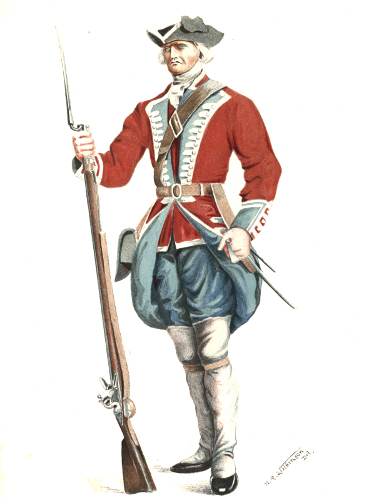
N.R. Wilkinson del. PRIVATE 1742. Mintern Bros. Chromo.
CHAPTER X. THE WINTER OF 1854-55 IN THE CRIMEA.
231
Prostration of both sides after the battle of Inkerman—Sevastopol not to be taken in
1854—Tardy arrangements to enable the army to remain in the Crimea during the
winter—Violent hurricane of the 14th of November; stores scattered and destroyed—The
winter begins in earnest—How the Government at home attended to the
wants of army at the seat of war—Absence of a road between the base at Balaklava
and the front—Miserable plight to which the army was reduced—Indignation in
England, and the measures taken to relieve the troops—Admirable manner in which
the misfortunes were borne by the British soldiers—Operations on both sides during
the winter—The Turks occupy Eupatoria; successful action fought there—The
Guards Brigade sent to Balaklava.
The battle of Inkerman exhausted the energies of the combatants,
and for a few days they recoiled from each other, stunned by its
effects. The Allies had gained a Pyrrhic victory; another such
victory, and their forces must be annihilated. The enemy also
had received a crushing defeat, which shattered his military prestige
and ruined the morale of his army. Neither side was in a condition
to operate against the other, and each faced his opponent listlessly,
almost helplessly. But Menshikoff, though disgraced in the field,
deserved the gratitude of his Imperial Master, and had every reason
to be content with what he had achieved; for, he had gained an
advantage of supreme importance. He had put it out of the
power of the Anglo-French invaders to finish the war during
the year 1854, and thus, while chaining them fast to the bleak and
narrow upland of the Chersonese, he had the satisfaction of knowing
that they would be exposed to the rigours of the approaching
winter. This result was all the more disastrous to us, since, not
having foreseen it, we were in no position to meet it, and were
unprovided with the means of maintaining our troops in the
inhospitable region to which we had become committed. In short,
the Allies were about to be handed over to foes far more destructive
232and terrible than those they had hitherto met. Instead of contending
against Russian weapons, they were now also to struggle
with the forces of nature and the fury of the elements. On
the 6th of November it was finally determined to put off the
bombardment, and to winter in the Crimea. The Commissariat
Department, informed of this decision, was then, and then only,
ordered to make such preparations as would enable the army to
remain on the upland. But the tardy order came too late, for
in less than ten days the winter began in earnest, and nothing
could then be got ready to save the troops from the cruel trials
that awaited them.
On the day after the battle, the Allies were engaged in
burying the dead, in removing the Russian wounded who still
lay on the ground, and in clearing the field of the traces of the
struggle. An invitation addressed to General Menshikoff to agree
to a truce, and to send out his men to bury their own dead,
was refused, for that prudent commander was naturally disinclined
to give his troops so sombre and depressing an object-lesson of
their utter inefficiency in the field. His army, however, met this
invitation in another fashion, and, whether in error or by design,
they answered it by firing upon our burying parties. As another
attack was feared, the front was cleared of incumbrances as soon
as possible, and the wounded were promptly taken to Balaklava.
Their sufferings were considerable; there was a scarcity of hospital
comforts and appliances at the seat of war, and the ambulances
in use were unfitted for the purpose of conveying injured men.
Much affected by the heavy losses sustained by his “First
Brigade,” the Duke of Cambridge came early into the Guards camp,
where the few men present turned out to cheer him.
“Accompanied by his Aide-de-camp, the brave and popular Macdonald,
the Royal General was assiduous in his attentions to the wounded
Guardsmen, sympathizing in cheering tones with the livid wretches that
still breathed, and shedding tears of manly sorrow upon the mangled clay
of those who had completed their last tour of earthly duty.”[292]
The funeral of the numerous Coldstream Officers formed a
most sad procession. Seven—Dawson, Cowell, MacKinnon, Eliot,
Ramsden, Disbrowe, and Greville—were laid to rest in one grave,
in a small rocky ravine near the Windmill. Bouverie’s body was
233only recovered late on the 6th, and he was buried by the side of
Lieut.-Colonel Hunter-Blair of the Scots Fusilier Guards, who
survived the action twenty-four hours.
“It was really enough to unman anybody; poor fellows! far away from
all their friends and relations; poor Greville, whose death killed his mother,
everybody loved him; we laid them side by side, and I remember the earth
pattering on their poor bodies with dull hollow sound.”[293]
Colonel Upton, though badly hurt, was able to remain at his
post till the middle of November, and he assumed the command
of the Brigade, vice General Bentinck, wounded, and of the First
Division from the 7th, when the Duke of Cambridge was sent to
Balaklava, on the sick list. The command of the Battalion thus
devolved upon Colonel Lord F. Paulet. The Coldstream was, in
truth, a mere skeleton of the fine body which embarked at Portsmouth
in the spring of 1854. It only mustered now 11 Officers
and 307 men, while no draft,—except a small one of 58 men, which,
having left London on the 26th of October, reached the Crimea
on the 22nd of November,—was on the road to compensate for
this serious deficiency of strength in the field. When news of
the battle arrived in England, strenuous efforts were made to fill
up the attenuated ranks of the army, by sending out fresh battalions
and reinforcements to those already at the seat of hostilities. But
the campaign, ever since July, when we were first encamped near
the pestilential lake of Devna, had sadly drained our resources—far
more rapidly, indeed, than the home authorities had anticipated,—and
though recruiting had been actively going on, the large
demands which this war created could not be satisfied. In this
way, the next draft sent to the Coldstream only amounted to 153
men, and could do little to restore our depleted ranks to an
efficient state. This draft started on the 24th of November, and
arrived in the Crimea on the 18th of December.[294] In France,
234however, there was not such a dearth of fighting men as seems to
have been the case in England, and considerable reinforcements
were despatched to the east, so that somewhat later (in February)
our allies were able to extend the siege-works that surrounded
the south side of Sevastopol.
We have seen that the omission to strengthen the unguarded
flank at Inkerman by earthworks had led to serious consequences.
The critical nature of the battle made this so clear, that, when the
fight was over, though we had fewer men to spare than were available
before, this vital position was at once placed in a state of
defence. English, French, and even Turks—held hitherto to be
an incumbrance—were set to perform this duty, and Fore Ridge
and Shell Hill were soon crowned with works, commanding the
approaches to the scene of the recent struggle, and securing it at
last, as far as possible, from further molestation.[295]
The ordinary routine of siege life had hardly recommenced
after the rude shock which interrupted it on the 5th, when the
winter burst upon the Crimean peninsula with a suddenness
and violence that marked a distinct feature in the story of the
war, and brought innumerable troubles upon the Allies engaged
in it. The weather lately had been cold and stormy, varied upon
occasions by short gleams of sunshine and partial warmth. At
daybreak on the 14th, however, a violent hurricane, accompanied
by a deluge of rain, unexpectedly arose, and swept with terrific
force over the country, and not only blew away every tent
standing on the upland, scattered the stores upon which the army
depended, and stopped all communications, but also dashed to
pieces or disabled much of the shipping laden with supplies that
were then very urgently needed.[296] The ground was speedily
converted into a deep and impassable sea of sticky mud, which
flew about in large quantities; the temperature fell, and snow
235came down. The men of the various regiments huddled together
like sheep, behind bushes or rocks, or wherever they could find
some protection against the violence of the elements. The
condition of the houseless troops was miserable in the extreme,
both during the day and long afterwards, for they had nothing
wherewith to repair their losses; but it was worse with the
sick and wounded, who were exposed to the full force of the
cyclone, and to the cold and the rain. A considerable amount
of shipping had been left outside the harbour of Balaklava,
instead of being safely berthed inside the landlocked bay. Of the
vessels anchored in this dangerous position, many went to pieces on
the rocks forming the iron-bound coast; altogether twenty-one were
sunk, and their valuable cargoes were all lost. H.M.S. Retribution,
with the Duke of Cambridge on board, narrowly escaped destruction.
On that fatal first day of a severe Crimean winter, the troops
were deprived of vast quantities of ammunition, food, clothing, and
forage, and there was no reserve at hand from whence they could
be replaced.
The difficulties and sufferings that now overwhelmed the army
began with this storm, but they are clearly to be traced to the
aimless manner in which the campaign had been conducted. The
original intention had been to surprise Sevastopol, but it soon
disappeared out of sight, and no step was taken to capture the
town in accordance with the conditions under which the expedition
landed on Russian soil. On the contrary, a regular siege was
gradually commenced, and a completely new plan was thereby
adopted. But the change was never recognized, its bearing upon
the fortunes of the war was not appreciated, and no stores were
accumulated at the base of operations to meet the requirements
of the lengthy proceedings into which the invaders had drifted.
This was the more unfortunate, since, when the allied Commanders
undertook the flank march, and shifted their ground from the
north to the south side of Sevastopol, they found themselves
obliged to operate upon a barren upland which afforded no supplies,
and very soon they even lost the advantage of drawing
forage from the valley of the Tchernaya. Thus, after the 25th of
October, if not before, nothing whatsoever was to be obtained
from the land in which the army was established, and every single
article had to be transported by sea from a distance. The
battle of Inkerman at last revealed the true position in which we
236stood; but it was then too late, and when the storm destroyed
the vessels lying outside the harbour, which contained considerable
addition to our scanty stores, it must be acknowledged that this
position was indeed deplorable.
Nor should it be forgotten that requisitions put forward were
imperfectly attended to by the authorities in England, and that
there was often confusion at the base (Scutari and Balaklava),
which appears to have been incompletely organized. Owing to
these circumstances, many misfortunes overtook the British army,
some of which may be cited. Though a request was made early
in September for 2000 tons of hay, only 228 tons were received
in the Crimea by the 1st of February, 1855.[297] In November an
application was forwarded for 3000 tents, and for a steam mill
and bakery, but more than six months elapsed before they
arrived at the seat of war.[298] Again, we have seen that a substantial
portion of the kits were left behind in the squad bags, at
Scutari, at the end of May; also that, on landing at Old Fort, the
packs were taken away from the men. The former seem to have
been allowed to remain where they were stored. But an effort was
made in the middle of October, just a month after they had been
left on board ship, to recover the knapsacks, though apparently with
very indifferent success; and the troops remained, exposed to the
severe inclemency of the weather, without any change of clothing,
in the worn-out and tattered garments that had uninterruptedly
done duty day and night from the beginning of June, when they
landed at Varna. Lastly, biscuit and salt pork formed the usual,
indeed the never-varying ration served out to the British soldier.
This diet was his only food, and it produced scurvy, as was
only to be expected. To counteract this plague, limejuice and
vegetables were thus urgently required, but neither was available.
It is true that small quantities of vegetables were sometimes to
be had, but then they were sold to the starving men at famine
prices.[299] A tardy requisition was made in October for limejuice,
and half the quantity demanded (20,000 lbs.) reached Balaklava on
the 19th of December; but there it remained almost unnoticed, and
237this antidote against the scourge of scurvy was only unearthed
on the 29th of January following; nor was it apparently
ordered to be issued to the troops as a ration, until the middle of
February.[300]
Arising directly out of the incomprehensible manner in which
this extraordinary war was conceived and carried on, another
circumstance, more powerful for evil than the apathy with which
the necessities of the army were regarded by the Government,
caused famine and distress to oppress our troops. We had no
road between Balaklava and the front; and hence, when supplies
reached the former place, we were without means of conveying
them to the spot where they were to be consumed. And yet the
distance to be traversed was under eight miles. It has been shown
that, of the two roads connecting the English before Sevastopol
and the base, one, the Woronzoff road, was metalled; the other,
over the Col, was but a mere pathway or cart-track: also that on
the 25th of October, we lost the use of the former, and were
restricted to the latter. During the autumn this pathway was
serviceable; indeed, so firm and open was the country, that waggons
and guns could easily move across it anywhere. But when the
torrents of rain flooded the ground on the 14th of November, the
whole aspect of the upland became altered, and the track as well
as the plain were converted into a deep morass, over which communications
were rendered almost impossible. The French, with
proper forethought, constructed a good road between Kamiesh
Bay and their camps, directly they occupied the Chersonese; but
as all the British troops were required to push forward vigorously
the siege-works, and as we indulged in the misplaced confidence
that Sevastopol would fall immediately after the bombardment of
238the 17th of October, we never even thought of securing our communications,
until after the 5th of November, when it was decided
to winter in the Crimea. The rejected Turks, offered by Omar
Pasha, might certainly have performed this important service while
the weather was clear and dry, but the prejudice against them
has already been mentioned, and their assistance was refused.
After the battle of Inkerman we took measures to construct the
road, and we acted as we did with respect to the defences near
Home Ridge; tools were hastily procured from Constantinople,
and Turks were at last employed. But it was then too late. The
unfortunate men were unprovided with food and shelter, and
the weather was severe; they died so rapidly that the living were
all required to bury the dead, and in a short time this ill-fated
contingent disappeared altogether.
The scarcity of forage and the want of a road acted and reacted
on each other, and formed the principal causes of the winter
troubles. The horses and mules died of starvation, and it was
useless to replace them, as there was not wherewithal to feed
them. The transport, miserably insufficient as it always had been,
dwindled into nothing, and all but disappeared; troop horses of
the cavalry were impressed into this service, but they too perished.
Carriage traffic soon ceased, and an attempt was then made to
convey supplies on the backs of the wretched beasts that survived.
This expedient also failed; the quagmire of tenacious clay
intervening between the port and the front, the famine, and the
exposure to cold and wet, all operated together, and the animals
could work no more. Thenceforward there was nothing for it
but to make the men themselves wade through the deep mud, and
fetch up such things from the base as they required, to keep body
and soul together. The duty was no inconsiderable addition to
their ordinary toil, for while they were decreasing fast in numbers,
the labour in the trenches did not abate. The journey also sometimes
took twelve hours to accomplish, and during the time it lasted
they were without food, shelter, or rest.[301] This miserable makeshift
was, of course, entirely inadequate to supply the troops, and
the more bulky or heavy articles, however necessary to the well-being
of the army, could not be brought to camp at all. The
serious error by which magazines had not been established in time
at the seat of war, was repaired quickly by the great energy
239displayed at head-quarters, and in December considerable quantities
of every kind of stores were available at Balaklava, but there
most of them remained unused, because, as Government would
not supply forage (and it seems it was not easily procured out of
England), there was no transport, and as there was no road to
span the morass, means did not exist of crossing it and of reaching
the front.
The winter all through Europe was a peculiarly severe one,
and there was no exception to its inclemency in the Crimea,
where the season was specially cold. All the combatants suffered
from its effects; even the Russians felt it acutely, though housed
and provided with a tolerably fair transport service from their well-stored
magazines on the Sea of Azof. Our French allies also
underwent many privations, due to the general difficulties that
affected the invaders established on the barren upland and exposed
to the wind, the snow, and the rain; but more especially on
account of the small tente d’abri which sheltered them at night,
and which was not so useful as our bell tent. But the British
army suffered most. Like the French, our men were sent to
trenches filled with water, where they remained wet to their knees
for many hours during the day and night; but, unlike them, these
hardships were of constant recurrence. Reinforcements were
rapidly sent to General Canrobert, and his force was strong enough
to enable him to give his soldiers rest when their tour of service
in the siege-works was finished. But the British had no such
exemption; their numbers were insufficient for the purposes
of the campaign; and they practically were always at work.
Lord Raglan computed that they were “on duty five nights out
of six, a large proportion of them constantly under fire.”[302] If we
add, that they were seldom dry; that they had little or no fuel
except brushwood and roots; that they could not cook their
food; that the coffee served out was in the form of the green
unroasted berry;[303] that the ration of rice failed from the 15th of
November to the end of December; that the boots were defective
and bad; and that there was no warm clothing available until
240the beginning of the latter month;—it will be readily seen that the
hardships undergone were of no trivial character.[304]
Nor did the men’s sufferings end here, for when exhausted
by toil and privations there was no alleviation to those whose
health and strength had given way. So badly organized were
the hospital arrangements, that we are told the climax of misery
was only reached in the places set apart for the sick. Circumstances
necessarily made the field-hospitals in the front rude habitations
for numerous patients seized and tormented by painful complaints.[305]
The transport of invalids to Balaklava was, moreover, a difficult
proceeding and an agonizing ordeal; but arrived at the port, their
troubles should surely have come to an end. It was not so,
however, for such was the confusion prevalent at the time, so
great the number of the sick, that they were subjected, if possible,
to worse treatment during the voyage across the Black Sea and in
the great hospital established at Scutari. In short, this hospital
was a loathsome lazarette, “crammed with misery, overflowing
with despair,” until Miss Nightingale and a number of Nuns and
Sisters, having arrived on the scene early in November, acquired
such influence and acted with such admirable prudence and
energy, that gradually—the evil was too great to be arrested at
once—order was restored, sanitary conditions were introduced,
241and the sick were well tended and cared for by the gentle and
able nursing of kindly ladies.[306]
The British forces before Sevastopol were rapidly melting
away in consequence of the combination of misfortunes that overwhelmed
them. Diseases of a violent type broke out, and cholera,
typhus, diarrhœa, dysentery, scurvy swept away the ranks; frost-bites
were common, and even men reported fit for duty, were so
weakened as to be scarcely able to continue their labours under
the hard circumstances that surrounded them. The drain was
excessive upon our strength in the field, and the small army was
in truth threatened with extinction. Between the 1st of November
and the 28th of February we lost as many as 22,506 men, not
including the killed in action; of whom 8898 had died in hospital,
while the remainder, 13,608, were lying there sick on the latter
date. In spite of fresh regiments and drafts which reached the
Crimea after Inkerman, the total effectives all told at the seat of
war, reckoning the troops at Balaklava, amounted then to only
17,311 men. In January there would have been about 3000 to 4000
men of the infantry available to repel another attack of the
enemy, had he attempted to repeat the operation of the 5th of
November.[307] The British would have had a smaller force at the
end of February.
The Coldstream shared to the full the calamity which has
just been so imperfectly described. Taking part in the constant
duty which exhausted the army, exposed to the cruel suffering
that the winter brought about, and conspicuously displaying the
virtues of strict discipline and of uncomplaining fortitude which
enabled our men to preserve a bold and defiant front against the
Russians, the lot of the Battalion can scarcely be separated from
that which afflicted and honoured its brethren in arms standing
before Sevastopol. Its fate was the same as theirs, its sorrows
were equally acute, its bearing likewise was proud and dauntless,
its glory bright and lasting. But its losses were heavy, as the
following table will show:—
242
| |
Regimental Hospital. |
Sick Transferred to Scutari. |
Remarks. |
| Admissions. |
Deaths. |
Nov. (including wounded
at Inkerman) |
277 |
22 |
153 |
Eight died of cholera and eleven of wounds. |
| December |
221 |
17 |
99 |
—— |
| January |
186 |
37 |
91 |
The average daily sick was more than sixty-three per cent. of strength present. |
On the 1st of November the effective strength of all ranks in
the field was 600 Officers and men; 1st of December, 451; 1st of
January, 353; 1st of February, 173; and at the end of February
there were fewer than 100.[308]
But there was an end at last to these mournful circumstances
that oppressed our forces fighting in the Crimea; and with the first
peep of spring a new era of hope dawned upon the army. The
news of the winter troubles roused a strong feeling in England,
and the nation was stirred to its depths with sympathy for its
brave and suffering soldiers, of whom no country had more reason
to be proud, and with resentment against the supposed delinquents
who were accused of bringing about the disaster. Greater activity
and energy were displayed at home, and a railway was begun to
connect Balaklava with the front, so that by the end of March it
reached the Col on the edge of the upland, at a time when the road,
constructed by ourselves and the French, was made to the same place.
A Land transport service was also at length organized. Subscriptions
were collected, and clothing, food, stores, and even luxuries poured
into the Crimea, and into the hospitals established at and near
Scutari. The Government was overturned, and a Commission of
inquiry was instituted, both in England and at the seat of hostilities,
to report upon every circumstance connected with the war. The
result of these investigations, as well as the conclusions arrived at
by another that sat later (in 1856), need not be alluded to in this
243volume. But one point cannot be omitted which deals with the
conduct of the troops, who, in the dark hour of trial, did honour
to their Queen, to their country, and to their noble profession.
“Great Britain,” says the report of the Commissioners sent to the Crimea,
“has often had reasons to be proud of her army, but it is doubtful whether,
the whole range of military history furnishes an example of an army exhibiting,
throughout a long campaign, qualities as high as have distinguished the
forces under Lord Raglan’s command. The strength of the men gave way
under excessive labour, watching, exposure, and privation; but they never
murmured, their spirit never failed, and the enemy, though far outnumbering
them, never detected in those whom he encountered any signs of weakness.
Their numbers were reduced by disease and by casualties to a handful of
men, compared with the great extent of the lines which they constructed
and defended, yet the army never abated its confidence in itself, and never
descended from its acknowledged military pre-eminence. Both men and
Officers, when so reduced that they were hardly fit for the lighter duties of
the camp, scorned to be excused the severe and perilous work of the
trenches, lest they should throw an undue amount of duty upon their
comrades; yet they maintained every foot of ground against all the efforts
of the enemy, and with numbers so small that, perhaps, no other troops
would even have made the attempt. Suffering and privation have frequently
led to crime in armies as in other communities, but offences of a serious
character have been unknown in the British army in the Crimea ... intemperance
has been rare. Every one who knows anything of the constitution of
an army must feel that, when troops so conduct themselves throughout a long
campaign, the Officers must have done their duty and set the example.”[309]
The Russians, on the other hand, except for the great labour
and care expended on the fortress, remained almost quiescent
during the winter months. Restricting their energies to the
defences of Sevastopol and to the annoyance of the besiegers, they
made the fortress exceedingly strong, and pushed advanced works
in front of the line they had already occupied. The greater portion
of their field army was brought into the town to reinforce the
garrison, the remainder being quartered in the neighbouring villages,
or in the Tchernaya Valley. But no offensive operations were
undertaken, notwithstanding their immensely superior numbers;
and this was the more fortunate, since in the midwinter our forces
were so weakened that the English trenches were guarded by only
350 men. This extraordinary inactivity on the part of the enemy
has excited astonishment, and it may well be asked—
244“how it was that an enemy who possessed such enormously superior forces
in men and material, and who could, at any time during a period of months,
have directed on some selected point of the siege-works thousands of troops
that would have found only hundreds to meet them, did not muster the
courage for such an enterprise, when it promised deliverance to the fortress
and ruin to their foes.”[310]
On the part of the Allies, the approaches to the fortress were
pushed forward with considerable activity, both by ourselves and
by the French, but there was little actual fighting except what
was brought about by the siege operations. In the beginning of
February, the French, who, thanks to the liberal supply of men
sent to the seat of war, were growing in numbers, undertook to
extend the siege-works on our right;[311] thus continuing the line of
trenches towards the roadstead of Sevastopol. Bosquet’s Corps
was employed for this purpose. Another element of strength was
brought into the field during the winter, to which brief allusion
must be made. It was at last determined that Omar Pasha’s
army should be removed to the Crimea from Bulgaria, where it
was unable to influence the course of hostilities; the concentration
was effected at Eupatoria, and, on the 17th of February, before the
movement was complete, the Turkish force there amounted to
23,000 men. The Russians, having reinforced the troops they
had in this part of the peninsula to 20,000 men, attacked the
245place on that date, and were repulsed with a loss of some 800 men.
This success seems to have been decisive, in so far that the Allies
now held firmly a point within striking distance of the enemy’s
communications through the isthmus of Perekop; but its value
was considerably lessened by the following fact. In the autumn
of 1854, General Menshikoff was dependent upon this line to draw
reinforcements from Bessarabia, and, as he found it open, he
advanced freely along it, and reached Sevastopol before the 5th
of November, as has been already related. This advantage gained,
the road through Perekop became of comparatively minor importance,
and the enemy thenceforward relied upon the line from the
Sea of Azof. His communications in this quarter could, of course,
only be threatened by a force based somewhere in the neighbourhood
of Kertch; but that place was avoided, and Eupatoria was
selected. Hence the achievement of the 17th of February, while
it might have been followed by satisfactory results had it taken
place early in October, was, to a certain extent, a barren victory,
and served only to show that our Turkish auxiliaries were capable
of performing some service in the war.[312]
The Guards Brigade, having suffered so severely at Inkerman,
and being the only infantry force in the front composing the First
Division (the Highlanders occupied Balaklava since the 25th of
October), it was necessary to reinforce that division by adding
thereto the 97th Regiment (November 23rd). This regiment was
armed with the old smooth-bore musket, but as sickness diminished
the ranks, the Minié rifles of non-effective Guardsmen were handed
over to the survivors of the 97th and of other corps similarly
situated. On the 22nd of November the position of the camps of
the Grenadiers and Scots Fusiliers were moved to the spot where
the Coldstream was established. Two days later, a new disposition
of the piquets was ordered; of the eight furnished by the
division, six were found by the Brigade and two by the 97th.
The strength of these piquets, 50 men each, allowed a double
sentry every fifty paces of the entire front; three piquets were
placed in reserve, and all were “to be encouraged in making fires,
as it is desirable that our full strength should be estimated.”[313]
246On the 25th of December the piquets were reduced to 30 rank
and file each.
During Colonel Upton’s absence at Balaklava on sick-leave,
Colonel Lockyer commanded the Division until the 15th of January,
when the former returned to the front; the senior Guards Officer
present commanded the Brigade during this interval. Colonel
Lord Frederick Paulet was also away on the sick-list until the
16th of January, and the Battalion during this time was under
Lieut.-Colonel Newton; Captain Armytage was appointed acting
Adjutant, vacant by the death of Captain Eliot. On the 17th of
January the Brigade lost the services of their Paymaster, Captain
South (late 20th Regiment), who, having been present with them
ever since they left England, was obliged to leave the Crimea
through ill-health. His duties were undertaken by a committee,
composed of Colonel Hamilton (Grenadiers), president, and Lieut.-Colonel
Stephenson (Scots Fusilier Guards), and Captain Sir J.
Dunlop (Coldstream), members.
On the 26th of November the Household Brigade furnished a
detachment of 200 men, under a Captain and Lieutenant-Colonel, to
the neighbourhood of the monastery of St. George, on the coast
west of Balaklava, for the purpose of making gabions, which were
required for the siege-works. Of these, the Coldstream provided
70 men with Officers, and Non-commissioned officers in proportion.
The detachment was relieved by a similar party on the 21st of
December, and again on the 20th of January by 150 men, each
Battalion finding a Subaltern Officer and 50 men, with the usual
number of Non-commissioned officers.
Major-General Lord Rokeby arrived in the Crimea on the 2nd
of February, and assumed the command of the First Division
and of the Brigade, when Colonel Upton reverted to the Battalion.
But not for long, for, owing to the promotion of the Lieut.-Colonel
of the Regiment (Colonel Hon. A. Upton), he was gazetted to
that command (February 20th), and left soon after to take up
his duties in London.[314] By this change Lord Frederick Paulet
247became Major of the 2nd Battalion, and Colonel Gordon Drummond
obtained the command of the 1st; at the same time Lieut.-Colonels
Daniell and Perceval were posted to the latter, and
Newton to the former (Acting Majors, mounted).[315]
When the sick of the Battalion left the front for Scutari, no
information regarding them was obtained by the Regimental
authorities, and to correct this serious inconvenience, a Captain and
Lieutenant-Colonel from each Battalion of the Brigade was sent to
inspect the hospitals where Guardsmen were treated, and to arrange
a more proper system for future adoption (February 16th). Lieut.-Colonel
Dudley Carleton, who represented the Coldstream, reported
that the admission of men into hospital, as well as the patients'
death or discharge, were imperfectly registered:
“their kits were either stored or condemned without regular authority, or
were left in the hold of transports, carried up and down during many
voyages, and not unfrequently plundered. When a man died, no regular
record was kept or transmitted to his regiment, although professedly done.
No returns whatever had been sent to the Battalion of men dead, invalided
home, or otherwise employed.”[316]
Colonel Carleton remained absent six weeks, and during this
time he established a system of fortnightly returns, which thenceforward
were regularly despatched to the Crimea, and he placed
a sergeant of the Coldstream on the staff of the hospital at Scutari
to carry it out.
It has already been mentioned that the winter troubles added
to the losses incurred at Inkerman, and, in the absence of sufficient
reinforcements from home, had destroyed the efficiency of the
Brigade at the seat of war. At the end of January the three
Battalions could hardly muster a tenth of their proper strength,
and numbered only some 312 men able to do duty.[317] Lord Rokeby
seems to have been so struck with their exhausted appearance, that
he endeavoured to obtain for them an exemption from trench duty
for a time; but as the Order book shows them to be still continually
at work, it is evident that it was not possible to comply with the
proposal. Towards the end of February, however, it was found
248absolutely necessary to make a complete change, and to move them
to Balaklava, there to rest and to recruit their strength after the
very arduous labours in which for so long they had been engaged.
Accordingly, on the 22nd, the Grenadiers marched there, followed
by the Coldstream on the 24th, and by the Scotch Fusilier Guards
about the same time. In the Regiment there were less than 100
men of all ranks on parade. For some time previously it had
become manifest that, if the men continued to live under existing
conditions, it was but a question of time how long the Battalion
could survive except on paper. Of the sick left behind, 41 followed
on the 27th, and 75 were conveyed next day by French mule transport
(the usual conveyance lent us by our allies, and indeed the
only transport procurable, since our own arrangements had broken
down), but the last detachment was not removed to Balaklava until
the 28th of March.[318] The Guards remained at the base till June,
1855, and though absent more than three months from the front,
they missed little chance of performing any useful military service.
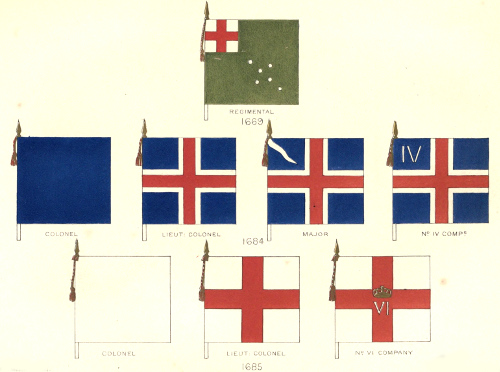
REGIMENTAL
1669
COLONEL LIEUT: COLONEL MAJOR No. IV COMPS.
1684
COLONEL LIEUT: COLONEL No. VI COMPANY
1685
N.R. Wilkinson del. A.D. Innes & Co. London. Mintern Bros. Chromo.
CHAPTER XI. THE FALL OF SEVASTOPOL.
249
Stay of the Brigade at Balaklava—Improvement in the condition of the men—Return of
the Guards to the front, June 16th—Changed aspect of affairs before Sevastopol—Review
of events during the time spent at Balaklava—Second bombardment—Interference
by Napoleon III. in the course of the war; operations paralysed—General
Canrobert resigns, and is succeeded by General Pélissier—Energy displayed
by the latter—Third bombardment—Fourth bombardment; assault on Sevastopol—Its
failure—Death of Lord Raglan; succeeded by General Simpson—Siege operations
continued—Battle of the Tchernaya—Fifth bombardment—Sixth bombardment;
second assault—The Malakoff is captured—Fall of the south side of Sevastopol—The
Russians evacuate the town, and retreat to the north side—State in which
the Allies found Sevastopol.
There are few incidents of Regimental interest to record during
the stay at Balaklava. The men were lodged in huts, but as these
were situated near a burial ground and close to the stables of the
Land Transport Corps, the advantages gained by a change from
the fatigues and hardships of the siege to the base of operations
were sadly diminished, and several cases of maculated fever for the
first time appeared. In March, another site having been selected
on the west side of the harbour, in a more favourable and sanitary
position, and huts having been constructed, the Battalion moved
there towards the end of the month. The better food, the shelter,
the increased comfort, and the rest now enjoyed by the men, produced
a satisfactory effect upon their health, to which the improvement
in the weather also contributed; for, the short, though terribly
severe winter had passed away, and with the spring the temperature
became warm and pleasant. During March, 101 men were admitted
into hospital, of whom 24 were suffering from typhus, and the
mortality amounted to 10; while next month, 53 men only were
admitted, and but 5 deaths occurred.[319]
250The Battalion were employed principally in the ordinary duties
performed at the base of operations, guarding the stores and buildings
or other places set apart for the use of the army, and unloading
the ships that arrived in Balaklava. Drills were carried out, and
the troops practised, in occupying the trenches at night, to meet any
sudden attack which the enemy might contemplate. The danger
of such an attack was lessened by the fact that the enemy had
relaxed his hold, as far back as the end of December, upon the
heights on the left bank of the Tchernaya, captured by him on
the 25th of October, though he continued to occupy the line of the
river. It was still necessary to restrain his activity in this quarter,
and several reconnaissances took place to prevent his advance. As
was only natural, the Officers at Balaklava, when off duty, rode
frequently to points where operations of interest were being undertaken,
but the Brigade itself was not engaged at this period.
The gabion-making detachment was continued near Balaklava,
to supply the siege-works before Sevastopol.
Early in March, convalescents from Scutari, wounded at the
Alma and at the Inkerman, returned to the Battalion, but the next
draft did not arrive until the 1st of May, when 7 Officers and 307
men, whose average age and service were 22-1/12 years and 7 months
respectively, landed in the Crimea.[320] Owing to the Regimental
promotion which had taken place, Colonels Lord F. Paulet (commanding
the 2nd Battalion) and Newton, and Lieut.-Colonel Wood were
now ordered home to the 2nd Battalion; while Colonel Gordon
Drummond assumed the command of the 1st Battalion, Colonels
Daniell and Perceval being Acting Majors (mounted), as has
already been stated. About this time, also,[321] Officers were posted
to companies as follows:—
No. 1 Company: Captains F. Burton, H. Tower, and C. Blackett. (Subsequently
Lieut.-Colonel Lord C. FitzRoy.)
No. 2 Company: Lieut.-Colonel C. Burdett; Captain M. Heneage; Lieutenant
St. V. Whitshed.
No. 3 Company: Lieut.-Colonel Herbert Stepney; Captain Le Couteur;
Lieutenant Rose.
251No. 4 Company: Lieut.-Colonel W. Dawkins; Captain Hon. R. Drummond;
Lieutenant H. Lane.
No. 5 Company: Major P. Crawley; Lieutenants A. Lambton, Lane-Fox.
No. 6 Company: Captain Sir J. Dunlop; Lieutenant A. Adair. (Subsequently
Major C. Baring.)
No. 7 Company: Lieut.-Colonel C. Cocks; Captain J. Caulfeild; Lieutenant
G. Ives.
No. 8 Company: Lieut.-Colonel Dudley Carleton; Captains A. Thellusson,
Gerald Goodlake; Lieutenant Godfrey Wigram.
As the summer approached, the weather became extremely hot,
and towards the middle of May, 90 degrees were registered in the
shade. Cholera again broke out among the troops, but, warned by
the visitation of this plague in the previous year, every precaution
then known to medical science was taken to avert it. The number
of sick increased during May and June, the admissions into hospital
being in the first month 134, and the deaths 5, and in the second
month 267 and 36 respectively; of the latter, 24 men died of
cholera.
On the 16th of June, the Brigade returned to the front to join
in the operations which were intended to be undertaken by the
Allies on the 18th, the anniversary of the battle of Waterloo.[322] The
Battalion was 488 strong (excluding Officers). Three Officers and
61 men were left behind sick, as well as 15 convalescents; altogether
111 men were abstracted from the effective strength. On reaching
the upland the old positions were scarcely to be recognised by the
rank and file who had remained more than three months at Balaklava.
The French having already extended the British Right
Attack, occupied the ground in front of the Karabelnaya from the
Dockyard Ravine, past the Careenage Ravine, and along Mount
Inkerman to the heights overlooking the roadstead. Innumerable
siege-works cut up the plateau, the lines were pushed further forward,
252a large force was concentrated on the spot, and the face of the
country—so bleak and barren in February—was now covered with
the green carpet of a luxuriant vegetation.
We must now take a hasty glance at the state of affairs prevailing
before Sevastopol and elsewhere, which controlled the war,
while the Guards were at Balaklava. In spite of the united efforts
of the British and French occupying the ground before the Malakoff,
the enemy succeeded in extending his works to his front, and in
materially strengthening the lines that covered the Karabelnaya.
The fact was becoming more apparent that General Canrobert,
gallant soldier though he was, was not disposed to risk the chances
of making a bold move against the Russians; and that the latter,
under the distinguished leadership of Colonel Todleben, were
enabled thereby to prolong the struggle.
But Canrobert was not entirely his own master in this
matter, for towards the beginning of the year 1855 the Emperor
Napoleon interfered with the conduct of the operations in the
Crimea, in a manner to impede seriously the progress of
hostilities. Declaring himself to be dissatisfied with the course
pursued, the Emperor conceived the idea of delaying the siege until
he could isolate Sevastopol from the rest of the peninsula; and he
even proposed to go himself to the Crimea to carry out his design.
He was happily dissuaded from undertaking this latter part of the
project—dangerous both on account of his inexperience in war, and
because of the instability of his authority in Paris,—and it was
finally abandoned, after he had been received as a guest at Windsor
(April 25th); but he still adhered to his determination to enforce
some hazy plan which his vanity had formed, and thereby he
increased considerably the difficulties of the Allies.
Added to this, there was a renewal of negotiations at Vienna.
The Tsar Nicholas died early in March, and though his successor
Alexander II. was clearly in the hands of the war faction, some
feeble attempt was made to patch up a peace. The negotiations
failed; but the events alluded to could not but exercise some
influence over the fortunes of the war, by fettering the action of
the French army engaged in it.
This appears to be shown by the results that followed the second
bombardment of Sevastopol, which commenced on the 8th of April.
Immense preparations had been made to ensure its success, and it
was confidently expected by the Allied hosts that this bombardment
253would at last lead to an immediate and triumphal assault of
the fortress.
“Ten days did the terrific storm of iron hail endure; ten days did the
Russian reliefs, holding themselves ready to repel attack, meet wounds and
death with a constancy which was of necessity altogether passive. On the
19th they saw the fire of the Allies decline, and settle into its more ordinary
rate; they saw too, that the sappers were again at work with their approaches,
and reading in this the signs of a resumption of the siege, and the abandonment
of the policy of assault, they once more withdrew their sorely harassed
infantry to places of shelter and repose. Then they began to reckon their
losses, which amounted for the ten days, in killed and wounded, to more
than 6,000 men. The French lost in killed and disabled, 1,585 men; the
English, 265.”265.”[323]
All this expenditure of lives and of war matériel effected just
nothing, nor was anything even attempted against the enemy; for
the French, though having an opportunity to assault, not possessed
at that time by their British allies, were “kept waiting for Louis
Napoleon, and were restrained from engaging in any determined
attack.”[324]
In order to accomplish the views of the Emperor Napoleon, a
French army of reserve was being collected near Constantinople, and
as it was expected soon to reach the Crimea—to undertake the plans
which had been sketched out in Paris,—two important operations
against the enemy were delayed. First, a further bombardment,
arranged to take place at the end of April, and to be followed
by an assault, was put off; and secondly, an expedition, at last
agreed to, against the Russian communications in the Sea of
Azof, and which had actually started to Kertch (May 3rd), was
recalled.[325] Both these events caused much embarrassment to Lord
Raglan, who, understanding imperfectly even then the Emperor’s
proposals, found his own plans thwarted by the supine and unintelligible
conduct of his colleague. The confidence reposed in the
latter was naturally shaken; and when, a few days later, Napoleon’s
scheme was fully revealed to the allied Commanders, was discussed,
and was found to be impossible of execution, General Canrobert felt
254his position to be intolerable, and he resigned the chief command
of the French army. It is right to add that, though Canrobert’s
character unfitted him to direct the difficult operations which lay
before him, he was well suited to assume the lower functions of a
commander of a division or army-corps. Being of a loyal and
soldierlike disposition, and unwilling to leave the seat of war, he
begged that he might revert to the position he originally occupied
in the French army when the war broke out, and recommended
that General Pélissier (who had reached the Crimea in January)
should be appointed the new Commander-in-chief. These proposals
were sanctioned in Paris by telegram, and were immediately carried
into execution (May 19th).
The change in the French command completely altered the
state of affairs in the Crimea. The vacillating weakness of Canrobert
and his subserviency to the foibles of his Imperial Master,
were at last replaced by the hardy daring of Pélissier and by his
manly disregard of an ill-timed interference in the conduct of the
war, which could only end in disaster. The forces fighting against
Russia, moreover, were increasing; while the strength of that
Empire was ebbing fast. In April nearly half of Omar Pasha’s
Turks, about 45,000 strong, were taken from Eupatoria to the
Chersonese, and next month a compact division of 15,000 Sardinians—who
had joined the confederacy against Russia—landed in the
Crimea, under the command of General La Marmora. The enemy
about this time, by reason of his immense losses, had little more
than 100,000 men in the peninsula; the Allies were more numerous,
and could dispose of about 180,000 men.[326] Thus, it was becoming
apparent, that by vigorously pushing on the siege, Sevastopol
must fall, and that the resources of Russia—so fatally allowed
to accumulate in the early stages of the war—were beginning to
fail.
Immediate arrangements were made to storm the advanced
works which Todleben had constructed, to occupy the Tchernaya
and the plain of Baidar that lay beyond it, and to attack Kertch
and the Russian base of supplies formed on the coast of the Sea
of Azof. On the 23rd of May, after severe fighting, the French
gained an important advantage over the enemy near Quarantine
Bay; and, two days later, he was also attacked on the Tchernaya
255and driven out of Tchorgun. About the same time, the expedition
to Kertch, composed of 15,000 English, French, and Turks, started
for its destination. Operations in this quarter were entirely successful,
and by the middle of June the Allies, having struck deep
into the resources of the Russians, cut their chief line of supply,
and in no small degree carried out practically the policy of investment
which the Emperor professed to desire.[327]
The allied Commanders now directed their efforts to the
Russian advanced works covering the Karabelnaya, and, determining
to attack them, they prepared for the assault by a fierce
cannonadecannonade (the third bombardment), which opened on the 6th of
June with tremendous violence and effect, and lasted until the 10th.
On the evening of the 7th, the French advanced against the White
works (situated on Mount Inkerman, to the east of Careenage
Ravine), and the Kamskatka Lunette (on the Mamelon, covering
the Malakoff and some 500 yards in front of it); and the English
moved against the Quarries (covering the Redan and about 400
yards from it). These attacks were successful, and the enemy, driven
from all these outworks, was restricted to his main line of defence.
The captured positions were occupied and held by the Allies.
Between the 6th and the 10th the Russians lost altogether, in
killed, wounded, and prisoners, 8500 men and 73 guns; the Allies
nearly 7000 men.
These advantages were now to be pressed home, and a great
effort made to assault the main line round the Karabelnaya; the
Malakoff and the Redan were to be attacked, and the fortress so
long besieged was at last to fall. The final act of the long drama
was fixed for the 18th of June, when the Anglo-French allies, having
shared so many dangers and hardships in common, might reap the
256reward of their arduous labours, and obliterate the memories of
the day of Waterloo.
The fourth bombardment opened on the 17th, and the fleets
once more joined their fire to the numerous great siege guns
planted before Sevastopol. The devastating force of the artillery
soon obtained a mastery over that of the fortress, and the usual
results followed: the enemy’s works were knocked to pieces, his
defences ruined, and he lost 4000 men. Now, therefore, was the
time for the assault to take place, and, as we have seen, the Guards
Brigade were brought up to the front from Balaklava to participate
in the operations about to ensue. But the ardent expectations of
the besiegers were not yet to be realized, and the attack ended
unfortunately. Neither in the Malakoff nor in the Redan, were the
French or ourselves able to effect a lodgment; the only consolation
was the capture of a position in front of our Left Attack. Among
the blunders that occurred to account for the failure, perhaps the
most unfortunate was that of Pélissier himself. It had been settled
that the bombardment was to continue for two hours after dawn
on the 18th, so as to shatter the repairs which the Russians invariably
made to their works during the night, and that then the
assault was to commence at about 5.30 in the morning. But this
plan was altered at the last moment, by Pélissier, who wished the
advance to begin at dawn, without any previous preparation by
artillery fire. Lord Raglan was not consulted, and, when he heard
of it, he submitted to the change most reluctantly. The enemy,
therefore, was ready, behind parapets hastily renewed and armed
with field guns during the night, and thereby he was enabled to
repel the attack. That this was probably the main cause of the
failure, may perhaps be inferred from the fact that when, after the
assault, the bombardment recommenced, the soldierlike spirit of
the Russians gave way, and many of them, unable to stand against
the terrific fire poured upon them, fled to the harbour, and
endeavoured to escape to the north side of Sevastopol.[328] The
Guards Brigade were not engaged upon this occasion; they
remained in reserve, and were not brought forward. In fact,
the attack had failed, and further expenditure of lives had to
be avoided. The losses were great on that fatal day; that of
the English amounted to 1500, of the French to 3500, and of the
enemy only to 1500.
257Two Officers occupying very conspicuous positions in their
respective armies disappeared from the scene of their labours about
this time. General Todleben was slightly wounded on the 18th,
and more gravely hurt a few days later, so that he had to leave
Sevastopol, and the Russians lost the services of that master mind
to whose conspicuous ability, energy, and courage the prolonged
and successful defence of the fortress was primarily due. The
Allied armies also were plunged into mourning by the unexpected
death of Lord Raglan, who never recovered from the grief and
disappointment which oppressed his mind after the events of
the 18th. This reverse, added to the labours and anxieties of the
previous fifteen months, during which time he discharged his high
but onerous duties without intermission, undermined his constitution,
and he died on the 28th, surrounded by his personal friends and
his military staff. He was succeeded by General Simpson.[329] His
body was removed to England, and was taken to the Bay of
Kazatch with full military honours, on the 3rd of July; and, in
accordance with General Orders, the troops not engaged in the
funeral or on duty in the field, remained in their tents during the
afternoon. While the ceremony lasted, the Allied forces before
Sevastopol were passive in the trenches, and, whether owing to
chance or to a graceful act of courtesy on the part of the Russian
Commander, the guns of the garrison also kept silence.[330]
The siege was pushed forward with great activity after the 18th,
and in this portion of the weary operations the Guards Brigade took
their full share. Seeing the mistake committed by advancing over
open ground for a distance of 400 to 500 yards, against the enceinte
covering the Karabelnaya, General Pélissier now proposed to sap
up close to the fortress. The soil near his own siege-works
favoured such an undertaking; but not so, that which lay in front
of our positions, where a thin layer of earth only covered the solid
rock. Thus, while the French were able to get close to the
ramparts of the Malakoff, the British were prevented from pushing
through the ground much beyond the Quarries, or from lessening
to any considerable extent the distance that separated them from
their objective—the Redan.
These siege operations lasted without intermission until early in
September. On the night of June 18th, the Brigade found 30 Officers
258and 1000 men for the trenches, of which the Coldstream, furnished
8 Officers and 263 men; and so on, from day to day, in
varying numbers, according to the requirements of the moment.
It was ordered on the 21st, that “in future the proportion of
Officers and men in the trenches will be one Captain and one
Subaltern to every 100 men;” and also “should any part of the
guard of the trenches be called upon to work, they are positively
forbidden to take off their accoutrements or to go far from their
arms.”[331] Commencing July 10th, the duties were found by divisions—the
First, Second, and Light in the Right, the Third and the
Fourth in the Left Attack,—and during that night the Battalion
furnished 7 Officers and 312 men, also 21 men more as a special
working party.[332]
259It should be noticed here, that the Guards Brigade, on August
31st, exchanged the whole of their arms and ammunition for
the new Enfield rifle then introduced, and that, at this time,
there were two patterns in use by the troops of the British army
standing before Sevastopol.[333]
Notwithstanding the interest which the operations undertaken
between June and September excited, and the high hopes generally
entertained that the fortress would soon fall, the little-varying
duty in the trenches became monotonous in the extreme, and all
wished earnestly that this phase of the war might quickly pass
away. Some cricket matches served to while away a few of the
weary hours; but the weather was extremely hot and oppressive,
and the season was sickly. There was, of course, much to distract
the minds of men who, for the first time, found themselves in the
presence of an enemy; but it was different for those who had been
almost constantly at work for many months on the same spot and
at the same object, and thus even these distractions lost much of
their novelty and interest.
“The siege was really getting too fearfully tedious now,” writes Colonel
Tower, about August 28th. “The weather was hot and sultry; our camp
was a long way from the works. We used to parade about 5 p.m., having
crammed in all the victuals we could get. We toiled down three miles
in the sun, carrying great coat, haversack, revolver, and defiled into the
zigzags before sundown; all night (if in the advance) we were straining
our eyes over the parapet, momentarily expecting a sortie, being
graped and shelled the whole time, and losing a good many of our party.
The sun got up very early, and often a breeze with it, and from sunrise to
sunset we had to sit in a dusty ditch, being shelled, our food—salt pork
and biscuit—covered with dust and sand. The men could not show their
noses over the parapet.... The deep blue sea stretching away, dotted
260with ships coming in and going out, looked so cool and nice in the distance,
I used to think of home far away, and long for the siege to be over. It
really seemed now as if it were drawing to a close. The bridge across the
harbour had been constructed some time, and could be for no other purpose
than as a means for the enemy to retire. The French pressed the enemy
at the bastion Du Mât [the Flagstaff Battery] and the Malakoff; I used to
spend a good deal of time in the French trenches, and knew the whole
position as well as any one in the army.”
The casualties in the Battalion were not very severe during
these three months, and amounted to 47 wounded, of whom 6
died of their injuries. Besides this number, an Officer of the
Regiment, Captain Hon. R. Drummond, was wounded, on August
25th, in the trenches, having been shot through the chest; he
left the Crimea on September 6th, but died before he reached
England, unfortunately, indeed, just before the steamer anchored
at Spithead. The general health of the Battalion may be seen
from the following table:—
| |
Admissions into Hospital from |
Deaths from |
| Disease. |
Wounds. |
Disease. |
Wounds. |
| July |
138 |
20 |
8 |
1 |
| August |
132 |
15 |
5 |
3 |
| September |
65 |
12 |
2 |
2 |
Between June 20th and September 21st, 78 men returned to duty
from the hospital at Balaklava; but, per contra, 95 men were sent
down from the front for treatment during the same period.[334]
The Russians could do little to resist the formidable preparations
made by the Allies to bring about the capture of Sevastopol.
They lost heavily every day, even under the ordinary fire which
the besiegers poured upon them, and, perceiving that the end of
the long struggle was imminent, they resolved to make one final
effort to free themselves from the forces that were closing nearer
and nearer to their defences. After much consideration, General
Michael Gortchakoff[335] determined to bring down the field army,
261which was established on the Mackenzie heights and on the
Belbek, into the valley of the Tchernaya, and to attack the French,
Sardinians, and Turks holding that portion of the field. On
August 15th, accordingly, a general action took place in that
quarter, known as the battle of the Tchernaya, between a Russian
army of 48,000 infantry, 10,000 cavalry, and 272 guns, and a
somewhat smaller force of the Allies, who, though they massed
as many as 60,000 men, did not deploy their whole strength upon
that occasion. The enemy displayed much bravery, but showed
little skill; he was routed, and fell back slowly towards Mackenzie
Farm, losing 69 Officers and 2300 men killed, 160 Officers and 4000
men wounded, and 31 Officers and 1700 men missing—total 8260.
The French had 1500 killed and wounded, and the Sardinians 200.[336]
The besieging armies expected that this battle would be accompanied
by a general sortie from Sevastopol; but it did not take
place, for, the Russians were getting exhausted, and their resources
were almost entirely at an end. In order to prevent any such
attempt, and also to enable the French to sap up quite close to
the defences of the Karabelnaya opposite to them, the Allies
opened another, though only a partial, bombardment (the fifth)
on August 16th, and continued their fire for some days with great
violence; but no assault followed, for they were not yet ready to
enact the final scene that was soon to begin.
General Gortchakoff might now have yielded the fortress which
had been held so tenaciously and gloriously by the armies of the
Tsar; but, after a full inspection of the town, of its ruins, and of
the miseries and horrors it contained, he came to the resolution
that it was to be held to the last extremity, and that the honour
of his Sovereign prevented him from either evacuating it or capitulating.
He determined, therefore, to bring into Sevastopol all he
could spare of his field army, and to resist to the end. Hopeless
as the outlook was at this moment, he still professed to believe
that he could hold out for another month.
The last and sixth bombardment commenced on September
5th, and continued, if possible, with even greater fierceness and
intensity than before, till the 8th, the day set apart for the grand
assault. Pélissier guarded himself this time against advancing at
dawn; and, having observed that at noon the Malakoff was usually
more weakly occupied than at any other hour of the day or night,
262he resolved to take advantage of this circumstance, and to deliver
the attack then. At noon therefore, the French, under Bosquet,
were to storm the Malakoff, the Curtain near, and the little Redan;
while the English, under General Codrington, were to attack the
Redan. The town defences, moreover, were to be assailed by
the French opposite to them, aided by a Sardinian brigade under
General Cialdini; but this movement was subject to further orders.
A very fierce fight took place at all these places, of which
one alone was successful; for the French, having entered the
Malakoff, secured a firm footing there, and gained that important
position in the enemy’s main line. Their losses were immense,
not less than 3087 in killed and wounded out of 7446 men engaged
in this portion of the battle-field. Everywhere else the assaults
were beaten back, and the Allies could only believe at first that
they had but gained an indecisive victory.
The attack on the Redan was made, as has been seen, under
very difficult—almost impossible—circumstances; but, if it was
only undertaken to relieve the pressure which the enemy brought
to bear upon our allies near the Malakoff, our purpose was fulfilled.
It is, however, difficult to believe that a diversion was all we intended
to effect, since this assault was to be the final act of the great
military drama which had been going on for a whole year in the
Crimea, and which riveted the eyes of Europe upon Sevastopol. The
troops engaged comprised the Second and Light Divisions, 6200
strong—1700 in the first line, 1500 in support, and 3000 in reserve
in the 3rd parallel; the Third and Fourth Divisions formed a
main reserve; but neither the Highland nor the First Division, to
which the Guards Brigade belonged, was called up to share in the
action. The Brigade was posted in rear, about half a mile from
the Malakoff, where a splendid view of the fighting was obtained.
There was much regret among all ranks composing it that they
were not allowed to advance and take part in the attack; more
especially since, when the French (according to Colonel Tower)
asked General Simpson to send some of his troops to help them
to hold the Malakoff, the request was refused, and the First
Division, or, at least, the Guards, who were close by, were not told
off to perform this duty. If this is more than camp gossip, it is,
indeed, to be regretted that no British troops were enabled to
participate in the glory of inflicting a final reverse upon the
enemy’s position in the Karabelnaya.
263General Simpson explains that he determined to give the
honour of leading the assault to the Second and Light Divisions,
because they had defended the trenches and approaches to the
Redan for many months, and because of the intimate knowledge
they possessed of the ground. Military critics believe that
this was a “cruel kindness to the army.” The two divisions
were exhausted by the siege, and the knowledge of the ground is
considered upon this occasion to have been a positive disadvantage,
“for, in acquiring it, the troops generally lost the dash which is
essential to success.” Moreover, these divisions were now filled
with young and only partially trained soldiers, “who paid no
attention to the orders that were given;” “the companies lost all
formation and cohesion from the irregular manner in which they
ran forward, and they stood in confused groups behind the
parapets;” “the battalions got mixed up;” in fact, “the young,
raw recruits failed to follow their leaders in the way in which the
soldiers had done at the Alma and Inkerman.”[337] On the other
hand, there were fresh troops available; the Guards had only
shortly before come up to the front from Balaklava, where they
passed three and a half months, and the Highlanders had been
there between October and June. Neither, as we know, were
employed in the assault, much to their disappointment and chagrin.
But all this is only one side of the story. The task before the
British was, under any circumstances, most difficult to fulfil. They
had to advance over the open for a considerable distance, against
a strong work, covered in front by obstacles, whose rear was
unenclosed, and whose fire was unsubdued. It had been impossible
to construct places d’armes in our trenches, owing to the
rocky nature of the soil, and hence the reserves could not be
concentrated in suitable positions whence to push forward at the
proper moment and feed the attack. Nevertheless, the leading
British troops advanced with the utmost gallantry and spirit,
notwithstanding the furious fire to which they were exposed;
they penetrated into the Redan, and clung to the position they
had gained. But they could not maintain themselves there; for,
the Russians, hurrying up in immense numbers, forced them to
retire before the reserves—hampered in the narrow trenches—were
able to advance to their support. The French, moreover, having
spiked the guns they found in the Malakoff, had none to turn
264upon the enemy as he entered the Redan in force to drive out
our storming parties. After this failure, the attack was put off
to the following day; our losses amounted to 2271 Officers and
men, those of the French to 7567, and of the Russians to 12,913.[338]
But there was no necessity to renew the combat; for the enemy,
aware of the strength of the Malakoff position, which commanded
the whole of the defences of Sevastopol, evacuated the south side
during the night of the 8th-9th, and withdrew to the northern bank
of the roadstead, blowing up their magazines, and firing the town
in several places. The Allies had thus early intimation of the
impending fall of the fortress which for so long had withstood their
valour; but the full extent of the victory was scarcely appreciated
before the morning of the 9th, when the enemy’s retreat became
known to the armies engaged. The evacuation of the Redan was
first ascertained by some Highlanders in the trenches in the night,
who, stalking up to the ditch and abatis that was near it, found
the work tenanted only by spiked guns and by dead men.
“N——, who knew my wandering tendencies, came to me in the middle
of the night before daybreak, and told me to get up at once, that some one
had come out of the trenches, and that the Redan was evacuated. I got
on Bono Johnnie and galloped off about daylight. I arrived at our trenches,
which I found occupied by the Highland Division; they were fast putting
out a line of sentries to prevent any one going over to the Russian works....
I went across the hill towards the Malakoff, the ground literally paved
with iron; the great high parapet was already broken down, and in the
afternoon the ditch was filled in with gabions and a regular road made into
the work. Dead and dying inside the work; such a scene of devastation
and confusion impossible to conceive: guns broken and upset; powder in
the embrasures, two or three inches deep, all loose on the ground; wounded
men, French and Russians, still crawling about, and the trenches full of
Russians who had crept in.... From the top of the parapet our trenches
were spread out like a map. I was wild with delight at thinking the siege
was over, and all the country opened to us. I posted off to the White
barracks, and ransacked the whole place, coming back through the
Redan.”[339]
The Allies did not enter the town on the 9th, for Sevastopol
was a blazing mass of ruins, and the frequent explosions showed
the place to be undermined: the garrison having escaped under
265cover of the night, when we were unaware of their intention,
could not be further pressed at that moment, so there was no
object to serve by sending the troops into a fire-trap. A terrible
conflagration raged, and to this was added the burning and the
final destruction of the Russian Black Sea fleet. The minds
of our men could be well filled with awe and joy at the
wonderful sights that met their gaze—awe at the fiery furnace
the enemy kindled to mark his departure from the stronghold
he had held so audaciously and bravely, and joy that the
protracted siege was at last concluded.[340] Early on the 10th, the
fires had ceased, and the conquerors, advancing to secure their
prize, found one great building intact. Having penetrated into
it, they were amazed to discover that it was a hospital containing
no less than 2000 dead and dying men, who had been left to
their fate without food or treatment for two days and nights,
in the midst of the dire confusion and chaos that prevailed
in the town; among them were three English Officers.[341] At midday
on the 13th, a fatigue party of 500 men of the First Division,
under Major Ponsonby, Grenadier Guards, were ordered into the
town to help to cleanse it, and to bury the numerous dead. The
duty was a disagreeable one, as may well be imagined; it was
well performed, as can be seen from the following Divisional
Memorandum, dated September 15th:—
The General Commanding the Forces expresses, through Lieut.-General
Lord Rokeby, his regret at being obliged to employ the Brigade
on the disagreeable fatigue duty of Thursday last, but which, for the health
of the army, was absolutely necessary; and he was fully satisfied with the
manner in which that duty was performed.
The French now occupied Sevastopol, and the English the
Karabelnaya, where regular guards were established. The British
troops (500 each day from the Brigade) were employed, with a working
pay of 1s. 6d. a day, in making a main road from Balaklava to
the front, and others in the neighbourhood, under the superintendence
of Lieut.-Colonel Hon. A. Hardinge, Coldstream Guards.
It should be stated here, that, on the 27th of August, Lord
Stratford de Redcliffe, Ambassador at Constantinople, reached
266the Crimea for the purpose of investing several Officers with the
Order of the Bath. The ceremony took place at the British head-quarters,
in the presence of General Pélissier and his Staff. The
Guards Brigade furnished a Guard of Honour; the Coldstream,
the Queen’s Colour, the Ensign and Lieutenant (Lieutenant
Whitshed), and 50 men; and the Scots Fusilier Guards, the Captain
and Lieutenant-Colonel, the Lieutenant and Captain, and 50 men.
Among those on whom the honour was conferred, connected with
the Regiment or to be connected with it, were Lieut.-Generals
Sir Colin Campbell, Sir H. Bentinck, and Sir W. Codrington.
The Brigade paraded in review order on the 20th of September,
for the purpose of receiving medals and clasps, which were
distributed to the Officers, Non-commissioned officers, and men
who had landed in the Crimea before the 1st of October, 1854.
Early in October, 1855, new reinforcements reached the Battalion.
On the 2nd, 24 convalescents arrived for duty from Balaklava, as
against 7 invalids sent to England next day. On the 4th, the
fifth draft landed from home, consisting of 8 Officers and 207
men, whose average age was 24 years, and service 15 months.
“They were principally volunteers from the Militia, and a
remarkably fine body of men, not so tall as the original Guardsmen,
but in every way better adapted for the exigencies of active
service.”[342] Officers were posted to companies as follows, October
7th:—
No. 1 Company: Major C. Baring, Captain H. Tower, Lieutenant Rose.
No. 2 Company: Lieut.-Colonel C. Burdett, Major Lord Bingham, Lieutenant
Julian Hall.
No. 3 Company: Lieut.-Colonel Herbert-Stepney, Captain C. Blackett,
Lieutenant Adair.
No. 4 Company: Captain Le Couteur, Captain Lord E. Cecil, Lieutenant
Whitshed.
No. 5 Company: Captain Sir J. Dunlop, Lieutenant A. Lambton.
No. 6 Company: Lieut.-Colonel F. Newdigate, Captain W. Reeve, Lieutenant
H. Lane.
No. 7 Company: Major H. Armytage, Captain Hon. W. Feilding, Lieutenant
Godfrey Wigram.
No. 8 Company: Lieut.-Colonel Lord Dunkellin, Captain Heneage,
Lieutenant Hon. W. Edwardes.[343]
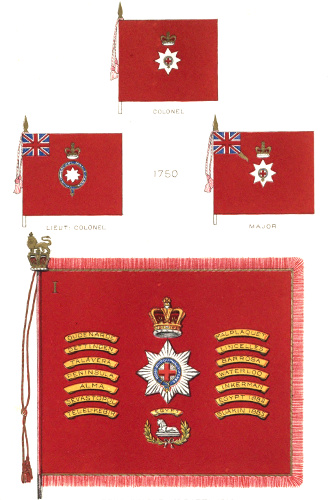
COLONEL
1750
LIEUT. COLONEL MAJOR
QUEENS COLOUR 1ST. BATTL. 1893.
N.R. Wilkinson del. A.D. Innes & Co. London. Mintern Bros. Chromo.
CHAPTER XII. THE END OF THE RUSSIAN WAR.
267
Home events during the war—Sympathy of Her Majesty with her Crimean soldiers—Badges
of distinction added to the Colours—Inactivity of the Allies after the fall of
Sevastopol—Expeditions against the Russian coast—Sir W. Codrington succeeds
Sir J. Simpson as Commander of the Forces—The winter 1855-56—Negotiations
for a peace, which is concluded, March 30th—Events after the cessation of
hostilities—A British cemetery in the Crimea—Embarkation and return home—The
Crimean Guards Brigade at Aldershot; visit of Her Majesty the Queen—Move
to London, and cordial reception there—Distribution of the Victoria Cross—Summary
of events connected with the war—Losses—Appointment of H.R.H. the Duke of
Cambridge as Commander-in-Chief, and of Major-General Lord Rokeby to command
the Brigade of Guards.
The details of the great struggle in the Crimea have necessarily
occupied so much of the space of the last few chapters, that there
has been little opportunity to allude to the occurrences connected
with the Regiment which took place at home during this eventful
period. It will therefore be well to pause in the narrative of the
war, and to devote a few lines to that subject.
As soon as the Guards Brigade started for Malta in February,
1854, the public duties in London were reduced; and later in the
year, when the requirements of active service necessitated a still
further reduction, they were fixed at 1 Captain, 4 Subalterns,
9 sergeants, 10 corporals, 6 drummers, and 144 men, to furnish
the Queen’s Guard, Buckingham Palace, the Tylt, the British
Museum, and the Magazine Guards; and at 1 Subaltern, 2
sergeants, 2 corporals, and 20 men, to furnish the Bank piquet.[344]
The principal duty of the home Battalion was naturally at
this moment to train and supply men to the 1st Battalion in the
Crimea, and we have already seen something of the quality of
the drafts that were sent out to the East.[345] But as the ordinary
268recruiting was not sufficient to maintain the forces at the seat of
war in a proper state of efficiency, the militia—the true reserve
of the British army at that time—was called upon to perform
its functions in the emergency. Not only was a portion of
the militia embodied and employed as garrisons in those places
where regular troops were not available, but volunteers were
obtained from its ranks to fill up the gaps which the war created
in the active army fighting before Sevastopol. In this manner
men of good physique and trained to military service were
obtained, and were drafted into the regular army. In April,
1854, the Non-commissioned officers and men of the Brigade told
off to assist in training militia regiments, were ordered to use
their best exertions to induce men to volunteer for their Regiments.[346]
In December, 1854, Officers of the Brigade were employed to
superintend recruiting from the militia. Men were also obtained
from the Irish Constabulary, and it was settled, December 18, 1855,
that volunteers to the Guards from that corps might reckon their
previous police service as military service.
It appears that there was an intention to form a Brigade depôt
at Malta, in March, 1855, the companies to form which, were to
be borne on the strength of the Battalions in the East, from the
date of embarkation. But this plan was not carried out, and
the home Battalions remained all through the war with twelve
companies, as against eight companies belonging to the service
Battalions; the drafts to the latter were always furnished direct
from London.
As soon as the three Guards Battalions had left England, the
other four were stationed in the West-end (St. George’s, Portman
Street, and Wellington barracks), and there they remained
(subject to the ordinary half-yearly change of quarters) until January,
1855, when the Tower was again garrisoned by the Brigade. In
May, room had to be found for 500 men of the Line passing through
London, and a portion of the 2nd Battalion Grenadier Guards then
in Wellington barracks, were put into billets in Westminster, for
four days. This probably is the last time that any men of
the Brigade have been billeted in London. On the 13th of June,
the 2nd Battalions of the Coldstream and Scots Fusilier Guards
proceeded to Aldershot Camp, then newly established, until
the 27th of August, when they were relieved by the two Grenadier
269Battalions, left in England.[347] The latter remained there until
the middle of December, when Windsor was again occupied by
a Battalion of Guards, and there were then less than three
Battalions of the Brigade stationed in the West-end, the head-quarters
of one being in the Tower, with a detachment only, in
Portman Street.[348] During the absence of a portion of the Brigade
in Aldershot, the Depôt of the 66th Regiment furnished a part
of the public duties in London; but at the end of August, most
of these men having been moved out of town, temporary reductions
in the duties were made (September 16th, and October 9th) until
the return of the Grenadiers.
It has been already stated that the Emperor Napoleon visited
England in April, 1855, where a cordial welcome awaited him
and the Empress, who accompanied him. A detachment of a
Subaltern and 25 men from each Battalion, under a Captain and
Lieutenant-Colonel of the 2nd Grenadier Guards (with the Queen’s
Colour belonging to that Battalion), proceeded to Windsor on the
14th, and were stationed there until the 19th, during the period
of the French Sovereign’s visit to the Queen. Numerous Guards
of Honour attended upon His Majesty, two of which were found
by the 2nd Battalion, both at Bricklayers' Arms Station, on the
16th and 21st, on the arrival at, and departure from London, of
the Imperial guest. On the 19th, the Emperor went to Guildhall,
and the streets were lined by the two Grenadier Battalions as he
went to the City and returned back to the West-end. Another
Royal visit of one of Her Majesty’s Allies took place on the 1st
of December, when the King of Sardinia, Victor Emanuel, arrived
in London, and went to Windsor. Of the Guards of Honour
furnished upon that occasion, the Coldstream found four—two on
the arrival of the King at Bricklayers' Arms Station and at
Paddington Station on the 1st, one at Lord Palmerston’s house
in Piccadilly on the 4th, and one at Bricklayers' Arms Station on
the 6th, in the early morning.
The dress of the Brigade occupied the attention of the military
authorities at this time. The white summer trousers were exchanged
270for another pattern made of a light grey stuff; the coatee was
done away with, and the tunic was introduced (April, 1855).
Epaulettes ceased to be worn, and thereby the badge of the Rose,
still worn by the men, disappeared from the uniform of the Officers
of the Coldstream. The tunic at first was a double-breasted garment,
but a year later (March, 1856), when Officers required new red coats,
they were ordered to supply themselves with single-breasted tunics,
such as are still worn in the Brigade. The bearskin caps had
been cut down early in 1854, to nine inches in height, and the
plume was not to exceed six inches. Also, by an order dated
October 7, 1854, peaks to caps were to be discontinued by
sergeants, and were only to be worn by the Sergeant-Major, the
Quartermaster-Sergeant, the Armourer Sergeant, the Regimental
Clerk, the Drill Sergeants, and the Drum Major—a custom which
still prevails in the Brigade.
A curious means taken to test beer may be gathered from
the following Brigade Order, dated April 18, 1854, and shows the
practical, though perhaps unscientific, manner in which our predecessors
went to work when they wished to ascertain a matter of
sanitary importance to the men:—
Each Battalion will send to Wellington barracks on Thursday morning,
to receive from the Quartermaster of the Scots Fusilier Guards some beer,
which is to be delivered to six sergeants, who must undertake not to taste
any other malt liquor during the time (10 days) they will be supplied with
it, the object being to test its wholesome qualities. The Field Officer
requests to be furnished with a report from each Battalion at the expiration
of the period specified above.
We find that a few days previous to this order (April 13th), a
committee of Officers was appointed to consider the question of
the general introduction of gas into barracks.
Later (July 17, 1855), a Field Officer of the Brigade (Lieut.-Colonel
Wood, Grenadier Guards) was sent to the “end of
Commercial Road, Pimlico, near to the projected Chelsea Bridge,
there to view, in conjunction with a Medical Officer, a site for a
barrack.” It will be seen that this was the first step taken to
construct Chelsea barracks, which, when completed, removed the
Foot Guards from the cramped quarters in Portman Street and
St. George’s barracks, which they occupied at this time.
The Enfield rifle (pattern 1853), issued, as we have seen, to
271the Brigade in the Crimea at the end of August, 1855, was served
out to the Guards Battalions on home service on the 26th of
October of the same year. Nine hundred and one stand constituted
the armament of the 2nd Battalion, and “on their receipt the smooth
bore now in possession, including the sergeants' fusils, are to be
returned into the Ordnance stores.”
It is well known to all her subjects that Her Majesty the
Queen followed the varying fortunes of the Russian war with
the utmost attention, interest, and concern; and that to none was
her warm sympathy more heartily and graciously expressed than
to her gallant army, who, amid unparalleled privations and
difficulties, maintained intact the glory of the British Crown and
of the country. Frequently did Her Majesty, surrounded by the
Royal Family at Buckingham Palace, personally see such of her
wounded soldiers as were able to be brought into the presence of
their Sovereign, and there praise them for their merit, and condole
with them on their sufferings. This honour was freely bestowed
on the men of the Brigade, and on many occasions the Commanding
Officers of Regiments were ordered to furnish lists of Guardsmen
who were well enough to participate in it. In 1855, the
Queen’s birthday was celebrated on the 18th of May, and on the
Horse Guards parade, Her Majesty presented medals for service in
the Crimea to all Officers and to three Non-commissioned officers
and twenty privates per Regiment of the Brigade, entitled to
receive them. Next day the following Order was published:—
“The Field Officer in Brigade Waiting is commanded to express to the
Officers and soldiers of the Brigade of Guards who were present yesterday
at the ceremony of the presentation of medals, Her Majesty’s solicitude
as to whether they have suffered from the effort which evidently many of
them made, at the cost of much suffering and inconvenience, and requests
that Officers Commanding Battalions will make the necessary inquiries, and
forward the result of them to him with as little delay as possible.”
When the fall of Sevastopol was known in England, there was
much rejoicing that the Allied arms had captured the enemy’s
stronghold and great naval arsenal in the Black Sea. But
hostilities were not at an end, nor was an immediate peace in
prospect. Nevertheless, certain distinct stages in the war were
concluded, and victory had more than once smiled upon our
standards. A General Order, therefore, was issued on the 16th
272of October, 1855, giving authority to inscribe the words “Alma,”
“Inkerman,” “Balaklava,” and “Sevastopol” upon the Colours of
the regiments taking part in these actions and in the siege. On
the following December 28th the three badges of distinction,
“Alma,” “Inkerman,” and “Sevastopol,” were inscribed upon the
Colours of the Regiments of Foot Guards.
The Allied armies, having captured the fortress that so long
resisted their skill and courage, found themselves placed in considerable
embarrassment. The question naturally arose as to what
should now be done. But that question was not readily answered,
because no steps had been taken beforehand to decide it. The
northern side was still held by the Russians, and their forces there
were closely united to their field army, which occupied defensive
positions on the Mackenzie heights. The undertaking to clear the
two banks of the Sevastopol roadstead of the enemy, and to drive
him out of the peninsula had the outward appearance of a difficult
operation, and no measures had been concerted to proceed with
it.[349] The Anglo-French armies made no attempt to follow up
the victory of the 8th of September, but hung listlessly on the
ground they had won, deliberating as to their future movements,
and doing nothing to secure success. In short, though the capture
effected brought prestige to the besiegers, and placed in their
power the fleet, the docks, and most of the forts at Sevastopol, no
further advantage seemed likely to accrue, and we found ourselves
almost as far as ever from exercising a coercive control over the
councils of the Tsar.
As a matter of fact, General Gortchakoff was by no means as
strong as he was supposed to be, and could scarcely have maintained
himself in the Crimea had he been vigorously attacked by
the brave forces that had invariably beaten his troops whenever they
met them in the field. His position, indeed, was very precarious—so
precarious was it, in the opinion of his own Government, that
he had the fullest liberty given him to evacuate the peninsula if
he found it necessary to do so. But he was not obliged to resort
to this painful and humiliating measure; for the Allies never
pressed him. Far from making any effort to dislodge him, or
from even manœuvring against him to ascertain how he was
273circumstanced, they kept almost entirely aloof, and they left him
alone in peace.
The British Government, sincerely desirous to achieve a more
important success than had been gained, urged that the war should
be vigorously prosecuted. They poured troops into the Crimea,
so that our army there in November numbered as much as 51,000
men, of whom 4000 were cavalry, and 96 guns, besides a Turkish
legion, raised by England, of 20,000, and a German legion of
10,000. The transport was now completely re-organized, and the
medical service in good working order; and, added to this, the
fleet, always overwhelmingly strong, was more powerful than it had
been before.[350] A campaign was now at last possible against an
enfeebled enemy under far better conditions than had been the
case in the same season of the previous year, when we invaded
Russia, whose resources then were practically unimpaired. The
English people, also, were at one with their Government, and
were anxious for a vigorous prosecution of hostilities, if the enemy
could not be otherwise subjugated. But they and their rulers could
effect nothing, for our allies would not move, and above all things
was it necessary that the alliance should be cordially maintained.
Hence, our political relations with the French interfered with our
national interests, and controlled our military operations against
the enemy: and, as has happened in the past, and will again happen,
in wars conducted by several nations, the common foe reaped no
inconsiderable benefit by having a confederation of Powers ranged
against him.
In short, the fall of Sevastopol practically brought the drama
to a close. The efforts of the besiegers to take the town, after
they had allowed it to grow into military importance, seemed to
exhaust the further zeal and ardour of the Emperor Napoleon:
it was impossible for us to re-kindle them into activity. Nor could
Marshal Pélissier be roused to action; his enthusiasm for the
success of the struggle had now grown cold, and his former energy
had evaporated. His troops had taken the Malakoff, the key of
the fortress, and, proud of their victory over the enemy, the French
274were content with the glory their army had achieved. So, also,
had the Emperor gained all he wanted to secure; and, the war
having established him firmly on the throne, he was anxious for
peace with Russia, and for some new and more profitable adventure.
And yet something had to be done to preserve the semblance
of war. The Turks, already at Eupatoria, were therefore reinforced,
and some successful reconnaissances were effected in that
important quarter: operations were, moreover, continued on the
shores of the Sea of Azof, with advantage to the Allies; and
lastly, after threatening Odessa, a descent was made upon Kinburn
and its neighbourhood. These desultory expeditions served to
keep up the illusion that the fight was still earnestly maintained.
But they led to no permanent results, and they need not be
further described; because, under the circumstances and conditions
in which they were undertaken, they only exercised,
and could only exercise, a very minor influence on the war.
Omar Pasha had at last (end of September) been allowed to
take a portion of his hitherto inactive army—chained for no
useful purpose in the Crimea—to attempt the relief of Kars, a
Turkish stronghold in Armenia, then besieged by the Russians.
He was only barely supported by the Allies, if indeed he was
not hampered by them, and he failed to accomplish his object.
Kars fell on the 28th of November, and the victory gained there
by the enemy compensated him not a little for the reverse he
sustained at Sevastopol. The French might view the incident
with unconcern; but to England, having vital interests in Asia,
the loss of this place was of far greater moment.[351]
Officers of the 1st Battalion were posted to companies as
follows on December 17, 1855:—
No. 1 Company: Lieut.-Colonel Hon. P. Feilding; Captain H. Jervoise;
Lieutenant G. Rose.
No. 2 Company: Lieut.-Colonel C. Burdett; Captain Whitshed; Lieutenant
Hall.
No. 3 Company: Major Thellusson; Captain Blackett; Lieutenant Adair.
No. 4 Company: Captain Reeve; Captain Heneage.
No. 5 Company: Captain Hon. H. Byng; Lieutenant A. Lambton.
275No. 6 Company: Lieut.-Colonel F. Newdigate; Captain Lord E. Cecil;Cecil;
Lieutenant Lane.
No. 7 Company: Major Le Couteur; Lieutenant Hon. W. Edwardes.
No. 8 Company: Lieut.-Colonel Lord Dunkellin; Captain Hon. W.
Feilding; Lieutenant Wigram.
Colonel Gordon Drummond still commanded the Battalion,
while Major Lord Bingham was appointed Adjutant about that
time (21st December).
The Brigade remained on the upland of the Chersonese, with
the bulk of the British army, guarding the Karabelnaya, constructing
roads, drilling, practising musketry, and performing the ordinary
duties of camp life.[352] A tent had been converted into a Crimean
Guards Club, “where we used all to meet, read the newspapers,
talk, and smoke,” and there the first anniversary of the battle of
the Alma was duly celebrated by a dinner. There were races at
Kamara on the 17th of October, shooting expeditions, and other
expedients to pass away the time. Occasionally an interchange
of shots took place across the roadstead that divided the hostile
armies; but they were rather signals to show that the war had not
yet officially come to an end than anything else, and they never
produced any important results.
The monotony of these proceedings during an inactive campaign,
and in the presence of an unsubdued enemy, was one day electrified
into new life by a terrible explosion that occurred in the lines of
our allies. On the 15th of November, 100,000 lbs. of powder blew
up in the French artillery park, and kindled a fire that placed one
of the principal English magazines in imminent danger. Looking
from the British camp, a huge column of smoke was seen to ascend
high in the air; it then spread out like a tree,[353] broke, and sent
down a shower of iron, stones, rubbish, broken side arms, guns,
gun carriages, and every conceivable appurtenance of war; shells
burst in all directions, and other combustibles added their flames
276to the conflagration. Happily the fire was got under without
further mishap, but many Officers and men, mostly French, were
killed and wounded.[354]
On the 11th of November, a few days before the accident just
mentioned, General Sir James Simpson having resigned, Lieut.-General
Sir William Codrington was appointed by Her Majesty
the Queen to the chief command of the British army in the Crimea.
This Officer, a Coldstreamer, served in the Regiment from 1823
until July, 1854, when, as junior Acting-Major of the 1st Battalion,
and present with it in Bulgaria, he was promoted Major-General.
Remaining at the seat of war, he very soon obtained the command
of a brigade in the Light Division, as has been previously recorded.
At the head of this gallant brigade he greatly distinguished himself
at the battle of the Alma by his cool and intrepid bearing; the
part he played at Inkerman has already been mentioned. He was
with the army from start to finish of the war against Russia, being
present on the upland before Sevastopol throughout the whole of
the first severe winter (except once for the space of a very few
days, when on the sick list), and engaged in all the fights (usually
in executive command) that took place round and in the Redan.
Few Officers in the British army were more exposed to the dangers
and the privations of this war than Sir W. Codrington, and he survived
both without a scratch and without even a temporary
illness of a serious nature.
The second winter was now approaching, and hostilities, while
277they showed no sign of coming to an end, still languished. But
it was passed under very different conditions to those which
prevailed during the terrible season that overtook us in 1854-55.
The autumn was fine and enjoyable, and the real cold weather
was not felt until the end of November. We were then quite
prepared for it, so that the army did not suffer. The health of
the troops was excellent, and for some time prior to the end of
1855 there was such an abundance of every kind of supply, that
scarcely any requirement remained for the Medical Officer in charge
to suggest.
“During the six months which ensued from the commencement of
January, 1856, until the period of embarkation from the Crimea to England,
the condition of the men, in every respect, both as regards amount of sickness
and duties performed, was so much allied to a similar period passed
in any garrison, that a detailed notice would be useless, except so far as it
would display an almost unprecedented amount of good health, compared
with a period passed at any of the out-quarters at which the Guards are
stationed in England, and far better than obtains in the close and confined
barracks of the Metropolis.”[355]
Both in respect to the comfort and the good administration
which our men now enjoyed, we contrasted very favourably with
the French, who, though they were better off than we had been
in the winter 1854-55, did not improve their services as we had
done; they consequently fared worse than the British army in the
cold season of 1855-56, and suffered considerably in the spring
of 1856.
When Sevastopol was in the power of the Allies, they destroyed
its value, as much as they could, as a naval arsenal, and thus the
docks, all the forts in their possession, the barracks, and the
aqueducts that led into the town were demolished. These tasks
were accomplished in the mid-winter.
On the 1st of March the sixth and last draft reached the 1st
Battalion, consisting of 8 Officers and 263 men, whose average age
and service amounted to 23½ years and 18 months respectively.
The men were stout and robust, and, like the preceding draft, well
adapted for all the possible requirements of active service.[356]
278Next day Officers were posted to companies as follows:—
No. 1 Company: Lieut.-Colonel Hon. P. Feilding; Captains Tower;
Jervoise; Lieutenant Rose.
No. 2 Company: Lieut.-Colonel Burdett; Major Crawley; Captain Hall.
No. 3 Company: Lieut.-Colonel Newdigate; Captain Hon. H. Byng;
Lieutenant A. Adair.
No. 4 Company: Lieut.-Colonel Reeve; Captain Lord E. Cecil;
Lieutenant Sir W. Forbes, Bart.
No. 5 Company: Lieut.-Colonel Dawkins; Captain G. FitzRoy; Lieutenant
S. Mainwaring.
No. 6 Company: Captain J. Caulfeild; Lieutenants W. Seymour; Hon.
E. Legge.
No. 7 Company: Majors Armytage; Thellusson; Lieutenant Hon. W.
Edwardes.
No. 8 Company: Lieut.-Colonel Lord Dunkelin; Captain Hon. W.
Feilding; Lieutenant Lane.
Ever since the capture of Sevastopol, the work of diplomacy
had again been active at Vienna; and with some additional
advantage this time to the Russians, for it succeeded in partially
alienating the Emperor Napoleon from the alliance. In form that
Sovereign remained true to Great Britain; but it was clear that,
as far as he was concerned, the war was at an end, and that the
Tsar had no more to fear from his animosity. This facilitated the
action of Austria, and under her mediation a project of peace
was accepted by the Russians on the 16th of January, 1856. A
month later a Conference sat in Paris to settle an immediate
armistice and to conclude a general peace. The Treaty of Paris
was accordingly signed on the 30th of March, and it put an end
finally to the war that had lasted two years. By the terms of
this agreement, which yielded back to their original Sovereigns
all territories in possession of either of the combatants, an important
article was included, viz. the Black Sea was neutralized, its waters
and ports were “formally and in perpetuity interdicted to the flag
of war,” naval arsenals on its shores were not to be maintained,
and ships of war were forbidden to enter or pass through the
Dardanelles and the Bosphorus. It is of interest to record the
fact that this article, to gain which England had expended so
much blood and treasure, was infringed by Russia in 1859, who,
with no one to interfere in the neutralized sea, blockaded the
Circassian coast, and at last overcame the stubborn resistance of
279the liberty-loving tribes of the Caucasus that for so long checked
her progress in Central Asia. Having accomplished this work,
she then boldly repudiated the article, with scarcely a protest on
our part, in the beginning of 1871, when we were at peace with
her, just fifteen years after the conclusion of the Crimean war; and
again she prepared her forces to effect another development of
the Eastern Question.
On the 2nd of April official tidings of peace were communicated
to the several armies engaged in the struggle, by a salute fired
upon the upland. Thenceforward the contending forces, drawn
together by that mutual respect and esteem with which brave
men regard one another, looked upon each other as friends, and
all traces of hostility vanished as if by magic. British and Russian
soldiers were to be seen in scores on their respective sides of the
Tchernaya, conversing as best as they could, and exchanging
presents. The thoughts of our men, however, were now naturally
turned towards home; but two months were still to elapse before
the Coldstream quitted the soil on which they had for so long
lived and suffered, and where their military virtues had been so
conspicuously displayed.
About this time the French appointed a special mission to
inquire into the relative sanitary conditions of the English and
French field hospitals in the East, and Assistant-Surgeon Wyatt
was sent to aid in the investigation made.
“The whole of the Field hospitals,” says Dr. Wyatt, “were inspected, and
the most satisfactory conclusions drawn by the Inspector in favour of the
detached system of Regimental hospitals in the English army, compared
with the congregated ambulance arrangements of the French; he was very
favourably impressed with the Field hospitals of the Guards, which he
examined most minutely in all their details.”
Added to this, British Sanitary Commissioners made an
inspection of the hospitals in the Crimea, and it is with satisfaction
that portions of two paragraphs of the report are recorded here.
“The best example of a marquee hospital was that belonging to the
Guards, after they went to the front in June 1855.... Among the best
examples of a winter camp which came under the notice of the Commission
during the winter of 1855, was that of the Brigade of Guards on the
plateau, in laying out of which great care and intelligence had evidently
been bestowed. There was plenty of space for allowing the air to circulate;
280the arrangement of the huts was good, the ground was well trenched and
drained, and many of the huts were raised on stone foundations.”[357]
Shortly before the conclusion of the peace an event of great
interest to our allies took place (March 16, 1856)—the birth of a
son to the French Emperor, an heir destined, it was confidently
hoped, to preserve the Napoleonic dynasty, and to hand down to
posterity the glory of the great founder of the Imperial House.
Rejoicings were unstinted in Paris and in London; and in the
former place, where the peace Conference was sitting, the representatives
of all the Powers, not excluding Russia, added their
congratulations to the happy Emperor. Nor was the auspicious
occasion forgotten in the Crimea, where it was celebrated by a ball
on the 1st of April.[358] And yet how fickle is Fortune, and how she
decided against this unfortunate prince! He did not ascend the
French throne, and was but fourteen years of age when he was
condemned to fly from his native land, never to return to it.
Napoleon III., overwhelmed by the united might of Germany,
was driven from his capital in 1870, and a few years later he ended
his days an exile in England. Living in our midst, his son, the
Prince Imperial, served in the British army, and lost his life,
when only twenty-three years of age, in a small skirmish in
South Africa; and thus he died before any new phase among
his unstable countrymen could recall him in the character of a
pretender to the French Imperial crown. Sic transit gloria
mundi.
The interval between the conclusion of hostilities and the
departure from the Crimea was eagerly seized by many to visit
their late enemy and the places of interest to be found in the
peninsula. A few extracts from the diary of Colonel Tower will
perhaps give a fair example of these experiences.
“April 8th.—Rode to Mackenzie Farm to visit the Russian camp; the
Russian Officers were extremely civil, and showed us all round their camp.
The men lived in excavations in the ground, like cellars, two or three
steps down, with a roof of branches or anything to make it waterproof;
281fusty little holes, and the usual Russian soldier’s smell. This is very
peculiar, the tan of the leather is the chief ingredient, and the sour smell
of the black bread is another powerful ingredient. They are decidedly
unclean in their persons, and never appear without their long brown coats
and high boots.... They seem to be always fetching water in their tins.
The Officers seemed as pleased as we were that the war was over, and
regaled us with whatever liquor they had, generally champagne.
”April 13th.—We all went in a body to the Mackenzie heights [i.e.
with Sir W. Codrington and his Staff], and were received by Luders [the
Russian General then in command] and his Staff. A capital luncheon with
every sort of delicacy was prepared for us, Pélissier and his Staff also being
there. About 10,000 Ruskis passed us in review, as they were being sent
away northwards. It was very interesting, as we saw specimens of almost
every branch of the Russian service.... A great many Officers of the
Guards who had volunteered for service in the Crimea, marched past with
the regiments to which they were attached; also cavalry Officers with their
sabres and spurs in the infantry. They point their toes as they march past,
like the Prussians.
“April 17th.—Luders returned Codrington’s and Pélissier’s visit, and
came down to have an exhibition of the English and French armies. We
were in line of contiguous columns, nearly 30,000 strong and 86 guns (no
cavalry), all in the most perfect order; I never saw anything so well as our
troops looked. The men had their best clothing on; regiments all made
up to their full strength; artillery with new harness, horses in first-rate
condition. I saw one of the Russian Generals separate himself from the
Staff, and ride down between the Grenadiers and our Battalion, to see the
size of the men and depth of the column; he kept muttering exclamations
of surprise and admiration, and well he might. I think 30,000 puts it
under the mark. The French were in line with big intervals between their
regiments, which made a line extending almost to Kamiesh, and it must
have been very tiring riding all along such a line, but I suppose they
thought it would make them appear stronger. It would have looked much
better if they had also been in contiguous columns.
”April 25th.—Rode with General Craufurd [Commanding Guards
Brigade] and Percy Feilding to the Alma; we got there easily in the
mid-day, and spent all the afternoon stepping the distance from the river to
the epaulment, clambering up where the French ascended the steep bank,
looking for Horace Cust’s grave. We found the field of battle exactly as
we left it, not a spade was put into the ground in the valley, not a vine
cultivated or a house rebuilt. It had quite the appearance of a ‘Field of
blood.’blood.’
“Next day, off at daybreak to Bakshiserai—a good big town, full of
soldiers and Officers who were quartered there. We went by appointment
to our friend Trubetskoi, who had a very good house and put us up
282famously; he introduced us to a set of Ruski Officers, who were the most
rollicking and debauched set I ever came across. They had a tremendous
orgie in our honour, drinking, singing, etc.; they mix every liquor they
can get together.... Percy and I rode back to our camp that evening
(the 27th), after taking leave of Trubetskoi, who really did all he could to
make our expedition pleasant.”
So the days passed on, varied, besides duty, by fêtes of pleasure,
excursions, cricket matches, and races, until the embarkation took
place, and the Battalion returned to England. But, prior to this
event, a solemn duty was performed, and a resting-place for the
dead was prepared, where the remains of those who had fallen in
the war might be laid. A site selected on Cathcart’s Hill
was enclosed, and a portion of it was devoted as a burial place
for the Brigade. A number of masons from the Guards were
employed, early in April, to build a suitable wall, and fatigue
parties were furnished to finish the work. The bodies of most
of the Officers and others, killed at Inkerman and elsewhere
in the vicinity, were exhumed, and reverently interred in the
new cemetery. The masses of the dead, however, could not then
be removed there, so, instead, the places where they lay were
carefully fenced in. But this arrangement did not last, because
the enclosures became dilapidated through time, and the graves
were liable to be desecrated. A few years ago this was remedied,
and the bones of the departed, together with the monuments
erected by the care of their comrades, were taken to Cathcart’s
Hill, and are there preserved in perpetuity within the cemetery
which had been first laid out in the spring of 1856.
The welcome news that the Battalion was to be sent back
home, published on the 3rd of June, was preceded by a Divisional
Order of Lieut.-General Lord Rokeby, commanding the First
Division, dated the 2nd:—
“As the embarkation of the various regiments will shortly cause the dissolution
of the First Division, Lieut.-General Lord Rokeby wishes to permit
himself the pleasure of expressing the grateful thanks he entertains of the
support he has received from all ranks during the period he has had the
honour of being in command. Every one has at all times endeavoured to
meet his wishes, and the Lieut.-General confidently believes that the
record of the army will afford proof of the good results which have emanated
from the cheerful spirit of obedience which has characterized the conduct
of the noble regiments and corps of which it was formed. The state of the
283hospitals and the general health of the regiments, under God’s blessing,
speaks for and forms the best reward of the Divisional and Regimental
Medical Staff, and the Lieut.-General requests Dr. Williams, and all junior
to him in that Department, to accept their full share of the thanks he
presumes to offer to all ranks, and the wishes he forms for their prosperity
and happiness.”
On the 4th of June, the Battalion embarked at Kamiesh Bay,
and sailed from the Crimea in H.M.S. Agamemnon, arriving at
Spithead on the 28th, whence they were sent by train to Aldershot
camp. They had been absent on foreign service for 2 years and 126
days (856 days), which time was passed in the following places:
Malta, 48 days; Scutari, 45 days; Bulgaria, 75 days; Crimea, 627
days; and at sea 61 days.
The strength on embarkation from England (February, 1854)
had been 35 Officers and 919 Non-commissioned officers and
men, and during the period of duty in the East, reinforcements
amounting to 1141 men were sent out in six drafts, making a total
of 2060 men who served in the war. The number of primary
admissions from all causes into the Regimental and general
hospitals was 3101, of which 2785 were from disease, 243 from
wounds, and 73 from accidental injuries. Death reduced the
Battalion by 699 men, of whom 81 were killed in action, 54 died
from wounds, and 564 from disease: 65 men were invalided home
by wounds, and 187 by disease; and 111 men were finally discharged
the army on account of disabilities contracted during
active service—59 from the effects of wounds, and 52 from those
of disease.[359] Total loss of Non-commissioned officers and men,
810. Ninety-one Coldstream Officers were employed in the Russian
war.[360] Of these, nine were killed in action, viz. Lieut.-Colonels Hon.
T. Vesey Dawson and J. C. Cowell, Captains L. D. Mac-Kinnon,
H. M. Bouverie, Hon. G. Eliot, Horace Cust, and F. Ramsden,
and Lieutenants E. A. Disbrowe and C. H. Greville; one died of
wounds, viz. Captain Hon. R. Drummond; three died of disease,
viz. Lieut.-Colonel Hon. R. Boyle, Colonel Trevelyan, and Captain
284Hylton Jolliffe: total loss of Officers, thirteen. Seven were wounded,
viz. Major-General Sir H. Bentinck, Colonel Hon. G. Upton, Lieut.-Colonels
J. Halkett, Lord C. FitzRoy, Hon. P. Feilding, and C.
Baring, and Captain Hon. W. Amherst. Seventeen were invalided
on account of illness, of whom seven were unable to return to the
Crimea. Several were obliged to leave the seat of war on promotion,
and altogether twenty-two seem to have done duty at
least twice before Sevastopol.
The Crimean Guards Brigade, concentrated at Aldershot,
remained there a few days, and during that time the Battalion
was inspected by the Colonel of the Regiment, Field-Marshal
Earl of Strafford, whose presence, as a Coldstream Officer, formed
a connecting link between the glories of Waterloo and those
achieved in the Russian war.
On the 8th July, Her Majesty the Queen appeared at the camp,
and was received by the troops quartered there who had lately
come back from the East. After the march past, a representative
body of Officers and men, who had been under fire, from each
regiment, was formed up in a hollow square round Her Majesty’s
carriage, to listen to the gracious address of welcome pronounced
by the Queen herself to her brave men just returned from an
arduous and protracted war. The address was thus published in
Orders:—
Officers, Non-commissioned officers, and soldiers, I wish personally to
convey through you, to the regiments assembled here this day, my hearty
welcome on their return to England in health and full efficiency. Say to
them, that I have watched anxiously over the difficulties and hardships
which they have so nobly borne, that I have mourned with deep sorrow
for the brave men who have fallen for their country, and that I have felt
proud of that valour which with their gallant allies they have displayed on
every field. I thank God that your dangers are over, whilst the glory of
your deeds remains. But I know that, should your services be again
required, you will be animated by the same devotion which in the Crimea
has rendered you invincible.
Colonel Tower, who was present upon this interesting occasion,
throws light upon it by recording in his diary that Her Majesty
“made us a capital speech, full of gratitude and good feeling,
and got quite eloquent; at last she quite broke down, and burst
into tears when she talked of the poor fellows that were not there
to receive her thanks.” He adds, “If she had seen us in the
285trenches in July, 1855, or in Bulgaria in July, 1854, she would not
have recognized her Brigade; we were now [July, 1856] all so
nice and smart.”
Next day the Crimean Battalions of the Brigade, 3200 strong,
left Aldershot to make their public entry into London. Parading
at 5.30 in the morning, they were conveyed to Nine Elms Station
by train, where the three bands met them. The day was observed
as a general holiday; the route taken was densely thronged by an
enthusiastic crowd; the houses were decorated with flags; and
the church bells rang out a joyous peal of welcome. On passing
the Horse Guards, H.R.H. the Duke of Cambridge met the column,
and as soon as the men perceived their former Commander, who
had been with them at the hard-fought battle of Inkerman, “their
stern gravity gave way, and they honoured him with the heartiest
cheers.” As they defiled through Buckingham Palace, the Queen,
accompanied by the Royal children, by her mother the Duchess of
Kent, her uncle the King of the Belgians, and by other illustrious
persons, came to the balcony to greet her gallant troops with her
gracious presence. Arrived in Hyde Park, they found the other
four Guards Battalions, with the Colonels at the head of their
respective Regiments, formed up in a line of quarter columns, facing
Park Lane, with sufficient interval between them to receive the
Crimean Battalions in their proper places on parade; and while
the latter marched into their positions under the orders of Generals
Lord Rokeby and Craufurd, their comrades presented arms. The
three Regiments, now complete, were then handed over to their
respective Colonels, to H.R.H. the Prince Consort, Field-Marshal
Earl of Strafford (seated in a carriage, because he was too infirm
to head his Regiment on horseback), and H.R.H. the Duke of
Cambridge. The Prince Consort having proceeded to join Her
Majesty, the Duke of Cambridge assumed command of the whole.
On the arrival of the Queen the bands played the national anthem,
and the seven Battalions marched past Her Majesty, to the air,
“See, the Conquering Hero comes.” The Brigade then advanced
in Review order to the flagstaff; another Royal salute was given;
and the pageant came to an end.
On the same day the following Brigade Order was issued:—
“H.R.H. the Duke of Cambridge has received Her Majesty’s Command,
through the Adjutant-General, to express to the Brigade of Guards Her
Majesty’s entire satisfaction and approval of the appearance of the Brigade
286this day in the Park, which he requests the Commanding Officers of
Regiments to make known to the several Battalions under their command.”
After the review, a complete change of quarters took place in
the Brigade: The 1st Grenadiers proceeded to Aldershot, 2nd
Grenadiers to Dublin (which was again occupied by the Household
troops), 3rd Grenadiers to Wellington barracks, Buckingham
Palace, the Magazine, and Kensington; 1st Coldstream to the
Tower and St. John’s Wood, 2nd Coldstream to Windsor; 1st
Scots Fusilier Guards to Portman Street and St. George’s barracks,
2nd Scots Fusilier Guards to Aldershot. A few days later the
Battalions of the Regiment were equalized, in that each was formed
of ten companies, instead of twelve and eight, as had been the
case during the war; two companies belonging to the 2nd Battalion
were therefore transferred to the 1st, and the Officers were posted
as follows:—
| Colonel.—Field-Marshal the Earl of Strafford, G.C.B., G.C.H. |
| Lieut.-Colonel.—Colonel Hon. G. Upton, C.B. |
| 1st Battalion. |
2nd Battalion. |
| Majors.—Colonel Gordon Drummond. |
Colonel Lord F. Paulet. |
| Captains.—Colonels W. S. Newton; T. M. Steele, C.B. (Mounted). |
Colonels S. Perceval; W. Mark Wood (Mounted). |
| |
Lieut.-Colonels C. L. Cocks; D. Carleton; A. St. G. Herbert-Stepney, C.B.; J. Airey, C.B.; C. S. Burdett; F. W. Newdigate; Lord Dunkellin; W. G. Dawkins. |
|
Lieut.-Colonels J. Halkett; C. W. Strong; Lord Burghersh, C.B.; Hon. A. Hardinge; Hon. P. Feilding; W. Reeve; C. Baring; Hon. H. Byng. |
| Lieutenants.—Majors J. H. Le Couteur; H. Armytage; A. Thellusson; P. S. Crawley; Sir J. Dunlop; G. L. Goodlake; Lord Bingham; Captains H. Tower; Hon. W. Wellesley; Hon. W. Feilding; Major M. Heneage; Captains Lord E. Cecil; C. Blackett; G. FitzRoy; Hon. R. Monck (Adjt.). |
Captains A. Fremantle (Adjutant); J. Caulfeild; Majors Hon. W. Boyle; J. Conolly; H. Maxse; Captains Hon. W. Amherst; C. Greenhill; H. C. Jervoise; St. V. Whitshed; Hon. H. Campbell; Julian Hall; G. Wigram; A. Lambton; G. Rose. |
| Ensigns.—Lieutenants Sir W. Forbes, Bart.; Hon. W. Edwardes; H. J. Lane; A. Adair; W. F. Seymour; S. T. Mainwaring; Hon. E. Legge; Hon. W. Ogilvy; G. Cameron. |
Lieutenants E. S. Burnell; W. Stirling; F. Seymour; R. Thursby; N. Burnand; F. Buller; W. Wynne; E. Reeve; H. Bonham-Carter; H. Fortescue. |
| 287Quartermaster.—A. Falconer. |
A. Hurle. |
| Surgeon-Major.—J. Munro, M.D. |
|
|
| Battalion-Surgeon.—J. Skelton, M.D. |
|
|
| Assistant-Surgeons.—J. Wyatt; T. Rogers; F. Bowen, M.D. |
C. V. Cay; J. W. Trotter. |
| Solicitor.—W. G. Carter, Esq.[361] |
|
|
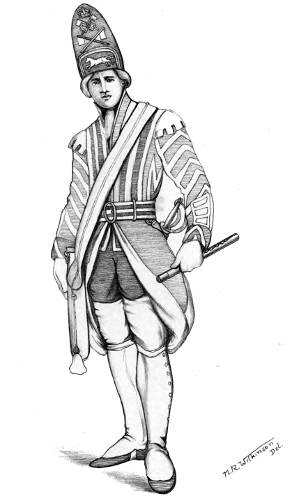
DRUMMER 1745.
N.R. Wilkinson del. A.D. Innes & Co London Mintern Bros. lith.
Where four allies were conducting a war in common, it was
only natural that there should be an interchange of medals and of
decorations, and this was done with no ungenerous hand. A new
medal, more coveted than any other by soldiers and sailors, was established
early in 1856, both for Officers and men in the Naval and
Military services, who had distinguished themselves before the enemy
“for valour.” The distribution of the Victoria Cross did not, however,
take place until the 26th of June, 1857, when all the claims
for that most conspicuous honour had been fully investigated. The
day appointed for the ceremony was observed as a general holiday,
and a review was held in Hyde Park before Her Majesty the
Queen, who affixed to the breast of each man entitled to it, the
bronze cross he had won in the field by his personal bravery.
In the Coldstream the recipients of this proud distinction were
Majors Goodlake and Conolly, and Privates Strong and Stanlock.[362]
This event, though it took place more than a year after the
288conclusion of peace, is connected with the Crimean struggle, and
may be said to terminate the history of the protracted hostilities
that troubled our relations with Russia. Thenceforward the war
became a thing of the past, and its memories were merged into
or overshadowed by other events which occurred elsewhere.
We have seen how the struggle shaped itself; how disastrously
it was directed; and how devotedly our army maintained it, under
very adverse and wholly exceptional circumstances. We allied
ourselves to a Potentate whose tenure of power was precarious,
whose interests were not our interests, and who only wished to
adopt a foreign policy of adventure to reconcile his new subjects
to his rule. His armies loyally supported ours in the field, and
there we happily formed a sincere respect for the brave French
troops who fought by our side. But the Government of Paris,—objecting
always to transfer the theatre of war to Asia, where
the enemy was really vulnerable,—restricted our field of operations
to Europe; and as Austria protected the Russians on
the Bessarabian frontier, we were forced at a late period of the
year to make a descent upon the Crimea. Unhappily we had
made no preparations for such an expedition, and had formed no
plan for carrying it out; in fact, such an invasion had not seriously
entered into our calculations when we declared war against the Tsar.
Thus, we landed fortuitously at a point where the road led
to the north side of Sevastopol, but where no harbours near that
town, were at hand to form a base of operations. Hence, without
a base, we advanced to our objective, and, in due course, and after
a successful battle, we arrived before it. But, on reaching this
point, the Commander of our allies was indisposed to carry out
the plan to which we had committed ourselves. We therefore
shifted our forces by a strange flank march to the south
side, in the hope that we might there at least be enabled to bring
the campaign to a speedy conclusion. Sevastopol was at that
time guarded by a small garrison, composed of a medley of
indifferent and badly armed troops; it was imperfectly defended
towards the land, and in this direction it was an insignificant
stronghold. Still, as long as it remained in that state, we hesitated
to make any or even the least move against it; we preferred to wait
to bring up our siege-train, and to open regular approaches, with
the expectation that the town would fall before the cold weather
should set in, and put an end to all field operations.
289But we had miscalculated. We did not take into account
what a patriotic and energetic garrison might achieve during the
unexpected respite granted them, nor did we perceive that we were
altering, just as winter was approaching, the whole plan of invasion
from an expedition of surprise to the more lengthened process of
a regular siege. Thus, under the direction of an Engineer Officer
of genius, did Sevastopol assume the proportions of a fortress,
while the English and the French were looking idly on; and before
they could batter down simultaneously the new works in front
of each—which they allowed the enemy to construct,—the Russian
forces, drawn from the Danubian Principalities, were hurried by
forced marches into the Crimea, to the support of the scanty troops
that were then to be found there. The very moment we had meant
to deliver our final blow, the enemy’s arrangements were complete,
and we had to fight the unequal battle of Inkerman. Although
we were victorious there against tremendous odds, the result
obliged us to spend the winter on the barren and snow-swept
plain of the Chersonese.
For this emergency we were entirely unprepared, and an
intensely cold season having begun early, our troops, as we have
seen, suffered in consequence. We then hung on to our positions
before Sevastopol with strong tenacity of purpose, and with a
resolution which is above all praise. But we could not resume
the siege till the spring of 1855, and it was early in September
before the south side fell. Taught by disaster, we then made
every arrangement to continue the struggle with the best prospects
of success; but the French, having gained the objects they had
in view, became inactive; they clamoured for a cessation of
hostilities; and thus, to preserve an alliance into which we had
permitted ourselves to be drawn, we signed a peace of little value,
and so put an end to the war.
The successes gained were not due to the skill of the Government
that directed the struggle; they were solely due to that
indomitable bravery, discipline, and power of endurance which have
ever characterized our soldiers, as well as to the admirable system
which made the British regimental Officers and men second to
none that existed at that time in the other European armies.
The results of the war were dearly purchased. According to
a return presented to Parliament, 390 Officers and 20,425 Noncommissioned
officers and men were killed or died of wounds
290or of disease in the Crimea, and 14,718 men were invalided at
the conclusion of the war, bringing the total casualties up to
35,533 of all ranks. But this return omits to include casualties
in the Naval brigade and in the Marines (doing duty on land),
and in the Commissariat, Transport, and Hospital departments;
nor does it seem to give our losses incurred during the disastrous
stay in Bulgaria, etc.: so that the figures do not represent the entire
losses to which even our Land forces were subjected.[363] On the
other hand, it was computed that the Russians lost as many as half
a million men. But this is a surmise, and the facts have never
been known. The estimate is probably exaggerated, though it is
certain that the enemy’s casualties were exceedingly great; but
loss of men is not the greatest calamity that could befall an
Empire like Russia.
Two events must be noted here which took place about this
time, one of which affected the whole army, and the other the
Brigade only. On the death of Lord Hardinge, who had
succeeded the Duke of Wellington as Commander-in-Chief in
1852, H.R.H. the Duke of Cambridge was appointed to that high
office, and assumed his new functions July 15, 1856—an office
which he held without interruption until the 31st of October,
1895, for a space of nearly forty years.
The day before, the following Brigade Order appeared:—
July 14, 1856. Her Majesty has been pleased to appoint Major-General
Lord Rokeby, K.C.B., to serve on the Staff of the army, with a view to his
exercising a general supervision over the Battalions [of Guards] in England,
including those at Aldershot; all communications having reference to the
Brigade of Guards will be addressed to him in future, instead of the Field-Officer
in Brigade Waiting as heretofore.
It may be well to explain that, previous to this appointment,
orders to the Brigade had been issued by the Field-Officer in
291Brigade Waiting—a Commanding Officer of a Guards Regiment
or Battalion, taken by roster—who is always an Officer of the
Sovereign’s Household. The effect of the order just quoted,
was to place a General Officer in actual command of the Brigade,
while the Field Officer in Brigade Waiting was still retained
to fulfil the Court duties, he being, as formerly, the direct medium
of communication between the Court and the Household Infantry.[364]
CHAPTER XIII. A PERIOD OF WAR, 1856-1871.
292
Reductions after the war—Comparison between the situations in Europe, in 1815 and in
1856—Fresh troubles and complications imminent—Many wars and disturbances—Scientific
instruction introduced into the army—Practical training of the troops
carried out—The material comfort of the soldier attended to—Military activity in
England in 1859—The Earl of Strafford succeeded by General Lord Clyde—Death
of H.R.H. the Prince Consort—Misunderstanding with the United States of
America—Chelsea barracks completed—Marriage of H.R.H. the Prince of Wales—Death
of Lord Clyde; succeeded by General Sir W. Gomm—The Brigade of
Guards Recruit Establishment—Public duties in London—Fenian troubles in
Ireland; the 1st and 2nd Battalions succeed each other there; the Clerkenwell outrage—Reforms
in the armament of the British infantry.
The termination of the Crimean war, though it entailed considerable
reductions in the army, was not accompanied by the acute
distress that marked the close of the great struggle with France
in 1815. In the latter case, the country had been seriously engaged
with a formidable enemy for twenty years, and was constrained to
devote all its resources to crush him. For nearly a generation, Great
Britain had been a nation standing in arms, and thriving, so to
speak, upon the success of her operations by sea and by land. The
sudden cessation of hostilities, and the no less abrupt and violent
change from a strong war footing to a small peace establishment,
caused a temporary dislocation in trade, and this contributed in no
small degree to create an unfortunate effect upon the economic
conditions under which the people were then living. Whereas, in
the more recent case, we were engaged for a relatively short space
of time, and were not involved in efforts which could bear comparison
with those we had been obliged to make earlier in the
century. Hence we were able to diminish our armaments without
incurring the same difficulties that had previously oppressed the
industry of the country; and arrangements could be safely made
293to reduce the regular army by 50,000 men, and to disband all
those other forces that were brought together for the purposes of
the Russian war. On the 1st of November, 1856, the establishment
of the Regiment was diminished by some 600 men, and was fixed
on the following scale:—
| Colonel. |
1 |
| Lt.-Colonel. |
1 |
| Majors. |
2 |
| Captains. |
20 |
| Lieutenants. |
24 |
| Ensigns. |
16 |
| Adjutants. |
2 |
| Qr.-Masters. |
2 |
| Surgn.-Major. |
1 |
| Surgeon. |
1 |
| Assist.-Surgns. |
5 |
| Solicitor. |
1 |
| Sergeants. |
92 |
| Drummers. |
34 |
| Rank and File. |
1600 |
| 2 Battalions, 10 Cos. each. |
Another difference between the peace of 1815 and that of 1856
is also of sufficient importance to require a notice. The final defeat
of Napoleon at Waterloo found Europe exhausted by the long
wars of the French Revolution; and the Congress of Vienna
effected such a settlement among the civilized nations, of apparently
so stable a character, that all Governments believed in the certainty
of a protracted period of international tranquillity. Nor
was this expectation disappointed, and for forty years there were
no complications to disturb the political order that had then been
established. But the assurance of peace led many to suppose that the
era of war had come to an end, and we in this country were inclined
to adopt that view—to such an extent, at least, that we deprived
the army of some of the departments which are necessary to its
existence in the field. So to say, we hid the remnant of the standing
army away from the sight of the nation, as an institution
almost out of harmony with the spirit of the age, and as an instrument
of offence which would scarcely be again required for practical
use. The warlike traditions of the past, however, remained in full
vigour among the British troops, between 1815 and 1854; nor was
there any relaxation of the strict principles of soldierlike bearing
and conduct which had been inaugurated and enforced by the
Duke of York and by the Duke of Wellington. No troops were
more highly disciplined than those that belonged to the British
army; among none had the military spirit and tone been so carefully
fostered and so fully developed: and it was due to the splendid
qualities which had been instilled into them, that the achievements
of our men in the Crimea commanded the respect and the admiration
of the world. But the knowledge of even elementary
military sciences failed us; no instruction beyond drill was given;
294we had little organization, no warlike grouping or cohesion of
units, no transport, no real power to take the field or to utilize
there the magnificent troops which their Officers had formed. The
struggle with Russia had revealed these defects; and, taught in the
bitter school of adversity, we were naturally slow, when the peace
was signed, to destroy entirely those auxiliary services which had
been so painfully created in the midst of war.
Now, the year 1856 was not like its predecessor, the end of a
disturbed period; it marked the very commencement of a new era
of European complications. The statesmen of the day were filled
with no illusions, and were well aware of the unsettled state of
affairs which the peace of 1856 had inaugurated. The Italian
question was directly raised; Austria lost credit by her weak and
vacillating action, and had become despised and isolated; steps
to secure the aggrandisement of Prussia were already prepared;
the policy of Napoleon III. was obscure and uncertain. Changes
in the old landmarks of the Continent and serious trouble loomed
in the near future. The threatening aspect of the coming storm,
in short, was easy to be discerned: it was only too manifest that
England might have to defend her rights, and could not afford, at
such a moment, to neglect the affairs of her army and navy.
As events turned out, the war-cloud hovered over the whole
world, and oppressed humanity with more or less intensity until
1871. Great Britain had to contend against many difficulties; but
they were not of serious importance, except the Indian Mutiny,—which,
breaking out unexpectedly in 1857, was not crushed finally
until 1859,—and except the rapid advance of Russia across the
barren steppes of Central Asia towards the frontiers of our Empire
of India. Of our minor troubles, we may note: the Persian war, in
1856-57; the expedition to China, in 1857-61; the subjugation of
the Maori natives in New Zealand, 1864; the invasion of Abyssinia,
1867-68; and the threatened dispute with the United States,
1861. In none of these, except the last, was the Brigade of Guards
concerned. On the borders of Europe, the Caucasian Switzerland
of Circassia was finally overpowered and assimilated with Russia,
and the one barrier to her progress in the East was at last swept
away, 1859. Nor was America free from disturbance. The United
States, torn by dissensions, fought a fratricidal war of secession,
1861-64, that ended in re-establishing the authority of the Northern
States over the revolted South; while that political stormy petrel,
295Napoleon III., took part in a policy of adventure, by attempting,
though unsuccessfully, to establish French influence, under cover
of an Austrian prince, in Mexico. But in Europe itself the trouble
was greater: France and Sardinia attacked Austria in Lombardy
in 1859, and forced her to relinquish her possession of that
province; Italy also rose in rebellion against the Princes that
then ruled her States, and was consolidated into one kingdom
under Victor Emanuel, our late ally in the Crimea. In 1859,
also, Napoleon III. showed considerable animosity against
England, and it was thought by many that there would be war
with France. In 1864, Austria and Prussia joined to wrest the
Duchies of Schleswig Holstein from Denmark: and two years
later, having quarrelled over the booty, they came to blows,
when Prussia defeated her rival hopelessly in the short and sharp
campaign of a few weeks' duration in Bohemia, and acquired a
complete ascendency over Germany. Italy, at the same time also,
was enabled by foreign aid, to compel Austria to surrender her
hold on Venetia. Then came the great war of 1870-71, when
France and Prussia, regarding each with mutual jealousy and
international hatred, engaged in deathly strife, that resulted in the
fall of Napoleon, in the signal defeat of France, and in the refounding
of the German Empire under the autocracy of Prussia.
The results of these constant contests upon our own army were
not, of course, immediately apparent, nor could they produce a
decided effect all at once upon the course of our military administration.
But sufficient has been said to show that there were
obvious reasons why the lethargy which affected the vital concerns
of the forces of the Crown in 1815, was not reproduced in
1856, and how it came about that the nation began to take an
increased interest in these most important affairs.
The Officers of the British army formed at that time a competent
body. Taken from a class where the best leaders of men
might be expected to be found, trained in the manly school of field
sports and of outdoor exercises, brought up to early habits of
obedience and of discipline, and endowed with the faculty of commanding
the respect and the confidence of their subordinates, they
were as well qualified to manage the rank and file placed under
them in peace time, as they were conspicuous for their bravery and
for the good example they set when danger pressed, or when
difficulties were to be overcome in war time. One thing only did
296they lack—they had little scientific knowledge of their profession.
To remedy this grave deficiency, a Council of Military Education
was appointed in May, 1857, to superintend the system of education
introduced among the Officers, and the examinations of candidates
for admission to the service. It cannot be stated that this subject
had been entirely ignored in the past, but it had been little regarded.
After 1857, however, considerable attention was given to it, and
the new system eventually expanded to its present dimensions—adding,
in fact, to the army, as part of itself, a military University,
where degrees are bestowed upon graduates, in their various ranks,
who pass its examinations. These degrees attesting the scientific
and theoretical proficiency of the candidates then became a necessary
qualification for promotion in the service, at first to the rank
of Captain only, but subsequently to a higher grade. In this
respect, the policy has rather been to form an examining Board,
for the purpose of testing the acquirements of Officers, than to
institute something more akin to a teaching University, with the
result that what is called “cramming” (or hasty learning of special
subjects) has been largely increased, to the detriment perhaps of
a more solid system of instruction. At any rate, whilst the old
leaven of manhood and of common sense which has ever characterized
the body of British Officers has not been weakened, a
form of education calculated to teach technical and scientific duties
in the field has been accepted with gratitude and satisfaction.
This important reform was supplemented by H.R.H. the Duke
of Cambridge, the new Commander-in-Chief, who carried on the
work, initiated by his predecessor, Lord Hardinge, which had
been strongly urged by H.R.H. the Prince Consort. The camp
of instruction established at Chobham in 1853 was moved to
Aldershot, in the midst of a wide extent of heather country; the
Crimean huts were erected there, and the head-quarters of a new
military district were formed, where manœuvres could be undertaken
by large bodies of troops, and where the men could be
taught practically their numerous duties in the field. As will be
seen, Guards Battalions were often sent there for this purpose.
Nor was musketry neglected. Officers were told off as instructors
in the art of correct shooting with the rifle that had been introduced
into the service; every soldier was trained individually in
its use, in a systematic way and in accordance with the regulations
laid down at the School of Instruction established at Hythe;
297parties, moreover, of Officers, Non-commissioned officers, and men
were constantly sent there to undergo a course of musketry, and
receive a certificate of efficiency in that very necessary branch of
their military training.[365]
It has been noted that General Sir W. Codrington utilized the
time when warlike operations practically ceased in the Crimea,
by directing that all British soldiers should be put through an
efficient course of musketry. After the war, the Guards continued
to shoot on the range at Kilburn, but in 1859 a camp was formed
for them at Ash, where rifle practice was carried out by companies,
sent there in succession from the Battalions in England during the
spring and summer months. Next year a Mounted Officer with
a regular staff took command of the camp. Though Ash and
Aldershot were the usual places selected for the Guards' musketry,
companies were also sometimes sent to Eastbourne and to Gravesend
for this purpose.
In the winter months marching was practised, and great gun
drill was taught.[366] In 1861, gymnastic training was introduced,
298and in September of that year, sergeants from the Brigade were
sent through a course, so as to qualify as instructors. A gymnasium
was about this time first constructed at St. John’s Wood barracks,
and companies were required to go there for a few weeks at a
time. The gymnasium at Chelsea barracks was ready in 1865,
and another at Windsor in 1870. The physical development of
their men had before this been a special interest to the Officers of
the Brigade, who endeavoured to introduce a system of outdoor
gymnastics in the Guards, as far back as 1843. The practice,
however, on being objected to by the Duke of Wellington, was
given up.[367]
It should be mentioned here that signalling courses were not
introduced into the army until 1869. Much attention was then
immediately given to this subject in the Brigade, and the Battalions
of Foot Guards were frequently complimented upon the efficiency
they displayed as signallers.
While military training in many of its various important aspects
was eagerly attended to, and was put upon a basis from which it
could receive its proper development, the material comforts and
welfare of the men were not neglected.[368] The cooking arrangements
of the men in the Crimea had been signally defective, as
much on account of the conditions under which they were placed,
as by reason of the very little knowledge which they had of the
subject. This, no doubt, was a serious want, and it militated
against the health of the soldier. A school of cookery was
established at Aldershot in 1862, and Non-commissioned officers
were sent there to be trained in the new system then adopted.
Considerable interest was taken in this matter in the Brigade,
reports were frequently called for, and experimental stoves set up
to secure the best results combined with economy. Sergeant
Cooks were appointed in the Coldstream—in the 1st Battalion,
December, 1863, and in the 2nd Battalion, in the following March;
but it was not until May, 1868, that the establishment of the
Regiment was increased by two sergeants for this purpose, nor
was it until May of the year before, that the assistant cooks were
299struck off other duties. As part of the same subject, it may be
noted that the Commissariat Store at Chelsea barracks for the
bread and meat to be issued to the troops in London, was established
December 1, 1865, and an inspecting board of three Officers
met daily to examine and to report upon the supplies furnished
by the contractors.
Reforms in the canteen system were introduced shortly after
the Crimean war. In conformity with instructions contained in
the Quartermaster-General’s letter of the 30th of November, 1857,
boards of Regimental Field-Officers were assembled quarterly to
revise the prices of articles sold, and to report upon the canteens
inspected by them. The accounts were examined more frequently,
and suggestions were invited as to the management of these
institutions. In 1864, groceries began to be supplied to the
messes, so that the men might only pay wholesale instead of retail
prices, and married soldiers were encouraged to take advantage
of the low cost of articles sold there. As the management
became more efficient, the profits rose, and with this fund at the
disposal of Commanding Officers, a great deal was done for
the benefit of the men,—books and newspapers supplied at the
various metropolitan Guards, extra food provided on long field
days, being some of the items of expenditure that first appear to
have received the sanction of the authorities.
Nor should we omit to draw attention to the encouragement
given to outdoor games and amusements. Officers have always
been inclined, naturally, to introduce among their men the healthy
exercises which they themselves were taught at school, and which
they continued to indulge in after joining the service. Thus
cricket was well known, and we have seen that during the Russian
war it was not neglected. Football, however, was not as common
then as it is now, nor had some other forms of athletic sports
taken a firm root in the public schools forty years ago. But as
they became better known there, so did they grow in popularity
among the troops—as also did boating at Windsor,—until at last
they have become well recognized institutions, to the great benefit
of the men, and to the immense advantage of the army. Hunting
has always been a favourite pastime among Officers, and where it
is not sufficiently available they often establish a drag hunt of
their own. This was done at Windsor, in the winter of 1856-57,
mainly by the Coldstream, whose 2nd Battalion was then quartered
300there. This institution flourishes to the present day. When the
Brigade had the out-quarter at Shorncliffe, as will be seen further
on, another drag hunt was also established there, but on leaving
that station it had to come to an end.
On the 17th of July, 1856, at the suggestion of the Major-General
Commanding the Brigade of Guards (Lord Rokeby), the
Battalions who had just returned from the Crimea applied for
new Colours, and, on the 27th of February following, the old Colours
which had seen service in Russia were deposited, escorted by
Guards of Honour of the usual strength, in the Royal Military
Chapel at Wellington barracks.
Owing to the death of Colonel Gordon Drummond, Colonel
Newton was promoted Major, and took command of the 2nd
Battalion, November 18, 1856.
On the 3rd of March, 1857, the 1st Coldstream relieved the
2nd Scots Fusilier Guards at Aldershot (the 1st Grenadiers having
been removed to Town from that camp in December), and returned
to London at the autumn change of quarters (September 1st),
when the 2nd Coldstream proceeded to Dublin, and the 1st Scots
Fusilier Guards to Portsmouth. On the return of the latter
(November 20th) the Brigade was again quartered in their usual
stations, viz. four Battalions in the West-end and the other three
in the Tower, Windsor, and the out-quarter (Dublin).[369] After
this time, Battalions were frequently sent to Aldershot for the
purpose of receiving practical instruction, but not to be stationed
there for merely general duty.[370] About this time also—that is,
between the 1st of September and the 7th of December, 1857—the
Brigade furnished a detachment of about 200 Officers and men
at Deptford, where occasional duty had been done by it, as we
have seen, between 1815 and 1854.
N.R. Wilkinson del. Mintern Bros. Chromo.
While the Indian Mutiny obliged Government to strengthen
301the army in India, drafts were collected at Colchester and
Canterbury to be sent out to the East as they were required. In
April, 1858, fourteen Ensigns of the Brigade (three from the 1st
Coldstream) were sent to these places to look after the men that
were assembled there. The following letter, dated July 3rd, from
the Adjutant-General to Lord Rokeby, was published and ordered
by the latter to be entered in the Regimental records:—
The Inspector-General of Infantry having reported to His Royal
Highness, that, in consequence of the embarkation of numerous drafts
for India, there is no necessity for retaining the services of the Officers
of the Guards at Colchester and Canterbury, orders will consequently be
sent to those stations directing the Officers of the Guards to return to
their respective Battalions. In communicating this decision to your
Lordship, I am commanded to acquaint you that His Royal Highness
has much gratification in stating that he has received from all quarters
assurances of the excellent manner in which these Officers have conducted
the duties assigned to them, reflecting as it does great credit on themselves
and on the Regiments in which they have been instructed.
The 2nd Coldstream, returning from Dublin to London,
September 1, 1858, brought a record of services performed in
Ireland which was embodied in a Garrison Order, dated Dublin,
August 30, 1858:—
The Major-General Commanding the District, in directing the departure
of the 2nd Battalion Coldstream Guards, is unwilling to allow them to
pass from his command without acknowledging his unqualified approbation
of their conduct during the twelve months of their being in Dublin, and
his sincere regret at losing them. Possessed of all the attributes which
constitute excellence in a regiment, whether as regards the zealous and
strict attention to their duty on the part of the Officers, the activity,
intelligence, and trustworthiness of the Non-commissioned officers, the
obedient conduct, soldier-like appearance, and respectful demeanour of
the men, or the order and regularity of the parade, the general cleanliness
of the barracks, the comfort of the hospital, the large attendance of the
adults at school, the comparative absence of crime, and the pervading
system of the corps, the Battalion has stood forth in the garrison as a
model of regimental discipline, to excite the emulation and stimulate
a generous rivalry. The Major-General, therefore, begs to offer his thanks
to Colonel Newton and his Officers for the support they have at all times
afforded, and to assure the Battalion that he will always retain a lively
recollection of the satisfaction he derived in having it as a part of his
garrison.
302Colonel Hon. G. Upton, C.B., appointed Major-General, October
26, 1858, was succeeded by Colonel Lord Frederick Paulet, C.B.,
as Lieutenant-Colonel of the Regiment; thereupon Colonel
Newton assumed the command of the 1st Battalion, and Colonel
Spencer Perceval, promoted to the rank of Major, was posted to
command the 2nd Battalion.
As previously mentioned, events in the year 1859 produced the
impression that Napoleon III. was about to declare war against us,
and visions of invasion began to haunt us. Considerable military
activity was displayed at this time. Second battalions to twenty-five
regiments of the Line, and third and fourth battalions to the
two Rifle regiments, the 60th and Rifle Brigade, were raised and
incorporated into the army: we find also that, early in the year, the
Brigade was called upon to furnish Non-commissioned officers
that could be spared, as drill instructors to train the men of some
of these new corps. Of these, the Coldstream supplied four to the
2nd Battalion, 21st Regiment, at Newport, February, 1859. Nor
was the condition of the Militia neglected, and Field-Officers of
the Guards, who had been sent to inspect the regiments when
embodied, were more frequently employed on this duty about this
time. Now, in 1803, when Napoleon I. threatened to make a
descent upon our coasts from his great camp at Boulogne, bodies
of Volunteers were raised to watch our shores. The same thing
happened in 1859, and, although our danger was scarcely real,
yet so strongly impressed were the people with the facilities of
transit across the narrow channel, which steam would give an
invader, and so convinced were they of the power and of the evil
designs of the French Emperor, that they began spontaneously to
form rifle corps for the defence of the country. This was the
commencement of the Volunteer movement which has now developed
into an important auxiliary branch of the forces of the
Crown intended for service at home. Its usefulness in the field
has not yet been practically tested, and we may well pray that
the day when it must meet an enemy on our own soil, may never
come. But the influence it commands, by strengthening the ties
that bind the military and the civil elements, by rendering the
regular army popular, and by therefore facilitating the recruitment
of a good class of man, is well known; while the self-sacrifice of
many who devote their leisure to martial exercises, without prospect
of reward, is creditable to the British character, and tends to
303spread a wider interest in military affairs than was formerly the
case.
In the summer of 1859, many of the Officers of the Brigade
were employed in reporting upon the numerous ranges which had
been proposed as suitable sites for rifle practice. This duty did
not cease until the beginning of 1862, when facilities for musketry
existed in almost every district, and when the exercise became a
popular pastime throughout the country. A National Rifle Association
was formed, and a Volunteer camp established at Wimbledon
(1860), where shooting competitions took place. The meetings
continued year after year with ever-growing popularity, and detachments
of Guardsmen were sent from London to perform the military
duties in camp and on the ranges. Colonel Tower (Coldstream
Guards) was the first Field-Officer selected to command these
detachments, in 1865, and since then the Brigade has regularly
furnished an Officer of that rank for this purpose, to attend the
Rifle meetings, and, later (from 1874), to command the camp.
As far back as 1860, the drill of Officers of the Militia and
Volunteers was often superintended by Officers of the Brigade of
Guards. In October, 1870, moreover, schools of instruction were
established at the Tower and at Wellington barracks, which were
eventually consolidated into one, where Officers of the auxiliary
forces, having passed a practical course in drill, can obtain a certificate
to that effect. Colonel Hon. R. Monck (Coldstream
Guards) was the first Commandant of the school at Wellington
barracks.[371]
The Coldstream, having lost their Colonel by the death of
Field Marshal Earl of Strafford, the chief command of the Regiment
was bestowed upon General Lord Clyde, G.C.B., June 22,
1860, better known by the men in the Crimea, as Sir Colin
Campbell. After the war with Russia, this very distinguished
Officer was employed in India, where, appointed Commander-in-chief,
he took a conspicuous part in the suppression of the
304Mutiny. Several other changes occurred in the Regiment about
this time. On the promotion of Colonel Lord F. Paulet, C.B., to
the rank of Major-General, Colonel Newton became Lieutenant-Colonel,
whereupon Colonel S. Perceval assumed the command
of the 1st Battalion, and Colonel Steele, C.B., appointed Major, of
the 2nd (December 13, 1860). In a few months, however, there
was another change; Colonel Perceval was promoted Lieutenant-Colonel,
when Colonel Steele was posted to the 1st Battalion, and
was succeeded by Colonel Wood in the 2nd (July 2, 1861).
On the 1st of April, 1861, Major-General Lord Rokeby retired,
and the command of the Brigade devolved upon Major-General
Craufurd. Shortly afterwards (June 27th) a Major of Brigade was
appointed in the Foot Guards, and the new post was given to
the senior Adjutant, Captain and Adjutant Gordon, Scots Fusilier
Guards.
In December, 1861, the whole country was plunged into deep
mourning by the premature death of the Prince Consort. It is
less than the truth to say that all hearts were moved with profound
grief for the Queen in this, the greatest of domestic afflictions; and
at the decease of a patriot Prince, whose sage counsels had so
often ably directed Her Majesty in many important matters, and
who had done so much for the intellectual elevation and the
material advancement of her people. The sorrow of the nation
was felt nowhere more strongly than among the Guards, who
thereby lost their Senior Colonel, and whose inalienable privilege
it is to share, as part of the Sovereign’s Household, the trials as
well as the joys that visit the Royal Family.
This most sad misfortune happened at a moment of a misunderstanding
with the United States of America, when it was
apprehended that war might break out between the two countries,
and when an expedition was being fitted out to defend Canada
should the crisis assume an acute stage. It is scarcely necessary
to go into the details of the dispute, well known as the “Trent
affair,” for the Coldstream took no part in the operations which
followed. Suffice it to say that two Battalions of the Brigade
(1st Grenadiers and 2nd Scots Fusilier Guards, under Major-General
Lord F. Paulet) were shipped to British North America,
December 19th, and remained there until the autumn of 1864.
Fortunately peace was preserved, and the expedition, while
watching proceedings during the civil war that was then raging
305in the States, assumed the character of a movement of troops
from one part of the British Empire to another, for ordinary
purposes.[372]
The 1st Battalion Coldstream, having gone to Dublin in
October, 1861, did not return to London until the next change
of quarters in April following, and so, for the first few months of
1862, there were but three Battalions in the West-end, while the
Tower was occupied by a Line Regiment (the 1st Battalion of
the 3rd Buffs). To lighten the duties, the latter furnished a
detachment at Wellington barracks, which occasionally supplied
the guards at Kensington Palace, the Magazine, and at the
British Museum. In April, 1862, the full complement of four
Battalions did duty in the West-end, and Dublin was given up
as a Guards station. On the return of the Canadian expedition
the Tower was again occupied by Guards, and the out-quarter
was transferred to Shorncliffe. Chelsea barracks, designed as we
have seen in 1855, were ready for occupation in the autumn of
1863, and an entire Battalion and a few companies of another were
stationed there. Subsequently, the head-quarters of the latter,
transferred from St. George’s, were also placed in these barracks;
while Portman Street had been given up in September, 1863. The
new wing of Wellington barracks had been occupied prior to this
date, and was opened shortly after the Crimean war, as we have seen.[373]
Thus considerably more space was obtained for the Brigade in
London, which was distributed almost as is the case in the present
day.[374] It is only necessary to add that the small barracks at the
Magazine were vacated, and handed over to the police authorities
on the 21st of December, 1866; that those at St. John’s Wood
ceased to be occupied by the Foot Guards about the year 1876;
and that Windsor barracks, which was a crowded and unsuitable
306building for a whole Battalion, were greatly improved and enlarged,
and were ready for occupation in 1868.
On the 9th of November, 1862, Colonel Steele, was promoted
Lieutenant-Colonel of the Regiment, vice Colonel S. Perceval,
appointed Major-General; the command of the 1st Battalion then
devolved upon Colonel Mark Wood, and that of the 2nd Battalion
upon Colonel Dudley Carleton.
Many remember the marriage of H.R.H. the Prince of Wales
to the Princess Alexandra of Denmark, March 10, 1863, and the
enthusiasm and joy evoked throughout the length and breadth
of the land at the auspicious and popular event. Her Royal
Highness arrived in London on the 7th, and proceeded to Windsor,
where the ceremony was performed, and the following military
arrangements were made for her reception in the Metropolis.
The 3rd Grenadiers furnished a Guard of Honour at Bricklayers
Arms Railway Station, the remainder of the Battalion being in
column of wings in front of St. James’s Palace; the 1st Battalion
60th Rifles, then at the Tower, were formed outside the station;
the 2nd Coldstream Guards in Waterloo Place lining the streets,
with a Guard of Honour (the Queen’s Guard strengthened to
the usual complement) near the Palace, and at right angles to
the Grenadiers. The 1st Scots Fusilier Guards were in line near
Hyde Park Corner; the Park was occupied by some 17,000
Volunteers; and the 2nd Grenadiers were stationed at the Marble
Arch, and had a Guard of Honour at Paddington Station. The
1st Coldstream, then quartered at Windsor, sent a Guard of Honour
to Slough. At the Royal wedding on the 10th, the Brigade was
fully represented; the 2nd Grenadier Guards (in which Regiment
His Royal Highness had served) found a Guard of Honour at
St. George’s Chapel; the 1st Scots Fusilier Guards furnished
another at the railway station on departure; and the 1st Coldstream,
besides providing two Guards of Honour, one at the State Entrance
of the Castle, and the other at the Chapel, were also present. The
Berkshire Volunteers, moreover, had a Guard of Honour outside
the gates of the Castle. The Guards Battalions quartered in
London celebrated the occasion by parading in Hyde Park,
where the 2nd and 3rd Grenadiers and the 2nd Coldstream fired
a feu de joie, while the 1st Scots Fusilier Guards kept the ground.
The day was observed as a general holiday throughout the country,
and all classes joined to express their heart-felt congratulations
307on the happy alliance which had been made by the Heir Apparent
of the Throne.[375]
Nor ought we to forget to mention that a ball was given by
the Brigade in the Exhibition buildings, June 26th,[376] to the Prince
and Princess of Wales, in honour of the Royal marriage that had
just taken place; the Guard of Honour to receive Their Royal
Highnesses was furnished by the 1st Scots Fusilier Guards.
Several changes occurred in the command of the Brigade and
Regiment during this same year (1863). On the 25th of June,
Lord F. Paulet, having returned from Canada, was appointed
Major-General of the Brigade of Guards vice Lieut.-General
Craufurd.
At the death of General Lord Clyde, General Sir William
Gomm, G.C.B., succeeded him as Colonel (August 15, 1863),
and was thus again posted to the Coldstream Guards, which
he had joined as a Captain and Lieutenant-Colonel just before
the battle of Waterloo, and with which he had served up to the
rank of Lieutenant-Colonel of the Regiment, until January, 1837,
when he was promoted Major-General. Colonel Steele, moreover,
relinquishing the command of the Coldstream (November
24th), the Lieutenant-Colonelcy devolved upon Colonel Wood,
when Colonel Carleton was posted to the command of the 1st
Battalion, and Colonel Stepney, C.B., to that of the 2nd Battalion.
Just at this moment, also, the Regiment lost their Bandmaster.
Mr. Charles Godfrey, who died much regretted in December,
having joined the Coldstream fifty years before (in 1813). This
excellent musician had efficiently conducted the Band ever since
1825.[377]
We have seen that hitherto, when promotion took place, and
when the Senior Major either left the Regiment or was appointed
Lieutenant-Colonel, the Junior Major was invariably transferred
308to command the 1st Battalion, and the Captain and Lieutenant-Colonel,
promoted Major to fill up the vacancy created, was
posted to that of the 2nd Battalion. The same rule prevailed as
regards the Acting-Majors (Mounted Officers), so that the senior
and the third senior always belonged to the 1st Battalion, and the
second and fourth seniors to the 2nd. It had also prevailed
among the Adjutants up to the first Canadian expedition in 1838,
but then it seemed to lapse as far as they were concerned, in the
Coldstream at least. This custom was abolished on the 19th of
January, 1864, when the following Order was issued:—
In compliance with instructions from H.R.H. the Duke of Cambridge,
no alteration in future is to be made in the posting of Majors Commanding
Battalions; these Officers are to remain in the Battalions in which they
were originally promoted, the Senior Major to receive the difference in
allowance which may be attached to the command of the 1st Battalion.
By the same rule, Acting Majors will not change Battalion except for
promotion or on appointment to be Senior Acting Major.
The following list shows the Officers belonging to the Regiment
in January, 1865:—
Colonel.—General Sir William Gomm, G.C.B.
Lieut.-Colonel.—Colonel Mark Wood.
Majors.—Colonel Dudley Carleton; Colonel A. Herbert-Stepney, C.B.
Captains.—Colonels J. Airey, C.B.; W. G. Dawkins; C. W. Strong;
Hon. H. Hardinge, C.B. (Mounted).
Lieut.-Colonels Hon. P. Feilding; W. Reeve; C. Baring; J. H.
Le Couteur; H. Armytage; G. Goodlake, V.C.; H. Tower; A.
Fremantle; Colonel Hon. W. Feilding; P. Crawley; M. Heneage;
C. Blackett; G. FitzRoy; J. Conolly, V.C.; Hon. R. Monck; Hon.
W. Boyle.
Lieutenants.—Captains C. Greenhill; H. C. Jervoise; Hon. H. Campbell;
Julian Hall; G. Wigram; A. Lambton; Hon. W. Edwardes; H. Lane;
W. F. Seymour; Hon. E. Legge (Adjutant); E. S. Burnell; Hon. G.
Windsor-Clive; R. Thursby; N. Burnand; FitzRoy Fremantle; F.
Buller; E. Reeve; H. Bonham-Carter; Hugh Fortescue (Adjutant);
J. F. Hathorn (I. of M.); H. Herbert (I. of M.); H. Brand; Denzil
Baring; Hon. F. Howard; R. Cathcart; C. Lee-Mainwaring.
Ensigns.—Lieutenants Hon. V. Dawson; E. Chaplin; Sir E. Hamilton,
Bart.; G. FitzRoy Smyth; Lord Wallscourt; H. R. Eyre; J. B.
Sterling; G. G. Macpherson; C. Thomas; Hon. J. Vesey; Hon. F.
Wellesley; Hon. H. Legge; R. Hall; A. Farquhar; C. Alexander;
W. Ramsden.
309Quartermasters.—A. Hurle; and A. Falconer.
Surgeon-Major.—J. Wyatt. Battalion Surgeon.—C. V. Cay. Assistant-Surgeons.—J.
W. Trotter; R. Farquharson; A. B. R. Myers.
Solicitor.—R. Broughton, Esq.
To persons living in the present day it may perhaps seem
strange to hear of the rigid social laws which were current in our
fathers' time against smoking. This indulgence was regarded,
only a few decades ago, as a more or less uncivilized habit, which
might be enjoyed on occasions in the privacy of a man’s own
apartments or in some far-away room of a country house, out of
sight of all general society, but never to be countenanced in
public. Hence, Officers on any sort of duty were not allowed
the use of tobacco even during hours of relaxation, and there
were stringent rules against the practice on the Queen’s Guard.
In 1838, for instance, attention is drawn to orders on that subject
there, and again in 1844:—
“The Lieutenant-Colonels of the three Regiments of Guards have
observed with great regret that the regulations for the Guard table at
St. James’s Palace are not attended to, particularly as to smoking....
The Captain of the Guard in St. James’s Palace will have the goodness
to add to his report that there has been no smoking in the Officers'
apartments in St. James’s Palace, during the twenty-four hours he has
been on Guard.”[378]
Nearly six years later the rule was modified, in that the
prohibition only applied to the mess room in the Palace, and the
Captain’s certificate was altered accordingly.[379] The Crimean War,
no doubt, did a great deal to destroy the old prejudice which
existed on the subject; for British Officers learnt the advantages
of the weed in the trenches, and were in close quarters with
habitual smokers, the Turks and the French. Still tobacco was
not permitted in the barrack rooms, and, early in 1859, the Medical
Officers were seriously called upon to report whether smoking there
would be likely to prove deleterious to the health of the men. It
was not until October 28, 1864, that leave was given to soldiers to
smoke in the barrack rooms from the dinner hour to tattoo.
It has already been mentioned that the recruit establishment
of the Brigade had been transferred to Croydon in 1833, and
there it remained for thirty years, except only that the Grenadier
section was moved to St. John’s Wood barracks during the war
310with Russia, from March, 1854, to the 18th of June, 1856. On
the 1st of April, 1863, the recruits of the three Regiments were
taken to St. John’s Wood, for the purpose of receiving gymnastic
training, until the 2nd of August, 1865, when they proceeded to
Warley.[380] During all this time the establishment was under the
command of a resident Officer (Lieutenant and Captain), who
took the duty there for a fortnight (at St. John’s Wood for a
week). Considerable responsibility rested upon the Regimental
Drill-Sergeant for the training of the men, and several orders
attest the fact that these Non-commissioned officers did their work
faithfully and efficiently. In 1870, a permanent Commandant was
appointed, when Lieut.-Colonel Moncrieff, Scots Fusilier Guards,
assumed the new post (November 28th), and, soon after, another
Officer was told off to perform the duties of Adjutant, the resident
Subaltern still remaining for a fortnight as Piquet Officer. Besides
the Medical Officer, and a Quartermaster who was added later (in
1885), this staff of Officers was all that looked after the Depôt until
1893, when it was again enlarged. On the 12th of April, 1875, a
board was assembled at Caterham to view and report upon a site
for the Guards Depôt, and this new quarter was occupied on the
23rd of October, 1877. The Senior Drill-Sergeant,[381] appointed
Acting Sergeant-Major, May 5, 1881, was promoted Sergeant-Major
on July 1st following. The Depôt then contained a
Sergeant-Major, a Quartermaster-Sergeant, an Orderly Room
Clerk, four Colour-Sergeants, four Sergeants, twelve Corporals,
and two Drummers; and these men remained “on the rolls of
their respective Battalions for promotion and married leave.”
In 1866 the public duties in London were reduced, and in
July they stood as follows:—
| |
Capts. |
Subaltns. |
Sergts. |
Corpls. |
Drums. |
Prvts. |
| Queen’s Guard |
1 |
2 |
2 |
2 |
3 |
36 |
| Buckingham Palace Guard |
0 |
1 |
2 |
2 |
1 |
27 |
| Tylt Guard |
0 |
1 |
2 |
2 |
1 |
18 |
| Kensington Guard |
0 |
0 |
1 |
1 |
0 |
15 |
| Magazine Guard |
0 |
0 |
1 |
1 |
0 |
9 |
| Total |
1 |
4 |
8 |
8 |
5 |
105[382] |
311The years 1866 and 1867 are chiefly marked in the domestic
history of the country by the troubles in Ireland, and by the
efforts of a secret society, called the Fenians, to stir up rebellion
and serious disturbances, not only in that island but in England
also. The Fenian body, born and nurtured in the United States,
had for some years been endeavouring to infect the mass of Irishmen
distributed throughout the whole of the United Kingdom with
their pernicious doctrines; and in a sense they accomplished their
object by intensifying a feeling that had existed for many a generation
between the Celtic and Saxon populations, into one of extreme
bitterness and animosity. Beyond this, however, they achieved
no immediate success; the illegal and violent measures they advocated,
while they caused a momentary panic among the peaceably
disposed, soon recoiled upon those who perpetrated them.
Hence, the movement speedily dwindled into insignificance, though
it left behind a residue of secret organization, which at no distant
date was to support another agitation, that again was destined to
disturb the country.
In the beginning of 1866, the usual spring change of quarters
in the Brigade had been ordered to take place on the 1st of March;
the 1st Coldstream was to move from Chelsea to another station
in the West-end, and the 2nd Battalion from the Tower to Shorncliffe.
But the troubles in Ireland were then giving cause for much
anxiety, and the order was not executed. It was known that some
few men belonging to Line Regiments had secretly joined the
Fenians; it was feared that an armed rising might take place;
an attempt to seize Chester Castle had just been frustrated
(February 13th), and a Battalion of the Scots Fusilier Guards had
been hurriedly despatched there to protect the place. A Guards
Battalion was thus urgently required in Dublin, and on the 20th of
February the 1st Coldstream were sent there at twenty-four hours'
notice, “the sick, boys, and men unfit for active service” being
attached to the 2nd Battalion. Shorncliffe was therefore given up
as the Guards' out-quarter.
The stay of the 1st Battalion in Ireland during the year, cannot
312be termed a pleasant one. Preserving the public peace against
the machinations of a secret band of conspirators who succeeded
temporarily in deluding a portion of the people, and in partially
alienating them from their legitimate rulers, is a duty too nearly
allied to the police service to be a favourite one with soldiers.
The work, however, was well performed by the Battalion, and
this is attested by the following order, which was issued by the
Major-General Commanding the Brigade, on the 6th of March,
1867, when their tour of duty was completed in Dublin, and when
they returned to London:—
“The Major-General has much pleasure in publishing a Memorandum
issued by General Lord Strathnairn upon the 1st Battalion Coldstream
Guards leaving Dublin. It reflects the utmost credit on all ranks for
having earned so distinguished a compliment. The Major-General notices
the favourable mention of Captain Hon. E. Legge, his close attention to
his duty as Adjutant proves his zeal in the interest of his Battalion. The
Major-General directs that Lord Strathnairn’s Memorandum with this Order
be read to each Battalion of the Brigade. In a corps constituted as the
Brigade of Guards the character of any one Battalion reflects upon the
whole.”
Lord Strathnairn’s Memorandum ran thus:[383]—
“Memo. —The Commander of the Forces has every reason to be
pleased with the excellent discipline of the 1st Battalion Coldstream
Guards during the twelve months they have been under his Lordship’s
command. The requisitions of the Government have often during this
time necessitated extra duties for the preservation of the public peace, all
of which the Coldstream Guards have performed with strictness and cheerfulness.
The promptitude with which Lieut.-Colonel Le Couteur, the
Officers, the Non-commissioned officers and men of the Battalion gave
effect to the wishes of Lord Strathnairn for a thorough organization of
the Reading, Recreation, and Refreshment rooms which tend so much to
promote discipline, was very creditable to them. Lord Strathnairn cannot
record this favourable opinion of the 1st Battalion Coldstream Guards
without mentioning his high sense of the unvarying zeal and ability
displayed by the Adjutant, Captain Hon. E. Legge, who during the twelve
months has never been absent from his post.”
The 2nd Coldstream relieved the 1st Battalion early in 1867, and
also remained in Ireland for twelve months under conditions nearly
similar to those that existed in 1866. At the end of this period,
313the Lieutenant-Colonel was able to express to the Regiment the
high opinion entertained by the General Commanding the Forces
of the 2nd Battalion, and his own gratification at this good opinion
“during trying times, and when the men were exposed to
mischievous temptations.”[384]
Nor had the Battalions of the Brigade stationed in London
an easy time during these two years (1866-1867), for they too
were harassed by popular effervescence. A reform bill was
before the country, and many demagogues, attended by their
followers, found it easy to disturb the public peace. Towards the
end of July, 1866, the troops were confined to their quarters; a wing
of the 2nd Coldstream occupied Knightsbridge barracks during
the day; the Major-General took post at the Magazine, to receive
reports should anything extraordinary happen; the piquets were
increased; a magistrate was placed in every London barrack, and
for a few days all Officers on leave were recalled. Next year,
the fear of riots still haunted the authorities, and on several
occasions the public duties were doubled. But this was little
when compared with the excitement produced by the explosion
at the Clerkenwell House of Detention on the 13th of December—an
outrage of a vile type, perpetrated by the Fenians for the
purpose of terrorizing the Government. Immediate steps were
taken to defend the Metropolis from a repetition of another such
dastardly attempt upon the lives of innocent persons, and for
nearly a month the troops were busily engaged, while the ordinary
military exercises, marches, gun drill, and gymnastic courses were
suspended. A guard was immediately sent to Clerkenwell, of
100 rank and file, under three Officers; sentries carried their rifles
loaded; strong piquets, of 100 men under a Captain and Lieutenant-Colonel,
were mounted daily in the principal barracks; half the
Officers doing duty were held available for any sudden emergency,
from five in the afternoon till eleven o’clock at night; the Captain
of the Queen’s Guard was made responsible for calling upon the
nearest piquet to turn out in case of disturbance; a guard was
furnished at Millbank prison, and over the small-arm factories in
London; signal communication by rockets was established between
314the barracks and where an attack might be expected; a party of
the 2nd Scots Fusilier Guards was despatched to Cowes and to
Osborne; the Bank piquet remained on duty for twenty-four hours
on Sundays and on Christmas day, and all leave and furloughs
were suspended. At the Tower, moreover, where the 1st Coldstream
were quartered, the Officer of the main guard patrolled
round the ditches and wharves during the night. These arrangements
were not relaxed till the 11th of January, 1868, and things
did not resume their normal course until somewhat later. But as
a net result of the Clerkenwell outrage, it may be mentioned that
the metropolitan barracks were put in telegraphic communication
with the Horse Guards, and the work was completed in
March, 1868. By an order of the 31st of December, 1867, also,
two Non-commissioned officers per Battalion were told off to be
instructed in the duties of telegraphist.
In 1867, the Sultan of Turkey came to England, and in 1869
his nominal vassal, the Khedive (the Viceroy of Egypt), did the
same thing. There were reviews upon these occasions in their
honour, and other martial displays; but these visits, though of
political importance, need not further be alluded to here, since, in
a military sense, they entailed only the ordinary duties performed
by the Brigade when a foreign Sovereign is received in State by
Her Majesty the Queen.
Between 1866 and 1871 the following changes took place in
the command of the Regiment. In May, 1866, Colonel Wood
having retired, Colonel Dudley Carleton became Lieutenant-Colonel,
and thereupon Colonel Airey, promoted Major, assumed
the command of the 1st Battalion, under the rule of the 19th of
January, 1864, already quoted; while Colonel Stepney remained with
the 2nd Battalion, until the 14th of August, when, retiring on half-pay,
he was succeeded by Colonel Strong. The latter also shortly
afterwards (March 15, 1867) went on half-pay, and the command
of this Battalion devolved upon Colonel Hon. A. Hardinge; on
the 23rd of October following, Colonel Hon. Percy Feilding was
promoted Major, commanding the 1st Battalion, Colonel Airey
having left the Regiment. Colonel Hardinge succeeded Colonel
Carleton as Lieutenant-Colonel, September 2, 1868, when Colonel
C. Baring was posted to the command of the 2nd Battalion.
Shortly afterwards the establishment of the Regiment was reduced
by one Major, and the following Brigade Order was issued on
315the 29th of May, 1869, to direct how this reduction should be
brought about—
In conformity with a letter from the Military Secretary under date, May
28, 1869, the Major-General notifies to the Brigade that Her Majesty has
been pleased to approve of the proposal of the Secretary of State for War,
that one Major in each Regiment of the Brigade of Guards be gradually
reduced, retaining the Lieutenant-Colonel, who will take command of a Battalion
in addition to that of the Regiment. In accordance with the above
arrangement, the vacancy in the Grenadier Guards, caused by the promotion
of H.S.H. Prince Edward of Saxe-Weimar to be Major-General,
on the 23rd of February last, will not be filled up; and the command of
the 3rd Battalion Grenadier Guards, vacated by such promotion, will
devolve upon the Lieutenant-Colonel of the Regiment, Colonel Bruce,
from the above date.
The opportunity to give effect to this order did not come in
the Coldstream until January 4, 1871, when, on the retirement of
Colonel Hardinge, Colonel Hon. P. Feilding, C.B., was promoted
Lieutenant-Colonel, and still retained the command of the 1st
Battalion. Colonel C. Baring remained in command of the 2nd
Battalion until the 13th of August, 1872, when, retiring on half-pay,
he was succeeded by Colonel Goodlake, V.C.
In the Brigade, Lord Frederick Paulet, C.B., was succeeded
by Major-General Hon. J. Lindsay (January 29, 1867), and during
the period of his command the Guards Institute, near Vauxhall
Bridge Road, was opened by H.R.H. the Duke of Cambridge,
July 11, 1867, as “a convenient place of refreshment, resort,
amusement, and occupation for Non-commissioned officers and
men stationed in London.” This club only flourished a few
years, and was closed in 1872, when the building was bought by
Cardinal Manning, and was converted by him into the present
residence of the Archbishop of Westminster. General Lindsay
also promoted a military industrial exhibition, which took place
in Chelsea barracks on the 9th of July, 1868; but on that date
Major-General Hamilton, C.B., had already succeeded him in the
command of the Brigade, having assumed it on the 1st of April.
The latter, promoted Lieutenant-General, left, April 1, 1870, and
Major-General, H.S.H. Prince Edward of Saxe-Weimar, C.B., was
then appointed in his place.
Of changes in the uniform of the Regiment, the following may
be noted: On the 6th of December, 1859, it was ordered that the
316chin-straps of the bearskins were to be worn under and not on the
chin; but this method, apparently, was not long maintained in force.
A mess dress was authorized for the Officers of the Brigade,
January 30, 1864. Silver stars on the forage cap, and sling belts
were to be worn by the Sergeant-Major, Quartermaster-Sergeant,
Bandmaster, Sergeant-Instructor of Musketry, Drum-Major, Band-Sergeant,
Drill Sergeants, Regimental Orderly Room Clerk,
Assistant Regimental Clerk, Battalion Orderly Room Clerk, Hospital-Sergeant,
Armourer-Sergeant, Master-Tailor, and the Sergeant
of Cooks, April 25, 1870. Lastly, on the 28th of June, 1872, gold
cords on the shoulders of the Officers' tunics were substituted for
the red silk cord which was worn on one side to secure the sash.
A Regimental Order, dated April 18, 1871, possesses an interest
to the Coldstream, which requires a place in this account of their
services:—
“A communication having been received by Field-Marshal Sir William
Gomm, G.C.B., from the Secretary of the Royal Cambridge Asylum for
Soldiers' Widows, to the effect that, at a meeting of the General Committee
held March 9, 1871, a resolution was agreed to, according a presentation
in perpetuity to the above asylum to the Colonel of the Coldstream
Guards, the Regiment of H.R.H. the late Duke of Cambridge, the fact is
here noted as a Regimental record.”
In October, 1871, the names of the Officers posted to the two
Battalions were:—
Colonel.—Field-Marshal Sir William Gomm, G.C.B.
Lieut.-Colonel.—Colonel Hon. Percy Feilding, C.B.
Majors.—Vacant.[385]
Captains.—Colonels G. Goodlake,
V.C.; Hon. W. Feilding (Mounted).
Lieut.-Colonels G. FitzRoy;
G. Wigram; Lord William Seymour;
Hon. E. Legge; E. Burnell;
N. Burnand; F. C. Manningham-Buller;
J. Hathorn.
Colonel C. Baring.
Lieut.-Colonels A. Fremantle C. Blackett (Mounted).
Colonel Hon. R. Monck;
Lieut.-Cols. H. Jervoise; Julian
Hall; A. Lambton; FitzRoy
Fremantle; Lord Cremorne;
E. Chaplin; G. FitzRoy Smyth.
317
Lieutenants.—Captains H. Bonham-Carter; H. R. Eyre (I. of M.); Hon. F. Wellesley; Hon. Heneage
Legge; H. Aldenburg-Bentinck; Hon. H. Corry; Hon. E. Boscawen; R. Goff; Waller Hughes; H. Bruce; E. Boyle; Hon. Ronald Campbell (Adjutant).
Ensigns.—Lieutenants F. Graves-Sawle; Hon. M. Stapleton; R. Pole-Carew; Cyril Fortescue; Hon. C. Cavendish; A. Clark-Kennedy; F. Arkwright.
Quartermasters.—A. Falconer.
Surgeon-Major.—J. Wyatt.
Battalion Surgeon.—
Assistant-Surgeons.—A. Myers; Whipple, M.D.
Captains J. B. Sterling; C. D. Thomas; Hon. J. Vesey (Adjutant); R. S. Hall; C. Alexander; W. Ramsden; Hon. E. Acheson; Hon. L. Dawnay; Hon. E. Digby (I. of M.); W. Turquand; R. Follett; Amelius Wood; Hon. R. Greville-Nugent; Hon. G. Bertie.
Lieutenants A. Moreton; J. G. Montgomery; F. Manley; Hon. Alfred Charteris; Lord Ossulston; L. MacKinnon.
J. Birch.
Surgeon-Major C. V. Cay.
J. Trotter
This chapter should not conclude without making some mention
of the new armament introduced into the British infantry during
the period under review. The Danish war, 1864, and more especially
the Austro-Prussian struggle of 1866, revealed the immense
superiority possessed by troops in the field who were supplied with
the breech-loading rifle, over those that still retained the muzzle-loader.
In the campaigns which have taken place between the
two Germanic Powers, it has been remarked that Prussia has
more than once been provided with better war matériel than her
antagonist. In the Seven Years' War, Frederick the Great had
an iron ramrod, the Austrians a wooden one, and the advantages
he gained thereby were not inconsiderable. So in the Bohemian
campaign of 1866, the Prussians were armed with a breech-loader,
and the mass of fire they were able to develop on the
battle-field was much greater and far more effective than their
enemy could return against them. The great importance of this
military question had not been neglected in England, and the
object-lesson caused by the struggle in Central Europe stimulated
the authorities to greater exertions. While, therefore, we were
considering what pattern of breech-loading rifle we should finally
adopt, immediate steps were taken to hurry on the conversion of
318the Enfield into the Snider breech-loader, so that by the end of
1866 Commanding Officers of Guards Regiments were directed
to send in requisitions for the new converted weapon (December
19th). The rifle eventually adopted was the Henry-Martini, which
was served out to the Coldstream in October, 1874. In time, the
latter was discarded for the small-bore magazine breech-loader
(the Lee-Metford .303 Rifle), and this was issued to the Regiment
early in 1890. Immediately afterwards, the ordinary black powder,
which had been in use for many centuries, was replaced by the
present cordite, a smokeless nitro-explosive.
N. R. Wilkinson del. A.D. Innes & Co. London. Mintern Bros. Chromo.
CHAPTER XIV. ARMY REFORM, 1871-1885.
319
Effect produced in England by the military successes of Prussia—Short service and the
reserve system introduced—Abolition of army purchase—Abolition of the double
rank in the Foot Guards—Substitution of the rank of Sub-Lieutenant for that of
Ensign or Cornet—Manœuvres and summer drills—Changes in the drill-book—Illness
and recovery of H.R.H. the Prince of Wales—Death of Surgeon-Major Wyatt, and
of Field-Marshal Sir W. Gomm—General Sir W. Codrington appointed Colonel of
the Coldstream Guards—Death of Captains Hon. R. Campbell and R. Barton—Company
training—Pirbright Camp established—Medical service in the Brigade—Change
in the establishment of the Regiment—Death of Sir W. Codrington, and
appointment of General Sir Thomas Steele as Colonel—Troubles in Ireland—Alarm
in London—The Royal Military Chapel.
The wars that disturbed the Continent could not fail to rouse
the serious attention of every thinking man in this country, and
to make all look closely into the causes which had brought about
very unexpected results. Englishmen were not surprised at the
ease with which the great Germanic Powers overcame the resistance
of Denmark, in 1864: nor yet, indeed, to see Austria driven
from Lombardy when Napoleon III. set himself to the task, in
1859; because the alliance which we had contracted with the
French in 1854, taught us to respect their army, and to believe
they possessed a system and organization which placed them at
the head of the military nations of Europe. But the struggles of
1866 and 1870-71 were of a very different nature. In the first
case, we saw Prussia suddenly emerge from a small peace to a
strong war establishment, strike swiftly and surely the minor
States of Germany, and swoop down on Bohemia, where, meeting
an enemy apparently worthy of her steel, and of about equal
numerical strength to herself, she annihilated his forces in a few
weeks, and obliged him to conclude a peace almost before he
knew that fighting had commenced. In the second case, we again
320saw Prussia, in union this time with the smaller Germanic States,
arm herself with even greater rapidity than before, concentrate
her large armies on the frontier of France, invade the territories
of her formidable rival, and lock up the bulk of the hostile
forces in the fortress of Metz, while she captured the remainder
at Sedan. These astounding successes occurred when scarcely
two months had elapsed after the declaration of the war, and the
course of hostilities was so favourable to the invader that, in less
than seven months, France lay prostrate at the feet of Prussia,
and was obliged to sue for terms of peace, humiliating to her
national pride and derogatory to her great position in Europe.
No statesman could neglect to examine the causes of these
stupendous events, and the institutions which had rendered them
capable of realization: no soldier could abstain from studying the
new conditions under which hostilities in the future must be conducted,
and the numerous questions of warlike interest which
modern science had introduced. It is not surprising that the
Prussian system should speedily have become our model in the
affairs relating to the army, and that the British nation should
determine to make a searching inquiry into its military concerns.
It is not necessary to attempt to give a description of all the
matters that claimed the earnest attention of the country at that
time. Some of them did not affect the Coldstream, or did so
only in a slight manner, and their discussion in this work may
be omitted, or need receive but a passing notice. Among them,
however, the two following should be mentioned: (1) the more
efficient training of both Officers and men in their duties, and
in the new system of tactics which had to be adopted in the
field in consequence of the increased power of artillery, and of
the great development of the fire of the breech-loader; and (2)
the recruitment of the men, and the term of service during which
they should remain with their corps.
We have seen that, as early as 1856, considerable interest had
been taken in the first of these points, though it is also true
that the reforms introduced were merely in their infancy, and had
not by any means gone far enough. This was a natural result,
because to effect a change of a salutary character, the expenditure
of money is necessary, and public opinion must be moved before
it can be obtained. The successes of Prussia had not then thrown
light upon the requirements which a state of war in the present
321day exacts; and it was after these victories had been achieved,
and not before, that the country acquired the faculty of realizing
the advantages to be gained if all ranks are efficiently taught the
details of the military profession.[386] Later in this chapter, an
occasion will present itself to refer to some of the methods undertaken
to accomplish this object, and we now pass to the second
point, which, having a peculiar interest of its own, exercises a
special influence on the fortunes of every regiment that forms
part of the army.
Up to 1847 military service had been unlimited, and men
who enlisted might be held to remain with the Colours for life.[387]
The system was not satisfactory, and a change was then made by
which men contracted to serve for ten years only, with the power
of remaining on eleven more, should they be permitted to do so,
and, at the end of that period, to receive a pension. In 1867, the
first term of service was raised from ten to twelve years, and
soldiers were encouraged to continue their service for twenty-one
years for pension.[388] The advantage of having a reserve to fill up
the ranks of the army in war time had, for some years, occupied
the attention of the authorities, and, before 1867, two small
attempts had been made to secure this object; but, though the
principle was admitted, very little was done in this direction.
The war of 1866, however, made the country realize the importance
of a rapid mobilization; and the Prussians, having practically
322shown how, with a reserve at hand, they could, in a short space
of time, convert a small peace establishment into a fully equipped
army ready to take the field, we also desired to follow their example.
In 1867, therefore, we strengthened the reserve; but, as a matter
of fact, we still merely nibbled at the question, until 1870, when
it at last received a more thorough consideration. In that year
the Enlistment Act was passed, introducing “short service” and a
more efficient reserve into the army.
By the new system, recruits enlist for twelve years, and engage
to serve the whole time with the Colours, or part of the time with
the Colours and the rest in the reserve, according to the conditions
laid down by the Secretary of State. At first, it was proposed
that the two periods should be equal; but this was soon modified
to seven years in the ranks and five in the reserve, and in the
Guards (since 1883) to three and nine, for such recruits who
might prefer those terms. Hence, in the Brigade, men may now
enlist for three or seven years with the Colours, and spend nine
or five in the reserve; three-years men may, with the consent of
their Commanding Officers, extend their service in the ranks to
seven years, and from seven to twelve years, after which, still
under the same conditions, they are able to re-engage for some
years more up to twenty-one, with a view to obtain a pension.
Thus the present system is elastic, and has the merit of
training a larger proportion of the population to the use of arms
than was formerly the case; of enabling the nation to maintain a
relatively small force in peace time, which can be rapidly expanded
into an army when hostilities break out; and of reducing the
pension list. It also increases the domestic comfort of the men,
for it definitely disposes of the question of marriage of the rank
and file, which, with long service, was difficult, indeed impossible,
to solve. The practical utility of the plan has not yet been
tested under the strain of war, and, until it has been so tried, it
is manifestly premature to unduly praise it; nor are we yet in a
position to judge whether the fighting material we now possess, is
as well endowed with the fortitude, virtue, and cohesive force,
which discipline bestows, as was the case in so eminent a degree
in the past. We can point to this, however, that Continental
nations who have tried their reserves in the field consider them to
be fully equal to any other troops they have in their ranks; and we,
too, have had experience of the noble qualities of comparatively
323untrained men in some very critical situations and emergencies.
But, of one thing, at least, we may be sure: the reserve men will
loyally come up when their presence is required. Englishmen have
never failed to respond to the call of duty, and it is notorious,
when even a fear arises that British interests may be attacked, how
quickly the manhood of the country rises to the occasion, and
offers to come forward to defend them. It cannot be forgotten
that, in 1878, when the then existing reserve was called out,
13,684 men, out of a possible of 14,154, reported themselves;
and, in 1882, when 11,642 reserve men were summoned, 11,032
appeared.[389]
The Prussian model, upon which we based our army reform,
was departed from in two important particulars. In one, the
departure was fully acknowledged and thoroughly explained in
public; but not so the other. In the first, we repudiated the
idea of inflicting the evils and the tyranny of universal service
upon the country, and deliberately declined to make the people
liable to a blood tax, that wastes their wealth and attacks their
liberty and independence. Our military forces, hence, are smaller
than they would otherwise have been, and our means of mobilization
less rapid than those which exist on the Continent,
because our reserve men, living where and as they like, are not
localized and controlled in the manner which obtains among the
Powers of Europe. Nevertheless, we willingly gave up these
advantages for the sake of preserving our freedom, so dear to
the mind of every Englishman, and the foundation of our national
prosperity. As we inhabit an island, and hold the command of
the sea by an overwhelmingly powerful navy, there was no valid
reason to press for any alteration in our time-honoured custom of
recruiting the army by voluntary enlistment.
The second departure from the Prussian organization seems to
have been as carefully hidden from the public gaze as the other was
ventilated and discussed. The system we chose to copy approached
our own, in that the Sovereign was the direct and immediate Chief
of the army, and from a purely military standpoint it is easy to
324perceive that such an arrangement—adopted moreover, by every
great Power that has a Sovereign, and that aims at real military
strength—is the best adapted to produce the most efficient results.
Our reformers, however, completely ignored in this respect the model
they announced they would follow, and as Englishmen have never
been a military race properly so called, they scarcely saw or appreciated
the change that was brought about, when the Supreme
Command, still vested in the Crown, was exercised through the
political channel of the Secretary of State (1870). The historian is
bound to record this vitally important alteration in the constitution
of the army—a change rendered desirable, perhaps, for reasons that
are outside the scope of this work,—for, it affects and must affect
the life of every regiment that composes it, and subjects many of
the details of purely military interest and of the military profession,
to the fluctuations and necessities of party strife.
Nor was it long before the army was made the victim of a
political dispute. The war of 1870-71 had roused the people to
fever heat, and army reform became the universal cry. Politicians,
not gifted with military instincts or knowledge, soon led their
followers into those points of the subject that best suited the
interests of their party; and as the “abolition of purchase” offered
just such an advantage in the parliamentary struggle then going
on, it was eagerly seized upon as the most urgent question of the
hour. It cannot be said that army reform was impossible without
abolishing purchase, for every improvement introduced could have
been as easily effected, whether purchase had been retained or
not. But it is also true that the practice of buying and selling a
commission was an anomaly quite indefensible in itself, which
deserved to come to an end, and which was scarcely likely to survive
for long. If so, its abolition, safeguarding the interests of all concerned
by it, would have benefited the army more than can be said
was the case, when it was achieved in 1871, and thereby increased
the influence of the political party that carried it.
The purchase system had the disadvantage of checking the rise
in their profession of men of very moderate fortune, who entered
the infantry or cavalry;[390] and this without doubt was an evil
which required reformation, for it excluded from these branches
of the army some whose service there might have been of value to
325the country. On the other hand, this defect was more theoretical
than practical; and the system had the advantage of keeping up
a flow of promotion, and of keeping down the pension list. It was
not an arrangement by which any purchaser could buy his steps;
to be allowed to spend money for this purpose was a privilege to
which any conditions could be attached. So was it also a cheap
means of keeping up the supply of Officers, for the sale of a commission
was the only pecuniary reward that was expected, and
Parliament was not asked to spend money to provide gratuities,
retired pay, pensions, and the like, that now have to be given.
Officers, in short, tendered security for their good behaviour, and
proved their devotion to their profession by offering their service
for a smaller return in the shape of pay than they now receive.
The Bill to do away with this system passed the House of
Commons, and went in due course up the Lords, where it was read
the first time. On the second reading, a demand was made for
further information on the proposals that were then contemplated,
and a resolution to that effect was carried. Thereupon a Royal
Warrant, July 20, 1871, was immediately issued, which abolished
purchase without the aid of Parliament, from the following 1st of
November.
On October 31, 1871, another Royal Warrant was published,
which contained two points that affected the Brigade: (1) it
abolished what has been called the “double rank,” and (2) it
substituted the new rank of Sub-Lieutenant for that of Ensign in
the infantry, and of Cornet in the cavalry, both of which had
existed ever since the formation of the standing army.
The abolition of the “double rank” is of too recent a date,
and concerns the Officers of the Brigade too intimately and personally,
to be able easily to discuss it at the present moment. It
will be time enough to do so at some future date, when war on a
large scale has tested the quality of the modern army, when it has
been practically shown where the military virtues are most plentifully
to be found in it, and when we shall have emerged definitely from
the transition state in which the reforms of 1871 has placed us.
Guardsmen do recognise, and have for a long time recognised, that
the advantage which the double rank conferred upon them was an
anomaly which deserved to be swept away, for they have ever been
anxious to possess no purely military privilege which the rest of
their comrades did not enjoy, and have been eager to see removed
326anything that might savour of favouritism, or give cause for jealousy.
Nevertheless, it is well to remember that the double rank was an
institution which had obtained the sanction of two centuries, and
that it was the survival of an ancient system which possessed some
merit. In the infancy of the British army, shortly after the
Restoration of King Charles II., brought about by General Monck
and his Coldstreamers, there was much debate over the vexed
question of “precedence of command.” This precedence, in some
regiments, not all of them Guards regiments, was fixed, not by
seniority of commission, but by seniority of corps, and this arrangement
appears to have developed into the institution of the double
rank for the Foot Guards, and of Brevet rank for all.[391]
Now, it seems evident that the object in view, when these
things were arranged, was to maintain efficiency in the army; to
keep up a flow of promotion; and to prevent Officers from ranking
low down in the army list, when, by length of service or for other
reasons, it was desirable that they should rise with others in their
profession. The regimental system, being the basis of military
advancement, then, as it is now, it is obvious that unless some such
means were adopted to accelerate the promotion of an Officer, who
belonged to a corps where men were unwilling to leave the service,
no efforts on his part could secure his rise. Nor can it be forgotten
that promotion stagnates in proportion as Officers generally are
attached to their profession and to their corps,—that is, in not the
least distinguished regiments of the army; and if the regimental
system have any value (and that it has a value is evident, while the
promoters of army reform showed their opinion of it by retaining it),
it becomes clear that relief is most required in those regiments
where duty is well performed, and where a high standard of military
efficiency is maintained. The principle laid down was neither unwise
nor unfair; and if in the case of the Foot Guards it was
applied with too generous a hand, it must still be remembered
that this was done, not less on account of their services in the field,
than by reason of the position they occupied in the army.
The sudden abolition of the double rank in 1871, put the Foot
327Guards in a worse position than if it had never existed; but they
still have the honour of occupying a unique position in the army,
for, while before 1871 they held the first place, after that date they
sank immediately down to the lowest place in their profession. The
following table will illustrate this fact:—
PROMOTION TO THE RANK OF CAPTAIN;
[392] AVERAGE NUMBER OF YEARS' SERVICE.
| |
BRIGADE OF GUARDS. |
CAVALRY. |
INFANTRY OF THE LINE. |
| To Regimental Lieutenant, bearing Army Rank of Capt. |
To Regimental Captain, bearing Army Rank of Lt.-Colonel. |
To Regimental Captain bearing no extra Army rank. |
| |
Years. |
Years. |
Years. |
Years. |
| Between 1838 and 1871[393] |
45⁄12 |
148⁄12 |
75⁄12 |
911⁄12 |
| |
To Regimental Captain, bearing no extra Army Rank. |
|
|
| |
Years. |
|
|
| In 1884[394] |
12 |
71⁄12 |
84⁄12 |
| In 1894[394] |
12Mpm frac 3 12> |
7 |
85⁄12 |
The substitution of the rank of Sub-Lieutenant for that of Ensign
led to some curious results. By the rules established in October,
3281871, a Commission as a Sub-Lieutenant might be given to a
successful candidate who had passed certain examinations; and in
order to qualify for the rank of Lieutenant, a Sub-Lieutenant was
required to serve satisfactorily for twelve months in a regiment,
and after such service to go through a course of study, and to pass
a professional examination, fixed from time to time by the Secretary
of State.
The position of the new Officer was unprecedented, and no one
at first knew exactly what he was. Accordingly, on March 5, 1872,
we find that he was forbidden to present himself before his Sovereign,
because he was “not positively confirmed as a Commissioned Officer;”
but then, on the 21st of May following, he was stated to be a “regularly
Commissioned Officer, and, when qualified by a knowledge of his
work, he was eligible for Courts-Martial and all other military duties
performed by Subaltern Officers;” and at last, February 24, 1873,
it was announced that he would be received at Court. The trials
of the aspirant to serve in Her Majesty’s army did not end
here. The new civilian chief who assumed the direction of every
military detail, determined that the stage of initiation into the most
glorious profession the world has produced should be thorny,
painful, and difficult. The Sub-Lieutenant, just as he emerged from
school and opened the first and brightest page of a happy youth,
was allowed to spend a year full of liberty among his new companions
in arms, and to enjoy to the uttermost the sweets of life
as they unfolded themselves before his vivid imagination. But the
bright holiday was brief, and when it ended, the hapless lad was to
experience a very different treatment. The year of enjoyment was
over, and, giving up his freedom, he was sent back to the rigid
discipline of school, (in this case even more severe than that to
which he had been accustomed in his boyhood). Here he was tutored,
controlled, corrected, and crammed. The power of a Secretary of
State is great; but, just as he cannot make water run uphill, so can
he not alter the ardent character of a young English gentleman,
and the latter, we regret to say, rebelled at the indignities heaped
upon him! Solemn indeed were the warnings which his sympathetic
military superiors gave him. But they did more than this,
for they persuaded the political chief to avoid running counter to
human nature, and the rule was changed, and a more rational one
substituted for it. The Sub-Lieutenant went first to school, and then
he joined his Regiment.
329It is pleasant now to leave these matters, and to turn once
more to the solid and effective improvements that were introduced
about this time. In 1871, manœuvres on an extended scale were,
for the first time, held in England, when a successful endeavour
was made to conduct operations which should, as far as possible,
imitate those that have to be undertaken in war time. Aldershot
and its neighbourhood was selected for these exercises, and they
lasted for about seven weeks, commencing early in August until the
end of September. The Guards Brigade present, was formed of
the 1st Grenadiers, 2nd Coldstream, and 2nd Scots Fusilier Guards.
Next year similar manœuvres took place in Salisbury Plain, which
were even more successful than those of the year before. They
lasted about a month, beginning in the middle of August, and were
attended by the 3rd Grenadiers, 1st Coldstream, and 1st Scots
Fusilier Guards. In this year, also, Regimental transport was
introduced, and, in June, one Non-commissioned officer and twenty
men of the battalions just mentioned were sent to Woolwich to
be trained as drivers. In 1873, parties of the same strength,
from the 2nd Grenadiers and 2nd Coldstream, again proceeded
to Woolwich for a similar course, this time under the command of
a Subaltern Officer from each Regiment, and manœuvres, lasting
a month, took place at Cannock Chase, in Staffordshire. The
two Battalions, above mentioned, formed the Guards Brigade upon
that occasion, each made up into eight companies (25 Officers,
641 Non-commissioned officers and men, exclusive of the Regimental
transport detachment). With this year the mimic war
undertaken to exercise every part of the army, the fighting units
as well as the transport, commissariat, medical services, etc., came
to an end: manœuvres cost money, and the recollection of the
great struggle between France and Germany was beginning to
fade from the memory of those whose privilege it is to pay
taxes and return members of Parliament. Henceforward summer
drills were substituted for the larger and more instructive
operations.
Concurrently with these reforms, and, indeed, during a longer
period than is above indicated, the drill-book was often revised,
and a system of tactics introduced, calculated to satisfy the conditions
under which troops have to move when opposed to modern
arms of precision. The space allowed to each man in the ranks
has been increased, the rigid structure of the British line has
330given way to a looser formation, and, greater independence of
individual action being deemed desirable, the intelligence of the
private soldier has been raised and cultivated. The principles of
the science of tactics remain constant, but the system adopted
necessarily varies as new weapons are invented; the problem
before us, therefore, was how to apply the principles to modern
conditions. Our forefathers resolved the question satisfactorily,
as far as their generation was concerned. They inculcated a stiff
and rigid discipline into the British army, and they endowed the
rank and file with a moral stamina sufficient to enable them to
maintain themselves on the field of battle in line, and thus
develop to the fullest extent the fire of their muskets. Our
enemies, not so highly trained, could only fight in column; and,
hence, in no small degree, our victories and their defeats. That
the closest attention has been unremittingly given to this great
problem, all know already; but, as we have not yet had the
experience of a great war under new conditions, the results of our
labours are not yet practically tested.
It will be remembered that the Prince of Wales fell grievously
ill in the end of 1870, and that, hoping against hope, it appeared
only too likely that the august patient could not recover. The
whole of the English people, at home and abroad, were deeply
agitated with anxiety for the life of His Royal Highness, and
great was the joy, sincerely felt and universally expressed, when
it pleased Providence to spare him to the country, and to raise
him up again in vigour and in health and strength. Full of
gratitude for this signal favour, the Queen commanded a thanksgiving
service to be held in St. Paul’s Cathedral, and proceeded
there, accompanied by His Royal Highness and the Royal Family
(February 27, 1871). It need scarcely be said that all classes of
Her Majesty’s loyal subjects eagerly seized this opportunity of
joining their prayers to those of their Sovereign and of the
Princess of Wales, and, as the Royal procession moved to the
Cathedral, the people made a demonstration of sympathy, which
showed how acutely they had felt the danger as long as it
existed, and how great was their happiness now that it was past.
The army was fully represented at this ceremony; small deputations
from every regiment in the British Isles had assigned to
them a place in St. Paul’s. The Brigade lined the streets; the
1st Coldstream, occupying a portion of Oxford Street, near the
331Marble Arch, represented the Regiment, as the 2nd Battalion was
then at Windsor.
In the summer of 1873, the Shah of Persia visited England
(June 18th) and remained for a few days. It was the first time
that the Monarch of this distant Asiatic kingdom had ever come
to Europe, and his reception in this country was conducted on a
scale of much magnificence. There were, as usual, numerous Guards
of Honour, the streets were lined by the Brigade when he entered
the Metropolis, and a review was held at Windsor on the 24th, at
which the whole of the London Battalions were present, the public
duties being found by the 2nd Battalion, 4th Regiment. The Shah
was also taken to the Tower on the 25th, when the 2nd Coldstream,
being quartered there, received him with two Guards of Honour.
The marriage of H.R.H. the Duke of Edinburgh to a Princess
of Russia, the only daughter of the Tsar Alexander II., and grand-daughter
of our late antagonist, Nicholas I., took place at St.
Petersburg early in 1874, and was an event of some importance
and novelty; for never before had the reigning Houses of England
and Russia been directly united by the close ties of a family
alliance. The marriage was looked upon as a happy augury for
the future, and strong expectations were entertained that any
past estrangement between the two countries might henceforth
cease, to the benefit, it was hoped, of both. On the occasion of
the public entry of Their Royal Highnesses, March 12th, a warm
welcome awaited them on the part of the people; the streets
were lined by the Brigade, both Battalions of the Regiment being
present. In the following May, the Tsar came to England, and
proceeded first to Windsor (13th) for two days, and was received by
the 1st Coldstream, who were stationed there. When His Majesty
went to Guildhall, on the 18th, the streets were again lined by
the Brigade, and next day a review in his honour was held at
Aldershot, attended by the four West-End Battalions.
It may be interesting to note that the power, then vested in
the Colonel of the Regiment, to reduce a Non-commissioned
officer summarily to the ranks was exercised, in 1874, for the
last time:—
Regimental Order , 11th May. Sergeant Moss is reduced to Private by
order of Field-Marshal Sir William Gomm, G.C.B., for misconduct whilst
attached to the Lincoln Militia.
332In the same year, the Coldstream lost a distinguished Officer,
Surgeon-Major Wyatt, whose report, on many important Regimental
details connected with the struggle in the Crimea, has
been frequently consulted in the preparation of the account given of
the war in this work. The event stands thus recorded in Regimental
Orders, and requires no further comment on our part:—
April 4th. Death of Surgeon-Major Wyatt, C.B. In announcing to
the Regiment the sad news of the death of Surgeon-Major Wyatt, C.B.,
the Commanding Officer feels sure he will express the feelings of every
member of the Coldstream Guards when he says that a severer loss could
hardly have befallen the Regiment; nor can he record so melancholy an
event without bearing some tribute to the untiring zeal and brilliant talents
of an Officer who, during a service of nearly twenty-three years, has won for
himself a reputation almost as widespread in France as in his own country.
Few men stood higher in the profession to which Surgeon-Major Wyatt
belonged, and it is unquestionable that the energy which he displayed
during the siege of Paris, and the great professional skill which he
then had an opportunity of showing, reflected no small credit on the corps
of which he was such an ornament. Considering the impaired state of his
constitution he would undoubtedly have been justified in declining to
undertake the arduous duties at the siege for which he was specially
selected by the Secretary of State for War, and it is certain his death was
hastened by the hardships and privations which, in his unflinching zeal, he
so voluntarily and nobly underwent.
The two Battalions were both represented at the funeral, the 1st
finding the firing party, and the 2nd the escort.
But this was not the only loss that the Regiment had to
experience about this time, for a greater cause for mourning
was in store for them, when their veteran Colonel, Sir William
Gomm, died, March 15, 1875, in full vigour of an unimpaired
intellect, though more than ninety years of age. Having entered
the army as Ensign, in the year 1794, at an early age, this
distinguished Officer had served his Sovereign for more than eighty
years, and thus the last link which connected us with the past
glories of the great wars of the French Revolution was severed.
The Lieutenant-Colonel only expressed the universal feeling of
sorrow that prevailed in the Coldstream, when he issued the following
short sympathetic order upon this melancholy event:—
March 15, 1875. Death of Sir William Gomm. The Commanding
Officer has the painful duty to perform of announcing to the Regiment the
333sad news of the death of their gallant and distinguished Colonel, Field-Marshal
Sir William Gomm, G.C.B., which took place this morning. A
notice of his distinguished services, which included more than one battle
during the last century, can hardly be recorded within the limits of a
Regimental Order, but the present occasion cannot be allowed to pass
without expressing the respect entertained by all ranks for the example set
to us by one of the most honourable careers ever passed in the British army.
The lively interest evinced by our late Colonel in the welfare of the
Regiment has been unceasing ever since his first connection with it, and
in him the Coldstream Guards lose as kind and generous a friend as has
ever been entrusted with its interests. The Band and drums will cease to
play in or out of barracks until after the funeral; a band of crape will be
worn by the Officers on the left arm until after the appointment of a new
Colonel shall have been gazetted. A rosette of crape will be attached to
the Colours until after the funeral.
The Bands and drums of the Brigade ceased to play while the
Coldstream was in mourning, until after the funeral, which took
place at Rotherhithe, and was not accompanied by any military
display; but all available Officers of the Regiment were, of
course, present upon so sad an occasion.
General Sir William Codrington, G.C.B., the late Commander
of the Forces in the Crimea, now succeeded as Colonel of the
Coldstream, and issued an address to the Regiment:—
“Regimental Order , April 5, 1875. The Commanding Officer has
much pleasure in promulgating the following notification received by him
from General Sir W. Codrington, G.C.B., and feels sure that the Regiment
will be gratified to learn that a renewal of that distinguished Officer’s connection
with the Coldstream Guards is as keenly appreciated by himself as
it is by all ranks of the Regiment.
“Her Majesty has been pleased to confer upon me the Colonelcy of the
Coldstream Guards, in succession to the late Field-Marshal Sir W. Gomm,
whose distinguished services were appreciated by the army and by the
Regiment in which he served so long and so well. The position in which
I am now placed by Her Majesty’s favour renews my former services of
thirty years in the Regiment, and although separated from it in 1854, yet
service in the field with another portion of the army did not separate me
so far from the Coldstream Guards as to prevent my seeing and valuing, on
many difficult occasions of war service, the action of the Brigade of Guards
of which the Coldstream formed part. Twenty years have passed since
these occurrences, but the recollection of them has not passed away, nor
the interest diminished in the well-being of the Regiment with which Her
334Majesty has again connected me by a duty which it will be a pleasure and
an honour to carry out.”
From 1871, as we have seen, there had been but one Lieutenant-Colonel
and one Major in the Coldstream, the former being in
command of the Regiment and of one Battalion, the latter having
the command of the other Battalion. In 1875, however, the original
establishment of one Lieutenant-Colonel and two Majors was
restored, and Colonel A. Lyon Fremantle (son of a former well-known
and distinguished Coldstream Officer), being promoted
Major to fill up the vacancy, was posted to the command of the 1st
Battalion (April 28th). The reason for this change was that the
Lieutenant-Colonels of Guards Regiments were to be employed, in
addition to the command of their own Regiments, in the capacity
of Brigadiers of the metropolitan Volunteer Corps, which were then
incorporated into three separate brigades. In order to discharge
these duties, Regimental Adjutants were shortly afterwards (1881)
also appointed, and these Officers, besides performing the ordinary
work attached to that position (carried out up to this date by a
Battalion Adjutant), acted as Brigade-Majors of the Volunteer
brigades so created. Captain and Lieut.-Colonel Hon. E. Digby
was the first Regimental Adjutant of the Coldstream.
Just before Colonel Goodlake, V.C., left the service (August 7,
1875), Colonel Fremantle was transferred to the command of
the 2nd Battalion, and Colonel Hon. William Feilding succeeded
the former Officer as Major Commanding the 1st Battalion. On
September 5, 1877, Colonel Hon. Percy Feilding, C.B. retired upon
half-pay, and the Lieutenant-Colonelcy devolved upon Colonel Fremantle,
who was replaced in the command of the 2nd Battalion by
Colonel FitzRoy. Only a few days later, Colonel William Feilding
also went on half-pay (September 29th), and Colonel Julian Hall,
promoted Major, was posted to the command of the 1st Battalion.
The Regiment then stood thus (December, 1877):—
Colonel.—General Sir William Codrington, G.C.B.
Lieut.-Colonel.—Colonel A. Lyon Fremantle.
Majors.—Colonels G. FitzRoy; Julian Hall.
Captains.—Lieut.-Colonels G. Wigram; A. Lambton; Lord W. Seymour
(Staff); E. Burnell; FitzRoy Fremantle; (Mounted).
F. Manningham-Buller; G. FitzRoy Smyth; H. R. Eyre; J. B.
Sterling; C. D. Thomas; Viscount de Vesci; Hon. F. Wellesley;
335R. S. Hall; W. Ramsden; Hon. E. Acheson; H. Aldenburg-Bentinck;
Hon. L. Dawnay; Hon. E. Digby; Hon. H. Corry; R. Follett.
Lieutenants.—Captain Hon. E. Boscawen (Adjutant); Major R. Goff;
Captains Waller Otway; H. Bruce; Amelius Lockwood; Hon. R.
Campbell (Adjutant); Hon. G. Bertie; F. Graves-Sawle; A. Moreton;
Hon. M. Stapleton; R. Pole-Carew; J. G. Montgomery; Cyril Fortescue;
F. Manley; R. Barton; F. Arkwright; L. MacKinnon (I. of M.);
Lieutenants V. Dawson (I. of M.); Hon. E. Dawnay; Hon. H.
Monck; Lord D. Gordon; A. FitzRoy; J. Ross-of-Bladensburg; A.
Codrington; Hon. H. Legge; J. Gladstone; D. Dawson; C. Brand;
Hon. F. Lambton; Hon. G. Gore; H. Stopford; Hon. H. Gough;
Hon. A. Henniker-Major; Lord Sandhurst; A. Clarke-Jervoise; G.
V. Boyle; Viscount Lambton; Hon. A. Dawson; Hon. H. Amherst.
Sub-Lieutenant.—H. Surtees.
2nd Lieutenants.—Edgar Vincent; W. Corbet.
Quartermasters.—J. Birch; W. Reynolds.
Surgeon-Major.—C. V. Cay, M.D. Battalion-Surgeon.—Surgeon-Major C.
Read.
Surgeons.—A. Myers; J. Whipple, M.D.; J. Magill, M.D.
Solicitor.—R. Broughton, Esq.
As the aspect of affairs in Ireland had improved, and as the disturbances
that distracted the people had entirely ceased, it was
found unnecessary to continue to keep a Guards Battalion any
longer in Dublin. At the spring change of quarters of the year
1876, therefore, the Battalion there was not replaced, and the occupation
of Shorncliffe camp was again resumed as the out-quarter of
the Brigade. The 1st Coldstream accordingly went there at that
time, and lost then, with sincere regret, an Officer of much merit in
Quartermaster Falconer, who, having been in that position ever
since 1853, left the Regiment in 1876. This excellent Officer was
born in the town of Coldstream; he had been present with the
Battalion during the whole of the war with Russia, and had gained
for himself, during his long period of service in the Regiment, the
sincere respect and the hearty good will of all ranks.
Major-General Prince Edward of Saxe-Weimar retired from the
command of the Brigade of Guards, and was succeeded by Major-General
F. Stephenson, C.B., August 1, 1876, who retained that
appointment until July 31, 1879, when Major-General G. Higginson
C.B., replaced him.
A second change was made in the course of this century in the
title of the Scots Fusilier Guards, and on April 4, 1877, it was
336promulgated for general information that this Regiment would in
future be designated by the name of Scots Guards.
During the period under review, from 1871-1885, the country was
engaged in some minor wars. An expedition to Ashanti took place
1873-1874; hostilities were undertaken on the North-West frontiers
of India, notably in Afghanistan, to keep out the influence of Russia,
which we feared, and to counteract the rapid advance of her forces
towards our borders; and operations were conducted against various
native tribes in South Africa, principally against the Zulus, and
against the Transvaal Republic in the same quarter of the world. In
none of these were the Coldstream employed;[395] but some of the
Officers of the Regiment were engaged in them in different capacities,
and of them three lost their lives. Lieutenant Hon. Alfred Charteris,
Aide-de-camp to the General Commanding the Ashanti expedition
(Sir Garnet Wolseley), was attacked by fever, contracted in that
unhealthy climate, and died, deeply regretted, on board ship
when on his way home. The other two, Captains Hon. Ronald
Campbell and Robert Barton, fell the same day in South Africa, on
March 28, 1879. The high estimation in which these two brave
Officers were held by their brothers in the Regiment, and the
promise they gave of future distinction, have never been forgotten
by their companions; their loss is still mourned, and their memory
337is preserved and cherished, for they recall to the mind of those who
knew them the type and embodiment of the Coldstream Officer.
Of the details of their services it is not necessary to say more than
this, that Captain Campbell, Chief Staff Officer to Colonel Wood,
V.C., C.B., (now General Sir Evelyn Wood), lost his life while performing
an act of daring gallantry, for which, had he lived, he would
have received the Victoria Cross; an Officer and a soldier who
followed him (Lieutenant Lysons and Private Fowler, 90th Regiment),
and who fortunately escaped unhurt, were both awarded
that high order of military merit. Captain Barton, in command
of the Frontier Light Horse, was also killed in the same neighbourhood.
In Colonel Wood’s despatch, the following sentences
are worthy of record in these pages.
“Camp, Kambula, Zululand, March 30, 1879.
“I directed Colonel Weatherley to dislodge one or two Zulus who
were causing us most of the loss” [the enemy being concealed behind
rocks or in caves], “but as his men did not advance rapidly, Captain
Campbell and Lieutenant Lysons and three men of the 90th, jumping over
a low wall, ran forward and charged into a cave, where Captain Campbell,
leading in the most determined and gallant manner, was shot dead....
His Excellency” [Lieut.-General Lord Chelmsford, Commanding] “knew
Captain Hon. R. Campbell: he was an excellent Staff Officer, both in the
field and as regards office work, and, having shown the most brilliant courage,
lost his life in performing a gallant feat; and though he fell, success was
gained by the courageous conduct of Lieutenant Lysons and Private Fowler,
90th Light Infantry. Captain Barton, commanding the Frontier Horse,
was always most forward in every fight, and was as humane as he was brave.
On the 20th January, one of Umsabe’s men, whom Captain Barton wished
to take prisoner instead of killing him, fired at Captain Barton within two
yards, the powder marking his face. When last seen on the 28th, he was
carrying on his horse a wounded man.” Lieut.-Colonel Buller (now
General Sir Redvers Buller, V.C.), commanding the mounted troops
of Colonel Wood’s column, and who himself gained his Victoria Cross
on that day for his own gallantry, writes as follows:—“Captain Barton
is also a great loss; active, energetic, and intrepid, he was an excellent
Officer, and devoted to his profession.”[396]
The grave outlook of foreign affairs in the spring of 1878, when
Russia, after a successful war with Turkey, forced a disastrous
338treaty upon the Sultan (treaty of San Stefano), led many to think
that England would again become involved in further hostilities in
the East, and for a time there was serious anxiety on the subject.
But, warned by the Crimea, we were hardly inclined to embark
in another quarrel with the Tsar. A European Congress then
assembled in Berlin to modify the Treaty of San Stefano, and
to conclude a new international agreement, known as the Treaty
of Berlin (July 13, 1878). As a demonstration, and indeed also
to take advantage of the opportunity to test the system introduced
into the army by short service, the reserves were called up
in April, and, as we have already seen, the summons to attend
was well responded to by the men. The Coldstream reserves were
posted to the 2nd Battalion. The three Guards Battalions first on
the roster for active service (viz. the 2nd Grenadiers, 2nd Coldstream,
and 1st Scots Guards), each selected thirty-two men to go to
Aldershot to be trained as stretcher-bearers. The Regimental
transport was re-organized, and proceeded later to Aldershot with
the Battalions above-mentioned, to take part in the summer drills;
shortly after which (September 11th) its establishment was fixed at
one Officer, one sergeant, six drivers, three waggons, and one small-arm
ammunition cart. Later (January 25, 1879), this transport
was kept together as one corps, and the three Officers took it in
turn, for four months at a time, to have it in charge.
The efforts to extend and improve the training of Officers and
men, which have been already alluded to, were still continued, and
in 1883, it was ordered that Company Commanders should give
personal attention to the subject, and be responsible for the efficiency
of the men placed under their immediate command. Before this
date, however, the Brigade had already availed themselves of the
advantages which Pirbright offered for some of these purposes. A
Guards camp having been opened for musketry in 1881, it was soon
utilized as a place where practical instruction in military exercises
(other than ordinary drill), could be given by the Company Officers.
In April, 1882, Commanding Officers were enjoined to carry out a
series of minor tactical operations in conjunction with the course of
musketry practice, and to examine their Battalions by companies,
and by double companies, in outpost duty, attack formation, shelter-trench
exercise, etc. The Battalions were also to stay at Pirbright
for fourteen days, five to be devoted to minor tactics, four to
preliminary drill, and five to musketry. Afterwards, they remained
339a longer time in camp, and were thus enabled to all their
company training there, besides their musketry.[397]
Following the example set us by Continental armies, we added
sectional and field firing to the course of target practice which was
annually carried out, and increased the number of rounds to be
expended by the trained soldier from 100 to 150 (1882). Musketry
had received considerable attention from the authorities, and it was
held imperative that the men should not only be able individually
to shoot with accuracy, but that they should also be trained to fire
together, under conditions that prevail in the field, and against
objects similar to those which present themselves to the aim of
troops in war time. A Siege Operations Committee having been
appointed to conduct experiments at Dungeness early in 1880, a
detachment of the 1st Coldstream, then at Shorncliffe, was told off
to assist them in their labours. The following Brigade Order
(March 11, 1880) relates to this service:—
The Major-General has great pleasure in noticing the highly favourable
report of the conduct of a detachment of the 1st Coldstream Guards under
the command of Lieut.-Colonel Otway, employed under the Siege Operations
Committee at Dungeness. The President of the Committee remarks
upon the cheerful endurance and steady discipline of the men, as well as
the watchfulness and judgment of the Officers, and the ability and energy
with which Captain Fortescue carried out the daily arrangements.
We have already had occasion to remark that, on the introduction
of signalling, great interest was taken in the subject in
the Brigade, and frequent allusions were made to the efficiency
of the Guards in this respect. An extract of an order, dated
March 11, 1884, may be quoted:—
“His Royal Highness’s attention has been drawn to the energetic
action of Lieut.-Colonel Bonham, which is deserving of praise, as also to
the attention paid by the other Officers specially named, viz. Lieutenant
Lloyd, 1st Grenadiers, and Lieutenant Lovell, 2nd Coldstream. Will you
please convey an expression of His Royal Highness’s satisfaction to the
1st and 2nd Coldstream Guards, the Royal Horse Guards, and the 3rd
Grenadier Guards, who have taken such good positions in the list of
relative efficiency.”
340In the last chapter some notes were given upon the improvements
which were made in the canteen system after the Crimean
war. In 1879, the “coffee bar” was separated from the canteen
proper, and thus two shops were established in barracks for the
soldiers' use, in one of which no alcoholic liquor could be bought;
this change was completed in London in 1880 and 1881. We may
also state here that, through the instrumentality of Officers of the
Brigade, early in the latter year, a coffee tavern was set up outside
barracks in Buckingham Palace Road, for the use of the
Non-commissioned officers and men of the Guards; the arrangement
that was then made did not, however, continue for any great
length of time, and though the tavern still exists, its connection
with the Brigade is now severed.
A few changes in uniform since 1872 deserve a passing
mention. Shoulder straps were added to the Officers' tunics and
blue coats (end of 1880), and the gold cords on the former garments
were then abolished. New badges were put on these straps
to show the military rank of the wearer. Previous to this,
although the rank of an Officer was indicated on the collar of the
tunic, no such distinction was to be seen on the blue coat. In
the following March, the dark grey cloth, adopted for the trousers
of Officers in the Brigade in 1830, gave place to a blue tweed. Up
to 1874 Non-commissioned officers and men wore buttons on the
skirts of the tunic, but they were then removed on account of the
new valise equipment which was introduced at that time, instead
of the old knapsack. Since that date the valise has been always
carried by the soldier, though the pattern has more than once
been changed.
Some alterations were effected in the medical service of the
Brigade. Up to the year 1865, the Surgeons belonged exclusively
to their respective Regiments as much as any other Officer of the
Guards, and their promotion took place therein when vacancies
occurred in their own corps only. Forming a small body in each,
it is evident that their advancement was always uncertain, and too
frequently was it exceedingly slow. To relieve this stagnation, the
Medical Officers of the Brigade, though still belonging to and wearing
the uniform of their respective Regiments, are now placed upon
one list according to seniority, and are promoted in their turn into
whatever corps the vacancy occurs. A better flow of promotion
is thus obtained, though the Medical Officers are subject to the
341inconvenience of being sometimes obliged to change their Regiments
when they gain a step. Another change, made in April 2, 1881,
was the appointment of a Brigade Surgeon in the Guards to act as
Principal Medical Officer. This system replaced the old arrangement
by which the three Regimental Surgeons-Major took it in
turn to do duty in Brigade Waiting, and to act as the medical
adviser to the Major-General. Lastly, in 1881, the three Regimental
hospitals were converted into station hospitals, for the
general use of all troops quartered in the London garrison.
The grade, created to supplant the old military title of Ensign,
met with some vicissitudes. Sub-Lieutenants ceased to be so called
in 1877, and the name Second-Lieutenant was then substituted
for it. In 1881, however, the rank was altogether abolished,
and Second-Lieutenants were promoted Lieutenant, while young
Officers joining the army were gazetted Lieutenants. But this
arrangement did not last long, and again there was another change,
for in 1887 Second-Lieutenants were re-introduced into the army;
but there appears to be no tendency to restore the old traditional
rank of Ensign.
One of the consequences of the abolition of purchase, clearly
foreseen by the authors of army reform, was to produce a state
of complete stagnation in promotion. To relieve this evil, a device
was resorted to, whereby Officers, their qualifications or inclinations
notwithstanding, were not allowed to remain in certain positions
in their regiments for more than a definite period or after attaining
a specified age. For instance, Commanding Officers of regiments
and battalions were limited to five years command (reduced to
four in the case of the latter, 1881), and all Captains were forced
to retire from the service if not promoted to Major before the
age of forty. The relief thus afforded was not of great advantage
to the bulk of the juniors, and it constituted a well-founded
grievance to many who, while able and willing to serve were thrown
out of their profession through no fault of their own.[398] Now, in
1881, a large number of Captains were doomed to be ejected,
342whereat it appears the Secretary of State got seriously alarmed.
Nor is it surprising that he should fear the prospect of having
between 3000 to 4500 vigorous and educated men going “up and
down the country,” and pointing out in every constituency the
grievances to which they were subjected by the hasty introduction
of political army reforms that his own party had effected in 1871.[399]
He was constrained to save these men, and the only way to do
this was to promote them en masse to the rank of Major. Hence all
Majors in the infantry below a Mounted Officer, (since 1893, below
the Second in command), are “Captains and Majors,” fulfilling the
duties of the former, and dignified with the rank of the latter.
They therefore enjoy the “double rank,” which was held to be so
objectionable, in 1871, when it prevailed in the Foot Guards. The
advantage, however, does not go on, for on becoming “Second
in command,” an Officer performs the duty of Major, but has no
extra rank given to him.
The introduction of Warrant-officers into the army was brought
about at this time also; and the Sergeant-Major and Bandmaster
(and later the Regimental Clerk) were so promoted.
These things were effected in July, 1881; and then the following
changes were made in the establishment of the Coldstream: The
companies were reduced from 20 to 16 (8 per Battalion, instead
of 10, as had been provided during the Crimean war). The
Lieutenant-Colonel remained in command of the Regiment, but
instead of two Majors Commanding Battalions, the designation
of these Officers was altered, and they were called Lieutenant-Colonels
Commanding Battalions. Of the Captains there had been
twenty, or one to each Company, and the four seniors used to
be called Acting-Majors, or Mounted Officers; instead, there
were now eight Majors in the Regiment (the four seniors being
mounted,[400] and the four juniors unmounted), and nine Captains.
Lastly, the rank of Second-Lieutenant was abolished, and instead
of 20 Lieutenants and 20 Second-Lieutenants, there were 36
Lieutenants. The differences in the two establishments are to be
seen in the following table:—
343
| May, 1881. |
July, 1881. |
| |
| 20 |
Companies. |
|
16 |
Companies. |
|
| 1 |
Colonel. |
 |
Field-Officers |
1 |
Colonel. |
 |
Field-Officers |
| 1 |
Lieut.-Colonel |
1 |
Lt.-Col. Com. Regt. |
| 2 |
Majors. |
8 |
Lt.-Cols. Com. Batns. |
| 2 |
Captains |
8 |
Majors |
| 2 |
Majors. |
2 |
Lt.-Cols. Com. Batns. |
| 20 |
Captains. |
|
|
8 |
Majors. |
|
|
| 20 |
Lieutenants. |
|
|
9 |
Captains. |
|
|
| 2 |
Second-Lieutenants. |
36 |
Lieutenants. |
| 3 |
Adjutants. |
36 |
Adjutants. |
| |
(1 per Battn. and 1 Regtal). |
| 2 |
Quartermasters. |
2 |
Quartermasters. |
| 2 |
Surgeons-Major. |
2 |
Surgeons-Major. |
| 3 |
Surgeons. |
3 |
Surgeons. |
| 3 |
Solicitor. |
Total Officers 74. |
3 |
Solicitor. |
Total Officers 68. |
| 2 |
Sergeants-Major.Sergeants-Major. |
2 |
Sergts.-Major. (Warrant-officers). |
| |
1 |
Staff Clerk. |
| 2 |
Quartermaster-Sergeants. |
2 |
Quartermaster-Sergeants. |
| 1 |
Bandmaster. |
1 |
Bandmaster. |
| 2 |
Quartermaster-Sergeants. |
2 |
Quartermaster-Sergeants. |
| 2 |
Sergt.-Instructors of Musketry. |
2 |
Sergt.-Instructors of Musketry. |
| 2 |
Drum-Majors. |
2 |
Sergeant-Drummers. |
| 2 |
Armourer-Sergeants. |
2 |
Armourer-Sergeants. |
| 2 |
Orderly Room Sergeants. |
6 |
Orderly Room Sergeants. |
| 2 |
Pioneer Sergeants. |
2 |
Pioneer Sergeants. |
| 20 |
Colour-Sergeants. |
16 |
Colour-Sergeants. |
| 2 |
Sergeant Cooks. |
2 |
Sergeant Cooks. |
| 60 |
Sergeant. |
48 |
Sergeant. |
| Total Sergeants, etc., 97. |
Total Warrant-officers, Sergts. etc., 86. |
| 32 |
Drummers and Fifers. |
32 |
Drummers and Fifers. |
| Total 32. |
Total 32. |
| 80 |
Corporals. |
80 |
Corporals. |
| 1420 |
Privates. |
1420 |
Privates. |
| |
Total Rank and File, 1500. |
|
Total Rank and File, 1500. |
| 1703 |
Total. |
1686 |
Total. |
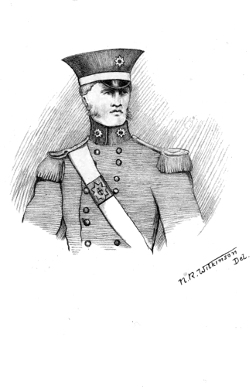
UNDRESS CAP PRIVATES
ABOUT 1850.
N. R. Wilkinson del. A.D. Innes & Co. London. Mintern Bros. lith.
On the 10th of November, 1880, Colonel Fremantle having
left the Regiment, Colonel FitzRoy was appointed Lieutenant-Colonel,
when Colonel Wigram, promoted Major, assumed the
command of the 2nd Battalion. On the completion of five years
period of command, Colonel Julian Hall retired on half-pay,
September 29, 1882, and was succeeded in the command of the
1st Battalion by Colonel Arthur Lambton, who thus became
344Lieutenant-Colonel of a Battalion in the Coldstream, and who
was appointed to serve for four years in that capacity. Colonels
FitzRoy and Wigram, C.B., finished their periods of five years
simultaneously, November 10, 1885. The latter, placed on half-pay
for a few weeks, was brought back as Lieutenant-Colonel of
the Regiment (December 16th), and the command of the 2nd
Battalion devolved upon Colonel Sterling (November 10th).
By the death of General Sir William Codrington, G.C.B., on
the 6th of August, 1884, the Coldstream lost their Colonel, who
had served as such for more than nine years. The following
Regimental Order was published:—
August 7, 1884. The Commanding Officer has the painful duty to
perform of announcing to the Regiment the sad news of the death of their
gallant and distinguished Colonel, General Sir William Codrington, G.C.B.,
which took place yesterday afternoon, 6th inst. A band of crape will be
worn by the Officers for a month; the Band and the drums and fifes will
not play until after the funeral.
The funeral was accompanied with military honours, and took
place at Woking Cemetery on the 9th. All Officers attending it
were dressed as for Guard, and, including the firing party of 50
men, there was a detachment present of the 1st Battalion, consisting
of 100 Non-commissioned officers and men under three Officers.
Sir W. Codrington was succeeded by General Right Honourable
Sir Thomas Steele, K.C.B., at that time Commander of the Forces
in Ireland, whom Her Majesty appointed the new Colonel of the
Regiment.
In the same year, Lieut.-General Higginson, C.B., vacated the
command of the Brigade of Guards, and was replaced by Major-General
R. Gipps, C.B., April 1, 1884.
The 1st Coldstream was first on the roster for duty in Ireland,
and at the end of 1880 was quartered in Chelsea and St. George’s
Barracks. Serious troubles once more affected that country, and
Government was sorely perplexed how to deal with them. The
presence of the Guards was again required, and the Battalion was
despatched there at a few days' notice, by two special trains from
Victoria Station, viâ Holyhead (December 6th). Upon this, the
2nd Grenadiers, then at Shorncliffe, were brought to town, and
that out-quarter was given up. On the 15th of December, a
detachment of 100 men from the 2nd Battalion joined the 1st in
345Dublin, and five days later the 1st Scots Guards left London for
the same destination. The Coldstream were quartered in Richmond
Barracks, but the Scots Guards were scattered through the town,
their head-quarters in Ship Street, with detachments in Richmond,
and in Linen Hall barracks.
A novel procedure was now adopted with respect to the
command of these two Battalions, which shows how critical the
authorities conceived the situation to be. Shortly after their
arrival in Dublin, the Major-General Commanding the Brigade
and the Home District proceeded there accompanied by his
Brigade Staff, and left Colonel Gipps, Scots Guards (the senior
Officer) with the District Staff to command the Home District; but
the arrangement did not last long, and the latter, temporarily
promoted Brigadier General, took General Higginson’s place in
Ireland, who thereupon returned to London, February 15, 1881.[401]
The stay of the Battalion in Dublin, lasting until March, 1882,
was not more pleasant then than it had been during the Fenian
troubles of 1866; but the duties assigned to the troops were everywhere
cheerfully undertaken and zealously discharged. Among these
duties two may be specially mentioned. In the first place, such
was the violence of the mobs that collected to interfere with the
due administration of the law, that a collision was apprehended
every time a writ was served, a seizure made in a farm, an eviction
put into execution, or any other legal process carried out. To
avoid the danger, the Irish authorities established the rule that
the force protecting the sheriff or other officer employed, should
be so overwhelmingly strong, as to put an end to all thoughts of
resistance, on the part of those who assembled to frustrate the
course of justice. The Royal Irish Constabulary were, of course,
always employed on these occasions, but it was also believed that
the presence of red-coats would have a greater effect with the
excited populace, and for this purpose numerous military posts
covered the disturbed districts; but the Guards in Dublin, occupying
a central position there, were not obliged to furnish any of
these detachments.
Soldiers, therefore, were often requisitioned to escort the civil
authorities, and the two Guards Battalions (as well as those that
346succeeded them in Dublin during the troubles), were often employed
in this manner—generally by despatching small parties of some
fifty men under an Officer. On one occasion, however, the 1st
Coldstream had to do more than this. There was a series of
evictions near New Pallas, in the county of Limerick, and the
whole Battalion, together with a portion of Scots Guards, were
sent there for two days to guard the sheriff, who had to execute
the judgment of the Court. It was, at least, an uncommon service
for so large a force to perform; and the Battalion was in all conscience
powerful enough to prevent any breach of the peace!
The other duty to which allusion has been made, refers to
what was called “personal protection.” Many landlords, and
indeed others, were in danger of their lives from the outrage-mongers
that infested the land. In order to afford adequate
protection to these persons, soldiers were told off to reside in their
houses, to accompany them in all their movements, and to be
responsible for their safety. The Coldstream and Scots Guards
furnished a number of men to perform this duty, and an Officer
from each Regiment was appointed to inspect them frequently,
and to satisfy himself that this novel service was efficiently discharged.
That this was the case may be gathered from the
following order, issued in London, dated March 17, 1882:—
“By desire of the Field-Marshal the Commander-in-Chief, I have the
honour to transmit to you the enclosed report on the conduct of the
Coldstream and Scots Guards, while employed on protection duty in
Limerick and Clare under the order of Clifford Lloyd, Esq., Resident
Magistrate at Tulla, and to request that you will be so good as to express
to all concerned, His Royal Highness’s approbation of their conduct in
the performance of the duties they have been called upon to undertake,
and which are quite unusual with soldiers. His Royal Highness has much
pleasure in recognising the valuable services rendered by Captain Fortescue,
Coldstream Guards, and by Lieutenant Romilly, Scots Guards, which have
been brought to the notice of His Excellency the Lord-Lieutenant.”
But the Coldstream had some further experiences. It will
be remembered that Mr. Parnell, the leader of the Irish agitation,
was arrested as a suspect, October 13, 1881, under an Act of
Parliament which had been passed in the spring of that year.
The authorities, expecting some resistance, made every military
preparation in Dublin to prevent a riot; and their precautions
347being sufficient, and their resources ample, the capture was very
easily accomplished without mishap. Still, the quick-witted Irish
very soon realized that the Government in London were afraid
of them. They had early perceived that the Cabinet, instead of
facing the difficulty boldly, dallied with it, and failed to support
the Chief Secretary, Mr. Forster, in his strenuous efforts to cope
with it. Hence, seeing no strength in the authority that should
have protected them, the people were constrained to obey those
who did wield power in the country, by setting its laws at defiance
and by oppressing it without mercy. The winter, 1881-82, was
disturbed and troubled. The No-rent conspiracy was in full swing;
murder clubs, under the name of Moonlighters, kept the land in
terror; juries were intimidated, and refused to discharge their
functions; and the executive was all but paralysed. It was, moreover,
known that a gang of assassins, called “the Invincibles,” had
bound themselves together to murder Mr. Forster, and it was
afterwards ascertained that they had made numerous desperate
attempts upon his life, all of which were happily unsuccessful.
Meanwhile, in January, 1882, the 2nd Grenadiers were sent
to Cork, and for two months there was the unprecedented number
of three Guards Battalions in Ireland, until March, when the 2nd
Coldstream relieved the 1st Battalion, who returned to England,
and were soon after followed by the 1st Scots Guards. So the
gloomy spring passed, when a new complication arose. Mr.
Forster had remained at his post with steadfast courage, and
scorned the imminent personal danger that surrounded him, with
which he knew he was threatened. But he was unable to stand
by a leader of whose policy he disapproved, or to follow him in
the tortuous intrigue, which became known in history as the
“Kilmainham treaty.” He resigned, and the then Lord-Lieutenant
(Lord Cowper), having also withdrawn from office, Lord Spencer
was appointed in his place, and arrived in Dublin, May 6, 1882,
accompanied by his new Chief Secretary, Lord Frederick Cavendish.
On that very afternoon, in broad daylight, while walking
through the Phœnix Park, which was then full of people, Lord
F. Cavendish and Mr. Burke, the Under-Secretary, were murdered
by the Invincibles, who had for so long unsuccessfully lain
in wait to assassinate Mr. Forster. The event sent a thrill of
horror through the United Kingdom, and effectively and at last
forced the Government to open their eyes to the true nature of
348the conspiracy with which they had to deal. The miscreants got
away, and for a time there was little information to be obtained
as to the perpetrators of this foul deed, and twelve months had
to elapse before the conspirators were convicted and punished.
The 2nd Coldstream, quartered in Dublin when this tragedy
took place, were not called upon to act in the emergency. There
was nothing, indeed, for soldiers to do at the crisis, except to
redouble their vigilance; for it soon became clear that the Irish
were as much the victims of the agitators and outrage-mongers
who had mastered them, as were the officials who suffered by their
violence.
In less than three months both the Guards Battalions, quartered
in Dublin and in Cork, were required to proceed on active service
to Egypt, and left the scenes of internal discord and disorder to
meet the open foes of their country. The 3rd Grenadiers replaced
them in Dublin (August 8th), and since that time there has been
only one Battalion in Ireland. The Coldstream did not return
there till the autumn of 1887, when the agitation had assumed a
new phase, although the crisis had by no means passed away, nor
the difficulties come to an end. Thanks, however, to the vigour
of Government, to the remedial measures introduced, to the disappearance
of Parnell, to the absence of another leader of character,
and to the quarrels that have split up the Nationalist party into
hostile fragments, the people are now steadily quieting down; and,
eschewing agitation, they are improving their material prosperity
under the new laws which have been enacted for their benefit.
In February, 1881, that is, shortly after the two Battalions
went in haste to Ireland at the end of the previous year, the
Tower was vacated by the Foot Guards, and was occupied by a
Line regiment until November, 1882. There were then four
Battalions in the West End, and this continued to be the force
maintained there—excepting for the two months, January 25th-March
22nd, 1882, when, as we have seen, three Battalions were
stationed in Ireland—until the departure of a Guards Brigade
of three Battalions for Egypt. During this war, Dublin was still
occupied by a Battalion, but Windsor was vacated, and, until the
return of the Brigade from active service in November, the 2nd
King’s Royal Rifle Corps furnished the Kensington Palace and
the Magazine guards. In the following year, 1883, London was the
scene of dynamite outrages, perpetrated by the agents of the same
349secret societies, of American origin, which financed and supported
the agitation in Ireland. “For a time the air was dense with
rumours of plots and explosives,” and all minds were filled with
vague alarms. A measure to punish dynamiters was passed in
haste through all its stages in both Houses of Parliament, in one
day (April 9th), and received the Royal assent next day at noon.[402]
The garrison of the Metropolis also required strengthening, and
a Line regiment being brought to the Tower, there were then
five Guards Battalions in the West End. Extra guards were
mounted on Somerset House, the Royal Courts of Justice, and
Millbank prison, the London duties were increased, the public
offices protected, and other precautions taken. The panic was
considerable while it lasted, but it passed away in about six
months, and in the summer the garrison of London assumed its
normal strength and condition.
This ends the history of the Coldstream up to 1885, as far as
affairs in the United Kingdom are concerned; and we now turn
to events that occurred in Egypt and in the Sudan, 1882-1885.
Before doing this, however, we may briefly allude to a subject
which possesses much interest to all Guardsmen. Some members
of the Coldstream may perhaps be unaware that the exquisite
decorations that adorn the interior of the Royal Military Chapel in
Wellington barracks have been scarcely twenty years in existence.
Before that time the walls were cold and bare, and the building contained
little to show how zealously the Brigade guard the great
traditions of the past,—traditions which they have inherited,—and
how warmly they cherish the memory of the Officers, Non-commissioned
officers, and men who, ever since the formation of the
standing army, have faithfully and bravely performed their duty to
the Sovereign of this realm. Numerous are the monuments placed
in the Chapel to record the military virtues of departed Guardsmen
of every rank, and their deeds on many a hard-fought field of strife;
while these memorials furnish a proof of the solid union which
knits the three Regiments of the Household Infantry together,
in love for their profession and in devotion to their Queen and
country.
CHAPTER XV. THE WAR IN EGYPT, 1882.
350
Origin of the war—Emancipation of Egypt from Turkish rule; introduction of European
control—Deposition of Ismail Pasha—Tewfik becomes Khedive—Military revolts—Disorganization
of the country—Joint action of the English and French; its failure—Naval
demonstration—Bombardment of the forts of Alexandria—The French
withdraw and leave Great Britain to act alone—British troops sent to Egypt—The
Suez Canal seized—Base of operations established at Ismailia—Action of
Tel el-Makhuta—Clearing the communications—Actions at Kassassin, August 28th
and September 7th—Character of the Egyptian army—Night march on Tel el-Kebir—The
enemy is overwhelmed, September 13th—Pursuit; losses—End of the war—Return
of the Coldstream to England.
The hostilities conducted by England in Egypt in 1882 have
been described as a mere bondholders' war. This, in a sense, is
true, for our intimate relations with that country, which eventually
led to military operations, were ostensibly due to our desire to
protect the financial interests of those who had lent money to its
ruler. But this is far from being the whole truth, because other
and higher motives induced Great Britain to intervene in the
internal affairs of the native government. Facing alike the
Mediterranean and the Red Sea, and containing within its limits
the isthmus of Suez, Egypt, besides being the key of the valley
of the Nile, commands the most convenient water communications
to India, to the further East, and to Australia. Having interests
of a vital nature to defend in this far-distant quarter of the globe,
it is evident we could never remain unconcerned if anarchy were
to prevail in a region through which the main lines pass that
connect together portions of the British Empire. Nor was the
problem a new one. At the close of the last and at the commencement
of the present century, England was struggling with the
French for supremacy in India, and at that time Napoleon—then
in the beginning of his great career—made a descent upon Egypt
351to secure a road to that Empire for his own nation. We were then
obliged to drive his soldiers out, and, having succeeded in doing
this, we prevented the French from forming an Asiatic dominion.
Still the trouble continued, in a minor degree, until 1809, when
we took the island of Mauritius from them, on which they depended,
to base their operations against our possessions. From this date
their power in the East declined; and England, relieved from rivalry,
has thenceforward been able to exercise an undivided influence in
India. If in the beginning of this century it was necessary to
prevent France from interfering with our national expansion; so
was it also the more necessary to restrain the Egyptians from
obstructing (as we apprehended) our communications in 1882,—when
the Suez canal having been opened (1869), nearly all our
Eastern commerce was squeezed through that narrow passage, and
when the importance of African exploration was adding greater
value to the valley of the Nile.
Egypt has passed through some vicissitudes during the last
sixty years. Still considered in theory to be a portion of the
Turkish Empire, it was formerly ruled directly by the Porte, until
Muhammad Ali, the Governor-General, or Vali, rebelled, and
wrested concessions from the Sultan. In 1841, the Governorship
was vested in him and in his heirs, and subsequent Firmans having
been granted in his favour, Egypt became practically an independent
principality. The last privilege accorded to his successors was
the right to contract foreign loans without the previous consent
of the Porte, and this right to run into debt was freely indulged
in by Muhammad Ali’s grandson, Ismail Pasha. The latter, after
becoming Viceroy—or Khedive, as the title is called—embarked
in wild speculations, and indulged in unbounded extravagance.
Desiring, like his grandfather, to erect an independent state by
the adoption of European civilization, he failed to understand how
this civilization was to be brought about. He hastened to produce
its effects by an immense expenditure of money, but he omitted
to establish an efficacious administration to curb peculation, or
to introduce order into his affairs. Numerous speculators of every
nationality rushed forward to help him to dissipate his fortune, and
it was not long before he involved the people in financial ruin.
As the import of alcohol corrupts a barbarous tribe, so did the
influx of foreign gold demoralize this Muslim government.
Now, even if England had been prepared to let the bondholders
352shift for themselves in this crisis, so were not the other European
nations; and to prevent so important a country from falling into
the hands of any one of them, all agreed to intervene and regulate
the evil that had been brought about. Thus Ismail, emancipated
from the rule of Turkey, fell under the domination of European
control. It is scarcely necessary to describe the various steps
taken to secure reform in the financial concerns of Egypt. England
and France were more interested in the matter than any other
of the Powers. They acted harmoniously together, assumed a joint
direction over the affairs of the country, and gradually tightened
their hold upon the government. Thereupon the Khedive
became restive, and as he would not fall in with the new order
established to correct his maladministration, he was removed
from Cairo. The authority of the Sultan, as Suzerain, was now
requisitioned by Europe: Ismail was deposed, and his son, Tewfik
Pasha, reigned in his stead, by favour of the Western Powers
(June 26, 1879).
It was easy to see that such an undefined condition of things
was not likely to last long. However beneficial to the people an
honest administration might be, the interference of foreign officials
in the internal affairs of another state, to whose ruler they owed
no allegiance, could not but produce friction, and lead to trouble.
It is true, Tewfik was pliant, and submitted without difficulty to
the unprecedented constitution that was forced upon him; also,
that there was little or no public opinion in the country, and
apparently no centre of resistance to thwart the action of England
and France. Nevertheless, the new Khedive soon lost his authority
over his subjects, and resistance did arise, sooner than might have
been expected. It originated where it ought least to have been
found—in the army, where insubordination showed itself as soon
as the native government was weakened and became contemptible
in the eyes of the people, and when economy was introduced
into the war department. Early in 1881, a military rising was
threatened, and with difficulty was it appeased; but, later, a more
serious event occurred (September 9th), when the Colonel of one
of the native regiments, named Arabi Bey, took the lead, and,
surrounding the Khedive’s palace with 4000 men, demanded, with
arms in his hands, the redress of grievances from his Prince.
Destitute of all real power, Tewfik was unable to crush this revolt;
he met the mutineers, tried to conciliate them, and gave in to
353their demands. A change of government took place, and the
Chamber of Notables was convened. From that moment Arabi’s
influence grew stronger, the army became devoted to him, and
around him rallied all groups of the people who were dissatisfied
with foreign interference. “Egypt for the Egyptians” was now
the cry, and the newly appointed Chamber, far from allaying the
trouble, added fuel to the flames of discontent that were already
kindled. It was evident the crisis could not be much longer
deferred.
The French urged the British Government to take active
measures to support the Joint Control which then existed in
Egypt, and the latter were quite willing to carry out this advice.
On the 6th of January, 1882, an Identical or Dual Note was
presented to the Khedive, expressing the determination of the
two nations “to ward off by their united efforts all cause of
external or internal complications which might menace the régime
established in Egypt.” The Notables answered this challenge
by claiming the right of regulating the national budget, and
Tewfik’s action became somewhat uncertain. It could not be accurately
ascertained whether he meant to stand by his European
allies who had placed him upon the throne, or whether he was
about to throw in his lot with the national party. At any rate,
Arabi, advanced to the dignity of Pasha, became still more
powerful, and was appointed Minister for War.
Now, in England, there was a certain feeling in favour of the
Egyptians, and this might be expected to find expression among
the supporters of the Liberal party then in power, who claim,
perhaps with greater emphasis than others, to respect the liberties
of mankind, and to listen to the grievances of all who complain.
It is against our custom to stifle the voice of an assembly, however
feebly it may be supposed to represent the wishes of a people,
and in this crisis there were not wanting some who hesitated to
sanction the use of coercive measures. Nor was there a total
absence of a primâ facie cause of discontent; for the European
officials of every nationality had multiplied in Egypt, and in 1882
there were as many as 1324, receiving salaries from the taxes
that amounted to a considerable proportion of the revenue,—to
£373,704 per annum.[403] It is possible that if we had not deferred
354to the French at this juncture, we might have put an end to the
commotion without resorting to war, and that, had we been the sole
trustee for European interests, we might have found some satisfactory
solution to the difficulty. But, as had happened before,
we were fettered by our alliance with the French, which was not
defined, and in order to maintain our relations with them, we
followed their lead.
The Dual Note having only intensified the trouble, our
Government despaired of maintaining order unless some vigorous
action were taken to disperse it. They believed that the best
course under the circumstances was to resort to the only legal
means which then existed: viz. to revive, in some shape, the
dormant rights of suzerainty which the Sultan claimed, which in
theory had never been abrogated, and which had been made use
of, as we have seen, less than three years before, with the consent
of all the European Powers. It was therefore contemplated to
utilize the Turks, under certain conditions and restrictions, to put
an end to the deadlock, and to prevent Egypt from becoming the
prey to the anarchy that appeared to be imminent. Whether the
remedy would have proved efficacious and satisfactory need not
now be discussed; for the French objected to any such arrangement,
and, to please them, we acquiesced in the objection. Then they
proposed that the Anglo-French fleets should make a demonstration
before Alexandria, and in this we readily concurred without any
agreement as to subsequent action. The plan was therefore put
into execution (May 20th). But far from appeasing the tumult, this
step only aggravated it. The authority of the Khedive was now
completely effaced, and Arabi became dictator. The excitement
of the people increased, a serious riot occurred in Alexandria
(June 11th), and earthworks for the defence of the town began to
be thrown up. It was not easy to recede before this defiance.
The British Admiral demanded that the construction of fortifications
should be stopped, and, later, that they should be surrendered
to him. The demand was resisted. It was then deemed necessary
to take them at any risk, and to destroy by force the power of
Arabi, who was proclaimed a rebel against his Prince.[404] And now
355a strange event occurred. The French, though they succeeded in
inducing our Government to defer to their wishes, were not bound
to us in any way. Having gone just far enough to ensure an
armed intervention, they refused to take their share in it, and,
when hostilities were imminent, their fleet sailed away from the
scene where they must commence.
The bombardment of the earthworks followed on the 11th of
July, and it is needless to say that our navy soon reduced the
enemy’s guns to silence, and drove him out of Alexandria.
Arabi’s troops having retired, blue-jackets and marines were
landed to restore order in the town. Meanwhile a force, drawn from
Malta and Gibraltar, had been concentrated at Cyprus, and was
commanded by Major-General Sir Archibald Alison, Bart., K.C.B.,
who arrived in the island, July 14th. These troops were speedily
moved therefrom, and, reaching Alexandria on the 17th, they took
up a line fronting the Egyptian army at Kafr-ed-Dauer, that lay
a few miles south of the coast covering the road to Cairo.[405]
Preparations were now actively pushed forward to follow up
the first blow struck by the British fleet for the purpose of
restoring the authority of the Khedive. A vote of credit was
agreed to in Parliament, troops were ordered to be got ready to
proceed to the seat of war, and a portion of the reserves were
called up to serve during the emergency (July 25th). The French
also at last plainly expressed their intentions, by declining
definitely to take part in the expedition which had now to be
undertaken. The decision was made on the 29th of July in their
Chambers, by a majority of 416 against 75 votes. Thus Great
Britain was obliged to act alone, and if this was the result, it
may seem to be a pity that she had not been allowed to have a
356free hand from the beginning. Be this as it may, she gained the
advantage of being at least unfettered in the military operations
that followed, and hence the dangers and inconvenience of a
joint occupation were happily avoided.
As early as the 3rd of July, General Sir Garnet Wolseley,
G.C.B., appointed to take command of the expedition in case
hostilities were undertaken, confidentially traced the plan of
operations to be pursued. Soon the field army was organized,
among which a Guards Brigade was included; and on the 30th
of July, the first troops, the 1st Scots Guards (Colonel Knox),
left England on board the Orient.[406] The other two Battalions of
this Brigade, the 2nd Grenadiers (Colonel P. Smith), and the 2nd
Coldstream (Colonel G. Wigram), being at Cork and Dublin respectively,
left these stations for the seat of war as soon as they
received drafts from London to fit them to take the field. For
this purpose, the 2nd Battalion obtained from the 1st Coldstream,
one Colour-sergeant, 9 sergeants, and 204 rank and file (28th); and
on the 1st of August, having proceeded to Kingstown from
Richmond Barracks, Dublin, they embarked, about 750 strong, on
board the Iberia, and started for Alexandria. They reached their
destination on the 13th, and moved immediately to Ramleh, where
the Brigade was collecting under the orders of Major-General
H.R.H. the Duke of Connaught, K.G.[407]
The following Officers formed part of the Battalion:—
Commanding the 2nd Battalion.—Colonel G. Wigram.
Mounted Majors.—Colonels A. Lambton; F. C. Manningham-Buller.
Dismounted Majors and Captains.—Lieut.-Colonels J. B. Sterling; Viscount
de Vesci; R. S. Hall; W. F. Ramsden; Hon. E. Acheson; R. W.
Follett; Hon. E. Boscawen.
Lieutenants.—Captains R. Pole-Carew; J. G. Montgomery; F. C. Manley;
L. D. Mackinnon: Lieutenants Hon. E. Dawney; Hon. H. Monck;
J. R. Gladstone; D. F. R. Dawson; G. V. Boyle; W. O. Corbet
(in command of Regimental transport); G. P. Bouverie; Hon. A.
Fortescue; P. A. Lovell (Signalling Officer); D. J. Hamilton; Hon.
Alan Charteris; and H. G. Shute; also H. Somers-Cocks (who left
Portsmouth for Egypt, August 16).
357Adjutant.—Lieutenant Hon. A. Henniker-Major.
Quartermaster.—W. Webster.
Medical Officers.—Surgeon-Major G. Perry; Surgeon J. Whipple, M.D.
The following Officers, also belonging to the Regiment, served
upon the Staff:—
Lieut.-Colonel Lord William Seymour, attached to the British Admiral.
Captain Pole-Carew, Orderly Officer to H.R.H. the Duke of Connaught.
Lieutenant A. Codrington, Aide-de-camp to Lieut.-General Willis, commanding
the First Division.
Before this date, Sir A. Alison had been covering the concentration
of the army at Alexandria, and, by means of strong reconnaissances,
he endeavoured to make the enemy believe that the invaders
meant to attack him from the north. But this was not the intention
of Sir G. Wolseley, whose object was to seize the Maritime Canal,
and, basing himself upon Ismailia, to advance thence to the capital
of Egypt. In this manner, the main water-way between the
Mediterranean and the Red Sea would be secured from any
attempt which Arabi might make upon it, and the invading army
would obtain the best route into the interior. The route, it is
true, was far from being a good one, for it lay in a desert of
deep sand; but none of the communications of the country, other
than by rail or canal, are good, and, in fact, roads, as we understand
them, may be said to have no existence. The one selected,
however, besides the strategical advantage it offered, of enabling
an army to turn the Delta, and to proceed by the shortest way to
Cairo, had along its course a fresh-water canal, where drinking
water was to be obtained, and a railway; and both of these served
as easy lines of supply. Arabi, indeed, had done his best to
render these communications useless, but he could only obstruct
them temporarily; and, though he thereby impeded our advance,
he was not able to arrest it.
The British Commander had from the beginning believed that
the enemy would make a stand at Tel el-Kebir, some thirty miles
from Ismailia, on the road to Cairo; and if this were to prove to
be correct, he determined to deliver a crushing and effective blow
there, and so bring the campaign to a speedy and prompt conclusion.
We shall see that he was entirely right in the opinion
he had formed, and successful in carrying out his plan. To ensure
358this success, it was necessary to push advanced troops, of sufficient
strength, from Ismailia to a point within striking distance of Arabi’s
position, behind which the water and rail communications could be
restored, and where the main army could be concentrated for the
final battle.
The forces massing at Alexandria from the middle of July
came, as we know, from the Mediterranean stations, and from the
United Kingdom; but troops, native and British, also were
despatched to the seat of war from India; and these, beginning
to arrive on the 20th of August, landed at Suez, and, later, at
Ismailia. The whole formed an Army-Corps, under the command
of General Sir G. Wolseley (who landed in Egypt on August 15th),
and was made up of a cavalry division, two infantry divisions,
corps troops, and an Indian contingent. Each division was formed
of two brigades and divisional troops.
The Cavalry Division, 23 squadrons, mounted infantry, and 6
guns, under Major-General Drury-Low: the 1st Brigade (Brigadier-General
Sir Baker Russell) contained, among others, three squadrons
of Household cavalry, under Colonel Ewart, 2nd Life Guards;[408]
the 2nd Brigade (Brigadier-General Wilkinson), Indian cavalry.
The First Division, 8 battalions, 2 squadrons, and 12 guns, under
Lieut.-General Willis: 1st Brigade (three Guards Battalions), Major-General
H.R.H. the Duke of Connaught; 2nd Brigade (4 Battalions),
Major-General Graham, V.C. The Second Division, 9 battalions,
2 squadrons, and 12 guns, under Lieut.-General Sir E. Hamley:
1st Brigade (4 battalions), Major-General Sir A. Alison; 2nd
Brigade (4 battalions), Major-General Sir E. Wood, V.C. The
Corps troops contained one battery of Royal Horse Artillery, and
three batteries of Field Artillery, 24 guns. The Indian contingent,
under Major-General Sir H. Macpherson, V.C., 4 battalions (of
which 2 were native), 1 company Beluchis, 6 guns (mountain
battery). Total force, including a reserve at Aden of 2 native
battalions, not brought into the field, amounted to 23 battalions,
27 squadrons, and 60 guns, besides Engineers, Marines, Marine
Artillery, siege trains, etc.; or to 1180 Officers, and 28,300 men.[409]
Although all this army had not landed, yet a sufficient force
had been collected to seize the Suez Canal, and to begin the
real business of the campaign. Ample preparations had already
359been made by the Navy for this operation. The final details
having been settled, a simultaneous landing was effected by
blue-jackets and marines at all the important places from Port
Said to Suez; and the water-way was cleared from end to end by
4 a.m. on the morning of the 20th of August.[410] Meanwhile, those
portions of the Cavalry and First Divisions that were at Alexandria
were embarked on board ship, while those of the Second Division
were left behind to protect the town, and to keep up the delusion
that Egypt was to be invaded from the north. In order to give
the greater currency to this idea, it was further given out that the
troops on board ship were destined to make an attack on Abukir.
The 2nd Coldstream, which since their arrival at Ramleh had
been facing south towards Kafr-ed-Dauer, re-embarked on the
Iberia on the 18th of August, and the whole fleet, consisting of
8 ironclads and 17 transports, left in the direction of Abukir at
noon on the 19th, and approached Port Said next day, in the early
morning. As soon as possible the ships entered the canal, and,
piloted by Officers of the Royal Navy, were concentrated at Ismailia.
They grounded occasionally as they steamed through the difficult
passage, and delayed the procession; but these accidents did not
materially check the movement, which was not confined merely
to the fleet that sailed from Alexandria, but included also transports,
conveying troops direct to the seat of war, from England by Port
Said, and from India by Suez. General Graham, having landed
with a small force of infantry on the evening of the 20th, pushed
forward to Nefisha early next day; and the Guards Brigade,
arriving at their destination late on the 21st, disembarked on the
22nd. For two days they were busily engaged in fatigue duties
at Ismailia, during which time the concentration of troops continued
with unabated energy, so that on the evening of the 23rd about
9000 men were on shore.[411]
The invaders were dependent for drinking water upon the
fresh-water canal previously mentioned, that runs from the Nile
near Cairo to Ismailia; and now a fear seized the military
authorities that Arabi might be able to destroy its banks, and
stop the greater portion of our supply, not only at Nefisha and
Ismailia, but also as far as Suez. It was therefore determined to
send forward a small force on the 24th, under General Graham,
360to occupy El-Magfar, where the danger was most to be apprehended,
and to prevent the occurrence of any such calamity.
The force (1 battalion, 3 squadrons, and 2 guns) was not a large
one; but it met with no resistance, and soon accomplished its
object, not, however, without causing the enemy to show that he
was concentrating a formidable body of men in a position further
up the canal, at Tel el-Makhuta. It was evident that the British
advanced detachment, if attacked with energy, might be unable
to hold its own, and be obliged to fall back; but it was also clear
that an initial advantage could be gained if we could bring up a
sufficient force to cause the Egyptians to evacuate the ground they
were engaged in taking up. Accordingly Sir G. Wolseley, who was
present, sent back immediately to direct that the Guards Brigade
at Ismailia and a battalion of infantry at Nefisha should move to
the front without delay.
Meanwhile, the advanced troops became engaged, and a very
unequal fight, as far as the numbers of the combatants were concerned,
took place under the orders of General Willis. But the
large Egyptian forces showed no disposition to close with the small
body opposed to them, and the latter maintained their position
until reinforcements, consisting of all the three arms, arrived to
their support. Just before sundown the Guards Brigade appeared
on the scene, the Coldstream leading; the Battalion then coming
into the advanced line, under shell fire which happily was not
effective, occupied an extended line of outposts during the night.
The day had been exceedingly hot and oppressive, and the operations
as well as the want of water had greatly exhausted the men,
both those who fought and those who marched to their support
under a scorching sun and through the burning sand.
“A scarcely less trying task had fallen to the lot of the Brigade of
Guards. A march over the two miles of heavy road between Ismailia and
Nefisha, difficult at any time, was, during the burning hours of the midday
sun of an exceptionally hot day, a very serious task indeed. Throughout
all the rest of the campaign, both before and after this, troops were
ordered to march in the cool hours of the early morning, or of the late
afternoon and evening. The sudden necessity for taking advantage of the
enemy’s stand at Tel el-Makhuta alone made this severe task imperative.
Even for troops in presence of the Egyptians, the direst enemies all that
day were the sun and the parching glare of the desert sand. But at least
they had the excitement of actual fighting, and were able at all times to
361take advantage of any shade that waggons and hillocks afforded, and they
had not during those hours of fierce heat the additional labour of plodding
over sand, burning to the feet and ankle deep. Man after man during
the march was knocked down by the severity of the strain, and by stroke
of the sun. All who were physically able pushed on with honest pride
and steady discipline, but it was not until 6.20 p.m. that the march was
over, and that H.R.H. the Duke of Connaught was able to bring up his
Brigade to the support of the troops engaged.”[412]
No. 8.
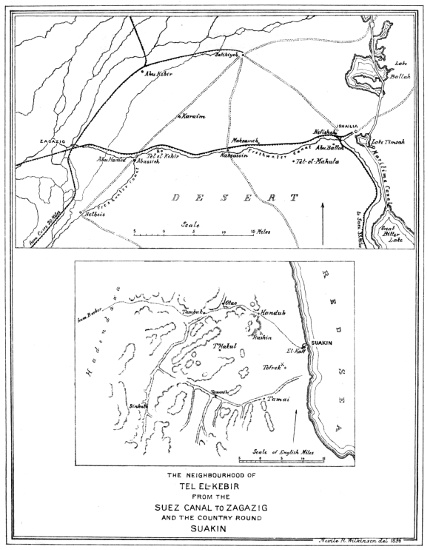
THE NEIGHBOURHOOD OF
TEL EL-KEBIR
FROM THE
SUEZ CANAL TO ZAGAZIG
AND THE COUNTRY ROUND
SUAKIN
Mintern Bros. Photo lith. A.D. Innes & Co. London.
At daybreak (25th), an advance was made by the First Division,
General Graham in front, followed by the Guards Brigade in
support, and, protecting the right flank, the King’s Royal Rifles
and Marine Light Infantry, who had just come up, in second
line; the Cavalry, under General Drury Low, on the extreme
right front. Tel el-Makhuta was found to be abandoned by the
enemy; but the Cavalry, still pushing on, found him at Mahsama,
where, after a short struggle, they not only dislodged him but
captured his camp, seven Krupp guns, and a large quantity of
ammunition, stores, and provisions. Next day we took possession
of Kassassin, and it was occupied by General Graham, the Guards
being left at Tel el-Makhuta.
Meanwhile the disembarkation of men, horses, guns, and stores
of all sorts still continued at Ismailia. As the English advanced
troops had reached Kassassin,—within striking distance of Tel el-Kebir,
where Arabi was known to be entrenching, with the object
of making a definite stand against us,—it was now necessary to
bring up all available forces for the assault of his lines. General
Sir E. Hamley was therefore ordered round to Ismailia from
Alexandria with the Second Division (except Sir E. Wood’s
brigade, which was directed to remain there for the defence of
the town and neighbourhood); so also was the Indian contingent
moved up from Suez. While the concentration was in progress,
communications were restored as rapidly as possible between the
base and Kassassin. The line of railway was repaired where it
was torn up, and where embankments of earth had been found
to block it; and rolling stock brought out from England was
landed and placed upon it. The fresh-water canal also was cleared
by removing the dams, which had been constructed across it at
Makhuta and Magfar. The Guards Brigade remained at Makhuta
362until the 9th of September, busily engaged in digging away the
obstructions that impeded the traffic on the railway and on the
canal at these two points, and partly in throwing up redoubts to
strengthen the lines of communications. It was a laborious work;—
“for the skilful dam-makers ... had so wattled in reeds, telegraph wires,
and other binding materials into the mass of the earthworks, that our
men, standing in the muddy canal without any convenient foothold, had
the greatest difficulty in removing the obstacles.”[413]
Supplies also ran short, on account of the impossibility of
conveying them across the deep sand, through which lay the only
road to the front, until the railway or canal could be used.
“But the most trying circumstance which the rapid movement had
entailed was the absence of tents and camp equipage. These were
pushed on by rail and canal as rapidly as the condition of both permitted,
but for some days the necessity of depending for chance shade upon the
shelter of the trees and villages under that glaring sun called for much
endurance on the part of the troops so employed. It was the price paid
for the rapid successes of the 24th and 25th. The tents reached the
troops at Tel el-Makhuta on the 28th. The valises of the men reached
them on the following day.”[414]
Nevertheless, in spite of the difficulties to be overcome, the
scorching heat, and the shadeless glare, the work was well and
expeditiously performed. The following communication from
Colonel Drake, Commanding Royal Engineer of the First Division,
refers to what the Brigade did at this period of the campaign:—[415]
Tel el-Makhuta, August 30, 1882. I wish to bring to the notice of
the Lieutenant-General Commanding, the excellent work which has been
done by the Brigade of Guards on the important work, of opening the
communications on the railway and canal. Engineering work, always
fatiguing to troops fully employed on military duties, has been especially
harassing in this climate; but in consequence of the great interest shown
in the work by the Guards Officers in charge of parties, it has been
executed by the men cheerfully and well, and it is my opinion, that had
this spirit not been shown by Officers and men, the progress of the army
must have been for several days delayed.
Once, on the 28th of August, this labour was interrupted for
363a brief space. On that day the enemy attempted to make an
attack on Kassassin, which, owing to the fact that it was commanded
by hills in his possession, was not a strong military
position. Having made a demonstration in the morning, which
resulted only in a distant artillery fire of little value, Arabi ordered
a more vigorous attack upon General Graham in the afternoon,
and this produced some fighting, and a charge conducted in moonlight
by the three squadrons of the Household Cavalry. The
Egyptians then retired, and the action came to an end; but as
soon as it was perceived that the enemy was endeavouring to
recapture Kassassin, the Guards Brigade were hurried forward from
Makhuta to the threatened point, and were placed in reserve. The
three Battalions did not return to their quarters until midnight.
On the 7th of September, communications were cleared, a
railway service was established, the main bulk of the supplies and
stores—of which large quantities had already been despatched to
the front—were ready to be sent forward, and the remaining
troops, hitherto kept back at Ismailia, were awaiting to be moved
to Kassassin. Orders to concentrate the army there were given,
when Arabi made one more attempt to defeat the advanced troops
opposed to him at that place, before the rest came into position
(September 9th). His previous efforts had failed; and it was
scarcely likely that, having effected so little before—although in
contact with a small portion of the British forces only—he would
now be able to achieve a success at this late stage of the
war. The attack was nevertheless a formidable one in point of
numbers, and almost the whole of the hostile forces, supported
by a powerful artillery, were employed in it. But it was easily
repulsed, and the enemy was pursued towards Tel el-Kebir, where
he ran for shelter.[416] During the action, the Guards Brigade were
once more moved forward from Makhuta to remain in reserve
should their services be required; but they were not brought into
action. It seems probable that, had the advance of the First
and Cavalry Divisions, who were then present, been continued,
Arabi would then and there have been driven out of his
entrenched position. The pursuit, however, was not pressed home.
Instead of returning to their former camp, the Guards remained
for the next few days on the ground they occupied on the evening
of the 9th.
364The Egyptian army could scarcely be considered a very
formidable foe. The Generals had shown little military capacity,
the native Officers no enterprise or power of leadership, and the
men in consequence had displayed but a small amount of valour.
Drawn principally from the fellaheen, or the peasantry of the
country, the ranks of the forces opposed to us were filled with men
who had no desire to excel in the profession of arms; and during
the first combats of the campaign we gained ample proof of their
inefficiency in the field.[417] As regards their numbers, we are
informed that at the date of the bombardment (July 11th), the
Egyptian army consisted in all of about 9000 men, 288 field guns,
and only 750 horses. Of these, 5000 were in Alexandria, the rest
being dispersed over the country. The reserves were called in
afterwards, and the 9000 expanded to 60,000, by the 20th of
August; when 15,000 were before Alexandria, 12,000 at Tel el-Kebir,
11,000 at Cairo, and 22,000 were distributed in remote
garrisons unmolested by the invaders; besides this, there were
6000 Beduin Arabs, half at Tel el-Kebir and the remainder before
Alexandria. Again, later, 40,000 raw recruits without training were
enlisted, and the total of the army reached the high figure of
100,000 men, not counting the Beduins. For all these men, it
appears, arms were available, and 11,000 untrained draft horses
were procured.[418] These vast numbers of undisciplined and unorganized
men could do little to serve Arabi’s cause, and they
seem to have been rather a source of weakness to him. Unable
to fight, they were liable to panic, and their presence was more
calculated to unsteady the few soldiers who alone possessed some
knowledge of their duties than to augment the strength of the
army.
By the evening of the 12th of September, the whole available
British forces were at Kassassin, some eight miles from Tel el-Kebir,
and numbered 634 Officers, and 16,767 Non-commissioned officers
and men, 61 guns, and 6 gatlings. Previous to this date, several
reconnaissances had been undertaken towards the enemy’s entrenched
position to examine his works, and to observe his strength,
disposition, and habits. The knowledge so gained could only confirm
the poor opinion in which the enemy deserved to be held.
365His lines were continuous, stretching from the canal for a distance
of some 6000 yards; but they were not apparently protected by any
advanced works, nor provided with efficient inner entrenchments.
They seemed to present little difficulty to storming parties, nor
were any formidable obstacles visible.[419] The left (north) flank,
moreover, was entirely open and unguarded; and, lastly, no outposts
secured the front during the night. Thus feebly did Arabi
venture to oppose the army of one of the great Powers of Europe;
and if he was unable to bring civilized science to his aid, so
also were his troops incapable of displaying the wild heroism
that belongs to the barbarian. In short, he invited a night attack
either on his left flank or in front; with the certainty that, if the
invaders could reach unseen the position he endeavoured to fortify,
they could turn it or penetrate it, before he was ready to meet
them; and the whole of his defences would be rendered useless.
This would bring about his complete defeat, and the dispersal of
his raw levies, who eagerly watched for an early opportunity to
desert and fly to their homes.
It is, however, one thing to perceive after the event, what ought
to be done, but quite another thing to determine beforehand, the
best line of action, and to ensure a result as successful and
decisive as the assault on Tel el-Kebir proved to be. The night
march across the desert was by no means an easy operation. It
entailed the bringing up the whole army in battle array, through
the dark, close to a given position at a given time. Careful
arrangements to prevent confusion had to be therefore made on
the part of the leaders, from the Commander-in-chief downwards;
and attention and rigid discipline were more than ever required
on the part of the men who were thus led to the assault. It is
needless to say that all ranks vied with one another in discharging
correctly the important functions that every man had to perform
during that night; and in this manner was the difficult operation
carried through without hitch, and even without temporary delay.
It should be added here, that fortune also favoured us in no small
degree. Arabi had, in fact, constructed one, and only one, advanced
work in front of his lines of defence; but it had not been discovered
during our reconnaissances, and we were ignorant of its existence.
366By good luck that work was avoided by our columns, as they went
forward in the dark to the attack. Thus we managed to cross the
desert unperceived by so dangerous a tell-tale of our movement,
and arrived at dawn before the hostile lines, close enough to storm
them before the Egyptians even knew that we were in their vicinity.
A conspicuous point in the lines had been selected upon which
to direct the march of the Second (Hamley’s) Division; Sir A.
Alison’s Highlanders in front, followed by a brigade formed of
the two Divisional battalions of the infantry divisions, under Lieut.-Colonel
Ashburnham, C.B., King’s Royal Rifle Corps. The First
Division was on Sir E. Hamley’s right, with an interval of 1200
yards; General Graham’s brigade in front, supported by the Guards
1000 yards in rear. Forty-two guns were placed between the two
divisions, in line with the Guards Brigade. The Cavalry Division
with 12 guns Royal Horse Artillery were on the extreme right.
The Indian contingent and the Mountain battery, on the south of
the canal, with orders to move off an hour after the rest of the army.
The troops began to strike their tents when dusk set in, and
marched to their various rendezvous not without difficulty. It
was, of course, imperative that every corps should reach its starting-point
in proper order, and there was naturally some moving backwards
and forwards in the dark before the masses were correctly
formed and aligned. The Brigade took post in their usual formation,
the Coldstream on the left, and each Battalion was in columns of
half battalions. Everything was ready at 11 p.m.; the men then
lay down till 1.30 a.m. of the 13th of September, when they arose
in silence, and commenced the advance. We had the advantage
of meeting no obstacles in the way; the trackless gravelly soil
everywhere afforded an easy passage, and, guided by the stars
alone, the army maintained the direction of their march.march.
At night, however, men are always somewhat under the influence
of a vague and undefined feeling. The absence of sound, the
inability to see for more than a few feet, the sense of isolation
which every group experiences, the strange surroundings, the
uncertainty of the future, the idea that some untoward event may
happen,—all contribute to produce a suppressed excitement almost
akin to nervousness.[420] The principal danger lay in the fact that
367should the centre halt, the wings would continue to move, and
so wheel inwards, until one flank faced the other. This actually
occurred in the Highland Brigade; but the mishap went no
further, and was very speedily rectified by the vigilance, discipline,
and intelligence of all ranks. The First Division moved
more slowly than the Second, and its leading brigade appears to
have executed some changes of formation during the night; the
Guards, following in support, made no change in this respect, but
marched in the order in which they had originally started. Just
before reaching the enemy’s position, the British army was in an
irregular echelon; the left was forward and nearest to the enemy,
and the right was about 800 yards back.
The Egyptians say their forces at Tel el-Kebir amounted to
20,000 men and 75 guns; but there seems reason to believe that
they have under-estimated their numerical strength, and that they
had from 25,000 to 30,000 men present.[421]
As the enemy had no outposts to cover his front; and as we
had been fortunate enough to pass by the only advanced work
he had constructed, without coming in contact with it,—though
our left was at one time unpleasantly close to it,—he had no sort
of warning that our whole army was approaching his defensive
position, and would assault it at daybreak. He was completely
surprised. At 5 a.m., when the first gleam of light was beginning
to appear, the Highlanders were close to Tel el-Kebir, and, dashing
forward, they carried, after a brief but sharp struggle, the defensive
lines in which Arabi apparently had placed so much confidence.
While this fight was proceeding, General Graham’s brigade hurried
up, and penetrated the Egyptian lines, where they presented a
smaller obstacle than did those which faced the Second Division.
The battle lasted scarcely half an hour. By the end of that time,
the enemy was entirely overpowered, and his forces were annihilated
and completely dispersed. The Guards followed, and got into the
works as soon as possible, but the short action was then practically
at an end.
368“The first of the enemy’s shells landed in the middle of some vedettes,
about eighty yards to our left front; nearly all the rest fell about one
hundred yards in rear of us. As we advanced the Egyptians did not
seem to alter their elevation. The bullets were falling all around us;
but firing ceased at about 6 a.m., except our guns blazing at the flying
Arabs.”[422]
The cavalry was ordered immediately to pursue the enemy to
Cairo, the infantry advancing into and occupying the Egyptian
camp and the bridge at Tel el-Kebir. The former pushed boldly
on to a suburb of the capital, whence Lieut.-Colonel Herbert
Stewart went forward with a small force of fifty men, and secured
the capitulation of the town and the surrender of Arabi (September
14th). Egypt now lay at the mercy of the British army.[423]
The losses of Arabi’s forces at the battle of the 13th of
September can scarcely be reckoned by the killed and wounded;
for such was the extent of the disaster he experienced, that he
had no further troops at the end of the action. Many fled to
their homes, many rushed wildly onwards panic-stricken; all idea
of further resistance had come to an end; every man only thought
how he could best make his submission, and welcome the conquerors
with demonstrations of joy. The Egyptian casualties
are reckoned at 2500, and 58 of their guns were captured. The
British lost 9 Officers and 48 men killed, 27 Officers and 355 men
wounded, and 30 missing, total 469. Of these the Highlanders
lost 45 killed, 180 wounded, and 6 missing; General Graham’s
brigade 9 killed, 119 wounded, and 24 missing; the Guards
Brigade 1 man killed, and 2 Officers and 20 men wounded; in
the Coldstream, 1 Officer (Lieut.-Colonel J. B. Sterling), and 7 men
were wounded,—of the latter, one man subsequently died of his
wounds.[424]
The victorious forces pushed on towards Cairo after the battle,
and secured all the railway centres which communicated with the
Egyptian garrisons, still held by the enemy. There was little
trouble in causing these garrisons to submit, and by the 24th the
whole country was pacified and disarmed. General Willis, with
his 2nd Brigade and Divisional infantry, remained at Tel el-Kebir
369for a short time longer, while Sir G. Wolseley, with the Duke of
Connaught, and a company of the Scots Guards as escort, went
by train, on the afternoon of the 14th, to the capital, followed
by the rest of the Scots Guards, by the Coldstream, and by
the Grenadier Guards. Owing to obstructions on the line, the
Commander-in-chief did not reach his destination until the morning
of the 15th; and the Coldstream, starting the same day,
reached Cairo that afternoon. The Battalion were then quartered
in the Abdin barracks.
The rebellion had now been crushed, and the Khedive’s
authority having been completely restored, Tewfik entered his
capital in state on the 25th, and resumed his place in the government
of the country. British troops, and among them the Guards,
lined the streets, which were gaily decked with triumphal arches
and inscriptions of welcome. If it is allowable to compare a
small event with a great one, the scene was in a very minor
degree (in principle, at least), not wholly unlike that which attended
the return of the Bourbons to Paris in 1815. The “Usurper” in
this case was not redoubtable, nor had he scourged Europe as had
his proto-type; but he had interfered with the legal gains of
European bondholders, and withstood the wishes and designs of
the Western nations. The people, also, in the two cases, not
having much will of their own, like many others in a similar
position, were influenced by one very simple and burning desire—to
give their hearty applause to the strongest party.
A draft from England left for the Battalion, under Lieut.-Colonel
F. Graves-Sawle and Lieutenant E. Wigram, September
11th; but they were too late to take part in any of the hostilities
that marked the campaign, and they went no further
than Malta.
There is little more to record. The six weeks spent in Cairo
passed agreeably enough, and many eagerly availed themselves
of the opportunity to see the sights and the remains of an ancient
civilization that makes Egypt one of the most interesting countries
in the world. Nor was a race-meeting forgotten, held on the
28th of September, even though other national sports and pastimes
had to be discarded on account of the heat. A serious accident,
that occurred the same day at the railway-station of Cairo, may
also be mentioned. An accidental explosion took place in a waggon
laden with ammunition, near the platform, and, as the flames
370could not be got under, the station buildings were soon destroyed,
and much rolling stock and a considerable amount of stores
were burnt. Troops were at once sent to the spot, and amongst
them the 2nd Coldstream assisted to clear away the débris, and
guard the place; several smaller explosions continued even during
the night.
On the 30th of September a review was held before the
Khedive, and the spectacle was made as imposing as possible to
impress the natives, not only by the appearance of English troops,
but also by the presence of the Indian contingent—Mussulmans
like themselves—in the service of Her Majesty. Two days later,
the Khedive gave a garden party at the Gezireh palace, to which
all Officers were invited in “full dress,” the latter being defined
for the occasion, “red serges, swords, and forage caps.” Lastly,
there was the famous procession of the “Sacred Carpet,” carried
through Cairo on its way to Mecca, and escorted by British
troops—an incident which gave rise to some comment in England.
“I had a good deal of difficulty,” writes Captain Shute in his diary,
“to find the camel with the carpet, as it had gone another way to the
station so as to avoid the British escort. Tremendous procession of Arabs
with banners; behind the camel with the carpet came several more camels
bearing pilgrims to Mecca, and their baggage.”
The health of the troops gave some cause for anxiety on
account of fever and other illnesses, which broke out among them;
and, in consequence, several Officers and men of the Battalion had
to be sent home invalided. But the sickness was not abnormally
great, considering the fatigues and the privations to which the men
were subjected during the campaign; the losses of the Battalion
in this respect amounted to eighteen men, of whom twelve died
of fever.
Soon after the Carpet incident the war organization of the
invading army was broken up, and Sir A. Alison, being left in
Cairo with a British force, while the re-settlement of Egypt was
being accomplished, arrangements were made to send the remainder
home to England, and the Indian contingent to India. The
Coldstream, leaving their quarters in Cairo on the 31st of October
by train for Alexandria, embarked there, the next day, on board the
Batavia, and, reaching Portsmouth on the 16th, proceeded thence
to Chelsea barracks.
It only remains to record that, in recognition of the services
371of the army in Egypt in 1882, Her Majesty was graciously pleased
to augment the honourable distinctions upon the Colours of the
regiments engaged in the campaign by the words “Egypt, 1882,”
and “Tel el-Kebir.”
Thus was the war in Egypt conducted, and thus did the
British army conquer Arabi Pasha, and subject the country once
more to the rule of Tewfik. A new period now commenced,
when Egypt was placed under the protection of England—a
temporary protection only, as the Foreign Secretary of the day
eagerly announced,—who assumed the responsibility of forming a
pure administration out of discordant elements, and of educating
the people to respect the system which was introduced for their
benefit. The success that has attended our efforts, under difficult
circumstances, is an interesting subject; so also is the resentment
which the French pretend to feel—because we are obliged to stay
in a land we conquered and saved from what might have been
anarchy, when they would not move themselves to put an end
to the trouble. But the consideration of these matters does
not enter into the scope of this volume, as the Coldstream was
not employed in the work of Egyptian reconstruction. A question,
closely connected with our intervention, did, however, still remain
to be settled, and it very speedily involved us in further military
operations, in which the Regiment took its share. We must
therefore devote the next two chapters to the causes and conduct
of this war.
CHAPTER XVI. FIRST PART OF THE WAR IN THE SUDAN, 1884-85—EXPEDITION UP THE NILE.
372
General description of the possessions of the Khedive in 1882—Rebellion in the Sudan;
rapid rise of the Mahdi—Policy of the British Government—General Gordon sent
to Khartum; he is cut off and besieged there—General Lord Wolseley goes to
Egypt—Formation of a Camel Corps, of which the Guards compose a Regiment—Problem
how to effect the rescue of Gordon—The Nile route selected—Advance
to Korti—News from General Gordon—Two columns advance from Korti: one
across the Bayuda Desert, the other up the river—Battles of Abu Klea and Abu
Kru—The Nile reached near Metemmeh—Sir C. Wilson’s effort to proceed to
Khartum—Death of General Gordon—Change of plan entailed by this event—Battle
of Kirbekan—Retrograde movement of both columns—Troops placed in
summer quarters.
Egypt proper is generally a long and narrow strip of land formed
by the valley of the Nile.[425] Outside the influence of that river,
there is nothing but desert, and it is due to the fact that the stream
branches out into a Delta at Cairo, that there is any breadth at
all in the country. This great water artery receives no affluents
for more than 1500 miles from its mouth—the Atbara River,
meeting it above Berber, being the last tributary that joins it,—and
throughout a considerable portion of its lower course,
reckoned from the Nubian Desert northwards, the people can only
live by congregating close to its banks. A great part of the soil,
in fact, which is situated a few miles from the Nile or from the
canals that are fed by it, constructed for purposes of irrigation, is
a mere barren waste, covered by sand, and unfit for habitation.
To the south of the Nubian Desert there is the fertile province of
Dongola, and, separated from it by another desert, a rich country,
which, owning Khartum as its chief town, is watered by the
tributaries of the great river that flow down from the Abyssinian
mountains. This large region, usually called the Sudan,—which
373includes the seaboard from Suakin to Massowa, and extends to
about the line of latitude eleven degrees north,—was for many a
century overrun by wild tribes of nomad Arabs, until 1820, when
the Egyptians, having begun then to invade it, gradually brought
it under their rule. Later, the territories lying still further to the
south, were opened up to the energy of the Khedives; and at the
time of the war in 1882, Tewfik’s sway, outside Egypt proper,
stretched to the great water reservoirs in the heart of the African
continent close to the equator, where the Nile takes its rise. In
the government of these enormous dominions the Khedives had
been assisted by more than one Englishman, who succeeded in
partially checking the evils of the slave-trade that prevailed among
the natives, and in introducing some form of civilization in their
midst. By far the most celebrated of these administrators was
Colonel, afterwards Major-General, C. Gordon, C.B., whose illustrious
name is now a household word in England.
In 1881, a rebellion broke out in the Sudan, and this calamity
was mainly brought about by two causes. In the first place, the
Egyptians misgoverned the country, and had been obliged to
relax their hold upon it, on account of the troubles that eventually
involved them in war with England. Their administration, always
corrupt, became weak, and as a matter of course the Arabs grew
discontented with it. But, in the next place, the people were
deeply stirred by a tradition that fixed this time—the completion
of twelve centuries from the Hegira, November 12, 1882—as the
moment when a great chief was to arise, to regenerate Islam, and
to restore the Mussulman world to its former power, glory, and
magnificence. Nor had the Sudanese to wait for the exact date
fixed in the prophecy; for a native of Dongola, named Muhammad
Ahmad, proclaiming himself to be the long-expected Mahdi,
enrolled his followers, whom we call Dervishes, headed a serious
revolt, and preached a “Jehad,” or a “Holy War,” against the
authority of the Khedive. By October, 1882, when the British
were in possession of Egypt, the struggle had begun in earnest,
and the rebels had obtained some important advantages. To
meet the danger, 10,000 men of Arabi’s late army were despatched
during the winter to the south; and in March, 1883, General
Hicks Pasha, a retired British Officer who had served in India,
reached Khartum to direct military operations against the enemy.
It is sad to relate that he was poorly supported at Cairo; that, in
374endeavouring to drive the Mahdi from his head-quarters at El-Obeid,
he cut himself off from his communications; and that his
whole force was surrounded and entirely destroyed. General
Hicks and his Staff died with arms in their hands on the field of
battle, and none survived to tell the tale of their misfortunes
(October 7, 1883).[426] With this disaster, the bulk of the Egyptian
forces were annihilated; the dervishes acquired an immense addition
to their former strength, both material and moral: Khartum was
in danger, and there were only some 2000 men left to defend it.[427]
Nor was this the only trouble, for the dervishes of the Eastern
Sudan, led by one Osman Digna, also raised the standard of
revolt, and gained several successes over the Egyptians in the
autumn of 1883. In order to save so important a port as Suakin
from the ruin that seemed imminent, a force of nearly 4000 men
was despatched to oppose the rebels, under a former British Officer,
General Baker Pasha, who had rendered distinguished service in
the Turkish army during the war with Russia in 1877. But all his
efforts were of no avail, for his troops also were overwhelmed
and destroyed, February 4, 1884.
These events showed how impossible it was for the Khedive
to cope single-handed with the Mahdi; so also did they put the
British Government in no small difficulty. Our intervention in
Egypt had weakened the military resources of the country, and
had imposed responsibilities upon us which had not been foreseen
when we began hostilities by the bombardment of the forts of
Alexandria. We little imagined then, that we should not only
have to guard the frontiers from the irruption of savage hordes
of Arabs, but also be obliged to try to save the Egyptian
garrisons in the Sudan from the perils that menaced them, and
to prevent that slave-dealing region from relapsing into the
darkness and barbarism that oppressed it in the past. And yet
little was done. The revolt was not met at once, and it had time
to grow into formidable proportions. The power of the Mahdi
increased with great rapidity; the native tribes were unsupported,
375and had to submit to the terror he inspired. It was then too late
to act, unless we were prepared to re-conquer the huge provinces
which had already been devastated. It is indeed a calamity that
the first-fruits of the regeneration we determined to effect in Egypt,
should thus have been unfortunately coupled with the abandonment
of many of the Khedive’s troops to a merciless foe, and with
the obliteration of the work of civilization in an immense tract of
country, by the most cruel form of a hateful tyranny.
It was determined to evacuate the Sudan; and General Gordon
was requested by the British Government to accomplish this
difficult and perilous mission. Accompanied by Lieut.-Colonel
Donald Stewart, 11th Hussars, he cheerfully accepted it, and
reached Khartum unattended by any force, February 18, 1884.
He immediately placed the town in a state of defence, infused
new life and hopes into the panic-stricken garrison and inhabitants,
and took early measures to carry out his instructions. But it was
not long before he perceived the impossible nature of the task
that had been allotted to him. He had no soldiers available to
secure the withdrawal of the many for whose safety he was
responsible, and soon the Mahdi surrounded him, intercepted his
supplies, and cut off his communications with Egypt. In March,
the enemy threatened Shendi. The month following, he established
himself in the vicinity of that place. And towards the end of May,
Berber fell. Gordon was thus shut out from the rest of the world,
and he was little more than a prisoner in Khartum—besieged
there, and fighting for his life and for those entrusted to his charge.
Retreat was impossible, and the end must infallibly come, as soon
as his powers of resistance were exhausted, unless an expedition
were sent to his relief.
Meanwhile Major-General Sir G. Graham and a British field
force of some 5000 men had been landed in the neighbourhood
of Suakin, to defend that seaport and coast from the inroads of
Osman Digna (February 28, 1884). In less than a month, he had
inflicted severe losses upon the followers of that chieftain, and
had pacified the district. But this was all; and these successes bore
no fruit. Graham was not ordered to advance in force upon Berber
to guard that important town and the communications thereto with
the Red Sea.[428] Instead of this, he was withdrawn from Suakin
376on the 3rd of April, leaving only a small garrison behind him.
Hence, just at this critical moment, when it was obvious that the
nearest and the ordinary road to Khartum should have been
secured and made easily accessible by a light railway, the
opportunity of approaching General Gordon was neglected, and
the means of enabling him to accomplish his mission were denied
him.[429] On General Graham’s departure there was a pause for
several months, during which no further operations took place as
far as we were concerned,[430] though the Arabs continued to advance
northwards; and, unopposed, they re-occupied their former positions
in the Eastern Sudan from which they had just been
expelled.
During this interval of inaction in the field, the British Cabinet
deliberated on the situation, and, having asked for advice,
considered the merits of the various schemes relating to the
invasion of the Sudan that were placed before them by the
military authorities at home and on the spot. As a result, they
at length announced their determination in a despatch, dated
August 8th, when Khartum had been already beleaguered and
hidden from their view for many months. In this paper[431] they
expressed their opinion that “General Gordon, acting on his
instructions,” might still “secure the withdrawal from Khartum,
either by the employment of force or of pacific means, of the
Egyptian garrisons and of such of the inhabitants as may desire
to leave;” they announced their intention “to undertake operations
for the relief of General Gordon, should they become necessary,
and to make certain preparations in respect thereof;” and they
further indicated their resolution that the expedition—“whose
general scope” was to enable Government “to give directions at
377a very short notice for the despatch of a brigade of troops of all
arms to proceed to Dongola,”—was to advance, “should the necessity
arise,” along the valley of the Nile.
In order to produce an early moral effect upon the enemy, and
to facilitate a prompt advance into the Sudan, which every one
knew was imperative if Gordon was to be saved, Sir F. Stephenson,
on the receipt of this despatch, was anxious to send up troops
without delay to Dongola. But such a proceeding did not at once
commend itself to Government, and they still hesitated before
venturing so far, even though the movement could have been
made with perfect safety. At the same time, 400 boats, each suitable
for the conveyance of 12 men and 100 rations per man up the
Nile, were ordered in England on the 12th of August, and a further
number of 400 were also put in hand on the 22nd. But it was
not till a month later (September 20th) that the first British
battalion entered Dongola, and it was also only then decided (on
the 21st) that, “if necessary,” the expedition might proceed beyond
that place.[432]
Meantime, General Lord Wolseley, having been sent to Egypt
to take command, reached Cairo on the 9th of September, and
two days later he wrote home to request that a special Camel
Corps might be immediately placed at his disposal, in addition to
the troops whom he proposed should take part in the campaign.
The new corps, 1200 strong, was composed of detachments of 40
men, with one or two Officers, taken from every Battalion of the
Foot Guards (280 men), from the 16 Regiments of Cavalry at home
(640 men), and from two Battalions of the Rifle Brigade (80 men);
also 100 men from the three Regiments of Household Cavalry,
and a similar number from the Royal Marines. The corps was
divided into three sections, viz. the Guards (to which the Marines
were eventually attached), the Heavy, and the Light Camel regiments.
The detachments were quickly got together; they left
England on the 26th of September, and landed at Alexandria on
the 7th of October.
The command of the Guards Camel regiment was assigned to
Lieut.-Colonel Hon. E. Boscawen, Coldstream Guards; the Adjutant
being Lieutenant C. Crutchley, Scots Guards; the Signalling Officer,
Lieut.-Colonel Bonham, Grenadier Guards; and the Medical
Officer, Surgeon J. Magill, Coldstream Guards. The following
378Officers, two from each Battalion, also formed part of the
corps:[433]—
Lieut.-Colonels C. Rowley and I. Herbert; Captain E. Crabbe; Lieutenants
Count Gleichen, D'Aguilar, and R. Wolridge-Gordon:
Grenadier Guards.
Lieut.-Colonel F. A. Graves-Sawle; Captain Vesey Dawson; Lieutenants
Douglas Dawson, and Hon. H. Amherst: Coldstream Guards.
Lieut.-Colonels M. Willson, and Sir W. Gordon-Cumming, Bart.; Lieutenants
A. Drummond, and B. Baden-Powell: Scots Guards.
The rest of the British troops required for field operations were
drawn from our force already in occupation of Egypt.[434] Of these,
3½ battalions of infantry, and one of Marines, one squadron, most
of the artillery, and a portion of the Royal Engineers were left
in garrison at Alexandria, Cairo, and Suakin. The remainder,
9 battalions, 3 squadrons (of the 19th Hussars), the Mounted
infantry, a Camel battery, and Royal Engineers took part in the
expedition, and were disposed along the Nile to guard the communications,
and to form the fighting force.[435] In addition, the
Egyptian army was also utilized, but all, except a Camel battery
which was pushed to the front later on, were left upon the lines
of communication, not further south than Hannek.
No. 9.
SKETCH MAPS TO ILLUSTRATE
EGYPTIAN and SUDAN
EXPEDITIONS
Mintern Bros. Photo-lith. A.D. Innes & Co. London.
Khartum, inaccessible from the south, is cut off from all
ordinary communications with the north by large tracts of almost
waterless desert, that lie between the town and Egypt and the Red
Sea. The determination, therefore, to relieve Gordon entailed a
military problem of considerable difficulty, relating to the manner
in which he should be reached in time, by a sufficient number of
troops and quantities of food supplies, and thus be enabled to
retreat from the Sudan together with those he was pledged
to save. This problem has been enunciated as follows: How to
“place a force of about 5000 fighting men at or near Shendi, at
the latest by the end of the year, and to carry with them, not only
379supplies for themselves, but also for the inhabitants and garrison
of Khartum.”[436] Two proposals had been made to solve it:—
1. By taking the Nile route, and advancing to the neighbourhood
of Dongola, to continue either along the river by Abu
Hamed, or else to strike across the Bayuda Desert to Metemmeh,
situated on the Nile opposite Shendi. There were many
difficulties attending this proposal. The distance from Cairo to
Shendi, or Metemmeh, is as much as 1527 miles, and the navigation
of the river is greatly obstructed by cataracts, so that frequent
disembarkations of men and stores would be necessary to surmount
these obstacles. Hence much time, which was an essential element
in the problem, would be consumed. Between Cairo and Dongola
(1033 miles), and indeed for quite 100 miles further on, no enemy
was to be expected; but beyond this point it was uncertain where
he might be met. The desert road from Korti, some 100 miles
above Dongola, to Metemmeh, had the advantage of avoiding
the loop of the Nile that passes round Abu Hamed, and of thus
saving a distance of more than 200 miles. But it was likely to
be occupied by the enemy; a distance of 24 miles, in the face of
the dervishes, would have to be traversed without water from
station to station; and even if the route were opened up, it did
not offer facilities for the transport of stores, which was a far more
serious difficulty to be overcome than the mere conveyance of the
troops. The desert, in short, was only suited to enable the British
Commander to take a short cut towards Khartum, and to make
a dash forward to Gordon’s relief, should his position become
critical; and it was in view of this consideration that he requested
(September 9th) to have a Camel corps allotted to him, as we
have just seen. But under any circumstances the expedition would
have to proceed forward across many obstacles, for more than
1100 miles from Cairo, before he could avail himself of the services
of that corps.
2. The other plan was to base the army of relief at Suakin,
and to push therefrom to Berber, a comparatively short distance of
245 miles. But this project, though it contained several important
advantages, also presented no small difficulties. Instead of having
to form a fighting base at so very remote and inaccessible a place
as Dongola, or Korti, it would have been established at Suakin,
380in easy and direct communication with the centre of our national
resources, and where men, and stores of even the heaviest description,
could be readily accumulated as they were required. Owing to the
fact that Osman Digna had been unmolested since the spring of
the year, he had again taken up an offensive attitude in the Eastern
Sudan; Berber also was occupied by the enemy, and hence it
was hopeless to suppose that there would be any less fighting
upon this route than there would be on the other. This, however,
taken by itself was not of great moment. But another circumstance
of the utmost importance has to be mentioned. There appears to
be a more serious dearth of water in one section of the desert,
between the Red Sea and the Nile, than in the worst place on the
road from Korti to Metemmeh; and a greater distance to be
traversed from well to well in the former (58 miles) than in the
latter (24 miles). Herein lay the main difficulty of the Suakin-Berber
route. To overcome it, a light railway was necessary to
span the whole distance; and it had been calculated that it would
have taken three months to achieve such an undertaking. If successful,
the advance from Berber to Shendi (95 miles) would have
been easily accomplished.
It is not our intention to compare these two methods of solving
the problem that had to be faced—rendered exceedingly difficult,
and perhaps not in any manner to be solved, within the short
space of time allotted, by the unfortunate way in which the Mahdi
had been allowed to consolidate his power, and to become a
formidable foe. An effort has rather been made to give, as
clearly as it is possible in a few words, a short accountaccount of the
obstacles which beset both these routes, of the conditions which
surrounded the two proposals, and to explain some of the considerations
that had to be weighed when the Nile route was
adopted.
The first stage of the campaign is the history of the advance
over more than a thousand miles to Dongola, and across the many
obstacles, formed by rapids and cataracts, that interfere with the
navigation of the river. The most troublesome obstructions
blocking the passage did not begin till Gemai was reached, just
above Wady Haifa, and about 780 miles from Cairo. Up to this
place, progress was made by rail and by river steamers; though
even in this section, the journey entailed five disembarkations.
Here the boat service began, and the first serious difficulty had soon
381to be met; afterwards many others had to be surmounted, always
at the expense of much labour and of valuable time.
“To write a detailed account,” says Sir H. Colvile, “of the prolonged
struggle between man and nature which the ascent of these cataracts by
six hundred English boats involved,—how company after company, and
battalion after battalion, unloaded and loaded, rowed and tracked, day by
day, and hour by hour, under a blazing sun, against that ever-rushing, ever-changing
torrent, between unchanging walls of burning basalt,—to tell all
this in detail would be to tell an unequalled tale of pluck, determination,
and endurance, but one which would be of little practical use in a military
history.”[437]
The boats ordered in England had been despatched to Egypt
with the utmost promptitude, and such was the energy displayed
that the first troops embarked in them at Gemai on the 1st of
November.[438] Assisted by the Canadian “Voyageurs,” nearly three-fourths
of the fighting force were past that station on the 18th,
struggling forward; though only some 1300 men were as far as
Dongola. The Guards Camel regiment marched from Assuan
(547 miles from Cairo), and on this date were south of Dal. Korti
having been selected as the point of concentration instead of
Dongola, it was now calculated that the first infantry battalion
should arrive there by the middle of December, and the last on
January 22, 1885.
The Mounted infantry, provided with camels, had throughout
the advance been near the head of the column, and early in
December were as far forward as Shabatut (some 40 miles above
Dongola). The Guards Camel regiment reaching that place on
the 4th, was brigaded with them under the orders of Brigadier-General
Sir Herbert Stewart, and until the 10th, the force was
practised in their new formations and drill.[439] On the 11th, the
whole advanced to Korti, and arrived on the 15th; the Marines
detachment joined the Guards here. Shortly afterwards a portion
of the Heavy Camel regiment marched into that camp, and two
battalions and a squadron of the 19th Hussars also reached it.
While these operations were in progress, some news had been
received from General Gordon. On the 17th of November a
382letter, dated the 4th, announced that he could “hold out forty
days with ease,” but “after that it will be difficult;” also that
there were at Metemmeh five of his steamers with nine guns,
awaiting orders.[440] Again, on the 31st of December, a diminutive
piece of paper had reached Lord Wolseley at Korti, bearing the
words, “Khartum all right, 14/12/84.—C. G. Gordon,” but
supplemented by a verbal message to the effect that the garrison
were in great straits, that provisions were running low, and would
therefore be exhausted before long.[441]
Before the arrival of this last communication, however, arrangements
had already been made to advance in two directions from
Korti: one column, called the River column, under Major-General
Earle, was to push along the Nile through Abu Hamed towards
Berber, while the other, under Brigadier-General Sir H. Stewart,
was to march across the desert and seize Metemmeh.
Now, it was known that there were no supplies to be obtained
at the latter place; and as a sufficient number of camels do not
seem to have been procurable, it was found impossible to convey
the Desert column, with the whole of its stores, to its destination
in one journey. The distance to be traversed (176 miles) is, moreover,
so great, that it was imperative to establish one or two posts
on the route. The principal station was fixed at Jakdul wells,
where water was plentiful, 98 miles from Korti. Owing, however,
to the scarcity of camels, it was necessary, before the final advance
could be made, to occupy that place and to make several journeys
to it, in order to victual it and organize it as a depôt for future
requirements. This preliminary operation took some days to
accomplish, and was not completed until the 14th of January, upon
which date Sir H. Stewart was enabled to start for Metemmeh.
The orders he received were to attack and occupy that town, to
leave there a portion of his force, and to return with the remainder
to Jakdul. Colonel Sir C. Wilson, R.E. (the Chief of the Intelligence
Department), and Captain Lord C. Beresford, R.N., with a
small party of seamen, accompanied the column, and both had
special instructions given to them. The latter was to take over
one or two of the steamers which were known to be at Metemmeh,
and, when he had reported them to be ready, the former was to
proceed in them to Khartum, and to deliver a letter to General
383Gordon. Sir C. Wilson was to be accompanied by a small detachment
of infantry; he might march the men through the city, and
show them to the garrison; but they were not to sleep there; and
they were to return with him to Metemmeh. Further, he was
only to stay long enough to confer fully with General Gordon, and,
having done so, he was to get back to Korti with all convenient
despatch.[442] Lastly, he was supplied with an estimate showing the
approximate dates upon which the troops were calculated to arrive
at the different stations along the route to Khartum. According
to this estimate, General Earle was to reach Abu Hamed about the
10th of February, Berber the 22nd, and Shendi the 5th of March;
while the remainder “will commence to reach Metemmeh the 16th
of January, and should be concentrated there with sixty days'
supplies by the 2nd of March,” adding, “If we hire many camels
this date may be anticipated.”[443]
Sir H. Stewart started from Korti on the 30th of December,
with 78 Officers, 1029 men, 221 natives, 2206 camels, and 45 horses,
among them the Guards Camel regiment. Marching in the
afternoons and at night, he reached Jakdul, without opposition,
early on the 2nd of January, and the same day returned, leaving
the Guards and Royal Engineers behind, under Lieut.-Colonel
Boscawen. He was again in Jakdul on the 12th. During the
interval, the water arrangements were improved, and the post
strengthened. In respect to this duty, Sir H. Stewart reports as
follows on the 14th January:—
The post at Jakdul has been vastly improved by Lieut.-Colonel Hon.
E. Boscawen and the Guards Camel regiment, during the eight days they
have been quartered there.... I think it right to state that nothing but
extreme hard work on the part of Officers and men could have effected so
complete a metamorphosis in this post, and I venture to submit that it
reflects the highest credit on the Guards Camel regiment.
Leaving a garrison behind of 150 men of the Royal Sussex
Regiment, the force started from Jakdul at 2 p.m. on the 14th,
consisting of two squadrons of the 19th Hussars, the Naval division,
half a Camel battery, Royal Engineers, Guards, Heavy, and
Mounted infantry Camel regiments, a wing Royal Sussex (on
384camels), Medical and Transport details; approximately, 115
Officers, 1687 men, 351 natives, 153 horses, 2888 (of whom 860
transport) camels, 3 guns, and one Gardner. Next day, evidence
of the enemy’s proximity became apparent, and on the 16th the
cavalry, which had been pushed well to the front, reported that
he had taken up a position to bar our access to the Abu Klea
wells. The advance was continued, and in the afternoon, when it
was too late to attack, we got into close touch with him. A
zeriba was then constructed, strengthened by a hastily made wall
and by mimosa thorn; and during the night the Arabs fired into
it, but without doing much mischief. Early on the 17th, a small
garrison was placed there, and the remainder emerged in square,
with skirmishers in front and on the flanks. The formation was as
follows:—Front face, Coldstream on the right, Royal Artillery in
the centre, Mounted infantry on the left; Right face, Scots Guards
on the left, then Grenadier Guards, Marines, Sussex Regiment;
Left face, Mounted infantry on the right, then Heavy Camel
regiment; Rear face, Heavies on the right, then Naval division,
with the Gardner gun, and Sussex; the 19th Hussars were outside
on the left. We soon became engaged, and several casualties
occurred, the dervishes firing, and apparently being driven back
behind the folds of the ground. Our progress was slow, for the
cumbrous square formation had to be maintained, and the camels,
carrying the wounded, to be prevented from straying outside.[444]
We were making for a line of flags that was to be seen in front
of us, and many now believed that the enemy was in full retreat.
“Just at this moment, when about 450 yards from the flags, as if they
had risen from the earth, up rose a line of spearmen all across the wady,
[gully], and at the same moment the whole wady behind appeared black
with them.”[445]
“The skirmishers at once retired, but as they did so directly in the
line of advance of the enemy, they screened him from the fire of the
square during the first stage of his charge, and it was not until the
spearmen were within 200 yards of the square that the fire could be
developed.”[446]
The sudden and fierce onslaught of some 5000 fanatics, who
385held death in contempt, was eventually directed against the left
rear corner; and such was the impetus of the rush, that the
Heavies were pressed back by sheer weight of numbers into the
centre of the square, where the camels were, and almost as far
as the front and right faces. The square was practically broken,
and a desperate hand-to-hand fight followed, but it happily was
only of brief duration. The Guards and Marines had been
unmoved by the shock; and keeping up a steady fire with the
front rank upon the masses of the Arabs, who were hovering near
to complete the victory should the rush be successful, they turned
about the rear rank to assist in the struggle that was going on
behind them.[447] In a few minutes the violence of the dervishes had
expended itself, and they fell back, slowly and sullenly, until we
got our guns to play upon them, and they left us in possession
of the ground. The cavalry then pushed forward to the wells,
and, when the square was reformed, it followed slowly on, the
men elated by success, but suffering agonies from thirst. At 5
p.m. the water was reached, but it was not until early on the
18th that the zeriba was transferred to Abu Klea, and the post
there was then established and strengthened.
Our losses, which fell principally on the Heavies and the
Naval division, were very great, and amounted to 9 Officers and
65 men killed, and 9 Officers[448] and 85 men wounded; total 168
of all ranks. Of the former, Colonel Fred Burnaby (Royal Horse
Guards) fell, well known for his travels and for his adventurous
character. Of the Coldstream detachment 2 men (one a sergeant)
were killed; Surgeon James Magill and 10 were wounded, of whom
one died of his wounds. The strength of the enemy is not accurately
known; it is supposed to have been from 9000 to 11,000:
his losses were considerable, and 800 lay dead in the open ground
close to the square.
In the afternoon of the 18th, the column started for the Nile,
and continued to move throughout the night. The troops, the
native drivers, and the animals were becoming exhausted by the
toil they had undergone; the men found it difficult to keep
awake; the camels, insufficiently fed, and at work incessantly for
386nearly three weeks, lagged behind, or got off the track. The line
of advance led through a thick mimosa scrub; there was no
moon, and, on account of the enemy’s proximity, bugles could not
be sounded to keep the column together. During the darkness,
therefore, there was much confusion, and it was not until dawn
that order could be restored. In a short time the river came into
sight, some four miles away. To the left front appeared a large
and well-built town, now recognized to be Metemmeh, and looking
far more important and strong than was represented on our maps
or indicated in our reports. As the British column, from its
position near Abu Kru, gazed on the fertile valley beneath, they
perceived large crowds of armed men issuing from the walls of
Metemmeh, and it soon became clear that no water was to be
obtained without a fight.
A zeriba was at once formed, wherein to guard the stores and
baggage, before a force could advance to cut its way through the
enemy. But as this was being accomplished, the latter, creeping
up through the long grass and scrub, opened fire from concealed
positions, and several casualties occurred. Sir H. Stewart at this
moment was severely wounded, and the command devolved upon
Sir C. Wilson.
At 2.30 the zeriba was ready, and garrisoned by half the
Heavies, the Cavalry, Artillery, and Naval division, while the
remainder, under Sir C. Wilson, emerged therefrom in square, the
executive command of which was entrusted to Lieut.-Colonel
Boscawen. An important duty now devolved upon this Officer,
viz. to lead the square past the enemy in the bush to the river,
and to keep it as much as possible on the open ground. That the
losses at this particular period of the day were comparatively few,
may be ascribed to the manner in which the column was directed
and manœuvred at this time. Warned by the tactics of the
dervishes at Abu Klea, no skirmishers were extended; but as long
as the enemy kept up his fire from the scrub, our men, unable to
reply with effect, were at a disadvantage. Fortunately this did
not last long; for the Arabs, unable to restrain their fiery ardour,
charged the square with fury, and were met by the steady and
withering fire of our soldiers. In less than five minutes the fight
was over.
“The seething mass of fanatics who had headed the charge were now
a heap of lifeless bodies, their comrades in rear had melted away into the
387distance, and the British troops (sadly reduced in numbers since their first
fight at Abu Klea) made the echoes ring with a loud cheer.”[449]
There was no more resistance that day, and Sir C. Wilson,
having gone forward to select a bivouac, the column was halted
on the river as dusk began to fall.
The joy of being once more near a plentiful supply of water,
and the sense of relief that the march across the desert had been
at last successfully accomplished, now filled the minds of our men,
and atoned in some degree for the hardships and privations they
had just undergone; but rest was also required, for not only the
labours, but the excitement and the dangers of the last few days
had told severely upon them, and a much-needed sleep was
only partially obtained during the night of January 19th-20th.
Next day the bivouac was shifted to the village of Gubat, which
was placed in a state of defence; and the zeriba, formed the day
before, having been evacuated, the wounded and stores were brought
there.[450] The enemy was hovering near, but made no attempt to
interfere with our operations. In view of the orders given to the
Commander of the Desert column, and to secure our position at
Gubat from attacks which could be easily organized against us
in Metemmeh, Sir C. Wilson determined to capture that place, if
this could be accomplished without serious risk. On the 21st,
therefore, he advanced against it with the greater part of his force,
but found it stronger than he anticipated. During the day,
Gordon’s steamers appeared on the scene, and assisted in the
attack; but they also brought news that another horde of Arabs
might be soon expected from the direction of Khartum, and orders
were therefore given to fall back upon Gubat.
The casualties during the 19th, 20th, and 21st, amounted to one
Officer and 22 men killed, and 9 Officers and 93 men wounded;
total, 125: added to this, two war correspondents to London
newspapers (the Morning Post and Standard ) also lost their
lives. Among the severely wounded, belonging to the Guards
Camel regiment, were Lieutenant Crutchley, Scots Guards, and
Major H. Poë, Royal Marines; in the Coldstream detachment
388two men were wounded. It is extremely sad to have to relate
that the brilliant Commander of the column, Sir H. Stewart,
never recovered from his wound, and died on the 17th of February,
before he could be taken even as far as Korti, deeply regretted
by all who served under his command, as well as by every one who
knew his kindly, generous, and manly character.
Directly the Queen learnt that the column had reached the
Nile, and heard of the pluck and endurance exhibited by her
soldiers, Her Majesty caused the Secretary of State to signify by
telegram “her satisfaction and warm thanks to her brave troops,
and her deep concern for their losses and sufferings, but especially
for General Stewart’s severe wound;” and in consideration of
that Officer’s gallant service, Her Majesty was also pleased to
promote him to the rank of Major-General. The Khedive, moreover,
telegraphed his congratulations and thanks to the men for
the success they had achieved.
Sir C. Wilson had now a double function to discharge. His
original mission was to communicate a letter to General Gordon,
and to give him that moral support which the appearance of a few
red-coats for a day or two in Khartum might confer upon him.[451]
But a new duty also obliged him to provide for the safety of
the small and sadly diminished force which had just been unexpectedly
placed under his command. To this most important
task he therefore applied himself. It was reported that enemies
were closing about him from Berber and from the south; Metemmeh
also was too strong to be taken by a coup de main. Thus
it was essential that he should see for himself the extent of the
Arab resources which might be brought to bear upon Gubat; and
while he sent the cavalry up the river, early on the 22nd, he embarked
in a steamer, and made his way down the stream. The
results of these reconnaissances were satisfactory, and he returned
convinced that the dervishes were not in such numbers as he had
been led to believe. Meanwhile, the position we occupied was
strengthened, and communications with the Nile were secured;
Gubat, situated on a height about half a mile from the water, could
not be evacuated, and it was garrisoned by the Guards; and
another fort, connected with an island by a tête de pont, was constructed
near the river.
389Then a vexatious delay occurred. The steamers required repair,
and it was not until the afternoon of the 23rd, when too late to
start on that day, that they were reported fit to move. Accompanied
by 20 men of the Royal Sussex and 240 black troops,
Sir C. Wilson left for Khartum on the morning of the 24th.
The passage up the river was rapidly made, in a falling Nile, and
on the 28th the beleaguered city was approached. It would be
outside the scope of this volume to give any account of the
numerous thrilling adventures and hairbreadth escapes that marked
this perilous journey. It is sufficient to say that Khartum had
fallen on the 26th, and Gordon was killed. The whole place was
in the hands of the Mahdi, and the little band of Englishmen ran
the gauntlet past the enemy right up to Khartum, and under its
guns, until they made sure that the end had indeed come, and that
there was no further use in remaining where they were.[452] We now
know that Gordon had been starved out, and that his food ran
short on the 3rd or 4th of January, when the last issue of rations
took place; that Omdurman, having fallen soon afterwards (January
15th), the dervishes drew closer round Khartum; that they could
have entered it any day they chose, as the falling Nile laid bare
the weak points of the defences of the city; that at dawn on the
26th this helpless quarter was stormed; and that the place fell after
a few minutes' fighting. The expedition had been sent a month
too late, and the “game was played out before the British troops
reached Gubat; at that period nothing could save Khartum.”[453]
Little occurred to the small British force near Metemmeh
during this interval. Convoys, under Lieut.-Colonel Hon. R.
Talbot (1st Life Guards), of about a thousand camels and 300
to 400 men, started for Jakdul, to bring up supplies to the
Nile, on January 23rd and on February 2nd. Sir C. Wilson,
390also, after his gallant effort to reach Khartum, left Gubat on
the 6th, with an escort of twelve men of the Coldstream, under
Captain V. Dawson, and reached Korti on the 9th. These and
other movements took place without opposition on the part of the
enemy, and thus it appeared that the desert had been effectively
swept of Arabs; but they were still to be feared, and rumours
were not wanting to the effect that they were concentrating and
were converging upon our advanced position on the river. When
Lord Wolseley heard of Sir H. Stewart’s wound, he decided to
send his Chief of the Staff, Major-General Sir Redvers Buller,
to replace him, and to despatch some infantry to reinforce the
Desert column. Accompanied by six companies of the Royal
Irish Regiment, who marched on their feet the whole way from
Korti, the new General reached Gubat on the 11th, and assumed
command there.
The fall of Khartum, reported at head-quarters on the 4th of
February, made a change in the conduct of the war, and the
object of his mission being no longer possible, the British Commander
was left without instructions as to his future proceedings.[454]
He was thus unable to send any precise orders to Sir R. Buller,
who had already left Korti before the death of General Gordon
was known there, until he had ascertained the views of Government
upon the new situation that had arisen. But these views were
not at once forthcoming; for, the first telegram, dated London,
February 6th, gave no indication of the policy to be pursued in
the Sudan, and it was only after a more explicit statement had
been requested, that he was informed that “the power of the
Mahdi at Khartum must be overthrown.” Orders were then
despatched to the Desert column to hold on to the Nile, and,
when Metemmeh was taken, to combine with General Earle in
an attack upon Berber. But before this message was received,
arrangements had been already taken for the evacuation of Gubat.
This determination had been rendered necessary because the camels
were insufficient in number, and were too much reduced by hard
work, to perform the transport service across the desert; supplies
were liable to run short; and a hostile force was reported to be
marching from Khartum.
Accordingly, the last of the wounded left the Nile on the 13th
under escort, commanded by Colonel Talbot, consisting of portions
391of the Guards, Heavy, and Mounted infantry Camel regiments.
Early next day the enemy showed signs of renewed activity, by
attacking the convoy, which, encumbered by wounded, many of
whom were carried on stretchers, and by Egyptian soldiers and
camp followers who had come from Khartum in the steamers,
was not advantageously circumstanced to ward off a serious attack.
After keeping the enemy at bay by some sharp fighting, the Light
Camel regiment, which was luckily in the vicinity, came up to the
support of the convoy, and with their assistance the Arabs were
soon driven away. Our losses were two killed and six wounded,
of whom one belonged to the Coldstream.[455] On the same day,
the 14th, Gubat was finally evacuated by our troops. Abu Klea
was reached on the 15th, and, in order to reduce the consumption
of water, for the wells were only capable of supplying a moderate
force, the Hussars, Guards, Heavies, and the Sudanese who manned
the steamers, were sent to Jakdul on the 16th.[456]
The River column, under Major-General Earle, had meanwhile
started on its way to Berber by Abu Hamed (January 24th), and
found the ascent of the Nile, through a hostile and practically
unexplored country, by no means an easy operation. The physical
difficulties of the route seemed to increase day by day, but by
dint of hard work and perseverance the troops continued to push
on slowly. On the 10th of February, meeting the enemy at
Kirbekan, where he attempted to make a stand, they attacked
and defeated him; but the victory was unfortunately accompanied
by the death of the General—killed by a bullet fired from
a stone hut, in which some Arabs had taken refuge. The advance
was immediately resumed, and was continued until the 24th, when
a point, 26 miles from Abu Hamed, was reached. Here the troops
were stopped by a message, dated head-quarters 20th, which
ordered the column to return. A retrograde movement was therefore
at once commenced. The cause of this fresh order has now
to be briefly explained.
On receiving instructions directing the overthrow of the Mahdi’s
power at Khartum, Lord Wolseley decided that the first step
was to reduce Berber, and he therefore wished, as we have seen,
392to combine both the River and Desert columns to secure that
object. But insuperable difficulties presented themselves to the
execution of that design. In the first place, the absence of all
means of rapid communication between Korti and the two columns
was a serious obstacle to any form of combined operations. Supplies
for immediate and future use had, moreover, to be carried along
with the troops, over the formidable obstructions which everywhere
opposed our progress. The camels of the Desert column had
completely broken down, and there was no transport available;
the men’s boots were also worn out, and their marching powers
were in consequence diminishing day by day. The River column,
moreover, though able to move forward,—but only slowly, on
account of the physical difficulties in the way and the low condition
of the Nile,—had not sufficient carrying power to store Berber with
the supplies which it would have been necessary to place there.[457]
These difficulties entailed a change of plan, and both columns
were therefore ordered to return. Sir R. Buller had been annoyed
by hostile demonstrations against him near Abu Klea since the
16th, and on that day and on the next he lost three men killed,
and 4 Officers, and 23 wounded. As soon as this advanced
position had no longer to be held, he evacuated it on the 23rd
and 24th, in the face of a large number of Arabs, estimated at not
less than 8000 men, with such skill and judgment that, having
deceived them, they made no effort to interfere with his movements.
The retirement was everywhere continued, the Guards reaching
Korti on the 9th of March, and the last troops leaving the desert on
the 16th. From Korti, the Guards went to Dongola on the 16th,
and remained there for some months; while the rest of the army
also took up summer quarters on the Nile, not further forward
than Merowi,—to await the coming of the autumn, when a fresh
advance was to be made to free Khartum from the despotism of
the Mahdi.
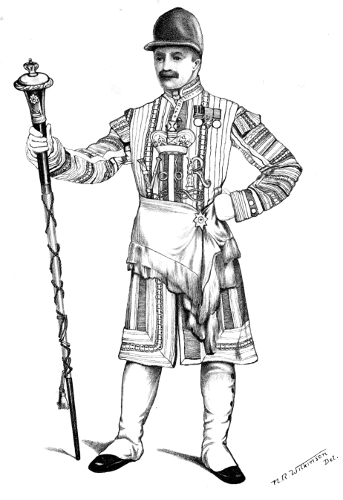
SERGEANT-DRUMMER 1895.
N.R.Wilkinson del. A.D.Innes & Co. London. Mintern Bros. lith.
CHAPTER XVII. SECOND PART OF THE WAR IN THE SUDAN, 1884-1885—SUAKIN CAMPAIGN.
393
Reasons for the expedition to Suakin—Departure of the Coldstream—Orders to Lieut.-General
Sir G. Graham—Position of the enemy—Advance against Hashin—Engagement
at Tofrek—Attack on a convoy, escorted by the Coldstream and
Royal Marines—Advance to Tamai—Construction of the railway—Attack on
T'Hakul—Abrupt end of the campaign—The Coldstream proceed to Alexandria,
and thence to Cyprus—Evacuation of the Sudan; how the Mahdi took advantage
of it; how the Dongolese were treated—Position taken up south of Wady Halfa—Defeat
of the Arabs at Ginnis—Return of the Guards Camel regiment—Return
of the Coldstream from Cyprus—Honourable distinctions added to the Colours—Officers
of the Regiment in December, 1885.
When the British Government made up their mind, early in
February, 1885, to put an end to the devastating tyranny of the
dervishes, at all events in Khartum, and sent instructions to the
British Commander to that effect, they also consulted him as to
whether a strong expedition should be despatched forthwith to
Suakin. Under the impression that his instructions to overthrow
the power of the Mahdi at Khartum were intended really to
produce that result, Lord Wolseley gladly accepted the offer that
Osman Digna might be dealt with, without further delay. We
must refer the reader to the current history of the day to seek the
causes of the awakened energy which roused the Government to
action at this moment. Very few years have elapsed since 1885,
and the events which then took place can scarcely be forgotten.
Suffice it to say that the country, justly proud of General Gordon,
was roused to indignation when it was realized that, in spite of
warnings from the military authorities, the Government had
delayed to take proper measures to rescue him and those for
whom he was responsible, until the season was too far advanced,
and until rescue was impossible. So also, the large and unstinted
394sums of money, freely lavished upon the tardy expedition that
was at last despatched up the Nile, had failed to accomplish the
object which the nation had so much at heart. Under all these
circumstances, it was clearly judicious to propitiate the popular
wrath that began to manifest itself; and how could this be more
efficaciously done than by the public announcement that summary
punishment was about to be inflicted upon the murderers of the
British hero, whose death was so universally deplored? Hence
it came about that a railway to Berber was immediately to be
commenced; that another expedition to protect it was to be sent
to Suakin; and that a still more extravagant expenditure of
treasure was to be wasted, now when it was too late, and when the
necessary outlay had been curtailed up to the summer of 1884,—that
is, as long as there was time to save the garrison of Khartum.
In January and February, 1885, Major-General Lyon Fremantle,
in command, as we have seen, at Suakin, since July, 1884,
had been reinforced by a squadron of cavalry, two battalions of
infantry, and a battery of Royal Horse Artillery, brought from
Lower Egypt, and amounting to some 2500 men. With these he
engaged in defensive operations against Osman Digna, who had
again begun to give trouble in the district. Prompt measures were
now taken to make them capable of assuming the offensive by
raising them to a total of about 13,000 men. The field force, so
augmented, was commanded by Lieut.-General Sir G. Graham,
V.C., K.C.B., under the general orders of Lord Wolseley, who
was responsible for all operations against the enemy; and composing
it, there was a Guards Brigade, troops of the Line, an
Indian contingent, and, lastly, an Australian battalion and battery
furnished by the Government of New South Wales. This Colonial
corps of fighting men, and that provided by the Dominion of
Canada for the service of the boats on the Nile, form a new feature
in our military history, which we should be sorry to pass over in
silence; for they show the patriotic feelings which urge our brethren
over the sea, gallantly to take their share in any struggle in which
the interests of our Queen and Empire may be involved.
The following organization was adopted at Suakin: A Cavalry
Brigade (Colonel H. P. Ewart, C.B.), two squadrons of the 5th
Lancers, and two of the 20th Hussars, and a battalion Mounted
infantry (4 companies). Three batteries of artillery (one Royal
Horse Artillery), and eventually one battery New South Wales.
395The 1st or Guards Brigade[458] (Major-General A. J. Lyon Fremantle),
3rd Grenadiers (Colonel Hon. W. Home), 1st Coldstream (Colonel
A. Lambton), and 2nd Scots Guards (Colonel Hon. W. Trefusis).
Subsequently, when they arrived, the New South Wales Battalion,
under the command of Lieut.-Colonel Richardson, were attached
to this Brigade. The 2nd Brigade (Major-General Sir J. C.
McNeill, V.C., K.C.B.), three battalions of infantry (of the East
Surrey, Shropshire, and Berkshire Regiments), and one of Royal
Marines. The Indian Brigade (Brigadier-General J. Hudson, C.B.),
one regiment of cavalry (9th Bengal), three battalions infantry
(15th Sikhs, 17th Bengal, and 28th Bombay), and one company
Madras Sappers. Royal Engineers (one Railway and two Field
companies, two Telegraph sections, and one Balloon detachment).
And four, eventually five, companies of the Commissariat and
Transport Corps.
The 1st Coldstream were made up by a draft from the 2nd
Battalion to 1 Warrant-officer, 80 Non-commissioned officers, 16
drummers, and 710 privates, out of which a detachment of 50
men was told off to form a Mounted infantry company. Officers
were posted as follows:—
Commanding Officer.—Colonel A. Lambton.
Mounted Majors.—Lieut.-Cols. J. B. Sterling; and R. S. Hall.
Adjutant.—Lieutenant Hon. H. Legge.
Quartermaster.—H. Folson.
Medical Officer.—Surgeon A. Alexander.
| Compy. |
|
Lieutenants. |
| No. 1. |
Lt.-Col. C. Fortescue. |
C. Frederick; and F. Maude. |
| No. 2. |
” F. Manley. |
G. Sebright; and C. Holland. |
| No. 3. |
” R. Follett. |
Earl of Wiltshire; and G. Milligan. |
| No. 4. |
” L. D. MacKinnon. |
H. Shute. |
| No. 5. |
Capt. Hon. H. Monck. |
R. Winn (subsequently in command of Regl. Transport). |
| No. 6. |
Lt.-Col. Hon. E. Digby. |
G. Wyndham; and J. Drummond-Hay. |
| No. 7. |
Lieut. J. Gladstone. |
D. J. Hamilton. |
| No. 8. |
Lt.-Col. Hon. H. Corry. |
Hon. Alan Charteris; and R. Grenfell. |
The following Officers served on the Staff: Lieutenants Earl of
Wiltshire, and Hon. Alan Charteris, Aides-de-camp to Major-General
Sir J. McNeill; and Lieutenant Gladstone, Orderly Officer
396to Major-General Fremantle. The detachment of mounted men
was placed under the command of Captain Ross-of-Bladensburg
and Lieutenant G. Sutton, but until the ponies were obtained,
which did not take place before the 5th of April, these Officers
did duty with the Battalion, the former commanding No. 7
Company. It should also be stated that the Brigade furnished
upon this occasion a company of Army Signallers, under command
of Lieutenant F. Lloyd, Grenadier Guards, composed of
12 men from the 3rd Grenadiers, 12 from the 1st Coldstream,
and 6 from the 2nd Scots Guards; the corps was attached to the
3rd Grenadier Guards. Further, a Field Hospital was also formed,
of which Surgeons-Major C. Read (Coldstream), Lawrence (Grenadiers),
and A. Myers (Scots Guards), and Surgeon G. Robinson
(Scots Guards) were the Medical Officers.
The 1st Coldstream left Wellington Barracks shortly after 7
a.m. on the 19th of February, accompanied by a dense and enthusiastic
crowd, and, marching to Westminster Stairs, proceeded
in two river steamers to Gravesend, where they embarked on
board the Manorah. Remaining a few hours at Malta, they were
detained a day at Suez, and reached Suakin on the 8th of March.
The Battalion then landed without delay, marched about two
miles, and encamped in an advanced position to cover the
assembly of the troops; they were joined by the 2nd Scots and
3rd Grenadier Guards, who arrived respectively the 9th and 10th.
There had been some alarms of a disquieting nature when we
reached the seat of war. The Arabs frequently sent forward a few
armed men at a time, who, crawling at night past the outposts into
the centre of the camp, attacked and stabbed our soldiers and
horses in the dark, even in the head-quarter camp or to the rear
of it, where at least every one had a right to believe himself to
be in safety, and guarded against depredations of the sort. This
disagreeable method of warfare was not easy to suppress, and
when the enemy was successful in his raid, it produced a “scare,”
which was calculated to disturb the equanimity of the troops.
The dervishes, in short, were hovering very near us at night, firing
into us from the bush (fortunately without much effect), though
they seldom made any demonstrations in the daylight. Detachments
were sent out as soon as it was dark, to watch all approaches
leading to Suakin; but the nuisance only came to an end, when
we moved out to attack the enemy, and drove him back from our
397neighbourhood. Meanwhile the Brigade camp, though it had never
been disturbed, was withdrawn somewhat closer to the town on
the 16th.
The orders which Sir G. Graham received were dated the 20th of
February; and they directed him, in the first place, to destroy the
power of Osman Digna, and, secondly, to give assistance and protection
to the construction of the railway. The military occupation
of the Hadendowa country, lying near the Suakin-Berber route, was
to be accomplished; and it was indicated that this would be best
done by the Indian troops, while the British portion of the army
were to be placed in the hilly region, which is to be found a little
beyond Tambuk wells (25 miles from Suakin), to a distance of
60 or 70 miles further on towards Berber. It was also intimated
that possibly Berber might not be attacked before the autumn,[459]
and, if so,—
“the railway cannot be pushed much beyond Ariab; and there, all the
railway plant and material necessary for the 100 miles between it and
Berber should be collected as soon as possible, so that the advance, when
the cool weather begins, and Berber is taken, may be made at once.”[460]
These instructions clearly show the intention of the British
Government at this critical moment in their fortunes, when public
indignation was rising against them; viz. to overthrow the power
of the Mahdi at Khartum in the autumn of 1885, now that it was
not found possible to achieve that object in the spring of the same
year. This was to be effected by the co-operation of two expeditions,
under the supreme command of Lord Wolseley,—one under
his immediate leadership, concentrating in the province of Dongola,
to pass the summer there, and to emerge therefrom when the
suitable season came round for field operations; the other, under
Sir G. Graham, with the objects (1) to crush Osman Digna, and
to clear the country of the enemy, in order that the railway
might be made, and (2) to construct that railway at least as far
as Ariab (some 145 miles from Suakin), and to place troops for
its protection “where the summer heats could be best endured.”[461]
Sir G. Graham reached Suakin March 12th, and next day the
398railway was begun.[462] A few days had to be spent in completing
the assembly of the force, and in perfecting the arrangements
necessary for their supply. The wells in the neighbourhood were
sufficient to provide the camels and horses with water, but as its
quality and quantity could not be depended upon for the troops
of the expedition, ships fitted with condensing boilers were
brought to Suakin, and condensed sea-water was issued in tins
for their use, and was transported to the various camps by camels
or by railway.
The country near Suakin is a flat sandy plain, intersected by
khors, or water courses (quite dry at this season of the year),
which, extending westward some ten or twelve miles, is terminated
by a line of hills running almost parallel to the sea coast. Near
the town, the plain is fairly open for about two or three miles,
but afterwards, and especially in the khors and at the foot of the
hills, it is covered by thick masses of mimosa thorny scrub, many
of which look somewhat like large gooseberry bushes six to eight
feet high, and wide in proportion; in many places they are tangled
by the prickly pear, and by rank grass and other undergrowth. The
enemy was reported to have concentrated his main force of some
7000 men at Tamai, a village about 16 miles away in a south-westerly
direction from Suakin. Another thousand or more were at
Hashin, eight miles due east of the town, where a valley penetrates
into the hills. It was here that the Arabs were supposed to live
who troubled our nights. To the north-west is the village of
Handub, eleven miles off, also occupied by dervishes; and to this
place the railway to Berber would have to run.
It was evidently desirable that our first movement should be
directed against Hashin. On the 19th of March, a reconnaissance
was undertaken against it, and next day an attack upon the
position was made in force; the 2nd Brigade in front, supported
on the flanks by the Guards and Indian troops, covered by the
cavalry; the horse artillery and a Gardner battery (4 guns) being
in rear: altogether a little more than 8000 men. Arrived at a
detached group of hills about a mile and a half from Hashin,
redoubts were constructed there by the East Surrey Regiment,
while the remainder continued to push forward, until the entrance
399of the valley, previously mentioned, was reached. The 2nd
Brigade, supported by the Indian battalions, ascended the southern
heights above this valley, and soon drove the enemy therefrom.
The Arabs, estimated at 3000 strong, however, were favoured by
the dense bush; they seemed to swarm through it, and, hovering
round, they dashed into our men with the greatest bravery, whenever
an opportunity presented itself. In this way, two squadrons
of Indian horse were somewhat severely handled by an almost
invisible foe. Meanwhile the Guards were in reserve, formed in
square, just under the heights which Sir J. McNeill had taken on
our left front, and close to a small rise in the ground on our right
front, which we called Bee-hive Hill. The redoubts in rear being
complete soon after midday, and garrisoned by the East Surrey,
the 2nd and Indian Brigades were ordered to retire, the Guards
to cover the movement. The Arabs, owing to the thick cover
that concealed them, remained closer to our position than they
could otherwise have done, and perceiving our return towards our
camp, they opened a hot fire from the bush upon us, principally
from Bee-hive Hill, which was returned with steady volleys. This
proceeding soon silenced them, though the Brigade lost some men
during this short period of the day—1 Officer, Captain Dalison
(Scots Guards), and 2 men being killed, and 16 wounded. Our total
casualties amounted to 48 Officers and men killed and wounded,
and of these the Coldstream numbered 1 man died of wounds,
and 8 wounded. The result of the action was that we had no
further trouble as far as Hashin was concerned, and thenceforward
the enemy’s night raids on our camp ceased.
An advance was now made towards Tamai, the centre of
Osman Digna’s resistance, and, on the 22nd of March, Sir J.
McNeill was sent forward to establish a post on the road to that
place, eight miles off, with one squadron of the 5th Lancers, the
Berkshire Regiment, the Marines, a detachment of the Naval brigade
(with 4 Gardner guns), three Indian battalions, and the Madras
Sappers. On the same day, the Coldstream proceeded towards
Hashin, to convoy supplies to the East Surrey Regiment, who
were still in the redoubts constructed on the 20th, and met with
no misfortune, except that several of our men were struck down
by sun apoplexy. On returning home in the afternoon, we saw
clouds of dust rising out of the bush in the place where we
conceived Sir J. McNeill’s column to be, and wondered whether
400something unusual had happened there. On returning to camp
we heard, at first, exaggerated accounts of what occurred, but
it was not long before the real truth was known. The column,
finding the bush exceedingly thick and no natural clearings in
it, could only advance slowly, and halted some six miles from
Suakin. The men then began to construct a zeriba; and, while so
employed, they were necessarily scattered, some were unarmed, and
a large number of camels blocked the ground. The enemy, lurking
unseen in the scrub close by, crept up, and suddenly made a fierce
onslaught on the force. Unfortunately, one of the Indian battalions
was somewhat unsteady, and, though the Officers worked hard to
rally the men, they were rushed, and carried away to the rear.
Then followed a battle of short duration which is not easy to
describe. The Berkshire—who gained the title of “Royal” for
their day’s work—stood manfully up to the Arabs, though half
the battalion were collecting brushwood and the other half were at
their dinners, and, together with the Marines, the Sikhs, and the
remaining Indian battalion, they maintained a hard fight for
the space of twenty minutes. They soon, however, gained the
mastery, and drove the enemy back with great slaughter. Isolated
combats took place at some distance from the zeriba on the road to
Suakin, entailing considerable loss, and towards evening the telegraph
wire was cut. But news had, before this, been received at
head-quarters, to assure Sir G. Graham that the danger was over,
and that the attack had entirely failed. The Arabs were computed
at 5000 strong, and their losses at 1500 men. Our own
casualties were severe; and amounted to 10 Officers and 131 men
killed and missing, and to 5 Officers and 150 men wounded: total
296. Added to this, there were 157 native camel drivers killed and
missing, and 19 wounded. Total personnel lost, 472 men; besides
501 camels. Among the wounded was Lieutenant Charteris, Coldstream
Guards. This action, known as the battle of Tofrek, occasioned
more losses on one day than in any other engagement
during the whole war in the Sudan.
The Guards Brigade were sent early the following morning to
reinforce the zeriba and to bring up supplies and water. Forming
a square, and guarding 1200 camels, the march was slow, and took
nearly six hours to accomplish. Many of the loads were indifferently
packed, and repeatedly fell off; the drivers seemed to
have little control over the animals, which were bad movers and
401difficult to guide. The weather, also, was oppressively hot, and
the men suffered a good deal from thirst. Arriving shortly before
noon, the force halted for some hours; the Grenadier Guards and
the Indian Brigade then returned to Suakin with the wounded
and empty camels, leaving the Coldstream and Scots Guards and
the rest of the troops behind. The immediate neighbourhood of
Tofrek was still covered with hundreds of dead and numerous
camels, many of which were hamstrung, and had to be shot.
Burial parties were actively at work, but it was not easy to dispose
quickly of the mass of dead bodies, both of men and animals, that
lay about in large numbers; added to which there was little shade
to be had from the broiling sun, and the water ration for every
purpose had to be reduced to a minimum. For the next few days,
the position in the zeriba was therefore anything but a pleasant
one, as may be readily imagined.
On the 24th, the Coldstream and the Marines began cutting a
path one hundred paces broad towards Suakin. After some hours'
work, they marched, under Colonel Lambton, about halfway to the
town, to escort a convoy to Tofrek, consisting of 425 camels and
818 carts, with 8000 gallons of water, which was brought up to
that point by Indian troops. The Arabs were still hovering near,
and they fired upon the two battalions as they proceeded on their
journey, but without inflicting much loss. On their return, however,
the fire became somewhat hotter, and was delivered at closer
ranges than before, so that Colonel Lambton was obliged to halt
several times to return it, and to allow the wounded to be
attended to. The square, crowded with carts and camels that
would not keep a straight course, offered an excellent mark to
the sharpshooters concealed in the bush; but we were able to
check this attack by small volleys fired by marksmen at the spots
where we saw the enemy’s puffs of smoke appear. This lasted for
an hour or more, when at last, to our great satisfaction, some of
the most daring of the dervishes made an attempt to charge. They
came on in line, guided by flags at each flank, in the most gallant
manner, and directed their attack mainly against the left face of
the square. But, unable to stand our fire, they were very soon
defeated, and most of them were killed, though one or two did
actually succeed in getting as far as our bayonets before they fell.
After this event they left us alone, and we got back to the zeriba
without further trouble. The casualties of the day amounted to 24,
402of which the Coldstream lost 2 men killed or died of wounds, and
8 wounded; three Officers were wounded, two belonging to the
Royal Marines, and Captain Hon. N. Dalrymple, Brigade Major
of the Guards Brigade; in addition, 5 native camel-drivers were
killed.[463] Some of the camels lagged behind, their drivers having
abandoned them while the fight was going on; others were
squeezed out of the square, which was from the beginning too
full to hold them, and thus more than a hundred were cut off by
the enemy.
Next day, another convoy was taken from Suakin to the zeriba
in the same manner, the escorts meeting each other halfway
between the two places. This time it was not molested, but the
occasion deserves mention, since a captive balloon was then first
employed; the latter, attached by a rope to a waggon that moved
in the square, enabled a proper look-out to be kept upon the enemy
in the bush. On the 26th, however, there was another skirmish,
but it was easily repelled with very little loss; and on this day,
the Grenadier Guards relieved the Scots Guards at Tofrek, while
the Coldstream remained there till the 28th, when they also
returned to head-quarters. After the 26th no further difficulty
was experienced with the Arabs; they were apparently disheartened,
and had retreated from the neighbourhood. A move,
therefore, was made to Tamai.
Early on the morning of April 2nd, a force of 8000 men
marched through Tofrek to Tesela Hill, near Tamai, where a halt
was made for the night.[464] Next day, the advance was continued,
and Osman Digna’s head-quarters were occupied after a very slight
resistance. Tamai, like other villages in the country, is a mere
collection of straw huts, and it was speedily fired and destroyed,
while the enemy made off into the hilly region that lies to the
south, where it would have been difficult, and indeed unnecessary,
to pursue him. The column therefore returned to Suakin, and
the attention of the troops was now directed more particularly to
the protection of the railway, which meantime had been progressing.
The Battalion lost only two men wounded, on the 3rd of April.
At this time, also, ponies having arrived, the Guards Mounted
infantry detachments were formed into two companies (April
4035th): the Grenadier and Scots Guards company, under Captain St.
John Mildmay, Grenadier Guards; and the Coldstream company,
under Captain Ross-of-Bladensburg, to which was attached a half-company,
furnished by the Royal Engineers, under Lieutenant
Sandbach, R.E. Ten days later, a Camel corps was formed
under the command of Major James, Scots Greys, consisting of
400 British and 100 native soldiers, divided into five companies,
of which one was composed of Guardsmen (31 men taken from
each of the three Battalions), under Lieutenants Neil Menzies,
Scots Guards, and G. Wyndham, Coldstream Guards.
The railway, leaving Suakin in a north-westerly direction as
far as Handub (11 miles distant), bore round towards the west
at this point, and, passing through Otao (20 miles from Suakin)
and Tambuk (25 miles), was to continue across the hilly country
to Ariab; from thence it was to run to Berber, over a stretch of
100 miles of desert country, which is watered only by the wells of
O-Bak, lying nearly halfway between these two places. To cover
the construction of the line, a zeriba was made (April 6th) by
the Coldstream, the New South Wales Battalion, artillery, etc.,
between Suakin and Handub, called No. 1 Station. On the 8th,
Handub was occupied, the Scots Guards being at No. 1 Station.
On the 16th, the latter pushed on to Otao without meeting with any
resistance; and when the Coldstream followed on the 18th, the
Scots moved to Tambuk, finding no enemy there. On the 24th,
a reconnaissance by a portion of the Camel corps was made towards
Es-Sibil; and by the 30th the railway was completed as far as
Otao. During this time the men were constantly employed in
clearing broad roads through the bush; in digging watering-places,
which had to be deepened daily as the supply became exhausted;
and in protecting the scattered parties of navvies at work on the
line. There were not many Arabs about, though few nights passed
without some shots being fired into the camp.
About the same period, also, reconnaissances were pushed in
various directions to prevent any advance from Tamai, and to clear
the neighbouring valleys of the enemy. The most important was
one undertaken in the early morning of the 7th of May, against
a chief who had collected a force at a place called T'Hakul, lying
nearly 20 miles west of Suakin and 10 south of Otao. The Brigade
took no part in this operation; but the company belonging to the
Camel corps and the two companies of Guards Mounted infantry
404were present, and forming part of the force at Suakin, they paraded
there a little before midnight on the 6th. A small column co-operated
from Otao, and in the morning both appeared before the
camp of the Arabs and surprised it; the enemy fled at our approach,
leaving behind 1100 sheep, goats, and some camels. The columns
then returned to Otao and Suakin respectively; the latter, however,
on their way home, met parties of the enemy occupying heights
within range of which they had to pass; after a few volleys he
quickly disappeared. One Officer (of the Camel corps) and two
men were wounded, of whom one (a sergeant) belonged to the
Coldstream (Mounted infantry).
This was the last operation conducted by Sir G. Graham’s
force in the neighbourhood of Suakin. The district had just been
pacified and relieved of the presence of the enemy: at this very
moment, orders came to evacuate it, and to withdraw the troops
therefrom, except a small garrison, which was to be left behind to
guard the town.[465] We must briefly explain how this came about.
The British Government never had much sympathy with the
policy of opposing the Mahdi, whose usurpation of power, founded
upon rapine, massacre, and slavery, had been dignified into the
movement of a people struggling for freedom! This strange
opinion upon the upheaval that swamped every vestige of civilization
in the Sudan, was doubtless one reason, but perhaps not the only
reason, for the vacillating proceedings pursued there, and for the
consequent inability to effect, even at great expense, any useful
object. Unwilling to face with a firm resolution the questions that
required solution in that region, and prevented by public opinion
from adopting a policy of non-intervention, the Government did
nothing till popular clamour forced them to some action, and then
the steps they took, costing many lives and much treasure, could
produce no beneficial results. Thus, as we have seen, was the
brave intention of taking Khartum, and of restoring order there,
405published in February; and so also, as soon as possible and upon
the very first pretext, was that intention abandoned. An opportunity
very soon arose to facilitate this procedure.
There was a dispute in Asia over the frontier between the
Russians and Afghans, and, on the 30th of March, news reached
London that the former, having agreed to make no forward movement
until pending questions had been discussed, advanced and
took possession of Panjdeh by force of arms—a place held to be
a portion of the territories of the Amir of Afghanistan. For
reasons connected with the safety of India, we had espoused the
cause of that Prince, and were bound to see that his legitimate
claims received proper consideration. It is unnecessary to describe
either the Panjdeh incident, or those that led up to this act of
aggression. It is sufficient to say that they created much
excitement in England, and soon drew public attention from the
Sudan. The crisis did not last long, and the dispute was soon
settled, but it enabled Government to wash their hands of the
whole of the troublesome business connected with Khartum.
“The first step taken towards opening the country for the railway [in
the neighbourhood of Suakin], was an attempt to form an alliance with
the neutral tribes dwelling on or near the Berber road; but it was soon
discovered that any such alliance must be dependent on a fixed policy
on the part of Her Majesty’s Government. The tribes appeared to be
anxious to come in, and to be thoroughly tired of the terrorism established
by Osman Digna, but they one and all said they could not join us unless
they were assured of our future protection against Osman Digna, and
unless we undertook that we would not go away, as we had done in the
previous year. In a telegram to the Secretary of State for War, dated
April 12, 1885, Sir G. Graham asked whether he might give this assurance.
In reply, the following telegram was sent to Lord Wolseley, on the 15th of
April, by the Secretary of State for War: 'Construction of railway for any
considerable distance to be suspended pending further consideration.
Suakin to be held for the present, and any position in neighbourhood
necessary for protection from constant attack, as last year. You should
report on point to which railway should now proceed, and instruct
Graham, with reference to his message of the 12th, not to enter into
engagements with tribes inconsistent with this policy.'”[466]
This was, therefore, the end of the expedition to the Eastern
Sudan, and, as a matter of fact, orders soon arrived to break
406up the forces assembled there. The Guards Brigade and the New
South Wales contingent were the first troops to take their departure.
The Coldstream, having marched from the front on the 14th of
May, embarked on the 16th in the Deccan, and started next day
for Alexandria, where they arrived on the 23rd. The Battalion
remained in the harbour, on board ship, until the 9th of June,
when they marched to Ramleh, and camped on the beach. They
stayed there until the 1st of July, and, together with the
Grenadiers, embarked on H.M.S. Orontes, and proceeded on the
2nd to Cyprus. Landing at Limasol on the 5th, they marched to
Mount Troödos, and reached that place on the 9th; the Scots
Guards followed a few days later, and the whole Brigade remained
at Troödos till after the middle of August. Major-General
Fremantle stayed behind in Egypt, and Colonel Lambton, being
the senior Officer, assumed the command of the Brigade, while that
of the Battalion devolved upon Colonel Sterling, until the 27th,
when Colonel Clive, Grenadier Guards, arrived from England as
Brigadier-General.
We left the Nile force getting into summer quarters in the
province of Dongola, in the spring of the year, and confidently
expecting to resume the offensive against Khartum as soon as
the great heat should pass away. But on the 13th of April a
telegram reached Lord Wolseley, informing him that, in the then
condition of Imperial affairs, it was probable the forward movement
might have to be abandoned. The announcement that this decision
had been taken was made known in England on the 21st, though
on the 11th of May the troops were ordered to retire northwards,
and to evacuate the Sudan.
“As it was certain that anarchy would immediately follow our withdrawal,
and probable that a retreat on our part would allow the dormant
hostility of the natives to find vent, it was necessary that the retreat,
especially of the advanced portion of the force, should be conducted as
rapidly and unexpectedly as possible. Jaudet Effendi [the then Governor
of Dongola], was at once informed of the intended retreat. He begged
for fifteen days' start, before our policy was made generally known, in
order that he might take what steps he could, to mitigate the murder and
rapine for which he believed our retirement would be the signal. This
was granted him, and he at once started up the river, and the movement
was arranged to commence on the 21st of May.”[467]
407Once begun, the evacuation did not take long to accomplish;
the enemy offered no opposition, nor did he try to press our
retreat. He was wise enough to follow at a respectful distance,
occupying the country as we abandoned it. Indeed, ever since
the return of the Desert and River columns we experienced no
further trouble with the Mahdi, who, relieved of the danger with
which he was threatened by the British advance, turned his
attention to other matters. He sent a considerable force to the
south of Khartum, to put down a rising which began to imperil
his authority in Kordofan, and, as soon as he became aware that
we were definitely about to withdraw from the province of Dongola
and from the vicinity of Suakin, he despatched more of his men
to hasten the reduction of Sennar and Kassala, both of which
were besieged at that moment. These two places fell in the
middle of August.
The operation of withdrawing from the Sudan was extremely
distasteful to British Officers. The inhabitants of Dongola had
trusted us, and had served us; we had necessarily interfered with
their government, disturbed the means at their disposal for taking
care of themselves, and prevented them from making terms with
the enemy. They had been induced by us to resist the Arabs, to
incur their vengeance, and to rely for protection upon the power
of England,—a nation who never deserted a friend or turned away
from a foe. We were pledged to defend this unfortunate people,
or to make some reasonable provision for their future safety, but,
in the face of the peremptory orders received from home, any
such arrangement was entirely out of the question. Hence it was
more than distressing to be forced to abandon these natives to
the slavery that was in store for them; and we cannot be astonished
that they reproached us bitterly for deserting them in this helpless
condition, and for leaving them to the cruel tyranny of the
Mahdi. Many appeared anxious to fly from their homes, but
they were restrained by the knowledge that, in that case, they
must forfeit the whole of their property; while others were unable
to procure sufficient transport for their families and effects.[468]
Nearly 13,000 natives accompanied the retreat, and by the
end of June these refugees, the supplies, and most of the troops
were north of Dongola. At this moment the Government of
Mr. Gladstone came to an end, and Lord Wolseley, who had from
408the first protested against the precipitate withdrawal of the expedition,
was empowered by the new Cabinet to arrest the movement
temporarily, until the situation had been considered. It is sad to
relate, that the evacuation had been too well executed, and that
it was then too late to return or repair the evil that had already
been done. By the 21st of July, that portion of the British army
destined to remain as a frontier force, for the protection of
Egypt, had taken up a position some ninety miles south of Wady
Halfa, and there they covered the construction of the Sudan
railway, which was completed to Akasheh on the 7th of August.
Meanwhile the dervishes did not invade the northern part of
Dongola at once, for the Mahdi fell a victim to his own debauchery,
and, dying on the 22nd of June, left affairs in the Sudan in an
unsettled state.[470] Until, therefore, his successor, the Khalifa Abdulla,
had consolidated his position, no further conquests were possible,
and the province was only seized by him in the middle of August.
After this, the enemy advanced northwards with the intention of
invading Egypt, and he even ventured to lay siege to a British
fort on the frontier, in the month of November. In December,
however, he was attacked, and forced to retire, by Lieut.-General
Sir F. Stephenson, who defeated him at Ginnis on the 30th.
This event ends the war in the Sudan. Long before it took
place the Guards Camel regiment had been sent home. Starting
from Dongola, where they remained for nearly three months, they
marched thence on the 1st of June, and, proceeding mostly by
river, they reached Alexandria on the 1st of July, having halted
for two hours at Cairo, where they were received by Lord Wolseley
and Sir F. Stephenson. At Alexandria, they had the good fortune
to meet the Guards Brigade, then on their way to Cyprus. They
left Egypt on the 4th, and arrived in London on the 15th. After
an inspection by H.R.H. the Duke of Cambridge, the various
detachments composing the Camel corps returned to their respective
Regiments. The following Brigade Order appeared in London
on the 21st:—
“Lieut.-Colonel Hon. E. Boscawen, Coldstream Guards, recently in
command of the Guards Camel regiment in the Sudan, having addressed
to the Major-General Commanding the Brigade of Guards his complete
409satisfaction with the conduct and soldierlike qualities displayed by all
ranks under his command in the late Nile expedition, the Major-General
wishes to place on record his great pleasure at receiving such a report,
and his high appreciation of the manner in which the several detachments
composing the Guards Camel regiment have so completely maintained
the reputation of the Brigade. This order to be read at the head
of each Battalion at the first full parade.”[469]
The casualties of the Coldstream inflicted by the enemy in
the field have already been noted in their proper place; but no
mention has been made of those who died of disease during the
two expeditions. It appears that sickness was less common in
the interior than was the case among the troops stationed on the
coast of the Red Sea; and six men only of the Coldstream died
of illness during the many months they were employed on the
Nile. The Regiment, however, had to deplore the death of Lieutenant
G. Sutton and of 13 men of the 1st Battalion who succumbed
to the climate of Suakin; while several Officers and 110 men had to
be sent to England invalided. Lieutenant Sutton, a young Officer
of great merit and of much promise, fell ill a short time before
the end of the expedition, and was sent for a short cruise, in the
hope that his health might be thereby re-established. He returned,
as he thought, better, and resumed duty; but a very few days
later he was again obliged to be placed upon the sick-list, and,
becoming rapidly worse, he died at sea, May 18th, on his way
home, before the steamer reached Suez, to the great sorrow of his
brother Officers.
The Guards camp at Mount Troödos was broken up, and the
1st Coldstream marched from that place on the 24th of August,
down to Limasol, where they embarked on board the Orontes
(26th) in company with the Grenadiers, the Scots Guards being
on the Poonah. The Battalion reached Spithead early on the
41010th of September, and proceeded next day to London, where they
received a hearty welcome from their friends and the public at
large.
The following extract of a letter, written by Colonel Lambton
soon after his return from the Sudan, to the Officer Commanding
the 2nd Battalion, refers to the men belonging to the latter, and
temporarily posted to the service Battalion for duty during the war:—
Now that the men belonging to the 2nd Battalion have left us, I
should like to express to you how satisfied I have been with their conduct
during the late campaign. I am glad to see there has been no distinction
between the two Battalions; all have done their best to keep up the credit
and reputation of the Regiment.
Medals for the Sudan campaign were issued to Officers, Non-commissioned
officers, and men on the 7th of November; and
by General Order, January 10, 1886, it was intimated that Her
Majesty the Queen had been graciously pleased to approve of the
three Regiments of Foot Guards being permitted to bear the words
“Suakin, 1885” upon their Colours. Early in 1883, the record
of Marlborough’s battles, which had been somewhat strangely passed
over in the past, were also added to the Colours, and the Coldstream
then showed the following honourable distinctions, viz.
“The Sphinx, superscribed 'Egypt.' Oudenarde. Malplaquet.
Dettingen. Lincelles. Talavera. Barrosa. Peninsula. Waterloo.
Alma. Inkerman. Sevastopol. Egypt, 1882. Tel el-Kebir. Suakin,
1885.”
In December, 1885, the Regiment stood as follows:—
Colonel.—General Right Hon. Sir Thomas Steele, K.C.B.
Lieut.-Colonels.—Commanding Regiment.—Col. G. Wigram, C.B.
” Battalions.—Colonels A. Lambton, C.B.;
and J. B. Sterling.
Majors—Mounted.—Lieut.-Colonels R. S. Hall; Hon. E. Acheson; Hon.
E. Digby; and Hon. H. Corry.
Dismounted.—Lieut.-Colonels R. Follett; Hon. E. Boscawen, C.B.
(Regimental Adjutant); F. Graves-Sawle; A. Moreton; and
R. Pole-Carew (Military Secretary to the Commander-in-chief
in India).
Captains.—Lieut.-Colonels J. G. Montgomery; F. Manley; and L. D.
MacKinnon; Captains H. Wetherall; V. Dawson; J. Ross-of-Bladensburg
(A.D.C. to Lord Lieutenant, Ireland); and A. Codrington
(Adjutant); Major Hon. H. Legge; Captains J. Gladstone;
D. Dawson (A.D.C. to the Commander of the Forces, Ireland,
411H.S.H. Prince Edward of Saxe-Weimer); and H. Stopford (lately
A.D.C. to the Commander of Forces, Ireland, Sir T. Steele).
Lieutenants.—Hon. A. Henniker-Major (Adjutant); G. V. Boyle; Hon.
H. Amherst; H. Surtees (employed with Egyptian Army); W. Corbet
(A.D.C. to Major-General Hon. R. Monck); G. P. Bouverie (lately
returned from Special Service in Bechuanaland, South Africa); Hon.
A. Fortescue (lately returned from Special Service in Bechuanaland,
South Africa); B. Gosselin-Lefebre; Hon. R. Winn; P. Lovell; Earl
of Wiltshire; Sir C. Miller, Bart.; C. Kindersley; D. Hamilton; Hon.
Alan Charteris; H. Shute; E. Wigram; Granville Smith; C. Frederick;
G. Wyndham; G. Milligan; C. Holland; Hon. W. Lambton; J.
Drummond-Hay; F. Maude; R. Grenfell; F. Ramsden; C. Monck;
Hon. V. Spencer; J. Hall; J. Sterling; H. Hawkes; Hon. E.
Charteris; G. Taylor; S. Earle; J. Wingfield; Hon. E. Pakenham;
Hon. H. Baillie-Hamilton; J. McNeile; R. Skeffington Smyth.
Quartermasters.—W. Webster; and H. Folson.
Medical Officers.—Surgeons-Major C. Read; G. Perry; and J. Magill, M.D.
” Surgeons A. Alexander; and W. Carte, M.B.
Solicitor.—R. Broughton, Esq.
The 1st Battalion were on this date quartered at Chelsea
barracks (head-quarters and 5 companies), and at St. George’s
(3 companies); the 2nd Battalion at the Tower. The writer of
this portion of the History of the Coldstream Guards here takes
leave of them, and wishing them many a glorious addition to their
illustrious records, now bids them, with much regret, farewell.
APPENDIX I. — 1. Major-General Sir John Byng to the Duke of York. — 2. GENERAL ORDERS, NIVELLES, JUNE 20, 1815. — 3. PROCLAMATION OF THE DUKE OF WELLINGTON TO THE FRENCH PEOPLE, JUNE 22, 1815.
413
“Nivelles, June 19, 1815.
”Sir,
“Your Royal Highness, I am sure, will wish to be informed of
the Conduct of the Brigade of Guards, and, unfortunately, that duty has
devolved upon me from my respected friend, General Cooke, being severely
wounded, having lost His Left Arm. In the brilliant affair of yesterday,
both Brigades have suffered severely, but I have the Authority of the Duke
of Wellington to say, they highly distinguished themselves, that from the
commencement to the end of the Action their conduct was most excellent.
It happened that Both had important duties to perform, which they
gallantly executed. At the commencement of the Action my Brigade,
which was on the extreme Right, had to occupy a House and Wood which
it was of the utmost consequence we should keep. Lieut.-Colonel Macdonell,
of the Coldstream, with two Light Companies, occupied the House,
and the Wood by the Light Companies of the 1st Brigade and some
Battalion Companies of the Battalion of the Coldstream, the whole under
Lieut.-Colonel Lord Saltoun’s Command. Against this post the first
Attack of the Enemy was made, and was successfully resisted, as were the
numerous efforts made to the close of the Day by the Enemy to get
possession. The Duke of Wellington Himself in the early part of the day
gave his particular attention to that point, and, when called to the Left by
a serious Attack on that point, He confided it to my care, with directions
to keep the House to the last moment, relieving the Troops as they
required it,—and the whole of the Brigade, except two Companies, were
required before the Action ceased; Colonels Hepburn and Woodford,
affording me every assistance, and giving a fine example to their Battalions.
“The conduct of Lieut.-Colonel Macdonell in defending the House,
even when it was on fire, and maintaining it, as ordered, has, I have no
doubt, been particularly noticed to you by The Commander of the Forces.
It was admirable, as was that of Lieut.-Colonel Lord Saltoun. About four
414o’clock, the command of the Division devolved upon me, and, having rode
over to see the 1st Brigade just at the time the attack was made by the
Enemy’s Cavalry, I had an opportunity of witnessing the steady manner in
which they received the several charges made to their front. I had also to
witness the gallantry with which they met the last Attack made by the
Grenadiers of the Imperial Guard ordered on by Bonaparte himself, the
destructive fire they poured in, and the subsequent Charge which together
completely routed the Enemy; a second attempt met with a similar
reception, and the loss they caused to the French, of the finest Troops
I ever saw, was immense. I beg you, Sir, to understand that my presence
or advice to General Maitland never was required, I merely staid with
Him as an humble Individual, when the assistance of every one was
required. His own judgment and gallantry directed everything that was
necessary. I cannot say too much in His praise, or in that of the several
Commanders his Battalions had. The conduct, Sir, of every Officer and
Man of both Brigades was everything I could wish; the Officers on
every occasion being conspicuous for their Gallantry. Sincerely do I
regret the loss of so many valuable Officers, such excellent Men. I hope
I have not trespassed too far on Your Royal Highness in my wish to do
justice to my gallant Friends and Soldiers. I believe every one who
witnessed their Conduct will confirm my statement. The Staff of the
Division afforded me every assistance; Lieut.-Colonel Sir Henry Bradford,
Assistant Quartermaster-General, was wounded. My Brigade Major,
Captain Stothert, has lost an Arm, and my Aide-de-camp, Captain Dumaresq,
was shot through the Body.
“I propose recommending to the Duke of Wellington, Lieut.-Colonel
Stanhope, of the First Guards, to do duty for Sir H. Bradford, and Captain
Walton, Adjutant of the Coldstream, to succeed Captain Stothert as
Brigade Major. Should I obtain His Grace’s assent, I hope the Appointments
will meet with your approval.
“I have, etc.
“(Signed) John Byng,
“Major-General.”
“The Field Marshal takes this opportunity of returning to the army
his thanks for their conduct in the glorious action fought on the 18th inst.,
and he will not fail to report his sense of their conduct in the terms which
it deserves to their several Sovereigns....
“As the army is about to enter the French territory, the Field Marshal
415desires it may be understood by the troops of the several nations composing
the army which he has the honor to command, that their Sovereigns
are in alliance with the King of France, and that France therefore must
be considered as a friendly country. No article is to be taken from any
individual by any officer or soldier, without payment for the same. The
Commissaries of the army will supply the troops with all that they require
in the usual manner, and no requisition is to be made direct on the
country or its magistrates, by any officer or soldier. The Commissaries
will receive directions, either from the Field Marshal or from the Generals
commanding the troops of the several nations (if these troops should not
be supplied with provisions by the British Commissariat) to make
requisitions as may be necessary for the supply of the troops, for which
they will give the usual voucher and receipt; and they will understand
that they will be responsible to issue and account for what they will thus
receive from the country in France, in the same manner as they would
if they purchased supplies for the troops in their own country respectively....”[471]
“Je fais savoir aux Français que j’entre dans leur pays à la tête d’une
armée déjà victorieuse, non en ennemi (excepté de l’usurpateur, prononcé
l’ennemi du genre humain, avec lequel on ne peut avoir ni paix ni trève),
mais pour les aider à secouer le joug de fer sous lequel ils sont opprimés.
En conséquence, j’ai donné les ordres ci-joints à mon armée, et je demande
qu’on me fasse connaître tout infracteur. Les Français savent cependant
que j’ai le droit d’exiger qu’ils se conduisent de manière que je puisse les
protéger contre ceux qui voudraient leur faire du mal. Il faut donc qu’ils
fournissent aux réquisitions qui leur seront faites de la part des personnes
autorisées à les faire, en échange des reçus en forme et ordre; et qu’ils se
tiennent chez eux paisiblement, et qu’ils n’aient aucune correspondance ou
communication avec l’usurpateur ennemi, ni avec ses adhérents. Tous
ceux qui s’absenteront de leur domicile après l’entrée en France, et
tous ceux qui se trouveront absens au service de l’usurpateur, seront
considérés comme ses adhérents et comme ennemis; et leurs propriétés
seront affectées à la subsistance de l’armée.
“Donné au Quartier-Général, à Malplaquet, ce 22 Juin, 1815.”[472]
APPENDIX II. — 1. GENERAL ORDER, PARIS, OCTOBER 28, 1815. — 2. Lieut.-Colonel Sir C. Broke to Lieut.-General Lord Hill. — 3. The Same to the Same.
416
“Before the troops go into barracks or cantonments, an officer of each
troop or company is to visit the barracks or cantonments which the
soldiers are to occupy, and to ascertain the state in which they are. The
name of the owner of the house in which the troops will be cantoned,
and the names of the soldiers cantoned in the house, must be kept.
On marching days, the barracks and cantonments of each company are to
be visited by an officer, once if possible after the troops will have arrived,
and once before they will march; and upon halting days the barracks and
cantonments of the soldiers must be visited twice every day by the officer
of the company or troop to which they belong; these visiting officers will
observe whether any article has been taken away, if the troops are in
cantonments, and will inquire whether the owner of the house has any
complaint to make of the men. Non-commissioned officers must be
cantoned with the squads to which they belong, and the officers as near as
possible to their companies; the Field-officers with their regiments; the
Generals and Staff as near as possible to their brigades and divisions.
“Paris, October 29, 1815.
““My Lord,
“I am desired by His Grace the Duke of Wellington to inform
you that the circumstances attending the present situation of the army
render it expedient that His Grace should request you will call the attention
of the officers under your command to the necessity of the strictest discipline
and most exact regularity of the troops in the cantonments which they are
about to occupy; and in order to ensure the uniform conduct of the
service, His Grace desires that the following points may be attended to:—
“Billets are to be made by the mayors, or persons acting for them.
They are to be applied for by officers of the Quartermaster-General’s
Department of Divisions; or if there are no officers of the Quartermaster-General’s
417Department, by Staff officers of divisions or brigades; or if
there are no Staff officers, by Quartermasters. Where there are no
mayors or persons having authority to issue billets, the billets are to be
arranged and portioned by the officers of the Quartermaster-General’s
Department of the Divisions; or if there are no officers of the Quartermaster
General’s Department, by Staff officers of divisions or brigades; or
if there are no Staff officers, by Quartermasters. All billets when granted
are to be made use of. If the owner of a house refuse a billet, it is to be
made good, if necessary by force; but this measure must be sanctioned by
the officers of the Quartermaster-General’s Department’s of DivisionDepartment’s of Division; or
if there are no officers of the Quartermaster-General’s Department, by the
Staff officers of divisions or brigades; or if there is no Staff officer, by the
Quartermaster authorised to arrange the billets. If the owner of a house
takes away his furniture, or by other means endeavours to deter officers
from entering the billet, the Commanding officer is to place soldiers in the
house. No inhabitant is to be required to accommodate persons that are
not entitled to billets; and it is particularly desired that officers will not
give grounds for complaint by taking their wives or families into billets
without having the consent of the owner of the house to do so.
“Officers are to be warned against shooting over the country without
having permission of the proprietors. The General Orders of the army
have already given sufficient caution upon this subject.
“The situation of the troops will require that military precautions
should be attended to. Alarm posts are to be established, guards and
pickets are to be posted, and sufficient measures taken for the security of
the communications and for the safety and tranquillity of the cantonments.
The most efficient steps are to be taken for the prompt and certain
circulation of orders, so that the whole or any part of the troops may be
collected at the shortest notice.
“Attention must be paid in the billets of soldiers to the ammunition,
and to its security against accident or robbery; for this the frequent
company inspection will be a precaution.
“The parks of artillery are to be formed where they can be protected;
they are never to be without guards, and troops should be sufficiently near
to afford them support.
“If an attroupement or riotous assembly of the inhabitants against the
military takes place, the troops are to be under arms, and the attroupement
is to be fired upon. Any act of violence against the soldiery is to be
immediately noticed, and the offenders are to be secured. The service
must be respected. The General Officers are to take care that the
discipline and good conduct of the troops merit the respect demanded.
The mayors are to be informed of the measures that will be taken, and are
to be desired to warn the inhabitants against taking part in the disturbances
that may subject them to military punishment.”
418
“Paris, October 30, 1815.
“My Lord,
“It is the Duke of Wellington’s desire that a place of
rendezvous should be fixed upon for each division of the army. The
routes by which the troops may best move to the place of rendezvous
should be reconnoitred, and such instructions given as may render the
assembly easy and expeditious. The places of rendezvous or general
alarm posts of the troops under your Lordship’s command should be:—
“For the 2nd Division—Versailles, or about the cantonments of the
division that are nearest to Paris.
“For the 4th Division—Longjumeau, or about the cantonments of the
division that are nearest to Paris.
“Baron Estorff’s Cavalry—Bièsvres, or about the cantonments of the
brigade nearest to Paris.
“The Nassau troops—Ecouen or Pierrefitte, or about the cantonments
of the troops nearest to Paris.
“The ground fixed upon should be clear of the towns or villages, and
towards Paris. The troops when assembled are to be in marching order,
with their baggage. If any other point of assembly is desired, the
instructions that may be given will express it. The brigades and
battalions of the divisions are, however, at the same time, to have their
alarm posts.”[474]