Kings County at the Opening of the Revolution. Participation
in Events leading to the Crisis. Military
Officers. Long Island Tories. The Continental and
Provincial Congresses. Fortifying. Declaration of
Independence. General Greene on Long Island. Draft
in Kings County. Landing of the British at Gravesend.
The Battle of Brooklyn. The Night Retreat.
British Occupation of the County. Temptations to
Disloyalty toward the American Cause, and Action of
the People under British Pressure. The County in
Congress. Losses in the Battle. Incidents. Prisoners
billeted on the Inhabitants of Kings County.
Long Island Refugees. Conspicuous Figures of the
Period. Peace.
The position of Kings County, while actually
close to the rapidly growing city on
Manhattan Island, was relatively so much
aloof in many of its interests from that storm
centre of colonial activity in the middle colonies,
that it was natural, perhaps, that there
should be less enthusiasm over the independent
cause than in New York itself, or than in
certain other regions less sequestered geographically
and by local condition.
But the quiet Dutch towns, if slow to anger
under British rule, nevertheless acquired a
definite patriotic energy as time advanced, in
spite of peculiarly discouraging conditions introduced
by British occupations. There may
have been the appearance of lethargy, but
Kings County's quietude in the face of excitement
elsewhere did not mean a want of sympathy,
but resulted from a special strain of
suppression. "Many fowling-pieces," writes
Stiles, "were cut down and fitted with bayonets,
and those who had two guns loaned to
those who had none."44 The MS. of General
Jeremiah Johnson, whose name is indelibly
associated with the history of the Wallabout,
tells us that Elijah Freeman Payne, the
teacher of the Wallabout School, left his
pupils to join the American forces at Boston.45
The incident was typical.
Kings County watched, and also, as we
have seen, participated in the events which
led up to the crisis of active war.
When movements on the part of the British
troops led the Continental Congress to consider
the raising of men for common defense,
the quota of the colony of New York was
fixed at 3000, which number the Continental
Congress directed them to raise. In obedience
to this direction four regiments were
raised, the Provincial Congress placing them
under the command of Colonels Alexander
McDougall, Gozen Van Schaick, James Clinton,
and Holmes. The veteran Lamb received
an appointment to command a company of
artillery.
In Brooklyn an association was formed for
mutual protection, and meetings were held
weekly for the purpose of drilling, under the
supervision of competent officers. Enthusiasm
began to manifest itself. Every gun and bayonet
was brought into requisition, and put in
order and burnished for the coming fray. The
meetings for drilling and instruction in the
manual of arms, which were held at the Wallabout
and other parts of Brooklyn, created
much interest among the young men who opposed
the Tory party, and prepared them for
the service which they were soon after called
upon to render.
In March, 1776, the following Brooklyn officers
had taken commissions:—Half of Brooklyn:
Barent Johnson, captain; Barent Lefferts,
first lieutenant; Jost Debevoise, second lieutenant;
Martin Schenck, ensign. Half of
Brooklyn: Fer'd Suydam, captain; John T.
Bergen, first lieutenant; William Brower, second
lieutenant; Jacob Stellenwerth, ensign.
Kings County was further represented by
Rutgert Van Brunt, colonel; Nich. Cowenhoven,
lieutenant-colonel; Johannes Titus, first
major; John Vanderbilt, second major; Geo.
Carpenter, adjutant.46
The names of the military officers of this
period were and have remained familiar in the
history of Brooklyn. The Johnson estate was
in the present seventh and nineteenth wards,
being in the neighborhood of Kent Avenue,
Hewes Street, and Bedford Avenue, a narrow
strip also extending along Graham Street to
Myrtle Avenue. The Lefferts property was
in Flatbush and Bedford. The Schenck farm
was situated on the site of the Wallabout Bay,
and a portion of it is now occupied as the site
of the United States Marine Hospital. The
Suydam tract was situated in what was then
known as Bushwick, and the Debevoise estate
was also in the same section of the city. The
Cowenhoven property was situated in what is
now the heart of the city. The old house
stood in a hollow near where the Atlantic
avenue railroad depot now stands. It was
an old-fashioned Dutch house, whose massive
beams and quaint mantelpieces attracted considerable
attention some twenty years ago
when it was taken down. The history of this
mansion and its occupants would form a very
interesting chapter in the history of Brooklyn.
The Bergen property was situated at
Gowanus. The Vanderbilt farm was in the
twentieth ward, between Clermont Avenue and
Hamilton Street.
In consequence of the requisition made for
troops, the colony of New York presented the
appearance of military activity. Steps were
taken to erect fortifications. The colony at
this time had two governments, each of which
was antagonistic to the other, and each one
proclaimed the acts and resolutions of the
other void and of no effect. Tryon represented
the Crown as colonial governor, and
the brave General Nathaniel Woodhull, of
Long Island, as president pro tem. of the Provincial
Congress, also acted as governor, and
was so recognized by the party of patriots.
Between these claimants for power, a collision
soon occurred. The Provincial Congress desired
to obtain the removal of the guns on the
Battery to the fortifications on the Highlands.
Captain John Lamb, the invincible, was directed
by the Provincial Congress to secure
their removal, and on the 23d of August proceeded,
with some of his faithful liberty boys
and other citizens, to execute the order. With
his band was Alexander Hamilton, then a lad
of eighteen, whose life was dedicated to the
sacred cause of freedom.
During the early part of the campaign the
Tory party had many friends on Long Island.
When the British evacuated Boston through
the instrumentality of Washington, who succeeded
in compelling them to leave, and occupied
their deserted quarters, it was supposed
that the defeated Royalists would endeavor to
retrieve their fortunes by an effort to gain possession
of New York. The policy and actions
of the troops were closely watched by Washington,
who readily saw that the object was to
make New York the seat of government, to
surround it with a large force, and thereby cut
off all communication with the southern colonies.
Thus they expected to divide the country
and prevent assistance being sent from one
section to another. Had this plan been successfully
accomplished a continual fire could
have been kept up both north and south.
Scouts and rangers would have been used to
prey upon the people, doing great damage,
and intercourse between the different colonies
would have been effectually prevented. In
order to avoid this calamity, Washington accepted
the offer made by General Lee, who
proposed to raise a force for the defense of
New York. General Lee immediately collected
1200 efficient men, and proceeded to
New York, where he arrived in January, 1776,
to the great gratification of the patriots, who
did not expect to receive so valuable an addition
to their population.
Lee was no novice. A man of executive
ability and military skill, he saw at once that
energetic measures were necessary in order to
tread under foot the existing latent love of
royalty, which only needed a little encouragement
to burst forth into living activity. It is
a singular coincidence that on the very day
General Lee entered New York with his forces,
the British fleet which had been expected arrived
at Sandy Hook, under command of Sir
Henry Clinton. The British officer did not
seem to like the appearance of things in New
York, and for some inexplicable reason changed
his course somewhat toward the coast of Virginia.
General Lee had realized the height of his
ambition in being in command of so important
a station. At once steps were taken to garrison
and fortify the city and its suburbs.
Long Island and Staten Island were justly
looked upon as the natural protectors of the
harbor of New York, and prudence dictated
the advisability of erecting fortifications and
posting troops in these localities to watch the
approach of belligerent vessels. The patriots
were actuated by one spirit, and widely rendered
aid and assistance to the heroic commander.
Scouts were placed at prominent
points at the Narrows, and fortifications erected
at Red Hook Point and elsewhere. Some
400 troops were sent to Brooklyn, and performed
patrol duty from the settlement at the
Wallabout to Gowanus.
Lee was not permitted to remain very long
in command in New York, being transferred,
March 6, 1776, to the command of the Department
of the South. The transfer did not
please him. He was possessed of the egotistical
idea that the people of New York desired
his presence, and believed him to be the only
man who could successfully cope with the
forces of the enemy. In this he was greatly
mistaken. The people were ready to follow
any leader who would inspire confidence.
Lee was succeeded by General Lord Stirling,
who vigilantly carried on the work initiated
by his predecessor. He, too, saw and
appreciated the fact that, if New York was to
be successfully defended, the approaches on
Long Island should be properly garrisoned.
To accomplish this desirable end, he appointed
Colonel Ward to erect suitable fortifications
on Long Island, and placed him in command
of a regiment of 519 men.
The second Provincial Congress, which at
this time was holding its second session, with
Nathaniel Woodhull as president, issued an
order to the authorities in Kings County, directing
them to give Colonel Ward assistance
in the work, and "to turn out for service at
least one half the males (negroes included)
every day, with spades, hoes, and pickaxes."
The inhabitants of Kings County were also
required to furnish all the necessary lumber
and wood for the barricades and fortifications.
The directions given to Colonel Ward were
full and explicit. Beside erecting fortifications
and providing defenses, he was also required
to detail men for the particular duty of preventing
communications between the British
ships in the harbor and the shore. To make
this effectual they either destroyed the small
rowboats or rendered them unseaworthy, and
seized all suspected pilots who were supposed
to be identified with the Royalists by sentiment
or self-interest.
Kings County horsemen were honored with
the important office of a corps of observation.
It became their duty to observe the
approach of the British fleet at Sandy Hook
from prominent points on Long Island, and to
give information of the appearance of suspicious
vessels. The Kings County horsemen
occupied the west end of the county, and the
Brooklyn light horse, under the command of
Captain Waldron, were employed on the southern
coast of the county, in which service they
were employed about a month, when they were
relieved by Colonel Hand, April 10, 1776,
with a regiment of riflemen. These riflemen
took their station at New Utrecht. A battery
of eight guns was also erected on Brooklyn
Heights.
Onderdonk, referring to Captain Waldron's
company, gives the following names of members
as being connected with it: Adolph Waldron,
captain; William Boerum, first lieutenant;
Thomas Everitt, second lieutenant;
Jacob Sebring, Jr., cornet; Isaac Sebring,
quartermaster; Samuel Etherington, John
Reade, Rob. Galbraithe, Rem. A. Remsen,
Daniel Titus, Jos. Smith, Jacob Kempor, Nich.
Van Dam, Geo. Powers, William Everitt, John
Hicks, William Chardavogne, and Thomas
Hazard.
Waldron, the captain of the little company,
was a very popular man, and for a long time
kept a famous hostelry at the Brooklyn Ferry.
During many years he was the proprietor of
the ferry between Brooklyn and New York.
William Boerum was a well-known citizen,
and has left behind him a host of descendants.
After the war he served in the Legislature.
George Powers was a butcher, and had a stand
at one time in the famous old Fly Market.
He owned considerable property in the neighborhood
of State and Powers streets. The
latter street was named in his honor.
The name of George Powers appears as
secretary of the first independent meeting-house
erected in Brooklyn in 1785. He was
a warm-hearted, generous man, donating large
sums to the cause of religion and charity. He
retired from business in 1790, and thereafter
devoted his time to raising stock on his lands
in Brooklyn. It is reported in one of the old
journals that in the month of February, 1793,
"a calf was brought to the Oswego market
(on Broadway and Maiden Lane), yesterday,
raised by Mr. George Powers, of Brooklyn,
but twenty-two months old, the four quarters
of which weighed 744 pounds; hide, 100
pounds; tallow (rough fat), 87 pounds; total,
931 pounds." In March, 1812, the following
notice appeared: "Fat Beef for St. Patrick's
Day. The three year old steer exhibited at
the Coffee House (corner of Wall and Pearl
streets), this day, supposed to be one of the
best ever seen of his age, and fatted by George
Powers, at Brooklyn, will be offered for sale
by (one of his apprentices) David Marsh, at
No. 38 Fly Market, on Saturday next."
Powers, who was a warm friend of George
Hall, the first mayor of Brooklyn, died full of
years, honored and respected by all who knew
him. The estate he left behind him was estimated
to be worth half a million.
John Hicks lived near the ferry, on Fulton
Street. He was a large landed proprietor.
Hicks Street derives its name from his family.
He subsequently was one of the proprietors of
the old ferry to New York. The Remsen
family were well known in the community. It
is a remarkable fact that during the entire time
from 1727 to 1776, the Board of Trustees of
Kings County had a Rem Remsen for one of
its members. A period of fifty years presents
a remarkable instance of family succession in
one office.
Waldron's troop was first enlisted in the
service of General Greene, who ordered them
to seize and take possession of all the fat stock
of the disaffected inhabitants who sympathized
with the Tories, and to deliver the stock so
taken to Commissary Brown, on Long Island.
The troop was subsequently employed under
General Woodhull in the same capacity.
Early in January, 1776, the Continental
Congress had passed a resolution, "that it be
recommended to the Committee of Safety of
the Province of New York to appoint proper
persons to inquire into the propriety and practicability
of obstructing or lessening the depth
of the water in the Narrows, or at any other
place at the entrance of New York, or of any
way of fortifying that pass so as to prevent the
entrance of the enemy."
On the 26th January, 1776, a committee
was appointed by the Continental Congress to
consult with General Lee and the Committee
of Safety in reference to the immediate defense
of the province.
The importance of defending and protecting
the approaches to the harbor of New York
was fully attested by Congress on March 14,
1776, when 8000 men were voted for its defense.
On the following day the Governors of
Connecticut and New Jersey were requested
to hold their militia in readiness for that service,
to be paid, when on duty, as Continental
troops. Congress went still further, and on
the 9th of April directed $200,000 to be sent
to New York for the use of the Continental
troops in the province.
Previous to its dissolution the second Provincial
Congress made provision for the election
of delegates to serve in the third Congress
of the colony, to meet in the city of New
York, May 14, 1776. This election was held
in April. At the election so held, Nicholas
Cowenhoven, John Lefferts, Lefferts Lefferts,
Theodorus Polhemus, Jeremiah Remsen,
Rutger Van Brunt, John Vanderbilt, and Jeremiah
Vanderbilt were chosen to represent
Kings County. Nearly all of these men represented
the county in previous assemblies, and
were able and experienced legislators.
Prior to the election, and on the 10th of
March, a regiment of Continental troops numbering
1000 men took possession of and occupied
Governor's Island. They at once constructed
a redoubt on the west side of the
island, and erected fortifications with a view to
holding in check any vessel which might seek
an entrance into the harbor. Another regiment
was stationed on the shores of Brooklyn,
and rendered Red Hook Point, on the north
shore of Gowanus Bay, famous as a Revolutionary
landmark. At this place a redoubt
was also constructed, on which were placed several
guns of eighteen-pound calibre. Thus
was the entrance to the harbor at two important
points effectually protected. This latter
fort was appropriately named Fort Defiance.
The regiment which was placed here was in
command of Captain Foster. The location
was not as good as the one on Governor's
Island, as vessels were able to make a detour
and escape injury from the former, whilst the
latter, being so much nearer the city and in the
direct sailing course, could more effectually
prevent approach.
Shortly afterward (on April 14), Washington,
as Commander-in-Chief of the Continental
army, arrived in New York and made his
headquarters at Richmond Hill, in the neighborhood
of Varick Street. His appearance in
the city encouraged the patriots to new efforts,
quickened their zeal, and led to the completion
of the plans so ably instituted by Generals Lee
and Stirling. Washington inspired the confidence
of the masses, increasing their faith by
his earnestness and determination. The strong
and confident were rendered more fearless, and
the weak and faint-hearted were encouraged
to activity.
The people, from a lukewarm and indifferent
state, rapidly changed their opinions and became
enthusiastic in the cause of independence.
These feelings were intensified by
numerous newspaper articles and pamphlets
which appeared from time to time, denouncing
Great Britain and demanding recognition as
an independent confederacy. Among these
was a paper entitled "Common Sense," by
Thomas Paine, then a citizen of Philadelphia.
Its author was at the time unknown, but the
sentiments of the pamphlet met an approving
response in every patriotic heart. Forcible
and pointed in expression, its truths left a lasting
impression, sending a thrill of pleasure
through the community, who heartily approved
of its bold and daring utterances. So popular
did it become that several of the colonies
adopted it as their watchword, and recognizing
the force of its reasoning, petitioned the Continental
Congress to take immediate steps to
secure its ratification by at once declaring
themselves free and independent. It was a
suitable precursor of the Declaration of Independence,
paving the way for the indorsement
of that document.
The third Provincial Congress, elected in
April, was directed to meet in New York on
the 14th of May, but, in consequence of a
quorum not being in attendance, the members
present adjourned from day to day until the
18th of May, when a quorum having been
secured, the body organized and proceeded to
business. The session was a short one, continuing
only until June 30, when it adjourned
by reason of a fear which was entertained that
the city would be attacked. Nathaniel Woodhull
was elected President of the Congress.
While this body was in session the Continental
Congress at Philadelphia was considering
important subjects. In the latter body
the keynote of independence was struck on
the 7th of June, 1776, when General Richard
Henry Lee rose in his seat and introduced a
resolution declaring "that the united colonies
are and ought to be free and independent
States, that they are absolved from all allegiance
to the British Crown, and that their
political connection with Great Britain is and
ought to be totally dissolved." The resolution
was a surprise to many of the members, and
led to an earnest debate which lasted for several
weeks. At that time some of the delegates
supposed that they were merely banded
together for mutual protection, and were not
authorized to take so advanced a step without
having received instructions from their constituents.
In the existing state of affairs many
lacked the courage to act, thinking that if they
voted in favor of the resolution their action
might not meet with the approval of those
they represented. They feared also that if the
measure were adopted, and in the end proved
a failure, they would be called upon to meet
a traitor's doom. They were but human.
Such men are always to be found in political
life. When the prospect of accomplishment
looks bright, they are fearless and bold, but
when a shadow of disappointment falls, and
success is not certain, their courage is weakened,
and they are unwilling to lend their aid
to what they consider a forlorn hope. The
resolution passed by a bare majority. The
Congress contained representatives from thirteen
colonies, and the vote stood seven in favor
to six opposed. This vote, however, did not
indicate the exact feeling which existed
amongst the members, as those who voted
in opposition did so in most if not in all
cases because they had received no instructions
or directions from their constituents.
The resolution having been passed, a committee,
consisting of Thomas Jefferson, John
Adams, Benjamin Franklin, Roger Sherman,
and Robert R. Livingston, was appointed to
prepare and draft a declaration of independence.
Washington was in command in New York
about a month, and in the early part of May,
1776, left for Philadelphia. General Putnam
was placed in command at New York, and
General Greene was assigned to Brooklyn to
take charge of the fortifications. Washington
was led to visit Philadelphia to consult with
the Continental Congress upon the necessary
measures to be adopted in order to carry on
the campaign. This conference led to the
issuance of an order authorizing the commander-in-chief
to direct the building of as
many fire rafts, galleys, boats, and batteries as
might be required for the immediate defense
of the port of New York, the Hudson River,
and the Sound.
The Provincial Congress of New York, at
its session in May, declared the province to
be independent of Great Britain, but did not
adopt a formal constitution until the following
year.
Meanwhile the Continental Congress was
not inactive. The committee to which was
referred the important duty of drafting the
Declaration of Independence worked faithfully,
and on the 28th of June, 1776, the paper
prepared by Thomas Jefferson was presented
for the consideration of the body.
The document was finally adopted on the
4th of July. It was not signed, however, until
August. The representatives from New York
who signed it were William Floyd of Suffolk
County, Philip Livingston of New York,
Francis Lewis, who, as we have seen, at one
time lived in Brooklyn and owned a large
estate there, and Lewis Morris of Westchester.
Robert R. Livingston's name should have been
appended, but he was called to New York to
attend the Provincial Congress before it was
engrossed and ready to receive the signatures
of the members, and thus his name does not
appear on the immortal document. However,
as one of its framers he will be forever identified
with this glorious manifesto.
Just prior to the adoption of the Declaration,
New York was placed in a critical position.
On the 23d of June, General Howe with
a large fleet appeared before the city, and on
the 2d of July took possession of a portion of
Staten Island, where he found many adherents
of the cause of royalty. Soon after he
was joined by his brother, Admiral Lord
Howe, with a large fleet from England, and
also by Sir Henry Clinton, with the troops
under his command. He was thus placed in
command of an army consisting of 24,000 well-disciplined
men from England. This was
not all. The Tory inhabitants flocked to his
standard, and although not in many respects
as efficient soldiers as the troops from England,
still their knowledge of the country rendered
them invaluable as aids in prospecting
and giving information.
Washington had no such force. To cope
with this army he had only 20,000 volunteer
recruits, whose knowledge of military tactics
was but limited, and many of whom were incapacitated
for service. Moreover, had they
been disciplined, he had neither the arms nor
the ammunition necessary to properly equip
them.
Meanwhile provision had been made for
the election of delegates to the fourth Provincial
Congress of New York. As New York
was in a state of siege, it was deemed best to
assemble at the court house in White Plains,
twenty-six miles from New York. The body
met on the 9th of July. Kings County was
represented by Theodorus Polhemus. On the
first day of the session the Declaration of Independence
was read and unanimously adopted.
On the following day the title of the body was
changed from that of the Provincial Congress
of the Colony of New York to that of the
Convention of the Representatives of the State
of New York. It continued to sit at White
Plains until the 27th day of July, when it adjourned
to meet at Harlem on the 29th.
It is needless to say that the news of the
adoption of the Declaration of Independence
occasioned much excitement and enthusiasm
in New York and Brooklyn.
Steps were taken to fortify New York and
prevent the entry of the enemy. Guns were
placed on the Battery, and barricades erected
at prominent points on the East and North
rivers. The authorities were not content
with erecting and planting guns on the water
sides, but also appropriated the various hillocks
for fortifications. One of these was
known as Rutger's, and stood at the brow of
the New Bowery, at or near its present junction
with Chatham Street. Fortifications and
barricades were also constructed at Jersey
City and on Brooklyn Heights. The site of
Fort Greene, now a beautiful park, was considered
a very important position, and a line
of works was hastily constructed which extended
from the Wallabout to Gowanus Bay,
thereby securing a complete chain of defense
to the rest of the island.
Within these fortifications 9,000 men were
encamped ready to obstruct the approach and
forward movements of the English troops.
The fortifications on Long Island were erected
under the direction of General Greene, who
had been assigned to the command of the
American forces in this section. General
Sullivan, his assistant in the work, rendered
valuable aid to his superior officer.
At this time, General Woodhull, who was
President of the Representative Convention of
New York, feeling that his place was in the
saddle, and that he could render better service
in the field at the head of troops than in the
Legislature, donned his military equipments,
and repaired to Long Island to engage in the
service.
While the Convention of Representatives
was in session at White Plains, a resolution
was passed on the 19th of July, requiring that
every fourth man in Kings County should be
drafted into service. Thereupon the militia
of the county sent a letter to the convention
urging that body to excuse a draft, and stating
that the entire militia would turn out to drive
stock into the interior, and also guard the
coast line. The letter was signed by the following
well-known citizens: John Vanderbilt,
Lambert Suydam, Barnet Johnson, John Titus,
John Vanderveer, Rem Williamson, Bernardus
Suydam, and Adrian Van Brunt, captains.
This request was not granted. The refusal
was based upon the fact that, while many of
the leading men in the county warmly espoused
the patriotic cause, many were disaffected
and inclined to the side of royalty.
These latter looked upon the war as calculated
to unsettle the country and injure their prospects.
They thought that under the dominion
of the Crown they would have peace, and be
enabled to pursue the even tenor of their way
undisturbed. The object of the militia in
offering their services was to prevent a conscription.
It will be noticed that they proposed
simply to act as a home guard, and
made no pretense of willingness to render
general service for the good of the infant
nation. Though at the commencement of the
war they manifested great lukewarmness, yet
this state of feeling was not destined to last
very long. The scales were to drop from their
eyes, they were to be impressed with a sense
of duty, and in the near future make ample
amends by courage and fearlessness for the
lack of spirit manifested at the commencement.
Among those connected with the Kings
County troop of horse, on duty in August,
were: Daniel Rapalje, first lieutenant; Jacob
Bloom, second lieutenant; Peter Vandervoort,
ensign; Honbeck Johnson, sergeant; John
Blanco, trumpeter; Roger Suydam and John
Vanderveer, privates.
These men went over from Long Island
and performed duty in the neighborhood of
Harlem. A portion of the troop of horse were
stationed on Long Island, being officered as
follows: Lambert Suydam, captain; Peter
Wyckoff, quartermaster; Hendrick Suydam,
clerk; with John Nostrand, Jacob Suydam,
Isaac Snedeker, Isaac Boerum, John Ryerson,
Rutgert Van Brunt, Charles De Bevoise,
Benjamin Seaman, Roelof Terhune, Andrew
Casper, Thomas Billing, Martin Kershaw,
Peter Miller, and Hendrick Wyckoff, privates.
Amongst these names will be recognized the
ancestors of many of the prominent Wallabout,
Bushwick, and Brooklyn families. The
Rapaljes, Vandervoorts, Nostrands, Boerums,
and Ryersons resided at the Wallabout, and
early manifested an interest in the cause of
liberty.
The feeling of disaffection on the part of
many of the citizens of Long Island was so
apparent to the Convention of Representatives
that, in refusing the request to exempt
them from a draft, that body considered it
necessary to appoint a committee to visit
Kings County for the purpose of ascertaining
the true state of public feeling in the county,
with power to take from all disaffected citizens
such arms as they might possess, to
secure their persons, and, if deemed necessary,
"to destroy the crops and lay the whole
country waste," and thus prevent them from
affording aid and comfort to the enemy. The
committee entered upon their labors with
energy and dispatch. They ascertained that
the reports were in a great measure true. By
their direction Tories were arrested and disarmed.
The action of the committee produced
a beneficial effect amongst the people,
and, had they not taken the forcible measures
they did, the first battle of the Revolution
after the Declaration of Independence, which
was fought on Long Island soon after, to wit,
on the 27th day of August, would in its results
have proved still more disastrous.
General Greene made ample provision to
protect and defend Long Island against the
enemy. As we have already seen, he caused a
line of fortifications to be constructed through
the centre of the present city of Brooklyn, extending
from Wallabout Bay on the north to
Gowanus Bay on the south.
Conspicuous among the fortifications so constructed
was the redoubt on Fort Greene,
which was called Fort Putnam in honor of
that brave officer General Israel Putnam, who
figured with distinction not only in Brooklyn
but elsewhere, and subsequently gained for
himself the name of Breakneck Putnam for his
daring exploit in Connecticut when he dashed
down the celebrated defile, and thereby escaped
capture.
At this time Fort Putnam, now Washington
Park (Fort Greene), was covered with large
trees, and belonged to the Cowenhoven estate.
The old Bedford Road skirted its northeasterly
line, and its prominence was a valuable
position for placing guns. It is worthy of
note in this connection that Edward T. Backhouse,
a descendant by marriage of the original
owner, when representing the old eleventh
ward of Brooklyn in the Common Council,
in the middle of the present century, took an
active interest in securing the preservation of
this historic spot and its conversion into a
place of public resort. He aided materially,
with Francis B. Stryker, late Mayor, Silas Ludlow,
John W. Hunter, John H. Baker, and
others, in having it set apart for a park, and
properly embellished.
Another means of protection was the construction
of intrenchments extending from
Fort Putnam to the old Wallabout Road, at
a point about where Hampden Street intersects
the present line of Flushing Avenue.
Before Flushing Avenue was opened, at this
point, the easterly end of the Navy Yard
property, the old Wallabout Road diverged
from its course, describing a half circle.
General Greene was not content with providing
against invasion from the northeast,
but also turned his attention to the section
lying to the south of Fort Greene. He saw
the necessity of erecting intrenchments along
the high land extending from Fulton Avenue
southerly to the old Gowanus Road, at the
creek which made up from the bay where
Freeck's mill stood. This spot can be easily
fixed. Many remember the old mill pond and
the bridge across the creek at Butler Street,
near where Bond Street has been extended.
Another small redoubt, which stood like a
warning sentinel, was erected a short distance
west of the fort, about where DeKalb Avenue
now intersects Hudson Avenue. South Brooklyn
was not forgotten. At that time the section
bounded by Smith and Clinton streets
on the east, and Degraw and Third Place on
the north, was high ground, and from its owner's
name was called Bergen Hill. This
prominence commanded a view of the East
River and Gowanus Bay. Here Greene
erected a redoubt, on which he mounted several
guns. In later times, when the hill was
removed, to give place to streets and palatial
residences, the remains of soldiers buried during
the Revolutionary War were taken up.
A fort was also built on Cobble Hill, which
was nick-named "Corkscrew Fort." This hill
was on the spot where since has been erected
the Athenæum, corner of Clinton and Atlantic
streets.
All these works were effectively built and
evinced great military and engineering skill.
English officers at the time of the evacuation
referred to their strength of material and
advantageous location. It would appear that
Greene and his assistants thoroughly familiarized
themselves with the topography of the
country, and made military provision accordingly.
A British officer, in his experiences
published during the war, expressed in strong
terms his surprise that the Americans should
retreat from bastions so impregnable.
Hitherto all had been preparation. The
storm clouds had been gathering, and were
soon to break with unwonted fury. A great
Revolutionary battle was to be fought on the
virgin soil of Long Island, and was to result
disastrously.
At the outset, Great Britain, having complications
on the European continent, was very
anxious to conciliate and secure peace. When
Admiral Howe was sent with his fleet to New
York he was directed by his government to
treat for peace with the rebellious subjects.
Acting upon his instructions, after landing at
Staten Island, and placing his fleet in close
proximity to the city, he opened negotiations
to this end. At the start he made a great
blunder, by mistaking the character of the
general-in-chief with whom he had to deal.
An autocrat in temper and disposition, and
infused with the traditional pride of a British
commander, he neglected to address Washington
by his military title. He looked upon the
people as rebels, and not as an independent
nation, and addressed the commander of the
American forces as George Washington, Esq.
The letter was returned unanswered. Another
missive directed to George Washington,
Esq., met the same fate. The spirit thus
manifested by Washington in refusing to receive
or reply to any letters, unless addressed
to him as the head of an independent army,
representing a nation seeking to throw off
the yoke of despotism and break its chains,
proved to Admiral Howe that his mission
of peace was too late, and that if England
desired to retain her possessions in the new
world she would have to do so at the point
of the bayonet.
Howe made his last effort to secure peace
on the 17th day of August. Failing, he at
once commenced warlike preparations. Washington
realized the necessity of careful and
energetic action. He anticipated that the rebuff
he had administered to the admiral's
overtures would lead to an immediate attack
upon New York. In order to circumvent the
attack, and prevent aid and assistance to the
enemy from the Tories in the city, he at once
caused the removal of the adherents of the
Crown to Connecticut, where they were placed
under the surveillance of that sturdy patriot,
Governor Trumbull. Measures were adopted
to weaken and destroy existing Tory sentiments
in New Jersey and Long Island. The
legislative committee, assisted by a committee
from the Continental Congress, went to work to
disarm all suspected persons on Long Island,
and to suppress every exhibition of Tory spirit.
The public records were placed in the care
of Congress, then in session in Philadelphia;
and women and children, and all persons not
needed for the defense of the city, were quickly
removed to safe quarters. A corps of riflemen
was stationed at Fort Hamilton to prevent
the landing of the enemy in that quarter,
to watch the approach of their fleet, and to
give information as to their movements.
Washington, however, was mistaken as to
the intentions of the enemy. Howe, instead
of making a bold attack upon New York, resolved
upon another course. He well knew
that Long Island was filled with Tory sympathizers,
and he thought that he might reach
New York across Long Island, and be able to
take with him many recruits gathered on his
way from among the disloyal inhabitants.
Within five days after the refusal of Washington
to reply to his insulting letter, Howe
prepared his fleet for action, and with it set
sail for Gravesend Bay, where he landed on
August 22.
The fleet arrived early in the morning.
General Sir William Howe led an army of
30,000 well-disciplined soldiers. The landing
was effected without opposition. A part of
the forces was under the command of Earls
Cornwallis and Percy, Sir William Erskine,
Count Duness, and Generals Grant, De Heister,
and Knyphausen, and was composed of
many Hessians who had been hired at a set
price per head to do military service against
the American rebels.
Howe held possession of the southwestern
part of the Island. His presence caused consternation
among the patriots, who sought the
American lines for protection, while those who
were weak in the faith, or favored the cause
of royalty, joined his standard.
The small body of riflemen who had been
stationed at Fort Hamilton could not prevent
the landing of the invaders. They, however,
destroyed the growing crops so that the enemy
would derive no benefit from the cereals, and,
having done this, sought safe quarters between
Brooklyn and Flatbush. Meanwhile Howe
was not idle. Establishing his headquarters
at New Utrecht, he employed his men in
reconnoitring. Skirmishers were sent out
from time to time, who succeeded in capturing
many straggling soldiers, and withal securing
much plunder. General Sullivan, who was in
command of the American forces, had but
5000 men. These lacked the ability to contend
against the numbers opposed to them.
Most of Sullivan's men were volunteers, unused
to the hardships of camp life, and without
experience in military tactics. Notwithstanding
the disparity of numbers, Sullivan
made diligent preparation to resist the onward
progress of the enemy should they attempt to
press forward to New York. Washington at
this time was with the main body in New
York, laboring earnestly to defend the lines of
that city, and obstruct the progress of the
enemy should they attempt to lay siege to
the town.
On the 25th of August Washington sent
large reinforcements to Brooklyn. At the
same time General Sullivan was removed from
the command of the army, and General Putnam
dispatched to take his place. Washington
supposed that the enemy would attack
Long Island and New York at the same time.
Putnam on assuming command received strict
injunctions to guard all the passes, and thereby
prevent advance movements on the part of
Howe. Sullivan had planned the intrenchments,
and having studied the ground in
conjunction with General Greene, he knew
where to station his sentinels. The country
was thickly covered with wood from the Narrows
to Jamaica. The American camp could
be reached only by three accessible passes.
One of these wound round the western edge
of the Narrows; another crossed the range to
Flatbush; and the other passed through Flatlands,
crossing the Bedford and Jamaica roads.
Sullivan had erected breastworks near these
passes, and at each stationed several regiments.
Scouts were also employed to watch the roads
leading to the passes, and give the alarm in
case the enemy approached. Putnam did not
manifest much ability upon taking command
of the army. Instead of strengthening the
outposts, which were a sure protection against
the progress of the enemy and the annihilation
of his camp, and which had been wisely chosen
by his predecessor, he saw fit to remove the
patrol, and thereby weakened his own position,
gave the enemy an unobstructed road to
the American camp, and insured the disaster
which attended the battle that followed, causing
demoralization not only in his own ranks,
but also throughout the entire army, which in
a great measure became disheartened by the
terrible defeat on Long Island. Had General
Greene, who had served as the superior officer
to Sullivan, not been prostrated by sickness,
and been enabled to remain in command, instead
of being replaced by Putnam, no such
disaster would have occurred. He knew the
character of the country, and the importance
of holding the passes, and would not have
readily yielded up their possession.
Meanwhile General Howe, the commander
of the British forces, issued a proclamation,
wherein he gave notice, on behalf of his
Majesty's government, to all persons who had
been forced into rebellion, that, on delivering
themselves up at the headquarters of the army,
they would be received as faithful subjects,
and be given permission to return to their
dwellings, and be protected in person and
property. And further, that "all those who
choose to take up arms for the restoration of
order and good government within this Island
shall be disposed of in the best manner, and
have every encouragement that can be expected."
This offer was accepted by some
lukewarm people; but to the honor of the
majority be it said, its terms and conditions
were, in general, indignantly refused.
General Clinton, whose forces had joined
those of Howe, soon saw the unprotected state
of the passes. The information he acquired
as to their unguarded condition he at once
communicated to Howe, who thereupon held
a consultation with him, and planned measures
to entrap the patriots. They arranged a plan
of attack. On the 26th the Hessian troops,
under command of General De Heister, took
the road leading to Flatbush through the hills,
while General Grant, with another division,
took the shore road. These movements were
intended to deceive Putnam, and enable General
Clinton, with the main body, to direct his
efforts to gain possession of the pass at Bedford,
and thereby flank the American lines.
The manœuvre was successful. Putnam, learning
of the advance of Generals De Heister
and Grant, dispatched a strong force under
Lord Stirling to guard the river road, and
another under General Sullivan to impede the
progress of De Heister at Flatbush. Putnam
did not comprehend the movements of the
enemy, and did not learn the advantage they
had gained by their military skill until General
Clinton had accomplished his purpose, by gaining
the position he desired, and had opened a
heavy fire upon Sullivan's rear. Sullivan saw
that he was surrounded. After vainly attempting
to break through the lines of the enemy
and secure the lost ground, his troops became
confused and broke ranks, taking refuge in the
neighboring hills. They could not escape,
and the greater part, with their faithful officer,
were soon discovered and secured as prisoners
of war.
The contest with General Grant on the
shore road was far more animated and vigorous.
Lord Stirling, who had command of the
American troops, was posted on the slope of
the hills just north of Greenwood Cemetery,
and firmly maintained his ground against
Grant, until the latter received reinforcements.
Early on the morning of the 27th, General
Grant reached the lower pass, and encountering
a regiment under command of Major Bird,
was compelled to retreat. General Putnam,
who had been apprised of the retreat, directed
Lord Stirling to hold the invaders in check.
Stirling, in obedience to the order, started
with two regiments for the Narrows. A Connecticut
regiment was also placed under marching
orders, and followed to render him support
and assistance.
Stirling soon met Major Bird retreating before
the fire of the enemy. He formed his
brigade in line of battle, judiciously placing
some of his men on the brow of the hills in
order to rake the enemy with hot shot. Another
body was stationed near "Battle Hill,"
now a portion of Greenwood. It is said that
some riflemen were stationed on this eminence,
and, when Earl Cornwallis approached
with his command, these riflemen commenced
a deadly fire, each shot proving the death-blow
of an officer. Their aim was so effective and
disastrous that they could not long escape.
The bravery manifested by these men cost
each one his life, as the hill was quickly surrounded,
and the sure marksmen dispatched.
Furman has graphically pictured this event.
He says: "In this battle part of the British
army marched down a lane or road, leading
from the British tavern (at Valley Forge) to
Gowanus, pursuing the Americans. Several
of the American riflemen, in order to be more
secure, and at the same time more effectually
to succeed in their designs, had posted themselves
in the high trees near the road; one of
them, whose name is now partially forgotten,
shot the English Major Grant; in this he
passed unobserved. Again he leveled his
deadly rifle and fired; another English officer
fell. He was then marked, and a platoon ordered
to advance and fire into the tree, which
order was immediately carried into execution,
and the rifleman fell to the ground dead. After
the battle was over, the two British officers
were buried in a field near where they fell, and
their graves fenced in with some posts and
rails, where their remains still rest. But 'for
an example to the rebels,' they refused to the
American rifleman the rites of sepulchre; and
his remains were exposed on the ground till
the flesh was rotted and torn off his bones by
the fowls of the air. After a considerable
length of time, in a heavy gale of wind, a large
tree was uprooted; in the cavity formed by
which some friends to the Americans, notwithstanding
the prohibition of the English, placed
the brave soldier's bones to mingle in peace
with their kindred earth."
Before the beginning of this attack, General
Stirling addressed his men, urging them to be
courageous, and told them: "Grant may have
his 5000 men with him now;—we are not so
many; but I think we are enough to prevent
his advance further on his march than that
mill-pond."
The battle soon started in earnest. As the
golden sun on that August day slowly uplifted
itself above the horizon, and began its movement
towards the west, the armies were engaged
in deadly conflict. Skirmishing continued
for two hours. The fire from Kichline's
riflemen, who were stationed behind a hedge,
proved disastrous to the British, who were
compelled in consequence to relinquish their
position. No sooner did they retire than a
Pennsylvania regiment under Atlee retook the
lost ground.
Stirling was now closely pressed by General
Grant, whose brigade had formed in two lines
opposite Stirling's right. Stirling soon saw
that Grant had been reinforced, and felt that
further resistance would be in vain. He had
but two courses to adopt: one was to surrender
at once, or attempt to escape across the
creek, which was spanned by the remains of a
burnt mill-dam. Preferring to make an effort
to escape, he selected a portion of the Maryland
brigade to cover his flight, and directed
the balance to retreat. With great courage
he then charged with fixed bayonets upon the
regiments commanded by Cornwallis. The
charge was repeated four times. Again they
charged, and as the enemy was on the point of
yielding, General De Heister came up, flushed
with his victory over Sullivan, and commenced
an assault on his rear. With such a force
against him Stirling was compelled to surrender.
Some attempted to escape by cutting
their way through the ranks of the enemy, and
perished in the effort. The Americans lost
in this battle 1200 men, 1000 of whom, including
Lord Stirling and General Sullivan, were
taken prisoners. About 400 of the British
were killed, wounded, and taken prisoners.
Historians have always differed as to the
loss of the Americans in the battle of Brooklyn.
Colonel Trumbull was commissary-general
during the engagement, and was employed,
when the retreat was determined upon, in procuring
vessels in which to remove the army.
By virtue of his position he possessed peculiar
facilities for knowing the true state of affairs.
Two days after the retreat he wrote the following
letter to his father, giving an account
of Washington's masterly effort:
New York, September 1, 1776.
Honored Sir,—We have been obliged
to retreat from Long Island and Governor's
Island, from both of which we got off without
loss of men. We left a great part of our heavy
artillery behind. The field train is off. We
are in hourly expectation that the town will
be bombarded and cannonaded, and the
enemy are drawing their men to the eastward
of Long Island, as if they intended to throw
a strong party over on this island, near Hell
Gate, so as to get on the back of the city. We
are preparing to meet them. Matters appear
to be drawing near a decisive engagement.
General Sullivan is allowed to come on shore,
upon his parole, and go to Congress, on the
subject of exchange of himself, Lord Stirling,
and a large number who are prisoners; by the
best accounts we yet have, we have lost in
last week's defeat about 800 men killed and
missing; how many of each is not yet known.
I rather expect that they will push in a body
of troops between the town and our party at
and near Kingsbridge. If they do, we shall
have them between two fires, and must push
them to the last extremity, or be killed or
taken prisoners. The result is in the hands
of the Almighty Disposer of all events.
I am, honored sir, your dutiful son,
Joseph Trumbull.
While the battle was raging with so much
fury, Washington was in New York, watching
the movements of the British fleet. He was
filled with anxiety and alarm, as he considered
that an important crisis had arrived. Becoming
satisfied during the day that there was no
intention on the part of the fleet to attack the
city, he passed over to Brooklyn and took his
station at Fort Putnam.
Here he witnessed the terrible rout and
slaughter which befell Sullivan, with no means
at his command to send succor or assistance.
He also beheld the heroic conduct of the men
under Stirling, and was convinced that resistance
on their part was in vain. As Washington
noticed the bravery of the Maryland
troops in the bayonet charge, he exclaimed,
"Good God, what brave fellows I must this
day lose."
Thus terminated the battle on the 27th.
The slaughter had been terrible on both sides.
The flower of the American army was destroyed,
and many valuable and efficient officers
were taken prisoners. General Howe
felt jubilant over his success, and made preparations
to advance upon the American lines.
Within those lines were 3000 brave men who
were encouraged by the presence of Washington.
Had an attempt been made to take their
fortifications, they would not have been yielded
without the destruction of hosts of the invaders.
As Howe did not know the strength of the
Americans, he deemed it prudent not to make
the attempt, and encamped for the night. It
was not singular, under the circumstances,
that Washington should feel alarmed. He
was satisfied that resistance would be useless,
and that something must be done to save the
remnant of his army.
The Hessians, who had been hired by the
British Government, were trained soldiers. Of
the men so procured the Landgrave of Hesse
Cassel furnished 12,000 infantry, the Duke of
Brunswick 3900, and the Count of Hanau
360. War was their profession, and in its
destructive work they seemed to take great
delight. In the engagements on Long Island
they took an active part, and manifested their
disposition by showing no quarter. The sight
of blood served to madden them, and led them
on to renewed acts of diabolism and ferocity.
Nothing satisfied their rapacity. After the
retreat of the Americans from Long Island,
and its occupation by the British, many of
these Hessians took possession of and were
quartered in the large old-fashioned Dutch
houses, and made themselves free with everything
on which they could lay their hands.
The morning of the 28th of August arrived.
A thick mist enshrouded the earth with gloom.
Washington did not manifest any despondency,
and as he inspected the works and defenses
had a cheerful word of encouragement for the
men. Early in the morning several regiments
of Massachusetts soldiers crossed to the island,
and were received with manifestations of
joy by the weary toilers of the day and night
past. With this addition the force of the Americans
numbered 9000 men. The battle was
now renewed by the British, who commenced
a heavy cannonade on the American works.
Providence seemed to smile upon the American
cause. The clouds poured forth rain in
torrents, which, while it produced much physical
discomfort to the patriots, who were compelled
to stand knee deep in water, served also
to restrain and prevent the enemy from engaging
in the conflict.
Washington realized the necessity of immediate
action. A council of officers was summoned,
and by his advice the conclusion was
reached to evacuate the island. The council
convened by Washington to deliberate
upon this important subject was composed of
the commander-in-chief, General Washington;
major generals Putnam and Spencer, brigadier
generals Mifflin, McDougall, Parsons, Scott,
Wadsworth, and Fellows. In Stiles's account
of the battle of Long Island, he says that
"the old Cornell House, afterwards known as
the Pierrepont Mansion, which formerly stood
on the line of the present Montague Street,
near the little iron footbridge which spans
the carriageway, was the headquarters of
Washington during this important contest.
It was a spacious and costly house having
large chimneys, from which it was known as
the 'Four Chimneys;' and upon its roof a
telegraph was arranged by which communication
was held with New York."
Stiles maintains that both Lossing and
Onderdonk erred in stating that the council
met in the Dutch church on Fulton Street,
but that they met in this old house. In supporting
his opinion he quotes the authority of
Colonel Fish, the father of Governor Hamilton
Fish, and one of Washington's military
family, who in 1824, during Lafayette's visit to
Brooklyn, called the attention of the distinguished
visitor to the fact, and designated the
very positions in the room occupied by the
members of that council.
The business brought before the council
was very important, and the execution of the
scheme adopted required military skill and
strategy to insure success. It would not have
answered to retreat during the day, as their
movements would have been noticed and
checkmated by the enemy. It was resolved
to effect the withdrawal of the troops that
night. Every move required the utmost caution
and secrecy. As boats were needed to
transport the troops, and the collecting together
of them might excite the suspicion of
the British, it was reported that the Americans
intended to attack the enemy in the rear,
and to accomplish this end had determined to
transport troops to the line of Queens County
at Hell Gate. This plan was adopted to deceive
the enemy. In pursuance of the resolution
of the council, orders were issued to
move every available boat to Brooklyn, and
have them in readiness for embarkation at
midnight. So cautious were the officers conducting
this retreat that all orders were given
in whispers, and communicated to the men in
the same manner. The state of the weather
favored the movements of Washington. During
the day rain had fallen in copious showers.
As the mantle of night covered the earth, a
heavy fog appeared, which, with the drizzling
mist, served to deceive the enemy, and render
them less vigilant. In order to mislead the
British officers and soldiers, Washington kept
several companies marching to and from the
ferry landing, while their associates were embarking.
Washington himself superintended
the embarkation of the troops, who began to
move about ten o'clock. The darkness of the
night aided materially in the accomplishment
of the work. To add to the deception, fires were
kept burning until the last moment. All the
troops were safely embarked. The boatmen
labored cheerfully during the night watches,
and when at last the fog passed away, and they
beheld the clear cerulean sky above them,
they also rejoiced that a kind Providence had
directed their boats to a safe harbor on the
shores of the upper part of the city of New
York.
The elements, time, and circumstances, favored
Washington in his masterly retreat. On
one side he had to fear the forces of Howe,
who might pursue and cut off his retreat, and
on the other hand, if he succeeded in putting
off from the land, he stood in imminent danger
from the British fleet, which, if his movements
were discovered, would soon send him
and his faithful band to a watery grave.
Again, he was liable to be exposed by some
stray British soldier or spy.
A woman Tory, Mrs. Rapalje, living near
the ferry, noticing the collection of boats and
the movements of the troops, suspected that a
retreat had been determined. Anxious to apprise
her friends, the Tories, of the undertaking,
she at once sent her negro slave to give
General Clinton the information. Fortunately
for Washington, the slave was captured by a
Hessian soldier, who, not understanding the
English language, could not comprehend the
importance of the message, and kept the slave
in the guard-house until morning, when he sent
him to Clinton's headquarters. When Clinton
received the message the birds had flown.
The story was communicated to Howe, who
received it with blank astonishment. At first
he could not accept it as true. The scouts
reported that a dead silence rested upon the
American camp. Howe now feared that the
story might be too true, and that, "while he
slumbered and slept," Washington had escaped.
At last one of the guard crept close
to the works, and found that they had been
abandoned. The alarm was given, the crestfallen
British took possession, and, like Pharaoh
of old, pursued, to find that those they
sought had landed safely on the other side.47
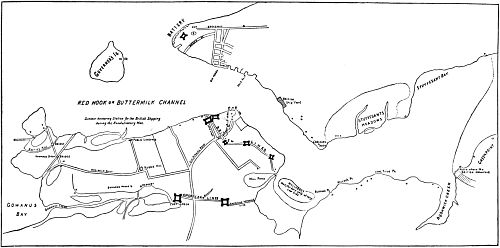 BROOKLYN DURING THE REVOLUTIONARY WAR
From the map by Gen. Jeremiah Johnson
(higher resolution)
Howe now took possession of the deserted
works. All the towns of Kings County were
in possession of the army, who had strong
garrisons in each. Meantime Howe made his
headquarters at Newtown. During the continuance
of the war thereafter, and for a period
of over seven years, Kings County remained
under the absolute control and domination of
the British.
Howe now made another effort to restore
the colonies to the mother country. The disaster
and repulse which the Americans received
in Brooklyn led him to suppose it a
favorable opportunity to accomplish his mission
of peace. He communicated with the
Continental Congress, and opened negotiations
with a promise of pardon to all who
would lay down their arms. He also added a
promise that the obnoxious laws which had
led to the struggle should be repealed.
The proposition came too late. No concession
but acknowledgment of independence
would satisfy the people. A conference was
held at Staten Island, whereat Benjamin
Franklin, John Adams, and Francis Rutledge,
the commissioners appointed by Congress to
attend the negotiations, refused to listen to
any terms of peace, except such as should
recognize the full and complete independence
of the colonies. Howe, having failed in his
effort, issued another proclamation to the people,
and resolved to proceed and take the city
of New York.
The battle of Brooklyn cost the Americans
the loss of that brave general, Nathaniel Woodhull,
who for nearly a year had acted as the
President of the Provincial Congress of New
York. He was in command of a part of
the forces, and was captured on the 28th of
August by a party of Tories under command
of Captain De Lancey, near the village of
Jamaica. Notwithstanding the fact that he
was a prisoner, and entitled to respectful treatment,
he suffered great indignities at the hands
of his captors, who inflicted numerous sabre
wounds, which resulted in his death. He was
at first taken to the Presbyterian Church in
Jamaica, where for the night he was confined
with other patriots. In the morning he was
placed on a hay-boat, and taken down Jamaica
Bay to New York Bay, and landed at New
Utrecht. Reaching the latter place he began
to fail very rapidly, and the officers, seeing his
days were numbered, allowed him to be carried
to the house of Nicasius De Sille, where
he died as a true soldier, breathing blessings
on his countrymen, and willingly giving his
life in the cause he loved so well.
Woodhull was the hero of Long Island.
He rendered important service in the formation
of the state government, and was always
a leader who secured and retained the respect
and confidence of his constituents.
The occupation of Long Island by the British
did not accomplish the results anticipated.
The victory gained was barren. The authorities
at home did not see in it anything to commend.
In the light of present knowledge it
was passing strange that Generals Howe and
Clinton and Admiral Howe should have committed
so fatal a blunder as to attempt the
subjugation of the city of New York by a passage
of the army across Long Island. The
situation of Manhattan Island, extending into
the bay, with a wide expanse of water on each
side, presented an inviting field for an attack
upon the city. Admiral Howe, with his large
and well-equipped fleet, could have readily besieged
New York, and forced Washington
with his little band of patriots to evacuate the
place. As it was he weakened his force, and
enabled Washington to concentrate his army.
Long Island being isolated from the main
land was of but little consequence to either
side. Had Howe with his fleet besieged the
city, and landed the military forces, their success
would have been complete, as the Americans
were not prepared to resist the invasion.
Such a policy would have resulted disastrously
to the patriotic cause. As we have already
stated, the battle of Brooklyn was never looked
upon by British authorities as at all creditable.
Whatever glory gathers round the engagement
centres in the exhibition of military skill
displayed by Washington in the management
of the masterly retreat of the American army
from Long Island, and its safe arrival in the
city of New York.
Yet Washington was greatly distressed and
disheartened by the defeat at Brooklyn. In
referring to the battle in one of his letters
written shortly after the disaster, he expressed
his feelings in unmistakable terms. He says:
"The check our detachment sustained on the
27th has disappointed too great a proportion
of our troops and filled their minds with apprehension
and despair. The militia, instead of
calling forth their utmost efforts to a brave
and manly opposition, in order to repair our
losses, are dismayed, intractable, and impatient
to return. Great numbers of them have gone
off! in some instances by whole regiments,
by half ones, and by companies, at a time."
Washington was well-nigh discouraged by the
state of affairs. He had enlisted with the
purest motives, and ever manifested a spirit
of self-sacrifice. He regretted that the same
spirit did not abide with those who had with
him enlisted in the service.
Howe, having full possession of the American
fortifications on Long Island, determined
to use the fleet under command of his brother,
Admiral Howe. The vessels were brought
within gunshot of the city. The Rose, carrying
forty guns, passed through Buttermilk
Channel and anchored in Turtle Bay, in the
neighborhood of Forty-second Street and East
River, to aid the other vessels then in the
Sound by a concert of action against the city.
Washington, noticing the movements of the
ships of war, and foreseeing that the condition
of his army would not permit a defense, resolved
to leave the city. Before doing so he
summoned a council of his officers, who coincided
with him in his views of the situation.
This was on the 12th of September. An order
was issued at once for the removal of the
military stores across the Harlem River, and
a force was stationed at Kingsbridge.
General Putnam was left in command of
the city with about 4000 men. The main
body under Washington was stationed at Harlem
Heights. Washington was now surrounded
with difficulties which required great
ability to overcome. The enemy had the men
and means to move on his works, and against
their attack he could offer but feeble resistance.
It was a dark and doleful hour in our
history. In order to make no mistake it became
necessary to adopt a decisive policy, and
to arrange plans whereby the advance movements
of the enemy might be circumvented.
He considered it of the utmost importance to
ascertain the intentions of Howe and Clinton.
A council of war was called, and it was resolved
to send a man who could be trusted
into the enemy's ranks to gain the desired
information.
In this emergency Nathan Hale, a young
and brilliant officer, volunteered his services.
Procuring the necessary disguise, Hale started
on the mission fraught with so much danger.
Passing over to Long Island, he entered unnoticed
and unobserved the enemy's line, succeeded
in making drawings of their works, and
gained full and complete information as to all
their intended movements.
As he was returning, he was recognized as
belonging to the rebel army, and was arrested,
and conveyed to the Beekman house, on the
corner of Fifty-first Street and First Avenue,
where General Howe had his headquarters.
He was at once tried, convicted as a spy, and
sentenced to be hung on the following day at
daybreak. It was a mercy to him that his execution
was fixed so speedily, as in the mean
time he was placed in the keeping of that
heartless scoundrel, Cunningham, whose after
deeds as provost marshal of New York have
rendered his name forever infamous. Hale was
kept in confinement during the night by the
marshal, who refused to give him a light and
writing materials to enable him to send a last
message of love to his aged parents and friends.
A kindly disposed lieutenant afterwards furnished
him with pen and paper. Cunningham,
however, in the morning manifested the
natural atrocity of his disposition by rudely
tearing into pieces before his eyes the letters
which he had written, and at the same time
declaring "that the rebels should never know
that they had a man in their army who could
die with so much firmness."
On the morning of September 22, 1776,
Cunningham ordered the execution to proceed,
and at the same time required Hale to
make a dying confession. In the nobility of
his liberty-loving nature, Hale said: "I only
regret that I have but one life to lose for my
country." These brave words were his last.
He was suspended on an apple-tree, and his
remains were committed to the grave without
any ceremony. He did not perish; his name
will live as that of one of the heroes of the
Revolution. In the American army he was
universally beloved, and his untimely end filled
the hearts of his friends with deep-seated
hatred to their foes, and a renewed determination
to be avenged.
In this connection the following may not be
uninteresting. It is an extract from a letter
from New York, dated September 1, 1776:48
"Last Monday we went over to Long Island,
and about midnight we were alarmed by the
return of some of our scouting parties, who
advised us that the English were in motion,
and coming up the island with several field
pieces; it was generally thought not to be the
main body, but only a detachment, with a
view to possess themselves of some advantageous
heights, upon which near three thousand
men were ordered out, consisting chiefly
of the Pennsylvania and Maryland troops, to
attack them on their march. The Delaware
and Maryland battalions made one party.
Colonel Atlee with his battalion, a little before
us, had taken post in an orchard, and behind
a barn, and on the approach of the enemy he
gave them a very severe fire, which he bravely
kept up for a considerable time, until they
were near surrounding him, when he retreated
to the woods. The enemy then advanced
towards us, upon which Lord Stirling, who
commanded, immediately drew us up in line,
and offered them battle in the true English
taste. The British army then advanced within
three hundred yards of us, and began a heavy
fire from their cannon and mortars, for both
the balls and shells flew very fast, now and
then taking off a head. Our men stood it
amazing well; not even one of them showed a
disposition to shrink.
"Our orders were not to fire until the enemy
came within fifty yards of us; but when they
perceived we stood their fire so coolly and
resolutely, they declined coming any nearer,
though treble our number. In this situation
we stood from sunrise to twelve o'clock, the
enemy firing upon us the chief part of the
time, when the main body of their army, by a
route we never dreamed of, had utterly surrounded
us, and drove within the lines or scattered
in the woods all our men except the
Delaware and Maryland battalions, who were
standing at bay with double their number.
Thus situated, we were ordered to attempt a
retreat by fighting our way through the enemy,
who had posted themselves and nearly filled
every field and road between us and our lines.
We had not retreated a quarter of a mile before
we were fired upon by an advanced party of the
enemy, and those upon our rear were playing
upon us with their artillery. Our men fought
with more than Roman courage, and I am
convinced would have stood until they were
shot down to a man. We forced the advanced
party which first attacked us to give way,
through which opening we got a passage down
to the side of a marsh, seldom before waded
over, which we passed, and then swam a narrow
river, all the time exposed to the fire of
the enemy. The companies commanded by
Captains Ramsey and Scott were in the front,
and sustained the first fire of the enemy, when
hardly a man fell.
"The whole right wing of our battalion,
thinking it impossible to pass through the
marsh, attempted to force their way through
the woods, where they were almost to a man
killed or taken. The Maryland battalion has
lost two hundred and fifty-nine men, amongst
whom are twelve officers: Captains Veazey and
Bowie, the first certainly killed; Lieutenants
Butler, Sterritt, Dent, Coursey, Muse, Prawl;
Ensigns Coates and Fernandez; who of them
killed or who prisoners is yet uncertain.
Many of the officers lost their swords and
guns. We have since abandoned Long Island,
bringing off all our military stores.
"Generals Sullivan and Stirling are both
prisoners. Colonels Atlee, Miles, and Piper
are also taken. There are about one thousand
men missing in all. We took a few
prisoners. By a lieutenant we took, we understand
they had about twenty-three thousand
men on the Island that morning. Most
of our Generals were upon a high hill, in
our lines, viewing us with glasses. When we
began our retreat, they could see the enemy
we had to pass through, though we could not.
Many of them thought we would surrender in
a body without firing. When we begun the
attack, General Washington wrung his hands
and cried out, Good God! What brave fellows
I must this day lose. Major Guest commanded
the Maryland battalion, the Colonel and Lieutenant
Colonel being both at York. Captains
Adams and Lucas were sick. The Major,
Captain Ramsey and Lieutenant Plunkett
were foremost and within forty yards of the
enemy's muzzles, when they were fired upon
by the enemy, who were chiefly under cover
of an orchard, save a force that showed themselves,
and pretended to give up, clubbing
their firelocks until we came within that distance,
when they immediately presented, and
blazed in our faces; they entirely overshot us,
and killed some men away behind in our rear.
I had the satisfaction of dropping one of them
the first fire I made. I was so near I could
not miss. I discharged my rifle seven times
that day, as deliberately as I ever did at a
mark, and with as little perturbation."
Washington, in a letter dated September 4,
1776, addressed to General Schuyler, fixes the
number in killed, wounded, and prisoners on
the American side in the Long Island battle
at from seven hundred to one thousand men.49
In writing to the Massachusetts Assembly,
under date of September 19, 1776, Washington
states that the number in killed and
wounded of the enemy could not be ascertained,
"but that it was pretty considerable
and exceeded ours a good deal." He also
says that the Americans lost eight hundred
men, three fourths of whom were taken prisoners,
thereby leaving only two hundred killed.50
English writers upon this subject place the
loss on the American side at between three and
four thousand. These figures greatly overstep
the mark, and were doubtless gathered
from the reports of those commanding generals
who desired to make it appear to the
home authorities that a substantial victory had
been secured.
The loss in the battle of Brooklyn is fixed
by the best authorities at not over a thousand
men. This, as we have seen, is the number fixed
by Washington himself, both in his letters and
official reports. Johnson, in his admirable and
exhaustive narrative of the campaign of 1776,
concurs in this view. These figures appear to
be a correct estimate of the loss sustained.
Certainly if as many had been killed as reported
by British officials, some tradition or
evidence would exist as to the vast number requiring
burial after the battle, and subsequent
to the evacuation. The neutral inhabitants
remaining on the island would have found
abundant occupation in consigning so many
to mother earth. This alone would have rendered
the occasion memorable.
The loss on the Tory side appears from the
returns made by General Howe to have been:—Commissioned
officers: three generals, three
colonels, four lieutenant-colonels, three majors,
eighteen captains, forty-three lieutenants, and
eleven ensigns; staff officers: one adjutant,
three surgeons, two volunteers; privates: one
thousand and six. This includes nine wounded
officers and fifty-six wounded privates.51
In the annals of the Revolutionary period
in Brooklyn, a conspicuous place is occupied
by the famous Rising Sun tavern. It stood
(and still stands) at the junction of the Bedford
and Jamaica turnpikes in East New
York, and was an old-fashioned farm-house of
the Dutch type. This famous tavern, from
its prominent position on the King's highway,
was a resort for the burghers and farmers of
the island. The host, William Howard, was
very popular amongst the people, and the old
landmark, so prominent in the early history of
Kings County, has long been an object of
interest.
At this house, the day before the battle of
Brooklyn, an important meeting in reference
to the war was held. The house was situated
within five miles of the American intrenchments,
which were in the neighborhood of
Bridge and Fulton streets. The American
army rested quietly, not dreaming of the impending
danger. Meanwhile the British army
was not inactive. It was encamped at Flatbush.
Just after midnight it occupied the roads leading
to East New York, and pushed forward to
that suburban spot. The guides who had been
employed lost their way, and General Howe
found it absolutely necessary to obtain more
trustworthy leaders. In consulting upon the
subject, it was determined that William Howard,
the keeper of the tavern, being familiar
with the different passes, was the best man to
secure in the emergency. The approach of
the army had not been observed by the occupants
of the wayside hotel. Suddenly the
bar-room door was forced open, and the terrified
family were aroused from their slumbers.
The guard sought and found the astonished
innkeeper, and quickly brought him before
the august generals Howe, Cornwallis, and
Sir Henry Clinton. It was their desire to
use this man to guide them over the hills and
through the woods to the little hamlet at Bedford,
where it was supposed a large body of
Americans were encamped, whom the invaders
desired to outflank, and by a circuitous route,
if possible, gain the plain beyond, and thus cut
off their rear. Howard was perfectly familiar
with the intricate pathways. The interview between
Howard and the British officers was brief
and to the point. William Howard had a son
then only fourteen years of age. The events
of the evening left a vivid impression on the
lad's mind. In after years, in referring to the
adventures of that night, he said: "It was about
two o'clock in the morning of the 27th of August
that I was awakened by seeing a soldier
by the side of my bed. I got up and dressed,
and went down into the bar-room, where I saw
my father standing in one corner, with three
British soldiers before him, with muskets and
bayonets fixed. The army (numbering about
sixteen thousand men) was then lying in the
fields in front of the house. General Howe
asked for a glass of liquor, and, after receiving
it, entered into conversation with William
Howard, and said: 'I must have some one to
show me the Rockaway path around the
pass.'"
To this remark Howard replied: "We belong
to the other side, General, and can't serve you
against our duty." General Howe then said:
"That is all right, stick to your country, or
stick to your principles; but, Howard, you are
my prisoner, and must guide my men over the
hill." Howard, in the nobility of his nature,
objected to being a party to the betrayal of
his countrymen, but was silenced by the General,
who finally said: "You have no alternative.
If you refuse, I shall have you shot
through the head."52
It was a painful task for Howard to thus
pave the way for the destruction of the American
army. He was led out under a guard,
which was directed to shoot him should he
attempt to make his escape. The entire march
was conducted in a cautious, noiseless manner,
and every precaution taken to be in readiness
for an attack. They succeeded in reaching
the road below the Bedford pass, and flanked
the position supposed to be occupied by the
American troops.
Young Howard, who accompanied his father,
in giving an account of the march, says: "On
reaching the turn in the Jamaica road, my
father and myself were released and sent back
to the tavern, which we found surrounded by
the guard."
It may be well to state here that the Rockaway
path was a narrow pass across the hill,
forming now a portion of Evergreen Cemetery,
and led from the Jamaica road to Bushwick
lane, now the main entrance to the
cemetery.
In the legal documents of the time, the
roads were called the King's highways. The
Brooklyn and Jamaica road, which passed
through the hills near East New York, was
known as the King's highway. General Howe
named it, "the pass through the hills."
The name of the Clove road originated
from the fact that it passed through the clove
or cleft of the hills. By the British army it
was distinguished as the Bedford pass. The
valley through which the Flatbush road
passed, being densely covered with wood, was
called Valley Grove.
The enemy, having crossed over from Long
Island and effected a landing in New York
city on the 15th of September, immediately
pushed forward to meet and drive before them
the forces of Washington, which movement
on their part culminated in the battle of Harlem
Heights. In that engagement, which was
short and fierce, the Americans lost, in killed,
16 privates, whilst the damage done to the enemy
was 74 killed and 274 wounded. Governor
Clinton, who witnessed the battle, wrote
of it: "It has animated our troops, given them
new spirits, and erased every bad impression
the retreat from Long Island had left in their
minds. They find that they are able with
inferior numbers to drive their enemy, and
think of nothing now but conquest."
Shortly after the occupation of New York
by the British, and on the 21st of September,
the city was visited by a great fire, which
quickly reduced a large part of it to ashes. It
is estimated that 500 houses were obliterated.
Trinity Church was destroyed, and the Lutheran
chapel, situated on the corner of Rector
Street, met the same fate. St. Paul's Church,
the oldest religious edifice now standing in
New York city, was saved by the energy and
superhuman exertions of the citizens. Long
may this old landmark resist the vandalism of
the age. The fire was looked upon as the act
of an incendiary. The Tory element of the
community, believing that it was caused by
the Sons of Liberty, accused them of the act.
Several citizens were arrested as accessories,
but were subsequently discharged, as no evidence
could be produced on which to hold
them.
During this time the Continental Congress
continued to hold its sessions in the city of
Philadelphia.
On the 31st of August, Washington sent a
letter to Congress wherein he gave an explicit
statement of the result of the council of war
held on Long Island, and the reasons which
led him to withdraw the troops from that
locality. By reason of this decision New
York city, and all its fortifications, was ultimately
given up to the British fleet and army.
The new occupants, upon taking possession,
adopted measures to fortify and strengthen it
against invasion from the American forces.
After the occupation of New York by the
British army, large numbers of Tories, who
had been compelled to forsake the place by
reason of the stringent measures adopted by
the Committee of Safety against all who sided
with royalty, again returned to the city and
were warmly welcomed by the new authorities.
Amongst the number who returned to
their old haunts was Rivington the printer,
whose vituperations against the Sons of Liberty
had in former times called down upon
him the wrath and enmity of the patriots.
The returning Tories held high carnival in
the city. They seemed to think that the
cause of the Americans was lost, and that
soon they would have undisputed control of
public affairs.
Kings County, which never had manifested
a strong patriotism, contained many who did
not greatly lament the triumph of the British.
The retreat of the American army from Long
Island served to strengthen the convictions
of the Tory adherents, and induced them
to embrace the opportunity afforded of forsaking
what they conceived to be the "lost
cause," and give in their adhesion to the
Crown of England. Moreover, as we shall see
by later explanation, there was a peculiarly
heavy pressure placed on the loyalty of Kings
County.
It was under this pressure that in November
some of the largest freeholders in the
county of Kings met together and resolved
to accept the terms offered by Howe in his
proclamations. In order to gain favor with
the British authorities, an address was prepared
in the Uriah Heep style, in which it
was stated:—
"We, therefore, whose names are hereto subscribed,
freeholders and inhabitants of Kings
County, in the province of New York, reflecting
with the tenderest emotions of gratitude
on this instance of his Majesty's paternal goodness
and encouraged by the affectionate manner
in which his Majesty's gracious purpose
hath been conveyed to us by your Excellencies,
who have thereby evinced that humanity
is inseparable from that true magnanimity
and those enlarged sentiments which form
the most shining characters, they beg leave
to represent to your Excellencies, that we
bear true allegiance to our rightful sovereign
George the Third, as well as warm affection to
his sacred person, crown, and dignity, to testify
which we and each of us have voluntarily
taken an oath (in the church at Flatbush) before
Wm. Axtell, Esq., one of his Majesty's
council for this province, in the following
words: 'I do solemnly promise and swear that
I will be faithful and bear true allegiance to
his Majesty King George the Third, and that I
will defend his crown and dignity against all
persons whomsoever. So help me God.' And
that we esteem the constitutional supremacy
of Great Britain over these colonies, and other
depending parts of his Majesty's dominions, as
essential to the union, security, and welfare of
the whole empire; and sincerely lament the
interruption of that harmony which formerly
subsisted between the parent state and these
her colonies. We therefore hereby pray that
your Excellencies would be pleased to restore
this country to his Majesty's protection and
peace."53
This was certainly a model epistle, and
clearly demonstrated the character of the men
who endorsed its sentiments, or pretended to
endorse them, by appending to it their names.
As the common people had expressed themselves
so freely, the leaders, not to be outdone
in giving evidence of submission to royalty, a
short time afterwards presented to Governor
Tryon an address couched in terms of detestation
of the rebellion, and of warm admiration
for the Crown. It was a craven document,
evincing cowardice and lack of true manliness.
It ran as follows:—
"We, the members of the Provincial Congress,
the County Committee, and the Committees
of the different townships, elected by
the inhabitants of Kings County, feel the highest
satisfaction in having it in our power to
dissolve ourselves without danger of the county
being dissoluted, as it was by repeated threats
some short time ago. We do hereby accordingly
dissolve ourselves, rejecting and disclaiming
all power of Congress and committees,
totally refusing obedience thereto, and revoking
all proceedings under them whatsoever, as
being repugnant to the laws and constitution
of the British Empire, and undutiful to our
sovereign, and ruinous to the welfare and prosperity
of this county. We beg leave to assure
your Excellency we shall be exceeding happy
in obeying the legal authority of government,
whenever your Excellency shall be pleased to
call us forth, being of long experience well assured
of your Excellency's mild and upright
administration."
This paper was signed on December 3 and
4. Amongst the parties who appended their
signatures to this obsequious missive are the
following, many of whom will be recognized as
prominent in the annals of the community:—
Philip Nagel
Wm Johnson
Evert Suydam
Richard Stillwell
Johannes E. Lott
Rem Cowenhoven
Nich Cowenhoven
Joost Duryea
Jeremiah Vanderbilt
Stephen Voorhies
Denyse Denyce
Engelbert Lott
I. Hubbard
Garret Wyckoff
Richard Stillwell, Jr.
Rutgers Van Brunt
Adrien Hegeman
Abram Laguare
Derick Remsen
Abram Voorhies
Adrian Voorhies
Petrus Van Pelt
Leffert Lefferts
Wilhs Stoothoof
Casper Crisper
Isaac Cortelyou
Petrus Lott
Johannes De Bevoice
Isaac Denyce
Johannes Bergen
John Vanderbilt
Theodorus Polhemus
Wm Van Brunt
Jacobus Vanderwenter
Cors Wyckoff
Jeremias Remsen54
That these men, who had served in official
stations in councils of the state, and who had
witnessed for a dozen years the aggressions
of the Crown, should so far submit to British
authority, and be willing to resume the yoke
when an opportunity was presented by concerted
action to throw off the shackles which
bound them to the mother country, is perhaps
sufficient evidence of the strain produced by
the peculiar situation in Kings County.
The militia, who had rendered but little service
to the patriots, now followed the example
set them by their leaders, and, to gain favor
with the British officers, voluntarily raised and
contributed the munificent sum of £310 8s
towards defraying the expenses of raising and
equipping a new battalion to be employed in
the service of the Tories. Howe and Tryon
rejoiced greatly over these manifestations on
the part of the people of Kings County. Such
acts encouraged them greatly in their labors,
and led them to suppose that the war was
being carried on by a few zealous but hot-headed
fanatics, who desired to enrich themselves
by a continuance of the rebellion. They
believed that they could control the rich, who
did not wish to part with their property to be
used in a prolonged campaign, and the poor,
who did not desire to be separated from their
families by compulsory service in the army.
General Howe and Governor Tryon, whose
position of late years had become merely nominal,
gladly accepted these evidences of obedience
to their mandates, and were careful to
scatter amongst them the assurance that "his
Majesty has observed with great satisfaction
the effusions of loyalty and affection which
break forth in the address of his faithful subjects,
upon their deliverance from the tyranny
and oppression of the rebel committees; and
the proof given by the inhabitants of Kings
County of their zeal for the success of his
Majesty's measures by so generously contributing
towards the expense of raising Colonel
Fanning's battalion cannot fail of recommending
them to his Majesty's favor."55
No one, upon hearing of these manifestations
on the part of the people of Kings County,
would for a moment wonder that the leaders
of the rebellion against kingly authority should
at times feel discouraged and disheartened.
However, with so many who were faithless,
there were some who still were true to the
honored cause. The name of Major Barent
Johnson, father of the late General Jeremiah
Johnson, stands conspicuously amongst those
who were not ashamed to acknowledge allegiance
to the infant republic. Johnson was
ever distinguished as a patriot, and attested his
love of liberty, not only by words but also by
actions. On every occasion he fearlessly and
boldly advocated the revolutionary movement,
and was one of the officers of the Kings
County militia who would not truckle to
power, and who refused "to sell his heritage
for a mess of pottage." When the American
army retreated from Brooklyn he followed
their fortunes, and was encamped with them
at Harlem in 1776, and ever testified his love
of country by his willingness to serve her in
her hour of danger and trial. In the early
part of 1777 he was taken prisoner while
accompanying the American army to New
Jersey. Subsequently he obtained a parole
from General Howe through assistance of a
brother Mason, and returned to his home in
Kings County. He resided on the old farm in
the present nineteenth ward of the city, so long
known as the residence of General Jeremiah
Johnson. He did all he could to aid the
American cause. "In order to help on the
cause to which he was devoted, he shrank not
from personal and pecuniary risks, but suggested
loans from friends in his county to the
American government, and himself set the
example by loaning, first, £700, and afterwards
sums amounting to $5000; all the security for
which was a simple private receipt, given, too,
in times of exceeding peril and discouragement,—a
noble and memorable deed."56
There were many signs during 1776 that
Kings County's disaffection was recognized.
At the session of the Provincial Congress
held June 21, the subject of preventing Kings
County from giving aid to the enemy was discussed,
and resulted in the passage of the following
resolution:—
Resolved, That it be recommended to the
general committee of Kings County, immediately
to take effectual measures that all
boats and craft in the bay, on the south and
southwest sides of said county, be drawn up
or on the upland, to such a distance from the
water as to prevent as much as possible the
disaffected persons in that county from keeping
up a communication with the enemy; and
that the oars and sails belonging to the said
boats and craft be secured in the most effectual
manner.
At this session Kings County was represented
by Mr. Lefferts and Mr. Polhemus.
On the 10th of August the Provincial Convention
(to which name that of the former
Congress had been changed), directed that
one half of the militia of Kings County and
Queens County be "immediately ordered to
march and put themselves under the command
of the officer commanding the Continental
troops on Nassau Island, to be continued in
service until the first day of September next,
unless sooner discharged by order of this Convention."
The Convention, having received information
that the inhabitants of Kings County had
determined not to oppose the enemy, thereupon
adopted the following resolution:—
Resolved, That a committee be appointed to
repair forthwith to said county, and enquire
concerning the authenticity of such report, and
in case they find it well founded, that they be
empowered to disarm and secure the disaffected
inhabitants; to remove or destroy the
stock of grain; and if they shall judge necessary,
to lay the whole country waste. And for
the execution of these purposes, they are directed
to apply to General Greene, or the
commander of the Continental troops in that
county, for such assistance as they shall want.
The committee appointed in accordance
with this resolution consisted of Mr. Duer,
Colonel Remsen, Mr. Hebert, and Colonel
DeWit.57
On the 13th of August the Convention, in
pursuance of the resolution passed on the
10th of August, relative to the Kings County
militia, appointed Colonel Jeromus Remsen
of Queens County, Lieutenant-Colonel Nichs
Cowenhoven of Kings County, and Major
Richard Thorne of Queens County, as officers
of the militia ordered to be drafted from Kings
and Queens counties, and placed them under
the command of the officer commanding the
Continental troops on Nassau Island.
The Convention of Representatives of the
State of New York met again on the 21st
of August. The first subject which engaged
its attention was the character of the credentials
presented by the delegates from Kings
County. The convention, upon examination
and due deliberation, came to the conclusion
that the same were defective, in that they did
not state "whether any, or what power was
given to the representatives therein named."
Considering that the representatives so elected
should be expressly authorized to assist in
framing and establishing a new form of government,
and thereby give in their adhesion
to the independence of America, the Convention
ordered that the said Committee of
Kings County be immediately informed of
said defect, to the end that a new election
might be held, whereat delegates clothed with
full power in the premises might be returned.
The Convention of Representatives on the
29th of August passed a resolution recommending
to the inhabitants of Long Island
"to move as many of their women, children,
and slaves, and as much of their live stock
and grain, to the mainland, as they can," at
the same time "assuring them that Convention
would pay the expense of moving the
same."
There is much significance in the letter of
John Sloss Hobart to the Committee of Safety,
dated October 7, 1776, fairly stating the
causes which led to the apparent submission
of the citizens of Long Island to the British
Crown. He shows that the measures adopted
were from necessity and not from choice. He
says:—
"Upon the retreat of the army from the
island they viewed themselves as abandoned
by the Convention, and expecting the enemy
hourly amongst them, a general removal appeared
impracticable; besides, to quit their
pleasant habitations, and throw themselves,
with their tender connections, upon the charity
of an unknown world, was a degree of apathy
to which they had not yet arrived. In a fit of
despair they laid down their arms, and made
an unconditional submission to what they
supposed the inquiring army;58 the people at
large being thus brought to terms, they found
it less difficult by threats to induce the individuals
who had formerly held commissions
under the Crown of Great Britain to resume
the execution of their offices; being well led
into the snare, every measure tended to draw
the net closer about them. Notwithstanding
which, I am, from the best authority, informed
that they are accused by Mr. Tryon and his
minions of having submitted only the better
to cover their intention of removing, and that,
unless the young men do voluntarily take
up arms against their country, an inveterate
and disappointed soldiery will be let loose
upon them. These considerations induce
me earnestly to wish that some measure
may be taken to induce the people to quit
the island, by offering a support to those
who cannot maintain themselves—the aged
and infirm must be maintained at public
expense."
This letter reveals the true condition of
affairs, and forcibly states the motives which
led the inhabitants of Long Island to submit
to the aggressions of the British.
At the session of the Committee of Safety,
held on the 26th of November, some of the
inhabitants of the State of Connecticut presented
claims for expenses incurred in removing
stock and the poor inhabitants from Long
Island. A committee was therefore appointed
to collect and state these accounts, together
with the names of the persons bought of, the
quantity of stock, and the names of the persons
to whom they belonged, together with
the place of their present residence, and report
the same to the convention of this State as
soon as possible.
This subject was again brought to the attention
of the Committee of Safety on the 3d
of December, 1776. At that meeting the following
letter was prepared and signed by the
vice-president and transmitted to Colonel H.
B. Livingston:—
"Sir,—The Committee of Safety have received
accounts from different towns in Connecticutt,
with their demands for transporting
stock and effects from Long Island. Some
are sent in by private persons, as employed by
you for that purpose. I am directed to desire
you to send me as particular an account as you
can of the stock and other effects you have
brought off Long Island, with the number of
cattle, sheep, and other stock, the names of the
persons to whom they belonged, and in what
manner the same was disposed of, and to
whom; with such vouchers for the same as
you have taken. You will likewise inform us
of the number of families brought off by your
order, with the names of the heads of each
family, as far as in your power, with any other
particulars you may think necessary respecting
the transportation and disposing of the
same."
"To Colonel H. B. Livingston."
In January, 1777, the American prisoners
in New York were paroled and billeted on
the inhabitants of Kings County, Congress
agreeing to pay a weekly stipend of two dollars
for each for board.59
Colonel Graydon, in his memoirs, presents a
very vivid picture of the scenes and incidents
connected with the sojourn of the prisoners
amongst the island farmers. He says that
"the officers of Colonel Mayan's and Colonel
Sher's regiments were quartered at Flatbush.
He, with another officer, was placed in the
house of Jacob Suydam." It was a large
house, with many additions erected at different
times, with doubtless a strange and weird appearance.
He states that "they were civilly
received, but that their presence was not welcome
to the Low Dutch, who did not like to
have their regular habits interfered with. Had
they been sure of receiving the two dollars a
week, it might have reconciled them. They
were, however, a people who seemed thoroughly
disposed to submit to any power that might
be imposed on them; and whatever might
have been their propensities at an earlier stage
of the contest, they were now the dutiful and
loyal subjects of his Majesty George III. Their
houses and beds were clean, but their living
was extremely poor. A sorry wash, made up
of a sprinkling of Bohea and the darkest sugar
on the verge of fluidity, with half-baked bread
(fuel being amongst the scarcest articles in
Flatbush), and a little stale butter constituted
our breakfast. At our first coming a small
piece of pickled beef was occasionally boiled
for dinner, but to the beef, which was soon
consumed, there succeeded clippers or clams;
and our unvaried supper was supan or mush,
sometimes with skimmed milk, but more generally
buttermilk blended with molasses, which
was kept for weeks in a churn, as swill is
saved for hogs. I found it, however, after a
little use, very eatable, and supper soon became
my best meal. The table company consisted
of the master of the house, Mr. Jacob
Suydam, an old bachelor; a young man, a
shoemaker of the name of Rem Hegeman,
married to Jacob's niece, who with a mewling
infant in her arms never failed to appear. A
black boy, too, was generally in the room; not
as a waiter, but as a sort of enfant de maison,
who walked about and took post in the chimney
corner with his hat on, and occasionally
joined in the conversation. Rem Hegeman
and Yonichy, his wife, gave themselves no
airs, nor was harmony with Uncle Jacob ever
interrupted but once, when soured a little he
made a show of knocking down Lieutenant
Forrest with a pair of yarn stockings he had
just drawn from his legs, as he sat in the chimney
corner one evening preparing for bed; but
moments of peevishness were allowable to our
host, for we had been consuming his provisions
while he had never seen a penny of
our money. The religion of the Dutch, like
their other habits, was unostentatious and
plain; a simple silent grace before meat prevailed
at the table of Jacob Suydam. When we
were all seated, he suddenly clapped his hands
together, threw his head on one side, closed
his eyes, and remained mute and motionless
for about a minute. His niece and nephew
followed his example, but with such an eager
solicitude that the copied attitude should be
prompt and simultaneous as to give an air of
absurdity to what otherwise might have been
very decent."60
Graydon refers to the peculiarities of the
Dutch in their habits, customs, and manners.
One which seemed to strike him with considerable
force was the custom of never asking
people to "sit down to the table, but to sit
'by.'"
Judging from the Colonel's narrative, the
American prisoners must have had a good
time at Flatbush. Although at times the enforced
inactivity was irksome, the prisoners
were favored with the presence of many estimable
ladies who did much to render their
forced stay agreeable.
Meanwhile, the Convention of Representatives
held short sessions on the 5th and 6th
of December, 1776, and again on the 11th of
February, 1777, when they resolved to adjourn
to Kingston, which at once became the capital
of the State. On the 6th of March, a state
constitution was framed, and provision made
for a temporary form of government by electing
a council of safety. Abraham Ten Broeck,
of Albany, was president of the Convention
at the time of the passage of these important
measures. Theodorus Polhemus was the only
member from Kings County at this convention.
In accordance with the resolution passed
April 20, 1777, providing for an ad interim
government, a council of safety was appointed,
and the Convention of Representatives was
dissolved on the 13th of May, 1777. Owing
doubtless to the disturbed condition of affairs
in Kings County, that county was not represented
in the committee.
The Council of Safety, at its session on the
27th of June, in response to the petition of
Obadiah Jones and other refugees from Long
Island, reported the following resolutions:—
Resolved, Thereby provided His Excellency
Governor Trumbull shall approve thereof,
Obadiah Jones, John Hulbart, and Thomas
Dearing, or any two of them, do give permits
to such refugees from Long Island as reside
in Connecticut as they shall think proper, and
at such times and under such restrictions as
they may judge prudent, to pass to Long Island
to get off their effects.
Resolved, That Obadiah Jones, John Hulbart,
and Thomas Dearing, or any two of them,
be, and they are hereby authorized and directed
to remove, at the expense of this state, to the
county of Dutchess, within the same, all such
refugees from Long Island, now in Connecticut,
as are unable to maintain themselves, and
are willing so to be removed.
Resolved, That one hundred pounds be advanced
to the said gentlemen to enable them
to execute the above resolutions; and that
they account with the auditor-general of this
state for the expenditure thereof.
Ordered, That the treasurer of this state
pay the said sum of one hundred pounds unto
Mr. Paul Reeve, to be by him conveyed and
delivered to said gentlemen or one of them.
Resolved, That the persons so to be removed
shall, on their arrival in Dutchess County,
be under the care of and supplied with the
necessaries by Mess. Abraham Schenck and
Gerlim Van Veelon, commissioners for superintending
and providing for such of the inhabitants
of this state in the said county as
have been driven from their habitations by
the enemy.
Kings County was not represented at the
first meeting of the new Senate at Kingston
in September. In the Assembly which met
and organized, William Boerum and Henry
Williams represented Kings County. These
gentlemen, owing to the peculiar condition of
affairs in Kings County, and the impossibility
of holding an election, were appointed by the
Convention, on May 8th, to represent the
county. The members of the Senate and
Assembly for the counties of New York,
Queens, Suffolk, and Richmond, were appointed
in like manner.
The Provincial Convention having instituted
the office of auditor-general, for the purpose
of settling certain accounts, the appointment
to this office was given to Comfort Sands,
July 24, 1776, who held the place until March
23, 1782, when he resigned. In 1797 the
office was abolished, and that of comptroller
was instituted in its place. Comfort Sands,
who filled the important position of auditor,
deserves more than a passing notice. During
his life he took a deep interest in Brooklyn
affairs, and owned considerable property in the
village. He purchased a part of the property
belonging to John Rapalje, whose wife, we
have seen, sent her negro servant to apprise
General Howe of the premeditated retreat
from Brooklyn on the 29th of August, 1776.
Rapalje's property extended along the water
front from the Ferry to the Navy Yard. He
was an influential man, and during colonial
times had frequently been a member of the
Assembly. When the war commenced in earnest,
his family became identified with the
Tory element. A bill of attainder was passed
against him October 27, 1779, and he was
banished. When the British occupied Long
Island, he returned to his home, remaining
until 1783, when, with his family, he removed
to England. His estates having been confiscated,
Comfort and Joshua Sands, on the 13th
of July, 1784, purchased 160 acres of them,
bordering on the East River, for, £12,450, paid
in state scrip.
It might be well to state here that John
Rapalje was clerk of Kings County in 1775,
and continued in that office during the British
control. His successor, Jacob Sharp, Jr., did
not assume the office until 1784. When Rapalje
removed to England, he carried with
him the town records. These documents were
very valuable.
A few years after the declaration of peace
Rapalje's granddaughter visited America, hoping
to regain possession of her father's land,
upon the technical point that the confiscation
had taken place subsequent to the treaty of
peace. The advice of counsel was taken,
whose opinions were adverse to her claim, and
she abandoned the effort and returned to Europe.
When Mrs. Weldon, the granddaughter,
came to America, she brought with her
the missing records, and sought to sell and
dispose of them for $10,000. The inhabitants
looked upon the price as fabulous, and refused
to accept the offer. Had they been wise, they
would have asserted their rights, and by legal
proceedings secured the property, which belonged
to the town. By reason of the abstraction
of these documents a hiatus has been
created in the history, and much valuable information
lost. The documents were taken back
to England. Even at this late date they probably
might be secured from the descendants
of the family.
Comfort Sands, who by this purchase became
interested in Brooklyn, was born at
Sands Point, L. I., in 1748. After serving
a clerkship he went into business on his
own account in 1769. When he resigned
his position as auditor, he resumed business
in New York. Having served in the Provincial
Congress, at the close of the war he
was again called into service. He was a
member of the Assembly in 1784-85, 1788,
and 1789.
Egbert Benson, of Queens County, was
appointed attorney-general by an ordinance of
the Constitutional Convention, May 8, 1777.
The council of appointment afterwards ratified
the act, and on the 15th of January, 1778,
granted and issued to him a commission. He
filled this responsible trust until May 14, 1789.
Egbert Benson was a man of culture. He
graduated at Columbia College in 1765. He
was a classmate of Robert R. Livingston, with
whom he was ever on intimate terms. They
served together in the different conventions
for the common cause. He was subsequently
judge of the New York Supreme Court, and
justice of the United States Circuit Court,
New York.
The treaty of peace between the American
and British commissioners was signed on September
3, 1783. On November 25, following,
the British troops formally evacuated New
York and Brooklyn, and the flagstaff of the
Pierrepont mansion on the Heights, which
had been used for signaling during the battle
of Brooklyn, once more floated the American
flag.