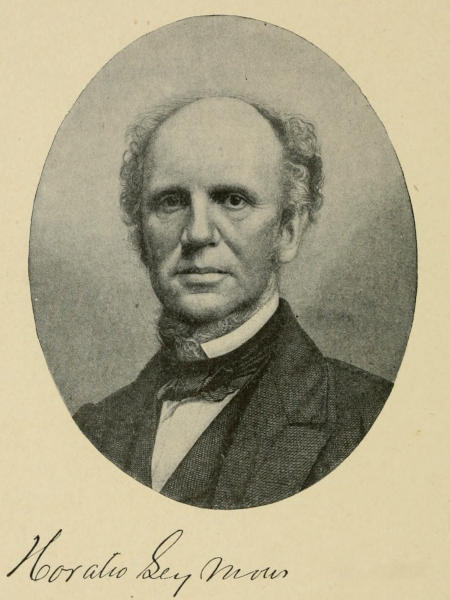
A HISTORY OF THE AMERICAN PEOPLE — CHAPTER I RECONSTRUCTION
Mr. Lincoln’s death made Mr. Johnson President.
The first tasks of peace were to be hardly less difficult
than the tasks of war had been; and the party which
had triumphed was left without executive leadership
at their very beginning. Mr. Johnson was a man who,
like Mr. Lincoln himself, had risen from very humble
origins to posts of trust and distinction; but his coarse
fibre had taken no polish, no refinement in the process.
He stopped neither to understand nor to persuade other
men, but struck forward with crude, uncompromising
force for his object, attempting mastery without wisdom
or moderation. Wisdom of no common order was called
for in the tasks immediately before him. What effect
had the war wrought upon the federal system? What
was now the status of the States which had attempted
secession and been brought to terms only by two million
armed men sent into the field and the pouring out of
blood and treasure beyond all reckoning? Were they
again States of the Union, or had they forfeited their
statehood and become conquered provinces merely,
to be dealt with at the will of Congress? If conquered
possessions, how and when were they to be made States
once more and the old federal circle restored in its integrity?
Mr. Lincoln had made up his mind upon
these points with characteristic directness and simplicity.
So long ago as December, 1863, he had issued
a proclamation of amnesty in which he had treated
secession as a rebellion of individuals, not of States,
and had offered full forgetfulness and the restoration
of property and of citizenship to all who should take
oath to “support, protect, and defend the constitution
of the United States and the union of the States thereunder,”
and respect the action of the federal government
in the emancipation of the slaves. Some classes
of persons he excepted from the amnesty: those who
had taken a prominent and official part in secession
or who had left the service of the United States for the
service of the Confederacy; but he invited those who
would take the oath proposed to set up governments
once more and make ready to take part as of old in the
federal system, though they should number but one
tenth of the voters of 1860. The qualified voters of
Arkansas, Louisiana, and Tennessee had accepted these
terms before the war ended. Mr. Lincoln had fulfilled
his promise to them and given full recognition to the
new governments they set up, so far as the Executive
was concerned, as once more in their places in the
Union. He did not stop to discuss the question of the
lawyers, whether these States had been all the while in
the Union, despite their attempts at secession and their
acts of war against the federal government, or had for
a time been out of it; and declared that he thought that
merely an abstract inquiry, a question practically immaterial.
“We all agree that the seceded States, so
called, are out of their proper practical relation with the
Union,” he said, “and that the sole object of the government,
civil and military, in regard to those States
is to again get them into that proper practical relation.
I believe that it is not only possible, but in fact easier,
to do this without deciding or even considering whether
these States have been out of the Union, than with it.
Finding themselves safely at home, it would be utterly
immaterial whether they had ever been abroad.”
But Congress had not acquiesced in Mr. Lincoln’s
policy. Mr. Lincoln had been too much inclined, it
seemed to the leaders of the houses, to regard the
restoration of the southern States to their “proper practical
relation to the Union” as a matter to be settled by
the action of the Executive. The constitution made
each house the sole judge of the validity of elections to its
membership: Congress was at liberty, should it choose,
to exclude all southern members until it should itself
be satisfied with the process by which the States they
claimed to represent had been re-established upon their
old footing; and the temper of the congressional leaders
had grown more and more radical as the fortunes of
war had turned their doubt into hope, their hope into
triumphant confidence. At first they had been puzzled
how to read the law of the constitution in so unprecedented
a matter; but each victory in arms had seemed
to them to make it less necessary that they should read
it with subtlety. Success seemed to clear the way
for other considerations, of plainer dictate than the
law of the constitution. Turn the matter this way or
that, it seemed mere weakness to accord the southern
States their old place in the Union without exacting of
them something more than mere submission. Should
their social system be left untouched, their old life and
power given back to them to be used as before for the
perpetuation of political beliefs and domestic institutions
which had in fact lain at the heart of the war?
Opinion slowly gathered head to prevent any such
course. Something should be demanded of them which
should make them like the rest of the Union, not in
allegiance merely, but in principle and practice as well.
Mr. Lincoln had himself made it a condition precedent
to his recognition of the re-established liberties and
allegiance of those southerners whom he was ready
to permit to bring their States into proper practical
relation with the Union again that the laws of the
rehabilitated governments should “recognize and declare
the permanent freedom” of the negroes and provide
for their education; no one, North or South, dreamed
that slavery was to be set up again. But every man
mistook his feeling for principle in that day of heat,
and Mr. Lincoln’s cool, judicial tone and purpose in
affairs was deeply disquieting to all who loved drastic
action. The solemn, sweet-tempered sentences with
which his second inaugural address had closed seemed
themselves of bad omen to high-strung men. “With
malice towards none; with charity for all; with firmness
in the right, as God gives us to see the right, let
us strive on to finish the work we are in; to bind up the
nation’s wounds; ... to do all which may achieve
and cherish a just and lasting peace among ourselves,
and with all nations.” In the proclamation in which
he had called upon all who were willing to return to
their allegiance in the South to reconstruct their governments
he had promised that, as President, he would
object to no temporary legislation which should deal
in exceptional fashion with the negroes “as a laboring,
landless, homeless class” for a little while under tutelage,
provided only their substantial freedom should be
recognized and their ultimate elevation by education
provided for. There was in all this entirely too much
consideration for the southern people to suit the views of
ordinary partisans. An opposition gathered head against
Mr. Lincoln which it seemed likely even his tact, his
genius for leadership and conciliation, his authority in
that day of his final prestige could not overcome.
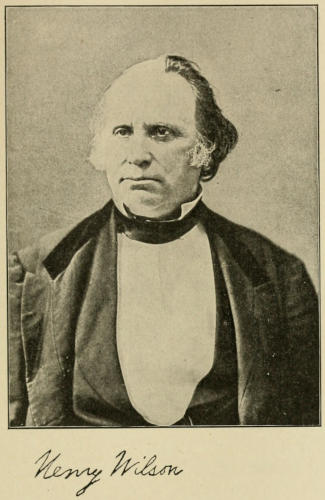
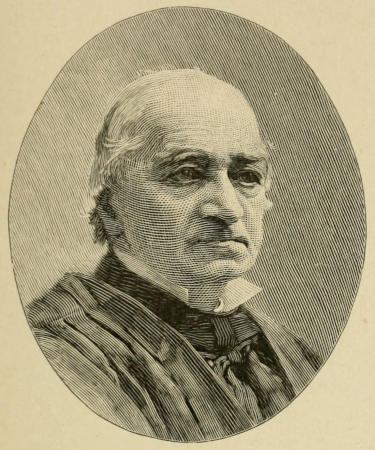
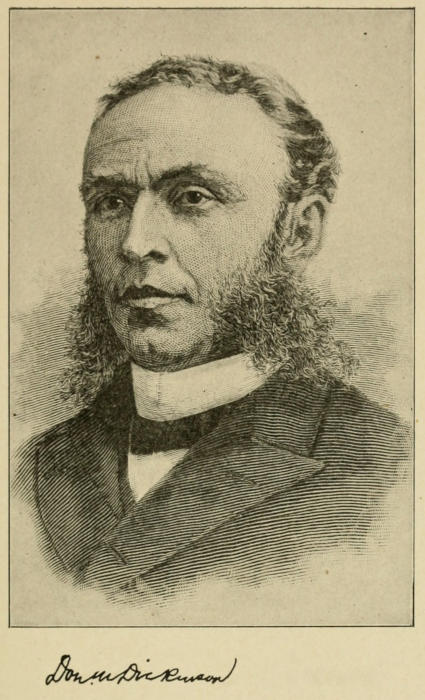
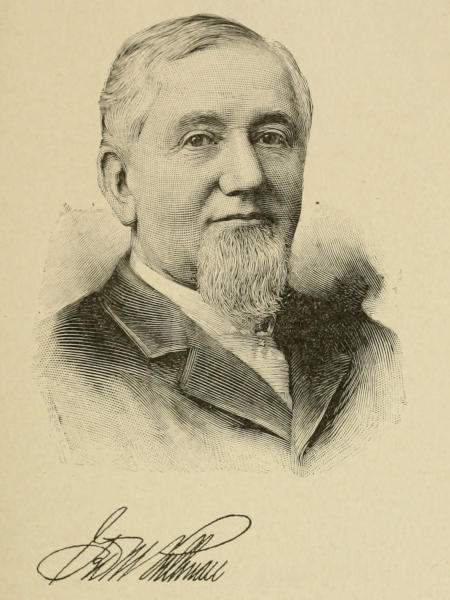
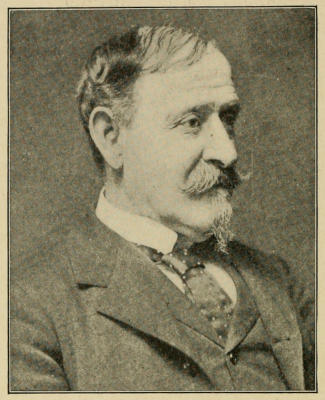
HENRY WILSON
Men of many minds and of all morals were arrayed
against him: the philanthropist and the reformer, who
saw the Rights of Man involved, the statesman who
wished to see the ground once for all cleared of every
matter of risk and controversy, the politician who was
keen to gain the utmost advantage for his party, the
vindictive bigot who wished to weak exemplary vengeance
on the slaveholding rebels. To many of these
nothing was so exasperating as moderation,—moderation
in a day of absolute triumph, when every fruit of
conquest they chose to stretch out their hands and
pluck was within their easy reach. It was not an air
in which to judge calmly. Four years of doubt and
fear and struggle had wrought every sentiment, good
or bad, to the pitch of ecstasy. A radical course of
reconstruction in the South had come to look like the
mere path of duty,—of duty not to opinion only but
to mankind as well. Men of imagination felt every
moment of action dramatic, full of consequence, and
grew self-conscious, each as it were with a touch of
the emotional actor, in what they did. The extraordinary
strain and tension of feeling in the houses
of Congress was perceptible to mere lookers on in the
galleries. It had been notably manifest when the
House of Representatives agreed, on the last day of
January, 1865, to an amendment of the constitution
formally abolishing slavery in the very terms of the
Wilmot proviso, and the celebrated Ordinance of 1787
upon which so much bitter history had turned. The
Senate had proposed the amendment, the Thirteenth
it was to be,—the first change in the constitution proposed
since 1803,—ten months before, on the 8th of
April, 1864; but the necessary two-thirds vote had
been lacking then in the House and it had been laid
aside. When it came a second time to the vote a deathly
stillness prevailed in the House while the roll call proceeded,
until it became evident that the requisite majority
was secured. Then members of the House itself broke
through all restraint and joined in the great shout of
joy that went up from the packed galleries, and embraced
one another, with tears streaming down their
cheeks, to see that prayed for end come at last. Men
dreamed, as they had dreamed in the Constituent Assembly
of France, that they had that day seen a new
nation born, a new era ushered in.
Congress had already abolished slavery in the District
of Columbia, prohibited slavery in the Territories,
repealed the Fugitive Slave Law, and bestowed freedom
upon the negroes who had served in the federal armies.
The amendment was to complete the work of emancipation,
and make the results of the war once for all safe
against reaction. The votes of the southern States
were necessary to make up the three-fourths vote of
the States required to ratify the amendment. Those
which accepted Mr. Lincoln’s terms of rehabilitation
ratified it without hesitation: no one doubted that a
condition precedent to the final closing of the long strife
that had rent the Union; and on the 18th of December,
1865, it was proclaimed an integral part of the law of
the constitution.
But there were men in Congress, true spokesmen of
thousands of men out-of-doors, thoughtful and thoughtless,
with consciences and without, who meant to go
much further. By some means they meant to thrust
their hands into southern affairs to control them, to
make good the freedom and the privilege of the negroes
even at the cost of all privilege to those who had been
their masters. To some such a course seemed a mere
dictate of humanity: the nation owed it to the negro
that he should be supported by the federal power until
he was able to make his freedom good for himself, unassisted.
To others it seemed but the plain way of
prudence in statesmanship. How else could a lasting
structure of law be built about the new citizenship of
the one-time slave: how else could he be kept safe from
the intellectual and even physical domination of the
white men who once had owned him? To others it
was the course of personal satisfaction: in no other
way could they bring upon the spirits of southern men
the punishment merited by their rebellion. To others
it was the obvious means of party mastery. These
last it was who, when Mr. Lincoln was gone, ruled
Congress, the masters of party strategy,—as clear of
their motive as Samuel Adams, as astute to veil it upon
occasion: masters always by consistent and aggressive
force of purpose.
The party they spoke for was not one of the historic
parties of the Union. It was the child of the slavery
contest. It had come into existence, an odd mixture
of Whigs, Democrats, Free Soilers, Anti-Nebraska
men, to prevent the spread of slavery into the Territories,
and had come into power with a programme
which spoke, indeed, of other matters, with a tone which
was chiefly the tone of the older Whigs, but which carried
as its chief, its creative principle that single matter
of the restriction of the slave power. It was without
record or tradition of ordinary service in times of normal
life and growth. Its single task had been war for the
preservation of the Union. It could not of a sudden
get the temper of that task out of its thoughts; conciliation
it had never learned; compromise and accommodation
seemed to it bad things of a past age when
men were not bold for the right. Mr. Thaddeus Stevens,
of Pennsylvania, was the real leader of the House.
He had come slowly to his final view of what should
be done, acted upon by the times and the confused voices
of counsel about him, as every man was in that shifting
air, but he had reached conclusions at last which he
spoke with callous frankness. In his judgment, he
said, the southern States “ought never to be recognized
as capable of acting in the Union, or of being recognized
as valid states, until the Constitution should have been
so amended as to make it what its makers intended,
and so as to secure perpetual ascendency to the party
of the Union.” The perpetual ascendency of his party
was, in his programme, to be the guarantee of the safe
reconstruction of the southern governments.
The events of the memorable summer of 1865 had
hardened his temper to that view. At first Mr. Johnson
had seemed to the radical leaders of Congress a man
to their own mind. His origin, his character, his place
of leadership among the southern men who had doggedly
set themselves against secession, had made him a fit
instrument of radical action. He came of plebeian
stock; had risen, not by address, but by blunt force
of character, from among the humbler whites who
owned no slaves, boasted no privilege, had no initiative
voice in affairs; and had flung himself on the side of
the Union as much out of antagonism to the men who
played the parts of leadership in secession as out of
principle. It was “a rich man’s war,” he said, “but
a poor man’s fight”; and he, for one, would not fight
for the behoof of the rich planters who assumed the
mastery in such a struggle. A “Democrat” he was
still, by cast and nature committed to the elder doctrines
of the Jeffersonian creed, which exalted the common
man and knew no rank or privilege of class; but a Democrat
for the Union. He had been put upon the presidential
ticket with Mr. Lincoln because upon every
question that touched the war the Republican leaders
had wished to keep men of all opinions upon other matters
of policy united behind Mr. Lincoln. His short
and heavy figure, his rugged, swarthy face, bespoke
him a man as strong, as indomitable as Stephen Douglas,
for all he lacked Douglas’s charm and had no gift
of persuasion.
Mr. Lincoln had trusted him, and he had justified the
confidence reposed in him, not indeed by wisdom, but
by resolute, consistent, efficient action. When the war
came he was one of the senators from Tennessee, and
kept his post, ignoring the secession of his State.
When his term as senator was ended Tennessee was
in the hands of the federal troops, and Mr. Lincoln
commissioned him military governor of the State, to
bring it again into “proper practical relation to the
Union” in accordance with the Executive’s plan of reconstruction.
Like every man, untouched with greatness,
who has stood out against his own people in matters
that have been carried the length of civil war, there
was a dash of bitterness in Mr. Johnson’s attitude and
action in affairs. The first words he uttered as President
showed with what spirit he meant to use his new
power. “The American people,” he said, “must be
taught to know and understand that treason is a crime....
It must not be regarded as a mere difference of
political opinion. It must not be excused as an unsuccessful
rebellion, to be overlooked and forgiven.”
The Committee on the Conduct of the War, to which
Congress had throughout the stress of the fighting
intrusted the shaping of its business, called upon him
the day following his assumption of the presidency,
and took heart to believe after their interview with him
that they might count upon such executive action as
radicals would relish,—that they were once for all rid
of the mild counsels of Mr. Lincoln. “Johnson, we
have faith in you,” cried Mr. Benjamin Wade, the radical
leader of the Senate. “By the gods! there will be no
trouble now in running the government.”
But a few weeks changed the whole aspect of affairs.
Mr. Johnson retained Mr. Lincoln’s cabinet unchanged.
More than that, he kept to the plans Mr. Lincoln had
made. Perhaps his judgment was cleared by sudden
access of responsibility; no doubt his knowledge of
the southern people enabled him to see, more clearly
even than Mr. Lincoln had seen, the healing and beneficent
effects of a plan of reconstruction which should
make as little of the antagonism and as much of the
community of interest between the sections as possible:
for he acted upon experience, Mr. Lincoln only upon
the instinct of a natural leader of men. No doubt men
whom he trusted gave him moderate counsel and instructed
his will. Whatever the forces that ruled him,
he proved at once that he meant to take no radical course
of his own, but would follow in Mr. Lincoln’s footsteps.
On the 29th of May he issued his own proclamation
of amnesty. Its terms were substantially the terms
of Mr. Lincoln’s proclamation of 1863. The list of
those excluded for the time being was a little extended.
Besides persons still prisoners of war, those who had
“held the pretended offices of governors of States in
insurrection against the United States,” graduates of
the military and naval academies who had been officers
in the confederate service, those who had engaged in
the destruction of the commerce of the United States
in aid of the Confederacy,—whom Mr. Lincoln had
not specifically included in his catalogue of exclusions,—he
added, as if to please himself and satisfy his instinct
of class, all participants in secession whose taxable
property exceeded twenty thousand dollars in value.
But even to those thus specifically excepted he promised
to extend clemency upon very liberal terms, if they
would make personal application for it, dealing with
them in as generous a manner as might seem “consistent
with the facts of the case and the peace and
dignity of the United States.”
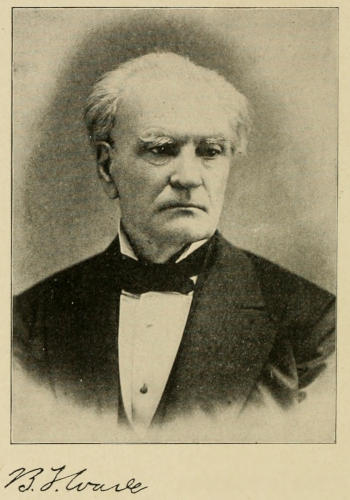
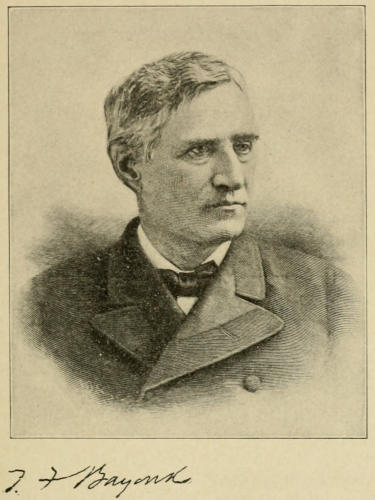
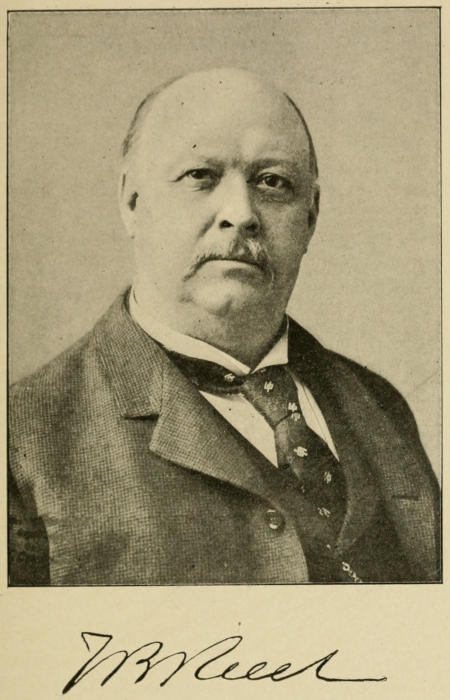
BENJAMIN FRANKLIN WADE
It was his plan, as it had been Mr. Lincoln’s, to set
up new governments in the South by as simple and
expeditious a process as possible. He knew as well
as any man the practical details of what Mr. Lincoln
had meant to do, for he had himself been Mr. Lincoln’s
agent in putting his plan of reconstruction
into execution in Tennessee. Each State was to have a
provisional governor, appointed by the President, who
should be authorized to summon a constitutional convention,
to be chosen under its old laws of suffrage by
such of the voters of the State as would take the unqualified
oath of submission and allegiance prescribed
by the proclamation of amnesty. It had been Mr.
Lincoln’s wish to include among the voters such freedmen
as could read and write and those who had served
in the federal armies; Mr. Johnson confined his view
to the white men qualified under the laws of their States
as they had stood in the spring of 1861. Conventions
made up of and selected by those who were willing
and were permitted to take the oath offered were to
be given full power to recast their state constitutions
and set their state governments in order for the final
withdrawal of the federal troops and the federal superintendence,
provided only that the voters actually enrolled
should number at least one tenth of the total number
shown upon the rolls of 1861. The persons explicitly
excluded from taking the oath and participating in the
reconstitution of the southern governments,—those who
had been the leading spirits and chief agents of the
Confederacy, whether in counsel or in action,—were, of
course, the leading men of the South. Almost no one
could take the oath of amnesty except men of the rank
and file, the men who had not been slaveholders, who
had fought in the armies of the Confederacy but who
had had no part except the part of mere acquiescence
in bringing the war on,—the men of little property and
no leading part in affairs from whose ranks Mr. Johnson
himself had sprung. His added exclusion of all participants
in secession who owned property valued at
more than twenty thousand dollars made it the more
certain that it should be a reconstruction by the third
estate, and not by the old leaders of opinion. He had
the greater heart and interest on that account to see
the plan succeed.
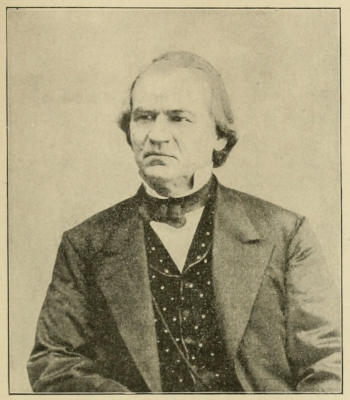
ANDREW JOHNSON
He had come into office at the beginning of the long
congressional recess. The term of the Congress chosen
in 1862 had expired on the 4th of March; the Congress
chosen in the autumn of 1864 was not to come together
until December. He had eight months before him in
which to act without congressional interference. He
was urged to call the houses together in extraordinary
session and take counsel with them what should be
done; but he refused to do so. He wished to act without
restraint. He had no more doubt than Mr. Lincoln
had had that the process of reconstruction, so far as it
concerned the reorganization of the southern governments,
was the function and the duty of the Executive,
whose power of pardon covered every offence committed
against the Union upon which Congress had not passed
sentence of impeachment. It rested with Congress,
he knew, to determine for itself whether it would receive
the senators and representatives chosen under the
governments which the President should authorize
the southern conventions to set up; but the erection
and recognition of those governments he conceived
to be his own unquestionable constitutional prerogative.
He filled the year, therefore, to the utmost with
action and the rehabilitation of States. By the autumn
every State of the one-time Confederacy had acted under
his proclamation, had set up a new government, had
formally agreed to the emancipation of the negroes,
and had chosen senators and representatives ready to
take their seats the moment Congress should admit
them. Eleven of them had in due form adopted the
Thirteenth Amendment, and their votes had been
counted in its ratification.
But other things had happened which had touched
Congress quite as nearly as these processes of reconstruction,
and the houses came together in December in
no temper either to accept Mr. Johnson’s leadership or to
admit the southern members who had come to Washington
under his patronage. Critical matters touching the
negroes had put opinion in the North in a mood to insist
on radical measures of legislation in behalf of the helpless
multitudes whom the war had set free. Had there
been no question what should be done with the negroes,
all might have gone smoothly enough, whether the
leaders of Congress and of opinion liked the readmission
of the southerners to their place and privilege in the
general government or not. But there was much more
to be done, as it seemed to the radicals who now stood
at the front of counsel, than merely to determine the
processes by which the governments of the southern
States were to be formally reconstituted and made safe
within the Union: and it was no doubt necessary to
do what was to be done before admitting southern men
to Congress, where their presence would reduce the
Republican majorities from absolute mastery to mere
preponderance. They were but “whitewashed rebels,”
at best, and in nothing showed their unchanged temper
more clearly than in their treatment of the freedmen.
That, in the view of the radicals, was the crux of the
whole matter; and they had the pity and the humane
feeling of the whole country on their side.
They did not deem the southerners safe friends of the
freed slaves. They had not noted how quiet, how unexcited,
how faithful and steady at their accustomed
tasks, how devoted in the service of their masters the
great mass of the negro people had remained amidst
the very storm and upheaval of war; they had noted
only how thousands had crowded into their camps as
the armies advanced and plantations were laid waste,
homes emptied of their inmates; and how every federal
commander had had to lead in his train as he moved
a dusky host of pitiful refugees. It was a mere act of
imperative mercy to care in some sort for the helpless
creatures, to give them food, if nothing else, out of the
army’s stores; and yet to feed them was but to increase
their numbers, as the news of bread without work spread
through the country-sides. When the fighting neared
its end, and it was likely that the whole South would
be in the hands of the federal commanders through
a long season of unsettled affairs, it became obviously
necessary that, for a time at least, Congress should
take the negroes under the direct supervision and care
of the government. On the 3d of March, 1865, therefore,
while Mr. Lincoln still lived, an Act had been passed
which created in the War Department a “Bureau of
Refugees, Freedmen, and Abandoned Lands,” whose
powers were most elastic and paternal. It was in every
way to succor the negroes: to supply their physical
needs when necessary, to act as their representative
and guardian in finding employment and making
labor contracts, to settle labor disputes and act as the
next friend of negro litigants in all trials and suits at
law, to lease to them tracts of abandoned land temporarily
in the hands of the government because of
the removal or disappearance or technical outlawry
of their white owners,—in all things to supply them
with privilege and protection.
It was such aid and providential succor the negroes
had ignorantly looked for as the news and vision of
emancipation spread amongst them with the progress
of the war. They had dreamed that the blue-coated
armies which stormed slowly southward were bringing
them, not freedom only, but largess of fortune as well;
and now their dream seemed fulfilled. The government
would find land for them, would feed them and
give them clothes. It would find work for them, but
it did not seem to matter whether work was found or
not: they would be taken care of. They had the easy
faith, the simplicity, the idle hopes, the inexperience
of children. Their masterless, homeless freedom made
them the more pitiable, the more dependent, because
under slavery they had been shielded, the weak and
incompetent with the strong and capable; had never
learned independence or the rough buffets of freedom.
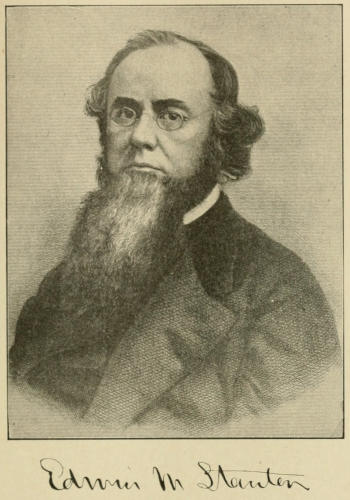
EDWIN McMASTERS STANTON
The southern legislatures which Mr. Johnson authorized
set up saw the need for action no less than
Congress did. It was a menace to society itself that
the negroes should thus of a sudden be set free and
left without tutelage or restraint. Some stayed very
quietly by their old masters and gave no trouble; but
most yielded, as was to have been expected, to the novel
impulse and excitement of freedom and made their
way straight to the camps and cities, where the blue-coated
soldiers were, and the agents of the Freedmen’s
Bureau. The country filled with vagrants, looking
for pleasure and gratuitous fortune. Idleness bred
want, as always, and the vagrants turned thieves or
importunate beggars. The tasks of ordinary labor
stood untouched; the idlers grew insolent, dangerous;
nights went anxiously by, for fear of riot and incendiary
fire. It was imperatively necessary that something
should be done, if only to bring order again and make
the streets of the towns and the highways of the country-sides
safe to those who went about their tasks.
The southern legislatures, therefore, promptly undertook
remedies of their own,—such remedies as English legislators
had been familiar with time out of mind.
The vagrants, it was enacted, should be bound out
to compulsory labor; and all who would not work must
be treated as vagrants. Written contracts of labor
were required, and current rates of wages were prescribed.
Those who did not enter into formal contracts
for regular employment were obliged to obtain licenses
for their trades and occupations from the magistrates
or the police authorities of their places of labor, under
the penalty of falling under the law of vagrancy. Minor
negroes were to be put under masters by articles of
apprenticeship. Negroes were forbidden, upon pain of
arrest by a vigilant patrol, to be abroad after the ringing
of the curfew at nine o’clock, without written permission
from their employers. Fines were ordered for
a numerous list of the more annoying minor offences
likely to be committed by the freedmen, and it was directed
that those who could not pay the fines should be
hired out to labor by judicial process. There was no
concert or uniformity between State and State in the
measures adopted: some were more harsh and radical
than others. Each State acted according to the apparent
exigencies and circumstances of its own people. Where
the negroes mustered in largest numbers, as in South
Carolina, where they outnumbered the whites, restriction
was, of course, pushed farthest and the most
thorough-going legal tutelage for the freedmen attempted.
Where their numbers were more manageable,
where conditions were more favorable, their freedom
of movement and of occupation was less interfered
with.
There was nothing unprecedented in such legislation,
even where it went farthest. The greater part of it
was paralleled by statutes of labor and vagrancy still
to be found on the statute books of several of the northern
States. But it was impossible it should stand in the
same light. The labor and vagrancy laws of Maine,
Rhode Island, and Connecticut, which they most resembled,
were uttered against a few tramps and beggars,
here and there a runaway servant or apprentice, an
occasional breach of duties regularly contracted for;
while these new laws of the South were uttered against
an entire race, but just now emancipated. Whatever
their justification, it was inevitable that they should
shock the sentiment of the North and make new and
bitter enemies for the South in Congress. It was no
ordinary time of action, when matters could be judged
coolly and on their merits. For the leaders of Congress
it was unpalatable enough that the southern States
should have legislatures at all, upon a plan made and
executed without conference with them; that those
legislatures should thus undo the work of emancipation
seemed a thing intolerable. And the new legislation
seemed to them nothing less than that. It seemed
to them merely an effort to substitute compulsory contracts
of service and fixed rates of wages for the older
rights of control and duties of support which custom
had vouchsafed and assigned masters of slaves,—a
sort of involuntary servitude by judicial process and
under the forms of contract. They did not stop to consider
the pressing necessity or the extraordinary circumstances
which justified such legislation. There
were many theories held among them as to the legal
powers and remaining rights of the southern States,
but their purpose of mastery in the readjustment of
southern affairs was not materially affected by their
differing theories. They in effect regarded the southern
States as conquered provinces, and looked upon emancipation
as the main fruit of conquest. To make that
emancipation good was only to secure the conquest
itself. The negro had got a veritable apotheosis in
the minds of northern men by the processes of the war.
Those who had sent their sons to the field of battle to
die in order that he might be free could but regard him
as the innocent victim of circumstances, a creature
who needed only liberty to make him a man; could but
regard any further attempt on the part of his one-time
masters to restrain him as mere vindictive defiance.
They did not look into the facts: they let their sentiment
and their sense of power dictate their thought and
purpose.
Neither was it any part of the case, so far as they and
their leaders in Congress were concerned, that the restrictive
legislation which they so bitterly resented had
been practically without effect, because virtually set
aside by the action of the Freedmen’s Bureau. Everywhere
throughout the South agents of the Bureau practically
made the law which should in fact govern the
negro and determine his relation to his employer. It
was a Bureau of the War Department; its head was a
general of the army; and its agents were for the most
part army officers. In many instances they were men
of fine purpose and unimpeachable integrity, manly
and anxious to do what was right and just to all concerned;
but in many other instances they were men
of petty temper, fond of using arbitrary power very
masterfully, and glad upon occasion to use it for the
utter humiliation of the southern white men with whom
they dealt. Sometimes they were actually corrupt, and
apt at every practice which promised them either added
authority or private gain. Their powers, under the
Act of Congress, were in effect unlimited. They interfered
with the processes of the courts; constituted
themselves judges of every matter, whether of law or
policy, that affected the negroes; made contracts for
them and released them from their obligations at will;
prescribed the services they should render and the wages
they should receive; ignored and set at naught every
provision of state law which touched the action or the
privileges of the freedmen; and, for good or ill, to fulfil
their duty or to please themselves, were masters of the
situation.
But that was what the congressional leaders had
planned and expected. It did not lessen their irritation
that the southern legislators had been in large part
unsuccessful in what they had attempted to do. When
at last the long recess was over, therefore, and the houses
once more assembled (December 4, 1865), it at once
became evident that they had come together in a mood
to insist upon their own way of settling southern affairs.
The names of all the States that had seceded were omitted
in the roll call. As soon as possible after the organization
of the House, a joint committee of fifteen, consisting
of nine representatives and six senators, was set up
to take charge of the business of the houses in the matter
of reconstruction. It was commissioned to make
thorough inquiry into the condition of affairs at the
South and to advise Congress what action it should
take with regard to the readmission of the southern
States to representation. There was no need that
it should be in haste to report. The houses had already
in effect adopted the view of Mr. Thaddeus
Stevens: that the secession of the southern States had
suspended all federal law, whether of the constitution
or of statute, so far as they were concerned; that only
the law-making and war-making branch of the federal
government, the Congress itself, could authoritatively
declare that law in force again; and that it might and
should refuse to do so until itself satisfied of the absolute
submission and unqualified obedience of the rebellious
communities. There was every reason, if the President
meant to stand in its way, why Congress should keep
for the present its omnipotent party majorities. Each
house, as it stood, had a Republican majority large
enough, and compact enough, if it came to a struggle
with the President, to override any veto he might venture
to interpose to check its action. Should the southern
States be readmitted to representation as they stood,
under the President’s reconstruction, they would quite
certainly send Democratic members to swell the ranks
of the party which had, in its convention of 1864, declared
the war a failure, and would rob the war party of its
predominance. For they must be accorded an increased
representation. The slaves, now that they were free,
must all be counted in apportioning representation;
and yet the whites only would vote. It was that view
of the future of party politics that had led Mr. Sumner
to declare, even before the actual struggle of the war
was over, that “the cause of human rights and of the
Union needed the ballots as well as the muskets of the
colored men”; and the leaders of the houses had no
mind to yield their complete power until they had won
their final ascendency.
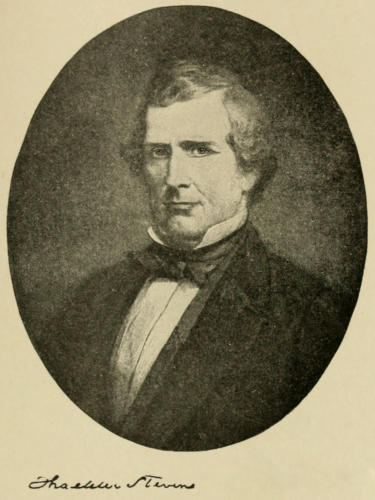
THADDEUS STEVENS
In February, 1866, their Committee on Reconstruction
safely in the saddle, they found themselves in direct
conflict with the President, and the fight for which
they had made ready begun. The Act of March, 1865,
which had established the Freedmen’s Bureau, had
limited its operation to one year. On the 6th of
February, 1866, a bill passed the houses continuing it
indefinitely, and at the same time largely increasing
its powers. It made any attempt to obstruct, interfere
with, or abridge the civil rights and immunities of the
freedmen a penal offence, to be adjudged and punished
by federal military tribunals. The President vetoed it.
He declared that he withheld his assent both because
the measure was calculated to increase the restlessness
and uneasiness of the negroes and delay their settlement
to a normal way of life, and because it had
been passed by a Congress in which the southern States
were not represented; and so joined issue directly with
the men who had set the houses in a way of mastery.
An attempt to pass the bill over his veto failed. The
full party vote was not yet at the command of the
radicals; some still held off from an open and final
breach with the President.
But not for long. The President was in a mood as
bitter and defiant as that of the extremest radical of
the congressional majority. By sheer rashness and intemperance
he forced the consolidation of the majority
against him. In a public speech uttered on the 22d
of February, an anniversary of hope and good omen,
he spoke of the majority in unmeasured terms of denunciation,
and of its leaders by name, as men who
themselves entertained some covert purpose of disloyalty
to the government, planning to make it a government,
not federal, but consolidated and unlimited
in power,—it might be even encouraging some criminal
deed against himself such as had once already removed
an obstacle from the path of their ambition. Accommodation
between himself and the houses was once
for all impossible. It was as if he had openly declared
war upon them; and their temper hardened to crush
him. Though the effort to pass the bill for the continuation
of the Freedmen’s Bureau had failed in the
Senate, the houses had in their very hour of failure
sent to the President and published to the country a
concurrent resolution in which they announced that
no senator or representative would be admitted from
any State held to have been in insurrection until Congress
had upon its own terms and initiative declared
it entitled to representation. Having heard his bitter
speech of the 22d, they moved forward to execute the
programme of their Committee on Reconstruction with
a new spirit of mastery.
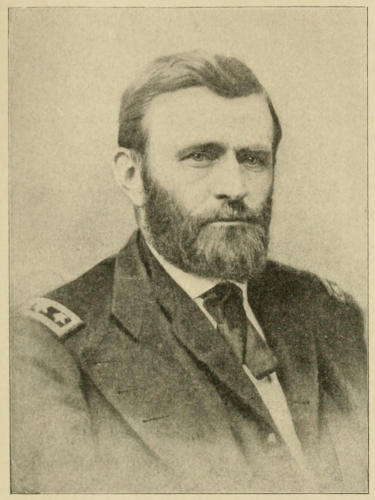
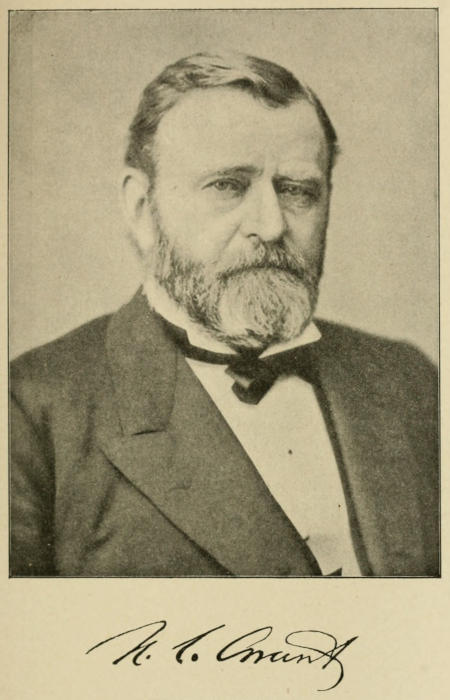
ULYSSES SIMPSON GRANT, ABOUT 1867
In March they sent to the President a “Civil Rights”
bill which declared “all persons born in the United
States, and not subject to any foreign power,” citizens
of the United States; denounced severe penalties against
interference with the civil rights of any class of citizens;
and gave to officers of the United States the right to
prosecute, to the courts of the United States the exclusive
right to try, all such offences,—meaning thus
to put the negroes upon a footing of civil equality with
the whites in the South. The President vetoed the
bill, as both unwise and in plain excess of the constitutional
powers of Congress. In April, the houses passed
it over his veto. The same month their Committee, as
if less confident of their constitutional ground than
of their parliamentary supremacy, submitted the draft
of a Fourteenth Amendment to the constitution which
should embody the principles of the Act in a form which
would give them unalterable validity. It conferred
citizenship in the terms of the bill the President had
rejected. In June Congress adopted the Amendment,
and it went to the States, with the understanding that
no southern State which did not accept it should be readmitted
to representation. Tennessee promptly adopted
it, and in July was formally reinstated in her “former
proper practical relation to the Union” by the admission
of her senators and representatives to Congress. Her
case stood apart from the rest. Ever since Mr. Lincoln’s
proclamation of 1863 was put into effect she had been
in process of reorganization. She had gone doubting
and divided into the Confederacy, more than half her
people, it might be, still staunchly minded to stand
by the Union. Her “Union men” had controlled the
process of reconstruction; and were heeded without
serious difficulty when they knocked for admission
into the houses. The other States, being as yet in
other hands, were obliged to wait.
The troubled year went uneasily upon every hand.
As the spring came on, and all the country saw how it
had come to an open breach between the President and
Congress, movements began on the Canadian frontier
which discovered a new disturbing element in international
politics. While the war lasted New York had become
the seat of the offices of a great society of Irishmen
whose purpose was revolution over sea and that
liberation of Ireland which Irishmen had ever prayed
for. Across the sea, in Ireland, it was an association
of peasants, not of politicians: it held a rank and file,
not of agitators, but of plain, unsophisticated, earnest
men on its rolls, men who might be taken to stand for
the mass of Irish Catholics. In America it grew strong
and drank of the spirit of war from the thousands of
Irish-American soldiers who served as enthusiastically
in the execution of its plans as in the battles for the
preservation of the Union. Servant girls, cab drivers,
porters, laborers on the railways filled its treasury
out of their scant earnings. “Fenian,” the name it
bore, was said to have been the name of the ancient
Celtic militia of the emerald isle from which no true
Irishman ever really tore his heart entirely away. Every
man who looked below the surface of affairs believed
that some day the secret of this great organization would
spring to light in some burst of revolution which would
shake Ireland with the rising of a whole people; and
the close of the war for the Union seemed the time it
had sought for a release of its power. Its first sally
was not in Ireland, but in America,—across the northern
border, against the English empire in Canada. It
proved a thing to smile at after it was over: a few hundred
men attempting a set invasion; a fort here and
there set upon by a handful of reckless adventurers;
quick defeat, repulse, dispersion. It was no slight
cause of irritation to Canada, none the less, and to the
English government over sea that these foolhardy foes
should come from the territory of a friendly power to
attempt their purpose. The government at Washington
seemed singularly indifferent; did little that was effective
to check the criminal business; was apparently
helpless against a handful of outlaws. A touch of
tragedy was added to the perplexities of politics.
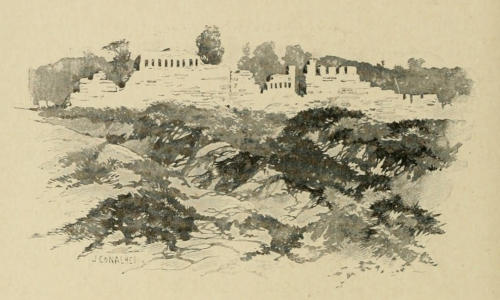
THE FENIAN RAID IN CANADA. RUINS OF FORT ERIE
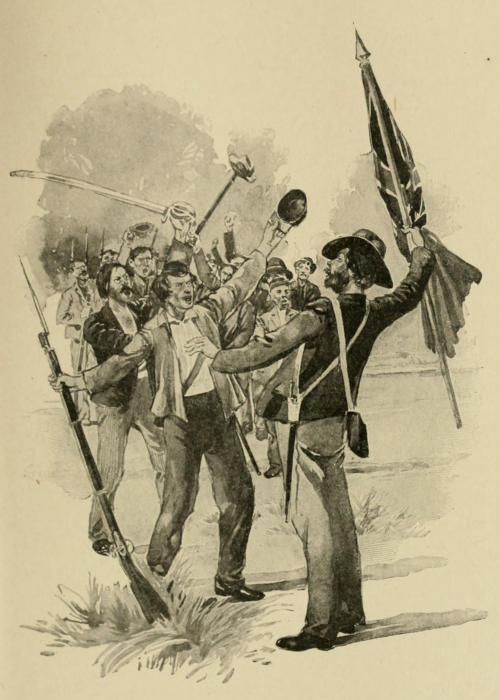
BRITISH FLAG CAPTURED BY THE FENIANS
There was tragedy enough in the domestic situation;
but it was a moral tragedy, not the tragedy of bloody
raids upon a peaceful border. It was impossible to
come to an understanding with Mr. Johnson. A more
moderate, more approachable, more sagacious, less
headstrong man might by conference have hit upon
some plan by which his differences with the leaders
in Congress would have been accommodated and at
least a modus vivendi devised. But to differ with Mr.
Johnson was to make an enemy of him, and Congress
had suspected him an opponent rather than a friend
from the first and was disinclined to seek accommodation.
His intemperate fashion of speech exaggerated
his views in the mere statement; he seemed a violent
partisan when he wished merely to enforce a conviction
or make a resolute purpose plain. Mr. Sumner
came away from an interview with him convinced
that he had spoken with a man who heartily despised
the entire North, felt a genuine contempt for
its sentiments, and meant to serve the South as entirely,
as openly, as illegally as Mr. Jefferson Davis
himself. What was quite as bad, the South itself
got wind of his partisan temper in its behalf, nursed
the false hope that it would be shielded by his
power, and deepened all the mischief by acting on
the hope.
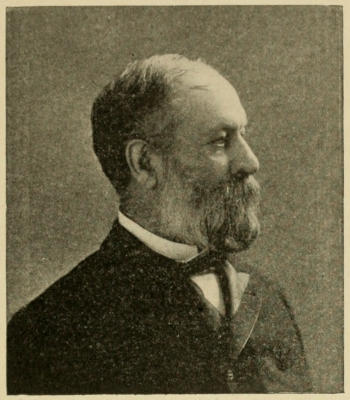
ULYSSES SIMPSON GRANT
It was no time at which to defy northern opinion and
strengthen the hands of Congress by resistance. The
autumn of the year was to bring another congressional
election, and the leaders of the Republican majority
in the houses would go to the country with a much
better chance of winning than the President could possibly
count upon in the equivocal position into which
he had got himself. In July the houses passed, over
the President’s veto, a bill which continued the Freedmen’s
Bureau for two years; provided for the sale of
public lands to the negroes on easy terms; appropriated
the property of the confederate government to their
education; and placed their civil rights under direct military
protection. On the 18th of June the Committee
on Reconstruction had made formal report of its views
upon the situation. It was the policy of Congress enforced
by reasons,—reasons which, it might be hoped,
would fortify the minds of members of Congress and
please the voters of the North in the coming contest.
It declared that the governments of the States recently
in secession were practically suspended, by reason both
of the irregular character of the new governments which
had been set up and of the reluctant acquiescence of
the southern people in the results of the war; and
that it was essential to the peace and sound policy
of the Union that they should not be reinstated in
their former privileges by Congress until they should
have given substantial pledges, such pledges as Congress
should demand, of their entire loyalty and submission.
With that appeal the houses went to the
country.
The friends of the President and of a moderate course
in affairs, both Democrats and Republicans, came together
in goodly numbers in convention, led by men
whom the country knew and had reason to trust, and
made a demonstration in favor of the policy which had
been Mr. Lincoln’s and which should be that of every
man who loved peace and sought accommodation;
and their action did not fail to make a considerable
impression everywhere upon those who could put passion
aside. But Mr. Johnson would not let quiet counsel
alone. Incapable of prudence, scornful of soft words,
a bitter hater, cast by nature for the rough contacts of
personal conflict and debate, he spoke to the country
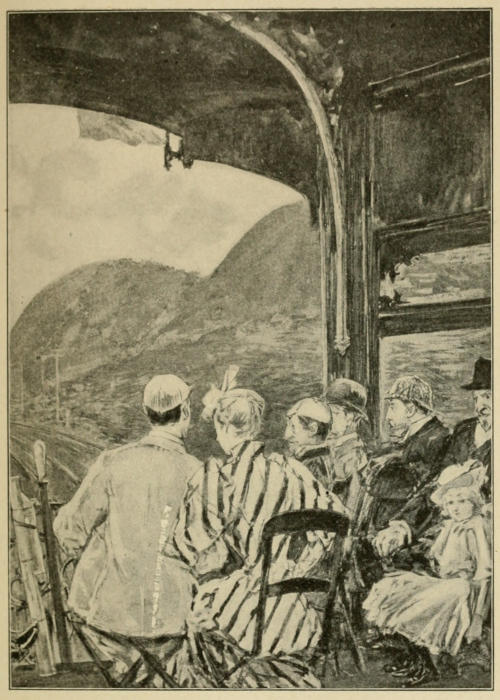
himself. At midsummer he made a journey to Chicago,
and at almost every stopping place where the people
crowded about his car he uttered, with that air of passion
which always went with what he said, invectives against
Congress so intemperate, so coarse, so hot with personal
feeling that those who heard him looked upon him as
almost a man distraught, thrown from his balance.
He, not the leaders of Congress, seemed the radical,
the apostle of passion; and his passion, men could say,
was against the Union, not for it. He had set himself,
his opponents declared, not to bring peace and restore
the government to its integrity, but to perpetuate discord
and cheat the party of the Union of its legitimate
power.
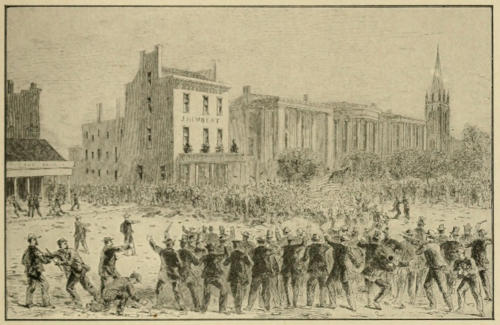
Two days after Congress adjourned (July 30, 1866)
a New Orleans mob broke up an irregular “constitutional
convention” of negroes and their partisans with
violence and bloodshed. In October the southern States,
as if taking their cue from the President, not from
Congress, began, one after the other, to reject the Fourteenth
Amendment; and every impression that had
been formed of reaction and recalcitrancy at the South
was confirmed. The result of the elections was a foregone
conclusion. A Republican majority was sent to
the House as overwhelming as that which dominated
the Congress about to expire; the Republican numbers
in the Senate were maintained. The houses came
together again in December heartened, resolute, triumphant,
ready to override the President with a policy
of Thorough which should put the fortunes of the South
entirely at their disposal.
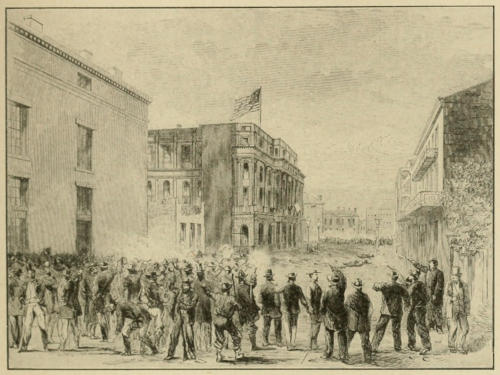
THE RIOT IN NEW ORLEANS. SIEGE AND ASSAULT ON THE CONVENTION
It was provided, by special Act, that the new Congress,
just chosen, should convene, not in the following
December, but on the 4th of March, 1867, in order that
there might be no long vacation in which the President
would be left free to exercise his independent authority.
Before the 4th of March came a Reconstruction Act
had passed through the slow fires of debate and become
law (March 2d) which embodied in their unmarred
integrity the radical plans of the joint committee of
fifteen. It provided that the States of the Confederacy,
with the exception of Tennessee, which had already
been permitted to adopt the Fourteenth Amendment
and resume its place in Congress, should be grouped
for purposes of government in five military districts,
under the command of five general officers of the army
to be appointed by the President. These military governors
were to control and direct the processes of reconstruction.
A temporary clause of the proposed Fourteenth
Amendment, which the southern States had
rejected, excluded from office, whether under the States
or under the federal government, at the pleasure of
Congress, all who had at any time or in any capacity,
civil or military, taken oath to support the constitution
of the United States and afterwards “engaged in insurrection
or rebellion” against it, “or given aid or
comfort to its enemies.” The military governors under
the Act were instructed to enroll in each State, under
oath, only such citizens of voting age and of one year’s
residence within the State as they should deem qualified
in accordance with the spirit of this prospective Amendment,
the negroes, of course, included. They were to
reject as voters all whom the proposed Amendment
disqualified for office. They were then to order and
hold in each State an election for delegates to a constitutional
convention, in which none but the voters on
their rolls should be allowed either to vote or to stand
for election. They were to direct the conventions thus
chosen to frame constitutions by which the elective
suffrage should be extended without distinction to all
classes of citizens included within the terms of the enrolment
already made; and were to submit the constitutions
thus framed to the same voters for ratification.
When adopted by the voters, the constitutions which
this plan of Thorough had brought into existence were
to be sent to Congress, through the President, for final
approval. Each State, it was agreed, whose constitution
Congress should approve was to be readmitted
to representation so soon as its legislature had ratified
the Fourteenth Amendment. Meanwhile, its government
was to be deemed “provisional only, and in all
respects subject to the paramount authority of the United
States, at any time to abolish, control, or supersede
it.” The houses had already ordered, by resolution,
at their previous session, that the troops should be
kept at their stations in the South until Congress should
direct their recall. They now invested General Grant,
the General of the Army, with powers which made him,
and the army itself, practically independent of the
President. He was given sole authority to order the
removal or suspension of an officer, and military commanders
were explicitly excused from accepting the
opinion of any civil official of the government in the
construction of their powers.
THE RIOT IN NEW ORLEANS. STRUGGLE FOR THE FLAG
Many motives had governed the members of Congress
in the adoption of this extraordinary programme.
Some had allowed themselves to be driven to radical
courses by sheer bitter feeling against the President,
who insisted so intemperately upon a course more simple,
more moderate, more indulgent to the South; some
could reason in statesmanlike fashion enough upon
the premises of action, but could propose no alternative
plan which seemed practicable or likely to command
the support of the rank and file of their party; others
were party men, without pretence or refinement of view,
their whole temper hardened and embittered by the war
and all its unpalatable consequences, and were willing
to follow those who were frankly bent upon bringing
the South to utter humiliation and penitent submission.
Their leaders wished not only to give the negroes political
privilege but also to put the white men of the South,
for the nonce at any rate, under the negroes’ heels.
Every black voter, they cynically predicted, would
once for all become under such tutelage a Republican
voter, and the party which had conquered the South
would rule it. Men who looked more scrupulously to
their motives saw no way to withstand what they disapproved;
were themselves convinced that something
must be done to protect the helpless blacks; feared as
much as the radicals themselves to see the real leaders
of the South again in control; and, with misgivings not
a few, lent their aid to the revolutionary programme.
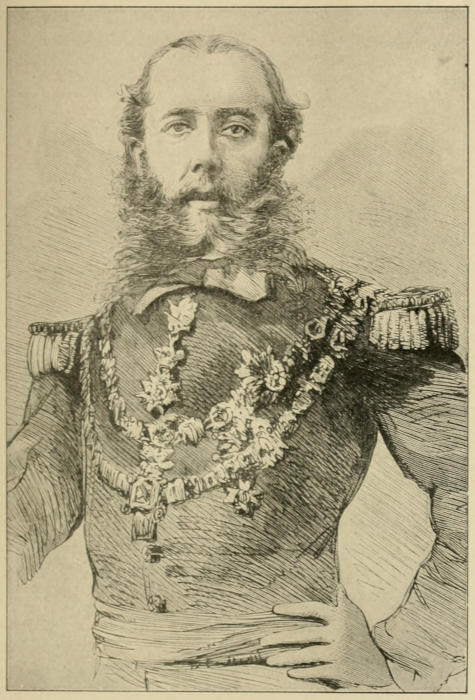
ARCHDUKE MAXIMILIAN
The same months that saw the drastic Act debated
and adopted witnessed a tragic revolution at the further
south in which the government at Washington also
played its part. While the war for the Union was being
fought, the emperor of France, looking to see that war
rack the United States to pieces, had sent troops into
Mexico and had set up a kingdom there for the Archduke
Maximilian of Austria. He had got his opportunity
in a way which had seemed for a time to make
other great powers of Europe his partners and allies in
the conquest. The closing days of the year 1857 had
brought political upheaval and sharp civil war upon
Mexico, which had resulted within two years in making
Juarez, a Zapoteca Indian of singular capacity, master
of the country. Juarez had not only confiscated the
property of the church, but had also suspended by decree
the payment of foreign debts, the debt of the Mexican
nation itself included; and that decree had led, late in
1861, to a demonstration in force upon his coasts by the
three nations, England, France, and Spain, who were
Mexico’s principal creditors. England and Spain would
consent to do no more than was necessary to enforce
the just claims of their citizens, and Napoleon had agreed
to be governed by the terms of co-operation which they
prescribed: the seizure, it might be, of a custom house
or two, but no serious stroke against the sovereignty
of the country. From the first, nevertheless, he had
meant to disregard his engagements in the matter.
He had long dreamed of conquest there in the south,
and saw the time come now, as he thought, when he
need fear no enforcement of the Monroe doctrine against
him by the distracted government at the north. In
despite of protests, he sent an army of conquest to Mexico,
and, postponing open possession by France, put the
Archduke Maximilian in the usurped place of authority,
keeping his armies there to secure his throne and the
predominance of France. The government at Washington
protested but could do nothing more. The usurped
throne stood, the armies of France remained, until
the war for the Union closed and the hands of the President
were free. Then the protests from Washington
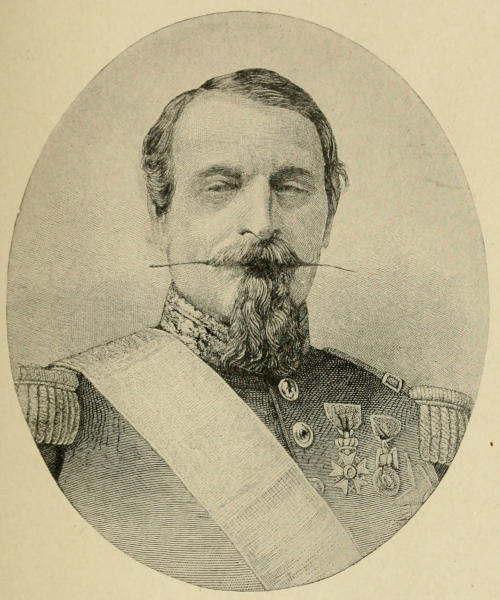
took another tone and meaning, which Louis Napoleon
was not self-deceived enough to suppose he could ignore.
American troops began to be massed in the neighborhood
of the Mexican frontier, near the familiar ground
of General Taylor’s movements twenty years before;
and the French government saw that it must yield.
The French troops were withdrawn, and Maximilian
was left to shape his fortunes alone. He was a man
of high spirit, not apt to yield upon any point of honor,
mindful of what he conceived to be his duty though
he mistook it: a man of character, resolved to stand
by his throne even though the French withdrew. The
resolution cost him his life. Though he gathered a
party about him, they were beaten by the partisans of
Juarez. He was court-martialled, condemned, and
shot. The melodramatic play which the histrionic
genius of Napoleon had planned turned out a genuine
tragedy, and a noble gentleman made a pitiful ending.
NAPOLEON III.
The same month that witnessed the withdrawal of
the troops of France from Mexico saw final arrangements
made for the withdrawal of Russia from the
Pacific coast of North America. On the 30th of March,
1867, a treaty was agreed upon between Mr. Seward
and the Russian minister at Washington for the sale
of Alaska to the United States for the sum of seven
million two hundred thousand dollars in gold. In
May the treaty was ratified; and in the following October
formal transfer of the great territory was effected. Mr.
Monroe had checked the movement of Russian power
southward upon the Pacific coast by his message of
1823, and in the forty odd years which had elapsed
since that notable announcement of the supremacy
of the United States in the western hemisphere the
government at St. Petersburg had grown very indifferent
to the retention of the bleak fragment of America
left in its hands,—so far away, so difficult, it might be,
of defence. Informal communications in regard to
its sale had passed between the two governments so
long ago as 1859. Russia was anxious to sell; and
the final purchase of 1867 was easily arranged for.
There was a certain dramatic consistency in the association
of the purchase of Alaska with the forced
“withdrawal” of the French from Mexico. They
stood together as logical consequences of the Monroe
doctrine, whose avowed object had been to keep the
American continents free from the control of European
monarchies.
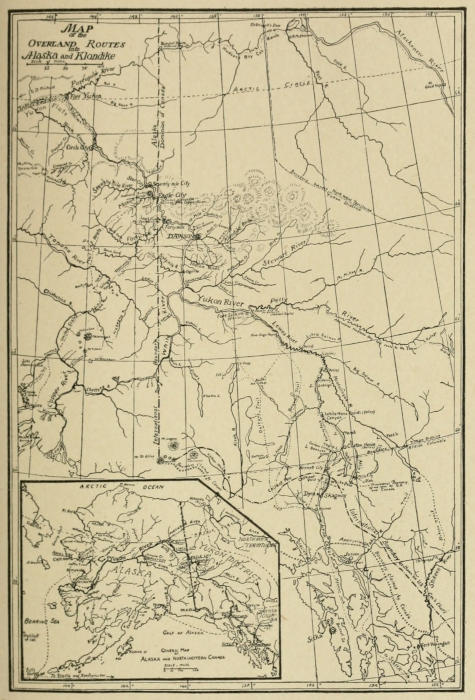
MAP OF ALASKA SHOWING THE GOLD-BEARING REGION
The deep effects wrought by Mr. Stevens’s policy
of Thorough in the southern States worked themselves
out more slowly than the tragedy in Mexico, but with
no less revolutionary force. Its operation brought on
as profound a social upheaval as its most extreme advocates
could have desired. The natural leaders of
the South either would not take the oath prescribed or
were excluded from the right to enroll themselves as
voters by the very terms of the Reconstruction Act.
The negroes were the chief voters. The conventions
which they chose and the governments which those
conventions set up were constituted to secure them power.
In Virginia, Mississippi, and Texas, after the conventions
had acted, the white voters rallied strong enough
at the polls, as it turned out, to defeat the constitutions
they had framed when they were submitted for
ratification; but they were only kept so much the longer
under military government, and were obliged to accept
them at last. In Georgia the new constitution was
adopted; but the statutes of the reconstituted State
debarred negroes from holding office, and Congress
would not admit her to representation so long as those
statutes stood unrepealed. In the Carolinas, in Florida,
in Alabama, Arkansas, and Louisiana nothing stayed
the execution of the congressional plan, and by midsummer,
1868, Congress was ready to readmit those
States to representation. But South Carolina, Louisiana,
and Florida were utterly given over in the process
to the government of adventurers.
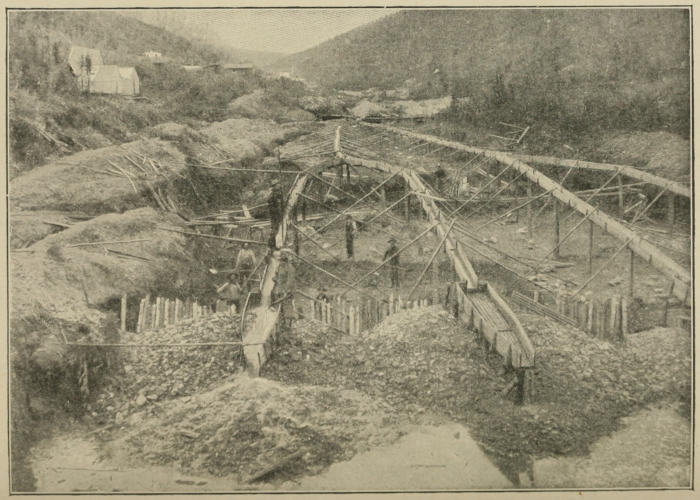
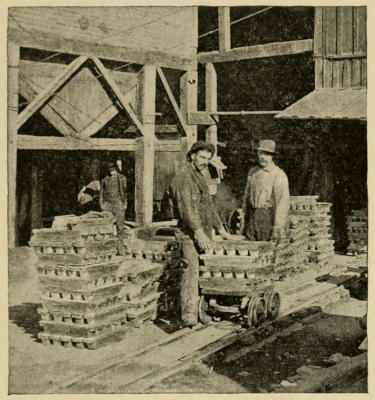
SLUICE-WASHING FOR GOLD IN THE KLONDIKE
Negroes constituted the majority of their electorates;
but political power gave them no advantage of their
own. Adventurers swarmed out of the North to cozen,
beguile, and use them. These men, mere “carpet
baggers” for the most part, who brought nothing with
them, and had nothing to bring, but a change of clothing
and their wits, became the new masters of the blacks.
They gained the confidence of the negroes, obtained
for themselves the more lucrative offices, and lived
upon the public treasury, public contracts, and their
easy control of affairs. For the negroes there was nothing
but occasional allotments of abandoned or forfeited
land, the pay of petty offices, a per diem allowance as
members of the conventions and the state legislatures
which their new masters made business for, or the wages
of servants in the various offices of administration.
Their ignorance and credulity made them easy dupes.
A petty favor, a slender stipend, a trifling perquisite,
a bit of poor land, a piece of money satisfied or silenced
them. It was enough, for the rest, to play upon their
passions. They were easily taught to hate the men
who had once held them in slavery, and to follow blindly
the political party which had brought on the war of
their emancipation.
There were soon lands enough and to spare out of
which to make small gifts to them without sacrifice of
gain on the part of their new masters. In Mississippi,
before the work of the carpet baggers was done, six
hundred and forty thousand acres of land had been
forfeited for taxes, twenty per cent. of the total acreage
of the State. The state tax levy for 1871 was four
times as great as the levy for 1869 had been; that for
1873 eight times as great; that for 1874 fourteen times.
The impoverished planters could not carry the intolerable
burden of taxes, and gave their lands up to be sold
by the sheriff. There were few who could buy. The
lands lay waste and neglected or were parcelled out at
nominal rates among the negroes. In South Carolina
the taxes of 1871 aggregated $2,000,000 as against a
total of $400,000 in 1860, though the taxable values of
the State were but $184,000,000 in 1871 and had been
$490,000,000 in 1860. There were soon lands to be
had for the asking wherever the tax gatherer of the
new governments had pressed his claims. The assessed
valuation of property in the city of New Orleans
sank, during the eight years of carpet-bag rule, from
$146,718,790 to $88,613,930. Four years and a half
of “reconstruction” cost Louisiana $106,020,337. The
demoralization of affairs in Louisiana had begun in
1862, when General Butler took possession of the city
of New Orleans. The rich spoils of the place had proved
too much for the principles of the men intrusted with
the management of her affairs in times when law was
silent; and the political adventurers who came out of
the North to take charge of the new government set
up under Mr. Stevens’s plan of reconstruction found
the work they had come to do already begun.
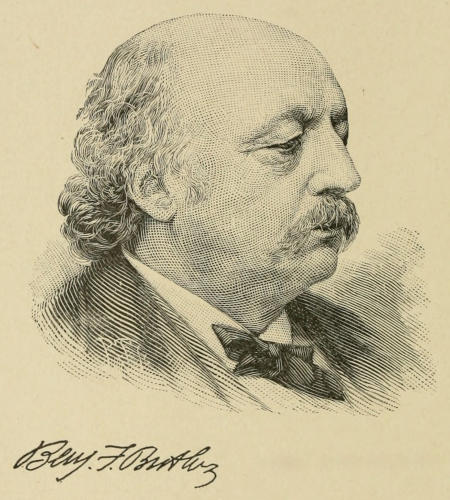
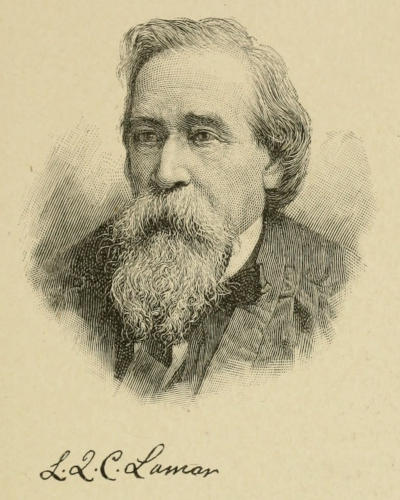
BENJAMIN FRANKLIN BUTLER
Taxes, of course, did not suffice. Enormous debts
were piled up to satisfy the adventurers. The cases
of Louisiana and South Carolina were no doubt the
worst, but other States suffered in proportion to the
opportunities they afforded for safe depredation. In
1868 the debt of South Carolina had been $5,000,000; in
1872 it was nearly $30,000,000. The debt of Louisiana
in 1868 had been between six and seven millions; in
1872 it was $50,000,000. Where the new rulers acted
with less assurance and immunity or with smaller
resources at hand, debts grew more slowly, but the
methods of spoliation were everywhere much the same;
and with the rise of debts went always the disappearance
of all assets wherewith to pay them. Treasuries were
swept clean. Immense grants were made in aid of
public works which were never completed, sometimes
not even begun. Railways were subsidized, and the
subsidies, by one device or another, converted into outright
gifts, which went into the pockets of those who
had procured them, not into the building or equipment
of the road. A vast burden of debt was piled up for
coming generations to carry; the present generation
was much too poor to pay anything.
The real figures of the ruin wrought no man could
get at. It was not to be expressed in state taxes or
state debts. The increase in the expenditure and indebtedness
of counties and towns, of school districts
and cities, represented an aggregate greater even than
that of the ruinous sums which had drained the treasuries
and mortgaged the resources of the governments
of the States; and men saw with their own eyes what
was going on at their own doors. What was afoot
at the capitals of their States they only read of in the
newspapers or heard retailed in the gossip of the street,
but the affairs of their own villages and country-sides
they saw corrupted, mismanaged, made base use of
under their very eyes. There the negroes themselves
were the office holders, men who could not so much
as write their names and who knew none of the uses
of authority except its insolence. It was there that
the policy of the congressional leaders wrought its
perfect work of fear, demoralization, disgust, and social
revolution.
No one who thought justly or tolerantly could think
that this veritable overthrow of civilization in the South
had been foreseen or desired by the men who had followed
Mr. Stevens and Mr. Wade and Mr. Morton in
their policy of rule or ruin. That handful of leaders it
was, however, hard to acquit of the charge of knowing
and intending the ruinous consequences of what they
had planned. They would take counsel of moderation
neither from northern men nor from southern. They
were proof against both fact and reason in their determination
to “put the white South under the heel of
the black South.” They did not know the region with
which they were dealing. Northern men who did know
it tried to inform them of its character and of the danger
and folly of what they were undertaking; but they refused
to be informed, did not care to know, were in any
case fixed upon the accomplishment of a single object.
Their colleagues, their followers, kept, many of them,
a cooler mind, a more prudent way of thought, but
could not withstand them. They, too, were ignorant
of the South. They saw but a little way into the future,
had no means of calculating what the effects of these
drastic measures would be upon the life and action of
the South, and lacked even the knowledge of mere
human nature which might have served them instead
of an acquaintance with the actual men they were dealing
with. They had not foreseen that to give the suffrage
to the negroes and withhold it from the more
capable white men would bestow political power, not
upon the negroes, but upon white adventurers, as much
the enemies of the one race as of the other. In that
day of passion, indeed, they had not stopped to speculate
what the effects would be. Their object had been to
give the negro political power in order that he might
defend his own rights, as voters everywhere else might
defend theirs. They had not recked of consequences;
for a little while they had not cared what they might be.
They had prepared the way for the ruin of the South,
but they had hardly planned to ruin it.
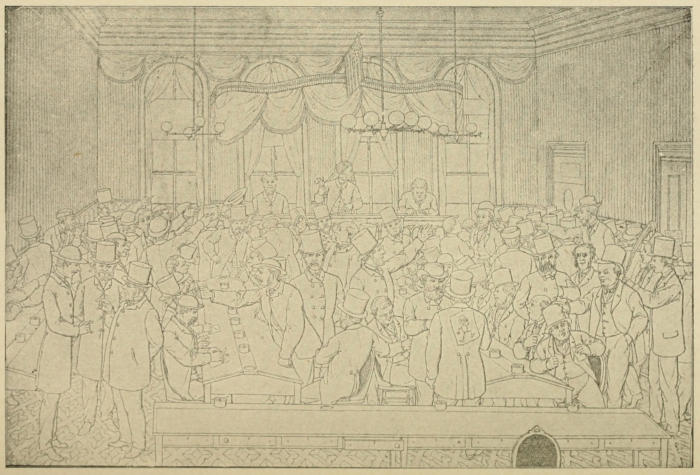
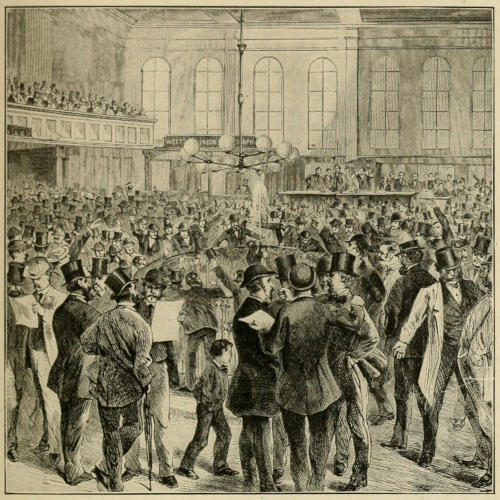
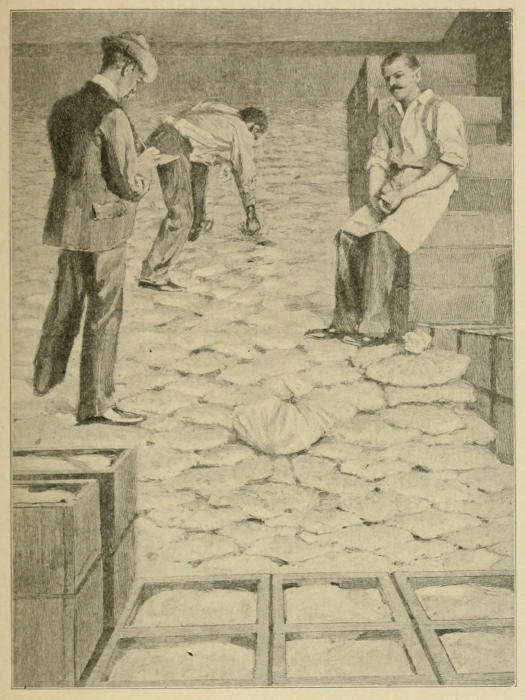
AN EXCITING DAY IN THE BOARD OF BROKERS, “ON THE RISE,” NEW YORK CITY, 1862
News of what was going on in the South was not
slow to make its way to the ears of the country at large;
but the editors of northern newspapers at first refused
to credit what they heard. Men dismissed the reports
with an easy laugh, as simply the South’s cry of exasperation
that the negro should have been given the
ballot and the power to rule. But incredulity grew
more and more difficult; the accounts of what was
going on grew more and more circumstantial; proof
came close upon the heels of rumor; and opinion
began to veer unsteadily. It shifted not only because
of the disquieting news that came from the South, but
also because of the desperate strain the government
itself was put to at Washington by reason of the open
breach and warfare between the President and Congress.
The masterful men who led the congressional
majority had not contented themselves with putting
such laws as they chose upon the statute books despite
the President’s vetoes; they had gone much further
and taken steps to make the President a mere figurehead
even in administration, and put themselves in
virtual control of the executive personnel of the government.
Along with the Reconstruction Act of 1867,
which placed the governments of the southern States
in their hands, they had forced through, over the President’s
veto, a Tenure of Office Act which deprived the
President of the power of removal from office except by
the advice and with the consent of the Senate. It gave
even to cabinet officers a fixed tenure of four years.
They could be dismissed within the four years of the
presidential term only by the consent of the Senate.
Here was a deliberate reversal of the constitutional
practice of more than two generations. The debates
of the first Congress under the constitution, the views
of the statesmen who had framed the law of the government,
the opinions of lawyers, the unbroken practice
of sixteen presidents had been thought to establish
beyond question the right of the chief magistrate to
remove federal administrative officials at his pleasure.
Congress, it seemed, was ready to override law and
precedent alike to make good its mastery.
Mr. Johnson was not the man to decline such a challenge.
After fighting the policy of Congress in matters
purely legislative with caustic vetoes and bitter condemnation
he was not likely to submit to have his very
powers of administration stripped away without resistance
carried to the utmost bounds. He had kept
Mr. Lincoln’s cabinet; but he had not relished the attitude
of one or two of its members towards him. It
had been hard enough for Mr. Lincoln, even, with his
shrewd and kindly insight into the real nature of the
man and his love for the sheer force and audacity with
which he administered his critical office in days almost
of revolution, to endure the wilful arrogance of Edwin
M. Stanton, the Secretary of War; it was quite impossible
for Mr. Johnson to endure it. It was something more
than wilfulness that Mr. Stanton showed in his relations
with Mr. Johnson. He became openly a partisan
of the radical leaders in Congress, and set himself to
defeat the President at his own council table. He administered
the affairs of his Department as if he considered
it an independent branch of the government;
carried out the instructions of the President with regard
to the South in a way to discredit as much as possible
the policy which they embodied; and seemed bent upon
maintaining the Department of War as a sort of counterpoise
to the presidency itself until a man acceptable
to the Republican majority in the houses should come
to the head of the government. Mr. Johnson had
wished from the first to be rid of him, but had wished
also to preserve unbroken the tradition of policy handed
on to him from Mr. Lincoln, and had hesitated to ask
for his resignation. He determined now to make Mr.
Stanton’s case a case for the test of his prerogative and
of the Tenure of Office Act which sought to curtail it.
In August (1867), during the congressional recess,
he demanded Mr. Stanton’s resignation. Mr. Stanton
refused to resign, and the President suspended him
from office, as the terms of the Act itself permitted,
putting General Grant in his place. When Congress
reassembled in December the Senate refused to sanction
the removal, and Mr. Stanton resumed his office. The
President once again issued an order for his removal,
and Mr. Stanton again refused to quit his office, appealing
to the House for protection. On February
24, 1868, the House voted to impeach the President
for high crimes and misdemeanors.
His only offences were that he had added to his vetoes
unmeasured abuse of the houses and their leaders and
that he had disregarded an Act of Congress in his removal
of Mr. Stanton; but the impeachment had been
resolved upon as a political, not as a judicial, process
of removal, in passion, not in cool judgment,—in the
spirit of the men who in Mr. Jefferson’s day had sought
to make it a means of party mastery against the judges
of the federal courts. From the 5th of March to the
16th of May the unedifying trial dragged on. Even
while it pended the President went incorrigibly up and
down the country speaking with his accustomed unguarded
passion and open defiance of every one concerned
against him in the long series of controversies
which had brought the trial on. Fortunately there
were men among the Republicans of the Senate who
put their consciences as lawyers and their scruples as
statesmen before their allegiance to their party leaders.
On the 16th of May the impeachment broke down. The
first test vote was taken; seven Republican senators
voted with the ten Democrats of the upper house against
the thirty-five Republican senators who cast their votes
for conviction. The managers had failed to secure the
two-thirds necessary to convict; and a verdict of acquittal
was entered. The Secretary of War resigned his
office, and the contest was over.
It was, it turned out, the President’s noisy, unapplauded
exit from public trust and employment. Four
days after the failure of the impeachment proceedings
the Republican nominating convention met at Chicago
which was to name a candidate for the presidential
term to begin on the 4th of March, 1869. It nominated
General Grant, unanimously and with genuine enthusiasm,
because he was a faithful officer and no politician.
Mr. Johnson had shown himself a Democrat, not a Republican,
as party lines had been drawn upon the issue
of reconstruction; but the Democrats wanted him for
another term as little as the Republicans did. Their
convention nominated Mr. Horatio Seymour, of New
York, a man of high character and unimpeachable reputation
in affairs, and went to the country on the question
of reconstruction. The result no one seriously
doubted from the first. Few voters in the Republican
ranks at the North had as yet suffered themselves to
see anything in Mr. Stevens’s plan of Thorough to
daunt either their taste or their principles; the votes
of most of the southern States then reconstructed were
turned over to the Republican candidate, as expected,
by the negro voters; and Mr. Seymour obtained but
eighty ballots in the electoral college to General Grant’s
two hundred and fourteen. It was a significant thing,
nevertheless, that in a total popular vote of more than
5,700,000 General Grant’s majority was but a little more
than three hundred thousand. Mr. Seymour had carried
New York and New Jersey at the centre of the old
Union. A slight shifting of the winds of opinion might
bring weather on which the policy of reconstruction
devised in Congress could not survive. But a more
normal season seemed at hand. The country was to
have at least peace at its capital, a President trusted
by the leaders of Congress. Mr. Johnson’s tempestuous
and troubled term was over, and a plain soldier again
at the head of the government.
HORATIO SEYMOUR
Congress did not wait for General Grant’s inauguration,
however, to go forward with its policy of reconstruction.
Before the end of February, 1869 (February
25th), it proposed to the States a Fifteenth Amendment
intended to lay in the constitution itself the foundations
of negro suffrage which had as yet only the support
of the Reconstruction Acts of 1867, mere statutes.
“The right of citizens of the United States to vote,”
so ran its terms, “shall not be denied or abridged by
the United States or any State on account of race,
color, or previous condition of servitude.” New Jersey,
Delaware, Maryland, Kentucky, California, and Oregon
rejected it; Tennessee did not act upon it; but thirty
of the thirty-seven States accepted it, and it became
part of the constitution. Virginia, Georgia, Mississippi,
and Texas had not yet been reconstructed to the
satisfaction of Congress; the acceptance of this new
Amendment, accordingly, the enactment in perpetuity
of the principle of the Reconstruction Act, was made
a condition precedent to their readmission to Congress,
as the acceptance of the Thirteenth Amendment, which
gave the negroes their freedom, and of the Fourteenth,
which made them citizens of the United States and of
the States of their residence, had been. This, too, was
to be part of the hard-driven bargain of reconstruction
before the Republican leaders would be satisfied.
The dominance of the negroes in the South was to be
made a principle of the very constitution of the Union.
A long year went by before three fourths of the States
had ratified the radical Amendment, but the necessary
votes came in at last, and on the 30th of March, 1870,
the new article was officially declared in force.
The price of the policy to which it gave the final
touch of permanence was the temporary disintegration
of southern society and the utter, apparently the irretrievable,
alienation of the South from the political
party whose mastery it had been Mr. Stevens’s chief
aim to perpetuate. The white men of the South were
aroused by the mere instinct of self-preservation to
rid themselves, by fair means or foul, of the intolerable
burden of governments sustained by the votes of ignorant
negroes and conducted in the interest of adventurers:
governments whose incredible debts were incurred that
thieves might be enriched, whose increasing loans and
taxes went to no public use but into the pockets of party
managers and corrupt contractors. There was no
place of open action or of constitutional agitation, under
the terms of reconstruction, for the men who were the
real leaders of the southern communities. Its restrictions
shut white men of the older order out from the
suffrage even. They could act only by private combination,
by private means, as a force outside the government,
hostile to it, proscribed by it, of whom opposition
and bitter resistance was expected, and expected
with defiance. Sober men kept their heads; prudent
men saw how sad an increase of passion would come
out of hasty counsels of strife, an open grapple between
those outlawed and those appointed to govern. Men
whom experience had chastened saw that only the
slow processes of opinion could mend the unutterable
errors of a time like that. But there were men to whom
counsels of prudence seemed as ineffectual as they
were unpalatable, men who could not sit still and suffer
what was now put upon them. It was folly for them
to give rein to their impulses; it was impossible for
them to do nothing.
They took the law into their own hands, and began
to attempt by intimidation what they were not allowed
to attempt by the ballot or by any ordered course of
public action. They began to do by secret concert and
association what they could not do in avowed parties.
Almost by accident a way was found to succeed which
led insensibly farther and farther afield into the ways
of violence and outlawry. In May, 1866, a little group
of young men in the Tennessee village of Pulaski, finding
time hang heavy on their hands after the excitements
of the field, so lately abandoned, formed a secret
club for the mere pleasure of association, for private
amusement,—for anything that might promise to break
the monotony of the too quiet place, as their wits might
work upon the matter, and one of their number suggested
that they call themselves the Kuklos, the Circle.
Secrecy and mystery were at the heart of the pranks
they planned: secrecy with regard to the membership
of their Circle, secrecy with regard to the place and
the objects of its meetings; and the mystery of disguise
and of silent parade when the comrades rode abroad
at night when the moon was up: a white mask, a tall
cardboard hat, the figures of man and horse sheeted
like a ghost, and the horses’ feet muffled to move without
sound of their approach. It was the delightful
discovery of the thrill of awesome fear, the woeful looking
for of calamity that swept through the country-sides
as they moved from place to place upon their silent
visitations, coming no man could say whence, going
upon no man knew what errand, that put thought of
mischief into the minds of the frolicking comrades. It
threw the negroes into a very ecstasy of panic to see
these sheeted “Ku Klux” move near them in the
shrouded night; and their comic fear stimulated the
lads who excited it to many an extravagant prank and
mummery. No one knew or could discover who the
masked players were; no one could say whether they
meant serious or only innocent mischief; and the zest
of the business lay in keeping the secret close.
Here was a very tempting and dangerous instrument
of power for days of disorder and social upheaval, when
law seemed set aside by the very government itself,
and outsiders, adventurers, were in the seats of authority,
the poor negroes, and white men without honor, their
only partisans. Year by year the organization spread,
from county to county, from State to State. Every
country-side wished to have its own Ku Klux, founded
in secrecy and mystery like the mother “Den” at Pulaski,
until at last there had sprung into existence a great
Ku Klux Klan, an “Invisible Empire of the South,”
bound together in loose organization to protect the
southern country from some of the ugliest hazards of a
time of revolution. The objects of the mysterious
brotherhood grew serious fast enough. It passed from
jest to earnest. Men took hold of it who rejoiced to
find in it a new instrument of political power: men half
outlawed, denied the suffrage, without hope of justice
in the courts, who meant to take this means to make
their will felt. “They were to protect their people from
indignities and wrongs; to succor the suffering, particularly
the families of dead confederate soldiers”;
to enforce what they conceived to be the real laws of
their States “and defend the constitution of the United
States and all laws passed in conformity thereto; to
aid in executing all constitutional laws and protect
the people from unlawful seizures and from trial otherwise
than by jury.” Similar secret orders grew up
alongside the great Klan, or in States where its “dens”
had not been established: Knights of the White Camellia,
Pale Faces, Constitutional Union Guards, the White
Brotherhood, to serve the same ends by the same means.
The Knights of the White Camellia, founded in New
Orleans in the winter of 1867-1868, spread their organization
abroad more widely even than the Ku Klux
Klan.
TWO MEMBERS OF THE KU KLUX KLAN
It was impossible to keep such a power in hand. Sober
men governed the counsels and moderated the plans
of these roving knights errant; but it was lawless work
at best. They had set themselves, after the first year
or two of mere mischievous frolic had passed, to right
a disordered society through the power of fear. Men
of hot passions who could not always be restrained
carried their plans into effect. Reckless men not of
their order, malicious fellows of the baser sort who did
not feel the compulsions of honor and who had private
grudges to satisfy, imitated their disguises and borrowed
their methods. What was done passed beyond mere
mummery, mere visiting the glimpses of the moon and
making night hideous, that they might cause mere
“fools of nature horridly to shake their disposition
with thoughts beyond the reaches of their souls.” It
became the chief object of the night-riding comrades
to silence or drive from the country the principal mischief-makers
of the reconstruction régime, whether
white or black. The negroes were generally easy
enough to deal with: a thorough fright usually disposed
them to make utter submission, resign their parts
in affairs, leave the country,—do anything their ghostly
visitors demanded. But white men were less tractable;
and here and there even a negro ignored or defied them.
The regulators would not always threaten and never execute
their threats. They backed their commands, when
need arose, with violence. Houses were surrounded in
the night and burned, and the inmates shot as they
fled, as in the dreadful days of border warfare. Men
were dragged from their houses and tarred and feathered.
Some who defied the vigilant visitors came mysteriously
to some sudden death.
The more ardent regulators made no nice discriminations.
All northern white men or women who came
into the South to work among the negroes, though
they were but school teachers, were in danger of their
enmity and silent onset. Many of the teachers who
worked among the negroes did in fact do mischief as
deep as any political adventurer. The lessons taught
in their schools seemed to be lessons of self-assertion
against the whites: they seemed too often to train their
pupils to be aggressive Republican politicians and
mischief-makers between the races. The innocent and
enlightened among them suffered in the general opinion
from the errors of those who deliberately sowed discord;
and the regulators too often failed to discriminate between
those who made trouble and those who fulfilled
their gentle errand in peace and good temper.
The ranks of those who flocked into the South to
take part in the reconstruction of the States and the
habilitation of the negro for his life of freedom were
strangely mixed of good and bad. The teachers came
upon an errand of mercy and humanity, but came too
many of them with bitter thoughts and intolerant purpose
against the white people of the South, upon whom,
as they did not reflect, the fortunes of the negro in any
case depended. The politicians came for the most
part like a predatory horde; but here and there emerged
a man of integrity, of principle, of wise and moderate
counsel, who in the long run won the confidence even
of those who hated with an ineradicable hatred the
party and the practice of federal control which he represented.
The Ku Klux and those who masqueraded
in their guise struck at first only at those who made
palpable mischief between the races or set just law aside
to make themselves masters; but their work grew under
their hands, and their zest for it. Brutal crimes were
committed; the innocent suffered with the guilty; a
reign of terror was brought on, and society was infinitely
more disturbed than defended. Law seemed
oftentimes given over. The right to the writ of habeas
corpus was again and again suspended to check the
lawless work. At least one governor of the reconstruction
period sent to his adjutant general lists of
leading citizens proscribed, with the suggestion that
those whose names were specially marked should be
tried by court martial and executed at once before the
use of the writ should be restored. One lawless force
seemed in contest with another.
CHARLES SUMNER
SCENE IN THE GOLD ROOM, NEW YORK CITY, ON “BLACK FRIDAY”
Such was the disturbing subject matter of the news
which crept north during the first year of General Grant’s
administration as President. It found business as
well as politics moved by its own uneasy excitements.
The year 1869 witnessed an attempt on the part of a
small group of brokers to corner the gold market, singularly
audacious, singularly fatal in its consequences
to the business of the country. Their operations
culminated on a certain “Black Friday,” the 24th of
September, 1869. All foreign trade balances, all payments
of customs duties at the ports, required gold, and
the Wall Street firm of Smith, Gould, Martin & Co.,
in association with a few others, undertook nothing
less than to get control of all the gold in the country
that was available for such purposes, outside the Treasury
of the United States. They sought to keep the
gold in the Treasury out of their way in the market by
interesting friends of the President to ply him with
arguments based upon public policy to which they
thought he would be amenable, and hurried their operations
to a crisis while the arguments told; bought gold
on every hand, at any figures; and forced its price up,
up, until the end came on that Friday which the Street
was never to forget. On that day they had the prices
and the stock of gold almost at their disposal when
the news came that the President had ordered the sub-treasury
of the United States at New York to sell gold
from the vaults of the government for the relief of the
market and it was known that the hundred million
which the government held had begun to be released.
Then the crash came, and the ruin the operators had
wrought, for themselves and others, was laid bare.
Trade at home as well as abroad depended upon the
available stores of gold. That desperate speculation
had upset credit. The movement of the crops halted;
foreign trade came to a standstill; the West would not
deal with the East; the East could not deal over sea.
No man who handled money knew just where he stood.
The business of the continent was racked to its centre;
and every man who knew the money market knew
that it would be many a weary month, it might be many
a weary year, before the demoralizing effects of that
day would pass away. The operators who had brought
the panic on shielded themselves in the courts, and
even the immediate ruin they had wrought upon their
victims could not be repaired.
There were abundant crops, and business lacked
nothing to make it prosperous but a steady money
market. The census taken in 1870 showed the population
of the country increased by more than seven millions
since 1860, for all it had been a decade filled with death
and war. Even the South had added some eight hundred
thousand to her reckoning. Industry went forward
at a quiet pace, and the wealth of the country grew in
the very season of financial panic. It was the unquiet
spirit of adventure that upset affairs. The war had
thrown business from its ordinary courses. The huge
purchases of the War Department, the unusual peril
of the seas so long as the confederate privateers were
abroad, the necessary hazards of business while war
filled every transaction with conjecture had bred the
speculative temper and quickened the instinct for adventurous
operations on the grand scale; had made
men apt at managing “corners” and reckless what
risks they added to the legitimate hazards of trade.
Embarrassments alike of business and of feeling,
created by the war and all that had come in its train,
cleared very slowly away. Local storm though it was,
the war had not failed to send its airs abroad and create
international disturbances as well as domestic. It
had particularly threatened to bring about serious
misunderstandings between England and the United
States. Most of the confederate privateers and swift
cruisers that had played havoc with the sea-going trade
of the United States during the earlier years of the
war had been built in English ship yards and had come
from English ports. Their arms and equipment had
been bought in England. Their officers had waited
for them in England, drawing their pay, the while,
through English banks. The English government
acknowledged itself bound to prevent all overt attempts
of its subjects to aid or arm the enemies of a nation
with which it was at peace, and to prevent the use of its
ports and waters as a base of naval operations against
her; but it did not consider itself bound, as the government
of the United States contended that it should, to
canvass every case of suspicion in such matters and
detain vessels merely upon reasonable ground of belief
that they were intended for uses inconsistent with its
neutrality. Mr. Charles Francis Adams, the minister
of the United States, had brought every case promptly
to the attention of her Majesty’s ministers and in more
than one case had laid convincing evidence before them
of the character and destination of vessels being fitted
out in English ship yards for the service of the Confederacy;
and the government at Washington could
not but connect their slow and indifferent action in
the cases submitted, their apparent unwillingness to
examine the evidence, their slackness in taking steps
to seize the suspected vessels with their manifest friendliness,
or at least benevolent neutrality, towards the
Confederate States, their recognition of their belligerent
rights, their half inclination to accord them full recognition
as an independent power. It soon became
evident that entire cordiality of feeling between the
two governments could not be restored until the matter
had been brought to a definite reckoning and final
adjustment.
CHARLES FRANCIS ADAMS
THE BURNING OF THE JACOB BELL BY THE ALABAMA
The reckoning came at the very outset of General
Grant’s administration. Mr. Seward had tried to bring
it about while Mr. Johnson was President, but the
Senate had rejected the method of settlement he had
been willing to adopt, and an arrangement agreeable
to both governments was not arrived at until the spring
of 1871. In May of that year, a Joint High Commission
appointed by the President and the ministers in
London and sitting in Washington, agreed upon a
treaty, acceptable to the Senate, which referred the
claims of the United States against Great Britain on
account of the damage inflicted by the Alabama, the
Florida, the Shenandoah, and all other confederate
vessels alleged to have been fitted out in British ports,
“generically known as the Alabama claims,” to the
arbitration of a tribunal of five persons to be named
by the President of the United States, the Queen of England,
the King of Italy, the President of the Swiss Confederation,
and the Emperor of Brazil respectively, and
to sit at Geneva, in Switzerland. The treaty of Washington,—so
it was called,—provided also for the settlement
of other matters in dispute between the two governments
which touched their permanent interests: the
right of American fishermen to catch fish upon the
Canadian coasts and of Canadian fishermen to make
their catches upon the northern coasts of the United
States, and the exact line of boundary between the
United States and British North America within the
streams which separated them and within the channel
between Vancouver’s Island and the continent; but
the Alabama claims for the moment seemed to all eyes
to stand at the front of the matter. On the 14th of
September, 1872, after a three months’ hearing, the
Geneva tribunal rendered a decision in favor of the
United States, only the English member of the court
dissenting. It awarded to the United States $15,500,000
in damages. But the strain of the matter had been
taken off by the treaty; the decision of the tribunal
ended, not a controversy, but a judicial process at the
end of controversy.
HÔTEL BEAU-RIVAGE, GENEVA, HEADQUARTERS OF THE
AMERICAN ARBITRATORS
The strain of domestic politics was enough to withdraw
heat from such matters when once they had become
mere matters of business. The reconstruction
even of those southern States in which the establishment
of negro majorities had miscarried and the white voters
had mustered strong and stubborn enough to reject
the laws Congress tried to thrust upon them (Virginia,
Georgia, Mississippi, and Texas) was complete by midsummer,
1870. But the mere completion of the formal
process of reconstruction, as planned in Congress, did
not mean order or the quiet settlement of affairs in the
South. The white men, with whom effective initiative
and the real weight of predominance rested in any
case, had had their wits quickened and their temper
hardened by what the Republican leaders had done.
They were shut out from the use of the ballot and from
every open and legitimate part in affairs, but they had
come at their power in another way. Those who loved
mastery and adventure directed the work of the Ku
Klux. Those whose tastes and principles made such
means unpalatable brought their influence to bear
along every line of counsel or of management that
promised to thrust the carpet bagger out of office and
discourage the negro in the use of his vote. Congress
saw where they meant to regain their mastery, at the
polls, and by what means, the intimidation and control
of the negroes without regard to law,—the law thrust
upon them, not their own; and hastened to set up a
new barrier of statute against them.
THE FINAL AWARD. THE LAST SITTING OF THE GENEVA CONFERENCE
In May, 1870, it had passed an Act which put southern
elections and the registration of voters in the southern
States under the superintendence and virtual control of
federal supervisors and marshals, who were empowered
to protect all voters in the exercise of their right of suffrage,
and whose complaints were to be heard, not by
the courts of the States, but by the circuit courts of
the United States alone. At its next session it still
further strengthened the Act. The forty-second Congress
met on the 4th of March, 1871, in extraordinary
session, to continue legislation to the same end. Not
merely the acts of registration and voting needed to be
guarded; every privilege conferred upon the negro as
an incident of his new freedom seemed in need of protection:
the Republican leaders were determined that
the Fourteenth as well as the Fifteenth Amendment
should be buttressed about by penal legislation and
the whole force of the government, if necessary, brought
to bear to put them into effectual execution. A committee
of seven senators and fourteen representatives was
appointed to inquire into the actual condition of the
South and ascertain the facts with regard to the alleged
outrages there, and a drastic Act was passed (April
20, 1871) which was meant to crush the Ku Klux Klan
and all lawless bands acting after its fashion. Its
provisions made such acts, whether of violence or of
mere intimidation, as the secret societies of the South
had committed conspiracy against the government of
the United States, punishable by heavy fines or by imprisonment,
or by both fine and imprisonment, and
authorized the President, whenever the state authorities
were unable or unwilling to prevent or check them,
to use the land and naval forces of the federal government
for their suppression, as against an insurrection.
It authorized him, also, until the close of the next regular
session of Congress, to suspend at his pleasure the
writ of habeas corpus “during the continuance of such
rebellion against the United States,” in such portions
of the southern country as seemed to him most touched
by the disorders of the time or most under the control
of the secret associations. The Act gave to the federal
courts which were empowered to enforce it the right to
exclude from their juries persons suspected of sympathizing
with those who violated its provisions. It
was meant to destroy root and branch the organizations
which had set themselves to annul the rights of the
negroes. The Act of May, 1870, had made it a criminal
offence “to go in disguise upon the highway, or upon
the premises of another” by way of conspiracy “to
deprive any citizen of his constitutional rights,” striking
directly at the secret orders and their more lawless
imitators.
General Grant used the powers conferred upon him
with the energy and directness of a soldier, as Congress
had expected. On the 12th of October, 1871, singling
out nine counties of South Carolina in which such acts
as Congress had aimed its blow at were most frequent,
he called upon the members of all illegal associations
within them to surrender their arms and disguises
within five days. Five days afterwards, his proclamation
not having been heeded, he suspended the privilege
of the writ of habeas corpus in the counties named, and
two hundred arrests, followed promptly enough by
prosecution and conviction, were immediately made.
It was easy, with the powers bestowed by the Act upon
the federal judges, to push trials to a quick consummation,
and to eliminate all reasonable chance of escaping
conviction. And the action of the President in
South Carolina was but a beginning of his action
throughout the South. Everywhere that the secret
orders or the reckless fellows who plied their means
of intimidation without scruple or principle or public
object had been most active arrests and prosecutions
came thick and fast; and within but a little more than
a year an end was made of the business.
But, though the Act had worked its drastic remedy,
peace, accommodation, the rational relationships between
race and race upon which alone a reasonable
order of life could rest, were, it might be, further off
than ever. The joint committee of Senate and House
which Congress had appointed to accompany the execution
of the Act with a thorough-going inquiry into the
actual condition of the South filled thirteen volumes
with the reports of their investigations. They found
no justification for what the white men of the South,
desperate to free themselves from the rule of negroes
and adventurers, had done; they drew forth from their
witnesses little but what was dark and of evil omen;
they made no serious attempt to understand the causes
which underlay conspiracy and chronic disorder; they
only laid before the country a mass of undigested testimony,
crude, unverifiable, and uttered their expected
condemnation of a people at bay. But the country
began to see for itself the real philosophy of the painful
story. Significant rifts began to show themselves
in opinion. It began to be plainly evident to all who
were willing to look facts in the face what Mr. Stevens
and his radical colleagues had really accomplished
by their policy of Thorough. They had made the
white men of the South implacable enemies, not of the
Union, but of the party that had saved the Union and
which now carried its affairs in its hands. Their reconstruction,
whose object had been, not the rehabilitation
of the southern governments, but the political enfranchisement
of the negroes, had wrought a work of
bitterness incomparably deeper, incomparably more
difficult to undo, than the mere effects of war and a
virtual conquest of arms. They had made the ascendency
of the party of the Union seem to the men of the
South nothing less than the corruption and destruction
of their society, a reign of ignorance, a régime of power
basely used; and this revolt, these secret orders with
their ugly work of violence and terror, these infinite,
desperate shifts to be rid of the burden and nightmare
of what had been put upon them, were the consequence.
ROBERT TOOMBS
The reactions of opinion were slow. The country,
though it grew uneasy, was not yet ready to put itself
in the hands of the Democratic party, which had opposed
the war, and which still suffered in the thought
of the voters the discredit of its old alliance with the
slave owners. The presidential election of 1872 came
and went without disturbing the supremacy of the
majority. But it brought to light many things that
gravely disquieted the Republican leaders. Thoughtful
and influential men whose support they could ill
afford to lose, were, they perceived, being alienated
from them. It was a serious matter that their plans
in the South had so miscarried and required even yet
the policing of whole districts by armed men. Evidently
nothing but force sustained them, or could sustain
them; and no humane or thoughtful man could look
with complaisance upon a perpetual subjection of the
South to federal arms. The administration of southern
affairs from Washington wore, moreover, from another
angle an unhandsome appearance. Its objects seemed
to be, not so much the enforcement of constitutional
rights as the aggrandizement of personal adherents
of the President and of the close partisans of the Republican
leaders who were most in his confidence. The
troublesome, unwholesome matter of official patronage
played too prominent a part in the motives of the government,
and made the treatment of southern affairs seem
only a phase of the general “spoils system” of appointment
to office which seemed to have fastened itself upon
the party organization of the country.
It was bad enough that the federal offices should be
emptied wholesale upon a change of parties in the administration,
to make room for the partisans of the
successful leaders, as they had been when Mr. Lincoln
came to the presidency,—as they had been at every
change of parties since General Jackson’s day; but
that had at least given political solidarity to the administration
and made the President in some sort master
in the counsels of his party. Now a new and sinister
sign was added that the official patronage of the government
was to be used, not to strengthen and solidify
the administration, but to give secure political power
to local managers who were to be permitted to dictate
to the President whom he should appoint to office. In
one State after another there emerged some one man,—a
senator, a representative, a federal official of high
office,—who was recognized as the President’s only
adviser with regard to all appointments within his
State; and all federal office holders within that State
became by natural consequence his sycophants. In
the South these petty masters were too often the political
adventurers who had been drawn to their places of
preferment by the temptations of the process of reconstruction,
when the negroes waited to be used, or men
who were themselves the subservient tools of politicians
in Washington. General Grant himself felt the demoralization
of the system very keenly and desired its
radical reformation, but was easily imposed upon by
men whom he trusted, and trusted men without discrimination.
He had great simplicity of character.
He judged men shrewdly enough when he saw them
in action, but had little insight into their real motives
and character when associated with them in counsel.
It seemed to him unnatural, unfaithful, as it had seemed
to General Jackson, to doubt or distrust his friends,—not
so much because he was a soldier and ready to
stand by his comrades with stout allegiance as because,
like most men of simple nature, he deemed others as
honest as himself, and suspicion a thing for rogues to
harbor.
The President had alienated, moreover, certain men
whose support he could not afford to dispense with.
He had set his heart upon the annexation of Santo
Domingo to the United States, and had come to an
open breach with Mr. Charles Sumner, chairman of
the Senate Committee on Foreign Affairs upon the
matter. That and many other things, great and small,
had driven Mr. Horace Greeley also into opposition,
the erratic, trenchant editor of the New York Tribune.
Mr. Sumner seemed to a great many men in the country
to stand for the older, better, more elevated traditions
of the Republican party, which General Grant seemed
to be fast drawing to the lower levels of self-aggrandizement
and power. Mr. Greeley wrote editorials every
day which told like sharp blows upon the consciousness
of all the thousands of plain men the country-sides
through who looked to the Tribune for guidance as to
an oracle. It was no light matter to have such men
set against the administration.
HORACE GREELEY
It was the more embarrassing because there were
large matters of policy, as well as scattered items of
mistaken action and vague fears for the civil service,
upon which an opposition could concentrate. At the
heart of these was the disfranchisement of the white
men of the South. It was plain to see that the troubles
in the southern States arose out of the exclusion of
the better whites from the electoral suffrage no less
than from the admission of the most ignorant blacks.
It was no doubt in part because the South could not
use its real leaders in open political contest that impatient
men and radicals had been driven to use secret
combination and all the ugly weapons of intimidation.
The processes of reconstruction were made by those
who managed them to depend as much upon withholding
the suffrage from all who had participated with
any touch of leadership in secession as upon the use
of the negroes as voters and the radical amendment
of the southern constitutions; and it presently became
evident that there was a rapidly growing number of
thoughtful men in the Republican ranks who thought
it high time to grant a general amnesty and bring affairs
to a normal condition again in southern society. Mr.
Greeley was strongly of that opinion, and it took form
and bred concert of action rapidly enough to play a
determining part in the presidential campaign of 1872.
In 1870 the question had taken very definite form among
the Republicans of Missouri, and the party had split
asunder there into a radical and a liberal faction. The
radicals wished for the present to maintain the disqualifications
imposed by the constitution of the State
upon those who had identified themselves with secession
during the war; the liberals demanded “universal
amnesty and universal enfranchisement,” and won
in the state elections. The leaders of the successful
revolt were Mr. Benjamin Gratz Brown and Mr. Carl
Schurz. Mr. Brown had been politician, editor, soldier,
senator these twenty years, and with the success of
his party became governor of the State. Mr. Schurz
was a member of the Senate, a man but just turned
of forty but bred since a lad to the rôle of aggressive
liberal in politics,—an exile from his German home
because of his participation in the revolutionary movements
of 1849. He was an orator whom opponents
not prepared to join frank issue found it prudent to
avoid in open contest. Mr. Lincoln had named him
minister to Spain in 1861, but he had preferred the field
and entered the army; and at the close of the war had
been sent by the legislature of Missouri to the Senate
of the United States.
CARL SCHURZ
The “Liberal Republicans” of Missouri, thus led,
called upon men of like views everywhere to join them,
and their ranks for a little seemed to fill upon a scale
which threatened to make them a formidable national
faction. The form the presidential campaign of 1872
was to take was determined by their initiative. In
May, 1872, a national convention of their partisans
came together at Cincinnati, at the call of the Missouri
leaders, and nominated Mr. Greeley for the presidency,
Mr. Benjamin Gratz Brown for the vice presidency.
These were nominations which the country found it
hard to take seriously. Mr. Greeley’s irregular genius,
useful as it was in the trenchant statement of issues
and the sharp challenge of opinion, was not of the kind
prudent men were willing to see tried in the conduct
of the government. He was too much a man of impulse,
without poise or calculable lines of action. Mr.
Brown the country did not know, except as a picturesque
Missouri soldier and politician. The names of much
more statesmanlike men had been proposed in the convention,
but it had acted like a great mass meeting
rather than like the organ of a party, upon impulse
and hastily considered policy rather than with prudent
forecast or real knowledge of the true grounds of
expediency. Its platform exhibited the same characteristics
of half-formed opinion and a hurried compromise
of interests. It condemned the existing administration
as corrupt in its use of the patronage and
absolutely disregardful of constitutional limitations
in its use of power in the States, and demanded the
“immediate and absolute removal of all disabilities
imposed on account of the rebellion,” in the belief that
universal amnesty would “result in complete pacification
in all parts of the country”; but its formulations
of policy were vague and evasive. It was framed to
please all elements of a mixed opposition, and to make
as acceptable as possible its closing invitation to “all
patriotic citizens, without regard to previous political
affiliations,” to join with its framers in purifying the
government.
BENJAMIN GRATZ BROWN
The Democratic convention, which met in Baltimore
early in July, accepted both the platform and the candidates
of the Cincinnati convention, though the Democratic
leaders liked neither. The platform spoke no
recognizable Democratic doctrine, except, indeed, in
its advocacy of the maintenance of the public credit
by a speedy return to specie payments, and the candidates
were men whom no experienced politician could
hope to see elected. But the split in the Republican
ranks evidenced by the Cincinnati convention was
the only sign anywhere visible to the Democratic leaders
of a change in public sentiment likely to weaken the
party in power. Without the coalition they knew themselves
helpless; with it they hoped to make at least a
show of strength. Such allies might be worth the
weak candidates and the inconclusive declaration of
principles that went with them. The “Liberal Republicans”
had given form to the whole campaign,
as they had expected.
The result was what every one who had the least
sagacity in reading the signs of political weather perceived
from the first it must be. The Democrats added
but one hundred and thirty thousand to their popular
vote of four years before, though the number of voters
in the country had greatly increased and for the first
time in the history of the government every State chose
its electors by the direct suffrage of the people. The
Republicans added six hundred thousand to their vote,
and General Grant was elected for a second term by
an overwhelming majority in the electoral college
(286-63). The congressional elections which accompanied
the choice of President gave the Republicans
again, moreover, their accustomed two-thirds majority
in both houses. All things stood as before; the opposition
were yet a long way off from power. Mr. Greeley
survived the elections but a few weeks. He had not
seen how hopeless his candidacy was. He was turned
of sixty and had been broken in health. All his years
had been full of such keen and unremitting labor as
robs a man at last of his elasticity. The sudden stroke
of utter defeat, touched almost with farce, so that men
laughed to see how complete it was, was more than he
could bear. On the 29th of November, 1872, before the
electors had voted, he died. The few votes that would
have gone to him were given as the electors pleased to
men who had been his allies in the novel coalition he
had led.
And yet, though the coalition had failed, the Democrats
were nearer their day of success than they dreamed.
Within two years the Republican majority of nearly
one hundred in the House of Representatives had been
supplanted by a Democratic majority almost as large,
and the men who had led the party of reconstruction
found their season of mastery gone by. The country
had begun to see with how radical a demoralization
the war party it had trusted was beginning to be touched,
and how impotent the amiable soldier they had put
at the head of the government was to guide or better it.
General Grant had found that the appointment of men
to political office upon the recommendation of politicians
and personal friends, though the friends were his own
and the politicians men whom the country honored
and whom he would have deemed it a reproach upon
himself to distrust, was a very different matter from
promoting officers tested under his own eye in camp
and field. The leaders of Congress perceived plainly
enough the movement of opinion out-of-doors, saw the
service of the government steadily sinking to a lower
level of efficiency, knew what influences were at work to
debase it and what condemnation must come upon them
should the use made of the patronage come fully to
light. On the 3d of March, 1871, accordingly, they
put through Congress an Act which authorized the
President to frame and administer, through a commission,
such rules as he thought best for the regulation
of admissions to the civil service. The President accepted
the Act with cordial approval, with an obvious
sense of relief, indeed; and with complete indifference
to the distress of the politicians proceeded to establish
and enforce a system of competitive examinations for
office. But the politicians were stronger in Congress
than the President, and after two years of painful exclusion
from the use of the patronage induced the houses
to withhold the appropriation necessary for the administration
of the President’s new system of appointment.
They had not yet learned how hard a master
public opinion was to be in that matter.
Possibly the mere demoralization of the civil service
would not by itself have brought upon them the bitter
discipline of defeat which they presently underwent.
Other things went along with it which stirred the country
more deeply; which made Congress itself seem corrupt
and the party which controlled it without a watchful
sense of honor. The year 1869, in which General
Grant became President, had been marked by the completion
of both the Central Pacific and the Union Pacific
railways, the two lines begun in 1863, the one eastward
from the Pacific, the other westward from the Missouri
River, which when completed at their point of junction
at last bound East and West together across the long
plains and the high passes of the Rockies upon which
so many a slow caravan had lost its way and its precious
freight of human lives. In 1867 the company which
had undertaken the construction of the Union Pacific
had acquired by purchase the charter of a corporation
organized in Pennsylvania in 1863 upon the model
of the great French Société Générale du Crédit Mobilier,
for the placing of loans, the handling of all marketable
stocks, and the transaction of a general banking business.
The French company had come very near to
getting into its hands the whole brokerage business
and mercantile credit of France; the promoters of the
Union Pacific Railway bought out the Pennsylvania
company in order to obtain a suitable instrument for
conducting the financial operations connected with
their undertaking. Congress had made immense grants
in aid of the Pacific railway, regarding its construction
as of no less importance to the government than to the
commerce and material development of the country,
became it would bind the two coasts of the continent
which had hitherto been almost like separated countries
together by a great highway along which authority
and the influences of opinion could travel as well as
trade. Its subsidies had taken the form of six per cent.
gold bonds: $16,000 for every mile of rails upon the
prairies or the coast plains beyond the mountains, from
$32,000 to $48,000 for every mile through the passes
of the mountains or the difficult country between range
and range,—besides twenty-five million acres of public
land along the line of the road.
Here was a perilously close connection between a
great financial undertaking and legislation by Congress;
and in the presidential campaign of 1872 it was openly
charged by the Democrats that Mr. Colfax, the Vice
President, Mr. Henry Wilson, the Vice President elect,
the Speaker of the House of Representatives, and a
number of senators and representatives had accepted
gifts of Crédit Mobilier stock in consideration of legislative
and other services to be rendered the company.
Both houses appointed committees of investigation.
The revelations which ensued filled the country with
uneasiness and disgust. Against the more prominent
officials accused no proof of conscious wrongdoing was
found. Only two members of the House and a single
member of the Senate were found to have deliberately
engaged in transactions which touched their integrity
and honor. But many a detail came to light which
showed that members carried very easy-going consciences
in such matters, accepted favors without looking
too curiously into their motive or significance,
thought more often of their personal interests than of
the public honor, and felt very slightly the responsibility
of their posts of trust. It was open to any one who
chose to believe that less had been told than had been
covered up; that, with but a little more probing, it might
have been possible to unearth many an unsavory intrigue.
The discredit of the ruling party in the houses
was steadily deepening.
SCHUYLER COLFAX
The painful impressions left by the investigation were
heightened by the deliberate action of the houses during
the very session which saw it instituted and concluded.
They did not scruple to pass an Act which increased the
compensation of senators and representatives and which
was made to apply retroactively to the sessions of the
past two years,—an Act which the country very bluntly
dubbed a “salary grab” and deemed quite in keeping
with the reputation of a Congress which had censured
but did not expel the members whom its own investigation
had shown to be guilty of corrupt connection with
the Crédit Mobilier.
Other impressions, well or ill founded, supervened
which confirmed the country in its distrust of the men
who were in control of affairs. In September, 1873,
financial panic once more came upon the country with
a rush, amidst abundant trade, amidst every sign of
prosperity, when wages were good, employment readily
found, factories busy, prices normal, money easy.
Railways had been built too fast in the West. Within
five years no less than $1,700,000,000 had been spent
in railway construction. A Northern Pacific Railway
was in course of construction, to be pushed forward
through a new section of the country; and not a new
Pacific railway only but shorter lines also by the score
in regions where as yet there were no people, in order
that parts of the country otherwise inaccessible might
be opened up to quick settlement and profitable use.
Such roads could not reasonably look to make a profit
for twenty years to come. They were built with borrowed
money. Their bonds filled every market, at
home and abroad. Some new roads there were which
were only extensions of older lines of established earning
capacity; but the older portions could not earn
enough to pay for the new. Certain as the prospects of
profit were, when the country should grow and settlers
come to dot the lines of rail with towns, flank them with
farms, and put factories at every point of vantage,
their construction was for the present purely speculative,
and the processes of growth upon which they depended
to keep them from bankruptcy could not be sufficiently
hurried to save their credit. Early in September, 1873,
the break began to come. One by one banking and
brokerage firms in New York which had advanced
money to western and Canadian railways began to
announce their inability to meet their obligations. On
the morning of the 18th Mr. Jay Cooke, the agent
of the federal government, with $4,000,000 of deposits
from all parts of the country and $15,000,000 of
the paper of the Northern Pacific company, declared
himself unable to meet his debts, and the “Street”
knew that the end had come. Firm after firm, company
after company, went to the wall, some of them
reputed the strongest in the country, and a long, slow
winter of panic ensued whose effects the business of
the country was to feel for years to come.
JAY COOKE
Men who did not know how to reason upon such
matters or how to distinguish the real forces that governed
the credit of the country were inclined to attribute
this sudden sweep of calamity across a money
market apparently prosperous and at peace to the
financial legislation of Congress. On the 12th of February,
1873, an Act had become law which, it was
said, had “demonetized” silver and upset values. The
Act had dropped from the list of authorized coins the
silver dollar of 412½ grains, which had hitherto been the
standard silver dollar of the coinage, and had authorized,
in partial substitution, a “trade dollar” of 420 grains.
No silver dollars of 412½ grains had been coined since
1808; since 1853 there had been no silver dollars in circulation;
the Act simply made what was fact also law, and
had passed without objection. But when the financial
crisis of the autumn of 1873 came many persons recalled
the “demonetization” of silver effected at the
opening of the year, and made shrewd theories about
the causes of a panic whose explanation was obvious
and upon its face. The Republicans in Congress had
had the ill fortune to alter the law of the currency upon
the very eve of a financial disturbance, and those who
did not like their conduct of the government and suspected
them of more corruption than had been proved were
at liberty to add this to the list of things they had done
amiss, to the damage of the country. The congressional
elections of the autumn of 1874 went heavily
against them; the House was lost to the Democrats; their
majority in the Senate was retained only because the
Senate was guarded by its constitution against sudden
change. The impressions of that autumn and the
events of the next year lost them also the local elections
in many of the northern States which had so far
seemed their safe strongholds. Even Massachusetts
chose a Democratic governor.
WILLIAM WORTH BELKNAP
The country could not overlook the evidences of
demoralization at Washington. In 1875 it was discovered
that there was concerted action in the West
between distillers and federal officials to defraud the
government of large amounts in respect of the internal
revenue tax on distilled spirits, a “whiskey ring,” as
the newspapers called it, which did not hesitate to use
a portion of its fraudulent profits to make good its opportunity
and its immunity by political corruption. Mr.
Belknap, the Secretary of War, was accused of accepting
bribes in dispensing the patronage of his Department,
and, upon impeachment on that charge, resigned
his office as if in confession, to escape punishment.
Venality and fraud began on all hands to be suspected,
even where they did not exist, and mere inefficiency
began to irritate the country as if it were but a part of
the general decadence of official honor. The President
himself saw how ill, how discreditably, and with how
incorrigible a tendency towards serious and even criminal
misconduct, the administrative branches of the public
service operated under his hand, and with the simplicity
and frankness which were characteristic of him,—the
simplicity and frankness which unscrupulous politicians
played upon to betray him,—acknowledged
his failure and longed for release from duties in the
performance of which he knew that he had blundered.
His eight years of power had cost his party its predominance.
PHYSICAL FEATURES OF THE UNITED STATES.
BORMAY & CO., N. Y.
It was not the condition of the civil service alone,
however, or the mere alarm of the country at the too
frequent disclosures of malfeasance in office which
brought the ascendency of the Republicans to an end.
Congress did its part to make it plain that nothing but
blunders were to be expected from the political legislation
of the men who had devised and forced to their
execution the measures of reconstruction. On Christmas
day, 1868, President Johnson had proclaimed full
pardon and amnesty for all who had participated in
secession, without reserve or exception, and by an Act
of the 2d of May, 1872, Congress had removed the political
disabilities imposed by the third section of the Fourteenth
Amendment from all who had served the Confederate
States, except only those who had left the
Congress of the United States or the judicial, military,
or naval service of the federal government, the headship
of an executive Department or the post of minister
at a foreign court to take part with the seceding States.
But, though they thus cleared away the more abnormal
obstructions to the return of settled peace and a natural
order of life at the South, the congressional leaders
could not keep their hands from the race question. Mr.
Sumner, in particular, was insistent that the negroes
should be given imperative federal law for their support
in the assertion of their social no less than of their political
rights; and in February, 1875, at last had his way,
though he did not live to see it. A bill passed which
gave the federal courts the authority, by appropriate
process and penalty, to enforce the right of negroes to
accommodation in public inns, theatres, railway carriages,
and schools, and to service upon all juries, upon
the same footing as white persons. The Act became
law on the 1st of March, three days before the expiration
of the term of the last House of Representatives the
Republicans were effectually to control for fifteen years.
It was the older leaders’ last Act for creating friction
at the South. For eight years it was to fail utterly of
accomplishing its object and yet to work its work of
irritation, to be set aside at last by the Supreme Court
(1883) as an invasion of the legal field of the States
which no portion of the constitution, new or old, could
be made to sustain.
The reconstruction of the southern States had been
the undoing of the Republican party. The course of
carpet bag rule did not run smooth. Every election
fixed the attention of the country upon some serious
question of fraud or violence in the States where northern
adventurers and negro majorities were in control. Congress
could not remove the political disabilities of the
southern white men without increasing their power
at the polls and cutting at the foundations of Republican
rule in the South; and yet, though the white voters
were disfranchised, in at least three of the southern
States Republican rule was maintained only by direct
aid from Washington,—and sometimes at the point of
the bayonet. General Grant had grown infinitely impatient
that there should come every year, from State
after State, calls for troops to keep the Republican
governments at the South in their place of power. “The
whole public are tired out with these annual autumnal
outbreaks in the South,” he said, in refusing troops to
the governor of Mississippi, “and the great majority
are ready now to condemn any interference on the part
of the government. I heartily wish that peace and
good order may be restored without issuing the proclamation.
But, if it is issued, I shall instruct the commanders
of the forces to have no child’s play.” Here was the
right feeling of the man and the grim firmness of the
soldier. He was not mistaken as to the feeling of the
country; and though he withheld his hand where he
could, there was military interference enough to exasperate
that opinion to the utmost. Before his term
was out the white voters of the South had rallied strong
enough in every State except South Carolina, Florida,
and Louisiana to take their governments out of the
hands of the men who were preying upon them. That
they had done it by methods which only an almost
revolutionary state of society justified no one doubted:
by keeping the negroes away from the polls by every
form of intimidation, by forceable interference with
their rights when necessary, by every expedient, whether
of law or of subtile management, that promised them
mastery; but they had triumphed, and there was at
least an end of chronic revolution.
But in Louisiana, in Florida, and in South Carolina,
though desperately beset, the Republicans had, by
desperate means, kept their hold upon the governments
they had made. The troops of the United States were
first used to adjust the contest in Louisiana. The
revised constitution of Louisiana, revised in the interest
of the congressional plan of reconstruction, provided,
as most of the new southern constitutions did,
for the determination of the results of all elections by a
returning board so constituted as to be always under
the control of the existing administration of the State.
That board had the right to reject, without judicial
process and upon its own mere opinion, the votes of all
counties or precincts where force or fraud had been employed;
and it used that power to check the rising Democratic
vote wherever it seriously threatened the supremacy
of those in authority. Its surveillance went smoothly
enough so long as the Republicans were themselves
united; but the Republicans of Louisiana had fallen
apart into factions, vacancies upon the returning
board had been made and filled by removals and appointments,
amidst disputes and contests of legal right,
until there were at last two boards instead of one, and
before the matter was quieted three, each of which claimed
to be the legal returning board of the State. The
result of the election of the autumn of 1872 turned upon
their rival claims. Over one the Democrats had got
control by coalition with the “liberal” wing of the Republicans;
another declared the Republican state officers
and the Republican candidates for the state legislature
elected, and federal aid was asked to carry its
judgment into effect. A committee of Congress, sent
down to investigate the matter, found it impossible to
disentangle the hopeless quarrel; Congress failed to
pass the only measure of relief its leaders were able
to think of, a bill providing for a new election; and the
President recognized and installed the Republican
governor.
SITTING BULL
It was not an affair which either party could look
back upon with complacency, but the Republicans took
the greater discredit from it, and the country grew very
restive. A committee of the Senate reported that the
district judge of the United States for the District of
Louisiana had undoubtedly gone far beyond the scope
of his power and acted in “flagrant disregard of his
duty” in his use of writs of injunction issued in
aid of the faction which the President sustained.
Some unsavory intrigue had been uncovered at almost
every step of the investigation. Moreover, the action
of the President was no settlement of the difficulty.
It left the State in a heightened temper of revolution.
Riots accompanied the efforts of the questionable government
he set up to enforce its authority. In September,
1874, the partisans of Mr. McEnery, the leader of
the combined Democrats and “liberal” Republicans,
rose in arms, put every officer of his opponent’s administration
from his place, and assumed control of
the government. Again federal troops intervened, and
the ousted officers were reinstated. Nice compromises,
difficult to maintain and satisfactory to nobody, had
to be devised to keep the peace until there should be
another trial of strength in the election of a governor
at the polls.
The summer of 1876 was darkened by a tragic war
with the Indians of the far West. In 1874 gold had
been discovered in the Black Hills which lay upon the
border line of Wyoming and Dakota, and the rush of
settlers and miners thither had exasperated the Sioux
tribes to take the war path. Their chief was Sitting
Bull, whom the troops of the United States were to find
an opponent to put them on their mettle. Gathering
his forces within the secluded valley of the Little Big
Horn by the upper waters of the Yellowstone, where
he could best mask his strength, he struck first at one
and then at another of the three small bodies of soldiers
sent to converge upon him. One he forced back; another
he effectually checked; part of the third he trapped
and utterly destroyed. General Terry, coming against
him from Bismarck, sent General Custer forward with
the seventh cavalry to go round about and attack him
at the rear; and on the 25th of June, riding with five
companies hard upon the camp, Custer rode into a death
trap. The Indians swarmed around him in numbers
which utterly overwhelmed and completely cut him off
from retreat, and not a man came away to tell the tale.
The other seven companies of the regiment were not
at hand to fight with them or to give them succor, and
found themselves obliged, when at last they came up,
to fortify a bluff near at hand as a place of safety and
retreat until they should themselves be succored and
relieved. The forces of the government gathered at
last to complete the work so ill begun, and the Indians
retired to the mountains; but it took much painful fighting,
and many toilsome marches, prosecuted through
all the long autumn and the winter itself, to bring them
to terms; and Sitting Bull slipped through their hands
across the northern border at last.
GEORGE ARMSTRONG CUSTER
Meanwhile the presidential election of 1876 had come
and the full harvest of the mischief done in the reconstruction
of the South was being reaped. The Democrats
nominated Mr. Samuel J. Tilden, a man who had
shown his quality as governor of the State of New York
and won the respect of all thoughtful men, alike for
his integrity and for his ability. The Republicans
nominated Mr. Rutherford B. Hayes, who had won his
place in the public confidence as an officer of volunteers
in the war for the Union, as a member of the House of
Representatives, and as governor of Ohio. Both men
stood removed from the passionate contests of the period
of reconstruction. Their candidacy put the emphasis
of party contest as much as might be upon the
issues of the new day rather than of the old. But the
immediate past was a weight upon the fortunes of
the Republicans; the country had turned with evident
distrust from the work of confusion they had wrought.
Again, as in 1874, Democratic majorities seemed to
sweep the country. Only the confusion the Republicans
themselves had brought about saved them from utter
defeat. State elections had been held, as usual, in
most of the States at the same time that presidential
electors were chosen, and once again the result of the
elections in Louisiana, Florida, and South Carolina
was in dispute. The electoral votes of all of these States
were necessary for the election of Mr. Hayes. Mr.
Tilden had carried Connecticut, New York, New Jersey,
Delaware, Maryland, Indiana, and Missouri, as well
as the ten southern States whose votes were not in dispute;
one hundred and eighty-four electoral votes were
secured for him beyond a doubt, and one hundred and
eighty-five constituted a majority. A single additional
electoral vote would bring him into the presidency,
and it seemed possible that at least one might be added
to his reckoning by Oregon. There three Republican
electors had undoubtedly been chosen, but one of them
was thought to have been ineligible under the law, and
the Democratic governor had appointed in his stead
the next candidate on the poll, a Democrat, and given
him his certificate.
RUTHERFORD BIRCHARD HAYES
In the South nineteen electoral votes were in dispute.
In Louisiana there had, apparently, been a clear majority
of Democratic votes cast at the polls, alike for presidential
electors and for governor and state legislators; but once
again the returning board, which was in the hands
of Republicans, had turned a Democratic into a Republican
majority by rejecting the votes of precincts
in which it declared fraud or intimidation to have been
used. Certificates had been given to the Republican
presidential electors, accordingly, and again a Republican
state government had been set up by force of
authority. But again the Democrats had refused to
yield. They had set up, on their own part, a Democratic
administration, and Mr. Nicholls, whom they claimed
to have elected governor, gave certificates to the Democratic
electors. In Florida the vote had been very close
indeed, and turned upon the votes of a single county.
The returning board of the State had but a single
Democratic member, the Attorney General, and the
majority of the board had given the vote of the State
to the Republicans. The Attorney General had issued
certificates over his own signature to the Democratic
electors. In South Carolina federal troops had in many
places guarded the polls, and federal troops had assisted
the Republican leaders of the State to put the governor
and state legislators whom they claimed to have elected
into office; but the Democrats claimed that their candidates
had in fact been chosen, notwithstanding the
obstructions to free voting created by the presence of
troops and the interference of federal supervisors acting
under the “Force Bills” of 1870 and 1871; inaugurated
their own governor, General Wade Hampton, a
distinguished cavalry commander of the Confederacy;
and set up their own legislature. General Hampton
issued certificates of election to the Democratic presidential
electors.
SAMUEL JONES TILDEN
All the country saw, with an instant thrill of misgiving,
how perilous a situation was thus created.
Here were double returns from three States in a presidential
election, and the decision which should be chosen
must determine the election. One vote out of the twenty
in dispute, though it were only the single questionable
vote of Oregon, would give the presidency to the Democrats.
The control of the government turned upon
the action of the houses when they should come to count
the votes in joint session. The House of Representatives
was Democratic, the Senate Republican; there
was no hope that they could agree. No one could confidently
say, though he put partisanship aside and
held his judgment at the nicest poise, upon which side
the right lay in the disputed southern elections. It
was plain enough that in any case the returning boards
would have given the vote to the Republicans, whatever
the face of the returns, so long as the men for whom
they acted felt that they could count upon the support
of the Executive at Washington in the maintenance of
their authority. It was equally clear, on the other
hand, that there were all but indisputable evidences
of fraud or at the least irregularity in the votes upon
which the Democrats relied. In South Carolina serious
riots had occurred whose avowed object had been the
intimidation of the negroes. The country had grown
very impatient, as General Grant said, of seeing governments
maintained at the South by federal arms, and
wished very heartily to see the hand of the federal Executive
withdrawn, come what come might; and yet it
was not as clear as could be wished that this was the
occasion for their legitimate overthrow.
WADE HAMPTON
What the country had really to fear was, not the
difficulty of the problem as a question of justice, but
the passion of parties, the danger that those who stood
at the front of party counsels would seek the success
of their party by some intrigue, even by some stroke
of violence. Foreseeing a certain deadlock of the houses
when it should come to a counting of the votes, there was
talk among the more headlong and reckless partisans
of each side of taking the law into their own hands.
There were signs almost of civil war in the air for a
few troubled weeks of that anxious autumn.
But it was never really likely it would come to that.
Men trained in the temper of American institutions
had never thought to settle a constitutional difficulty
after that fashion. Congress listened very willingly
to counsels of compromise and moderation. It was
agreed that an electoral commission should be constituted,
which should consist of five members of the
House, three Democrats and two Republicans, five
members of the Senate, three Republicans and two
Democrats, two Democrats and two Republicans from
the supreme bench of the United States, and an additional
Justice from the same court selected by the
four Justices named in the bill; and that to that commission
should be referred every question in dispute.
Such a commission was undoubtedly an extra-constitutional
body, and its decisions disappointed the
country of any display of judicial impartiality it may
have hoped for from it. Mr. Justice Bradley, who was
chosen by his fellow Justices of the commission to be
the fifteenth member of the tribunal, voted in every
instance in favor of the Republican claims, as did every
other member of the commission, whether judge, senator,
or representative, whose affiliations were with the Republican
party. Every Democrat of the commission
voted in favor of the claims of the Democratic managers.
Every question submitted was settled by a vote of eight
to seven. But there was at least a settlement, which
no one dreamed of disputing or attempting to annul.
General Grant gave way to Mr. Hayes, and the government
remained in the hands of the Republicans.
JOSEPH P. BRADLEY
To Mr. Hayes the tacit obligations of the situation
were plain. He withdrew the federal troops from the
South. The Republican governments of Louisiana
and South Carolina were dissolved, and the Democratic
governments which had claimed the election quietly
took their place. The supreme court of Florida obliged
the returning board of the State to accept the returns
which had come to them from the disputed county, and
a Democratic government came there also into power.
The era of reconstruction was at an end.
The quiet figure of the retiring President began to
seem almost at once like a figure lingering out of an
age gone by. The honest, simple-hearted soldier had
not added prestige to the presidential office. He himself
knew that he had failed, that the administrative
scandals, the stain of corruption, of intrigue, of malversation,
the appearance as if of a group of personal
allies bent upon their own aggrandizement rather than
of a body of public servants devoted to the honest conduct
of the nation’s business, which had marked his management
of the executive office must always stand as proof
that he ought never to have been made President. But
the corruption had not touched him. He was unstained.
Every one who thought justly of the matter attributed
his failure rather to his very honesty and simplicity
of nature than to any fault of will. His trustfulness
had betrayed him; his desire to be faithful to his friends
had led him to shield knaves. He had thought other
men as honest, as straightforward as himself. He
had come to a great office untrained in affairs. Men’s
eyes followed his retreating figure with respect, with
veneration, with deep affection, and forgot that he had
been duped by politicians; remembered only that he
had been the successful leader of the armies of the republic.
Authorities. All the larger and more systematic histories of
the country stop short of times so recent as those covered by this
chapter. Neither is it any longer feasible to distinguish general
authorities from contemporary accounts. All accounts of a time
so recent are contemporary. We have for general guidance Judson
S. Landon’s Constitutional History and Government of the United
States, Alexander Johnston’s American Politics, the same author’s
admirable articles on the several topics here treated of, such
as Reconstruction, the Ku Klux, Crédit Mobilier, etc., in Lalor’s
Cyclopaedia of Political Science, Political Economy, and United
States History, John Clark Ridpath’s popular History of the United
States, John W. Burgess’s Reconstruction and the Constitution,
Edward Channing’s Student’s History of the United States, Edward
Stanwood’s History of the Presidency, Appleton’s Annual Cyclopaedia,
Edward McPherson’s Handbook of Politics, issued in
biennial volumes, except in 1870, from 1868 to 1894, Scribner’s
Statistical Atlas of the United States, to 1880, William A. Dunning’s
Essays on the Civil War and Reconstruction, G. W.
Williams’s History of the Negro Race in America, W. H. Barnes’s
History of the Thirty-ninth Congress, Albert Bushnell Hart’s
Foundations of American Foreign Policy, and many valuable
articles scattered through the volumes of the Atlantic Monthly
(especially a series on Reconstruction which appeared in 1901),
the North American Review, The Forum, The Nation, and the
Political Science Quarterly.
Among the more important memoirs are James G. Blaine’s
Twenty Years of Congress, S. S. Cox’s Three Decades of Federal
Legislation, 1855 to 1885, Hugh McCulloch’s Men and Measures
of Half a Century, John Sherman’s Recollections of Forty Years
in the House, Senate, and Cabinet, Dabney Herndon Maury’s
Recollections of a Virginian, Bishop R. H. Wilmer’s Recent Past
from a Southern Standpoint, Reuben Davis’s Recollections of
Mississippi and Mississippians, and G. W. Julian’s Political
Recollections.
Adam Badeau’s Grant in Peace, A. R. Conkling’s Life and
Letters of Roscoe Conkling, John Bigelow’s Life of Samuel J.
Tilden, Albert Bushnell Hart’s Salmon P. Chase in the American
Statesmen Series, and Moorfield Storey’s Charles Sumner, in the
same Series, cover parts of the period from the point of view of
the several men of whom they treat.
Mr. Hilary A. Herbert’s Why the Solid South? and Mr. William
Garrott Brown’s The Lower South in American History throw a
great deal of light upon the time in regard to the affairs and the
sentiment of the South; Mr. J. Lawrence Laughlin’s History of
Bimetallism in the United States and Professor F. W. Taussig’s
Silver Situation in the United States and Tariff History of the
United States, and Mr. A. S. Bolles’s Financial History of the
United States, furnish excellent summaries of financial and fiscal
conditions; Mr. Carroll D. Wright’s Industrial Evolution of the
United States sketches the development of industry and invention,
and Mr. David A. Wells’s Recent Economic Changes the altered
economic conditions; Mr. Lauros G. McConachie’s Congressional
Committees and Miss M. P. Follett’s The Speaker of the House
of Representatives discuss the transformations of Congress and
its relations to public business; and Mr. Henry Jones Ford’s Rise
and Growth of American Politics affords one of the best philosophical
analyses of the general history of parties, party organization,
and party control, anywhere to be found.
The sources are in the Journals of Congress, the Congressional
Record, the House and Senate Documents, the Messages and Papers
of the Presidents, and the periodical press of the time.
CHAPTER II RETURN TO NORMAL CONDITIONS
With the coming in of Mr. Hayes the whole air of
politics seemed to change. Democratic critics of the
administration were inclined to dwell with a good deal
of acidity upon the flagrant inconsistency of the President’s
course in first using the questionable governments
of Louisiana and South Carolina to get his office
and then forthwith repudiating them and bringing
about their immediate downfall by withdrawing the federal
troops upon whose presence and support they relied
for their existence; and his friends could urge only
that the constitution provides that presidential electors
shall be “appointed” by each State “in such manner
as the legislature thereof may direct,” and that it might
with perfect consistency be argued that the legislatures
of the southern States could commit to their returning
boards the right to choose presidential electors while at
the same time maintaining that those boards ought not
to be sustained in the virtual selection of state governors
and legislatures as well. But, in any case, whether consistent
or inconsistent, the President’s action had brought
grateful peace. Almost at once affairs wore a normal
aspect again. The process of reconstruction, at least,
had reached its unedifying end, and the hands of political
leaders were free to take up the history of the country
where it had been broken off in 1861. Instead of the
quick, resistless despatch of party measures from session
to session by congressional majorities which even the
President’s veto could not check or defeat, there had
come a breathing space in which no party was supreme
and the slow and moderate ways of compromise and
accommodation were once again vouchsafed the country,
at last quite out of breath with the pace to which it had
been forced in its affairs. Not for fourteen years, from
the elections of 1875 to those of 1889, were either Democrats
or Republicans to control both Congress and the
Executive. There was leisure from passion; men
could look about them deliberately and without excitement
and note how the country had changed.
It was no longer the country of 1861. Sixteen years,
mixed of war which forced industry to a quick, almost
abnormal development and of peace that came like a
release of energies cramped, pent up, uneasy, had
brought something like an industrial revolution with
them. The South was of a sudden added as a modern
economic force to the nation. Her old system of labor,
which had shut her in to a virtual isolation, was destroyed;
she was open at last to the labor of the world
and was to enter with all her resources the industrial
life from which she had so long held off. The great
Appalachian region which stretched its mighty highlands
from Pennsylvania through Maryland, the Virginias,
Kentucky, Tennessee, and the Carolinas full
seven hundred miles into Alabama and Georgia, and
which spread its broad surfaces of mountain, valley,
and plateau one hundred and fifty miles by the way
upon either hand, geologists knew to be an almost unbroken
coal field, it might be thirty-nine thousand square
miles in area. Upon its skirts and in the broken country
to the east and west of it iron also abounded, and
mineral deposits which no man had looked into. The
world still needed the southern cotton and tobacco, and
before the first crude processes of reconstruction were
over the cotton fields were once more producing almost
as much as they had yielded in 1860, the year of greatest
abundance ere the war came on,—so readily had free
labor taken the place of slave. The industrial development
of the South had been joined to that of the rest
of the country, and for the first time since the modern
industrial age set in capitalists turned to her for investment
and the enterprises that bring wealth and
power.
A TYPICAL SCENE IN THE APPALACHIAN MOUNTAINS
And what was for the South as yet but an exciting
prospect and confident hope was for the North already
a reality. The war had been a supreme test of economic
vitality, and the States of the North and West had
emerged from it stronger than they went into it. Almost
every industry that yielded the necessaries of
modern life and action had felt and responded to its
quickening compulsion; and when peace came manufacturers
but looked about them for wider markets,
better and cheaper processes, a broader scope of operation.
Artificial stimulation in the shape of heavy
tariff duties had been added to the natural stimulation
of the time and of the rapid and healthy growth of the
nation. Congress had taxed almost every article of
use in the country to support the war, and had added
to the innumerable direct taxes which it imposed an
enormously expanded system of duties on imports.
It had done so in part to offset the direct taxes, to enable
the manufacturers, who had to pay large sums to the
government on the articles they made, to keep the market
nevertheless against the importers; but it had made
the duties much higher than that consideration taken
alone made necessary. It had raised them to a point
that made profit, very great profit, certain to accrue
to the manufacturer. No considerable body of manufacturers
asked for such “protection” that did not get
it, and as much of it as they asked for, though it reduced
the revenues of the government to grant it. Hardly
a month went by while the war lasted that Congress
did not add a new duty or increase an old one, and every
industry was nursed to make the most of itself in the
home markets, until its undisputed monopoly there as
against foreign manufactures gave it wide margins
of profit of which to avail itself in underselling competitors
in the markets of the world.
INTERIOR OF THE MAIN BUILDING AT THE PHILADELPHIA CENTENNIAL EXHIBITION
The country got visible proof of its extraordinary
material progress at its Centennial Exhibition in Philadelphia.
The last year of General Grant’s presidency
was the centennial year of the independence of the
United States, and the anniversary was celebrated by
a great international industrial exposition at the city
of Philadelphia, where the Congress had sat which took
counsel for the young republic at its birth. All the
greater commercial and industrial nations were represented
in its exhibits. Foreign governments responded
very promptly to the invitation to lend their aid in
securing its success, among the rest the government
of Great Britain, whose defeat in arms the great fair
was meant to celebrate. The presence of her official
commissioners made it a festival of reconciliation.
America’s own bitter war of civil revolution also was
over, and a time of healing at hand. The thronging
crowds at Philadelphia, the gay and spacious buildings,
the peaceable power of the world’s workmen exhibited
upon every hand spoke of good will and the brotherhood
of nations, where there was no rivalry but the
rivalry to serve and to enrich mankind.
It was significant for America that objects of beauty
marked everywhere among those exhibits the refinement
and the ennobling art of the world. Throughout
all the long hundred years in which they had been
building a nation Americans had shown themselves
children of utility, not of art. Beauty they had neglected.
Everything they used showed only the plain,
unstudied lines of practical serviceability. Grace was
not in their thought, but efficiency. The very houses
they built, whether for homes or for use in their business,
showed how little thought they gave to the satisfaction
of the eye. Their homes were for the most
part of wood and the perishable material hardly justified
costly ornament or elaborate design; and yet the
men of the colonial time, keeping still some of the taste
of an older world, had given even their simple frame
dwellings a certain grace and dignity of line, and here
and there a detail, about some doorway or the columns
of a stately porch, which rewarded the eye. Builders
of the later time had forgotten the elder canons of taste
and built without artistic perception of form even when
they built elaborately and at great cost. The same
plainness, the same hard lines of mere serviceability
were to be seen in almost everything the country made.
The things to be seen at Philadelphia, gathered from
all the world, awakened it to a new sense of form and
beauty. Foreign governments had generously sent
priceless works of painting and sculpture over sea to
give distinction to the galleries of the Exhibition.
Private citizens and local museums also had freely
loaned their chief art treasures. Everywhere there
was some touch of beauty, some suggested grace of
form. Visitors poured by the million across the grounds
and through the buildings of the Exhibition, out of
every State and region of the country, and the impressions
they received were never wholly obliterated. Men
and women of all sorts, common and gentle alike, had
from that day a keener sense of what was fitted to please
the eye. The pride of life and of great success that
came with the vision of national wealth and boundless
resources to be got from the countless exhibits of farm
and factory had in it also some touch of corrected taste,
some impulse of suitable adornment. Men knew afterwards
that that had been the dawn of an artistic
renaissance in America which was to put her architects
and artists alongside the modern masters of
beauty and redeem the life of her people from its ugly
severity.
HORTICULTURAL HALL AT THE PHILADELPHIA CENTENNIAL EXHIBITION
That great fair might also serve to mark the shifting
stress of the nation’s life. Its emphasis was henceforth,
for at least a generation, to rest on economic, not upon
political or constitutional, questions. The changing
character of public affairs had been indicated as early
as the presidential campaign of 1872. That campaign
had witnessed not only the emergence of the “Liberal
Republican” party, made up upon the questions of
political amnesty and a thorough reform of the civil
service of the government, but also the creation of a
“Labor Reform” party whose programme said little
or nothing of the ordinary political issues of the day
and spoke mainly of the relations of capital and labor,
of the legal limitation of the hours of daily work, of the
need of a currency which should render the people less
subject to the power of the banks, of the control of the
railways and the telegraph lines by the federal government,
of the disposal of the public lands. The convention
of the new party had been made up chiefly
of trades union bosses and political free lances, but it
had brought delegates together out of seventeen States
and was an unmistakable sign of the times. The workingmen
of the country were about to bestir themselves
to make their power felt in the choices of government
and law. In 1876 an “Independent National” party
came upon the field, to make the issue of legal tender
notes by the government, in place alike of gold and
of silver, the chief point of its protest against the programmes
of the two regular parties. To the country
it was known as the “Greenback” party. The notes
which it demanded should be issued were to be practically
irredeemable, being convertible, not into gold
or silver, but “into United States obligations merely.”
It was practically repeating the demand of the Labor
Reform party of four years before for “a purely national
circulating medium, based on the faith and resources
of the nation, and issued directly to the people without
the intervention of any system of banking corporations,”
in order that there might be established “a just
standard of the distribution of capital and labor.”
On all hands there was manifest a growing uneasiness
because of the apparent rise of monopolies and the
concentration of capital in the hands of comparatively
small groups of men who seemed to be in a position to
control at their pleasure the productive industries of
the country; because of the power of the railways to
determine by discriminating rates what sections of
the country, what industries, what sorts of products
and of manufactures should be accorded the easiest
access to the markets; because of the increase in the
cost of the necessary tools of industry and of all manufactured
goods through the operation of the tariff,—the
inequitable clogs which seemed to many to be put
by the law itself upon the free and wholesome rivalries
of commerce and production. The farmers of the West
and South, no less than the workingmen of the industrial
East, had begun, close upon the heels of the war, to
organize themselves for the protection and advancement
of their own special interests, to which the programmes
of the political parties paid little heed. Between
1872 and 1875 the local “granges” of a secret order
known as the Patrons of Industry had multiplied in a
very significant manner, until their membership rose
to quite a million and a half and was spread over almost
the entire Union. It was the purpose of the order to
promote by every proper means the interests of the
farmers of the country, though it was no part of its
plan to agitate questions of politics, put candidates for
office into the field at elections, or use its gathering
power to determine the fate of parties. Politicians,
nevertheless, found means to use it,—felt obliged to use
it because they feared to let it act for itself. Its discussions
turned often on questions of transportation,
upon the railways and their power to make or ruin;
it was but a short step in such a field from an association
for mutual protection and advice to a political party
organized for the control of legislation.
IN YELLOWSTONE PARK. GRAND CAÑON, POINT LOOKOUT, AND GREAT FALLS
“Grangers” were not always to be held off, therefore,
by their prudent leaders from using their numbers
and their ready concert of action to further or defeat
the ambitions of particular groups of politicians; and
even while their granges grew other organizations of
farmers came into existence whose aims were frankly
and openly political. About the time of Mr. Hayes’s
accession to the presidency independent associations
began to make their appearance in the South and in
the West, under the name of the “Farmers’ Alliance,”
whose common object it was to oppose monopoly and
the power of money in public affairs in the interest of
those who had neither the use of capital nor the protection
of tariffs. The first “Alliance” made its appearance
in Texas, to prevent the wholesale purchase
of the public lands of the State by private individuals.
The organization spread into other southern States,
and with its extension went also an enlargement of
its programme of reform. Almost at the same time
a “National Farmers’ Alliance” was established in
Illinois which quickly extended its organization into
Wisconsin, Minnesota, Iowa, Kansas, and Dakota.
Many sorts of reform commended themselves to the
leaders of the movement, north and south: chief among
them, government control of the means of transportation,
the entire divorce of the government from the
banks, and a paper currency issued directly to the people
on the security of their land,—some escape from the
power of the money lenders and of the great railways,
and a war upon monopolies. These were vague purposes,
and the means of reform proposed showed the
thinking of crude and ignorant minds; but politicians
felt with evident concern that new, it might be incontrollable,
forces had begun to play through the matters
they handled, and that it must presently be harder
than ever to calculate the fortunes of parties at the polls.
They perceived how difficult and delicate a task it must
prove to keep the tacit pledges of the protective system
to the manufacturers and give the free capital of the
country the proper support of government and yet
satisfy the classes now astir in these new associations
of laborers and farmers, whose distress was as real
as their programmes of reform were visionary.
LOGGING IN THE MINNESOTA PINES.
There was a significance in these new movements
which did not lie upon the surface. New questions
had become national and were being uncomfortably
pressed upon the attention of national party leaders
because the attitude of the country towards the national
government had been subtly changed by the events
of war and reconstruction. The war had not merely
roused the spirit of nationality, until then but half
conscious, into vivid life and filled every country-side
of the North and West with a new ardor for that government
which was greater than the government of States,
the government upon which the unity and prestige of
the nation itself depended. It had also disclosed the real
foundations of the Union; had shown them to be laid,
not in the constitution, its mere formal structure, but
upon deep beds of conviction and sentiment. It was
not a theory of lawyers that had won when the southern
Confederacy was crushed, but the passionate beliefs of
an efficient majority of the nation, to whom the constitution
was but a partial expression of the ideals which
underlay their common life. While the war lasted
the forms of the constitution had been with difficulty
observed, had, indeed, again and again given way
that the whole force of the nation might run straight
and unimpeded to meet the exigencies of the portentous
struggle. Mr. Lincoln had wielded an authority known
to none of his predecessors. There had been moments
when it seemed almost as if all constitutional rules
were suspended and law superseded by force in order
that the contest for nationality might not halt or be
hindered. And when the war was over the process
of reconstruction showed the same method and temper.
No scrupulous care was taken to square what was done
in the South with the law of the constitution. The
will of Congress operated there like that of an absolute
parliament, even while the lawyers of the houses who
supported the measures of reconstruction were protesting
that the States they were handling like provinces
were still members of the Union. The internal affairs
of the humbled States were altered at the pleasure of
the congressional leaders, and yet it was said that they
had not been put forth from the pale of the constitution.
GEORGE WILLIAM CURTIS
It was inevitable that the whole spirit of affairs should
be profoundly affected by such events. A revolution
had been wrought in the consciousness and point of
view of the nation. Parts had shifted and the air had
changed. Conceptions were radically altered with regard
to Congress, with regard to the guiding and compulsive
efficacy of national legislation and the relation
of the life of the land to the supremacy of the federal
law-making body. A government which had been
in its whole spirit federal had, almost of a sudden, become
national, alike in method and in point of view.
The national spirit which the war had aroused to bring
this about had long been a-making. Many a silent
force which grew quite unobserved from generation
to generation, in quiet times of wholesome peace and
mere increase of nature, had been slowly breeding the
thoughts which had now sprung so vividly into consciousness.
The very growth of the nation, the very
lapse of time and uninterrupted habit of united action,
the mere mixture and movement and distribution of
populations, the mere accretions of policy, the mere
consolidation of interests, had been building and
strengthening new tissue of nationality the years
through, and drawing links stronger than links of
steel about the invisible body of common thought
and purpose which is the substance of nations. When
the great crisis of secession came men knew at once
how their spirits were ruled, men of the South as well
as men of the North,—in what institutions, in what
conceptions of government their blood was fixed to
run; and a great and instant readjustment took place,
which was for the South, the minority, practically the
readjustment of conquest and fundamental revolution,
but which was for the North nothing more than an
awakening.
There had been no constitutional forms for such
a business. For several years, consequently, Congress
had been permitted to do by statute what, under the
older conceptions of the federal law, could properly be
done only by constitutional amendment. The necessity
for that gone by, it was suffered to embody in the
constitution what it had already enacted and put into
operation as law, not by the free will of the country at
large, but by the compulsions of mere force exercised
upon a minority whose assent was necessary to the
formal completion of its policy. The result restored,
practically entire, the forms of the constitution; but
not before new methods and irregular, the methods of
majorities but not the methods of law, had been openly
learned and practised, and learned in a way not
likely to be forgotten. It was not merely the economic
changes of a new age, therefore, that inclined laborers
and farmers to make programmes of reform which they
purposed to carry out through the instrumentality of
Congress; it was also this new conception of the supremacy
of the federal law-making body, of the potency
of all legislation enacted at Washington. The country
was turning thither for all sorts of relief, for assistance
in all parts of its life.
And yet other changes had come upon the government
at Washington which rendered it a less serviceable
instrument of use than it had once been. Nothing
had become more emphasized during the reconstruction
period than the virtual supremacy of the houses over
the President in all matters outside the field of war
and foreign affairs,—in foreign affairs even, when
they chose. No President since General Jackson had
been the real leader of his party until Lincoln; and
Lincoln’s term had made no permanent difference in
the practices established since Jackson’s day. It had
been a time apart. In war the Executive was of course
at the front of affairs; Congress but sustained it in the
conduct of exigent business which, in the very nature
of the case, it could not itself undertake. Parties, too,
were silent; the nation had put ordinary questions
of policy aside. No man could say how Mr. Lincoln
might have ruled the counsels of his party in times
of quiet peace. With Mr. Johnson in the presidency,
Congress and the Executive had swung violently apart.
General Grant had not brought them together. He
was no party man and no statesman, had been bred
to affairs of another kind, let constructive suggestion
alone, made no pretence of political leadership. Under
the strong will of Mr. Thaddeus Stevens a real primacy
in affairs had been created for the men who led upon
the floor of the houses, and old tendencies had been
confirmed.
During the first days of the government, while the
old order held and English traditions were still strong,
the President had been the central figure in affairs,—partly
because delicate questions of foreign policy
pressed constantly for solution, partly because the
early Presidents were chosen from the ranks of actual
party leaders, because of their influence with public
men, their hold upon opinion, and their experience in
public business. Their messages were of the first
consequence in the guidance of legislation and the
formation of opinion out-of-doors; their spokesmen
and friends usually spoke for the President’s party
as well as for the President himself on the floor of Congress.
Even then, however, there had been signs of a
new order coming in. Neither the President nor the
members of his cabinet had had access to the floor of
Congress since Mr. Jefferson decided not to meet the
houses in person, as his predecessors had done. It
was the theory of constitutional lawyers that Congress
and the Executive were meant to be sharply separated
and distinguished in function, in order that each might
check and balance the other in ideal accordance with
the principles of M. Montesquieu; and there were oftentimes
men in the houses whose gifts and impulse of
initiative were greater, more efficient, more serviceable
than the President’s. Mr. Clay had been notable among
such men. While he was Speaker of the House of
Representatives it became evident that the speakership
could easily be made the chief place of power in the
management of parties; and so long as he remained
in Congress the whole country knew that he, and no
President the Whigs were likely to elect, must be the
real leader of his party.
That General Jackson dictated the policy of the Democrats
while he was President all the world perceived;
but his successors were not men of his stamp. Affairs,
moreover, were presently turned from their normal
course by the extraordinary pressure of the slavery
question. Upon that perplexing matter, so disputable,
so full of heat, apparently so impossible of definitive
settlement, always holding a crisis at its heart, parties
made no confident stand. Definite leadership seemed
out of the question, until Mr. Douglas came and brought
a revolution on. All things waited upon the slow movement
of moral, social, economic forces, upon the migrations
of population, upon the insensible shiftings of
sentiment, upon change and circumstance. Not until
the war came, with issues which needed no definition
at the hands of the politician, with tasks which called,
not for debate, but for concentration and energy, did
the organization of party power in Congress take the
shape it was to keep through the next generation,—the
new generation which should conduct the war to
its close and then attempt to set the policies of peace
afoot again. Then, with Congress purged of the southern
Democrats and all organized opposition cleared
away, the Republican leaders equipped Congress for
effective mastery. The Senate, indeed, kept its leisurely
rules, still chose its committees by ballot, and declined
to put itself under the whip of rigid party discipline as
the House did, which seemed to regard itself as meant
to be an administrative, not a deliberative body. The
House put itself into the hands of its leaders for action.
Its leaders were the chairmen of its principal standing
committees and its Speaker. The Speaker appointed the
committees. In determining the membership of those
which were to handle the chief matters of its business
he could determine also the policy they were to urge
upon the House. For the House put itself very absolutely
into the hands of its committees. Individual initiative
told for little against them.
The first Speaker of the war time, Mr. Galusha Grow,
of Pennsylvania, was a man cast for the rôle of leader,
quick, aggressive, confident alike in opinion and in
purpose, a thorough partisan, and yet honest and open
and ready for responsibility, a man who would use
the committees for mastery; and Mr. Schuyler Colfax,
who succeeded him, in the second Congress of the war
time, was equally well qualified to keep the management
of the House in hand, his good nature and easy
tact being as influential as his confident initiative in
keeping legislation to the paths he had marked out.
Both, men acted in close co-operation with Mr. Stevens
and the other chief masters of the majority upon the
floor. The conferences of a few men decided always
what the composition of committees should be, the
course of legislative action, the time and part allotted
to debate. The necessity for action was constantly
pressing upon Congress throughout those anxious
years; no man ventured to stand long in the way of
the public business; and by the time the war was over
the House had been converted into a most efficient instrument
of party rule. Mr. Johnson learned what
its mastery was, how spirited, how irresistible; General
Grant looked to its leaders for initiative in affairs. The
Speaker and the little group of party managers drawn
about him for counsel were henceforth to be in no small
part the framers of the policy of the government.
GALUSHA AARON GROW
The change was for a long time not observed by the
country at large, because the two parties offset each
other in the houses and neither could take entire command
of affairs. For fourteen years (1876-1890) neither
party during any one session controlled both the houses
and the presidency, except for a brief space of two years
(1881-1883) when the Republicans, with a Republican
President in the chair, had, by the use of the Vice President’s
casting vote in the Senate, a majority of a single
vote in each house. So scant a margin was not a margin
of power, and the Speaker happened for the nonce to be
of the older type, not cast for leadership.
That long deadlock of the houses was of much more
serious consequence than the mere postponement of
a full application of the new methods of party leadership
and legislative management. So long as it lasted
no change could be made in the laws passed in support
of Republican supremacy and negro suffrage in the
South. The country had turned away from the Republicans,
as the elections to the House showed afresh
every two years, but the majority of the nation and the
majority of the States were by no means one and the
same, and the Senate came only for a little while
into the hands of the Democrats, while a Republican
President was in the chair. Democratic majorities, accordingly,
did not avail to repeal the “Force Acts” and
the federal law for the supervision of elections which
put the southern political leaders in danger of the federal
courts and kept men of the President’s appointment
at the polls in the South to act in behalf of
the negroes and the Republican managers. Though
the white men of the South were at last in control of
their state governments, federal law still held them
off from excluding negroes from the exercise of the
suffrage by any fair or open method which should set
aside without breach of law what reconstruction had
done. They were driven, if the incubus of that ignorant
and hostile vote was to be lifted from their affairs, to
resort to covert, tricky, fraudulent means which brought
their own deep demoralization.
Every device known to politicians, every plan that
could be hit upon that politicians had never before been
driven to resort to, was made use of to reduce or nullify
the negro vote. It was a great advantage to the men
who had regained their power in the South that the
whole machinery of elections, at least, was again in
their hands. They had never before made such use
of it. The older traditions that surrounded the use of
the ballot in the South were of the most honorable sort.
But the poison of the reconstruction system had done
its work,—no man any longer found it hard to learn
methods of mastery which were not the methods of
law or honor or fair play. The new election officers
found many excuses for rejecting or ignoring the negroes’
voting papers. Voting places were often fixed at points
so remote from the centres of population that only a
small proportion of the negroes could reach them during
the hours for voting; or were changed without notice
so that only the white voters who had been informed
could find them readily. In some cases separate ballot
boxes were used for the several offices to be filled at the
elections, so lettered that the illiterate negroes distinguished
them with difficulty and so shifted in their order
from time to time that the sequence in which they stood
was constantly being changed, and no vote was counted
which was not put into the right box. In districts
where the negroes mustered in unusual numbers too
few voting places were provided, and the voters were
prevented from casting their ballots rapidly by premeditated
delays of all sorts, so that the full vote of the
district could not be cast.
ELBRIDGE GERRY
The southern legislatures hastened to adopt the device
long ago originated by Mr. Gerry, of Massachusetts,
and so divided the voting districts of the States as to segregate
the negroes within a few districts, whimsically
drawn upon the map in such a way as to seek out and
include the regions in which they were chiefly massed.
The “shoe-string district” contrived by the law-makers
of Mississippi, which ran its devious way across the
State for three hundred miles with a width of but twenty,
became known the country over as a type of what was
being done to cut the negroes off from political power
in the South. Where such shifts and expedients failed
of their desired result or could not be made use of actual
fraud was practised. The less scrupulous partisans of
the white party managers folded tissue ballots within
their regular voting papers and overcame the negro
majority by multiple voting. Dissuasion, too, and all
the less noticeable means of intimidation, played their
quiet part the while in keeping the negroes away from
the polls, and the negro vote fell off by the thousand.
There was presently nothing left of the one-time party
organization of the Republicans in the South except
that the federal office holders appointed by Republican
Presidents still essayed to play an influential part
among the negroes, and hold them to their party allegiance.
Slowly cases tried under the various Enforcement
Acts which had been meant to secure the negroes against
interference and intimidation in the exercise of their
civil rights crept up, by appeal, to the Supreme Court
of the United States and began one by one to be reached
on its interminable docket; and in each case the court
declared the powers Congress had assumed in those
Acts clearly incompatible with the constitution. The
right of the negroes to assemble and to bear arms, for
example, which Congress had sought to protect and
which southern white men had repeatedly interfered
with, was a right which they enjoyed, the court declared,
as citizens of the States, not as citizens of the United
States, and it was not competent for Congress or the
federal courts to punish individuals who interfered
with it. The power conferred upon Congress by the
Thirteenth, Fourteenth, and Fifteenth Amendments, to
secure the negroes equality of civil rights with the
whites, was, it decided, a power given to be exercised
in restraint of the States, not against individuals, as
the Act against the “conspiracies” of the Ku Klux had
used it, and the States, not the federal government,
must punish those who sought to destroy that equality.
The legislation which General Grant had put so energetically
into execution was unconstitutional and void.
But it was 1882 before that sweeping conclusion was
reached; the Acts had been executed long ago and
their consequences were complete. Only the thought
of constitutional lawyers and the course to be pursued
by the federal government for the future were cleared
by the belated decisions.
More and more the attention of the country, and even
of politicians, was being drawn away from the South
to the forces of change which were playing through the
whole nation, to the determination alike of policy and
of party fortunes. The four years of Mr. Hayes’s term
in the presidency, with their restful discontinuance
of party legislation, afforded not only a time of calm
in which thoughtful men could look about them, but
also a clear stage upon which it quickly became evident
that new scenes were being set. It was significant that
the first summer of Mr. Hayes’s reign of peace was
marked by labor disturbances of a magnitude and difficulty
hitherto unknown in America. On the 14th
of July, 1877, strikes began among the employees of
the Baltimore and Ohio, the Pennsylvania, the Erie,
and the New York Central railways, the chief trunk lines
between East and West, which for a time assumed almost
the proportions of an armed insurrection. Thousands
of miners at the coal mines of Pennsylvania left
their work along with the railway men, until there
were presently, it might be, a hundred thousand men
not only idle but bent upon mischief also, determined
to hold the business of the railways at a standstill and
prevent at all hazards the employment of others in
their places. Not until troops of the United States
had been called out to aid the militia of the States was
order restored and the property of the railway companies
secured against pillage and destruction. Railway
traffic had been held still in a sort of paralysis for
two long weeks; property whose value was estimated
at ten million dollars had been destroyed; and the
country had been given a startling demonstration of
the power of the labor organizations.
BLOCKADE OF ENGINES AT MARTINSBURG, VIRGINIA
BURNING OF THE ROUND HOUSE AT PITTSBURG, PENNSYLVANIA
Such outbreaks were undoubtedly a sign of the times
and showed very plainly the new, unregulated economic
forces which were in a future near at hand to exercise
a potent influence on politics and the plans of parties.
But they were at least gross, tangible, susceptible of
being handled by counter force and sheer authority.
There were subtler economic forces than these at work,
harder to handle, more to be feared. Ideas were rapidly
gaining ground in the ranks of all parties which seemed
likely, if unchecked, to break party lines athwart in
novel confusion and turn the government away from
some of its oldest, best established lines of policy. They
chiefly concerned the currency. Congress had met
the extraordinary expenses of the war by measures
which had in fact revolutionized the traditional financial
policy of the government. Taxes had not yielded
enough, loans could not be had fast enough, and early
in 1862 it had begun the issue of notes from the Treasury
of the United States which were for the time irredeemable,
but which were nevertheless made legal tender in
the payment of debts. Late in 1861 (December 28th) the
banks of the country had suspended specie payments.
The paper of the government became almost the only
currency, and its bulk rose steadily from million to
million. War and the depreciation of the currency
brought in their train an inflation of prices. Farmers
had been getting little profit from their crops when
the war began. The cost of transporting them to market
over the railways had lifted the cost of their production
quite to the level of what the merchants would give
for them. Many planters used their corn for fuel. But
the war made grain exceedingly valuable. The purchases
of the government alone changed the whole
face of the market. Money was once more easy to
get, the paper money of the Treasury, and could be
used at its face value as well as gold itself to pay the
mortgages off which the older time of stress had piled
up. The “greenbacks” of the government became
for the agricultural regions of the North and West a
symbol of prosperity.
Conservative constitutional lawyers had doubted from
the first the legality of these issues. Every serious
student of the times in which the constitution had been
framed, and of the dominant motives of its framers, was
convinced that one of the chief objects of the statesmen
who led the convention of 1787 had been to put
government in America once for all upon a solid footing
of sound financial policy. The constitution explicitly
forbade the issue of paper money by the States,
and the right to issue it was not to be found among the
enumerated powers granted to Congress. It was known
to have been intentionally omitted; and in 1869 the Supreme
Court had decided that the treasury issues of the
war time were, as legal tender, unconstitutional and
void. For a little while it had looked as if the law of
the constitution was to be made a permanent bar to
financial experiment. But the decision of the court
had been reached by only a single vote, changes in
its personnel occurred almost immediately, and in 1870
the decision was reversed. Congress was at liberty to
make what experiments it pleased.
Thoughtful public men saw, nevertheless, that the
business interests of the country rendered it imperative
that by statute, if not by constitutional compulsion,
specie payments should be resumed by the government,
the redundant currency of the country contracted,
and money transactions put once more upon foundations
that would hold fast. Gold had been made the
single standard of value in the United States by an
Act of Congress passed in 1853. That Act had said
nothing about the silver dollar of the earlier coinage,
because it had in fact passed out of circulation. The
Act of 1873 had simply recognized that fact and dropped
the 412½ grain silver dollar from the list of coins.
An Act of January 14, 1875, had provided for the resumption
of specie payments by the government on
the 1st of January, 1879. Every promise of the government
was on and after that date to be redeemable in
gold. By 1876 an extraordinary fall had taken place
in the value of silver. It had been coming in augmented
quantities from the mines; Germany and even the states
of the Latin Union, associated by treaty for the express
purpose of maintaining a stable ratio between
gold and silver in their exchanges, had suspended the
coinage of silver; the demand for it had greatly fallen
off at the very time that its quantity had increased,
and the price of silver bullion fell as it had never fallen
before. The real functions of money, the real laws
of its value, the real standards of its serviceability,
its real relations to trade and to industry have always
been hidden from the minds of men whose thought
in such matters has not been trained by the actual experiences
of the open markets of the world, in actual
exchange, or in the actual direction of the financial
operations of governments. The coincidence of high
prices and eager markets with floods of paper poured
from the Treasury of the United States, coupled with
the indisputable fact that the return to slacker demand,
lower prices, and a greater scarcity of money had been
accompanied by a considerable contraction of the redundant
currency and by laws which were soon to bring
about a return to specie payments, a turning back from
“cheap” money to “dear,” confused the thinking even
of some men who had long been in contact with public
affairs; and those who could not go quite the length
of the “Greenbackers” turned to silver for relief.
Gold was not abundant enough, they said, to serve
as the sole basis of the country’s expanding business,
get the farmers’ crops to market, or settle the varied
balances of trade. Silver was both cheaper and more
abundant. The obligations of the United States had
been made payable “in coin”; why must they be paid
in the dearest of coins? Why could they not be paid
in the old silver dollar of 412½ grains, until 1873 the
undisputed standard silver dollar of the national coinage?
It was in part the suggestion of the owners of
the silver mines of Colorado and Nevada, no doubt,
who had influential spokesmen in Congress; but they
alone could have created no determining opinion in
the matter. The real force of the sentiment came from
the uneasy economic conditions of the country. The
farmers found themselves at the mercy of the railways
in getting their crops to market; prices had fallen;
money was not easy to get as it had happened to be
when abundant issues of paper came pouring every
month from the government’s treasury; the gold which
Congress had sought to make the sole basis of the
country’s business was in the hands of the great eastern
bankers; the railways were in the hands of the capitalists
of the East, whom the bankers served. If the bankers
set themselves against every proposition to provide
an irredeemable paper currency again or even a fresh
coinage of silver, there was the more reason to believe
that paper or silver was the only real “people’s” money.
The sentiment grew within Congress and without and
concentrated itself upon the question of a silver coinage.
Reason had not established it and reason could
not check or dislodge it. It took hold upon Republicans
and Democrats alike, and within a year of Mr.
Hayes’s accession to the presidency had won majorities
in both houses which were large enough to override the
President’s veto.
RICHARD P. BLAND
Mr. Bland, of Missouri, introduced in the House a
bill which provided for the free and unlimited coinage
of silver into standard dollars of 412½ grains at the
mints of the United States at the pleasure of those who
presented silver bullion which they wished so converted.
The finance committee of the Senate, under the leadership
of Senator Allison, of Iowa, when the bill reached
them, substituted for it a measure which provided for
the monthly purchase by the Treasury of not less than
two million dollars’ worth of silver bullion and its coinage
into standard silver dollars which should be legal,
tender, without restriction of amount, in the payment
of all debts. The Secretary
of the Treasury
was authorized at his
discretion to expend as
much as four millions
monthly for the purpose.
The House accepted the
measure which Mr. Allison’s
committee had substituted
for its own. Mr.
Hayes vetoed it, but the
houses passed it over his
veto, February 28, 1878.
The majority for it was
as decisive in the Republican
Senate as in
the Democratic House.
Specie payments were
resumed on the 1st of
January, 1879, as the Act of 1875 directed, but silver
had been added to gold. The Secretary of the Treasury
made his purchases of silver bullion at its market value
in gold, of course; its price fell in spite of the Bland-Allison
Act, because it was governed, as every man of
experience in such matters knew it must be, by influences
as wide as the markets of the world; and the
monthly coinage steadily yielded more than two million
coined dollars of the fineness prescribed by Congress,
though the Secretary of the Treasury confined himself
always to the expenditure of the minimum sum
fixed by the Act. Not many of the coined dollars
themselves got into the currents of trade. The Act had
authorized the Secretary to issue certificates in their
place to those who did not wish the actual silver, and
the coins steadily accumulated in the vaults of the
Treasury, some thirty millions a year.
WILLIAM B. ALLISON
This was the only legislation of importance, apart
from the routine business of the government, that a
Republican Senate and a Democratic House could agree
upon. All party purposes of necessity stood in abeyance.
Mr. Hayes had as little political authority as Mr. Johnson
had had. He had been chosen, as Mr. Franklin Pierce
had been twenty-five years before, from outside the
ranks of the authoritative leaders of his party. He had
no real hold upon the country. His amiable character,
his lack of party heat, his conciliatory attitude
towards the South alienated rather than attracted the
members of his party in Congress. They had been
accustomed to see the fight forced for coercion and
supremacy in the South, as for the execution of every
other party purpose, and the zest for strong measures
was still upon them. The President, besides, would not
listen to them in matters of appointment to office, as
General Grant had listened, to his undoing, but went
calmly about to have his own way in dispensing the
patronage. The Democrats did not like him because
he seemed to them incapable of frank, consistent action.
He withdrew the troops from the southern States to
let politics there take their normal course, and yet he
appointed the one-time members of the discredited returning
boards to federal offices, as if to console them for
their loss of power. He was not aggressive enough
to draw a party of his own about him, and yet he
had a character too firm, too self-respecting, too deeply
touched with a sense of individual responsibility to accept
advice which his own judgment did not approve.
He went his own course and kept affairs at their quiet
poise, awaiting a change of weather. The second
Congress of his term was Democratic in both branches
and made trial of every expedient known to parliamentary
strategy to force upon him a repeal of the statutes
which gave federal supervisors and marshals powers
of oversight and arrest at the southern polls; but the
President was too stout a partisan to consent and stood
fast against them. All things stood as they were until
the elections should come again.
CHESTER ALAN ARTHUR
Mr. Hayes was not nominated for a second term.
Determined efforts were made in the Republican nominating
convention, which met June 5, 1880, at Chicago,
to nominate General Grant again and return to the
party’s old régime; but they were defeated, and Mr.
James A. Garfield, of Ohio, was named as the party’s
new candidate for the presidency, Mr. Chester A. Arthur,
of New York, as its candidate for the vice presidency.
Neither of the candidates could claim especial eminence.
Mr. Garfield had won high rank and enviable distinction
as an officer of volunteers in the war, had become a
member of the House when the struggle had but just
passed its central crisis at Gettysburg, and had served
continuously there until chosen a senator of the United
States in the very year of his nomination for the presidency,
without making himself felt except for his attractive
personality, his serviceable confidence and
courage as a parliamentary leader, and his power as
an orator. But he stood within the intimate counsels
of his party as Mr. Hayes did not. Mr. Arthur had
been collector of the port of New York, but had stood
for the most part aside from national politics, a lawyer
and managing servant of his party within the State
rather than a conspicuous figure in its general counsels.
They were not men to catch the enthusiasm of the country.
But the party that was back of them had gathered
again some of its old momentum; the Democrats had no
policy to propose which seemed vital or of the new age
that had come in, and presented as their candidates only
an attractive soldier, General Winfield Scott Hancock,
and Mr. William H. English, a successful business man
of Indiana, who had been no politician since Kansas
was admitted to the Union. Though the Democratic
voters mustered strong at every polling place and fell
but a little more than nine thousand behind the Republicans
in a total vote of more than nine millions,
they carried no States north of Mason and Dixon’s
line except New Jersey, Maryland, California, and
Nevada, and Mr. Garfield was chosen President by a
majority of fifty-nine in the electoral college (214-155).
WINFIELD SCOTT HANCOCK
WILLIAM H. ENGLISH
The only note of new questions sounded in the campaign
came from the convention of the “Greenback-Labor
Party,” in which reformers of the more radical
sort had united. It had declared, turning to what seemed
for the moment the chief question of the day, that “all
money, whether metallic or paper, should be issued
and its volume controlled by the government, and not
by or through banking corporations, and, when so
issued, should be full legal tender for all debts, public
and private.” It had demanded that the greenback
notes of the war time “should be substituted for the
notes of the national banks, the national banking system
abolished, and the unlimited coinage of silver, as well
as gold, established by law.” But for the present the
country preferred to make choice, not among new parties,
but between the old, which it knew, and the programme
of the new party got but a few more than three
hundred thousand votes out of the nine millions cast.
The Democrats not only failed to get the presidency
but also lost their majorities both in the House and in
the Senate, though by a margin so slender that the
Republicans were to find that they could make little
confident or aggressive use of their advantage.
JAMES ABRAM GARFIELD
The transition from Mr. Hayes to Mr. Garfield seemed
but a natural exchange of a man who did not lead for
a man who had a real hold on the affections and the
allegiance of his party and could stand at its front to
make policy; but it had scarcely been made when the
air seemed to fill with ominous signs of sinister disquiet.
The poisonous influences which had long been
gathering about the system of appointments to office,
the spirit of intrigue and of personal aggrandizement,
the insistent scheming and dictation of members of the
houses to force their preferences and the arguments of
their private interest upon the acceptance of the President,
the brazen, indecent clamor of the meaner sort
of partisans for preferment, seemed of a sudden to
work with fatal violence upon affairs. Mr. Garfield
asserted a will of his own in the matter, and the two
senators from New York, Mr. Roscoe Conkling and Mr.
Thomas Collier Platt, resigned their seats, as if upon
some weighty quarrel in matters of state, because he
would not heed their wishes and choose their nominee
in naming a collector for the port of New York. Office
seekers swarmed about the President with quite unwonted
arrogance, and before he had been four months
in his uneasy place of authority one of the crowding
throng whom he had disappointed wreaked foul vengeance
upon him. On the morning of the 2d of July,
1881, as he passed through a railway station at Washington
on his way to the seaside to seek a much needed
respite from the harassments of those first months of
bitter wrangle and discord, he was shot by Charles
Jules Guiteau, a man maddened by disappointed vanity
because he had not obtained the office he sought. For
eighty days the President lingered between life and
death, but death conquered, and on the 19th of September
the end came. On the 20th Mr. Arthur took the
oath as President.
THOMAS COLLIER PLATT
Thoughtful men had looked about them, the while,
to see what this new and sinister thing meant. Some
part of its explanation lay upon the surface. It might,
no doubt, fairly be ascribed, in part at least, to the sharp
factional split that had shown itself in the Republican
ranks in the convention which had nominated Mr.
Garfield. The “stalwarts” of the party, whom Mr.
Conkling had led, and who had fought desperately
in the convention to secure the renomination of General
Grant, were of the older temper of the party, had hated
Mr. Hayes very cordially for his mildness and lack of
partisan vigor, and were bent upon carrying Republicans
back to the methods which others saw had discredited
them in their day of power. They had been defeated
by the “halfbreeds” of the convention, as they contemptuously
designated their opponents within the
party, and Mr. Garfield was in their eyes the representative
of the halfbreeds. Mr. Conkling had supported
him in the campaign, despite his feeling of personal
defeat, and Mr. Conkling’s friends felt sure that his
eloquence and personal influence had availed as nothing
else could have availed to keep the State of New York
to its allegiance to the Republicans in the election. His
generosity in that matter they deemed worthy of reward.
But Mr. Garfield would yield him no special consideration;
and, because the President held himself resolutely
at a balance as between faction and faction in his use
of the patronage and pointedly ignored the wish of the
stalwarts in his appointment to the collectorship of
the port of New York, Mr. Conkling had flung out of
the Senate and appealed to the legislature of New York
for re-election, as a demonstration of power against
the President. He had failed. The legislature would
not so rebuke the President. But factional bitterness
had been wrought to the highest pitch, and the tragedy
of the President’s death seemed to the country an object
lesson in its consequences.
CHARLES JULES GUITEAU
The attention of the country was fixed at last, with
painful intensity of interest, upon the character and
influence of the civil service. Not a little of the true
nature of the existing system of appointments to office
had been laid bare by Mr. Conkling’s extraordinary
act of self-assertion. The use of appointments as rewards
for party services did not, it seemed, bind partisans
together, after all, as the advocates of the spoils
system claimed, or compact and discipline parties for
aggressive and successful action. Worked out through
its detail of local bosses, senatorial and congressional
“influence,” personal favors, the placating of enemies
and the full satisfaction of friends, it must always menace
the successful party itself with factional disruption.
Guiteau, the assassin, had said that he fired his shots
for the “stalwarts,” that Mr. Arthur, their friend, might
be President; and those murderous shots still rang
in the ear of the country like a startling confirmation
of all that the advocates of civil service reform had said.
Congressmen saw opinion at last set steadily, irresistibly
towards radical measures of reformation, with a force
and certainty it had never shown before, and Democrats
and Republicans found one more question upon which
opinion beating upon them as it did, they must agree.
In August, 1881, while the President lay dying, various
local associations which had been formed to agitate
the question of the reform of the civil service were drawn
together, in a meeting held at Newport, Rhode Island,
into a National Civil Service Reform League, whose
first act was to express its hearty approbation of a
bill for the reform of the service which Mr. Pendleton,
of Ohio, had introduced the preceding year in the
Senate.
ROSCOE CONKLING
The bill would no doubt have lain almost unnoticed
on the docket of the Senate had not Mr. Conkling’s
arrogance and Guiteau’s madness of bitter passion disposed
all the country to consider what must be done.
Mr. Pendleton was a Democrat, but he spoke only for
himself and for other men of like conviction in the matter,
not for his party, in the bill in which he proposed
a return to the system of competitive appointments
which Congress had authorized in 1872 and abandoned
in 1874. Neither did he speak for the party in
power, who regarded such a measure as a mere curtailment
of its political influence. Even the tragedy of
1881 did not shake the politicians from their stubborn
hostility. For almost two years the bill lingered and
made no progress, despite the unmistakable evidences
of opinion out-of-doors. But the elections of 1882 sufficed
to bring it to life. In the Congress chosen in 1880
the Republicans predominated, by a bare majority, too
small to use, in both houses. But the elections of 1882
put into the House a Democratic majority of more than
eighty and aroused the Republicans to a sudden sense
of their responsibility to the public opinion of the country.
The Senate, changing by States, not by the sweep
of the popular vote, remained in their hands; their majority
there was even increased. In the existing Senate
they had had to rely on the casting vote of the Vice
President for their majority; in the new Senate they
were to command a serviceable majority of four. But
they read the signs of the weather with as keen an
apprehension as if they had lost both Senate and House.
The Democrats, on their part, were ready to enhance
their growing credit with the country by showing themselves
willing advocates of reform. On the 6th of
January, 1883, accordingly, before the new Congress
met, the Pendleton bill passed both houses by large
majorities, almost as if without serious dissent; and
Mr. Arthur signed it at once with hearty approval.
It provided for appointments to office by competitive
examination and for the constitution of a Civil Service
Commission which should be charged with the execution
of its provisions, the establishment of proper tests,
the conduct of examinations, and the careful enforcement
of the rules of eligibility. It did not include all
classes of the civil service, but it at least took rank and
file, all clerical offices and all offices not of special trust
and confidence, out of the reach of the politicians, and
began a reform which the President could, under the
terms of the Act itself, extend at his pleasure. Mr.
Arthur sought to have it administered efficiently and
in thorough good faith, for it had his sincere approval.
He had shown from the first a dignity, a tact, a firmness,
a sense of public duty in the administration of the great
office so unexpectedly thrust upon him which had filled
the country not less with surprise than with deep satisfaction.
His selection by the Republicans for the vice
presidency had given even stout partisans uncomfortable
misgivings. He had been known in New York
as of the group of office-holding politicians rather than
as a man devoted to the larger kind of public service;
his company had been that of the petty managers of
the party’s local interests, more interested in patronage
than in public questions, a “stalwart” who took his
cue from larger men. But the presidency brought his
finer qualities to light. His messages and state papers
read like the productions of a man of unusual capacity,
information, and literary power. He seemed to make his
chief appointments with a view to the efficiency of the
public service rather than with a view to political advantage.
He dealt with the bills sent to him by Congress
in a way that lacked neither courage nor discrimination.
Faction was quieted and the course of affairs ran cool
again, with an air in which men could think.
There was need for dispassionate thinking. Each
year disclosed more clearly than the year which had
preceded it the altered temper of the times, the questions
of industrial development, of the relations between
capital and labor, of tariff readjustment, and
of currency reform which must take precedence of the
older questions of politics, of constitutional privilege
and civil rights, which had cut the former lines of
cleavage between parties. The tariff duties which
had been adjusted to the conditions and financial necessities
of the war time were now piling up in the Treasury
balances too large to be used. Obviously something
must be done to ease the country of the unnecessary
burden. Democrats and Republicans could not easily
agree upon such a question. It was an old question
in a new guise and had always separated Democrats
from the Whigs from whom Republicans took their
traditions in such a matter. The first approaches to
reform were made very slowly, therefore, very guardedly,
with a handsome show of careful consideration but
very little show of action. In the winter of 1881-1882
a commission was appointed to travel through the country
and take testimony with regard no less to the local
than to the national conditions of trade and industry,
for the purpose of supplying Congress with trustworthy
data upon which to act in reducing the duties. Its
report was in due course made, and an Act was passed
which effected a reduction of duties which was in substantial
accord with its recommendations. But the
majority of the commission had been made up of stout
protectionists, and the changes in the tariff which it recommended
made little difference either in the revenues
or in the incidence of taxation.
It began to be plainly evident, moreover, that the
tariff question was but a part of that general question
of the development of trade and industry which year
by year grew so various, so complex, so difficult to set
justly apart in its elements. The country was undoubtedly
prosperous. The South, especially, was
showing how it could respond to the economic stimulation
of the time, to the general development of the
resources of the country, now that its corrupt governments,
with their negro majorities, were lifted from
its shoulders. But the very expansion of industry,
the very growth and cumulative productiveness of
capital made difficulties of their own,—difficulties novel,
unlooked for, in the handling of which statesmen were
without experience or precedent and even men of business
without standards of judgment. Capitalists were
effecting a novel concentration of their power, through
corporate association, through united lines of railway,
through extensive combinations in industrial undertakings
which created a sort of league to control both
the output and the prices. And laborers, finding that
they had to deal no longer with individual employers,
but with powerful groups of men whom they never
saw and could speak with only through their agents,
themselves drew together in leagues, larger than the
old trades unions, in order that workingmen as well
as employers might wield the power of wide combination.
Even laborers of different occupations drew together.
So long ago as 1869 a society had been formed
in Philadelphia, upon the initiative of a sagacious tailor,
one Uriah Stevens, to unite workingmen of different occupations
for their mutual benefit and protection, not
only in respect of their relations with their employers,
but also in respect of their relations with one another
and the general advancement of their interests. Before
statesmen saw what new questions were before them it
had grown into a “Noble Order of Knights of Labor,”
whose membership was numbered in figures which exceeded
one hundred thousand. A new economic force
had come upon the field.
AN OBSERVATION CAR ON THE PACIFIC RAILROAD
Financial disaster, a time of sharp stringency when
men looked to their investments, regretted their loans,
questioned every adventure of business, and stood dismayed
to see the prosperity of the country of a sudden
checked, it might be destroyed, added its thrill of excitement
and of apprehension to bring the thought of
the country to an imperative reckoning upon economic
questions. As in 1873, so again now it was the too
rapid development of railways, their too desperate competition
for earnings which were at best insufficient
to support them, and the reckless speculation of those
who dealt in their stocks that brought the sudden contraction
of values on, and then panic and ruin. The
country was growing very rapidly alike in population
and in the increase of wealth and the multiplication
of resources. The census taken in 1880 had shown that
the population had, within the preceding ten years,
increased more than thirty per cent., from 38,558,371
to 50,155,783. It was estimated that the actual wealth
of the country had within the same period increased
quite forty-five per cent., from $30,068,518,507 to $43,642,000,000.
Nothing had lagged. Agriculture, manufactures,
commerce, the products of the mines and of
every industry that added to the resources of the country
and made it rich and quick with energy showed a
sound and wholesome growth commensurate with crowding
numbers and the zest of hopeful enterprise. But the
construction of railways had outrun all reason in the
attempt to keep pace with the country’s growth. The
total railway mileage of the United States had been
increased from 52,914 to 93,671 within the decade. New
lines had bid against the old for patronage by sharp reductions
in the rates of carriage; rates had fallen below
the actual cost of the service; and while ruinous competition
cut away profits, speculation in railway securities
in the stock market completed the mischief. That
speculation had reached its highest point of reckless
adventure in 1880. After that the prices of railway securities
began to decline, at first only a little, then very
sharply, and in May, 1884, the inevitable crash came.
As usual, some firms upon the Street suffered not only
ruin but dishonor also, among the rest the firm of Grant
and Ward, in which General Grant had been a silent
partner. He had known nothing of the dishonorable
transactions of his partners, but the disgrace and ruin
in which they involved him touched his last days with
humiliation and with a deep sadness which he could
not shake off. Unscrupulous men had played upon
him in business as they had played upon him in politics,
and men’s minds went always backwards to find
his time of glory.
Financial crisis did not, of course, touch the real
resources of the country; its business went forward
without fatal embarrassment, and those who took the
large view of affairs perceived that its prosperity was
not in fact seriously checked by what had happened
in Wall Street. But Wall Street was, none the less,
the seat of credit, and acute disturbances in its market
could not go by without consequences which all the
country felt. Business could not, for a little while,
move with as confident a spirit as before. It was evident,
too, that in undertakings both great and small the
friction between laborers and employers grew, not less,
but greater, as if some unwholesome influence were
at work to clog the productive processes of the time.
Workingmen promptly adapted to their own use against
employers the “boycott” which Irish agitators had
originated to work the ruin of those who opposed their
radical programmes of social and political reform or
who stood out for the privileges of the hated land owners.
Individuals or companies who would not yield to the
dictation of the labor organizations in any matter,
whether of employment, wages, or hours of work, they
sought to cut off from all patronage and business by
terrorizing all who dealt with them or approached their
places of business; and the courts were forced to execute,
sometimes very harshly, the law against conspiracy,
fitting formulas originated in an age gone by to circumstances
more difficult to form their judgments upon
than any a past age had produced. It added a little,
too, to the sense of disquietude created by the crisis
in the money market and the chronic disorders of industry
that unprecedented and disastrous floods occurred,
in the summer of 1884, in the valley of the Ohio,
breeding distresses and tumults in the city of Cincinnati
which put the place for six days together almost at
the mercy of mobs.
The country got from every quarter a disquieting
sense of lax government, deranged business, bad
management in affairs, and the dissatisfaction and
anxiety which such impressions produced inevitably
operated to discredit the party in power. Some radical
change in leadership began to seem desirable. Opinion
more and more wearied of the stale grounds of preference
upon which parties and candidates were chosen at the
polls. The Republicans had held the presidency ever
since the war, and both houses of Congress until 1875,
not because they met new questions with new policy,
but because, in a day now gone by, they had been the
party of the Union and had saved it. Tenure of power
through a whole generation, as if by prescriptive right,
had worked its own demoralization, as was inevitable
among men who made no new plans and had no new
impulse of reform. Mr. Hayes had been upright, public
spirited, inclined to serve the country unselfishly and
in the interest of sound policy; Mr. Arthur had come
out of the unpromising ranks of office holders and local
party managers and yet had shown himself a man of
elevated ideals in administration; but observant lookers
on got the impression, none the less, that the lax morals
and questionable practices of General Grant’s day
were still to be found beneath the surface of the public
business at Washington. Men everywhere believed
that the fibre of the party in power was relaxed and
that new blood must somehow be got into the government
before it could be made secure against the bad
methods and the vicious standards of action which
had got possession of it. It was not an issue as between
parties that was shaping itself in the public mind,
but rather a desire to choose new men, whichever party
should prove ready to supply them,—the newer, the
less identified with the party policies of the generation
then passing away, the better. Upon that desire the
presidential campaign of 1884 turned. Had the Republicans
named a man of such qualities as to make
the country feel sure of him as an instrument of integrity
and sensible rectification in public affairs, no doubt
he would have been chosen President; but they did
not name such a man. The Democrats did, and won.
Mr. Grover Cleveland, whom the Democratic convention
put forward, was a new man in the field of national
politics, but had proved his quality in public service
in the State of New York in a way which had, within
the past two or three years, attracted the attention of
the whole country. Twenty years before, when he was
but a youth of twenty-six, he had been chosen district
attorney for the city of Buffalo (1863); in 1871 he had
been made sheriff of his county, and ten years later
mayor of Buffalo; in 1882 he became governor of the
State. In that year the tide of popular reaction against
the Republicans had run very strong, and Pennsylvania
and Massachusetts, as well as New York, had preferred
Democratic to Republican governors; but the reaction
had been more marked and extraordinary in New York
than anywhere else. In 1880, the year Mr. Garfield
was chosen President, the Republicans had carried
New York by a safe margin of more than 21,000 votes;
and yet in 1882, but two years later, Mr. Cleveland had
been preferred to an unimpeachable opponent by a
plurality of 190,000.
He was of the open and downright sort that all men
who love strength must always relish. Business men
felt that they could trust him because he had had business
of his own to manage as a lawyer of assured and
increasing practice and knew the business interests
of the State and meant to guard them. Plain men
instinctively trusted him, because they felt sure that
they understood him, seeing that he was no subtile
politician but a man without sophistication like themselves.
He had early been drawn into politics and
had followed it with a wholesome relish, finding zest
in its comradeships with men of action and resource,
men of quick wits and ready expedients, as well as
in the sense of action and of service which it brought
into his own life. A long apprenticeship in affairs,
with local politicians for associates and fellow counsellors,
made it very clear to him how men were to be
handled and combined and gave him that close acquaintance
with the personal side of party combination
which is the surest basis of political sagacity among
those who lead; and yet, though he knew men of all
sorts intimately and at first hand, as Lincoln did, and
met them every day in close, sympathetic association,
he kept his own principles and point of view unconfused.
He was the son of a rural pastor. His father had not
had the means to give him a college training, but the
lad had got the better training of a Christian household,
had brought away from his quiet home standards
of right action and a steadfast, candid conscience which
told more and more upon the courses of his life as he
matured. His associates found candor and courage to
be the most characteristic qualities of the man. There
was something very satisfactory in the simplicity and
frankness with which he went about his duties when
in office, without question as to his obligations as a
public servant or misgivings as to the effect of what he
did upon his personal fortunes. “The affairs of the
city,” he said, when he became mayor, “should be
conducted as far as possible upon the same principle
as a good business man manages his private concerns”;
and the voters of the city found, with not a
little satisfaction, that he acted upon that principle
with extraordinary watchfulness and vigor. They
dubbed him the “veto mayor” before his term was out,
so frequently did he check the extravagance and the
ill considered plans of the city council with his sharp,
unhesitating executive negative. As governor the same
qualities shone even more conspicuous in him. Courage,
directness, good sense, public spirit, as if without
thought of consequences either to himself or to his
party, made him at once a man whom all the country
marked when he came to that great post.
JAMES GILLESPIE BLAINE
There were men in the Republican ranks in New
York who had played the chief parts of protest against
the tendencies of their party. They meant to reform
it, if they could, and so save it, but to oppose it if they
could not bring it to a new way of action, a new and
better choice of leaders. They sent strong spokesmen
to the Republican nominating convention of 1884, and
when that convention would not heed them they urged
the Democrats to nominate Mr. Cleveland and give
independent voters a chance to cast their ballots for
a man of their own temper and principles in affairs.
The Democratic convention took their advice, and for
the first time in twenty-eight years a Democrat was
chosen President. The candidate whom the Republicans
had preferred was as brilliant a leader as any party
had had for a generation; but the country did not want
brilliant leadership; it wished for mere solidity of character
and for a new and better point of view in the man it
should put into its highest office; and it could not satisfy
itself with Mr. Blaine. Mr. James G. Blaine was a
man turned of fifty-four; Mr. Cleveland was but forty-seven.
The one had been known through a whole
generation as a man who by sheer force of natural gifts,
eloquence, audacity, charm, had made his way to the
front in the national counsels; the other had come but
yesterday into view, not as a leader in counsel, but as a
man of right action in practical public business. But
some deeply unpleasant impressions had got abroad
concerning Mr. Blaine, and had worked very powerfully
upon those who were beyond the reach of his personal
charm; and when the Republicans nominated him for
the presidency the distrust those impressions had bred
cost him the election, with such a man as Mr. Cleveland
for opponent. He had played a great part in legislation.
Three successive times before they lost control of the
House of Representatives (1869-1875) the Republicans
had made him Speaker, and he had used the power of
that great office to make himself master of party action
in the lower house, after the manner of the later Speakers,
but with a personal hold upon the members of the House
such as no man had enjoyed since Henry Clay. There
were rumors that he had used his power also to obtain
favors from certain railway and mining corporations
and enrich himself. Nothing was proved. When the
charges made against him were looked into with careful
and impartial scrutiny they turned out to have very
disputable foundation. He had engaged in transactions
which no doubt left his hands clean, but hardly,
it seemed, his conscience. There had been too little of
the high punctilio of a nice sense of honor in many
of the things he had done. Republicans who had grown
critical and uneasy in such matters were convinced
that, whatever might be said in defence or justification
of Mr. Blaine, he was, at best, not entirely free from
the taint that had seemed to fall upon almost every
leader of the party who had played a prominent part
in Congress during the last, bad days of the period of
reconstruction, when the power they wielded was touched
with high-handed lawlessness and the government
they administered with the spirit of spoilsmen.
The result of the election turned upon the vote of
New York. No strong tide of popular preference ran
for the Democrats such as had heartened them in 1882.
Every northern and western State except Connecticut,
New Jersey, Indiana, and New York cast its votes for
Mr. Blaine; could he have carried New York, he would
have been elected, and he lost it by only the very narrow
margin of 1,149 votes. In the thought of the New York
voters it was one thing to vote for a governor, quite
another to vote for a President. The national prestige
of the Republican party was not lost; only the steadfast
determination of a few men to rid it, if they could, of
its older leaders gave the vote of the State to Mr. Cleveland.
Their task called for not a little moral courage
in the performance. They were in principle and by
preference, not Democrats, but Republicans, and what
they were about to do filled their one-time party associates
with contempt and bitter resentment. They
were dubbed pharisees, who must needs prove themselves
a saving and holy remnant, truer than their fellows;
“mugwumps,” big chiefs, who would not take
their cue from common men but must signalize their
valor apart. They accepted the name “mugwump”
very cheerfully. It was a name whimsically borrowed
from the language of the Algonquin Indians, was
native American, accordingly, and had no sting that
they flinched under either in its first or in its ironical
meaning. They were led by men who cared little what
names they were called by if only they satisfied their
principles in what they did: men like Mr. Carl Schurz,
who had led the revolt of the Republicans of Missouri
twelve years before; men like Mr. George William Curtis,
as much statesman and orator as man of letters, with
whom politics was not a game of power but a career
of duty. It was the good fortune of such men that
there were others in goodly numbers who were as indifferent
as themselves what jibes were uttered against
them provided they won and kept their character in
the fight they had entered upon. And they did win.
No doubt the Mugwumps made Mr. Cleveland President.
He was a man of the sort they most desired, not
touched with the older sophistications of politics, his
face set forward, his gifts the gifts of right action. They
trusted him and believed that he would purify the civil
service and bring in a new day in which parties should
concentrate their purposes on practical questions of the
present.
Mr. Cleveland’s task as President was both delicate
and difficult. He did not come into power supported
by the warm enthusiasm of a people, as General Jackson
had come, though no one doubted that he was the
people’s, not a party’s, President. His popular majority
over Mr. Blaine was but 23,000. Three hundred and
twenty-five thousand votes had been cast for the candidates
of the Greenback and the Prohibitionist parties,
to which many men had turned for the nonce because
they could not bring themselves to vote for Mr. Blaine
and would not vote for a candidate of the Democrats,
and in their extremity what to do threw their votes away.
Out of a total popular vote of more than ten millions,
therefore, Mr. Cleveland had lacked an absolute majority
by more than three hundred thousand. The congressional
elections had given the Democrats a strong working
majority again in the House, but the Senate was
still Republican. And yet the new President’s party
wished and expected him to recast the administration
of the government in its behoof, as if it were already
in its ascendency, and the Mugwumps bade him disregard
party, put partisan considerations aside in his
appointments to office, and make the government at
Washington, as he had made the government at Albany,
a sound instrument of public business. It was inevitable
that he should disappoint both his party and
the leaders of the independents. Fortunately he knew
his own mind and was not rendered timid by the difficulties
of his task. He accounted himself, not an
independent, but a Democrat. His allegiance to his
party was of the staunch and loyal sort. He thoroughly
believed in its principles and held himself bound to
serve it in every legitimate way compatible with the
public service. He was a sincere believer in the reform
of the civil service which the Mugwumps made so prominent
a part of their creed and programme; but he thought
it no breach of the principles of that reform to refuse
reappointment to Republican officials whose statutory
term of four years had expired and to put Democrats in
their places, to ask for the resignation of Republican
officials whose offices brought them into relations of
confidence with the administration, or to dismiss those
out of the rank and file who showed themselves disposed
to use their offices for partisan purposes. He
thought it right and wholesome and an act of sound
policy to change a civil service which was exclusively
Republican in every rank, and which had been exclusively
Republican throughout a whole generation,
a service in which Democrats had been virtually proscribed,
into a service mixed of men of both parties, and
a clear matter of traditional right to put Democrats in
every chief post of trust.
The thorough-going politicians of the Democratic
party were disappointed to the pitch of dismay to find
that Mr. Cleveland meant to make no clean sweep of
the offices and set his face like flint against the doctrine
that appointments to office were the spoils of victory in
a presidential contest. Thorough-going reformers were
equally disappointed to find that he did not intend to
adopt their principles with their own uncompromising
austerity. “They are to be treated with respect,”
Mr. Blaine had written to Mr. Garfield of the reformers,
in 1880, “but they are the worst possible political advisers,
... foolish, vain, without knowledge of measures,
ignorant of men, ... pharisaical, but not practical;
ambitious, but not wise; pretentious, but not
powerful.” Mr. Cleveland knew too much of the sterling
character and wide experience of the particular group
of reformers who had made his election possible to utter
so superficial a judgment about them, or to feel anything
but the profoundest respect for their motives
and for their sagacity as men of action. He stood
very near them in his own hopes and purposes, and
felt no touch of Mr. Blaine’s resentful contempt for
them. But he was a practical man of affairs and knew
better than they did both the limitations and the theoretical
weakness of their programmes. They stood outside
the public service as critics; dealt with principles,
not with men; were serviceable in the formation of
opinion, but not in the conduct of government. The
conduct of government they still left to professional
politicians and to men who made public life their
constant object, as they themselves did not; and Mr.
Cleveland understood the public men whom they condemned
more justly than they did,—understood them
by reason of lifelong association with them, and knew
that their qualities were better, their gifts a great deal
more serviceable than men who had no dealings with
them supposed them to be. Those who came into direct
conference with him and learned to know at first
hand his principles of action found nothing so strong,
so imperative in Mr. Cleveland as his sense of justice,
his sense of right and of fair dealing. He had, they
found, a big conscience open to the airs of all the various
world, approachable by all sorts of men, whether
of thought or of affairs. He felt as much bound to
meet the reasonable expectations of the right-minded
politicians of his party as to come up to the requirements
of the reformers. He knew the practice of party
government as his critics did not, and felt at liberty
to act upon the immemorial understandings of government
in that kind wherever he could do so and yet
not violate principles of sound administration. He
meant to use the principles of the civil service reformers
for the purpose of making the government pure and
efficient, but not for the purpose of taking it out of the
hands of parties as an instrument of policy. It was
a reform which he perceived could not be brought on
upon a sudden impulse, but must be worked out through
the processes of politics as they stood.
It was his conduct of administration and his attitude
towards Congress rather than large questions of policy
or of party management that held the attention of the
country throughout the four years of his term. The
House kept its Democratic, the Senate its Republican
majority, and party legislation was still out of the question.
All energy and initiative seemed for the time
summed up in the President. His quality was as unmistakable
as General Jackson’s, and yet he had none
of General Jackson’s blind impetuosity or mere wilfulness.
His individuality was the more marked because
he stood apart from the houses as a power set to check
and criticise them. He had never been a member of a
legislative body. From first to last his experience in
public service had been that of an executive officer.
He held very literally, therefore, to the theory that Congress
and the President were not so much associated
as offset in the structure of the government, and was
inclined to be a strict doctrinaire in the exercise of
a complete independence of congressional suggestion.
What most attracted the attention of the country, aside
from his action in the matter of appointments to office,
was the extraordinary number of his vetoes. Most of
them were uttered against pension bills great and
small. Both Democratic House and Republican Senate
were inclined to grant any man or class of men who
had served in the federal armies during the civil war
the right to be supported out of the national Treasury,
and Mr. Cleveland set himself very resolutely to check
their extravagance. He deemed it enough that those
who had been actually disabled should receive pensions
from the government, and regarded additional gifts,
for mere service, both an unjustifiable use of the public
money and a gross abuse of charity. When the Senate
sought to revive against him the principles of the Tenure
of Office Act, which had been passed to thwart Mr.
Johnson but suffered to lie forgotten so long as Republicans
were in the presidency, and inquired into
his reasons for certain removals from office, he met it
with an assertion of his constitutional rights as Executive
as imperative as General Jackson would have uttered,
and put that matter once for all at rest. Both
houses learned to respect his intelligence, his conscience,
his unhesitating will with a touch of fear such as they
had felt towards no other President they could remember.
The new tenor of reform and of individual responsibility
he had brought into affairs seemed in some measure
to touch Congress also and to dispose it to apply
itself to important matters of business which had too
long waited to be dealt with, and which could be handled
without partisan heat. The most important of these
was the establishment of a fixed order of succession
to the presidency, in case of the death or disability
of both the President and the Vice President. A bill
amending the law in that matter had been formulated
in the Senate as long ago as the summer of 1882, and
since that time had twice been adopted by the Senate;
but the House had failed to concur. As the law stood
the succession fell to the president pro tempore of the
Senate or, if he could not act, to the Speaker of the
House of Representatives. But there were times, falling
between the sessions of a Congress whose term had
expired and the sessions of the Congress chosen to succeed
it, when there was neither a president pro tempore
of the Senate nor a Speaker of the House. There had
been such a season while Mr. Arthur was President.
There had been an anxious summer when, had death
or serious disability overtaken him, there would have
been no one to take up the duties of the chief office of
the nation. Another season of the same sort came
during the very first year of Mr. Cleveland’s presidency.
Mr. Hendricks, who had been chosen Vice President
with Mr. Cleveland, died in November, 1885, and there
was a brief interval during which there was no one between
the President and a legal lapse of the presidential
functions. At its first session, therefore, the Congress
which had been chosen at the time of Mr. Cleveland’s
election passed an Act which placed the heads of the
executive Departments in the line of succession, in the
order of the creation of their several offices, should they
possess the qualifications of age and of birth within
the United States prescribed by the constitution in
respect of the President and Vice President: the Secretary
of State, the Secretary of the Treasury, the Secretary
of War, the Attorney General, the Postmaster
General, the Secretary of the Navy, the Secretary of
the Interior, the Secretary of Agriculture (January
18, 1886); and a matter of much anxiety was happily
settled.
THOMAS ANDREWS HENDRICKS
The leaders of the two parties were at last ready also
to agree upon a final settlement of the mode of counting
the electoral votes. It was manifestly imperative that
the recurrence of such a situation as had been brought
about in 1876 by the double electoral returns from South
Carolina, Florida, and Louisiana should be prevented
by some provision of law which should determine once
for all whence the authoritative and final decision should
emanate as to the validity of disputed votes, but not
until now had the heat of that contest been sufficiently
dispelled to enable politicians to come to an agreement
in the matter. An Act became law on the 3d of February,
1887, which provided that the decision should
rest with the States themselves from which the votes
came, and Congress should undertake to judge of matter
in dispute only when there was in any State such
a conflict between two tribunals of appeal as made it
necessary that some outside authority should intervene.
In such a case the decision of the houses should be reached
by concurrent resolution. It took much debate and
many conferences to frame the law to the satisfaction
of both houses; but it was felt at last that agreement
was necessary, and all sensible men hailed the result
with gratification.
There were questions also of business and of economic
relief which the houses found it possible to agree upon
before Mr. Cleveland’s term was out. By an Act of the
4th of February, 1887, known as the Interstate Commerce
Act, railway corporations operating lines which
passed from one State to another were forbidden to
make discriminations in their rates as between different
shippers or to enter into any combination with competing
companies for the purpose of sharing earnings
or of “pooling” freight receipts in a common fund to
be proportionally divided; and a commission of five
persons, to be appointed by the President, was constituted
which was given very extensive judicial and
mandatory powers for the enforcement of the Act. In
the following year an Act was passed which excluded
Chinese immigrants from the United States. The
Interstate Commerce Act had been introduced by Senator
Reagan, of Texas, so long ago as 1884, and had been
pressed for three years before obtaining majorities in
both houses. Its advocates spoke in the interest of
the farmers and of all small shippers,—of all who had
felt the power of the railways a burden upon them.
It was not disputed that the railway companies had
granted lower rates of carriage to the greater manufacturers
and producers whose shipments were large,
or that they had favored one section of the country
at the expense of another; and it was manifest that
their discriminations had fallen very heavily upon
small farmers and men in the smaller ways of trade
and manufacture. There was decided satisfaction
throughout the country, therefore, that steps had at
last been taken to protect the rank and file. The law
which excluded Chinese immigrants had been passed
at the urgent solicitation of the men of the Pacific coast.
Chinese laborers had poured in there, first by hundreds,
then by thousands, finally by hundreds of thousands,
until the labor situation of the whole coast had become
one almost of revolution. Caucasian laborers could
not compete with the Chinese, could not live upon a
handful of rice and work for a pittance, and found themselves
being steadily crowded out from occupation
after occupation by the thrifty, skilful Orientals, who,
with their yellow skin and strange, debasing habits
of life, seemed to them hardly fellow men at all, but
evil spirits, rather. For years together the laborers
of the coast and all who wished to aid them had
demanded of Congress the exclusion of the Chinese.
Failing of aid from that quarter, riot had become their
almost habitual means of agitation and self-defence—riot
which sometimes went the awful length of wholesale
slaughter in wanton attacks upon the Chinese
quarters of the towns. San Francisco had found the
matter a veritable menace to government itself. Congress
had passed an exclusion bill in 1879, but Mr. Hayes
had vetoed it. Negotiation with China had been tried,
but she had refused to agree to the exclusion of her
people by her own act and consent; and an end was
at last made of the matter by the Act of 1888.
Such Acts were but the first fruits of radical economic
changes and the rapid developments of trade, industry,
and transportation. The laborers and men whom
great combinations of capital were in danger of crushing
or driving to the wall were making themselves more
and more heard and heeded in the field of legislation.
The Knights of Labor, who but the other day had numbered
only a few more than a hundred thousand, now
mustered six hundred thousand strong. What was
more significant, airs, not of agitation merely, but of
anarchy also were beginning to stir, in a country which
until now had been known and envied the world over
as a land in which men reverenced “the laws themselves
had made,” acted under government as under their
own self-control, and kept opinion always within the
paths of peace. The cities were filling up with foreigners
of the sort the Know Nothings had feared; men who
had left their homes dissatisfied not merely with the
governments they had lived under but with society itself,
and who had come to America to speak treasons elsewhere
forbidden. For many a long year their incendiary
talk had fallen without effect upon the ears of workingmen
in America, and politicians had been wont to boast
that men born in America and men trained in America’s
school of labor and politics would never listen to it.
But the air of the industrial regions of the country had
sensibly thickened with the vapors of unwholesome
opinion in these last years of unlooked for concentrations
of capital and unparalleled growths of corporate
power. They still showed themselves most in cities
where discontented men and women out of the proletariat
of European countries most congregated. The country
had startling evidence of the strength and audacity
of the anarchist leaders in a great meeting held in May,
1886, in the Haymarket at Chicago, which seemed part
of a concerted plan not only to preach but also to practise
defiance of law, and which ended in the most serious
conflict with the police an American city had ever witnessed.
But the infection was spreading outside the
cities, too. It began to be seen, when once the matter
was laid bare, that men of American training, as well
as foreigners, had begun to take the taint of anarchistic
sentiment. Even the Knights of Labor were touched
with it, despite the conservative influence of their leaders,
and nothing but the sharp reaction of opinion caused
by the Chicago riot, the country through, checked its
quiet spread. Vast organizations like that of the
Knights of Labor held loosely together at best;
anarchism is the negation of organization; and in proportion
as it became anarchistic the great order suffered
disintegration and decay. A new order, the American
Federation of Labor, sprang up to take its place, and
the scene changed very rapidly as one agitation succeeded
another. But no one could say that the scene
grew more quiet or gave hopeful signs of peace as it
shifted.
THE ANARCHIST RIOT IN CHICAGO, ILLINOIS. A DYNAMITE
BOMB EXPLODING AMONG THE POLICE
To Mr. Cleveland it had become evident that not a
little of the economic trouble of the time had its root
and source in the operation of the tariff. There, it
seemed to him, lay the foundations of those economic
preferences of one set of men or one section of the country
over another which were so deeply irritating the
farmers of the South and West, the laborers of the cities
and of the centres of manufacture, and the advocates
of free competition. Protective tariffs deliberately extended
the favors of the government to particular undertakings;
only those who had the capital to take advantage
of those favors got rich by them; the rest of the
country was obliged to pay the costs in high prices
and restricted competition. Such had time out of mind
been Democratic doctrine, and every sign of the times
seemed a demonstration of its truth. But not every
man who called himself a Democrat accepted that creed.
The Democratic party had been out of power for twenty-four
years; the war had broken its ranks and confused
its principles; there were men in it now who would never
have been in it had it been, that long generation through,
a party of action instead of merely a party of opposition.
Notable among such men were Mr. Samuel J. Randall,
of Pennsylvania, and the group of members who stood
with him in the House of Representatives. These men
were avowed protectionists, and Mr. Randall had from
1876 to 1881 been the acknowledged congressional leader
of his party. He had during those years been Speaker
of the House, and by consequence master of its action in
all points of legislation. Leadership in that kind passed
away from him when Mr. Cleveland became President in
1885, and Mr. Carlisle, of Kentucky, became Speaker,
a Democrat of the older type; but Mr. Randall’s power
was not gone. He still, it turned out, held the balance
of power and controlled the action of the House in the
matter of the tariff. Both in the Congress which preceded
Mr. Cleveland’s election and in that which followed
it Mr. Morrison, of Illinois, had introduced proposals for
the reform of the tariff which were neither radical nor
disregardful of vested interests, and had pressed them
upon the House with arguments which lacked neither
force nor the backing of opinion out of doors. An increasing
surplus was being steadily piled up in the
Treasury; the rates of duty which yielded the redundant
revenue had been laid in time of war to meet extraordinary
expenses; many of the articles which carried
the burden of the tax were necessary to people of every
rank and economic condition, notably wool and woollen
goods; relief could be obtained by reductions which
were not likely to damage any industry, or to deprive
it of any advantage which it was not abundantly able
to dispense with. But Mr. Randall led some forty
Democrats, who sat for constituencies in Pennsylvania,
Ohio, New York, California, and New Jersey, who
voted against every reduction, by whatever argument
supported, and the rest of the party, though they numbered
one hundred and fifty strong, could carry nothing
against them.
SAMUEL JACKSON RANDALL
It was this situation which Mr. Cleveland determined
to change, if plain speaking could change it. In December,
1887, he addressed to the new Congress chosen in
1886 a message which passed all other subjects by and
spoke only of the tariff. He asked Congress to put
theoretical questions for the nonce aside. “Our progress
towards a wise conclusion,” he said, “will not be
improved by dwelling upon the theories of protection
and free trade.... It is a condition which confronts
us,—not a theory.... The question of free trade
is absolutely irrelevant.” “Our present tariff laws,
the vicious, inequitable, and illogical source of unnecessary
taxation, ought to be at once revised and
amended,” not only, he maintained, because unused
revenue was piling up, but also because consumers
were carrying an unjust burden. The message ran
strong, imperative in every sentence, and the air was
cleared upon the instant. It was the only voice of courage
and decision that had been heard upon that matter
in a generation; and Mr. Randall’s minority fell into
line as if confused. They had felt the compulsion of a
leader’s will,—were not converted, but disciplined.
The Committee of Ways and Means of the House, under
the leadership of Mr. Mills, of Texas, its chairman, at
once prepared a bill which attempted a systematic revision
of duties, general though not radical, a measure
not of free trade but of carefully planned, conservative reduction
such as the President had desired; and it passed
the House with only four Democratic votes cast in the
negative.
The Republican Senate rejected it,—even proposed
higher duties in its stead; and the existing law stood unamended.
But the issue had been made up. Mr. Cleveland
had given his party a distinct, unmistakable policy with
which to go to the country in the presidential campaign
of 1888. It accepted the issue under protest; but it accepted
it. Mr. Cleveland had not taken counsel with the
congressional leaders of his party before uttering his imperative
message; had asked advice, indeed, of no one;
had acted wholly upon his own conclusions as to what
was necessary for the relief of the country. His action
in the matter had filled the leading politicians of his
party with dismay, its rank and file with confusion.
He had been warned that to attack the protected interests
of the country might cost him his re-election; but
that consideration had not moved him. He believed
that his party could win upon such an issue at the polls,
but he would not wait to make any nice calculations
on that subject; he would at least do his party the service
of putting it in the right. The country relished his
courage, whatever timid politicians thought of it. He
stood for the moment the indisputable master of all
action within the Democratic party. Its nominating
convention nominated him as of course for a second
term. The Republicans nominated General Benjamin
Harrison, of Indiana, grandson to William Henry
Harrison, whom death had taken untimely away to
make Mr. Tyler President; and the two parties went
to the country on the issue Mr. Cleveland had made.
BENJAMIN HARRISON
The Democrats were defeated. The popular vote
for Mr. Cleveland, indeed, exceeded that for his opponent
by some one hundred and ten thousand, but Mr. Harrison
had a majority of sixty-five in the electoral college
(233-168). New York and Indiana had turned again
to the Republicans. No northern States except Connecticut
and New Jersey had voted for the Democratic
candidates. Even the control of the House of Representatives
was lost by the Democrats; the congressional
elections gave the Republicans a working majority
of about twelve. The tariff system had come to seem to
that generation of voters very like a fixed part of the
law of society, of the national life itself; Mr. Cleveland
had not given them time enough to adjust their thought
to the change he urged. There had been nowhere any
sharp reaction of opinion, but everywhere in the North
reaction enough to shift the balance of power once again
from the Democrats to the Republicans.
On the 4th of March, 1889, Mr. Cleveland quietly
gave place to Mr. Harrison and the government passed
once more in all its branches into the hands of the party
which had made the policy of the last twenty-eight
years. But it was not the same government it had been
when that party met its first serious check in 1875.
It had steadied the judgment of the country in respect
of parties to have a Democratic President for four years,
and that President a man like Mr. Cleveland, compact
of frankness, conviction, and force, no mere partisan
but a man of the people, with the spirit of service strong
upon him. The people had for a long time endured the
deterioration of affairs under the later Republican administrations
because they doubted the capacity and
the principle of the Democrats. They had now learned
at least that a change of parties in the administration
meant no jeopardy to the government itself. The
choice between parties had become once more a choice
between policies merely, and affairs wore a normal
aspect again,—such an aspect of peace and businesslike
quiet as they had not worn since the painful shock of
the Kansas-Nebraska Act. One by one the statutes
which had marked the era of war and reconstruction
had disappeared from the statute book: some because
annulled by the Supreme Court, others by expiration,
still others by repeal. Even the Tenure of Office Act
had been quietly repealed after Mr. Cleveland’s refusal
to submit his reasons for removals to the Senate’s
scrutiny and review.
In 1888 the legislature of Massachusetts had adopted
a method of balloting at elections borrowed directly
from Australia, indirectly from England itself, which,
as it spread from State to State, gave a noteworthy
impetus to the purification of elections. The main
features of the reform were, the facilitation of independent
nominations for office outside fixed party lines,
the official printing of the ballots to be used, their distribution
to the voters only by sworn officers of election,
and the isolation of the voter while preparing his ballot,
in order perfectly to protect his privacy and independence.
Opinion approved the change at once, and
legislature after legislature hastened to adopt what
opinion unmistakably demanded. It was one of the
signs of the times. Opinion was slowly freeing itself
as much as possible not only from the older party
prejudices, but also from the too inquisitive management
of politicians.
The foreign affairs of the government stood as they
had stood when Mr. Cleveland came into office. The
hostility of the Senate to his administration had rendered
it impossible for him to bring any matter of negotiation
to a satisfactory conclusion. The only matters
of capital importance it had fallen to him to consider
had concerned the fishing rights of the United States
on the two coasts of the continent. Dissatisfied with
the operation of those clauses of the Treaty of Washington
which dealt with the Canadian fisheries, Congress
had instructed the President in 1883 to give the required
notice to Great Britain of the desire of the United States
to abrogate them, and on the 1st of July, 1885, pursuant
to Mr. Arthur’s notice, they had gone out of effect. In
February, 1888, under Mr. Cleveland, a new treaty regarding
the fisheries had been negotiated; but the Senate
had rejected it. The question which arose on the
other side of the continent concerned the rights of the
United States over the seal fisheries of the north Pacific.
The United States claimed that the purchase of Alaska
from Russia in 1867 had brought with it the right to
protect the seals of Bering Sea against capture or destruction,
having brought with it exclusive jurisdiction
over that sea. England denied the right and the jurisdiction;
but the government passed out of Mr. Cleveland’s
hands before the matter could be brought to a
definitive formulation and issue. It passed to Mr. Harrison
along with all other pending questions of policy
and administration.
Authorities now begin to grow scarce. Mr. Edward Stanwood’s
History of the Presidency still affords an excellent sketch of political
conditions; Edward McPherson’s Handbook of Politics still records
the chief political happenings; Mr. Francis Newton Thorpe brings
his Constitutional History of the United States down through this
period; Appleton’s invaluable Annual Cyclopaedia makes careful
record of events; and the more serious magazines of the country,
such as The Atlantic Monthly, The North American Review, The
Forum, The Nation, The New Princeton Review, The Political
Science Quarterly, and the Quarterly Journal of Economics furnish
reviews and discussions of almost all the principal public transactions
of the time. The New Princeton Review contains an exhaustive
Record of Events (1885-1888), which, after 1888, is continued
in The Political Science Quarterly, in which The New Princeton
Review was merged. Mr. S. S. Cox’s Three Decades of Federal
Legislation covers the years down to 1885; Mr. Hugh McCulloch’s
Men and Measures of Half a Century runs a little way into the
period of this chapter; Mr. John Sherman’s Recollections of Forty
Years in House, Senate, and Cabinet covers all of it; and the collected
Works of Mr. George William Curtis shed excellent light on
many of the more serious questions of the times. Mr. John Clark
Ridpath has prepared The Life and Works of James A. Garfield
in such a way as to afford some guidance in the history of the time.
Mr. A. S. Bolles’s Financial History of the United States (to
1885), Mr. Carroll D. Wright’s Industrial Evolution of the United
States, Professor F. W. Taussig’s Tariff History of the United
States (to 1883) and Silver Situation in the United States, and
Mr. David A. Wells’s Recent Economic Changes are our chief authorities
on matters fiscal, financial, and economic. Mr. C. Juglar
has written A Brief History of Panics; Mr. H. Lambert a sketch
of The Progress of Civil Service Reform in the United States;
Mr. C. B. Elliott a recital of the principal facts with regard to The
United States and the Northeastern Fisheries; and Mr. Eugene
Schuyler a treatise on American Diplomacy, which is an excellent
manual of the larger international concerns of the country. Mr.
Henry Jones Ford’s Rise and Growth of American Politics, Mr.
Lauros G. McConachie’s Congressional Committees, and Miss M. P.
Follett’s Speaker of the House of Representatives still serve us in
explaining congressional influence and procedure and party action.
The sources here, as in the last chapter, are The Congressional
Record, the various series of Documents published by House and
Senate, the Messages and Papers of the Presidents, the Statutes
at Large, and the newspapers and other periodicals of the time.
CHAPTER III THE END OF A CENTURY
Mr. Harrison entered office amidst signs of a new
age. The Republican party which had put him forward
was not the Republican party of the war and of reconstruction
but the Republican party of the new day of
industrial revolution. Old questions had fallen out
of sight or were transformed by changes in the nation
itself; new questions pressed for solution which had
in them no flavor of the older passion of party politics.
Mr. Cleveland’s four years of office had altered many
things. For the mass of voters they had altered the
very principle of choice between parties. That choice
turned now once again upon questions of the day, not
upon the issues of a war long ago fought out or of a
reconstruction of southern society which politicians
had touched only to mar and embarrass. A full century
had gone by since the government of the nation
was set up. Within that century, it now began to appear,
fundamental questions of governmental structure
and political authority had been settled and the country
drawn together to a common life. Henceforth matters
were to be in debate which concerned the interests of
society everywhere, in one section as in another,
questions which were without geographical boundary,
questions of the modern world, touching nations no
less than communities which fancied themselves to lie
apart.
And yet a new sectionalism began to show itself,
not political, but economic. In 1890, for the first time,
the census takers found it impossible to trace upon their
maps any line which marked the front of settlement
between the Mississippi and the rising heights of the
Rockies. Hitherto there had always been a “frontier”
within the body of the continent, a line along which
ran the outposts of settlement, and beyond that, between
the newest settlements and the slopes of the
Pacific, a well defined space as yet unpeopled. But now
such regions had lost their definite outlines. Here
and there were yet vacant spaces, some of them, it might
be, as extensive in area as a great State: some tract of
desert, some region which promised neither the fruits
of the earth nor hidden wealth of minerals; but for the
rest population had diffused itself so generally that
frontiers had disappeared and the differences between
region and region seemed little more than differences
in the density of population. And yet there were lines
of separation, none the less, which no census taker
could draw but to which statesmen of necessity gave
heed, which were as significant as anything the older
maps had shown. The careful student of economic
conditions might almost have made a sketch upon the
map of the new divisions of the country,—divisions of
interest: those most fundamental of all differences,
differences in the stage of development. Any observant
traveller might remark them as he moved from the
teeming eastern seaports into the West or South. From
the Atlantic seaboard to the Mississippi and the great
lakes there stretched, north of Mason and Dixon’s line,
a region substantially homogeneous in all the larger
interests of trade and industry, not unlike European
countries in the development of its resources and the
complex diversification of its life; but beyond it, to the
west and south, lay regions and communities of another
kind, at another stage of development, agricultural,
for the most part, up to the very ridges of the Rockies,
or else set apart to some special interest like that of
mining or of cattle raising on the great scale. Throughout
all the vast continent, to the east of the Mississippi
as to the west, contrasts were, indeed, modulated;
hardly anywhere was the transition sharp from one set
of social and economic conditions to another. But,
taken upon the large view, they were very great, very
radical, very significant, openly prophetic of differences
of opinion and of interest.
A PRAIRIE STOCK FARM
Settlement had crossed the continent, but always
with a thin and scattered front, its masses neither homogeneous
nor uniform, its processes hasty, imperfect,
crude until the third or fourth generation. In many
places settlers were yet but in the first generation. Line
after line to be found upon the decennial maps of the
census office, to mark the frontier of fixed settlement
decade by decade, was still to be traced in differences
of habit and development between community and
community from east to west, not yet effaced by the
feet of those who had crossed them to make homes beyond.
Communities were still making and to be made.
Conditions as if of a first day of settlement, conditions
such as had once existed upon the coast of the Atlantic
in the far-away days of the first colonies, conditions
which had been shifted generation by generation from
east to west across the whole breadth of the great continent,
were still to be observed in hastily built towns
at the far West, upon broad cattle ranches, in rough
mining villages, in new regions upon the vast western
plains where the plough had but just begun to break
the surface of the virgin land into fruitful furrows.
The land itself, by reason of its own infinite variety of
character and resource, commanded changes of life and
diversity of occupation. There were broad tracts of
country which were entirely without cities or centres
of population or any industry which brought men together
in intimate co-operative groups, tracts given over
by nature to the farmer and the grazier. There were
States where communities sharply contrasted in life
and motive were set side by side, to the sore perplexity
of those who sought to make their laws and reconcile
their interests: placer mines which poured the refuse of
their operations down the slopes of the western mountains
upon smiling farms which they were like to ruin;
towns perched high within the peaks of the towering
Rockies, where precious metals were to be found, which
yet lay within the same political boundaries with keepers
of sheep and cattle in the plains below; centres of trade
and of manufacture, lying upon some great watercourse
or by the coasts of the western ocean, which seemed
hardly more than huge trading posts on the routes of
commerce from east to west, from west to east, so little
intimate part did they have in the life of the rural
people amidst whose prairie farms or broad orchards
of fruit they were set.
It was these differences, this lack of homogeneity,
this diversity of habit, interest, and point of view which
had begun to tell upon the politics of the country with
the ending of the war and of the processes of reconstruction,
and which now began to be decisive in the
formulation of party programmes. The South, with the
passing away of slavery and of the leadership of the
greater landholders, bred in an elder school of politics,
had become like the newer regions of the West in motive
and opinion. It, too, was predominantly agricultural.
Its farmers were not the aristocratic planters of the elder
society which the war had destroyed, but were for the
most part men of the class from which Andrew Johnson
had come: plain men who did not stand for the old traditions,
who had not themselves owned slaves and who
had felt none of the esprit of privilege that had ruled
affairs in the days gone by; men as new in politics, as
new in political thinking and constructive purpose,
as much bound within the narrow limits of their own
experience as the men of the western farms. Any one
who noted how the tenets of the Farmers’ Alliance and
the new and radical heresies with regard to money
took root there could see how the South had in fact
become itself a new region in all that touched its social
organization and its political thinking, a region
as it were of recent settlement and late development
so far as all the new order of the nation’s life was
concerned. Errors of opinion began to prevail there,
as in the new regions of the West, like those which
had swept through the crude colonies in the unquiet
days which preceded and followed the War for Independence:
hopes that the credit of the government itself
might in some manner be placed at the disposal of the
farmers in the handling and marketing of their crops,
demands for a “cheap” currency, of paper or of silver,
which should be easier to get and easier to pay debts
with than the gold which lay so secure in the vaults
of the banks and of the federal Treasury. The communities
from which such demands came lay remote
from the centres of trade where men could see in the
transactions of every day what the real laws of credit,
of value, and of exchange must always be, whether
legislators would have them so or not. Moreover,
they felt profoundly, though vaguely, the economic uneasiness
of the time, the novel power of the railways
to determine markets and prices and margins of profit,
the rising influence of great aggregations of capital
in the controlling industries of the country, the providential
oversight of banks and of those who made
the arrangements of credit and exchange. Every
farmer, every rural shopkeeper and trader, every man
who attempted manufacture upon a small scale felt at
a cruel disadvantage, and, letting his thoughts run only
upon his own experience and observation, dreamed of
bettering his chances by an abundant issue of at least
the cheaper of the two monetary metals by the government
itself, in order that bankers and capitalists might
no longer keep poor men in bondage.
It was the rise and spread of such opinions that the
Republicans, now once again in power, in Congress
as in the presidency, had to face. There was as good
reason for the apostles of the new radicalism to hope
to establish themselves in the counsels of the Republican
party as to hope to control the action of the Democrats.
Republican constituencies were touched with the new
heresies, in many parts of the country, as sharply as
Democratic constituencies, and the one party was not
more expressly committed than the other against the
policies proposed. The Whigs, from whom chiefly
the Republicans took their political lineage, had stood
always for a sound and stable currency; but so also
had the Democrats, with their unbroken party history
since the days of Mr. Jefferson himself. The difference
between them had been hardly more than this, that
the Whigs wished to use the instrumentality of a national
bank in the management of the public finances, while
the Democrats, rejecting a bank, had sought to make
the Treasury in all things independent of private business
interests. The Democrats had sought to break
all connection between the federal government and the
banks, but they had never thought to touch the credit
of the country with the hopeless demoralization of a
depreciated and fluctuating currency by any imprudent
law of coinage or by any substitution of a body of paper
issues for the accepted monetary metals. General
Jackson had come perilously near to wrecking the whole
fabric of credit in order to put all payments to the government
upon a gold basis. No doubt it was the questionable
decisions of the Supreme Court of the United
States in the legal tender cases which had opened the
minds of politicians to rash experiment in the field of
financial legislation. Those decisions justified the government
in making its own mere promises legal tender
in the payment of both public and private debts. The
immense issues of the war time were made in their
reasoning to seem compatible with the ordinary processes
of public finance. Legislators got a novel and
misleading sense of power in the creation of values.
The country was ready to believe that such measures
as the Bland Silver Bill of 1878, passed through Congress
by votes drawn from both parties, might come
from either party, should the movement of opinion in
that direction but grow strong enough. The Democrats,
it might be, stood nearer to the mass of the people
in such matters, and undoubtedly drew their chief
strength from the West and South, where the new opinions
showed themselves strongest and most aggressive;
but the Republicans, though they drew their support
chiefly from the industrial and commercial centres of
the country, showed also an uneasy fear lest they should
seem to fail to meet popular doctrine half way. They
were not loath, observers began to remark, to play to
the populace upon occasion.
That impression was not a little strengthened by
the action of the new Republican Congress. In midsummer,
1890, an Act was passed which put the coinage
of silver and its use as a medium of exchange on a new
footing, but which by no means reversed the policy of
the government or turned away from experiment. It
in set terms repealed the Bland Act of 1878, and it put
a limit of one year upon the continued coinage of the
silver bullion purchased by the Treasury; but it did
not discontinue the purchase of silver by the government.
It provided that the Treasury should each month
purchase four and a half million ounces of silver at its
market price; that the bullion thus bought should be
paid for in Treasury notes of the United States; that
after July 1, 1891, the silver purchased should no longer
be coined, except so far as might be necessary in order
to supply the Treasury with coin enough to redeem
its notes; that the notes issued in payment for the bullion
should be legal tender in the satisfaction of all debts;
and that they should be redeemable in either gold or
silver at the discretion of the Secretary of the Treasury.
The Act declared it to be “the established policy of the
United States to maintain the two metals at a parity
with each other” at a fixed ratio determined by law. It
was with a view to maintaining their parity that the
Secretary of the Treasury was bidden use his discretion
in the redemption of the notes, being expected to see to
it that the one metal was not suffered wholly to supplant
the other, or that the one should not be made more difficult
to obtain than the other. Mr. John Sherman, the
honored senator from Ohio, a man whom business men
the country over looked upon as a careful student of
affairs, and particularly of public finance, had fathered
the measure. It was a significant political sign of the
times that he should thus take part in an effort to give
silver an artificial value, despite the movement, the irresistible
movement, of the market. The ratio of value between
gold and silver fixed by statute was not the ratio
fixed by the law of supply and demand. The price of
silver rose a little at first, under the influence of the Act,
but it could not be kept up. The law of supply and
demand was not checked in its operation. It governed
the value of the metal as of all other things bought and
sold. The statutes of no single government could set
the efficacy of that law aside. The experience of the
one-time monetary union of the Latin countries of Europe
seemed to make it unlikely that even international
agreement in matters of coinage could keep the values
of the two metals to a fixed and stable ratio. Mr. Sherman
and his colleagues both in House and Senate must
have been conscious that they were playing to the galleries.
JOHN SHERMAN
All policy came, as in General Grant’s day, as in
Johnson’s day, from the leaders of Congress. Mr.
Harrison did not possess the gifts of leadership. A
man of unquestionable character and gifted above
most of his predecessors with the power to think and
speak clearly, impressively, and to the point upon every
public issue, a man of culture, thoughtfully read in
affairs and trained by long experience in the public
service, he utterly lacked personal charm and the power
either to persuade or to please the men about him. His
manner was cold and distant; he seemed neither to give
nor to invite confidence. A cool air of orderly routine
seemed always to pervade the executive chambers of
the White House. It was not a place of intimate counsel
where leaders conferred, but a place, rather, where
the public duties of the President were performed in a
sort of dignified seclusion. There was a pleasing independence
in the way in which Mr. Harrison showed
his good conscience and careful diligence in affairs, but
no warm impulse came from him which the leaders in
Congress felt constrained to reckon with. The legislative
acts of the majority showed, consequently, no
single informing purpose. Rank and file were apparently
looking for safe ground rather than framing systematic
and consistent policies.
The question of the tariff held the chief place of attention
in debate. Before the close of May, 1890, the
House, under the leadership of Mr. William McKinley,
the chairman of its Committee of Ways and Means,
had passed a new tariff Act, considerably increasing
the protective duties, especially upon wool and woollen
goods. The tariff had been the chief issue upon which
the elections of 1888 had turned, at which the Republicans
had won their majority. Mr. Cleveland had
made the issue by his unexpected, outspoken message
of December, 1887. The Republican leaders deemed
their victory at the polls a sort of mandate not merely
to maintain but also to strengthen the system of protective
duties; and the Ways and Means Committee
of the House had made it its first task to prepare a bill
which should satisfy the expectations of the country.
The House accepted the bill after but two weeks of debate.
The Senate kept it all summer under consideration
and so altered it before finally adopting it in September
that a conference between the two houses became necessary
before an agreement could be reached; but by
October 1 it had become law. It had passed by a strict
party vote in each House. Even members of the Republican
majority had had uneasy misgivings as they
watched the movements of opinion out-of-doors. It
was not certain that they had not won in the elections
as much because Mr. Cleveland had disappointed some
of his independent supporters by proving himself more
of a party man than they cared to be as because he had
demanded a revision of the tariff. There was at least
candor and a definite party purpose in what the new
majority had done, however. Their party was once
more unequivocally committed upon one of the chief
questions of the day.
It was growing from year to year more and more
difficult to calculate, more and more difficult to guide
the movements of opinion. The new age of growth
which had followed the war showed a quickened pace
of change. The years 1889-1890 saw six new States
added to the roster of the Union: North Dakota, South
Dakota, Montana, Washington, Idaho, and Wyoming,
and thoughtful men perceived how significant a thing
it was that but five Territories remained in all the broad
continent, with scattered Reservations here and there in
the farther West, set apart for the redmen. In 1889 the
government had purchased of the tribes even a part of
the Indian Territory which lay within the circle of
Kansas, Arkansas, and Texas, to be thrown open to
white settlers,—the fairest portion of it, Oklahoma, the
Beautiful Land which lay almost at its heart; and all
the country had heard how mad a rush there had been
across its borders to secure its coveted acres. A host
of settlers fifty thousand strong had encamped upon its
very boundary lines to await the signal to go in and
take possession. At noon on the 22d of April, 1889, at
the sound of a bugle blown to mark the hour set by the
President’s proclamation, the waiting multitude surged
madly in, and the Territory was peopled in a single day.
It was the old, familiar process of first occupation and
settlement carried out as if in a play, the story of the
nation’s making in a brief epitome. Its suddenness,
its eagerness, its resistless movement of excited men
marked in dramatic fashion the end of the day of settlement.
The best parts of the continent, save isolated
Reservations here and there, were taken up; and the
stream of population was dammed at their borders only
by the barriers of law. When they were removed it
would spring forward like a flood.
THE RUSH OF SETTLERS INTO OKLAHOMA
The census of 1890 showed the population of the
country increased to 62,622,250, an addition of 12,466,467
within the decade. Immigrants poured steadily in as
before, but with an alteration of stock which students
of affairs marked with uneasiness. Throughout the
century men of the sturdy stocks of the north of Europe
had made up the main strain of foreign blood which was
every year added to the vital working force of the country,
or else men of the Latin-Gallic stocks of France
and northern Italy; but now there came multitudes of
men of the lowest class from the south of Italy and men
of the meaner sort out of Hungary and Poland, men out
of the ranks where there was neither skill nor energy
nor any initiative of quick intelligence; and they came
in numbers which increased from year to year, as if
the countries of the south of Europe were disburdening
themselves of the more sordid and hapless elements
of their population, the men whose standards of life
and of work were such as American workmen had never
dreamed of hitherto. The people of the Pacific coast
had clamored these many years against the admission
of immigrants out of China, and in May, 1892, got at
last what they wanted, a federal statute which practically
excluded from the United States all Chinese
who had not already acquired the right of residence;
and yet the Chinese were more to be desired, as workmen
if not as citizens, than most of the coarse crew
that came crowding in every year at the eastern ports.
They had, no doubt, many an unsavory habit, bred
unwholesome squalor in the crowded quarters where
they most abounded in the western seaports, and seemed
separated by their very nature from the people among
whom they had come to live; but it was their skill, their
intelligence, their hardy power of labor, their knack
at succeeding and driving duller rivals out, rather than
their alien habits, that made them feared and hated
and led to their exclusion at the prayer of the men they
were likely to displace should they multiply. The
unlikely fellows who came in at the eastern ports were
tolerated because they usurped no place but the very
lowest in the scale of labor.
OKLAHOMA ON THE DAY OF OPENING
The year of the McKinley tariff and of the Sherman
Act for the purchase of silver had brought fresh congressional
elections, and after that there had been no
more important party legislation. The Chinese exclusion
Act had been no party measure, but a concession
which both parties were willing to make to the opinion
of the Pacific coast. The elections of 1890 had created
in the House, instead of the slender Republican majority
of a dozen votes, a Democratic majority of close upon
one hundred and fifty. The tide was beginning to
run which in 1892 swept the Republicans altogether
from power. Once again, for the third time, when it
came to the nomination of presidential candidates, the
Democrats nominated Mr. Cleveland; for a second time
the Republicans nominated Mr. Harrison; and the
result of the elections of 1888 was reversed. The popular
vote for Mr. Cleveland exceeded that for Mr. Harrison
by less than three hundred thousand in a total vote
of more than twelve million, but the turning about of
opinion had been singularly widespread. Every State
accounted doubtful in its choice between parties had
given its electoral vote to Mr. Cleveland, and his minority
of sixty-five in the electoral college of 1888 was turned
into a majority of one hundred and ten. Colorado,
Nevada, Oregon, Idaho, North Dakota, and Kansas
had cast their votes for the candidates of the People’s
party. In most of those States the Democrats had
nominated no presidential electors; they had satisfied
themselves with supporting the growing People’s party,
pleased if by any means they might discomfit the Republicans
and half inclined to accept the opinions of
their new allies in preference to the opinions of their
own leaders.
OKLAHOMA FOUR WEEKS AFTER THE OPENING
The People’s party, which the newspapers of the
country promptly dubbed “Populist,” had put forth a
platform which demanded that the federal government
should itself acquire the ownership of all railways,
telegraphs, and telephones, that the free coinage of
gold and silver at the ratio of sixteen to one should be
accorded by law, that a graduated income tax should
be established, postal savings banks created, and all
lands held by aliens, or by corporations in excess of
their needs, reclaimed,—a radical programme which
jumped with the humor of hundreds of thousands of
workingmen and farmers the country over. It was
noted how universal a defection there was from the
Republican ranks in the West. Those who knew how
opinion moved there said that even those who had voted
for the Republican electors and the Republican nominees
for Congress had done so rather out of habit or conservative
temper or the hope that time and the influences
of opinion would bring their leaders to a creed and policy
like that of the advocates of free coinage and of governmental
restrictions upon the railways and upon organized
capital than because they still believed in the doctrines
professed from of old by their party.
SAN FRANCISCO FROM THE BAY
There was apparently no reason why they should
not entertain the hope, at least with regard to the coinage.
The platforms of both the Republican and the
Democratic nominating conventions spoke very strongly
for the continued use of both gold and silver as money
and for some arrangement which should maintain them
at an equality in value, and the language which they
held in the matter might without too much ingenuity
be made to square with almost any policy. The Republican
platform spoke of the use of both the metals
“with such restrictions and under such provisions,
to be determined by legislation, as will secure the maintenance
of the parity of values of the two metals, so that
the purchasing and debt-paying power of the dollar,
whether of silver, gold, or paper, shall be at all times
equal.” The Democratic platform spoke of making
the units of the coinage of the two metals “of equal
intrinsic and exchangeable value, adjusted through
international agreement or by such safeguards of legislation
as shall ensure the maintenance of the parity of
the two metals and the equal power of every dollar at
all times in the markets and in the payment of debts.”
No doubt experiment was in the air and radical experimenters
might, if they were but shrewd and persistent
enough, gain control of either party as opinion made
head. After the party conventions had met and spoken
(July 1, 1892) the Republican Senate passed a bill which
provided for the free coinage of all silver brought to
the mints, the repeal of the Sherman Act, and the coinage
of all the bullion purchased under its terms. The
Democratic House declined to consider the bill, by a
vote of 154 to 136, but rather, it was suspected, because
its leaders thought it prudent to await the result
of the presidential election than because there lacked
advocates of free coinage enough to pass it.
For the moment Democratic advocates of “free silver”
stood embarrassed by their candidate. Before the
nominating conventions had met Mr. Cleveland had
spoken his mind very clearly, very positively, as was
his wont, upon the monetary question. He had given
out for publication a brief letter which spoke in terms
which no one could possibly mistake against any such
tampering with the standards of value as the People’s
party and their secret partisans within the Democratic
and Republican ranks desired. His personal friends
had wished him to make no public announcement of
his views, had begged him not unnecessarily to commit
himself upon a question upon which his nomination
might turn; but he had rejected their counsel with a
sort of scorn and had uttered his conviction in the matter
with that fearless decision and that unequivocal way
of speech which the country most admired in him. He
had been nominated, nevertheless, taken upon his
own terms, and the country’s knowledge of his conviction
in that critical matter had probably saved his
party the discrediting suspicion which the fusion of
Democrats with Populists upon the Pacific coast might
have brought upon it.
INSIDE A TREASURY VAULT AT WASHINGTON. TAKING BAGS OF
SILVER OUT TO BE WEIGHED
The country had never needed a man of his fibre
more. It had reached a sharp crisis of opinion, and
crises in affairs followed fast which no man without
courage and steadfast character could have swung
the government clear of. The four years which followed
Mr. Cleveland’s second election were among the most
remarkable years of peace the country had ever seen.
Disorders of the most serious character, alike in business
and in politics, had within that brief space their
sharp culmination; foreign questions of the most delicate
and critical kind unexpectedly arose; society itself
seemed upheaved by forces which threatened it with
lasting injury; and amidst parties which seemed without
leadership or cohesion the President alone stood
firm and spoke definite counsel.
MR. CLEVELAND AND HIS CABINET
The Democrats had come into power again upon
a definite issue, the issue to which Mr. Cleveland had
given such sharp definition in his famous message of
1887, the issue of the tariff. Upon no other matter
so much as upon that had the voting turned; upon
no other matter did the Democrats bear so unmistakable
a commission from the country. But Mr. Cleveland
saw that the matter which called first and most
imperatively for action was the financial situation of
the government and of the country. The financial
experiments of the last fourteen years had begun to
bear fruit in abundance. There were outstanding
some five hundred million currency notes of the government
which it was obliged upon demand to redeem
in gold; and yet even when once redeemed they were
not cancelled. The law directed that they should be
issued again, to come back once more, if their holders
chose to present them, to be redeemed in gold. Gold
was constantly demanded, and in immense sums which
seemed to grow ominously from quarter to quarter, not
only for profitable export and to pay foreign balances,
but also as a safe fund against what might happen
when the crash should come which every observant man
feared to be at hand. The government was obliged by
the Sherman Act of 1890 to buy four and a half million
ounces of silver every month and pay for them in notes
which the Secretary of the Treasury knew that he must
redeem in gold on demand if he would keep panic off.
So soon as the government ceased paying in gold the
artificial “parity” between gold and silver which the
laws sought to maintain would be destroyed; silver
would, in effect, become the only standard of values,
the only medium of exchange; every piece of property
in the country, tangible or intangible, would lose half
its value; and credit would collapse. And yet how
could the government keep itself supplied with gold?
Very few of its debtors were obliged to pay in that coin;
it could replenish its diminishing stock only by borrowing,
and could borrow only by the issue of bonds
made payable “in coin” of which lenders might well
grow shy as they saw politicians grow less and less
firm in their resistance to the demands of the advocates
of the free coinage of silver.
A SILVER MINING TOWN, GEORGETOWN, COLORADO
It was clear enough what Mr. Cleveland thought
and intended, but it was by no means clear that Congress
would willingly lend him its aid. He led a party
in which silver advocates abounded, men who lived remote
from the seats of trade and knew nothing of its
laws. It was not certain that the Republicans were
any stiffer in their resistance to the pressure of radical
opinion in the matter of the coinage. What might
happen when it came to actual legislation by Congress
who could foresee? Early in June, 1893, Mr. Cleveland
announced his purpose to call Congress together
in extraordinary session for the consideration of the
finances. On the 26th of June the authorities of India
closed their mints to the free coinage of silver, and the
price of the metal dropped as it had never dropped before.
On the 30th of June the President summoned Congress
to meet on the 7th of August. The silver mines of the
West were promptly closed, and thousands of miners
were thrown out of employment, to be taken care of
and become a serious menace to order in the nearby
cities, into which they crowded hungry and forlorn.
The greatest excitement prevailed in the West. Before
Congress assembled conventions of the advocates
of silver had been held in Denver and Chicago which
protested vehemently against Mr. Cleveland’s evident
intention to have the law which obliged the Treasury
to purchase silver set aside, and declared that he was
acting in concert with the eastern bankers to thrust
silver altogether out of use as money. They demanded
that, should the Sherman Act be repealed, the free coinage
of silver should be substituted. When Congress
assembled it was noted that the ordinary party lines
seemed for a little while almost to disappear. The
advocates of silver coinage acted together in both houses
without regard to their differences upon other subjects,
and acted with the ardor of men who serve a cause.
BULLION AT THE AMERICAN SMELTER, LEADVILLE, COLORADO
Mr. Crisp, whom the House chose Speaker, was of the
silver group within his party, but felt bound, as the party’s
official leader in matters of legislation, to give the
President all the support the authority of the speakership
could afford. Mr. Cleveland asked for a single,
specific act of relief, the repeal of the purchasing clause
of the Sherman Act of 1890, and Mr. Crisp held together
as he could the members who were inclined to meet the
crisis as the needs of the Treasury seemed to demand.
Public opinion out of doors pressed uncomfortably,
too. Panic had already come in the money market,
and the business of the country was suffering the consequences.
A repealing bill was introduced on August
11th, and on the 28th was passed, by a vote of 240 to
110, so sensitively did the House feel the airs of opinion
and the necessity for acting in good faith with the President
for the relief of the Treasury. But the Senate
would make no such show of compliance. There the
silver men mustered so strong that it was not clear until
the autumn had come that a majority for repeal could
be obtained at all, and every delay known to the leisurely
rules of the body was made use of to hold action off.
Meanwhile the country took the consequences. Credit
collapsed; loans could nowhere be obtained; the very
currency seemed to disappear, being hoarded and kept
out of the currents of trade in such extraordinary quantities
that those who needs must have it were obliged to
pay a premium for its use and the banks used clearing
house certificates in its stead. Failure followed failure.
The very processes of manufacture stood still. Business
men knew not what to do. The business of the
country was sound; its resources were untouched.
There had been no speculative flurries, no irregular
operations that could justify panic or impair confidence.
Nothing was awry except the public finances: men could
not be sure of the value of the money they handled.
It was not certain that the government would not put
all exchanges upon the silver basis. The worst was
over before the Senate acted. Business of sheer necessity
recovered its tone; and when at last, at the very
end of October, the repeal became law, trade and manufacture
began to stir again with reassuring evidences
of returning life.
But the results of panic and failure were not stayed.
A Treasury report of the 19th of October showed a falling
off in the revenues, as compared with the estimates,
during the preceding three months, which would mean,
if continued, a deficit of $50,000,000 for the fiscal year.
Every industry was slackened, imports had fallen off,
foreign capitalists were withdrawing their investments.
It was hardly a propitious time at which to undertake
a revision of the tariff. The Democrats were pledged,
nevertheless, to undertake it. That was the only reform
to which they were explicitly pledged; they had majorities
in both houses, and Mr. Cleveland was President.
The financial legislation most immediately and
imperatively needed was out of the way, and the field
was apparently clear before them. They could not
face the country again upon the tariff issue should
they fail to redeem their promises in the matter of the
reduction of the duties. The House Committee on
Ways and Means had begun the preparation of a tariff
bill during the special session at which the battle against
the purchase of silver had been fought out, and before
the time set for the regular session of December had
made public the terms of the measure they meant to
propose. In the House there was little difficulty in
pressing it to its passage. Reported early in January,
it had passed by the 1st of February, together with an
internal revenue bill meant to make good the estimated
reductions in the receipts at the ports. It was a genuine
measure of reform. It proceeded upon the principle
that the raw materials of manufacture ought for the
most part to be entirely freed from duty; that there
should be throughout the whole list of dutiable articles
as considerable a reduction of duties as a prudent regard
for vested interests would permit; and that duties should
be ad valorem rather than specific in order that the burden
of the consumer might in every case be clearly calculable.
Coal, iron ore, and sugar were put upon the free list.
The internal revenue bill associated with the revision
embodied, as its chief features, a tax upon incomes
and an increased excise on distilled spirits.
The trouble came, as before, in the Senate. There
the disintegration of the Democratic party was evident
as it was not evident in the House. Senators allowed
themselves to be attached to particular interests, put
party pledges aside very lightly, acted like men who
had forgot the compulsions of political principle and
played each for his own benefit. Before the measure
got out of their hands they had altered it almost beyond
recognition. They had put in once more an elaborate
schedule of duties on sugar, had taken coal and iron
ore from the free list, had changed ad valorem duties to
specific, and had all through the bill made alterations
which increased the rates of duty proposed by the House,
each senator exerting himself, as it seemed, to secure
protection or advantage for the industries of his own
State. The average rate of duty under the McKinley
Act had been about 50 per cent.; the House bill had
reduced it to about 35½; the changes made in the Senate
increased it to about 37. It was not the general increase
of rates effected in the Senate that held the attention
of the country so much as the very noticeable
activity of a group of senators in the interest of the
sugar manufacturers and dealers. There was manifestly
no thought of either party interest or public duty
in what they did; they were acting in some private interest,
it was to be feared upon some private motive,—were
heeding, not their party leaders, but the representatives
of a particular industry who had obtained a
hold upon them which could not be shaken. Their
headstrong, stubborn rejection of political obligations
wrecked the Democratic programme and utterly discredited
their party. The House, in despair of getting
anything better, accepted the mutilated bill which came
from their hands (August 13, 1894), and the President
suffered it to become law without his signature.
DON M. DICKINSON
The internal revenue Act, with its provision for an
income tax, had gone through both houses as a part
of the tariff measure; but it stood as law only nine
months. The income tax was at once challenged in
the federal courts, test cases were hurried to a conclusion,
and on the 20th of May, 1895, the Supreme Court declared
it unconstitutional. It was a reversal of former decisions.
A tax upon incomes had been among the innumerable
taxes adopted to support the war for the Union,
and the court had then deemed the tax permissible.
But it now took another position. The tax was, it said,
a direct tax; the constitution provided that direct taxes
should be apportioned among the several States in proportion
to their population; and, inasmuch as this tax
was not so apportioned, it was unconstitutional. Without
the income tax the deficit caused by the reductions
of duty just effected could not be made good, and the
financial position of the government became more difficult
than ever. There was not likely to be revenue
enough to meet the expenditures, which Congress had
voted as lavishly as if the Treasury were full to overflowing.
THOMAS FRANCIS BAYARD
The repeal of the silver purchasing clause of the
Sherman Act had only in small part relieved the embarrassments
of the Treasury. There was still the
unending difficulty of maintaining the gold reserve,
the “endless chain” of Treasury notes coming in to
be redeemed in gold and immediately paid out again
to be presented at their holders’ pleasure for more gold,
always being paid for and yet never redeemed. The
President, in a special message of the 28th of January,
1895, very earnestly requested Congress to authorize
the Secretary of the Treasury to sell bonds for the replenishment
of the gold reserve which should be explicitly
payable in gold at their maturity and therefore
sure of sale at a handsome premium, and also to authorize
the retirement of the notes, instead of their re-issue,
upon redemption, in order to stop in part at least
the inroads upon the reserve. But the houses would do
nothing. The advocates of silver coinage were strong
enough in both houses to block what legislation they
chose, and regarded Mr. Cleveland as their arch opponent.
They would allow nothing to be done to relieve
the embarrassments of the administration.
WILLIAM FREEMAN VILAS
For the first time since the war for the Union, for the
first time in thirty-two years, the Democrats controlled
both houses and the presidency; and yet Mr. Cleveland
seemed like a President without a party. Some attributed
it to his lack of tact, his aggressive independence
in action, his too confident initiative, his way of
using his power as if he were under no obligation to
his party associates to consult or consider them. He
did, in fact, hold upon occasion very strictly to the literary
theory of the constitution, the theory which the makers
of the constitution had accepted from M. Montesquieu.
He regarded the legislative and executive departments
of the government as by intention set apart from each
other and meant each to exercise an independent judgment
and discretion in the performance of the duties
which fell to it, co-operating, indeed, but not compounding,
not parts of a party system, ministry and majority,
but the balanced checks of a carefully devised mechanism
of legal action. He had never had the point of view
with regard to executive functions which is natural to a
member of a legislative body. As mayor, as governor,
and as President, he had always conceived it his function
to check legislative action rather than guide it, had
thought of himself always as an administrative officer,
not as a party leader. It was noticeable that he made
up his cabinets upon that theory. In his first cabinet
there had been men like Mr. Thomas F. Bayard, of
Delaware, Mr. Lucius Q. C. Lamar, of Mississippi,
Mr. William F. Vilas, of Wisconsin, and Mr. Don M.
Dickinson, of Michigan, who had been chosen in accordance
with well recognized precedents in such matters:
because of their service in party counsels; but
the rest were men, so far as might be, of his own personal
selection, whom he chose, not for their influence
among politicians or in political canvass, but because
he knew their efficiency as men of business. In his
second cabinet the element of personal choice was still
more noticeable. The Secretary of State had been a
distinguished federal judge, and had been in the cabinet
of Mr. Arthur,—had but the other day turned from
his former Republican associates to support Mr. Cleveland,
a fresh recruit in the Democratic ranks. The
Secretary of War had in his previous administration
been Mr. Cleveland’s private secretary. The Postmaster
General had been his partner in Buffalo in the
practice of law. The Attorney General was one of
the leaders of the bar of Massachusetts, no politician,
a great lawyer merely. The President’s object was to
surround himself, not with a party council, but with
capable heads of departments.
No doubt he seemed to members of his party in Congress
a trifle too separate and absolute. He did not
seem to regard it as any part of his constitutional business
to be forever arranging agreements between the
Executive and the houses. He held to a very strict
principle of duty in every matter upon which he was
approached, deeming his connection with his party
in some sense broken or suspended so long as he was
President, in order that he might serve the country
as a whole without any too sensitive scruples as to the
effect of his decisions upon coming elections. It was
inevitable, since he held himself so and swung free
of party advice when he pleased, that he should seem
to put his own judgment above that of the congressmen
who approached him. Sometimes he would patiently
confer, persuade, and come to terms of agreement; but
at other times he would decline with a noticeable touch
of impatience to take any part in the arrangement of
legislative plans, and in effect bid members of the houses
go their own way while he went his.
L. Q. C. LAMAR
But his action in such matters grew out of the situation
in which he found himself as much as out of his
theory with regard to his office and his natural temperament
in dealing with men who did not act upon
fixed conviction, as he did, but rather upon considerations
of political or personal expediency. His party
was in fact going to pieces and turning away from him,
under the compulsion of forces over which he had no
control. The business of the country had fallen dull
and inactive because of the financial disquietude of
the time. A great poverty and depression had come
upon the western mining regions and upon the agricultural
regions of the West and South. Prices had fallen;
crops had failed. Drought swept the western plains
clean of their golden harvests. Farmers in the districts
most stricken could not so much as buy clothes
for their backs, and went clad in the sacks into which
they would have put their grain had they had any,
their feet wrapped about with pieces of coarse sackcloth
for lack of shoes. Men of the poorer sort were
idle everywhere, and filled with a sort of despair. All
the large cities and manufacturing towns teemed with
unemployed workingmen who were with the utmost
difficulty kept from starvation by the systematic efforts
of organized charity. In many cities public works
were undertaken upon an extensive scale to give them
employment. In the spring of 1894 “armies of the
unemployed” began to gather in the western country
for the purpose of marching upon Washington, like
mendicant hosts, to make known to the government
itself, face to face, the wants of the people. The dramatic
plan seems to have been originated by one Coxey,
of Massillon, Ohio, who announced that he would lead
an “Army of the Commonweal of Christ” to Washington
to propose that the government issue $500,000,000
in greenbacks to be paid out for work upon the public
roads, in order that the country might at one and the
same time be supplied with serviceable highways and
abundant money. On the 25th of March he actually
set out, and by the 1st of May was at the capital. A
hundred men began the journey with him, and their
ranks had swelled to three hundred and fifty by the
time they entered Washington. They made no disturbance.
Most of the towns and villages on their
way supplied them with food, partly out of charitable
good humor, partly in order to speed them on their way
and be quit of them, lest they should linger or grow ugly
in temper; good natured sympathizers and men who
wished to see the comedy played out subscribed funds
for their most urgent needs. The painful farce was
soon over. Their errand of course came to nothing.
They reached Washington to find that there was nothing
that they could do, and dispersed. But their example
was imitated with less harmless results. Other
“armies” gathered, in more sullen mood, to take their
turn at marching and living upon the country as they
went. Some started from the far-away coasts of the
Pacific. Railway trains were seized to afford them
transportation across the mountains and across the long
plains where marching would be most painful, tedious,
and unprofitable. Country-sides experienced a sort of
panic at their approach. It began to seem as if there
were no law or order in the land. Society itself seemed
demoralized, upset.
COXEY AND HIS ARMY APPROACHING WASHINGTON
COXEY BEING ESCORTED FROM THE CAPITOL
It was in such an atmosphere that political opinion
altered, that parties dissolved and were reconstituted
with many a novel purpose of reform. And yet the
President moved in all matters which it fell to him to
act upon with a vigor and initiative which made the
years memorable. Strikes had been added to the other
disturbances of the time. From April until June, 1894,
a strike of the bituminous coal miners, two hundred
thousand strong, threatened to embarrass the industries
of the whole country. Many manufacturing
establishments were obliged to close for lack of fuel.
Some of the railways seized the coal which they were
carrying as freight for use in feeding the fires of their
locomotives. On the 11th of May a strike of the employees
of the Pullman Car Company, of Chicago, began
which presently became a very formidable affair. The
strikers and their sympathizers mustered in dangerous
numbers and made concerted effort to prevent the use
of the cars of the Pullman Company by any of the railways
running out of Chicago. Their violence seemed
about to stop all traffic on the western roads, and Mr.
Cleveland intervened. The governor of Illinois had
not asked for his aid, had not even called out the militia
of the State to maintain order and protect property,—sympathized,
indeed, with the strikers and resented
interference. Neither had the federal courts acted
or asked for assistance in the execution of their writs.
Mr. Cleveland deliberately took the initiative and assumed
the responsibility, on the ground that the strikers
were preventing the movement of the mails and blocking
the course of interstate commerce, and that the carrying
of the mails and the protection of commerce between
the States were indisputable duties of the federal government.
He ordered federal troops to the points of greatest
violence and danger, and, when their mere presence
and mere action as armed police did not suffice to check
the mobs that aided the strikers, he issued a proclamation
which practically declared the disturbed regions
in a state of insurrection and threatened merciless action
against all rioters as against public enemies. Order
was restored and the law prevailed again.
GEORGE M. PULLMAN
THOMAS BRACKETT REED
In foreign affairs Mr. Cleveland exhibited the same
firmness and decision, and had given the country a
touch of his quality at the very outset of his term of
office. One of his very first acts had been to withdraw
from the docket of the Senate the treaty which Mr.
Harrison had submitted to it for the annexation of the
Hawaiian Islands to the United States. That treaty
was the culminating transaction of a singular revolution.
The Hawaiian Islands were subject to a sovereign
queen whose power had been reduced by constitutional
changes to the merely administrative function of executing
the laws passed by a representative chamber, to
which, and not to herself, her ministers were responsible.
Property and political power in the Islands had, by
processes which seemed to change the very character
of the kingdom, come chiefly into the hands of foreigners;
and in January, 1893, the queen determined to promulgate,
upon her own sole authority, a new constitution
which should deprive them of the suffrage and
bring the legislature again under the control of the
crown. The foreigners at Honolulu, the capital, chiefly
Americans, at once bestirred themselves to defeat her
purpose and get the government into their own hands,
and the resident minister of the United States lent them
his open aid. Marines and pieces of artillery were ordered
on shore from a United States man-of-war lying
in the harbor; under their protection a revolutionary
provisional government was set up which thrust the
queen aside “until terms of union with the United States
had been negotiated and agreed upon”; and on the
16th of February, 1893, but a little more than two weeks
before the expiration of his term as President, Mr. Harrison
hurried a message to the Senate submitting an
annexation treaty and recommending its ratification.
Meantime, on the 9th of February, the minister of the
United States at Honolulu, acting without instructions,
had proclaimed a protectorate of the United States over
the Islands.
LILIUOKALANI, QUEEN OF HAWAIIAN ISLANDS
On the 4th of March Mr. Cleveland assumed the presidency,
and promptly withdrew the treaty. A commissioner
was at once despatched to Hawaii to ascertain
the full facts of the extraordinary transaction, and
on the 18th of December, 1893, the President submitted
his report to Congress, accompanied by a message in
which he emphatically repudiated and condemned
what the minister of the United States had taken it
upon himself to do in the name of his government to
put the revolution afoot. Had the displaced queen
consented to a general amnesty and security of rights
as the condition of her restoration, as Mr. Cleveland
proposed, he would have undertaken to undo what the
minister had done; but she would consent to no terms
whatever, and all things stood as they were, in the hands
of the provisional government, self-constituted and
born of revolution.
GOVERNMENT BUILDINGS. HONOLULU
SETTING OUT FOR A DAY’S FISHING, HAWAII
Eighteen months elapsed, the country saw the anxious
summer of 1894, another winter brought the Treasury
of the United States once again within sight of an
exhaustion of its supply of gold, and then (July-December,
1895) a question of foreign policy came under the
President’s hand which might have embroiled two kindred
nations in a great war. Once more the singular
energy and decision of Mr. Cleveland’s character were
made evident, and the country was thrilled. For year
after year through a long generation the English government
had disputed with the government of Venezuela
the western boundary line of British Guiana. From
stage to stage of the controversy the line of the British
claims had been pushed forward. Again and again,
through one administration after another, the government
of the United States had used its good offices to
bring the controversy to a pacific and satisfactory conclusion.
Ever since the famous declaration of Mr.
Monroe, in 1823, it had been understood that the government
of the United States would make it its business
to see to it that no European power extended its dominion
or acquired fresh territory in the Americas. It had not
undertaken to maintain an actual formal protectorate
over the South American states, but it did frankly undertake
to act as their nearest friend in the settlement
of controversies with European nations, and no President,
whether Republican or Democratic, had hesitated
since this critical dispute concerning the boundaries
of British Guiana arose to urge its settlement upon
terms favorable to Venezuela. The government at
London had put settlement off, had frequently shifted
its ground in the controversy, had always spoken of
moderation, and yet had conceded nothing, had refused
arbitration and yet had proposed no terms which it
was possible for the Venezuelan government to accept.
Endless irritation had led to no issue, and the matter
seemed without term or solution when Mr. Cleveland
uttered the word that concluded it. Earnest and repeated
representations to Lord Salisbury having proved
of no avail, Mr. Cleveland sent to Congress on the 17th
of December, 1895, a message in which he set forth
in unmistakable language what he believed to be the
duty of the United States in the protection of Venezuelan
rights. He had urged arbitration upon Lord Salisbury,
as the most equitable, indeed the only possible,
means of settling so old and so tangled a controversy;
Lord Salisbury had declined arbitration and every settlement
except that which conceded the full claims of
England; it was necessary, therefore, the President
declared, that the government of the United States
should ascertain for itself the merits of the controversy,
and, having reached a conclusion, insist upon its acceptance
at whatever cost.
THE MARQUIS OF SALISBURY
A thrill of intense excitement and enthusiasm shot
through the country. Neither house of Congress was
any longer of the President’s party. The autumn
elections of 1894 had replaced the heavy Democratic
majority of 1892 by a Republican majority of one hundred
and forty in the House of Representatives, and
radical reversals of the majorities in the States had
given the Senate also once more into the hands of the
Republicans. But the houses forgot party differences
in their eager and instant response to the President’s
Venezuelan message. Within three days after its
receipt money had been voted for the commission of
inquiry for which he asked, and all the world was apprised
how ready the Congress was to support the President
to the very utmost in his new and vigorous assertion
of the Monroe doctrine. Thoughtful men knew very
well how grievous a thing it would be to see the two kindred
nations which stood so hopefully together at the front
of the world’s progress come to the awful grapple of
war; no right-minded man in his senses wished to see
so signal a catastrophe, least of all the President himself.
He was a man of peace; but he deemed peace to be rooted
in justice and feared it to be impossible with a nation
which rejected the friendly offices of arbitration in a
case like this that had arisen. He had in mind, too,
the peculiar relations which the government over which
he presided had always borne to the states of South
America in respect of their dealings with the nations of
Europe, and knew that he could not in fidelity relax
the rigor of the principle upon which it had these seventy
years been its avowed policy to act. It was that, his
assertion of the Monroe doctrine in a new aspect, with
a new dignity, even if with a new rigor, that caught
the almost passionate enthusiasm of the country, and
made war unnecessary. Lord Salisbury yielded; the
dispute was submitted to arbitration; and Mr. Cleveland
had a great triumph. He had exposed a hidden question
to the public opinion of two nations, and that opinion
had supported him and rebuked Lord Salisbury.
Mr. Cleveland pushed his belief in arbitration far
beyond the individual instance. In the spring of 1895,
Mr. Gresham, then Secretary of State, had suggested
to Her Majesty’s government a general treaty of arbitration
in which the two governments should pledge
themselves to submit all serious matters of dispute that
might arise between them to settlement by an impartial
outside tribunal; the sudden heat of the Venezuelan
controversy quickened the desire on both sides of the
water to carry the plan into execution; and on the 11th
of January, 1897, the President had the satisfaction of
seeing such a treaty completed and signed. But the
Senate rejected it. Mr. Cleveland’s term of office came
to an end within two months after the exchange of
signatures, and a Republican President succeeded him
while the treaty pended. The new President urged the
treaty upon the Senate as he had urged it, but it was
rejected, notwithstanding. The Senate would not bind
the government to submit its interests in all cases to
the decisions of an outside tribunal, and the careful
diplomatic work of two governments went for nothing.
WALTER QUINTON GRESHAM
Those closing days of the Democratic administration
were darkened by perplexities of foreign policy
essentially more serious and difficult to handle than
any that were likely to arise between the governments
of the United States and Great Britain. The
difficulties of Spanish rule in Cuba were growing intolerable.
Sharp insurrection had broken forth there in
the spring of 1895. It was but seventeen years since
the last uprising in the island, which had lasted the
ten years 1868-1878, and which had been brought to a
conclusion only by promises of radical reform in the
Spanish administration. Those promises had not been
kept. The reforms instituted had proved delusive.
The island was taxed to the uttermost farthing for the
support of the army and navy and of the host of Spanish
officials who throve as placemen in the innumerable
offices of administration. The suffrage that had been
granted the native inhabitants and the privileges of
self-government which had been accorded them were
effectually offset by laws which really put their affairs
at the disposal of the Captain General who was their
governor; and men who were not within the circles of
official influence complained that they could get no
privilege, enforce no right, even, which they did not
pay for in hard cash. A mere petty fraction of the intolerable
taxes they paid was expended upon the public
works of the island itself. There seemed no way
of reform except by revolution, and no hope even in revolution
unless its object were absolute independence.
The Spanish government met the insurrection with savage
measures of suppression. In January, 1896, Don
Valeriano Weyler was made governor and Captain
General of the island, and proceeded to take measures
of repression which shocked the humane sense of all
civilized peoples looking on. Finding that it made no
end of resistance merely to harry the country with its
fastnesses of forest, swamp, and mountain, he began
to destroy every village and habitation of the insurrectionary
districts and to drive the women and children
who inhabited them into camps of “concentration,”
where they might be kept under guard and surveillance
and held off from giving succor or intelligence to the
insurgents, in order that the country might be empty
and without homely shelter; and he did not take the
precautions of mere prudence and mercy which were
necessary to keep fatal diseases and pitiful starvation
out of the camps, but let the poor creatures huddled
there live for the most part as they could.
DON VALERIANO WEYLER
Opinion moved very uneasily in the United States
at sight of such things and the President had no mind
to ignore them. No one could pretend that it was, or
that it ought to be, a thing indifferent to the United
States to have chronic rebellion and suffering thus perpetuated
from year to year in a populous island lying
at their very doors, to which their people were closely
bound by trade and all the intimate intercourse of neighbors.
Fatal fevers had again and again crossed the
narrow waters out of Cuba to the southern ports of the
United States because the Spaniards would not look to
the proper sanitation of the great towns which lay by
the island’s harbors, and these distempers of revolution
seemed as ill to take the wind of as the fevers themselves.
Mr. Cleveland spoke very gravely in his annual
message of December, 1896, of the necessity of bringing
affairs in Cuba to a final pacification and adjustment.
“It cannot be reasonably assumed,” he said, “that
the hitherto expectant attitude of the United States
will be indefinitely maintained. While we are anxious
to accord all due respect to the sovereignty of Spain,
we cannot view the pending conflict in all its features
and properly apprehend our inevitably close relations
to it, and its possible results, without considering that
by the course of events we may be drawn into such an
unusual and unprecedented condition as will fix a limit
to our patient waiting for Spain to end the contest,
either alone and in her own way, or with our friendly
co-operation.” The phrases were guarded but the meaning
was plain. Spain must come to some terms of
accommodation with her Cuban subjects or the United
States must intervene. Every private effort of negotiation
had been made to bring peace and concession;
the government’s words of protest began now to be
spoken aloud and before the world.
It was not yet time to act, and the guidance of action,
should action become necessary, must fall to other
men. The end of Mr. Cleveland’s anxious term was at
hand. He left his great office as if with a sense of relief.
His party had turned away from him. For two years
he had carried the burdens of the government alone.
The Republican houses elected in 1894 would do nothing
more to make his tasks possible than the Democratic
houses had done. Again and again he had asked
their assistance in the relief of the Treasury, to protect
the gold reserve and steady the business of the country.
Plan after plan had been matured by the Secretary
of the Treasury, Mr. Carlisle, and the President had
sought by every possible means to serve thoughtful
opinion and right purposes of reform with regard to
the finances. But Congress would accept nothing
that he proposed. He had been left to come to what
agreements he could with the great bankers of Wall
Street for the protection and replenishment of the gold
reserve, they alone being able, without legislation, to
assist him in that matter. He was obliged to bargain
with them like any other borrower to obtain the gold
the Treasury needed and control the draughts the banks
in their turn made upon it. The strain of the responsibility
had been grievous to bear: the whole fabric of credit
seemed to rest upon the foundations which he kept so
laboriously in repair, and the months seemed very long
while the doubtful work went on. When the end came
he felt that he had earned his rest and quiet retirement.
The elections of 1896 had shown, in a fashion the
country was not likely to forget, the volcanic forces
which had been kept but just beneath the surface while
he was President. The issue which had dominated all
the rest was the question of the coinage. But that
question did not stand alone. It seemed, indeed, but a
single item in the agitated thought of the time. Opinion
everywhere seemed to have broken from its old moorings.
There had been real distress in the country,
long continued, hopeless, as if the springs of wealth
and prosperity were dried up. The distress was most
marked and apparently most hopeless in the great
agricultural areas of the South and West. The prices
of agricultural products had fallen so low that universal
bankruptcy seemed to the farmers to be but a little way
off. There was a marked depression in all kinds of
business, as if enterprise were out of heart and money
nowhere to be had except among a few great capitalists
in Wall Street. Men’s minds anxiously sought the
cause, and each man reasoned upon it in the light of
his own observation and experience, taking his views
of matters which lay beyond his own life from the politicians
who spoke most plausibly of public affairs.
Every established relationship of law and of society
fell under question. Did not the law too much favor
the combinations of capital by which small dealers
and producers were shut out of the markets? Were
the courts not on the side of those who had privilege,
and against those who had none? Were not the railways
the real masters of the producer everywhere, able
to make or to unmake him by their charges and discriminations?
Was not money scarce because the
government would issue none that was not kept to the
standard of gold, itself too scarce, too artificially costly
to be made the universal medium of exchange?
The money question was but one of the innumerable
questions that crowded into men’s minds in that time
of agitation, but it seemed the question which lay at
the centre of all the rest, and it more than any other
gathered passion about it. Men do not think with
cool detachment about the financial questions which
touch their very means of subsistence. They were
easily persuaded that money would be more plentiful,
for the individual as for the nation, if scarce gold were
abandoned as the exclusive standard of value and abundant
silver substituted, so that there should be metal currency
enough for all; and they were easily beguiled to
dream what a blessed age should come when the thing
should have been done. They were not studious of the
laws of value. They knew that the resources of the
country were abundant, that its prosperity came from its
own skill and its own wealth of rich material, and that
it was getting a certain predominance in the markets
of the world. They could not see why it should not be
sufficient unto itself, why its standards of value should
not be its own, irrespective of the practice of other countries,
why its credit should be affected by the basis upon
which the currency of other countries rested, or why
international trade should dominate its domestic transactions.
All the world had in fact become at last a
single commercial community. No nation, least of all
a nation which lived by trade and manufacture, could
stand aloof and insist that an ounce of gold should
not be considered more valuable than sixteen ounces
of silver when mere fact was against it and the free
law of supply and demand worked its will despite the
statutes of legislatures. But very few men who did
not actually handle the trade of the world saw the inexorable
laws of value as they existed in fact. It went
naturally with the vast extent of the continent that
most men were shut off from a sight of the international
forces which governed their economic interests, and a
very passion of belief had got abroad that all the economic
stagnation of the times could be relieved by the
free coinage of both gold and silver at the ratio of sixteen
to one.
It was no ordinary political opinion such as might
in any election year come forward to dominate men’s
votes. It set men’s minds on fire, filled them with an
eager ardor like that of religious conviction, impelled
them to break old associations and seek new comradeships
in affairs. Party lines were cut athwart. The
Republicans no doubt had their chief strength in the
central and eastern States of the Union, where trade and
manufacture moved strongest and men were most apt
to understand the wide foundations of their business;
the Democrats drew their support, rather, from the
South and West, where disturbing changes of opinion
had long been in progress and where radical programmes
of relief were most apt to be looked upon with favor;
and yet it was by no means certain that these new opinions
upon the money question had not touched Republican
voters too deeply to make it prudent for their leaders
to take high ground of opposition against them.
An extraordinary campaign of propaganda had been begun
before the year of the presidential election came on.
The advocates of the free coinage of silver were early
afoot, with the ardor and irresistible zeal of veritable crusaders,
to overcome dissent in both parties alike and force
the country to a common view. A great national conference
of silver advocates had been convened at Washington
in March, 1895, and had marked the beginning
of an organized movement which was carried forward
with extraordinary vigor and effect, to control the action
of the party conventions. As the year of the elections
lengthened towards summer State after State in the
South and West declared unequivocally for free coinage,
and conservative men everywhere waited with a deep
uneasiness to see what the leaders of the national parties
would do.
The Republican convention met first, and in it the
advocates of the gold standard won. The convention
declared itself “unalterably opposed to every measure
calculated to debase our currency or impair the credit
of our country, and therefore opposed to the free coinage
of silver except by international agreement with the
leading commercial nations of the world.” Its choice
of a candidate for the presidency was not quite so
definite an evidence of its purpose with regard to the
currency as the words of its platform. It nominated
Mr. William McKinley, recently governor of Ohio, and
known to all the country for his long service in the
House of Representatives, especially as chairman of
the Committee of Ways and Means which had formulated
the tariff of 1890 against which the Democrats
had won at the polls in 1892. Mr. McKinley had more
than once spoken and voted on the silver question,
and had not shown himself unwilling to consider very
seriously the claims of the advocates of the cheaper
metal as a standard of value. They had accounted
him, if not a friend, at least no determined opponent,
at any rate of some of the measures upon which they
had set their hearts. But there was no doubt of his
great credit with his party as a man and a leader, and
his explicit acquiescence in the principles of the platform
upon which he had been nominated satisfied the
country of his good faith and conservative purpose.
The issue was definitively made up.
Three weeks later the Democratic convention demanded
“the free and unlimited coinage of both gold
and silver at the present legal ratio of sixteen to one,
without waiting for the aid or consent of any other
nation,” and nominated Mr. William Jennings Bryan,
of Nebraska, for the presidency. It acted with singular
excitement and swung sharply away from conservative
influences. It denounced what Mr. Cleveland had
done to save the gold reserve and to check the riots at
Chicago as hotly as any Republican policy; spoke of
the decisions of the Supreme Court of the United States
against the income tax as if it advocated a change in
the very character of the court, should power come to
the party it represented; and uttered radical doctrines
of reform which sounded like sentences taken from
the platforms of the People’s party. Its nomination for
the presidency was significant of its temper and excitement.
Mr. Bland, of Missouri, one of the older leaders
of the party, and a man whose name all the country
knew to stand for the advanced doctrines of free coinage,
had at first led in the balloting. Mr. Bryan, though
he had been a member of Congress and had spoken in
the House upon the coinage question, had made no
place of leadership for himself hitherto, was unknown
to the country at large and even to the great mass of
his fellow partisans, and had come to the convention
with the delegation from Nebraska unheralded, unremarked.
A single speech made from the platform of
the convention had won him the nomination, a speech
wrought, not of argument, but of fire, and uttered in
the full tones of a voice which rang clear and passionate
in the authentic key of the assembly’s own mood of
vehemence and revolt. It was a thing for thoughtful
men to note how a mere stroke of telling declamation
might make an unknown, untested man the nominee of
a great party for the highest office in the land, a popular
assembly being the instrument of choice.
WILLIAM JENNINGS BRYAN
The People’s party also accepted Mr. Bryan as its candidate.
It uttered in its platform some radical purposes
which the new Democratic leaders had not adopted, but
it did not require its candidate himself to accept them.
It recognized the coinage issue as the chief question
of the moment, and was willing that he should be its
spokesman in that. Parties were singularly confused
and broken. Two weeks after the Democratic convention
a considerable body of Republicans, advocates of
the free coinage of silver, rejected in the counsels of
their own party, assembled in convention at St. Louis,
calling themselves the National Silver party, and there
in their turn endorsed the candidacy and the views
of Mr. Bryan. Early in September an influential body
of men out of the Democratic ranks came together
in convention at Indianapolis, calling themselves the
National Democratic party, and formulated once more
what conservative men believed to be the true traditional
doctrines of the Democratic party upon questions of
taxation, revenue, and coinage. Men of strong party
faith hardly knew which way to turn. The great deep
seemed broken up, old landmarks swept away, parties
merged, confused, dispersed. Only the Republican
party preserved its full historical identity. Its opponents
were united in novel, uncertain, motley assembly;
it was at least compact and definite.
The money issue seemed the only issue of the campaign.
Party orators spoke often of other things, but
upon that they grappled in close, stubborn, impassioned
argument. The country had never seen such a struggle
to rule opinion. Such excitement, such a stirring of
the moral and intellectual forces of the country, on the
one side as if to regenerate society, on the other as if
to save it from disruption, had never before marked
a political campaign. The election even of 1860 had
been preceded by no such fever of agitation. The Democrats
and their allies had the dramatic advantage. Their
candidate made a gallant figure wherever he moved, and
went up and down the country, as no presidential candidate
before him had ever done, to give the people his
own striking version of the doctrines he preached. To
the excited crowds which pressed about him he seemed
a sort of knight errant going about to redress the wrongs
of a nation. There could be no mistaking his earnestness
or his conviction or the deep power of the motives
to which he appealed. His gifts were those of the practised
orator, his qualities those of the genuine man of
the people. His strong, musical voice carried his message
to the utmost limits of any throng, and rang in a
tone which warmed men’s blood. There could be no
doubting the forces of conviction which lay back of him.
Very likely there were many charlatans in the convention
which nominated him, and men who acted upon mere expediency,
but the crowding ranks in that hall had been
made up for the most part of men who deeply believed
every word of the radical programme they put forth;
and the great throngs out-of-doors who cheered the sentences
of that platform with full-throated ardor cheered
because they also believed. No one could deny that
the country had fallen upon evil times, that the poor
man found it harder than ever to live, and that many a
law needed to be looked into which put the poor at a disadvantage.
The country teemed with men who found
themselves handicapped in all they tried to do,—they
could but conjecture why. It was no new thing that
multitudes, and multitudes of sensible men at that,
should think that the remedy lay in making new laws
of coinage and exchange. The battle was to be won
by argument, not by ridicule or terror or mere stubbornness
of vested interest.
It was won by argument. The country had never
seen such a flood of pamphlets, such a rush of every
man who could speak to the platform, of every man
who could write into the columns of the newspapers
and the pages of the magazines. It was in the last
analysis a contest between the radical and the conservative
forces of the country, and the conservative
forces won. The election day, the 3d of November, saw
more than fourteen million votes cast, and of these more
than six and a half million were cast for Mr. Bryan.
Mr. McKinley received 7,111,607. Every State north
of the Ohio and the Potomac and east of the Mississippi
gave its electoral votes to the Republican candidate,
some of them, like New York and New Jersey, by unprecedented
majorities. West of the Mississippi the
Republicans carried Minnesota, Iowa, North Dakota,
Oregon, and California, and south of the Ohio and
Potomac West Virginia and Kentucky. Even in North
Carolina and Tennessee the Republican vote leaped
up in significant strength. Nowhere did the tide of
Democratic votes run as the tide of Republican votes
ran in the States where opinion rallied strong to maintain
the established foundations of business. Republican
majorities were returned again, also, to both houses
of Congress; and no one could doubt the verdict of the
country.
It was a singular thing how the excitement subsided
when the sharp contest was over and the result known.
Never before, perhaps, had there been occasion to witness
so noteworthy an illustration of the peaceable fruits of
untrammelled self-government, the cheerful, immediate,
hearty acquiescence of a self-governing people in the
processes of its own political life. Not a tone of revolt
was to be heard. The defeated party was content to
await another election and abide by the slow processes
of argument and conviction, and affairs went forward
almost as if with a sense of relief on both sides that the
fight had been fought out and settled. Business took
heart again. Whatever might be said for or against
the free coinage of the two money metals at a ratio which
was not the actual ratio of their real relative values,
definite assurance as to the policy to be pursued was
an indispensable prerequisite to the confident carrying
forward of business enterprises; and the verdict of the
country had at last been given so decisively that capitalists
need, it seemed, have no uneasy misgivings even
with regard to the next election, when another four
years should have gone by.
And yet the air had not cleared entirely; the task
of the party now restored to full power was not simplified
by the mere vote of the people. Questions of
internal war and peace were, indeed, past, forgotten.
In March, 1896, the houses, Republican though they
were, had taken from the statute book the only fragment
that remained of confederate disabilities, enacting
“That section twelve hundred and eighteen of the
Revised Statutes of the United States, as amended by
chapter forty-six of the laws of 1884, which section is
as follows: ‘No person who held a commission in the
Army or Navy of the United States at the beginning of
the late rebellion, and afterwards served in any capacity
in the military, naval, or civil service of the so-called
Confederate States, or of either of the States in insurrection
during the late rebellion, shall be appointed to
any position in the Army or Navy of the United States,’
be, and the same is hereby, repealed.” It was the final
“Act of Oblivion”; affairs would never again turn
back to that day of bitterness and strife. It might be
that even the deep agitation with regard to the money
question was quieted. But no one could think that
the influences which had stirred that troublesome question
to such a heat had been set aside by the mere suffrages
of the voters.
WILLIAM McKINLEY
Obviously the business world, the whole world of
industry, was in process of revolution. America, in
particular, had come to the crisis and turning point of
her development. Until now she had been struggling
to release and organize her resources, to win her true
economic place in the world. Hitherto she had been
always a debtor nation, her instruments of industry
making and to be made, her means of transportation,
the vast systems of steel highways which were to connect
her fields and factories with the markets of the world,
as yet only in course of construction. At the close
of the civil war there were but thirty-five thousand
miles of railway upon all the vast spaces of the continent;
there were one hundred and fifty thousand more
to add before its products and manufactures could be
handled, freely in the world’s exchanges, and for that
vast increase foreign as well as domestic capital had to
be borrowed by the hundreds of millions. Except what
her fields produced, the country had as yet but little with
which to pay the interest and the capital of her debts:
her fields were in some sense the granary of the world.
As agricultural prices fell it required more and more
food stuffs to pay her balances. In those fatal years of
depression, 1893-1896, when business threatened to stand
still because of the state of the currency and the crops
fetched little more than would pay for their carriage,
it was necessary to pay huge foreign balances in coin,
and $87,000,000 in gold had had to be shipped over
sea to the country’s creditors in a single twelvemonth
(1893). It was that extraordinary drain that made Mr.
Cleveland’s task next to impossible, to keep the Treasury
reserve unexhausted and yet sustain the currency
with gold payments. Not until the very year 1897,
when the new Republican administration came in, did
the crisis seem to be past. The country had at last
built its railway and manufacturing systems up, had at
last got ready to come out of its debts, command foreign
markets with something more than its food stuffs, and
make for itself a place of mastery. The turning point
seemed to be marked by a notable transaction which
took place the very month Mr. McKinley was inaugurated.
In March, 1897, a great consolidation of iron-mining
properties, foundries, steel mills, railroads, and
steamship lines was effected which brought the country’s
chief supplies of iron, its chief steel producing
plants, and its chief means of transporting steel products
to the markets of the continent and of the world
under a single organization and management, and reduced
the cost of steel to a figure which put American
steel factories beyond fear of competition. Steel had
become the structural stuff of the modern world. Commanding
its manufacture, America might command the
economic fortunes of the world.
It was this new aspect of industry that disclosed the
problems Republican and Democratic statesmen were
to face for the coming generation. The concentration
of capital was no new thing; but the new scale upon
which it now began to be effected made it seem a thing
novel and unexpected. The control now of this industry
and again of that by small groups of capitalists, the
growth of monopolies, the union of producers in each
line of manufacture for the purpose of regulating prices
to their own liking and profit, had been familiar circumstances,
familiar signs of the times, these twenty
years. The farmers had seen them and had formed
their granges, their Alliances, their People’s party to
protect their own interests, by combination and political
agitation, against the huge corporate powers that
seemed to be gathering for the conquest of fortune.
The industrial workingmen had seen them and had
widened their organizations to meet the threat of subjection.
The great strikes which followed one another,
summer by summer, with such significant regularity
were but the reflex of what was taking place in Wall
Street, where huge combinations of capital were being
arranged; at the manufacturing centres of the country,
where the interests of producers were being pooled; at
railway centres, where great systems of transportation
were being drawn together under a single management.
Mines, factories, railways, steamships were now, it
appeared, to be brought into one corporate union as a
single business. It was the culmination of the process,
and seemed to put a new face on all that had gone
before, on all that was to follow.
No wonder thoughtful men, as well as mere labor
agitators, grew uneasy and looked about them to see
what control the law could exercise. No doubt there
was risk of deeply serious consequence in these vast
aggregations of capital, these combinations of all the
processes of a great industry in the hands of a single
“Trust.” No doubt they did give to a few men a control
over the economic life of the country which they might
abuse to the undoing of millions of men, it might even
be to the permanent demoralization of society itself
and of the government which was the instrument of
society in the conduct of its united interests. The
programmes of socialists and extremists proposed a
remedy which was but a completion of the process: the
virtual control of all industry and of all the means of
transportation by the government itself. The leaders
of the People’s party, though they professed no socialistic
doctrine, demanded government ownership of the
railway and telegraph lines of the country, and their
expressed desire with regard to the control of “Trusts”
smacked of the extremest purposes of experiment in
the field of legislation. The Interstate Commerce Act
had been a beginning, a very conservative beginning,
in the carrying out of what they wished to see undertaken.
Neither the leaders of the Republican party
nor the leaders of the Democratic party felt that such
impulses of reform, such counsels of restriction could
be entirely ignored; but neither party saw as yet the
prudent and practicable lines of action. It would not
do to check the processes which were adding so enormously
to the economy and efficiency of the nation’s
productive work and promising to give her now at last
that first place in wealth and power in the world which
every son who loved her had predicted she should some
day have; and yet it would not do to leave the economic
liberty of the individual or the freedom and self-respect
of the workingman unprotected.
The first steps taken by the new administration for
the relief of the economic situation were not of the new
order, but of the old. Mr. McKinley at once summoned
Congress to meet in extraordinary session on the 15th of
March, in order to provide the government with additional
revenue. He interpreted the elections which had brought
him into office to mean that the country desired not only
to avoid the free coinage of silver but also to return to
the protective system of duties exemplified in the tariff
of 1890. The Ways and Means Committee of the House
had prepared a tariff bill during the last session, while
they waited for the change of administration. Upon
the convening of Congress in extraordinary session,
Mr. Dingley, their chairman, reported it at once, and
by the end of the month it had passed the House and
been sent to the Senate. It lingered close upon four
months in the Senate and in the conference committee
which sat to adjust the differences between the two
houses; and when it became law, on the 24th of July,
contained no systematic scheme of taxation at all, but
merely a miscellany of taxes on the innumerable imports
which were to be expected every year out of foreign ports.
Its rates, upon the average, rose even above those of
1890. Some articles, like raw hides, which had been
on the free list for a quarter of a century, were again
subjected to duty; the sugar men again got what they
desired; some duties, like that on flax, were imposed
to please the farmers; some, like that on lead and lead
ores, to placate the senators who were of the silver interest
of the western mining country. Here and there,
noticeably in the metal schedules, the rates were left as
they had stood since 1894; the duty on steel rails was
even slightly reduced, as if the great steel industry at
least were counted on to take care of itself. The net
result was a return to the highest principles of protection,
or, if no principle could be discovered in the Act,
at least to its most extreme practices. A year later
(June 18, 1898) an Act was passed which created an
Industrial Commission whose function it was to be to
collate information and to consider and recommend
legislation with regard to the many complicated problems
presented by labor, agriculture, and the industrial
use of capital. An Act had preceded it by some two
weeks (June 1, 1898) which made provision for the
arbitration of labor disputes between common carriers
and their employees engaged in interstate commerce,
to avoid, if possible, the difficulties which Mr. Cleveland
had been obliged to settle by the use of federal troops.
But as yet protective tariffs, inquiry into economic conditions,
and provision for arbitration were all that the
leaders of the houses had to offer towards the solution
of the questions out of which the silver agitation had
sprung.
The attention of the country was for the time being
drawn off to other things. There had come a day, the
day to which Mr. Cleveland had looked forward and
of whose approach he had warned the government of
Spain, when the patience of the country with regard to
the situation in Cuba was exhausted. Much as the
pitiful process of subjugation still dragged, moving
as was the spectacle of a fair country devastated to
bring, not healing peace, but mere submission, opinion
might for a little while longer have been held off from
dangerous heat in the matter had not a sudden, startling
incident, tragical and full of every element calculated
to stir passion, sent a final thrill of excitement through
the country. On the evening of the 14th of February,
1898, Saint Valentine’s Day, the United States battleship
Maine, lying in Havana harbor upon a visit of
courtesy, was blown to pieces, and two of her officers,
two hundred and fifty-eight of her crew, killed upon the
instant. The most careful investigation failed to disclose
the origin of the explosion; but an examination of
the twisted wreck made it plain that it had come from
no accident within the ship itself. The explosives
which had destroyed her had lain beneath her at the
bottom of the harbor where she had her anchorage.
Within two months Spain and the United States were
at war,—not because a vessel of the American navy
had been destroyed in a port of Spain, but because opinion
leaped upon the provocation of that tragic incident
from quiet inquiry to hot impatience with regard to
all the ugly Cuban business. There was no evidence
whatever that any one connected with the exercise of
Spanish authority in Cuba had had so much as guilty
knowledge of the plans made to destroy the Maine; but
that unhappy explosion had changed the whole air of
opinion the country through.
THE UNITED STATES BATTLESHIP MAINE AT ANCHOR IN HAVANA HARBOR
There was no calculating the forces of excitement that
were abroad; there was no determining their origin or
their real power. No doubt influences were at work which
did not wait upon opinion, which made opinion their
covert merely and means of justification. Sensational
newspapers exaggerated every phase of the disturbing
incidents of the time, to make news and increase their
sales; men who saw personal gain in store for them
amidst the risks of war bestirred themselves to make
interest against Spain in the houses at Washington;
politicians were quick to say and do what they hoped
would enhance their credit and the influence of their
party with the country; personal ambitions were not
neglected in the eagerness of Congress to make some
stroke in behalf of Cuba and for the aggrandizement
of the power of the United States in the West Indies.
Mr. McKinley had no such mastery as could hold the
impulses of members in check. He had spent fourteen
years on the floor of the House of Representatives.
His point of view with regard to the exercise of his constitutional
powers was not that which Mr. Cleveland had
exemplified. He did not act as an independent, originative
force in the determination of policy, but rather as a
power intimately associated with the law-making branch
of the government. He was not only sensitive to opinion
out-of-doors but also to the intimations of purpose
which came to him from the leaders of the houses. The
fine quality of the man was evident to all who approached
him: his sense of duty, his devotion to the principles
which he conceived to be the principles of right action,
his kindliness, his modesty, his Christian self-forgetfulness.
His unfailing tact seemed to take the sting
from the sharpest differences of opinion or of purpose
upon whatever matter, and men did not draw off from
him because he refused them what they asked or dissented
from them in what they thought. But he seemed
to stand like a leader who received his ideas, not from
his own individual examination of affairs or the action
of his own originative powers upon the subject matter
of public policy, but from the men about him whom
he most trusted, from the subtle airs of opinion abroad
out-of-doors, from those who brought him the counsels
of Congress and the news of events. There was no
impression of weakness to be got in dealing with him,
but an impression of sober sensibility, rather, and of
sanguine confidence in the movements of opinion.
He had diligently pressed upon the Spanish government
every argument for peace with its Cuban subjects,
for accommodation, for friendly intervention by the
United States, for reform and concession in the government
of the island that diplomatic usage and international
courtesy permitted, and yet the end of the
Cuban trouble seemed no nearer than before. He quickened
his pace in the business as he saw opinion advance
and the houses grow impatient,—quickened it very
much when the destruction of the Maine put a touch of
fever into men’s thoughts. Congress was the war-making
power: it very soon became evident that it could
not much longer be restrained from radical action.
Distressing reports poured in every day of the sufferings
of the Cuban people, especially in the camps of concentration.
The island was nearby: news came fresh
from the very scenes of war and desolation. Members
of Congress themselves visited the concentration camps
and the parts of the island where the insurrection had
its chief seats, and told from their places on the floor
what they had seen and heard. The President wished
to keep the reins in his own hands, but feared every
week to see the restive houses break from his control.
Fast as negotiation had moved on the heels of the excitement
that followed that fatal explosion in Havana
harbor it had not moved fast enough to please the impatient
spirits who pressed the leaders of Congress for
action. Towards the last it had begun to look as if
the Spanish government were ready, rather than let
the war feeling in the United States put things beyond
all possibility of a peaceful solution, to make very substantial
concessions to the Cuban insurgents and bring
the troubles of the island to an end. But Mr. McKinley
doubted the good faith of the concessions offered, found
them guarded by proposed processes of execution which
might take perilously long in the carrying out, believed
that opinion in the country would not justify him in
taking any further risks of disappointment, and made a
sudden end of negotiation. On the 11th of April, 1898,
he asked Congress for authority to put an end to the
hostilities in Cuba, and on the 18th Congress declared
the Cuban people free and independent and authorized
the President to use the military and naval forces of
the United States to compel the government of Spain
to relinquish its authority and government in the island.
The Spanish minister at Washington of course asked
for his passports, all diplomatic relations between the
two governments were broken off, and on the 25th of
April formal declaration of war was made. The resolutions
agreed to by the houses in authorizing the
President to drive Spain from the island had concluded
with this solemn statement of the purposes of the United
States: “The United States hereby disclaims any disposition
or intention to exercise sovereignty, jurisdiction,
or control over said island, except for the pacification
thereof, and asserts its determination when that is accomplished
to leave the government and control of the
island to its people.” Intervention had come, not for
the material aggrandizement of the United States, but
for the assertion of the right of the government to succor
those who seemed hopelessly oppressed, to recover the
peace and order of its coasts, to free its trade from the
trammels put upon it by a war to which there seemed
no end, to quiet the thoughts of its own people in order
that they might turn again without distraction to their
own affairs.
WEST INDIES, 1902.
BORMAY & CO., N. Y.
It was a war of impulse, as any one might see who
noted how unprepared the country was for what it had
suddenly undertaken. The regular army of the United
States numbered but 28,000, officers and men. It fell
to volunteers as much as to regular troops to assume
the burdens of the field, as in the war for the Union and
the war against Mexico fifty years ago. The regular
army was increased to more than 42,000 before the
month of May was out; but the new men were, of course,
mere recruits, and the volunteers mustered faster than
the regulars. Before the end of May, in response to
the proclamations of the President, more than 118,000
men and six thousand officers had been mustered into
the volunteer service, chiefly from the militia of the
States, and had been equipped and distributed among
the various camps of preparation in which they were to
be made ready and await their orders. Congress authorized
the increase of the regular army to 65,000 men,
and by the close of August more than 56,000 had been
mustered in. The volunteer forces had by that time
grown to 216,256, men crowding into the ranks from
every quarter of the country. It was noted how eagerly
the southerners pressed forward for service. Elderly
men who had been officers in the armies of the southern
Confederacy asked for commands, and got them, under
the Act of indemnity passed but two years before. The
country was thrilled with a new sense of union and of
enthusiasm for a common cause. There was no longer
any thought of differences between section and section
when the flag was in the field. Those days together
in camp and battle set the war between the States another
full generation back, into a past now left at last
for historians, not politicians, to take care of.
Before the first season of enthusiasm had gone by
the war was over. It was ended before the ranks were
full. July was not out before the American troops had
had their will in Cuba and Porto Rico, and Spain had
proposed terms of peace. By the middle of August
Manila, in the far Philippines, had been taken; no
Spanish force anywhere resisted the arms of the United
States; only the full terms of peace remained to be agreed
upon. The navy of the United States had been the
first to give the Spaniard a taste of its quality. There
had been no question of making it ready for war. It
was outnumbered by many of the great navies of the
world, but its officers were professional experts trained
to proficiency by as thorough a schooling and experience
in arms as if war were always at hand; and their ships
were of the most modern type and equipment, built where
the best steel and the best machinists of the world were
to be had. Every stroke that they made told. On the
1st of May, in the grey of the early morning, Commodore
Dewey, commanding the squadron of the United States
in eastern waters, attacked the Spanish fleet in the
bay of Manila, the capital city of the Philippines,
and by noon had utterly destroyed it, his own fleet suffering
little damage, and without the loss of a single
life on his ships. He had entered the great bay under
cover of the preceding night, steaming past the batteries
which stood guard there upon Corregidor Island and
through the long channels where he had been told torpedoes
had been set, as he had steamed when a boy with
Commodore Farragut past the batteries and the torpedoes
at the mouths of the Mississippi. The force of his
guns was greater than that of the inferior pieces on the
Spanish ships, and but few of their shots took effect;
the marksmanship of his gunners made their fire precise
and terrible; he led his ships slowly back and forth
along the line of the Spaniards’ anchorage until the
whole fleet he had been bidden destroy lay sunken, burning,
and abandoned. That done, the city, with its old-fashioned
walls and ancient defences, was at his mercy.
It had been a gallant exploit gallantly undertaken,
against unknown risks and dangers which he could
only guess, against a force whose real power and equipment
were not known, and executed with a businesslike
thoroughness which caught the imagination of
every man who loved thoroughbred service and daring.
Congress sent the Commodore increase of rank with its
thanks, and troops were hurried aboard the transports
at San Francisco to act with him in the capture and
occupation of Manila.
CITY OF SAN JUAN, PORTO RICO
PASCUAL CERVERA
The tasks of the fleets mustered to invest the Cuban
ports and convey the troops of the United States to their
attack upon the island were by no means so simple.
The coasts of the long island had many ports; it was
presently known that a Spanish squadron of four armored
cruisers and three torpedo-boat destroyers, under
Admiral Pascual Cervera, had left the Cape Verde
Islands for the West Indies; it was possible to do little
more than guess what port they would make for. There
were not vessels enough to watch all the coasts of Cuba
and Porto Rico. It might be that the Spanish admiral
would first make some demonstration against a port of
the United States, and it gave the authorities at Washington
and all who thought upon the matter no small
concern to think how little had been done to supply
the open coast of the continent with adequate defences.
As it turned out, Admiral Cervera ran straight into
Santiago de Cuba, the southern port of the island, which
lay nearest the open seas by which he had approached.
The Caribbean Sea was wide; the American commanders
got word first that he had touched at Martinique,
then that he had touched at Curaçoa, close by the Gulf
of Venezuela; there was no making his course out from
that, and he slipped unobserved into Santiago while the
American commander-in-chief searched for him off the
harbors of Porto Rico. At Santiago he lay almost a full
fortnight before his whereabouts was discovered by the
anxious American sailors. High hills shut the closed
harbor in, and a narrow, winding channel served it
for entrance; no ship at sea, no one who did not stand
upon the very hills that overlooked the harbor, could
discover what craft lay within the hidden bay. But
by the 29th of May a flying squadron of the American
fleet, under Commodore Schley, had established a blockade
of the port, reasonably assured that the Spanish
squadron was within, and by the 1st of June acting
Rear Admiral Sampson, the commander-in-chief, had
arrived, to add his heavier ships to the blockading force
and take command.
WILLIAM R. SHAFTER
The whereabouts of the Spanish fleet determined the
point of attack for the army as well as for the men-of-war.
General Shafter, commanding the troops assembled
at Tampa, in Florida, was ordered to take some sixteen
thousand men under convoy to Santiago, 14,000
regulars and 2,500 volunteers, in order that the town
with its garrison and the fleet lying in its bay might
be taken together, by the joint action of the land and
naval forces. There were not sufficient railway facilities
for sending the troops to their place of embarkation;
there were not harbor facilities enough for the difficult
work of embarking the troops where the transports lay;
no one in chief command seemed ever to have seriously
studied the handling of men and stores upon the great
scale; there was infinite delay and confusion and blundering
before the expedition was ready to sail. It took
an entire week to effect the embarkation, and the ships
were held yet another week at their anchorage after the
troops were aboard before they finally put to sea, because
of false rumors of Spanish cruisers on the coasts they
were to approach. But by the 14th of June they were
under weigh, and by the morning of the 20th were off the
coasts where they were to be put ashore. On the 22d,
23d, and 24th they were landed at Daiquiri and Siboney,
some twelve to fifteen miles east of the town of Santiago,
and their painful work began. The country through
which they had to pass was broken into abrupt and
difficult hills; the roads were hardly more than bridle
paths, and ran through thick tangles of tropical undergrowth.
The flooding rains of the region were likely at
any time to render them impassable and cut the troops
off as they advanced alike from further movement upon
their objective and from communication with their base
of supplies at the rear where the transports lay. The
distempers of the unfamiliar climate took immediate
hold upon them, and sapped their strength. There
were not surgeons or nurses or medical stores enough,
and the lack of organized and efficient means and methods
of transportation worked an injury there worse by
far than it had worked at Tampa. At Tampa the blundering
and mismanagement had been stupid, irritating;
here they were deeply tragical. It was pitiful what
rank and file alike had to endure, with stores unpacked,
untouched at the rear, and medicines left where they
could be of no service. But pluck and intelligence
carried the regiments forward to the overcoming of
difficulties and the winning of battles there as they
had carried the men like them who went with General
Scott to the conquest of Mexico fifty years before. Division
commanders proved more efficient and resourceful
than their superiors in command; privates knew
their duty without orders, shifted for themselves in
camp, at mess, and on the march like men who did not
need to be cared for, endured what came to them without
murmur or discouragement, and moved like those
who act confidently without command, carried forward
by their own wits and courage and habits of concerted
action.
THE CAPTURE OF THE BLOCK HOUSE AT SAN JUAN
By the morning of the 1st of July the decisive movements
of the attack were planned and begun and by
the evening of that day an advantage had been gained
which made it certain what the end must be. The
town of El Caney and the strong hill of San Juan had
been stormed and taken, the one commanding the road
to Guantanamo, by which the garrison of the city might
expect succor, and whence they could threaten the
flank of any force that moved direct upon Santiago, the
other commanding the straight approaches to the city
itself. El Caney lay in a position of natural strength
and was protected by strong block houses, a stone fort,
a stone church, itself a sort of fort loopholed for rifles,
and long lines of trenches cut in the solid rock. The
hill of San Juan stood steep and guarded, crowned
with a block fort set about with a maze of barbed wire
entanglements. The American troops, in whatever
direction they moved, had either to block one another’s
way massed in the narrow miry roads or else to deploy
as best they could in the tangled undergrowth of the
tropical forests; and came into the open close by the
enemy’s position only to expose themselves to a galling
fire from foes lying unseen and protected. They had
no support from artillery; each position they attacked
had to be taken by cool, dogged assault; but the thing
was congenial to their spirits, and was done with the
steadfast pluck and the unfaltering audacity of men who
did not know how to fail or turn back. The general
officers who planned and ordered the movements knew,
it presently turned out, neither the topography of the
country nor the exact position and strength of the enemy;
but the men and their immediate commanders made
all mistakes good and took what they found. On the
2d the American lines were still further advanced, and
an assault by the Spaniards was repulsed. On the 3d
General Shafter summoned the commander of the town
to surrender; but General Toral had received reinforcements
from the east and refused.
THE CAPTURE OF EL CANEY
That same day the Spanish admiral, fearing himself
trapped where he lay, put suddenly to sea, hoping by
forcing his craft to their speed to run down the coast
to the westward and show the American commander
his heels before the blockading fleet could close upon
him. But the first glimpse of his smoking funnels in
the channel brought the fleet in the offing to the chase.
The commander-in-chief was for the moment away,
in his flagship, upon an errand to the eastward; Commodore
Schley was in immediate command of the blockade.
It was Sunday morning a little before ten o’clock,
and the men were at quarters for inspection. They
sprang to the work of chase and battle with a cheer, and
within eight minutes the ships within range had opened
fire. Hardly a signal was needed. The Spaniards
swung in order down the coast; the American ships
followed from their places in instant succession, each
captain selecting the Spaniard he could most speedily
get within range of for target. The foremost and fleetest
of the Spanish vessels was overhauled and forced ashore
upon the rocky coast within four hours of its exit from
the port; the vessels which followed her had been destroyed
before the fight was two hours old. The American
gunners, pouring in a fire constant, precise, overwhelming,
had cut the fire mains or ignited the ready
ammunition or sent destroying heat and ruin to the
machinery of the craft they chased, and they were one
after the other run aground, burning fiercely fore and
aft. It took as gallant work to get their crews off and
succor them in their desperate peril as it had taken
to bring them to their sudden fate. Six hundred
Spanish officers and men lost their lives, killed or
drowned; more than seventeen hundred were taken
off the burned and ruined vessels as prisoners.
WILLIAM T. SAMPSON
WINFIELD SCOTT SCHLEY
Two weeks more and Santiago, with all the eastern
posts and districts of Cuba, was in the hands of the
Americans. Reinforcements came in to General Shafter
which swelled his numbers to 21,000, and a complete
line of investment was drawn around the city. His
guns had at last come up. Eighteen thousand women,
children, and foreign residents were allowed to pass
through his lines before he opened siege fire; but when
the bombardment did begin it came at intervals from
the heavy guns of the fleet as well as from the batteries
on the hills, and the end was inevitable. Negotiations
for surrender were opened on the 12th, and on the 17th
not only the town itself but also all the eastern posts
were rendered up. On the 21st of July Major General
Miles sailed from Guantanamo Bay with a small force
for Porto Rico. There he was joined by reinforcements
out of the United States, and the southern and western
portions of the island were taken possession of without
opposition, the inhabitants even receiving the American
troops with open enthusiasm. News of the arrangement
of preliminaries of peace stopped all hostile movements
before the occupation could be completed. On
the 26th of July overtures of peace had been addressed
by the Spanish government to the government of the
United States through M. Cambon, the French minister
at Washington; and on the 30th definite terms of peace
were proposed from the same source. In August most
of the troops in Cuba were hurried back to the United
States to arrest the alarming progress of malarial fever,
dysentery, and yellow fever among them; and the war
seemed over,—except in the Philippines. On the 12th
of August a peace protocol was signed at Washington.
PHILIPPINE ISLANDS, 1902.
BORMAY & CO., N. Y.
GEORGE DEWEY
In the Philippines Admiral Dewey had waited until
troops should be sent which could capture Manila and
take military possession of the islands. But he had
not waited without armed allies. The Philippines, like
Cuba, had been the scene of frequent rebellions against
Spanish rule. Peace was, indeed, but a little more
than four months old when Commodore Dewey received
his orders from Washington to attack the Spanish naval
force in eastern waters, and Emilio Aguinaldo, the
one-time chief of the insurgents, was at hand, in Singapore,
should the American commander wish to avail
himself of his advice and aid. Commodore Dewey
sent Aguinaldo word to follow him to Manila with all
possible despatch, and he was given passage from
Hong Kong on the American gunboat McCulloch.
His influence with the people of the island of Luzon
was well known. Young man though he was, scarcely
turned of twenty-nine, they were his to command, so
strong a hold had his frank manners, engaging interest
in reform, and subtile power to turn men to his
way of action taken upon them; and, for lack of troops
from over sea, the American commander was willing
to supply him with arms and ammunition and put the
men whom he should muster in a position to hold the
country round about the city until the transports should
come out of America and all things should be ready.
To make such an arrangement was to play with fire.
It was not clear, it could not be clear, what was to be
done with the insurgent army thus set afoot again by
American aid when the troops of the United States
should arrive and the conquest of the islands be finally
made.
WESLEY MERRITT
Moreover, judicious lookers on wondered not a little
to see the plans of the war so widened. Commodore
Dewey had been commanded to destroy the Spanish
fleet in the East; but he had not, so far as any one had
heard, been told to take Manila and set an insurrection
afoot in Luzon. It was significant that troops were at
once hurried aboard the transports at San Francisco,—significant
of the broadened scope and purpose of the
war as viewed from Washington. It was not to stop
with the relief of the Cubans. Troops were to be sent
to the Philippines to take military possession of them.
General Miles had been ordered from Cuba to Porto Rico.
The power of the United States, once afield, was sweeping
the island possessions of Spain into its sudden empire
on both sides of the world. By the 13th of August,
the day after the peace protocol was signed at Washington,
all things were ready for the hostile movement
at Manila and the place was easily taken by the American troops,
Aguinaldo’s forces looking on and doubting
their part in the venture. When the peace commissioners
met at Paris in the autumn to frame their
final agreements, the United States demanded and
got all that their arms had touched: Cuba for the
Cubans, Porto Rico and the Philippines, and the tiny
island of Guam by the way, for their own possession.
While the armies of the United States still lay with their
lines drawn about Santiago (July 6, 1898) a joint resolution
had passed the two houses of Congress which
provided for the annexation of the Hawaiian Islands
to the United States and consummated the revolutionary
process to which Mr. Cleveland had for a little while
given pause.
THE BOMBARDMENT OF SAN JUAN, PORTO RICO
FORT AND EARTHWORKS, CAVITÉ, SILENCED AND CAPTURED BY
ADMIRAL DEWEY
EMILIO AGUINALDO
Of a sudden, as it seemed, and without premeditation,
the United States had turned away from their long-time,
deliberate absorption in their own domestic development,
from the policy professed by every generation of
their statesmen from the first, of separation from the
embarrassing entanglements of foreign affairs; had
given themselves a colonial empire, and taken their
place of power in the field of international politics. No
one who justly studied the courses of their life could
reasonably wonder at the thing that had happened.
No doubt it had come about without premeditation.
There had been no thought, when this war came, of
sweeping the Spanish islands of far-away seas within
the sovereignty of the United States. But Spain’s
empire had proved a house of cards. When the American
power touched it it fell to pieces. The government
of Spain’s colonies had everywhere failed and gone to
hopeless decay. It would have been impossible, it would
have been intolerable, to set it up again where it had
collapsed. A quick instinct apprised American statesmen
that they had come to a turning point in the progress
of the nation, which would have disclosed itself
in some other way if not in this, had the war for Cuba
not made it plain. It had turned from developing its
own resources to make conquest of the markets of the
world. The great East was the market all the world
coveted now, the market for which statesmen as well
as merchants must plan and play their game of competition,
the market to which diplomacy, and if need be
power, must make an open way. The United States
could not easily have dispensed with that foothold in
the East which the possession of the Philippines so unexpectedly
afforded them. The dream of their own poet
had been fulfilled,
“See, vast trackless spaces,
As in a dream they change, they swiftly fill,
Countless masses debouch upon them,
They are now covered with people, arts, institutions.”
The spaces of their own continent were occupied and
reduced to the uses of civilization; they had no frontiers
wherewith “to satisfy the feet of the young men”: these
new frontiers in the Indies and in the far Pacific came
to them as if out of the very necessity of the new career
set before them. It was significant how uncritically
the people accepted the unlooked for consequences of
the war, with what naïve enthusiasm they hailed the
conquests of their fleets and armies. It was the experience
of the Mexican war repeated.
THE UNITED STATES, 1902.
BORMAY & CO., N. Y.
TWO-STORY TENT OF COLORADO TROOPS, CAMP DEWEY, LUZON,
PHILIPPINE ISLANDS
What they claimed was not, indeed, yet theirs in
fact. A sullen dismay and discontent had come
upon the men who served with Aguinaldo outside the
American lines at Manila, and who did not clearly
know whether they were allies or subjects. They had
not taken up arms, they said, merely to make the Americans
their masters instead of the Spaniards, but to
make themselves free, and had deemed the Americans
their allies in that undertaking. The American commanders
had made them no promises, but they had
seemed tacitly to accord them the place of allies, and
their own hopes had drawn the inference. When they
found that those hopes were to be denied them they
took their cause into their own hands and set up the
government as if of an independent republic with Aguinaldo
as their president (September 29, 1898). In
February, 1899, a dogged war of resistance began
which it was to take the troops of the United States,
recruited from season to season till their numbers reached
quite 70,000 men, more than three years to bring to an
end. But the end was visible from the beginning. As
the presidential election of 1900 approached the Democratic
party made as if it would stake its fortunes on
an opposition to the “imperial” policy of the administration;
but it found that the thoughts of the people
did not run with it, and turned the force of its effort
again, as four years before, to the silver question. Mr.
Bryan was again made its candidate, against Mr.
McKinley, whom the Republicans had renominated
as of course, and it once more demanded in its platform
the free coinage of gold and silver at the ratio of
sixteen to one. But no one feared now that it would
win upon that issue. The hopes and energies of the
country were turned in another direction, and Mr.
McKinley was elected without difficulty.
THE U. S. S. OLYMPIA ON THE MORNING SHE LEFT MANILA WITH
ADMIRAL DEWEY ON BOARD
It was interesting to note with how changed an aspect
the government stood upon the threshold of a new century.
The President seemed again to be always in the
foreground, as if the first days of the government were
to be repeated,—that first quarter of a century in which
it was making good its right to exist and to act as an
independent power among the nations of the world.
Now, full grown, it was to take a place of leadership.
The closing year of the century (1900) witnessed a great
upheaval of revolutionary forces in China. Insurgent
bands filled the country, the very capital itself, in protest
against the presence and the growing influence
of the foreigner, and particularly the occupation of
new ports of entry by Russia, England, and Germany,—the
dowager empress, the real mistress of the kingdom,
acting as their ally. The very legations at Peking
were invested in deadly siege by the insurgents; and
America, with the other nations whose representatives
were threatened, sent troops to their relief. America
played her new part with conspicuous success. Her
voice told for peace, conciliation, justice, and yet for a
firm vindication of sovereign rights, at every turn of
the difficult business; her troops were among the first
to withdraw, to the Philippines, when their presence
became unnecessary; the world noted a calm poise of
judgment, a steady confidence as if of conscious power
in the utterances of the American Secretary of State;
the new functions of America in the East were plain
enough for all to see. The old landmarks of politics
within the United States themselves seemed, meanwhile,
submerged. The southern States were readjusting
their elective suffrage so as to exclude the illiterate
negroes and so in part undo the mischief of reconstruction;
and yet the rest of the country withheld its hand
from interference. Sections began to draw together
with a new understanding of one another. Parties
were turning to the new days to come and to the common
efforts of peace. Statesmen knew that it was to be their
task to release the energies of the country for the great
day of trade and of manufacture which was to change
the face of the world: to ease the processes of labor,
govern capital in the interest of those who were its indispensable
servants in pushing the great industries of
the country to their final value and perfection, and
make law the instrument, not of justice merely, but
also of social progress.
INDEX
Transcriber’s Note: This index contains links to all five
volumes. Links to other volumes are dependent on internet access and
the capabilities of the device you’re reading this on.