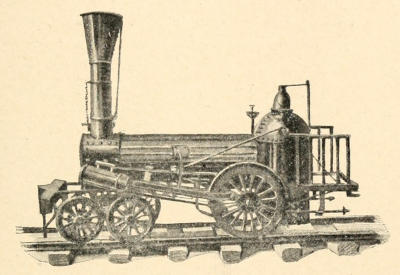
The De Witt Clinton train which ran
in 1830 between Albany and Schenectady.—Photographed
from the original locomotive and carriages by A. P. Yates,
official photographer of the New York Central Railroad
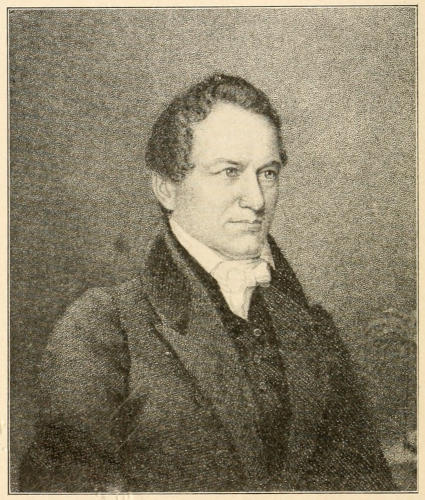
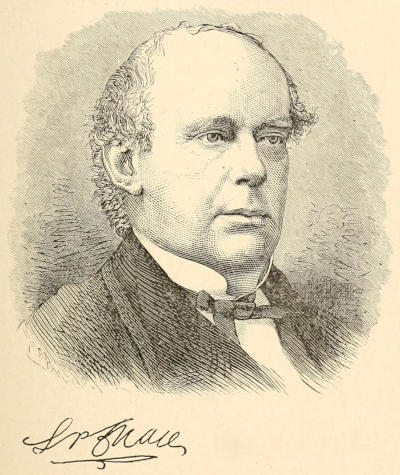
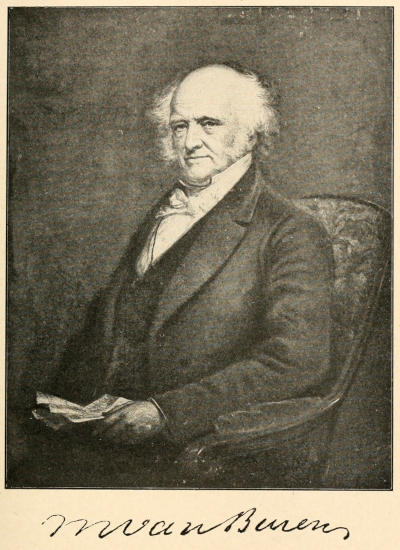
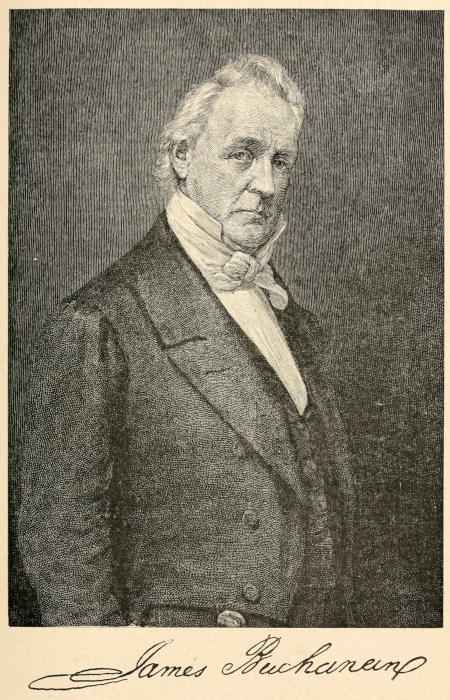
Martin Van Buren.—From
a portrait by Daniel Huntington, painted for Mr. Van Buren and
presented by him to a collection of notable statesmen now in
the State Library at Albany, New York
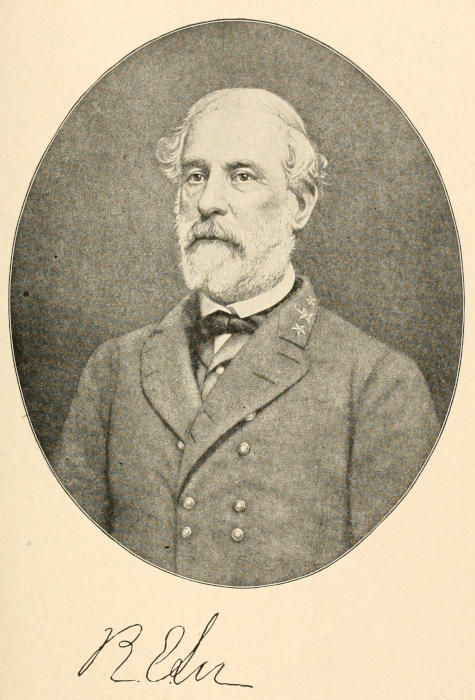
Robert Edward Lee.—From
the steel engraving published by the Lee Memorial Association
for the Erection of a Monument at the Tomb of General Robert
E. Lee at the Washington and Lee University, Lexington, Va.
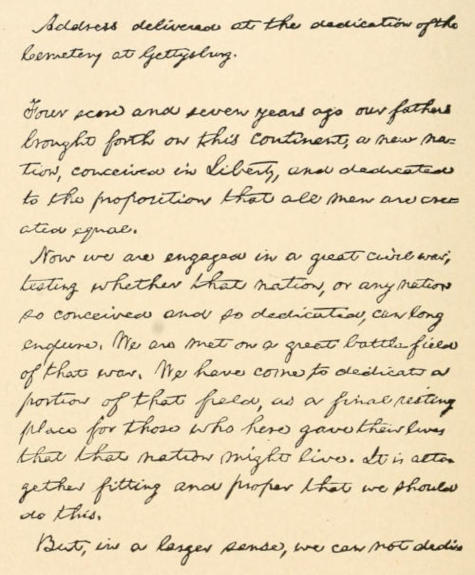
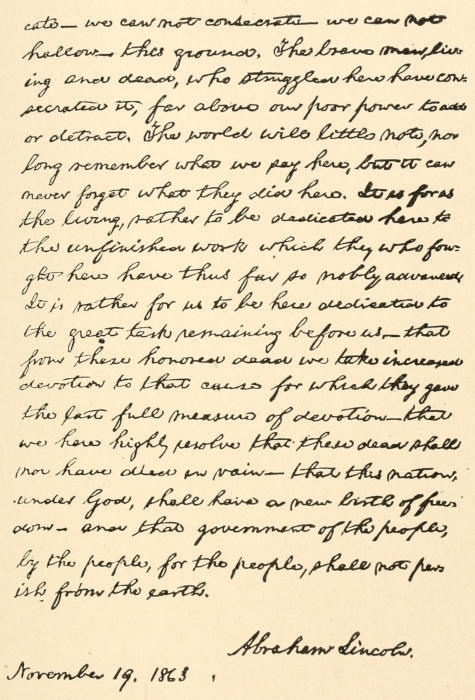
Facsimile of Mr. Lincoln’s autographic
copy of the Gettysburg address, made by him for the soldiers’
and sailors’ fair at Baltimore, in 1864.—From
Nicolay and Hay’s Life of Lincoln
A HISTORY OF THE AMERICAN PEOPLE — CHAPTER I THE DEMOCRATIC REVOLUTION
General Jackson’s friends had reason to be
satisfied. The effect they had wrought was indeed
dramatic, revolutionary. They had cut a line of
cleavage between epoch and epoch in the history of
the country. They had broken, once for all, the “Virginian
dynasty,” “the succession of Secretaries,” the
leadership of trained and trusted men; had set aside
every tradition of national politics; and had begun
the administration of the executive office of the Union
afresh upon their own plan. They had not, indeed,
won secure control of either house of Congress. Parties
were not fixed enough as yet for that. There were
not a few “Democrats” who still retained a covert liking
for the liberal construction their opponents put upon
the constitution, and who upon occasion wavered in
their votes, or incontinently went over to the ranks of
the “National Republicans,” whom Mr. Clay led. In
the Senate there could be found, upon most questions,
a majority against the new President. But the whole
atmosphere of affairs, the whole tone of the government
changed, nevertheless, with the coming in of
General Jackson. The new nation, its quality subtly
altered, its point of view insensibly shifted by the movement
into the West, had smiled with some degree of
patient complacency upon Mr. Monroe, and had endured
John Quincy Adams, but now for the first time
chose after its own kind and preferred General Jackson.
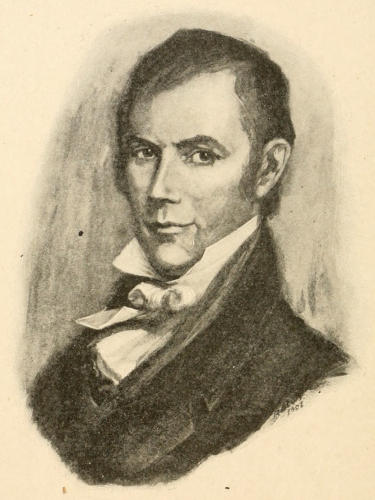
HENRY CLAY
It was a second democratization of the government.
And yet it differed radically from the first, which Mr.
Jefferson had so shrewdly contrived. There was no
kinship either in spirit or in method between Mr. Jefferson
and this new hero of democracy. Mr. Jefferson
had, indeed, expressed the greatest alarm “at the prospect
of seeing General Jackson President.” “He is,” he
said, “one of the most unfit men I know of for the place.
He has had very little respect for laws or constitutions,
and is, in fact, an able military chief. His passions
are terrible. He has been much tried since I knew
him, but he is a dangerous man.” And had Mr. Jefferson
lived to witness the result, he would hardly have
altered his judgment. He had stood, for all he was
so full of democratic doctrine, for conservative ways
of political growth. General Jackson stood, it turned
out, for personal government, party proscriptions, and
the self-willed choices of personal power.
General Jackson professed to be of the school of Mr.
Jefferson himself; and what he professed he believed.
There was no touch of the charlatan or the demagogue
about him. The action of his mind was as direct, as
sincere, as unsophisticated as the action of the mind
of an ingenuous child, though it exhibited also the
sustained intensity and the range of the mature man.
The difference between Mr. Jefferson and General Jackson
was not a difference of moral quality so much as a
difference in social stock and breeding. Mr. Jefferson,
an aristocrat and yet a philosophical radical, deliberately
practised the arts of the politician and exhibited oftentimes
the sort of insincerity which subtle natures yield
to without loss of essential integrity. General Jackson
was incapable of arts or deceptions of any kind. He
was in fact what his partisans loved to call him, a man
of the people, of the common people. Mr. Jefferson
was only a patron of the people: appealed to the rank
and file, believed in them, but shared neither their tastes
nor their passions. Moreover, the effective rank and
file of the nation had changed since his day of ascendency.
Step by step, one State following another, the
old restrictions upon the suffrage, taken for granted
in Jefferson’s time, had been removed, until in almost
every part of the Union the men of the masses had become
the stuff of politics. These men Jackson really
represented, albeit with a touch of the knight and
chivalrous man of honor about him which common
men do not have; and the people knew it; felt that an
aristocratic order was upset, and that they themselves
had at last come to their own.
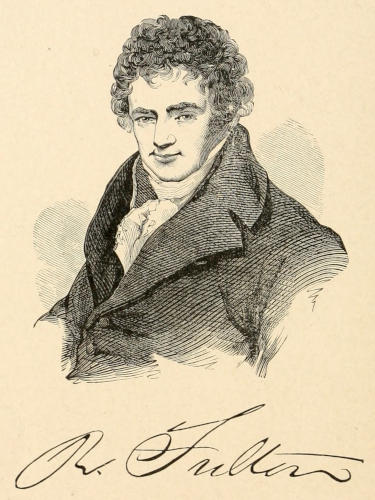
ROBERT FULTON
It must have seemed so in very fact at their President’s
inauguration. Washington filled with crowds come
out of every quarter of the Union. All ceremony was
overridden, all decorum cast aside. It seemed as if
the place were in the possession of a good-natured mob,
bent upon no serious mischief, but not to be restrained,
not to be forbidden even the drawing rooms of the White
House or the committee rooms and chambers of the
Capitol. There was scarcely room enough in the streets
for the passage of the procession which accompanied
General Jackson to the place of inauguration. So
great a crowd rushed, unbidden, into the White House,
when General Jackson came to it from the Capitol, that
he was himself forced against the wall of the reception
chamber by its pressure, and was secured against serious
danger only by a number of gentlemen linking arms
and forming themselves into a barrier. Everywhere
it was proclaimed that the people had come into possession
of the government; that the domination of professional
statesmen and politicians had been thrown
off: that the rank and file were the victors, and that to
the victors belonged “the spoils of the enemy.”
That was unquestionably General Jackson’s creed.
Men who understood him could play upon him. He
had allowed ill-informed men who believed it, and designing
men who pretended to believe it, to persuade him
that the government had not only been monopolized
but also corrupted by the politicians and statesmen
who had hitherto controlled it; and he meant to purify
it very radically. Among his advisers were men, like
Mr. Martin Van Buren, of New York, who were past-masters
in the art of party organization, and whose
methods he willingly adopted for the establishment
of the national power of his followers. They were
methods which he could readily understand, and which
seemed almost to fall within his own experience. He
was a frontier soldier. Staunch comradeships, personal
devotion, the close, unhesitating cohesion of
friends, the intimate co-operation of men who knew
and trusted one another by reason of joint efforts in a
common affair, seemed to him the natural and proper
basis for the discipline of a party no less than for the
discipline and success of a frontier levy of volunteers.
He knew and cared nothing for the orderly promotions
of a regular service.
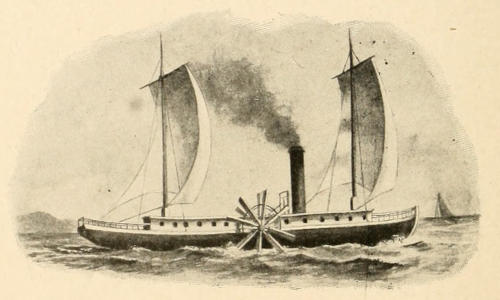
FULTON’S FIRST STEAMBOAT
The suffrage had been thrown open in New York,
as elsewhere, and Mr. Van Buren had become one of
a small group of astute men there who had supplied
the new voters, crowding without concert to the polls,
with the organization they could not contrive for themselves.
These “Albany regents,” as their opponents
dubbed them, had effected their propaganda and their
nominations, through local caucuses, and through conventions
composed of delegates whom the caucuses
selected. The lieutenants whom they used to assist
them in organizing the caucuses, superintending the
selection and the business of the conventions, and looking
after every local detail of party action, they rewarded
when they could with offices and nominations
for themselves. It was this association of men who
stood by one another and served one another as personal
allies and friends that won the admiration of General
Jackson. “I am no politician,” he said; “but if I were
one, I would be a New York politician.” Pennsylvanian
politics were of the same sort: the politics of
intimate personal association. There, too, democracy
on the great scale had submitted to the same organization,
the same leadership of consummate, watchful
managers. It was the new organization of democracy.
General Jackson both understood and relished
it. He saw nothing immoral in the promise that when
he came into office he would reward his friends and
punish his enemies. That, on the contrary, was a
fundamental first principle of morals on the frontier.
He firmly believed his friends to be the friends also of
the government,—of the government as it had been and
ought to be; his enemies, enemies of the government
as well. The earnestness and sincerity with which
he believed it, the frankness with which he avowed
the belief, were interesting proofs of his conscious integrity.
With all the intensity of his nature he wished
for the welfare of the country, the advancement of the
Union, the success and permanency of its government;
with all the terrible force of his will he purposed to secure
both the one and the other. No doubt he had shown
contempt for law, as Mr. Jefferson said, when he was
upon the frontier, hampered by treaties and instructions;
but his ideals were not those of the law-breaker.
They were those of the ardent patriot. The peril of
the country lay in the fact that he chose to disregard
precedent and to interpret all laws for himself,—the
law of the constitution no less than the law of the statute
book.
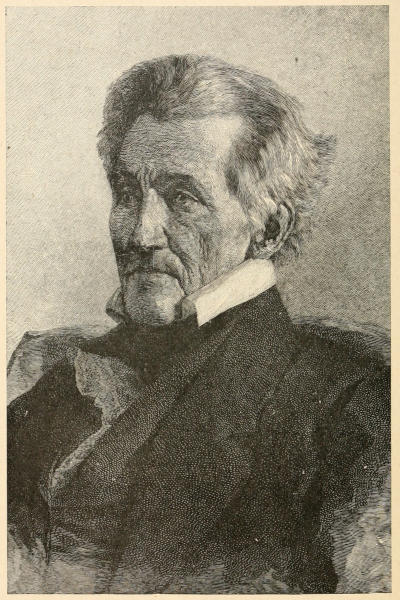
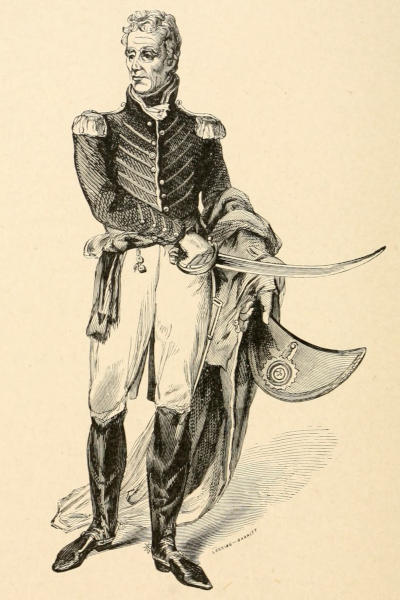
GENERAL ANDREW JACKSON
And so there was almost a clean sweep of the federal
offices to make room for General Jackson’s friends,
and secure proper persons to execute General Jackson’s
purposes. That the men dismissed had been long in
office he deemed an additional argument for their discharge
rather than an argument for their retention.
Long terms of service he thought undemocratic. They
slackened diligence, he believed, and made office-holders
too carelessly secure. No doubt they fostered corruption,
too. He did not himself conduct the proscription;
he let those whom he trusted conduct it in his
name. By the time the first Congress of his term assembled
(December 7, 1829) it was estimated that fully
a thousand federal officials had been removed, as against
seventy-three at the most in all the previous history
of the government. The Senate tried to stay the tide
where it could, in its action on the nominations sent
to it; but found the President imperious, irresistible,
not to be gainsaid, and public opinion out-of-doors
astonishingly ready to support and applaud him at
every turn of the contest. “We give no reasons for
our removals,” said Mr. Van Buren; and apparently
the mass of the voters wanted none. They were content
to know that General Jackson was changing the
government from top to bottom. Men without parts
or reputation of course got into office, in the general
scramble. There could be little choice or deliberation
in that wholesale process. The men appointed were
for the most part men who had put themselves forward.
There were very few men of any experience at all in
federal administration, and many adventurers, to be
found in the ranks of the new party. “Very few reputable
appointments have been made,” Mr. Adams,
the ruthless General’s predecessor in office, set down
in his journal, “and those confined to persons who
were indispensably necessary to the office.” “The appointments
are exclusively of violent partisans, and
every editor of a scurrilous and slanderous newspaper
is provided for.”
It was only fair to remember that the new party drew
of necessity upon its ranks, whether for ordinary officials
or for leaders. If the minor office holders were
new men, so were their chiefs also, who stood close
about the President himself. The cabinet which General
Jackson chose seemed conventional enough, indeed, for
a party so recently made up. Mr. Van Buren had left
the office of Governor of New York to become Secretary
of State. He had been merely a local politician, no
doubt, though he had served a term in the Senate, and
had come but the other day into national prominence;
but he was at least as well known as many another
cabinet officer before him. The other heads of Departments,
though even less generally known to the nation
than he was, had played a public part in affairs, in
Congress and out of it, and had been chosen for reasons
familiar enough in politics. Major John H. Eaton, of
Tennessee, was selected to be Secretary of War, because
he was a trusted personal friend of the President’s;
the Secretaries of the Treasury and of the Navy and
the Attorney General owed their places to the fact that
they were the friends of Mr. Calhoun, the Vice President,
who stood at the front of the President’s party in the
South. The Postmaster General had been a candidate
for the governorship of Kentucky in the Jackson interest,
and had been defeated by a nominee of the friends
of Mr. Clay.
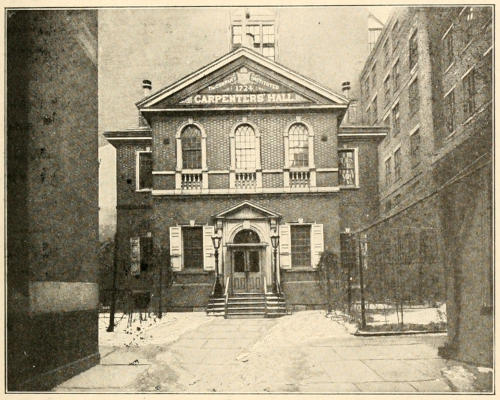
CARPENTERS’ HALL, PHILADELPHIA
What was really singular and significant was, that
these gentlemen did not, under General Jackson, form
a real cabinet at all. The country presently learned
that the President did not hold cabinet meetings: that
he took counsel, when he felt in need of it, with private
friends, some of whom had no recognized post or standing
in the government at all. Chief among these were
one William B. Lewis, of Tennessee, a kinsman and
neighbor of General Jackson’s, and one Amos Kendall,
a Massachusetts man now identified with Kentucky.
It was Major Lewis who, more than any other man, had
first forced him into candidacy for the presidency, who
had set the stage for him at every turn of his political
career, who had set afoot, superintended, fomented,
and with an infinite art and diligence brought successfully
to a head the many influences, public and private,
which were to bring him finally into office and to the
leadership of his party. General Jackson consulted and
used him without in the least realizing that he had in
him a consummate master of the arts whereby opinion
is made and individual men are set forward in their
ambition. He had made Major Lewis Second Auditor
of the Treasury; but Lewis was not a man who played
for himself. He played for Jackson, and loved every
subtle turn of the game: used his gifts of management
like one who played for his own hand, and yet remained
a man of honor and served his friend more than he
served himself. Amos Kendall was a master of the
art political, not in action, but upon paper. He had
gifts as a writer which could be turned to account in
the composition of the most serious state papers. He
caught the impressive tone of public business and mastered
its calm way of reasoning as readily as he caught
the tones of partisan controversy and spent his force
in its bitter energy. He could frame a significant
innuendo or prepare an editorial for the party press
that bit as deep as anything that Tom. Paine or William
Cobbett could have written. He seemed a statesman
or a mere partisan by turns; it was difficult to
tell which he was either by nature or by choice. He was
perhaps each in turn; but nothing out of the closet.
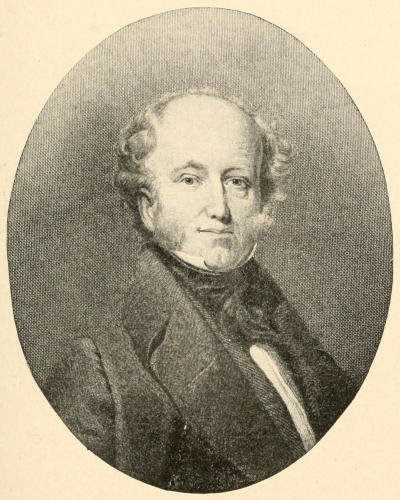
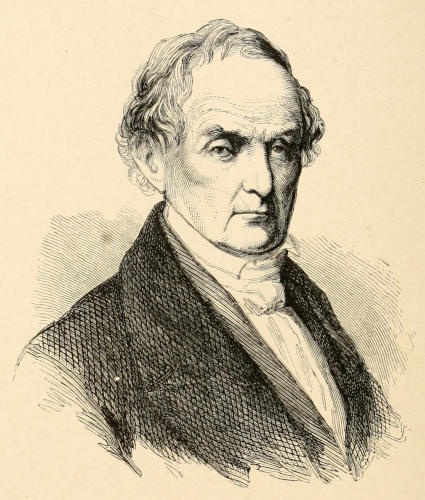
MARTIN VAN BUREN
There were others of the “Kitchen Cabinet” besides:
the editors of Jacksonian newspapers; but the heart
of it lay in Major Lewis and Mr. Kendall. Mr. Van
Buren and Major Eaton, of Tennessee, the Secretary of
War, were freely admitted into this inner circle; but not
as members of the cabinet, only as personal friends and
confidants of the President.
And so a veritable personal government was set up,
so far as the Executive and the discipline of the Executive’s
friends in Congress were concerned; and allegiance
to General Jackson became the test of fidelity
for every Democrat who wished to be admitted to the
party’s counsels. The President’s mere audacity won
many men to him, for the masses of the country loved
bold individual initiative. His rugged honesty, his sincerity,
his own power of devotion, his frank friendliness,
his confiding faith in his friends won more. Towards
women he showed the gracious, deferential courtesy
of the man who would be every woman’s knight and
champion. Foreign ministers who had expected to
find in him the rough frontiersman were amazed at
his natural dignity and ease, the air almost of elegance
and of majesty that hung about him because of his
quiet self-respect, his grave and unaffected courtesy,
and the striking sadness and reserve of his deep-set
eyes. No President since Washington had so taken
hold upon the imagination, and every month he remained
in office his ascendency became the more assured.
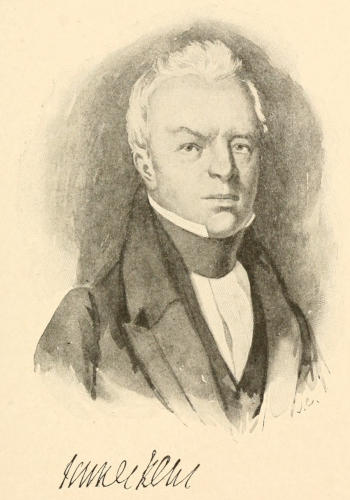
JAMES KENT
It made a startling difference to the country. It
broke the course of all settled policy, forced every question
to square itself with the President’s standards,
altered the elements of parties. The country got its
first taste of the effect to be wrought upon policy in
connection with the troublesome question of the removal
of the Indians from Georgia and Alabama to lands
beyond the Mississippi. Georgia had got rid of the
Creek Indians while Mr. Adams was President. Both
Creeks and Cherokees held their Georgia lands under
treaties with the United States such as the constitution
explicitly authorized the President to negotiate; the
Creeks had relied upon the treaties and steadfastly
refused to sell their lands or suffer themselves to be
driven out of the State; and Mr. Adams had sought
by every means in his power to protect them. But
Congress had supported him very lukewarmly, and
Georgia had succeeded at last in extorting from the
unwilling chiefs of the tribe terms which put their people
forth into the West, where Congress was ready to provide
for them. The Cherokees were not to be so cajoled
or dealt with. They mustered thirteen thousand strong;
had settled to the occupations and learned the arts of
peace; boasted a system of self-government and of
orderly obedience to their own laws which seemed to
promise, not extinction or decay or any decline of their
power, but a great development and an assured permanency;
and would not entertain any proposition
whatever which involved the sale or relinquishment of
the rich lands they occupied. General Jackson, however,
unlike his predecessor, thought the State ought
to be rid of them. Georgia and Alabama, therefore,
relying on his countenance, extended their laws over
the Indian country in despite of treaties; the President,
when Georgia requested him to do so, withdrew the
federal troops stationed there; and the Indians were
obliged to yield. “I informed the Indians inhabiting
parts of Georgia and Alabama,” the President told
Congress in his first message, “that their attempt to
establish an independent government would not be
countenanced by the Executive of the United States,
and advised them to migrate beyond the Mississippi
or to submit to the laws of those States.” Life on the
frontier had left him no patience to consider the rights
of red men.
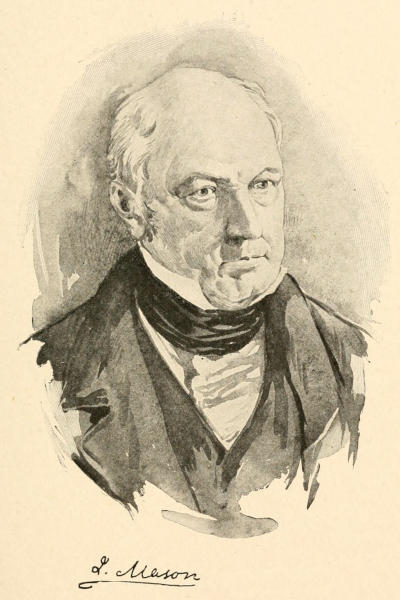
JEREMIAH MASON
Their rights were duly tested in the courts. Three
several times was the matter taken, on appeal, to the
Supreme Court of the United States, and each time
the court decided the question submitted to it in favor
of the Indians, upholding the treaties and denying
the right of any State, or any authority whatever, to
violate or ignore them. But General Jackson would
not enforce its decisions. His attitude towards the
Indians was frankly that of the frontier soldier. They
had no right, in his eyes, to stand in the way of the
white man. By the time the last of the decisions of
the Supreme Court was rendered in the matter (1832)
another presidential election was at hand and he was
a candidate for re-election. He said that he would
leave the question to the people,—such was his constitutional
theory of right! The constitution did indeed
give the federal Executive the authority to negotiate
treaties with the Indian tribes, and Congress
the right to regulate commerce with them, as if they
were to be treated in all respects like independent bodies
politic, in no way subject to the jurisdiction of the separate
States. But the constitution also explicitly commanded
that no new State should be “formed or erected
within the jurisdiction of any other State” without the
express consent of the legislature of that State and of
Congress; and the Cherokees were obviously in a fair
way to create a virtually independent commonwealth
within the State of Georgia should they remain. It
was a nice point of law, which General Jackson should
have recognized the right of the Supreme Court to decide.
But with him his own judgment was more conclusive,
and a vote of the people the solution of all doubts.
It was significant how quick the new democracy he
stood for was to take fire against the courts and turn,
by way of ultimate appeal, to the people in all things.
In Mr. Jefferson’s day also the courts had seemed the
strongholds of Federalism, and the leaders of Congress
had wished to see their judges removed at pleasure
upon the address of the houses. Now they seemed
again the barriers, the only barriers, set up against the
people’s will. Many an observant eye had remarked
how dramatic a thing it was that General Jackson, like
Mr. Jefferson, should take the oath of office from John
Marshall, the steadfast champion of Federalist doctrine
and of the reign of law under a constitution which was
itself the supreme law of the land. When Mr. Jefferson
took office John Marshall had but just come to his power,
a man in his prime, the incoming President’s junior
by a dozen years. Now he was the new President’s
senior by as many years, though General Jackson,
for all his erect and slender height, was a gray veteran
of sixty-two. The aged Chief Justice was as straight
at seventy-four as the soldier to whom he administered
the oath of office, and bore his years as well; but General
Jackson stood, his years notwithstanding, for a new
age coming in, the aged judge for an old order passing
away. The fire that shone in the eyes of the old soldier
burned hot against the authority that sat upon the
quiet brow of the aged lawyer.
In the very inaugural address which he uttered that
day of his coming into office the grizzled President
threw out his challenge to the court, and made bold
to give it upon a matter of graver moment for the
whole country than the rights of Indian tribes even and
the sacredness of the treaties which gave them a standing
in the court. He doubted, he gave the country
to understand, whether Congress had acted within
its constitutional powers in creating the Bank of the
United States. That had once, as everybody understood,
been a debatable question; but the Supreme
Court had given judgment upon it in the celebrated
case of McCulloch vs. Maryland (1819), in which it
had explicitly affirmed the right, as drawn by just inference
from the undoubted powers of Congress; and
since then it had been deemed a question settled once
for all. But General Jackson regarded no question
as settled which altered circumstances could reopen.
The twenty-year charter of the Bank was not to run
out, indeed, until 1836, a year which lay beyond his
term; but a reconsideration of it was to come. Apparently
he had no intention of going now beyond a
mere preliminary expression of opinion in the matter.
He simply put this forth as a companion thought to
his declaration of the conviction that the surplus revenue
of the federal government ought to be distributed among
the States, not spent for objects, like internal improvements,
which the constitution, in his opinion, gave
Congress no authority to undertake or pay for. He
was merely setting forth at the outset of his time of
power, after his usual blunt, uncompromising fashion,
what he conceived to be the true democratic creed in
matters of national finance. Other more pressing matters
called for first attention, and for action.
MODEL OF THE JOHN STEVENS LOCOMOTIVE.
THE FIRST IN AMERICA. 1825
These initial declarations of opinion and intimations
of policy on the part of the President were eminently
satisfactory to the men of the South and West whose
candidate he had been. Here were the views of strict
construction for which they had looked. In his very
first message he solemnly warned Congress “against
all encroachments upon the legitimate sphere of state
sovereignty”; and conservative men, whose thought
had been formed by Mr. Jefferson, drew about him
with almost as much confidence as was shown by
those who had the adventurous and aggressive spirit
of the new age at their hearts and desired change.
But when the President was put to the test by the
Carolinians for whom Mr. Calhoun had formulated the
extreme doctrine of state rights, they suddenly saw
him in another light. They then saw, what they might
have seen at first, that he was of the West, not of the
South. He stood, as all other western men did, for the
principle that every community must have its own
life in the free partnership it had formed, and its own
unhindered, unbidden development, unchecked by the
national government: for he believed that to be the
end and object of the Union, to make the States secure
of their individual development and set them forward
in their own ways. But there was an infection of national
feeling, too, upon the stirring frontier where he
had been bred which no man could escape; a sense as
of a people’s life a-making upon a continental scale;
an ardor for broad schemes and vast achievement, in
bands united and backed by the nation’s power. “The
legitimate sphere of state sovereignty” did not, when
projected there upon the prairies, encroach upon the
equally legitimate sphere of the federal power. The
two were inseparable parts of a single conception. No
frontiersman reasoned subtly upon them: instinct
and the spirit of conquest resolved all doubts and discountenanced
all refinements. Argument was excluded.
In any case General Jackson, as President,
would have excluded it. To challenge the authority
of the federal government now was to challenge his
own authority; and there need have been no doubt
what he would do in that event.
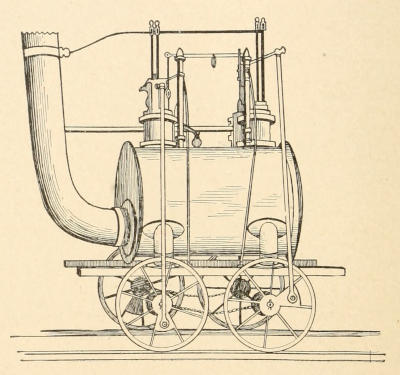
MODEL OF THE STOCKTON AND DARLINGTON LOCOMOTIVE.
BROUGHT FROM ENGLAND. 1826
The issue that was to be joined and settled was first
drawn to the light, with painful vividness, by a debate
in the Senate on the disposition of the western lands.
The New England men wanted the settlement of the
West held back as much as possible. So long as land
was to be had there almost for the mere asking, at no
cost except that of the journey and of a few farmer’s
tools and a beast or two for the plough, the active men
of their own section, whom they counted on as skilled
workmen in building up their manufactures, must be
constantly enticed away by the score and hundred, to
seek an independent life and livelihood in the West;
high wages, very high wages, must be paid to keep them,
if indeed they could be kept at all; and the maintenance
of manufactures must cost more than even protective
tariffs could make good. Here was an issue between
East and West. The tariff itself was an issue between
North and South, and drew after it, when read into
the question of the western lands, no less a matter than
the extension of slavery and the domination of sections
in the politics of the country. Heavy tariffs, which
fostered manufactures in the States where there were
no slaves, insured growth of wealth and population
in the East and North, but left the South to stand
still and gain nothing. If her people could not go
into the West and build up slave states there to make
good the altering balance of power in the Union,
they must look to see all things go steadily against
them.
All these critical matters crept inevitably, as it seemed,
into the debate on the western lands; and the country
was aroused by it almost as it had been aroused ten
years before by the debates on the admission of Missouri.
It turned upon a resolution to limit the sales of the
western lands which Mr. Foot, of Connecticut, introduced
in the Senate late in December, 1829. Ordinary men
could not have raised it to such a climax of interest;
but the men engaged were not ordinary men. It was
not Mr. Benton’s hot protest that the men of New England
should be always jealous of the growth and prosperity
of the West that caught the ear of the country;
it was the speeches of Mr. Hayne, of South Carolina,
and Mr. Webster, of Massachusetts. The debate, as
they handled it, swung abroad over the whole ground
of the many closely related topics which lay upon the
borders of the immediate question it concerned. Mr.
Hayne was of the extreme school of South Carolina,
and took occasion to expound at length the doctrine
of nullification which his colleagues in that school had
so lately perfected. It was out of the question, he said,
that a State, when wronged by an exercise of federal
power, should leave the decision of the matter of right
entirely to the Supreme Court of the United States,
part and organ of the very government whose power
was challenged. The constitution was a compact,
he maintained, the Union a free partnership; States
must stand ever upon the ground of the Kentucky and
Virginia Resolutions and effect their own protection
against deliberate and palpable excesses of power.
Mr. Webster as fearlessly took the extreme ground of
the opposite view. It was this splendid audacity on
either side that quickened the pulses of all who listened,
this hardy, intrepid pushing of the issue to its last
analysis,—and that issue nothing less than the nation’s
destiny.
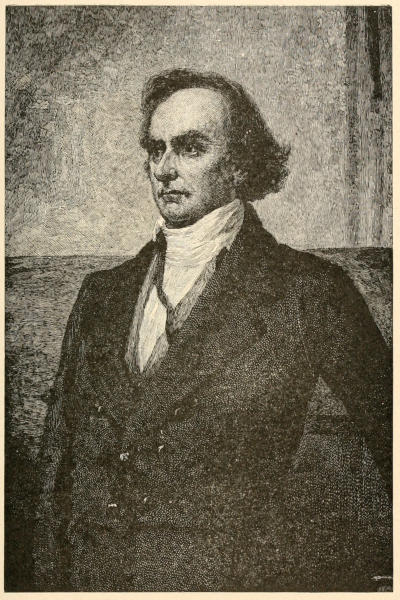
DANIEL WEBSTER
The debaters were already marked men. The Senator
from South Carolina, though not yet forty, had won
his laurels as a lad in the war of 1812, had been elected
to the legislature of his State at twenty-three and made
Speaker of its House at twenty-five; made his way as
much by personal charm as by eloquence and a gift
for business, had a grace and ardor in his speech which
won all men’s attention and liking, wore always the
air of a man of honor and high spirit, and used his
singular powers of persuasion with a fine force of conviction.
Daniel Webster, his opponent, had first come
into Congress from New Hampshire, as the war with
England was drawing to a close (1813), and then, upon
a change of residence, had been sent first to the House
(1823), finally to the Senate (1827), from Massachusetts,
and was now at forty-eight one of the most noticeable
figures of the country, an orator and constitutional
lawyer whose mastery every man acknowledged. Twice
he had taken his stand, with a force of argument it
would have been difficult to enhance, against protective
tariffs; but, seeing his constituents deliberately and
persistently stake their whole economic fortune as a
community upon them, he at last had yielded, and
was now the accepted champion of New England against
the violent onset of the South. He replied to Mr. Hayne
that the constitution was no compact, the Union no
mere dissoluble partnership, but a government, sovereign
though not consolidated, a banded State which nothing
but revolution could dissolve, its laws to be set aside or
resisted only by acts of treason.
ROBERT YOUNG HAYNE
No such charm hung about the person of Mr. Webster
as that which made Mr. Hayne so excellent an image
of the courtly gentleman and the persuasive orator.
Alike in person and in utterance, Mr. Webster was compact,
not of grace, but of force. Mr. Hayne’s sentences
rode high, upon rhetoric that sought often an adventurous
flight; Mr. Webster used words as if he meant
only to clarify and strengthen the thoughts he touched
and cared nothing for cadence or ornament. And
yet he spread them in ranks so fair that they caught
and held the eye like a pageant. Beauty came upon
them as they moved as if out of the mere passion of
the thought rather than by the design of the orator.
And he himself gave to the eye, as he stood, in his own
person the same image of clean-cut strength, beautiful
only by reason of its perfect action, so square was he,
massive, and indomitable, and with a head and face
whose mass, whose calm breadth above the deep-set,
slumbrous eyes, seemed the fittest possible throne for
the powers he displayed. There was imagination
wrought into all that he said, but not the imagination
of the rhetorician. Mr. Hayne’s speech seemed to
those who heard it worthy of the great reply it had called
forth; but the country did not read it as it read what
Mr. Webster had said. That was everywhere printed
and read; and as the slow mails carried it forth it was as
if the national spirit had suddenly been cried wide awake
by its thrilling sentences. It was not the mere reasoner
who won this triumph: reason was here touched with
fire. The imagination of every man who could see the
vision of a people united, indivisible, bound in sacred
concord, was taken captive by these sonorous periods;
the conviction of every man who saw the task and destiny
of the nation as a whole was confirmed and heartened
and made glad. There was magic in the printed
words, as there was magic in the thrilling voice and
the magnificent presence of the man himself, in his
massive stature and Olympian head, and in his eyes,
burning dark with steady fire within their deep covert.
There was no such magic in Mr. Hayne’s speech:
only the force of argument and of an able, clear-thinking
man in earnest. Mr. Webster had taken new ground.
The men of the first generation of federal statesmen
had not spoken thus of the constitution, at whose conception
and establishment they had been present. They
had admitted that it was an experiment, though they
had hastened at once to push it, if they could, beyond
its experimental stage. No man had attributed treason
to the authors of the Kentucky and Virginia Resolutions,
whose language Mr. Calhoun and Mr. Hayne
now revived. Every man who felt the power and the
hope that were in the spirit of nationality as the men
of the West did, as the constructive statesmen did who
had stood with Washington and Hamilton in their
generation, and with the young war enthusiasts who
cried bravo to Mr. Madison in the war with England
in theirs, protested very hotly when New England men
talked of disunion, first because of the purchase of
Louisiana, and then because of the embargo. But they
protested, not as against rebellion; they protested as
against mad folly, rather, and narrow selfishness: as
against those who would mar a great history to push
a sectional interest. Not until a whole generation had
gone by from the making of the government did this
new doctrine of nationality which Mr. Webster so eloquently
and convincingly preached get its currency:
this doctrine of a national existence based, not upon
sentiment and agreement, but upon an imperative
fundamental law.
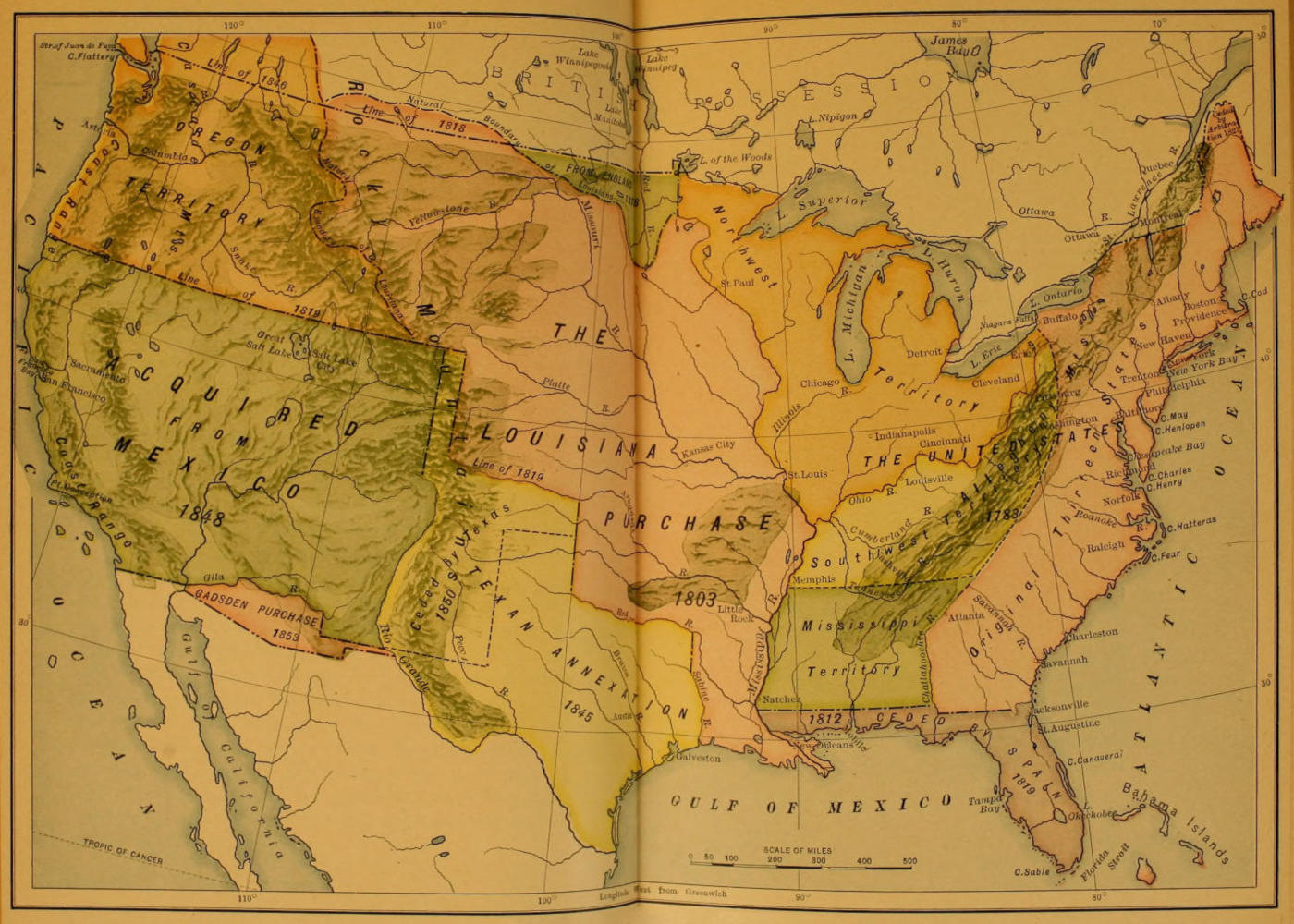
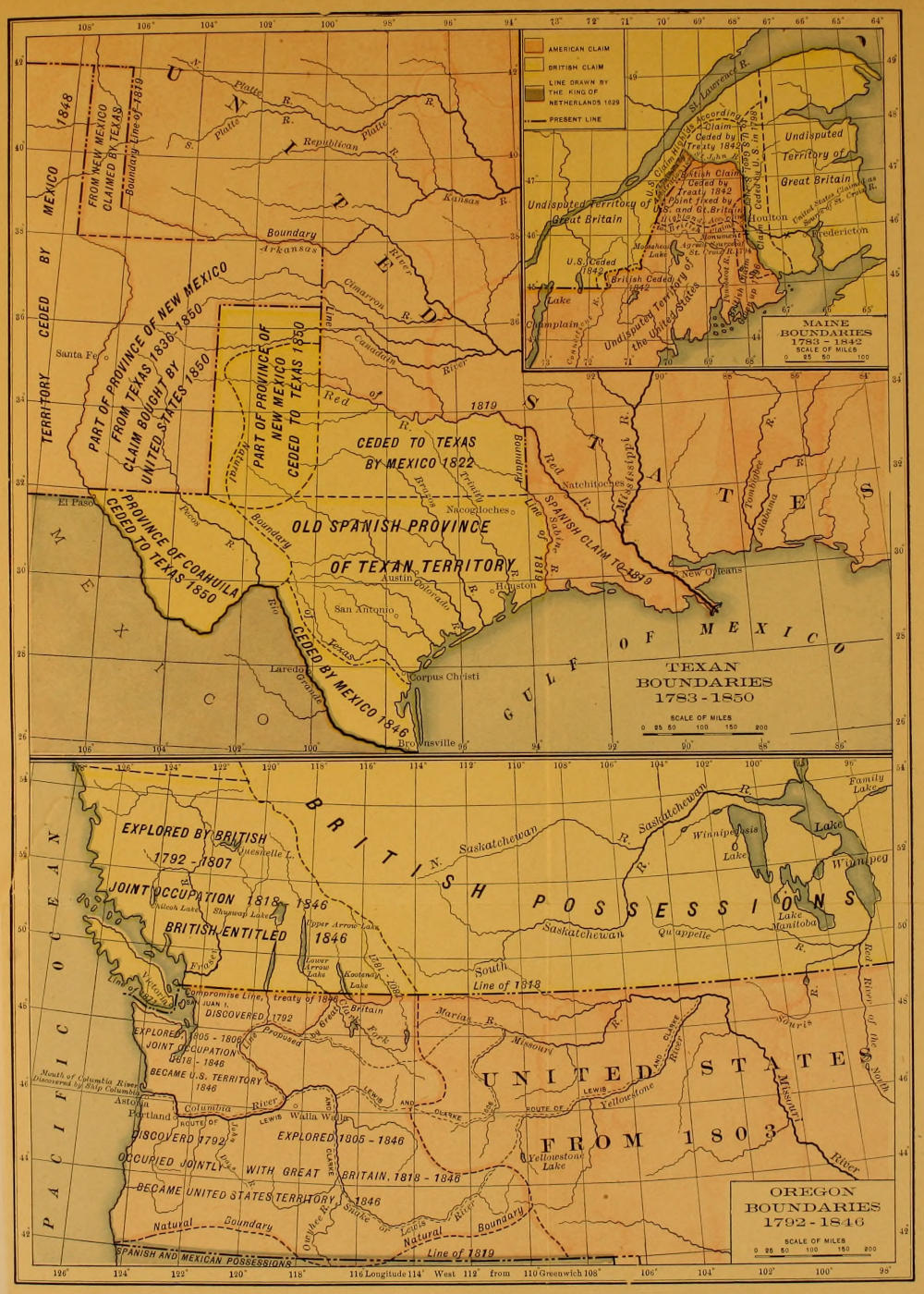
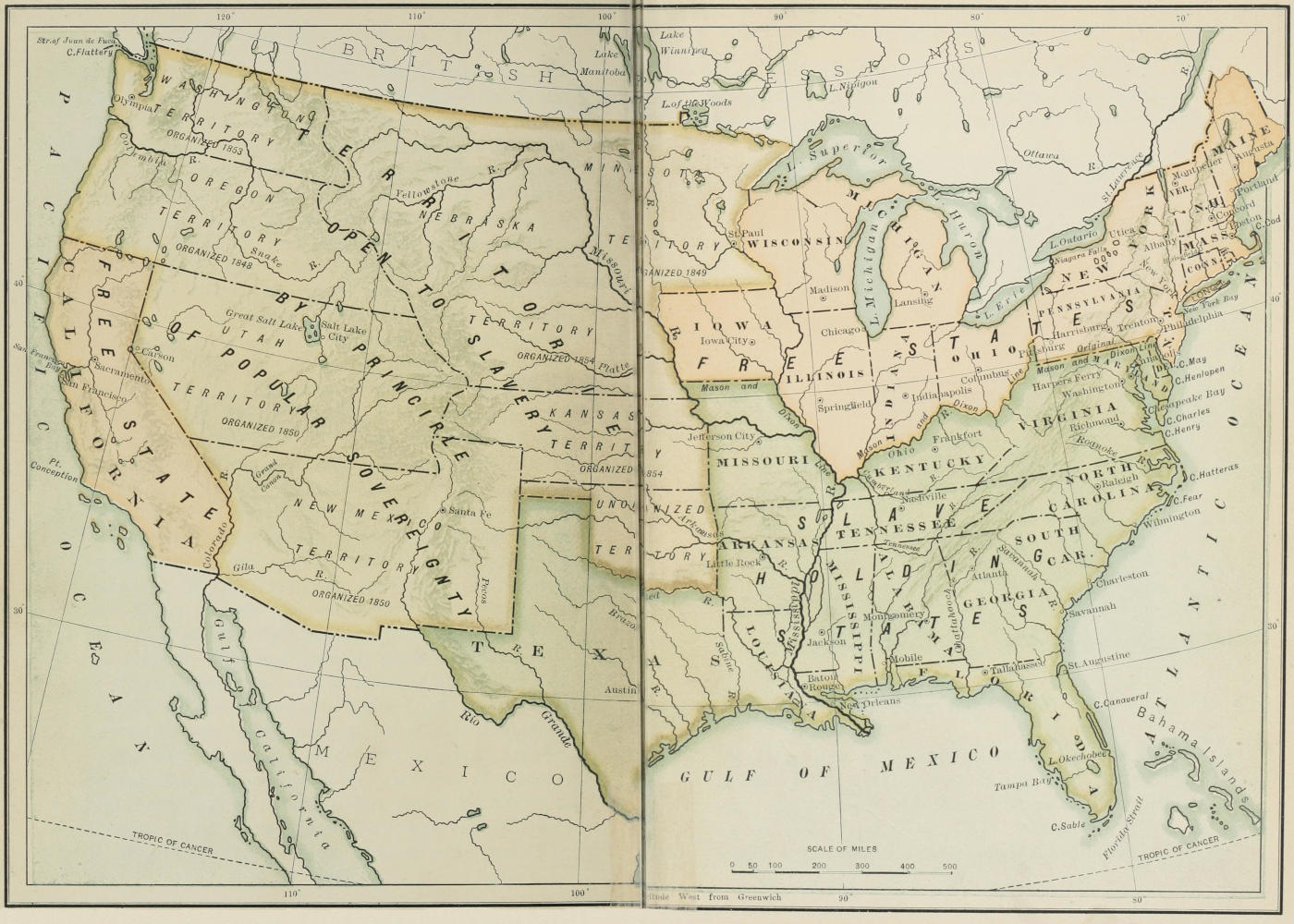
TERRITORIAL ACQUISITIONS OF THE UNITED STATES, 1783-1853
BORMAY & CO., N. Y.
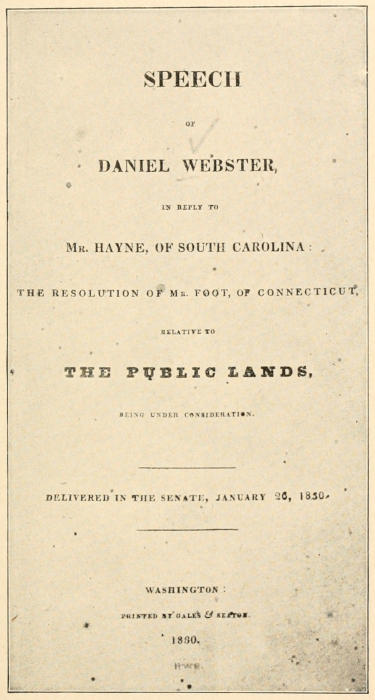
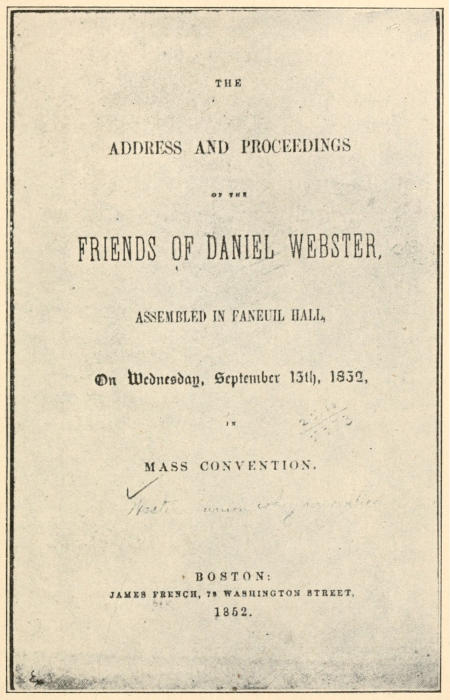
TITLE-PAGE OF SPEECH OF DANIEL WEBSTER
Here again, as in the broadening of the suffrage and
the coming in of the day of pure democracy which had
brought General Jackson to the saddle with its dawn,
the subtle force of national expansion moved and brooded
upon the face of all things. The vast spread and
movements of a people, the growth and interlacings
of industry, the springing up of States come from the
loins of the Union itself, all the visible increase of peaceful
empire bred this spirit as of a nation,—no longer
merely confederated, a nation knit and united for a
common history of achievement. General Jackson,
coming from the frontier, where this mighty force of
nationality was visibly afoot, seemed to embody the
new spirit of power in his rough, imperious sense of
a right, as President, to override and command. Mr.
Webster, though no friend of Jackson’s, clothed what
was in effect the same conception in terms of statesmanship
and law. Under his touch the constitution
seemed to partake of the growth which it had only engendered.
It was of necessity, as he read it, no mere
document, but a vehicle of life. Its sanctions could be
made to cover every change that added to the unity or
the greatness of the nation. Its quiet phrases could
always be heard to speak the spirit of the times.
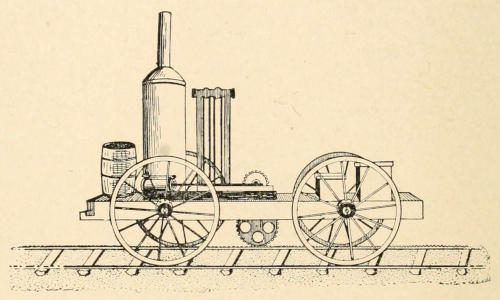
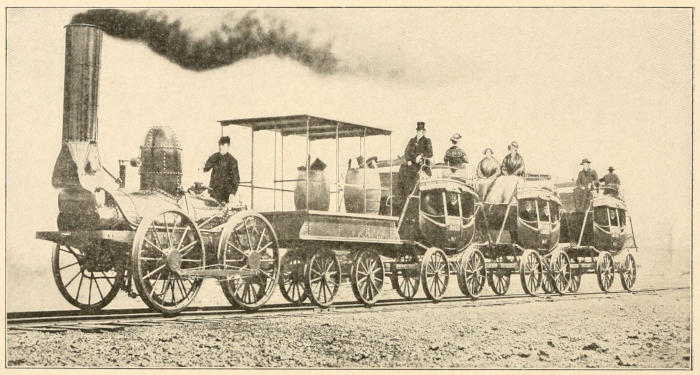
THE DE WITT CLINTON TRAIN WHICH RAN IN 1830 BETWEEN
ALBANY AND SCHENECTADY
Copyright, 1893, by A. P. Yates.
But what of those parts of the nation which had kept
to the old models of federal life, which did not change,
and would accept no law but that which read as it had
always read since they were nurtured? The South
had had little part or lot in the transformations of the
new age. Her life was unaltered from of old. She
lived and thought as she had always lived and thought.
The Union was still the same to her that it had been
to all the States alike in that first generation whose
life and thought she kept. There had been no amendment
of the fundamental law. Could the law change
because men’s thoughts had changed and their interests?
No doubt, in her reaction against what she saw
afoot, she stiffened the old doctrines and exaggerated
them. Mr. Madison, who had drafted the Virginia
Resolutions of ’98, rejected very warmly the nullification
doctrines of Mr. Calhoun and Mr. Hayne, not a
little stirred and agitated in his quiet retirement at
Montpellier by this new threat of disunion. Any doctrine
would have worn a look of heightened rigor stated
in Mr. Calhoun’s clear, uncompromising way, and
probably no man of the elder generation, had he been
willing to formulate it at all, would have stated it so
absolutely. The exigency and the sudden passion
of opposition had given it this sharp and novel phrase.
Mr. Webster, with characteristic genius, had met it
with its opposite, as sharp and uncompromising, the
ideal for which the men of the constitutional convention
had prayed and which since their day had sprung
into life while no man observed.
DANIEL WEBSTER
The times seemed to bring all things to an issue.
No doctrine which touched practice so nearly could
very long remain a thing of theory while General Jackson
was on the field of action, and the advocates of nullification
were of no mind to stop with the debate on the
western lands. On April 13, 1830, the leading Democrats
at Washington celebrated Mr. Jefferson’s birthday
by a formal banquet, to which the President was
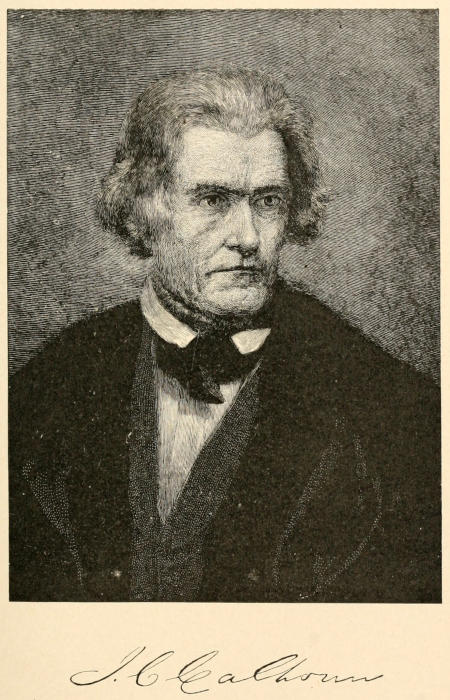
bidden. They took their cue from Mr. Calhoun and
the southerners, and the toasts they gave smacked
shrewdly of nullification. When the President saw
their drift he got to his feet and bluntly proposed this
sentiment as his own: “Our federal Union: it must
be preserved.” “Liberty, dearer than the Union,” cried
the Vice President, in retort; but retort only hardened
the President’s temper; and Mr. Calhoun presently
proved the least likely person in the country to be able
to soften it. The very month that followed that memorable
banquet General Jackson learned for the first
time that Mr. Calhoun, who had been Secretary of War
during his campaign against the Seminoles in 1818,
had emphatically condemned his unauthorized capture
of Pensacola as a wanton act of war against Spain,
and had demanded an official investigation of it, with
a view to its repudiation. Hitherto he had deemed
Mr. Calhoun his friend; now he deemed him basely
deceitful for having played his friend after such conduct
in cabinet against him. He could not separate
official action in such a matter from personal enmity;
and no explanation that Mr. Calhoun could make did
more than increase his bitter anger. He turned from all
who followed or consorted with the South Carolinian.
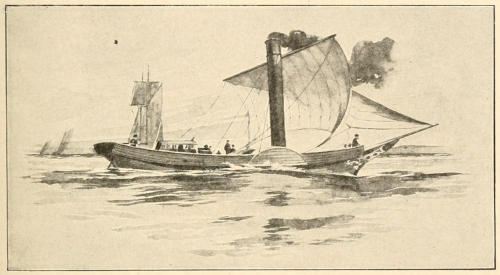
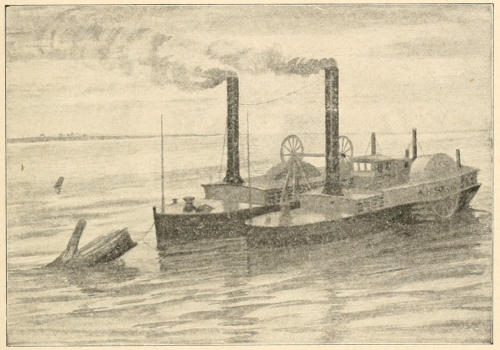
BELL’S STEAMBOAT COMET, 1812
Before another year was out he had reconstructed
his cabinet, to purge it of Mr. Calhoun’s friends, to
constitute it of men really in his confidence; partly also
to discipline those members of the first cabinet who had
failed to satisfy him in a social quarrel. The ladies
of the cabinet circle refused recognition to Mrs. Eaton,
the wife of the Secretary of War, deeming her reputation
not unimpeachable. General Jackson believed her
innocent of their charges,—was ready, indeed, to believe
any woman innocent, as his own wife had been, against
whom cruel things had been said unjustly; and was
glad to show his resentment against Mrs. Eaton’s enemies
by putting the men forth from his counsels whose
wives had slighted her against his wishes.
The breach between the President and Mr. Calhoun
was a serious sign of the times. It not only embittered
the President, it also cut all party ties for Mr. Calhoun,
and set him free to work out as he pleased the opposition
of his State to the burdensome tariff of 1828. It also
made Mr. Calhoun’s theories of nullification seem all the
blacker, all the more like treason, to the unforgiving
old soldier, sure always of being and of having been
in the right. It freed Mr. Calhoun and his friends
from entangling alliances. They moved the straighter
towards their goal,—the vindication of the rights of
the “staple States” against the policy of federal tariffs.
The hopes of 1828 had been dissipated and the clash
of sectional parties was at hand. In 1832 Congress,
willing to divert the rising storm by moderate concessions,
passed a new tariff Act, substituting for the
“abominations” of 1828 a schedule of duties substantially
the same as those of 1824. But the new measure,
like the old, yielded nothing of the principle of protection,
and the South Carolinian leaders were in a humor
now to contest the principle itself and have done
with it.
The year 1832 brought the season in which choice
was once more to be made of a President, and other
matters waited a little until the choice should be certainly
known. A novel variety was lent to the field
of contest by the entrance of a new party. In 1826
one William Morgan, of northwestern New York, had
advertised a book which should make known the secrets
of Freemasonry, and had been kidnapped and was never
seen again. Popular indignation had fixed upon the
society of Freemasons itself as responsible for the crime,
and an anti-Masonic party had sprung up whose object
it was to keep Freemasons out of places of public trust.
It had spread with surprising stir and persistency from
State to State, and in September, 1831, it summoned a
national convention of its partisans to display its
strength and name candidates of its own for the presidency
and vice presidency. The regular parties followed
its cue. They also chose delegates out of the
several States to meet in nominating conventions and
put their candidates in the field by formal vote. The
National Republicans nominated Mr. Clay, now leader
of the Senate and unquestioned leader of the party.
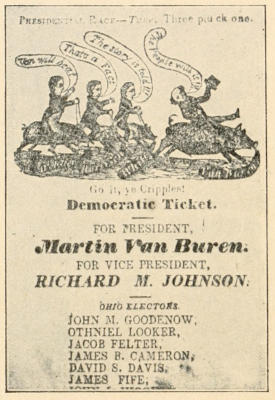
The Democrats nominated General Jackson, as of course,
for a second term, and with him, for Vice President,
not Mr. Calhoun, but his own chosen lieutenant, Mr.
Martin Van Buren. The vote of the electors was decisive,
as before. But six States voted for Mr. Clay
(Massachusetts, Rhode Island, Connecticut, Delaware,
Maryland, and Kentucky); seventeen voted for General
Jackson. Vermont gave her votes to the candidates
of the Anti-Masons. The electors of South Carolina,
chosen as always by the legislature, held punctiliously
off from all parties and voted for candidates of their
own.
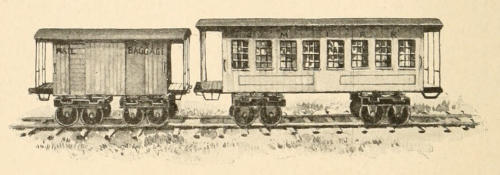
FREIGHT AND PASSENGER CARS, 1848
The election over, General Jackson once more chosen,
her party ties broken, her principles of opposition still
unsanctioned and untested, South Carolina proceeded
with her radical programme of redress. On the 24th
of November (1832) a state convention, summoned
for the purpose and formed upon the model of a constitutional
convention, adopted and promulgated a
formal Ordinance of Nullification, which declared the
tariff Acts of 1828 and 1832 null and void and without
force of law within the jurisdiction of South Carolina,
and gave solemn warning to the rest of the country
that any attempt on the part of the federal government
to enforce the nullified laws within her limits would
sever South Carolina’s connection with the Union and
force her to organize a separate government. The
legislature of the State immediately took steps looking
towards a resumption of some of the powers before formally
surrendered to the Union, and provided for putting
the State in readiness to resist coercion by force of arms.
Mr. Hayne was recalled from Washington to become
governor of the State; and Mr. Calhoun resigned the
vice presidency to take his place upon the floor of the
Senate, that he might there contest every inch of the
ground in debate.
The President acted as every one who really knew
him knew that he would act. Opposition itself would in
any case have been sufficient incitement to action; but
now the tonic of the election was in his veins. The
natural, straightforward, unhesitating vigor of the
man dictated what should be done. “Please give my
compliments to my friends in your State,” said the
imperious old soldier to a member of the House from
South Carolina who asked his commands, “and say to
them that if a single drop of blood shall be shed there
in opposition to the laws of the United States, I will
hang the first man I lay my hand on engaged in such
treasonable conduct, upon the first tree I can reach.”
No one doubted that he meant what he said. Before
South Carolina’s convention met he had instructed the
collector of the port of Charleston to collect the duties,
resistance or no resistance; and when the Ordinance
of Nullification reached him he replied to it with a proclamation
whose downright terms no man could misread.
For a little space he argued; but only for a little. For
the most part he commanded. “The laws of the United
States,” he said, “must be executed. I have no discretionary
power on the subject,—my duty is emphatically
pronounced in the constitution. Those who told
you that you might peacefully prevent their execution
deceived you.... Their object is disunion, and disunion
by armed force is treason.” It was the doctrine
of Webster in the mouth of a soldier. Congress voted
the President full power to deal with the crisis as circumstances
should demand.
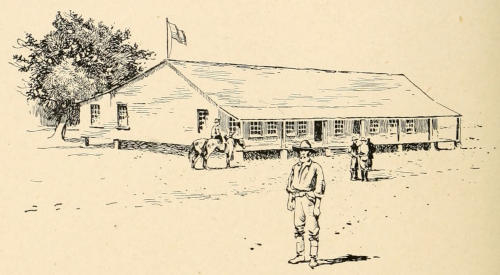
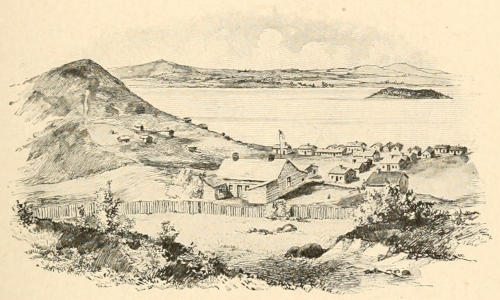
THE FIRST CAPITOL OF TEXAS
Even then South Carolina did not flinch or draw
back; but men who loved peace pressed forward on
both sides to effect a compromise. Mr. Clay planned
and urged measures of accommodation with all the
skill and ardor and persuasiveness which made him
so great a master of men, and the tariff which was a
thorn in South Carolina’s side, though not in principle
abandoned, was radically modified. A schedule of progressive
annual reductions was agreed upon (March,
1833) which should by July, 1842, bring practically
all duties to the uniform rate of twenty per cent. The
Ordinance of Nullification was first suspended, then
repealed; and the conflict between the States and the
Union was for a little while put off.
The principal general authorities for the interesting events covered
by this chapter are the second volume of Schouler, the first
and second volumes of Von Holst, the fourth volume of Tucker,
the fourth volume of Bryant and Gay; A. W. Young’s The American
Statesman; R. McK. Ormsby’s History of the Whig Party;
Edward Stanwood’s History of the Presidency; Alexander Johnston’s
History of American Politics; James Parton’s Life of Andrew
Jackson; William G. Sumner’s Andrew Jackson in the American
Statesmen Series; Edward M. Shepard’s Martin Van Buren,
in the same series; Carl Schurz’s Henry Clay, in the same series;
Calvin Colton’s Life and Times of Henry Clay; George Ticknor
Curtis’s Life of Daniel Webster and Life of James Buchanan;
John T. Morse’s John Quincy Adams and Abraham Lincoln
in the American Statesmen Series; and Anson D. Morse’s Political
Influence of Andrew Jackson in the first volume of The Political
Science Quarterly. With these are to be placed, as general authorities
for this, that, or the other special phase or aspect of the
time and its affairs, Jabez D. Hammond’s History of Political
Parties in the State of New York; Arthur Holmes’s Parties and
their Principles; Byrdsall’s History of the Loco Foco, or Equal
Rights, Party; John McGregor’s Progress of America; F. W. Taussig’s
History of the Tariff; Henry A. Wise’s Seven Decades of the
Union; Alexander H. Stephens’s Constitutional View of the War
Between the States; the admirable articles on the several topics of
American history during these years by Alexander Johnston
in Lalor’s Cyclopaedia of Political Science, Political Economy,
and United States History; D. F. Houston’s Critical Study of
Nullification in South Carolina (the third volume of the Harvard
Historical Studies); Frederick Law Olmsted’s Cotton Kingdom;
the second volume of W. W. Story’s Life of Joseph Story; Henry
C. Lodge’s Daniel Webster, H. Von Holst’s John C. Calhoun,
Theodore Roosevelt’s Thomas H. Benton, and A. C. McLaughlin’s
Lewis Cass in the American Statesmen Series; James Bryce’s
Predictions of Hamilton and De Tocqueville in the fifth volume of
the Johns Hopkins Studies in Historical and Political Science;
Lucy M. Salmon’s History of the Appointing Power; and E. C.
Mason’s Veto Power (first volume of the Harvard Historical
Studies).
The chief sources are the Register of Debates and Congressional
Documents; The Congressional Globe, which begins with these
years; Thomas H. Benton’s Abridgment of the Debates of Congress;
The Statesman’s Manual, vol. II.; Niles’s Register, volumes
XXXV.-XLIV.; the Tenth Census, Population; the first volume
of Alexander Johnston’s Representative American Orations; F.
W. Taussig’s State Papers and Speeches on the Tariff; the American
State Papers; Josiah Quincy’s Figures of the Past; George
Tucker’s Progress of the United States in Fifty Years; John Trumbull’s
Autobiography; Amos Kendall’s Autobiography; Alexis
de Tocqueville’s Democracy in America; S. G. Goodrich’s Recollections
of a Lifetime; Hugh McCulloch’s Men and Measures
of Half a Century; Nathan Sargent’s Public Men and Events;
John Quincy Adams’s Memoirs; J. A. Hamilton’s Reminiscences;
Men and Events at Home and Abroad; Thomas H. Benton’s Thirty
Years’ View; Ben. Perley Poore’s Perley’s Reminiscences; Mrs.
Chapman Coleman’s Life of John J. Crittenden; Basil Hall’s
Travels in North America in the Years 1827 and 1828; John Finch’s
Travels in the United States and Canada (1833); Mrs. Trollope’s
Domestic Manners of the Americans; Michael Chevalier’s Society,
Manners, and Politics in the United States (1834-1835); Harriet
Martineau’s Society in America (1834-1836); Seba Smith’s Letters
of Major Jack Downing (satirical); Martin Van Buren’s Inquiry
into the Origin and Growth of Political Parties in the United States;
General Court of Massachusetts, State Papers on Nullification;
the Letters, Speeches, and Works of the leading public men of the
day.
CHAPTER II THE BANK AND THE TREASURY
Again in 1832, as in 1828, it had been a man rather
than a party that had won the presidential election.
The real issue of the contest had been the re-election or
rejection of General Jackson, upon his record as President
and political leader. Although he took the result
as a verdict against South Carolina, as a verdict against
every one who withstood his authority either as man or
as President, the nullification issue had not been made
a test of doctrine or policy by either party. It was passed
by, as if politicians wished to ignore it. So far as it
was a contest concerning policy at all, and not a mere
attack of the conservative forces of the country upon
General Jackson himself as a radical and the author
or spokesman of all revolutionary error, the contest centred
upon the question of the Bank. It was the President’s
hostility to the United States Bank that was the
Opposition’s chief item of indictment against him. They
attacked him also, it is true, for his unfriendly attitude
towards the protective system and for his unwillingness
to allow liberal outlays to be made for internal improvements.
But he had in fact been more tractable than
they had expected in those matters. He had really suffered
Congress to go its own way in adjusting the tariff,
and had yielded now and again to its ardor for spending
money out of the federal treasury for the improvement
of harbors and for the prosecution of other public
works which promised to result in a general benefit to
commerce. Only on the question of the Bank had he
stood stubborn and forced the fighting.
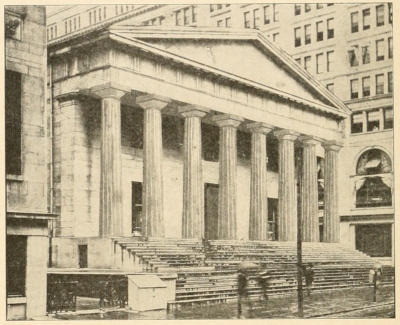
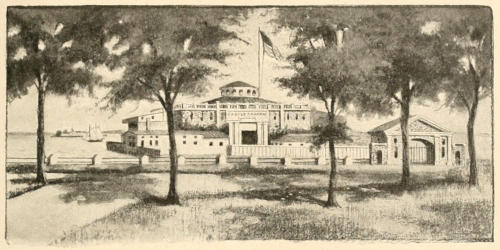
THE OLD UNITED STATES BANK, NOW THE CUSTOM HOUSE,
PHILADELPHIA
The charter of the Bank was not to run out until
1836. It had not been necessary or wise to force the
question of its renewal to an issue in 1832, to be confused
with the question of General Jackson’s popularity
and personal prestige. The conservatives in Congress
had been betrayed into a grave tactical blunder, because
they shut their eyes to the real signs of the times.
They did not yet know the rules of prudence in a day
of personal politics; did not understand the subtle elements
of the play; did not know the opinion of the country
or comprehend the drift of affairs.
The Bank of the United States had been first created
in 1791, and the question of the right of Congress to
establish it had been duly fought out then, as it were
at the very founding of the government. Both Congress
and the Executive had accepted the conclusions of Mr.
Hamilton in the matter, and rejected the conclusions
of Mr. Jefferson. Mr. Jefferson’s party had allowed the
charter of the Bank to lapse in 1811, when their day
of power came, professing themselves opposed to it on
principle; but in 1816, finding the exigencies of finance
powerful solvents of their scruples, they had changed
their minds and had given it another twenty-year charter.
Three years later the Supreme Court of the United States
(McCulloch vs. Maryland, 1819) confirmed the reasoning
of Mr. Hamilton with regard to its constitutionality in
a formal decision, and set the views of every scholarly
lawyer in the country once for all at rest on the matter.
But General Jackson had come in “to simplify and
purify the workings of the government, and to carry
it back to the times of Mr. Jefferson,—to promote its
economy and efficiency, and to maintain the rights
of the people and of the States in its administration”;
and from the outset, with something of the instinct of
the communities in which he had been bred, he looked
upon the Bank as an enemy of constitutional and democratic
government. His attack upon it, begun in his
first inaugural address, had been continued in every annual
message he sent to Congress. He had begun by
plainly intimating a doubt as to the legality of its institution,
the Supreme Court to the contrary notwithstanding;
and had asserted that it had failed to establish a stable
currency. He next pronounced it an “un-American
monopoly.” Finally he expressed serious misgivings
as to the soundness of its management. At each mention
of it his warmth sensibly increased; his hostility
became more open and aggressive. The purpose apparently
grew upon him to destroy it. He forced it
to meet him, as challenger, and fight for its life in the
open field of politics. Influences were at work upon
him which were only by degrees disclosed to his opponents.
The constitution of the Bank unquestionably placed
it very near the government itself. Its capital stock
was $35,000,000, and of this the federal treasury held
nearly one-third by direct subscription ($11,000,000);
five of its twenty-five directors were appointed by the
President of the United States; it was the depository of
the public funds and enjoyed the use of them without
interest; it was empowered to issue circulating notes
to the full par value of its capital stock; and its notes
were made receivable by the United States as cash for
all debts. Congress pledged itself to create no other
bank while the charter stood. In return, the Bank
had paid the federal government a million and a half
dollars for its franchise, and undertook to negotiate the
loans of the government without charge or commission.
Its notes it was obliged by law to redeem in specie on
demand. Although a private corporation and carefully
planned upon conservative and prudent principles,
it was unquestionably the ruling force in the money
market, and took its power from its connection with
the government. Undoubtedly, too, it had been intended
to play this dominating part and was by design
a political institution. It had been Mr. Hamilton’s
object, in setting up the first Bank of the United States,
to bring the money transactions of the country under a
central control, to check the experimental banking operations
of the States, and to draw the capitalists of the
country and the greater organizers of industry to the
active support of the federal government upon grounds
of interest. The second Bank, now under fire from the
Executive, had been given the same constitution and
function.
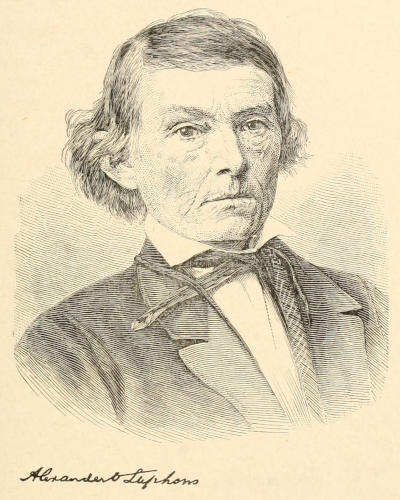
ALEXANDER H. STEPHENS
The supporters of the Bank were in a measure justified
in claiming that it was for such a purpose that the
very government itself had been set up. Nothing had
more obviously threatened quick and overwhelming disaster
to the country in the days of the Revolution and the
Confederation than the reckless financial operations of
the States, their unlimited issues of irredeemable paper,
their piled up promises and meagre means of redeeming
them; and the constitution of the Union had been
framed almost as much to avert ruin from that quarter
as to create a real government, clear up the relationships
of the States to one another, and steady their political
action. It absolutely forbade the States to issue bills
of credit, did not give the federal government itself power
to do so, and was meant practically to prohibit the use
of any currency which was not at least based directly
upon gold and silver. But the courts had opened new
flood-gates. They had ruled that, although the States
themselves could not legally issue bills of credit, they
could incorporate private banks authorized to issue
notes at pleasure, with or without proper security for
their redemption,—could even themselves invest public
moneys in the stock of such banks and become virtual
partners in the irresponsible business. Gold and silver
were hard to get, came within reach of eager borrowers
only in the most niggardly quantities, and could be
had only for securities in hand. The adventures of
growth and industry in a new country where everything
was making and to be made demanded easy credit,
to be had for the asking, and abundant money; and
had only promises and hopes to offer for security. Banks
of issue sprang up everywhere that there was expectation
and sanguine confidence; and every possible vagary
attended their operations. No man could tell a day’s
journey from the bank whose paper he carried whether
it would be accepted and serve him as money or not.
Only a great commanding bank, everywhere known,
whose notes really and always represented gold could
supply paper worth its face value in all places or keep
exchanges from chaos.
Such an agency of adjustment and control the Bank
of the United States had proved itself to be. It had not
only served its purpose as a fiscal agent of the government,
to the satisfaction of the Treasury, but had also
steadied and facilitated every legitimate business transaction
and rid the money market of its worst dangers.
But many of the men to whom General Jackson was
accustomed to listen believed, or affected to believe,
that it had done much more: that its power was used
to serve a party and to keep men who were no friends
of the people or of popular rights in a position to manage
and corrupt the whole politics of the nation. They
reasoned out of experience. The state banks were
everywhere notoriously tainted with political partisanship,—were
almost everywhere familiar, recognized
engines of party supremacy. No one who was not of
the political majority in the State could get a banking
charter from a state legislature; no one was absolutely
sure of credit or indulgence at a state bank except those
who were of the party of its directors. It had come to
be looked upon as a matter of course that banks should
be used as parts of the machinery of political control.
General Jackson and his partisans could not believe
that the great Bank of the United States was free from
a similar taint. It had certainly been established by
men of the party which they were now trying in all things
to supplant, the men who had turned away from General
Jackson and followed Mr. Clay. It was part of the
old, suspected, aristocratic order which the new democracy
had come in to set aside, and everything that it
did was subjected to suspicion.
The Bank had branches throughout the country, at
points of convenience where business centred. Friends
of General Jackson complained that men openly opposed
to them in every party interest were appointed officers
of these branches, even in States which had cast their
votes for General Jackson and the new régime; that
loans were refused and collections insisted on in a way
which was offensive to the partisans of the Administration;
and that money was used in the elections against
them. They were particularly indignant that Mr.
Jeremiah Mason, an incorrigible Federalist, had been
made president of the branch bank at Portsmouth, in
New Hampshire, and had shown himself disinclined,
as they had expected, to afford friends of General Jackson
any unusual indulgence or accommodation in
matters of business. Concrete cases fixed General
Jackson’s convictions in such matters as no argument
upon the merits could fix them. Here was a very tangible
example of what he had been led to suspect. The
story came straight from friends whom he trusted,—from
Mr. Levi Woodbury and Mr. Isaac Hill, the two
men who had been chiefly instrumental, he had reason
to believe, in winning New Hampshire over from the
Federalist to the Jackson interest. Mr. Hill was editor
of the New Hampshire Patriot, and had an editor’s
inside view of the politics he had had so large a share
in shaping. He was also one of the officers of a bank
at Concord which was operated under a charter from
the State, and had a state banker’s knowledge of what
the branches of the Bank of the United States could do
to dominate credit and control exchanges. Mr. Woodbury
had been chosen a senator of the United States in
1825, and had from the first been received into the intimate
counsels of the new President. Mr. Hill had left
his bank and his paper in New Hampshire to put himself
at the service of the Administration in Washington,
and had become, as everybody knew, a member of the
“Kitchen Cabinet.” When such men told him of the
influence of the Bank in New Hampshire, the President
could but believe them. Mr. Kendall brought him
the same report of its influence in Kentucky. It had
undoubtedly, he said, spent money there to secure the
success of Mr. Clay and the defeat of General Jackson.
It seemed a significant thing that Jeremiah Mason
should have been chosen for president of the branch
bank at Portsmouth. He was unquestionably the
political opponent whom the Jackson leaders in New
Hampshire most feared, and had most reason to fear.
His character gave him a very noble eminence; his extraordinary
abilities as a debater and his exact knowledge
as a lawyer gave him an instant hold upon every
thoughtful audience. All the country knew how formidable
Mr. Webster was in debate, and Mr. Webster
ascribed no small part of his own power to the lessons
he had learned when pitted against Mr. Mason at the
bar.
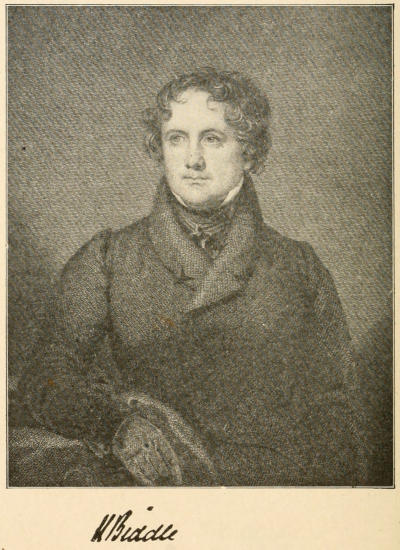
NICHOLAS BIDDLE
The President had no mind to let the case go unnoticed.
Mr. Ingham, the Secretary of the Treasury,
brought it to the attention of Mr. Biddle, the President
of the Bank of the United States (1829), in a letter in
which he frankly took it for granted that Mr. Mason
had been appointed because of his hostility to General
Jackson; plainly intimated that the whole object of
the Bank’s establishment and management had been
to strengthen “the arm of wealth” in order to “counterpoise
the influence of extended suffrage in the disposition
of public affairs”; and urged that the Bank clear itself
of the suspicion by drawing its officers and appointees
from both political parties without discrimination. Mr.
Biddle replied with natural indignation. It was easy
to refute the charges made. In the particular case of
the branch bank at Portsmouth the well known character
of Mr. Mason made them ridiculous. It could be
shown conclusively enough that, whatever party the
officers of the Bank happened to be chosen from, its
affairs were conducted in accordance with sound principles
of business, and with no view to either giving or
withholding favors upon political grounds. Mr. Biddle
found no difficulty in framing a reply which should
have convinced all candid men upon the main points
at issue.
He made a grave tactical blunder, none the less, in
the tone and method of his defence. He knew the temper
and susceptibilities of the men he was dealing with and
the temper of opinion in the country as little as Mr. Clay
did and the men who stood with Mr. Clay against the
President in Congress. The warmth of Mr. Biddle’s
reply to the Secretary, however natural, was most impolitic;
and he did not content himself with refutation,
but went on to utter what seemed little less than a defiance.
He reminded Mr. Ingham that the Bank of the
United States, whatever its business connections with
the federal government, was a private corporation, accountable
to no one but its own directors for the conduct
of its affairs. Mr. Ingham responded with a pointed
threat. He reminded Mr. Biddle, in his turn, that
the law by which the Bank was incorporated authorized
the Secretary of the Treasury to withdraw the deposits
of the United States when he deemed good cause for the
withdrawal to exist.
Mr. Ingham retired from the Treasury upon the reconstruction
of the cabinet which followed the President’s
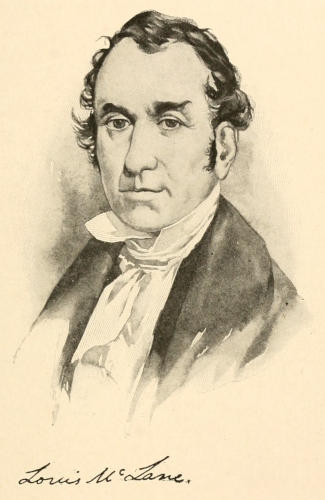
breach with Mr. Calhoun, and Mr. Louis McLane,
of Delaware, took his place (August 8, 1831), a man of
better balance and more liberal spirit, trained in the
older school of politics. In December, 1831, his report
to Congress ran strongly and unmistakably in the
Bank’s favor, and it began to look as if the temper of
the Administration had already cooled and altered in
the needless quarrel, which was of its own making.
But the friends of the Bank were not wise enough to
let the matter drop. Its charter was safe at least until
1836, and General Jackson, they might have hoped,
would learn the Bank’s value by experience, should
he remain President until then. But Mr. Clay advised
that application be made at once for a renewal of the
charter, while the houses certainly held a majority
favorable to it; and the advice was imprudently taken.
The matter was pressed at once, and in the summer of
1832 (June-July), during the session which immediately
preceded the presidential election, a bill renewing the
charter passed the Senate by a vote of 28 to 20, and
the House by a vote of 109 to 76. It was a direct challenge,
and General Jackson of course met it with a
veto, delivered point-blank and without hesitation. The
Bank’s majorities in the houses were not large enough
to pass the bill over the veto; and Clay men and Jackson
men alike turned to the country for its verdict.
The folly of staking the fortunes of the Bank against
the popularity of General Jackson at the polls was
quickly enough demonstrated. It was much easier for
the mass of men who now held the votes of the country
to believe the Bank a dangerous and corrupt monopoly
than to understand the arguments of statesmen
who argued of its services to the government and
to commerce. They recognized General Jackson as a
man of their own instincts, and deemed those instincts
a sure enough guide in politics. Statesmen might
approve of the Bank, but the people thought of it only
to suspect it, and preferred General Jackson to all the
statesmen the Bank could muster to its standards. A
second time they chose General Jackson President.
He interpreted their votes to mean a deliberate verdict
against the Bank,—a command to destroy it; and its
fate was sealed. The President proceeded with characteristic
promptness and directness. He first turned
to Congress (December, 1832), the very Congress which
had passed the vetoed bill, and asked for an investigation,
to ascertain whether it was still safe to leave the
deposits of the government with the Bank, in view of
its mismanagement and probable insolvency. No one
but General Jackson and a handful of politicians about
him seriously questioned the good management of
the Bank or for a moment doubted its solvency, even
then, with its charter evidently doomed; and the House
very emphatically declared that in its opinion the deposits
were safe. General Jackson, accordingly, determined
to act without Congress and on his own responsibility.
He resolved that the Bank should no
longer be given the custody of the public funds.
The statute under which the Bank was incorporated
conferred the power to act in that matter, not upon
the President, but upon the Secretary of the Treasury.
The President therefore wrought his will upon the Treasury
Department. Mr. McLane, whom he knew to be
favorable to the Bank, he transferred from the secretaryship
of the Treasury to the secretaryship of State,
appointing Mr. Edward Livingston, then Secretary
of State, minister to France, and putting Mr. William
J. Duane, of Pennsylvania, who was known to be an
opponent of the Bank, in charge of the Treasury Department.
Mr. Duane showed unexpected scruples,
and declined, out of a mere sense of duty, to make way
for the execution of the President’s radical plan. He
was dismissed, therefore, within four months of his
appointment, and the Treasury was put into the hands
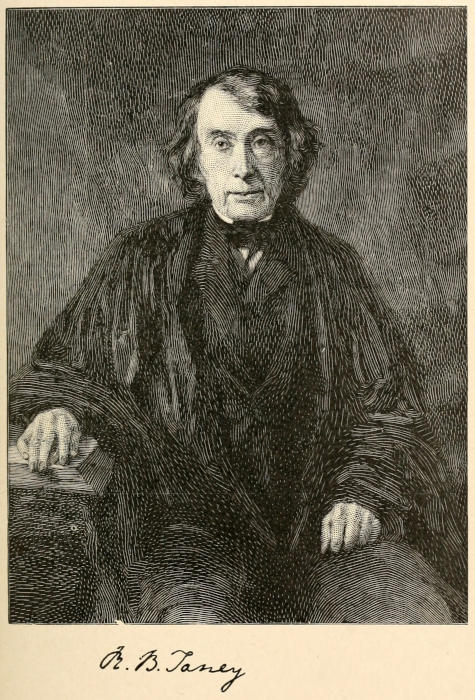
of Mr. Roger B. Taney, of Maryland, the Attorney
General, whose views the President knew to be his own
(September 23, 1833). An order from Mr. Taney forthwith
directed (September 26) that the revenues thereafter
accruing should be deposited, not with the Bank
of the United States, but with certain state banks selected
by the Secretary for the purpose, and that the balance
of the government in the Bank of the United States,
then nearly ten millions, should be drawn upon for
the government’s expenses until exhausted. The thing
was done at infinite hazard of financial panic. The
Bank was obliged to curtail its loans very sharply and
at once, in order to bear the drain, which was to be offset
by no replenishment; there was immediate distress
in the money market, a sudden flutter of credit; and only
the sound condition of business at the moment prevented
crisis and disaster.
The President spoke of the matter in his annual
message with his usual intrepid frankness: took the
whole responsibility for what had been done upon himself,
and justified it. No one whose opinion was of
any weight in such a matter had approved of the removal
of the deposits; his own cabinet had been opposed
to it, as both unwise and of doubtful legality, and had
united with Mr. Duane in trying to turn him from his
purpose; but he had gone his way without pause, hesitation,
or excitement, like a man convinced and confident.
He believed that the Bank had gone into politics to prevent
his re-election, in 1832 if never before. Its directors
admitted that large sums had been spent out of its funds
for pamphlets, for speeches, for every legitimate means
of agitation in the campaign, which it knew to be a
struggle for its life; and the President, who, with Mr.
Clay as ally for the nonce, had forced it thus to meet
him in the field of party action, now declared that the
issue had come to this, “whether the people of the United
States were to govern through representatives chosen
by their unbiassed suffrages, or whether the power and
money of a great corporation were to be secretly exerted
to influence their judgment and control their decisions.”
He made no scruple of the law in the case, deeming law
meant for the service of the country.
ROGER B. TANEY
The new House of Representatives, elected in the
autumn of 1832, was now controlled by his friends, and
supported him. The Senate, on the contrary, still
stood against him, led, as before, by Mr. Clay, Mr.
Webster, and Mr. Calhoun; and spread upon its minutes
a public and formal censure, in which it earnestly condemned
both the dismissal of Mr. Duane and the removal
of the deposits. General Jackson replied in
an equally formal protest, which ran hot and imperious.
It spoke his whole theory of constitutional obligation:
his resolution to be bound by neither court nor senate,
nor any precedent whatever, but only by his own conviction
of duty as a representative of the people under
the constitution. The contest was ended. The Bank
of the United States quietly made ready for the expiration
of its charter, and when it came (1836) accepted
in its stead a charter from the State of Pennsylvania.
LOUIS McLANE
But the effect of what the President had done had by
no means passed or spent itself. General Jackson had
said that the Bank of the United States did not give
the country a stable currency. The country had an
opportunity to see for itself what service it had rendered
when its check was withdrawn. It was no sooner discredited
than the old inflation of bank issues came again,
with wider range and play of destructive force than
ever. The “pet banks,” as they were promptly dubbed,
to which the deposits of the government had been transferred,
were selected upon party principles,—were one
and all “Democratic” banks in the South and West,
whose directors were of the President’s party. Their
number was fixed by no law or principle, and began
from the outset to be added to from time to time, as this,
that, or the other influence of interest or persuasion obtained
the patronage of the government for banks not
at first favored with a place on the list. State banks
saw their day come again. State legislatures multiplied
banking charters without safeguard or limit. Every
bank sought the government’s favors; but none was
discouraged because it did not obtain them. All banks
were banks of issue. Those that did not have the government’s
money to lend loaned their own abundant
notes. Paper money seemed to pour of a sudden from
every town and hamlet, and speculation began to heap
risk upon risk to make use of it. The real money centres
of the country had little part or lot in the business. Enterprise
ran freest where chiefly compounded of hope,—where
the resources of the country, though unmistakably
rich with every promise of abundant profit,
were as yet undeveloped, awaiting the slow processes
of industry. The bubble of credit glistened resplendent
with all the hues of the round globe, until General Jackson
himself, in his rough honesty, pricked it.
The first strain and flurry came by reason of the mere
superabundance of the national revenues. Business
had been sound and prosperous until this new policy
which upset the Bank came to disturb it, and the government
had shared the profits of the merchant and the
manufacturer. By the close of the year 1835 it was
entirely free from debt. The revenues which filled its
coffers could not be reduced: they came chiefly from
the tariff duties as fixed by the compromise Act of 1833,
and that was a pledge of peace between parties which
no man cared to alter. Rather than keep surplus piling
upon surplus, accordingly, Congress ordered (June,
1836) that on and after the first of the following January
all surplus funds over and above five millions should
be distributed, quarter by quarter, among the several
States, as loans without interest which Congress might
at its pleasure recall. Not a few of the pet banks found
themselves considerably embarrassed to meet the drafts
upon them by which the quarterly distributions were
made; but the States found speculative schemes to put
the money into quite as readily as individuals did; the
movement of business was not disturbed; and before the
year was out there were no more such disbursements
to be feared. Only three quarterly payments were
made,—a total of twenty-eight million dollars. After
that there was no surplus to distribute. General Jackson
had pricked the bubble.
ELECTORAL TICKET OF 1836
The President had a very sturdy and imperative
sense of right and honesty in all money matters. He
believed gold and silver to be “the true constitutional
currency” of the country, he said. He demanded of
the pet banks that they should keep specie enough to
cover at least a third of their circulation, and that they
should issue no notes of a lower value than twenty
dollars. He increased the output of the mints and
tried by every means to force coin into circulation. He
had no idea of letting the country try again the fatal
experiment of an irredeemable paper currency, if he
could prevent it; and when he saw the fever rising in
spite of him he tried a remedy as drastic and wilful as
his destruction of the Bank of the United States. Speculation
and hopeful enterprise had had an extraordinary
effect upon the sale of the public lands. In 1834 the
government had received less than five millions from
that source. In 1835 the sum sprang up to more than
fourteen millions,
and in 1836 to
nearly twenty-five
millions; and the
money poured in,
not, of course, in
gold and silver, but
in the depreciated
currency of innumerable
unknown
banks. The Treasury
was forbidden
by statute to receive
any notes but those
of specie paying
banks; but things
had by that time
already come to
such a pass that
no man could certainly
or safely distinguish
the banks which really kept a specie reserve
from those which only pretended to do so. On July 11,
1836, accordingly, by the President’s command, a circular
issued from the Treasury directing the land agents
of the government to accept nothing but gold or silver
in payment for public lands. Again, as in the case of
the Bank, the President’s advisers drew back and disapproved;
but again he assumed the full authority
and responsibility of his sovereign office, and delivered
his blow without hesitation or misgiving.
The effect was to shatter the whole fabric of credit.
But the consequences did not disclose themselves at
once. General Jackson had retired from public life and
Mr. Van Buren had succeeded him in the presidency
(March, 1837) before the inevitable day of disaster and
collapse had visibly come. The imperious old man
must have looked back with not a little satisfaction
upon the long series of personal triumphs he had won,
against trained statesmen and old parties intrenched
against him. Even in diplomacy his energy and prompt
initiative had won him successes denied to his predecessors.
He had sent Mr. McLane to England to say
that all our restrictions upon the carrying trade of England
would be repealed if England would remove those
which she had put upon the carrying trade of the United
States in the West Indies; and the ports which had been
shut in the faces of Mr. Gallatin and Mr. Adams were
opened to him, Congress promptly fulfilling his promise
with regard to the action of the United States (May
29, 1830). He pressed upon the new government of
Louis Philippe in France, and upon the other governments
as well which had been at fault in the matter,
the claims of the United States for depredations unlawfully
committed upon American commerce during
the Napoleonic wars; and the claims were recognized
and paid. He moved straight and openly upon every
object he desired, and his very directness seemed to
add dignity and scope to the government over which
he presided. He had created a party and put subtle
revolution into affairs by sheer force of individual quality,
and left his great place and office before either he
or the men who loved and followed him were aware what
mischief he had unwittingly done,—how the whole
framework of settled politics had been shaken and
loosened at every joint by his wilful supremacy.
General Jackson had obliged his followers to accept
Mr. Van Buren as his successor in the presidency:
they were dominated by his will in this as in all things.
The convention which nominated Mr. Van Buren had
met a full year and a half before the election (May,
1835), while the power of the indomitable President
was at its mid-term vigor; had been irregularly made
up, its ranks crowded with men who held office under
the President; and signs of faction and revolt had not
been wanting. The country had chosen lukewarmly,
too, the man whom the party had named perfunctorily.
His majority in the electoral college had been but 47,
as against General Jackson’s majority of 152 four years
before; his popular majority only 26,000, as against
General Jackson’s 157,000. The opposition had lacked
unity and organization; hardly constituted a party at
all; consisted, rather, of various groups of several shades
of opinion; and put several candidates into the field:
General William Henry Harrison, of Ohio, Mr. Webster,
and Judge Hugh L. White, of Tennessee, for whom Tennessee
voted, General Jackson notwithstanding. But,
rank and file, the Democrats had stood by Mr. Van
Buren. In him they acknowledged their debt and allegiance
to General Jackson.
A NORTH CAROLINA MANSION OF THE OLD STYLE
Not a little strength of character underlay Mr. Van
Buren’s bland exterior, his conciliating manners, his
air of sweet accommodation. He was also, in his way,
a consummate master of men. He mastered them by
insight, by intimate and friendly counsel, and by knowing
the end he sought. But he did not rule or dominate
by force of will. That slender little gentleman, always
courteous, always placid, always ready to listen, and
wait to have his way, could not hold or rule the imagination
as the rugged veteran did who had preceded
him, tall, gaunt, sad-faced, majestic, carrying fire,
gracious and grim by turns. The country regarded
its new, soft-spoken President much as an audience
would regard a bland, mellow-voiced, facile player
brought on as understudy to some intense tragedian;
was slow to take him seriously, slow to be convinced
that he had an individuality and a power of his own.
He seemed tacitly to promise in everything that he said
that at every point of policy his administration should
be but a continuation of what his predecessor had begun;
and men looked on with curiosity rather than with
sympathy, were more ready to criticise than to applaud.
JOHN CALDWELL CALHOUN
While Jackson reigned he had seemed rather the
maker than the representative of policy, and the Democratic
party had been with difficulty discernible behind
his stalwart figure, standing always at the front
of the stage. Now at last it entered the play, as itself
an independent and originative force in affairs, the
President merely one of its leaders. The revolution
wrought in political action by the coming in of General
Jackson had fairly shaken parties asunder. Throughout
his administration they had sought rather than
obtained a new order and cohesion. The “National
Republicans,” who had stood with Mr. Adams and Mr.
Clay, had been even when at their strongest something
less than a national party. Adherents had come and
gone while the fighting thickened about General Jackson
in Senate and House. When Mr. Van Buren became
President they were still, if separately distinguishable
at all, only the chief group among many
groups combined in opposition. The Democrats were
at last a veritable party; Mr. Clay’s friends were only
part of a party. Not until 1834 did the grouped Opposition
of which they formed the centre acquire a
party name, or begin to arrange the definite concerts of
party action. By the summer of 1834 they were coming
to be spoken of very generally as “Whigs.” National
Republicans; Anti-Masons; men who thought
that South Carolina had been too harshly dealt with,
to the detriment of constitutional state rights; men
who condemned Jackson’s high-handed way in the
matter of the deposits, “the immolation of Duane and
the subserviency of Taney”; all who were startled to
see how of a sudden a President had made himself as
it were the master of the government, drew slowly together,
and a great party was created. Insensibly,
when power came to it, and the heartening breath of
success, it reproduced the principles and spirit of the
Federalists: their liberal way of interpreting the constitutional
powers of the government, their confident
enterprise in pushing forward to new programmes of
action and putting the government at the front of the
nation at every step of its progress, their belief in constructive
statesmanship and the efficacy of legislation
in the development and determination of the country’s
life. But for the present it was merely a party of opposition,
set over against the Democrats, who were in charge
of the government and yet did nothing: did nothing,
apparently, upon principle. General Jackson had in
fact carried the government back to the principles of
Mr. Jefferson, as his friends had said that he would:
had squared its action with those principles more perfectly
a great deal than Mr. Jefferson himself had done.
His intense and aggressive activity in affairs had obscured
the fact while his personal power lasted; but
he had spent his telling energy upon clearing the field
of what his predecessors had constructed,—not upon
making but upon setting aside; and he left a party behind
him which had imbibed his spirit: which desired
no new era of Federalistic policy; which wished to see
the field kept clear of unnecessary laws and fostered
institutions, of great corporations created for the use
of the government and favored enterprises subsidized
in the interest of a class; which desired to see authority
used, not to patronize or foster, but only to give the
government the necessary force and to administer it
with a wise and honest moderation, while all things
went their natural course, unpetted and unhampered.
It faced a crisis with principles negative and opposed
to action, and yet faced it undaunted, advocating only
a safe withdrawal of the government from the field of
danger. Within two months after Mr. Van Buren’s
inauguration General Jackson’s “specie circular” had
done its work. A sharp financial crisis racked the
business of the country from end to end, and brought
with it a panic stubborn and hopeless, which seemed
for months together as if it had come to stay. It had
been strain enough that the money market had had to
accommodate itself to the preparations of the Bank
of the United States for the winding up of its business,
and to the distribution of the surplus among the States.
There had been a rapid increase, besides, in the volume
of imports since 1832, and considerable sums of specie
had had to be sent out of the country to meet the balances
of international trade. The specie circular had
come with cruel opportuneness. Bankers and borrowers
alike had been reckless; credit was already out of breath.
When the great sums of paper that had gone west for
the purchase of lands from the government came suddenly
back by the hundreds of thousands for redemption
there was instant collapse and panic. Most of the
banks had no specie and were utterly unprepared to
redeem their notes; those that had specie could afford
no relief,—had themselves too little to take care of their
own notes. There was a universal suspension of specie
payments, and credit was dead at a stroke. There
had been signs enough of what was about to happen
before the end came. A feverish rise in prices had
preceded it. The price of flour, which had been but
five dollars in 1834, had shot up to eleven dollars per
barrel during those first uneasy months of 1837; the
price of corn had risen from fifty-three cents per bushel
to a dollar and fifteen cents; and in February and March
there had been bread riots in New York.
SILAS WRIGHT, JR.
On May 15th the President issued a call for an
extra session of Congress, to be convened on the first
Monday of September. He had, it turned out, nothing
to propose except that the interests of the government
should be looked to. The pet banks had gone down
with the rest, and it was necessary that the government
should secure its revenues. Mr. Van Buren had
no thought of receding from the policy of the specie
circular; on the contrary, he had himself, amidst the
very signs of acute and increasing distress, issued a
similar order with regard to the transactions of the
Post Office. He stood stubbornly for specie payments,
banks or no banks, and had aggressive spokesmen
at his back in Congress: notably Mr. Wright and Mr.
Benton in the Senate. Mr. Silas Wright, of New York,
was the President’s close friend, in politics and out
of it; had been bred in the same school of politicians;
had the same astuteness in policy, and was yet, like
Mr. Van Buren himself, steadfast in the maintenance
of such principles as he saw and believed in. He was
of the school of those who fought for party success and
studied the subtle art of party management. He was
no student of principles—a politician of the new day,
rather; but honest and ready to act upon conviction.
He believed, as all Democrats of the new cast did, that
the offices of the government belonged to the majority,
as “the spoils of victory”; but he avowed the belief
with no touch of cynicism,—with the naturalness,
rather, and unaffected candor with which a man avows
principles he sees no need to be ashamed of; and he
could, with equal naturalness and honesty, now bring
forth out of his singular assortment of motives, as politician
and yet as statesman too, a stern faith in the
honesty and necessity of “hard money.” Mr. Benton
was no partisan of the administration: he was too
intense an egotist to be any President’s personal adherent
or spokesman. But he, almost alone amongst
public men of experience, had encouraged General
Jackson to put forth the specie order; and he was now
ready to give the administration his hearty support
in the maintenance, so far as the government was concerned,
of specie payments.
SAM HOUSTON
The President and his spokesmen had nothing to
propose for the relief of business. He believed, as Mr.
Calhoun did, that palliatives would only prolong the
unavoidable misery of readjustment and the return to
sound methods of business, the substitution of real
for fictitious values and of production for speculation,
and that, bad as they were, things would right themselves
more quickly and more wholesomely without
the intervention of legislation than by means of it.
His plan was, to cut once for all the connection of the
government with the banks, and provide for the
custody, handling, and disbursement of the revenues
by the Treasury alone. For three years, through two
Congresses, he fought doggedly for his purpose; and
won at last in midsummer, 1840. Then he got exactly
what he wanted. An “Independent Treasury Act,”
signed July 4, 1840, provided that the Treasury of the
United States should itself supply vaults and places
of deposit for the revenues, at Washington and at other
cities appointed for their receipt; that all federal officers
charged with their receipt, safe keeping, or disbursement
should be put under proper and sufficient bonds
for their careful and honest use and custody; and that
all payments thereafter made either to or by the United
States should be made in gold or silver only. It had
not been possible to bring the first Congress of Mr. Van
Buren’s term to accept this scheme. Twice adopted
by the Senate, now at last Democratic, it had been twice
rejected by the House, where a section of the Democratic
majority united with the Whigs to defeat it. Meanwhile
the President had been obliged to do without law
what he wished Congress to authorize by law. The
banks of deposit had suspended payment; there was
nothing to be done but to direct the agents of the Treasury
to keep and account for as best they could the
moneys which came into their hands.
CYRUS HALL MCCORMICK
Meanwhile, too, the country went staggering and
bewildered through its season of bitter ruin. There
had been nothing like it before in all the history of business
in America. Utter collapse and despair came,
soon or late, upon every sort of undertaking the year
through. Radically unsound banking laws in the
States had been at the bottom of all that had happened
to bring disaster on; and yet no one could reasonably
wonder at the hopes and schemes which had bred that
swift and fatal fever of speculation. Abounding wealth
unquestionably awaited the enterprise and industry
which should develop the rich valleys of the West, plant
productive communities there, and unite East and West
by road and river; and means of quick development
had at last been found which promised fulfilment of
every dream within a single lifetime,—it might be
within a single decade,—who could tell? It seemed
as if, in this very decade of Jackson’s reign and the
new democracy, the world had hit upon ways of almost
instant increase of wealth and power, where resources
were at hand, virgin and inexhaustible. It was then
that railways began to be built and steam boats put upon
the rivers; and the great spaces of the continent began
to seem no longer insuperable obstacles to the growth
men had dreamed of and strained after ever since the
landing at Jamestown. Robert Fulton had put a successful
steam boat on the Hudson as long ago as 1807;
but until now steam craft had seemed hardly more
than novel conveniences, to be experimented with.
Now at last they began to be built in numbers sufficient
to quicken and facilitate enterprise and settlement.
Railways seemed to spring suddenly into existence,
to serve the same end. In 1830 there were but twenty-three
miles of rail in the country: a short road here and
there for cars drawn by horses. But presently steam
was brought into use for the propulsion of cars also;
and within five years (1835) no less than thirty million
dollars had been invested in railroads. Before the
crisis of 1837 came more than fourteen hundred miles
of railways had been constructed; and by the time Mr.
Van Buren went out of office (1841) there were more than
three thousand, the crisis notwithstanding.
JOHN GREENLEAF WHITTIER
Invention seemed to awake on every hand, and was
not a whit daunted by the state of the money market.
In 1834 Cyrus Hall McCormick had invented a reaper,
to be drawn by horses, which once for all solved and
simplified the problem how the great plains and wide
valleys of the West were to be brought under cultivation
by a sparse pioneer population, where hands were few.
In 1836 means were found by which the great anthracite
coal beds of the country could be used in the production
of steam and in the manufacture of iron. Along with
the utilization of the new fuel came the invention of
the screw propeller. By 1838 the invention had been
fairly perfected, and it had become reasonably certain
that steam craft upon the ocean would draw the continents
of the world together as steam craft upon the
rivers and locomotives upon the railways were uniting
East and West in America. In 1839 James Nasmyth,
at Manchester, invented the steam-hammer whose use
was presently to increase so enormously the power and
resources of the iron forges from which the new machinery
of conquest and manufacture was pouring forth.
Here were the instruments of industry and of real
production upon which imagination dwelt and speculation
based its hopes. Real wealth was being created
apace, and nothing was too extravagant to hope for.
More eager movements of population went with hope
and enterprise, and a very ferment of social and economic
change. With the growth of manufacturing industries
came concentration also. Towns began to grow into
cities. Enterprise took on a new magnitude, individual
initiative was a little daunted, and corporations began
to be multiplied. Finding themselves massed in the
new undertakings, finding their employers, not individuals,
but groups of men using their combined
capital upon a large scale, workmen and mechanics
began to draw together into protective organizations;
and new murmurs against “capital, banks, and monopolies”
disturbed the peace alike of philanthropists and
of politicians. The rural nation which had chosen
General Jackson to be its leader began to be transformed
even while he reigned:—most of all in the East, where
industry was chiefly seated, but in the West also, where
men of every section met, and moved with quickened
pace towards new objects and new developments till
then not dreamed of. New ambitions stirred everywhere,
and men’s very manners were changed with
the new haste and energy that swept them on.
EDGAR ALLAN POE
Men’s minds and consciences were stirred, also, by
the pungent airs of the new age. Not in America only,
but throughout the whole European world also of which
she was an outlying settlement, the attention of thinking
men was set upon new thoughts in that day of
change. The year 1830 had seen political and social
revolution sweep to and fro, hardly to be checked, upon
the troubled European stage. England had managed,
as always, to be beforehand with revolution, but only
by making many a radical change in her laws. Between
1828 and 1836 she repealed the Corporation and
Test Acts, removed many of the political disabilities of
Roman Catholics, reformed representation in Parliament,
abolished slavery in her colonies, bettered her
system of poor relief, framed a liberal code for the reconstitution
of municipal corporations, and abolished
tithes. In the United States there was none of these
things except slavery to be cleared away. State and
federal constitutions alike had been purged from the
first of all that could clog or embarrass progress. American
philanthropists, too, had been beforehand with the
rest of the world in many a work of humanity and mercy.
The fame of America’s reformed penitentiary system
had crossed the seas; and in 1831 Alexis de Tocqueville
and Auguste Beaumont had come to the United States
to report upon the system for the information of their
government. It was that visit which gave us de Tocqueville’s
inimitable Democracy in America.
WILLIAM H. PRESCOTT
The abolition of slavery in the British empire in 1833
brought poignantly home to some men in the United
States the one matter in which America was behind
all the world. It was in 1833 that the American Anti-Slavery
Society was formed, at Philadelphia. Not
many connected themselves with it. Slavery was
rooted deep in the whole economy of the South; the
constitution of the Union itself was founded upon arrangements
which took the permanence of slavery for
granted; and no man who was not of hot crusading
temper felt inclined to give any countenance to a movement
which might, if pushed far enough, shake the
very foundations of the government. But the few
who gave themselves to the agitation were of crusading
temper. Here and there throughout the country,
moreover, there were bodies of men, like the Quakers,
whose principles had time out of mind been of this tenor,
and who became at once their natural allies. Petitions
began to pour into Congress praying that it would
abolish slavery in the District of Columbia, prohibit
the slave trade there, and break up the slave trade between
the States. John Quincy Adams had entered
the House of Representatives in 1831, only two years
after he left the White House, as a representative of
the Anti-Masons and Whigs of his home. A sturdy
and striking figure he made, with all the dignity and
all the contentious strength of his sixty-four years upon
him; and it surprised no one, least of all his constituents
at home, that he championed what he pleased, without
respect of parties. It was he who presented the petitions
against slavery and stood mettlesome and unalarmed
amidst the wordy battles they brought on.
It was a deeply hazardous and ominous thing to
join issue thus, though it were only upon a petition
here and there, with regard to this central matter of
the whole South’s life. The South still stood unchanged.
No revolution of industry, no breath of speculation,
no plotting or building of railways, no steam craft at
her ports or on her rivers touched or altered her fixed
order of society. Some of the first railways built were
built in the South. Her merchants felt the impulse
and saw the outlook of the time as others did. But no
power from without, no alteration of the world beyond
her borders, could change her economic and social order
so long as slavery lasted. There was no aristocracy in
the South of the kind men commonly think of when
they use the word. There was a ruling race and a
subject race; there were rich men and poor among the
race that ruled; there went with wealth a certain ease
and expansiveness of living, a good deal of quiet leisure,
an old-fashioned grace and punctiliousness of
manner which gave to those who cultivated it an air
of exclusiveness and elevation. Young men were apt
to be arrogant and to have their fling in the world of
pleasure, and old men showed sometimes a lofty pride
of birth and position. But there was little display.
Wealth did not in that agricultural region mean abundant
money, but only full store-houses, a well stocked
stable, an unstinted table, plain comfort, and open-handed
hospitality. In politics the ruling race were as
democratic as men of their kind anywhere. All white
men had an equal footing of privilege there and an
equal freedom, though offices fell as often to men of
position whom fortune had put at the front as to men
who had made their way up from the ranks and men
who added ambition and initiative to ability.
RALPH WALDO EMERSON
Mississippi and Alabama were still new States upon
a frontier, and grew rapidly in population. Georgia,
too, added slowly to her population from decade to decade,
adding also to her industries and profiting as she could
by the new forces of the age. But Virginia and the
Carolinas grew scarcely at all. And so the South stood
apart, potent and alive and yet immobile. Though
she provoked attack, she was intrenched against it.
It was singular how the signs multiplied of change
and a new age coming in. A whole generation of new
writers came suddenly into prominence during those
first years of railways and steam craft (1828-1841):
Hawthorne, Poe, Whittier, Longfellow, Emerson, Lowell,
Holmes, Prescott, Bancroft; Mr. Justice Story and Mr.
Justice Kent; Henry Wheaton, Francis Lieber, Henry
C. Carey; John James Audubon and Asa Gray,—men
of letters, law writers, publicists, economists, men of
science. Poe and Audubon were of the South; the
rest were of the North, where leisure was coming with
increase of wealth, stimulation of thought with increase
of action. “You are a new era, my man, in
your huge country,” wrote Carlyle to Emerson. In
the South writers still bent all their thoughts upon
statesmanship and the control of public policy; read
old books and maintained an elder taste; made cultivation
a thing of quiet moments or of the delights of conversation,
and carried it forth into the open arena only
as an instrument of power.
TERRITORIAL CONTROVERSIES OF THE UNITED STATES,
SETTLED BETWEEN 1783-1850
BORMAY & CO., N. Y.
JAMES RUSSELL LOWELL
Every change seemed sensibly to increase the sweep
and ascendency of pure democracy and visibly to enhance
the power of the general opinion. By the close
of General Jackson’s presidency there was no longer
any property qualification anywhere required in the
North for the exercise of the suffrage except in Connecticut
and New Jersey, or anywhere in the West except
in Ohio. The people’s day had come; the people’s
eyes were upon everything, and were used in a temper
of criticism and mastery. Newspapers of a new type
sprang up, like the Sun and the Herald, every number
of which gave old gentlemen in New York a shock,
which pried into everything and told everything, whether
it concerned private individuals or public events.
The upturning General Jackson had brought upon
the government was beginning to come also upon society.
NATHANIEL HAWTHORNE
How serious the upturning had been in the administration
of the government the country learned while
Mr. Van Buren was President; and the discredit for
what General Jackson had done fell upon him. The
men whom General Jackson had put out of office had
too often carried away with them the business methods
of their Departments. The men who had succeeded
them, always new and raw at their tasks, were too often
incompetent also, and sometimes showed the cunning
and dishonesty of men who seek the “spoils of office”
for their own aggrandizement. It was Mr. Van Buren’s
misfortune that no discovery was made of the jobbery
and misfeasance that had crept into the Departments
until he became President. The “spoils” system, moreover,
was commonly believed to have been the bad invention
of his own school of politicians in New York.
He attempted no concealments; no one was shielded or
excused when discovery was made; but he got no credit
for that. Everything that came to light was but confirmation
added to the conviction of the country that
both he and his party had best be got rid of. The
Whigs were eager to give legislative assistance to the
country in its efforts to rally from the collapse of 1837;
the Democrats offered nothing but the Independent
Treasury,—were very fine and steadfast in their determination
to take nothing but “sound” money into
the Treasury, but offered no suggestion as to where the
sound money was to come from, or how business was
again to be founded on it.
HENRY W. LONGFELLOW
The States were left to work that problem out for
themselves, if legislation were needed; and a very wholesome
change began. The legislatures of the States
set themselves at last to require real securities of the
banks of issue which they chartered, New York leading
the way; and by slow degrees credit was re-established,
panic shaken off. But the Democrats gained nothing
by the circumstance as a national party. They seemed
to have lost initiative when they lost General Jackson.
Mr. Van Buren had handled such diplomatic matters
as fell to his management with prudence and good
judgment. A final reckoning with the Seminole Indians
of Florida had been brought to a successful close
while he governed,
and a serious boundary
dispute with
Great Britain had
been accommodated,
notwithstanding
very distracting
complications which
had arisen out of
attempts on the part
of lawless men in
the United States
to assist insurgents
who were openly in
arms against the
English crown in
Canada. But only
the irritating details
of these matters
were talked about.
Nothing large or
masterful filled the
eye or stirred the
general sympathy
either in the President
or in the men who spoke and acted for him in
Congress; and the whole country turned to the Whigs
for a change.
PRESIDENTIAL TICKET, 1840
WILLIAM HENRY HARRISON
The Democrats nominated Mr. Van Buren for a second
term and avowed all their negative principles in a candid
platform. The Whigs, now at last welded into something
like a united and aggressive party, nominated
General Harrison, for whom most of them had voted four
years before, for President, and for Vice President Mr.
John Tyler, of Virginia. They made no declaration of
principles whatever,
but proposed only to
oust the Democrats.
The country was willing.
General Harrison
was the hero of a
well remembered battle
in which the redoubtable
Tippecanoe,
the “Prophet” of the
Indians who hung
upon the northwestern
frontiers, had been
routed, in 1811, and
the western country
quieted and made safe.
He had himself been
dubbed “Tippecanoe,”
and men everywhere
were ready to shout
very lustily for “Tippecanoe and Tyler too.” The
Democrats had no enthusiasm with which to match this
for the old soldier and honorable gentleman of the elder
type whom their opponents had chosen as their candidate;
had only their dimmed record to speak of; and
lost overwhelmingly. General Harrison, it is true, got
but forty-six thousand votes more than Mr. Van Buren
received out of a total of nearly two and a half millions;
but, though his margins were slender, counting
by voters, he won in the electoral college by a majority
of one hundred and seventy-four out of a total of
two hundred and ninety-four (234-60). The Whigs
saw their day dawn at last, and the Jacksonian régime
was over.
The authorities and sources for the events of this chapter are the
same as those named under Chapter II. The following special
authorities should, however, be added: the second volume of Albert
S. Bolles’s Financial History of the United States; Richard
Hildreth’s Banks, Banking, and Paper Currency; William G.
Sumner’s History of American Currency; Edward G. Bourne’s
Surplus Revenue of 1837; Goddard’s Bank of the United States;
C. F. Dunbar’s Laws Relating to Finance; Shosuke Sato’s Land
Question in the fourth volume of the Johns Hopkins Studies in
Historical and Political Science; and Samuel Tyler’s Life of Roger
B. Taney.
CHAPTER III THE EXTENSION OF SLAVERY
It remained to be seen whether the forces bred in the
Jacksonian time were also spent and gone, with the
passing from office of the men who had personified them.
It was difficult to reason upon cause and effect amidst
such scenes of change. Unquestionably a veritable
revolution had been wrought in American politics and
social action while Jackson and his partisans ruled
in affairs; but who could say whether these men had
been products or causes of that revolution? No doubt
there had been an air of lawlessness in the headstrong
action of the uncompromising, frontier soldier who
had been President. The fruit of his rough handling
had shown itself obviously enough during the mild
reign of his lieutenant and successor. And the country
had seemed to take its cue from General Jackson. Riot
and brawling disorder had everywhere been thrust
into affairs with unexampled boldness, success, immunity
from punishment. Headstrong men sought
everywhere to take the law into their own hands and
do what seemed best in their own eyes,—used force to
win strikes against their employers, to carry elections,
to silence abolitionist agitators and drive free negroes
out of the cities, to destroy the power of the Roman
Catholics coming in at the ports, to punish offences
which the courts too slowly dealt with or let go by, to
get food when prices rose too high. Men fought in
armed bands in city streets because they were of opposite
religious creeds or rival political factions or antagonistic
races, the native against the immigrant, the Protestant
against the Roman Catholic. On a memorable night
in August, 1834, an Ursuline convent in Charlestown,
within sight of the rising shaft on Bunker Hill which
was to mark the dawn of liberty in America, had been
sacked and put to the torch, because of the rage of a
Protestant mob against the growing power of the Romish
church, coming in with the Irish immigrants; and the
officers of the town had stood inactive by.
JOSEPH STORY
No man could justly say that General Jackson stood
for such things. He kept the law, as he understood it,
very punctiliously and with a fine sense of honor, and
made others keep it also. His challenge was only to
those who opposed him in matters of policy or in the application
of law, or sought to put upon him the too formal
restraints of judicial decision. Those who judged
calmly of affairs saw alike in him and in the uneasy disorders
of the time only signs of one and the same thing.
In the new democracy which Jackson represented the
mass of common men took leave to assert themselves
in all things, and use their own standards of right;
brushed law aside upon occasion to get at their object;
sought to rectify abuses by direct blows of force,—the
force of voting numbers or the force of arms. No
doubt riots grew more common in Jackson’s second
term than they had been in his first, and seemed to
keep pace with his fight against the Bank, his arbitrary
use of authority in reaching his ends concerning it,
his ruthless dealings with the credit of the country.
No doubt, too, his friends and partisans spoke too foolishly
and too much like demagogues of “the natural
hatred of the poor to the rich.” But great economic
forces moved also with equal pace towards change and
disturbance. The relations of capital and labor were
altered, whether General Jackson acted or not; prices
rose and wages shifted by laws he did not understand.
Railways changed the course and the speed of the nation’s
life; enterprise set men’s minds upon every bold
adventure; men of every kind flung conservatism off
and became radical, reckless, ungoverned in action.
Cause and effect were not in such a day to be easily
distinguished. No one could say what was permanent,
what merely temporary and accidental in the new and
novel order. One thing only was evident, that a new
and irregular fervor and a new standard of action had
been brought into affairs.
The Whigs themselves had conformed. They had
come into power in masquerade. Instead of putting
one of their real leaders forward for the presidency,
they had nominated a western soldier, whose rugged
strength and simple claim upon the admiration of the
country had made him a popular favorite. They had
themselves played the rôle of a reforming Opposition
merely, whose mission it was to turn a company of
sophisticated politicians out of office, with all their corrupt
and incapable following, and put a simple man
of the people in,—a Whig Jackson. Their campaign
had been conducted without serious debate or proposals
of policy; had been a mere noisy round of torch-light
processions, merry-making barbecues, and boisterous
neighborhood rallies. Their emblem had been the
frontier log cabin and a keg of hard cider, the solacing
drink of the frontiersman. It was a masquerade of
pure democracy, in the new taste, and they had played
it out to perfection.
But when the election was over and they had won,
the costumes of the play were put by. At last they
were assured of majorities in both houses of Congress;
small majorities, indeed,—in the House, twenty-five,
in the Senate, six,—an uncomfortable reminder of
the narrow margin of votes by which they had won;
but a working majority, none the less; and the real
leaders of the party, once more free to speak their serious
purposes, came forward with the programme by which
they meant to carry the government back to the traditions
which the Democrats had ruthlessly broken.
That programme included the repeal of the Independent
Treasury Act, the establishment of a new national
bank, the authorization of an immediate loan for the
relief of the Treasury, a system of new tariff duties
to supply the government with a permanent revenue,
and the distribution among the States of the proceeds
of the sales of the public lands. The financial distress
of the time had touched the government somewhat
sharply, and General Harrison’s first act was to summon
Congress to meet in extraordinary session on the last
day of May, to consider measures of relief.
But before it could assemble he was dead, and every
plan at which he was to have assisted had fallen into
confusion. The excitement and the fatigues of the
campaign for the presidency, capped by the infinite
worry and exhaustion that came upon him like a flood
when hordes of office seekers and advisers began to crowd
about him after his election and induction into office,
proved too much for his strength at sixty-eight. He
suddenly sickened, and exactly one month after his
inauguration (April 4, 1841) was dead.
John Tyler was President, to whom no Whig had
looked for leadership. He was a southern Democrat;
had been opposed to the Bank upon principles of public
policy, as General Jackson had been, but had held off
from his leader in the matter of the deposits and had
disapproved his reckless blows at credit, no less than
his masterful attitude towards Mr. Calhoun and the doctrines
held in South Carolina; and had been named
Vice President with General Harrison only because
Whigs of Mr. Clay’s stamp knew that they had in their
following many men who were not in all matters of
their way of thinking, and were uneasily aware that
their party was but a conglomerate party of opposition,
to which the votes of such discontented or independent
southern Democrats as Mr. Tyler would be very serviceable.
And so the masquerade of the campaign had had
a touch of prophecy in it, after all: here were the triumphant
Whigs with a Democratic President!
CAMPAIGN SYMBOL OF 1840
Their programme, of course, hopelessly miscarried.
Mr. Tyler felt very keenly the delicacy of his position,
and the almost necessarily compromising character
of the middle course he felt bound to attempt. Nature
and habit forbade him the frank, straightforward,
unhesitating course which alone could have won him
prestige and credit. He had neither initiative nor
audacity enough for leadership; tried soft-spoken diplomacy
where he should have used candid avowals of
his real opinion; courted compromise and accommodation
only to reject them at last; insisted upon his own
views only after he had created the impression that
he would yield them; seemed false and insincere because
he parleyed so long before taking his stand; and pleased
no one, not even himself. He had been glad to see the
Bank’s charter expire in 1836, and did not wish to see
the Bank re-established now; but the Whig leaders
were his advisers; he felt and showed a real desire to
yield everything he could that stood in the way of their
plans. Conference followed conference in the matter
of the Bank, for upon that everything hinged; twice
he seemed about to meet their wishes; twice he failed
them. A bill was drawn and passed in which several
features of the old charter were modified to suit his views,
but he vetoed it (August 16, 1842). Another bill was
drawn and passed which made concessions still more
radical to his scruples, but again he vetoed it (September
9th). Each time he hesitated; each time his friends said
that he would sign the bill; each time he fell back at
the moment of final action, as was his wont, upon his
real convictions.
JOHN TYLER
The Whigs in Congress were inexpressibly chagrined
and exasperated; publicly declared, with an unmistakable
note of passion, that “all political connection
between them and John Tyler was at an end from that
day forth”; and sullenly saved such remnants of their
programme as they could. Even before the open breach
came the leaders of the party had drawn away from
him, and he had been cut off from all real intimacy of
counsel with the men whom Congress heeded. General
Harrison had associated with himself a cabinet made
up of men who were known to be accredited spokesmen
of the party, making Mr. Webster, whom half the country
regarded as the greatest of Whigs, his Secretary
of State; and Mr. Tyler, sincerely desirous of making
as slight a break as possible in the continuity of the
party’s policy, had asked these gentlemen to retain
their places. But even before his final veto of the Bank
bill they had found it impossible to regard themselves
as really in his confidence. By the middle of September,
1841, all of them had withdrawn except Mr. Webster,
who remained only until important negotiations with
England touching the northeastern boundary should
have been brought to a successful issue. The Whigs
had in effect withdrawn their hands from the Executive.
Not only was the President’s leadership gone, but the
best traditions the Whig leaders stood for, of a policy
which joined Congress and the Executive under a common
leadership, were broken, and affairs were set adrift
to take the chance currents of politics.
The President signed the bill for the repeal of the
Independent Treasury Act, consented to the necessary
loan and to the changes in the tariff which had been
planned, and agreed to the distribution among the States
of the moneys received from sales of the public lands.
But, without the bank, these measures lacked all constructive
efficiency. The Independent Treasury arrangements
having been set aside, and no other fiscal
agency having been provided or authorized, the way
in which the revenues should be kept and handled was
left entirely to the discretion of the Treasury, without
guidance or restraint of law, throughout all the rest
of Mr. Tyler’s administration.
THE HANCOCK HOUSE, BOSTON. FROM A SKETCH MADE IN 1833
The Whig tariff Act was passed at the regular session
of 1841-1842. It incontinently upset the compromise
arrangements of 1833. The Act of 1833 had provided
for a progressive reduction in the rates of duty which
should be complete by the first of July, 1842, when the
rates should have reached a uniform level of twenty
per cent. The Whigs suffered them to stay at that level
only two months. On and after the first of September
following, it was enacted, the rates were to be increased
again, for the sake of the revenue. Twice the President
vetoed the bill, because of provisions contained in it of
which he did not approve. It was passed a third time,
without the provisions he objected to, and he signed it.
From the outset, so soon as the democratic masquerade
with which they had come in was over, opinion had
run against the Whigs. So early as the autumn of 1841
local elections had begun to go against them in States
which they had but just now carried for General Harrison;
and the mid-term elections of 1842 swept away
their majority in the House of Representatives. It
had been but twenty-five; it was supplanted now by
a Democratic majority of sixty-one,—a loss of forty-three
seats. The Senate they still held by a narrow
margin; but, without the House, they could do nothing
of consequence. Their dream of reconstructing the
old régime from which the Democrats had torn the
country away was rudely dissipated.
The Whig leaders were now to find out what changes
of politics had come to stay. They had not perceived
that what they had witnessed under General Jackson
was not a temporary madness of reaction against the
statesmanship and the ideals of the generation which
had given the nation its first form and policy, but a
permanent shifting of points of view, for men in office
and out, a turning away once and for all from the old
to new questions that went with the making of the nation.
Whether they would or no, they were in the hands of
the new democracy, their fortunes as a party committed
to the swift changes of the passing time. Important
as the matters were with which they dealt, their programme
had been a programme of old questions, not
of new. Change worked too swiftly now to make it
any longer possible for any party, however led or constituted,
to hark back to the policy of a time twelve
years gone by. There had been transient humors, no
doubt, as well as permanent alterations of fortune,
in Jackson’s day: things which came with the heady
excitements of the time and sank away again as affairs
steadied to the new order. But, though passions subsided
and hasty errors fell away from men’s thoughts
as the air cooled and cleared, all things kept their new
face, and the reckonings of politics could no more be
forced back to their old scale than the reckonings of
trade or the operations of credit. It was made evident
enough while Mr. Tyler sat out his unexpected presidency
that the questions which cried for settlement
were no longer questions of banking and currency,
or even questions of tariff, but the fundamental institutional
choices of mere growth: the questions which
went inevitably with the setting up of every new State
and the occupation of every new piece of territory.
TITLE-PAGE OF ANTI-ABOLITION PAMPHLET
It was this making and remaking of the country that
had upset the old order of politics and brought the untempered
airs of the West into all forecasts of the political
weather. Half the economic questions of that day
of change took their magnitude and significance from
the westward expansion. It was in the new regions
of the country, with their undeveloped riches inflaming
the imagination, that speculation ran its reckless course
with the most incorrigible hardihood. Railways outran
population and failed as investments because settlement
spread rather than compacted. Statesmen had
always to be studying some law of growth, checking
or indulging some wild adventure of enterprise. And
there was in the midst of all a fundamental choice which
did not alter like the rest.
The chief choice always to be made at every stage
of the unhalting westward movement was the choice
concerning slavery: the choice which had been debated
very temperately at first when the great Ordinance for
the government of the Northwest Territory was adopted
in the days of the Confederation, but which had struck
many a spark of passion out when handled again at
the admission of Missouri into the Union, and which
seemed every time it was touched more dangerous and
disturbing than before. Now it seemed to lie everywhere
at the front of affairs,—not the question of the
abolition of slavery, but the question of its territorial
extension. The men who had formed the Anti-Slavery
Society were frank abolitionists; demanded much more
than the mere limitation of the area of slavery; set
themselves to make sentiment for its absolute destruction.
But their ranks were sparsely filled, and their
agitations did little but offend a practical, law-abiding
people. Every man who knew aught of affairs knew
the tenor of the constitution in that matter. Slavery
within the States which were already members of the
Union was an institution with which the federal government
could have nothing to do, which no opinion even
could touch or alter save the opinion of the States concerned:
a question of domestic law in respect of which
the choice of each little commonwealth was sovereign
and final. Had the full roster of the States been made
up, agitators in Congress would have found themselves
obliged to confine their attacks to the slave trade in
the District of Columbia and the commerce in slaves
between the States. But the full roster of the States
was not made up: all the great Louisiana purchase
remained to be filled with them; and with the making
of every community there must come again this question
of the freedom of labor or the extension of slavery. The
fateful choice was always making and to be made.
The Whig leaders were profoundly disturbed to see
it thrust forward in very practical shape, made a thing
to be faced squarely and at once, by the President whom
they had undesignedly put into office. In April, 1844,
Mr. Tyler sent to the Senate a treaty of annexation
which he had negotiated with Texas. Secret negotiations,
a piece of business privately carried to completion
and made public only when finished, suited well with
the President’s temper and way of action. A man
naturally secretive, naturally fond, not of concealments,
but of quiet and subtile management, not insincere, but
indirect in his ways of approach, he relished statecraft
of this sort, and no doubt liked the Texan business
all the better because it seemed to demand, in its very
nature, a delicate and private handling. The Senate
rejected the treaty by the very decisive vote of 16 to
35, men of both parties alike deeply irritated that the
President should spring this weighty matter upon the
country in such a fashion, taking no counsel beforehand
save such as he chose to take. But the question,
once put definitely forward, could not be thrust
aside again. It was too vitally connected with the
mastery of the continent, too plainly a thing which
lay at the heart of western plans, to be put aside by vote
of the Senate. It had come to be fought out as a party
issue; and the Democrats were better prepared for it
than the Whigs. They were at least capable of exercising
choice. The Whig party was too curiously and
too variously compounded to meet any new question
without painful hesitation and deep embarrassment.
BROADWAY, EAST SIDE, BETWEEN GRAND AND HOWARD STREETS, NEW YORK, 1840
Texas had sprung up, a young empire at the southwest,
within a decade. No doubt all the vast region
which she claimed and dominated had in strict right been
a part of the broad, vague “Louisiana” which Mr. Jefferson
had purchased of France in 1803; but the United
States had yielded their claim to it in 1819, in order
to secure all of Florida in the treaty with Spain. Mr.
Adams, then Secretary of State, New Englander though
he was, had wished to insist upon setting the southwestern
boundary of the United States forward to the
Rio Grande del Norte; but Mr. Monroe, the President,
southerner though he was, had thought it best, as the
rest of his cabinet did,—Mr. Crawford, of Georgia, Mr.
Calhoun, of South Carolina, and Mr. Wirt, of Virginia,
among them,—that the East should not be so disquieted.
“Having long known the repugnance with which the
Eastern portion of the Union have seen its aggrandizement
to the West and South,” wrote Mr. Monroe to
General Jackson, “I have been decidedly of the opinion
that we ought to be content with Florida for the present.”
He had seen then that it was only “for the present”;
and he had irritated the South and West more than
he had pleased the East. By abandoning a full third
of the Louisiana claim he had made the Missouri compromise
of the next year (1820) no settlement at all, but
merely a new point of departure in the struggle for the
extension of slavery and the expansion of the South.
In the drawing of that line of compromise the southern
men had gained hardly so much as one-fourth of what
had been conceded to the northern interest, and the
balance of power between the sections remained still to
be redressed.
Texas did not remain the property of Spain. While
the treaty of 1819 lay unconfirmed at the dilatory court
of Madrid, the people of Mexico broke away from their
allegiance to the crown of Spain (1821) and established
their independence, sweeping Texas within their dominion.
In 1825 Mr. Adams offered Mexico a million
dollars for the territory, but got nothing for his offer
but the jealous distrust of the new government. General
Jackson offered five millions for it, and only intensified
the distrust. In 1827 the “State of Coahuila and
Texas” became a member of the Mexican federal union.
At first, to get increase of strength in her struggle
with Spain, Mexico had encouraged immigration out
of the United States. At first her law permitted slavery.
When she grew fearful of the too strong desire of the
United States for Texas she shut her doors, so far as
law and ordinance could shut them, against immigrants
out of the East. To win favor with the negroes of Hayti
against Spain, she abolished slavery. But immigrants
were not to be gainsaid; that long border could neither
be watched nor guarded. Slaves came with their masters,
too, and Mexican laws had to be suspended for the
benefit of the Americans, who would not heed them.
The masterful men who poured in across the long
border came for the most part from the southern States.
They found Mexican rule a thing sore to bear, arbitrary,
inconstant, without principle, without stability of power.
As their numbers increased, therefore, they made bold
to take things into their own hands; framed a constitution
for Texas which was to their own liking; and, when
they could not obtain the sanction of the Mexican government
for it, put it into operation without sanction
(1833), making a revolution out of the right of local self-government.
In 1836, the government of Mexico being
overturned and Santa Anna, its President, made dictator
in his own behoof, they seceded, and made good their
independence in a battle (San Jacinto, April 21, 1836)
which the usurper was not likely to forget. With bowie
knives and clubbed rifles, a little army of seven hundred
and forty-eight Texans, under the redoubtable Sam
Houston, fell in true frontier fashion upon the sixteen
hundred Mexicans Santa Anna had brought against
them; left about six hundred of their enemies dead upon
the field; gave themselves more than two hundred wounded
Mexicans to take care of when the dreadful work was
over; took seven hundred and thirty prisoners; and had
the dictator himself to show for trophy. Of their own
number but six were killed and twenty-five wounded.
“I was thirty years too soon!” cried Aaron Burr, when
the news was brought him in his solitude,—an aged
man, ostracized, forgotten.
GENERAL SANTA ANNA
The European states which coveted her trade recognized
the independence of Texas the next year (1837).
General Jackson recognized it as promptly. He took
counsel, after his masterful fashion, neither with Congress
nor with any one except the friends of Texas
herself. He was himself General Houston’s friend, and
had no doubt what countenance the Executive of the
United States should give the chief of the new state.
Texas was her own mistress in her own empire.
But the men who had peopled her out of the South
had not taken possession of her government to maintain
themselves in independence. They had taken
possession in order to bring the fair territory into the
Union to which they conceived her properly to belong.
Her broad expanses were the natural growing ground
of the South. The political advantages the South
would reap from the addition of Texas to the Union
were palpable and obvious,—so palpable and obvious
that politicians in the East deemed her virtual conquest
by southern men a concerted scheme for southern
aggrandizement. Only by the addition of territory
and the creation of new states south of the line drawn
by the Missouri compromise could the South hope to
preserve that equality between the sections in the Senate
upon which she instinctively felt her safety, the integrity
and even the continuance of her chosen ways
of life, to depend. The vast area of Texas, big enough
for half a dozen states, would be a make-weight indeed,
and was a stake worth playing for. It looked to
the rest of the country as if the South had deliberately
played for it, using lawless and ambitious men as pieces
in the game. It was said that General Houston had
gone from his home in Tennessee, a disappointed and
discredited man, expressly “to kindle an internal insurrection”
out of the inflammable material sent ahead of
him, “and separate Texas from Mexico.” Like every
frontier, the country teemed with men come for adventure,
and not too squeamish of what sort it should be.
Those who were suspicious felt sure they had come
for a particular adventure planned beforehand,—that
Texas had been garrisoned with conspirators to serve
the ambition of the South. She had in fact come by her
settlers out of the States like any other frontier. Her
independence came as inevitably as the unpalatableness
of Mexican authority to the temper of the new comers.
The proposal to bring her into the Union came from
men who had taken possession of her, not to secure independence,
but only a new home where they should
be as free as Americans within the border they had
crossed. The matter had been broached to Mr. Van
Buren; but he had read the signs of the times and had
declined to have anything to do with it. Mr. Tyler
took it up with a certain eagerness. A southerner
himself, bred to the southern point of view, holding
the constitutional doctrines of the South very absolutely
and in a form almost as radical and unqualified as
that in which Mr. Calhoun, now his Secretary of State,
had uttered them, in defence of nullification, and minded
to maintain the old balances of the federal system where
he could, the annexation of Texas seemed to him a
step which every statesman should wish to take.
WENDELL PHILLIPS
Texas stood ready to accept a separate rôle should
her overtures be rejected. Should the jealousy of warring
parties exclude her from the Union, “a rival power
will soon be built up,” said General Houston, “and
the Pacific as well as the Atlantic will be component
parts of Texas in thirty years.... All the powers
which either envy or fear the United States would use
all reasonable exertions to build us up as the only rival
power that can exist on this continent.” The long
coast of the Pacific above her was open to be occupied:
she could look forward to having the Californias and
New Mexico for the taking. “They must come,” her
confident leader declared; “it is impossible to look on
the map of North America and not perceive the rationale
of the project.”
TITLE-PAGE OF A CAMPAIGN PAMPHLET
But she was not left to try the experiment. Though
the treaty which he submitted to the Senate failed when
it came to the vote, in June, 1844, Mr. Tyler had brought
Texas in within less than a twelvemonth after its rejection.
The summer of 1844 had brought together
again the nominating conventions of the parties, to
make ready for the next presidential election; and the
Senate had waited to vote as the Whig convention should
wish it to vote. The Whig convention had said nothing
about the annexation of Texas in its declaration of
principles, but it had put Mr. Clay in nomination for
the presidency, and Mr. Clay, whom all the party knew
to be its real leader, had decided against any immediate
step towards annexation. The Democratic convention,
more bold and candid than the Whig, declared very
flatly for “the reoccupation of Oregon and the reannexation
of Texas at the earliest practicable period” and
made those critical matters distinct as the real issues
of the campaign. Unable to agree upon any one of
the recognized Democratic leaders for the presidential
nomination, it named Mr. James K. Polk, of Tennessee,
as the candidate of the party, a man long prominent
in the Democratic ranks in the House of Representatives,
and an avowed advocate of annexation. Mr.
Clay shifted uncomfortably as the fight went forward;
explained his position overmuch; sought to conciliate
opinion on both sides; and lost support where he had
seemed most likely to receive it. The abolitionists
had brought a “Liberty” party into existence, and
now put a candidate of their own into the field. They
drew their strength more from the Whigs than from
the Democrats, and their ranks were swelled more and
more as Mr. Clay made doubting Whigs more and more
uneasy. Their sixty thousand votes decided the election.
Mr. Polk spoke but one purpose, showed himself
a frank, unhesitating party man, held his followers
to an open path, and, by narrow majorities, won in
fifteen out of the twenty-six States.
It was when the campaign was over and the election
decided that Mr. Tyler had the satisfaction of himself
bringing Texas into the Union. The country had
given its verdict; the houses, accepting the verdict,
passed a joint resolution in favor of the admission of
Texas; and the President signed the resolution on
March 3, 1845, the day before Mr. Polk entered upon
the succession.
HENRY CLAY
TITLE-PAGE OF “THE CLAY SONGSTER”
It remained for Mr. Polk to deal with the consequences.
The programme of his party seemed to have saddled
two wars upon him. Mexico would quite certainly
contest the boundary claims of Texas at the south;
and the Democratic programme coupled “the reoccupation
of Oregon” with “the reannexation of Texas,”—a
matter which very likely held at its heart a war with
England. Russia had seemed the rival claimant most
to be feared in the Oregon country in 1823, when Mr.
Monroe, looking towards that quarter as well as towards
the south, uttered his significant warning to the
European powers against any aggression, whether in
search of territory or of sovereignty, in the Americas;
but Russia had agreed with England and the United
States, in 1824 and 1825, to make no claim south of
54° 40′ north latitude; and England and the United
States, waiving for the time their own rival pretensions,
had maintained since that settlement an informal joint
occupation of the country. Latitude 42° had been fixed,
by the treaty of 1819 between the United States and
Spain, as the northern limit of the Spanish possessions
upon the Pacific. From the Lake of Woods to the doubtful
Oregon country the northern boundary of the United
States followed the forty-ninth parallel of north latitude.
All things might have stood as they were had that
distant coast remained unused, unpeopled. But settlers
and fur traders were moving there, as everywhere upon
the tempting continent. English trading companies
attempted to exercise exclusive rights there, the whole
region through; set up their trading posts north and
south upon the rivers; and kept American traders out.
But not American settlers. Squatters came in, indifferent
what title they held if only they had that of
actual possession. Organized bands of settlers followed
upon the heels of isolated squatters and single families,
and little settlements began to be clustered here and
there upon the rivers. The government at Washington
refused to give them any grants for their lands, remembering
its covenant of joint occupation with England;
but the English could not exclude or oust them;
and men and families who came to stay and make homes
for themselves began presently to seem much more
like actual owners of the disputed country than mere
traders could or the agents of fur companies. Doubtful
boundaries at the Pacific were fast becoming a distinct
menace to peace. There were men in Congress,
too, like Mr. Benton, who sought upon every opportunity
to take the aggressive and force the government
to a final settlement with Great Britain.
Disputes with England seemed to dog the steps of
almost every Administration. It was but three years
since Mr. Webster and Lord Ashburton had settled
the difficult matter of the northern boundary of Maine
by running a compromise line between Canadian and
American territory upon the Atlantic. The air of politics,
moreover, had never been quite still enough in
America for dispassionate settlements by treaty. A
veritable storm of outspoken opinion beat about every
matter of controversy with foreign countries, if once
it happened to catch the ear of the heady democracy
which presidents and cabinets had it as their difficult
task to lead. And that democracy was more confident,
more wilful, more headstrong now, since General Jackson
had shown it its way to supremacy, than it had
ever been before. Presidents were no longer likely
to attempt to withstand it as General Washington had
withstood it in the day of its outcry against Mr. Jay’s
treaty with England. Mr. Polk was a man of his party;
the question of the occupation of Oregon had taken
hold of the imagination and the passion of the country;
the convention which had nominated him had demanded
that nothing less than the whole of the disputed region
be required of England, up to the very line of the Russian
claim; the cry of the campaign had been “Fifty-four
forty or fight.” England, on her part, pushed
her claim southward to the Columbia River, where her
fur traders had set a station up. Only the cooling
processes of actual negotiation cleared the matter and
brought safer counsels in. Mr. Buchanan, the new
Secretary of State, was not of the fibre to insist in
the face of emphatic refusal of what he demanded; the
English government looked with evident uneasiness
upon the state of opinion in the United States; a comparison
of views brought concessions on each side;
and in 1846 the Senate consented to a treaty which
continued the line of the forty-ninth degree of north
latitude to the Georgian Straits as the definitive northern
boundary of the Union.
JAMES K. POLK
The Texan boundaries were another matter. Here
the government dealt with a rival and neighbor with
whom no compromise was necessary. Texas claimed,
not only everything north and west of her that had
been Spain’s or Mexico’s all the way to latitude 42°,
but also so much of the territory of her one-time partner
State, Coahuila, as lay between the Nueces and the
Rio Grande del Norte at the south; and Mr. Polk espoused
and acted upon her claims at the south even
before her formal admission into the Union was complete.
He ordered General Zachary Taylor to occupy
the western bank of the Nueces with a small force of
United States troops, and during the summer of 1845
sent him reinforcements which raised his strength to
nearly four thousand men. In December, 1845, Texas
became in full form a State of the Union; and early in
the following year the President ordered General Taylor
to advance to the Rio Grande. His presence there
threatened the Mexican town of Matamoros, just beyond
the river, and the Mexican commander at Matamoros
demanded his withdrawal to the Nueces. General
Taylor refused to withdraw. The Mexicans crossed
the river, and on April 23d ambushed a small body of
American dragoons. Two weeks later they attacked
General Taylor in force and he repulsed them (Palo
Alto, May 8, 1846). The next day Taylor in his turn
attacked, and drove the Mexicans back across the river
in disastrous rout. On the 18th General Taylor himself
passed the Rio Grande and occupied Matamoros.
“Mexico,” the President told Congress on the 11th
of May, while yet he had had no news except that of
the ambush of the 23d of April, “Mexico has passed the
boundaries of the United States ... and shed American
blood upon American soil. War exists, and exists
by the act of Mexico herself.” He had not consulted
Congress before he ordered General Taylor forward to
the Rio Grande and brought this momentous matter to
a head, though it had been in session when the order
was issued. He had taken full responsibility for that
upon himself. War indeed existed,—but by whose act
Congress was no longer at liberty to inquire. There
was nothing for it but to vote supplies and an army;
and a formal declaration of war was resolved upon May
13, 1846, before news of the real fighting on the Rio
Grande had reached the capital.
ZACHARY TAYLOR
Until autumn all things stood as they were between
the belligerents while an army was made ready; but
late in August General Taylor moved again, and within
a month, by severe and dogged fighting (September
21-23), took the strongly fortified town of Monterey,
a full hundred and seventy miles to the west of
Matamoros on the highway to the Mexican capital.
In November General Winfield Scott, the ranking officer
of the federal service, was given chief command, and
in January, 1847, General Taylor’s force was reduced
to a scant five thousand to recruit the immediate command
of his superior, sent by sea to attack Vera Cruz.
On the 22d and 23d of February Santa Anna attacked
him, with four times his numbers, where he lay at defence
on the broken plain of Buena Vista, thinking to
crush him while he was weak; and was repulsed. The
Americans were no longer raw militia, men and officers
alike, as they had been in the extemporized armies of
1812. Though they were for the more part volunteers,
their officers were professionals, and they were drilled
and handled with a skill and thoroughness that made
veterans of them with a single battle.
Their steadiness and prowess were put to full test with
General Scott in the south. There they had not only to
take Vera Cruz by set siege (March 9-29, 1847) in order
to make good their landing, but had also to scale the
huge escarpments of the vast table-land upon which
the Mexican capital lay, two hundred miles away, more
than seven thousand feet above the sea, and to make
their way across the broken, hilly plains beyond, fighting
everywhere as they went against an enemy who
outnumbered them and was secure against surprise
within safe inner lines of communication. And yet
from the carrying of the pass at Cerro Gordo (April
18, 1847) to the storming of the high fortress of Chapultepec
(September 13th) there was no pause or miscarriage
in the steady process of their victories. The city
of Mexico lay amidst guarding fortresses and was set
about by morasses crossed only by narrow causeways.
But the Americans moved everywhere with the businesslike
certainty and precision of men well handled, and
their volunteer ranks seemed less in need of officers
than other armies did. Individual pluck and dash
and resourceful daring showed, irresistible, in all that
they did. They fought men as brave as themselves, a
subtile, spirited race, tenacious to the last of all that it
could hold; they fought, also, against odds and moved
everywhere against fortified places; but they won undaunted
at every onset. By the 15th of September
they were in complete and formal possession of the
enemy’s capital and Mexico was in their hands, within
but a little more than six months of their landing.
WINFIELD SCOTT
Meanwhile the government at Washington had broadened
the scope and meaning of the war beyond all expectation.
During the summer of 1846 and the winter
of 1846-1847 it had seized, not merely the disputed
territory which Texas claimed, but also the whole country
of the Pacific slope beyond, from Oregon to the
Gila River, to which the United States could have no
conceivable right except that of conquest. The thing
was easily accomplished. A fleet under Commodores
Sloat and Stockton and a few troops acting here and
there under Colonel Kearney and Captain Frémont
moved almost as they pleased; and a territory of six
hundred thousand square miles was added to the United
States.
The war, with all its inexcusable aggression and
fine fighting, was brought to its formal close by a treaty,
signed at Guadeloupe Hidalgo on the 2d of February,
1848, by which Mexico recognized the Rio Grande as
the southwestern boundary line of Texas and ceded New
Mexico and California, of which the United States had
taken possession by force of arms. For this territory,
seized and ceded, the United States agreed to pay Mexico
fifteen million dollars.
THE DEPARTURE OF THE PHILADELPHIA VOLUNTEERS FROM PHILADELPHIA
From a humorous drawing by F. O. C. Darley.
It had been evident from the first what the outcome
of the war must be. When, in August, 1846, Congress
had had under consideration an additional money vote
of two millions, “for the settlement of the boundary
question with Mexico,” there had been no doubt in
the mind of any candid or well informed man that the
money was really to be spent for the acquisition of territory
as opportunity offered. Members of Congress
very well knew what question that opened again. Mr.
David Wilmot, a Democratic member of the House
from Pennsylvania, therefore, promptly offered as an
amendment to the vote the proviso that neither slavery
nor involuntary servitude should be permitted in any
territory that might be acquired from Mexico. The
amendment passed the House with the money vote,
but miscarried in the Senate, with the money vote itself,
because it provoked debate and there was not time
enough at the fag-end of a session to push it past debate
to its passage. It was necessary that the matter of
the proviso should be settled. The Missouri compromise
line ran only to the western boundary of the Louisiana
purchase; the war brought accessions of territory as
extensive, almost, as Louisiana itself; the question of
the extension of slavery once more awaited debate and
settlement. Here were vast provinces greater than
the entire area of the original Union. Was slavery to
be carried into them, and were slave States to be
erected along the mountains and by the Pacific which
should preserve the political balance of North and
South in the Senate? The “Wilmot proviso” must
be adopted or rejected; its question could not be put
out of sight.
While the war lasted and the troublesome questions
it bred were yet in abeyance, the Democrats made good
the programme of domestic administration they had
set themselves. By the elections of 1844 both houses of
Congress had become Democratic, and party measures
could be carried. In July, 1846, therefore, a new tariff
Act was passed which brought protective duties down
almost to a strict revenue basis, and considerably enlarged
the free list. In August an Act was passed which
once more established the Independent Treasury, substantially
as Mr. Van Buren had planned it. The
expenses of the war were met, so far as the revenues
fell short, by large issues of interest-bearing treasury
notes. The Democratic leaders were steadfast in their
determination neither to use the banks nor to increase
the tariff in order to assist the Treasury.
CHARGE OF THE “PALMETTOS” AT CHURUBUSCO
MAIN STREET IN AUSTIN, TEXAS, ABOUT 1845
But their power came to an end with the first Congress
of Mr. Polk’s administration. The congressional elections
of the autumn of 1846 transformed the majority
in the House from Democratic to Whig again. The
Senate, more slow to change, remained Democratic.
With the houses no longer agreed, party plans fell into
confusion. Congress was once more disturbed by
questions which lay deeper than politics and cut both
parties athwart with the lines of faction. The question
of slavery had returned again to plague it. The Democratic
Senate wished to pass an appropriation bill “for
the settlement of the boundary question” in which
nothing should be said about the extension of slavery;
the Whigs of the House insisted upon Mr. Wilmot’s
proviso. Oregon was drawn into the controversy.
The Senate would agree to no bill organizing Oregon
as a Territory which excluded slavery; the House would
adopt no measure which did not exclude it. The treaty
of peace and cession found the houses still unagreed.
Not until August, 1848, could they agree even upon
the organization of Oregon. Then the Senate yielded
and the Territory was organized under a law which
extended to her area the prohibitions of the Ordinance
of 1787. But in the matter of California and New
Mexico the dead-lock was unbroken. All measures
failed, and the new territories were left with no law
but such as they had got from Mexico.
SALMON PORTLAND CHASE
Democratic politicians, indeed, put forward a political
doctrine in the matter which, if accepted, would make
it unnecessary for Congress to act at all upon the chief
question at issue. The introduction or non-introduction
of slavery into those territories, they said, was not a
thing to be determined beforehand or by federal authority:
it must be determined by circumstances and
by the free choice of the people who were to make their
homes there. It ought to be their privilege to choose
their own institutions and economy of life, and Congress
ought not to attempt to dictate what their choice should
be. They called this a principle of democracy, that
every community should determine its own life; but
it came too late to their lips to look like anything more
than a counsel of timidity and inaction, a makeshift
party doctrine of “squatter sovereignty”; and opinion
was neither stayed nor satisfied by the compromise it
offered.
LEWIS CASS
That year of dead-lock between the houses was the
year also of a presidential election; and no one who
looked observantly upon the incidents of that year
doubted what significant changes were setting in. The
airs of opinion blew now out of this quarter and again
out of that, but their shifting currents foretold, to those
who could read the weather, the setting in of the trades,
which should blow continuously and with increasing
volume out of one quarter a long season through. Both
Whigs and Democrats observed the signs of the times,
and fell silent upon the main issue that was in every
man’s mind, awaiting steadier weather. The Democrats,
turning from Mr. Polk, nominated Mr. Lewis
Cass, of Michigan, for President, a man conspicuous
among them for conservative temper and liberal ways
of thought, and spoke in their declaration of principles
only of old doctrines, deliberately excluding an avowal
of the doctrine of non-interference with the extension
of slavery. The Whigs, more cautious still, fell back
again upon their tactics of 1840: nominated for President
General Zachary Taylor, no politician but a frank
soldier like General Harrison; for Vice President Mr.
Millard Fillmore, of New York; and made no declaration
of principles at all. But the issue was not obscured.
A strong faction of Democrats in New York drew off
from their party in open protest against the programme
it did not avow, and in conjunction with men of their
own mind out of four other States nominated Mr. Van
Buren, who had stood from the first in frank opposition
to the extension of slavery. Nor was that all. In
August, at Buffalo, still another convention came together,
composed of delegates out of eighteen States,
to form an independent free soil party, pledged neither
to interfere with slavery in the States, whose laws Congress
had no power to change, nor to permit its introduction
into the Territories, whose laws Congress was
empowered to make; and it also put Mr. Van Buren in
nomination.
THOMAS WILSON DORR
The Democratic split in New York cost Mr. Cass the
election. The thirty-six votes of the State went to
General Taylor; and
thirty-six was General
Taylor’s majority in the
electoral college. Mr. Van
Buren received nearly
three hundred thousand
votes. The “Free Soilers”
had drawn their strength
rather from the Whigs
than from the Democrats,
it turned out, except in
New York, and were to
hold the balance of power
in the next House, where
neither Democrats nor
Whigs could command a
majority without them.
Only the Senate remained
Democratic. A “free soil”
campaign had cut party lines sharply athwart, and no
man could safely forecast what was to come.
All things seemed touched with change. The country
offered but a confused and troubled stage upon
which to order parties or make and execute plans of
action. The decade through new forces had seemed
to gather head, and old forces to be checked and altered
(1840-1850). Rhode Island had found herself obliged to
enlarge her suffrage and make liberal changes in her
old-fashioned constitution, kept unaltered since old colony
days, in order to quiet actual rebellion, under one
Thomas Dorr. The legislature of New York had been
obliged to secure fee simple titles for the men who farmed
the lands on the Hudson still leased, for a rent in kind,
from the heirs of the Dutch patroons; because they flatly
refused to pay the rents any longer, resisted the sheriff’s
process with arms, and would pay for nothing but absolute
title. Six thousand miles of railway were built while
Mr. Tyler negotiated the annexation of Texas and Mr.
Polk thrust Mexico to the wall. The population of the
country increased from seventeen to twenty-three millions.
Florida, Iowa, and Wisconsin, as well as Texas,
were added to the roll of States. The electric telegraph,
spreading with the railways, whose administration it
so much eased and simplified, quickened also and gave
sweep to the movements of trade and of opinion.
SAN FRANCISCO, CALIFORNIA, IN 1848
A great tide of immigration, moreover, began to pour
in, such as the country had never seen before. Until
1842 there had never been so many as a hundred thousand
immigrants in a single year; but in 1845 there
were one hundred and fourteen thousand, and by 1849
there were two hundred and ninety-seven thousand
coming in within a twelvemonth, the tide rising steadily
from year to year. These were years of deep distress
over sea. 1846 and 1847 were the years of the terrible
famine in Ireland; 1848 saw European states shaken
once again by revolution. Not only men out of Ireland,
looking for a land where there was food, but men also
out of the old monarchies of the continent, looking for
a land where there was liberty,—men of wholly foreign
speech and habit, seeking a free place for a new life,
bent upon their own betterment, and thinking little of
aught that did not touch their own fortunes,—came
crowding endlessly in. They did not go into the South,
where labor was not free, for they were laborers. They
crowded, rather, into the cities at the north, or pushed
on to the virgin West. Their coming, thousands upon
thousands, their ceaseless movement into the West,
their stir as of an invading host, subtly gave new impulse
to the general movement and resettlement of the population,
already afoot of its own accord: to the opening
of new lands, the diversification of industry, the quick
growth of a nation always making and to be made.
Until now the country had been developed for the most
part only by men out of the old homes of the first settlers
and by natural increase of its own people. Now there
was added this power of increase and subtle impulse
of change from without. And the tide of men from
over sea, once set running, did not ebb or recede. Statesmen
found themselves obliged to accommodate affairs
to a day of new forces, which escaped them and dominated
all that they did.
ENGLISH POWER LOOM FOR WEAVING COTTON, 1847
Whether it came by immigration or by natural increase,
growth of population meant the augmentation,
not of sectional, but of national forces. The slave-holding
States, though their number included Missouri
and Arkansas, which shared the growth of the frontier,
showed, even with Texas added, an increase of but
little more than two millions in the decade, while the
rest of the country saw nearly four millions added to
its strength. Industry, too, moved with as quick a
pace as population, and invention bettered and facilitated
its processes at every step. By 1846 a fully practicable
sewing machine had been developed and patented.
In 1847 the rotary printing press was invented. The
power loom was still further varied and perfected. An
age of machinery was pushing forward every process
of production, every means of communication, everything
that touched either thought or effort.
Though the southern politicians talked only of
constitutional rights, and seemed to fight only for the
extension of slavery, southern merchants held conventions
to plan railways to the Pacific and debated measures
for linking their trade with the expanding West.
Their thoughts ran eagerly and with a certain enthusiasm
upon the great future of the nation, in which
they wished to take their part. Their plans were made
upon the scale of the continent; they spoke in the spirit
of the new age, and sought their right rôle in the general
development. And yet there was in all that they
said and urged an unmistakable note also of apprehension.
They wished to take part, and yet began to fear
that they could not. They spoke of the nation, and of
their duty and their opportunity in it; but the nation of
their thought was not a nation which could easily be
united in joint efforts of business. It was a nation sectionalized
and divided by social and economic contrasts
too gross and obvious to be overlooked; a nation whose
several regions showed interests diverse and separate,
hardly to be reconciled. This they saw, some vaguely,
some with painful clearness, and a deep uneasiness
grew upon them more and more from year to year. The
spirit and the power of the time were turned against
them.
CASTLE GARDEN, NEW YORK, IN 1850
And the issues which made their place apart a fact,
not of speculation but of certainty, were mightily hastened
by every force afoot in the life of the country as
it grew. It became evident almost at once that Congress
could not avoid or even postpone its choice with
regard to slavery in the new territories seized from
Mexico. The very month the treaty of Guadeloupe
Hidalgo was signed (February, 1848) rich deposits of
gold were discovered in California; and before the politicians
at Washington were ready to organize the region
as a Territory it had filled with an aggressive population
which was making ready to demand its admission
into the Union as a State. Before the census of 1850
was taken eighty thousand settlers had made their way
thither, eager for treasure. Some had struggled across
the interminable plains and over the mighty ridges of
the Rockies; some had taken ship and gone the long
way round about Cape Horn; some had crossed the
isthmus of Central America and made their way in such
craft as offered up the Pacific coast. The plains were
ere long strewn with the bleaching bones of men and
beasts, the coasts with frail craft cast away upon the
incautious, eager voyage; but the quest did not cease
or slacken. Thousands reached the faraway goal,
found the golden fleece, and set themselves to build a
State. It was evident enough that, with such things
happening, Congress could not put action off.
EMIGRANT TRAIN CROSSING THE PLAINS
The new President, too, forced the matter most uncomfortably.
General Taylor had no sooner become
President than he acted upon the situation in the West
with a soldier’s practical, businesslike candor and
directness. He advised the settlers in California and
New Mexico to frame state constitutions and apply at
once for admission to the Union with institutions of
their own choosing; and the Californians acted upon
his advice so promptly that by the time Congress met
they had erected a complete government, and he had
ordered General Riley, the provisional military governor
of the territory, to withdraw. When the houses
assembled the frank soldier President advised them
to admit the new State at once, and to postpone action
with regard to New Mexico until it also should
have completed its preparations for admission, then in
progress.
A TYPICAL HOTEL IN THE MIDDLE MINES, CALIFORNIA, ABOUT 1850
But the thing was not to be so easily and simply
handled. A deep excitement had spread through the
country that eventful year. Again it had come to seem
as if the future of the Union hung upon this issue. Very
significant things had been said and threatened, which
it was not easy to forget or dismiss. So long ago as
1843 John Quincy Adams, who thirty-five years before
had left the Federalists because they talked of dissolving
the Union, had joined with other Whigs in declaring
that the addition of Texas to the South would bring
about and justify disunion. Mr. Garrison, the leader of
the abolitionists, had proposed in 1845 that Massachusetts
should lead in a movement to withdraw from the
Union, and had won very hearty applause for the
suggestion from an anti-annexation convention. The
masses of the people, it is true, did not heed these things;
the counsels of sober statesmen were not seriously
affected by them. But almost every northern State
demanded, through its legislature, the adoption of
the Wilmot proviso, and every southern State protested
against it, in tones not to be mistaken. The southern
men, to whose demands Mr. Calhoun gave the touch
of final definiteness which only words of precision such
as he used could give, now denied outright the power
of the federal government to exclude slaves, the legitimate
property of southern settlers, from the Territories
of the United States, and asserted the right of the
people of the Territories “to act as they pleased upon
the subject of the status of the negro race amongst
them, as upon other subjects of internal policy, when
they came to form their constitutions.” The air was
full of disquieting rumors as to what the southerners
meant to do should Congress set that principle aside:
how they meant to shut their ports against the North
and turn all their arts and all their power towards building
up an alliance, at once political and economic, with
the West: how in the last resort they meant to secede
from the Union altogether.
It was not an air in which action was easy to be determined
upon. Even compromise seemed for a long
time impossible. Mr. Clay, with the dignity of old
age upon him, once more came forward as mediator,
with counsels of accommodation for which he plead,
not in his old tones of commanding leadership, but in
new tones almost of supplication which it was very
moving to hear. Mr. Webster ceased to speak of the
constitution as an instrument of authority; spoke of it,
rather, as a thing to be maintained by seeking ways
of peace and compromise. But not until many anxious
months had gone by, full of bitter, estranging debate,
within the houses and without, could terms of agreement
be hit upon. It was agreed at last, in the closing
months of 1850, that California should be admitted to
the Union as a free State, with the constitution she
had herself formed; that the rest of the Mexican cession
should be left open to slavery, should events and the
movement of population out of the South establish it
there; that the slave trade should be abolished in the
District of Columbia; and that a stringent fugitive slave
law should provide the southerners with effective legal
means of recovering runaway slaves. Such was the
bundle of measures that had to be got together to quiet
all parties.
SLUICE WASHING FOR GOLD IN THE MIDDLE MINES, CALIFORNIA, ABOUT 1850
Meanwhile Mr. Calhoun was dead (March 31, 1850),
while compromise yet hung doubtful,—and the President
himself (July 9, 1850), of a sudden fever; and Mr.
Fillmore was President, a man more amenable to the
control of the leaders of Congress and of his party than
the sturdy soldier had been whom he succeeded. The
face of affairs had changed again with the settlement
of the principles of compromise.
It meant more than the mere passing away of a notable
figure that Mr. Calhoun was dead at such a juncture,—a
tall, spare old man, the lines of whose striking
face and haunting, deep-set eyes marked him as the
very embodiment of a single stern and watchful purpose,
an ascetic knight challenger set down in lonely guard
to keep an ancient shrine of doctrine. Eight years
before he had told his friends upon what single principle
he had acted since 1825, and must ever act so long as
he remained upon the field of action. He had opposed
Mr. Adams and Mr. Clay, had first supported General
Jackson and then turned from him, had acted with
the Whigs against Mr. Van Buren and with Mr. Tyler
against the Whigs always with this one hope and purpose,
“to restore the old state rights Republican doctrines
of ’98; under the solemn belief that on their restoration
the existence of our free popular institutions
depended.” He came of the hard-willed, indomitable
stuff of the north of Ireland, and showed in all his strenuous
course “the definite mind, the inflexible purpose,
the reserved, self-restrained, somewhat ungenial temper
of the Ulsterman.” When he went off the stage politics
seemed bereft of some force as of private and personal
conviction, and left to the guidance of men who looked
for their opportunity, not for their day of justification.
OLD SPANISH FORT AT MONTEREY, CALIFORNIA, IN 1848
Our leading general authorities are still George Tucker, volume
IV., Bryant and Gay, volume IV., James Schouler, volumes IV.
and V., and H. von Holst, volumes II.-VI. Here we begin to have
as guide Mr. James Ford Rhodes’s History of the United States
from the Compromise of 1850, volumes I. and II. We turn also,
as before, to Carl Schurz’s Henry Clay and Theodore Roosevelt’s
Thomas H. Benton in the American Statesmen Series; Calvin
Colton’s Life and Speeches of Henry Clay; George Ticknor Curtis’s
Life of Daniel Webster and Life of James Buchanan; Alexander
Johnston’s History of American Politics; Edward Stanwood’s
History of the Presidency; and A. W. Young’s American
Statesman.
The list of special authorities on particular topics or individual
aspects of the history of the time is very long. The following
may represent the whole. J. N. Larned’s History for Ready Reference,
which, under the title United States and under various
special titles connected with the history of the country, contains
copious and admirably selected extracts from the best writers;
Lalor’s Cyclopaedia of Political Science, Political Economy, and
United States History; J. McK. Ormsby’s History of the Whig
Party; Henry A. Wise’s Seven Decades of the Union; Alexander
H. Stephens’s Constitutional View of the War between the States;
R. S. Ripley’s War With Mexico; William Jay’s The Mexican
War; A. M. Williams’s Sam Houston and the War of Independence
in Texas; C. E. Lester’s Houston and His Republic; R. D.
Hunt’s Genesis of California’s First Constitution in the thirteenth
volume of the Johns Hopkins University Studies in Historical
and Political Science; D. King’s Thomas W. Dorr, a Life of the
leader of the rebellion in Rhode Island; E. R. Potter’s Considerations
on Questions on Rhode Island; E. P. Cheyney’s Anti-Rent
Agitation in New York; James Russell Soley’s Wars of the United
States, James B. Angell’s Diplomacy of the United States, and
Winsor and Channing’s Territorial Acquisitions and Divisions
in the seventh volume of Winsor’s Narrative and Critical History
of America; Albert Gallatin’s Right of the United States of America
to the North Eastern Boundary; William Barrows’s Oregon
in the American Commonwealth Series.
Among the most useful biographies are Lyon G. Tyler’s Letters
and Times of the Tylers; Josiah Quincy’s Life of John Quincy
Adams; W. W. Story’s Life of Joseph Story; E. M. Shepard’s
Martin Van Buren in the American Statesmen Series; F. W.
Seward’s Seward at Washington (1846-1861); E. L. Pierce’s Life of
Charles Sumner; Pleasant Stovall’s Life of Robert Toombs; William
P. Trent’s Life of W. G. Simms; A. C. McLaughlin’s Lewis
Cass in the American Statesmen Series; Nicolay and Hay’s Life
of Lincoln; and Albert B. Hart’s Salmon P. Chase in the American
Statesmen Series.
Among the innumerable writings on slavery and the slavery
question which now begin to be useful the following may be mentioned:
Horace Greeley’s American Conflict and History of the
Struggle for Slavery Extension; W. Goodell’s Slavery and Anti-Slavery;
the first volume of J. W. Draper’s History of the Civil
War; E. A. Pollard’s Lost Cause; Henry Wilson’s History of the
Rise and Fall of the Slave Power; Hodgson’s Cradle of the Confederacy;
George Lunt’s Origin of the Late War; Marion G. McDougall’s
Fugitive Slaves; W. P. and F. J. Garrison’s Life of William
Lloyd Garrison; W. H. Siebert’s Underground Railroad;
Thomas R. R. Cobb’s Inquiry into the Law of Negro Slavery and
Historical Sketch of Slavery; J. C. Hurd’s Law of Freedom and
Bondage; Charles Francis Adams’s Life of Richard Henry Dana;
William Jay’s Miscellaneous Writings on Slavery; Leverett W.
Spring’s Kansas in the American Commonwealth Series; Eli
Thayer’s Kansas Crusade.
Shosuke Sato’s Land Question, in the fourth volume of the
Johns Hopkins University Studies in Historical and Political
Science treats of the system of public lands which underlay the
westward expansion; Mr. F. W. Taussig’s Tariff History sketches
the political and economic aspects of tariff legislation; and Mr.
David Kinley’s Independent Treasury System narrates the various
vicissitudes through which Mr. Van Buren’s favorite plans passed
before their final acceptance by Congress.
The chief sources are the Register of Debates; the Congressional
Documents; the Congressional Globe; Thomas H. Benton’s Abridgment
of the Debates of Congress; Niles’s Register, besides which the
National Era (Washington), the New York Times, the New York
Tribune, the New York Evening Post become available for contemporary
matter; Thomas H. Benton’s Thirty Years’ View;
Nathan Sargent’s Public Men and Events; John Quincy Adams’s
Memoirs; Martin Van Buren’s Inquiry into the Origin and Growth
of Political Parties in the United States; Chevalier de Bacourt’s
Souvenirs of a Diplomat; Mrs. Chapman Coleman’s Life of John
J. Crittenden; Alexander Johnston’s Representative American
Orations; Hugh McCulloch’s Men and Measures of Half a Century;
George W. Curtis’s Correspondence of John Lothrop Motley;
Amos Kendall’s Autobiography; Thurlow Weed’s Autobiography;
Herndon’s Life of Lincoln; F. W. Seward’s Seward: An Autobiography;
Frederick Law Olmsted’s Cotton Kingdom; Ben. Perley
Poore’s Perley’s Reminiscences; W. Kennedy’s Rise and Prospects
of Texas; W. C. Crane’s Life and Select Literary Remains of Sam
Houston; Hinton R. Helper’s The Impending Crisis; Susan D.
Smedes’s Memorials of a Southern Planter; Frances Anne Kemble’s
Journal of a Residence on a Georgia Plantation; the Personal
Memoirs of Ulysses S. Grant; the case of Luther vs. Borden, touching
the relation between the federal and state authorities in the
matter of the rebellion in Rhode Island, reported in the seventh
volume of Howard’s Supreme Court Reports, p. 1; the cases of
Prigg vs. Pennsylvania, 16 Peters’s Reports, 539, and Ableman vs.
Booth, 21 Howard, 506, touching upon the law with regard to fugitive
slaves; and the Kansas Historical Collections.
CHAPTER IV ARMED DIVISION
For a little while there was a calm upon the surface
of affairs. Agitation fell quiet after the hard-won
compromise, and the way seemed clear again for the
sober counsels of peace, the everyday business and routine
of politics and growth. But passion was none the
less awake because it had fallen silent for a space.
Thoughtful men could not forget what had been said
in the debates which had accompanied the compromise,
or how near those debates had seemed to bring them
to a yawning gulf, where every danger gaped wide and
obvious. “If you who represent the stronger portion,”
Mr. Calhoun had said, in words whose passion seemed
all the deeper because of their slow and sober cadence,
“if you who represent the stronger portion cannot agree
to settle the great questions at issue on the broad principles
of justice and duty, say so; and let the States we
both represent agree to separate and depart in peace.”
And issue had been joined very sharply, for there had
been men of a new temper on the other side who had
spoken as frankly: free-soil Whigs and free-soil Democrats,
men in their prime, but just come into Congress,
bold and ready to push their views at any risk. Mr.
Seward, the new Whig senator from New York, had
proved himself in those memorable debates a veritable
philosophical radical, alike in opinion and in purpose.
He had utterly repudiated all compromise, had denied
the possibility of an equilibrium between the slave
States and the free, and had declared the common domain
of the country to be devoted to justice and liberty not
only by the constitution but also by “a higher law than
the constitution.” He believed, he said, that slavery
must give way “to the salutary instructions of economy
and to the ripening influences of humanity”; that “all
measures which fortified slavery or extended it tended
to the consummation of violence,—all that checked its
extension or abated its strength tended to its peaceful
extirpation”; and that no makeshift or avoidance
could make the issue either slow or doubtful. Mr.
Calhoun had died with these things in his ears, face to
face with the very tragedy he had striven with all the
intensity of his deep nature to avert.
Men who gave little heed to debates and thought
only of what they saw and knew presently found themselves
stirred with a fresh and vivid passion of the mind
as they witnessed or learned of the operations of the
Fugitive Slave Law. The constitution itself commanded
in explicit terms that fugitives from service,
as well as fugitives from justice, who should escape
from one State into another, should be delivered up
and returned upon demand; and Congress, so long ago
as 1793, had adopted a measure intended to secure obedience
to the constitution in that matter. The behests of
that statute, however, had been addressed, not to federal
officers, but to the officials of the several States; magistrates
and sheriffs in the northern States had shown
greater and greater slackness in performing their duty
under the statute, had, indeed, come more and more to
neglect it altogether, as opinion against slavery gathered
head; and the Supreme Court of the United States had
finally made utter dead letter of the law by deciding,
in the case of Prigg vs. Pennsylvania (1842), that Congress
could not in any case legally impose upon the
officials of a State the duty of executing a law of the
United States. The new law, therefore, which went
with the compromise measures of 1850, provided in
very imperative and rigorous fashion for the direct action
of the federal authorities. The whole machinery of
federal courts, commissioners, marshals, and deputies
was put at the service of slave owners for the recovery
of their runaway slaves; their simple affidavit was
made sufficient proof of their right of ownership and
recovery and of the identity of the negro claimed; federal
marshals were made personally responsible for the successful
execution of the writs of seizure and rendition;
every private citizen summoned to assist was obliged
to obey under heavy penalties; no doubt or difficulty
or delay was anywhere permitted to be interposed if
a master but made formal claim under oath.
The execution of the law, vigorously pushed by the
southerners,—pushed even against one-time slaves
long settled at the North but safe until now against
apprehension; evaded, protested against, even resisted
with riot and force of arms in the North, bred irritation
and excitement which no art of the politician could
check, no counsel of prudence divert. It brought open
contest of opinion wherever executed, and every question
which compromise and makeshift had sought to
quiet and put by burned with a new and fiercer flame.
Opinion and action were not to be controlled now as
they had been in the early years of the republic, when
men took their cue from their leaders. The broad extension
of the suffrage had put the fortunes of all parties
and policies in the hands of a thorough-going democracy.
The free, inquisitive judgments of common
men determined now what the method of affairs should
be. New voters were added to the rolls, it might be
ten or fifteen thousand by the year, as the population
grew unchecked the seasons through. Public prints
multiplied, and spread news and opinion in ways incalculable
by politicians, upon a scale which no man
could reckon. Close upon two thousand miles were
added every year to the railways of the country, and
telegraph lines in the same measure. There was no
longer any checking or anticipating the sweep of impulse
and opinion among a people more and more knit
together by intercourse, interest, and acquaintance.
New men, a new generation, again crowded forward;
parties could not dictate what they should think; parties
were indeed themselves to be transformed and mastered,
rather, by the new forces now free of the field.
For two sad years Mr. Webster and Mr. Clay sought
to keep the nation in hand, chiding every show of uneasiness
or agitation under the compromise they had
labored to effect; speaking of the measures of 1850 as
the indispensable props of the constitution and of the
Union itself; making all sober counsels of peace ring
eloquent in every perfect phrase of conciliation and
persuasion their genius could coin or their striking utterance
and presence enforce. But quiet would not
come at their bidding. Mr. Webster had lost his hold
upon his own people. They had deemed his advocacy
of the compromises a base and cowardly retreat from
the high place of doctrine and of statesmanship he had
held so gallantly against Mr. Hayne, and now thought
his defence of them but aggravation of his apostasy.
Mr. Clay seemed already of another generation dead
and gone. The new forces afield were not for his
handling. Both men died with the infinite uneasiness
of that last failure heavy upon them, Mr. Clay in June,
Mr. Webster in October, 1852, fearing that they saw
and knew what was to follow. The stage was clearing
for another scene.
TITLE-PAGE OF A CONTEMPORARY PAMPHLET
It was, indeed, difficult until these older figures were
withdrawn to realize how radically the scene had
changed, how singularly confused and altered the field
of politics had become. Mr. Clay, Mr. Calhoun, and
Mr. Webster, the notable men who had now made their
sad exit, had come into affairs forty years ago, upon the
eve of the second war with England. In their lifetime
the very character of the government had changed. In
the days when they had entered Congress, themselves
men of a new generation, the country lived under a
sort of parliamentary system. Congress looked to the
Executive for guidance. The President’s cabinet was
made up of the recognized leaders of the dominant party.
The succession to the presidency was determined by
congressional caucus, and the Secretaryship of State
was looked upon as the post of succession to the headship
of the government. Parties were organized under
men who got their authority from training and from
close association with ruling groups of influential statesmen
whose primacy in affairs no one dreamed of disputing.
Massachusetts had her ruling coterie of authoritative
leaders no less than Virginia. Her professional
classes, her lawyers and ministers for the most
part, determined her action in politics,—university
men, most of them, who yielded precedence to training,
to experience, to age, to learning as of course, and put
young men by to await their turn. Among them, as
among the Virginians, certain families enjoyed a prescriptive
pre-eminence. Any Englishman might have
found the air and the method of action in that school
of affairs of the familiar kind of all tradition amongst
English speaking peoples.
The connection between Congress and the Executive
was, it is true, private, not open or upon the floor of
the houses. The President’s official advisers did not
appear in debate or take their places upon the floor as
parliamentary leaders. The houses had by explicit
vote declined to hear them there. Neither did they
resign, as the King’s ministers did, when the measures
they suggested were defeated in a legislative vote.
Their advice was given in private conference; they had
no recognized responsibility for party legislation; they
suffered no personal defeats and enjoyed no personal
triumphs in Congress. But their influence was direct
and powerful; and the government, for all its theoretical
separation of parts, went forward as if of a single piece
whenever the houses were of the President’s party.
It had stood so until John Quincy Adams became President,
with no party at his back, the representative of
a group, not of a national majority. Already, in Mr.
Monroe’s day, the “era of good feeling,” in which party
lines were fading out and the discipline of parties was
relaxed, Congress had got ready, with new standing
committees, to act independently and on its own initiative.
When Mr. Adams came in it took leave to criticise
and resist rather than follow him; and after Mr.
Adams came the democratic upheaval which made a
return to the older principles and methods of action
forever impossible. It was noteworthy that there had
fallen, with that change, a blight of final discredit upon
the congressional caucuses which had for so long assumed
to nominate the Presidents. Scattered state legislatures
had made nominations of their own at the
very dawn of General Jackson’s day; conventions, called
together by no party, by no group of political leaders
even, but representing, it appeared, only some special
class of citizens or some single locality, had volunteered
also their advocacy of this man or that for the presidency.
The political intimacy between Congress and the Executive
having been lost, Congress lost also its initiative
in choosing the nominal leader of the nation. That
privilege passed to men such as those who had so shrewdly
and so successfully set the currents of opinion running
for General Jackson: private managers who knew
how to use the machinery of newspaper comment, of
busy personal correspondence, and of local organization
to make opinion and control elections.
The process of change was a little obscured while
General Jackson was President. No man had ever
dominated the politics of the country with a more complete
or unmistakable mastery. Congress did his
bidding as willingly and as promptly as it had done
the bidding of Washington or Jefferson. Few men
stopped then to note the fact that he purposed nothing
constructive, that his work was negative, reactionary,
directed towards the “simplification” of the government
and the tearing down of what the Federalists had
built up. Neither did it appear at once what it meant
that the President was making the patronage of office,
not the action of Congress, the real instrument of his
power. He gave office to men who kept the discipline
of parties at the elections, to local political managers,
to the editors of serviceable newspapers, to those who
watched and sought to govern the movements of popular
opinion.
When he was gone it began to appear what the whole
change was which had been brought to pass. It had
become the habit of all parties alike to make their nominations
for office in organized party conventions, and to
look to the make-up of the conventions through the local
managers who expected to profit by their success. The
convention which nominated a President formulated
also the programme of its party. Its declarations of
principle bound the President whom it nominated,
not only; they bound also the representatives of the
party in Congress. And yet the convention was not
elected for any kind of responsible service. Its members
were not men picked out to frame legislation and test
it by the processes of debate, or for any of the slow deliberations
which make sound policy. They met to
act without debate. They sat only for a day or two;
got no real acquaintance with each other’s principles
or motives; acted hastily and under excitement. What
was of more consequence still, they were chosen by
the management and nomination of unknown men,
the self-constituted party overseers of the several localities
from which they came; men whom native shrewdness,
or watchful, time-serving sagacity had made
masters of the arts of nomination and election: small
office holders, busy talkers, the editors of rural newspapers,
the ruling spirits of local political clubs.
Here was a wholesale decentralization of politics.
Opinion began to be made by a sort of incalculable
plébiscite. Party leaders found themselves, not giving
suggestions, but taking them from the general drift.
Congress presently showed itself apt rather to register
the impressions which came to it, it hardly knew how,
from the innumerable minor politicians of its dominant
party than to originate measures and policies of its
own. Party action yielded, too, to new forces of disintegration:
for this new machinery of initiative facilitated
division as well as organization. If old parties
could be ruled by conventions, new parties could be
created by them. It presently became a familiar thing
to learn of the existence of a new party by learning
of the assembling of a new convention which had put
forth a new platform, and nominated a new candidate
for the presidency. Every year set for a presidential
election was now apt to yield some such significant
symptom of shifting opinion, to show some new party
formed or some recent party grown strong and aggressive.
At any time the agitation of new questions or
the alteration of old might produce a familiar fruitage
of conventions. Men of independent initiative might
at almost any time of excitement get their separate
following, improvise their separate organization, and
confuse the field of action by the introduction of what
claimed and tried to be a new party.
When, in 1840, the Whigs put Mr. Van Buren from
office it looked for a brief space as if the older traditions
of the government were to be revived, as if Congress
and the Executive were once more to draw together
under the leadership of men both in the President’s
cabinet and on the floor of the houses. But General
Harrison’s death made that once more impossible.
Mr. Tyler pleased the Democrats as little as he pleased
the Whigs; and the two branches of the government
drifted further apart than ever. Once again, in 1848,
the Whigs won; and some of their chief men became
the President’s advisers, Mr. Webster among them, as
at the outset of General Harrison’s term. But there
was only a faint flicker of the revival of tradition in
that. It was too late to go back to the old ways of administration.
MARTIN VAN BUREN
In all ordinary seasons, while the old parties kept
their discipline and their prestige, mere flurries of independent
action might cause politicians little or no
uneasiness; but in seasons when men’s minds were
likely to take a touch of passion from the questions
of the hour there was no telling what a new convention
might portend. This new and facile machinery of
agitation was as suitable for acts of principle as for
schemes of manipulation. Mr. Clay and Mr. Webster
looked from their death-beds upon a strangely altered
scene. Passions were astir which might shake parties
to pieces at any moment. The rule of parliamentary
leaders belonged to an age gone by. Compromises
arranged in Congress were conclusive of nothing should
the thought of the nation once shake the foundations
upon which they rested.
Even yet, however, the signs of change were partially
obscured. A presidential election fell in that year, and
parties seemed steadier than before in their choice of
candidates and issues. A convention of Free Soilers
met again (August 11, 1852), as four years before,
and again spoke their uncompromising programme very
plainly: “No more slave States, no more slave Territories,
no nationalized slavery, no national legislation
for the extradition of slaves”; but their following
proved less numerous than it had been in 1848. The
Whig ranks were not a little thinned and disordered by
the uneasiness and defections of a time of dread and
doubt; and when the party convention, in June, put
forward General Winfield Scott, a third popular soldier,
as its candidate, and declared itself entirely satisfied
with the compromise of 1850, many a man of conviction
and initiative turned away from it, as from a party
which had lost courage and statesmanship. But the
Democrats acted with their old-time confidence and unanimity,
and won, upon a declaration of views which
committed them not only to the maintenance of the
compromise but also to an unqualified adoption of “the
principles laid down in the Kentucky and Virginia
Resolutions of 1798 and 1799 and the Report of Mr.
Madison to the Virginia legislature in 1799,”—principles
which they declared themselves resolved to carry
out “in their obvious meaning and import.” Such a
programme would have satisfied even Mr. Calhoun.
They had not been able to nominate any one of their
recognized leaders for the presidency; for their convention
had acted, as always, under a rule which prescribed
two-thirds as the majority necessary for a nomination,
and neither Mr. Cass nor Mr. Buchanan nor
Mr. Douglas had been able to command so large a
support; but their choice had fallen upon Mr. Franklin
Pierce, of New Hampshire, whose handsome person
and prepossessing manners, whose record as a gallant
commander of volunteers in the Mexican war and an
honorable, even if undistinguished, representative of his
State in Congress, they could look upon with some degree
of complacency.
FRANKLIN PIERCE
They supported him with every appearance of heartiness,
and carried every State for him except Vermont,
Massachusetts, Tennessee, and Kentucky, securing
two hundred and fifty-four electoral votes as against
General Scott’s forty-two. The popular vote for Mr.
Pierce exceeded that for his two opponents combined
by less than sixty thousand out of a total vote of more
than three millions; but it was noteworthy how widespread
and general the success of the Democrats had
been; how completely they had closed the breaches
made in their ranks four years before. Apparently
they controlled both the country and the government.
Not that the country was quiet or at ease. Opinion
shifted feverishly, incalculably, as if moved and driven
by some unquiet spirit which it sought by some means
to lay or escape. The Democrats had won in the elections
because the Whigs had suffered hopeless division
of opinion and had already in fact fallen asunder upon
the question of slavery. The Democrats alone, with
their chief strength at the South, kept their organization
and their power of united action. Men who could not
act with them now looked for a party, and yet feared to
form one which should bring the sections face to face
and fight the slavery question out. And yet they could
not thrust that question into the background or forget
it. Territories were always making and to be made.
That unresting host forever moving upon the western
plains and rivers must presently be told what Congress
meant itself to do, or let them do, with regard to the
use and ownership of slaves. Root-and-branch opponents
of slavery were very actively and aggressively
making opinion against it without too tenderly considering
either the politicians who wanted to think of
something else or the merchants and manufacturers
who dreaded to see peace and trade disturbed. During
the very summer of the presidential campaign (1852)
Mrs. Harriet Beecher Stowe had published Uncle Tom’s
Cabin, a stirring story of the life of a southern slave,
and the book had done more, as it were upon the instant,
to bring opinion to a quick awakening than any score
of political pamphlets could have done. Its moving
scenes, its pathos, its humor touched with tears, its air
as of the real tragedy and pity and hope of life acted
upon sensitive minds with a power they could not resist;
and bred everywhere a slow passion of philanthropic
reform which politicians had presently to look
to. It was not a true picture of slavery. It was a
romance sprung out of the sympathetic imagination
of a refined and sensitive woman, whose pity kindled
at every thought of the black bondsmen at the South.
It told, unquestionably, of what slavery might produce,
of what no doubt it did produce upon occasion, of the
terrible possibilities and in some part the terrible realities
of the master’s power and the slave’s subjection;
but no one could read in it the real life of the negro or
take from it any just conception of the system of slavery
as administered by the vast majority of southern masters.
Those who read it, nevertheless, knew no other picture
than this, and were filled with pity and deep horror.
Politicians had presently good reason to know what
this new engine of agitation meant.
TITLE-PAGE OF “UNCLE TOM’S CABIN”
Still, those who chose looked another way and refused
to be drawn into this matter. All who felt the
older motives of politics strong within them and dreaded
upheaval declined to touch the critical business. Men
of uncompromising free soil convictions, on the other
hand, whether Whigs or Democrats hitherto, slowly
drew off from the regular parties and formed outspoken
plans of opposition, frankly making slavery their issue.
But the majority of Democrats adhered steadily to their
party, and the majority of Whigs dreaded the threatened
conflict and doubted its outcome; sought any diversion
rather than make this ugly issue the acknowledged
and only line between parties. Many persuaded
themselves that the most immediate peril of the country
came from the sudden and enormous influx of foreigners
which recent years had witnessed. The great flood
poured in at the eastern ports and left its most unwholesome
deposits there; sent on the best things it carried
to the western farms and the open regions of the interior.
It brought men whom revolution had thrust out
of the old world, men who wanted power and were apt
at intrigue, restless men, many of whom were outcasts,
some of whom were desperadoes. Now at last there
came even men out of the alien Orient to the lands by
the Pacific. Here was cause enough for uneasiness.
If men looked for an issue, here was one: the preservation
of the country’s institutions in the face of such
inroads, the maintenance of a safe ascendency in affairs
for those born and bred to the politics and manners of
America.
So long ago as 1844 matters had shaped themselves
very sharply on this issue in New York and Philadelphia,
the cities most threatened by the unwelcome
invasion. Now feeling began to gather head upon a
greater scale. A secret “Order of United Americans”
was formed, whose motto was, “Americans must rule
America”; and to this order many uneasy men were
drawn to whom its principles were a pleasant relief from
the stress of the slavery question; as well as all those
who dreaded or hated the foreigner or feared to see the
Roman Catholic church of the Continent brought into
power in America along with its thousands of adherents
crowding in. Only those who were advanced to the
highest ranks of the Order’s hierarchy were inducted
into its full mysteries; the rest professed entire ignorance
of its secrets, often of its very existence, and were
dubbed “Know Nothings” for their reticence.
COVER OF PAMPHLET ON THE BOSTON SLAVE RIOT
In some quarters the rising philanthropic feeling of
the time found expression in a very pronounced renewal
of the temperance movement. The year 1851 witnessed
the adoption in Maine of a stringent law which absolutely
forbade the manufacture or sale of intoxicating
liquors within the State; and many earnest people
elsewhere hailed the novel statute as a hopeful promise
of social betterment, an example to be emulated. But
such things did not yet draw to them the deeper currents
of the country’s thought. To every man who looked
thoughtfully upon the face of affairs the slavery question
obviously stalked obtrusive at the front of all policy,
despite compromises and evasions. It was the southerners,
besides, who seemed always to force the fighting.
Whether the question were the reception of a petition
against the continuance of the slave trade in the District
of Columbia or the acquisition and government of new
territory or the admission of a state into the Union, they
let no opportunity go by to make known their claims
and rights under the constitutional arrangement. They
saw with the keen insight of those who lose that the
game of growth and extending power went steadily
against them. They valued the Union as dearly as
the men of the North, were bent upon its preservation
as earnestly and honorably as their compatriots of any
section; but they were convinced, with good reason,
that its preservation depended upon the maintenance
of an equilibrium between the sections, and they were
determined, with Mr. Calhoun, to make their fight
now, while yet there was a chance to win. They waged
it, accordingly, like men suspiciously on guard in the
face of a subtile enemy, and upon occasion deeply irritated
even their friends with their noisy and ceaseless
protests, driving their enemies to a like watchfulness
and aggression.
Upon the assembling of the first Congress of Mr.
Pierce’s administration fortune seemed for the nonce
to smile upon them. They were accorded a victory
sudden, unlooked for, radical, costly, which instantly
put a new face upon affairs,—nothing less than the
repeal of the Missouri compromise and the opening
of every Territory that remained to slavery. No one
but Mr. Douglas would have had the audacity to attempt
so revolutionary a measure; but Mr. Douglas
had the hardihood of the frontier and the initiative of a
natural leader of men. Stephen A. Douglas was one
of the senators from Illinois. He had gone west out
of Vermont when a mere lad, had served a rough apprenticeship
in the new country, had made himself a
lawyer and a judge of the supreme court of the young
State before he was thirty, had entered the House of
Representatives in 1843, at thirty, and the Senate in
1847, at thirty-four, and was now in his prime, showing
at their full vigor the extraordinary qualities which
had won him his quick advancement. His short and
massive figure, his square head, steady, deep-set eyes,
and mouth cut straight and firm, in lines unsensitive
and full of will, bespoke him the man he was: a man
to make and have his way, fearless, sincere, compact
of force; commanding others, but not to be commanded
himself; coarse-fibred, daring, ready witted, loud, and
yet prepossessing withal, winning friends and receiving
homage.
He watched as keenly as Mr. Benton did the progress
of the West, and had become, by natural selection,
chairman of the Senate’s Committee on Territories.
Across the broad “Platte country,” he knew, which
stretched all the way from Iowa and Missouri to the
foot of the great Rockies, lay the chief highway into
the far West. He feared, in common with other western
men, that it might be closed against travel by treaties
made at Washington with the Indian tribes whose
hunting fields lay upon it, and all the movement of
life and settlement in the West embarrassed by the
erection of an Indian reservation athwart the great
route; and ever since he came into Congress, ten years
ago, he had been pressing the question of its settlement
and organization as a Territory instead. In the session
of 1853-54 he had his will in the matter at last, and
brought on political revolution besides. As chairman of
the Senate Committee on Territories, he introduced, early
in January, 1854, a bill which provided for the organization
of the Platte country as the Territory of Nebraska;
but, finding many features of the bill unacceptable to
the Senate, presently withdrew it and substituted another
(January 23d) which provided for the creation of
two Territories, Kansas and Nebraska, the one lying
immediately to the west of the once disputed ground of
Missouri, the other lying to the north beyond Iowa,
upon the great plains through which the Platte found
its way to the Missouri. The first measure had provided
that the people of the new Territory should make their
own choice in the matter of slavery; in the second measure
the Missouri compromise was explicitly “declared
inoperative and void,” because “inconsistent with
the principles of non-intervention by Congress with
slavery in the States and Territories as recognized by
the legislation of 1850.” The healing work of two
generations of statesmen was destroyed at a stroke.
Mr. Douglas deemed such a course dictated by “a proper
sense of patriotic duty,” in order that the compromise
measures of 1850 might be given their full effect, the
right of Congress to interfere with the question of property
in slaves clearly negatived, and the entire sovereignty
of the people in their self-constituted groups,
first as Territories and then as States, conspicuously
set up, as the doctrine which seemed to him most likely
to solve every practical difficulty. Mr. Pierce, the President,
pronounced the bill a return to a “sound principle,
which the compromise of 1820 infringed upon.”
It was in fact matter of revolution. The southern
members eagerly accepted what they had not asked
for; northern men who were of the triumphant Democratic
ranks blindly followed Mr. Douglas; and by the
end of May the bill was law, spite of protests, spite of
every sign of the profound and painful sensation it
was to make, the country through. Mr. Seward and
Mr. Chase were no longer alone in the Senate; Hamilton
Fish, of New York, Solomon Foote, of Vermont, Benjamin
Wade, of Ohio, Charles Sumner, of Massachusetts
stood with them to contest the ground against slavery
every foot, by every means of word or action. But they
availed nothing against the confident majorities which
Mr. Douglas led, and the thing was done.
WILLIAM H. SEWARD
Strict party discipline was maintained in the houses,
and Mr. Douglas was unmistakably the leader of the
Democratic majority. He might almost be said to
be for the moment the leader of the government. Congress
had learned very thoroughly how to do without
the leadership or suggestions of the Executive; had
organized itself very efficiently for action on its own
initiative. The House very readily yielded itself to
the control of its Speaker, whom it was more and more
coming to regard not only as its presiding officer but also
as its political leader. Its committees were constituted
by his appointment, and it more and more gave itself
over to the guidance of its committees. Mr. Polk, when
he was Speaker, had set the example of constituting each
committee in such a way as to make it an instrument
for carrying the purposes of the leaders of the majority
into effect in legislation; and the machinery of party
action was every year growing more perfect. The
Senate chose its committees by ballot, and debated
their recommendations with a thoroughness which
the House, with its more numerous membership, could
not often emulate; but the committees of the Senate,
no less than the committees of the House, formulated
every action decided upon by the party leaders. The
chairman of each committee, indeed, enjoyed an initiative
in respect of the matters referred to his committee
which often escaped the control of the leaders when he
chose to ignore them. It was in part because of this
new, efficient, and thorough-going way of action in
Congress that Presidents and their cabinets fell more
and more into the background in the origination of
policy. Mr. Douglas had wished to be President: but
was much more powerful in his real place of leadership
on the floor of the Senate. Mr. Pierce accepted what he
planned. He had his way with regard to Kansas and
Nebraska as he could have had it in no other capacity
than as chairman of the Committee on Territories.
No man could have wished to see his success produce
a more dramatic effect. It was instantaneous. Kansas
became at once a veritable battle ground. There was
a fatal ambiguity in the law. Did it mean that the
people could make their choice with regard to slavery
now, while they were yet but citizens of a Territory,
through their territorial legislatures, or must they wait
until they made their formal constitutions as states
and obtained admission into the Union? Whatever
its meaning, the matter was evidently to be decided by
numbers, by filling the inchoate state with a prevailing
majority out of the South or with a prevailing majority
out of the North,—by the conquest of effectual occupation.
And so each section began to pour its settlers
in. Nebraska was out of the question. It lay too far
to the northward; no one in the South looked to see
slavery make its way thither. But men must go to
Kansas, and go at once, ready for any heat of conflict.
THE UNITED STATES, MARCH 4TH, 1855.
BORMAY & CO., N. Y.
It was singular how the strong discipline and self-confident
spirit of party held the Democrats together
in face of the country’s manifest sharp revulsion against
what they had done. Too steady for panic, too sure
of the practical soundness and efficacy of the radical
measures they had entered upon to be seriously disconcerted,
they held doggedly on their way. But with
the Whigs it was different. Their party had been
short-lived at best; they had looked chiefly to the North
for support; they had gone to pieces in the election
of 1852 as completely and as irretrievably as the Federalists
had gone to pieces in the election of 1800; their
adherents were afield looking for a new allegiance,
a new way of action. Some were simply “Anti-Nebraska men,”
opponents of the extension of slavery;
some knew not how to vote; some crowded, for diversion,
into the ranks of the Know Nothings. The elections
of 1854 and 1855 brought strange surprises. The
Know Nothings won a sudden series of successes. In
the autumn of 1854 they elected their candidates for
the governorship in Massachusetts and Delaware and
put close upon a hundred members into the federal
House of Representatives. In the autumn of 1855
they carried New Hampshire, Massachusetts, Rhode
Island, Connecticut, New York, Kentucky, and California,
and fell but a little short of majorities in six
of the southern States. Their successes filled the House
of Representatives and the offices of government in
the States with new and unknown men. The House
of Representatives which met in December, 1855, was
so variously and whimsically compounded of Anti-Nebraska
men, Free Soilers, Democrats, southern pro-slavery
Whigs, Know Nothings who favored the extension
of slavery and Know Nothings who opposed
it, that nothing was certain of it except that it contained
a majority against the administration.
GEORGE GORDON MEADE
But another year (1856) brought the opposition together
into a clearly defined “Republican” party, into
which all Anti-Nebraska men, whether one-time Democrats
or one-time Whigs, whether for a little while Free
Soilers or for a still shorter time Know Nothings, were
drawn with united purpose. Many things besides
Mr. Douglas’s revolutionary Kansas-Nebraska bill had
given heat and cohesion to their gathering opposition.
Before that bill had been introduced the administration
had purchased of Mexico (December 30, 1853), through
Mr. James Gadsden, of South Carolina, the minister
of the United States, forty-five thousand square miles of
additional territory, lying at the south of the Gila River,
to round out the acquisitions of 1848, the root of controversy
and compromise. The year the Kansas-Nebraska
Act became law, Mr. Pierce had, moreover,
at the solicitation of southern men, directed the American
ministers to Great Britain, France, and Spain,
Mr. James Buchanan, of Pennsylvania, Mr. John Y.
Mason, of Virginia, and Mr. Pierre Soulé, of Louisiana,
to confer and report to him upon the desirability of
the acquisition of Cuba by the United States. They
met at Ostend, in Flanders, and reported that in their
opinion the acquisition of Cuba would be highly advantageous
to the United States; and that, rather than
suffer it to be Africanized, as Santo Domingo had been,
the United States would be justified in wresting it from
Spain by force, if Spain would not sell. News came
now and again, too, of armed expeditions out of the
southern ports against some Central American state,
and of repeated, though unsuccessful, attempts, by
force or strategy, to gain possession of more territory
to the south of Texas. There was no evidence that
these lawless raids had any support or countenance
from the federal government or from any government,
or responsible person even, in the South itself; but the
painful impression they made chimed ominously with
that made by the Gadsden purchase and the “Ostend
manifesto.” There seemed an organized effort afoot
to extend upon every hand the area of slavery.
PIERRE SOULÉ
The new party of opposition, however, did not perfect
its organization or draw its strength effectively together
soon enough to win the presidential election of 1856.
A remnant of the Whig party was still in the field; the
Know Nothings did not know that they had already
lost their following, and put candidates confidently into
nomination; the Republicans had still to compound a
Free-Soil-Anti-Nebraska-Whig creed and find a candidate
to please their one-time Democratic supporters,—John
C. Frémont, the dashing young soldier and explorer
who had found the passes of the Rockies and
taken part in the conquest of California. The Democrats,
keeping still a virtually unbroken organization in
the face of foes divided, elected their candidates, Mr.
James Buchanan, of Pennsylvania, and Mr. John C.
Breckinridge, of Kentucky, by the safe majority of fifty-two
electoral votes. But the popular vote for their
candidates had fallen nearly four hundred thousand
short of that cast for their opponents; the Republicans
had carried every northern State except Pennsylvania,
New Jersey, Indiana, and Illinois; and there was in
the success of the Democrats, it was to be suspected,
nothing but a temporary triumph.
JOHN CHARLES FRÉMONT
Widespread financial distress clouded the winter
that followed the presidential election, and filled all
the year 1857 with its deep disquietude, now sharp and
touched with panic, now a slow, dull lethargy in which
merchants and manufacturers and transportation companies
and bankers merely waited and did not hope.
The sudden growth of enterprise and commerce which
had followed the rapid extension of railways and the
establishment of steam navigation upon the seas, to
which the discovery of gold in California had given
added stimulation, and which every item of the steady
growth of industry and of the nation itself had assisted
to keep in heart these ten years, had inevitably bred
mere speculation, tempted men to unsound ventures,
added excitement to confidence, harebrained scheming
to the sober making of plans, and credit had at last
been overstrained and wrecked by dishonesty, miscalculation,
and flat failure. It seemed to public men
that the tariff, as it stood, contributed to the distress
of the time, because it steadily drew into the Treasury
of the United States a surplus which was just so much
money withheld from circulation. During the short
session of Congress which immediately preceded the
inauguration of Mr. Buchanan, all parties amicably
united, therefore, in putting on the free list many of
the raw materials of manufacture hitherto taxed and
in reducing the general level of duties to twenty-four
per cent.
STEPHEN ARNOLD DOUGLAS
No debate, no legislation, concerning the tariff had
ever been so temperate, so good natured, so full of amicable
concert and quick accommodation since the war
of 1812. It was a notable sign how the interest of parties
had been withdrawn from old questions and fixed
upon new. The financial depression and slow recovery
of credit which made the year 1857 memorable among
men of business constituted no part of the strain of
politics. It was of infinitely more consequence that
two days after the inauguration of Mr. Buchanan the
Supreme Court of the United States uttered, through
Mr. Taney, its Chief Justice, an opinion which went
even beyond the Kansas-Nebraska Act in its radical
rejection of the Missouri compromise. The case was
that of Dred Scott, a negro of Missouri, whom his
master had taken first into one of the free States and
then into the territory from which slavery had been
excluded by the legislation of 1820. The negro sought,
after his return to Missouri and the death of his master,
to obtain his freedom, on the ground that his temporary
residence on free soil had operated to annul his master’s
rights over him; but the court decided against him.
More than that, though it left the proper field of the case
itself, and therefore uttered mere obiter dicta, in doing
so, it went on to declare that the legislation of 1820,
which had forbidden slavery in part of the territory of
the United States, must be considered unconstitutional
and without legal effect. Slaves, as such, Mr. Taney
argued, for the court, were not citizens, in the contemplation
of the constitution, but property merely; neither
Congress nor the territorial governments, which derived
their whole authority from Congress, could legally
legislate with hostile purpose against any kind of property
belonging to citizens of the States; slave owners
might carry their slaves, as they might carry any other
property, where they chose within the federal domain;
none but a State could exclude their lawful bondsmen.
GEORGE HENRY THOMAS
Here was not only a blow in the face for all Free Soilers,
Anti-Nebraska men, and Republicans, but a blow dealt
straight at Mr. Douglas’s doctrine of popular sovereignty
as well. The court’s opinion suffered no interference
with slavery by any authority but that of a full-fledged
State, and the exclusion of slavery from Territories
was out of the question. Out of the question in law,
it seemed, but yet not in fact. How the fact was to be
settled the country had but to look to Kansas to see.
There the rush of numbers and the clash of armed men
had played a quick drama out, stained by blood and
ruffianly force. Men had come first from Missouri
near at hand, and out of the slave-holding States which
lay back of her, and then from the free States of the
northwest and far New England, some upon their own
private errands of change or profit or adventure, some
in organized bands sent forward by public or private
subscription, by individuals or societies, engaged to
see the crusade out upon the one side or the other. Men
of initiative in the North had accepted the Kansas-Nebraska
Act as a challenge to go and take the land
and hold it against slavery, by peaceful means or by
force; had bought supplies and arms, and had equipped
sturdy men by the score for the journey and the strife
at its end. The lawless of the one faction had vied
with the lawless of the other in acts of violence and even
of treachery, and all the country had gazed these three
years upon the dark things done in “bleeding Kansas.”
JOSEPH ECCLESTON JOHNSTON
Until this year of Mr. Buchanan’s presidency the
pro-slavery settlers had kept the upper hand and controlled
for the most part the legislation of the Territory;
but by the autumn of that year their majority was lost,
their control wrested from them by the settlers out of
the North, crowding in at last in numbers greater than
their own. Their final act of power was to call a constitutional
convention and submit to the vote of the
people a constitution which established slavery. The
question submitted to the people’s vote was not, however,
the adoption or rejection of the constitution, but
merely its adoption “with slavery” or “without slavery.”
The clauses by which it directly sanctioned slavery
were by no means the only clauses which affected the
critical matter. It contained, besides, numerous provisions
which were not to be affected by the vote, which
threw effective safeguards round about existing property
in slaves, quite independently of the establishment
of a slave-holding system; and great numbers of
anti-slavery men, not being suffered to vote against
the instrument as a whole, would not vote at all. It
was consequently adopted “with slavery” and sent
to Congress along with the usual application for admission
into the Union. The anti-slavery legislature
of the Territory, elected in the autumn of 1857, immediately
ordered the instrument submitted as a whole to
the people’s vote, and it was rejected by an overwhelming
majority, the pro-slavery men in their turn refraining
from voting.
Mr. Buchanan, finding himself in fact the head of a
party whose chief strength lay in the South, and yielding
more and more as events thickened to the influence
of the southern men in his cabinet, favored the admission
of the Territory under the constitution adopted
“with slavery,” as in technical form at any rate the
legal expression of the wish of the people of the Territory.
But Mr. Douglas, no mere partisan, after all, but a
man steadfast in the principles upon which he had
professed to act, refused to be a party to the act. He
knew, as the whole country did, that this constitution,
sent in the name of Kansas, was not in fact the constitution
preferred by a majority of its people. To adopt
it would be, not the recognition, but the repudiation
of popular sovereignty. There were Democratic majorities
in both houses, but members enough followed
Mr. Douglas to defeat the resolution of admission, and
it failed. A line of cleavage had shown itself within
the Democratic ranks, and the plot of politics was
sensibly thickening.
HARPER’S FERRY IN 1859
Another year, and it was more evident than ever
where the issue cut and how the opinion of the country
was turning. The elections of 1858 disclosed very
serious losses for the Democrats. Five Republican
senators were added to the twenty already in active
and aggressive opposition; the Republican representation
in the House was increased from ninety-two to one
hundred and nine; the President’s own State was carried
for the Opposition; and no observant man doubted
what the causes were. They were indeed fixed with
dramatic force in the mind of the whole country by the
circumstances of Mr. Douglas’s own barely successful
struggle for re-election to the Senate. The Republicans
of Illinois put into the field against him a man
new, like the party itself, but racy of the soil and of
the time. Abraham Lincoln was forty-nine years old,
Mr. Douglas’s senior by four full years; but, though he
came late into the view of the nation, he came with
toughened fibre, athletic in mind and body. He had
struggled out of meanest poverty to a place among the
men who led by processes familiar enough upon that
rough frontier, where every man had his own way to
make, his own training to get, for himself, whether in
books or in action; but the genius he had put into the
task had wrung out of the old processes a new and
greater type of man. He had had the instinct of the
student in the midst of affairs and had made himself a
master of ideas, and of language as an instrument of
mastery. He had devised for himself straight thrusts
of speech and a use of words that acted always like the
application of light,—spoke like a swordsman who
knows not only his fence, but also the temper of his
blade and the seats of life which the sword can touch.
JOHN BROWN
Mr. Douglas knew his antagonist, and knew that
he had arranged no light matter when he had agreed
to meet him in public debate, up and down the State,
upon the issues of the day. All the country knew that
a novel and very striking figure, the figure of an untutored
master among men, had emerged upon the
general field of politics when it heard what the debate
had brought forth. “A house divided against itself,”
Mr. Lincoln said, in phrases which stuck in the mind,
“cannot stand. I believe this country cannot endure
half slave and half free. I do not expect the house
to fall, but I expect it will cease to be divided. It will
become all one thing or all the other.” What, he asked
Mr. Douglas, became of the doctrine of popular sovereignty
if the Dred Scott decision was accepted as
law? The territorial legislatures, replied Mr. Douglas,
could hold slavery back, if not by actual prohibition,
at least by hostile restriction and impediment. Then a
territorial legislature can do what Congress itself cannot?
asked Mr. Lincoln,—and the country knew, the
Democrats whom he essayed to lead knew, how embarrassed
Mr. Douglas had been for an answer. He won
his seat, but he lost his following at the South.
THE DUNKER CHURCH, WHERE JOHN BROWN PREACHED THE NIGHT
OF THE RAID
That same year, the elections notwithstanding, Mr.
Buchanan urged upon Congress, in his annual message
(December 6th), fresh territorial expansion at the South:
the acquisition of Cuba, vigorous action on the Isthmus
against Nicaragua and Costa Rica, and a protectorate
over the nearer parts of the Mexican Republic, which
appeared to be on the point of going to pieces. No
indifference, no hostility abated his zeal in these matters.
He could get nothing; the Republicans held the balance
of power in the House of Representatives since the
election; policy stood still there. But out of doors the
rising passion of parties took its natural course.
The autumn of 1859 brought a sinister thing to light
which startled the whole country, but the South most
deeply, with its disclosure of what passion, though it
were but individual passion, might lead to. One John
Brown, come out of Kansas for the purpose, attempted
of a sudden, on the night of Sunday, October 17, 1859,
a liberation of the slaves round about Harper’s Ferry,
in Virginia, madly hoping to set a general insurrection
aflame and bring emancipation on by force. The attempt
failed miserably, and Brown was sent to the
scaffold; but that was not the whole of the matter. The
striking character and self-forgetful passion of the
man held the attention and moved the spirits of every
one who looked upon the event to heed it. He was
a mad fanatic, but no common rascal and adventurer.
He had gone, four years before, out of Connecticut,
with his four sons, to throw himself into the
struggle against slavery in Kansas, and had got a
price set upon his head there for lawless violence and
massacre; but there was in him the spirit as if of a blind
and maddened crusader; he fought and did deep evil,
not for himself, but for a cause; and men held their
breath at thought of him as if at sudden sight of some
fateful omen. To the eyes of the southern men his
image loomed big, as the very embodiment of the party
arrayed against them and the institutions they lived
under. Brown was found to have obtained money
and arms by subscription out of the North. They
had been supplied him, it turned out, for use in Kansas,
not for use at Harper’s Ferry; but the southerners made
no discrimination in that matter. In either case, it was
aid given to a man who was expected to fight slavery
at any cost, and without reckoning of law or consequences.
They would not now distinguish between
that and the objects of the Republican party itself.
They coupled this fatal raid with the systematic and
successful attempts of the northern States to nullify
the Fugitive Slave Law. Runaway slaves seized under
that law had again and again been rescued by force,
and the rescuers had escaped punishment by the action
of friendly juries and the systematic application of the
writ of habeas corpus. Every possible obstacle had
been put in the way of the operation of the law by state
statutes,—lawyers had been disbarred for acting for
those who claimed the runaways, the use of state prisons
had been denied, and state officers had been heavily
fined for participating in the execution of the federal
enactment.
COLONEL LEE’S MARINES BREAKING INTO THE ENGINE-HOUSE AT
HARPER’S FERRY
While the impressions made by the unhappy affair
at Harper’s Ferry were still vivid, while the heat it had
engendered was still at its height, the presidential
campaign of 1860 came on, and the havoc sectional
feeling had made was laid painfully bare. The Democratic
party was at last hopelessly rent into factions, divided,
as was inevitable, upon the question of standing,
with Mr. Douglas, for the principles of the Kansas-Nebraska
legislation, of the sovereignty of the people of
a Territory no less than of the people of a State, or, with
the southern men, for the extreme doctrine of the Dred
Scott case. No agreement was possible; the men of
the one view and of the other had come at last to the
parting of the ways. The usual party convention was
tried, but was broken at once into factions, each of
which tried to rally the party to itself in a separate convention
of its own. The one faction nominated Mr.
Douglas; the other Mr. Breckinridge, the Vice President.
The Republicans, meeting in Chicago, where the
ardent enthusiasm of the Illinois men for their newly
risen champion was felt at its full, put aside Mr. Seward,
whom the country and the party itself had confidently
expected to see named, and nominated Mr. Lincoln
for President. A third party, heir of the Know
Nothings, but strengthened also by many conservative
men who had despised Know Nothingism and meant
now merely to hold the country off, if they could, from
all extremes, met and made its nominations also, calling
itself the “Constitutional Union” party, and avowing
as its simple creed “no political principle other than
the constitution of the country, the union of the States,
and the enforcement of the laws.”
In the election which ensued almost every man who
doubted whither to turn with his vote acted, when the
day came, with the Republicans, and Mr. Lincoln was
elected President. The electoral vote was to be, one
hundred and eighty for Mr. Lincoln, one hundred and
twenty-three for his three opponents combined. With
the exception of four votes won at a hazard in New
Jersey, which had divided its votes between Mr. Lincoln
and Mr. Douglas, the Democrats had obtained not a
single electoral vote in the North or West. Virginia,
Tennessee, and Kentucky had cast their votes for Mr.
Bell, the nominee of the “Constitutional Union” party;
the rest of the South had voted for Mr. Breckinridge.
Mr. Douglas was to receive the nine votes of Missouri
and the three which New Jersey had withheld from
Mr. Lincoln. It was an ominous thing, nevertheless,
that, despite his undoubted majority in the electoral
college, the election had gone against Mr. Lincoln,
reckoning by the vote of the people, by a majority of
close upon a million out of a total vote of but a little
more than four millions and a half. In almost every
State that Mr. Lincoln had carried the vote for Mr.
Douglas had trodden close upon the heels of his own.
The total vote had been 4,682,069. Of this Mr. Lincoln
had received 1,866,452, Mr. Douglas 1,376,957, Mr.
Breckinridge and Mr. Bell together 1,438,660. In the
North and West alone the vote cast against Mr. Lincoln
had been 1,575,000. In Oregon and California,
whose electoral votes he was to receive, the aggregate
opposition vote had been nearly twice that cast
for him. It was a deeply perilous thing that such
a victory, won upon such issues, should have been
won so narrowly, and through a minority of the
nation.
FACSIMILE OF LINCOLN’S LETTER OF ACCEPTANCE
Before Mr. Lincoln was inaugurated seven southern
States had withdrawn from the Union, and revolution
was upon the country. The southern leaders of the
extreme school of state rights and the doctrine of the
Dred Scott case had consciously, avowedly staked everything
upon the election, and accepted the result as conclusive
of what self-respect and political exigency demanded
of them. They looked upon this coming into
power of the men of a minority which had set itself to
check slavery and to shut the slave-holding States in,
in order that they might be thrust from their place in
the politics of the nation, as a thing fatal to the very
principles of the partnership formed in those first days
when the constitution had been framed, and accepted
as a pledge of equality between the States. The Republican
party had, indeed, always and with all proper
emphasis disavowed any wish or intention to lay any
hand of molestation or change upon the domestic institutions
of the South itself. The anti-slavery men
who were abolitionists were little more numerous in
1860 than they had been in 1840, and those who spoke
for the Republicans vehemently disclaimed all alliance
or sympathy with them. But, though they did not
mean to lay the axe to the root of the tree, the partisans
of Mr. Lincoln did mean to gird it about and let it die
where it stood, as one of the senators from Louisiana
passionately told them. They meant by law and force
to keep slavery from getting any growth or outlet whatever.
They meant also to nullify, if they could not
repeal, the laws whose adoption the constitution commanded
for the apprehension and return of runaway
slaves, and put the whole system of slavery, so far as
they might within the formal limits of the fundamental
law, beyond the recognition or countenance of federal
statute. Their creed and their actions alike were compounded
of hostility towards the South; and the challenge
of their success was direct and unmistakable.
Men of southern mettle could not disregard or decline
it.
MR. SEWARD’S SUGGESTION FOR THE CLOSE OF MR. LINCOLN’S
INAUGURAL ADDRESS
CLOSING PARAGRAPH, IN MR. LINCOLN’S HANDWRITING, OF THE
INAUGURAL ADDRESS
Pride and self-vindication seemed the more imperatively
to command that it should be accepted by the
southerners because of what their opponents had said,
with sneer and taunt and bitter detraction, about the
system of slavery, which they maintained and stood
for. No man who candidly looked back to the indisputable
records of the colonial time could justly deem
them responsible for its establishment. They had
very earnestly and again and again protested against
the traffic in slaves which the crown permitted, and
the inevitable growth of servile labor which that hateful
traffic brought in its train, to the thrusting out of white
men and of the free labor which everywhere else gave
dignity and efficiency to English communities; but
the authority of king and parliament alike had forced
and fostered it until it had seemed as if the entire slave
trade of the world centred at their ports. Free hired
labor had been once for all driven out, whether they
would or no; the black people had multiplied among
them until emancipation became a thing not to be ventured
upon; work in the wet southern rice fields, upon
the broad acres of tobacco, amidst the sugar cane, and
out in the hot furrows of grain came at length, with
long use and fixed custom, to seem a thing which only
the African could stand. The northern States, ere
separation from England set them free to be quit of
slavery, if they chose, by emancipation, had diligently
sought to rid themselves of the few negroes who had
unsuitably found places of service in them by sending
them also, as occasion offered, to the southern slave
markets. Finally, when fate and slow habit and their
own very multitude had fixed them, millions strong,
upon the South, a base and support upon which all
society seemed to rest, their labor, already indispensable,
became of a sudden immensely profitable in the blazing
sun of the cotton fields by reason of the invention of
Whitney’s cotton gin.
JAMES BUCHANAN
The system of slavery necessarily deprived the South
of a body of small, yeomen farmers; but small farms
abounded, nevertheless. A great majority of the southern
farmers owned no slaves at all. If they could not
afford to hire negroes from some neighboring planter
who had hands to spare, they worked their fields themselves,
like farmers everywhere. If they could afford
to hire a negro or two, they worked with them, side by
side, in the fields.
It was the accusation of moral guilt in the matter
of slavery that stung the southern men most intolerably.
They knew with what motives and principles they administered
it, and felt to the quick the deep injustice
of imputing to them pleasure or passion or brutal pride
of mastery in maintaining their hold upon the slaves.
Many a thoughtful man amongst them saw with keen
disquietude how like an incubus slavery lay upon the
South; how it demoralized masters who were weak,
burdened masters who were strong, and brought upon
all alike enormous, hopeless economic loss. Although
the productive labor of the South was almost exclusively
agricultural, more rich land lay waste and unfilled there
than in any other region of the country held in use and
occupation. The indolent slaves did not work as free
laborers would have worked, and could not be made to.
Intensive methods of farming were out of the question.
Land had first to be used, without artificial renewal,
and then allowed long to lie fallow and get its recuperation
by the slow processes of nature. The narrow
margin of profit under such a system of labor and tillage
constantly threatened to disappear altogether. And
yet the care of the slaves, their maintenance like a huge
family of shiftless children, remained a duty and a burden
which the master could not escape, good season or
bad, profit or no profit.
ALBERT SIDNEY JOHNSTON
Travelers could find whatever condition they looked
for among the slaves. Where it was necessary to assemble
and keep them hundreds strong upon remote
plantations, lying in some malarial district upon the
coast or in the river bottoms, where they could live
but their master could not, they were often enough
hard driven by brutal men, themselves mere hired
drudges, who cared for nothing but to get the exacted
stint of work out of them. But where the master was
himself at hand there was almost always moderation,
a firm but not unkindly discipline, a real care shown
for their comfort and welfare. They were taught handicrafts,
because each plantation was of necessity, in
respect of every simpler kind of work, a complete industrial
community. It was necessary that it should
maintain its own shoemakers, tailors, carpenters, bricklayers,
blacksmiths, and men of all work. There was
seldom any town near at hand to supply even its commoner
wants. The punishments each master meted
out he allotted rather as magistrate than as master.
The offences which he punished would most of them
have gone before a magistrate had the offenders been
freemen. “On principle, in habit, and even on grounds
of self-interest, the greater part of the slave owners
were humane in the treatment of their slaves,—kind,
indulgent, not over exacting, and sincerely interested
in the physical welfare of their dependants,” said an
eminent northern man of letters, speaking of what he
saw in 1844.
Domestic slaves were treated with affection and indulgence,
cared for by the mistress of the household.
The life of a southern planter’s wife was a life of executive
labor, devoted chiefly to the care and training of
her slaves. Social privilege and the proud esprit of
their class bred in southern masters a sense of the
obligations of station; and the spirit of the better men
ruled the conduct of the less noble. The demoralizing
influences of the system were checked as much as it
was in human nature to check them. Southern gentlemen
despised a slave trader as heartily as any northern
man did, necessary though his occupation seemed
to be; sold and bought slaves by private arrangement
when they could; and sought in every way to keep the
worst features of the system at a minimum.
That very fact, their very consciousness that they
exercised a good conscience in these matters, made them
the more keenly sensitive to the bitter attacks made
upon them at the North, the more determined now to
assert themselves, though it were by revolution, when
they saw a party whose chief tenet seemed to be the
iniquity of the South, about to take possession of the
federal government. They had the inevitable haughty
pride of a privileged class. Probably not more than one
white man out of every five in the South was a slave
holder; not more than half had even the use or direction
of slaves. Hundreds of the merchants, lawyers, physicians,
ministers who were the natural ruling spirits of
the towns owned none. But the men who were slave
owners were the masters of politics and of society. Their
sensibilities were for all practical purposes the sensibilities
of the South; and for close upon forty years
now it had seemed as if at every turn of the country’s
history those sensibilities must be put upon the rack.
The Missouri compromise of 1820 had treated the institution
of slavery which they maintained as an infection
to be shut out by a line as if of quarantine. The
alarming insurrection of the slaves of southeastern
Virginia under Nat Turner in 1831; the English Act
of Emancipation and the formation of the American
Anti-Slavery Society in 1833; the slow and dangerous
Seminole war, which dragged from 1832 to 1839, and
was as much a war to destroy the easy refuge of runaway
and marauding negroes in Florida as to bring
the Indians, their confederates, to submission; the
critical Texas question; the Mexican war and the
debatable Wilmot proviso; the Kansas-Nebraska Act,
the “free-soil” campaign, the break-up of the Whigs
and the rise and triumph of the Republicans:—it had
been a culminating series of events whose wounds and
perplexities were always for the South. Southerners
might have looked upon the election of Mr. Lincoln as
only a casual party defeat, to be outlived and reversed,
had it not come like a dramatic dénouement at the end
of the series. As it was, it seemed the last, intolerable
step in their humiliation.
The North had not realized as the South did what the
election of 1860 meant. Southern men had been keenly
conscious that the issues of revolution hung upon it.
That consciousness explained the votes of Virginia,
Tennessee, and Kentucky, cast for Mr. Bell, the candidate
of the Constitutional Union party. In other
parts of the South as well votes by the tens of thousands
had been cast for the candidates of that party, by men
who loved the Union, dreaded revolution, prayed for
peace, and sought this means of escape from the fatal
antagonisms of the regular parties. Northern voters,
too, had been uneasy; but the air of opinion about them
had not been charged as the southern air was with the
keen forces of passion put to its final test. There was
not among them the universal feeling which stirred
in the South, that politics had come at last to a breaking
strain.
THE “GEORGE WASHINGTON” LOCOMOTIVE, 1835
South Carolina, alone among the States, still chose
her presidential electors through her legislature. Having
chosen her eight electors upon the appointed day
in 1860, and instructed them to vote for Mr. Breckinridge,
her legislature remained in session to learn the
result, prepared to take action at once should what it
feared come to pass. When the news came that a majority
in the electoral college had been secured for Mr.
Lincoln, it immediately called a state convention, provided
for the purchase of arms, and adjourned. On
the 20th of December following the convention which
it had called, sitting in Charleston, adopted an ordinance
which solemnly repealed the act of the convention
of the 23d of May, 1788, whereby the State had
accepted the constitution of the United States as part
of its fundamental law, together with all subsequent
ratifications of federal constitutional amendments, and
formally declared the union hitherto “subsisting between
South Carolina and other States, under the
name of the United States of America,” dissolved
and ended. By the first day of February following
Mississippi, Florida, Alabama, Georgia, Louisiana,
and Texas had also seceded. On the fourth day of
February (1861) delegates appointed by the several
conventions of the seceding States met in convention
at Montgomery, Alabama, to frame a provisional constitution
and choose a provisional executive for a separate
southern Confederacy. Mr. Jefferson Davis, until
a few weeks before a senator of the United States from
Mississippi, was chosen provisional President, Mr.
Alexander Hamilton Stephens, until two years before
a member of the federal House of Representatives from
Georgia, provisional Vice President. In March a permanent
constitution was adopted, to take effect the
next year. True to their theory of government, the
southern States had returned to the political methods
of 1788. Each State had, not by popular vote, but by
sovereign convention, withdrawn from the Union, as
she had acceded to it. The same conventions that
had chosen the delegates sent to Montgomery ratified
the constitution which they framed, and authorized
the inauguration of the new Confederacy.
VICKSBURG, MISSISSIPPI, 1863
It was corporate action, taken with the initiative and
promptness of men skilled alike in the theory and in
the practice of constitutional action, as Mr. Calhoun
and all southern statesmen expounded it. They assumed
that, since each of their States had entered the
Union of its own accord, as into a free partnership,
and might have declined to enter it, it was clearly within
its privilege to withdraw when just cause for withdrawal
seemed to exist. It was an assumption the theory of
which would hardly have been seriously questioned
while the generation lived which made the Union;
though that generation would have been as ready as
any that followed it, no doubt, to make protest, it might
be of arms, against actual secession. Neither change
of thought nor change of political conditions in the
nation at large had altered the thought of the South
with regard to the character of the government; for
she had not herself changed, and her own thought had
kept steadfastly to the first conception of the Union.
But to the rest of the country such a theory had become
little less than incredible, often as southern statesmen
had expounded and pressed it. The constitution of a
nation, though written, cannot remain a mere legal
document. The life of each succeeding generation
must inevitably be read into it, if only, because it must
be men of successive generations who read and interpret
it. They can but comprehend it in terms of their own
lives. It must become the vehicle of their growing
thought, if it is to suffice them; must serve as the skeleton
frame of a living organism. For a majority of the nation
no conception of the Union was now possible but
that which Mr. Webster had seemed to create and bring
once for all to their consciousness in that debate with
Hayne which had been a turning point in all men’s
thinking. A Union full of new States, themselves its
own creation; a people recruited out of almost every
civilized nation of the world, bound together by railway
and telegraph, busy with enterprises which no State
or section could imprison within local boundaries, quick
and various, as in the old days, but now at last
conscious of its unity and its organic integrity, could
not turn back to a particularistic creed which might
make every jar of politics threaten to break its joints
asunder.
And so it happened that the action of the southern
States took the North by surprise. Often as they had
heard the doctrine of secession preached, the northern
people looked upon it as a singular and novel thing
when they saw it thus put into practice. The spirit,
precision, and concert, the despatch and radical
thoroughness with which the southern men acted, as
if upon a programme familiar and matter of course,
filled the North for a little with mere dull amazement.
Their quick pace in revolution, their confidence as of
men who had no doubts or misgivings, confused and
for a brief space dismayed those to whom the North
naturally looked for counsel and guidance. The very
month South Carolina seceded, before any other State
had taken action to join her, she sent commissioners to
Washington to arrange, as of course, for a division of
the national debt and for the formal transfer of all
national property lying within the State; and Mr.
Buchanan knew not what to do. He promptly and
unequivocally denied the right of the States to secede;
but he knew, he said, no legal means of actually preventing
their secession. The law officers of the government
could give him no light; from no quarter came
any clear counsel or unhalting judgment in the matter.
Congress attempted measures of compromise. A Peace
Conference assembled, at the suggestion of Virginia, to
discuss plans of accommodation, and a committee of
the Senate concurred in its recommendations: the extension
of the Missouri compromise line to the Pacific,
the positive establishment of slavery by law south of
that line, and compensation from the federal treasury
for all fugitive slaves rescued after arrest. But Congress
seemed partially dissolved, ere the winter was
over, by the withdrawal of members from the States
which one by one seceded; nothing could be done while
it seemed insecure of its very membership; there was
nowhere agreement or coolness or courage enough to
make any plan feasible.
A SNAG BOAT ON THE MISSISSIPPI RIVER
The southern men withdrew from the cabinet, as they
withdrew from the House and the Senate; southern
men by the score left also the lower ranks of the civil
service and went home to offer their services to the new
Confederacy; southern officers withdrew from the army
and the navy as their States seceded; the authorities
of the newly federated States took possession, as they
left the old Union, of the arsenals, forts, custom houses,
and post offices within their territory. Before the authorities
at Washington had made up their minds what
to do every fortified place in the South was in the possession
of the Confederacy except Fortress Monroe in
Chesapeake Bay, Fort Sumter in Charleston harbor,
Fort Pickens at Pensacola, and the fortifications near
Key West. All familiar things seemed dissolving, and
Mr. Buchanan scarcely knew what government he had
to handle. Some of the men about him upon whom he
was obliged to depend believed that the southern states
had a right to do as they were doing; others denied their
right but knew not how to check them; still others knew
what ought to be done but had not the courage or the
initiative to do it. All the country waited, the President
himself included, to see what Mr. Lincoln and his Republican
advisers would do.
LINCOLN MAKING HIS FIRST INAUGURAL ADDRESS
FORT SUMTER ON NOVEMBER 10, 1863
Men noted the sad and anxious eyes of the new President;
noted also, with a certain deep misgiving, his
gaunt and uncouth figure, as of a man too new, too raw,
too awkward, too unschooled in affairs for the terrible
responsibilities and tangled perplexities of the great
office he undertook. They did not know the mastery
of the man; they did not see that the straight fibre of
this new timber was needed to bear the strain of affairs
grown exigent beyond all common reckonings. There
was the roughness of the frontier upon him. His plain
clothes hung unthought of on his big, angular frame;
he broke often, in the midst of weighty affairs of state,
into broad and boisterous humor; he moved and did the
things assigned him with a sort of careless heaviness,
as if disinclined to action; and struck some fastidious
men as hardly more than a shrewd, good natured rustic.
But there had been a singular gift of insight in him
from a lad. He had been bred in straitened, almost
abject poverty; his shiftless father had moved from
place to place in search of support and shelter for his
growing family, and had nowhere got for them more
than a bare subsistence; and yet this lad had made
even that life yield him more than other boys got from
a formal schooling. He matured as slowly as another;
his life quietly kept pace with the simple folk who were
his neighbors, no vital sign of his special gifts giving
noticeable prophecy of what he was to be; but there
came a power of mastery into his mind, nevertheless.
He took pains to get to the heart of what others about
him but half understood; he used his wits for argument
and observation as another lad might have used them
for play, and made the use of words, the exact speech
which hit his meaning always at the centre, his method
of analysis. And so his mind had filled as each item
of his experience made its record, as each glimpse of
the world came to him. He had made a career for himself
in his State which culminated in his debate with
Senator Douglas, to which all the country paused to
listen; and he was ready to be President by the time
he became President. He called both Mr. Seward and
Mr. Chase, the hitherto accepted leaders of his party,
into his cabinet, the one as Secretary of State, the other
as Secretary of the Treasury; but he associated others
with them who were of other views and of his own personal
choosing; and he himself made his own choice of
policy.
His breeding among plain people like himself, accustomed
to respect law with simplicity and obey it
without subtlety, gave him the direct vision which
politicians lacked. He revered the constitution, had
sworn to preserve and defend it, and would not “take
an oath to get power and break the oath in using that
power”; but he viewed his duty in the large, and declared
it his conviction that it would be breaking that oath,
and not keeping it, if, “to save slavery or any minor
matter,” he should “permit the wreck of government,
country, and constitution all together.” He sought
to combine conciliation with this clear purpose to preserve
the Union; but while those about him swung from
this measure to that and were weak in their excitement,
he was only patient and watchful, waiting for opinion
and the right day of action.
The time came when, early in April, 1861, word was
sent from Washington to the governor of South Carolina
that Fort Sumter would be reinforced and provisioned
against seizure. The message was sent on
April 8th. On the 12th fire was opened upon the fort;
on the 14th, ere reinforcements could reach them, its
little garrison surrendered. On the 15th Mr. Lincoln
called, by proclamation, for seventy-five thousand
volunteers. Upon that signal, four more southern
States seceded: Arkansas on the 6th of May, North
Carolina on the 20th, Virginia on the 23d; and Tennessee
on the 8th of June. Issue was made up, and
all men knew what it meant,—not compromise, but
war.
SLAVERY IN THE UNITED STATES, 1775-1865.
BORMAY & CO., N. Y.
INTERIOR OF FORT SUMTER AFTER THE BOMBARDMENT, DECEMBER, 1863
The southern leaders had not at first expected this.
They had thought to bring on a constitutional crisis,
but not a civil war. They had meant at any hazard to
make good their rights under the federal arrangement,
and had deliberately resorted to secession because they
thought that better terms could be made out of the
Union than in it; but they had expected their opponents
at the North to come to terms. Their people had followed
and upheld them upon that expectation, and would
not willingly have followed them on any other. But
when the sound of the guns at Sumter was heard it
became at once another matter. The thrill of a new
purpose and passion shot through the country, north
and south. It was with the one side as with the other.
The southern people would not at the first choice have
deliberately set themselves with open eyes to bring a
war of revolution on; the people of the North, as conservative
of law and of right as the men of the South,
drew back, at the first shock and surprise of secession,
from coercion or violence, questioned anxiously what
they should do, and hesitated as their government did.
Mr. Seward, of the President’s own household, made the
amazing suggestion that the slavery question be ignored
and the country drawn together to support some aggressive
stroke of foreign policy, which should rekindle
the national feeling and fill all sections alike with the
old temper of patriotism, the South with the rest. It
was the sound of war and the call for men that changed
the very atmosphere, north and south alike, and set
all thoughts in a new channel. Richmond was made
the capital of the Confederacy, instead of Montgomery,
as if to put the officers of its government at the front,
the northern and southern capitals face to face. Mr.
Davis called for volunteers in the South, as Mr. Lincoln
did in the North; and the call was responded to eagerly
and at once, in the one section as in the other. Even
then men were slow to realize the awful business in
hand; expected the fighting to be brief, accommodation
or surrender to come at once. In the South men flocked
to the rallying places and set out with their regiments
in blithe spirits, as if for a holiday excursion, not knowing
the grip of fate that had closed upon them. But a
little while, and these hallucinations had passed away.
The war which ensued disclosed its real nature soon
enough. For a year it lingered and was desultory,
without plan, speed, or vigor, as if both sides waited,
as indeed they did, to muster their resources, contrive
a proper organization for the struggle, and discover
each beyond a peradventure the temper and purpose
of the other. But after that there was neither doubt
nor pause in the desperate business, and all the world
saw how the flames of civil war had enveloped a whole
continent. It was a noteworthy thing how prompt and
decisive the grapple of the sections was, for all there
had been at first long months of doubt and hope, of
confused preparation and all the slow processes by
which conservative men adjust themselves to the
exigencies of a revolutionary crisis. In the South
there was a government to make, as well as an army;
in the North a government to remake, a civil service to
reconstitute. A year was needed to supply administrative
means and make men and methods ready, on
the one side as on the other. But a year sufficed.
FORT SUMTER, AS REBUILT
Actual fighting, no less than strenuous efforts to be
ready for it, had added its sharp definition to all else
that the year disclosed. In July (1861) General McDowell
had moved with the new federal levies from
Washington southward, for a stroke at Richmond.
At Bull Run, on the 21st, he had met the confederate
forces under Generals Beauregard and Joseph E. Johnston,
and after a stubborn and sanguinary battle had
been thrown back in utter rout, his regiments not to be
kept together because of the panic and confusion of
their flight. But it had been a battle and nothing
more. The troops on the one side as on the other were
raw volunteers; both governments had hoped until
the other day to see the conflict ended by a mere show
of force or by some sudden stroke, and the confederate
commanders were as little prepared to follow up an
advantage as their opponents would have been. For
a moment the South thought that this battle was
all; the confederate troops themselves believed that
it was, and incontinently set out in crowds for their
homes, without leave taken. In fact it had only
shown that there must be set campaigns and a war
of conquest.
Down all the long border between North and South
which followed the river Ohio to the Mississippi, the
lines had been made clear, the while, which were to be
the boundaries of the Confederacy, its outer lines of
defence. The western counties of Virginia, beyond
the long southwestern line of the Blue Ridge, sympathized,
in this issue between slavery and the Union,
with the men of the North, not with the men who had
carried their State out of the Union, and federal troops,
operating there out of Ohio under General McClellan,
drove the detachments of confederate volunteers sent
against them back over the mountains. In Kentucky
also and Missouri slowly gathering armies out of the
North pressed the frontier of secession in; and kept the
great stream of the Ohio open beyond its junction with
the Cumberland and the Tennessee, flowing southward,
all the way to the Mississippi itself. Missouri, though
at first it had seemed as if the other faction would control
her, was held off from co-operation with the Confederacy
by the sentiment of her own people. Kentucky, too,
slave State though she was from of old, refused to cast
in her lot with the seceding States about her; and confederate
forces, though they operated for a little while
within her territory and found many sympathizers and
partisans there, and many men willing to swell their
ranks, operated almost as if upon alien ground and kept
their lines at constant hazard. These, then, it presently
appeared, were the long extended frontiers, from the
Potomac, upon which the national capital lay, through
the far Cumberland Gap to the Mississippi at Columbus
in Kentucky, from which the northern armies, growing
in strength with every month, must strike in at the
defences of the South.
SERGEANT HART NAILING THE COLORS TO THE FLAG-STAFF,
FORT SUMTER
Mr. Lincoln called Congress to assemble in extra session
on July 4, 1861; and it addressed itself very heartily
to the task of supplying the government with means
of mastery. It voted the moneys asked for by the
Executive, and the loan necessary to supply them;
authorized the President to call for five hundred thousand
volunteers; declared a blockade of the southern
ports; gave explicit statutory definition to conspiracy
against the government; and provided for the confiscation
of all property used against it. In the regular session
which presently followed, in December, it set out at
once, in systematic wise, upon the policy of aid and taxation
by which it meant at one and the same time to increase
the resources of the country and put them at the
service of the government. By midsummer, 1862, its
programme was complete and enacted into law. Tariff
duties were increased at every point at which domestic
producers could be protected against foreign competition,
and direct taxes were laid upon the products thus favored:
specific taxes on iron, steel, paper, coal oil, leather,
and a few other manufactures put upon a special list,
and on other manufactures a general tax ad valorem.
A liberal charter was given for a Union Pacific Railway
which was to bind the two coasts of the continent together
and give an eastern outlet to the produce of the
West, and with it were given immense grants of public
land along its route in aid of its construction. “Homestead”
plots of the public land were offered at a nominal
price to heads of families who would settle upon them
in the West; and large sections of the public domain
were voted to the western States in aid of the establishment
of agricultural colleges,—in order that the spread
of population and of productive industry might be more
than ever quickened and the accumulation of wealth
forced on apace; while at the same time a general income
tax was established, railway, steamboat, and
express companies were required to pay to the government
a percentage of their gross receipts, and various
occupations were closed except to those who would take
out federal licenses. It was a policy of nurse and use
which could not fail to yield the sinews of war. It meant
that the resources of the North were to be added to and
diversified at the very time they were being spent.
DAVID DIXON PORTER
It had already become evident that the federal government
must look for no sympathy from abroad in its
effort to prevent secession. The sympathy of foreign
governments, it was plain, if the events of the first year
of the anxious business were to be read as evidence,
was with the South, not with the North. It was likely
they would observe very complacently any process of
war or disintegration which promised to break the power
of the huge republic growing up in the west, ere its
rivalry in trade and influence should menace them.
The blockade of the southern ports was, moreover, a
direct blow at a lucrative trade in which more than one
of them was interested. Immediately upon receiving
news of Mr. Lincoln’s proclamation of the blockade
and of Mr. Davis’s answering offer to grant letters of
marque and reprisal against the commerce of the United
States both France and England had issued proclamations
of neutrality which gave to the confederate government
international standing as a belligerent; and before
the year was out an ugly incident seemed for a moment
to threaten war with England.
SIGNATURES OF THE COMMISSIONERS OF VIRGINIA AND THE
SOUTHERN CONFEDERACY
The most influential classes in England were known
to sympathize with the South; hundreds of English
factories must stand idle and thousands of workingmen
be brought to the verge of starvation, if the South,
the great cotton field of the world, was to be shut against
commerce; and the southern leaders were prompt to
seek England’s active countenance. They sent commissioners
over sea both to England and to France,
to ask recognition: to England Mr. James M. Mason,
of Virginia, a grandson of George Mason, the statesman
of the Revolution; to France Mr. John Slidell, of
Louisiana. Leaving Charleston for the West Indies,
they took passage at Havana on the English steamer
Trent for England. On the 8th of November the steamer
was overhauled in the Bahama channel by a United
States man-of-war, and the commissioners were taken
from her and carried prisoners to Fort Warren, in Boston
harbor. It was a gross breach of international law,
and of principles which the United States government
had itself always been forward to insist upon; and
England made instant protest, significantly accompanied
by preparations for war. The act was disavowed
and the prisoners released so soon as the matter was
looked into. Mr. Lincoln had no mind to take any
false step or cast any doubt on the principles of his
government at such a juncture. But the unpleasant
feelings provoked by the unfortunate affair were not so
easily put by. War between the two nations had come
close enough to give both a very disturbing glimpse of
possible fatal antagonisms.
The spring of 1862 saw armies upon all the long
borders of the Confederacy and fleets upon the coasts
and on the western rivers. The area of the war was
defined. Before the end of the year its whole scope
and character were determined. In the West stroke
after stroke of the federal arms forced the confederate
lines southward. The accumulating northern armies
and flotillas broke their way down the valleys of the
western rivers like an irresistible, crushing weight.
In the East, on the contrary, all things hung doubtful.
The federal commanders there had not the gifts of the
men in the West and fought against antagonists who
outplayed them at every move. They found no way
to concentrate their force upon the southern armies;
were puzzled how to take the best way of attack and
yet keep Washington covered; and Richmond seemed
more inaccessible than the heart of Alabama.
Men who had the character and the capacity to succeed
in the field made their way one by one to federal
command in the West at the very outset: conspicuous
among them Ulysses Grant, a quiet soldier whose qualities
only a day of action could bring out. He had won
a first lieutenancy at twenty-five in the Mexican war;
but few except his immediate superiors had noticed
how his capacity had shown itself upon occasion in
that fighting. He came of plain stock in which there
was small impulse of achievement; his faculties fell
dull in all ordinary seasons; there was a rustic simplicity
about him which made him pass unnoticed among
strangers, a lack of self-assertion which rendered him
disinclined to quarrel with obscurity. He had withdrawn
from the army at thirty-two because the empty
routine of a soldier’s life worked a deep demoralization
upon his easy-going nature when no action of consequence
was in hand; but at the outbreak of the war
he had enlisted again, as a volunteer, and had been
given command of southeastern Missouri with the rank
of general of brigade in the volunteer service.
THE OSAGE, TYPE OF IRON-CLAD USED ON THE MISSISSIPPI RIVER
Then it was that the qualities which had slept in
him, save for a few glimpses of the day amidst the fighting
in Mexico, began to be shaken wide awake by what
was to be done, and the responsibility which lay upon
him to do it. It was he who, in the early autumn of
1861 (September 4th and September 6th), occupied
Cairo and Paducah, the keys to the rivers at his front.
The one lay at the junction of the Ohio and the Mississippi,
the other at the junction of the Ohio and the
Tennessee. From Cairo the Mississippi flowed down
to the Gulf through the very heart of the Confederacy;
at Paducah the Tennessee found its outlet, coming
all the long way round about Tennessee out of the
northern counties of Alabama; and near at hand,
scarcely ten miles away, came down the Cumberland
from its six hundred mile journey through Kentucky
and northern Tennessee.
THE CHICKASAW, TYPE OF IRON-CLAD USED ON THE MISSISSIPPI RIVER
In February, 1862, the movement of the federal troops
southward began, up the valleys of the rivers, under
General Pope, General Buell, General Thomas, and
General Grant, supported at each advance by gunboats
on the rivers, and by midsummer a great wedge of
armed men and boats had been driven into the confederate
territory. General Grant, supported by a
fleet of gunboats under Commodore Foote, moved up
the Tennessee River and took Fort Henry on February
6th; and on the 16th crossed to the Cumberland
and took Fort Donelson. Following his movement,
a force under General Pope, similarly supported
by an armed flotilla, with infinite difficulty cleared
the Mississippi of the confederate blockades at New
Madrid and Island Number Ten, lying like outposts
at the northern boundary lines of Arkansas and
Tennessee.
THE DE KALB, TYPE OF IRON-CLAD USED ON THE MISSISSIPPI RIVER
General Grant, with that grim thoroughness which
all men presently saw in him when once he was afoot,
pressed forward, beyond the forts on the Tennessee and
the Cumberland, to strike at Corinth, a railway centre
in northern Mississippi. It was his principle to be
moving always, forcing the fighting. He knew the
men against whom he acted, he thought; most of them
had been his comrades in Mexico. He thought he
knew what mistakes they would make. But they
checked him very sharply whenever he blundered or
exposed himself without force enough to crush them.
On a Sunday morning, the 6th of April, a confederate
force under General Albert Sidney Johnston fell upon
his regiments by Shiloh church with an onset which
could not be withstood, and only the confusion of their
rushing victory and a steadfast regiment here and
there to stem the tide saved his force from being caught
in a corner between river and creek, his base at
Pittsburgh Landing from being taken. But Johnston
had been mortally wounded. A wound had severed
an artery; he had ignored it and led a desperate charge
in person; and had gone from the field to die. The
next day brought Grant reinforcements which gave
him commanding numbers, and he moved forward
again, forcing General Beauregard, now in command
in Johnston’s stead, to retire before him. The federal
army advanced upon Corinth at its leisure, one hundred
thousand strong, under General Halleck, commander-in-chief
in the West. A slow siege was drawn about
the place, and on the 30th of May, when everything
was ready for the final assault, Beauregard abandoned
it, deeming it untenable. The abandonment of Corinth,
added to the possession of the forts on the Tennessee
and the Cumberland, gave the federal commanders
control of the railways which led to Memphis on the
river upon either flank, and it became impracticable
for the confederate forces to hold the Mississippi anywhere
above Vicksburg. On June 5th Fort Pillow
was abandoned; and on the 6th the federal gunboats,
by desperate fighting, broke the defences of Memphis.
The river was open down to Vicksburg.
PIERRE GUSTAVE TOUTANT BEAUREGARD
Meanwhile, a fleet operating from the sea below had
gained control of the lower reaches of the river also,
and Vicksburg was accessible by the federal forces
from the south. On the 18th of April Commodore Farragut,
who, as spring approached, had been sent to
the Gulf to see what could be done to render the blockade
effective at New Orleans, had opened fire on the forts
which guarded the main outlets of the river. His fire
proving of slow effect, he determined to attempt the
passage of the river without taking them, and on the
24th ran past them. The next day he took possession
of the city, which had been evacuated upon his approach.
The forts, thus isolated, were given up, and
General Butler was put in possession of New Orleans,
with the troops which had been waiting, ineffective
till Farragut came, on Ship Island. When the year
was out the confederate power touched the Mississippi
nowhere but at Port Hudson and at Vicksburg, standing
high upon its bluffs, a tangle of marsh and stream
drawn about it everywhere but at the south and east,
where the confederate armies were most easily handled
to maintain it. Grant, still striking southward, attempted
the formidable place before the year closed,
seconded by General Sherman moving south from
Memphis on the river. Each struck in turn; but each
failed. The place remained to be taken.
In the East, meanwhile, in Virginia, where the fighting
beat back and forth between the two capitals, fortune
showed another face. There the federal commanders
were outgeneralled and beaten. All the winter
through, since the first fighting at Manassas, General
McClellan, fresh from his successes in West Virginia,
had been making ready an “Army of the Potomac”
to move against the confederate capital. When spring
came he showed himself in force on the old battle ground
of the Revolution, taking his troops by water to Fortress
Monroe and striking thence, against Joseph E. Johnston,
up the peninsula which lay between the York and
the James rivers. By dint of a month’s siege he took
Yorktown (May 4th). Following Johnston’s retreat,
he attacked him at Williamsburg and sought to prevent
his crossing the Chickahominy, but could not. Johnston,
in his turn, himself across the river, attacked a
part of McClellan’s force which had crossed at Fair
Oaks, before the rest could cross to their assistance,
and two days’ hard fighting barely saved the federal
commander a disastrous loss. General Johnston having
been wounded in the conflict, General Robert E. Lee
took his place, a man whose quality of genius the Army
of the Potomac was to learn until it had had its fill.
A CALL FOR REINFORCEMENTS
He was son to famous Lighthorse Harry Lee of the
old days of the Revolution, but showed little of the
dashing soldier in his person and bearing. He showed,
rather, the modesty and unaffected gentle breeding of
the old southern training; seemed never to stand for
show but always for quiet principle, making those who
dealt with him feel that he was a Christian as well as a
gentleman, and felt the compulsion of nothing so much
as the dictates of duty and honor. But, for all he was
so simple and modest, he handled men under arms
in such fashion as presently made him the foremost
soldier of his time. He was already distinguished.
Since a lad he had served in the armies of the United
States, loving the Union and serving it in the spirit he
had taken from his father. The men who had served
with him knew his genius; Mr. Lincoln had offered him
the command of the army which was to act against the
South. But he had declined the command, and, seeing
how all things were turning in the home of his youth,
had exchanged his federal commission for one held
of Virginia for the coming struggle. He did not believe
in secession; he utterly rejected the view of the constitution
which so many of his neighbors had taken
from Mr. Calhoun; it was revolution, in his view, nothing
less, to break away from the government Washington
and Madison and Hamilton had set up: they would
have constructed no such rope of sand as the politicians
about him told him it was meant to be. But he was
of the breeding of the South: the breeding men in the
North found it so hard to comprehend. Virginia was
his home; there all his love and allegiance had their
intimate rootage. If she seceded he must go with her;
if armies were sent against her he must defend her.
He explained it so, very frankly, before Virginia had
acted, to General Blair, who brought him Mr. Lincoln’s
offer of the command of an army of attack. “I told
him,” he said, “as candidly and courteously as I could,
that though opposed to secession and deprecating war, I
could take no part in an invasion of the Southern States.”
It was this quiet man, of clear principle, with a sentiment
for his own people which was for him a thing as strong
and imperative as principle, who now found himself in
chief command against the army he might have led.
GEORGE BRINTON McCLELLAN
McClellan had expected to be joined by reinforcements
under General McDowell; but the military genius
of another confederate commander prevented that.
Thomas J. Jackson had shown his quality in part at
Manassas. There he had held his men unshaken
against charge after charge of the federal regiments,
and had been dubbed “Stonewall” Jackson from that
day. Now he showed gifts of another kind. He was
oddly compounded of Covenanter and strategist; showed
in all things a steadfastness, a stiffness of character
and principle which seemed strangely contrasted with
the audacity and sudden dash with which he moved
when in the field. In fact the two things were united
with singular harmony in the man: the iron character
and the instant purpose: the will that operated like an
impulse but which achieved its end with the precision
of a thing calculated and long foreseen,—the almost
instinctive energy of a mind that never doubted or
turned aside. Hard-set principle and bold initiative
were things to be looked for in combination in men of
his Scots-Irish blood. By a series of sudden marches
and surprises such as his opponents presently learned
to expect but could never foresee or make themselves
safe against, he cleared the Shenandoah valley of federal
troops, seemed to threaten Washington itself, and
kept McDowell where he was, to guard the seat of
government. Then, as suddenly, he turned about and
carried his forces by rail to General Lee, to assist
against McClellan. For seven memorable days the
two beat McClellan’s army back until Richmond was
safe and the federal forces once more on their farther
base at the James.
Mr. Lincoln tried a change of commanders. General
McClellan was removed, and General Pope was brought,
fresh from his exploits on the Mississippi at New Madrid
and Island Number Ten, to take his place. The theatre
of operations was shifted northward to the courses of
the Rappahannock, that the full bulk of the federal
armies might be interposed between General Jackson
and the city of Washington. But Pope fared worse than
McClellan. By a forced march through the mountains,
Jackson turned his flank and defeated General
Banks at the western end of his line at Cedar Mountain
(August 9th). On the 29th of August Pope’s own command
was attacked at Grovetown, and the next day
routed at Manassas, by Lee and Jackson combined.
A confederate force despatched westward on the federal
flank captured Harper’s Ferry, with its arsenal and its
supplies and eleven thousand federal troops; and Lee
crossed the upper Potomac into Maryland and confronted
his opponents once more, at Antietam. There, on the
17th of September, battle was joined again, McClellan
once more in command,—but without decisive result.
Lee was checked and foiled, that was all. He found
himself obliged, nevertheless, to recross the Potomac
and withdraw towards his base of operations.
The success was not enough to satisfy the authorities
at Washington. Once more they took the command
of the unhappy Army of the Potomac from McClellan,
to bestow it, by way of further experiment, upon General
Burnside, who immediately proved himself the wrong
man for the task. On the 13th of December he threw
himself upon the confederate forces intrenched on
Fredericksburg Heights, and was repulsed with great
loss. It was the last action in the East until spring
should come again. The federal commanders could
show no progress made in that quarter.
MILLARD FILLMORE
Opinion shifted uneasily, the while, the nation
through. The unexpected scope and magnitude of
the war, its slow and sullen movement, its anxious
strain of varying fortune, its manifest upheaval of the
very foundations of the government, turned men’s hopes
and fears now this way now that, threw their judgments
all abroad, brought panic gusts of disquietude and
dismay which lasted a long season through before any
steady winds of purpose found their breath and their
settled quarter. For eighteen months Mr. Lincoln had
waited upon opinion, with a patience which deeply
irritated all who wished radical action taken. He knew
the hazards of the time as well as any man: feared that
at almost any moment news might come of the recognition
of the southern Confederacy by the old governments
abroad; knew how important success was to hold opinion
at home no less than to check interference from without;
was keenly conscious how the failures of the Army of
the Potomac offset and neutralized the successes of the
federal arms in the West; and realized to the full how
awkward it was, whether for the government of opinion
at home or over sea, to have no policy more handsome
than that of conquest and subjugation. It was necessary
to put the South at a moral disadvantage by transforming
the contest from a war waged against States
fighting for their independence into a war against States
fighting for the maintenance and extension of slavery,
by making some open move for emancipation as the
real motive of the struggle. Once make the war a
struggle against slavery, and the world, it might be
hoped, would see it a moral war, not a political; and the
sympathy of nations would begin to run for the North,
not for the South. But Mr. Lincoln knew also that the
thoughts of the people changed more slowly than the
thoughts of politicians; that the mass of men, who must
fill the ranks of the armies and vote at the polls in the
elections, quitted their old ways of thinking stiffly and
with reluctance. He waited for their purpose to harden.
He had come into office declaring that the party he led
had no intention whatever to molest slavery in the
States which had already established it; and he knew
that he must wait for the people at his back to change
their temper under the strain of the fighting before he
openly turned about to accept a revolution and seek
emancipation as the object of the war.
By midsummer, 1862, he was convinced that opinion
was ready. He waited only for some show of victory
by the Army of the Potomac to put the new, aggressive
policy he contemplated in countenance. The check
given Lee at Antietam served the purpose, in lieu of
something better; and on the 22d of September he
issued a proclamation which gave formal notice that
unless the southern States returned within a hundred
days to their allegiance to the Union he would declare
the slaves within their limits free. On the 1st of January,
1863, accordingly, he put forth a definitive proclamation
of emancipation. It was an act which bound
no one except commanders in the field. The President
had no authority to alter or abolish the laws of the southern
States, in open secession though they were. He
could do nothing more in actual execution of the proclamation
than command federal officers in the field to
set free the negroes who fell into their hands, and keep
their freedom secure within the territory actually occupied
or controlled by their troops. That he could do
as an act of war, under his authority as commander-in-chief.
Some of the federal commanders had already
ventured to set the negroes free in the districts they occupied,
but Mr. Lincoln had rebuked them and annulled
their acts till he should be ready. The proclamation,
when it came, was no law, but only his deliberate declaration
of policy, for himself and for his party; and
changed, as he had meant that it should change, the
whole air of the struggle, and of politics as well.
FACSIMILE OF WAR SCRIP ISSUED BY THE CONFEDERATE LEGISLATURE
OF MISSOURI
For a moment opinion seemed to swing back, as if he
had gone too far and too fast. The autumn elections,
which followed the preliminary proclamation of September,
showed in some quarters a marked uneasiness that
he should have made so sharp a revolution in the avowed
purposes of the party and the government he led; and a
number of Republicans in the less steadfast constituencies
lost their seats in the House of Representatives
to Democrats. But opinion set steadily forward again
with the President before the winter was out, and the
reverses of the autumn elections did not slacken the
action of Congress or daunt its leaders. Their radical
measures matched with what they believed to be the
real temper of the country in the face of a crisis which
seemed to increase in magnitude and gravity with
every campaign of the contending armies. In December,
1862, they did not hesitate to sanction the division of
Virginia into two distinct States by admitting the western
counties of Virginia to representation in Congress
as the State of West Virginia. The forty western counties
of the Old Dominion, which lay beyond the Blue
Ridge, had not sympathized with secession or a war
for the maintenance of slavery. Northern troops under
McClellan had got control of them at the very outset
of hostilities, because of the friendliness of their people
and the weak hold of the confederate commanders upon
the region. The antagonisms between the people of
the eastern and western counties,—the people beyond
the mountains and the people within the Shenandoah
valley and by tide-water,—were an old story. The
mountains separated them in commercial interest; life
ran differently on the one side and the other; the settlers
beyond the mountains said that too little heed
was paid to their affairs at Richmond,—or too much,
by way of restriction. When the State went out of the
Union, therefore, they deemed it a good time to make
their separate interests known. A revolutionary state
government was established, for which they asked admission
into the Union. The constitution of the United
States forbade the division of any State without its own
consent, but the Republican leaders in Congress were
ready to accept the theory that the provisional government
set up in western Virginia, inasmuch as it was
loyal to the Union, was the only legitimate government
of Virginia, and could itself authorize the division
of the State. West Virginia was, accordingly, in due
form admitted to the Union,—without too curious an
examination of the constitutional law of the case.
STATUE OF FARRAGUT IN MADISON SQUARE, NEW YORK CITY
The houses were in a radical temper. In March,
1863, the President was authorized to suspend the operation
of the writ of habeas corpus in cases of persons suspected
of disaffection towards the United States; and
a Draft Act became law which substituted compulsory
for voluntary military service upon a scale which showed
a new system and purpose in the prosecution of the
war. The operation of the writ of habeas corpus had
already been frequently suspended. Mr. Lincoln had
not hesitated since his first call for volunteers in April,
1861, to proclaim martial law wherever it seemed to
him necessary or serviceable to proclaim it. Congress
now gave him explicit authority to set aside the rights
of individuals wherever it seemed necessary to do so
in order to safeguard the Union. The Draft Act meant
that Congress realized at last the magnitude and the
almost desperate difficulty of the war it had embarked
upon. In carrying it into execution the government
learned something more of the temper of the people.
Intense excitement everywhere accompanied the progress
of the conscription. In some places it was forcibly
resisted, not so much because of the deep unpopularity
of the thing itself as because it seemed to be enforced
with gross partisan partiality. Democratic counties,
it began in some parts of the country to appear, were
much more heavily drawn upon than those whose votes
had been cast in the elections for the party in power.
The excitement culminated more sharply and ominously
in New York than anywhere else; and in the city of
New York very serious outbreaks occurred,—savage
“draft riots” which were to linger in the recollection
many a long year like an ugly nightmare. For four
whole days of that memorable summer (July 13-16,
1863) the town was practically at the mercy of mobs
which surged in its streets almost at will, and defied the
government to put the obnoxious act into execution.
It was executed, none the less, in the end. Inequalities
in its enforcement as between locality and locality were
corrected, but its essential rigor was not abated.
JOHN ERICSSON
If the war was to be successfully prosecuted, there
must be created, as Congress and the President saw,
not only vast armies, but also huge fleets to close the
southern ports. When Mr. Lincoln proclaimed the
southern ports blockaded, in April, 1861, there were but
forty-two vessels of war in commission. The southern
coasts were full three thousand miles long. So early
as August, 1861, Fort Hatteras, in North Carolina, had
been taken by a federal force, and early in November
Port Royal in South Carolina; Fortress Monroe, within
the capes of the Chesapeake, remained in possession of
the federal authorities from the first, and federal fleets
could lie in Hampton Roads; Key West, in the Florida
Keys, and Fort Pickens, by Pensacola, within the
Gulf, had not fallen into the hands of the Confederacy;
but nowhere else on the long reaches of the interminable
coast was there any other harbor of refuge or rendezvous
for the scant blockading force, until Fort Pulaski, which
guarded the approaches to Savannah, was taken (April,
1862) and Farragut occupied New Orleans, at the spreading
mouths of the Mississippi. For a little while the
southerners had seemed quicker than the North in
putting their power on the sea. Early in 1862 they
sent out of Norfolk against the fleet which lay in Hampton
Roads an iron-clad ram, improvised out of a sunken
frigate, which for a memorable twenty-four hours seemed
likely to sweep the whole anchorage of its transports
and men-of-war. Only the timely arrival of an armored
craft of another pattern out of New York saved the
fleet from annihilation. The confederates had given
their ram, the Virginia, sides which sloped like a roof,
and had cased them in railway iron. The strange
craft brought from New York to meet her had been
devised by John Ericsson, a Swedish engineer who had
sought his fortune in England at twenty-three and
come to America at thirty-six (1839); the man who,
more than any other, had made the use of the screw
propeller practicable in navigation. The low, flat body
of his Monitor rose but a foot or two above the level of
the water. She carried her battery within an iron
martello tower so constructed as to revolve, as if upon
a pivot, so that her fire might be delivered in any direction.
On the 9th of March the two novel craft made
trial of each other, and the Virginia was worsted. Her
shot made no impression on the turret in which the
Monitor carried her guns or on the iron-sheathed deck
about it, and the low iron hull of her antagonist afforded
no target.
THE MONITOR
A new age of naval construction began the day of
that extraordinary duel. Henceforth, as the world
saw, vessels of war must be built and clad with iron
upon the principles taught by John Ericsson and the
confederate naval constructors at the Norfolk navy
yard. But the revolution could not be wrought in
a moment. The federal authorities promptly made
plans to construct some sixty vessels of the Monitor
type; but they bought and built craft of every other
sort, the while, to make good their investment of the
long coast. Before the close of 1861 two hundred and
twenty-six vessels were in commission; one hundred
and sixty-three were added in 1862, one hundred and
sixty-one in 1863,—over and above all lost, captured,
wrecked, or burned:—steamers armored and unarmored,
side-wheel and screw; sailing vessels great
and small; craft of any kind that could carry guns or
be made in any way to serve in the difficult blockade.
Confederate privateers and cruisers, fitted out for the
most part in foreign ports, stole in and out of the blockaded
harbors and ranged the seas with a singular audacity,
like the revolutionary craft of the old days of the
war for Independence; captured merchantmen almost
at will, until the losses they inflicted counted up into
the millions; almost swept the sea for a time of all commerce
under the federal flag. But one by one they
were trapped and taken. Even fleet-footed steamers
presently found it impossible to run the blockade of the
southern ports. The coast lights were out; the blockading
fleets lay with no sign set the night through. The
best pilots in the southern waters were likely to throw
their craft away by a rush in the dark; and in the daytime
it was madness to attempt the passage amidst the
crowding men-of-war.
A third year of fighting brought no radical change
of fortune in the fields where the armies moved. Still
the federal commanders stormed their way southward
in the West; still they were beaten and foiled in Virginia.
After Fredericksburg, General Hooker had taken Burnside’s
place in command of the Army of the Potomac;
and Hooker in his turn had made a movement upon
Richmond. On the second and third days of May, 1863,
he tried conclusions with Lee and Jackson at Chancellorsville,
and was utterly defeated. But the fighting,
though it gave them victory, cost the confederates the
life of Stonewall Jackson. He was shot, by tragical
mistake, by his own pickets, as he returned from a
reconnaissance. The loss was as irreparable as the
loss of Albert Sidney Johnston at Shiloh church. They
could have spared an army better than either of these
men of genius.
BATTLE OF FREDERICKSBURG. VOLUNTEERS CROSSING THE RIVER
Following up his advantage, Lee moved forward into
Pennsylvania, upon the aggressive; met Meade at
Gettysburg; and was repulsed, with heavy loss. He
threw his men across long open spaces against the
federal troops strongly posted and intrenched. For
three days, the first three days of July, he beat doggedly
upon them. The second day he drove their lines partly
in and took a part of their position; but the third day
the lost ground was recovered and he was driven back,
his army almost decimated, to seek his base again in
Virginia. Had he succeeded, no man can say what
radical sweep of reaction there might have been at the
North, in the face of his successful invasion, or what
decisive advantage he might have won. But he failed;
and the tide of war seemed to all the nation to turn.
Almost on that very day, moreover, Vicksburg yielded
to the siege of General Grant. The defence of the place
had been stubborn, prolonged, heroic, almost successful.
Every plan of direct attack had failed. General Grant
found it necessary to sweep round about the town upon
every side, clear the country back of it of troops and all
means of succor, and take Jackson, the capital of the
State, forty miles away, in order to command all approaches.
He sat down at last in patient siege, and
forced the garrison of the place to surrender to him,
half starved, on the 4th of July. On the 9th Port
Hudson, below, yielded to the same necessity and was
surrendered to General Banks. The Confederacy was
broken in half. Louisiana and Texas were cut off.
Throughout its entire length the Mississippi was in
the hands of the federal power.
Grant turned from his hard-earned success at Vicksburg
to take charge of the federal army shut up in Chattanooga.
Upon the evacuation of Corinth, Mississippi,
in May of the preceding year, General Braxton Bragg
had taken thirty-five thousand confederate troops east
to Chattanooga, and had struck northward thence into
Kentucky. But General Buell had met him in a decisive
action at Perryville, October 8, 1862, and had
compelled him to retire again to his base. General
Van Dorn, meanwhile, had sought to take Corinth
again, and had given General Rosecrans two days of
desperate fighting to prevent it (October 3-4, 1862).
Finding it impossible to extend their operations, the
confederate commanders drew back upon the central
strongholds of Tennessee and Georgia. Just as the year
1862 passed away and the year 1863 came in (December
31st to January 2d) Rosecrans and Bragg grappled
in three days’ desperate fighting around Murfreesboro.
Bragg attacked with a spirit, dash, and stubborn ardor
which no troops but troops of the same race with his
own could have withstood; but Rosecrans’ men held
their ground, or, having lost it, regained it, and Bragg
withdrew. The new year saw him forced back step
by step, the summer through, by the successful movements
of the federal forces at his front, until autumn
came and even Chattanooga had to be abandoned.
Then (September 19 and 20, 1863) he made final stand
against Rosecrans at Chickamauga and inflicted upon
him a defeat which nothing but the extraordinary coolness
and firmness of General Thomas, who commanded
the left federal wing, prevented from becoming the
most overwhelming federal disaster of the war.
FACSIMILE OF THE FINAL EMANCIPATION PROCLAMATION OF JAN. 1, 1863
Bragg advanced, shut Rosecrans up in Chattanooga,
and drew his force about the place to take it. General
Grant came from Vicksburg to save it. The town lay
with a sweeping amphitheatre of hills about it. Upon
these coigns of vantage General Bragg had disposed
his army: at the one end of the long semicircle abrupt
Lookout Mountain, at the other steep Missionary Ridge,
both alike, it might well seem, impossible of assault.
Grant attempted and took them, nevertheless (November
24th and 25th). Sherman was sent to take Missionary
Ridge, Hooker to take Lookout Mountain: the four
greatest commanders of the northern armies directed
the battle or moved upon the field,—Grant, Thomas,
Sherman, Sheridan. Their men circled and climbed
the steep ridges of the hills in a drifting fog; regiments
of volunteers threw themselves with splendid recklessness
upon the centre of Bragg’s position, to hold him off
from concentrating his force against Sherman on his
left, and, before they could be stopped, took the heights
where his guns were. The siege was raised; the confederate
army fell back on Dalton. Grant had attacked
when Bragg was weakened by the absence of a part
of his force sent under Longstreet to meet Burnside
in eastern Tennessee. Missionary Ridge and Lookout
Mountain being lost, and Bragg dislodged, Longstreet
did not return, but crossed the mountains and joined
Lee in Virginia.
Then came the winter’s pause of arms. No man
who looked about him could fail to see that, despite
Lee’s victorious movement in the East against the
Army of the Potomac, the whole aspect of the war had
changed. A girdle of arms had been drawn about the
South, and her means alike of aggression and of defence
were being slowly choked within her. On the one
side of her were armies which grew with every campaign,
while her own diminished; on the other, increasing
fleets which closed every port from Hampton Roads
to Galveston. Though it had taken two years to build
and muster ships enough to make the blockade a thing
of fact, it was now at last a stern reality. The South
knew herself face to face with bankruptcy. Her exports
were her only source of wealth; only her cotton
could command the money of the world; and her cotton
was locked useless within her ports. With closed ports
she was ruined. A successful blockade runner here
and there could bring no compensation for her throttled
trade.
Her levies, too, drew, not upon an increasing, but
upon a diminishing population. The confederate government
resorted to draft acts, as the government at
Washington did, when volunteers lagged or were not
to be had; but it had no such population to draw upon.
There were but five and a half million white people in
all the seceded States when the war came; in the North
twenty-two millions. As the southern armies grew,
business offices, courts, counting houses, plantations
were emptied, and only women and boys were left to
direct the work which was to sustain the government
and feed the armies. The federal government, knowing
its advantage, refused to exchange prisoners; and for
every man lost or taken the South had to find another
from its thinning ranks for the fighting line.
THE HARTFORD, FARRAGUT’S FLAG-SHIP
It was a singular and noteworthy thing, the while,
how little the quiet labor of the negroes was disturbed
by the troubles of the time and the absence of their
masters. No rumor of the emancipation proclamation
seemed to reach the southern country-sides. No sign
of the revolution that was at hand showed itself upon
the surface of southern life. Gentlewomen presided
still with unquestioned authority upon the secluded
plantations,—their husbands, brothers, sons, men and
youths alike, gone to the front. Great gangs of cheery
negroes worked in the fields, planted and reaped and
garnered and did their lonely mistresses’ bidding in all
things without restlessness, with quiet industry, with
show of faithful affection even. No distemper touched
them; no breath of violence or revolt stirred amongst
them. There was, it seemed, no wrong they fretted
under or wished to see righted. The smiling fields
not yet trodden by the feet of armies still produced their
golden harvests of grain under the hands of the willing
slaves, and the armies were fed.
But the quiet tillage of her fields was all that remained
of the old life of the South. Her trade was dead for
lack of markets; her business offices were empty; the
flower of her population was drawn into her armies;
her resources were sapped and could not be renewed.
The North, on the contrary, increased in wealth and
population alike the long struggle through, despite
the hundreds of millions poured out in money and the
hundreds of thousands of men sent to the slaughter of
the field of battle. In the South there was presently
nothing to tax, and the confederate government was at
its wits’ ends where to get money. In the North taxes
yielded whatever Congress demanded. New direct
taxes were imposed; still heavier duties were laid on
imports; and, though many grumbled, all paid, and
most were abundantly able to pay; for trade and industry
were not checked.
Congress even succeeded at last in devising a banking
system which should relieve the strain upon the Treasury
and at the same time serve the business interests
of the country,—a system which solved the difficulties
which had stood unsolved ever since General Jackson
destroyed the Bank of the United States and Mr. Van
Buren set up the Independent Treasury. Twenty-five
years before, New York had erected, in its “free banking”
act of 1838, the model for the system which the
federal government now tardily adopted. By that act
New York had abandoned the old and vicious practice
of granting special charters to individual banking
companies, and had thrown banking privileges open to
any group of responsible persons who would comply
with the requirements set forth in the new law. Chief
among these requirements was the deposit of recognized
securities with the state government by every bank of
issue to the full value of its circulating notes, in order
that their payment might in any case be made good.
In an Act of February 25, 1863, Congress made provision
for a similar system of national banks; and by
an Act of June 4, 1864, perfected the system and put
the new law on a permanent footing by a thorough
revision. The Act created a new bureau of the Treasury,
under a Comptroller of the Currency, to superintend
and secure the enforcement of its provisions. The
Comptroller was authorized to permit the free establishment,
for a term of not more than twenty years, of banking
associations consisting of not fewer than five persons
and having a capital of not less than one hundred
thousand dollars; and in small places associations having
even a smaller capital. Such associations were required
to deposit with the Treasury Department bonds
of the United States of the value of at least one-third of
their capital; in return for which there should be issued
to them from the Treasury circulating notes representing
an amount equal to ninety per cent. of the market
value of their bonds, but never exceeding ninety per
cent. of their par value. The total issue of currency to
be made under the Act was limited to three hundred
millions; and that amount, it was provided, should
be apportioned among the States in proportion to their
population and banking capital. The immediate object
of the Act as a government measure was to create a
market for the bonds of the United States and quicken
the processes of borrowing upon which the government
was in large part obliged to depend for the support of
the war. It served the convenience of the country,
however, hardly less than it helped the government;
and what was primarily intended as a measure of public
finance became the prop of private business. An Act
of the following year (March 3, 1865) put a tax of ten
per cent. on the circulation of all state banks, and forced
them, if they would continue banks of issue, to qualify
under the federal law.
UNITED STATES SLOOP OF WAR KEARSARGE
The fourth year of fighting was the last. The crushing
weight of the North told more and more; and the
South tottered to collapse. By the spring of 1864 the
federal armies were ready for their final movements,
the confederate armies freshened, recruited, posted as
best they might be for their last stand and defence.
The final reallotments of federal commanders had been
made. General Grant had become commander-in-chief
and had taken personal command of the Army of the
Potomac against Lee. General Sherman, upon whom
Grant had learned to depend at Vicksburg and Chattanooga,
was in command in the West. In May, Grant,
with Meade, moved forward from the Potomac into
the broad “Wilderness” of wood and thick undergrowth
that stretched south of Fredericksburg and the Rappahannock
to the York River, forcing Lee to make a
slow retreat before him. The retreat was slow indeed.
Lee operated upon shorter lines than his enemy, and
behind intrenchments. He had scarcely seventy thousand
men, and knew not where to get more; Grant had
one hundred and twenty thousand, and could have as
many more as he needed. By the first of November
Grant had lost eighty thousand,—more than Lee had
had to face him with at the outset; but his ranks were
still full. Lee outplayed him in the great game of war,
but could not stand before the ceaseless movement of
his accumulating force. For sixteen days of almost
continuous fighting he held Grant in hand, his slow
withdrawal southward like the manœuvres of a long
battle rather than like a retreat; and at the end, when
he found a place to his mind, at Cold Harbor, on the
2d of June, made stand and repulsed the federal attack
along his entire front.
But he was too heavily outnumbered. General
Grant was not like the other men who had commanded
the Army of the Potomac. No defeat stopped him or
so much as gave breathing time. He filled his ranks
and moved forward, whether in the face of victory or in
the face of defeat, determined “to hammer continuously
until by mere attrition,” if in no other way, the stubborn
army at his front should be worn to a weakness
that must bring him his triumph. It became a mere
question of who could stand the heaviest losses. Six
thousand Union soldiers had fallen at Cold Harbor in a
single hour; but their places were not long vacant.
Flank movements, now upon this hand now upon that,
rendered each position of Lee’s army in turn untenable;
and he was obliged at last to concentrate upon Petersburg
and Richmond. There direct attack availed the
federal commanders little. They were forced to sit down
about Petersburg in a nine months’ formal siege.
WILLIAM TECUMSEH SHERMAN
Meanwhile General Sherman had driven Johnston
in like fashion, with like difficulty and stubborn fighting,
back through northern Georgia upon Atlanta; and
would have had infinite slow labor to the last had
not Mr. Davis, displeased that Johnston did not beat
the overwhelming army at his front, removed him from
the confederate command,—the one man available who
could make inferior numbers formidable against such
an opponent,—and so made the task of the invading
army easy. Johnston out of his way, Sherman cut
Atlanta’s communications to the southward, forced
the evacuation of the place without serious difficulty,
and, leaving Johnston’s successor, General Hood, to face
Thomas at the north, whither he was forced to turn,
himself pushed on to the cities of the coast. At Franklin,
Tennessee, November 30th, Hood threw himself, in
his impetuous fashion, on Thomas’s advance force of
eighteen thousand men, and was checked. At Nashville,
on the 15th of December, Thomas himself attacked,
and so utterly routed him that his army was never
again brought together as an effective force. Sherman,
confident that Thomas could take care of Hood at his
rear, moved steadily on to Savannah and took it
(December). Before he left Savannah, Wilmington,
North Carolina, and the formidable batteries at Fort
Fisher had been taken by naval and military forces
co-operating on the coast: and when he left Savannah
and advanced into Carolina his movement forced the
evacuation of Charleston. Mobile had been taken by
Farragut and land forces operating with him early in
August. Not a port of consequence remained to the Confederacy;
and the very fields that had fed the southern
people were swept bare. Sherman’s men had left little
enough in their track. They
had devoted themselves to
destruction and the stripping
of the land they crossed with
a thoroughness and a care for
details hardly to be matched
in the annals of modern warfare.
The old heats of civil
war, dreaded since the world
began, had been blown very
hot as year was added to year
in the bitter struggle, and each
soldier played the marauder
very heartily. What the South had not spent or war
consumed he stripped her of as he could. What he did
not need or want he destroyed.
TABLE USED AT THE SURRENDER AT APPOMATTOX COURT HOUSE
CHAIR USED AT THE SURRENDER AT APPOMATTOX COURT HOUSE
By spring, as Sherman swept slowly northward
through the Carolinas for a final junction with Grant
in Virginia, the inevitable had been accepted, and the
war was over. Lee had not had the strength to prevent
the federal lines from being drawn completely around
him. By the first days of April he had found Richmond
untenable and had withdrawn towards Danville,
hoping to effect a junction with Johnston, now once
more in command of the decimated force that was facing
Sherman coming north; but everywhere he was cut
off, entangled, outnumbered; and on April 9th he surrendered
to General Grant at Appomattox Court House.
On the 26th Johnston surrendered to Sherman; and
the end had come. The most honorable terms were
granted. Both men and officers were to be released
on parole. They were to keep their horses, “because
they would need them for the spring ploughing and
farm work,” General Grant
said, in his simple fashion.
The horses were not the
property of the confederate
government, the federal commander
was surprised and
touched to learn, but of the
men who rode them,—like
almost everything else they
had or used. The final arrangements
were made almost
as if by a conference
between friends, both commanders
quieted and solemnized
by thoughts of the great
matter they were bringing to
a close. Another course had
been pressed upon General
Lee, by some of his own officers,
and even suggested by the President of the Confederacy.
It had been proposed that he should disperse
his army, to gather it again in small fighting squads at
every point of vantage and make the conquest of the South
impossible through the quick and ceaseless operations
of guerrilla bands moving broadcast over the whole face
of the various country. But he had refused with a sort
of solemn anger. “You must remember we are a Christian
people,” he said. “For us, as a Christian people,
there is now but one course to pursue. We must accept
the situation; these men must go home and plant a
crop; and we must proceed to build up our country
on a new basis.” The way of duty was plain to him.
And then, at the end, when the terrible days were
over and a healing time of peace at hand in which passion
might run cool again and men remember their common
ties of citizenship and fraternity, a deeply tragical
thing happened, as if to fill the cup of sectional bitterness
to the brim and mark forever the fatal distemper of
civil strife. On the evening of the 14th of April, 1865,
five days after General Lee’s surrender at Appomattox,
ere Johnston had yielded to Sherman, Mr. Lincoln was
shot in his box at Ford’s Theatre in Washington, and
the next day lay dead. The assassin had been John
Wilkes Booth, the distinguished actor, half crazed by
blind enthusiasm and poignant regret for the lost southern
cause.
Mr. Lincoln had but a short month before entered
upon his second term as President. The election had
been held while General Grant was drawing his lines
closer and closer about Petersburg and Richmond,
while Sherman was sweeping southward from Atlanta
to the coast of Georgia, while the struggle culminated
which the last election had brought on. Passion had
stirred in it as in the contest of arms itself,—not the
ordinary ardor of parties arrayed against one another
by sharp differences of principle, but the deeply excited
passion which days of revolution and supreme crisis must
always breed. The war had not run its extraordinary
course without touching the very government itself
with revolution. The constitution had been framed
with no thought to provide for such days as these, when
States were breaking away from the Union and the
government was struggling for life itself; and with the
unlooked for exigency had come unlooked for and arbitrary
acts of power. The whole authority of the
nation had seemed of a sudden to be concentrated in
the Executive, without restraint of law. Citizens suspected
of sympathy with the southern Confederacy
had been arrested and thrown into prison, deported
even, upon orders which were no better than lettres de
cachet. Many an undoubted principle of the constitution
had seemed as if for the time suspended, in order
that the executive and military power might move
supreme, to meet a supreme necessity. Mr. Lincoln
had acted oftentimes with the authority almost of a
dictator, and had permitted his Secretaries, particularly
the Secretary of War, a license of power greater even
than he would himself have used. Individual rights
had seemed for a time suspended.
JOHN WILKES BOOTH
The men who knew the President and were near
him saw no permanent danger in all this, for they knew
the singular nature of the man, detected not a movement
of personal ambition in his exercise of power, felt with
what kindliness of judgment and with what sober motives
of public service he acted, and looked confidently to
see all things restored as of course to their old poise and
balance when the storm of war had passed. But men
who were not near him could not so see him. Even
politicians of his own party thought him unsafe. Many
plain people everywhere thought him more,—thought
him capable of hopelessly marring the government
and permanently weakening the foundations of individual
liberty in the very act of saving the Union from
overthrow. Fortunately rank and file had caught the
spirit of the war, and the spirit of the man. Moreover,
in his own homely phrase, it was no time, as every
thoughtful man perceived, to risk swapping horses
in the midst of the stream; and he received the electoral
votes of every State that took part in the election except
New Jersey, Delaware, and Kentucky.
There had seemed for a brief while, nevertheless, not
a little danger of his defeat, and he had been nominated
for his second term by a convention not gathered from
the Republican ranks merely but made up to represent
all men, of whatever party allegiance hitherto, who
deemed him the nation’s indispensable instrument and
servant at that time of crisis. As a consequence of
the composite make-up of the convention, Mr. Andrew
Johnson, a Union man but a Democrat, of Tennessee,
had been nominated for the Vice Presidency, as if to
mark and emphasize the co-operation of groups and
sections which the time had called forth. Mr. Lincoln’s
death made Mr. Johnson President. The first tasks
of peace were to be hardly less difficult and perplexing
than the tasks of war had been, and the party which
had triumphed was left without executive leadership
at their very threshold.
The chief general authorities for the years covered by this chapter
are the fifth and sixth volumes of Schouler; the fourth volume
of Bryant and Gay; Alexander Johnston’s History of American
Politics and articles in Lalor’s Cyclopaedia of Political Science,
Political Economy, and United States History, especially the
articles Secession, Dred Scott Case, Rebellion, and Confederate
States; Larned’s History for Ready Reference; the second, third,
and fourth volumes of James Ford Rhodes’s History of the United
States from the Compromise of 1850; the sixth and seventh volumes
of von Holst’s Constitutional and Political History of the United
States; and Nicolay and Hay’s Abraham Lincoln: A History.
Among special treatises, dealing with particular interests or
aspects of the war and its policies, the following are important
and representative of a vast number of books: Horace Greeley’s
American Conflict; Henry Wilson’s Rise and Fall of the Slave
Power in America; Edward A. Pollard’s Lost Cause; Joseph Hodgson’s
Cradle of the Confederacy; Edward McPherson’s Political
History of the Rebellion; Frederick Law Olmsted’s Cotton Kingdom;
Jesse Macy’s Political Parties in the United States, 1846-1861;
William H. Seward’s Diplomatic History of the Civil War;
James M. Callahan’s The Diplomatic History of the Southern
Confederacy; John C. Ropes’s Story of the Civil War; William A.
Dunning’s Essays on the Civil War and Reconstruction; James
Spence’s The American Union; H. C. Fletcher’s History of the
American War; George Lunt’s Origin of the Late War; Frederic
Bancroft’s The Final Efforts at Compromise in the sixth volume
of the Political Science Quarterly; J. D. B. DeBow’s Industrial
Resources of the Southern and Western States; T. S. Goodwin’s
Natural History of Secession; Joel Parker’s Personal Liberty
Laws; Marion G. McDougall’s Fugitive Slaves; Leverett W. Spring’s
Kansas and Nathaniel S. Shaler’s Kentucky in the American
Commonwealth Series; F. W. Taussig’s Tariff History of the United
States; and A. S. Bolles’s Financial History of the United States.
Among the important biographies, whether for weight of narrative
or for side aspects of the great struggle, are George Ticknor Curtis’s
Life of James Buchanan; John T. Morse’s Abraham Lincoln in the
American Statesmen Series; Henry J. Raymond’s Life of Lincoln;
F. W. Seward’s Seward at Washington; Edward L. Pierce’s Memoir
and Letters of Charles Sumner; Lyon G. Tyler’s Letters and Times
of the Tylers; Pleasant A. Stovall’s Life of Robert Toombs; Charles
Francis Adams, Jr.’s Charles Francis Adams in the American
Statesmen Series; William P. Trent’s Life of W. G. Simms; A. M.
Williams’s Sam Houston and the War of Independence in Texas;
Susan D. Smedes’s Memorials of a Southern Planter; Alfred T.
Mahan’s David Farragut; Henry A. White’s Robert E. Lee and
the Southern Confederacy; Robert M. Hughes’s General Johnston;
Frederic Bancroft’s Life of William H. Seward; and Albert Bushnell
Hart’s Salmon P. Chase in the American Statesmen Series.
The military history of the war and the discussion of slavery
which necessarily went along with it may be found set forth in
Theodore A. Dodge’s Bird’s-Eye View of Our Civil War; Comte
de Paris’s Military History of the Civil War in America; John
W. Draper’s History of the Civil War; The Century Company’s
Battles and Leaders of the Civil War; Heros von Borcke’s Memoirs
of the Confederate War for Independence; Lieutenant Colonel G.
F. R. Henderson’s Stonewall Jackson and the American Civil
War; Mary Tremain’s Slavery in the District of Columbia, in the
Publications of the Historical Seminary of the University of Nebraska;
Richard Hildreth’s Despotism in America; Samuel Seabury’s
American Slavery Justified; Robert L. Dabney’s Defence
of Virginia and the South; Thomas R. R. Cobb’s Inquiry into
the Law of Slavery; H. Sherman’s Slavery in the United States;
William H. Chambers’s American Slavery; Daniel R. Goodwin’s
Southern Slavery in its Present Aspects; John Henry Hopkins’s
Views of Slavery; James Williams’s The South Vindicated; A. T.
Bledsoe’s Is Davis a Traitor?; John C. Hurd’s Law of Freedom
and Bondage and Theory of Our National Existence; and P. C.
Centz’s Republic of Republics.
Some of the sources for the period may be found in The Congressional
Globe, the official documents of the government, notably
the Official Records of the Rebellion; the contemporary newspapers;
Appleton’s Annual Cyclopaedia, especially under the titles Congress
of the United States, Congress, Confederate, Confederate
States, United States, Army, and Navy; Horace Greeley’s History
of the Great Rebellion; Alexander H. Stephens’s Constitutional
View of the War Between the States; O. H. Brownson’s American
Republic; Thurlow Weed’s Autobiography; G. T. Curtis’s Correspondence
of John Lothrop Motley; Hugh McCullough’s Men
and Measures of Half a Century; John Sherman’s Recollections
of Forty Years in House, Senate, and Cabinet; The Sherman
Letters; Ben. Perley Poore’s Perley’s Reminiscences; Henry A.
Wise’s Seven Decades of the Union; S. S. Cox’s Three Decades of
Federal Legislation; J. H. Gilmer’s Southern Politics; William
H. Seward’s Autobiography; James Buchanan’s Buchanan’s
Administration; Frederick Law Olmsted’s Journey in the Seaboard
Slave States, Texas Journey, and Back Country; Hinton
R. Helper’s The Impending Crisis; Mrs. Coleman Chapman’s
Life of John J. Crittenden; E. D. Keyes’s Fifty Years’ Observation
of Men and Events; L. E. Chittenden’s Reports and Debates of
the Conference Convention; the third volume of Alexander Johnston’s
Representative American Orations; George Cary Eggleston’s
A Rebel’s Recollections; Reuben Davis’s Recollections of
Mississippi and Mississippians; Jones’s A Rebel War Clerk’s
Diary; Ulysses S. Grant’s Personal Memoirs; William T. Sherman’s
Memoirs; A. G. Riddle’s Recollections of War Time; Dabney
H. Maury’s Recollections of a Virginian in the Mexican, Indian,
and Civil Wars; Judith W. McGuire’s Diary of a Southern Refugee
During the War; Herndon’s Life of Lincoln; L. E. Chittenden’s
Recollections of Lincoln and His Administration; James S. Pike’s
First Blows of the Civil War; A. T. Porter’s Led On Step by Step;
Jefferson Davis’s Rise and Fall of the Confederate Government;
Nehemiah Adams’s South Side View of Slavery; William Harper’s
The Pro-Slavery Argument; the Papers of the Southern Historical
Society; James Stuart’s Three Years in North America;
Frederick Douglass’s Life and Times, Written by Himself; Solomon
Northrop’s Twelve Years a Slave; the case of Dred Scott
vs. Sanford, reported in the 19th volume of Howard’s Reports;
and the case of Texas vs. White, the leading decision of the Supreme
Court with regard to the right of secession, reported in 7th
Wallace’s Reports.
CHAPTER V THE CONFEDERATE STATES
The nation, shaken by those four never to be forgotten
years of awful war, could not return to the
thoughts or to the life that had gone before them. An
old age had passed away, a new age had come in, with
the sweep of that stupendous storm. Everything was
touched with the change it had wrought. Nothing
could be again as it had been. The national consciousness,
disguised, uncertain, latent until that day of sudden
rally and call to arms, had been cried wide awake
by the voices of battle, and acted like a passion now
in the conduct of affairs. All things took their hue
and subtle transformation from it: the motives of politics,
the whole theory of political action, the character
of the government, the sentiment of duty, the very
ethics of private conduct were altered as no half century
of slow peace could have altered them.
THE WHITE HOUSE OF THE CONFEDERACY, RICHMOND
The sheer cost, the unspeakable sacrifices of the
desperate struggle, made ineffaceable record of themselves
in the thoughts and purposes of people and politicians
alike. What had been spent to fight the fight
out passed calculation. It had cost the country more
than seven hundred men for every day of all the four
long years of campaign and battle: four hundred killed
or mortally wounded on the field, the rest dead of disease,
exposure, accident, or the slow pains of imprisonment.
The federal government had spent thirty-four hundred
million dollars upon the war,—nearly two and a half
millions for every day it had lasted; and less than eight
hundred millions of that vast sum had come into its
coffers from the taxes. More than twenty-six hundred
millions had been added to the national debt. The
Confederacy had piled up a debt, upon its part, of nearly
fourteen hundred millions, and had spent, besides, no
man could say how much; for the scant yield of the
taxes had been supplemented by direct requisitions on
the farmers for the food supplies of the armies; States
had undertaken, so far as they could, to support their
own volunteers in the field; private purses had been
opened to pay for the equipment of sons and brothers
sent to the front,—every public and every private
source had been drained.
In the North four men out of every nine of the military
population had been enlisted for a service of three years
in the field: in all 1,700,000 out of a military population
of 4,600,000. Of these three hundred and sixty thousand
had lost their lives; one hundred and ten thousand
by the actual casualties of the field. But the sacrifices
of the South had been greater yet,—immeasurably
greater. The North had spent out of its abundance;
the South had spent all that it had, and was stripped
naked of its resources. While the war lasted it had
been stripped naked also of its men. Nine men out of
every ten of fighting age had gone from country-sides
and towns to the field, reckoning only those who enlisted
for at least three out of the four years of the
struggle. Before the war ended mere half grown boys
and men grown old were included in the muster. The
total military population of the South was but 1,065,000.
Nine hundred thousand of these she drew into her armies
for at least three years of service. The lives of close
upon three hundred thousand she gave as her sacrifice
of blood,—more than one-fourth of all fit for the field.
Ninety-four thousand lost their lives in actual battle.
South Carolina lost one-fourth of her military population
by the casualties of the field. The armed hosts and
power of the North increased as the strength and resources
of the South diminished. In 1861 the South
had had 98,000 men in the field, the North 187,000; in
March, 1865, though their levies had risen at the culmination
of their effort but a little more than a year
before to 471,000, the southern commanders had only
175,000 men to surrender to armies which aggregated
980,000 against them. The muster of federal forces
increased even while the last scenes of war were being
enacted and its tasks drawn to a close. When the
surrender of the southern armies came they had grown
by more than ten thousand, and there were 1,000,516
men awaiting their final discharge.
They were rapidly disbanded: sent home, when once
peace was assured, at the rate of three hundred thousand
a month. Only fifty thousand men were retained
as a standing force. They turned to the duties of peace
again and were absorbed into the mass of men whence
they had come as quietly as if even civil war were but an
episode in the long story of the national life. The common
tasks of the communities to which they returned
had gone forward, uninterrupted, without them; they
returned merely to fill in the vacant places again and
make complete once more the industries of their homes.
The southerners, on the contrary, paroled at their surrender,
and humanely bidden keep their horses for the
spring ploughing, turned back to fields swept bare and
desolate, villages whose life had first languished and
then stood still, towns without trade or industry, where
everything waited to be planned and begun anew, as if
there had been no past to place foot upon. Their country
had indeed, as General Lee said, to be “built up on
a new basis.” They carried back to it no smallest part
of what the ravages and untold costs of war had stripped
away. Their lives were divested of everything that
belonged to the age gone by save only their thoughts:
thoughts of irreparable loss, of principles long revered
but now discredited, of a social order cut up by the roots,
of a life thrust away to be henceforth a mere bitter memory,
of a future of new effort to be faced with all the
pains of utter disaster thick upon them.
JEFFERSON DAVIS
Travellers from over sea had said that to cross the
line between North and South was like passing from
one century to another. In the one section they found
an almost antique order of life, changed scarcely at all
from that which settlers out of the elder England of
the Stuarts and the Prince of Orange had established
in Virginia and the Carolinas; in the other, all that belonged
to the modern world,—communities quick with
the movements of a various commerce, busy with mining,
manufactures, the construction of railways, the diversification
of industry. The South kept still the social
order and the social and political ideals of an elder generation.
Slavery gave it a touch half mediæval, half
oriental. There was something of the patriarchal
way of life in the broad country-sides where masters
of fields and flocks and herds went in and out upon
their errands of superintendence among groups of dusky
slaves; something, too, that recalled the mediæval
lord and his serfs. And yet there was the air of the
nineteenth century, too, the touch of democracy, in
the plain and wholesome simplicity of the planters’
lives, and their frank comradeship with all their neighbors
who were of their own privilege of citizenship. The
commerce of the modern world passed in and out at the
southern ports as at those of the North. Southern
merchants felt the spirit of the times in all their enterprises;
railways brought the products of every land
and region to their shops and warehouses; the impulses
of the world and of its changing thought stirred there
as elsewhere. What held the South back in the way
of the older centuries was its unaltered, its unalterable
social order, which belonged to the age in which the
constitution had been devised, not to that in which its
whole spirit and operation had been subtly changed
by the pervasive processes of national growth.
When they conceived that the time had come to put
their right of withdrawal from the Union into practice,
the southern statesmen showed at once, with a manifest
naturalness and sincerity, what generation they were of.
They acted, with an all but unconscious instinct, upon
the principles of 1788. They conceived the unmaking
of the constitution to be, not an act of revolution or of
lawless change, but a simple, though it were solemn,
legal transaction, like the formal abrogation of a great
treaty, to be effected by the same means by which it
had originally been adopted. South Carolina, who
led in the fateful business, adjourned her legislature
and called a constitutional convention together: a body
like that which had declared her assent to the constitution
in the far year 1788. By formal ordinance of that
convention the ordinance of the convention of 1788 was
repealed, and the connection of the State with the Union
authoritatively severed. That was her act of “secession,”
taken in the highest sovereign fashion known
to her law and tradition. As in 1788, so now there was
no submission of the action of the convention to the
vote of the people for ratification. A representative
convention was as sovereign in South Carolina in 1860
as in 1788. The other States followed her example
as of course. Their theory of constitutional right and
practice was identical with hers. Each State in its
turn called a convention, as in the old days of the formation
of the Union, and committed to it as of course
the sovereign determination of the political connections
of the commonwealth. Each convention in turn repealed
the ordinance of the convention which had stood in
its place seventy years before.
MONTGOMERY, ALABAMA, IN 1862
And then, because the old process was being reversed
and a government not made but set aside, the same conventions
went on to take up the task of reconstruction,
that another government, more to their liking, might
be set up in the place of the familiar one now rejected.
They chose delegates to meet at Montgomery and frame
a constitution under which a government should be
established for the seceded States about to be combined
in a new confederacy. When the work of the Montgomery
convention was finished, they ratified and
accepted it, without resort to the people or renewal of
their authority. It was a critical time. Those who
directed the unprecedented business were subtly aware,
for all their stout theory of legal right, that the touch
of revolution was upon all that they did. The work
was therefore hurried forward. Hot feeling was astir.
Rumors of force to be used, of armed resistance by the
North, were in the air. It was imperative that the new
group of States should be ready as soon as possible
with a common organization through which they could
act effectively and to a common purpose. The convention
at Montgomery, therefore, at once chose officers
for the new government as well as a constitution, and
gave it an immediate temporary organization; and
the sovereign conventions of the several States unhesitatingly
ratified all that it did. Not until the year
was out which had been fixed as the term of the provisional
government was the direct action of the people
asked for, except in Texas, which came to its resolution
of secession while the new confederate government
was in process of formation, and Virginia, which waited
until it had been formed. In each of those States the
ordinance of secession was submitted to the vote of
the people and ratified by them. Even when the term
of the provisional government had expired the voters
of the new Confederacy were asked, not to ratify the
constitutional arrangements upon which it had been
founded, but only the choice of officers which the convention
had made. They chose electors and members
of Congress, merely, and affairs went on as they had
been planned.
ABRAHAM LINCOLN
There was here no distrust of the people. No one
doubted the legal validity of what had been done or
deemed the method revolutionary or undemocratic.
Nowhere else was there such homogeneity of opinion
as in the South, nowhere else so habitual an acquiescence
in conservative and established ways of action.
It was not, however, a habit rooted in lethargy or indifference.
Nowhere else in the world, perhaps, was there
a more alert political population, a rank and file more
keenly alive to points of political doctrine and practice.
Politics were everywhere the favorite theme of conversation.
Many a white man of the poorer class could
read as little as any slave; but he heard his leaders
so often upon every question of moment, whether of
domestic or of foreign policy, at court, on market days,
at neighborhood rallies for political discussion or religious
exercise, at public barbecue and festival, that
news came to him without newspapers and the principles
of politics without books. Every matter of large significance
or small he heard debated by the best informed
men of the country-side. They gave him, first or last,
no small part of what they had learned by travel, by
reading, by service in the public councils. Through
them he knew the characters and the motives of public
men, the gossip as well as the controversies of politics,
the happenings and the humors of the wide world. With
such things to talk about around the fireside and at the
cross-roads shop, upon his long rides from plantation
to plantation and with his cronies upon every casual
meeting, he had more than books could have given
him.
Southern speakers felt as much put upon their mettle
before audiences gathered at their neighborhood hustings
in the midst of a season of controversy as before any
audience gathered in the capitol at Washington. Southern
voters were not likely to be made dupes of. They
had elected the men who sat in the sovereign conventions
which cut their connection with the Union with
a full knowledge of the business they were to meet upon,
and did not doubt that the conclusions of those bodies
were their own authentic acts. Political method was not
in dispute among them. They accounted themselves
disciples of Mr. Calhoun in respect of constitutional
right and the legal remedy for abuses in the conduct
of the federal government. What he had taught them
was in their minds the commonplace and matter of
course foundation of political theory. They did not
doubt that they had the right to secede, or that sovereign
representative conventions were the proper instruments
of secession.
THOMAS JONATHAN JACKSON
ROBERT EDWARD LEE
But many of them had doubted the policy and the
occasion. Men forgot afterwards the sturdy fight made
among the southern people for the preservation of the
Union, by men whom all southerners loved and would
upon ordinary occasion have followed right willingly;
forgot the doubtful balance of parties and opinion there
had been among them for many anxious years together.
That final breach and agitation between North and
South had begun, not a single short year before, when
Mr. Lincoln was nominated and the Republican party
began to gather for its triumph, but in 1848, when the
territory acquired from Mexico was to be disposed of as
between North and South and southern men had insisted
that the balance between the sections, disturbed in
1820 by the compromise concerning Missouri, should
be redressed. Mr. Douglas’s unpalatable doctrine of
“squatter sovereignty” had deepened the mischief. He
softened it as he could, to keep the southern men at his
back; but the disguise of his careful phrases was stripped
off by Mr. Lincoln in debate. The searching questions
of a masterful opponent forced him to say that,
though no law of Congress could exclude property in
slaves from the Territories, the unfriendly provisions of
territorial law itself might, if the settlers chose, render
its tenure practically impossible. From that day the
southern leaders knew that to act with a party which
followed Mr. Douglas was to lose the constitutional
battle they had fought a long generation through for
the balance of power between North and South. There
was steadfast love for the Union in the South as in the
North. Mr. Calhoun had loved it, and it had broken
his heart that he could not save it upon the principles
which he conceived to be its heart and life. Men who
knew the South only by some casual glimpse of southern
men, some brief journey through the southern country,
some transient sojourn of a single season, deemed the
southern people as unstable, as easily stirred to rash
action as a Gallic populace, so passionately did they
seem to respond to the appeals of their orators, so eagerly
did they yield themselves to the excitements of every
agitation. But they were an English folk, strengthened
here and there by the sober Scots-Irish strain and the
earnest blood of the steadfast Huguenot. They held
to their principles, their habits, their prepossessions
with a simple, instinctive, undeliberate consistency
which no excitement of the moment really touched or
unsettled. They had been schooled, as all the nation
had, in a loyal allegiance to the Union which their own
statesmen had done so much to set up and make illustrious.
Whatever their old-fashioned view of the character
of its constitution or of the rights of the States as
members of the great partnership, no ordinary occasion,
no sudden gust of passion could have torn their thoughts
from those old moorings. It had taken a long twelve
years of agitation to get them in revolutionary mood,
and men whom they equally loved and heeded had
stood all those critical days through on the one side
and on the other in determined combat, some to save,
some to break the Union. It was by appealing to their
very conservatism, their attachment to the older models
and theory of their government, that the advocates of
secession had won.
THE SHELL ROAD, MOBILE
It had been a battle of statesmen and orators, and
only at the last had the advocates of secession triumphed.
Many an influential planter in the South was by sheer
instinct of class and tradition a Whig, and held himself,
alike by interest and by natural obligation, an ally,
not of the democracy to which Mr. Jefferson had given
life, but of men of property and of vested right everywhere.
If his neighbors and the small farmers and
the tradesmen of the towns were Democrats, even they
chose their party alliances by a conservative instinct:
because they deemed the Democratic party a conservator
of old views, the most trustworthy opponent of newfangled
doctrine and revolutionary change. Many a
Whig planter believed devoutly in the sovereign rights
of his State, and the preservation of those rights was
at the very heart of every southern Democrat’s creed;
but love of the Union and reverence for law underlay
the thought of all alike and stuck fast in the stubborn
fibre of an English race. It was such a people that
went to school to its orators to learn the issues and the
final purposes of the fateful decade 1850-1860. A few
resolute men turned them to secession.
ARLINGTON, THE RESIDENCE OF GENERAL ROBERT E. LEE
WILLIAM LOWNDES YANCEY
A single figure stood for a while, almost alone, at
the front of the coming revolution, the figure of William
L. Yancey, of Alabama. Before Mr. Calhoun died Mr.
Yancey took up the theme which had darkened the
last utterances of the aged Carolinian like a prophecy
of ruin,—took it up, not as a counsel of despair, but as
a counsel of duty. Compromise between North and
South, he declared, was out of the question. In 1846
he resigned his seat in Congress because he would not
act with any party which so much as debated the exclusion
of slavery from the Territories; and went home
to spend the remainder of his life and every power of
his strong mind in the advocacy of a course which once
and for all rejected compromise and accepted only the
doctrines which should forever safeguard the constitutional
rights and material interests of the South, even
though such a course should lead to a disruption of
the Union. He was a man of no majesty of presence,
no adventitious grace of manner; never studied his art
as agitator or sought to catch the people by any assault
of passionate appeal; but burned with a conviction which
had its own dignity and irresistible might; used the
ways of frank, direct, engaging speech which went most
naturally with his open, unaffected nature; argued his
case to the bottom, plead it with whole-souled ardor, as
a thing not of expediency but of right, and was careless
where it should take fire of itself. Above all, his
words rang, upon every theme he touched, in a voice
whose slightest tone thrilled along the blood, so rich,
so flexible, was it, so compact of the quiet passion of the
mind. While others wavered, caught now at this expedient
and again at that to turn the current he was
setting against them,—against the Union itself,—he
held steadfast, undoubting, to his simple theme. Majorities
followed him and left him; conventions heard him
now with acquiescence and again with deep disquietude
and passionate dissent; but no man could decline to
listen when he spoke, and none who heard him could
long steel himself against the charm and power of his
appeal. It was the tones of his voice, the resonant
echo of his theme, that seemed to linger in the air after
every controversy. It was he more than any other
who taught the South what Douglas really meant;
he, more than any other, who split the ranks of the
Democratic party at Charleston, made the election of
Douglas impossible, and brought Mr. Lincoln in.
He had foreseen what must come, and hesitated as
little after the event as before it. He was for immediate
and final secession; and, though he had to carry the
fight to the very floor of the convention of his State,
met to make the final critical decision, he won it there,
by an initial majority of eight votes. Twenty-four members
of the convention stood out against the action to
the very last, and refused to put their names to the fateful
paper which cut their connection with the Union;
but the people accepted the decision of the majority,
and he had his way. Men whom they had followed
through many a long year, when Mr. Yancey was only
their incomparable orator, not their leader, the people
now rejected; and their own capital town of Montgomery
saw the government of the Confederacy set up.
Georgia had been won by a like slow and stubborn
contest, doubtful till the very last. Even Mr. Stephens
had held stoutly, indomitably to the side of the Union
until the final movements of the fight had been lost
and won,—the slender, delicate, singular man whom
the convention at Montgomery made Vice President
of the Confederacy: a man whose fragile, shadowy
body seemed scarcely able to endure the keen flame of
his thought. He admitted the legal right of secession,
but he turned upon every argument of expediency or
necessity urged in its favor a searching light of ridicule,
criticism, satire which it was hard for any man to stand
in and not flinch. The piercing tones of his high-pitched,
feminine voice seemed to add to the cutting force of
his words. But men of a different sort had overborne
him. One figure in particular took the imagination
and ruled the spirits of that susceptible people, the
figure of Thomas R. R. Cobb. The manly beauty of
his tall, athletic person; his frank eyes on fire; his ardor,
as of a man not arguing a case of politics or expediency
but given over to a cause not less sacred, not less fraught
with the issues of life and death, than religion itself;
his voice, as musical and as sure to find its straight
way to the heart as Mr. Yancey’s, made his words pass
like a flame from country-side to country-side.
THOMAS R. R. COBB
FIRST PAGE OF THE ORIGINAL DRAFT OF THE CONSTITUTION
OF THE CONFEDERATE STATES
There could be no doubt what the constitution of
the Confederacy should be. The advocates of secession
had not rejected the constitution of the United
States as it had been in the first days, when read, as
they conceived, in its simplicity and original import,
but only the corrupt interpretations which had been
put upon it, the leadership of parties which would have
wrested its meanings to the South’s destruction. They
made a constitution at Montgomery, therefore, which
they meant to be in all essential things a counterpart
of the constitution of the Union which they had abandoned,—except
that in their own document what they
held to be the implicit meanings of that constitution
were made explicit, and its errors and weaknesses of
detail corrected. “We, the people of the Confederate
States, each State acting in its sovereign and independent
character,” ran its preamble, in order that the
rôle of the States in the free partnership might not again
be questioned. Protective tariffs it specifically prohibited,
as well as all internal improvements at the
general charge; and the power to emit bills of credit
it did not grant. The recognition and protection of
slavery in all territories of the new government it made
an explicit principle of fundamental law. The importation
of negro slaves from foreign countries, on the
other hand, it explicitly forbade; and the Congress was
given power to prohibit the introduction of slaves from
any State or Territory of the older Union. New States
were to be admitted only by a vote of two-thirds of each
house of Congress, “the Senate voting by States.”
Every state legislature was accorded the right to impeach
confederate officials whose duties lay entirely
within its own territory. The demand of “any three
States assembled in their several conventions” was made
sufficient to secure the calling of a convention of all
the States for the amendment of the constitution. It
was thought best, in view of experience in the older
Union, to extend the presidential term to six years, and
to make the President ineligible for re-election. The
President was explicitly given authority to remove at
his pleasure the principal officer in each of the executive
Departments and all persons connected with the
diplomatic service; but he was empowered to remove
other civil officers only for dishonesty, inefficiency,
misconduct, or neglect, or when their services were unnecessary,
and he was required to report to the Senate
his reasons for removal in every such case. He was
granted the right to veto individual items in appropriation
bills; and the Congress was forbidden, except by a
two-thirds vote, to make any appropriations not asked
for and estimated by the heads of the executive Departments,
unless such appropriations were for the legitimate
expenses of Congress itself or for the payment of just
claims against the government which had been judicially
determined. Congress was authorized to grant seats
upon its floor and the right of debate upon all public
measures to the heads of the several executive Departments,
in order that Congress and the Executive might
act in closer harmony and easier co-operation than
had been possible in the old Union.
ANDREW JOHNSON
There was to be no time of peace, it turned out, in
which to make test of these new provisions. They
bespoke men as their authors who had kept an observant
and sagacious eye upon affairs, and who had perceived
very clearly where some of the dangers and inconveniences
of the older system lay; but no work of criticism
or of reconstruction was of much avail amidst
the furious storms of war into which the new government
was plunged from the very outset. Whatever
frame of government they might have devised, the
Executive must have stood supreme at the front of
all action while war held, a war for very existence.
A nice balance of constitutional adjustment was out
of the question. Counsel was hastened, debate postponed;
the exigency of each occasion determined the
means and the mode of action. Constitutional safeguards
gave way to the mere problem of making the
existence of the government good upon the battle-field.
Critics of what was done might for a little while affect
opinion out of doors or at a distance from the field, but
they could not change the course of affairs. Moreover,
war itself altered the whole atmosphere of opinion.
No doubt at first the people had been persuaded, perhaps
overruled, by a handful of leaders, and had assented
with a vague hope rather than with any confident
purpose to the radical courses of secession, resentful
of the wrongs they conceived themselves to have
suffered in the Union rather than desirous of independence
or of a new government set up in rivalry to the
old upon that familiar seaboard. They had been assured
that there would be no permanent separation:
that new terms and a stricter understanding of rights
must be had with the northern partners, and that better
terms could be made out of the Union than in it, by
secession than by submission. No doubt their leaders
had themselves believed this, had actually hoped to see
their States re-enter the old Union with a new security
for their interests, a firmer, more definite position of
right. Only the actual use of force against them had
changed their temper and their hope; and war had
wrought as deeply upon the spirits of the people as upon
their own. When once the call to arms was made,
doubts dropped away, the spirit of a whole people leaped
within them, the very provisions of their new constitution
became for the time almost a matter of indifference.
Debate was over, and spontaneous action had begun,
touched with a new ardor and a terrible enthusiasm.
Not every one, indeed, was caught by the new passion.
Here and there groups of men held stubbornly off from
the desperate business and would not be drawn into it.
In one of the northern counties of Alabama, Mr. Yancey’s
own State, Union men outnumbered secessionists four
to one and maintained themselves in military organization.
A southern county of Mississippi accepted the
doctrine of secession, indeed, but interpreted it in its
own behoof, and itself solemnly seceded from the State
and from the Confederacy rather than send its men
to distant battle fields. And yet the real burden of
the war fell, not upon the spirits of men, but upon the
resources of the country. Though the South should
call upon every man of her fighting population to go
into the field, she had but one-fourth as many men fit
for the field as the North. Armies must be fed and
clothed, besides, and the South was put to the utmost
strain to keep her men as well even as the ragged levies
of the Revolution had been kept, who had deemed it a
plentiful bounty to escape starvation. A four years’
war was of necessity a war of resources, and the South
was but an agricultural region, its population spread
widely abroad over a great area, only here and there
a railway, its matchless stores of coal and iron almost
untouched, no manufactures set up, save here and there
a cotton mill or a woolen factory, its own cotton woven,
for the use of southerners themselves, chiefly in the
great manufacturing centres of the North.
Southerners knew themselves dependent on Europe
or the northern States for almost every yard of cloth,
every coat or shoe or hat that they wore; for their agricultural
implements, carpenter’s tools, wagons, cordage,
nails, harness, saddles, axes, tubs, buckets, their very
chemicals and medicinal drugs,—for everything except
their bread and meat. The war shut them close within
their boundaries. The cordon of blockading fleets
all but sealed their ports; the steady extension of the
federal lines down the valley of the Mississippi River
and across the broad reaches of the States of Mississippi
and Tennessee to the southern spurs of the Appalachians
at Chattanooga thrust their western frontier in to the
mountains. Between that impenetrable wall and the
closed seas they were pent up, with no markets, no means
of life or comfort or subsistence, no military supplies
save such as they could themselves make or take from
their enemy. They could get no more railroad iron,
no more locomotives, no more railway carriages or cars
for freight, no more steam boilers or engines, no more
telegraph wire, no more spades to use in the trenches,
unless, in the midst of war, they created out of hand
an entire industrial system, for which they had neither
trained master mechanics nor fit workmen.
CHATTANOOGA, TENNESSEE, IN 1862
Her cotton, her tobacco, and her rice, had supplied
the South with the wealth with which she had paid
the prices of the world for her clothing and her tools
and all the varied product of the factories. Of the great
staples rice and cotton she had almost a monopoly.
Her cotton fields supplied half the world; her rice and
tobacco found their way into every market. Nearly
one-third of the Indian corn of the country, moreover,
came from her plantations. But, without markets,
the crops were valueless. The value of the cotton exported
in 1860 had been $202,741,351. In 1861 it was
but $42,000,000; in 1862 but $4,000,000. The value
of the rice exported in 1860 had been $2,567,399. The
value of that exported in 1862 was $156,889. The rice
fields, moreover, lay upon the exposed southern coasts,
where the federal fleets gathered stronger and stronger
month by month, and had presently to be abandoned.
It was no slight embarrassment and bred a great disturbance
of values that there was no way, so long as
she was thus shut in, by which the South could replenish
her stock of specie. Some specie there was,
of course, in the banks; some came in at the outset
by way of loans obtained abroad, before the blockading
fleets were numerous enough to intercept it; but its
quantity was insignificant as compared with what
was needed to hold the currency stable when treasure
was being poured out for the war. The bulk of it was
paid out almost at once to meet foreign balances.
Private individuals hoarded all they could lay their
hands on, and it practically passed out of circulation.
Paper money took its place, the promises of States as
well as of the confederate government itself; grew in
volume from month to month with startling rapidity;
and sank in value as the old continental paper had
sunk in the days of the Revolution. No man knew
for how much he was selling his crops when he sold
them for paper. No man could guess how much of
that questionable currency would be necessary to pay
his debts another year. Postal clerks at Richmond
presently found themselves obliged to resign because
they could not live on a salary of nine thousand dollars.
Abundant harvests of grain filled the fields all the
anxious four years through. The smiling valley of the
Shenandoah and the fertile fields of central Georgia had
been the chief granary of the South. The Shenandoah
was swept from end to end by the contending
armies; the grain of central Georgia ripened just in
time, in 1864, to feed the army of General Sherman
as it pushed southward to the sea. But other fields
supplied what the ravages of war destroyed. Cotton
being no longer salable, provident planters sowed corn
in its stead. What seemed next to impossible was to
get the grain to market. The railways were in constant
use by the armies; the common roads were falling
into utter disrepair; wagons and teams were at the
front with the soldiers; many a household within but a
few miles of well-filled granaries found itself put to sore
straits to get food. It was hard, moreover, to live on
maize alone. Very little wheat grew in the southern
fields; very far from enough to supply all the southern
country with wheaten bread. Southern housekeepers
were put to their wits’
ends to devise means
to diversify the diet of
their households and
make it wholesome.
New food stuffs were
brought into requisition:
peas that had before
been offered only
to cattle, roots that had
hitherto been thought
only curious or medicinal.
Coffee and tea
were shut out with the
closing of the ports,
and every possible substitute
was tried.
A STREET HUCKSTER IN RICHMOND, VIRGINIA
And yet to get food
was a simpler matter
than to get shoes and
clothing. Looms which
had not seen thread
since the Revolution
were brought forth out
of attics and put to the
task of making “homespun”
for a whole household. Since tanneries were few
and used their primitive processes with infinite slowness,
leather could scarcely be had; and when shoes wore
out there was nothing for it but either to go barefooted
or substitute rude wooden clogs shod with iron. Men
followed the armies to pick up for the tanner the hides
of the animals slaughtered for the soldiers’ food. Riding
saddles were stripped of their skirts that no piece
of leather might be wasted. In mild weather the children
could go without shoes; in severe weather they were
kept within doors. The very cards with which the
cotton fibre was carded for use on the looms had teeth
of steel wire which could not be replaced when they
wore out, and every card was guarded and mended
like a priceless treasure. Infinite care and a novel
ingenuity gave to every domestic duty a new significance.
Every plantation had its smoke-house, and
before the war came on carefully cured hams and sides
of bacon had furnished the commonest dish of meat,
whether for the table of the slave’s cabin or of the
master’s house; but the South had then imported its
salt. There were but one or two salt mines within
the borders of the Confederacy; and when armed men
and ships had been drawn about those borders there
was not salt enough for the smoke-houses. There was
scarcely enough for the kitchen. The very floors of
the smoke-houses were scraped for the salt that might
be got from the drippings of past years; and gentle
and common alike went without their accustomed dish
of bacon.
SELLERS OF FIREWOOD IN RICHMOND, VIRGINIA
The armies, of course, suffered most from every kind
of want that had come upon the land. To march without
shoes, to make shift with torn and ragged clothing
which there was little hope of replacing, to fight and
endure hardship on half-cured bacon and a scant dole
of hard corn bread, to go without coffee or any stimulant,
and finally to lack even healing medicines in the
inevitable hospital put men of the stoutest constitution
to tests more fatal oftentimes than those of the battle-field
itself. There was coarse food enough in the country,
but the government had scant means of paying for
it and had no efficient
commissariat through
which to make sure of
supplying the armies
even with such things
as it could obtain. One
difficulty that immensely
increased from year
to year was the utterly
insufficient means of
transportation. There
were a few long lines
of railway which linked
the main towns and sea-ports
of the country together;
but the armies
could not be always
lying close to these,
and there were few side
lines by which to reach
the camps if the movements
of the war drew
the armies to a distance. Such lines as there were,
moreover, hopelessly deteriorated from month to month.
Such iron and steel works as the Confederacy contained
or could build while the war lasted had to
be used almost exclusively for the manufacture of
cannon and military supplies, and could not have
been drawn off from that indispensable work to make
new rails and locomotives and car trucks for the railways
even if there had been iron enough. And there
was not iron enough. The country had to be stripped
of every spare scrap of iron to make and repair the
weapons of war. When rails wore out they could be
replaced only by tearing up sidings and minor lines of
road. When rolling stock fell into disrepair no new
cars could be had. When the war was over little more
seemed left of the railways than their graded road-beds
and odds and ends of their rolling stock hardly fit for
further use.
The commanders in the field often found themselves
as hard put to it to obtain military stores as to get
food and clothing. The devoted women at home sent
thousands of homespun garments to the front for their
sons and husbands and brothers, and warm socks without
number knitted with their own hands; even cut
their carpets up to be sent to the camps for blankets;
but the women could not make powder and guns.
Considerable supplies of arms and munitions had been
got in from England before the blockade was drawn
tight about the ports, and across the border through
Mexico before Texas and the Gulf ports had been cut
off from the rest of the Confederacy by the pressure
of hostile armies down the valley of the Mississippi.
At the first act of secession southern forts and arsenals
had been seized with large supplies of arms. General
Jackson made rich prize of military supplies at Harper’s
Ferry; and many another success in arms swept the
booty of the field into the confederate chests and armories.
But with all this there were not arms enough
for the great musters that went to the front. Cannon
and arms had to be made, and made without materials
except such as were already at hand. Every brass
bell that could be found went to the foundry to be melted
down and cast into cannon. Devoted housekeepers
even contributed their
brass preserving kettles
and every piece of household
brass that could
be spared. Private fowling
pieces were used
when muskets lacked,
and ancient muskets
and side arms came
once more into use which
had hung upon the
wall as curious heirlooms
ever since the
days of the Revolution.
A SUPERANNUATED DARKY IN RICHMOND, VIRGINIA
All the fire-arms used
by the confederate armies
were muzzle-loaders,
and the mere supply
of percussion caps
became a matter of no
small difficulty. A mechanic
at the Richmond
arsenal, the chief factory
of arms, ingeniously
contrived a machine by means of which a million
caps could be pressed and filled every twenty-four
hours; but the loss of the copper mines of Tennessee
followed the occupation of Chattanooga by the federal
forces, and the supply of sheet copper out of which
the caps were made was suddenly cut off. An officer
was despatched, accordingly, to North Carolina to buy
and forward to Richmond every turpentine and brandy
still he could find in the State, and the copper from
these supplied all the caps used by General Lee’s army
during the closing year of the war. The caps were
usually filled with fulminate of mercury; mercury
could be had only from abroad; and the supply gave
out. Diligent experiment was made, and it was discovered
that a combination of chlorate of potash and
sulphuret of antimony could be successfully substituted.
The inventive genius and practical resourcefulness
of men and officers alike were quickened by the extraordinary
exigencies of those fearful years to make
the most of what they had. Common glass demijohns
were converted into contact torpedoes to close the
channels of the southern rivers, and did their work
with terrible execution. An assaulting party rolled
bales of cotton before them for shelter as they worked
their way forward to the storming of a position. Skilful
and experienced mechanics were lacking, foundrymen,
ship carpenters, engineers,—for the South had
hitherto had no need of these; but every man of education
in the armies turned his wits and knowledge to
practical account upon occasion and supplied the lack
as best he could.
A CALL FOR VOLUNTEERS IN ILLINOIS
Almost every white man of fighting age, and many
who were too young or too old for the field, came first
or last into the ranks, and the war seemed to be using
the whole capacity of a proud and capable race. Hundreds
of thousands volunteered; the rest were drawn in
by conscription. Where it was necessary to use the entire
fighting population it was impossible to rely on voluntary
service, and the South, with its scant numbers
for the field, resorted to conscription sooner than the
North. It was absolutely necessary, of course, to leave
some men at home to do the indispensable work of peace
by which homes and armies alike were to be supported;
but men enough even for that were not left at last, so
inexorably had a drastic conscription swept the country
of every possible soldier. So early as April, 1862, the
confederate Congress had made all between the ages of
eighteen and thirty-five subject to military service; in
September of the same year it extended the obligation
to men of forty-five; and before the end of the war it
had called upon boys of sixteen and old men of sixty.
Slaves served the armies from the first as body servants,
teamsters, hostlers, cooks, and laborers on the fortifications.
Before the war closed the confederate Congress,
in its straits for men, authorized, with something like
general approval, the enrollment of slaves as armed
troops; but not until the end was at hand and the
measure too late to be of practical importance.
Such measures were but a proof of how the southern
country was being stripped of everything, its men and
its resources alike. There was proof in every action
of the new government they had set up of the exigent
difficulties, the utterly disconcerting perplexities brought
upon the southern people by that unparalleled upheaval
of civil war. In all counsels southern men had stood
foremost in the advocacy of a central government of
strictly defined and carefully limited powers, which
should give to individuals and States the utmost possible
latitude of independent privilege compatible with the
maintenance of political authority and social order.
They had flung out of the Union because the federal
government had seemed to them to go too far in the
arrogation of power. And yet the government they
themselves had set up by way of protest became, amidst
the entanglements of a war which involved its very
existence, a power centralized beyond example in the
history of America. Not only did all authority centre
at Richmond, but all power at Richmond centred in
the President and the heads of the executive Departments,
particularly the Secretaries of the Treasury
and of War.
A SELLER OF RABBITS AND HARES, RICHMOND, VIRGINIA
The North had a like taste of the consequences of
war. Mr. Lincoln himself could not curb the wilful
mastery of his Secretary of War. The rights of individuals
gave way before the orders of an executive
department: the supremacy
of the war party
and the power of the
army were the law of
the nation’s life. But
there was a limit. The
courts were open; the law
was not silenced; men
lived their ordinary lives
and were unmolested so
long as they kept their
hands from affairs which
touched the government.
Trade and peaceful employment
were not throttled
by a cordon of fleets
and armies drawn about
the land. Opinion moved
openly and was outspoken,
and every man could
draw for himself the limits
even of a government
grown despotic to save
the Union. But in the
South war was, for the
time being, the occupation
and absorbing interest of a whole people. No man
could draw wholly apart and live his own life. It was
necessary, moreover, that the action of the war should
be ordered, not by legislation and debate, but by executive
authority, central, efficient, unquestionable. It
was no time to stand on the punctilios of law. There
was no certain means, indeed, of determining what the
law was. The supreme court provided for by the constitution
of the Confederacy had not been organized.
War had come too soon. Litigation was postponed to
the necessary first task of making the government sure
of a chance to live at all.
The houses could exercise no real restraint upon the
Executive, because they did not put themselves into
a position to understand or control it. Mere hereditary
jealousy of executive influence made them unwilling
to act upon the provision of their constitution which
authorized them to bring the heads of the executive
departments into their sittings to answer questions
and take part in debate. There was, therefore, no
intimacy of common counsel between Congress and
the Executive; and the Executive, standing in the
midst of affairs, standing where action was imperative,
power necessary, debate perilous, stood at the centre
of all initiative. Congress had no choice but to uphold
its hands, and back it with the measures which the
time, not statesmen’s preferences, made necessary.
Bitter debates from time to time marked its action.
Sharp criticisms which cut to the quick of motive and
policy rang in its halls. Many a battle of will against
will disturbed the relations of the President and the
houses. But more and more did the drift of war sweep
all counsel into its current. Year by year the houses
were emptied of their abler members, as the continental
Congress had been in the old days of the Revolution.
They were more needed for service in the field than
for debate at Richmond. It grew less and less possible,
moreover, to discuss the exigent matters of the war
with open doors, through which voices of censure and
doubt, of discord and protest, might get abroad, to the
demoralization of opinion and the heartening of foes.
From the first, when subjects of defence were under
discussion, the sessions of the Congress had been secret.
More and more did every question seem to become a
question of defence, until at last secret sessions became
the rule, open sittings the exception.
A WOOD PEDDLER, RICHMOND, VIRGINIA
It was in part the prudence of defence, not against
enemies in the field, but against opinion within the
Confederacy itself, that led the houses to close their
doors so often. Opinion moved very uneasily under
the masterful action of the government. Men were
silenced rather than convinced. The right to the writ
of habeas corpus had been promptly suspended in the
South, as in the North. Those who showed themselves
too openly out of sympathy with the government
soon learned that arrest would follow a frank
expression of their views. Even freedom of movement
from place to place was restricted: no one could
stir far abroad from his home without a passport from
the government. There was little to wonder at if men
chafed hotly under restraints which kept the hand of
government, it seemed, upon every individual’s thoughts
and affairs. It had never been so before in the history
of America. It almost passed belief that it should
be so now in the South, where men loved individual
dignity and independence with an abiding passion.
It was singular how docile proud men became. Only
once was there any notable instance of resistance to
the government’s sweeping acts of power. Governor
Brown, of Georgia, when the conscription laws seemed
to him to have passed all reasonable bounds of exaction,
refused in set terms to allow the confederate recruiting
officers to put the law into execution within the State.
For the rest, there was hardly more than quiet distress
and muttered protest.
The financial measures of the government showed
the straits to which it was put to support the struggle,
and the extraordinary lengths to which the exigencies
of the war were stretching its powers, quite as clearly
as its wholesale drafts of men and its arbitrary arrests
in rebuke of dissent. In its need for money the government
had resorted to every expedient known to
finance, even the most drastic and desperate. Money
it knew from the first to be scarce. The banking capital
of the South was but one seventh that of the North;
the accumulation of specie and of stocks of goods out
of all proportion smaller, and more restricted in geographical
distribution. At the very outset provision
was made for the payment of taxes in kind. When
its redundant issues of Treasury notes failed to add
enough to the direct taxes to meet the necessities of
the exchequer, the government sought and obtained
of the planters loans from their crops,—promises of
the payment into the Treasury of a certain proportion
of the yield of their fields, in return for eight per cent.
bonds. When the time came in which the crops could
not be sold for lack of a market, the government directly
purchased the products of the fields, paying for them
with bonds, for lack of anything else to pay. The
several States themselves took supplies from the people
for the troops they had undertaken to maintain in the
field, and paid for them only with their own certificates
of indebtedness. The property of all alien enemies
was confiscated. In 1863, as it came to the final pinch
of necessity, Congress authorized the seizure of food
supplies at rates fixed every sixty days by state commissioners.
There was hot protest and indignation
at this, but necessity had become the law of the land.
Some might grumble, and even make as if they would
resist, but there was in fact no limit to the devotion
of the people to the cause they had espoused. Women
gave their very hair to be sold for the support of the
government their men had sworn to establish.
Before the end came that government had thrust
its hand into practically every affair, whether public
or private, that touched the sources of life. It had even
gone into trade. When all money was spent loans and
taxes came into its hands in the shape of the crude
products of the soil. Cotton and food stuffs were a
kind of legal tender in trade, but the stocks which accumulated
in the government store-houses were too
great and bulky to be made currency of in the purchases
of the executive departments. The cotton, especially,
it could not get rid of unless some exit could be made
to foreign markets. The Treasury Department, therefore,
would grant no clearance papers to any vessel
preparing for the desperate attempt of running the
blockade which did not make up at least one half its
cargo out of the government stores. Blockade running
became a sort of government monopoly, either in the
hands of the state governments or in the hands of the
government at Richmond. Both what should be taken
out and what should be brought in were determined
by those who had charge of public affairs.
The wealth and resources of the North increased
and were multiplied, the while. Four million seven
hundred thousand acres of the public domain at the
West were taken up by new settlers, who moved forward
to occupy them as if in a time of peace. Nearly four
thousand miles of railway were built. The value of
imports leaped up to a sum which presently almost
equalled for the North alone the total value of the imports
of the whole country in 1860, the South included.
Manufactures flourished as if under a new stimulation.
Though it was spending blood like water, the population
of the North was replenished; though money was
poured out as if drunk up by the very soil of the battle
fields, wealth kept pace with the demands made upon
it, and more than kept pace.
One of the most distressing evidences of the straits
the South had been brought to was the state of the
prisons in which she was forced to keep the thousands
of prisoners who fell into the hands of her armies. More
than two hundred thousand, first and last, were taken;
and only some sixteen thousand of these were paroled
upon the field. There were as many southern soldiers
in the northern prisons. Not until the war seemed
turning towards its end could an exchange of prisoners
be arranged. The federal authorities knew their
superiority in fighting population and did not care to
lose it by returning fighting men to the South. If her
soldiers died in southern prisons, they were dying for
their country there, General Grant said, as truly as if
they lost their lives in battle. Thirty thousand men
died in the confederate prisons; as many more in the
prisons of the North: the numbers almost exactly
balance,—in the South, 30,156, out of 196,000 who were
prisoners; in the North, 30,152, out of 227,000. But
the causes were different. In the northern prisons
the bitter chill of winter claimed as many lives as the
rigors and privations of prison discipline. In the South
there were not prisons, there were not guards, there was
not food enough. Men could not be spared from the
field to guard the prisons, and many thousands were
crowded together under a handful of men. Proper sanitary
precautions were in the circumstances impossible.
The armies themselves lacked food and went without
every comfort, and the prisoners could fare no better,—inevitably
fared worse, because they were penned
within a narrow space and lacked the free air of the
camp. A subtle demoralization touched the government
of the Confederacy itself as the war went its desperate
course, and those who kept the prisons felt that
demoralization with the rest.
FACSIMILE OF MR. LINCOLN’S AUTOGRAPHIC COPY OF THE GETTYSBURG
ADDRESS, MADE BY HIM FOR THE SOLDIERS’ AND
SAILORS’ FAIR AT BALTIMORE, IN 1864
No one could wonder to see even a people such as
the southerners had shown themselves to be lose heart
at last, acknowledge the bitter fortunes of those last
days intolerable, and yield in a sort of despair. It
had taken all the vigor and audacity of their government
to keep them to the hopeless business as the year
1864 disclosed what it had in store for them. Not a
little of the dogged perseverance and undaunted action
of those closing months of the struggle had been due
to the masterful characteristics of Mr. Jefferson Davis,
the President of the Confederacy. He had served a
distinguished apprenticeship in arms in the Mexican
war, a still more distinguished apprenticeship in affairs
in the cabinet and in the Senate of the United States.
He had the pride, the spirit of initiative, the capacity
in business which qualify men for leadership, and lacked
nothing of indomitable will and imperious purpose to
make his leadership effective. What he did lack was
wisdom in dealing with men, willingness to take the
judgment of others in critical matters of business, the
instinct which recognizes ability in others and trusts
it to the utmost to play its independent part. He too
much loved to rule, had too overweening a confidence
in himself, and took leave to act as if he understood
much better than those did who were in actual command
what should be done in the field. He let prejudice and
his own wilful judgment dictate to him the removal of
Joseph E. Johnston from the command at Atlanta,
the only man who could have made Sherman’s march
to the sea impossible. He sought to control too many
things with too feminine a jealousy of any rivalry in
authority. But his spirit was the life of the government.
His too frequent mistakes were the result as
much of the critical perplexities of an impossible task
as of weakness of character. He moved direct, undaunted
by any peril, and heartened a whole people
to hold steadfast to the end.
The end came with every sign of sheer exhaustion
and despair. Many a southern man had gone into
that terrible contest against his better judgment, not
wishing to see the Union broken, but yielding to his
neighbors’ views and the challenge of the summons
to arms. Such men were a minority, here and there
very strong, but nowhere strong enough to make their
will prevalent in affairs; and they had very loyally
offered their lives and their property for the cause they
would rather have seen vindicated in some other way.
When those last days came they took heart to acknowledge
the inevitable, and to urge peace as a mere means
to avoid utter destruction. While they cried to their
rulers peace seemed to come almost of itself. The
southern armies melted away by wholesale desertion.
There was nothing to eat, there was next to nothing to
put into the guns themselves; the women and children
at home were starving as well as the men in the camps,
their only helpers and protectors. It was more than
the human spirit could bear. Men turned by the hundreds,
by the thousands, by the tens of thousands from
the camps to the roads which led homeward. The
end had manifestly come. There was no need to stay
to see it come. If they stayed at all, how could they
leave until it came; and how could the women and
children wait? When the surrender came federal rations
had to be served out to those who were left to save
them from the helpless weakness of starvation.
And so their land was to be “built up on a new basis,”
as General Lee said. The South had thrown her life
into the scales and lost it. There had been extraordinary
devotion and heroism and mastery on both sides,—in
the South a devotion and sacrifice hardly to be
matched save in some war of religion; armies of the
same race and breeding had met and neither had
known how to yield; the end could not come until one
or the other was overwhelmed; the South had been
overwhelmed; and the most terrible war of modern
times was over. Statesmen and patriots might well
look about them and see with a sort of dismay what
there was to be reconstructed throughout the whole
fabric of the national life. The Union had been
saved; it was yet to be rehabilitated.
Most of the authorities for this chapter are to be found mentioned
under the sources at the end of Chapter IV.; but there
are a few which should here be added: J. L. M. Curry’s The Southern
States of the American Union and Civil History of the Government
of the Confederate States; J. C. Schwab’s Confederate States
of America (chiefly a financial history); Frank A. Montgomery’s
Reminiscences of a Mississippian in Peace and War; J. W. Du
Bose’s Life of William L. Yancey; William Garrott Brown’s The
Lower South in American History; David Dodge’s Domestic
Economy of the Confederacy in volume 58 of the Atlantic Monthly;
John S. Wise’s End of an Era; and various essays scattered
through the Publications of the Southern History Society.
APPENDIX PARALLEL CONSTITUTIONS
Constitution of the
United States of America
Constitution of the
Confederate States of America
We, the people of the United States,
in order to form a more perfect union, establish Justice, insure
domestic Tranquility, provide for the common defence, promote the
general Welfare, and secure the Blessings of Liberty to
ourselves and our Posterity, do ordain and establish this
Constitution for the United
States of America.
We, the
people of the Confederate States, each
State acting in its sovereign and independent character, in
order to form a permanent federal government, establish
justice, insure domestic tranquility, and secure the blessings
of liberty to ourselves and our posterity—invoking the favor
and guidance of Almighty God—do ordain and establish this
Constitution for the Confederate States of America.
ARTICLE I.
ARTICLE I.
Section 1. All legislative
Powers herein granted shall be vested in a Congress of the
United States, which shall consist of a Senate and House
of Representatives.
Section 1. All legislative
powers herein delegated shall be vested in a Congress
of the Confederate States, which shall consist of a
Senate and House of Representatives.
Section 2. The House of
Representatives shall be composed of Members chosen every
second Year by the People of the several States, and the
Electors in each State shall have the Qualifications
requisite for Electors of the most numerous Branch of the
State Legislature.
Section 2. The House of
Representatives shall be composed of members chosen every
second year by the people of the several States; and the
electors in each State shall be citizens of the Confederate
States, and have the qualifications requisite for electors
of the most numerous branch of the State Legislature; but
no person of foreign birth, not a citizen of the Confederate
States, shall be allowed to vote for any officer, civil or
political, State or Federal.
No Person shall be a Representative who shall not
have attained to the Age of twenty-five years, and been
seven Years a Citizen of the United States, and who shall
not, when elected, be an Inhabitant of that State in which
he shall be chosen.
No person shall be a Representative who shall not
have attained the age of twenty-five years, and be a
citizen of the Confederate States, and who shall not,
when elected, be an inhabitant of that State in which he
shall be chosen.
Representatives and direct Taxes shall be apportioned
among the several States which may be included within this
Union, according to their respective Numbers, which shall
be determined by adding to the whole Number of free Persons,
including those bound to Service for a term of years, and
excluding Indians not taxed, three-fifths of all other
Persons. The actual Enumeration shall be made within three
Years after the first meeting of the Congress of the United
States, and within every subsequent Term of Ten years, in
such Manner as they shall by Law direct. The Number of the
Representatives shall not exceed one for every thirty Thousand,
but each State shall have at Least one representative; and
until such enumeration shall be made, the State of New Hampshire
shall be entitled to chuse three, Massachusetts eight, Rhode
Island and Providence Plantations one, Connecticut five, New
York six, New Jersey four, Pennsylvania eight, Delaware one,
Maryland six, Virginia ten, North Carolina five, South
Carolina five, and Georgia three.
Representatives and direct taxes shall be apportioned among
the several States, which may be included within this
Confederacy, according to their respective numbers,
which shall be determined, by adding to the whole number of
free persons, including those bound to service for a term
of years, and excluding Indians not taxed, three-fifths of
all slaves. The actual enumeration shall be made within
three years after the first meeting of the Congress of the
Confederate States, and within every subsequent term
of ten years, in such manner as they shall by law direct. The
number of Representatives shall not exceed one for every
fifty thousand, but each State shall have at least one
Representative; and until such enumeration shall be made, the
State of South Carolina shall be entitled to choose
six; the State of Georgia ten; the State of Alabama
nine; the State of Florida two; the State of Mississippi
seven; the State of Louisiana six; and the State of Texas
six.
When vacancies happen in the Representation from any
State, the Executive Authority thereof shall issue Writs
of Election to fill such Vacancies.
When vacancies happen in the representation from any
State, the Executive authority thereof shall issue writs
of election to fill such vacancies.
The House of Representatives shall chuse their Speaker
and other officers; and shall have the sole Power of
impeachment.
The House of Representatives shall choose their Speaker
and other officers; and shall have the sole power of
impeachment; except that any judicial of or other Federal
officer, resident and acting solely within the limits of any
State, may be impeached by a vote of two-thirds of both
branches of the Legislature thereof.
Section 3. The Senate of
the United States shall be composed of two Senators from
each State, chosen by the Legislature thereof, for six
Years; and each Senator shall have one Vote.
Section 3. The Senate of the
Confederate States shall be composed of two Senators
from each State, chosen for six years by the Legislature
thereof, at the regular session next immediately preceding
the commencement of the term of service; and each Senator
shall have one vote.
Immediately after they shall be assembled in Consequence
of the first Election, they shall be divided as equally as may
be into three Classes. The Seats of the Senators of the first
Class shall be vacated at the Expiration of the second year,
of the second Class at the Expiration of the fourth Year, and
of the third class at the Expiration of the sixth Year, so
that one-third may be chosen every second year; and if
Vacancies happen by Resignation, or otherwise, during the
Recess of the Legislature of any State, the Executive thereof
may make temporary Appointments until the next Meeting of
the Legislature, which shall then fill such Vacancies.
Immediately after they shall be assembled, in consequence
of the first election, they shall be divided as equally as may
be into three classes. The seats of the Senators of the first
class shall be vacated at the expiration of the second year;
of the second class at the expiration of the fourth year; and
of the third class at the expiration of the sixth year; so
that one-third may be chosen every second year; and if
vacancies happen by resignation, or otherwise, during the
recess of the Legislature of any State, the Executive
thereof may make temporary appointments until the next
meeting of the Legislature which shall then fill such
vacancies.
No person shall be a Senator who shall not have attained
to the Age of thirty Years, and been nine Years a citizen of
the United States, and who shall not, when elected, be an
Inhabitant of that State for which he shall be chosen.
No person shall be a Senator who shall not have attained
the age of thirty years, and be a citizen of the Confederate
States; and who shall not, when elected, be an inhabitant of
the State for which he which he shall be chosen.
The Vice President of the United States shall be
President of the Senate, but shall have no Vote, unless
they be equally divided.
The Vice President of the Confederate States
shall be President of the Senate, but shall have no vote
unless they be equally divided.
The Senate shall chuse their other Officers, and also
a President pro tempore, in the absence of the Vice President,
or when he shall exercise the Office of President of the
United States.
The Senate shall choose their other officers; and also
a President pro tempore in the absence of the Vice
President, or when he shall exercise the office of President
of the Confederate States.
The Senate shall have the sole Power to try all
Impeachments. When sitting for that Purpose, they shall be
on Oath or Affirmation. When the President of the United
States is tried, the Chief Justice shall preside: And no
Person shall be convicted without the Concurrence of two-thirds
of the Members present.
The Senate shall have the sole power to try all
impeachments. When sitting for that purpose, they shall be
on oath or affirmation. When the President of the Confederate
States is tried, the Chief Justice shall preside; and no person
shall be convicted without the concurrence of two-thirds of
the members present.
Judgment in Cases of Impeachment shall not extend further
than to removal from Office, and Disqualification to hold and
enjoy any Office of Honour, Trust or Profit under the United
States: but the party convicted shall nevertheless be liable
and subject to Indictment, Trial, Judgment and Punishment,
according to Law.
Judgment in cases of impeachment shall not extend further
than to removal from office, and disqualification to hold and
enjoy any office of honor, trust or profit, under the
Confederate States; but the party convicted shall,
nevertheless, be liable and subject to indictment, trial,
judgment and punishment according to law.
Section 4. The Times, Places
and Manner of holding Elections for Senators and Representatives,
shall be prescribed in each State by the Legislature thereof:
but the Congress may at any time by Law make or alter such
Regulations, except as to the places of chusing Senators.
Section 4. The times, places
and manner of holding elections for Senators and Representatives,
shall be prescribed in each State by the Legislature thereof,
subject to the provisions of this Constitution; but the
Congress may, at any time, by law, make or alter such regulations,
except as to the times and places of choosing Senators.
The Congress shall assemble at least once in every Year,
and such Meeting shall be on the first Monday in December,
unless they shall by Law appoint a different Day.
The Congress shall assemble at least once in every
year; and such meeting shall be on the first Monday in December,
unless they shall, by law, appoint a different day.
Section 5. Each House shall
be the Judge of the Elections, Returns and Qualifications of
its own Members, and a majority of each shall constitute a
Quorum to do Business; but a smaller number may adjourn from
day to day, and may be authorized to compel the Attendance
of absent Members, in such Manner, and under such Penalties
as each House may provide.
Section 5. Each House shall
be the judge of the elections, returns, and qualifications of
its own members, and a majority of each shall constitute a
quorum to do business; but a smaller number may adjourn from
day to day, and may be authorized to compel the attendance
of absent members, in such manner and under such penalties
as each House may provide.
Each House may determine the Rules of its Proceedings,
punish its Members for disorderly Behaviour, and, with the
Concurrence of two-thirds, expel a Member.
Each House may determine the rules of its proceedings,
punish its members for disorderly behavior, and with the
concurrence of two-thirds of the whole number expel a member.
Each House shall keep a Journal of its Proceedings, and
from time to time publish the same, excepting such Parts as may
in their judgment require Secrecy; and the Yeas and Nays of the
Members of either House on any question shall, at the Desire of
one-fifth of those Present, be entered on the Journal.
Each House shall keep a journal of its proceedings, and
from time to time publish the same, excepting such parts as may
in their judgment require secrecy; and the yeas and nays of the
members of either House, on any question, shall, at the desire
of one-fifth of those present, be entered on the journal.
Neither House, during the Session of Congress, shall,
without the Consent of the other, adjourn for more than three
days, nor to any other Place than that in which the two Houses
shall be sitting.
Neither House, during the session of Congress, shall,
without the consent of the other, adjourn for more than three
days, nor to any other place than that in which the two Houses
shall be sitting.
Section 6. The Senators
and Representatives shall receive a compensation for their
Services, to be ascertained by Law, and paid out of the
Treasury of the United States. They shall in all cases,
except Treason, Felony and Breach of the Peace, be privileged
from Arrest during their Attendance at the Session of their
respective Houses, and in going to and returning from the
same, and for any Speech or Debate in either House, they
shall not be questioned in any other Place.
Section 6. The Senators
and Representatives shall receive a compensation for their
services, to be ascertained by law, and paid out of the
treasury of the Confederate States. They shall in
all cases, except treason, felony, and breach of peace, be
privileged from arrest during their attendance at the session
of their respective Houses, and in going to and returning
from the same; and for any speech or debate in either House,
they shall not be questioned in any other place.
No Senator or Representative shall, during the time
for which he was elected, be appointed to any civil Office
under the Authority of the United States, which shall have
been created, or the Emoluments whereof shall have been
increased during such time; and no Person holding any Office
under the United States, shall be a Member of either House
during his Continuance in Office.
No Senator or Representative shall, during the time
for which he was elected, be appointed to any civil office
under the authority of the Confederate States, which
shall have been created, or the emoluments whereof shall
have been increased during such time; and no person holding
any office under the Confederate States shall be a
member of either House during his continuance in office.
But Congress may, by law, grant to the principal officer
in each of the Executive Departments a seat upon the floor
of either House, with the privilege of discussing any
measures appertaining to his department.
Section 7. All Bills for
raising Revenue shall originate in the House of Representatives;
but the Senate may propose or concur with Amendments as on
other Bills.
Section 7. All bills for
raising the revenue shall originate in the House
of Representatives; but the Senate may propose or concur
with the amendments, as on other bills.
Every Bill which shall have passed the House of
Representatives and the Senate, shall, before it become a
Law, be presented to the President of the United States;
if he approve, he shall sign it, but if not he shall return
it, with his Objections, to that House in which it shall
have originated, who shall enter the Objections at large
on their Journal, and proceed to reconsider it. If after
such Reconsideration two-thirds of that House shall agree
to pass the Bill, it shall be sent, together with the Objections,
to the other House, by which it shall likewise be reconsidered,
and if approved by two-thirds of that house, it shall become a
Law. But in all such Cases the Votes of Both Houses shall be
determined by Yeas and Nays, and the Names of the Persons
voting for and against the Bill shall be entered on the Journal
of each House respectively. If any Bill shall not be returned
by the President within ten Days (Sundays excepted) after it
shall have been presented to him, the Same shall be a law, in
like Manner as if he had signed it, unless the Congress by
their Adjournment prevent its Return, in which Case it shall
not be a Law.
Every bill which shall have passed both Houses,
shall, before it becomes a law, be presented to the President
of the Confederate States; if he approve, he shall sign
it; but if not, he shall return it, with his objections, to
that House in which it shall have originated, who shall enter
the objections at large on their journal, and proceed to
reconsider it. If, after such reconsideration, two-thirds
of that House shall agree to pass the bill, it shall be sent,
together with the objections, to the other House, by which it
shall likewise be reconsidered, and if approved by two-thirds
of that House, it shall become a law. But in all such cases,
the votes of both Houses shall be determined by yeas and nays,
and the names of the persons voting for and against the bill
shall be entered on the journal of each House respectively.
If any bill shall not be returned by the President within
ten days (Sundays excepted) after it shall have been presented
to him, the same shall be a law, in like manner as if he had
signed it, unless the Congress, by their adjournment, prevent
its return; in which case it shall not be a law. The
President may approve any appropriation and disapprove
any other appropriation in the same bill. In such case he
shall, in signing the bill, designate the appropriations
disapproved; and shall return a copy of such appropriations,
with his objections, to the House in which the bill shall
have originated; and the same proceedings shall then be
had as in case of other bills disapproved by the President.
Every Order, Resolution, or Vote, to which the Concurrence
of the Senate and House of Representatives may be necessary
(except on a question of Adjournment) shall be presented to
the President of the United States; and before the Same shall
take Effect, shall be approved by him, or being disapproved
by him, shall be re-passed by two-thirds of the Senate and
House of Representatives, according to the Rules and
Limitations prescribed in the Case of a Bill.
Every order, resolution or vote, to which the concurrence
of both Houses may be necessary, (except on a question
of adjournment,) shall be presented to the President of the
Confederate States; and, before the same shall take
effect, shall be approved by him; or, being disapproved,
shall be re-passed by two-thirds of both Houses,
according to the rules and limitations prescribed in case of a bill.
Section 8. The Congress
shall have Power
Section 8. The Congress
shall have power—
To lay and collect Taxes, Duties, Imposts and Excises,
to pay the Debts and provide for the common Defence and
general Welfare of the United States; but all Duties,
Imposts and Excises shall be uniform throughout the United
States;
To lay and collect taxes, duties, imposts, and excises,
for revenue necessary to pay the debts, provide for
the common defence, and carry on the government of the
Confederate States; but no bounties shall be granted
from the treasury; nor shall any duties or taxes on
importations from foreign nations be laid to promote or
foster any branch of industry; and all duties, imposts,
and excises shall be uniform throughout the Confederate
States:
To borrow Money on the credit of the United States;
To borrow money on the credit of the Confederate
States:
To regulate Commerce with foreign Nations, and among
the several States, and with the Indian Tribes;
To regulate commerce with foreign nations, and among
the several States, and with the Indian tribes; but
neither this, nor any other clause contained in the
constitution, shall ever be construed to delegate the
power to Congress to appropriate money for any internal
improvement intended to facilitate commerce; except for
the purpose of furnishing lights, beacons, and buoys, and
other aids to navigation upon the coasts, and the improvement
of harbors and the removing of obstructions in river navigation,
in all which cases, such duties shall be laid on the navigation
facilitated thereby, as may be necessary to pay the costs and
expenses thereof:
To establish an uniform Rule of Naturalization,
and uniform Laws on the subject of Bankruptcies throughout
the United States;
To establish uniform laws of naturalization,
and uniform laws on the subject of bankruptcies, throughout
the Confederate States; but no law of Congress
shall discharge any debt contracted before the passage
of the same:
To coin Money, regulate the Value thereof, and of foreign
Coin, and fix the Standard of Weights and Measures;
To coin money, regulate the value thereof and of foreign
coin, and fix the standard of weights and measures:
To provide for the punishment of counterfeiting
the Securities and current Coin of the United States;
To provide for the punishment of counterfeiting
the securities and current coin of the Confederate
States:
To establish Post Offices and post Roads;
To establish post-offices and post routes; but
the expenses of the Post-office Department, after the
first day of March in the year of our Lord eighteen hundred
and sixty-three, shall be paid out of its own revenue:
To promote the progress of Science and useful Arts,
by securing for limited Times to Authors and Inventors the
exclusive Right to their respective Writings and discoveries;
To promote the progress of science and useful arts,
by securing for limited times to authors and inventors the
exclusive right to their respective writings and discoveries:
To constitute Tribunals inferior to the Supreme Court;
To constitute tribunals inferior to the Supreme Court:
To define and punish Piracies and Felonies committed
on the high seas, and Offences against the Law of Nations;
To define and punish piracies and felonies committed
on the high seas, and offences against the law of nations:
To declare War, grant Letters of Marque and Reprisal,
and make Rules concerning Captures on Land and Water;
To declare war, grant letters of marque and reprisal,
and make rules concerning captures on land and on water:
To raise and support Armies, but no Appropriation
of Money to that Use shall be for a longer Term than two
Years;
To raise and support armies; but no appropriation
of money to that use shall be for a longer term than two
years:
To provide and maintain a Navy;
To provide and maintain a navy:
To make Rules for the Government and Regulation of
the land and naval Forces;
To make rules for the government and regulation of
the land and naval forces:
To provide for calling forth the Militia to execute
the Laws of the Union, suppress Insurrections and repel
invasion;
To provide for calling forth the militia to execute
the laws of the Confederate States, suppress
insurrections, and repel invasions:
To provide for organizing, arming, and disciplining,
the Militia, and for governing such Part of them as may be
employed in the Service of the United States, reserving
to the States respectively, the Appointment of the
Officers, and the Authority of training the Militia
according to the Discipline prescribed by Congress;
To provide for organizing, arming, and disciplining
the militia, and for governing such part of them as may be
employed in the service of the Confederate States;
reserving to the States, respectively, the appointment
of the officers, and the authority of training the militia
according to the discipline prescribed by Congress:
To exercise exclusive Legislation in all Cases
whatsoever, over such District (not exceeding ten Miles
square) as may, by Cession of particular States, and the
Acceptance of Congress, become the Seat of the Government
of the United States, and to exercise like Authority over
all Places purchased by the Consent of the Legislature of
the State in which the Same shall be, for the Erection of
Forts, Magazines, Arsenals, Dock Yards, and other needful
Buildings;—And
To exercise exclusive legislation, in all such cases
whatsoever, over such district (not exceeding ten miles
square) as may, by cession of one or more States
and the acceptance of Congress, become the seat of the
government of the Confederate States: and to exercise
like authority over all places purchased by the consent of
the legislature of the State in which the same shall be,
for the erection of forts, magazines, arsenals, dockyards,
and other needful buildings: and
To make all Laws which shall be necessary and proper
for carrying into Execution the foregoing Powers, and all
other Powers vested by this Constitution in the Government
of the United States, or in any Department or Officer
thereof.
To make all laws which shall be necessary and proper
for carrying into execution the forgoing powers, and all
other powers vested by this Constitution in the government
of the Confederate State, of in any department or
officer thereof.
Section 9. The Migration
or Importation of such Persons as any of the States now
existing shall think proper to admit, shall not be
prohibited by the Congress prior to the Year one thousand
eight hundred and eight, but a Tax or Duty may be imposed
on such Importation, not exceeding ten dollars for each
Person.
Section 9. The importation
of negroes of the African race, from any foreign country
other than the slave-holding States or Territories of the
United States of America, is hereby forbidden; and Congress
is required to pass such laws as shall effectually prevent
the same.
Congress shall also have power to prohibit the
introduction of slaves from any State not a member of, or
Territory not belonging to, this Confederacy.
The privilege of the writ of Habeas Corpus shall
not be suspended, unless when in Cases of Rebellion or
Invasion the public safety may require it.
The privilege of the writ of habeas corpus
shall not be suspended, unless when in case of rebellion
or invasion the public safety may require it.
No Bill of Attainder or ex post facto Law shall be
passed.
No bill of attainder, ex post facto law,
or law denying or impa[i]ring the right of property
in negro slaves shall be passed.
No Capitation, or other direct, Tax shall be laid,
unless in Proportion to the Census or Enumeration herein
before directed to be taken.
No capitation or other direct tax shall be laid,
unless in proportion to the census or enumeration
hereinbefore directed to be taken.
No Tax or Duty shall be laid on Articles exported
from any State.
No tax or duty shall be laid on articles exported
from any State, except by a vote of two-thirds of both
Houses.
No Preference shall be given by any Regulation of
Commerce or Revenue to the Ports of one State over those
of another; nor shall Vessels bound to, or from, one State,
be obliged to enter, clear, or pay Duties in another.
No preference shall be given by any regulation of
commerce or revenue to the ports of one State over those
of another.
No Money shall be drawn from the Treasury, but in
Consequence of Appropriations made by Law; and a regular
Statement and Account of the Receipts and Expenditures
of all public Money shall be published from time to time.
No money shall be drawn from the treasury, but in
consequence of appropriations made by law; and a regular
statement and account of the receipts and expenditures
of all public money shall be published from time to time.
Congress shall appropriate no money from the treasury,
except by a vote of two-thirds of both Houses, taken by yeas and
nays, unless it be asked and estimated for by some one of the
heads of departments, and submitted to Congress by the President;
or for the purpose of paying its own expenses and contingencies;
or for the payment of claims against the Confederate States,
the justice of which shall have been judicially declared by
a tribunal for the investigation of claims against the
government, which it is hereby made the duty of Congress
to establish.
All bills appropriating money shall specify in
federal currency the exact amount of each appropriation
and the purposes for which it is made; and Congress shall
grant no extra compensation to any public contractor,
officer, agent or servant, after such contract shall have
been made or such service rendered.
No Title of Nobility shall be granted by the United
States; and no Person holding any Office of Profit or Trust
under them, shall, without the Consent of the Congress,
accept of any present, Emolument, Office, or Title, of
any kind whatever, from any King, Prince, or foreign
State.
No title of nobility shall be granted by the
Confederate States; and no person holding any office
of profit or trust under them shall, without the consent of
the Congress, accept of any present, emolument, office or
title of any kind whatever, from any king, prince, or foreign
state.
Congress shall make no law respecting an establishment
of religion, or prohibiting the free exercise thereof; or
abridging the freedom of speech, or of the press; or the
right of the people peaceably to assemble and petition
the government for a redress of grievances.
A well-regulated militia being necessary to the
security of a free state, the right of the people to keep
and bear arms shall not be infringed.
No soldier shall, in time of peace, be quartered in
any house, without the consent of the owner; nor in time
of war, but in a manner to be prescribed by law.
The right of the people to be secure in their persons,
houses, papers, and effects, against unreasonable searches
and seizures, shall not be violated; and no warrants shall
issue but upon probable cause, supported by oath or affirmation,
and particularly describing the place to be searched, and the
persons or things to be seized.
No person shall be held to answer for a capital or
otherwise infamous crime, unless on a presentment or indictment
of a grand jury, except in cases arising in the land or naval
forces, or in the militia, when in actual service in time of
war or public danger; nor shall any person be subject for the
same offense, to be twice put in jeopardy of life or limb; nor
be compelled, in any criminal case, to be a witness against
himself; nor be deprived of life, liberty, or property without
due process of law; nor shall private property be taken for
public use, without just compensation.
In all criminal prosecutions, the accused shall enjoy
the right to a speedy and public trial, by an impartial jury
of the State and district wherein the crime shall have been
committed, which district shall have been previously
ascertained by law, and to be informed of the nature
and cause of the accusation; to be confronted with the
witnesses against him; to have compulsory process for
obtaining witnesses in his favor; and to have the
assistance of counsel for his defence.
In suits at common law, where the value in controversy
shall exceed twenty dollars, the right of trial by jury shall
be preserved; and no fact so tried by a jury shall be
otherwise re-examined in any court of the Confederacy,
than according to the rules of common law.
Excessive bail shall not be required, nor excessive
fines imposed, nor cruel and unusual punishment inflicted.
Every law, or resolution having the force of law,
shall relate to but one subject, and that shall be expressed
in the title.
Section 10. No State shall
enter into any Treaty, Alliance, or Confederation: grant
Letters of Marque and Reprisal; coin money; emit Bills of
Credit; make any Thing but gold and silver Coin a Tender
in Payment of Debts; pass any Bill of Attainder, ex post
facto Law, or Law impairing the Obligation of Contracts,
or grant any Title of Nobility.
Section 10. No State shall
enter into any treaty, alliance, or confederation; grant
letters of marque and reprisal; coin money; make any thing
but gold and silver coin a tender in payment of debts; pass
any bill of attainder, or ex post facto law, or law
impairing the obligation of contracts; or grant any title
of nobility.
No State shall, without the Consent of the Congress,
lay any Imposts or Duties on Imports or Exports, except what
may be absolutely necessary for executing its inspection Laws;
and the net Produce of all Duties and Imposts, laid by any
State on Imports or Exports, shall be for the Use of the
Treasury of the United States; and all such Laws shall be
subject to the Revision and Controul of the Congress.
No State shall, without the consent of the Congress,
lay any imposts or duties on imports or exports, except what
may be absolutely necessary for executing its inspection laws;
and the nett produce of all duties and imposts, laid by any
State on imports or exports, shall be for the use of the
Treasury of the Confederate States; and all such
laws shall be subject to the revision and control of
Congress.
No State shall, without the Consent of Congress, lay
any Duty of Tonnage, keep Troops, or Ships of War in time of
Peace, enter into any Agreement or Compact pact with another
State, or with a foreign Power, or engage in War, unless
actually invaded, or in such imminent Danger as will not
admit of Delay.
No State shall, without the consent of Congress, lay
any duty on tonnage, except on sea-going vessels,
for the improvement of its rivers and harbors navigated by
the said vessels; but such duties shall not conflict with
any treaties of the Confederate States with foreign nations;
and any surplus revenue thus derived, shall, after making
such improvement, be paid into the common treasury. Nor shall
any State keep troops or ships-of-war in time of peace,
enter into any agreement or compact with another State, or
with a foreign power, or engage in war, unless actually invaded,
or in such imminent danger as will not admit of delay. But
when any river divides or flows through two or more States,
they may enter into compacts with each other to improve the
navigation thereof.
ARTICLE II.
ARTICLE II.
Section 1. The executive
Power shall be vested in a President of the United States
of America. He shall hold his Office during the Term of
four Years, and, together with the Vice President, chosen
for the same Term, be elected, as follows:
Section 1. The executive
power shall be vested in a President of the Confederate
States of America. He and the Vice President shall hold
their offices for the term of six years; but
the President shall not be re-eligible. The President and
the Vice President shall be elected as follows:
Each State shall appoint, in such Manner as the
Legislature thereof may direct, a Number of Electors,
equal to the whole number of Senators and Representatives
to which the State may be entitled in the Congress: but
no Senator or Representative, or Person holding an Office
of Trust or Profit under the United States, shall be
appointed an Elector.
Each State shall appoint, in such manner as the
legislature thereof may direct, a number of electors equal
to the whole number of Senators and Representatives to which
the State may be entitled in the Congress; but no Senator
or Representative or person holding an office of trust or
profit under the Confederate States, shall be appointed
an elector.
The Electors shall meet in their respective States, and
vote by Ballot for two Persons, of whom one at least shall not
be an Inhabitant of the same State with themselves. And they
shall make a List of all the Persons voted for, and of the
Number of Votes for each; which List they shall sign and
certify, and transmit sealed to the Seat of the Government
of the United States, directed to the president of the Senate.
The President of the Senate shall, in the Presence of the
Senate and House of Representatives, open all the Certificates
and the Votes shall then be counted. The Person having the
greatest Number of Votes shall be the President, if such
Number be a Majority of the whole Number of Electors appointed;
and if there be more than one who have such Majority and have
an equal Number of Votes, then the House of Representatives
shall immediately chuse by Ballot one of them for President;
and if no Person have a Majority, then from the five highest
on the List the said House shall in like Manner chuse the
President. But in chusing the President, the Votes shall
be taken by States, the Representation from each State having
one Vote; a Quorum for this Purpose shall consist of a Member
or Members from two thirds of the States, and a Majority of
all the States shall be necessary to a Choice. In every Case,
after the Choice of the President, the Person having the
greatest Number of Votes of the Electors shall be the Vice
President, but if there should remain two or more who have
equal Votes, the Senate shall chuse from them by Ballot
the Vice President.
The electors shall meet in their respective States and
vote by ballot for President and Vice President, one of whom,
at least, shall not be an inhabitant of the same State with
themselves; they shall name in their ballots the person voted
for as President, and in distinct ballots the person voted for
as Vice President, and they shall make distinct lists of all
persons voted for as President, and all persons voted for as
Vice President, and of the number of votes for each, which
list they shall sign and certify, and transmit, sealed, to
the seat of the government of the Confederate States,
directed to the President of the Senate; the President of the
Senate shall, in the presence of the Senate and House of
Representatives, open all the certificates, and the votes
shall then be counted; the person having the greatest number
of votes for President shall be the President, if such number
be a majority of the whole number of electors appointed; and
if no person have such a majority, then, from the persons
having the highest numbers, not exceeding three, on the
list of those voted for as President, the House of
Representatives shall choose immediately, by ballot, the
President. But in choosing the President, the votes shall
be taken by States—the representation from each State
having one vote; a quorum for this purpose shall consist
of a member or members from two-thirds of the States, and
a majority of all the States shall be necessary to a choice.
And if the House of Representatives shall not choose a
President, whenever the right of choice shall devolve upon
them, before the fourth day of March next following, then
the Vice President shall act as President, as in the case
of the death, or other constitutional disability of the
President.
The person having the greatest number of votes as
Vice President, shall be the Vice President, if such number
be a majority of the whole number of electors appointed; and
if no person have a majority, then, from the two highest numbers
on the list, the Senate shall choose the Vice President; a quorum
for the purpose shall consist of two-thirds of the whole number
of Senators, and a majority of the whole number shall be necessary
to a choice.
But no person constitutionally ineligible to the
office of President shall be eligible to that of Vice
President of the Confederate States.
The Congress may determine the Time of chusing the
Electors, and the Day on which they shall give their Votes;
which Day shall be the same throughout the United States.
The Congress may determine the time of choosing the
electors, and the day on which they shall give their votes;
which day shall be the same throughout the Confederate
States.
No person except a natural-born Citizen, or a Citizen
of the United States, at the time of the Adoption of this
Constitution, shall be eligible to the Office of President;
neither shall any Person be eligible to that Office who shall
not have attained to the age of thirty five Years, and been
fourteen Years a Resident within the United States.
No person except a natural born citizen of the
Confederate States, or a citizen thereof at the time
of the adoption of this Constitution, or a citizen thereof
born in the United States prior to the 20th of December, 1860,
shall be eligible to the office of President; neither shall
any person be eligible to that office who shall not have
attained the age of thirty-five years, and been fourteen
years a resident within the limits of the Confederate
States, as they may exist at the time of his election.
In Case of the Removal of the President from Office,
or of his Death, Resignation, or Inability to discharge the
Powers and Duties of the said office, the same shall devolve
on the Vice President, and the Congress may by Law provide
for the Case of Removal, Death, Resignation, or Inability,
both of the President and Vice President, declaring what
Officer shall then act as President, and such Officer shall
act accordingly, until the Disability be removed, or a
President shall be elected.
In case of the removal of the President from office,
or of his death, resignation, or inability to discharge the
powers and duties of the said office, the same shall devolve
on the Vice President; and the Congress may, by law, provide
for the case of removal, death, resignation, or inability,
both of the President and Vice President, declaring what
officer shall then act as President; and such officer shall
act accordingly, until the disability be removed or a
President shall be elected.
The President shall, at stated Times, receive for
his Services, a Compensation, which shall neither be encreased
nor diminished during the Period for which he shall have been
elected, and he shall not receive within that Period any other
Emolument from the United States, or any of them.
The President shall, at stated times, receive for his
services a compensation, which shall neither be increased nor
diminished during the period for which he shall have been
elected; and he shall not receive within that period any
other emolument from the Confederate States, or any
of them.
Before he enters on the Execution of his Office, he shall
take the following Oath or Affirmation:
Before he enters on the execution of his office, he shall
take the following oath or affirmation:
“I do solemnly swear (or Affirm) that I will faithfully
execute the Office of President of the United States, and will
to the best of my Ability, preserve, protect and defend the
Constitution of the United States.”
“I do solemnly swear (or affirm) that I will faithfully
execute the office of President of the Confederate States,
and will, to the best of my ability, preserve, protect, and defend
the Constitution thereof.”
Section 2. The President
shall be Commander in Chief of the Army and Navy of the United
States, and of the Militia of the several States, when called
into the actual Service of the United States; he may require
the Opinion, in writing, of the principal Officer in each of
the executive Departments, upon any subject relating to the
Duties of their respective Offices, and he shall have Power
to grant Reprieves and Pardons for Offences against the
United States, except in Cases of Impeachment.
Section 2. The President shall
be commander-in-chief of the army and navy of the Confederate
States, and of the militia of the several States, when called into
the actual service of the Confederate States; he may require
the opinion, in writing, of the principal officer in each of the
executive departments, upon any subject relating to the duties
of their respective offices; and he shall have power to grant
reprieves and pardons for offences against the Confederate
States, except in cases of impeachment.
He shall have Power, by and with the Advice and Consent
of the Senate, to make Treaties, provided two thirds of the
Senators present concur; and he shall nominate, and by and
with the Advice and Consent of the Senate, shall appoint
Ambassadors, other public Ministers and Consuls, Judges of
the supreme Court, and all other Officers of the United
States, whose Appointments are not herein otherwise provided
for, and which shall be established by Law; but the Congress
may by Law vest the Appointment of such inferior Officers,
as they think proper, in the President alone, in the Courts
of Law, or in the Heads of Departments.
He shall have power, by and with the advice and consent
of the Senate, to make treaties; provided two-thirds of the
Senators present concur; and he shall nominate, and by and
with the advice and consent of the Senate, shall appoint
ambassadors, other public ministers and consuls, judges of the
Supreme Court, and all other officers of the Confederate
States whose appointments are not herein otherwise provided for,
and which shall be established by law; but the Congress may, by
law, vest the appointment of such inferior officers, as they
think proper, in the President alone, in the courts of law,
or in the heads of departments.
The principal officer in each of the executive
departments, and all persons connected with the diplomatic
service, may be removed from office at the pleasure of the
President. All other civil officers of the executive department
may be removed at any time by the President, or other appointing
power, when their services are unnecessary, or for dishonesty,
incapacity, inefficiency, misconduct, or neglect of duty; and
when so removed, the removal shall be reported to the Senate,
together with the reasons therefor.
The President shall have the Power to fill all Vacancies
that may happen during the Recess of the Senate, by granting
Commission which shall expire at the End of their next
Session.
The President shall have power to fill all vacancies
that may happen during the recess of the Senate, by granting
commissions which shall expire at the end of their next session;
but no person rejected by the Senate shall be reappointed to
the same office during their ensuing recess.
Section 3. He shall from time
to time give to the Congress Information of the State of the
Union, and recommend to their Consideration such Measures as
he shall judge necessary and expedient; he may, on extraordinary
Occasions, convene both Houses, or either of them, and in Case
of Disagreement between them, with Respect to the time of
Adjournment, he may adjourn them to such Time as he shall
think proper; he shall receive Ambassadors and other public
Ministers; he shall take Care that the Laws be faithfully
executed, and shall Commission all the officers of the United
States.
Section 3.The President
shall, from time to time, give to the Congress information of
the state of the Confederacy, and recommend to their
consideration such measures as he shall judge necessary and
expedient; he may, on extraordinary occasions, convene both
Houses, or either of them; and in case of disagreement between
them, with respect to the time of adjournment, he may adjourn
them to such time as he shall think proper; he shall receive
ambassadors and other public ministers; he shall take care
that the laws be faithfully executed, and shall commission
all the officers of the Confederate States.
Section 4. The President, Vice
President and all civil Officers of the United States shall be
removed from Office on Impeachment for, and Conviction of,
Treason, Bribery, or other high Crimes and Misdemeanors.
Section 4. The President,
Vice President, and all civil officers of the Confederate
States, shall be removed from office on impeachment, for and
conviction of, treason, bribery, or other high crimes and
misdemeanors.
ARTICLE III.
ARTICLE III.
Section 1. The Judicial Power
of the United States, shall be vested in one supreme Court, and
in such inferior Courts as the Congress may from time to time
ordain and establish. The Judges, both of the supreme and
inferior Courts, shall hold their offices during good Behavior,
and shall, at stated times, receive for their Services a
Compensation which shall not be diminished during their
Continuance in Office.
Section 1. The judicial power of the Confederate
States shall be vested in one Supreme Court, and in such inferior
courts as the Congress may, from time to time, ordain and establish.
The judges, both of the Supreme and inferior courts, shall hold
their offices during good behavior, and shall, at stated times,
receive for their services a compensation which shall not be
diminished during their continuance in office.
Section 2. The Judicial Power
shall extend to all Cases, in Law and Equity, arising under this
Constitution, the Laws of the United States and Treaties made, or
which shall be made under their Authority;—to all Cases affecting
Ambassadors, other public Ministers and Consuls;—to all Cases of
admiralty and maritime Jurisdiction;—to Controversies to which
the United States shall be a Party;—to Controversies between
two or more States;—between a State and Citizens of another
State;—between Citizens of different States, between Citizens
of the same State claiming Lands under Grants of different
States and between a State, or the Citizens thereof, and
foreign States, Citizens or Subjects.
Section 2. The judicial power
shall extend to all cases arising under this Constitution, the
laws of the Confederate States, and treaties made, or
which shall be made, under their authority; to all cases affecting
ambassadors, other public ministers and consuls; to all cases of
admiralty and maritime jurisdiction; to controversies to which the
Confederate States shall be a party; to controversies between
two or more States; between a State and citizens of another State,
where the State is plaintiff; between citizens claiming
lands under grants of different States; and between a State or
the citizens thereof, and foreign states, citizens or subjects.
But no State shall be sued by a citizen or subject of any
foreign state.
In all Cases affecting Ambassadors, other public Ministers
and Consuls, and those in which a State shall be Party, the
supreme Court shall have original Jurisdiction. In all the other
Cases before mentioned, the supreme Court shall have appellate
Jurisdiction, both as to Law and Fact, with such Exceptions,
and under such Regulations as the Congress shall make.
In all cases affecting ambassadors, other public ministers
and consuls, and those in which a State shall be a party, the
Supreme Court shall have original jurisdiction. In all the other
cases before mentioned, the Supreme Court shall have appellate
jurisdiction both as to law and fact, with such exceptions and
under such regulations as the Congress shall make.
The Trial of all Crimes, except Cases of Impeachment,
shall be by Jury; and such Trial shall be held in the State
where the said Crimes shall have been committed; but when not
committed within any State, the Trial shall be at such Place
or Places as the Congress may by Law have directed.
The trial of all crimes, except in cases of impeachment,
shall be by jury, and such trial shall be held in the State
where the said crimes shall have been committed; but when not
committed within any State, the trial shall be at such place
or places as the Congress may by law have directed.
Section 3. Treason against the
United States, shall consist only in levying War against them,
or in adhering to their enemies, giving them Aid and Comfort.
No Person shall be convicted of Treason unless on the Testimony
of two Witnesses to the same overt Act, or on Confession in
open Court.
Section 3. Treason against the
Confederate States shall consist only in levying war against
them, or in adhering to their enemies, giving them aid and comfort.
No person shall be convicted of treason unless on the testimony
of two witnesses to the same overt act, or on confession in open
court.
The Congress shall have Power to declare the Punishment
of Treason, but no Attainder of Treason shall work corruption
of Blood, or Forfeiture except during the Life of the Person
attained.
The Congress shall have power to declare the punishment
of treason; but no attainder of treason shall work corruption
of blood, or forfeiture, except during the life of the person
attainted.
ARTICLE IV.
ARTICLE IV.
Section 1. Full Faith and
Credit shall be given in each State to the public Acts, Records,
and judicial Proceedings of every other State. And the Congress
may by general Laws prescribe the Manner in which such Acts,
Records and Proceedings shall be proved, and the Effect thereof.
Section 1. Full faith and
credit shall be given in each State to the public acts, records,
and judicial proceedings of every other State. And the Congress
may, by general laws, prescribe the manner in which such acts,
records, and proceedings shall be proved, and the effect thereof.
Section 2. The Citizens of each
State shall be entitled to all Privileges and Immunities of
Citizens in the several States.
Section 2. The citizens of
each State shall be entitled to all the privileges and immunities
of citizens in the several States; and shall have the right of
transit and sojourn in any State of this Confederacy, with their
slaves and other property; and the right of property in said
slaves shall not be thereby impaired.
A Person charged in any State with Treason, Felony, or
other Crime, who shall flee from Justice, and be found in another
State, shall on Demand of the executive Authority of the State
from which he fled, be delivered up, to be removed to the State
having Jurisdiction of the Crime.
A person charged in any State with treason, felony, or
other crime against the laws of such State, who shall
flee from justice, and be found in another State, shall, on
demand of the Executive authority of the State from which he
fled, be delivered up, to be removed to the State having
jurisdiction of the crime.
No Person held to Service or Labour in one State, under
the Laws thereof, escaping into another, shall, in Consequence
of any Law or Regulation therein, be discharged from such
Service or Labour, but shall be delivered up on Claim of
the Party to whom such Service or Labour may be done.
No slave or other person held to service or
labor in any State or Territory of the Confederate States,
under the laws thereof, escaping or lawfully carried into
another, shall, in consequence of any law or regulation therein,
be discharged from such service or labor: but shall be delivered
up on claim of the party to whom such slave belongs, or
to whom such service or labor may be due.
Section 3. New States may be
admitted by the Congress into this Union; but no new State
shall be formed or erected within the Jurisdiction of any
other State; nor any State be formed by the Junction of two
or more States, or Parts of States, without the Consent of
the Legislatures of the States concerned as well as of the
Congress.
Section 3.Other States
may be admitted into this Confederacy by a vote of two-thirds
of the whole House of Representatives and two-thirds of the
Senate, the Senate voting by States; but no new State shall
be formed or erected within the jurisdiction of any other State;
nor any State be formed by the junction of two or more States,
or parts of States, without the consent of the legislatures of
the States concerned, as well as of the Congress.
The Congress shall have power to dispose of and make all
needful Rules and Regulations respecting the Territory or other
Property belonging to the United States; and nothing in this
Constitution shall be so construed as to Prejudice any Claims
of the United States, or of any particular State.
The Congress shall have power to dispose of and make all
needful rules and regulations concerning the property
of the Confederate States, including the lands
thereof.
The Confederate States may acquire new territory; and
Congress shall have power to legislate and provide governments
for the inhabitants of all territory belonging to the Confederate
States, lying without the limits of the several States; and may
permit them at such times and in such manner as it may by law
provide, to form States to be admitted into the Confederacy. In
all such territory, the institution of negro slavery, as it now
exists in the Confederate States, shall be recognized and protected
by Congress and by the territorial government, and the inhabitants
of the several Confederate States and Territories shall have the
right to take to such territory any slaves lawfully held by them
in any of the States or Territories of the Confederate
States.
Section 4. The United States
shall guarantee to every State in this Union a Republican Form
of Government, and shall protect each of them against Invasion,
and on Application of the Legislature, or of the Executive (when
the Legislature cannot be convened) against domestic Violence.
The Confederate States shall guarantee to every
State that now is, or hereafter may become, a member of this
Confederacy, a republican form of government; and shall
protect each of them against invasion; and on application of
the legislature (or of the executive, when the legislature
is not in session), against domestic violence.
ARTICLE V.
ARTICLE V.
The Congress, whenever two-thirds of both Houses shall
deem it necessary, shall propose Amendments to this Constitution,
or on the application of the Legislatures of two-thirds of the
several States, shall call a Convention for proposing Amendments,
which, in either Case, shall be valid to all Intents and Purposes,
as Part of this Constitution, when ratified by the Legislatures
of three fourths of the several States, or by Conventions in three
fourths thereof, as the one or the other Mode of Ratification
may be proposed by the Congress: Provided that no Amendment
which may be made prior to the Year one thousand eight hundred
and eight shall in any Manner affect the first and fourth
Clauses in the Ninth Section of the first Article, and that
no State, without its Consent, shall be deprived of its equal
suffrage in the Senate.
Section 1.Upon the
demand of any three States, legally assembled in their several
conventions, the Congress shall summon a convention of all the
States, to take into consideration such amendments to the
Constitution as the said States shall concur in suggesting
at the time when the said demand is made; and should any of
the proposed amendments to the Constitution be agreed on by
the said convention—voting by States—and the same be ratified
by the legislatures of two-thirds of the several States, or
by conventions in two-thirds thereof—as the one or the
other mode of ratification may be proposed by the general
convention—they shall thenceforward form a part of this
Constitution. But no State shall, without its consent,
be deprived of its equal representation in the Senate.
ARTICLE VI.
ARTICLE VI.
The Government established by this Constitution is
the successor of the Provisional Government of the Confederate
States of America, and all the laws passed by the latter shall
continue in force until the same shall be repealed or modified;
and all the officers appointed by the same shall remain in
office until their successors are appointed and qualified,
or the offices abolished.
All Debts contracted and Engagements entered into, before
the Adoption of this Constitution, shall be as valid against the
United States under this Constitution, as under the Confederation.
All debts contracted and engagements entered into before
the adoption of this Constitution shall be as valid against the
Confederate States under this Constitution as under the
Provisional Government.
This Constitution, and the Laws of the United States which
shall be made in Pursuance thereof; and all Treaties made, or
which shall be made, under the authority of the United States,
shall be the supreme Law of the Land; and the Judges in every
State shall be bound thereby, any Thing in the Constitution or
Laws of any State to the Contrary notwithstanding.
This Constitution, and the laws of the Confederate
States made in pursuance thereof, and all treaties made, or which
shall be made, under the authority of the Confederate States,
shall be the supreme law of the land; and the judges in every State
shall be bound thereby, anything in the Constitution or laws of
any State to the contrary notwithstanding.
The Senators and Representatives before mentioned, and
the Members of the several State Legislatures, and all executive
and judicial Officers both of the United States and of the
several States, shall be bound by Oath, or Affirmation, to
support this Constitution; but no religious Test shall ever be
required as a Qualification to any Office or public Trust under
the United States.
The Senators and Representatives before mentioned, and
the members of the several State legislatures, and all executive
and judicial officers, both of the Confederate States
and of the several States, shall be bound by oath or affirmation
to support this Constitution; but no religious test shall ever
be required as a qualification to any office or public trust
under the Confederate States.
The enumeration, in the Constitution, of certain rights,
shall not be construed to deny or disparage others retained by
the people of the several States.
The powers not delegated to the Confederate States
by the Constitution, nor prohibited by it to the States, are
reserved to the States, respectively, or to the people
thereof.
ARTICLE VII.
ARTICLE VII.
The Ratification of the Conventions of nine States, shall
be sufficient for the Establishment of this Constitution between
the States so ratifying the Same.
The ratification of the conventions of five States
shall be sufficient for the establishment of this Constitution
between the States so ratifying the same.
When five States shall have ratified this Constitution,
in the manner before specified, the Congress under the Provisional
Constitution shall prescribe the time for holding the election of
President and Vice President; and for the meeting of the Electoral
College; and for counting the votes, and inaugurating the President.
They shall, also, prescribe the time for holding the first election
of members of Congress under this Constitution, and the time for
assembling the same. Until the assembling of such Congress, the
Congress under the Provisional Constitution shall continue to
exercise the legislative powers granted them; not extending
beyond the time limited by the Constitution of the Provisional
Government.
Done in Convention by the
Unanimous Consent of the States present the Seventeenth Day
of September in the Year of our Lord one thousand seven hundred
and Eighty seven and of the Independance of the United States
of America the Twelfth. In Witness
whereof We have hereunto subscribed our Names,
Adopted unanimously by the
Congress of the Confederate States of South Carolina, Georgia,
Florida, Alabama, Mississippi, Louisiana and Texas, sitting in
Convention at the capitol in the city of Montgomery, Alabama,
on the Eleventh day of March, in the year Eighteen Hundred and
Sixty-One.
GEO WASHINGTON— Presidt and deputy from Virginia
HOWELL COBB, President of the Congress.
New Hampshire.
John Langdon,
Nicholas Gilman.
Massachusetts.
Nathaniel Gorham,
Rufus King.
Connecticut.
Wm. Saml. Johnson,
Roger Sherman.
New York.
Alexander Hamilton.
New Jersey.
Wil: Livingston,
Wm. Paterson,
David Brearley,
Jona. Dayton.
Pennsylvania.
B. Franklin,
Robt. Morris,
Tho: Fitzsimons,
James Wilson,
Thomas Mifflin,
Geo: Clymer,
Jared Ingersoll,
Gouv: Morris.
Delaware.
Geo: Read,
John Dickinson,
Jaco: Broom,
Gunning Bedford, Jun’r,
Richard Bassett.
Maryland.
James M’Henry,
Dan: of St. Thos. Jenifer,
Danl. Carroll.
Virginia.
John Blair,
James Madison, Jr.
North Carolina.
Wm. Blount,
Rich’d Dobbs Spaight,
Hu. Williamson.
South Carolina.
J. Rutledge,
Charles Cotesworth Pinckney,
Charles Pinckney,
Pierce Butler.
Georgia.
William Few,
Abr. Baldwin.
South Carolina.
R. Barnwell Rhett,
C. G. Memminger,
Wm. Porcher Miles,
James Chesnut, Jr.,
R. W. Barnwell,
William W. Boyce,
Lawrence M. Keitt,
T. J. Withers.
Georgia.
Francis S. Bartow,
Martin J. Crawford,
Benjamin H. Hill,
Thos. R. R. Cobb.
Florida.
Jackson Morton,
J. Patton Anderson,
James B. Owens.
Alabama.
Richard W. Walker,
Robt. H. Smith,
Colin J. McRae,
William P. Chilton,
Stephen F. Hale,
David P. Lewis,
Tho. Fearn,
Jno. Gill Shorter,
J. L. M. Curry.
Mississippi.
Alex. M. Clayton,
James T. Harrison,
William S. Barry,
W. S. Wilson,
Walker Brooke,
W. P. Harris,
J. A. P. Campbell.
Louisiana.
Alex. de Clouet,
C. M. Conrad,
Duncan F. Kenner,
Henry Marshall.
Texas.
John Hemphill,
Thomas N. Waul,
John H. Reagan,
Williamson S. Oldham,
Louis T. Wigfall,
John Gregg,
William Beck Ochiltree.
Attest:
WILLIAM JACKSON, Secretary.
EXTRACT FROM THE JOURNAL OF THE CONGRESS.
Congress,
March 11, 1861.
On the Question of the adoption of the Constitution
of the Confederate States of America, the vote was taken
by yeas and nays; and the Constitution was unanimously
adopted, as follows:
Those who voted in the affirmative being Messrs. Walker,
Smith, Curry, Hale, McRae, Shorter, and Fearn, of Alabama,
(Messrs. Chilton and Lewis being absent); Messrs. Morton,
Anderson, and Owens, of Florida; Messrs. Toombs, Howell Cobb,
Bartow, Nisbet, Hill, Wright, Thos. R. R. Cobb, and Stephens,
of Georgia, (Messrs. Crawford and Kenan being absent); Messrs.
Perkins, de Clouet, Conrad, Kenner, Sparrow, and Marshall, of
Louisiana; Messrs. Harris, Brooke, Wilson, Clayton, Barry,
and Harrison, of Mississippi, (Mr. Campbell being absent);
Messrs. Rhett, Barnwell, Keitt, Chesnut, Memminger, Miles,
Withers, and Boyce, of South Carolina; Messrs. Reagan,
Hemphill, Waul, Gregg, Oldham, and Ochiltree, of Texas,
(Mr. Wigfall being absent).
A true copy:
J. J. HOOPER, Secretary of the Congress.
Congress,
March 11, 1861.
I do hereby certify that the foregoing are, respectively,
true and correct copies of “The Constitution of the Confederate
States of America,” unanimously adopted this day, and of the
yeas and nays on the question of the adoption thereof.