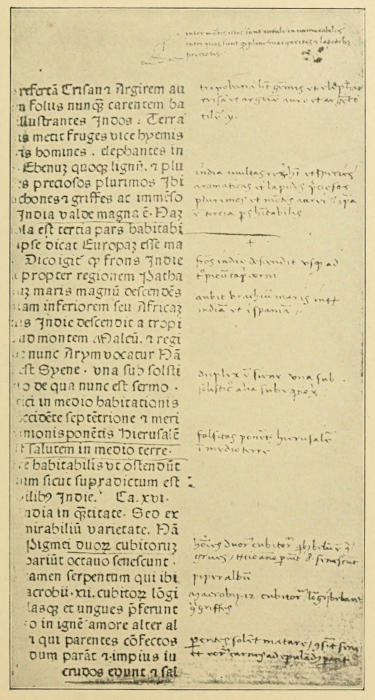
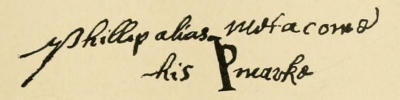
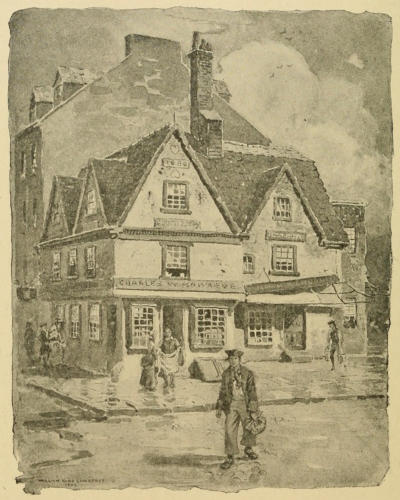
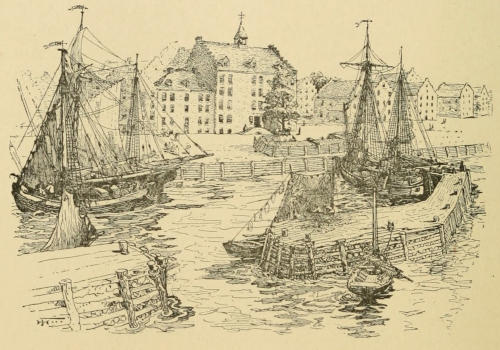
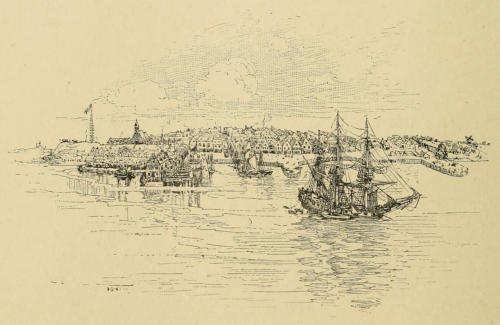
Facsimile of annotations in the handwriting
of Christopher Columbus.—From Harrisse’s Notes on
Columbus, opposite p. 84, after a copy of Cardinal Pierre
d’Ailly’s Imago Mundi, printed about 1490, and preserved
in the Biblioteca Colombina, at Seville, Spain. The annotations
shown appear on the margin of p. 18 of that copy
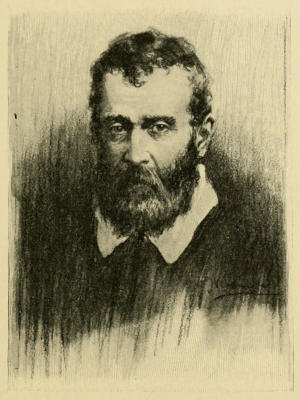
Marco Polo.—Adapted from an engraving
in Ruge’s Geschichte des Zeitalters der Entdeckungen, p. 53,
which was taken from an old portrait in the possession of Monsignor
Badia, of Rome. The oldest attempt to give a portrait of him appeared
in the first printed edition of his travels, issued at Nuremberg
in 1477. Col. Henry Yule says, in his Book of Ser Marco Polo,
vol. i., p. cii., that “there is no portrait ... with any claim
to authenticity.”
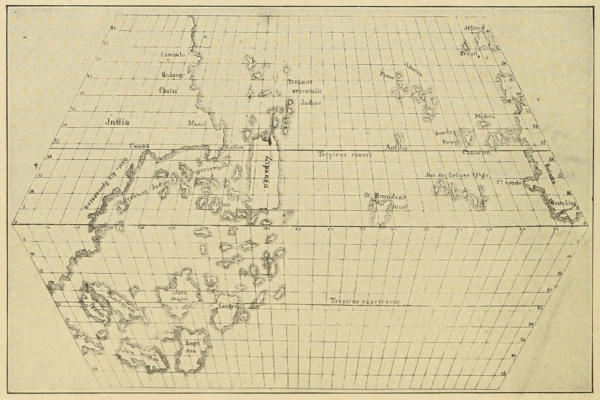
Toscanelli map.—Facsimile of a
conjectural restoration of a supposed map of Paolo dal Pozzo
Toscanelli, sent by him to Columbus in 1474, and by which,
some claim, Columbus sailed on his first voyage across the
Atlantic. This view has been recently controverted in a work
by Henri Vignaud. Reproduced from Winsor’s America,
vol. ii., p. 103. A larger map—a newer interpretation—is
given by Gustavo Uzielli in his ponderous volume on the
life and times of Toscanelli, written in Italian and
published under the auspices of the Minister of Public
Instruction of Rome in 1894
Nine lines from the “Cosmographiæ
Introductio,” in which the name America first occurs.—This
work was compiled by Martin Waltzemüller or
Waldseemüller, a
native of Freiburg, whose name is also found as Hylacomylus,
its grecized form. The first part of his treatise is an
introduction to cosmography, while the second part gives
the four navigations of Americus Vespucius. Several editions,
differing typographically, were issued at St. Dié, in
Lorraine, in 1507. The facsimile is from one of these
editions in the New York Public Library (Lenox Building)
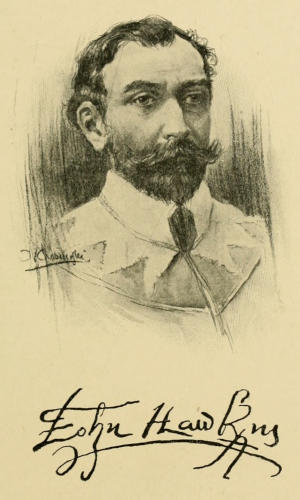
Portrait and autograph of Sir John
Hawkins.—From a drawing adapted after a bas-relief
ivory bust; see the frontispiece to Hawkins’ Voyages,
edited by Clements R. Markham for the Hakluyt Society in 1878
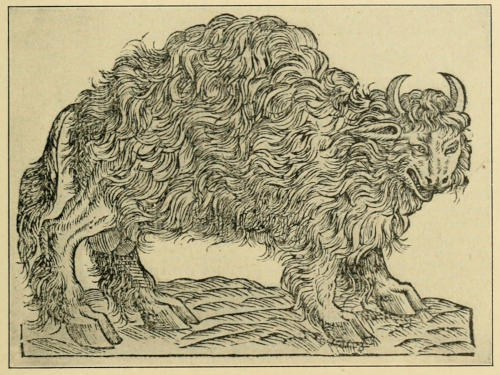
Buffalo or “crook-backed” ox.—From
Thevet’s Les Singularitez de la France Antarctique
(Antwerp, 1558), verso of folio 144. Reproduced from a copy
of this work in the New York Public Library (Lenox Building).
It is perhaps the earliest appearance of an engraving of the
buffalo
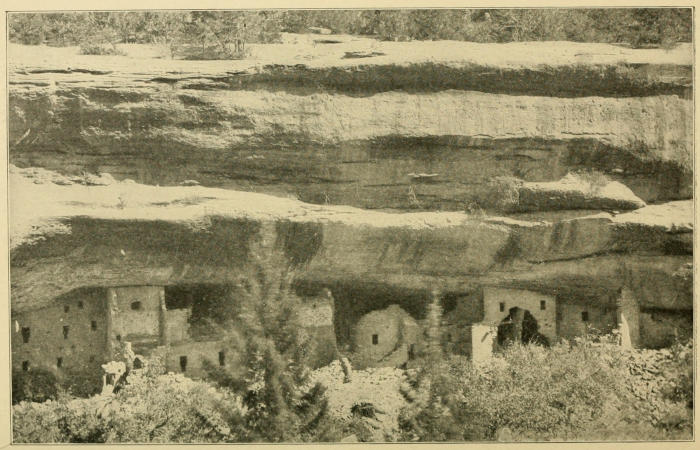
Ruins of Arizona cliff-dwellings.—From
a recent photograph. There are many illustrations of these unique
structures in Nordenskiold’s Cliff Dwellers, 1893
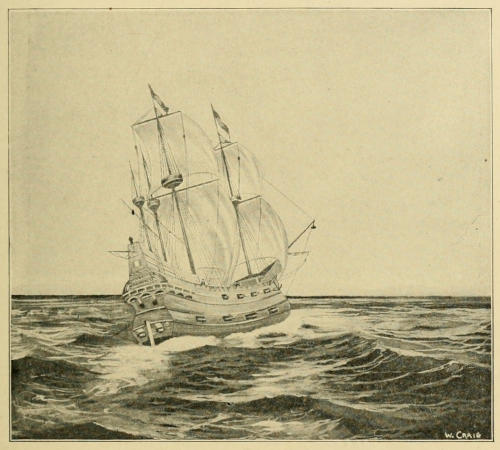
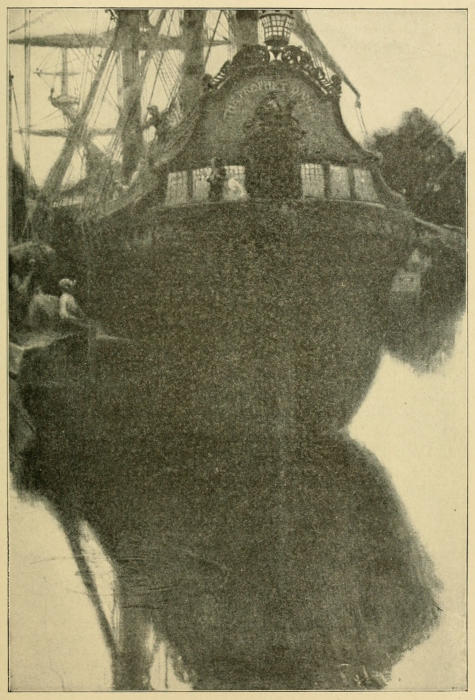
Spanish Galleon.—Redrawn from
Fiske’s Old Virginia and her Neighbours, vol. i., p. 39,
who took it from La Gravière’s Les marins du XVᵉ et du XVIᵉ
siècle
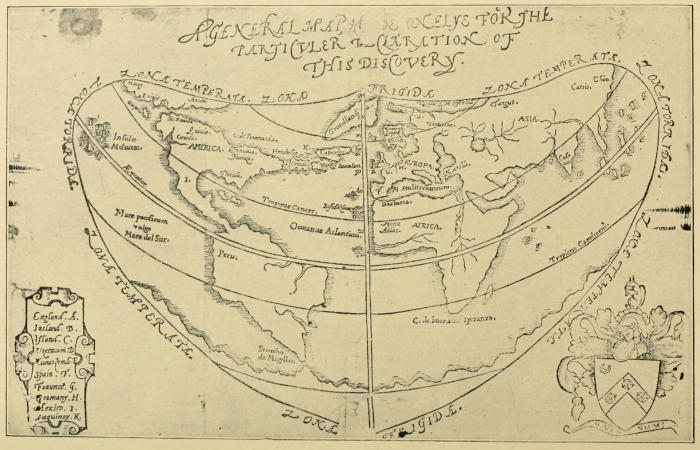
Sir Humphrey Gilbert’s map.—From
the original map in his A Discourse of a Discouerie for a
New Passage to Cataia. London, 1576. In the New York Public
Library (Lenox Building)
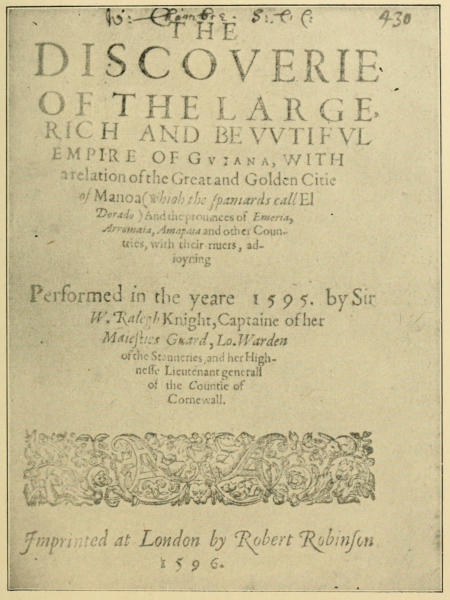
Title-page of Sir Walter Ralegh’s
“Discoverie.”—At least three varieties of this tract
were issued in 1596. Facsimile from an original in the New
York Public Library (Lenox Building)
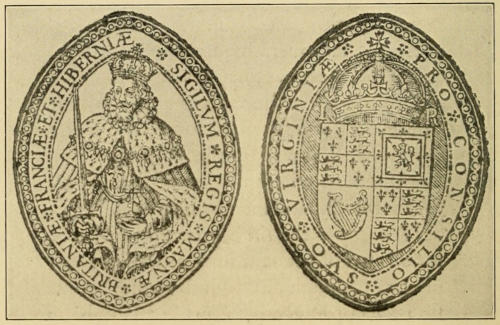
Seal of his Majesty’s Council of
Virginia.—from Alexander Brown’s Genesis of the
United States, vol. i., p. 57. It
is the seal which was used in the publications of the
Virginia Company
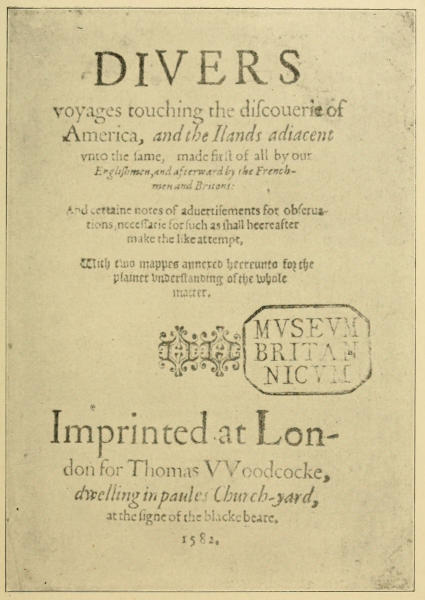
Title-page of Richard Hakluyt’s
“Divers Voyages.”—From a copy of the excessively
rare original book in the New York Public Library (Lenox
Building), a British Museum duplicate. It is Hakluyt’s
first publication; includes, among others, the voyages
of Cabot, Zeno, Ribault, and Verazzano; and was reprinted
by the Hakluyt Society in 1850
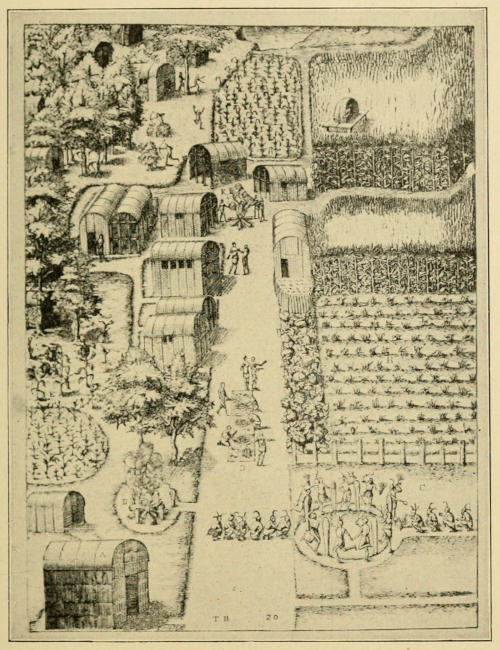
Indian Village of Secotan.—Facsimile
from an original in the New York Public Library (Lenox Building),
which forms plate xx. in Part I. of the Great Voyages,
published by Theodor De Bry in 1590. This part was issued in
this year in Latin, German, French, and English. The English
edition is one of the rarest books in the whole field of
Americana
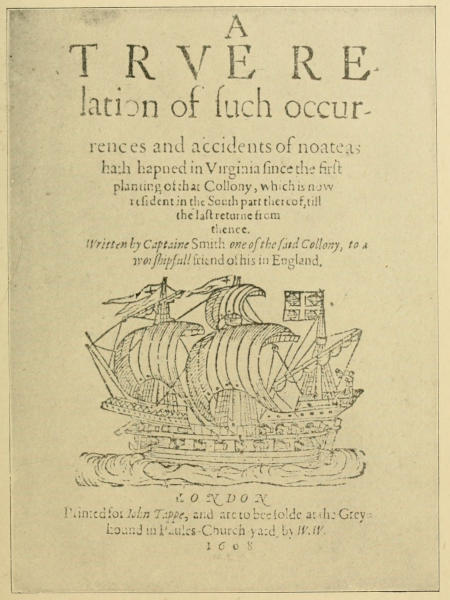
Title-page of Captain John Smith’s
“True Relation.”—From an original in the New York
Public Library (Lenox Building). It is both the earliest
printed work of Smith and the earliest published work
relating to the colony at Jamestown, Virginia
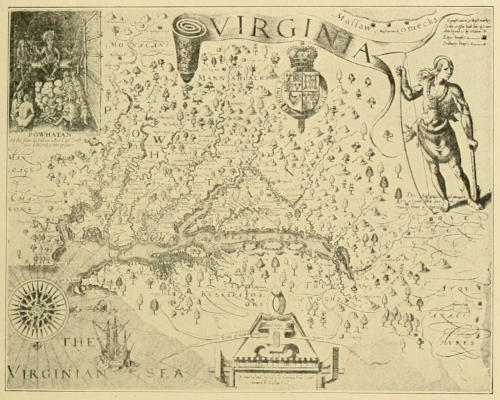
Captain John Smith’s map of Virginia,
1612.—From an original of the first issue in the New
York Public Library (Lenox Building); engraved by W. Hole.
It was several times reissued, and was copied in many
publications subsequently
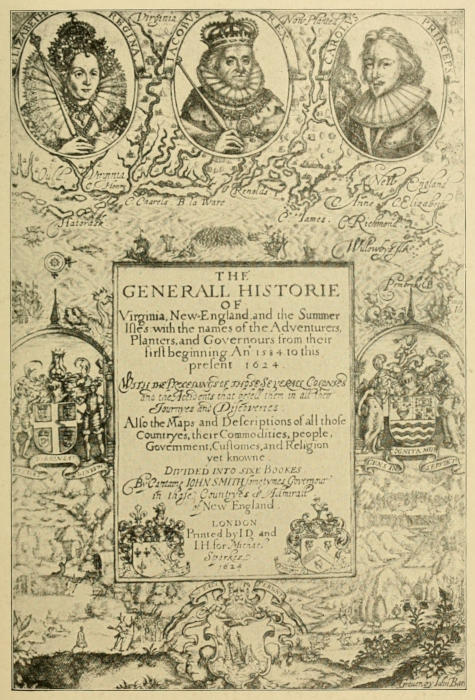
Title-page of Captain John Smith’s
“Generall Historie.”—From an original copy of the
first issue in the New York Public Library (Lenox Building).
This work was reissued in 1625, 1626, 1627, 1631, and 1632
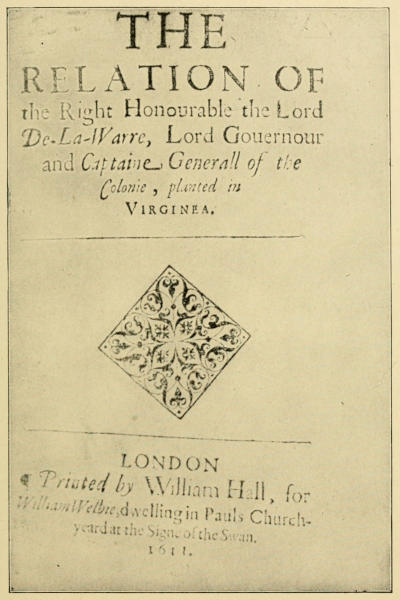
Title-page of Lord Delaware’s
“Relation.”—From a copy of the original edition in
the New York Public Library (Lenox Building). A facsimile
edition of twenty copies was privately printed at New York
in 1868
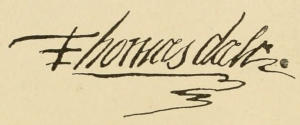
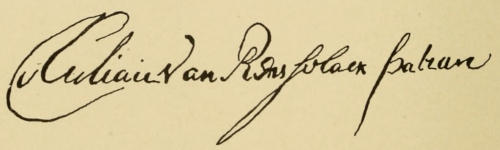
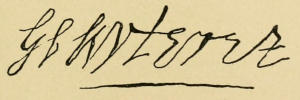
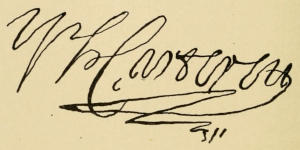
Autograph of Sir George
Yeardley.—From a holograph letter of Yeardley, dated
“James citty Jan. 10th 1619” [i.e. 1620], in the
“Smyth of Nibley Papers,” New York Public Library (Lenox
Building)
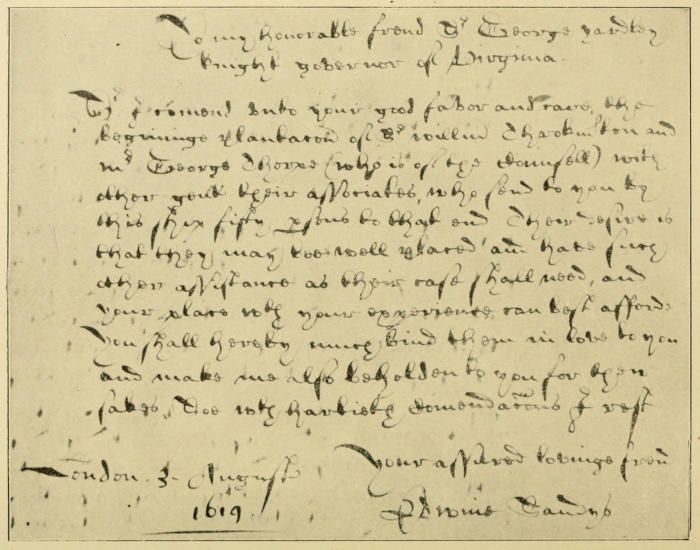
Facsimile of letter of Sir Edwin
Sandys to Sir George Yeardley.—Facsimile from the
“Smyth of Nibley papers” in the New York Public Library
(Lenox Building). It is a contemporary transcript, probably
in the handwriting of John Smyth
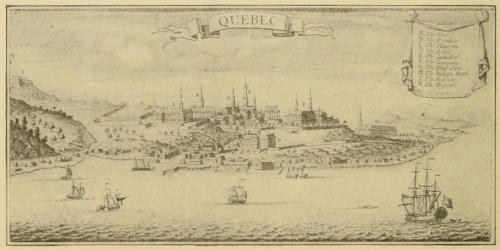
View of Quebec about 1732.—From
Henry Popple’s Map of the British Empire in America.
London, 1733. Reproduced from an original in the New York
Public Library (Lenox Building)
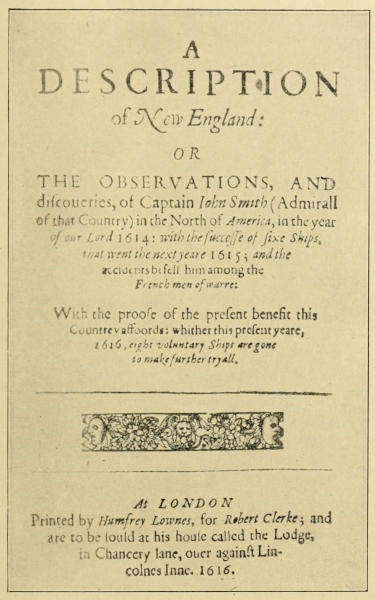
Title-page of Captain John Smith’s
“Description of New England.”—From a copy of the original
in the New York Public Library (Lenox Building). It is the
first book published in which the name “New England”
appears—a designation which originated with Smith
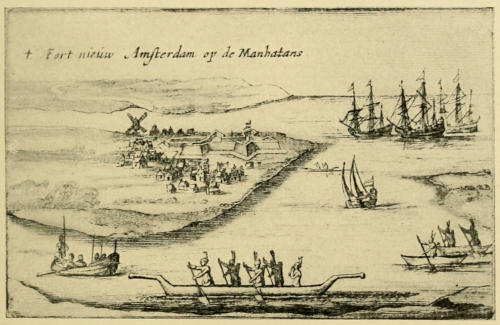
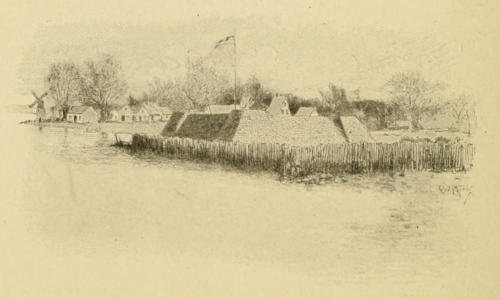
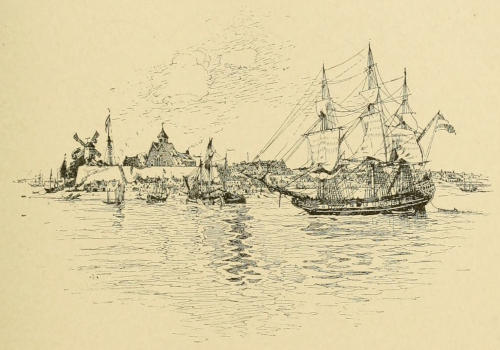
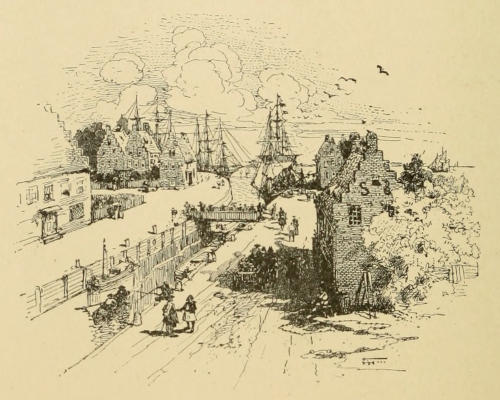
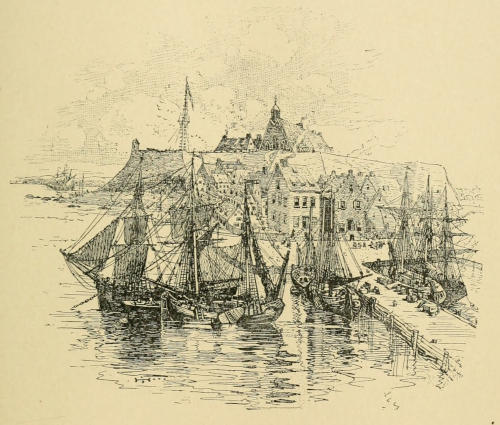
Earliest view of New Amsterdam.—This
first engraved view of New Amsterdam appears on the upper half
of p. 21 of Beschrijvinge van Virginia, Nieuw Nederlandt
[etc.], published at Amsterdam by Joost Hartgers in 1651. It
represents the present lower end of New York as it appeared
about 1628 to 1632. Reproduced from an original in the New
York Public Library (Lenox Building)
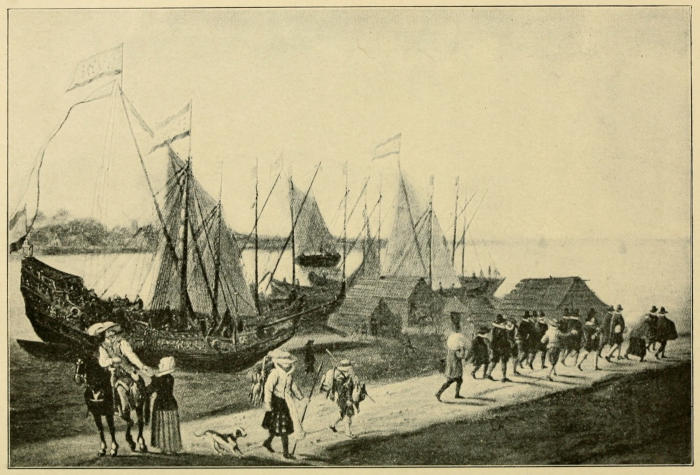
Departure of the Pilgrims from Delft
Haven.—Reproduced from an old Dutch painting in the
possession of George Henry Boughton, the artist. See Harper’s
Weekly for March 9, 1895, for an account of it
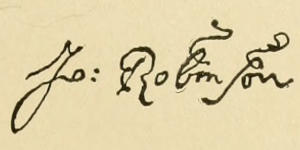
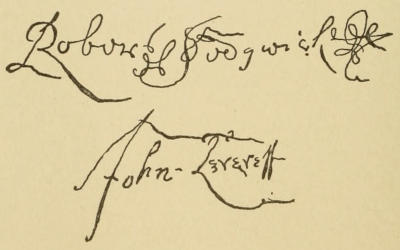
Autograph of John Robinson.—Facsimile
of an autograph found on the title-page of a copy of Edward
Sandys’s Relation of the State of Religion (London, 1605),
formerly in the possession of Dr. Charles Deane, and sold at the
sale of his library in 1898
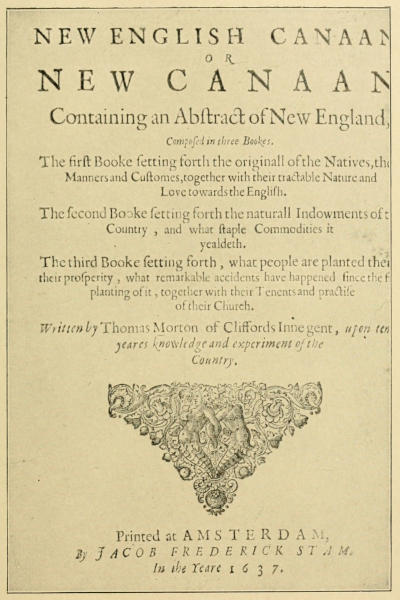
Title-page of Thomas Morton’s “New
English Canaan.”—From a copy of the original of this
facetious book in the New York Public Library (Lenox Building).
It is also in the libraries of Harvard College, Massachusetts
Historical Society, Yale University, New York Historical Society,
Library of Congress, and in the collection of John Carter Brown
(Brown University). The Prince Society reprinted it in 1883
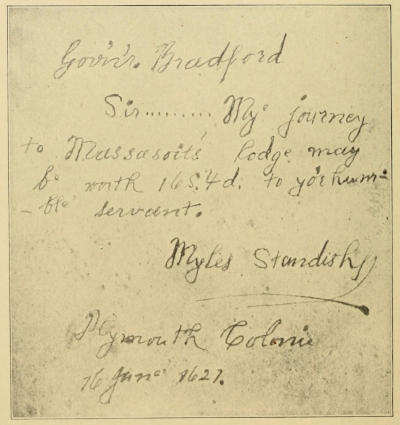
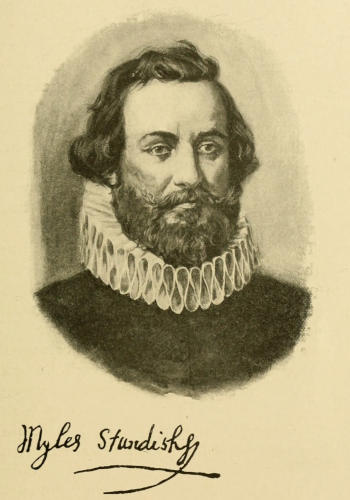
Holograph letter from Myles Standish
to Governor Bradford.—From the original in the Emmet
Collection, No. 4935, New York Public Library (Lenox Building)
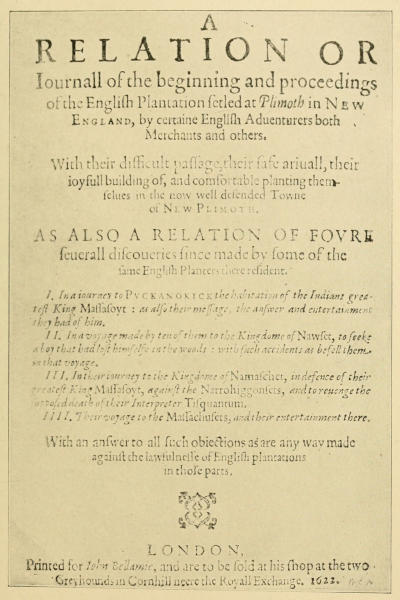
Title-page of Mourt’s “Relation.”—From
an original in the New York Public Library (Lenox Building). Other
copies are at Harvard College, Boston Public Library, and Collection
of John Carter Brown (Brown University). It “is a sort of journal
not intended for publication by those
who had a chief hand in it, Bradford and Winslow, which, being
sent to friends in London, was printed there, and is known as
‘Mourt’s Relation.’”—Winsor.
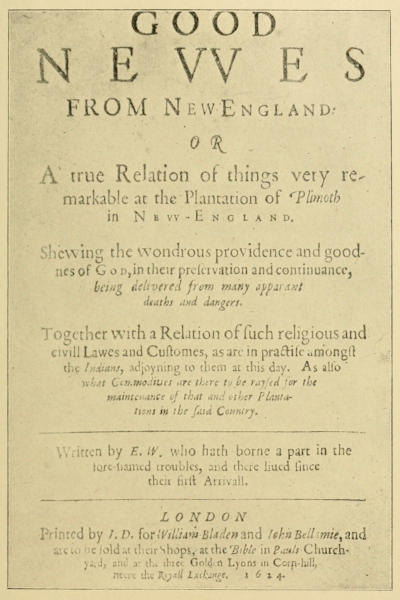
Title-page of Edward Winslow’s “Good Newes
From New England.”—From an original in the New York Public
Library (Lenox Building). Other copies of one or the other of the
two issues which appeared in 1624 can be found in the Boston
Public Library, Massachusetts Historical Society, John Carter
Brown Collection (Brown University), and the British Museum.
The book covers the history of Plymouth Colony from November,
1621, to September, 1623, and “is a story of the griefs and
perils and escapes of the young settlement”
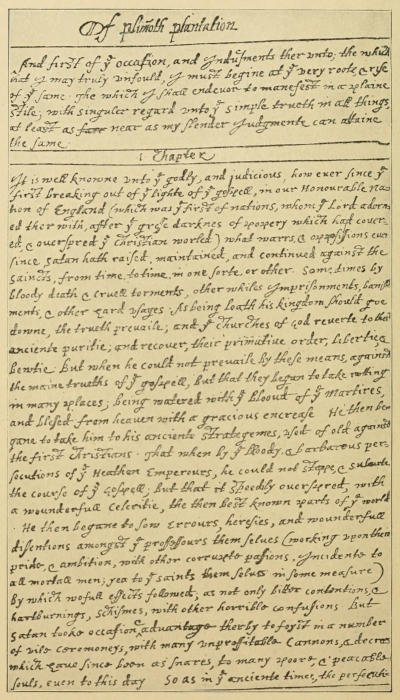
Page from Bradford’s “History of Plimoth
Plantation,” showing Bradford’s handwriting.—The original
manuscript, now deposited in the State Library of Massachusetts,
is a folio volume measuring 11½ by 7⅞ inches, and 1½ inches in
thickness. It gives chiefly in the form of annals a history of
Plymouth Colony to 1647, and was first printed at Boston, in
1856, in the Collections of the Massachusetts Historical
Society, fourth series, vol. iii., at which time a private
edition of fifty copies was also issued for its editor, Charles
Deane. A fine facsimile of the whole manuscript from which this
page is reproduced was issued with an introduction by John A.
Doyle, and published at London in 1896. The General Court of
Massachusetts authorized a verbatim reprint in 1898
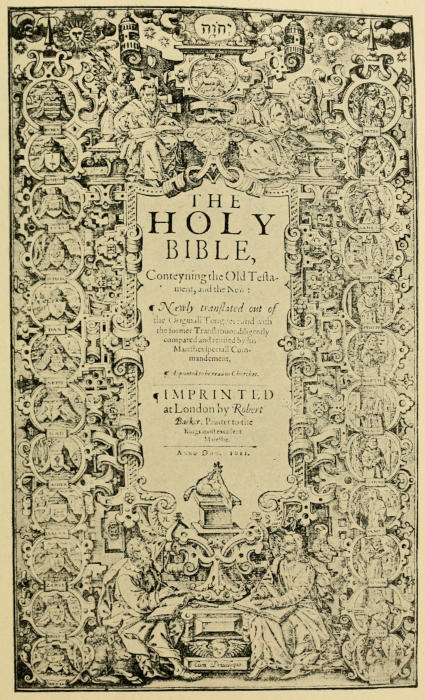
Title-page of the royal version or King
James’s Bible.—There are two issues of the first edition
of 1611, known respectively as the “He” and “She” bibles, from
the rendering of Ruth iii., 15. Reproduced from an original in
the New York Public Library (Lenox Building)
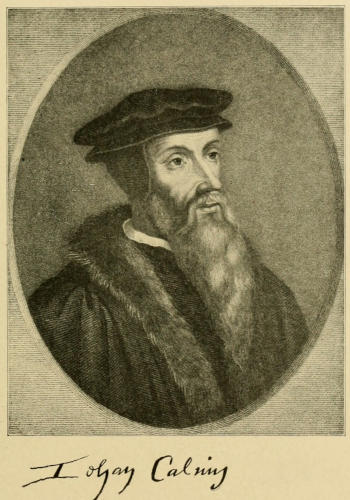
Portrait and autograph of John
Calvin.—From an engraving by T. Woolnoth, believed
to have been taken from a painting by Hans Holbein. The
autograph is copied from an original in the New York Public
Library (Lenox Building)
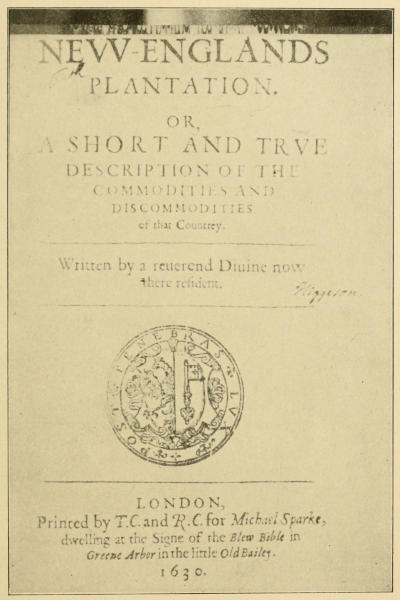
Title-page of Francis Higginson’s “New
England’s Plantation,” 1630.—From an original of the
first edition in the New York Public Library (Lenox Building),
which possesses also the second and third editions printed in
the same year as the first. The narration covers the interval
from July to September, 1629
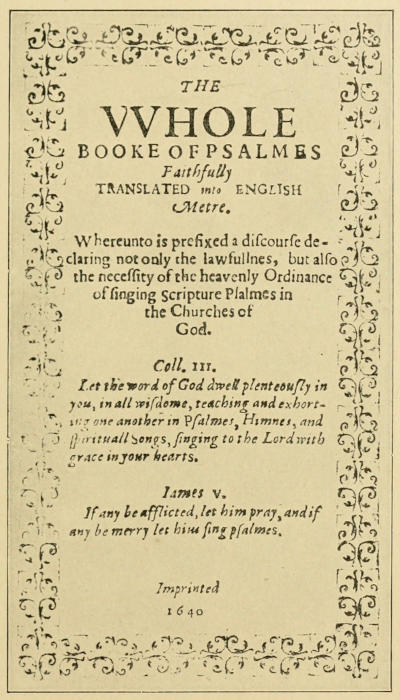
Title-page of the “Bay Psalm Book.”
Facsimile of the first edition from the Lenox copy in New York
Public Library. Altogether ten copies are known of this first
book printed in English America, by Stephen Day, or Daye, at
Cambridge, Mass. For the latest account of its history and
seventeenth century editions, see The Literary Collector,
vol. iii. (1901), 69-72
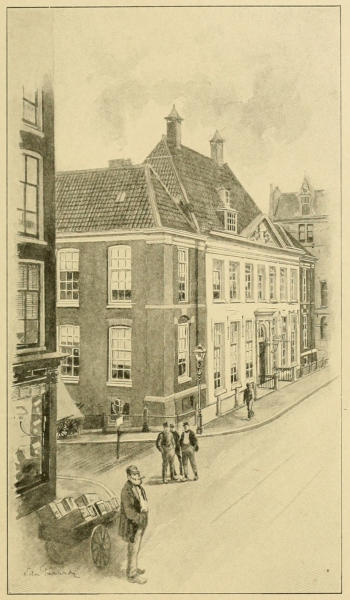
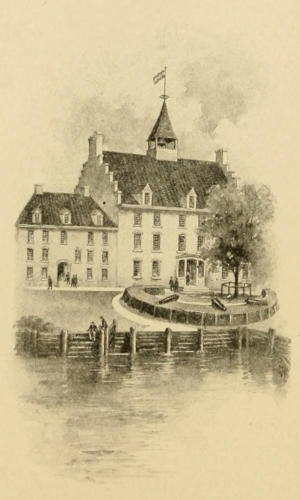
Dutch West India Company’s House,
Haarlem Street, Amsterdam.—Drawn from an old print.
It is located at 75 Haarlem Street, and is used as a home
for aged men and women
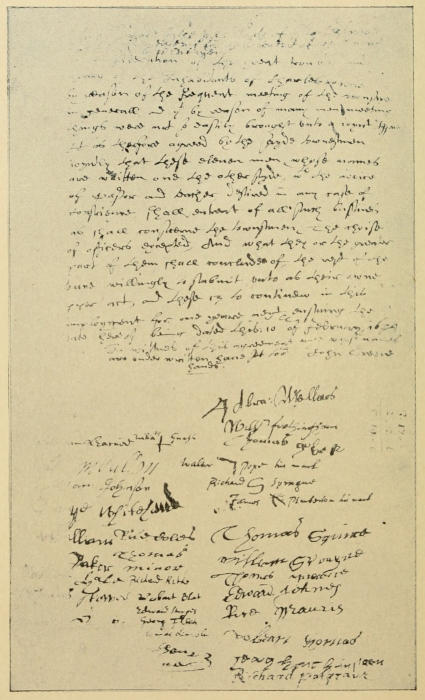
Order creating board of selectmen,
Charlestown, 1634.—From a heliotype in Winsor’s
Boston, vol. i., opposite p. 388; the original is
among the Charlestown Records. It is dated “this
10th of February, 1634”
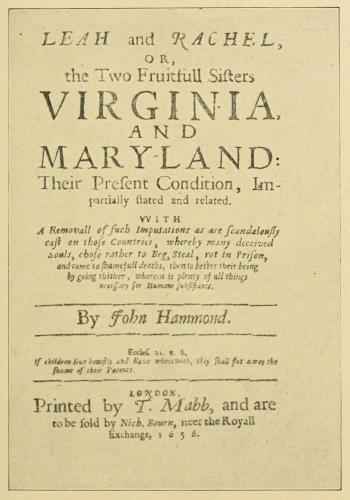
Title-page of Hammond’s “Leah and
Rachel.”—Original copies of this excessively rare
book are in Harvard College Library and the Carter Brown
Collection of Providence.
It was reprinted in Peter Force’s Tracts, vol. iii.,
No. 14. Washington, 1844
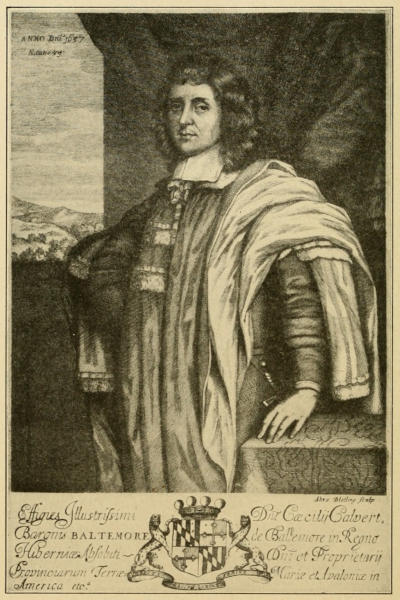
Portrait of Cecilius Calvert, Second
Lord Baltimore.—From a line engraving by Abraham
Blotling (or Blooteling), in New York Public Library (Lenox
Building), Emmet Collection, No. 1687
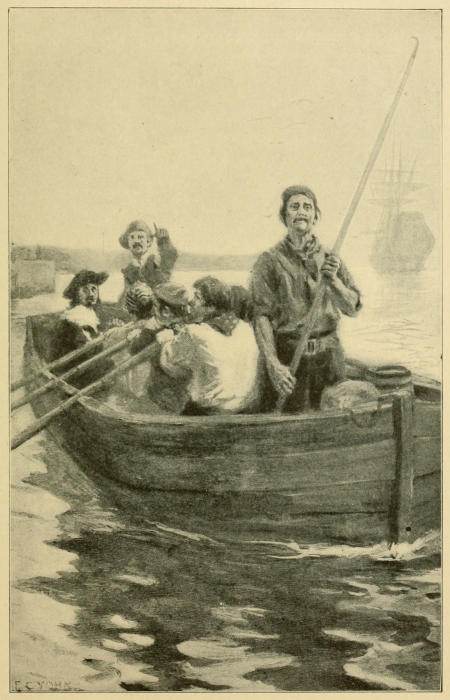
Arrival of Winthrop’s company in Boston
Harbor.—From the painting by William Formby Halsall, in
the possession of Walter B. Ellis, Esq., of Boston, Mass.
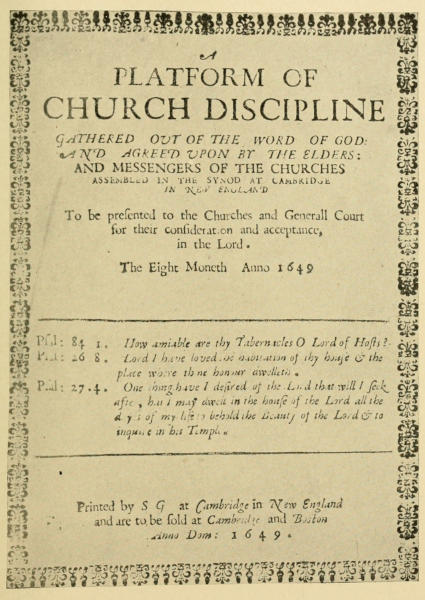
Title-page of the Cambridge Platform.—From
an original in the New York Public Library (Lenox Building). It is
the first edition of this famous book, and was printed by Samuel
Green, the second printer of Cambridge, Mass.
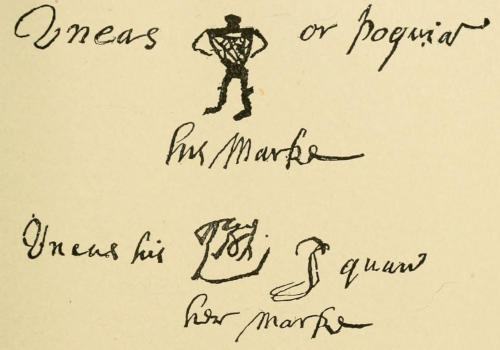
Uncas and his squaw. Their marks.—From
Smith and Watson’s American Historical and Literary Curiosities,
first series, plate xlix. In New York Public Library (Lenox Building)
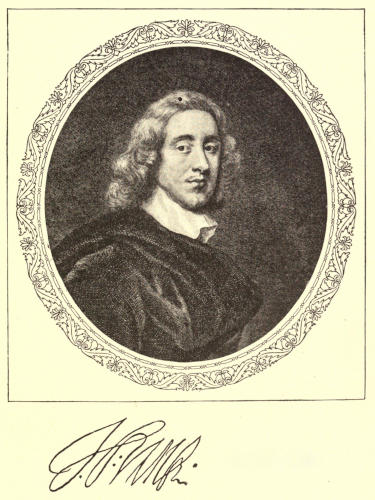
Portrait and autograph of Sir Henry
Vane.—From a line engraving by Houbraken, after the
painting by Sir Peter Lely, in Birch’s Heads. London,
1743. In New York Public Library (Lenox Building)
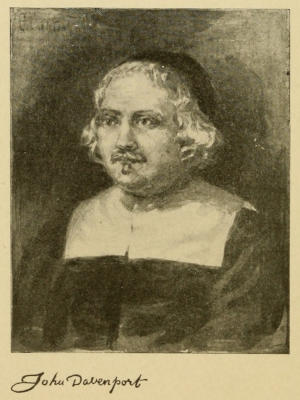
Portrait and autograph of Rev. John
Davenport.—From a painting in Alumni Hall, Yale
University. Autograph from an original in the “Winthrop-Davenport
Papers,” New York Public Library (Lenox Building)
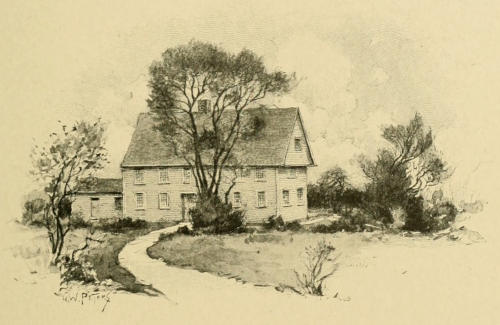
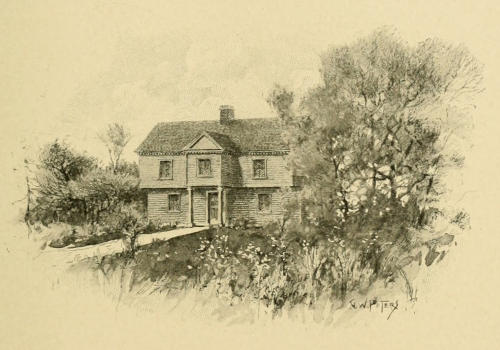
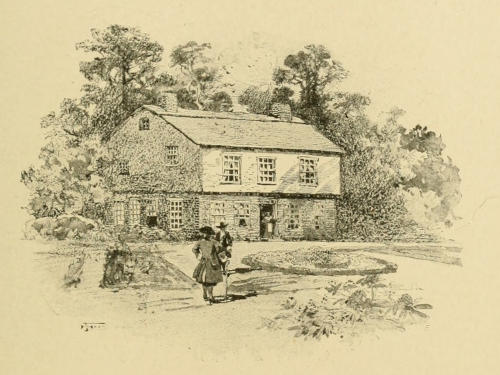
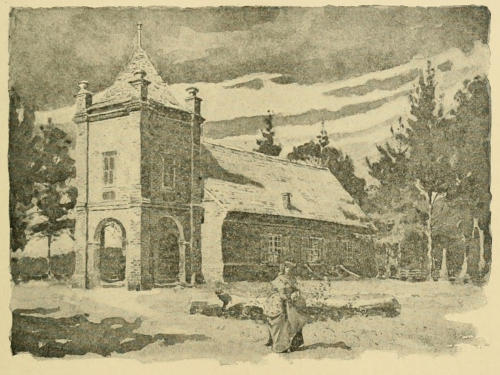
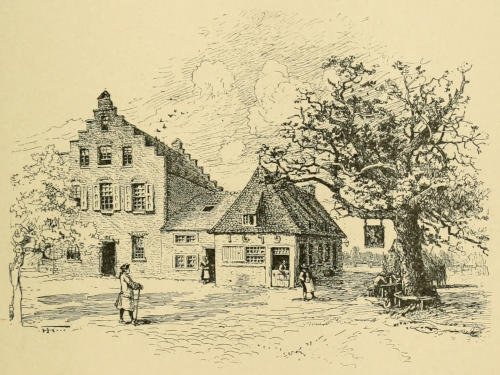
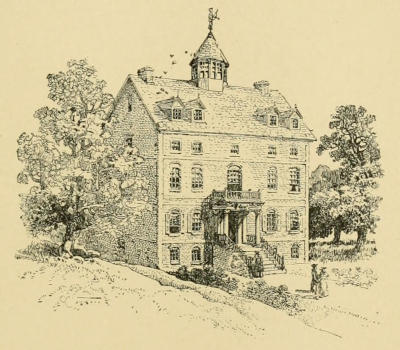
House at Guilford, 1639.—Built in
1639 for Rev. Henry Whitefield, one of the founders of Guilford,
Conn., and the oldest house now standing in that State. See
another view in Edwin Whitefield’s Homes of our Forefathers.
Boston, 1882
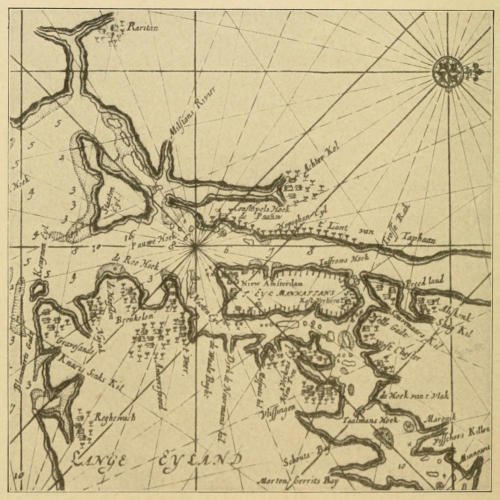
Map of New Amsterdam and vicinity,
1666.—Facsimile of the lower portion of the first
published map of Hudson’s River, which is found in a Dutch
work entitled, Verdere Aenteyckeninge, printed at
Middleburgh by Jacques Fierens in 1666. From the original
in the New York Public Library (Lenox Building)
View of New Amsterdam in 1656.—Drawn
and adapted by Harry Fenn after a view on the Visscher map. It
is known as the Augustine Herrman view, and was often reproduced
in one form or other
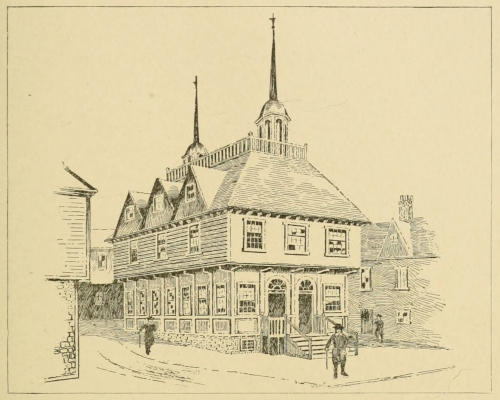
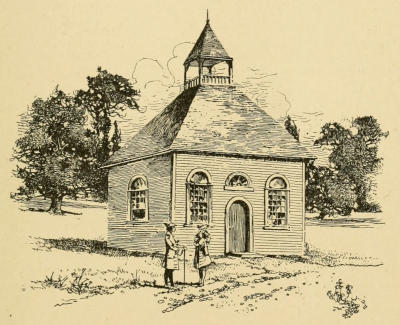
First meeting-house, 1634-1638. Roger
Williams’s church.—From an old print. A question has
recently arisen as to whether this old building was ever used
by Roger Williams
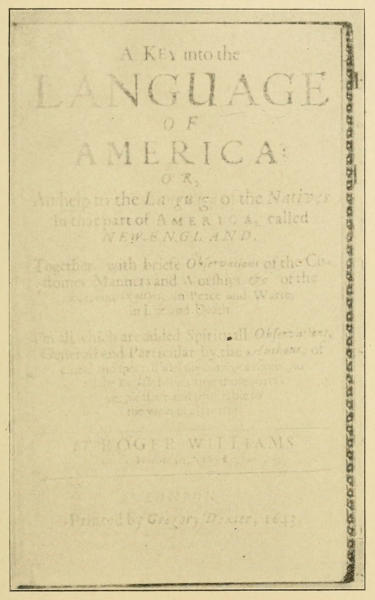
Title-page of Roger Williams’s “Key
into the Language of America.”—This is the earliest
printed book of Roger Williams. Each chapter contains short
vocabularies and dialogues in Indian and English, followed
by observations, and ending with a poem. From an original
in the New York Public Library (Lenox Building)
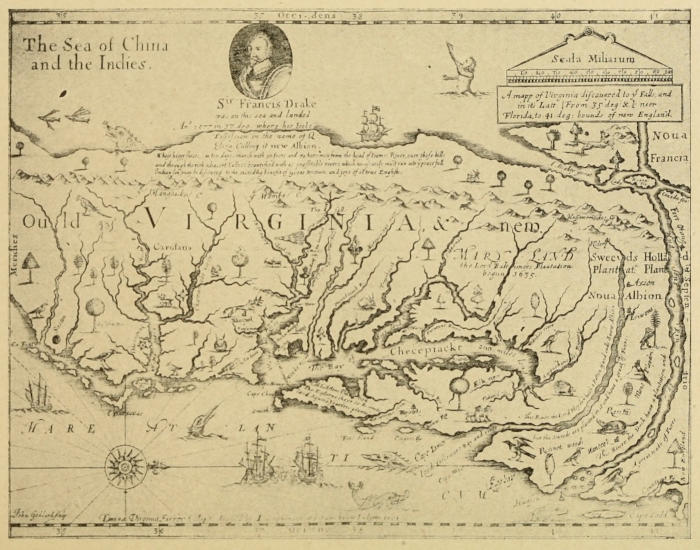
Farrer’s map of Virginia, 1651.—From
the original in New York Public Library (Lenox Building), in Edward
Williams’s Virgo Triumphans: or, Virginia richly and truly
valued. London, 1650. The book, ascribed to Williams, is
in substance the work of John Farrer. For an account of the
different states of this map, see Winsor’s America,
vol. iii., p. 168
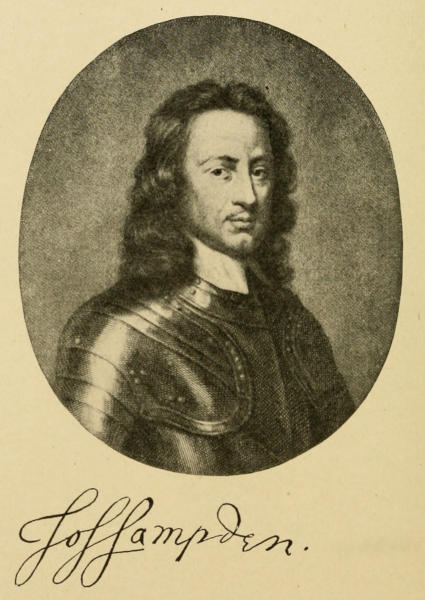
Portrait and autograph of John
Hampden.—From a line engraving by Houbraken in Birch’s
Heads. London, 1743. In New York Public Library (Lenox
Building). Autograph from Nugent’s Memorials of Hampden.
London, 1865
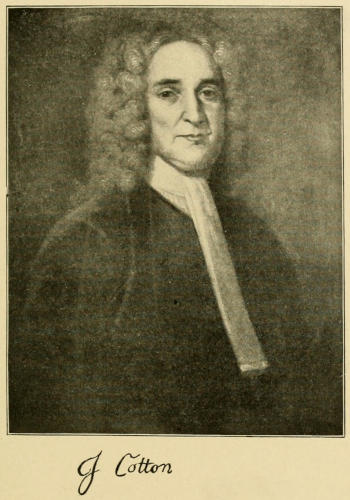
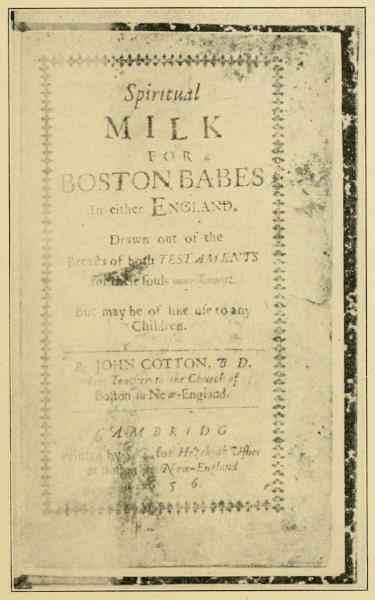
Title-page of John Cotton’s “Spiritual
Milk for Boston Babes.”—From the original American
edition of 1656, in the New York Public Library (Lenox Building).
It was first issued in London in 1646, a copy of which is in the
British Museum
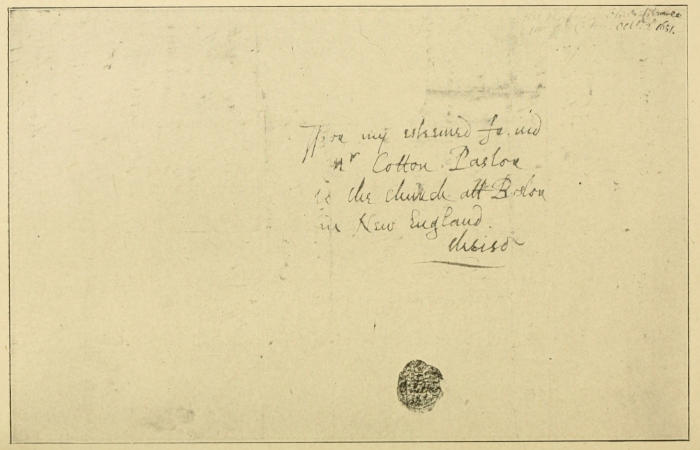
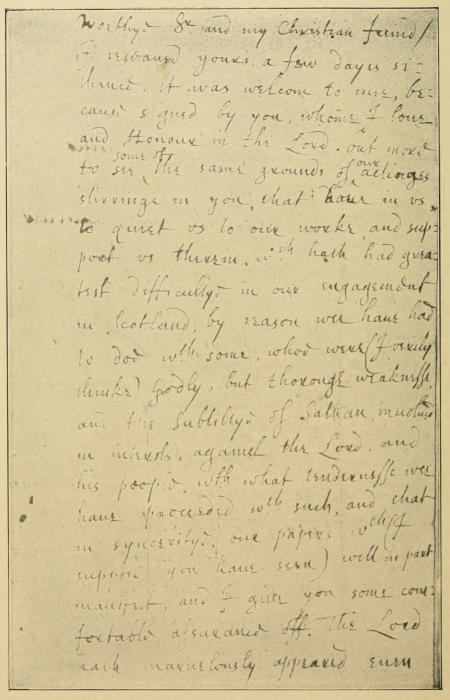
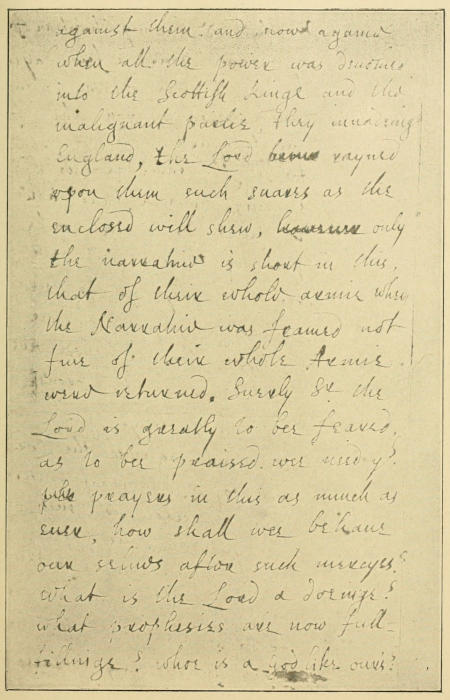
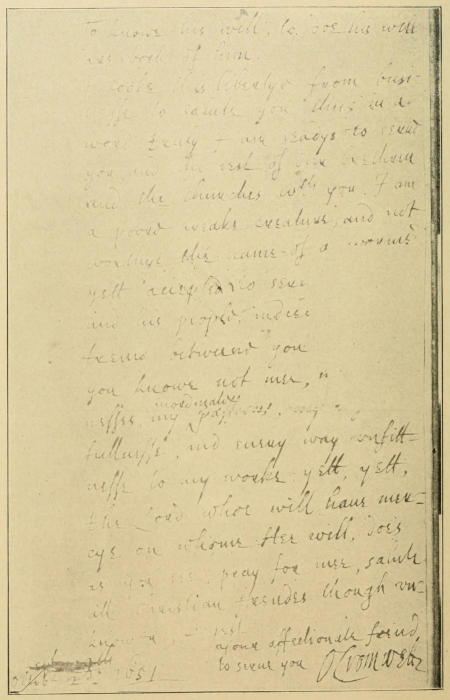
Oliver Cromwell’s letter to John
Cotton.—From the original manuscript in the New York
Public Library (Lenox
Building), now reproduced in facsimile for the first time in its
entirety. It is printed in the Bulletin of the New York
Public Library, vol. iv. (1900), pp. 13 and 14, which
see also for an account of its history
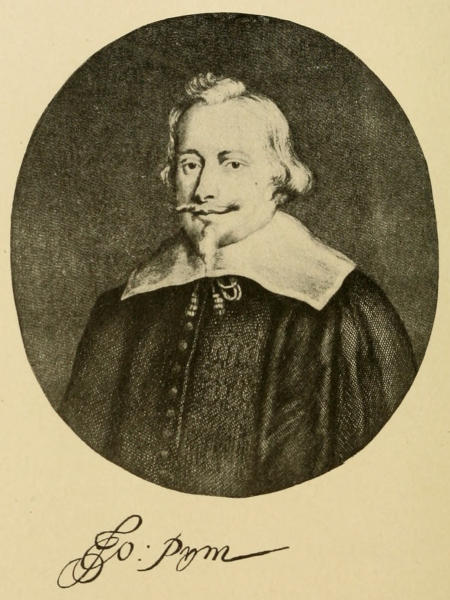
Portrait and autograph of John Pym.—From
a line engraving by Houbraken in Birch’s Heads. London,
1743. In the New York Public Library (Lenox Building). Autograph
from Thane’s British Autography
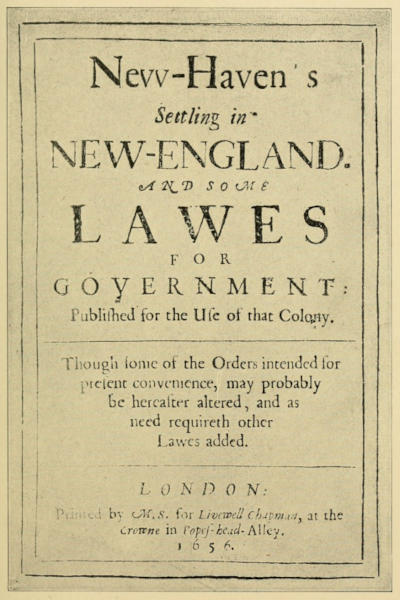
Title-page of “New Haven’s Settling
in New England.”—From an original in the New York Public
Library (Lenox Building). Only five or six copies are known to
be in existence
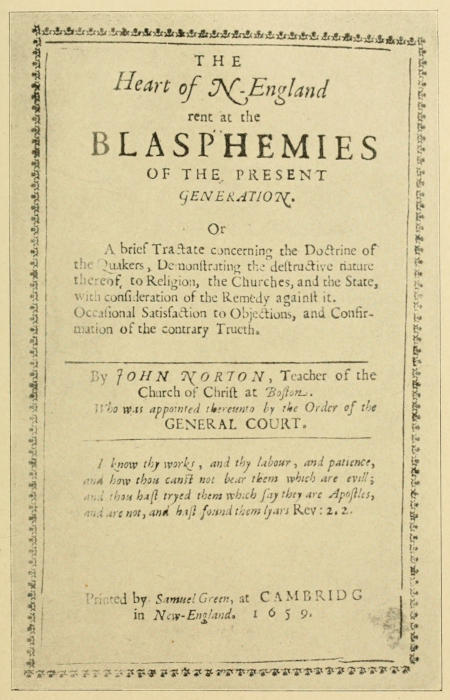
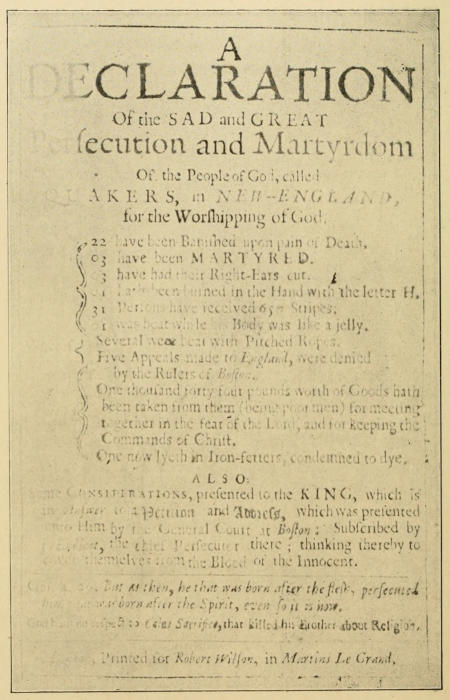
Title-page of “A Declaration of the
Sad and Great Persecution and Martyrdom of the people of God,
called Quakers, in New England.”—This protest of the
Quakers, although not dated on the title, was printed in 1660.
The title-page is printed in black and red lines. From an
original in the New York Public Library (Lenox Building)
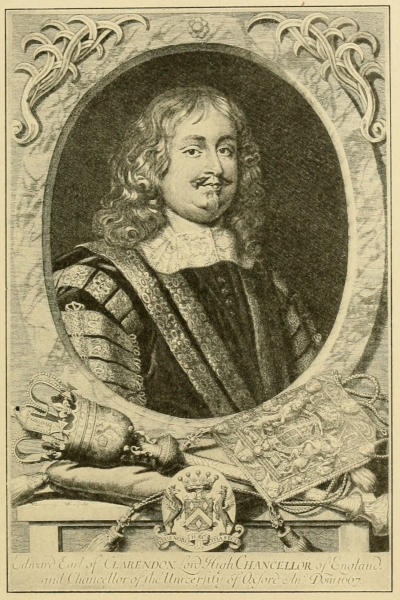
Portrait of Edward Hyde, Earl of
Clarendon.—From a line engraving by M. Burg after
the painting by Sir Peter Lely. In New York Public Library
(Lenox Building), Emmet Collection, No. 1694
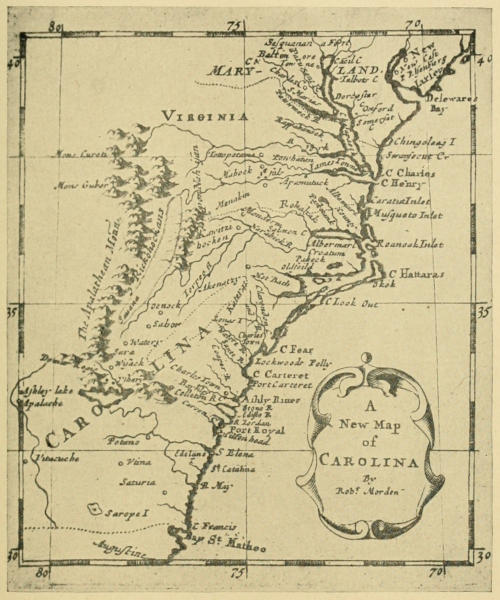
Map of Carolina, 1687.—From the
map by Robert Morden in Richard Blome’s Present State of His
Majesties Isles and Territories in America. London, 1687.
In New York Public Library (Lenox Building)
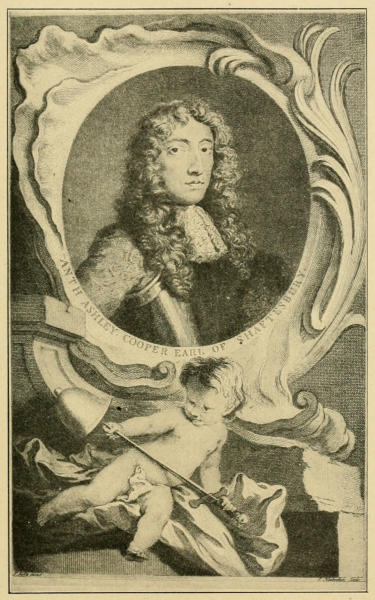
Portrait of the Earl of Shaftesbury.—From
a line engraving by Houbraken, after the painting by Sir Peter Lely,
in Birch’s Heads. London, 1743. In New York Public Library
(Lenox Building)
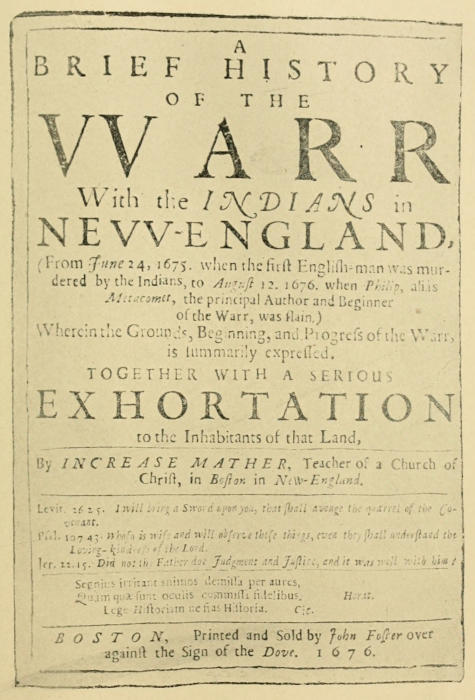
Title-page of Increase Mather’s “Brief
History of the Warr with the Indians in New-England.”—From
an original in the New York Public Library (Lenox Building)
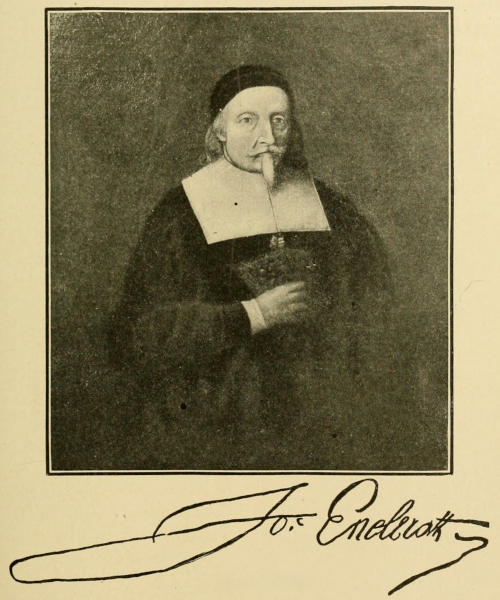
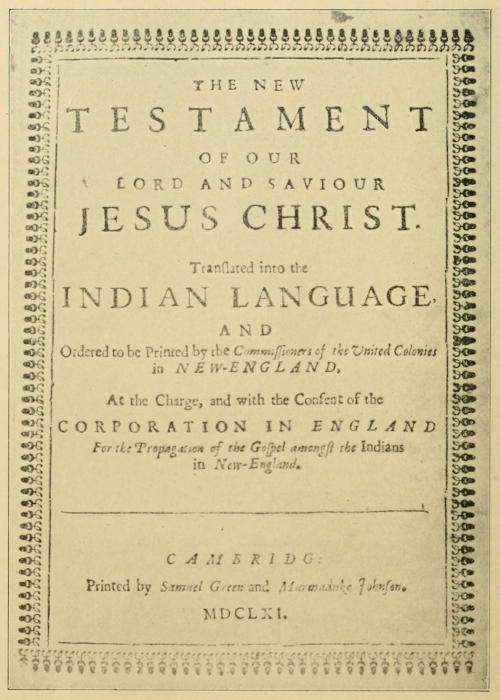
Title-page of John Eliot’s “Algonquin
New Testament.”—This New Testament in the Natick dialect
is the first printed in any language on the Western Continent.
Besides the English title-page shown here, it has another in
Indian. About sixteen copies are known to be extant, and are
described in Pilling’s Bibliography of the Algonquin
Languages (Washington, 1891), pp. 132-139. Facsimile
from an original in the New York Public Library (Lenox
Collection)
The Strand, New York, 1679.—This
view of the Strand (now Whitehall Street) is redrawn from an
adaptation of Dankers and Sluyter. Cf. Shannon’s Manual
for 1869
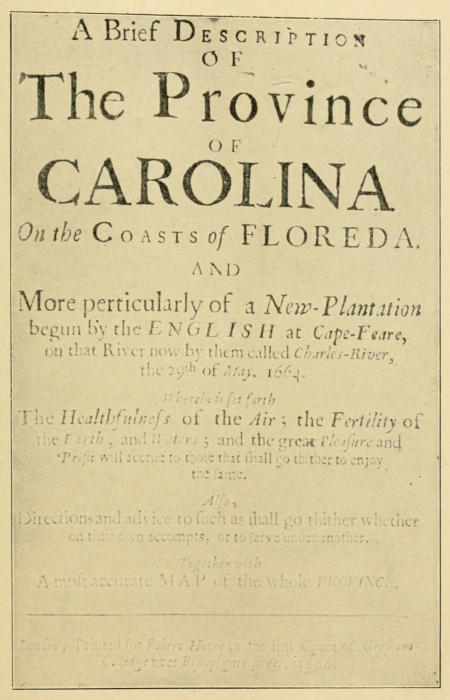
Title-page of “A Brief Description of the
Province of Carolina.”—From the original pamphlet in the
New York Public Library (Lenox Building) of this first publication
about Carolina
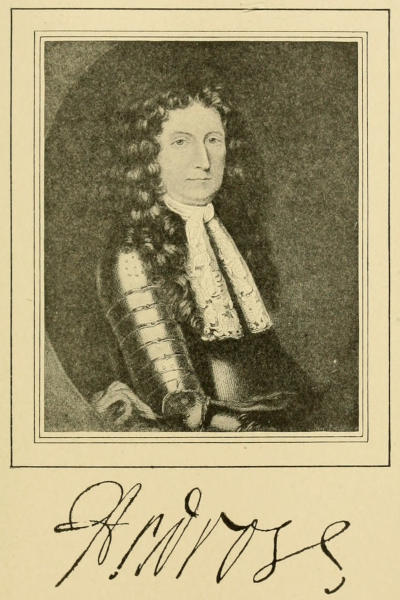
Portrait and autograph of Sir Edmund
Andros.—From the frontispiece to vol. i. of The
Andros Tracts, published by the Prince Society. Boston,
1868. Autograph from an original in the New York Public
Library (Lenox Building). Vide p. 297
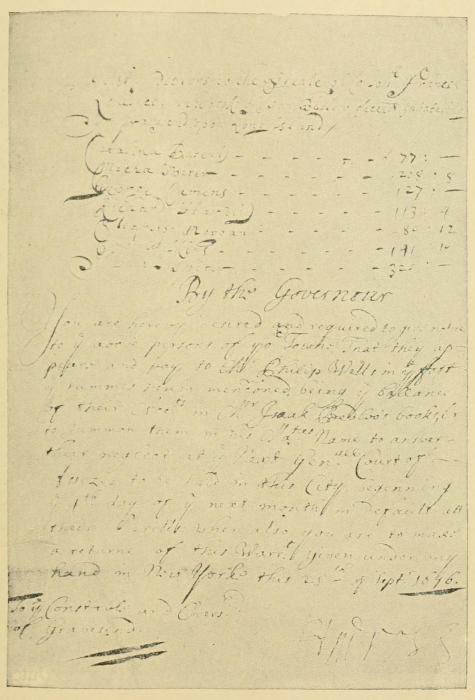
Document bearing the autograph of Sir
Edmund Andros.—From the original manuscript in the New
York Public Library (Lenox Building), Emmet Collection, No.
4913
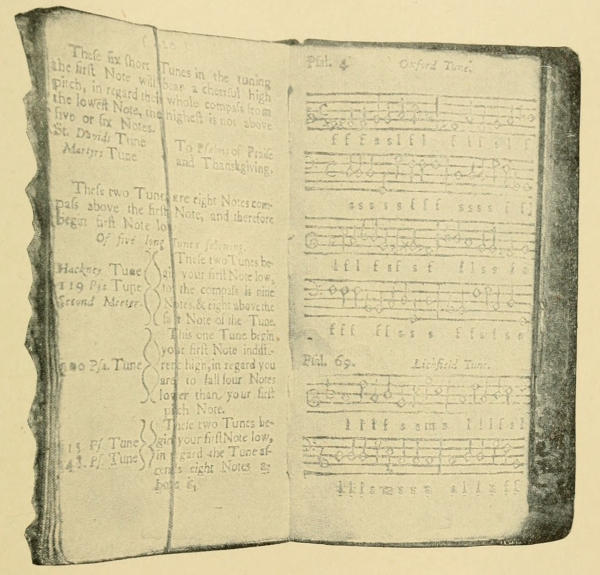
Page of tunes from the Bay Psalm
Book.—From the unique copy of the original edition of
Boston, 1698, in the Massachusetts Historical Society, in which
the tunes first appeared
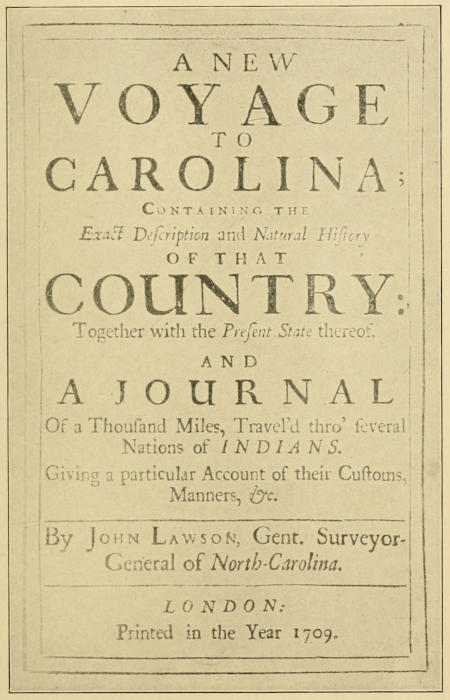
Title-page of Lawson’s “New Voyage
to Carolina.”—From an original in the New York Public
Library (Lenox Building). It was first issued as a part of Stevens’s
Collection of Voyages, vol. i., and separates on large paper
also are extant. Both forms are represented in the above-mentioned
library
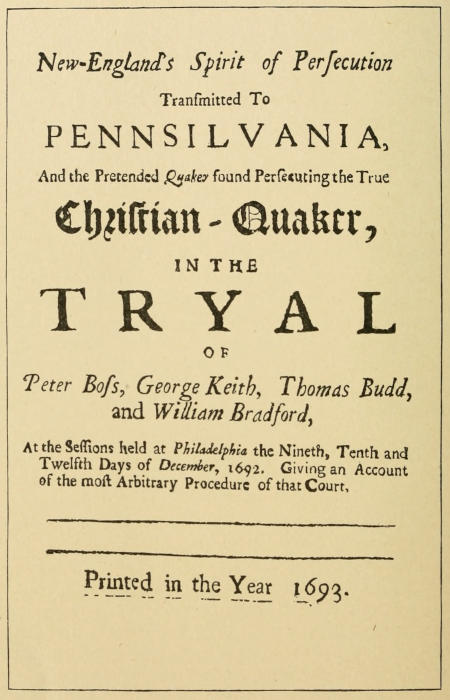
Title-page of “New-England’s Spirit of
Persecution transmitted to Pennsylvania.”—One of the
earliest issues of William Bradford’s press in New York, after
his removal from Philadelphia. From an original in the New
York Public Library (Lenox Building), which is one of five
known copies
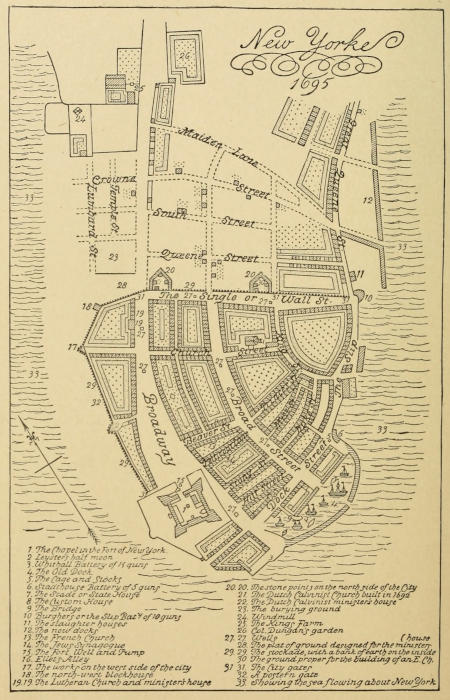
Map of New York City in 1695.—This
map accompanied the publication of the Rev. John Miller’s
Description of New York, first printed at London in
1843. The map has often been reproduced since that year
For the verification of the documents and the illustrative
material here, and for the notes on their sources, we are indebted
to Mr. Victor H. Paltsits, of the New York Public
Library (Lenox Building), whose scholarly researches made
possible so full a list.
A HISTORY OF THE AMERICAN PEOPLE — CHAPTER I BEFORE THE ENGLISH CAME
When the history of English settlement in America
begins, the breathless, eager stir of the Elizabethan
age is over, and the sober, contentious seventeenth
century has come, with its perplexed politics, its schismatic
creeds, its scheming rivalries in trade. An
age of discovery and bold adventure has given place
to an age of commerce and organization. More than
one hundred years have elapsed since the discovery
of North America. Spain has lost her great place in
the politics of Europe, and France and England are
pressing forward to take it. While parts changed
and the stage was reset, the century through, the great
continent lay “a veiled and virgin shore,” inflaming
desires that could not be gratified, stirring dreams
that only enticed brave men to their death, exciting to
enterprise and adventure, but never to substantial or
lasting achievement. The same mistake that had
led to its discovery had prevented its profitable occupation.
Columbus had set out to seek, not a new continent,
but old Cathay; and died believing that what
he had found was in fact the eastern coasts of Asia.
The explorers who followed him in the next century had
persisted in seeking, as he had sought, not new, but old
lands, rich with ancient kingdoms and fabled stores of
treasure, lying ready to the hand of conqueror and
buccaneer. Such ancient kingdoms Cortez and Pizarro
actually found in South America and upon the Isthmus;
and such every adventurer promised himself he should
find just beyond the coasts of the northern continent
also. Or else he should find something that would
be quite as valuable, and possibly no less romantic,—a
fountain of youth, untouched mines of precious ore,
or waters floored with priceless pearls.
The discovery of the New World had drawn Europe
when she was most credulous into a realm of dreams.
The Revival of Learning had come. Europe had read
once more and with freshened eyes, as if for the first
time, the frank sentences of the ancient classics, written
when men looked heartily, fearlessly, artlessly about
them, and her imagination had been quickened and
enriched by what she read, her thoughts set free and
rejuvenated. What she had seen also, as well as what
she had read, had given her new life. For the Middle
Ages were now passed, and she had herself become a
new world. France had lost her feudal princes in the
Hundred Years’ War, and was at last a real kingdom
under veritable kings, for Louis XI. had reigned. England
had been transformed by the Wars of the Roses
from a feudal into a national monarchy, and the first
Tudor was on the throne. Spain had cast out the
Moor, and was united under Christian sovereigns.
Former geographical relations, too, had disappeared.
The old Europe had had its heart and centre in the
Mediterranean; but the capture of Constantinople by
the Turk, and the establishment of the hostile Turkish
power upon all the eastern coasts of the Mediterranean,
now shut her out from the habitual courses of her life
by cutting off direct intercourse with the East. She
was forced to seek new routes for her commerce, a different
life for her nations, new objects of policy, other
aims of ambition.
ANNOTATIONS IN HANDWRITING OF CHRISTOPHER COLUMBUS
Having felt the keen early airs of the Renaissance,
her powers were heartened and stimulated for the task,
and she faced it with a glad spontaneity and energy.
She was strangely filled with hope and with a romantic
ardor for adventure, ready to see and to test every new
thing. It was naturally her first thought to find her way
again, by new routes, to India and the great East. Portuguese
sailors, accordingly, sought and found their
way around the southern capes of Africa; and Columbus,
more bold and more believing still, pushed straight
forth into the unknown Atlantic, that dread and mysterious
“Sea of Darkness” which had lain so silent all
the centuries, keeping its secrets. He would make
directly for the shores of Asia and the kingdom of the
Tartars.
MARCO POLO
In the new delight of giving rein to their imaginations
men were ready to believe anything. They could believe
even Marco Polo, whom they had hitherto been
inclined to deem an impudent impostor. In the latter
half of the thirteenth century, Polo, accompanying his
father and uncle, had journeyed overland to the farthest
kingdoms of Asia, when the great Tartar empire of
Kublai Khan stretched from Europe to the Chinese Sea.
He had seen throughout nearly twenty years the full
splendor of that stupendous realm, its rich provinces,
its teeming and ancient cities, its abounding wealth
and unexampled power. Some of its authority he had
himself wielded; for he had been taken into the intimate
counsels of the Great Khan, and had gone up
and down his coasts upon weighty errands of state.
But the men of his day at home would not credit what
he had to tell them of the boundless extent and resplendent
glory of lands which no one else among their neighbors
had ever seen, or ever heard named even, save by
this Venetian adventurer. Who could say what truth
there was, or what falsehood, in these tales of the ends
of Asia and of a great sea lying beyond? Polo’s story
slumbered, accordingly, in curious manuscripts, or
kept covert with the learned, until revived and brought
to day again by the congenial air and the enticing credulity
of the fifteenth century. In the view of that hopeful
age nothing was impossible. These things and
many more Columbus credited and pondered, as he pored
upon crude and curious maps, sketched out of travellers’
tales and astronomers’ reckonings; and it was the very
Cathay of Marco Polo he put across the new ocean to
find.
A CONJECTURAL RESTORATION OF TOSCANELLI’S MAP
PASSAGE IN “COSMOGRAPHIÆ INTRODUCTIO” IN WHICH THE NAME
AMERICA FIRST OCCURS
The success of Columbus solved the mystery of the
Atlantic, but it did little to instruct Europe, or even to
guide her fancy, concerning the real nature of the lands
he had found. No one dreamed that they were the
coasts of a new world. Who could believe the globe big
enough to have held through all the ages a whole continent
of which Christendom had never heard, nor even
so much as had poetic vision,—unless, perchance, this
were the fabled Atlantis? Slowly, very slowly, exploration
brought the facts to light; but even then men
were loath to receive the truth. When Vespucius brought
home authentic charts of new coasts in the southwest,
thrust far out into the Atlantic, so that even mariners
who strayed from their course to the Cape under
stress of storms from out the east might hit upon them,
there was nothing for it but to deem this indeed a New
World. No such Asian coasts had ever been heard of
in that quarter of the globe. This southern world must,
no doubt, lie between Africa and the kingdoms of China.
But the northern continent had been found just where
the Asian coasts were said to lie. It was passing
hard to conceive it a mere wilderness, without civilization
or any old order of settled life. Had Polo, after all,
been so deep a liar? Men would not so cheat their imaginations
and balk their hopes of adventure. Unable
to shake off their first infatuation, they went wistfully
on, searching for kingdoms, for wonders, for some
native perfection, or else some store of accumulated
bounty, until at last fancy was wholly baffled and rebuked
by utmost discipline of total and disastrous failure.
Not until a century had been wasted were confident
adventurers sobered: the century of the Reformation
and the Elizabethan literature. Then at last they
accepted the task of winning America for what it was:
a task of first settlement in a wilderness,—hard, unromantic,
prodigious,—practicable only by strong-willed
labor and dogged perseverance to the end.
While North America waited, South America prodigally
afforded the spirit of the age what it craved. There
men actually found what they had deemed Asia to contain.
Here was, in fact, treasure-trove. The sea filled
with mighty Spanish armaments, commanded by masters
of conquest like Cortez; and the quaint and cloistered
civilization of the New World trembled and fell to
pieces under the rude blows of the Spanish soldiers.
Then the sea filled again, this time with galleons deep-laden
with the rich spoils of the romantic adventure.
Whereupon daring English seamen like Hawkins and
Drake turned buccaneers; and scant thought was given
any longer to the forested wilds of North America. England
and Spain faced each other on the seas. A few
protestant sailors from the stout-hearted Devonshire
ports undertook to make proud Spain smart for the iniquities
wrought upon Englishmen by the Inquisition,
while they lined their pockets, the while, out of Spanish
bottoms. By the time the great Armada came, England
had found her sea-legs. Spain recognized in the
smartly handled craft which beat her clumsy galleons
up the Channel the power that would some day drive
her from the seas. Her hopes went to pieces with that
proud fleet, before English skill and prowess and pitiless
sea-weather. It had been a century of preparation,
a century of vast schemes but half accomplished, of daring
but not steadfast enterprise, of sudden sallies of
audacious policy, but not of cautious plans or prudent
forecasts. The New World in the north still waited to
be used.
JOHN HAWKINS
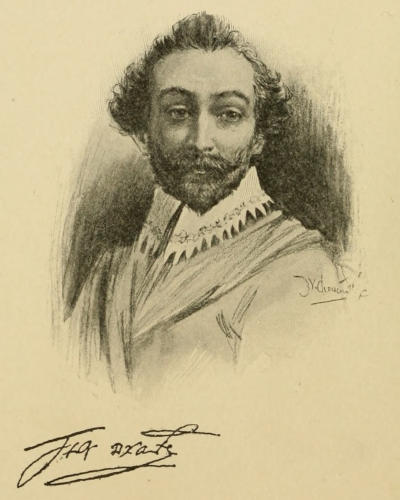
SIR FRANCIS DRAKE
And yet much had in fact been accomplished towards
the future successful occupation of North America.
Some part of the real character of the new continent stood
sufficiently revealed. Early in the century Balboa
had crossed the Isthmus and
“Stared at the Pacific—and all his men
Looked at each other with a wild surmise—
Silent upon a peak in Darien.”
Magellan had found his way to the south, round about
the coasts of South America, into the new ocean; and
before the middle of the century Spanish vessels had
beat their adventurous way along almost the entire
Pacific length of both continents. By the time Drake
set out on his famous first voyage round the world in
1577, the Spaniards had already established a trade
route across the Pacific to India and the Spice Islands.
“CROOK-BACKED” OX
Their discoveries became very slowly known to the
rest of the world; they had no mind to advertise what
they found, and so invite rivalry. Each nation that
coveted the new lands was left to find out for itself how
they lay, with what coasts, upon what seas. It did at
last become generally known, however, that America
was no part of Asia, but itself a separate continent,
backed by an ocean greater even than the Atlantic.
What was still hidden was the enormous extent of the
New World. It had been found narrow enough from
ocean to ocean at the Isthmus; and the voyagers along
its farther coasts had not been expert to mark the real
spread and trend of its outlines. They imagined it of
no great bulk. Throughout the century every explorer
who sought to penetrate its interior from the Atlantic
along any considerable watercourse confidently hoped
to find, near the sources of the stream, similar passage
down the western slopes of the continent to the great sea
at the west. Adventurer after adventurer, moreover,
pushed northward among the ice to find a northwest
passage whereby to enter the Pacific.
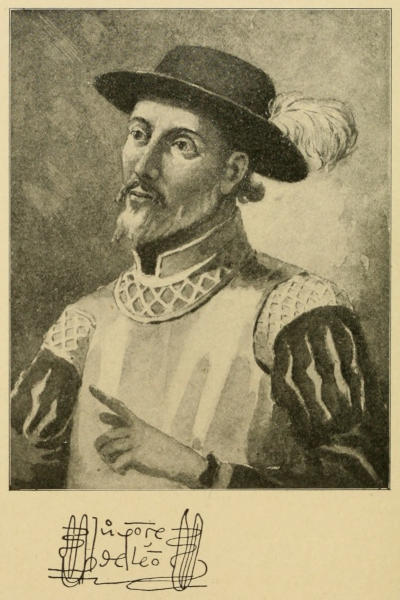
PONCE DE LEON
All such mistakes only served to make the real character
of the northern continent the more evident. Every
discovery contributed to sober discoverers. That the
interior was one vast wilderness, grown thick with
tangled forests, blocked by mountains which stood old
and untouched, or else stretching wide “through mighty
plains and sandy heaths, smooth and wearisome, and
bare of wood,” with only “crook-backed oxen” for inhabitants,
the Spaniards had abundantly discovered by
many a costly adventure. In 1513, the year of Balboa’s
great discovery, and again in 1521, the gallant Ponce
de Leon led an expedition into the beautiful peninsula
which he named Florida, in search of a fabled spring
whose waters, of “sweet savour and reflaire,” it was
said, “as it were of divers manner of spicery,” would
impart immortal youth to those who drank of them.
But the wilderness baffled him, and he lost both his
hope and his life in the enterprise.
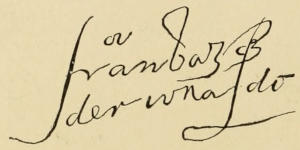
SIGNATURE OF PÁNFILO DE NARVAEZ
In 1528 Pánfilo de Narvaez sought to take the land by
storm, in true Spanish
fashion, landing a
force of three hundred
men at Apalache Bay,
with horses and trappings
and stores, to
march in quest of
kingdoms and treasures.
And march they
did, thrusting their
way through the forests
and swamps very
manfully towards the vast unknown interior of the continent.
Their ships, meanwhile, they sent away, to bring
still others to the enterprise, but with plans of rendezvous
so vague and ill-conceived that they never beheld
them again. After three fruitless months spent with
keen suffering of want and disappointment in the wild
forests, where there was neither kingdom nor treasure,
they found themselves thrown back upon the coast
again, dismayed, and in search of their craft. Finding
that they must help themselves, they built such boats
as they could, and tried to pick their way by sea to the
westward. Caught in a rush of waters at the mouth of
the Mississippi, two of their five boats were overwhelmed,
and all who were in them were lost. The rest drifted on
till cast ashore far to the west. Four men, and four
only, of all the company survived to tell the story to the
world. After a marvellous and pitiful pilgrimage of
almost two thousand miles, full of every perilous and
strange adventure, they actually reached the Spanish
settlements on the Pacific, eight years after that gallant
landing at Apalache.
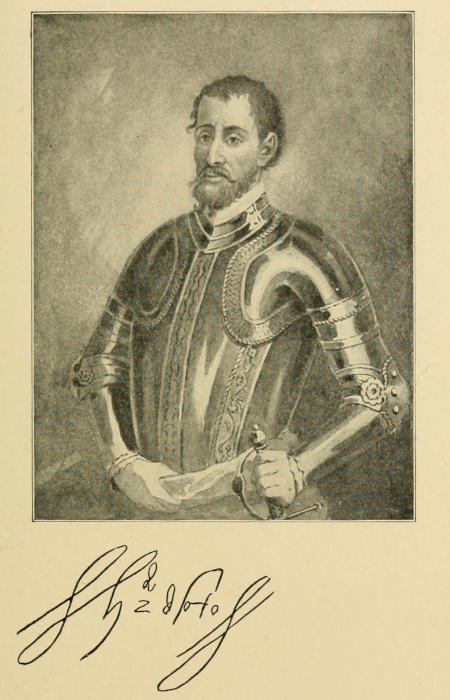
HERNANDO DE SOTO
In 1539 Hernando de Soto repeated the folly. He
brought to the Bay of Espiritu Santo nine vessels, with
near six hundred men and more than two hundred horses.
Leaving a small part of his force with the fleet, he set out
with a great force for the interior of the continent. It
was childish folly; but it was gallantly done, with all
the audacity and hardness of purpose that distinguished
Spanish conquest in that day. With contempt of
danger, meting out bitter scorn and cruelty to every
human foe, and facing even pitiless nature itself without
blanching or turning back, proud and stubborn to
the last through every tormenting trial of the desperate
march, they forced their way onward to the great
waters of the Mississippi. From the mouth of that
river, in boats of their own construction, some three
hundred survivors reached Spanish posts on the Gulf.
But without their leader. De Soto had sickened and
died as they beat up and down the wilderness which
lay along the great stream of the Mississippi, whose inland
courses he had discovered, and they had buried
his body beneath its
sluggish waters.
SIGNATURE OF CORONADO
Meanwhile a like expedition
was wasting its
strength in the wilds
which stretched back
from the Pacific. In
1540 Coronado, Spanish
Governor of New Galicia, had led an army of three hundred
Spaniards and eight hundred Indians northward
from his Pacific province in search of seven fabled cities
of “Cibola.” These “cities” proved to be only humble
pueblos such as those whose ruins still so curiously mark
the river cliffs of Arizona and New Mexico. Having put
out parties to explore the courses of the Colorado and the
Rio Grande, only to find the stately cañons of the one,
at the west, and the spreading valley of the other, at the
south, without the notable peoples and provinces he
looked for, he himself pressed doggedly onward for weary
hundreds of miles, eastward and northeastward, to the
far Missouri, to find at last nothing but vast deserts,
without a trace of population or any slightest promise of
treasure. It was a hard lesson thoroughly learned, bitten
in by sufferings which corroded like deadly acids.
RUINS OF ARIZONA CLIFF-DWELLINGS
JACQUES CARTIER
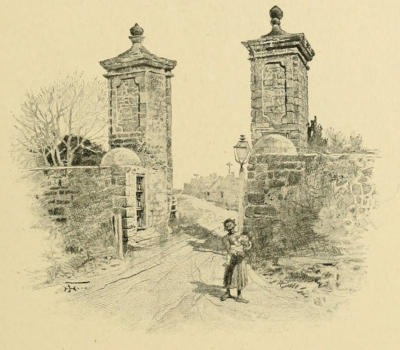
OLD GATEWAY, ST. AUGUSTINE
By such means was the real nature of the North
American continent painfully disclosed, each maritime
nation acting for itself. Spanish, English, and French
seamen beat, time and again, up and down its coasts,
viewing harbors, trying inlets, tracing the coast lines,
carrying away rumors of the interior. The Spaniards
explored and partially settled the coasts of the Gulf.
In 1534-35 Jacques Cartier penetrated the St. Lawrence,
in the name of his French master, as far as the present
site of Montreal; and in 1541 planted a rude fort upon
the heights of Quebec. In 1562-64 settlements of French
Huguenots were effected in Florida, only to be destroyed,
with savage ruthlessness, by the Spaniards, who in
1565 in their turn established St. Augustine, from which
the French found it impossible permanently to dislodge
them. In the opening years of the seventeenth century
French colonies were planted on the St. Lawrence
at Montreal and Quebec, and in Acadia, in the region
which was afterwards to be known as Nova Scotia.
English settlements also were attempted. All signs combined
to indicate the coming in of a new age of organized
enterprise, when, with one accord, the nations which
coveted the virgin continent should cease to
“fly to India for gold,
Ransack the ocean for Orient pearl,
And search all corners of the new-found world
For pleasant fruits and princely delicates,”
and should compete, instead, to build communities and
erect states over sea, and so possess themselves of a
vast treasure of their own making.
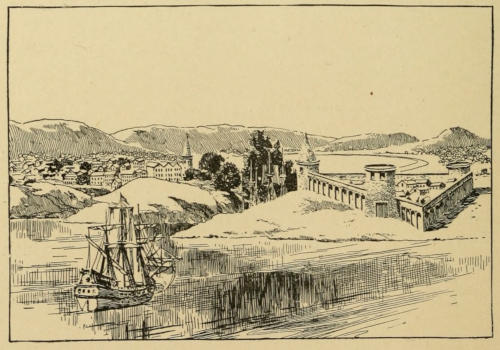
ST. AUGUSTINE, FLORIDA, 1742
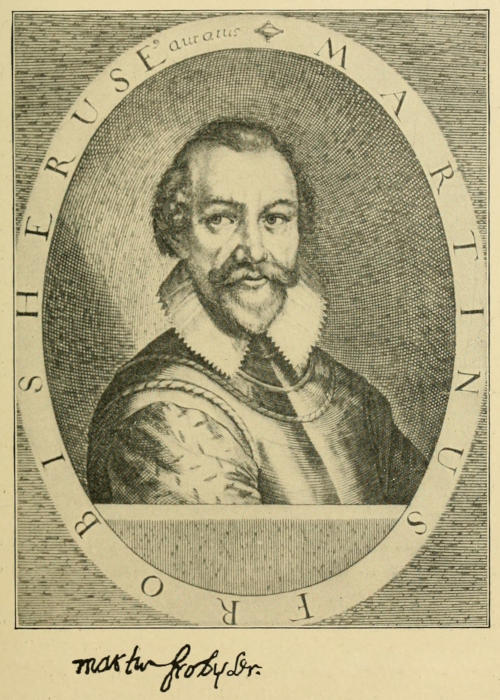
SIR MARTIN FROBISHER
In the great enterprise of discovery and exploration
Spain had held the first place throughout a century;
but for the task of colonization the parts were to be differently
cast. The century had witnessed many profound
changes in European politics. In the year 1519
Charles V., King of Spain, Archduke of Austria, King
of Naples and Sicily, heir of the House of Burgundy,
and therefore lord of the Netherlands, had become
also Emperor of Germany, and had begun to threaten
all Europe with his greatness. But the vast circle
of his realm had not held together. It was not a single
power, but naturally diverse and disintegrate, and had
speedily fallen asunder. In 1568 began that determined
revolt of the Netherlands which was eventually to sap
and destroy the Spanish power. By scattering her
force too ambitiously, and staking her supremacy on
too many issues, Spain began steadily to lose the great
advantage she had held upon the continent. For England
the end of Spain’s power was marked by the destruction
of the Armada, and the consequent dashing
of all the ambitious schemes that had been put aboard
the imposing fleet at Lisbon. There had meanwhile
been reckonings between England and France also.
Henry VIII. and Francis I. had kept restlessly at work
to adjust the balance of European power to their own
liking and advantage. Wars, brief and inconclusive,
but ceaseless, swept Europe in every direction; and then
radical changes set in, both national and international.
In 1562 the great Huguenot civil wars broke out, to
rage for more than twenty years; and France stained
her annals with St. Bartholomew’s day, 1572. In driving
the Huguenots forth to England and America, she
lost the flower of her industrial population. She thwarted
her European enemies, nevertheless, and solidly
compacted her national power. The German countries
all the century through were torn and distracted by
the struggle of the Reformation, and remained self-absorbed,
forming the parties and defining the passions
which were to bring upon them the terrible Thirty
Years’ War of the next century.
When the new century opened, France and England
alone stood ready to compete for North America. And,
for all France was as keen to seek her interest in the
New World as in the Old, the signal advantage, as the
event abundantly proved, was to lie with England in
this new rivalry in the wilderness. The reason is now
plain enough. England had obtained from the sixteenth
century just the training she needed for winning
America in the seventeenth, while France had unfitted
herself for the race by the new life she had learned.
England had become a commercial nation, quickened
in every seaport by a bold spirit of individual enterprise
that would dare anything for a success. The Tudor
monarchs had, it is true, established a political absolutism;
but they had, nevertheless, somehow deeply
stirred individual initiative in their subjects in the process.
In France, meanwhile, individual initiative had
been stamped out, and the authority of church and
state consolidated, to command and control every undertaking.
France sent official fleets to America and
established government posts; while England licensed
trading companies, and left the colonists, who went to
America in their own interest, to serve that interest by
succeeding in their own way. The French colonies
pined under careful official nursing; the English colonies
throve under “a wise and salutary neglect.” A
churchly and official race could not win America. The
task called for hard-headed business sense, patient,
practical sagacity, and men free to follow their own interest
by their own means.
SIGNATURE OF HENRY VIII.
The Reformation had performed a peculiar service
for England. It had filled her, not with intense religious
feeling, but with intense national feeling. It meant
that England had thrown off all slavish political connection
with Rome, and was to be henceforth national
in her church as well as in her politics. It meant, too,
that she was to have less church than formerly. When
Henry VIII. destroyed
the monasteries and appropriated
their means
and revenues, he secularized
the government
of England, and in part
English society too, almost at a stroke. The wealth of
the church went to make new men rich who had won the
favor of the crown, and a new nobility of wealth began
to eclipse the old nobility of blood. Such a change met
the spirit of the age half-way. The quickened curiosity
and nimble thought of the Renaissance had no courteous
care as to what it exposed or upset. The discovery of new
lands, moreover, stimulated all sorts of trade and sea-traffic.
A general movement to learn and acquire new
things had begun among masses of comfortable people
who had never cared to disturb their minds before.
The literature of the “spacious times of great Elizabeth”
was the spontaneous speaking out, with unexampled
freedom of heart, with unmatched boldness of
fancy and amplitude of power, of the finer spirits of a
nation excited by every new prospect of thought and
enterprise. Fortunately the Tudor monarchs were
stingy how they helped their subjects with money, even
to defend their wealth and commerce against the foreigner.
Henry VIII. interested himself in improved
methods of ship-building; and when he had time to
think of it he encouraged instruction in seamanship and
navigation; but he built no navy. He even left the
English coasts without adequate police, and suffered
his subjects to defend themselves as best they might
against the pirates who infested the seas not only, but
came once and again to cut vessels out of port in England’s
own waters. Many public ships, it is true, had
been built before the Armada came, and fine craft they
were; but they were not enough. There was no real navy
in the modern sense. The fleet which chased the Spaniards
up the Channel was a volunteer fleet. Merchants
had learned to defend their own cargoes. They built
fighting craft of their own to keep their coasts and harbors
free of pirates, and to carry their goods over sea.
They sought their fortunes as they pleased abroad,
the crown annoying them with no inquiry to embarrass
their search for Spanish treasure ships, or their trade
in pirated linens and silks.
SPANISH GALLEON
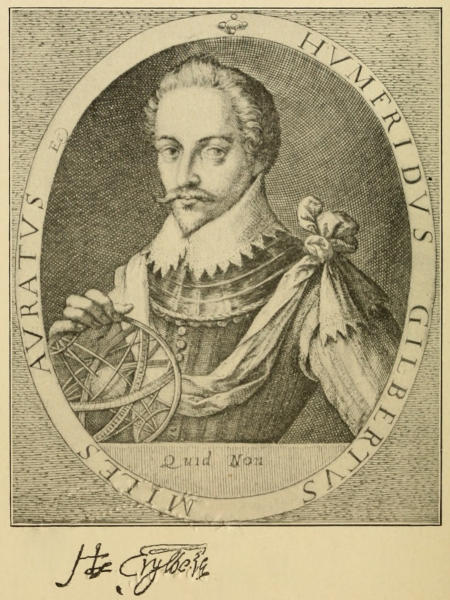
SIR HUMPHREY GILBERT
GILBERT’S MAP
It was this self-helping race of Englishmen that
matched their wits against French official schemes in
America. We may see the stuff they were made of in
the Devonshire seamen who first attempted the permanent
settlement of the new continent. For a time all
that was most characteristic of adventurous and sea-loving
England was centred in Devonshire. Devonshire
lies in the midst of that group of counties in the
southwest of England in which Saxon mastery did
least to destroy or drive out the old Celtic population.
There is, accordingly, a strong strain of Celtic blood
among its people to this day; and the land suits with
the strain. Its abrupt and broken headlands, its free
heaths and ancient growths of forests, its pure and
genial air, freshened on either hand by the breath of the
sea, its bold and sunny coasts, mark it a place made
by nature to indulge that sense of mystery and that
ardor of imagination with which the Celt has enriched
the sober Saxon mind. Next it lay Somersetshire,
with its sea outlet at sturdy Bristol port, where trade
boasted itself free from feudal masters, pointing to the
ruined castle on the hill, and whence the Cabots had
sailed, so close upon the heels of Columbus. For itself
Devonshire had the great harbor and roads of Plymouth,
and innumerable fishing ports, where a whole race of
venturesome and hardy fishermen were nurtured. All
the great sea names of the Elizabethan age belong to it.
Drake, Hawkins, Ralegh, and the Gilberts were all
Devonshire men; and it was from Plymouth that the
fleet went out which beat the great Armada on its way
to shipwreck in the north. The men who first undertook
to colonize the New World for England were bred
to adventure, both by books and by the sea air in which
they lived. Sir Humphrey Gilbert and his half-brother,
Walter Ralegh, were gentlemen, trained to books at
Oxford, and men of fortune besides, who could put forth
into the world to look into what they had read of. Their
books were full of travellers’ tales; their neighbors were
seamen who had met the Spaniard at close quarters on
the high seas, and lightened him of his treasure. Wealth
and adventure alike seemed to call them abroad into
the new regions of the West. Ardently, and yet soberly
too, with a steady business sagacity as well as with high,
imaginative hope, they obtained license of the crown
and led the way towards new ports and new homes in
America. They did all with unstinted energy and devotion,
embarking their fortunes in the venture. In
1583 Sir Humphrey Gilbert himself went out to Newfoundland,
and lost his life seeking a harbor to the southward
where to plant a colony. He had made his own
quarters in the smallest vessel of his little fleet, and
calmly “sat abaft with a book in his hand,” even when
the violent sea and the unknown coast threatened most
sharply, cheering his companions the while with the
stout-hearted assurance, “We are as near heaven by
sea as by land.” On Monday night, the 9th of September,
about twelve o’clock, his lights went out and he
found a haven he had not sought. The next year, 1584,
Ralegh sent out two ships to take the southern course
to America and find a coast suitable for settlement.
They hit upon Roanoke Island. It was, their captains
reported, an exceeding pleasant land, its people “most
gentle, loving, and faithful, and such as live after the
manner of the golden age.” Within the next three years,
therefore, until the coming of the Armada called his
attention imperatively off from the business, Ralegh
made two distinct efforts to establish a permanent colony
on the island. But both attempts failed. The
right temper and purpose had not come yet. The first
colony contained men only, and these devoted themselves
to exploration instead of to tillage and building.
Ralegh and his agents alike were still dreaming of El
Dorado. The second colony contained women and
families; but they made small progress in learning to
deal with the Indians, now no longer gentle and faithful;
and they continued to rely on England for supplies,
which did not come. When finally search was
made for them they were not to be found. Their fate
has remained a mystery to this day.
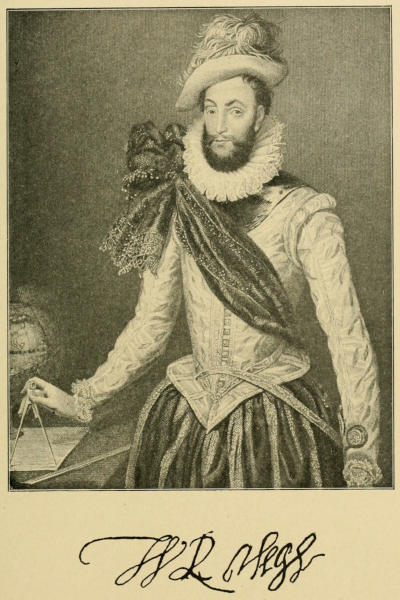
SIR WALTER RALEGH
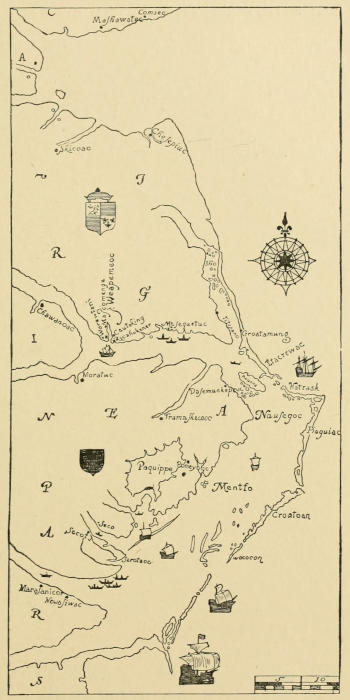
MAP OF ROANOKE ISLAND AND VICINITY BROUGHT AWAY BY THE
RALEGH COLONISTS
TITLE-PAGE OF RALEGH’S “DISCOVERIE”
And so the century ended, with only a promise of
what might some day be done. But, though the new
continent still remained wild, strange, and inhospitable,
the approaches to it at least were at length known. The
Atlantic was cleared of its terrifying mystery, and the
common sun shone everywhere upon it. Both the
northern and the southern routes across it had become
familiar to seafarers. The merchants of Southampton
regularly sent ships upon the “commodious and
gainful voyage to Brazil” so early as 1540; and Newfoundland
had been a well-known fishing and trading
post ever since 1504. In 1570 at least forty ships went
annually from English ports to take part in the fisheries
there; and in 1578 no fewer than a hundred and fifty
were sent from France alone. Hundreds of crews were
to be found in St. John’s Harbor in the season, drying
their catch and sunning their nets. Europe could not
have been sure of fish on Fridays otherwise. The ocean
ways were well known; the coast of North America
was partly charted; its forests were no longer deemed
the frontier barriers of kingdoms; the romantic age of
mere adventure was past; and the more commonplace
and sober age which succeeded was beginning to appreciate
the unideal economic uses to which North
America was to be put, if Europe was to use it at all.
It only remained to find proper men and proper means
for the purpose.
Note on the Authorities.—The general history of the discovery,
exploration, and early settlement of the coasts of North America,
before the English came, may best be read in the various chapters
of the first two volumes of Winsor’s Narrative and Critical History
of America (where full lists of authorities are given), in the two
volumes of Mr. John Fiske’s Discovery of America, in the first
volume of Mr. J. A. Doyle’s English Colonies in America, and in
the first volume of Bryant and Gay’s excellent Popular History
of the United States. Mr. Francis Parkman has given a characteristically
lucid, accurate, and engaging account of the French
settlements in Florida and at the north in his Pioneers of France in
the New World.
Those who wish to read of the early voyages and explorations
at first hand, in the contemporary accounts, will find almost everything
that they want in Richard Hakluyt’s Principal Navigations
(edited by Edmund Goldsmid. Edinburgh, 16 vols., 1885-1890), in
the invaluable Publications of the Hakluyt Society, and in the
Collections of the Massachusetts Historical Society.
CHAPTER II THE SWARMING OF THE ENGLISH — I. The Virginia Company — II. New Netherland and New Plymouth — III. The Massachusetts Company — IV. The Province of Maryland — V. The Expansion of New England — VI. The Civil Wars and the Commonwealth — VII. The Restoration — VIII. New Jersey and Carolina — IX. Pennsylvania — X. The Revolution
It was the end of the month of April, 1607, when three
small vessels entered the lonely capes of the Chesapeake,
bringing the little company who were to make
the first permanent English settlement in America,
at Jamestown, in Virginia. Elizabeth was dead. The
masterful Tudor monarchs had passed from the stage,
and James, the pedant king, was on the throne. The
“Age of the Stuarts” had come, with its sinister policies
and sure tokens of revolution. Men then living were
to see Charles lie dead upon the scaffold at Whitehall.
After that would come Cromwell; and then the second
Charles, “restored,” would go his giddy way through
a demoralizing reign, and leave his sullen brother to
face another revolution. It was to be an age of profound
constitutional change, deeply significant for all
the English world; and the colonies in America, notwithstanding
their separate life and the breadth of the
sea, were to feel all the deep stir of the fateful business.
The revolution wrought at home might in crossing to
them suffer a certain sea-change, but it would not lose
its use or its strong flavor of principle.
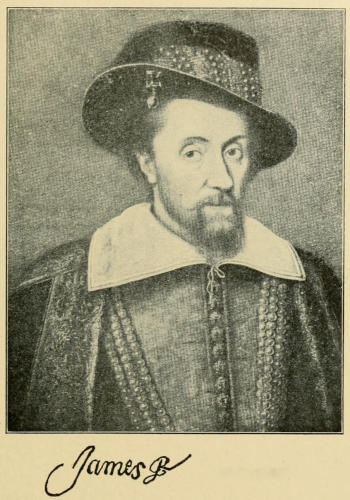
KING JAMES I.
The new settlers came in two small ships and a pinnace,
the Goodspeed, the Sarah Constant, and the Discovery,
all of which belonged to the Muscovy Company, which
usually sent its ships for trade much farther north, to
Hudson’s Bay and Davis Strait, or to bring cargoes
from Greenland and the Cherry Islands. The little
band of adventurers had gone aboard their craft at
Blackwall, on the Thames, and had begun to drop down
the river to put to sea on the next to the last day of December,
1606; but rough weather held them for weeks together
in The Downs, and it was past the middle of February,
1607, before they got finally away. Their course
fetched a wide compass round about by the Great Canaries
and the West Indies in the south, and it was the
end of April before they saw at last the strange coasts
for which they were bound.
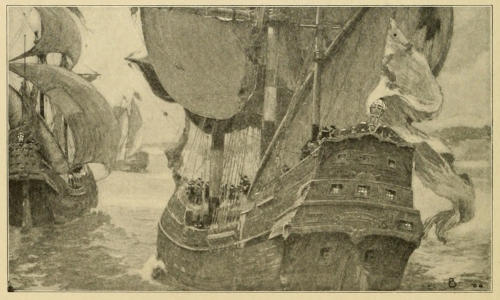
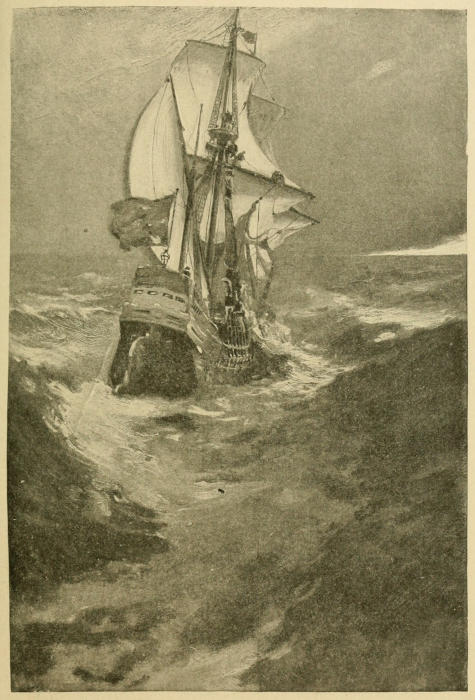
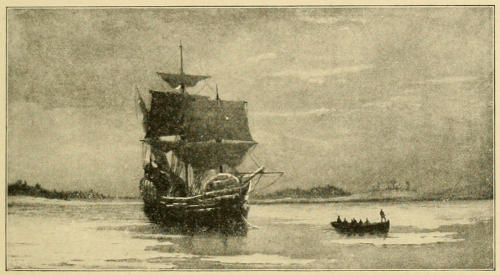
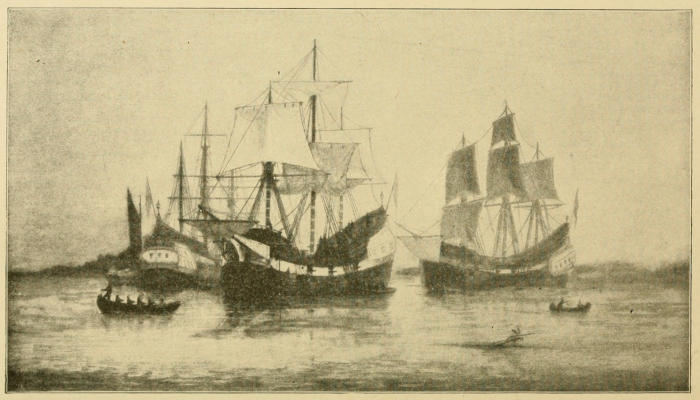
THE GOODSPEED, SARAH CONSTANT, AND DISCOVERY AT THE
CAPES OF THE DELAWARE
It was a lonely age in which to be four months upon
the great sea, for “ships were rare,” only “from time
to time, like pilgrims, here and there crossing the waters.”
You were sure to see no sail anywhere as you went.
And the land to which they came was as lonely as the
sea, except for the savages who lurked within its forests.
The three little merchantmen came none the less boldly
in at the capes, however; and the tired men on board
thought the shores of the vast bay within very beautiful,
with their “fair meadows and goodly tall trees,” and
their “fresh waters running through the woods,” better
than any wine to men who for four months had drunk
from the stale casks on the ships. And yet the loneliness
of those spreading coasts, forested to the very water,
was enough to daunt even brave men.
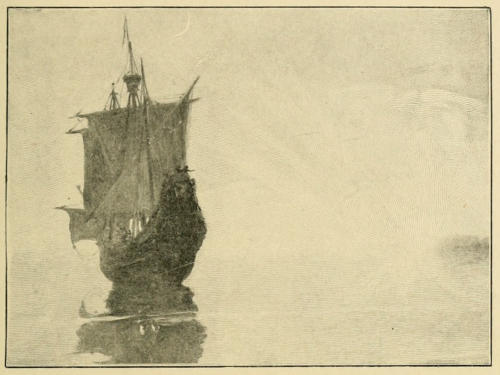
“SHIPS WERE RARE”
They presently found a great “river on the south side,
running into the main,” and they chose a place on its
banks for their settlement which was quite forty miles
above the mouth of its stately stream; for they wished
to be away from the open bay, where adventurous seamen
of other nations, none too sure to be their friends,
might at any time look in and find them. They named
their river the James, and their settlement Jamestown,
in honor of the king at home. Eighty years before
there had been Spaniards upon that very spot. They
had built houses there, and had planned to keep a lasting
colony. There had been Spaniards in the West
Indies these hundred years and more,—ever since the
days of Columbus himself; and in 1526 Vásquez de
Ayllon had led a great colony out of Santo Domingo
to this very place, no fewer than five hundred persons,
men and women, with priests to care for their souls
and to preach the gospel to the savages. But discord,
fever, and death had speedily put an end to the venture.
The place had soon been abandoned. Scarcely
one hundred and fifty of the luckless settlers survived
to reach Santo Domingo again; and when the English
put ashore there, where a tongue of low and fertile
land was thrust invitingly into the stream, no trace
remained to tell the tragic story. It was as still and
bare and lonely a place as if no man else had ever
looked upon it.
There were but a few more than a hundred men put
ashore now from the English ships to try their hands
at making a colony, and not a woman among them to
make a home. They had been sent out by a mercantile
company in London, as if to start a trading post, and
not a community set up for its own sake, though there
could be little trade for many a long day in that wilderness.
Certain London merchants had united with certain
west-country gentlemen and traders of Bristol,
Exeter, and Plymouth in the formation of a joint-stock
company for the purpose of setting up colonies in both
“the north and south parts of Virginia”; and to this
company royal letters patent had been issued on the
10th of April, 1606. The name “Virginia” had been
given, in honor of Elizabeth, the Virgin Queen, to the
mainland which Ralegh’s first explorers found beyond
Roanoke. So far as Englishmen were concerned, the
name covered the greater part of the Atlantic coast
of the continent. The patentees of the new company
were to attempt both a northern and a southern settlement,
and, to serve their double purpose the better, were
divided into two bodies. The London stockholders were
to undertake the first colony, in some southern part of
“Virginia,” between the thirty-fourth and the forty-first
degrees of north latitude; while the incorporators
who were of Somerset and Devon were to undertake a
second colony, to be conducted to some point farther
north,—though all were to remain under the government
of a single general council.
“LIKE PILGRIMS, HERE AND THERE CROSSING THE WATERS”
BOTH SIDES OF THE SEAL OF HIS MAJESTY’S COUNCIL OF VIRGINIA
TITLE-PAGE OF HAKLUYT’S DIVERS VOYAGES
There were men of capital importance and quick
energy among the London incorporators; and the enterprise
they had taken in hand was not all novel.
Several of them were members also of the East India
Company, which had been formed seven years before,
and of the “Russia or Muscovy Company,” whose trade
in far-away seas was a thing established and familiar.
They were most of them men who had heard all there
was to be told or read of the voyages and adventures by
which America had become known in England; and
some notable sailors were also of their number who had
themselves seen the strange seas and unfamiliar coasts
which others only read of. Richard Hakluyt, the genial
and learned churchman, who
loved every tale of daring and
who knew more of the New
World than any other man in
the kingdom, was their associate in the new company.
Captain Newport, to whom they intrusted the
command of their little fleet, borrowed from the Muscovy
Company, had already been twice to America:
a clear-eyed man hardly turned of forty, and likely to
understand what he saw. Bartholomew Gosnold, whom
they commissioned captain of the Goodspeed, had himself
discovered the short route to America by way of
the Azores, and went now permanently to cast in his
lot with the colonists. There were capacity and experience
and audacity and steadfastness enough embarked
in the service of the Virginia Company, it must
have seemed, to make it sure of its success.
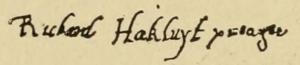
RICHARD HAKLUYT
And yet nobody very well understood what this new
business of establishing colonies was to be like, for all
that; and the colonists whom these capable London
gentlemen sent over with Captain Newport were a sorry
lot, it turned out, with whom to attempt an enterprise
which should need for its execution every manly quality
of courage and steadfastness and industry. Prosperous
and steady men who were succeeding at home were not
likely to be willing to go to America, of which they knew
nothing except that it was full of savages, and that
Ralegh’s colonists had been lost there, never to be found
again. Only men hopelessly out of work or out of sorts,
and reckless men, young and fond of adventure, were
likely to think the prospect inviting, or the novel risk
worth taking, to better their fortunes, or to get the
monotony out of their lives.
INDIAN VILLAGE OF SECOTAN
It happened that England was full of idle men, because
her life was changing. The very quickening and
expansion of commerce and of adventure in trade and
conquest which had changed all the age and the aspect
of the world itself since the first crossing of the Atlantic
had given England a new place in the geography of
the planet, and was radically altering men’s lives and
occupations and ambitions there. New trades and industries
were springing up, and the towns were reaping
the benefits of a diversified commerce. But the
people of the rural districts had fallen upon evil days.
Land, like everything else, had become a sort of commodity
as trade gained its mastery. The old tenures,
under which small holders had so long lived unmolested,
were breaking up. The city merchants bought estates
for their pleasure, and wanted no tenants. The
older land-owners got rid of small farmers as fast as
they could, in order to turn their lands into pasture for
the sheep whose wool was so much in demand by the
merchants and the manufacturers. They even enclosed
and appropriated for the same purpose commons
which had time out of mind been free to all, and swept
hamlets away to make the more room for their flocks.
The demand for agricultural labor sadly slackened.
“Your sheep, that were wont to be so meek and tame,”
cried Sir Thomas More, in his anger and pity to see such
things done, “are now become so great devourers and
so wild that they eat up and swallow down the very
men themselves. They consume, devour, and destroy
whole fields, houses, and cities.” Town and country-side
alike filled with men out of work, who “prowled
about as idle beggars or continued as stark thieves till
the gallows did eat them”; and unguarded wayfarers
were robbed upon the highways by desperate men who
could find no other way to obtain subsistence. James’s
craven eagerness for peace had put an end to the wars
with which Elizabeth’s day had resounded, and London
was full of idle soldiers, mustered out of service. Younger
sons and decayed and ruined gentlemen seemed to
abound more than ever.
It was men out of work or unfit for it who chose
to go to America; and not men of the country-sides so
much as discredited idlers and would-be adventurers
of the towns. More than one-half of the company Captain
Newport conducted to James River called themselves
“gentlemen,”—were men, that is, of good blood
enough, but no patrimony, no occupation, no steady
habit, who were looking for adventure or some happy
change of fortune in a new land, of which they knew
nothing at all. Very few, indeed, of the rest were husbandmen
or carpenters or trained laborers of any sort.
There was only one mason, only one blacksmith, in all
the hundred and twenty. Only two were bricklayers,
only six carpenters; while thirty-five were gentlemen,
and most knew not what to call themselves. The things
it was most necessary to do when at last the landing
had been made at Jamestown,—the planting of crops,
the building of houses, the dull labor of felling trees
and making a beginning in a wilderness,—were the
very things which the men the Virginia Company had
sent over knew least about, and had the least inclination
to learn. They expected the company to send
them supplies out of England, and gave little thought
to what they were to do for themselves. When Captain
Newport’s ships put to sea again and left them,
they were at their wits’ ends to know how to maintain
themselves.
It would have gone desperately with them had there
not been one or two men of masterful temper and governing
talents among them. Captain Newport came
again with supplies in the winter; and still another ship
followed him the next spring. And, besides supplies, the
two ships brought a hundred and twenty new settlers
between them. But among the new-comers there were
shiftless “gentlemen” in the usual proportion; and
there came with them a jeweller, two goldsmiths, two
refiners, and a perfumer,—as if there would be need of
such people! Such additions to the settlement only
made it so much the harder to develop or even maintain
it; and the few men who could rule stood out like masters
among the inefficient idlers of whom the incorporators
in London had thought to make pioneers.
TITLE-PAGE OF CAPTAIN JOHN SMITH’S “TRUE RELATION”
There was one among them, Captain John Smith,
to whom, in large part at any rate, they owed their salvation
from utter helplessness and starvation. Captain
Smith had a gift for narrative which his fellow-adventurers
did not have, and has set his own achievements
down in notable books whose direct and rugged
ways of speech, downright temper of action, and air
of hardihood bespeak the man himself. He was not
yet thirty years of age when he began to play his
part there in Virginia; he was exasperatingly sure of
himself; older men found his pretensions wellnigh unbearable.
But it was certain he had seen more of the
world and of adventure than any other man of the
company. He had known and had come to conclusions
with men of many races and of every kidney, as
he had cast about the world, a soldier of fortune; and
he knew how they were to be governed, as he presently
demonstrated. He rang like brass without, no doubt,
but had a quality of gold within. He was a partisan
of his own way of making a colony, and it may be colored
the narratives he wrote to be seen at home; but
he was no sluggard at work, and knew how to take the
burdens of tasks which no one else would attempt. He
at least found ways of getting food from the Indians,
and of making interest with their chiefs. Though he
took authority when it was not given him, he made the
lazy, “humoursome, and tuftaffety sparks” of the settlement
work, upon penalty of being set across the broad
river to shift for themselves or starve; prevented would-be
deserters from running away with the boats; explored
the neighboring coasts and river-courses,—for
two years and a half played his part very capably and
very manfully in keeping the struggling settlement
alive, when the majority of his comrades would have
been glad to abandon it. He compelled no man to
do what he did not willingly do himself. “Gentlemen,”
under the spur of his example and command,
learned to make a pleasant pastime of labor in the forest,—so
that “thirty or forty of such voluntary gentlemen,”
as Master Anas Todkill said, “would do more
in a day than one hundred of the rest that must be prest
to it by compulsion,”—though doubtless “twenty good
workmen would have been better than them all.” No
doubt there were others who seconded Captain Smith
in the maintenance of order and of hope, and who worked
as he did to take some hold upon the wilderness for their
principals at home; but upon him fell the chief burden
of the task, because he could carry it and prevail.
CAPTAIN JOHN SMITH’S MAP OF VIRGINIA, 1612
When at last, in the autumn of 1609, he was obliged
to take ship for England, dangerously wounded by an
explosion of gunpowder, it looked as if the worst were
over at Jamestown. The company at home had been
very busy getting colonists, and had sent them over
in goodly numbers. There were about five hundred
persons at the settlement when Captain Smith left,—a
few women among them, making it look at last as if
the lonely place were to see homes established; and fifty
or sixty simple houses had been put up. But numbers,
it turned out, did not improve the living. Too many
of the new-comers were “unruly gallants, packed thither
by their friends to escape ill destinies” at home; and
those whom they joined at their landing still did not
know how to support themselves in the wilderness, or
how to keep themselves safe against the fevers which
lurked within the damp forests by the river. Added
numbers made them a little more helpless than before;
and the six months which immediately followed Captain
Smith’s departure brought upon them a desperate
“starving time,” which no man who survived it ever
forgot. There were few to work where every one was
ill and in want. They tore their rude houses down
for firewood before the winter was over; do what they
could, only sixty of them lived to see the spring again,
and a gleam as of madness played in the eyes of those
who survived those days of desolation. One came and
cast his Bible into the fire, crying out that there was no
God. It was resolved at last, when they could, to abandon
the desolate and hopeless place, and the forlorn little
band were actually on their way down the river, meaning
to seek food and shelter among the fishermen in
Newfoundland, when Lord Delaware met them at its
very mouth with fresh colonists and supplies sent by
the company to their relief.
The radical difficulty was, not that the company did
not do its part to sustain the colony, but that it could
get few colonists of the proper sort, and was trying to
do an impossible thing. The settlers sent out had no
hopes or prospects of their own, as the company managed
the business then. They were simply its servants,
fed out of a common store, and settled upon land which
belonged to no one but was used for all alike. No man
would work well or with quick intelligence if he could
not work at all for himself, but must always be working
for the company. First-rate men would not consent
to be the company’s drudges. And what could the
company get out of the wilderness in return for its outlay
by the work of such men as it could induce to go to
Virginia upon such terms? A few cargoes of timber,
a few new varieties of medicinal herbs found in the forests,
could not make such expenditure worth while.
Captain Newport, after his second voyage out, had
gone back to England with his hold full of glistening
earth, which he supposed to contain gold; but it contained
nothing of the kind. It was only shining sand.
TITLE-PAGE OF CAPTAIN JOHN SMITH’S “GENERAL HISTORIE”
Lord Delaware, though a little slow and stiff and
fond of wearing fine apparel and going about attended
by officers and halberd-bearers, which seemed fantastic
enough there in the shadow of the untouched forests
of that wilderness, was a wise and capable man, and
no doubt saved the colony by coming out, that hopeless
spring of 1610, as Governor and Captain General
for the company. But it needed a radically new policy
to give real life to such an enterprise; and that it did not
get till Sir Thomas Dale came the next year (1611), after
Lord Delaware had gone home stricken with a fever.
The new policy it needed was one which should give it
expansion and a natural vitality of its own. It was
necessary that new towns should be built upon the river
which should not be, like Jamestown, mere stations
where men worked at tasks for the company, but veritable
communities in which men should be allowed to
have land of their own, and should be given leave to
work for themselves as well as for the incorporators in
London. For five years (1611-1616) Sir Thomas Dale
and Sir Thomas Gates pushed this new policy forward;
and it was their new and better way of doing things
that really made and established Virginia. “Henricus,”
“Hampton,” “New Bermuda,” and other new
settlements like them, were added to Jamestown, each
with its fort and its stockade, its military commander
and discipline, and each with its group of virtually independent
land-owners, free to work for themselves.
TITLE-PAGE OF LORD DELAWARE’S “RELATION”
Most of the colonists, it is true, were still held at Jamestown
to serve the company, and driven to their work,
as little better than slaves, by their new task-masters.
Gates and Dale came with authority to rule by martial
law, without let or mercy, and colonists of the poorer
sort got nothing but blows and rations for their bitter
toil. Those who mutinied or ran away were put to
death or to the torture, if need were, to keep the discipline
of toil and order which the company’s treasurer
and merchant adventurers were now steadfastly minded
should be wrung from the colony. But the new plantations
showed the way to a new life. There were independent
settlers here and there upon the river, as well
as men who were mere servants of the company. The
better sort, even of the men whom the company had
sent out, were given their patches of land and their
time,—if it were only one month out of the twelve,—to
do work for themselves, in order that the new plans
might thrive. A strong root as of a little commonwealth
was planted at last.
Dale and Gates both belonged to that capable race
which had been bred under Elizabeth, willing to be
soldiers or sailors by turns, if only they could be always
in the thick of action. They had both been soldiers in
the Low Countries against Spain, and, now that fighting
flagged there, were both serving their turn at this interesting
business of setting up colonies. Dale was
the more capable and masterful of the two: a terror to
men who would not work or were slow to obey; a leader
after their own hearts for men who meant to do their
tasks and succeed,—and his stay in Virginia was, fortunately,
longer by three years than Gates’s. He was
but Gates’s deputy so long as Gates was in Virginia
(1611-1613); but he was master when Gates was gone,—prevailed
even when Gates was there,—and it was
his rough and soldierly energy which made the little
group of “plantations” at least ready to last and to expand
into a lusty piece of England over sea. When
he had finished his five years’ work, the colony,
though small and primitive still, was yet strong and
spirited enough to survive being despoiled by an adventurer.
For a year after Dale quit the colony it was
left under the government of Captain George Yeardley,
the commandant of
one of the new settlements.
But in
1617 Samuel Argall
came out to take his
place, and proved
himself no lover of
the people he had come to govern, but a man chiefly
bent upon serving his own fortunes. He was of gentle
blood, but had too long followed the sea in those disordered
times, as little better than a freebooter, to relish
law or justice overmuch; and it was excellent proof that
the colony had grown strong and able to take care of
itself that it endured for full two years his tyrannous
and selfish exactions (1617-1619), and yet was ready
at the end of them to assume a sort of independence,
under a new form of government which gave it the
right to make its own laws.
In 1619 Captain Yeardley, now become Sir George,
returned out of England commissioned to take Argall’s
place and govern the plantations under a new and better
charter. He was to call together an assembly of
representatives from the several plantations, and that
assembly, sitting with the governor’s council, was to
have the full right to make laws for the colony, subject
always to the approval of the court of the company sitting
in London. Here was a very radical change. The
colony was to be no longer the mere mercantile venture
of a trading company controlled by its stockholders.
It was to be a little state, governed by its people. The
fact was that a notable change had come over the company
at home. Until now it had been managed by men
who were mere merchants, not statesmen: by men who
cared very little about anything but the profits some
time to be got out of the colony,—the sooner the better.
Now men of another sort were in control; the chief among
them Sir Edwin Sandys, a man who loved liberty, had
a statesman’s knowledge how it was to be set up and
maintained, and wished to see the settlement thrive
for its own sake, and the noble Earl of Southampton,
whom Shakespeare loved. It was upon the initiative of
these men that Sir George Yeardley had been sent out
to give the colony self-government.
Here, under the quiet forms of a mere administrative
change in the management of the colony, was a veritable
revolution wrought. Sir George brought with
him a document, bearing date 13 November, 1618, which
Virginians were always thenceforth to look back to as
to their Great Charter of rights and liberties,—a document
which made of their colony a little commonwealth.
It was drawn in the spirit of the men for whom Sandys
spoke. Five years ago Sir Edwin had stood in his
place in the Commons and maintained in the face of all
present “that the origin of every monarchy lay in election;
that the people gave its consent to the king’s authority
upon an express understanding that there were
certain reciprocal conditions which neither the king
nor the people might violate with impunity; and that
a king who pretended to rule by any other title, such
as that of conquest, might be dethroned whenever there
was force sufficient to overthrow him”; and here was
now a constitution for Virginia drawn in like spirit.
No wonder the King had cried, “Choose the devil, if you
will, but not Sir Edwin Sandys,” when he heard that
the Virginia Company had a mind to make this too
free-thinking friend of Hooker and Selden its chief
and treasurer, and deemed it revolutionized and made
an instrument of sedition against him when it chose
Sir Edwin notwithstanding.
FACSIMILE OF LETTER OF SIR EDWIN SANDYS TO SIR GEORGE YEARDLEY
The new Virginian assembly met in the chancel of the
church at Jamestown, on the 30th of July, 1619. We
look back with some emotion upon it, as to the first representative
assembly in America,—as to the beginning
of liberty and self-government in the English colonies;
but the colonists themselves seem to have taken it very
quietly, as if they had expected it and looked upon it
almost as a matter of course in the circumstances. Its
sessions were as brief, as businesslike, and as much
without ado as if they were already an established part
of the custom of the colony. Certain necessary enactments
were adopted touching trade with the Indians,
the use of tobacco as currency, the salaries and authority
of clergymen, and various other matters in which
special regulations for Virginia seemed called for; but
for the rest it was taken for granted that the common
law of England was in force there, as in every other
place where there were Englishmen; and within six days
of its coming together the little assembly was ready to
adjourn. The quiet and ready capacity with which the
colonists accepted this radical change in the method of
their life and government afforded the best proof that
they were fit for the responsibilities it involved.
FIRST VIRGINIA ASSEMBLY—GOVERNOR YEARDLEY PRESIDING
The company, under its new leaders, was a little too
eager to help the colony to prosper. Settlers were hurried
over much faster than they could be provided for.
During the three years 1619-1621 quite three thousand
five hundred came pouring in, men, women, and children,
fleet after fleet of the company’s ships appearing
in the river to put their mixed hosts of inexperienced
people ashore. And yet at the end of the three years
there were but twelve hundred settlers, all told, in the
colony. Cleared land and means of immediate subsistence
could not be found upon short notice for so
many. Hundreds succumbed to the dangerous fevers
and sudden distempers drawn out of the damp forests
by the summer sun or the first chill of the autumn nights.
A sore process of “seasoning” tried out the river settlements
every year, and only a few could endure it. It
was reckoned inevitable that hundreds of new-comers
should die. Many saw how things stood and went
back to England again. But those who remained and
survived prospered well; and the settlements grew,
after all, as fast as it was safe for them to grow.
LANDING OF NEGROES AT JAMESTOWN FROM A DUTCH MAN-OF-WAR, 1619
The terms under which land was granted to settlers
became more and more liberal as things settled to an
established way of life. Even Dale had not relieved
the tenants of his day from the duty of working part of
their time for the company; and the colony had been
conducted, until Sir George Yeardley came, like a joint-stock
enterprise in which only stockholders might expect
private profit. But under the changed conditions
which followed Sir George’s coming virtually independent
land holding became possible on very easy
terms; and, what was quite as good, the company no
longer insisted that everything bought or sold should
pass through the hands of their factor, as the only middle-man,
so that the
profits of all trade
might fall to them.
It turned out to be a
very important thing
that Mr. John Rolfe,
one of the colonists,
had in 1612 introduced
the cultivation of tobacco; for tobacco grew amazingly
well and of exceeding good quality in Virginia,
and proved a most profitable crop. By 1620 forty thousand
pounds of the delectable herb were exported from
the colony in a single year, and everybody who could
was planting tobacco instead of grain. Its leaves even
became the currency of the plantations, coin being very
scarce. “The people of the South-parts of Virginia,”
it was reported, “say that God in the creation did first
make a woman, then a man, thirdly great maize or
Indian wheat, and fourthly, Tobacco.”
SIGNATURE OF SIR THOMAS DALE
In 1619, the year Sir George Yeardley came to set up
an assembly, another very notable thing happened.
A Dutch man-of-war came into the river and sold
twenty negroes to the colonists as slaves. A handful of
slaves made no great difference at first; they were so
few as scarcely to affect the life of the colony, and it
was to be many a long day before their number was
much added to. But their coming was the beginning
of a great change which was slowly, very slowly, to
alter the whole face of society in the settlements.
JAMESTOWN IN 1622
By 1622 it seemed as if the chief difficulties of settlement
were safely passed and the plantations secure
of their growth and permanence. But in the very moment
of assurance a great calamity came upon them,
sudden, overwhelming, like a bolt out of a clear sky.
On the same day and at the same hour (22d of March,
1622) the Indians fell upon every settlement from the
falls of the river to the bay, all the tribes of all the region
round mustering in concert to strike a single exterminating
blow. The colonists had suffered themselves
to be deceived by the submissive friendliness of
their savage neighbors, and had grown strangely heedless
of danger from them. For years they had traded
with them, mingled with them, admitted them freely
to their homes, taught them the expert use of firearms,
made servants and even confidants of them, without
caution or reserve, deeming them an inferior race who
had accepted the white men as masters. But the old Powhatan,
a real friend of the English, who had been ruler
among the redmen ever since the landing at Jamestown,
was dead. Opecanchanough, their subtle and implacable
enemy, had succeeded him. For four years the
wily savage had been drawing the tribes together for a
decisive treachery; and the dreadful secret had all the
while been kept safe behind the steady eyes of every
Indian who entered the settlements. Only at the last
moment did one or two faithful native servants warn
their masters of the fearful peril; and then it was too
late to do more than put a few households on their
guard. Before the sun went down that fatal day three
hundred and forty-seven men, women, and children lay
dead in the desolate settlements. Only because the
Indians feared the white man with an overmastering
dread, and drew back dismayed wherever a firm stand
was made against them, if only by a single settler
barred within his house, did the terrible slaughter stop
short of sheer annihilation. No place escaped the carnage.
But the colony, though stunned, was not killed.
The Indians’ courage had not held out to finish the
bloody work. There was henceforth an endless reckoning
in store for them,—no longer any friendship vouchsafed
or any consideration. Steadily, relentlessly, and
by a masterful advance from settlement to settlement
which they could in no wise withstand, they were
pushed back into the forests. The very year which
followed the massacre found nearly two thousand white
men still in the scattered villages and plantations of
the indomitable English, and their quiet way of growth
had been resumed.
GRAVE OF POWHATAN
But the great company which had founded the settlements
and seen them safely through their first struggles
for life and maintenance was not to be suffered to
live. The King did not relish the politics and suspected
the loyalty of the gentlemen who were in charge of its
affairs. They were of the party which opposed him in
Parliament. He had dismissed his Parliament and
meant to rule without it; but this great company, with
names upon its rolls which were among the chief of
London not only but of the kingdom itself, held meetings
every quarter under his very eyes which were like
another parliament; which brought his enemies very
near him, and held the attention of the town. Those
who wished his favor or the ruin of Sandys and Southampton
told him that they used their conferences to
plot sedition against him, and the councils of the company
to keep a constitutional opposition together; and
he determined to be rid of them. Every mismanaged
or ill-judged affair with which the company was chargeable
was magnified and made the most of, and, despite
a very gallant fight in the law courts to save it, its
charter was taken away, and the government of the
colony transferred to the hands of the King and his
ministers. It made little practical difference to the
colonists. They kept their assembly, and could live
as comfortably under a governor sent them by the
King as under a governor sent them by the company.
The course of affairs in Virginia was not disturbed.
But a great company was destroyed, and the public-spirited
men who had given it its best life and the
colony its first taste of self-pleasing liberty were deeply
wronged.
ALL THAT IS LEFT OF JAMESTOWN
Authorities on the history of Virginia during the seventeenth
century. Excellent general narratives of the founding and early
development of Virginia are to be found in the first volume of Mr.
John A. Doyle’s English Colonies in America and in Mr. John
Fiske’s Old Virginia and Her Neighbours. Charles Campbell’s
History of the Colony and Ancient Dominion of Virginia is the
standard history of the colony; John Burk’s History of Virginia
is the most solid and extensive of the older accounts; and Robert
R. Howison’s History of Virginia has the dignity of resting upon
careful research. William Stith’s History of the First Discovery
and Settlement of Virginia brings the narrative down only to 1624,
but is compact of the most interesting matter, and is a significant
example of the scholarship of the middle of the eighteenth century
in Virginia. Mr. Stith was President of William and Mary College.
The Rev. Hugh Jones’s Present State of Virginia was published in
1724, and is an excellent early authority. Miss Ann Maury’s Memoirs
of a Huguenot Family contains the authentic records and letters
of three generations of a family driven from France to Virginia
by the revocation of the Edict of Nantes, and affords a very intimate
picture of the life of more than a century. The Rev. E. D. Neill,
in his History of the Virginia Company of London, his Virginia
Vetusta, and his Virginia Carolorum, has brought together a
vast deal of scattered information out of which very direct impressions
may be got of the life and history of the colony. Bishop
Meade, in his Old Churches and Families of Virginia, has brought
together an extraordinary mass of authentic details, most of which
relate to the eighteenth, but many of which belong to the seventeenth
century.
The original sources of Virginian history are to be found in
Captain John Smith’s True Relation of Such Occurences as Have
Happened in Virginia, published in 1608, and Generall Historie,
published in 1624, both of which many modern readers are inclined
to take with a grain of salt; in the Collections of the Virginia
Historical Society (which, among many other important
things, contain the Proceedings of the Virginia Company from
1619 to 1624); in W. W. Hening’s invaluable and remarkable
collection of the Statutes at Large of Virginia, which begins with
the acts of the first assembly, in 1619, and is brought down,
with scarcely an omission, to the end of the eighteenth century;
in Sainsbury’s Calendar of [English] State Papers, Colonial,
I. and V.; in the two volumes of Mr. Alexander Brown’s
Genesis of the United States, which is a notable mine of material;
in Peter Force’s Tracts and Other Papers Relating to the
Colonies in North America; in the Collections of the Massachusetts
Historical Society; in the notable collection of papers
gathered under the title Archaeologia Americana; in the Virginia
Historical Register; in the Virginia Magazine of History
and Biography; and in the Southern Literary Messenger.
Meanwhile other colonies were being successfully
planted in the north. On the great river St. Lawrence,
which doughty Jacques Cartier had explored quite
seventy years before, the French had set up trading-posts
at Montreal and Quebec. They had established,
besides, a struggling settlement or two nearer the mouth
of the river; and to the southward, within the Bay of
Fundy. A little colony of Englishmen had begun to
make homes for themselves in Newfoundland. Dutch
traders were established on the Hudson. A company
of English dissenters were building a New Plymouth
within Cape Cod, and little groups of English adventurers
were trying to secure a foothold upon the southern
shores of the wide Bay of Massachusetts. Nowhere
except in Virginia had more than a beginning been
made; but the settlement of the continent seemed at
last to have been begun in earnest; and the future looked
interesting enough with the French, the Dutch, and
the English all entered as active competitors in the race
for possession.
The Dutch were likely to be harder rivals to beat than
the French. Their little, compact home states in the
Netherlands were, it is true, scarcely one-fourth as big as
England, but they teemed with a thrifty people almost
as numerous as the English themselves, and their chief
power was upon the sea. With them, at home, the
very land itself was one-half sea. They had been bred
fishermen and mariners time out of mind; and of late,
because the Spaniard provoked them to it, they had put
great fleets on the high seas and had made conquests
at the ends of the earth.
VIEW OF QUEBEC ABOUT 1732
At first they had not thought of conquest. They
had simply made themselves, with their stout craft and
seasoned tars, the ocean carriers for Europe,—because
the Portuguese, who had captured rich lands and set
up a great trade all the way from the Persian Gulf to
Japan, did not trouble themselves to bring their cargoes
beyond their own port of Lisbon, and because the
Spaniards brought their treasures out of South America
no farther than Seville, and some one was needed
to carry what they would sell to the merchants and
princes of the rest of Europe. No doubt the Dutch
would have been content to be only traders and carriers,
had Spain but let them alone. But Spain, in her
folly, undertook to force the Dutch to be Roman Catholics;
and they, being stout Protestants and stubborn
men, resisted after a fashion that in the end set the whole
power of rich Spain at naught. The war began in 1568;
all Europe was stirred by it; and when, forty-one years
later, the Spaniard, quite out of breath, agreed to a
truce, the world had changed. Holland had become a
great sea-power; had driven the Portuguese from the
Orient, taking their trade and their colonies; was sinking
imperial fleets upon the very coasts of Spain herself,
and sweeping Spanish treasure by the ship’s cargo
into her own coffers. She was beforehand even with
England in making herself mistress of the seas, and
had turned to this new task of taking possession of
America with confidence and audacity.
TITLE-PAGE OF JOHN SMITH’S “DESCRIPTION OF NEW ENGLAND”
The Dutch combined conquest with trade, as England
did, and it was a Dutch East India Company of
merchants which drove the Portuguese from their possessions
in the East, as it was an English East India
Company of merchants which afterwards conquered
India for England. And when their East India Company
had made itself powerful and famous by its conquests
and adventures, the Dutch formed a West India
Company also, to trade and take what it could upon
the western coasts of Africa, upon both coasts of South
America, and among the southern islands of the Atlantic.
It had, as Mr. Motley has said, a roving commission
to trade and fight and govern for twenty-four
years; and it incidentally undertook to establish Dutch
settlements on the Hudson and the Delaware. Henry
Hudson, an English sailor in the service of the Dutch
East India Company, had, in the year 1609, discovered
the great river which was to bear his name,—the very
year the baffled Spanish agreed to a truce with the redoubtable
states of the Netherlands. He had also entered
the great bay and stream of the Delaware. The
Dutch had promptly named the Hudson the “Great
North River,” the Delaware the “South River,” and
all the rich country which lay about and between them
“New Netherland”; meaning from the first to keep
and occupy what their seamen had found.
EARLIEST VIEW OF NEW AMSTERDAM
There had been a New Netherland Company, formed
in 1614, before there was a West India Company. Its
charter had given it commercial control of all the coast
country of America from forty to forty-five degrees
north latitude, a region which the Dutch described as
lying “between New France [on the north] and Virginia.”
This was at the very heart of the country
which James of England had granted to the Virginia
Company; but the Dutch knew little of that, and would
very likely have thought as little had they known
more. It was the profitable fur trade with the Indians
of the Great North River that had first attracted
them. Individual adventurers among them had built
a small “fort” or trading post far up the river in the
heart of the wilderness, as well as a little group of huts
on the seaward point of Manhattan Island in the bay,
and had been trafficking there with the willing natives
for quite four years before they formed their New Netherland
Company.
It was the New Netherland Company that grew into
the greater West India Company, whose principal business
it was to be to wrest what it could from the
Portuguese and the Spanish in the south, but which
was also to keep an eye all the while on the North and
South rivers, where the New Netherland Company had
put its trading posts. It was 1623 before the great
company found time amid its other business to carry
out any systematic plans of settlement in North America;
but by 1625 there were already two hundred colonists
on the lands they claimed: some up the great
stream of the North River at the little post which they
called Fort Orange, some within the South River at
“Fort Nassau,” some on Manhattan Island, a few on
Long Island,—even a little group of families as far away
as the “Fresh River,” which the English were to call
the Connecticut. It remained to be seen how they would
fare scattered there in the wilderness; but there they
were, a very hard people to discourage, by the time
Virginia was fairly established in its own scattered settlements
on the James, and the rights of the great Virginia
Company taken into the hands of the King,—and
there they meant to stay.
DEPARTURE OF THE PILGRIMS FROM DELFT HAVEN
Meanwhile there had come out from Holland itself a
band of exiled English settlers, to be their neighbors
and rivals at the north, and so put them between two
growing English colonies,—not “between New France
and Virginia,” as their first charter had said, but between
New England and Virginia. The new-comers
were exchanging a temporary exile in Holland for a
permanent exile in America, and effected their settlement
within the sheltering arm of Cape Cod. Englishmen
had begun to muster many thousands strong in
Holland within a generation, and the two countries had
been drawn very near to each other. Long before the
war began which brought Spain and the Netherlands
to a grapple, hundreds of English merchants had established
themselves in the Dutch seaports; and young
Englishmen were beginning, even before dissenters
were shut out from Oxford and Cambridge, to resort in
influential numbers to the Dutch universities. When
the Low Countries grappled with Spain, English volunteers
crowded into their armies. The troops Elizabeth
sent over after 1585 found the Dutch ranks already
full of their countrymen. English churchmen, too,
for whom the policy of the Establishment proved too
rigorous under the imperious Tudor queens, had learned
to seek in Holland the freedom of worship denied them
at home. At the same time refugees from the ravage
and slaughter of Alva’s armies poured across the sea
from the lower Netherlands into England, and the two
countries seemed to be exchanging populations. Tradesmen,
weavers, mechanics, farmers, fled terror-stricken
into the eastern and southern counties of England,
often braving the sea in open boats when danger pressed
most desperately. Their coveted skill and industry,
which English statesmen knew how to value, their foreign
birth and humble rank in life, which seemed to
depress them below the level of political influence, gained
for them an indulgence in theological error and separate
worship which was denied to Englishmen themselves,
and presently the English towns in the east and
south teemed with thousands of Dutch artisans, who
were suffered to be Anabaptists, Lutherans,—what they
would, so long as they taught England the industries
and handicrafts which were to make her rich.
THE MAYFLOWER IN PLYMOUTH HARBOR
The little company of Englishmen who, in 1620, exchanged
Holland for America were not soldiers and
traders like the men who had led and established the
colony at Jamestown, but members, most of them, of a
humble congregation of dissenters who had fled from
the very districts of their native land in which foreign
heretics were tolerated, to escape the tyrannical surveillance
of the Church, and who had found a refuge
for a time in the great university town of Leyden. They
came now to America because they did not wish their
children to become Dutch or lose altogether their English
speech and customs, and because they could look
to have an even more untrammelled freedom upon the
fruitful coasts of the New World than in the ancient
states of the Netherlands, into whose life they found
themselves thrust like those who must be always
aliens. They were Protestants, and had left England
because they could not brook the domination of her
Church; and yet the reason for their exile was as
much political as religious. Many men in England,
some of them high in the counsels of the Church itself,
held the same doctrines that they held,—the doctrines
which Calvin had made the creed and fundamental
basis of belief among all Protestants of the
sterner sort,—and yet were not exiles, because they had
not broken, as these men had, with the discipline and
authority of the Church.
England’s Protestantism had a color and character
of its own. Her “Reformation” had struck at the roots
of nothing except the authority of the Pope at Rome.
Her Church had always deemed itself national, had always
held itself less subject than other churches to be
ruled by papal delegates, or turned this way or that by
the vicissitudes of continental politics and the policies
of the papal state. She had broken with Rome at last,
when the Reformation came, not because she was deeply
stirred in thought and conscience by the doubts and
the principles of belief which Luther had put afloat to
the upsetting of Europe, so much as because her King,
the wilful Henry, was vexed by the restraints put upon
his marriages and divorces by the papal authority, and
therefore chose to lead her still further along upon the
road of independence to which her position and her
pride inclined her, in religion no less than in politics.
HOUSE IN PLYMOUTH, ENGLAND, WHERE THE MAYFLOWER PILGRIMS
WERE ENTERTAINED
When the change had been made, stupendous as it
looked amid the ruin of the monastic houses which
the King had promptly despoiled, Englishmen found
themselves very little more at liberty than before to choose
forms of worship or of church government for themselves.
The Church had become more than ever a part of the
state. The King was its head and master, instead of
the Pope. He did not insist very much upon matters
of doctrine, being himself in no case to set an example
in that kind; but he did insist upon the authority of the
Church in matters of government,—upon uniformity in
worship and in discipline; because the discipline of the
Church was now the discipline of the state, and part of
his own sovereignty. He deemed schism a form of disloyalty,
though opinion, if it kept within discreet bounds,
he would not too curiously look into. It was an easy
enough rule. Things might have gone very quietly
and with a normal growth and liberalization, had not
Mary, a fanatical Catholic, become Queen, and tried
forthwith to force every one in the kingdom back into
the Church of Rome; had not Elizabeth, in her turn,
proved so absolute a martinet in every matter of obedience
to the crown,—in matters which affected the Church
no less than in matters which affected only her crown
and government. Mary drove those who resisted her
to the stake, or out of the kingdom. Elizabeth looked
shrewdly into every movement that threatened the uniformity
of worship, as changes of opinion inevitably
did, and saw to it that all men were turned to adopt her
preference.
Most persons quietly submitted. Even men of strong
convictions deemed it better to remain within the Church
and purify its beliefs and practices without schism or
revolution than to fling out of it, breaking both its unity
and the peace of the country. Such men even drew
together as a distinct party of “Puritans,”—men who
wished the Church to be pure and to hold the essential
doctrines of the great reformers who had given life and
substance to protestantism, but who did not mean to
lead it faster than it could go in the new ways, or to
separate themselves from it and set up a Church and
worship of their own, even though it were the excellent
forms and beliefs of the church of Geneva. Others,
however, were of a more exacting conscience, a more
imperious and separate way of belief. It meant a great
deal to them to have come into direct contact with the
Word of God, to have thought upon its living sentences
with the free, unbidden, individual right of interpretation
of which great Luther had set the example. It
was King Henry himself who had authorized the publication
of the Bible in English, and who had commanded
that it be made accessible everywhere in the churches;
and when once they had thought upon it for themselves
and had found their thought, sober and chastened as it
was, running in unsanctioned channels, some men preferred
their own consciences and their own views of the
truth to obedience, and refused to conform. They followed
the example of the Dutch, now to be found almost
everywhere among them, and set up independent congregations,—became
“Separatists,” secretly and in defiance
of the crown.
JOHN WINTHROP
Elizabeth, bent upon being sovereign in all things,
had grown harsher and harsher towards those who would
not submit to authority in matters of belief and worship.
Law upon law had been passed to prevent Englishmen
from organizing any worship of their own which
the bishops did not sanction; and whatever was law
Elizabeth saw to it should be executed. And then,
when Elizabeth was gone, James of Scotland came to
the throne and completed the discomfiture and despair
of those who had clung to the Church through all that
had gone before, in the hope of better times and more
liberal ways of government. He had seemed a veritable
Presbyterian so long as he was King of Scotland; but
when he became King of England also he turned out
to be of another opinion. “A
Scottish presbytery,” he exclaimed,
“agreeth as well with
a monarchy as God with the
devil.” He was head of the
Church, he declared, not only because
Henry had cast loose from
Rome, but also because it was
of divine ordinance and appointment
that he should be. The
bishops of the Church were his
agents. “No bishop, no King,”
he said; and men found that
they must obey the King in matters
of religion as never before.
ELDER BREWSTER’S CHAIR
It was in the disheartening
days of this new tyranny that the little company of
“Separatists” fled from England into Holland who were
afterwards to seek new shelter within Cape Cod in
America. They had waited only until there should be
peace between the Netherlands and Spain; and the
truce had come at last in 1609 which gave them their
freedom to go, following after scores of their countrymen
who had gone before them. They had formed
their separate association for worship in England three
years before, in defiance of the law, meeting quietly in
the old manor house at Scrooby, a little hamlet just
within the borders of Nottinghamshire, on the great
north road from London to Edinburgh. They were
humble folk, for the most part, of no social consequence,
with only two or three scholars among them,—William
Brewster, their elder, and John Robinson, their “teacher,”
and one or two others bred at Cambridge, men of
strong convictions and an exalted
sense of independence and
duty, who had been driven from
the Church for nonconformity.
But, humble though they were,
they could not keep their ways of worship hid from
prying eyes. The law was rigorously enforced against
them, and they soon found that they could have no
peace in England.
They fled first to Amsterdam, but after about a year
removed to Leyden (1609). There they made comfortable
enough homes for themselves, by dint of careful
thrift and hard labor. Their new neighbors liked them
and helped them, because they found them capable,
honest, and diligent. But it was not like being in England,
after all. They felt themselves exiles all the while.
Mr. Robinson, with his learning and his sweet eloquence,
made friends and found congenial tasks at the university,
where his gifts were recognized and honored; and
Mr. Brewster established himself as a teacher, “instructing
students at the university, Danes and Germans,
in the English language,” and even set up a printing-press,
where books forbidden as heretical in England
could be printed. Scholars were by breeding men of
the world, and could adopt the manners and enjoy the
companionships of a new country with a certain zest
and relish. Mr. Brewster had known these strange
places before. Close upon five-and-twenty years before,
when the great war and tragic grapple with Spain was
at its heat, he had come into the Netherlands with William
Davison, the hard-headed Scottish Puritan whom
Elizabeth was pleased to employ as her ambassador
in that quarter. He counted statesmen and travellers
and men about the sovereign’s
person among
his friends, and could
be well enough at ease
wherever duty or employment
led him. But
the majority of the little
band were humble folk
and found their lot hard.
Even a bare living was
difficult to eke out in a
strange country, whose
manners were as unfamiliar
to them as its
language. They saw their children growing up, too, as
the years went by, in a way that threatened to make
them as Dutch as their neighbors, and forfeit their nationality
altogether; and that was deeply distasteful to
them. When the truce approached its end, therefore,
and war was again at hand, a final argument of discouragement
was added, and they determined to try
their fortunes in the New World, where Virginia had now
become fairly established and seemed secure of its future.
A PILGRIM BABY’S CRADLE
They sent agents to London to speak with the managers
of the Virginia Company, and obtain leave to settle
within their grant. Mr. Brewster could go to Sir
Edwin Sandys as to a man who knew him and would
befriend him willingly. He had lived at Scrooby manor
house as agent of Sir Samuel Sandys, Sir Edwin’s
brother, and Sir Edwin knew his integrity and was of
too liberal a temper to distrust him for his independency
in matters of belief and worship. The exiles could count
upon favor in that quarter, now that a statesman ruled
in the counsels of the great company. They did not
wish to go to Jamestown or to lose in any way their separate
organization as a congregation by being merged
with plantations already made; and for a little, while
their negotiations with the Virginia Company dragged
slowly, because Sir Edwin Sandys and its other leaders
were of necessity called off to other things, they thought
of entering into some arrangement with the Dutch West
India Company to secure a separate allotment of land
near the Great North River of New Netherland. But
that plan fell through, and some of them at last set forth
with a charter from the Virginia Company,—a charter
conceived in the liberal spirit of the men who had sent
Sir George Yeardley out to give Virginia a representative
assembly and the full privileges of Englishmen.
By it their leaders were authorized to associate with
themselves “the gravest and discreetest” of their companions
and to make for themselves such “orders, ordinances,
and constitutions for the better ordering and
directing of their business and servants” as they should
deem best, provided only that they should ordain nothing
contrary to the laws of England. They were to be
from the first their own masters in making a way to
succeed. Not all could go. There was not money,
there were not ships enough. Sir Edwin Sandys, with
his generous public spirit in such matters, loaned them
three hundred pounds without interest; but they had no
resources of their own, and the rest of the money they
needed they were obliged to borrow from unwilling merchants
who exacted the utmost usury, and made many
delays about letting them have the little they consented
to lend. It was the month of September, 1620, before
those who could go, a hundred and two in all, got
fairly upon their way, in a single small vessel, the Mayflower.
Mr. Brewster went with them, as their leader,
but Mr. Robinson stayed behind; for the greater number
remained, to await a later opportunity, and wished
to keep their pastor with them.
TITLE-PAGE OF MORTON’S “NEW ENGLISH CANAAN”
Stress of weather kept the little Mayflower nine weeks
on the Atlantic; and when at last, in the bleak days of
late November, they sighted land, it turned out to be
Cape Cod, and not the Virginia coast at all. The master
of the ship had let his reckonings go wrong, was many
leagues north of the land-fall he had been instructed
to make, by the Bay of Delaware, and found himself,
as he closed with the coast he had blindly come upon,
involved in shoals from which he did not very well know
how safely to extricate himself. The Virginia Company
had been divided into two bodies, as Mr. Brewster’s
people knew very well, and the gentlemen in London
from whom they had got their charter had no rights
over this northern coast. It belonged now to the separate
“Plymouth” branch of the company. The immigrants
had half a mind to make for Hudson’s River, after all.
But the season was late and stormy, and the captain
surly and unwilling, and they determined to land where
they were and make the best of what they had hit upon.
They took care first, however, to have some sort of
government made ready for the landing. Their charter
from the Virginia Company being no longer serviceable,
and a few even of their little group of settlers being
persons taken aboard in England who were not of their
congregation,—and not certain, therefore, to submit
without compulsion to be governed by their authority
and discipline,—they judged it best to draw up an agreement
before going ashore, by which all should bind
themselves to accept the authority of their leaders,
until, at any rate, they should obtain a grant of lands
and of power from the Plymouth Company, upon whose
coasts they were thus unexpectedly to be set down.
That done, they were ready to make their landing, and
see what sort of a home the new coast would afford
them.
FACSIMILE OF A LETTER FROM MYLES STANDISH TO GOVERNOR BRADFORD
The shores of the sea within Cape Cod by no means
showed the soft summer aspect which Captain John
Smith had found upon them in 1614, when he had cruised
along these coasts. They had reminded him then of
green Devonshire and the soft slopes of England. But
now they were bleak and frosted and desolate. The
pilgrims were not men to lose heart, however, and their
leaders were of such quality as to relish difficulty and
find a zest in daring. Besides Mr. Carver, who had
been their agent in obtaining the Virginia charter,
which they could not use, and whom they had chosen
to be their governor, first under their Virginian grant
and now again under the voluntary compact signed
there in the ship’s cabin, Captain Myles Standish was
of their company, whose people had served England
ever since Agincourt, and before, who had himself
fought, for the love of it, against the Spaniard in the
Low Countries, and who, when the fighting was over,
had happened upon their little congregation at Leyden,
and had chosen to cross with them to America because
he liked both them and the enterprise. There was Edward
Winslow, also, a young gentleman of Worcestershire,
who had in like manner chanced to come upon
them in his travels and had of like preference cast in his
lot with them; and William Bradford, of their own humble
sort, who had gone with them into Holland when but a lad
of twenty, had made himself a bit of a scholar while he
plied his trade as a silk-weaver, and was now, at thirty,
counted already a tried man of counsel and of action.
EDWARD WINSLOW
Several weeks elapsed before a suitable place was
found for landing and erecting shelter; and even then
it was only “the best they could find,”—the quiet harbor,
within a little bay, upon which Captain Smith had
written “Plymouth” on the map he had sketched as
he passed that way, putting into bays and examining
harbors with businesslike curiosity, six years before.
January had come, and the first rigors of winter, before
they got to work to put up shelter. Happily, the winter
was mild, though icy cold, for all that. The strenuous
work and cruel exposure of those first weeks, which
wearily lengthened into months ere spring came, and
the poor and insufficient food eked out from their scant
supplies, brought upon them agues, fevers, scurvy,
and all the other distempers that want and exposure
bring, and they saw what the settlers at Jamestown
had seen of the pitiless power of the wilderness. Before
that dreadful season of suffering had passed full half
their number were dead, Mr. Carver among the rest, and
they had seen a time when there were but six or seven
sound persons among them all to care for the scores
who were stricken. But they were steadfast, as always.
They elected Mr. Bradford governor in the
stead of Mr. Carver, and went on as they could with
their fight to live. They knew of no place to which
to go back, and no one asked to go with the Mayflower
when she set sail for England again in April.
TITLE-PAGE OF MOURT’S “RELATION”
The earliest published book relating to Plymouth Colony
They worked against tremendous odds there on that
barren coast; but they wrung a living from it almost
from the first, and year by year patiently learned to
succeed at the hard thing they had undertaken. It
was a great burden to them that they had had to borrow
large sums of money from exacting London merchants
to pay for the ship that was to take them out and for
the stores she was to carry. They had been obliged
to take the lenders into a sort of partnership, and very
soon found that they were expected to return a profit
almost from the outset, working for a common store as
the hapless colonists of the Virginia Company had
worked till sheer failure brought them a change of
system. It was many a long year before they were
able to buy themselves out of that quandary and begin
at last a free life for themselves. Additional settlers
came out to them in small companies, season by season;
but they were not always such persons as they wished
for. They were, too many of them, young fellows of
an irresponsible and unmanageable sort, “who little
considered whither or about what they went.” It was
not until a full ten years had gone by that the little
congregation were able to fulfil their long-cherished
hope and bring over from Leyden considerable numbers
of their old-time comrades in exile; and before that
time came Mr. Robinson, their beloved pastor, whom
they had most desired, was dead.
TITLE-PAGE OF EDWARD WINSLOW’S “GOOD NEWES”
PAGE FROM BRADFORD’S “HISTORY OF PLIMOTH PLANTATION”
SHOWING BRADFORD’S HANDWRITING
They were not a little troubled, and even endangered,
moreover, by helpless or unmanageable neighbors:
bands of Englishmen of one sort or another,—some
mere adventurers, others sober and earnest but not
fit for the grim work of making homes or winning a
livelihood in a wilderness such as that was,—who came
to attempt settlements, or trade with the Indians, on
the great Bay of Massachusetts near by. Sometimes
it was necessary in mere pity to succor these people;
sometimes it was necessary very summarily to check
them or drive them off, lest they should make irreparable
mischief with the Indians.
Despite every difficulty, nevertheless, Mr. Bradford’s
indomitable colonists made their foothold secure at
Plymouth; worked themselves free from the London
partnership; found how to get good crops, and what
sorts of crops to get, out of the unwilling soil; established
fisheries upon the near-by coasts, and trading posts here
and there among the more distant Indian tribes,—one as
far away as Kennebec, in Maine. The “Council for New
England,” which represented the new company established
in England to control and develop these northern
coasts once included in the Virginia grants, was very
glad to encourage these their unexpected colonists at
Plymouth, and sent a liberal charter out to them by
the very first ship that came from England after the
return of the Mayflower; and when they were ready
to ask for more privileges,—as, for example, for leave
to set up a post on the Kennebec,—very promptly gave
them what they asked for. By the time their old friends
from Leyden came to them, in 1630, they had reason
to feel secure enough in their new home, and had only
their neighbors to fear,—only the past to sadden them.
It was at first only unruly or shiftless English settlers
who gave them cause for uneasiness; but they had not
been long at Plymouth before they were given reason
to think about the Dutch also, as jealous neighbors and
rivals who might cause them serious annoyance, if
nothing worse. A very cordial treaty of alliance between
England and Holland had been concluded when
King James died, and his son, the first Charles, came
to the throne, in 1625; and there was likely, for the
present at least, to be peace and good will between the
two peoples. But there was no telling how long it would
last, and the Dutch were meanwhile growing very numerous
and strong on Hudson’s River. The treaty with
England had, indeed, seemed to give the Dutch West
India Company fresh heart for their enterprise in New
Netherland. They immediately despatched thither an
active man as governor, and began to erect warehouses
and batteries of good stone masonry at “Fort Amsterdam”
on Manhattan Island, where guns could command
some portion of the great bay of the North River
and the approaches to the great river itself very handily.
The scattered families at Fort Orange and on the South
River, at Fort Nassau, were brought together for greater
strength and security at Fort Amsterdam, and there
were presently close upon three hundred settlers there, so
busy with their labor and trading that before two years
had gone by under the new governor (1628) they had
sent home, in two ships alone, sixty-one thousand
guilders’ worth of timber from the forests, and of furs
bought from the northern Indians. Mr. Bradford and
his people at Plymouth set up a trading post some
twenty miles to the southward on Buzzards Bay, but
it turned out that the Dutch could beat them there;
for it was chiefly on Long Island, which the Dutch controlled,
that the wampum
was to be obtained which
the Indians accepted as
money, and the Plymouth
traders were at a serious
disadvantage without it. They were cut off from the
lucrative fur trade of the North River, and were every
way pushed very hard by the shrewd Dutch traders.
The governors of the rival colonies exchanged very
courteous letters, and the secretary of New Netherland
was sent on a visit of ceremony and good will to Plymouth;
but even in this friendly correspondence there
were prophetic hints of something less gentle and peaceable.
Bradford called Governor Minuit’s attention to
the fact that the Dutch were settled within the limits of
grants made by the English crown to the Virginia Company,
and that their right to be there might some day
be called in question; and Minuit replied, very spiritedly,
“As the English claim authority under the King of
England, so we derive ours from the States of Holland,
and will defend it.” No doubt, too, the secretary of
the Dutch colony was sent upon his visit of courtesy
as much to see how the English fared and report upon
the strength of the Plymouth settlement as to carry
messages of good feeling. It is from him that we learn
what the pilgrim colony looked like in that early day,
when it was but seven years old (1627): how a broad
street, it might be eight hundred feet long, ran up the
hill straight from the landing place in the harbor, and
was crossed midway by another street, with four cannon
in the open place at the crossing, and the governor’s
house close by upon the upper corner; how the houses,
all of good hewn plank, stood in their little gardens
ranged at intervals along the streets, and stockaded
against attack; and how, crowning the hill, there stood
a square building, large and very stoutly made, on
whose top, as on a platform, there were six cannon
placed, to command from their elevation the country
round about and the harbor below, and within which
was their place of meeting and of worship. They went
always to church in military array, he said, their captain
commanding, and laid their arms down close beside
them while they worshipped and heard the sermon.
They remembered their sojourn in Holland with much
gratitude, and accorded the Dutch secretary a hearty
welcome. But it was likely that New Amsterdam and
New Plymouth would be keen rivals, nevertheless, and
no love lost between them in the long run.
Authorities on the history of New Netherland and New York
in the seventeenth century. The first volume of John Romeyn
Brodhead’s History of the State of New York gives the history of
the Dutch period in a narrative of unusual dignity, lucidity, and
fulness. The second volume brings the narrative down to 1691.
Edward B. O’Callaghan’s History of New Netherland, in two
volumes, is a careful and detailed narrative of the Dutch period
only. Mr. John Fiske, in his Dutch and Quaker Colonies, sketches
the whole length of New Netherland and New York history in his
well-known broad and lucid way, with a wealth of incidental illustrative
detail. William Smith’s History of the Late Province
of New York from its Discovery to 1762 is contained in the Collections
of the New York Historical Society. Bancroft and Hildreth
both sketch the history of New York in tolerably full outline in
their general histories of the country.
The sources of New Netherland and New York history are to be
found chiefly in E. B. O’Callaghan’s Laws and Ordinances of New
Netherland, 1638-1674, and in the same author’s Documentary
History of the State of New York; in the fifteen volumes of E. B.
O’Callaghan’s and Berthold Fernow’s Documents Relative to the
Colonial History of the State of New York; in the Memoirs of the
Long Island Historical Society; in the Publications of the Hakluyt
Society; in Sainsbury’s Calendar of [English] State Papers, Colonial
V.; in Stedman and Hutchinson’s Library of American Literature;
in the Appendix to Read’s Henry Hudson; and in the Records
of New Netherland from 1653 to 1674, edited by Berthold Fernow.
Authorities on the history of New Plymouth in the seventeenth
century. John Gorham Palfrey’s History of New England (1492-1774)
and Compendious History of New England (1497-1765),
the former in five and the latter in four volumes, are the standard
general histories of the group of colonies of which Plymouth was
the first. Mr. J. A. Doyle, in the second volume of his English
Colonies in America, gives an excellent account of the Plymouth
colony in the modern critical method. Mr. John Fiske sketches
its history in his Beginnings of New England. Bancroft and
Hildreth set it forth at some length in their histories. Mr. F. B.
Dexter gives a brief critical sketch of it in the third volume of Winsor’s
Narrative and Critical History of America.
The original sources of the narrative are to be found, for the most
part, in William Bradford’s History of the Plymouth Plantation,
always admirable for its accuracy and good temper, which brings
the account down at first hand to 1647; in the Plymouth Colony
Records; in the Collections of the Massachusetts Historical Society;
in Alexander Young’s Chronicles of the Pilgrim Fathers and
Chronicles of Massachusetts; and in Stedman and Hutchinson’s
Library of American Literature.
For accounts of the general Puritan movement in England of
which the Plymouth emigration formed a part, see the references
following Section III. of this chapter.
The business of both Church and State had altered
very ominously in England during the eventful years
which brought James’s reign to a close and gave Englishmen
their first taste of Charles’s quality. The air
had filled with signs of revolution; and it was one of
the most serious of these that the Puritans, who had
once been merely champions of pure doctrine and a
simplified worship within the Church, had now become
a political party, and were trying to put a curb upon
the King in every matter. At first they had thought
that they might reform the Church, which they loyally
loved, by the slow and peaceable ways of precept and
example,—by preaching the new doctrines of Calvin,
and by systematically simplifying the worship in their
churches until they should have got the forms and notions
of Rome out of them altogether. Elizabeth taught
them that that was impossible while she was queen.
Her harsh measures hardened their temper, and made
them a distinct and active party: first for concert within
the Church; now at last for concert also in matters of
state, because the times had changed.
TITLE-PAGE OF FIRST EDITION OF KING JAMES’S BIBLE
James had come to the throne and grievously disappointed
them; and Charles, after him, had turned out
to be not even a serious opponent of Rome itself. In
1618, while James was yet king, the terrible Thirty Years’
War had come, that mighty struggle between the Protestant
and the Roman Catholic states of the Continent,
which threatened to tear away the very foundations of
liberty and of national life, should the papacy prevail;
and yet Charles had married a Roman Catholic
princess, and showed himself as ready to make bargains
with Roman Catholic as alliances with Protestant
princes. Moreover, he was as indifferent to the political
rights of his subjects as he was to their Protestant
opinions. When his Parliament, disapproving his policy,
refused to vote him money, he levied taxes without
their consent, and seemed determined to break as
he pleased every understanding of the constitution.
The salvation of the Church and the salvation of the
liberties of England he made to seem one and the same
thing: for he would respect neither law nor opinion.
And so the chief Puritan gentlemen of the kingdom
became politicians, and filled the House of Commons
with men of their way of thinking, grimly determined
to make a single piece of work of the purification of
the Church and the maintenance of liberty. Charles
found no way to be rid of their protests except to do
without a Parliament altogether; and to that at last
he made up his mind. He dismissed the Parliament of
1629, resolved to have done with Parliaments. For
eleven years he kept his resolve. No Parliament was
summoned; money was raised without warrant of
law; and the government was conducted entirely as he
willed.
JOHN CALVIN
It was in that way he brought a great revolution on
and lost his head, for he was dealing with men who could
not safely be defied. But for the moment he seemed
master. The first shock of such events was enough to
dismay men who were lovers of law and of right, who
had intended no revolution, who had meant to fight
tyranny only by legal process and in behalf of privileges
acknowledged time out of mind. Even stout-hearted
men lost hope for a little, and thought their
cause undone in that dark year 1629, when they saw
their leaders in the King’s prisons, and the King masterful
and hot against all who dared so much as protest.
And so a new exodus began, not to Holland this time,
but direct to America,—an exodus not of separatists,
of whom the law had already made outlaws, but of those
sober Puritans who had remained in the Church, and had
been its hope of reform.
A company had been formed among them for the
purpose of attempting a settlement in America even
before the end of all Puritan hopes had seemed to come.
Lands had been purchased from the Council for New
England in March, 1628, and a party of settlers had
been sent out that very summer under John Endecott,
a blunt, passionate, wilful man, hard to deal with, but
more efficient than any other the company could find,
and more likely to succeed. He chose Salem, not far
within the northern cape of the great Bay of Massachusetts,
as his place of settlement; and when a large
body of new settlers were sent out to him the next
summer he and his people were ready for them, with
houses built and crops ripening. That same year,
1629, the company in England obtained a charter from
the crown, and assumed a new importance and authority
as “The Governor and Company of Massachusetts
Bay in New England.”
JOHN ENDECOTT
There could have been no better time to get recruits
for a Puritan colony,—not mechanics merely, and such
humble folk, or men out of employment, but people of
substance also, who would give themselves and their
fortunes to the enterprise, in the hope that they might
at any rate find freedom of conscience, and establish a
free state in America. Most of those who entered the
company meant also to become its colonists. The
company itself, therefore, was transferred over sea,
its governor and council themselves taking ship to the
colony they were to govern. There was not to be a
“Governor and Company of Massachusetts Bay” set
up in London to rule and dispose of a distant colony,
as the Virginia Company had ruled Virginia. It was
to have its seat where it had its possessions. It kept
still a group of its incorporators in London, organized
for the management of its financial interests; and the
law officers of the crown no doubt for a time deemed
these the council of the company itself. But they
learned presently that they were not. The real rulers
of the new colony had no mind to conduct their business
in London in open courts under the eye of the King and
draw all the talk of the town upon them, as the Virginia
Company had done, to its undoing. There was nothing
in their charter which prescribed where the councils of
the company should meet. They made bold, therefore,
to take their charter and all the business done under
it with them to America. More than seventeen ships
and a thousand colonists got away from the western
and southern seaports,—Bristol, Plymouth, Weymouth,
Southampton,—in the spring and summer of 1630, Mr.
John Winthrop, a man of gentle breeding, of education,
of private means, and of the high principles of the best
Puritan tradition, a man trained to the law, and, what
was much better, schooled in a firm but moderate temper,
sweet yet commanding, going out as governor to
supersede Endecott. Thomas Dudley went as his
deputy, a man cast in another mould, and of another
type, a doughty Puritan soldier who had served under
Henry of Navarre; an uncompromising partisan, more
man-at-arms than statesman.
TITLE-PAGE OF FRANCIS HIGGINSON’S BOOK
Want and disease had done their accustomed work
among Endecott’s people before the new governor and
company reached the Bay. Mr. Higginson, who had
written them from Salem scarcely a year ago that “a
sup of New England’s air was better than a whole
draught of old England’s ale,” was hardly able to stand
to preach to them when they landed, a fatal fever having
taken hold upon him. It was necessary to separate at
once and begin other settlements where Mr. Winthrop’s
people might prepare shelter for the winter. As soon
as possible, therefore, places were chosen. Watertown,
Roxbury, Boston, Dorchester were begun, and the preparation
of Charlestown, already begun before their coming,
was pushed forward,—all places far within the
Bay, where groups of sheltering islands shouldered out
the heavier seas, and harbors were quiet. But the work
was sadly belated. Autumn had come and was gone
before much could be accomplished. A full hundred
of the immigrants lost heart and went back with the
ships to England. Winter found those who remained
short of food and still without sufficient shelter, and
want and disease claimed two hundred victims among
them. Even the ships they despatched hastily to England
for corn brought very little when they came again,
for grain was scarce and dear at home also.
With the spring came health and hope again, as always;
but bad news, too. Those who had returned
home disheartened had spread damaging reports about
the colony, not only telling of the sore straits it was in
to live, but also declaring that Mr. Winthrop and his
people had openly repudiated the Church of England
and turned separatists, like the people at Plymouth.
It was difficult to quiet these reports, because they were
practically true. It was not easy to explain away what
had undoubtedly been done. Both the immigrants
with Mr. Endecott at Salem and those who had come
with Mr. Winthrop had left home members of the Church
of England: Puritans and reformers, indeed, but still
not separatists, and publicly professing a warm loyalty
for the mother Church. “We esteem it an honor,” they
had said, as they uttered their final partings at Yarmouth,
“to call the Church of England, from whence
we rise, our dear mother.” “We shall always rejoice in
her good, ... and while we have breath sincerely desire
and endeavor the continuance and abundance of
her welfare, with the enlargement of her bounds.” And
yet Endecott had hardly begun his settlement at Salem
before he took counsel with Mr. Brewster and other leaders
at Plymouth, and rearranged both the worship and
the government of his church after their model. Mr.
Winthrop’s people had done the same. Those who protested
and showed themselves unwilling to accept the
new ways of church government were compelled either
to conform or return home to England. The whole
thing looked like the carrying out of a deliberate plan
made beforehand to get rid of the Church as well as of
the government of England: to set up a separate church
along with a separate commonwealth.
MYLES STANDISH
They could hardly say that it was the necessary
result of their removal to a distant continent; for the
numerous body of Englishmen long ago settled in Virginia
had done nothing of the sort, though they maintained
their own churches. The Virginians had remained
staunch supporters of the Church as it was at
home. Their own assembly had passed strict laws to
enforce the accustomed discipline of the English Church
and to protect its forms of worship. It could not be
said that they did not love their freedom as much as
the settlers at Plymouth and the Bay loved theirs.
They were glad enough to have an ocean between them
and the bishops, did not hesitate to discard the surplice,
simplified their worship as they pleased, and took leave
to make very free use of the opportunity to rule their
own affairs. But they loved none the less the ancient
Church in which they had been bred, and they meant
to maintain it.
TITLE-PAGE OF THE “BAY PSALM BOOK”
Virginia had been planted before the full warmth of
the Puritan temper had made itself felt in England,
when it was esteemed a reproach to be called a separatist,
and a proud duty which went along with a man’s
allegiance to hold fast to the standards of the nation’s
Church. Virginia had been recruited, too, as she grew,
not out of a special class like the Puritans, with a cause
at their hearts, but out of the general body of the English
people, in whose lives and thoughts the disputes which
grew so keen from year to year within the Church played
very little part. They had brought their religious
beliefs and their forms of worship with them to Virginia
as habits in their blood, unseparated and undistinguished
from their English citizenship. The new settlers
on Massachusetts Bay, on the contrary, had been
selected out of a special class. They were men bent
for conscience’ sake upon setting up a particular standard
of their own both in church and in state. They
had a deliberate plan from the first to withdraw themselves
from the general body of Englishmen and establish
in America what should seem to them “a due
form of government, both civil and ecclesiastical.”
“God sifted a whole nation that He might send choice
grain out into this wilderness,” one of their own preachers
said. They tried to explain away their novel proceedings
when they wrote to persons of influence at home;
they tried to persuade even themselves that they were
not separatists, but only a distant and necessarily
distinct fragment of the Church of England, of the
form which they hoped and expected to see that great
Church some day assume; but they were, in fact, founding
a separate establishment which denied the authority
of the mother Church altogether.
A VIRGINIA PLANTER WITH HIS ATTENDANTS IN HIS BOAT ON THE JAMES
RIVER
Virginia had slowly grown to a population of five
thousand while the Puritans organized their company
and transported it to America. Virginians bore themselves
very much as Englishmen did everywhere. There
was nothing peculiar about them except their hardihood,
as of frontiersmen, and their knowledge of how life
was to be managed and set forward in a wilderness.
It had not made much difference among them that the
Virginia Company was dissolved and the colony put
into the hands of the King. For the first four years that
followed the change no assemblies were summoned,
it is true, and they were ruled by the governors and the
governors’ councils whom the King appointed. But
the governors chosen by the King during those years
were men of their own number, their trusted friends, already
experienced in their affairs, men whom the company
also had employed. Leading men of the colony
were appointed to the council also. The general
interest was consulted, though there were no elections.
Before a governor not to the people’s taste was put
over them the old practice of calling assemblies had
been resumed. Virginians wished their individual
rights to be left untouched, and watched their government
narrowly to see that it did not impose upon them;
but their life went well enough, and they were not
disposed to seek radical changes either in church or
state.
DUTCH WEST INDIA COMPANY’S HOUSE, HAARLEM STREET,
AMSTERDAM
They were not settled in close groups, and were not
always discussing their common affairs, as men do
who live together in towns or organize themselves in
compact neighborhoods for business. There was no
real town in the colony, except Jamestown. The homes
of the colony were scattered through wide neighborhoods
along the margins of the rivers, which flowed broad and
deep and from every quarter, the natural highways
of the place. Each planter farmed as much of the
fertile land as he could; but he planted little for sale
except tobacco. His tobacco he shipped away in vessels
which came to his own wharf and the wharves of his
neighbors to be laden. It was not hard to live in that
genial climate. Great clearings had at last been made;
the sun had been let wholesomely in to take the feverish
vapors of the forest off; and the land had begun to
yield health as well as abundance. Secluded country
churches were the neighborhood gathering places of the
colony, for talk as well as for worship. Planters made
their way to Jamestown down the rivers in their own
boats, or through the quiet paths of the forest on horseback,
to be present at the gathering of the assembly,
or to attend the quarterly meetings of the governor’s
council, at which lawsuits were heard and determined.
It was all a leisurely way of life, and was not apt to
bring changes rapidly about so long as the King suffered
them to enjoy their reasonable liberty as Englishmen
and did not put men who wished to rule overmuch into
their governor’s chair.
New Netherland grew also, in a way which might
have looked to a chance visitor very like the growth of
Virginia. The Dutch West India Company had found
that if they kept to the plan with which they had begun,
they could not hope to make anything more than a mere
trading station out of their slow-growing settlement at
Fort Amsterdam. The council of the company, accordingly,
determined to offer large tracts of land to
any one who would send over at his own cost fifty
adult settlers, with stores and equipment,—and with
the land extraordinary powers of independent control,
which should constitute the owner a sort of feudal prince,
as “patroon” and lord of his estate. The offer had in it
the enticing prospect of dignity and power and safe
wealth, such as the landed gentry of Holland had time
out of mind enjoyed and the merchants of the towns had
envied them as long, and some were tempted, as the
company had hoped. Some rich men did bestir themselves
to send settlers over, and great stretches of the
best land on both the North and the South rivers of New
Netherland were presently made over to private owners.
It was no easier, however, for private individuals than
it had been for the company to bring the land successfully
under cultivation, or to establish settlements which
would thrive and endure; and the new way of building
up the colony went as slowly as the old. Many of the
new proprietors failed; only a few succeeded. The
most notable of the estates which were actually peopled
and established was that of Kilian van Rensselaer,
the wealthy jeweller of Amsterdam, which stretched
for miles upon either bank of the North River in the
fertile region far up the stream where the company’s
Fort Orange stood, and where the heart of the fur trade
with the Indians was.
ENGLISH GENTLEMAN, 1633; ENGLISH GENTLEWOMAN, 1631
SIGNATURE OF KILIAN VAN RENSSELAER, PATROON
Even where this new way of growth succeeded, however,
it was in fact very different from the slow and natural
spread of broad plantations in Virginia, where no
man was by law more privileged than another. The
Dutch farmers and peasants who slowly filled the estates
of the patroons with tenants were not like the free
yeomen of the southern colony of the English. They
were just as little like the New England colonists to the
northward. Among these settlement had still another
way of growth. They did not develop by the slow
spreading of private estates along the river valleys.
The New England valleys were not fertile; the rivers
were not deep or broad enough to be the highways of
the colony. The sort of government the Puritan settlers
wished to maintain, moreover, would have been
almost impossible had the people not kept together in
close groups for common action and worship. The
governor and company who ruled Massachusetts Bay
governed there very watchfully in the midst of the settlements,
and took care to know the men to whom they
made grants of land. Sometimes they made grants
to individuals for special services or liberal contributions
to the company’s funds; but usually they gave
land only to bands of settlers who meant to form communities,
and who were under the leadership of persons
whom the governor and his associates trusted. The
new settlers of each locality owned their lands jointly,
as if they were a corporation. Their “town meeting”
determined what portion each individual among them
was to have for his own use. No other settlers could
join them unless admitted by their town meeting to the
partnership. All local affairs were managed by officers
whom the town meeting elected. Each town, the newest
no less than Salem or Charlestown or Roxbury or
Boston, was its own mistress, except when matters
which the company determined in the common interest
were to be acted on.
In each town there were “selectmen” chosen to administer
the general business of the town; constables
to keep order; cowherds to take the cattle to the common
pasture, keep them there while their owners did
their tasks through the day, and bring them back at
sunset; swineherds to drive the swine to their feeding
and return them safe in the evening; a hayward to catch
stray beasts and keep them fast till they were claimed:
a man for each simple duty. The swineherd made his
way along the village streets early in the morning, sounding
his horn, and every man who had swine brought
them out to him at the summons to join his noisy procession,
going forth to the woods for their feeding for
the day. The cowherd took all his lowing charges to
pasture from a common pen, to which their owners
brought them in the grey of the dawn, and was charged
to be back with them ere the sun should set. The town
meeting decided all things, small and great. It did
not hesitate to order in what way the houses should be
set and roofed and distributed along the street, and their
gardens disposed about them. In Newtown the freemen
ordered by vote that all houses within the village
“be covered with slate or board, and not with thatch,”
and that they be built so that they should “range even”
and stand just six feet from the street. Every freeman
and proprietor of the village had his vote in the meeting,
and deemed himself self-governed when it governed
him.
FACSIMILE OF ORDER CREATING BOARD OF SELECTMEN,
CHARLESTOWN, 1634
The government of the colony as a whole was by no
means so democratic. The “company” governed; and
the company consisted only of those who were admitted
as “freemen” by its own vote. At first there were only
twenty such among all the thousand settlers at the Bay,
and twelve of these twenty were the officers of the company.
By slow degrees the number was enlarged; but
the company was very reluctant and very cautious
about increasing its membership. Four years went by
before there were so many as three hundred and fifty
“freemen,” and by that time there were more than three
thousand settlers. The new and very severe rule was
adopted that no one should be chosen a freeman who
was not a member of some one of the churches of the
settlements. In England every subject was reckoned
by law a member of the Church of England; but in Massachusetts
men became members of the churches only by
profession of faith and upon a searching examination
in matters of doctrine and worship. Those who did not
hold the strict creed of the Puritan ministers, being excluded
from the church, were excluded also from voting.
“The best part is always the least,” was Mr. Winthrop’s
sententious doctrine, “and of that best part the wiser
part is always the lesser.”
The rule of doctrine and church authority did not stop
with a restriction in the number of freemen who should
vote in the company’s general court. Men were fined,
whipped, sentenced to have their ears cut off, or banished
the colony altogether for speaking scandalously of
either the church or the government. Several who
had come to the Bay before the Massachusetts Company
was formed were so put upon and sought out for prosecution
by their new masters, the magistrates of the company,
for their refusal to conform to the new practices
in matters of worship, that they finally resisted to the
length of bringing sentence of banishment upon themselves,
or voluntarily took themselves off to escape the
searching tyranny. It was a very rigorous government,
under which only those could live and be at ease
who professed and proved themselves Puritans; and
common men suffered more than gentlemen, after the
manner of the age, so that it seemed an aristocratic
as well as an ecclesiastical establishment.
WILLIAM LAUD, ARCHBISHOP OF CANTERBURY
The King and his ministers over sea did not fail to
observe how the company made its colony a stronghold
for the obstructive Puritans. The temper of Charles’s
government grew harsher and harsher during those
first years of settlement at the Bay, and became as
meddlesome and tyrannical in the management of the
Church as in the management of the State. In 1633
he had made Laud Archbishop of Canterbury. Now
he was backing the implacable primate in a thoroughgoing
and pitiless attempt to clear the Church of all
Puritans and nonconformists. Laud was quick to see
what comfort the rapidly growing colony at Massachusetts
Bay gave his enemies, and complained very
hotly that it was filling up with persons openly hostile
to the King’s government. Certain persons connected
with the old Council for New England, jealous of the
prosperous company at the Bay, with its independent
royal charter, easily persuaded the all-powerful archbishop,
and through him the law officers of the crown,
to take steps to destroy it; and in 1635 the blow came.
A judgment was obtained against the Massachusetts
charter in the court of King’s Bench; the government
of the colony was declared transferred into the King’s
hands, as the government of Virginia had been, and
orders were issued which authorized the despatch of
a governor-general, to be accompanied, if necessary,
by an armed force. Mr. Cradock, who presided over
the company’s financial board in London, had been
summoned by the imperious primate and by my lord
Privy Seal to come before them for an explanation, and
bring the charter of the company with him; and had
been rated very roundly as an “imposturous knave”
when he declared that it had been sent over sea with
the colonists. But the spiriting away of its charter
had not been allowed to stay the judgment against the
company.
The magistrates at the Bay, when the ugly news
reached them, came to the desperate resolution to resist
by force. But troubles in England saved them. Their
charter was, indeed, in law annulled, but the judgment
was not carried out. The King’s purse was empty.
His subjects were very slow about paying the illegal
taxes he demanded of them. Signs of revolution were
growing more and more frequent, more and more open
and ominous. Charles could not afford to send an
expensive expedition out to New England, and was
much too anxious about things at home to think very
often about the little group of troublesome settlements
across the sea. Mr. Winthrop and his associates,
accordingly, lived quietly on under their forfeited charter,
as if nothing had happened, and admitted no one they
did not like to the partnership.
An introduction to the various phases of the Puritan movement
in England, which led to the Puritan exodus to America, may be
got in G. H. Curteis’s Dissent in its Relation to the Church of England
(the Bampton lectures for 1871); in David Masson’s Life
and Times of Milton; in D. Neal’s History of the Puritans; in
Samuel R. Gardiner’s History of England from the Accession of
James I., volumes I. and IV.; in the second volume of J. R. Green’s
History of the English People; in G. E. Ellis’s Puritan Age and
Rule; and in the second volume of J. A. Doyle’s English Colonies
in America.
The leading general authorities on the history of Massachusetts
in the seventeenth century are John Gorham Palfrey’s History
of New England (1492-1774) and Compendious History of New
England (1497-1765); J. A. Doyle’s second and third volumes on
The English Colonies in America; John Fiske’s Beginnings of
New England; S. R. Drake’s The Making of New England; and
Justin Winsor’s Memorial History of Boston.
Glimpses of some of the most important special aspects of Massachusetts
history are to be had in W. B. Weeden’s Economic and
Social History of New England; Charles Francis Adams’s Three
Episodes of Massachusetts History; and Herbert B. Adams’s
Germanic Origin of the New England Towns, published in the
first volume of the Johns Hopkins University Studies in Historical
and Political Science.
Most of the important original sources of Massachusetts history
are brought together in John Winthrop’s History of New England,
edited by J. Savage and The Life and Letters of John Winthrop,
edited by R. C. Winthrop; in the Collections and Proceedings
of the Massachusetts Historical Society; in Alexander Young’s
Chronicles of Massachusetts; in the Records of the Governor and
Company of the Massachusetts Bay; in Peter Force’s Tracts and
Other Papers relating to the Colonies in North America; in the
Publications of the Prince Society; in the papers of the American
Antiquarian Society; and in the New Hampshire Historical Collections.
It was a thing for statesmen to take note of, and all
to wonder at, how Englishmen of all sorts and creeds
began to think of America, and to desire homes there,
when once it had become evident that Virginia and
Plymouth and the Massachusetts settlements were
certainly permanent, and colonization no mere scheme
of the foolhardy. There were others besides the Puritans
who felt uneasy at home in England because of the
troubles in church and state and the threatening face
of affairs. For men who loved novelty and adventure,
life in the New World had always a charm which even
direst hardship could not take away; but such men
were nowhere in a majority, and it was not mere love of
adventure that made the English swarm to America.
It was the spirit of liberty and of mastery. It was the
most spirited men who were the most uneasy in those
evil days of the Stuart kings; and because they were
cramped and thwarted and humbled at home they
thought the more often and the more wistfully of the
freedom they might find in America. Virginia had
been planted and had thriven, it is true, before there
was this sting of uneasiness to drive men over sea.
She had been created because of the spirit of trade and
of conquest, the impulse of international rivalry, the
love of gain, and the capacity for independent action
which had come to Englishmen in the stirring sixteenth
century; and it was, after all, that “ancient, primitive,
and heroic work of planting the world” which was to
prove the permanent motive of English success in America.
But now, for the time being, there was added to
the high spirit of mastery the unquiet spirit of discontent,
and America reaped a double harvest.
TITLE-PAGE OF HAMMOND’S “LEAH AND RACHEL”
It happened that Roman Catholics felt almost as
uneasy as Puritans. James, it was true, had proved
himself no Presbyterian, after all, and Charles had
put Laud at the head of the Church, as if to carry
it back as far as possible towards Rome, if not all
the way to Rome itself. But it needed no seer to
perceive how the temper of the nation darkened at
sight of these things, and no thoughtful Roman
Catholic could find sound reason to hope for a long
period of toleration. America would no doubt prove
a freer place for Roman Catholics as well as for
Puritans, and their exodus began the very year Laud
became primate. It was for them that Maryland was
founded by Cecilius Calvert, Lord Baltimore. It was
a scheme he had inherited from his father. Sir George
Calvert had been a very noticeable figure when James
was king. He had stood in the Commons, alongside
Wentworth, his friend, as spokesman for the King,
whose intimate companion and devoted servant all knew
him to be, facing Sir Edwin Sandys there, to whom the
House had looked for leadership since it began to fear
that James meant some deep mischief to the liberties
of England. There was much to admire in his courtesy,
his tact and moderation, his unobtrusive devotion to
affairs. He had none of Wentworth’s striking initiative
and vigor, and showed a modesty, gentleness, and
acquiescence in the service of the court which seemed
mere weakness to those who looked on; and yet he was
greatly trusted and won deep esteem. The opponents
of the crown in Parliament thought him servile, and suspected
him of being corrupt, like the rest of the King’s
agents; but those who knew him said that he acted upon
conviction in making choice which side he should take,
and both in public and in private bore himself like a
man of honor.
GEORGE CALVERT
In the last year of the reign he had resigned his offices
and withdrawn from the King’s service, while still in
his prime. He had become a convert to Roman Catholicism,
had committed himself with the energy of
real conviction to bringing about the marriage of Prince
Charles to the princess of Spain, and would not draw
back to please either the prince himself or great Buckingham,
because he deemed both the cause of Catholicism
and the plighted word of England, given in solemn
treaty, involved in the project. His position at court
had become untenable, and he withdrew both to save
his interest and to give candid expression to his religious
convictions. James had created him Baron Baltimore
at parting, as a special evidence of his good will, and
then Calvert had turned to devote himself to plans of
colonization. He had been a large subscriber to the
funds of the East India Company, had become a member
of the New England Company, and had served on
the commission appointed in 1624 to wind up the affairs
of the great Virginia Company. As far back as 1620
he had interested himself in colonizing schemes of his
own, while he was yet in the midst of affairs,—before
Plymouth was founded. He had bought an extensive
tract of land lying on the southern peninsula of Newfoundland;
had put colonists upon it; and when he
turned from holding office under the King, had himself
gone to reside among his settlers.
But a single year in that rigorous climate, with its
icy cold from October to May, convinced him it was no
place in which to build a colony, especially with the
French near at hand to be reckoned with, in addition to
the weather. The French upon the near-by coasts had
not forgotten how Captain Argall had put in at their
struggling settlements and burned them, scarcely ten
years ago, carrying off cattle and settlers alike as his
prize of private war, and meant to have no English for
neighbors if they could find means to drive them off.
Calvert had stayed his year out at “Avalon” only because
his ships were as heavily armed and better handled.
The bleak land with “a sad fare of winter” upon
it, which let no blade of herbage appear in the earth,
nor any fish even in the sea, for close upon eight months
together, seemed hardly worth fighting for.
He turned his thoughts southward, therefore, and
in 1629,—the very year Parliaments ceased to sit and
the Massachusetts people got their charter,—asked
King Charles to grant them lands on either side the
great Bay of Chesapeake, close by Virginia: from the
Potomac northward and eastward, across the Bay, to
the fortieth degree of north latitude and the river and
bay of Delaware. All this was land granted long ago
to the Virginia Company; but the Virginia Company
was dead; the King had resumed his sovereign rights
with the withdrawal of its charter,—cared very little
whether he twice granted the same thing or not,—and
was Calvert’s friend, as his father had been before him.
The Virginian colonists were hot against the grant,
and many influential persons in England, who seemed
to hope still to see the old Virginia Company revived,
protested to the Privy Council against it. But though
they held the matter off for a year and a half, until Calvert
was dead, they did not prevent it. The charter
was issued in 1632, and Cecilius Calvert, the second
Lord Baltimore, carried out his father’s plans in his
father’s spirit.
It had been evident from the first that George Calvert
had meant his colony to be, among other things, a place
of refuge, freedom, and safety for men of his own faith.
There had long been stories afloat in London how he
had carried Romish priests with him to Newfoundland,
and had celebrated mass there every Sunday. He had
named his colony there Avalon because it was at Glastonbury,
which men had once called Avalon, in old Somersetshire,
that the Church of Rome had first set up
her altars in Britain. The colonists whom Cecilius
Calvert sent out to Maryland late in the autumn of 1633
were by no means all Romanists, but probably quite
half of them were; and Jesuit priests, who had covertly
come aboard after the ships left the Thames, went with
them to act as their spiritual leaders and preceptors in
the New World. Protestants and Catholics, however,
consorted very comfortably together on the voyage and
after the landing. It was no part of Lord Baltimore’s
purpose to be a proselytizer and make converts of all
whom he sent out, and he was too cool and prudent a
man to wish to set up a colony to which none but
Roman Catholics should be admitted. He knew very
well how all England would soon be talking and protesting
about such a colony as that, should he attempt
it. He meant only to make a place so free that Roman
Catholics might use full liberty of worship there no less
than Protestants, for he knew that there was as yet no
such place in America.
THE SECOND LORD BALTIMORE
His colonists reached their new home in March, 1634,
and chose for their place of settlement a high bluff which
rose upon the eastern bank of a little stream which
emptied itself into the great Potomac but a little way
from the Bay. The mighty Potomac, flowing silent
between its wide banks there in the lonely wilderness,
made a deep impression on them. “The Thames,
compared with it,” they said, “can scarcely be considered
a rivulet. It is not rendered impure by marshes,
but on each bank of solid earth rise beautiful groves
of trees, not choked up with an undergrowth of brambles
and bushes, but as if laid out by the hand, in a manner
so open that you might easily drive a four-horse chariot
in the midst of the trees.” It was this broad and stately
stream which was to be their boundary line, separating
them from Virginia. Lord Baltimore called his province
Maryland, in honor of the queen, and the first
settlement there on the bluff they called St. Mary’s,
in honor of the Virgin.
It was a very bitter thing to the Virginians that they
should be obliged thus to give up all the fair region of
the upper Bay to these new-comers, whom they disliked
equally as intruders and as papists; and feeling ran
so high among them against Lord Baltimore’s people
that they deemed it an intolerable sort of treason for
any man to speak so much as a kind word concerning
them. They knew that they might themselves once
have had all the Bay for the taking, and now the King
had granted it away forever. They had, indeed, established
a trading outpost on Kent’s Island, which
lay within reach of the spreading stream of the great
Susquehanna, the noble river which brought its waters
to the Bay all the long way which lay between Virginia
and the forest haunts of the mighty Iroquois at the
north,—the forests whence the rich furs came which
all the continent coveted. Mr. Clayborne, who was of
the governor’s council, had interested himself to make
commerce there with the natives; and Mr. Clayborne,
with his good estates and high credit in Virginia, his
influential commercial connections in London, his
indomitable will and strong relish for action, was an
ill man to oust. He insisted not only upon his own
rights of property in the island, which no man of Lord
Baltimore’s interest would have denied or interfered
with, but also upon Virginia’s jurisdiction over it.
There could be no questioning the fact, nevertheless,
that the island lay within the King’s new grant; and
though Mr. Clayborne begged aid of the Privy Council
at home, and even put arms into the hands of his
servants to keep his own by force, it was of no avail.
The King’s grant made Lord Baltimore master, and
Mr. Clayborne had to stomach as best he could the
unpalatable necessity of submitting.
Maryland’s settlers had come to stay, and yearly
spread and multiplied; and the Virginians in due time
let their anger cool. Singular good fortune and provident
good management made them secure from the
first against any starving time such as there had been
at Jamestown, or any bitter struggle to live and make
a beginning. They had found an Indian village at
St. Mary’s where they landed, long established and set
in the midst of open fields cultivated and ready for
the plough. The Indians whose home the place had
been freely sold them both its wigwams and its fallow
clearings, for a few hatchets and hoes and a little cloth.
Before the white men came they had resolved to quit
the region, to be rid of fear of the Susquehannocks, the
terrible Iroquois neighbors whose inroads made peace
impossible. Here were cornfields ready for the planting,
therefore, and the very first autumn of their stay in that
wide wilderness the new colonists had grain enough to
send a shipload to New England, to be exchanged for
salt codfish. The Virginians, for all they hated them,
did not refuse to sell them cattle and swine at a profit;
and want was not an enemy they needed to reckon with.
Maryland turned out another Virginia in its ways
of life and government. In form, indeed, its government
was very different. The King had no direct authority
there. Lord Baltimore was made by his charter
literally proprietor of the colony,—a sort of feudal prince,
from whom, and not from the King, all titles and all
authority were to be derived. He was empowered to
confer rank even, and set up a kind of nobility, should
he choose; and though his charter obliged him to submit
such laws and regulations as he might think best
to impose upon his province to the approval of the freemen
of the colony, or their deputies, “called together
for the framing of laws,” that need have restrained him
little more than the King was restrained by the Parliament
at home. He could create “manors,” also,
with their separate courts, and proprietors as independent,
almost, as the barons of old; and as the colony
grew he did bestow here and there, upon a few of the
richer men among his colonists, these greater gifts of
privilege. The King had meant to reproduce in him
the ancient powers of the stout churchmen who had kept
the northern border against the Scot, and had had their
separate sovereignty, as if of independent princes, for
reward, making of their majestic cathedral on the high
banks of Wear—
“Half house of God,
Half castle ’gainst the Scot.”
He was to have, said his charter, “as ample rights,
jurisdictions, privileges, prerogatives, royalties, liberties,
immunities, and royal rights as any bishop of Durham
within the bishopric or county palatine of Durham, within
our kingdom of England.”
But, notwithstanding his power was so great on paper,
he did not in fact use it to give the colony a character
apart. Assemblies of the freemen met and made terms
with the proprietor in Maryland as they had met and
made terms with the company in Virginia. At first,
while all the settlers were still within easy reach of St.
Mary’s, there were no elections. The freemen came
themselves instead of choosing representatives. It
was only by slow degrees that a system of elections was
established. But in the end things were arranged there
very much as they were arranged in Virginia, in matters
of government no less than in matters of daily life.
There were broad rivers in Maryland as in Virginia,
and ships traded from wharf to wharf upon them as
in the older colony. There were few villages and many
spreading plantations. Virginians might have felt
that there was practically little difference between their
own colony and Lord Baltimore’s, had they not seen
Roman Catholics enjoy rights of worship there which
were not granted them in Virginia. Virginians were
expected to observe the ritual and order of the Church
of England. Only in Maryland was there freedom in
such matters, and the freedom there made Virginians
feel, uneasily, that Maryland was in some unlawful
way a Jesuit and papist refuge, which would bear jealous
watching. The two colonies might speedily have
forgot their differences but for that.
Authorities on the history of Maryland during the seventeenth
century. The most trustworthy general authorities are John
Leeds Bozman’s History of Maryland (1632-1660); William Hand
Browne’s Maryland: the History of a Palatinate; John V. L.
McMahon’s An Historical View of the Government of Maryland;
the first volume of J. A. Doyle’s English Colonies in America;
William T. Brantly’s English in Maryland, 1632-1691, in the third
volume of Winsor’s Narrative and Critical History of America;
Edward D. Neill’s Terra Mariae; Bancroft and Hildreth’s general
histories; and the excellent monographs scattered here and there
in the nineteen volumes of the Johns Hopkins University Studies
in Historical and Political Science.
The more important original sources are to be found in the Maryland
Archives, edited by W. Hand Browne; in the Fund Publications
of the Maryland Historical Society; in Bacon’s Laws of Maryland;
in Peter Force’s Tracts and Other Papers relating to the
Colonies in North America; in W. Hazard’s Historical Collections,
Consisting of State Papers and Other Documents; and in Stedman
and Hutchinson’s Library of American Literature.
While Maryland was being established, a county
palatine, and Virginians accommodated their life and
temper to the intrusion, affairs moved with strong tide
in New England, and the whole face of the country was
changed for the English, the Indians, and the Dutch
alike. During the ten years 1630-1640, the first ten
years after Mr. Winthrop’s company came to Boston,
a great and ever-increasing immigration poured steadily
in at the Bay. These were the years during which there
was no Parliament in England, the years during which
the government at home seemed most intolerable, and
the Puritan colonies in America most inviting, to all
Englishmen who took their politics and their religion
seriously. No fewer than twenty thousand people came
within that single decade to seek homes in New England.
In 1634 fourteen ships came in at the Bay with
settlers in the single month of June, and the next summer
eleven came in in a single day. In 1638 three
thousand immigrants arrived within a space of three
months. There could be no pause in events while such
a tide was running.
ARRIVAL OF WINTHROP’S COMPANY IN BOSTON HARBOR
Most of the new-comers found the Bay settlements
altogether to their liking, and made their homes there
very contentedly. They did not object to the strictness
of the church government set up by the masterful rulers
of the Massachusetts towns, for they were themselves
Puritans almost to a man, and liked very well to see
their own opinions made compulsory. It did not incommode
them that the sterner ministers of the settlements
made bold to imitate his Grace of Canterbury
and silence those who differed with them. It was an
age “when every sect demanded tolerance, yet none
had the generosity to grant it,” and it was very comfortable
to dwell with your own sect.
There was a great deal besides the church in New
England,—a great deal to make the novel life in the
wilderness stirring and interesting, and worth taking
part in. The government, it was true, tried to regulate
everything, just as the government at home did: made
laws as to what wages should be paid to laborers,
what prices should be charged by the merchants; prescribed
what uses the farmer should make of his corn,
how the fisheries should be conducted, and the fur trade
with the Indians carried on. But it was not so easy
to enforce such regulations as it was to make them.
Fishermen fished in the open sea, upon a long coast,
where there were few magistrates; fur traders carried
on their barter with the Indians in the depths of the
forest; merchants quietly took whatever purchasers
were willing to pay; farmers used their land as they
thought most profitable and advantageous; and the
simple life of the colony was freer than life in England,
after all.
There was not a little uneasiness and disquiet, nevertheless.
These stirring, austere, uncompromising Puritans,
who had crossed the sea to live in a wilderness
rather than submit to Laud and the King, were not
likely to be all of one mind, or always submissive to one
another when they differed; and within less than five
years after Mr. Winthrop’s first company had established
themselves at the Bay signs of a partial breaking up
began to appear. Each town was a sort of little commonwealth,
and every town followed its minister, if he was
of the mettle to lead. Some came from one quarter of
the old land which had bred them all, some from another,
some from quiet hamlets or rustic country-sides, some
from busy towns; and each group, choosing its own
place of neighborhood and settlement, kept its own
flavor of local habit. And not the flavor of local
habit only, but its own favorite views, also, it might
be, upon questions of doctrine and polity, or its own
strong preferences as to liberty of worship. Congregations
had and kept their several characters; the
politics of the growing commonwealth sprang out of
their differences; and their
ministers were their politicians.
The Reverend Thomas
Hooker, of Newtown, and the
Reverend John Cotton, of Boston, were, in those first
days, the most notable men among all the ministers of
the colonies. Laud had picked both of them out as
heretics specially to be feared and disciplined; they had
been obliged to make their escape very secretly from
England, and had been welcomed at the Bay with a
special satisfaction and distinction of greeting upon
their landing, in 1633. They were both scholars, and
both orators whom it moved men to hear; but they were
of opposite views and unlike tempers in dealing with
affairs. It was observed after Mr. Hooker was settled
at Newtown “that many of the freemen grew very
jealous of their liberties.” The men of Watertown,
near by, ventured to protest very strongly against being
taxed for a fort to be built at Newtown, notwithstanding
it was meant to serve in case of need against
a common enemy; and it was not doubted that Mr.
Hooker’s very liberal opinions in matters of government
had spread to them, and inclined them thus to
press their independence. He was very downright,
very formidable in debate; Newtown was contesting
with Boston the right to be considered the capital
and centre of the Bay settlements; the freemen of the
lesser towns looked to it for leadership, and found Mr.
Hooker clear in counsel and fit to lead.
Mr. Cotton’s views were much more to the liking of
the magistrates. “Democracy,” he said, “I do not
conceive that God ever did ordain as a fit government
either for church or commonwealth. If the people be
governors, who shall be governed?” He had, moreover,
“such an insinuating and melting way in his
preaching that, he would usually carry his very adversary
captive,”—a man less rugged than Mr. Hooker,
more fitted to charm, the mystical power of a poet and
the winning force of an ardent evangelist set forth for
all to see in his fine eyes, his ruddy countenance, his
locks of chestnut brown, his carriage as of a man sure
of his mission and of his mastery. The magistrates
generally invited him to preach, accordingly, at every
crisis in affairs, to the freemen or to the courts which were
to decide what to do, and he had presently such an
ascendency “that whatever he delivered in the pulpit
was soon put into an order of court or set up as a practice
in the church.” The Newtown people, who deemed
Mr. Hooker no less a master of wise speech and sound
doctrine than Mr. Cotton, and Mr. Haynes, their chief
citizen, as worthy to be governor as Mr. Winthrop
himself, or Mr. Dudley, one or the other of whom the
freemen seemed determined always to choose, grew
jealous of a government which seemed to lie so entirely
with Boston. They found the combined government of
church and company itself a little burdensome. The
water, too, at their wharves was too shallow, the soil
on their fields too thin, and they were straitened for
lack of meadow. Interest, pride, and opinion were very
subtly compounded in their disquietude, and neither
soft words nor harsh could rid them of it.
JOHN COTTON
They were too loyal and too prudent to wish to disturb
the peace and order of the colony by insisting too strenuously
or too hastily upon having their own way;
but they did not dissemble their discontent, and asked
leave of the company’s government to remove to another
place of settlement. There was not a little alarm and
opposition when it was learned that they wished actually
to go outside the Massachusetts grant and establish
themselves entirely apart on the distant Connecticut.
But it became evident very soon that their spirits were
too strongly bent upon their new purpose to be restored
to ease or contentment where they were. Moreover,
the same desire to get away began to show itself elsewhere,—in
Watertown and Roxbury and Dorchester;
and, with great bodies of new settlers constantly coming
in, there seemed no conclusive reason why they should
be held, unwilling, within the colony. Though the
matter had to be fought through long debates and many
delays, therefore, the magistrates at last felt themselves
constrained to grant Newtown’s petition; and the people
of Watertown, Roxbury, and Dorchester chose to consider
themselves included in the permission. The
three years 1635-1637 saw a notable migration begin.
By the spring of 1637 there were fully eight hundred
settlers on the banks of the Connecticut and on the
shores of the Sound below.
MINOT HOUSE, DORCHESTER
Dutch seamen had discovered the Connecticut so
long ago as 1614, when the Virginia Company was
still young, and the Massachusetts colony not yet
thought of. They had explored also the shores of the
Sound below, and both river and Sound had seen their
trading boats pass often to and fro these many years.
The Dutch had seen the English multiplying fast at
Plymouth and the Bay of Massachusetts; had realized
that they must be quick to secure what they had discovered
and meant to claim; had formally purchased
a tract of land from the Indians at the mid-course of the
Connecticut; and at last, just before the English came,
had built a little fort there to mark their possession,
placing it at the fine turn of the river to which, as it
fell out, Mr. Hooker also and his congregation from
Newtown were presently to take a fancy. The Dutch
agent in charge had hardly got further in his first work
there than the throwing up of an earthen redoubt or two
and the planting of a couple of small guns, and had but
just named his post “Good Hope” (1633), when the
English began to come. Men from Plymouth came first,
to build a trading post, and then there followed these
congregations from the Bay, as careless of the rights
of the Plymouth men as of the rights of the Dutch.
When once their coming had begun they crowded in
faster and faster, closer and closer, despite every protest.
Not many years went by before they were ploughing
the very piece of land upon which the little Dutch
fort stood, saying that it was a shame to let good bottom
soil lie idle.
SIGNATURE OF WOUTER VAN TWILLER
Governor Winthrop had sent word to Van Twiller,
the Dutch commander at Fort Amsterdam, that he
must not build upon the Connecticut. It lay, he said,
within the territories of the King of England. But
Van Twiller had replied that he held the lands upon the
river by as good a title, in the name of the States General
of Holland and the authorized West India Company.
“In this part of the world are divers heathen lands
that are empty of inhabitants,” he had pleaded, “so
that of a little part or portion thereof there need not be
any question.” The tide of English immigrants swept
in, nevertheless: a few from Plymouth, a great many
from the Bay. The Dutch blustered and threatened
and protested; but they did nothing more, and were
soon outnumbered and surrounded. “These people
give it out,” reported a Dutch sea-captain returned
from the river, “that they are Israelites, and that we
at our colony are Egyptians.” They called their own
countrymen in Virginia the same. It was their mission
to set up Puritan commonwealths. Those who were
not of their faith and order of living were but a better
kind of heathen whom they hoped either to oust or to
keep at a safe distance.
In 1635 settlers from Watertown began to build upon
the river, six miles below the Dutch at Good Hope, at
a place which they presently called Wethersfield. The
same year Dorchester people came and sat themselves
down beside the little group of protesting Plymouth
men at Windsor. There were men in England as well
as at the Bay who had cast their eyes upon the valley
of the Connecticut as a place to be desired, and they
also chose this time to make ready for planting a colony.
Lord Say and Sele, Lord Brooke, and others, men of
consequence, friends and correspondents of the gentlemen
at the Bay, had obtained a grant of lands upon the
lower Connecticut and upon the shores of the Sound,
as far east as the river of the Narragansetts and as far
west as they chose, so long ago as 1631, from the Earl
of Warwick, President of the Council for New England;
and chose this very time of the migration from the Bay
to make their claim good. In 1635 they sent out John
Winthrop the younger, the Bay governor’s genial and
capable son, as governor in their name “of the River
Connecticut with the places adjoining,” and close upon
his heels sent Lieutenant Lion Gardiner, a stout soldier
bred to war, like so many another, in the service of the
Low Countries, to build fortifications which should make
them sure of whatever Mr. Winthrop might occupy.
Mr. Winthrop made no serious trouble for the new settlers
already come from the Bay. The action of their
lordships his employers was friendly, not hostile; his
own temper was easy and accommodating; Lieutenant
Gardiner was detained at Boston a little while to assist
with his expert advice at the construction of fortifications
on Fort Hill, ere he went on to the Connecticut; and
the fort which he built at the river’s mouth when at last
he went forward on his errand, though stout enough
to guard the place against all comers, was used only to
keep the Dutch off. That very year, 1636, Mr. Hooker
came with a hundred settlers from Newtown and joined
some pioneers who had gone before him and planted
themselves, as most unwelcome neighbors, close alongside
the Dutch at Good Hope, calling their settlement
Hartford.
DUTCH FORT—“GOOD HOPE”
It had been no easy matter to struggle through the
dense tangle of the almost pathless forests all the long
ninety miles which lay between these new regions and
the Bay. There were household goods and stores to
be carried; there were cattle to be fed and driven all
the long way; there were women and children to be
thought of and spared; and those who made the hard
journey spent weeks of weary travelling and lonely
camping in those vast forests, which seemed to spread
everywhere without border or any limit at all. Even
boats could not be expected to make the journey round
about by sea unless they chose their season; for when
winter came the river was apt to be choked with ice.
But these Puritans were not men to be daunted, as the
Dutch found to their cost. The journey was made again
and again and again, by party after party, as if there
were no obstacles which even the women need dread.
Uneasy congregations were not the only people to
quit the Bay in that day of eager movement, when men
came by the thousands out of England; and the Connecticut
was not the only goal of the new emigration.
Many a man, many a family who found the rule of the
Massachusetts magistrates over irksome, turned their
eyes southward and went the shorter journey, of but a
little more than forty miles, which carried them through
Plymouth’s grant of lands into the country of the Narragansetts
beyond, where deep rivers and a spreading
bay, dotted with inviting islands, made an open way
to the sheltered seas of the great Sound below. These
shores and islands soon became a place of refuge for
all who were specially thrust out from the Bay settlements
for errors of life or opinion, and for all who voluntarily
quit the austere churches there in search of an
absolute individual freedom, such as was not to be
had even with Mr. Hooker on the Connecticut. Roger
Williams had led the way thither in 1636, the year Mr.
Hooker went to Hartford. Mr. Williams was a man
whom his very enemies were constrained to love, when
they had hearts under their jackets,—even while they
sincerely condemned his opinions. He had come to
the Bay almost as soon as Mr. Winthrop himself, in
February, 1631, in a ship which put in weather-beaten
amidst a great drift of ice; and, though a mere youth,
had given the magistrates trouble from the first. He
was only the son of a merchant tailor of London; but
nature had bestowed upon him gifts of mind and tongue
which put him in a way to succeed as he pleased. He
had become protégé and friend of the great Lord Coke,
had got his training at Cambridge, and then had turned
his back on all “gains and preferments in universities,
city, country, and court,” for the sake of absolute liberty
of conscience and belief. He would no more accept
what he did not believe at the Bay than in England. He
upbraided the congregations there which had not openly
separated from the Church of England; he denied the
validity of the colony’s charter, saying that the Indians
alone, and not the King, owned and could grant the
land; and he declared that magistrates had no rightful
power except over a man’s body and goods, and were
wrong when they tried to command what men should
believe and how they should worship.
TITLE-PAGE OF THE CAMBRIDGE PLATFORM
The magistrates at the Bay could not permit such
views as these to be preached and keep their authority.
Mr. Williams had a most tender and outspoken conscience
upon all things, and was often enough a mere
“haberdasher of small questions,” as Mr. Cotton said in
tart jest; but he raised great questions, too, and his reasoning
as often as not struck at the very foundations of
the curious structure of government the Puritan magistrates
had been at such pains to rear. They were in
effect separatists, if you but looked at them from the
other side of the water; and yet they did not suffer their
several churches and congregations to select or maintain
what doctrines and practices they pleased. Synods
ruled opinion, magistrates enforced their conclusions
and their discipline, and Mr. Cotton, set high in the
Boston pulpit where the chief men of the government
were his disciples and parishioners, was a sort of bishop
and primate of the churches. The masters of the Bay
had no mind to let Mr. Williams speak or teach as he
pleased. And yet it was five years before they made
up their minds that he must be expelled from the
colony. He was so gentle, so sweet-tempered, so ready
to reason calmly with those who differed with him, so
awkward to worst in an argument, so passionately
loved by all his friends, so mildly hated by most of his
foes, that they hesitated again and again what to do.
It was unquestionable, nevertheless, that he kept the
minds of the Salem people, to whom he preached, in
something very like an attitude of rebellion towards the
governing authorities of the colony; and at last he was
driven out, obliged to fly secretly, even, lest they should
seize and send him back to England. Undoubtedly he
bred discord and contention wherever he went. He
had lived for two years at Plymouth, to escape persecution
at the Bay, before the final breach came; and
even there, where they were inclined to be almost as liberal
as he in matters of opinion, he had made trouble.
“A man godly and zealous,” the kindly Bradford had
pronounced him, “having many precious gifts, but
very unsettled in judgment.” And so he became a
fugitive, and went with four devoted companions, in the
midst of bitter winter weather, deep into the icy forests
to the southward, to find covert for a sensitive
conscience beyond the grants of the crown.
UNCAS AND HIS SQUAW. THEIR MARKS
And then, almost immediately, he was able to do
the men who had banished him an inestimable service.
That very summer (1637) war came,—war with the bold
and dangerous Pequots, the Indian masters of the Connecticut
and the shores of the Sound; and nobody but
Roger Williams could have held the Narragansett
tribes off from joining them to destroy the settlements.
A hostile union and concerted onset of all the tribes,
effected then, as the Pequots plotted, might have meant
annihilation. There were but five thousand Englishmen,
even yet, scattered in the settlements, and such a
rising put everything at stake. The Narragansetts
occupied the lands which lay between Plymouth and
the valley of the Connecticut. Mr. Williams had been
much among them while he lived at Plymouth; had
learned their language, and thoroughly won their liking.
Their keen and watchful eyes had seen how true and
frank and steadfast he was, and how sincere a friend.
They had given him lands very gladly when he came
among them a fugitive; and now they hearkened to
him rather than to the fierce Pequot chiefs, whom he
faced at the risk of his life at their very council fires.
The magistrates of the Bay had begged his intervention,
and he had undertaken it cheerfully. Such was
the generous nature of the man.
MIANTONOMO. HIS MARK
The Pequots had grown very hot against the English
crowding in. No Englishman’s life was safe anywhere,
upon the river or the Sound, because of them through
the anxious winter of 1636-1637. Men at Lieutenant
Gardiner’s little fort at Saybrook hardly dared venture
forth for fuel or forage. When summer came, therefore,
the settlers set themselves ruthlessly to exterminate
the tribe. A single bloody season of fire and the sword,
and the work was done: the braves of the tribe were
slain or driven forth in little despairing groups to the
far Hudson in the west; the few women who survived
were taken and made slaves of. The terrible business
cleared all the river valley and all the nearer regions by
the Sound, and English settlers began to pour in again
with a new heart.
Massachusetts had lent her aid to the annihilation
of the tribe, but the Connecticut towns had begun the
deadly work unaided. Until then Massachusetts had
maintained a formal oversight, an unbroken assumption
of authority among them; but now (1637), being
clearly outside the Massachusetts grant, they took
leave to hold a General Court of their own and assume
independent powers. They had, indeed, no grant
themselves, either of land or of authority, from the
crown; but there were no King’s officers there in the
quiet wilderness, and they would not, for the present
at any rate, be molested. For two years (1637-1639)
they acted without even formal agreement among themselves
regarding the method or organization of their
government, choosing and obeying their magistrates,
electing and holding their assemblies, according to
their habit before they came. But in 1639 they adopted
a formal constitution, which they called their “Fundamental
Orders.” Mr. Hooker’s liberal temper showed
itself very plainly in the principles by which they resolved
to be governed. “The foundation of authority
is laid in the free consent of the people,” he had said,
preaching to them from Deuteronomy, i. 13 (“Take you
wise men, and understanding, and known among your
tribes, and I will make them rulers over you”); and it is
best that it should be so, for “by a free choice the hearts
of the people will be more ready to yield” obedience.
This was the principle of the Fundamental Orders.
Their governor was always to be a member of some
approved congregation; but any man might be a freeman
and voter and fill any other magistracy whose
town admitted him to be a resident, without test of
doctrine or church membership; and the freemen were
to elect the deputies by whom the laws of the colony
were to be made in General Court.
ST. BOTOLPH’S CHURCH, BOSTON, LINCOLNSHIRE, ENGLAND
SIR HENRY VANE
ANNE HUTCHINSON PREACHING IN HER HOUSE IN BOSTON
The churches at the Bay had found very promptly
that they could ill spare Mr. Hooker from their counsels.
They had sent for him, indeed, at a very critical juncture
in 1637: when the ministers needed all the support they
could get against a single masterful woman in Boston.
Mrs. Anne Hutchinson had come to the colony in 1634,
to be near Mr. Cotton once more, whom she had been
used to hear and love in old Boston, in Lincolnshire,
where, until Laud drove him from the kingdom, he had
been minister of stately St. Botolph’s. At first she
had seemed only a very energetic and helpful woman,
with an engaging earnestness and eloquence which
gave her a noticeable pre-eminence among her sex
in the little town; but before two years were out she
had set the whole colony agog. She undertook to
preach in her own house, and before her day of exile
came both men and women were crowding in to hear
her. Great and small alike felt the woman’s singular
charm and power. The whole colony knew before
long how many persons of parts and wit had become
her partisans,—how many magistrates, gentlemen,
scholars, soldiers. Even grave Mr. Winthrop, though
he heartily disliked her doctrine, shielded her from
criticism. Young Mr. Harry Vane, the most distinguished
and engaging youth that had yet come to the
colony, whom all had loved from the moment of his
landing, and whom the freemen had chosen governor
within six months of his coming, though he was but
twenty-four, was openly of her party. But only Boston,
after all, was within reach of her power. Elsewhere
men knew only her opinions; and they were rank heresy.
She taught mystical errors touching the Holy Ghost
which no church of the colony could accept. She even
claimed, it was said, direct revelation to herself. The
council to which Mr. Hooker was summoned roundly
condemned her opinions. It had hardly done so before
it began to look as if the woman’s partisans would
bring not only ineradicable mischief into the churches,
but also disorder and contempt of authority into civil
affairs. Boston men who were of her party refused to
enlist for the Pequot war. That year, accordingly
(1637), saw very peremptory action taken. Mrs. Hutchinson
was commanded to quit the colony by the next
spring. She turned, in her exile, like other refugees for
opinion’s sake, to the Narragansett country, whither
Roger Williams had shown the way.
OLD FORT AT SAYBROOK, 1639
And then, the Pequots being driven from the forests,
and Massachusetts purged of Mrs. Hutchinson’s heresies,
every one began to think again of the new settlements
to the westward and southward, on the Connecticut
and the Sound. The tide of immigrants from over
sea was still pouring in at the Bay, with no show of
slackening. More came in 1638 than ever before.
Finding the lands by the Bay already full, hundreds
pressed on to the farther shores below. Settlements
were presently to be found scattered at intervals, long
and short, all the way from Saybrook at the mouth
of the Connecticut to Greenwich, built within twenty
miles of the Dutch at New Amsterdam: here a group
of villages, there an isolated hamlet, set far apart. The
Sound itself was crossed, and new settlements nestled
here and there within the bays and harbors of the northern
shore of Long Island. It was plain enough by what
long and steady strides the English were approaching
the gates of the Hudson. New Amsterdam grew and
throve well enough in a slow way; but new colonists
did not come to the Dutch by families, shiploads, congregations,
as they came to the Bay. The Dutch saw
very clearly what they were to expect. They had already
found the English of “so proud a nature that
they thought everything belonged to them,” and knew
very well how aggressive they would be.
HOOKER’S HOUSE AT HARTFORD
JOHN DAVENPORT
Most of the settlements near the river or the Sound,
no matter how deeply buried in the forested wilderness,
connected themselves with the free and simple government
set up by Mr. Hooker’s people at Hartford; but
no community or government owned the region more
than another, and some chose to keep an independent
authority of their own. In June, 1637, a very notable
company had arrived at the Bay under the leadership
of the Reverend John Davenport,—people of substance,
merchants for the more part, the chief men of a congregation
Mr. Davenport had served in London. They
wished, above all things else, to keep together, make
and maintain a separate church and parish for Mr.
Davenport, and live their life in a place of settlement
of their own. They found what they wanted (1638)
within a safe and pleasing harbor on the Sound, which
they presently called New Haven. Busy Captain de
Vries, putting in at New Haven in June, 1639, found
“already three hundred houses and a handsome church”
built there. They had been at the pains to erect “fair
and stately houses, wherein they at first outdid the
rest of the country”; and they soon found their town
become a sort of capital for that part of the shore.
Almost immediately other settlements sprang up close
at hand,—Milford upon the one hand, Guilford on the
other, and others still as the years went by. Deeming
themselves a group apart, though in the midst of towns
joined with the river settlements above them, these
associated themselves with Mr. Davenport’s people
to form an independent government, upon another
model. No one but a church member, admitted under
the strictest tests of belief, could among them, it was
decreed, either vote or hold office. They tried, in their
singular stiffness and candor of faith in an absolute
and uncompromising Puritan order, for commonwealth
no less than for church, to make the laws of the Old
Testament the laws of their own political life and
practice also, and steadfastly held themselves to the
self-denying liberty they had left the Old World to find.
HOUSE AT GUILFORD, 1639
Settlements grew almost as numerously in the Narragansett
country, though not in just the same way.
By 1638 some fifty settlers had drawn about Mr. Williams
at the place of refuge which he had reverently
called “Providence”; and as the other shores of the
Sound filled, Narragansett Bay was not overlooked.
Colonists crossed the waters of the Bay from Providence,
which lay at its head, to the fair island at its seaward
end, which the Dutch had named Rhode (Red) Island,
because when first they saw it its cliffs showed ruddy
in the sun. There Pocasset and Newport were founded.
But the settlers on those waters were not like settlers
elsewhere. They were people of many creeds and
beliefs,—Baptists, dissentient Puritans, partisans of
Mrs. Hutchinson,—men and women whose views and
practices were not tolerated elsewhere. They came
hither, as Mr. Williams had come, to escape being
governed at all in matters of opinion. Mr. Williams
had spoken, in his catholic tolerance, of “the people of
God wheresoever scattered about Babel’s banks either
in Rome or England.” It looked for a little as if the
shores of Narragansett were to be the banks of Babel.
Men of all creeds made free to establish themselves upon
them. They set up very simple forms of government,—for
they generally agreed in wishing as little government
of any kind as possible,—and yet, how slack soever
the authority of rulers among them, they did not find
it easy to live together. They were often turbulent;
always disposed, upon a disagreement, to break away
and live elsewhere in small, independent groups, rather
than in strictly organized communities. Mrs. Hutchinson
herself, who came to Pocasset when forced to leave
the Bay in 1638, did not stay long. Her presence bred
disquiet even there, and she soon removed again (1642)
to a place on Long Island, within the territory of the
Dutch, only twelve miles from New Amsterdam.
Many of the immigrants who crowded the ships that
came yearly in at the Bay came expressly to be with
old friends and comrades at Plymouth; and not a few
others turned thither also when they had had time to
make a choice. Until 1632, which was twelve years
after its founding, the single village upon the hill at
Plymouth had sufficed to hold all who came; but between
1632 and 1639 the colony was transformed by
mere growth. Seven towns were after that to be counted
within the Plymouth grant; the government of the
colony had been readjusted, and a new code of laws
drawn up. A new and more various life had come
to the quiet bay. Captain Standish had been the first
to set the example of expansion. In 1632 he had crossed
the little harbor which lay before the town and had
begun to build at Duxbury. Others followed his lead.
Villages sprang up in quick succession, both on the
shore to the northward facing the open sea, and on the
shore to the southward which lay within the sheltering
curve of the great arm of Cape Cod. Settlers turned
inland also, and began to build at Taunton, full twenty
miles and more away in the forest, upon one of the larger
streams which ran southward into the bay of Narragansett.
MAP OF NEW AMSTERDAM AND VICINITY, 1666
The Dutch were not slow to see what they must do
against the swarming of the English at their doors.
The best and only chance for New Netherland, it was
plain, lay in pushing her own enterprises very vigorously
and multiplying her own population as fast as possible,
and so growing too strong to be despised and encroached
upon. The great grants of land and privilege offered
to patroons had attracted a few rich purchasers, but
not many actual settlers. Not many could be found
who wished to go to the New World to live under feudal
lords more absolute than any in the Old. The company
changed its policy, therefore. It offered patroons
less and actual farmers more. It arranged to let every
settler have land “according to his condition and
means,” and to give him free passage to the colony; and
it opened the trade of the colony to all upon equal terms.
French Huguenots, as well as Dutch farmers, even
Englishmen from New England and Virginia, came to
take advantage of the new terms of settlement. It
was no small part of the attraction of the place for the
English in New England that there was as complete
liberty of conscience in New Netherland as at Providence
with Mr. Williams or on Rhode Island. The
colony grew steadily, therefore, and in a way to countenance
very sanguine hopes.
But every prospect was marred by bad administration.
The place was spoiled by a veritable pest of
governors. The company sent out either mere clerks,
or else men of questionable reputation and ruined fortunes,
to take charge of its affairs. The weak and
sluggish Van Twiller, who blustered and threatened
but did not act when the English began to crowd in
at the Connecticut, was succeeded in 1638 by the no
less foolish Kieft,—a good enough agent for business
to be done on a small scale and by rote, but incapable
of understanding strong and efficient men or any large
question of policy; and Kieft brought everything to the
verge of utter ruin by his faithless and exasperating
dealings with the Indians. He prompted attacks upon
them for what they had not done; demanded tribute
from friendly tribes who were the colony’s best defence
against those which were hostile; suffered them to be
treacherously massacred when they fled to Fort Amsterdam
for succor against the Iroquois; finally brought
friend and foe alike to such a pitch of exasperation that
they united for a war of extermination. Every outlying
farm was rendered uninhabitable; scores of white men
were put to death; the nearer English settlements suffered
with the Dutch, and all the slow work of peaceful
growth was undone. In that fearful year of plunder
and death (1643) Anne Hutchinson lost her life, her last
refuge swept away with the rest.
SIGNATURE OF SAMUEL BLOMAERT
In the South River the very friends of the Dutch played
them false. Kieft did not scruple, in 1642, to drive
away a body of English settlers there whom the New
Haven people had sent down to take the trade of the
region; but quite three years before that other rivals
had fixed themselves on the western banks of the river
of whom it was not so easy to get rid. In 1638 Samuel
Blomaert, who had but a little while before taken out
the rights of a patroon under the Dutch West India
Company, and Peter Minuit, who had once been the
company’s governor at New Amsterdam, set up a
colony at the South River under a charter from the
King of Sweden, Minuit himself leading the settlers
thither, and bringing with him more Dutch than Swedes.
And there the colony he established remained, safe at its
“Fort Christina,” because stronger than the Dutch at
their lonely “Fort Nassau.” The new-comers cheerfully
lent a hand in driving the New Haven men out;
but they kept their own foothold; multiplied faster
than the men of New Netherland; grew steadily Swedish
rather than Dutch in blood; and seemed likely, though
neighborly enough for the present, to oust their lagging
rivals in good season.
The principal general authorities on the history of New England
during the seventeenth century are John Gorham Palfrey’s History
of New England (1492-1774) and Compendious History of
New England (1497-1765); the second and third volumes of J. A.
Doyle’s English Colonies in America; John Fiske’s Beginnings
of New England; Justin Winsor’s Narrative and Critical History
of America, volumes III. and V.; Bancroft and Hildreth’s general
histories of the country.
The development of the several colonies which were added to
Massachusetts in the Puritan group, and some of the special phases
of the growth of the little New England commonwealths, may be
traced in detail in Benjamin Trumbull’s Complete History of Connecticut,
from 1630 to 1764; Samuel Greene Arnold’s History of
Rhode Island; George W. Greene’s Short History of Rhode
Island; Edward E. Atwater’s History of the Colony of New Haven
to its Absorption into Connecticut; Charles H. Levermore’s The
Republic of New Haven (one of the Johns Hopkins Studies);
Hubbard’s History of Massachusetts in the Collections of the Massachusetts
Historical Society; Peter Oliver’s The Puritan Commonwealth:
An Historical View of the Puritan Government in
Massachusetts; Charles Francis Adams’s Three Episodes of Massachusetts
History; various monographs in the Johns Hopkins
Studies in Historical and Political Science; and W. B. Weeden’s
Economic and Social History of New England.
The chief original sources are to be found in the Colonial Records
of Rhode Island, Connecticut, and New Haven; the Provincial
and Town Papers of New Hampshire; the Massachusetts Colony
Records; the Collections of the Historical Societies of Massachusetts,
Connecticut, New Hampshire, and Maine; Farmer and Moore’s
Historical Collections of New Hampshire; the publications of the
Gorges Society; the Narragansett Club Publications; Peter Force’s
Tracts and Other Papers Relating to the Colonies in North America;
the Publications of the Prince Society; John Winthrop’s History
of Massachusetts, edited by J. Savage, and The Life and Letters
of John Winthrop, edited by R. C. Winthrop; and Thomas Hutchinson’s
History of Massachusetts.
On the 19th of May, 1643, commissioners representing
Massachusetts, Plymouth, Connecticut, and New Haven,
sitting in Boston, made a formal agreement that their
colonies should be joined in a confederation for mutual
support and defence, under the name of The United
Colonies of New England. Mr. Hooker and Mr. Haynes
had been urging such a union for quite six years, ever
since the synod of churches had sat, in 1637, to draw
up its list of heresies and unwholesome opinions in reproof
of Mrs. Hutchinson and her supporters in Boston;
for the Connecticut towns had no charter of their own,
and these prudent gentlemen knew how much they
might need the aid and countenance of their neighbor
colonies should the time come when their rights were
too narrowly questioned,—by the Dutch, for example.
New Haven, with her government but just formed, and
with as little show of charter rights from the crown
as the towns of the Connecticut, was glad to come
into the arrangement for very much the same reason.
Plymouth and Massachusetts agreed because there
was common danger from the Indians all about them
and from the French in the north, and because there
were awkward boundary disputes to be settled between
the several colonies, for whose discussion and
peaceful decision it would be well to have some common
authority like that of a confederation. Massachusetts,
by far the greatest and strongest of the colonies, no
doubt expected to rule in its counsels. The other colonies
hoped to restrain Massachusetts and hold her back
from dominating overmuch.
STATUE OF SIR HENRY VANE
That same year, 1643, Roger Williams went to England
to get a charter for the settlements in the Narragansett
country. It was hard to deny Mr. Williams
anything he seriously set himself to get and went in
person to obtain, and young Mr. Vane, who had been
governor of Massachusetts in Mrs. Hutchinson’s day,
and who was Mr. Williams’s friend, being now returned
into England, was one of the “Commissioners for Plantations”
whom the Parliament in England had recently
appointed to govern the colonies; so that by March,
1644, “Rhode Island and Providence Plantations”
had their own separate charter rights, and could assert
them upon a footing of equality with Plymouth and
Massachusetts. The settlements on the Narragansett
waters had been excluded from the confederation formed
in Boston because they were thought to be too full of
troublesome persons and uneasy politicians to be safe
or peaceful partners; but now that they had their own
charter they could endure the exclusion without too
much anxiety as to how their rights should fare.
CHARLES I.
The articles of confederation which gave the Puritan
colonies their new union spoke of advice and protection
expected from the mother country over sea; but they
said nothing of England’s authority over her colonies.
The contracting parties conducted themselves like independent
states, and asked no one’s leave to unite.
At another time, perhaps, they would have hesitated;
but now they had an opportunity that might not come
again. England was convulsed with civil war. At
last she was reckoning with Charles, the false king,
who for ten years had refused to summon a Parliament,
and who had seemed from year to year to become more
and more openly an enemy of the liberties which Englishmen
most cherished, until the slow fire of indignation
against him, which had smouldered hotter and
hotter the dark years through, burst into flame in Scotland,
and men saw a revolution at hand. Even Charles
saw then how fierce a tempest had sprung up against
him, and yielded so far as to consent to call a Parliament.
The Parliament, once called together, assumed a novel
tone of mastery. Under the leadership of such men
as the steadfast Pym, direct in speech, indomitable in
purpose, no revolutionist, but a man whom it was wise
for a king who ignored the laws to fear, and Hampden,
whom all just men loved because he was so gentle and
gracious in his gallant uprightness, the Commons impeached
the men who had aided the King’s injustice,
and proceeded to bring the government back again under
the ancient restraints of freedom.
Charles saw that he must either yield all or else openly
resist. He chose to resist; set up his royal standard
at Nottingham (August, 1642); called upon all loyal
subjects to rally about it for the defence of their king;
and so brought civil war and a revolution upon England.
Every one knows what followed: how at first the cause
of the Parliament seemed desperate, because Pym died
and Hampden was slain, and there was no leader in
the field who could withstand Prince Rupert; and then
how an increasing number of steadfast partisans of
Parliament in Norfolk, Cambridge, Essex, Suffolk,
and Hertford formed an association, levied troops, and
put Oliver Cromwell beside the Duke of Manchester to
command them; how Cromwell’s horsemen drove Prince
Rupert’s men in hopeless, utter rout from Marston Moor
on a July day in 1644; and then, in June of the next
year, at Naseby, repeated the terrible work, and finished
what they had begun, to the utter undoing of the King;
and how Charles, on a day in May, 1646, seeing his
cause desperate, surrendered himself into the hands
of the Scots, in order to play the game of politics,—the
game of war having failed; knowing that the Scots,
who were Presbyterians, would not easily come to terms
with Cromwell, whom it would be very hard to bring
into any Presbyterian arrangement.
VIEW OF NEW AMSTERDAM, 1656
Three years went by, and the subtile King lay dead
upon the scaffold at Whitehall (January, 1649), showing
a gentle majesty and steadfastness at the last, though
he had not known how to keep faith even with himself
and his own friends while he lived. He was not brought
to his death by the Parliament, but by the army, and
the army did not represent the nation. Cromwell had
not put his men to any test of opinion; but in the end
it had turned out that the rank and file of the army
were, for the time at any rate, “Independents,” holding
opinions concerning worship and the government of
church and state like those which he held, and the strict
Puritans who had gone over sea into New England.
They were the more likely to hold their opinions stiffly
and without compromise because Parliament, leagued
with the leading men of Scotland, was Presbyterian,
was jealous of the army’s rising power, and wished to
disband and send them home without so much as voting
their pay. Though Cromwell held them back as long as
he could from violent measures, they at last made bold
to win by force in their contest with the Commons, and
he found it best to lead them. All who were not partisans
of the army and of the Independents were driven
from the House, and the handful who remained brought
the King to his trial and condemnation, and finally to
his death at Whitehall, close by the window of his banqueting
hall. They were acting for a minority of the
nation, but no one dared withstand them.
WATER GATE, FOOT OF WALL STREET, NEW YORK, 1674
FIRST MEETING-HOUSE, 1634-1638. ROGER WILLIAMS’S CHURCH
With such matters as these to look upon at home,
there was no time in England to watch events in the
far colonies across the sea. The New Englanders
could form their confederation if they pleased without
molestation. But if the war gave them freedom of
action, it brought other things in its train which were
not so acceptable. No new settlers came any more.
Men began to return into England instead,—ministers
to give counsel, as well as soldiers and men of affairs to
lend their aid in the field of action. Stephen Winthrop,
the governor’s son, George Fenwick, of Saybrook, Israel
Stoughton, captain of the Massachusetts men sent
against the Pequots, and not a few others of general
note, entered the Parliamentary army. Edward Hopkins,
who had but just finished his term as governor
of Connecticut, and Edward Winslow, who had been
with the Plymouth people from the first, went back
into England to assist in the administration of the
navy maintained against the King. Mr. Hooker was
begged by letters signed by many chief men of the Parliament
to come over and lend his counsel in the task
of reforming the Church, but would not go because
he saw the Presbyterians so strong in Parliament, and
did not wish to be in a minority. It looked for a
little as if John Winthrop himself might be drawn into
the struggle at home. Mr. Hugh Peter, of Salem, who
had been a leader among
those who drove Roger Williams
forth from the Bay into
the wilderness, was among
the first despatched to England
to give counsel in the
Puritan cause; and it was he who “preached the
funeral sermon to the King, after sentence, out of
Esaias”: “Thou art cast out of the grave like an
abominable branch, ... as a carcass trodden under
feet.... Because thou hast destroyed thy land and
slain thy people.” It was a Puritan revolution, and
the thoughts and hopes of the Puritans in New England
turned eagerly towards the mother country again.
SIGNATURE OF ROGER WILLIAMS
TITLE-PAGE OF ROGER WILLIAMS’S “LANGUAGE OF AMERICA”
THE CANAL, BROAD STREET, NEW YORK, 1659
It was a very serious thing for the Puritan colonies
that their rapid growth was thus stopped of a sudden.
It meant that no farmer there could any longer get
the high prices for his cattle or for his corn, or for any
crop he might raise, which he had learned to count on
while immigrants poured in; that the value of land
suddenly declined; that every trade fell off; that money,
always exceedingly scarce from the first, now stopped
coming in altogether, for it could come only from England.
Some of the colonists lost heart, and hastened
to return to England, not to see the wars, but to escape
ruin. Some took themselves off to the islands of the
West Indies, where, they heard, it was easy to live.
Some joined the Dutch at Hudson’s River. It required
not a little steadiness of mind and purpose, not a little
painful economy and watchful good management, to
get over the shock of such changes and settle down
to make the best of the new conditions. Happily the
colonists were not men to be dismayed, and had made
too good a beginning to fear actual failure. Massachusetts,
with her four counties and thirty towns, her fourteen
hundred freemen, her organized militia, her educated
clergy, and her established leadership among the colonies
of the north, was ready to stand upon her own feet, with a
little practice; and the other colonies, on the Connecticut
and on the Sound, had proved themselves from the
first to be fit to live by struggle. Massachusetts had
even established a college of her own, and was no longer
entirely dependent upon the universities at home to
supply her clergymen and her gentlefolk with an education.
The General Court had begun the setting up
of a proper school in 1636, had changed the name of
Newtown, where the school was placed, to Cambridge,
in order that it might seem to the ear a more suitable
home for it, and, two years later, had called the little
college Harvard, in honor of the young clergyman who,
dying in their midst (1638), had bequeathed to it his
library of two hundred and sixty books, and a few hundred
pounds, the half of his modest estate. The doughty
little commonwealth had already learned in no small
degree how to be sufficient unto herself.
Only Virginia reaped any sort of direct material
benefit from the civil wars. Her people were not Puritans.
They were drawn from the general body of
Englishmen who believed in the sanctity of the Church
and of the crown, at the same time that they loved their
own liberty and did not mean to be imposed upon by
any man’s power, whether in church or state. Perhaps
they did not know how much they were attached to the
established order of things in England until those days
of revolution came; for until then they had been very
easy-going in church discipline, and very tolerant indeed
of differences of opinion, acting untrammelled and
without too much thought of uniformity, as if in the
spirit of the free wilderness about them; for they were
men picked out of every rank and class, followed no
one opinion, lived in separated houses, and looked every
one chiefly to his own business. But when they heard
of what was happening over sea in England they knew
their own minds very promptly, for they looked upon
disloyalty as a thing not to be separated from dishonor.
Their assembly, when they learned of the King’s death,
flatly declared it an act of treason, the more impudent
because brought about under the forms of law, and
resolved that it was the right of Charles, the dead monarch’s
son, to be king in Virginia “and all other of his
Majesty’s dominions and countries.” They were led
in their hot defiance by their governor, Sir William
Berkeley, who had come to them by the King’s appointment
the very year Charles set up his standard at Nottingham
(1642). A bluff, outspoken man was Sir
William, bringing with him to the rural colony the
gallant, thoroughbred airs of the court, and standing
square to his opinions and traditions. But the frank
and genial humor of his ordinary moods gave place to
very hot and stubborn passion when he saw how things
went against the King at home, and it was he who led
the Burgesses in their defiant protests against the revolution.
FARRER’S MAP OF VIRGINIA, 1651
The King’s partisans in England, when they found
things grow too desperate for them at home, were quick
to perceive that Virginia was their natural and safest
place of refuge, and her open countries began slowly
to fill with exiled Cavaliers. The tide-water counties
began to get a new character with this fresh infusion
of rich blood, and Virginia grew while New England
stood still.
JOHN HAMPDEN
But it was not safe for Virginia, for all she was so
far away, to defy the Puritan government at home.
For, the fighting in England over, and the intrigue that
centred about the King ended, the Puritan leaders were
masters of the kingdom. Even Sir William Berkeley
swallowed his mortification and submitted when an
armed frigate came into the river (1652) with commissioners
on board whose orders were to reduce Virginia
to obedience to the commonwealth, and who had the
promise of all necessary force to sustain them in what
they did. The real temper of the colony was not as
fierce as the tones of the Burgesses’ resolutions had been
when they condemned those who had killed the King.
There was a singular mixture among the Virginians
of loyal sentiment and stubborn, matter-of-fact independence
in all practical matters. The rank and file
of them, though Church of England men in religion,
had in them a dash of hard-headed sagacity very like
the circumspect caution of the Puritans themselves,—a
way of seeing the wrong time to fight and the right
time to make terms. They saw as well as other men
the necessity to bow, at any rate for the present, to a
government which had Cromwell at the head of its forces,—and
Sir William Berkeley accepted the course of prudence
with the rest. The commissioners, fortunately,
were men who knew the colony, and they came with
instructions which prescribed in a very generous spirit
what they should do. It had been one of the first acts
of the Long Parliament to grant again to “the Adventurers
and Planters in Virginia” the old charter
rights which James had annulled, and to permit the old
Virginia patent to be taken out again under the broad
seal of England; and its commissioners were instructed
accordingly. They did not oblige Virginia to receive
a governor at the hands of the Parliament; they simply
ousted the King’s men, and put the government into the
hands of the Burgesses, the people’s representatives.
Until 1660 Virginia was to rule herself, practically as
she pleased, herself a commonwealth, subject to the
greater commonwealth over sea.
SIGNATURE OF SIR WILLIAM BERKELEY
She was very well able to take care of herself. Her
neighborly counties held already more than fifteen
thousand thrifty English people,—and more, a great
many, were being added now that ships were fast
coming in full of the fugitive friends of the King,—sixteen
hundred, once and again, in a single company.
Twenty thousand cattle grazed upon the broad pastures
which sloped green to the margins of the rivers, as well
as great flocks of sheep, and, in the deep woods, swine
without number. Ships passed constantly in and out
at the rivers,—from Boston and New Amsterdam, as
well as from London and Bristol, and the home ports
of Holland. Though many in the colony ate from
rich plate and were wealthy, the well-to-do were not
much better off than the humble, after all, for no man
needed to be very poor where there was such abundance
for all. It was a democratic place enough, and the
poor man’s small beer went down with as keen a relish
as the rich man’s wine. The rough, disorderly ways
of the early days of settlement were past, and were
beginning to be forgotten now. Virginia had acquired
some of the sober dignity and quiet of a settled commonwealth.
Her clergy had often, at first, been as rough
fellows as those not of the cloth, who came to Virginia
to have leave to live as they pleased, and had been no
help to religion; but now men of a better sort began to
rule in her churches, and to sweeten her life with true
piety. She could fare very well upon her own resources,
whether in church or state. The Parliament’s commissioners
had made rules under which any reasonable
man could live. Any who pleased might drink the
King’s health within doors, at their own boards, if they
did nothing against authority out-of-doors. Speech
was not to be throttled, men’s sentiments were not
to be too curiously looked into. The exiled royalists
who came steadily in, seeking a refuge, need sacrifice
nothing but what they had already given up. Their
very flight was confession of defeat; here in Virginia
defeat might seem less bitter, though the necessity to
obey Parliament and the Lord Protector was not less
imperative.
TITLE-PAGE OF NORTON’S BOOK AGAINST THE QUAKERS
In Maryland, Virginia’s neighbor, things wore a
much harder face because of the revolution. The
Parliament’s commissioners were friends of Virginia,
and had dealt very lightly with her, but they felt no
kindness for Maryland. Before their coming the little
province had had its own taste of war. Late in 1644
William Clayborne, seeing his opportunity, had seized
Kent Island again, from which Lord Baltimore had
driven him at the first setting up of his government;
and in February, 1645, one Richard Ingle, master of
the armed ship Reformation, bearing letters of marque
from the Parliament, put men and arms ashore and
seized St. Mary’s itself. The Reformation was one of
eight ships the Parliament had commissioned to bring
food, clothes, arms, and ammunition to the province “for
the supply and defence and relief” of the planters who
were of its party against the King; and those who
bore the commission used their power with little scruple.
Master Ingle, in particular, had the strong stomach for
adventure and for his own gain which comes to roving
sailors in a lawless age, and a spirit of mastery which
was his own. Ships out of Bristol carried the King’s
commission to take ships out of London; ships out of
London the authority of the Parliament to take all
craft out of Bristol, and every man acted for his party
and himself. “It pleased God,” Ingle said, “to enable
him to take divers places” from the papists and malignants,
“and to make him a support to the well affected”;
and it was close upon two years before Leonard Calvert
found himself strong enough to bring a force out of
Virginia and re-establish his brother’s authority. The
government of the province had not been destroyed, the
while, but there had been a sad time of disorder and
reprisal; partisans of the proprietor and of the King
had seen their affairs shamefully handled; and the
men who ruled had governed as if upon an exigency
in a day of revolution. And then, six years later (1652),
the parliamentary commissioners came, and William
Clayborne was one of them. At first they thought it
best to make the same moderate use of their power in
Maryland that they had made of it in Virginia, and
simply confirmed its government as it stood, content
that it should be conducted in the name of the Commonwealth
in England; but they thought themselves warranted
in keeping their authority under their commission
from the Parliament, and two years later
asserted it again to effect a revolution, because they
saw the proprietor likely to regain control of his province.
They assisted (1654) to put the government of the
colony into the hands of a group of Puritans who had
made a settlement there, and for a time,—until Cromwell
himself intervened to give Lord Baltimore his rights
again,—the distracted province was ruled very rigorously
by a masterful minority.
TITLE-PAGE OF ONE OF JOHN COTTON’S TREATISES
The Puritans who were thus made masters had most
of them come out of Virginia. For a little while they
had maintained their congregations unmolested, almost
unnoticed, in Virginia, in the quiet lower counties below
the river and near the Bay; but Berkeley had driven
them out when he grew hot against the Puritan revolutionists
in England, and they had made a new home
for themselves in tolerant Maryland, where not only
custom, but a formal Act of Toleration, drawn by the
proprietor’s own hand, made them safe against molestation.
They did not use their own power gently, however,
when the parliamentary commissioners gave them
control of the government of the colony; and called together
an assembly of their partisans to support them.
They repealed the Act of Toleration, and no more suffered
any man to differ with them than Laud had permitted
Englishmen at home to differ with him before
the revolution, or than the Puritan Parliament had
tolerated dissent from its purposes since. For three
years they had their own way in all things, and the
province was no better off for their handling when the
courts in England at last gave it back into Lord Baltimore’s
hands, in 1657.
FACSIMILE OF CROMWELL’S LETTER TO JOHN COTTON
The new government in England meant to maintain
its authority in the colonies and at home no less steadily
and effectively than the old government of the King
had done, and Cromwell, when he became Lord Protector,
proved a more watchful master than Charles had ever
been, as well as a more just. But Massachusetts took
leave, because it was a government of Puritans and her
own friends, to practise a little more openly the independence
in the management of her own affairs which
she had all along meant and contrived to maintain.
She very promptly dropped the oath of allegiance to the
King when she heard that the Parliament had broken
with him (1643); and now, when a commission which the
Parliament itself had set up sought to dictate to her,
though it had explicit authority “to provide for, order,
and dispose all things as it saw fit” in the management
of the colonies, she boldly declared that she
thought it her right to govern herself without interference
or appeal, so long as she remained obedient
and faithful to the government at home in all things
that affected Englishmen everywhere.
JOHN PYM
PETER STUYVESANT’S BOWERY HOUSE
She took occasion, while things went their new way,
to set her own government in order (1644),—between
Mr. Pym’s death and the day of Marston Moor,—while
England was too much distracted to know what sort of
government she herself had. The Bay government was
not a comfortable government for any man to live under
who was not a Puritan. The magistrates stood behind
the ministers of the congregation to enforce their judgments
in matters of morals, as well as to fulfil the law’s
commands in every ordinary matter of government.
The discipline of life which was thus imposed upon all
alike, of whatever age or estate, made the little commonwealth
a model place of steady work and clean living.
Nowhere else in the world would you hear so few oaths
uttered, or see so few idle or drunk or begging. The
magistrates watched the lives and behavior of their
people very diligently, and no man who did not live
decently and reverently could long escape their punishment
or rebuke. The weak and the sensitive suffered
very keenly under their rigor, and those who were
naturally gay and of high spirits found it very irksome
and painful to be always on their guard not to jest too
often or amuse themselves overmuch. Sometimes the
reason of a high-wrought nature here and there would
break down under the burden of stern doctrine and
colorless living put upon it by church and state. But
the strong and naturally grave men who predominated
in the staid towns found it a fine tonic to be so governed,
and were confirmed in their strength and self-control.
In 1648 they drew more sharply than ever the
lines of the church’s right to rule, in a formal platform
adopted, in synod, at Cambridge. The authority of the
clergy was given clear definition of law; the power of
the magistrates to coerce all churches which should
“walk incorrigibly or obstinately in any corrupt way
of their own,” was affirmed more definitely than ever;
and the ecclesiastical polity of the New England
churches was declared to be such a “Congregational”
establishment as should in no wise be confounded with
any of “those corrupt sects and heresies which showed
themselves under the vast title of Independency.” This
“Cambridge platform” the General Court submitted to
the congregations and the several congregations adopted.
Henceforth no man need doubt what compulsion
of worship and belief he must live under there.
New Haven and Connecticut could have admired the
orderly peace and prosperity of Massachusetts more if
they had found her juster and more generous in the
part she played in the government of the confederation.
In that they deemed her selfish. The colonies had an
equal vote in the council of the confederation, but were
obliged by the articles of their union to contribute to its
expenses, not equally, but in proportion to their population,
which threw much the heaviest burden upon Massachusetts.
She, therefore, opposed all occasion of expense
in matters in which she was not herself particularly
interested. She would not vote to help New Haven get
redress for the injuries which the Dutch had done her
in the South River; she absolutely refused to take part
in levying war on the Dutch when the other commissioners
of the confederation voted it, when England
herself was at war with the Netherlands; and she demanded
tolls upon all goods brought from the other
colonies into Boston, because the confederation sustained
Connecticut’s right to charge tolls at the mouth
of the Connecticut River. It seemed a profitless partnership
enough to Plymouth and Connecticut, but most
of all to New Haven, which had suffered most from the
Dutch.
TITLE-PAGE OF THE EARLIEST BOOK ON THE NEW HAVEN COLONY
The New Haven men were merchants, and had not
forgot their purposes of trade when they came from
London with Mr. Davenport to seek a place where they
might worship as they pleased. They had chosen
the quiet southerly harbor at which they had settled
because of its outlook upon regions of trade, north and
south, within the forests and along the coasts which
spread about them; and it had come close upon ruining
them to lose all that they had laid out upon the
settlement on the South River of New Netherland
which the Dutch had destroyed. Nothing seemed to
prosper with them. While they yet waited and hoped
to get redress from the Dutch, they laid out a full thousand
pounds upon the fittings and freight of a vessel
to be sent into England, with some of their chief men
on board, to obtain both trade and a charter in the mother
country; and had cut the ice in their harbor at midwinter
in their haste to get her out. But they never saw the
ship again, nor any that went out upon her. One June
day, indeed, in 1649, while a vague mist lay upon the
bay, there suddenly appeared the form of a ship upon
the water, with all her tackling, and her sails set, “and
presently after, upon the top of the poop, a man standing
with one arm akimbo under his left side, and in
his right hand a sword stretched out towards the sea.
Then from the side of the ship which was from the town
arose a great smoke, which covered all the ship, and in
that smoke she vanished away.” For as much as a
quarter of an hour the crowd upon the beach, both men
and women, gazed steadfast upon the phantom; and
many deemed when it was gone that they had seen
their lost craft and treasure. That same year, 1649,
they turned again to the commissioners of the confederation
with their urgent prayer for forcible redress against
the Dutch,—and got nothing. Massachusetts again
declined to lend her assistance, and war between England
and Holland blew off before it came to actual conflict
between the Dutch and the English in America. New
Netherland began to show itself stronger than ever
under a new governor,—no very wise man, but much
better than Van Twiller and Kieft and the rest of the
foolish men who had preceded him.
ARRIVAL OF STUYVESANT AT NEW AMSTERDAM
PETER STUYVESANT
Peter Stuyvesant had been sent over as governor in
1647. He made an odd figure with his wooden leg,
marvellously contrived with bands and ornaments of
silver, and the sly burghers of the simple-mannered
New World made a jest of his pretentious way of carrying
himself by calling him their “grand Muscovy Duke.”
But he moved about among them with a certain show
of force and dignity, for all that, if he did have to limp
at the business, and he made men understand at least
that he was a person to be obeyed. He was quite as
truculent and violent of temper and arbitrary as Kieft
had been before him; but he was much more efficient,
and was able to come to an understanding with his
neighbors, both on the Sound and within the South
River. In 1650 a treaty was at last agreed upon with
the English which fixed the boundaries between their
settlements and the Dutch, reserving on the Connecticut
itself only the fort of Good Hope and the little plot of
ground about it; and though the people at Hartford
nevertheless seized and appropriated that also, once for
all, when they heard of the war between the Netherlands
and the Commonwealth at home (1654), that was no
great loss, and did not disturb the boundaries which
had been drawn beyond Greenwich on the mainland and
athwart Long Island at Oyster Bay. Stuyvesant more
than compensated himself for the loss of Good Hope;
for that same year (1654) he took a force that could
not be withstood to
the South River,
and conclusively put
an end to the Swedish
power there,
making the river
once more a part
of New Netherland,
not to be disputed
again by Sweden.
OLD STATE HOUSE OF NEW AMSTERDAM
Death the while
thrust his hand into
the affairs of New
England, and sadly
shifted the parts
men were to play
there. In 1647, the
year Stuyvesant
came, Mr. Hooker
had been taken,
leaving no such
shrewd and kindly
statesman and pastor behind him; and in 1649, the
year the King died upon the scaffold, John Winthrop
departed,—the man who had founded Massachusetts,
and who had seemed its stay and prop. Then Mr.
Cotton died (1652), to be followed, scarcely six months
later, by Mr. Dudley. Mr. Haynes went in 1654, and
the gentle Winslow in 1655; and then Standish, the
bluff soldier, who had carried so many of Plymouth’s
burdens at the first (1656), and Bradford, the peasant
gentleman and scholar, whom all had loved and trusted
(1657). Last of all, Mr. Eaton was taken (1658), and
New Haven mourned her grave and princely merchant
and governor as one whom she could not replace. The
first generation of leaders had passed away; men of a
new kind were to take their places.
ORIGINAL TOWN HOUSE, BOSTON, 1657-1711. BUILT BY
THOMAS JOY, FROM HIS OWN DESIGN
Endecott still lived, to be elected governor year after
year till he died (1665). Thirty years in the wilderness
had done little to soften his hard rigor against those
who offended, though it were never so little, against
the law or order of the colony, whether in matters of
life or doctrine. He was quick to bring men and women
alike to punishment for slight offences; and the days
of his rule were darkened by the execution of several
Quakers who had refused to quit the colony when bidden.
The air cleared a little of such distempers when he was
gone.
The authorities and sources for the period covered in this Section
have already been named, in connection with the history of the
several colonies, under Sections I. to V. of this chapter. There
should be added, however, to the authorities on Virginia, Robert
Beverley’s History of Virginia, which is here almost a first-hand
source.
For the history of this period in England the exhaustive authority
is Mr. Samuel Rawson Gardiner, in his History of the Great Civil
War, 1642-1649, and his History of the Commonwealth and Protectorate.
All Europe feared England’s power while Cromwell
ruled. No such masterful spirit had stood at the front
of her affairs since great Elizabeth’s day, and there
seemed to be revived in him the same wide vision in the
making of plans and the same passionate resoluteness
in executing them that had drawn Ralegh and Drake
and Frobisher and Hawkins forth to their adventures
on the sea, seeking conquests for England at the ends
of the earth. It was not enough for him that he should
subdue Ireland and quiet Scotland by force of arms, and
make himself master at home. He deemed it his duty
to lead England forward once again towards the great
destiny of conquest and power which men had had
clear sight of in the brave days of Shakespeare and
good Queen Bess, but had seemed to forget and lose
heart for while the unkingly Stuarts reigned. Acting
upon secret instructions from the Protector, Major
Robert Sedgwick, of Charlestown, in Massachusetts, and
Captain John Leverett, of Boston, led an English force
into Acadia, where the French were, upon the Bay of
Fundy, and made it by sudden conquest an English
province (1654). That same year Admiral Blake was
sent into the Mediterranean to punish the Duke of Tuscany
and the pirates of Tunis for injuries they had inflicted
on merchantmen out of England; and the next
year, 1655, a great fleet was put upon the seas to go into
the West Indies against the possessions of Spain, and
there gave the great island of Jamaica the flag and
commerce of England.
SIGNATURES OF ROBERT SEDGWICK AND JOHN LEVERETT
Cromwell had demanded of Spain freedom of trade
in the West Indies and the exemption of English subjects
from the horrid tyranny of the Inquisition; not
because he thought that Spain would grant these things,
but because he saw what England must demand and
get if she would compete for power with the Spaniard,
who still every year drew great stores of gold and silver
and other treasure from her rich colonies in the West.
He no doubt expected Spain to refuse what he demanded,
and meant from the first to send men-of-war to take what
she would not give. He seemed to know, like the statesman
he was, what the possession of America and of her
trade would mean in the future, and he was acting under
counsel from America itself in what he did: the counsel
of Mr. Hooke, the shrewd pastor at New Haven, his
confidant and relative, of Mr. Cotton, of Boston, whom
Mr. Hooke had urged to write to the Lord Protector,
and of Roger Williams, who was in England (1651-1654)
while the thing was being considered, who was
often admitted to private conferences with the Lord
Protector, and whose knowledge, sagacity, frankness,
and sweetness of nature proved much to that great
soldier’s liking. These men were Puritans of the same
stock, breeding, and party with himself. They hated
Spain as he did, as the chief instrument of the Romish
Church, and they wished to cut her treasures off.
The Lord Protector was no stranger to America.
It was told that he had himself tried to get away to the
safe refuge of the Puritan colonies in the dark days
when Charles was master and would not call a Parliament.
He had joined others in signing the letter which
certain members of Parliament sent into New England
inviting Mr. Hooker to come back to England to assist
at the reform of the Church; and he had been one of
the commissioners whom Parliament had appointed in
1643 to dispose of all things in the colonies as they saw
fit—the commissioners from whom Mr. Williams had
obtained his charter for the Providence Plantations.
No doubt Cromwell would have made a greater empire
for England in America had his hands been free at
home; but death overtook him ere his plans had widened
to that great work (3 September, 1658).
TITLE-PAGE OF PROTEST OF THE QUAKERS PUBLISHED IN LONDON
EARLY IN 1660
Massachusetts used the time while the Commonwealth
stood not only to settle a little more carefully the forms
of her own government, but also to extend her jurisdiction
over the new settlements which were springing
up about her to the northward, and to set up a mint of
her own to coin shillings, sixpences, and threepences to
take the place of the money so fast drawn off into England
to pay for the goods brought thence. And, since
her people were nearly all of one mind and creed in
matters of religion, she took occasion to regulate her
church affairs even more stringently than the Puritans
at home ventured to regulate the faith and worship
of England. She put her new “Cambridge platform”
rigorously into practice, stopping to doubt neither its
righteousness nor its expediency. She not only thrust
Quakers out, but sternly forbade all dissent from the
doctrines taught by her preachers, and required that
even the officers of her militia should be members of the
authorized church. There was here no radical change.
Massachusetts was but confirming herself in her old
ways with a somewhat freer hand than before, because
no fear of reproof or correction from the government
over sea any longer restrained her.
SEAL OF VIRGINIA AFTER THE RESTORATION
Virginia, meanwhile, underwent a veritable transformation.
When the Parliamentary
commissioners came
to Jamestown in 1652, in their
frigate, to summon the colony
to make her submission to
the Commonwealth, they had
had to deal, as they knew,
with no special class of Englishmen
like the Puritans in
New England, but with average
Englishmen, mixed of
gentle and common, too far
away from England to be very
hot party men upon either side
in respect of the sad quarrel between the King and the
Puritans. They professed, like other English subjects,
to belong to the Church of England, and their own government
there in the colony had but the other day sent
nearly a thousand settlers packing out of its jurisdiction
into Maryland because, though quiet people enough and
fair to deal with in other matters, they had refused to
observe the forms of the Church, and had openly practised
a manner of worship and of church government
like that set up in New England, and now in England
itself. But the Virginians, take them rank and file,
were not really very strenuous about the matter themselves.
The Burgesses commanded very strictly the observance
of the canons of the Church of England in
every matter of worship; but the scattered congregations
of easy-going colonists were in fact very lax, and observed
them only so far as was convenient and to their
taste. Archbishop Laud would very likely have thought
them little better than Puritans in the way they governed
their churches,—for each neighborhood of planters was
left to choose its own minister and to go its own way in
the regulation of its forms of service. They revered the
great mother Church over sea very sincerely, and meant
to be faithful to it in everything that should seem essential;
but the free life of the New World made them
very democratic in the ordering of the details of practice,
and they were glad that there were no bishops nearer
than England. Some among them, perhaps not a few
scattered here and there, were known to think like the
Puritans in matters of government, if not in matters of
worship; and there were men of substance among the
number, men like Captain Samuel Mathews, for example,
one of the chief men of means in the colony, whom
all deemed “a true lover of Virginia,” notwithstanding
the frank and open freedom he used in differing with his
neighbors when they exalted Church or King.
JAMES BLAIR
Captain Richard Bennett they elected governor under
the new agreement with the Commonwealth in England,
notwithstanding the fact that he had been the
leader of the Puritans whom Sir William Berkeley had
driven into Maryland for contumacy in disobeying
the laws of the colony, and had, besides, been one of
the commissioners who had compelled them to submit
to the Puritan government in England. When his
term was out they chose Mr. Edward Digges, who was
no Puritan, and then Captain Mathews himself, who
died in the office just as the Commonwealth came to
an end in England. The Burgesses were the real
governors of the colony all the while, as they made
Captain Bennett and Mr. Digges and Captain Mathews
understand, and the House of Burgesses was made up
of men of all opinions. Some parts of the colony were
very impatient under the government that had ousted the
King, and those parts were as freely represented among
the Burgesses as any others. There was Northampton
county, for example, lying almost by itself, on the “eastern
shore” beyond the Bay, whose local authorities, not
content with what the Burgesses had put into their resolutions
concerning the death of the King, had themselves
proclaimed Charles, the dead king’s son, “King
of England, Scotland, Ireland, and Virginia, and all
other remote provinces and colonies, New England, and
the Caribda Islands” (December, 1649). It cost a good
deal of watchfulness and steadiness in governing to
keep such men quiet even under their own assembly;
and the Burgesses themselves hastened to call Sir William
Berkeley back to the governorship again when
they learned that Richard Cromwell had declined to
maintain his father’s place in the government at home.
England had not yet enthroned Charles II.; things
hung for many months in a doubtful balance; and the
Burgesses conducted Virginia’s government the while
in their own name. Sir William Berkeley was only
their servant as yet, and they chose Captain Bennett
also to be of the governor’s council; but Sir William
was more to their mind, after all, than commonwealth
men, and they very promptly acknowledged him the
King’s governor again when they knew that Charles
had been received and restored in England,—returning
with a certain sense of relief to their old allegiance and
their long accustomed ways of government.
CHARLES II.
Then it was that it began to become apparent how
much Virginia had changed while the Commonwealth
stood, and how uneasy she must have become had the
Commonwealth lasted much longer. During that time
a great host of royalist refugees had sought her out as a
place of shelter and safety, if not of freedom,—a great
company, to be counted at first by the hundreds and
then by the thousands, until Virginia seemed altered
almost in her very nature and make-up. The steady
tide of immigration did not stop even at the fall of the
Commonwealth and the restoration of Charles, the King.
The congenial province still continued to draw to itself
many a Cavalier family whom days of disaster and
revolution had unsettled, or to whom she now seemed
a natural place of enterprise and adventure. Not the
regions of the first settlement merely, on either side the
James, but the broad tide-water country to the northward
also between the York and the Rappahannock, between
the Rappahannock and the great Potomac, filled with
the crowding new-comers. In 1648 there had been but
fifteen thousand English people in Virginia; in 1670
there were thirty-eight thousand, and nine new counties
sent Burgesses to her assembly. The population had
more than doubled in about twenty years; and most of
those who had come from over sea to be added to her
own natural increase were Cavaliers, men who wished
to see the rightful King upon the throne, and England
secure once more under her ancient constitution.
This great immigration, though it brought to Virginia
men who were all of one tradition and way of life, did
not mean the introduction of a new class of gentlefolk.
No doubt a great many of them were of gentle blood
and breeding; no doubt an unusual number of them
were persons of means, who could afford to purchase
and maintain large estates on the rich river bottoms.
It is certain that with their coming came also a very
noticeable change in the scale and style of living in
the colony. More big grants of land were made. Great
plantations and expensive establishments became more
common than before. Negro slaves were more in request,
and the Dutch and New England ships which
brought them in from Africa or the Indies more welcome
in the Bay than ever. The society of the little province
was enriched by the gracious presence of many a courtier,
many a cultured gentleman, many a family of elegance
and fine breeding, drawn from the very heart of English
society. But this was not the first time that Virginia
had seen such people come to live on her fertile acres.
There was no novelty except in their numbers. There
had been men of like extraction, manners, and principles
in the colony from the first,—not a great many, perhaps,
but quite enough to keep all men in remembrance of the
gentle middle and upper classes at home: gentlemen as
well as boors, noted blood and obscure, good manners
and bad. There now came men a great many like
Colonel Richard Lee, of the ancient family of Coton
Hall in Shropshire, honored since the thirteenth century
with places of trust and distinction in the public service;
like Mr. John Washington, grandson of Lawrence
Washington, of Sulgrave and Brington, and cousin of
that gallant Colonel Henry Washington who upon a
famous day had stormed Bristol with Rupert,—who
had told Fairfax he would hold Worcester till he should
receive his Majesty’s command to yield it up, even
though his Majesty were already a prisoner; men like
the Randolphs, the Pendletons, the Madisons, the
Ludwells, the Parkes, the Marshalls, the Cabells, the
Carys, who had time out of mind felt the compulsion of
honor bred in them by the duties they had performed,
the positions they had won, the responsibilities they
had proved themselves able to carry. But Virginia
received them as of no novel kind or tradition. Men of
Cavalier blood were no breeders of novelties. They
were not men who had doctrines to preach or new
ideals of their own to set up. They were merely the
better sort of average Englishmen. They preferred
settled ways of life; had more relish for tradition than
for risky reforms; professed no taste for innovation,
no passion for seeing things made unlike what they
had been in older days gone by,—openly preferred the
long established order of English life. They gave to
the rapidly growing tide-water counties in which they
settled their characteristic tastes and social qualities;
established a very definite sentiment about government
and social relationships, like that at home; but they
rather confirmed the old tendencies of the place than
gave it a new character.
They only made complete the contrast that had all
along in some degree existed between Virginia and New
England. It was men of the King’s party, the party of
the Restoration, to whom Virginia now became a familiar
home, and the coming of the second Charles to the throne
seemed an event full of cheer in the southern colony.
Men bred like the Cavalier families of Virginia in every
social matter, drawn from sound county stock and ancient
lines time out of mind gentle and elevated to the
ranks of honor, had gone into New England also at
the first: Winthrops, Dudleys, Winslows, Saltonstalls,
Chaunceys,—men bred, like Cromwell himself, to influence
and position. But they were men whom a new
way of thought had withdrawn from the traditions of
their class and set apart to be singular and unlike the
rest of Englishmen. To the Cavalier gentlemen of Virginia
the home government now seemed healed and
sound again, and affairs settled to that old familiar
order which best suited Virginia’s taste and habit.
There came increase of wealth, too, with the tide of immigration,
which ran steadily on; and the plantations
seemed quick with hopeful life once more. To the Puritan
gentlemen of New England, on the contrary, all
hopeful reform seemed at an end, and the government
they had made and cherished put in critical jeopardy.
Their chief concern, now as always, was to be let
alone; to be allowed to conduct their affairs for themselves,
after the Puritan model, unchecked and unmolested.
They had liked the setting up of the Commonwealth
in England, not because they felt any passion
against the King, but because the new government was
a government of their own friends, and might no doubt
be counted upon to indulge them in the practice of a
complete self-government. Their passion was for independence.
Their care was to cut off all appeal from
their authority to that of the government at home.
They meant to maintain a commonwealth of their own;
and there was good reason to fear that the King, whom
the Puritans in England had kept from his throne,
and Cromwell’s death had brought back, would look
with little favor upon their pretensions.
As a matter of fact, it was the Puritan Parliament itself
which had taken the first step towards bringing all
the colonies alike into subjection to the government in
England,—at any rate, in everything that affected commerce.
In 1651 it had enacted that no merchandise
either of Asia, Africa, or America should be imported
into England, Ireland, or any English colony except
in ships built within the kingdom or its colonies, owned
by British subjects, and navigated by English masters
and English crews,—unless brought directly from the
place of its growth or from the place of its manufacture
in Europe. It was no new policy, but an old, confirmed
and extended to a broader reach and efficacy. It was
not meant as a blow at the trade of the colonies,—except,
it might be, at the trade of Virginia and the Barbadoes,
which had been a little too bold, outspoken, and insubordinate
in protesting against the execution of
Charles and the setting up of the Commonwealth,—but
for the aggrandizement of Englishmen everywhere. Sir
George Downing had suggested the passage of the
act, a man born in New England and of the Puritan
interest on both sides of the sea. The new leaders
in England had revived the purposes and hopes of
Gilbert and Ralegh and Elizabeth, and meant to build
up a great merchant marine for England, and so make
her the centre of a great naval empire. They were
striking at the Dutch, their rivals in the carrying trade
of the seas, and not at the colonists in America, their
fellow-subjects. The Dutch recognized the act as a
blow in the face, and war promptly ensued, in which
they were worsted and the new mercantile policy was
made secure against them. It was a way of mastery
which caught the spirit of the age, and men of the King’s
party liked it as well as those did who had followed
Cromwell. The very first Parliament that met after
the Restoration (1660) adopted the same policy with an
added stringency. It forbade any man not a subject
of the realm to establish himself as a merchant or factor
in the colonies, and it explicitly repeated the prohibitions
of the act of 1651 with regard to merchandise brought
out of America or Asia or Africa. Certain articles,
moreover, produced in the colonies, it reserved to be
handled exclusively by English merchants in England.
Chief among these were the sugar of the Barbadoes
and the tobacco of Virginia. These were not only to
be carried exclusively in English bottoms, but were also
to be exported only to England. It seemed a great
hardship to the Virginian planters that they were thus
put at a double disadvantage, forbidden to choose their
own carriers and also forbidden to choose their own
markets, obliged both to pay English freights, whatever
they might be, and also to put everything into the
hands of English middlemen. But Parliament gave them
compensation, after all, and they found in due course
that there was little less profit under the acts than
before. Treble duties were put upon Spanish tobacco
brought into England, that they might have the market
to themselves, and a great part of their cargoes went
on, through England, to the northern countries of the
continent, with a handsome rebate of duties. They
soon adjusted themselves to the system.
An act of 1663 made a very weighty addition to the
series of restrictions. It forbade the importation into
the colonies of “any commodity of the growth, production,
or manufacture of Europe” except out of England
and in English ships. No ship, though an English ship
and manned by English seamen, might thereafter lawfully
carry any merchandise directly out of Europe
to the colonies. England must be the entrepôt. The
frank preamble of the act stated its purpose. It was
intended to maintain “a greater correspondence and
kindness” between the people of his Majesty’s plantations
and the people of England, to keep the plantations
“in a firmer dependence” upon the kingdom, and to
render them “yet more beneficial and advantageous
unto it” by using them for “the further employment
and increase of English shipping and seamen” and as
“the vent of English woollen and other manufactures
and commodities, rendering the navigation to and from
the same cheap and safe, and making this kingdom
a staple, not only of the commodities of those plantations,
but also of the commodities of other countries
and places, for the supplying of them.” Such, added
the preamble, was “the usage of other nations, to keep
their plantations’ trades to themselves.”
To obey these acts meant to exclude all foreign ships
from English ports in America, the ships of the neighborly
Dutch at New Amsterdam with the rest, and to
cut the colonies off from all direct transactions with
foreign markets, making them dependent upon England
whether they bought or sold. But, if obedience
were forced upon them, there were compensations.
English capital, after all, supplied them with the
means to grow and to make their adventures in
commerce, and deserved its reasonable encouragement
without grudging. Ships built in the colonies were
English-built ships under the meaning of the statutes,
and New England turned her hand with a great aptitude
and ardor to building ships out of the incomparable
timber which stood everywhere ready in her
virgin forests. It transformed both her life and her
industry to be thus set to rival the Dutch and the
shipbuilders and seamen at home in the carrying trade
of the seas, and every village that had its port or outlet
set up stocks and built sea-going craft, if only to carry
cargoes up and down the long coast. European stuffs,
too, though brought out of England, oftentimes cost
less than the English themselves had to pay for them;
for in England they paid duties to his Majesty’s customs,
but if they were sent forward to the colonies the duties
were remitted. The system appeared not so niggardly
when looked at on every side.
Moreover, the acts might be disobeyed with some
impunity at the safe distance of America. New England
did, in fact, openly ignore them. For more than
fifteen years after the passage of the act of 1660 she
traded as she pleased, in entire disregard of the authority
of Parliament. These Acts of Navigation (for so they
were called) had not been passed with their consent,
the Massachusetts General Court declared, and were not
binding upon them. But neglect of laws passed by
Parliament only made it the more certain that the government
of the King would some day, when it found
leisure for the business, turn its hand to discipline and
bring the too independent colonists to a reckoning.
The colonies were now no longer the insignificant settlements
they had been before the air in England darkened
with the trouble between Parliament and Charles
I. They had become lusty States, very noticeable,
and altogether worthy of the attention of the home
government. They were subject, under the arrangements
of English law, entirely to the authority of the
King in council,—that is, to such members of the King’s
Privy Council as he chose to clothe with authority in
the matter of their government; and there stood at the
elbow of the new King a man of statesmanlike power
and perception, Edward Hyde, Earl of Clarendon,
whose advice began to give a novel thoroughness of
system to the administration of the growing possessions
of the crown. He became a member of the general
council appointed to oversee all foreign plantations at
the very outset of the new King’s reign (December,
1660), and presently became a member also of the special
committee of the Privy Council charged in particular
with the settlement of the affairs of New England (May,
1661), giving to its policy spirit and direction.
EDWARD HYDE, EARL OF CLARENDON
Massachusetts was keenly aware how open she was
to attack, if it came to a question of obedience. Her
magistrates had from the first systematically neglected
to administer the oath of allegiance to new settlers,
though their charter explicitly commanded that
it should be administered. They administered, instead,
an oath of fidelity to the government of Massachusetts.
They had excluded members of the Church
of England not only from the right to vote, but even
from the right to use the appointed services of that
Church in their worship. They had extended their
authority over districts to the northward which clearly
lay beyond the bounds of the lands granted them in
their charter. They had denied to those who sought
to exercise it the right to appeal from their decisions
to the King’s courts in England, and had even punished
some who made as if they would appeal in spite
of them. They were not surprised, therefore, when,
in 1664, the King appointed commissioners to look
into their dealings with the crown, with their neighbors,
and with their own subjects, and prepared themselves
for as shrewd a defence and fight for their independent
powers as the circumstances might permit.
They had offended in the very points in respect of which
Clarendon felt most clearly justified in insisting that they
should submit to royal authority. He meant to insist
upon an observance of the Navigation Acts, upon the
recognition of the civil rights of members of the Church
of England, and upon the subordination of the colonial
courts to the courts of the King by the establishment
of the right of appeal, at any rate in cases of special
significance.
THE WALL, WALL STREET, NEW YORK, 1660
Massachusetts, moreover, had been very slow about
proclaiming Charles II. king. Her magistrates had
waited more than a year after first hearing of the Restoration
before they publicly and in proper form proclaimed
his authority, wishing to make sure that the unwelcome
news was true and the King actually accepted
in England. The ship which brought the news, in
August, 1660, had brought also two officers of Cromwell’s
army, Edward Whalley and William Goffe, who
had signed the late King Charles’s death-warrant, and
were now fugitives from England; for the Parliament
had excluded from the Act of Indemnity and pardon,
which had accompanied the new King’s return, all “regicides,”
all who had been directly concerned in the
death of Charles I. Many of those who had not fled
were already under arrest, Sir Harry Vane among the
rest, presently to be sent to the scaffold; but the colonists
in New England befriended these men who had fled to
them, and Colonel John Dixwell also, who soon followed
them; and kept them safe against all searches of the
King’s officers until they died. Massachusetts sent
agents of her own into England to make her peace with
the King; but they returned with a letter from his Majesty
which commanded an immediate recognition of his
authority, the administration of justice in his name,
the toleration of the Church of England, and a repeal
of the laws by which the right to vote was restricted to
members of their Puritan churches. It was the sharp
tenor of this letter that made them anxious how they
should fare at the hands of the royal commissioners
who came in 1664.
Fortunately for Massachusetts, the settlement of her
government was not the first or chief business of the
commissioners. Their titles showed for what they
had been chosen,—Colonel Richard Nicolls, Colonel Sir
Robert Carr, and Colonel George Cartwright, officers
of the royal army, with but one civilian associate, Samuel
Maverick, a one-time resident of Massachusetts, but
long since forced out of the colony for his failure to
agree with the exacting magistrates in matters of worship
and of government. Though they were directed
“to dispose the people” of the New England settlements
“to an active submission and obedience to the King’s
government,” and came upon a business like that which
the commissioners of the Commonwealth had twelve
years ago so quietly carried through in Virginia and
Maryland, their chief errand was to make an end of the
Dutch power in America. They came with a fleet of
three ships of war and a transport carrying four hundred
and fifty soldiers, to capture New Amsterdam and make
New Netherland once for all an English province. Not
that England was at war with the Dutch. It was claimed
that England had from the first owned all the country
of the coast, and that the Dutch had all along been
intruders, as the English settlers on the Connecticut
had again and again told them. The claim was not
just; for the Dutch had unquestionably been the first
to discover and the first to settle upon the Hudson, the
Connecticut, and the great Sound itself; but it was
true that the kings of England had all along asserted
their exclusive title there, as elsewhere on the long
Atlantic seaboard, all the way from the French settlements
in the north to Florida and the Spanish settlements
in the south, and had more than once included
the lands upon which the settlements of New Netherland
lay in their grants to trading companies and to individuals
who promised to take settlers out.
SIGNATURES OF THE COMMISSIONERS TO RETAKE NEW NETHERLAND
EARLY WINDMILL, NEW YORK
“The Dutch had enjoyed New Netherland during
the distractions of the reign of Charles II. without any
other interruption” than the occupation of their lands
upon the Connecticut by the New Englanders, and the
settlement first of the Swedes and then of the English
on the Delaware; but the ministers of Charles II., though
they were “for some time perplexed in what light to
view them, whether as subjects or as aliens, determined
at length that New Netherland ought in justice to be
resumed.” Such was the way in which English writers
afterwards spoke of the matter, putting into their histories
what they wished to believe. But the facts are
plain enough. The claim of right was a pretext. English
statesmen saw that they could not enforce the
Navigation Acts in America so long as the English
colonies had the Dutch next door to trade with as they
pleased. They saw also that the great Hudson was the
natural highway to the heart of the continent and to
the land of the fur trade. They knew how inconvenient
it was, and how dangerous it might become, to have the
Dutch power thrust, a solid wedge, between their own
northern and southern colonies, covering the central
port and natural mart of the coast. They made up
their minds, therefore, to take what they wanted by
force. The ministers of Charles were but resuming the
plans of Cromwell, who had sent a fleet into America
to do this very thing, when the first Navigation Act
provoked the Dutch to war, and had withdrawn it only
because he immediately got, by a treaty of peace, something
that he wanted more.
The first step taken by King Charles was to give New
Netherland by royal grant to his brother James, the
Duke of York and Albany, all the lands lying within
the wide sweep of a line drawn up the western bank
of the Connecticut River, from the sources of the Connecticut
to the sources of the Hudson, “thence to the
head of the Mohawk branch of the Hudson River, and
thence to the east side of Delaware Bay” (March, 1664).
The commissioners were sent on their men-of-war to
take possession in the Duke’s name. The thing proved
easy enough. The doughty Stuyvesant was taken
entirely by surprise, had no force with which to withstand
Charles’s ships, found the peaceable burghers
about him loath to fight, and yielded without a blow
struck, though he would rather have lain in his grave,
he said, bitterly, than make such a surrender. There
was no choice with but an hundred and fifty men trained
to arms and but twenty guns upon the fort against
the King’s frigates and an army.
SLAB MARKING THE TOMB OF PETER STUYVESANT, OUTER WALL OF
ST. MARK’S CHURCH, NEW YORK
The settlement of the forms of government under
which the English should rule was almost as easily
effected; for Colonel Nicolls, the English commander,
was not less a statesman than a soldier, knew how to
be wisely generous and make liberal provision for privileges
and securities of right and property which should
belong to the Dutch settlers as freely as to the English,
and within a year of his coming had transformed New
Netherland into New York, under laws which promised
toleration and good government, and which all sensible
men accepted with satisfaction. And yet it was not,
Colonel Nicolls found, an easy place at which to be set
down as governor. There was a very puzzling mixture
of peoples and of institutions to be dealt with. The
Duke’s grant covered all of Long Island, which the
Dutch had not tried to govern beyond Oyster Bay.
English towns dotted the island which had been parts
of Connecticut or of the colony of New Haven, and
which had always used their English liberty in matters
of local government. Near at hand upon the island,
and up the long reaches of the North River, where the
Dutch towns lay, magistrates ruled whom Stuyvesant
had appointed, or the agents of some potent patroon.
At New Amsterdam itself men of all nationalities, creeds,
and ways of life were to be found mixed in cosmopolitan
variety. On the South River were settlements half
Swedish, half Dutch. It was impossible to thrust upon
all of these a single system of government. Where the
Dutch had ruled it was still feasible to govern without
elections, through officers whom the governor appointed,
and under laws enacted in the governor’s council; but
the English towns insisted upon having a voice in the
choice of their own magistrates, and used their town
meetings, whether they were legal or not under the
Duke’s decrees, to direct the officers whom they elected
in the discharge of their duties. Fortunately Colonel
Nicolls was but thirty-nine when he came to the task,
had still the elasticity of a young man in his make-up,
saw with clear, frank eyes, and was no less conciliatory
than firm in action. His tact and decision established
“the Duke’s Laws” with little difficulty outside the
English towns, though with many a local adaptation,
and even in the English towns he managed to lack
nothing that was essential to his authority. The governor
and his council, themselves the appointees and
servants of the Duke of York, ruled the whole colony
without serious let or obstacle, and made new laws when
there was need; but ruled with a new temperance which
the Dutch had not seen before, and made provision for
just methods of administration in everything. There
was trial by jury, there were equality and unquestioned
security in the tenure of lands, and practically absolute
freedom of belief and worship; and the inhabitants of
the captured province saw much to be content with.
It was of the first consequence that English power
should be well and wisely rooted there at the gates of
the Hudson. That mighty river, pouring down out
of the north, came straight from the country where the
French were masters. Its valley and the valleys which
opened into its own, bringing their waters also out of
the north, and the lakes which stretched above, almost
to the stream of the St. Lawrence, were the veritable
keys to the continent. There English power must
be kept or broken. Charles, the King, may not have
comprehended the full significance of what he did when
he sent his fleet to plunder the Dutch and make New
Netherland a province for his brother. But every
thoughtful man in America knew. Here was not only
the greatest of all the highways to the country of the
fur trade; here was also the strategic centre of the continent
itself. Whoever should be indeed master here
might call all America his own, upon all the coast and
throughout all the deep forests which lay upon it. The
colonies of the English could not be drawn together
either for mastery or for defence without this central
harbor and water-way to the heart of the north. It
was well the Duke had sent so wise a man and so capable
to make good the English foothold there.
But it was not a little disturbing that the King had
sent the fleet to annex a part of New England as well
as all of New Netherland to the Duke’s domain. He
had made his grant to the Duke run eastward to the
banks of the Connecticut; and yet (had he forgotten?)
he had already given away the lands there, on both
sides of the river, not two years before, by a formal
charter grant (April, 1662), to John Winthrop, governor
of the settlements that had taken the name Connecticut.
Until then the settlers there had had no charter at all.
For seventeen years they had lived under a government
of their own framing, and with only such rights as
they were able to buy under former grants made by the
old Council for New England. But now, by the address
and good management of their capable governor, the
accomplished son of the John Winthrop who had died
governor of Massachusetts, they had been secured in
their rights both of occupation and of government under
a most liberal charter, which left them as free to choose
their own governors as before. The younger Winthrop,
himself a man of fifty-six, was well known in
England. It was his privilege to assist, almost at this
very time, in the foundation of the Royal Society, and
afterwards to become one of its Fellows; he had influential
friends near the person of the King; his own
charm of manner and gifts of mind were calculated
to make his Majesty forget that he was son-in-law to
Hugh Peter, who had preached to the first Charles at
his condemnation; and he got what he wanted for Connecticut.
In the indefinite terms of his charter the boundaries
of Connecticut were to run westward to the South Sea
(as the English still called the Pacific); to the deep
chagrin of the New Haven people, it included their own
towns; certainly it ran athwart the later gift to the Duke
of York. For the time being that was not a matter of
much practical importance. The Duke did not attempt
to exercise his authority in the Connecticut settlements,
and an agreement was presently reached that Connecticut
should have jurisdiction to within twenty miles of the
Hudson. Though that agreement never received the
royal sanction, it sufficed for the moment. What seemed
to the New Haven people of much more consequence
was that Governor Winthrop had managed to sweep
their towns within his charter grant. They liked
neither the politics nor the church government of the
Connecticut towns above and about them, and for two
years stood out against being absorbed. It seemed
better, however, to belong to Connecticut than to belong
to the Duke of York’s province, as they might be
obliged to if they did not accept Mr. Winthrop’s charter;
Mr. Winthrop was himself very wise, moderate, and
patient in pressing the union upon them; and in 1665
they yielded, making Mr. Winthrop governor of the
united towns upon the river and the Sound.
The King’s commissioners did not fare very well
when they turned from the taking of New Netherland
to the examination and settlement of affairs in Massachusetts.
In the other colonies which they had been directed
to set in order they had little difficulty. Connecticut
and Rhode Island were just now in favor at court, and
gave the commissioners little to do except settle the
boundaries between them. Rhode Island had obtained
a new charter from the King in July, 1663, scarcely a
year after Mr. Winthrop had got his for Connecticut;
and, though she had had some difficulty in saving an
important strip of territory which Connecticut’s charter
had been made to include, that matter was in the way
to be adjusted before the commissioners came. In
Plymouth they found the magistrates ready to make
most of the concessions his Majesty had instructed
them to demand. But in Massachusetts they were
utterly defeated of their purpose.
FACSIMILE OF THE KING’S PROCLAMATION FOR THE ARREST OF WHALLEY
AND GOFFE
Colonel Nicolls could be very little with them, because
he was engrossed in the pressing and necessary
business of settling the government of the Duke’s
province of New York; and yet they were not permitted
by their commission to take any official action
without him. Sir Robert Carr and Colonel Cartwright
were men wholly unfitted to transact business of delicacy
and importance. They had neither tact nor weight
of character, nor any knowledge or experience in such
affairs as they now tried to handle; and they were dealing
with astute men who knew every point of the controversy
and every mooted question of law like parts of a
familiar personal experience. The Massachusetts General
Court had adopted a declaration of their rights by
charter the very year they tardily proclaimed Charles
II. king (1661), as if anticipating an attack upon their
government. In it they had argued their right to a
complete self-government, and had declared that they
owed no further direct duty to the King than allegiance
to his person, the safe-keeping of that part of his territories
over which they exercised jurisdiction, the punishment
of crime, and the protection of the Protestant
religion; and they maintained nothing less now in the
presence of the commissioners. It proved impossible to
bring them to terms. The commissioners more than
once put themselves in the wrong by a loss of temper or
an unwarranted assumption of authority; and the whole
matter had at last to be referred back, unsettled, to the
King. A letter thereupon came out of England commanding
Massachusetts to send agents over to deal
with the authorities there; but they found a way to
avoid obedience to the summons, and once again, as
when their charter had been attacked thirty years before,
the attention of statesmen at home was called off from
their business to matters of more pressing consequence.
Clarendon, who was the master spirit of the new policy
of the government towards the colonies, too stout for
prerogative to suit the Parliament, too stiff for right to
suit the King, lost his place and was banished the kingdom
in 1667, the year after the commissioners returned
to England with their report of failure. The Dutch
accepted the gage of war thrown down by England’s
seizure of New Netherland, and the struggle widened
until it threatened to become a general European conflict.
Without Clarendon, politics dwindled in England
to petty intrigue. There was time to take breath
again at the Bay. Massachusetts was, it turned out,
to keep her jealously guarded charter for nearly twenty
years yet.
Here the chief authorities and sources are those already referred
to under Sections I. to V. of this chapter.
The Restoration and the reassertion of royal authority
had done much to check the growth of Massachusetts
and her neighbor colonies of the Puritan group, but it
had noticeably stimulated settlement to the southward,
near where Virginia lay with her Cavalier leaders;
and even in New England a natural growth went slowly
on. Clarendon had been statesman enough to see that
the colonies in America were no longer petty settlements,
lying outside the general scheme of national
policy. He saw that they were now permanent parts
of a growing empire, and he had sought until his fall
to bring them under a general plan of administration,
which the commissioners of 1664 were to take the first
step towards setting up. America was no longer merely
a place of refuge for Puritans and royalists, each in
their turn, no longer merely a region of adventure for
those whose fortunes desperately needed mending. It
was henceforth to be a place of established enterprise
and of steadfast endeavor pushed forward from generation
to generation; and the steady advance of English
settlement, showing itself now almost like the movement
of a race, already sufficiently revealed what the
future was to bring forth.
The capture of New Netherland, though it brought
war upon England, seemed to secure peace for America.
There was no longer, when Colonel Nicolls was done,
an alien power between New England and Virginia.
The whole coast was at last indisputably English land,
all the way from the little settlements struggling for
existence far to the north in the bleak forests which
lay beyond the Massachusetts grant to Spain’s lonely
forts in the far south by the warm bays of Florida.
That was a royal principality which the Duke of York
had received from the lavish Charles,—all the great
triangle of rich lands which spread northward and westward
between the Connecticut and the lower waters
and great Bay of the Delaware, Long Island, Nantucket,
Martha’s Vineyard, and all their neighbor islands,
great and small, included,—and Colonel Nicolls had
established his authority, at any rate at the centre of
it, where the Dutch had been, in a way that gave promise
of making it abundantly secure. But the Duke was a
Stuart, and no statesman; loved authority, but was
not provident in the use of it; and parted with much of
the gift before it was fairly in his hands. Colonel Nicolls
and his fellow commissioners did not take possession of
New Amsterdam until August, 1664, and it was then
nearly two months since the Duke had given a large
part of New Netherland away to his friends Lord John
Berkeley, Baron of Stratton, and Sir George Carteret,
of Saltrum.
SIGNATURE OF GEORGE CARTERET
Late in June he had granted to these gentlemen,
his close associates in friendship and in affairs, his
colleagues in the Board of Admiralty, over which he
presided, all his own rights and powers within that
part of his prospective territory which lay to the south
of 41° 40′ north latitude and between the Delaware
River and the sea, touching the Hudson and the harbor
of New York at the north, and ending at Cape May in
the south. This new province he called New Jersey,
in compliment to Sir George Carteret, who had been
governor of the island of Jersey when the Parliament
was arrayed against the King, and who had held it long
and gallantly for his royal master. Colonel Nicolls,
the Duke’s able governor in New York, knew nothing
of the grant of New Jersey until the ship Philip actually
put into the harbor in July, 1665, bringing a few settlers
for the new province and Philip Carteret, a kinsman of
Sir George’s, to be its governor. Colonel Nicolls had but
just completed his careful organization of the Duke’s
possessions; had put his best gifts of foresight and wise
moderation into the settlement of their affairs, to the
satisfaction of the numerous Dutch as well as of the
less numerous English established there; and was not
a little chagrined to see a good year’s work so marred
by his improvident master’s gift. There was nothing
for it, however, but to accept the situation and receive
the representative of the new proprietors with as good a
grace as possible, like a soldier and a gentleman. Knowing
nothing of the grant to Berkeley and Carteret, he
had already authorized a settlement at Elizabethtown,
on the shore that lay nearest to Staten Island to the
westward, and had granted rights and titles to other
purchasers who had settled on the southern shore of
the great outer Bay, near Sandy Hook; and the new
colonists there now discontentedly doubted what their
rights would be.
Much the larger part of the population of the original
province of New Netherland, however, still remained
under the authority of Colonel Nicolls and “the Duke’s
Laws,” notwithstanding the setting apart of New Jersey
to be another government,—in one direction, indeed,
more than the Dutch themselves had pretended to govern;
for the Duke’s possessions included all of Long Island,
the portion which lay beyond Oyster Bay and which
had been conceded by the Dutch to the English in 1655,
as well as the parts which lay close about the bay at
New York. There were probably about seven thousand
souls, all told, in New Netherland when the English
took it, and of these fifteen hundred lived in the
little village which was drawn close about the fort at
New Amsterdam. The rest were near at hand on Long
Island and on Staten Island, or were scattered up and
down the lands which lay upon the Hudson on either
hand as far as Fort Orange, which Colonel Nicolls renamed
“Albany,” because James was Duke of York
and Albany. The Swedes, also, who had settled on
the South River (the Delaware), and whom Stuyvesant
had conquered, had built for the most part on the western
bank of the river, and were outside the bounds of New
Jersey. On the eastern bank, where Lord Berkeley
and Sir George Carteret were to be proprietors, there
were but a handful of Dutch and Swedes at most. These,
with the little Dutch hamlets which stood near New
York on the western bank of the Hudson, at Weehawken,
Hoboken, Pavonia, Ahasimus, Constable’s Hook,
and Bergen, and the new homes of the English families
whom Colonel Nicolls had authorized to settle within
the grant at Elizabethtown and by the Hook, contained
all the subjects the new proprietors could boast.
SIGNATURE OF PHILIP CARTERET
The government which the proprietors instructed
Philip Carteret to establish was as liberal and as sensible
as that which Colonel Nicolls had set up in New York.
On the day on which they appointed their governor they
had signed a document which they called “The Concessions
and Agreements of the Lords Proprietors of
New Jersey, to and with all and every of the adventurers
and all such as shall settle and plant there,” and which
offered not only gifts of land upon most excellent good
terms to settlers, but religious toleration also and a free
form of government. “The Duke’s Laws,” which
Colonel Nicolls had set up for the government of New
York, were equally liberal in matters of religion, but
not in matters of self-government. The New Jersey
lords proprietors directed their governor to associate
with himself in the administration of the province a
council of his own choosing not only, but also an assembly
of twelve representatives, to be chosen annually
by the freemen of the province. This assembly was
to make the laws of the colony, and no tax was to be
laid without its consent. The governor and his council
were to appoint only freeholders of the colony to office,—unless
the assembly assented to the appointment of
others. It did not seem necessary to call an assembly
at once; the scattered hamlets could separately attend
to their own simple affairs well enough until more settlers
should come. The first years of the new governor’s
rule were quietly devoted to growth.
The governor established himself and the thirty odd
settlers and servants who came with him at the new
hamlet just begun at Elizabethtown; and the next
year, 1666, the Philip brought other settlers to join
them. The governor took pains to make known the
liberal terms of settlement he was authorized to offer,
in New England and elsewhere in the colonies already
established, as well as at home in England. A steady
drift of colonists, accordingly, began to set his way.
In 1666 the Elizabethtown tract was divided to make
room for other settlements at Woodbridge and Piscataway.
The same year numerous families from Milford,
Guilford, Branford, and New Haven came and began to
make homes for themselves at Newark, on the Passaic,—dissatisfied
with the condition of affairs on the Sound
since they had been tied to the Hartford government,
and determined to have a free home of their own where
only church members of their own way of thinking and
of worship should have the right to vote or to hold office.
It was a very notable migration, made in organized
companies, as the first settlements upon the Sound had
been, and sapped the New Haven towns of their old
stock. “The men, the methods, the laws, the officers,
that made New Haven town what it was in 1640, disappeared
from the Connecticut colony, but came to
full life again immediately in New Jersey.” Even Mr.
Davenport left the familiar seat he had himself chosen
and returned in his old age to Boston. By April, 1668,
New Jersey seemed to the governor ready for its first
assembly, and he called upon the freemen to make their
choice of representatives.
The Puritans of the new settlements controlled the
assembly when it came together at Elizabethtown the
next month (26 May, 1668) and passed a bill of pains
and penalties against various sorts of offenders which
was drawn in some of its parts directly from the Book
of Leviticus, as an earnest of their intentions in matters
of government; but they had been in session scarcely
four days when they grew impatient to be at home again,
and adjourned. When they met a second time, in November,
the little hamlets on the Delaware, which had
not sent delegates to the first session, were represented;
but the people of the “Monmouth grant,” by Sandy
Hook, were not. They were angry because Governor
Carteret had refused to acknowledge their right to make
rules of local government for themselves, under the terms
of their grant from Colonel Nicolls, given before the New
Jersey grant was known of in New York; and they
declared that the persons who had assumed to act for
them at the first session of the assembly, in May, had
had no real authority to do so. The representatives
who did attend the November sitting soon went home
again, dissatisfied that the governor’s council did not
associate itself with them closely enough in the conduct
of the assembly’s business, and impeded, as they thought,
the execution of the provisions of the “Concessions,”
the great document which was their constitution from the
proprietors. It was to be many years yet, as it turned
out, before the conduct of the government of the colony
was to be satisfactorily provided for. The several
scattered settlements had little sympathy with each
other, and New Jersey was not yet a complete or organized
colony.
LOADING SHIPS IN ALBEMARLE SOUND
It was a day of new proprietary grants to gentlemen
in favor at court; but the making of grants was very
different from the making of governments. At the
very time when Governor Carteret was trying to form
a government that would hold the scattered towns of
New Jersey together in some sort of discipline and order,
the representatives of another proprietary government
of the same kind were trying the same experiment with
much the same fortune in the south on the “Carolina”
grant, which the King had made the year before he gave
New Netherland to his brother. In 1663 he had granted
the lands which lay south of Virginia between the thirty-first
and the thirty-sixth degrees of north latitude to
eight proprietors: the great Earl of Clarendon, General
George Monk, now Duke of Albemarle, William Lord
Craven, Anthony Lord Ashley (soon to be Earl of Shaftesbury),
Sir John Colleton, John Lord Berkeley and Sir
George Carteret, to whom the Duke of York was the
next year to give New Jersey, and Sir William Berkeley,
brother of Lord John and governor of Virginia. Here,
as in New Jersey, settlers had long ago entered and
begun a life of their own. The Virginians had spoken
of the region hitherto as “South Virginia,” and it was
some of their own people who had begun its settlement.
In 1653 Roger Greene had taken a hundred settlers to
the coast of the broad Sound which was afterwards to
be called Albemarle,—after the great General Monk’s
new ducal title,—and had established them on a grant
at “Chowan,” given to him by the Virginia House of
Burgesses as a reward for the “hazard and trouble of
first discovery,” and as an “encouragement of others
for seating those southern parts of Virginia.” Nine
years later (1662) George Durant followed with other
settlers, Quakers driven out of Maryland and Virginia,
whom the Virginian authorities were glad to be rid of
and have settled out of sight in the wilderness. They
began to build to the eastward of Mr. Greene’s people
at “Chowan,” upon the next peninsula of the same
indented coast, in what was called the “Perquimans”
region. And then, the next year, 1663, the King handed
their lands over to be governed by the eight lords proprietors
of “Carolina.”
SIGNATURES OF CAROLINA PROPRIETORS
There were by that time quite three hundred families
settled there; and there were none besides in all the
vast tract that the King’s charter called “Carolina.”
These first comers had chosen for their settlements a
region neither fertile nor wholesome. Great pine barrens
stood there upon the coast, interspersed with broad
swamps dense with a tangle of cypress and juniper.
Inside the coast districts, where the land rose to drier
levels and the virgin soils lay rich and wholesome,
were some of the finest regions of all the continent,
fertile and sweet-aired and full of inviting seats; but
there was no highway to these. Only the sea and the
rivers were open. The land was everywhere covered
with untouched forests, pathless and unexplored. For
the present settlers were obliged to content themselves
with the flat, unwholesome coast, in spite of its killing
fevers, because it alone was accessible. This Albemarle
country was Virginia’s frontier, the refuge of the restless,
the unfortunate, and the discontented, and of all
who found her laws and her power to enforce them irksome
and unbearable. Some very steady and substantial
people there were also, no doubt, who chose to live
there,—like the good Quakers whom Mr. Durant had
brought thither because they could find a welcome nowhere
else. There was a good profit to be made out
of timber cut from those splendid forests, and out of
the breeding of cattle, which was easy enough; and
many industrious families liked the steady trade of the
region, with its accompaniment of a free life in the ungoverned
wilderness. But it was as yet the shiftless,
the irresponsible, and the adventurous who were most
attracted.
SEAL OF THE LORDS PROPRIETORS OF CAROLINA
What with adventurers who were ungovernable and
men of industry and ability who wished to be let alone,
it was not an easy or a promising place in which to set
up the authority of proprietors who were in England
and had done nothing to help the men whom they meant
to govern. Sir William Berkeley, nevertheless, being
himself one of the proprietors, took the first step towards
making good the rights of the new masters in 1664,
when, by the authority of his associates, he commissioned
William Drummond to act as governor among the
people at Chowan and Perquimans. The appointment
of a governor made little difference at first. Not until
three years later did the proprietors attempt the establishment
of a regular government, and even then the
arrangements which they made were very liberal. They
that year, 1667, sent over Samuel Stephens from England
to be governor in Drummond’s place, and they
sent with him a document of “Concessions,” very like
that which Lord Berkeley and Sir George Carteret,
two of their number, had lately granted to the settlers
in New Jersey. There was to be perfect freedom in religion;
the elected representatives of the people were
to make the laws of the settlements; no taxes were to
be imposed without their consent; and they could assemble
upon their own motion, without waiting for a
summons from the governor. The governor was to
have twelve councillors and the people were to have
twelve representatives, as in New Jersey; but half of the
governor’s council were to be chosen by the assembly
itself, and governor, councillors, and representatives were
to sit together as a single body,—so that the people’s
delegates were sure of a majority in all its deliberations.
The assembly used its power to exempt all new-comers
from taxes for a year after their coming, and to provide
that for five years to come no suits should be heard for
debts or any other obligations contracted outside Carolina.
Of course such laws brought insolvent Virginian
debtors and all sorts of Virginian outlaws in larger
numbers than ever to the settlements, and the Virginians
called the place “Rogues’ Harbor”; but others
of a better sort came also, and it was population first
of all that the Albemarle law-makers wanted. A more
settled life and a less irregular and questionable way of
encouraging immigrants came afterwards in due time,—as
well as unexpected troubles with the proprietors.
The first grant, of 1663, had not in fact included the
Albemarle settlements, though those who framed it
supposed that it did; but in 1665 a new charter was
obtained which advanced the boundary line far enough
northward to make sure of including them. And then
the proprietors, having a taste for a more elaborate way
of governing, adopted a highly complicated and detailed
plan, drawn up by Mr. John Locke, who was then, at
thirty-seven, secretary to Anthony Lord Ashley, one
of the proprietors. The document contained eighty-one
articles, was called the “Fundamental Constitutions”
of Carolina, and was elaborate enough for a populous
kingdom. It bore date 21 July, 1669.
MAP OF CAROLINA, 1687
The proprietors were too much men of the world and
of affairs to suppose that that simple community, only
just now begun, was ready for an elaborate government,
which, among other things, proposed to change
very radically the free tenure of the land into a sort of
feudal holding under hereditary nobles; but they meant
to establish their system when they could, and were in
too great haste, it turned out, to believe that parts of
it could at once be made to apply. Even yet “Carolina”
had no settlements except those at Albemarle. In
1660 a few families from Massachusetts, looking for
some betterment of fortune, had established themselves
near the mouth of the Cape Fear River, purchasing
their lands from the Indians; but they had left the place
disheartened in 1663, the very year the lords proprietors
got their first grant from the crown. News of the grant
stimulated some of the English who were in the Barbadoes
to attempt the same thing that the Massachusetts
men had attempted. In May, 1664, they began a settlement
upon a new site, far up the spreading stream of
the Cape Fear. But three years were enough for them
also; in 1667 they, too, were gone, and the river country
was again empty.
It proved no light matter to govern even the little
settlements at Albemarle. The publication there of
the formidable Fundamental Constitutions in 1673,
when the proprietors seemed bent upon putting them
at any rate partially into operation, disturbed the as yet
unfettered settlers very deeply,—for they loved and
meant to have a free life in the wilderness. Though
they had been promised freedom of belief and worship,
these Constitutions, as published among them, threatened
to make every man pay for the maintenance of
the Church of England as an established church. Moreover,
the air was at that very time full of disquieting
rumors. News came that the King had given all of
Virginia to Lords Arlington and Culpeper,—not to rule,
indeed, but to own; and it was said that the proprietors
of Carolina meant to divide the province among themselves,
and give the Albemarle country to Sir William
Berkeley, whom they would have exceedingly disrelished
as their master, being quit, as they had hoped, of Virginia’s
imperious governor. Worst of all, the governor
whom the proprietors had sent them sided with the
King’s officers in enforcing the Navigation Acts, whose
enforcement would spoil their trade. They sold their
timber and their cattle very freely to shrewd skippers
out of New England, who brought them what they
needed from the ports of the Puritan colonies, got their
timber and cattle, disposed of them in the West Indies,
and came back again thence with good cargoes of
sugar, rum, and molasses, for which they took tobacco,
to be sold at home for export into England,—all without
license from the crown and in plain defiance of the Acts.
The colonists preferred their trade to the laws of Parliament,
and their freedom to the laws of the lords proprietors.
Moreover, the very charter under which the
proprietors acted had given their lordships the right to
make laws and constitutions only “by and with the
advice, consent, and approbation of the freemen” of
the colony, or their representatives; and these new
regulations had never been so approved or ratified.
The temper of resistance among the colonists proved
more than the agents of the lords proprietors could
manage; and for almost ten years after the publication
of the “Constitutions” the settlers at Albemarle
took leave to have their own way upon every critical
occasion. In 1675 their governor, Carteret, Stephens’s
successor, went to England in a sort of despair, to explain
that he was not allowed to govern. In 1677
the colonists seized the collector of the revenues, and
several thousand pounds of the revenue with him, because
he tried to break up their trade with New England
and the West Indies. They were quieter without
a governor than with one, and meant to obey
authority only on their own terms.
The proprietors were to find that it was not much
easier to govern settlements of their own planting than
to govern the rough-and-ready hamlets at Albemarle,
which had been set up without them. By August,
1669, the month after they signed the first draft of their
Fundamental Constitutions, they had an expedition
ready to go into the southern parts of Carolina and
plant a colony which should be worth helping and worth
governing; and by April of the next year it was actually
planted. There had been many disasters to face by
the way. The settlers had been kept a long time at the
Barbadoes, to repair their ships and get supplies, and
colonists to recruit their number; and they had come
away from the islands with Colonel William Sayle,
a man stricken in years, for governor, instead of Sir
John Yeamans, who knew the coast and was in the full
vigor of manhood. The aged soldier who took them
to their place of settlement had founded a colony of
Presbyterians in the Barbadoes twenty years ago, and
still showed not a little of the steadfastness and strength
of purpose that had marked him for a leader then; but
he was too old for this new task, and died the next year
in the doing of it. The place chosen for the settlement
was a pleasing bluff within the fair Kiawah River,—which
they presently called the Ashley, in honor of the
distinguished nobleman for whom Mr. Locke had written
the Fundamental Constitutions. Their settlement they
called Charlestown; and there they lived for ten years
without notable incident, except that Sir John Yeamans,
who was their governor from 1671-1674, brought
negro slaves with him when he came from the Barbadoes
in 1672. Mr. Joseph West was governor most of the
time during the first years of settlement, and ruled
very sensibly, assisted by a council of which the freemen
of the colony elected a part. Things went quietly enough
until the proprietors and the government at home bestirred
themselves to enforce the Fundamental Constitutions
and the laws of trade.
EARL OF SHAFTESBURY
It was no mere perverseness of temper or mere love
of license that set the colonists so stubbornly against
the plans and the authority of their governors. It was
rather their practical sense and their knowledge of
their own necessities. They knew that, if they were to
thrive at all, they must be let live as they could in the
wilderness, as the actual and inevitable conditions of
their own lives permitted, not cramped by elaborate
constitutions or by the rigid restrictions imposed by
the Parliament’s laws of trade, but with a freedom suitable
to their rough and simple ways of living. Virginia
herself, for all she was so much older, so staid and
loyal, was moved to revolt almost as easily as Albemarle
and Charlestown when put upon more grossly
than she could bear. She was herself in rebellion at
the very time the men at Albemarle were openly defying
their governor to put into force among them the
laws which forbade their trade with the Indies.
Virginians had seen their burdens and their grievances
against the government alike of their governor
and of the King grow ominously heavier and heavier
ever since the Restoration, which they had once deemed
so happy an event, until at last the condition in which
they found themselves seemed quite intolerable. Sir
William Berkeley was no longer the manly, approachable
gentleman he had been in the earlier time of his
first governorship,—bluff and wilful, but neither bitter
nor brutal. The long days of his enforced retirement,
while the Commonwealth stood (1652-1660), had soured
his temper and alienated him from the life of the colony;
and he had come out of it to take up the government
again, not a Virginian, like the chief Cavalier
gentlemen about him, who now accounted Virginia their
home and neighborhood, but a harsh and arbitrary
servant of the crown and of his own interests, ready to
fall into a rage at the slightest contradiction, suave
only when he meant to strike.
ST. PETER’S CHURCH, KENT COUNTY, VIRGINIA
The change was not obvious at first; but it became
evident enough ere long. The King recommended mere
place hunters and adventurers to Sir William for appointment
in Virginia, wishing to be rid of them, or to
pay his personal obligations at Virginia’s cost. Sir
William put them in office in the colony, and along
with them his own friends, kinsmen, and favorites,
until councillors, sheriffs, magistrates, surveyors, customs
clerks, the whole civil service of Virginia, seemed
a body of covetous placemen who meant to thrive whether
justice were done and the laws kept or not. Nor was
that the worst of it. It was next to impossible for the
small planter, or for any man who did not thrive exceedingly,
to pay the growing taxes and the innumerable
petty exactions which were demanded of him to pay
these men, satisfy the King’s collectors, and maintain
the expensive government of the colony. The Navigation
Acts forbade the colonists to send their tobacco
anywhere but to England, in English ships, and so
the English skippers could demand what freight they
pleased and the English merchants could buy the tobacco
at such prices as suited them. The same Acts forbade
any goods to be brought into the colonies except from
England, and so the English merchants could exact
what they chose for the supplies they sent and the skippers
could get their return freight charges. There was
no coin in Virginia, or next to none; tobacco itself, her
principal crop, served as money, and when it was worth
little and the goods it was used to pay for were worth a
great deal, it was hard to live at all, and poverty seemed
a thing enacted and enforced.
TITLE-PAGE OF INCREASE MATHER’S “BRIEF HISTORY OF THE WARR
WITH THE INDIANS”
TITLE-PAGE OF MRS. APHRA BEHN’S “WIDDOW RANTER”
Time had been, before the meddlesome Acts of Navigation,
when the Dutch ships which came in at the river paid
five shillings on every anchor of brandy they brought
in, and ten shillings on every hogshead of tobacco they
took out; and the money had been appropriated to make
good the defence of the frontier against the Indians.
But no Dutch skippers came in since the Acts, and that
charge also fell upon the poor planters. “It hath so
impoverished them,” declared Mr. Bland, of London
(1677), looking for the sake of untrammelled trade into
these matters, “that they scarce can recover wherewith
to cover their nakedness.” Taxes were not levied upon
the land, so that each man might pay in proportion to
his property, but by the poll, each man alike, and every
servant assessed with his master; so that the poor man
bore the chief burden, and sweated under it intolerably.
His tobacco, with the diminishing price the English
merchants put upon it, was all he had to pay with, and
seemed every leaf of it to go to the tax gatherer,—who
got his office by favor, and himself took ten per cent. of
what he collected. Members of the governor’s council
were exempt from the poll tax, with ten servants apiece,
and yet were paid salaries out of the taxes. The government
seemed a thing planned for the support and behoof
of “the grandees” of the governor’s court, the men
of the Virginian democracy said, and their discontent
grew with their numbers. Their numbers grew fast
enough. There were six thousand white indentured
servants in the colony. Every year quite fifteen hundred
of these saw the hoped-for end of their term of service
come, and were given fifty acres of land apiece to shift
for themselves and join the ranks of taxpayers. When
the price of tobacco fell, one evil year, to a halfpenny
a pound, Mr. Ludwell declared to the governor that
nothing but “faith in the mercy of God, loyalty to the
King, and affection for the government” restrained them
from rebellion. And their affection for the government
cooled fast enough.
The restrictions put upon the carrying trade had but
the other day been made complete in their kind. In
1672 an act for the still “better securing of the plantation
trade” had forbidden even a coastwise trade among
the colonies themselves, or with the English Bermudas,
in sugar, tobacco, cotton, wool, indigo, or any other of
the enumerated articles of the former Acts, except they
were first taken into England, or paid at the port of
export the duties levied at the English wharves.
As if poverty, and heavy taxes to make it the more
burdensome, were not enough, deep anxiety lest Virginia
should lose even the forms of her liberty was added,
and finally war with the Indians, to make the measure
full to overflowing. It was useless to appeal to the
House of Burgesses for a redress of grievances, because
Sir William Berkeley would allow no election of a new
House. For fifteen years he kept alive the House which
had been chosen in 1661, at the time of the Restoration.
It was made up of hearty partisans of the King’s government,
as was natural, having been chosen when it was,
and was quite ready to follow Sir William’s lead in most
things. He would adjourn its sessions from time to
time, but would not dissolve it; and so there were no
elections at all. The Burgesses themselves were content
enough to prolong its life, and keep the governor
in good humor by their votes. Each member received
two hundred and fifty pounds of tobacco for every day
he spent in the assembly, to keep himself, his servant,
and a horse; every committee of the assembly had its
paid clerk and money out of the colonial treasury for
its liquors; and there was oftentimes more profit to be
got out of a long session than out of diligent tobacco
planting at home.
LORD CULPEPER
In 1673 came the news that the King had given all
Virginia to Lords Arlington and Culpeper, to be their
proprietary province, like Carolina and New Jersey, and
several gentlemen had to be sent over to England in
haste to plead, intrigue, and protest, as if for the very
life of the colony, against such a usurpation. Their
lordships kept the royal quit-rents, spite of all opposition,
and a new poll tax of sixty pounds of tobacco a
head had to be levied to pay the expenses of the commissioners
sent to plead the colony’s case against them.
And then, in 1675, when affairs seemed most darkened
and confused by selfish and arbitrary action both at home
and over sea, there came hot trouble with the Indians,
which the governor refused either to deal with himself
or allow others to settle.
It was that that brought the explosion. A sort of
desperate wrath took possession of the stronger and
more daring spirits of the colony, and they presently
found a leader who gave Sir William good cause to
fear what might come of their anger. The governor
ought to have remembered that other year of blood,
1644, when last the Indians were on the war-path, and
how sad a blow it had dealt the colony. True, there
had then been scarcely ten thousand people in Virginia,
and there were now no doubt close upon fifty thousand,
armed and able in all ordinary straits to take care of
themselves. It was not likely the Indians could strike
very far within the borders or threaten the heart of the
colony. But men and women and children lived on
the borders no less than at the heart of the colony. Precious
lives could be wasted there as well as elsewhere,—plain
people, no doubt, but Englishmen,—and the
colonists were not likely to stand tamely by and look
on at the massacre of their own people. No doubt the
Indians had been unwisely, unjustly dealt with and
provoked, goaded to hostile acts by attacks upon one
tribe for what, it may be, another had done; such things
had too often happened, and the colonists were not over-careful
to avoid them. But that was no reason for refusing
to put a force into the field to stop the massacres.
What was the governor’s scruple? He alone could
grant licenses to trade with the Indians, and he did not
grant them for nothing. It was something more than
a surmise that he shared the profits of the trade, and
let the traders sell what they would to the savages,
though it were firearms and powder and shot, against
the laws of the colony, to make the profits worth while.
Did he hesitate to interrupt his lucrative fur trade with
the redmen; or was he reluctant to put any armed force
into the field for fear of what it might do for the redress
of grievances within the colony after the danger from
the Indians had been made an end of? Whatever his
motive, he would not act, and could not, he said, until
the assembly came together for its regular meeting
in March, 1676. Meanwhile scores of people had been
murdered, plantation after plantation had been destroyed
(sixty in a single county within a space of little more
than two weeks), and the border was desolate and terror-stricken.
And even when March came and the meeting
of the Burgesses, Berkeley played them false. The
assembly met, the “Long Assembly” elected fifteen
years ago,—met for the last time, as it turned out,—and
voted to send a force of five hundred men against
the savages; but Berkeley disbanded the little army
before it could take the field; and defence was again
abandoned.
ON THE WAR-PATH
Here was more than could be endured; and there were
men in Virginia who were ready to defy the governor
and get their rights by arms. Nathaniel Bacon had
sworn with a hot oath that if the redskins meddled with
him he would harry them, commission or no commission;
and he kept his threat. He was of the hot blood
that dares a great independence. He was great-grandson
of Sir Thomas Bacon, of Friston Hall, Suffolk, cousin
to the great Lord Bacon, of whose fame the world had
been full these fifty years; and though he was but nine-and-twenty,
study at the Inns of Court and much travel
in foreign lands had added to his gentle breeding the
popular manners and the easy self-confidence of a man
of the world before he turned his back upon England
and came with his young wife to be a planter on James
River in Virginia. In May news came that the Indians
had attacked his own upper plantation and had murdered
his overseer and one of his favorite servants;
and he did not hesitate what to do. A company of
armed and mounted men begged him to go with them
against the redskins, and he led them forth upon their
bloody errand without law or license, member of the
governor’s council and magistrate though he was. He
sent to ask the governor for a commission, indeed,
but he did not turn back, or lose his armed following
either, when word was brought that the governor had
refused it, and had proclaimed him and all with him
to be outlaws. It was flat rebellion; but Bacon’s pulse
only quickened at that, and Virginia for a little while
seemed his to command.
He put a stirring tragedy upon the stage there in
the quiet colony with its sombre forests, and played it
out with a dash and daring that must take every generous
man’s imagination who remembers how fair and
winning a figure the young leader made through all
those uneasy days, and how irresistibly he caught the
eye and the fancy with the proud way in which he carried
himself, lithe and tall and dark of skin, and that melancholy
light in his dusky eyes, a man of action and of
passion,—such passion as it moves and wins other men
to look upon. That was a summer to be remembered
in which he pushed to the front in affairs,—and most
of all its sad ending.
TITLE-PAGE OF ELIOT’S ALGONQUIN VERSION OF THE NEW TESTAMENT
Berkeley found that he could not openly treat Bacon
as a rebel without kindling a flame of discontent on
every hand among the colonists. He was obliged to
dissolve the “Long Assembly,” call a new one, admit
Bacon himself to a seat in it, hear his bad administration
debated, and consent at last to the levying of an
effective force to fight the Indians. But what he could
not do openly he tried to do secretly and by treachery.
One night while the assembly still sat Nathaniel Bacon
fled from Jamestown, warned that his life was in danger.
He returned with six hundred men at his back
and compelled the governor to give him a commission.
Once more he was proclaimed an outlaw, and all his
followers outlaws with him, the moment he had turned
his back and plunged into the Indian country; and a
war for protection turned to civil war.
Bacon’s blows were quick and terrible, and more to
be feared than his biting speech. He had well nigh exterminated
the Indian tribe of Susquehannocks before
he heard of or heeded his outlawry. Then he turned
in his hot anger against the government itself, as if it
had declared war upon him. He required and took
of his followers an oath to resist not only the governor,
but the very troops of the King himself should they come,
until wrongs should be righted; and Berkeley was
driven, a fugitive, to the far counties beyond the Bay.
When he returned with a motley force to Jamestown
he was driven forth again, and Jamestown was burned.
Only Bacon’s death ended the ugly business. As
autumn approached he sickened and died (the first day
of October, 1676), overcome by the passion of action
and of feeling, and the exhausting life of the camp
and the field; and his followers dispersed.
NATHANIEL BACON AND HIS FOLLOWERS BURNING JAMESTOWN
He had gone too far. At first, rank and file, no doubt,
had been with him, men of substance with the rest, for
the right to live and to better the government; but most
of the chief planters had held aloof even then; and as
he went on they were more and more alienated. It
became more and more an affair of the rabble, of the
men who were poor and desperate and had nothing to
lose. When he burned Jamestown he also sacked the
plantations of the greater land-owners thereabouts,
knowing them to be his enemies; and he died with the
spirit of the outlaw too much kindled within him by
the lawless work he had done, almost determined to
withstand the King as well as the governor, and to make
those who had not joined him pay for his work of resistance
and reform,—no longer merely a champion of
reasonable reformation, but a revolutionist. Nothing
less could have alienated his friends, broken his party,
and given Berkeley his full time of revenge against those
whose cause had been just.
That revenge was only too complete. A fleet arrived
out of England in January, 1677, with a regiment of
the King’s troops aboard, and commissioners to settle
the troubles in the colony to the re-establishing of
order; and the commissioners had themselves to rebuke
and restrain the insensate bitterness of the maddened
governor. He had set the hangman to work
before they came, and by the time January was out
had sent more than twenty persons to the gallows for
their participation in the rebellion; among the rest William
Drummond, the capable Scotsman whom he had
deputed to be the first governor of the settlements at
Albemarle, and who had governed very quietly there,
knowing the men he had to deal with, but who was now
in Virginia again, Mr. Bacon’s friend and counsellor.
“As I live,” cried the King, when he learned the news
from Virginia, “the old fool has put to death more people
in that naked country than I did for the murder of my
father”; and he showed little patience when the old
man came home to make his peace. The King would
not see him, and the broken governor was dead,—of
chagrin, men said,—by midsummer (1677). Virginia
was rid of him; forgot how well she had liked him at
first; and remembered without compunction how her
people had celebrated his departure with bonfires and
the booming of cannon.
It was in that year, 1677, when Virginia’s rebellion
was over and her chief rebels hanged, that the heady
settlers at Albemarle rose against the proprietors and
the Acts of trade, thrust their governor out, and seized
three thousand pounds of the customs revenue. They
were but four thousand people, all told, but they were
all of one mind, and did what Mr. Bacon could not do.
For two years they governed themselves, upon such a
model as might have pleased Virginia’s rebel. William
Drummond, who had lived among them, had led Mr.
Bacon to hope, and half expect, that these Albemarle
men would send him aid and make common cause with
him against the power of a royal governor and rich
land-owners; but they had saved their strength for
themselves. They took little thought for Virginia;
and they could not have helped Mr. Bacon to succeed
had they wished to help him. He had rebelled against
powers which were already firmly established and which
were to dominate Virginia throughout all the rest of
her youth, and of her growth to maturity.
TITLE-PAGE OF “STRANGE NEWS FROM VIRGINIA”
That notable immigration of royalist gentlemen that
had been pouring into the colony these five-and-twenty
years, and which had brought Mr. Bacon himself to
Virginia, had inevitably transformed the character
of the little commonwealth. Large estates multiplied
faster than small ones. Estates descended from father
to son by the rule of primogeniture and were kept together
by the strict law of entail. The ruling part
in affairs fell more and more, and as if by a sort of social
law of nature, to men who believed in aristocratic privilege
in matters of government and dreaded a democratic
levelling. Being for the most part men of breeding and
of honor, they were ready to condemn quite as heartily
as Mr. Bacon himself the corrupt and headstrong ways
into which Sir William Berkeley had fallen; but they
deemed revolution rather a new disease than a good
remedy, and left Mr. Bacon to find his recruits among
those who had less at stake.
Virginia’s government was singularly like the government
to which these ruling gentlemen had been accustomed
at home in England; and her most influential
men were as certain to make up her governing class
as were the country gentlemen of England to procure
magistracies in their counties. The Long Assembly
had made changes in the law which rendered their
supremacy more certain than ever before. The rule
in respect of every office was appointment, not election.
Only the Burgesses were elected out of all who took part
in the government of the colony, and it was fixed custom
from of old to select them from the members of the county
bench, whom the governor appointed. Even they were
to be chosen henceforth, the Long Assembly had decreed,
by the freeholders only, and not by the common
vote of all free residents, as before the Restoration.
Local government was altogether in the hands of the
ruling class. The vestry was the governing and directing
body in every parish, and its twelve members were
to be chosen now in each parish, since the Long Assembly’s
law of 1662, not by free election, as in the old days,
but by the vote of the vestry itself, which was henceforth
to fill its own vacancies. The county courts were
made up of magistrates appointed by the governor;
the sheriffs were nominated by the county courts, who
always named some one of their own number; for a long
time it had been the custom to elect one or more of the
county magistrates to represent the county in the House
of Burgesses; the county militia was organized under
lieutenants,—one for each county,—who were commonly
chosen from among the members of the governor’s
council. There was no place for any but men of means
and influence in such a government.
GOVERNOR BERKELEY CONDEMNING WILLIAM DRUMMOND TO DEATH
It was not an exclusive aristocracy. The life of the
colony was too simple, too essentially democratic for
that. Magistrates and vestrymen, sheriffs and county
lieutenants, all felt themselves neighbors and fellows
of the men they governed and took taxes of in those
quiet river neighborhoods. They were really representatives
of the people they ruled, in temper and interest,
if not in estate. They knew how their neighbors
lived,—as Mr. Jefferson explained long afterwards, in
behalf of the like magistrates of his own day,—because
they did not live very differently themselves. Their
motive to do their duty justly and well was the sufficient
motive of pride and self-respect, their desire for the
esteem of the people about them in the intimate life of
the rural country-side. Their rule was mild and public-spirited
for the most part, more and more so as the life
of the colony settled to a fixed and stable order, and the
men who found their way into the vestry and the county
magistracy were generally men whom all esteemed
and looked up to. But their rule was the rule of men
of property, in favor of maintaining authority, sure to
discountenance irregular attempts at radical reform;
and Mr. Bacon’s rebellion was the last of its kind. It
had come too late, and was never repeated.
A VIRGINIA VESTRY MEETING AFTER THE RESTORATION
It was not this government of the “country gentlemen,”
at any rate, that had brought on the fatal troubles
with the redskins which had stirred Mr. Bacon to his
first act of rebellion; for New England also, self-governed
and free as yet, had had her own struggle with the Indians,
even more terrible and bitter, which had ended
that same eventful summer of 1676. The New England
Indians had not forgotten the fate of the Pequots; but
that was now close upon forty years ago; the terror
of it was no longer fresh, and their own situation had
meantime grown a bit desperate. They were being
shut within intolerably narrow bounds, and they could
not move away from the regions where the English
were slowly crowding them from their hunting-grounds
without invading the territory of other tribes who would
have no welcome for them. The white men paid for
the lands they took, but they did not permit the redmen
to refuse to sell. They played the part of masters
always, and there could be no hope of better times to
come. Devoted missionaries had come among the
tribes from the white settlements and had won many
of them to believe in the gospel of the true God; but
their preaching was like the telling of idle fables to most
of the reticent, intractable people of the forest, and left
them untouched. They were ready at last when a
leader should arise to plot for an uprising and a last
trial of strength with the invading palefaces. Such a
leader arose in the person of Philip, the chief of the
Wampanoags, whom the English had penned up within
the narrow peninsula of Good Hope by the Bay of
Narragansett. The flame which Philip kindled among
the Wampanoags promptly spread to the Narragansetts
and the Nipmucks, until it burned on every border, and
New England saw a day of terror such as she had
never seen before. There was no trouble like Virginia’s.
No governor hesitated, no armed force lacked
authority to do its work of protection and attack, no
levy lagged or was tardy; the country rallied to the
awful business. The fatal uprising began in June,
1675, and was ended,—for those tribes at least,—by
August, 1676, as the Pequot war had ended, with the
annihilation of the offending tribes. Those that were
not killed or taken were driven forth in hopeless flight;
those that were taken were sold as slaves in the West
Indies. Thereafter there were only the tribes in the
north to reckon with. But the white men’s loss was
almost as great as that of the savages. More than one-half
of the towns of Massachusetts and Plymouth had
seen the torch and the tomahawk that awful year;
twelve of them had been utterly destroyed; no fewer
than six hundred buildings, chiefly dwellings, had been
burned; six hundred men had lost their lives, and
scores of women and children; debts had been piled up
and damage suffered which it would take years of bitter
toil to pay and repair; and New England was for a
little like a place desolate and stricken. But she rallied
in time, as always before, and slowly worked her
way to better days, like the old days for peace and
prosperity. Her dangers and anxieties were, at any
rate, lessened in one matter that had often seemed to
hold fear and danger permanently at its heart.
KING PHILIP’S MARK
OLD HOUSE IN DOCK SQUARE, BOSTON
The chief general authorities for the history of New Jersey in the
seventeenth century are Mr. William A. Whitehead’s East Jersey
under the Proprietary Government, Contributions to East Jersey
History, and The English in East and West Jersey, 1664-1689,
in Winsor’s Narrative and Critical History of America, volume
III.; Mr. Berthold Fernow’s Middle Colonies in the fifth volume
of Winsor; the first and second volumes of Bancroft and the second
volume of Hildreth; the second volume of Bryant and Gay’s Popular
History of the United States; Andrew D. Mellick’s Story of
an Old Farm; Austin Scott’s New Jersey, in the American Commonwealth
Series; and Francis B. Lee’s New Jersey as a Colony
and as a State, 4 volumes.
The chief sources are to be found in the archives of the State of
New Jersey; Leaming and Spicer’s Grants, Concessions, and Original
Constitutions of the Province of New Jersey, 1664-1682; the
Collections of the New Jersey Historical Society; and Samuel
Smith’s History of the Colony of Nova Caesaria, or New Jersey,
to 1721.
The principal general authorities for the history of the Carolinas
in the seventeenth century are Mr. J. A. Doyle’s English Colonies
in America, volume I.; William J. Rivers’s Sketch of the History
of South Carolina and The Carolinas, in the fifth volume of Winsor’s
Narrative and Critical History of America; the first and second
volumes of Bancroft and the second volume of Hildreth; the second
volume of Bryant and Gay’s Popular History of the United States;
the second volume of John Fiske’s Old Virginia and Her Neighbours;
Dr. Francis L. Hawks’s History of North Carolina; David
Ramsay’s History of South Carolina, from its First Settlement
in 1670 to the year 1808; François X. Martin’s History of North
Carolina, from the Earliest Period; and the valuable monographs,
chiefly on the history of North Carolina, to be found in
the Johns Hopkins University Studies in Historical and Political
Science.
The chief sources for this period of the Carolinas are to be found
in the Colonial Records of North Carolina; Sainsbury’s Calendar
of [English] State Papers, Colonial, V.; B. R. Carroll’s Historical
Collections of South Carolina, which contain, among much more
material of the first importance, Alexander Hewatt’s Historical
Account of the Rise and Progress of the Colonies of South Carolina
and Georgia, originally published in London in 1779, John Archdale’s
account of the development of the colony to his own day,
the portion of George Chalmers’s Political Annals of the Present
United Colonies which relates to Carolina, and Locke’s Fundamental
Constitution for Carolina; the Charleston Year Books, into
which many valuable records, otherwise scattered, are brought together;
Peter Force’s Tracts and Other Papers Relating to the Colonies
in North America; and Ben Perley Poore’s The Federal and
State Constitutions, Colonial Charters, and other Organic Laws of
the United States.
The troubles of Massachusetts did not end with the
death of King Philip and the extermination of the hostile
tribes. That very year of blood and terror, 1676, on
the contrary, saw an old danger renewed. Mr. Edward
Randolph arrived out of England commissioned to
command the authorities of the colony to send agents
over sea to answer for their assumption of power over
the settlements to the north, beyond the bounds set by
their charter, and in despite of the rights of those who
were the legal proprietors there. It was the beginning
of a very serious matter. She was to be brought to
book at last for her too great independence, and her
acts as if of sovereignty over the settlements about her.
Poor as she was, after her awful struggle with the redskins,
she hastened to buy out the rights of those who
claimed proprietorship in Maine and New Hampshire
(1677) for twelve hundred and fifty pounds sterling;
but that only angered the wilful King the more and
hastened graver difficulties. She was charged with
illegally coining money, with persistently violating the
Navigation Acts and trading as she pleased, with exercising
whatever powers of government she desired
without stopping first to find them granted to her in
her charter; and there was little defence she could make
in face of the plain facts. Again and again she sent
capable agents to England to excuse her acts and justify
them; but they made little impression upon the Privy
Council or on the King’s officers, and she was obliged
in mere prudence to receive Mr. Randolph as the collector
of customs, and speak submissively of the King’s
power.
NEW YORK CITY HALL AND DOCKS IN 1679
At last there was an action of quo warranto against
her (1683), and then a writ issued against her in the
Court of Chancery, and in the end, October 23, 1684,
an adverse judgment which declared her charter forfeited
and her government returned to the crown. It
was a bitter thing, but there was this time no escape
from enduring it.
The same year, 1684, Virginia returned to her normal
government again, as a royal province, and not the
property of Lord Culpeper. The improvident King
had not stopped with granting to Lords Arlington and
Culpeper, in 1672, “all the dominion of land and water
called Virginia,” and the quit-rents due from all the
lands already occupied there; he had gone further,
and in 1675 had appointed Lord Culpeper governor
of the colony for life. Lord Culpeper had bought out
the rights of Lord Arlington, his co-proprietor, and
seemed commissioned at length to be Virginia’s veritable
sovereign master. But his career both as owner
and as governor stopped very far short of the term of
his life. By 1684 the King, tired of him, had withdrawn
his commission and bought off his rights, leaving
him a proprietary title over only the “Northern
Neck” of Virginia,—the great peninsula which ran
back to the mountains between the Potomac and the
Rappahannock rivers; and the colony was again directly
subject to the crown.
Lord Culpeper was little in his province even while
his term as governor lasted. Sir Henry Chicheley
was generally to be found acting in his stead,—a real
Virginian, whom all esteemed a man of honor and of
parts, a resident in the colony these twenty-five years,
and for long either burgess or councillor, a neighbor
and friend of the men he ruled as deputy to his lordship.
Culpeper wished to be popular, and courted the good-will
of the colonists as he could; but a man without
morals could not govern, and a man who would not
stick at governing could not please the King, and his
downfall was inevitable.
NEW YORK ABOUT 1673
It was in the bad times of his rule that a new disorder
fell upon the colony. In 1679 and 1680 the crops of
tobacco were immense; there was more, much more,
than could be sold, and its value fell so much that it
was worth little or nothing to make purchases with,—and
yet it was the colony’s chief currency. The assembly
wished to stop or limit the planting of tobacco for a
little, by statute; but the King, through the governor,
forbade the restriction; and there suddenly broke forth
a new sort of rebellion. In 1682 mobs of excited people
swarmed upon plantation after plantation, destroying
the growing crops of tobacco, until what would have
filled ten thousand hogsheads had been cut up as it
grew, and two hundred plantations had been laid waste
within a single county. The armed forces of the colony
stopped the riotous, lawless work at last; three of the
ringleaders were tried and hanged, and order was restored;
but it was made evident once again to what a
temper things could be brought in Virginia when her
people were not allowed to regulate their own affairs
by orderly course of law; and the King’s disgust with
the rule of Lord Culpeper was not a little heightened.
THE STRAND, NEW YORK, 1679
Government by proprietors did not seem to go anywhere
very well. Even Lord Baltimore found Maryland
an uneasy property, and kept it only by consummate
tact and watchful management. There were elements
of every sort combined in its make-up. Not one-tenth
part of its people were of the proprietor’s creed any
longer; and not many besides Catholics were heartily
and by choice of his party in affairs. At every change
of political weather there was sure to be some sudden
tempest or some covert insubordination there. In 1660
the assembly of the province, headed by Mr. Josias Fendall,
the proprietor’s own deputy, assumed sovereign
power till it should hear that the restoration of King
Charles was accomplished fact,—as the assembly in
Virginia did,—thinking the new King would be in no
mind to support a proprietor whom Cromwell also had
befriended. Only when it found the King Lord Baltimore’s
friend notwithstanding did it return to its allegiance.
In 1675 Cecilius Lord Baltimore died, his
only son, Charles, succeeding; and the next year one
Davis and one Pate, taking their cue from Mr. Bacon
in Virginia, made bold themselves to head an actual
rebellion in arms. Their assembly, like Virginia’s,
was chosen by freeholders only, contained a majority
whom the proprietor could command and would not part
with, and had ever since 1671, like Berkeley’s favorite
Long Assembly, been kept alive by adjournment,—elections,
apparently, having fallen out of favor on both
sides the border. The Indians were upon their frontier
also, and the taxes went, it seemed to the insurgents,
for nothing but to pay for offices provided for the enjoyment
of the proprietor’s own kinsmen and adherents.
But success in Maryland depended upon success in
Virginia. When Mr. Bacon died, the Maryland insurgents
yielded as promptly as the Virginian; Davis and
Pate went to the gallows; and there was an end of that.
But there was no ease in affairs even then. Maryland
was not so readily to be kept in hand as Virginia.
Not her restless Puritans merely, but all her yeomen
also, of the rank and file, with their peculiar freedom
in local government, made her quick with the spirit as
if of a fretful and aggressive democracy. She had a
class of free tenants upon many of her estates who kept
alive throughout her country-sides a form of liberty
very ancient and very vital, and who made her life, so far
as they were concerned, very different indeed from that
of the country-sides of Virginia, where all alike looked
to the magistrates, the sheriffs, and the county lieutenants
for government. Many a chief estate in Maryland
had its separate organization and its separate privilege
of self-government as a manor, under the terms of the
charter. In its court-leet, sitting under the presidency
of the steward, its freemen enacted their own local bye-laws,
chose their own constables and bailiffs, empanelled
their own juries, and put all petty offenders to their trial
and punishment. In its court-baron the freehold tenants
sat as judges of law and fact in matters of rent, trespass,
escheat, and the transfer of lands, not only in
suits among themselves, but in the settlement of their
rights as against their immediate lord the chief of the
manor as well. Here was a school of sturdy self-assertion
transplanted out of the feudal law of old England
into an air never breathed in the Middle Ages, and
men of the lesser sort were heartened in their democracy
accordingly. The barons of Baltimore had the self-confident
tenants of many a miniature barony to deal
with in their province; and had occasion to discover
very often how vital a commonwealth it was that surged
restless under their government.
A NEW YORK HOUSE IN 1679
Newer proprietors had not the advantage of their
experience, and were always slow to see how uncommon
a sort of property a colony was,—and that the high-spirited
men who undertook to settle in colonies, like
Englishmen everywhere, must be governed, if governed
at all, under a free system which took note of their real
circumstances and had their assent. Carolina furnished
an example. There were, in fact, two Carolinas. Since
the abandonment of the settlements which had for a
little while struggled for a permanent foothold on the
Cape Fear (1664-1667), there was nothing but unbroken
wilderness through all the long reaches of silent forest
which lay between the Albemarle country and the settlement
at Charleston,—full two hundred and sixty
miles as the crow flies. There could not well be one
government for both these separated places, except in
name; and it was difficult to tell which was the harder
to govern. For almost a whole generation (1669-1698)
the proprietors tried to force their Fundamental Constitutions
upon them, but made no progress whatever in
the matter. The list of proprietors was constantly
changing. Some wearied of the business and sold
their shares in it, some became bankrupt, some died.
And governors changed more rapidly even than
proprietors,—no governor finding his seat very easy or
being able to please both his masters in England and
the colonists in Carolina. New proprietors brought no
new wisdom, new governors no new capacity, to the unchanging
task, and the settlements took their growth
after a way of their own.
TITLE-PAGE OF “A BRIEF DESCRIPTION OF THE PROVINCE OF
CAROLINA”
The Albemarle settlers, whose region presently came
to be called “North” Carolina, were, on the whole, the
more indulged. They endured many things, it is true,
of many governors,—even to open robbery at the hands
of one Seth Sothel, who bought the Earl of Clarendon’s
interest in the colony and came among them to rule as
proprietor and get what he could out of his purchase
on the spot. But they drove him from the colony in
1689, after having put up with his intolerable insolence
and greed for five years together with more than their
ordinary patience. They made their temper pretty
clearly understood at last, and were suffered to go their
own way in most things, with only enough interference
and enough demands for quit-rents to keep them uncomfortably
in mind of the proprietors. The settlements
about the broad Sound slowly filled, and were not a little
steadied in their ways of life by a constant increase
in the number of Quakers among them. French Protestants
came also, and made settlements of their own
a little farther to the southward, in Pamlico and on the
Neuse and Trent. Swiss and Germans founded a
little hamlet at New Berne. The rich heart of the fertile
country within was still untouched. There were barely
five thousand people there in the year 1700, after forty
years of growth. The proprietors had little to show
thereabout for their ambitious efforts at colony building.
But the colonists themselves took heart to believe their
lot established, and no one could doubt that here were
at least communities about whose maintenance there
need be no concern. They were there to stay, and to
grow, though it were never so slowly.
ORIGINAL BROAD SEAL OF SOUTH CAROLINA
There was more to be seen at the other far-away settlements
in “South” Carolina,—a town, at any rate, and a
safe port of entry, such as there was not anywhere upon
the northern sounds. Charleston had been removed in
1680 from its first site to a fine point of land which lay
opposite, where the Ashley and Cooper rivers joined to
make a spacious harbor before passing to the sea. The
removal had proved a mere stage in its growth,—a proof
of its vitality. Englishmen, Irishmen, Scotsmen, Frenchmen,
Germans sought the new colony out and made
their several contributions to its founding. But the
proprietors reaped little benefit. The English and
Scottish colonists were not easy men to deal with when
governors put the interests of the proprietors before the
interests of the colony, or insisted, as they were bidden
to insist, upon the enforcement of the impossible Fundamental
Constitutions. Moreover, there were troubles
peculiar to the place. The Spanish were close at hand
at St. Augustine, watching their chance to attack and
destroy the settlement. The colonists invited danger
of still another kind by seizing Indians for slaves, and
so exasperating the redskins. The English-speaking
colonists did not wish to admit the Frenchmen who
came among them to the full privileges upon which
they insisted for themselves; but they were very keen
for their own rights, and understood very well to what
they were entitled under the charter to the proprietors.
Governors lived no more comfortably among them than
among the people of North Carolina. There were twenty-five
hundred settlers in the colony by the time the new
Charleston at the confluence of the rivers was six years
old (1686), and seven thousand by the time the century
was out (1700); but the more numerous they grew, the
more steadfastly did they insist upon having no government
they did not like.
Proprietary government was proving quite as difficult,
meanwhile, in New Jersey; but the monotony of failure
had been broken there by the sudden re-entry of the
Dutch upon the scene. England and France had joined
in war against Holland in 1672, and a hostile Dutch
fleet presently found its way to the coasts of America.
It first preyed upon the commerce of Virginia and Maryland
in the south, and then, standing to the northward,
entered the familiar harbor at New York, and took possession
as easily as Colonel Nicolls had taken possession
nine years before. From August, 1673, to
November, 1674, the Dutch were masters in their old
seats; there was no New York, no New Jersey; all alike
was New Netherland once more. But it was a mere
episode, a mere passing reminder of the old days when
the Dutch were really masters there. In 1674 the war
ended, and England regained her provinces by the treaty
of peace (Treaty of Westminster, February 9, 1674).
SIR EDMUND ANDROS
The withdrawal of the Dutch, however, did not put
the affairs of the English back at the point at which
they had been broken off by the conquest. There were
new difficulties to face. Philip Carteret again became
governor in New Jersey, for Sir George Carteret, the
proprietor; and for a little his task seemed easier than
it had been before the Dutch came. The chief English
towns of the province had stubbornly resisted his authority
until the very eve of the coming of the Dutch
men-of-war, though he had been steadfast and had not
ceased to rule in such matters as he could, or to press
the interests and the powers of the proprietor. At last
documents had come out of England which conclusively
put an end to the claim of the uneasy colonists that
they had a right to act independently of the proprietor;
but they had hardly reached Carteret before the Dutch
fleet came in. When the Dutch were gone again the
once discontented towns received their English governor
back with a sort of satisfaction, having been gladdened
to see the alien masters go. But there were
new difficulties, because Edmund Andros, that stirring
major of dragoons, was governor of New York. King
Charles made a new grant of New York to his brother
the Duke of York in 1674, to cure any doubt the
Dutch occupation might be thought to have put upon
his title; and the Duke promptly granted East New
Jersey over again to Sir George Carteret; but the new
grant was not couched in the terms of the old, left a
doubt upon the mind of a careful reader whether it
meant to renew Sir George’s sovereignty or only Sir
George’s ownership as overlord,—and his Grace had
explicitly commissioned Andros to be his deputy in the
government of New York “and its dependencies.” Andros
understood Carteret’s new charter literally, as it
read, and acted as if he had been bidden annul the
right of Sir George’s governor to govern. He saw to it
that the New Jersey towns should get as little comfort
out of the resumption of their separate government as
possible. He was a bluff soldier, bred in the school of
Prince Rupert, as honest as he was direct and determined,—not
a man to originate a policy of his own,
but sure to do what he understood he was commanded
to do very absolutely, without tact or scruple or hesitation,
with the rough energy of a man who was no politician,
but only a soldier. Moreover, he had in him
the warm blood of thirty-four. At first he contented
himself with collecting customs duties at the New Jersey
ports as well as at New York for the Duke’s revenues;
but when Sir George Carteret died, in January,
1680, he went further. He challenged Philip Carteret’s
authority outright, accused him of acting without legal
warrant within the Duke of York’s patent, “to the great
disturbance of his Majesty’s subjects,” and, when he
would not yield, seized him, deposed him from his government
by force, and himself assumed the authority of
governor in the New Jersey towns. The next year,
1681, saw Carteret upheld and reinstated and Andros
rebuked by official letters out of England, and the discredited
soldier went home to give his account of the
affair. East Jersey was to have quiet again for a little
under new proprietors.
DOCUMENT BEARING AUTOGRAPH OF SIR EDMUND ANDROS
The King’s new grants made of New Jersey, not a single
province, as before, but two distinct provinces, East
Jersey and West Jersey. Lord Berkeley, Sir George
Carteret’s associate in the original grant, had sold his
interest in the province early in 1673, before the Dutch
came, and when the Dutch were gone again Sir George
Carteret’s grant was renewed, not for the whole of New
Jersey, but only for “East” Jersey. “West” Jersey
passed into the hands of those who had bought out Lord
Berkeley’s interest in the original gift. It included
all the southwestern portion of the province, below a
line drawn from Little Egg Harbor at the sea sharply
north and northwest to the northernmost branch of the
Delaware in latitude 40° 41′. Its lands lay upon the
great river from end to end, almost, of the original grant.
All the spreading waters of the stream below and of
the great Bay through which it opened to the sea were
its highway and frontier.
East Jersey passed, after Sir George Carteret’s death,
to a numerous company of proprietors, by purchase
(1681),—men of all “religions, professions, and characters.”
Some were high prerogative men, likely to be
of any king’s party; some were dissenters, some papists,
some Quakers. The governors whom they sent out
were not likely to push any one interest or opinion or
scheme of authority, and their province fell upon quieter
days, when governors and colonists could generally
agree and live in peace together.
West Jersey seemed sometimes, to outsiders, a place
with no government at all. It, too, had numerous
proprietors, whose shares were constantly changing
hands, to the confusion both of questions of ownership
and questions of government. But there was, in
fact, a quiet growth of prosperous settlements, nevertheless.
The several hamlets planted within the little
province were established by people abundantly able
to take care of themselves, and local government went
peacefully on, whether there was any definite guiding
authority fixed for the colony as a whole or not. Moreover,
there was in due time, when affairs had settled
and taken on a normal face, a very well ordered government
for the province, under a popular assembly to
which the proprietors accorded powers very freely, and
which they let their governors heed and obey in a way
that other colonies might very well have envied.
Both provinces prospered. Many settlers preferred
the Jerseys to New York. There was less taxation
there, and less interference with merchants’ dealings.
The currency was kept freer from sudden changes of
value than elsewhere, because the law did not play with
its value. In West Jersey the laws for the punishment
and suppression of crime were singularly humane and
just. A wilderness lay between the towns near New
York and on the Monmouth grant and the towns upon
the Delaware; only an Indian trail here and there, like
that which ran from the Puritan settlement at Newark
south and southwest to the river, threaded the untouched
forests; and it was not easy to pass from the
one region to the other except by sea. But settlers
poured in very steadily to the parts that were open,
from New England and Long Island especially, as
well as from over sea. Saw mills and iron mills were
set up; tar, pitch, and turpentine were shipped in paying
quantities from the pine forests; whales, caught
upon the very coasts, yielded rich supplies of oil and
whalebone; and the Jerseys made ready to be as forward
as any other colony in growth and self-support.
WILLIAM PENN
WILLIAM PENN’S FIRST RESIDENCE IN AMERICA (LETITIA COTTAGE)
The democratic government of West Jersey, the humane
clemency of its laws, the full freedom of religious
belief allowed to all comers, and all the features
of liberality and tolerance which drew settlers to the
Delaware were due in no small degree to the presence
of influential Quakers among its proprietors. Among
the rest was William Penn, a man at whose hands
schemes of proprietorship in America were to receive a
new dignity, and a touch almost of romance. He was
but thirty-one when he bought a share in the province
of West Jersey (1675). He had been born in 1644,
the year before Mr. Ingle turned reformer and roving
governor in Maryland,—two years after Sir William
Berkeley came out to be governor in Virginia. That was
also the year in which Mr. George Fox, the founder of
the sect of Quakers, first began, a lad of twenty, to preach
a new way of life. He preached no new creed, but only
simplicity and purity of life, the direct gift of a guiding
light from Heaven, without intermediation of priest or
church or learned dogma, the independence of every
man’s conscience, and his freedom from the authority of
man or government in such things as concerned the
life of the spirit. He spoke such words as made men’s
hearts burn within them, and quickly kindled a fire
which no man could put out or check. William Penn
had become his follower at twenty-four, taken captive almost
upon a first hearing by the new and generous way
of thought which so gently bade men better their lives.
SEAL AND SIGNATURES OF THE PENNSYLVANIA FRAME OF GOVERNMENT
Penn was singularly unlike the plain, unlettered
people who had been the first to hear Mr. Fox with gladness
and live as he counselled. He was son to Sir
William Penn, whom all the world knew as admiral
in the royal navy, a great career behind him, a favorite
with the King for the service he had done him when he
was restored,—half man of the world, half bluff sailor; a
man of fortune, and of a direct and ready fashion of
making his own way; no lover of new-fangled notions
or young men’s whims; and his son had so handsome
a person, so gallant a manner, so manifest a charm in
what he said and did, that Sir William’s head was filled
with dreams of what he should become,—dreams of preferment
and a notable career in affairs. It astounded
and angered him mightily that the boy should turn
Quaker and give up everything for a set of foolish
notions. But it half pleased the old
man, after all, when his first choler
was passed, to see how steadfast his
son was. It half amused him to recognize
his own wilfulness turned to
such a use. Presently he forgave the
strange lad, like the frank sailor he
was, and helped him to succeed in another
way.
THE PENN ARMS
And so it turned out that West Jersey
was bought,—so far as Mr. Penn and
those who thought with him among the new proprietors
were concerned,—to be a refuge and place of peace for the
Quakers. It was the Quakers who principally crowded
into the new province and gave it its prosperity and its
sober way in affairs. But Mr. Penn’s plans widened as
his thought became engaged in this great matter. A
mere share in the ownership of West Jersey did not satisfy
him. He determined to have a province of his own, a
Quaker colony upon a great scale. The outcome of that
purpose was the founding of Pennsylvania, whose peaceful
story of orderly government and quick prosperity
reads like the incidents, almost, of an idyl amidst the confused
annals of colonial affairs in that day of change.
Sir William Penn had died in 1670, and had left to his
son, among other items of an ample fortune, a claim
for sixteen thousand pounds against the crown. The
young Quaker asked for a grant of land in America in
satisfaction of the claim, and the King readily enough
consented, glad to please an old friend’s son and be
quit of an obligation so easily. Penn asked for and
obtained the land “lying north of Maryland, on the
east bounded with Delaware River, on the west limited
as Maryland is, and northward
to extend as far as plantable”
into the unclaimed Indian country;
and the King pleased his
own fancy by calling the grant
“Pennsylvania,” in honor of
the old admiral whose claim
against the crown he was thus
paying off. The grant was
dated March 4, 1681.
SEAL OF MASSACHUSETTS PROVINCE
There was a charming
frankness and nobility about
the spirit in which the young
proprietor set out upon his
great enterprise. He admitted “that government was
a business he had never undertaken,” but he promptly
assured those who were already settled in his province
that they should be “at the mercy of no governor who
comes to make his fortune great. You shall be governed
by laws of your own making,” he said, “and live a free
and, if you will, a sober and industrious people.” “For
the matter of liberty and privilege,” he declared, “I propose
that which is extraordinary, and to leave myself
and successors no power of doing mischief,—that the
will of one may not hinder the good of a whole country.”
His wish was to honor God and the principles of the
despised sect in whose service he had embarked his
faith and his fortune. “The nations want a precedent,”
he said; and it was his hope to give it them as boldly
and wisely as possible. It was his belief, as it was
the belief of the great Edmund Burke a hundred
years afterwards, “that any government is free to
the people under it (whatever be the frame) where the
laws rule and the people are a party to those laws.”
He meant that his colonists should have such freedom
as his gift, and at the very beginning of their government.
MASSACHUSETTS COINAGE
There were, when he set up his gentle rule, scarcely
five hundred white men, all told, settled within the territory
Charles had given him: a few tiny Swedish hamlets,
a few Quaker families who had crossed the river
from West Jersey, stragglers here and there, looking
for good lands. There was something of a village at
Upland (whose name Mr. Penn was presently to change
to Chester), on the river, where the authority of the new
proprietor was first proclaimed and his liberal plan of
government made known in September, 1681; but the
real creation of the colony was to follow, when colonists
began to pour in under the new arrangement. In August,
1682, Mr. Penn added to his first grant from the
King the lands lying about New Castle and below, by
purchase from the Duke of York, to whom they had
passed with the rest of New Netherland when the Dutch
were ousted; and a few hundred more were thereby added
to the number of his colonists, Dutch as well as Swedes,
and a few score scattered groups of lonely settlers. Maryland
hotly protested the new grant. Her own charter
gave her the Delaware for eastern boundary. She had
never acknowledged the title of the Dutch there, and
thought the title of his Grace of York no better. But
her protests were not heeded. Mr. Penn was determined
not to be shut within the continent, but to get his own
outlet to the sea, and took what the wilful Stuart granted
him. The very month of that new grant, August, 1682,
he himself took ship for his province, with a goodly
company of Quakers, to begin the real planting of the
new region. He reached the colony in October; and
during that autumn and the winter which followed
(1682-1683) no fewer than twenty-three ships came
into the Delaware bringing immigrants; to be followed
presently by other ships seeking trade.
Within but a little more than a single year of his coming,
Mr. Penn could boast, “I have led the greatest
colony into America that ever any man did upon a private
credit, and the most prosperous beginnings that
ever were in it are to be found among us.” By 1685
there were more than seven thousand settlers there.
Englishmen predominated among them, but almost one-half
the number were of other nationalities,—French,
Dutch, Swedes, Germans, Finns, Scots-Irishmen, whoever
would come, men of all creeds and kinds, who had
sought out the free place and had been accorded an ungrudging
welcome. A company of Welsh Quakers
arrived before the proprietor himself (August, 1682),
and settled upon a tract apart, which it had been agreed
beforehand they should have. The next year came a
little colony of Germans to obtain like privileges upon a
grant of their own, and to make ready for others of their
race, a great many, who were to follow. And so company
followed company, now of one nationality and
again of another, bringing what creed and what peaceful
practices of self-government they pleased, to be received
and given grants of land without question. Quakers
for a while predominated, as Mr. Penn had wished.
The German settlers were most of them Mennonites,
whose creed and way of simple living were very like
those Mr. Fox had preached. And where there were
Quakers government was apt to be a very simple matter.
Few officers were needed in their hamlets, and for a while
no courts at all. They settled their common affairs not
only, but the private quarrels, differences, and difficulties
of their members also, very quietly in their own
stated meetings, and seemed to know the secret of enforcing
good temper as well as orderly conduct in a way
very honorable to their principles.
PROVINCE HOUSE, RESIDENCE OF THE ROYAL GOVERNORS OF
MASSACHUSETTS
FACSIMILE OF A SHERIFF’S RETURN EXECUTION OF A WITCH
The chief town of the province was established at the
confluence of the two fine rivers Delaware and Schuylkill,
and Mr. Penn named it Philadelphia, wishing it
to be a place of peace and good-will. At first those who
were to build there lived in caves cut out of the bluffs
which lined the river; but they were quick at substituting
good houses. By the end of the year 1683 there
were no fewer than one hundred and fifty dwellings
built,—frail and cheap enough, no doubt, but sufficient
until stone and brick could be had, and time in which
to build with them. The change came very soon. The
sober, substantial, yeomanlike folk who came into the
colony preferred, whenever it was possible, to build of
good, lasting stuff, and to build solidly and well. Before
Mr. Penn sailed for home, in 1684, there were already
three hundred and fifty houses erected, some of
them several stories high, built with cellars and decorated
with balconies. Outside the central town, with
its busy two thousand colonists, there were quite fifty
hamlets in the thriving province.
A PENNSYLVANIA CAVE-DWELLING IN 1683
Government did not go quite so easily after Mr. Penn
returned to England. He left men behind who wished
to have their own way, and whom no authority less
than his own could restrain. “For the love of God,
me, and the poor country,” he wrote them, “be not so
governmentish, so uneasy and open in your dissatisfaction.”
But, though the growth and prosperity of
the colony were a little retarded by the bickerings of
those left in control, there was, after all, less turbulence
in the sober colony than Pennsylvania’s neighbor settlements
had made shift to put up with and survive. The
government was liberal in all things, and very simple
in its make-up,—upon the familiar model of deputy
governor, council, and assembly. The courts did not
attempt the elaborate procedure of the courts at home.
There were not lawyers enough in the colony for that,
and no one was very anxious to see more of them there.
A very simple method of trial sufficed for simple causes,
with or without juries as the parties to the suit might
agree; and the Quakers at their periodical meetings
saw to it that as few of their own people should resort
to the courts as possible. That various population was
of course too heterogeneous and too spirited not to give
its rulers trouble; but it went on to prosper very well,
and to make its way in the world in a fashion so orderly
that its neighbors might well have looked on in
envious wonder.
PAGE OF TUNES FROM THE “BAY PSALM BOOK”
For one thing, it kept peace with the Indians as its
neighbors could not. The Quakers everywhere seemed
to win the confidence of the redmen upon the instant,
as Roger Williams had won it, whose doctrines and
principles of life were so like their own. They won it
by loving justice and keeping faith, and Mr. Penn set
them an example which neither they nor any others
who heard of it were likely to forget. He scrupulously
purchased the land he occupied of its native owners.
He hoped for their speedy civilization, and stipulated in
the contracts which he made with those who in turn
purchased from him that the Indians should have “the
same liberties to improve their grounds and provide
for the sustenance of their families as the planters”
who were established there. There was something that
took hold of men’s imaginations in the sober conference
he held with the Indians, as if with the leaders of an
equal race, at Shackamaxon, June 23, 1683, and in
the terms of the free treaty then entered into. Peace
between the white men and the red in Pennsylvania
rested always upon the firm foundations of mutual
confidence which were laid that day. It was a peace
whose guarantee was good-will and friendliness. It
was a colony of rigorous laws. “Profanity, drunkenness,
the drinking of healths, duelling, stage plays,
masks, revels, bull-baiting, cock-fighting, cards, dice,
and lotteries were all prohibited,” and women might be
fined for clamorous scolding, quite as in Puritan New
England. But it was a more kindly rigor, as the Indians
perceived. The New Englanders had sought to be
just with the redmen; but the Quakers sought to add a
gentle kindliness to justice, and their peace was more
lasting than that of the English in the north.
And yet not even their fine temper and quick spirit
of justice could have so steadily held the restless redskins
off from mischief had not the fates of the forest
made their borders a place of peace. The Indians they
dealt with were not the men who had once made that
wilderness a place of dread and caution. Six years
before Mr. Penn got his charter (1675) the formidable
Susquehannocks, once masters there, had turned their
faces to the south, beaten and in retreat before the implacable
hatred of their kinsmen of the Five Nations at
the north, and had gone to harry the borders of Maryland
and Virginia and bring Mr. Bacon to his fate. There
were now none but humble Delawares to be dealt with
in Mr. Penn’s province, men who paid their tribute
right promptly to the masterful Iroquois who had driven
the Susquehannocks out, accepted them as masters,
and dared not lift a hand against the English, whom
the Iroquois received and fought for as friends and
allies.
The next year after Mr. Penn’s meeting with the
Indians at Shackamaxon saw an infinitely more important
treaty concluded with the Indians in the north.
This was the treaty made with the great Iroquois confederacy
itself at Albany, on the 2d of August, 1684, to
secure the frontiers of the English alike against the
redmen and against the French. The tribes of that
memorable confederacy were the most capable and formidable
anywhere to be found upon the eastern stretches
of the continent. Their power extended from the lakes
to the borders of the Carolina grant,—as the Susquehannocks
had reason to know. The Dutch in New
Netherland had early won their friendship,—the French
in Canada their bitter enmity. It was with the firearms
the Dutch had sold them that they had made
themselves masters in all the Indian country north and
south, and had brought their power to such a pitch
that no settlement of the white man was safe without
their good-will. The French had long ago sent missionaries
among them, to speak to them both of the
true God and of the sacred authority of his Majesty
their king in France, and had used, through these,
every argument of interest and every threat of power
to bring them to an alliance; but the shrewd sachems
who were their statesmen had stood out unchangingly
against their advances, and had held fast to the
English, seeing very clearly in their calm counsels,
as they sat apart, how much greater the power of the
white men grew in the south than in the north. The
English governors of New York were as quick as the
Dutch rulers of New Netherland had been to see the
priceless value of this protecting friendship of the border,
no less than of the great trade in furs of which it made
Albany the mart and centre. They saw how it would
serve them when it should come to the final rivalry between
French and English for the possession of the
interior of the continent; and they held the French off
by a very close alliance with the masters of the forests.
AT AN IROQUOIS COUNCIL FIRE
Governor Andros, being a soldier and man of affairs,
had seen to this critical matter in person, going himself
to the stronghold of the Mohawks and establishing a
permanent board of Indian commissioners to keep warm
the alliance with the powerful confederacy which the
Mohawks represented. He was as efficient in the proper
affairs of his own province of New York as he was arbitrary
in pushing for authority beyond its borders in
the Jerseys. And Colonel Thomas Dongan, whom the
Duke of York selected to succeed him in the government
of the colony, was no less watchful and competent.
Had his Grace known as well how to choose servants
and counsellors in England, he had fared better, and
might have kept his throne when he came to it. Colonel
Dongan was a soldier, an Irishman, and a Roman Catholic,
and had served in the armies of France,—no good
school for an English governor,—and yet he proved
himself a wise ruler in a colony in which the Duke, his
master, saw fit to permit liberty of conscience and to
observe a very liberal policy in affairs.
MEDAL PRESENTED BY JAMES II. TO THE KING OF THE POTOMACKS
Colonel Nicolls had established a singular government
in New York at the very outset, nineteen years
ago. There was nobody in all its organization to represent
the colonists. Its officers were appointed; its decrees
were absolute. But its decrees were also liberal
and just, made in the interest of the colony as well as
in the interest of the Duke. Andros had been knighted
for his services there, and was Sir Edmund when he
went home in 1681 to explain his quarrel with Philip
Carteret; and no wonder, for he had done a notable
thing. He had strictly enforced the laws of trade, admitting
no vessel to discharge her cargo at the great
bay where his government was which had not paid duties
or made clearances as the English statutes commanded;
and, instead of breeding rebellion by what he
did, had linked New York to the home ports in England
by a direct trade across sea, which every year
grew greater, and which steadily tended to make his
province the chief home in all America of loyalty and
cordial feeling for the mother country, a chief port of
entry for English ideas and English sympathies.
Colonel Dongan did no less for the Duke’s authority,
but in another way. In his treaty with the Indians,
that notable treaty of August, 1684, he did no more
than confirm the policy of Sir Edmund and the Dutch.
What made the treaty so impressive an event was the
presence and co-operation of Lord Howard of Effingham,
now governor of Virginia. It was an agreement establishing
not merely the safety of the borders of New
York, but also the claim of the English to a sort of sovereignty
and overlordship over all the great stretches of
the continent south and southwest of Lake Ontario. It
concerned Virginia no less than it concerned New York;
and the redskins regarded it the more because of the
presence of the ruler of the English in far-away Virginia,
as well as of the Duke’s governor in New York.
Colonel Dongan had been instructed to play a very
different rôle in the internal government of his province
from that which Andros had played. Despite the
very liberal measures adopted and the sound public
spirit shown by the Duke’s governors hitherto, it was
not in English nature to be satisfied for twenty years
together without such an assembly to speak and act
for the people as every other colony had, north and
south. Emphatic protests and a strong appeal crossed
the sea close upon the heels of Sir Edmund Andros in
1681,—speaking not so much discontent with the Duke’s
governor as a firm and rooted objection to the form of
government, which the colony now seemed entitled to
say that it had outgrown; and the Duke thought it
wise to yield. Colonel Dongan came, in August, 1683,
instructed to appoint a council and call an assembly;
and by October New York had a government like that
of her neighbor colonies. No tax or imposition was to
be laid or law made except by act of assembly,—and that
looked like privilege enough. The new governor, too,
might well be to the mind of all who liked candor and
capacity. He had the blithe humor of his race, and
was a man to approve and relish as a comrade; and yet
his firm purpose and clear eye in all points of action
made him also a man to respect, obey, and follow.
And then, when all things seemed settled, of a sudden
the whole sky changed, because in February, 1685,
Charles II. died, and the Duke reigned in his stead, as
James II.,—a man whom all the world knew to be a
Roman Catholic, and presently discovered to be a tyrant,
the more intolerable for his solemn bigotry. The same
year Louis XIV., king in France, revoked the great
Edict of Nantes, forbade the Protestants their worship
in his kingdom, and so drove fifty thousand of the best
people of France,—soldiers, men of letters, craftsmen,
artificers,—forth from the land they had enriched, to
make Holland, England, Brandenburg, and America so
much the better off for their skill and thrifty industry.
By spring-time Monmouth and Argyle were in the field,
and England saw rebellion lift its head again, both in
Scotland and in the south. It was an ominous beginning
for the sullen King; and the colonies were to get
their share of the change which his reign brought to
Englishmen everywhere.
LETTER OF DONGAN TO WILLIAM PENN
It was a brief reign enough. James ran his course
of tyranny with a sort of bitter haste, and had finished
the mad business before the fourth year of his rule was
ended. The first year (1685) saw the brutal Jeffreys
ride his bloody circuit through Somerset and Dorset,
to hang, scourge, or behead those who had incurred
suspicion of sympathy, were it never so remote or slight,
with Monmouth’s rising. More than eight hundred
persons were sold into slavery over sea; three hundred
and fifty said to be rebels were hanged; women were
scourged from market-town to market-town, sent to
the block, or burned; and all England stood horror-stricken
to see the King’s revenge and bitter hate. The
next year saw him openly bent upon freeing the Romish
Church by his own authority from all restraint of law.
Statutes he set aside by the use of what he said was
the crown’s prerogative. He declared all creeds free;
but he forbade the ministers of the established Church
to preach its Protestant doctrine. Bishops who would
not yield to his will he haled before the courts; and, lest
the ordinary courts should prove disobedient, he set up
a special Court of Ecclesiastical Commission, to do what
he should bid in the discipline of the Church. He maintained
a standing army without the consent or vote of
Parliament, and levied taxes without its authorization.
He was as subservient to France as to the Church of
Rome, and admitted no one to his counsels who would
not accept his creed and do his bidding.
JAMES II.
It was strange the nation held its hand so long; and
yet the end came swiftly enough. By midsummer,
1688, those who were ready to risk their lives and fortunes
for England’s constitution had urgently prayed
William, Prince of Orange, to come into England, put
James from his throne, and save their liberties. William
was husband to Mary, James’s daughter; was a Protestant,
a statesman, and a man of honor. He came
with an army at his back. But it was not necessary
to conquer England. She knew her straits and was
ready and glad to receive him. James miserably fled;
the Parliament accepted his flight as a voluntary abdication;
and the throne went by act of Parliament to
William and Mary. Thus was accomplished what
men who loved the ancient liberties of England were
afterwards to look back to as “the glorious Revolution
of 1688.” No king should henceforth pretend to any
right to rule without consent of the Parliament, or in
despite of the liberties of the nation which had executed
Charles, ousted James, and re-established the
throne in such fashion as suited its sense of justice
and its own security. It was the formal setting up,
as public law of England, of the bold doctrine of the
people’s rights which Sir Edwin Sandys had preached
from his place in the Commons seventy-six years ago
to the deep displeasing of James I. The momentous
thing was over and complete by February, 1689; and
it was then just four years since Charles II. died.
For the northern colonies in America those four years
had meant a memorable change of government, as ill
to live under, almost, as the tyranny in England. For
a little while after the loss of her charter in 1684 affairs
had moved on smoothly and without serious incident
in Massachusetts, though half-heartedly enough, it
was plain, under a provisional government, waiting to
see what the crown would do. The death of King
Charles delayed a settlement; but James, when he came
to the throne, very promptly showed what he meant to
do. He resolved to put Massachusetts and the colonies
lying immediately about her into the hands of a royal
governor and an appointed council, without an assembly
or any other arrangement for a participation
of the people in the management of their affairs. At
first (May, 1686) he named Joseph Dudley “President
of the Council for Massachusetts Bay, New Hampshire,
and Maine, and the Narragansett country, or
King’s Province,” but gave him no authority to alter
law or impose taxes. But that was only a temporary
arrangement. The real change came with the arrival
of Sir Edmund Andros, in December, 1686, to be “Governor-General
and Vice-Admiral”; and Plymouth was
added to his government.
WILLIAM III.
Joseph Dudley had been unwelcome enough. It
was a bitter thing for the people of Massachusetts to
have this man, whom they deemed a traitor, nothing
less, set over them. He was the son of Thomas Dudley,
the stern Puritan of their day of first exile and settlement,
who had been second to great Winthrop in the
founding of the colony. And now Thomas Dudley’s
son, once their agent in London to defend their charter,
had consented to serve the crown in the overthrow of
their liberties. But Andros was worse. Dudley was
at least timid and time-serving and doubtful of his
power; but Sir Edmund came with instructions and
with a temper of command which no one could mistake.
He meant no rank injustice, indeed, but he was no statesman,
knew only the rough way of the soldier in carrying
out his instructions, and had very definite and unpalatable
instructions to carry out. He was bidden appoint
persons of the best character and estate to his council,
and to disturb the existing law of the colonies as little
as possible; but he was also commanded to allow no
printing press within his jurisdiction; to insist upon a
universal toleration in matters of religion,—especially
upon the encouragement of the worship of the Church
of England; and to execute with vigilance and vigor
the laws of trade. He was given, too, a small number
of royal troops for his support, whose red coats were
sadly unwelcome in Boston. Worst of all, he was
authorized to govern and to lay taxes without an assembly.
TITLE-PAGE OF LAWSON’S “A NEW VOYAGE TO CAROLINA”
This was evidently the sort of government the King
meant to set up everywhere in the colonies. He had
instructed the officers of the crown almost at the very
outset of his reign to secure the annulment of the other
colonial charters, and suits had already been prosecuted
in the courts against Connecticut and Rhode Island,
against the Carolina grants, and even against those
he had himself given only the other day in New Jersey.
The next year after Andros’s coming (1687) he turned
upon Maryland. New York and Virginia were already
practically his own, to deal with as he pleased. The
same year Andros went to Boston, Governor Dongan,
of New York, was instructed to forbid the popular assemblies
granted but three years before. He was commanded,
too, as Andros was, “to allow no printing
press.” James meant to be master everywhere, and
to permit not so much as a word of public comment
upon what his servants did; and all America felt the
change. Before the first month of his administration
was over, Andros, acting upon the King’s command,
had dissolved the government of Rhode Island, and assumed
control of its affairs. The next year he did the
same in Connecticut; and in 1688 New York and the
Jerseys were nominally added to his government, Francis
Nicholson acting as his deputy there.
The chief general authorities for the history of Pennsylvania
during the seventeenth century and the first years of the eighteenth
are the second volumes of Bancroft and Hildreth; the second volume
of Bryant and Gay’s Popular History of the United States; John
Fiske’s Dutch and Quaker Colonies; F. D. Stone’s The Founding
of Pennsylvania, in the third volume of Winsor’s Narrative and
Critical History of America; S. M. Janney’s Life of William
Penn; C. B. Keen’s New Sweden, or the Swedes on the Delaware,
in the fourth volume of Winsor; Thomas F. Gordon’s History of
Pennsylvania from its Discovery by Europeans to 1776; Samuel
Hazard’s Annals of Pennsylvania from the Discovery of the Delaware,
1609-1682; and Robert Proud’s History of Pennsylvania
from the Original Settlement in 1681 till after the Year 1742.
The chief sources are to be found in Samuel Hazard’s Pennsylvania
Archives; Minutes of the Provincial Council of Pennsylvania;
Colonial Records of Pennsylvania; Duke of Yorke’s
Book of Laws (1676-1682) and Charter to William Penn and Laws
of the Province of Pennsylvania passed between 1682 and 1700,
compiled by Staughton George and others; Votes and Proceedings
of the House of Representatives of the Province of Pennsylvania;
Memoirs of the Pennsylvania Historical Society; Ben Perley
Poore’s The Federal and State Constitutions, Colonial Charters,
and other Organic Laws of the United States; The Pennsylvania
Magazine of History and Biography; and Stedman and Hutchinson’s
Library of American Literature.
Happily the new tyranny had no longer life in
America than in England. It came promptly enough to
its end when the news reached the colonies of James’s
disgrace and flight and William’s coming. The Boston
people rose, as if by a common instinct; seized Andros
and his officers; seized the fort; seized even the King’s
frigate lying in the harbor; and resumed their old government
under their old magistrates, to await further tidings
from over sea. The other colonies round about followed
suit. Sir Edmund had got himself well hated. He
was an honest, well-meaning man enough, a plain and
not very quick-witted soldier who executed his orders
quite literally; but he was arbitrary and harsh, and
showed sometimes an unwise and ugly temper when he
was opposed. And the orders he tried to execute were
intolerable to the people of the once free colony he governed.
He levied taxes by the authority of the crown;
he demanded quit-rents of all the land owners of the
colony, because the loss of the charter, he was told by
the law officers in England, destroyed the right of the
colonists to the land they had acquired under it; he forbade
even the ordinary town meetings; and he sought
to crush opposition by harsh punishments. To these
Puritans it was no small part of the trying experience
that he encouraged some to set up a society to worship
after the manner of the Church of England, and use
the hated prayer-book; and that in 1688 the Episcopal
congregation thus formed built a place of worship,
which they called King’s Chapel, in Boston. It was a
happy day when they got rid of the hateful tyranny;
and an assurance of better times when they presently
learned that the new government at home approved what
they had done, and were willing that they should send Sir
Edmund and his fellow prisoners to England for trial.
The action of the people was no less prompt and decisive
in New York, James’s own province. Francis
Nicholson, Andros’s deputy in New York and the Jerseys,
was as little liked there as Andros himself was
in Boston. Both he and the members of his council,
because they supported him, were looked upon as
tools of a papist king, and New York was Dutch
and Protestant. The two regiments of the King’s regulars
Sir Edmund had brought with him upon his
second coming out, to be governor of all the northern
coast, were Irish Catholics every man, and Nicholson
had come out as commander of one of them. To the
uneasy suspicions of the critical Protestants of the little
seaport, affairs wore the ugly look of having brought
them into the power of men who must of necessity prove
the enemies of a Protestant king. With news of the
revolution in England, moreover, came also news of
war with France, the ousted King’s Romish friend and
ally; and the King’s officers fell into an evident panic.
While they hesitated what to do, a captain of the men-at-arms
they had called together for their defence seized
the fort and the government in the name of the Prince
of Orange. This was Jacob Leisler. He had come
to the colony close upon thirty years before (1660), as a
soldier in the employ of the Dutch West India Company;
had thriven in trade and made a place of influence for
himself among the colonists; and now stepped forth
as their champion against the officers of the papist King
whom the Parliament had deposed.
EARLY NEW YORK PRINTING BY WILLIAM BRADFORD
It was the news of war that chiefly wrought upon the
fears of the town. It was yet spring-time, 1689, and the
news that war had actually begun reached New York,
a hasty rumor, before the fact. But it spoke truth,
nevertheless; and no man could be ignorant what
special interest New York had in the matter. Louis
of France was in fact planning that very spring how he
should make the place his own, to the undoing of the
English in America. With the coming of summer his
plans were complete. The veteran, indomitable Frontenac,
master, if any man was, of the strategy of the
forest, was to go back to Canada to take a force of one
thousand French regulars and six hundred Canadians
through the northern wilderness to Albany, thence to
sweep down the river and meet the King’s fleet, sent
timely out of France, at New York; and France was
to be mistress at the centre of the continent before another
winter was out, ready to strike a final blow, first
at the Iroquois behind her in the forests, and then at
the English on the northern coasts. France made no
sign as yet; the whole plan kept covert in Paris, a
closely guarded secret; no one in America knew what
was afoot. But some seemed able to divine. A keen
foreboding quickened the faculties of all who thought
upon the hazard of fortunes in the struggle that had
all but come; the air seemed full of something,—who
could tell what?—and rumors crept through the forests
and along the coasts in which men seemed to guess
what Louis planned.
AN INVENTORY OF GOODS, SIGNED BY PAUL RICHARD AND
JACOB LEISLER
Not a few new-comers to the busy settlements which
lay about the bay at New York had special reason to
fear to see Louis strike. It was but four years since
the revocation of the Edict of Nantes. Many a Huguenot
family had found welcome there and a refuge from
death, and knew not what fresh misfortune might overtake
them should their insensate King take also these
free coasts of the New World. Every rumor bred a
deeper uneasiness. No ship came in at the Narrows
which did not seem for a moment to be come out of
France, no group of ships that did not look like a fleet
of French frigates. Nothing was so easy as to throw
the simpler people of the little town into a state of mind
to be glad of any friendly leadership which seemed to
make them safe against plotting Catholics, whether out
of France or out of England. Leisler was sure of the
sympathy of the crowd, and seemed to it to give proof
of honesty in all that he did. As a matter of fact,
there was no danger. Colonel Dongan had done his
work too well in the diplomacy of the forest. He had
won the Iroquois to an alliance of which they gave,
that very summer, instant and timely proof. As if
some English statesman had set their work for them,
they made King Louis’s plans impossible before ever
they were put upon the field. Frontenac reached Canada
in October to find that all the northern wilderness
had been swept as with a flame by the fierce warriors
of the great confederacy. The fur trade of the lakes
was cut off; the posts upon the frontiers were taken
and plundered; Montreal itself was barely saved from
capture and destruction. There could be no expedition
to Albany after that season’s work of rapine and
slaughter.
TITLE-PAGE OF THE PENNSYLVANIA FRAME OF GOVERNMENT
But New York did not know how safe it was; and
Leisler had his day. It might have been well enough,
had he stopped with thrusting Nicholson aside and assuming
to play the new King’s partisan and governor
till the air should clear. But he did not. For a year
and a half he maintained himself as governor, in the
new King’s name, but without his authority. He even
resisted commissioned officers of the King, until a governor
sent from England came; and then he was hanged
for treason. It was a sad, unjust end. The man had
been hot-headed, arbitrary, blind, and wilful, and had
done much that the law could not sanction in order to
have his own way; but he had done all, even that which
was the deepest folly, in good faith. He had meant to
serve the community he ruled, and had planned no
treason against the King. There had been not a little
of the heat of parties at the bottom of the trouble. The
greater land owners, the King’s officials, and the rich
merchants had wished Nicholson to keep the government
until the new King should send some one in his
stead. The small tradesmen, the artisans, and the
sailors of the town heard that there was war with France,
and that a French fleet was coming against the place,
and believed that the rich men and the officials among
them were no lovers of common men’s liberties, or of a
Protestant church, either; and Leisler was their leader.
His condemnation was a thing resolved upon and hurried
to its execution in New York, not commanded from over
sea; and in 1695 Parliament itself took off the stain of
treason from his name.
GOVERNOR SLOUGHTER SIGNING THE DEATH WARRANT OF LEISLER
In Maryland those who were unquiet and did not
like the proprietor’s government took advantage of
the time to overthrow it. There were men enough who
had watched for such a chance. Though discontent
with the proprietor’s government had met very sharp
frustration and rebuke twelve years ago, when Davis
and Pate went to the gallows for the treason of emulating
the example of Mr. Bacon in Virginia, as many
wanted a change now as had wanted it then, and this
new opportunity seemed made for any who chose to act
upon its invitation. The mere fact of being governed
like a private estate and mediæval county palatine was
very irksome to the more ambitious spirits of the colony;
and the more closely and sedulously the proprietor
attended to his government the more irksome did it
become. He dealt very harshly with opposition; he
openly interfered with elections to the assembly; he
disallowed and set aside such legislation as he did not
like; he gave the offices of government to men of his
own kin or personal following; and the taxes were not
always spent for the public benefit. It was like the
government of Virginia with a petty king in residence.
And that petty king, every one knew, was of the popish
party, whose part the great King at home had played
to his own undoing. Men fancied they saw new popish
plots in every trivial incident or shifting of affairs.
If the panic had touched New York and turned her
government upside down, it was little to be wondered
at that it touched Maryland also. Richard Talbot,
Duke of Tyrconnel, the officer who reduced Ireland
“from a place of briskest trade and best paid rents in
Christendom to ruin and desolation,” and who had
dared hold it for James Stuart, despite the Parliament
in London and the authority of the Prince of Orange,
was of Lord Baltimore’s kin and his very close friend;
and Maryland teemed as no other colony did with Roman
Catholic partisans. Lord Baltimore was, in fact,
no laggard in his loyalty. He promptly despatched instructions
out of England commanding the immediate
proclamation of King William and Queen Mary to the
province; but his messenger died on the way, and
Maryland seemed to lag behind the other colonies in
her loyalty. Upon which one John Coode, and some
others, pretending, perhaps believing, that the proprietor’s
officers in the colony meant to defy the crown
and establish papacy, got together an “Association in
Arms for the Defence of the Protestant religion, and
for asserting the right of King William and Queen
Mary to the Province of Maryland and all the English
dominions,” officers of the militia and the very
Speaker of the colonial House acting with them; seized
the government of the colony (1689); convinced the
King of their sincerity and good faith in what had
been done, though many of the best people in the colony
protested; ruled as their party pleased for two
years; and then welcomed a royal governor (1692).
They had made Maryland a royal province out of
hand. Lord Baltimore was henceforth to receive only
his quit-rents and the proceeds of the export duties.
MAP OF NEW YORK IN 1695
It was a Protestant revolution with a vengeance.
Taxes were ordered levied for the support of the Church
of England. The immigration of Roman Catholics
was prohibited and the public celebration of the mass
forbidden by law. The seat of government was removed
from St. Mary’s, where the Catholic families
held sway to whom the colony had owed its establishment,
and set up at Providence, presently to be known
as Annapolis, where the Protestant influence centred.
Maryland was transformed.
Everywhere in the colonies there was doubt for a
little while what government to obey, until things should
be settled in England, and his Majesty King William
should have time to turn his attention to affairs in America.
Nowhere was the doubt more embarrassing than
in East and West Jersey, which seemed left without
any general government at all. Formal negotiations
had been afoot in 1688, the very year of the revolution,
for the surrender of the rights of the East Jersey proprietors
to the crown; repeated transfers of proprietorship
and redivisions of jurisdiction, both by private
sale and public grant, had from the first sadly confused
authority in the province; and when news came of what
had happened in England, some doubted whether there
were either royal authority or private right for the government
of the growing hamlets of either colony. Affairs
presently settled even there, however, to their
normal frame again. For quite fourteen years longer
the proprietors kept their right to appoint governors
and exercise superintendence there. The settlers in
the two provinces, moreover, were for the most part
hard-headed English and Scottish people, who were
not to be disconcerted in the management of their own
affairs by trouble in England or the mere lack of a settled
general government. For quite three years (1689-1692)
they waited, without disturbance or excitement
or any unusual interruption of their quiet life, under
the direction of their town and county officers; until at
last they learned what their government as a province
was to be. There were already five organized counties
in East Jersey, and had been these twenty years, since
before the second coming of the Dutch (1674); and ten
thousand people crowded their little towns and the cleared
spaces of the forest about them. West Jersey, on the
other side of the forests, by the Delaware, had grown
almost as fast. Both provinces had the means and the
men to take care of themselves.
It was not very long, after all, before government
became a settled and ordered power again under the
new King. William of Orange was a businesslike
master, a real governor, not likely to do less, likely,
rather, to do more, than either James or Charles in the
government of the colonies; and the colonies felt the
power of his systematic way of rule very soon. The old
charters of Connecticut and Rhode Island were presently
recognized again and confirmed; but Massachusetts,
instead of her old, got a new charter. Plymouth lost her
separate rights altogether and was merged with Massachusetts;
and many things were changed. It must
have seemed to the older men in the towns of the Plymouth
grant as if the old freedom and dignity of their
life had been done away with forever. Plymouth was
the oldest of the northern colonies, and had kept
through all the long seventy years of her separate
life not a little of the fine temper, the sober resoluteness,
steadfastness, moderation, and nobility given to
her at the first by her pilgrim founders. Surely the
King’s advisers had forgotten her story when they
thus summarily and without compunction handed her
government and territory over to Massachusetts, to
be, as it were, obliterated and robbed of their identity!
But such, it seemed, was their way of bringing
system into the administration of the northern
colonies.
SIR WILLIAM PHIPS
The new charter was granted in 1691. It not only
joined Plymouth to Massachusetts, but Maine also,
carrying the northern borders of the province to the
very banks of the St. Lawrence. But, though it extended
her boundaries, it curtailed her liberties, and it
was this that the men of the Bay principally noted.
Their governor was thenceforth to be appointed by the
crown. There were to be courts of admiralty, customs
officers, and a post-office service directly dependent
upon the ministers in London. There was to be a representative
General Court, almost as before, consisting
of the governor, his council, and a house of deputies,
and the governor’s council of twenty-eight was to be
every year, after the first, elected by the General Court
itself, in which the people’s representatives predominated.
Only the General Court could lay taxes and
make general laws. But the King’s governor was to
have the right to veto any law of which he did not
approve, and the crown behind him might set the
Court’s enactments aside, as disallowed, at any time
within three years after they were passed. All the
old rules as to who should vote for deputies, too, were
changed. The right to vote was no longer to be confined
to members of the Puritan churches; it was to
be exercised by every man who had forty pounds’
worth of personal property, or a freehold estate in
land worth two pounds a year. Judges were to be
appointed by the governor and council; all other officials
of the colony by the governor alone.
It was something to have one of their own fellow
colonists, a familiar figure among them, at least, for
their first governor under the new arrangement, though
that did not alter his powers, and he was hardly the
man they would themselves have chosen. Sir William
Phips was only a rough, pushing, self-made sailor,
one of the youngest of the twenty-one sons of an
humble gunsmith in a little settlement close by the
mouth of the far-away Kennebec. He had been a ship’s
carpenter, a common seaman, a ship’s captain,—always
sanguine, always adventurous, always on the
make, risking everything to win his way, and as cheerful
and hearty and full of confident plans when he had
lost as when he had won. At last he had actually made
the fortune he was in quest of, by finding and recovering
the treasure of a sunken Spanish galleon in the
southern seas. He had been much in England, and
had won favor in the court and out of it by his bluff
and honest energy and unfailing good-will, and his
breezy manners, brought fresh from the salt seas.
King James had knighted him Sir William for the
Spanish treasure he brought into England, and had
made him high sheriff of New England when Sir Edmund
Andros was governor there. In the year 1690,
the year before the new charter was signed, he had
led an expedition into the north and taken Acadia
from the French, with much excellent private plunder,
and then had failed in an expedition against
Quebec. He was no statesman, and it was not pleasant
for any man to be the first governor under the
new charter; but bluff Sir William, known to every
man in Boston, was better than a stranger might have
been.
PHIPS RECOVERING THE SUNKEN TREASURE
The new King’s coming to the throne in England had
brought war in its train, a long war with the French,
as every one had foreseen it must.—“King William’s
War,” they called it in the colonies; and war with the
French meant fear and massacre on the northern borders,
where the French were but too apt at stirring the
Indians to their fierce attacks even in times of peace.
It was this war Jacob Leisler had heard would surely
bring French ships into New York and a Roman Catholic
government. It gave Sir William Phips leave to make
his expeditions against the north, for adventure and
profit, instead.
In 1692 a distemper showed itself at Salem, in Massachusetts,
which seemed for a little blacker than war
itself,—an ominous distemper of the mind. It was the
year of frenzy against what men fancied to be witchcraft,
and Salem, where the chief madness was, saw
nineteen persons swing upon her gallows hill for commerce
with the devil. Some really believed them witches;
some schemed to send their personal enemies to the gallows
with a false charge. Governor Phips was induced
to appoint special courts for the trial of the witches;
and a long year went by before men’s better thoughts,
natural pity, and awakened consciences called a halt
upon the murderous frenzy, and Salem, with all the
province, tried to forget what had been done to the innocent.
WILLIAM PENN’S RESIDENCE IN 1699
AN INTERVIEW BETWEEN SIR EDMUND ANDROS AND JAMES BLAIR
In that year, 1692, the King appointed Benjamin
Fletcher to be governor of New York, and of Pennsylvania
as well, which he was instructed to bring within
his jurisdiction, for the consolidation of government;
and Sir Lionel Copley, appointed in 1691, became royal
governor of Maryland. Sir Edmund Andros, too, was
that year once more commissioned governor, this time
of Virginia, and stayed there full five years, a quieter
if not a wiser man than in the days of King James.
The Virginians did not wholly dislike him, taking him
for what he was, a rough soldier, more efficient than
patient, who meant to do his duty according to his instructions,
but did not know how to do it in the wise
way for his own interests and the general peace. He
honestly devoted himself to the welfare of the colony,
encouraged the growth of cotton in order that cloth might
be made, improved the methods of administration, and
sought in more than one way to better the sources of
wealth. But the Virginians liked as little as the other
colonists did his zeal in the enforcement of the acts of
trade; and his arbitrary temper ruined him at last by
bringing him into collision with James Blair.
Andros’s predecessor in the governorship of Virginia
had been Francis Nicholson, a man who had been hardly
more than a tool of James’s tyranny a little while before
in New York, but who was at heart something better
than a mere placeman. He was intemperate, and in
private often showed himself gross and licentious;
but he had some of the gifts of a statesman, and in quiet
Virginia devoted himself very steadily to the welfare
of the people he governed, no less than to the advancement
of the general interests of the crown. James
Blair had found in him an intelligent friend, and not an
opponent, when he sought to set up a college in the
colony. A great deal of Virginian politics centred in
Mr. Blair. He was a Scotsman bred to orders in the
English Church, and was but thirty-six when Sir Edmund
Andros was made governor of Virginia. He
had come to the colony in 1685, at twenty-nine; and in
1690, the year Mr. Nicholson became governor, he had
been appointed commissary for Virginia by the Bishop
of London. Virginia was supposed to lie within the
see of London, and as the bishop’s commissary there it
was Mr. Blair’s duty to inspect, report upon, and administer
discipline in the church of the colony. He
made it his first task to establish a college,—the assembly,
the governor, and every true friend of Virginia at
his back in the enterprise,—in order that education
might sustain order and enlightenment. The King
granted a charter and revenues to the college in 1692;
the merchants of London subscribed right handsomely;
Governor Nicholson handed over to it three hundred
and fifty pounds voted to him by the assembly; and
Virginia at last had the college she had wished and
planned for ever since the days of Sir George Yeardley.
It was agreed that it should be called the College of
William and Mary.
THE FIRST CHURCH IN NEWARK, NEW JERSEY
But when Sir Edmund Andros came, Mr. Nicholson
being sent to administer the affairs of Maryland, it was
found, after a few years’ trial, that he and Mr. Blair
could not live in the same colony. Mr. Blair was as
hot-tempered as Sir Edmund, and spoke his mind in as
choleric and unstinted a way. But Mr. Blair, though
he was often boisterous, generally managed, after the
canny Scots manner, to be right as well, and generally
had both the law and the interests of the colony on his
side when it came to a contest, while Sir Edmund had a
great talent for putting himself in the wrong. When
at last it came to a breach between the two, therefore,
as it did, Sir Edmund lost and Mr. Blair won. Sir
Edmund was recalled to England, and Mr. Nicholson
was named governor once more. It was a long time
before Mr. Blair ceased to reign in Virginia. Mr. Nicholson
became instrumental in removing the capital from
Jamestown, which Mr. Bacon had burned, to Williamsburg,
more wholesomely placed, ten miles back from
the river. The college also had been placed there;
and there Mr. Blair continued to preside as governors
came and went.
For the authorities and sources for this period, see the references
under Sections I. to V. and VII. to IX. of this chapter, so far as they
cover the later years of the seventeenth century.