PREFACE
Of the following pages the Introduction and the
portion dealing with the period 1509-1558 are entirely
new. The remainder originally appeared in the
English Historical Review, but the Elizabethan section
has been rewritten and much enlarged in the light of
fresh material found since it was first printed, and
many additions and alterations have been made to the
other papers. Of the four Appendices three are new.
Sixteen years ago the doyen of our English naval
historians, Professor J. K. Laughton, wrote,
‘Every one knows that according to the Act of Parliament, it
is on the Navy that “under the good providence of God, the
wealth, safety, and strength of the kingdom chiefly depend,” but
there are probably few who have realised the full meaning of that
grave sentence.’[1]
Since those words were penned, a more widely
diffused interest in naval matters has permeated all
classes of society, and there is, happily, a vastly
increased perception of what the Navy means for
England and the Empire.[2] The greater interest
taken in naval progress has caused a new attention to
be bestowed on the early history of the Navy, and
there is little apology required for the plan—however
much may be needed for the execution—of a work
dealing with the civil organisation under which the
executive has toiled and fought. Whole libraries
have been written about fleets and expeditions, but
there has never yet been any systematic history of
the organisation that rendered action on a large scale
possible, or of the naval administration generally,
and although its record does not appear to the writer
to be a matter for national pride, it has its importance
as a corollary of—and if only as a foil to—that of
the Navy proper. This work as a whole, is therefore
intended to be a history of the later Royal Navy, and
of naval administration, from the accession of Henry
VIII until the close of the Napoleonic wars, in all the
details connected with the subject except those relating
to actual warfare.
The historical evolution of many of the great
administrative offices of the state, as they exist
now, can be, in most cases, observed through the
centuries and the course and causes of their growth
traced with sufficient exactness. Originally a delegation
of some one or more of the functions of the
monarch, they have developed from small and obscure
beginnings in the far off past and increased
with the growth of the nation. The naval administration
of to-day has no such dignity of antiquity.
It will be for the readers of these volumes in their
entirety to decide whether it has earned that higher
honour which comes of loyal service performed
with justice to the subordinates dependent on it,
and with honesty to the British people who have
entrusted it with such important duties.
The Board of Admiralty came into power subsequent
to the period at which this volume ends.
It dates, properly from 1689, or, at the utmost,
reaches back to 1673, but its forerunner, the modern
administration which is the subject of the present
volume, sprang full grown into life in 1546 when
the outgrown mediæval system ended. The Admiralty
Board is in the place, and administers the
duties, of the Lord Admiral, but that officer although
the titular head of the Navy never had any very
active or continuous part in administration, nor was
the post itself a very ancient one. James, Duke
of York, afterwards James II, was the first Lord
Admiral who really took actual charge of domestic
naval affairs and the Admiralty succeeded him, and
to his powers, thus overshadowing the Navy Board.
Between 1546 and 1618, the Navy was governed
by the Principal Officers, controlling the various
branches of naval work, who constituted the Navy
Board; between 1618 and 1689 we have a transitional
period when the Navy Officers, Commissioners
of the Admiralty, Parliamentary Committees,
Lord Admiral, and the King, were all at different
times, and occasionally simultaneously, ruling and
directing. The Admiralty now more nearly represents
in function and composition the old Navy
Board, abolished in ignominy in 1832, than the
Board of the seventeenth or eighteenth centuries
with which, except in the power still retained by the
First Lord, it has little in common but name.
Our subject then in this volume, is the Navy
Board as the predominant authority between 1546
and 1660. Although a history of the modern
administration should in exactness, therefore, begin
in 1546, an academic preciseness of date would be
obtained at the expense of historical accuracy since
Henry VIII remodelled the Navy, before he touched
the administration. The year of his accession
has therefore been chosen as the starting point.
But it should be borne in mind that there is very
much less difference between the great and complex
administration of to-day, and the Navy Board
or—as it was then sometimes called—the Admiralty,
of 24th April 1546, than between the Board
of 24th April and what existed the day before.
Within the twenty-four hours the old system had
been swept away and replaced; its successor has
altered in form but not in principle.
The sources of information are sufficiently indicated
by the references. The great majority of them being
used for the first time, subsequent inquiry may modify
or alter some of the conclusions here reached. Unless
a date is given in a double form (e.g. 20th February
1558-9) it will be understood to be new or present
style, so far as the year is concerned. Few attempts
have been made to give the modern equivalents of the
various sums of money mentioned during so many
periods when values were continually fluctuating.
With one exception all the MS. collections known
to the writer, likely to be of value, have been fully
examined, but there are also many papers not available
for research in the possession of private owners.
The one exception referred to is the collection of
Pepys MSS., at Magdalene College, Cambridge. An
application to examine these was refused on the ground
that a member of the university was working at them.
It is to be hoped that this ingenuous adaptation of the
principles of Protection to historical investigation will
duly stimulate production.
There remains the pleasant duty of thanking those
from whom I have received assistance. To Mr S. R.
Gardiner, and Professor J. K. Laughton, I am obliged
for various suggestions on historical and naval questions;
to Professor F. Elgar for information on the difficult
subject of tonnage measurement. I have to thank
Mr F. J. Simmons for assistance in the task of index
compilation and proof-reading.
As this is the first opportunity I have had of publicly
acknowledging my indebtedness to Mr E. Salisbury
of the Record Office, I am glad to be now able to
express my sincere gratitude to that gentleman for
constant and cordially given help in many ways
during the five years this book has been in preparation.
September 1896.
INTRODUCTION THE NAVY BEFORE 1509
The Modern Navy.
The creation of the modern Royal Navy has been variously
attributed to Henry VII, to Henry VIII, and to Elizabeth.
Whichever sovereign may be considered entitled to the
honour, the statement, as applied to either monarch, really
means that modification of mediæval conditions, and adoption
of improvements in construction and administration,
which brought the Navy into the form familiar to us until the
introduction of steam and iron. And in that sense no one
sovereign can be accredited with its formation. The introduction
of portholes in, or perhaps before the reign of Henry
VII, differentiated the man-of-war, involved radical alterations
in build and armament, and made the future line-of-battle
ship possible; the establishment of the Navy Board by
Henry VIII, made the organisation of fleets feasible and
ensured a certain, if slow, progress because henceforward
cumulative and, in the long run, independent of the energy
and foresight of any one man under whom, as under Henry
V, the Navy might largely advance, to sink back at his death
into decay. Under Elizabeth the improvements in building
and rigging constituted a step longer than had yet been
taken towards the modern type, the Navy Board became
an effectively working and flourishing institution, and the
wars and voyages of her reign founded the school of successful
seamanship of which was born the confidence, daring
and self-reliance still prescriptive in the royal and merchant
services.
The origin of the Navy:—William I.
It is not the purpose of this work to deal with the history,
of the Navy previous to the accession of Henry VIII, but no
real line of demarcation can be drawn in naval more than in
other history, and it will be necessary to briefly sketch the
conditions generally existing before 1509, and in somewhat
more detail, those relating to the fifteenth century.[3] In the
widest sense the first Saxon king who possessed galleys of
his own may be said to have been the founder of the Royal
Navy; in a narrower but truer sense, the Royal Navy as an
appanage of imperial power, and an entity of steady growth,
really dates from the Norman conquest. The Saxon navy
although respectable by way of number, was essentially a
coast defence force, mustered temporarily to answer momentary
needs, and lacking continuity of existence and purpose.
There is but one instance of a Saxon fleet being employed
out of the four seas, that which Canute used in the conquest
of Norway, and in it the Scandinavian element was probably
larger than the Saxon. With the advent of William I, the
channel, instead of remaining a boundary, became a means
of communication between the divided dominions of one
monarch, and a comparatively permanent and reliable naval
force, both for military transport and for command of the
passage between the insular and continental possessions of
the Crown, became a necessity of royal policy. For nearly
two centuries this duty was mainly performed by the men of
the Cinque Ports who, in return for certain privileges and
exemptions, were bound, at any moment, to place fifty-seven
ships at the service of the Crown for fifteen days free of cost,
and for as much longer time as the king required them at the
customary rate of pay.[4] These claims, practically constituting
the Cinque Ports fleet a standing force, were ceaselessly
exercised by successive monarchs, and, at first sight, such
demands might seem to be destructive of that commercial
progress which is the primary basis of the growth or maintenance
of shipping. But the methods of warfare in those ages
were more profitable than commerce, and the decay of the
Ports was not due to poverty caused by the calls made upon
their shipping for military purposes. The existence of the
Cinque Ports service was indirectly a hindrance to the growth
of a crown navy, since it was obviously cheaper for the king to
order the Ports to act than to man and equip his own vessels;
it was not until ships of larger size and stronger build than
those belonging to the Ports were required, that the royal
ships came into frequent use.
Results of the Conquest:—Growth of Trade and Shipping.
As well as mobilising the Cinque Ports fleet, the sovereign
was able to issue writs to arrest the ships of private owners
throughout the kingdom, together with the necessary number of
sailors, when rival fleets had to be fought or armies to be transported.
The Normans, descendants of the Vikings, must have
been better shipbuilders and better seamen than the Saxons, and
the large number of nautical words that can be traced back to
Norman French bear witness to improvements in rigging and
handling due to them. The Crusades must have reacted on the
English marine by bringing under the observation of our seamen
the construction of ships belonging to the Mediterranean powers,
then far in advance of the North in the art of shipbuilding.
And during the century which followed the Conquest, the
foreign trade, which is the nursery of shipping, was steadily
growing. Under the Angevin kings the whole coast line of
France, from Flanders to Bayonne, was, with the exception of
Brittany, subject to English rule, and the inter-coast traffic
that naturally followed was the greatest stimulus to maritime
enterprise this country had yet experienced. The result was
seen in the Crusade of 1190, when the fleet of Richard I for
the Mediterranean was made up of vessels drawn from the
ports of the empire, but many of them doubtless belonging to
the continental possessions of the crown; and as John certainly
possessed ships of his own, it may be inferred that
Richard, and his predecessors also had some. When a
general arrest was ordered, foreign ships were seized as well
as English, and this practice continued as late as the first
years of Elizabeth. Richard I issued, in 1190, regulations
for the government of his fleet. These regulations doubtless
only methodised customs already existing, and as they dealt
with offences against life and property bear the mark of their
commercial origin. Offences against discipline must have
been punished by military law and military penalties, and
required no new code.
John:—The Clerk of the Ships.
During the reign of John we meet the first sign of a naval
administration in the official action of William of Wrotham,
like many of his successors a cleric, and the first known
‘Keeper of the king’s ships.’ This office, possibly in its
original form of very much earlier date and only reconstituted
or enlarged in function by John, and now represented
in descent by the Secretaryship of the Admiralty, is the
oldest administrative employment in connection with the
Navy. At first called ‘Keeper and Governor’ of the king’s
ships, later, ‘Clerk of the king’s ships,’ this official held, sometimes
really and sometimes nominally, the control of naval
organisation until the formation of the Navy Board in 1546.
His duties included all those now performed by a multitude
of highly placed Admiralty officials. If a man of energy,
experience, and capacity, his name stands foremost in the
maintenance of the royal fleets during peace and their preparation
for war; if, as frequently happened, a merchant or
subordinate official with no especial knowledge, he might
become a mere messenger riding from port to port, seeking
runaway sailors, or bargaining for small parcels of naval
stores. Occasionally, under such circumstances, his authority
was further lessened by the appointment of other persons,
usually such as held minor personal offices near the king, as
keepers of particular ships. This was a method of giving
a small pecuniary reward to such a one, together with the
perquisites he might be able to procure from the supply of
stores and provisions necessary for the vessel and her crew.
In the course of centuries the title changed its form. In
the fifteenth and sixteenth centuries the officer is called
‘clerk of marine causes,’ and ‘clerk of the navy;’ in the seventeenth
century, ‘clerk of the acts.’ Although Pepys was not
the last clerk of the acts, the functions associated with the
office, which were the remains of the larger powers once
belonging to the ‘Keeper and Governor,’ were carried up by
him to the higher post of Secretary of the Admiralty.
Henry III.
With the reign of Henry III we find the royal ships large
enough to become attractive to merchants, who hired them
from the king for freight, perhaps at lower rates than could
be afforded by private owners. There is hardly a reign, down
to and including that of Elizabeth, in which men-of-war were
not hired by merchants, and the earlier trading voyages to
Italy and the Levant during the last quarter of the fifteenth
century were nearly all performed by men-of-war let out for
the voyage. The Navy was mainly made up of sailing vessels
even before the reign of Henry III, and by that period many
of them possessed two masts, each carrying a single sail. The
conversion of a merchantman into a fighting-ship was accomplished
by fitting it with temporary fore and after castles,
which became later the permanent forecastle and poop, the
addition of a ‘top castle’ or fighting top, and the provision
of proper armament. Doubtless the king’s own ships were
more strongly built, and better adapted by internal arrangements
for their work, than the hired merchantmen. The
supreme government of the Navy in the thirteenth and fourteenth
centuries was in the hands of the King’s Council, who
ordered, equally, the preparation and fitting of ships and the
action of the admirals commanding. These officers, known
during the greater part of the thirteenth century as keepers
or governors of the sea, were usually knights or nobles in
command of the soldiers. While holding commission they
appear to have had jurisdiction in the matter of discipline on
board their fleets, but not of law suits or maritime causes until
1360; before that date such causes were dealt with at common
law.[5] There were usually two, one having charge of the East,
the other of the South Coast, but occasionally, an officer had a
particular section placed under his care, such as the coasts of
Norfolk and Suffolk. Their period of service was commonly
short and often only for a special employment. The maintenance
of a fleet was a part of the King’s Household expenses; in
the Wardrobe Accounts for 1299-1300 are the amounts paid for
fifty-four vessels and their crews hired for the conveyance of
stores for the Scotch war.
Galleys.
Galleys, although frequently mentioned, were at no time
a chief portion of our fleets. Large fleets were mainly composed
of impressed merchantmen, and galleys are expensive
and useless for trading purposes compared with sailing ships;
the natural home of the galley was the landlocked Mediterranean,
and even there its utility was limited to the summer
months, so that it was still less suitable for Northern latitudes.
But the great difficulty was in manning them. Forced labour
by captives taken in the continual warfare normal amongst
the states on the Mediterranean littoral solved that problem
for them, but here the cost of the free oarsman, to whom the
drudgery was in any case distasteful, was prohibitive. We
shall see that, down to the close of the sixteenth century,
attempts were at various times made to form such a service,
but always unsuccessfully, and the supreme moment of the
galley service, so far as it ever existed here, was the reign
of Edward I.[6] This king steadily increased the strength of
the Navy. In 1294 and 1295 galleys were built by him at
York, Southampton, Lynn, Newcastle and Ipswich, of which
at least two pulled 120 oars apiece. Perhaps the experiment
was conclusive for, neither as regards number or size do such
ever occur again. Although Edward III had one or two built,
most of those he employed were temporarily hired from the
Genoese or from Aquitainean ports, and the total number
bore a very small proportion to the sailing vessels in his
fleets. The records of the first years of Edward II show that
the crown possessed at least eleven vessels, all sailing ships,
but the circumstances of the reign were not conducive to the
growth of a Royal Navy, although there seem to have been
ten ships in 1322.
Edward III:—Relative estimation of Army and Navy.
A far-seeing statesmanship in relation to the political value
of sea-power has been attributed to Edward III on the strength
of the victories of 1340 and 1350, and of two lines of a poem,
written nearly a century later, referring to the gold noble of
1344.[7] This view assigns to Edward a knowledge, in the
modern sense, of ‘the influence of sea-power on history’
greater than that possessed by such a statesman as Edward I,
and a policy in connection with maritime matters of which
the results, at anyrate, were directly the opposite of his intentions.
The claim to be lord of the narrow seas was not a
new one, and was as much and merely a title of dignity as
any other of the sovereign’s verbal honours, not following the
actual enforcement of ownership but consequent to the fact
of the channel lying between England and Normandy.[8]
And it was a title also claimed by France. There is no
sign in the policy of the early kings of any perception of
the value of a navy as a militant instrument like an army,
or any sense of the importance of a real continuity in its
maintenance and use. Society was based on a military organisation,
but there was no place in that organisation for the
Navy except as a subsidiary and dependent force. Fleets
were called into being to transport soldiery abroad, to keep
open communications, or to meet an enemy already at sea,
but the real work of conquest was always held to be the duty
of the knights and archers they carried from one country to
another. There is no understanding shewn of the ceaseless
pressure a navy is capable of exercising, and the disbandment
of all, or the greater part, of the fleet was usually the first step
which followed the disembarkation of troops or a successful
fleet action. In an age when the land transit of goods was
hampered by innumerable disadvantages, the position of
England, dominating the natural way of communication between
the prosperous cities of the north and their customers,
was one of splendid command had its far-reaching political
possibilities been realised. That they did not comprehend
a function only understood many generations later cannot be
made a subject of censure, but it has a distinct bearing on the
question of Edward’s superiority in this matter to his predecessors
and successors. In the same way as theirs the
methods of Edward III were directed to conquests by land,
and, once the troops were transported or an opposing fleet
actually in existence was crushed, the Channel was left as bare
of protection to merchantmen, and as destitute of any power
capable of enforcing the reputed sovereignty of the narrow
seas, as it remained down to the days of the Commonwealth.
Beyond the fact that in 1340 and 1350 Edward commanded
in person, where his predecessors had been represented by
deputies, his action in relation to the Royal Navy differs in
no respects from theirs. The gold noble of 1344, into which
so much meaning has been read, was struck in combination
with the people of Flanders for political and trading purposes,
and in connection with Edward’s intrigues to obtain their
financial and military support. It is noteworthy that in December
1339, six months before the battle of Sluys, Flanders,
Brabant, and Hainault, agreed that a common coinage should
be struck, and this, in all probability, marks the first inception
of the noble when Edward realised the purposes to which a
common coinage for England and the Low Countries might
be made to work. In 1343 the Commons petitioned for a
gold coin to run equally in England and Flanders and thus
strengthened the king’s purpose. But the ship on this coin,
the noble, was obviously an afterthought since the florin, the
first issue of the same year, called in on account of its unpopularity,
bore the royal leopard on the whole and half
noble and the royal crest on the quarter one; if therefore
the king meant all that is supposed to be implied by
the device it occurred to him very suddenly and subsequent
to the first, and deliberately thought out, issue.[9] All that the
writer of the Libel of English Policie says is that, in 1436, the
noble proves to him four things. Further reasons, in relation
to other passages of the poem, will be adduced on a later page
to show that his work is only one more instance among the
many in which individual and unofficial thinkers have been in
advance of the statesmanship of their age and whose views,
ignored by their contemporaries have become the accepted
opinions of a subsequent period.
Edward III:—Commercial policy in relation to shipping.
The commercial policy of Edward III was emphatically
not one of protection to English shipping, being a nearer approach
to free trade than existed for centuries after his death.
During the greater part of his reign the needs in ships for his
campaigns were supplied from the accumulations of the reigns of
Edward I and Edward II, the second of which was not necessarily
disastrous to commerce. But when these were exhausted it
was found that a system which had aimed merely at obtaining
a highest possible yearly revenue for the purpose of supporting
armies had, whether or not in itself, fiscally praiseworthy resulted
in the ruin of English shipping. In 1372 and 1373, the
Commons complained of the destruction of shipping and the
decay of the port towns, and it is collateral evidence of Edward’s
real lack of insight into the value of a marine—its slow creation
and its easy loss—that some of the causes to which they attributed
these circumstances were directly due to a reckless indifference
to, or ignorance of, the only conditions which could
render a merchant marine, subject to conscription, possible.[10]
Vessels, they said, were pressed long before they were really
wanted, and until actually taken into the service of the crown,
ships were idle and seamen had to be paid and supported at
the expense of the owners; the effect of royal ordinances which
had driven many shipowners to other occupations, and the decrease
in the number of sailors due to these and other causes,
formed further articles of remonstrance.[11]
The year which saw the decease of the ‘Lord of the Sea,’
was marked by the sack of Rye, Lewes, Hastings, Yarmouth,
Dartmouth, Plymouth, Folkestone, Portsmouth, and the Isle
of Wight, a sufficient commentary on the title, and an adequate
illustration of the system which had left absolutely no navy,
royal or mercantile, capable of protecting the coasts.
Payment of hired ships.
In 1378 the Commons again attributed the defenceless state
of the kingdom not so much to the late king’s impressment
of ships as to the losses and poverty caused by non-payment,
or delay in payment for their use, and lack of compensation
for waste of fittings and stores. Every meeting of Parliament
was signalised by fresh representations, and that of 1380 obtained
a promise that owners should receive 3s 4d a ‘ton-tight’
for every three months, commencing from the day of arrival
at the port of meeting; in 1385 this allowance was reduced
to two shillings, and remained at that rate, notwithstanding
frequent petitions for a return to the older amount, for at least
half a century.[12] It is not known when the payment of 3s 4d
a ton was first introduced, nor on what principle it was calculated,
but, in 1416, the Commons said that it ran ‘from beyond
the time of memory.’ The following petition, undated, but
probably belonging to one of the early years of Henry IV,
shows that it was older than the Edwards, and, incidentally,
yields some interesting information:
‘To the very noble and very wise lords of this present Parliament
very humbly supplicate all owners of ships in this kingdom. That
whereas in the time of the noble King Edward and his predecessors,
whenever any ship was commanded for service that the owner of such
a ship took 3s 4d per ton-tight in the three months by way of reward for
repair of the ship and its gear, and the fourth part of any prize made at
sea, by which reward the shipping of this kingdom was then well maintained
and ruled so that at that time, 150 ships of the Tower were available
in the kingdom;[13] and since the decease of the noble King Edward,
in the time of Richard, late King of England, the said reward was reduced
to two shillings the ton-tight, and this very badly paid, so that the owners
of such ships show no desire to keep up and maintain their ships, but
have them lying useless; and by this cause the shipping of this kingdom
is so diminished and deteriorated that there be not in all the kingdom
more than 25 ships of the Tower.’[14]
They then beg a return to the old rates. We may gather
from this document that, at some time during the reign of
Edward III there were one hundred and fifty large fighting
ships available, and there is some reason to believe that, both
in number and size, the fourteenth and fifteenth century navy
has been too much underrated when compared with that of
the sixteenth century. At least one merchantman of the
time of Edward III was of three hundred tons, others were of
two hundred, and it will be shown that, in the middle of the
fifteenth century, the number and tonnage of merchant vessels
will compare favourably with any subsequent period up to,
and in fact later, than the accession of Elizabeth.
The close of the xiv century:—The French Navy.
While, under Richard II, the guard of the seas was maintained
with chequered success by hired ships, the French,
under the able rule of Charles V, not only possessed a navy
but had founded a dockyard at Rouen completely equipped
according to the ideas of the age.[15] Thirteen galleys and two
barges are mentioned in this account, with all the tools,
fittings, and armament necessary for building, repairing, and
equipment, and constituting a complete establishment such
as did not exist in England until more than a century later.
The accession of Charles VI, and the internal dissensions
which culminated in Azincourt, determined an essay not
again attempted on the Northern or Western coasts until the
ministry of Richelieu.
Richard II and Henry IV.
The first Navigation Act,[16] ‘to increase the Navy of England
which is now greatly diminished,’ by making it compulsory
for English subjects to export and import goods in
English ships, with a majority of the crews subjects of the
English crown, can only be regarded as a suggestion of future
legislation. In fact, it was practically annulled by a permissive
amendment the following year. More disastrous to merchants
than the losses due to warfare were the operations of the pirates
who swarmed on the Northern Coasts of Europe during these
centuries, and who appear to have become unbearably successful
during the reign of Henry IV. This king appears to have
cared little for his titular sovereignty of the seas, ignored every
petition of Parliament for redress of the especial grievances
affecting shipowners, and used such fleets as he got together,
as his predecessors had used them, simply as a means of transporting
troops to make weak and useless attacks at isolated
points. Tunnage and poundage had been first levied by an
order of Council in 1347, and year by year following, by
agreement with the merchants; from 1373 it became a parliamentary
grant of two shillings on the tun of wine, and sixpence
in the pound on merchandise, for the protection of the
narrow seas and the support of the Navy.[17] The tunnage and
poundage now given was, if applied at all to naval purposes,
not used with the least success. It was then, in May 1406,
together with the fourth part of a subsidy on wools, handed
over to a committee of merchants, who undertook the duty of
clearing the seas for a period of sixteen months. The arrangement
between the king and the committee was quite an amicable
one, but in October of the same year Henry withdrew
from the agreement, and it is doubtful whether the members
of the committee ever received any portion of their outlay.
Growth of Trade and Shipping.
If the Norman Conquest gave the first great impulse to
English over-sea trade, the events of the close of the fourteenth
and first half of the fifteenth centuries may be held to
mark the second important era in the development of merchant
shipping by the opening up of fresh markets. Hitherto the
products of the countries of the Baltic had been mainly obtained
through the agency of the merchants of the Hansa,
who had their chief factory in London, with branches at York,
Lynn, and Boston. In the same way English exports found
their way to the north only through Hansa merchants and in
Hansa ships. For two centuries they had held a monopoly
of the purchase and export of the products of the north, by
virtue of treaties with, and payments made to, the northern
powers, and an unlicensed, but very effective, warfare waged
on all ships which ventured to trade through the Sound. But
the war against Waldemar III of Denmark, the depredations
of the organised pirate republic known as the Victual brothers,
followed by the struggle with Eric XIII of Sweden, were
times of disorder lasting through more than half a century,
from which the Hansa emerged nominally victorious but with
the loss of the prestige and vigour that had made its monopoly
possible. While it was fighting to uphold its pretensions the
Dutch and English had both seized the opportunity of forcing
their way into the Baltic, and when, in 1435, the Hansa extorted
from its antagonists a triumphant peace the real utility
of the privileges thus obtained had passed away for ever.
Coincidently with these events economic changes were
taking place at home which, by favouring the accumulation
of capital, had also a direct influence on the demand for shipping.
The temporary renewal of possession in the coast line
of France was a spur to trade with it in English bottoms.
The growth of the towns, the necessity the townsmen experienced
for the profitable use of surplus capital, and the slow
change, which commenced under Edward III, in the national
industry from wool exportation to cloth manufacture, were all
elements which found ultimate expression in increased export
and import in native shipping.[18] Possibly the most important
factor in the change was the commencing manufacture of
English cloth, instead of selling the wool to foreign merchants
and buying it back from them in the finished state.[19] During
the reign of Henry V, English ships were stretching down to
Lisbon and the coast of Morocco, and British fishermen were
plying their industry off Iceland. Not long afterwards the
first English trader entered the Mediterranean, and the
numerous entries in the records relating to merchant vessels
show the flourishing state of trade. By example, and doubtless
by persuasion, Henry himself assisted in the renewal.
Henry V:—The Royal Ships.
Under Henry’s rule the crown navy was increased till in
magnitude it exceeded the naval power of any previous reign;
the character of the vessels, bought or built, shows that they
were provided for seagoing purposes rather than the mere
escort or transport of troops which had been the object of
preceding kings, and which object would have been equally
well served by the hired merchantmen that had contented
them. The king himself hired at various times many foreign
vessels, but purely for transport purposes.
The following, compiled from the accounts of Catton and
Soper, successively keepers of the ships, is a more complete
list of Henry’s navy than has yet been printed:—[20]
| SHIPS |
Built |
Prize |
Tons |
| Jesus of the Tower |
|
|
1000 |
| Holigost of the Tower |
1414 |
|
760 |
| Trinity Royal of the Tower |
1416 |
|
540 |
| Grace Dieu of the Tower |
1418 |
|
400 |
| Thomas of the Tower[21] |
1420 |
|
180 |
| Grande Marie of the Tower |
|
1416 |
420 |
| Little Marie of the Tower |
|
|
140 |
| Katrine of the Tower |
|
|
|
| Christopher Spayne of the Tower |
|
1417 |
600 |
| Marie Spayne of the Tower |
|
1417 |
|
| Holigost Spayne of the Tower |
|
1417 |
290 |
| Philip of the Tower |
|
|
|
| Little Trinity of the Tower |
|
|
120 |
| Great Gabriel of the Tower |
|
|
|
| Cog John of the Tower |
|
|
|
| Red Cog of the Tower |
|
|
|
| Margaret of the Tower |
|
|
|
| CARRACKS |
Built |
Prize |
Tons |
| Marie Hampton |
|
1416 |
500 |
| Marie Sandwich |
|
1416 |
550 |
| George of the Tower |
|
1416 |
600 |
| Agase of the Tower |
|
1416 |
|
| Peter of the Tower |
|
1417 |
|
| Paul of the Tower |
|
1417 |
|
| Andrew of the Tower |
|
1417 |
|
| BARGES |
Built |
Prize |
Tons |
| Valentine of the Tower |
1418 |
|
100 |
| Marie Bretton of the Tower |
|
|
|
| BALINGERS |
Built |
Prize |
Tons |
| Katrine Breton of the Tower |
|
1416 |
|
| James of the Tower |
1417 |
|
|
| Ane of the Tower |
1417 |
|
120 |
| Swan of the Tower |
1417 |
|
20 |
| Nicholas of the Tower |
1418 |
|
120 |
| George of the Tower |
|
|
120 |
| Gabriel of the Tower |
|
|
|
| Gabriel de Harfleur of the Tower |
|
|
|
| Little John of the Tower |
|
|
|
| Fawcon of the Tower |
|
|
80 |
| Roos |
|
|
30 |
| Cracchere of the Tower |
|
|
56 |
It will be noticed that there is no galley in this list; one
is referred to in the accounts, but had apparently ceased to
exist, her fittings being used for other ships. Oars occur
among the equipments, but probably in most cases, for the
‘great boat’ which with a ‘cokk’ was attached to each vessel.
Few cannon were carried—if the schedules represent the full
armament—the Holigost six, the Thomas four, the George and
Grace Dieu three each, the Katrine and Andrew two. The
inventories of stores at this date show very little difference
from the preceding century in the character of tackle and gear,
nor is there any great alteration for some two centuries from
1350. English vessels were, on an average, smaller at this
time than either Italian, Spanish, or German. The tomb of
Simon of Utrecht, a Hansa admiral who died in 1437, has a
sculpture of a three-masted vessel; if any of Henry’s were
three-masted they were certainly the first of that class in our
service. The statement of Stow, however, that the vessels
captured in 1417 ‘were of marvellous greatnesse, yea, greater
than ever were seen in those parts before that time,’ is, if
patriotic, as absurdly incorrect as some other of his naval
information. The payments for hired ships show that vessels
of 400 and 450 tons, belonging to Dantzic and other ports,
were taken up for the transport of troops and, putting aside
the tonnage of some of the English ships, there is no reason
to suppose that the North German traders were the largest
of their kind. The prizes of 1416 were Spanish and Genoese
carracks in French pay, captured by the Duke of Bedford
in the action of 15th August off the mouth of the Seine;[22]
those of 1417 by the Earl of Huntingdon in that of 25th
July.
The tonnage of the English built ships shows that there
was now a well marked tendency to increase in size, probably
due to Henry’s initiative. The usual measurement, in the
fifteenth century, of a barge was about sixty or eighty
tons, and of a balinger[23] about forty. But a man-of-war balinger
might be much larger as in the Nicholas of the Tower,
the George, and the Ane. There is very little information as
to the conditions under which Henry’s ships were built.
The Trinity Royal, Grace Dieu, Holigost and Gabriel were
certainly constructed at Southampton, the two last named
under the supervision of William Soper, then merely a
merchant of the town, who remained many years unpaid the
money advanced by him for that purpose; in April 1417 he
was given an annuity of twenty marks a year, doubtless by
way of reward.[24] The Thomas of the Tower was rebuilt at
Deptford in 1420; the Jesus, and the Gabriel Harfleur were
rebuilt at Smalhithe, in Kent, but in years unknown. The
hulls of several of the ships were sold or given away before
the end of the reign.
At one time the king seems to have commenced building
abroad. There is a letter of 25th April 1419 from John
Alcetre, his agent at Bayonne, describing the slow progress of
the work upon a ship there and the sharp practices of the mayor
and his associates who appear to have undertaken the contract.
Alcetre anticipated that four or five years would elapse before
its completion, and it is quite certain that it was never included
in the English navy. The most noteworthy points in
the details given, are the lengths over all and of the keel—respectively
186 and 112 feet—so that the fore and aft rakes,
together, were 74 feet, just about two-thirds of the keel length.
Henry V:—The Grace Dieu.
The only one of Henry’s ships of which the name is still
remembered is the Grace Dieu, and she was, if not the largest,
probably the best equipped ship yet built in England. She
was not constructed under the superintendence of either Catton,
the official head of the administration, or of Soper, and with two
balingers, the Fawcon and the Valentine, and some other work
cost £4917, 15s 3½d.[25] Besides other wood 2591 oaks and 1195
beeches were used among the three vessels and for the various
details mentioned, and it is to be remarked that, although the
Grace Dieu must have represented the latest improvements,
she, like the others, appears to have had only one ‘great mast’
and one ‘mesan,’[26] but two bowsprits. These carried no sails
and were probably more of the nature of ‘bumpkins’ than
spars. She was supplied with six sails and eleven bonnets,
but their position when in use is not described, and some of
them were perhaps spare ones. The order to commence her
was placed in Robert Berd’s hands in December 1416, when
Catton was still keeper and Soper was engaged in naval administration.
It would appear to be entirely subversive of
discipline and responsibility to distribute the control among
three men, each of whom possessed sufficient position and independence
to ensure friction, and we can only guess that the
motive was pecuniary.
The Administration.
The first keeper of the ships under Henry V was William
Catton by Letters Patent of 18th July 1413, who from the
third to the eighth year of the reign of Henry IV had been
bailiff of Winchelsea, and who subsequently held the bailiffship
of Rye conjointly with his naval office. He was succeeded
from 3rd February 1420 by the before-mentioned William
Soper. Berd’s name only occurs in connection with the Grace
Dieu. The river Hamble, on Southampton water, was then,
and down to the close of the century, the favourite roadstead
for the royal ships lying up, and was defended at its
entrance by a tower of wood which cost £40,[27] a storehouse
with a workshop[28] was also built at Southampton, and one
existed in London near the Tower. If the vessels were not
built in royal yards or by royal workmen we may infer the
control of a crown officer from the fact of a pension of fourpence
a day having been granted, when broken down in health,
to John Hoggekyns, ‘master-carpenter of the king’s ships,’ and
builder of the Grace Dieu, the first known of the long line of
master shipwrights reaching down to the present century.
The fittings of ships do not differ materially from those
quoted by Sir N. H. Nicolas under Edward III; we find a
‘bitakyll’[29] covered with lead, and pumps were now in use.
Cordage was chiefly from Bridport, but occasionally from
Holland, and Oleron canvas was bought abroad. Flags were
of St Marie, St Edward, Holy Trinity, St George, the Swan,
Antelope, Ostrich Feathers, and the king’s arms. The Trinity
Royal had a painted wooden leopard with a crown of copper
gilt, perhaps as a figure head. The largest anchor of the Jesus
weighed 2224lb. The balingers, besides being fully rigged,
carried sometimes forty or fifty oars, twenty-four feet long
apiece, for use in calms or to work to windward. But even a
vessel like the Trinity Royal had forty oars and a large one
called a ‘steering skull,’ to assist the rudder we may suppose.
The fore and stern stages were now becoming permanent
structures. Two ‘somerhuches’ were built on the Holigost and
Trinity Royal. Somerhuche was the summer-castle or poop of
the early sixteenth century, and the cost, £4, 11s 3d, equivalent
now to some £70, seems too great for a mere timber staging.[30]
Sails were sometimes decorated with the king’s arms or badges,
but probably only in the chief ships and for holiday use.
Henry VI:—The Sale of the Navy.
After the death of Henry V one of the first orders of the
Council was to direct the sale of the bulk of the Royal Navy.[31]
Modern writers who hold that the spirit of the ‘Libel of
English Policie’ was that representing the ideas of the time
must explain this startling contrast between fact and theory.
The truth is that the ‘Libel’ described, not existing conditions,
but those that the writer desired should exist; the whole poem
is a lament over past glories and an exhortation to retrieve
the maritime position of the country, but the poet did not look
at what lay behind a couple of victories at sea and the capture
of Calais.[32] After the real triumphs of Henry V and the
memories associated with Edward III, the state of things in
the Channel doubtless appeared very evil, although they were
hardly worse during the reign of Henry VI than was usual,
and not nearly so bad as under James I and Charles I. The
poem was really an attempt to obtain continuity in naval
policy, a thing of which the meaning is, even now, scarcely
understood, and which in 1436, when the man-at-arms was the
ideal fighting unit, had as little chance of being accepted and
carried out as though it had preached religious toleration.
Changed character of the Keeper’s appointment.
By Letters Patent of 5th March 1423, William Soper,
merchant of Southampton, a collector of customs and subsidies
at that port, and mayor of the town in 1416 and 1424, was
again appointed ‘Keeper and Governor’ of the King’s ships,
under the control[33] of Nicholas Banastre, comptroller of the
customs there; no such clause existed in the patent of 1420.
For himself and a clerk Soper was allowed £40 a year, but
Banastre was not given any salary. The appointment is
noteworthy for more than one reason. It is the first, and
apparently the only, instance in which a keeper of the ships
acted under the supervision of another officer little his superior
in the official hierarchy, and it, with the previous patent of
1420, marks the commencement of a custom frequent enough
afterwards of naming well-to-do merchants to posts in the
administrative service of the navy. Besides greater business
capacity such a man was useful to the government in that he
was expected to advance money, or purchase stores, on his
own credit when the crown finance was temporarily strained.
There is little doubt that Soper’s appointment was of this
character, and that his salary, was really by way of interest on
money advanced by him for the construction of the Holigost
and Gabriel, and for other purposes, years before. The first
named ship was built in 1414, the other perhaps later, but it
was not until 1430 that he received the sum which represented
the final instalment of their cost.[34] By the will of Henry V the
whole of his personal possessions were ordered to be sold and
the proceeds handed over to his executors to pay his debts.
They received, in 1430, one thousand marks from the sale of
the men-of-war, the remainder of the money obtained from
this source being retained by Soper in settlement of his claims
dating from 1414.
The Navy a personal possession of the King.
The transaction is interesting both as showing that the
Council did not consider the men-of-war—if compulsorily put
up to auction under the will—of sufficient importance to buy
in, and as illustrating the fact that the royal ships were
personal possessions of the sovereign in which the nation had
no interest of ownership. Tunnage and poundage had been
granted for ‘the safe keeping of the sea,’ but the application
of the money was at the discretion of the king. He might
use it to pay hired merchantmen or he might build ships of
his own with it, or with the revenue of the crown estates to
fulfil the same purpose; in neither case had Parliament any
voice in the employment of the money. While calling upon
the Cinque Ports to fulfil the conditions of their charters and
impressing merchant ships throughout the country, he might
keep his own navy idle; there was no national right to profit
by its existence. The tunnage and poundage grant did not
interfere with the king’s title to seize every ship in the
kingdom, and was only an attempt to secure payment to
owners, and the wages and victualling of the crews; it in no
way placed upon him the responsibility of providing ships,
the supply of which was ensured by the unrestricted exercise
of the prerogative, and that prerogative was not used any less
frequently because of the existence of the tunnage and
poundage. As years passed on and the power of the trading
classes increased, and the need for specialised fighting ships
grew greater, they made their ethical right to the use of the
navy for ordinary purposes felt in practice and implicitly
recognised by the crown. Hence the distinction became less
and less marked but the note of possessive separation between
the ‘King’s Navy Royal’ and the trading navy which was,
legally, also the king’s and is so referred to in sixteenth
century papers, is to be traced to as late as 1649. Since that
date the title ‘Royal Navy,’ although associated with our
proudest national memories is, historically, a misnomer as
applied to the navy of the state.
Piracy.
In 1425, Parliament raised tunnage and poundage to three
shillings on the tun of wine and one shilling in the pound on
merchandise, at which rate it continued. Probably very little
of it was applied to the specific purpose for which it was given,
the struggle for the crown of France absorbing every available
item of revenue for the support of armies; in 1450 one of the
articles against the Duke of Suffolk was that he had caused
money given for the defence of the realm and safety of the
sea to be otherwise employed. There still remains a sufficient
number of complaints and petitions to show to what little
purpose our maritime forces were used. In 1432, the Commons
formally declared that Danish ships had plundered those of
Hull, to the amount of £5000, and others to £20,000 in one
year, and requested that letters of reprisal might be issued.[35]
Such attempts to clear the Channel as the government recognised
sometimes bore a suspicious resemblance to piracy
legalised by success. In 1435, Wm. Morfote of Winchelsea
petitioned for a pardon, having been, as he euphemistically
put it, ‘in Dover Castle a long time and afterward come oute
as wele as he myghte,’ and then, ‘of his gode hertly intente,’
had been at sea with 100 men to attack the king’s enemies.
He found it difficult to obtain provisions which seems to have
been his only motive in asking for a pardon. The answer to
the petition, while granting the pardon for ‘an esy fyne,’ more
plainly calls him an escaped prisoner.[36] He was member for
Winchelsea in 1428.
Although Parliament was continually complaining of
foreign piracy there can be no doubt that English seamen
had nothing to learn, in that occupation, from their rivals.
‘Your shipping you employ to make war upon the poor
merchants and to plunder and rob them of their merchandise,
and you make yourselves plunderers and pirates,’ said a contemporary
writer.[37] By a statute[38] of Henry V, the breaking
of truce and safe conduct was made high treason, and a conservator
of safe conducts, who was to be a person of position
enjoying not less than £40 in land by the year, was to be
appointed in every port. Under Henry VI, safe conducts were
freely granted to neutrals to load goods in enemies’ ships, and
protests were made by the Commons about their number and
that they were not enrolled of record in the court of chancery
and so led to loss and litigation.
Henry VI:—Merchant Shipping.
Notwithstanding the normal drawbacks of piracy and warfare,
the over-sea trade of the kingdom seems to have been
steadily expanding. A branch of traffic which employed
many vessels, and must have been a valuable school of preparation
for the longer voyages of the next generation, was
what may be called, the pilgrim transport trade. The shrine
of St James of Compostella was then the favourite objective
of English external pilgrimage and there are innumerable
licenses to shipowners to carry passengers out and home. In
1427-8 twenty-two licenses were granted, and in 1433-4 the
number reached 65;[39] in 1445, 2100 persons were carried there
and back.[40] Some of the licenses were granted to Soper, who
was engaged in the business as well as in ordinary trade to
Spain, and it is to be remarked that they were sometimes
issued during the winter months—January, February, March,—showing
that English seamanship was outgrowing the tradition
of summer voyages. In 1449 we have the first sign of
the bounty system on merchant ships of large size which, in
the next century, systematised into five shillings a ton for
those of 100 tons and upwards. John Taverner of Hull, had
built the Grace Dieu, and in that year, was allowed certain
privileges in connexion with lading the vessel in reward for
his enterprise.[41] The document seems to imply that she was a
new ship, but in 1444-5, she was exempted from the harbour
dues at Calais because drawing too much water to enter the
harbour,[42] and is probably referred to in 1442.[43]
There are two most valuable papers still existing which
enable us to form some idea of the number and size of the
merchantmen available for the service of the crown. The first
of June 1439[44] is a list of payments for ships taken up for the
transport of troops to Aquitaine, and is unfortunately mutilated
in some places. Its contents may be thus classified:—
|
Tons
100 |
Tons
120 |
Tons
140 |
Tons
160 |
Tons
200 |
Tons
240 |
Tons
260 |
Tons
300 |
Tons
360 |
| London |
|
|
2 |
|
1 |
|
1 |
1 |
|
| Hull |
|
2 |
|
|
|
|
1 |
|
1 |
| Saltash |
|
|
|
|
|
|
1 |
|
|
| Plymouth |
|
|
|
|
1 |
|
|
|
|
| Exeter |
|
|
|
|
1 |
|
|
|
|
| Fowey |
|
1 |
1 |
1 |
|
|
|
|
|
| Bideford |
1 |
|
|
|
|
|
|
|
|
| Bristol |
|
2 |
|
|
|
|
|
|
|
| Penzance |
|
1 |
|
|
|
|
|
|
|
| Barnstaple |
|
|
1 |
1 |
|
|
|
|
|
| Southampton |
|
|
1 |
|
|
|
|
|
|
| Winchelsea |
1 |
|
|
|
|
|
|
|
|
| Ipswich |
|
|
1 |
|
|
1 |
|
|
|
| Ash |
|
|
|
2 |
|
|
|
|
|
| Lynn |
|
|
|
1 |
|
|
1 |
|
|
| Boston |
|
|
|
1 |
|
|
|
|
|
| Teignmouth[45] |
|
1 |
|
|
|
|
|
|
|
| Unknown[46] |
|
|
1 |
2 |
|
2 |
|
|
|
Twenty-two other vessels are of eighty tons, twenty of
sixty, and six are under forty tons; in two cases the tonnage
is not given, nine more are foreign including two from Bayonne,
then an English possession, and ten entries are nearly altogether
destroyed.
The next list, of 1451,[47] is also one of vessels impressed for
an expedition to Aquitaine:—
|
Tons
100 |
Tons
120 |
Tons
140 |
Tons
160 |
Tons
180 |
Tons
200 |
Tons
220 |
Tons
260 |
Tons
300 |
Tons
350 |
Tons
400 |
| London |
|
|
|
|
|
|
1 |
|
3 |
1 |
|
| Bristol |
|
|
|
|
|
|
|
1 |
|
|
|
| Southampton |
2 |
|
|
|
|
1 |
|
1 |
1 |
|
|
| Dartmouth[48] |
2 |
2 |
1 |
1 |
|
2 |
1 |
|
|
|
1 |
| Plymouth |
|
2 |
|
2 |
|
1 |
|
|
|
|
|
| Lynn |
|
|
|
|
|
1 |
1 |
1 |
|
|
|
| Fowey |
1 |
1 |
|
|
|
1 |
1 |
|
1 |
|
|
| Looe |
1 |
|
|
|
1 |
|
|
|
|
|
|
| Weymouth |
|
1 |
|
|
1 |
|
|
|
|
|
|
| Penzance |
|
|
|
|
|
|
|
1 |
|
|
|
| Falmouth |
1 |
|
|
|
|
|
|
|
|
|
|
| Portsmouth |
1 |
|
|
|
|
|
|
|
|
|
|
| Winchelsea |
|
|
1 |
|
|
|
|
|
|
|
|
| Ash |
|
1 |
|
|
|
|
|
|
|
|
|
| Hoke |
|
1 |
|
|
|
|
|
|
|
|
|
| Calais |
1 |
|
|
|
|
2 |
|
|
|
|
|
One vessel of one hundred and forty, one of two hundred,
and one of two hundred and twenty tons belong to places
unnamed, and there are twenty-three ships of from fifty to
ninety tons.
There are, then, at least thirty-six ships in the 1439, and
fifty in the 1451, list of one hundred tons and upwards. It must
be remembered that they are not schedules of the total available
reserves drawn up during a naval war, with an enemy’s
fleet at sea, or under the pressure of a threatened invasion, but
merely represent the number of vessels required to transport
a certain military force, and form only a proportion—whether
large or small we know not—of the maritime strength of the
country. Certainly the numbers for Bristol did not represent
the total resources of that city, and Newcastle and Yarmouth,
to name only two flourishing ports, do not occur in either list.
Assuming the method of tonnage measurement to have been
the same during the fifteenth and sixteenth centuries we have
here registers which will compare favourably, both in number
and size of vessels, with those of the earlier twenty years of the
reign of Elizabeth,[49] and imply a naval force superior in extent
to anything existing during the greater part of the sixteenth
century. There is contemporary evidence from a French
author, one therefore not likely to be more than just to
England, as to the flourishing condition of the merchant
marine during the reign of Henry VI.[50] The author makes
the English herald claim that his countrymen ‘are more richly
and amply provided at sea, with fine and powerful ships than
any other nation of Christendom, so that they are kings of the
sea, since none can resist them; and they who are strongest
on the sea may call themselves kings.’ The answer of the
French herald, too long to quote, after admitting that ‘you
have a great number of fine ships,’ is only devoted to showing
that France possesses all the natural advantages which go to
the formation of maritime power, and that the French king,
‘when he pleases,’ would become supreme at sea. Obviously
down to the time of the loss of the English conquests in
France, and the outbreak of the wars of the Roses, the wave
of prosperity which commenced with the century had not
altogether spent its force.
Great or small, the progress was, at anyrate, not a bounty-fed
one, since shipowners were experiencing the usual difficulties
in obtaining payment merely for the use of their vessels.
The bill for ships provided in 1450, came to £13,000, nearly
one fourth of the yearly revenue of the crown, but the Treasury,
exhausted by the ceaseless demands made upon it by the
garrisons in France could not pay.[51] The king, therefore,
appealed to his creditors and has left it on record that as
£13,000 was a sum
‘Wyche myght not esely be perveyed at that tyme wherefore we
comauded oure trusty and welbelovid Richard Greyle of London and
others to labour and entrete the seyd maistres, possessores, and maryners
for agrement of a lasse sume, the wych maistres, possessores, and maryners
by laboar and trete made with hem accordyng to our seid comaundement
agreed hem to take and reseve the sume of £6,200 in and for ful
contentacyon of their seid dutees; and bycause the seid £6,200 myght
not at that tyme esely be ffurnysshed in redy mony we graunted to ye
seid maistres and possessores by oure several letters patentes conteynyng
diveise sumys of money amountyng to the sume of £2,884 that they, their
deputees or attornies shold have to reseyve in theire owne handes almaner
of custumes and subsidies of wolle, wollefell and other merchaundises
comyng into dyverse portes.’[52]
This was perhaps all they obtained of the £13,000, and such
incidents, of which this was doubtless only one, explain the
discontent of the trading classes with the house of Lancaster.
Shipowners and merchants might be trusted, in the long run,
to take care of their own interests, but the seamen were more
helpless, and it may be supposed that if employers had to
accept less than a fourth of their dues the men did not fare
better if as well. Their protests were sometimes neither tardy
nor voiceless. The murder of Bishop Adam de Moleyns at
Portsmouth on July 9, 1450, is directly attributed to an attempt
to force sailors to accept a smaller amount than they had
earned, and the bias towards the house of York, shown by
the maritime population generally, may be ascribed to this
cause.
Henry VI:—The Royal Ships hired out.
Henry V had not considered it beneath the dignity of the
crown to hire out his ships to merchants for voyages to
Bordeaux and elsewhere when they were not required for
service; the Council of Regency, therefore did not hesitate to
follow the same course. In 1423 the Holigost was lent to
some Lombard merchants for a journey to Zealand and back
for £20; and the Valentine from Southampton to Calais for
£10.[53] As the Holigost was of 760 tons a rate of £300, in
modern values, or about eight shillings a ton for a voyage
probably occupying nearly two months, cannot be considered
excessive, and does not imply any great fear of sea risks,
whether from man or the elements.
And sold.
In the meantime, in virtue of the Council order of March 3,
1423, the destruction of a navy progressed merrily. During
1423 the following vessels were sold to merchants of London,
Dartmouth, Bristol, Southampton, and Plymouth, and, from
the prices, many of them must have been in good condition[54]:—
| George (Carrack), |
£133 |
6 |
8 |
| George (Balinger), |
20 |
0 |
0 |
| Christopher, |
166 |
13 |
4 |
| Katrine Breton (Balinger), |
20 |
0 |
0 |
| Thomas, |
133 |
6 |
8 |
| Grande Marie, |
200 |
0 |
0 |
| Holigost (Spayne), |
200 |
0 |
0 |
| Nicholas, |
76 |
13 |
4 |
| Swan, |
18 |
0 |
0 |
| Cracchere, |
26 |
13 |
4 |
| Fawcon, |
50 |
0 |
0 |
Anchors and other stores were sold and, in 1424, the
storehouse and forge at Southampton went for £66, 13s 4d;
if there were to be no ships there was certainly no reason to
keep up any establishment for their repairs. In the same
year eight other vessels, mostly described as worn out,
followed their sisters. They were sold for very low prices
and the description of their state may be exact, although two
at least were nearly new, and what we know of administrative
methods in later times does not warrant an implicit faith,
especially under a Council of Regency. When a 550 ton ship,
like the Marie Sandwich, brought only £13, it must be
assumed that she was almost worthless even for breaking up,
or that the proceedings were not devoid of collusion.
Henry VI:—Subsequent Naval Administration.
We have no record of the expenditure for the first years
of Henry’s reign but, from 31st August 1427 to 31st August
1433, the sum of £809, 10s 2d was spent by Soper for naval
purposes, being an average of £134, 18s 4d a year.[55] The
Trinity Royal, Holigost, Grace Dieu, and Jesus were still in
existence, but dismantled and unrigged at Bursledon.
Apparently there were no officers attached to them, or at
Southampton, of sufficient experience to assume responsibility,
since Peter Johnson, master mariner of Sandwich, was
paid for coming to superintend the removal of the masts of
the Grace Dieu. The Trinity Royal was so far unseaworthy
and useless as to be imbedded in the mud of the river Hamble,
and fifteen Genoese and other foreign master mariners were
employed about dismasting her. There seems at this time to
have been some purpose of rebuilding the Jesus, because she
was taken to a dock lately prepared at Southampton, and, of
the whole amount before mentioned, £165, 6s 10d was laid
out in unrigging her, towing to Southampton, expenses of
dock, etc. As the sails and stores of the vessels sold in
1423-4 were still under Soper’s care, a new storehouse, 160
feet long and 14 feet broad, was built at Southampton. That
at London had not been closed in 1423, possibly because it
may have been within the precincts of the Tower, and much
of the equipment of the four great ships still remaining was
kept in it.
During the four years ending with the 31st August 1437,
£96, 0s 2½d was received from the Exchequer and £72, 1s 6d
from the sale of cordage, etc., belonging to the ships;[56] the
expenditure was £143, 6s 5¾d. For the two years ending 31st
August 1439, the outlay on the Royal Navy was £8, 9s 7d.
The ‘Libel of English Policie,’ which is now held to have represented
the views of the governing statesmen was therefore
given to the world when the estimates for the crown navy
averaged £4, 4s 6½d a year.
Economy had been further exercised by the discharge of
the shipkeepers as superfluous, and possibly one of the results
of this careful thrift was the destruction of the Grace Dieu by
fire, while lying on the mud at Bursledon, during the night of
the 7th January 1439.[57] Some loose fittings were saved and
15,400lbs. of iron recovered from the burnt wreck. Soper’s
next account, from 31st August 1439, ends on 7th April 1442,
during which time he received £3, 10s from the Exchequer
and £3, 0s 11¾d for 1222lbs. of lead from the ships. The disbursements
were £4, 16s 4d, chiefly incurred in breaking up
the cabins[58] on the Trinity Royal and Holigost and taking
away the timber; the Jesus appears to have been too far
perished to experience even this fate.[59]
From 7th April 1442, Soper was succeeded by Richard
Clyvedon, a yeoman of the crown[60] by Letters Patent, dated
26th March 1442, but at the smaller fee of one shilling a day
which had been received by Soper’s predecessors. In all
probability Soper’s salary was very irregularly, if at all paid,
and an official outlay which averaged some £1, 10s a year,
offered few opportunities in the way of perquisites to a prosperous
merchant. For five years and ninety days, from 7th
April 1442 until 6th July 1447, the receipts were £61, 2s 7d,
all from the sale of stores originally belonging to the vessels
sold in 1423-4; no expenses of any sort had to be met since
the bare hulks of the Jesus, Trinity, and Holigost, still existing
were left to take care of themselves.[61] The next and last
accounts continue for the following four years and nine
months to the 7th April 1452, when they cease. The amount
received was £73, 11s 4½d, again altogether from the sale of
stores; the expenditure was £16, 12s 10d, mostly referable to
the cost of a chain fixed across the Hamble.[62] As only the
rotting hulls of the Trinity and Holigost now remained, it is
difficult to estimate its value so far as they were concerned,
but for the first time for nearly forty years, there were now
fears of French reprisals.
Henry VI:—The Substitutes of the Navy.
It must not, however, be supposed that because the Royal
Navy was not kept up, no measures were taken to protect
maritime interests. The predecessors of Henry V had employed
a combination of royal and impressed ships; Henry
V apparently intended to increase the crown navy until it was
powerful enough to enable him to rely on it for every purpose
but that of transport. Rightly or wrongly the Protector and
Council adopted a different system and one which was continued
through all the political changes of the reign. Instead
of keeping up a royal force, or of pressing ships and placing
them under the crown officers, indentures were entered into
now and again with certain persons supposed to be competent
to provide under their own command an agreed number of
ships and men to keep the sea for a specified time. In favour
of this plan it was perhaps argued that it was cheaper than any
other, and that it should prove sufficiently effective as the
coast of France was either in English occupation or belonged
to a neutral or ally in the Duke of Brittany, and that an expensive
Royal Navy was unnecessary when a French navy
was impossible and only the ordinary rovers of the sea had to
be met and destroyed. Against it might be urged that,
besides the delay inevitable to the process of collecting merchantmen
at a given rendezvous, it was the object of the
persons undertaking the work to make a profit on the
bargain and that they would probably minimise effort, time,
and expense, as much as practicable. So far as the scanty
evidence enables us to judge it is possible that, until the loss
of the French coastline, the plan, had it been carried on
under the authoritative supervision of an able and honest crown
official, might have worked successfully. Doubtless the
economy promised was the final argument because, once the
Royal Navy had been suffered to perish, there was never
throughout the reign any financial possibility of restoring
it. By 1433 the royal expenses were nearly double the
revenue; and the Lord Treasurer, Cromwell, told the King,
‘nowe daily many warrantis come to me of paiementes ... of
moche more than all youre revenus wold come to thowe they
wer not assigned afore; whereas hit aperith by your bokes
of record which have been showed that they have been
assigned nygh for this eleven yeere next folowyng.’[63]
As many of the debts of Henry V for hire of ships and
men’s wages were still unpaid, the conditions were evidently
not favourable to the direct action of the crown either in replacing
its own navy or taking ships into pay. An intermediary
of recognised position to whom a payment was
usually at once made on account, doubtless inspired more
confidence in owners and men. Although not the first in
point of time, the commission of Sir John Speke by an
agreement of 2nd May 1440, is noticeable in that the service
was apparently the first in which the men were paid and
victualled at a weekly rate, one and sixpence a week wages
and the same for victuals.[64] For at least two centuries the
rate had been threepence a day, with usually an additional
sixpence a week ‘reward,’ and this reduction of pay seems to
imply that there were plenty of men to be obtained. In 1442
the Commons themselves arranged the period—2nd February
to 11th November—during which a fleet was to be at sea,
and even designated the ships which were to serve, together
with the allowances to officers and men.[65] There were to be
eight ships, all merchantmen, manned by 1200 men, and
each of the eight was to be attended by a barge and balinger
having respectively 80 and 40 men apiece. There were also
four pinnaces. One of the ships is the Nicholas of the Tower
of Bristol. ‘Of the Tower’ was the man-of-war mark, and
this is the only one found in the lists of merchantmen of
the century. The Nicholas of the Tower of Henry V was sold
to some purchasers belonging to Dartmouth, but may have
passed into Bristol ownership. It was the crew of this
vessel, usually described as a man-of-war, who seized and
executed the Duke of Suffolk on his passage to Flanders
when exiled in 1450.
The seamen’s pay, two shillings a month, if not an error of
entry, can only be explained by the expectation of a liberal
division of prize-money, one half of which was to be shared
among masters, quartermasters, soldiers and sailors. The
other half was divided into thirds, of which two went to the
owners and one to the captains and under-captains. The
victualling was now one and twopence a week. The captains
and under-captains were military officers; there was no ship-captain
in the modern sense although the master, whose pay
was sixpence a day, was his nearest equivalent. The conditions
were beginning to slowly change during this century,
but hitherto the fighting had been done on board ship by the
soldiers embarked for the purpose. The duty of the sailors,
whether officers or men, was only to handle the vessel at sea
or in action. The fleet does not appear to have put to sea
till August, although the undertakers, Sir William Ewe, Miles
Stapylton, and John Heron, were receiving money for its preparation
in June.[66] In 1445 the charges for the passage of
Margaret of Anjou when she came to share the crown do not
show the same tendency to lower wages; masters were still
paid sixpence a day, but the men received one and ninepence
a week and their sixpence ‘reward,’ and pages (boys) one and
three halfpence a week.[67] During the winter of 1444-5 a
Cinque Ports squadron was in commission from September
to the following April, and this must be almost the last instance
of the performance of the ancient service of the ports
in a complete manner. Twenty-six vessels were provided—four
from Hastings, seven from Winchelsea, four from Rye,
Lydd, and Romney, two from Hythe, three from Dover, five
from Sandwich, and one from Faversham, numbers which
perhaps indicate the relative importance of the towns at this
time. The whole cost of the fleet was only £672, 9s 1½d,
while Margaret’s journey was considered worth £1810, 9s
7½d.[68] The tonnage of the Cinque Ports vessels is not given,
but that they were of no great size may be inferred from the
small number of men in each.
In 1449 Alexander Eden and Gervays Clifton, afterwards
Treasurer of Calais, were entrusted with the care of the
Channel and, although their deeds have left no mark in
history, they were considered so satisfactory at the time that,
in the following year, Clifton was granted a special reward
of four hundred marks for his good service. In 1450 Clifton
and Eden were again performing the same duty and, in 1452,
Clifton and Sir Edward Hull. Certainly there was now every
reason for redoubled vigilance. Between 1449 and 1451 the
English Conquests in France had gone like a dream; only
Calais was left, and that was considered to be imminently
threatened. Notwithstanding loans, mortgages of revenues,
and money obtained by pawning the crown jewels, the government
owed £372,000, while the receipts from the crown estates
were not more than £5000 a year, and the yearly charge of
the household alone was £23,000. If we add to these facts a
saintly king, and an inefficient government, the first mutterings
of the storm of civil war, and a foe, exhausted it is true,
but eager for vengeance, we are able to partly picture the
extent of the losses in honour and prosperity which made one
of the first acts of the Duke of York, when created Protector
on 27th March 1454, the appointment of a fresh commission to
guard the seas. On the following 3rd April, the tunnage and
poundage for three years was assigned to the Earls of Salisbury,
Shrewsbury, Wiltshire, Worcester, and Oxford, the Lords
Stourton and Fitzwalter, and Sir Robert Vere, for that purpose.[69]
That immediate action might be taken a loan of £1000
was raised in the proportions of London £300, Bristol £150,
Southampton £100, Norwich and Yarmouth £100, Ipswich,
Colchester and Malden £100, York and Hull £100, New
Sarum, Poole and Weymouth £50, Lynn £50, Boston £30,
and Newcastle £20, to be repaid out of the tunnage and
poundage.[70]
Henry VI:—The Civil War.
In 1455, the first battle of St Albans was fought and there
was no further question of naval matters until Edward IV was
on the throne. Naval power appears to have had but little
influence on the result of the wars of the Roses, nor, except at
one moment, is the command of the sea shown to be a factor
of any great importance in the struggle. Such as it was the
Yorkists possessed it, as owners and seamen both affected the
white Rose, but the Lancastrians seem never to have experienced
any difficulty in obtaining necessary shipping, when in
power on land, during the years of war. In 1459, however,
when York fled to Ireland, and Warwick to Calais, the attachment
the seamen generally felt for the latter enabled him to
hold his own there and in the Channel, which perhaps had no
inconsiderable influence on the final issue. The naval weakness
of the Lancastrians compelled them, instead of protecting
the English coasts off the French ports, to issue commissions
to array the posse comitatus in the maritime counties to repel
invasion, and the sack of Sandwich in 1457, by the Seneschal
de Brézé was an outcome of the changed conditions. But
Warwick’s fight on 29th May 1458, with a fleet of Spanish
ships of more than double his strength, and his capture of
six of them, though little better than open piracy, was a sharp
reminder that English seamen had not lost the spirit which
animated their fathers, and, under the right conditions could
still emulate their deeds.[71]
Unless the merchant marine had degenerated very rapidly
there must have still been plenty of seagoing ships available
in English ports, but the subjoined Treasury warrant perhaps
indicates the difficulty the Lancastrians experienced in
chartering ships and obtaining men. On 5th April 1460, Henry
was once more king and his adversaries in exile, and an
order of that date directs the officials of the Exchequer that
‘of suche money as is lent unto us by oure trewe subgittes for
keping of the see and othire causes ye do paye to Julyan
Cope capitaigne of a carake of Venise nowe beinge in the
Tamyse £100 for a moneth, and to Julyan Ffeso capitayne of
a nother carrake of Jeane[72] being at Sandwich £105 for a
moneth the which two carrakes be entretid to doo us service.’
This is of course not conclusive because foreign vessels were
at times hired by all our kings although English ships were
available. But in June 1460 the Lancastrian Duke of Exeter,
with a superior force, met Warwick at sea, but did not
venture to attack him, being unable to trust his men. If,
therefore, the men were not reliable there was good reason
for the employment of foreigners.
Henry VI:—Results of the Contract System.
Administering the navy by contract had been tried and
found wanting; it had never been resorted to before and was
never used again. It had proved expensive and ineffective.
There can be little doubt that had one half the money wasted
in spasmodic efforts been devoted to the maintenance of a
small but efficient royal force, always ready for action, the
results, if less profitable to the intermediaries, would have
been better for the nation. But before all and above all,
whatever plan was adopted, there was necessary the hand to
control and the brain to govern. The military organisation
had been systematised for centuries and would go on working
more or less easily whatever the personal qualities of the
ruler. The Navy was not yet to the same extent an organised
and permanent force, and its strength in any reign was still
dependent on the initiative of the sovereign. Henry obtained
canonisation at the expense of the lives and prosperity of his
subjects, of his followers, and of his son. It had been better
for them if he had possessed more of the sinful strength of a
man and less of the flaccid virtue of a saint.
Henry VI:—Docks, etc.
There is nothing known positively of any improvements
in the form or equipments of ships during this reign. There
are no inventories in detail between the time of Henry V and
the first years of Henry VII. But while in the first quarter of
the fifteenth century we find that men-of-war possess, at the
most, two masts and two sails, carry three or four guns, and
one or two rudimentary bowsprits, at the close of the same
century they are three or four masters with topmasts and
topsails, bowsprit and spritsail, and conforming to the characteristics
and type which remained generally constant for
more than two centuries. It is quite certain that no sudden
transition occurred; the changes came slowly with the passing
years, but they have left no traces in the records. Whether
docks were used in England before the fifteenth century
may be doubtful, but the word is in common use in the
reign of Henry V, although it did not denote what we now
understand by such a structure. Its derivation from the Low
Latin Diga a ditch, more exactly indicates its character, but
the word was employed in more than one sense, and even
after the construction of the first dry dock at Portsmouth in
1496, we find in the sixteenth century an arrangement of
timber round a ship in the Thames, to protect her from the
ice, called a dock. The Nomenclator Navalis of 1625 describes
a wet dock as ‘any creek or place where we may cast
in a ship out of the tideway in the ooze, and then when a
ship hath made herself (as it were) a place to lie in we say
the ship hath docked herself,’ a description which much more
nearly portrays the dock of the fifteenth century than the
dry dock of to-day. The following details of a dock for the
Grace Dieu in July 1434 are perhaps the fullest to be found,
and are taken from Soper’s accounts for that year:—[73]
‘And in money paid Thomas at Hythe, and 29 men labourers, for
working about, making and constructing anew[74] of a fence called a hedge,[75]
by the advice and ordinance of discreet and wise mariners, that is to say
on the Wose,[76] near Brisselden aforesaid for the safe keeping and government
of the King’s ship, and to the putting out and drying up of the
sea water strongly running from the said King’s ship because the same is
weak: and also that the said King’s ship may be kept more safely and
easily in its said bed[77] called dok within the said enclosure; taking for
this work made and built by the said ——[78] by agreement with him
made in gross for the King’s advantage the said month of July 12th year
xxviiiˢ viᵈ. And in money paid John Osmond, mariner, working about
towing and bringing timber and branches with his two boats for the
service of the same fence called an hegge[79] and there about the same
employed iiˢ. And in money paid to the said Thomas at Hythe and to
29 other men his fellows for labouring and watching in the said ship of
the King’s about towing and conducting the same from the same
Brisselden where first she was in mooring and in rode to the said enclosure
called Dok, and there to the placing, directing and guarding of
the said ship of the King’s within its bed called Dok, and to the attending
on the safe custody and superintendence of the same for three days,
working day and night, besides expenses of victualling, taking for this
work and occupation for the time aforesaid by agreement with him in
that cause made in the King’s service in gross the month and year
aforesaid xˢ.’
It may be inferred from this that the ship was brought to
a suitable spot at a spring tide, possibly hauled still further
aground by mechanical means, and when she had bedded
herself, surrounded by timber and brushwood, perhaps puddled
with clay. It will be seen[80] that in 1496 a drydock, the first
known to have been made in England was constructed at
Portsmouth, but we are without knowledge of the intermediate
steps, or whether there were no intervening improvements,
and the dock at Portsmouth copied in its completeness from
one already existing abroad.
Measurement of Tonnage.
It has been pointed out that the value of the comparison
between fifteenth and sixteenth century ships depends greatly
on the method of measuring tonnage, and on that subject we
have unfortunately but little information. The Bordeaux wine
trade was the earliest, and for two centuries one of the most
important branches of English maritime traffic; ships were
therefore measured by their carrying capacity in Bordeaux
cask. The first arithmetical rule for calculating a ship’s tonnage
was devised in 1582, and that rule made the net or cask
tonnage nearly the same as the average cargo. The unit of
measurement was therefore the tun of wine in two butts of
252 gallons which in 1626 were estimated to occupy 60 cubic
feet of space. The ancient wine gallon occupies 231 cubic
inches and a tun measures strictly therefore only 33¹¹⁄₁₆ cubic feet,
but the reckoning is by butts, and much waste of space must be
allowed for in view of the usual shape of a cask. In 1626 certain
experiments described on a later page were carried out on
the Adventure of Ipswich, and it was found that while her burden
in Bordeaux cask was 207 tons net, and 276 gross,[81] her
tonnage by the Elizabethan rule was again almost exactly the
same. If, in the fifteenth century, the shipper allowed 60 cubic
feet for two butts of wine, and the allowance of 1626 was
doubtless the outcome of long experience, there could have
been but little difference between the ship of Henry VI, and
indeed of earlier reigns, and that of the period of Elizabeth.
Edward IV:—General Policy.
There is even less material for the naval history of the
reigns of Edward IV and Richard III than for that of Henry
VI; if, as is probable, a naval administration existed, no
records have come down to us. Edward seized the crown on
4th March 1461, but it was not until after the battle of
Tewkesbury in 1471 that he could consider himself really
and indubitably king. The uncertainty of his position during
the intervening ten years must have prevented the systematic
organisation of a naval department, but he was not remiss in,
so far as was possible, holding the command of the Channel.
Doubtless his experience with Warwick at Calais in 1459
had taught him its importance. Not long after Towton, an
English fleet under the command of the Earls of Essex and
Kent ravaged the coast of Brittany in revenge for the
sympathy shown to Margaret by the reigning Duke. In
1462 another fleet was at sea, but we have no details of its
action, although it was no doubt fitted for service to anticipate
or deal with Margaret’s landing at Bamborough in October.
An agreement dated 1st February 1462, placed naval affairs
under the control of the Earl of Warwick for three years,
the Earl’s salary being £1000 a year.[82] If Edward’s experience
in 1459 had instructed him in the significance of the command
of Calais and the fleet, he may not have willingly appointed
his powerful subject to a position which made the latter
practically independent of the crown; it may be, however,
that he had little choice, and that Warwick’s power in the
country, and his popularity with the seamen made his nomination
almost a matter of necessity.
Notwithstanding this indenture made with Warwick we
find that in July 1463 the Earl of Worcester was in charge of
naval matters, and, in August, that nobleman is described as
‘captain and keeper of the sea.’[83] Warwick may have resigned
or may have constituted Worcester his deputy. A later
paper[84] tells us that Worcester acted by Letters Patent of 30th
June 1463. This would not clear Warwick’s term of office but
in any case these appointments of Warwick, or of Worcester,
or of both, appear to have been the last survivals of the custom
of putting the safeguard of the seas out to contract. And the
survival was more due to political conditions than to any intention
or desire of renewing the old system. The name of
Richard Clyvedon, who succeeded Soper as clerk of the ships
in 1442, disappears after a few years; as no payments were
made even for his salary, it may be assumed that he either
died, resigned, or was dismissed, and the post was not filled
up. Under the circumstances there was no use for a clerk of
the ships as the contractors who engaged to provide ships and
men would prefer to employ their own servants to manage
the details. In 1465 Piers Bowman is referred to as ‘clerk of
our shippes,’ but his patent is not to be found nor any payments
by way of salary, and the document in question[85] is the
only one in which his occupancy of the office is mentioned.
Three years later, in 1468, Sir John Howard, afterwards Duke
of Norfolk, was entrusted with the payments due for the
passage of Edward’s sister Margaret on her marriage with
Charles of Burgundy. Howard possessed ships of his own, and
on 27th August 1470, received twenty marks on account of
the victualling of two ships which he had equipped ‘to take
certaine rovers that lie in the Tamyse mouth or there aboute,
and robbe bothe the kinges subgittes and frendes.’ This was
little more than a fortnight before Warwick landed at Dartmouth
and shows how little Edward feared the Earl, for he
made no preparation to intercept his passage, and his care,
even in his uncertain position, of the commercial interests of
his subjects.[86] All through the second civil war, Warwick retained
the command of the Channel, nor does Edward, whether
from indifference or inability, appear to have made any attempt
to wrest it from him. He relied for assistance chiefly on the
Burgundian navy, of which Philip de Comines says that it was
so powerful that ‘no man durst stir in the narrow seas for fear
of it.’ By a navy, however, De Comines must be understood
as meaning the general shipping strength of the state. Even
after Tewkesbury Edward was once more reminded that supremacy
on land was only possible to the ruler who controlled
the sea. The bastard of Fauconberg,[87] Warwick’s subordinate
and in command of his fleet, seized the Thames and raised
Kent and Essex; had there been any Lancastrian power able
to support him Edward’s newly regained crown would have
been once more in jeopardy.
Edward IV:—The Keeper of the Ships.
By Letters Patent of 12th December 1480, the office of
clerk of the ships was once more reconstituted in the person of
Thomas Rogers, with a salary of one shilling and sixpence a
day for himself and a clerk, and two shillings a day for travelling
expenses, when employed on the king’s service. In later
patents Rogers is described as a citizen and fishmonger, and
as a merchant of London, and as having been purser of a
king’s ship. He so successfully trimmed his opinions to the
varying political currents, as to retain his office during the
reigns of Richard III and Henry VII, until his death in 1488.
The Royal Ships.
The re-appointment of a keeper of the ships was the natural
corollary of the new formation of a crown navy which was
going on slowly throughout the reign. As early as July 1461
the Margaret of Orwell, or of Ipswich, is spoken of as ‘our
great ship,’ and was doubtless a merchantman bought by the
crown. Without collateral evidence, however, the expression
‘our ship’ does not always prove crown ownership; the phrase
seems to have been often used in writing of ships pressed for
special service. The Margaret’s equipment included 200
bows at eighteenpence apiece, 600 sheaves of arrows at eighteenpence
the sheaf, bow strings at five shillings a gross, 200
spears at sixteenpence each and 1000 darts £5. As it also
comprised 600 ‘gunstones’[88] at ten shillings the hundred and
1000 lbs. of powder at fivepence a lb., she must have carried
cannon as well as the more primitive weapons.[89] In 1463, a
caravel of Salcombe was bought for £80, and the shares of
the John Evangelist of Dartmouth purchased from the joint
owners in that and the following year.[90] In 1468 the Mary of
Grace was bought from Sir Henry Waver[91] and in July 1470
250 marks were given for a Portuguese ship, the Garse,
obtained from John de Poinct of Portingale.[92] An order on
the Exchequer did not however necessarily mean prompt payment
unless money was plentiful, and just a year later another
warrant was made out for John de Poinct as he was still unpaid;
not long after there is mention made of the St Peter, a
Spanish ship bought for £50 which sum had also long been
owing.
In 1473 the Grace Dieu once more occurs among the names
of men-of-war. Marcus Symonson of Causere was paid
£62, 8s 2d for pitch, tar, masts, and other necessaries supplied
by him for the ‘new making of our shippe called the Grace
Dieu.’[93] Unless she was one of the vessels previously bought
rebuilt and renamed, she must have been a new ship but there
are no other particulars concerning her. In 1472 there is a grant
of an annuity of £20 a year to this Mark Symonson, owner of
the Antony of Causere,[94] for the good services he had done and
would do; this large reward, equal to at least £200 a year
now, points to the possibility of his having been captain and
owner of the vessel which brought Edward over to Ravenspurn
in 1471. Another Spanish ship, the Carycon was purchased
in 1478 for £100 and in the same year William
Combresale, who afterwards succeeded Rogers as clerk of the
ships, is referred to as master of the king’s ship Trinity, another
new name. Carycon or Carraquon was simply old French for
a large carrack, and the ship, shortly afterwards, became the
Mary of the Tower.[95] With the Carycon and the Trinity there
is found, ‘the king’s ship called the Fawcon,’ and in 1483
Rogers was ordered ‘to repaire and make of the newe our
shippe the Mary Ashe,’ possibly the older Mary of Grace.
The last purchase is at the close of the reign in January 1483,
when 100 marks was paid to Roger Kelsale, collector of customs
at Southampton for his share in a bark of Southampton
lately bought.
Edward IV:—Naval and Commercial Policy.
It is obvious from this list that Edward had set himself to
reverse the practice of the preceding forty years, and had
determined to restore the Navy. He must have taken a certain
pride in it and in the appearance of the men, since, for the
first time, we find a payment on one occasion for ‘jackettes’
for the sailors.[96] His interest in the men did not extend,
however, to arresting the tendency to lower wages which were
now one shilling and threepence a week, while the victualling
was reckoned at one shilling and a halfpenny.[97] He had been
granted in 1465, tunnage and poundage for life and therefore
always had at command money to be devoted to naval
purposes. Nor was he indifferent to the commercial interests
of the kingdom. In 1464 a navigation act, the first consented
to by the Crown since the reign of Richard II came into force,
and although it was allowed to lapse at the end of three years
was an earnest of future and more effective legislation. He
is said to have himself engaged in trade, and the commercial
treaties with Burgundy, Brittany and Castile, show that he
understood the sources of national wealth. Some of Edward’s
business transactions were with the Italian cities, and that the
field of trade was generally enlarging is shown by the appointment
in 1484 of a consul at Florence, because ‘certain merchants
and others from England intend to frequent foreign
parts, and chiefly Italy with their ships and merchandise.’
The old custom of hiring out men-of-war for trading voyages
was soon revived and, shortly before Bosworth field, the Grace
Dieu was lent to two London merchants for a Mediterranean
journey but was finally kept back for the protection of the
coasts.
The short and troubled reign of Richard III did not allow
that monarch much time for naval development, but the crown
service was not allowed to retrogress and some fresh ships were
purchased. In January 1485 the Nicholas of London was
bought from Thos. Grafton, a London merchant, for 100 marks,
and the Governor from Thos. Grafton and two others for £600.[98]
There seems to have been no attempt during the reigns of
Richard and his brother, to form any centre for naval equipment
and for stores, such as had existed at Southampton and
Bursledon under Henry V, and at other places in the preceding
centuries. Ships were fitted at Erith, or in the Orwell,
or wherever they happened to be lying when required for
service.
Henry VII:—The Royal Ships.
In popular belief Henry VII shares with his son and
grand-daughter, the credit of founding the modern navy.
This view is so far unfounded, that, although its strength did
not recede during his reign, and he prepared the way for further
progress, he did not increase the force and reorganise the
administration as did Henry VIII, nor use it with effect as
did Elizabeth. Henry VII still relied on hired merchantmen
to form the bulk of his fleets, an assistance his son almost
succeeded in renouncing for squadrons of the same strength.
In 1590 out of eighteen vessels at sea only two were men-of-war.
There are no accounts extant for the whole reign of the
expenditure on the navy, but the amount for the first three
years was £1077,[99] and for 1495-8 £2060[100] exclusive of the cost
of the two large ships, the Regent and Sovereign, built by his
orders. At any rate these sums represent a much more acute
appreciation of the necessity for sea power than that shown
by his immediate predecessors.
The following is an attempt, perhaps imperfect, at the
navy list of this reign:
- Grace Dieu
- Mary of the Tower
- Governor
- Martin Garsya
- Sovereign
- Regent
- Le Prise or Margaret of Dieppe
- Bonaventure
- Fawcon
- Trinity
- Sweepstake
- Mary Fortune
- Carvel of Ewe
Of these the Grace Dieu, Mary of the Tower, Governor, Martin
Garsya, Fawcon, and Trinity were obtained with the crown, the
Margaret was captured in 1490. Only the Regent, Sovereign,
Carvel of Ewe, Sweepstake and Mary Fortune were new, the
two latter being small vessels built at a charge of £231.[101] The
Carvel of Ewe,[102] after having been in the royal service by hire,
was bought at some period of the reign. The name of the
Bonaventure only occurs once as ‘our ship called the Bonaventure
... William Nashe, yeoman of our crown hath in his
rule and governance,’[103] a reference which appears to point unmistakeably
to a royal ship; she may have been the bark of
Southampton bought by Edward IV, or one of Richard’s purchases.
The Martin Garsya was given to Sir Richard Guldeford
in December 1485, the Governor disappears after 1488,
and the Mary of the Tower after 1496; the Fawcon, Trinity,
and Margaret, after 1503. In 1486 Henry commissioned a
trusted officer, Sir Richard Guldeford, Master of the Ordnance,
to superintend the construction of a large ship, afterwards
called the Regent, at Reding on the river Rother, in Kent.[104]
An Exchequer warrant of 15th April 1487 directs the
Treasurer to pay the money necessary ‘for the building of a
ship of which he[105] has the oversight in the county of Kent of
600 tons, like unto a ship called the Columbe of France.’ Nothing
is now known of the Columbe, which Henry had perhaps
seen when at Rouen, and which had evidently impressed him.
Payments on account of the Regent to the amount of £951, 7s
10d can still be traced, but this sum doubtless does not represent
the whole cost. While the Regent was on the stocks the
Grace Dieu was delivered to Sir Reginald Bray to be broken
up and the material employed in building a new vessel, the
Sovereign.[106] In neither instance had Rogers, the official head
of the administration, anything to do with the construction of
these ships. Both Guldeford and Bray were men of rank and
credit near the king’s person, and the work may have been
assigned to them as a mark of confidence and as a cheap way
of conferring some pecuniary advantages on them.
The chronicler Stow says, under the year 1503, ‘the same
King Henry made a ship named the Great Harry, which
ship with the furniture cost him much.’ Naval historians
have successively accepted this statement, but all that can be
said is that there is no trace of such a ship in the State
Papers. Stow’s naval details are frequently more than
doubtful. Under 1512 he writes of ‘the Regent or Sovereign’
of England; the Regent was never called the Sovereign which
has an individual existence down to 1525, but he may have
meant the sovereign, or greatest ship.
Henry VII:—The Clerk of the Ships.
When Rogers died in 1488, he was a man of substance
and a landed proprietor in Hertfordshire. He was succeeded
by William Comersall or Cumbresale, of whom we know
nothing except that he had held executive rank at sea during
the reign of Edward IV, as master of the Trinity. He
appears to have been content with a position of minor
importance, and during his term of office payments in
connection with the Regent and the Sovereign were frequently
made through other persons. From 19th May 1495, Robert
Brygandine was appointed, and while held by this man,
practically, although not nominally the last of the mediæval
clerks or keepers, the post regained some of its former dignity.
Brygandine was a ‘yeoman of the crown,’ that is to say in
the personal service of the sovereign, and, on one occasion,
mentions that he had received certain orders from the king
vivâ voce. In 1490 he had been granted an annuity of £10
a year, besides other favours, and altogether seems to have
belonged to a higher class socially than his predecessors, and
was therefore better able to maintain the independence of
his office.
General Policy—The Bounty.
Although Henry VII, during a reign of twenty-four years,
added only five or six vessels to the navy, it cannot be said
that he was indifferent to the maritime strength of the country,
or to that of the navy proper. The political conditions did
not require fleets at sea as they had done in the fourteenth, and
again did in the succeeding century. The objects sought by
Louis XI, Charles VIII, and Louis XII did not necessitate
strength at sea, at anyrate in the Channel, and when Henry
VII did act abroad English ships were only engaged in the unopposed
transport of troops. The existence, however, of a
Royal Navy did not prevent Perkin Warbeck’s attempted
landing in Kent, nor impede his sailing about the narrow seas,
subsequently, unmolested and apparently at his own pleasure.
Nevertheless Henry recognised that, as fleets were then
constituted, the naval strength of the crown was, in the end,
dependent on that of the country generally, and acted upon
that view in a way that was new in English history. He
commenced giving the bounty on the construction of large
ships which remained customary for a century and a half,
and which did much to encourage the production of vessels
fit for war service. Perhaps some similar reward may have
been given by earlier kings although the instance of Taverner’s
Grace Dieu, previously noticed, is the only one which supports
that view. If such rewards had been given they could have
been only occasional but Henry made the encouragement
much more frequent and a part of his policy. On the other
hand the plan may have been copied from the usage of a
foreign power, and if so that power was Spain. We know
the reverential admiration Henry felt for the Spanish
monarchs and their methods; in 1494, 1495, and 1498
Ferdinand and Isabella issued ordinances which promised
large rewards of 60,000 to 100,000 maravedis, to the builders
of ships of from 600 to 1000 tons.[107] These were probably not
the first of such regulations, and the service they did may well
have been forced on Henry’s notice when an exile. Certainly
the Spanish marine at this time was in a flourishing condition.
The fleet of 1496, which carried Dona Juana to Middleburgh
consisted of 120 seagoing vessels, and in the same year a
royal order directed the preparation of two ships each of
1000 tons, two of 500, two of 400, six of 300, four of 200, and
four caravels.[108]
The first warrant for the payment of a bounty is dated in
1488,[109] and orders £26, 13s 4d to be allowed to Nicholas
Browne of Bristol on the customs of the first voyage, made by
a new ship of 140 tons built by him. This is nearly three
shillings and tenpence a ton. The next of 16th May 1491,[110]
is again in favour of three Bristol men who have built a
400 ton ship, and, ‘we calling to our remembrance the great
cost and charge they have sustained about the same ... to
encourage them and such others,’ allow five shillings a ton on
the customs. Although 400 tons was not an unknown
tonnage in the merchant marine, it was as yet exceptional,
and when the bounty, a century later, was most vigorously
worked, its tendency was to induce the construction of medium
ships, somewhat over or under 200 tons, rather than especially
large ones. Sir William Fenkyll, an alderman of London,
had 100 marks conceded him in the same way as the others,
‘for the encoragyng of othr our true subgetts the rather to
apply themself to the makyng of shippes.’[111] By a warrant of
7th January 1502, Robert and William Thorne and Hugh
Elyot of Bristol, having bought a French ship of 120 tons
and as ‘with the same ship the said merchants offre to doo
unto us service at all tymes at our commaundement,’
had £20 allowed them. The sovereign by whose directions
these expressions were used was neither ignorant of the
importance, nor indifferent to the growth, of the merchant
marine although he may have seen no reason for departing
from his native prudence in matters of action.
Henry VII:—Hire of English and Foreign Ships.
Henry’s caution seems to have calculated on the possibility
of his future dependence on a foreign fleet, and he was anxious
to make a good impression among shipowners abroad. There
is a curiously worded order in 1486[112] for the payment of three
hired Spanish vessels ‘withoute any part deteyning or abbrigging
as that they may have cause to make goode reporte of
our deling with them in these parties and as they may be
encouraged and welewilled to serve us semblably hereafter.’
As a matter of fact the king frequently hired Spaniards
while the royal ships were unemployed, and when the services
demanded certainly threw no strain on native resources;
he may have seen in such a course a minor way of knitting
more closely the mercantile and other ties which were connecting
Spain and England. These Spanish ships were hired
at two shillings a ton per month, a rate which was double that
obtained by English owners. Sometimes Henry tried to buy
a Spanish vessel, but with little success, for Ferdinand and
Isabella were making stringent regulations against the sale
abroad of vessels owned by their subjects.
One reason explaining Henry’s propensity for foreign ships
may perhaps be found in a hint we have of difficulties about the
rate of hire of English ones. In 1487 special sums were granted
to some English owners, ‘to the entent that noe president shall
be taken by us for the waging of the same aftre the portage
of every tonne.’[113] According to this they desired to be paid
a fixed sum and not hired by the ton, perhaps because the
crown estimate of a ship’s tonnage may have differed considerably
from the owner’s. If this were so it is the only
suggestion we have of dissatisfaction with the normal way of
payment, and it was a contention in which the crown soon
and finally gained the victory.
Henry VII:—Portsmouth Dock.
If Henry VII built few ships he laid the foundation of a
permanent establishment for building and repairs in a way
hitherto unknown. We have seen that Henry V had storehouses
at London and Southampton, and a workshop in the
last named town, and that a dock in the fifteenth century meant
only a temporary arrangement by which a ship was laid ashore
at a suitable place. Such primitive appliances were the
completest yet attained. Henry proceeded much further, and
in June 1495, Brygandine was ordered to superintend the construction
of a dry dock at Portsmouth, the first known to have
been built in England. If one existed previously no reference
to it has survived, and we may suppose that the new departure
was the result of foreign superiority in such matters rather
than of native enterprise. No foreigner however was employed
in the work, and Brygandine, so far as we know, had
had no training as an engineer. The undertaking was completed
without accident and without any delay caused by unforeseen
difficulties. The total cost was £193, 0s 6¾d; it was
built of wood except the dockhead, which was ‘fortifyed’ with
stone and gravel, of which 664 tons were used, and although
it is not so stated, it may be assumed that the timber walls
were backed with stone. During 1495-7 forty-six weeks were
spent in the work, operations being suspended between November
1495 and February 1496, and between April of the latter year
and July 1497. When the Sovereign came out of this dock
twenty men were at work for twenty-nine days ‘at every tide
both day and night weying up of the piles and shorys and
digging of ye clay and other rubbish between the gates.’
From this it may be conjectured that the gates did not meet in
closing, but that the structure was of this form  an arrangement doubtless due to fear of the pressure of the
water outside when the one ‘ingyn’ employed for the purpose
had succeeded in emptying the dock. The expression ‘as
well for ye inner as ye uttermost gate,’ also bears out this
view. The dock itself occupied twenty-four weeks, the gates
and dockhead twenty-two weeks, the number of men paid
each week varying between twenty-eight and sixty. Carpenters
received from fourpence to sixpence a day, sawyers fourpence
and labourers threepence. Four tons of iron at £3 14s
and £4 a ton were used, besides large quantities of nails,
spikes and other iron work.[114]
From 1485 a storehouse was hired at Greenwich for the
use of the ships lying in the river, at a yearly rental of £5,
but down to 1550-60 Portsmouth, in virtue of its dock and the
subsidiary establishments which grew up round it, remained
the predominant naval port. Few of the townspeople, however,
seem to have been able to supply any necessaries, stores
having to be sent from London or bought at Southampton;
wood was the only thing obtained plentifully in the neighbourhood.
When Deptford, Woolwich, and Chatham were founded
its one advantage of lying in the Channel did not serve it
against the greater facilities they offered in other respects.
Henry VII:—Character of Shipping.
The ships of Henry VII are found to resemble in equipment
and fittings those of his successors rather than the
mediæval type, but that may be because we have no inventories
of the time of Edward IV and the later years of Henry
VI. Improvement must have been continuous although there
is no trace of the successive steps. The Regent and the
Sovereign were respectively four- and three-masters, with fore
and main topmasts; although the topmasts were separate
spars it is probable that they were fixed and that a method of
striking them had not yet been introduced. These two ships
must have differed much less in appearance from a sailing
ship of 1785 than from one of 1385 or even of 1425. They
were fitted with a forecastle, poop, and poop royal, with a
bowsprit and spritsail, and the fixed and running gear were,
generally, much the same as now. As a detailed inventory of
the Henry Grace à Dieu of not many years later, and varying
but little in type, is given in this volume it is not necessary to
describe them in detail.[115]
The introduction of portholes is usually attributed to
Decharges, a French inventor of Brest and the date given is
1501. They were certainly known long before[116] but their
adaptation to the purpose of broadside fire was doubtless one
of the improvements of the sixteenth century. Still the date of
their general acceptation must be before 1501 and earlier than
is generally supposed, since the Regent and Sovereign have
their poops and forecastles pierced for broadsides, and there
is no suggestion that there was anything novel in such a plan.
It need hardly be pointed out that the presence of a large
number of guns along the sides brought about a complete
alteration in shipbuilding. Not only had vessels to be more
strongly built to meet the greater weight and strain, but the
‘tumble home’ tendency of the topsides was increased to
bring the ordnance nearer the keel line.
The Mary Fortune and the Sweepstake were much smaller
vessels but were also three-masters, with a main topmast and
sixty and eighty oars respectively for use on board. Vessels
of this type, which were frequently called galleys by those
who used them, have been erroneously supposed by later
writers to denote the real galley, to which they bore not the
least resemblance, or to represent a modified type peculiar to
the English service. They were ordinary ships differing in
no respect but size from their larger sisters, but small enough
to permit the use of sweeps when necessary. The serpentine
weighing, without any carriage, about 250 lbs. was the usual
ship gun, and the Regent carried 151 of these in iron and
29 in brass in 1501.[117] Of course bows and arrows and all the
older armament were still carried. The ships’ sides were lined
with pavesses or wooden shields painted in various colours and
glittering with coats of arms and devices. For painting the
Regent and Mary Fortune, and doubtless other ships, vermillion,
fine gold, russet, bice,[118] red lead, white lead, brown, Spanish
white, verdigris, and aneral[119] were employed.[120] The favourite
Tudor colours, white and green, with the cross of St George,
flew out in the standards and streamers which were of ‘linen
cloth’ or of say.[121]
Henry VII:—Officers and Men.
The pay of the men was one shilling a week as shipkeeper
in harbour, and one shilling and threepence when on active
service. Victualling at first cost one shilling and a halfpenny
a week, but subsequently rose to one shilling and twopence,
and shipwrights, sawyers, labourers, and all others employed
about the ships received food as well as pay. The jackets
noticed under Edward IV, which perhaps signified some sort
of uniform, were still provided. One hundred, at one shilling
and fourpence apiece, were bought for the same number of
men sent from Cornwall to Berwick to join the fleet acting in
conjunction with Surrey’s army against Scotland in 1497.[122]
The sea captain was still non-existent, that rank being confined
to the leadership of the soldiers on board; the master,
the highest executive naval officer, received three shillings
and fourpence a week, the purser and boatswain one shilling
and eightpence, quartermasters one shilling and sixpence, the
steward and cook one shilling and threepence.[123] These were
harbour rates; at sea the pay appears to have been much
higher. When the Sovereign was brought from the Thames
to Portsmouth, a voyage which occupied thirty-one days, the
master obtained £2 10s, the purser 14s 8d, the quartermasters
10s each, the boatswain 16s 8d, the steward 8s, and the cook
10s.[124]
Of the condition, habits, and manner of thought among
the men we know nothing. Ferdinand’s ambassador, De
Puebla wrote to him that, ‘the English sailors are generally
savages,’ but he was not the last envoy whose delicate diplomatic
sense they have outraged by plain speaking. This
sensitive gentleman lodged, however, in a house of ill-fame in
London from motives of economy.
Henry VII:—Commercial Policy.
In commercial matters Henry followed those methods dictated
by the political economy of his age, which seemed likely to
increase the trade and shipping of the country. A navigation
act of the first year of his reign, and this time meant seriously,
forbade the importation of foreign wines in any but English,
Irish, or Welsh owned ships. Three years later it was enacted[125]
‘That where great minishing and decay hath been of late time of the
navy of this realme of England and idleness of the mariners within the
same, by the which this noble realm within short space of time, without
reformation be had therein shall not be of ability, nor of strength and
power to defend itself.’
No wines or Toulouse woad were to be imported except in
ships owned by English subjects and, ‘most part’ manned
by native crews. The punishment for disobedience was the
forfeiture of one half the cargo to the king, and one half to
the informer; under the same penalty exportation of goods
in foreign vessels was forbidden if English ships could be
obtained. Yet notwithstanding the desponding tone of this
preamble, trade was now travelling far afield. The consul at
Florence of 1484 had now an associate at Pisa, and a treaty
of commerce in 1490 with Denmark shows that we possessed
establishments there and in Norway and Sweden, and that
the trade was carried on in English bottoms. The king
frequently let out his men-of-war on hire for distant voyages,
and if merchants found it profitable to take a ship of the
size of the Sovereign for a voyage to the Levant the
Mediterranean trade must have been already of some importance.
Edward IV, by a commercial treaty of 1467 with Burgundy,
granted free fishing round the English coasts to the
subjects of that power. This was confirmed by the treaties of
1496 and 1499 but withdrawn by that of 1506, called therefore
by the Flemish the Intercursus Malus. It is possible that
Henry recognised the value of the fishing industry as a
nursery of seamen, but more probable that he was impelled
by purely political motives.
The New Discoveries.
The discovery of America and the passage round the Cape
of Good Hope must have impressed the king intellectually
even though his imagination was untouched by the wonders
daily opened to the old world, but there is little evidence that
he wished England to join directly in the search for new
sources of wealth. The half-hearted assistance given to the
Cabots, and the licences without assistance granted to Elliot,
Ashurst, and others of Bristol, were not aids of a nature to
win success in new and doubtful undertakings. This course
of action is usually ascribed to Henry’s parsimony, but it may
well be that he feared to be brought into political antagonism
with Spain and Portugal, and that he was dubious of the
ability of his subjects to keep up profitable communication
between countries separated by vast distances of sea. England
possessed comparatively little floating capital, and capital
is as essential to colonisation as to smaller businesses. We
know that intercourse with the West completely changed the
character of the Spanish marine in causing it to be replaced
by ships of a larger and more commodious type, a change
which alone postulates the waste and subsequent investment
of a relatively enormous sum. But Spain, even before the
voyage of Columbus, was a much wealthier country than England,
and it seems that if any profitable discoveries had been
due at this time to English explorers they would soon have
been found to have been made for the benefit of stronger and
wealthier powers. Moreover the political risk was not an
imaginary one and might have induced the condition of things
existing under Elizabeth when the country was much less
able to hold its own. There is an illustration of this in the
orders given by the Spanish monarchs in 1501 to Alonso de
Hojeda to impede the progress of English discoveries on the
transatlantic coast.[126]
That Henry had not forgotten the traditions of the past
and realised the value of a national marine is shown by his
maintenance of the navy, by the formation of a royal dockyard,
by his navigation acts, and, above all, by the inauguration
of the bounty system on ocean-going ships. In this, as
in other things, he moved slowly, but the progress in the end
was none the less complete because in the beginning it had
not been unduly stimulated by encouragements not warranted
by either the needs or capabilities of the country. The crown,
instead of being controlled by nobles indifferent to, or despising
commerce, was now influenced by the commercial
classes and found its profit in aiding their development.
These classes were now replacing the capital destroyed in the
wars of the fifteenth century, eager for fresh markets, and with
no maritime adversary to fear. For the moment English
mercantile effort took a direction that did not bring it into
conflict with larger interests, but when the natural expansion
of trade and shipping brought the country into collision with
other powers the struggles of centuries, which had shaped and
hardened a skilful and dauntless maritime population, bore
their natural fruit in a school of seamen able to use and direct
the instruments which the increasing wealth and ambition of
the nation placed in their hands.
HENRY VIII 1509-1547
The New Policy and its Causes.
Henry VII had been chiefly occupied in securing the
permanence of his dynasty, and although sometimes drawn
into action abroad, had avoided any serious entanglement in
continental politics. His son’s policy was the reverse of this,
and his reign presents a series of unsuccessful attempts to
make England the centre round which European politics were
to revolve. These views necessitated the maintenance and
employment of an armed force, and although the army was
still considered the effective weapon of offence the growing
opinion that the navy was essentially the national arm ensured
a proper solicitude being bestowed upon it, although
its real predominance was not yet recognised; ‘when we
would enlarge ourselves let it be that way we can and to
which it seems the eternal Providence hath destined us,’ was,
we are told, the argument of those who were opposed to an
invasion of France by land.[127] The use of such reasoning as
this shows that the epoch of maritime expansion was not far
distant.
But besides deduction from past experience there were
other causes working to induce a natural and, it may be said,
almost automatic increase in the navy of the crown. In the
past centuries ‘our ancient adversary’ of France had been the
only enemy really within touch, and no systematic attack by sea
from France had been practicable for more than a hundred
years. But the consolidation of that kingdom, and the accession
of Francis I, a monarch by no means indifferent to the
supremacy of the sea, one of whose first acts was to order the
construction and fortification of the Port of Havre in 1516-17,
and who built ships and brought round fleets from the
Mediterranean to contest the command of the channel, necessarily
compelled a corresponding activity on the English side.
Another circumstance enforcing increased naval strength was
the union of Brittany with the French crown. This event was
regarded by contemporary Englishmen somewhat in the light
that we should now look upon the domination of the coastlines
of Holland and Belgium by Germany and France. The
marriage of Anne of Brittany to Charles VIII, in December
1491, gave France its most valuable arsenals and ports, and
the command of a race of fine seamen. Henry VII, perhaps
recognising that the subjection of the province could only at
most be deferred and not prevented, made but perfunctory
efforts, either by war or diplomacy, to hinder it. Hitherto,
except for the customary practice of piracy, the Breton ports
had been neutral or friendly, and the Breton seamen indifferent
to the dynastic or national quarrels of the two great powers.
In the future the ports were to be the chief source of danger
to English maritime supremacy, and the men the mainstay of
the navy which carried on a prolonged and doubtful contest
with England for more than a century.
With Spain, notwithstanding isolated ship and fleet actions
occasionally occurring, warfare had never been serious or continuous,
nor had the political interests of the two countries been
of such a nature as to bring them into conflict. The union,
however, under the sway of Charles V, of the Empire, of Spain,
and of the Netherlands, altered, in view of the new attitude
assumed by Henry VIII, the pre-existing situation, and here
again, besides the Imperial troops, Spanish fleets had to be
reckoned with. Although those fleets were never in reality so
powerful as they appeared to contemporary observers, the necessities
of Trans-Atlantic voyages and the practice of ocean
navigation had given experience to officers and men and improved
the build of the ships, so far at anyrate as size and
apparent power were concerned.[128] Accommodation had to
be supplied for larger crews and for numerous passengers, but
the science of shipbuilding was not sufficiently advanced to
meet these requirements except by methods which gave bigness
at the expense of seaworthiness. But whatever the actual
combatant value of the Spanish navy, or its power of mobilisation
at any required moment and place, it was a factor to be
considered in the counsels of the Emperor’s possible enemies
and was another reason for the strengthening of the English
navy. That that navy occupied a strategically advantageous
position on the line of communication between the peninsular
and northern possessions of the Empire was a fact not
likely to be forgotten by the advisers of either Henry or
Charles.
In the north a comparatively long peace with Scotland,
and the distractions caused by the Wars of the Roses, had
enabled that power to extend its commerce and obtain a
prosperity reflected in the existence of a navy, for the first
and only time strong enough to attract the attention of foreign
observers. In 1512 James IV had three agents in France
especially retained to arrange a supply of naval stores and
ships,[129] and Lord Darcy informed Henry that the king of
Scotland, who spent much of his time on board the ships,
possessed some sixteen or twenty men-of-war. The Great
Michael recently built, and perhaps the actual instigation
of the Henry Grace à Dieu, was one of the wonders of the
country and reputed to be the largest and strongest vessel yet
launched in northern latitudes. That ‘Jack Tarrett, a
Frenchman,’ was her shipwright pointed to the ever present
danger of the old alliance between France and Scotland, a
danger much intensified if Scotland was to take a place as
a naval power.
Without, therefore, attributing to Henry VIII an exceptional
foresight, the conditions were such as to compel an increase
in the navy commensurate with the larger aims of the
royal policy and the wider duties the execution of such a
policy involved. The navy was not relatively larger than it
had been under some of the preceding kings, notably Henry
V, the main distinction being that under Henry VIII it was
slowly tending towards its future position as a principal instrument
of offence instead of acting as a mere auxiliary.
This, again, was as much, or more, due to the changed circumstances
of land warfare as to any definite intention.
The English army was still a militia; the troops of France
and the Empire were now standing armies, highly trained
and veterans in war. For most of the western countries the
age of feudal levies was over, but England had not yet clearly
acknowledged the new era. The troops sent under the
Marquis of Dorset in 1512 to invade Guienne, in conjunction
with Ferdinand’s Spaniards, returned home en masse in
defiance of their commander’s and of Henry’s orders and
threats. ‘The world was breathless with astonishment at
such a flagrant act of insubordination.’[130] An English army
was not yet composed of ragged losels pressed from the gutter,
but the ancient feudal tie which knit together knight and retainer
was almost destroyed. Armies of this type could not
possibly match themselves against the professional continental
soldiers. But the country could not have afforded nor would
it have permitted a permanent military force, therefore either
its claims to exercise a powerful mediatory position were to
be forsaken or that peculiar genius for the sea, which had
hitherto been of secondary use but which had always been
implicitly recognised as the especial heritage of the race, was
to replace the mere ability to fight it shared with many other
nations. But for the singular skill of the English archer the
change would have come long before; improvements in artillery
and musketry at last compelled it. The effects were not
plainly seen till the reign of Elizabeth, but the militant history
of Henry VIII is a series of steps—whether due to a sagacious
recognition of the altered situation or to a mechanical compliance
with it—towards an increase in the power and use of the
Navy, and improvements in its administration, although, as the
traditions of centuries are not lightly set aside, armies were
still levied to fulfil their ancient rôle in France.
There was also another and personal element which
doubtless had its influence. Henry was, if not a born sailor,
at least something more than a yachtsman. He was continually
inquiring about the merits of new ships, and requiring
reports on their sailing qualities in a way that implied some
technical knowledge, and showed a real interest beyond the
political one in sea affairs. He is said to have been himself
the designer of a new model. Sometimes he acted as an
amateur master or pilot and dressed the character, of course
in cloth of gold. On one occasion when present at the launch
of a vessel he wore vest and breeches of cloth of gold, and
scarlet hose, with a gold chain and whistle.[131] This was a
factor which helped the progress of events, but which could
have had little influence had the royal inclination been contrary
to the tendency of the time.
Royal Navy List.
The following list of the men-of-war of the reign, has for
convenience been thrown into a tabular form, which, however,
gives it a fuller and more final appearance than it is intended
to claim. The records are not sufficiently complete or detailed
to enable the inquirer to be certain in all cases of the
exact year of building, rebuilding or purchase, and a further
element of uncertainty is introduced by the changes of name
which occurred, and continuity of name in what may be supposed
to be new ships, but of whose building there is no
distinct evidence. The dates printed in heavier type may be
taken as exact; the others can only be regarded as likely to
be correct, and the tonnage varies at different times in nearly
every ship. From the preceding reign came the Regent,
Sovereign, Mary and John, (or Carvel of Ewe), Sweepstake
and Mary Fortune.
|
Built |
Bought |
Rebuilt |
Prize |
Tonnage |
| Sovereign[132] |
|
|
1509 |
|
600 |
| Peter Pomegranate[133] |
1509 |
|
1536 |
|
450 |
| Mary Rose[134] |
1509 |
|
1536 |
|
500 |
| Gabriel Royal[135] |
|
1509 |
|
|
700 |
| Mary James[136] |
|
1509 |
1524 |
|
300 |
| Mary George[137] |
|
1510 |
|
|
300 |
| Lion[138] |
|
|
|
1511 |
120 |
| Jennet Pyrwin[139] |
|
|
|
1511 |
70 |
| John Baptist[140] |
|
1512 |
|
|
400 |
| Great Nicholas[141] |
|
1512 |
|
|
400 |
| Anne Gallant[142] |
|
1512 |
|
|
140 |
| Dragon[143] |
1512 |
|
|
|
100 |
| Christ[144] |
|
1512 |
|
|
300 |
| Lizard[145] |
1512 |
|
|
|
120 |
| Swallow |
1512 |
|
1524 |
|
80 |
| Kateryn Fortileza[146] |
|
1512 |
|
|
700 |
| Great Bark[147] |
1512 |
|
|
|
400 |
| Less Bark[148] |
1512 |
|
|
|
160 |
| Kateryn Galley[149] |
1512 |
|
|
|
80 |
| Rose Galley[150] |
1512 |
|
|
|
|
| Henry Galley[151] |
1512 |
|
|
|
|
| Lesser Barbara[152] |
|
1512 |
|
|
160 |
| Great Barbara[153] |
|
1513 |
|
|
400 |
| Black Bark[154] |
|
1513 |
|
|
|
| Henry of Hampton[155] |
|
1513 |
|
|
120 |
| Great Elizabeth[156] |
|
1514 |
|
|
900 |
| Henry Grace à Dieu[157] |
1514 |
|
1540 |
|
1000 |
| Mary Imperial[158] |
1515 |
|
1523 |
|
120 |
| Mary Gloria[159] |
|
1517 |
|
|
300 |
| Kateryn Plesaunce[160] |
1518 |
|
|
|
100 |
| Trinity Henry[161] |
1519 |
|
|
|
80 |
| Mary and John[162] |
|
1521 |
|
|
|
| Mawdelyn of Deptford[163] |
1522 |
|
|
|
120 |
| Great Zabra[164] |
1522 |
|
|
|
50 |
| Lesser Zabra[165] |
1522 |
|
|
|
40 |
| Fortune or Hulk[166] |
1522 |
|
|
|
160 |
| Bark of Morlaix[167] |
|
|
|
1522 |
60 |
| Mary Grace[168] |
|
|
|
1522 |
|
| Bark of Boulogne[169] |
|
|
|
1522 |
80 |
| Primrose[170] |
1523 |
|
1536 |
|
160 |
| Minion[171] |
1523 |
|
|
|
180 |
| New Bark[172] |
1523 |
|
|
|
200 |
| Sweepstake[173] |
1523 |
|
|
|
65 |
| John of Greenwich[174] |
|
|
|
1523 |
50 |
| Mary Guildford[175] |
1524 |
|
|
|
160 |
| Lion[176] |
1536 |
|
|
|
160 |
| Mary Willoby[177] |
1536 |
|
|
|
160 |
| Jennet[178] |
1539 |
|
|
|
200 |
| Mathew[179] |
|
1539 |
|
|
600 |
| Sweepstake[180] |
1539 |
|
|
|
300 |
| Less Galley |
|
1539 |
|
|
400 |
| Great Galley[181] |
|
1539 |
|
|
500 |
| Salamander |
|
|
|
1544 |
300 |
| Unicorn[182] |
|
|
|
1544 |
240 |
| Pauncye[183] |
1544 |
|
|
|
450 |
| Mary Hambro[184] |
|
1544 |
|
|
400 |
| Jesus of Lubeck[185] |
|
1544 |
|
|
600 |
| Struse of Dawske[186] |
|
1544 |
|
|
400 |
| L’Artique[187] |
|
1544 |
|
|
100 |
| Swallow[188] |
1544 |
|
|
|
240 |
| Dragon[189] |
1544 |
|
|
|
140 |
| Fawcon[190] |
1544 |
|
|
|
100 |
| Galley Subtylle[191] |
1544 |
|
|
|
300 |
| Marlion[192] |
|
|
|
1545 |
70 |
| Mary Thomas[193] |
|
|
|
1545 |
100 |
| Mary James[194] |
|
|
|
1545 |
120 |
| Mary Odierne[195] |
|
|
|
1545 |
70 |
| Hind[196] |
1545 |
|
|
|
80 |
| Grand Mistress[197] |
1545 |
|
|
|
450 |
| Anne Gallant[198] |
1545 |
|
|
|
400 |
| Greyhound[199] |
1545 |
|
|
|
200 |
| Saker[200] |
1545 |
|
|
|
60 |
| Brigandine[201] |
1545 |
|
|
|
40 |
| Less Pinnace[202] |
1545 |
|
|
|
60 |
| Hare[203] |
1545 |
|
|
|
30 |
| Roo[204] |
1545 |
|
|
|
80 |
| Morian[205] |
|
1545 |
|
|
400 |
| Galley Blancherd[206] |
|
|
|
1546 |
|
| Christopher[207] |
|
1546 |
|
|
400 |
| George[208] |
|
1546 |
|
|
60 |
| Phœnix |
|
1546 |
|
|
40 |
| Antelope[209] |
1546 |
|
|
|
300 |
| Tiger |
1546 |
|
|
|
200 |
| Bull |
1546 |
|
|
|
200 |
| Hart |
1546 |
|
|
|
300 |
| 13 Rowbarges[210] |
1546 |
|
|
|
20 |
We are accustomed to the general statement that Henry
VIII enlarged the navy, but the foregoing list shows a much
more extensive increase than is implied by a general expression
and, if so far as number is concerned it errs at all, it errs on
the side of omission. A little indulgence in admitting names
could have extended it considerably. No foreign purchased
merchantman has been inserted without the authority of a
definite statement, or unless it appears in lists later than the
reign under consideration; but there are foreign ships omitted
as only temporarily hired which may really have belonged to
the crown. Other vessels which occur in almost indistinguishable
fashion among men-of-war have been left out in view of
the custom which frequently obtained of describing hired ships
as king’s ships while they were in the royal service, and in
some cases it has been found impossible to satisfactorily trace
particular vessels. For instance, during the first half of the
reign a ‘great galley’ of 600 or 800 tons, flits in a most
puzzling way through some, but not the most reliable, of the
papers. I take it to have been an indefinite designation applied
at various times to various ships,[211] but that opinion may
be altogether wrong and it may be the actual name of a large
vessel which has left no other indication of its existence. Again,
the Earl of Southampton, for four years Admiral of England,
bequeathed Henry his ‘great ship’ by his will dated September
1542. The Earl died in 1543, but which is the ship in question,
or whether it appears at all in the foregoing list, cannot be
determined.
Activity in Construction and Purchase of Ships.
Exclusive of the thirteen rowbarges, there are eighty-five
vessels, and of these forty-six were built, twenty-six purchased,
and thirteen were prizes. The periods of greatest activity
synchronise with war with France 1512-14, war with France
and Scotland 1522-5, with the possibility in 1539 of a general
alliance on religious grounds against England, and with war
against France and Scotland in 1544-6. But allowing for
uncertainty of dates, possibility of omissions, and our almost
entire ignorance of the repairs and rebuildings which must
have been progressing uninterruptedly, there is no cessation
of vigorous action throughout the reign. The existing dockyards
could have hardly been equal to the demands on them
for repairs alone, and this is doubtless one reason for the large
number of ships purchased, a course which was also probably
cheaper for the moment. All Henry’s foreign purchases seem
to have been Italian or Hanseatic. During 1511-14 he hired
several Spaniards and tried to buy some, but his desires were
vain in face of the strict Spanish navigation laws. In 1513
the Spanish envoy, de Quiros, was instructed to inform the
king that the sale of Spanish ships abroad was forbidden
under heavy penalties, and that his government could not
permit them to be sold even to Henry.[212] In fact we find from
another source that the sale of ships was forbidden to foreigners
even though they were naturalised Spanish subjects, and as,
from October 1502, a bounty of 100 maravedis a ton was
given up to 1500 tons it is hardly surprising that their sale to
aliens was sternly interdicted.[213] In 1513 Knight wrote to
Henry that the whole of a Spaniard’s goods had been confiscated
for selling a carrack to him. Under these circumstances
the king had to buy in the North German ports, and,
judging from the small number of years most of them remained
in the effective, many must have been built for the
purpose of sale to him.
Royal Ships:—Build and Rigging.
The vessel which has the chief place in popular memory
is the Henry Grace à Dieu, but she probably differed little in
size, form, or equipment, from others nearly as large. Her
total cost, with the three small barques built with her, was
£8708 5s 3d, but out of the 3739 tons of timber used 1987
cost nothing being presented by several peers, private persons,
and religious bodies. According to the accounts she was constructed
under the supervision of William Bond, but if a nearly
contemporary letter may be trusted Brygandine, the clerk of
the ships designed and built her.[214] Bond’s connection with her
may have been merely financial and confined to payments of
money. Fifty-six tons of iron, 565 stones of oakum and
1711 lbs of flax were other items. She was a four-master
and possibly a two-decker with fore, main and mizen top-gallant
sails, but with only two sails on the other masts, and with two
tops on each of the three principal masts.[215] All ships but the
very smallest had four masts, the two after ones being called,
respectively, the main and bonaventure mizens. There was
nothing exceptional in the Henry’s fittings, top-gallant sails
being known to have been used in the previous reign, and, as
at that time, the topmasts were not arranged for lowering.
An equivalent to the ease given a labouring ship by striking
the topmasts was obtained by lowering the fore and main yards
to the level of the bulwarks. As most of the guns were carried
in the poop and forecastle ships must have been ‘built loftie’
on the Spanish model and presented a squat and ungainly
appearance. Vessels were now mostly carvel built, and those
clench, or clinker, built, were regarded as too weak to stand
the shock of collision when boarding was intended. Speaking
of some foreign ships brought into Portsmouth, Suffolk wrote
that some of them were ‘clenchers, both feeble, olde, and
out of fashion,’ and therefore not to be taken up for service
with the fleet.[216]
Spritsails were now coming into more common use and, with
the spanker on the bonaventure mizen or fourth mast and
sometimes with another on the main mizen, served the
purpose of the later fore-and-aft sails. Vessels were now,
although still slowly and clumsily, able to work more closely
to windward. There is one entry which runs ‘eight small
masts at 6s 8d the pece ymploied in the Great Bark and other
the Kynges shipps for steddying saills.’[217] It can only be
said that there is no mention in the inventories, or any sign in
the drawings of ships of this century, of what are now called
studding sails.
Royal Ships:—Armament.
An ordinary vessel appears to have been armed along the
waist, in her forecastle of two or three tiers, and in her summer
castle or poop, also divided into decks. For some of these
ships we still have the armament:—[218]
| Great Elizabeth[224] |
Single Serpentines |
Double[219] Serpentines |
Slings[220] |
Half Slings |
Stone[221] Guns |
Murderers[222] |
| Fo’c’stle |
{ Upper Deck[223] |
|
|
|
|
|
2 |
| { Middle Deck |
16 |
|
|
|
|
|
| { Nether Deck |
12 |
|
|
|
8 |
|
|
Waist |
|
|
|
|
|
|
|
Stern |
|
|
|
2 |
1 |
|
| Poop |
{ Upper Deck |
12 |
|
|
2 |
|
|
| { Middle Deck |
41 |
|
|
|
|
|
| { Nether Deck |
3 |
|
|
2 |
16 |
6 |
| Great Barbara |
Falcons |
Single Serpentines |
Double Serpentines |
Slings |
Half Slings |
Stone Guns |
Murderers |
| Fo’c’stle |
{ Upper Deck |
|
7 |
|
|
|
|
2 |
| { Middle Deck |
|
|
|
|
|
|
|
| { Nether Deck |
|
7 |
|
|
|
|
2 |
|
Waist |
|
6 |
|
|
|
2 |
|
|
Stern |
|
|
|
|
|
|
|
| Poop |
{ Upper Deck |
6 |
|
|
|
|
|
|
| Middle Deck |
{ 2 |
|
|
|
|
|
2 |
| { Nether Deck |
|
|
|
|
|
|
4 |
Ships like the Henry, Sovereign, and Mary Rose carried
also heavier pieces than these, the commencement of the
change to fewer but more powerful guns, which progressed
rapidly during the middle of the century. The Mary Rose
had 79 guns (besides six in her tops), of which 33 were
serpentines, 26 stone guns, and 10 murderers, but she also
had five brass curtalls and five brass falcons.[225] The Sovereign,
when rebuilt in 1509, was given four whole and three half
curtalls of brass, three culverins, two falcons, and eleven
heavy iron guns among her 71 guns.[226] The curtall, or curtow,
was a heavy gun of some 3000 lbs., hitherto only used as
a siege piece on land, and its transference to maritime use
marks a revolution in ship armament which deserves attention.
The Mary Rose and Sovereign were in 1509, the two most
powerfully armed ships which had yet existed in the English
navy, perhaps the most powerfully armed ships afloat anywhere
that year, and it is curious to notice that the Peter
Pomegranate built with them was fitted in the old style, with
innumerable serpentines which could have been of little
more effect than toy guns, appearing almost as though the
contrast was an intentional experiment. At any rate with
the heavier armaments of the Sovereign and Mary Rose,
commences the long struggle between the attack and defence
still going on, for hitherto there had been practically no
attack so far as a ship’s sides were concerned.
The system was extended as the reign progressed, and
in 1546, we find comparatively small ships like the Grand
Mistress carrying two demi cannons and five culverins, the
Swallow one demi cannon and two demi culverins, out of a
total of eight heavy guns; the Anne Gallant four culverins,
one curtall, and two demi culverins; the Greyhound one
culverin, one demi culverin, and two cannons petro,[227] besides
their other smaller pieces.[228] Even the Roo of 80 tons has
two demi culverins and three cannons petro. To measure
the full extent of the change we must compare these vessels
with the Henry, of three or four times their tonnage, which
in 1514, carried only one bombard, two culverins, six falcons
and one curtow, in addition to 126 serpentines and 47 other
guns of various but probably light weights, seeing that most
of them were used with chambers.
To whom was this innovation due? It commenced with
Henry’s accession, and if not owing to his direct initiative, he
has the merit of recognising its value and persistently putting
it into execution. But we know from other non-naval documents
that he had some knowledge of artillery and took an
active personal interest in such matters, and it may very well
be that the improvement was his own. In any case it was
one in which England took and kept the lead, and which gave
the country an incalculable advantage in the contest with
Spain during the close of the century.
Royal Ships:—Ordnance Stores.
From other papers we can ascertain with sufficient completeness
the character of the weapons and stores for offensive
purposes carried on board. There is a state paper of July
1513, coincident with the invasion of France which gives the
following details[229]:—
|
Soldiers |
Sailors |
Gunners |
Bows |
Bowstrings |
Sheaves of Arrows |
Bills |
Morrispikes |
Stakes[230] |
Gunpowder |
Harness [231] |
| Henry Grace à Dieu[232] |
400 |
260 |
40 |
2000 |
5000 |
4000 |
1500 |
1500 |
2000 |
5 lasts |
500 |
| Gabriel Royal |
350 |
230 |
20 |
500 |
1500 |
1200 |
500 |
500 |
400 |
2 ” |
300 |
| Mary Rose |
200 |
180 |
20 |
350 |
700 |
700 |
300 |
300 |
200 |
3 ” |
220 |
| Sovereign |
400 |
260 |
40 |
500 |
1500 |
1200 |
500 |
500 |
500 |
2 ” |
300 |
| Kateryn Fortileza |
300 |
210 |
40 |
350 |
700 |
700 |
300 |
300 |
200 |
3½ ” |
220 |
| Peter Pomegranate |
150 |
130 |
20 |
300 |
600 |
600 |
250 |
250 |
200 |
8 brls |
180 |
| Great Nicholas |
|
135 |
15 |
250 |
500 |
500 |
200 |
200 |
160 |
6 ” |
160 |
| Mary James |
150 |
85 |
15 |
200 |
500 |
400 |
160 |
160 |
160 |
6 ” |
130 |
| Mary and John |
100 |
100 |
|
200 |
500 |
400 |
160 |
160 |
160 |
6 ” |
90 |
| Great Bark |
150 |
88 |
12 |
200 |
500 |
500 |
200 |
200 |
160 |
6 ” |
130 |
| John Baptist |
150 |
135 |
15 |
250 |
500 |
500 |
200 |
200 |
160 |
6 ” |
160 |
| Lizard |
60 |
32 |
8 |
80 |
200 |
160 |
60 |
60 |
50 |
3 ” |
50 |
| Jennet |
10 |
44 |
6 |
60 |
150 |
120 |
50 |
50 |
50 |
3 ” |
35 |
| Swallow |
20 |
46 |
4 |
60 |
150 |
120 |
50 |
50 |
40 |
3 ” |
35 |
| Sweepstake |
|
66 |
4 |
60 |
150 |
120 |
50 |
50 |
40 |
3 ” |
35 |
The reader will remark the small number of gunners
allowed. The Sovereign had 70 or 80 pieces and the
proportion here does not allow even one gunner to a piece
on a broadside. Perhaps the soldiers manned the guns, but
it is more likely that the seamen were beginning to take a
combatant part instead of confining themselves to working
the ship. Bows and arrows still formed an important part
of the equipment, but although we have no similar list for
shot the amount of powder shows the reliance now placed on
artillery and musket fire. Incidentally, among remains of
stores, we find ‘200 harquebus shot,’ 900 serpentine shot, 1350
iron ‘dyse,’ 8 darts for wildfire, to set the sails of an enemy’s
ship on fire, and two chests of wildfire with quarrels.[233] Also
‘300 small and grete dyse of iern,’ 420 stone and 1000 leaden
shot, 120 shot of iron ‘with cross bars,’ 22 ‘pecks for to hew
gonstones’[234] and 74 arrows of wildfire.[235]
Ships, Galleys and Galleasses.
The well known picture of the embarkation of Henry VIII
at Dover, on his way to the interview with Francis I in 1520,
represents the Henry Grace à Dieu as the chief ship in the
fleet. This was inherently improbable as the Henry drew too
much water to enter either Dover or Calais harbours, but it
can be proved to be incorrect from documentary evidence.
The squadron consisted of the Great Bark, Less Bark, Kateryn
Plesaunce, Mary and John, and two rowbarges.[236] The interview
was originally proposed for 1519 and a year previously
on 22nd May 1518, the Kateryn Plesaunce was commenced
for the express purpose of carrying the King and Queen
across the Channel.[237] She cost £323, 13s 9d, including the
victualling and lodging expenses of the men working upon
her, and required 80 tons of ballast.[238] In none of the accounts
relating to men-of-war are there any details of extrinsic
decoration, if it existed, and even in the Kateryn, intended
for a royal pleasure trip there is only one charge of ten shillings
for painting and gilding the ‘collere.’ House carpenters were
employed for ‘the makynge of cabons and embowynge of
wyndows,’ and although the chief cabin was wainscoted and
lighted by 112 feet of glass, the Queen’s own cabin was
cheaply furnished with a dozen ‘joined stools’ at tenpence
apiece.
The Kateryn was sometimes called a bark and sometimes
a galley and this leads us to the question of the classification
of the royal vessels. If we accept without inquiry that of the
list of 5th January 1548,[239] we find ships like the Anne Gallant,
Unicorn, Salamander, Tiger, Hart, Antelope, Lion, Dragon,
Jennet, Bull and Greyhound, described as galleys. But in
Anthony’s list of 1546 the same vessels are called galleasses;
obviously therefore the two words did not define particular
types as rigidly as they do among naval archæologists to-day,
or even as they did towards the end of the sixteenth century.
The Kateryn galley of 1512 was a three masted vessel with
bowsprit and fore and main topmasts, as was also the Rose
another ‘galley’ of the early years of the reign.[240] Both were
supplied with oars—thirty—as was usual with small vessels
long after this date when the name galley had fallen into
disuse. Another, the Sweepstake (of Henry VII), had a
mizen mast,[241] and a sprit mast on the bowsprit,[242] so that it may
be assumed that she also was a three-master although elsewhere
she is described as ‘the king’s rowbarge called the
Sweepstake.’[243]
In 1546 the Hart, Antelope, Tiger, and Bull are four-masted
flush-decked ships, apparently pierced on a lower gun
deck for nine pieces a side; the Anne Gallant and Grand
Mistress four-masters, of 450 tons, with forecastle and poop,
carrying guns on the upper and on a lower deck; the Greyhound,
Lion, Jennett, and Dragon, are similar well-decked
vessels with the addition of great stern and quarter galleries
extending nearly the whole length of the poop and nearly one-third
of the length of the vessel. The contradictions we have
to face can be best exemplified by one example, the Greyhound,
which in the 1548 list is called a galley, in a 1546 list said
to be a copy of Anthony’s,[244] a galleass, and in that portion
of Anthony’s manuscript remaining in the Museum, a ship.[245]
This last authority, a series of original drawings, calls only the
Greyhound, Lion, Jennett, and Dragon, ‘ships’ and the only
point in which they seem to differ from the ordinary type is
in the possession of the stern and quarter galleries. If these
drawings are accurate, and they so far differ from each
other as to lead us to suppose that they were intended to portray
individual ships, it is impossible that any one of them
can have been impelled by oars, although sweeps may have
been occasionally and temporarily used for a particular purpose.
They may have been worked from the gun-ports, in
which case the Grand Mistress could only have used eight a
side. The conclusion therefore is that the term galley did not
imply an oared vessel of the Mediterranean type, such as we
now associate with the word, but was applied first to light
ships small enough to use sweeps when necessary, and later to
an improved model, possibly built on finer lines than the
heavy, slow moving hulks of the beginning of the reign, and
expected to bear, to the ponderous 600 or 1000 ton battle
ship, the same relation in speed that the real galley bore
to a mediæval sailing vessel. A fleet formation of 1545
was of course based on that customary in an army and we
have Van, Battle or main body, and Wing, arranged for. In
that year some of the vessels just mentioned were not yet
afloat, but the Salamander, Swallow, Unicorn, Jennett, Dragon,
and Lion were included in the Battle. The Wing, composed
of ‘galliasses and ships with ores,’ comprised among others, the
Grand Mistress, Anne Gallant, and Greyhound. That they
should have been classed with ‘the ships with ores,’ does not
show that they were of the same order, but only that they
were supposed to be sufficiently handy under sail to act with
them.
There was therefore a certain number of ships, large and
small, vaguely and uncertainly called galleys, possessing certain
modifications on the normal type, and there is some reason to
believe that the innovation, whatever may have been the particular
change in form or structure, was due to Henry himself.
He sometimes appears to have had his own designs carried
out; a prize was to be altered ‘so as she now shall be made
in every point as your Grace devised.’[246] In 1541 Chapuys
wrote to the emperor:
‘The King has likewise sent to Italy for three shipwrights experienced
in the art of constructing galleys, but I fancy that he will not make much
use of their science as for some time back he has been building ships with
oars according to a model of which he himself was the inventor.’[247]
Chapuys must have been referring to the earlier Rose,
Kateryn, and Swallow type, and possibly to others not now
to be traced; but to the presence of the Italian shipwrights
was undoubtedly owing the launch of the Galley Subtylle in
1544. ‘Subtylle’ was not an especial name, but was applied
to a class more lightly built and quicker in movement than
the ordinary galley. This was the only real galley built by
him since it differed in no respect from the standard Mediterranean
pattern, but in 1546 thirteen ‘rowbarges’ of twenty
tons apiece were added to the Navy. These were rowing
vessels, and unless intended for scouting or for towing and to
give general assistance, it is difficult to see their utility as they
were too small to engage with any chance of success. In the
result they were sold within a year or two of Henry’s death.
The sixteenth century galley service, such as it was, was
forced on the English government by the action of Francis
I in bringing his own and hired galleys round from the Mediterranean.
It was always repugnant to the national temperament
and soon languished when the exciting cause was
removed. Although three or four galleys were carried on the
navy list until 1629 the last years in which any served at sea
were 1563 and 1586.
These various attempts at evolving a new type, which
should combine the best points of the galley and the sailing
vessel, show that Henry recognised at least some of the faults
of the man-of-war of his day. He failed because the solution
was not within the scientific knowledge of his time, and perhaps
also because the work of the galley benches must have
been abhorrent to the hereditary instincts and traditions of the
English sailor. But he was the first English king who gave
the Navy some of that forethought and effort at improvement
that had hitherto been devoted wholly to the army. His experiments
left so little visible trace in the one direction that
in 1551 Barbaro could write to the Seigniory, ‘They do not
use galleys by reason of the very great strength of the tides,’[248]
but, in another, the drawings of the last ships launched, the
four of 1546, one of which, the Tiger, is reproduced in the
frontispiece—comparatively low in the water, little top-hamper,
neat and workmanlike in appearance—show a very great advance
on anything before afloat, and indicate a steady progression
towards the modern type.
Royal Ships:—Decoration and sailing qualities.
If we are to judge of the decoration of ships by the references
to ornament in the naval accounts, we should have to
conclude that it was entirely absent. Unquestionably it was
to a certain extent present, since its absence would have been
contrary to the instincts of humanity and the customs of every
nation that has had a navy. But it could not have been as
extensive as it afterwards became, nor have taken any very
expensive form. The hulls were doubtless painted as in the
previous reign, but the bows and stern seem to have been
quite devoid of carving or gilding. The tops, which were
large enough to hold heavy guns, were ornamented with ‘top-armours’
of red, yellow, green, or white kersies lined with
canvas. The Sovereign had copper and gilt ornaments on
the end of the bowsprit, and gilt crowns for the mast heads
had been an embellishment used for centuries. The Unicorn
and Salamander have representative figures on their beakheads,[249]
but as they were prizes no deduction can be drawn
as to English custom. The English built ships have no
figurehead, but the beakhead sometimes ends in a spur,
implying the idea of ramming. This spur, however, points
upward and is much too high to have been of any use for
that purpose. The ships’ sides were still surrounded with
pavesses, now only light wooden shields and decorations, but
which were survivals of the real shields of knights and men-at-arms
in ancient vessels, ranged round the sides of the ship
until needed for fighting. A hundred years later the cloth
weather protection round the oarsmen of a Mediterranean
galley was still called the pavesade. These pavesses seem to
have sometimes taken the place of bulwarks, not always
present. In 1513 Sir Edward Echyngham, captain of a ship
then at sea wrote that he had fallen in with three Frenchmen,
‘Then I comforted my folk and made them to harness, and because I
had no rails upon my deck I coiled a cable round about the deck breast
high, and likewise in the waist, and so hanged upon the cable mattresses,
dagswayns,[250] and such bedding as I had within board.’[251]
The form of expression suggests that the absence of rails was
unusual.
Of the rate of sailing attained by these ships and their
weatherly qualities we know hardly anything. On 22nd
March 1513 Sir Edward Howard wrote to Henry, evidently
in answer to a royal command to make a report on the subject,
describing the merits of the squadron he had been trying,
apparently between the Girdler and the North Foreland.[252]
The Kateryn Fortileza sails very well; the Mary Rose is
‘your good ship, the flower I trow of all ships that ever
sailed;’ the Sovereign, ‘the noblest ship of sail is this great
ship at this hour that I trow be in Christendom.’ Some time,
but not long, before 1525 the Sovereign was in very bad condition,
and her repair was urged because ‘the form of which
ship is so marvellously goodly that great pity it were she
should die.’[253] Her name however does not subsequently occur
and she was probably broken up. In 1522 Sir William Fitzwilliam
related in a letter to the king that the Henry sailed as
well or better than any ship in the fleet, that she could weather
them all except the Mary Rose, and that she did not strain at
her anchors when it was blowing hard.[254] It seems rather late
in the day for a trial of a vessel afloat in 1514, but some alterations
may have been previously made rendering it advisable.
Even when ill and near his end Henry evinced the same
interest in the seagoing qualities of his ships, since we learn
from a letter of 1546 that he had required to be informed
whether ‘the new shalupe was hable to broke the sees.’
Flags and Signals.
If carving, gilding, and painting were scant on these ships
they shone bravely with flags and streamers. Those of the
Peter Pomegranate were banners of St Katherine, St Edward,
and St Peter, six of the arms of England in metal;[255] of a Red
Lion; four of the Rose and Pomegranate; two of ‘the castle,’
and eight streamers of St George.[256] The Henry Grace à Dieu
was furnished with two streamers for the main mast respectively
40 and 51 yards long, one for the foremast of 36 yards, and one
for the mizen of 28 yards; there were also ten banners 3½
yards long, eighteen more 3 yards long, wrought with gold
and silver and fringed with silk, ten flags of St George’s
Cross, and seven banners of buckram, at a total cost of £67,
2s 8d.[257] Banners mentioned in other papers were, of England,
of Cornwall, of a rose of white and green, of a Dragon, of a
Greyhound, of the Portcullis, of St George and the Dragon, of
St Anne, of ‘white and green with the rose of gold crowned,’
of ‘murrey and blue with half rose and half pomegranate, with
a crown of gold,’ and of ‘blue tewke with three crowns of gold.’[258]
White and green were now the recognised Tudor colours, and
there is some indication of their use in that sense in the reign
of Henry VII; the Greyhound was the badge of that king,
the Dragon of his son. The Portcullis referred to the control
of the straits of Dover, the Pomegranate to Catherine of
Aragon and Spain; the constant recurrence of the Rose as a
badge and as a ship’s name needs no explanation. The banner
with the representation of a saint upon it was a survival of
the custom existing in earlier times, by which every ship was
dedicated to a saint, under whose protection it was placed and
whose name it usually bore.
Besides ornament flags had long served the more prosaic
purpose of signalling. Even among merchantmen there seem
to have been some recognised signals, as in 1517 the Mary of
Penmark, driven into Calais by bad weather, hoisted ‘a flag in
the top,’ for a pilot.[259] This signal must therefore have long
been common to at least two seafaring peoples. So far as the
Royal Navy was concerned, we can only say that a flag ‘on
the starboard buttock’ of the admiral’s ship called his captains
to a council.[260] But a system of day and night signalling
had long been in existence in the Spanish service, and in view
of the close connection between the two countries commercially,
and the employment of Spanish ships and seamen by the
crown, it would have been extraordinary had it not been
known and used here. According to Fernandez de Navarrete[261]
a scheme of signals for day and night use was practised
in 1430. In 1517 a flag half way up the main mast called the
captains to the flagship; sight of land was announced by a
flag in the maintop; a strange ship by one half way up the
shrouds, and more than one strange sail by two flags placed
vertically. A ship requiring assistance fired three guns, and
sent a man to wave a flag in her top, while if the admiral’s
ship showed a flag on her poop, every captain was to send a
boat for orders. A code with guns and lights made the
corresponding signals during darkness and fog.[262]
Fleet Regulations.
The earliest set of regulations for the government of a fleet
in this reign is contained in an undated paper entitled ‘A
Book of Orders for the War by Se and Land,’ prepared by
Thomas Audley by command of Henry.[263] The articles relating
to sea matters, and dealing with the management of a
fleet may be thus summarised:—
1. No Captain shall go to windward of his Admiral. 2. Disobedient
captains shall be put ashore. 3. No ship to ride in the wake of another.
4. If the enemy be met the weather-gage is to be obtained; only the
Admiral shall engage the enemy’s Admiral, and every ship is, as nearly
as possible to attack an opponent of equal strength. 5. Boarding not to
be undertaken in the smoke, nor until the enemy’s deck had been cleared
with small shot. 6. If a captured ship could not be held the principal
officers were to be taken out of her, the vessel ‘boulged,’ and ‘the rest
committed to the bottome of the sea for els they will turne upon you to
your confusion.’ 7. When going into action the Admiral is to wear a flag
at his fore and main, and the other ships at the mizen. 8. The Admiral
shall not enter an enemy’s harbour, nor land men without calling a council.
From the last regulation it would appear that only limited
authority was left to the admiral, and it was perhaps due to
Sir Edward Howard’s actions of 1512 and 1513, the last of
which, an attempt to cut out galleys, was a defeat, and cost
Howard his life. From the second it seems that little disciplinary
power was left in the admiral’s hands, and from the
seventh that it was not customary to fly the colours at sea.
It will be observed, from the methodical way in which the
captains were directed to go into action, that the tendency
was still strong to handle a fleet as troops and companies
were handled ashore.[264]
The next fleet orders show little alteration.[265]
1. Every ship shall retain its place in the Van, Battle, and Wing, and
every captain take his orders from the commander of his own division.
2. In action the Van shall attack the French Van, Admiral engage Admiral,
and every captain a Frenchman of equal size. 3. The Wing shall always be
to windward so that it may ‘the better beate off the gallies from the great
ships.’ 4. The watchword at night to be ‘God save King Henry,’ when
the other shall answer ‘Long to raigne over us.’
This fleet is the first recorded to have been opened into
divisions, each section being distinguished by the position of
a flag. The Lord Admiral flew the royal arms in the main
top and the St George’s cross at the fore, while the other
ships of the ‘battaill’ carried the St George at the main.
The admiral commanding the Van wore the St George’s
cross at the fore and main, and the rest of his command the
same flag at the fore. The officer commanding the Wing
flew the St George in both mizen tops and those under him
in one.
The Lords Admirals.
The hour of the professional seamen had not yet come for
either admirals or captains. Like most of Henry’s executive
or administrative officers they were taken from among
the men he saw daily round him at court. It would be
unfair to suppose this the cause that the Navy did little
during his reign, for the very existence of a powerful fleet is
often reason enough why its services should not be needed.
It was not until 1545 that the French made any real attempt
to contest the command of the sea. In that year John
Dudley, Lord Lisle, afterwards Duke of Northumberland,
commanded the English forces, and, in a position where some
of Sir Edward Howard’s bull like tactics might have been
judicious, he failed to come aux prises with his adversary.[266]
If we may believe his own confessions he distrusted his
powers and recognised his incapacity, but in after years,
when the aggrandisement of his family was concerned, he
showed no such hesitating modesty. On one occasion he
wrote to Henry admitting his want of experience but expressing
a hope that ‘the goodness of God’ would serve
instead.[267] On another, he said, ‘I do thynck I shuld have
doon his Maiestie better service in some meaner office
wherein to be directed and not to be a director.’[268] If
honestly felt this frame of mind was hardly calculated to
inspirit his subordinates.
Although the office of admiral as a commander of a fleet
dates from the thirteenth century it was for long only a
temporary appointment, obtaining its chief importance from
the character of the person holding it. When several fleets
were at sea and the principal command was vested in one
person he became for the time, Admiral of England, laying
down his title with his command. From the beginning of the
fifteenth century this office of ‘Great Admiral of England,
Ireland and Aquitaine’ became a permanent one, carrying
with it the control of all the maritime strength of the crown,
and being usually bestowed on a relative of the sovereign.
The first of such patents is of 23rd Dec. 1406, and bears a
resemblance, in the powers and privileges it confers, to the
similar ones of the Admiralship of Castile, that can hardly
be accidental.[269] But as far as the navy was concerned his
duties were purely militant, and there is no trace of his interference
in administration.
The ‘Great Admiral’ also possessed jurisdictive functions,
trying, by his deputy, all maritime causes, civil and criminal.
The fees and perquisites attached to the exercise of these
duties made the post valuable in the fifteenth century, but it
does not appear to have ensured any especial political power
to its holder during that troubled time.
Frequently it became a mere court title of honour; the
Earl of Oxford was Great Admiral during the whole reign of
Henry VII, but his name never occurs in naval affairs. In
many instances, during the fifteenth century, the Admiral
of England did not command at sea at all, but during the
reign of Henry VIII the post became one of actual executive
control, and, later, of administrative responsibility. The Lords
Admirals of this reign were mostly men who, before or afterwards,
held other important State or Household appointments
and who had no expert knowledge of their duties. The Earl
of Oxford was succeeded by Sir Edward Howard by Letters
Patent of 15th August 1512; his brother, Lord Thomas
Howard, son of the victor of Flodden, was appointed 4th May 1513;
Henry, Duke of Richmond, illegitimate son of the King, 16th
July 1525; William Fitzwilliam, Earl of Southampton, 16th
August 1536; John, Lord Russell, 18th July 1540; and John
Dudley, Lord Lisle, 27th January 1543. That most of these
men had no experience whatever of the sea was not considered
detrimental to their efficiency.
Royal Ships lost.
There were not many men-of-war lost during Henry’s
reign, but both absolutely and relatively, seeing the little
active service undergone by the Navy, the number is much
larger than under Elizabeth. The Regent was burnt in action
in 1512. In 1513 a ship commanded by Arthur Plantagenet,
an illegitimate son of Edward IV, sank after striking on a
rock in Bertheaume Bay, near Brest, but we are ignorant
whether she was a man-of-war or a hired merchantman,
probably, however, the latter. Sometime in or before 1514, a
small vessel, name unknown, was wrecked at Rye,[270] but a
more important loss was that of the Great Elizabeth, in
September 1514, at Sandgate, west of Calais, during the
passage of the Princess Mary to France when 400 men were
drowned.[271] The Christ, freighted to the Mediterranean for
trade, was, in 1515, captured by Barbary corsairs and all but
thirty of those on board killed. Letters patent were issued,
authorising a national subscription for their ransom. The
next was that of the Anne Gallant, in August 1518, on the
coast of Galicia while chartered by some London merchants
on a trading voyage.
In 1545 several foreign hired fighting ships were wrecked
by stress of weather, but the most remarkable loss of the reign
was that of the Mary Rose which capsized off Brading on 20th
July 1545, when getting under way. Ralegh says that her
ports were only sixteen inches above the water line, and attributes
the disaster to this circumstance. Beyond the fact that
most of Ralegh’s observations on maritime matters, where not
doubtful or unintelligible, can be shown to be incorrect,[272] there
is the great improbability that after at least fifty years’ experience
of gun-ports they should have been cut so low since she
had been rebuilt in or before 1536. Moreover Anthony’s
drawings show them to have been pierced very much higher in
other vessels. A contemporary writer, who obtained his account
from an eye-witness, ascribed it to a different cause and
makes no mention of the ports.[273]
By the 1st August measures had been taken towards raising
her and the persons who had undertaken the work desired,
‘Ffyrst ii of the gretest hulkes that may be gotten, more the hulk that
rydeth withyn the havyn, Item iiii of the gretest hoys withyn the havyn,
Item v of the gretest cables that may be had, Item x grete hawsers, Item
x new capsteynes with xxᵗⁱ pulleyes, Item l pulleyes[274] bownde with irone
Item v doseyn balast basketts, Item xl lb of talowe, Item xxx Venyzian
maryners and one Venyziane carpenter, Item lx Inglysshe maryners to
attend upon them, Item a greate quantitie of cordage of all sortes, Item
Symonds patrone and maister in the ffoyst doth aggree that all thynges
must be had for the purpose aforeseid.’[275]
It appears from this that cables were to be passed through
her ports, or made fast to her, and that by means of the hulks
she was to be bodily hauled up, a course from which rapid
success was anticipated. On the 5th August, her yards and
sails had been removed and ‘to her mastes there is tyed three
cables with other ingens to wey her upp and on every side of
her a hulk to sett her uppright.’[276] Two days later the officers
at Portsmouth fully expected that she would be weighed within
twenty-four hours,[277] but on the 9th
‘Thitalians which had the doying for the wayeing of the Mary Roos
have been with my Lord Chamberlayn and me to signifie unto us that
after this sourt which they have followed, hithierto, they can by no meanes
recover her for they have alredye broken her foremast ... and nowe they
desyer to prove another waye which is to dragg her as she lyeth untill she
come into shallowe ground and so to set her upright, and to this they axe
vi days’ proof.’[278]
The second way proved as fruitless as the first, but we read
that 22 tuns of beer were consumed during the work, which
must have made it appear an enjoyable summer outing to the
men.[279] Up to 30th June 1547, the whole amount expended in
the various attempts was £402, 6s 8d[280] and this may have included
£57, 11s 5d to Peter Paul, an Italian, for the recovery
of some of her guns, which was paid within the time for which
the total was made up but appears in other papers.[281] The last
reference to the unfortunate ship is another payment of £50 to
Peter Paul for recovering ordnance and then, after four years of
effort, any further hope was foregone.[282]
Royal Ships hired by Merchants.
During the greater part of his reign, Henry like his predecessors,
allowed merchants to charter men-of-war for trading
voyages. In 1511, £200 was paid for the Mary and John by
two merchants who hired her to go to the Baltic, a five months’
voyage, but out of this sum the king paid the wages of the
crew and supplied flags and doubtless other stores.[283] One
reason for putting royal officers and men on board may have
been to prevent the ship being used for piratical purposes. In
the same year the Anne Gallant also went to the Baltic,[284] and
from there to Bordeaux before returning to London, and the
Peter Pomegranate to Zealand; in 1515 Richard Gresham
freighted the Mary George, and Richard Fermor the Christ, to
the Mediterranean. For the Anne Gallant the crown received
£300, and for the crew of the Peter 100 ‘jorgnets’ were provided.[285]
When the Anne Gallant was wrecked in 1518 the loss
seems to have been submitted to arbitration, ‘for the copyinge
of the byll of the grosse averies of the same Anne Gallant and
the warde of the arbetrers theruppon made iiˢ,’ but there is no
trace of the result.[286] In 1524, the Minion and Mary Guildford
were at Bordeaux, and in 1533, two other vessels. After that
year there is no further instance known of Henry permitting
his ships to be hired by private persons.
Convoys.
Convoys were provided by the government during war
time. In 1513, the Royal Navy being fully occupied on
service, £55 was paid to the owner of the Mawdelin of Hull
for escorting a wool fleet to Calais, and there are other
similar agreements.[287] In the preceding year there was a guard
of the herring fleet afloat, although we have no knowledge of
its strength.[288] In 1522 we have the first sign of an attempt
to patrol the four seas, four vessels were stationed between
the Thames and Rye, four others between Rye and the
Channel Islands, and three are assigned to the somewhat
unintelligible location of between the Channel Islands and
the Tweed.[289] Doubtless it was only a temporary measure,
but it is important as showing that it was now understood
that the Navy had a more continuous purpose than mere
attack or defence in fleets.
Dockyards:—Portsmouth.
Portsmouth dockyard, with the storehouses and workshops
attached to it, and said to have been situated at that portion
of the present yard known as the King’s Stairs, was the
only one existing in 1509. The enlargement of the Navy
necessitated a corresponding increase in the accommodation
for building and repairs, and naturally the first references are
to Portsmouth. In the first year of the reign there are payments
for ‘the breaking up of the dockhead where the Regent
lay—having put the said ship afloat out of the same dock
into the haven of Portsmouth—making a scaffold with great
masts for the sure setting on end of her main mast,’[290] and
£1175, 14s 2d was expended there on the Sovereign.[291] During
the first war with France, additions were made to the establishment,[292]
and from a later paper we learn that five of these
were brewhouses, the Lion, Rose, Dragon, White Hart and
Anchor,[293] while some ‘reparrynge and tylinge of the houses
att the dokke,’ was also executed. In other respects the
town was cared for, since in 1526, 675 pieces of ordnance
were on the walls and in store, and in the same year £20 was
spent on repairing the dock.
In 1523, however, the existing dock must have been much
enlarged in view of the charges ‘for making a dock at Portsmouth
for the king’s ship royal,’ the Henry Grace à Dieu.[294]
She was brought into the dock with much ceremony,
‘the same day that the King’s Ship Royal the Henry Grace à Dieu was had
and brought into the dock at Portsmouth of and with gentlemen and yeomen
dwelling about the country there which did their diligence and
labour there in the helping of the said ship, and also with mariners and
other labourers in all to the number by estimation of 1000 persons.’[295]
These assistants consumed during their arduous labours
through the day eight quarters of beef, forty-two dozen loaves
of bread and four tuns of beer. The method of construction
was still the same as under Henry VII, as there are payments
for ‘digging of clay for the stopping up of the same dock
head,’ and for breaking up these solid fabrics. The next
event connected with the Portsmouth yard was the purchase
of nine acres of land, in 1527, at twenty shillings an acre;
this ground was surrounded by a ditch and hedge with gates
at intervals.[296] The dockyard however gradually sank in consideration
during this reign. Woolwich and Deptford soon
disputed supremacy with it, and the gradual formation of
Chatham yard between 1560 and 1570 completed its decay.
Its last year of importance was 1545, when the fleet collected
there, and when its approaching neglect was so little anticipated
that the chain across the mouth of the harbour was
renewed and fresh improvements were contemplated. But
from that year until the era of the Commonwealth it almost
disappears from naval history.
Dockyards:—Woolwich.
Woolwich, commonly but erroneously called the Mother
Dock, grew up round the Henry Grace à Dieu. The accounts[297]
show various amounts expended in the hire of houses and
grounds there for purposes associated with the ship, and some
of these were converted into permanent purchases. One such
occurred in 1518 when the king bought a wharf and houses
from Nicholas Partriche, an alderman of London, for £100,[298]
but the Longhouse, and perhaps others had been built in
1512. In 1546 the yard was again enlarged by the addition
of docks and land belonging to Sir Edward Boughton,
which were obtained by means of an exchange of property;
these docks had been leased by the crown for at least seven
years previously at £6, 13s 4d a year.[299]
In connection with Woolwich we find a description of the
office formalities necessary when a ship was moved from one
place to another. In 1518 the Henry Grace à Dieu and the
Gabriel Royal were brought from Barking creek, the first to
Erith, and the second to Woolwich, and among the expenses
incurred were payments
‘To John Dende scryvenor in Lombarde Strette for certen wrytyngs
and bylls made by hym for the Kyngs lysences to my office, belongynge,
that is to seye, for one warraunte made to Master Comely, the Kinges
attorney, xiiᵈ, and for a letter to rygge the schippes viiiᵈ, and for a
warraunte to have the schippes owt of Barkyn Creke, viiiᵈ, and for ii
comyssions made to provide all things concernynge the same schippes, iiˢ,
and for divers copyes of the same xviᵈ.’[300]
It is doubtful however whether a dry dock existed at
Woolwich at this time. In this particular instance there is a
payment to John Barton, ‘marshman,’ for the making ‘of the
Gabriel Rialls docke the sixteenth daye of Marche anno dicto
in grett when the seid shipp most be browght apon blokks
xxxˡⁱ’.[301] Seventeen men were at work and this cannot refer to
a dry dock which would have required more men and much
more money; it seems to have been a graving place in which
the vessel was shored upon blocks. But when the Henry was
being built the charges include the travelling expenses of men
from Southampton and Portsmouth ‘for the makynge of the
dokkehede,’ and ‘to break up the dokhede.’
Dockyards:—Deptford.
The formation of Deptford is usually assigned to 1517,
when John Hopton, comptroller of the ships, undertook, for
600 marks, to ‘make and cast a pond’ in a meadow adjoining
the storehouse, and to build
‘A good hable and suffycient hed for the same pond and also certyn
hable sleysis through the which the water may have entre and course into
the foresaid ponde as well at spryng tydes as at nepetydes.’[302]
It was to be of sufficient size to take the Great Galley,
Mary Rose, Great Bark, Less Bark, and Peter Pomegranate.
There is some evidence that a pond with an inlet communicating
with the river, was in existence in the thirteenth
century, in which case Hopton only adapted and improved
it. The storehouse can be traced back to 1513,[303] but it is
possible that the building hired at ‘Greenwich’ in 1485, by
Henry VII was really at Deptford, seeing that Deptford
Strand was sometimes called West Greenwich; if so its
beginnings are older than Portsmouth. Even in 1513 there
is a reference to ‘the howse at the dockhede,’ but in 1518,
when the Great Nicholas was brought to Deptford for repair,
there are charges for putting her into the dock, for ‘making
the same dockhed,’ ‘for pylinge of the dockhede,’ and for
‘scouring out the dokk at the este ende of the Kyngis
storehouse.’ There was also made ‘a myghty hegge of grete
tesarde and tenets[304] along the seid dockside and the retorne
of the same;’ in the same year a wharf and two sheds were
built.[305] The use made of Deptford grew steadily until by the
end of the reign it had become the most important yard.
In 1546-7 more storehouses had to be hired at a cost of
£17, 18s 8d for the year, while £1, 6s 8d covered the extra
payments for the same purpose at Woolwich, and no such
temporary augmentation was required at Portsmouth.[306]
Dockyards:—Erith.
There seems at one time to have been intention to make
Erith a permanent naval station. By Letters Patent of
12th January 1513-4, John Hopton was appointed ‘keeper
of the new storehouses at Deptford and Erith for supplying
the king’s ships.’ On 18th February £32 was paid to
Robert Page of Erith for
‘The purches of a tenement with an orchard and gardeyn and othir
appurtenaunces thereunto belonging, conteigning foure acres of ground,
being and sett in the parish of Erith by us of hym bought upon the which
ground we have newe edified and bilded a house called a storehouse for
the saffe kepyng of our ordynaunce and habillamentes of warre belonging
to our shippes.’[307]
In 1521 the fittings, guns, and ground tackle of some of
the ships were kept here, and shortly before that the sills of the
doors had been raised ‘for the keepinge owt of the hye tydis
for att every tyde affore ther was ii ffoote depe of water in
the seide storrhowsse.’ At this date there were 88 bolts of
canvas, 219 cables and hawsers, 27 masts, and 25 guns besides
powder, pikes, bows and blocks in the house, which must
have been of good size. We do not know the circumstances
that led to its disuse, but long before the end of the reign
Erith ceases to be mentioned in connection with naval affairs.
If we were to assume that the docks, so frequently spoken
of in official papers, were all dry docks, we should have to
conclude that there were nearly as many in existence then as
now. There can, however, be no doubt that the term was
applied indifferently to a complete dock with gates, to a graving
place, and even to a temporary protection of timber, fitted
round a ship afloat to protect it from the ice. At Erith, in
1512-13 there was ‘a new docke’ made, in which the
Sovereign was placed and repaired, the dock and repairs
together occupying only eight weeks.[308] But in 1526 the
construction of a dock at an estimated cost of £600 was
suggested, so that it is certain that one did not exist there
previously.[309] In another instance John Barton and twenty-three
marshmen were paid for two days’ work while they ‘cast
and made a dock for the Grett Galey affore the towne of
Depfforde Stronde for the suer keepinge of her ther owt of
the ysse.’[310] Subsequently certain ships are said to have been
brought ‘into their dock’ after they had been aground for
breaming and floated again;[311] in such a case it seems to have
meant only a mooring place. At Portsmouth in 1528 a
number of labourers were ‘working by tide for the making of
a dock for the grounding of the Mary Rose, Peter Pomegranate,
and John Baptist,’ which vessels were ‘wound aground by
certain devices.’[312] These examples show clearly that the word
when found in a sixteenth century paper, must be understood
in a far wider sense than is customary to-day. Nevertheless
there are references which seem to imply that there were
other docks than those in the government yards. In 1513
men were engaged in ‘casting and closing the dockhede with
tymber bord and balyste at Ratcliffe,’ and another one at
Limehouse is also mentioned.[313]
Shipwrights and Workmen.
There was as yet no large resident population of shipwrights
and others at the naval centres chosen by the government.
For the Henry Grace à Dieu workers were brought from
districts far afield. Plymouth, Dartmouth, Bere Regis, Exeter,
Saltash, Bradford, Bristol, Southampton, Bodmin, Exmouth,
Poole, Ipswich, Brightlingsea, Yarmouth, Hull, Beverley, York,
and other places furnished contingents. Most of the men came
from the south and west, but of single towns Dartmouth and
Ipswich supplied the largest numbers. While travelling to
and returning from the scene of their employment they received
a halfpenny a mile, known as conduct money, for food
and lodging, and the agents sent to press them were paid one
shilling a day.[314] Probably the call to the royal service was
not unpopular as all classes of workmen were boarded and
lodged in addition to their wages; under Henry VII they
were victualled, but there is no mention of free lodging.
Shipwrights received from twopence to sixpence a day,
sawyers, caulkers, and pumpmakers, twopence to fourpence,
smiths twopence to sixpence, and labourers from twopence to
fivepence. The staff at Portsmouth included a chip-bearer
and a chip-gatherer at sevenpence a day, so that at this time
‘chips’ did not constitute the scandalous perquisite it afterwards
became. Of the carpenters working on the Henry
Grace à Dieu, 141 were supplied with ‘coats’ costing from
two to five shillings each, but that was a nearly exceptional
expenditure, although 164 were provided for the men building
the Mary Rose and Peter Pomegranate. The cost of victualling
averaged twopence halfpenny a day, and they were given
bread, beef, beer, ling, cod, hake, herring, pease, and oatmeal.
There were cooks to prepare their food and a ‘chamberlyn’
to make the beds which were bought or hired for their use;
flockbeds and mattresses cost from 3s 4d to 5s, bolsters 1s
and 1s 6d, sheets 2s to 3s, blankets 1s 4d, and coverlets 1s
to 2s.[315] Sometimes flock beds and mattresses were temporarily
procured for twopence, and feather beds for threepence a
week. The beds were made to hold two or three men, and in
at least one instance ten men were packed into three beds.
By 1545 wages seem to have risen somewhat, since at
Deptford and Portsmouth that year the pay and victualling of
all classes—carpenters, smiths, labourers, caulkers, and sawyers—came
to ninepence a day.
The principal designers and master shipwrights were John
Smyth, Robert Holborn, and Richard Bull, who were in 1548
granted pensions on the Exchequer of fourpence a day ‘in
consideration of their long and good service, and that they
should instruct others in their feats.’[316] James Baker, the only
master shipwright whose reputation outlived his generation,
is not mentioned among these men, but he is elsewhere spoken
of as ‘skilful in ships,’[317] and he possessed a pension, also
from the Exchequer, of eightpence a day. In the reign of
James I he was still remembered and said to have been the
first who adapted English ships to carry heavy guns, a
survival which, whether exactly correct or not, testifies to an
exceptional skill in his art. In 1546 Baker got into trouble
by being in possession of some forbidden religious books, and
it is likely that only his professional ability saved him.
Henry ordered that he should be examined, but ‘His Maiestie
thynketh you shall find him a very simple man, and therefore
wold that without putting him in any great fear you should
search of him as much as you may.’ Evidently the king
knew him well, and had doubtless often discussed shipbuilding
with him.
The famous Pett family who furnished a succession of
celebrated shipbuilders between the reigns of Mary I and
Mary II, were not yet prominent. In 1523 a Peter Pett is
among the shipwrights, pressed from Essex and Suffolk, who
were working at Portsmouth, and there is a yet earlier mention
of a payment of £38, 1s 4d to a John Pett for caulking the
Regent in 1499.[318] A recent writer,[319] in a Pett pedigree, gives
Thomas Pett of Harwich as the father of the first well known
Peter Pett who died in 1589. It is therefore possible, but
scarcely probable, that this was the Peter Pett who was working
in 1523 as a boy.
Officers and Men:—Pay and Clothing.
By the treaty of 1511, between Henry and Ferdinand, the
former undertook to hold the Channel between the Thames
and Ushant with 3000 men, of whom some 1600 were sailors
and gunners.[320] For the fleet of 1513, exclusive of the crews of
28 victualling ships, 2880 seamen were required;[321] in 1514,
during the month ending with 22nd May, there were 23
king’s ships, 21 hired merchantmen, and 15 victuallers in commission
manned by 3982 seamen and 447 gunners, exclusive
of the soldiers carried as well.[322] When maritime action in
force recommenced in 1545, it was estimated that 5000 men
would be wanted which ‘wilbe some dyffycultie.’ Beyond
this one expression there is no hint of any trouble having
been experienced in procuring these men although the
numbers were larger than those which Charles I, a century
later, found it almost impossible to obtain. As the proportion
allowed theoretically was two men to a ton[323] the ships were
much more heavily manned than in the seventeenth century,
but in practice the crews do not usually work out at one man
to a ton, even including soldiers.
Henry’s success was due in a great measure to the fact
that the men were punctually paid and fairly well fed, two
elementary incentives to loyal service neglected during the
two succeeding centuries. In his first war of 1512 he entered
into an agreement with the admiral, Sir Edward Howard, by
which the latter, being supplied with ships, men, and money,
had the whole administration placed in his hands, having to
pay wages and find provisions and clothes.[324] In every subsequent
expedition the admiral’s duties were only executive.
The rate of pay was five shillings a month, and at this it remained
during nearly the whole reign, but in addition, a
certain number of dead shares, or extra pays, the division of
which is somewhat obscure, were allotted to each ship. They
are first met with during the war with France in 1492, and, at
that time, in connection with the pay of the soldiers serving
on board the fleet. Subsequently the favour was extended to
the maritime branch, and was perhaps intended to replace the
‘reward’ of sixpence a week in addition to their pay, which
had been enjoyed by the seamen in preceding centuries.
But if the dead shares were at any time divided among the
sailors they speedily lost the privilege, and early in the reign
we find the shares, reckoned at five shillings apiece, reserved
for the officers. There are a few apparent exceptions, perhaps
due to our ignorance of the exact sixteenth century meaning
of the words used. The wages bill of the Katherine of London[325]
distinctly says that the dead shares are divided between
‘master and mariners,’ and there are some other similar cases,
e.g. ‘168 dead shares to be divided among the mariners.’[326] But
in the vast majority of references they are seen to be meant
for the officers.
The number of course depended on the size of the ship,
and for the Henry Grace à Dieu they were thus distributed[327]:—Master —;
master’s mate, 4; four pilots, 16; four quartermasters,
12; quartermaster’s mates, 4; boatswain, 3; boatswain’s
mate, 1½; cockswain, 1½; cockswain’s mate, 1; master
carpenter, 3; carpenter’s mate, 1½; under-carpenter, 1; two
caulkers, 3; purser, 2; three stewards, 3; three cooks, 3;
cook’s mates, 1½; two yeomen of the stryks, 2; their mates,
1; two yeomen of the ports, 2; their mates, 1. The officers’
pay was the same as that of the men, but they received in
addition either these dead shares, reckoned at five shillings
each, in the proportion shown here, or ‘rewards’ of so much
a month. The Peter Pomegranate may be taken as a representative
ship, as the Henry carried some officers unknown in
the smaller vessels. In the Peter the master obtained one
pound ten shillings a month of twenty-eight days; the
master’s mate and quartermasters ten shillings; the boatswain
twelve shillings and sixpence; master gunner, carpenter,
purser, steward and cook, ten shillings, and gunners six shillings
and eightpence. Surgeons were paid ten shillings and thirteen
shillings and fourpence, and pilots twenty and thirty
shillings a month, but neither were always carried.[328] Within
certain limits, however, officers’ wages vary considerably, depending
on the number of dead shares allotted among them,
which, again, was subject to the size of the ship, an indication
of the commencing division into rates. But before Henry’s
death the formula of pay ran ‘dead shares and rewards included’
for an average, exclusive of captains, of eight shillings
a month[329] all round, so that the old system was beginning to
be discarded.
For many years of the reign some sort of uniform in the
shape of ‘coats’ or ‘jackets’ was supplied to the men, but its
exact character is nowhere described. When the Mary Rose
and Peter Pomegranate were brought round from Portsmouth
to the Thames thirty-five coats in green and white were provided,
but as the cost was 6s 8d apiece these could only have
been for the officers.[330] Sir Edward Howard, by his agreement
in 1512, had to furnish the sailors with them at 1s 8d each, and
he appears to have charged for 1616 besides 1812 for the
soldiers.[331] Masters and pilots had sometimes coats of damask,
every coat containing eight yards.[332] In 1513, we find references
to 1244 mariners’, gunners’, and servitors’, jackets,[333] and
to 638 coats of white and green cloth, 13 of white and
green camlet, 4 of satin, and one of damask.[334] Although indications
of uniform for the men have been noticed under
Edward IV and Henry VII, the provision was much more
liberal when Henry ascended the throne. He had at first an
overflowing treasury wherewith to minister to his love of display
and carry out more completely a custom he may also
have thought useful from the point of view of health and of
making the men proud of the royal service. But the allusions
to seamen’s clothes are few after the first years. The system
appears to have lasted, although perhaps not continuously,
until his death, since in 1545 the writer of an estimate of naval
charges asks if 1800 seamen are to have coats at two shillings
each.[335]
Sick and Wounded Men.
Sick men appear to have been kept in pay if landed for
that reason, because when Sir Thomas Wyndham proposed to
send such members of his crew ashore, the council preferred
that he should keep them on board as they would only be receiving
pay uselessly on land and might not come back.[336]
Those discharged disabled from wounds sometimes received a
gratuity; in 1513, sixty men of the Mary James sent home in
that condition were given twopence a mile conduct money, the
usual rate being a halfpenny a mile, and a gift of £20 among
them.[337]
Until 1545, there is no record of exceptional disease in
fleets, but in September of that year the plague broke out in
the English ships, although as the French were suffering even
more and were eventually compelled by it to disband their
fleet, it did not adversely affect the result of the operations.
In August there were many men sick which was ascribed
‘to the great hete and the corrupcion of the victuall by reason
of the disorder in the provision and the strayte and warm
lying in the shippes.’[338] On the 28th August Lisle wrote to
Paget that there was much illness, ‘those that be hole be
veray unsightlie havyng not a ragg to hang uppon ther backes.’
On 3rd September, Lisle landed at Treport in Normandy, and
sacked and burnt the town, and it is not until after that date that
the word ‘plague’ is used and the terrible disease raged virulently.
On 4th September there were 12,000 effective men,
soldiers and sailors; on the 13th, 8488, so that in little more
than a week 3512 ‘were sick, dead, or dismissed,’[339] By 11th
September, Lisle was back at Portsmouth and wrote to the
king that the ships were generally infected. Although the
fleet was then broken up, it seems to have lingered on in the
vessels kept in commission through the winter as there are references
to it in the following April.
Captains.
The captains of men-of-war were still usually military
officers or courtiers who made no attempt to work the ship.
They were for the most part, persons holding appointments in
the household, but towards the end of the reign, the new feeling
that the sea was as important as the land as a field of
national effort had trained officers who were almost professional
seamen. These men belonged to the class who would earlier
have been content to command soldiers during a voyage, but
who were now continuously occupied in commanding ships at
sea or in attending to administrative details ashore. Nominally
a captain’s pay was one shilling and sixpence a day, but
there were frequently extra allowances. In 1513, Walter, Lord
Ferrers, captain of the Sovereign received five shillings and two
pence a day ‘by way of reward’ over and above his one shilling
and sixpence,[340] and Sir William Trevilian of the Gabriel
Royal, three shillings and fourpence a day. On the other hand
captains who happened to belong to the troop of ‘King’s
Spears’ were paid ‘out of the King’s cofers’ and took
nothing from the navy expenses.[341] The King’s Spears were
a troop of Horseguards, fifty in number, formed by Henry
shortly after his accession. Each of them was attended by an
archer, man-at-arms, and servant, ‘they and all their horses
being trapped in cloth of gold, silver, or goldsmith’s work.’
Eventually want of money led to the disbandment of this
force.
In 1545 the demand for captains exceeded the supply for
the smaller ships, the circumstances perhaps promising neither
fame nor prize money. The official total of men-of-war and
armed merchantmen under Lisle’s command was 104 ships,
the strongest fighting fleet as yet sent to sea. About some of
these he wrote,
‘As concernynge the meane[342] shippes I know noon other waye (I
meane those that come out of the west parties and such of London, as
were victuallers that want capitaignes) but to place them with meane
men to be their capitaignes as serving men and yomen that be most mete
for the purpose.’[343]
‘Meane men’[344] here signifies those of moderate social status,
and serving men the confidants or attendants of noblemen,
and who were frequently gentlemen themselves.
In 1546 a Spaniard was retained as captain of the Galley
Subtylle and a Venetian as its patron, or master, but as they
were provided with an interpreter the crew must have been
English.[345] This is a further proof of the little experience
native officers had of galley work; apparently the English
captain of the preceding year had not been found efficient.
Whether the crew were seamen or criminals is not quite certain;
the term ‘forsathos’[346] is used but only in connection with the
French prize, the Galley Blancherd, which was undoubtedly
manned by prisoners, its original crew. In more ways than
one this prize seems to have been a source of trouble to its
captors. To keep the men in condition constant practice was
essential, ‘Richard Brooke ... keptt me company as far as
Gravesend to kepe the forsados in ure and breth as they must
contynewally be otherwyse they wilbe shortly nothing worth.’
Most of the captives were Neapolitans, with the habits of their
class, and Brooke desired new clothes ‘for all the said forsados
who he saith are most insufferable without any manner of
things to hang upon theym. So that I perceyve the same
galley will be some chardge to His Maiestie contynewally, yf
His Highnes do keep her styll with her suit of forsadoes as
she ys now.’[347] Lisle urged that if the Blancherd was restored
at the conclusion of the war the prisoners should be granted
their liberty. Perhaps he may have thought it advisable to
get rid of them on any terms, but the argument he pressed
was that such a course would make the French chary, at any
future time, of bringing their galleys near English ports or
ships if the slaves on board knew that surrender meant
freedom.
Ship Discipline.
Yet another diplomatist, Dr William Knight, found ‘the
ungodly manners of the seamen’ not to his liking, and so far
as the scanty material permits us to judge, they appear to
have been an unruly and disorderly race. Discipline in the
modern sense was of course unknown, and such restraints as
existed sat but lightly on both royal and merchant seamen.
An undated paper, but which is probably earlier than 1530,
discussing the causes of the decay of shipping, describes the
men as ‘so unruly nowadays that ther ys no merchantman
dare enterpryse to take apon hym the orderyng and governing
of the said shippes.’[348] Even the government dealt with them
gently, and when in 1513, the crew of a man-of-war were
discontented with their captain, Sir Weston Browne, the
Vice-Admiral was directed, if he could not pacify them, to
replace Browne.[349] Sometimes whole crews went ashore, and
when the French attacked Dover in 1514, the king’s ships in
harbour there lay uselessly at their anchors for want of men.
One sailor, Edward Foster, was examined at Portsmouth in
1539, before the Mayor and two admiralty officials for saying
that ‘if his blood and the King’s were both in a dish, there
would be no difference between them, and that if the Great
Turk would give a penny a day more he would serve him.’[350]
One would like to know what happened to this matter-of-fact
physiologist.
Regulations existed for the maintenance of order on board
ship, and were ‘set in the mayne mast in parchement to be
rid as occasion shall serve.’[351] A murderer was to be tied to
the corpse and thrown overboard with it; to draw a weapon
on the captain involved the loss of the right hand; the delinquent
sleeping on watch[352] for the fourth time was to be tied to
the bowsprit with a biscuit, a can of beer, and a knife, and left
to starve or cut himself down into the sea; a thief was to be
ducked two fathoms under water, towed ashore at the stern of
a boat, and dismissed. Only a boat from the flagship was to
board a stranger to make inquiries, as the men ‘would pilfer
thinges from oure nation as well of the kinges dere frends,’
but in a captured ship all plunder, except treasure, between
the upper and lower decks was allotted to them. It is interesting,
as showing Henry’s desire to avoid giving needless
offence, to compare this order, about the manner in which
strange ships were to be visited, with another issued at the
end of the reign. It was still more impressively worded.
Neutrals were to be ‘gently’ examined, and if no enemies’
goods found in them not to be harmed. And ‘the violation
of our pleasure in this behaulf is of such importance as whosoever
shalbe found culpable therein, we shall not faile so to
look upon him as shall be to his demerits.’[353]
In addition to regulations which, if not new as maritime
customs, were new as a code of discipline we find that crews
were now assigned stations on board ship, an essential towards
smartness in work, but one which so far as we know
had no previous existence. The station list—or one of them—of
the Henry Grace à Dieu has come down to us, and
although no similar paper exists for any other ship it cannot
be supposed that an improvement in method and working, of
which the advantages must at once have made themselves felt,
could have failed to have been generally adopted.[354] This list
gives:—
- The forecastle 100 men; waist 120
- In the second deck for the main lifts, 20
- In the said deck for the trin and the dryngs,[355] 20
- To the stryks[356] of the mainsail, 8 principal men
- To the bonaventure top, 2
- The little top upon the fore top, 2
- For the boat 40; the cok, 20
- Main capstandard[357] and main sheets, 80
- In the third deck to the topsail sheets, 40
- To the bonaventure and main mizen, 20
- To the helm, 4 men
- To the main top 12; to the fore top, 6; to the main mizen top, 6
- The little top upon the main top, 2
- The little top upon the main mizen top, 2
- The gellywatte, 10.[358]
Notwithstanding these signs of orderly training the loss
of the Mary Rose was attributed solely to the insubordination
and disorder of those on board. Her captain, Sir George
Carew, being hailed when matters looked serious answered
that ‘he had a sort of knaves whom he could not rule.’ But
these men had been chosen for the Vice-Admiral’s ship as
especially good sailors and therefore ‘so maligned and disdained
one the other that refusing to do that which they
should do were careless to do that which was most needful
and necessary and so contending in envy perished in
frowardness.’[359]
Victualling.
Until very recent times the victualling on board ship was
a source of continual anxiety to the authorities, and of
grumbling and vexation to the men; and even in the time of
Henry VIII it appears to have given more trouble than any
of the other details of administration. There was no victualling
department until 1550, and either local men were employed
at the ports where supplies were to be collected or
others were sent from London to make the purchases. Commissions
to provide provisions were given to persons attached
to the household, or to highly placed officials with sufficient
influence to obtain them. In 1496 John Redynge, clerk of
the Spicery, was victualling both the land and sea forces on
service.[360] In July 1512, Sir Thomas Knyvet, Master of the
Horse, was supplying the fleet and undertaking the responsibility
of transport; in October, John Shurly, Cofferer of
the Household, and John Heron, Supervisor of the London
Customhouse.[361] Between 1544-7 numerous agents were employed
and were subject to no central control, unless a reference
to the Lord Chamberlain, Lord St John, afterwards
Marquis of Winchester, as ‘a chief victualler of the army at
the seas’ may be held to imply his general superintendence.
In 1512 the cost of provisioning each man stood at one
shilling and threepence a week. There were some complaints
that year, but in 1513 Sir Edward Howard, like many a later
admiral, was begging earnestly for stores, ‘let provision be
made, for it is a well spent penny that saveth the pound.’ A
captain, William Gonson, finding that he was running short,
wrote to the Council that unless he received fresh supplies for
his men, ‘I cannot keep them in order, for if we lack victuals
and wages at anytime as well Spaniards as Englishmen shall
murmur.’ That also was an experience many later captains
were to find commonplace. Most of the victualling difficulties
in subsequent reigns were due to want of money or to absolute
knavery, but the embarrassments at this date seem to have
been as much caused by lack of organisation due to want of
experience in the supply of large fleets longer at sea than
formerly. There is, however, a letter of Howard’s, belonging
to 1512 or 1513, which shows that roguery was already at
work: ‘they that receved ther proportion for ii monthes
flesche cannot bryng about for v weekes for the barelles be
full of salt, and when the peecis kepith the noumbre wher
they shulde be peny peces they be scante halfpeny peces, and
wher ii peces shulde make a messe iii will do but serve.’[362]
Short measure was therefore a frequent experience. In April
1513 a convoy reached the fleet off Brest just in time, ‘for of
ten days before there was no man in all the army that had
but one meal a day and one drink.’ After Howard’s death, when
the captains of the fleet returned to Dartmouth, and they were
asked why they had come back, ‘they all replied for default
of victuals not having three days allowance.’[363] The pursers, a
class who move through naval history loaded with the maledictions
of many generations of seamen, were already condemned.
It is doubtless in connection with the return of the
fleet that two officials wrote on the same day, ‘I fear that the
pursers will deserve hanging for this matter,’ and ‘an outrageous
lack on the part of the pursers.’[364] It may have been
the experiences of 1512 and 1513 that led to an order in
September of the latter year, of which there is no previous
example that the vessels named for winter service should be
provisioned for two months at the time.[365] They were directed
‘to victual at Sandwich from two months to two months
during four months.’ Although the regulation remained in
force, Surrey complained in 1522 that some of his ships had
only supplies for eight days instead of two months.[366] In 1545
the French were said to carry two months’ stores.[367]
Victualling stores and requisites were obtained by purveyance,
and there was not consequently much eagerness displayed
to sell to the crown. There is a proclamation of 1522
ordering, under penalty of £5, every one possessing casks to
put them out of doors that the King’s purveyor might take
them at ‘a reasonable price,’ one, that is to say, to be fixed by
him. The prices paid for provisions, are, therefore, no
absolute indication of the market rates, but the following are
some for this period.[368]
| Biscuit |
(1512) |
3s 6d and 5s a cwt. |
| Do. |
(1554) |
7s 6d a cwt. |
| Salt beef |
(1512) |
£1, 11s a pipe |
| Do. |
(1544) |
£3, 12s a pipe |
| Beer |
(1512) |
13s 4d a tun |
| Do. |
(1547) |
16s and 21s a tun |
| Red Herring |
(1513) |
5s the cade |
| Do. |
(1547) |
9s 6d and 11s the cade |
| White Herring |
(1513) |
10s a barrel |
| Do. |
(1547) |
21s a barrel |
By 1545 the rate had run up to eighteenpence a week per
man, or perhaps more,[369] and two months’ provisions were estimated
to occupy 83 tons of space in 100 ton ship with a complement
of 200 soldiers and sailors. A pound of biscuit and
a gallon of beer a day were allowed to each man, and ‘200
pieces of flesh’ to every hundred men on four days of the
week. Beer was the recognised right of the sailor, and the
exigencies of warfare had to yield to his prerogative. After
Surrey captured Morlaix in 1522, he announced his intention
of going on a cruise and of not returning ‘as long as we have
any beer, though in return we should drink water.’[370] Evidently
it was considered out of the question to remain at sea without
beer, and again when Lisle was off the French coast in 1545
he gave pointed expression to the fear that if the victuallers
did not arrive ‘a good meynye of this fleet may happen to
drynck water.’ The payments for provisions from September
1542 until the death of Henry in January 1547, amounted to
£65,610 10s 4½d,[371] and we can still trace the proceedings of
the various agents at Sandwich, Lowestoft, Portsmouth, Yarmouth,
and Southampton. ‘Necessary money,’ an allowance
to the pursers for candles, wood, etc., was in operation according
to the ‘old ordinance’ at the rate of twopence a man per
month.[372]
The new Administration.
The increase in the navy and the additional work caused
by the mobilisation of fleets necessitated an augmentation
from the first on the administrative side of the department
though no systematic and permanent change was made until
the close of the reign. Brygandine remained clerk of the ships
till about 1523; in that year he was granted a release—a
customary proceeding—for all embezzlements or misdemeanours
committed while in office, and this probably means
that he resigned then or shortly afterwards.[373] But although he
had been the chief administrative officer, he was now by no
means the only one even during his term of service, though it
is not easy to define the exact duties and responsibilities of
his associates. The fleets of 1513-14 carried a ‘Treasurer of
the Army by Sea,’ in the person of Sir Thomas Wyndham,[374]
who was also allowed one shilling and fourpence a day for
two clerks, and Brygandine had nothing to do with payments
made for stores or wages in these ships.
In 1513 John Hopton, a gentleman usher of the chamber
was given charge of the fleet conveying troops to Calais,[375] and
from that time until his death Hopton was closely connected
with naval affairs. In 1514 he was made keeper of the storehouses
at Erith and Deptford, with a fee of one shilling a day,
and as such received under his charge the fittings of the ships
dismantled and laid up that year; it has been noticed that he
contracted for the work required for the formation or enlargement
of the pond at Deptford in 1517. He was an owner of
ships and sold at least one to the king, and, in the same year,
he is called ‘clerk comptroller of the ships.’ His duties must
have been mainly clerical and financial, for we have many
separate series of payments made by him to Brygandine
who seems to have retained the active direction of executive
work, and certain passages in the records known as the
Chapter House Books, seem to imply that they were written
under his supervision. Hopton held a definite appointment,
but there are others mentioned as employed in purchasing
stores, travelling for certain purposes, or in charge of ordnance
taken out of the ships, who can only have held temporary
and subordinate situations. There were sometimes local
clerks of the ships, as at Portsmouth when Thomas Spert
was given ‘the rule of all the forsaid ships, maisters, and
maryners with the advise of Brygandine.’[376] Here, however,
the whole control was really in the hands of the customers
of Southampton who were ordered to provide the money
requisite, muster the men once a week, and exercise a general
oversight. Again, in 1529, Edmund More, of whom nothing
is known beyond this single reference, was acting as clerk of
the ships at Portsmouth. When there was only one naval
centre the clerk of the ships resided there, but after the
foundation of Woolwich and Deptford his place was in
London, and the local clerk represented the later Commissioner
in charge of a dockyard.
Hopton died in or before July 1526,[377] and had been
succeeded from 1524 by William Gonson, also a gentleman
usher of the king’s chamber, as keeper of the storehouses at
Erith and Deptford.[378] Although in 1523 Thomas Jermyn
was the recognised Clerk of the Ships,[379] and in 1533 Leonard
Thoreton,[380] Gonson, who also commanded ships at sea, soon
became the dominant official. He is found equipping men-of-war,
directing their movements and making payments
for wages, victualling, and the purchase of necessaries, but
notwithstanding the extent of his authority he does not seem
to have held any titular rank. In 1538 Sir Thomas Spert
was Clerk of the Ships,[381] but appears to have had very little
to do unless Gonson happened to be suffering from gout.
Spert was followed by Edmund Water, another gentleman
usher of the chamber, who held his office by patent, neither
Jermyn, Thoreton nor Spert acted under Letters Patent, and
in the absence of an enrolled appointment, they were doubtless
considered merely acting officials.
Large payments to Gonson can be traced down to 1545.
Then for the first time we have the titles of ‘Treasurer of the
See,’ ‘Paymaster of the See,’ and ‘Treasurer of the See
Maryne Causes’[382] as describing John Winter, who, however,
died in less than a year. It was possibly the loss of William
Gonson’s practised experience, and dissatisfaction with his
successors, which helped to move Henry to make in 1546, the
most important change in naval administration that had yet
occurred. In one day the naval organisation was revolutionised.
By Letters Patent of the 24th April 1546, Sir
Thomas Clere was constituted Lieutenant of the Admiralty,
with a fee of £100 a year, ten shillings a day for travelling
expenses when engaged on the business of his office, £10
a year for boat hire and twentypence a day for two clerks;
Robert Legge, ‘Treasourer of our maryne causes’ with 100
marks a year, six shillings and eightpence a day for travelling
expenses, eight pounds a year for boat hire, and sixteenpence
a day for two clerks; William Broke, ‘Comptroller of all our
shippes,’ with £50 a year, four shillings a day for travelling
expenses, eight pounds for boat hire, and sixteenpence a day
for two clerks; Benjamin Gonson,[383] ‘Surveyor of all our
shippes,’ with £40 a year, the same travelling allowance and
boat hire as the comptroller, but only eightpence a day for
one clerk; Richard Howlett, Clerk of the Ships, with £33, 6s 8d
a year, three shillings and fourpence a day travelling expenses,
and six pounds for boat hire. William Holstock and Thomas
Morley were granted annuities of one shilling a day without
specific duties, but they were both employed in assisting the
other officers. All these fees were paid from the Exchequer.
By another patent of the same day, the supply of guns,
powder, and other ordnance necessaries for the Navy was
placed under the direction of Sir William Woodhouse,
called ‘Master of the Ordnance of the ships,’ at a fee of 100
marks a year, six shillings and eightpence a day travelling
expenses, eight pounds a year for boat hire, and two shillings
and fourpence a day for three clerks. The stores were still
kept at the central office in the Tower, and became separate
from, if subordinate to, the old Ordnance Office, remaining
so until 1589.
It would be of great interest to know exactly the motives
moving Henry to the formation of—to use a later name—the
Navy Board. Beyond discontent with the administration in
1545, the accessions of 1546 suggest that it was his intention
to still further strengthen the Navy, and experience had
doubtless shown that the old organisation was too inelastic
for more than a limited number of ships acting within a
restricted sphere. Hitherto fleets had carried troops, landed
them, and returned home; or gone to sea, fought the enemy,
and returned home; but now the era of long cruises was
commencing, and the transition necessarily involved additional
administrative work with which the clerk of the ships or the
comptroller could not alone cope. Another subject of inquiry
is the model on which the board was formed. It was not
derived from any foreign power, for the organisation was then,
and long afterwards, superior to and unlike, anything existing
abroad. The similarity of many of the titles and of their
corresponding duties suggests that it was copied from the
constitution of the Ordnance Office, which Henry had also
remoulded to suit the altered conditions of warfare. The
Lieutenant of the Admiralty, acting under the Admiral of
England, as the Lieutenant of the Ordnance acted under the
Master General, was intended to be the most important
member of the board. But after the death of Clere’s successor,
Sir William Woodhouse, the post was not filled up and the
Treasurership exercised by an expert official like Benjamin
Gonson, or a great seaman like Hawkyns, speedily became the
chief administrative office. Another cause of the Treasurer’s
ascendancy is to be found in the fact that he had to be a man
of some capital, able and willing to advance money to the
crown. He was to have allowance for all moneys laid out if
his books were signed ‘by two or three’ of the other officers.[384]
Originally this may only have been intended to apply to all
moneys received from the Exchequer and expended by him,
but the yearly accounts show that it soon became a normal
condition for the crown to be indebted to him for advances.
Two other officers found their positions altered by the new
development. The Lord Admiral had been till now only
a combatant officer; from this date he interfered more or
less frequently and directly in matters of administration for
which he was nominally responsible. But while the members
of the Navy Board were men of weight and reputation his
action mainly took the course of agreeing with the advice
given him. Under the new arrangement the Clerk of the
Ships became a very subordinate officer. More than a
century later Pepys claimed that the clerk possessed from
former times a consultative and equal voice with the other
officers. It would be difficult to disprove it, and it is true
that the signature of the clerk appears sometimes—but only
sometimes—attached to documents with those of his colleagues.
In 1600, however, his duties are distinctly said to
be confined to registering the resolutions of the board generally.[385]
At especially busy periods he shared the active work
of superintendence but ordinarily only the Treasurer, Comptroller,
and Surveyor, are found to be exercising authority,
and the gradual alteration of his title from Clerk of the Ships
to Clerk of the Acts is itself a sign that his functions had
become purely secretarial.
Hired Ships.
Besides English vessels, Henry hired Spanish during the
earlier years of his reign and Hanseatic during the later
ones, England being on much more friendly terms with Spain
in 1509 than in 1547. One or two ‘Arragoseys,’ i.e. Ragusans
were in pay, that republic being a maritime power of
some importance in the fifteenth century. The English
ships taken up for the crown were mostly employed as
victuallers and tenders, and were therefore not required to be
large and do not afford any measure of the magnitude of
the merchant navy. In April 1513 there were thirty-nine
impressed of 2039 tons, and of these the largest was 140 tons;
twenty-eight of them were serving as victuallers, one being
usually attached to each of the largest men-of-war.[386] The rate of
hire was one shilling a ton per month, for both victuallers
and fighting ships, and the wages, victualling, and dead shares
were the same as on king’s ships; jackets were frequently
provided for the crews as for men-of-war’s men. Another
account gives a list of twenty-two English vessels of 3040
tons, and six Spanish of 1650 tons as having served.[387] The
Spaniards were manned by 289 Spanish and 181 English
seamen, with 869 English soldiers and a majority of English
officers. Henry had to pay a hiring rate of fifteenpence a
ton for them, and 7s 1d a month to Spanish seamen, 4s 9d to
gromets, and 2s 5d to pages, while the dead shares allotted to
the foreigners were at six shillings each instead of the five
shillings of the Englishmen. The difference of pay must
have caused a great deal of jealousy but the king’s attempts
to obtain Spaniards at the standard rate had failed.[388] The
Mary of Bilboa was taken up at fifteenpence-farthing and a
half-farthing a month, terms which imply a good deal of
higgling.[389] In 1514 there were twenty-one hired fighting
ships and fifteen victuallers engaged. The former measured
2770 tons, and included one of 300, one of 240, one of 200,
and three of 160 tons.[390]
In 1544 twenty-two foreign ships, now mostly Hanseatic,
of 1465 tons were still obtaining fifteenpence a ton, and 379
men in them seven shillings and sixpence a month, while
the English pay remained at five shillings, and thirty-five
hired English vessels received their one shilling a ton.[391] In
the same year the expedition against Scotland required 117
transports of which London furnished 6, Calais 2, Amsterdam
1, Dordrecht 1, Antwerp 4, Hamburg 5, Lubeck 2, Ipswich 31,
Yarmouth 31, Newcastle 6, Hull 6, and Lynn 4.[392] English
owners did not show themselves eager to send their ships to
join the royal fleet and it was necessary to issue a circular
letter in August 1545, to the mayors of the various ports
which ran:—
‘Fforasmuch as I understand that dyvers and many of the adventurers
that are appointed for Portsmouth ... do slacke and drawe back from
the same being rather gyven to spoyle and robberye than otherwise to
serve His Maiestie and making ther excuses for lack of necessaries do
showe themselves not wyllynge to serve the kyng’s Maiestie according to
their diewties’
they were ordered to go to Portsmouth immediately on pain
of death.[393] Their disinclination to be shackled by the discipline
of a fleet can be understood when we find Lisle writing to
Paget that ‘nother Spanyard, Portugell, nor Flemynge that
cometh from by south but they be spoylid and robbid by our
venturers.’ The successful privateering of 1544, when 300
French prizes were taken,[394] was assuredly joyously remembered
and similar good fortune hoped for. If there is no exaggeration
in Stow’s account the event is remarkable as the first
instance of our sweeping the Channel on an outbreak of war,
and signifies the steady growth of a marine able to perform
the work.
The Merchant Navy.
The materials for an estimate of the strength of the merchant
navy are scanty, but we find in this reign a commencement
of the plan largely extended under Elizabeth, of obtaining
returns of the vessels belonging to various ports. Henry,
moreover, followed the example of his father in granting a
bounty on large ships. In 1520 an allowance of four shillings
a ton was ordered on the customs due for the first voyage of
the Bonaventure of London of 220 tons; in 1522 five shillings
a ton on the Antony of Bristol, of 400 tons, because she was
good for trading purposes and ‘also to doo unto us service in
warre.’[395] The wording of the warrant rather implies, however,
that the Antony was a purchase from a foreign owner. In
1521 four shillings a ton was paid on the John Baptist of
Lynn of 200 tons, and in 1530 five shillings a ton on the John
Evangelist of Topsham of 110 tons. If there was any rule
regulating the apportionment of the bounty it is impossible
to define it now. In 1544 there is a payment of five shillings
a ton on the Mary James of Bristol of 160 tons ‘to corage
othre our subgetts to like makyng of shippes.’[396] There were
doubtless many more similar grants but which were not issued
in a form which ensured their survival in the records.
In 1513 Bristol had nine vessels of 100 tons and upwards
ready to join the royal fleet. Of these one was of 186 tons,
one of 120, one of 130, three of 110 and three of 100 tons.[397] It
is significant of the little reliance that can be placed on statements
of tonnage that, in another paper, the one of 186 tons
is given as of 160, one of 110 as 140 and the one of 120 as of
100. In the case of merchantmen the discrepancies may perhaps
be attributed to the fact that it was to the interest of
the owner of a hired merchantman to measure his ship at as
high a tonnage as possible, as he was paid by the ton, while
the navy authorities acting in the interest of the crown desired
to rate it as low as they could. In the case of men-of-war the
tonnage, unless they had actually performed a trading voyage
and stowed goods, could only have been by estimate, which
would explain a difference of 100 or 150 tons in the supposed
measurement of a large ship.
In 1528, there were 149 vessels engaged in the Iceland
fishery all which, with the exception of 8 from London, belonged
to the east coast ports. Yarmouth sent 30, Cley, Blakeney,
and Cromer 30, and Dunwich, Walderswick, Southwold,
and Covehithe 32. To the herring fishery in the North Sea
went 222, of which the Cinque Ports sent 110 and the east
coast the remainder. Trading to Scotland were 69 ships of
which only 6 sailed from London.[398] This return was used years
afterwards to show the prosperous condition of these trades
as compared with a later period when the number of vessels
employed had greatly fallen off; except that it is endorsed in
Cecil’s handwriting the date of the comparison is unknown.
For 1533, there is a certificate of the ships returned from Iceland
that year, 85 in number, of which 6, of from 50 to 100 tons,
belonged to London; 10, of from 35 to 95 tons to Lynn; 14,
of from 40 to 95 tons to Yarmouth; 7, of from 60 to 150 tons
to Orwell haven; and 17, of from 30 to 90 tons to Wells and
Blakeney.[399] Unless they were trading vessels, used on occasion
for the Iceland fishery, the average tonnage seems very high
for North Sea fishing boats of that century. Nearly 700 sail
were reputed to enter Calais harbour every year and ‘at the
least’ 340 foreign herring boats also traded there.[400] These
figures point to a flourishing local trade round the coasts and
in the fisheries, but there are only three returns relating to
ships of larger size and they do not give particulars for more
than a few ports;—[401]
|
Tons
100 |
Tons
110 |
Tons
120 |
Tons
130 |
Tons
140 |
Tons
160 |
| Minehead |
1 |
|
|
|
|
|
| Burton[402] |
|
|
1 |
|
|
|
| Lynn |
1 |
|
|
|
|
|
| Cley |
1 |
1 |
|
|
|
|
| Yarmouth |
6 |
|
|
|
1 |
|
| Lowestoft |
1 |
|
3 |
|
|
|
| Aldborough |
1 |
|
|
|
|
|
| Hull |
1 |
1 |
2 |
1 |
1 |
|
| Newcastle |
7 |
|
|
1 |
|
1 |
There were 99 other vessels of from 40 to 100 tons also sailing
from these ports; but if the table were complete and included
London, Bristol, Southampton, and Dartmouth—to name no
others—we should infer a surprisingly large total from the 32
belonging to these towns. Foreign observers, men representing
a maritime state like Venice, considered the sea strength
of England much greater than would be assumed from the few
sources of information we possess. In 1531, the Venetian representative
reported that Henry could arm 150 sail;[403] in 1551,
Barbaro thought that the crown could fit out 1500 sail of which
‘100 decked’[404] and in 1554, Soranzo remarked that there were
‘great plenty of English sailors who are considered excellent
for the navigation of the Atlantic.’[405] These Venetians paid
especial attention to the English marine and in no instance
do they write of it depreciatingly.
Trade and Voyages.
Commerce does not appear to have progressed in a ratio
corresponding to its growth during the close of the fifteenth
century. Trade had been then recovering the position lost
through the unsettled political state previously existing, and
had benefited under a king who made its expansion the keynote
of his policy. Half a century had brought it relatively
into line with that of other countries, and thenceforward its
increase was no longer a question of regaining a standard
already once attained, but of competition with other powers
whose trade was marked out on definite lines. This accounts
for the comparatively stationary condition of commerce under
Henry, and until new factors came into play under different
circumstances. According to Hakluyt voyages to the Levant
were frequent until 1534 but then fell off.[406] In that year
Richard Gonson, son of William Gonson the naval official,
undertook a Mediterranean trading voyage, which occupied a
year, the usual time allowed for the passage out and home.
In the same way English merchants traded with the Canaries
and northern ports, but we have no details bearing on the extent
of the traffic. William Hawkyns of Plymouth, father of
Sir John Hawkyns, made three voyages, of which the last was
in 1532, to Brazil and Guinea. From a remark, however,
made by Chapuys, in a despatch to the emperor, voyages to
Brazil could not have been uncommon.[407]
In 1517 there is said to have been an exploring expedition
sent out under the command of Thomas Spert, who had been
master of the Henry Grace à Dieu and other ships, and who
possessed Henry’s confidence then and afterwards.[408] He was
a yeoman of the crown, and by Letters Patent of 10th November
1514, enjoyed an annuity of £20 a year. In 1527
John Rut, another man-of-war officer, left England in June
with two vessels for Newfoundland, one, the Mary Guildford,
being a king’s ship. Rut returned in her without having
effected anything; the other was lost at sea. Two other
attempts at discovery are also assigned to this year.[409] In 1536
Hore, with the Trinity and the Minion, reached Cape Breton
Island, and a further voyage was intended in 1541. These
enterprises show Henry’s desire to extend English commerce,
and a further illustration of the fact is to be found in his endeavour
in 1541 to obtain permission for some Englishmen
to sail in the next Portuguese fleet for India, ‘to adventure
there for providing this realm with spices.’[410]
Doubtless the religious revolt had for the time an injurious
influence on our trade, seeing that Englishmen were regarded
as heretics by some of their best customers, and that the
whole influence of the Roman Church was employed in
Spain, and elsewhere, to the detriment of the country. The
reaction born of intellectual freedom, and of the moral and
material strength which was its natural product, did not make
itself felt till later. Moreover as long as England acknowledged
the Roman rule she was bound by the division of the
new discoveries made by the Popes, a division which fatally
hampered her attempts to share the riches of the golden
West. When that dividing line was no longer recognised,
and individual enterprise or greed had free play, the conditions
which brought her into antagonism with other maritime
powers were also those which stimulated the growth of
national vigour and self reliance. In that sense the Reformation
considered as a liberation from restraining ties, was an
important factor in the development of English sea power.
There were two statutes, in 1532 and 1539, confirming the
navigation act of 1490. In 1540 it was enacted that whoever
should buy fish at sea from foreign fishermen to sell on
shore, should be subjected to a fine of £10, a statute which
seems to point to the commencing decay of the native fishing
industry. The cable and hawser manufacture, long associated
with Bridport, was protected by the parliament of 1529, and
Henry is said to have expended immense sums in the endeavour
to make Dover a safe harbour.[411] Another act for the
preservation of Plymouth, Dartmouth, Teignmouth, Falmouth,
and Fowey havens, from the injury caused by the gravel
brought down from the tin works, was passed in 1532. In
1513 a license for the formation of a guild, afterwards the
Trinity Corporation, was granted for the ‘reformation of the
navy lately much decayed by the admission of young men
without experience, and of Scots, Flemings, and Frenchmen
as lodesmen;‘[412] in 1536 the Trinity guild of Newcastle was
founded.[413] ‘Navy’ is here used in its original sense, meaning
the shipping and seamen of the kingdom generally, and not
the ‘King’s Navy Royal.’ During the sixteenth century the
Trinity House had no connection with the Royal Navy;
during the greater part of the seventeenth century, it had an
occasional consultative, but no direct connection. It has
never had any actual share in the administration of the Navy,
nor that close association with it that, trading on the loss and
destruction of its early documents, it has claimed.
Coast Defences.
Allied to the defence of the kingdom by sea was the
protection of the seaboard by the forts or castles, on the south
and east coasts, some of which still exist. The initial motive
was the threatening political outlook of 1539 when a
European coalition against England appeared probable.
During the next few years upwards of £74,000, from the spoil
of the suppression, was spent for this purpose,[414] and this
perhaps does not include £17,498 devoted to the fortifications
of Hull. ‘A book of payments,’ made to the garrisons in
1540, enumerates seventeen of these defences, but more were
afterwards built.
Naval Expenditure.
There is, of course, no chronological series of papers relating
to the naval expenditure of the reign. Only isolated accounts
for those years when active service was undertaken are to be
found. The general disbursements for 1513 came to £699,000,[415]
and the naval expenses, from 4th March to 31st October, were
£23,000, but this seems to have been almost entirely for wages
and hire of ships, only £291, 17s 9½d having been spent on
repairs, and neither victualling, ordnance stores, nor the cost
of preparation being included.[416] Detailed accounts were
strictly kept although so few have survived. In one book it
is stated that two copies of the accounts were to be made;
one to be retained by the person charged with making payments,
the other to be kept ‘in oure owne custodie for oure
more perfytte rememberaunce in that behalf.’[417] The first kept
as his acquittance by Sir John Daunce, is now in the Record
Office, and bears Henry’s signature in numerous places, showing
the close personal attention he gave to naval affairs.
When William Gonson was acting as paymaster, he received
between 21st August 1532 and 25th August 1533, £4169, 10s,
from 16th December 1534 to 11th December 1535 £7093, 17s
9½d, and from 4th April 1536 to 29th June 1537, £3497, 3s
2d.[418] As a whole, on these years, the crown was indebted,
beyond the money paid out to Gonson, £1487, 12s 9d, and the
expenditure was almost entirely for dockyard work and stores,
although there must also have been the cost of ships in
commission, not here entered.
During the years of warfare between 1544-7 the amounts
expended became very large. Richard Knight, who describes
himself as ‘servant’ of Lord St John, received between 12th
February 1544-5 and 30th June 1547, £101,127, and of this
£84,000 was devoted to seamen’s wages and victualling.[419] Of
the total sum £40,000 came from the Exchequer, £20,500
from the Court of Augmentation, £1600 benevolence money
in Norfolk, and £8000 from the court of Wards and Liveries.
Coincidently many thousands of pounds were paid through
William Gonson, John Wynter, and his successor, Robert
Legge, and doubtless through other persons. The new
system of administration did not at first work altogether
successfully as far as bookkeeping was concerned. From the
following letter of Lisle’s we find that Sir William Paget, a
Secretary of State, had written to him making inquiries, and
he answers
‘You write unto me that the Tresawrer of thadmyralltie being called
to accompt his reckoning is so illfavoridly mad that there semith a want
of £2000 wich you cannot well se what is become of hit.’
and goes on to explain a series of transactions, but both
Legge and Wynter appear to have been performing the duties
of Treasurer which may be a reason for the entanglement
of figures.[420] It was stated that during 1544-5, the crown had
expended £1,300,000,[421] and the naval expenses from September
1542 to the end of the reign are fully detailed in a later
paper.[422]
| Cordage, timber, and other stores, |
£45,230 |
18 |
8 |
| Coat and conduct money, |
2,415 |
13 |
2 |
| Wages of seamen, soldiers, shipwrights, dockyards, etc., |
127,846 |
10 |
7 |
| Victualling, |
65,610 |
10 |
4½ |
| Ordnance and ammunition, |
19,276 |
13 |
10½ |
| Furniture[423] of ships, |
1582 |
14 |
7 |
| Hire of docks, storehouses, riding and posting charges, |
502 |
4 |
6 |
Piracy and Privateering.
Great stress has been laid on the prevalence of piracy in
the sixteenth century as the chief school of English seamanship.
Of course it was practised during this reign to an
extent that would now be thought monstrous, but it did not
attain the proportions of a few years later, nor were English
seamen dependent on its development for a knowledge of
their art. When religious and political motives impelled them
to a guerilla warfare, they became pirates because they were
already good seamen, with the training of centuries behind
them, and the sea was their natural field of action. The
succession of conflicts between France and the Empire
induced an internecine maritime war between those powers, in
the shape of privateering, which sometimes smouldered but
never died out. Convoys for the Spanish American fleets
were instituted in 1522 on account of the depredations of
French privateers. The despatches of the Imperial ministers
show that France, during the reign of Henry and his immediate
successors, was, much more than England, a source of
injury to Spanish trade. The success of French privateering,
together with the voyages for purposes of discovery and
settlement, of Verazzani in 1523, of the brothers Parmentier
in 1529, of Jacques Cartier and Roberval in 1534 and 1549,
of Villegagnon 1555, of Bois-le-Compte in 1556, of Jean de
Ribaut in 1562, and of René de Laudonnière in 1564, a
succession of efforts which only closed with the outbreak of
the wars of religion, seemed to point to France rather than to
England as destined to challenge Spanish maritime supremacy.
In 1551 France sent a fleet of 160 sail to Scotland, and it is
doubtful whether England could have collected one of equal
strength to act at a similar distance.
Englishmen, however, joined in the game to a sufficient
extent even now. In 1540 the Emperor was informed that a
Spaniard, with gold and amber on board, had been seized by
two English ships, and a few such successful and profitable
incidents must have acted as a strong incentive to ventures
which promised large profits on a moderate outlay. There
was very little police of the seas, nor could the guardians
themselves be trusted in face of temptation. In 1532 some
captains sent out on this service plundered Flemish merchantmen
they met.[424] As early as 1515 a commission of Oyer and
Terminer was issued to the Earl of Surrey and two others to
hear and decide piratical offences[425]; in one case eighteen
soldiers serving on a man-of-war stole a boat with the intention
of seizing a ship at sea. The French had, during the
first quarter of the century, a reputation for fair play, and
Wolsey in 1526, wrote to Henry that ‘though many English
have been taken at sea by the French, they have always made
full restitution,’[426] but when the Scotch began to interfere in the
trade, proceedings became embittered by competition. By
1532 the narrow seas were said to be full of Scotch privateers
and the customary ransom of prisoners was twenty shillings
for a sailor and forty for a master.[427] Both Spaniards and
Frenchmen attacked each other in English ports, which, until
1539, were mostly unarmed and plunder was openly sold in
the coast towns. That from a Portuguese ship was purchased
by the mayor and others of Cork, and in 1537 the owners
had been for three years vainly endeavouring to obtain
redress.[428]
Ordinary merchantmen, sailing with cargo, took advantage
of any favourable chance without necessarily acting on a premeditated
plan. One vessel, crossing the Channel, met three
Bretons and it then occurred to the owner and master that
they had lost £60 by Breton pirates and could obtain no redress.
Not to lose the opportunity they captured one and
sold the cargo at Penryn.[429] Piracy had not yet taken the
savage character with which a few more years were to see it
imbued; the theological bitterness was as yet wanting. Cases
of bloodshed were very rare, and so far at any rate as Englishmen
were concerned, the pirate was also sometimes a respectable
tradesman on shore.[430] In 1543 the prisons were said to be full
of pirates and the Council adopted the plan of requiring sureties
before issuing letters of marque. The port towns flourished,
at least some of them, then and long afterwards far more on
the traffic with pirates, who visited them and sold the proceeds
of robbery to the inhabitants, than by legitimate trade. Consequently
no victim could rely on obtaining assistance even
from the civic authorities. A French ship was ransacked in
Plymouth Roads in August 1546—peace with France had been
signed on 7th June—notwithstanding her captain’s appeal for
help in the town, which seems to imply that the work was
very leisurely and thoroughly done. The Council ordered
that unless the goods were recovered and the pirates captured
the inhabitants of Plymouth were to be made pecuniarily
liable for the damage.[431] The wording of the Council order suggests
that the Frenchman was boarded from the town, in which
case the refusal of the mayor to interfere is still more significant.
Only one statute relating to piracy was passed by Henry.
Before 1535 offenders frequently escaped because, if they did
not confess, it was necessary to prove the crime by the evidence
of disinterested witnesses and this was usually an impossibility.
A fresh act therefore rendered them liable to be tried before
a jury under the same conditions as ordinary criminals.[432]
Ordnance, Powder and Shot.
Soon after Henry’s accession he gave large orders for
ordnance to foreign makers, chiefly at Mechlin, but the guns
so obtained seem to have been for land service. There is
only one paper which gives us the weight of the ship
serpentine as used in 1513, and here it works out at 261¼ lbs.
exclusive of the chamber or loading piece which weighed
41 lbs.;[433] the chamber contained the powder only, not the
shot.[434] These were made by Cornelius Johnson ‘the king’s
iron gunmaker,’ and who was one of the twelve gunners
attached to the Tower with a fee of sixpence a day; as king’s
gunmaker he also received eightpence a day. The sling, one
of the heavier ship guns, weighed with its two chambers
8½ cwt. and 27 lbs., and there were also half and quarter
slings; but there does not appear to have been any standard
weight for these or other guns.[435] The serpentines bought in
Flanders, for field use, weighed from 1060 lbs. to 1160 lbs.
each. Guns were mounted on two or four-wheeled carriages,
or, sometimes, on ‘scaffolds’ of timber; leaden shot and ‘dyse’
of iron were used with serpentines and iron shot with curtalls.
In one instance 200 iron dice weighed 36 lbs., and they seem
to have usually been one and a half inch square. The Artillery
Garden at Houndsditch was granted for practice with ‘great
and small ordinance,’ and persons with such English names as
Herbert, Walker, and Tyler are noticed as gunfounders early
in the reign, although, according to Stow, cast iron guns were
not made in England till 1543. Some writers assert that they
were used in Spain in the fourteenth century; if so it is probable
that they were made here before the date given by Stow.
Serpentine powder cost from £4, 13s 4d to £6, 13s 4d
and ‘bombdyne’ £5 a last; corn powder tenpence a pound.[436]
Serpentine was a fine weak powder and probably midway in
strength between bombdyne and corn. During 1512-13,
51 lasts, 12 barrels, 12 lbs. were used at sea, and 37 lasts
during the succeeding year. For saltpetre we were dependent
on importation, and between 1509-12 there are two contracts
for quantities costing £3622, at sixpence a pound, with John
Cavalcanti and other Italian merchants who were the usual
purveyors, but gunpowder was made at home. Shot, whether
of stone or iron, were called gunstones, round shot of iron
costing £4, 10s to £5, 10s a ton, and of stone 13s 4d a hundred.
Cross bar shot were in common use, e.g. ‘gun stones of iron
with cross bars of iron in them.’[437] There are ‘ballez of wyldfyre
with hoks of yron,’ and ‘bolts of wyldfyre’ both, like the
arrows of wildfire, to set the enemy on fire. ‘Tampons’
were wads, sometimes of wood, and not the tompions now
known: 16,000 were bought for the Henry Grace à Dieu at
ten and twenty shillings the thousand.[438] From an entry ‘for
two sheepskins to stop the mouths of the guns,’ we may infer
that they were stuffed into the muzzles, or tied over them.
Sheepskins were also used for gun sponges, and ‘cartouche’ or
cartridge cases were made of canvas.[439]
In 1536 there were only 39 lasts, 11 barrels of powder in
the Tower, 33,000 livery arrows,[440] ‘decayed,’ all the bows in
the same condition, and the morrispikes wormeaten.[441] But
the construction of the forts round the coastline in 1539-40,
and the events that followed, gave an impetus to the demand
for war material.
Stores.
In 1546 the Council querulously complained that ‘the
general rule is whenever the King’s Maiestie shuld bye al is
dere and skase, and whenever he shuld sel al is plentye and
good chepe,’ an experience not confined to sovereigns.
Stores such as timber, pitch, tar, oakum, ironwork, etc.,
necessary for building or repairs were mostly obtained from
tradesmen at or near the dockyard towns. One reason for
the adoption of Portsmouth is perhaps to be found in its
nearness to Bere Forest and the New Forest, but nearly
everything but timber, if not to be obtained at Southampton,
had to be sent from London. Naval officials, like Gonson,
sold necessaries to the crown, while acting as its representatives,
and such transactions appear in the accounts as quite
legitimate and customary. About 1522 oak timber from
Bere was costing one shilling a ton rough and unhewed, one
and eightpence seasoned, and three and fourpence ready
squared. Ash was one shilling and beech sixpence.[442] Carriage
cost twopence a ton per mile, and the work of felling and
preparing the wood was performed by the king’s shipwrights
who were sent into the forests for that purpose. Iron was
£4 to £5, 10s a ton, the Spanish being of a better quality than
the English and costing the higher price. Cables were used
up to seventeen inches in circumference, ordinarily described
as Dantzic, but sometimes from Lynn and Bridport, and
bought of both English and foreign merchants. The price
averaged about £12 a ton. The establishments did not, in
1515, possess any means of weighing cordage delivered, and
there is a charge of 3s 4d for scales ‘hyrede of a belle ffundere
dwellynge at Hondise Diche,’ and sent down to Deptford to
weigh purchased cables. The following are the prices of
miscellaneous requisites:—
| Canvas |
{ Olron[443] |
(1515), |
14s 4d and 15s a bolt[444] |
| { do. |
(1518), |
10s a bolt |
| { Vitery[445] |
(1515), |
£4, 13s 4d the balet[446] |
| { Poldavys[447] |
(1515), |
18s a bolt |
| Hemp |
(1523), |
9s per cwt. |
| Lead |
(1513), |
6s per cwt. |
| Rosin |
(1523), |
10s per cwt. |
| Do. |
(1544), |
8s per cwt. |
| Raw Tallow |
(1523), |
6s per cwt. |
| Purified Tallow |
(1523), |
9s per cwt. |
| Tallow |
(1544), |
7s and 10s per cwt. |
| Flax |
(1513), |
8s per cwt. |
| Do. |
(1523), |
10s and 12s per cwt. |
| Oakum |
(1523), |
8s to 14s per cwt. |
| Pitch |
(1514), |
4s a barrel |
| Do. |
(1523), |
6s a barrel |
| Do. |
(1544), |
8s a barrel |
Henry VIII and the Navy.
It is of course beyond the scope of this work to enter into
the vexed question of Henry’s merits or demerits as a ruler,
in its widest sense. But the arming of his kingdom was an
important part of the office of a sixteenth century king, and
the views on which it was planned, and the way in which it
was carried out, must form a weighty element in the final judgment
of his fitness for his post. So far as the Navy is concerned
there is little but unqualified praise to be awarded to Henry.
That his action was due to a settled policy and not the product
of a momentary vanity or desire for display is shown by the
fact that it commenced with his accession and was still progressing
at his decease. For almost thirty-eight years nearly
every year marked some advance in construction or administration,
some plan calculated to make the Navy a more effective
fighting instrument. So far as numbers went he made it the
most powerful navy in the world, remembering the limited
radius within which it was called upon to act. He revolutionised
its armament and improved its fighting and sailing qualities,
he himself inventing or adapting a type thought fit for the
narrow seas. He enlarged the one dockyard he found existing
and formed two others in positions so suitable for their
purpose that they remained in use as long as the system of
wooden ships they were built in connection with. Regulations
for the manœuvring of fleets and the discipline of their crews
were due to him. He discarded the one mediæval officer of
the crown and organised an administration so broadly planned
that, in an extended form, it remains in existence to-day.
He built forts for the defence of the coasts, a measure that
might now be criticised as showing ignorance of the strategical
use of a fleet, but a criticism which is inapplicable to the
middle of the sixteenth century when the Navy had yet to
fight its way not only to supremacy but to equality. It may
be said that events pointed to, and almost enforced, the new
direction given to national endeavour and the new value
attached to the naval arm. Allowing due weight to the
altered conditions the fact remains that Henry accepted them
and carried out the innovations they involved with an energy
and thoroughness akin to genius. The maritime systems of
France and Spain, whether in details of shipbuilding or the
larger methods of administration, remained unchanging and
inelastic, ignoring the mutations of a century remarkable for
activity and progress. Spain tried to hold the command of
the sea in the sixteenth century with an organisation little
altered from that found sufficient in the previous one. Circumstances
brought England into conflict with her and not
with France, and she had to pay for her blunder of pride or
sluggishness with the ruin of her empire.
In these changes history gives no sign of there being any
extraneous influence acting through the king. Ministers
might come and go but the work of naval extension, done
under his personal supervision and direction, went on methodically
and unceasingly. He trod a path that some of his
predecessors had indicated but none had entered. The errors
he committed were those inevitable to a new scheme, a plan
which was not an enlargement but a reconstruction, and in
which he was a pioneer. His mistakes were those of the
scientific ignorance and feudal spirit of his age; his successes
were of a much higher order and informed with the statesmanship
of a later time.
EDWARD VI 1547-1553
Changes in the Navy List.
It is usually said that during the reigns of Edward VI and
Mary the Navy was neglected. As a generalisation this is
incorrect, although it is true that the number of ships fell off
and that the results of naval undertakings were not commensurate
with the efforts made, or the money expended
upon them. But the administration of both reigns will
compare favourably with that of long periods of the seventeenth
century. Considering the tardy acceptance of new
ideas it would have been marvellous had Henry’s policy
been at once consistently and continuously carried on. The
factious struggles which occupied the reign of Edward and
the religious difficulties of that of Mary were not conducive
to perseverance in any settled design, but at least the Regency
did not make it their business to at once sell off the Navy.
Moreover many of the disappearances from the Edwardian
navy lists are of the purchased vessels of the later years of
Henry’s reign, and of the small rowbarges he had built from
his own design and for a special purpose. The former, we
may be certain, had not been constructed with the strength
and solidity characterising English ships, and some were
perhaps old when bought into the service for which they
were momentarily desirable.
The earliest navy list subsequent to Henry’s death is of
5th Jan. 1548.[448] This contains 32 large vessels, having an
aggregate of 10,600 tons, besides the Galley Subtylle, 13
rowbarges of 20 tons each, and 4 barks of 40 tons. Of other
ships belonging to the last reign the French Galley or Mermaid
is omitted, but was in the service then and long afterwards,
the Artigo had been sold by an order of 14th April
1547, and the Minion had been given to Sir Thomas Seymour.
Comparing this with the next list of 22nd May 1549[449]
we find that not only are all the large vessels of 1548 still
carried in it but that it is increased by the presence of the
Mary Willoby, recaptured in 1547, two French prizes of 200
tons each, and ‘the three new pinnaces unnamed,’ and evidently
just built.[450] Eleven ships were cruising in the North
Sea and eighteen in the Channel, which does not give the
impression of a cessation of activity notwithstanding the
intrigues of Somerset, Seymour, and Northumberland, Kett’s
rising, and similar distractions. During 1548 and 1549 ten of
the rowbarges, being doubtless found useless, were sold for
£165, 4s.[451] The next list is of 26th August 1552[452]; of the
before-named 32 vessels the Murryan had been sold in
December 1551 for £400, the Struse for £200, the Christopher
and Unicorn are ordered to be sold, the Grand Mistress is
considered worthless, and the Less Bark, Lion, and Dragon
are to be rebuilt. The remainder are still serviceable, or require
only slight repair, while the names of the Primrose and
Bark of Bullen reappear attached to new ships and the Mary
Willoby has been rebuilt.[453] A French prize, the Black Galley,
captured in 1549, is not found in this list, and the Lion, a
Scotch man-of-war taken by the Pauncye, was lost off Harwich.
In January 1551 a fleet of twelve vessels was at sea, and in
1552 at least eight vessels were in commission, so that altogether
up to 1552 there was no great reduction in the effective
strength or want of energy in its use. There were now
three galleys belonging to the crown and they were not
favourably regarded. In 1551 a note of the debts incurred in
relation to them was required and the crews were to be discharged
as the vessels were very expensive and ‘serve indede
to lytle purpose.’[454] This was followed by a warrant on 30th
March for £231, 12s to pay them off, and £55 ‘to be divided
equallie amonge the Forsares nowe disarmed.’
Gillingham.
Edward died on 6th July 1553, therefore it is not strange
that there is no later navy list of his reign than that of August
1552. Not only was there no deterioration during his short
rule, but two important steps were taken in furtherance of the
work of organisation that was Henry’s legacy. The commencement
of the great Chatham yard, and the formation of
the Victualling into a separate and responsible department,
were due to the action of the Council. The Medway anchorage
was then, and for some years afterwards, called Gillingham,
or Jillingham, Water, and the first order for its use is of 8th
June 1550, when the Council directed that all the ships laid
up were to be, after the discharge of their officers and crews,
‘herbarowed’ there.[455] On 14th August they further ordered
that the men-of-war at Portsmouth were to be brought round
to Gillingham, and on 22nd August William Wynter, then
‘Surveyor of the Ships,’ was sent down to superintend their
removal.[456] This of course could have been no sudden determination,
but there is no hint of the discussions that must
have preceded it. Considerations that may have favoured
the measure were the limited anchorage space afforded by
Woolwich and Deptford, and the distance of Portsmouth from
the centre of government and the merchants supplying stores,
of which nearly all had to be sent from London. Another
reason was the ease with which the work of grounding and
graving could be carried on in the Medway with its banks of
mud and large tidal rise and fall; this, in fact, is the only one
given in the Council order of 14th August 1550. Years were
yet to elapse before the beginning of the dockyard appears,
and the victualling storehouses for the men employed were at
Rochester. That there were a large number of men there is
shown by the victualling accounts between 28th June 1550
and 29th September 1552. Rochester stands for £6137 of
the total, while Woolwich and Deptford cost £8382, Portsmouth
£2407, and Dover £646.[457] The Admiralty branch,
represented by the Treasurer, spent, up to 24th October 1551
£6600, at Gillingham in wages and necessaries. Portsmouth,
however, only slowly lost its comparative pre-eminence although
it was now far less important than Deptford; in 1556
there were still more vessels laid up there than at Gillingham,
and its victualling charges, the only test remaining, were
£2472, against £1526 at Gillingham. The choice of the
Medway was followed by an order, on 16th January 1551, to
build a bulwark at Sheerness for its defence.[458]
Naval Expenditure.
The only accounts of the Navy Treasurer which have
survived for this reign are from 25th December 1546 to 25th
December 1547, and from 29th September 1548 to 24th
October 1551.[459] During the first period his expenses were
nearly £41,000, of which sea-charges (wages) were £6926,
Deptford £18,824, Woolwich £3439, Gillingham £4167,
Harwich £1631, Colne £484, and Portsmouth £1211. It
will be noticed that there are heavy payments in relation to
Gillingham nearly three years before the action of the Council,
in 1550. There is no obvious explanation of this; the body
of the account does not show what particular work was carried
on there but it may have been done by way of experiment.
In the second period the Treasurer received £65,809 and spent
£66,250. Of this sum sea-charges were £14,400, press and
conduct money £2900, Deptford £30,300, Woolwich £2054,
Gillingham £6600, and Portsmouth £1157. Edward VI inherited
his father’s interest in maritime affairs and appears to
have been continually at Deptford. There is a charge of £88,
6s 2d for paving ‘the street,’ presumably the High Street, which
was ‘so noysome and full of fylth that the Kynges Maiestie
myght not pass to and fro to se the buylding of his Highnes
shippes.’[460] Deptford, it is seen, was now the leading dockyard,
a position it retained for the remainder of the century.
All such improvements as seemed beneficial were adopted
that the service might be rendered more efficient. A warrant
for £70, 11s was issued to pay for ‘bringing over certain
Bretons to teach men here the art of making polldavies.’
From another document we find that two of these Bretons
were attached to Deptford. Lead sheathing was newly
applied to English ships in 1553, but had been since 1514 in
use in the Spanish marine.[461]
There can be little doubt that Henry VIII had intended
the formation of a Victualling Department, and that the
Council only executed a set purpose already fully discussed
and resolved upon. To a man with Henry’s clear perception
of the needs of the growing Navy, and his liking for systematic
and responsible management, the haphazard method of a
dozen agents acting independently and uncontrolled by any
central authority, must have been peculiarly hateful. Edward
Baeshe who, until 1547, had been merely one of the many
agents employed, was chosen in that year to act with Richard
Wattes, the two being appointed ‘surveyors of victuals within
the city of London,’ with power to press workmen, seamen,
and ships, and with a general superintendence over their local
subordinates. They supplied not only the fleet but the troops
acting against Scotland. This was a tentative movement
onwards, but by Letters Patent of 28th June 1550, Baeshe
alone was appointed ‘General Surveyor of the Victuals for
the Seas,’ with a fee of £50 a year, three shillings and fourpence
a day for travelling expenses, and two shillings a day
for clerks. Provisions were obtained by exercising the crown
prerogative of purveyance, and the money required was received
from the Treasurer of the Navy and included in his
estimates, although Baeshe also kept separate accounts which
were examined and signed by not less than two of the
Admiralty officers. Between 1st July 1547, and 29th September
1552, £51,500 passed through his hands and his
inferior officers were acting under his directions wheresoever
ships were stationed.
Admiralty Officers.
Death and other accidents soon altered the arrangement
of the Navy Board as appointed by Henry VIII. Robert
Legge, the first Treasurer by patent, died some time in 1548,
and his accounts determined on 29th September. He was
succeeded by Benjamin Gonson, although Gonson’s Letters
Patent bear the date of 8th July 1549. William Wynter, son
of John Wynter the first Treasurer, and who was making a
name as a seaman, succeeded Gonson as Surveyor by Letters
Patent of the same date. William Holstock, formerly an
unclassified assistant, became keeper of the storehouses at
Deptford by patent of 25th June 1549, at a salary of £26, 13s
4d a year and £6 for boat hire. Sir William Woodhouse,
originally Master of the Ordnance of the Navy, succeeded Sir
Thomas Clere as Lieutenant of the Admiralty by a patent of
16th December 1552, and on the same day Thomas Windham
replaced Woodhouse as Master of the Ordnance of the Navy.
From the date of the institution of the Admiralty the post of
Lord Admiral, hitherto one of dignity and occasional high
command, became an office necessitating work of a more
everyday character. Although there is no precise order
bearing on the subject it is evident that its holder was at the
head of the Board and decided questions referred to him by
the inferior officers. Thomas, Lord Seymour of Sudeley, was
appointed on 17th February 1547, and was beheaded on 20th
March 1549. John Dudley, Earl of Warwick, who, under his
earlier title of Lord Lisle had held the post under Henry VIII
was again nominated for a short time from 28th October 1549,
but from 4th May 1550 Edward, Lord Clynton, became High
Admiral.
Piracy and Privateering.
Strangely as it may read, there was for the moment a
direct connection between this great office of the crown and
piracy, for Lord Seymour was implicated in several nefarious
transactions of the kind. But the government itself, while
publicly denouncing pirates and equipping ships to apprehend
them, was secretly encouraging acts which were only to be
faintly distinguished from open robbery. In August 1548
certain vessels were sent out against the Scots and pirates, but
private instructions were given to the captains that, because
we were on very doubtful terms with France, they were to
seize French ships, ‘saying to them that they have been
spoyled before by frenchemenne and could have no justice, or
pretending that the victualles or thinges of munition found in
any such frenche shippes weare sent to ayde the Scottes or
such lyk.’[462] It is true that if peace continued all such cargoes
were to be restored and the captors’ expenses discharged by
the government, but in face of such teaching it cannot be a
matter for surprise that the generality of owners and captains
bettered their instructions and failed to draw the line at the
exact point marked for them. One of the articles against
Seymour at his trial included accusations that goods taken by
pirates were seen in his house and distributed among his
friends; that when plunder had been recaptured from the
freebooters the captors were sent to prison, and that pirates
taken and committed to prison were set free. As a rule the
charges made in an indictment of a fallen minister require
to be very closely scanned, but for these there is a good deal
of corroborative evidence. As early as 20th September 1546,
the Council were hearing the complaint of ‘oon that sueth
against a servant of Sir Thomas Semars for a pyracie.’ After
his death the Council awarded £40 to a Frenchman in compensation
for losses sustained through ‘the ministres of Lord
Seymour.’[463] There is a distinct statement that when pressed for
money after the death of his wife, the Dowager Queen, he was,
among other things, in partnership with many pirates and received
half the booty.[464] Although some of the details of the
complaints made against him may be inexact there can be no
doubt that the charges as a whole were well founded, and it is
significant that the Council dealt with the trouble more successfully
after his execution.
In view of the proceedings of the government and the
Lord Admiral, it is not surprising that piracy advanced in
popularity. Ships, either of the Navy or hired, were being
continually sent to sea to keep order; sometimes the latter
joined in the business themselves[465] and the former often gave
but half-hearted service. As many of the company of a man-of-war
might, a month before, have been members of a pirate’s
crew, and perhaps expected at their discharge to again tread
a rover’s deck, no great ardour was to be expected from them.
At times they seem to have been unable even to wait for
their discharge. When Tyrrel and Holstock were serving in
the Channel, their men, when they boarded foreigners for inquiry,
robbed them of property and provisions.[466] The superior
officers had to be spurred on to their duty. On one occasion
it was necessary to order the Admiral commanding in the
Channel to attend to his business, ‘and not lye in the haven
at Dover idlye as the Navye doth.’[467] When a leader of the
fraternity was caught, the haul usually proved expensive and
useless, as he was speedily free again; £300 was granted to
the captors of Cole, a well-known name about this time, but
Cole is soon found to be at work once more. Strangeways
who later died in Elizabeth’s service at Havre, Thomson, and
Thomas and Peter Killigrew were others whose names were
too familiar to the Council. English, Irish, and Scotch
pirates swarmed in the narrow seas, a fleet of twenty sail
were on the Irish coast, and the Scotch seem to have been
particularly active.
These adventurers, whether licensed or unlicensed, were
usually gallant enough and thought little about odds. A
privateer of 95 tons and 28 officers and men fell in with
a fleet of 27 Normans and Bretons returning from Scotland
where they had served for six months. Nothing daunted,
‘althugh our powr were litle yet as pore men desyrus to do
our dewtye,’ they closed with one and drove it ashore where
they left it ‘rolling uppon the terrabile waves,’ then drove two
others ashore and captured a fourth. The French fleet carried
120 guns and 1100 men.[468] The incident is remarkable as
showing the careless indifference, born of centuries of struggle
with the sea and the enemies it carried, with which our seamen
regarded superior strength, long before the outburst of
successful piracy on a large scale, which is supposed to have
taught them their peculiar faculty.
The Salute to the Flag.
In other ways the members of the Regency showed
themselves desirous of upholding the honour of their
country. There is no especial reference during the previous
reign to the claim to the salute, but it was now stringently
enforced when possible. It was not yielded however without
protest, ‘the Fleming’s men-of-war would have passed our
ships without vailing bonnet, which they seeing, shot at
them and drove them at length to vail the bonet.’[469] A year
later they were more tractable, since the Flemings riding at
Dieppe lowered the sail to an English man-of-war which
came into the port.[470] With France the question was less
easily settled. When Henry Dudley and the Baron de la
Garde were both at sea, the former, having the weaker fleet,
desired instructions about the salute. The Council wrote
that ‘in respect of thamitie and that the sayd Baron is
stronger upon the sees sume tymes yelde and sume tymes
receyve thonnour.’[471]
Rewards and Peculations.
There was no change in the pay or position of the seamen,
but they appear to have been liberally treated. The crew
of the Minion, 300 in number, were given £100 among them
for capturing a Frenchman, probably the Black Galley,[472]
William Wynter, Surveyor of the Navy, commanded the
Minion on this occasion, and neither now nor afterwards did
the duties of their posts prevent the four principal Officers
commanding at sea, sometimes for long periods.
We do not find any mention of embezzlements and thefts
during the reign of Henry VIII, not, probably, because they
did not occur, but because the Navy papers are comparatively
scanty and mostly financial accounts made up in their final
form. With Edward VI they begin to appear, and grow
rapidly in number subsequently. It was found necessary
to pass an act forbidding the Lord Admiral, or any of his
officers, to exact payments of money or fish from the
Newfoundland or Iceland fishermen under pain of a fine of
treble the amount levied.[473] It was said to be a practice of
‘within these few years now last past,’ but abuses usually
have to be of long existence before they attain the honour
of an Act of Parliament for their suppression. A victualling
agent, Henry Folk, was committed to the Fleet prison for
embezzling money received for navy victualling, ‘which he
hath not answered againe to the poore men but converted the
money otherways and suffered them to remayne unpayed and
in exclamacion,’ The ‘poore men’ here referred to are more
likely to have been persons from whom provisions had been
purchased than seamen. The decline of the fishing industry
was attributed, among other causes, to the action of the crown
purveyors in seizing quantities of fish at nominal prices.
Merchant Shipping and Trade.
There is no return of merchant shipping for this period,
but the bounty of five shillings a ton on new vessels was paid
in several cases. Lord Russell, the Lord Privy Seal, received it
on the Anne Russell of 110 tons and there are other similar warrants.
There is, however, a paper calendared under the next
reign which gives a list of merchantmen of 100 tons and upwards,
‘decayed’ between 1544-5 and 1553. It names seventeen
belonging to London of 2530 tons, thirteen of Bristol of
2380 tons, and five owned in other ports.[474] This does not necessarily
mean that the merchant navy had decreased to the
extent of thirty-five such ships but may refer to those
worn out by age and service and possibly replaced. Royal
ships were still chartered by merchants for trading purposes;
£1000 was paid for the Jesus of Lubeck and another, for a
voyage to the Levant in 1552.[475] Later in the reign two of the
navy officers, Gonson and Wynter, were indulging in similar
speculation, and obtained the Mathew valued at £1208, for
which they were required to give sureties.
A commercial treaty with Sweden was on foot in 1550,
but as the King of Denmark was urgently complaining of the
English pirates who infested the Sound it was not likely to be
of much advantage. The formation of the Russia company
in 1553, although it was not incorporated until 1555, marked
the inception of the great trading companies which did much,
directly and indirectly, to increase both the number of ships
and their size. Attention was given to the fishing trade and
its growth stimulated by an enactment[476] which made Fridays,
Saturdays, and Ember days, fish days, under penalty of ten
shillings fine, and ten days’ imprisonment for the first, and
double for the second and every following offence.
The circumstances under which the Navy was maintained.
All through the reign regard was paid to naval requirements
under financial conditions which, during many other
periods, would have ensured their relegation to a future time.
On the 4th November 1550, the Officers of the Navy appeared
before the Council and brought books with them, one relating
to the docking and repair of certain ships, a second ‘concerning
things necessary to be done,’ and a third containing an
estimate of stores required. The money wanted for these
purposes was £2436, and the department was already in debt
to the amount of £4800. Two years later the crown owed
£132,372 abroad and £108,826 at home, of which only £5000
was due by the Admiralty.[477] The naval expenses from
January 1547 to September 1552 are tabulated as:—[478]
| Cordage, timber, etc., |
£51,152 |
11 |
5 |
| Coat and conduct money, |
5070 |
1 |
5 |
| Wages of soldiers, sailors, dockyards, shipwrights, etc., |
78,263 |
3 |
8½ |
| Furniture of ships and carriage, |
2451 |
14 |
10 |
| Riding and posting charges, hire of docks and storehouses, |
1609 |
4 |
6 |
| Victualling, |
64,844 |
17 |
3½ |
| Ordnance and ammunition, |
10,445 |
16 |
8½ |
These were very large amounts, taken with those of the last
years of Henry VIII,[479] for the England of 1552, and we know
that the public debt of £241,000 was the result of heavy
borrowings at home and abroad. Some progress however was
made towards the liquidation of the debt, since it had sunk to
£180,000 at the accession of Mary. But as, in this financial
situation, the Navy was not allowed to materially retrogress
the imputation usually made against the Regency of indifference
to its strength is one certainly not justified by facts.
MARY AND PHILIP AND MARY 1553-1558
The Royal Ships.
There is no complete navy list for the reign of Mary therefore
the changes that took place in the royal ships can only,
in most cases, be ascertained by comparison with earlier and
later lists. There is, however, a record of the sale of certain
ships in 1555; the Primrose for £1000, the Mary Hambro £20,
the Grand Mistress £35, the Hind £8, the Christopher £15,
the Unicorn £10, and four of the smallest pinnaces or rowbarges.[480]
The prices obtained show that, with the exception
of the Primrose, they must have been in very bad condition.
The Bark of Bullen was delivered in 1553 to Jeffrey Coke, on
condition of his carrying the Lord Deputy and the royal
despatches to and from Ireland when necessary.[481] The Henry
Grace à Dieu was burnt by accident at Woolwich on 25th
August 1553.[482] Comparing the first complete navy list of
Elizabeth with the Edwardian of 26th August 1552, we find
that, besides the above mentioned vessels, only the Pauncye,
Mathew, and Less Bark, are wanting of the larger ships. On
the other hand the Sacrett, a French prize of 160 tons, a new
Mary Rose of 500 tons in 1555, the Philip and Mary in 1556
of 450 tons, the Lion rebuilt in 1557, a new Bark of Boulogne,
and the Brigantine replace these deficiencies. When we read
that Henry VIII left a fleet of 53 vessels, and that it rapidly
diminished after his death, it must be remembered that
thirteen of them were twenty-ton rowbarges immediately cast
off as useless, and that only twenty-eight, excluding the
galleys, were of 100 tons and upwards. A navy list of
February 1559 names twenty-five of this class, serviceable and
unserviceable, and the next, of 24th March 1559, twenty.
Accepting the last, as affording the most unfavourable comparison,
it does not warrant the severe condemnation of the
naval administration of Mary’s reign to which we are accustomed.
Moreover many of the men-of-war dated from the
years 1544-6, and were now approaching the time when they
required rebuilding. The long ‘life’ of wooden as compared
with iron ships has become proverbial but did not apply to
sixteenth, and hardly to seventeenth century vessels. Doubtless
the absence of proper sheathing, and the bad adjustment
of weights, which caused excessive straining in a seaway, had
much to do with it, but whatever the cause men-of-war are
found to need rebuilding within, at the most, every twenty-five
years during the Tudor and Stewart reigns.
There is an Elizabethan paper of 1562[483] which, if it can be
even partially trusted, shows that the closing months of
Mary’s reign were characterised by great dockyard activity.
The Hart, Antelope, Swallow, New Bark, Jennett, Greyhound,
Phœnix, and Sacar are assigned to 1558 as new ships, that is
to say as rebuilt, for in these early documents distinction is
seldom drawn between one really new and one merely rebuilt.
Mary died on 17th November 1558, and if the year were
reckoned by the New Style there would be no question but
that they must have been begun during her lifetime and
finished at least shortly after her death. But at this time the
year ended on 24th March, and the unknown writer of the
paper in the Cecil MSS. when he assigns these vessels to 1558
means a period ceasing on 24th March 1559, when Elizabeth
had been nearly four-and-a-half months on the throne. It is
known that the dockyards were working busily shortly after
Elizabeth’s accession, but assuming the 1562 writer to be
correct in his dates, and as a whole there is some corroborative
evidence of his general accuracy, it seems quite impossible
that these eight ships could have been rebuilt between 17th
November 1558, and 24th March 1559. That being so Mary’s
government must be allowed the credit of recognising the
decline in the effective force and of the measures taken for its
renewal.
There is another test that can be applied to the question
of the activity or inactivity of the government, and that is the
number of ships sent to sea during these years. In 1554
twenty-nine men-of-war, manned by 4034 men, were in commission;[484]
during 1555-6 thirty-eight, several of them of course
twice or thrice over;[485] in 1557 twenty-four, and in December
eight others were in preparation.[486] Yet, again, if we take the
squadrons especially sent out pirate catching, we find that
during 1555-6 eight vessels were equipped to search for Cole
and Stevenson, two well known adventurers, and there are
many other references to men-of-war commissioned with the
same object. In another way the naval history of this reign
is noteworthy. Although it was not unknown for ships to be
at sea in winter it was as yet exceptional, but we now find it
occurring more frequently during these few years than through
the whole reign of Henry VIII. No fewer than eight were
cruising during the first four months of 1556;[487] in October
1557, ten;[488] and ten in February and March of the same year.[489]
Admiralty Officers and Administration.
Lord Clynton was still Lord Admiral at the death of
Edward VI. He was then unfortunate enough to be on the
wrong side, and his influence with the men seems to have
been small, as the crews of six vessels, sent to the Norfolk
coast to prevent the flight of Mary, went over to her side.
Clynton was replaced by William, Lord Howard of Effingham,
from 26th March 1554. The first named, however, regained
the Queen’s favour by the efficient aid he gave in
Wyatt’s rising and was reappointed on 10th February 1557;
thenceforward he retained the office till his death on 16th
January 1585. The only other change among the chief
officers was the nomination of William Wynter to be Master
of the Ordnance of the Navy from 2nd November 1557;[490] he
was already Surveyor and now held both offices for the rest
of his life. The salary of the conjoined appointments was
£100 a year, with the usual 6s 8d a day travelling expenses,
2s 4d a day for clerks, and £8 a year for boat hire. The
management of the Admiralty was, if not exactly reformed,
subjected to close scrutiny. In 1556 Lord Howard was
ordered ‘to repayre himself forthwith on receipte hereof,’
without the knowledge of the other officers, and take ‘a secret
muster’ of the men on board the ships, to search the ships
for concealed men and victuals, and to arrange for a monthly
muster on the cruisers in the narrow seas.[491] Regulations were
also established for the supply of stores and provisions and
their economical use, and a first attempt was made to check
the waste of ammunition in saluting by an order that it was
not to be consumed in ‘vayne shot.’[492]
A year later a further alteration followed, which took the
form of allowing a fixed yearly sum for ordinary naval expenses,
a rule which remained long in force. There may also
have been other reasons for some additional changes made.
Clynton may not have been entirely trusted, or some suspicion,
perhaps, was taking shape concerning the provident
or honest conduct of the Officers. The order ran:—
‘Wheare heretofore the Quenes Maiestie hath ben sundrie tymes
troubled with thoften signing of warrantes for money to be defraied about
the necessarie chardges of her Highnesses navie and being desierouse to
have some other order taken for the easyer conducting of this matter
heareaftyr: Dyd this daie upon consultacion had with certayn of my lords
of the Counsell for this purpose desyere the Lord Treasurer[493] with thadvise
of the Lord Admyrall to take this matter upon hym who agreinge thareunto
was content to take the chardge thereof with theis conditions
ffollowinge; ffirst, he requyred to have the some of £14,000 by yere to be
advaunced half yerely to Benjamyn Gonson Threasarer of Thadmyraltie
to be by hym defrayed in such sort as shalbe prescribed by hym the sayed
Lord Threasowrer with thadvise of the Lorde Admyrall.’
For which sum the Lord Treasurer will
‘cause such of her Maiesties shippes as may be made servicable with
calkeinge and newe trymmynge to be sufficiently renewed and repaired
Item to cause such of her Highnes saied shippes as must of necessitie be
made of newe to be gone in hand withall and newe made with convenyent
speede Item he to see also all her Highnes saied shippes furnysshed with
sailles, anchors, cables, and other tackell and apparell sufficientlye Item he
to cause the wagis and victuallinge of the shipp keepers and woorkmen in
harborough to be paied and dischardged Item he to cause a masse of
victual to be alwayes in redynes to serve for 1000 men for a moneth to be
sette to the sea upon eny sodeyne Item he to cause the saied shippes from
tyme to tyme to be repaired and renewed as occasion shall requiere Item
whenn the saied shippes that ar to be renewed shalbe newe made and sufficientlie
repaired and the hole navie furnyshed of saylles, anckers, cables,
and other tackell then is the saied Lord Treasowrer content to contynue
this servis in fourme aforesaied for the some of £10,000 yerely to be advaunced
as is aforesaied Item the saied Benjamyn Gonson and Edward
Bashe Surveyor of the Victuells of the shippes shall make theare severall
accomptes of the defrayment of the saied money and of theare hole doinges
herein once in the yere at the least and as often besydes as shall be thowght
convenyent by my Lordes of the Counsell.’
Any surplusage was to be carried forward towards the
next year’s expenses; the division of the money was, by
estimation, £2000 for stores, £1000 for rigging, £6000 for
harbour wages and victualling, and £5000 for the building
and repair of ships.[494] By 1558 the allowance was reduced
to £12,000 a year, but even the proposed minimum of £10,000
was much above anything allowed by Elizabeth during the
greater part of her reign. Moreover, the large scheme of
rebuilding outlined in this paper indirectly confirms the
statement of the writer in the Cecil MSS.[495] in assigning
numerous new, i.e. rebuilt, ships to 1558. Obviously the
circumstance of the Queen being overworked was not by
itself any reason why the real control should be taken from
the Lord Admiral and other Officers and given to the Lord
Treasurer. The fact that payment was now to be made in
gross to Gonson of so many thousands a year instead of, as
formerly, by warrant for each separate matter, will explain
the necessity for some new check on the Navy Treasurer,
but will not explain the practical supersession of the Lord
Admiral. As long as Burleigh was Lord Treasurer he also
remained the final authority on naval matters, practically
exercising the authority of a First Lord of the Admiralty of
the present day. The system of accounts now adopted endured,
with some modifications, for nearly a century, and to
the order which prescribed the rendering of a full statement
once a year we owe the series of Audit, or Pipe Office Accounts,
an invaluable source of information for naval history.
Expenditure and Establishments.
The average of wages all round had risen to 9s 4d a
month ‘dead shares and rewards included;’ this, judging
from the early years of the next reign, meant 6s 8d a month
for the seamen. The custom of providing the men with
coats and jackets was dying out. There are no references
to these articles in the naval papers of the reign, but in a
semi-official expedition, that of Willoughby and Chancellor
in 1553, the instructions direct that the ‘liveries in apparel’
were only to be worn by the sailors on state occasions. At
other times they were to be kept in the care of the supercargoes
and ordinary clothes were to be sold to the crews
at cost price.[496]
The one return of expenses remaining shows an extremely
heavy naval expenditure.[497] Between 1st January 1557 and
31st December 1558 £157,638 was spent, of which victualling
took £73,503, Deptford £22,120, Woolwich £4048,
Gillingham £408, Portsmouth £7521, and wages of men at
sea £43,492. Stores, such as timber, pitch, tar, cordage, etc.,
absorbed nearly £20,000, included under the dockyard
headings. From this account it also appears that Legge
when Treasurer, probably therefore in the reign of Henry
VIII, had advanced £100 to two Lincolnshire men for seven
years in order to assist the creation of another centre of the
cordage industry. The experiment was not successful and
the item is carried over formally in each successive account
until dropped as a bad debt. Victualling storehouses for
the government had been built or bought at Ratcliff,
Rochester, Gillingham and Portsmouth; ordnance wharves
at Woolwich, Portsmouth and Porchester. Portsmouth was
momentarily regaining favour, and the Council recommended
that ships should be laid up there because the harbour
afforded better opportunity for rapid action in the Channel
than did the Thames. The chief shipwright was now Peter
Pett who was receiving a fee of one shilling a day from the
Exchequer in addition to the ordinary payments made to
him by the Admiralty.
Disease on Shipboard.
War was declared with France on 7th June 1557, but the
operations of 1558 were nullified by an outbreak of disease in
the fleet as severe as that of 1545. In 1557 Howard informed
the Council that he could not obtain at Dover ‘in a weke so
moche victulls as wold victull ii pynnesses,’ and although the
complaint is a year earlier the character of the supplies and
the hardships it connotes, are very likely the key to the visitation
of the following summer. From the 5th to 17th August
Clynton lay at St Helens with the fleet, having returned from
the capture and destruction of Conquet. On the 18th he put
to sea, and on the 20th was near the Channel Islands, when
so sudden an outburst occurred ‘that I thinke the lieke was
never syne ffor ther wer many ships that halfe the men wer
throwen downe sick at once.’[498] After holding a council with
his captains, which the masters of his ships also attended,
he returned to Portsmouth.
Privateering and Piracy.
Privateering was encouraged by a proclamation of 8th
July 1557, permitting any one to fit out vessels against the
royal enemies, and allowing possession to be retained of all
ships and goods captured ‘withoute making accompte in any
courte or place of this realme,’ and without payment of any
dues to the Lord Admiral or any other officer. This entire
abrogation of control increased the tendency to illegal acts
even among the more honest adventurers; while Carews,
Killigrews, Tremaines, and the ubiquitous Strangways, and
Thomson, industriously working for themselves, the government
had always with them. Thomson was off Scilly in 1556,
with three ships, and was taken. When tried only he and
four others were condemned and the Council loudly complained
of the partiality of the jury, a partiality which better
explains the prevalence of piracy during these years than the
accepted explanation of the inefficiency of the Navy. The
two Killigrews, Thomas and Peter, were, if not the worst, the
most successful offenders and in 1556 were sufficiently enriched
by their plunder to think of retiring to ‘some island’
for the winter. They were frequently chased into French
ports, but to keep them there was beyond the power of the
men-of-war, and the French authorities treated them with a
neutrality more than benevolent.
When we find a privateer belonging to the Lord Privy
Seal attacking neutral vessels, and man-of-war officers boarding
and robbing a Flemish merchantman at Tilbury, it seems
wonderful, in view of the excesses such incidents suggest
among the majority with no sense of legal responsibility, that
commerce could have been carried on at all.
ELIZABETH 1558-1603
The Naval Policy of Elizabeth.
Her subjects were occupied, during the greater portion of
Elizabeth’s reign, in teaching their Queen the use of a navy,
instruction that she was the first English sovereign to put into
practice on strategic principles. Yet study of the forty-five
years of glorious naval history on which her renown is mainly
based, leaves the impression that more might and should have
been done with the Navy. That she preferred diplomacy to
force would have been a merit had the choice been founded
on an ethical detestation of the cruelty of war, instead of an
ingenuous belief in her own skill and the obtuseness of her
antagonists. Under conditions more favourable to ascendancy
at sea than have ever existed for England, before or since, the
successes of the Navy itself, as distinguished from the expansion
of the commercial marine, were, although relatively great,
limited by the hesitation with which the naval arm was employed,
the way in which the service was pecuniarily starved,
and the settled doctrine underlying her maritime essays that
an expedition should be of a character to return a profit on
the outlay. And perhaps the severest comment on her
government lies in the fact that she was more liberal in her
treatment of the Navy, than of any other department of the
State. In February 1559 she possessed twenty-two effective
ships of 100 tons and upwards, in March 1603, twenty-nine;
practically, therefore, she did little more than replace those
worn out by efflux of time, for only two were lost in warfare.
If Henry VIII created a navy under the stimulus
of a possible necessity it requires little imagination to conceive
his course when the time had come, as it never came for
him, to put forth every effort in using it for the preservation
of England.
When Elizabeth succeeded to the throne, the possession
of a fleet and an organised administration, the French royal
navy, only a few years before an apparently serious competitor,
had ceased to exist; the rivalry of Holland had not
yet begun, and it is hardly an exaggeration to say that a
Spanish royal navy had never existed, in the sense of an
ocean going service organised on a basis enabling it to act
vigorously and effectively in any direction.[499] The opportunity
had come therefore to a power with maritime ambition, the
only one possessing an efficient fleet and naval control, and
incited by religious differences and commercial emulation.
The altered situation brought to the front a band of men who,
in the preceding century, would have been military adventurers
in France, but who now, half traders, half pirates, handled their
ships with the same strategic and tactical skill their ancestors
exercised on land, and who, if they had been allowed a free
hand, would have brought Spain down in ruin instead of
merely reducing her to a condition of baffled impotence.
They were not allowed a free hand. When acting for themselves
they had the knowledge that if it suited the royal
policy of the moment repudiation of their deeds might mean,
if not loss of life, at least loss of property and reputation.
When in command of royal fleets they were kept in touch with
the government, hampered by voluminous and contradictory
instructions, and, above all, their efforts and successes rendered
nugatory by the parsimony which kept the depots always
on the brink of exhaustion.
In naval, as in other matters, Elizabeth tried to make her
subjects do the work of the crown and therefore she frequently
confined her action to taking a share with several ships in a
privateering expedition, prepared by private individuals for
their own profit. Such expeditions swell the list of ships employed
at sea, and privateering as a source of injury to an
enemy has its value, but such enterprises when forming the
whole effort of the State for a particular year show an insufficient
acquaintance with the character of the operations required.
Privateers were equipped not with large objects but to secure
profits for owners and crews. It sometimes happened that
this purpose was at issue with the wider views of the admiral
in command, and the voyage became ineffective where a similar
number of men-of-war subject to discipline might have
done important service. The enormous increase in the merchant
marine which, it will be shown, characterised the reign,
was in one way disadvantageous since it induced the government
to rely more on a guerre de course than on the sustained
and systematised action of the Royal Navy. Even when a
great fleet was sent out the light in which Elizabeth regarded
it is instructively shown in a letter to Nottingham, after the
Cadiz voyage of 1596, when he had asked for money to pay
the men’s wages:
‘though we have already written you divers letters to prevent the inconvenience
which we suspected would follow this journey that it would be
rather an action of honour and virtue against the enemy and particular
profit by spoil to the army than any way profitable to ourself yet now we
do plainly see by the return of our whole fleet that the actions of hope are
fully finished without as much as surety of defraying the charge past or
that which is to come.[500]
The blow to Spanish power and prestige, or an ‘action of
honour and virtue,’ counted for nothing if a fleet did not pay
its expenses and make some profit over and above.
It may be asked then in what respect was Elizabeth personally
deserving of praise? The answer is that it fell to her
to use for the first time an untried weapon—untried in the
sense that never before had England relied on it as the right
arm of attack or defence. For centuries the defence of the
country had depended on the mail-clad horseman and the
yeoman archer; from the first days of her accession she recognised
that the enemies of England were to be fought at sea,
a doctrine which is a commonplace now, but was then being
only slowly evolved in minds even yet dazzled by memories
of invasions of France. She accepted and proved the truth
of the theory on which the policy of Henry VIII was
grounded, and, if she failed to carry it out fully, it was perhaps
more from ignorance of the might of the weapon in her hand
than from want of statesmanship. Notwithstanding her
niggardliness, which nearly ruined England in 1588, she expended
money—for her lavishly—on the Navy, while the
military and other services were remorselessly starved. Sooner
or later the naval authorities obtained at least part of their requirements,
in striking contrast to the fortune of other officials
who thought, and whose contemporaries probably thought,
their needs of equal or more importance. If she did not use
the fleet as some of the great seamen who served her would
have had her use it, she at anyrate extended its field of action
in a manner hitherto unknown, and sealed the direction of
future English policy.
The following abstract, compiled from the pay and victualling
lists and the State Papers, will show the number of
vessels of the Royal Navy in commission each year, that it
was used continuously as never before, but also that it was
seldom used up to its possible capacity. In every case there
were hired merchantmen as well if a fleet was engaged in an
over-sea expedition, but unless there was a prospect of
plunder the brunt of the work always fell on the men-of-war.
As an arbitrary division, for the purpose of the table, first-rates
are taken as those above 600 tons; second-rates from 400 to
600 tons; third-rates from 200 to 400 tons; fourth-rates from
100 to 200 tons; fifth-rates from 50 to 100 tons; and sixth-rates
under 50 tons. Owing to technical difficulties connected
with the lists used it is probably not exactly correct but is
sufficiently so to give a just impression:—
|
1st |
2nd |
3rd |
4th |
5th |
6th |
Galleys. |
| 1559 |
|
|
|
2 |
4 |
|
|
| 1560[501] |
|
|
|
|
|
|
|
| 1561 |
|
|
1 |
1 |
2 |
|
1 |
| 1562 |
|
2 |
4 |
1 |
5 |
|
|
| 1563 |
2 |
1 |
9 |
1 |
7 |
4 |
3 |
| 1564 |
|
|
1 |
2 |
3 |
|
|
| 1565 |
|
|
|
2 |
|
|
|
| 1566 |
|
|
|
1 |
2 |
|
|
| 1567 |
|
1 |
|
1 |
1 |
|
|
| 1568 |
|
|
2 |
1 |
1 |
|
|
| 1569 |
|
3 |
4 |
2 |
2 |
|
|
| 1570 |
|
3 |
3 |
3 |
2 |
|
|
| 1571 |
|
|
|
2 |
1 |
|
|
| 1572 |
|
|
|
2 |
2 |
|
|
| 1573 |
|
1 |
1 |
3 |
1 |
|
|
| 1574 |
|
|
|
2 |
1 |
|
|
| 1575 |
|
|
|
2 |
1 |
|
|
| 1576 |
|
1 |
3 |
2 |
2 |
|
|
| 1577 |
|
1 |
2 |
2 |
|
|
|
| 1578 |
|
2 |
3 |
1 |
|
|
|
| 1579 |
|
1 |
3 |
3 |
1 |
|
|
| 1580 |
|
1 |
6 |
2 |
1 |
|
|
| 1581 |
|
|
2 |
5 |
1 |
|
|
| 1582 |
|
|
1 |
2 |
1 |
|
|
| 1583 |
|
|
|
2 |
1 |
1 |
|
| 1584 |
|
|
|
2 |
1 |
1 |
|
| 1585 |
|
1 |
2 |
4 |
|
|
|
| 1586 |
|
3 |
1 |
4 |
1 |
7 |
1 |
| 1587 |
|
3 |
3 |
5 |
3 |
6 |
|
| 1588[502] |
5 |
10 |
5 |
3 |
7 |
3 |
1 |
| 1589 |
|
4 |
2 |
4 |
2 |
4 |
|
| 1590 |
|
8 |
4 |
6 |
2 |
5 |
|
| 1591 |
|
8 |
4 |
2 |
2 |
4 |
|
| 1592 |
|
2 |
4 |
2 |
2 |
3 |
|
| 1593 |
|
1 |
3 |
2 |
2 |
2 |
|
| 1594 |
|
1 |
3 |
1 |
1 |
4 |
|
| 1595 |
|
4 |
4 |
1 |
2 |
3 |
|
| 1596 |
4 |
9 |
5 |
3 |
2 |
1 |
|
| 1597 |
6 |
11 |
6 |
1 |
2 |
2 |
|
| 1598 |
|
5 |
5 |
2 |
2 |
4 |
|
| 1599 |
6 |
10 |
6 |
2 |
2 |
7 |
1 |
| 1600 |
2 |
2 |
5 |
1 |
1 |
5 |
|
| 1601 |
2 |
11 |
3 |
1 |
2 |
3 |
|
| 1602 |
3 |
9 |
5 |
|
1 |
1 |
|
From this it is evident that vessels of from 400 to 600 tons
were the favourites; they were handier, better seaboats, and
represented the latest improvements in shipbuilding. Of the
eleven first-rates on the navy list in 1603, two were Spanish
prizes of 1596, four dated from the beginning of the reign,
while the remaining five were of 1587 and later years; it was
these latter that were used from 1596 onwards. The four
earlier ones, built before Hawkyns came into office, were of an
old type and seem never to have been commissioned unless the
services of the whole Navy were required. The Victory, for
instance was only at sea in 1563, 1588, and 1589, although
she is not entered in the foregoing table under 1589, because
lent to the Earl of Cumberland for a private venture. The
stress of the work fell therefore on the smaller vessels. The
Bonaventure, for instance, was at sea every year from 1585 to
1590 inclusive. During the greater part of 1591 she was in
dock at Woolwich for repairs, but at Portsmouth in October,
and then sent to sea. Again in 1592, 5, 6, 7, and 1599. The
Dreadnought, launched in 1573, was commissioned during
each of the six years 1575-80, and in 1585, 7, 8, and 1590.
She was then, for nearly a year, in dry dock, recommencing
service in 1594, continuing it in 1595, 6, 7, 9, 1601, 2, and
1603. It must also be noted that many of these years included
more than one commission. Excluding the fourth-,
fifth-, and sixth-rates, which were serviceable for privateering
purpose, but could not take a place in any form of attack requiring
ships of force, it will be seen by how very few vessels
the naval warfare was really carried on, and that a succession
of serious descents on the Spanish coasts and transatlantic
settlements, such as were urged on Elizabeth, would have
necessitated very large additions to the Royal Navy.
Shortly after the Queen’s accession she possessed, according
to one account thirty-five,[503] and according to another
thirty-two[504] vessels of all classes and in good and bad condition.
Some ships had been under repair before Mary’s death,[505]
but the dockyards were working with redoubled vigour since
Elizabeth’s succession. At Deptford, in March, 228 men were
at work on five ships; at Woolwich 175 men on eight others,
and at Portsmouth 154 men on nine more.[506] Some of these
were rebuildings, others could have been but trifling repairs,
but the list shows with what energy Elizabeth and her Council
applied themselves to the maintenance of the fleet. From
that time the yards, with the exception of a few years, were
kept fully occupied, and the following is a list of the new
ships built at them or otherwise added to the Navy. The
dates are New Style:—
|
Built |
At |
By |
Rebuilt |
Bought |
Prize |
| Elizabeth Jonas[507] |
1559 |
Woolwich |
|
1597-8 |
|
|
| Hope[508] |
1559 |
|
|
1602-3 |
|
|
| Victory[509] |
|
|
|
|
1560 |
|
| Primrose[510] |
|
|
|
|
1560 |
|
| Minion[511] |
|
|
|
|
1560 |
|
| Galley Speedwell[512] |
1559 |
|
|
|
|
|
| Galley Tryright[513] |
1559 |
|
|
|
|
|
| Triumph[514] |
1561 |
|
|
1595-6 |
|
|
| Aid[515] |
1562 |
|
|
|
|
|
| Galley Ellynor[516] |
|
|
|
|
|
1563 |
| Post[517] |
1563 |
|
|
|
|
|
| Guide[517] |
1563 |
|
|
|
|
|
| Makeshift[517] |
1563 |
|
|
|
|
|
| Search[517] |
1563 |
|
|
|
|
|
| White Bear[518] |
1564 |
|
|
1598-9 |
|
|
| Elizabeth Bonaventure[519] |
|
|
|
1581 |
1567 |
|
| Foresight[520] |
1570 |
|
|
|
|
|
| Bull[521] |
|
|
|
1570 |
|
|
| Tiger[522] |
|
|
|
1570 |
|
|
| Swiftsure[523] |
1573 |
Deptford |
Peter Pett |
1592 |
|
|
| Dreadnought[524] |
1573 |
do. |
Math. Baker |
1592 |
|
|
| Achates[525] |
1573 |
do. |
Peter Pett |
|
|
|
| Handmaid[526] |
1573 |
do. |
Math. Baker |
|
|
|
| Revenge[527] |
1577 |
do. |
|
|
|
|
| Scout[528] |
1577 |
do. |
|
|
|
|
| Merlin[529] |
1579 |
|
|
|
|
|
| Antelope[530] |
|
|
|
1581 |
|
|
| Golden Lion[531] |
|
|
|
1582 |
|
|
| Brigantine[532] |
1583 |
|
|
|
|
|
| Nonpareil[533] |
|
Deptford |
|
1584 |
|
|
| Galley Bonavolia[534] |
|
|
|
1584 |
|
|
| Greyhound[535] |
1585 |
|
Wm. Pett |
|
|
|
| Talbot[536] |
1585 |
|
R. Chapman |
|
|
|
| Cygnet[537] |
1585 |
|
Tho. Bowman |
|
|
|
| Makeshift[538] |
1586 |
Limehouse |
Wm. Pett |
|
|
|
| Spy[539] |
1586 |
do. |
do. |
|
|
|
| Advice[540] |
1586 |
Woolwich |
M. Baker |
|
|
|
| Trust[541] |
1586 |
|
|
|
|
|
| Sun[542] |
1586 |
Chatham |
M. Baker |
|
|
|
| Seven Stars[543] |
1586 |
|
|
|
|
|
| Tremontana[544] |
1586 |
Deptford |
R. Chapman |
|
|
|
| Moon[545] |
1586 |
do. |
Peter Pett |
|
|
|
| Charles[546] |
1586 |
Woolwich |
M. Baker |
|
|
|
| Vanguard[547] |
1586 |
do. |
do. |
1599 |
|
|
| Rainbow[548] |
1586 |
Deptford |
Peter Pett |
1602 |
|
|
| Ark Royal[549] |
1587 |
do. |
R. Chapman |
|
|
|
| Popinjay[550] |
1587 |
|
|
|
|
|
| Nuestra Señora del Rosario[551] |
|
|
|
|
|
1588 |
| Mary Rose[552] |
|
|
|
1589 |
|
|
| Merhonour[553] |
1590 |
|
M. Baker |
|
|
|
| Garland[554] |
1590 |
|
R. Chapman |
|
|
|
| Defiance[555] |
1590 |
|
P. & Jos. Pett |
|
|
|
| Answer[556] |
1590 |
|
M. Baker |
|
|
|
| Quittance[557] |
1590 |
|
do. |
|
|
|
| Crane[558] |
1590 |
|
R. Chapman |
|
|
|
| Advantage[559] |
1590 |
|
P. & Jos. Pett |
|
|
|
| Lion’s Whelp[560] |
1590 |
|
|
|
|
|
| Primrose Hoy[561] |
1590 |
|
|
|
|
|
| Black Dog[562] |
|
|
|
|
|
1590 |
| French Frigott[563] |
|
|
|
|
|
1591 |
| Flighte[564] |
1592 |
|
|
|
|
|
| Mercury[565] |
1592 |
Deptford |
M. Baker |
|
|
|
| Eagle[566] |
|
|
|
|
1592 |
|
| Adventure[567] |
1594 |
Deptford |
M. Baker |
|
|
|
| Mynikin[568] |
1595 |
|
|
|
|
|
| Warspite[569] |
1596 |
Deptford |
E. Stevens |
|
|
|
| Due Repulse[570] |
1596 |
|
|
|
|
|
| St Mathew[571] |
|
|
|
|
|
1596 |
| St Andrew[571] |
|
|
|
|
|
1596 |
| Lion’s Whelp[572] |
|
|
|
|
1601 |
|
| Superlativa[573] |
1601 |
Deptford |
|
|
|
|
| Advantagia[573] |
1601 |
Woolwich |
|
|
|
|
| George Hoy[574] |
1601 |
|
Adye |
|
|
|
| Gallarita[575] |
1602 |
Limehouse |
|
|
|
|
| Volatillia[575] |
1602 |
Deptford |
|
|
|
|
In number this is an imposing array but exclusive of
galleys, prizes, six pre-existing vessels rebuilt, and the
numerous small vessels, only twenty-nine men-of-war of 100
tons and upwards were added to the establishment between
1558 and 1603, notwithstanding the amount of work thrown
upon the Navy. It has been noticed that the term rebuilding,
as used in the official papers, is extremely vague and it is
only when the cost per ton can be ascertained that it can be
known with certainty whether a ship was renewed or repaired;
it is quite possible that, with the exception of the Philip and
Mary, the rebuilt vessels were in reality only subjected to more
or less complete repair. Again, of these twenty-nine only
twenty-one were of 300 tons and upwards and suited for distant
expeditions; of the twenty-one the Elizabeth, Hope,
Victory, Triumph, and White Bear, were not liked—too big,
too expensive, or too unhandy—and were never used unless a
fleet of great strength was required. The names of a few
ships recur, therefore, year after year as forming the main
strength of the squadrons, made up with armed merchantmen,
sent out for various purposes. Had Spain been able to offer
any real resistance at sea the destructive results of even victorious
action would have soon compelled the replacement of
these ships and a large increase in the navy list.
Various Ships.
The Elizabeth Jonas varies as to tonnage between 855 and
1000 tons in different papers. The Victory oscillates between
694 and 800 tons, the Triumph between 955 and 1200, and a
smaller vessel, the Foresight, is given in three lists, within six
years, as of 300, 350, then of 260 tons, and in a fourth list of
1592 as of 450 tons. Before 1582 measurement must have been
usually a matter of opinion and comparison; after that year
when Baker’s rule had come into use there is more uniformity.
But such variations entirely vitiate dogmatic comparisons of
the strength of opposing ships or squadrons. The Elizabeth
was, ‘in new making’ at Woolwich in December 1558,[576] and
was therefore commenced before Mary’s death. There is a
singular story told of the origin of the name.
‘The shipp called the Elizabeth Jonas was so named by her Grace in
remembrance of her owne deliverance from the furye of her enemyes from
which in one respect she was no lesse myraculously preserved than was the
prophet Jonas from the belly of the whale.’[577]
This occurs in a commonplace book kept by Robert
Commaundre, Rector of Tarporley, Chester, who died in
1613, and among some other naval information wholly incorrect.
It is a fact that Elizabeth christened the ship herself
but Commaundre’s version is probably country gossip made
to explain the name. If, however, it should be true it throws
a more vivid light on Elizabeth’s real feeling towards her
unhappy sister than is shed by many volumes of State Papers.
The first occurrence of the famous name of the Victory in
an English navy list is of great interest but unfortunately
cannot be dated with certainty. The earliest mention known
is of the victualling accounts of the quarter ending with
September 1562.[578] On 14th March 1560, the Great Christopher,
of 800 tons, was bought of Ant. Hickman and Ed. Castlyn,
two London merchants. The tonnage corresponds with that
assigned to the Victory in early papers, and the year corresponds
with that assigned to the Victory in the State Paper
quoted in the table. The name Great Christopher is only
found down to 1562, when it is immediately succeeded by
that of Victory; in fact the Christopher is named in October
and then ceases, to be replaced by the Victory in November.[579]
Unless we suppose that a new 800-ton ship, one of the two
largest in the Navy, disappeared without leaving a trace of
the cause it must be assumed that the name was changed, a
not unusual occurrence, and if so, the Victory is its only
possible representative. The name was quite new among
English men-of-war; it may have been taken from that of
Magellan’s celebrated ship.
The Primrose and the Minion had for some years previously
been employed among the hired London merchantmen;
from 1560 they appear on the navy lists, which points to their
purchase. The Minion, in which Hawkyns escaped from San
Juan de Ulloa in 1568, was condemned in 1570; the Primrose
was sold in 1575, again rejoining the merchant service, to
which she still belonged in 1583.[580] The galleys Tryright and
Speedwell disappear after 1579; and the Bonavolia from 1599;
of the four later galleys the Gallarita and Volatillia were
presented by the city of London. The Mercury, another
vessel of the galley type was however furnished with masts
and sails, and afterwards converted into a pinnace.
Returning to the large ships, the Aid was condemned in
1599, the Elizabeth Bonaventure, purchased from Walter
Jobson for £2230, the Bull was broken up in 1594, and the
Revenge captured by a Spanish fleet in 1591. The Tiger,
Scout, and Achates, were cut down into lighters and, in 1603,
were supporting Upnor chain. The Ark Royal, or Ark
Ralegh, seems to have been built originally for Sir Walter
Ralegh,[581] although constructed in a royal yard and by a
government shipwright, who, later, received a pension for this
among other services. Some £1200 was spent in 1598 on
the repairs of the St Mathew and St Andrew; they only
served under the English flag, however, in the Islands voyage
of 1597. Some of the small pinnaces disappear from the
lists during these years without assigned cause, but the only
two vessels known to have been lost by stress of weather
during the reign were the earlier Greyhound of Henry VIII,
wrecked off Rye in 1562, and the Lion’s Whelp in 1591.
Table of General Details.
The following table of 1602 furnishes many curious details:—[582]
|
Length of keel |
Beam |
Depth of hold |
Rate forward |
Rate aft |
Burden |
Ton and Tonnage |
Weight of masts and yards |
Weight of rigging tackle |
Canvas for sails in bolts, ¾ths of a yd. broad and 28 yds. long |
Anchors |
Cables |
Weight of Ordnance |
Men in harbour |
Men at sea |
Mariners |
Gunners |
Soldiers |
Cost per month at sea: wages and victualling |
|
feet |
feet |
feet |
feet |
feet |
tons |
tons |
ton. cwt. |
lbs. |
|
No. |
lbs. |
No. |
lbs. |
tons |
|
|
|
|
|
£ |
s |
d |
| Elizabeth |
100 |
38 |
18 |
36 |
6 |
684 |
855 |
22.8 |
17000 |
85 |
7 |
15000 |
7 |
31000 |
61 |
30 |
500 |
340 |
40 |
120 |
758 |
6 |
8 |
| Triumph |
100 |
40 |
19 |
37 |
6 |
760 |
955 |
24.17 |
18000 |
95 |
7 |
15000 |
7 |
32500 |
68 |
30 |
500 |
340 |
40 |
120 |
758 |
6 |
8 |
| White Bear |
110 |
37 |
18 |
36 |
6.6 |
732 |
915 |
24 |
17000 |
88 |
7 |
15300 |
7 |
30000 |
63 |
30 |
500 |
340 |
40 |
120 |
758 |
6 |
8 |
| Merhonour |
110 |
37 |
17 |
37 |
6.6 |
691 |
865 |
22.13 |
17000 |
87 |
7 |
15000 |
7 |
30000 |
63 |
30 |
400 |
268 |
32 |
100 |
606 |
13 |
4 |
| Ark Royal |
100 |
37 |
15 |
33.6 |
6 |
555 |
692 |
18.4 |
15300 |
84 |
7 |
13500 |
7 |
24000 |
50 |
17 |
400 |
268 |
32 |
100 |
606 |
13 |
4 |
| Victory |
95 |
35 |
17 |
32 |
5.10 |
555 |
694 |
18.4 |
16200 |
78 |
7 |
13000 |
7 |
24000 |
50 |
17 |
400 |
268 |
32 |
100 |
606 |
13 |
4 |
| Repulse |
105 |
37 |
16 |
|
|
622 |
777 |
20.7 |
17000 |
78 |
7 |
14400 |
7 |
26300 |
54 |
16 |
350 |
230 |
30 |
90 |
530 |
16 |
8 |
| Garland |
95 |
33 |
17 |
32 |
5.8 |
532 |
666 |
17.7 |
14600 |
66 |
7 |
12700 |
7 |
22800 |
47 |
16 |
300 |
190 |
30 |
80 |
455 |
0 |
0 |
| Warspite |
90 |
36 |
16 |
|
|
518 |
648 |
17 |
14400 |
62 |
7 |
13000 |
7 |
22800 |
40 |
12 |
300 |
190 |
30 |
80 |
455 |
0 |
0 |
| Mary Rose |
85 |
33 |
17 |
30.6 |
5 |
476 |
596 |
15.12 |
13000 |
62 |
7 |
13000 |
7 |
20000 |
43 |
12 |
250 |
150 |
30 |
70 |
379 |
3 |
4 |
| Hope |
94 |
33 |
13 |
31.6 |
5.7 |
416 |
520 |
13.14 |
11500 |
66 |
6 |
9200 |
6 |
17800 |
37 |
12 |
250 |
150 |
30 |
70 |
379 |
3 |
4 |
| Bonaventure |
80 |
35 |
16 |
28 |
4.10 |
448 |
560 |
14.14 |
12300 |
70 |
6 |
9600 |
6 |
19000 |
40 |
12 |
250 |
150 |
30 |
70 |
379 |
3 |
4 |
| Lion |
100 |
32 |
14 |
31.6 |
5.10½ |
448 |
560 |
14.14 |
12300 |
70 |
6 |
9600 |
6 |
19000 |
40 |
12 |
250 |
150 |
30 |
70 |
379 |
3 |
4 |
| Nonpareil |
85 |
28 |
15 |
29 |
5 |
357 |
446 |
11.7 |
9800 |
56 |
6 |
9600 |
6 |
15000 |
32 |
12 |
250 |
150 |
30 |
70 |
379 |
3 |
4 |
| Defiance |
92 |
32 |
15 |
31 |
5.6 |
441 |
552 |
14.9 |
12300 |
60 |
7 |
12200 |
7 |
19000 |
41 |
12 |
250 |
150 |
30 |
70 |
379 |
3 |
4 |
| Vanguard |
108 |
32 |
13 |
32 |
5.8 |
449 |
561 |
14.14 |
12300 |
70 |
6 |
9600 |
6 |
19100 |
40 |
12 |
250 |
150 |
30 |
70 |
379 |
3 |
4 |
| Rainbow |
100 |
32 |
12 |
33.6 |
6 |
384 |
480 |
12.11 |
10500 |
67 |
6 |
9000 |
6 |
16600 |
35 |
12 |
250 |
150 |
30 |
70 |
379 |
3 |
4 |
| Dreadnought |
80 |
30 |
15 |
31 |
5.4 |
360 |
450 |
11.16 |
9800 |
52 |
6 |
8200 |
6 |
15400 |
32 |
10 |
200 |
130 |
20 |
50 |
303 |
6 |
8 |
| Swiftsure |
74 |
30 |
15 |
26 |
4.6 |
333 |
416 |
9.18 |
9600 |
47 |
5 |
7100 |
5 |
14100 |
29 |
10 |
200 |
130 |
20 |
50 |
303 |
6 |
8 |
| Antelope |
87 |
28 |
14 |
29.6 |
5.3 |
341 |
426 |
11.3 |
9500 |
50 |
5 |
7300 |
5 |
14000 |
30 |
10 |
160 |
114 |
16 |
30 |
242 |
13 |
4 |
| Foresight |
78 |
27 |
14 |
27 |
4.8 |
294 |
306 |
9.12 |
8300 |
47 |
5 |
7300 |
5 |
12600 |
26 |
10 |
160 |
114 |
16 |
30 |
242 |
13 |
4 |
| Adventure |
88 |
26 |
12 |
|
|
274 |
343 |
8.7 |
7300 |
44 |
4 |
6000 |
4 |
11000 |
24 |
10 |
120 |
88 |
12 |
20 |
182 |
0 |
0 |
| Crane |
60 |
26 |
13 |
23 |
3.10 |
202 |
253 |
6.12 |
5400 |
40 |
4 |
4500 |
4 |
8500 |
18 |
7 |
100 |
76 |
12 |
12 |
151 |
13 |
4 |
| Quittance |
64 |
26 |
13 |
24 |
4 |
219 |
274 |
7.5 |
5800 |
42 |
4 |
4500 |
4 |
9400 |
19 |
7 |
100 |
76 |
12 |
12 |
151 |
13 |
4 |
| Answer |
65 |
26 |
13 |
24 |
4 |
219 |
274 |
7.5 |
5800 |
42 |
4 |
4500 |
4 |
9400 |
19 |
7 |
100 |
76 |
12 |
12 |
151 |
13 |
4 |
| Advantage |
60 |
24 |
12 |
22 |
3.10 |
172 |
216 |
5.13 |
4600 |
36 |
4 |
3700 |
4 |
7400 |
15 |
7 |
100 |
76 |
12 |
12 |
151 |
13 |
4 |
| Tremontana |
60 |
22 |
10 |
|
|
132 |
165 |
4.6 |
3500 |
31 |
4 |
3200 |
4 |
5600 |
11 |
6 |
70 |
52 |
8 |
10 |
106 |
3 |
4 |
| Charles |
63 |
16 |
7 |
15 |
3 |
70 |
80 |
2.4 |
2000 |
20 |
4 |
1800 |
4 |
3000 |
7 |
5 |
45 |
32 |
6 |
7 |
68 |
5 |
0 |
| Moon |
50 |
17 |
7 |
15 |
2.8 |
59 |
74 |
1.17 |
1600 |
19 |
3 |
1800 |
3 |
2600 |
5 |
5 |
40 |
30 |
5 |
5 |
60 |
13 |
4 |
| Advice |
50 |
14 |
6 |
12 |
2.6 |
42 |
52 |
1.4 |
1100 |
15 |
3 |
1600 |
3 |
2000 |
3½ |
5 |
40 |
30 |
5 |
5 |
60 |
13 |
4 |
| Spy |
50 |
14 |
6 |
12 |
2.6 |
42 |
52 |
1.4 |
1100 |
15 |
3 |
1600 |
3 |
2000 |
3½ |
5 |
40 |
30 |
5 |
5 |
60 |
13 |
4 |
| Sonne |
50 |
13 |
6 |
11 |
2.2 |
39 |
48 |
1.2 |
1100 |
13 |
3 |
1500 |
3 |
1700 |
3¼ |
5 |
30 |
24 |
4 |
2 |
45 |
10 |
0 |
In consequence of the existence of a formula, to be presently
noticed, for calculating tonnage, we have in the preceding
table for the first time an attempt at exactness instead of the
former round numbers. The keel and other measurements
given can only be taken as approximate seeing that they differ
in nearly every paper. And some of the other particulars,
such as the number of anchors and cables, represent only a
theoretical equipment; the inventories show that vessels frequently
carried more than the seven anchors and seven cables
assigned to the large ones here. On the other hand the
strength of the crews rarely reached the proportions in the
list, it may safely be said never, if a large fleet was prepared.
The great Portuguese carrack, the Madre de Dios, captured
in 1592 and regarded as the largest ship afloat, had a keel
length of 100 feet, an extreme breath of 46 feet 10 inches,
and an extreme length of 165 feet.[583] The keel length of the
Rainbow being 100 feet, her extreme length was 139 feet 6 inches
and she had only 32 feet of beam. Moreover the carrack
would be hampered by tiers of cabins built up on her poop and
forecastle; a comparison of these proportions will help to explain
the better weatherly and sailing qualities of the English
ships. If for further illustration we compare the Elizabeth
Jonas carrying 55 heavy guns,[584] with a 52 gun ship of 1832 we
find that the ordnance of the latter weighed 125 tons 4 cwt.;
cables (iron and hempen), 56 tons 1 cwt.; anchors 12 tons 10
cwt. 2 qrs.; masts and yards 74 tons 5 cwt.; and fixed and running
rigging 51 tons 9 cwt.[585]
This table also explains why galleys, never much in favour,
were rapidly falling out of use. In 1588 the Bonavolia served
for two months as a guardship in the river at a total cost of
£1028,[586] that is to say £514 a month. In 1589 there is an
estimate, in the handwriting of Hawkyns, for the same
galley but 150 ‘slaves’ are now allowed for, and ‘there may
be for every bank[587] a soldier with his piece if the service require
it.’ He adds ‘there is no dyett spoken of for the slaves
for that we are not yett in the experyence.’[588] We cannot now
tell whether Hawkyns had his early merchandise of negroes
in his mind or whether ‘slaves’ was the pleasant Elizabethan
way of describing criminals and vagrants.[589] The reference however,
to ignorance in the matter of diet seems rather to imply
that negroes were in question. Doubtless the cost of free
oarsmen had been found to be too great. It will be observed
that a large cruiser like the Dreadnought could be kept at sea
throughout the year at a charge of £303 a month while the
almost useless galley, only doubtfully available in summer, cost
very much more. The galley service was only possible among
the Mediterranean states, and then only when, like Venice,
they bought surplus human stock by the thousand from the
Emperor. The four galleys of 1601-2 were never once engaged
in active service, and were probably only used for purposes
for which steam tugs are now employed; perhaps also in
pageants, men from the royal ships or ordinary watermen
being put in them for the particular service.
Types of Ships.
The lines of ships had begun to vary according to the
purpose for which they were designed. There had formerly
been no difference between merchantmen and men-of-war
except that the latter were perhaps more strongly built. But
a paper by William Borough, Comptroller of the Navy, now
describes three orders:—[590]
| 1. The shortest, broadest, and deepest order. |
To have the length by the keel double the breadth
amidships and the depth in hold half that breadth. |
| This order is used in some merchant ships
for most profit. |
| 2. The mean and best proportion for shipping for
merchandise, likewise very serviceable for all purposes. |
Length of keel two or two and a quarter that of beam.
Depth of hold eleven-twentyfourths that of beam. |
| 3. The largest order for galleons or ships for the
wars made for the most advantage of sailing. |
Length of keel three times the beam. Depth of hold
two-fifths of beam. |
If the figures in the preceding table are trustworthy it will
be seen that the keel length is very seldom three times the
breadth although the later ships show a drift towards that
proportion. The short keel, not sufficiently supported in a
head sea must have made the vessel pitch tremendously, and
one object of the beakhead and great forward rake was to
shatter the seas and prevent them breaking on board. Probably
these ships were but little worse sailers than the
ordinary merchantmen of the beginning of this century, at
least before the wind. They could not sail on the wind
within at least eight points; fore and aft sails were not yet
known, and the top-hamper of lofty sides and built up poop
and forecastle levered the vessel off to leeward.
Improvements and Inventions.
Many improvements however were introduced. A method
of striking topmasts, ‘a wonderful ease to great ships,’ and a
system of sheathing by double planks, having a layer of tar
and hair between them, were two of the most important. Both
were due to Hawkyns, and the sheathing process remained
in use for more than a century after his death. The finest
Elizabethan men-of-war, the fastest sailers and best seaboats
then afloat were built from his plans; and from the time of
his appointment as Treasurer of the Navy dates the change
to the relatively low and long type that made the English
ships so much more handy than their Spanish antagonists.
On Ralegh’s testimony the chain pump, the use of the capstan
for weighing the anchor, bonnets and drablers, sprit,
studding, top, and top-gallant sails were all new.[591] Ralegh is
usually accepted as an authority, but some of these statements
are surprisingly inaccurate, considering that he was a shipowner,
and had himself been to sea. The bonnet, which laced
on to the foot of the ordinary sail, was in use at least as early
as the fourteenth century: the drabler laced on to the bonnet,
and if the name was new the thing itself was doubtless old.
Top, top-gallant, and sprit sails, can be traced back to the
close of the preceding century, and there is no reference to
studding sails in the inventories. In view also of the ‘main,’
‘forecastle,’ and ‘lift’ capstans found on a ship like the
Sovereign in 1496 it seems incredible that they should not
have been earlier applied to weighing the anchor.
The chain pump was brought into use by Hawkyns; a
patent log was invented by Humphrey Cole but it does not
appear to have superseded the ordinary log line. The lower
ports were now some four feet above the water line, and there
was a tendency to decrease the deck superstructures. Ralegh
is emphatic in his disapproval of deck cabins: ‘they are but
sluttish dens that breed sickness in peace, serving to cover
stealths, and in fight are dangerous to tear men with their
splinters.’ Nevertheless others thought differently, and in
view of the large crew of a man-of-war and crowded narrow
quarters some deck accommodation was perhaps absolutely
essential. Both poop and forecastle were barricaded and the
bulkheads pierced for arrow and musketry fire. In ships
‘built loftie’ there was a second, and perhaps even a third tier
over the poop and forecastle of similarly defended cabins.
The waist was partly open on the upper deck, while on the
lower deck were again loop-holed bulkheads running transversely,
so that if a ship were boarded her assailants found
themselves exposed to a galling cross-fire from the defenders.
Gravel ballast only was used and for such crank vessels a
large quantity was necessary. It was seldom changed and
becoming soaked with bilgewater, drainings from beer casks,
and the general waste of a ship, was a source of injury to the
vessel and of danger to the health of the men. The ‘cook-room,’
a solid structure of bricks and mortar, was built in the
hold on this ballast, and in that position, besides making the
ship hot and spoiling the stores, was a frequent cause of fire.
Moreover ballast and cook-room being practically immovable
nothing could be known of the condition of the timber and
ironwork below. Sir William Wynter advocated, in 1578,
the use of stone ballast and the removal of the cooking galley
to the forecastle, but neither proposal was generally adopted.[592]
In the squadron commanded by Hawkyns and Frobisher in
1590 the Mary Rose, however, Hawkyns’ flagship, had her
cook-room especially removed from the hold to the forecastle,
‘as well for the better stowinge of her victualles as also for
better preserving her whole companie in health during that
voyadge beinge bounde to the southwardes.’ We may therefore
take it that the opinion of Hawkyns coincided with that
of Wynter on this point. But the alteration in the Mary Rose
was an isolated occurrence, and even as late as the beginning
of the eighteenth century the galley was still sometimes in the
hold. The large amount of space occupied by the ballast,
cables, ammunition, and other necessaries left but little room
for other things, and a ship had only provisions on board for
three or four weeks, although theoretically she was expected
to carry more. The presence of a fleet of transports was
therefore necessary with all naval expeditions.
The attention given to maritime matters bore fruit in other
inventions, many of them far in advance of their time. Centre
board boats, paddlewheels, a diving dress, and fireships, were
all recommended and perhaps used.[593] Gawen Smith proposed
to erect a beacon and refuge, capable of holding twenty or
thirty persons, on the Goodwin sands such as was actually
tried, unsuccessfully, in the first half of this century.[594]
Cost and Construction of Ships.
There is no detailed statement of the whole cost of a ship
complete. Most were built by contract, and payment to the
master shipwright responsible appears to be only for the
hull, masts and spars. For an early vessel, probably the
Triumph, there is a fuller account[595] and here the total is
£3788, of which the timber cost £1200, spars and ironwork
£700, and wages £1888; this does not include sails, fittings,
etc. Building by contract seems to have commenced with the
accession to office of Hawkyns in 1578. The Lion was rebuilt
in this manner in 1582 for £1440, the Nonpareil for £1600,
the Hope ‘brought into the fourme of a galease’ £250,[596] and the
Cygnet, and Greyhound built for £93, 18s 1d and £66, 13s 4d
each.[597] The Victory was ‘altered into the forme of a galleon’
for £500, and the Vanguard and Rainbow built for £2600,
apiece.[598] The Merhonour, Garland, and Defiance, cost £5, 2s,
£5, 19s 5d, and £6, 7s 4d a ton,[599] and the price was based on
the net tonnage. These rates do not however correspond
with the amounts in the naval accounts which are £3600 for
the Merhonour, £3200 for the Garland, and £3000 for the
Defiance.
The earliest details we have of construction are in connection
with these three vessels. A committee consisting of
Howard, Drake, Hawkyns, Wynter, Borough, Ed. Fenton,
Rich. Chapman, and Mathew and Christopher Baker, settled the
plans.[600] The three were very similar, and it was decided that
the one to be built by Peter Pett (the Defiance) should have a
keel length of 92 feet, a beam of 32 feet, and be 15 feet deep
‘under the beame of the maine overloppe.’ Eight feet above
the keel ten beams were to be placed on which ‘to lay a false
overloppe so far as neede shall require,’ and under the ten
beams ten riders were to be set; the riders at the footwales
were to have two ‘sleepers on every side fore and afte,’ and
pillars to be sufficiently bolted to them. The pillars supporting
the lower deck had been newly adopted,[601] and as riders
were put into the White Bear twenty years after she was
built they also were possibly a recent improvement. The
main, or lower deck, of the Defiance was to have twelve beams,
with side knees and standards, every knee having four bolts
and the deck itself was of three-inch plank. The upper deck
was of two-and-a-half inch plank, but three inches in the
waist; on this deck were the poop and forecastle. From the
keel to the second wale four-inch plank was to be used, thence
to the ‘quickside or waist,’ three-inch, and above that two-inch
‘rabbated to the railles to be inbowed to goe to the
shippes side,’ On the orlop deck there were to be cabins for
the boatswain, surgeon, gunner, and carpenter; the ship’s
company were berthed on the main deck.
The Merhonour, and Garland, differed only in details,
therefore these vessels, one of which was the third largest in
the Royal Navy, were not even two-deckers in the modern
sense. Three-deckers were unknown in the English service
and, beyond the existence of a print, diagrammatic in
character, in the British Museum, which is said, on insufficient
authority, to represent the Ark Royal, there is no ground for
supposing that two-deckers were in use. The Warspite, of
648 tons, had possibly only one ordnance deck but certainly
not more than one-and-a-half; ‘having an overloppe and
deck before and after, and a half deck abaft the main mast.’[602]
She was ‘planked between the two lower walles and from the
lower walle down to the keele with four-inch plank, and from
the second walle upwards to the cheyne walle with three-inch
plank, and from the cheyne walles to the railes upwards on
the waste with two-inch plank.’ The Warspite was one of
the few shipbuilding failures of the reign. In 1598, although
a nearly new ship, she cost £712 for repairs and further sums
were spent on her in the succeeding years.
The illustration of an Elizabethan man-of-war, reproduced
from a drawing in a Bodleian MS., shows some marked differences
from the Tiger of Henry VIII. She is probably a
vessel of the earlier portion of the reign; perhaps the Bull
or Tiger of 1570. So far as the hull is concerned, there is
distinct retrogression in that the keel is relatively shorter to
the extreme length, and that the poop is built up to a disproportionate
and unseaworthy extent. This last may be
explained by the fact that the earlier Tiger was not expected
to be called upon to serve outside the four seas, while the later
ship had a wider cruising scope. The extended field of service
called for larger crews, and as the orlop deck was not introduced
till late in the reign, the increased accommodation
necessary was obtained by the provision of more deck structures.
In the matter of heavier masts and spars, possibly
finer under water lines, larger sail area, and the multiplication
of appliances for more rapid handling, there was an undoubted
advance on the earlier ship.
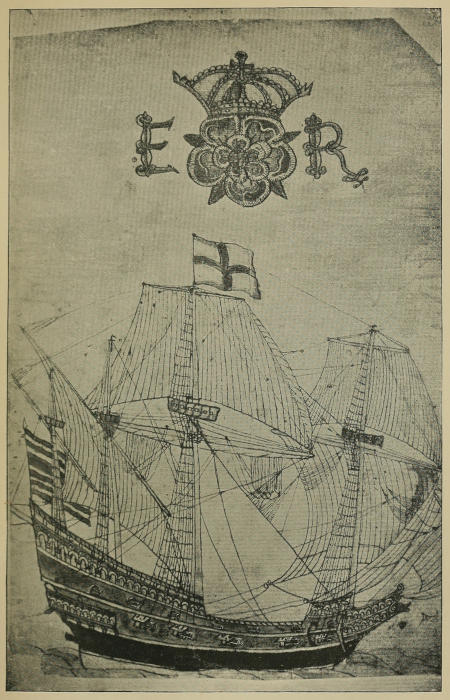
Decoration of Ships.
Philip’s ambassador told him in 1569 that ‘they expect to
be able to repel any attack by means of their fleet,’ and this
confidence found natural expression in an inclination to
decorate and adorn the weapons on which they relied. At
any rate we now find specific payments for these purposes
made with a frequency new in naval history. The ‘carving
of personages in timber,’ and painting and colouring of ships
in 1563 cost £121, 13s 8d and ‘painting and colouring red
the great new ship called the White Bear‘[603] £20. Three
‘great personages in wood for the garnishing and setting forth’
of the same vessel were £1, 15s each. The upper works of
the Bonaventure were painted black and white,[604] and the Lion
in ‘timber colour;’ as the White Bear was red, and the
Revenge and Scout, green and white there was evidently no
regulation colour. The Bonaventure had a dragon on her
beakhead, the royal arms on her stern, and two lions and two
dragons in gilt and paint on her galleries. The Foresight
carried the Queen’s arms, a rose and a fleur de lis, on her stern,
and in 1579 £2, 13s 4d was paid for carving a Saturn and a
Salamander for the Swallow. Figure heads were usual. The
Nonpareil, Adventure, Dreadnought and Hope, had a dragon;
the Charles, Defiance, Rainbow, Repulse and Garland a lion;
the Mary Rose, a unicorn, and the Swiftsure a tiger. When
the White Bear was rebuilt the carvings included,
‘an image of Jupiter sitting uppon an eagle with the cloudes, before the
heade of the shippe xiˡⁱ; twoe sidebordes for the heade with compartments
and badges and fruitages xˡⁱ; the traynebord[605] with compartments and
badges of both sides viiˡⁱ; xvi brackets going round about the heade at
xiiˢ the pece; xxxviii peces of spoyle or artillarie round about the shippe
at xivˢ the pece; the greate pece of Neptune and the Nymphes about him
for the uprighte of the Sterne viˡⁱ xˢ.’[606]
The whole cost of carving was here £172, and of painting
and gilding £205, 10s, but these appear to have been exceptional
amounts. Painting the Bonaventure cost £23, 6s 8d,
the Dreadnought £20, the Vanguard £30, and the Merhonour
£40, and these sums more nearly represented the ordinary
expenditure. On the Elizabeth however £180 was spent in
1598 for
‘newe payntinge and guildinge with fine gold her beake heade on both
sides with Her Maiesties whole armes and supporters, for payntinge the
forecastle, the cubbridge heades[607] on the wast, the outsides from stemme to
sterne, for like payntinge and newe guildinge of both the galleries with
Her Maiesties armes and supporters on both sides, the sterne newe paynted
with divers devices and beastes guilte with fine gold; for newe payntinge
the captens cabbon, the somer decke[608] as well overhead as on the sides, the
barbycan, the dyninge roome and the studdie.’[609]
The Rainbow’s lion figure head was gilt and on her sides
were ‘planets, rainbows, and clouds’ with the royal arms on
the upper, middle, and lower counter, but the whole charge
was only £58, 6s. Cabins were painted and upholstered in the
favourite Tudor colour of green and ‘Her Maiesties badge’
was painted in green and red. The White Bear and the
Elizabeth are the only two instances in which comparatively
large sums are found to be spent in ornament, and it does
not appear that there was as yet more than a bent towards
general embellishment. The smaller vessels are never mentioned
in this connexion. The opinion of a contemporary was
that, both for work and appearance,
‘our navy is such as wanteth neither goodly, great, nor beautiful ships
who of mould are so clean made beneath, of proportion so fine above, of
sail so swift, the ports, fights, coines, in them so well devised, with the
ordnance so well placed, that none of any other region may seem comparable
unto them.’[610]
Tonnage Measurement.
The new method of building by contract, and the large
number of merchantmen upon which the bounty was now
paid, necessitated a more exact measurement of tonnage than
had hitherto obtained. In 1582 a rule was devised which remained
in use for nearly half a century and was said to have
been due to Mathew Baker, son of the James Baker shipwright
to Henry VIII, and himself one of the principal government
shipwrights. The writer says:[611]
‘By the proportion of breadth, depth, and length of any ship to judge
what burden she may be of in merchant’s goods and how much of dead
weight of ton and tonnage. The Ascension of London being in breadth 24
feet, depth 12 feet from that breadth to the hold, and by the keel 54 feet in
length doth carry in burden of merchant’s goods (in pipes of oil or Bordeaux
wine) 160 tons, but to accompt her in dead weight, or her ton and
tonnage may be added one third part of the same burden which maketh
her tonnage 213⅓. After the same rate these proportions follow:
|
Breadth at midship beam |
Depth from her breadth |
Keel |
Burden in cask of oil or wine |
Dead weight tonnage |
| A Ship of |
20 ft. |
10 ft. |
42 ft. |
86½ |
115 |
| A Ship of |
21 ” |
10½ ” |
45 ” |
102⅒ |
136⅛ |
| Prudence of London |
24 ” |
12 ” |
51½ ” |
150½ |
202⅔ |
| Golden Lion |
32 ” |
12 or 14 ” |
102 ” |
403 or 461 |
537 or 614⅔ |
| Elizabeth Jonas[612] |
40 ” |
18 ” |
100 ” |
740 |
986⅔ |
To find the burden of any ship proportionately to the Ascension before
specified multiply the breadth of her by her depth, and the product by her
length at the keel, the amounting sum you shall use as your divisor. If
15,552, the solid cubical number for the Ascension do give 160 tons, her
just burthen, what shall 8400, the solid number of a ship 20 feet broad, 10
feet deep, and 42 feet keel. Work and you shall find 86³⁴⁄₈₁ tons of burden
while if you add one-third you shall find your tonnage 114 almost.’
This formula made theory square with fact since the result
corresponded with the tuns of Bordeaux wine experience had
shown a ship to be able to carry. But strictly, ‘burden’ and
‘ton and tonnage,’ as used here do not correspond with our
net and gross tonnage, since burden is used in connexion with
lighter material occupying more space than a heavy cargo,
such as coal, that would be represented by ton and tonnage.
The Spanish system of measurement in 1590 was to multiply
half the breadth by depth of hold and the result by the length
over all.[613] From this 5% was deducted for the entry and run,
and the remainder divided by eight, gave the net tonnage;
20% was added to obtain the gross tonnage.[614]
The Seamen.
As early as 1561 the Venetian Resident considered
England superior to its neighbours in naval strength,[615] but
he may not have included Spain among the neighbours.
The Spaniards officially in England kept Philip fully acquainted
with the character and equipment of the fleet. He
was always apprised of any preparations, and in such detail
that we find him told on one occasion that twelve or fourteen
ships were of from 400 to 700 tons ‘with little top-hamper and
very light, which is a great advantage for close quarters, and
with much artillery, the heavy pieces being close to the water.’[616]
Eight years earlier his ambassador, De Silva, recommended
him to have ships built in England instead of continuing the
chartering system in vogue in Spain as ‘certainly the ships
built here are very sound and good.’[617] These intimations
probably did not stand alone, but neither then nor later did
they lead to any change in the type affected in the Peninsula.
English seamen did not favourably impress the Spaniards.
One of Philip’s correspondents, in writing to him that four
men-of-war had been prepared for sea, added, ‘the men in
them are poor creatures.’[618] Six months later he was informed
that although Elizabeth possessed twenty-two large ships she
had only been able to fit eleven for sea, and would find it
impossible to equip more, and that ‘the men on the fleet
although they appear bellicose are really pampered and
effeminate different from what they used to be.’[619] The
estimate appears the more extraordinary because English
seamen were at this time giving daily proof, at the expense
of Spanish and other commerce, of the wild energy animating
them. As late as 1586, Mendoza wrote that four ships were
in commission and others in preparation, but of these latter,
only four were seaworthy, ‘all the rest being old and
rotten.’[620] If Philip was continuously misinformed as to the
number of ships available, the difficulties in furnishing them,
and the fighting value of the men, it may help to explain the
confidence he showed later.
As a matter of fact, there are very few complaints
throughout the reign about embarrassments due to want
of crews. The semi-piratical expeditions preferred by the
government were better liked than would have been a more
regular warfare that would have meant harder fighting and
fewer chances of plunder. Hatred of Spain and Popery, conjoined
with the hoped for pillage of Spanish galleons, formed
an inducement that never failed to bring a sufficient number
of men together, notwithstanding that, as privateering speculations,
most of the voyages were, pecuniarily, failures, although
they served their purpose in destroying Spanish commerce
and credit. The proportion of men on board a man-of-war
was three to every five tons, of gross tonnage; one-third being
soldiers, one-seventh of the remainder, gunners; and the rest
seamen. In merchantmen the ratio was one man to every
five tons of net tonnage, one-twelfth being gunners and the
rest seamen.[621] But in practice the strength of a crew depended
on the number of men required and the success of
the impress authorities.
The Seamen:—Pay and Rewards.
Until 1585 the wages remained at 6s 8d a month, to which
it had been raised in 1546 or very shortly afterwards. In
1585, the sailor’s pay was raised to ten shillings a month,
through the action of Hawkyns. There must have been some
dissatisfaction with the quality of the men hitherto serving,
and the breach with Spain doubtless made an improvement
necessary. Hawkyns coated the pill for Elizabeth by assuring
her that fewer men would be required, of the standard to be
attracted by the higher rate, and, ‘by this meane her Maiesties
shippes wolde be ffurnyshed with able men suche as can
make shyfte for themselves, kepe themselves clene withoute
vermyne and noysomeness which bredeth sycknes and mortalletye.’[622]
Moreover, ships could then carry more stores and
continue longer at sea. Hawkyns was one of the few commanders
of his age who recognised a claim to consideration
in his inferiors, and made some attempt to secure their health
and comfort. In 1589 he took care to have his stores ‘of an
extraordinary price and goodnes to keep men in health’; in
1595 he took out clothes for his men and a new kind of
‘lading victuells, a kind of victuells for sea service devised by
Mr Hughe Platte.’[623] Hammocks were introduced in 1597,
when a warrant authorises payment for 300 bolts of canvas
‘to make hanging cabones or beddes ... for the better preservation
of their health.’[624] In 1590, a suggestion, which did
not, however, take practical shape till long afterwards, was
made for the benefit of the merchant sailor. John Allington,
a draper of London, proposed the creation of a special office
for the registration of contracts between merchants, owners,
and masters of ships. This would have led to something
equivalent to the present ‘signing on’ enforced by the Board
of Trade, and would have regulated the position of the seamen
and simplified the enforcements of his rights, too often sacrificed
to an unscrupulous use of legal forms.[625] Allington, like
most of the projectors and schemers of his day, was no philanthropist.
He offered to pay £40 a year for permission to
establish such an office, and apparently expected to obtain
five shillings apiece from 500 or 600 ships a year.
No especial provision was made on board men-of-war for
the sick or wounded sailor; if the ship went into action he was
placed in the cable tier or laid upon the ballast as being the
safest places. If he survived the medical science of his time,
and was landed disabled, he was supposed to be passed to his
own parish. Sometimes he was permitted to beg. A printed
licence from Howard, as Lord Admiral, under date 1590, still
exists empowering William Browne, maimed in 1588, to beg
for a year in all churches.[626] By 35 c. 4 and 39 c. 21 of Elizabeth
relief was afforded to hurt men; these were both repealed by
43 c. 3 which enacted that parishes were to be charged with a
weekly sum of not less than twopence or more than tenpence
to provide help, the pension however in no case to exceed ten
pounds for a sailor or twenty pounds for an officer. Gratuities
were sometimes given. In 1593 Hawkyns was ordered to pay
two shillings a week, for twenty weeks, to 29 injured men, and
William Storey, having lost a leg, received £1, 13s 4d, apparently
in settlement of all claims.[627]
Such gifts, in view of the number we can still trace, were
probably more frequent than would be expected from the
character of Elizabeth. In 1587 a month’s extra pay was
awarded to the crews of three pinnaces for their good service
in capturing Spanish prizes. For 1588 £5, was divided among
100 men who manned the fireships sent into Calais Roads,
£80, among the wounded of the fleet generally, and £7 to
sick men in the Elizabeth.[628] In 1591 six months’ pay was
given to the widows of the men killed in the Revenge, and in
1594 there is a gift of £61, 19s 6d to Helen Armourer, widow
of John Armourer of Newcastle, ‘in consideration of his good
and faithful services,’ although the name is quite strange in
naval affairs.[629] Merchant seamen were also remembered in
these benefactions. On one occasion forty marks were paid
to five men ‘having been lately lamentably afflicted in Naples
by pryson and other punyshments by thinquisition of Spayne
as we are informed and by secret escape savid their lyves.’[630]
On another ‘in consideration of the valiantnes done in Turkey
by our welbeloved subiecte John Ffoxe of Woodbridge in our
county of Suffolk, gunner by whose meanes 266 Christians
were released out of miserable captivity,’ an assuredly nobly
earned pension of one shilling a day was conferred upon him.[631]
When it cost the Queen nothing directly she was sometimes
still more liberal. To Robert Miller, a master mariner, £200,
was allowed out of forfeited goods in consideration of his
services and losses at sea; George Harrison received £800, in
the same way and for the same reasons. Sometimes seamen’s
wives, whose husbands were prisoners in Spain, petitioned
the Council for help. In one instance the merchants owning
the ships were ordered to assist the women; in another their
landlords were directed not to press them for rent.
We can know little of the internal economy of a merchantman
in those days. The vessels were relatively as crowded,
and probably as unhealthy, as men-of-war; the victualling
was of the same, and at times even worse quality, seeing that
the owners of merchant vessels were expected to buy government
provisions if the victualling department found itself
overstocked. In 1596 there is a letter directing the Lord
Mayor to forbid the city butchers to sell meat to ships until
the government stores of salt beef were sold out. This is
followed by an order from the Council to the Serjeant of the
Admiralty not to allow any outward bound trader to pass
down the river unless a certificate of such purchase was produced.[632]
Mortality on Shipboard.
We have no means of estimating the mortality from
disease on board merchant ships, but we know that in men-of-war
it was very great. ‘In the late Queen’s time many
thousands did miscarry by the corruption as well of drink as
of meat,’ says a seventeenth century writer;[633] and Sir Richard
Hawkyns thought that, in twenty years, 10,000 men died from
scorbutic affections. The length of the voyages now undertaken
rendered larger crews necessary; the accommodation
was narrow and ill-ventilated, the requirements of sanitation
unknown, and the food was usually scanty and bad, so that
the sailor was placed under conditions that made him fall an
easy victim to disease. In Drake’s voyage of 1585-6 out of
2300 men nearly 600 died from disease. In the expedition
of 1589, out of 12,000 men employed, nearly one-half perished,
mainly from sickness and want of food, and every enterprise,
small or great, suffered more or less largely in the same way.
Usually the hope of plunder sustained the men through all
such trials, and there is only one serious case of the mutiny of
a crew because of ‘the weakness and feebleness they were
fallen into through the spare and bad diet.’ But in this
instance sympathy with their captain may have had much to
do with their action.[634]
The pages of Hakluyt relate much of the suffering endured
by our seamen abroad from disease and privation, but there
is one historic illustration at home of the miseries borne by
the men and the callousness or scanty resources of the
authorities. On 10th August 1588 Howard wrote to Burghley:
‘Sicknes and mortallitie begin wonderfullie to growe amongste us ...
the Elizabeth, which hath don as well as eaver anie ship did in anie service,
hath had a great infectione in her from the beginning soe as of the 500
men which she carried out, by the time she had bin in Plymouth three
weeks or a month there were ded of them 200 and above, soe as I was
driven to set all the rest of her men ashore, to take out the ballast and to
make fires in her of wet broom 3 or 4 daies together, and so hoped therebie
to have cleansed her of her infectione, and thereuppon got newe men,
verie tall and hable as eaver I saw and put them into her; nowe the infectione
is broken out in greater extremitie than eaver it did before, and
they die and sicken faster than ever they did, soe as I am driven of force
to send her to Chatham ... Sir Roger Townsend of all the men he
brought out with him hath but one left alive ... it is like enough that
the like infectione will growe throughout the most part of the fleet, for
they have bin soe long at sea and have so little shift of apparell ... and
no money wherewith to buy it.’
On the 22nd August he writes to the Queen that the infection
is bad, that men sicken one day and die the next but, in
courtly phrase, that ‘I doubt not that with good care and God’s
goodnes which doth ever bles your Maiestie it wyll quenche
againe.’ But on the same day he tells the Council more
plainly, ‘the most part of the fleet is grievouslie infected and
die dailie ... and the ships themselves be so infectious and
so corrupted as it is thought to be a verie plague ... manie
of the ships have hardly men enough to waie their anchors.’[635]
And as illustrating the infection and its probable cause comes
a complaint from him to Walsingham that, although the beer
in the fleet has been condemned as unfit for use, it is still
served out to the men, and ‘nothing doth displease the seamen
more than sour beer.’
This sickness is usually said to have been the plague or
typhus. But Howard and his captains, who had lived to
middle age in a country where the plague was endemic and
who must have known its symptoms well, obviously thought
‘the infectione’ something different. In the passage quoted
above he compares it to the plague and in another letter he
writes, ‘The mariners who have a conceit (and I think it true
and so do all the captains here) that sour drink hath been a
great cause of this infection amongst us.’[636] The plague was
familiar to them all but this was something they could not
easily name. The same arguments apply, although perhaps
not so closely, against typhus which in its general form and
symptoms was familiar under various names to sixteenth
century observers. But 1588 was not a particularly unhealthy
year on land and there is no record of any sudden outbreak
of epidemic disease either before or after that occurring on the
fleet. Moreover though typhus occasionally kills within a
few hours it has never been known to kill numbers in the rapid
fashion suggested by Howard. It is probable that the complaint
was an acute enteritis, caused by the beer, acting on
frames enfeebled by bad and insufficient food, and still further
weakened by the scorbutic taint to which all classes, but
especially seamen, were subject in the middle ages.
On the whole the position of the sailor was now steadily
deteriorating. In the fourteenth and fifteenth centuries his
pay had been relatively very high, and as he was only called
upon to serve round the coasts, or, at furthest, to Bordeaux or
the Baltic, his health was not affected by conditions to which
he was only exposed for a short time. But towards the end
of the sixteenth century the wages, in consequence of the
general rise in prices, were relatively less than they had been,
and less than those of the artisan classes on shore. In an
epoch when the increase in the number of distant voyages set
his services in commercial demand he was required to serve
in the royal fleets for longer periods than had been before
known. He was exposed to a merciless system of impressment,
cheap for the State because he had to indirectly bear the cost.
And the length of the cruises, their extension into tropical
climates, and the character of the provisions, unsuited to the
new conditions, made themselves felt in outbreaks of disease
to which his ancestors, assembled chiefly for Channel work,
had been strangers. Morally the general tone among the
men cannot have been high if we may judge them from a
phrase used by the officials sent down to examine into the
plunder of the Madre de Dios in 1592, ‘we hold it loste labor
and offence to God to minister oathes unto the generallitie of
them.’[637]
Seamen’s Clothing.
It will have been noticed that in his letter of 10th August
Howard says that the men have no money wherewith to buy
clothes; in another he suggests that a thousand marks’ worth
of apparel should be sent down. But the custom of providing
crews with coats or jackets at the expense of the crown had
quite ceased, and even if necessaries were supplied to the men
they had to pay for them. The supply was usually a private
speculation on the part of some Admiralty official. In 1586
Roger Langford, afterwards paymaster of the Navy furnished
men with canvas caps, shirts, shoes, etc., a piece of business by
which he lost £140. In 1580 the government sent over
clothes for the men on the Irish station, the cost of which was
to be deducted from their wages. The articles included,
‘canvas for breches and dublettes’—‘coutten for lyninges,
and petticoates,’ stockings, caps, shoes, and shirts.[638] Hawkyns
with the forethought always characterising his action as an
admiral, took out with him in 1595 ‘calico for 200 suits of
apparel,’ 400 shirts, woollen and worsted hose, linen breeches
and Monmouth caps.[639] There is a sketch in a contemporary
treatise on navigation of a seaman, apparently an officer. He
wears a Monmouth, or small Tam o’ Shanter, cap, a small
ruff round the neck, a close-fitting vest, and long bell-mouthed
trousers.[640] In 1602 there is a payment in the Navy
accounts of £54, 19s 8d for clothing for Spanish prisoners.
Canvas shirts, cotton waistcoats, caps, hose, and ‘rugge’ for
gowns were provided and the articles were doubtless of the
same kind and quality as those worn by the men.
Royal Ships Lent.
During the earlier years of her reign the Queen, like her
predecessors, frequently allowed her ships to be hired for
trading voyages. In 1561 the Minion, Primrose, Brigandine
and Fleur de Lys, were delivered to Sir William Chester and
others for a voyage to Africa. In this case Elizabeth shared
the risk. For her ships, and for provisions to the value of
£500, she was to receive one-third of the profits. The hirers
undertook to ship at least £5000 of goods, pay wages and all
other expenses, and each enter into a bond of 1000 marks to
carry out the conditions.[641] In 1563 the Jesus of Lubeck was
lent to Dudley and others, to trade to Guinea and the West
Indies, for which they paid £500.[642] She was then, after
having been in the Royal Navy nearly twenty years, valued
at £2000 for which amounts the hirers had to give their bonds.
She returned in 1565, was at Padstow in October, and
‘cannot be brought to Gillingham till spring of next year.’
The adventurers could not have procured a 600 ton vessel,
for two years, for £500 from any owner but the State. And
as she had to remain at Padstow during the whole winter
it may be inferred that she returned in a very unseaworthy
condition, for Elizabethan seamanship was certainly equal to
taking a ship up Channel during the winter months. She
was hired by Hawkyns in 1568 and was then the first of the
only two men-of-war lost to Spain during the entire reign.
When a convoy was furnished a full charge was levied for the
protection; £558 was received in 1569 from the Merchant
Adventurers’ Company for men-of-war serving on this duty,
and again £586 in 1570.[643] As private owners built more and
bigger ships the demand for men-of-war for trading voyages
grew less, but the Queen often lent them for privateering
ventures in which she was pecuniarily interested, assessing
their estimated value as a portion of the money advanced by
her and on which she would receive a dividend. Under these
circumstances her representatives did not err on the side of
moderation when valuing the ships thus temporarily lent.
When Drake took the Bonaventure and the Aid in 1585 they
were appraised at £10,000, an obviously extravagant estimate.
Nominally Elizabeth advanced £20,000, of which
these two ships stood for half; she got her ships back, £2000
for the use of them, and the same dividend on £20,000 as the
other persons who had taken shares. Those others lost five
shillings in the pound; she must have made a profit.
The Victualling Department.
In consequence of the greater activity of the Royal Navy
the victualling department experienced a corresponding enlargement.
In 1560 the buildings at Tower Hill, formerly the
Abbey of Grace, and granted in 1542 to Sir Arthur Darcy,
were purchased from him for £1200, and £700 expended in
repairing them.[644] Other storehouses were hired at Ratcliff and
St Katherines, the latter from Anthony Anthony, Surveyor of
the Ordnance, who seems to have taken great interest in naval
matters, and to whom we are indebted for the coloured drawings
of ships previously referred to. For his storehouse he
was paid £16 a year; another at Rochester cost £5, 6s 8d a
year. By a patent of 24th December 1560, William Holstock
was joined with Baeshe as Surveyor of the Victuals; this was
surrendered and replaced by another of 30th October, 1563 in
which John Elliott took Holstock’s place. Neither Holstock
nor Elliott had any actual position, the new patents only
giving them the chance of succeeding Baeshe. An agreement
with him of 13th April 1565, but which did not cancel the
title and fees granted to him by his Letters Patent, instituted a
considerable reform inasmuch as it did away with purveyance,
or forced purchase, at rates fixed by the officers of the crown.
Henceforth Baeshe was to be paid fourpence halfpenny a day
for each man in harbour and fivepence a day at sea. For this
he was to provide, per head, on Sundays, Mondays, Tuesdays
and Thursdays, 1 lb of biscuit and 1 gallon of beer, and 2 lbs
of salt beef, and on the other three days, besides the biscuit
and beer, a quarter of a stockfish,[645] one-eighth of a pound of
butter, and one quarter of a pound of cheese. Fourpence
a man per month at sea, and eightpence in harbour he was to
allow for purser’s necessaries, such as wood, candles, etc., and
he was to pay the rent of all hired storehouses and the wages
of his clerks. He undertook not to use the right of purveyance
unless ordered to victual more than 2000 men suddenly,
and agreed to always keep in hand one months provisions for
1000 men. The agreement could be terminated by six months’
notice on either side, and until it ceased the crown advanced
him £500 without interest to be repaid within six months of
the cessation of his contract. He was given the use of all the
crown buildings belonging to his department, subject to his
keeping them in repair, and was permitted to export 1000 hides
in peace time and as many as he should slaughter oxen during
war.[646] The weight of purveyance was felt chiefly in the
home counties, and Elizabeth may have felt it good policy to
do away with a ceaseless source of popular irritation which
was really of very little advantage to the crown. From this
date payments were made to Baeshe direct from the Exchequer
and no longer through the Navy Treasurer. Isolated
payments relating to storehouses, of no general interest, recur
in the accounts, but the growing importance of Chatham is
shown by the removal, in 1570, of buildings at Dover, and their
re-erection at Rochester, at a cost of £300.
In 1569 an additional £1000 was advanced to Baeshe without
interest, and in 1573, the harbour rate was raised to fivepence
halfpenny per man, and the sea rate to sixpence. All
this assistance, for probably further sums were lent to him without
interest, does not seem to have enabled him to carry on
his work without loss. In 1576 he petitioned the Queen to be
forgiven the first £500 advanced to him and to be permitted to
pay off the balance at £1000 a year. He based his claim to consideration
on the fact that he had saved her 1000 marks a year
by his contract and had acted without recourse to purveyance,
‘no small benefit to the hole realme.’ He had lost £500 a year,
for four years, by the embargo on trade with the Low Countries,
which prevented his exportation of hides, and £ 240 by
the fire at Portsmouth. And:—
‘finally what my service hath bin from tyme to tyme as well to her
most noble ffather, brother, and sister, as to her Maiestie I do referre the
same to the report of my Lord Tresorer and my Lord Admirall and yet
hitherto I never receyved from her Maiestie any reward for service but
only her Maiesties gracious good countenance to my comfort.’[647]
The petition does not appear to have obtained anything
beyond a continuance of these unsubstantial favours, but
Baeshe struggled on till 6th May 1586 when he gave six
months’ notice to determine his contract. He then anticipated
a loss of £534 on victualling eight or ten ships, ‘which
I am not able to beare.’[648] He must have been a very old
man and anxiety perhaps hastened his death, which occurred
in April 1587. In the interval, however, the rate had been
raised, from 1st November 1586 to 31st March 1587 to sixpence
a day per man in harbour, and sixpence halfpenny at
sea, and from 1st April 1587 to 31st October to sixpence halfpenny
in harbour and sevenpence at sea, ‘on account of the
great dearth.’ The Armada was already expected, but on
30th June 1587, when the stores were handed over to
Baeshe’s successor there were only 6020 pieces[649] of beef, and
2300 stockfish in hand.
By Letters Patent of 27th November 1582 James Quarles
‘one of the officers of our household’[650] had been granted
survivorship to Baeshe, and he now took his place from
1st July 1587, at the same fees and allowances as had been
originally given by the patent of 18th June 1550. The rate
was maintained at sixpence halfpenny and sevenpence ‘untill
it shall please Almightie God to send such plentie as the
heigh prises and rates of victuall shalbe diminished’. The
quantity and quality of the food provided for the men in
1588 has long been a source of disgrace to Elizabeth and her
ministers. An apology for them has been attempted on the
ground that the mechanism at work was new and not capable
of dealing with large numbers of men, and that the failure
was mainly due to the suddenness of the demand. So far as
the first statement is concerned it is sufficient to answer that
the victualling branch had been organised for nearly
forty years, and found no difficulty in arranging for 13,000
men in 1596, and 9200 men in 1597 after timely notice. The
last reason may excuse the victualling department but will
not relieve the statesman in responsible direction. The
government had had long notice of the coming of the
Armada, but even as late as March Burghley was occupied
with niggling attempts at making 26 days’ victuals last for
28 days.[651] In 1565 Baeshe had undertaken to keep always
one month’s victuals for 1000 men in store, but in June 1587
there was not even so much. The point therefore is that if the
ministry had thus early recognised the necessity for a reserve,
and that two or three months were requisite for the collection
and preparation of provisions for a large force, and if with the
knowledge that such provisions were certain to be required,
and in spite of the warnings of those best able to judge, they
neglected the preparations and continued a supply which was
merely from hand to mouth, they must be held guilty of the
sufferings inflicted on the men by their miserable policy.
When the moment of trial came Quarles and his superiors did
their best, but the accusation against the latter is that had
they exercised the foresight supposed to be one of the qualifications
for their dignified posts no such sudden and almost
ineffective efforts would have been necessary. The spirit in
which they or the Queen dealt with the matter is shown by
the necessity Howard was under of paying out of his own
pocket for the extra comforts obtained for the dying seamen
at Plymouth.[652]
How far Elizabeth was herself answerable is a moot point.
There is no direct evidence that the delay in obtaining provisions
was due to her orders. On the other hand we know
that the postponements in equipping the ships, and the hesitating
action and inconsistent directions and suggestions that
characterised the early months of 1588, were due to her, and
there is a strong probability that much of the shame should
rest with her rather than with ministers who perhaps had to
carry out commands to which they had objected in Council.
Moreover very few things, especially those involving expense,
were done without the knowledge and approval of Elizabeth.
It was a personal government and there is no reason to suppose
that this particular branch was beyond her cognisance.
With the fatality that has usually dogged English militant
endeavour the fleet did not even obtain the benefit, at the
right time, of the stores provided. Frequently victuallers
were blundering about for weeks looking for it, while the
admirals were sending up despairing entreaties for supplies.
In April, Drake wrote to the Queen ‘I have not in my lifetime
known better men and possessed with gallanter minds than
your Majesty’s people are for the most part.’ Whether the
cause was incompetence or a criminal parsimony their fate,
after having saved their country, was to perish in misery,
unheeded and unhelped except by the officers who had fought
with them. In the conceit of Elizabeth and her like they
were only ‘the common sort.’
During the forty years that Baeshe had served the crown
he had never been charged with dishonesty and he died poor.
Quarles however had at once serious malpractices imputed to
him as having occurred within his first year of office.[653] His
accuser, a subordinate, as usual offered to do his work for
1000 marks a year less, and on examination of the charges it
seems likely that some were untrue and that other defaults
occurred in consequence of the orders given to him.
From 1589 the rate again fell to fivepence-halfpenny and sixpence,
in harbour and at sea; but for 1590 and 1591 Quarles was
allowed £2355, on account of the dearth still existing. He had
petitioned that he had suffered a loss of £3172, between April
1590 and April 1591, being the difference between the rates
paid to him and the cost per head of the victuals.[654] He died
in 1595 and was succeeded by Marmaduke Darell, his coadjutor,
‘clerk of our averie.’[655] Till 1600 the rate remained the
same although heavy extra allowances were made each year
to Darell; then it was raised to sixpence halfpenny and sevenpence.
In this year £738 was spent on repairs to Tower
Hill where there were separate houses for beef, bacon, ling,
etc., ‘the great mansion being the officers lodgings.’ The
storehouses and brewhouses at Portsmouth, built by Henry
VIII, still existed under the names originally given them and
were repaired at a cost of £234.
One ton and a half of gross tonnage, or one of stowage,
was allowed on board ship, for one month’s provisions for four
men, of which the beer occupied half, wood and water a quarter,
and solid food the remainder of a ton.[656] There is no reason
to suppose that either Baeshe, Quarles, or Darell were either
dishonest or incompetent. The terrible outbreaks of disease
that occurred during nearly every long voyage were not confined
to the English service and were the natural result of
salt meat and fish, and beer that could not be prevented from
turning sour. They could only do their best with the materials
at command but which were not suitable to the larger field in
which the services of English sailors were now required.
The Administration.
Benjamin Gonson was Treasurer of the Navy when
Elizabeth came to the throne and held the post until his
death in 1577. The number of vessels added to the Navy
during his term of office shows that he was not inactive, and
he was certainly a competent public servant. John Hawkyns[657]
was his son-in-law, and the relationship doubtless inspired
Hawkyns with the hope of succeeding him, and perhaps
enabled him to infuse some of his own spirit into the management
of the Navy, while Gonson was still its official head.
But mere relationship, although it had its influence would not
alone have sufficed, had not Hawkyns already made his name
as a seaman and as an able commander. In 1567 he received
a grant of the reversion to the office of Clerk of the
Ships, a post he could only have looked upon as a stepping-stone,
and which he never took up. In 1577, when Gonson
was ill, Hawkyns petitioned the Queen, probably, although it
is not specifically mentioned, for the reversion to his post, and
drew up a long catalogue of unrecompensed services.[658] Gonson
died in the course of a year, a landed proprietor in Essex,
and a successful man, but he had told his son-in-law, when the
latter was trying to obtain the reversion, that, ‘I shall pluck a
thorn out of my foot and put it into yours.’ Hawkyns lived
to realise the truth of the kindly warning. He commenced
his duties from 1st January 1577-8, acting under Letters
Patent of 18th November 1577, by which he was granted
the survivorship to Gonson. For seventeen years, during the
most critical period of English history, he was, in real fact,
solely responsible for the efficiency of the Navy, and he,
more than any other man may be said to have ‘organised
victory’ for the English fleets. His duties included not only
the superintendence of the work at the dockyards, but that of
building, equipping, and repairing the ships, of keeping them
safely moored and in good order, of the supply of good and
sufficient stores, and apparently of every administrative detail
except those connected with the ordnance, and of victualling
and pressing the men. The technical improvements he himself
invented or introduced have already been noticed. In
the administration he made others, which may or may not
have been advantageous, but which touched the interests of
subordinates, and which resulted in his having to stand alone
and carry on his work impeded by the sullen enmity of his
colleagues and his inferiors.
Hawkyns owed his knighthood to Howard rather than the
Queen; his reward after 1588 was to be allowed a year
wherein to unravel his intricate accounts. In fact few of
Elizabeth’s officials escaped her left-handed graces. Baeshe
died in poverty after forty years of honest service, and
Hawkyns was continually struggling to clear himself from
suspicions that were kept hanging over him, but from which
he was given no proper opportunity to free himself. Elizabeth’s
favours and bounties were reserved for court gallants
of smoother fibre than were these men. In 1594, shortly
before his last unhappy voyage, Hawkyns founded a hospital
at Chatham for ten poor mariners and shipwrights. He, with
Drake, established the ‘Chatham Chest,’ for disabled seamen,
and it should be remembered to his honour that, in an age
when little care was bestowed on inferiors if they had ceased
to be of any utility, he never relaxed his efforts until his craft
had rescued from Spanish prisons the survivors of those under
his command in 1568 whom he had been compelled to leave
ashore after escaping from San Juan de Ulloa.
Charges of peculation against persons connected with
maritime affairs were rife on all sides. The shipwrights
quarrelled among themselves and with Hawkyns, and two of
the former, Chapman and Pett, were moreover accused by outsiders
of gross overcharges.[659] Captains were said to dismiss
pressed men for bribes, to retain wages, and keep back arms;[660]
pursers to steal provisions, to make false entries by which they
obtained payments for money never advanced to the men, and
to remain ashore while their ships were at sea.[661] Pursers, cooks,
and boatswains, bought their places: the cooks had the victuals
in their care and recouped themselves at the expense of the
seamen; boatswains stripped a ship of movable fittings, on
her return home, and stole rigging and cordage.[662] According to
the evidence of a witness, in the inquiry of 1608, these abuses,
if they did not commence, took fresh and vigorous life after
the death of Hawkyns. In 1587 he recognised the theft
going on and his inability to completely suppress it; ‘I thincke
it wolde be mete their weare a provost marshyall attendante
upon ye Lord Admirall and Offycers of the Navye to doe
suche present execucyon aboorde the shippes uppon the
offenders as shulde be apoynted.’[663] Accusations were not
wanting during Gonson’s lifetime but the increased activity of
the Navy after his death gave a wider scope both to suspicion
and to actual peculation. Hawkyns was not the only one of the
Principal Officers whose conduct was impeached, but in virtue
of his position the brunt of attack fell upon him. There was
hardly one of his duties which at some time or another did
not give occasion for a charge of dishonesty.[664]
Hawkyns, if we may judge by the letters remaining in the
Record Office, was more frequently in communication with
Burghley, explaining his intentions and desires, than with his
official chief the Lord Admiral. Either therefore Burghley
was satisfied with his conduct—and there is one letter that
directly supports this view—or the Lord Treasurer allowed a
man whose honesty he doubted to remain in a responsible
office without removing him, or adopting any new measure of
supervision. The quality of the cordage had been a common
cause of complaint and, in 1579, Hawkyns wrote that he had
taken measures, of which he doubted not the success, to remedy
this and other evils, and that he had a memorandum ready
proposing a course to be followed, ‘wherebye the offyce wolld
not onelye flourysshe but within a few yers be bountyfullye
provyded of all maner of provycion without extra charge to
her Maiestie.’[665] Subsequent events show that the suggestions
he was here about to make were accepted and, as a consequence
of his new methods, the clamour raised against him
grew so loud that in January 1583-4 a commission sat to inquire
into the condition of the ships and the conduct of the
office. Nothing is known of their report but it was evidently
not of a character fatal to his reputation. In another letter to
Burghley shortly afterwards he attributes his success in carrying
out reforms to the aid he had received from the minister’s
skill,
‘in the passinge of theis greate thinges thadversaries of the worke have
contynewallye opposyd themselves against me ... and their slawnders
hathe gone verye farr ... onlye to be avenged of me and this servis
which doth discover the corruption and ignoraunce of the tyme past.’[666]
By 1587 he had begun to share Gonson’s weary disgust of
his surroundings, and intimated that the work was too
much for any one man and should be done by a commission.
Howard’s high opinion of him was expressed freely in his
letters during 1588, and shown practically by the knighthood
he conferred. Notwithstanding his services, so fully tested in
that year, he does not appear to have won the shy confidence
of Elizabeth, but that he had succeeded in convincing
Burghley is I think clearly proved by the following letter:—[667]
‘My bownden dewtie in humble manner rememberyd unto your good
lordshipe; I do perseve hir Maiestie ys not well sattysfied concernyng
the imploymentes of the great somes of mony that have byne reseaved
into thoffice of the navye although your Honour dyd very honourably
bothe take payne and care to se the strycte and orderly course that ys used
in thoffice and thereupon delyver your mynd playnely to her Maiestie as
your lordship found yt for which I shall ever acknowlege myself dewtyfully
bownd to honour and serve your lordshipp to the uttermost of my
abillytie: and whereas her Highnes pleasure ys to be farther sattysfied in
myne accomptes ther hathe nothyng byne more desyred nor cold be more
wellcome or acceptible to me and when yt shalbe hir Maiesties pleasure to
nomynate the persons that I shall attend upon I wyll brieffly shew the
state of every yeres accompt suffycyently avouched by boockes to the last
day of Desember 1588 which is XI yeres.... If any worlldly thynge that
I possesse cold free me of this mystrust and importyble care and toyle I
wold most wyllyngley depart with yt for as the case stondeth I thynke
ther ys no man lyvinge that hathe so carefull so myserable so unfortunate
and so dangerous a lyfe; onlye I se your lordship with care and trewthe
dothe serche into the trew order the sufficiency and valyditye of the course
that ys caryed in the office whiche otherwyse I wold even playnely gyve
over my place and submyt myselfe to her Maiesties mercye thogh I lyvid in
pryson all the dayes of my lyffe; the matters in thoffice growe infenyte and
chargeable beyond all measure and soche as hardly any man can gyve a
reason of the innumerable busynesses that dayly grow; yet the mystrust
ys more trobelsome and grievous then all the rest for with the answerynge
of thone and towle of thother there ys hardly any tyme left to serve God
or to sattysfie man. The greater sort that serve in this office be growen
so proud obstinate and insolent nothynge can sattysfie them[668] and the
commen sort very dysobedyent so as a man that must answere the immoderate
desyre of all these were better to chuse to dye than so lyve.
The paynfull place that your lordship dothe holde and the imoderate demaunds
that comes before you havyng with the favour of her Maiestie the
hellp of an absolute power to bynd and lose may eselye demonstrate the
borden that so meane a man as I am dothe here (which must passe every
thynge by petycon and mystrust), to sattysfie the multytude of demaundes
that are in this office and although they be many and as well satysfied as
in any office in all Ingland yet few are contentyd but go away with grudging
and mormoure. It were a great vanytie for me to comend myne owne
service neyther do I go abowt to acumyllatte to myself any comendacon
for that I thought I performyd my dewtie suffycyentlie but yf the estate
of thoffice be consyderyd what yt was when I came into yt and what yt ys
now ther wilbe found greate oddes wherein I have traveyled as carefully
as I cold and as my creddytt cold obtayne meane to reduce the state of thoffice
shipes and there furnyture into good and perfitt ordre; in recompense
whereof my onely desyre ys that yt may please hir Maiestie some course
may be taken wherein hir Maiestie may be sattysfied that a playne and
honest course hathe byne taken and caryed in thoffice and then to dyspose
of my place to whome yt shall please hir Highnes and I shalbe reddy to
serve hir Maiestie any other way that I shalbe appoynted wherein my
skyll or abyllytie will extend and so I humbly take my leve from Deptford
the 16th April 1590.’
The writer of this letter was either a master hypocrite so
skilful in roguery that he feared neither the investigations of
his superiors nor the denunciations of envious and hostile
subordinates, or an honest man who had nothing to dread
from inquiry. He had convinced Howard and Burghley, of
whom the first was a seaman who had proved his work by the
tests of war and storm, and the second no guileless innocent,
but a politician grown grey among surroundings of fraud and
intrigue. Only the penetrating Elizabeth refused to be deceived.
In 1592 and 1594 he again expressed his wish to resign,
but the government had apparently no desire to lose his
services.[669] On Clynton’s decease Charles, Lord Howard of
Effingham became Lord Admiral,[670] and held the office till
1618. His name is indissolubly connected with the maritime
glories his support of Hawkyns and his clear judgment as a
commander helped to bring about. Howard was the first
Lord Admiral who transferred some of the privileges of his
office. In 1594 he gave over to the Trinity House the management
of buoys and beacons along the coasts and the rights of
ballasting in the Thames.[671] This marks the first practical connection
the Corporation had with maritime affairs. Hawkyns
died at sea on 12th November 1595, and the Treasurership
was not immediately filled up. Roger Langford, long an
office assistant, and his deputy during his absence, was made
‘General Paymaster of the Marine Causes,’ but simply worked
at the accounts without authority in administrative business.[672]
In 1598 Fulke Grevill, afterwards Lord Brooke, was appointed
Treasurer with full powers.[673] Grevill is said, by a modern
writer, to have possessed ‘a dignified indolence of temper,’
and ‘a refinement in morality which rendered him unfit for
the common pursuits of mankind.’ These were not qualifications
peculiarly fitting him for the rough surroundings of
naval affairs in 1598 and the real control passed into the
hands of his colleagues.
Till his death in 1589 Sir Wm. Wynter, from 1557 Surveyor
of the Ships and Master of the Ordnance of the Navy,
was, after Hawkyns, the most influential officer. He was succeeded
by Sir H. Palmer,[674] who held the post until he became
Comptroller in 1598,[675] when he was replaced as Surveyor by
John Trevor.[676] After Wynter’s death there was no longer a
separate ordnance department for the Navy. Richard Howlet,
the former Clerk of the Ships, died in 1560, and George
Wynter, a brother of Sir William Wynter was appointed.[677] In
1580 George Wynter was succeeded by William Borough,[678] who,
in 1588 was followed by Benjamin Gonson, son of the former
Treasurer,[679] who, in turn, was succeeded by Peter Buck in 1600.
William Holstock became Comptroller from 12th December
1561, in succession to Brooke, and in 1589 William Borough
succeeded him until 1598. Nearly all these men commanded
ships or squadrons at sea at various times, in addition to their
duties as members of the naval board. There is a draft document
existing[680] which shows that in January 1564 it was intended
to add another officer as ‘Chief Pilot of England,’ on
the model of the ‘Pilot Major’ of Spain. Stephen Borough
was the person chosen, and in consequence of the losses of
shipping through the ignorance of pilots and masters no one
was to act in such a capacity in vessels of forty tons and upwards,
without a certificate of competence from him, under a
penalty of two pounds. Masters’ mates, boatswains, and
quartermasters were to be similarly examined and certified.
This plan, however, was not carried into execution.
Dockyards.
Concerning the dockyards the most noteworthy feature is:
the rise into importance of the Chatham yard. For 1563 the
expenses of Deptford were £19,700, while those of Gillingham,
chiefly for the wages and victuals of shipkeepers, were £3700.
In 1567 it is first called Chatham, a house rented for the use
of the Board, and the cost of Chatham and Gillingham £6300.
Next year the ground on which Upnor Castle was to be built
was bought for £25,[681] and in 1574 a fort was ordered for Sheerness
which replaced the bulwark built in the reign of Edward
VI. In 1571 more ground was rented at Chatham, and in 1574
the fairway through St Mary’s Creek, by which the anchorage
could be taken in flank, was blocked by piles.[682] Deptford,
however, was still in considerable use, especially for building
and repairs of ships, and in the same year the dock was reconstructed.
In 1578 a new pair of gates for the Deptford
dock cost £150, and in the following year most, if not all, of the
dockyards were fenced round with hedges.[683] Small additions
in the shape of wharves and storehouses, were being continually
made to Chatham; one of the former, built in 1580, was 378
feet Long, 40 feet broad, and cost five shillings a foot. Various
other improvements of the same kind were carried out in connection
with Woolwich and Deptford, and as no drydock was
constructed at Chatham during this reign, all the building and
repairs of the big ships was done at the former places. Portsmouth
was hardly used at all. In 1586 a new wharf was
made, and sundry small expenses were at various times incurred
for keeping the dock in order, but sometimes for years
in succession the only expenses relating to it are the salaries
of the officers in charge. The yard was nearly destroyed by
a fire on 4th August 1576, and was probably not fully restored.
It was, moreover, contemned by the chief officers,
who considered it expensive and defenceless.[684] For a few
years, from 1601, the Hansa steelyard was handed over to the
Admiralty and used for storage purposes.
In early times the Bridport district had supplied most of
the cordage used in the English service; in the fifteenth and
sixteenth centuries it had mostly come from abroad. In 1573
there was an attempt to secure independence in this respect,
and £800 which he was to repay by £100 a year, was advanced
to Thomas Allen to build ropehouses at Woolwich.[685]
Allen was ‘Queen’s merchant,’ i.e., crown purchaser, for Dantzic
cordage. The experiment was probably a failure, since there
is no other reference to it, and was not renewed until the next
reign.
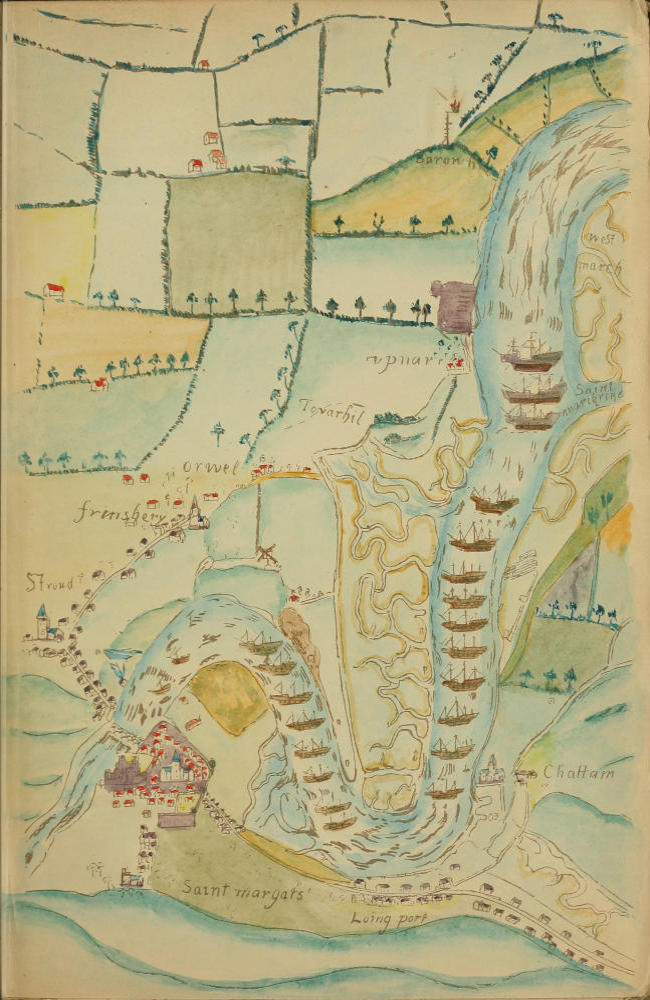
In addition to the forts at Upnor and Sheerness the ships
lying in the Medway required some further protection, as
relations with Spain became more critical and rumours of
plots to fire the vessels frequent. This was given by means
of a chain, an old and well known form of defence. In a letter
to Burghley, of March 1585, Hawkyns suggested the chain
with two or four pinnaces stationed by it, and the Scout and
Achates at Sheerness to search everything passing.[686] In
October the work was nearly completed; it had been ‘tedyous
and cumbersome but now stretched over the river in good
order yt dothe requyre many lyghters for the bearynge of it
which are in hand.’[687] One end was fixed to piles, the other
worked round ‘two great wheels to draw it up;’ it was supported
by five lighters, and pinnaces were stationed at each
shore end. The Council ordered, as well, that whereas Her
Majesty was ‘advertysed that some practyce and devyce ys
taken in hande to bourne and destroye the navye,’ the principal
officers were to sleep on board at the anchorage in turn, for a
month at the time, and see that the shipkeepers did their
duty.
The Elizabethan drawing of the Medway and surrounding
district, partly reproduced in this volume, does not show the
chain at Upnor and is probably therefore of a date between
1568-85. It is seen that the ships are moored athwart stream
in three groups, from Upnor towards Rochester, the larger
ones being at Upnor. They must have been moored across
stream from considerations of space; and the accuracy of
the placing is corroborated by a much later drawing of 1702
which shows vessels in the same position, and by the fact that
we know from other sources that the first-rates were nearest
Upnor. These latter carried lights at night[688] and the whole
were in the especial charge of the principal masters of the
Navy of whom, after 1588, there were six and who were allowed
three shillings a week for their victualling. The first sign of
the dockyard is possibly shown between Chatham Church
and St Mary’s creek. The vessels are shown dismantled as
would have been actually the case.
Shipwrights.
In 1559 shipwrights’ wages were from eightpence to a
shilling, and in 1588 from a shilling to seventeenpence a day;
they were also provided with free lodging, or lodging money
at the rate of a shilling a week, with three meals a day and as
much beer ‘as shall suffice them,’ and, between 25th March
and 8th September, an afternoon snack of bread, cheese, and
beer.[689] From 1st November to 2nd February, they worked
from daylight till dark; for the rest of the year from five
o’clock, in the morning till 7 at night, and, on Saturdays till
6 o’clock. They were allowed one hour at noon, and work
was started and stopped by bell; anyone ringing it except by
order of the master shipwright was fined a day’s pay and put
into the stocks.[690] The three principal constructors, or master
shipwrights were Peter Pett, Mathew Baker, and Richard
Chapman. Pett died in 1589 and was succeeded by his son
Joseph, and then, in 1600, by his better known younger son
Phineas, who had been sent to Cambridge but who did not
think it unbecoming his university standing to start in life as
a carpenter’s mate on a Levant trader. Although Pett has
the greater reputation, at least one officer of the Admiralty
well qualified to judge—William Borough—considered Baker
his superior. John Davis, the explorer, also specially speaks
of him as, ‘Mr Baker for his skill and surpassing grounded
knowledge in the building of ships advantageable to all purpose
hath not in any nation his equal.’[691] Baker became master
shipwright by Letters Patent of 29th August 1572, and by
virtue of the patent, received a fee of one shilling a day for
life from the Exchequer. Peter Pett already held a similar
patent, Richard Chapman obtained one in 1587 and Joseph
Pett in 1590. Little is known of Chapman beyond the fact
that from the ships he built his reputation must have been
equal to that of the others, and practically all the important
building of the reign was done by these three men.
Ships’ Officers and Pay.
There are but few notices of the ships’ officers of this
period. In all ranks the majority seem to have been disposed
to add to their pay by irregular methods. Some of
the accusations made against them have been noticed, and
on service, whether the prize was a captured town or a small
merchantman, discipline was at an end until all, from captains
downwards had taken their fill of pillage. At sea captains
obeyed or disobeyed, deserted or remained with their admiral,
without usually being afterwards called to account for their
conduct. In only one case was a captain, William Borough,
tried for insubordination in 1587, and as this is the first instance
of a court martial the proceedings are here printed in
full.[692] If Drake intended to disgrace Borough he failed, for no
result followed, and the delinquent, two years later, became
Comptroller of the Navy. Until 1582 the old system of paying
the officers the wages of a ‘common man’ per month, and
adding to this by a graduated proportion representing the
dead shares and rewards, still continued. However when
wages were raised in that year the dead shares and rewards
were abolished, except as a form of expression, and each
officer had a fixed sum per month, according to the rate of
his ship.[693] But sometimes the scale of pay depended not
upon the rate, but was ‘according to the greatness of his
charge,’ i.e., on the nature of the work for which the vessel
was commissioned.[694] Wages were again raised about 1602,[695]
and the two scales of payment are thrown together in the
following table:—
|
First-rates |
Second-rates |
Third-rates |
Fourth-rates |
Fifth-rates |
Sixth-rates |
Seventh-rates |
|
1582 |
1602 |
1582 |
1602 |
1582 |
1602 |
1582 |
1602 |
1582 |
1602 |
1582 |
1602 |
1602 |
|
£ |
s. |
d. |
£ |
s. |
d. |
£ |
s. |
d. |
£ |
s. |
d. |
£ |
s. |
d. |
£ |
s. |
d. |
£ |
s. |
d. |
£ |
s. |
d. |
£ |
s. |
d. |
£ |
s. |
d. |
£ |
s. |
d. |
£ |
s. |
d. |
£ |
s. |
d. |
| Master |
2 |
1 |
8 |
3 |
2 |
6 |
2 |
0 |
0 |
3 |
0 |
0 |
1 |
16 |
8 |
2 |
10 |
0 |
1 |
11 |
8 |
2 |
5 |
0 |
1 |
6 |
8 |
2 |
0 |
0 |
1 |
1 |
8 |
1 |
7 |
0 |
1 |
0 |
0 |
| Master’s Mate |
1 |
1 |
8 |
1 |
10 |
0 |
0 |
16 |
8 |
1 |
5 |
0 |
0 |
16 |
8 |
1 |
5 |
0 |
0 |
11 |
8 |
1 |
0 |
0 |
0 |
11 |
8 |
1 |
0 |
0 |
0 |
11 |
8 |
|
|
|
|
|
|
| Boatswain |
1 |
1 |
8 |
1 |
10 |
0 |
0 |
16 |
8 |
1 |
5 |
0 |
0 |
11 |
8 |
0 |
17 |
6 |
0 |
11 |
8 |
0 |
17 |
6 |
0 |
11 |
8 |
0 |
17 |
6 |
0 |
11 |
8 |
0 |
17 |
6 |
0 |
13 |
9 |
| Boatswain’s Mate |
0 |
11 |
8 |
0 |
17 |
6 |
0 |
11 |
8 |
0 |
17 |
6 |
0 |
9 |
2 |
0 |
13 |
9 |
0 |
9 |
2 |
0 |
13 |
9 |
0 |
9 |
2 |
0 |
13 |
9 |
|
|
|
|
|
|
|
|
|
| Quartermaster |
0 |
16 |
8 |
1 |
5 |
0 |
0 |
11 |
8 |
0 |
17 |
6 |
0 |
11 |
8 |
0 |
17 |
6 |
0 |
11 |
8 |
0 |
17 |
6 |
0 |
11 |
8 |
0 |
17 |
6 |
0 |
11 |
8 |
0 |
17 |
6 |
|
|
|
| Do. Mate |
0 |
11 |
8 |
0 |
17 |
6 |
0 |
9 |
2 |
0 |
13 |
9 |
0 |
9 |
2 |
0 |
13 |
9 |
0 |
9 |
2 |
0 |
13 |
9 |
|
|
|
|
|
|
|
|
|
|
|
|
|
|
|
| Purser |
0 |
16 |
8 |
1 |
0 |
0 |
0 |
11 |
8 |
0 |
16 |
8 |
0 |
11 |
8 |
0 |
13 |
4 |
0 |
11 |
8 |
0 |
13 |
4 |
0 |
11 |
8 |
0 |
13 |
4 |
0 |
9 |
2 |
0 |
13 |
4 |
|
|
|
| Master Carpenter |
0 |
16 |
8 |
1 |
5 |
0 |
0 |
16 |
8 |
1 |
5 |
0 |
0 |
11 |
8 |
0 |
17 |
6 |
0 |
11 |
8 |
0 |
17 |
6 |
0 |
11 |
8 |
0 |
17 |
6 |
0 |
11 |
8 |
0 |
17 |
6 |
|
|
|
| Carpenter’s Mate |
0 |
11 |
8 |
0 |
17 |
6 |
0 |
11 |
8 |
0 |
17 |
6 |
0 |
9 |
2 |
0 |
13 |
9 |
0 |
9 |
2 |
0 |
13 |
9 |
0 |
9 |
2 |
0 |
13 |
9 |
|
|
|
|
|
|
|
|
|
| Master Gunner |
0 |
10 |
0 |
0 |
15 |
0 |
0 |
10 |
0 |
0 |
15 |
0 |
0 |
10 |
0 |
0 |
15 |
0 |
0 |
10 |
0 |
0 |
15 |
0 |
0 |
10 |
0 |
0 |
15 |
0 |
0 |
10 |
0 |
0 |
15 |
0 |
0 |
13 |
4 |
| Gunner’s Mates |
0 |
7 |
6 |
0 |
11 |
3 |
0 |
7 |
6 |
0 |
11 |
3 |
0 |
7 |
6 |
0 |
11 |
3 |
0 |
7 |
6 |
0 |
11 |
3 |
0 |
7 |
6 |
0 |
11 |
3 |
0 |
7 |
6 |
0 |
11 |
3 |
|
|
|
| Surgeon |
0 |
15 |
0 |
1 |
0 |
0 |
0 |
15 |
0 |
1 |
0 |
0 |
0 |
15 |
0 |
1 |
0 |
0 |
0 |
15 |
0 |
1 |
0 |
0 |
0 |
15 |
0 |
1 |
0 |
0 |
|
|
|
1 |
0 |
0 |
|
|
|
| Pilot |
1 |
0 |
0 |
1 |
10 |
0 |
1 |
0 |
0 |
1 |
5 |
0 |
0 |
16 |
8 |
1 |
5 |
0 |
0 |
16 |
8 |
1 |
0 |
0 |
0 |
15 |
0 |
1 |
0 |
0 |
|
|
|
|
|
|
|
|
|
| Cook |
0 |
11 |
8 |
0 |
17 |
6 |
0 |
11 |
8 |
0 |
17 |
6 |
0 |
11 |
8 |
0 |
17 |
6 |
0 |
11 |
8 |
0 |
17 |
6 |
0 |
11 |
8 |
0 |
17 |
6 |
0 |
9 |
2 |
0 |
17 |
6 |
0 |
13 |
9 |
| Yeomen of the Tacks and Jeers |
0 |
11 |
8 |
0 |
17 |
6 |
0 |
11 |
8 |
0 |
14 |
0 |
|
|
|
0 |
14 |
0 |
|
|
|
|
|
|
|
|
|
|
|
|
|
|
|
|
|
|
|
|
|
| Cockswain |
0 |
11 |
8 |
0 |
17 |
6 |
0 |
11 |
8 |
0 |
17 |
6 |
0 |
9 |
2 |
0 |
17 |
6 |
|
|
|
|
|
|
|
|
|
|
|
|
|
|
|
|
|
|
|
|
|
| Trumpeter |
0 |
15 |
0 |
1 |
0 |
0 |
0 |
15 |
0 |
1 |
0 |
0 |
0 |
15 |
0 |
1 |
0 |
0 |
0 |
15 |
0 |
1 |
0 |
0 |
0 |
15 |
0 |
1 |
0 |
0 |
0 |
15 |
0 |
1 |
0 |
0 |
|
|
|
| Steward |
0 |
11 |
8 |
0 |
17 |
6 |
0 |
11 |
8 |
0 |
17 |
6 |
0 |
11 |
8 |
0 |
17 |
6 |
0 |
11 |
8 |
0 |
17 |
6 |
0 |
11 |
8 |
0 |
17 |
6 |
0 |
9 |
2 |
0 |
17 |
6 |
0 |
13 |
9 |
Harbour pay was from 40% to 50% below these rates.
There is nothing known of the reasons moving the government
to the relatively enormous increase of the end of the
reign, marked by a liberality contrary to the traditions of
nearly half a century. The relative pays would now, in
some cases, be considered extraordinary; surgeons and trumpeters
are put on the same footing, and sixth-rates of 1602
are given the option between them but are not allowed both.
A captain’s pay varied between 2s 6d and 6s 8d a day, and he
was allowed two servants for every fifty men of his crew, and
if he were a knight four men. This really meant that he was
licensed to draw pay and rations, or the value in money of
rations, for the permitted number of servants whether or no
they were actually on board. In 1588 lieutenants at £3, and
corporals at 17s 6d a month were carried in some of the
ships.
Although in 1564 it had been intended to nominate a pilot
major to insure a knowledge of seamanship and navigation
in those responsible for the safety of ships, further experience
may have brought more efficient men to the front and
rendered it unnecessary. There are very few signs that such
a step could have been requisite, judging from the accounts
of the voyages of these years. Men seem to have handled their
ships skilfully in all conditions and under all difficulties, and
in navigation landfalls were made with accuracy, landmarks
known and recorded, and the Channel soundings as minutely
mapped out and acted upon as now. The case was very
different with Spanish seamen. From 1508 there had been
a great school of cosmography and navigation at Seville,
under the superintendence of the Pilot Major of Spain, but it
does not appear to have succeeded in turning out competent
officers. The records of the Spanish voyages show how frequently
gross errors in navigation occurred, and travellers
communicated their impressions to the same effect. One of
these, writing in 1573, says,
‘How can a wise and omnipotent God have placed such a difficult and
important art as navigation into such coarse and lubberly hands as those
of these pilots. You should see them ask one another, “How many degrees
have you got?” One says, “Sixteen,” another “About twenty,” and another
“Thirteen and a half.” Then they will say, “What distance do you make
it to the land?” One answers, “I make it 40 leagues from land,” another
“I a hundred and fifty,” a third, “I reckoned it this morning to be ninety-two
leagues;” and whether it be three or three hundred no one of them
agrees with the other or with the actual fact.’[696]
Ordnance and Ship Armament.
In 1558 there were ordnance wharves and storehouses, connected
with the Navy at Woolwich, Portsmouth, and Porchester;
Gillingham was shortly after added to these. In her
youth Elizabeth appears to have been fond of fireworks as the
ordnance accounts bear £130, 4s 2d expended, between 1558-64,
to amuse her in that way. The report drawn up in 1559[697]
tells us that there were 264 brass and 48 iron guns, of all calibres
down to falconets, on board the ships, and 48 brass
and 8 iron in store. To these could be added upwards of
1000 small pieces, whole, demi, and quarter slings, fowlers,
bases, portpieces, and harquebuses.[698] Eleven thousand rounds
of cannon shot, 10,600 of lead, 1500 of stone and 692 cross bar
shot, supplied the guns; other weapons were 3000 bows, 6300
sheaves of arrows, 3100 morrispikes, and 3700 bills. The
heaviest piece used on shipboard was the culverin of 4500 lbs.,
throwing a 17⅓ lbs. ball with an extreme range of 2500 paces;[699]
the next the demi cannon weighing 4000 lbs., with a 30⅓ lbs.
ball and range of 1700 paces; then the demi culverin of 3400
lbs., a 9⅓ lb. ball and 2500 paces, and the cannon petroe, or perier,
of 3000 lbs. 24¼ lb. ball and 1600 paces.[700] There were also
sakers, minions, and falconets, but culverins and demi culverins
were the most useful and became the favourite ship guns. The
weights given differ in nearly every list found and were purely
academic. A contemporary wrote, ‘the founders never cast
them so exactly but that they differ two or three cwt. in a
piece,’ and in a paper of 1564 the average weights of culverins,
demi culverins, and cannon periers are respectively 3300
lbs., 2500 lbs., and 2000 lbs.
The equipment of a first-rate like the Triumph (450 seamen,
50 gunners, and 200 soldiers) in small arms, was 250
harquebuses, 50 bows, 100 sheaves of arrows, 200 pikes, 200
bills, 100 corselets, and 200 morions.[701] There were 750 lbs. of
corn, and 4470 of serpentine, powder on board. The Victory
had 200 harquebuses, 40 bows, 80 sheaves of arrows, 100 pikes,
180 bills, 80 corselets, and 160 minions; she carried 600 lbs.
of corn powder, and 4347 of serpentine. Twenty-four was the
number of ships usually taken as the standard to be prepared
in the numerous estimates of the equipment necessary for
fleets; in 1574 there were 45 demi cannon, 37 cannon periers,
89 culverins, 142 demi culverins, 183 sakers, 56 minions, and
66 falcons on board 24 vessels in June of that year.[702] The
first list giving the armament of the ships individually is of
1585 and is as follows:[703]
|
Demi Cannon |
Cannon Periers |
Culverins |
Demi Culverins |
Sakers |
Minions |
Fawcons |
Fawconets |
Portpieces |
Fowlers |
Bases |
| Elizabeth |
9 |
4 |
14 |
7 |
6 |
2 |
8 |
|
4 |
10 |
12 |
| Triumph |
9 |
4 |
14 |
7 |
6 |
2 |
|
|
4 |
10 |
12 |
| White Bear |
11 |
6 |
17 |
10 |
10 |
4 |
4 |
|
4 |
10 |
12 |
| Victory |
6 |
4 |
14 |
8 |
2 |
|
4 |
|
6 |
10 |
12 |
| Hope |
4 |
2 |
6 |
10 |
4 |
2 |
1 |
|
4 |
6 |
12 |
| Mary Rose |
4 |
2 |
8 |
6 |
8 |
|
|
|
2 |
6 |
4 |
| Nonpareil |
4 |
2 |
4 |
6 |
12 |
1 |
1 |
|
4 |
6 |
12 |
| Lion |
4 |
4 |
6 |
8 |
6 |
|
2 |
|
4 |
6 |
12 |
| Revenge |
2 |
4 |
10 |
6 |
10 |
|
2 |
|
2 |
4 |
6 |
| Bonaventure |
4 |
2 |
6 |
8 |
6 |
2 |
2 |
|
4 |
6 |
12 |
| Dreadnought |
|
2 |
4 |
10 |
6 |
|
2 |
|
2 |
8 |
8 |
| Swiftsure |
|
2 |
4 |
8 |
8 |
|
4 |
|
2 |
6 |
8 |
| Antelope |
|
2 |
2 |
6 |
6 |
2 |
2 |
|
4 |
4 |
10 |
| Swallow |
|
2 |
|
4 |
8 |
2 |
6 |
|
4 |
4 |
10 |
| Foresight |
|
|
4 |
8 |
8 |
4 |
|
|
2 |
2 |
8 |
| Aid |
|
|
|
2 |
8 |
2 |
6 |
1 |
4 |
8 |
8 |
| Bull |
|
|
|
6 |
8 |
2 |
1 |
|
|
4 |
4 |
| Tiger |
|
|
|
6 |
10 |
2 |
2 |
|
|
4 |
4 |
| Scout |
|
|
|
|
8 |
2 |
6 |
2 |
|
2 |
6 |
| Achates |
|
|
|
|
2 |
4 |
10 |
|
|
2 |
4 |
| Merlin |
|
|
|
|
|
|
6 |
2 |
|
2 |
2 |
This appears to have been the existing or intended provision,
‘according to Sir William Wynters proporcion of
1569,’ The system of heavily arming ships, introduced by
Henry VIII, had grown in favour with the lapse of time.
From a chance allusion we know that the Victory’s waist was
ordinarily 20 feet above the water line; she only had a lower
gun-deck, therefore, the lower tier must have been more than
the four feet above the water allowed by Ralegh.
In only one paper have we any information as to the distribution
of the guns; from a schedule of October 1595, of
iron ordnance to be provided for the ‘lesser ship now building’
(probably the Warspite) we are able to note their arrangement
and the tendency to limit the varieties in use.[704] But it differs
considerably from the armament of the Warspite as given in
the next table.
| For the sides on the lower overloppe, |
12 |
Culverins |
| For the stern and prow on the lower overloppe, |
4 |
do. |
| For the capstan deck on the sides, |
8 |
Demi Culverins |
| For the stem and prow on the sides, |
4 |
do. |
| For the waist fore and aft, |
6 |
Sakers |
| For the half deck |
2 |
do. |
The next list drawn up two months after Elizabeth’s death,
gives the armament of the whole Navy.[705] Upnor Castle possessed,
in brass, 1 demi cannon, 3 culverins, 1 minion, 3 fawcons
and 4 fowlers; in iron, 4 culverins, 5 demi culverins and 1
saker. The ships:
|
Demi Cannon |
Cannon Periers |
Culverins |
Demi Culverins |
Sakers |
Minions |
Fawcons |
Fowlers[706] |
Portpieces[707] |
|
Brass |
Brass |
Brs |
Irn |
Brs |
Irn |
Brs |
Irn |
Brs |
Irn |
Brs |
Irn |
Brs |
Brs |
| Elizabeth |
2 |
3 |
18 |
|
13 |
|
19 |
|
1 |
|
|
|
2 |
|
| Triumph |
3 |
4 |
19 |
|
16 |
|
13 |
|
|
|
|
|
4 |
|
| White Bear |
6 |
2 |
21 |
|
16 |
|
12 |
|
|
|
|
|
|
|
| Merhonour |
4 |
|
15 |
|
16 |
|
4 |
|
|
|
|
|
2 |
|
| Ark Royal |
4 |
4 |
12 |
|
12 |
|
6 |
|
|
|
|
|
2 |
4 |
| Garland |
|
|
16 |
|
12 |
2 |
2 |
2 |
|
|
|
|
2 |
2 |
| Due Repulse |
3 |
2 |
13 |
|
14 |
|
6 |
|
|
|
|
|
2 |
2 |
| Warspite |
2 |
2 |
14 |
|
10 |
|
4 |
|
|
|
|
|
4 |
2 |
| Defiance |
|
|
14 |
|
14 |
|
|
|
|
|
|
|
2 |
2 |
| Mary Rose |
4 |
|
10 |
1 |
7 |
3 |
4 |
|
|
|
|
|
|
4 |
| Bonaventure |
2 |
2 |
11 |
|
14 |
|
4 |
|
2 |
|
|
|
2 |
2 |
| Nonpareil |
3 |
2 |
7 |
|
8 |
|
12 |
|
|
|
|
|
4 |
4 |
| Lion |
4 |
|
8 |
|
12 |
2 |
9 |
|
|
1 |
|
|
8 |
|
| Victory[708] |
|
|
|
|
|
|
|
|
|
|
|
|
7 |
|
| Rainbow |
6 |
|
10 |
|
7 |
|
1 |
|
|
|
|
|
4 |
|
| Hope |
4 |
2 |
9 |
|
12 |
|
4 |
|
|
|
|
|
2 |
4 |
| Vanguard |
4 |
|
14 |
|
16 |
|
4 |
|
2 |
|
2 |
|
|
|
| St Mathew |
4 |
4 |
16 |
|
10 |
6 |
2 |
2 |
3 |
1 |
2 |
|
|
|
| St Andrew[709] |
|
2 |
4 |
2 |
7 |
14 |
4 |
4 |
1 |
1 |
|
|
4 |
|
| Antelope |
|
|
4 |
|
5 |
8 |
4 |
4 |
|
|
1 |
|
2 |
2 |
| Adventure |
|
|
4 |
|
11 |
|
7 |
|
|
|
|
|
2 |
|
| Advantage |
|
|
|
|
6 |
|
8 |
|
2 |
|
4 |
|
|
|
| Crane |
|
|
|
|
2 |
4 |
2 |
5 |
6 |
|
|
|
2 |
|
| Tremontana |
|
|
|
|
|
|
12 |
|
7 |
|
2 |
|
|
|
| Quittance |
|
|
|
2 |
4 |
2 |
4 |
3 |
|
4 |
2 |
|
2 |
|
| Answer |
|
|
|
|
2 |
3 |
2 |
4 |
2 |
4 |
2 |
|
2 |
|
| Moon |
|
|
|
|
|
|
5 |
|
6 |
|
2 |
|
|
|
| Charles |
|
|
|
|
|
|
4 |
|
2 |
|
2 |
|
|
|
| Advice |
|
|
|
|
|
|
4 |
|
2 |
|
3 |
|
|
|
| Superlativa[710] |
|
|
1 |
|
2 |
|
2 |
|
|
|
|
|
2 |
|
| Mercury |
|
|
1 |
|
|
|
|
2 |
|
|
|
|
2 |
|
| Merlin |
|
|
|
|
|
|
|
|
2 |
|
6 |
|
|
|
| Lion’s Whelp |
|
|
|
|
|
|
2 |
|
7 |
|
2 |
|
|
|
Comparing this with the preceding list of 1585 it is noticed
that there is a large decrease in cannon and a corresponding
increase in culverins, demi culverins and sakers, which strained
a ship less, were served more quickly and by fewer men, and
permitted a heavier broadside in the same deck space. They
were mounted on four-wheeled carriages and may have been
fitted with elevating screws, the latter probably recently introduced
as they are mentioned among Bourne’s Inventions. The
length of a cannon carriage was 5½ ft., and of a demi cannon
carriage 5 ft., costing respectively £1, 3s 4d and 19s 9d.[711]
A ship’s anchors and guns had her name painted on them.[712]
William Thomas, master gunner of the Victory, drew attention
in 1584 to the lack of trained gunners he thought he
perceived, nor was he the only person who detected the same
deficiency. The Spaniards who were, under the circumstances,
perhaps better judges thought differently, and one of
their Armada captains relates that the English fired their
heavy guns as quickly as the Spaniards did their muskets.[713]
The grant of the artillery ground by Henry VIII as a place
of practice has already been mentioned, and, in 1575, it is
again brought into notice by an order that sufficient powder
and shot should be allowed to train ‘scollers’ there.[714] Until
Wynter’s death in 1589 the supply of ordnance stores for the
Navy remained under his control, and the absence of remark
shows that the business progressed smoothly. It then became
a part of the ordinary work of the Ordnance Office, and that
department did not belie the unsavoury reputation it has
always held. By 1591 outcry against it ran high, and in 1598
and 1600 its corrupt and lax administration called forth various
projects of reform. The superior departmental officers gave
themselves allowances and, through brokers, sold to themselves
as representing the crown; the inferior clerks were in league
with the gunners in embezzlement.[715] With such encouragement
it is not surprising to find that
‘the master gunners who do usually indent for the provision of ships and
fortified places do commonly return unreasonable waste of all things committed
to their charge, which waste grows not by any of Her Majesty’s
service but by the gunners themselves in selling Her Majesty’s powder
and shot and other provisions, sometimes before they go to sea and most
usually upon their return from the sea.’
Usually the captain shared the proceeds with the gunner
and the clerks of the Ordnance department, and the transaction
leaves no mark. Occasionally a captain refused and
then we have the incident put on record as in the case of the
master gunner of the Defiance, who, when she returned from
sea in 1596 offered his commander £100 for permission to
steal half the powder remaining on board.[716] The patentee for
iron shot was a prisoner for debt and forced to sublet his contract;
sometimes he bought shot sold by the gunners, ‘so that
Her Majesty buyeth her own goods and payeth double for
the same.’ When the pursuit of the flying Armada ceased
want of ammunition was as much a reason as want of provisions.
But if the deposition of John Charlton, who lived in
a house adjoining to that of Hamon, a master gunner of the
Ark Royal, is to be credited, that ship, at any rate, did not
lack powder. Charlton informed Howard that he had daily
seen much powder taken into Hamon’s dwelling. Hamon
confessed, but according to Charlton, very incompletely, for,
‘where it was set downe but iiii barrels I will aprove that after
the fight there came to his house fortie barrels which was to
her Maiestie in that fighte greate hinderance.’ It is significant
that a labourer in the employ of the Ordnance Office acknowledged
that he had been hired to pick a quarrel with Charlton
and maim or kill him.[717]
The cost of cast iron ordnance was, between 1565 and
1570, from £10 to £12 a ton; in 1600 it had fallen to £8
and £9 a ton. Brass ordnance was from £40 to £60 a ton.
The reputation of our founders stood so high that the Spaniards
were prepared to pay £22 a ton for iron guns and to give a
pension to the man who could smuggle them over.[718] The
exportation of ordnance was strictly prohibited, but an extensive
underhand trade went on notwithstanding the efforts of
the government. In February 1574 all gunfounders were
called upon to give bonds to £2000 apiece not to cast ordnance
without licence and not to sell it to foreigners. The seat of
the industry was Kent and Sussex and the requirements of
the kingdom exclusive of the Royal Navy and of the royal
forts, were then estimated at 600 tons a year.[719] There seem to
have been only some six or seven founders in the business, and
in the following June, the Council ordered that no one should
enter into it without permission; that all guns should be sent to
the Tower wharf, there to be sold to English subjects who were
to give sureties not to sell abroad out of their ships; and that
all founders were to send in a yearly return to the Master of
the Ordnance of the number of guns sold, and to whom.[720]
These orders were repeated in 1588 and 1601, but a founder
estimated that 2500 tons of ordnance were cast a year, being
three times as much as could be used in England, and it was
supposed that, previous to 1592, out of 2000 tons yearly made
1600 were secretly sent abroad.
Although the saltpetre had been obtained from the continent
powder had long been made in England as well as
bought abroad. In 1562 three persons who had erected
powder mills, tendered to supply it on a large scale—200 lasts
a year—at £3, 5s a cwt. (of 100 lbs.) for corn powder, and
£2, 16s 8d for serpentine powder.[721] This offer does not seem
to have been accepted although in 1560 the crown was paying
£3, 5s 2d, the cwt. (of 112 lbs.) for serpentine powder, and in
1570, still higher prices. In November 1588 there was ‘a
reasonable store’ of round shot in hand and 55 lasts of powder;
100 tons of shot and 100 lasts of powder were required to
make good deficiencies, but in view of the amount remaining
in stock only the fatal blundering which has always characterised
the departments can explain the constant prayer for
supplies that came, vainly, from the fleet.[722] Wynter, whose
province it was to attend to naval requirements in these
matters, was himself on service from 22nd December 1587
until 15th September 1588, in command of the Vanguard and
the Ark Royal. How the business of his office was carried on
in his absence we do not know with certainty, but from some
entries in the Privy Council Register for 1588, it would appear
to have been handed over to the Ordnance Office. The cost
of the powder was here estimated at £100 a last, but in 1589
a tender from George Evelyn, John Evelyn, and Richard
Hills, to deliver 80 lasts a year for eleven years at £80 was
accepted. In 1603 they, with some other partners, were still
acting and furnishing 100 lasts a year. Round shot, from
cannon down to fawcon, was obtained at an average of £8 a
ton; ‘jointed shot,’ and cross-bar shot were dear, from 2s 6d
to 8s apiece, according to the size of the gun. Stone shot
were still used and cost from sixpence to two shillings each
conformable to size.[723]
Naval Expenditure.
The naval expenses, especially during the last fifteen
years of her reign, must have seemed appalling to Elizabeth
and would have excused her parsimony had she not
been so lavish to herself. From the Audit Office Accounts
we are enabled to give on the next page the amounts for which
the Treasurer of the Navy was answerable, but these by no
means included all the expenditure of the crown in various
expeditions. The total cost of the Cadiz and Islands voyages,
for instance, of 1596 and 1597 is given as £172,260 and this
is only partly represented below.[724] If the Queen took a share
in an adventure the money she advanced was paid from the
Exchequer and is not borne on the Navy accounts.
The £12,000 a year allotted to Gonson, under Mary, for
the working of the naval establishments during peace was reduced
from 1st January 1564 to £6000 a year, of which he
was to pay Baeshe £165, 2s a month for harbour victualling.[725]
Of course war, or preparation for war, upset all calculations of
economy, but the attempt was steadily made to keep the
normal, everyday, expenses of the department separate from
the exceptional ones, and to reduce the former to as low a
sum as practicable. Gonson must have found the £6000 a
year impossible, for in 1567 it was raised to £7695, 6s 2d.
The economy could have been only nominal, for on the same
date as this new order[726] there is a warrant to Gonson for
£10,200 extra for stores and ship repairs which would have
formerly been included in the £12,000 a year. By a statement
of 1585 the average for these years was £10,946 yearly,
when building, repairs, and stores purchased were included.[740]
From 1571 commences the division into ordinary and extraordinary,
which doubtless had a further saving for its object,
although how the process was to work, except as tending
towards clearer bookkeeping, is not now manifest.
|
Total received |
Victualling[727] |
Dockyards |
Sea Charges[728] |
Total Spent |
Stores[729] |
Ordinary[730] |
Extraordinary |
| Chatham |
Deptford |
Woolwich |
Portsmouth |
|
£ |
£ |
£ |
£ |
£ |
£ |
£ |
£ |
£ |
£ |
£ |
| 1559 } |
106000 |
43300 |
5157 |
26800 |
1400 |
2726 |
23380 |
|
|
|
|
| 1560 } |
| 1561 |
19757 |
3200 |
2164 |
19528 |
866 |
265 |
|
27485 |
|
|
|
| 1562[731] |
|
|
|
|
|
|
|
|
|
|
|
| 1563[732] |
53790 |
19208 |
3701 |
19707 |
944 |
2529 |
16021 |
63290 |
|
|
|
| 1564 |
18000 |
4492 |
2038 |
2912 |
14 |
268 |
1497 |
21471 |
|
|
|
| 1565 |
5318 |
2149 |
4350 |
445 |
32 |
294 |
|
7844[733] |
|
|
|
| 1566 |
5178 |
1843 |
3612 |
247 |
10 |
77 |
|
6244 |
|
|
|
| 1567 |
13129 |
1999 |
6257 |
484 |
12 |
66 |
|
19000 |
|
|
|
| 1568 |
12062 |
2718 |
5843 |
1854 |
21 |
100 |
743 |
15115 |
|
|
|
| 1569 |
17015 |
7484 |
2653 |
343 |
12 |
50 |
2820 |
17800 |
6354 |
|
|
| 1570 |
15138 |
7162 |
3133 |
985 |
12 |
266 |
2332 |
17527 |
3834 |
|
|
| 1571 |
8580 |
2403 |
|
|
|
|
|
8598 |
|
5752 |
2846[734] |
| 1572 |
12300 |
2765 |
|
|
|
|
|
8559 |
|
5646 |
2913 |
| 1573 |
8934 |
2686 |
|
|
|
|
|
10686 |
|
5940 |
4746 |
| 1574 |
14157 |
2964 |
|
|
|
|
|
12877 |
|
6143 |
3776 |
| 1575 |
6802 |
2969 |
|
|
|
|
|
6893 |
|
|
|
| 1576 |
9957 |
4449 |
|
|
|
|
|
10660 |
|
5631 |
5029 |
| 1577 |
12977 |
3871 |
|
|
|
|
|
12899 |
|
|
|
| 1578 |
14276 |
5032 |
|
|
|
|
|
14956 |
|
5712 |
8727 |
| 1579 |
8400 |
4918 |
|
|
|
|
1351 |
8100 |
|
3849 |
1481 |
| 1580 |
5829 |
11932 |
|
|
|
|
4110 |
14602 |
|
3833 |
6172 |
| 1581 |
9532 |
3356 |
|
|
|
|
|
11902 |
|
|
|
| 1582 |
8388 |
3230 |
|
|
|
|
|
8663 |
|
4015 |
4624 |
| 1583 |
6694 |
2274 |
|
|
|
|
|
7486 |
|
|
|
| 1584 |
8020 |
2615 |
3680 |
|
|
|
|
8515 |
|
3934 |
4581 |
| 1585 |
12934 |
5786 |
|
|
|
|
|
11602 |
|
|
|
| 1586 |
25691 |
8636 |
|
|
|
|
8905 |
29391 |
|
|
|
| 1587 |
46300 |
29563 |
|
|
|
|
7355 |
44000 |
|
|
|
| 1588 |
80666 |
59221 |
5387 |
|
|
|
|
90813 |
|
2283 |
88530 |
| 1589 |
52317 |
15949 |
3864 |
|
|
|
12650 |
47836 |
|
4756 |
43057 |
| 1590 |
61168 |
20379 |
2257 |
|
|
|
16109 |
60370 |
3248 |
|
|
| 1591 |
35626 |
13198 |
7046 |
|
|
|
4141 |
31000 |
|
6172 |
24868 |
| 1592 |
29937 |
11657 |
7442 |
|
|
|
6789 |
28585 |
|
5554 |
23031 |
| 1593 |
26000 |
9872 |
|
|
|
|
5400 |
22269 |
|
4974 |
17224 |
| 1594 |
49000 |
16241 |
|
|
|
|
|
49300 |
|
|
|
| 1595[735] |
59700 |
14665 |
12328 |
5631 |
|
|
15293 |
59000 |
|
10425 |
48588 |
| 1596[736] |
37421 |
16387[737] |
|
|
|
|
21204[738] |
38379 |
|
10363 |
27935 |
| 1597 |
64705 |
28630 |
|
|
|
|
40680[739] |
76513 |
|
14906 |
60702 |
| 1598 |
69000 |
22100 |
|
|
|
|
9229 |
53300 |
18000 |
14203 |
39000 |
| 1599 |
67116 |
32426 |
|
|
|
|
15749 |
66665 |
|
7137 |
59504 |
| 1600 |
37780 |
21355 |
|
|
|
|
14039 |
35200 |
8600 |
8170 |
19028 |
| 1601 |
56500 |
28866 |
|
|
|
|
14166 |
|
22910 |
7047 |
45326 |
| 1602 |
62457 |
40945 |
|
|
|
|
26270 |
60832 |
20104 |
6976 |
53840 |
In October 1579 ‘bargains’ were made between the Queen
and Hawkyns, and with Pett and Baker.[741] Twenty-five vessels
of all classes were named in the agreement and Hawkyns
undertook to provide their moorings, to keep spare cables and
hawsers on board, and to furnish other cordage necessary for
ordinary harbour and sea use, for £1200 a year, the contract
being terminable at six months’ notice. He was not to be
called upon to account for the £1200 and therefore evidently
expected, and was at liberty, to make a profit. The agreement
with Pett and Baker was to the effect that they should
ground and grave the ships at least every first, second, or
third year, according to size; that they should repair or replace
all faulty masts and yards that became defective in
harbour, except the lower masts and yards of the sixteen
largest vessels; that they were to pay wages, victualling and
lodging of the men they employed and provide all materials
and tools; they were to supply carpenters’ stores to vessels in
commission, and pay all carriage and hire of storehouses. For
this they were to have £1000 a year. It was these two contracts
that brought such a storm of obloquy on Hawkyns.
On the one hand, the other officers found the greater part of
their occupation gone, and their interference in some of the
most important transactions an unwarrantable intermeddling
with agreements approved by the government. On the other
Hawkyns and the shipwrights expected to make a profit, and
circumstances seem to suggest that the way in which Hawkyns
insisted on the work being done did not leave Pett and Baker
that margin they anticipated. These two men subsequently
became his bitter enemies, and in 1588 sent in a report on his
management, to which events at that time were daily giving
the lie. The effect of the new arrangement was to make
Hawkyns supreme in all the branches of administration, and
therefore every contractor or middleman, with whose arrangements
he interfered, swelled the outcry. The result of the
commission of inquiry of January 1584 was not to displace
him, but apparently it did abrogate these contracts, and in
1585 a new one was entered into with Hawkyns alone. For
£4000 a year he defrayed the repair of ships in harbour, found
moorings, paid shipkeepers and the garrison of Upnor, repaired
wharves and storehouses, finding in all cases materials, victuals,
and lodgings for the workmen.[742] The object of this and the
preceding agreement was to get the ordinary done for £4000
a year, devoting the money saved to the purchase of cordage,
masts, etc., which had formerly been extra. Hawkyns maintained
that he had performed it successfully; his opponents
denied it. It was the last contract, from which they were excluded,
that Pett and Baker reported upon. He gave notice
to terminate it at Christmas 1587 in consequence of the great
increase in naval operations, and no third bargain was engaged
in. From 1st January 1589 the amount allowed for the ordinary
was raised to £7268[743] which then only restored it to the
standard of 1567; in January 1599 it was increased to £11,000
a year.[744]
The year to which the reader will turn with most interest
is 1588, and the figures here given, representing the payments
of Hawkyns only, deal with the expenditure through him and
probably do not represent the whole, even of the naval expenses.
A document printed by Murdin[745] makes the naval
disbursements, between the beginning of November 1587 and
the end of September 1588, exclusive of victualling and the
charges borne by London and other ports, reach the much
larger sum of £112,000. Powder and shot were used to the
value of £10,000, while £20,000 was required to replace stores
and put the fleet in seaworthy condition again. Another
estimate puts the expenses of the year at £92,370.[746] It gives
the cost by fleets: the Lord Admiral’s £31,980; Seymour’s
£12,180; coasters and volunteers £15,970; Frobisher’s £840;
Drake’s £21,890, etc. Finally we have the items stated in a
different way[747]: wages £52,557; conduct and discharge
money £2272; tonnage (hire of) £6225; other expenses
£15,003; extraordinary allowances and rewards £854. The
compensation paid for the eight vessels converted into fireships
and sent among the Spaniards during the anxious night
of 28-29th July was £5111, 10s, perhaps the cheapest national
investment that this country has ever made.[748] Two of them
were of 200 tons apiece, in all they measured 1230 tons.
Preparation and Cost of Fleets.
There were in pay during the struggle in the Channel 34
Queen’s ships and 163 merchantmen, but all through the year
merchantmen had been taken up or discharged, and men-of-war
put in and out of commission as the need seemed
more or less urgent. There were 8 admirals, 3 vice-admirals,
126 captains, 136 masters, 26 lieutenants, 24 corporals, 2
ensign bearers, 2 secretaries, 13 preachers, and 11,618 soldiers,
sailors, and gunners.[749] Other authorities give a larger number
of men, in one instance 15,925; and only 95 merchantmen
appear in the Audit Office Accounts as paid by the Treasurer.
In this case the in and out working must have puzzled the
authorities considerably, but ordinarily experience had enabled
them to calculate with fair accuracy the probable cost
of sending a fleet to sea. In October 1580—Drake had
returned in September and Mendoza was vapouring—such an
estimate was prepared for twenty men-of-war, to be manned
by 4030 seamen and gunners, and 1690 soldiers. The press
and conduct money of the seamen amounts to £1410, 10s,
that of the soldiers and their coat money to £676; sea stores
of ships £800, and wages of officers and crews for one month
£2669, 6s 8d. The discharge money for both soldiers and
sailors is £1462, and one month’s provisions £4004. In all
the charges make a total of £11,449 for the first month. As
there would be no cost of preparation, nor press, conduct,
coat, or discharge money to be reckoned in the following
months, the cost for the second and succeeding months would
be £6773 each. For another £12,000 twenty-two armed
merchantmen, of 5200 tons and 2790 men, could be joined with
the men-of-war for three months. The last years in which
foreign ships appear to have been ‘stayed’ by the authority
of the crown for service with its fleets were 1560, 1561, and
1569. There is a payment of £300 in 1560 for ‘putting the
Venetian’s hulk and ship that be staied for our service in
warre in like order and sorte.’[750] In 1569 another £300 was
paid by Gonson to two Ragusan masters whose ships were
stayed but do not appear to have been used.[751] Some other
foreign vessels are also referred to but their names do not
occur in any naval paper.
The expenses of the semi-private, semi-royal, expeditions
of various years are not borne on the navy accounts and the
references to them in the State Papers are frequently incomplete
and contradictory. That of Frobisher, in 1589,
cost upwards of £11,000, of Frobisher and Hawkyns in 1590,
£17,000,[752] and of Lord Thomas Howard in 1591, £24,000.[753]
The outlay attendant on Essex’s fleet in 1596 was £78,000,[754]
and that of the Drake-Hawkyns venture in 1595, £42,000.[755]
Here the Queen provided six men-of-war and, according to
one statement,[756] was to have had one-third of the booty, but it
is difficult to disentangle the actual facts from the several
discrepant versions. The voyage was a disastrous failure
financially, treasure to £4907 only being brought home; worse
still it cost the lives of Drake and Hawkyns. The lower ranks,
however, did not fare so badly; it was said that £1000 was
embezzled from the sale of powder alone, and some of the
men, being drunk, ‘showed a great store of gold’ on their
return.
Division of Prize Money.
In the seventeenth century Monson noticed that, notwithstanding
the destruction they brought on Spanish commerce
nationally, the majority of the Elizabethan adventurers not
only made no fortunes but ruined themselves by their enterprises.
So far as pecuniary receipts were concerned there
were only two really great captures during the Queen’s reign.
Her share of the St Philip, taken by Drake in 1587, was
£46,672; Drake’s own, £18,235; the Lord Admiral’s, £4338;
and private adventurers, £44,787.[757] A still richer haul was
made in the Madre de Dios, taken in 1592, which, by the
account of her purser, carried 8500 quintals of pepper, 900 of
cloves, 700 of cinnamon, 500 of cochineal, and 450 of other
merchandise, besides amber, musk, and precious stones to the
value of 400,000 crusados, and some especially fine diamonds.[758]
In this case there was only one Queen’s ship among the ten
entitled to share, and the services rendered by that one were
questioned, but Her Majesty demanded the lion’s share of the
proceeds. If the men were not paid wages the usual arrangement
for the division of prize money was that if ships were
cruising, and ‘thirds’ were agreed upon, the spoil was to be
divided into three parts, viz., tonnage (i.e., owners), one part,
the victuallers the second part, and the men the remaining
third. But if ships joined in ‘consortship,’ their takings were
to be first divided ton for ton, and man for man, then each
vessel’s proportion was to be joined and divided into shares
as before.[759] By the second mode ships belonging to the
squadron, but absent from a particular capture, would still
share the pillage. The captain took ten shares, the master
seven or eight, and most of the remaining officers three to
five each; if the cruiser was a privateer the Lord Admiral
received a tenth from each of the thirds. For the twelve
years 1587-98 Nottingham’s tenths amounted to upwards of
£18,000.[760] The following computation shows the proportions
due on this system of division assuming the value of the
carrack’s cargo to have been £140,000.[761]
Foresight
(Queen’s Ship) |
Tonnage 450, |
£8092 |
9 |
8½ } |
£23103 |
10 |
4½ |
| Men 170, |
7505 |
10 |
4 } |
| Victualling as for men, |
7505 |
10 |
4 } |
Roebuck
(Sir W. Ralegh) |
Tonnage 350, |
6294 |
3 |
1½ } |
20422 |
3 |
10½ |
| Men 160, |
7064 |
0 |
4½ } |
| Victualling as for men, |
7064 |
0 |
4½ } |
Dainty
(Sir J. Hawkyns) |
Tonnage 300, |
5394 |
19 |
9½ } |
14225 |
0 |
2½ |
| Men 100, |
4415 |
0 |
2½ } |
| Victualling as for men, |
4415 |
0 |
2½ } |
Five Ships
(Earl of Cumberland) |
Tonnage 1235, |
22209 |
7 |
6½ } |
66359 |
9 |
9½ |
| Men 500, |
22075 |
1 |
1½ } |
| Victualling as for men, |
22075 |
1 |
1½ } |
Two Ships
of London |
Tonnage 260, |
4675 |
13 |
2 } |
15889 |
15 |
9 |
| Men 127, |
5607 |
1 |
3½ } |
| Victualling as for men, |
5607 |
1 |
3½ } |
There was thus a total of 2595 tons. One third of
£140,000 is £46,666, 13s 4d and this, divided by 2595, gives
a unit of £17, 19s 6d a ton. For the Foresight 450 times
£17, 19s 6d yields roughly the £8092, 9s 8½d to which her
tonnage entitles her; the same formula gives the shares of
the other ships, and of the men, substituting in the latter case
1057 for 2595. The Earl of Cumberland, one of the most
persistent and one of the most unlucky of the private adventurers
of his day got only £36,000, and in the end, after much
bickering, Elizabeth took nearly £80,000 of the plunder.
There is no doubt that the fleet was in ‘consortship,’[762] but it
did not suit her interests to allow that form of division. The
official belief, and one apparently well founded, was that
enormous theft went on, both among officers and men, before
the prize was brought into port. Robert Cecil, who had been
sent into Devonshire to make inquiries, wrote to his father
that, approaching Exeter, he ‘cold well smell them almost
such has been the spoils of amber and musk among them ...
there never was such spoil.’ Officers and men pillaged first,
the captains took what they could from them, and when the
admiral, Sir John Burroughs, came up, he plundered the
captains. Among other items the Commissioners found that
an emerald cross three inches long, 62 diamonds, and 1400
‘very great’ pearls had been stolen. It is not known what
became of the Madre de Dios, but possibly an offer from the
mayor and burgesses of Dartmouth to pay £200 and build a
hospital for the poor in return ‘for yᵉ carrick’ may refer to it.[763]
Merchant Shipping and Trade.
In 1584 Hawkyns wrote to Burghley ‘I ame perswydyd
that the substance of this reallme ys treblyd in vallew syns
her Maiesties raygne.’ So far as the carrying trade, as exemplified
in the increase of merchant ships, was concerned,
the statement was more than justified. The legislation that
had long been directed in a more or less perfunctory manner
to the encouragement of English merchant shipping by protective
enactments was enforced more stringently. Such
enactments were varied or renewed by the 1st, 5th, 13th, 23rd,
27th and 39th of Elizabeth. The coast fisheries were assisted
by permission being granted to export fish in English bottoms,
free of custom, subsidy, or poundage,[764] while the internal consumption
was increased by the more rigid exaction of the
observance of fish days. The coasting trade was confined to
English owned ships, and the earlier statutes bearing on exportation
or importation in foreign vessels were put into active
operation. These measures were not fruitless. For 1576 is
a list of fifty-one ships built in the preceding five years and
attributed, rightly or wrongly, to the statute ordering abstinence
from flesh on Wednesdays.[765] In 1581 the authorities of
the Trinity Corporation sent in a certificate showing a large
increase in the number of fishing boats, there being in a short
time, an addition of 114 on the east and south-east coasts
alone between Newcastle and Portsmouth.[766]
The bounty of five shillings a ton, for vessels of 100 tons
and upwards, only paid occasionally during preceding reigns
is now of common occurrence. The Exchequer warrants
name 162 ships on which it was given during the reign, and
the series is probably far from complete. Certain names
frequently recur in these entries; the Hawkyns family of
Plymouth; Olyff Burre, a coppersmith of Southwark, who
obtained the bounty on 790 tons of shipping in two years;
the Fenners of Chichester; Philip and Francis Drake; and
William Borough. Sometimes seamen were both owners and
masters but more frequently the owners are described as
merchants. Towards the later years of the century, when the
volume of ocean trade had greatly increased, the bounty
payments become almost continuous, and then owners had to
give surety not to sell their ships to foreigners. Between 1581
and 1594 there had been built—or rather had received the
premium—46 such vessels of which 25 belonged to London, 7
to Bristol, 2 to Southampton, 3 to Dartmouth, and 1 each to
Hull and Liverpool.[767] The Galleon Ughtred of Southampton,
built by John Ughtred of Netley, was of 500 tons, and when
she was sent to sea under Fenton was valued at £6035, fitted,
victualled, and munitioned.[768]
It is perhaps indicative of the results of the years 1587-8-9
that while only 46 such vessels had been built in thirteen
years, there were, between 1592 and 1595, 48 large ships of
10,622 tons receiving a sum of £2683, 5s. In one year—1593—London
owners were paid on 16 ships of 3248 tons; Dartmouth,
as in the preceding century, is ahead of the other
southern ports with seven vessels of 1460 tons.[769] From September
1596 to September 1597 the bounty was paid on 57
ships of 11,160 tons; two were of 400 tons, four of 320, two
of 310, thirty-two of between 200 and 300 tons, and the
general increase in the tonnage of individual ships is another
noticeable fact in the growth of the shipping industry.[770]
But probably the bounty was not always paid. At the
foot of a list of merchantmen for the years 1572-9, the owners
of which had given bond that they should not be sold to the
subjects of a foreign power, the clerk writes: ‘whether all
these or how many of them have had any allowance of Her
Majesty I cannot tell for that there is no record of the allowance
in this court.’[771] The total is 70 ships of 12,630 tons; the
largest are, one of Bristol of 600 tons, one of London of 450,
and one of Dartmouth of 400 tons. One entry, on 9th July,
1577, is that Francis Drake of Plymouth gives bond for the
Pelican of 150 tons.[772] Very often the five shillings a ton was
not paid but allowed on the customs, as in 1595, when 636
crowns were granted to three London merchants ‘to be
allowed on the customs of merchandise brought by the said
ships.’ It was of course to the interest of the owner to have
his vessel rated at the highest possible tonnage, both for the
bounty and for service with the royal fleets. For the latter
the hire remained at one shilling a ton till about 1580 when
it was raised to two shillings and even then the measuring
officers, we are told, usually allowed the Queen to be charged
for a third more than the real tonnage.[773]
Besides the stimulus of general trade and the requirements
of the crown for ships to serve with the fleets, there was a
further encouragement to building in the action of the great
chartered associations then in possession of so much of the
over sea trade. The Russia Company, chartered in 1555,
traded to Russia, Persia, and the Caspian, and, late in the
century, commenced the whale fishery; the Turkey, or
Levant Company, founded in 1581, to the dominions of the
Sultan, the Greek Archipelago, and, indirectly, to the East
Indies; the Eastland Company trading through the Sound
to Norway, Finland, Sweden, and Denmark; the Guinea
Company to the west coast of Africa, and the Merchant
Adventurers along the northern coast of continental Europe.
Many of the largest ocean-going ships either belonged to, or
were hired by, these corporations, and owners who had
entered into the prevalent spirit of shipbuilding felt that they
had a right to have their vessels hired by the companies.
Olyff Burre, the speculative owner before mentioned, petitioned
the Council in 1579 to the effect that he had obtained
a living for forty years ‘cheefely by the maynteyninge of
shippinge and the navygacon,’ that he now had a number of
vessels unemployed, and that he trusted they would order the
Spanish Company to hire his ships.[774] In 1581 the Levant
Company possessed fourteen ships varying in size from 200 to
350 tons; they complain, in a petition, that the new import
duties levied by the Venetians are destroying their trade, and
that their ships are too big to be employed in any other work.[775]
In the five years 1583-7 this company employed nineteen
vessels and 787 men in twenty-seven voyages, and paid
£11,359 in customs. In 1600 they owned thirteen of 2610
tons and hired seventeen of 2650 tons. Their agent at Constantinople
cost £1000 a year, besides presents to the Turks,
and in 1591 they calculated that, first and last, they had been
compelled to spend £40,000 in maintaining agents, consuls,
etc.[776] The profits made by these companies were sometimes
enormous and their risks were fewer than those of individual
owners, for their large, well-armed and manned ships were
less exposed to the dangers of navigation and piracy, the
latter a factor to be always reckoned with.
Notwithstanding piracy, warfare, and the risks of navigation
in little known seas, the returns show a steady increase
in the size and number of English vessels. The necessities of
distant trading explain the increase in size both in view of
a relatively smaller cost of working and a larger number of
partners interested in the cargo, and the results of successful
maritime war were shown in a carrying trade which it may
almost be held to have founded. But an extension of commerce
was sometimes thrust unwillingly on the English
merchants. Some of them petitioned in 1571 that the trade
with Portugal was of more value than that with the East
Indies, and that an agreement should be come to with the
King of Portugal by which Englishmen would undertake not
to trade with the East if a free opening were given by that
monarch in his European dominions. They said that the
traffic to the East Indies ‘often attempted hath taken small
effect,’ that in fifteen years no merchants had made any
profit, ‘except such as being spoiled there have made great
gain by the recompense here.’[777] They did not foresee the
future subjects of spoliation, but although trade was progressing
it moved onwards tentatively and with hesitation;
and but for the cessation of trade with Portugal the formation
of the East India Company might have been long deferred.
If a merchantman escaped the ordinary risks of the sea as
they were understood in the sixteenth century, risks that included
much more than is comprised in the expression to-day,
the owner’s troubles were by no means over. Commerce with
the East could only be carried on by constant bribery; if he
traded to Spain he had to reckon with the suspicious bigotry
of Church and State, and when returned to England he had to
deal with the more selfish dishonesty of custom-house officials,
and sometimes of persons of higher rank. Three victims of
Spanish procedure petition Burghley:—
‘In this moste wofull manner sheweth unto your Honour your suppliantes
John Tyndall and Robert Frampton of Bristowe and William
Ellize of Alperton ... late marchants and the Quenes Maiesties naturall
subjectes late in case right good to live and nowe in state most miserable.
That where your said suppliantes did trade into Spayne in the way of
marchandise—soe it is Right Honourable that besydes longe and miserable
imprisonment besydes the intollerable torment of the Strappadoe
there susteyned by the authoritie of the Inquisition of Spayne your said
suppliantes are there spoyled of all their goodes to the vallew of ˡⁱ2228 10ˢ
6ᵈ, to their utter undoing.’[778]
Their ship was seized and they were tortured because a Cato
in English was found on board—Spain and England being
at peace. They go on to ask that they may have restitution
out of Spanish goods in England. In 1588, of the crew of a
Scotch ship just arrived at St Lucar, ‘accused to be protestantes
and fleshe eaters on dayes prohibite,’ three were burnt
and the rest sent to the galleys, upon accusation, without any
trial.[779] As the knowledge of these and other stories spread,
one does not wonder at the massacres of Smerwick and Connaught;
it is only a matter for surprise that any Spanish
prisoner received quarter.
It was a usual clause in a charter-party that a merchantman
should carry ordnance and small arms. In the peaceful
Bordeaux fleet of 1593, the three largest vessels carried from
17 to 21 guns, and all the others have from 3 to 16 pieces of
various sizes. Owners whose vessels had escaped the perils
of the voyage had to be prepared for trickery at home. Accusations
of dishonesty were general against the officers of
the customs; ‘they alter their books leaving out and putting
in what pleases them’; the wages of the waiters were £12, 16s
a year, but some of them kept large establishments, the officers
were said to attend about two-and-a-half hours daily, and the
chief ones seldom came at all. These latter, says the writer,
appointed clerks who grew rich the same way, and these again
took under clerks who made a living out of the merchants;
the chief posts were sold at high prices, while, in the country,
the Queen was defrauded of half the customs.’[780] Another
person, writing to Robert Cecil in 1594, says ‘there has been
transported out of Rye within twelve months not less than
£10,000 of prohibited wares. The customs officers not only
connive but help.’[781] Other examples might be cited to show
that there had not been much improvement in these years,
although the service had been reorganised in 1586 when the
Customer, Sir Thos. Smith, who farmed some of the imposts,
had been compelled to disgorge a portion of his profits. The
revenue from the customs was £24,000 in 1586, in 1590
£50,000, and £127,000 in 1603. If the merchant escaped the
extortions of the custom house he might find that persons of
the highest rank did not disdain to avail themselves of the
organised chicane of the law. In 1586 Leicester sent a cargo
to Barbary, and in the return lading, the factor thought it
safer, on account of pirates and other enemies, to mark all his
employers’ goods with Leicester’s mark. On the arrival of
the ship Elizabeth’s favourite claimed the whole cargo and,
the law being on his side, the owners were compelled to compound
with him for their own property.[782]
Returns of Merchant Ships and Seamen.
There are more detailed lists of merchant ships for the
period under review than for any other reign. By these lists,
equivalent to a return of vessels now built to Admiralty requirements,
the government knew, from time to time, how
many ships could be relied on as fighting auxiliaries and how
many could be used as tenders and transports. They also
enabled the Council to judge whether the measures taken for
the protection and encouragement of native shipping were
successful. The first of these returns is for March 1560 and
is incomplete since there is no entry for such a port as Bristol,
and Somerset and the Welsh counties are also omitted:—[783]
|
Tons
100 |
Tons
120 |
Tons
140 |
Tons
160 |
Tons
180 |
Tons
200 |
Tons
260 |
Tons
300 |
| London |
1 |
2 |
6 |
4 |
3 |
2 |
1 |
2 |
| Saltash |
|
|
1 |
|
|
|
|
|
| Fowey |
1 |
|
|
|
|
|
|
|
| Northam |
1 |
1 |
1 |
|
|
|
|
|
| Plymouth |
2 |
1 |
|
1 |
|
|
|
|
| Salcombe |
1 |
|
|
|
|
|
|
|
| Dartmouth |
|
1 |
3 |
|
|
1 |
|
|
| Cockington |
1 |
|
|
|
|
|
|
|
| Kingswear |
|
2 |
1 |
1 |
|
|
|
|
| Southampton |
|
|
1 |
|
|
|
|
|
| Christchurch |
|
1 |
|
|
|
|
|
|
| Sandwich |
|
|
1 |
|
|
|
|
|
| Brightlingsea |
1 |
|
1 |
|
|
|
|
|
| Walderswick |
2 |
|
|
|
|
|
|
|
| Southwold |
1 |
|
1 |
|
|
|
|
|
| Cley |
|
|
1 |
|
|
1 |
|
|
| Wells |
|
|
2 |
|
|
|
|
|
| Grimsby |
1 |
|
|
|
|
|
|
|
| Scarborough |
|
|
1 |
|
|
|
|
|
| Hull |
4 |
1 |
1 |
|
|
|
|
|
| Newcastle |
12 |
|
1 |
|
|
|
|
|
| Chester |
1 |
|
1 |
|
|
|
|
|
Here there are seventy-six ships and although some
towns, such as Southampton, may not have their full complement
given, there was probably no other port, with the
exception of Bristol, possessing vessels of 100 tons or upwards.
During the early years of the reign the country was impoverished
and the people little inclined to effort. Mary left the
crown deeply indebted and, concurrently with an increase of
national expenditure, there was, for the moment, a general
decline of commerce, and a shifting of the centres of commercial
distribution, especially felt by some of the older seaports.
Yarmouth petitioned in 1559 for relief from payment
of the tenths and fifteenths on account of loss of trade; their
harbour had cost them £1000 a year and was not yet finished,
the town walls £100 a year, and the relief of their poor yet
another hundred.[784] In 1565 Yarmouth had 553 householders;
7 seagoing ships, of which the largest was 140 tons; 25
smaller ones, and 81 fishing boats together with 400 seamen.[785]
Doubtless the burgesses did not minimise their calamities but
similar complaints came in from all quarters. Hythe had,
from 80 vessels and fishing boats sunk to 8; Winchilsea,
‘there is at this present none, and the town greatly decayed.’[786]
Between 1558 and 1565 Dartmouth owners had lost four and
sold eleven ships, and seemingly had no intention of replacing
fifteen others worn out by service. The complaints of Chester
are chronic in the same sense; its merchants had lost £22,000
in seven years from piracies and shipwrecks; and Hull in a
shorter period had lost £23,000 from the same causes.
The next list, of 1568,[787] gives seventy-three vessels of 100
tons or more but from this many important places, such as
London, Bristol, Hull, and others are wanting so that it may
be assumed that a marked improvement had already commenced.
There are many isolated certificates of ships belonging
to various ports scattered through the State Papers, and
from one of them we find that ‘Hawkyns of Plymouth’ possessed,
in 1570, thirteen of 2040 tons; one of them was of
500 and another of 350 tons. There is a certificate of vessels
trading between September 1571 and September 1572,[788] which
gives eighty-six of 100 tons and upwards, including forty-nine
of 6870 tons belonging to London, but this is not a
complete list of ships owned in the various ports, but only of
those that had been engaged in trade. For February 1577
there is a full return which yields the following results:—[789]
|
Ton
100 |
Ton
110 |
Ton
120 |
Ton
130 |
Ton
140 |
Ton
150 |
Ton
160 |
Ton
180 |
Ton
200 |
Ton
220 |
Ton
240 |
Ton
260 |
Ton
300 |
Ton
350 |
Ton
500 |
| London |
10 |
6 |
7 |
4 |
4 |
1 |
3 |
|
4 |
2 |
1 |
|
1 |
1 |
|
| Bristol |
1 |
|
1 |
|
2 |
1 |
1 |
|
1 |
|
|
|
|
|
1 |
| Chester |
1 |
|
|
|
|
|
|
|
|
|
|
|
|
|
|
| Newport |
2 |
|
|
|
|
|
|
|
|
|
|
|
|
|
|
| Chepstow |
1 |
|
|
|
|
|
|
|
|
|
|
|
|
|
|
| Barnstaple |
1 |
|
|
|
|
|
|
|
|
|
|
|
|
|
|
| Fowey |
1 |
|
1 |
|
|
|
1 |
|
|
|
|
|
|
|
|
| Looe |
1 |
|
|
|
|
|
|
|
|
|
|
|
|
|
|
| Plymouth |
2 |
1 |
1 |
1 |
1 |
|
|
|
|
|
|
|
|
|
|
| Dartmouth |
1 |
|
1 |
|
|
|
1 |
|
|
|
|
|
|
1 |
|
| Exmouth |
3 |
|
|
1 |
|
|
|
|
|
|
|
|
|
|
|
| Weymouth |
1 |
|
|
|
|
|
|
|
|
|
|
|
|
|
|
| Poole |
2 |
|
|
|
|
|
|
|
|
|
|
|
|
|
|
| Southampton & Portsmouth |
1 |
1 |
1 |
|
|
|
|
|
|
|
|
|
|
|
|
| Dover |
1 |
|
|
|
|
|
|
|
|
|
|
|
|
|
|
| Harwich and Ipswich |
7 |
|
2 |
|
1 |
1 |
|
|
|
|
|
|
|
|
|
| Woodbridge |
1 |
|
|
|
|
|
|
|
|
|
|
|
|
|
|
| Orford and Aldborough |
3 |
1 |
|
|
5 |
|
|
|
|
|
|
|
|
|
|
| Walderswick |
1 |
|
|
|
|
|
|
|
|
|
|
|
|
|
|
| Yarmouth |
4 |
|
|
1 |
|
|
|
|
|
|
|
|
|
|
|
| Lynn |
2 |
|
|
|
|
|
|
|
|
|
|
|
|
|
|
| Hull |
3 |
1 |
3 |
|
|
2 |
|
|
1 |
|
|
|
|
|
|
| Newcastle |
6 |
1 |
3 |
|
2 |
|
1 |
|
1 |
|
|
|
|
|
|
The total is 135 and the report says that there are 656
more between 40 and 100 tons besides ‘an infinite number’
of small barks. Yet this return can hardly be complete as it
does not correspond, in many instances, with the tonnage
measurements of a list of March 1576 which is a schedule of
such vessels built since 1571.[790] This list is of value as showing
the rapid progress now being made in the construction of
comparatively large vessels, a progress which could only be
the result of a demand caused by increasing trade:—
|
Tons
100 |
Tons
120 |
Tons
130 |
Tons
140 |
Tons
150 |
Tons
160 |
Tons
170 |
Tons
180 |
Tons
200 |
Tons
240 |
Tons
260 |
| London |
|
3 |
3 |
3 |
1 |
|
1 |
1 |
|
|
2 |
| Lee |
|
|
2 |
1 |
|
|
|
|
|
|
|
| Exmouth |
1 |
|
|
1 |
|
|
|
|
|
|
|
| Kingsbridge |
|
1 |
|
|
|
|
|
|
|
|
|
| Bristol |
|
1 |
|
|
|
1 |
|
|
1 |
|
|
| Plymouth |
|
|
|
1 |
|
|
|
1 |
1 |
|
|
| Hull |
|
|
1 |
|
1 |
|
|
2 |
|
|
|
| Newcastle |
|
|
2 |
1 |
|
|
|
|
|
|
|
| Southwold |
|
|
|
|
|
|
1 |
|
|
|
|
| Cley |
|
2 |
|
|
|
|
|
|
|
|
|
| Yarmouth |
2 |
|
|
|
|
1 |
|
|
|
|
|
| Orwell |
|
|
|
|
1 |
|
|
|
|
|
|
| Chester |
|
|
|
1 |
|
|
|
|
|
|
|
| Ipswich |
|
2 |
|
|
|
1 |
|
|
|
|
|
| Looe |
|
|
|
|
|
1 |
|
|
|
|
|
| Fowey |
|
|
|
|
|
|
|
|
|
1 |
|
| Aldborough |
|
|
|
2 |
|
|
|
|
|
|
|
| Harwich |
|
1 |
|
|
|
|
|
|
|
|
|
| Wells |
|
|
|
1 |
|
1 |
|
|
|
|
|
In the year ending with Easter 1581 there were 413
English ships, of 20 tons and upwards ‘coming from ports
beyond seas’ and discharging in London, but no doubt
many of the smaller of these, making short voyages, were
reckoned more than once.[791]
The authorities encouraged merchants and shipowners not
only by legislation but with that personal interest to which
the human heart responds more promptly than to legal enactments
however profitable the latter may promise to be. When
the Levant Company was founded its promoters were called
before the Council, thanked and praised for building ships of
suitable tonnage for the trade, and urged to go forward ‘for
the kingdom’s sake.’ The Levant Company returned at
first 300% profit to its shareholders but in the sixteenth
century ‘the kingdom’s sake’ was a factor, always more or
less present, in the action of the merchant class, nor was the
commendation of the lords of the Council considered a matter
of small importance. In a national as well as in a private sense
it was fortunate that most of these chartered Companies were originally
successful. The next certificate is of 1582 and gives:—
|
Ton
100 |
Ton
110 |
Ton
120 |
Ton
130 |
Ton
140 |
Ton
150 |
Ton
160 |
Ton
180 |
Ton
200 |
Ton
220 |
Ton
240 |
Ton
250 |
Ton
300 |
Ton
500 |
Between
80 and 100 |
| London |
10 |
5 |
11 |
7 |
14 |
1 |
6 |
3 |
2 |
|
3 |
|
|
|
23 |
| Harwich |
6 |
|
|
|
1 |
|
|
|
|
|
|
|
|
|
1 |
| Lee |
2 |
|
|
|
|
|
|
|
|
|
|
|
|
|
2 |
| Cley |
2 |
|
|
|
|
|
|
|
|
|
|
|
|
|
1 |
| Wiveton |
4 |
|
|
|
|
|
|
|
|
|
|
|
|
|
2 |
| Blakeney |
1 |
|
|
|
|
|
|
|
|
|
|
|
|
|
2 |
| Lynn |
1 |
|
|
|
1 |
|
|
|
|
|
|
|
|
|
1 |
| Yarmouth |
3 |
|
|
|
|
|
|
|
1 |
|
|
|
|
|
2 |
| Wells |
2 |
|
|
|
|
|
1 |
|
|
|
|
|
|
|
3 |
| Aldborough |
4 |
|
3 |
|
1 |
1 |
3 |
1 |
2 |
|
|
|
|
|
4 |
| Ipswich |
8 |
|
|
|
|
|
|
|
|
|
|
|
|
|
6 |
| Southampton |
3 |
|
|
|
1 |
|
|
|
1 |
|
1 |
|
1 |
1 |
2 |
| Bristol |
2 |
|
2 |
|
|
1 |
1 |
|
1 |
|
|
1 |
1 |
|
2 |
| Hull |
2 |
2 |
1 |
2 |
2 |
|
|
1 |
|
1 |
|
|
|
|
7 |
| Newcastle |
1 |
|
|
2 |
6 |
3 |
1 |
2 |
1 |
1 |
|
|
|
|
8 |
| Poole |
2 |
|
2 |
1 |
1 |
|
|
|
|
|
|
|
|
|
1 |
| Topsham |
|
|
|
|
|
|
|
|
|
|
|
1 |
|
|
|
| Southwold |
|
|
|
|
1 |
|
1 |
|
|
|
|
|
|
|
2 |
| Orford |
|
|
|
|
1 |
|
|
|
|
|
|
|
|
|
|
| Fowey |
|
|
3 |
|
|
|
|
|
|
|
|
|
|
|
|
| Exmouth |
|
|
1 |
|
|
|
|
|
|
|
|
|
|
|
|
| Kenton |
|
1 |
1 |
|
|
|
|
|
|
|
|
|
|
|
|
| Cockington |
|
|
|
2 |
|
|
|
|
|
|
|
|
|
|
1 |
| Northam |
1 |
|
|
|
|
|
|
|
|
|
|
|
|
|
|
| Weymouth |
|
|
1 |
|
1 |
1 |
|
|
|
|
|
|
|
|
|
The number of vessels of 100 tons and upwards is therefore
177, a very respectable increase from 1577, allowing for
wrecks and other sources of loss. Besides the 70 vessels
between 80 and 100 tons there are 1383 measuring from 20
to 80 tons. Another return, a year later, is made out on
the same system as regards division of tonnage, but by
counties; it will be observed that the results do not altogether
coincide:—[792]
|
100 tons and upwards |
Between 80 and 100 tons |
Between 60 and 80 tons |
|
100 tons and upwards |
Between 80 and 100 tons |
Between 20 and 80 tons |
| London |
62 |
25 |
44 |
Dorsetshire |
9 |
12 |
51 |
| Essex |
9 |
40 |
145 |
Bristol |
9 |
12 |
327 |
| Norfolk |
16 |
80 |
145 |
Isle of Wight |
|
|
29 |
| Suffolk |
27 |
14 |
60 |
Southampton |
8 |
7 |
47 |
| Cornwall |
3 |
2 |
65 |
Kent |
|
|
95 |
| Yorkshire |
11 |
8 |
36 |
Cinque Ports |
|
|
220 |
| North Parts |
17 |
1 |
121 |
Cumberland |
|
|
12 |
| Lincolnshire |
5 |
|
20 |
Gloucestershire |
|
|
29 |
| Sussex |
|
|
65 |
Lancaster and Chester |
|
|
72 |
| Devonshire |
7 |
3 |
109 |
|
|
|
|
There is a certificate, said to be of 1588,[793] but it bears too
close a resemblance to the Harleian MS. to be considered
trustworthy. The 1582 list and the Harleian MS. differ
somewhat but they are sufficiently alike in classification and
totals to show that they belong to nearly the same period;
the Cottonian MS. is the same in form and almost exactly
the same in results, and must be wrongly dated. There is no
other list of ships belonging to this reign, but there are occasional
references which show that the subject was not neglected.
For February 1589 there is a note of large merchantmen at
sea during that month; thirteen of 2940 tons are ‘in the
Straights,’ five in ‘Barbaria’ and three bound there, five for
Bordeaux, eleven for Middleburgh, and six at sea ‘adventuring.’[794]
The total tonnage is 7220. Evidently the government
was kept well informed of the position of the trading vessels
it might possibly require for transport or warfare. Notwithstanding
the various encouragements to native owners the
foreign carrying trade was by no means destroyed for, in the
year ending September 1596, no fewer than 646 ‘strangers’
ships’ came to London.[795] In Jan. 1597 there were 197 vessels
entered inwards at London; two were from Stade, two from
Tripoli, one from Venice, six from Spain, twenty-six from
Bordeaux, ten from Dantzic, three from Hamburg, one from
Scotland, and most of the others from the Low Countries.[796]
With the certificates of ships there was sometimes a return
of the men available to man them. It has been noticed that
there was seldom much difficulty in obtaining crews, and the
table below points to a growth of the maritime population
commensurate with the increase of shipping:—
|
1560[797] |
1565-6[798] |
1570[799] |
1582[800] |
| Cornwall |
1703 |
|
1064 |
1918 |
| Devon |
1268 |
|
1264[801] |
2165 |
| Dorset |
255 |
347 |
318 |
645 |
| Hampshire |
296 |
167 |
342 |
470 |
| Sussex |
400 |
|
321 |
513 |
| Cinque Ports |
396 |
1024 |
|
952 |
| Essex |
565 |
1549 |
385 |
693 |
| Suffolk |
415 |
1161 |
1156 |
1282 |
| Norfolk |
178 |
975 |
1112 |
1670 |
| Lincolnshire |
229 |
234 |
|
449 |
| Kent |
|
|
|
243 |
| Yorkshire |
542 |
|
505 |
878 |
| Cheshire[802] |
135 |
|
|
324 |
| Gloucestershire |
203 |
|
|
220 |
| Pembrokeshire |
392 |
|
|
|
| Northumberland |
37 |
|
|
851 |
| Somerset |
|
|
63 |
512 |
| London and River of Thames |
|
|
|
2286[803] |
| Cumberland |
|
|
|
212 |
The certificate from which the last column is taken shows
that in 1582 there were 1488 masters, 11,515 seamen, 2299
fishermen, and 957 London watermen available for service.
A fleet of 24 Queen’s ships required about 3700 seamen; an
auxiliary fleet of 24 armed merchantmen about 3000, so that
except when exposed to the strain of a year like 1588 the
resources of the country in men were fully equal to any demand
likely to be made upon them.
Piracy and Privateering.
During the reign of Elizabeth piracy appears to have
almost attained the dignity of a recognised profession, and
some notice of its extent is necessary to enable us to recognise
the difficulties amid which commerce was extending. In
1563 there were some 400 known pirates in the four seas; and
men of good family, who subsequently acquired official rank
in the royal service—Champernounes, Killigrews, Careys,
Horseys, and Oglanders—had made their earliest bids for
fortune as Channel rovers. Occasionally, when an important
personage was inconvenienced, a spasmodic effort was made
and dire punishment followed. In 1573, the Earl of Worcester,
while travelling to France as the bearer of a christening
present from Elizabeth to the infant daughter of Charles IX,
was attacked between Dover and Boulogne and, although he
saved the gold salver he was entrusted with, eleven or twelve
of his attendants were killed and wounded and property stolen
to the value of £500. This led to steps that resulted in
the capture of some hundreds of pirates, but only three were
hanged. On the whole, Elizabeth made fewer efforts to deal
with the evil than either her sister or brother did; sometimes
ships were sent to sea for the purpose but there were no
continuous endeavours such as they made. And although
pirates were frequently taken few were executed, and their
aiders and abettors on shore, a class that included merchants,
country squires, and government officials, were always let off
with a fine. In truth the English rover was more than half
patriot; if he injured English commerce he did infinitely
more hurt to that of France and Spain, and he only differed
in degree from the semi-trading, semi-marauding expeditions
on a large scale, in which the Queen herself took a share, and
for which she lent her ships.
At first Elizabeth sent out even fewer ships than her
predecessors had commissioned to clear the Channel; she
tried, as usual, to make those principally interested do the
work of the crown. Commissions were granted to merchants
to equip vessels to catch pirates, their reward taking the form
of a permission to recoup themselves out of captured cargo.
But even if pirate plunder was recaptured the owners were
little better off as the men were commonly serving ‘for the
spoyle onely without any wagies allowed them by hir Hignes,’
and the spoil seldom covered their wages. In 1574 both
Hull and Bristol were authorised to equip ships at their own
expense to deal with the scourge, and as late as 1600 petitioners
were cynically informed that Royal ships could not
be spared for convoy duty and that the merchants interested
should get together ten or twelve vessels ‘by voluntary contributions
from subjects.’[804] Proclamation followed proclamation
without effect and it was not until 1577 that a really
serious attempt was made to crush the freebooters; Palmer
and Holstock were sent to sea with a squadron, and searching
inquiries were instituted to ascertain the persons who
dealt with them ashore and helped them. Southampton was
a flourishing centre; not only did the mayor release captured
men, but there were brokers in the town who made a business
of negotiation between owners and pirates for the return of
ships and merchandise taken by the latter.[805] Among the
persons fined for dealing with pirates we find the mayor
of Dartmouth, the lieutenant of Portsmouth, the deputy
searcher of the customs there; the deputy of the Vice-Admiral
of Bristol trading with them and taking bills
from them,[806] the sheriff of Glamorganshire, and Wm. Wynter,
a relative of the Surveyor of the Navy. Wm. Hawkyns,
brother of the Navy Treasurer, and Rich. Grenville, the
famous captain of the Revenge, were both up before the
Council for piracy.[807] A well-known pirate, Atkinson, escaped
from Exeter gaol, it was supposed with the connivance of the
mayor; the mayor accused the sergeant of the Admiralty,
and the evidence seems to show that they were both involved.
Sometimes a pirate cargo must have been very valuable; one
was made up of 434 ‘elephants’ teeth,’ cochineal, wine, and
‘Spanish aquavitæ.’ If in need of supplies the pirate captain
could always reckon on sympathy and assistance ashore, and
Cardiff was a recognised headquarters where necessaries could
be obtained. If caught by weather and in distress he could
usually rely on local help. One vessel, being driven ashore,
was deserted by her crew, a proceeding which, if due to fear,
was unnecessarily hasty. A local magnate, Sir Rich. Rogers,
got assistance, refloated the vessel, and restored her to the
captain, accepting a tun of wine and a chest of sugar in acknowledgment.[808]
Yet the government dealt tenderly with
these men. Of the many names of pirate captains continually
recurring in the Elizabethan papers there is not one known
to have been executed although some were captured.
In 1584 it was said that ‘wee and the French are most
infamous for our outrageous, common, and daily piracies,’
and naturally the State Papers are full of petitions for redress
and compensation, and with commissions of inquiry issued to
the various local authorities. Claim and counterclaim from
Englishman, Scotchman, Frenchman, Dane, and Hamburger,
follow in endless confusion. In 1586 a correspondent wrote
to Burghley ...
‘being at St Malo last month he heard that sixteen of their ships had been
rifled or taken by Englishmen ... and that their hatred of the English
was such that our merchants dared not walk about in public ... men
in authority to recover their unthriftiness sell their lands, buy ships, and
command the captain and company not to return without assurance of a
very great sum.’[809]
On the other hand, Bristol, in 1574, had formally complained
of St Malo in that ‘by common consent’ they had set forth
seven vessels to prey upon Bristol commerce. The court of
Admiralty had granted Bristol merchants permission to seize
St Malo ships and goods, which perhaps explains the letter
to Burghley just quoted.[810] In 1584 the French ambassador
stated that in the preceding two years English pirates had
plundered Frenchmen of merchandise to the value of 200,000
crowns; the only answer given was the general statement
that Englishmen had lost more by French pirates. There is
a list, 47 pages long, of piracies committed by the English on
Portuguese subjects alone.
Between 1564 and 1586 Englishmen had spoiled the
Scotch—who were said to ‘take it unkindly’—of goods
valued at £20,717, and restitution had been made to the
amount of £3483. But between 1581-5, the Scotch had
plundered the English to the sum of £9268, and had restored
only £140; from this proportion it may be concluded that
the Scot was more successful than the Frenchman in adapting
himself to the fashionable pursuit of the time.[811] Nor were the
injured persons exposed only to the loss of their property.
A Bayonne ship was captured by a Bristol privateer in 1591
and the owners came to England to obtain redress, but after
vainly expending 500 crowns they were, ‘fain to leave off
their suit and return to France and save their lives.’ But the
Englishman did not fare better in France. In 1572 the
Pelican of London, belonging to alderman Wm. Bond and
others, was seized by French pirates, the master and crew,
twenty-three in number, murdered, and goods valued at
£4000 taken with her. The thieves and the receivers were
both well known and the owners commenced a suit in the
parliament of Brittany; but after fruitlessly expending £1000
prefer to ‘leave all in the hands of God rather than prosecute
any more suits in France.’[812] Frequently there was little disguise
about ownership. In 1580 three Hamburg merchants
petition that their ships were despoiled by ‘one called the
Henry Seckforde whereof is owner, Henry Seckforde, Esq.,
one of the gentlemen of your Majesty’s privy chamber.’[813] If
business at sea was languishing, the pirate did not disdain to
vary his methods; some Dunkirkers planned, and nearly succeeded
in carrying out, the abduction of Sir John Spencer,
known as ‘rich Spencer’ on his way to his country house at
Islington.
Occasionally, but very rarely, the pirate changed his
allegiance. Nicholas Franklin deposes:—[814]
‘A year ago was with Captain Elliott when they took a flyboat of which
captain Elliot made a man-of-war: they went to Helford in Cornwall and
brought in a Dieppe prize.... John Killigrew, captain of the castle
there, warned them to be off as he was expecting the Crane one of the
Queen’s ships; thereupon Elliott gave him nine bolts of Holland cloth
and a chest and they sailed to Cork ... thence back to the Channel and
took four Scotch and Irish ships, thence to the Isles of Bayonne.’[815]
Here they met some Spaniards, and his crew wanted to fight,
but Elliot and his officers drew their swords and forced the
men to surrender. Elliot was given the command of a
Spanish galleon and, from another paper, it appears that he
was afterwards the cause of some Englishmen being racked.
If letters of marque were given they only faintly veiled
the real character of the proceedings. In 1586 letters of reprisal
were granted to Diggory Piper in the Sweepstakes of
London, an appropriate name for a privateer. He was authorised
to attack Spanish and Portuguese ships; he commenced
with some Flemings, continued with two French traders, and
finished with a Dane having goods worth £3000 on board.[816]
In view of the fact that at various times letters of reprisal to
the amount of £140,000 were issued to only a few places,[817] the
amount of unlicensed robbery done under cover of such letters
can be imperfectly imagined. Sometimes the proceedings
were straightforward enough and, as an illustration of their
manner of dealing with Spanish ships and the privateersman’s
contempt for odds, a relation of one of these encounters is
given subsequently.[818]
Stores.
In 1579 the stores, such as canvas, cordage, masts, anchors,
etc., at Deptford and on board the ships were valued at £8000,
and it was only considered necessary to replenish the stock
up to £14,000.[819] For some time whatever was used in any
given year was replaced the following year; thus stores to
£1662, 11s 8d and £831, 11s 1d were used in 1580 and 1581,
and were ordered to be made good in 1581 and 1582. The
heavy expenses caused by the war upset this arrangement,
and in 1589 we find a payment of £8921, 8s 8d for the
balance, still owing, of stores bought in 1587. In 1602 there
were at Deptford, 551 cables and hawsers, 26 bolts of canvas,
45 masts and 660 spars, 31,220 ft. of timber, 36 barrels of
pitch and tar, besides compasses, flags, etc. Chatham had
only 10 cables but 54 bolts of canvas, 124 masts and 1076
spars; Woolwich had timber only.[820] Masts were obtained
from the Baltic and varied in length from twelve to thirty-four
yards, the latter size being twenty-eight hands in circumference
at the partners, and eighteen and two-thirds at
the top end. Anything under six hands at the partners was
accounted a spar.[821] In 1588 masts of twenty-nine and thirty
yards were £26, and £31. In the year of Elizabeth’s accession
Dantzic cordage cost £13, 6s 8d a ton. Subsequently
cables were chiefly purchased from the Russia Company and
went up in price until in 1597 Russian cordage ‘of perfect
good stuff’ was costing £23, 10s a ton.[822] For the heaviest
anchors the rule was to give a half inch in the circumference
of the cable for every foot of beam; a ship with thirty-eight
feet of beam would therefore have some cables nineteen inches
in circumference. The length was 100 fathoms, and the weight
of one fourteen inches round was 34 cwt. 3 qrs. 14 lbs. in white,
and 43 cwt. 35 lbs. tarred. A large number of cables, cablettes
and hawsers were carried. Although in the preceding table
on p. 124 the Merhonour, like the other big ships, is allowed
seven cables, there were ordered for her in 1589, two of 18
inches circumference weighing five tons; four of 17 inches
weighing nine tons; two of 16 inches weighing four tons; and
one of 12 inches weighing one ton and a quarter.[823]
Until about 1585 the custom of the principal Officers
themselves to sell the Queen minor stores, such as canvas,
tar, etc., if it excited comment or suspicion, does not seem to
have been stopped; from Burghley’s notes on the subject it
appears from that time to have been no longer allowed.[824]
Nevertheless in 1589 Hawkyns and Borough were accused of
still selling to the crown through third persons, but the force
of the charge is vitiated by the usual proposal of the informer,
that he should act as an inspector of canvas, of course with a
salary.[825] The heaviest anchor made was of 30 cwt., but they
were usually much smaller; the Merhonour had one of 25
cwt., four of 22 cwt., three of 20 cwt., and one of 12 cwt.[826]
The price of these was £1 10s per cwt. as against £1 2s in
the beginning of the reign. The following is an abstract of
the prices of other stores but there were many different
qualities in each article which explains large variations in
the price:—
| Canvas |
{ Polldavy |
(1558) |
40s a bolt |
| { English Midrenex |
(1569) |
28s a bolt |
| { British[827] do. |
(1569) |
33s 4d a bolt |
| { British do. |
(1581) |
28s a bolt |
| { English do. |
(1581) |
30s a bolt |
| { Ipswich canvas |
(1590) |
29s a bolt |
| Timber |
{ Compass and straight } |
(1567) |
8s and 9s a ton |
| { Oak and elm} |
| { Oak |
(1587) |
18s a load |
| { Elm |
(1594) |
18s a load |
| { Oak knee |
(1594) |
20s a load |
| { do. |
(1598) |
22s to 27s a load |
|
Spanish Iron |
(1567) |
£13 a ton |
|
English do. |
do. |
£10 a ton |
|
Spanish do. |
(1572) |
£14 a ton |
|
Rosin |
(1567) |
£8 a ton |
|
do. |
(1590) |
£8 a ton |
|
Tar |
(1567) |
£4 and £5 a last[828] |
|
do. |
(1592) |
£6 a last |
|
do. |
(1598) |
£8 a last |
|
Train oil |
(1567) |
£11, 10s & £14 a ton |
|
do. |
(1587) |
£20 a ton |
|
do. |
(1590) |
£17 a ton |
| Tree-nails |
{ 12 inch |
(1571) |
1s per 100 |
| { 36 inch |
(1571) |
3s per 100 |
| { 36 inch |
(1590) |
4s 6d per 100 |
Flags, etc.
Men on deck were sheltered by waistcloths of canvas
above the bulwarks which were painted in oil colours; the
Merhonour required 542 yards. Sometimes the waistcloths
were used for the forecastle and poop while the waist itself
was protected by nettings.[829] Men-of-war alone seem to have
been entitled to wear a flag at the main, ‘the earl’s ship after
the taking of the carrack very undutifully bore his flag in the
main top which no subject’s ship ought to presume to do.’
The St George’s cross was generally used; the flag shown on
the ensign staff of the Elizabethan man-of-war is of green
and white, the Tudor colours, and is one that was in common
use during the sixteenth century. In 1592 the Levant Company
was permitted to use ‘the armes of Englande with the
redd crosse in white over the same as heretofore they used.’[830]
Representations of saints on flags had ceased but other
emblems were still in use; falcons, lions, the royal arms,
and ‘her Maiesties badges in silver and gold,’ are mentioned.
We have ‘sarcenets of divers colours’ for ensigns, red and
blue say for banners, red say for streamers, and red and
white cloth for flags.[831] The Cadiz fleet of 1596 had four large
flags, one white, one orange tawney, one blue, and one crimson,
‘which were appointed to be so made for the distinguishing
of the four squadrons of the flete.’[832] This appears to have
been the earliest distinction of squadrons by flags, afterwards
shown by the red, white, and blue. The salute to the flag
was upheld under circumstances where it might have been
more diplomatic to escape the necessity of claiming it. When
Anne of Austria was expected to travel by sea to Spain to
marry Philip, De Guaras wrote, ‘although it is quite incredible
it is generally affirmed that when our fleet passes, the
English fleet will force it to salute. This absurdity sounds
like a joke but it is asserted by persons of weight who assure
us that the admiral bears orders to do all manner of wonderful
things if our fleet does not salute.’ It is said, however,
that they had to salute.
It speaks sufficiently for the courage of the Elizabethan
sailor that during the whole of the reign only two English
men-of-war were captured by Spain, and then only after
desperate fighting against overwhelming superiority of force.[833]
It speaks equally well for his seamanship afloat and the skill
and good workmanship of shipwrights ashore that, with the
exception of the small Lion’s Whelp, no dockyard built ship
was lost by stress of weather, by fire, or by running aground.
During the same years, and sometimes during the same gales,
that the English ships weathered successfully, whole Spanish
fleets foundered at sea.
JAMES I 1603-1625
The Condition of the Navy.
On 24th March 1603 the weapon forged by Henry VIII, and
wielded by Elizabeth, fell into the feeble hand of James
Stewart. Elizabeth left England supreme at sea; the Royal
Navy bequeathed by the Queen to her successor was by far
the finest fleet of men-of-war then afloat, for it was not until
the close of the sixteenth century that Spain and Holland
commenced to build ships for purely fighting purposes.[834] The
men who manned it were renowned for hardihood, daring,
and smart seamanship; and its organisation as controlled by
the great seamen of her reign was more efficient and smoother
in its working than any other of the departments of state.[835]
Even in 1558 the days were in reality long past when Spanish
fleets were to be feared, and when the Bay of Biscay could be
proudly called ‘the Spanish Sea’; but it was due to Elizabeth’s
sagacity that the weapon which was to slay the Goliath
threatening European civilisation was at once recognised and
unhesitatingly used. Until 1558 the supremacy even of the
Channel, often hardly contested, had been only occasionally
gained. Elizabeth was the first of English sovereigns throughout
the whole of whose reign the national flag flew supreme
and triumphant in the English Channel. That she was aided
by the legacy of a fleet, by the helplessness of France, by
changing economic conditions at home, by the revolt of the
United Provinces abroad, and possibly by the wisdom of far-seeing
advisers, may have made her task easier, but these
things do not detract from the praise due to her discernment.
The student, perhaps too often reasoning with a
knowledge of results, may sometimes feel anger with Elizabeth
but hardly contempt. James arouses no qualification of
emotion. He commenced his reign with a fleet ‘fit to go
anywhere and do anything;’ he allowed it to crumble away
while spending on it more money during peace than Elizabeth
did during war; he chose the most unfit men to manage
it at home and command it abroad, and the results of his
weak and purposeless rule were seen in the shameful fiasco
of 1625 and the degradation of English prestige. Had not
Buckingham reorganised the Admiralty in 1618 there would
shortly have been no Navy to rouse the jealousy of foreign
powers. The Regency of 1423 deliberately destroyed the
Navy either from ignorance or from motives now unknown;
James followed the same course with the best intentions and
could doubtless have justified all his actions in choice
Latinity. It will be seen that he took an even keener
personal interest in the Navy than did Elizabeth, but the
lack of controlling capacity so disastrously shown in other
affairs was equally fatal to naval administration. The naval
records of his reign are but a sorry collection of relations
of frauds, embezzlements, commissions of inquiry, and feeble
palliatives.
The first wish of the new monarch was to obtain peace
with Spain, a desire for which modern historians have unanimously
praised him, although it may be at least a matter for
debate whether the continuance of war until Spain was bled
to death would not have been ethically justifiable, politically
expedient, and commercially profitable. On 23rd June 1603,
a proclamation was issued recalling all vessels which had
been sent out with hostile intent, and thus ending the lucrative
privateering speculations which, when undertaken on a
small scale, had so long provided occupation and profit for
English sailors and merchants. The last important prize
taken by the Queen’s ships was the St Valentine, a Portuguese
carrack captured by Sir R. Leveson in 1602, and its cargo
was sold in 1604 for upwards of £26,000.[836]
Shipbuilding.
The improvements in construction that marked the close
of the sixteenth century have already been noticed and first,
among these may be placed the increase in length and
decrease in height above water attributed to Sir John
Hawkyns. But the greater demand for faster and more seaworthy
ships had not produced models satisfactory to the
more critical experts of this generation. Shipbuilding was
not yet a science and seemed in some respects to have even
retrograded from the standard of the last years of Henry
VIII. The subsequent tendency to overload ships, however
small, with towering poop and forecastle structures, although
it can be explained by the necessity for providing increased
accommodation, can scarcely be considered an improvement
on the earlier type. Captain George Waymouth, who appears
to have been considered an authority on the theory and
practice of shipbuilding and navigation, and who was several
times called to report independently on the workmanship displayed
on the royal ships, was very severe on his professional
contemporaries, and writes that he
‘Yet could never see two ships builded of the like proportion by the
best and most skilful shipwrights though they have many times undertaken
the same ... because they trust rather to their judgment than
their art, and to their eye than their scale and compass.’[837]
He says that they are too high out of the water, crank, and
cannot carry their canvas or work their guns in a seaway;
that they will not steer, and sometimes ‘their sides are not of
equal proportion the one to the other,’ Waymouth, among
other improvements, suggested a turret on the upper deck,
moving on swivel and armed with ‘murtherers.’ In another
paper he says that ‘the shipwrights of England and Christendom
build ships only by uncertain and traditional precepts
and by deceiving aim of their eye,’ and the resulting vessels,
‘cannot bear sail nor steer readily ... for want of art in
proportioning of the mould and fitting of the masts and
tackling.’[838]
It must, however, be borne in mind that for at least a
quarter of a century English men-of-war had outsailed their
antagonists, had weathered gales and fought actions, just as
successfully as though they had been built on the most scientific
modern principles. Waymouth himself was not successful
as a commander at sea; perhaps he knew too much. But
he was not alone in his criticisms. Ralegh, in his ‘Observations
on the Navy,’ addressed to Prince Henry, says that there
are six principal things required in a man-of-war, viz.: that
she should be strongly built, swift, stout-sided, carry out her
guns in all weathers, lie-to in a gale easily, and stay well.
None of these things did the King’s ships do satisfactorily and
‘it were also behoofeful that his Majesty’s ships were not so
overpestered and clogged with great ordnance ... so that
much of it serves to no better use but only to labour and
overcharge the ship’s sides.’ As a practical illustration of the
shipwrights’ loose methods of calculation it may be mentioned
that when the Prince Royal, the largest vessel of the reign,
was built, Phineas Pett and Bright estimated that 775 loads
of timber would be required, whereas 1627 loads were actually
used, and the general increase in her cost by this error of
judgment was £5908.[839] These laments did not lead to any
great improvements in construction. Only a few of the
vessels were in any way sheathed; in 1624 Dutch men-of-war
could, literally, sail round English ones,[840] and their
crankness was only imperfectly remedied by furring or girdling,[841]
a method says the writer of the Nomenclator Navalis,[842]
which is ‘a loss to owners and disgrace to builders and deserves
punishment.... In all the world there is not so
many furred as in England.’ That the advance was slow
may be judged from the fact that in 1635 the Merhonour of
1589, and rebuilt in 1613, was still regarded as one of the
fastest sailers in the Navy. The desire for more scientific
construction and the growing importance of the shipbuilding
industry may however be inferred from the incorporation of
the Shipwrights’ Company in 1605. The association had existed
as a fraternity from, at least, the fifteenth century, and
was now of sufficient consequence to obtain a charter.
The Seamen.
An onlooker[843] said that the English were ‘good sailors
and better pirates.’ Whatever their quality as seamen, or
however doubtful their maritime morality, no greater care
was taken now to preserve their health or improve their
morals than had formerly been the case. It is true that the
first article in every commission laid stress on the performance
of divine service at least twice a day, while the singing
of psalms at a change of watch was an old custom, but such
humanising details as the punctual payment of wages,[844] a
supply of eatable provisions, hospitals for the sick, and suitable
clothes, had not yet recommended themselves to the
authorities as modes either of obtaining men or of keeping
them in the service. Ralegh writes, ‘They go with as great
a grudging to serve in his Majesty’s ships as if it were to be
slaves in the galleys.’ James I made no use of the Navy
beyond fitting out the Algiers expedition of 1620, and commissioning
a few ships, year by year, to serve in the narrow
seas; but for these few vessels it was found equally difficult
to obtain men and to retain them when caught, now that the
incitements of Spanish prizes were wanting, while the mortality
afloat was equal to that of the worst days of Elizabeth.
The only occasion when a large number of men were required
was for the fleet preparing in 1625, before the death of James,
and then the Navy Commissioners wrote to Buckingham that
‘the pressed men run away as fast as we send them down.’[845]
Captain Christian of the Bonaventure, almost a new ship, serving
on the east coast, in 1623, wrote of ‘the weak, and I may
truly say miserable state of this ship ... of 160 men there
are but 70 persons of all sorts that at present is either fit or
able to do the least labour in the ship.’[846] There was also a
great infection and mortality on board the Garland. Captain
Christian complains too of the quality of the men pressed;
‘of all the whole company when they are at the best there
are not twenty helmsmen and but three that can heave a
lead.’
These instances belong to the end of the reign but matters
had not changed: they had only continued. In 1608 it was
said that ‘the navy is for the greatest part manned with aged,
impotent, vagrant, lewd, and disorderly companions; it is
become a ragged regiment of common rogues.’[847] In the
Algiers fleet one ship put ashore ninety-two sick men at
Malaga at one time. A hospital ship, the Goodwill, accompanied
this fleet but she was afterwards ‘commanded for
other purposes’ and the invalids thrust ashore on the cold
charity to be found in a Spanish port. But of course statistics
of sickness and death are everywhere rarely referred to
in comparison with salutes, state visits, and other affairs of
personal dignity.
Although the sailor was not properly fed and paid even if
he behaved well, he suffered sufficiently severe penalties for
bad conduct. Flogging was so common that ‘some sailors do
believe in good earnest that they shall never have a fair wind
until the poor boys be duly ... whipped every Monday
morning.’ Ducking, keelhauling, tongue-scraping, and tying
up with weights hung round the neck ’till heart and back be
ready to break’ were common punishments. ‘These will
tame the most rude and savage people in the world,’ says
Monson. If these punishments were older than Elizabeth
they were semi-illegal customs and if connived at were not
publicly recognised. They were now part of ordinary discipline
and mark the downward progress of the sailor in self-respect
and social estimation. They were easier and cheaper
to apply than good government but they bore their Nemesis
in the next reign. The old custom of lashing to the bowsprit
a sailor who had four times slept on watch, and letting him
drown or starve still existed.[848] Small wonder that the men
‘abhorred’[849] the employment of the crown, and that in 1625
the shipkeepers at Chatham included weavers, barbers, tailors,
bakers, shoemakers, etc., ‘most of whom had never been to
sea.’[850]
The Administration:—The Navy Officers.
The disorganisation of a service commonly presses most
hardly on its weakest members; those of higher rank have
usually sufficient influence to preserve their rights or, if unscrupulous,
to help themselves to unlicensed gains in the
general scramble. Nottingham was still at the head of the
Navy as Lord Admiral, a post he retained till 1618. Englishmen
will always remember him with respect as the commander
of 1588, but a perusal of the various papers relating
to the naval administration of this period compels one to
conclude that while always ready to do his duty en grand
seigneur, to command fleets, and to accept responsibility and
decide when referred to, he took but a fingertip interest in
those details of which successful organisation consists, while
his implicit confidence in his subordinates was a disastrous
weakness. Moreover he was now growing very old and had
doubtless lost much of his former clearness of mental vision.
During the lifetime of Hawkyns and under the keen supervision
of the Queen and her ministers this neglect mattered
little, but from 1596 onwards the conduct of the Navy Office
degenerated rapidly. Langford had possessed no authority
and Grevill, if weak, had not been Navy Treasurer long enough
to do much good or harm, although signs were not wanting
during the closing years of Elizabeth’s life that the able
control that had made the Navy so terrible to England’s foes
was relaxing. But the appointment in 1604[851] of Sir Robert
Mansell was most unfortunate. Mansell, who was an indifferent
seaman and an incapable and dishonest administrator,
and whose only claim to the place was his relationship to,
and favour with, Nottingham, remained in office until 1618,
and the greater portion of this section is practically a record
of his unfitness for his important charge.
Under a different Treasurer the other officers might have
performed their duty sufficiently well. As it was they fell in
with the prevailing spirit. Trevor remained Surveyor until
1611 when he was replaced by Sir Richard Bingley and in
the same year Sir Guildford Slingsby succeeded Palmer.
In the victualling branch Marmaduke Darell, now a knight,
surrendered his former patent and received a fresh one, on
16th August 1603, directed to him and Sir Thomas Bludder.
As the fee still remained at its original £50 a year the profit
came out of the provisions and was unwillingly provided by
the men. In 1612 this patent was in turn surrendered and
replaced by one of 31st January appointing Sir Allen Apsley
in conjunction with Darell. By this new patent all the storehouses
and other buildings at Tower Hill, the dockyards, and
elsewhere were henceforth attached to the department; hitherto
they had been held by the crown and only lent at pleasure.
Marmaduke Darell died in 1622, and a new patent of 8th
January 1623 nominated his son Sampson Darell to act with
Apsley. There was no change in the victualling rate until
1623, when it reached sevenpence halfpenny and eightpence,
for harbour and sea rates respectively.
In 1617, shortly before they were superseded, the functions
of the officers were thus defined. The Comptroller’s duties
were to check the accounts of the Treasurer, and Surveyor of
victualling, to inspect stores and storekeepers’ books. The
Surveyor to inspect ship, wharves, houses, chain, and ships on
return from sea, and draw out indents for ships’ stores. The
Clerk to keep minutes of resolutions and attend the yearly
general survey. The Treasurer’s duties were financial and involved
a general superintendence.[852]
Mansell’s delinquencies can be best treated separately, but
both he and Nottingham dealt liberally with officers employed
at sea or ashore. Nottingham himself obtained in 1609 and
1611 two pensions from James I, during the supremacy of the
Howard faction with the king, amounting together to £2700
a year; and it is characteristic of James that the larger of
these pensions, of £1700 a year, was granted when the commission
of 1608 was sitting and when its disclosures must have
been well known. As though all ranks knew what was coming
the festivities commenced with the death of Elizabeth. High
festival was held on the ships and the pursers petitioned for
an allowance of £200, being the cost of general entertainment
given by the captains for a month to all who came on board.[853]
When Mansell went to sea, he gave himself, as rear-admiral,
thirty shillings a day, although Sir Fulke Grevill, when discharging
the same office in 1599, received only sixteen and
eightpence a day. Admirals were appointed for the north,
south, east, and west coasts, for the narrow seas, and for
Ireland, all at liberal rates of pay. In one year, when only
seven ships were in commission, there were three admirals
and four vice-admirals serving, ‘so that the navy was like an
army of generals and colonels.’[854] In 1602, with twenty-six
vessels at sea the pay of the superior officers was less than
during any one of the four or five years before the storm burst
on Mansell and Nottingham in 1618. Again, ‘we find ...
that these admirals and vice-admirals with their twenty shillings
and ten shillings per diem, together with the allowance
of their retinue and other advantages, are ... so contented
on land that they cannot brook the seas and get captains
under them as substitutes in their absence.’[855]
Lavish travelling expenses were allowed, and even some of
the inferior officers were generously permitted to benefit by
the stream of wealth circulating among the higher officials.
Worn out ships were put in commission both to use up stores
and to provide appointments for the dependants of those in
place; the only result being that they lay in harbour as a
‘safe sanctuary for loose persons.’ The cost of piloting the
thirteen ships which took the Princess Elizabeth over to
Flushing was £208, and thereon it is remarked that the whole
piloting charges for 286 ships during the last five years of
Elizabeth did not amount to more. The Comptroller of the
Navy, when he went from London to Chatham, charged £9, 9s
11d for travelling expenses, and the Surveyor required £19, 16s
for the same journey, ‘it being the duty of his place,’ the Commissioners
indignantly annotate, while even a deputy took £8 or
£10 when he went. Mansell himself was almost sublime; he
afterwards claimed £10,000 for travelling expenses during his
term of office.[856] New posts were freely created and equally
freely paid. Besides the various admirals who did nothing,
there were a captain-general and two vice-admirals of the
narrow seas, a storekeeper at Woolwich at £54, ‘while the store
not worth forty shillings,’ and a surveyor of tonnage whose
duty it was to survey merchant ships of 100 tons and upwards
claiming the bounty, and who was accused on all sides of embezzling
half the sums paid by the crown to the merchants.
The Administration:—Sir Robert Mansell.
When Mansell resigned, he sent in to the Commissioners of
1618, only an uncertified abstract of his payments for the preceding
five years. The Commissioners remarked that ‘they
being noways vouched or subscribed by the officers we can
give no satisfaction of the state of his accounts, being only his
own assertions,’[857] and the criticism fairly generalises Mansell’s
system of financial control even where not tainted with absolute
fraud. Notwithstanding his defiance of the abortive order
for inquiry issued in 1613, and his consequent temporary imprisonment,
he was sufficiently in favour three years later to
receive a present of £10,000 from the king on the occasion
of his marriage.[858] Proved dishonesty or incapacity barred no
one from the favour of James I, provided the culprit was sufficiently
good-looking or had influential friends; and although
the evidence laid before the Commission of 1608 and the Commissioners’
report thereon should have amply sufficed to send
Mansell to the Tower, his ascendancy with Nottingham enabled
him to continue in office for a further ten years.
Shortly after his appointment he and Sir John Trevor, the
Surveyor of the Navy took steps to provide all the requisite
stores themselves, thus making large gains on the articles sold
by them to the king, and in direct contempt of the rules made
by Burleigh twenty years before. Not only was timber ordered
three or four times over for the same purpose,[859] but on that
item alone Mansell was accused of making a fraudulent profit
of £5000 in some four years, and, in conjunction with Sir John
Trevor, of obtaining upwards of £7000 in the same time by
the differences between the prices paid for pitch, tar, masts,
etc., and those charged to the crown.[860] He, Pett, and Trevor,
were joint owners of a ship built of government materials and
furnished with government stores, which was hired to the king
as a transport to go to Spain when Nottingham went there as
ambassador in 1605, and for which the State paid, but ‘the
same ship was at that time employed in a merchant’s voyage
and so entered in the custom-house books.’[861]
Hawkyns had introduced the practice of paying over money
at once to merchants supplying the various requisites for the
Navy on deduction of threepence in the pound, an allowance
they were well pleased to make in view of the prompt payment,
while he had to wait long for his accounts to be settled.
Mansell still deducted the threepence but did not pay. He
stopped sixpence a month from the seamen’s wages for the
Chatham Chest, but ‘falls presently into raging passions and
pangs when they call for it.’[862] But Mansell was by no means
the only one of the superior officers who helped himself out of
this fund. Charges of embezzlement, in its crudest form, were
made against him in that he certified for more wages than
were actually paid—£1000 in one year alone—and that he
retained the proceeds of such government stores as were sold.[863]
It must be remembered that these accusations were not anonymous
attacks, such as were made against Hawkyns, but charges
deliberately formulated by a court of inquiry which he never
dared to face. It may be truer to say that he was indifferent;
it is possible that a portion of his ill-earned fortune went in
purchasing immunity. And it is an argument in favour of
this view that his dismissal from office did not destroy his influence
at court. He was chosen to command the expensive
and resultless Algiers expedition of 1620-21, and his subsequent
disgrace was due to causes independent of his failure as
a seaman or his dishonesty as an administrator.
The Administration:—Abuses and Remedies.
Norreys, writing to Sir John Coke about the Navy in 1603,
says ‘To say truth the whole body is so corrupted as there is no
sound part almost from the head to the foot; the great ones feed
on the less and enforce them to steal both for themselves and
their commanders.’[864] Abuses unknown during the lifetime of
Hawkyns had sprung into existence shortly after his death,
although they might have been then easily checked had
Grevill been succeeded by one determined to destroy them.
Delay in paying off ships, to the discontent of the men and
extra expense of the government, combinations between captains,
pursers, and victuallers to return false musters, and the
practice of selling appointments to minor posts were all,
according to reliable evidence begun about 1597 or 1598.[865]
We know that theft was prevalent enough under Elizabeth,
but it occurred in the shape of peddling offences, committed
by the delinquents at their peril, that the authorities did
their best to crush, instead of an organised system in which
the latter took the lion’s share. Under James ‘the chief
Officers bear themselves insolently, depending on powerful
friends at court;’ and ‘the shipwrights and others are ordered,
commanded, and countermanded in their work by chief Officers
who know nothing about it, so that the meanest merchantman
is better rigged and canvassed than the royal ships.’ The insolence
and ignorance here described speak of conditions very
different from those that had obtained under the iron hand
of Elizabeth. In 1608 the scandal caused by these and other
circumstances was so great as to compel inquiry, whether
the determining cause was the contrivance of Sir Robert
Cotton or of others. A commission was issued to the
Earls of Nottingham and Northampton, Lord Zouch, Sir Ed.
Wotton, Sir Julius Cæsar, Cotton, and others, of whom only
Nottingham was an experienced seaman, and he never attended
their meetings.[866] The sittings of the commission
extended from May 1608 until June 1609; they commenced
with an ‘elegant’ speech from the Earl of Northampton, a
voluminous report was compiled, and the only punishment the
culprits experienced was that of suffering ‘an oration’ from
James, in which he trusted that the guilty persons would
behave better in future, and with that patient and saintly hope
the proceedings ended. How some of his hearers must have
longed for one hour of the dead Queen.
Among the malpractices examined into at some length by
the commissioners was the sale and purchase of places, already
referred to. Hugh Lidyard was made clerk of the checque at
Woolwich by Sir John Trevor, for which he was to pay Trevor
£20 yearly and a hogshead of wine; another witness deposed
that ‘of late years the general way of preferment is by money
and few that he knoweth ... come freely to their places.’
Pursers paid from £70 to £120 for their posts, boatswains £20,
and cooks £30. Robert Hooker gave Edward Masters, of
Nottingham’s household, £130 for the pursership of the Repulse,
this he sold for the same amount and bought that of the Quittance
for £100. His profit he made by victualling the men
for sixpence a day, and he admitted that at least ten more
men were carried on the books than were on board.
Naturally, as promotion went by length of purse,
‘the officers put in and keep in whom they list though they be never so
unfit, and put out whom they list though never so fit, and woe be to him
that taketh exception to any man though he be never so unruly ... it
breaketh the hearts of them that are worthy.’
It was equally natural that men who had paid heavily for
their employments were unscrupulous in recouping themselves.
‘The captains being for the most part poor gentlemen did
mend their fortunes by combining with the pursers,’ who were
in league with the victuallers to send in returns of more men
than were on board the ships. Boatswains and gunners sold
their stores, shipwrights stole timber, and captains sheltered
and took bribes from pirates, or turned their vessels into
merchantmen to enable owners of goods to evade payment of
customs. The Surveyors of victualling were accused of overcharging
and of frauds to at least £4000, in four years.
The Reorganisation of 1618.
James had every reason to sharply check the waste going
on, for the crown debt, which was only £400,000 at his accession,
had mounted to £1,000,000 in 1608, while the deficit in
revenue was £70,000 a year.[867] But ‘an oration’ in broad
Scotch from the lips of the conceited pedant staggering under
the weight of the Tudor crown did not prove an effective
method of reform. The old knaveries continued even as
though James had not made a speech. In 1613 Cotton attempted,
through the intervention of Northampton and
Rochester, to obtain another inquiry; but his efforts failed
through the influence of Nottingham and the intrigues of
Mansell. In 1618 the naval administration was worse than
ever, and other departments were equally corrupt; ‘the household
was one mass of peculation, and extravagance.’[868] Even
now Sir Lionel Cranfield, who was the moving spirit in the
endeavour to purify the public service, might have failed had
not Buckingham himself desired to occupy the post of Lord
Admiral. Nottingham at last retired with a gratuity of £3000
and another pension of £1000 a year. Mansell was succeeded,
from the 10th May 1618, by Sir William Russell, a merchant,
who paid him for his place and who was wealthy enough to
advance subsequently £30,000 towards fitting out the Cadiz
expedition of 1625.[869] It is probable that, from his lack of
technical knowledge, Russell’s direction, if more honest than
Mansell’s, would have been as unsuccessful had he been entrusted
with control, but his duties were financial only and confined
to the keeping of accounts. The other officers were ‘sequestered
from their posts’ and their business entrusted to a
board of Navy Commissioners, appointed for five years and
responsible to the Lord Admiral. Of the Commissioners, Sir
John Coke was the leading spirit and received £300 a year;
one was in charge of Chatham, with a salary of £200 a year;
another, William Burrell, a shipbuilder, was placed at Deptford
to supervise all building and repairs, for which he received
£300 a year; and Thomas Norreys acted as Surveyor with
£200 a year.[870] Immediate benefit was obtained from the
reform; the fleet and dockyards were kept in repair, theft
was checked, and two new ships a year were built in five consecutive
years, all for less money than Mansell had squandered
in doing nothing efficiently. Buckingham appears, also, to
have not only given his subordinates a loyal support but to
have been honestly anxious to obtain the best men for the
service, and to render officers and sailors contented. The
chronic emptiness, however, of the treasury, for which he was
largely answerable, made his endeavours in this last direction
of less avail.
The Navy Commissioners.
The new Commissioners,[871] on entering office, sent in a report
of the state of affairs they found existing in the various naval
departments;[872] all the frauds of 1608 were still flourishing,
with some new ones due to the lapse of time. Places were
still sold, and at such high prices that the buyers ‘profess
openly that they cannot live unless they may steal’; the cost
of the Navy had of late been some £53,000 a year, ‘that
could not keep it from decay.’ For building a new ship in
place of the Bonaventure £5700 had been allowed but, although
£1700 had been paid on account of it, no new vessel
had been commenced, and though this same ship ‘was broken
up above seven years past yet the King hath paid £63 yearly
for keeping her.’ Further, ‘the Advantage was burnt about
five years since and yet keepeth at the charge of £104, 9s 5d;
the Charles was disposed of in Scotland two years since and
costeth £60, 16s 10d for keeping.’ For repairing the Merhonour,
Defiance, Vanguard, and Dreadnought, £23,500 had
been paid
‘for which eight new ships might have been built as the accounts of the
East India Company do prove; yet all this while the King’s ships decayed
and if the Merhonour were repaired she was left so imperfect that before
her finishing she begins again to decay.’
In nine years £108,000 had been charged for cordage, and
the Commissioners express their intention of reducing the
expenditure on this item by two-thirds.
At a later date some of the Commissioners themselves did
not escape suspicion. In 1623 Sir John Coke, still the leading
member, wrote to Conway that all went well until the Algiers
voyage, but that he then suspected that some of his colleagues
were selling their own wares to the government. They, of
course, denied the allegation when Coke was frank enough
to openly tax them with it, but ‘ever since I carried a watchful
eye over them and employed fit persons to discover their
dealings.’[873] A man like Coke was probably not popular even
among those with whom he was associated, still less with the
gang whose deceits and illicit gains he had greatly helped to
terminate. We may read something of the temper and
feelings of the discarded Navy Officers in his appeal for protection
against Sir Guilford Slingsby, a year later, who had
threatened that, unless he was restored to office by Lady
day, Coke should not outlive that date.[874] Slingsby was reappointed
Comptroller by Charles I and then again gave
evidence of his peculiar qualifications for the exercise of
authority over others. But there is no doubt that the administration
of the Commissioners was pure enough compared
with that of Mansell. Their failures were due to causes they
were unable to deal with, such as want of money and the bad
treatment of the men. So far as the latter were concerned
the Commissioners did not—and probably had no power to—reverse
the disposition to employ landsmen of influence as
captains who were out of sympathy with their men and had
no care for their feelings or interests. It was in this and the
succeeding reign that there grew up that bitter hatred and
contempt for gentlemen captains, to which seamen so often
gave expression for a century afterwards, and of which traces
are to be found in the present century.
At the close of their first five years of office the Commissioners
sent in a report of the work done by them.[875] They
said that whereas they found in 1618 twenty-three serviceable
and ten unserviceable ships, of altogether 15,670 tons, four
decayed galleys and four hoys, costing £53,000 a year, they
have now thirty-five serviceable vessels of 19,339 tons, besides
the hoys and galleys, and the expense has been little more
than £30,000 a year, including the charges for building ten
new ships.
Naval Expenditure.
This last amount does not coincide with those given in
the table below, from the Pipe Office Accounts, but that may
be from the inclusion in the latter of extraneous expenses,
such as the Algiers expedition, considered by the Commissioners
to be outside the range of their comparison:—[876]
|
Amount received |
Victualling |
Sea Charges |
Total spent |
Stores |
Ordinary |
Extra-ordinary |
| 1603 |
£42619 |
£32920 |
£13247 |
£42271 |
|
|
|
| 1604 |
24000 |
12469 |
6248 |
24002 |
£9616 |
£6789 |
|
| 1605 |
29000 |
16042 |
9760 |
28672 |
7312 |
|
£22493 |
| 1606 |
22100 |
10156 |
|
18984 |
|
|
|
| 1607 |
21000 |
9452 |
2896 |
25200 |
11000 |
5242 |
19900 |
| 1608 |
38424 |
12103 |
6859 |
36554 |
|
|
|
| 1609 |
42400 |
10200 |
|
43396 |
|
|
|
| 1610 |
36607 |
10432 |
|
36358 |
|
|
|
| 1611 |
42300 |
8670 |
3428 |
40153 |
25520 |
8143 |
31921 |
| 1612 |
34200 |
8672 |
3934 |
33930 |
|
8867 |
|
| 1613 |
50355 |
19625 |
8814 |
55987[877] |
25000 |
10100 |
45786 |
| 1614 |
48463 |
15275 |
7996 |
56848 |
|
|
|
| 1615 |
45643 |
15387 |
7764 |
57968 |
16295 |
8313 |
|
| 1616 |
40515 |
12886 |
7800 |
41269 |
15268 |
4625 |
|
| 1617 |
31213 |
13716 |
|
25548 |
|
|
|
| 1618 |
|
10465 |
5165 |
27489 |
8000 |
|
|
| 1619 |
31606 |
6324 |
|
32610 |
2355 |
5789 |
|
| 1620 |
38300 |
14680 |
2960[878] |
35872 |
5936 |
|
|
| 1621 |
54264 |
23369 |
2945[879] |
51000 |
|
10723 |
|
| 1622 |
52385 |
11143 |
7765 |
45450 |
|
13011[880] |
|
| 1623 |
59200 |
23414 |
24000 |
62000[881] |
|
|
|
| 1624 |
26529 |
6430 |
3079 |
31125 |
|
|
|
Seamen’s wages remained unchanged till the end of the
reign when the rate reached fourteen shillings a month, and
the pay of the officers was raised in 1618. Not only was it
difficult to keep the men on board the ships, but the expensive
and wasteful system of impressment made the eventual
outlay even heavier. In 1624 an estimate was drawn up
of the expenses for fitting out a fleet of twelve men-of-war:
3000 men were required, of which number the river was to
supply 800 at press and conduct money of 2s 6d a man, the
remaining 2200 being obtained from ‘remote places’ at a cost
of eight shillings a man. At their discharge one shilling and
seven shillings a man conduct money respectively, for the
river and country districts would again have to be paid. The
total estimate for twelve men-of-war for five months, and fifty
merchantmen for six months, was, £94,874, a sum which shows
the great increase in prices since the days of Elizabeth, and
partly explains the rise in the yearly expenditure.[882]
Piracy.
Piracy, though still a school for seamanship, was no longer
the flourishing business it had been under Elizabeth; the
trade, to use a modern phrase, was ‘cut up.’ Spanish commerce
was almost destroyed in northern latitudes, and the
Dutch was well able to protect itself, while new competitors
were found in the Mediterranean rovers who hovered round
the English coasts and even stretched out into the North
Atlantic, and in the fast sailing Dunkirk privateers who
swarmed in the Channel. In 1605 Hannibal Vivian wrote
from the west country, ‘let it not offend you that I inform
you from time to time of the piracies and depredations daily
committed on this coast.’ However repugnant piracy may
have been to some of the officials it commended itself still to
many natives of the western counties. Out of one pirate
crew, thirty-five in number, seventeen belonged to Dartmouth
and Kingswear, and the mayor and others of Plymouth were
accused of buying the stolen goods and favouring the escape
of the men. The government appeared helpless; if they sent
ships to sea the captains ‘pretend to pursue, and when well
away in some distant port write up that a leak had been
sprung, obtain warrants to repair in port, and so remain for
the captain’s benefit.’ Sometimes they even took the pirates’
goods on board and sheltered the criminals themselves. If
any of the corsairs were caught the general opinion among
them that they were only liable ‘to a little lazy imprisonment,’
was usually justified by results. Ireland was said to be ‘the
nursery and storehouse of pirates,’[883] for, besides providing its
own quota of sea-rovers it offered the hospitality of its ports
to those vessels belonging to the Barbary corsairs that required
repair.[884]
In 1616 the weakness of the Crown was shown by a
warrant being granted to two London merchants to prepare a
ship to go pirate hunting with permission to retain for themselves
three-fourths of the goods seized.[885] About this time
there was a fleet of thirty Turkish ships in the Atlantic, and
another Salleeman had recently been captured in the Thames;[886]
between 1609 and 1616 the Algerines had captured 466 British
ships and reduced their crews to slavery,[887] and in the latter
year Sir Francis Cottington wrote to Buckingham that their
strength and boldness exceeded all previous experience.
Mansell’s voyage of 1620-21 cost at least £34,000, and probably
much more, but ‘such was the misgovernment of those
ships,’[888] that within a few weeks of his return an Algerine
fleet was at work again in the narrow seas. The inhabitants
of Swanage seem to have been especially nervous since they
petition for a block-house, ‘the Turks being grown exceedingly
audacious.’ Matters grew even worse towards the close
of the reign. Some Weymouth merchants desired to fit out
ships of their own to deal with the incubus terrorising commerce,
but permission was refused, mainly because it was injurious
to the Lord Admiral’s profits and ‘dishonourable to
the King.’ Others, however, of the Weymouth tradesmen
dealt with the robbers, and the local Admiralty officers were
supposed to connive at the traffic.[889]
The Lizard light was objected to because ‘it will conduct
pirates,’ and to most people it will read strangely now that
it was forbidden at the instance of the Trinity Corporation.
The Newfoundland Company, in asking for assistance, said
that since 1612 damage to the amount of £40,000 had been
committed by the marauders, and that over 1000 men had
been forced or persuaded to join them.[890] One of the freebooters
was admiral of a large pirate fleet. In 1624 the
Navy Commissioners were desired to certify how many men-of-war
would be required to clear the southern and western
coasts, just as they had often enough before been required
to certify; the process seldom proceeded further.
The Merchant Marine.
That ‘merchantmen dare hardly sail’ was scarcely a condition
of things conducive to commercial enterprise. Piracy
was becoming a more serious drawback than formerly because
ships were bigger and more costly, the network of commerce
more sensitive and complex, and losses could no longer be
recouped by successful privateering on a small scale. Little
can be said of the merchant shipping of these years, as the
returns of available ships, so frequently occurring among the
Elizabethan papers, are entirely absent for this period. But
all the notices of trade met with, are invariably characterised
by lamentation. The Dutch were said to be obtaining the
carrying trade owing to the greater cheapness with which
their vessels were built and worked, the difference in their
favour being as much as one-third of the English owner’s
demand for freight. In 1620 it was stated that the number
of London-owned ships had fallen to one-half of that of
former years, and, as accounting for part of the decrease, we
have a certificate for 1618 of vessels belonging to the river
but lately sold for want of employment.[891] The list in question
shows an enormous depreciation in value, since none of them
could have been very old:—
|
Tons |
Guns |
Cost |
Sold for |
|
|
|
£ |
£ |
| Neptune |
500 |
30 |
5000 |
1500 |
| Paragon |
280 |
24 |
3200 |
1000 |
| Martha |
250 |
20 |
2400 |
500 |
| Industry |
350 |
26 |
4500 |
2000 |
| Clement and Job |
300 |
24 |
3600 |
1000 |
The building price here almost certainly does not include the
cost of ordnance, while it is probable that the sale price does,
and it will be noticed that these merchantmen are nearly as
strongly armed as men-of-war. Complaints came from all
quarters: the Muscovy Company had employment for only
two instead of seventeen ships, as in former days, and the
Norway trade was ‘in pawn to the Dutch’; the Levant
Company found its trade destroyed by piracy, and still more
by the competition of the Dutch, who now sent one hundred
ships a year to the Mediterranean. The greater portion of the
Newcastle coal traffic was carried on in foreign bottoms;
there were some twenty vessels trading to Spain and Portugal,
and fifty or sixty to the North German ports, but in both
cases the Dutch trade was now far greater than ours; and
the fisheries in English waters were entirely in the hands
of the Hollanders who were reputed to make a profit of
£1,000,000 a year from that which under a stronger sovereign
would have been held for England. The Newfoundland and
Iceland fisheries, which employed 150 and 120 sail respectively,
were still chiefly in English hands, but the Greenland,
to which fifteen sail were sent, had to face the ubiquitous
Dutch competitor.[892]
During this reign the most flourishing association was the
East India Company, although its profits were not so large
as were those of its Dutch rival.[893] In twenty years it had
despatched eighty-six ships, of which eleven had been seized
by the Dutch, and fourteen had been wrecked or worn out,
and the estimation in which it was held is shown by its being
more heavily assessed towards the expenses of the Algiers
expedition than was any other company. This association
attempted, in 1613, to start iron and shipbuilding works near
Cork, but was forced, by the hostility of the natives, to discontinue
the enterprise. The largest merchantman built
during the reign of James, the Trade’s Increase of 1100 tons,
was constructed for the East India Company. With a
smaller ship, the Peppercorn of 250 tons, it was launched in
January 1610, and there are some curious notes by the
captain of the Peppercorn describing the event.[894] On Saturday,
30th December the king came down to name the two
ships, but every attempt to launch them failed, and continued
efforts on the Sunday, ‘God made fruitless that day.’ On
1st Jan. the Peppercorn was launched, and it was only then
found that the dockhead was too narrow to let the Trade’s
Increase pass. On the Wednesday, however, she was got
clear and the captain of the Peppercorn complains that ‘on
this ship was all the Company’s pride set; she was altogether
regarded, tended and followed while the other, the Peppercorn
was left in manner desolate.’ The Trades Increase was
wrecked in 1613 on her first voyage. The hire of merchantmen
taken up for government service was still two shillings
a month per ton; and the bounty of five shillings a ton on
new and suitable vessels ceased in 1624, only to be renewed
early in the next reign for similar ships.
Merchants, generally, were liable to the exactions and dishonesty
of the officials of the Customs department as much
as in the previous reign. But by this time the two formerly
antagonistic interests seem to have come to a working
arrangement. We are told that merchants and the farmers
of the customs were now in partnership, and that goods were
cleared on payment of little or no duty. The importation or
exportation of prohibited wares was only a matter of terms;
and, altogether, the king was frequently defrauded of 75% of
the customs.[895] The collection of light dues was placed in the
hands of the customs’ farmers, and, when a licence to build a
lighthouse at Dungeness was granted to Sir Edward Howard
in 1615, they had to receive the one penny a ton payable from
all ships passing it. At Winterton there was also another light,
and the receipts were £1000, of which, £350 went in expenses.[896]
As the Trinity House claimed the control of the
coast lights as a part of its privileges, there was a good deal
of litigation on the subject during the reign.
The Navy List.
In the following list[897] certain vessels, the Defiance, Dreadnought,
Merhonour, and Repulse have been admitted as rebuilt
and new, although it is quite possible that, notwithstanding
the large sums spent upon them, they were only more or less
badly repaired.
|
Built |
Rebuilt |
Burden |
Ton and Tonnage |
Guns |
Keel |
Beam |
Depth |
|
|
|
|
|
|
ft. |
ft. |
ft. |
| Nonsuch[898] |
|
1603 |
|
636 |
38 |
88 |
34 |
15 |
| Assurance[899] |
|
1603 |
|
600 |
38 |
95 |
33 |
14.6 |
| Speedwell[900] |
|
1607 |
|
400 |
|
|
|
|
| Anne Royal[901] |
|
1608 |
|
800 |
44 |
103 |
37 |
16 |
| Lion’s Whelp |
|
1608 |
|
90 |
|
|
|
|
| Red Lion[902] |
|
1609 |
|
650 |
38 |
91 |
35.2 |
16 |
| Due Repulse |
|
1610 |
|
700 |
40 |
97 |
37 |
15 |
| Prince Royal |
1610 |
|
|
1200 |
55 |
115 |
43.6 |
18 |
| Phœnix |
1612 |
|
|
250 |
20 |
70 |
24 |
11 |
| Primrose |
|
1612 |
|
|
|
|
|
|
| Merhonour[903] |
|
1612 |
|
800 |
44 |
104 |
38 |
17 |
| Dreadnought |
|
1612 |
|
450 |
32 |
84 |
31 |
13 |
| Defiance |
|
1612 |
|
700 |
40 |
97 |
37 |
15 |
| Vanguard |
|
1615 |
|
650 |
40 |
102 |
35 |
14 |
| Seven Stars |
1615 |
|
|
140 |
14 |
60 |
20 |
9 |
| Convertine[904] |
1616 |
|
|
500 |
34 |
|
|
|
| Desire |
1616 |
|
|
80 |
6 |
66 |
16 |
6 |
| Rainbow[905] |
|
1618 |
|
650 |
40 |
102 |
35 |
14 |
| Antelope |
|
1618 |
|
450 |
34 |
92 |
32 |
12.6 |
| Happy Entrance |
1619 |
|
437 |
582 |
32 |
96 |
32.6 |
14 |
| Constant Reformation |
1619 |
|
564 |
752 |
42 |
106 |
35.6 |
15 |
| Victory |
1620 |
|
656 |
875 |
42 |
108 |
35.9 |
17 |
| Garland |
1620 |
|
512 |
683 |
34 |
93 |
33 |
16 |
| Swiftsure |
1621 |
|
650 |
887 |
42 |
106 |
36.10 |
16.8 |
| Bonaventure |
1621 |
|
506 |
675 |
34 |
98 |
33 |
15.8 |
| St George |
1622 |
|
671 |
895 |
42 |
110 |
37 |
16.6 |
| St Andrew |
1622 |
|
671 |
895 |
42 |
110 |
37 |
16.6 |
| Triumph |
1623 |
|
692 |
922 |
42 |
110 |
37 |
17 |
| Mary Rose |
1623 |
|
288 |
394 |
26 |
83 |
27 |
|
Two other third-rates, the Mercury and Spy, were built in
1620 by Phineas Pett—who went as captain of one of them—for
some London merchants to go with the Algiers fleet.
By a warrant of August 1622 they were ordered to be taken
into the Navy, but their names do not appear in any list of
James or Charles.
Of the nineteen vessels added to the Navy during Mansell’s
term of office two were commenced before his appointment,
one was bought, two of the five new ones were mere
pinnaces, and of the remainder most were very expensive
repairs rather than rebuildings.
The New Ships.
In 1603 James had resolved to have three ships built, but
the Nonsuch and Assurance, both ordered before his accession,
were the only quasi new ones. Although no real accessions
were made for some years James took sufficient pride in his
fleet to be eager to show it to visitors; in 1606 he ordered
all the available vessels ‘to be rigged and put in warlike
order’ preparatory to a visit from himself and the King of
Denmark, which took place in August. In 1610 the Prince
of Brunswick came to see the Navy. In 1608 the Ark Royal,
Nottingham’s flagship in 1588, was rebuilt, and her name
which should have lived in popular memory with that of the
Golden Hind, changed to the Anne Royal, in honour of the
commonplace Queen. She was rechristened by Sir Oliver
Cromwell. The Swiftsure, rebuilt and renamed the Speedwell,
is noteworthy as being the first important English man-of-war
lost by misadventure at sea since the Mary Rose
foundered in 1545. She went ashore near Flushing in
November 1624, a mischance that her captain—Chudleigh—attributed
to a drunken pilot.[906] He, at any rate, lost all
control over his crew, whose discipline seems to have been
quite unequal to the sudden strain of an unexpected accident.
Of Mansell’s rebuildings the most striking points are the
amounts spent—nearly £60,000 can be traced in the Pipe
Office Accounts—and the time taken, ships being usually two,
three, or four years in hand.
It was probably due to the express desire of James that
on 20th October, 1608 the keel was laid of the Prince Royal
of 1200 tons, the largest ship yet designed for the Navy.
Under the new rules of measurement in force in 1632, she was
certified as of 1035 net, and 1330 gross tonnage. Her construction
was assigned to Phineas Pett, and many intrigues,
reaching even the Court, centred round her. The other
shipwrights were both jealous and critical, and openly expressed
their disapprobation both of the material used and
the manner in which it was employed. In 1609, Baker, now
an old man of seventy-nine years, but still in active employment,
William Bright, Edward Stevens, and some other shipwrights,
with Waymouth as an unofficial expert, were ordered
to report on the execution of the work. Pett did not like
Waymouth, whom he describes in his autobiography as
‘great kilcow Waymouth,’ and ‘a great braggadocio, a vain
and idle fellow.’ Baker, and perhaps some of the others must
have been chosen on the governmental principle of setting
personal enemies to inspect each other’s performances, seeing
that he had not long before stated on oath that he thought
both the Petts ‘simple’ and quite unfit to be entrusted with
the production of a large ship.[907] Pett naturally had little love
for Baker, although he had years before attempted to be
friendly with the veteran, begging him not to so easily credit
malicious reports, and ascribing all his knowledge of his art,
‘if I have any,’ to the elder man.[908] But the system that made
it to each man’s pecuniary interest to obtain as many ships
as possible to build and repair, and to exert all his personal
influence to that end, converted the dockyards into nests of
intrigue.
Pett was protected by Nottingham and Mansell, and ‘he
is reported to be their right hand and they cannot do without
him,’ said Bright, another of Pett’s competitors, and who was
therefore chosen to sit in judgment upon him. Nottingham,
Suffolk and Worcester were then appointed to make further
inquiry, and their report being satisfactory, and therefore displeasing
to Northampton, the latter desired another investigation,
which the King acceded to by naming a day when he
would examine the vessel and hear the conflicting evidence
himself. He and Prince Henry came to Woolwich on 8th
May 1609, and after a long day of scrutiny and discussion,
Pett emerged triumphant from the ordeal. Time, however,
was on the side of the objectors. The Prince Royal was
never subjected to any serious work, but in 1621 the Commissioners
wrote to Buckingham that she was then only fit
for show, that she cost in the first instance, £20,000, and
would require another £6000 to make her fit for service, and
that she was built of decaying timber and green unseasoned
stuff.[909] These were the very points on which Baker and his
fellows had insisted, and on which they had been defeated in
1609. She attracted universal attention when building. The
King, the Prince of Wales, Princess Elizabeth, and the
French ambassador came several times to visit her when
approaching completion, and ‘nobles, gentry, and citizens
from all parts of the country round,’ resorted to Woolwich.
An attempt to launch her was made on the 24th September
1610, the whole of the Royal family being present, but, as in
the case of the Trades Increase, the dockhead was too narrow
to permit her to pass. A second essay was more successful.
The Prince Royal was the first three-decker built for the
English Navy.[910] She was gorgeously decorated, according to
the taste of the time, with carvings and ‘curious paintings, the
like of which was never in any ship before.’ She was
double-planked, ‘a charge which was not formerly thought
upon, and all the butt-heads were double bolted with iron
bolts.’[911] There is one payment of £868 for her painting and
gilding, work done by Robert Peake and Paul Isackson, the
latter of whom belonged to a family for several generations
employed in decorating men-of-war. The four upper strakes
were ornamented with gilt and painted badges, arms and
‘mask heads,’ and the Prince’s cabin was ‘very curiously
wrought with divers histories.’ Carving cost £441, and included
fourteen ‘great lions’ heads for the round ports.’[912]
The Commissioners’ Improvements.
It was possibly the result of Cotton’s abortive effort in
1613 to procure a further inquiry into the administration, that
several of the old ships were rebuilt about that time, but, as
the Commissioners subsequently remarked, at prices that
would have more than provided new ones in their stead. It
was not until the Navy Commission took control in 1618 that
the systematic production of new ships was commenced.
It will be seen from the preceding list that from that date
they carried out for five years their expressed intention of
adding two ships a year to the Navy. They also made
certain recommendations, to be kept in view by themselves
and their successors, that embodied improvements, perhaps
the result of the trenchant criticisms of the beginning of the
reign.[913]
The fleet was to average thirty seagoing ships, and building
was to be confined to Deptford, where two vessels could
be worked upon simultaneously. The length of keel was to
be treble the breadth, ‘but not to draw above sixteen feet
because deeper ships are seldom good sailors,’ besides, ‘they
must be somewhat snug-built, without double galleries and
too lofty upperworks, which overcharge many ships and make
them loom fair but not work well at sea.’ It is no reproach
to the Commissioners, who could but act on the best professional
advice obtainable, to have to remark that their ships
were nearly as crank as their predecessors, and all required
to be furred or girdled to make them at all trustworthy in a
seaway; and at a later date, even the smaller stern galleries
given them excited much adverse criticism.
They continue,
‘For strengthening the ship we subscribe to the new manner of
building—1st, making three orlops, whereof the lowest being placed two
feet under water, strengtheneth the ship though her sides be shot through;
2nd, to carry this orlop end to end; 3rd, the second or main deck to be
sufficiently high to work guns in all weathers.’
From this it is evident that the orlop deck as built in the
Merhonour, Garland, and Defiance of 1589 did not run the
whole length of the ship, and that if the ‘new manner’ is to
be accepted literally, even the Prince Royal was not a two-decker.
Cooking galleys were to be placed in the forecastle,
as the weights carried at each end with a comparatively
empty midship section caused ‘hogging,’ besides wasting
valuable stowage space and producing other inconveniences.
Wynter had recommended this forty years before, but the
new regulation remained inoperative for some time longer.
The lower ports were now to be at least four and a half feet
above the water line. Most of the Commissioners’ ships were
built with three decks, but with smaller and lower superstructures
on the upper deck than had been previously
customary. Bad as they were they seem to have been
steadier than their predecessors.
An undated State Paper, calendared under 1627, but
which from its arguments in favour of a third deck—a
question finally closed long before 1627—more probably
belongs to this period, gives us some particulars of the
internal arrangements of a man-of-war. The lowest deck
was to carry the bread and other store-rooms, the cables
and officers’ cabins, besides a certain number of the crew who
were also to be berthed upon it. The second deck was
to be laid five and a half or six feet above this, and in a
ship like the Lion was to be pierced for nine ports a side,
and four chase-ports fore and aft. The ports were to be
at least two feet three inches square, ‘and that there be
built between every two ports hanging cabins to fold up to
the decks for the lodging of men.’ Otherwise this deck
was to be kept clear instead of being hampered by the cables
stowed upon it in two-decked ships. Readers desirous of
technical details relating to the position and dimensions of
floor, timbers, riders, butts, carlings, clamps, foot and chain
waling, standing and running rigging, etc., will find much
exact information in the State Papers of the next reign
dealing with the surveys taken of most of the new and old
ships in 1626 and 1627.
The Commissioners ordered that the Elizabeth and Triumph
should be sold; £600 is entered in the accounts as received
for their hulls in 1618, although as late as 1615, £537 had
been spent in repairing them. The Mercury had been sold
in Ireland in 1611, the Foresight condemned in 1604, the
Quittance and Tremontana were to be broken up, and the
hulls of the Garland and Mary Rose were to be used for a
wharf in conjunction with a proposed new dock at Chatham.
The Bonaventure, Charles, and Advantage had long ceased to
exist, and the St Andrew and St Matthew had been given to
Sir John Leigh in 1604 as being then no longer servicable.
The Victory is said to have been rebuilt into the Prince
Royal, but the connection is not altogether clear. In one
paper[914] of 1610, there is a distinct, and apparently conclusive
statement, occurring twice over, ‘The Victory now named
the Prince Royal.’ On the other hand Cotton, in his report
of 1608,[915] writes, in discussing the waste and embezzlement
of material,
‘Thus did the Victory for the transportation, dockinge, and breaking uppe
stand the King in fower or five hundred poundes and yet noe one parte of
her serviceable to any use about the buildinge of a new as was pretended
for a coulour. To conclude, though we set her at the rate of 200ˡⁱ yet it
had been better absolutely for the King to have given her away to the
poor than to have bin put to the charge of bringing her from Chattam to
Wollich noe other use having bin made of her than to furnish Phinees
Pette (that was the only author of her preservation) with fewell for the
dyette of those carpenters which he victualled.’
This also appears conclusive. A possible explanation
lies in the fact that, the Victory having ceased to exist, the
Prince Royal may have been laid down in that name, and
afterwards changed to the later appellation.
The four galleys were a source of constant expense, one
or the other being in continual need of repair, rebuilding, or
shed protection from the weather. They were never used,
and in 1629, having ‘been long laid aside as useless vessels’
were ordered to be sold. The new Antelope and Rainbow of
1618 were not claimed by the Commissioners as among the
vessels of which they should have the credit although they
were both completed after their entry into office. The Happy
Entrance and Constant Reformation were launched in the
presence of the King at Deptford, and were named by him
with intent to commemorate Buckingham’s accession to his
post and the good effects to be expected from it. In 1624
no new vessels were built and the last Navy list of James I
is as follows:—[916]
| First rank |
Second rank |
Third rank |
Fourth rank |
| Prince |
Repulse |
Dreadnought |
Phœnix |
| Bear |
Warspite |
Antelope |
Seven Stars |
| Merhonour |
Victory |
Speedwell |
Charles |
| Anne Royal |
Assurance |
Adventure |
Desire |
|
Nonsuch |
Convertine |
|
|
Defiance |
Happy Entrance |
|
|
Lion |
Bonaventure |
|
|
Vanguard |
Garland |
|
|
Rainbow |
Mary Rose |
|
|
Constant Reformation |
|
|
|
Swiftsure |
|
|
|
St George |
|
|
|
St Andrew |
|
|
|
Triumph |
|
|
There were also the four galleys and some hoys; eleven of
the vessels were noted as needing more or less substantial
repairs and most of the old ones were broken-backed. The
ten new ships cost £6 a ton for the larger and £5, 6s 8d for
the smaller ones, against £16 a ton under Mansell’s improvident
management, but these prices were for the hulls and
spars alone.[917] According to the Pipe Office Accounts the cost
of the Happy Entrance and Constant Reformation was £8850;
of the Victory and Garland £7640, which included masts and
spars, carving and painting; of the Swiftsure and Bonaventure
£9969, and here an additional £1169 was paid for sails,
anchors, and fittings; of the St George and St Andrew £9632,
and £1306 more for fittings down to boats and flags; and
£8106 for the Triumph and Mary Rose. Taking them from
Deptford to Chatham varied between £73 and £418, doubtless
depending on the number of men employed and the time
occupied. Burrell’s contracts for 1619 were at £7, 10s and
£8 a ton, and the £5, 6s 8d and £6 quoted above were only
due to the fact that the ten ships measured 1899 tons more
than was expected which reduced the average.[918] He apparently
had to bear the loss; no alteration was made in the
way of calculating tonnage during the reign.
There is little to be said about any improvements in
rigging or canvas during this period. Fore and aft sails are
still absent; studding sails and booms are spoken of in the
Nomenclator Navalis,[919] but are not alluded to in any naval
document. It may be of interest to quote from the same
manuscript the rules governing the proportions of masts and
yards.
| Mainmast |
three times four-fifths of the beam. |
| Foremast |
four-fifths of mainmast. |
| Bowsprit |
do. do. |
| Mizenmast |
one-half of mainmast. |
| Topmasts |
half the length of lower masts. |
| Main yard |
five-sixths of length of keel. |
| Fore yard |
four-fifths of mainyard. |
| Top yard |
three-sevenths of mainyard. |
| Cross-jack yard |
four-fifths of mainyard. |
| Spritsail yard |
do. do. |
Shipwrights.
Baker, Pett, and Burrell were the three chief shipwrights of
the reign; Ed. Stevens, John Adye, Wm. Bright, Clay, Hen.
Goddard, and Maryott were less known men. Baker died on
31st August 1613 at the age of eighty-three. As a boy and
man he had seen the rise of the modern Navy, and had himself
largely helped by his skill to produce the type of ship
that was found sufficient for that age. That during the whole
of his long life he appears, so far as existing records show, to
have quarrelled with, or spoken ill of, equals, inferiors, and
superiors may be charitably attributed rather to the unfortunate
conditions governing a shipwright’s position than to
any natural bent of character. The writings or utterances of
other shipwrights, that have come down to us, show them to
have been in no way superior to Baker in these respects. The
ships built by him represented sound and honest work. He
died in harness while in charge of the repairs of the Merhonour
which had been built under his superintendence twenty-four
years previously, and he was long remembered as ‘the famous
artist of his time.’
Pett had been favoured by Nottingham and Mansell but
does not appear to have experienced the same partiality from
the Commissioners. They chiefly employed Burrell, who
had previously been master shipwright to the East India
Company, but during the next reign Pett came again into
favour, and was made a principal Officer and Commissioner
for the Navy shortly after Burrell’s death in 1630. The master
shipwrights received two shillings a day and lodging money,
but all these men had extra allowances, partly dating from
the last reign. Baker had a pension of £40 a year, besides
his Exchequer fee and payments from the Navy Treasurer.
Bright had one shilling and eightpence a day which had been
originally given to Richard Chapman for building the Ark
Royal, and had been continued in whole or part to him.
Pett’s Exchequer fee had been retained in the family since
it was first granted in the second year of Mary’s reign.[920]
Probably the orthodox scale of wages would not alone
have retained these men in the royal service and the pensions
were used to make their posts more valuable.
Dockyards.
Deptford was still the principal yard, but Chatham was
rapidly coming into greater importance; Portsmouth is
hardly mentioned. In 1610 the dry dock at Deptford was
enlarged and a paling made round the yard,[921] and in the
same year there is a charge of £34, 19s for tools to make
cordage at Woolwich. By 1612 cordage was being made
there at £28 a ton, and in 1614 the ropehouse was extended
at a cost of £368, and 305 tons of cordage made there in the
year.[922] It was, however, still far from supplying the needs of
the Navy since in 1617 cordage to £10,400 was bought. A
Dutchman, Harman Branson, superintended the rope factory,
at a salary of £50 a year. In 1619 the wooden fence at
Deptford was replaced by a brick wall; the only reference
to Portsmouth is for the cost, in 1623, of ‘filling up the great
dock there, and ramming the mouth of the said dock with
rock stones for the better preserving of the yard against the
violence of the sea.’[923] This was the end of the earliest dry
dock in England. A dock had been frequently urged for
Chatham, but it was not until the Commissioners came into
power that the matter was seriously taken up. They at
once devoted their attention to the Medway, for which one
reason may have been the great cost attendant on the
removal, backwards and forwards, of ships between Chatham
and Deptford. It has been mentioned that the hulls of the
Garland and Mary Rose were used to support a dock wharf
at Chatham; they were joined there by an old antagonist,
the Nuestra Señora del Rosario. A sum of £61, 1s 3d was
paid to
‘Thomas Wood, shipwright, and sundry other ... employed in digging out
the old Spanish ship at Chatham, near the galley dock, clearing her of all the
stubb ballast and other trash within board, making her swim, and removing
near unto the mast dock where she was laid, and sunk for the defence and
preservation of the wharf.’[924]
The old Spaniard, however, was not even yet at rest. In 1622
occurs the concise entry, ‘The hull of the ship called Don
Pedroe broken up and taken away.’ The men of the seventeenth
century were not emotional and saw no reason in a
useless trophy. They did, in 1624, have a new wharf ‘made
at Sir Francis Drake’s ship,’ but there were fees attached to
the preservation of that.
In 1619 and 1620, two mast docks were made at Chatham,
each 120 feet long, 60 feet broad, and five ‘flowers’ deep, and
six acres of ground were enclosed with them.[925] A further
great extension followed in the shape of a lease from Sir
Robert Jackson of 70 or 80 acres of land, called ‘Lordslands,’
on a term of 100 years at £14 a year. Part of this was used
for a new dock, part for a ropehouse now put up, and part
for brick and lime kilns, etc.[926] The dock cost £2342, and a
path, 137 rods long, was made to it from Chatham church.[927]
From a new road having been necessary it would seem to
have been quite apart from any previously existing buildings.
In 1623 another dock was building under the direction of the
shipwrights, and the lease of a house on Chatham Hill, for
the use of the Officers, bought from the Dean and Chapter of
Rochester.[928] In 1614 the principal Officers were lodged at
Winchester House as there is a charge of £138, 8s 6d for its
repair for their use, and a rent of £70 a year was paid; stores
were also kept there.
The chain, placed by Hawkyns across the Medway at
Upnor, is not again referred to until 1606, when it was partly
repaired and partly renewed. But some time before 1623 it
must have become worn out, as in that year it was replaced
by a boom made of sixteen masts and forty-three cwt. of
iron with cordage proportionate, at a cost of £238, 10s 5d;
the hulls of two ships and two pinnaces were also devoted to
the strengthening of the barricade. At the same time the
water-way through St Mary’s creek was again blocked at a
cost of upwards of £400.[929] This boom must have been very
light, and its history was short and unfortunate, for in 1624 it
was broken by ice and carried out to sea. It must have been
quickly replaced since, from an incidental reference it existed
in 1625, and in 1635 two small vessels, the Seven Stars and
the Moon, were moored at each shore end for its protection.
In the latter year it was said to be causing deposits of gravel
and closing the fairway, and opinions oscillated between a
new boom and an iron chain.
The dockyards shared the disorganisation of the other
departments; notwithstanding the exposures of 1608 ten
years later the storehouses at Deptford were said to be ‘full
of rotten wood and bad cordage,’ the scales were light by
one pound in the cwt., and while bad materials were knowingly
received, the good were sold to boatswains and other
ships’ officers at low prices. In 1624 Chatham yard remained
uninclosed so that strangers came and took away
timber, nails, or any portable article. In 1604 the stores at
Deptford included 210 masts, 322 loads of timber, 41,000 feet
of plank, 171 cables, 499 hawsers, 15 serviceable and 28 unserviceable
anchors, 24 compasses, 40 bolts of canvas, 24,000
tree-nails, and many other articles down to ‘a decayed pitch
pot,’ and it is likely that they were larger in number and
better in quality at this date than at any time during the
succeeding fifteen or sixteen years.[930] The value of Deptford
yard was estimated at £5000, and it was at one time proposed
to remove the whole plant to Chatham.[931]
So far as the staff were concerned the ‘ordinary’ of a
dockyard included shipkeepers and inferior officers attached
to ships lying up, Upnor Castle (for Chatham), clerical work,
rents, watchmen, clerks, storekeepers, and the superior officers;
the ‘extraordinary,’ shipwrights, carpenters, joiners, pumpmakers,
sawyers, sailmakers, and bricklayers. In 1622 wages,
per day, were: shipwrights 1s 2d to 2s; caulkers 7d to 2s;
carpenters 1s 3d to 1s 10d; pumpmakers 1s 6d to 2s; joiners
1s 4d to 1s 8d; sailmakers 1s 8d; sawyers 1s 2d to 1s 4d;
bricklayers 10d to 1s 6d; and labourers 8d or 9d.[932] All these
men, except the labourers, had lodging money, varying from
5s 4d in the case of the master shipwrights to so small a sum
as twopence, and probably as an allowance by the week.
Ordnance and Ship Armament.
The armament of ships was still very heavy for their
tonnage and accounted in some measure for their rolling
proclivities and the impossibility of obtaining a comparatively
steady gun platform. Sometimes it was necessary to dismount
some of the guns,
‘The Dreadnought carries 36, yet four of them for seven years have been
buried in her ballast, as some are also in the Answer and other ships.’[933]
This stowage of the guns strained the vessel dangerously and
caused leaks, and, as gravel ballast was still employed, an
injury was a very serious matter from the difficulty in
reaching the damaged part. The following gives the number
of guns carried by some of the ships, and their weights:—[934]
|
Cannon Periers |
Demi Cannon |
Culverins |
Demi Culverins |
Sakers |
Fawcons |
Portpieces |
Fowlers |
Weight |
|
|
|
|
|
|
|
|
|
Tons |
cwts. |
qrs. |
lbs. |
| Prince Royal |
2 |
6 |
12 |
18 |
13 |
|
4 |
|
83 |
8 |
0 |
21 |
| White Bear |
2 |
6 |
12 |
18 |
9 |
|
4 |
|
77 |
9 |
3 |
23 |
| Merhonour |
2 |
6 |
12 |
12 |
8 |
|
4 |
|
66 |
16 |
1 |
0 |
| Anne Royal |
2 |
5 |
12 |
13 |
8 |
|
4 |
|
64 |
15 |
2 |
4 |
| Victory |
2 |
2 |
16 |
12 |
4 |
2 |
|
4 |
42 |
0 |
0 |
25 |
| Swiftsure |
2 |
2 |
16 |
12 |
4 |
2 |
|
4 |
46 |
8 |
0 |
19 |
| Constant Reformation |
2 |
2 |
16 |
12 |
4 |
2 |
4 |
|
53 |
2 |
0 |
23 |
| St George |
2 |
2 |
16 |
12 |
4 |
2 |
2 |
2 |
47 |
15 |
2 |
24 |
| St Andrew |
2 |
2 |
16 |
12 |
4 |
2 |
|
4 |
52 |
2 |
3 |
20 |
| Triumph |
2 |
2 |
16 |
12 |
4 |
2 |
|
4 |
50 |
10 |
1 |
21 |
| Defiance |
2 |
2 |
14 |
12 |
4 |
2 |
4 |
|
55 |
17 |
0 |
25 |
| Repulse |
2 |
2 |
14 |
12 |
4 |
2 |
|
4 |
52 |
7 |
0 |
1 |
Comparison of the rebuilt ships with the armament they
carried under Elizabeth is vitiated by the fact that we do not
know whether they were again of the same size. If, as is
possible, they were bigger there seems to have been a tendency
to reduce the weight of ordnance—there is also an inclination
towards greater uniformity.
The price of ordnance was from £12 to £15 a ton, and
the manufacture was still retained in a few hands, its exportation
without licence being strictly forbidden. In 1619 orders
were issued that casting was to be confined to Sussex and
Kent, that guns were to be landed at or shipped from the
Tower wharf only, and that East Smithfield was to be the one
market place for their sale or purchase. These were practically
the Elizabethan regulations, now perhaps fallen into
neglect, renewed. Guns could be proved only in Ratcliff
fields, and all pieces were to have on them at least two letters
of the founder’s name, with the year and the weight of the
gun. The founders had still to give bond for £1000 as a
surety against illegal exportation, and once a year to send in
a report of the number and description of the guns cast and
to whom they had been sold.[935] These precautions were not
unneeded, but did not prevent the secret sale to foreign
buyers any more than similar restrictions had availed during
the reign of Elizabeth. The royal forts themselves were
turned into marts for these and other unlawful transactions.
Upnor Castle is described as ‘a staple of stolen goods, a den
of thieves, a vent for the transport of ordnance.’ The person
holding the post of ‘King’s Gun-founder,’ and therefore
licensed purveyor of government ordnance, was accused of
transgressing largely.[936] The method was to require payment
beforehand, the purchaser taking the risk of seizure; the guns
were then shipped under cover of a warrant authorising them
to be sent to London, but once at sea they went to the Continent
instead of the river.
Salutes and Flags.
A few stone shot were still carried and the price of iron
shot varied between £10 and £13 a ton,[937] and its expenditure
in saluting was liberal. It was only about this time that
gunners were directed to fire blank charges in these marks of
respect, an order that was long disregarded. Attempts were
made to check the too lavish use of munition for salutes, the
amount of which depended mainly on the goodwill of the
officers and the stores of the ship. Gunners were ordered not
to shoot without the captain’s permission, and they were forbidden
to fire at ‘drinkings and feastings.’ They were further
directed to ‘salute no passengers with more than one piece,
or three at the most, except the person be of quality and the
occasion very great, and that for volleys of honour no bullets
be spent,’ and the captain was not to fail to lock up the powder
room if he went ashore. These regulations were not very
effective. In 1628 the fleet lying at Plymouth ‘shot away
£100 of powder in one day in drinking healths.’[938] Another
writer says that salutes should be ‘always of an odd number
but of no particular number.’ An even number signified the
death of the captain, master, or master gunner at sea during
the voyage. Of a kindred nature to the love of display by
noise was that of display by flags. The Prince Royal was
supplied with eight flags, five ancients, and fifty-seven pennants;
these however were of some use in the primitive attempts at
signalling, which, however, do not appear to have advanced
in complexity beyond the point reached a century before.
Night signalling had progressed to a greater extent. Two
lights from the flagship, answered by one from the others, was
the order to shorten sail; three lights astern, placed vertically,
to make sail; a ‘waving’ light on the poop, to lie to; and a
ship in distress was expected to hang out ‘many’ lights in the
shrouds.[939] An order of 13th April 1606 authorised all ships
to wear a flag containing the St George’s and St Andrew’s
crosses in the main top; at the fore top the flags of their
respective countries were worn.
Men-of-war Crews and Discipline.
One great alteration was made in this reign in the manning
of men-of-war. It had always been customary to place
soldiers, in the proportion of one-third of the total complement,
on board vessels equipped for service. This practice no
longer obtained; in 1619 the Commissioners wrote:—
‘Indeed till the year ‘88 soldiers and mariners were then usually divided
but that and later experience hath taught us instead of freshwater soldiers
(as they call them) to employ only seamen.’[940]
This marks the completion of the change from the days when
the sailors were not called upon to be more than spectators of
the actual fighting. The crew as a whole was not reduced,
ships being heavily armed and the spars of a man-of-war
being equal to those of a merchantman of much greater
tonnage.
We have now the ‘station list’ of the Speedwell of thirty
guns which gives the following division of duties in action:
eighteen gunners and forty-eight men for the battery, fifty
small arms men, fifty to work the ship and man the tops,
four in the powder room, four carpenters below, three trumpeters,
three surgeons and mate, four stewards, three cooks, and
three boys. Complaint, however, was more than once made
that nearly one-third of a crew were officers or non-combatants.
It will be noticed from this list that the vessel was only
prepared to man one broadside at the time—in this resembling
much later practice—and that the arrangements implied
plenty of sea room and a stand-off fight. At this time
English seamen shrank from boarding; memories of the
enormous Spanish galleons with their overpoweringly strong
crews, and the tactics that had defeated them, were too fresh
in the mind of the English sailor to permit him to have that
confidence in his ship and himself that he subsequently
obtained. It has already been noticed that when this ship,
the Speedwell, was lost there was an utter absence of subordination
among the crew, but this lack of discipline appears
to have been more or less present at all times. In 1625,
when we were at war with Spain, the Happy Entrance,
Garland, and Nonsuch were left lying in the Downs, with no
officers and only a few men on board, because it was
Christmas time and everyone was on shore merrymaking.[941]
At an earlier date Coke said that ships rode in the Downs
or put into port while the captains went to London, or hardly
ever came on board, and the men ran away.[942]
The Results of the Reign.
Fortunately the services of the Royal Navy were never
needed in earnest during the reign of James. How it would
have broken down under the direction of Mansell may be
inferred from the steady decrease in the number of seaworthy
ships, and the increasing disorganisation of every department,
during each year of his retention of office. The administration
of the Commissioners was both competent and honest,
but the grievous results of Mansell’s treasurership were too
plainly shown during the earlier years of the next reign,
when fleets were once more sent to sea. Ships might be replaced
and open peculation checked, but the deeper wounds
of spirit and discipline caused by fourteen years of license
among the higher officials, and fourteen years of heartless
chicanery suffered by those more lowly placed were not so
readily healed, and bore their fruits for long afterwards in
the habitual dishonesty of officials and workmen, in the disloyalty
and half-heartedness of the seamen, and later, in the
shameless knaveries that disgraced the Navy office at the
close of the century, many of which had their origin under
Mansell’s rule. The Commissioners were hampered in their
efforts by want of money, an embarrassment from which
Mansell suffered little.
Nor can the King be absolved from the responsibility of
permitting Mansell’s misdeeds. He knew at least as early as
1608 of the iniquities daily occurring in every branch of the
service, but he contented himself with making ‘an oration.’
He was ready enough to act as an amateur arbiter on technical
details, to superintend launches, to visit the ships, and to give
them euphuistic names, but that portion of his kingly office
which involved protecting the helpless and punishing the
guilty was sufficiently satisfied by ‘an oration.’ And had not
Buckingham desired to be Lord Admiral, we have no reason
to suppose that James I would have seen any cause for interference
merely on behalf of seamen who were starved and
robbed, or of the English people whose chief defence was
being destroyed, and whose money went to enrich a ring of
thieves. So far had the traditions of Plantagenet and Tudor
kingliness degenerated into Stewart ‘kingcraft.’
CHARLES I 1625-1649 PART I—THE SEAMEN
The life of Charles, Lord Howard of Effingham and Earl of
Nottingham, commander of the English fleet in 1588, and for
thirty-three years Lord Admiral of England, may be regarded
as the link between the mediæval and the modern navy.
Born in 1536, and dying in 1624, his era connects the cogs
and crayers, carracks and balingers of the Plantagenets, then
hardly out of use, with the established Royal Navy of James
I, a fleet divided into rates; controlled on present principles,
and differing but little in essentials from that existing up to
the introduction of armour and machine guns. His period
of authority included the struggle which shaped isolated
maritime essays into an organised navy, and fashioned a
school of seamanship of which the traditions have never since
been lost. Although we cannot point to any important
measure known to be directly due to his initiative, his influence,
during at any rate the earlier half of his time of office,
must, judging by results, have been always exercised towards
the selection of capable men for command, towards
the adoption of any promising invention or improvement,
and towards the encouragement and welfare of the seamen
on whom the stress of work and danger must fall, and for
whom he always showed a humane sympathy. At the
time of trial he proved himself equal to his responsibilities;
and that he was so well served by his subordinates of all
grades implies a confidence and respect on their part not
given merely to a peer and an officer of the crown, but to one
in whose skill, care, and kindliness, experience had already
taught men of all ranks to confide. Then, as now, only an
able leader had good officers and willing men. He clung too
long to office, and his old age was sullied by an eagerness for
money amounting almost to avarice, and by the unwavering
support given to one as unworthy of it as Mansell; no allegation,
however, was ever made against his own honesty, either of
act or purpose, and for the rest his years are his best excuse.
He has a right to be judged by his season of vigorous manhood,
when acting with the other sea heroes of the age of
Elizabeth, among whom he holds an honourable place.
The new Political Conditions.
The reign of James I may be looked upon as a maritime
truce, during which old antagonisms remained latent while
new ones were springing into life. The contest with Spain
was practically terminated, that power having been vanquished
not so much by English superiority of seamanship as by the
national decay due to causes patent to all students of history.
But now other and more dangerous rivals were to be faced in
France and the United Provinces, both wealthier than England,
the former temporarily strong in a centralised monarchy
of which the resources were to be wielded by Richelieu, and
in an army reorganised and a navy created by him, the latter
spiritually strong from the same sources as had stirred English
thought, with traditions of mercantile supremacy reaching back
to the dawn of European commerce, and proud of a successful
contest with the greatest of European states. Moreover the
fresh strife was to be waged under less favourable conditions
than heretofore. Against Spain England occupied a position
of strategical advantage; her fleets concentrated at any
western port could strike at either the mother country or at
the straggling, disconnected colonies of the new world.
Against France and the Low Countries she was between
hammer and anvil, her own harbours continually threatened,
her commerce exposed to constant attack, and her fleets quite
insufficient in strength for their new duties. Nor had the
interval of peace been utilised in view of the approaching conflict,
although it cannot be said that warnings were wanting.
The royal ships were fewer in number and of little greater
strength than at the death of Elizabeth; few improvements
had been effected in their construction, while seamanship had
greatly deteriorated, owing to the decay of the fishing industry,
the lack of enterprise and long voyages, and the bad
treatment of the men. England was still greatly dependent
on Russia for cordage and other naval necessaries, an administrative
weakness of which Spain had endeavoured to
take advantage in 1597 by negotiating with the rulers of
Russia and Poland for a cessation of such exports to England
and Holland,[943] but a weakness which might have formidable
results with enemies planted on the line of communication.
The Dutch had taken the lesson to heart, for, since that
year, they had made their own cordage.[944]
England, France, and Holland.
An examination of the comparative wealth and state
revenues of the three countries would show the relative
position of England to be still less favourable. Although
the commerce of this country had increased during the reign
of James, the royal revenue, except that drawn from the
customs, had remained nearly stationary, while the administration
was more extravagant than that of Elizabeth, and
the salaries of officials and the prices of materials and labour
were higher, owing to the influx of the precious metals. The
wars of France and the Netherlands had indirectly given room
for expansion to English commercial and speculative activity;
but, in the one case, the reign of Henry IV, and, in the other,
the truce with Spain had enabled both countries to meet their
rival on more equal terms. The same causes operated
throughout the reign of Charles, for it may be held that the
place of England as a naval power in 1642 was even relatively
lower than in 1625; and this without reference to the question
of good or bad government, for any attempt to maintain a
maritime supremacy comparative to the last years of the
sixteenth century would have entailed national bankruptcy.
That strength was a temporary and, in a sense, artificial condition,
attributable not to the actual power or resources of
the country, but to the momentary cessation of the compression
of mercantile rivalry and competition, to the stimulus
due to the increase of circulating coin, and in a lesser degree,
to the wave of moral exaltation then moving the Teutonic
races.[945] Indeed, it may be said in favour of the ship-money
writs that but for the fleets they enabled Charles to send to
sea, and so present a semblance of power, the strife with
France and Holland might have been precipitated by nearly
half a century. That they had some such intimidating influence
was shown by the care taken by the French fleets, also
cruising, to avoid meeting them, and the efforts of the French
court to evade the question of the dominion of the narrow
seas.
It was fortunate for England that the troubles of the
Fronde coincided with the first Dutch war, for had the
strength of France been then thrown into the balance against
fleets and dockyards still organised on a Tudor scale, which
had undergone little expansion during two reigns, the maritime
glory of this country might have had an early end.
Even if Charles had not quarrelled with his parliaments, no
grants of theirs could have kept pace with the rapid growth
of French prosperity; in 1609, after paying off an enormous
amount of crown debts, the yearly revenue was 20,000,000
livres,[946] and in 1645 it was £3,560,000.[947] The ordinary revenue
of the English crown in 1610 was £461,000, in 1623 £539,000,
in 1635 £618,000,[948] and for the five years from 1637 to 1641 it
averaged £895,000 a year, exclusive of ship money.[949] It has
been difficult to obtain any statistics for the United Provinces,
but, as the trade and commercial marine on which they relied
were greater than those of England, it is obvious that a contest
with France alone would have overwhelmingly strained our
resources during the reign of Charles I, and that an alliance
of the two states would, in all probability, have been most
disastrous to us. M. Lefèvre Pontalis indeed, in the first
chapter of his ‘Vie de Jean de Witt,’ states exactly that the
Dutch merchant marine comprised 10,000 sail and 168,000
men; but, as he gives no authority and may be referring to
any one of the first seventy-five years of the seventeenth
century, the information in that form is valueless for purposes
of comparison.[950]
The Cadiz Fleet of 1625
The accession of Charles led to a more active prosecution
of the war with Spain, signalised by the Cadiz expedition of
1625, and the administrative incidents of this voyage enable
us to measure the decadence of seamanship and the utter
collapse of the official executive during the twenty years of
peace. Efforts had been made to get the fleet away during
the summer, but owing to want of money, stores, and men, it
did not sail till 8th October, too late in the season to do
effective service. Disease raged among the soldiers and
sailors assembled at Plymouth, and not a boat went ashore
but some of its men deserted. Of 2000 recruits sent first to
Holland and then to Plymouth only 1500 arrived at the sea-port,
of whom 500 were ill;[951] and the few professional sea
captains there, who saw the unpromising material in men and
supplies being collected, continually warned the Council and
Buckingham of the results to be expected from the quality
of the men and provisions and the want of clothing.[952] When
the expedition finally sailed, its equipment appears to have
been rather that of a defeated and disheartened fleet returning
home after long service than of a long planned and prepared
enterprise. The ships were leaky and their gear
defective; the St George was fitted with sails which were
used by the Triumph in 1588, while her shrouds were ‘the
old Garland’s and all starke rattan.’ The Lion was in such
bad condition that she had to be left behind. The cordage
supplied was rotten but ‘fairly tard ovar.’ An officer writes:
‘There was great wrong done ... by pretending the ships
were fit to go to sea.’[953] Even before they left port the casks
were so faulty that beer came up in the ships’ pumps, so that
by November they were reduced to beverage of cider ‘that
stinks worse than carrion, and have no other drink.’ A few
days after leaving Plymouth it was already thought necessary
to put five men on four men’s allowance, and by December
they were on half rations which ‘stinks so as no dog of Paris
Garden would eat it.’ Men ill fed and ill clothed, sent across
the Bay in early winter, easily broke down, and when they
arrived off Cadiz, after a twenty-one days’ voyage, and before
even seeing the enemy, one-fourth of the men on six of the
men-of-war were on the sick list.[954] The Convertine had only
fifteen men in a watch. In November ‘the sickness is so
great that there are not seamen enough to keep the watches,’[955]
and a month later there were not ten men fit for duty on
board the St George.[956]
Sir Edward Cecil, Viscount Wimbledon, the commander-in-chief,
was a soldier of only average capacity accustomed
to the methodical Dutch military discipline, and he was
aghast at the ways of his officers, who, besides being ignorant
of their work, shared with their men what plunder there was.
Many of the captains were landsmen who depended on their
subordinates to handle their vessels, and these men, unaccustomed
to large ships and to sailing in comparatively close
order, were constantly in difficulties. If the subordinates
were good seamen, they were mostly contemptuous of their
commanders. Sir Thos. Love, captain of the Anne Royal,
issued orders to the whole fleet without Cecil’s knowledge; the
master of the Reformation flatly refused to obey his captain’s
commands. It does not seem to have occurred to Cecil or
his advisers that any sailing orders were necessary during the
voyage out, and the result of independent management was
that collisions were frequently occurring; beakheads, galleries,
and bowsprits were carried away, and ‘the confusion was
such that some had their starboard when other had their larboard
tacks on board.’[957] Sometimes the ships chased each
other, under the impression that they were enemies, although
the differences between the English and Spanish schools of
shipbuilding were almost as great as those to be observed in
a cruiser of the middle of this century and a merchantman of
the same time. Two transports with 300 soldiers on board,
perhaps thinking that they had better prospects of success by
themselves than with Cecil, deserted and turned pirates.[958]
The flagship was the Anne Royal, Nottingham’s Ark Royal
of 1588, of which he lovingly said that she was ‘the odd ship
of the world for all conditions.’ She was handy enough for
the Elizabethan seamen who built her and knew how to work
a ship at sea, but she did not win favour in the eyes of Cecil
and his officers, who complained that they could not make
her lie to and that she rolled too much for their dainty
stomachs. Nottingham’s opinion of them might have been
even more scathing than theirs of the Anne Royal. More
justly Cecil expressed his astonishment at the amount of
theft which prevailed. He could not prevent his captains
pillaging the cargoes of prizes, ‘a thing of such custom at sea
that I cannot see how it will be remedied.’ The men he considers
the worst ever seen; ‘they are so out of order and
command and so stupefied that punish them or beat them
they will scarce stir.’[959] Sick and starving it was not their fault
if they were dull and inefficient, but neither Cecil nor those
next him in rank were the men to rouse English sailors to
those efforts which, when well led, they can be moved to make
under circumstances of surpassing distress.
Perhaps this Cadiz expedition indicates the low water
mark of English seamanship. There have been many previous
and subsequent occasions when fleets were sent to sea
equally ill found and ill provided, but never, before or since,
have we such accounts of utter incapacity in the mere everyday
work of a sailor’s duties. The shameful picture of that
confused mass of ships crowded together helplessly, without
order or plan, colliding with each other, chasing or deserting
at their own will, the officers losing spars and sails from
ignorance of the elementary principles of their art, is the indictment
against the government of James I which had
allowed the seamanship of Elizabeth to die out in this generation.
It was the first time that the new system of the commissionership
had been tried by conditions of active service,
and on the side of stores and provisions, for which they were
mainly responsible, the breakdown was as complete as on
the side of navigation. Assuming their honesty, which was
probable, but of which some of their contemporaries hint
doubts, they were mostly merchants or court officials, unacquainted
with naval matters, and evidently unable to adapt
the routine peace control to which they were accustomed to
the wider requirements of war time. As even the normal
method of inspection was almost nominal, depending mainly
on subordinate officials of little character, capacity, or responsibility,
such stores as were now bought, under the
pressure of immediate necessity, usually proved expensive
and bad. Among the higher officials the impression given
by the State Papers, now and afterwards, is that their chief
desire was to get money sent to them on some pretext—purchase
of clothes or arms, payment of wages, etc.—and that
they could then trust to their own ingenuity to account for
its expenditure, possibly for the benefit of the service, certainly
for their own. Not even a nominal system of inspection
existed in the victualling department. The two contractors,
Apsley and Darrell, appear, when the Commissioners had
once given their orders, to have sent what provisions they
pleased on board the ships, quite independently of any
supervision or of any way of calling them to account, for
supplies infinitely more deadly to our men than the steel and
lead of the enemy.[960]
The Disorganisation:—The Return of the Fleet.
Naval historians have usually considered the condition
of the seaman, a mere pawn in the game, as of little account
compared with graphic descriptions of sea fights and the
tactics of opposing fleets. He had, however, not only existence
but memories, and an examination of his treatment
under the government of Charles I, will systematise scattered references,
and may go far to explain why the Royal Navy ‘went
solid’ for the Parliament in 1642. We have seen that there
was little demand for his services during the reign of James
I, though the few men employed had reason to be mutinous
and discontented under their scanty fare and uncertain wages.
With Charles on the throne the seagoing population was called
away from the fisheries and trading voyages to man the royal
fleets, although the attitude of Parliament caused smaller
resources to be available to support their cost. The sailor,
being a despised and inarticulate quantity, soon felt the
result. When the ships of the Cadiz fleet straggled ignominiously
home in midwinter, some to Kinsale, some to
Milford, Falmouth, Plymouth, and other western ports, a
cry for help went up from the captains and officials concerned.
The Anne Royal with 130 dead and 160 sick,
had scarcely fifteen men in a watch; a vessel at Milford had
not sufficient to man her long boat, and the dried fish
remaining was ‘so corrupt and bad that the very savour
thereof is contagious.’[961] Pennington, who was usually more
intelligible than grammatical, wrote from Plymouth that ‘the
greatest part of the seamen being sick or dead, so that few of
them have sufficient sound men to bring their ships about,’[962]
and ‘a miserable infection among them, and they die very
fast.’ St Leger told Conway that it would not be possible to
move the men till they had recovered some strength, ‘they
stink as they go, and the poor rags they have are rotten, and
ready to fall off,’ and that many of the officers were in nearly
as bad case as their men.[963] But the government had expended
all its available means in the preparation, such as it was, of
the expedition, and could neither pay the men off nor provide
them with clothes, victuals, or medical aid. Moreover, the
attention of Buckingham was fixed rather on the equipment
of another fleet than on the plight of the men, a condition
which he doubtless regarded as one they should accept
naturally, and a detail unworthy of la haute politique in which
he and his master intrepidly considered themselves such
proficients. Pennington had orders to collect forty sail at
Plymouth, but as yet had only four ships.[964] There were no
stores, no surgeons, and no drugs, he reported; and everything
on board the returned vessels would have to be replaced, even
the hammocks being ‘infected and loathsome;’ the mayor
of the town would not permit the sick men to be put ashore,
so that contagion spread among the few healthy remaining.
He hints that there is little hope of getting fresh men to go
when they had their probable fate before their eyes. All
the remedy the Council seemed to find was to order the Commissioners
to prepare estimates for fleets of various strengths,
while the Anne Royal and four other ships were lying in the
Downs with ‘their companies almost grown desperate,’ the
men dying daily and the survivors mutinous. In March,
Pennington, who was an honest, straightforward man and a
good seaman, and who wrote to Buckingham in an independent
and even reproving way, which reflects some credit on
both of them in that servile age, says that he has twenty-nine
ships, but neither victuals, clothes, nor men; that those
sent down run away as fast as they are pressed. ‘I wish you
were a spectator a little, to hear their cries and exclamations;
here die eight or ten daily,’ and, if something is not done ‘you
will break my heart.’[965] Under James the men considered that
the galleys were better than the royal service; thus early in
the reign of his son they had come to the conclusion that
hanging was preferable.[966]
But Buckingham was quite superior to all such particulars.
Complaints had been made to him that merchantmen were
chased into the Downs by Dunkirkers, while the men-of-war
lying there did not even weigh anchor. He sharply censured
Palmer, who was in command, but Palmer’s reply was a
variation of the old legal defence; they had not been chased,
and if they had been he was without victuals or necessaries
enabling him to move.[967] As the captain of one of his ships
wrote to Nicholas that he had no sails, and that he could not
obtain their delivery without cash payment, the second portion
of his statement was probably true. The greatest stress,
however, fell upon Pennington at Plymouth. It need hardly
be said that there was not yet a dockyard there; but there
was not even a government storehouse, the lack of which
mattered less as there were no stores, such provisions as were
procured being urgently needed for the daily requirements of
the crews. In April Pennington heard that there was £2000
coming down, but he was already indebted £2500 for which
he had pledged his own credit, and his estate ran risk of foreclosure
unless the mortgage was cleared.[968] He adds: ‘I pray
you to consider what these poor souls have endured for the
space of these thirteen or fourteen months by sickness, badness
of victuals, and nakedness.’
Official routine worked, in some respects, smoothly enough.
If some of the officers and men—like those of the St Peter, a
prize in the royal service—petitioned Buckingham direct,
begging for their discharge, saying that they could get neither
pay nor food, and would have perished from want if they
had not been supplied by their friends, they were referred to
the Commissioners, who suavely remarked: ‘there are many
other ships in the same predicament.’[969] If others applied
direct to the Commissioners, they were told to go to those
who hired them, as the Navy Board would ‘neither meddle
nor make’ with them, ‘which answer of theirs I find strange,’
says Pennington.[970] One day the crew of the Swiftsure mutinied
and went ashore, intending to desert in a body. He
went after them and persuaded them to return, but ‘their
cases are so lamentable that they are not much to be blamed
for when men have endured misery at sea and cannot be relieved
at home in their own country, what a misery of
miseries is it!‘[971] Not all the officers of rank were as kindly
as Pennington; Sir John Watts could only see in the clamour
of ragged and starving men ‘insolent misdemeanours.’ At
Harwich the mutineers vowed that they would no longer
shiver on board, but would lie in the best beds in the
town, all the elysium the poor fellows aspired to. It almost
seemed as though the naval service was disintegrating and
that such organisation as it had attained, was to be broken
up, since the shipwrights and labourers at the dockyards were
also unpaid, although they did not find it so difficult to obtain
credit. Pennington was now almost despairing, and said that
having kept the men together by promises as long as he could,
only immediate payment would prevent them deserting en
masse, and ‘it would grieve any man’s heart to hear their
lamentations, to see their wants and nakedness, and not to be
able to help them.’[972] There is a curious resemblance between
these words and those used nearly forty years before by
Nottingham in describing the condition of the men who had
saved England from the Armada, and who were likewise left to
starve and die, their work being done. But any comparison
is, within certain limits, in favour of Charles and Buckingham.
Elizabeth had money, but all through her life held that men
were cheaper than gold. In 1626 the sailors were the first
victims of the quarrel between King and Parliament, a
struggle in which, and in its legacy of foreign wars, they bore
a heavy share of the burden, and from which even to-day
they have reaped less benefit than any other class of the
community.
The original estimate for the Cadiz fleet was under
£300,000, but in 1631 it was calculated that altogether, for
the land and sea forces, it had amounted to half a million,[973]
and as the government found it impossible to procure this or
any serviceable sum they resorted to the expedient of nominally
raising wages all round.[974] The seaman’s monthly pay,
ten shillings during the reign of James, had been temporarily
raised to fourteen for the attack on Cadiz; in future it was to
be permanently fifteen shillings, subject to a deduction of
sixpence for the Chatham chest, fourpence for a preacher, and
twopence for a surgeon, and as the scale remained in force till
the civil war, and was eventually paid with comparative
punctuality, the full list for all ranks, per month may be
appended here:[975]
|
£ |
s |
d |
|
£ |
s |
d |
| Captain[976] |
4 |
14 |
4 |
to |
14 |
0 |
0 |
| Lieutenant[977] |
3 |
0 |
0 |
” |
3 |
10 |
0 |
| Master |
2 |
6 |
8 |
” |
3 |
13 |
9 |
| Pilot |
1 |
10 |
0 |
” |
2 |
5 |
0 |
| Master’s mate |
1 |
10 |
0 |
” |
2 |
5 |
0 |
| Boatswain |
1 |
3 |
4 |
” |
2 |
5 |
0 |
| Boatswain’s mate |
1 |
0 |
8 |
” |
1 |
6 |
3 |
| Purser |
1 |
3 |
4 |
” |
2 |
0 |
0 |
| Surgeon |
1 |
10 |
0 |
|
|
|
|
| Surgeon’s mate |
1 |
0 |
0 |
|
|
|
|
| Quartermaster |
1 |
0 |
0 |
” |
1 |
10 |
0 |
| Quartermaster’s mate |
0 |
17 |
6 |
” |
1 |
5 |
0 |
| Yeomen of |
{ jeers } |
1 |
1 |
0 |
” |
1 |
5 |
0 |
| { sheets } |
| { tacks } |
| { halliards } |
| Carpenter |
1 |
1 |
0 |
” |
1 |
17 |
6 |
| Carpenter’s mate |
0 |
18 |
8 |
” |
1 |
5 |
0 |
| Corporal[978] |
0 |
18 |
8 |
” |
1 |
10 |
4 |
| Gunner |
1 |
3 |
4 |
” |
2 |
0 |
0 |
| Gunner’s mate |
0 |
18 |
8 |
” |
1 |
2 |
6 |
| Cook |
1 |
0 |
0 |
” |
1 |
5 |
0 |
| Master Trumpeter |
1 |
5 |
0 |
” |
1 |
8 |
0 |
| Other trumpeters |
1 |
3 |
4 |
|
|
|
|
| Drummer |
1 |
0 |
0 |
|
|
|
|
| Fifer |
1 |
0 |
0 |
|
|
|
|
| Armourer |
1 |
1 |
0 |
|
|
|
|
| Gunmaker |
1 |
1 |
0 |
|
|
|
|
| Seaman |
0 |
15 |
0 |
|
|
|
|
| Gromet |
0 |
11 |
3 |
|
|
|
|
| Boy |
0 |
7 |
6 |
|
|
|
|
The purpose in appointing lieutenants was
‘to breed young gentlemen for the sea service.... The reason why there
are not now so many able sea-captains as there is use of is because there
hath not been formerly allowance for lieutenants, whereby gentlemen of
worth and quality might be encouraged to go to sea. And if peace had
held a little longer the old sea captains would have been worn out, as that
the state must have relied wholly on mechanick men that have been bred up
from swabbers, and ... to make many of them would cause sea service
in time to be despised by gentlemen of worth, who will refuse to serve
at sea under such captains.’[979]
According to this view the original naval lieutenant was
equivalent to the modern midshipman, in which case his pay
seems very high, unless it is to be explained by the tendency
to favour social position. The midshipman, introduced somewhat
later, was at first only an able seaman with special
duties. The foregoing extract is in itself a vivid illustration
of the reasons for the loathing, yearly growing in intensity,
the seamen, or ‘mechanick men,’ had for their courtier
captains.
The Disorganisation:—Poverty of the Crown.
As at the time the crown was making these liberal promises
it had not sufficient money to fit out two ships required for
special service on the Barbary coast, and as vessels were being
kept in nominal employment because even a few hundred
pounds could not be raised wherewith to pay off their crews, it
is not surprising that the men showed no renewed eagerness
to die lingeringly for their country, and that the proclamation of
April needed a corollary in the shape of another threatening
deserters with the penalty of death. This was issued on
18th June, and a week later the crew of the Lion at Portsmouth,
400 or 500 strong, left the ship with the intention of marching
up to London. The officers read the last proclamation to them
and promised to write about their grievances; but the men,
quite unappalled, replied that ‘their wives and children were
starving and they perishing on board.’[980] Wives and children
were neglected factors in the dynastic combinations of Charles
and Buckingham, and husbands and fathers might consider
themselves amply rewarded if their efforts enabled the King
to restore the Palatinate to his nephew. The Commissioners
complained despondingly that they were unable to progress
with the new fleet while the back wages were unpaid, and ‘the
continual clamour ... doth much distract and discourage us.’[981]
The Swiftsure at Portsmouth had only 150 instead of 250
men, of whom 50 were raw boys, and all the other ships there
were but half manned. Palmer, commanding in the Downs,
had never suffered such extremity even in war time, he said,
and his men flatly refused to work unless they were fed, a
really justifiable form of strike. At this date there were six
men-of-war and ten armed merchantmen at Portsmouth, but,
says Gyffard, the men ‘run away as fast as they are sent ... all
things so out of order as that I cannot see almost any possibility
for the whole fleet to go to sea in a long time.’[982] The
intensity of Captain Gyffard’s feelings somewhat obscured his
clearness of expression.
The lessons of the previous year appear to have taught
nothing; the victuallers were still sending in provisions of the
old bad quality, and the beef sent to Portsmouth weighed
only 2 lbs. the piece, instead of the 4 lbs. for which the crown
was charged. The Chatham shipwrights threatened to cease
work unless they were paid, and Pennington, now at Portsmouth,
wrote that after all the preparations, extending over
some months, there were no hammocks and not even cans or
platters to eat and drink from. All these requests and complaints
poured in nearly daily on Buckingham who should
have been an organising genius to deal with the complex disorder,
instead of merely a man of some talent and much
optimism, also troubled by a refractory Parliament, perverse
continental powers scornful of his ingenuous diplomacy, and
the varied responsibilities of all the other departments of the
government. In September the Commissioners pointed out
to him that a debt of £4000 a month was being incurred for
want of £14,000 to pay off the men, who were now reduced
to stealing their daily food; those in the river were so disorderly
that the Board could not meet without danger, as the
sailors threatened to break the doors down on them, and the
shipwrights from Chatham had besieged them for twenty
days.[983]
By this time, however, as the result of requiring the coast
towns to provide ships, forced loans, and other measures,
Willoughby was at sea with a fleet, but one which was a third
weaker in strength than had been intended. Before reaching
Falmouth he found twenty tuns of ‘stinking beer’ on his own
ship, and the rest of the squadron was as ill off. The men
were ‘poor and mean’ physically, and deficient in number,
the stores generally bad and insufficient, there being only
enough provisions to go to the Straits of Gibraltar and back
again, and the excursion being useless, because too late in the
year, when all the enemies’ fleets had returned home.[984] The
complaint of want of men was met by an order that he should
take on board 500 soldiers to help in working the ships; in
two vessels intended for him two-thirds of the men had run
away, being too glad to escape at the cost of forfeiting five
months’ wages due to them, and the Commissioners proposed
to fill their places ‘by forcing men to work with threatenings,
having no money to pay them.’[985] The artless belief of their
kind in the efficacy of threats once more placed them in a
foolish position. The crew of the Happy Entrance refused to
sail, saying that they would rather be hanged ashore than
starve at sea,[986] but even the relentless egotism of Charles was
not equal to hanging them.
It may be said for the Commissioners that their situation
was not a happy one, seeing that they were continually
ordered to perform impossibilities. When they were told to
provide fresh ships and men, they retorted that they were
already keeping twelve vessels in pay for want of money to
discharge the crews, the wages bill alone running at the rate
of £1782 a month.[987] Other men sent away with tickets,
which could not be paid when presented, congregated round
their house whenever they met for business, shouting and
threatening and causing them actual personal fear. There
was £20,000 owing to the victuallers, and they, in December,
refused any further supplies until they had some money, the
result being that, at Portsmouth, ‘the common seamen grew
insolent for want of victuals,’ wrote Sir John Watts, who, in
his own person, only suffered from the insolence of a well-lined
belly. Sir Allen Apsley, the chief victualling contractor,
justified himself to the council and pointed out the serious
consequences to be feared:[988]
‘By the late mutinous carriage of those few sailors of but one of H.M.
ships the Reformation, the humours of the rest of the fleet may be conjectured....
What disorder, then, may be feared if twenty times that
number, having no promise of speedy payment, no victuals, fresh or salt,
nor ground for the officers to persuade or control—for alas! say they,
when men have no money nor clothes to wear (much less to pawn), nor
victuals to eat, what would you have them do? Starve? This is likely
to be the condition of the ships now in the Downs and those at Portsmouth,
having not two days’ victuals if equally divided ... not having
any victuals at all but from hand to mouth upon the credit of my deputies
who are able to trust no longer, so as this great disorder may be seen
bearing very near even to the point of extremity.’
About 2200 men were in this plight, and matters must indeed
have been bad when it was no longer to the Victualler’s
profit to supply the carrion beef and fetid beer useless for
any other purpose than to feed seamen. Punishment and
promises were becoming equally useless. An officer at Portsmouth
had to confess that punishing his men only made
them more rebellious, and they revenged themselves by
cutting his ship’s cable, in hopes that she might drift ashore;
like Apsley, he remarked that they were only victualled from
hand to mouth, but adds, ‘with refuse and old stuff.’[989] Charles
was going to recover the Palatinate by means of his fleet, but
Pennington’s opinion of the armed merchantmen which made
up the bulk of the royal force was not high. He considered
that two men-of-war could beat the fifteen he had with him,
as their ordnance was mostly useless and they had not ammunition
for more than a two hours’ fight.[990] Nor, from incidental
references, can the discipline on these auxiliary ships
have been such as to promise success. In 1625 they had to
be forced under fire at Cadiz by threats; in 1628, at Rochelle,
they fired vigorously, but well out of any useful or hazardous
range. In this year the captain of one of them killed, injured,
and maltreated his men, while he and five gentlemen volunteers
consumed sixteen men’s allowance of food every day;
and in January 1627, when some of them lying in Stokes Bay
were ordered westward, they mutinied and would only sail
for the Downs.
The Disorganisation:—The Remedies.
In despair the Council resorted to the expedient of a
special commission[991] to inquire into the state of the Navy,
nineteen in number and including eight seamen, perhaps in
the hope of gaining time, but probably from sheer prescription
of routine. While the naval organisation was crumbling,
they took careful measurements of the dimensions of each
ship, and anxiously examined whether Burrell had used his
own or government barges for the conveyance of stores.
When they inquired at what cost ships were built, the answer
came in a petition from the Chatham shipwrights that they
had been twelve months,
‘without one penny pay, neither having any allowance for meat or drink,
by which many of them having pawned all they can, others turned out of
doors for non-payment of rent, which with the cries of their wives and
children for food and necessaries doth utterly dishearten them.’[992]
John Wells, storekeeper to the Navy, had 7½ years’ pay owing
to him, and it may be inferred that, unless he was more honest
than his fellows, the crown, if it did not pay him directly, had
to do so indirectly. The Treasurer of the Navy, like the
Victualler, had refused to make any more advances on his
own credit, but when the Chatham men marched up to
London in a body, he promised to settle their claims, a promise
which was not fulfilled. Then the special commissioners
had to deal with the crews of the Lion, Vanguard, and
Reformation. The men of the Vanguard told them that they
were in want of food, clothing, firing, and lodging, ‘being
forced to lie on the cold decks.’[993] The sailors, like the shipwrights,
came to London in the hope of obtaining some relief,
but with even less success. Their ragged misery was an
outrage on the curled and scented decorum of the court, and
Charles perhaps feared that they might not confine themselves
to mere vociferation, and, heroic as he looks on canvas, had no
liking for the part of a Richard Plantagenet in face of a
threatening mob. He confined himself to ordering the Lord
Mayor to guard the gates and prevent them coming near the
court, and Apsley, in his other capacity as lieutenant of the
Tower, was directed to ‘repress the insolencies of mariners’
by ‘shot or other offensive ways.’[994] Probably death from
Apsley’s ‘shot’ was, even if as certain, a less painful fate than
that from his victuals. As for Charles, we may suppose that
the lesson in kingly honour, justice, and responsibility was not
thrown away on those of his seamen who lived till 1642.
Notwithstanding the financial straits of the government
large schemes relating to the increase of the number of ships
and the construction of new docks were being continually
planned. In naval as in other affairs Buckingham’s vision
was fixed on the future, careless of the present. Such money
and supplies as were obtained did not go far towards relieving
the necessities of the sailors. In May, Mervyn found that
his own crew came unpleasantly ‘’twixt the wind and his
nobility,’ for, ‘by reason of want of clothing, they are become
so loathsome and so nastily sick as to be not only unfit to
labour but to live.’[995] Among the State Papers, undated but
assigned to this year, occurs the first instance of a round
robin yet noticed; the men signing it refuse to weigh anchor
until provisioned.[996]
The Disorganisation:—Its Continuance.
Despite all these drawbacks Buckingham had contrived to
get together the Rhé fleet of 1627, by various means, although
the pecuniary receipts were not nearly adequate to the requirements.
Some 3800 seamen were employed, and when
they came home were worse off than ever, and the monotonous
sequence of complaints was continued with greater intensity.
The crew of the Assurance deserted in a body; the sailors at
Plymouth were stealing the soldiers’ arms and selling them
to obtain bread,[997] and wages were running on at the rate of
£5000 a month, because there was no money wherewith to
pay off the men.[998] By December 500 sailors of the returned
fleet had died at Plymouth, and both there and at Portsmouth
the townspeople refused to have the sick men billeted ashore,
for at Plymouth they professed to have never shaken off the
infectious fever spread by the men of the Cadiz fleet. If we
had any statistics at all of the death and disease on board the
fleets of 1625-8, the figures would probably be ghastly in the
terrible mental and physical suffering they would represent.
In this century the ‘wailing-place’ on the quays of Amsterdam,
where the friends and relatives of Dutch sailors bid them
farewell, was well known, but in another sense, and too often
for a longer farewell, every royal ship was a wailing-place for
English wives and mothers. Nicholas, as Buckingham’s
secretary, sometimes had franker communications than were
sent to his master. Mervyn wrote to him that the king would
shortly have more ships than men, there being commonly
twenty or thirty fresh cases of sickness every day, and
‘the more than miserable condition of the men, who have neither shoes,
stockings, nor rags to cover their nakedness ... all the ships are so
infectious that I fear if we hold the sea one month we shall not bring men
enough home to moor the ships. You may think I make it worse, but I
vow to God that I cannot deliver it in words.... The poor men bear all
as patiently as they can.... I much wonder that so little care be taken
to preserve men that are so hardly bred. I have used my best cunning
to make the Vanguard wholesome. I have caused her to be washed all
over, fore and aft, every second day; to be perfumed with tar burnt and
frankincense; to be aired ’twixt decks with pans of charcoal; to be twice
a week washed with vinegar.... Yet if to-day we get together 200 men
within four days afterwards we have not one hundred.’[999]
Watts, at Portsmouth, who, in the intervals of solicitation of
money for himself and preferment for his son, wrote abusively
of men who asked at least food and clothing in midwinter,
was a man after Charles’s own heart, for he also had arranged
with the governor of the town to use ‘shot,’ if necessary, when
the seamen came showing their tattered clothes and making
‘scandalous speeches.’[1000] Mervyn, in the letter to Nicholas
quoted above, admits that he has overdrawn his pay, but asks
for another advance, and doubtless officers who had friends at
court, or who could afford to bribe, had little difficulty in obtaining
their salaries. Nicholas, for instance, who subsequently
developed into a knight and secretary of state, had an itching
palm on occasion. On the other hand, even in later years,
when the pressure was not so great, if the paymaster or pursers
advanced any portion of the wages already due to the mere
sailor, a discount of 20 per cent. was deducted for the favour.
The merchant was also competing with the royal service,
owners paying 30s a month; therefore the need for men caused
boys and weakly adults to be pressed, and during the winter the
mortality among them was great.[1001] In January 1628 Mervyn
reported from Plymouth that there were no hammocks, and
‘the men lodge on the bare decks ... their condition miserable beyond
relation; many are so naked and exposed to the weather in doing their
duties that their toes and feet miserably rot and fall away piecemeal, being
mortified with extreme cold.’[1002]
A few days later he said that things were worse than ever,
that the vessels were full of sick men, they being refused
ashore.[1003] Notwithstanding the refusal to have them ashore
their diseases spread so rapidly on land that both Plymouth
and Portsmouth were ‘like to perish.’
A striking feature in this wretched story is the want of
sympathy shown by nearly all the officials, high or low. These
extracts are taken principally from the letters of those officers
who felt for their men and endeavoured to obtain some
alleviation of their distress, but many of the despatches contain
only dry formal details or, as in the instances of Watts
and Sir James Bagg—Eliot’s defamer and, from his absorptive
capacity in relation to government money, known as
the Bottomless Bagg—are filled with cowardly gibes and
threats directed at men who could not obtain even their
daily bread from the crown. It has long been held a point of
honour with officers to share the dangers and hardships of
those under their command, but in those years the superiors to
whom the men looked for guidance and support left them to
suffer alone, ‘the infection so strong that few of the captains
or officers durst lie on board.’[1004] The sailors in the river were
somewhat better off. Perhaps their proximity to the court,
and potentialities of active protest, stirred the most sensitive
portion of Charles’s conscience, and arrangements were made
to billet them on the riverside parishes, at the rate of 3s 6d a
man per week, till money could be provided to pay them.
This was a plan which relieved the crown at the expense of
the householder; nor does it appear to have been very successful,
since a proclamation was issued on 17th February to
repress the disorderliness of such billeted mariners and warning
them not to presume to address the Commissioners. In
March the pressed men at Plymouth armed themselves, seized
the Guildhall, and there prepared to stand a siege.[1005] The issue
is not stated, but although mutinies were continually happening
they usually had little result, for if the men got away from
the ship or town the endeavour to reach their homes would
have been almost hopeless. They were only frantic outbursts
of desperation by isolated bodies of a class which has always
lacked the gift of facile expression, and has never learnt to
combine. An official describes plainly the causes of these
mutinies, and his paper is worth quoting in full:[1006]
‘1st. They say they are used like dogs, forced to keep aboard without
being suffered to come ashore to refresh themselves. 2nd. That they
have not means to put clothes on their backs to defend themselves from
cold or to keep them in health, much less to relieve their poor wives and
children. 3rd. That when they happen to fall sick they have not any
allowance of fresh victuals to comfort them, or medicines to help recover
them. 4th. That some of their sick fellows being put ashore in houses
erected for them are suffered to perish for want of being looked unto,
their toes and feet rotting from their bodies, and so smelling that none
are able to come into the room where they are. 5th. That some provisions
put aboard them is neither fit nor wholesome for men to live on.
6th. That therefore they had as lief be hanged as dealt with as they are.’
Gorges suggests that some of these complaints are frivolous
and some untrue, and recommends the remedy, dear to the
official soul, of a commission. The commission of 1626 had
hardly ceased sitting, and how far the complaints were
frivolous and untrue, can be judged by the evidence brought
forward here.
Murder of Buckingham.
In April, 1628, Denbigh sailed to relieve Rochelle, and
returned without having effected his purpose. Preparations
then went on apace for the great fleet Buckingham proposed
to command himself in August. The difficulty in obtaining
provisions, and their quality, may be inferred from a petition
of Sir Allen Apsley’s addressed directly to the king. He says
that he has sold and mortgaged all his property, and that he
and his friends had pledged their credit to the extent of
£100,000.[1007] These were unpromising conditions under which
to engage to supply a fleet which was intended to be as
large as that of 1625, and as the crown could not suddenly
replace the mechanism organised by the Victualler and his
deputies, it was practically dependent on his efforts. It was
probably due to the poverty of Sir Allen Apsley that in this
fleet water was, for the first time, taken from a home port as
what may be called a primary store.[1008] Hitherto, although water
had been taken for cooking purposes, beer, as has been shown,
had always been the recognised drink on ship board. In
June the ships were being collected at Portsmouth, but with
the usual troubles. There were two mutinies. ‘God be
thanked, they are quieted,’ writes Coke, but the men ‘have
no shift of clothes. Some have no shirts, and others but one
for the whole year.’ There were few surgeons, and those few
‘haunt the taverns every day.’[1009] In one party of 150 pressed
men sent down in July there were to be found saddlers,
ploughmen, and other mechanics; some were old and weak
and the majority useless. Pettifogging tricks were employed
to trap the men. In one instance Buckingham ordered that
certain vessels were not to be paid off till the Swiftsure and
other ships were ready, and that then Peter White was to be
present to at once press the crews for further service.[1010] Fire
ships were required, but Coke found that they could not be
had without £350 in cash, as no one would trust the Crown.[1011]
Buckingham himself did not intend to share the hardships
of the beings of coarser clay under his command. A transport
was fitted to serve as a kitchen and store ship for him,
and the bill for his supplies came to £1056, 4s. It included
such items as cards and dice, £2; wine, etc., £164; eight
bullocks and a cow, £59; eighty sheep, £60; fifteen goats,
£10; ten young porklings, £5; two sows with pig, £3; 980
head of poultry, £63, 1s.; 2000 eggs, £2, 10s; and pickled
oysters, lemons, damask tapestry, and turkey carpets.[1012] Then
came Felton’s knife, and we may hope that some of the
sailors made an unwonted feast on the more perishable
articles of this liberal collection. In any case, Buckingham’s
murder was an unmixed good for them, although had he
spared to the men some of that energy and care he gave, at
least with good intention, to the improvement of the matériel
of the navy, the verdict might have been different. But in
his neglect of their rights or welfare he was not below the
standard of his age, in which the feudal feeling remained
without its sense of reciprocal obligation, and in which only a
very few were impelled by conscience to more than the
defence of their own rights.
Its Results.
One result of the shuffling of the political pack which
followed Buckingham’s death was the appointment of Weston
as Lord Treasurer. Weston, Mr Gardiner tells us, was neither
honest, nor amiable, nor popular, but he was at any rate
determined to re-introduce some order into the finances, and
the sailors were among the first to reap the benefit. When
the Rochelle fleet, which had sailed under Lindsey, returned,
the men were as surprised as they were delighted to find
that they were to be paid. ‘The seamen are much joyed
with the Lord Treasurer’s care to pay them so suddenly.’[1013]
All the same the civic authorities of Plymouth desired that
the ships should be paid off somewhere else. They wrote to
the Council that when the Cadiz expedition came back, 1600
of the townspeople died of diseases contracted from the
soldiers and sailors, that many also perished after the return
of the Rhé fleet, and that they heard that this Rochelle one
was also very sickly, and if so, ‘it will utterly disable this
place.’[1014] Either there was a relaxation of Weston’s alacrity
in paying, or mutinous habits had become too natural to be
suddenly discarded, as in November the crews of three of the
largest of the men-of-war were robbing openly, for want of
victuals, they said. Nevertheless we do not hear of many
difficulties in connexion with the Rochelle fleet, and the work
of payment may be assumed to have progressed with unexpected
smoothness.
After Buckingham.
With the cessation of ambitious enterprises the demand
for the services of the maritime population became less,
although the smaller number of men employed were treated
no better than when the government had the excuse, such as
it was, of large expenditure. In 1629, Mervyn, commanding
in the narrow seas, wrote to the Lords of Admiralty: ‘Foul
winter weather, naked bodies, and empty bellies make the
men voice the King’s service worse than a galley slavery.’[1015]
It should be remarked that although hammocks were provided
for over-sea service in the proportion of one for every two
men, they were not yet furnished to ships stationed in home
waters, a want which must have affected the health and contentment
of the seamen even when they were properly fed.
Again, Mervyn protests:—
‘I have written the state of six ships here in the Downs, two of which,
the Dreadnought and 3rd whelp, have neither meat nor drink. The 10th
whelp hath drunk water these three days. The shore affords soldiers
relief or hope, the sea neither. Now with what confidence can punishment
be inflicted on men who mutiny in these wants?... These neglects
be the cause that mariners fly to the service of foreign nations to avoid his
majesty’s.... His majesty will lose the honour of his seas, the love and
loyalty of his sailors, and his royal navy will droop.’[1016]
They were prophetic words, and as another illustration of
the methods which were to secure the sailors’ love and loyalty
we find in October, among the notes of business to be considered
by the Lords of the Admiralty, ‘poor men’s petitions
presented above six months, and never read.’ Mutiny had
become merely a form of protest, and captains looked forward
to it as only a sign of dissatisfaction. One of them writes to
Nicholas that his crew are in ‘an uproar’ about their offensive
beer, and that if he finds no fresh supply at Plymouth
he is sure of a mutiny;[1017] another commander was forced to
pawn his spare sails and anchors to buy food for his men.[1018]
Apsley died in 1630, leaving his affairs deeply involved, the
crown still owing him large sums. His coadjutor, and then
sole successor, Sir Sampson Darell, did not fare better at the
hands of the government, although his requirements were so
much less. In June 1632 he informed Nicholas that he would
be unable to continue victualling unless he was paid, having
raised all the money he could on his own estate.[1019] If he received
anything on account it was evidently not enough to
insure permanent improvement, since a year later we hear
that the cruisers are ‘tied by the teeth’ in the Downs for
want of provisions.[1020] During these years the debts incurred
from the early expeditions of the reign were being slowly discharged,
and the scantiness of the available resources for fresh
efforts is shown by the way Pennington complains that six or
seven weeks of preparation were needed to collect three
months’ victuals for four ships.[1021]
From the absence of references in the State Papers to the
non-payment of wages it would seem as though they were now
paid with comparative regularity, but the expressions of disgust
at the quality of the provisions are as continuous and
vigorous as before. Besides methods of cheating in the
quantities served out, for which the victuallers and pursers
were answerable, ‘the brewers’—of course with the connivance
of the victuallers—‘have gotten the art to sophisticate beer
with broom instead of hops, and ashes instead of malt, and (to
make it look the more lively) to pickle it with salt water, so
that while it is new it shall seem to be worthy of praise, but
in one month wax worse than stinking water.’[1022] The same
writer says that the English were the unhealthiest of all ships,
in consequence of the practical application of the proverb that
‘nothing will poison a sailor.’ Then he laments that English
mariners, formerly renowned for patience and endurance, were
now physically weak, impatient, and mutinous—and blames
the sailor for the change.
The Ship-money Fleets.
The first systematic issue of ship-money writs was in
October 1634, and in the summer of 1635, the resulting fleet
was at sea. As usual the provisions were an unfailing source
of indignation, and Lindsey, who was in command, told the
Lords Commissioners that much of the beef was so tainted
that when it was moved ‘the scent all over the ship is enough
to breed contagion.’ The crews were made up with watermen
and landsmen ignorant of their work, and many were weak and
sickly; three men-of-war and several of the hired merchantmen
were quite disabled by the sickness on board them.[1023] A special
matter of complaint was the large number of volunteers and
their servants who went for a harmless summer cruise on
Lindsey’s ships. That they were useless and in the way was
of less importance than that officers were aggrieved by finding
their cabins taken from them to house these people in comfort,
and that the seamen were irritated by seeing the idlers
given the first choice of food, having to wait for their own till
the visitors were served.[1024] If the greater part of the beef was
fetid, and the officers and volunteers had right of selection,
what could have been left for the men?
Apparently the sailors had as little liking as ever for the
royal service, since, in 1636, the old difficulties were renewed
in obtaining seamen for the second ship-money fleet under
Northumberland. In April the men were said to be continually
running away; in June out of 250 men turned over from
the Anne Royal to the St Andrew 220 deserted.[1025] When
Northumberland returned in the autumn, typhus was rife in
his squadron, and Mervyn reported that the men ‘in this
weather fall sick for want of clothing, most of them barefoot
and scarcely rags to hide their skins.’[1026] Northumberland, not
content with merely commanding in state, attacked the shortcomings
of the naval administration furiously when he came
ashore. Many of his strictures relate to subjects to be noticed,
subsequently, but concerning the men he said that they were
incapable both bodily and in their knowledge of seamanship;
that out of 260 men in the James not more than twenty could
steer, that in the Unicorn there was hardly a seaman besides
the officers, that nearly one-third of the Entrance’s crew had
never been to sea, and that of 150 men in the last-named ship
only twelve could take the helm.[1027] The provisions, he said,
were bad and meagre, and the men defrauded of a fourth or
fifth of their allowance. Moreover sick men must either be
kept on board ‘or turned ashore in danger of starving, not to
be received into any house, so as some have been seen to die
upon the strand for lack of relief.’
Such was the tender care monarchy by divine right, with
its paraphernalia of Commissioners and Lords of the
Admiralty, vouchsafed to that class of its subjects which
happened to be voiceless and helpless. But if the coming
struggle between divine right and capitalist right was to
render the sailor’s assistance valuable, and temporarily improve
his position, the experience of succeeding generations
was to show that to him it made little difference whether life
and health were sacrificed under the stately forms of monarchical
procedure, or by the more obviously sordid processes
of mercantile traffic. There was no ‘glorious revolution’ for
men whose welfare depended on a legislature influenced by
merchants and shipowners, and ignoble with the soulless
ethics of the eighteenth century.
Victualling.
According to official documents the victualler, Sir Sampson
Darell, must have died not long after Apsley, as his
accounts for five years are passed by his executrix.[1028] The
absence of professional control did not probably cause any
extra mismanagement; at any rate no murmurs are heard on
that score. It is impossible to say now whether Apsley was
a victim, or only received his deserts, in having claims for
£69,436 in 1626 and £94,985 in 1627 rejected because his
books were signed by only three instead of four Commissioners
and on account of insufficient particulars. As they were not
finally refused until 1637 his representatives were allowed
plenty of time to prove their case. In February 1637 John
Crane, ‘chief clerk of our kitchen,’ was made Surveyor of
marine victuals, his appointment dating from 20th Nov. 1635.
The allowance of drink and solid food was the same as in the
last century, and sugar, rice, and oatmeal were medical luxuries
theoretically provided for sick men in the 1636 fleet, on
the equipment of which Northumberland expressed such trenchant
criticisms. Crane undertook the victualling at the rate
of eightpence halfpenny a man per day at sea, and sevenpence
halfpenny in harbour, but in March 1638 he gave the
necessary year’s notice to terminate his contract.[1029] He found
that during 1636 and 1637 he had lost a penny three farthings
a month on each man, and owing to the general rise in prices,
anticipated a further loss of as much as 3s 4¾d a head, per
month, in 1638. He entreated an immediate release from his
bargain, or he would be ruined, and he had thirteen children.
In all these memorials one invariably finds that the petitioner
possesses an enormous family.
In 1637 the Earl of Northumberland was again at sea in
what Sir Thomas Roe expected would be ‘one turn to the
west in an honourable procession,’ and the Earl himself wrote,
‘No man was ever more desirous of a charge than I am to be
quit of mine.’[1030] He was, however, the first competent admiral
among the nobility that Charles had been able to find. From
the absence of any accounts of mutiny and disorder we may
take it that either the men were better treated this year or that
the superior officers were tired of complaining. In 1638
Northumberland was ill, and all the work the ship-money
fleet did was to convoy two powder-laden vessels through the
ships blockading Dunkirk.[1031]
Discipline.
We have seen that men like Pennington and Mervyn had
not the heart to punish for insubordination under the circumstances
of privation which made their crews seditious and
disobedient, and the normal discipline on a man-of-war was,
in all likelihood, sufficiently lax. Some of the regulations,
however, if they were carried out, were strict enough, although
they will compare favourably with the bloodthirsty articles of
war of the succeeding century, and they show some difference
from previous customs. Prayer was said twice daily, before
dinner and after the psalm sung at setting the evening
watch, and any one absent was liable to twenty-four hours in
irons. Swearing was punished by three knocks on the forehead
with a boatswain’s whistle, and smoking anywhere but
on the upper deck, ‘and that sparingly,’ by the bilboes. The
thief was tied up to the capstan, ‘and every man in the ship
shall give him five lashes with a three-stringed whip on his
bare back.’ This is, I think, the first mention of any form of
cat. The habitual thief was, after flogging, dragged ashore
astern of a boat and ignominiously dismissed with the loss of
his wages. For brawling and fighting the offender was
ducked three times from the yardarm, and similarly towed
ashore and discharged; while for striking an officer he was to
be tried for his life by twelve men, but whether shipmates or
civilians is not said.[1032] If a man slept on watch three buckets
of water were to be poured upon his head and into his sleeves,
and any one except ‘gentlemen or officers’ playing cards or
dice incurred four hours of manacles. It is suggestive to read
that ‘no man persume to strike in the ship but such officers
as are authorised.’[1033]
There was no specially prepared fleet in 1639, but in
October Pennington was in command of a few ships in the
Downs, watching the opposed Dutch and Spanish fleets also
lying there. Both he and Northumberland had pressed the
King, but in vain, for instructions as to his course of action in
certain contingencies. At last directions were given him that
in the event of fighting between them he was to assist the side
which appeared to be gaining the day, a manner of procedure
which Charles doubtless thought was dexterous diplomacy,
but which most students of the international history of his
time will consider as ignominious as it was futile. The Dutch
attacked the Spaniards as they were taking in 500 barrels
of gunpowder, supplied with the connivance of the English
government[1034]—again Charles’s trading instincts were too
strong—drove a score of their vessels ashore, and scattered the
remainder. Unfortunately Pennington, instead of also attacking
the Spaniards, fired into the Dutch, who did not reply.[1035]
The Seamen and the Civil War.
During 1640 and 1641 Charles was fully occupied with his
Scotch and parliamentary difficulties, and naval business was
again falling into disorder. In July 1641 Northumberland tells
Pennington that he does not see how the insubordination the
latter reports is to be remedied, as there is no money with
which to pay wages.[1036] In October Sir William Russell, one of
the Treasurers of the Navy, had been a long time out of town,
and the other, Sir Henry Vane (the younger), ‘seeing there is
no money in the office, never comes near us.’ Perhaps it was
not altogether displeasing to the parliamentary leaders that,
in view of the arbitrament towards which King and Parliament
were tending, the seamen should be rendered discontented and
rebellious. In January 1642, 2000 sailors offered their services
and protection to Parliament, and when, in July, the King
appointed Pennington, and Parliament Warwick, to the
command of the fleet, the men in the Downs, apparently without
any hesitation, followed Warwick, although the former
must have had with them the influence of a trusted and
favourite officer. In several instances the crews of ships on
outlying stations forced their captains to submit, or put their
royalist officers ashore and themselves took charge. It is
difficult to speak with absolute certainty, but an examination
of the data available leads to the conclusion that only one small
vessel, the Providence, adhered to the royal cause.
We need not conclude that this unanimity implied any
deep feeling about the general misgovernment of Charles or
the important constitutional questions at issue. The sailor,
contrary to the impression apparently prevailing among feminine
novelists, is usually an extremely matter-of-fact individual,
with the greater portion of his attention fixed on the
subjects of his pay and food. All he could associate with the
crown were memories of starvation and beggary, of putrid
victuals fraught with disease, and wages delayed, in payment
of which, when he at last received them, he found a large proportion
stick to the hands of minor officials. The Parliament
paid him liberally and punctually, and he, on his side, served
it honestly and well. For him was not necessary—perhaps he
was not capable of feeling—the curious psychical exaltation
of the ‘New Model,’ but in a steady, unimaginative way, without
much enthusiasm but without a sign of hesitation, he kept
his faith and did more to destroy royalist hopes than historians,
with few exceptions, have supposed. Under the administration
of the Navy Committee there were no recurrences of
the confusion and unruliness which had before existed, and
until the Rainsborow mutiny of 1648, speedily repented, the
seamen showed no symptom, for six years, of discontent or of
regret for the part they had chosen.
Parliament and the Seamen.
Without feeling an indignation which would have been in
advance of their age at the hardships and dishonesty of which
the sailor had been the victim, the position of the parliamentary
chiefs compelled them to treat him with a discreet consideration.
He was fed decently; wages were raised to nineteen
shillings a month, and were given in full from the date of
his joining his ship, instead of from that of its sailing; and
an attempt was made to raise a sufficient number of men without
impressment, the officers responsible being only directed ‘to
use their best persuasion.’[1037] Seamen, however, had been too
long accustomed to compulsion to enter into the principles of
voluntaryism, and an act allowing pressing and punishing contumacy
with three months’ imprisonment, must have been received
by them as something they could understand.[1038] The
utter absence of difficulties or remonstrances during the years
of the civil war shows how smoothly the naval administration
worked, and Parliament appeared to place even more reliance
on the sailors than on their officers, since on 18th Oct. 1644,
Warwick issued a proclamation ordering that ‘none shall
obey the commands of their superior officers ... if the same
commands be tending towards disloyalty towards the Parliament.’
This was a dangerous power to place in the hands
of the men, unless it was felt that their discipline and fidelity
could be depended upon.
The late Mrs Everett Green speaks of ‘the inherent loyalty
of the sailors to their King,’[1039] making this remark in connection
with, and as explanatory of, the difficulty experienced
by the Council of State in obtaining men in 1653. I must
confess that, notwithstanding the weight justly attaching to
her opinions, I am quite unable to see during these years any
sign of this loyalty. Under the government of Charles they
had been compelled to serve by force, and had lost no opportunity
of venting their anger and discontent; when the occasion
came they eagerly and unanimously fought against the
sovereign to whom they were supposed to be inherently loyal,
without one instance of desertion or dissatisfaction of sufficient
mark to be noticed in the State Papers. When a mutiny did
at last occur it was due to circumstances connected not with
the rights of the King, but with the narrower personal jealousies
of naval command; it happened when the fighting
was done, and, in all probability, would not have happened
at all under the stress of conflict. During the Commonwealth
they continued to serve the state under conditions of great
strain and trial, which might well have tried men of greater
foresight and self-control than seamen, without, with perhaps
one exception, more than slight and unimportant outbursts of
insubordination of a character which, allowing for the looser
discipline of that time, occur to-day in all large standing forces.
Whatever, at any time, their momentary irritation against the
Parliament, it never took the form of loyalty to Charles II.
It may be suggested that a more likely explanation of the
difficulties of 1653 lies in the fact that the estimates required
16,000 men against the 3000 or 4000 sufficient for the
fleets of Charles I.[1040] At the most liberal computation the
returns of 1628,[1041] do not give, allowing for omissions, more
than 18,000 men available for the royal and merchant marine;
at least double that number would have been necessary to
supply easily the demands of the two services in 1653. In
no case under the Commonwealth did the men show that
despairing recklessness of consequences which characterised
their outbreaks between 1625 and 1642. More significant
still is the fact that the savage fighting of the first Dutch war,
against the most formidable maritime antagonist we have
ever faced, was performed in a fashion very different from
the perfunctory and half-hearted service rendered to Charles
I. And it is a further curious illustration of their hereditary
loyalty that while they endured much hardship and privation
rather than serve either under Rupert or Tromp against the
Commonwealth, we are told by Pepys that they manned the
Dutch ships by hundreds—perhaps thousands—during the
wars of Charles II.
If, on the other hand, we are to really believe that ‘inherent
loyalty’ was continuously latent in the English sailor,
what words are fitting for the selfish and reckless indifference
to the simplest human rights which tortured him into twenty
years of consistent rebellion? On sea as on land Charles’s
misdeeds followed him home. In his days of power he had
been deaf to the appeals of men who perished that he might
attempt to be great, and to the cries of their suffering wives
and children. In 1642 the sailors were deaf to his commands.
What might—in all human probability would—have been the
result after Edgehill if, during the winter of 1642-3, he had
been able to blockade the Thames?
Merchant Seamen.
Private shipowners have always paid higher wages than
the crown, and for several centuries the latter offered no
compensatory advantages. From various chance allusions
the rates of merchant seamen’s wages during this period are
found to vary between 22s and 30s a month. The stores
provided for them could not have been worse than those of
a man-of-war; but they had special difficulties, peculiar to
the merchant service, to expect when in private employment.
In 1628 among their grievances they complained that they
were liable to make good any damage done to cargo, even
after it had left the ship, until it was safely stored in the
merchant’s warehouse.[1042] In 1634 they petitioned, in view of
the dulness of trade, that exportation of merchandise in
foreign bottoms should be prohibited,[1043] but a year later a more
important matter occupied their attention. All engagements
were made by verbal contract, and it often happened at the
end of the voyage that the owner disputed the terms, when
the sailor was left helpless, having no proof to bring forward.[1044]
Moreover, if, as frequently occurred, he was pressed out of
a homeward bound vessel, his position was still more hopeless,
while if he died at sea there was small chance of his family
obtaining anything. In 1638 it was intended to form a
Trinity House fund, on the plan of the Chatham Chest, for
the benefit of merchant seamen and officers; one shilling a
month was to be deducted for this purpose, from the wages
of officers, and fourpence from the pay of the men, except
those belonging to coasters, who were to give sixpence.[1045]
The matter progressed so far that there was a proclamation
issued in accordance with these views,[1046] but the scheme did
not come into operation till 1694. In that year it was enforced
in connection with Greenwich Hospital at the rate of
sixpence a man; in 1747 this was raised to one shilling and
so continued until 1834. The whole story belongs to a later
volume, but the merchant sailor never received the least benefit
from the levy extorted from his scanty earnings, and at a
moderate computation was robbed of at least £2,500,000
during that period. But he helped to endow many fat sinecures
and to thus support the Constitution.
If from one case referred to a court of law we may infer
others, the form and amount of punishment on a trader was
left to the discretion of the captain. On a Virginia ship an
insubordinate boy was hung up by his wrists with 2 cwt. tied
to his feet, with what results we are not told. The boy’s complaint
came before Sir H. Martin, judge of the Admiralty
court, who refused any redress, because of the necessary
‘maintenance of sea discipline.’[1047] But notwithstanding hard
fare, hard usage, and sometimes doubtful wages, the position
of the sailor on a merchantman was infinitely preferable to
his fate when compelled to exchange it for a man-of-war.
We meet with no instances of mutiny on merchant ships until
they are hired by the crown, and the traditional hardihood
and courage of the English seaman were always evinced
when he was free of the crushing burden of the royal service.
Sir Kenelm Digby, when commanding a squadron in the
Mediterranean in 1628, noticed that while foreigners invariably
ran from him, the English, without knowing his nationality,
always stopped and prepared to fight ‘were they never
so little or contemptible vessels.’[1048]
The number available.
With proper organisation there were sufficient men available
at the beginning of the reign to have manned both the
royal and merchant marine, as will be seen from the following
returns made in 1628, but it is probable that the numbers did
not increase much during subsequent years:—[1049]
|
Seamen |
Fishermen |
| London |
3422 |
302 |
| Kent |
181 |
231 |
| Cinque Ports |
699 |
193 |
| Essex |
309 |
357 |
| Suffolk |
804 |
326 |
| Norfolk |
600 |
436 |
| Lincoln |
66 |
126 |
| Devon |
453 |
86 |
| Northumberland |
33 |
260 |
| Cumberland |
72 |
|
| South Cornwall |
731 |
393 |
| North ” |
154 |
88 |
| South Wales |
753 |
|
| Southampton and Isle of Wight |
321 |
209 |
| Dorset |
958 |
86 |
| Bristol |
823 |
|
There were 2426 watermen in London, also liable to impressment.
Of the seamen two-thirds were at sea, one-third
at home, their favourite abiding place being Ratcliff. Yorkshire,
North Wales, Chester, and some parts of Sussex are
omitted, and the figures for Northumberland cannot include
the Newcastle coal traffic, which in 1626 employed 300 colliers;[1050]
it may be, however, that their crews are reckoned in
the London total.
In various ways, during the war time, Parliament showed
its satisfaction with the work done by officers and men, and
occasionally rewarded them by extra gratuities of a month’s
pay, or presents of wine. Doubtless these donations were also
in the nature of bribes on the part of a power without much
historic prestige compared with its opponent, and depending
for existence on the goodwill of men who served with a closer
regard to pay than to sentiment; but that the parliamentary
authorities considered their relations with the Navy fairly
secure is shown by the fact that in 1645 they ventured to
place the service under martial law.[1051] In 1647 wages, per
month, were raised for officers, according to rates, as follows—[1052]
|
£ |
s |
d |
|
£ |
s |
d |
| Captain |
7 |
0 |
0 |
to |
21 |
0 |
0 |
| Lieutenant |
3 |
10 |
0 |
” |
4 |
4 |
0 |
| Master |
3 |
18 |
8 |
” |
7 |
0 |
0 |
| Master’s mate |
2 |
2 |
0 |
” |
3 |
5 |
4 |
| Pilot |
2 |
2 |
0 |
” |
3 |
5 |
4 |
| Carpenter |
1 |
15 |
0 |
” |
3 |
3 |
0 |
| Boatswain |
1 |
17 |
4 |
” |
3 |
10 |
0 |
| Gunner |
1 |
15 |
0 |
” |
3 |
3 |
0 |
The Chatham Chest.
The Chatham Chest, founded by Hawkyns and others in
1590, for the relief and support of injured or disabled sailors,
was not of so much use to them during these years as it should
have been. The original contribution was sixpence a month
from able, and fourpence from ordinary, seamen, with threepence
from boys. In 1619 the gunners joined the fund, and
from 1626 all, whether able and ordinary, seamen or gunners,
were to pay sixpence.[1053] The sixpences were unfailingly deducted
from their wages, but the distribution was more irregular.
Every formality was employed for the safe custody of
the money, and in 1625 an iron chest with five locks was
ordered for this purpose, the keys to be kept by five representative
officers of different grades, who could only open it when
together, and who were to be changed every twelve months.
As an illustration of the value of these precautions the Treasurer
of the Navy, Russell, the very next year took £2600,
out of the Chest with which to pay wages, subsequently excusing
himself by the ‘great clamours’ then being made and the
poverty of the state. He did not commence to return this money
till 1631, and in 1636 £500 of it was still owing. Sir Sackville
Crowe, when Treasurer between July 1627 and December
1629, took out £3000, and this sum, with the accruing interest,
is regularly carried forward as a good asset till 1644, when
there is a gap of ten years in the accounts, and in 1654 it no
longer appears. From the character of the man it is very unlikely
that he ever paid. In 1632 a commission of inquiry
issued, but if any report was ever made it has not come down
to us. In January 1636 the Chest had £542 in hand and possessed
Chislett farm producing £160 a year,[1054] but it was said
that its narrow resources were further depleted by money
having ‘been bestowed on men that never were at sea.’
Sir John Wolstenholme and others were directed, in December
1635, to inquire into the administration, and their report
was sent in by April 1637.[1055] The yearly receipts from
land were now £205; since 1617, when there was £3145 in
hand, £2580 had been received in rents and £12,600 from the
sixpences. Out of this £3766 had been expended in purchasing
land and £10,621 in relieving seamen; £159 remained in
the Chest, and £3780 was owing to it. Of the £3780 some of
the items went back to Elizabethan days, and Roger Langford,
Sir Peter Buck, some of the master shipwrights, and two
ladies were among the debtors. Between 1621 and 1625, inclusive,
there was paid £1722 in gratuities and pensions, and
between 1625 and 1629, £1372;[1056] as the first series were
mostly peace, and the second war years, the men were either
very successful in avoiding injury between 1625 and 1629 or,
as is more likely, were defrauded of the benefits they could
rightly claim. The result of the commission was that fresh
rules, signed by Windebank, were shortly afterwards made,
directing the Treasurer of the Navy to pay over the sixpences
within one month of their deduction from wages, to make up
the accounts yearly and ‘publish them to all the governors,’
that no pension was to exceed £6, 8s 4d a year, although
an additional gratuity might be given, and that the keepers
of the keys were to be changed yearly.[1057] As the last regulation
was only a repetition of the one made in 1625, it is to be
presumed that it had been previously ignored.
Neither now nor afterwards, neither in official papers nor
in the sheaves of ephemeral publications which enlightened
this and the succeeding century, does it seem, with one exception,
to have entered into the minds of those who ruled or
those who tried to teach that the cost of providing for the wants
or age of men disabled by service should in justice fall upon
the country they had spent their youth and health in protecting,
instead of on an accident fund maintained from their own
meagre earnings. The one government which in this, as in
other matters, had a higher perception of its duties was that
of Cromwell, and even here only in a limited sense. The host
of pamphleteers who in the succeeding reigns lamented the
condition of the royal and merchant marine, or aired their
universal panaceas for its ills, only rang the changes on further
methods for the exploitation of the seaman to the private
profit of the shipowner and the general profit of the state.
For him to carry the burden of empire was to be its own
reward.
The only consecutive accounts preserved for this reign are
contained in two volumes kept in the Museum at Greenwich.[1058]
They extend from 14th April 1637 to 23rd April 1644, and, in
round figures, give the following results:—
|
Owing to chest |
Received |
Expended |
Received from land |
No. of Pensioners[1059] |
|
£ |
£ |
£ |
£ |
|
| 1637-8 |
3768 |
1545 |
1361 |
248 |
62 |
| 1638-9 |
6215 |
1609 |
1215 |
|
59 |
| 1639-40 |
5600 |
1849 |
1364 |
|
59 |
| 1640-1 |
5200 |
2371 |
2019 |
|
35 |
| 1641-2 |
4800 |
2761 |
2635 |
479 |
55 |
| 1642-3 |
4400 |
2108 |
1738 |
|
60 |
| 1643-4[1060] |
4400 |
1238 |
958 |
|
61 |
| 1644[1061] |
4400 |
845 |
483 |
321[1062] |
|
We do not know on what principle donations were
allowed, but, besides being slow and uncertain, gratuities
were frequently dispensed by favour rather than by merit.
In 1637 a man hurt in 1628 received £2, and Apslyn, a
shipwright, had £5, 3s 4d, being compensation for the loss
of his apprentice’s services during 62 days, a sort of loss
certainly never intended to be indemnified by the founders of
the Chest. The majority of the men on the pension list, had
£5 or £6 each, but most of the payments to injured men were
of a donative character not involving any further responsibility.
Medical charges relating to the dockyards were also
met from the Chest, a Chatham surgeon being paid £43, 1s 4d
in 1638 for attending to shipwrights injured while working on
the Sovereign of the Seas. The next year has a somewhat belated
entry of £3 to Wm. Adam, barber-surgeon, ‘for sundry
hurts and bruises received in Queen Elizabeth’s service,’ and
again we find £33, 11s 4d paid to a Woolwich medical man for
care of shipwrights injured in rebuilding the Prince; in 1640
surgeons were attached to the dockyards whose salaries of £40
a year were paid from the Chest money. The compensation
for a bruise ranged from £1 to £2. Sometimes widows were
granted burial money and a further small sum for ‘present
relief,’ but never, apparently, pensions. A normally recurring
item is a gift of £4, 10s a year to the almshouse founded by
Hawkyns at Chatham, and with equal regularity there is an
annual outlay of some £5 for the governors’ dinners.
However open to criticism may have been the administration
of the Chatham Chest at this time, it was undoubtedly in
a condition of ideal purity compared with the depths of organised
infamy to which it sank during the eighteenth century.
The Rainsborow Mutiny.
The reign of Charles I commenced with mutinies; it ended
in 1648 with another which deserves examination, since upon
it some writers have based an inference of general unfaithfulness
to the Parliament, while in reality, whatever conclusions
may be deduced, that, so far as the bulk of the men were concerned,
is not one of them. From the days of Elizabeth,
when they were accustomed to be led by captains who were
seamen by vocation and sometimes by descent, often of their
own class, and who understood them and their wants, the men
had shown an intense dislike to the landsmen who by a change
of system in later years had been placed over them, who obtained
their posts mainly by rank or influence, were ignorant
of maritime matters, and were associated with a succession of
disasters and years of abject misery. Manwayring, writing in
the reign of James I, says that volunteers usually returned
knowing as little as when they sailed, since the professional
seamen hated them, and gentlemen generally, and would give
no instruction. Another seaman attributed the disasters of
the early years of the reign to the appointment of landsmen
as captains and officers.[1063] The experiences of more recent
years were not likely to have lessened that feeling.
During the war, therefore, the fleet had been commanded
chiefly by admirals and captains who were trained seamen of
no exceptional social position, but, judging from subsequent
events, there must have been a sufficient leaven of landsmen
in places of trust to keep alive the old prejudices. When, therefore,
Wm. Batten, an experienced officer of many years’ standing,
who was vice-admiral and commanding in the Channel,
and who had done good service to the state, was displaced in
1647, and his responsible charge given to Colonel Rainsborow,
who began actual control in January 1648, there was doubtless
some murmuring, although no evidence of it has survived.
Nothing occurred during the winter, and in May 1648 there
were forty-one ships in commission, of which only three were
commanded by military officers; but the appointment of
Rainsborow may have been regarded, as it actually proved to
be, as the commencement of a return to the old system.
Moreover the Navy, generally, was presbyterian in feeling,
while Rainsborow was a fanatical Independent and, judging
from one of the accusations brought against him, does not appear
to have exercised his authority with tact or discretion.
In addition to this a certain amount of ill-feeling existed between
the army and the Navy, the latter not being inclined
to coerce the Parliament to the extent desired by the army,
and Batten, in the ‘Declaration’ which explained his reasons
for desertion, dwelt on the efforts of the army leaders ‘to flood
the ships with soldiers.’ If the accusation was true, it would
be a certain way, in the state of feeling between the two services,
to give fresh life to the latent antagonism existing. We
have no details of the workings of discontent which led up to
action any more than we have of the secret cabals which preceded
the Spithead mutiny of 1797, but in each case the outbreak
was equally sudden. Towards the end of May the
crews in the Downs put Rainsborow ashore, giving as their
reasons:—
1st. The parliament of late grant commissions to the sea commanders
in their own names, leaving out the King. 2nd. Several land-men made
sea commanders. 3rd. The insufferable pride, ignorance, and insolency
of Col. Rainsborow, the late vice-admiral, alienated the hearts of the
seamen.[1064]
Rainsborow had made his mark as a soldier, but he was
not a stranger to the sea, for he had commanded a man-of-war
in 1643. It is noticeable that no complaints are made about
their treatment by the government, about their pay or victuals,
and succeeding events showed how little the great majority of
the fleet were in sympathy with the grandiloquent threats of
the ringleaders on the King’s behalf. Warwick was at once sent
to resume the command of the fleet and adjust the differences
existing. Whitelocke says that the men ‘sent for the Earl of
Warwick’ and that ‘the Derby House Committee, to follow the
humour of the revolters,’ directed Warwick to go, so that at this
stage it is evident that having rid themselves of Rainsborow,
they looked to Warwick rather than to Charles. We do not
know what measures the earl took, but, in the last days of
June, the crews of nine ships,[1065] perhaps terrified at finding they
received such slight support from the others and fearing punishment,
possibly also influenced by Batten, went over with him
to the Prince of Wales in Holland. That so long an interval
elapsed between the commencement of the revolt and their
desertion shows how little the latter was at first contemplated.
It has been recently said: ‘While the army was so formidable
the navy scarcely existed. The sailors generally were for
the King. Many had revolted and carried their ships across
to Charles II in Holland, while in the crews that remained
disaffection prevailed dangerously.’ It would be difficult to
mass more inaccuracies in so many words. There were forty-one
fighting-ships actually at sea, a larger number than had
been collected since the days of Elizabeth, and immeasurably
superior as a fighting machine to anything which had
existed since 1588. The ‘many’ which had revolted were
nine, and of these three were small pinnaces of an aggregate
of 210 tons and 180 men; of the others, one was a second
and the rest third and fourth-rates. If ‘disaffection prevailed
dangerously,’ it is strange that not only did none of the remaining
ships join the revolters, but they were known to be
ready to fight them, and Batten on one occasion avoided an
action on account of ‘the very notable resistance’ to be expected.[1066]
Instead of being disaffected, Warwick found that
on board his own ship they prepared for fighting ‘with the
greatest alacrity that ever I saw ... which, as the captains
informed me, was likewise the general temper of the rest of the
fleet.’ Finally the sailors in the Downs, who ‘generally were
for the King’ and were actuated by ‘inherent loyalty,’ concurred
in December in the Army Remonstrance, requiring
that Charles I, ‘the capital and grand author of our troubles,’
should be brought to justice for the ‘treason, blood, and
mischief’ he had caused. The after story of the revolted
ships is just as instructive on the point of their disaffection
to the Parliament. No sooner had they reached Holland
than the men commenced to desert. By November five
vessels had been brought back to England, and the ill-will
manifested on the others was so pronounced that it was
necessary to place strong bodies of cavaliers on board to
keep the seamen in subjection.[1067]
The outburst would have been serious had it been general.
It was confined to a small section of the naval force, was due
to dissensions relating to men rather than principles, and
gives small countenance to the view that the Navy repented
the part it had taken. The loyalty of the majority and the
speedy penitence of the minority were the best tests of the
temper in which the Parliament was judged by those who
upheld it afloat; and if the disaffected minority loved Rainsborow
and his employers little they showed that they liked
Charles Stuart less.
CHARLES I 1625-1649 PART II—ROYAL AND MERCHANT SHIPPING
The Royal Ships in 1625.
When Charles I inherited the crown, his fleet consisted of 4
first, 14 second, 8 third, and 4 fourth rates;[1068] of these 1 first,
7 second, 6 third, and the 4 fourth rates were comparatively
new ships, the oldest being the Prince, launched in 1610. The
others were originally Elizabethan, had been repaired, rebuilt
or patched up more or less effectively at various times, and
of them the Lion of 1582 was the most ancient. The recent
accessions were, for reasons previously noticed, more commodious
and better seaboats than their predecessors, but
the King had yet to learn that the mere possession of a naval
framework in the shape of hulls, spars and guns was of little
use without efficient crews, and adequate knowledge and
honest effort on the part of the subordinate officials on
whom fell the responsibility of preparation and equipment.
Whether due to a desire to save the royal ships as much as
possible, to want of men to man them properly, or to
their generally inefficient state, the expeditions of 1625-7-8
included a very large proportion of armed merchantmen. In
1625 there were twelve men-of-war and seventy-three merchantmen;[1069]
in 1627 fourteen of the former, of which three
were small pinnaces and eighty-two of the latter[1070]; and in
1628 the second Rochelle fleet, which Lindsey commanded,
was made up of twenty-nine King’s ships and thirty-one
merchantmen.[1071] But under Lindsey, ten of the royal ships
were of the class known as ‘whelps,’ just built, and measuring
180 tons each, and ten were pinnaces of 50 tons or
under, so that only nine vessels of the real fighting line were
with him. We shall see that the owners of merchantmen,
who could neither escape the calls made on their ships nor
get paid for their services, by no means valued the honour
thus thrust upon them.
Charles, like his father, felt a keen interest in the Navy.
In the case of James I it was prized more as an imposing
appurtenance of his regal dignity than from any statesmanlike
appreciation of its importance; in that of his son the
evidence goes to show that, while vanity was sometimes a
ruling motive,[1072] he was also fully alive to the weight a powerful
fleet gave to English diplomacy. The State Papers show
that he exercised a constant personal supervision in naval
affairs, sometimes overruling the opinions of his officials in
technical details of which he could have possessed no special
knowledge. No new vessels were built during the first years
of the reign. Theoretically, with the assistance of the hired
merchantmen available, the Royal Navy was sufficient for
the duties it was called upon to perform. Practically, it was
found that even those that were seaworthy were too slow
under sail, as were also the merchantmen, to deal with
the plague of Dunkirk privateers and Moorish pirates, who
swarmed in the narrow seas, and who almost blockaded
the coasts except for large and heavily-armed ships.
A chief article of accusation brought by the Parliament
against Buckingham was that he had neglected his duty in
taking few or no measures against these enemies, but if all
the charges made against him had as little foundation, his
reputation would be higher than it now stands. The Channel
squadron had been increased, two special expeditions had
been sent out after them, and any prizes likely to prove fast
sailers had been taken into the Royal service for the purpose
of being so employed, but as the Turks and Dunkirkers,
built for speed, could sail at least twice as fast as the English,
it was only under exceptional circumstances that one was
sometimes captured. In 1624 the Captain of one of the Commissioners’
new and improved ships indignantly reported that
some Dutch men-of-war he met had deliberately and contemptuously
sailed round him. This was square rig versus
square rig. Remembering that the Turks undoubtedly were
lateen-rigged, that the Dunkirkers probably used some
modification of it, and that this is still the most effective
spread of canvas known for light vessels of moderate tonnage,
we need not wonder that the lumbering English third and
fourth rates, built for close action, could never get near them.
During the Rhé voyage sixty English ships chased some
Dunkirkers, but only one pinnace could overtake them, and
that of course could not venture to attack.[1073] But there were
also other causes. In 1634 Pennington wrote to the Admiralty
that he had just met a fleet of seventeen Dutch ships,
‘all tallowed and clean from the ground, which is a course that they duly
observe every two months, or three at the most ... which is the only
cause which makes them go and work better than ours; whereas our
ships are grounded and graved two or three months before they come out,
and never tallowed, so that they are foul again before we get to sea with
them, and then they are kept out for eight or ten months, whereby they
are so overgrown with barnacles and weeds under water that it is impossible
that they should either go well or work yarely ... all men-of-war,
of what nation soever, whether Turk or Christian, keep this course of
cleansing their ships once in two or three months but us.’[1074]
Therefore the first additions to the navy were small, fast-sailing
vessels, built or bought with this object, and the
master shipwrights were several times called upon to furnish
designs of ships especially adapted for chasing the privateers.
Their first suggestion, in December 1625, was for a cruiser
whose length, over all, would have been nearly four-and-a-half
times her breadth, and this is noticeable as a marked
step in the tendency now existing to increase the proportion
between length and beam.[1075] Again, in March 1627[1076] they
proposed ‘a nimble and forcible ship of 339 tons to meet the
Dunkirkers;’ but in this case the length was rather less than
four times the beam, and eventually pecuniary necessities
compelled the government to be content with vessels of a
smaller model, called ‘whelps,’ contrived for sweeps as well
as sails, and whose length was nearly two-and-a-half times
the breadth. In merchantmen the keel was still only about
two and a half times the beam.[1077] Although English ships
were slow, they were strong. Nathaniel Butler, a naval captain,
attributed their sluggishness as compared with the Dutch to
their being ‘so full of timber ... we building ours for seventy
years, they theirs for seven;’ and Northumberland, in 1636,
described some of them as ‘so clogged with timber’ that there
was no room for stores.[1078] Modern builders would probably
ascribe their want of speed to faulty lines rather than to excess
of material; but if it was a defect it was one of which we reaped
the full benefit in the first war with Holland, when the Dutch
ships, splendidly as they were fought, were riven and sunk by
the more solid and more heavily armed English men-of-war
long before their crews were beaten.
The Navy List.
The following vessels were added to the Navy during the
reign of Charles, including such prizes as were taken into the
service and remained in it until useless:—[1079]
|
Prize |
Built |
Rebuilt |
Keel in ft. |
Beam in ft. |
Depth[1080] in ft. |
Draught in ft. |
Gross tonnage |
Guns |
| St Claude[1081] |
1625 |
|
|
|
|
|
|
300 |
|
| St Denis |
1625 |
|
|
104 |
32.5 |
11.9 |
|
528 |
38 |
| St Mary[1082] |
1626 |
|
|
|
|
|
|
|
|
| St Anne[1082] |
1626 |
|
|
|
|
|
|
350 |
|
| Espérance[1083] |
1626 |
|
|
|
|
|
|
250 |
|
| Henrietta[1084] |
|
1626 |
|
52 |
15 |
6.6 |
|
68 |
6 |
| Maria[1084] |
|
1626 |
|
52 |
15 |
6.6 |
|
68 |
6 |
| Spy[1085] |
|
1626 |
|
|
|
|
|
20 |
|
| 10 Lion’s Whelps[1086] |
|
1627 |
|
62 |
25 |
9 |
|
185 |
14 |
| Fortune[1087] |
1627 |
|
|
|
|
|
|
300 |
|
| St Esprit[1088] |
1627 |
|
|
|
|
|
|
|
|
| Vanguard |
|
|
1630 |
112 |
36.4 |
13.10 |
|
750 |
40 |
| Charles |
|
1632 |
|
105 |
33.7 |
16.3 |
16.8 |
810 |
44 |
| Henrietta Maria |
|
1632 |
|
106 |
35.9 |
15.8 |
|
793 |
42 |
| James |
|
1633 |
|
110 |
37.6 |
16.2 |
17.2 |
875 |
48 |
| Unicorn |
|
1633 |
|
107 |
36.4 |
15.1 |
16.3 |
823 |
46 |
| Leopard |
|
1634 |
|
95 |
33 |
12.4 |
12.9 |
515 |
34 |
| Swallow |
|
1634 |
|
96 |
32.2 |
11.7 |
12.3 |
478 |
34 |
| Swan[1089] |
1636 |
|
|
|
|
|
|
|
|
| Nicodemus[1089] |
1636 |
|
|
63 |
19 |
9.6 |
|
105 |
6 |
| Roebuck |
|
1636 |
|
57 |
18.1 |
6.8 |
|
90 |
10 |
| Greyhound |
|
1636 |
|
60 |
20.3 |
7.8 |
|
126 |
12 |
| Expedition |
|
1637 |
|
90 |
26 |
9.8 |
|
301 |
30 |
| Providence |
|
1637 |
|
90 |
26 |
9.9 |
|
304 |
30 |
| Sovereign |
|
1637 |
|
127 |
46.6 |
19.4 |
|
1522 |
100 |
| Lion |
|
|
1640 |
108 |
35.4 |
15.6 |
17.6 |
717 |
52 |
| Prince |
|
|
1641 |
115 |
43 |
18 |
|
1187 |
64 |
| Crescent[1090] |
|
|
|
|
|
|
|
|
|
| Lily[1090] |
|
|
|
|
|
|
|
|
|
| Satisfaction |
|
1646 |
|
|
|
|
|
220 |
26 |
| Adventure |
|
1646 |
|
94 |
27 |
9.11 |
14 |
385 |
38 |
| Nonsuch |
|
1646 |
|
98 |
28.4 |
14.2 |
|
389 |
34 |
| Assurance |
|
1646 |
|
89 |
26.1 |
11 |
13 |
341 |
32 |
| Constant Warwick[1091] |
|
1646 |
|
90 |
28 |
12 |
12.8 |
379 |
30 |
| Phœnix |
|
1647 |
|
96 |
28.6 |
14.3 |
|
414 |
38 |
| Dragon |
|
1647 |
|
96 |
30 |
12 |
15 |
414 |
38 |
| Tiger |
|
1647 |
|
99 |
29.4 |
12 |
14.8 |
447 |
38 |
| Elizabeth |
|
1647 |
|
101.6 |
29.8 |
14.10 |
|
471 |
38 |
| Old Warwick |
1646 |
|
|
|
|
|
|
|
22 |
| Falcon[1092] |
|
|
|
|
|
|
|
|
|
| Hart[1092] |
|
|
|
|
|
|
|
|
10 |
| Dove[1092] |
|
|
|
|
|
|
|
|
|
| Truelove[1092] |
|
|
|
|
|
|
|
|
6 |
| Concord[1092] |
|
|
|
|
|
|
|
|
|
| Dolphin[1092] |
|
|
|
|
|
|
|
|
|
| Fellowship[1092] |
|
|
|
|
|
|
|
|
28 |
| Globe[1092] |
|
|
|
|
|
|
|
|
24 |
| Hector[1092] |
|
|
|
|
|
|
|
|
20 |
The James, Assurance, Elizabeth, Tiger, Nonsuch, Swallow,
and Henrietta Maria, were built at Deptford, the first four by
Peter Pett, who also built the Constant Warwick at Ratcliff.
The Sovereign, Prince, Leopard, Greyhound, Unicorn, Roebuck,
Adventure, Phœnix, and Charles, at Woolwich; the Henrietta
Maria, Vanguard, Lion, and Dragon, at Chatham. Phineas
Pett, who built the Sovereign and rebuilt the Prince, was a
son, by a second marriage, of the Peter Pett, master shipwright
in the reign of Elizabeth; his son, Peter Pett, junior,
built the Nonsuch, Adventure and Phœnix. The Peter Pett
of Deptford was a grandson of the Elizabethan Pett.
The Ten Whelps.
The first two pinnaces constructed, the Henrietta and the
Maria, were, it is expressly stated,[1093] to be ‘carvel built,’ a distinction
which implies that hitherto such small vessels had
been clinch or ‘clinker built;’ we have seen that large ones
were mostly carvel, or flush planked, in the reign of Henry VIII.[1094]
We do not hear that they proved satisfactory in either speed
or power, and next year the contract for the ten whelps was
divided among nine shipwrights, some of them private builders,
at £3 5s a ton.[1095] They were to be able to use sweeps, and
were square rigged, with three masts, two decks and a round
house, as miniature copies of the large ships; like those also
they were too heavily sparred and ordnanced. Of heavy guns
each was intended to carry four culverins, four demi-culverins,
and two brass sakers, but subsequently two demi-cannon were
added, and the strain of this armament proved too great for both
their sailing and seagoing qualities. Their demi-cannon were
mostly stored in hold at sea, instead of being on deck.[1096] They
were afterwards said to have been built in haste, ‘of mean,
sappy timber, for particular service,’[1097] and to be weakly constructed,
costing relatively large sums to maintain in serviceable
condition; they were used a good deal for winter service
in the four seas, and only one of them lived into the days of
the Commonwealth. Two were lost returning from Rochelle;
and by 1631 the sixth and seventh whelps had disappeared from
the lists, the seventh by the simple process of sending the gunner
into the magazine with a naked light while she was in action
with a Dunkirker. The fifth was lost in July 1637, and her
experience of straining till she took in water through her
closed ports, and opened her seams, was probably that undergone
by most of those that foundered.[1098] The fourth whelp was
handed over ‘for a design to be practised on by a Dutchman’s
project,’ and she passes out of the Navy list.[1099] These
whelps were the first representatives, in intention, although
not in form, of the regular sloop and gunboat class afterwards
so largely used for minor police purposes.
During the years of foreign warfare it was found easier
to turn suitable prizes into men-of-war than to arrive at the
money necessary for new ships, but from 1632 until the commencement
of domestic trouble it will be seen that vessels were
added in regular succession. It will be observed in the preceding
list of ships that a keel length of three times the beam
was, roughly, the ratio in favour during the middle of the
reign, while on reference to the Elizabethan Navy list, the
proportion in the majority is seen to be one of about two and
a half times the breadth. Whether the alteration was due to
theoretical calculation or to study of the lines of foreign ships
we have no means of deciding, but the increase in length is
still more pronounced in the vessels launched in 1646 and
1647, their keels being sometimes nearly three and a half
times their beam. According to Pepys this last improvement
was due to Pett’s observation of a French ship lying in the
river, in which case the French designers had already obtained
that superiority in the art of shipbuilding which they held
until speed became a matter of engine power.
The new Ships.
The cost of the Charles and Henrietta Maria was £10,849,
and of launching and taking them from Woolwich to Chatham,
£1222; that of the James and Unicorn came to £12,632,[1100] the
increased totals as compared with the St George and St
Andrew, of the previous reign, being attributed to sounder
workmanship and higher prices for labour and materials. A
further sum of £4076, was paid on the James and Unicorn
for ‘rigging, launching, furnishing, and transporting’ them
from Woolwich and Deptford to Chatham, work which included
65 tons of cordage at £35 a ton, 214 cwt. of anchors
at £2 per cwt., suits of sails at £225 a suit, waistcloths and
top armours of red cloth for both £132,[1101] and trumpeters and
pipes at their launch, £15.[1102] The King and Queen were present
at the launch of these vessels, and £14, 5s 4d was spent
in sweetmeats for them and their attendants. Pennington
wrote to the Lords of the Admiralty that the Vanguard and
the Henrietta Maria were both good ships, although the latter
was ‘extraordinarily housed in aloft;’ privately, to Nicholas,
he said that there had been ‘great abuse both in materials
and workmanship.’[1103] When he had to try the Unicorn he
in that instance gave his unfavourable report directly to the
Admiralty. On joining at Tilbury he found her so crank
that she could carry no sail. Three shipwrights on board—Ed.
Boate, who built her, Pett, and Austin—persuaded him
to take in another hundred tons of ballast, and the extra
weight brought her so low that the gun-deck ports had to be
caulked up, as ‘in a reasonable gale of wind’ she would lay
them under water. Pennington was still unwilling to venture
out with the ship, ‘but in regard to the poor man’s disgrace
that built her,’ he gave her a trial at sea, and decides that she
‘is dangerous and unserviceable,’ cannot work her guns, and
will not live in a gale.[1104]
Under these circumstances the authorities naturally
desired to be informed by the Trinity House experts and the
masters of the Shipwrights’ Company why they had given a
certificate approving the Unicorn. They answered that they
thought she would be a failure, ‘but rather than disgrace any
workman they put their hands, hoping the ship might prove
well.’[1105] The defence sounds weakly benevolent, but that they
were either too ignorant themselves to judge, or that the
ganglionic plexus of fraud uniting most officials made them
unwilling to venture on such a dangerous novelty as an
honest opinion, is much more likely than that they were
actuated by goodwill towards each other, a feeling they
always successfully suppressed where hostile criticism could
be safely hazarded. ‘The bruits of this disaster have spread
far and wide,’ wrote Edisbury, and many opinions were
obtained as to the best course to take, the discussion ending
in girdling her, a method which increased her stiffness at the
expense of her speed. The Unicorn’s ports were intended to
be 5 feet above the water line, but they proved to be but
3 feet 7 inches from it. ‘The King’s ships are not built as
they should be, nor like merchant ships,’ Pennington complained.[1106]
The Roebuck and Greyhound of 1636 were built from
the waste of the Sovereign, then on the stocks, and the
Providence and Expedition in 1637 were finished in time to
join Rainsborow before Sallee, vessels of lighter draught
than those he had with him, but of some force, being required.
The other accessions of 1636, the Swan and Nicodemus were
both Dunkirk prizes, and added to the Navy as being the
fastest vessels afloat. Pennington recommended that the
Swan should be used as a model by English builders, and
the Nicodemus was said to run away from everything, ‘as a
greyhound does from a little dog.’
Shipwrights’ Errors.
Noticing the general discrepancies between designs and
results in shipbuilding, Charles II remarked a generation later
of Christopher Pett, when he turned out a successful ship, ‘I
am sure it must be God put him in the way, for no art of his
own could ever have done it.’ An observer of this date,
Kenrick Edisbury, who succeeded Sir Thos. Aylesbury as
Surveyor of the Navy, perhaps better qualified to judge,
attributed part of the apparent error rather to self-interest.
‘I never yet knew,’ he writes to Nicholas, ‘any ship built by
day-work but the shipwrights have made them of greater
burden than their warrants mentioned, as you may discern by
this new ship now in building at Deptford, which I am persuaded
will prove 200 tons greater than was appointed.’[1107]
Edisbury was referring to either the Leopard or the Swallow,
and there is an instructive paper relating to these two vessels
which shows the lack of exactness, whether due to ignorance
or intention. It gives the measurements as ordered by the
King—the shipwrights intrusted with the work received their
instructions from him personally[1108]—and as they actually were.[1109]
|
Leopard |
Swallow |
‘Dimensions
given
by his
majestie’ |
|
Feet |
Feet |
Feet |
| Keel |
95 |
96 |
93 |
| Beam inside the plank |
33 |
32.2 |
31 |
| Depth from upper edge of keel to diameter of breadth |
12.4 |
11.7½ |
|
| Depth of keel |
1.7 |
1.8 |
|
| Rake of stem |
30.6 |
28.4 |
27 |
| Rake of stern post |
4.3 |
4.8 |
4 |
| The flat of the floor |
13 |
13 |
13 |
| Midship draught |
12.9 |
12.3 |
11.6 |
| Distance of lower edge of port from greatest breadth |
5 |
4.10½ |
5.6 |
| Distance between ports |
8.6 and 9 |
8 |
8 |
| From deck to lower edge of ports |
2.1 |
2.1 |
2.2 |
| Breadth of ports |
2.4 |
2.4 |
2.4 |
| Depth of ports |
2.2 |
2.2 |
2.4 |
| From the diameter of breadth to the top of the waist |
13.6 |
12.7 |
|
| Between decks |
6.6 |
6.7 |
6.8 |
| Gross tonnage |
515 |
478 |
384 |
Report on the Ships.
In January 1626-7 we have a report on the qualities of the
new ships added since 1618, and built under Burrell’s superintendence
while he was the Commissioners’ principal subordinate.
The Constant Reformation is said to be strongly built
and seaworthy, but cannot work her lower tier in a moderate
sea; the Victory weakly built and crank, as is also the Garland
which is a slow sailer as well. The Swiftsure, Bonaventure,
and Mary Rose are all condemned as badly built, crank,
or slow under sail. The St George, St Andrew, and Triumph
are awarded faint praise. It must, however, be remembered
that this survey was made by Burrell’s professional competitors,
of whose envy and jealousy there is incidental evidence
yet remaining, and that at least five of these vessels,
after years of sailing and fighting round half the world, are to
be found still fit for service in the Navy lists of Charles II.
The Commissioners claimed that, with the exception of the
earlier Bonaventure, theirs were the first additions to the Navy
that could carry out their guns ‘in all fighting weathers.’
The Sovereign of the Seas.
It is unnecessary to describe the Sovereign of the Seas,
accounts of which, based on Thos. Heywood’s well-known
tract,[1110] have been several times given in various works.
Some details, however, not known to Heywood, may be given
here. The suggestion must have been under discussion for
some time, but the first mention of her is in August 1634,
when the masters of the Trinity House, apparently without
being asked for it, volunteered an opinion that such a ship
was an impossible dream.[1111] Their dogmatic statement that a
three-decker was a thing ‘beyond the art or wit of man to
construct,’ has already been quoted, but they further insisted
that, if built, there was no port, ‘the Isle of Wight only’
excepted, in which she could ride, and no ground tackle
which would hold her. No notice seems to have been taken
of their long and poetically expressed effusion, and in January
1635 an estimate was called for of a vessel of 1500 tons,
(‘the king with his own hand hath set down the burden;‘),
and in March, Phineas Pett was ordered to prepare a model
of ‘the ship royal,’ and was told that ‘you principally are
appointed by his majesty for the building of the same.’[1112] A
month later Pennington, Mansell, Phineas Pett, and John
Wells[1113] met, and agreed on dimensions, which were substantially
those afterwards adopted, and the gross tonnage was to
be by depth 1466 tons, by draught 1661 tons, and by beam
1836 tons; but no explanation is given of the way in which
these figures are arrived at.[1114] Pett’s estimate of the cost was
£13,680;[1115] perhaps he really did not know, perhaps he did
not wish to frighten Charles, but the amount eventually spent
on her, exclusive of guns, was £40,833 8s 1½d.[1116] Comparing
this sum with the £5500 to £6500 which was the average
cost of a forty-gun ship, there must have been, even allowing
for the much larger proportion spent in decoration of various
kinds, great extravagance in some respects.
Before commencing work Pett desired that the principal
officers, who, he said, had always shown themselves adverse,
should neither provide materials nor make any payments
without his signed order. ‘Already I find certain extraordinary
unnecessary charges of new building of dwelling-houses
bestowed and employed in Woolwich yard, which I doubt
not will be brought upon the charge of the ship.’[1117] As this
was occurring while the trees which were to form her frame
were yet in leaf in Chopwell and Brancepeth woods, it gives
us an interesting glimpse into the habits of the chief Officers
of the Navy, and the estimation in which they were held by
one who was brought into daily contact with them. The
keel was laid at Woolwich, in the presence of Charles, on 16th
January 1636, and she was launched in October 1637. Pett
had recommended that the launching should be deferred till
the spring, since the vessel would grow foul lying in the river
through the winter, and would then require redocking. Pett’s
proposal was annotated by the king, ‘I am not of your
opinion.’[1118] Charles had a dull optimism, unshaken by any
number of blunders, in the value of a royal opinion, whether
applied to subjects of general policy or to such a technical
matter as the rate at which a ship’s hull was likely to grow
foul.[1119]
The wages bill on the Sovereign amounted to £20,948,
and joining, painting, and carving to £6691; but in the case
of this ship the large sum spent in decoration has in popular
imagination, as expressed in pictures and descriptions, implied
an equivalent expenditure on other ships which did not really
occur. Where details are given of the cost of men-of-war, or
of their repairs, the money spent on ornamental carving and
painting bears a very small proportion to the total; and it is
quite likely that the conventional representations of sixteenth
and earlier seventeenth century vessels are altogether wrong
in this respect, and that men-of-war of these times, at any
rate those of the second, third, and fourth ranks, were little
more bedecked than modern merchantmen. The manner
in which the adornments of the Prince and Sovereign are described
and dwelt upon as out of the common points to the
probability that other ships possessed few of these external
attractions. The Elizabeth and Triumph, the Ark Royal and
Merhonour were as relatively important in their day as the
Prince and Sovereign, but, with the exceptions already
noticed under the reign of Elizabeth, allusion to any special
ornamentation is in their case exceptional, still less, then,
would the smaller vessels be much beautified by gold, colours,
and carving. Decoration, perhaps, became much more general
and expensive after the Restoration; but John Holland attributed
the increased expenditure on it that began about
now to the absence of control over the master shipwrights,
who were permitted to do much as they liked and would not
be outdone by each other.
The Sovereign being afloat, the next proceeding was to
arm her, and for this purpose 102 brass guns were required,
costing, by estimation, £24,753, 8s 8d.[1120] They were thus
divided:—
|
Number |
Length each |
Weight each |
Total |
|
|
Ft. |
Cwt. |
Tons |
Cwt. |
| Lower tier— |
|
|
|
|
|
|
| Luffs, quarters, and sides |
20 |
cannon drakes[1121] |
9 |
45 } |
64 |
16 |
| Stern chasers |
4 |
demi-cannon drakes |
12½ |
53 } |
| Fore chasers |
2 |
” ” |
11½ |
48 } |
| Bows abaft the chase |
2 |
” ” |
10 |
44 } |
| Middle tier— |
|
|
|
|
|
|
| Luffs, quarters, and sides |
24 |
culverin drakes |
8½ |
28 } |
45 |
4 |
| Fore chase |
2 |
culverins |
11½ |
48 } |
| After chase |
4 |
” |
11½ |
48 } |
| Upper tier— |
|
|
|
|
|
|
| Sides |
24 |
demi-culverin drakes |
8½ |
18 } |
27 |
12 |
| Fore chase |
2 |
demi-culverins |
10 |
30 } |
| After chase |
|
” ” |
10 |
30 } |
| Forecastle |
8 |
demi-culverin drakes |
9 |
20 |
8 |
0 |
| Half-deck |
6 |
” ” |
9 |
20 |
6 |
0 |
| Quarter-deck |
2 |
” ” |
5½ |
8 |
|
16 |
| Bulkhead abaft the forecastle |
2 |
culverin drakes |
5½ |
11 |
1 |
2 |
The first estimate was for 90 guns, and here again we
read, ‘His majesty has since altered his resolution both in
respect of the number and nature of pieces.’ If Pett originally
designed the ship for 90 lighter guns, and Charles raised
the number and weight by a stroke of the pen to 102, trying
to ignore, in the plenitude of his royal power, such things as
metacentres and centres of gravity, it is not surprising that
she proved topheavy at sea. It was one of those cases in
which ignorance is bliss, but, without reading modern scientific
knowledge into the past, we know he had professional
advisers at hand whose empirical skill was sufficient to enable
them to warn him of the folly of such a change. The guns
were engraved—at a cost of £3 each—with the rose and
crown, sceptre and trident, and anchor and cable. In a compartment
under the rose and crown was the inscription,
Carolus Edgari sceptrum stabilivit aquarum, ‘being a scutcheon
and motto appointed by his majesty.’[1122] In January
1640 occurs an estimate for a sister ship to the Sovereign;
but of this, of course, nothing more was ever heard.[1123]
We have no station list for the Sovereign, as for the
Henry Grace à Dieu but, as a part of ordinary discipline,
divisions or quarters seem to have been usual. There is a
station list of this period for a vessel of 40 guns and 250 men
which may be considered typical.[1124] The heavy guns required
136 men, and 50 more formed the small arms company.
The boatswain and his mate had 40 under their command to
work the ship under the orders of the master and his mate,
who were attended by 2 men. The carpenter and his mates
had 6 men, the cook, steward, and surgeon, each 2 for assistants,
and 4 men were told off to steer, and 4 to remain with
the trumpeters. Finally the captain and lieutenant had 2
men in attendance. The heaviest guns were allowed 5 men
each; and the number varied down to 5 men between two of
the smaller guns.
Of the eight vessels of 1646 and 1647 there is nothing to
say beyond once more noticing the marked increase in the
ratio between length and beam. There is not to be found,
among the Commonwealth papers, any mention in praise or
dispraise of their weatherly and fighting qualities, and from
this silence we may infer that they were found to be, in essentials,
all that was expected.
Probably a sixteenth or seventeenth century ship was not
a particularly picturesque object. Instead of the graceful,
beautifully proportioned hulls, spars, and sails of to-day, the
reader must imagine a short, squat, hull, round-bowed and
square-sterned, enormously high and broad in comparison
with its length, and the sides falling in towards each other till
the upper deck was perhaps only two-thirds of the width on
the water line. The stern was the highest part of the ship,
and the bows the lowest, so that she looked as though she
was always premeditating a plunge forward, and the longitudinal
curve of the sides was broken by huge channels
opposite each mast to which were fastened the shrouds.
Above, the stumpy masts and spars must have looked ridiculously
out of proportion to the ponderous hull, although they
were in reality usually too heavy in relation to the badly
designed and placed weights below. As for the gilt and
painting, a week of rough weather would have converted the
original tawdry splendour into a forlorn slatternliness.
The remaining Elizabethan Ships.
Most of the remaining Elizabethan ships passed out of the
service. The hull of the Bear was sold in 1629 for £315, the
Answer and Crane for £101, and towards the end of the
reign, the Dreadnought, Due Repulse, Adventure, and Assurance
were broken up. In 1635 Charles, again exemplifying
the very real interference, if not control, he exercised in naval
matters, ordered, against the recommendations of the Principal
Officers, that the Warspite should be cut down into a
lighter for harbour service at Portsmouth. But the most
serious loss in this class was that of the Anne Royal, which
in April 1636, when fitted as Northumberland’s flagship,
was bilged on her own anchor when bringing to in the river.
The disaster was attributed to the pilot and master giving
contradictory orders, and when she was lying on her broadside
and full of water her officers made matters worse by cutting
holes in the upper side to recover their belongings.[1125] Of
course nine members of the Trinity House at once certified
that it was impossible to raise the Anne, just as a year before
they had petitioned against the Foreland lights as ‘useless
and unnecessary,’[1126] and just as on every point referred to them
they showed a persistence in being stultified by events, extraordinary
even in a corporation. Two townsmen of Great
Yarmouth offered to float the ship for £2000; the Principal
Officers thought they could do it for £1450, and eventually
they did raise her, but with the customary variation in official
calculations, at a charge of £5355.[1127] She was taken to the
East India Company’s dock at Blackwall, and there, being
found to be too severely damaged for repair, broken up.
Of the later ships, the Phœnix and Nonsuch were sold; the
Reformation, Antelope, Swallow, and Convertine were carried
off by the mutineers of 1648 and lost to the English Navy,
and most of the prizes of the earlier years were subsequently
given to private individuals or to commercial associations.
The King had no fleet after 1642, and seized upon any
expedient likely to give him one. In November 1643 he
granted a commission to Jeronimo Cæsar de Caverle as
Vice-admiral, De Caverle contracting to obtain, man, and fit
out five ships for £2000 a month, to be paid out of any
prizes he might take from the supporters of the Parliament.[1128]
This, like Rupert’s commission, was a premium on piracy.
The French Navy.
Not the least interesting of the papers of this reign are
those which show what a close watch was kept on the growth
of the nascent French navy. In 1625 Louis was compelled
to borrow vessels from Charles, but in 1626 Richelieu bought
up or confiscated local or opposing rights and constituted
himself head of the navy, assisted by a conseil de marine.
That which must have been the nucleus of his fleet, the
purchase of four vessels built for him in the Low Countries,
is duly reported to our King.[1129] Again in 1627 there are
several notices of fresh purchases from the Dutch, and in
September Mervyn was ordered to intercept and destroy them
on their passage to France.[1130] By this time the French had
thirty-three ships before Rochelle, but eighteen of them were
under 200 tons each, and probably most were hired merchantmen.[1131]
In 1630 ten ‘dragones’ were being built at Havre in
imitation of the whelps, and a correspondent, writing from
Bordeaux, says that there are ‘so many good ships of the
King of France’s navy that unless I had been an eye-witness
thereof I should not have believed it possible.’[1132] There were
forty ships ‘of good force’ there. In 1631 Charles appears
to have obtained a detailed list of the then existing French
marine, thus classified:—[1133]
|
900 tons |
700 tons |
600 tons |
500 tons & 40 guns |
450 tons & 36 guns |
400 tons & 34 guns |
300 tons & 28 guns |
250 tons & 23 guns |
200 tons & 18 guns |
| Brest |
1 |
2 |
3 |
6 |
|
2 |
1 |
|
1 |
| Bordeaux |
|
|
|
3 |
3 |
1 |
|
|
1 |
| Blaye |
|
|
|
1 |
|
1 |
|
|
1 |
| Brouage |
|
|
|
|
|
1 |
2 |
1 |
2 |
| St. Malo |
|
|
|
1 |
|
1 |
1 |
|
|
| At sea |
|
|
|
1 |
|
|
1 |
|
1 |
There were also two of 1400 and 700 tons, respectively,
building. It must be confessed that this force, created within
five years and manned by Breton and Norman seamen, was
calculated to give pause to the rulers of the painfully
maintained English Navy. Still more significant was the
fact that only twelve were Dutch-built; Richelieu had soon
freed France from dependence on foreign artisans. The
proportion of guns on French vessels was smaller than that
on English vessels of corresponding tonnage, an excess of
metal having been characteristic of our equipment until the
eighteenth century. In 1639 their strength had so far increased
that they had forty sail and ten fireships in the
Channel, and there was also a powerful Dutch fleet, so that
Pennington was directed to stop any suitable merchantmen
and add them to his squadron.
A navy, however, which was not the result of natural
growth, but depended on the energy and will of one man,
was predestined to decay. The French marine, as Professor
Laughton has pointed out, really began with Colbert, and
in 1661, when he took office, it was reduced to less than 20
seaworthy vessels, against some 150 carried on the English
Navy list. The rivalry still existing between the two nations
commenced very early. As soon as the Sovereign was built,
a similar ship was considered a necessity for France, but for
some reason it was not until 1657 that their first three-decker
was launched.[1134]
Tonnage Measurement.
Closely connected with shipping was the question of
tonnage, and the discussion which raged between 1626-8 on
the methods of calculating it would require a volume for its
full elucidation. The existing rule was recognised as imperfect,
but the science of the time was not able to formulate
anything satisfactory in its place, for exact measurement has
been a matter only of the present century. The following
paper, printed in full, may be regarded as representing the
various views existing, and will at any rate show how
little dependence can be placed on any positive statement
of a ship’s tonnage.[1135]
There are three ways of measuring ships now in use:—
Mr Baker’s Old Way—The old way, which was established in Queen
Elizabeth’s time, and never questioned all King James his time, is this:
The length of the keel, leaving out the false post, if there be any. Multiply
by the greatest breadth within the plank, and that product by the depth
taken from the breadth to the upper edge of the keel produceth a solid
number which divided by 100 gives the contents in tons, into which add
one third part for tonnage, so have you the tons and tonnage.
The Adventure of Ipswich
|
ft. |
|
|
|
| Length |
63·6 |
1802 |
7737 |
|
| Breadth |
26·2 |
1417 |
8037 |
Within yᵉ plank. |
| Depth |
11 |
1041 |
3927 |
To yᵉ upper edge of keel. |
| Divisor |
100 |
70 |
|
|
| Tons |
182,80 |
1261 |
9701 |
|
| One third for tonnage |
60,93 |
[1136] |
|
243,73 |
tons and tonnage. |
It is credibly averred by Sir H. Mervyn and Sir H. Palmer that the old
way of measuring was to take the breadth without yᵉ plank and the depth
from the breadth to the lower edge of the keel. And this was Baker’s
way of measuring.
Second Way—The second way is assumed by the shipwrights of the
river to be the old way, but it is not, which makes the ship to be 28 in
the hundred greater than the former, and is this: The length of the keel
taken as before, or ought to be. The breadth from outside the plank to
outside. The depth or draught of water from the breadth to the bottom
of the keel all multiplied together and divided by 94 (say they) give the
content in tons, into which add one third for tonnage.
|
ft. |
|
|
|
| Length |
63.6 |
1802 |
7737 |
|
| Breadth |
26.8 |
1426 |
230 |
Without yᵉ timber and plank. |
| Depth |
12.3 |
1088 |
1361 |
To yᵉ lower edge of keel. |
| Divisor |
94 |
8026 |
8721 |
|
| Tons |
220,71 |
|
|
|
| One third for tonnage |
73,57 |
|
|
294,28 |
tons and tonnage. |
If you divide this by 100 (which is said to be here done by 94) it is yᵉ true
old way, called Baker’s way.
Third Way—The third way was proposed by Mr Gunter, Mr Pett, Mr
Stevens, Mr Lyddiard, and myself, who were required by warrant from
my lord Duke of Buckingham and the commissioners for the navy (then
being) to measure the Adventure of Ipswich, the greatest bilged ship in
the river, and from her dimensions to frame a rule that in our best judgments
might be indifferently applicable to all kinds of frames. This we
performed and yielded our reasons for it, which, to avoid the abuse of
furred sides and deep keels and standing strakes, which increaseth the
burden but not the hold, was thus: the length by the keel as the first;
the depth in hold from the breadth to the seeling;[1137] the mean breadth
within that seeling at half that depth multiplied together, and the product
divided by 65, gives the tons, into which add one third part for tonnage.
|
ft. |
|
|
|
| Length |
63.6 |
1802 |
7737 |
|
| Mean breadth |
22 |
1342 |
4227 |
Within the seeling. |
| Depth |
9.8 |
985 |
4265 |
To the seeling. |
| Divisor |
65 |
8187 |
866 |
|
| Tons |
207,83 |
2317 |
7095 |
|
| One third for tonnage |
69,27 |
|
|
277,10
[1138] |
This increaseth 12 per 100 above the old rule. |
There is a fourth way, devised by the shipwrights and Trinity masters,
but exploded for the great excess which makes the ship 30 in the hundred
greater than the first, and it is thus: length of the keel as at first, middle
breadth beneath the greatest, viz. the breadth at the wrunghead, depth to
the outside of the plank, all multiplied together and divided by 70.
|
ft. |
|
|
|
| Length |
63.6 |
1372 |
5438 |
|
| Middle breadth |
23.7 |
1051 |
1525 |
Without (i.e. outside) timber and plank. |
| Depth |
11.3 |
1802 |
7737 |
Without the plank. |
| Divisor |
70 |
8154 |
9019 |
|
| Tons |
240,68 |
1381 |
3719 |
|
| One third for tonnage |
80,22 |
|
|
320,90 |
|
Although this document is quoted at length as showing
the opposing views, the controversy began in May 1626, when
Wells, Stevens, and others sent in an interesting paper,[1139] which
is the one referred to in their ‘third way’ of the preceding,
too long to transcribe fully, but from which some extracts
may be given. The main question was whether the depth
and breadth should be taken from within or without board.
In the second case the King paid for more tonnage in a hired
ship, especially if she was furred or girdled, than he actually
obtained, but the first was held to be a direct incentive to
owners to build flimsily. The Adventure of Ipswich was all
through the subject of experiment. They say:—
We consider the ship may be considered three ways—the first in cask,
and so two butts or four hogsheads make a ton; the second in feet,
and so forty feet of timber make a ton, the third in weight and so twenty
hundred weight make a ton.... The first seems most rational to us....
We therefore first prescribe the hold of the ship to be the cavity of the
vessel contained between the lines of her greatest breadth and depth
withinboard ... supposing the lower edge of the (deck) beams to be
pitched at the breadth.... We next consider what quantity of cask may
be stowed in this hold first by drawing the bends and the form of the
cask in each several bend; but this way being subject to error we sought
the true contents thereof arithmetically, allowing 4½ feet to the length of
a butt, and 2 ft. 8 in. to the depth of the first tier, but 2 ft. 4 in. for the
rest of the tiers. This whole body we reduce into feet, and divide the
product thereof by sixty, because we find by calculation that a ton of cask
stowed to the best advantage will take up as much room as sixty feet solid,
and by these means we produce the whole contents of the Adventure’s
hold to be 207 tons.
They then proceed to frame the rule they used in the ‘third
way’ of the paper of 1627, and notice that practically the
Adventure takes a cargo of about 276 tons of coal, but that
this brings her midship port within a foot of the water line
and renders her unfit for any service. In June the masters of
the Trinity House commented on the preceding statement,[1140]
and began by declaring that ‘truly to find the contents of the
cavity of the hold in cask is not possible.’ They strongly
maintained that vessels should be measured from without
board, seeing that a furred ship could carry more than if unfurred,
ignoring the fact that one object of the proposed new
rule was to insure more accurate designing and building by
throwing the loss on the owner. ‘The old rule,’ they said, ‘is
less true for lately built ships, which have great floors, but
true for old ships with small floors.’[1141] Their protest evoked a
derisive reply from the government shipwrights, from which
it is unnecessary to quote.[1142] Finally an order was issued, 26th
May 1628, that all the King’s ships and those hired by him
should be measured by taking ‘the length of the keel, leaving
out the false post, the greatest breadth within the plank,
the depth from that breadth to the upper edge of the keel,’
multiplying these and dividing by one hundred.[1143]
The result of the change was to make vessels apparently
smaller, but whether nearer to, or further from, what we should
now consider their real tonnage we have no means of deciding
conclusively. The comparative measurements of two
ships by the old and the new rules may serve as example of
the others:—[1144]
|
Keel |
Beam |
Depth |
Gross tonnage |
|
Old
rule |
New
rule |
Old
rule[1145] |
New
rule[1146] |
Old
rule |
New
rule |
Old
rule |
New
rule |
|
ft. |
ft. |
ft. |
ft. |
ft. |
ft. |
|
|
| Henrietta Maria |
106 |
106 |
36.5 |
35.9 |
16.6 |
15.8 |
848 |
793 |
| Charles |
106.4 |
105.2[1147] |
36.3 |
35.7 |
16.6 |
16.3 |
848 |
810 |
The Merchant Marine.
The extensive use made of hired ships between 1625 and
1628 led to several lists being drawn up of the available
merchant marine. Before, however, dealing with these, there
is another source from which information may be gained.
The Trinity House certificates, from May 1625 to March
1638, of new ships requiring ordnance, and which were necessarily
sent to London to be armed, have fortunately been preserved.[1148]
These certificates probably include every new vessel
of any considerable size, and in most cases mention the tonnage
and place of construction, and from them, therefore, we
can draw fairly reliable conclusions concerning the relative
importance of the shipping centres where they were built, and
the strength of the merchant navy. In these thirteen years
some 380 ships come under notice, inclusive of fifteen prizes
and twenty-two bought, mostly from the Dutch, but whether
new or old is not stated. The following table gives the
number each year:—
| 1625, |
5 |
| 1626, |
124 |
| 1627, |
23 |
| 1628, |
5 |
| 1629, |
55 |
| 1630, |
37 |
| 1631, |
18 |
| 1632, |
11 |
| 1633, |
12 |
| 1634, |
12 |
| 1635, |
24 |
| 1636, |
25 |
| 1637, |
24 |
| 1638, |
5 (three months) |
The sudden increase of 1626 is probably attributable to
the number of vessels taken up for the royal service, and to
the proclamation of 26th April of that year, by which the
bounty of 5s a ton on craft of over 100 tons, and suited for
warfare, was renewed. The subsequent falling off, besides being
a natural reaction, may have been also due to the difficulty
owners experienced in obtaining payment for their
ships when hired by the King. An analysis of the places
mentioned yields, when the port of origin is given, the results
tabulated below. The expression ‘River of Thames’ comprises
those from various ports, but mostly, perhaps Newcastle
colliers sent up for their ordnance; it may also include
those from such a place as Bristol, for which one new ship
cannot be a complete return. Ships of under 300 tons are
not classified, and in some instances the tonnage is not given
in the certificate:—
|
Total No. |
Tons |
| 500 |
450 |
400 |
350 |
300 |
| London |
|
|
|
|
|
|
| Limehouse |
20 |
|
1 |
2 |
3 |
6 |
| Wapping |
21 |
|
|
|
1 |
2 |
| Horseleydown |
14 |
|
|
1 |
2 |
1 |
| Ratcliff |
19 |
|
|
1 |
3 |
3 |
| Deptford |
2 |
1 |
|
1 |
|
|
| Shadwell |
1 |
|
|
|
|
|
| Blackwall |
1 |
|
|
|
|
|
| Ipswich |
48 |
|
|
1 |
|
7 |
| Yarmouth |
26 |
|
|
1 |
|
1 |
| Aldborough |
12 |
|
|
|
|
2 |
| Hull |
25 |
|
|
|
|
|
| Woodbridge |
12 |
|
|
1 |
2 |
3 |
| Colchester |
7 |
|
|
|
|
|
| River of Thames |
102 |
|
|
|
|
|
| Bristol |
1 |
|
|
|
|
1 |
| Harwich |
2 |
|
|
|
1 |
|
| Dartmouth |
3 |
|
|
|
|
|
| Dover |
2 |
|
|
|
|
1 |
| Southampton |
2 |
|
|
|
|
|
| Shoreham |
14 |
|
|
|
|
5 |
| Plymouth |
1 |
|
|
|
|
|
| Weymouth |
3 |
|
|
|
|
1 |
| Blakeney |
1 |
|
|
|
|
|
| Exeter |
2 |
|
|
|
|
|
In July 1626, Buckingham was directed to procure returns
of the number and size of the ships belonging to the port
towns, and the resulting list, so far as the reports have survived,
is as follows:—[1149]
|
No. |
Largest
in tons |
100 tons
or upwards |
| Portsmouth |
5 |
80 |
|
| Gosport |
11 |
40 |
|
| Isle of Wight |
10 |
70 |
|
| Padstow |
3 |
40 |
|
| Chester |
21 |
50 |
|
| Boston |
12 |
80 |
|
| Yarmouth |
97 |
320(2) |
26 |
| Dartmouth and Tor Bay |
65 |
270 |
15 |
| Fowey |
2 |
50 |
|
| Sandwich |
30 |
240 |
12 |
| Lynn |
67 |
160 |
15 |
| Wells |
26 |
80 |
|
| Burnham |
10 |
50 |
|
| Blakeney |
14 |
100 |
1 |
| Plymouth |
40 |
120 |
7 |
| Stonehouse |
6 |
120 |
1 |
| Saltash and vicinity |
24 |
200 |
4 |
| Salcombe |
11 |
50 |
|
| E. and W. Looe |
28 |
40 |
|
| Penryn |
7 |
180 |
3 |
| Bristol |
32 |
250 |
16 |
The principal point which the reader of this list will notice is
the small extent of change in the maritime relation of these
places which had occurred since the days of Elizabeth. In
her time Dartmouth, including Totnes, was the leading
southern port, and, although Plymouth and adjoining towns
now run it close, it is hardly yet second. And so far as the
scanty materials for comparison allow us to judge, it does not
appear that the relation between the other ports had altered
to any important degree, although the aggregate of ships belonging
to them is much greater. Notwithstanding the obvious
omissions in this roll, it includes 100 vessels of 100 tons and
upwards, against 177 in 1588 for the whole of England.
In February 1628 there was a survey of such ships in the
Thames as were fit for the royal service.[1150] There were seven
East Indiamen[1151] of 4200 tons and 218 guns, the largest being
one of 900, one of 800, and two of 700 tons; besides thirty-four
other merchantmen of 7850 tons and 610 guns, and
twenty-two Newcastle colliers of from 200 to 250 tons each.
The largest of the merchantmen were one of 500 and two of
450 tons. A year later, in February and March 1629, there
was another survey of London and other ports, but only of
ships of 100 tons and upwards, and there were now in the
river eight East Indiamen of 5700 tons, one being of 1000
tons, and forty-seven other merchantmen of 12,150 tons, and
906 guns; there were also twenty-nine merchantmen of 7060
tons and 556 guns at sea, thirty Newcastle vessels belonging
to London owners, and eighteen other ships of not more
than 120 tons each and unarmed.[1152] The following list of
the remaining towns will complement that of 1626, on which
it shows some variations[1153]:—
|
100 tons
and upwards |
Largest |
| South Cornwall |
6 |
200 |
| Plymouth |
8 |
160 |
| Dartmouth |
15 |
200 |
| Weymouth |
1 |
110 |
| Poole |
1 |
150 |
| Southampton |
1 |
100 |
| Sandwich |
6 |
200 |
| Dover |
7 |
260 |
| Malden |
2 |
160 |
| Colchester |
9 |
240 |
| Woodbridge |
17 |
300 |
| Harwich |
11 |
140 |
| Ipswich |
63 |
300 |
| Aldborough |
14 |
300 |
| Lynn |
5 |
120 |
| Yarmouth |
26 |
200 |
| Bristol |
30 |
250 |
| South Wales |
1 |
250 |
Including London there were, then, in 1629, more than
350 ships of over 100 tons, while Newcastle is only partly,
and Yorkshire, Somerset, Chester, and Sussex are not at all
mentioned; but the writer of the copy of 1634 remarks that
in the five years that had elapsed since the survey was
made, ninety-five more such vessels had been built.
The Ports.
All the fleets set forth by Charles contained a large proportion
of colliers, as their cost was supposed to be but one-third
of that of merchantmen. The growing importance of
the coal trade is shown by the shipment of 143,000 chaldrons
(equal to nearly 200,000 tons) of coal from Newcastle in 1626.[1154]
On the other hand, leaving piracy aside for the moment, the
chances of war and tempest played havoc with the commercial
prosperity of not a few of the coast towns. In 1626 Bristol
lost fifty ships by wreck and capture. When, in 1627, these
ports were required to provide vessels for the King, most of
them pleaded inability from these causes and losses by pirates.
By the embargo in France and Spain Poole had lost £8500,
and had to maintain 400 widows and children; Exeter, from
the same cause, had lost £80,000 and ‘in many parishes
there is not one man of ability to a hundred poor people.’
Barnstaple and Totnes replied that the crown owed them
money for billeted soldiers, and that until payment was made
they were powerless. Norwich was ‘in a desolate and distressed
condition,’ as was also Harwich; and Aldborough in
three years had lost thirteen ships, and had three hundred
widows and children to keep. The port of Boston was choked
up, and its big ships all sold. Dartmouth, Penryn, and Lyme
Regis professed to be nearly ruined by the embargo laid on
their ships and goods in France and Spain, while most of
their remaining merchantmen were unemployed and they had
many poor to support. Plymouth was ordered to supply two
vessels of 200 tons each; they said they were in a distressed
and miserable state, that since 1624 they had lost by pirates
and embargo £44,000, that the crown owed £6000 in the
town, and that the plague was causing ‘infinite misery.’[1155]
Weymouth and Melcombe, called upon to provide the same
number as Plymouth, answered that their losses by embargo
came to £6000, besides the expense of supporting many poor
women and children; Colchester had suffered from the plague
for ten months and possessed no 200-ton ship, and King’s
Lynn had lost twenty-five ships to the Dunkirkers, while their
port cost them £350 a year.[1156] Yarmouth, in two years, had lost
by Dunkirkers ‘and sundry other casualties at sea’ £25,000;
their port cost them £600 a year, their haven and piers
£1000 a year, and there was a municipal debt of £2200 on
which they paid £140 per annum interest.[1157]
Against these sorrows we must set the fact that the returns
show that these ruined ports were able to steadily build
and increase, year by year, the number of their large ships,
and in at least one instance—that of Dartmouth—while the
townspeople said that they possessed no 200-ton vessel, the
papers of 1626-7 show that they had one of 270 and two of
200 tons.[1158] The losses by wreck seem at one time to have
been exceptionally heavy; between 1625 and 1628 393 ships,
valued at some hundreds of thousands of pounds, perished at
sea, the Eastland Company losing £100,000 in eighteen
months.[1159] But probably neither the municipal authorities nor
the government held themselves compelled to strict truthfulness
in making out a case. As in most generations, owners
appear to have overbuilt at the first sign of prosperous trade;
in 1633 the Trinity House petitioned for an enforcement of
the navigation laws, as shipping to the extent of 6000 tons
was lying idle in the Thames.[1160] When in employment, captains
did not neglect any chance of trade. In 1638 the
master of a Mediterranean trader took a Turk, and sold fifteen
men of its crew in a Spanish port; on his return he offered
‘the duty payable to his majesty,’ a tenth of the proceeds.[1161]
The rule of requiring the shipowner to give a bond, before his
vessel went to sea, that it should not be sold abroad had
been strictly enforced since 1625; in fact before sale to a
foreign subject could be effected the Lords of the Admiralty,
the Officers of the Navy, and the judge of the Admiralty
Court, had all to give their approval.
Payment of Hired Ships.
It has been noticed that several of the towns put forward
the crown debts incurred on behalf of the military and naval
forces as an excuse for their want of means when asked for
ships in 1627. Private owners who may have been encouraged
to build by the renewal of the bounty and the demand
for hired ships soon found that as regards payment
they were as badly off as the towns in their corporate capacity.
They may not have expected very prompt settlement,
but, by August 1627, the owners of ships taken up for the
Cadiz voyage of 1625 were beginning to petition somewhat
impatiently. Ipswich, for instance, had sent twenty-four
vessels and had not yet received anything. In December
these and other owners petitioned again, mentioning that 100
ships had been lost during the year, and declining the offer of
crown lands in liquidation of their demands. They gave as
the reason of their refusal the subdivision of ownership in a
vessel among many members, and that they did not understand
land, adding, ‘To be two years, and many of us three
years, without pay deserveth consideration, many of us undone
and many more will be.’[1162] By February 1628 it was
noticed that ships were being purposely built with less than
the regulation space between decks, so that they should be
unfit for the service of the crown;[1163] and later in the year
masters of transports were asking double the ordinary rates,
and were even then so unwilling to serve that threats of
impressment had to be used. In March 1629 one unhappy
man complains that he has had a vessel hired for four years,
that he has received in that time a bill[1164] for £200 which has
been for three years dishonoured, and that he goes about in
daily fear of arrest himself. It was not until the receipts
from the ship-money writs brought relief to the treasury that
these debts were paid off. Under the government of Charles
the hire of ships remained at 2s a ton per month, but after
1642 the Parliament adopted a different system, that of paying
£3, 15s 6d a month per man, the owner sending his vessel
armed and completely provided for sea; but the state accepted
responsibility in the event of loss.
Inventions connected with Shipping.
The demand for shipping naturally gave an impetus to the
spirit of invention in connection with maritime matters. In
July 1625 Letters Patent were granted to Wm. Beale for a
cement intended to preserve the hulls of ships from barnacles,
the first of a long series of such contrivances.[1165] In 1626 some
one, unnamed, proposed attempting to propel boats under
water,[1166] and in 1630 David Ramseye, who may have been the
David Ramsey of 1618, a similar inventor, designed ‘to make
boats, ships, and barges go against wind and tide.’[1167] Again,
in 1632, Thos. Grent offered ‘an instrument’ for moving becalmed
ships, which he called the ‘Wind’s Majesty’; John
Bulmer and Christopher van Berg invented methods of
raising sunken vessels and their cargoes, and in 1637 and
1640 other patents were taken out for appliances to move
vessels against wind and tide.[1168] In none of these cases was
any specification enrolled. In 1630 Stephen Gibbs was
granted the exclusive use, for fourteen years, of the means
devised by him for clearing silted havens and draining marsh
lands.[1169] Perhaps the most useful device was one which does
not seem to have been patented. In July 1634 Edisbury
wrote to Nicholas, ‘There is now an invention found out to
moor ships in the river with iron chains.’[1170] If this was the
beginning of the substitution of iron for cordage in the
various conditions where one could replace the other, it was
the commencement of a change which vastly extended the
possibilities of seamanship.
Piracy.
More deadly foes to the merchant than the chances of war
and storm were the Turkish and Dunkirk pirates, who held
command of the Channel, and for whom these were halcyon
years until, in the next generation, the Commonwealth navy
swept the seas. For reasons already touched upon, neither
the ships nor the men in the royal service were capable of
dealing with these freebooters, and the appeals for protection,
which began within a week of the King’s accession, continued
until the strengthened parliamentary naval force was able to
secure the coasts.
At first the Turks—all Mediterranean pirates were inclusively
described as Turks—were the most prominent
enemy. In August 1625 they were reported to have twenty
sail on the southern coast, and according to the Mayor of
Poole, threatened that within two years they would not
leave the King sufficient seamen to man his ships. As the
Mayor of Plymouth said that during that year they had
captured 1000 sailors, and within the ten days before his
letter, twenty-seven ships and 200 men, there was some force
in the threat.[1171] A year later some of the Navy Commissioners,
then at Plymouth, wrote to the Council that the successes
of the Turks were ‘the shame of our nation. The pitiful
lamentations that are made by wives and children ... is so
grievous that we know if your lordships heard it as we do, we
are assured that it would move the same passion and grief
in your noble hearts as it does in us.’[1172] Their culminating
success was the seizure and sack of Baltimore, a thriving
village port on the Munster coast. There they landed on
the night of 30th June 1631, and, besides material spoil, bore
off 237 English subjects, men, women and children into
slavery. There were not many vessels in commission that
year, but there was an inspection by the King at Chatham
and Portsmouth, for which the cost of preparation was £1275,
an amount which expended in another way could have saved
these victims.
When any of the Turks were caught, fear of reprisals compelled
the government to treat them tenderly; some prisoners
were tried in June, but private instructions were given that
they were not to be put to death,[1173] and shortly afterwards the
relatives of 2000 men, captives in Sallee, petitioned for some
redress, which explains the leniency of the executive.[1174] Nor
was this petition neglected, since, by a Council order of
October, guns were to be exported to Barbary to ransom
English prisoners. It was a poor way of upholding the
honour of England, but since the cruisers could not clear the
Channel, and there was no fleet to spare for a Mediterranean
expedition, it was the only one open.
While the Turks operated in the south, the Dunkirkers,
who, in addition to their other misdeeds, supplied the former
with provisions and stores, practically blockaded the east
coast. The Newcastle townspeople wrote that they were
destroying the coal trade, and at Ipswich trade had altogether
ceased, fifty-eight ships being laid up for fear
of them, and shipping to the value of £4000 having been
taken in one year.[1175] In August 1626, when the inhabitants of
the coast of Suffolk were asked for a ‘voluntary gift,’ they
answered ‘with loud cries, that their vessels were fired or
taken in their havens before their eyes.’ At Lynn 1000 men,
having 3000 women and children dependent upon them, were
out of employment, and here the pirate crews landed and
plundered and burnt houses near the shore. The inhabitants
of the Cinque Ports petition against the ‘force and fury’ of
the Dunkirkers, and complain that they are ‘miserably oppressed
by them and dare not go about our voyages to
Scarborough and Yarmouth, or fish in the North Sea.’[1176]
There were many English sailors among the privateer
crews, and the local knowledge of these men was invaluable
in enabling the ships to lie off the mouths of the harbours or
to chase close inshore. Duties of two and five shillings a
chaldron were levied, from February 1628, on all coal laden at
Newcastle or Sunderland, destined respectively for English or
foreign ports, to pay for a guard on the eastern coast, which
was an audacious mode of taxing a particular industry for
general protection, seeing that the tunnage and poundage was
especially allotted to naval purposes. The money thus obtained
was probably not applied to naval preparation at all, or, if
it were it had small result, since, exactly a year afterwards, the
London fishmongers protested that nothing could pass between
Yarmouth and the river, and that the city would soon
be deprived of fish. Coincidently with this the Yarmouth
people stated that they were accustomed to send 300 fishing
boats to sea, but that the Dunkirkers were so numerous that
they could not go out.[1177] Even when the first ship-money fleet
was cruising in 1635, coasters and Dover packet boats were
stopped and pillaged while the royal fleet was riding in the
Downs. Again, in September 1636, while Northumberland’s
vessels were mostly in the North Sea forcing the Dutch fishermen
to take licences, the shipowners of the western ports
petitioned that the Channel was so full of Turks that they
dared not send anything to sea, that seamen refused to sail
or fishermen to fish.[1178]
Then in 1637 there is a sudden change. In July Nicholas
was told, ‘The coast has been free all this summer, and is
from all Turks and pirates,’[1179] the explanation being that, in
March, Rainsborow had sailed on the too long deferred
punitive expedition and was still before Sallee. About this
time a Protestant clergyman, who was four years a captive
at Algiers, wrote, ‘During my abode there ... their armadoes
kept an account of 1700 sail of Christian ships they had
taken. The Lord stir up the hearts of Christian princes to
root out that nest of pirates.’[1180] One Christian prince had at
last been moved to an elementary sense of duty, and the
expedition of 1637, whereby 300 or 400 Englishmen were
rescued from hopeless slavery, was, in design and execution,
the solitary success of Charles’s naval administration.[1181] But
its effect was only temporary, and the last notice in 1640,
before the Parliament took matters in hand, is a letter from
the Mayor of Exeter to the Council, stating that sixty sail
of Turks were on the coast, and that they had landed near
Penzance and carried off men, women, and children.[1182]
CHARLES I 1625-1649 PART III—THE ADMINISTRATION
The Commissioners.
The system, inaugurated in 1618, of governing the Navy by
Commissioners, acting under the Lord Admiral, remained in
force until February 1628, when the four Principal Officers
resumed control under Buckingham. Although the Commissioners’
direction was of course, both in ability and honesty,
immeasurably superior to that of Mansell, they cannot be said
to have risen to any great excellence of administration. In
October 1627 Charles, in writing to the Duke, apologised for
the slowness with which supplies were furnished, ‘the cause
whereof is ... the slow proceedings of the Commissioners of
the Navy (which all Commissions are liable to).’[1183] If King and
minister were both of this opinion, it would account for the
supersession which so soon followed. After Buckingham’s
murder the post of Lord Admiral was put into commission,
and the new Lords of the Admiralty[1184] were even more reliant
on the capacity of the Principal Officers than had been their
predecessors; but they appear to have been also suspicious
and distrustful of them.
Buckingham.
Of Buckingham it may be said that, had he possessed less
power, he would have made a better chief. In the ten years
he held office[1185] he practically doubled the effective of the Navy,
for the Commissioners could have done little without his aid.
So far as the emptiness of the treasury would allow he enlarged
and repaired docks and storehouses, and, if he did not
discover, he was one of the first to appreciate the true naval
importance of Portsmouth. He provided for the home manufacture
of cordage by inducing Dutchmen to settle here and
teach Englishmen their art; and he increased in number, and
made permanent, the ropehouses attached to English dockyards.
He reintroduced lieutenants and corporals on board
ship, and was the first administrator who began systematic
naval and gunnery instruction in the service. It is difficult
to apportion the credit for the reforms which followed 1618
between the Commissioners and Buckingham. Nicholas[1186]
gives it to Buckingham; but Nicholas was his private secretary,
and we know that the Duke had no grasp of detail. On
the other hand he wrote in praise of Buckingham after the
Duke’s death, when he had nothing more to hope from him,
and it is certain that the Commissioners could not have stood
for twenty-four hours against the vested interests they attacked
without Buckingham’s consistent support. Unfortunately for
his memory he must be judged, not as head of the Navy, but
as the all-powerful minister, and in that sense history has pronounced
its verdict.
The Principal Officers.
Since 1618 the duties of the Treasurer of the Navy had
become, and remained in the future, almost entirely financial.
His salary was increased, from 1630, by the grant of the
poundage of threepence on all payments made by him, including
wages, instead of, as before, only on those to merchants
supplying stores; as well as a house at Deptford and other
advantages, and in 1634 his fixed fee was raised from £270,
13s 4d to £645, 13s 4d.[1187] He even received the poundage on
the salaries of the other three Officers, and they were continually
petitioning for an advance in their rate of pay, which had
remained unaltered since their posts were created by Henry
VIII. It is suggestive to find that, among their reasons for
the requested increase, they mention that before the reforms
of 1618 they had an allowance of £60 a year from the Treasurer
and Victualler for passing their accounts;[1188] and the Surveyor
and Comptroller estimated the total annual value of
their perquisites before that date at £384 and £430 respectively.
This included the allowance from the Treasurer and
Victualler, commissions given by officers on appointment, and
dividends divided among them from the sale of old stores.[1189]
In 1637 they appear to have been promised that if they
could obtain their augmentation without going to the royal
coffers for it they were welcome to whatever they could get.
Accordingly they point out that in this year they had prevented
fraudulent overcharge on the part of owners of hired
merchantmen to the extent of £1874, and they therefore desired
to divide the whole of this sum.[1190] What advantage this
would be to the crown they omitted to say. They were exceptionally
unlucky, seeing that most officials had only to
petition in order to receive. In one case £20 a year was
taken off the salaries of the masters attendant, but, when
these complained, they had each £40 a year added and with
less work. Their ill fortune was, perhaps, due to the disfavour
with which the Lords of the Admiralty seem to have usually
viewed them, and it was not until the era of the Long Parliament,
when, from motives of fear, all wages were raised, that
they shared in the general increase.
None of these Officers was of any historic interest. For
two and a half years, between 1627[1191] and 1629, Sir Sackville
Crowe was Treasurer, but he, to put as favourable a construction
as possible on what happened, got his accounts into
confusion to the extent of £1500.[1192] Before and after Crowe,
Sir Wm. Russell was sole Treasurer[1193] till 1639,[1194] then for two
years with the younger Vane,[1195] and again in 1642 by himself
till August, after which Vane alone was reappointed. Russell
was a mere man of affairs, who confined himself to his
accounts, and seems never to have ventured an opinion on
anything outside them. Sir Thos. Aylesbury was the first
Surveyor of the Navy in 1628, and he, when he resigned, was
succeeded by Kenrick Edisbury,[1196] perhaps the most observant
and energetic of the chief Officers, who held the post till his
death in 1638, when he was succeeded by Wm. Batten,[1197]
who was appointed ‘during pleasure,’ instead of by patent
for life, as in preceding cases.[1198] Sir Guildford Slingsby had
been Comptroller of the Navy under Mansell, and was again
given the same office in February 1628 by Charles. The
main incidents of his second tenure which have come down
to us relate to his assaults on his inferiors, and his quarrels
with his brother Officers. Immediately after his appointment,
John Wells, the storekeeper of the Navy, petitioned that,
although the other officers had allotted him lodgings in the
Navy Office, Slingsby, to accommodate his family and servants,
‘hath violently taken his lodgings from him.’[1199] In 1629
his colleagues complained to the Lords Commissioners that
he had felled with a pocket pistol, and otherwise maltreated,
the man in charge of the Navy Office, and kept him out
of the house, notwithstanding their wish to reinstate him.[1200]
Slingsby died in 1632, and Sir H. Palmer succeeded him.
The most notable event in Palmer’s official career was his
excuse for selling government cordage and pocketing the
proceeds—‘because his predecessors had done the like.’
He subsequently amended this defence by saying that he
had spent the money on naval necessaries.[1201] Denis Fleming
and Thos. Barlow[1202] were successively Clerks of the Navy; and
Edward Nicholas, who had been Buckingham’s secretary, became
secretary to the Commissioners of the Admiralty.
Till 1628 William Burrell was in charge of all shipbuilding
and repairs, and in 1629 Burrell and Phineas Pett were made
assistants to the Principal Officers. Burrell died in 1630, and
from January 1631 Pett became himself a Principal Officer,
being three months junior to Sir Kenelm Digby, who had
been appointed in the previous October. Neither Digby nor
Pett had any defined duties, and in Digby’s case the position
seems to have been almost entirely honorary, although at one
time he was treating with Mervyn for the latter’s command
in the Channel. Mervyn asked £5000, his arrears of pay,
to his rights in which Digby would presumably succeed, and
the £3000 he had given for his admiralship of the narrow
seas.[1203] It would be a matter of some interest to know to
whom that £3000 was paid, but there had been obviously no
secrecy in the transaction.
After Buckingham’s death the Lords Commissioners met
twice a week, sometimes at Wallingford House and sometimes
in the Council Chamber at Whitehall. In March 1638
the child Duke of York was made Lord Admiral for life,[1204]
and Algernon Percy, 10th Earl of Northumberland, his acting
substitute during the King’s pleasure;[1205] the Navy therefore,
ceased to be governed by commission from that date. In
1628 the Principal Officers met at St Martin’s Lane, but in
March 1630 some rooms were taken for them in a house in
Mincing Lane at a rental of £30 a year.[1206] Thenceforward
expenses incurred in relation to that house appear in many of
the accounts. It cost £150 for furnishing, twelve months’
beer there £13, 8s,[1207] yearly water rate £1, 6s 8d, but only
3s 6d for Christmas gratuities.
Although in 1628 the four Officers had been reinstated in a
portion of their former authority, they by no means escaped the
control of, and occasionally severe censure from, the Lords of
the Admiralty. Sometimes my Lords considered that their
sympathies ran rather with their subordinates than with the
King’s interests, and, as most of them had been suspended for
acts similar to those they were called upon to condemn in
minor officials, the charge was not unfounded.[1208] In the fleet of
1637 embezzlement of stores by the boatswains had been very
general. There was nothing unusual in this, but the resolve
of the Lords Commissioners to punish the guilty persons
appeared to strike the Principal Officers as both unusual and
unfair. Their pleas on behalf of these men provoked the
Commissioners to write, ‘We observe that you are more apt
to intercede for those that are most faulty than to certify what
you find against other boatswains ... it is time by due
punishment to break up this custom of the boatswains’ exorbitant
wasting of his majesty’s stores, the continuance
whereof so long with impunity hath, it seems, made the
Officers think it almost lawful.’[1209] On another occasion they
were told, ‘If you were as careful of his majesty’s service as
you are to cast all such unfitting troubles on us, you would
gain much more reputation and esteem to yourselves’;[1210] and,
once again, reference was made to their ‘supine negligence.’
While they were exposed to these snubs from their superiors,
one of their inferiors certainly, and others probably, expressed
opinions of them with the same frankness. They complained
to the Lords that Francis Brooke, storekeeper at Portsmouth,
‘used many base words of ourselves, calling us loggerheads.’
Perhaps the Admiralty agreed with him; at any rate it is not
found that Brooke was reprimanded, so that the only consolation
left to them was their salaries.
Observers who acquitted the Principal Officers of intentional
fraud accused them of incompetence. They were said
not to know where their respective duties began or ended, but
the conditions under which they worked were not favourable
to success in management. Each one kept his books at his
own residence, and neither sufficient time nor assistance was
allowed for the various duties of inspection or bookkeeping
which fell to him. Moreover they were compelled to purchase
stores from persons holding patents for the sale of
special articles such as iron, canvas, etc., a necessity sufficient
to account for any depth of badness in the supply.
Frauds and Thefts.
Whether the confusion was due to neglect or overwork, the
effect on the lower ranks of naval employés was the same.
From the first year of the reign we have a continuous record
of carelessness and fraud, which neither Commissioners nor
Lords Commissioners seem to have been able to stamp out.
In 1625, on board the ships at sea, pursers charged on the full
number of men supposed to be mustered, and shared the profits
made on those absent with their captains, while gunners
and boatswains each kept from two to five servants who were
rated as seamen, but who were boys and landsmen, and whose
wages were retained by the officers. When the vessels were
laid up the shipkeepers were usually drunk or absent. Captain
Joshua Downing one night rowed down the Medway,
and ‘might have gone on board all ships but three and done
any mischief,’ and ‘in these twenty years last past all the
navy hath not bred five able sailors nor two able gunners.’[1211]
Of 330 shipkeepers, in 1634, only 42 were ‘the King’s own
men’; the rest were hired servants or apprentices, their
pay being received by the ship, or dockyard, officers who
hired them.[1212] In 1638 matters were as bad. John Holland,
then paymaster of the Navy, wrote that the shipkeepers
and apprentice servants of the officers were coachmen,
tailors, gardeners, etc., and that the apprentices were dismissed
at the end of their term as ignorant as when they
joined.[1213] Robberies were frequent. ‘Generally the watchman
is the thief and the shipkeeper the cabin-breaker;’ but the
ship and dockyard officers dared not prosecute, because such
a course would have called attention to their own
delinquencies.[1214] Downing’s experience did not evoke much attention,
since, in the following year, it was reported from Chatham,
‘There are divers that are upon the king’s majesty’s
charges both for victuals and wages, but give no attendance
nor do no service; neither can we take any muster of any
man but just at dinner time, for no longer than they are tied
by the teeth are they to be kept on board,’[1215] this being in the
full stress of war time.
When captains were turning their men-of-war into cargo
boats, to enable merchants to defraud the customs,[1216] we need
not be surprised that their inferior officers allowed themselves
license in theft, and the references to carpenters, gunners,
boatswains, and pursers, about the illicit sale of ships’ stores
are innumerable. That fortunes were made from ‘chips’
taken out of the dock yards is well known. ‘The infinite
abuse and prejudice the king has in all or most of his yards
under colour of chips is intolerable;‘[1217] again, ‘a great quantity
of wood is carried away by workmen when they go to breakfast,
at dinner time, and at night under colour of chips; they
cut up good timber and call it chips;‘[1218] and in some yards the
shipwrights built huts in which to store their plunder. In one
case a lighter containing 8000 tree-nails, said to be made from
chips, but more probably stolen from Deptford yard, was
seized, and the destined receiver was found to be one of the
government shipwrights who also owned a private shipbuilding
yard. Some of the dockyard workmen converted the storehouses
into lodgings for themselves and their families, and
this abuse continued until the parliamentary Navy Committee
made a clean sweep of them.[1219]
Of all the subordinate officials, the pursers, as in later
times, were the most acquisitive, having the greatest opportunities.
Most places in the Navy were for sale, but theirs
were considered so profitable that they were eagerly sought.
In 1626 Nicholas was informed that a person, lately mayor
of Rochester, would give him £100 for the appointment to
the Anne Royal, or £60 for either of two others. As the ex-mayor
could only sell again, the eventual holder must have
anticipated a handsome income. One article on which he
would make it was the beer; the brewer delivered this by
beer measure, but the purser served it out by wine measure,
pocketing the value of the difference.[1220] Sometimes he was a
pluralist. One man was cook of the Bear and purser of
the George, and executed both places by deputy. Of course
pursers like the others, sold their stores ashore. But one of
their particular sources of profit was the men’s clothes. In
1623 wearing apparel was first ordered to be provided for the
men, and to be sold to them at cost price, subject to a commission
of one shilling in the pound for the purser. In 1628
it was being sold, when obtained, at £1, 7s a suit, to be deducted
from the wages, but, as occurred with other naval requisites, the
contractors frequently refused to furnish supplies without prepayment.
By 1636 the commissions had increased. The
merchant had to pay two shillings in the pound for entering
the clothes on board; the paymaster and purser took each a
further shilling on all articles sold, and of course the unfortunate
sailor had to meet all these extra and illegal perquisites,
the result being that ‘the men had rather starve than buy
them.’ The original purpose of the supply was ‘to avoyde
nastie beastlyness by contynuall wearinge of one suite of
clothes, and therebie boddilie diseases and unwholesome ill
smells in every ship.’ The whole of the clothes served out
during the earlier years of the reign was not a quantity likely
to have much improved the unpleasantly suggestive conditions
of this passage.
In 1641 Northumberland, as Lord Admiral, took the business
in hand, and issued stringent regulations which forbade
the sailor to purchase more than fifty shillings’ worth of clothing
a year, at fixed prices, and reduced the commission to sixpence
in the pound, which was to be paid to the purser by the
vendor.[1221] When, as rarely happened, a purser was honest, he
seems to have been assaulted and persecuted by his captain,
and his position on board rendered unbearable. Perhaps the
key to the situation is to be found in their petition of 1639,
when many of the pursers asked for increased pay, saying,
‘We know not how to subsist in our places without the continuance
of what has ever been tolerated, or else the grant of a
competent salary.’[1222] Corroborating this plea we have Holland’s
opinion that wages were too low, ‘most of them being for
want thereof necessitated ... either to live knaves or die
beggars, and sometimes both.’ It was however a sign of the
times that when in 1640, Thomas Smith, Northumberland’s
secretary, took £40 for an appointment, he found himself exposed
to the taunts of his equals and had to defend himself
by asserting that he never bargained, but ‘what men voluntarily
give me my conscience assures me that I may take as mere
gratuities.’ It was still no crime but was reaching the stage
which precedes legal condemnation. There is no trace of the
sale of places during the Commonwealth, but the custom was
reintroduced with the other fashions of the Restoration.
Captains.
Neither in their sense of honour nor in the extent of their
professional knowledge did the Navy captains of this generation
favourably impress their superiors. In August 1630
Mervyn, who was commanding in the Channel, wrote to
Nicholas that he had captains who knew neither how to command
nor how to obey; and a month later he requested that
John Mennes should be given a ship, so that he might at least
have one captain who had ‘passed his a b c.’ Men of such
calibre usually owed their position to, and obtained other advantages
from, court influence and family connections. Of
one man who received £3000 as his 3 per cent. commission on
carrying treasure to Dunkirk we read, ‘You may see what a
brother or friend in the bedchamber doth.’ Another captain,
his men said, was ‘fearful in oaths,’ plundered merchantmen,
and threatened to kill any one who complained of him; his
crew refused to sail, because ‘for his blasphemous swearing
they feared the ship would sink under them.’ Others were
questioned for beating officers and men, but in no case does
any punishment appear to have followed. Another form of
fraud which came into existence now, and lasted till the present
century, was the forging and uttering of seamen’s tickets.
The tickets were practically promises to pay wages due, and
in the state of the royal treasury were only saleable at a heavy
discount. Not only did the captains and pursers forge tickets
in the names of men who had never existed, but civilians
carried on a brisk trade in such articles, and, when Crowe was
Navy Treasurer, they were ‘such good merchandise that a
penniless wag made out a ticket for Ball, a dog ... and sold
it with a letter of attorney to a man who lodged seamen.’[1223]
Changes during the Civil War.
When the civil war commenced most of the non-combatant
servants of the Admiralty remained, like the officers and
men, in the service of the Parliament, which took control by
means of committees, whose members were constantly being
changed. Subordinate to the Parliamentary Navy Committee
was a board called the Commissioners of Navy and Customs,
whose work was chiefly financial; and the functions of the
Principal Officers, except the Treasurer’s, were performed by
another body known as the Commissioners of the Navy. The
Earl of Warwick was the parliamentary Lord Admiral, appointed
in July 1642, in place of Northumberland; he resigned
in April 1645, to be again appointed on 29th May 1648, when
the news of the Rainsborow outbreak was received. The
Navy Commissioners, during the earlier years of the war,
were captains R. Cranley, John Norris, Roger Tweedy, Wm.
Batten, and Phineas Pett. Batten is still styled Surveyor, but
the old division of work was broken up, and the official papers
do not show that a Commissioner was continuously confined
to particular duties. In 1645 Batten was sent on active service,
and, in 1646, Thomas Smith, probably Northumberland’s ex-secretary,
and Peter Pett, were added to the other Commissioners.
The two Petts were the Phineas Pett who built
the Sovereign of the Seas and Peter Pett his nephew.
In one matter the Parliament found itself better off than
the previous administration, for the question of timber had
for years been a difficulty, the royal forests having deteriorated
from various causes. Now, in spite of increased requirements,
it was obtained more easily by the process of seizing
the timber on delinquents’ estates. In 1632 a report was
made on the condition of the forests, when that of Dean was
said to be ‘wasted and ruined,’ the New Forest was ‘so decayed’
that there were not 2000 serviceable trees in it; there
were not more in Waltham Forest and hardly 400 in East
Bere.[1224] Much of this wreck was due to lavish grants made by
James and Charles to private individuals; a further cause
was the open theft which went on, sufficient wood to build
ships being sometimes taken away without any attempt at
concealment. Still, in 1633, there were 166,000 trees left in
the Forest of Dean of an average value of twenty shillings a
tree.[1225]
Ordnance Powder and Shot.
John Browne, who held the appointment of ‘King’s gunfounder’
under James I, continued in that office during the
whole of this reign. The price of ordnance in 1625 was from
£13 to £14 a ton, and did not afterwards materially vary.
Many complaints were made about the excessive solidity and
weight of naval guns, which caused much of the straining and
rolling at sea, and they were so unnecessarily strong that
when sold abroad the new owners rebored them for larger
shot. In 1626 Browne was granted a reward of £200 for
casting lighter guns which had withstood a double proof; but,
notwithstanding this encouragement, he, like every one else
dealing with the crown, suffered in his purse. By June 1628
upwards of £11,000 was due to him; and Evelyn, the powder
contractor, had £2400 owing to him, and had refused to
furnish anything more for three months past. Coke thereupon
suggested to Buckingham that Evelyn should be compelled
to resume his supplies, ‘but till the ceasing of Parliament
holds it best not to urge him too much,’ which throws
an interesting side light on general history.[1226] Notwithstanding
these straits, and the requirements of his fleets, Charles did
not neglect his glorious heritage in the crown jewels which
were pawned to the Dutch, and Burlamacchi was directed to
sell 4000 tons of ordnance abroad and redeem the treasures.
As an appropriate part of the transaction Browne found himself
obliged to export in Dutch vessels, as they were provided
with convoy.
In 1632 there were in store 81 brass and 147 iron pieces,
presumably the reserve behind those in the ships and forts,
and 207,000 round and 3000 cross-bar shot.[1227] Stone shot are
no longer mentioned. The allowance for a second-rate was
three lasts of powder, six cwt. of match, 970 round, 100 cross-bar,
70 double cross-bar shot, and 2000 rounds for small
arms.[1228] The musket trade had been gained from us by
Holland since the preceding reign, and now Sweden was
underselling English founders of big guns; in 1634 Browne,
in petitioning the King for payment, said that he had paid
£1200 for a license to export ordnance, but that the Swedes
were now selling at half-price. This Swedish manufacture
was really worked by Dutch capitalists, and within twenty
years the price of English ordnance in the Low Countries had
fallen from £36 to £14 a ton. For the proper equipment of
the fleet, exclusive of castles and forts, 96 lasts of powder
were required in 1635, but in that year only 94 were in store
for all purposes; between 1628 and 1635 there had been no
powder in Southsea Castle, and doubtless many less important
positions were equally ill-furnished. Perhaps the crown could
not supply the forts, because too busy in private trade, the
sale of gunpowder to merchants and others being a royal
monopoly. A handsome profit was made on it, the cost being
7½d per lb. and the selling price 1s 6d. In 1637 the year’s
gains on this article came to £14,786.[1229]
The Ordnance Office still retained that evil pre-eminence
in sloth and incapacity it had already earned and has never
since lost, and its situation in 1638 was that of
the surveyor sick, the clerk restrained of his liberty, one of his clerks
absent, the clerk of the deliveries out of town and his clerk absent, the
master gunner dead, the yeoman of the ordnance never present, nor any
of the gunners attendant, and the stores for ordnance empty.[1230]
Outcries, such as we have been also used to hear in this generation,
against their delays in serving the ships with guns and
ammunition, were loud and continuous, and, in 1639, it was
proposed to return to the original arrangement made by
Henry VIII, and allow the naval authorities to supply themselves
with these necessaries. It is an illustration of the
meditative and weighty caution with which official wisdom
can be trusted to move onward from change to change that it
was not until a few years ago that the alteration suggested in
1639 was made. Finally we read that ‘the accountant nor
other officers keep no books, and the ancient officers and
clerks are adverse to all new propositions which meet their
inveterate frauds and defects.’[1231] The parliamentary leaders
seem at first to have doubted how far Browne was to be trusted,
since on 30th Dec. 1645 it was ordered that his works, which
had been managed by deputies, should be given back to him.
Salutes.
Besides producing dangerous international friction, the
matter of saluting was a cover for theft and an excuse for
waste at home. The Lord Admiral seems to have been the
only person whose reception was according to distinct forms,
and for him the royal standard was to fly at the main, yards
to be manned, and on his approach within musket shot of
the ship the trumpets were to cease, and ‘all who carry
whistles are to whistle his welcome three times, and in the
intervals the crew to cheer.’[1232] Butler notices the fondness of
the English for making a noise as a mark of deference, and
the expenditure of powder in this way was described as the
‘main excuse of gunners’ frauds,’ and as causing the waste of
at least a thousand barrels of powder a year. Every one
stood closely on his honour in the matter of salutes, and in
1631 Pennington was fired on from Pendennis Castle for not
striking his flag. No occurrence was of too little consequence
to be thus signalised. In one gunner’s accounts we find:
One faucon when the master’s wife went ashore.... One
minion the master commanded to be shot off to a ship his
father was in.... We shot two faucons in healths and three
when Master Newton went ashore.’ Of another gunner it
was remarked: ‘He cannot write, yet presents the account
here enclosed, in which you see the King’s powder spent in
salutations of ketches and oyster boats.... I shall shortly
send far greater and fouler examples of powder purloined by
the last.’[1233]
The hired merchantmen in the royal pay had as much
self-respect on this question as men-of-war, and saluted towns
on entering and leaving harbour, the captain’s brother, and
‘the captain’s friends for their farewell’ in orthodox service
fashion. The large ones had, in some respects, the advantage
of the smaller men-of-war, since the captain of one of the
latter, in accounting for his consumption of ammunition, said
that ordinary traders ‘scorned to strike to a whelp,’ and he
had to force them to their duty. The result of all this firing
was that in the two and a half years, ending on 30th June
1627, out of 653 lasts of powder issued to the various forts,
there had been 300 used in saluting.[1234] Nor were these proceedings
devoid of danger, since the repeated orders that
guns should be fired with blank charges were still disregarded,
and there are several instances mentioned of persons on shore
being struck from vessels saluting at sea. The admirals were
equally sensitive about their dignity, and when Lindsey commanded
the fleet of 1635, the question of his flags appeared
to weigh most on his mind. On 1st May he complained that
he had not enough flags and was not furnished with a
standard; the next day he repeats his wants, adding that he
would like a kitchen ship, and a week afterwards he thinks
himself ‘a little maimed,’ still lacking the standard. In April
1647 the Navy Committee called attention to the great expense
caused by the constant saluting, and ordered that it
should entirely cease among men-of-war except at their first
meeting with each other, or with an admiral. A merchantman’s
salute might be answered in the proportion of one for
every three, or three for every five, shots fired by the trader.
If these regulations were obeyed it was only temporarily.
Among foreign powers the Dutch were the chief victims
to the requirements of maritime decorum, here complicated
by the dispute about the dominion of the narrow seas. In
July 1626 the captain of Deal Castle fired at a Dutchman
which came into the roads with colours flying, and made the
master pay ten shillings, the cost of the shot. In his report
of the affair he says, ‘The rather did I it because I have heard
it imputed that we have lost the jurisdiction of the narrow
seas.’ Six years later a man-of-war having been sent to
Calais to fetch the body of Sir Isaac Wake, her captain had
the audacity to force the French to strike their colours to
him.[1235]
When Lindsey went to sea in 1635, his instructions ran
that his ‘principal care’ was to make foreign fleets perform
their ‘duty and homage,’ and if they refused, to make them
answer for their ‘high contempt.’[1236] Remembering the state of
Lindsey’s fleet, not only in the absence of the standard that
he deplored so sadly, but in more urgent essentials, such as
men, provisions and stores, it was perhaps fortunate that
Richelieu evaded the trial, and that the Dutch were content—for
the time—to salute all day long if Charles so pleased.
Northumberland, the next year, was told to insist on foreign
ships yielding homage in Calais and other harbours, if out of
range of the forts.[1237] Wiser than his master, if he did more
than look into the French ports, he did nothing to provoke a
collision. Moreover Northumberland may have felt that he
was hardly in a situation to enforce compliance. Lindsey
mentioned in his journal that, in two days, eleven ships lost
masts and topmasts, with only ‘strong winds’ blowing, but
had not thought the circumstance deserved comment, although
his vice-admiral, the old Elizabethan seaman, Sir William
Monson, was not so reticent. Northumberland’s fleet was
equally ill found, and on his return he charged the Principal
Officers with giving him ships leaky and out of repair, fitted
with defective masts and yards and bad cordage. Some, he
said, were too old to be worth repairing, and the new ones
required girdling to make them fit for sea.[1238] What the Earl
thought of his men and stores has been already related.
However, English captains continued to carry matters
with a high hand, and in 1637, Stradling meeting a Dutch
squadron which did not salute with sufficient promptness,
reported: ‘The captain of the rear-admiral I have taken out
of his ship and sent to Plymouth.’ As time wore on the
Dutch, seeing that Charles had enough to occupy his attention
at home, became more independent, and in 1639 they
were searching English ships and taking Spaniards out of
them, a change from their former submissive attitude. Parliament,
however, carried on the claim to the salute. In 1647 a
fleet of Swedes, 15 in number, passing down Channel refused
to lower their topsails to Captain Owen in the Henrietta
Maria. Owen kept up a running fight until Batten came up,
and the Swedish fleet was taken into Portsmouth.
Prize Money.
A precarious source of crown revenue was that obtained
from the prize tenths. In the two years ending with May 1626,
seventy-three vessels had been taken and proceeded against
in the Admiralty Court, and Bristol paid £7604 between 1628
and 1631. It was not until the civil war that the crew of a
ship belonging to the state had any fixed proportion of the
proceeds, but by a Council order of October 1626 ‘a competent
reward’ was to be given to the captors. On the other side
seventy-seven vessels, of 100 tons and upwards, were taken by
the enemy between 1625 and 1628, so that the balance of profit
was hardly with us. In another paper we are told, the, presumably
net, proceeds from Spanish prizes between July 1626
and August 1639 came to £38,158, 8s.[1239]
In October 1642 the Parliament announced that henceforth
one-third of the value of a prize was to be divided among
officers and crew, in addition to wages. Its effect was undoubted
since from February 1643 to April 1649 prize goods
were sold for £123,200, and this must represent an enormously
higher original value.[1240] But out of this sum officers and
men only got £14,465, while the two collectors, Thomas
Smith and John Hall took £4989, Warwick £5985, and the
expenses of storage, lading and unlading, etc., were £17,000.
The delay and deductions in the payment of the thirds were
among the chief causes of the trouble the Commonwealth experienced
with the seamen in its earlier years, and in this
account we see quite extraneous charges borne upon it. The
Treasurer of the Navy took £30,000 from it, Augier, the parliamentary
agent in Paris, £610, the secretary and usher of
the committee of foreign affairs their salaries, and it had to
meet various other items which would now go under the head
of secret service money. The Dutch system of rewards for
captures was in working order long before ours, and was liberal
enough in amount. Privateers were allowed, beyond the
value of the ship and goods taken, a state reward of from 8000
to 30,000 guilders, the latter sum being given for any vessel of
more than 100 lasts burden.[1241] If the enemy was sunk at sea
instead of being brought into port, only half these sums were
paid.
Naval Expenditure.
The following table, compiled from the Audit Office Declared
Accounts for the several years, gives the ordinary and
extraordinary expenditure in round figures, as well as that of
ship money, of which £1,028,702 was demanded by writ, and
£716,528 was paid over to the Navy Treasurer.[1242] The estimates
for the ordinary and extraordinary are for routine, naval, and
dockyard work and the Channel squadron, and do not include
the cost of the expeditions of the first three years or of any of
the later fleets. The amounts in the last column but one are
those actually paid by Sir William Russell out of tunnage
and poundage, anticipated revenue, and other sources. For instance,
in 1625 he spent £170,000, of which he received £119,000
from the exchequer, £40,000 from tenths, fifteenths, and subsidies,
and ‘from the French king’s agent’ towards fitting out
of Vanguard £4800.[1243] The last column gives the sums paid
out of the ship-money receipts for the corresponding fleets; no
doubt much of the balance went to clear off old debts, to pay
for ship building, as in the case of the Sovereign, and other
purposes:—
|
Estimates for ordinary and extraordinary navy and victualling |
Dockyard expenditure, ordinary and extraordinary |
Cordage |
Actually expended by Treasurer |
Paid out of ship-money |
| Chatham |
Woolwich |
Deptford |
Portsmouth |
|
£ |
£ |
£ |
£ |
£ |
£ |
£ |
£ |
| 1625 |
28,000 |
|
|
|
|
|
170,000 |
|
| 1626 |
28,700 |
|
|
|
|
|
117,000 |
|
| 1627[1244] |
40,500 |
8445 |
1522 |
1714 |
370 |
|
63,000 |
|
| 1628 |
40,800 |
5860 |
704 |
3171 |
359 |
|
110,000 |
|
| 1629 |
47,000 |
|
|
|
|
|
57,000 |
|
| 1630 |
34,700 |
4977 |
185 |
2141 |
1460 |
4805 |
102,000 |
|
| 1631 |
34,200 |
|
|
|
|
|
46,000 |
|
| 1632 |
27,900 |
6700 |
97 |
1025 |
1591 |
4455 |
21,000 |
|
| 1633 |
28,600 |
7453 |
100 |
1233 |
1834 |
4145 |
69,000 |
|
| 1634 |
31,300 |
|
|
|
|
|
48,000 |
|
| 1635 |
31,200 |
|
|
|
|
|
85,000 |
88,000 |
| 1636 |
15,500 |
5050 |
625 |
3029 |
3000 |
3265 |
58,000 |
136,000 |
| 1637 |
14,200 |
|
|
|
|
|
12,500 |
122,000 |
| 1638 |
20,300 |
|
|
|
|
|
22,000 |
109,000 |
| 1639 |
38,100 |
|
|
|
|
|
58,000 |
47,500 |
| 1640 |
38,800 |
|
|
|
|
|
78,000 |
44,500 |
| 1641 |
38,500 |
|
|
|
|
|
88,000 |
|
| 1642 |
28,700 |
|
|
|
|
|
66,000 |
|
| 13th May 1645 to 31st Dec. 1646 |
|
|
|
|
|
|
392,000 |
|
| 1647 |
|
|
|
|
|
|
178,000 |
|
| 1st Jan 1648 to 12th May 1649 |
|
22,000 |
3414 |
2247 |
5189 |
|
336,000 |
|
The disbursements during the civil war years by no means
represented the whole of the naval expenses, there being always
hundreds of thousands of pounds owing. The authorities, however,
took care that the executive branches should be comparatively
punctually paid, owners of hired ships and purveyors
of stores being the principal sufferers by delay. There
is another paper[1245] which gives the amounts for the years wanting
in the official returns, and is perhaps more reliable than
them in that it includes the total expenses, both in money
paid and liabilities incurred. In view of the general belief
that this country was vastly weaker in ships than Holland at
the outbreak of the first Dutch war of 1652, the strength of
the parliamentary fleets deserves especial notice:—
|
Men-of-war |
Armed Merchantmen |
Cost of Men-of-war |
Cost of Merchantmen |
Total[1246] |
|
|
|
£ |
s |
d |
£ |
s |
d |
£ |
s |
d |
| 1642 |
19[1247] |
23 |
122,988 |
16 |
3 |
74,342 |
8 |
0 |
204,810 |
16 |
3 |
| 1643, S.[1248] |
36 |
32 |
133,760 |
3 |
0 |
74,881 |
11 |
6 |
} 332,869 |
15 |
3 |
| 1643, W.[1249] |
20 |
|
|
|
| 1644, S. |
36 |
23 |
106,349 |
10 |
4 |
49,088 |
15 |
0 |
} 246,970 |
16 |
4 |
| 1644, W. |
18 |
|
|
|
| 1645, S. |
34 |
25 |
93,161 |
3 |
9 |
43,947 |
4 |
6 |
} 256,495 |
5 |
0[1250] |
| 1645, W. |
29 |
|
|
|
| 1646, S. |
45 |
20 |
138,194 |
6 |
4 |
42,931 |
8 |
0 |
} 300,356 |
18 |
0[1250] |
| 1646, W. |
26 |
|
|
|
| 1647, S. |
43 |
16 |
124,395 |
12 |
0 |
44,743 |
8 |
0 |
} 244,655 |
0 |
0[1251] |
| 1647, W. |
29 |
|
|
|
Vane acted under an ‘ordinance of both houses of 8th
August 1642, concerning subsidy of tunnage and poundage,’
and simply continued the forms and system used by his predecessors.[1252]
Dockyards:—Portsmouth.
Among the dockyards the most noticeable change is the
steady increase in the use made of Portsmouth, while Woolwich
was almost discarded, part of it being leased in 1633 to
the East India Company at £100 a year.[1253] The rent was to
be expended in building a wall round the yard, and in the
repair of buildings.[1254] It had long been pointed out that it
frequently cost a fleet as much time and trouble to get
round from the Thames to Portsmouth as from that place
to the Mediterranean, and under Buckingham’s administration
it came into favour as a rendezvous for the ships
prepared for service. Very soon after the destruction of
the old dock the advisability of replacing it, came under discussion,
and in 1627 the Duke caused estimates to be prepared
for the construction of a double dock, but his death
deferred the question.[1255] In 1630 Pett, Sir Thos. Aylesbury
and others were sent down to report on its capabilities, and
they recommended that the men-of-war should ride in Fareham
creek, at the head of the harbour, about a mile and a
half from Porchester, and two miles from the then dockyard,
a proposal which was adopted. They did not advise the
making of a dry dock, thinking the rise and fall of the tide
too little, and ‘there is no use of any there;‘[1256] but personal
interests were also in the way, the comfort and pecuniary
advantages of the shipwrights being bound up with the
Thames and Medway yards.
From this date, however, a few ships were always stationed
at Portsmouth, but it was not until January 1638 that a master
shipwright was ordered to reside there permanently; before
that time the shipwrights had taken the duty in turns, and
the absence of a dry dock, although several times intended to
have been commenced, was still causing inconvenience and
expense. Russell complained that ‘his Majesty cannot have
a pennyworth of work there done under twopence, in respect
the King’s yard and the ships be so far asunder for transporting
materials.’ The dockyard consisted chiefly of storehouses,
and orders had been given that all private houses near them
were to be tiled instead of thatched, the former having been
once already burnt down during the reign of Elizabeth.[1257] It is
difficult to say what extent of ground belonged to the crown
at this time. No additions are known to have been made to
the land since the purchases of Henry VIII but between 1630
and 1640 various new buildings were erected.
Another cause of hesitation in the adoption of Portsmouth
as a permanent naval station was the diverse opinions expressed
as to the existence of the Teredo navalis in the harbour.
This maritime pest, which begins to be especially noticed during
Elizabeth’s reign, played havoc with ships mostly unsheathed,
and whose sheathing, when it did exist, was ill
adapted to resist its ravages. In 1630 the chief shipwrights
reported that ‘no worm destructive to ships is bred in Portsmouth
harbour;’ five years later some of the same men turned
round with, ‘We positively conclude that there is a worm in
that harbour.’ The decision was still postponed till, in September
1645, a number of shipwrights were sent down, and
it thenceforward rapidly grew in naval importance, although
the dry dock, so often ordered, was not commenced till 1656.
Dockyards:—Chatham.
Chatham was now the first of English dockyards, and in
1634 contained the seventy or eighty acres, held on the lease
of 1618, which was now lost. In March 1627 Coke, at the request
of the King of Denmark, sent a Dane named Andersen
there with a letter of recommendation to the officials, desiring
them to explain to him their methods of work. The request
was complimentary, but Andersen could hardly have been
very favourably impressed by all he saw and heard. The
dockyard service was as much disorganised as the rest of the
administration; the Assurance had recently been repaired
only by the expedient of selling fifty-four guns to pay the expenses,[1258]
and £7740 was owing to the shipwrights and shipkeepers
there, nearly eighteen months’ wages being over-due.[1259]
They had of course freely petitioned, but ‘a letter to persuade
the workmen to go on cheerfully’ had quieted them for the
time. One explanation of their patience may be found in
the existence of a rule under which persons in the naval departments
could not be proceeded against legally until permission
was given by the authorities. Just before Andersen’s
visit work had been at a standstill for want of materials to
the value of £400, which the government could not obtain on
credit, and in April the workmen still had fifteen months’ pay
due. Both the Commissioners and Principal Officers confessed
their inability in face of these difficulties, since, if the men
were discharged, they came clamouring and threatening daily
for their wages, and if kept on there were not sufficient stores
for them to work with.[1260] Matters did not improve, and in
1629 Edisbury pointed out that, in addition to all this, great
waste and theft existed, many families living in the dockyards,
and cabins and other parts of the ships being daily ransacked,
and the materials stolen or used for fire wood, ‘every one
almost being director of his own work for want of some able,
understanding man to regulate the inferiors, as it was while
the Commissioners had the government.’[1261] This handsome
testimonial to the merits of the Commissioners, lately relieved,
may be considered impartial, for the interests of Edisbury,
then paymaster, but shortly to be himself a Principal
Officer, were bound up with those of the Officers.
Another writer tells us that the master shipwrights rated
their subordinates according to favour, and that they themselves
were sometimes absent for one or two months at the
time at their own private yards.[1262] In thirteen years’ experience
he had never known any inferior suffer for delinquency,
‘although he had been convicted of divers stealths.’ At the
most they were suspended, and then restored, and the entries
in the State Papers bear out Holland’s assertions. He also
tells us that Fridays, being the Rochester market days, were
kept as a general holiday in the dockyard; the expenditure
on ornamental carving and painting had become four times as
great as formerly, because the amount was left to the master
shipwrights who refused to be outdone by each other; if work
was done by contract, a bill was usually sent in for ‘overworkes’
which exceeded the original contract amount, and, as
result, the shipwrights’ houses were ‘fitter for knights than men
of their quality,’ These houses had back doors opening into
the dockyard—for obvious purposes, the writer hints.
The almost incredible financial straits of the treasury may
be measured by the fact that some storehouses in Chatham yard
having been damaged by a storm in January 1630 the money
necessary for the repairs—only £20—had to be obtained by
selling old cordage.[1263] Large sums, however, were at various
times expended on maintaining, improving, and enlarging the
yards. In 1629 there was spent £2197 on Portsmouth, Deptford,
and Chatham;[1264] and in 1634 there was a further estimate
of £2445, for the same places for additions subsequently
carried out, one of them being a brick wall round part of the
yard at Chatham. The barricade across the Medway at Upnor,
although it had been allowed to become almost useless,
was still nominally maintained. It must have been an expensive
defence, since the estimate in 1635 for another, made
like the earlier ones of masts, came to £2305, besides involving
a yearly outlay of £624 to keep it in good order.
An iron chain weighing twenty-eight tons, and held by eleven
anchors, was recommended in its place, as costing only £1500.[1265]
It is not known whether either plan was carried out. The
Long Parliament further enlarged the dockyards, and cared
for the shipwrights spiritually as well as physically. In 1644
they ordered that a lecture should be delivered at Deptford
every Wednesday morning on ‘saving truths,’ and the time
thus occupied was not to be deducted from the men’s pay.
Stores.
In 1637 the stores at Woolwich, Deptford, Chatham,
Portsmouth, and on board the ships in harbour comprised
1446 tons of cables and cordage, 221 tons of anchors, 79 lasts
of tar, sails made up to the value of £4500, canvas not made
up to £5000, 167 compasses, 2236 hammocks, 520 masts,
1200 spars, 3694 loads of timber, and 332,000 tree-nails.[1266]
This was in the full flush of the ship-money receipts, yet both
cordage and timber are far below the minimum considered
necessary by either Principal Officers or Commissioners. As
in later years ships lying up were dismantled, and in 1631 the
Lords of the Admiralty ordered that, instead of sails and rigging
being kept in a confused heap at Chatham, a room, with
the ship’s name painted on the door, should be provided for
the belongings of each vessel. In 1637 Hildebrand Pruson
died, he and his father having been sailmakers to the Navy
for sixty years. Edisbury then tried, but in vain, to persuade
the Lords Commissioners to have the sails made at Chatham
and save a fifth of their cost. So far from undertaking fresh
responsibilities they desired to transfer some of those they
already bore. They were at the time negotiating with
Russell about an offer he had made to provide the squadron
for the narrow seas by contract at £3 a man per month, that
rate to cover all expenses except those of repairs to the
vessels.[1267] They were to be nine months out of the twelve
at sea, and doubtless Russell saw his way to a profit, but the
proposal was not carried into effect. There were few naval
improvements introduced under Charles. Deck ring-bolts
for the lashing of ordnance were first supplied in 1628;[1268]
staysails came into use early in the reign, one of the whelps
having two in 1633, and in 1639 there were forty in store at
Portsmouth, but they seem to have been only fitted to the
smaller classes of ships. In 1633 studding sails are included
among the stores at Chatham.
Flags.
However badly off fleets might be in material necessaries,
they should have been well furnished with the æsthetic refreshment
of flags, judging from the number in store. In
1626 £1280 was spent in providing them, and in January
1627 there were 415 of various kinds to be had at Chatham
alone, and however low in the future might fall the reserves
of powder every care was taken that the men should not lack
this solace. A proclamation was issued on 5th May 1634
commanding that English and Scotch merchantmen were no
longer to fly the Union flag of St George’s and St Andrew’s
crosses, but to each keep to its own national cross, men-of-war
alone flying the Union.[1269] The parliamentary committees
were just as fond of flags, for in the sixteen months ending
with November 1646 they spent £1178 on these articles,
while sailors’ hammocks for the same period cost of £777.
For 1647 their bill for flags was £567, and for hammocks
£307. In February 1649 the parliament ordered that men-of-war
should carry a St George’s cross on a white ground,
similar to the present admiral’s flag, which, although the St
George’s cross had been in general use for many centuries,
may be considered to be the beginning of the present naval
ensign in its special form.[1270]
Prices.
The following prices were paid for naval necessaries at
various dates:—
| Cordage |
(1625), |
£26, 13s 4d a ton. |
| ” |
(1629), |
£32 a ton. |
| ” |
(1631), |
£30 ” |
| ” |
(1640), |
” ” |
| Tar |
(1631), |
£8, 10s a last. |
| ” |
(1635), |
£10, a last. |
| Rosin |
(1631), |
£13, a ton. |
| Train oil |
(1631), |
£20 a ton. |
| Crooked and straight timber |
(1631), |
£1, 10s a load. |
| Knee timber |
(1631), |
£2, 10s a load. |
| Elm ” |
” |
£1 6s ” |
| ” ” |
(1640), |
£1, 12s ” |
| ” plank |
(1626), |
£1, 18s ” |
| Oak ” |
” |
£2, 2s ” |
| ” ” |
(1640), |
£3, 11s ” |
| French canvas |
(1635), |
£22 a bale. |
| Ipswich ” |
(1626), |
£1, 6s a bolt. |
| ” ” |
(1635), |
£1, 10s a bolt. |
| Powder |
(1627), |
£5 a barrel. |
| ” |
(1646), |
£4, 10s a barrel. |
| Round shot |
(1627), |
£11 a ton. |
| Musket shot |
(1627), |
£14 a ton. |
| Hammocks |
(1625), |
2s each. |
| ” |
(1642), |
2s 7d each. |
| Anchors |
(1626), |
£1, 10s to £2 per cwt. |
| ” |
(1631), |
£2 per cwt. |
| ” |
(1640), |
£1, 13s per cwt. |
| Beer |
(1635), |
28s to 34s the tun. |
| ” |
(1646), |
38s the tun. |
| Beef in 4-lb. pieces |
(1635), |
9d and 10d the piece. |
| Pork in 2-lb. pieces |
(1635), |
5d and 6d the piece. |
| Codfish |
(1635), |
£4, 3s the cwt. |
| Biscuit |
” |
13s and 14s the cwt. |
| Seamen’s clothes |
(1628):—[1271] |
|
| Shirts, 3s 4d each; caps, 2s each;
cotton breeches, 2s 8d each; stockings, 1s 4d a pair; canvas
suits, 6s each; cotton waistcoats, 3s each. |
THE COMMONWEALTH 1649-1660
The Events of the Interregnum.
Among the many social and political developments which
characterised the era of the Commonwealth the most interesting,
to the naval student, is the sudden expansion of
our maritime power and the extension of its field of action.
There was no previous experience to justify our rulers in supposing
that the drain in men and money necessary to the
support of a great navy—equal to that of the combined
powers of Europe—could be borne by a state already exhausted
by civil war; and it may well be that, although the
sequence of events showed the maintenance of such a force
not to be beyond the national capacity, the strain on the
national resources between 1649 and 1660 was a large factor
in creating the popular discontent which welcomed the return
of the Stewarts.
Under Charles I the pecuniary resources of the crown
were unequal to the construction of ships during war time,
while the launch of one, or at the most two, a year in
the time of peace was thought to be sufficient cause for
legitimate pride and congratulation: under the Commonwealth
they were ordered by tens at the time, and in one year—1654—twenty-two
new men-of-war left the slips, besides
the hired merchantmen in pay and the numerous prizes fitted
out for naval service. Under Charles the preparation of a
single fleet for a peaceful summer cruise in the narrow seas
necessitated a previous year of preparation, while the coasts
were supposed to be sufficiently protected by the occasional
presence of a few small vessels: under the Commonwealth,
besides a powerful reserve kept in the Downs ready for
immediate action, besides the numerous cruisers patrolling the
coasts, we find for the first time that Mediterranean station
which has played so great a part in English history occupied
in force, a moderately strong West Indian squadron, and the
small beginning of the North American station. The rulers
of the Commonwealth only did, so far as home waters were
concerned, what Charles vaguely desired to do with the Navy;
but the wildest dreams of Charles never pictured the permanent
Mediterranean and West Indian fleets.
It usually happens in statesmanship that administrative or
executive development on any particular line is due rather to
circumstances than intention, and the history of the republican
Navy is an illustration of this rule. At the close of the civil
war it was proposed to reduce the naval establishments, and
measures were being already taken to that effect when the
Rainsborow mutiny occurred. The escape of Rupert from
Kinsale with the fleet, of which three of the revolted ships
formed the nucleus, together with the encouragement his
presence at sea gave to individual privateering, necessitated
an immediate and large increase in the Navy, which then had
to protect the trade routes as well as chase or blockade him.
Rupert’s career made it obvious that the area of the civil war
had widened, and that henceforth it would be the duty of the
Navy to deal with the enemies of the republic at the circumference
of the circle, its internal foes being helpless without
aid from abroad. How little those in power anticipated the
changes a few years were to effect in our maritime strength,
and how doubtfully they regarded the means available to
contend even with Rupert, they themselves frankly tell us.
In June 1649 they congratulated themselves that they had a
fleet at sea such as they scarcely hoped for or their enemies
expected, but ‘how the Commonwealth will be able to
continue the same in successive years is not easy to evidence.’[1272]
But the episode of Rupert was followed by the more expensive
Dutch and Spanish wars, both of which required the
existence of large fleets at sea and an ample reserve, and
their sequel in the prolonged visits of Blake and his successor,
Stokes, to the Mediterranean, from which we may date the
reappearance of England as a European power.
The crucial difficulty of finance, which had wrecked the
designs of Charles I, presented fewer obstacles to Parliament
and the Protector. By means of the monthly assessments,
delinquents’ compositions, sale of lands, excise, and other
methods, the sum of £95,000,000 is declared to have been
raised between 1642 and 1660.[1273] This gives an average of
upwards of five and a quarter millions a year, against far less
than a million a year raised by Charles, and, even allowing
for the cost of the army and the debts incurred during the
civil war, enables us to understand the comparative ease with
which the heavy naval expenses were met at first by the government,
and why outbreaks of discontent on the part of the men
were few, and at once easily appeased by the payment of wages
which had been allowed to become too long over-due. The
financial system of the Commonwealth was reckless and improvident,
inasmuch as it largely consisted in living on capital
by the alienation of private or corporate property which, if
confiscated, should have been held to the profit of the state;
but probably no system of taxation alone could have met the
demands of the army and Navy during those years. Not
only the naval but every other branch of the administration
was overwhelmed with debt in 1660.
The Dutch War.
By far the most important event of the interregnum was
the Dutch War, since our success in that struggle shaped the
future course of English commercial development and, in its
results, caused English fleets to be henceforward influential
factors in continental politics. Although the conditions were,
in reality, not at all unequal, an attack made on the richest
and greatest maritime power in the world by a nearly bankrupt
state which, with the exception of the passable success of
1596, had failed in every important naval enterprise undertaken
since 1588, and which in that year had only succeeded—so
far as the fruits of victory were concerned—by the chance
of wind and wave and the aid of the very nation now assailed,
must have seemed to many contemporaries a more than hazardous
venture. When success seemed to be definitely inclining
towards this country, the Weekly Intelligencer of 7th June 1653
soberly remarked that ‘our generals ... were the first who
have made it known that the Dutch are to be overcome
by sea.’ The relative position of England and the United
Provinces was very similar to that of England and France at
present or recently—on the one hand a country with a great
commerce and a great navy, but a navy which, in the nature of
things, could only bear a percentage relation to the vast pecuniary
interests it was required to protect and the extent of sea it
was called upon to traverse; on the other a power which, with
far less at stake commercially, had for years been expending
on its naval establishments a sum which must have equalled
or exceeded the total value of its merchant marine,[1274] whose
fleets had been yearly increased, and whose seamen had been
freshly trained by ten years of warfare. How ruinous the
war was to Dutch commerce may be measured from the fact
that between 27th July 1652 and 8th March 1653 Dutch prize
goods were sold, probably much below the normal market
values, for £208,655, 3s 11d.[1275] For Holland then, as would
be the case for England now, it was not sufficient to merely
hold her own, for anything short of absolute maritime supremacy
is ruin to a nation whose existence depends on an
unlimited carrying trade and the unchecked export and
import of material. The Dutch did not hold their own,
but their flag was by no means driven off the seas, and the
Dutch navy certainly not incapable of further action, when
the miseries undergone by a teeming population brought the
republic to its knees in 1654.
Many circumstances and conditions coincided in weakening
the position of the United Provinces. Their share in the
thirty years’ war, being almost entirely confined to land
operations, had resulted in attention being devoted to the
army at the expense of the navy, which had seen little real
service since the conclusion of the truce with Spain in 1609.
The country was distressed by the economies rendered necessary
by the heavy public debts, and was yet suffering from the
results of a great commercial crisis experienced in 1646-7.[1276]
While in England faction was, for the time, crushed, in Holland
the attempts of the stadtholder William II in 1650 and
1651 to seize supreme power had given rise to personal and
political animosities which had outlived their author, and
which are said to have had a disastrous influence on the way
some of the higher Dutch officers did their duty. But it was
on the side of the personnel and administrative systems of the
two countries that a comparison is so favourable to England.
The naval organisation of the Dutch republic was directed
by five distinct admiralty boards, each exercising separate
control, preparing its own ships, appointing its own officers,
and depending for co-ordinate action on the limited, and
frequently disputed, authority of the states-general. As
might have been expected, this system failed even to curb
the Dunkirkers, from whom the Dutch suffered nearly as
much as did the English[1277].
Never, on the other hand, so far as administration was
concerned, had England been better prepared for war. Instead
of officials who, as in the preceding half-century, owed
their posts to court influence, to purchase, or to seniority, the
work was in the hands of men chosen for business aptitude
and who, in most instances, had given proof of higher qualifications
on the field of battle or in parliamentary committees.
Of the latter class was the Admiralty Committee; but the
Navy Commissioners, and especially those Commissioners in
charge of the dockyards, on whom fell most of the duty of
organisation, were officers who had been taught by actual
warfare. Prompt, capable, honest, and energetic, sparing
themselves neither in purse nor person, and frequently bringing
religious fervour as a spur to their daily service, they
conveyed to war on another element the same thoroughness
and zeal which had made them victorious on land.
Victory in the civil war had only been gained when
a weak and hesitating commercialism, scared at its own
audacity, and longing for a settlement that would secure its
own liberties at whatever sacrifices of the hopes and consciences
of others, had been steel-edged by Puritan vigour.
The men of that stern mental and moral creed were now in
authority throughout the kingdom and wielding its resources.
Pitted against a nation of lower ideals, sleekly prosperous,
whose national genius had for years tended more and more to
take the one groove of trade, unwrought and unpurified by the
searchings of soul that all thinking Englishmen must have
gone through in those years, all the spiritual elements of
success were on the side of England.
Never, before or since, were the combatant branches of the
Navy so well supported. As a rule our seamen have had to
beat the enemy afloat in spite of the Admiralty ashore, but
here they had every assistance that foresight and earnestness
could give. As a result of the political troubles of 1650 and
1651 many of the oldest and most experienced of the Dutch
captains had been dismissed as adherents of the house of
Orange, and their places filled by men of whose cowardice and
incapacity bitter complaints were made by their admirals.
The English captains were officers practised by years of sea
experience, or soldiers who brought their traditions of hard
fighting to bear in a fresh field. The United Provinces had
perhaps four times as many seamen as a reserve to draw upon;
but, ill paid and ill fed,[1278] devoted to peaceful pursuits, and
frequently discontented with the mercantile oligarchy governing
them, the men, although once in action they fought well,
did not give that almost enthusiastic service which characterised
the Englishmen.
The news sheets of 1652-3 usually take the goodwill of
the men for granted, and this silence is itself significant; but
occasionally actual references are made, and these references,
even if inventions, may be taken as indicative of the spirit
with which the men were reputed to be imbued. They had
for the Dutch that hatred their fathers felt for Spaniards, and,
for the first time for many years, they found themselves well
treated[1279]—comparatively punctually paid, properly clothed,
well fed, cared for when sick or wounded, and promised
advantages in the shape of prize money never previously
allowed. What wonder they served the Commonwealth,
during its earlier years, as the crown had never been served
since the days of Elizabeth?
In number of ships England, even at the outbreak of the
war, was not so ill-matched as has been supposed. ‘You
never had such a fleet as in the Long Parliament,’ said
Haselrig on one occasion,[1280] and political necessities had as yet
prevented any decrease in the strength maintained up to
1648. During 1649-51 the magazines were kept well supplied
and forty-one new ships were added to the Navy list, practically
doubling its effective; besides these were the hired
merchantmen in pay, or recently discharged, and manned
by trained crews accustomed to work together. According
to some accounts the Dutch navy had been allowed to fall to
so low a number as fifty men-of-war, and, although merchantmen
were taken into the service, their crews, hurriedly got
together and new to their surroundings, were no match, so
far as skill went, for their opponents. Throughout the war
the Dutch, although they possessed many more ships, never
succeeded in sending to sea any materially larger fleets than
ours. Fifteen hundred prizes are said to have been taken from
them during the war, a number at least double the whole ocean-going
merchant marine of England.[1281] If they possessed more
vessels a far larger proportion of them were unfit for battle,
and if ours were slower under sail they were more solidly
built and more heavily armed, advantages which told in days
when tactics were elementary, and when, for the first time for
a century, English seamen tried to fight yardarm to yardarm.[1282]
Yet another circumstance was most fortunate for England;
for a greater part of the year the prevailing winds gave us the
weather-gage and the choice of attack. Dutch merchant
fleets returning from the westward had to run the gauntlet
of the south coast, and some of the most desperate actions of
the war were fought on account of—and hampered by—considerations
for the safety of these convoys. If they took the
long and dangerous route round Scotland, they were still
liable to capture when almost within sight of home. It will
be seen, if these views are correct, that almost the sole advantage
held by the United Provinces was one of finance, and
that, although it might have caused political difficulties or
revolt under a monarchy, had no immediate influence in a
country held down by a victorious army.
Prize Money.
Charles I fell, throughout his reign, into the error of
supposing that, if ships and guns were provided, devotion
to his person would ensure loyalty and spontaneous service
on the part of the men. He found, in 1642, that seamen are
not sentimental, and that their sense of duty drew them
towards the best paymasters. That perception of their own
best interests, which had impelled the Long Parliament
throughout the civil war to treat the seamen liberally, had
still stronger reasons for existence in the years following
1648 when the maintenance, possibly of the republic, certainly
of peace at home, depended on the action of the fleet.
Throughout the history of the Navy any improvement in the
position of the man-of-war’s man is found to bear a direct
relation to the momentary needs of the governing classes,
and in 1649 the necessity of dealing with Rupert at once
woke the tender conscience of the Council to some further
improvements that might be made in his condition. Gibson,
who was all through the war, says that ‘from the year 1641
the bread and beer was of the best for fineness and goodness;’
but fresh orders were issued by the Council of State to find
out and prosecute any agents supplying victuals of bad
quality. Hitherto Lent had been strictly kept, being pecuniarily
advantageous to the crown as well as spiritually profitable
to the men, although physically ‘of much discontent to
them;’ in future its observance was to cease, as was also the
abatement of food on Fridays, ‘being begotten by the covetous
desires of the contractors for victuals, though coloured with
specious pretence of abstinence and religion.’[1283]
Besides raising their pay the Council also desired that ‘all
just satisfaction be given to seamen, and that they reap all
the benefit of the act passed for their encouragement in distribution
of prize goods,’ and expressed themselves as anxious
to appoint persons acceptable to the men as commissioners
of prize goods.[1284] The act referred to, passed in February
1649, amplified and fixed authoritatively the merely parliamentary
resolution of October 1642, which gave the men,
beyond their wages, one-third of the value of a prize.
Directed especially at Rupert’s squadron and Stewart privateers,
the new act gave the officers and men of a state’s
or hired ship one-half the value of a man-of-war captured;
the other half went to a fund for the relief of sick and
wounded and the wives and children of those killed, while
if the enemy was destroyed they were to be paid at the
rate of from £12 to £20 a gun, according to the size of the
pieces it had on board. The net proceeds, after condemnation
in the Admiralty Court and sale of goods, of a merchantman
taken by a man-of-war were to be divided into three parts, of
which one went to the officers and men, one to the fund for
sick and wounded, and one to the state. If the merchantman
were prize to a hired ship in the state’s service, two-thirds
went, as before, to the crew and the sick fund, but the
remaining third was divided into two parts, of which one was
taken by the owners of the ship, and the other by the state.
The tenths which had formerly been a perquisite of the Lord
Admiral were now to be devoted to rewards and medals; and
owners of English ships recaptured from an enemy had to
pay one-eighth of the value of vessel and cargo as salvage.
Doubtless both Parliament and the executive intended to
work this enactment loyally, but the needs of the treasury overcame
their good intentions, and the delay in the distribution
of prize money was a chronic source of discontent. Therefore
from 1st January 1653 a new scheme came into operation,
which gave ten shillings a ton for every ton the prize, whether
merchantman or man-of-war, measured, and £6, 13s 4d for
every gun she carried; for every man-of-war destroyed, £10
a gun; and the Lord Admiral’s tenths were to be devoted to
the sick and wounded and the relief of widows and orphans.[1285]
These distributions were to be made by the collectors of prize
goods three days after payment of wages, a regulation which
must have savoured of irony to those who were waiting, sometimes
years, for wages. For the moment, however, the sailor
was considered in every possible way, and, in May, Blake and
his colleagues were ordered always to exchange prisoners if
possible, ‘as it will tend much to the satisfaction of the seamen
when they see that care is had of them.’[1286] Matters progressed
smoothly enough till the Dutch war strained our finance
desperately, and from 1648 till May 1653 there are but two
instances of insubordination to be found.[1287]
When the Dutch war broke out the want of men was greater
than the want of ships, and it was decided to press all seamen
between fifteen and fifty years of age, a ticket being given to
each man with his three halfpence a mile conduct money,
specifying his physical appearance, and which he was called
upon to present at the port where he joined his ship.[1288] Attempts
were made to keep crews in the service by carrying forward
thirty shillings of each man’s wages when he was paid off;
but this, wrote the Navy Commissioners, caused ‘so much
clamour and discontent that we are scarce able to stay in the
office.’[1289] Under James and Charles the men had been glad to
get any pay at all, and they probably strongly objected to any
proceeding which was by way of a return to old customs.
Eventually, however, the government did this and more, for a
couple of years later it was customary to keep three months’
pay in hand if the men were turned over to another ship.
The Articles of War.
A long step in advance towards the future discipline of the
Navy was made in 1652, when, on 25th December, the House
of Commons enacted the first articles of war to which the
service had ever been subjected, and which were grounded on
some regulations for the government of Warwick’s fleet passed
by the House in March 1648-9.[1290] These articles have escaped
the notice of writers upon naval law, who begin their history
of the subject with those passed in 1661; these latter, however,
were only based upon those previously existing, which are the
groundwork of all subsequent modifications and additions experience
has shown to be necessary down to the present day.
They were thirty-nine in number, and, so far as paper penalties
were concerned, were rigorous enough. No punishment was
adjudged for the infraction of the first article relating to the
due performance of divine service; and the thirty-ninth is
only a vague reference to offences not mentioned in the preceding
articles, and which were punishable according to the
‘laws and customs of the sea.’ Of the remaining thirty-seven
thirteen carried the infliction of death unconditionally, and
twelve that of death or lesser punishment, according to sentence
of court-martial, or court of war, as it was then called.
The parliamentary bark seems to have been much more
ferocious than its bite since, in all the numerous courts-martial
mentioned in the State Papers and elsewhere, there is no
instance to be found in which the death sentence was carried
out, and very few in which it was pronounced. Moreover precautions
were taken against the exercise of tyranny by inferior
officers, inasmuch as the promulgation of the code was accompanied
by an order that the accused was only to be tried for
serious offences in the presence of a flag officer, and that no
finding involving life or limb was to be carried out without
the approval of the Generals or the senior officer in command;
and as trifling charges were to be heard before the captain and
seven officers of the ship in which the offence was committed
the offender had a fair chance of an impartial trial. Very soon
after the Restoration this regulation fell into abeyance and
prisoners obtained justice—too often Jeddart—at the hands
of the captain alone. Only one case of a really severe sentence
on foremast men is to be found. In December 1653, in the
middle of the war, six seamen of the Portland were found
guilty of inciting to mutiny and were sentenced to death. This
was commuted, so far as three were concerned, to thirty lashes
apiece, and for the other three to stand one hour with their
right hands nailed to the mainmast of the flagship with halters
round their necks.[1291] There is no record of the infliction of
such severe punishment by any other court-martial.
As might be expected in a mercantile community the thirty-fifth
article, relating to convoy duty, was the longest and most
explicit. Under Henry VIII, and later, convoy money had
been a legal charge; recently it had become difficult to obtain
convoy protection at all, and when given owners and captains
had been exposed to vexatious and illegal demands. Now,
any man-of-war captains not performing such duty thoroughly
and efficiently, and defending ‘the ships and goods in their
convoy without either diverting to other parts and occasions,
or refusing or neglecting to fight in their defence if they be set
upon or assailed, or running away cowardly, and submitting
those in their convoy to peril and hazard,’ were to make good
to the owners any pecuniary loss so caused. As, in the case
of a valuable cargo and a penniless naval captain, such a sentence
might be equivalent to escaping scot-free, death was also
added as a possible punishment. Any captain or officer demanding
or receiving a gratuity was to be cashiered. From
19th October 1649 the House had resolved that convoy should
henceforth be provided without charge, and in 1650 the east
coast fishermen were gratefully acknowledging the benefits
resulting. Matters, however, did not progress altogether
smoothly. Sometimes merchantmen were independent, and
when the government provided men-of-war for the Mediterranean,
would not ‘stay half a day’ to obtain their protection.[1292]
But when the owners belonging to Poole, Weymouth, Dartmouth,
and Plymouth united, nine months later, in begging
for a stronger guard than usual to Newfoundland the Council
recommended them to defer sending a fleet till next year, as
a convoy could not be spared.[1293] From other papers the truth
seems to have been that, although a vessel or two could have
been found for the work, the Council desired to obtain for
national purposes the men who would have manned the merchantmen.
The option of sailing with or without convoy was not
always left to the discretion of owners. In February 1653 the
Council sent orders to some of the eastern ports that no vessel
was to sail without protection, for which preparations were
being made; but in July the owners of three ships destined
for the Mediterranean petitioned for leave to send them without
the escort, which had been twice promised during sixteen
months of delay, and of which there was still no sign. Criticism
must take into account the fact that these things were happening
during the strain of a great war and that under ordinary
circumstances, or when merely at war with Spain, there was
no want of promptness in the action of the authorities. On
25th February 1656 Hull petitions for a convoy, and on the
29th it is ordered; Newcastle on 10th February 1657 obtains
an order the same day. In January 1660 twenty-five ships
were on convoy duty, one being sent down to St Helena
to meet the returning East Indiamen (this had been for
some years customary), two to the Canaries, and four to the
Mediterranean.
Wages.
The articles of war seem in this generation to have
troubled the sailors but little, since, in nearly every instance,
we find officers the prisoners before the court. A court-martial
would not enable the Treasurer to pay wages and
prize money too long over-due, or silence men of whom one,
who knew them well, said that they were ‘an unruly and
untamed generation,’ and that he found ‘no hope to satisfy
them without their full pay.’[1294] But there are signs that,
notwithstanding delays in payment, the men gave heartier
obedience to the Commonwealth than they had given to the
crown under similar circumstances. On one occasion 180
men were sent down to join the Fairfax, but, not finding their
raw shipmates already on board to their liking, announced
that they would not go to sea ‘to do those men and boys’
work for them.’ But instead of attempting to desert they
betook themselves to other ships.[1295] Three months afterwards
the Navy Commissioners received the welcome news that the
men were coming in ‘cheerfully and in great numbers since
the publication of the late encouragement to them,’[1296] and from
some places they were coming up as volunteers. From
Dover and Deal came the information that the new arrangements
were ‘much liked,’ and that the greater number of the
men were willing to serve.[1297] Commissioner Peter Pett
reported from Chatham that he found ‘the seamen in general
to be very tractable and complying, and begin to attend to
their duties handsomely.’
So far as wages were concerned, the encouragement
spoken of related to the increased pay which took effect from
1st Jan. 1653. During the civil war the rate had been 19s a
month; in the fleets sent against Rupert it had been raised
to 25s for that particular service, and it was now to be 24s
for able seamen (‘fit for helm and lead, top and yard’), 19s
for ordinary, and 14s 3d for gromets,[1298] and 9s 6d for boys.
Each man’s capacity was to be marked on his wages ticket
when paid off, the first sign of the present discharge note.
As a further inducement, by an order of 29th Jan. 1653, 20 men
in first-, 16 in second-, 12 in third-, 8 in fourth-, 6 in fifth-,
and 4 in sixth-rates were to be rated as midshipmen, with pay
from £1, 10s to £2, 5s a month, according to the class of ship,
and from 14th Dec. 1655 no one was to be so rated unless able
to undertake an officer’s duties, if necessary.[1299] Of course the
increase by the government caused a corresponding rise in
merchant seamen’s wages; and at Ipswich, soon afterwards,
the latter were so hard to come by as to be obtaining master’s
pay.
Soldiers on board Ship.
It was estimated, although the number proved to be
insufficient, that 16,000 men would be required in 1653, and
many of these were untrained landsmen and boys, almost
useless at sea. The remaining thousands needed were drawn
from the ranks of the army. It has been suggested that
soldiers were sent on board to keep the sailors in subjection,
but, beyond the quite adequate explanation of a war demanding
a larger number of men than the maritime population had
ever before been called upon to supply, there is not the
slightest trace of ill-feeling between soldiers and sailors such
as would have inevitably occurred had the latter understood
it as an attempt at intimidation. The expressed purpose
was ‘to perform as far as they are able, all service as seamen,
and to be ordered in like capacity as the rest;’
evidently they were expected to help in deck work and where
no especial training was requisite. Altogether some 3000 or
4000 soldiers were sent on board the fleet; and it is significant
of the different discipline, or the different spirit, animating the
army and the Navy, that, although the new comers suffered
the same vexations as the seamen in relation to postponed pay
and prize money, in addition to the hardships peculiar to the
sudden change in situation and duties, they do not appear to
have troubled the executive with a single complaint beyond
one meek remonstrance about the absence of hammocks.[1300]
Causes of Discontent.
The seamen appear to have decided that their duties
began and ended on salt water. Captain Taylor, at Chatham,
informed the Admiralty Commissioners that ships might
be sent to sea in half the time and at one-third of the cost if
the men could only be persuaded to help in their preparation;
but ‘not one will help to get out ballast, or take it in, or do
almost anything tending towards dispatch.’ Instead of working
they haunted the beershops, which have always been the
curse of their class. Bourne, the Commissioner at Harwich,
had ‘the beginning of an ugly mutiny,’ attributable to drink;
but Bourne eventually succeeded in putting down the alehouses
at Harwich. At Plymouth vested interests were too
strong for Hatsell, the agent there:—
The men come tippling ashore, and then march away in their mad
fits.... The abominable strong drink brewed in this town is of more
prejudice to the state and to the poor men than the heads of all the
brewers and alehouse keepers here are worth.... The government here
protest they cannot remedy it, as the brewers have grown so rich they
contend with them at law.... This strong drink is from 26s to 28s a
hogshead, and stronger than sack, and when a sailor has drunk one bowl
of it it makes him half out of his wits.[1301]
Such a letter explains many of the so-called mutinies.
The system of payment, again, exposed the men to every
temptation, since a ship might be a year or two at sea and no
wages were given or expected until she was ordered in for
repairs or laid up, the result being that when money was
extraordinarily scarce cruisers were kept unnecessarily in
commission to postpone the settling day. Money was sometimes
borrowed when a squadron returned to port, and of
£32,000 obtained in this manner in 1657, £10,200 was still
owing in 1659.[1302] There are numerous expostulations from
officers about their long over-due pay, but, read by themselves,
these lamentations are sometimes apt to leave a wrong
impression. Edward Larkin, for instance, gunner of the
Mayflower, petitions in 1655 for two and a half years of his
‘dearly earned wages,’ of which he has only received six
months; his wife and family are turned out of doors, his
goods seized, and he himself arrested for debt. This, taken
alone, appears to be a pathetic indictment of the ways of the
administration, but here the corrective is supplied by another
paper which is an account of stores embezzled by the said
Edward Larkin.
There was more difficulty, so far as willingness was concerned,
in manning the fleets during the war with Spain than
during the Dutch war. The men feared tropical climates,
and ‘are so afraid of being sent to the West Indies that they
say they would as soon be hanged.’ Moreover as the years
went by the Commonwealth did not pay more promptly.
There is no sign, so far as their debates go, that Parliament,
in improving the position of the men, had ever been moved
by other than purely selfish motives, and it may have been
felt that less now depended on the attitude of the Navy, or
that there was less likelihood, under any provocation, of a
serious outbreak. Slight ones frequently occurred and were
invariably attributed, by the officers on the spot, to the non-payment
of wages or prize-money, and were as invariably
appeased when these claims were settled. Sometimes discontent
was rather an excuse than a cause; when the crew of
the Ruby refused to sail, alleging that they had no clothes
and that the ship was defective, they were easily persuaded
back to duty when withdrawn from the influence of their
landladies, who ‘have been the greatest instruments to hinder
their going on board.’ In the matter of prize money officers of
high rank fared little better in dealing with the commissioners
of prize goods. There are two letters on this subject addressed
in August 1654 to the commissioners. The first is mild in
tone; the second, signed by sixteen captains in the Downs,
curtly points out that their prize money for the three last
actions with the Dutch is still due and that unless it is
immediately paid they will appeal to the Protector.[1303] If
captains were compelled to combine and threaten we may
imagine how the sailors raged vainly against official penury
or inertia.[1304]
Poverty occasionally caused the prize money gained by
one section of the naval force to be applied to the payment
of wages due to another; in October 1655 Blake’s men were
partly paid this way, and, vaguely, the deficiency thus made
‘to be supplied some other way.’ There are hints that the
Admiralty Court itself was not above suspicion. Captain
Kendal, of the Success, wrote, in April 1654, that sixteen
months previously he had taken a Dutch ship, still uncondemned;
‘but I suppose the bribes do appear very large in
the Admiralty Court,’ and, ‘I fear there hath been much
corruption in the Admiralty Court.’
It is but fair, however, to the prize commissioners to
notice that the difficulties of the position were not altogether
due to themselves. In 1654 they wrote to the Admiralty
Court stating that they had sold ships and goods to the value
of £70,000, but could not keep the proceeds, because compelled
to meet the sums charged upon them by the Council
of State, notwithstanding the decrees of the Court ordering
them to hold the money. Being uneasy about their position
they desired security or indemnity.[1305] Another source of abuse
was the custom by which crews were allowed to plunder a
prize, on or above the gun deck, of all articles except arms,
ammunition, and ship’s stores. English merchantmen recaptured
from an enemy sometimes experienced more loss from
the rescuer than from the original captor. The owners of the
Sarah, recaptured by the Falmouth, found that while the
enemy had done five pounds of damage the Englishmen had
helped themselves to the value of £500, and five or six other
ships were similarly treated.[1306]
The Protests.
While the majority of the men made protest against their
wrongs in the useless and prejudicial form of riots, there seem
to have been a thinking minority who were able to apply to
their own situation the principles for which they had fought,
and which had sent Charles to the block and Cromwell to
Whitehall. These men drew up a petition to the Protector,
which, before being forwarded, was considered, on 17th October
1654, by a council of two admirals and twenty-three commanding
officers, held on board the Swiftsure in the Downs,
at which it was decided that it was lawful for them to petition
and that the grievances stated were real, except the one
relating to foreign service.[1307] It was a sign of the times that
admirals and captains should have acknowledged such a right
in the ‘common sailor,’ and that they did not think themselves
warranted in striking out the portion of which they
disapproved; they decided that it should be ‘so far owned by
us’ as to be presented to the Generals. The petition was as
much a remonstrance as a prayer, and, after claiming that
they had done the country good service and borne with hardship,
sickness, and bad food for its sake, went on to remind
the Protector that Parliament had declared its intention of
enlarging the liberties of the people, ‘which we were in great
hopes of.’ Their hopes have scarcely yet, so far as regards
seamen, been realised, but it is expressive of the vast progress
the events of a few years had caused in the political education
and self-respect of a class hitherto proverbially debased
and unreflecting, that constitutional declarations and logical
applications of the principles their rulers suited to themselves
should have begun to replace the hopeless, unhelpful turbulence
of the last generation.
They seem to have objected to foreign service mainly
because their families were left without support for a longer
period than usual, and bitterly complained that, in accordance
with a Council order of 6th Dec. 1652, they were not permitted
to go on shore, nor visitors allowed to come on board, when in
the Downs, and presumably other places, keeping them ‘under
a degree of thraldom and bondage.’ This regulation was then
new to them, but it remained in existence long enough to be
one of the injustices the mutineers of 1797 desired to have
redressed. The conclusion arrived at was a prayer that
they may be relieved in those grievances and may reap some fruits of all
their bloodshed and hardships, and that they may not be imprested to
serve, they humbly apprehending it to be inconsistent with the principles
of Freedom and Liberty to force men to serve in military employments,
either by sea or land; and that your petitioners may be as free as the
Dutch seamen, against whom they have been such instruments in the
Lord’s hands for the good of their country; but that if the Commonwealth
have occasion to employ any of your petitioners they may be hired as the
Dutch are, and that they, or their lawful attorney, may be paid every six
months at the furthest, and that such other encouragement to their relations
may be assured in case they are slain in the service as shall be
agreeable to justice, etc., as their necessity calls for, and that all other
liberties and privileges due to your petitioners as freemen of England may
be granted and secured.
The Council of State must have felt that the world was
indeed moving when English seamen called themselves freemen,
demanded the rights of freemen, and no longer admitted
prescription as sufficient reason for the continuance of their
wrongs. The fact that there is no reference, printed or
manuscript, to this petition does not, of course, prove that it
was not considered and replied to, but it is certain that if any
promises were made not the slightest practical result followed
them. There is a paper assigned to this date which may
have had an indirect connection with the affair.[1308] It is a report
from the Admiralty to the Protector and Council dilating on
the state of the naval administration and the difficulties with
which they had to deal. Every sentence of their long narrative
has reference to the want of money, and may be abstracted
into the one particular that while £8000 a week was allowed
to the Admiralty the victualling and stores absorbed more
than this amount, leaving nothing for wages and other
expenses.
Notwithstanding these embarrassments favourite captains
and handy ships seem to have had no difficulty in obtaining
crews. Referring to the Speaker and the Hind, an official
writes: ‘Men have been on board seven or eight days in
hopes of being entered, which I have refused to do, having
had very much trouble to reduce them to their complement.’[1309]
The Sapphire, when commanded by Heaton, was another
vessel in which men were eager to serve, and to such purpose
that out of 84 prizes brought into Plymouth between August
1652 and December 1655 twenty were taken by her.[1310]
Confusion after Cromwell’s Death.
The death of Cromwell, and the intrigues which followed
that event, intensified the disorder existing in naval affairs,
but even before September 1658 the strong hand which had
kept some sort of order seems to have been losing its grip.
In July the Commissioners of the Admiralty told the Council
that ‘the credit of your Navy is so greatly impaired that,
having occasion to buy some necessary provisions, as tallow
and the like, your ministers can obtain none but for ready
money,’ and they complained that out of the customs and
excise, nominally set apart for the Navy, half was diverted to
the army, £2000 a week to the Protector, and judges’ and
other salaries taken from it.[1311] The navy debt on 1st July was
returned at £573,474, and of this £286,000 was due for
wages, so that we can understand why some crews had been
for two and three years unpaid. Yet the succession of
Richard Cromwell was well received by the fleet in the
Downs, and the officers and crews of vessels on outlying
stations, such as the Paradox at Milford and Assurance at
Scarborough, hastened to announce their satisfaction. When
Montagu wrote to Stokes, commanding in the Mediterranean,
for signatures to an address promising fidelity to Richard,
only one officer of that squadron, Captain Saunders, of the
Torrington, manifested any hesitation about signing it.[1312]
In their address to the new Protector the officers of the
fleet, in expressing their affection for the memory of Oliver,
speak of ‘the indulgence he showed to us who served him in
his fleet’; but, unless they were alluding to the higher scale
of pay and the arrangements, to be presently noticed, made
for the care of the sick and wounded, one or both of which may
or may not have been owing to his initiative, it is difficult to
divine what indulgences they had to be especially grateful to
him for.[1313] By June 1659 there was owing for wages £371,930,[1314]
and it may be imagined that if the men, whom it was important
to conciliate, remained unpaid, merchants supplying stores,
victualling agents, and dockyard workmen fared still worse.
In September the crew of the Marmaduke solicited some
redress; they said they were abused by their officers, cheated
of their victuals and pinch-gut money,[1315] and had to go begging
about the streets, ‘scoffed and jeered at by other nations.’
On 1st February 1660 the wages debt was £354,000, some
ships having been four years unpaid,[1316] and these figures, the
correlatives of which existed in every other branch of the
administration, form the best explanation of the equanimity
with which the Restoration was viewed by the seamen and
others who may have seen in the return of Charles II their
only chance of payment.
Care for the Sick and Wounded.
Under the Commonwealth occurs the earliest attempt to
afford the men some of that attention to which, when ill or
wounded, they were entitled. The arrangements made in
1649 and 1652, although sufficient for ordinary needs, were
inadequate to the necessities of the Dutch war; and the State
was compelled to supplement the existing resources for the
relief of disabled men, and to provide additional aid for widows
and orphans. After the action of 28th and 29th September
1652 the Council ordered the lord mayor to provide space for
the wounded in the London hospitals, and on 18th October
£500 was assigned to the mayor of Dover to meet the expense
of the injured landed there. On 15th December the Admiralty
Committee passed a formal resolution that every care was to
be taken of the sick and wounded, both at sea and on shore,
and that the London hospitals were to receive some, and the
most suitable port towns the others. Every ship was to be
allowed medical comforts—rice, oatmeal, and sugar—at the
rate of £5 per 100 men, every six months, and, for the first
time, men invalided ashore were continued in pay till death or
recovery. A special hospital was to be provided at Deal, and
from 1st January 1653 half the space in all English hospitals,
as they became empty, to be reserved for the seamen.[1317]
In February and March 1653, Portsmouth, Deal and
Dover were full of wounded men; surgeons were sent down to
these towns, and seven shillings a week granted for the support
of each man. Judging from the returns, the death-rate among
the injured was not so high as might have been expected, if the
conditions existing at Portsmouth also obtained elsewhere.
There the sick were mostly in private or beer houses, which
were said to be small and stifling, besides exposing their
occupants to the temptation of drink; of the town itself
the governor, Nath. Whetham, had nothing good to say,
dwelling on ‘the filthy nastiness of this place,’ unpaved, undrained,
and enduring an epidemic of small-pox.[1318] The town
must have been continually full of suffering men, since for
two months alone of 1654 the cost of the sick and hurt there
was £2300, of which £580 went to the surgeons and £325
to the nurses.[1319]
Knowing that they would be repaid any outlay, the civic
authorities of the coast towns were attentive to the wants of
the invalids, and, for a time, the government spent liberally in
this direction. In August 1653 there were 1600 men at
Aldborough, Ipswich, and adjacent villages, whose charges
amounted to some thousands of pounds, cleared in due
course, while smaller sums of £958, £400, and £1366 were
sent, on account, to Dover, Weymouth, and Harwich; at
Yarmouth between 3rd August 1653 and 6th February 1655
£2851 was expended in the town for the same purpose. In
some respects the sick men were better off than their able-bodied
fellows. Monk and Deane reproached the Admiralty
Commissioners for paying the former their wages, but not the
latter, and ‘we think it neither in reason nor conscience to
employ men who must perish for want of clothes lost in the
service, and whose families are starving, and yet their pay is
due, their tickets signed, and their captains satisfied they will
not run away.’[1320]
Hitherto all the duty of superintendence had been thrown
on the Navy Commissioners, but, in view of their protests that
they were overwhelmed by their own more special work, a new
department was created from 29th September 1653, consisting
of four commissioners at £150 a year each and fifteen subordinate
officers, who divided £1090 a year between them.
They took the title of ‘Commissioners of sick and wounded at
Little Britain,’ where their office was situated, were to supervise
the distribution of invalided men, provide surgeons and
medicines, and control the authorities of the towns. They
had also to take charge of prisoners, see that the convalescent
returned to their ships, and were authorised to grant gratuities
up to £10 and pensions up to £6, 13s 4d.
Pensions.
A pension or gratuity might be augmented by appeal to
the Admiralty Committee, although we may be certain that
such a petition was rarely successful, but the corresponding
gifts to officers’ widows were on a much more liberal scale.
To seven captains’ widows sums ranging from £400 to £1000
were granted in April 1653, and it seems a somewhat uneven
ascent from the seaman’s widow at £10 to the captain’s at
£1000. So far as applicants of inferior rank were concerned,
the Commissioners must have had their time fully occupied if
they investigated every case as closely as that of Susan Cane.
They held that £5 was enough for her, as she had not lived
with her husband, led a loose life, and possessed more than
ordinary skill in making stockings. The institution of a new
benefaction caused new rogueries, and soon some of the office
clerks were levying commissions on the donations given to
these women and were in partnership with people who made
real or false claims on their behalf.[1321] In the two years ending
with May 1656 some £12,000 had been disbursed on behalf
of men sent on shore ill or injured;[1322] but it is apparent that,
although the Commonwealth procedure compared very favourably
with the indifference which preceded it, the tender
anxiety the government displayed for the sailor’s welfare,
when it had urgent need of him, languished after the Dutch
war and died away with the Spanish one. Later, in the year
1656, the bailiffs of Yarmouth wrote to the Admiralty Commissioners
that the Commissioners at Little Britain were now
careless about paying for the men sent on shore, leaving it to
the bailiffs to spend the town money and get it back how or
when they could. The squadron before Mardike was considered
very unhealthy, there being usually about ten per cent.
sick, and when these were sent home they were simply laid on
the ballast and shot about by the pitching and rolling of the
ship;[1323] and another paper mentions the ‘noisome smells’
produced by the condition of these men. Fleets must, however,
have been much healthier than in earlier times, since on
24th March 1659 the number of sick in nearly 3000 men
under Montagu was only nineteen, and but seventy-two in
2803 under Goodson.[1324]
In 1656 independent charities relating to the sick and
maimed existed in the shape of the Chatham Chest, Ely
Place, the Savoy Hospital, and the Commissioners, and it was
then suggested that they should be amalgamated, both on
account of economy and the prevention of fraud, but this
was never done. For several years the Treasurer of the
Navy paid £735 a week for the support of pensioners, but
in what proportion this was divided among the foregoing
charities is uncertain.
The Chatham Chest.
Of these institutions the only one of which we have any
details is the Chatham Chest. For the three years 1653-5 the
accounts stand:—[1325]
|
Revenue[1326] |
Revenue from
Lands[1327] |
Expenditure |
|
£ |
£ |
s |
d |
£ |
s |
d |
| 1653 |
5653 |
433 |
6 |
8 |
10,065 |
0 |
0 |
| 1654 |
4000[1328] |
433 |
6 |
8 |
4531 |
18 |
10 |
| 1655 |
4000[1328] |
433 |
6 |
8 |
4500 |
0 |
0[1329] |
There was thus an excess of outlay over receipts, for these
three years, of more than £4000, and Edward Hayward, then
in charge, asks for assistance from the central authority. He
probably obtained it, as on another occasion, Hutchinson was
ordered to lend the Chest £3000.[1330] In March 1656 a report
was drawn up which made the income from land £382, 10s
a year, and recommended the removal of the Chest to London
to save expense and the inconveniences experienced by the
men. From this report we learn that officers’ widows were
entitled to pensions from it, but not those of the men.[1331] In
June 1657 there were 800 or 900 pensioners, but half the
arrears were unpaid; a year later the situation was worse and
the delay had reduced the men ‘to such extreme misery that
I fear many of them have perished of late,’ the writer, Pett,
having been forced to leave Chatham to escape these outcries.
Pett adds, ‘If Rochester Cathedral were given to the
governors to be improved ... it might go towards paying
the arrears.’
There are two references in the Commonwealth papers
which suggest that Hayward did not escape suspicion then of
having appropriated Chest money to his own use, but in the
inquiry into its management, begun in 1662, the weight of
scrutiny fell upon Pett. Hayward said that he had lost all
the books relating to the years 1648-55, although he afterwards
produced some of them. From the interrogatories
addressed to Pett we may infer that he and captain John
Taylor, who was jointly responsible with him, amicably
passed each other’s accounts; that the accuracy of these
accounts was attested by only some of the officers who
should have signed them; that the same travelling expenses
were entered three or four times over; that he and Taylor had
taken large sums from the Chest as salary, no commissioner
having ever before charged for his management; and that
such items occurred as £52, 13s 4d for the governor’s dinners,
etc., at one meeting, £10 a year salary to a ‘mathematician,’
and £9 to Taylor ‘for relief for a fall.’[1332]
The Victualling.
The quality of the food supplied to the men and the
honesty of the victualling agents both steadily deteriorated
during the Commonwealth. Complaints began to be frequent
about 1650, and a fresh contract was then entered into with
Colonel Pride and others to undertake the duty at eightpence
per head at sea, and sevenpence in harbour, the government
bearing the cost of transport to fleets on service.[1333] The lax
system in force was not, however, calculated to act as a
deterrent; in May 1650 a victualling office clerk, who had
embezzled £137, gave security for it, and was suspended, but,
inferentially, only until the money was refunded. It may be
said that, generally, the object of the Navy authorities, in
cases of fraud and embezzlement by clerks or officers, was not
so much to punish as to obtain restitution. Possibly they
found it to be the most effective form of punishment. During
1652 the pressure caused by the necessity of supplying an
unprecedentedly large number of men produced more disorders
in this branch of the service, and in June the contractors
were called before the Council, told that their
explanations were unsatisfactory, and heard the Admiralty
Commissioners directed to continually watch and inspect the
victuals furnished.
The story of the victualling arrangements during these
eleven years brings out the most striking point of difference
between the Commonwealth administration and those which
were antecedent to it, in the fact that matters affecting the
health and comfort of seamen were not ignored as in previous
periods. This, we know, was greatly due to political necessity,
but the letters remaining, written by officials of all ranks,
show that a conscientious recognition of justice due to the
sailors, and of responsibility for their welfare, widely existed.
This sentiment is much more clearly marked among captains,
admirals, and commissioners than among the ruling politicians,
although members of the government were doubtless not unaffected
by the prevailing spirit; the financial straits of the
country, however, first cramped, and then destroyed, reforms
which otherwise might have become permanent.
In 1652 new buildings for the Victualling department
were built in several ports; and from February 1650 the
slaughterhouse at Deptford, standing on ‘the poore’s ground’
and originally devoted to the service of Greenwich Palace,
was taken for that of the state.[1334] In 1653 the rate rose to
ninepence a head, and it may be roughly calculated that the
Victuallers were called upon to provide at least some
7,500,000 lbs. of bread, 7,500,000 lbs. of beef and pork, and
10,000 butts of beer, besides cheese, butter, fish, and other
necessaries. The mechanism at their command was little
superior to that used by their predecessors under Charles I,
and English agriculture could hardly yet have recovered from
the effects of the civil war. The victualling contracts between
September 1651 and December 1652 came to £332,000,[1335] a
sum representing a drain on the food resources of the country
difficult to meet, not so much, perhaps, in quantity as in
suddenness, although since 1648 there had been an unbroken
series of years of dearth. Remembering commissariat experiences
of our own, happening under much more favourable
conditions within living memory, the wonder is, not that there
should have been complaints, but that there should have been
comparatively so few under circumstances, which might almost
have excused absolute failure. Pride and his associates
were condemned because they were judged by a higher standard
than had previously existed, but under Charles I their
management would have been praised as highly successful.
When complaints came in they were not officially pigeon-holed
but at once inquired into, and, so far as lay with the
Admiralty Committee, the wants relieved. On 17th May
1653, a captain reported that he had no medical extras; on
the 19th the Navy Commissioners were ordered to examine
into this and remedy it; on 16th June the Generals of the
fleet wrote about the badness of the provisions, and on the
20th the Navy Commissioners were directed to take the
Victuallers to task. The beer was the most frequent subject
of protest, and the difficulty was met by sending water in its
place, to the extent of 500 tuns at a time, the men being
allowed twopence a day to reconcile them to the change.
At least one brewer laid the blame on the prices paid him,
and frankly said he could give nothing better for the money.
Beer and other provisions, ‘decayed and unfit for use,’ were
licensed for export free of customs, perhaps in the hope that
such stores would go to Holland. In October 1654 Pride
and his colleagues gave notice of their intention to resign
their contract, and, after some debate, it was decided to constitute
the Victualling a department under the immediate care
of the Navy Commissioners, captain Thos. Alderne being
made its head, with a salary of £500 a year.[1336] Alderne died
10th April 1657, and was succeeded by three of the Navy
Commissioners, majors Robt. Thompson, Neh. Bourne, and
Fr. Willoughby, who were thenceforward styled ‘Commissioners
of Navy and Victualling,’ and who received an
additional £250 a year each for their services.[1337]
Alderne and his successors may or may not have been
competent, but they had little chance of doing well under
the financial embarrassments amid which they worked; they
considered themselves fortunate in being able to continue
supplies, of whatever quality, from hand to mouth. In June
1655 bakers and brewers were petitioning the Admiralty
Committee, that although in January they had been promised
monthly cash payments, not one penny had yet been paid
them. The whole of one long despatch of Blake’s[1338] is made
up of complaints about the provisions sent out, and censure
of the officials at home. We, who have wider knowledge
than Blake could then have, now know that the defaults were
due to the situation rather than to the men. Orders might
be given in London, but the local contractors were either not
properly controlled, or, more probably, were defiant, knowing
that the Admiralty could hardly go on provisioning the fleets
without the credit they gave it. If the seamen protested to
those individuals they obtained scant consideration. Some
of the Tiger’s crew went ashore at Harwich to show the
victualling agent their bread and beer which, their captain
agreed, was not fit for food. The agent sent for the baker
and brewer, and the former told the men that they were
‘mutinous rogues,’ that it was good enough for their betters,
and next time should be worse. In another port the local
agent told the purser of the Maidstone, whose men had shown
provisions absolutely putrid, and to whom he had promised
improvement when they were before him, that the more they
complained the worse they should have. This coming to the
ears of the men, some of the Maidstone’s crew went ashore
and wrecked his house.
As the end of the Commonwealth approached matters
became as bad as they could well be. At Plymouth, in
January 1660, the victualler reported that he had been
obtaining stores hitherto on his own credit, but would do so
no longer; that there were six ships in port with starving
crews, and another six expected, and that the only way open
to him was to turn the men ashore to shift for themselves.[1339]
In February the Navy Commissioners warned their chiefs
that, unless money was provided within a week, there would
be a failure of provisions everywhere, and that having done
their utmost by persuasion they must be acquitted of blame.
Judging from the number of their letters still existing, the
Navy Commissioners must, about this time, have been pressing
the Admiralty Committee for money nearly every day,
either for wages or stores; it was not their fault if any one
remained unpaid. Warrants authorising revictualling were
posted freely, but, as captain Heaton wrote from Plymouth,
nothing was said about the money, without which they were
of no use. Heaton describes graphically the cruel poverty to
which some of the townspeople there, who had trusted the
government, were reduced:—
One cries, ‘For God’s sake spare me £20 to keep me out of prison;’
another begs for money to buy his family meat to eat, and to-day I saw
a poor women beg of Mr Addis ten shillings of her due, to buy her four
poor children bread, as for alms. Not long since a baker with sad complaints
prevailed with Mr Addis for £23, and was as glad of it as though
the money had been a free gift.’[1340]
While this letter was travelling up to London two others, of
the same date, were coming from Hull. One, from the
captain of the Bryer to the Admiralty Committee, says that
he has already written nine times to them, and that his
officers are compelled to buy their own food, and his men to
forage for themselves on shore; the other, from the victualling
agent at Hull, acknowledges the receipt of their warrant to
furnish the Bryer and Forester, but, before acting on it, desires
to know how he is to be paid. Truly the pious hope of
captain Harman, of the Kentish, that Lawson would ‘be an
instrument of bringing the victualling to its former splendour,’
was one not likely to lack fulfilment for want of occasion.
Medals and Rewards.
It had long been customary to give medals and chains to
distinguished officers, but Parliament, for the first time,
extended this form of distinction to the men. The first
reference is a somewhat doubtful one, being an order of the
House of 15th Nov. 1649, for medals for ‘several mariners’ who
had done good service the previous year, but who may
possibly have been officers. About the second, however,
there is no question. In 1650 captain Wyard, of the Adventure,
a hired merchantman, fought a gallant action off Harwich
against greatly superior force, and he, his officers, and crew
were awarded medals of different values, ranging from the one
of £50 intended for himself down to others worth 5s for the
men, each ‘with the service against five ships engraved on one
side and the arms of the Commonwealth on the other.’[1341]
There were at least 20,000 men employed during 1652-4, but
the whole number of medals for the war was only 169; of
these 79 were small ones, and may have been intended for
the seamen, although, as they were all of gold, it is unlikely.
Nine of the larger ones were with chains, the smaller weighed
18dwt. 11gr. each, and the total cost was £2060. One alone
had ‘the service done in the Triumph expressed on it.’[1342] Blake
and Monk had chains worth £300 a piece given them, and
Penn one of the value of £100. The government was never
unduly liberal in dealing with naval men. Major Fr. White,
for bringing the news of Dunbar to London, was given £300;
capt. Young, for following the Spanish fleet for a week in
1657, and then seeking Blake with the information which
enabled him to destroy it at Santa Cruz, was granted £100.
Seamen’s Clothing.
The sale of clothes to the men was not confined to any
one vendor, and scandals in this department, if they existed,
do not appear to have attracted the attention of the authorities
till 1655. Then an order was issued from the Navy Office
that, ‘upon the consideration of the several abuses done by
those that serve the state’s ships with clothes, by exorbitant
prices and bad goods, to the prejudice of the poor seamen,’
the clothiers were not to send any on board ship without the
permission of the Navy Commissioners.[1343] Two months later
prices were fixed as follows[1344]:—
|
s |
d |
|
| Canvas jackets |
1 |
10 |
each |
| ” drawers |
1 |
8 |
” |
| Cotton waistcoats |
2 |
2 |
each |
| ” drawers |
2 |
0 |
” |
| Shirts |
2 |
9 |
each |
| Shoes |
2 |
4 |
a pair |
| Linen stockings |
0 |
10 |
” |
| Cotton ” |
0 |
10 |
” |
This outfit, if a complete one, does not seem all that could be
desired for winter service in the Channel, although it is a
nearer approach to a uniform than existed much later. The
Commissioners were careful to repudiate any responsibility
for the clothes,[1345] though, as we see, they interfered when they
considered it necessary, and allowed a sum, usually £2, to
each man if his kit had been lost in action or by shipwreck.
The Navy List.
Compared with the accessions of previous reigns the
following list of new vessels is startling in its magnitude, and
the cost of building and maintenance is another item which
helps to account for the chronic difficulties besetting the
Treasurer of the Navy[1346]:—
| Prize |
Built |
At |
By |
Net tonnage |
Gross tonnage |
| 1 |
Fairfax |
1649 |
Deptford |
|
789 |
|
| 2 |
Guinea(B)[1347] |
1649 |
|
|
375 |
500 |
| 3 |
Jermyn* |
1649 |
|
|
|
|
| 4 |
President[1348] |
1649 |
Deptford |
P. Pett, sr. |
445 |
593 |
| 5 |
Speaker |
1649 |
Blackwall |
H. Johnson |
778 |
928 |
| 6 |
Old Success |
1649 |
|
|
380 |
506 |
| 7 |
Tiger’s Whelp* |
1649 |
|
|
|
|
| 8 |
Advice |
1650 |
Woodbridge |
P. Pett, jr. |
516 |
690 |
| 9 |
Amity(B) |
1650 |
|
|
354 |
472 |
| 10 |
Assistance |
1650 |
Deptford |
H. Johnson |
521 |
694 |
| 11 |
Concord(B) |
1650 |
|
|
|
|
| 12 |
Centurion |
1650 |
Ratcliff |
P. Pett, sr. |
531 |
690 |
| 13 |
Dover |
1650 |
Rotherhithe |
Castle |
571 |
681 |
| 14 |
Eagle |
1650 |
|
|
|
|
| 15 |
Elizabeth Prize* |
1650 |
|
|
|
|
| 16 |
Foresight |
1650 |
Deptford |
Shish |
524 |
698 |
| 17 |
Great Charity |
1650 |
|
|
400 |
553 |
| 18 |
Pelican |
1650 |
|
Taylor |
|
|
| 19 |
Marigold |
1650 |
|
|
|
|
| 20 |
Portsmouth |
1650 |
Portsmouth |
Eastwood |
422 |
600 |
| 21 |
Mary Prize* |
1650 |
|
|
|
|
| 22 |
Reserve |
1650 |
Woodbridge |
P. Pett, jr. |
513 |
688 |
| 23 |
Antelope |
1651 |
|
|
|
|
| 24 |
Bryer* |
1651 |
|
|
180 |
|
| 25 |
Convertine |
1651 |
|
|
500 |
666 |
| 26 |
Discovery(B) |
1651 |
|
|
|
|
| 27 |
Fortune |
1651 |
|
|
|
|
| 28 |
Gilliflower(B)[1349] |
1651 |
|
|
|
|
| 29 |
Laurel |
1651 |
Portsmouth |
|
|
|
| 30 |
Martin Prize* |
1651 |
|
|
|
|
| 31 |
Mayflower(B) |
1651 |
|
|
|
|
| 32 |
Mermaid |
1651 |
Limehouse |
Graves |
289 |
385 |
| 33 |
Nightingale |
1651 |
Horseleydown |
Shish |
289 |
385 |
| 34 |
Peacock |
1651 |
|
|
|
|
| 35 |
Pearl |
1651 |
Ratcliff |
P. Pett, sr. |
285 |
380 |
| 36 |
Old President |
1651 |
|
|
|
|
| 37 |
Little President |
1651 |
|
|
|
|
| 38 |
Primrose |
1651 |
|
Taylor |
|
|
| 39 |
Sapphire |
1651 |
Ratcliff |
P. Pett, sr. |
442 |
589 |
| 40 |
Tresco* |
1651 |
|
|
|
|
| 41 |
Worcester[1350] |
1651 |
Woolwich |
Russell |
629 |
838 |
| 42 |
Adam and Eve |
1652 |
|
|
200 |
|
| 43 |
Advantage |
1652 |
|
|
|
|
| 44 |
Arms of Holland |
1652 |
|
|
|
|
| 45 |
Convert |
1652 |
|
|
|
|
| 46 |
Crow |
1652 |
|
|
|
|
| 47 |
Deptford |
1652 |
|
|
|
|
| 48 |
Diamond |
1652 |
Deptford |
P. Pett sr. |
547 |
740 |
| 49 |
Dolphin |
1652 |
|
|
|
|
| 50 |
Drake |
1652 |
Deptford |
P. Pett |
113 |
153 |
| 51 |
Duchess |
1652 |
|
|
|
|
| 52 |
Endeavour |
1652 |
|
|
|
|
| 53 |
Falmouth |
1652 |
|
|
|
|
| 54 |
Gift Major |
1652 |
|
|
480 |
653 |
| 55 |
Golden Falcon |
1652 |
|
|
|
|
| 56 |
Golden Lion |
1652 |
|
|
|
|
| 57 |
Heartsease |
1652 |
|
|
|
|
| 58 |
Hound |
1652 |
|
|
|
|
| 59 |
Hope |
1652 |
|
|
|
|
| 60 |
Hopewell(B) |
1652 |
|
|
|
|
| 61 |
Horseleydown |
1652 |
|
|
|
|
| 62 |
Hunter |
1652 |
|
|
|
|
| 63 |
Kentish |
1652 |
Deptford |
Johnson |
601 |
801 |
| 64 |
Marmaduke(B) |
1652 |
|
|
400 |
533 |
| 65 |
Martin |
1652 |
Portsmouth |
Tippetts |
92 |
124 |
| 66 |
Merlin |
1652 |
Chatham |
Taylor |
105 |
141 |
| 67 |
Middleburgh |
1652 |
|
|
|
|
| 68 |
Oak |
1652 |
|
|
|
|
| 69 |
Paul |
1652 |
|
|
290 |
384 |
| 70 |
Peter |
1652 |
|
|
|
|
| 71 |
Plover |
1652 |
|
|
|
|
| 72 |
Princess Maria |
1652 |
|
|
|
|
| 73 |
Raven |
1652 |
|
|
|
|
| 74 |
Recovery |
1652 |
|
|
|
|
| 75 |
Ruby |
1652 |
Deptford |
P. Pett, sr. |
556 |
745 |
| 76 |
Sampson |
1652 |
|
|
|
|
| 77 |
Sophia |
1652 |
|
|
300 |
400 |
| 78 |
Stork |
1652 |
|
|
|
|
| 79 |
Sun |
1652 |
|
|
|
|
| 80 |
Sussex |
1652 |
|
|
|
|
| 81 |
Swan |
1652 |
|
|
|
|
| 82 |
Violet |
1652 |
|
|
|
|
| 83 |
Waterhound |
1652 |
|
|
|
|
| 84 |
Welcome |
1652 |
|
|
400 |
533 |
| 85 |
Weymouth* |
1652 |
|
|
120 |
160 |
| 86 |
Wildman |
1652 |
|
|
|
|
| 87 |
Augustine |
1653 |
|
|
359 |
478 |
| 88 |
Bear |
1653 |
|
|
395 |
526 |
| 89 |
Black Raven |
1653 |
|
|
300 |
|
| 90 |
Bristol[1351] |
1653 |
Portsmouth |
Tippetts |
532 |
680 |
| 91 |
Cardiff |
1653 |
|
|
|
|
| 92 |
Church |
1653 |
|
|
300 |
|
| 93 |
Elias |
1653 |
|
|
400 |
533 |
| 94 |
Essex |
1653 |
Deptford |
Ph. Pett |
742 |
989 |
| 95 |
Fairfax[1352] |
1653 |
Chatham |
Taylor |
745 |
993 |
| 96 |
Falcon Flyboat |
1653 |
|
|
|
|
| 97 |
Fortune |
1653 |
|
|
|
|
| 98 |
Golden Cock |
1653 |
|
|
|
|
| 99 |
Hare |
1653 |
|
|
|
|
| 100 |
Half moon |
1653 |
|
|
300 |
|
| 101 |
Hampshire |
1653 |
Deptford |
Ph. Pett |
481 |
594 |
| 102 |
Hector |
1653 |
|
|
150 |
200 |
| 103 |
John Baptist |
1653 |
|
|
|
|
| 104 |
Katherine |
1653 |
|
|
|
|
| 105 |
King David |
1653 |
|
|
|
|
| 106 |
Little Charity |
1653 |
|
|
|
|
| 107 |
Lizard* |
1653 |
|
|
100 |
133 |
| 108 |
Mathias |
1653 |
|
|
500 |
666 |
| 109 |
Marigold Hoy |
1653 |
Portsmouth |
Tippetts |
42 |
|
| 110 |
Newcastle |
1653 |
Ratcliff |
Ph. Pett |
631 |
841 |
| 111 |
Orange Tree |
1653 |
|
|
300 |
|
| 112 |
Ostrich |
1653 |
|
|
|
|
| 113 |
Paradox* |
1653 |
|
|
120 |
160 |
| 114 |
Pelican Prize |
1653 |
|
|
|
|
| 115 |
Plover |
1653 |
|
|
|
|
| 116 |
Plymouth |
1653 |
Woolwich |
Ch. Pett |
741 |
988 |
| 117 |
Portland |
1653 |
Wapping |
Taylor |
605 |
806 |
| 118 |
Redhart* |
1653 |
|
|
|
|
| 119 |
Renown |
1653 |
|
|
|
|
| 120 |
Rosebush |
1653 |
|
|
300 |
400 |
| 121 |
Satisfaction |
1653 |
|
|
220 |
293 |
| 122 |
Sparrow |
1653 |
|
|
60 |
80 |
| 123 |
Swiftsure[1353] |
1653 |
Woolwich |
Ch. Pett |
740 |
986 |
| 124 |
Tulip |
1653 |
|
|
|
|
| 125 |
Westergate |
1653 |
|
|
270 |
365 |
| 126 |
Wren |
1653 |
|
|
|
|
| 127 |
Yarmouth |
1653 |
Yarmouth |
Edgar |
608 |
810 |
| 128 |
Adviser |
1654 |
|
|
|
|
| 129 |
Basing |
1654 |
Walderswick |
Shish |
255 |
340 |
| 130 |
Cat* |
1654 |
|
|
|
|
| 131 |
Colchester |
1654 |
Yarmouth |
Edgar |
287 |
382 |
| 132 |
Fagons[1354] |
1654 |
Wivenhoe |
Page |
262 |
349 |
| 133 |
Gainsborough |
1654 |
Wapping |
Taylor |
543 |
724 |
| 134 |
Gloucester |
1654 |
Limehouse |
Graves |
755 |
1006 |
| 135 |
Grantham |
1654 |
Lidney |
Furzer |
265 |
323 |
| 136 |
Indian |
1654 |
|
|
|
|
| 137 |
Islip |
1654 |
|
|
|
|
| 138 |
Jersey |
1654 |
Maldon |
Starling |
560 |
746 |
| 139 |
Langport |
1654 |
Horseleydown |
Bright |
781 |
1041 |
| 140 |
Lyme |
1654 |
Portsmouth |
Tippetts |
769 |
1025 |
| 141 |
Maidstone |
1654 |
Woodbridge |
Munday |
566 |
754 |
| 142 |
Marston Moor |
1654 |
Blackwall |
Johnson |
734 |
978 |
| 143 |
Nantwich |
1654 |
Bristol |
Bailey |
319 |
425 |
| 144 |
Newbury |
1654 |
Limehouse |
Graves |
765 |
1020 |
| 145 |
Nonsuch Ketch(B) |
1654 |
|
|
60 |
80 |
| 146 |
Preston |
1654 |
Woodbridge |
Cary |
550 |
642 |
| 147 |
Seahorse |
1654 |
|
|
|
|
| 148 |
Selby |
1654 |
Wapping |
Taylor |
299 |
398 |
| 149 |
Sorlings*[1355] |
1654 |
|
|
250 |
333 |
| 150 |
Taunton |
1654 |
Ratcliff |
Castle |
536 |
714 |
| 151 |
Torrington |
1654 |
” |
Ph. Pett |
738 |
984 |
| 152 |
Tredagh |
1654 |
” |
” |
771 |
1008 |
| 153 |
Winsby |
1654 |
Yarmouth |
Edgar |
607 |
809 |
| 154 |
Bridgewater |
1655 |
Deptford |
Chamberlain |
742 |
989 |
| 155 |
Cornelian* |
1655 |
|
|
100 |
|
| 156 |
Dartmouth |
1655 |
Portsmouth |
Tippetts |
230 |
306 |
| 157 |
Eaglet |
1655 |
Horseleydown |
Huggins |
60 |
80 |
| 158 |
Fame* |
1655 |
|
|
90 |
120 |
| 159 |
Hawk |
1655 |
Woolwich |
Cooper |
60 |
80 |
| 160 |
Hind |
1655 |
Waveney |
Page |
60 |
80 |
| 161 |
Naseby |
1655 |
Woolwich |
Ch. Pett |
1229 |
1638 |
| 162 |
Norwich |
1655 |
Chatham |
Ph. Pett |
246 |
328 |
| 163 |
Pembroke |
1655 |
Woolwich |
Raven |
269 |
368 |
| 164 |
Portsmouth shallop |
1655 |
|
|
|
|
| 165 |
Redhorse Pink |
1655 |
|
|
|
|
| 166 |
Roe |
1655 |
Waveney |
Page |
60 |
80 |
| 167 |
Wexford* |
1655 |
|
|
130 |
173 |
| 168 |
Accada(B) |
1656 |
|
|
|
|
| 169 |
Beaver* |
1656 |
|
|
|
|
| 170 |
Blackmoor[1356] |
1656 |
Chatham |
Taylor |
90 |
110 |
| 171 |
Bramble |
1656 |
|
|
112 |
160 |
| 172 |
Cheriton |
1656 |
Deptford |
Challis |
194 |
261 |
| 173 |
Chestnut[1356] |
1656 |
Portsmouth |
Tippetts |
90 |
110 |
| 174 |
Dunbar |
1656 |
Deptford |
Challis |
1047 |
1396 |
| 175 |
Elias[1357] |
1656 |
|
|
|
|
| 176 |
Griffin* |
1656 |
|
|
90 |
120 |
| 177 |
Harp |
1656 |
Dublin |
|
|
|
| 178 |
Hunter* |
1656 |
|
|
50 |
66 |
| 179 |
Jesu Maria |
1656 |
|
|
|
|
| 180 |
Kinsale* |
1656 |
|
|
90 |
120 |
| 181 |
Lark* |
1656 |
|
|
80 |
100 |
| 182 |
London |
1656 |
Chatham |
Taylor |
1050 |
|
| 183 |
Oxford |
1656 |
Deptford |
Challis |
240 |
320 |
| 184 |
Raven* |
1656 |
|
|
|
|
| 185 |
Vulture* |
1656 |
|
|
100 |
133 |
| 186 |
Wakefield |
1656 |
Portsmouth |
Tippetts |
235 |
313 |
| 187 |
Wolf* |
1656 |
|
|
120 |
160 |
| 188 |
Cygnet |
1657 |
Chatham |
Taylor |
60 |
80 |
| 189 |
Forester |
1657 |
Lidney |
Furzer |
230 |
306 |
| 190 |
Greyhound* |
1657 |
|
|
150 |
200 |
| 191 |
Hart |
1657 |
Woolwich |
Ch. Pett |
55 |
75 |
| 192 |
Lily |
1657 |
Deptford |
Challis |
60 |
80 |
| 193 |
Parrot |
1657 |
Chatham |
Taylor |
60 |
80 |
| 194 |
Rose |
1657 |
Woolwich |
Ch. Pett |
55 |
75 |
| 195 |
Swallow |
1657 |
Deptford |
Challis |
60 |
80 |
| 196 |
Bradford |
1658 |
Chatham |
Taylor |
230 |
306 |
| 197 |
Cagway* |
1658 |
|
|
60 |
80 |
| 198 |
Coventry* |
1658 |
|
|
200 |
266 |
| 199 |
Fox* |
1658 |
|
|
120 |
160 |
| 200 |
Francis* |
1658 |
|
|
90 |
110 |
| 201 |
Gift Minor* |
1658 |
|
|
120 |
160 |
| 202 |
Lichfield* |
1658 |
|
|
200 |
266 |
| 203 |
Maria* |
1658 |
|
|
120 |
180 |
| 204 |
Richard |
1658 |
Woolwich |
Ch. Pett |
1108 |
1477 |
| 205 |
Leopard |
1659 |
Deptford |
Shish |
636 |
847 |
| 206 |
Monk |
1659 |
Portsmouth |
Tippetts |
703 |
|
| 207 |
Towing Galley[1358] |
1659 |
Chatham |
Taylor |
|
|
|
Length of keel |
Beam |
Depth of hold |
Draught |
Guns |
Remarks |
|
Ft. |
Ft. |
Ft. |
Ft. |
|
|
| 1 |
116 |
35.8 |
14.6 |
17.6 |
64 |
Burnt at Chatham, March 1653. |
| 2 |
90 |
28 |
14 |
|
30 |
|
| 3 |
|
|
|
|
|
Disappears before 1653. |
| 4 |
102.9 |
29.6 |
12.6 |
15.6 |
42 |
|
| 5 |
116 |
34.9 |
14.6 |
17 |
64 |
|
| 6 |
|
|
|
|
34 |
|
| 7 |
|
|
|
|
|
Sold before Nov. 1658. |
| 8 |
100 |
31.2 |
12.3 |
15.7 |
40 |
|
| 9 |
85 |
28 |
14 |
|
30 |
|
| 10 |
102 |
31 |
13 |
15 |
40 |
|
| 11 |
|
|
|
|
26 |
Sold, Aug. 1659. |
| 12 |
104 |
31 |
13 |
16 |
40 |
|
| 13 |
100 |
31.8 |
13 |
16 |
40 |
|
| 14 |
|
|
|
|
12 |
Hulk at Chatham in 1660. |
| 15 |
|
|
|
|
|
Disappears before 1653. |
| 16 |
102 |
31 |
13 |
14.6 |
40 |
|
| 17 |
106 |
28.6 |
11.10 |
14 |
38 |
|
| 18 |
100 |
20.8 |
15.4 |
|
38 |
Burnt at Portsmouth, Feb. 1656. |
| 19 |
|
|
|
|
30 |
Sold, 1658. |
| 20 |
99 |
28.4 |
14.2 |
15 |
38 |
|
| 21 |
|
|
|
|
36 |
Sold, June 1657. |
| 22 |
100 |
31.1 |
12.4 |
15.6 |
40 |
|
| 23 |
120 |
36 |
16 |
|
56 |
Wrecked on coast of Jutland, 30th Sept. 1652. |
| 24 |
|
|
|
|
18 |
|
| 25 |
|
|
|
|
40 |
|
| 26 |
|
|
|
|
20 |
Burnt at Jamaica, 1655. |
| 27 |
|
|
|
|
|
Captured by Dutch, Aug. 1652. |
| 28 |
|
|
|
|
32 |
Sold, June 1657. |
| 29 |
103 |
30.1 |
15 |
|
38 |
Lost on Newarp Sands, 1657. |
| 30 |
|
|
|
|
|
Sold before Sept. 1653. |
| 31 |
|
|
|
|
20 |
Sold, 1658. |
| 32 |
86 |
25.2 |
10 |
12 |
22 |
|
| 33 |
86 |
25.2 |
10 |
12 |
22 |
|
| 34 |
|
|
|
|
|
Sold before Nov. 1658. |
| 35 |
86 |
25 |
10 |
12 |
22 |
|
| 36 |
|
|
|
|
|
Sold, Aug. 1655. |
| 37 |
|
|
|
|
12 |
Sold, 1657. |
| 38 |
86 |
25.2 |
10 |
12 |
22 |
Wrecked on the Seven Stones, 1656. |
| 39 |
100 |
28.10 |
11.9 |
13.6 |
38 |
|
| 40 |
|
|
|
|
|
Wrecked, 1651. |
| 41 |
112 |
32.6 |
14 |
16 |
48 |
|
| 42 |
|
|
|
|
20 |
Sold, June 1657. |
| 43 |
|
|
|
|
26 |
Sold, August 1655. |
| 44 |
|
|
|
|
32 |
Blew up in West Indies, July 1656. |
| 45 |
|
|
|
|
26 |
Sold, 1659. |
| 46 |
|
|
|
|
36 |
Sold, 1656. |
| 47 |
|
|
|
|
4 |
Sold, 1659. |
| 48 |
105.6 |
31.3 |
3 |
16 |
40 |
|
| 49 |
|
|
|
|
30 |
Disappears before 1658. |
| 50 |
85 |
18 |
7 |
9 |
14 |
|
| 51 |
|
|
|
|
24 |
Sold, 1654. |
| 52 |
|
|
|
|
36 |
Sold, 1656. |
| 53 |
|
|
|
|
20 |
Sold, 1659. |
| 54 |
90.8 |
30.8 |
11.6 |
13.6 |
26 |
|
| 55 |
|
|
|
|
28 |
Sold, 1658. |
| 56 |
|
|
|
|
|
Sold, 1653. |
| 57 |
|
|
|
|
36 |
Sold, 1656. |
| 58 |
|
|
|
|
36 |
|
| 59 |
|
|
|
|
26 |
Sold, 1657. |
| 60 |
|
|
|
|
20 |
Sold, 1656. |
| 61 |
|
|
|
|
4 |
Sold, 1655. |
| 62 |
|
|
|
|
|
Lost in action of July 1653. |
| 63 |
107 |
32.6 |
13 |
15 |
40 |
|
| 64 |
|
|
|
|
32 |
|
| 65 |
64 |
19.4 |
7 |
|
14 |
|
| 66 |
75 |
18 |
7.8 |
9 |
14 |
|
| 67 |
|
|
|
|
32 |
Sold before Nov. 1658. |
| 68 |
|
|
|
|
|
Lost in action of July 1653. |
| 69 |
84 |
26 |
9.6 |
10.6 |
22 |
|
| 70 |
|
|
|
|
32 |
Sold, 1653. |
| 71 |
|
|
|
|
26 |
Sunk in action of Feb. 1653. |
| 72 |
|
|
|
|
36 |
Wrecked on the Goodwins, 1658. |
| 73 |
|
|
|
|
36 |
Recaptured by Dutch, April 1654. |
| 74 |
|
|
|
|
26 |
Sold, 1655. |
| 75 |
105.6 |
31.6 |
13 |
16 |
40 |
|
| 76 |
|
|
|
|
32 |
Sold, 1658. |
| 77 |
|
|
|
|
26 |
|
| 78 |
|
|
|
|
|
Hulk at Deptford in 1660. |
| 79 |
|
|
|
|
12 |
Sold, 1654. |
| 80 |
|
|
|
|
46 |
Blew up at Portsmouth, 9th Dec. 1653. |
| 81 |
|
|
|
|
22 |
Sold, 1654. |
| 82 |
98 |
28 |
11 |
12.6 |
44 |
Hulk at Woolwich in 1660. |
| 83 |
|
|
|
|
32 |
Sold, 1656. |
| 84 |
|
|
|
|
36 |
|
| 85 |
|
|
|
|
14 |
|
| 86 |
|
|
|
|
16 |
Sold, 1657. |
| 87 |
100 |
26 |
14 |
14 |
26 |
|
| 88 |
106 |
26.6 |
14.6 |
14.6 |
36 |
|
| 89 |
|
|
|
|
38 |
Sold, 1654. |
| 90 |
104 |
31.1 |
13 |
15.8 |
44 |
|
| 91 |
|
|
|
|
18 |
Sold before Nov. 1658. |
| 92 |
|
|
|
|
30 |
Hulk at Harwich in 1660. |
| 93 |
101 |
27.6 |
11 |
14.6 |
36 |
|
| 94 |
115 |
33 |
13.8 |
17 |
48 |
|
| 95 |
120 |
35.2 |
14.6 |
16.6 |
52 |
|
| 96 |
|
|
|
|
24 |
Sold, 1658. |
| 97 |
|
|
|
|
26 |
Sold, 1654. |
| 98 |
|
|
|
|
24 |
Sold, 1656. |
| 99 |
|
|
|
|
12 |
Wrecked, 1655. |
| 100 |
|
|
|
|
30 |
Sold, 1659. |
| 101 |
101.9 |
29.9 |
13 |
14.10 |
38 |
|
| 102 |
|
|
|
|
30 |
|
| 103 |
|
|
|
|
12 |
Sold, 1656. |
| 104 |
|
|
|
|
36 |
Sold before Nov. 1658. |
| 105 |
|
|
|
|
12 |
Sold, 1654. |
| 106 |
|
|
|
|
30 |
Sold, 1656. |
| 107 |
|
|
|
|
16 |
|
| 108 |
|
|
|
|
38 |
|
| 109 |
32 |
14 |
7 |
7 |
|
|
| 110 |
108.6 |
33.1 |
13.3 |
16 |
44 |
|
| 111 |
|
|
|
|
26 |
Sold, 1655. |
| 112 |
|
|
|
|
|
Hulk at Portsmouth in 1660. |
| 113 |
|
|
|
|
12 |
|
| 114 |
|
|
|
|
34 |
Sold, 1655. |
| 115 |
|
|
|
|
26 |
Sold, 1657. |
| 116 |
116 |
34.8 |
14.6 |
17 |
54 |
|
| 117 |
105 |
32.11 |
12.10 |
16 |
44 |
|
| 118 |
|
|
|
|
6 |
Sold, 1654. |
| 119 |
|
|
|
|
20 |
Sold, 1654. |
| 120 |
|
|
|
|
34 |
|
| 121 |
|
|
|
|
26 |
|
| 122 |
|
|
|
|
12 |
Sold, 1659. |
| 123 |
116 |
37.4 |
14.10 |
18 |
60 |
|
| 124 |
|
|
|
|
32 |
Sold, 1657. |
| 125 |
86 |
24.6 |
11.6 |
13 |
34 |
|
| 126 |
|
|
|
|
12 |
Sold, 1657. |
| 127 |
105 |
33 |
13.3 |
17 |
44 |
|
| 128 |
|
|
|
|
8 |
Taken by a privateer in 1655. |
| 129 |
80 |
24.6 |
10 |
12 |
22 |
|
| 130 |
|
|
|
|
8 |
Retaken by a privateer in 1656. |
| 131 |
83 |
25.6 |
10 |
12 |
24 |
|
| 132 |
82 |
24.8 |
10 |
12 |
22 |
|
| 133 |
100.10 |
31.10 |
13 |
15 |
40 |
|
| 134 |
117 |
34.10 |
14.6 |
18 |
50 |
|
| 135 |
80 |
25 10 |
11.6 |
28 |
|
|
| 136 |
|
|
|
|
44 |
Sold, 1659. |
| 137 |
|
|
|
|
22 |
Wrecked near Inverlochy, 24th July 1655. |
| 138 |
102.10 |
32.2 |
13.2 |
15.6 |
40 |
|
| 139 |
116 |
35.7 |
14.4 |
17 |
50 |
|
| 140 |
117 |
35.2 |
14.4 |
18 |
52 |
|
| 141 |
102 |
31.8 |
13 |
16 |
40 |
|
| 142 |
116 |
34.6 |
14.2 |
17 |
52 |
|
| 143 |
86.8 |
26.4 |
10.4 |
12.6 |
28 |
|
| 144 |
117 |
35 |
14.5 |
17.6 |
52 |
|
| 145 |
27 |
15.6 |
6 |
|
8 |
Taken by a privateer, March 1659; recaptured by a cruiser in the following April. |
| 146 |
101 |
30 |
13 |
16 |
40 |
|
| 147 |
|
|
|
|
26 |
Sold, 1655. |
| 148 |
85.6 |
25.8 |
10 |
12 |
22 |
|
| 149 |
|
|
|
|
28 |
|
| 150 |
100.6 |
31.8 |
13 |
16 |
40 |
|
| 151 |
116.8 |
34.6 |
14.2 |
17 |
52 |
|
| 152 |
117.3 |
35.2 |
14.5 |
17 |
50 |
|
| 153 |
104 |
33.2 |
13 |
17 |
44 |
|
| 154 |
116.9 |
34.7 |
14.2 |
17 |
52 |
|
| 155 |
|
|
|
|
12 |
|
| 156 |
80 |
25 |
10 |
12 |
22 |
|
| 157 |
|
|
|
|
8 |
|
| 158 |
|
|
|
|
10 |
|
| 159 |
42 |
16 |
8 |
|
8 |
|
| 160 |
42 |
16 |
8 |
|
8 |
|
| 161 |
131 |
42 |
18 |
11 |
80 |
|
| 162 |
81 |
25 |
10.6 |
12 |
22 |
|
| 163 |
81 |
25 |
11.6 |
12 |
22 |
|
| 164 |
|
|
|
|
4 |
Retaken by a privateer, July 1655. |
| 165 |
|
|
|
|
10 |
Sold, 1658. |
| 166 |
|
|
|
|
8 |
|
| 167 |
|
|
|
|
14 |
|
| 168 |
|
|
|
|
10 |
Wrecked, 1659. |
| 169 |
|
|
|
|
6 |
Sold before Nov. 1658. |
| 170 |
47 |
19 |
10 |
|
12 |
|
| 171 |
|
|
|
|
14 |
|
| 172 |
76 |
24 |
10 |
11 |
20 |
|
| 173 |
47 |
19 |
10 |
|
12 |
|
| 174 |
123 |
46 |
17.2 |
21 |
64 |
|
| 175 |
|
|
|
|
|
Used as hulk at Plymouth in 1660. |
| 176 |
|
|
|
|
12 |
|
| 177 |
|
|
|
|
8 |
|
| 178 |
|
|
|
|
6 |
|
| 179 |
|
|
|
|
|
Used as hulk at Portsmouth in 1660. |
| 180 |
|
|
|
|
10 |
|
| 181 |
|
|
|
|
10 |
|
| 182 |
123.6 |
41 |
16.6 |
18 |
64 |
|
| 183 |
72 |
24 |
10 |
11 |
22 |
|
| 184 |
|
|
|
|
6 |
Sold before Nov. 1658. |
| 185 |
|
|
|
|
12 |
|
| 186 |
74 |
23.6 |
9.9 |
11.6 |
26 |
|
| 187 |
|
|
|
|
16 |
|
| 188 |
|
|
|
|
6 |
|
| 189 |
|
|
|
|
22 |
|
| 190 |
60 |
26.6 |
11.6 |
|
20 |
|
| 191 |
50 |
14.6 |
5.6 |
5 |
6 |
|
| 192 |
|
|
|
5 |
6 |
|
| 193 |
|
|
|
5 |
6 |
|
| 194 |
50 |
14 |
5.6 |
5 |
6 |
|
| 195 |
|
|
|
5 |
6 |
|
| 196 |
85 |
25.6 |
10 |
12 |
28 |
|
| 197 |
|
|
|
|
8 |
|
| 198 |
|
|
|
|
20 |
|
| 199 |
72 |
23 |
8.6 |
10 |
14 |
|
| 200 |
|
|
|
|
10 |
|
| 201 |
|
|
|
|
12 |
|
| 202 |
|
|
|
|
20 |
|
| 203 |
|
|
|
|
12 |
|
| 204 |
124 |
41 |
18 |
20 |
70 |
|
| 205 |
109 |
33.9 |
15.8 |
17 |
44 |
|
| 206 |
108 |
35 |
13.11 |
16 |
52 |
|
| 207 |
|
|
|
|
1 |
|
Thus 207 new vessels were added to the Navy during
these eleven years, of which 121 were on the active list
in 1660; besides 22 others still remaining of the old Royal
Navy and 17 more, originally of the same era, which had been
used but had been sold, wrecked, or lost in action between
1649 and 1660. We are told that ‘the principal thing the
Long Parliament aimed at was to outsail the Dunkirkers,’[1359]
and the large number of light vessels of twenty-two guns,
or under, shows how earnestly they set themselves to this
task. In a few cases the names of old ships were altered—the
Charles to Liberty, the Henrietta Maria to Paragon,
the Prince to Resolution, and the St Andrew and St George
lost their saintship. The Sovereign is, once or twice, called
the Commonwealth, but here the proposed change of name
never became an actual one.
Alterations and Improvements.
In October 1651 the Council of State were considering
‘some encouragement to be given to Messrs Pett for their
success in contriving and building of frigates.’ The improvements
consisted, we may be certain, in moulding the
under-water section on finer lines, and probably in reducing
the height of the hull above water and lengthening the keel
by lessening the rake, fore and aft, and so diminishing the
undue proportion the length ‘over all’ bore to the keel. Such
alterations would have tended to abate the pitching, from
which these old ships must have suffered terribly, to have
given them a steadier gun platform, and to make them more
weatherly, although from the journal of the Gainsborough it
appears that she, at any rate, was nearly unable to beat to
windward.[1360] At first the new frigates, of whatever class, were
built without forecastles, but experience led to the conclusion
that they were advisable in the larger ships, it being found
necessary sometimes to run them up at sea, and eventually
only fifth- and sixth-rates were still built without them.
But this was an advance on the old system, which had constructed
the smallest vessels on exactly the same plan as the
largest. Beyond Pett’s improvements, which really belong to
the period of Charles I rather than to that of the Commonwealth,
there was little progress in matters relating to sails
and the better adjustment of weights. Fore and aft sails are
still rarely mentioned, and then only in connection with small
vessels, and there is no record of the introduction of any
mechanical appliances calculated to lighten or quicken the
physical work necessary in handling a ship. The sail area
was still small for the tonnage, nor, in view of the crankness
of the ships, did it appear possible to increase it. The
Sovereign, cut down in 1652, and then of 100 guns and 2072
gross tonnage,[1361] carried 5513 yards of canvas in a complete suit
of sails;[1362] in 1844 the regulation equipment for a second-rate
of 84 guns and 2279 tons (the Thunderer), was 12,947 yards.
Of course the line-of-battle ship of 1844 would be in reality
a much bigger vessel than the Sovereign, but the excess in
length and breadth would not alone explain the ability to bear
more than double the extent of canvas.
As had been customary for at least 150 years, each ship
possessed three boats—long boat, pinnace, and skiff—which
were respectively 35 feet, 29 feet, and 20 feet long in those
belonging to second-rates, and 33 feet, 28 feet, and 20 feet in
third-rates. In no list of equipments or stores are davits
mentioned. The long boat was apparently still towed astern;
it invariably was in 1625, since the Cadiz fleet of that year
lost every long boat in crossing the Bay of Biscay. How
the other boats were now hoisted to the ship is uncertain.[1363]
Shipbuilding.
Early in the Commonwealth administration John Holland,
one of the Navy Commissioners, recommended that the service
shipwrights should not be allowed to keep private yards, seeing
that if they were dishonest there was no way of tracing government
timber, or other materials, used for their own purposes, a
reason which does not say much for government methods of
supervision. But the state yards were obviously inadequate
to the demands suddenly made upon their capacity, and
recourse was necessary to the yards belonging to government
shipwrights and to private builders. In 1650 and 1651 the
Pelican, Primrose, Pearl, Nightingale, and Mermaid were
bought in this way, the first at £6, 10s, the others at £5, 8s a
ton.[1364] Vessels built in private yards were subjected to continual
inspection at the hands of the government surveyors,
and, in many cases, the materials were supplied by the Navy
Commissioners, who only desired such prices for them ‘as
shall be moderate and fit between man and man.’
During 1651-53 Parliament was continually ordering new
frigates to be commenced, and the master shipwrights who
possessed building slips seem to have tried to get the work
placed in their own yards rather than in the government ones.
In April 1652, when two new vessels were to be commenced,
Peter Pett and Taylor recommended that they should be
given out to contract, as there was not enough timber in the
government stores. Whatever may have been the knowledge
or sense of duty possessed by some of their subordinates, the
Commonwealth Navy Commissioners were the wrong men
upon whom to try finesse, more appropriate to the preceding
or following administrations. All that Pett and Taylor
obtained by their move was an intimation that they, at all
events, would not be allowed to compete, and this was followed
by an urgent recommendation to the Admiralty
Committee that, as there was in reality plenty of timber
available, the two men should be ordered to proceed with the
work at once in the state’s yards.[1365] On other occasions the
London shipwrights combined to put pressure on the Admiralty
by refusing to tender below certain rates, and Edmond
Edgar, of Great Yarmouth, based a claim to consideration on
the fact that he had cut in and broken down the combination.[1366]
There are several petitions, like this one of Edgar’s, from
shipbuilders, for compensation on account of vessels turned
out from their yards larger than had been specified in the
original contracts, and thereby exposing them to loss. As
the Admiralty tried to be just rather than generous in dealing
with contractors, we may suppose that the miscalculations,
like those which occurred under Charles I, were due
really to ignorance rather than to a not very hopeful attempt
to obtain larger profits by deliberately ignoring instructions.
Country builders, moreover, sometimes worked under difficulties
they could scarcely have anticipated when tendering.
Bailey, who built two ships at Bristol, desired the government
to authorise him to pay his men more than two shillings a
day, and thus free him from the liability to ten days’ imprisonment
and a £10 fine incurred, according to the city
ordinances, by those who paid more.[1367]
Decoration.
In accordance with the tendency of the time the decoration
of ships was reduced to a minimum. Until 1655 the use of
gilding appears to have ceased, special orders being in some
cases given that vessels under repair were not to have any
gold used upon them, and the cost of carved work in fifth-rates
was fixed at £45, an amount which was not passed
without serious questioning. In 1655 this severe simplicity
was, to a certain extent, relaxed, since, in August, Richard
Isaacson undertook the gilding and painting of two second-rates
at £120 each. So far as the outside was concerned, the
figurehead, arms on stern, and two figures on the stern
gallery were to be gilt; the hull, elsewhere, was to be
painted black, picked out in gold where carved.[1368] The Navy
Commissioners held that the decoration ought not to cost
more than £80, being unnecessary and ‘like feathers in
fantastic caps.’ Figure heads were sometimes exuberant in
style. The Naseby’s consisted of Oliver on horseback,
‘trampling upon six nations.’
Relation between Tonnage and Guns.
The following table gives the equipment in offensive
weapons and stores for typical vessels of each rate; the
scale was not implicitly adhered to, but it is the first sign of
an attempt to establish a permanent relation between guns
and tonnage such as became afterwards almost invariable.
The paper belongs to 1655, but it is not likely that any
material alteration occurred before 1660.[1369] The first establishment
of third-rates was 140, of fourth-rates 130, and of
fifth-rates 100 men; these were subsequently raised to 160,
150, and 110 men respectively:—
| Vessels |
Cannon Drakes |
Demi-cannon |
Culverins |
Demi-culverins |
Sakers |
Round Shot |
Double headed Shot |
Barrels of Powder |
Muskets |
Blunderbusses |
Pikes |
Hatchets |
| 1st-rates[1370] |
Sovereign |
19 |
9 |
8 |
30 |
5 |
2580 |
720 |
330 |
300 |
20 |
200 |
100 |
| Resolution |
| Naseby |
| 2nd-rates |
Triumph |
|
6 |
0 |
24 |
4 |
1900 |
740 |
203 |
120 |
12 |
80 |
40 |
| Victory |
| Dunbar |
| 3rd-rates |
Speaker |
|
4 |
2 |
26 |
8 |
2080 |
670 |
180 |
120 |
10 |
60 |
40 |
| Marston Moor |
| Fairfax |
| 4th-rates |
Bristol |
|
|
24 |
6 |
8 |
908 |
462 |
100 |
60 |
7 |
60 |
40 |
| Portland |
| Dover |
| 5th-rates |
Pearl |
|
|
|
18 |
4 |
660 |
260 |
40 |
0 |
4 |
40 |
20 |
| Mermaid |
| Fagons |
| 6th-rates |
Cat |
|
|
|
|
8 |
240 |
40 |
14 |
0 |
3 |
20 |
12 |
| Hare |
| Martin |
The Fleets.
Of the large number of prizes passed into the service many
had not been built as men-of-war, and, as soon as the immediate
need had ceased, were sold, if only for the momentary relief
the money thus obtained gave the harassed treasury. In one
year, ending with October 1654, nine were sold for £6181. Notwithstanding
the enormous increase in the strength of the
Navy the Commissioners found it hardly equal to the provision
of the over-sea fleets, now required, and the fifty or sixty
cruisers in the four seas which replaced the half-dozen small
vessels formerly considered sufficient, and which number,
relatively large as it was, did not succeed in entirely crushing
the enterprise of the Dunkirk and Stewart privateers. The
recollection of what commerce had suffered from piracy must
have remained very lively, and, at the close of the civil war,
strong summer and winter ‘guards’ were still maintained; in
October 1651 there were thirty-six vessels cruising in home
waters.[1371] During the Dutch war every available ship was
needed with the fleets, and the Channel was sometimes so
devoid of protection that two prizes, taken off the Land’s
End in December 1653, were brought up Channel to Flushing
without, during the six days occupied in the voyage, and
of which one was spent in lying to off Dungeness, meeting a
single English man-of-war.
When peace was made with Holland the protective cordon
round the coasts was renewed, and increased rather than decreased
in strength during the last years of the Commonwealth.
To illustrate the way in which the ships were employed one
station list for May 1659 may be quoted.[1372] In the Downs, 12,
of 232 guns; watching Ostend, 3, of 70 guns; off the mouth
of the Thames, 2, of 12 guns; between the Naze and Yarmouth,
2, of 34 guns; off Lynn Deeps, 2, of 20 guns; between Yarmouth
Roads and Tynemouth Bar, 3, of 66 guns; on Scotch
coast, 2, of 52 guns; with the mackerel boats, 2, of 24 guns;
with the North Sea boats, 1, of — guns; in mouth of Channel,
4, of 76 guns; between Portland and Alderney, 2, of 26 guns;
on Irish coast, 3, of 50 guns; on convoy service, 8, of — guns;
and 6 others have not their duties specified. The large increase
in the effective of the Navy diminished the necessity for
hired merchantmen, and the need became less as the Dutch
prizes were refitted for service. The caste feeling which divides
the professional from the amateur fighter was beginning to be
strongly marked among officers who had gone through the
experiences of the civil war, and who by a succession of events
had been retained in the service of the state instead of being
returned to mercantile pursuits, as had been the case formerly
on the cessation of warfare. Both these causes helped to do
away with the use of hired merchantmen, although at one time
thirty or forty were in pay. Blake desired that not more than
two-fifths of the fleets should consist of hired ships, that they
should carry at least twenty-six guns, and be commanded and
officered by approved men. The proportion does not appear to
have risen to this figure even before prizes became plentiful, and
so eager was the government to adapt suitable prizes that it
did not always wait for legal condemnation, and sometimes
found itself compelled to make terms with the injured owners
when the ship had been used and sold out of the service.
After long efforts the owners of the Golden Falcon, captured
in 1652, obtained, in March 1659, a decree of the Admiralty
Court in their favour; but the vessel had been sold a year
before, and the Navy Commissioners were ordered to pay her
appraised value when taken. Nor is this a solitary instance.[1373]
Merchant Shipping.
In 1652 there was a survey of merchant shipping throughout
the kingdom, but the resulting reports have not survived. In
December 1653 there appear to have been only sixty-three
merchantmen, of 200 tons and upwards, in the Thames suitable
for service; but the size of these does not show much advance
on the tonnage of the previous generation; one was of 600,
four of 500, two of 450, five of 400, twenty-five of from 300 to
400, and the remainder under 300 tons.[1374] According to one
(royalist) writer both the merchant navy and trade decreased
under the Commonwealth; but the customs receipts directly
contradict the latter and inferentially negative the former
portion of his statement.[1375] Store ships and transports were
paid for at the rate of £3, 15s 6d a month per man, the owners
sending them completely ready for sea. If a ship was meant
to go into action the state took the risk of loss, paid and provisioned
the men, and supplied powder, shot, and any guns
necessary beyond the normal number. When stores were sent
out as part of an ordinary trader’s cargo, the cost of freight
was, to the Straits of Gibraltar, from 40s to 44s a ton; to
Alicante, 50s to 54s; to Leghorn, 60s to 64s; and to Jamaica,
£4.[1376]
Privateering.
Private enterprise turned naturally towards letters of
marque as a lucrative, if hazardous, speculation. In July 1652
letters were restricted to owners able to send out vessels of
not less than 200 tons and 20 guns, but it was soon found out
that this limitation was almost prohibitive. Such privateers
were further placed under the direct control of the admirals,
and compelled to keep them and the Council informed of their
proceedings.[1377] Afterwards letters of marque were more charily
issued, since it was found that they were competing for men
against the regular service, much to the disadvantage of the
latter, the looser discipline and larger chance of prize money
of the privateer being much more to the sailor’s liking.
Frequently ordinary trading ships sailed with letters of marque
among their papers on the chance of some profitable opportunity
occurring; but from 1st August 1655 all such
commissions were, without exception, revoked, in consequence
of the difficulty their possessors seemed often to find in
distinguishing between the ships of enemies and those belonging
to friendly states. Thenceforward, although still at
war with Spain, Englishmen acting under them were to find
themselves in the position, and liable to the punishment, of
pirates.
Caroline Ships lost or sold.
Besides the losses of the Commonwealth Navy in the
ships, from 1649 onwards, noted in connection with their
names in the preceding list, the following vessels of the old
Navy were lost or sold; as well as various prizes dating from
the civil war, and merchantmen bought during the same
period, not here entered:—
- Bonaventure, lost in action.
- Charles, wrecked.
- Crescent, broken up.
- Defiance, sold.
- Garland, lost in action.
- Greyhound, lost in action.
- Happy Entrance, burnt at Chatham.
- Henrietta, sold.
- Henrietta Maria, burnt in West Indies.
- Leopard, lost in action.
- Mary Rose, wrecked.
- Merhonour, sold.
- Nicodemus, ”
- Roebuck, ”
- 1st Whelp, ”
- 2nd Whelp, ”
- 10th Whelp, ”
The Bonaventure, Garland, and Leopard were lost to the
Dutch, but the two former were burnt and sunk when fighting
under the Dutch flag in July 1653. The Merhonour, Defiance,
and 2nd Whelp, all three long laid up as useless, were handed
over to Taylor in 1650, at a valuation of £700, in part payment
of his shipbuilding bill; the 1st Whelp was used for
some time as a hulk at Deptford, and the 10th Whelp remained
in commission till 1654. The Greyhound was blown
up in action with two privateers, in 1656, by her captain,
Geo. Wager, when she was boarded and practically taken by
100 of the enemy, who went up with her.[1378] The Henrietta
Maria and Happy Entrance were burnt by accident in 1655
and 1658; the Mary Rose was wrecked off the coast of
Flanders in 1650, and the Charles off Harwich in the same
year.
Whenever ships were lost on the British coasts the
authorities did their best to recover the stores, and, in the
case of the Charles, men were still engaged in 1660 patiently
fishing for her guns. At first Bulmer, a man whose name
has been mentioned under Charles I as an inventor in connection
with maritime matters, was employed, but it was
not until May 1657, after seven years of search, that he
triumphantly announced that he had discovered her exact
position. He was succeeded by Robert Willis, described as
a diver, who was more fortunate in that he did at last recover
at least two brass guns, for which he was allowed 20s a cwt.
As the Admiralty had been for eight years at the expense of
a hired hoy and the wages of the men occupied in work, it
might have been cheaper to have allowed the guns to remain
under water. The methods used are not alluded to, but, as
the diving-bell was described by Bacon in the beginning of
the century, it must have been a well-known appliance; and
Bourne had described a diving dress on the modern principle
in 1578.
One other man-of-war, the Phœnix, belonging to Badiley’s
squadron, was captured on 7th September 1652 by the Dutch
off Leghorn, and gallantly retaken in November by eighty-two
volunteers, under captain Owen Cox, who boarded her at
daybreak while at anchor amidst the enemy’s fleet. Cox did
not disdain to eke out the lion’s with the fox’s skin, since, in
the afternoon, he hired ‘a bumboat or two with good wine to
go aboard and sell it cheap;’ the Dutch were consequently
keeping a careless watch, but fighting continued below for two
hours after the ship was under way. Cox further promised
£10 to each man with him, but this was still unpaid in June
1653, and he then tells the Council of State that the men
‘persecute him to fulfil his engagement’; and Badiley wrote
that ‘since their exploit they are very turbulent and disorderly.’
Cox was granted £500 for his good service;[1379] he
was killed in the action of July 1653, while still in command
of the Phœnix.
Piracy.
Complaints of piracy, in the strict sense, are very few
during this period, and there is not a single reference to the
presence of a Turk in the narrow seas. In face of the Commonwealth
Navy there were no more of such incidents as
the sack of Baltimore. The French, Dutch, and Spanish
privateers, who kept our men-of-war continually on the alert,
and occasionally overpowered a smaller one, sailed under
some sort of commission, either from their own states or the
Stewarts, and did not, therefore, possess that freedom from
responsibility which in warfare soon degenerates into savagery.
The owners of the Constant Cavalier, for instance, cruising
under a commission from the nominal Charles II, had to
give a bond for £1000 not to injure his allies or his loyal
subjects.[1380] That the Dunkirkers and others found privateering
by no means so easy a road to fortune as it had been in the
days of Charles I is sufficiently shown by the number of their
captured ships taken into the national service, besides the loss
of many more not considered suitable for that purpose. Their
best opportunity was during the Dutch war, when the cruisers
were mostly withdrawn to strengthen the fleets: but even
then the government usually managed to provide convoys for
the coasting trade. English, Scotch, or Irish seamen taken in
a privateer were summarily transported to the plantations.[1381]
In 1656 for some reason, probably the effort to keep the
fleets on foreign service at their full strength, the guard round
the coasts seems to have been temporarily relaxed, and the
result was that ‘the Ostenders and Dunkirkers begin to grow
numerous.’ On the east coast they were so successful for the
moment that, dreaming hopefully that the old times were
about to return, they desired some of their released prisoners
to ‘tell the Protector that while he is fetching gold from the
West Indies they will fetch his coals from Newcastle.’[1382]
Oliver was not a safe subject for threats, and their spoon was
certainly not long enough to enable them to enjoy in comfort
the meal they proposed sharing with him; at any rate very
shortly afterwards the war was carried into the enemy’s
country by the blockade of Ostend and Dunkirk, and there
are no more lamentations about the number of them at sea,
or the mischief they were doing, until the very eve of the
Restoration.
The Administration:—The Committees.
The administrative direction of the Navy was, at the
beginning of the Commonwealth, placed in the hands of (i.)
the Admiralty Committee of the Council of State,[1383] (ii.) the
Committee of Merchants of Navy and Customs, and (iii.) the
Commissioners of the Navy. The second Committee took no
practical part in the administration, was early requested to
leave the management to the Navy Commissioners, ‘as
formerly,’[1384] and was dissolved in 1654. Warwick’s second
appointment as Lord Admiral was cancelled by a parliamentary
ordinance of 23rd Feb. 1649, and the first Admiralty
Committee of the Council of State took over his duties from
that date for the one year for which the Council of State was
only itself existent. This Committee was renewed yearly
until the Protectorate, when ‘Commissioners of the Admiralty
and Navy’ were nominated by act of Parliament, and the
control of the Ordnance department was also given them.[1385]
Their number varied but was seldom less than twelve or
fifteen; they met at first at Whitehall once a week, during
the Dutch war once a day, and, from January 1655, occupied
Derby House at a rental of £100 a year. Following the fall
of Richard Cromwell an act was passed, 21st May 1659,[1386]
nominally vesting authority in ‘Commissioners for carrying
on the affairs of the Admiralty and Navy,’ but power really
remained in the hands of Parliament to which the Commissioners
had to submit the names of even the captains they
appointed.
The Administration:—The Navy Commissioners.
The brunt of administrative work and responsibility fell,
however, on the Navy Commissioners, who, so far as may be
judged from the letters and papers relating to them and their
work, laboured with an attention to the minutest details of
their daily duties, a personal eagerness to ensure perfection,
and a broad sense of their ethical relation towards the seamen
and workmen, of whom they were at once the employers
and protectors, with a success the Admiralty never attained
before and has never equalled since. The earliest Commissioners
were John Holland, Thos. Smith, Peter Pett, Robt.
Thompson, and Col. Wm. Willoughby;[1387] the last-named died
in 1651, and was replaced by Robt. Moulton, who himself
died the next year. In 1653, Col. Fr. Willoughby, Ed. Hopkins,
and major Neh. Bourne, who, besides being a soldier
had also commanded the Speaker, were added to the first
four. In 1654 Geo. Payler replaced Holland, and from then
there was no change till 1657, when Nathan Wright succeeded
Hopkins. All the Navy Commissioners, except Holland, had
£250 a year, a sum for which they gave better value than did
the members of the Admiralty Committee for their £400 a
year; but for 1653 each was granted an extra £150 in consideration
of the excessive and continuous toil of that year.
From the first they adopted a tone towards the Admiralty
Committee which would hardly have been endurable but that
it was excused by an obvious honesty, and justified by
superior knowledge. Early in 1649 they recommended that
the rope-makers at Woolwich should have their wages increased
by twopence a day, but their letter was returned by the
Admiralty Committee, probably with a reprimand. This was
not to be borne in silence, so ‘we have cause to resent that
we are so misunderstood as to be inhibited by you to do our
duty.’ If the Committee has not itself power to make the
order it can move Parliament, ‘who will not see men want,
especially as in the sweat of these men’s brows consists not
only their particular living but also that of the republic....
What interpretation soever may be made of our actions by
those that have the supervision of them we shall not fail to
represent the grievances of those under our charge when they
represent them to us.’[1388] On 22nd May 1649 the admirals and
captains at sea were ordered to address the Commissioners
direct on all administrative details, thus leaving only matters
of the highest importance to be dealt with by the Admiralty
Committee. In some ways the relative position of superiors
and inferiors seems to have been reversed, for, on one occasion,
we find the Committee writing to the Commissioners about
a course of action the former had decided on, that, ‘as you
disapprove’ of such procedure, it was not to be adopted; and
it frequently happened that the Council of State communicated
directly with the Navy Commissioners, ignoring the
intermediate Admiralty Committee.
During the Dutch war a Commissioner was stationed in
charge of each of the principal yards—Pett at Chatham,
Willoughby at Portsmouth, and Bourne at Harwich, which
last place, in consequence of the operations on the North
Sea and off the Dutch coast, had suddenly sprung into
importance. Monk wrote concerning Bourne: ‘It is strange
that twenty ships should be so long fitting out from Chatham,
Woolwich, and Deptford, where there are so many docks ...
when there have been twenty-two or more fitted out from
Harwich in half the time by Major Bourne.’[1389] There is a
consensus of evidence as to the way in which Bourne threw
his heart into his work, and the success he obtained under
difficulties due to the want of docks and materials at Harwich
and an insufficient number of men. Notwithstanding Monk’s
depreciatory reference to Chatham, Pett was very well satisfied
with his operations there. A few months before he had
reported to the Admiralty Committee that he had graved
nine ships in one spring tide, without injury to ship or man;
‘truly it makes me stand amazed at the goodness of God in
such unparalleled successes.’
Besides their superintendence of the building, repairing, and
fitting out of ships, the purchase and distribution of stores,
the control of the dockyards, and all the diverse minutiæ of
administration in war time, the Commissioners were called
upon to maintain the not very rigid discipline of the service.
Hitherto all ranks had been allowed to do much as they
pleased when ships were in port, but henceforth no captain
was to leave his command for more than six hours without
the express permission of either the Admiralty or Navy Commissioners,
and during any such absence the lieutenant, or the
master, was to remain on board; for the first disobedience the
penalty was a fine of one month’s pay, for the second three
months’, and for the third to be cashiered. Similar rules
applied to all the officers; and men absent without leave
forfeited a month’s pay. The clerks of the check[1390] were to
‘take an exact account’ how officers and others performed
their duties, and once a week report to the Navy Commissioners,
a regulation which, if loyally obeyed, must have made
the clerks popular. The clerks of the check attached to the
dockyards were to similarly watch the clerks on shipboard,
and, in turn, report on them once a week to the Commissioners.[1391]
This system was akin to that of the sixteenth-century
Spanish navy, in which the duties were so arranged
that each officer was a spy on another; admirable in theory,
it did not suit English idiosyncrasies, and these reports never
took any practical shape.
From 2nd June 1649, the Navy Commissioners had occupied
rooms in the victualling office at Tower Hill, but in 1653 they
found the annoyance caused by the proximity of the victuallers’
slaughterhouses there to be unbearable. It was not, however,
till the next year that Sir John Wolstenholme’s house in
Seething Lane was purchased for them for £2400, and became
the Navy Office for a long period;[1392] the Treasurer’s, now a
quite distinct office, was in Leadenhall Street, and its lease
was renewed in February 1657 for eight years at a rental of
£49, 6s 8d a year and a £700 fine. The next request of the
Commissioners was that their number might be increased, as
half the members of the Board were constantly away in charge
of dockyards, and for this they ‘desire timely remedy or dismissal
from our employment.’ It has been noticed that three
new men, of whom certainly two—Bourne and Willoughby—were,
in their sphere, amongst the ablest administrators who
have ever served the state, were in consequence added in 1653.
Besides the Commissioners, Thomas White at Dover, captain
Hen. Hatsell at Plymouth, major Richard Elton at Hull, and
major William Burton at Yarmouth, acting as Admiralty
agents, had nearly as much work and responsibility, and
executed it as ably, as their more highly placed colleagues.
In 1655 the salaries of subordinates at the Admiralty
amounted to £1740, the secretary, Robert Blackborne, receiving
£250. The first secretary of the Admiralty Committee,
Robert Coytmore, had £150 a year, of which £50 was
regarded as an extra given on condition that neither he nor
his clerk received fees—a stipulation probably due to a
lively recollection of the habits of Nicholas and his successor,
Thomas Smith. The Navy Commissioners had no secretary,
and until September 1653 each Commissioner was allowed
only one clerk, at £30 a year—scanty assistance, considering
the amount of work thrown into their hands. From September
the number was doubled, and two purveyors were
appointed to assist them in purchasing stores. The total
annual cost of the Admiralty, the Navy Office, and the chief
officers of the four dockyards was £11,179, 9s 10d.[1393]
If we may trust a later writer, the sums spent on the
Navy Office, which bore only a trifling proportion to the
naval expenses, sometimes reaching a million and a quarter,
were not misapplied. Henry Maydman, who was a purser
under the Commonwealth, and Mayor of Portsmouth in 1710,
wrote long afterwards:—
In all the wars we had in the time of King Charles’s exile the Navy
Office was so ordered that a man might have despatched any affair almost
at one board ... and with the greatest ease imaginable, and cheapness
too. For their public business was carried on with all imaginable application,
and it was a crime for any one to absent himself from his post.[1394]
So far as the intentions and efforts of the Navy Commissioners
were concerned this was doubtless true, but it is to be
feared that the State Papers do not support the implication
that money matters were settled with the same ease as those
relating to the routine of daily management, although that, of
course, was an imperfection for which they were not accountable,
and over which they had no control. To the full extent
of their power they watched not only over the public interests,
but also over those of the men who, for the first time,
seem to have looked up to officials of their position as friends
and helpers. Some of the appeals they listened to are embodied
in a letter to the Admiralty Committee.[1395]
We have complaints daily made unto us by poor seamen pressed out
of merchant ships into the state’s service that they are grossly abused by
their masters and owners in pretending leakage, damage, or not delivery
of their goods, whereby they keep their pay from them, meanly taking
advantage of the poor men’s forcing away by the state’s press masters
and not having time to get their rights, are by this means defrauded of
their wages. We look upon it as a very great oppression and have therefore
thought good to acquaint your honours therewith.
Shortly afterwards they had to write on behalf of merchants
who had trusted them[1396]:—
It is not pleasing to us to fill your ears with complaints, yet we judge
it our duty, while entrusted with so great a share of the naval affairs, to
again remind you of the emptiness of all the stores.... We have not
been wanting in obtaining supplies by means of fair promises, and now
we are hardly thought and spoken of by those who cannot obtain their
money.
In one instance the ‘fair promises’ resolved themselves
into a bill for £400 on account, which, said the recipient,
‘has hitherto done me no more good than an old almanac.’
It has been remarked that the position of all who were in the
service of the state became more difficult as time passed, and
money became scarcer and scarcer towards 1660. When, in
1658, the Navy Commissioners were obliged to pay—or
promise—prices from 30 to 50 per cent. above the market
standard, it may be supposed that their situation had its own
discomforts.[1397] Besides guarding the material interests, they
had to review the moral conduct, of their subordinates, and
they were evidently shocked to be compelled to report to the
Admiralty Commissioners that captain Phineas Pett, clerk of
the check at Chatham, was the father of an illegitimate child.
On another occasion Willoughby was inquiring whether a
boatswain possessed two wives.
After the resignation of Richard Cromwell Parliament
interposed more directly in naval affairs, and the Commissioners
exercised less authority; on one occasion the agent at
Chester, who went on board a man-of-war to muster the men,
was refused an opportunity to perform his duty, and told, in
answer to his threats, that ‘the power of the Navy Commissioners
was not as formerly.’ A fact so plainly put must have
been generally recognised, and accounts for the comparative
disappearance of the Commissioners from the papers of the
last year of the Commonwealth.
The Administration:—The Navy Treasurer.
From 1st January 1651, Richard Hutchinson replaced
Vane as Treasurer of the Navy under circumstances noticed
on a previous page. He began with a salary of £1000 a
year, in lieu of all former fees and perquisites, and the
appearance of his name in the State Papers is almost invariably
associated with requests for higher pay, or melancholy
wails about the amount of work thrown upon him by
the wars in which we were engaged. For 1653 he was
allowed an extra £1000;[1398] not satisfied with this he petitioned
again in December, and so successfully that, by an order of
the Council, he was to be given, in 1654, £2500, and a further
£1000 for every £100,000 disbursed in excess of £1,300,000.[1399]
That this man, who was merely a glorified clerk, who was
never required to act on his own initiative, and whose work
demanded neither energy, foresight, nor talent, should have
received over £2500 a year, while the Navy Commissioners,
to whose organising genius was mainly due the rapid and
complete equipment which enabled the English fleets to be of
sufficient strength at the point of contact, were rewarded with
£250 a year, and a gratuity of £150 for one twelvemonth, is
one of those incidents which interest the impartial student of
forms of government. From January 1655 his pay was fixed
at £1500 a year, with £100 commission on every £100,000
issued above £700,000; a year later he tried to get this commission
doubled, and to have it allowed on his first three
years of office, ‘I having much larger promises at the time.’[1400]
A remark like this, the ease with which he obtained his almost
annual increments, and the fact that he was appointed in spite
of Vane’s opposition, taken together, lead one to suspect that
he must have had some potent influence behind him.
The Commonwealth Captains.
Among officers, captains were the class who gave most
trouble throughout these years, the number tried for, or
accused of, various delinquencies yielding a much higher
percentage of the total employed than that afforded by the
men, or by officers of any other rank. This was, perhaps,
largely due to the rapid promotion necessitated by the
sudden increase of the Navy, commanders being chosen
mainly for professional capacity, and, if considered politically
safe, few questions were asked about their religious or
moral qualifications. Many, again, had risen from the forecastle,
and possibly brought with them reminiscences of the
habits existing in the Caroline Navy: others had been
privateer captains, an occupation which did not tend to make
their moral sense more delicate. Professional honour was
not yet a living force, and, in some orders issued by Monk to
the captains of a detached squadron, the threat of loss of
wages as a punishment for disobedience came after, and was
obviously intended as a more impressive deterrent than, the
disgrace of being cashiered.[1401]
With one offence, however—cowardice—very few were
charged; after 1642 few men wanting physical courage were
likely to force their way to the front. George Wager, who
chose to blow up the Greyhound rather than strike the English
flag, had been a boatswain; Amos Bear, a boatswain’s boy;
Robert Clay, a carpenter; Heaton, a trumpeter’s mate;
Badiley, Sansum, and Goodson, cabin boys; and doubtless
close inquiry would reveal many more examples. Four days
before the execution of Charles the Navy Commissioners
wrote to Portsmouth, and presumably to other naval stations,
‘to entreat’ those in charge to take care that all officers
appointed were well affected to the Parliament, and authorising
them to suspend any suspected ones on their own
responsibility.[1402] But the government was not unforgiving;
two of Rupert’s captains, Goulden and Marshall, commanded
state’s ships,[1403] and officers who had deserted in the mutiny of
1648 were received back into the service of the Commonwealth.
The following list, in all probability by no means
complete, will show the large number of captains whose
conduct came under observation, and the character of their
misdemeanours:—
| Name |
Accused of |
Result |
| John Taylor |
Neglect of duty in action of Nov. 1652 |
Ordered to enter into recognisances to come
up for judgment if called upon.[1404] |
| Anth. Young |
| Edm. Chapman |
| B. Blake |
| Thos. Marriott |
Embezzlement, 1652 |
Not known |
| John Mead |
” 1653 |
” |
| John Best |
Drunkenness and cowardice, 1653 |
”[1405] |
| Wm. Gregory |
Embezzlement, 1653 |
” |
| Jon. Taylor |
Signing false tickets, 1653 |
” |
| Thos. Harris |
Neglect of duty, 1653 |
Cashiered |
| Jas. Cadman |
Killing one of his crew, 1653 |
Suspended for 12 months |
| —— |
Neglect of convoy duty, 1653 |
Not known[1406] |
| Jas. Peacock |
Embezzlement, 1653 |
” |
| Sam. Dickinson |
” 1654 |
” |
| Val. Tatnell |
” 1654 |
” |
| J. Clarke |
” 1655 |
Cashiered |
| —— |
” 1655 |
Wages suspended |
| Robt. Nixon |
Cruelty, 1655 |
Not known |
| J. Seaman |
Drunkenness, 1655 |
” |
| Fr. Parke |
Theft from prizes, 1655 |
”[1407] |
| Alex. Farley |
Drunkenness and embezzlement 1656 |
” |
| J. Jefferies |
Embezzlement, 1656 |
Fined £60[1408] |
| Thos. Sparling |
” 1656 |
” £160 |
| J. Lightfoot |
Fraud and violence, 1656 |
Not known[1409] |
| J. Smith |
Embezzlement and drunkenness, 1656 |
” |
| Rich. Penhallow |
Making out false tickets, 1656 |
Amount to be deducted from his wages |
| Jas. Cadman |
Embezzlement, 1656 |
Fined[1410] |
| W. Hannam |
Cowardice, cruelty, and incapacity, 1656 |
Not known |
| John Best |
Drunkenness, 1656 |
” |
| Robt. Nixon |
Cruelty and embezzlement, 1657 |
”[1411] |
| Hen. Powell |
Embezzlement, 1657 |
Severely admonished |
| —— |
Drunkenness and blasphemy, 1657 |
Not known |
| J. Vasey |
Drunkenness, 1658 |
Charge withdrawn[1412] |
| — Davis |
Selling prize goods, 1658 |
To refund |
| Robt. Saunders |
Came home without leave, 1658 |
Cashiered |
| Thos. Whetstone |
Drunkenness and theft, 1658 |
Not known |
| Rowland Bevan |
Embezzlement and carrying cargo, 1658 |
” |
| —— |
Carrying cargo, 1659 |
” |
| Pet. Foote. |
” 1659 |
”[1413] |
| Robt. Kirby |
Drunkenness and theft, 1659 |
” |
| —— |
Carrying cargo, false tickets, 1660 |
” |
It is curious to find that, in 1657, two ex-captains, Mellage
and Baker, were in prison as Quakers. In cases of embezzlement
the sentence of a court-martial, where ascertainable,
appears to have been usually confined to fining the accused
the value of the stores stolen, or stopping the amount from
his wages. The custom was commencing of trying commanders,
who lost their ships by misadventure, before a court-martial,
instead of accepting their explanations, or holding an
informal investigation at Whitehall, as had previously been
done; and once a captain was sent before a court because his
ship went ashore, although she came off without damage.[1414]
This must be almost the first occurrence of that form of
inquiry. Log books were now compulsory, and were sent up
to the Navy Commissioners on the return of the ship; by an
order of 2nd Feb. 1653 an advocate, who conducted prosecutions
in courts-martial, was attached to the fleets. It will be
noticed how often drunkenness is an article in the foregoing
charges, and this weakness seems to have been common in all
ranks, from captains down to ships’ boys. Among these
naval papers there are very few indications of the existence
of Puritan fervour or even of ordinary religious feeling; the
great mass of men and officers aimed at pay and prize money,
gave strenuous service when the former was punctual and the
latter plentiful, and became heedless and indifferent when
they failed. Sailors have been always much more interested
in their material prosperity in this world than the prospects of
their future welfare in the next. Nor does the rule of the saints
appear to have spiritualised the proverbial hard swearing of
the service.
Inception of Class Feeling.
It is, however, from this period that dates that sense of
solidarity among officers and men which is at once the sign
and consequence of an organised and continuous service.
Hitherto the permanent executive force in peace time had
consisted of a few subordinate officers and some 200 or 300
shipkeepers, many of whom were not even seamen. When a
fleet was prepared, the ships were commanded by captains
for whom sea service was only an episode, and officered and
manned by men who came from, and were immediately sent
back to, the merchant service on the completion of their cruise.
But between 1642 and 1660 every available English sailor
must have passed a large portion of those years on the state’s
ships; and the captains and officers were kept in nearly continuous
employment, with the result of the formation of a
class feeling, and the growth of especial manners and habits,
characteristic of men working under conditions which removed
them from frequent contact with their fellows. The
numerous notices in Restoration literature of the particular
appearance, modes of expression, and bearing, stamping the
man-of-war officer—references never before made—show how
rapidly the new circumstances had produced their effect.
The other Officers.
When captains showed themselves so ready to steal it
might have been expected that officers of lower rank would
follow, and even improve upon, the pattern set them, but
this did not prove to be the case. Although, of course, there
are many flagrant cases recorded, the number of officers
charged with fraud or theft is not only relatively less, considering
the much larger aggregate employed, than under
Charles I, but also absolutely smaller for any equal series of
years. Experience, gained during the civil war, had led to
closer inspection and the introduction of safeguards which
made theft neither so easy nor so free from risk, and further
precautions were taken under the Commonwealth. Embezzlement
by a captain could not be prevented, it could
only be punished: but the regulations which made it easy for
him might make it difficult for his gunner or boatswain.
The first step, taken in 1649, was to raise the wages of those
officers who were in charge of stores, a measure recommended
long before by Holland and every other reformer. In 1651
the Navy Commissioners were directed to consider how the
frauds, still numerous among officers, might be best dealt
with, and this was probably the cause of an order the next
year that sureties should be required from pursers, boatswains,
and others for the honest performance of their duties.[1415] These
sureties were usually entered into by two persons, and were
sometimes as high as £600.
That some such method was necessary, at least with the
pursers, is evident from the following catalogue of their
‘chief’ abuses, drawn up by the Navy Commissioners in 1651:[1416]
(1) They forge their captains’ signatures; (2) make false
entries of men; (3) falsify the time men have served; (4)
sign receipts for a full delivery of stores and compound with
the victualling agents for the portion not received; (5) do not
send in their accounts for one voyage till they are again
sailing; (6) charge the men with clothes not sold to them;
and (7) execute their places by deputy while they stop on
shore. The principal reforms suggested by the Commissioners
were that bonds should be required, that stewards
should be employed for the victualling, that pursers should in
future sail as clerks of the check, with limited powers, and
that all their papers should be countersigned by the captain.
These measures were all adopted, but a further recommendation
that a pillory should be erected near the Navy Office for
their especial use was not, apparently, acted upon. When
one purser openly declared that he cared not how the seamen
starved if he could ‘make £500 or £600 a year out of their
bellies,’ it was full time to apply to his kind the treatment
exercised by governments on such dangerous idealists as
constitutional reformers.
The Commissioners had set themselves a hard task in the
inculcation of honesty, for that sentiment which still regards
lightly cheats on a government was strongly against them.
When Dover was searched, in 1653, large quantities of stolen
cordage, sold from the ships, were discovered, and Bourne
found that ‘these embezzlements are so common that the
people declare that they think it no wrong to the state.’
Still in the long run they were more successful than their
predecessors had been, and the trials for embezzlement
became fewer after 1653. Their treatment of the pursers had
the best results, judging from the small number of those
officers who came up for judgment; these gentlemen did not
at all like the new rules and at first mostly refused to sail as
clerks of the check. For reasons unknown, unless it was that
they had become more trustworthy and that the new system
was in some respects cumbrous, the clerks were abolished in
1655 and the pursers reinstated in their old powers, pecuniary
guarantees in the shape of the bonds still being required from
them.[1417] It must have been a very new and unpleasant
experience to some of these men, who many of them remembered
the free hand they were allowed before 1640, to find
themselves before a court-martial for acts they had come to
look upon as natural to their places. One steward attempted
to evade an accusation of embezzlement by declaring that the
rats had eaten his books; he might have improved his defence
by producing some of the victuallers’ ‘salt horse,’ and showing
that his books, being tenderer and more nutritious, were more
likely to tempt the rats. In the trial of another we have some
account of the mode of proceeding. The prisoner, Joshua
Hunt, was tried under the twenty-eighth article of war before
Lawson and twelve commanding officers, and was himself
sworn and examined. By the twenty-eighth article the
character of the penalty is left to the decision of the court,
and Hunt was given the option of making restitution or of
undergoing punishment. In making his report, Monk remarked
that the prisoner had only been found out in that
which most stewards did, and that he would be sent up to
London to give his friends or sureties the opportunity of
making amends; if they failed to do this he was to be
returned to the fleet for corporal punishment at the decision
of a further court-martial.[1418] This form of sentence was very
frequent, and gunners, boatswains, and stewards were ordinarily
fined the value of the stores stolen, and committed to
prison until it was paid.
The wide discretion left to the courts-martial led to great
inequality in the sentences, especially when an example could
be made without losing the stores or their money value. A
carpenter was tried for theft; he confessed to the intention,
and partly to the act, but returned the articles before arrest.
He was, however, ordered to be taken from ship to ship in
the Downs, with a paper describing his offence affixed to his
breast, the paper being read at each ship’s side, to be thrice
ducked from the yardarm, and to be cashiered. Obviously it
was more profitable and less dangerous not to stop halfway in
theft. In 1653 is found a rather remarkable sentence: Wm.
Haycock, carpenter’s mate of the Hound, was, for ‘drunkenness,
swearing, and uncleanness,’ ordered, among other things,
ten lashes at the side of each flagship. Haycock has the distinction
of being the first recorded victim of the form of
punishment which afterwards developed into the devilish
torture known as ‘flogging round the fleet.’ It became comparatively
common during the reign of Charles II.
At Chatham, in 1655 the authorities appear to have discovered
and broken up a gang of receivers, of whom one had
an estate of £5000 obtained from thefts from the ships and
yards. A hoyman, Dunning, confessed to having conveyed 500
barrels of powder from the men-of-war at Chatham and Deptford
within four years. When pressed for particulars, he exclaimed,
‘Alas! shall I undo a thousand families? Shall I
undo so many? I did not think you would put me upon it to
do so!’ Finding that this appeal, instead of silencing, only
whetted his examiners’ curiosity, he had at last to name
eighteen ships whose gunners had given him powder to remove.[1419]
The Admiralty employed detectives of their own to
find out thefts, but on more than one occasion these men
turned thieves themselves. The aforesaid Dunning bought a
cable from one of them; another was found ‘to have unduly
abused his trust,’ but a third was granted £15 for proving the
larcenies of captain Cadman. Sometimes, when the amount
was small, the Admiralty, instead of bringing offenders to trial,
deducted the estimated value of their embezzlements from
wages;[1420] evidently punishment was very uncertain in extent,
but the practical impunity of former times could no longer be
reckoned on.
In some few instances the Admiralty had to deal with difficulties
of another nature among the officers. Richard Knowlman,
a gunner, and described as a Quaker, wrote to the
Commissioners that he had served by sea and land from 1641,
and was still willing to continue in any other capacity, since
‘I would be free to act against all deceit ... for I see most
men, especially those in the navy and of most rank and quality,
are corrupted.’ Knowlman could not have expressed less
respect for the average official had he enjoyed access to the
State Papers, but on the whole his was one of the very rare eras
when such doubts were unjust. Another master gunner had,
for two months, refused to fire a gun, ‘lest blood might be
spilt,’ and a third insisted on preaching to the crew of the
Fame, who by no means appreciated his amateur ministrations.
In three instances chaplains are found accused of drunkenness,
but their presence on board ship was not invariable, and
their influence appears to have been very slight. One was
tried for forging Monk’s signature.
The Commissioners’ Success.
The habits of half a century were not to be at once overthrown,
but after 1655 references to thefts became far fewer;
and the Navy Commissioners could congratulate themselves
on having done much to extinguish customs which had gone
far to destroy the vitality of the former Royal Navy. The
want of trust, that long experience had shown to be justifiable
in gunners, carpenters, and boatswains, who had been, and were
still to a certain extent, treated as officers, may have been one
reason why lieutenants were now always attached to ships,
except fifth- and sixth-rates. Another may probably be found
in the growing demand for scientific seamanship, an accomplishment
the former class had little opportunity of acquiring.
Whatever the cause, the effect was to thrust the gunners and
their compeers lower down in the social scale, to lose them
that respect on shipboard they had hitherto possessed, to lessen
their authority, and so quicken the downward movement. We
are told that, a generation later, it was as usual to strike them
as to strike the men, and that they had to ‘fawn like spaniels’
on the lieutenants to retain favour or position. The lieutenants
must have been found much more satisfactory; in the
whole series of papers relating to this period there is no
instance of one being tried by court-martial, and only one in
which such an officer got into any trouble. His captain put
him in irons, but the reason is not given. Lieutenants were
occasionally appointed to the naval service in the reign of
Elizabeth, but the Dutch war may be taken as the period
where their position became permanent. In June 1652, Sir
Wm. Penn, then vice-admiral, writing to Cromwell, gave
expression to the unanimous desire of his colleagues that such
a rank should be allowed in all ships carrying 150 men.
Another difficulty the Commissioners had to contend with
was the forging of seamen’s tickets, an old form of crime which
grew in extent with the employment of so many more men.
The Navy Commissioners, in advance of their time, recognised
that the only legal penalty, death, was too severe, and practically
prevented any punishment.[1421] The Navy department
was not the only one which suffered from these forgers, who
were all more or less connected with each other; in the same
year forgeries of public faith bills to the amount of £115,000
were discovered. Some of these men were in league with
clerks in the Navy and prize offices, and obtained the necessary
papers and information from them. At a later date one of the
gang confessed, when in prison, that the total of the public
faith bill and other forgeries was nearly £500,000.[1422] In 1656
a new plan was tried: ‘to prevent the many frauds and deceits
formerly practised,’ the Commissioners were ordered to send
the Treasurer, daily or weekly, an abstract of all the bills or
tickets they signed authorising payment of money. Subsequently
the Admiralty Commissioners obtained power to
themselves commit offenders to prison. Nicholas Harnaman,
for instance, was sent to Bridewell with hard labour ’till
further order,’ for counterfeiting tickets.[1423]
Officers’ Pay.
Officers’ pay was raised in March 1649, and again in 1653,
after which latter date there was no alteration.[1424] It then stood
per month at:—
|
1st Rate |
2nd Rate |
3rd Rate |
4th Rate |
5th Rate |
6th Rate |
|
£ |
s |
d |
£ |
s |
d |
£ |
s |
d |
£ |
s |
d |
£ |
s |
d |
£ |
s |
d |
| Captain |
21 |
0 |
0 |
16 |
16 |
0 |
14 |
0 |
0 |
10 |
0 |
0 |
8 |
8 |
0 |
7 |
0 |
0 |
| Lieutenant |
4 |
4 |
0 |
4 |
4 |
0 |
3 |
10 |
0 |
3 |
10 |
0 |
|
|
|
|
|
|
| Master |
7 |
0 |
0 |
6 |
6 |
0 |
4 |
13 |
8 |
4 |
6 |
2 |
3 |
7 |
6 |
[1425] |
| Master’s mate or pilot |
3 |
6 |
0 |
3 |
0 |
0 |
2 |
16 |
2 |
2 |
7 |
10 |
2 |
2 |
0 |
2 |
2 |
0 |
| Midshipman |
2 |
5 |
0 |
2 |
0 |
0 |
1 |
17 |
6 |
1 |
13 |
9 |
1 |
10 |
0 |
1 |
10 |
0 |
| Boatswain |
4 |
0 |
0 |
3 |
10 |
0 |
3 |
0 |
0 |
2 |
10 |
0 |
2 |
5 |
0 |
2 |
0 |
0 |
| Boatswain’s mate |
1 |
15 |
0 |
1 |
15 |
0 |
1 |
12 |
0 |
1 |
10 |
0 |
1 |
8 |
0 |
1 |
6 |
0 |
| Quartermaster |
1 |
15 |
0 |
1 |
15 |
0 |
1 |
12 |
0 |
1 |
10 |
0 |
1 |
8 |
0 |
1 |
6 |
0 |
| Quartermaster’s mate |
1 |
10 |
0 |
0 |
10 |
0 |
1 |
8 |
0 |
1 |
8 |
0 |
1 |
6 |
0 |
1 |
5 |
0 |
| Carpenter |
4 |
0 |
0 |
3 |
10 |
0 |
3 |
0 |
0 |
2 |
10 |
0 |
2 |
5 |
0 |
2 |
0 |
0 |
| Carpenter’s mate |
2 |
0 |
0 |
2 |
0 |
0 |
1 |
16 |
0 |
1 |
14 |
0 |
1 |
12 |
0 |
1 |
10 |
0 |
| Gunner |
4 |
0 |
0 |
3 |
1 |
0 |
3 |
0 |
0 |
2 |
10 |
0 |
2 |
5 |
0 |
2 |
0 |
0 |
| Gunner’s mate |
1 |
15 |
0 |
1 |
15 |
0 |
1 |
12 |
0 |
1 |
10 |
0 |
1 |
8 |
0 |
1 |
6 |
0 |
| Surgeon |
2 |
10 |
0 |
2 |
10 |
0 |
2 |
10 |
0 |
2 |
10 |
0 |
2 |
10 |
0 |
2 |
10 |
0 |
| Corporal |
1 |
15 |
0 |
1 |
12 |
0 |
1 |
10 |
0 |
1 |
10 |
0 |
1 |
8 |
0 |
1 |
5 |
0 |
| Purser |
4 |
0 |
0 |
3 |
10 |
0 |
3 |
0 |
0 |
2 |
10 |
0 |
2 |
5 |
0 |
2 |
0 |
0 |
| Master Trumpeter[1426] |
1 |
10 |
0 |
1 |
8 |
0 |
1 |
5 |
0 |
1 |
5 |
0 |
1 |
5 |
0 |
1 |
4 |
0 |
| Cook |
1 |
5 |
0 |
1 |
5 |
0 |
1 |
5 |
0 |
1 |
5 |
0 |
1 |
5 |
0 |
1 |
4 |
0 |
Guns and Ordnance Stores.
When Parliament began the rapid construction of new
ships some of its members may have had misgivings about
getting the crews to man them, but few probably anticipated
the future difficulties in procuring the guns wherewith to arm
them. Geo. Browne, for so many years the royal gunfounder,
was still almost the only maker, and his works were unequal
to the increased demands.[1427] In March and April 1652, when
war appeared certain, 335 guns were immediately required to
equip only part of the Navy,[1428] but the authorities were already
reduced to such straits as to be compelled to send searchers
about London to try to find ordnance.[1429] A month later some
of the inland strongholds were disarmed, and 84 brass and 544
iron guns thus obtained; the sale of ordnance taken in prizes
was strictly prohibited, and, in the course of the year, guns
were hired at ten and twelve shillings each a month. In
December the ordnance officials announced that 1500 iron
pieces, weighing 2230 tons, at £26 a ton, were required, the
same number of carriages at from 21s to 31s 3d each,
117,000 round and double-headed shot, 5000 hand grenades
at 2s 6d each, 12,000 barrels of corn powder at £4 10s a
barrel, and 150 tons of breechings and tackle at £50 a ton.[1430]
To meet these wants they had in store only 121 guns and
34,000 rounds.[1431] In February 1653 the contracts were made
for these guns, but, very soon after they were entered into, the
officials saw that the deliveries would be at ‘a vast distance
from our pressing occasions,’ for not only was the Tower
empty but the ports were also destitute of munition, and, at
Portsmouth, they were in April ‘at a stand’ for powder and
shot.
All that Browne and Foley could promise was to deliver
140 guns in October, 190 in February 1654, 254 in June, 230
in October, and 86 in June 1655; but, as 500 were still to be
sent in on old contracts, their engagements could hardly be
relied on. Fifty tons of shot and 5000 hand grenades they
promised for June, 50 tons in September, and 100 more by
March 1654. In the meantime ships intended to serve as
armed merchantmen were actually waiting uselessly for 117
guns, which the Ordnance department could not procure anywhere.[1432]
The immediate outlook for powder was no better,
since there was instant demand for 2780 barrels and only 500
in store, while the contractors were only bound to supply 660
barrels a month. Here, however, the further prospect was
more favourable, as there were many powder-makers at work
and the government could purchase quantities at Hamburg.
The staff of the Ordnance office was very much larger,
proportionately, than that of the Admiralty. It employed, at
yearly salaries, a surveyor, £194; clerk, £215; storekeeper,
£216; clerk of the delivery, £166; master gunner of England,
£121; keeper of the small gun office, £66; messenger,
£60; two furbishers, £12 each; and twenty labourers at £21
each.[1433] Its management had mended considerably since
1640, but the improvement did not avail to save its independence
in 1653 when it became a department of the
Admiralty. In February 1654 matters were so far better that
there were 2359 barrels of powder and 38,000 round and
other shot in hand, but still no guns in reserve. There are no
complaints about the quality of the powder supplied during
the Dutch war, but, in 1655 and 1656, accusations against the
makers, who were said to ‘use some sleight to make it Tower-proof
on delivery, but it does not long continue good nor
abide change of weather,’ became numerous. All that the
authorities could do was to call upon the manufacturers to
make it good, or, if they preferred, take it back with a licence
to export it abroad; 6827 out of 15,098 barrels recently
furnished were defective, and, by an order of 2nd April 1656,
the Council gave the contractors the choice between these
courses and being committed to prison. The makers, however,
had something to say on their side. Like most other naval
purveyors they had not been paid, and even to get any money
on account were sometimes compelled, under threats of still
longer postponement, to repair Hamburg powder at 17s a
barrel when the real price should have been £2, naturally with
unsatisfactory results. Some attributed all the mischief to the
Hamburg importations, but most of them seem to have gone
into the business without any expert knowledge, simply with
a view of profiting by the sudden demand for war material.[1434]
The form of reparation exacted was manifestly unfair:
instead of each maker being required to substitute good for
whatever bad powder he had sent in they were called upon to
replace it in proportion to their contracts. Thus Josias Devey
was made liable for 461 barrels instead of the 141 which were
faulty in the number he had supplied, and apparently he would
have fared just as badly if his powder had been excellent down
to the last pound.[1435] As some of the manufacturers had delivered
50 per cent., or more, of inferior quality, the probable
explanation of this not very honourable proceeding is to be
found in the fear of the Council that the worst culprits would
be pecuniarily unable to make amends if assessed at their full
liability. Wapping seems to have been a manufacturing district,
since, in July 1657, there was an explosion of powder
mills, or stores, there which injured many people and damaged
846 houses to the extent of £10,000.
The Dockyards.
The enlargements and improvements of the dockyards
were not as considerable as might have been expected in view
of the increased number of ships, and the space required for
their accommodation. These requirements were partly met
by the greater use made of Plymouth, and making Dover and
Harwich stations where ships might obtain provisions and
minor repairs. Harwich, largely used for a few years in the
middle of the sixteenth century, had been found of some
service during the civil war, but the movements of the fleets in
the North Sea, and off the coast of Holland, brought both it
and Dover into prominence. The latter port was not utilised
till 1653, and was never very freely used, although the
quarterly accounts sometimes reached £700 or £800; both it
and Portsmouth were supplied with stores from Deptford.
Bourne, from the date of his appointment as Navy Commissioner,
took up his residence at Harwich, and remained
there till March 1658. Monk’s testimony to his ability and
success has already been quoted, although he had none of
the appliances available in the older yards. But in 1657
ground was rented from the corporation, for a permanent
government yard and wharf, on a ninety-nine year lease at £5
a year.[1436] Plymouth was employed mainly for victualling the
ships on the western Channel station, as Dover was for those
eastwards, and, to a certain extent, for repairs, although its
exposed roadstead was no favourite with captains whose
vessels were fit to put to sea. Blake evidently did not like it;
‘the unsafeness and hazard of this road, which to us is worse
than a prison, is enough to scare us hence.’
One way of gauging the relative importance of the dockyards
is to compare the stores in hand at a given date.
We are enabled to do this for February and June 1659, as
follows:—[1437]
|
Chatham |
Woolwich |
Deptford |
Portsmouth |
Plymouth |
Harwich |
| Anchors |
108 |
|
129 |
62 |
17 |
13 |
| Masts |
356 |
724 |
269 |
498 |
95 |
67 |
| Cables |
106 |
29 |
272 |
70 |
42 |
63 |
| Loads of timber[1438] |
1500 |
322 |
416 |
508 |
[1439] |
79 |
| Tree-nails |
80,000 |
122,000 |
93,000 |
|
2000 |
|
| Compasses |
|
180 |
144[1440] |
|
|
|
| Hemp |
100 tons |
75 tons |
|
63½ tons |
|
|
| Noyals canvas |
|
|
23,000 yds. |
10,600 yds. |
2000 yds. |
4850 yds. |
| Vittery ” |
1800 ells |
|
25,000 ells |
|
|
380 ells |
| Ipswich ” |
|
|
272 bolts[1441] |
|
|
5½ bolts |
| English ” |
240 bolts |
|
|
7650 yds. |
370 yds. |
|
| Tar and pitch |
30 lasts |
|
|
99 barrels |
95 barrels |
|
| Hammocks |
900 |
1200 |
700 |
2020 |
|
|
Owing to want of money the magazines were very low at
this date, but the relation shown here would doubtless always
exist. Harwich and Plymouth can refit ships which have
suffered in spars, fittings, or canvas; Chatham, Woolwich, and
Deptford build or repair, while Portsmouth is equipped for all
purposes. Hitherto all masts had been obtained from the
Baltic, but in 1652 the government tried the experiment of
sending two vessels to New England for them, and the results
were so satisfactory that henceforth a proportion of
masts from the colonies is found in all the lists of dockyard
stores. The English canvas is elsewhere described as west
country canvas, and was principally made in Somersetshire;
its manufacture was due to Geo. Pley, afterwards government
agent at Weymouth and governor of Portland, who successfully
urged its use upon the Admiralty. It cost 1s 7d or 1s 8d
a yard, and was dearer than French canvas, but considered
better.[1442]
In 1653 there was a double dry dock at Chatham,
Woolwich, and Deptford respectively,[1443] and one at Blackwall,
probably in the East India Company’s yard; these were the
only docks directly belonging to, or available by, the state.
No addition appears to have been made to Chatham yard
except the purchase of a wharf and storehouse adjoining the
old dock in 1656.[1444] In October 1653 a contractor from
Chatham was either repairing an old, or constructing a new,
dock at Deptford;[1445] and in 1657 some wharves were built
there along the waterside.[1446] A new dry dock was ordered for
Woolwich in 1653[1447] and completed the next year;[1448] storehouses
were built in 1656;[1449] and two years later a lease was
taken from John Rymill, butcher, of London, of one acre of
land, known as Chimney Marsh, on the east side of Ham
Creek, ‘next to the state’s yard,’ for ten years, at £4 a year.[1450]
The sizes of the yards may, perhaps, be inferred from the
number of watchmen attached to each—Chatham, 32; Deptford,
18; Woolwich, 16; and Portsmouth, 13.
Dockyards:—Portsmouth.
Portsmouth, if the smallest of the chief yards, became
under the Commonwealth one of the busiest and most important.
In June 1649 one of five new frigates was ordered
to be laid down there; this vessel, the Portsmouth, was
duly launched in 1650, and, with the doubtful exception of
the Jennett, in ‘new making’ at Portsmouth in 1559, was the
first man-of-war of the modern Royal Navy built at that
place since the Mary Rose and Peter Pomegranate of 1509
were first floated in the harbour.[1451] The dry dock so often
recommended and ordered under Charles I was, however, not
yet existent. It was urged that one-third of the Navy ought
to be permanently stationed at the port, but in 1652 the
Commissioner in charge complained that there was not room
for the stores required for the few ships usually there. From
a survey of 1653 we obtain, so far as names go, a statement
of the number of buildings in the dockyard; they are upper
and lower storehouses, upper and lower hemp houses, block
loft, old rope-maker’s house, office and nail loft, canvas room,
hammock room, kettle room, iron loft, tar house, oil house,
sail loft, and top-makers’ and boat-makers’ house.[1452]
Less than twenty years earlier Russell had found that
work done at Portsmouth was 100 per cent. dearer than
at the other yards, but Willoughby had altered that, and now
boasted that he could build 20 per cent. cheaper than elsewhere,
although all the skilled artisans required in naval
work had to be sent down, there seeming to be as yet no
population attached to or living on the dockyard. He
desired that five and a half acres of adjoining ground should
be purchased, a rope yard erected, and the whole yard surrounded
by a brick wall 73 perches in length.[1453] Therefore in
1653 and 1654 the Navy Commissioners were directed to take
a lease of an acre and a half of the ground recommended, to
set up a rope-yard, and to build the wall.[1454] In December 1655
Willoughby put before the Commissioners the difficulty in
carrying on the ordinary work, ‘we wanting the benefit of a
dock,’ and at this time the staff, recently reduced in strength,
numbered 180 men. In the following April Bourne and
captain John Taylor, a shipwright of Chatham, were sent down
to consult with Willoughby as to the best position for a dry
dock which was to be ‘forthwith made.’[1455] On their report an
order issued in August that one of sufficient capacity to take
third-rates was to occupy the situation of the existing graving
dock, and that it was not to cost more than £3200, of which
the town, presumably in the hope of attracting trade and
inhabitants, was willing to contribute £500.[1456] In November
Taylor was instructed to go to Portsmouth and superintend
its construction, but he energetically protested that he knew
nothing about dock-building and would, under such circumstances,
only make himself ridiculous. It was therefore
put in the hands of Nicholas Poirson, who signed the contract
on 24th November, by which he undertook to complete it by
the following 20th July, for £2100, the government providing
the materials and the corporation £500 of this sum.[1457]
Shipwrights and Workmen.
There were still a sufficient number of abuses in connection
with the dockyards, but the flagrant thefts customary under
Charles I had been largely diminished. Members of the Pett
family occupied responsible positions in the three home yards,
and either they used their power to ill purpose, or their favour
with the authorities was no passport to the love of their
subordinates. In 1651 there was what would now be advertised
as a great scandal at Chatham; all the chief officers,
and many of the workmen, were accusing each other of misdeeds
in a way which necessitated a governmental commission
of inquiry, empowered to take evidence on oath. The light
in which the Petts were regarded is shown by a remark made
by one man to another that he dared not speak, ‘for fear of
being undone by the kindred ... they were all so knit
together that the devil himself could not discover them
except one impeached the other.’ The result of the inquiry
was a resolution that all the accused, on both sides, should
retain their places, a decision more likely to be due to the
impossibility of displacing experienced officers when war was
imminent than to any inability to form an opinion.
The yearly salary of the master shipwright at Chatham
was £103, 8s 4d, Deptford the same, and Woolwich £70.
The building programme of the government naturally tempted
these men to add to their salaries the profits to be made by
having private yards for the construction of men-of-war.
Holland pointed out that this led to the shipwright’s absence
from the state’s yard, to the exchange of good government
workmen for bad of his own, and that usually a frigate turned
out from a shipwright’s yard cost the country twice as much
as one from a dockyard.[1458] Holland commented on another
evil, the existence of beerhouses in the dockyards, ‘necessary
at first, now one of the greatest abuses in the Navy.’ At
least one ‘searcher’ was employed to prevent theft from the
dockyards; but, judging from the small number of such cases
reported, the precautions taken or the higher standard induced
in the men, had greatly altered former conditions for the better.
In one instance, however, the want of honesty shown by two
men was attributed—it is painful to have to confess here—to
their habit of reading ‘histrye books.’ The wages of shipwrights
and caulkers were raised in April 1650 from 1s 10d
to 2s 1d a day, and again in 1652 to 2s 2d; they appear to
have been punctually paid to a later date than the seamen,
but in 1656, when they also were beginning to suffer from the
emptiness of the treasury and their wages to fall into arrear,
the Council, with the dry humour of officialism, ordered ‘an
exact and punctual inspection and examination’ quarterly of
their accounts. By 1658 they had, mostly, twelve months’
wages owing, but their murmurs were not nearly so loud as
those of the seamen. Frequently during 1659 they were
working half-time or less, for want of materials. In March
1660 there were not 100 yards of canvas remaining at either
Woolwich or Deptford, the contractors would not supply more
without ready money; and we may assume that other necessaries
were equally lacking.[1459] During part of 1659 there was
only one forge going at Portsmouth, John Timbrell, the
anchor-smith, having received no money for two years, and
having been compelled to dismiss his men, being unable to
procure iron on credit. Timbrell was mayor of the town in
1662, so that the Restoration apparently relieved him of his
troubles.
In September 1658 the Happy Entrance was destroyed by
fire at Chatham, a mishap attributed to carelessness on the
part of the men at work on her, and the absence of supervision
of the superior officials. This caused the promulgation of an
order the following month that no member of the superior
dockyard staff should absent himself without leave from the
Commissioner, and he only by permission of the Admiralty
or Navy Commissioners, with a general penalty of dismissal
for disobedience.[1460] This order was to be framed and hung up
in each yard. White’s invention of 1634 of iron mooring
chains, noticed previously, was now taken up by the government,
and some were laid down at Chatham, Deptford, and
Woolwich for ships to ride at, two to a chain. Mooring
places for the use of merchantmen were granted to White,
Bourne and others at a rental of £5 a year.[1461] The dockyard
chains weighed 2 cwt. 2 qrs. 14 lbs. to a fathom, cost fivepence a
pound, and were guaranteed for two years.[1462] In 1658 a boom
was ordered to be placed across the Medway at Upnor, but
there is reason to believe that the order was not carried out.
Dean Forest.
Among the Commonwealth experiments was that of using
the wood and iron ore of Dean Forest for the manufacture of
iron for the supply of the dockyards and private purchasers.
As a ton of iron could be made there for £3, 10s, and a ton of
shot for £4, and sold respectively at £7 and £9, the enterprise
was more profitable than most government undertakings.[1463] In
1656 the stock in hand was valued at £9446, which stood as
net gain, all expenses being cleared;[1464] but, as Major Wade,
who was in charge, thought that one or two hundred tons
of iron thrown upon the market ‘would surfeit the whole
country,’ it was rather a book profit than an actual one.
However, from September 1654 to March 1659 Dean Forest
supplied the Navy with 701 tons of shot and 88 tons of iron
fittings; and from Sept. 1656 to April 1660 with 2300 tons of
timber and 123,000 tree-nails,[1465] the saving thus effected being
alone a sufficient justification of the new department. The
plentiful yield of timber suggested the advisability of building
frigates on the spot, and the Grantham was launched at
Lidney in 1654; she was followed by the Forester, and then
the Princess remained long in hand, since Furzer, the master
shipwright, was receiving only £2 a week of the £15 necessary
to meet expenses. In October 1659 he wrote to the
Navy Commissioners that instead of attending to his duties
he was forced to be away two or three days in the week
trying to borrow money.
Naval Expenditure.
The following table, drawn up from the Audit Office Declared
Accounts, shows the general expenditure for this period
in round figures:—
|
Amounts received and paid by Treasurer |
Already owing |
Victualling |
Deptford[1466] |
Woolwich |
Chatham |
Portsmouth |
Wages |
|
£ |
£ |
£ |
£ |
£ |
£ |
£ |
£ |
| 1649[1467] |
} 432,000 |
233,500 |
149,000 |
8700[1468] |
8786 |
23,768 |
5292 |
|
| 1650 |
| 1651 |
446,000 |
129,000 |
51,000 |
10,163 |
7776 |
19,089 |
3783 |
|
| 1652 |
629,000 |
238,000 |
88,000 |
10,900 |
8381 |
22,744 |
6860 |
304,000 |
| 1653[1469] |
1,445,000 |
335,000 |
269,000 |
12,600 |
12,500 |
29,000 |
13,700 |
227,000 |
| 1654 |
1,117,000 |
450,000 |
230,000 |
11,700 |
13,500 |
22,500 |
15,700 |
225,000 |
| 1655 |
587,000 |
466,000 |
70,000 |
8700 |
7600 |
21,800 |
7700 |
|
| 1656 |
791,000 |
473,000 |
209,000[1470] |
8000 |
7000 |
20,000 |
7000 |
|
| 1657 |
746,000 |
506,000 |
|
9000 |
10,300 |
19,400 |
6200 |
311,000[1471] |
| 1658[1472] |
} 1,442,000 |
714,000 |
|
11,800 |
18,000 |
25,000 |
9000 |
447,000 |
| 1660 |
| 1660 |
|
1,056,000[1473] |
|
|
|
|
|
|
The Commonwealth began its naval administration hampered
by a debt of £233,000, and it will be seen that, with the
exception of 1650, during which year the arrears were partly
paid off, it steadily grew in amount. But comparing the
national revenue, which had also to support a standing army,
with the sums devoted to the Navy, the wonder seems to be
that the debt was not larger. For the financial year ending
29th September 1657 the total public income was £1,050,000,
and of this £809,000 was assigned to naval purposes; for 1658
£951,000, of which the Navy took £624,000.[1474] The receipts
for 1659 were put at £1,517,000,[1475] and the Navy estimates at
£848,000[1476].
The strain began to be most seriously felt from 1653, when,
in September, the Navy Commissioners warned their chiefs
that £1,115,000 was required before 31st December, without
including the cost of the vessels on the stocks or that of the
winter fleet; no provision, they said, had been made for this
and ‘we find it necessary to lay before you the daily clamours
we undergo for want thereof.’[1477] In October 1654 the Admiralty
Commissioners apprised the Protector that the credit of the
Government was so greatly impaired that stores could not be obtained
except for ready money; yet £1,117,000 in cash passed
through the Treasurer’s hands in this year. This sum was
procured from many sources—excise, £262,000; treasurer-at-wars,
£424,000; customs, £162,000; ‘profits arising by probate
of wills,’ £1163; commissioners for Dutch prizes, £2029;
commissioners for prize goods, £44,000; treasurer at Drury
House, £16,000;[1478] Col. Barkstead,[1479] £44,000; from the exchequer,
£131,000; and defalcations and sale of stores, £31,000.
Notwithstanding these receipts the Admiralty Commissioners
wrote in April 1655 to the Council that they had only been
able to pay seamen’s wages, that all other debts remained unpaid,
and that the yards were exhausted of stores.[1480] Straitened
as they were, the Council, two months later, were not deterred
from ordering 2000 Bibles for the soldiers in the West Indies,
although the fact that the commissioners of the treasury had
to ‘consider’ how they could be paid for seems to imply that
Bibles were no more to be obtained on credit than cordage.
On at least one occasion Oliver appears to have himself advanced
£10,000 to the Navy Office.[1481]
The debt increased, but the revenue did not show the same
elasticity; all that the Admiralty Commissioners could do,
themselves almost daily invoked by the Navy Commissioners,
was to carry on the appeal to the Council, ‘finding every day
a sad increase of the just complaints of several persons for
money long since due.’ This was in 1658, but in March of the
following year they wrote bitterly to the Council that, while
such large debts were contracted and they were struggling with
difficulties, it made them ‘exceeding unhappy’ to see that
even their assignments on the customs were not handed over
to them in full.[1482] In May 1659, among other items, £330,000
was owing for seamen’s and £43,000 for dockyard wages, and
the £735 a week paid by the Navy Treasurer to the Savoy
and Ely House hospitals was six months over-due.[1483] In September
the army commissioners were directed to hand over
£60,000 for naval purposes, although the soldiers’ pay was
months in arrear. When the Commonwealth accounts close
on 7th July 1660 the debt was £1,056,000.[1484] For this large sum
every year from 1640 furnished its quota, thus detailed:—1640-9,
£10,200; 1650, £71,000; 1651, £25,000; 1652,
£16,000; 1653, £11,000; 1654, £5000; 1655, £50,000; 1656,
£229,000; 1657, £218,000; 1660, £421,000. That the earlier
amounts were not merely book debts carried forward for want
of claimants is shown by the existence of a petition, of April
1658, begging for the settlement of a bill for freight incurred
between 1643 and 1651.[1485] These liabilities, belonging to only
one branch of the public service, help to explain why many
classes of society, not actively royalist, may have welcomed a
restoration which promised a settlement of debts and a more
stable financial system.
Flags and The Salute.
When the St George’s cross was made the national flag in
February 1648-9, it was also ordered that an escutcheon
should be carried on the stern of each man-of-war, containing
a red cross in one compartment and a harp in another.
In 1653 the three Generals at sea used, besides their standards,
a pendant of red, white, or blue, at the main, and their
vice- and rear-admirals their respective colours at the fore
and mizen. From 18th May 1658 the standard of the
General of the fleet was to bear the arms of England, Scotland,
and Ireland, ‘with his Highnes’ escutcheon of pretence
according to the great seal of England.’ The jack flag for
admirals was to consist of the arms of England and Scotland
united, ‘according to the ancient form,’ with the harp added,
‘according to a model now shown.’[1486] All saluting, whether
from ships or forts, was strictly forbidden in 1652, except in
honour of ambassadors; but the salute to the flag from
foreigners was firmly upheld under all circumstances. By
the treaty of 5th April 1654, the Dutch formally acknowledged
the English right to the salute in the ‘British seas.’
In 1657 Opdam, with thirty Dutch sail, passing Dover struck
his flag and saluted the castle; shortly afterwards he met the
Dragon and the Colchester, whose captains ordered him again
to strike. He refused, saying that he was not expected
to pay this mark of respect to every ship he met, whereupon
they replied that if he did not they would engage him till
they sank alongside. Then ‘he struck in a great rage,’ and
kept his flag down till out of sight of the Englishmen. Man-of-war
captains sometimes displayed the same feeling of
pride in their position at the expense of English ships. In
1654 a Virginiaman was run down and sunk in the Channel
by the Ruby. In the subsequent inquiry the master of the merchantman
held that the Ruby should have gone astern of his
vessel, to which her captain retorted by asking, ‘How many
men-of-war have you known go under a merchantman’s stern?’
Prices.
The prices of naval stores varied greatly, according to the
confidence felt in the treasury and conditions of peace or
war; the following are the rates for some of the principal
articles:—
| Iron Ordnance |
| 1650, £20 a ton |
| 1653, £26 ” |
| Canvas |
| Noyals, 1652, £15 to £17 a bale[1487] |
| Noyals, 1654, £19, 7s a bale |
| Vitery, 1654, 1s a yard |
| Vitery, 1655, 1s 4d an ell |
| Ipswich, 1654, £1, 12s a bolt |
| Ipswich, 1655, £1, 7s 9d a bolt |
| Hemp |
| 1653, £32 a ton (English) |
| 1655, £38, 10s a ton (Riga) |
| 1657, £44 a ton (Riga) |
| 1658, £46 a ton (Riga) |
| 1658, £33 a ton (English) |
| 1658, £38 a ton (Russia) |
| Anchors |
| 1656, £34 a ton |
| ” £37 ” |
| Powder |
| 1650, £3, 16s a barrel |
| 1652, £4 ” |
| 1653, £4, 10s ” |
| Plank |
| 1653, £2, 18s a load |
| 1655, £3, 7s ” |
| 1657, £3, 5s ” (oak) |
| 1659, £3, 15s ” ” |
| Small Arms |
| Snaphaunces, 1658, 11s 6d each |
| Matchlocks, 1658, 10s 6d each |
| Carbines, 1658, 11s each |
| Pistols, 1658, 14s a pair |
| Black Rosin |
| 1655, £10, 10s a ton |
| 1657, £10 a ton (Mar.) |
| 1657, £9, 5s ” (Aug.) |
| Compass Timber |
| 1656, £2, 5s a load |
| 1658, £3 ” |
| Cordage |
| 1649, £30 a ton |
| 1656, £44 ” |
| 1657, £48 ” |
| 1658, £44 ” |
| Shot |
| 1652, £11, 10s a ton |
| 1653, £14 a ton |
| Tar |
| 1654, £1, 15s a barrel |
| 1655, £10, 12s a last |
| 1656, £12 a last |
| 1657, £12, 10s a last |
| 1658, £13 a last |
| Pitch |
| 1654, £1, 16s a barrel |
| 1655, £15, 5s a last |
| Beer |
| 1654, £1, 15s a tun |
| 1659, £2, 5s ” |
| Sprutia[1488] Deals |
| 1656, 12s 6d each |
| 1659, 14s ” |
| Ordinary Deals |
| 1657, £4, 3s per 100 of six score |
| Whale Oil |
| 1659, £26, 15s a ton |
| English Tallow |
| 1658, £2, 3s per cwt. |
| Lignum Vitæ for blocks |
| 1656, £6, 15s a ton |
Examples of that incongruity of expression usually associated
with Puritan fervour are not frequent among the Navy
papers, but they do occasionally occur. On one occasion
Lawson writes, ‘All that look towards Zion should hold
Christian communion—we have all the guns aboard.’ Major
Robert Sedgwick, starting for the West Indies, asks the Navy
Commissioners, after official details, for ‘your prayers that we
may be sent out with a blessing and be a blessing where we
go.’ Major Sedgwick’s duties were to kill Spaniards, plunder
their property, and annex their territory. These men were
too grimly earnest in the work they set their hands to do to
trouble themselves about fine phrases. They lacked humour,
and the court of Charles II was, we are taught, very witty;
but when, in 1667, the roar of foreign guns was, for the only
time in English history, heard in London, even that majority
which always loves a royal jest must have begun to appreciate
the distinction underlying Stewart wit and Puritan dulness.
APPENDIX B THE MUTINY OF THE GOLDEN LION
On the 19th April 1587, Drake with the Bonaventure, Lion,
Dreadnought, Rainbow, and Spy, of the Queen’s, and some twenty
armed merchantmen attacked Cadiz, with results disastrous to
Spain. Borough was vice-admiral and in command of the Lion.
The fleet left Cadiz harbour on 21st April, and on the 30th
Borough addressed a long and vigorously worded letter to Drake[1532]
protesting that the councils of war called were only nominal consultations
where the admiral declared his will, or else merely
entertained his visitors who departed ‘without any consultacyon
or counsell holden.’ Drake’s answer was to supersede him. All
we know further is that on 27th May the Lion’s company put
their new captain, Marchant, on the Spy, and sailed away for England
with Borough who afterwards declared that he was in daily fear
of his life, and therefore had no great reason to try and stop their
action. If Borough did not incite them to mutiny the men of the
Lion must have been for some time full of discontent and ready to
desert. The chase of the Bark of Lyme, which took them from
under the guns of the rest of the fleet, gave them their opportunity.
On 30th May, Drake constituted a court-martial on the
Bonaventure, of himself and the other superior officers, at which
most of the mutineers were condemned to death in their absence.
The account of this inquiry gives a vivid picture of the modes of
thought among the men, and their ideas of their rights and duties.
Although time has settled the historical perspective in which
we view Drake and Borough, it must be said for the latter that, in
1587, the admiral was only to him, one of half-a-dozen great
seamen with whom Borough, and doubtless his contemporaries,
thought he could claim equality. He was an experienced
commander and one of the four Principal Officers of the Navy; he
was, here, second in command to Drake, and it was contrary to
all the traditions of the service that the admiral should undertake
any enterprise without the advice and consent of his captains.
In this matter Drake was one of the first expedition leaders to
strike out a line of his own, and Borough, tenacious of custom and
what he considered his rights, at once came into collision with
him. It was long before Drake’s principle of accepting sole
responsibility was generally followed. In a private note of farewell
to Burghley in 1596, and perhaps with this incident in his
mind, Howard, when leaving for the Cadiz voyage wrote,
‘I have no meaning to ronne any rash or unadvysed course nor to settell
any thyng for Her Maiesties servyce upon my own jugment but to yeald
to those that shall show best reson.’[1533]
After their return an inquiry was held at which the vice-admiral
was charged with neglect of duty at Cadiz.[1534] No actual result
followed, but Borough came off with the honours of war since he
was not disgraced, and remained one of the chief Officers of the
Navy. Burghley appears to have been on his side, and Borough
wrote subsequently an effusive letter thanking him ardently for
his support.[1535] From one passage in this letter in which he says
that he had hoped that after the inquiry his innocence would be
proclaimed, but that ‘I have suppressed my greefe in respect of
the comandment and charge given me,’ it may be inferred that
the finding was actually favourable to Borough but not made
public, perhaps from a desire not to offend Drake. One other
point is worth noticing: if the crew of the Lion voiced the general
feeling among English seamen, Drake was certainly not loved by
them.
ADD. MSS., 12,505, f., 241.[1536]
A generall courte holden for the service of her Maᵗⁱᵉ abourde the Elizabeth
Bonaventure the xxxth day of Maye before Sir Ffrauncis Drake, knighte,
generall of Her Maᵗⁱᵉˢ fleete; Thomas Fennard, Vice-Admirall; Anthony
Plotte, Leivetenant-generall; John Marchant, serjant-major, and the reste of
the captaines and masters of the fleete as followeth,
The generall, att this courte, called in question and judiciallye
demaunded of Captayne Merchaunt howe he colde discharge himselfe
to answere the departure of Her Maᵗⁱᵉˢ shippe the Golden
Lyon which he latelye gave him in charge?
Captayne Marchaunt protestinge, with all earnest affeccon, his
innocencye alledged and declared,—That there was a great
Mutynie growen amonge the Company of the Lyon the 27
of this month; as sone as we had given over the chase undertaken,
understandinge that she was the Barke of Lyme,[1537] when I requyred
the Master that we mighte lye close by the wynde to recover our
generall, the Master answered, ‘Well, Captaine, we will.’ But
presentely one of the quartermasters came and delivered me
a lettere in the behalfe of the whole company as followeth:—
‘Captayne Marchaunt, Captayne of the Golden Lyon appoynted
by Sir Ffrauncis Drake, generall of this fleete,—Wee, the
Quenes, and yours at this tyme desyre that, as you are a man and
beare the name of a captayne over us, so to weighe of us like
men, and lett us not be spoyled for wante of foode, for our allowaunce
is so smale we are not able to lyve any longer of it; for
when as three or foure were wonte to take a charge in hande,
nowe tenne at the leaste, by reason of our weake victuallinge and
filthie drinck, is scarce able to discharge it, and yet growe rather
weaker and weaker; which suerly if it be not loked into, will
growe to greate dishonour on your parte, and to a lastinge shame
on our sydes, by reason of the moste worthie and the moste
honorable challendge of our generall at Caste Calleys[1538] in daringe
the kinges deputie, or the kinge himselfe if he were in place, or
the proudest champyon he had to come fourthe and chaunge a
Bullett with him; but none durste once adventure to come forthe
unto him, but the Cowardlike knightes sayde they were not
readye for him: a moste worthye enterprise, deservinge lastinge
fame to come to the gates of his Courte, yea the strongest holde
of his lande, and dare him fourthe. Our hartes were then so
boldened and our stomackes so coragiouslye bente, that if theye
had byn Tenne to one we rather wished to fighte than to goo
to dynner. But nowe, most unfortunate and unluckie chaunce
fallen amongest us by weakeninge of our Lymes, and feblenes of
our bodyes, we are not able to abyde the force of them as nowe,
and thoughe they be but one to one, the more is our greife;
for what is a piece of Beefe of halfe a pounde amonge foure
men to dynner or halfe a drye Stockfishe for foure dayes in the
weeke, and nothing elles to helpe withall—Yea, wee have helpe,
a litle Beveredge[1539] worse than the pompe water. Wee were
preste by her Maᵗⁱᵉˢ presse to have her allowaunce, and not to be
thus dealt withall, you make no men of us, but beastes. And
therefore wee are not determyned to goe any further, but as
we broughte the Lyon, with our Master’s helpe, fourth, so wee will
carye her home agayne by the helpe of God, for as the wynde is
faire and home we will. And thus Captayne Marchaunt thinke of
us as you will and lett us have more victualles to bringe us home,
for as longe as it please God this wynde to blowe we will not alter
our corse, but home straighte and so thinck of us as you please.
The Quenes men and yours homewardes to our powers.’
And there withall came the Master unto me sayinge, That
there was not a man that wolde sett his handes to the saylles.
Noe Master, quoth I, what is it you can not comaunde them
to doe, beinge Master of the shippe! Strike the sayles, but it
colde not be don for the yeardes weare alonge[1540] before hande, and
the Toppes and Shrowdes manned, and the Master sayde they
wolde doe nothinge for him.
To appease this Mutanie I came amonge them myselfe saying,
My masters, what soden Mutaine is this amonge you? colde not this
have byn spoken of when we were neare the generall, yf any thinge
had byn amys there yt had byn redressed; I wolde wishe you
take a better corse then this for yt will not be answered. Wherewith
for the whole company spake one Crowe, that they wolde
not loose the wynde which was fayre and further theye wolde
not goe.
I showed them also that for theire victualles there was in the
shippe by the confession of the Pursur sufficient for 30 dayes,
assuringe them also on my life that as sone as they came to the
generall they sholde have a monthes victuall put abourde them
presentlye.[1541] But theye cryed alowde they wolde all home, excepte
some xii or xvi gentlemen and officers.
To perswade them the rather to staye I said moreover unto
them, My Masters, I will nowe imparte unto you a matter which
I thoughte to have secreyted untill another tyme, That there is
an Island of greate ritches promysed to be delivered to our
generall without the losse of one man, I praye you therefore staye
and talke with him, and he will laye you downe such reason as
shalbe to the contentacon of you all. Whereat one Cornelius one
of the gunners said, Well, Captayne, at your requeste we will
staye till nighte to speake with the generall, for the which I
thanked them all hartylie; howbeit they presentely layde theire
heades togither agayne and came with one voyce sayinge, the
wynde is good, we will not staye, we will awaye, all! all! all!
When I sawe the Mutaine so farre growen I requested Mr
Boroughes that he wolde worke a meane with them to cause them
staye, untill they cam to the generall that they might acknowledge
him and departe in good order from him. They answered
presentely that they wolde not staye for the generall for they knewe
what order he wolde take with them.
In the moste of their mutanie I saide unto them, What! is
there no honest man will acknowledge their generall, and therewith
willed as many as wolde so doe to holde up their hands, which
aboute xii or xvi gentlemen and officers did; the reste cryed, home!
home!
Then I said, My masters, this plate[1542] hath byn layde before now
by the principalles, not by the common sorte which will not be
answered. Why, quoth Mr Boroughes, howe speake you that,
meane you me? I answered, I wolde I knewe it were you, then
wolde I sone tell you of it, but I am suer it is don by the
principalles.
Whereupon I requested then I mighte be sett aborde the
Quenes pinnis. They tolde me, Noe, that they colde carye me as
safe into England as Sir Ffrauncis Drake colde. I answered I wolde
never be caryed into England by such a company of unhonest
persons as theye were.
Then I requested Mr Borughes that he wolde deale with the
Company that I mighte departe for I knewe he might do it. My
masters, said he, what unreasonable men are you, will you neither
staye for the admyrall nor lett the man departe! Lett him departe
for shame or elles staye for the admyrall, doe one of the two.
Then said Crowe, well Captayne, if you saye the worde you shall
goe; with that theye were contente.
Then once more I requested Mr Borughes as he was a
gentleman and tendred the accon[1543] that he wolde deale once more
with the company, for I knewe he might doe it, and promysed as I
was a Christian that there sholde not one here of theire heddes
perishe, Soe as theye wolde staye and speake with the generall.
He retorned to me agayne this answere, Captaine Marchaunt
I have talked with them and theire answere is this, They have had
many promises and little performance, therefore they will staye
noe longer.
When I sawe them so bent I called to Captaine Clifforde who
was in the Quenes pynnis desyringe him to take me in and bringe
me to the generall, for that I wolde not be caried into England by
a company of such unruly persons.
He cryed unto me that he wolde have me in or elles come
abourde for me himself, but theye manned theire Boate and sett
me aboarde, which, when one of those in the toppe perceaved, he
cryed with an othe, What! will you let him goe! Yf he fetche up
the Admyrall before nighte he will overtake us and then you shall
see what worke he will make with us.
In the middest of the mutinie I callid the Pursur unto me and
demaunded of him for what cause the company had stinckinge
beveredge to drincke, as there were in the shippe 15 tounes of
beare, sayinge, that if theye had any such theye sholde have it
in thende and drincke the beare as longe as it lasted. Whereupon
the company with one voyce cryed, Yea, Captaine, God
save your life, yt is your will we knowe that we sholde have it;
but we have it not.
The daye before theis matters brake forthe I ymparted my
mynde to Mr Borughes, tellinge him that scince the generall
is bounde for the Ilandes the next fayre daye that cometh, I
will goe abourde him and geve him to understand in what case
we stande for victualles that we maye be the better provyded
whatsoever befall. Nay, said he, the pursur hath byn with him
and he understandeth it alreadye for that wilbe a meane yf he be
not mynded to goe for the Ilandes to make him goe thither.
And therefore if he will runn into the Indies lett him run, he
knoweth alreadye what we want, never goe to him at all
for any thinge. Then, I said, when the Pursur was with him
he was so busie as he cold not have any leasure and therefore
willed him to resorte unto him at another tyme. He[1544] answered
as he did at the firste. The same tyme that the Raynebowe had
her mayne sayle taken from the yearde by weather the Captaine
of her desired me to beare up with the generall to give him to
understand of his distres. Then quoth Mr Boroughes, The
generall seeth in what case he is and beareth all the sayle he can
and stayeth not for him, let us staye by him and helpe him. But
his desyre is, quothe I, that the generall sholde knowe it presentlye
and that his foremast is spent. Thereto Mr Boroughes answered,
The Captaine is a foole and he knoweth not what belongeth to it
so well as I doe.
Captaine Clifford sayth and testifieth that a such tyme as he
came nere the Golden Lyon to take in Captaine Marchaunte he
callid to the master of the same shippe, wishinge him to have
care of himselfe, to bringe backe the shippe to the generall and to
appease the companye, for that he knewe he was a man colde doe
much amonge them, addinge further that he was not able to
answere it at his cominge home. He answered he colde not
doe withall and the company were resolved to goe home. The
master of the same pinnisse spake unto him in like manner, or
a greate deale more.
Then Captaine Clifforde called to the company and tolde
them that if theye wente awaye with her Maiesties Shippe some
of them wolde be hanged, upon which wordes Captayne Marchaunt
hard them call Capteine Clifforde, Arrant villane.
Upon dewe consideracon whereof the generall sayde:—Althoughe
I am not dobtefull what to doe in this case, or yet want
any aucthoritie, but myselfe have from Her Maiestie sufficient
Jurisdiccon to correcte and punnishe with all severitie as to me
in discretion shalbe meete, Accordinge to the Qualitie of the
offences, all those sceditious persons which sholl be in the whole
fleete, yet for the confidence I have in your discretions, as also to
wytnes our agreament in Judgement in all matters, I praye you
lett me heare your severall opynions touching this facte which
hath byn declared in your hearinge this daye; In my judgement
it was as fowle and untollerable a mutanye as ever I have knowne.
Captyne Marchant hath discharged his dutie faythefull as a true
servitor unto her Maiestie; all the rest of that shippe, exceptinge
only those 12 or 16 which helde up theire handes to wytnes theire
wyllingnes to retorne to our company have deserved a shamfull
deathe in that theye have forsaken her Maiesties standerd and
conyssyon and forsaken her Maiesties Shippes Royal beinge distressed,
and as much as in them lyeth hindreth the service in
hande for the honor and saffetye of her Maiesties realmes and
domynyons. And therefore my fiynall and diffinityve sentence is
this—That the master of the said Shippe, the boteswaine, and Mr
Boroughe, and Crowe, the pryncipall contryvers and workers of
this mutanie, shall, assone as I come by them, wheresoever I find
them within my power, abyde the paynes of Death; yf not theye
shall remayne as deade men in lawe. All the rest shall remayne
also at her Maiesties mercye as accessaryes to this treacherous
defection. And thoughe it shall please her Majestie to looke
upon them with mercye, yett my sentence is theye shall all come
to the Corte gate with halters aboute theire neckes for an example
of all such offendours. The whole Councell approved this sentence
as iuste and necessarye for avoydinge the like hereafter,
which elles muste needes growe to the utter dissolucon of all her
Maiesties service for the sea hereafter.
God save the Quene.
The next paper (f. 243, et seq.), is endorsed
‘The voluntary confession of William Bigatt, Master of the Lion, under
Captain Wm. Burrowes, June 1587.’
Bigatt, of course, desired to clear himself and Borough; but the
paper is of interest from the side-lights it throws on naval customs
and discipline. Modern punctuation has been inserted where
necessary.
The xxvii of Maye 1587 beinge Satterdaye assone as yt was
dayelighte wee sawe a sayle a heade of us, which was north northeaste
from us as farr as wee coulde well see her; unto the which
we gave chase by the comaundement of our captaine, captaine
Marchaunte, for that wee thought her to be a Spanierd or
Portingall, the winde beinge at weste southweste, our generall
with those shipps which were with hime beinge then in sighte
of us, and not then farr from us; but the generall kepinge
nearer the winde then wee did, for that wee followed chase
after the sayle which we sawe as aforesayd, wee lost the sight
of the generall with the reste of those that were with him, then
beinge abowte eighte of the clocke in the morninge, then beinge
with us in companie the Spie of her Maiesties, both of us still
followinge the chase. And abowte eleven of the clock before
none, beinge then but three houres after wee had lost sight of
the generall, wee sett up the sayle and spake with him, yt was
one of our owne companie, a Barke of Lyme, but shee departed
from us a five dayes before with others for to come home for
England.
As sone as wee had spoken with this Barke I called unto the
companye as yt is the use of sea menn for to doe, and willed
them to take in our sprett sayle but they awnswered me not that
I hearde anie thinge att all at that time; but I thinkinge that
it had bin doun according as I willed them which was that they
should gett yt in. A little while after I came forewardes againe
to the mayne maste, and asked, What? is your sprett seyle in?
but none awnswered, neither that yt was in, nor that it was not
in, and John Terrye, beinge one of our quartermasters, walkinge
afore the maste, I called unto him and willed that the Sprett
Sayle shoulde be got in that wee might kepe our loofe;[1545] he
awnswered me that the companie said theye would not take yt
in. No! said I, what is the cawse? Whoe be they that saye
they will not? He awnswered, they all in generall saye soe;
I demaunded, Whie will they not? he awnswered that the
captaine, captaine Marchaunt, knew the cawse, and that the
cawse whie was delivered him in writinge. Then I went unto
the captaine, he, with his lieftenaunte Mr Nicholls, beinge then
readinge the letter which was delivered the captaine; I also
seinge parte of the bill read, wente forwarde againe to the maste
and called unto them and willed them that they should gett in
theire sprett sayle and haile afte our shoowtes[1546] that wee might
goe unto our generall and the reste of the fflete, but none of
them would goe abowte to doe yt by anie sayinge that I coulde
saye unto them. Then I wente unto the captaine, captaine
Marchaunte, and toulde him that I had willed the companie to
gett in the Sprett Sayle and hale after our showttes, but I could
gett none of them to doe yt by anie meanes; he himself then
goinge forwarde to the mayne maste, demaunded, whie they
did not as the master comaunded them, and, as yt will be
proved he comaunded them in her maiesties name to doe
yt. The moste parte of them awnswered hime that they
would not, but that they would goe for England, for the
winde is nowe good, and that they would not goe backe
againe and be starved for wante of victualls; the captaine
awnsweringe them againe sayd, Contente yourselves, what
victualls soever are in the shipp you shall have yt, and
therefore holde yourselves contente untill wee mete with our
generall. They said againe, they have had manye faire woordes,
but nothing performed in dedes. Then I myself, perswaded
them that theye would contente themselves and that they woulde
hale afte the showttes, that wee might tarrye and not goe home,
but that the generall shoulde knowe of theire goinge, and not for
to goe awaye in that sorte, not makinge him acqueinted of the
departure of the shipp, and soe likewise did captaine Marchaunte
requeste them that if theye woulde nedes goe that they would
stay but untill nighte to see yf wee coulde possible mete with the
generall, yf not that then they might doe as they thought good;
and Mr Burrowes did likewise intreate with them that they,
would staye and not goe awaye in that order; then Cornelius the
Gonner intreated with the reste of the Gonners and parte of the
companie to tarrie untill nighte to see yf wee could mete with
the generall, and with mutch adoe had almoste gott them to staye.
And then I willed them to hale afte our showttes, and willed hime
to putt the healme to Lee, and keep his Loofe, but yt was not
donn as I willed them; then I wente afte to see yf the helme were
a Lee as I willed hime to putt yt, and looked downe at the Skuttle,
and there I sawe one bearinge the helme on the contrarye syde
which was on the weather syde which was one Crowe. Then I
called unto him and willed him to putt on the Lee, but he would
not doe yt by anie meanes; then I called unto him againe and
asked him, Whie doest thou not as I bidd thee, you wilbe
Master belike, will you! said I unto him, whoe awnswered me,
Yea, that I will, and Captaine to for a tyme, untill there be other
order taken! so that neither the helme was putt alee not yet I
coulde gett the showttes haled afte.
Then I wente and certified the Captaine what awnswer was
made me by Crowe: and then saide the companie we will not
staye to speake with the generall; the cawse was asked by me whie
the would not staye, (of Cornelius the gonner because he did saye
unto the captaine that he would perswade them to tarrye untill
nighte to speake with the General), then Cornelius awnswered that
they said theye would not staye for feare that the generall would
take them owte of the Lyon, and shifte them into other shipps,
and then use suche punishemente unto them as he thought good,
and therefore they would not tarrie but go home for England, for
they would rather truste to the Quenes mercye then unto the curteseye
of the generall, and that they would awnswer yt at home that
they had donn. When Captaine Marchaunte sawe that by no
perswasioun they would alter there mynds he was verye angrye,
and said that this was no newe matter begonn, but that yt bin
begoon to have bin practised before this tyme by somme of the
beste and not of the worste. Then I replied againe and said that
I, for my part, am ignoraunte and never knewe of the matter
before this tyme, nether did I ever knowe whoe did beginn yt,
and therefore Sir I praye you doe not chardge me with anie suche
thinge, ffor tryall whereof I called the companie and certified them
of the woorde that Captaine Marchaunte spake, and they
generallie (I meane those men that were at this broyle) confessed
and saide that as God shoulde iudge them that neither I nor Mr
Burrowes was ever consentinge unto the matter, but that yt was
theire owne doinge and that theye would awnswer yt.
Then Captaine Marchaunt and I fell to perswadinge them
again to tarrie but by no meanes they woulde at our requeste
yelde unto yt; then the captaine tolde them that he would not
goe for England but that he would rather leape into the sea then
goe home. Then John Tippett standinge by the mayne maste
drewe oute his kniffe and cutt the halliardes of the mayne Toppsayle
that yt might comme downe but theye had slonge the yarde
alofte soe that the sayle coulde not comme downe. Then Captaine
Marchaunte prayed them that yf by noe meanes theye would
staye for the Generall untill nighte that theye would sett him
aboorde of the Spie her Maiesties pinnase who was all this while
with us, and with mutche adoe gott them at the laste to doe yt,
and I myself did offer the captaine to goe with hime aboord the
generall but he was not willinge that I shoulde, and yett I offered
to goe with hime twise.
And Captaine Clefforde, captaine of the Spie sawe all this
broyle in our shipp; he called unto me and said, Master, have a
care of your creditt; I awnswered him againe, Alack sir! I am
but one mann, I have donn as muche as I can to perswade them
but by noe intreatye can make them to tarrie. Then Captaine
Clefforthe called unto them and saide, Take hede what you doe for
you wilbe hanged all of you! Then one of our gouners standing
uppon our poope awnswered Captaine Clefforthe againe, and saide,
Cutt hose! cutt hose! where were you when the Samaritane was
aground uppon the rock? And one of our quartermasters did
saye, I thancke you Sir for your sharpe judgmente, yt is a harde
fought feeld were none escapethe! And when our captaine was
in the boate at shipp sterne Mr Burrowes fell to perswadinge
them againe to staye untill nighte but theye would not in anie
case staye. Then our captaine, captaine Marchaunte went aboord
of the Spie and soe she went awaye from us, and wee laye by the
Lee for our boate; and in the meane tyme, whyle the boate was
awaye, I said unto them, Sirs, what have you donn, you have
donn you knowe not what, you care not, but I knowe that I and
Mr Burrowes shalbe brought to be in all the faulte; yf you would
have donn thus and goe awaye in this order, whie did you not
tell neither the captaine nor me the other daye when as we spake
with the Generall, that wee might have given him to understand
that you woulde goe for England, that he might have provided
more victualls for you yf that you shoulde staye, and not thus to
goe awaye? But noe perswasiouns woulde serve but home they
would and soe they haled abowte the sayles and homewards theye
came. And this was not the doinge of one or twoe of them but
the consente of them in generall, or the moste parte of them, as
well souldiers as maryners excepte those that were sicke at that
tyme; and this is the trewithe and nothinge but the trewithe as yt
shalbe proved.
APPENDIX C SIR JOHN HAWKYNS
The question whether Hawkyns was dishonest is not in one sense
of much importance, since it is admitted that he was skilful as
a seaman, and efficient as an administrator. In another sense
the good or ill fame of a national worthy is of the highest importance
as interwoven with national history, and therefore a factor
in the memories which make for the self-respect of a nation. As
in the Dictionary of National Biography, a work which will be
the standard authority for posterity, Hawkyns is considered to
have been guilty, it is fitting that, in a study of Elizabethan naval
administration, the charges should be examined somewhat minutely.
His memory has suffered from his reputed introduction of
the slave trade into English commerce, and from the cumulative
effects of accusations brought against him, which have been accepted
without investigation of their nature or of the character of
the accusers. His reputation has also suffered from the indiscriminate
praise lavished upon him by ill-advised panegyrists. In view
of his environment it must be admitted there is a strong prima
facie probability that he or any other Elizabethan official was a
thief; ‘the spacious times of Great Elizabeth’ included much
more than literary excellence, colonising genius, and naval success.
Sufficient evidence has been given in this work to show the low
standard existing among all ranks of naval officials, and more,
relating to other classes of society, could be extracted from the
State Papers. The court was proverbially corrupt, and a recent
writer[1547] gives striking illustrations of the lax morality characterising
all grades of the Elizabethan social system.
It was said that Hawkyns neither built nor repaired the ships
according to his contract, that he used old cables and rotten
oakum, that he blackmailed shipwrights and workmen, and that
he was in partnership with a private builder, in whose yard he
built ships for himself with government timber, and fitted them
out with government stores. If these things were true the whole
naval administration must have been in a state in which the
least strain would have brought it down in ruin, but the more
serious allegations are sufficiently disproved[1548] by the fact that
when the fate of England depended on the condition of the fleet,
it was found, in the hour of need, to be absolutely efficient in all
the many details for which Hawkyns was responsible. If, however,
we are to suppose that he confined his malpractices to
matters not likely to injure the matériel of the Navy, it can only
be remarked that they can have been but very small in extent,
and that fraudulent officials are not usually so considerately and
judiciously patriotic. In considering what may or may not have
been true, it is only fair to Hawkyns to emphasise the fact that
these anonymous indictments—and many of those urged against
him were anonymous—were levelled against nearly every person
holding an administrative position in the service of the crown;
delation, whether religious, political, or social, was a recognised
occupation requiring no capital, offering the possibility of large
rewards, and welcome to the government and the Queen. Hawkyns,
when he was appointed, made a clean sweep of many naval abuses
of long standing, and had certainly made enemies in Sir William
Wynter[1549] and others, with whom at least one informer,[1550] who also
had personal reasons for disliking the Treasurer, appears to have
been on very friendly terms.
Hawkyns not only received no help from his brother Officers,
but had to contend with their open or secret hostility.[1551] Wynter
was the person to whom everyone who had a grievance against
Hawkyns, went for help and advice; and if we may judge of
Wynter’s hopes and intentions by his capacity for treachery he must
have been a dangerous antagonist. In 1585, he wrote to Burghley,
of Hawkyns and his work, ‘As I desier compfort in Gods handes
there is nothinge in it but cunninge and crafte to maynteine his
pride and ambision and for the better fillinge of his purse ... he
careth not to whom he speaketh nor what he sayeth, blushe he
will not.’[1552] But in 1587, he wrote,[1553] ‘Wee are thorowlye perswaded
in our conscience that he hath for the time since he took that
bargaine[1554] expended a farre greater somme in carpentrie uppon her
Majesties shippes then he hath had eny wage allowance for;’ the
moorings, shipkeepers’, and clerks’ wages, ‘have byn payde and
sufficientlye done by him.’ As a commentary on this last
letter, we have a statement of the same year, not it is true, by
Wynter, but by Wynter’s servant, that the friendship now shown
was only a pretence, and that ‘You knowe howe many wayes my
master hath sought against him and could never prevaile and therefore
he closeth with him to catch him at a suer advantage.’[1555] As
Surveyor Wynter was a brother Officer of equal rank, and nearly
equal power, with whom Hawkyns had to work. But putting aside
any criticism of the code of honour here shown, it may fairly be
asked why should Wynter have displayed this eagerness to ruin
Hawkyns, at all costs and by any means. There could be only
one of two reasons; either an honest desire to save the Queen and
state from deceit and robbery, or a selfish desire to regain the position
and perquisites of which the reforms initiated by Hawkyns,
and the latter’s masterful personality had deprived him. I do not
think that any student of Elizabethan history will hesitate as to
which reason moved him. As for Borough, he wrote to Burghley,
in 1584, that Hawkyns deserved hanging; but that did not prevent
his joining Wynter in the letter of 1587, doubtless with the same
intentions.[1556] In another paper of 1587, and endorsed by Burghley
as being by Thos. Allen, the writer, after a long arraignment,
kindly offers to undertake Hawkyns’ duties.[1557] It is an extremely
important fact that most of these men obviously hoped to gain
some personal advantages by displacing him. Allen was ‘Queen’s
merchant,’ or purchaser of Dantzic cordage and, according to
another informer, had been so friendly with Hawkyns as to receive a
bribe of £60 from him out of the first contract of 1579.[1558] He eventually
quarrelled with the other Officers he was now supporting, and
in 1592, complained of them to Burghley. The internal history of
the Navy Office at this period is a perfect maze of intrigue, and
there was not one of these men who, at some time, was not doing
his best to supplant others with whom before and afterwards he
was, or became, friendly, perhaps to quarrel again in due course.
No doubt the appointment of Hawkyns was regarded as a piece
of family jobbery, and, as a fact, was very likely more due to influence
than merit. By both seniority and reputation Wynter
had, in 1578, a much better claim to such an important post.
That Hawkyns used his official position to obtain discounts,
commission on contracts, and other such emoluments, is quite
possible; such things are not unknown even now, are distinct
from deliberate embezzlement, and would hardly be condemned
by public opinion in the sixteenth century. It can hardly
be made an article of accusation against him that he became
a wealthy man, even if there were much left after the expenses
were paid of his last unlucky voyage. The yearly fee of the
Treasurer was not large—£220, 18s 4d, out of which he had to
pay his travelling expenses when on the Queen’s service—and it
was expected and permitted, in both his contracts, that he should
keep any outstanding balance as profit, provided the work was
properly done; and there was nothing in the ethics of his position,
as then understood, debarring him from shipping and other
mercantile transactions. The best proof that both Elizabeth and
Burghley were satisfied that his gains were not too great lies in
the fact that both contracts were determined at his own request,
and that, notwithstanding his supposed peculations, their knowledge
of them, and the efforts made to remove him, he held his
post till the day of his death. He is accused of being in partnership
with Richard Chapman, the master shipwright. Chapman
appears to have had a private yard, but there is no warrant for the
precise statement beyond the words of another anonymous
writer that he ‘used Richard Chapman’s yard.’[1559] There is no
guide to the year or years in which he is said to have had work
done by Chapman. This man did not become a crown shipwright
till about 1582, and it may very well be that Hawkyns
employed him before he was taken into the service of the crown.
Another reflection is that in these transactions with Chapman there
must have been witnesses, in the shape of workmen and others,
not one of whom was ever brought forward. In all these papers
we are only given the statements of the writers; there is never a
suggestion of corroborative evidence. The anonymous writer just
quoted says, among many other things, that the ships are in such
bad condition that ‘they are brought to their last end and dangerous
state.’ This was in October 1587, and the events of the next year
proved that to be a peculiarly unfortunate assertion. This particular
delator was ignorant of that necessity for verisimilitude
which is one of the first requirements of his business. He charges
Hawkyns with illicit profits on the remains of victuals returned
from sea, not apparently knowing that the Navy Treasurer had
as little connection with, and as little control over, the victualling
as over Westminster Abbey. Again, he goes on to say, ‘the
shipwrights are his instruments to serve his purpose and cloak
for his dissembling,’ and thereupon it is to be observed that some
of these writers represent him as sharing dishonest gain with the
shipwrights, while others pathetically deplore the shipwrights’
hard fate in being subjected to his terrorism; some represent him
as quarrelling with the men with whom others maintain he was
secretly in league for underhand purposes. We know, however,
that Hawkyns possessed vessels of his own and the circumstance
that he had them repaired in a private yard, when he might have
used the government slips is really a strong point in his favour,
although used by his enemies as the basis of truth on which
to build up the liberal superstructure of ‘unjust and deceitful
dealings.’
It is said that, although there was no formal inquiry made into
the truth of the allegations against Hawkyns, Burghley satisfied
himself that they were not unfounded, and drew up a set of stringent
regulations intended to prevent their recurrence, noting on
the rough draft, ‘Remembrance of abuses past, John Hawkyns
was half in the bargain with Peter Pett and Mathew Baker.’
Nothing exists but this rough draft[1560] which includes notes relating
to the other Officers as well as to Hawkyns, to shipwrights, and a
memorandum on the increased scale of wages recently come into
operation. There is no evidence that any inquiry was held,
other than which took shape in the explanations Hawkyns offered
in his numerous letters to Burghley still existing. Moreover if
these regulations were issued with an especial reference to Hawkyns
it is to be noticed that it would be his duty as the chief
administrative Officer of the Navy to enforce them and apply them
to himself. Was Burghley usually so confiding?
In January 1587-8 Pett and Baker were called upon to report
on the second contract and how far it had been accomplished.[1561]
Their report was unfavourable, but it will be remembered that, by
this second ‘bargain,’ Hawkyns had undertaken, at a cheaper rate,
the work they did under the first one, and reduced them from an
independent to a subordinate position.[1562] Their feeling in the
matter is shown by the way they dealt with the third article, on
the repair of ships, which Hawkyns had taken out of their hands.
They remarked that it was done better before—that is when they
were doing it—‘for before the master shipwrights did direct but
now they are to be directed.’ This was the grievance. Not only
were they both displaced competitors, but Baker had long been
connected with the Wynter faction; and Pett and Hawkyns had,
in 1587, fallen ‘at variance upon accomptes.’ In 1585 Pett had
joined Hawkyns in condemning Baker; now his interests brought
him into line with Baker.[1563] Burghley cannot have believed that,
in 1587 at any rate, Hawkyns was in confederacy with these two
men, or it is hardly likely that they would immediately afterwards
have been chosen to sit in judgment upon him, especially as
Burghley must have known that Pett was a new, and Baker an
old enemy. Further, there is a curious similarity between
Burghley’s note and a passage in Allen’s attack before referred to,—‘Mathew
Baker sayeth that when Peter Pett and he did the
repayringe of her Maties Shippes Hawkyns would needes be hallfe
with them.’ The resemblance between Burghley and Allen suggests
the possibility that the former paraphrased his note from the
latter without independent inquiry; but, in any case, it may be
pointed out that it is an indirect report of what Baker said, that
according to this account Baker permitted himself to be blackmailed
although he had for years been at enmity with Hawkyns, and that
he concealed his woes from all his superiors until he poured them
into the sympathetic ear of Mr Allen. There was nothing to
prevent his petitioning Burghley as everyone else did; and it is
still more strange that, so far as we know, he was never called up
and examined on this statement made to Allen. The two lines
in Burghley’s handwriting comprise in truth the only evidence of
any weight against Hawkyns, but they are mysterious as they
stand for they imply that he put himself in the power of avowed
enemies, and we are left quite ignorant of the proofs—if there
were any—on which they are based, or how far Burghley subsequently
modified his opinion. That he did so modify it, or
perhaps altogether change it, is, I think, proved by the letter
quoted supra p. 147. There is significance in the fact that, so far
as rivals and inferiors were concerned, these attacks practically
ceased after 1588; it must have become known that Burghley no
longer received them trustingly.
The supervision Elizabeth exercised over his accounts, the
‘mystrust’ of which he complained, has been attributed to the
good reason she had for doubting his integrity. That Elizabeth
haggled over his accounts proves nothing by itself, for it would
be difficult to name any one of her officials whose figures were
not subjected to the same suspicions and distrustful scrutiny. But
it has yet to be shown that his contemporaries, other than
the subordinates whose perquisites he had extinguished, and the
rivals whom he had displaced, doubted his integrity. Sir Robert
Mansell is quoted as saying that Hawkyns combined ‘malice in
dissimulation, rudeness in behaviour, and was covetous in the
last degree.’ Hawkyns may have been rude—he was not so successful
at court as Mansell, though he was more successful at sea.
But, without going into Mansell’s value, as a witness—and he, on
evidence of a very different order, has been shown to have stolen
hugely as Treasurer—it will be noticed that, although moved by
evident animus, he makes no accusation of dishonesty. Again,
Sir Robert Cotton in his report (1608) on the then abuses of
naval administration has, in referring to previous conditions, occasion
to mention Hawkyns frequently, and invariably takes the
period of his control as a standard during which the business of
the Navy was well and honestly done. Monson’s opinion is important
as that of an undoubtedly competent and trustworthy
observer, and one of unstained repute as a commander. He commenced
his naval career in 1588, so that it was in part contemporaneous.
He desires, when criticising the Navy Office of
the reign of Charles I, to ‘bring it to the state of Hawkyn’s and
Burrough’s time who were perfect and honest men in their places,
the one Treasurer and the other Comptroller.’[1564] There is matter
for further consideration in the circumstance that all the men
who depose against Hawkyns—Peter Pett, Baker, Wynter,
Mansell, Sir Peter Buck, the writers in the State Papers and the
Lansdowne MSS.—are persons of tarnished honesty, or interested
motives, and at least four of them known to have been his personal
enemies; while on the other side we have Cotton, Monson, Nottingham,
and—after 1588—Burghley, witnesses of very different
force. In the absence of a verdict proceeding from a judicial
inquiry, their evidence must be allowed more weight than that
made up of the stabs of anonymous slanderers, jealous rivals, and
envious subordinates.
Hawkyns was doubtless a rough, masterful man, readier with
the iron hand than with the velvet glove, more popular with the
seamen whose ranks he had left than with the officials whose
ranks he had joined. He was not a great man, but his services
to England were great, and entitle him to kindly consideration at
the hands of all Englishmen. But, before branding his memory
with the stain of systematic fraud, it is well to examine closely
the doubtful shreds and tatters of scandal on the strength of
which he is to be condemned, or—worse still—offered the contemptuous
charity of condonation.
APPENDIX D A PRIVATEER OF 1592
The two prizes taken by the Amity were the St Francisco of 130,
and the St Peter of 150 tons, laden with 112 tons of quicksilver,
and 28 tons of Bulls, 1,458,000 in number, for ‘lyvinge bodyes’
and ‘dead bodyes,’ which were to be sold in New Spain at two
reals apiece. The ships also carried some wine, and the freightage
paid to the owners was 40 ducats a ton. The armament of the
St Peter is not given, but was probably little more than that of
the St Francisco which carried[1565] three iron guns, two copper pieces
of 20 quintals[1566] each, and one of 14 quintals. There were 90
round, and 40 chain shot for these guns with nine quintals of
powder. Twenty muskets, and other arms of offence and defence,
were also carried. Her crew numbered 28 men and two boys and
she was licensed to take twenty passengers; if therefore 126 living
persons were found in the two ships after the action, the St Peter
must have furnished a much larger proportion or there must have
been, as was common enough, a number of unlicensed passengers.[1567]
If a loss of two killed and three wounded, in an action lasting five
hours and with two antagonists, was an ordinary one, fighting at
sea cannot be considered, in view of the normal mortality from
disease on shore in the sixteenth century, to have added materially
to the risks of life.
According to Malyne[1568] these Bulls were laded by Sixtus V.
When they came to England Dr Lopez, the Queen’s physician,
who was afterwards executed on a charge of being concerned in a
plot to murder her, obtained them by purchase or as a gift. He
and a partner started them again for the West Indies but the
Pope’s agent stopped their sale, alleging that they had lost their
virtue by having been in heretic possession. The factor representing
Lopez, not to be outdone, said that they had been
miraculously saved, but the speculation was a failure.
LANSDOWNE MSS., 70-23
The ordre and mannour of the takinge of the twoo Shippes
laden with Quicksilver and the Pope’s bulles bound for the West
Indas by the Amitie of London, Master, Thomas Whytte.
The 26th of July 1592 beinge in 36 degrees[1569] or thereaboutes,
about 4 of the clocke in the morninge, wee had sight of the said
Shippes beinge distaunte ffrom us about 3 or 4 leagues; by 7 of
the cloke we ffeatched them up and were within goonn shotte
whose boldnes (havinge the kinges armes dysplaide) did make us
conceave them rather to be ships of warr then laden with merchandize.
And as yt dothe appeare by some of theire owne
Speeches they made full accompte to have taken us, and was
Question amongst them whyther they should carrye us to St
Lucar or Lishebonn. Wee wayfed eche other amaine,[1570] they
havinge placed themselves in warlyke ordre, thone a cabolles
lenght before thoother, we begonne the fight in the which we
continued so faste as we were able to chardge and dyschardge the
space of fyve houres, being never a cabells lenght dystaunte
eyther of us the one from the other, in which tyme wee receaved
divers shottes both in the hull of our ship, mastes and sayles, to
the number of xxxii greate shotte which we told after the ffighte,
besydes fyve hundreed muskett shotte and harquebuye acroke[1571] at
the least. And for that wee perceaved they were stoute, we
thought good to boorde the byskaine[1572] which was a heade the
other, where lyinge aboord aboute an houre plyinge our ordenaunce
and small shotte with the which we stowed[1573] all his men;
now they in the flybotte makinge accompte that wee had entreed
our menn, bare Roome[1574] with us, meaninge to have laide us
aboorde, and so to have entrapped us betwene them both, which
we perceavinge, made redy ordenaunce and fytted us, so as wee
quitted ourselves of him, and he boorded his ffelowe, by which
meanes they both fell from us. Then presently we kepte our
looffe,[1575] hoysed our topsayles, and weathered them, and came hard
aboord the flibotte with our ordenaunce prepared, and gave her
our whole broadeside with the which wee slewe divers of theire
menn, so as wee might perceave the bloud to Runne out at the
Scoopers; after that wee caste aboute, and new chardged all our
ordenaunce and came upon them againe and wylled them Amaine,
or else wee would synke them, whereupon the one would have
yelded which was shotte betweene wind and watter, but the
other called him traytour; unto whom we mad answere that if
he wold not yeld presently also we would synke him first. And
thereupon he undrestaundinge our determinacon, presently put
out a whyt fflagg and yelded, howbeyt they refused to stryke
theire owne Sayles, for that they were sworne never to stryke to
any Englishmann. Wee then commaunded the captaines and
masters to come aboorde of us which they dyd and after examinacon
and stowinge them, wee sent aboord them, strooke theire
sayles and manned theire shipps, findinge in them bothe one
hundreed and twenty and six soules lyvinge, and eight deade,
besides those which they themselves had caste overboorde, so yt
pleased God to geve us the victorye, being but 42 menn and a
boye, of the which ther were two killed and three wounded, ffor
which good succeasse wee geve the onely prayse to Allmightye
God.