The
Romancers
before
Chaucer.
The Franklin of Chaucer's pilgrims introduces
his own story by remarking that,
'Thise olde gentil Britons in hir dayes
Of diverse aventures maden layes,
Rymeyed in hir firste Briton tonge;
Which layes with hir instruments they songe,
Or elles redden hem for hir pleasaunce;
And oon of hem have I in remembraunce
Which I shal seyn with good wil as I can.'
Chaucer had many of them 'in remembraunce,'
and though he shared the knowledge of Jean de
Meung, and was not, like the Franklin, a man
who
'sleep never on the mount of Parnaso,
Ne lerned Marcus Tullius Cithero,'
these tales, whether made by the 'olde gentil
Britons' or the French, must not be forgotten in
considering him.
The romancers who preceded him, and, clad in
bright colours, chanted their stories before the
ladies and knights in the rush-carpeted halls, turning
somersaults between their chapters, as many a
modern novelist might for the enlivenment of his
narrative, were not scholars, but had great store
of legendary matter from which they made their
tales. Their material continued to be used,
more and more elaborately, until the time of
Cervantes, and in such books as the Morte
Darthur we can see what manner of material it
was. They were not in the least afraid of the
supernatural, and they knew the undying attraction
of hard blows. Their tales were compiled
without reference to the classics, and contain all
the characteristics of primitive story-telling noted
in the chapter on Origins. They represented,
fairly accurately, the Embroidered Exploit.
They were tales of heroes, knights, and kings,
half elfin stuff, half history, elaborate genealogical
narratives in which the sins of the fathers are
visited upon the children, and the grandsons'
misfortunes are connected with their parents'
revenge on the previous generation. There were
great dragon-slayers before the Lord, and many
who, like Charlemagne, were mighty killers of
Saracens in the cause of Christendom. And then
there were such tales as that of Melusine, whose
father, King Helymas, married a fairy, and out of
love for her broke his promise not to inquire how
she was when she lay in childbed. Melusine
suffers accordingly, spending every Saturday
bathing herself, with her delicate white limbs
hidden beneath a serpent's scaly skin. There
comes to her a young knight called Raymondin
whom she saves by her wisdom, enriches by her
magic, weds with great pomp, and presents in
successive years with ten sons, each curiously deformed
by reason of the fairy blood. Raymondin,
in espousing her, promises to make no inquiries
about her doings on Saturdays. He breaks his
promise, like his father-in-law before him, and
when, in anger at the ill-deeds of one of his sons,
he reproaches her with what she is, she sadly
takes leave of him, and flies off through the
window, 'transfigured lyke a serpent grete and
long in fifteen foote of lengthe.' There were
tales too of more charming fancy, like that of the
queen who bore seven children at a birth, six
boys and a girl, with silver chains about their
necks. The midwife, in her devilish way, showed
her seven puppies with silver collars instead of
her litter of babes, privately sending the children
to be killed. The children, however, left in the
forest, were nurtured by a nanny-goat and cared
for by a hermit, until the midwife discovered that
they were not dead, when she sent men to see
that they were properly scotched. But the men
were so softened by the accident of meeting a
crowd busied with the burning of a woman who
had killed her child, that they had only heart to
take the chains from off the babies' necks, whereupon
they flew away as white swans. That is the
beginning of the tale.
The Gesta
Romanorum.
There were tales like these representing the
Embroidered Exploit, and there were others
illustrating in a curious manner the growth of
the Warning Example. These latter were the
forerunners of the tales of Boccaccio, who, like
Chaucer, stands as it were with a Janus-head,
looking both ways, modern and primitive at once.
The Gesta Romanorum is a perfectly delightful
book, whose purpose was, however, not pleasure
but edification. It is a collection of stories containing
amusement and religion, diversion and
instruction—a primrose path from the everlasting
bonfire. The anecdotes are from a thousand
sources. Many of them are taken from the
classics, but the references are so inaccurate as to
make it pretty certain that the monkish writer had
not read them, but had gleaned them from the
conversation of other monks he knew. And some
of them cannot have come to him within the
monastery. I can imagine the old man, with his
hood well thrown back, lolling on a bench, behind
a tankard of good wine and a dish of fruit, laughing
gleefully at the tale of the rich patroness or
pious knight who wished to entertain themselves
and him. For almost the only things monkish
about the stories are the applications or morals,
some of which are so far fetched as to make it
clear that the monk compiler has included a tale
for the pleasure he has himself won from it, and,
after writing it down, been hard put to it to find
a moral that should justify its place in a book
intended as an armoury for preachers. Here is an
example:—
'A certain carpenter, residing in a city near the sea, very
covetous and very wicked, collected a large sum of money,
and placed it in the trunk of a tree, which he stationed by
his fireside, and which he never lost sight of. A place like
this, he thought, no one could suspect; but it happened,
that while all his household slept, the sea overflowed its
boundaries, broke down that side of the building where the
log was situated, and carried it away. It floated many
miles from its original destination, and reached at length a
city in which there lived a person who kept open house.
Arising early in the morning, he perceived the trunk of a
tree in the water, and thinking it would be of service to
him, he brought it to his own home. He was a liberal,
kind-hearted man, and a great benefactor to the poor. It
one day chanced that he entertained some pilgrims in his
house; and the weather being extremely cold, he cut up
the log for firewood. When he had struck two or three
blows with the axe, he heard a rattling sound; and cleaving
it in twain, the gold pieces rolled out in every direction.
Greatly rejoiced at the discovery, he reposited them in a
secure place, until he should ascertain who was the owner.
'Now the carpenter, bitterly lamenting the loss of his
money, travelled from place to place in pursuit of it. He
came, by accident, to the house of the hospitable man who
had found the trunk. He failed not to mention the object
of his search; and the host, understanding that the money
was his, reflected whether his title to it were good. "I
will prove," said he to himself, "if God will that the money
should be returned to him." Accordingly he made three
cakes, the first of which he filled with earth, the second
with the bones of dead men, and in the third he put a
quantity of the gold which he had discovered in the trunk.
"Friend," said he, addressing the carpenter, "we will eat
three cakes, composed of the best meat in my house. Chuse
which you will have." The carpenter did as he was
directed, he took the cakes and weighed them in his hand,
one after another, and finding that the earth weighed
heaviest, he chose it. "And if I want more, my worthy
host," added he, "I will have that"—laying his hand upon
the cake containing the bones. "You may keep the third
cake yourself." "I see clearly," murmured the host, "I
see very clearly that God does not will the money to be
returned to this wretched man." Calling, therefore, the
poor and infirm, the blind and the lame, and opening the
cake of gold in the presence of the carpenter, to whom he
spoke, "Thou miserable varlet, this is thine own gold.
But thou preferredst the cake of earth and dead men's
bones. I am persuaded, therefore, that God wills not that
I return thee thy money." Without delay, he distributed
the whole among the paupers, and drove the carpenter
away in great tribulation.'
So much for the story, which is indeed rather
long to be quoted in so small a book. But listen
now to the application:—
'My beloved, the carpenter is any worldly-minded man;
the trunk of the tree denotes the human heart, filled with
the riches of this life. The host is a wise confessor. The
cake of earth is the world; that of the bones of dead men
is the flesh; and that of gold is the kingdom of heaven.'
Chaucer and
Boccaccio.
The modern novel could have no beginning in a
literature so far removed from ordinary life as the
romances, so brief in narration, so pious in ideal
as the Gesta. Something more of flesh and blood,
something of coarser grain than dreams, on the
one hand, and on the other something fuller
fleshed than the skeletonic anecdote (however
marrowy its bones) was needed to produce it. It
needed men and women, and it needed a more
delicate narrative form, portraiture, and the fine
art of story-telling, Chaucer, and Boccaccio.
Chaucer, for all that he wrote in verse, was not
a trouveur when he was at his best. Boccaccio
was not a collector of anecdotes. The new
classical learning had given them humaner outlooks.
The attitude of the Canterbury Tales is
not that of the Song of Roland, or the Morte
Darthur; the attitude of the Decameron is not
that of the Gesta. Chaucer and Boccaccio, sometimes
at least, were plain men, pleasantly conscious
of their humanity, telling stories to amuse their
friends.
Chaucer was a middle-class Englishman,
Boccaccio a middle-class Italian. They both
wrote in languages that were scarcely older than
themselves, in languages that were rather popular
than learned. They were both in a sense mediators
between the classical culture and their own
people. There the resemblance ends, and their
personal characters begin to seal the impressions
they made on their respective literatures. They
represent two quite distinct advances in the art of
story-telling, the one in material, the other in
technique. In both of them there is a personal
honesty of workmanship that makes their work
their own. The names of the trouveurs are lost,
or, at least, not connected with what they did.
They were workers on a general theme, and
counted no more in the production of the whole
than the thousand men who chiselled out each
his piece of carving round the arches of Notre
Dame. They were the tools of their nations.
Chaucer and Boccaccio were men whose workmanship
had its special marks, its private personality.
They were artists in their own right and not
artisans.
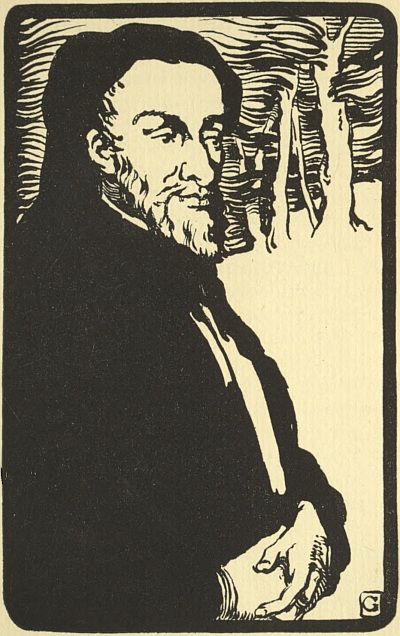
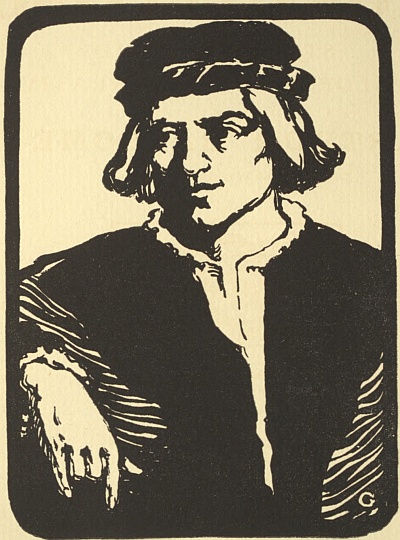
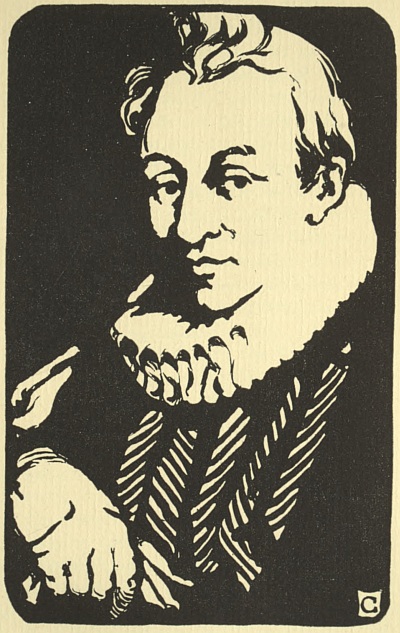
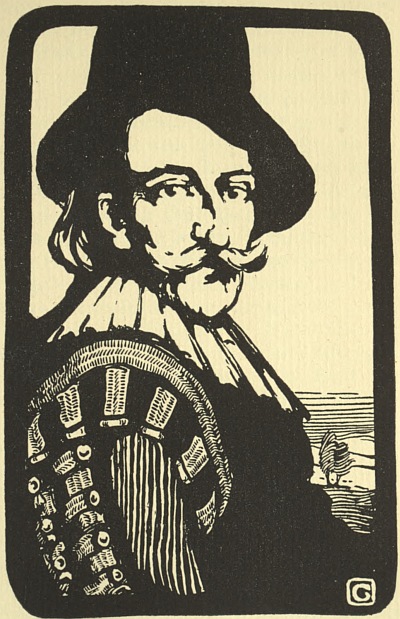
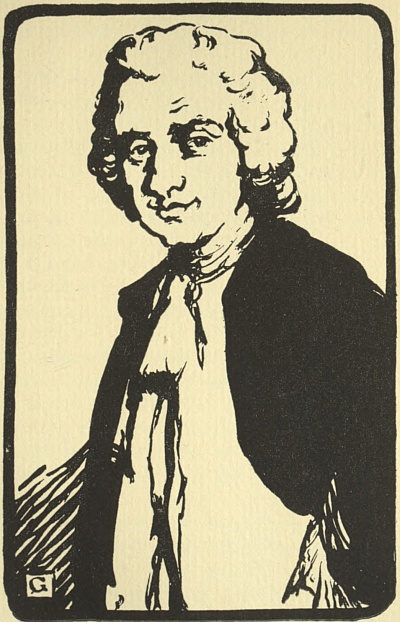
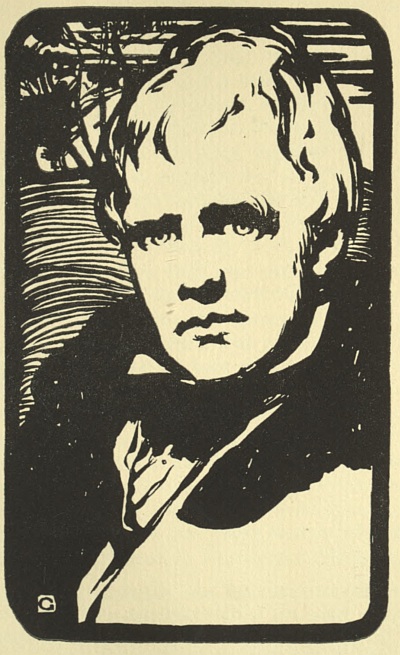
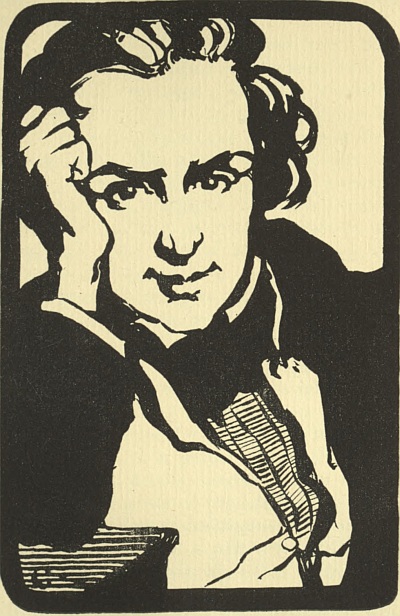
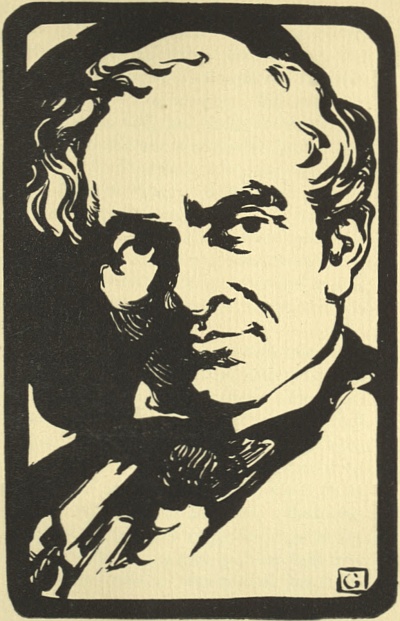
GEOFFREY CHAUCER
Chaucer.
Chaucer's was a fairly simple nature. He seems
to have taken to Renaissance fashions just as he
took to Renaissance learning, without in the least
disturbing the solid Englishness of his foundation.
He married a Damsell Philippa without letting his
marriage interfere with an ideal and unrequited
passion like that of Petrarch for Laura. He had
Jean de Meung's own reverence for the classics.
'Go litel book, go litel my tragedie,' he says in
'Troilus and Criseyd,
'And kiss the steppes, wher-as thou seest pace
Virgil, Ovyde, Omer, Lucan, and Stace.'
And yet few men have about them less of a
classical savour. He may well have liked 'at
his beddes heed
'Twenty bokes clad in blak or reed,
Of Aristotle and his philosophye,'
but he was a man of the true 'Merry England,'
when oxen were roasted whole on feast-days, and
pigs ran in the London streets. He followed the
Court, but he knew the populace. His father
was a vintner in Thames Street, and in the Cheapside
taverns Chaucer found some of the material
that his travels and learning taught him how to
use. On St. George's day 1374 he was granted
a pitcher of wine daily for life by his Majesty
Edward the Third. It is probable that he met
Petrarch at Padua. These two facts seem to me
to present no very hollow portrait of the man.
Portraiture.
He brought into the art of story-telling a new
clearness of sight in looking at other people and at
the manners of the time. The romances had not
represented contemporary life, but rather contemporary
ideals. No one can pretend to find in
Lancelot, in Roland, in Isoud of the White
Hands, character-sketch or portrait. Lancelot is
the perfect knight, Roland the perfect warrior,
Isoud the beautiful woman. They were not a
knight, a warrior, a woman. Those who heard the
tales used the names as servant-girls use names
in modern novels of plot, as pegs on which to
hang their own emotions and their own ambitions.
The lady who listened with her chin upon her
hands as the trouveurs chanted before her, took
herself the part of Isoud, and gave her lover or
the lover for whom she hoped the attributes of
Tristram. The jack-squire listening near the foot
of the table himself felt Roland's steed between
his legs. These names of romance were qualities
not people. The Wife of Bath is a very different
matter.
'In al the parisshe wyf ne was ther noon
That to th' offering bifore hir sholde goon;
And if ther dide, certeyn, so wrooth was she,
That she was out of alle charitee.
Hir coverchiefs ful fyne were of ground;
I dorste swere they weyeden ten pound
That on a Sonday were upon hir heed.
Hir hosen weren of fyn scarlet reed,
Ful streite y-teyd, and shoos ful moiste and newe.
Bold was hir face, and fair, and reed of hewe.
She was a worthy womman al hir lyve,
Housbondes at chirche-dore she hadde fyve,
Withouten other companye in youthe;
But therof nedeth nat to speke as nouthe.
And thryes hadde she been at Jerusalem;
She hadde passed many a straunge streem;
At Rome she hadde been, and at Boloigne,
In Galice at seint Jame, and at Coloigne.
She coude much of wandring by the weye;
Gat-tothed was she, soothly for to seye.
Upon an amblere esily she sat,
Y-wimpled wel, and on hir heed an hat
As brood as is a bokeler or a targe;
A foot-mantel aboute hir hipes large,
And on hir feet a paire of spores sharpe.
In felawschip wel coude she laughe and carpe.
Of remedyes of love she knew perchaunce,
For she coude of that art the olde daunce.'
She is there, solid, garrulous, herself. She does
not get husbands because she is a worshipped
goddess, but because she is a practical woman.
Bold indeed would be the lady who in imagination
played her part. The Wife is no empty
fancy dress in which we move and live; she is
well filled out with her own flesh, and we watch
her from outside as we would watch a neighbour.
Hers is no veil of dreams, but a good and costly
one, bought at Bristol Fair by one or other of
her five husbands whom she has badgered into
getting it.
Story-tellers before Chaucer seemed scarcely
to have realised that men were more than good or
bad, brave or coward. You hated a man, or you
loved him, laughed at, or admired him; it never
occurred to you to observe him. Every man was
man, every woman woman. It was not until the
Renaissance that modern story-telling found one
of its motives, which is, that there are as many
kinds of man and woman as there are men and
women in the world. Then, at last, character
and individuality became suddenly important.
Passion, reverence, charm had existed before in
story-telling. To these was now added another
possibility of the art in portrait painting. So
was the modern world differentiated from the dark
ages; blinking in the unaccustomed light, men
began to look at one another. In painting, almost
simultaneously with literature, the new power
found expression. The Van Eycks were alive
before Chaucer was dead, and in the careful, serene
painting of 'John Arnolfini and his Wife,' is the
observant spirit of the Canterbury Tales. That
woman standing there in her miraculously real
green robe, her linen neat upon her head, her hand
laid in her husband's, and her eyes regarding his
pious, solemn gesture as if she had consented in
her own mind to see him painted as he wished,
and not betray her sense of humour, the man, the
pattens on the floor, the little dog, and the detailed
chandelier, are all painted as if in Chaucer's
verse. The identity of them is the amazing thing;
their difference from all the other men and women
of the town, the difference of their room from all
other rooms, and their little dog from all other
little dogs. To compare that married couple
with any knight and lady carved in stone, hands
folded over breasts, on a tomb in an old church,
is to compare the modern with the mediæval, and
the Wife of Bath with Guenevere or the Wife of
Sir Segwarides.
Prose and
verse.
After Chaucer, narrative scarcely developed
except in prose. Scott, indeed, nearly five centuries
later, wrote his first tales in verse, but the rhyming
story-teller disappeared in the greater author
of the Waverley Novels.[3] Chaucer himself is
interesting for marking the transition. He had
many attributes of later narrative, in his round
English humour, in his concern with actual life,
although in this essay I have only needed him to
illustrate the beginnings of the portrait-making
that has since become so important a byway of
the art. But while his verse in the Canterbury
Tales has the effect of good prose, his prose,
excellent elsewhere, is here unwieldy and beyond
his governance. He expressed the new attitude
in the old way; but when he was only nine years
old, there had been written in Italy prose tales
that have hardly been excelled as examples of the
two forms of the short story. Chaucer was born in
1340. In 1349 Boccaccio finished the Decameron.
Boccaccio.
Boccaccio had a more intricate mind than
Chaucer's, and a more elaborate life. He is said
to have been an illegitimate son of a Florentine
merchant and a Frenchwoman, and the two nations
certainly seem to have contributed to his character.
He spent six years of his youth apprenticed to a
merchant in Paris, forsook business, and was sent
to learn law, and only in the end persuaded his
father to let him devote himself to books. He
had a knowledge of the world uncommon even in
his day, and a knowledge of letters that was rare.
He was something of a scholar, something of a
courtier, and, particularly, something of a poet.
Sentence after sentence in the Decameron glides
by like a splash of sunlight on a stream with
floating blossoms. I must quote one of his poems
in Rossetti's most beautiful translation:—
'By a clear well, within a little field
Full of green grass and flowers of every hue,
Sat three young girls, relating (as I knew)
Their loves. And each had twined a bough to shield
Her lovely face; and the green leaves did yield
The golden hair their shadow; while the two
Sweet colours mingled, both blown lightly through
With a soft wind for ever stirred and still'd.
After a little while one of them said
(I heard her), 'Think! If, ere the next hour struck,
Each of our lovers should come here to-day,
Think you that we should fly or feel afraid?'
To whom the others answered, 'From such luck
A girl would be a fool to run away.'
He could write a poem like that; he could write
the Decameron; he could write books of greater
impropriety; and at the end of his life could
beg his friends to leave such books alone, devoting
himself to the compilation of ponderous works
of classical learning. There is a legend of a deathbed
vision of Judgment where Boccaccio figured,
which, being reported to him, nearly gave the
wit, the scholar, and the gallant the additional
mask of the Carthusian religious.
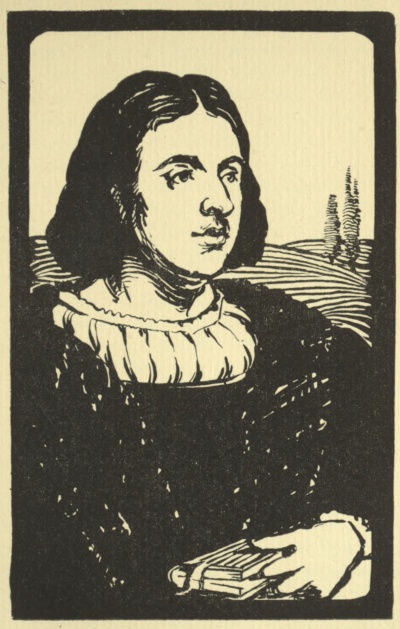
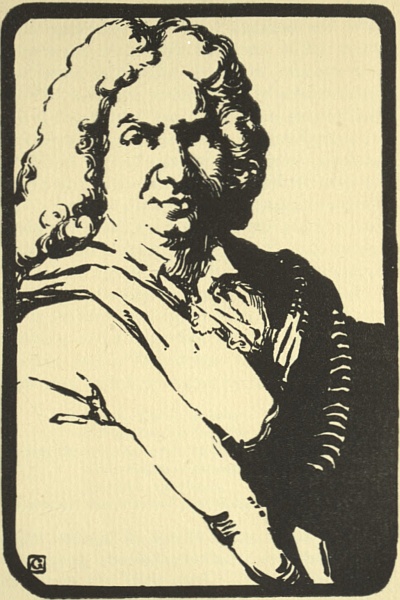
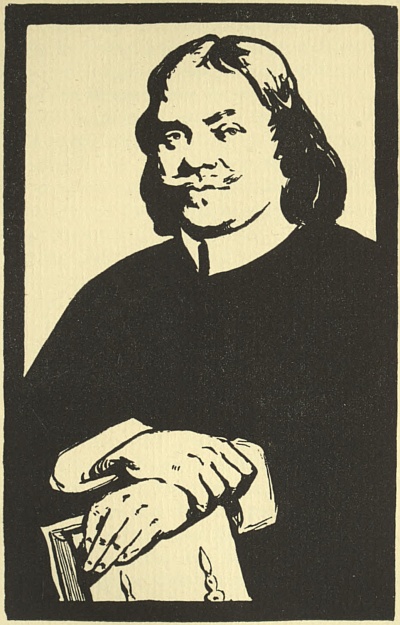
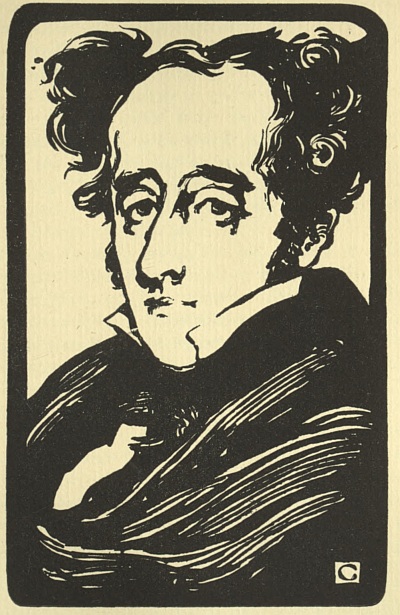
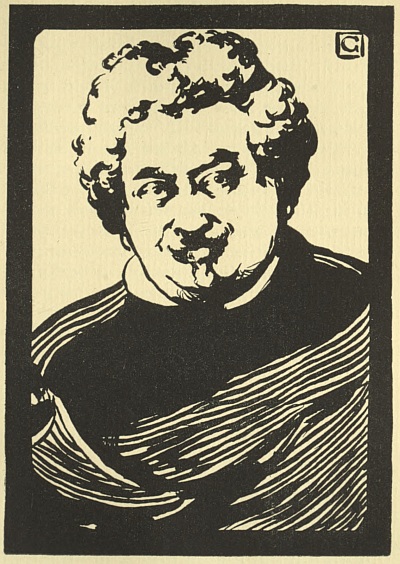
GIOVANNI BOCCACCIO
But the Boccaccio of the Decameron was
the mature young man, of personal beauty, and
nimble tongue, a Dioneo, who had his own way
with the company in which he found himself, and
was licensed, like a professional jester, to say the
most scandalous things. He knew the rich colour,
classical learning, and jollity of morals of the Court
of Naples. Here he heard the travelling story-tellers,
and perhaps learnt from them a little
of the art of narrative. He knew the Gesta
Romanorum, and began to collect tales himself with
the idea of making some similar collection. Noting
story after story that he heard told (for it would
be ridiculous to reason from the widespread origin
of his tales that he had a stupendous knowledge
of the world's books), he wrote them with a perfect
feeling for value and proportion. In him the
story-teller ceased to be an improviser. In his
tales the longwindedness of the trouveurs was
gone, gone also the nakedness of the anecdote.
He refused to excuse them with the moral tags
of the Gesta. These new forms were not things
of utility that needed justification; they were
things of independent beauty.
His
story-telling.
Boccaccio was intent simply on the art of telling
tales. He knew enough of classical literature
to feel the possible dignity and permanence of
prose, and he told his stories as they were told to
him in a supple, pleasant vernacular that obeyed
him absolutely and never led him off by its own
strangeness into byways foreign to the tales and
to himself. He found his material in anecdotes
of current gossip, like Cecco Angiolieri's misadventure
with his money, his palfrey, and his
clothes, and in popular tales like that of the overpatient
Griselda. He took it in the rough and
shaped it marvellously, creating two forms, the
short story proper, the skilful development of a
single episode, and the little novel, the French
nouvelle, a tale whose incidents are many and
whose plot may be elaborate. From his day to
our own these two forms have scarcely altered,
and in the use of both of them he showed that
invaluable art, so strenuously attained by later
story-tellers, of compelling us to read with him to
the end, even if we know it, for the mere joy of
narrative, the delight of his narrating presence.
We are so well content with Chaucer's gorgeous
improvisations that we never ask whether this piece
or that is relevant to the general theme. But in
Boccaccio there are no irrelevancies, praise that can
be given to few story-tellers before the time of the
self-conscious construction of men like Poe, and
the austere selection of men like Mérimée and
Flaubert.
Importance
of framework
in
books of
short tales.
Even without their setting his tales would have
been something memorable, something that lifted
the art to a new level and made less loving workmanship
an obvious backsliding. But stories put
together do not make good books. The Cent
Nouvelles Nouvelles are very short and make a
collection of anecdotes. The Exemplary Novels
of Cervantes are very long and stand and fall each
one alone. But the Canterbury Tales are the
better for that merry company on pilgrimage.
And when Queen Joan of Naples, profligate,
murderess, and bluestocking, asked Boccaccio to
put his stories in a book, it was well that he
should have the plague of 1348 to set as purple
velvet underneath his gems—the morality inseparable
from the tales was so simple and so
careless. Boccaccio's attitude was that of his age.
Man has wants: if he can satisfy them, good: if
not, why then it may ease his sorrow to hear it
professionally expressed:—'Help me,' as Chaucer
says:—
'Help me that am the sorwful instrument
That helpeth lovers, as I can, to pleyne!'
As for good fortune, it is taken as naïvely as
by the topers in the song:—
'Maults gone down, maults gone down
From an old angel to a French crown.
And every drunkard in this town
Is very glad that maults gone down.'
When Troilus is happy with Cressida, Chaucer
smiles aside:—'With worse hap God let us never
mete.' And Boccaccio, after describing a scene
that in England at the present day would be the
prelude to a case at law, and columns of loathsomely
prurient newspaper reports, ejaculates with
simple piety:—'God grant us the like.' The
Decameron
owes much of its dignity and permanence
to its double frame, to the Court of
Story-telling in the garden on the hill, and to the
deeper irony that places it, sweet, peaceful, and
insouciant, in the black year of pestilence and
death.