Dr. White’s report.—Seizure and destruction of a distillery.—Homicide of Joel Turnham—State
of the Territory.—Trials of Dr. White.—The liquor law.—Revenue act.—Case
of the negro Saul.—The Indians kill an ox.—Other Indian difficulties.—Indian
expedition to California.—Death of the Indian Elijah.—State of the Territory.—Claim
of the Hudson’s Bay Company on the north bank of the Columbia.—Letter
of Peter H. Burnett.—The Nez Percés and Cayuses.—Extract from the report of
the United States Senate.
We give the following extracts from Dr. White’s Indian report and
proceedings in Oregon, that the reader may be informed as to what he
claimed to be his influence, and also the way he maneuvered with the
Indians and settlers; with his full account of the killing of the young
Indian Elijah in California.
The letters from the different missionaries show the condition of the
American missions at the time. Mr. Lee and the Jesuit missionaries
did not deem him the proper agent to report to. Notwithstanding, in
his report, given in a previous chapter, he attributes to the Jesuit missionaries
improvements wholly made by the Americans, not from ignorance
of the fact, but from personal prejudice.
It will be seen that the committee in Congress, to whom his report
and petition was referred, deemed it equitable and just on general
principles, and allowed it.
Wallamet, November 4, 1844.
Sir,—The Hudson’s Bay ship Columbia sailing in a few days, via
Sandwich Islands, for England, by the politeness of her owners I have
the honor of again addressing you, and certainly under circumstances
most favorable and gratifying.
Since my last, forwarded in March, aside from two or three incidents
of an unpleasant nature, the colony and country have been in a state
of unusual quietness, and the season has been one of great prosperity.
The legislative body, composed of nine members, met on the 24th of
May, at the falls at Wallamet, and closed their short but effective session
in nine days; having passed, in due form, twenty-five bills, most
of which were of importance to us in the regulation of our intercourse.
A few of these laws I transmit to you, and would here remark, the
taxes were in general cheerfully paid. The liquor bill is popular, and
the laws of Oregon are honored.
The Liquor act not coming in force under sixty days from its passage,
a few individuals (having clandestinely prepared, before its passage)
improved this favored moment to dispose of all they could with any
hopes of safety. Of this I was immediately notified, and hastened in
from the Tualatin Plains, all the mischief, “as heretofore,” being done
in and about the town at the falls of the Wallamet.
Liquor was in our midst, as was but too manifest from the noisy,
vulgar, obscene, and even diabolical expressions of those who had previously
ever conducted themselves in a quiet and orderly manner.
This was perplexing and exciting, as all professed ignorance; and
many opinions prevailed regarding the amount manufactured, and the
number interested, and especially regarding the seat of mischief or
point where distilled.
I resolved, at whatever danger or cost, to nip this in the bud, procured
the call of a public meeting at once, and had the happiness to receive
the following expression from all but one convened:—
“Resolved, That it be the sense of this meeting, that Dr. White, in
his official relation, take such assistance as he may require, and forthwith
search out and destroy all intoxicating liquor that may be found
in this vicinity or district of country.
“P. G. Stewart.
“Executive Chairman.
“John E. Long,
“Secretary.”
I started with ten volunteers early the ensuing morning, and found
the distillery in a deep, dense thicket, eleven miles from town, at three
o’clock, P. M. The boiler was a large-size potash kettle, and all the apparatus
well accorded. Two hogsheads and eight barrels of slush or
beer were standing ready for distillation, with a part of one barrel of
molasses. No liquor could be found, nor as yet had much been distilled.
Having resolved on my course, I left no time for reflection, but at
once upset the nearest cask, when the noble volunteers immediately
seconded my measures, making a river of beer in a moment; nor did
we stop till the kettle was raised, and elevated in triumph at the prow
of our boat, and every cask, with all the distilling apparatus, was
broken to pieces and utterly destroyed. We then returned, in high
cheer, to the town, where our presence and report gave general joy.
Two hours after my arrival, I received from James Connor, one of
the owners, a written challenge for a bloody combat; which ended
last week in his being indicted before the grand jury, fined $500, and
disfranchised for life.
Six weeks since, an unhappy affray occurred between one Joel Turnham,
late from Missouri, and Webley Hauxhurst, of Wallamet, and
serious threats passing from the former, a warrant was issued, and
Turnham, resisting with a deadly weapon, was shot down by the
officer; for which he comes before the grand jury to-morrow. Turnham
expired at once, being shot with three mortal wounds through the
neck and head, but with singular desperation fought and resisted to
the last.
So far as I understand the public expression, all unite in acquitting
the officer, who has ever been a harmless, quiet, good citizen; while
Turnham was regarded as a most desperate and dangerous character
all abroad, having left Missouri under circumstances most unfavorable
to his reputation and quiet here, where he has been particularly sour,
irritable, and quarrelsome; and was the more obnoxious as he was
reputed brave and generally too stout for his antagonist.
November 8.—Since penning the last, the grand jury have unanimously
declared no bill; and here allow me to say, having accompanied
Judge Babcock to four of the courts embraced in the circuit
of five counties, I have not seen in any country such uniform decorum
and quietness as has prevailed throughout at these courts. Much of
this mildness, sobriety, and good order, is doubtless attributable to the
absence of all intoxicating drinks.
The laws of this country, framed to meet present circumstances, are
taking deeper and stronger root continually. And some are already
suggesting, “notwithstanding our infancy,” whether, if longer left
without a mother’s protection, it will not be well to undertake to run
alone.
The resources of the country are rapidly developing, and the expectations
of the people are generally high; the mildness of the climate
and the strength of the soil greatly encourage the large immigration of
last year. For the last twelve months, mercury has ranged from 96 to
30; four-fifths of the time from 80 to 55; making an agreeable summer
and mild winter, grazing being good throughout; so much so
that the jaded and worn-down animals of the poor immigrants fatted
up greatly to their surprise, before spring, without feeding or the least
attention.
Crops of all kinds usually good, even to Indian corn, and cheerfulness
prevails throughout since harvesting. As statements have been
made in the States derogatory to our soil, allow me to say, it is
believed, with the same cultivation, no country produces better wheat,
oats, peas, barley, potatoes, or any crop save Indian corn, for which the
nights are generally too cool for a heavy growth. The wheat crops,
being never injured by the frosts of winter or the rains of summer, as
in the States, are remarkably sure; nor as yet have our crops been
disturbed by flies or insects.
Wheat crops are heavy, as you will judge when I assure you, from
simply turning over the prairie in June, scattering the seed in October,
and then with no further trouble than passing the harrow over it, ten
acres upon my plantation grew five hundred and forty-one bushels and
a half. The river flats, containing much alluvial deposit, are very rich;
the plains beautiful and verdant, being admirably watered, but generally
sparsely timbered; the high lands well timbered and watered in
many parts, the soil tolerable, producing herbage for an abundance of
deer, elk, mountain sheep, etc. The entire Wallamet and Umpqua
valleys, capable of sustaining a population of several millions, it is generally
believed can not be excelled, as a whole, for richness of soil,
variety, grandeur, or beauty of scenery; nor, considering the latitude,
can be equaled in mildness, equability, and agreeableness of climate.
Since last writing, abundance of limestone has been found at the
mouth of the Columbia, and likewise in this valley, conveniently
obtained, and proves of an excellent quality. The Rev. Mr. De Smet
arrived here in August last, bringing, as a part of his cargo, six
priests and as many nuns, fine, hale-looking girls, very acceptable just
now, particularly as the Methodist Mission is breaking up, and the
half-breed Canadian daughters are rapidly multiplying.
Having no pilot or chart to depend upon, and his commander a
stranger, he sailed in through the south channel, greatly to the surprise
and alarm of all on shore, but without injury or difficulty, not
once touching, and reporting abundance of water for the heaviest
burden ships.
The sands are supposed to have changed and improved the channel;
but of this I know nothing, and am not a little skeptical. I am
induced to attribute their success more to the fine day and small
vessel than change of the sands in their favor since Captain Wilkes
left. Captain Couch, however, who has now been passing in and out
here for the last five years in the service of Mr. Cushing, of Newburyport,
pronounces it a better port to enter than theirs, and says, with
pilots, there will be little difficulty or danger.
Our exports are wheat, beaver, salmon, and lumber, for which, in
return, we obtain from the Sandwich Islands, sugar, molasses, tea,
coffee, and other commodities brought there from China, England,
and America.
We are much in want of a currency and market, American merchants
being as yet a slender reliance; and in view of the large immigrating
parties of each year, we should be greatly distressed for
necessary articles of wearing apparel, but for the most commendable
spirit of accommodation on the part of the Hudson’s Bay Company.
Could some arrangement be entered into for us to supply the navy
of the Pacific with bread, beef, pork, fish, etc., we would thereby be
much improved in our condition. This might, and perhaps ought to
be done, in view of the encouragements held out for our people to
emigrate to this country. Should it not be convenient for our ships of
war to come to the Columbia for such supplies, they could be shipped
to the Sandwich Islands, if required. But more of this another time.
Having just taken the tour of the colony for the purpose of attending
the courts and visiting the schools, it affords me pleasure to say I
felt amply rewarded. I found throughout health, cheerfulness, and
prosperity, and, certainly, most surprising improvements for the short
time since the settlers commenced. The decorum of the courts I have
spoken of, and now have only to speak of the schools and Indians, and
I am done, fearing I have already wearied your patience. For the
want of means, the Methodist manual labor Indian school has lately
been broken up, and this is now occupied as a boarding-school for
white children of both sexes. The school is yet small, but well conducted,
and promises usefulness to the colony. The school at the falls
of the Wallamet and Tualatin Plains, and likewise the one under the
direction of Rev. Mr. Blanchet, Catholic clergyman, are all small,—numbering
from fifteen to thirty only,—but are all well kept and doing
good. I feel solicitous on this subject, and am saying and doing what
I can to encourage education, but, like all other new countries, the
people need and require their children much at home.
Since the unhappy affair last spring, the Indians have been unusually
quiet, and the summer has been spent without alarm. I sent my interpreter,
Mr. Lee, to the Wallawallas six weeks since, to make some
presents to the chiefs, as a safe conduct to the immigrants down to this
place, but having, as yet, nothing from him of interest, I addressed a
line to Mr. J. B. Littlejohn, who is just down from there, and received
the annexed reply; all other statements are corroborative:—
“Wallamet, November 1, 1844.
“Dear Sir,—It is with the utmost pleasure I undertake to give you
what information I am able to do. I have resided with the missionaries
of the American Board for two years past; I have known their hearts,
and am well acquainted with all they have done. Their influence among
the Indians is by no means small, or their efforts vain, as their condition
is very much improved, both in a spiritual and temporal point of
view. And, dear sir, your efforts among and for them have been much
to their advantage, and at the same time not to the disadvantage of the
missionaries, but greatly to increase their usefulness among them. I
have no doubt you have labored with this motive in view. The Indians
are becoming civilized as fast or faster than any tribes concerning whom
I am informed. Their anxiety for cattle, hogs, and sheep is very great;
leading them to make most commendable efforts to obtain them, and
their efforts are by no means vain. They have purchased a good number
from those who are emigrating to this country, by exchanging their
horses for cattle. Thus, while their horses have been very useful to the
immigrants, they have greatly benefited themselves. They are enlarging
their farms yearly,—improving much in fencing, etc. Quite a number
of families are enabled to live from what they raise on their farms,
the milk of their cows, and their beef. There is perfect quietness existing
between them, and I have no doubt this state of things will continue
to exist. Many things that are interesting might be written, but
time does not allow me to say more at present.
“I am, dear sir, yours with the greatest respect,
“J. B. Littlejohn.”
Thus far the Indians have kept their treaties of amity with me astonishingly
well, and it is thought we have now as much to hope as fear
from them, if we succeed in keeping out liquor, which, by the grace of
God, not few of us are resolved to do, though we do not pass unopposed,
nor slightly opposed; and had it not been for that most salutary
liquor law, and the hearty co-operation of some of the friends of
temperance with your agent, liquor would have already made ruinous
havoc among us.
The Methodist Mission, though we have not agreed on all subjects,
has behaved very properly on this. And to it, in connection with the
Honorable Hudson’s Bay Company, will the colony be lastingly indebted
for its commendable efforts.
Since my first arrival, I have not received a line from the department
save my last year’s report. As my condition is peculiar, and not a little
embarrassing, I should feel greatly obliged for an expression and
further instruction from the department. I have had, as may well be
judged, much to contend with, in the midst of lawless Indians of so
many different tribes, and lawless whites of so many nations,—some
bred upon old whale-ships, others in the Rocky Mountains, and hundreds
on the frontiers of Missouri. I have at times waded in deep perplexing
difficulties, but am now greatly relieved by the colonial government,
which as yet is well administered. By reason of this I now have less
to do, and sail in smoother seas, meeting with less opposition than
heretofore, my proper official relations toward the whites and Indians
being better understood.
I have the honor to be, etc.,
E. White,
Sub-Agent Indian Affairs, W. R. M.
Hon. J. M. Porter,
Secretary of War, Washington
An Act to prohibit the Manufacture and Sale of Ardent Spirits.
Whereas the people of Oregon, now occupying one of the most beautiful
and interesting portions of the globe, are placed in the most critical
and responsible position ever filled by men, owing, as they do, important
duties to themselves, to their country, to posterity, and to mankind,
as the founders of a new government and a young nation; and whereas
the introduction, distillation, or sale of ardent spirits, under the circumstances
in which we are placed, would bring withering ruin upon the
prosperity and prospects of this interesting and rising community, by
involving us in idle and dissolute habits, inviting hither swarms of the
dissipated inhabitants of other countries, checking immigration, destroying
the industry of the country, bringing upon us the swarms of savages
now in our midst, interrupting the orderly and peaceable administration
of justice, and, in a word, producing and perpetuating increasing and
untold miseries that no mind can rightly estimate; therefore,
Be it enacted by the Legislative Committee of Oregon as follows:—
Section 1. That if any person shall hereafter import or introduce any
ardent spirits into Oregon, with intent to sell, barter, or trade the same,
and shall offer the same for sale, barter, or trade, he shall be fined the
sum of fifty dollars for each and every such offense, which may be recovered
by indictment or by trial before a justice of the peace, without
the form of pleading.
Sec. 2. That if any person shall hereafter sell, barter, or trade any
ardent spirits of any kind whatever, directly or indirectly, to any person
within Oregon, he shall forfeit and pay the sum of twenty dollars for
each and every such sale, barter, or trade, to be recovered by indictment
in the Circuit Court, or before a justice of the peace, without the
form of pleading.
Sec. 3. That if any person shall hereafter establish or carry on any
manufactory or distillery of ardent spirits in Oregon, he shall be subject
to be indicted before the Circuit Court as for a nuisance; and if convicted,
he shall be fined the sum of one hundred dollars, and the court
shall issue an order to the sheriff, directing him to seize and destroy the
distilling apparatus, which order the sheriff shall execute.
Sec. 4. That it shall be the duty of all sheriffs, judges, justices, constables,
and other officers, when they have reason to believe that this act
has been violated, to give notice thereof to some justice of the peace or
judge of a court, who shall immediately issue his warrant and cause the
offending party to be arrested, and, if such officer has jurisdiction to try
such case, shall proceed to try such offender without delay, and give
judgment accordingly; but, if such officer shall not have jurisdiction to
try the case, he shall, if the party be guilty, bind him over to appear
before the next Circuit Court of the proper county.
Sec. 5. That all sales, barters, or trades, made under color of gifts or
otherwise, with intent to evade this act, shall be deemed a violation of
the same, and all fines and penalties recovered under this act shall go
into the general treasury, and all officers receiving the same shall pay
over to the sheriff, whose duty it shall be to pay the same into the
treasury.
Sec. 6. That this act shall not be so construed as to prevent any practicing
physician from selling such liquors for medicine, not to exceed
one gallon at one time.
Sec. 7. That the clerk shall make out a copy of this act and put the
same up in Oregon City as early as practicable.
Sec. 8. That this act shall take effect within sixty days from and
after its passage.
Passed 24th June, 1844.M. M. McCarver, Speaker.
Attest: J. E. Long, Clerk.
An Act to provide for Ways and Means.
Be it enacted by the Legislative Committee of Oregon as follows:—
Section 1. That in order to raise a revenue for the purpose of defraying
the expenses of the government, there shall be levied and collected
a tax of one-eighth of one per cent. upon the following property, at a
fair valuation, to wit: All merchandise brought into this country for
sale; improvements in town lots; mills; pleasure-carriages; clocks;
watches; horses; mules; cattle and hogs.
Sec. 2. Every male citizen over the age of twenty-one years, being a
descendant of a white man, shall be subject to pay a poll-tax of fifty
cents.
Sec. 3. That it shall be the duty of the collector of revenue to require
of each and every merchant of Oregon to give him a statement of the
amount of all merchandise on hand, in writing, to be stated upon oath
or affirmation, which oath or affirmation the collector shall administer;
and said collector shall collect and receipt for the tax upon such merchandise,
which receipt shall serve said merchant for a license for the
next year, commencing from the time given; and that, when a merchant
shall wish to renew his license, he shall give a similar statement
of all merchandise received by him for sale in the preceding twelve
months, and the collector shall only require him to pay tax upon the
amount of said imports.
Sec. 4. That any person refusing to pay tax, as in this act required,
shall have no benefit of the laws of Oregon, and shall be disqualified
from voting at any election in this country.
Sec. 5. That the sheriff shall serve as ex officio collector of the revenue,
for which he shall receive, as a compensation for his services, ten
per cent. upon all moneys collected as revenue.
Sec. 6. That the sheriff, before entering upon the duties of his office
as collector of the revenue, shall enter into bond, with two or more good
and sufficient securities, in a sum not less than five nor more than ten
thousand dollars, to be approved by the executive, which approval
shall be written upon the back of said bond, and the said collector’s
bond shall be filed in the office of the clerk of the court.
Sec. 7. That the collector shall pay over to the treasury, on the first
Monday in each and every month in the year, all moneys that may be
in his hands, and get the treasurer’s receipt therefor.
Sec. 8. That it shall be the duty of the tribunal transacting county
business to require the collector to settle with said court at each and
every regular term of the court in Clackamas County.
Sec. 9. The collector of the revenue shall make full payment into the
treasury on or before the first Monday in December in each year.
Sec. 10. The revenue of Oregon shall be collected in specie or available
orders on solvent merchants in Oregon.
Sec. 11. That all acts and parts of acts contrary to this act be, and
the same are hereby, repealed.
Sec. 12. This act to take effect from and after its passage.
M. M. McCarver, Speaker.
Attest: J. E. Long, Secretary.
Oregon Territory, Tualatin District, United States of America,
May 1, 1844.
Charles E. Pickett, plaintiff, in the name of Oregon Territory, threatening
to incense the Indians, against Saul, a man of color.
Complainant’s oath and warrant issued, directed to J. L. Meek,
sheriff, and summons for three witnesses, viz.: James Conner, William
Hill, and Mr. Bird.
May 3.—Sheriff made his return with defendant and witnesses, and
jury of good and lawful men, viz., Philip Foster, W. C. Dement, J. W.
Nesmith, John McCaddan, C. Spencer, and S. W. Moss, being duly
sworn, returned a verdict of guilty of the charges alleged to him, and
signed their names, viz.: Philip Foster, J. W. Nesmith, William C.
Dement, John McCaddan, Chauncey Spencer, and S. W. Moss.
Two witnesses, viz., William Hill and Mr. Bird, of lawful age, being
duly sworn, did depose and say: that the threats in the deposition of
Charles E. Pickett were correct; and that the Indians had come in a
menacing manner; and that Saul said he would stand for the Indians’
rights; and that he (Saul) was armed and prepared to do so; and that
the Indians would burn and destroy his house and property. The
charges being of a higher character than the Oregon laws have cognizance
of, judgment is, that the United States sub-Indian agent, Dr.
Elijah White, is the proper officer to take cognizance of him; and he,
Saul, a man of color, be forthwith delivered into said agent’s hand;
which was forthwith done.
Robert Moore, Justice of the Peace.
The criminal was received and kept in custody for some weeks; but
having no prison-house or jail to lodge him in, and the captain absolutely
declining taking him on board his vessel, after the storm had
blown over I suffered and encouraged him to leave this place, and stop
with one of the mission families for the present, at the mouth of the
Columbia.
Though unsuccessful in getting employment as I had hoped, he remains
in that vicinity with his Indian wife and family, conducting, as
yet, in a quiet manner, but doubtless ought to be transported, together
with every other negro, being in our condition dangerous subjects.
Until we have some further means of protection, their immigration
ought to be prohibited. Can this be done?
E. White, Sub-Agent.
Territory of Oregon,
District of Tualatin.
Charles E. Pickett, being duly sworn, says, that Saul (a man of
color), of said Territory, has threatened to incense the Indians against
his person and property, to destroy the same; and that he, the said
Charles E. Pickett, verily believes that, unless measures are taken to
prevent him, there are sufficient grounds to apprehend that he will
carry those threats into execution.
Sworn to and subscribed this 1st day of May, 1844, before me,
Robert Moore, J. P.
We, the jury, find the prisoner guilty of the charges alleged against
him.
Philip Foster,
J. W. Nesmith,
Wm. C. Dement,
John McCaddan,
Chauncey Spencer,
S. W. Moss.
Oregon, Wallamet Valley,
April 4, 1845.
----Starting too late, and the winter rains setting in earlier than
usual, subjected the immigrants to incredible suffering and hardships,
especially from the Dalles of the Columbia down to the Wallamet
Valley; but our early and delightful spring is exerting a cheering and
most salutary influence upon their hitherto depressed spirits. They
have, bee-like, been hived up in Oregon City during the winter, and
are now swarming, to the entire satisfaction of the first occupants of
the hive, it not being wide and large enough for such an unexpected
increase. The last immigration, numbering about a thousand, are generally
pleased with the country, and are setting about their spring
work with becoming spirit and fortitude.
The Indians of this lower country, whose national honor and dignity
are laid in the dust, are looking upon the rapid growth and increased
strength of the whites with sorrowful countenances and sad hearts.
The present state of things between us and them is peculiar, critical,
unenviable, and dangerous, at least, so far as peace and property are
concerned.
For instance, in proof: Soon after I sent my last dispatches, the chief
of the Tualatin Plains, whose orderly conduct and that of his clan did
honor to the Nez Percé laws, and the engagement we had mutually
entered into, called on me, desiring my offices in procuring the mending
of his gun. This being done, he invited me to come and see him and
his people; said all was not right at his lodge; his tribe was divided,
and all was not right; his influence was waning, and some of his people
were becoming very bitter toward the Americans. Observing anxiety
and mental reservation, I endeavored to draw out the secret, reminding
him of the frequent communications he had brought me from the Rev.
Messrs. Clark and Griffin, bearing such satisfactory testimony to their
previous quiet, orderly, and proper conduct, etc., but all I could learn
was, “Things are not right with us, and we are miserable.”
The camass, their principal dependence for food, was cut off last
season by reason of drought; and the deer are hunted so much by the
late hungry western immigrant riflemen, that they have become wild,
poor, and few in number. The chief left.
A few days after, I learned they had killed an ox and ate it, belonging
to a neighboring white man. The owner was excited, and applied
to one of the executive; a proclamation was issued, the military was
called out (if it be lawful to call it such), and ample preparations made
to avenge this national insult, and seek redress for this astounding loss.
The army collected upon the opposite bank of the river, about six miles
from the position occupied by the enemy, talked bravely, long, and
loud, but the river was a little too high to cross that day; appointed
another, the river being lower; none of the warriors appeared; nor
could the executive, or owner, simply for the want of a few gallons of
alcohol, obtain the necessary assistance to avenge the horrid wrong,
and perform a brilliant military exploit. The chief, in his embarrassment
and distress, came to me as usual for sympathy and succor. My
coldness and look of severity (for which Heaven forgive me!) keenly
afflicted him. After a deep sigh and painful pause, peculiar to a
wounded or injured Indian, he slowly rose, gently smiting his breast,
and said, “Dr. White, I am a true man, and carry an honest heart. Do
you remember my coming to get my gun mended last fall? Do you
remember my words, that all was not right with our people, and my inviting
you to come and see us? We had just before killed that old ox,
and were then eating it.” I inquired, “Had you any thing to do with
it personally?” “Yes, I helped to kill it, and, with my family, took
and ate one-half of the animal. You saw the condition of my gun;—our
provisions were out; I and others had hunted for two days,—our
hunger was great. We held a council; and, hoping for success, I
promised, on condition nothing was caught till the setting of another sun,
we would kill the first animal we met. I traveled far, and wearied myself
till evening; shot often but killed nothing;—we met this poor old
ox, which our people would scorn to kill or eat but in case of extreme
hunger;—my word was passed to my people; I could not go back from
my word; I helped to kill and butcher the ox, and joined in eating
him; and now my peace is gone. I am ashamed to see a white man’s
face; they look cold on me and shake the head;—I can not bear it—I
can not live so; I come to you to help me, for I am told they want to
kill me. I do not want such feelings to exist; nor do I want to be
hunted as a bear or wild beast, for slaughter. I stand here a wisher of
peace, willing to have you dictate the terms; but wish to have it remembered
that we were distressed with hunger.” “Suppose,” said I,
“the owner should require your rifle and four horses?” “You stand to
judge between us, and I shall abide your decision.” “But you have
broken your engagement and forfeited confidence, and I fear it can not
be settled, and some think you have killed before.” “Dr. White, I am
a true man, and lie not. I, nor my people, can not be so accused justly;
this is injurious; none can meet my face and say it.” I wrote, through
him, to the owner, praying, as it was the first offense so far as we had
the least evidence, and especially in view of our critical situation and his
general good behavior, that he would fully indemnify himself; and
then, in view of what I knew of the condition of his gun, and the
probability that it was induced by hunger, to settle it; and requested
him to assure the chief that he was convinced from my letter and all
the circumstances, in connection with his past good conduct, that it
must have been brought about by hunger.
The advice was rejected, as the laws of the organization now had
cognizance of the offense, and he wished to see them faithfully enforced.
Public opinion became divided, and no judicial expression being made,
and the poor chief becoming excessively tired of being held by public
opinion in durance vile, came to see me a second time. I wrote again,
and learned it was settled by the chief and his people paying his rifle
and eight horses. If this be correct (as I fear it is), I abominate the
act and dread its prejudicial influence.
Week before last a hungry and mischievous lodge killed a cow. They
were pursued by a party of whites, overtaken, and, in attempting to
take them, the Indians fired upon the whites, killing one horse, and
wounded another. The fire was returned; one Indian killed, and a
second wounded. Thus ended this affair, which creates very little excitement
among whites or Indians.
The most painful circumstance that has occurred lately, transpired
last fall at California. The Cayuses, Wallawallas, and some of the
chiefs of the Spokans, entered upon the hazardous but grand and important
enterprise of going directly through the Indian country to California,
with a view of exchanging their beaver, deer, and elk skins, together
with their surplus horses, for neat stock. As they had to travel through
an extensive country inhabited by the savage and warlike Klamaths
and Shastas, where Smith, Turner, and so many other white parties had
been defeated, we are at a loss to conclude whether their valor is more
to be commended than the rashness of their stupendous enterprise to be
censured. They were well mounted and equipped; the chiefs clad in
English costume, and the residue attired in dressed skins, molded
according to their several tastes. The journey of seven or eight hundred
miles, after some fighting, watching, and much fatigue, was accomplished,
and their numbers not lessened.
Taking their own statement, their reception was cordial, and the
impression made upon the whites by these distant and half-civilized
people, upon an errand so commendable, was most favorable. The
treating and salutations being over, the trade commenced in good
faith, and to mutual satisfaction. All moved on well, till, on an excursion
to procure elk and deer skins, they met a marauding band of
mountain freebooters; fought them, and, being victorious, took a prize
of twenty-two horses, all previously stolen from the whites.
On returning to the settlements, the Spaniards laid claim to the animals.
The chiefs remonstrated, and said, agreeably to their customs,
the horses were theirs. The Spaniards explained their laws, and showed
the animals not to be vented, i. e., bearing a transfer mark, and told the
Indians they must give them to the rightful owners, as all Americans
and others did. The Indians seemed grieved and rather incensed;
said in their country six nations of people were on terms of amity, and
that in case any one of these six nations stole a horse, the tribe was
responsible for the safe delivery of that animal to the rightful owner;
but in case the Blackfeet or other formidable enemy steal or capture,
the properly is supposed lost, without redemption; and as we have
captured these horses at the hazard of our lives, from your long openly
declared enemies, we think they ought in justice to be ours. The
Spaniards condescended to offer ten cows for the redemption of the
horses; the chief not replying, five more were added; he still remaining
moody and without replying, the negotiation unhappily broke off.
A day or two after, an American, seeing his mule among the number
captured, told the Indians it was his mule, and have it he would. “Will
you?” said a young chief by the name of Elijah Heading; and stepping
into the lodge, he immediately loaded his rifle, came out and observed
significantly, “Go now and take your mule.” The American, much
alarmed, remarked, “I hope you are not going to kill me.” “No! I
am going to shoot yonder eagle” (perched upon a neighboring oak).
Not liking the appearances, the man left without attempting to obtain
his mule. A day or two after, the Indians left their encampment and
walked down to the fort of Captain Sutter to church; and from the
best information we have obtained (all being ex parte), the following
appears to be near the truth: After service Elijah was invited into
another apartment, taking with him his uncle, a brave and sensible
chief of the age of five and forty; while there, in an unarmed and defenseless
condition, they commenced menacing him for things alleged
against the river Indians of this upper country, in which none of them
had any participation; called them indiscriminately dogs, thieves, etc.
This American then observed: “Yesterday you were going to kill me;
now you must die”—drawing a pistol. Elijah, who had been five or
six years at the Methodist Mission, and had learned to read, write, and
speak English respectably, said, deliberately: “Let me pray a little,
first;” and kneeling down, at once commenced; and while invoking the
Divine mercy, was shot through the heart or vitals dead upon the spot.
Every measure, as the Indians say, was taken to cut them all off by the
Spaniards, who brought out the cannon, with other fire-arms, and hotly
pursued them, and tried to prevent their escape by checking and interrupting
their passage across the ferries, etc. But at length they all
arrived safely, after manifest suffering, leaving the herds they had paid
for in California.
They met three Americans on the way as they left the California
settlements and had them in their power, but instead of revenging the
death of Elijah, they mounted each on a horse of their own, and sent
them on, telling them to go to the fort and acquaint the people that
they could not kill innocent white people in their power and lodge.
Taking for truth an Indian report, this horrible affair creates considerable
excitement, and there is some danger of its disturbing the
friendly relation that has hitherto existed between us here, and all
those formidable tribes in the region of Wallawalla and Snake River.
They had no sooner arrived, than Ellis, my interpreter, the high chief
of the Nez Percés, was deputed to come down and learn our opinions
regarding the affair. They could not have sent a better agent, the
whites all giving him a handsome and cordial reception. From Wallawalla,
he accompanied Mr. Grant, the chief trader at Fort Hall, down
to Vancouver. He called on Dr. McLaughlin, whose great experience
and address were serviceable. He spoke touchingly of the violent death
of his own son upon the northwest coast, and left the impression that he
could not avoid sympathizing with the father and friends of the deceased
young chief. Mr. Douglas, too, an early friend, patron, and
favorite of Ellis, aided much in convincing him that all the good and
virtuous could not avoid the most painful regrets at so melancholy a
circumstance, which must have occurred by reason of the difference in
their customs or laws, imperfectly understanding each other, or from
some, as he would charitably hope, excusable circumstance.
Under the influence of this salutary language and interview, Ellis
arrived at my residence, in Wallamet, about the 1st instant, having, a
short time before, got a hasty communication, written in excitement,
from Dr. Whitman, who was under serious apprehensions that it might
be avenged upon some of the whites of the upper country. Be assured
I was happy to see this my most faithful friend and interpreter. Sir,
pardon me for saying—isolated as we are here, agitated as we have
a thousand times been by faithless savages and still more faithless
whites, responsible, yet powerless and defenseless, in our unsettled state
of things—to meet with this honest man, this real friend, though an
Indian, gave me hearty pleasure.
His thorough education at Red River molded him into more of the
white man than Indian. His prudence and good management with his
tribe sanctioned the choice that had been made, and all the whites
spoke handsomely of his kind offices and obliging deportment, while
immigrating through his country. Being satisfied of the safety and
policy, I feasted him, and took at once unobserved measures to have him
invited to every respectable place abroad, where the ladies and gentlemen
received him so cordially, and feasted him so richly and delicately,
that he almost forgot the object of his embassy, and, I verily believe,
thought extremely highly of the whites of Wallamet, however ill he
might have thought of the conduct of the Californians.
Being anxious to make this visit useful to him and his people, as well
as pleasant, after spending a few days in visiting the schools, as well as
the principal inhabitants and places of interest, I showed him my little
library; told him to make himself at home; put on my farmer’s garb
and commenced working upon my plantation. He soon came out,
accompanied by a wealthy cousin, and begged for tools to assist me. I
loaned them, and found he was much at home in their use. He spent
with me a sufficient length of time to convince me of the truth reported
concerning his cheerfulness in labor, as well as his knowledge, application,
and assiduity in business. He spoke sensibly of the advantages
of industry, and the astonishing change that had been effected among his
people by the cultivation of the soil; assured me that every family or
lodge now raised an abundance for home consumption, besides having considerable
quantities to barter with the whites. He says he raised, himself,
the past season, six hundred bushels of peas, with a fine crop of wheat, potatoes,
beans, etc.; spoke properly of its moral and social effects. Wars
were no longer talked of, and the chase was nearly abandoned; the book
and the Bible consumed their leisure moments. Polygamy, once so common,
was now done away with, except in two solitary cases, and not a
lodge of his people but observed the Sabbath, and regularly attended
morning and evening devotion. This was only corroborative of what I
had previously heard from other sources. He spent ten days with me
in the most cheerful, agreeable, and profitable manner, and at the close
I felt myself the happier and better for the visit; nor did I marvel that
his influence was increasing and the prospects of his people brightening.
Pardon me, for, in thinking of his visit and dwelling upon his excellences,
I had like to have forgotten his agency. Learning from Dr.
Whitman, who resides in their midst, how much they were all excited
by reason of the treacherous and violent death of this educated and
accomplished young chief, and perhaps more especially by the loss they
had sustained; and then, after suffering so many hardships and encountering
so many dangers, losing the whole,—I apprehended there might
be much difficulty in adjusting it, particularly as they lay much stress
upon the restless disaffected scamps late from Wallamet to California,
loading them with the vile epithets of “dogs,” “thieves,” etc., from
which they believed, or affected to, that the slanderous reports of our
citizens caused all their loss and disasters, and therefore held us responsible.
He assured me that the Cayuses, Wallawallas, Nez Percés, Spokans,
Ponderays, and Snakes were all on terms of amity, and that a
portion of the aggrieved party were for raising about two thousand
warriors of these formidable tribes and marching to California at once,
and, nobly revenging themselves on the inhabitants by capture and plunder,
enrich themselves upon the spoils; others, not indisposed to the
enterprise, wished first to learn how it would be regarded here, and
whether we would remain neutral in the affair. A third party were
for holding us responsible, as Elijah was killed by an American, and
the Americans incensed the Spaniards. Ellis reminded me at the same
time of the ill-success the chiefs met with in trading off their ten-dollar
drafts for herds with the immigrants; which drafts I had sent up by
Mr. Lee, my interpreter, to secure peace and safety while the immigrants
were passing through their country, the year before so many having
been pillaged and robbed of their effects, through the inattention of the
chiefs.
Sir, how this affair will end is difficult to conjecture; the general impression
is, that it will lend to the most disastrous consequences to the
Californians themselves, or to the colony of the Wallamet Valley. My
principal fear is, that it will result in so much jealousy, prejudice, and
disaffection, as to divert their minds from the pursuit of knowledge,
agriculture, and the means of civilization, which they have been for
such a length of time so laudably engaged in obtaining.
Should this be the case with these numerous, brave, and formidable
tribes, the results to them, and to us, would be indeed most calamitous.
To prevent such a result, I wrote, through Ellis, a long, cordial, and
rather sympathizing letter to the chiefs of these tribes, assuring them
that I should at once write to the governor of California, to Captain
Sutter, and to our great chiefs respecting this matter. With a view to
divert attention, and promote good feeling, I invited all the chiefs to
come down in the fall, before the arrival of the immigrants, in company
with Dr. Whitman and Mr. Spalding, and confer with me upon this
subject; at the same time, as they had been so unfortunate, to bring
along their ten-dollar drafts, and exchange them with me for a cow and
calf each, out of my own herds. I likewise wrote them, that on condition
they would defer going to California till the spring of 1847, and
each chief assist me to the amount of two beaver skins, to get a good
manual labor literary institution established for the English education
of their sons and daughters (a subject they feel the deepest interest
in), I would use every measure to get the unhappy affair adjusted;
and, as a token of my regard for them, would, from my private funds,
give the chiefs five hundred dollars, to assist them in purchasing
young cows in California. I likewise proffered, as they are so eager
for it, to start the English school next fall, by giving them the services
of Mr. Lee, my interpreter, for four months, commencing in November
next.
Ellis more than properly appreciated my motives and proffers, and
said he was of the full belief the chiefs would accede to my proposition;
spoke of the importance of the English school, and of the strong and
general desire to obtain it. He left in high hopes of a continuance of
peace and onward prosperity to his people.
A few days later brought me into another excitement and difficulty
at Vancouver. Two young men, named in McLaughlin’s communication
to this government (a copy of which, marked A, together with a
reply, accompanies these dispatches), crossed the Columbia River, and,
unobserved, in the midst of a little thicket something over half a mile
from Fort Vancouver, felled some timber, threw up a few logs in the
shape of a hut, intending soon to finish it, put up a paper upon a contiguous
tree, stating that they had commenced and intended to establish a
claim agreeably with ——; here the note ended. Some one about the
establishment, observing the paper and commencement of the hut,
reported it to the governor, who sent down at once and had all the
timber removed from the vicinity, the tree felled, and that, with the
paper likewise, removed. They had hardly cleared the ground when
the claimants arrived with a surveyor, and commenced surveying off a
section of land, embracing the post first commenced upon. They were
inquired of, at the instance of Governor McLaughlin, as to their object
and intentions. They at once laid down the chain, dropped all business,
and walked up to the fort. Several respectable and influential American
citizens happened to be present on business, who, with myself,
were respectfully invited to hear the discussion.
Williamson, a modest and respectable young man, demeaned himself
with propriety; but Alderman, his associate, a boisterous, hare-brained
young fellow, caused me (as occasionally others do) to blush for American
honor. His language was most severe, and, but for the sake of
the country’s quiet, could not have been endured; the governor and
Mr. Douglas displaying their usual calmness and forbearance. I heard
the discussion for two hours; and, becoming satisfied that no possible
good could grow out of it, remarked that with the cheerful consent of
both parties I would give my sense of the matter.
Each readily consenting, I thought best to come up on the blind
side of Alderman; treated his measures with less severity, and himself
with more consideration and respect, than he anticipated; then spoke
of Greenough’s construction of the treaty between the two governments
(which I happened to have with me); of the immense district of
country dependent upon this establishment for supplies in beef, pork,
etc., and as evidence that they had no more land contiguous than was
necessary for their purposes, spoke of the number of cattle and other
stock that had died of starvation during the last winter; dwelt upon
the importance of union and good feeling among all the whites, surrounded
as we were by savages, in our weak and defenseless condition,
and especially of the propriety of establishing correct precedents in
our unsettled state, regarding land claims; and, without advising particularly
either party, took my seat.
Williamson and Alderman soon manifested a desire for a private
interview, which resulted in a suspension of hostilities for the present,
and probably an abandonment of the claim.
Now, my dear sir, suffer me to write a few things concerning this
country, which seemed to me strongly to demand the speedy attention
of the members of our government. Take fifty men from the colony,
of the most intelligence, firmness, and prudence, and anarchy and confusion
follow. Suffer a free introduction of ardent spirits, and desolation,
horror, dismay, and bloodshed ensue. Never were a people more
illy prepared for self-government, nor more unfavorably circumstanced
to succeed,—aside from the single fact of the absence of all intoxicating
drinks.
Sir, too great a portion of our population comes from the western
suburbs of civilization, for one moment’s safety to us in our present condition.
I know not but I have as much patience as most men, but am
heartily tired of this state of things. Nor would I run the risk again,
by land and water, from whites and savages, for the safety and quietness
of the colony and country, for all the wealth of earth. I have not
shrunk from toil, danger, nor hardships, and though alone-handed and
unsustained, black-balled and traduced, astonishing to say, my measures
have yet succeeded. I think of the past with a clear conscience, yet at
present, at peace as we are, I look upon our critical condition with an
anxious, aching heart, feeling that the members of our government err
exceedingly toward their citizens in Oregon.
As I have so often said of this lower country, with its beauty, excellence
of soil, and mildness of climate, it might be rendered the paradise
of earth; but, sir, every thing is jeoparded by the tardiness of our government
measures; not only the poor, injured natives, but the whites generally,
have become wearied to impatience in waiting for an expression
from our government, and disaffection, with a want of confidence, is
taking the place of previous warm feeling and strong attachment.
I regret this exceedingly, but feel it my duty to speak out in truth
and distinctness upon this important point. I have said and done
what I could to keep up confidence and hope; but already demagogues
are haranguing in favor of independence, and using the most disparaging
language regarding the measures of our government as a reason
for action. These are but the beginnings, and, though I am glad to
say such sentiments do not generally obtain, yet they are more favorably
listened to this year than last; their natural results and practical
tendency you will readily perceive.
Your annual report of 1843 reached me only a few days since, having
been broken open on the way, then put into the hands of Indians,
and forwarded to me through that channel. And while I have
to regret never having received any thing from your pen, be assured I
am not insensible to the honor done me, in speaking as you did of my
report, through yours of 1843 to the Secretary of War. I feel any
kind expression from home the more sensibly, from the torrent of opposition
I have been forced to meet and contend with here; but am happy
to observe that my influence is increasing, and my measures are being
better understood and appreciated.
Influence here is most important; I felt this strikingly a few weeks
since. Three among the most correct and sensible men of the colony
formed a co-partnership to enter largely upon the brewery business.
They had already taken some steps; and as the business promised to
be lucrative, the probabilities were against me in attempting to dissuade
them from their purpose. I visited them, labored calmly, honestly,
and faithfully, and felt the difference dealing or talking with
men of sense and principle, over many with whom I have to do in
Oregon.
The interview broke up most agreeably, not an unpleasant sentence
having passed; the gentlemen engaging to give me their decision very
soon. This was communicated to me two days after, in a delicate and
handsome manner, which was entirely to my wishes, the business being
altogether abandoned. This was most gratifying to me, as from such
a quarter should beer be introduced, it would be impossible for us to
prevent the introduction of stronger drink into the colony and country,
which, of all others, is most illy prepared to receive it.
The colony, now numbering about four thousand, is in a most flourishing
state, and I am doubtful if any like number are more pleased or
better contented in our wide domain. The schools of the country during
the last winter have been well sustained; I have contributed to
each, as was necessary, from ten to fifteen dollars, to pay rents, etc.,
and to encourage them forward in their laudable struggle to educate
their rising families.
I attended the examination of the Methodist Institute school a few
weeks since, and was most agreeably impressed regarding the institution.
The pleasant deportment and improved manners of the young ladies
and gentlemen of the school, saying nothing of their astonishing advancement
in the different departments of literature, was a cause of the
highest gratification. I have nowhere attended an examination, taking
all things into the account, more creditable to the principal or institution.
I have called for a report, but am sorry it has not yet come to
hand.
The branches taught are rhetoric, grammar, geography, arithmetic,
reading, writing, and spelling. The most enlightened and best disposed
are using their influence to strengthen the organization, and perfect the
laws of the colony. Many are favorable to the adoption of a constitution,
by calling a convention for that purpose the present season.
This being the most enlightened sense, and meeting with little opposition,
I am of the opinion it will prevail. Should this be effected, the
constitution, accompanied with a petition, will probably be forwarded
by a delegate from this country to Washington City the coming winter.
As the friends of the constitution generally wish best to the country,
and desire to have every thing so conducted as not to embarrass, but to
meet with acceptance at home, I am solicited to be said delegate, and
represent the wants of Oregon. A circulating medium is greatly
needed; however, the enterprise and onward march of this people can
not easily be repressed. Through the auspices of the Hudson’s Bay
Company almost every man, requesting and needing it, is helped to
sufficient means to commence upon his section of land; and, certainly,
by far the greater number give evidence of well-placed confidence.
The prairies are dotted over with houses, and the fruitful fields are spreading
out widely all around us. Moral and religious influence, I regret
to say, is waning; yet it is gratifying to observe an increasing interest
upon the subject of schools and education; and I am happy to say
we have now eleven schools this side the mountains, most of them
small, to be sure, but they are exerting a salutary and beneficial
influence.
Pardon the length and want of interest of my report. Did not duty
hold me here, or had I funds appropriated to travel abroad to explore
this delightful region of surrounding country, from what I learn of
vague reports I have little doubt but much interesting, curious, and
important information might be collected. But here I am, doomed to
sit, watch, and sometimes almost fight for peace between whites and
Indians—the question of right and wrong becoming more and more
complicated continually; while here, allow me to say, the settling these
difficulties necessarily costs me not a little. I believe most fully, in
making a settlement with an Indian or tribe, to have it a happy,
earnest, and hearty one; and, in order to effect this, they require a
present as a seal. And, sir, this is my principal means of usefulness
or influence over these poor, and, in many instances, injured natives.
Their seeming confidence and regard makes one the more patient and
cheerful in doing for them; nor can I complain, as so many east of the
mountains have been obliged to, of violated faith on the part of the
Indians. From all I can learn, on much of which little reliance is to
be placed, there appear to be about forty-two thousand Indians in the
Territory, allowing it to extend to 54° 40’ north latitude.
Mr. Lee’s (my interpreter) report accompanying this you will observe.
I would have accompanied him but for the season of the year, and the
prevalence of the dysentery, which is sweeping off the poor natives of
this lower country. This gave rise to Dr. Long’s bill, which, I hope, will
be honored, as it was a work of humanity as well as policy. I directed
it, as I could not possibly attend to those and these at the same time,
there being forty miles between us.
I hope, Providence permitting, to have the pleasure of seeing you
and the other gentlemen of the departments, at Washington, in a few
weeks, or months at longest, after this reaches, and of explaining my
accounts and reasons for expenditures.
I had not expected to draft on the department this spring; but there
were no other means of settling with Governor McLaughlin, for the
want of a circulating medium through which to operate.
Inclosed is a letter from Peter H. Burnett, Esq., which I proposed
forwarding in my last dispatches, but received too late for transmission.
With great respect, I am, dear sir, your most humble and obedient
servant,
Elijah White,
Sub-Agent Indian Affairs, W. R. M.
To the Citizens of Oregon:
Gentlemen,—We take the liberty of informing you that a person
named “Henry Williamson,” some time about the 15th of February,
this year, took the liberty of erecting on the premises of the Hudson’s
Bay Company a few logs, in the form of a hut, and wrote a notice upon
an adjoining tree that he had taken a section of land there. This was
done without our knowledge or consent, within a few hundred yards of
a house occupied by one of the Hudson’s Bay Company’s servants, and
within the limits of their improvements. As soon as we were informed
of that proceeding, we had the tree cut down and the logs removed, in
order to prevent any future difficulty with a person who had, in a manner
so unjustifiable, intruded on the Hudson’s Bay Company’s premises.
The Hudson’s Bay Company made their settlement at Fort Vancouver
under the authority of a license from the British government,
in conformity with the provisions of the treaty between Great Britain
and the United States of America, which gives them the right of occupying
as much land as they require for the operations of their business.
On the faith of that treaty, they have made a settlement on the
north bank of the Columbia River; they have opened roads and made
other improvements at a great outlay of capital; they have held unmolested
possession of their improvements for many years, unquestioned
by the public officers of either government, who have, since the existence
of their settlements, repeatedly visited it; they have carried on business
with manifest advantage to the country; they have given the protection
of their influence over the native tribes to every person who
required it, without distinction of nation or party; and they have
afforded every assistance in their power toward developing the resources
of the country and promoting the industry of its inhabitants.
The tract of land they occupy, on the north bank of the Columbia
River, is indispensable to them as a range for their flocks and herds, but
otherwise of little value, being in part inundated every summer by the
waters of the Columbia, and in part unimprovable forest land.
Occupying the said tract of land by the authority of law, and under
the protection of the British government, they can not submit to the
infringement of rights so acquired; and we, as their representatives, are
bound to use every means sanctioned by the law which governs us
against all trespassers on their premises, until otherwise directed by
orders emanating from the Hudson’s Bay Company.
Permit us to assure you, gentlemen, that it is our earnest wish to
maintain a good understanding, and to live on friendly terms with
every person in the country. We entertain the highest respect for the
provisional organization; and knowing the good it has effected, as
well as the evil it has prevented, we wish it every success, and hope,
as we desire, to continue to live in the exercise and interchange of
good offices with the framers of that useful institution.
The advantages of peace and harmony, of the support and maintenance
of established rights, must be as evident to every member of
the community as the evils flowing from a state of lawless misrule.
With these considerations before us, we feel confident that every
person who desires the well-being of the country, who wishes to see it
prosperous and flourishing, will unite in putting down every course
which may have a tendency to disturb the public peace, and in promoting,
by every means in his power, the cause of justice, obedience
to the laws, and mutual accommodation.
With a fervent prayer to the Divine bestower of all good for the
happiness and prosperity of every individual in the country, we have
the honor to be, gentlemen, your obedient servants,
John McLaughlin.
James Douglas.
Vancouver, March 18, 1845.
Gentlemen,—I am sorry to inform you that Mr. Williamson is surveying
a piece of land occupied by the Hudson’s Bay Company, alongside
of this establishment, with a view of taking it as a claim; and as
he is an American citizen, I feel bound, as a matter of courtesy, to
make the same known to you, trusting that you will feel justified in
taking measures to have him removed from the Hudson’s Bay Company’s
premises, in order that the unanimity now happily subsisting
between the American citizens and British subjects residing in this
country may not be disturbed or interrupted. I beg to inclose you a
copy of an address to the citizens of Oregon, which will explain to you
our situation and the course we are bound to pursue in the event of
your declining to interfere.
I am, gentlemen, your obedient humble servant,
J. McLaughlin.
William Bailey,
Osborne Russell,
P. G. Stewart,
Executive Committee of Oregon.
[The above documents must be considered a full declaration of war
by the Hudson’s Bay Company, as all future operations of theirs were
merely preparatory to the final consummation and attack that was made
through the Cayuses. The answer of our Executive Committee
acknowledged treaty rights that did not exist, as neither the sovereignty
of the soil, nor the boundary line, were settled, hence the joint
occupancy of both as per treaty was good.]
Oregon City, March 21, 1845.
Sir,—We beg to acknowledge the receipt of your letters,—one
dated 11th of March, and the other 12th of March,—accompanied
with an address to the citizens of Oregon.
We regret to hear that unwarranted liberties have been taken by
an American citizen upon the Hudson’s Bay Company’s premises, and
it affords us great pleasure to learn that the offender, after due reflection,
desisted from the insolent and rash measure.
As American citizens, we beg leave to offer you and your much
esteemed colleague our most grateful thanks for the kind and candid
manner in which you have treated this matter, as we are aware that an
infringement on the rights of the Hudson’s Bay Company in this
country, by an American citizen, is a breach of the laws of the United
States, by setting at naught her most solemn treaties with Great
Britain.
As representatives of the citizens of Oregon, we beg your acceptance
of our sincere acknowledgments of the obligations we are under
to yourself and your honorable associate for the high regard you have
manifested for the authorities of our provisional government, and the
special anxiety you have ever shown for our peace and prosperity;
and we assure you that we consider ourselves in duty bound to use
every exertion in our power to put down every cause of disturbance,
as well as to promote the amicable intercourse and kind feelings
hitherto existing between ourselves and the gentlemen of the Hudson’s
Bay Company, until the United States shall extend its jurisdiction
over us, and our authority ceases to exist.
We have the honor to be, sir, your most obedient servants,
Osborne Russell.
P. G. Stewart.
John McLaughlin, Esq.
Tualatin Plains, November 2, 1844.
Dear Sir,—Your communication of the 20th October, 1844, was
duly received, and a press of business has delayed my reply till now.
In relation to the subject of inquiry contained in your letter (being
the natural resources of Oregon), I can truly say that I entertain a
very high opinion of the great and decided advantages bestowed by
nature upon this most interesting and beautiful portion of our globe.
Our facilities for commercial enterprise are most decided, as the
rapidly increasing commerce of the great Pacific lies at our very door.
The climate of this country is more equable, subject to fewer extremes
than any, perhaps, in the world. I have been here about one year,
and have found it most delightful, and I can truly say that it is the
most healthy country I have ever lived in. During the present year, I
have scarcely heard of a case of fever in the whole country. The
timber of Oregon is indeed most superior, and constitutes a large portion
of its wealth; and we have not only the tallest, finest timber in
the world, but we have everywhere water power to any desirable
extent, suitable for propelling all kinds of machinery.
The soil of this country is most excellent, and can be prepared and
cultivated with less labor than that of any other country. Wheat is
the great staple of the world, and as a wheat-growing country, this
ranks in the very first class. The crop is not only of the best quality,
but is always large, and there is no such occurrence as a failure of the
wheat crop. For potatoes, melons, turnips, and garden vegetables
generally, our soil is superior. Indian corn does not succeed well, and
in fact we have no use for it, as our cattle live all the year upon the
natural pastures of the country. Since I have been here, I have been
myself engaged in farming occupations, and I have been astonished at
the very small amount of labor required to cultivate a farm. Potatoes
are planted, and nothing more is done to them until they are ready for
digging, when they are not dug, but generally turned up with the
plow. Peas are sown broadcast, like wheat, and are neither staked
nor cultivated, and produce in great abundance. Plowing is done
here from the month of September until July, and wheat is sown from
October to May, and potatoes are planted in March, April, and May.
A team of two horses, with a very light, easy plow, can break prairie
land, but a team of two yoke of oxen is most generally used. I am
informed that timothy, clover, and blue grass all grow well in the soil
of Oregon. For pasturage this country is pre-eminent. Horses, cattle,
and sheep require neither feed nor shelter, and keep fat all the year
round. Hogs are raised here with partial feeding, and pork is generally
fattened upon wheat, and finer pork I never saw anywhere.
I omitted to mention in its appropriate place that our harvesting commences
about the 20th of July, and continues throughout the month of
August; and during the present year we had no rain from about the 1st
of July to the 15th of October, so that we had the finest weather for
saving our crops imaginable.
One thing that strikes the beholder of this country with greatest
force, is the unsurpassable beauty of its scenery. We have snow-clad
mountains, beautiful valleys, pure, rapid streams running over pebbly
beds, with numerous cascades and waterfalls, and trees of superior
grandeur and beauty.
The government of Oregon has grown up from necessity; and perhaps
no new organization has been adopted and sustained with so much
unanimity and good order. Every circumstance has tended to strengthen
it. I attended the last term of the Circuit Courts in most of the counties,
and I found great respect shown to judicial authority everywhere,
and did not see a solitary drunken juryman, or witness, or spectator.
So much industry, good order, and sobriety, I have never observed in
any community. Our population seem to be exceedingly enterprising,
and is making rapid progress to comfort and wealth. As yet, we have
had no murders, no robberies, thefts, or felonies of any kind, except one
assault with intent to kill. Our grand juries have exhibited very laudable
assiduity in discharging their duties, and criminals here will meet
with certain and prompt punishment.
Nature has displayed here her most magnificent powers, and our
country has its full share of natural advantages. Our prospects are
most brilliant. If we can keep out intoxication, and we will do it, half
a century will not roll away before there will exist in Oregon one of the
most industrious, virtuous, free, and commercial nations in the world.
I have already protracted this communication beyond its appropriate
length, and will now close it by subscribing myself,
Yours, etc.,
Peter H. Burnett.
Dr. E. White.
Wallamet, Oregon, April 4, 1845.
Sir,—I have the honor and happiness of informing you, and through
you, if it be your pleasure, the American public, that measures have
been taken by myself and the citizens in this colony, to open a wagon
route through from the upper part of this valley, the present season,
directly to Fort Hall, or Green River; the pilot returning and escorting
the immigrants through the much shorter, easier, and every way more
advantageous route. The immigrants will thereby be enabled to bring
with them their herds, wagons, and all their effects at once directly into
the heart of the Wallamet Valley; saving thereby an immense amount
of toil, hardship, and suffering, saying nothing of the necessary destruction
and increased danger of the other route.
Your humble and obedient servant,
E. White,
Sub-Agent Indian Affairs, W. R. M.
The messenger is leaving.
Oregon City, March 4, 1845.
Dr. E. White:
Sir,—In compliance with the request you made to me, that I should
notice and communicate to you whatever I might deem of interest during
my visit, in your employ, to the various Indian tribes east of the
Cascade Mountains, bearing to them presents with admonitions and
advice from you in order to secure the safety and peace of the immigrants
in their passage through their country, the following is submitted:—
1. The Nez Percés.—Your acquaintance with this promising people
renders it unnecessary for me to speak of their general character. I
would simply remark, that their anxieties to become a civilized and literary
nation have suffered no abatement since I left them in March last,
after passing the winter with them most pleasantly, as teacher, in the
employ of Rev. H. H. Spalding, missionary. Ellis, with most of the
chiefs, was absent, having gone to meet the immigrants, then in the
vicinity of Fort Boise, with a view to furnish them provisions, and
trade them horses for cattle. You are aware of their eagerness to obtain
domestic stock with all farming utensils, which I regard as one of the
most interesting facts connected with Indian affairs west of the Rocky
Mountains. Avarice is doubtless the ruling passion of most Indians,
and forms a capital upon which those engaged in Indian affairs may
operate for good or evil. With the Nez Percés, it has thus far been
turned to good account, effecting results as beneficial to the whites and
more salutary to the natives themselves, on this side the mountains, than
has been effected on the other side by military force. Such is the prevalence
of this “love of gain” among the Indians, that all efforts to
control them by motives held out to any other passion, must prove
ineffectual, at least, while we are unable to awe them by martial parade.
The individual difficulties existing between James, Timothy, and
others, in relation to their claims on the valley, about the Clearwater
Mission, are, for the time, put to rest, by the promise that you will visit
them soon, and have the matter properly adjusted. Their crops this
year have been abundant, and they have furnished the immigrants large
supplies of provisions, which, I am happy to say, were bartered in good
faith, and the trade conducted with much amity and good feeling on both
sides, while I have to regret that Ellis and his people were unable to
procure cattle to any extent worthy of notice. The presents were
received, and the advice heard with a most respectful attention.
2. The Cayuses are also manifesting a spirit of enterprise, highly
commendable. They too, have raised much grain and potatoes, and are
trading freely with the immigrants. A number of their chiefs and principal
men were absent at the time, having gone, in company with a party
of Wallawallas, to California, with horses to trade for cattle. They
have since returned, and I sincerely regret to learn the failure of this,
their first expedition of the kind. The Spaniards and other whites
treated them badly; murdered one of the most promising young men
of the Wallawallas, and the party returned without effecting the object
of their trip. What influence this affair will have upon the conduct of
these two tribes in reference to the next immigration passing through
their countries, time alone must determine.
The lawless bands along the river, from Fort Wallawalla to the
Dalles, are still troublesome to the immigrants; and the immigrants are
still very imprudent in breaking off into small parties, just when they
should remain united. The Indians are tempted by the unguarded and
defenseless state of the immigrants, and avail themselves of the opportunity
to gratify their cupidity. Here allow me to suggest a thought.
These robbers furnish us a true miniature likeness of the whole Indian
population, whenever they fail to obtain such things as they wish in
exchange for such as they have to give. These are robbers now, because
they have nothing to give; all others will be robbers when, with
what they have to give, they can not procure what they wish. I am
satisfied of the correctness of this conclusion, from all that I have witnessed
of Indian character, even among the praiseworthy Nez Percés.
And should the government of the United States withhold her protection
from her subjects in Oregon, they will be under the necessity of
entering into treaty stipulations with the Indians, in violation of the
laws of the United States, as preferable to a resort to force of arms.
Hitherto, the immigrants have had no serious difficulty in passing through
the territory of these tribes; but that their passage is becoming more
and more a subject of interest to the Indians, is abundantly manifest.
They collect about the road from every part of the country, and have
looked on with amazement; but the novelty of the scene is fast losing
its power to hold in check their baser passions. The next immigration
will, in all probability, call forth developments of Indian character,
which have been almost denied an existence among these people. Indeed,
sir, had you not taken the precaution to conciliate their good
feelings and friendship toward the whites, just at the time they were
meeting each other, it is to be doubted whether there had not been
some serious difficulties. Individuals on both sides have been mutually
provoked and exasperated during the passage of each immigration, and
these cases are constantly multiplying. Much prudence is required on
the part of the whites, and, unfortunately, they have very little by the
time they reach the Columbia Valley. Some of the late immigrants,
losing their horses, and very naturally supposing them stolen by the
Indians, went to the bands of horses owned by the Indians and took as
many as they wished.
You are too well acquainted with Indians to suppose that such a
course can be persisted in without producing serious results. I am
aware that this is looking at the dark side; but sir, perhaps it is wisdom
to look at that side when it is more than half turned toward us,
if, by looking, we can find some way to turn it back again. I look to
Ellis, and the speedy action of the general government of the United
States, as the brightest features in the prospect now before us. Your
knowledge of my situation and circumstances render any apology
unnecessary for this imperfect scroll.
I remain, your humble servant,
H. A. G. Lee.
Dr. E. White,
Sub-Agent Indian affairs, W. R. M.
Oregon Territory, July 8, 1845.
To the Hon. the Secretary of the War Department:
Dear Sir,—I beg leave, most respectfully, to submit a few thoughts
for your consideration, relative to the course pursued by Dr. E. White,
our late Indian sub-agent, now on the eve of leaving us. I would not
venture to intrude upon your time, but for the reason that I am aware
that Dr. White leaves with an anxious and laboring mind, in view of
the state of his finances, fearing, perhaps, a proper consideration might
not be given to the situation and circumstances in which he has been
placed in this isolated portion of our wide domain. I consider it but
justice to Dr. White, to say, having crossed the mountains with him,
that he exerted himself, and did much toward raising the first party
that were of a sufficient number to travel independent of the trading
companies to the mountains; thereby opening the way, and making
the first track to Oregon; and since his arrival, by his promptness,
decision, and firmness, we have been saved from the baneful influence
and degradation of ardent spirits here, in our infant colony; and by
his kind, conciliatory measures, active charity, and judicious conduct
among the Indians, he has done much for them, and probably, in
several instances, fended off the arrow of savage warfare.
The indefatigable perseverance, expense, and time Dr. White has
been at in ferreting out a road across the Cascade Mountains,[11] which
will intersect the old wagon road in the vicinity of Fort Hall, cutting
off some two or three hundred miles of the worst portion of the road,
entirely avoiding the Columbia River, and the dangers incident to these
waters, by an inexperienced, worn-out, and fatigued immigration. By
this new route, the immigrants will find themselves greatly relieved, and
saved from immense trouble, as they will as readily reach the head
of the Wallamet settlement, as they would, by the old, reach Wallamet;
avoiding the difficulties and dangers of the Snake and Columbia rivers.
In conclusion, allow me to observe that the sacrifice one is obliged
to make in funds of this country, to render them specie, or available
drafts, is immense; and it is almost impossible to do it at all, to any
amount. Consequently, the doctor finds himself very much embarrassed
in his financial concerns, being obliged to draft on his government
for his entire expenditures in his official capacity.
Be pleased to accept, etc., my dear sir,
While I remain yours,
With due regard and great respect,
A. Lawrence Lovejoy.
Oregon, August 14, 1845.
The following resolution was introduced and adopted in the House
of Representatives of Oregon Territory, this day:—
Resolved, That this House recommend to the favorable consideration
of the government of the United States, the just claims of Dr. Elijah
White, sub-Indian agent, to remuneration for the heavy expense by
him incurred, in attempting to discover a southern pass through the
Cascade Mountains.
M. M. McCarver, Speaker.
Attest: J. E. Long, Clerk.
Washington City, Dec. 9, 1845.
Hon. W. Medill:
Dear Sir,—Allow me to say a word in behalf of my friend, Dr.
Elijah White, Indian agent in Oregon, who desires to arrange at the
department the accounts of his four years’ service in that Territory. Dr.
White, with whom I passed the winter of 1844 upon the Wallamet, has
had unnumbered difficulties surrounding him, and has performed his
duties with great delicacy and happy success. My conviction is, that
he has performed services in Oregon, both to whites and Indians, equal
to those of several agencies combined, on our western frontier, at a very
inadequate compensation, and with very stinted means. All whom I
heard comment upon the administration of his office have accorded to
him great praise for ardor and industry; and those among whom he has
officially acted will be gratified to hear that he has met a generous
reception at the department.
Yours, with great respect,
William Gilpin.
War Department,
Office of Indian Affairs,
Jan. 5, 1846.
Sir,—The Secretary of War is desirous that you should return to
your agency as early as practicable, and has authorized me to say that
the Department will allow to you the sum of three hundred dollars
($300) to defray your expenses there.
Instructions in relation to your duties will be given you when you
reach this city, or will be forwarded to you at such place as you may
designate. An immediate reply will be expected.
Very respectfully, your obedient servant,
W. Medill.
Dr. Elijah White, Lansingville, Tompkins Co., N. Y.
Since the above requirement I have been detained here waiting the
action of Congress upon the following bill, to release me from the
responsibilities of my government protested drafts, which, from the rapid
influx of white population to that distant Indian country, the necessities
of my position have compelled me to incur.
I am now out of employment, and on heavy expenses, and under obligation,
from important engagements, to leave for Oregon soon, in order
to reach my destination this fall.
Should the following report of the Senate committee prove satisfactory,
and all be persuaded that I have acted correctly, and expended no
more than the honor of our government and the necessities of my position
required, I will feel greatly obliged if Congress, “now so much relieved
from heavy national and public affairs,” will take up my bill and pass
it through informally, as these protested drafts crowd and embarrass me
much.
The Indian Department have reconsidered the case, and, as the report
of the committee will show, done for me what they felt authorized to
do; and I now most respectfully pray your honorable consideration to
the payment of the residue, that I may go back to the land of my adoption
unembarrassed, and happy in the consideration that our Congress
will do right. And that any small presents, and other reasonable
expenses to conciliate Indians where our citizens are settling on their
unbought lands, will be cheerfully met.
Should any member desire an explanation, please drop me a note, and
I will call at the moment required. Only pray act, and let me be off;
for I thirst to be on the prairies of the far west, making my way to the
valley of the Wallamet.
The documents from the Legislature of Oregon arrived and defeated
the doctor.
The following extract is from the report of the Senate Committee on
Indian Affairs on the petition of Dr. White:—
“Your committee finds this first charge to be the amount actually and
necessarily expended by the petitioner, and believes it to be moderate
and equitable, and that it ought to be allowed.
“The second charge appears equally just, and to have been made in
compliance with the instructions of T. Hartley Crawford, superintendent
of Indian affairs, of February 9, 1842, and enforced by the resolution
of the Oregon Legislature, expressing the hope that Congress will reimburse
the expenses of the petitioner thereby incurred.
“The third charge is for moneys actually paid under the specified
heads by the petitioner, and for which drafts are now under protest,
being disallowed by the department. These accounts, your committee
finds, have been suspended by the department under a decision made
to restrict the petitioner to the amount allowed by law to sub-agents,
viz., $1,250 per annum in all. Your committee believes that these
amounts are equitably and justly asked, and should be granted by Congress,
although the committee approves of the decision of the department,
and thinks, in cases like the present, that such extra allowances
should be made only by Congress.
“Your committee has had a variety of testimony before it, showing
that the affairs of his position have compelled the petitioner to
transact and regulate Indian relations among ten large tribes, and many
more smaller ones, speaking different languages, and for the most part
warlike, excitable, and suspicious people. The Indian population, among
whom he has been the only official organ, amounts to twenty-five
thousand souls. The petitioner has been left to support himself by
his solitary energies and exertions, without the aid of troops, annuities,
or the awe which the power of the government exercises over
Indians to whom it is known. The prices of all articles (especially
provisions), and the wages of interpreters and assistants, and the means
of traveling and transportation are very high, and difficult to be procured.
“Your committee believes that the petitioner would be left without
any compensation for four years of arduous, harassing, and vexatious
services, unless the relief for which he prays be extended to him by
Congress.
“The committee, therefore, reports the accompanying bill, and recommends
its passage, as sanctioned by the equity and justice of the
case, and according with the uniform policy and practice of the Congress
of the United States in similar cases.”
We wish to state that the reason for quoting Dr. White’s report so
extensively is from the facts embodied in it, wholly independent of his
self-lauding statement. Did we not know that Mr. Cornelius Rogers
and Mr. H. A. G. Lee were his advisers and interpreters, we would not
quote him as at all reliable in any of his Indian councils or proceedings.
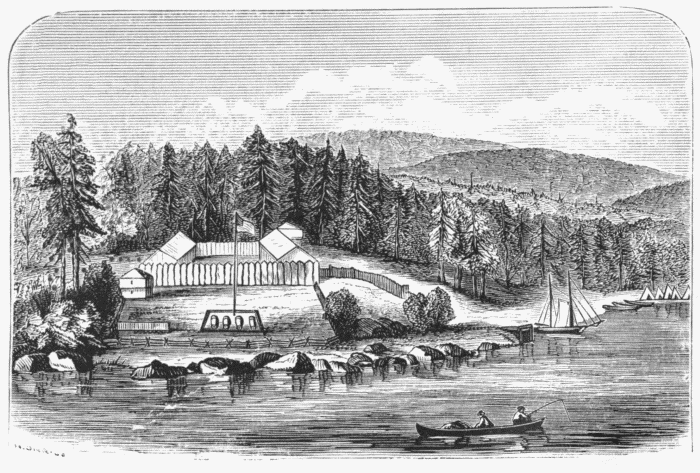 Astoria in 1811