THE JAPANESE DANCE. By Marcelle A.
Hincks. In One Vol., crown 8vo, illustrated. Price
2s. 6d. net.
JAPANESE PLAYS AND PLAYFELLOWS. By
Osman Edwards. With Twelve Coloured Plates by Japanese
Artists. One Vol., demy 8vo. Price 10s. net.
KAKEMONO: Japanese Sketches. By A. Herbage
Edwards. One Vol., crown 8vo. Price 7s. 6d. net.
JAPAN BY THE JAPANESE: a Survey by its
Highest Authorities. By Alfred Stead. One Vol., demy
8vo. Price 20s. net.
A HISTORY OF JAPANESE LITERATURE. By
W. G. Aston. (Literatures of the World Series.) In One
Vol., large crown 8vo. Price 6s.
IN JAPAN: Pilgrimages to the Shrines of Art. By
Gaston Migeon. Translated by Florence Simmonds.
In One Vol., crown 8vo, illustrated. Price 6s. net.
LONDON: WILLIAM HEINEMANN 21 Bedford Street, W.C.
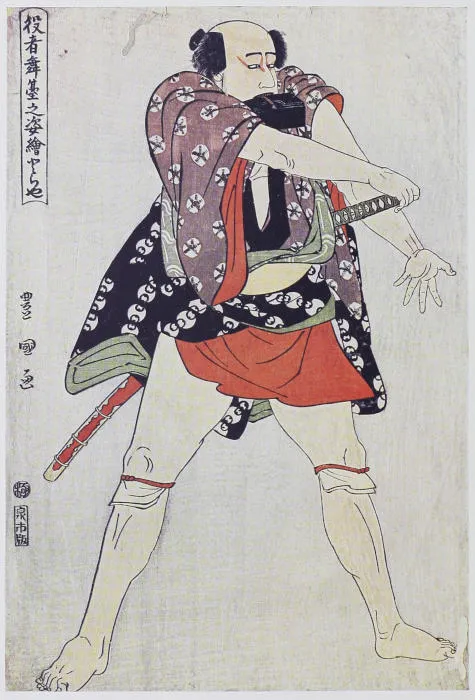
TOYÓKUNI
THE ACTOR TORAYA HOLDING A LETTER-BOX IN HIS TEETH
British Museum
A HISTORY OF JAPANESE
COLOUR-PRINTS
BY W. von SEIDLITZ
WITH ILLUSTRATIONS IN COLOUR AND BLACK AND WHITE
LONDON
WILLIAM HEINEMANN
MCMX
Copyright, London 1910, by William Heinemann
PREFACE
The first comprehensive survey of Japanese Wood-Engraving,
Anderson’s monograph in the Portfolio, appeared in 1895. The
first attempt to write a history of this art was Strange’s
totally inadequate Japanese Illustration of 1897. Unfortunately,
Strange had published before he was able to take advantage
of the new light thrown upon his subject by Fenollosa, in his
illuminating Catalogue of 1896, The Masters of Ukiyoye. The
only remaining sources of information for the student were a
number of scattered articles, monographs, exhibition catalogues,
and sale catalogues, and it seemed to me that I might do a
useful work by gathering together all this disjointed learning
into a coherent whole. Japanese art has become an element in
our European culture; it supplies certain needs of our age, and
makes distinctly for its progress. But in order to appreciate
Japanese Wood-Engraving to the full, we must know the interrelation
between the various artists, and the successive stages of
development in their art; we also require a criterion by which to
test individual essays, that we may not rest content with weak
and imitative work when the best is within reach. A survey of
Japanese Wood-Engraving which would serve these ends was
the task I accordingly set before me.
In any appreciation of Japanese art, everything depends on
the standpoint adopted by the critic. If, as the majority of
writers on this subject have been wont to do, we apply the
European standard, we shall be led to hail the impressionistic
artists of the nineteenth century, and notably Hokusai, as the
protagonists of Japanese Wood-Engraving, for we are naturally
affected by the affinities we discern between our own ideals and
those of these artists, in whom the European leaven had begun
to work. If, however, we try, like Fenollosa, to take the
Japanese point of view, we shall recognise that Hokusai’s real
greatness lies in those very elements of his art which are most
alien to us; and we shall see, further, that among the innumerable
masters of the eighteenth century, there were many who
were greatly superior to him. The art of the nineteenth
century, with which alone the general public is to some extent
familiar, has been given an importance far in excess of its
deserts. It was at best an aftermath, and in some respects a
decadence. I have therefore dealt with it somewhat summarily,
whereas I have traced the developments of the eighteenth
century, constituting a rich, a steady and a varied evolution,
with all possible care and elaboration. My book is a provisional
essay in the synthetic presentment of our knowledge of Japanese
Colour-Printing, and a guide for those who require some direction
in this, as yet by no means familiar field. I have made
no attempt at exhaustive treatment, for any such a scheme
would be impossible of execution, in the face of the contradictions
which abound in the literature bearing on my
subject in different countries. The collector must not look
here for a treatise which will relieve him from the necessity of
independent research or verification. Certain inequalities of
the work may be explained by its genesis. Where the material
on which I had to work was better prepared, as, for instance,
in the case of Utamaro and Hokusai by the Goncourts, I was
of course able to offer more. I have not shrunk from repetition
on occasion, when it seemed necessary to emphasise notable facts
or to impress important views on the reader. With few exceptions,
I have relied upon Fenollosa’s Catalogue in describing
the development of Japanese Colour-Printing, and the characteristics
of the individual artists. I trust I have in every instance
rightly interpreted the opinions of this distinguished expert.
Though it has been my earnest endeavour to keep the Japanese
ideal in view, many may still object that the criticisms of artists
such as Kiyonaga, Sharaku, and Hokusai are over-European in
sentiment. In cases where there were materials for comparative
judgment, and where it seemed likely to be fruitful of results,
I have not hesitated to apply our own divergent standard
occasionally.
My thanks are due to all who have helped me either in
practical matters or with their advice, and in the first place
to Messrs. Vever, Koechlin, Bing, and Gillot of Paris, Koepping,
Liebermann, and Pächter of Berlin, and Oeder of Düsseldorf,
who most kindly gave me leave to reproduce prints in their
collections. Others to whom I am indebted are Messrs.
Migeon of Paris, and Brinckmann of Hamburg, who supplied
me with many valuable notes; and last, but not least, Mr.
Shinkichi Hara, who was good enough to read through my
text, to give me many precious hints and explanations relating
to the prints, and briefly, to make this edition, imperfect
though it may be, both more correct and more informing
than its predecessor. The publishers of the English version
of this work also owe acknowledgments to Mr. J. V. Scholderer
of the British Museum for revision of the translation, and
to Mr. Laurence Binyon for helpful suggestions in connection
therewith.
CONTENTS
LIST OF ILLUSTRATIONS
IN COLOUR
TOYOKUNI: The Actor Toraya holding a Letter-box
in his Teeth
Transcriber’s Note: The errata have been corrected.
CHAPTER I GENERAL CONSIDERATIONS
1. Character of Japanese Painting—2. Technique—3. The
Opening Up of Japan
1. Character of Japanese Painting.—Japanese painting,
like its parent art, Chinese painting, differs from modern
European painting in this, that it deliberately foregoes all
means of producing an immediate illusion. It knows nothing
of the third dimension, but confines itself to decorative effects
in one plane; at the same time the extraordinarily developed
powers of observation in the Japanese enable it to convey an
unusual amount of life and spirit.[1]
With the Japanese space is not indicated by receding degrees
of depth, and if represented at all, at least in the best period of
their art, is not subject to the laws of a strict perspective, being
merely indicated by a series of scenes, as on the stage. Men
and objects in space are not rounded, and cast no shadows;
shadows so cast being, according to the Chinese doctrine, something
accidental and not worthy of representation at all.
Objects do not throw back the sunlight in the form of high
lights, nor do they reflect other objects in their neighbourhood;
this is most conspicuous in the case of water, which shows
neither reflections nor high lights. Hence anything in the
nature of chiaroscuro, a homogeneous scheme of light altering
all the colour-values in a certain direction, is out of the question,
whether in representations of interiors or the open air. Moreover,
the proportions of the figures are usually quite arbitrary,
partly because of insufficient attention to this point, partly from
deliberate purpose.
The immobility of the features is to be explained by the
peculiar Japanese notion of decorum, which insists on a
constantly equable seriousness of expression, one result being
that the women have their eyebrows shaved off, their lips
painted blue-red (with beni), and their faces thickly covered
with powder—as is not unknown in Europe. But the bodies
also generally appear in a state of repose bordering on rigidity;
a slight flexure—to which the loosely flowing robes yield
without effort—a scarcely noticeable inclination must suffice
to express the character and psychology of the person represented:
even in daily life the exchange of emotions leads to
no bodily contact; hand-shaking is entirely unknown, kissing is
not customary, any more than walking arm-in-arm. Even the
dances of the Japanese offer few occasions for livelier movement;
in general they are confined to pantomime, suggesting the
emotions to be conveyed by the posture of the body, the movement
of legs and hands, and especially by the expression of the
eye. Hence there are few opportunities for foreshortening
and overlapping.
To be sure, since the end of the eighteenth century some
artists had begun to break through these rules, and endeavoured
to apply the notions of perspective which they learnt from Europe,
to give greater depth and unity to the landscape and greater
expressiveness to the figures, and indeed certain masters of earlier
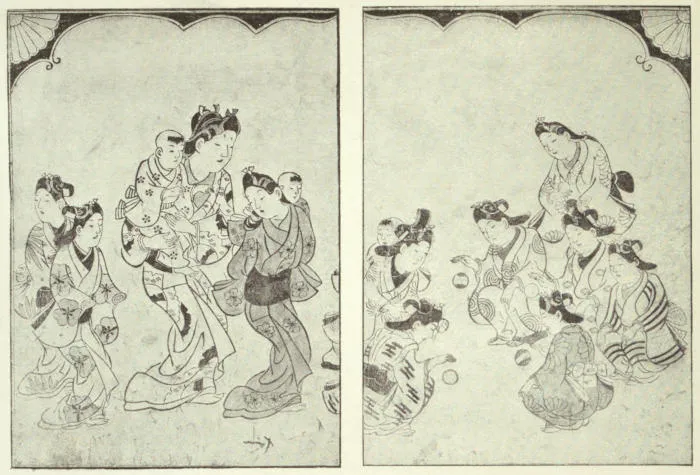
periods, the book-illustrators Moronobu, Sukenobu, Shigemasa,
had produced designs remarkable for movement and animation.
But all of them adhered to certain significant characteristics,
notably the absence of shadows and modelling, so that the
whole of Japanese art, even down to its most recent past,
remains in its principles fundamentally opposed to modern
European art.
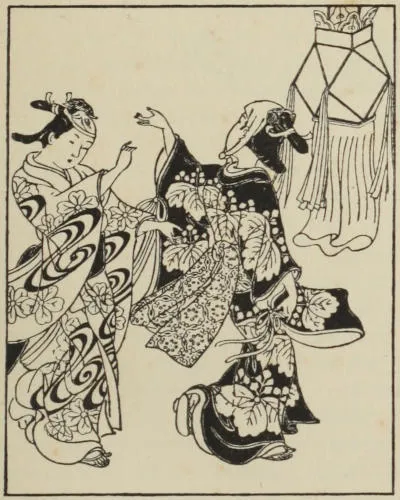
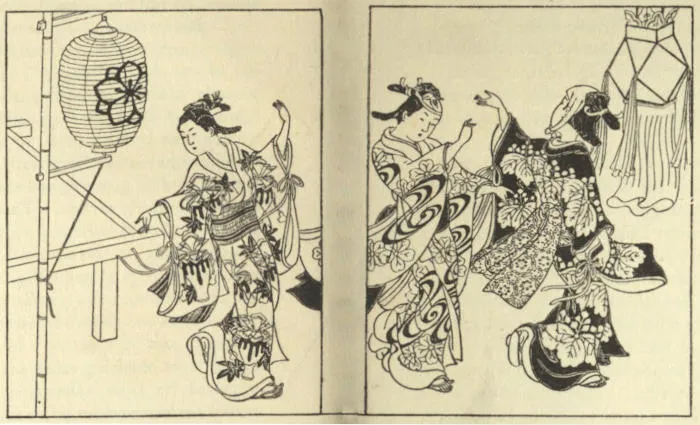
MORONOBU: Two Court Ladies, an old one to the
Right, a young one to the Left. Book illustration.
Gillot Collection, Paris
In order to do justice to this peculiarity of Eastern Asiatic
art, we must mentally revert to the point of view of such periods
as have pursued similar decorative aims in contrast to the
naturalistic aims predominating to-day. In the art of Egypt
and of Greece up to Alexandrine times, in the Roman and
Gothic periods up to the discovery of perspective in Italy and
the invention of oil-painting in Flanders at the beginning of
the fifteenth century, we meet with very similar endeavours.
During all these periods the art of painting was absolutely conventional,
and contented itself with certain more or less fixed types
that altered only very gradually; yet by the aid of a careful and
precise contour, nicely calculated masses of light and shade, and
a harmonious colour-scheme, it succeeded in achieving effects at
once decorative and monumental, and at the same time in imparting
to the representation a varying content of strength,
grace, or sublimity, according to the character of the subject.
By this method no imitation of nature, no complete deception
or illusion is either endeavoured or attained; and yet such an
art ranks at least as high in our estimation as that of the
realistic period in which we ourselves are living; not only so,
but we see that the greatest artists of this very period, a Raphael,
a Michaelangelo, a Da Vinci, when they were brought face to
face with the highest problems of decorative art, sacrificed a
great part of the literal truth which they might have attained
in order to augment the grandeur, intelligibility, and impressiveness
of their creations, thus approaching once more the
simpler ideal of the past, though unable to achieve quite the
same effects as the ancients.
The attempt has been made to account for the idiosyncrasy
of Eastern Asiatic art on technical grounds inherent in the
nature of the country, such as the flimsy construction of the
houses, which are small and offer no solid wall-space for truly
monumental painting to develop on, or the exclusive use of
such elementary media as water-colour and Indian ink—or the
position in which the artist works, according to the custom of
the country, squatting on the ground and having his painting
surface spread out horizontally before him; the consequence
being that he only gets, as it were, a bird’s-eye view of his
picture, and that in the case of the usual long rolls, he can
never overlook it as a whole, any more than the spectator can,
who inspects the pictures in the same attitude. Now it is
quite true that oil-painting, which might easily have brought
about a revolution, as it did in Europe, remained unknown to
the Eastern Asiatics. Again, had not the volcanic soil, which
a succession of earthquakes keeps constantly trembling, prevented
the erection of solid masonry, Japanese painting would
probably have witnessed a more varied development. But its
general character, tendency, and aims would have remained the
same; the similarity of earlier developments in Europe and
the adjacent countries proves it. National peculiarities of soil
and custom may give rise to local variations, but cannot determine
an art in its essence; for its roots lie in the national character,
which creates its means of representation and technique
according to its innate ideals, but conversely will not allow
the main tendencies of its art to be determined by external
factors.
The imitation of Nature is for the Japanese only a means to
an end, not an end in itself. Mere virtuosity in this line does
not move them to admiration; were it otherwise, we need only
consider their renderings of birds, fishes, insects, and flowers to
be sure that, with their splendid powers of observation, they
might have achieved far more than they actually have done in
this direction. On the contrary, Nature in their eyes merely
furnishes forth the material from which the artist draws whatever
he may require for the embodiment of his personal ideals
and individual tastes. On these elements he works quite
arbitrarily and with absolute freedom; for painting, after the
Chinese precedent, is not regarded as a technical accomplishment
or a craft, but ranks on precisely the same level as calligraphy,
which is a liberal art and a pastime for people of rank and
culture, far more dependent upon purity of feeling, sublimity
of conception, exquisiteness of taste, in short, on individual
creative power, than on any mere technical dexterity or skill.
This estimate of painting as the peer of calligraphy explains
not only the decorative character of Japanese art, the strict
formalism of its style, the great importance which it attaches
to the balance of light and dark masses, the subordination
of colour to purely decorative ends, but also the wonderful
freedom which Japanese art has always managed to retain in
spite of its tendency to formalism. For the essence of calligraphy
consists, according to Chinese ideas, by no means in mere
neatness and regularity of execution, which might easily lead to
stiffness and frigidity, but primarily in the most perfect solution
of the artistic problem consistent with the greatest economy
of means. The fundamental idea, in fact, here as in all the
rhythmic arts, poetry, music, architecture, is that of play. The
Japanese deliberately refrains from saying all that he has to say,
from giving full plasticity to his figures or depth and breadth to his
spaces, from breaking up and balancing his masses by symmetrical
division or repetition; all this would merely draw him away
from his goal and fetter the free activity of his imagination.
All his efforts are directed towards restricting himself to what
is essential to his purpose, employing natural forms in the full
freedom and variety of their organic growth, making his contour
lines as simple and expressive as possible (Madsen thinks
he recognises the Japanese norm of beauty in the S-line) and
striking an individual note in his choice of colours. As the
objects to be represented are simple and the deficiency in means
of realistic representation is skilfully made good by specially
calculated effects of colour and technique, the conventionalism
of this art, which works by mere suggestion, is very much less
noticeable than in the productions of other peoples that are still
on a low level of development.
To what extent all this is the result of conscious intention
and design is well shown by the utterances of two Japanese
who express the national sentiments on this subject. The first,
Shuzan, wrote as follows in the year 1777:[2] “Among the various
kinds of painting there is one which is called the naturalistic, in
which it is thought proper to represent flowers, grasses, fishes,
insects, &c., exactly as they appear in Nature. This is a special
style and certainly not one to be despised; but since it only aims
at showing the forms of things, without regard for the canons
of art, it is after all merely a commonplace and can lay no claim
to good taste. In the works of former ages the study of the
art of outline and of the laws of taste was held in honour,
without any exact imitation of the forms of Nature.” The
other authority, Motoori, the most eminent scholar and writer
of modern Japan, says:[3] “Many kinds of style are now in
vogue which profess to be imitations of the Chinese, and the
representatives of which make a point of painting every object
in exact accordance with Nature. This I conceive to be the so-called
‘realistic’ art. Now I make no question but that this
principle is in itself excellent; but at the same time there is
bound to be a certain difference between real objects and their
pictorial presentation.” He then enters more minutely into the
difference between the Chinese and the Japanese points of view,
and proceeds to set forth how the Chinese are realistic and ugly,
how their landscapes are ill designed, sketchy where minute
elaboration is called for, but overloaded with detail where a
broad treatment would have been better—further, how their
birds and insects do not look as though they flew or crawled,
how their leaves and trees are not outlined—at least, since
there exists no such dividing line between the object and its
background in the real world he presumes that they will
endeavour to imitate Nature by leaving out these lines. In
conclusion he declares himself a strong supporter of Japanese
conventionalism.
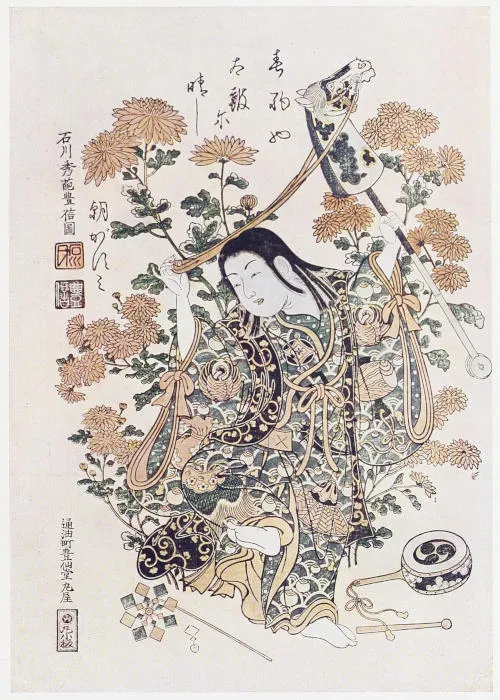
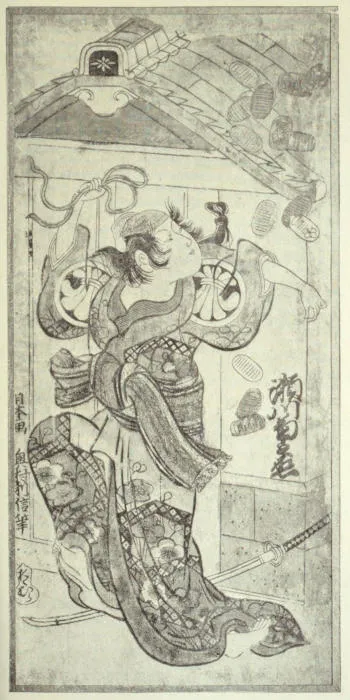
TOYONÓBU
BOY DANCING WITH A HOBBY-HORSE
(Two-colour print)
British Museum
This is not the place to go into the exact nature of Japanese
taste, for this only shows itself in its sharpest definition during
the classic period of Japanese painting, which preceded the
eighteenth century, the era of wood-engraving. It is the art
of the nineteenth century alone which has influenced the most
recent developments of European art and modified European
taste, although for the Japanese it represents no more than a
last phase, a second and less vigorous flowering, however new
and subtle its manifestations. It will therefore be sufficient to
confine our attention to its formal qualities—the decorative
character of its design and its impressionistic point of view.
In these qualities lay predisposed the elements which
Europe, during centuries of development along realistic lines,
had almost entirely lost sight of. Only a return to the fresh
and ever vivid hues of Nature could rescue us from the drab
monotony of factitious monochrome; only a resumption of
consciously decorative aims in design could rescue us from a
method of figure-drawing whose results had as little distinction
or individuality as a photographer’s pose. Pioneers like Manet,
Degas, Böcklin, and their followers were active in both directions.
So long, however, as European art was still in the stage of
preparation and apprenticeship, the Japanese wood-engravings
could render but very limited services, nay, might even mislead
into an entirely wrong track. To-day, on the other hand, as
the goal of artistic endeavour grows gradually clearer, the time is
at hand when they too may point the right way towards it, and
are no longer in danger of being admired solely for their strange
and exquisite subtlety—a subtlety eloquent of that wide-spreading
deep-seated canker which afflicted eighteenth-century Japan just as
it could have been observed to afflict contemporary Europe.
The differentia of Japanese art is just this, that into perfectly
conventional forms is infused a content constantly fresh-drawn
from Nature. The development of the European poster, which
would be quite unthinkable without Japanese influence, is only
the first step towards a renewal of European painting in all its
branches, and especially of monumental painting. The solution
after which we are reaching has been forming there for
centuries. And, whatever the difference of circumstances,
requirements, and race, the fact remains that Japanese art is far
closer to us than the art of our own past, with which, however
much we may admire its productions, we are completely out
of touch. The transition to genuine Greek art, which after
all is bound to remain our ideal, is easier by far to accomplish
from Japanese art than from the romantic art which still
endeavours to maintain its hegemony over us to-day.
2. Technique.—In considering the importance of the part
which wood-engraving plays in the life of Japan, we must
distinguish sharply between the productions of the decline,
which began about 1840, and those of the preceding 150
years. The later productions, like our sheets of coloured
illustrations, cater for the amusement of the masses: those of
earlier periods, on the other hand, occupy a position midway
between painted pictures and popular illustrations, much like the
woodcuts and copper-plates of the European Renaissance. Here,
as in Europe, the designs for the wood-engravings were supplied
by professional painters, who either actually continued, or at any
rate were fully competent, to follow concurrently their regular
avocation. But little trouble was commonly taken with the
woodcuts intended for illustrative purposes, and the work was
mostly ordinary black-and-white. But to colour-prints, whether
published in book form or as single sheets, the artists devoted
their utmost skill. Had not a considerable value attached to
these productions even at their first appearance, comparatively
large numbers of good copies would not have survived to the
present day.
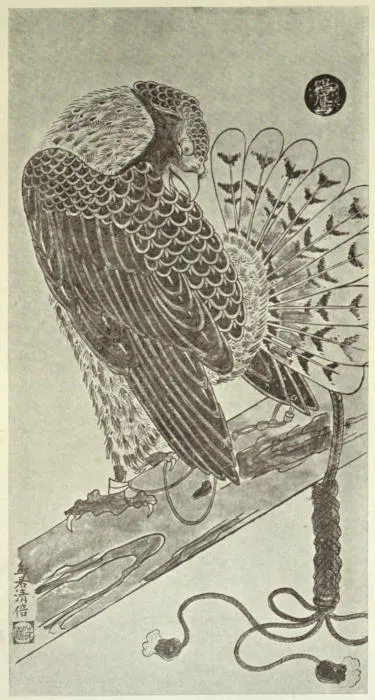
TORII KIYÓMASU: Falcon on Perch. A crested bird with
outspread tail fastened to a bar by a cord, which terminates
below in a heavy twist finished off by two tassels. Kakemono.
Signed: Torii Kiyómasu. Red and yellow predominate.
Doucet Collection, Paris
These woodcuts in fact were, just as in Europe, developed
from the art of book-illustration and were not intended as
a substitute for painted pictures; and to make this quite
clear, it is necessary to indicate briefly the generically different
shape in which Japanese woodcuts and Japanese pictures appear.
Whereas the cuts of the good periods are as a rule approximately
in large or small quarto, the pictures follow the Chinese
model and are designed either (a) as kakemonos, long bands
suspended vertically, or (b) as makimonos, rolls unwrapped
horizontally. In the case of the kakemono, the true picture
of the Far East, the painting itself is usually mounted on a
frame of rich brocade. One, generally, or at most three, of
these pictures are hung on the wall, invariably in the tokonoma
or recess, where the censer, the flower-vase, and the candle-stick
are also to be found as a rule. The picture is changed
from time to time, and on the occasion of a friend’s visit or
the reception of a distinguished stranger the most valuable
and venerable piece in the collection is selected for exhibition.
On the other hand, the long horizontal rolls called makimonos,
which often measure fifteen yards or more, are usually spread
out on the floor to be looked at. Originally they constituted
the manuscript books of the Japanese and Chinese; then
illustrations were added to the text, gradually encroached on
it more and more, and finally ousted the letterpress altogether.
The makimono was the favourite form of picture during the
most brilliant period of the national art of Japan, when the
ancient chivalry shone in full radiance and the Imperial court
was at the height of its magnificence. All these paintings were
executed in water-colours and were kept rolled up in a separate
building (which was also the library), near the dwelling-house.
Painting was also employed for the decoration of screens, fans,
albums, and so forth.[4]
As to the Japanese book, it may be remarked that the extreme
unpretentiousness of its exterior contrasts with that of the European
book; it generally appears in the shape of a thin tract
with a plain limp cover, either as an octavo approaching quarto
size or else as a folio of medium dimensions. The sheets, which
are ready cut to the size of the book, are folded only once,
printed only on one side, and then sewn together with the fold
outwards. The first page of the Japanese book is the last
according to our method; the writing runs down the page in
vertical lines, beginning in the right-hand top corner, and continuing
towards the left margin. The pictures when in oblong
form are continued across the pages of the book as it lies open;
and although each half is enclosed in a border line, the careful
adjustment of the sewing to the inner margin ensures continuity.
Brinckmann points out that the Japanese, unlike many modern
European printers, were never in the bad habit of inserting
oblong pictures vertically in their books.[5]
The methods of producing the woodcuts are very similar
to those formerly in vogue in Europe, the drawing in both cases
remaining in high relief as the remainder of the block is cut
away. Nowadays wood-engraving is usually treated like copper-engraving,
and the lines of the drawing are incised. One essential
difference, however, is this, that the Japanese never draw
directly on the block itself, as was generally the case in Europe,
but always make use of a sheet of thin or transparent paper,
which is then pasted face downwards on the block and furnishes
the model for the wood-cutter to follow.
It has been much disputed whether the great European
masters of wood-engraving, such as Dürer, Holbein, or Cranach,
actually cut their own compositions; but there is now a general
agreement that they did not do so as a general rule. It is true
that a few later artists, e.g. Livens in the Netherlands, and
Gubitz, who revived wood-engraving in Germany, practised the
art of wood-cutting themselves—were in fact, to use the technical
term, “peintres-graveurs”; but they were exceptions. In Japan
not a single artist is known to have done his own cutting. They
confined themselves to supervising and directing the wood-cutters,
who in their turn carried out their employers’ intentions so
skilfully, readily, and intelligently that the technical part of the
process could be entrusted to their hands with perfect security.
Something more must be said about the drawing, in view of
its importance for the quality of the finished product. The
artist conveys it to the paper, not by means of a pen or pencil
as in Europe, but by means of a brush, either in outlines of the
utmost delicacy and precision, to be filled in with colour where
needed, or else in broad masses which receive no further contour,
but on the contrary are the embodiment of the greatest imaginable
freedom of artistic touch.[6] It is not necessary that the whole
picture should be executed in either style throughout; the central
portions may be precisely outlined, while other parts are broadly
sketched in; indeed, this is more or less the general rule in the
case of foliage, landscape background, and patterns on dresses.
The style of precise contours is the traditional style, which was
in vogue from the first beginnings of Japanese painting; the
broader and sketchier manner is peculiar to the popular methods
of representation which have developed since the sixteenth
century. Although the Chinese method of Indian ink washing
and shading has been taken up by many Japanese, even by whole
schools in former centuries, it has very naturally received no
recognition in wood-engraving, to which it is not applicable.
Since the third dimension is never represented in Japanese pictures,
no opportunity offered in xylographic drawings for rendering it
with the brush, which is peculiarly well adapted to such work.
Nor again is the Japanese artist under any temptation to represent
relief by parallel or cross hatching—a process which, as Brinckmann
rightly points out, is no less completely conventional than
any other; only the reason lies not, as he supposes, in the use of
the brush instead of a harder medium, for the Japanese with his
brush can produce far finer and more uniform lines than the
European draughtsman with his implements, as the absolute
purity of Japanese outline conclusively proves. Rather is it the
case that the Japanese has no occasion to employ strokes in this
way. His attention being always concentrated on the decorative
value of this design as a whole, what he principally aims at is,
besides expressive contour, a suitable distribution and co-ordination
of his colour-surfaces, more especially the proportion of
dark, often unbroken black masses to lighter masses. Hatching,
adds Brinckmann, is only found where the nature of the object
to be rendered requires it, as in the case of a horse’s mane, a
tiger’s skin, a peacock’s tail, or the bark of a tree-trunk. To
indicate modelling within the contour of an object treated as
simply black, it is usual to leave white lines within the black
mass.
When the drawing is thus completed on the paper, which
is thin and of very hard surface, and if necessary may be rendered
more transparent by a damp rub over or slight moistening with
oil, it is pasted, as has been said, on the block.
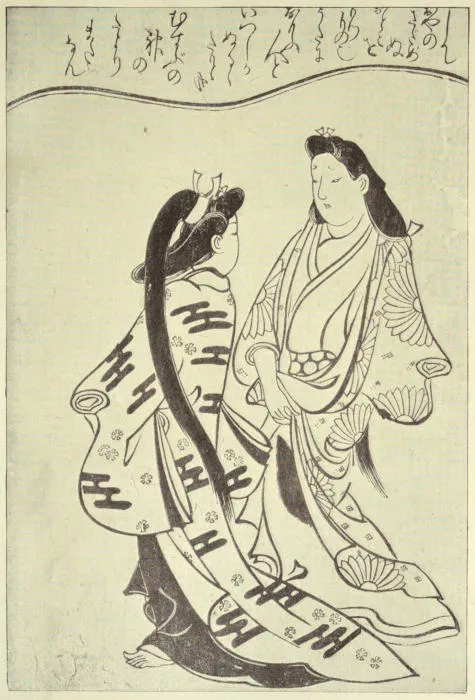
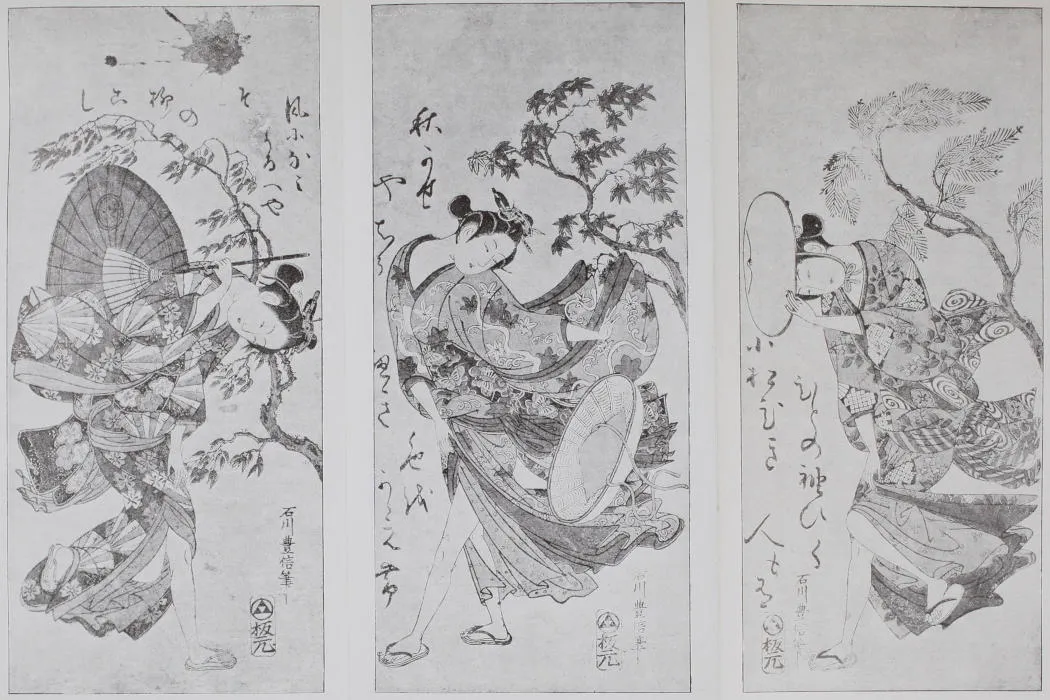
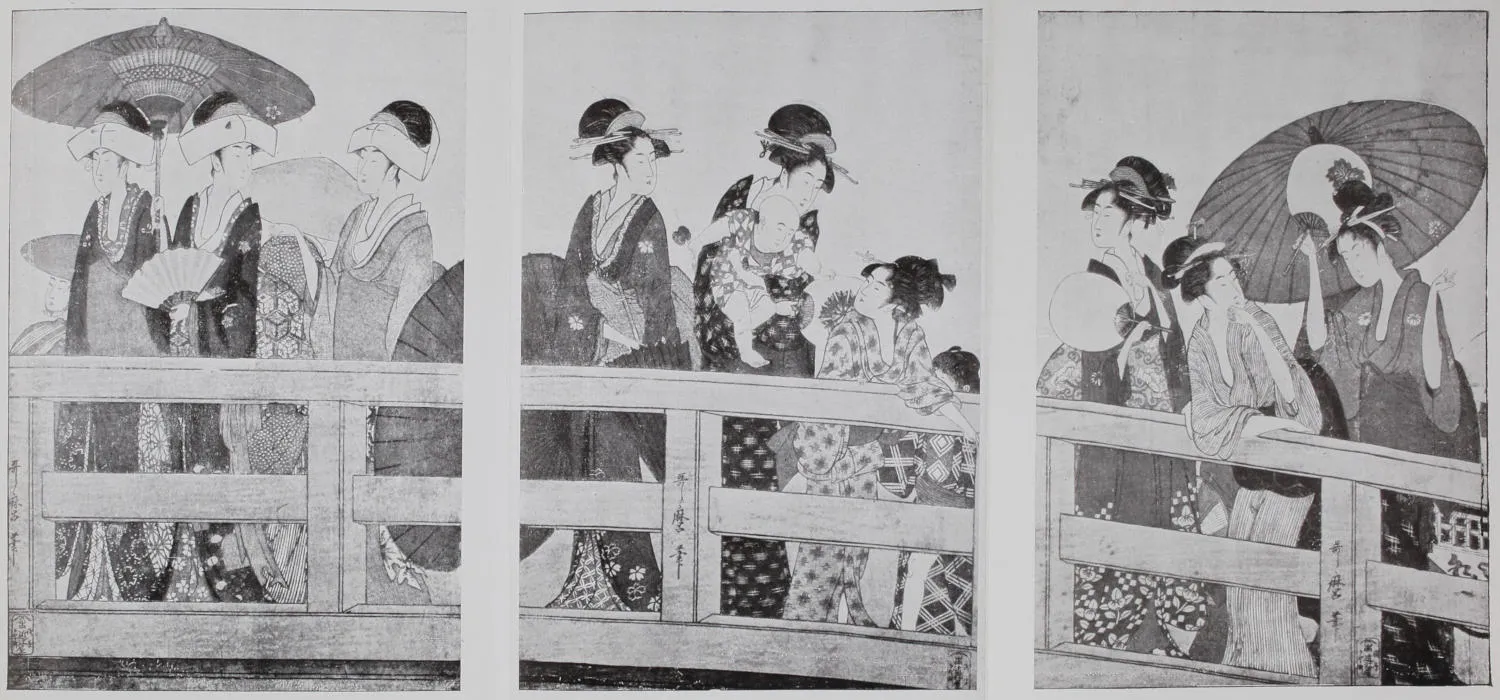
ISHIKAWA TOYONOBU: Three Geishas, representing the Spring Wind (on the right, with pine-branch), the Summer Wind
(on the left, with willow-branch), and the Autumn Wind (centre, with maple-branch). Triptych. Two-colour print in pink and green.
Vever Collection, Paris
The block generally consists of a species of very hard cherry-wood
or else box, and is always cut lengthwise, in the direction
of the grain, and not across it, as in Europe. The cutting
itself is done in this manner: first of all the two edges of the
contour lines are cut along with a knife, and then the superfluous
wood is removed with gouges of various shapes—formerly a
knife was used for this too—so that nothing remains but the
outlines of the drawing in relief. Finally, the fragments of
paper still adhering to the wood are cleaned off and the plate
is ready for printing. The impression itself is always taken off
either with the hand, or else, as formerly in Europe, with a rubber.
This is the secret of its clearness and beauty, as well as of the amazing
fidelity with which it follows the artist’s individual intentions.
Special care is devoted to the selection of the paper, according
to the quantity of colour which it is intended to absorb, and
it is slightly damped before printing. In the case of some
particularly fine old prints it is thick and of loose fibre, so
that the design is deeply impressed on it; it has an ivory tone
and a smooth surface. The colouring matter—always water-colour,
not oil-colour—is mixed with a little rice-paste and
carefully applied to the block with a brush; the paper is then
laid upon the block and the back of it rubbed with the hand or
the rubber. The most varied effects may be attained by varying
the intensity of the colour, the proportion of water added to it,
and the pressure applied to the print.[7]
In the case of colour-prints, the artist takes off as many
copies of the outline-block as he intends to use colour-blocks,
and then further outlines all the parts which are to be printed
in the same colour on one of these copies in turn; these are
then again cut on as many blocks as there are colours, one
being generally put on each side of the same piece of wood,
and occasionally several side by side. The extraordinary development
of this branch of the art is doubtless due to the fact that
the cost of cutting rendered it essential to get the maximum
of effect from a minimum number of blocks. This was more
especially the case immediately after Harunobu in 1765 invented
the colour-print proper with its unlimited number of blocks;
and every artist was continually casting about for fresh expedients
to reduce the number of his blocks, either by the partial superposition
of different-coloured blocks in printing, or by special
combinations of colours designed to modify the surrounding
colours, and so forth. It is by no means always the case that
a sheet is printed from just as many blocks as it has colours; for
the printer has it in his power—indeed, this is the capital function
of his art—to weaken his colours on any part of the block by
rubbing off the pigment or to intensify them by adding more
to it, so as to graduate his tones, or else to fuse one colour
gradually into another and cover, whether simultaneously or
successively, different parts of the block with quite different
colours. The artists of the best period found five or seven
colours sufficient for their needs; but in the case of the
surimonos (see below), which were intended to be unusually
sumptuous, especially at the beginning of the nineteenth century,
the number often rises to twenty or even thirty.
Correct register of the various colour-blocks is secured by
cutting an angle in the lower right-hand corner of the outline-block,
and in the left-hand corner in the same straight line a
slot. These two marks are cut in exactly the same place on
all the other blocks, and in printing the sheets are imposed in
such a way that their lower and right-hand edges fit exactly
against these marks. By this simple device perfect adjustment
of register is almost invariably secured.
Those of us who are only acquainted with modern prints,
with their predominance of aniline red and blue, can form no
conception
of the colours of the fine old prints.[8] Chief among
the reds are a bluish red made from vegetable juice, called beni,
a brick-red oxide of lead, called tan, which has a slight tendency
to become black, and the Chinese cochineal red. The yellow is
generally a light ochre; red ochre was introduced later. The
blue is either carbonate of copper or indigo; the green was
originally light, dark green came in later. Intermediate colours
such as grey, cold brown, and olive green were added in the
course of time. Black has played an important part from the
earliest period down to modern times; at first somewhat
greyish, it afterwards gained full intensity and lustre, and was
much employed in broad masses. Flesh tints are indicated
almost imperceptibly, if at all; but in some prints de luxe,
especially at the end of the eighteenth century, they are brought
out by sprinkling the white ground that relieves them with
finely powdered mother-of-pearl, called mica, which produces
a soft sheen.
There is also a special class of colour-print in which the
second block is employed merely to produce a grey intermediate
tint, a third block being often added for flesh tints. These two-block
and three-block prints, which are very delicate in effect,
are used chiefly in facsimile reproductions of drawings, e.g.
of Hokusai. Wash sketches in broad brushwork and few
colours, like those of Korin, Masayoshi, &c., are reproduced in
the same way, sometimes with blue and red from a second and
third block.[9]
The effect of colour-prints may also be heightened by dry
or blind impressions, which are cut on yet another block and
render the patterns of dresses or stuffs, the details of distant
landscapes, wave lines on water, occasionally the folds of light-coloured
robes. They are seldom absent on carefully executed
prints; Shigenaga is said to have been the first to employ them,
about 1730.
Colour-prints go by the name of nishikiye, i.e. brocade
pictures; the general name for single-sheet prints is ichimaiye.
Three further special kinds must be mentioned here. The
first is the triptychs, consisting of a single design covering
three folio leaves; pentaptychs are not unknown. The second
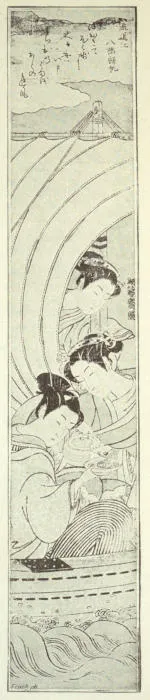
is the long narrow strips which Fenollosa calls kakemonos.
The best masters have been tempted to try their hand at
this species, which at first sight would seem to give scope but
for a single figure, and even that in none but quiet poses. Yet
it has been employed with the happiest results for designs
with two, three, or even more figures, side by side or one
above the other, at rest or in active movement. Thirdly, there
are the square surimonos, which art-lovers sent to each other as
New Year’s greetings, and which also served to convey congratulations
or announcements on other occasions; their get-up
was most luxurious, gold, silver, and various kinds of bronze
toning, a profusion of colours and blind impression were
lavished upon them.[10] Harunobu is said to have been the
first to bring them into fashion, his prints dated 1765 being
doubtless referred to; Hokusai and his pupil Hokkei produced
a number of the very finest. A celebrated example of them is
the series of seven designs by Shuntei, representing the seven
Gods of Good Fortune in the shape of well-favoured and
gorgeously robed ladies; these same seven gods entering harbour
on their ship in the night between the second and third days
of the New Year, is another favourite subject. Brinckmann
has pointed out that two years, 1804 and 1823, are conspicuous
for their large output of finely printed surimonos. The former
was the first year of a cycle of sixty years, according to a system
of computation borrowed from China, the seventy-fourth cycle, to
be precise, and a year of the Rat, in terms of the short notation.
The latter was the twentieth of the same cycle and a year of
the Goat. “The year 1804, a time of general festivity and
the development of Japanese social life in all its brilliance,
witnessed the production of many surimonos, among them the
most characteristic and elaborate of Hokusai. In 1823 competitions
took place for the finest designs in New Year cards;
art clubs and other societies, among them more especially the
‘Society of Flower Hats,’ vied with one another in the invention
of original and elegant surimonos, and gave commissions
to the artists.”
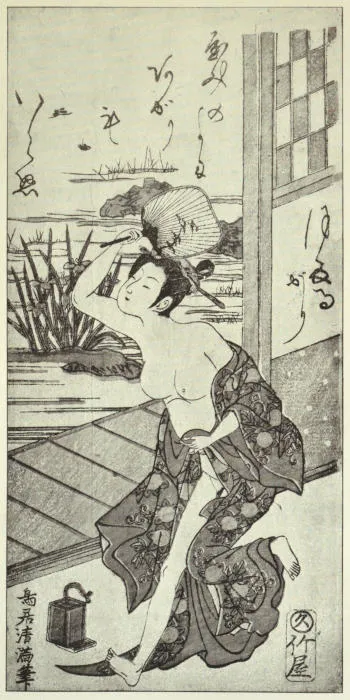
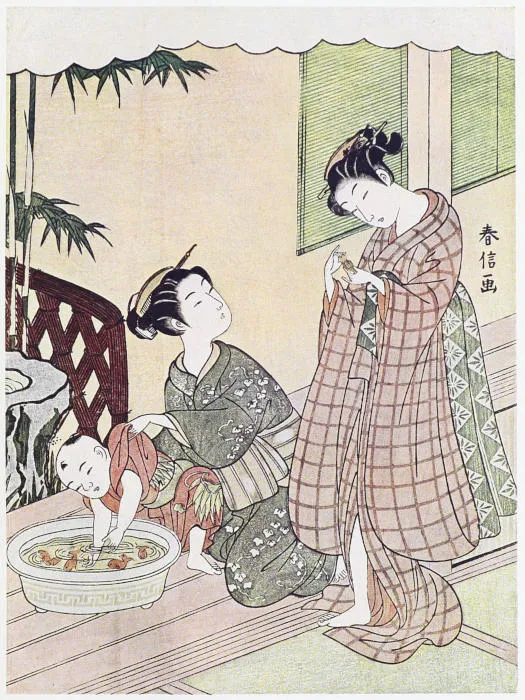
KIYÓMITSU: Young Girl chasing Fireflies after
a Bath. An insect-trap on the floor. In the garden a
pond with irises. Three-colour print in grey, pink, and
yellow.
Vever Collection, Paris
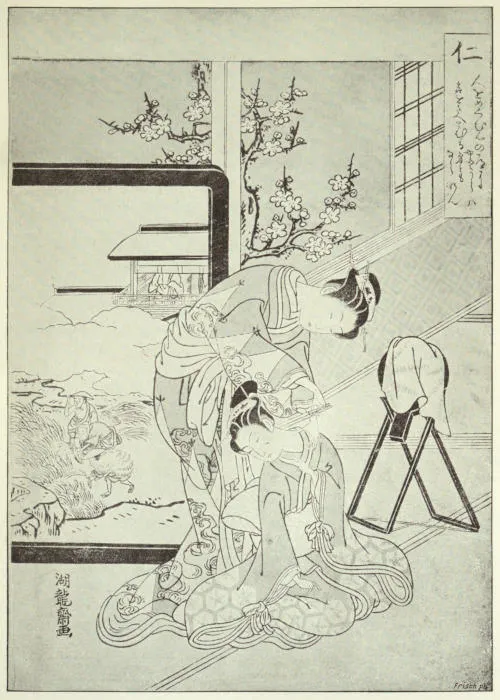
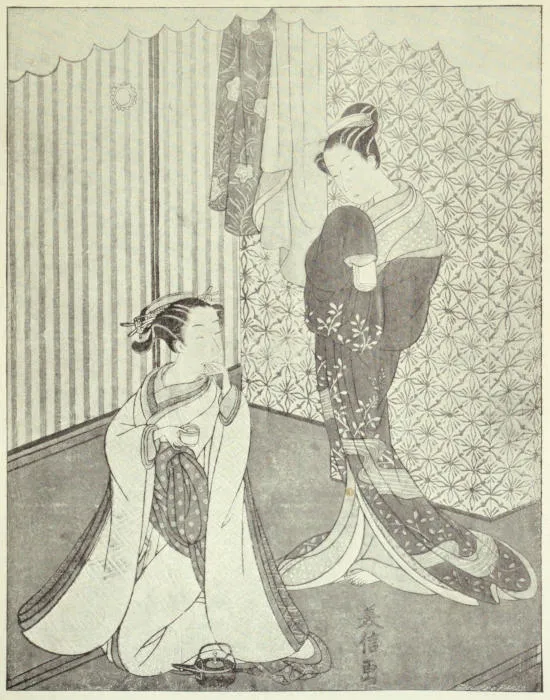
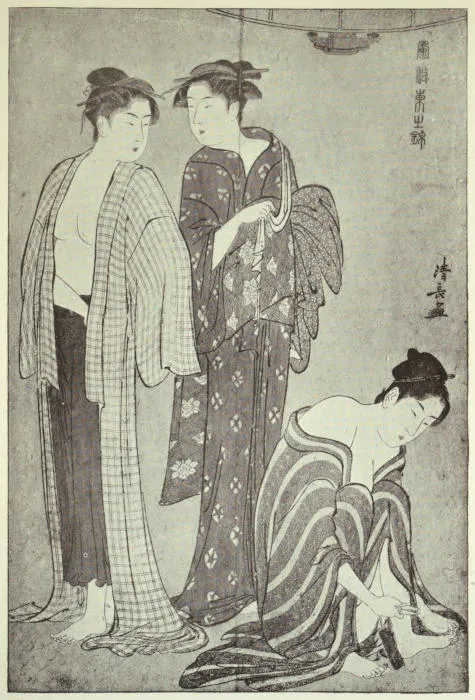
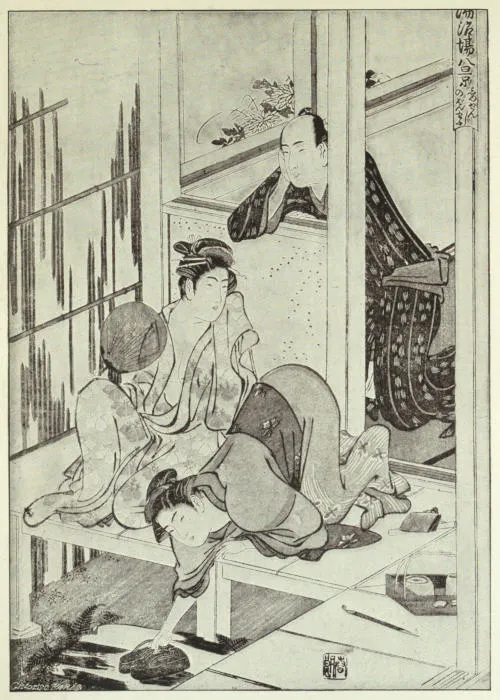
KORIUŠAI: A Lady cutting the Hair from the Nape of her
Younger Sister’s Neck. On the screen a harvest scene, which a
prince watches from his palace window. To the right a mirror on a
stand; behind, a branch of blossom. The first of a series of five plates.
In grey and brown.
Koepping Collection, Berlin
3. The Opening Up of Japan.—Since the coup d’état of
1868 Japan is open to Europeans. Indeed, so great was the
zeal of the Japanese to turn the achievements of European
civilisation to their own profit, that at first they took over in
indiscriminate haste good and bad alike, science and industries
as well as the ugly and the “cheap and nasty,” and were misled
into despising their own best possessions—their national costume
and their national art. It is true that they began remarkably
soon to realise their folly in this respect; still, the interval was
long enough to enable European and American dealers and
collectors to get into their hands a considerable proportion of
the national art-products, and among them particularly colour-prints.
Our knowledge of this branch of art is based upon
collections so formed. Since the Museum of Japanese Art was
founded in Tokio, the ancient Yedo, in the seventies of last
century, and retrospective exhibitions held there have once more
opened the eyes of the Japanese to the merits of their indigenous
art, prices have risen so enormously that scarcely anything of
special value is likely henceforward to leave Japan.
From the time that a Portuguese mariner in 1542 first
touched its shore, Dai Nippon, the “Empire of the Rising
Sun,” with its 3800 islands, which Columbus had set out to
seek and found America in its stead, has always been the object
of European longing, cupidity, and admiration.[11] To this day
the traveller returning from Japan is full of enthusiasm for the
beauty of the landscape, the mildness of the climate—in the
temperate tracts round Yedo there is scarcely a month of snow
and ice—the skill and industry of the men, the charm and
modesty of the women. To be sure, the first European settlers
contrived to make themselves thoroughly detested. The Jesuits,
who landed there in the sixteenth century, formed business
connections, imported guns and tobacco, and made numerous
proselytes. When their behaviour became too imperious, the
natives rose against them; in 1638, 40,000 Christians of Japan
are said to have suffered martyrdom. 1597 was the date of the
first Dutch East India voyage, 1602 that of the foundation of
the Dutch India Company. Relations between the Europeans
and Japan were principally maintained from the island of
Deshima; but soon after, feeling against the foreigners in the
country began to run high. From 1641 onwards Japan remained
accessible only to the Dutch and to the Chinese, and that only
through the port of Nagasaki; from this port were shipped a
special class of goods, notably porcelain, which was manufactured,
specially for export, in immense quantities according to recognised
patterns, particularly in the western province of Hizen,
where Nagasaki is situated. 45,000 pieces of such porcelain
were thus brought to Europe in 1664 on board of eleven Dutch
vessels; and a large trade was similarly done in lacquered
furniture during the seventeenth century. No European, however,
was allowed to enter the country.[12]
The middle of the nineteenth century witnessed radical
changes in this respect. In 1853 a commercial treaty was
concluded with the United States of America, and was followed
by similar treaties with England, France, and Russia. In 1860
the first Japanese embassy embarked for Europe. In 1890 a
constitution was granted to the nation.
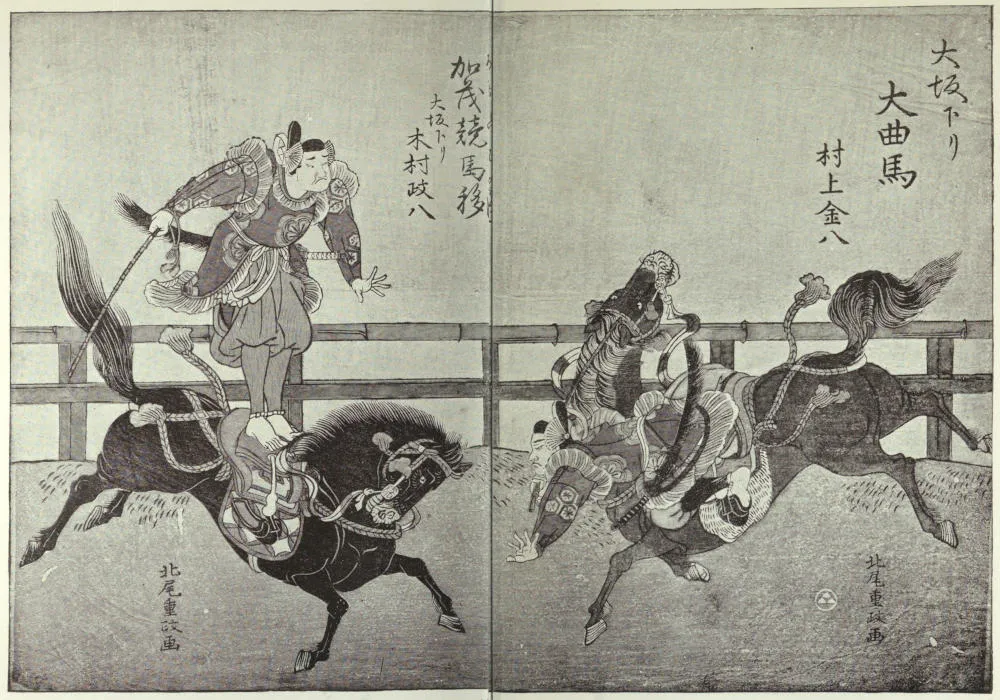
SHIGÉMASA: A Circus Scene in the Open Air. A parody of the
aristocratic races at Kamó (Kioto), hence the court costumes and bearskin
sword-sheaths. Dresses violet and pale pink. Diptych.
Koechlin Collection, Paris
Japanese woodcuts first attained more general recognition
at the Great Exhibition of 1862 in London; the first colour-prints
reached Paris by way of Havre in the same year. Artists
like Stevens, Whistler, Diaz, Fortuny, Legros, who were then
living in Paris, gave them their immediate attention;[13] they were
followed by Manet, Tissot, Fantin Latour, Degas, Carolus Duran,
Monet, and people began collecting the prints. The etchers
Bracquemond and Jacquemart, and Solon of the Sèvres porcelain
works, became the most ardent champions of this latest
discovery in art. Travellers like Cernuschi, Duret, Guimet,
Régamey, returned from Japan and began to sing the praises
of the country and the country’s art. Writers like Goncourt,
Champfleury, Burty, Zola; publishers like Charpentier; craftsmen
like Barbedienne, Christofle, Falize, joined in the movement.
Villot, the former keeper of the Louvre pictures, was
one of the first to found a collection of Japanese woodcuts.
The ground having been so thoroughly prepared, the Paris
Exposition of 1867 became in due course the scene of a decisive
triumph for the art of Japan. Soon afterwards the Parisian
friends of Japan formed themselves into a Société du Jinglar,
which met once a month at a dinner in Sèvres.
Since the revolution of 1868, by which the Mikado’s residence
was transferred from the old inland capital Kioto to
Tokio, till then known as Yedo, on the south coast, formerly
the seat of the Shoguns (the ruling military commanders), and
the feudal lords were gradually abolished, Japan, and consequently
Japanese art, has been entirely open to Europeans.
The recognition of Japanese art was still further advanced by
the Universal Exhibitions of 1873 at Vienna and of 1878 at
Paris, which latter had been organised by Wakaí, a man with a
thorough knowledge of his country’s art.
It was not until the middle of the seventies that a museum
was founded in Japan itself, at Tokio, for collecting the productions
of the ancient art. The first director was Yamataka.
When a second museum was founded in the middle of the
eighties at Nara, Yamataka exchanged his position for the
directorship of Nara, the Tokio Museum being allotted to the
former Director-General of Art and Science, who subsequently
became Viscount Kuki. And when the year 1895 saw the
foundation of a museum in the old imperial city of Kioto, near
Nara, Yamataka took over the superintendence of both together.
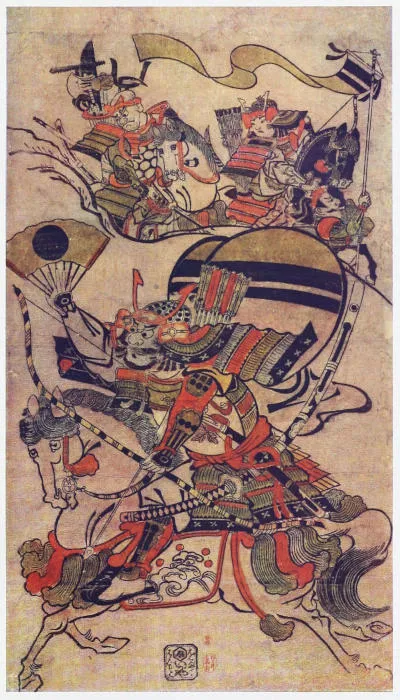
KIYÓNOBU
KUMAGAI NO JIRO AT THE BATTLE OF ICHINOTAMI
(TAN-YÉ)
British Museum
The most important collections formed in Europe are as
follows:[14] Siebold brought home in 1830 his collection of some
800 paintings (kakemonos), which is now preserved at Leyden.
Sir Rutherford Alcock exhibited his collection of wood-engravings
at the London Exhibition of 1862, and John Leighton
delivered an address upon it in the Royal Institution on May 1,
1863; it seems, however, to have consisted principally of works
of the nineteenth century. In 1882 Professor Gierke, of Breslau,
exhibited his collection of paintings, some 200 pieces, in the
Kunstgewerbemuseum at Berlin; this collection was acquired
for the Prussian State, which already possessed, in the Berlin
Print-Room, a small collection of illustrated works formed by
an earlier owner. Professor Gierke was prevented by his death,
which took place in the eighties, from taking in hand the history
of Japanese painting which he had planned. In the same year
(1882) the British Museum acquired, for £3000,[15] a collection
of about 2000 Japanese and Chinese paintings and prints from
Dr. William Anderson, who had been Professor of the Medical
Academy in Tokio. In Paris, where many private collections
of Japanese woodcuts came into being—those of Gonse, Bing,
Vever, Gillot, Manzy, Rouart, Galimart, and latterly of Koechlin
and Count Camondo, deserve special mention—a retrospective
exhibition of Japanese art was organised as early as 1883, and
was followed by a special exhibition of Japanese wood-engravings
in 1890. At the beginning of 1893 a select exhibition of
Hiroshige’s landscapes took place in Durand Ruel’s rooms.
The Oriental department of the Louvre possesses a small
collection of wood-engravings, and so do the Musée Guimet
and the Bibliothèque Nationale (the Duret Collection of illustrated
books). A society of Japanophiles (Japonisants), consisting
of about fifteen members, holds monthly meetings in
Paris. In February 1909 the first exhibition of Japanese wood-engravings
in private possession was held in the Musée des Arts
Décoratifs, and was to be followed by a series of others. In
1888 the Burlington Fine Arts Club organised an exhibition
of Japanese wood-engravings; a Japan Society was founded;
among English private collections that of Edgar Wilson is
specially highly praised. The largest collection, however, is
in the possession of the Museum of Fine Arts in Boston, viz.
some 400 screens, 4000 paintings and 10,000 prints, which were
brought together by Professor Ernest Francisco Fenollosa, who
stayed twelve years in Japan as Imperial Japanese Fine Arts
Commissioner, and many years of whose life were spent in
describing and classifying these treasures. He also possessed
a noteworthy collection of his own. Among other American
collections, those of Charles J. Morse and Fred. W. Gookin
in Chicago and of George W. Vanderbilt in New York may be
mentioned. Mr. Francis Lathrop, of New York, possesses about
170 Kiyonagas. Dr. Bigelow had exhibited a rich collection
of Hokusais in Boston. In Germany there are the collections
of Koepping and Liebermann in Berlin, Stadler in Munich,
Frau Straus-Negbaur in Frankfort-on-the-Main, Jaekel in
Greifswald, Moslé in Leipzig, Oeder in Düsseldorf, Grosse in
Freiburg (Breisgau), and others. The Berlin Print-Room has
already been mentioned; the library of the Berlin Kunstgewerbemuseum
has since then tended more and more to become the
central repository of State collections; the Museum für Kunst
und Gewerbe at Hamburg possesses a number of prints, &c.;
and in the Print-Room at Dresden the foundations of a collection
have been laid.
Hand in hand with this increased interest in and comprehension
of Japanese wood-engraving has gone the development
of the literature on this subject (see the bibliography at the end).
The first detailed and trustworthy information about the history
of Japanese painting, as well as some notes on the history of the
wood-engraving, was supplied by Anderson in his pioneer work,
A History of Japanese Art, published in the Transactions of
the Asiatic Society of Japan, vol. vii. (1879); his work de luxe,
The Pictorial Arts of Japan, in two volumes (1886), and the
Catalogue of his Japanese and Chinese paintings acquired by
the British Museum, which appeared at the same time, further
elaborate the same material, while his Japanese Wood-Engraving,
published in the May number of the Portfolio of 1895,
condense it into a short, popular outline of the history of
Japanese wood-engraving. Professor Gierke followed Anderson
in 1882 with the Catalogue of the exhibition of his collection in
the Berlin Kunstgewerbemuseum, which contained a short but
comprehensive and exhaustive and quite independent survey of
the history of Japanese painting; and in the following year came
Gonse’s L’Art Japonais, a monumental work in two volumes,
the first comprising painting and wood-engraving, in which a
first and not unsuccessful attempt was made to comprehend
Japanese art from the artistic point of view. Gonse’s work was
criticised by Fenollosa in his Review of the Chapter on Painting
in Gonse’s “L’Art Japonais” (published first at Yokohama,
then at Boston in 1885), and his energetic repudiation of
Gonse’s (the current) gross over-estimate of Hokusai’s importance
in Japanese art was doubtless very well justified; at the
same time Fenollosa was bound to admit that Gonse had succeeded
admirably in making clear to his readers the genius of
Korin, an artist whose qualities are by no means obvious to
Western appreciation. Incidentally Fenollosa’s far wider and
deeper knowledge of both the pictures and the authorities
enabled him to contribute a most stimulating survey of the
chief points of view from which the development of Japanese
painting is to be judged. In 1885 appeared a little book,
entitled Japansk Malerkunst, by the Danish artist Madsen
(pronounced Massen). The language in which it is written
has unfortunately prevented it from attaining anything approaching
the publicity which it deserves for its thoroughness, its esprit,
its genuinely artistic feeling, and its fascinating style. Even now
a translation of it would constitute the best possible introduction
to the genius of Japanese art.
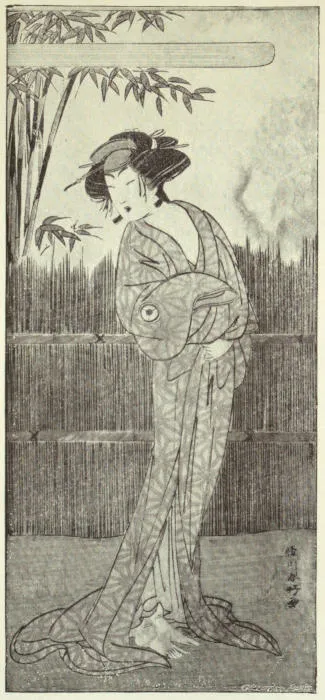
SHUNKI: An Actor in a Female Part.
Bamboos behind the rice-straw fence.
Koechlin Collection, Paris
In 1889 a new generation appeared on the scene, which began
to extend the province thus lately thrown open by painstaking
researches on single points. Brinckmann in Hamburg published
the first volume of his work on the Arts and Crafts of
Japan, in which he offered a complete survey of the history of
Japanese painting and wood-engraving, but still evinced a tendency
to take his stand beside Gonse rather than Fenollosa, particularly
in his over-estimate of Hokusai. Bing in Paris laboured
zealously to familiarise the widest circles with Japanese art
through his Japon Artistique, a splendidly got-up production,
which appeared in three languages, French, German, and English,
and by its excellent illustrations made possible a profound
insight into the Japanese point of view. The series of reproductions
entitled Kokkwa, which has been publishing at Tokio
since 1890, attains a much smaller circulation, in spite of being
far more magnificent still. The catalogues of the Paris Loan-Exhibition
in the École des Beaux-Arts, 1890 (with an introduction
by Bing), and of the Burty Collection, 1891 (with an
introduction by Leroux), competently initiated the collectors
of Paris into the province of the wood-engravings, hitherto
unknown to all but a few. In 1891 Goncourt published his
book on Utamaro, the first monograph devoted to a Japanese
artist, and followed it up in 1896 by his book on Hokusai,
which provoked a good deal of recrimination, as it was based on
materials which a Japanese had originally collected on commission
for Bing, but fraudulently disposed of a second time,
whereby Bing was anticipated by Goncourt and prevented from
carrying out his plan of publishing a monograph on Hokusai.
Muther’s widely read Geschichte der Malerei im XIX. Jahrhundert
contributed its share to popularising the Japanese
wood-engraving in Germany, but, owing to the shortness of the
chapter in question and the smallness of the reproductions, could
convey no more than a very general notion of the subject.
A better result was achieved by Anderson’s popular work on
Japanese Wood-Engraving (Portfolio, 1895), with its very serviceable
illustrations.
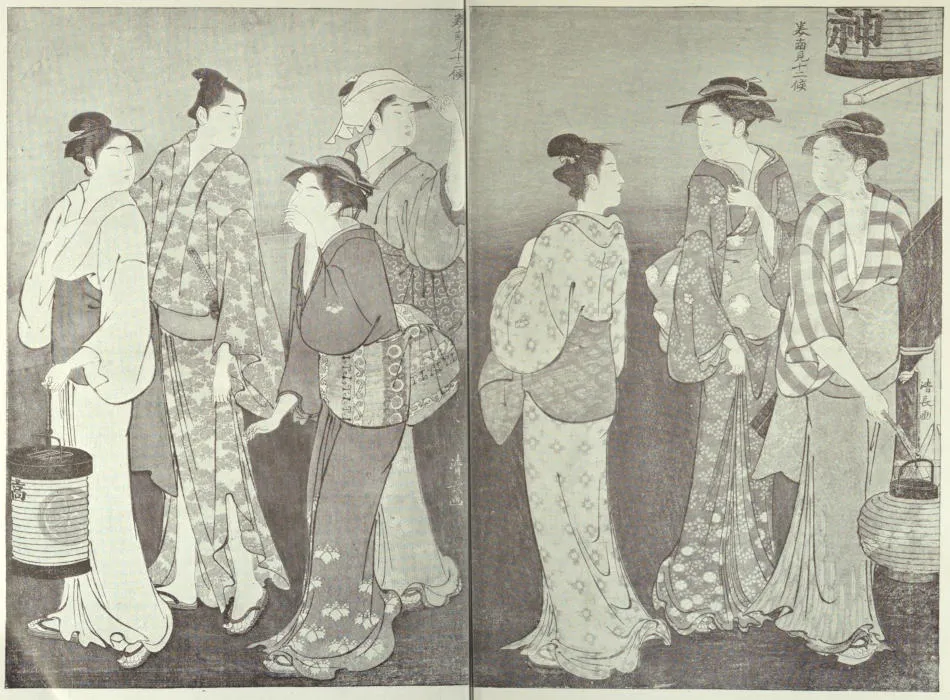
KIYÓNAGA: A Street Scene at Night. On the left a
young man is conducted from the tea-house to the oira-house. On
the right a singer and an attendant carrying her šhamižen.
Part of a triptych, the right side of which is missing.
Vever Collection, Paris
Finally, the beginning of the year 1896 saw the knowledge
of Japanese wood-engraving enter on a fresh and presumably
final phase by the publication of Fenollosa’s exhaustive Catalogue
of the “Masters of Ukiyoye” Exhibition in New York, a
work which combines full mastery of the materials with artistic
freedom, vigour of style, and the minutest penetration into
every detail. This catalogue, which expressly excludes all
historical information, comprises a description of some 400
selected wood-engravings, arranged in their presumable chronological
order, together with some fifty paintings by the same
artists, which are inserted in this scheme of development; it
determines in effect—what no one had hitherto succeeded in
doing—the time-limits within which each artist worked, the
changes which the style of each underwent, and lastly, based
on these special investigations, the main periods in the development
of Japanese wood-engraving as a whole from about 1675
to 1850. All this is set down with such convincing lucidity
that for the future nothing more than corrections of minor
detail need be looked for; the history of Japanese wood-engraving
in all its ramifications stands so compactly built up that
we might think ourselves fortunate if we had an equally good
foundation for even a single period of European art-history—in
which connection it must be remembered that Fenollosa deals
not with a small group of artists, but with hundreds, even
ignoring as he does the multitude of quite insignificant wood-engravers
who flourished in the nineteenth century. All this
mass is here, as all competent art-history requires, already so
sifted and arranged that only the comparatively small band of
choice and leading spirits stand out above the rank and file.
The confidence with which Fenollosa dates each sheet in his
catalogue within the limits of a single year may seem surprising;
but we must take into consideration—as he himself remarks
and is bound to remark as an experienced investigator—that
the date in each case is only approximate, since there is no such
thing as absolute certainty in things artistic, however fully a
man may be convinced that his opinion is correct. Moreover,
these exact dates have not been arrived at, as might at first
appear to be the case, simply by comparing the styles of the
various sheets; Fenollosa must surely have taken the traditional
dates of the various artists into consideration—no small assistance,
as it happens, since fortunately most Japanese woodcuts
are signed with the artist’s name, while the certainly dated
sheets are too few in number—in the eighteenth century, the
best period, e.g., some of the years 1743 (Shigenaga), 1765
(Harunobu), 1783 (Kiyonaga), 1795 (Utamaro)—to give us
a precise chronology by their help alone. It is true that the
styles of coiffure, to which Fenollosa rightly attaches great
weight, constitute a very material aid to the exact dating of
individual prints; but how, we may ask, can he know what the
fashion of any particular year may have been, for purely stylistic
considerations cannot, as has been shown, have given him the
required information? We know of no such thing in Japan as
a fashion paper, no chronicle of the yearly changes of taste such
as we have in Europe. There does, however, exist one source
of information, a source from which Fenollosa, as he himself
states, has drawn lavishly, by which all mutations of dress and
especially of coiffure can be followed up as accurately as need
be. This source is the illustrated books, which are in the
majority of cases dated. They are the basis of Fenollosa’s
powers and the key to the astonishing results of his researches.
If he had included these illustrated books, as he did the paintings,
in the New York Exhibition and his catalogue, their relation
to his whole work would have immediately appeared, and his
results would have become still more instructive and convincing,
since they enable us to trace the changes not merely
of fashions but of style in the individual artists, who as
we know were frequently the same as those who produced the
single sheets.
Fenollosa, unhappily, succumbed to heart-disease in London
on the 21st September 1908, without having had time to write
the exhaustive history of Japanese painting and wood-engraving
which he projected. Besides the works already mentioned he
edited the small but important Catalogue of the exhibition at
Tokio (1898) and published the splendidly got-up work, The
Masters of Ukiyoye.
In 1897 there at last appeared a compendious History of
Japanese Wood-Engraving, by Edward F. Strange, of the staff
of the South Kensington Museum. Although not altogether
devoid of a sense of artistic values, it yet devotes far too much
time to all sorts of unessentials, such as the life-history, the
surnames and the residences of the artists, while in most cases
dismissing their artistic activity with a few general phrases. Its
greatest shortcoming, however, is that it gives a totally false
impression of the development of Japanese wood-engraving,
that it discusses the art of the nineteenth century, of which
alone the author appears to have had an adequate and first-hand
knowledge, in altogether disproportionate detail, to the
neglect of the eighteenth century, which is historically the
most important, while in the nineteenth century there are,
except Hokusai and Hiroshige, very few names that count.
The author has herein shown that he has not approached
his task with the necessary seriousness and love of his
subject, so that there is a suggestion of commercialism about
the whole book which is likely to do the study of Japanese
art more harm than good. Strange had, however, not yet
been able to make use of Fenollosa’s fundamental catalogue
of 1896. He further published a book, Japanese Colour-Prints,
in 1904.
In the same year (1897) the first edition of the present
work was published. In 1900 Duret published a list of
illustrated books which had been acquired for the Print-Room
of the Bibliothèque Nationale. Several sale catalogues
which have appeared since 1902 have advanced our knowledge
of the subject. Since 1904 Perzynski has published
several short but discriminating essays on Japanese wood-engravings.
In 1907 Kurth published a comprehensive work
on Utamaro.
Japanese notices about artists of the older period are contained
in the following works mentioned by Anderson (Catalogue,
p. vii.):—
Honcho-gwashi, 6 vols. 1693.
Mampo-zensho, 14 vols. 1694.
Gwako-seuran, 6 vols. 1740. With a genealogical table of
the artists of the Kano school and reproductions of famous
pictures.
Nineteenth-century Works.
Kun in hosho. 1810.
Kocho meigwashiu, 5 vols. 1818.
Shogwa shuran. 1836.
Gwajo yoriaku, 2 vols. 1850.
Shogwa zensho, 10 vols. About 1862.
Grajin-riaku-nempio. 1882.
Shogwa Kaisui, 3 vols. 1883.
One chief source of information is the Ukiyoye ruiko, which
exists in the British Museum (in a MS. of 1844) and elsewhere,
and which is said to have been afterwards printed as well. The
original draft is said to date from the year 1800, and to have
been gradually supplemented, among others by the painter
Keisai Yeisen, in 1830. The Musée Guimet in Paris intended
to publish, in 1893, a French translation by Kawamura (see
Deshayes, Considérations), but so far nothing seems to have come
of it. It appears from Kurth’s Utamaro that three Japanese
sources, which have been made use of for Barboutau’s Catalogue,
are of special importance, viz.: (a) Mon cho gwa ka jin mei ji
sho, by Kano Hisanobu, 1894, 2 vols.; (b) Nihon bijutsu gwaka
jin meisho den, by Kigushi Bunzan, 1892, 2 vols.; (c) Yoho
ukiyoye ruiko: Tokio, 1889 (new edition, 1901).
CHAPTER II A SURVEY OF THE HISTORY OF JAPANESE PAINTING
Since Japanese wood-engraving grew out of Japanese painting
and represents no more than one stage, though a peculiar
stage, of development of this branch of art, it is necessary to
give a short survey of the history of Japanese painting.
The art of painting, like all the other arts, poetry and
science, found its way to Japan from China, the mother-country
of East-Asiatic culture, through Korea, about the fifth century
after Christ. Until then Japan had been sunk in deep barbarism,
but being a powerful and advancing State she had, in
the third century A.D., exacted tribute from Korea, which was
saturated with Chinese culture. The Japanese received from
Korea, along with other accomplishments and handicrafts, the
art of painting. In the second half of the fifth century
there came to the court of Japan a Chinese painter of imperial
birth, by name Nanriu, who took up his abode there permanently.
We also know of Korean painters of the sixth
and seventh centuries who were employed at the Japanese
court.[16]
These Korean painters introduced not only the Chinese
tradition, but also another, destined to have an equally lasting
influence upon the formation of Japanese painting—namely, the
Buddhistic. This latter, as it seems, originated under late
Greek influences in the north-west of India, and had found its
way to Korea through Central Asia and China. Gonse had
already pointed out that the earliest productions of this
Buddhistic art in Japan are surprisingly like such works as
the ruins of Borobudhur in Java, and especially those of Angkor
in Kambodia, and are accordingly much more Indian than
Chinese in character.[17] Friedrich Hirth has since then traced
for us the probable path which this art-tradition took. The
painter Wai-tschi I-song, whose works served the Koreans as
models for their Buddhistic paintings, came from Khoten in
Central Asia, where the princely court was noted for its love
of art. Presumably the art which had been brought thither
from India he transported to Tschang-an-fu, the capital of
the seventh century, and from there it was propagated farther
to Korea.[18] Buddhism was introduced into Japan in 552 and
became the religion of the establishment in 624. Under the
Emperor Kotoku (645-654) Japan received a constitution after
the Chinese model.
To this Buddhistic, stiffly hieratic painting, there stood
opposed from the start the vivacious, purely secular painting
of the Chinese; but each had its own peculiar justification.
Buddhistic painting, mindful of the mysteries it represented,
always remained solemn and dignified, and occupied itself
with the minutest elaboration and the richest ornamentation,
heightened by the use of gold and brilliant colour. Chinese
painting, on the contrary, being the fashionable pastime of the
cultivated, followed the varying tendencies of the time and
adapted itself to the tastes of different countries, preserving,
however, its fundamental principle, namely, to strive for a bold,
light, sure, and as far as possible individual touch. This
affinity with calligraphy had the effect, not indeed of banishing
colour altogether, but of making its interest for the most part
subordinate, and of laying all the emphasis upon skill in giving
as perfect a picture as possible with a few bold powerful strokes,
that is to say, in getting the utmost effect out of the contrast
of black and white. This economy of means has always remained
the characteristic of Chinese painting.[19]
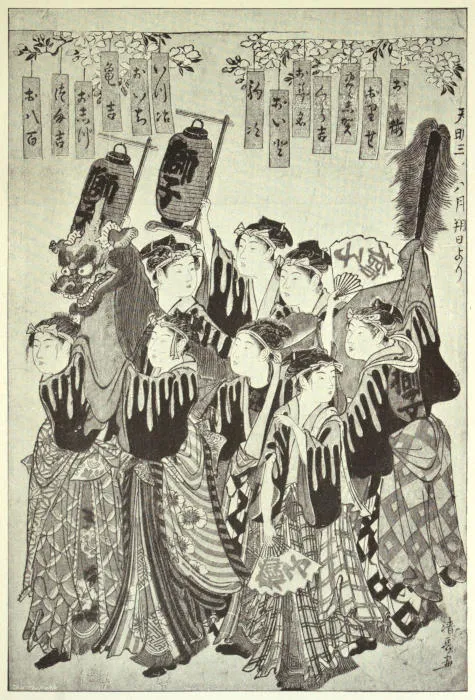
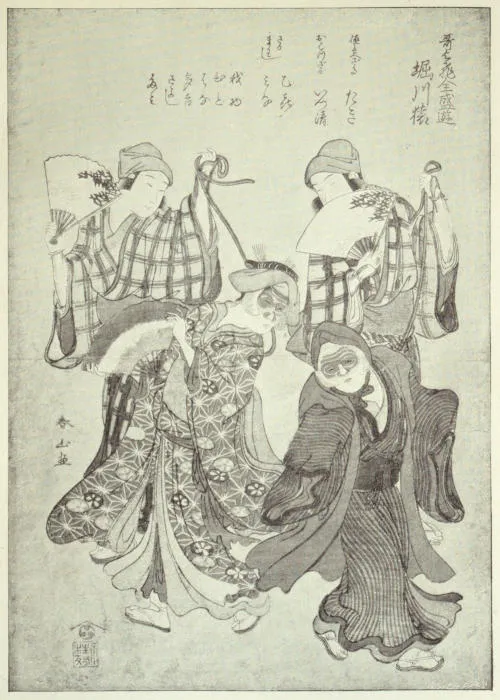
KIYÓNAGA: A Temple Festival. Eight female singers, wearing
black sleeves with a yellow pattern, and a peculiar headdress,
are carrying a lion. Dated 1783. Yellow and pink predominate.
Koechlin Collection, Paris
Although the first Japanese painter of whom we have actual
knowledge, Kanaoka, does not appear until the end of the ninth
century, everything points to the fact that he represents the
culmination of the first great epoch of Japanese art, and not, as
one might suppose, the beginning of real Japanese painting.
For the little that we know of his work and of Japanese art
of the preceding seventh and eighth centuries, especially of
sculpture, bronze and wood-carving, suggests the conclusion
that this young and vigorous nation had rapidly built up an art
of its own, full of power and expression. Although, to begin
with, the forms represented in painting remained at first foreign—Korean,
Chinese, and Buddhistic—the contents of the representation
must have been purely Japanese, corresponding to the
high standard of culture that the country had achieved. Otherwise,
Kanaoka would not have been able to preserve through
all the succeeding ages the fame of having been the greatest
Japanese painter; for it is not possible to attain to such a
height by mere imitation of a foreign art. At the beginning
of the ninth century, Buddhism had already been completely
absorbed into the national point of view, and so was reconciled
to the dominant creed of Shintoism.
To this early period, comprising the seventh and eighth centuries,
which is known as the Nara period (so called after Nara,
then the capital city, with its new High Street and new gates),
belong the following works among others: the well-known full-length
portrait of Prince Shotoku with two boys (Kokkwa, 78),
which is now, however, supposed to be appreciably later; a fresco
of Indian character in the Horiuji Temple; six paintings on a
folding-screen, representing the “Beauties under Trees,” which
are Chinese in style, but already Japanese in feeling. A portrait
of Kobo Daishi, a saint of the early ninth century, by the priest
Gonzo, is also mentioned.
Kose no Kanaoka, as a son of that ninth century which the
powerful China of the Tang dynasty influenced so profoundly,
worked entirely under the spell of the Chinese, and especially
of the Buddhist school. He lived from about 850-890. His
teacher had been a Chinese emigrant named Gokioshi. As
Kanaoka’s chief work are mentioned the pictures of the
Chinese sages, which he copied in 888 from Chinese originals
in the palace of Kioto (whither the capital had been transferred
from Nara in 794). Besides pictures of deities according to
Buddhistic rules, he also painted representations from life, or
from history and tradition, as well as landscapes and animals; it
is reckoned as his principal merit that he enlarged the traditional
scope of representation by including scenes taken from Japanese
history, from heroic legend, and from the lives of celebrated
priests. Gonse had alleged that only four paintings of
Kanaoka’s could still be traced; one of these, a kakemono
belonging to the dealer Wakaí of Tokio, which represents
the Buddhist saint Jizo, is reproduced in his l’Art Japonais
(i. 169). Fenollosa, however, considered two of these pictures
to be certainly of later origin, and the remaining two doubtful;
but he names three others in their stead, which in his view
are to be reckoned among the very grandest creations of
Japanese art, and on the basis of these he defines Kanaoka’s
position by a comparison with that of Phidias in Greek
art.[20] In the Boston Museum are four paintings which are
probably the work of “Shi Ten O” himself, also the copy of
the portrait of a young prince by Kanaoka. The Hayashi
collection (sold by auction in Paris in 1902) contained the
seated figure of the Bodhisattva Jizo, probably that reproduced
by Gonse (v. supra). Binyon[21] reproduces the beautiful full-length
portrait of the minister Sugawara Michizane, which
is pronouncedly Chinese in character.
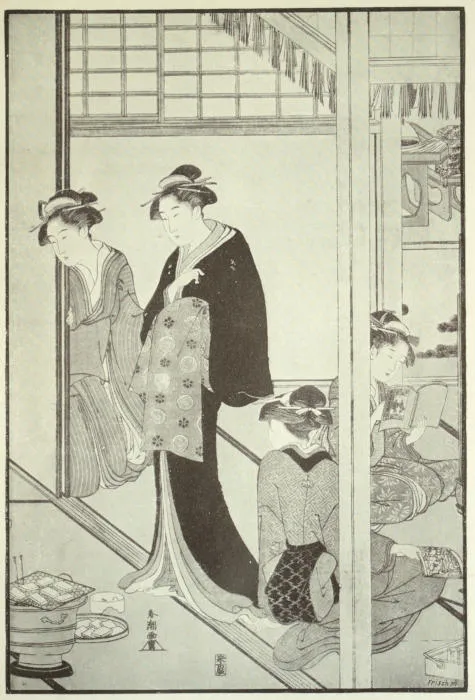
SCHUNCHŌ: Women on New Year’s Day. A lattice of straw and
paper on the porch. In the foreground a brazier, and on it rice-cakes
on a wire griddle. From a polyptych.
R. Wagner, Berlin
But still greater renown than his paintings ever brought him
accrued to Kanaoka as the founder of the first national school
of Japanese painting, the Kose-riu, so called from his family
name. In Japanese a sharp distinction is made between schools
(riu) and styles (ye, sometimes erroneously written e or we).
Schools (riu) arise through the propagation of definite methods of
painting within certain families, which are further strengthened
by the adoption of strangers who assume the name of the clan;
in several cases (dealt with below) they have prolonged their
activity through a series of centuries. Ye (community in style)
is, on the contrary, a quite loose and external connection, corresponding
exactly to our idea of style. Until Kanaoka’s time
there were, as has been said, three styles of painting—the
Chinese (Kara-ye), the Korean (Korai-ye), both of which may be
grouped together, and the Buddhistic (Butsu-ye). Painting was
a refined pastime, indulged in by priestly and noble amateurs.[22]
Kanaoka was the first, in the year 880, to found a school of
professional painters which was at the same time a national
school of painting; its basis was principally Buddhistic, and it
stood under the influence of the Chinese Tang school. As
he himself belonged to the highest nobility, so the aristocratic
character was always preserved in the school or clan of painters
that he founded, the Kose-riu. This holds good for all painters
and schools that arose subsequently until the sixteenth century.
It was not till then that one of the bourgeois succeeded in
winning a name for himself; and it was not until the seventeenth
century that a really popular, or, according to the
Japanese ideas, plebeian school arose, of which the maturest
fruit is that colour-printing to which we are about to give
our attention. Kanaoka’s clan was continued in his son Aimi,
whose son again was Kintada; Hirotaka, Kanaoka’s grandson,
continued the school in the tenth century. To him is ascribed
“The Death of Buddha,” in the British Museum,[23] which is
akin to the style of the Chinese painter Wu Tao Tze, and is
remarkable for its expressiveness.
Although Chinese influence subsequently continued even
down to our own century, at times in fact grew in strength,
still Japanese painting must have retained its independence,
as otherwise it would be inexplicable that at the end of the
tenth century Japanese paintings were presented as a gift to the
Chinese court, where the most exacting standards of taste had
always obtained.[24] The difference between Japanese and Chinese
art methods is brought out by the discerning Le Blanc du
Vernet, in a small work that appeared anonymously, Le Japon
artistique et littéraire (p. 11), where he remarks that, while the
art of the cool and sceptical Chinese was usually methodical,
exact, dainty, and “precious,” that of the Japanese, corresponding
to their character, had become in all respects free, lively, cheerful,
and full of variety. We must emphasise, he says, the fact that
Japanese art did not fall into slavish imitation, but that it
took over from the art of the Celestial empire only experience,
method, and technique, and by applying these to national subjects,
developed an independent style that possessed more elegance,
creative power, mobility, and pliancy than did that of the
“Celestials.” Yeshin Sozu, who died in 1017 at the age of
seventy-six, is mentioned as one of the most remarkable
Buddhistic painters of this period.
KIYÓMITSU
THE ACTOR KIKUGORO HOLDING A MIRROR
(Three-colour print)
British Museum
But it was not until the beginning of the eleventh century,
when Japan was beginning to seclude itself from the foreigner,
that the Japanese method of painting seems to have freed itself
definitely from the Chinese. For the Kasuga school, which now
succeeded the moribund Kose school, is also noticed as the
founder of the Yamato-ye, or Japanese style, which then found
its most conspicuous propagator in the great Tosa school, which
flourished in the twelfth century. This style received its name,
Yamato, from the contemporary name of Japan. In those
days, during the Haian period (794-1186), synchronising in
essentials with the Fujiwara period (870-1130), which derives
its name from the family which possessed the hereditary
monarchy since 669, the Japanese gave themselves up unrestrainedly
to the pleasures of life, and their morals suffered
grievously in consequence.
The founder of the Kasuga school at the time mentioned
was the painter Motomitsu, a pupil of Kose Kimmochi,
one of the last representatives of the Kose school. Burty
traces back the designation “Kasuga school” to the temple
of the same name at Nara, which temple, it is said, was
from the eleventh to the fifteenth centuries furnished with
paintings by Takachika and his successors.[25] Burty mentions
the Takuma school as another fairly contemporaneous school,
which flourished from the eleventh to the fourteenth century.
Not indeed a school, but a particular branch of painting,
that called Toba-ye, or the Comic, was founded in the twelfth
century by a Buddhist priest of high mark, Ko Kuyu, called
Toba Sojo, who died in 1140, and is supposed to have been
the first to draw caricatures. Bing praises their liveliness and
modern spirit. Fenollosa observes, however, that these humorous
sketches are not necessarily to be considered as his pre-eminent
work, for he is said to have painted some very beautiful things
in the Buddhistic style.[26]
The fierce contests which were fought out during the twelfth
century between the noble families of Minamoto (Genji) and
Taira (Heike), and which ended in its concluding years with
the elevation of Minamoto no Yoritomo to the Shogunate
(Generalissimoship), brought about a noteworthy change in
art: the Kasuga school was succeeded, in the beginning of the
thirteenth century, by the Tosa school, which was destined to
long activity and profound influence, and whose significance, as
chief representative of the national Japanese style, the Yamato-ye,
became especially conspicuous when, in the fifteenth century,
the influence of Chinese style reasserted itself with renewed
strength, and led to the founding of the Kano school, equally
eminent, but pursuing other aims. The Tosa school represented
courtly art, which had its centre in the imperial residence at
Kioto, in the middle of Japan, whereas the Shogun, who at the
end of the civil war had achieved independence, had set up his
residence first in Kamakura in the Kuanto, then in Yedo, the
present Tokio, on the south-east coast. The period is thence
known as the Kamakura period (1181-1333). During it
feudalism developed itself, the Samurai, hitherto the warrior
caste, rising to be the caste of nobility. It was particularly
on the makimonos, long horizontal rolls with many figures,
as also on screens and in gift-books, that this school depicted,
with the delicacy and minuteness of a miniature, those historical
scenes from the battles of the Fujiwara, Minamoto, and Taira,
from court festivals and the life of chivalry, which may be
taken as the faithful expression of national Japanese feeling.
Such pictures, with their brilliant colouring of vermilion, blue,
and green, standing out from a background of gold, give an
opulent representation of the life of that time. Especial weight
was given to the true and accurate rendering of the court
ceremonial costumes; but, although the motions of the persons
portrayed, as the refined etiquette of the court required, were
represented as serious, grave, and dignified, this art never
degenerated into pettiness, but always maintained its broad
decorative character. The fact that the vertical picture, or
kakemono, which makes a more independent appeal, was more
rarely used in this period would seem to indicate the beginning
of a decline, and accordingly Fenollosa conceives of the whole
Tosa school as a revolt from the robuster style of Kanaoka.
SHUMMAN: A Young Man as Narihira and a Geisha.
Granulated background. Surimono in delicate lilac tones.
Bing Collection, Paris
The founder of the school, at the beginning of the thirteenth
century, was Fujiwara no Tsunetaka, who as Director of Fine
Arts bore the title Tosagon no Kami.[27] Other artists of this
school are Fujiwara Mitsunaga, whose makimonos are full of
movement; also Fujiwara Takanobu, and his son, Nobuzane
(1177-1265), who in 1221 painted the picture of the poet
Hitomaro, and one of whose pictures, a beautiful study of the
saint Kobo Daishi as a boy, is reproduced by Binyon (pl. 6).
Keion is mentioned as the founder of a special school, the
Sumiyoshi-riu, which lasted into the eighteenth century. In
consequence of renewed civil wars, a certain decline seems to
have taken place in the second half of the thirteenth century;
this decline continued into the fifteenth century, though there
still remain for the fourteenth century a number of eminent
names, especially Tosa Yoshimitsu. In 1274 came the invasion
of the Mongols under Khubla Khan; in 1334 the Hodjo were
overthrown by the Ashikaga, and the Ashikaga Shoguns ruled
from that date until 1573.
In the beginning of the fifteenth century came the revival
of Japanese art by the influence of China. The Buddhist
priest, Chodensu, who in 1409 painted his famous picture of the
death of Buddha, is by Anderson compared with his contemporary
Angelico, but from Fenollosa’s description he must have
represented rather a revival of the powerful style of Kanaoka.
He died in the year 1427, at the age of seventy-six. His
masterpiece, the priest Shoichi Kokushi seated, is reproduced in
Tajima’s work, vol. vi.; a shoki as devil-queller in Binyon (pl. 13).
His contemporary, Josetsu, according to some a Chinese priest,
according to others at any rate educated in China, developed a
still more enduring activity by establishing a school for painting
in Kioto, by which the Chinese style was again brought into
repute and from which proceeded a series of the most important
painters, such as Soga Shubun, Sesshu, and Kano Masanobu.
Josetsu himself painted principally landscapes of delicate execution,
but not in accordance with the style then prevailing in
China, which flourished afresh under the Ming dynasty (1368-1644),
but in that of the remote Sung period (960-1278), the
productions of which, even in China itself, are still counted
as unsurpassable models. Nen Kawo, who worked about the
middle of the fourteenth century, is mentioned as a predecessor
of Chodensu and Josetsu.[28]
SHUNZAN: Dance of four Geishas, two disguised
as Monkeys. Pink predominates.
Bing Collection, Paris
Josetsu’s pupil, Soga Shubun, a Chinaman naturalised in
Japan, painted landscapes, figures, birds, and flowers in the style
of his master; as a painter he is perhaps more remarkable than
Josetsu, and more especially in landscape painting, he occupies
one of the first places in the history of Japanese art. His
works are chiefly executed in Indian ink and lightly tinted.
Anderson[29] gives a reproduction of one of his landscapes. Among
his pupils we may mention Sotan. Of still greater importance
is Sesshu, very likely a pupil of Shubun. He lived from 1420
to 1507, acquired about 1460 the art of painting in China itself,
and then established himself in 1469 in the temple Unkokuji.
He is universally extolled as the greatest artist of Japanese
antiquity. He also is distinguished for his landscapes, one of
which Gonse (i. 194) has reproduced. Binyon (pl. 14) reproduces
“Jurojin, the Genius of Old Age,” by Sesshu, drawn in the
manner of the classic period. According to Chinese custom, he
used chiefly Indian ink which he laid on with a bold brush, and
only occasionally enlivened his work by the addition of a little
colour. However productive as a painter, he is chiefly distinguished
for the number of pupils he trained, a number never
equalled by any artist before or since. One of his pupils was
Shugetsu, from whom Gonse (i. 194) has reproduced a crow,
which, however, is, according to Fenollosa, hardly a hundred years
old. Anderson (pl. 18) reproduces a picture of an Indian priest,
which makes a very favourable impression. The third important
painter of this Chinese school founded by Josetsu, is Kano
Masanobu (1453-1490), a scion of the Fujiwara stock; he was
especially influenced by Sesshu, but did not equal his master in
originality; on the other hand, he made an extensive reputation
for himself by the foundation of the Kano school, which was
destined to a long period of activity. One of his landscapes is
reproduced by Anderson.[30] Mention must be made of Sesson
as an admirable landscape-painter of the period, in the Chinese
impressionist style. Binyon (pl. 15) reproduces one of his
landscapes, executed in Indian ink.
The foundation of the Kano school, upholding the Chinese
style, in the second half of the fifteenth century, was an event
closely connected with the political development of the country.
Whereas the court of the Mikado in Kioto, and with it the
courtly and national Tosa school, was gradually being thrust
into the background, the reputation of the Shoguns was continually
in the ascendant, they being in very close touch with
China, then flourishing anew under the Ming dynasty. It
was, therefore, quite natural that the school which was principally
influenced by the Chinese should have its stronghold
and support near the seat of the Shoguns in Yedo. This
statement holds especially for the Kano school, which, as the
acknowledged representative of the art favoured by the Shoguns,
stood in opposition to the Tosa school, which was favoured by
the imperial court, an opposition by no means hostile indeed,
but sharp enough to stir the keenest rivalry on both sides.
In contrast with the subtler method of the older school,
which laid special stress on splendour of colouring, the newly
arisen Kano school gave eloquent expression to the daring
spirit of youth that reigned in the entourage of the Shoguns
by the force and sublimity of its style, qualities to which its
calligraphic black-and-white technique after the Chinese model
naturally tended. Although there existed, as Duret well expresses
it, the same reverential admiration in Japan toward the
Chinese as was formerly shown by the Romans for the Greeks,
yet the Japanese painters descended to no slavish dependence
upon China, but constantly renewed, out of their lively love
of Nature, their powers of new and original creation.
YEISHI: A Tea-house by a River. A young man seated;
a singer with long sleeves; three attendants, one of whom is catching fish
under the mon (gate). Part of a triptych.
Vever Collection, Paris
It is accounted the especial merit of Kano Motonobu,
the second great master of this school, and the eldest son
of Masanobu, that he not only represented scenes of court
and heroic life, but also characters from daily life. He lived
from 1476 to 1559. Although not quite the equal of his
father, he attained lasting fame by giving to the Kano school
a coherent academic organisation. Indeed, he is recognised
as the true classic of the school, and when he received the
honourable title of Ko-Hogen in his old age, was regarded
with almost idolatrous reverence. The means he employed
were extremely simple and the treatment of his subject not
very elaborate, but along with all his swift and bold sketchiness
his work remained always powerful and stimulating. It was
not so much his peculiar manner, which was no more than
the ancient Chinese manner in general, as the individuality
and distinction of his creations, that secured him his position in
the school. Although he was esteemed perfect in all branches
of pictorial representation, yet it was his landscapes that enjoyed
the highest renown. Anderson[31] reproduces one of his “Eight
Immortals” as well as “Tieh Kwai.” Masanobu’s brother,
Utanosuke, was one of the greatest bird and flower painters.[32]
Through his alliance with a daughter of Mitsushige, at that
time head of the Tosa school, Motonobu established a connection
between the two rival schools, but with no new result.
Each of the two schools maintained its individual character.
This competition with the newly flourishing Chinese school had
a good effect upon the Tosa school, which had been merely
marking time. It was especially through Mitsunobu, the father
of the above-mentioned Mitsushige, that new life was given to
this school in the second half of the fifteenth century. His
delicately outlined drawings enabled him to take up the challenge
of the Kano school successfully.
From this Tosa school, towards the end of the sixteenth
century, issued the artist who was the true founder of the
popular genre-pictures which hitherto had been only occasionally
cultivated—Iwasa Matahei, who lived from 1578 to 1650. He
was the father of that national school which later found its chief
expression in wood-engraving, and brought this form of art to
full development and general diffusion. He began by being
a pupil of Tosa Mitsunori, but later went over to the Kano
school, and created for himself, about the year 1620 (according
to Fenollosa), an individual style marked by expressive design
and lofty grace; finally, in 1630, he entered upon a thoroughly
realistic phase, which, by the force of its decorative effect and
the careful elaboration of details, established a model never
again attained in later years. From the popular or worldly
nature of his subjects he received the epithet, Ukiyo (painter of
the fleeting world), which was then transferred to this entire
class of work as the popular style, the Ukiyo-ye, under which
the whole school of wood-engraving is usually comprehended.
Though Matahei himself was the first Japanese painter of non-noble
descent, his creations were by no means of a common
kind; on the contrary, that which made him celebrated was
not so much the subjects that he chose, but rather, as in the
case of the other eminent artists of his time, his creative gifts,
the power, the individuality, the elevation, and the finish of his
style.[33] It is true that no paintings exist which can with certainty
be assigned to him: Professor Oeder possesses a very beautiful
representation of a dancing girl; Binyon (pl. 24) reproduces
another dancing girl, but this seems very doubtful. Fenollosa[34]
reproduces a dancing and singing old man, painted about 1640-50,
after Masatoshi, the son of Matahei.
UTÁMARO: A Walk at Low Tide. From the “Shell Book.”
Diptych. Vivid colours.
Royal Print Room, Dresden
Another incentive to progress was applied to the Kano
school in the second half of the sixteenth century under the
great Shogun, Hideyoshi (the Taigo), whose work was completed
by his successor, Iyeyasu, the victor in the battle of
Sekigahara, in 1600, and the founder of the Tokugawa dynasty.
Nobunaga had overthrown the Ashikaga in 1574. On his death
in 1582 he was succeeded by Hideyoshi, under whom the invasion
of Korea by the Japanese took place (1592-98). In 1604
Iyeyasu followed him in the shogunate. We owe it to the
influence of these two men that the ancient works of art were
collected, that Japanese ceramic attained its culmination, and
that the castles of the gentlefolk were ornamented with rich
mural decoration. Kano Yeitoku, the grandson of Motonobu,
who died at the age of forty-eight, towards the end of the
sixteenth century, deserves especial mention. He was the
creator of a great decorative style, and was the first to use
gold-leaf in large quantity for backgrounds, especially in his
folding screens; he ranks, according to Fenollosa, as the last
great representative of the Kano school, being hardly inferior to
Motonobu, and indeed almost the greatest of Japanese painters.
Binyon (pl. 21) reproduces a winter landscape by him. His
method was carried on by his son-in-law, Kano Senraku, as also
by his sons, Mitsunobu and Takanobu. Binyon (pl. 22) gives a
wash-landscape in the Chinese style by a pupil of Senraku, Sansetsu
(died 1652). Takanobu had three sons distinguished as painters—Morinobu,
also called Tanyu, Naonobu, and Yasunobu.[35]
Tanyu, who lived from 1601 to 1675, and is regarded as
the founder of a special branch of the school, tried to unify the
endeavours of the ancients and to quicken them into new life.
More notable for the originality of his creations than for careful
execution, he painted in a style which stands midway between
that of Sesshu and Motonobu, seldom using colours; but he was
lacking in the power and originality necessary to create a new
style. His representation of Fuji, in which only small quantities of
green and blue were made use of, was particularly famous. Prints
after his drawings were published in the collection Gwako senran.
Binyon (pl. 23) reproduces one of his pictures. Gonse (i. 213)
gives a sketch by him, and Anderson[36] a print. From Naonobu,
the younger brother of Tanyu, Gonse reproduces a hare (i. 234).
A landscape by Yasunobu, the third of the brothers, is reproduced
by Anderson.[37] Tsunenobu, the son of Naonobu, Fenollosa calls
a tolerable imitator of Tanyu. The Tosa school, for its part,
produced in the seventeenth century, as its last representative
worth mentioning, Mitsuoki, the grandson of Mitsunobu, whom
Fenollosa considers a fair but rather feeble painter, and whose
best work is in his flower-pieces. Mitsuoki’s great-grandson,
Mitsuyoshi, continued his manner in the eighteenth century.
This entire art of the seventeenth century is characterised by
Fenollosa as the art of a period of decadence. Only four great
artists, like oases, appear conspicuous—Sansetsu, Sotatsu, Itcho,
and Korin. We will quote in his own words his description of
the spiritual conditions then obtaining:—
“On the other hand, in the seventeenth century, the Japanese
mind fell largely into indolence and triviality. There was no
healthy outlet for greatness under the crushing despotic political
system. Society was occupied with innumerable formalisms and
petty conceits. What had once been the living rules and ideals
of living heroes dwindled away into romantic traditions and
unreal affectations. It was then that the Japanese learned to
be dissipated and deceitful. Puppet-shows and cock-fights and
courtesans and midnight escapades now absorbed the energies
of the young bloods whose grandfathers had conquered Corea.
The art of this period reflects truly the character of the times.
The greater part of it is taken up with representations of the
famous public women of the day, of actors and jugglers and
drunken gentlemen and beastly obscenities; with irreverent
caricatures of gods, the gloss and glitter of fine garments, trivial
half-minute sketches which drove wild the shallow-pated bibbers
of tea, and old Chinese designs in their twentieth dilution to
suit the delicate taste of the age. No doubt the Yedo despots
were well pleased to see the dear people so happy and contented
with their innocent amusements. There are, of course, many
delightful and some new characteristics of the art of this epoch;
but it has a decided childishness and insincerity about it. The
spiritual element has all fled; and the materialistic gaiety which
remains can never be mistaken for true artistic inspiration.”[38]
UTÁMARO: Women on a Bridge on a Summer Evening. To the left
two ladies of rank with an attendant. Triptych in violet, black, yellow,
and green, with a little red.
Vever Collection, Paris
Of the four artists who constitute exceptions, Sansetsu (see
above) is the last representative of the old Kano school, according
to Fenollosa really an anachronism in the seventeenth
century, as his style belongs wholly to the sixteenth. Sotatsu,
who, after Utanosuke, is the greatest flower-painter of Japan
and one of the greatest colourists of his country, was Korin’s
teacher and even more gifted than he. He is already breaking
with the linear style, and inclines to renderings by pure brushwork.
A picture of a group of chrysanthemums may be found
in Binyon (pl. 25). Hanabusa Itcho, of Yedo (1651-1724), a
pupil of Kano Yasunobu, was also one of the greatest colourists
of this school, and distinguished himself, as Tanyu did, by his
original representations of scenes from popular life; a list of reproductions
after his drawings will be given in the next chapter.
Anderson gives a reproduction after him in his Japanese Wood-Engraving,
No. 9. Lastly, Korin, the celebrated lacquer-painter,
who lived from 1660 to 1716, came of a middle-class family, by
name Ogata, in Kioto, spent a part of his life in Yedo, and then
returned to his native town, where he remained till his death.
He was a pupil of Sotatsu, but Tsunenobu and Yasunobu are
also mentioned as having been his teachers. Thanks to the
largeness and originality of his style, he has become the best
known among Japanese painters, and fully deserves his high
repute by virtue of the force of his creations, which stamp
themselves ineffaceably upon the memory and remind us of
the works of the remote primitives, though without ever
imitating them. The peculiar position that he occupies, as the
greatest and boldest of the Japanese impressionists, has been
excellently appreciated by Gonse in his L’Art Japonais. He
may, indeed, not unreasonably be called the most peculiarly
Japanese of all the painters; certainly he is excelled by none in
expressiveness. A reproduction of one of his flower-pictures is
given by Anderson,[39] and one of his bird-pictures in Japanese
Wood-Engraving, No. 8. The screen representing a troubled sea,
given by Binyon (pl. 26), seems too heavy and mechanically
regular to be his work. His numerous sketches of plants and
animals, treated quite broadly and for the most part relieved
with very little colour, were admirably reproduced by Hoitsu
in facsimile woodcuts at the beginning of the nineteenth century.
A list of these reproductions will be given in the next chapter.
One of his chief titles to fame is his lacquer-work inlaid with
mother-of-pearl and lead. Korin’s brother, Kenzan, made himself
especially famous for original and highly artistic decorations
of faïence. Another teacher of Korin, Koyetsu, the friend of
Sotatsu, already forms a transition to those artists who drew
directly for wood-prints; though Fenollosa appreciates his taste
highly, still he does not reckon him among the great painters of
Japan, esteeming him only a dilettante. The book, Sanju rokkasen,
the Six-and-thirty Poets (Gillot Catalogue), is by him; his chief
activity likewise lay in lacquer-work. The other painters who
drew for wood-engraving, beginning with Hishikawa Moronobu,
will be treated in connection with this particular technique.
These decorative artists, who, however, according to Japanese
ideas, were by no means sharply distinguished from those that
represented loftier subjects, are characteristic of a period in
which luxury had attained its highest point. The women, for
instance, did not shrink from the labour of changing their
dresses several times a day. Similar conditions obtained with
regard to objects used by the male population.
UTÁMARO: Kintoki with the Mountain-woman,
Yamáuba, who offers him a Bunch of Chestnuts.
Yellowish background. Large.
Vever Collection, Paris
We must especially note, in the second half of the eighteenth
century, the founding of the naturalistic Shijo school, whose
name is derived from the fourth street of Kioto. Maruyama
Okio (1733-1795), an artist who followed first the ancient
Japanese, then the Chinese style, and who had settled at Kioto
during the height of his fame (about 1772-1789), became its
founder. He drew principally from nature. Some reproductions
of animal paintings after him are given by Anderson.[40]
He did not draw for wood-engraving, but copies of drawings
by him appeared in 1837 in the Eno (?) gwafu and in 1851
in the Okio gwafu. Another notable representative of this
tendency is Mori Sosen (1746-1821), who distinguished himself
especially in his renderings of animals, and particularly
monkeys. Some of these are reproduced by Anderson,[41] by
Gonse,[42] and by Binyon (pl. 29). His work is already degenerating
into excessive delicacy. A purely Chinese school was
founded by Okio’s most notable rival, Ganku (1749-1838), by
basing his style upon that of the masters of the Sung dynasty.
He was one of the best painters of modern times, and was
noted for his delineations of tigers; an admirable example of
these is to be found in Binyon (pl. 28). Lastly, Shirai Naokata
was celebrated for his depiction of mice. With the end of the
eighteenth century, however, about 1780, European influences
began to make themselves felt here and there; and in connection
with the increasing impotence of Japanese art, brought about
its gradual decline in the nineteenth century. In the same
century Yosai (1787-1878), who also worked as a wood-engraver,
deserves passing mention.
CHAPTER III THE BEGINNING OF WOOD-ENGRAVING—BLACK AND WHITE (1582-1743)
1. General Considerations—2. Moronobu and his Contemporaries—3.
The first Torii and Masanobu—4. Book-Illustration in the
first half of the eighteenth century
1. General Considerations.—Those who are not well informed
on the history of Japanese wood-engraving, and whose
ideas are formed only from chance prints that they may have
seen, will generally suppose that we are here speaking of an art
which flourished especially in the nineteenth century, and that
Hokusai, of whom most is heard, is its chief representative.
But this point of view, which has prevailed quite long enough,
and which has been encouraged by the over-estimation of
Hokusai even on the part of the better informed, may now
be considered as abandoned, thanks to the continued efforts
of Fenollosa. As in so many other branches of the history
of art, so also in the art of Japan, a theory is beginning to
make headway to the effect that its heroic age was not merely
a time of preparation, but rather the actual high-water mark
of the whole movement, and that all subsequent to it constituted
only the development of the original germs, without
adding anything essentially new, without even attaining the
power of those first periods. In a history of the Japanese
woodcut, accordingly, the chief centre of interest is the development
of the eighteenth century; and this period must in turn
be considered as the outcome of that great art which had
been created in the seventeenth century by the painters of the
popular school. Therefore, we are not to regard as its highest
achievements those products of wood-engraving which most
resemble European art, which challenge comparison with
European productions, and hence are easiest for us to
understand, but those which by virtue of their calligraphic
and decorative character approach most nearly to the Japanese
ideal of artistic greatness, dignity, and elegance, and at the
same time attest the greatest individuality and creative power.
This holds good especially of the work of two artists: Moronobu,
the founder of the genus at the end of the seventeenth century,
and Kiyonaga, the consummate master thereof, who at the
end of the eighteenth century concentrated all the aims of this
art up to that time into a carefully considered and in its kind
perfect whole, not only as regards composition and colour,
but also drawing and expression. These two will form the
cardinal points of the following history. For it is due to
their activity that this whole species of art, which, owing to
its easy production and reproduction, was especially fitted to
bring the sense for artistic enjoyment into the poorest homes,
did not, on the other hand, succumb to the obvious perils of
its familiarity with actors, courtesans, and low society, and
degenerate into the farcical and vulgar, but remained worthy
of the attention of intellectual and artistically cultivated circles.
UTÁMARO: Fisherwomen on the Sea-shore. The one on
the right holds an implement for opening shell-fish in her mouth; an
attendant beside her. Draperies red, ground green, waves blue. The
contours of the naked bodies reddish brown. Triptych.
R. Wagner, Berlin
Before outlining here the main features of the development
of the Japanese woodcut, it is necessary to glance at the development
of wood-engraving before it attained to actual independence.
Wood-blocks for printing off written characters were
used as early as the eighth century, but for pictorial representations
not until the twelfth century, while no such prints earlier
than the fourteenth century are actually traceable. A series
signed with the name of the priest Riokin, for instance, bears a
date
of the year 1325;[43] a denjio daishi (figure of Buddha),
which, according to the inscription, was cut about the year
1400, reproduces a painting of the founders of the monastery
of Heiyan (about 800 A.D.)—the Buddha stands on a lotus
flower over a rock, and his outlines are well executed (Jaekel
Collection in Greifswald, black and white). Indeed many of
these monastic woodcuts are notable for their delicacy of
contour. This industry was intended for the edification of
pious pilgrims, by turning out cheap copies of famous temple
pictures.
The beginnings of wood-engraving proper, which took the
shape of book-illustrations, are connected, like the revival of
painting and the rise of the popular Ukiyoye school towards the
end of the sixteenth century, with the revolution caused by the
rise of the Shogunate at this time. The more elevated standard
of popular education, combined with the enforced leisure to
which the nobles saw themselves reduced after they had lost their
political power to the Shoguns, created a large demand for entertainment
by romances of chivalry and stage plays, which was
assiduously catered for by the popular authors; and the popular
draughtsmen were not slow to decorate such productions with
illustrations, which were multiplied in simple outline by means
of wood-engraving.
The earliest known illustrated book is the Butsu y wo kyo
(the book of the Buddhist Canon or the Ten Kings of Hell),
published in 1582, which is an exact reprint of a Chinese work.[44]
Here, therefore, as elsewhere, China supplied the model for
the new branch of art. It is embellished with rather coarse
woodcuts.[45] Another work which goes back to the sixteenth
century, Tengu dairi (the World of Tengus, i.e. monsters), in three
volumes, contains thirteen simple outline illustrations (Gillot
Catalogue).
SHARÁKU: An Actor in the Costume of a Noble.
(Yebóshi, a cap with a band across the forehead;
nagabákama, a long underdress, enveloping the feet.)
Medium size.
Koechlin Collection, Paris
Next, in 1608, appeared a collection of romances of love and
chivalry, composed in the tenth century, known by the title of Ise
Monogatari, and now first embellished with woodcut illustrations,
forty-eight in number.[46] So early as 1610 a second edition of
this work appeared. The pictures, in the style of the Tosa
school, are still quite conventional, and display but slight
effort at individualisation; the cutting imitates the Chinese
method and is handled with but moderate care.[47] In 1626
appeared the Hogen Monogatari, with still cruder woodcuts.
Neither is the Jokio Hiden of 1629, a school book for girls,
any better. Another book to appear in 1626 was the Maiji
Monogatari, two volumes, in the manner of the Tosa school,
coloured (Duret Catalogue, as also the following). Takatachi
appeared about 1630, and Nichiren shonin chugwasan, stories from
the life of the priest Nichiren, with eighty-nine pictures, in 1632
(Gillot Catalogue).
The following may be mentioned as belonging to the end of
the seventeenth century: the illustrations by Hasegawa Toun
in the Yehon Hokan, a collection of legends of the year 1688;
those by Ishikawa Riusen in the Yamato Kosaku gwasho, an
annual of Japanese customs, about the same time; collections of
views, as for example of Itsukushima and environs, in 1689;
Tokiwagi, a collection of cloth patterns, in 1700; also works on
the arrangement of flowers, on uniforms, on sword-blades, all
illustrated. In all these books the text, as well as the illustrations,
is cut on the block. In fact, printing with movable characters
can be shown to have existed in Japan only for a short time, from
the end of the sixteenth century to about 1629, and even then
only as an exception, probably to be traced to the immediate
initiative of the contemporary Shoguns, who were interested in
all artistic progress. It was not until the nineteenth century
that the custom of printing books with movable characters
was revived.[48]
Side by side with these we find, at an early date, the
illustrated sheets (broadsides), which merely catered for a
popular demand, and must not be brought into immediate
connection with the later artistic wood-engravings. The Jaekel
Collection in Greifswald contains a single-sheet print in large
folio of the year 1615, in black and white, representing the
overthrow of Hideyori and the burning of his castle in Osaka,
with small but well-drawn and spirited figures. In the same
collection is a battle-picture with the names of the commanders,
&c., intended for a fan. Somewhat later court scenes were
represented in a style which already marks the transition to
that of Moronobu and which are coloured, especially the faces,
with body-colour, quite after the manner of the contemporary
miniatures, being thus meant as substitutes for these miniatures,
as they were easier, and therefore cheaper, to produce. Specimens
are to be found in the Jaekel Collection. To this style
also belongs a large broadside folio sheet by Baisetsudo (Jaekel
Collection), done soon after 1700, a very spirited rendering of
the eight views of Nara.
The illustrated books, whose first appearance dates from the
sixties of the seventeenth century, already show greater powers
of representation, and prepare us for the development which
was brought about by the activity of Moronobu and which
elevated the Japanese woodcut to the level of a true work of
art. As specimens of this transition period we may, following
Duret, instance: Soga monogatari, 1663, twelve volumes with
102 pictures (a new edition in 1704); Eiri valkakusa monogatari
(Yedo, 1667), three volumes. With the creation at
this time of a true theatre, which had developed from the
old puppet-shows, is connected the fact that since 1677 little
plays were being printed, which in turn soon attracted illustrators.
Fenollosa[49] draws attention to the otsuyé, slight
sketches produced in great quantities for popular consumption,
as being precursors of the artistic single-sheet print which
began to be developed in the last decades of the seventeenth
century. The otsuyé came into special vogue about the years
1630-40 and continued to be popular until about 1730. This
popular art of Ukiyoye had first developed on Matahei’s
initiative in the Shijo school of Kioto, where it continued to
be a living art far into the nineteenth century; but it had been
transferred to the new capital city of Yedo as well, since the
last decades of the seventeenth century, and it was there that it
actually attained its greatest perfection.
TOYÓKUNI: A Young Lady with her little
Sister and a Friend walking on a Bridge
late on a Summer Evening. Wild geese on
the wing.
Royal Print Room, Dresden
Japanese wood-engraving owes its rise to truly artistic
heights to the influence of Moronobu, whose most important
work was done between 1675 and 1695, and whose numerous
illustrations, composed after the style of the Tosa school, but
freshly and vividly conceived, set an example which exerted
an influence as late as the middle of the eighteenth century.
Among his numerous followers, who cultivated more and more
the artistic single-sheet print, was Masanobu, who lived until
the middle of the eighteenth century, and distinguished himself
as the first to imbue his designs with a gentle and delicate
charm which may be best compared with the spirit of the
rococo style then prevailing in Europe, and which continued
to be a characteristic feature of Japanese style. Torii Kiyonobu,
however, is noted for his foundation of the Torii school, which
lasted through the eighteenth century, and the achievements
of which in effective drawing and decorative balancing of black
and white masses remained unequalled. Occasional sheets by
Moronobu show an as yet monotonous and heavy hand-colouring,
which became the rule for single-sheet prints from about
the year 1715 onwards, increasing in variety until about 1743,
when Shigenaga and Masanobu, and then gradually all other
artists, began to apply themselves to the production of colour-prints,
which consisted at first of only two blocks, usually of
green and red. At length, towards the end of the fifties,
this same Shigenaga, and along with him especially Torii
Kiyomitsu, added a third block for blue or grey. Shigenaga’s
pupil, however, the inventive and graceful Harunobu, introduced,
about 1765, the principle of printing colour-blocks over each
other; henceforward colour-printing was freed from all restrictions
whether as to the number of the blocks or possible colour
effects, and the road that was destined to lead to the highest
triumphs of the colour-printing art was clear of every obstacle.
The right moment had now come for Shunsho with his
numerous school, for Kiyonaga and for Utamaro, who in the
closing third of the eighteenth century brought Japanese wood-engraving
to its full development. Hokusai, at the beginning
of the nineteenth century, was the last of the great artists of
this line. Out of the multitude of the artists who follow, still
for the most part admirably trained but lacking in dignity
and precision, Hiroshige, with his subtly subjective landscapes,
alone stands out conspicuously.[50]
A comparison of the development of wood-engraving in
Europe will show that events took a very similar course in the
East and the West. In Europe wood-engraving was invented
towards the end of the fourteenth century. For more than
fifty years its use remained confined to single sheets, principally
pictures, with the occasional addition of a name or a few lines of
text engraved on the same block. Soon after the invention of
printing with type, about the middle of the fifteenth century,
the first wood-block prints (block-books) appeared, which united
both text and pictures, in imitation of the popular illustrated
manuscripts. In the beginning of the seventh decade of the
same century, separate woodcuts were inserted as illustrations in
books printed with movable types. From these unpretentious
outline-drawings, serving chiefly as a basis for colouring, there
were gradually evolved by the efforts of independent artists,
especially Dürer, compositions completely elaborated in light
and shade, and therefore able to dispense with colour. Wood-engraving
was now ready to take the field, like copper-engraving,
in the shape of single-sheet prints, and to make its way into the
ranks of the people; nevertheless, some time elapsed before any
one ventured on the production of coloured plates. It was not
until 1506 that Cranach’s “Venus” appeared; in 1508 Burgkmair
produced his equestrian figures of St. George and the
Emperor Maximilian; Ugo da Carpi soon followed in Venice
with his chiaroscuro prints. But this method did not go beyond
tinted sheets, and it was only occasionally employed. True
polychrome woodcuts were first produced as late as the end
of the eighteenth century by Gubitz, but found no wide or
permanent circulation.
HARUNÓBU
THE BOWL OF GOLD-FISH
British Museum
In both cases, therefore, the technique of wood-engraving
grew out of the necessity of producing, in large quantity and
with little effort, devotional pictures for the pious pilgrims to
holy shrines; was then applied to the illustration of books;
gradually won for itself an independent position by the side of
the productions of the painting art; and finally, since the invention
of colour-printing, even entered into a kind of competition
with painting. While, then, in both countries, about
the same space of time (somewhat more than a century) was
required for wood-engraving to pass through the various stages
of evolution during which it served mainly as a basis for subsequent
colouring by hand, the polychrome print, in its final
development, attained in Japan a far greater significance than
ever fell to its lot in Europe. It is in the high perfection of
just this branch of artistic reproduction, attained in no other
land and no other period, that the chief value of Japanese
wood-engraving lies.
Before we enter in detail upon the history of this development,
it will be well to say what there is to say of that special
group of wood-engravings which were not produced from
drawings especially made for them, but reproduce the designs
of celebrated artists, whether in facsimile or in simple outline,
and which were generally executed long after the death of the
artists themselves.
There are in this class, first of all, a series of collections of
faithful copies after celebrated paintings of antiquity, which appeared
in the course of the seventeenth century. These are:[51]—
Gwashi kwaiyo, 6 vols. 1707, then 1754.
Yehon tekagami, 6 vols. 1720.
Gako senran, 6 vols., octavo. Osaka, 1740. With a genealogical
table of the Kano school. A very beautifully executed work.
Wakan meigwayen, 6 vols. 1749.
Anderson, in Japanese Wood-Engraving, p. 40, traces the reproductions
of the above works to Ooka Shunboku, a member
of the Kano school. He died about 1760, at the age of eighty-four.
Gwahin, three volumes of reproductions of old pictures
(1760), and the Gwahon hiroika, signed Seshosai (Osaka, 1751),
are also the work of Ooka Shunboku.
This undertaking was continued by Sakurai Shuzan in the
following works:—
Wakan meihitsu gwayei. 1750.
Gwaho. 1764.
Wakan meihitsu kingioku gwafu. 1771.
Gwasoku. 1777.
HÓKUSAI: Cranes in the Snow on a Pine-tree.
Large. Signed: Saki no Hókusai Iitsu.
Vever Collection, Paris
After copies of Kano Tanyu, who died in 1674, the following
very beautiful work was produced by his friends:—
Shinchin gwacho, 3 vols., small quarto. Yedo, 1803. Pictures
partly in black and white, partly delicately tinted.
Hanabusa Itsu cho
Reproductions after drawings by Hanabusa Itcho (1651-1724)
are to be found in the following works:[52]—
Hanabusa uji gwahon, 3 vols. Osaka, 1751.
Hanabusa Itcho hiakugwa, 5 vols. Circa 1760.
Itcho gwafu, 3 vols. 1770. Another series of the same work in one
vol. 1773.
Guncho gwayei, 3 vols. 1772.
Gwato setsumiyo, 3 vols. 1774. New ed., 1821.
Gunto setsumiyo, 3 vols. 1779.
Hanabusa Itcho kiogwa. In colours, 1 vol. Nineteenth century.
In the Burty Collection[53] there existed an album in square
quarto with twenty coloured double sheets of beautiful design
and peculiar colour, representing bath-house scenes, theatre,
dance, and street scenes, tea-drinkers, and celebrated poets,
along with the picture of a ford in three sections.
The artist is said to have been banished to the island Hachijo
owing to the boldness of his caricatures.
Although he had been trained in the Kano school he put
himself under the influence of Moronobu. Only the works of
his later style, done in the first decades of the eighteenth century,
after his return to Yedo, are met with as a rule.[54]
Korin
Of the drawings of the celebrated lacquer-painter Korin
(1660-1716), mostly representations of plants and animals,
sketched with a few strokes and broad washes of colour, only a
few were reproduced during his lifetime. His works are noted
for extraordinary keenness of observation, sureness and delicacy
of touch, and refinement of taste. In the collection Gwashi
kwaiyo, of 1707, we find a picture in black and white, representing
four birds asleep on a branch of a tree with the moon in
the background, which Anderson reproduces in Japanese Wood-Engraving,
No. 8.
In 1735 Nonomura Chubei published three volumes of
reproductions after Korin with the title Michi shirube (sixty-five
leaves). The pictures in the Korin mangwa (see below) are
taken from this work. There appeared besides, in the eighteenth
century, his designs for dress materials:[55]—
Hinagata someiro no yama, several vols., 8vo. 1732.
Hinagata mamiga no yama, 3 vols., 8vo. Osaka, 1754.
The majority of reproductions of his drawings, however, did
not appear until the nineteenth century:—
Korin gwafu, 25 sheets, 2 vols., small folio. Kioto, 1802. Sketches
of flowers in rapid brushwork; in light tones of blue, green, and
red. Reproductions by Yoshinaka.
The same, 50 coloured sheets, 8vo. Containing plants, animals,
landscapes, and figures.
Korin gwashiki, 56 sheets. Kioto, 1818. Large double sheets of
very delicately coloured reproductions. These slight and rapid
animal sketches, which contain the three puppies reproduced by
Bing in his Japon Artistique, count among the most original,
lively, and delicate work of this master.
Korin hiakuzu, 2 vols., 8vo. Yedo, 1815. Reproductions in black
and white, by Hoitsu (born 1763, son of a daimio, became high
priest in a temple at Kioto, died 1828); the first pulls bear his
stamp. 100 drawings of miscellaneous content, kakemonos, fans,
screens, landscapes, birds, and flowers. They were collected
by a group of his admirers on the occasion of the centenary
celebration of Korin’s death, each member contributing one or
more drawings. A second series, in two volumes, appeared in
1826. Finally, in 1864, a third, also in two volumes, was issued.
The two first series were edited by Hoitsu, the third by Keda
Koson, Hoitsu’s pupil.
Oson gwafu, 8vo. 1817. Coloured reproductions by Hoitsu. Executed
with great care.
Original work by Hoitsu is to be found in the Oson Gwafu of
1817 (Hamburg). He also published reproductions after Kenzan,
the brother of Korin, with the title, Kenzan iboku, Yedo, 1823,
23 sheets.
Korin mangwa, 60 sheets, 8vo. Yedo, 1819. Plants and flowers.
Tachibana Morikuni
Here we must mention Tachibana Morikuni (1670-1784),
a fertile illustrator during the first half of the eighteenth
century, not on account of his own illustrations, of which we
shall speak later, but on account of the excellent facsimiles of
the sketches he dashed off in bold liquid colours, which appeared
directly after his death:—
Umpitsu sogwa, “Brush-strokes,” 3 vols., fol. 1749. In black
and white. Especially animals. Reproduction in Bing, Japon
Artistique, No. X., pl. ABG.
Riakugwa, 3 vols. 1750.
We have further the following reproductions from drawings
by Maruyama Okio (1733-1795), the founder of the Shijo
school:[56]—
Okio gwafu, small folio. Kioto, 1850. Tinted. Illustrated books
after Soken, one of the ten great pupils of Okio, appeared in
Kioto in 1802 and 1806. Nishimura Nantei, another pupil of
Okio, is the artist of the Nansei gwafu, humorous pictures, two
vols., 1812, a continuation of which appeared in Kioto in 1821.
Lastly, Kitao Masayoshi, also called Kitao Keisai (died
1824), a pupil of Shigemasa, deserves mention here. He himself,
it is true, had his drawings reproduced in wood-engraving,
but did not execute them in the usual xylographic manner,
with sharp outlines, but as hasty brush-sketches with rich liquid
colouring, of which he simply had facsimiles made. Thus he
became the originator of those numerous reproductions of
sketches which, like those of Hokusai’s Mangwa, appeared in
the nineteenth century.
Yehon kwacho kagami. 1789. Coloured reproductions after
flowers and birds, which are copied from the drawings of a
Chinese artist (Siebold Collection).
Shoshoku yekagami. 1794. Model sketches for artists. Later
editions are less valuable.
Jimbutsu riakugwashiki. Various sketches. First series 1795,
second 1799. Coloured.
Shuki Ichi futsu. Sketches. 1800. Coloured.
Sansui riakuzushiki. 1800.
Giobai riakugwashiki. Fish and shells. Small fol. 1802. 30
coloured double sheets of rich colouring. A marvel of art, grand
in style, and of delicate rich tone; printed with great care. New
edition, 1860.
Riakugwayen. Slight sketches. 1809. Coloured.
Kwa riakugwashiki. Quarto. Yedo, 1813. Flowers and shrubs.
27 double sheets, coloured.
Landscapes, 3 vols., containing 20 sheets. Of no special interest.
Shoshoku gwakio. Yedo, 1794. Black and white.
Gengwa yen. Yedo, 1808. Coloured figure pieces.
Keisai gwafu. 60 coloured compositions.
Most of these works are executed in a few bold colours,
broadly laid on, often without any sort of contour. The artist,
of whom we shall have more to say at the end of the chapter on
Kiyonaga, is in this line of work the continuer of Morikuni.
HARUNÓBU
VASE OF FLOWERS, AND RISING MOON
Monsieur J. Peytel, Paris
We have similar sketches in rapid brushwork dating from
the end of the eighteenth century by Gokan (1784),[58] Hasegawa
Mitsunobu[59]
and many others. Illustrated books by Mitsunobu
appeared in Osaka, 1724, in Kioto, 1750, and a book with
scenes of war in 1756.
2. Moronobu and his Contemporaries.—The real history
of Japanese wood-engraving does not begin until the seventies
of the seventeenth century. As so often happens in the history
of art, a single richly gifted man, appearing at the right time,
suddenly elevated the art to its fullest height. In this case
Moronobu was the elect of Providence. At the beginning of
his activity there was no such thing as colour-printing. His
own sheets are still without exception done in black and white,
and only occasionally relieved with a little colour applied by
hand; and another fifty years were destined to pass after his
death before a series of the most various experiments, at first
in hand-colouring, then in two-block, and lastly in three-block
printing, culminated in the perfect polychrome print, untrammelled
in its choice of means. But with this last,
world-famous phase of Japanese wood-engraving the work of
Moronobu had no immediate connection. Even if the subsequent
development had not reached this point, he would still
have maintained the place he holds in the history of Japanese
wood-engraving, for his significance lies not only in the fact
that he was a forerunner and a pioneer, but in the eminence
to which he advanced in his own individual achievement.
It was, to be sure, a great step forward when the ordinary
illustrations, intended only to entertain the general public and
turned out ever since the beginning of the seventeenth century
in the traditional style and with no special care, were suddenly
replaced by pictures that were, alike in conception and
execution, works of art. We must also count it an especial
merit of Moronobu that he took up and awakened to new life
the popular art created by Matahei in the first half of the
seventeenth century, which in the subsequent era of universal
stagnation had fallen into oblivion. His peculiar glory, however,
consists in this, that he brought wood-engraving to such
instant perfection that his influence remained predominant
throughout the entire period that elapsed until the invention of
tone polychrome-printing, the period, that is, of the “primitives,”
which lasted for two whole generations.
Such “primitives” are now held in far higher estimation
than formerly. We recognise in them not only forerunners,
but men of heroic race, who, without being able to claim the
highest honours paid to the gods, still exhibit a power, a freshness,
and a grace that are hardly met with in the same degree in
later times. Despite the imperfections that necessarily attach
to their works, despite their lack of external correctness, their
limitation to few and generally crude materials, and their conventionalism,
there clings to their works a charm such as belongs
to the works neither of the most brilliant nor of the pronouncedly
naturalistic periods. For, in the singleness of their effort to
make their drawing as expressive as possible, without regard to
any special kind of beauty or truth, these “primitives” discover
a power of idealisation and a stylistic skill which, at a later period
and with increased knowledge, are quite unthinkable. The conscious
striving after beauty and symmetry detracts somewhat
from the freshness of immediate observation, and deprives it of
some part of its force; while, on the other hand, the attempt to
imitate nature exactly draws the artist away from the true goal
of art, for it leads him only too easily to forget that he is the
creator, and not the copyist of nature. While, therefore, all
subsequent endeavours lead only to this result, that after many
and various attempts to bring beauty into harmony with truth,
the flower of art blossoms for a brief season, to be followed
immediately by decay, the “primitives,” on the other hand,
keep on their way unconcerned about the solution of such
difficult problems, and unfold the powers that are in them in
all their freshness, taking care only to infuse as much life as
possible into their creations and to give them as much finish
as is necessary to produce a harmonious artistic impression.
Thus the representations of Moronobu and his school
combine a pronouncedly decorative effect, achieved by a
symmetrical filling up of the surface and the strong contrast of
black and white masses, with extreme animation of motion and
expression. All the persons—and there is nearly always plenty
of movement in these compositions—stand in relation to one
another, react on one another, and thus produce an impression
dramatic in the highest degree. Though essentially schematic in
their construction, they are nevertheless full of a warm life not
unfelt by the artist himself. Although the faces, especially the
rounded faces of the women, with their diminutive features, are
monotonous enough, and although the courtly etiquette which
prevails in these representations demands all possible immobility
and impassiveness, nevertheless the play of eyes and eyebrows
betrays enough of the emotion that lies beneath. The figures,
bounded by a firm, rounded, and in places slightly thickened
contour, move in graceful attitudes and beautifully flowing lines.
Scenes from history and legend, and also numerous representations
from contemporary life, alternate with one another—a
faithful mirror of the occupations of high society, its combats
and love adventures, its games, pastimes, and pleasures, even its
fashions in dress and coiffure. For a reduced specimen, see
Anderson, Japanese Wood-Engraving, No. 6. Although the spirit
of a new era of lax morality now first intrudes on these pictures,
in the shape of easy beauties and celebrities of the stage, yet the
artists never drop into vulgarity, but always preserve the forms
of the highest propriety and good breeding. It is only in the
crowded and lively street scenes, which Moronobu loved to draw
on large oblong sheets, that he yields, always within the bounds
of art, to a spirit of frolic which is absolutely enchanting. He
never poses, but always remains simple and natural.
Hishikawa Moronobu
Hishikawa Moronobu, known also by the name of Kichibei,
was born about 1646-47[60] as the son of a celebrated embroiderer
named Michishige, at Hoda, in the province of Awa.
After he had learned his father’s craft and had made a name for
himself as a designer of patterned robes and embroideries, he
left Yasuda, where he had lived until then, and went to Yedo,
where he mastered painting, and then devoted himself chiefly
to book-illustration. According to Fenollosa (Outline) he
studied painting in the new Kano school of Tanyu, so that he
was able to enter the field in competition with Tsunenobu,
the Shogun’s protégé. Although he distinguished himself as
a painter by taking up again the popular style introduced by
Matahei, with special attention to delicacy of detail and tasteful
choice of colours, yet he achieved far greater influence through
the new life which he imparted to wood-engraving by the
untiring zeal with which he turned out series after series of
illustrations, which he caused to be cut under his own supervision
with more care than had hitherto been customary. This
activity lasted from 1669 to 1695. Moronobu contented himself
with ordinary types, but contrived to invest his figures with
so much life that they appear to be all but actually speaking to
the beholder. Further, he never neglected the decorative effect
of his compositions, but made most felicitous use of the contrast
between white and black spaces. Thus he became the real creator
of the popular illustrative style. His most powerful work dates
from the beginning of the eighties. Fenollosa says[61] that the
contours became softer and more feminine in his later works.
Soon a great number of pupils and fellow-workers of similar
aims gathered around him, so that, toward the end of the
century, he stood as the absolute monarch in this domain. His
sheets, which were always printed in bold and simple black and
white, are seldom found coloured, and then only with a few
broad effective blots of orange, brown-red, and green. One of
his earliest productions is the Ukiyo hiakunin joya, or hundred
female figures, thirty-one representations of women in their
daily occupations, Yedo; further, the Iwaki yezukushi, scenes
from aristocratic life, 1682; the Yamato no oyosei, 1682; in 1683
he published the pictures of fair women, Bijin yezukushi; in the
Hiakunun ishu sugata (1685) he represents the hundred poets
sitting facing each other in pairs, all different, full of movement
and expression and individuality. Besides these, he illustrated
the novel Ise monogatari (new edition, 1774, in two volumes),
Genji monogatari (25 sheets), and edited a guide to the Yoshiwara
in 1678, a topographical work (meisho) in 1687, a series
of landscape gardens in 1691; and his life-work further includes
an album of studies of animals, plants, and flowers, a set of
designs for fans, 1682, flowers and birds, 1683, and Yegata sennin
yukushi (ghost stories in the Chinese style), 1689. A very
full list of his works may be found in Anderson’s Catalogue,
p. 334; and reproductions in the Hayashi Catalogue, No. 174;
Duret, p. 53; Fenollosa, Outline, pl. ii. Single-sheet prints by
him are very scarce. He is said in his old age to have renounced
the world and shaved his head, and, taking the name of
Yuchiku, to have spent the rest of his days as a monk, dying
circa 1714-15 in the period of Shotoku (1711-16) at the age
of sixty-seven. But a more credible version has lately been
found on the first page of a book by his son Morofusa,
according to which he died in 1695; and in fact no work by
him later than that date can be proved to exist.
MORÓNOBU: A Game of Ball. From the third volume
of “Yamato no ōyosei,” of 1682. Slightly heightened with colour.
Bing Collection, Paris
Moronobu left two sons, one of whom, Moronaga, is said
to have distinguished himself as a colourist of wood-engravings.
The other, Hishikawa Morofusa, followed absolutely the manner
of his father, manipulating it in flowing contours and with considerable
spirit. As to his biography, see Fenollosa’s Outline;
he is mentioned as an artist as early as 1683, and was called
Kichiza-yemon in ordinary life.[62] A book of dress patterns,
with eighty-four plates, dated 1700, is his work. Reproduction
in Hayashi Cat., No. 185.
Fenollosa (Outline) mentions Furuyama Moroshige as one of
the best of Moronobu’s pupils (like him he was also a painter),
and suggests that he may have been the master of Kiyonaga.[63]
Books illustrated by him date from the years 1692 and 1698.
Frau Straus-Negbaur, in Frankfort-on-the-Main, possesses one
of his prints.[64] A further pupil of Moronobu was Sugimura
Masataka, who painted about 1700.[65] A book of 1684 contains
magnificent illustrations by him, which are in no way inferior
to the best work of the master himself. Another book of his
was published at Kioto in 1716.
Two contemporaries of Moronobu were Hasegawa Toun,
who edited the collection of legends called Yehon hokan in 1688,
and Ishikawa Riusen, who illustrated country life in Yamato
kosaku gwasho. Riusen is already found mentioned side by
side with Moronobu as a celebrated artist. An illustrated book
by him appeared in Yedo between 1692-96. A sheet dated
1714 is in the Hayashi Catalogue (No. 187). A sheet done by
Ishikawa Riushu, a pupil of Riusen, is illustrated in the same
catalogue (No. 188). Mention is further made about 1700
of the painter Wowo[66] who worked for wood-engravings as
late as the period of Kioho (1716-35). Other illustrators
are: Kawashima Shigenobu (1683), Kichi (1700), Yoshimura
Katsumasa (1718); the last mentioned is the author of Taisei
Shucho, representations of animals and plants, 112 sheets, 3
volumes (Gillot Catalogue).
NORISHIGÉ: Courtesan in a Robe figured with Irises
and Paulownia Flowers. She holds up her dress
with her left hand; her right hand is hidden. Kakemono.
Signed: Nippon Kigwa Kwaigetsu Matsuyo Norishigé.
Black impression.
Bing Collection, Paris
Kwaigetsudo
Hanegawa Chincho
The greatest of his fellow-workers, however, was Kwaigetsudo,
whose chief activity synchronises with the first decade of
the eighteenth century.[67] Although he does not equal Moronobu
in creative power and fertility, and although, in contrast
with the somewhat squat but well-proportioned figures of
Moronobu, he yielded to a certain mannerism in drawing his
heads, hands, and feet habitually too small, yet he understood
how to impart to the female types that figure on his large,
tall prints, clad in full, richly-patterned garments, a dignity
of carriage, a flow of contour and of undulating drapery, which
set them among the finest and most forceful specimens of their
kind, while from the large black and white patterns of the
dresses these pictures derive an incomparable decorative effect.
Like Moronobu, Kwaigetsudo was also a painter. The Hayashi
Catalogue gives Kwaigetsudo the cognomen Yasutomo, and
adds that he was trained in the Tosa school and was the first
Kwaigetsudo who produced wood-engravings (see illustration
ibid.). In the Tokio Catalogue (p. 18 seqq.) the artist receives
a detailed and judicious appreciation. He is brought into
connection with Choshun (see infra) as the most brilliant
member of his circle and the only one who worked at wood-engraving.
He was principally active about 1707-14, and
already shows the influence of Masanobu (see infra) and the
first Torii. Although, says the Catalogue, his compositions
were somewhat monotonous, he occupies an unapproached
position among all these popular artists because of his excellent
distribution of black patterns. Norishige, whose name accompanies
that of Kwaigetsudo in the illustration here reproduced,
seems to have been a pupil of his. About 1700 there worked also
Hanegawa Chincho, of whom we have a few large pictures of
women, coloured by hand, and in whose work brick-red strongly
predominates. His designs are broad and distinguished[68] in
style. A book illustrated by him and published at Yedo
dates from about 1700.[69] This youthful period, however,
which connects itself with Moronobu’s activity, was followed
in the subsequent decades by the artist’s most important period,
which marks him as a pupil of Kiyonobu. He lived from
1679-1754 and signed Hanegawa Okinobu.[70] An important
sheet by him is in the possession of Frau Straus-Negbaur
in Frankfort-on-the-Main.
As a painter of the popular school, Moronobu’s pupil
Choshun, called in Japanese Miyagawa Nagaharu, attained
wide-reaching influence. A better colourist than his master,
he favoured a similar range of subjects, but did not work for
wood-engraving. He was chiefly active during the second
decade of the eighteenth century. He kept more closely to
the style of Tsunenobu than Moronobu to that of Tanyu.
To the colours of the Kano school, red, yellow, blue, and green,
he added the subdued shades, brown, olive-green, purple, and
grey. He principally represented Yedo street scenes, and his
activity and that of his school extended to about 1725.[71] One
of his pictures is reproduced in Fenollosa’s Outline, pl. iii.
According to the same authority the school of Moronobu, which
after 1710 fell more and more into decay, was followed, on the
one hand, by Kiyonobu’s freer school of wood-engraving, on the
other, by the more conservative school of painting inaugurated
by Choshun, to which the nobles, then beginning to separate
more sharply from the people, were attached. His son,
Miyagawa Choki, worked in the twenties. Another follower
of Choshun, Tsuneyuki, who was perhaps trained in the Kano
school, belongs to the best painters of the popular style. He
was probably a pupil of Tsunenobu, and painted about 1720.[72]
But Choshun’s pupil, Miyagawa Shunsui (Shinsui?) was a
painter of especial importance, as influencing the further development
of this style in the representation of graceful female
figures, which reached its highest perfection in the second half
of the century. Fenollosa, at least, thinks it very probable that
he is one and the same with the Katsukawa Shunsui who was
still at work in the second half of the century producing some
not very important prints, and who made a name for himself
chiefly as the teacher of the great Shunsho. In that case he
must have changed his family name about the year 1750, and
continued working until the year 1770, under Masanobu’s
influence. However this may be, he at any rate influenced
Tsunemasa, who probably was originally the pupil of the above-mentioned
Tsuneyuki, and whose significance lies in the fact that,
as a painter, he prepared the way for the style of Harunobu
and the others who depicted women during the second half of
the century. Tsunemasa worked between 1730 and 1780; he
seems to have perfected his peculiar style about 1750.[73] All the
artists here named are remarkable only as painters.[74]
YAMATO TORIIKIYONOBU: Bijin in a Robe figured with
Written Characters and Paulownia Flowers. Kakemono.
Signed: Yamato Hippin Gwasgi Toriikiyonobu. Black impression.
Vever Collection, Paris
3. The First Torii: Masanobu.—The art of the first half
of the eighteenth century is mainly dominated by the influence
of the Torii school, founded by Kiyonobu I., which devoted
itself especially to representations of actors (the theatre having
at that time reached its most brilliant development), and which
continued to exercise its influence beyond the conclusion of the
eighteenth century. Formerly the opinion was that this time
could be identified with that of the first appearance of the
two-colour print, which had been fixed at about the year 1710;
but since Fenollosa has established the fact that the production
of these earliest coloured prints cannot well be assumed as prior
to 1743, in which year the first dated and presumably the
earliest print of this kind was published, we must take it that
the whole previous period was entirely devoted to black and
white. On the other hand, the painting of these sheets, which
began to be done with artistic care quite early, at all events
about the year 1710, deserves especial mention, as it developed
the peculiar colour-scheme on which the true polychrome prints
were afterwards modelled.[75]
Torii Kiyonobu
Torii Kiyonobu I., according to his real name Shobei, was
born in 1664 and lived until 1729.[76] From Kioto where he
lived at first, he proceeded to Yedo where a more stimulating
atmosphere was to be found, and gave himself up chiefly to the
depicting of actors, and also to the preparation of theatrical
programmes and posters. Whereas hitherto these subjects had
only been occasionally treated, he elevated them to the rank of a
permanent department of wood-engraving, which continued to be
cultivated almost as a matter of privilege by the Torii school
that he founded. His drawing was broad, bold, and decided,
and calculated to produce its effect from a distance, as in broad-brush
painting. Simple rounded outlines sufficed him to
express force. His faces are long and oval in shape. His
large sheets[77] are remarkable for their admirable distribution of
the black spaces, whose effect is made still more striking by being
picked out with lustrous vermilion. A subdued yellow and a
green approaching to olive are also used. About 1715 the large
pictures of actors were at the height of their popularity, and
through them, as the Hayashi Catalogue (Introduction, p. iii)
rightly remarks, Kiyonobu became the true founder of the
popular style, the courtly style of Moronobu having hitherto
reigned supreme. Subsequently, however, and up to the invention
of two-colour printing, these large sheets were more
and more replaced by the smaller narrow prints called hoso-ye,
which were employed for choice by Shunsho as late as the
second half of the eighteenth century. In his first period
Kiyonobu had also done book-illustrations—the Hayashi
Catalogue (No. 1426 seqq.) instances several which appeared at
Yedo about 1690, and again from 1700 to 1705.
In the beginning Kiyonobu coloured with the orange-red
(tan, a lead pigment) then universally used for the purpose,
his sheets coming thence to be commonly designated as tan-ye,
orange paintings. From about the year 1715, however, he used
instead of this a carmine-red (beni, a vegetable juice), with
which he combined violet, blue, and a brilliant yellow.[78] In
the second decade Indian ink was added, which was covered
with a lacquer varnish, and this for two decades remained the
characteristic of the colouring of that period. Gold dust and,
for white surfaces, powdered mother of pearl (mica), were
also used. These hand-coloured prints were called urushi-ye,
lacquer pictures. It was just at this time, when the hand-coloured
wood-engravings were at their highest perfection and
circulated everywhere, that Masanobu, who had begun to work
for wood-engraving about the same time as Kiyonobu, broke
off this activity and devoted himself almost wholly to painting.
At this time, too, the hair coiffure, after abandoning its elaborate
style of the seventeenth century, and gradually becoming
flatter and flatter, had changed yet again to continually squarer
shapes distinguished only by a long flat queue.
According to Japanese custom, Kiyonobu’s pupils adopted a
part of his surname, which they completed by an additional
syllable. Among these, Kiyotada was the most conspicuous.
He began to work as early as 1720, but his activity ceased long
before that of his master; for this reason his works are particularly
rare.[79] An illustration in the Hayashi Catalogue (No. 219)
rather reminds one of Masanobu. In the Tokio Catalogue (p. 33)
thirty-three of his pictures are enumerated, varying in date from
about 1714 to 1736. Perhaps he was a son of Kiyonobu.
Torii Kiyomasu
Together with Kiyonobu I., Kiyomasu is generally spoken
of as the second great master of this school.[80] As he was
born about 1679,[81] he cannot have been a son of Kiyonobu, as
was formerly supposed; rather he may have been his brother,
as Fenollosa assumes. He is said to have died as late as
1763, and according to this account must have witnessed
the activity of Kiyonobu II. (see below). A play-bill by him
bears the early date 1693. Illustrated books by him appeared
in 1703 (Kioto), and again in 1712 (Yedo), 1729, and 1747.
The Tokio Catalogue (No. 37 seqq.) mentions sheets by him which
are assigned to about 1711 and 1713; and one of these, in the
judgment of Fenollosa, shows a distinction of draughtsmanship
which may be sought for in vain among the works of Moronobu,
and a sense of life which surpasses Kwaigetsudo.
As a draughtsman Kiyomasu seems to have excelled Kiyonobu,
and to have been altogether more productive than he. His compositions,
consisting both of black and white and of two-colour
prints, are replete with life and vigour. Bing (Catalogue, p. 2)
gives a list of some of them. The Tokio Catalogue (No.
40) mentions an urushiya by him of about 1728, and two-colour
prints of about 1744 and 1747 (Nos. 69, 70). A
chess-board pattern first occurs in one of his prints towards
1748. The Gillot Catalogue even makes mention of a three-colour
print, a falcon on its perch. Kiyoshige, also, of whom
Bing cites an actor (Catalogue, p. 3), belongs to this period.
He executed, as appears from a kind communication from S.
Bing, almost exclusively actor prints, of larger or smaller size,
together with some kakemonos. His period of activity extends
from 1725 to about 1759. The Tokio Catalogue (No. 51)
mentions a hand-coloured kakemono by him, dated about
1745, and also a two-colour print of about 1759 (No. 83).
An illustrated book appeared at Yedo in 1754. There are
two illustrations in the Hayashi Catalogue (Nos. 224 and 226),
the first of which already reminds us very much of Harunobu.
KIYÓMASU: Lady at her Toilet. The dress
figured with lotus. Hand-tinted in yellow,
green, and grey.
Vever Collection, Paris
KIYÓHARU: A Young Woman travelling, with
two Servants. Hand-tinted with black and
yellow. Medium size.
Bing Collection, Paris
Finally, we must name Kondo Sukegoro (also Hishikawa)
Kiyoharu, who, during the first part of the eighteenth century,
was specially active as an illustrator of books, particularly
children’s books. One of his picture-books appeared in Yedo
in 1720. We have by him Ginka-Zoshi, poems on the girls’
festival, Tanabata, of July 7th, according to the old calendar;
a new edition, in colours, is supposed to have been produced
in 1835, at Osaka, in 3 vols. 8vo. He also represented
theatrical scenes.[82] The Hayashi Catalogue (No. 232) mentions
a certain Kondo Katsunobu as his son or pupil, and illustrates
a very graceful drawing by him, done in a broad style.
Further artists of this group are as follows: Torii Kiyosomo,
who was perhaps already influenced by Masanobu; his works
are rare and distinguished. In the Hayashi Catalogue (No. 221),
which also gives a reproduction, he is called a pupil of Kiyonobu
I. In the Tokio Catalogue (No. 52) there is an urushi-ye by him
of about 1739. Katsukawa Terushige, a pupil of Kiyonobu
(illustration in Hayashi Catalogue, No. 531). Tamura Yoshinobu
(illustration, ibid., No. 233). Fujikawa Yoshinobu, middle of
eighteenth century (illustration, ibid., No. 294). Tamura Sadanobu
(illustration, ibid., No. 234). Shimizu Mitsunobu (illustration,
ibid., No. 292).
The second generation of the Torii is represented by Kiyonobu
II., who worked from the thirties to the middle of the
fifties, and so stood in the midst of the two-colour print period,
which began in 1743. He is stated in the Gillot Catalogue to
have been the third son of Kiyonobu I.[83] Bing (Catalogue, p. 1)
mentions several of his sheets, but the question whether they
belong to him or to Kiyonobu I. has still to be examined; the
same applies to the lovers reproduced by Strange (p. 22). In the
Jaekel Collection at Greifswald, there is an urushi-ye by him
dating from the early thirties. On a colour-print of about
1752 there is already the suggestion of a landscape.[84] On the
picture of an actor as Soga no Goro of about 1753 (illustrated
in Fenollosa’s Outline, pl. v.) the spots of red and green are
as subtly distributed in their relations to the black and the
white as the pattern on the shell of a tortoise; on a two-colour
print of about 1754 (ibid., p. 47) the black is already more prominent.
Fenollosa (Catalogue, No. 61) singles out for special
praise a triptych with figures under sunshades, printed in colours.
He is perhaps identical with the Torii Shiro, one of whose
sheets is illustrated in the Hayashi Catalogue, No. 227. Two
celebrated artists, whose names were similarly formed, do not
appear until long after—Kiyomitsu, about the middle of the
century; and Kiyonaga, the most perfect representative of
Japanese wood-engraving, towards the end of the century.
MASÁNOBU: Courtesan with a Servant. Hand-tinted
with red, yellow, brown, black, and gold-dust. On a mica
ground. Medium size.
Royal Print Room, Dresden
Okumura Masanobu
Beside this Torii school of the first period, and especially
beside Kiyonobu II., stands Okumura Masanobu, whose life
extended from 1685 to 1764, and who claims a special place
by himself. He was also a publisher, and signed with the names
Bunkaku, Kwammio, Tanchosai, also Genzoku, as well as with
his real name.[85] He differs from the Torii in so far that, as a
direct pupil of Moronobu and following his style more closely,
he seldom produced actor prints, but devoted himself instead
to the glorification of feminine charm and beauty; and in the
end, his innate sense of grace and pleasing composition enabled
him to bring the style of this early period to a perfection and
finish not again equalled until the easier mastery of Kiyonaga.
Masanobu’s life falls into two clearly separated divisions, the
boundary between them being formed by the second half of the
thirties. At first he seems, as did his teacher, Moronobu, to
have produced in the main book-illustrations (yehons), in black
and white. Anderson (Catalogue, p. 338) cites several of them,
among them a work which treats of beautiful women (bijin).
The dates which he gives extend from 1690 to 1720, but the first
of these (1690) is obviously much too early. In the Hayashi
Catalogue (No. 1457 seqq.) Masanobu’s illustrated books do not
begin until 1703, and then follow some of 1706 and 1707.
Single sheets coloured with tan are assigned by the Tokio
Catalogue (No. 54 seqq.) to about 1710 and 1712. Fenollosa
(Outline, pl. iv.) reproduces a hand-coloured actor of about
1725. But from 1715 to 1735 Masanobu devoted himself
principally to painting, under the influence of Shoshun and
then especially of Kwaigetsudo.
It is not until the second half of the thirties, in the period
of Gembun (1736-40), that he again turns his attention to
wood-engraving, in which branch of art he is influenced, like
Shigenaga and Toyonobu (see infra), by the fertile and graceful
book-illustrator Sukenobu. Illustrated books by him occur again
from about 1740 to 1750, and in 1752 (Hayashi Catalogue), all
published at Yedo. It was a new trend of national culture
which led him to resume this kind of work, an outward sign of
it being the gradual increase in the height of the central top-knot.
He adapted himself even more closely than the Torii to
the various changes of fashion.[86] After the invention of the two-colour
print in the early forties he devoted himself to this work
also with great assiduity. From this period began his rivalry
with Kiyonobu II., each artist following the lead of his genius
and training in a direction of his own. Masanobu principally
represented graceful female figures and bright scenes of
social intercourse, while Kiyonobu, for the most part, remained
faithful to his representations of actors. A reproduction given
by Anderson[87] shows his remarkable finish of composition and
the grace of his figures. We miss the flashes of robust sensuousness
that distinguish Moronobu, a more feminine and more
elegiac temper discloses itself; but it is just this inclination
toward delicacy that prepares the way for the subsequent development
of Japanese wood-engraving. In a series of fifteen
double sheets of mythological scenes, a varied picture of the
life of the times is unfolded before us—boating parties, mandoline
concerts, love scenes, the landscape scarcely indicated yet
admirably suggestive. Single-sheet prints (ichimai-ye) are not
wanting either; as, for example, a series of half-length female
figures on fans. Musachi no tsuki (the moon in the province
of Musachi) shows us a series of female figures, in black
and white (Berlin, Kunstgewerbemuseum). Bing (Catalogue,
No. 76) mentions some further sheets.
SHUNSHŌ
FAN
Monsieur G. Bullier, Paris
OKUMURA MASÁNOBU: A Picnic under Cherry-trees in Blossom.
Signed: Okumura Bunkaku Masánobu. Green and pale pink.
Vever Collection, Paris
With Masanobu, too, begins naturalistic landscape, which
attained its full development during the second half of the century.
Besides small sheets, he now also produced large ones with
single figures, or with populous interiors, such as had quite gone
out of use since Moronobu’s time. He reached his highest
pinnacle, however, in the two-colour sheets, which he produced
(partly with blind printing) between 1743-50; they are mostly
compositions in three parts, with single figures or groups, and
sometimes have an architecturally disposed background, in which
the beauty of his grouping and the precision of his draughtsmanship
are peculiarly evident. These two-colour prints were, like
the hand-coloured black and white work, known as beni-ye, because
the same red was used in both. But hand-coloured work
continued to be produced along with them for some time longer,
and even attained to its peculiar development about 1750, as is
proved by several sheets of Masanobu which Fenollosa (Outline)
assigns to this very period. In these his best days, when his
figures were becoming rather longer and more elegant, he also
produced his finest kakemonos. According to Bing he also
turned out three-colour prints and might therefore be numbered
among the inventors of that species.
The following is a list of other works by him, all hand-coloured
black and white prints, unless otherwise stated:—
Long female figures, on large sheets, suggesting the work of
Kwaigetsudo; young woman standing, playing with a cat; the
three chief towns (Yedo, Kioto, Osaka) symbolised by three
women, a large sheet; tiger crouching at the foot of a bamboo
tree, worked out of a black ground; pheasant on branch of
plum-tree; a book with double-page pictures of medium size,
each scene containing two persons, very spirited, of strong
vivacious contours, black and white (illustrations in Hayashi
Catalogue, No. 275, where there are others besides); erotic
scenes on oblong sheets.
Sukenobu. Three dancing-girls.
(From a book published in 1735.)
Of Masanobu’s pupils, Okumura Toshinobu is the best and
best known; but the latter ceased working before the death of
his master.[88] In the Hayashi Catalogue he is called the son of
Masanobu. He must be reckoned among his early pupils, as
his coloured sheets are still quite archaic in style. He also
produced two-colour prints. According to Fenollosa[89] his work
is generally very delicate; no large wood-engravings by him are
known.
Among the pupils and followers of Masanobu may be
further mentioned: Kishigawa Katsumasa (illustrations in
Hayashi Catalogue, No. 293). Ma(n)getsudo, by whom an
excellent two-colour print of 1747 is known; illustration of a
triptych of four women in the street in the Hayashi Catalogue,
No. 325; a two-colour print in large folio is in the library of
the Berlin Kunstgewerbemuseum. Shuseido, coloured triptych
with three women (Oeder Collection, Düsseldorf). An illustrated
book by Okumura Bunshi Masafusa was published at
Yedo in 1747.[90]
Finally, we must mention Nishimura Shigenobu as of this
early period; he worked from 1728-40, and was probably
the
ancestor of the artist family of Nishimura.[91] At first he
produced actor prints in the Torii style, then pictures of women
after the manner of Kwaigetsudo, and thus gradually broke
away from the Torii to found a school of his own. He possessed
greater merit as a wood-engraver than as a painter, but
his chief title to fame is the artistic training which he gave to
his son, Shigenaga, the probable inventor of two-colour printing.
A still greater artist was Nishimura Magosaburo. An uncertainty
exists as to whether he was a brother of Shigenobu, or perhaps
his son; in that case he would be identical with Shigenaga
who is said to have styled himself thus, though only in cursive
(Gillot Catalogue).
TOSHINÓBU: An Actor, in a Female Part, in a
Shower of Gold (Kobans, little gold coins). Hand-tinted
with black, red, and yellow, and gold-dust.
Medium size.
Bing Collection, Paris
SHIGENÓBU: Horses drinking under a Cherry-tree.
Hand-tinted with black, grey, and yellow.
Medium size.
Bing Collection, Paris
Nishikawa Sukenobu
4. Book-Illustration in the First Half of the
Eighteenth Century.—Besides the above-named masters, a
number of competent but less original artists were active as
book-illustrators. After Moronobu had, in the second half of
the seventeenth century, brought book-illustration to a height
not hitherto attained, and numerous pupils had followed him
along this path, the demand for illustrated books (yehons)
seems to have relaxed during the period from 1715 to 1735,
when the interest of the people was more and more strongly
diverted to the theatre, and representations of actors on single-sheet
prints were eagerly sought after. But from about the
year 1735 onwards, such books once more appear in increasing
numbers, in manifest response to an enhanced desire for representations
from life, as well as a heightened delight in romantic
descriptions. The illustrations were almost uniformly printed
in black and white, and very seldom coloured. We must here
mention first Nishikawa Sukenobu, a pupil of Yeino Kano
Sukenori. He lived from 1674 to 1754, and produced a multitude
of illustrated books in the style created by Moronobu.
He aimed at giving his readers continuous entertainment in
designs of facile invention, great vivacity, and excellent composition,
lacking only in high seriousness and delicacy of detail. He
was born in Kioto, and was known in private life as Nishikawa
Ukio; his first work was done in the manner of the Kano school,
from which he went over to the Tosa school. His importance for
Kioto is the same as that of Masanobu for Yedo.[92] From about
1730 he seems to have settled in Osaka. The Hamburg Museum
possesses a book by him called Shotoku Hinagasa, dated as early
as 1713.[93] He was especially noted for his scenes from the life
and occupations of women, of which a series appeared, as early
as 1723, under the title Hiakunin Joro shinasadame:—
Yehon Hanamomiji. Undated.
Genji no yesho. 1730.
Wakoku hiakujo, hundred Japanese women, on 27 pictures.
In 1736 followed the widely known—
Yehon tamakadzura (Pl. no. 11 in Anderson’s Japanese Wood-Engraving).
Yehon Asakayama. 1739.
1740, 1741, Yehon chiyomigusa, scenes from the life of women,
3 vols.
These books are followed by the scenes from social life, the
Yehon ike no kawazu, an edition of which in 1768 is cited by
Anderson. Illustrations of poems:—
1730, Yehon Tsukubayama; 1755, Yehon himekagami; and illustrations
of the book of moral precepts:
Yehon chitoseyama. 1740.
He illustrated legends in his Yehon Yamato-hiji of 1742, and
Japanese stories in his Yehon Kame no Oyama of 1747.
Besides these, the following books by him are mentioned:—
Yehon tokiwagusa, the life of court ladies, middle-class women, and
courtesans, 3 vols. 1731.
Yehon Fudetsubana. 1747.
Goriu yehonzoroye (various sketches). 1748.
Yehon Yoshinogusa, 3 vols. 1759.
An erotic work in 3 vols.
Reprints of his books continued to be published as late as
the eighties of the eighteenth century.
Reproductions of his work may be found in Gonse[94] (weaving
women) and Anderson[95] (genre-picture).
Tachibana Morikuni, Sukenobu’s contemporary, was still
more fertile, varied, and important; he gave his figures more
life and expression, and paid more attention to the artistic
execution of his wood prints.[96] He lived from 1670 to 1748.
His numerous model sketches, as well as reproductions of his
work, have already been detailed on p. 59. In his illustrations
he follows the style of the Kano school; Tsuruzawa
Tanzan is mentioned as his teacher.
He illustrated legends as follows:—
Yehon kojidan (ancient myths), 8 vols. Osaka, 1714. (Reproduction
in Strange, p. 10.)
Yehon shahobukuro (legends, &c.), 9 vols. 1720. (A good specimen
in Anderson, Japanese Wood-Engraving, No. 10, a dance of children).
Yehon Tsuhoshi, 9 vols. 1725. He here signs himself T. Yuzei.
The first volume treats of agriculture, the chase, fishing; the
second, of dancing and riding; the third, celebrated localities; the
fourth, portraits; the fifth, tales and legends; the sixth, fantastic
representations; the rest, landscapes. A later edition in 1772.
Gwaten tsuko (legends), 10 vols. Osaka, 1727.
Yehon Oshikubai, 7 vols. Osaka, 1740. (Rep. Strange, p. 11.)
Illustrations of poems are to be found in the following
works:—
Wacho meisho gwazu, 4 vols. 1732.
Fuso gwafu, 5 vols. 1735. Treats of the celebrated localities of
Japan. A later edition, Kioto, 1784.
Yokioku gwashi (the No dance), 10 vols. Osaka, 1732.
Honcho gwayen, 6 vols. 1782.
Ooka Shunboku, who died about 1760, at the age of eighty-four,
also illustrated legends:—
Wakan koji Bokuo shingwa, 5 vols. 1753.
Hisei Musha Suguri. 1736. Reproductions after his works by
an anonymous pupil.
As a copyist of ancient paintings he has already been
mentioned (p. 56).[97]
Other illustrators are:
Kokan, who published in the year 1722 a collection of
popular sketches called Jimbutsu sogwa. Duret mentions a
work of 1724 in three volumes.
Hokio Tachibana Yasukuni, a son and pupil of Morikuni:
Yehon Noyomagusa, studies of flowers. 1755, 5 vols.
Yehon Yabutsusen, illustrations of historical poetry. Osaka, 1778,
5 vols.
Tsukioka Masanobu, died 1786:
Yehon Komei futubagusa, stories of the childhood of famous men.
Osaka, 1759, 3 vols.
Korobanu sakino zuye, very spirited scenes with landscapes. Kioto,
3 vols.
Roren:
Roren gwafu, facsimiles of expressive brushwork drawings. Yedo,
1763.
Tsukioka Tange (1717-86), of whom the following works
are mentioned:[98]
Yehon musha tazuna, also named the Yehon Komio futubagusa
1759, representations of heroic deeds.
Yehon hime bunko 1760, ladies’ book.
Togoku meishoshi 1762, landscapes of Eastern Japan.
In the Tokio Catalogue (p. 41 seqq.) the two following
pupils of Sukenobu are mentioned: Nishikawa Suketada,
probably a son of Sukenobu, more original and imaginative
in his colouring than the latter; illustrated books by him occur
from 1748 onwards (Hayashi Catalogue No. 1477 seqq.); and
Tsukioke Settei, who represents the transition to the following
generation which is already influenced by Yedo.
Further names to be mentioned are: Nakaji Sadatoshi, of
the Kano school; he published drawing exercises in Kioto about
1730 (Hayashi Catalogue, No. 355).—Kitao Sekkosai, from
Osaka, a pupil of Buncho? Illustrated books by him are dated
1754 and 1767; in the latter of these a separate plate for the
general tint is first employed. A large broadside folio sheet of
1764 represents, in forty-eight divisions, women of various
classes and professions (illustrated in Hayashi Catalogue, No.
479).—Kanyosai in Kioto, called also Tatobe Riosai and Mokio
(1712-74), one of the best draughtsmen of the period. One
of his works is Kanyosai gwafu, Yedo 1762, 5 vols. of plants,
birds, and landscapes, in the style of the old Chinese masters
(Hayashi Catalogue, No. 1612); Mokio wakan zatsuga, after
old pictures (1772), 5 vols., new edition 1802; drawings of
fishes, 1775 (Duret, No. 462 seqq.).—Ippo, collections of drawings,
Osaka 1752 and Yedo 1758—Rinsho, drawings, Yedo 1770.—By
Ito Jakunobu are: Gempo Yokua, plants and animals,
black and white (1768), 55 sheets, a work of unusual power
and largeness (Hamburg Museum). The artist lived from
1716 to 1800. He studied the Kano school to begin with,
and then the Chinese school and Korin.
CHAPTER IV THE DEVELOPMENT OF COLOUR-PRINTING (1743-1765)
1. The Two-colour Print—2. The Three-colour Print—3. The
Polychrome Print
1. The Two-colour Print.—Our mental picture of the
development of Japanese wood-engraving has taken on quite
another aspect now that we do not, as until recently, date back
the beginning of colour-printing, first with two, then with three,
and then with several colour blocks, to 1710, but place it, on
Fenollosa’s authority, in the beginning of the forties of the
eighteenth century. It follows from this modification that during
the whole interval between these two dates black and white still
predominated exclusively, though with growing importance and
perfection of hand colouring.[99] When then, about the year
1743, colour-printing with two blocks, rose and green, was
introduced—an invention that we perhaps owe to Shigenaga—it
was at once generally adopted among the leading artists, so
that it may be regarded as a distinguishing mark of the fifth and
sixth decades. The colouring of black and white prints did not
cease at once, but gradually retired to the background. Towards
the end of the fifties a third block was added, perhaps yellow in
the beginning, changing later to blue; then followed in quick
succession several attempts to heighten the colour effect by
modifying and combining the colours, and it was not long
until, about the year 1765, the number of blocks was increased,
and thereby the foundation laid for wood-engravings unrestricted
as to colour effect. The period of transition from the primitive
two-colour to the completely developed polychrome prints,
which for us represent Japanese wood-engraving par excellence,
was very short. It embraced not much more than the first
half of the sixties.
The colour print, like Japanese art in general, was probably
brought over originally from China.[100] True, a statement is reported
by Satow, in the Transactions of 1881, on the authority of
an author named Sakakibara, that coloured prints of a likeness
of the celebrated actor Ichikawa Danjuro, the founder of an
actor-clan that still flourishes, were sold in the streets of Yedo
in the year 1695. But this should doubtless be interpreted as
referring to woodcuts coloured by hand.[101] Prints in another
colour than black seem to have been produced very early,
although only quite exceptionally; at least, Strange cites
(page 3) a book that appeared in the year 1667, containing
patterns for kimonos (outer robes) which are engraved in pairs
on one block, and printed alternately in black, olive-green, red,
and a fourth colour (reprod. ibid.). Even granting, however,
that we are not here dealing with a new edition of a much later
date, there would still be no connection with the printing from
several blocks successively adjusted, in which process lies the
essence of the colour-print. It may be considered, indeed, that
the deepening and softening of the tint on different parts of the
same block (as was done, for example, in landscapes in Gwako
senran (1740), where the distance is lighter and the foreground
darker in tone[102]), was a first step toward colour-printing. But
it does not seem to be proved that the application of different
colours to the same block, which was often done in the
nineteenth century, was known in the early period. As we
have not been able to prove the existence of an earlier colour-print
than that dated 1743, which we shall speak immediately,
and as the internal evidence of other two-colour prints
does not point to an appreciably earlier origin, it follows that
Anderson’s statements,[103] according to which a certain Izumiya
Gonshiro, towards the end of the seventeenth century, was
the first to use a coloured block, besides the black, in order
to colour certain parts of his drawing with carmine red (beni),
must be referred to hand colour; at any rate, prints of this
kind have not come to light. The first book illustrated with
coloured wood prints is said to have appeared as late as 1748.
MASÁNOBU: Kamuro (Servant) writing a Love-letter,
her Mistress watching her. Behind, in the tokonoma,
a picture of the god Hotei. Two-colour print in red and
green. Part of a triptych representing “The Audacities
of Kamuros.”
Koepping Collection, Berlin
The sheet dated 1743, representing a young man in the
rain, is by Shigenaga. Whether it is the first colour-print ever
produced in Japan, we do not know; nor has the name of the
inventor of this new process been handed down to us. But
from the circumstance that it is dated at all, forming thus one
of the few exceptions among Japanese single-sheet prints, we
may doubtless conclude that it was the first sheet produced in
this technique, and that the youthful artist gave expression by
this signature to his pride in his new invention, precisely as did
his pupil Harunobu twenty-two years later, when he succeeded
in inventing the full polychrome print. At all events, prints
in two colours are not hitherto known to have been produced
appreciably earlier. Why the artist chose precisely these two
tints, rose and green, for his colour blocks (to be sure a very
happy choice), has not yet appeared. The colours which were
employed up to that time for hand colouring afford us no explanation,
as they were quite different in kind and far more
various. It is also a surprising circumstance that through nearly
two subsequent decades these two colours were employed virtually
unchanged, even in tone and strength, by all the other
artists of the period, and that it was not until a third colour-block
was introduced (about 1760) that these sheets presented
a greater variety of aspect.
Fenollosa (Tokio Catalogue, 1898, p. 43) says that two-colour
printing was, up to the beginning of the fifties, only employed
for small prints. He estimates the total number of two-colour
prints at about 10,000. On page 5 of the same work he gives
an admirable characterisation of the two-colour print. Professor
Jaekel in Greifswald writes to me: “The first red and green
prints seem to me to be those in which these two colours are
only printed in the form of delicate patterns on the spaces of
the dresses and the salient parts of the background. These
pattern-blocks were probably technically most nearly akin to
the stencil plates which had been in use from ancient times
for pattern printing on cloth and continued to be used long
after. The tinting of the dresses to their whole extent only
came in later.”
Nishimura Shigenaga
Nishimura Shigenaga, the son of Shigenobu, lived from 1697
to 1756, and distinguished himself especially in the middle of
the thirties.[104] The rudiments of his art he learned from his
father, and then assimilated himself very closely to the style
of Masanobu. Although the affinity of mind and temper that
attracted him to this artist entitles him to be regarded as his
follower, and from the fifties as his legitimate heir and successor,
he yet deserves quite as much, at a certain period of his life,
probably in his youth, to be called a disciple of that excellent
actor-painter, Kiyonobu. For there exist prints by Shigenaga
with representations of wild deities which belong entirely to the
forceful style of the Torii school. Although, like Masanobu,
he took especial delight in the delineation of graceful women,
nevertheless he did not disdain to try his hand on actor-pictures
as well. The versatility of his talent is further shown by a hand-coloured
sheet representing a mandarin duck among iris, on the
water’s edge (Bing Catalogue, No. 89). It is incorrect to attribute
to him, as Anderson does, colour-prints produced with four
blocks, and to date this activity as far back as 1716. He began,
as all artists hitherto mentioned, with black and white prints.
As early as the middle of the fourth decade his style showed a
great affinity with that of Masanobu, approaching, however, more
closely to the personal peculiarities of the latter than to the
broad style handed down from the school of Moronobu. What
distinguished him was the striving for individuality, and that
in a new, fresh, youthfully sensitive spirit, which he passed on
to his pupils also and which gave its stamp to the woodcuts
of the great flowering which now began. In this rôle of
mediator between the old and the new art, as well as in his
more personal qualities, lies Shigenaga’s essential significance.
It is sufficient to mention here that Harunobu was his pupil.
SHIGÉNAGA: Shōki, the Devil-queller.
Hand-coloured black and grey, the flesh
dark red. Large.
Koechlin Collection, Paris
The year 1743, as we have seen, forms the one decisive turning-point
in his life, as it brought with it the invention of the
two-colour print. The beautiful specimen of this process which
Anderson gives at the beginning of his Japanese Wood-Engraving,
a young girl walking under a sunshade on the bank of a river
(signed Senkwado Nish. Shig.), is therefore dated by him much
too early (1725). But it proves clearly enough to us how
Shigenaga’s strength lies in the artistic rendering of a general
impression, though Masanobu excels him in precision, beauty,
and individuality of drawing. In any case, the invention of the
two-colour print was of such revolutionising importance that
all, even the older generation of masters still alive, immediately
took up the production of such prints. Shigenaga himself
never tired of developing this technique further, endeavouring
after ever new effects by varying the grading or contrasts of the
colours, by change in the patterning, by blind printing. In the
beginning of the fifties his art reached its high-water mark,
while Kiyomitsu at the same time continued the style of
Kiyonobu. The subjects that he treated were similar to those
of Masanobu, single figures of women and scenes of social life,
mostly in triptych form, which, however, were no longer rigidly
divided into three separate parts, but represent a continuous
composition. As he also produced three-colour prints and died
as early as 1756, it is clear that they must have been invented
before this time and not towards the end of the fifties, as was
assumed in the first edition. Fenollosa mentions one of his
large sheets printed in this style, representing the interior of a
hall, in which, besides the two colours, rose and green, yellow
is employed by way of transition to white, in addition to the
black contour-block. He thinks it very probable that Shigenaga,
having invented the two-colour print, may have discovered the
three-colour print as well. It is true that a print of this kind
cannot be assigned to about 1759, as Fenollosa assumed, but
must have been produced several years earlier. Illustrations of
his works in the Hayashi Catalogue (Nos. 304, 305, 313), which
also mentions books illustrated by him (Nos. 1464 seqq.), beginning
with about 1735. As to his possible identity with
Mangosaburo, see the end of Chapter III., § 3.
KUJÓMITSU: New Year’s Dance, executed by two Shirabiōshis
(Singers). The standing figure, whose robe is figured with pine, bamboo,
and almond-blossom (happiness), cranes and tortoises (long life), wears
the sambaso on her head and holds a rattle in her hand. The other,
whose gown is figured with paulownias, wears the mánźai on her head,
and holds up the membako (mask-coffer). Three-colour print in green,
red, and grey.
Royal Print Room, Dresden
Ishikawa Toyonobu
As his pupils, Toyonobu and, later on especially, Harunobu
and Shigemasa are to be mentioned. It is not certain that
Akiyama Sadaharu was a pupil of Shigenaga, but Fenollosa
thinks it possible; he cites a black and white print by him
dating from the middle of the fifth decade, and gives him
the testimonial that, had he worked longer, he would very
likely
have become a dangerous rival of Harunobu’s.[105] Ishikawa
Toyonobu was born in 1711 and was therefore only about ten
years younger than his teacher Shigenaga; he lived, however,
much longer than the latter, namely, until 1785, and remained
vigorously active even in old age.[106] He also called himself
Ishikawa Shuha. He began his career with black and white
work, and then, like Shigenaga, continued Masanobu’s manner
in two-colour prints, producing numerous continuous triptychs,
which are noted for the grace of their female figures.
The earliest attempt to produce new tones by printing red
over green originated with him. He was also one of the
first to practise full polychrome printing; thus, for example,
his large horizontal sheet in four colours, the parody on the
seven sages in the bamboo grove, who are here represented
by singing-women, is dated 1765. He also produced book-illustrations;
the Hayashi Catalogue (No. 1488 seqq.) mentions
some published at Yedo in 1763 and 1779. Contemporaneously
with Kiyomitsu and Shigenaga he practised three-colour printing
by using first yellow, then blue, as a third colour. The Tokio
Catalogue (p. 40) calls him the chief rival of Kiyomitsu (see
below), but seems wrong in assigning him to Sukenobu’s group.
His pupils are mentioned below in connection with Shunsho.
Harunobu and Shigemasa also, who already belong to a
younger generation, and Yoshinobu and Toyoharu, the pupils
of Shigenaga, will be dealt with later.
The Hayashi Catalogue further mentions, as pupils of
Shigenaga, Hirose Shigenobu (No. 324); Yamamoto Shigeharu
(No. 348); Yamamoto Fujinobu (No. 349), whom Fenollosa
calls a pupil of Harunobu; Tomikawa Fusanobu, who worked
from 1741 to 1763 and then called himself Ginsetsu (No. 353).
We have already seen, in the preceding chapter, how
Masanobu, Kiyonobu II., and Kiyomasu, immediately after the
invention of the two-colour print, devoted all their powers to its
development.
Torii Kiyomitsu
2. The Three-colour Print.—While the method of Masanobu
found a propagator in Shigenaga, a follower of the Kiyonobus
and Kiyomasu arose in Torii Kiyomitsu, who generally passes
as a son of Kiyomasu, but owing to his later appearance in the
history of art, is looked upon by Fenollosa rather as the
successor, adopted late in life, either of Kiyonobu or Kiyomasu.[107]
He lived from 1735 to 1785, and began to work in the early
fifties. There are no known hand-coloured sheets by him.
As Shigenaga and Toyonobu entered upon the inheritance of
Masanobu, so did Kiyomitsu carry on the traditions of the
Torii, followed meantime, from 1750 to 1765, like a shadow
by Kiyohiro. Kiyomitsu’s draughtsmanship is broad, but not
always as delicately worked out as that of the ancients. He
is noted for the exceptional grace, fulness, and finish of his
compositions; his figures are generally long, with small heads
and small features; the ample draperies cling close to the bodies.
Like Shigenaga, he cultivated the three-colour print as early
as the fifties; in fact, this technique is especially indebted to
him for its further development and completion, since the first
half of the sixties, at which time he took the lead of all other
artists, was his most fertile period. He was the first to give
blue a permanent place in the synthesis of colours, so that the
treatment of this colour formed a distinctive characteristic of his
work. He did not, however, use it pure in the beginning, but
shading strongly into grey, and thereby achieved a beautiful
gradation of tone, as is shown in an early kakemono-ye[108] representing
a mother and child. By the addition of brown he even
occasionally changed his blue into an olive green, as in the large
and beautifully composed sheet of the two dancing girls, in which
the green and red is also modified. In part he achieved the
mild and subdued, yet powerful elegance of his tones by special
mixtures of colour, partly also by printing them one over the
other, whereby he enriched his scale of tints. It is remarkable
that in his rather heavy treatment of colour, neither black nor
white plays a considerable part. He too was active in book-illustration;
illustrated works by him appeared at Yedo in 1760
and 1776. In his productions actors predominate; see the sheet
of about 1760 illustrated in Fenollosa (Outline, pl. vi.). In
addition, however, he drew scenes of daily life, bath scenes, and
in Bing’s Catalogue (No. 19) there is also mentioned a print
with birds. Strange reproduces, on page 24, a woman preparing
tea. In the Jaekel Collection at Greifswald there is a large
oblong three-colour print by him, which is composed as a
triptych, but printed undivided from a single block; it represents
a gentleman promenading with two ladies, with Fuji in the
background. The same collection possesses a four-colour print,
large oblong, in which red and green predominate; it was
probably done about 1760, and represents three geishas sitting
in a room and playing with cushions. About the year 1763,
following the example of Harunobu, who in the meantime had
been making his experiments, his blue appears perfectly pure;
but the cheerfulness of this young pioneer’s colour-scheme was
never quite attained by the older artist. He remains the chief
master of the short ascendancy of the three-colour print, the
general effect of which was apt to be somewhat sombre. As no
black and white prints, so also no genuine polychrome prints
by him seem to be known.
KIYÓMITSU: A Bathing Scene in a House.
The bath in the background. The child holds
a pail and ladle. Three-colour print in pink,
yellow, and grey-brown.
Vever Collection, Paris
KIYÓMITSU: Woman in a Dressing-gown with a
Cat. She holds a paper in her hand. On the floor
a paper lantern with an oil-can. On the screen a sash.
Two-colour print in red and green.
Vever Collection, Paris
According to Fenollosa (Outline), the fundamental colours
of the three-colour print, which seems to have developed in the
middle of the fifties, were red (beni), blue, and the newly added
yellow, that is, colours resulting from the decomposition of the
green hitherto used. Professor Jaekel, on the other hand, in
a personal communication, is of opinion that the third colour
was the result of blue being printed over red in the case of the
caps of the actors, which appear to have been of a vivid violet;
he is acquainted with such prints by Kiyonobu II., Kiyomitsu,
and Kiyohiro. This third colour, a late introduction, was then,
he thinks, at once generally made use of to enrich the colour-scheme
in every direction.
The introduction of three-colour printing also brought the
kakemono-ye to full perfection. The number of figures represented
on them rose occasionally to eight or ten. The fact that
one colour could now be printed over another made it possible
to vary the colour-scheme almost infinitely.
Torii Kiyohiro
Torii Kiyohiro, who, like Kiyomitsu, was active from about
1750 to 1765, was perhaps more gifted than the latter, but
his achievement was less.[109] The Hayashi Catalogue calls him
a pupil of Shiro Kiyonobu (see under Kiyonobu II.). Fenollosa
suspects that he was a younger brother of Kiyomitsu, but the
fact that he published an illustrated book, Serifu, with five
black and white prints, in Yedo, as early as 1738, is against this
assumption. Another book, called Tomimoto, appeared in 1754,
with eleven illustrations (Gillot Catalogue). For the rest, only
two- and three-colour prints are known by him also, partly in
the form of triptychs, with beautiful drawing of the patterns on
the robes and tasteful application of a delicate olive-grey. Like
Kiyomitsu, he affected especially the delineation of actors (illustrations
in Hayashi Catalogue, Nos. 259, 263, 254). Tanaka
Masunobu is mentioned by Fenollosa (Catalogue, No. 94) as a
late pupil of Kiyonobu II. in his old age, who produced about the
middle of the fifties actor prints in two colours. But there exists
a two-colour print by him dated as early as 1746: two children in
a saké-bowl with a sail (Hayashi Catalogue, No. 290). According
to the Hayashi Catalogue, on the other hand, he is said to have
probably been a pupil of Shigenobu, and later to have followed
Shigenaga and Harunobu. He also called himself Sanseido.
The Hayashi Catalogue gives specimens of his work (Nos. 291,
289). In Bing’s Catalogue (No. 33), under the date 1760, is
mentioned a theatre scene by Torii Kiyotsume. According to
the Hayashi Catalogue he was a pupil of Kiyonobu II.; for
reproductions see the Catalogue (Nos. 249, 252). He reminds
one of Harunobu. Works illustrated by him appeared in Yedo
in 1777.
Other artists of the period are: Torii Kiyoharu (illustration
in the Hayashi Catalogue, No. 223); Torii Kiyosato, probably
a pupil of Kiyomitsu (Tokio Catalogue, No. 86; illustration in
Hayashi Catalogue, No. 263 bis). The Hayashi Catalogue
further mentions: illustrated books by Torii Kiyohide, 1772
and 1775, and by Torii Kiyomoto, about 1786-94.
3. The Polychrome Print.—Without doubt, we owe to
the amiable and cheerful genius of Harunobu the invention of
prints entirely unlimited in the number of blocks and choice
of colours. As, twenty-two years earlier, Shigenaga had dated
the first two-colour print, so also Harunobu placed the date
1765 on several of his delicate and richly coloured prints, square
and of medium size approximating to that of the later surimonos,
evidently intending thereby, in just exultation over the
final success of his invention, to fix its date for all succeeding
ages. Before, however, he succeeded in this great step, he had
spent half a decade endeavouring to produce new effects by
means of the three-colour blocks then in use, which gradually
led up to his invention. Indeed, his activity extends back into
the time of the two-colour print, although only into its closing
years.
HARUNÓBU: A Dancer with a Kerchief round her Head,
holding a large Fish on Wheels. Yellow robe, figured with
ships; a fan in the grey sash. Grey background.
Vever Collection, Paris
Suzuki Harunobu, the founder of the Japanese wood print
in the style familiar to us, and thus the first of the moderns,
was a pupil of that Shigenaga who invented the two-colour
print and probably also the three-colour print, and who, after
Masanobu’s death, upheld his heritage through a decade. In
this case, the inheritance of the artistic tradition, and its gradual
transformation in the direction of an entirely new ideal, is clearly
in evidence. For as the grace and peculiar charm of Masanobu
here continue to live on in their specifically Japanese fashion, to
be transmitted as an inalienable heritage from the time of the
“primitives” to the whole following half-century of the great
moderns, so, on the other hand, the special peculiarities of
drawing and colour which constitute the characteristic style of
the “primitives” come to an end with Harunobu, and give place
to an entirely different conception of the outer world, which,
in contrast with the decorative method hitherto current, must
be described as essentially naturalistic; although the faithful
reproduction of the real world is by no means the positive goal
of this art movement. The causes of this new phenomenon are
not to be sought for in any particular progress made by art, for
the older art was able, as Moronobu’s creations prove, to reach
with its simple means a degree of expressiveness and vivacity
which later times in some ways never recovered; nor could the
invention of the perfect polychrome print have influenced it
decisively, for this was not immediately followed by an increase
in power of artistic representation. Rather must it have been
due to the spirit of the age, to the changed direction of the
outer as well as the inner life of Japan, that minuter detail and
greater variety of representation was now required of her art.
This, indeed, and this alone, can account for the falling off
in strength, fulness, and robustness, which is noticeable henceforward.
But Harunobu forms not only the beginning of a new, but
also the close of an old period in this respect as well, that he
himself, in the first years of his activity (towards the end of the
fifties) produced a few things still entirely in the style of the
old school. Those worth mention are principally two-colour
prints (only a few of these exist), for example, a picture of
wrestling actors of such power and fierceness that we can hardly
recognise in it the refined and delicate master of later years;
further, a triptych with single figures. In the employment of
broad black masses he shows a sense of grandeur in style which
goes beyond his teacher and points directly back to Masanobu
himself.
HARUNÓBU: A Young Girl with Bow and Arrows (Yókio). Date, 1765.
Yellowish-grey dress with greyish-green sash; yellow floor.
Vever Collection, Paris
HARUNÓBU: Lady on a Bridge in the Snow,
wrapping herself with her Sleeves.
Reminiscent of the tale of the Sano Ferry. Date,
1765. Water light yellowish tone, sky and bridge
blue, the piles of the bridge brown; dress yellow.
Koechlin Collection, Paris
His three-colour prints also are few in number, but of especial
importance as a preparatory step toward the complete polychrome
print. He produced in this style chiefly kakemono-ye,
long, very narrow sheets, which, like the paintings, could be
fastened on the pillars of the houses. Masanobu had already attempted
this species, and with success, but it was left for Harunobu
to establish finally this form, which remained a special favourite
until the end of the century. Peculiar skill was demanded in
order to dispose a single figure on an extremely limited space
so as to keep it both life-like and natural, while yet at the
same time producing a decorative effect. Gradually two,
three, and at length even more figures were introduced. It
was especially the most celebrated artists, Kiyonaga, Utamaro,
&c., who cultivated this style by preference. Now Harunobu
attempted even in these cases to attain new colour-combinations.
On one sheet, representing the delivery of a letter, he employed
as his third colour (besides red and blue) not green but yellow,
in small spots to heighten the effect of the red; but along with
this he obtained a green and a violet by over-printing. In this
way he had already five colours at his disposal. But on another
sheet, which Fenollosa dates about 1763, a young girl with a
monkey, the same three colours are used, the red very deep and
the yellow very soft, to achieve a still richer effect. If we
include both black and white, which he could dispose in small
scattered parts very effectively, to accentuate the effect of the
main colours, it is already possible to distinguish nine clearly
separate tones, and—this is characteristic of Harunobu—every
colour already appears in perfect purity, as do also the
tones produced by over-printing. Moreover, they all stand in
perfect balance with one another. From this it was only a short
step and a mere question of technique to arrive at a colour-print
with any desired number of blocks and colours.
HARUNÓBU: Ama (Fisherwoman)
with Tagó (Sea-weed).
Water and drapery
grey brown, the drapery
darker in tone. Kakemono.
Vever Collection, Paris
HARUNÓBU: Girl coming down Steps. Kakemono.
Oeder Collection, Düsseldorf
This end Harunobu achieved in a series of particularly
beautiful compositions, rich in colour and finely cut, of square
surimono size, some of which, as, for example, the woman on
a white elephant, and another walking over a snow-covered
bridge, he dates 1765, to show, by stating the year in which
they were made, his justifiable pride in the final success of
his invention. He here used five or six wood blocks, and
by employing principally light but vivid colours in combination
with very delicately blended grey and brown tones, as well as
by excellent blind impression, e.g. for snow, he produced a
chromatic effect the purity and delicacy of which has hardly
been excelled by any subsequent work. Thus we have here one
more instance of what has so often been observed, as, for
example, at the invention of printing, of the European chiaroscuro-print,
and of oil-painting (Van Eyck), that the first
products of the new art were also the most perfect, and that
subsequent generations have seldom been able to follow them
up with adequate success. The further development of colour-prints
now no longer depended upon technique, but must be
sought exclusively in the idiosyncrasy of each artist, in the way
in which he was able to give expression to his peculiar point of
view and to his peculiar sense of colour. Here also the chief
aim was to secure the distinctest possible effect with the simplest
possible means. Harunobu himself sometimes augmented the
number of his blocks to seven or even to ten, but what makes
him most famous, besides the subtle harmony of his colours, is
their purity and unimpaired brilliancy. This radiance, which is
peculiar to him and which contrasts most strongly both with the
dull colouring of the primitives and with the subdued tones of
all the later great masters of the colour-print, Shunsho, Kiyonaga,
Utamaro, reminds us forcibly of the gay and sensuous colour-scheme
of the Chinese, and leads to the conclusion that Harunobu
received the impulse of his revolutionary innovation from the
common birthplace of all Eastern-Asiatic culture. The fact
that he borrowed the material for his pictures of woman’s life
from masters like Shunsui and Tsunemasa also points to such
a connection. Colour-printing underwent a further development
in the beginning of the nineteenth century, in the
surimono, a square congratulatory picture, printed sometimes
with as many as thirty blocks, and with the aid of all imaginable
metallic tints. However admirable this may be in technical
respects, it cannot be regarded as especially productive from
an artistic point of view, inasmuch as such multiplication of
means is after all no more than a tour de force.
CHAPTER V THE FIRST FLOWERING OF THE POLYCHROME PRINT
1. Harunobu—2. Shigemasa—3. Shunsho
Sazuki Harunobu
1. Harunobu.—Suzuki Harunobu, the inventor of the polychrome
print, was a pupil of that Shigenaga who, in the beginning
of the forties, had founded two-colour printing, and towards the
end of the fifties, very likely three-colour printing also; but
it has already been pointed out that he took his subjects of
female life, which made him so famous, from the older masters,
Shunsui and Tsunemasa (Tokio Catalogue). In Professor Jaekel’s
opinion (conveyed to me in a letter) he connects in his older
books immediately with Toyonobu, who had already fully
developed that graceful female type which attracts us so greatly
in the youthful work of Harunobu. In his later prints, on the
other hand, the influence of Kiyomitsu makes itself felt.
His life extended from 1718 to 1770, and, according to the
Tokio Catalogue (Introd., p. iv.), he stood at the head of a group
of artists which apparently styled itself Kiosen. The master
himself seems also to have employed this name.[110] Harunobu,
who lived in Yedo, began his activity as early as the fifties, first
with two-, then with three-colour prints; but it was not until he
had brought the latter to perfection, and had thus found the
connecting link with the true polychrome print, that, from the
year 1765 on, he put forth his full powers and created in the
following lustrum an almost countless number of the richest, the
most graceful, and the most varied polychrome prints. In the
last years of his life he took up painting in addition to his woodcut
work. A youthful, amiable disposition distinguishes this
renewer of Japanese wood-engraving, and leads him to choose the
life of youth, fair women, and lovers as his favourite subjects;
actor-prints he produced but seldom, and, as it would seem,
only in his earliest years.
KIYÓNAGA
GIRLS ON SEA-SHORE
British Museum
If the works of the primitives, with whom background,
as such, had no existence, can justly be compared with mosaic
(Fenollosa), Harunobu may be said to have created space for
his compositions by imparting depth to them through the
addition of a background. Instead of leaving the background
blank as heretofore he gave it a delicate grey or soft green tint.
After he had succeeded in bringing his colours to perfect purity,
notably a brilliant blue and a red of oxide of lead which did
not turn black as readily as that of his successor Koriusai,
he developed, partly by over-printing, partly by the employment
of additional blocks, the rest of the tone-series in equal
purity, to the number of some fifteen. As the colours which
he employed were generally opaque, he endeavoured to obtain
his effects less by the manner of their application than by the
harmonising of shades and the use of neutral mediating tones.
His works of the period round 1767 may be recognised by the
fact that the side-wings of the hair are again beginning to
project and to form an almost horizontal line below, just
over the ear. The year 1768 forms the high-water mark
of his activity; thenceforward he signs his prints regularly.
Towards 1769 his figures, which until then had been very
symmetrical, became longer, the faces, too, changed from a
round to an oval shape, and the nose increased in length.
Herein he follows a fashion that had become pretty well
universal at that time. At the same time he began to use white
as the basis of his draperies. Finally, he elaborated his landscapes
with loving care, further emphasising details, such as
water and snow, by blind printing.
Besides the single sheets, which we shall presently refer to,
he illustrated in his early days some books in black and white,
such as:—
The occupations of women, 16 sheets.
The seven gods of fortune, 8 double sheets.
An anthology of Chinese poetry, 2 or 3 vols. 1763.
A book of 1762 is mentioned by the Hayashi Catalogue
(No. 1491).
Of his colour books, the following are especially worth
mention:—
Pretty women of the Yoshiwara. Yedo, 1770. (Illustrated in
Duret, p. 92.)
Yehon haru no nishiki, spring scenes, 2 vols. (Yedo, 1771), 17 double
sheets, light in tone, principally in grey and brown, the landscapes
carefully elaborated, but the faces expressionless; probably his
last work.
Wedding scenes, 7 oblong sheets, very delicate in colour and contour.
Various series of fanciful designs, of oblong shape.
Occupations of women, 30 sheets.
YOSHINÓBU: Two Women in a Room.
Pink and yellow predominate.
Bing Collection, Paris
Of his single sheets, those in the style of the primitives are
very scarce, as also the medium-sized colour-print. Of especial
beauty are his kakemono-ye, mostly representing a single figure,
but not, as Fenollosa states, without background, as the contrary
is proved by the very charming work here reproduced,
which shows a young girl descending a staircase. Of unusual
shape and monumental beauty is a bridal procession, on a black
background, in ten broadside folio sheets. Most of his sheets
are of a medium quarto form which he was the first to introduce,
and usually represent two figures. A representation of
cranes in the reeds is exceptional. His prints of the year 1765
have already been mentioned in the preceding chapter; to them
belongs, among others, that of a young girl reading a letter.
Strange reproduces (plate 2, page 30) two women; Anderson
(Japanese Wood-Engraving, plate ii.), a woman with a vessel of
water on her head, who turns, in the act of walking, toward a
child that she is leading by the hand. Fenollosa (Outline, pl.
viii.) reproduces a print of about 1768-69, for which ten wood
blocks, exclusive of the black and white block, were employed.
Among other compositions may be mentioned:—
A youth discovering bamboo shoots in snow.
Sennin Kinko in the shape of a woman, seated on a carp.
Washerwoman tripping gracefully through a brook.
Dancing girl with a large Tai fish.
A young woman at her door with two youthful companions and a
dog.
Two little girls at a temple gate—one of his most delicate creations.
Two women standing in the water, one of whom is catching small
fish by the aid of a cormorant, while the other keeps them in a
bowl.
Two female water-carriers, one of whom is standing in the water
and filling a bucket.
Two women under a large umbrella, protecting themselves from a
heavy shower.
Two girls on the sea-shore, picking rush-leaves.
A youth leading a girl on horseback—one of his most perfect
creations.
Sedan-bearers at night by lantern light.
A parrot on its perch, large and simple (Berlin Kunstgewerbemuseum).
Other sheets are mentioned by Bing (Catalogue, No. 133),
and the Leroux Catalogue.
A word of warning may be added concerning the reprints of
Harunobu’s works, as they appear to have been made from re-cut
blocks; they can be recognised by the thickness of the contours,
the deep impression of the lines, the dirty dull colours and
especially the sooty black. Blind printing is also employed
with particular frequency.
Harunobu is said to have left a son or pupil, Harunobu II.,
who learned to draw in the Dutch (European) style (Anderson
Catalogue, p. 342). Fenollosa names another pupil of
Harunobu, Fujinobu (Catalogue, No. 163; see under Shigenaga),
also Kuninobu (No. 164). Suzuki Haruji, of whom we have
kakemono-ye, was very similar to the master, and therefore probably
his pupil. The following are further mentioned as his
pupils: Harushige, his son, who worked principally in the
seventies (Hayashi Catalogue, No. 415); Harutsugu (ibid., No.
419 seqq.); Haruhiro, i.e. Koriusai (see below); Muranobu
(ibid., No. 422); Uchimasa (ibid., No. 423).
Among contemporaries of Harunobu may be mentioned:
Miyagawa Tominobu (Hayashi Catalogue, No. 354); Minko, of
Osaka, who came to Yedo in 1760 (ibid., Nos. 406, 407) and
illustrated books about 1765 and 1770; Uyeno Shoha (ibid., No.
408); Soan (ibid., No. 409); Morino Sogiku (ibid., No. 410);
Kogan (ibid., No. 411); Shoshoken (ibid., No. 412); Soshosai
Seiko (ibid., No. 413).
Koriusai
Yamato Yoshinobu, often confused with Harunobu, was very
likely also a pupil of Shigenaga (Hayashi Catalogue, No. 350), and
worked at two-colour prints of very delicate and naïve character
towards the end of the fifties (Fenollosa, No. 95); he was perhaps
the same person as the later Komai Yoshinobu (Fenollosa, No.
167). Another pupil of Shigenaga was Shigemasa, who began
with three-colour prints about the middle of the sixties, and
soon after, at the same time with Harunobu, turned to polychrome
prints, continuing thenceforward, beside Harunobu, as
one of the principal masters of this school. Before, however,
we give our attention to him and the remaining contemporaries
of Harunobu, it will be necessary to speak of an artist who, as
the immediate continuer of Harunobu, so completely assimilated
his style of drawing, though not his colour, that some have
thought they could recognise in him a new phase of Harunobu
under another name. This man is Koriusai, whose real name
was Isoda Shobei, a samurai of the Tsuchiya family, who also
called himself Masakatsu Haruhiro, or the hermit of Yagenbori;
he lived in Yedo and was very probably a pupil of Harunobu.[111]
Their similarity lies chiefly in their drawing, but as the colouring
of the two men is absolutely different, the idea, alleged to be
that of the Japanese themselves, that there were two Koriusais,
the one being simply identical with a certain phase of Harunobu’s
development, is probably a mistaken one. Koriusai was at work
through the whole of the seventies, but about 1780 turned to
painting, which he probably abandoned in 1782. He is especially
remarkable for his deep and most original colouring, in which
predominate a dark orange red, a deep, somewhat mottled blue,
and also a black admirably applied in broad masses. This
colouring lends a dignified and serious aspect to his presentations,
which, like Harunobu’s, are especially occupied with delineations
of women. His genre pictures, agreeable but rather
lifeless, are very numerous; but his activity lay chiefly in kakemono-ye,
on which he introduced first two, then three, and at
length several figures; indeed, his output in this line is more
considerable than that of all other artists combined, and in point
of finish and fulness of composition may be regarded as the
highest achievement in this species of print. In this style he produced
eight views of Lake Omi, typified by figures; a youth of
rank with a falcon on his wrist, and Fuji in the background, and
many others. According to the Tokio Catalogue (p. 65) almost
two-thirds of all kakemono-ye are from his hand. During the
time of his activity a further change in coiffure begins to take
place; from about 1772 the middle coil projects in its full breadth,
from about 1775 the side-wings, which so far had stood off stiffly,
begin to bend over, and from 1776 the little queue at the back
disappears entirely. About the middle of the seventies begins
Harunobu’s rivalry with Kiyonaga, against whose influence,
however, he was unable to hold his ground. In 1777 he stood
at the height of his powers, but by the end of the same
decade his types began to get common and monotonous. About
1787 he even began to imitate his rival Kiyonaga. His books with
black and white illustrations were published from 1777 to 1780.
Koriusai, like Harunobu, was a master in the use of blind
printing, especially for indicating dress patterns. He employed
it in a specially masterly manner on a series of original representations
of the zodiac, drawings of animals of wonderful variety
and with a splendour of colour that makes them perhaps the
most triumphant success of Japanese colour-printing and certainly
stamps them as the high-water mark of this artist’s work,
to which none of his other productions can be compared. In
this style we have by him fighting cocks, red and white, parrots
which are left in white on a ground of a beautiful brick red.
He was noted for his representations of animals in general:
among others may be mentioned a crane’s nest, an eagle which
has seized a pheasant, a white crane in the snow, the Howo bird
above clouds, cranes at sunrise, ducks in the reeds, pheasants,
and lastly, a fat white cat about to pounce on some butterflies,
partly in blind printing.
Especially celebrated is his series of fifteen medium-sized
sheets, in which the black of the background plays an important
part, each depicting a courtesan in a magnificently patterned
robe, with two young attendants; this series he began about
1777 and brought to a close about 1780. Of his early period
there is a series of eight charming sheets representing the different
periods of the day by female figures. A series of erotic
prints, small oblong, are very delicate in colour.
KORIUŠAI: Lady in the Snow. Kakemono.
Vever Collection, Paris
KORIUŠAI: Fighting Cocks. The tenth of twelve
plates forming an animal series.
Vever Collection, Paris
KORIUŠAI: The Returning Sail. A gentleman
with a saki-bowl and two girls in a brick-red boat.
From the series of eight subjects of Lake Omi. Kakemono.
R. Wagner, Berlin
The following list shows how original are many of his other
productions:—
A child playing with a tortoise, which it is trying to submerge in
a bowl of water.
Five children playing with a rat.
A child struggling with a polyp.
Kintoki blowing the flute (Berlin Kunstgewerbemuseum).
Young women standing on a balcony at sunset.
Two young women on a balcony lighted by red lanterns, looking
down upon a throng of people who are trying to shelter themselves
from the rain under a large umbrella.
Strange reproduces, on page 32, a young man holding on
his shoulder a young girl, who is trying to set a striking
clock.
The cause of the discoloration of the orange-red containing
lead, which occurs more frequently with Koriusai than any one
else, has been attributed to artificial oxidising, and also to the
application of black by means of the ball of the thumb; but
it is probably the usual entirely unintentional oxidising of a
not very permanent colour, as the manner in which this black
appears and the way it passes over into the red has every
appearance of being due to accidental variations, according to
the degree of thickness with which it was laid on. Just herein
lies the inimitable charm of colour that attaches to these prints.
In the surimono-like animal designs, which were executed with
great care, this peculiarity is not found, obviously because
better colours have been employed. Similar changes may be
noticed in other much-faded prints of this period, which, after
they have been long exposed to the light, have sometimes
scarcely a trace of colour left, but for this very reason have
charmed our painters in the highest degree. Though such a
predilection may attest an almost morbid over-refinement of the
human mind, still it has a certain justification, and may even,
considering how shy our time is of colour, be a normal phenomenon.
For that reason, painters will not easily be convinced
that in neither case are the changes intentional.
2. Shigemasa.—In the year 1764, one year before the
invention of the polychrome print, there first appear those
artists whose vocation it was, as followers of Harunobu, to control
and direct Japanese art in its further development: Shigemasa,
Shunsho, and Kiyonaga. The first two of these will be treated
of in this chapter, as their principal activity, like that of
Koriusai, the immediate follower of Harunobu, falls in the
seventies. Kiyonaga, however, whose full influence was not
felt until the beginning of the eighties, simultaneously with
that of Shunsho’s pupils, will be discussed in a separate chapter,
more especially as he represents, on his own merits, the high-water
mark of Japanese wood-engraving.
Kitao Shigemasa
Shunsho, like Hokusai, is apt to be overrated, as he is
better known and especially pleasing to the eye. The merit,
however, of having, after Harunobu, effected the transition
from the style of the old period to that of the new, belongs
undoubtedly to Shigemasa, who, besides, deserves especial attention
as one of the best draughtsmen among Japanese artists.
Like Harunobu, Kitao Shigemasa, also called Kosuisai, was a
pupil of the aged pioneer Shigenaga. He also signed himself
Sekkosai, Kwaran, Tairei, and, as calligrapher, Ichiyosai. Born
in 1739, he began about 1764 with actor prints in three colours,
and went over in 1765, together with Harunobu, to the polychrome
print, which he cultivated until the beginning of the
eighties without having to fear the rivalry of Kiyonaga, who
had now come to his full powers, and before whom all other
contemporaries retreated.[112] He was still painting as late as the
middle of the eighties, but then seemingly retired, though he
is said to have only died in 1819; if so no works from
his hand during these last decades of his life are extant. He
progressed slowly and did not develop his full activity until
the seventh decade, producing little, but dedicating himself with
comparative zeal to book-illustration. Then, at last, toward
the end of the seventies, he reaches his full height. His works
are rare, and only the early ones are signed with his name,
but still his unsigned productions show his characteristics unmistakably.
His kakemono-ye are also rare, but among them
are some very beautiful things; Fenollosa considers the sheet
with two lovers and a man holding an ape (Catalogue, No. 215),
which he places about 1781, as perhaps the most beautiful of this
class. As he is simpler in his drawing than Koriusai and
Shunsho, so he is also softer in colouring. The best draughtsman
of the generation active in the seventh decade, he is
particularly happy in rendering with perfected art the sinuous
movement of garments, as, in general, he is unexcelled in lively
movement, e.g. in his print of the No-dancer with the fox
mask of about 1777. He collaborated with several of his
contemporaries in the illustration of books.
SHIGÉMASA: Ono no Dofu, the famous Calligrapher, as a
Young Man. He watches a frog snapping at a branch of willow.
Yellow and brown predominate.
Vever Collection, Paris
Of his single sheets Fenollosa cites among others (Catalogue,
No. 208) a series of geishas, which he dates circa 1775, and
which form a kind of pendant to Koriusai’s series of courtesans.
From his very early period there dates a three-colour print of
a young man acting as umpire at a cock-fight.
Besides the ordinary genre pictures, he also did animal
representations; Bing (Catalogue, No. 299 ff.) cites a cock with
a hen, horses (with blind printing), an eagle on the alert; further,
irises on the edge of a brook down which drinking-cups are
floating, a view of the river Sumida in Yedo. Beautiful
renderings of plants on large oblong sheets are to be found in
Gonse’s collection. Strange gives a reproduction of one of his
prints at page 24.
He distinguished himself to a marked degree as an illustrator.
Besides the excellent polychrome illustrations which he executed
in collaboration with Shunsho, and of which we shall speak
when we treat of the latter, the Seiro Bijin awase sugata kagami
(Beauties of the Yoshiwara), 1776, and the twelve representations
of sericulture, he also produced independently the
following:—
Yehon fuku jiro, illustrations of legends. Yedo, 1791.
Tales for children. 1791.
Kwacho shashin zuye (flowers and birds). 1805, 3 vols.
Album with fish, Yehon tatsu no miyako.
In black and white he produced:—
Yehon biwako, representations of women. 1775.
Yehon yotsu no toki. 1775.
Yehon yasu Ujikawa, celebrated Chinese and Japanese heroes. 1786.
Yehon Kamagadake, celebrated horses and their owners. 1802.
His pupil was Kitao Masanobu, called, as poet, Santo Kioden,
his family name being Iwasi, his personal name Denzo; he
lived from 1761 to 1816 (the dates: 1775-1830 given in the first
edition are corrected according to the Hayashi Catalogue). He
signed himself Kitao Shinsai, Risai, Kankoku, Seisai, Hosan, &c.
He did not produce much, as he followed also the vocation
of poet. His activity began in 1778 (Fenollosa Catalogue,
No. 217). Fenollosa reproduces, on pl. xi. of the Outline, a
print from the Illustrations of Pretty Women (Shin Bijin Awase
Jishitsu Kagami, 1784).
By him we have:
A series of the Fifty Poets, printed in deep but very harmonious
colours.
A pamphlet, New Illustrations of Pretty Women, seven double sheets
in large folio; on each are two or three women, sometimes with
children, with a slightly indicated landscape background; the
colour is gay, the drawing careless, the expression defective.
Eight landscapes of Kanazawa, represented by women.
A small work in black and white, of the year 1802, humorous
tales of wise men and fools in the baths.
Other illustrated books are mentioned by Duret.
KIYÓNAGA
GIRLS TYING POEMS ON BLOSSOMING TREES IN SPRING
British Museum
Yenkoan seems to have been a pupil of Shigemasa (illustration
in Hayashi Catalogue, No. 1006), and Nagabide a contemporary,
who produced about 1770 a number of very graceful prints of
single female figures. Kurth (Utamaro, p. 87) makes him a pupil
of Nagayoshi, and accordingly puts his active period later, saying
that he worked in Kioto and Osaka and that his pictures
of actors were influenced by Sharaku. The Yekon Chuko teijo
kagami (the Mirror of the Faith of Virtuous Women) (Jaekel
Collection) is by him. Further research is needed on Nagabide.
Later on we shall mention two other pupils of Shigemasa,
Shumman and Masayoshi.
Katsukawa Shunsho
3. Shunsho.—Katsukawa Shunsho, who dominated wood-engraving
during the seventies and trained a numerous school of
pupils, was born in 1726 and died in 1792.[113] His artistic name
was Jusuki. It was not he who founded this new artistic clan,
but his teacher, Shunsui, the son or pupil of Choshun, who about
the middle of this century had assumed the name of Katsukawa,
but had been active only a short time as wood-engraver.[114] On
the other hand, it is Shunsho’s merit that he took up again the
representations of actors, which had already gone somewhat
out of fashion, and now continued the activity of the Torii
with the additional aid of polychrome printing.[115] His activity
began in 1764, when he followed Harunobu principally. From
about 1770 his figures, like those in all the art of the time,
became longer. Towards the end of the seventies the colouring
of his dress-patterns became almost too rich. Almost all his
pupils followed him in the representation of actors; among
them Shunko and Buncho rank high, also Shunyei, Shunzan,
Shuncho, and Shumman; but he achieved his highest renown
by numbering among his pupils Shunro, who afterwards, under
the name of Hokusai, rose to such great importance. When
Kiyonaga became supreme in the eighties, Shunsho, like his
contemporary Toyoharu, devoted himself entirely to painting.
His first print, about 1764, represented the five actors known
by the name of Gonin Otoko. Towards the end of the sixties
this artist develops his fullest activity. He produced innumerable
actor prints, all of them noted for their vivacity of movement
and strength of colouring, although the expression of
emotion was of less consequence than in Harunobu or Kiyonaga.
With an extremely simple yet effective arrangement of draperies,
Shunsho succeeded, by his clever distribution of black masses,
in producing an admirably decorative effect, for which the
rendering of actors in women’s parts—which in Japan are always
taken by men—offered him special opportunities. Strange reproduces
a picture of this class (plate iii.), and also one with two
actors at page 94; also Anderson (Japanese Wood-Engraving)
on plate iii. Fenollosa (Outline, pl. x.) reproduces a print from
the Seiro Bijin Awase of 1775.
Other works by him are:
Five representations from the play Sembonzakura.
Likenesses of actors in quarter length, in frames, oblong octavo, very
delicately coloured.
Sheets of wrestlers, such as Shunko, Shunyei, and others produced.
Beautiful surimonos.
A kakemono-ye, two young women playing with a monkey.
A Buddhist winged angel, playing the lute, reminding us of Italian
Renaissance compositions.
A horse under a cherry tree in blossom.
No-dancer, of larger size (Berlin Kunstgewerbemuseum).
SHUNSHŌ: Actor in Female Costume executing
a Dance with a Hobby-horse. On the screen the
mountain Fujiyama. In red, grey, green, &c.
R. Wagner, Berlin
BUNCHŌ: A Lady in the Snow.
Grey and yellow.
Vever Collection, Paris
Of his illustrated works in polychrome, the following may
be mentioned:—
Theatre fans. Yedo, 1769.
Kobi no Tsubo, a collection of actor likenesses, 1770, still somewhat
conventional, but very effective in colour.
Nishiki hiakunin isshiu azumi ori, the hundred celebrated poets
(Yedo, 1774), one of his principal works.
Sairo bijin awase sugata kagami, mirror of the beauties of the Green
Houses, in collaboration with Shigemasa, 3 vols. Yedo, 1776.
Sanjirokkasen, the six-and-thirty poets. Yedo, 1775.
Other works in Duret.
The Green Houses is probably the most beautiful illustrated
work that Japanese art ever produced. The beauties
who dwell in the green-painted houses of pleasure are here
generally represented in fours on a double sheet, engaged in
the various occupations of their daily life, playing, smoking, at
music, painting, poetry, in the garden. Also some sheets with
very beautiful conventionalised plants. A characteristic of this
work is a special light rose colour which predominates with
violet, grey-brown, and yellow, and gives a very delicate effect.
Another celebrated work, in which he likewise collaborated with
Shigemasa, is the illustrations of Sericulture, in twelve sheets, each
usually representing three people at work, with explanatory verses
above.
With Buncho he edited, in 1770, a series of actor likenesses in quarter
length, each represented on a fan: Yehon butai ogi; the earliest
book of polychrome prints, after those of Harunobu.
Lastly, with his contemporary Toyoharu, he edited a folio representing
the twelve months, the sheets divided diagonally, with landscapes
on the upper part and groups mostly of three figures on the lower;
the slender figures are very graceful in movement, the shading
very soft; evidently a work of his early days.
A very numerous flock of pupils was educated by him, and it
is difficult to differentiate them, as they followed his style with
fidelity, and most of them, like their master, cultivated actor
prints. But it will be necessary, before speaking of the individual
pupils, to advert to two contemporaries and rivals of Shunsho,
who can hardly be separated from him, as, though working
entirely in his spirit, they form, through the peculiarity of their
nature, a necessary complement to the manner of that artist.
They are Buncho and Toyoharu.
Itsuhitsusai Buncho
Ippitsusai Buncho, like his rival Shunsho, reached his culmination
in the beginning of the seventies. He died in 1796. His
surname was Kishi, his name in art Uyemon. He was a pupil
of Ishikawa Kogen. But whereas Shunsho aimed at violent
motion and robust colour in his actor representations, and therefore
often became angular and hard, though always impressive,
Buncho strove to achieve a soft flow of line and delicate
colouring, to which his favourite subject, actors in women’s
parts, was more especially adapted.[116] His sheets are perhaps
the most delicate and gracious of all Japanese art and are
distinguished both by exceptional sharpness and fineness of
drawing, and by a harmony and elegance of colour grouping which
can scarcely be surpassed. With a lustrous, yet restful green and
red he was fond of combining the most delicate gradations of
grey, so as to produce an extraordinarily harmonious whole.
The strong effects of black and brick red, which appear
particularly in the early part of Shunsho’s work, are seldom to
be found in Buncho. As, like Harunobu, he chose the colours
for his prints with great care, they have generally preserved their
full freshness of tint, and yet their effect is as mild as that
elsewhere attained only by works whose colours have been
gradually harmonised by exposure to light. As examples of his
genre pictures, the following may be given:—
A girl smoking on a balcony.
A girl looking at a hototogisu (night cuckoo).
Fenollosa (Outline, pl. ix.) reproduces the picture of an
actor of about 1772.
Reproductions of drawings by Buncho were given in the
Buncho Sensei Gwafu (Yedo, 1816), black with some colour.
His pupil was Kincho Sekiga (illustration in Hayashi
Catalogue, No. 477).
TOYÓHARU: The Eighth Month (September).
From the series of the Months. Pink and green
predominate.
Bing Collection, Paris
Utagawa Toyoharu
Utagawa Toyoharu lived from 1733 to 1814, and began
work towards the end of the sixties.[117] He was a pupil of Shigenaga,
and, according to Fenollosa (Catalogue, No. 171), a brother
of the gifted Utagawa Toyonobu, who worked in the early
seventies, but died young, so that his work has become very rare;
on the other hand, the Hayashi Catalogue, which reproduces one
of Toyonobu’s prints (No. 1017), is of opinion that he is identical
with Toyoharu, whose youthful period he in that case represents.
Toyoharu’s ordinary name was Tajimaya Shozabro, and he also
signed himself Ichiriusai. His prints, especially of the early
period, are very rare. His second style began about 1773, but
after 1776 he produced but little. A delicately strung nature,
he shrank from competition with the newly arisen style of
Kiyonaga, and, like Shunsho, devoted himself principally to
painting from the eighties onward. At the same time, he
possessed, in contrast to Buncho’s pronouncedly decorative
talent, a most sensitive and individual gift, in virtue of which
he became the founder of a special clan of artists, that of the
Utagawas, which was destined to take the lead in place of the
Katsukawa clan. Fenollosa (Review, p. 42) is right in inclining
to put him even above Shunsho in genius. The designs for the
Months, done in collaboration with Shunsho, have already been
mentioned. Besides this, one of his most beautiful series is
that consisting of four sheets representing the Perfections. One
of the works of his early period, when he was competing with
Harunobu, is a large and beautiful print, representing two
lovers playing go on the terrace of a garden, while a woman
stands and looks on. He borrowed his orange-red from
Koriusai. He was one of the first to learn the rules of perspective
from the Europeans, and employed them, e.g., on the
large oblong print of the performance of a No-dance at the
court of a nobleman. He was, moreover, one of the founders of
landscape renderings, and could also represent crowds with great
ability (Tokio Catalogue). His pupils were Toyohiro and particularly
Toyokuni, of whom we shall treat later. Another
probable pupil of Ishikawa Toyonobu is Ishikawa Toyomasu,
who worked at the same time as Harunobu, Shunsho,
Toyoharu, and Shigemasa, and is dated by Fenollosa[118] about
the year 1770. He executed a series of the twelve months.
The Hayashi Catalogue (No. 347) contains a reproduction of
one of his works. Toyohisa is also mentioned as a pupil of
Toyoharu (illustration in Hayashi Catalogue, No. 1015).
Here we must also mention a contemporary of Toyoharu,
Shiba Gokan (or Kokan) who was born 1747 and died 1818.[119]
He signed himself Shun, Shumpa, Fugen Dojin, and Kungaku;
in daily life he was known as Katsusaburo. He was a pupil
of Harunobu, whose manner he continued after the death and
under the name of the master. He is mentioned as the first
Japanese artist who learned the rules of perspective from the
Dutch and applied them in his book of travels, Gwato saiyudan,
1781. He is also said to have been the first to execute copper-plate
in Japan, but Burty (Catalogue, No. 455) mentions as the first
attempt in this technique a meisho (book of travels) consisting
of thirty-one oblong sheets, of the year 1849, which would thus
be half a century later. The knowledge of perspective, which
is distinctly traceable in Toyoharu, and is seen again in Hokusai,
may, however, have been passed over to these artists by Gokan.
The Hayashi Catalogue (No. 462) gives a (coloured) landscape
which he is said to have drawn on stone; but this is most improbable,
as lithography was only invented in Europe about 1800.
UTAGAWA TOYÓNOBU: Acrobats. “Artists
of Osaka.” Brick red predominates.
Bing Collection, Paris
SHUNYEI: Peasant Girl in Trousers and
Sandals leading a Horse loaded with
Rice-straw.
Vever Collection, Paris
One of the most faithful pupils of Shunsho’s early period
was Katsukawa Shunko, who worked chiefly from the latter half
of the sixties to the middle of the eighties; towards the end the
proportions of his figures became exaggerated.[120] The Hayashi
Catalogue (No. 585) gives 1827 as the year of his death. An
illustrated book by him appeared at Yedo in 1795. Besides
representations of actors and wrestlers, a blind man dancing is
cited as by him (illustrated in Hayashi Catalogue, No. 588). One
Kichosai Shunko (illustration in Hayashi Catalogue, No. 788)
belongs to the nineteenth century. Perhaps he is identical with
Shunko II. (ibid., No. 787), who already shows European
influences.
There were also engaged in actor representation Katsukawa
Shuntoku, Shunyen, and Shunki; of the latter we have a
dancing actor, reproduced by Strange, page 34.
Katsukawa Shunyei
Among the pupils of Shunsho’s later period Katsukawa
Shunyei takes a prominent place.[121] He was born in 1762 and
died in 1819. His family name was Isoda, his name in art
Kinjiro; he also called himself Kutokusai. It is not without
reason that many rate him even higher than his master. Besides
his effective and grandly conceived actor likenesses, which remind
one of Sharaku, he produced large pictures of wrestlers,
which are noted for their excellent drawing; for fans he drew
very gay popular compositions, which are effective with very
few colours; he also produced small popular sheets toned in
pink and grey only, as well as kakemonos. Illustrated books
by him appeared about 1789 and 1801 (Duret).
One of his pupils was Shunto (illustration in Hayashi Catalogue,
No. 786), a successor (?) about 1830 of Shunwa (ibid.,
No. 789). As his pupils, we shall also have occasion to
mention Shunsen and Shuntei, the contemporaries of Hokusai.
Three other pupils of the latter part of Shunsho’s life,
Shunman, Shuncho, and Shunzan, came entirely under the
influence of Kiyonaga, the victorious successor of their master,
thus following the tendency of the times. They can thus be
postponed to the end of the chapter on Kiyonaga. With respect
to Gakutei, see under Hokusai.
As further pupils of Shunsho may be mentioned: Katsukawa
Shundo, who also signed himself Rantokusai. An illustrated
book by him appeared at Yedo in 1790 (illustration in Hayashi
Catalogue, No. 622 seqq.). Katsukawa Shemkaku (ibid., No.
625), Katsukawa Shunsui II. (ibid., No. 628), Shunri (ibid.,
No. 771), Shunjo, who published an illustrated book at Yedo
in 1782 (ibid., No. 618).
Probable pupils of Shunsho are: Angiusai Yenshi, who,
according to the Tokio Catalogue (No. 163), worked in the
eighties in the style of Kiyonaga (Hayashi Catalogue, No. 766),
and Shoyu (ibid., No. 770).
Other contemporary artists are: Katsukawa Kinjiro (Hayashi
Catalogue, No. 629). Ikku, whose family name was
Shigeda and whose artistic name was Yochichi, was specially
famous as a novelist (ibid., No. 769); illustrated books by him
appeared at Yedo from 1799 to 1813. Rinkusai, who published
a book of actors (Yedo, 1790), 3 vols. (Duret).
YEISHI
A LADY HOLDING SAKÉ-CUP, WITH ATTRIBUTES OF
GOOD LUCK
British Museum
CHAPTER VI THE CULMINATION: KIYONAGA
Torii Kiyonaga
The great and aristocratic school of the Torii, which had
stamped its impress upon wood-engraving in its primitive stages,
and had played a determining part in all its subsequent changes
and developments, from the hand-coloured black and white
print through the two- and three-colour prints, had for a
decade past been rather relegated to the background, when,
about the middle of the seventies of the eighteenth century,
Torii Kiyonaga took the lead, thenceforth to dominate the art
of Japanese wood-engraving through two decades, and to bring
it to such a culmination as only Moronobu had achieved equally
undisputedly, just one hundred years before. The far-reaching
innovation brought about by the invention of the perfect polychrome
print (1765) had meanwhile diverted the aim of this
art, which till then had consisted in realising as fully as possible
an entirely personal intuition, in the direction of a pleasing play
of form and colour. Such must have appeared to the old school
incompatible with its hitherto so simple and yet so vigorous
activity. More suddenly even than in ancient Florence the
school of Giotto yielded to the victorious onset of the new
generation, the Torii school disappeared before the revolutionising
activity of the three young masters, Harunobu, Shigemasa,
and Shunsho. The creative energy of this school, cultivated
and perfected through generations, was, however, destined to
receive, after a decade of repose devoted to careful preparation,
a final and supreme incarnation in Kiyonaga, who brought to
the service of an art aiming only at the simply great and
beautiful, all the means of expression that had meanwhile been
perfected. It is significant that his teacher, Kiyomitsu, the last
of the pure Torii masters, did not influence the full unfolding
of his nature so much as did the most versatile of the newly
arisen school of artists, Shigemasa. It is true that Kiyonaga,
who was the son of a publisher, had produced, shortly before
the beginning of this new period, three-colour actor prints in
the old style, but no one could have divined from these productions
the future greatness of the man. During the time
that Shunsho turned to the neglected field of actor representation
and cultivated it in a new style notable for its charm of
colour effect, Kiyonaga was collecting his strength while following
this new movement with intelligent sympathy. Then he
suddenly appears as the fully matured artist, who, thanks to
his inherited loftiness of aim and nobility of taste, found it
easy to surpass these meritorious yet more or less superficial
innovators, to put them aside without an effort, and himself,
as it were unintentionally, in their place. In the second half
of the seventies he had already brought his own peculiar style
to full maturity; from the beginning of the eighties he was
the autocrat of wood-engraving, and saw the pupils of his
predecessors pass under his banner.[122]
Kiyonaga was born in 1742 and died in 1815 (Hayashi
Catalogue). His family name was Seki, his artistic name Ichibei.
According to the Tokio Catalogue his activity began about 1760.
He became, along with Koriusai and Harunobu, the most important
designer of kakemono-ye. Fenollosa[123] has written a good
estimate of his art, and reproduces[124] a fine print of about 1786.
With the beginning of the seventies he came under the influence
of both Harunobu and Shigemasa, but the latter finally gained
the upper hand towards the end of the decade. An early
actor print, in three colours, is quoted by H. E. Field in The
Art of Kiyonaga.[125]
KIYÓNAGA: A Terrace by the Sea. A young man and a geisha in blue;
two servants near them; behind him his betrothed; to the right two
friends. Pink, grey, and black predominate. A diptych in a series of twelve.
Vever Collection, Paris
What then are the innovations which he introduced and to
which Japanese art owed its advance beyond all previous efforts to
the summit of its achievement? First of all, complete liberation
from all conventionalism. Of the arbitrary treatment which
the primitives had allowed in dealing with the human body,
there had remained a trace even up to his time; for the sake of
a stronger decorative effect, or greater gracefulness, hands and
feet had been drawn too small, or the body too slender and too
flexible, or the features too delicate. To all this Kiyonaga
now, guided by a highly developed sense of beauty, opposed
normal proportions of the body. His figures, during the period
of his highest power—for he too, later, following the tendency
of the time, leaned toward exaggerated proportions—are absolutely
symmetrical, of a healthy roundness and well set up.
They move with a natural quiet grace and dignity which has
caused them to be compared not unjustly with the noble figures
of the most highly developed Greek art. They have been
purged of all the mannerisms that played so great a part in the
creations of the primitives, without, it is true, prejudicing their
artistic effect, as the goal of these artists was not at all the
exact rendering of nature, but only the presentation of single
characteristic motives of movement. But even that affectation
which prevailed in the works of the first artists in free polychrome,
and which resulted from insufficient study of nature,
was in his case almost non-existent. Knowledge of reality and
reverence for it led to a complete renovation of style.
This healthy realism in the creations of Kiyonaga points
to a revolution in Japanese art, as from now on—until new
mannerisms arose—the one-sidedly decorative element in drawing
receded, effects of this kind being attempted by colour rendering
only. We must not, indeed, suppose that any naturalistic
imitation was aimed at; this latter remained, as appears from
the lack of perspective and shadows, absolutely foreign to
Japanese art during its highest period. But something essentially
new had been acquired by the mere fact that, as the figures
were conceived in relation to natural realities, it was necessary
to give them a fixed position in a real space. By this means the
representation was rounded off into a pictorial whole. In place
of the background, hitherto only adumbrated by a single tint,
there now appeared a definitely indicated interior or a finished
landscape, which formerly had been done only incidentally and
without full recognition of its necessity. In contrast with
previous attempts, Kiyonaga may be regarded as the first real
landscapist of Japan. By the choice of his colouring, and
especially by the well-considered admixture of yellow tones, he
imparted to his representations of outdoor life the charm of a
cheerful sunshiny aspect.
The pictorial rounding-off of the design also finally led to
an entirely new manner of composition. So far, thought had
been given only to the balance of the individual parts, both in
black and white and also in the colour-scheme generally; but
now the aim was to fill out the given area completely in a
manner pleasing to the eye. This Kiyonaga did with perfect
mastery. As he had found perfect symmetry for the figures
themselves, so also he introduced it, with effortless ease, into
the composition as a whole, so that in his representations everything
is rendered as with the inevitableness of nature. Each of
his compositions, mostly representing women in conversation,
following their daily occupations, walking out of doors with
their children, forms a completely rounded whole, and yet how
many of them form only parts of those great triptych representations,
closely interconnected in their parts, which henceforward
achieved an ever greater vogue. Of Kiyonaga it is really true
to say what many collectors seek to persuade themselves of in
respect to such fragments in general, that his sheets have been
so composed in the beginning that, according to choice or
necessity, they may be used singly, or in pairs, or as triptychs;
although, as a rule, the full effect intended by the artist is only
attained in the complete composition. The colour strives as
little as the drawing for independent effect in Kiyonaga’s work,
for it too aims only at giving clear and graceful expression to the
object; but in its plainness and simplicity it contributes as much
toward the general effect of monumental greatness as does
the design. Unfortunately, it is especially in the works of
Kiyonaga that the colours have seldom retained their full
strength, whether on account of their chemical composition, or
because the sheets were much in request as wall decorations and
have therefore been much exposed to the decomposing action
of the sunlight; on their greatly faded appearance is probably
based the idea that in the reduction of colour to the merest
trace we may recognise a refinement purposely introduced by
the artist.
KIYÓNAGA: Three Singers at the Bath. Grey ground.
Vever Collection, Paris
All these qualities that result from a beautiful equilibrium of
forces would doubtless have given the master an eminent historical
position even without the addition of any pronounced originality,
though they would not alone have lifted him to the first
rank of the artists of his country. But a still more important
quality of Kiyonaga’s work consists in the singular charm
which emanates from his creations, and which, in contrast
with the effeminacy prevailing in most of the works of his predecessors,
may be designated as the breath of an eminently virile
spirit, sure of itself, and aspiring to high achievements. Without
aiming at any special charm or refinement of soul-portrayal,
that is, without informing his figures with any strong emotion,
gentle or forceful, nor indeed individualising them in any remarkable
way, he was yet able to impress the stamp of life and movement
upon all his compositions; it is precisely in the outward
repose, equable and graceful, with which he endowed them
that he shows himself the truest embodier of that ideal of
propriety, so highly valued among the Japanese as among all
Asiatic nations of culture, which celebrates its highest triumphs
in the greatest possible restraint of the emotions, without ever
petrifying into a senseless formalism; on the contrary, through
this manner of expression, the consciousness of the natural
dignity of man appears all the more clearly and inspires the
spectator to rise superior to the vulgar agitations of passion and
desire. It was only as uniting in himself all previous aspirations,
and now as master in addition of all the treasures of grace,
charm, magic, and beauty meanwhile discovered, that Kiyonaga
was enabled to achieve once more a style as powerful as that
of Moronobu, the founder of Japanese wood-engraving one
hundred years earlier, when the latter, without special preparation
and without the facilities of later times, stood facing a
whole world of phenomena unexplored.
When Kiyomitsu died Kiyonaga assumed the name of the
fourth Torii, to show that he was the head of the fourth generation
of Torii. Later, however, when he had perfected a style of his
own, he abandoned the designation Torii. With the end of the
ninth decade there came for Kiyonaga also, in one direction, a
decline. The proportions of his figures became long and inclined
toward an exaggerated elegance, and particularly his faces
took that oval form which thenceforth became almost universally
prevalent, and is especially frequent in the works of Utamaro,
but which is sharply distinguished from the rectangular formation
which Kiyonaga preferred in the days of his strength. The
arbitrary virtuosity of his contours increased more and more,
but, on the other hand, he still preserved his other excellences;
the strong distribution of black and white, the rich and yet
restrained patterning of the dresses, and the pure outline of the
nude. Towards the end of his career he turned again to the
representation of actors, resuming the tradition of his school
and entering into direct and victorious rivalry with Shunsho.
Theatre-programmes in black and white by him date from 1785
to 1799. Although he began to retire from the field in the
nineties, probably feeling that a new day was dawning which
could conduct him no higher but only into regions where his
co-operation was not absolutely needed, he yet continued at
work as late as 1801 at least, from which year dates a still
extant print of children at play (Hayashi Catalogue, No. 701).
He transferred the successorship to Toyokuni, and retained for
himself, as the last great representative of the brilliant Torii
school, only the part of chief leader and master of the school.
Fenollosa is accordingly mistaken in assuming that he gave up
working for the wood-engravers as early as the beginning of the
nineties.
KIYÓNAGA: Musical Entertainment with the Kóto (below)
and the Šhamižen.
Koepping Collection, Berlin
Among his numerous works, some especially beautiful kakemono-ye
deserve mention:—
The woman under the umbrella (according to Fenollosa, No. 233,
about 1782).
The woman in the storm (about 1787).
A woman standing, and one crouching on the ground, engaged in
writing.
Of other single sheets the following may be mentioned:—
Actors, early three-colour print.
Temple festival, eight geishas carrying a lion. 1783.
Woman in bath-robe, with a little dog.
Kintoki playing with young tengus.
Kintoki with two bear cubs.
Boy seated, playing with mice.
Children at play. 1801.
The actor Danjuro making up; oblong surimono.
Toilet scene, six figures, oblong (Berlin Kunstgewerbemuseum).
The Suruga Street in Yedo on New Year’s Day, 1780, black and
white, intended to be coloured by hand; probably the largest
print ever produced by a Japanese wood-engraver.
Of series:
The twelve months of the year, represented by women.
Another set of the same.
Eight landscapes of Yedo, in lateral form.
Reproductions of his work are given by Strange, plate i.
and at page 28, and more especially by H. E. Field on four
plates in the Burlington Magazine (see supra), where works
typical of every stage of Kiyonaga’s development are brought
together. Especially notable are his compositions in triptych
form:—
Three actors, about 1779 (Fenollosa, No. 229), dating from the
earliest time of his independent activity, reminding us of Shunsho;
a rarity in this kind of representation.
The celebrated boating party on the Sumida, the river running through
Yedo (reproduced in Bing’s Catalogue from his Japon Artistique).
Women stepping out of a boat; one of his most beautiful works.
Women on verandah, looking down upon river.
Women in garden, dyeing cloth.
Pouring rain.
Women’s bathing house (interior).
A flute player before a company of women.
A young prince with falcon, surrounded by women, Fuji in background.
A party in a boat enjoying the tricks of a monkey.
His few illustrated books are called incomparable by
Fenollosa. The Hayashi Catalogue (No. 1577, seqq.) tabulates
such books of the years 1777 to 1791. Duret cites a further
book of 1798, 3 vols., Yedo.
Kugai junen irojigoku, Ten Years of Torment in Love’s Inferno,
1791.
UTÁMARO
GIRLS GATHERING MULBERRY LEAVES
(Part of the twelve-sheet print of Silkworm Culture)
British Museum
Burty (Catalogue, No. 181) attributes to him, doubtless quite
correctly, a charming book, the Yehon monomigaoka, excursions
according to the season (Yedo, 1785) 2 vols., small, with
illustrations in black and white, signed Seki Kiyonaga.
The three pupils of Shunsho named in the preceding chapter
who wholly adopted Kiyonaga’s style, are the following:—
Kubo Shunman
Kubo Summan (Shunman) was originally a pupil of Shigemasa
and then went over to Shunsho, but when Kiyonaga came into
full supremacy he took from him his method of composition
and form, without however subjecting himself blindly to his
influence.[126] The time of his activity began with the close of the
eighties and lasted until about 1820. According to the Hayashi
Catalogue (No. 510) his name in art was Yasubei. A peculiar
personal magic which attaches to his nature preserved him
from slavish imitation. Though his sheets closely approach
those of Kiyonaga in general appearance he yet stamps each
detail with his own individuality. His work was very unequal;
even during his best period, in the beginning of the tenth
decade, it was alternately refined in expression and delicate in
drawing and then again full of arbitrary mannerisms. To him
must be referred the attempts to ground the large tripartite
sheets on a principal tone of grey, with a sparing but intelligent
addition of other colours. Books illustrated by him appeared in
Yedo, 1795-1815. A very fine polychrome book, called Goju
nirishu, the Fifty-one Poets, 1801, is also his work (Gillot).
He is also supposed to have occupied himself with the illustration
of humorous verse. A New Year’s visit in the snow, in
the environs of Yedo, is reproduced by Gonse, Art Japonais,
i. p. 218.
Of his triptychs, one with a woman in landscape is highly
praised (Fenollosa No. 281), as also the sea-water carriers; of his
surimonos, a series of flowers; further, representations from the
animal kingdom: starlings flying across the red sun, 1815
(reproduced by Gonse, i. p. 266), butterflies, &c.
Katsukawa Shuncho
Katsukawa Shuncho was probably in the beginning a pupil
of Shunsho, but attached himself most closely to Kiyonaga
from the beginning of the eighties on.[127] He was gentler by
nature than his first teacher, and became a most faithful imitator
of the latter’s mighty conqueror. He was active until the end
of the century; later on he is said to have retired from the
field of art, but to have lived on until 1821 at least. The
change which he made in the direction of his style must have
been the result of conviction, for he is by no means lacking in
individuality, and could turn his gift to good account. In the
matter of drawing, clear and clean though he always is, he was
not able entirely to overcome the influence of his first teacher,
which tended to give his contours a certain calligraphic-decorative
character; on the other hand, he created for himself, in
the treatment of landscapes enlivened with figures, a wholly
original means of expression. At times, indeed, the manner
in which he renders his landscapes is purely impressionistic.
When in the further course of his activity he began to draw
near to the new-risen star of Utamaro, he could still steer clear
of direct imitation. Strange reproduces at page 36 the bust of
a beauty treated in this style. A representation in Kiyonaga’s
style is reproduced by Anderson.[128]
He also signed himself Kichizayemon and Churinsha or
Kisado Shuncho (Hayashi Catalogue, No. 630). Illustrated
books by him date from 1786 and 1790, Yedo (ibid., No.
1536 seqq.). A diptych is dated 1786 (ibid., No. 630). The
book called Growing Herbs (Yedo, 1790), 2 vols., gives a good
series of pictures from woman’s life from childhood to
motherhood (Berlin Kunstgewerbemuseum).
Of Shuncho’s single sheets, the following may be mentioned:—
Pictures of wrestlers.
Triptych (about 1790, according to Fenollosa, No. 272), women
stepping out of a boat; one of his most beautiful things.
A little girl journeying on horseback.
Promenades and feasts.
Young prince taking riding exercise.
Two princes shooting with the bow.
A print in five sections: travellers, with Fuji in the background.
Katsukawa Shunzan also began as a pupil of Shunsho, and
later followed closely Kiyonaga; nor was he either lacking in
force and originality.[129] He worked from the middle of the
eighth decade till the end of the century. Of his triptychs,
one which represents a scene at the gate of a temple is celebrated.
Reproduction in Strange, page 80; a triptych in
the Hayashi Catalogue (No. 772). Fenollosa (Outline, pl. xiii.)
reproduces a print of about 1777.
Fellow-pupils of Kiyonaga were the following artists: Torii
Kiyotsune, who is wrongly cited by Burty (Catalogue, No. 148)
as a pupil of Kiyonaga.[130] On the contrary, he betrays everywhere
his descent from Kiyomitsu by the graceful formation
of his figures and by their very small feet and hands; he also
exhibits the influence of Harunobu. Besides actor prints he
produced book-illustrations; one of his books, in two volumes,
appeared in Yedo in 1774 (Duret). There are mentioned as
being by him:—
Twenty-four examples of filial love; from the Chinese.
Dozi gamatsu (?), the story of a child named Maruko, small size, in
black and white.
A reproduction in Strange at page 26. Cp. supra, p. 95.
Of Torii Kiyohiro[131] Bing cites some sheets (Catalogue, No. 29).
As contemporaries of Kiyonaga we may further mention:
Torii Kiyomasa (a sheet in Bing’s Catalogue, No. 72), who is
called the son of Kiyonaga in the Hayashi Catalogue (No. 736
and illustration), and Utagawa Kunimasa, a member of the
painter-family founded by Shunsho, and a pupil of Toyokuni,
q.v., of whom Bing (Catalogue, No. 231) cites:—
Half figures of three actors.
Saint praying before a waterfall.
With Kiyonaga’s pupil, Kiyomine, who styled himself fifth of
the Torii, and with Kiyomitsu, the Torii line, that great school
of actor representation, comes to an end after an existence of a
hundred years. Kiyomine (Shonosuke), who married the granddaughter
of the old Kiyomitsu, began his activity in the beginning
of the nineteenth century. He was still living in 1830, and
apparently died at the beginning of the forties.[132] He worked in
a style that reminds us of Toyokuni and Utamaro, and is at times
very elegant, but often lacking in animation of expression. He
also produced copies, e.g., after Kiyonobu and Kiyomasu. A print
in five divisions, Imayo Gonin Bayashi, represents five female
musicians (Hamburg). Strange reproduces, at page 28, a woman
in half length. Another print is reproduced in the Hayashi
Catalogue (No. 739). Kiyoyasu was one of his pupils (illustration,
ibid., No. 740).
The following appear to be connected with Kiyonaga:
Santoun (illustration, ibid., No. 765); Riuunsai (ibid., No.
767); Gentei Munataka, late (ibid., No. 768).
KIYÓTSUNE: An Actor as the Poet Botankwa on an Ox
led by a Courtesan. In dull green and pink.
Bing Collection, Paris
Illustrated books were produced by the following: Yamaguchi
Sojun, album of drawings, Kioto, 1804; caricatures,
Yedo, 1799, 3 vols. Keisan Takusho, drawings of bamboo
plants, Yedo, 1804.
Kitao Masayoshi
This is the place to revert to an artist who, like Korin a
hundred years previously, occupied a position entirely unique
in the development of Japanese engraving, namely, Kitao Keisai
Masayoshi (not Keisai Kitao Masayoshi). A son and pupil of
Shigemasa (Kosiusai), he was born in 1761 and began work
about 1780, at the time when Kiyonaga was at his zenith.[133]
Between 1787 and 1823 he produced a number of books with
reproductions of his sketches overflowing with life and esprit
(see page 59), through which he influenced, not inconsiderably,
the young Hokusai who, from the end of the century, was
coming rapidly to the fore. He died in 1824. With him
awoke anew the love of and reverence for nature, and the conscientiousness
in the rendering of details which had slumbered
since the days of Korin. Simultaneously with Utamaro he
began to give an independent significance to landscape, and to
observe carefully the shapes of animals and the formation of
plants; but he does not render them with the almost meticulous
accuracy of Utamaro (who always remained before all things
a draughtsman), but with the strength and boldness of a painter
who keeps in view the total colour impression and understands
how to render it with a few broad strokes, without,
however, neglecting accuracy of detail where it is essential.
He often signed his books Joshin. Especially famous is an
album of sketches of flowers in bloom, without contour,
Yedo, 1813 (Berlin Kunstgewerbemuseum); and also the
Choju riakugwashiki, representations of animals, 1797. His
earliest work is the Yehon Miyako no nishiki, views of Kioto,
twelve coloured pictures, Kioto, 1787 (Gillot). In 1800 he
published some very impressionist sketches of landscape; the
eight views of Lake Biwa he represented in pairs, of oblong
shape.
YEIRI: A Singer. From a series of pretty girls.
Black gown, figured with cherry-blossom; pink
petticoat, brick-red sash. Grey ground.
Medium size.
Vever Collection, Paris
YEISHI: A Lady of Rank seated and leaning
on thehijikake. From a series of six plates.
Yellow ground. Medium size.
Royal Print Room, Dresden
YEISHŌ: Two Courtesans. Yellow ground. Medium size.
Royal Print Room, Dresden
CHAPTER VII THE PERIOD OF UTAMARO
1. Yeishi—2. Utamaro—3. Toyokuni
1. Yeishi.—When towards the year 1790 Kiyonaga retired from
the scene, he bequeathed his heritage to three masters, who had
already perfected their powers during the eighties, took the lead
during the nineties, and continued to hold it until the beginning
of the nineteenth century. These three were Yeishi, Utamaro,
and Toyokuni. They represent, no longer indeed the greatest
strength and richness, yet the extremest refinement of Japanese
wood-engraving, more especially Utamaro. Yeishi, as well as
Utamaro, introduced a new element into this art of the people,
as they both proceeded from the aristocratic Kano school which
had been trained on Chinese models. In the place of the
charming daintiness with which Harunobu, the heir of the
primitives, endowed his women, and the healthy fulness that
distinguished Kiyonaga’s simple figures, we now meet with a
refinement in stature, carriage, and expression which bears
witness to a general change in manners and increased demands
on life, resulting in a modification of the ideal of beauty.
Woman, though she be often only the simple woman of the
people or the courtesan, continues henceforth to play, as generally
in the Japanese art of the eighteenth century, and in
infinitely heightened measure at the end of this period, the
chief part in pictorial representations. She always appears as a
princess, tall and slender of figure, of queenly carriage and a
graciousness all the more captivating for being shy and reserved.
To be sure, this tendency soon degenerated into exaggeration,
but in its beginnings it undoubtedly served to enrich the scope
of art.
Yeishi
Hosoi Yeishi was a pupil of the court painter, Kano Yeisen,
of Yedo.[134] His family name was Hosoda, his name in art Tomisamburo,
and also Chobunsai (Hayashi Catalogue). It was at
the beginning of the eighties that he started on his career, which
lasted until the beginning of the nineteenth century. Being
then outstripped in popular favour by Utamaro and Toyokuni,
he devoted himself from about 1805 to 1815 chiefly to painting,
and presented the beauties of the day in numerous pictures
of rapid but always distinguished brushwork. His activity
unfolded itself almost parallel with that of Shunman, whose
tender grey tones he further developed independently, with
a stronger accentuation of colour. Like Shunman he inclined
toward Kiyonaga’s quiet narrative manner and broad composition;
but in comparison with the former he enlarged the
scope of his representations, not contenting himself with
the designing of pleasing groups, but studying actual life
in all its phases in the different classes and callings of the
people, and thereby offering us a faithful, varied, and animated
picture of his times. His woodcuts of the eighties are especially
famous (Tokio Catalogue, p. 88). One of 1783 is cited in
the Hayashi Catalogue (No. 966), as is an illustrated book of
1788 (No. 1677). It was probably Yeishi who popularised the
combination of yellow, carmine, and black.
Towards the beginning of the tenth decade he had fully
perfected his style, which found its chief satisfaction in the
composition of large triptychs; Fenollosa (Outline, pl. xiv.)
illustrates a print by him in which he makes use of the dull
tints of Toyokuni, which remained in fashion to the first decade
of the nineteenth century. Towards the end of the century
he, too, was unable to withstand the mannerism which had crept
in, in consequence of altered tastes, and which about 1800
reached its extreme point in the elongation of the figures and
the mask-like, expressionless character of the faces. At the
same time, notwithstanding his arbitrary rendering of form,
Yeishi always retained an uncommon mastery of drawing.
He is particularly distinguished for his triptychs, restricted
mostly to a few sober colours, as the following:—
The interior of a house in the Yoshiwara (about 1792 according to
Fenollosa, No. 294, who designates it as one of his most beautiful
works).
The visit of a lady to a young man.
A young man surrounded by women near a garden well.
Young women on a verandah on the sea-shore.
Four young women on a verandah, overlooking a river full of boats.
Fishing party in a boat.
Women playing on musical instruments beneath an umbrella in
a pleasure-boat built in the form of a peacock.
A pathway leading past rice-fields (according to Fenollosa, No. 288,
about 1788).
A lady resting near her carriage under blossoming trees.
Pentaptych: a youth of rank playing the flute, accompanied by
three female musicians.
Among the single sheets there are series of courtesans in
outdoor costume; in one of these series, saké-cups are used as
a distinguishing mark; in another, rabbits. A series distinguished
by flowers depicts young women as representatives of art.
In the book Onna sanjiurokkasen, of 1798, for which
Hokusai drew the title-page, Yeishi depicted thirty-six young
poetesses of Yedo.
Yeisho
His principal pupil was Yeisho, who was active until the end
of the eighteenth century, and who developed a graceful and
distinctively decorative talent.[135] His artistic name was Chokusai.
He, too, devoted himself principally to the production of
triptychs, among them the following:—
Three women in the interior of a house sitting in front of a screen
decorated with a huge Howo bird.
A young nobleman waited upon by women.
Young women at a banquet.
Young girls gathering iris in a garden.
Under the cherry trees.
An illustrated book of 1798 is mentioned in the Hayashi
Catalogue.
Yeisui, whose artistic name was Ichirakute, worked in the
first decade of the nineteenth century.[136] Bing’s Catalogue cites
by him a young man with a falcon. Of Yeiri, Fenollosa cites
(Catalogue, No. 392) a painting which he places about the
year 1803. His name in art was Rekisentai. According to the
Tokio Catalogue (p. 107) he was a pupil of Yeishi, and later,
after about 1800, came under the influence of Hokusai.
The Hayashi Catalogue (No. 1002, with illustration) mentions
as his pupil Rekisentai Sarin.
Further pupils of Yeishi were: Gokio (Hayashi Catalogue,
No. 996: but the Gillot Catalogue calls him a pupil of Sekiyen);
Choyensai Yeishin (Hayashi Catalogue, No. 997); Yeiju (ibid.,
No. 998).
Akin to Yeishi are the following: Soraku, who was also
a poet (ibid., No. 999); Tamagawa Shuncho, who is perhaps
connected with Buncho: according to Kurth (Utamaro, p. 148),
his work is wholly in the direction of Utamaro; Kyritera,
by whom there is a print in the Straus-Negbaur Collection in
Frankfort, a geisha with two attendants amid blossoming trees,
with a hedge in the background.
UTÁMARO
GIRLS UNDER CHERRY-TREES
British Museum
2. Utamaro.—Utamaro is the Japanese artist who, after
Hokusai, is best known to us. Although the elongated heads
of the women with their narrow slits of eyes, hardly perceptible
mouths, and huge coiffure which towers upward and broadens
out at each side, can give us absolutely no idea of the real artistic
ability of the man, since they belong to the time of the complete
decay and degeneration of his art into mannerism, nevertheless
these pictures, produced by him in hundreds and therefore
so widely circulated, must be regarded as characteristic examples
of the style and taste which prevailed in Japan about the close
of the eighteenth century, and which were mainly due to the
influence of Utamaro himself. Art, at that time, had passed
during a hundred years through all its various stages, from the
powerful-heroic by way of the graceful-delicate to the classically
simple beauty of Kiyonaga, the most perfect master of Japan
and the immediate predecessor of Utamaro, and was now, at the
beginning of the last decade of the eighteenth century, fallen
into a state of feverish excitement, which has not unjustly been
compared to the close of the nineteenth century in Europe, in
its search for new and unheard-of effects. Health and naïveté
had been lost, and their places taken by morbid susceptibility
which nothing but the extreme of subtlety and refinement could
satisfy, even to the dissolution of all natural principles and, in
art, the abrogation of all fidelity to nature. As with us, the
causes of this phenomenon are not to be sought for primarily
in the exigencies of art as such, but in a general change, under
stress from without, of the modes of life and thought. In the
sphere of art Utamaro now appeared in Japan as the man of
destiny, who should actualise all the new powers that were in
the air and demanded concrete embodiment. Woman had always
played a prominent part in the popular art of the country, but
now Utamaro placed one type of the sex in the absolute centre
of all attention, the type, namely, of the courtesan initiated into
all the refinements of mental culture as well as of bodily
enchantment, and then playing in the life of Japan such a part
as she must have played in Hellas during the golden age of
Greek civilisation. For expressing the inexpressible, the simple
rendering of nature did not suffice; the figures must needs
be lengthened to give the impression of supernatural beings;
they must have a pliancy enabling them to express vividly the
tenderest as well as the most intense emotions of the soul; lastly,
they must be endowed with a wholly peculiar and therefore
affected language for uttering the wholly peculiar sensations that
filled them. Utamaro possessed the courage still further to
exaggerate these effects even beyond the limits of the possible,
until the point was reached when he could go no further, and a
gradual relaxation imposed itself as an obvious necessity.
UTÁMARO: Night Festival on the Sumida River,
Yedo. In the background the bridge Riogóku. Part
of a triptych, the left side of which is lost.
Vever Collection, Paris
UTÁMARO: Grasshopper and Caterpillar.
From the “Plant and Insect Book.”
R. Wagner, Berlin
This time of extreme mannerism did not last longer than a
decade, from about 1795 to 1805, and was at its height about
1800. Whether we should seek for its causes, with Fenollosa,
in a tightening of the reins of government by the Shoguns, the
all-powerful rulers of the country, and explain these fantastic
excesses as the reaction of free thought against police interference,
or whether, as is more probable, the causes of this
movement are deeper and more general: at all events, on the
artistic side, Utamaro constituted the truest expression of this
remarkable era. It does not suffice to compare him, as did
Gonse, with the masters of the school of Fontainebleau in the
sixteenth century: it is true that the Ricci, Abbate, and Primaticcio
drew figures of impossible length, but these had no
other than a decorative significance, and were not intended to
personify certain recondite thoughts and feelings. On the other
hand we should not be far wrong in calling him a decadent, the
Parisian of his day; and it is significant that Goncourt, that
finely sensitive explorer of the phenomena of decadence in our
times, should begin precisely with this artist his series of biographies
of Japanese artists (Outamaro; Paris, 1891). However,
we must not omit to notice, in considering the entire sphere of
Utamaro’s activity, that, over and above his significance for the
history of civilisation, he possessed also an artistic significance
of unusual importance, manifested for the most part in those productions
which appeared before the time of his degeneracy, but
sometimes even those of his already thoroughly mannered period.
This significance indeed belongs to him not merely as an isolated
phenomenon, but, on the contrary, he also plays a great part in
the development of Japanese art, both as its guide to new stages,
and as fructifier of the whole subsequent period.
Toriyama Sekiyen
Utamaro’s teacher, Toriyama Sekiyen, also called Toyofusa
(1712-1788), who had issued from the old Kano school of
painting, which held fast to Chinese traditions, seems to have
had but slight influence upon him.[137] Judging from the illustrated
books which he published in the seventies, Sekiyen still belonged
entirely to the generation of popular artists influenced by
Harunobu and Shunsho. Fenollosa, who calls him an excellent
painter, believes him to have studied together with Toyoharu
under Ishikawa Toyonobu. His works are the following:—
Toriyama Sekiyen gwafu, large sketch-book in several tints, of 1774.
Gwajikihen, illustrated legends. 1777.
Hiakki yagio, the hundred monsters of the night (spirits), in black
and grey, 1779; also in a reprint.
Besides Utamaro, Sekiyen had the following pupils: Hokujin
Fujo (Hayashi Catalogue, No. 922) and Sekijo (ibid., No. 952),
who, according to Kurth, were later on both influenced by
Utamaro; finally Nagayoshi (Choki), his most important pupil,
who will be discussed further on. Kurth (Utamaro, p. 48)
also mentions Koikawa Shuncho, who is here placed among
Utamaro’s pupils as a pupil of Sekiyen.
Only in one of six sheets by Utamaro relating to poems
about snow (the Silver World), a landscape printed in imitation
of a Chinese drawing in ink, does Goncourt recognise the direct
influence of Sekiyen (Outamaro, p. 4, note). Out of love for
his master, Utamaro took at first the cognomen Toyoaki. After
having exercised himself sufficiently in painting after the manner
of the Kano school, he turned all the more decisively to the
national Japanese style, the Ukiyo-ye, which had been brought
to its highest perfection by Kiyonaga; from this time dates his
independent activity.
Kitagawa Utamaro
Kitagawa Utamaro, whose real name was Yusuke, was born in
1753 in Kawagoye (not in Yedo), in the province of Musashi,
but came to Yedo in early youth.[138] Having served his apprenticeship
with Sekiyen and afterwards embraced the style of
Kiyonaga, he lived there uninterruptedly with his publisher,
Tsutaya Juzaburo, until the latter’s death in 1797, at first near
the principal entrance of the Yoshiwara, the tea-house quarter,
where he found the chief inspiration for his creations, then in
the centre of the city. He signed himself Toyakira, Yentaisai,
Yentoku, and also Murasaki Utamaro. His first productions
date from the seventies, and show him still under the influence
of Shunsho. He began his career with book-illustrations in
black and white. The statement that he refused proudly to
produce actor prints, then very popular, refers only to the time
of his full development; in the beginning he produced several
sheets of this kind of medium size; in fact, Goncourt (page 10,
note) refers to a long design in the surimono style representing
a play-scene with seventeen actors. In this early time his compositions
are still executed in broad liquid brushwork.
After having, as it seems, occupied himself chiefly with painting
until about 1780, he turned, in the first half of the ninth
decade, to the illustration of those small works of popular
fiction which, from their yellow covers, are called Kibiyoshi
(yellow books). From as early as 1785 on, two pupils collaborated
with him, Mitimaro and Yukimaro. All these illustrations
were printed in black and white. In the year 1786 his
first book of erotic contents was produced in collaboration with
Rantokusai, in which he still signs with his own name. From
1787 onward he published, still always in black and white, a
series of books of larger size, and at the same time, in 1788,
the splendid book of insects, printed in colours, for which his
teacher Sekiyen wrote an epilogue attesting his touching love
for his pupil and taking, remarkably enough, the form of a
eulogy upon the naturalism reintroduced into art by Utamaro.
Here, he says, are the first pictures painted with the heart.
About this time, which marks his nearest approximation to
Kiyonaga, he probably produced the book of shells, finely drawn
and coloured with all the subtlety of the later surimono, in
which the figures at beginning and end remind us strongly of
that master. Kurth (Utamaro, p. 41) assigns it to the period
around 1780 (see also his pl. vi.). The third of his books
of natural history, the Hundred Screamers (birds), the finest
of all his work, probably did not appear until the nineties.
Kurth (ibid., p. 76) assigns it to so early a period as about
1789. Utamaro had also announced the publication of a book
of mammals and a book of fishes, but these were never executed.
In the year 1788 further appeared The Poem to the Pillow, with
colour illustrations, the finest of his erotic works; lastly, in
1789, Verses to the Moon, and an erotic volume.
His illustrated books continued in the nineties, but dates
more rarely appear. Of those printed in polychrome, except
the Testing of the Pines, of 1795; the Flowers of the Four
Seasons, of 1801; the Fallen Blossoms, of 1802; and the Green
Houses, of 1804, only the Promenade at the Time of the Cherry
Blossom and the Silver World bear a date, in both cases 1790.
The Silver World is one of his finest works. About this time
also he published two series of six sheets each: six children
disguised as poets, and the six signboards of the most celebrated
saké (rice wine) houses, represented by women, one of his most
beautiful creations.
When Kiyonaga, at the beginning of the tenth decade,
withdrew from the field, there sprang up between his successors,
Shuncho, Yeishi, Utamaro, and Toyokuni, a rivalry for the
precedence. Fenollosa names the year 1792 as the acutest
period of this strife, from which Utamaro emerged victorious,
and thereafter, through more than a decade, bore uncontested
sway. While Shuncho and Yeishi, though gifted with strong
personalities, were only able to continue the style of the master,
and that in a weakened form, and Toyokuni, the youngest of
them, with all his talent for colour and elegance, did not possess
enough creative power to lead art to higher levels, Utamaro was
able to add a new element to what had already been achieved,
by further development in the direction of a keenly observant
naturalism; landscape especially, which thus far, despite all
progress since the primitives, had nevertheless stopped short
at more or less carefully executed suggestions, was first fully
co-ordinated by him, and thereby attained an independent significance
within the design as a whole. In this he showed himself
the natural successor of Toyoharu, the pupil of Shigemasa. At
the same time he began to be noted as the painter of woman,
whom he studied devotedly in every condition, as mother, as
maiden, as courtesan, so that his achievements in this province
are his most lasting title to fame.
UTÁMARO: Two Ladies, one of whom is being held back by a Girl.
Centre of a triptych.
Vever Collection, Paris
He created an absolutely new type of female beauty. At
first he was content to draw the head in normal proportions and
quite definitely round in shape; only the neck on which this
head was poised was already notably slender. This is the style
of the beautiful half-length figures on a mica ground which
appeared in and after 1790 in several series and are now among
the most coveted creations of the master. They show him in
close connection with his fellow-pupil, Nagayoshi (Choki), whose
work first came before the public about this time. If finally
we take into consideration the actor pictures of Sharaku, we are
in a position to visualise the salient features of the phase into
which Japanese art had passed in 1790, a phase of unique
interest, truly aristocratic alike in its draughtsmanship and
in its opulent yet delicately graded colouring—a transition
phase between the classic figures of Kiyonaga and the exaggerated
proportions of the later Utamaro, according to which he is
usually judged.
It is true that soon after he yielded to the general tendency
of his age, elongated his figures, imparting to them an ethereal,
supple, and fragile nature, and gradually insisted on these attributes
to exaggeration, even to impossibility, while his fame of
having been the first to give such morbid inclinations completely
satisfactory and therefore unsurpassable expression is a title of
somewhat doubtful value, even if in any case a high historical
significance cannot be denied it. Nevertheless we must not
forget that within this domain of the hyper-æsthetic, Utamaro
was the creator of a most original and individual style. Nay,
if we could only admit the morbid and exaggerated to be as
fit subject-matter for art as the healthy and sane, we must grant
that this style is one of altogether enchanting originality, and
that, however dangerous might be its immediate influence upon
the spectator and particularly upon possible successors, it does
none the less lift us beyond the cramping limits of reality and
is therefore not wanting in idealism of a kind.
Towards the middle of the tenth decade these exaggerated
proportions of the body had reached such an extreme that
the heads were twice as long as they were broad, set upon slim
long necks, which in turn swayed upon very narrow shoulders;
the upper coiffure bulged out to such a degree that it almost
surpassed the head itself in extent; the eyes were indicated by
short slits and were separated by an inordinately long nose
from an infinitesimally small mouth; the soft robes hung loosely
about figures of an almost unearthly thinness. Finally, about
the year 1800, Utamaro’s tendency toward the bizarre had
reached such a height that his heads were three times as long
as broad and his figures more than eight times longer than the
heads, thus considerably exceeding the normal ratio. In this
period were produced the majority of his large female heads,
which have spread his name so far abroad, by no means to the
advantage of his artistic reputation.
But these exaggerations soon ceased and Utamaro returned
to approximately natural proportions of the body. Thus his
Chronicle of the Yoshiwara, of 1804, in two volumes, the work
which justly made him so celebrated, is in no way peculiar in
this respect. In the triptychs again, which he produced in
greater number than any other artist of his country, these
unnatural proportions appear but seldom. Probably, therefore,
these sheets were produced for the most part before
or after the period of delirium, and the endless file of his
single sheets and series representing women during it. One of
these triptychs, wherein the dissolute life of the reigning
Shogun (Generalissimo and real monarch of Japan), Iyenari,
is ridiculed under the figure of the Taiko, an historic personage
of olden times, drew down on Utamaro a term of imprisonment
which broke his bodily strength. Still, in 1805, he created the
beautiful triptych in which a group of children impersonating
the Seven Gods of Fortune are drawn by women in a car which
has the form of a ship.[139] In the following year, 1806, the
artist died. His works probably continued for some time
afterwards to be imitated, even with misuse of his name,
but were never equalled, much less surpassed.
UTÁMARO: An Elopement Scene. The paper-dealer
Jihéi, his handkerchief over his head, extinguishing
a paper lantern; and the singer Koháru
in a black veil. Grey ground. Medium size.
Vever Collection, Paris
UTÁMARO: Kintoki suckled by the Mountain-woman.
Medium size.
Vever Collection, Paris
UTÁMARO: Mother and Child (La Gimblette).
Green robe, with wave pattern (seigainámi); red
sash. Grey background.
Vever Collection, Paris
Utamaro has glorified the Japanese woman with an enthusiasm
unexcelled in any other age or nation. It is true that he
consecrated his worship to a class of woman that stands outside
the pale of society and, despite the splendour that surrounds
her, is one of the most unfortunate of all creatures; but he
did not depict her as she appears in reality, but formed of
her an ideal of nobility and loveliness that stamps her as a
goddess. It was not until the age declined to complete
degeneracy that he degraded this ideal into caricature. Then
it was, too, that in contrast to the usual custom he added
those vulgar, burlesque masculine figures which were intended
to serve as a foil to their beauty, but which brutally destroy
the sweet illusion. The women are represented in the most
various occupations. One is painting, another composing poems,
a third preparing tea; others again are arranging flowers,
smoking out of little silver pipes, playing with a mouse; still
others at their toilet, colouring their lips, removing hairs from
their faces with a strigil, tying their girdles—at the back when
an honourable woman, in front when a courtesan—while sometimes
holding with their chins a book in which they have just
been reading. The artist is in particular inexhaustible in the
depiction of the joys of motherhood. The gorgeous robes in
which he clothes them are well in keeping with these queenly
figures, and their rich patterns illustrate the entire animal and
plant kingdoms. But when necessary he well knew how to
keep the ornamentation as simple as possible. Certain patterns,
says Goncourt, look as though the beauty had returned from
a walk under blossoming trees and had brushed off with her
sleeve or shoulder some of the petals.
His eye, incomparably sharpened by the study of nature,
enables him to render the hair of women, especially when hanging
loosely down during the toilet, with a combined precision and softness
within the deep black never elsewhere attained. Particular
care was necessary in the printing of his blocks owing to the
fineness of the detail, and for the same reason he attached the
utmost importance to their colouring. No other Japanese artist
understands so well as he how to attain an extremely harmonious
and yet rich effect with a few colours, such as grey, light brown,
and dark green. Where more lively colours are employed they
are modified or combined with each other by a skilful application
of green spaces, or else they run gradually into lighter tones
and even dissolve into another colour. By quite imperceptibly
delicate tinting he contrives to bring out the background or the
flesh tones; in his large heads he is fond of using for the background
the so-called mica, or dust of mother-of-pearl, which
still further enhances the silky gloss of good Japanese paper.
In short, he may fitly be called the first colourist of his nation.
SHARÁKU
ACTOR READING ANNOUNCEMENTS FROM A SCROLL BEFORE
A PERFORMANCE
British Museum
Among his compositions, the large representations in several
divisions play an important part. Among them is one of eight
sheets:—
A popular festival.
Also one of seven sheets:—
The procession of the Korean ambassador, represented on the day
of the Niwaka (carnival) by geishas with peaked green hats; executed
before 1790, according to Kurth, who gives a reproduction of it
(pl. 12).
One of six sheets:—
A wedding and celebrations after the wedding (Hamburg).
Some of five sheets:—
The boys’ festival, with the picture of Shoki, the destroyer of demons
and the guardian spirit of boys, on a kakemono.
The New Year’s fair, a boy in the throng holding up a little pagoda.
Rain shower, in the middle a pair of lovers under an umbrella.
Cleaning of a “Green House.”
Of three sheets:—
The dance of a geisha in a nobleman’s palace (according to Fenollosa,
No. 316, who places it at about 1792, his most beautiful composition).
Taigo Hideyoshi, the conqueror of Korea, with his five wives; an
allusion to the ruling Shogun Iyenari, on account of which
Utamaro was thrown into prison.
A fashionable wedding, in front of the bride three saké-cups.
Saké, seven kinds of drunkenness depicted by women.
New Year’s day, a woman holding out to other women a skein of
thread.
Daikoku, god of wealth, painting his own likeness, surrounded by
women.
The various processes of wood-engraving.
Three groups under cherry trees (cited by Fenollosa, No. 344, as characteristic
of his latest period).
Women on a journey, three of them under a mosquito net.
Gathering kaki (persimmons), very rich and life-like, drawn broadly.
A prince with basket of shell-fish among salt-carriers.
The Riogoku Bridge over the Sumida River, with nine women on it.
Night festival on the Sumida, women and children on the banks are
seen against the dark water.
Women chasing fireflies.
Snow, moon, and flower, represented by women.
Women representing the Seven Gods of Fortune, in a boat of which
the prow has the shape of a dragon.
Similar representation, the prow of the boat in the figure of the bird
Howo: 1805.
Children dressed up as the Seven Gods of Fortune on a boat-shaped
car drawn by women.
Spring occupations, in allusion to the Seven Gods of Fortune.
The pilgrimage to Ise, women wading through the water on the
sea-shore facing the double cliff Meotoiwa.
The cranes of the Shogun Yoritomo (1190).
The awabi (shell-fish) girls (diving girls); a print for which 1050
francs was paid at the Burty sale, 1871, and 1300 francs at the
Goncourt sale, 1897. In the centre is a woman nursing a child;
on the left a woman half undressed, her foot playing in the water
with fish swimming about it; behind her a woman standing; to
the right is one wringing water out of her clothes, and beside her
a companion kneeling by a basket. The half-clad figures, which
Goncourt rightly calls un peu mannequinées, are drawn with uncommon
precision; the outlines of the nude are printed in a dark
reddish brown.
Female divers in junks.
Utamaro also published a countless number of series, of
which the following may be mentioned:—
Geishas celebrating the Niwaka Festival, 6 sheets (dating from the
seventies?).
Signboards of the most celebrated saké-houses, represented by women
who have at their feet purple mats and stand out against the
yellow background; 6 sheets, about 1790.
The Kamuros of the Yoshiwara, 6 sheets, also a continuation in
7 sheets.
Courtesans and geishas compared with flowers.
The five festal days.
The six arms of the Tamagawa River, women on undulating ground;
at the top views on fans.
The six views of the Tamagawa River, women promenading.
Women compared with landscapes in the vicinity of the Yoshiwara,
8 sheets.
The six poetesses.
Courtesans compared with the six poets.
The story of the fair Osomi and the clerk Hisamatsu.
Examples of beautiful women typifying the seven-fold fortune, the
gods of fortune each represented by a female figure in a circular
frame.
Half-length figures on a mica ground, two series of ten leaves each
(illustrated in Kurth, pl. 17, a girl before a mirror).
Half-length figures of women in pairs, several series; among them
one representing the four seasons, and another of the same kind
representing the twelve hours of the day.
Large heads, more than a hundred sheets.
Bijin ichisai goyusan tsugi, the fifty-three stations of the Tokaido
represented by women, half-length figures, each with a circular
landscape in the upper right-hand corner, 55 sheets.
Seiro Junitoki, the twelve hours of the Yoshiwara (named after
animals and corresponding to the twenty-four European hours),
each represented by two women, twelve pictures in large folio;
probably the most graceful series by this artist, the garments very
tasteful and the delicate colours harmonised by a great variety of
greys.
Joshoku kaiko tewagagusa, sericulture, 12 sheets, each depicting
about three women, very simple in colour (a description of the
process in Goncourt, page 48). Kurth (No. 264) places this series
after 1790, and adds that an earlier edition was printed in yellow,
green, and violet.
Komei bijin mitate chushingura, the history of the faithful Ronins
represented by the most beautiful women, 12 sheets (on the
last sheet a portrait of Utamaro himself); also two other similar
sets.
The four sleepers, with parodies of celebrated old pictures.
The fortunate dreams, 12 sheets, each representing the head of a
dreamer; also of dreaming animals, e.g., an old cat.
Kintoki, the child of the wilderness, with his mother Yamauba (for
this story, dating from about 1000 A.D., see Goncourt, page 58 ff.).
Several sheets, which are among the most admirable work of this
artist; Kintoki riding on the back of his mother; at his mother’s
breast; the woman with the chestnut, &c. Kurth (pl. 20)
illustrates Kintoki with his hobby-horse; see in Kurth (p. 224
seqq.) the list of these various subjects.
Tose kodomo rokkasen, children dressed as the six poets, 1790, in
subdued colours.
Parental exhortations, on every sheet a pair of eye-glasses.
Some series of small prints, representing full-length or half-length
figures of women, very simple in colour, rank among his
most attractive work in virtue of their graceful draughtsmanship
and the delicacy of their cutting. As they can scarcely be said
to show any trace of mannerism, they were probably produced
before 1790. A considerable number came up at the Gillot
sale.
Here belong also his sheets in surimono style:—
The play scene with seventeen actors.
Five sheets of a series (Gonse Coll. in Paris, see Goncourt, p. 257) and
two sheets of the same series (Bing Coll. in Paris).
Three sheets in narrow vertical form, but not kakemono-ye (Coll.
Gillot in Paris, see Goncourt, p. 259).
Of the kakemono-ye may be mentioned:—
A woman standing, leaning against a lattice, at her feet crouches
another, playing with a casket (Coll. Gillot).
A woman bending down towards a young girl and carrying a child
on her back (Coll. Bing).
A woman fishing, below a young man in a boat (Bing).
A young man carrying a young woman on his back.
Two girls playing the game of Makura-hiki, oblong.
Of single sheets, we may name the following:—
A young woman crouching allows a white mouse to run over her
arm, while another, looking on, holds in her arms a child playing
with a wooden horse.
A woman nursing her child under a mosquito net.
A mother and child reflected in a basin of water.
A mother tossing her child in the air (la gimblette).
The maid of the inn, front and back view, on two sheets made to fit
over each other exactly; a magnificent facsimile of this is in Kurth
(pl. 24).
The stationer Jihei abducting Koharu, the singing girl, half-length
(la sortie nocturne).
Benten, the goddess of fortune, appearing to Utamaro (illustrated in
Kurth, pl. 11).
Books in black and white:—
Four prints with songs from plays date from 1776-77, and are
signed Kitagawa Toyokira (Hayashi Catalogue, No. 1649).
His earliest book is the Hundred Ronins, 20 sheets: Yedo,
1777.
I. Kibiyoshi (yellow books of small size) from 1780 to 1784, then
from 1788 to 1790 (see Goncourt, p. 171 ff.); the earliest is the
800 Lies of Mampachi, 29 sheets: Yedo, 1780.
II. Books in Mangwa size, 1787-90 (Goncourt, p. 174). Also a
book of 1802.
III. Books of erotic contents, beginning with the Yehon mina
mezane (All the World Awakens) of 1786, in collaboration with
Rantokusai (Shundo), with delicate half-tones (see Goncourt,
p. 263); the Yehon Tamakushige of 1789, printed with especial
care.
According to a personal communication from Kurth, Rantokusai
signs together with Utamaro on the last print but two, and alone
on the sixth, while Utamaro signs alone on the last.
Books in polychrome:—
Yehon ginsekai, the Silver World, poems on snow, 5 double sheets
with figures, of very great charm, with little gradation in the
colours, important for the landscape, 1790.
Yehon kiogetsubo, poems on the moon, 5 double sheets, landscape
compositions with a few figures, 1789.
Yehon waka yebisu, New Year’s Day Customs, 5 double sheets
with very spirited figures, exceptionally delicate in colour and very
finely cut, 1786 (Kurth, pl. 8).
Yehon hananokumo, poems on the cherry blossoms (lit. flowers of
the clouds).
Yehon matsu no shirabe, the Testing of the Pines, 1795, several
volumes. In this he signs himself Karamaro, i.e. the Chinese
Maro.
Yehon shikinohana, flowers of the four seasons, in 2 vols., 1801;
therein an interior during a thunderstorm (Kurth, pl. 37).
Fugenzo, promenades during the cherry-blossom season, 5 double
sheets, 1790.
Occupations of women according to rank, 16 small sheets (Coll.
Duret in Paris).
His principal work is:—
Seiro yehon nen ju gioji, the events of the year in the Green Houses
(Yoshiwara), with the addition: Umpire of the lists for one year;
printed in 2 vols., 8vo, for New Year’s Day, 1804, one vol. of 12,
one of 11 sheets, rich in figures and full of life, but somewhat
sombre in colour. Some copies are printed in black and white;
as the impressions in these appear much more delicate, Kurth
(Utamaro, p. 124) conjectures that the black and white prints formed
the first edition, the later issue being coloured to disguise the
defects in the blocks. The work was executed with the aid of
his pupils, Kikumaro, Hidemaro, and Takimaro. Text by Jippensha
Ichiku. The title of the first volume, with a border of an
apple twig in blossom and a red camellia, contains the verses of
Sandarahoshi: “O pealing bell of morning dawn, didst thou feel
the sadness of parting, gladly wouldst thou lie rather than re-echo
the six strokes.” The title-page of the second volume likewise
depicts flowers. The border of the index represents the outer
gate of the Yoshiwara. For the description of the single sheets,
see Goncourt, page 72 ff. Reproductions in Bing’s Catalogue.[140]
Books pertaining to natural history:—
Momochidori kioka awase, the hundred little screamers (birds),
the first edition (dating from the tenth decade?) with 8 double
sheets; the second in two volumes with fifteen illustrations. One of
the most beautiful polychrome books; blind printing is put to excellent
use, e.g., in case of the parts of the bodies of animals that are
in water. The ducks, pigeons, cranes, and herons are excellent.
Mushiyerabi, selected insects, 2 vols., with 15 double plates and a
title-page, 1788 (illustrated in Gonse, p. 265). With an epilogue
by his teacher, Sekiyen. The contours are not black, but in the
colours of the objects represented.
Shiohi no tsuto, memento of the ebb-tide (poems on shell-fish), 8
double sheets (of the ninth decade), beginning with a stroll on the
beach, ending with a game of Kaiawase, with girls crouching
round a circle formed of shell-fish.
Representations of foreign birds, 10 sheets (Coll. Gonse in Paris).
To a book of larger size belong probably: a falcon on a blossoming
plum-tree (Coll. Gonse) and a crane by his nest on a pine branch
(Coll. Bing).
Seven sheets with bouquets of flowers belong to a book printed in
black and white (Coll. Gillot).
Two single sheets (Coll. Bing); two crabs with some sea-weed; a
chrysanthemum stem and rice straw.
To a series belong: 1, two flower-boxes; 2, a toad with a lotus-flower
in its mouth; 3, a tortoise with the same; 4, a deity
holding a flower-vase.
Books of erotic contents:—
Utamakura, the Poem of the Pillow, 1788; on the first page a goddess
of the sea. His most beautiful work of this kind.
NAGAYOSHI: Chasing Fireflies on a Summer Evening. The woman,
in a blue figured dress and a black sash figured with dark green, holds an
insect-trap. The child in violet. Dark mica ground. Medium size.
Koechlin Collection, Paris
For the rest, the reader may be referred to the catalogue
of Utamaro’s works in Kurth, Utamaro, which runs to 530
numbers, as against 285 in Goncourt.
Together with Shunyei he published a series of wrestlers, in
which the pairs of female spectators are done by Utamaro.
Goncourt (page 186) refers to three works of other artists
(Hokusai, Toyokuni, &c.), to which Utamaro contributed single
sheets.
Strange reproduces, on page 42, a female figure in half-length,
and in pl. iv. a similar one in the form of a celebrated poetess.
Fenollosa (Outline, pl. xv.) reproduces a not very characteristic
print. Other reproductions in Bing’s essay in the Studio of
1895.
His pupil, Koikawa Shuncho, married his widow, took his
name, and under it continued his master’s activity from 1808 to
1820 with the same publishing firm; after 1820 he signed himself
Kitagawa
Tetsugoro.[141] But his only real successor and pupil
is said to be Shikimaro, of whom we have the work—
Zensei tagu no kurabe (?), a concourse of women in the flower of
their beauty.
He, however, is not nearly so refined, nor so delicate in his colour
as Utamaro (Goncourt, page 153); he is the author of the
series of three prints, each representing an oiran in her out-of-door
dress (Hayashi Catalogue, No. 944). His pupils, Mitemaro
and Yukimaro, worked with him after 1785 on the yellow
books; on the Yoshiwara, from 1804, his pupils, Kikumaro,
Hidemaro, and Takimaro. Kikumaro died in 1829; about 1796
he employed the name Tsukimaro; a book by him appeared at
Yedo in 1805 (Hayashi Catalogue, No. 1676). Strange, page 44,
gives us a reproduction from him of a woman seated, preparing
tea. Other illustrations in Hayashi Catalogue, Nos. 936 and 938.
This Catalogue has been followed in making both names apply to
one artist, whereas in the first edition they appeared as those of
two men, on the authority of Anderson (Catalogue, p. 363).
The Hayashi Catalogue mentions the following further
pupils of Utamaro: Isomaro (No. 945); Hiakusai Hisanobu
(No. 954); Chikanobu (No. 955) and Shintoku (No. 956).
Kurth (Utamaro, p. 146) follows Strange in adding Kyosai Chikamaro,
who appears to have worked in the manner of Hiroshige.
The following were influenced by Utamaro: Bunro, perhaps
derived from Buncho (Hayashi Catalogue, No. 946); Hayami
Shungiosai (Riukoku) (ibid., No. 947), a book by whom is mentioned
in Duret; and finally Banki (ibid., No. 951).
Nagayoshi
In immediate connection with Utamaro must be mentioned
Nagayoshi, an excellent and very rare artist, who worked toward
the end of the eighteenth century.[142] He is usually called Choki,
according to the Chinese reading (on). He is said to have
been Utamaro’s fellow-pupil under Sekiyen, but he was probably
influenced by Kiyonaga, so that it is not impossible that he was
the latter’s pupil. At first he also signed himself Shiko and
sometimes, later, Yeishosai. About 1790 he came forward with
fully developed powers and so closely approached Utamaro in the
types which the latter was then employing that it is possible
sometimes to confuse him with Utamaro. His slenderly proportioned
but always graceful figures are characterised by especial
refinement. He gives us pictures of beautiful women in full
length, half-length, and head-and-shoulders, on mica backgrounds,
and he is in addition remarkable for the beauty and tastefulness
of his colouring. It is significant of his connection with Sharaku
that he represents on one of his prints a girl with a palm-leaf fan,
which contains a likeness of Sharaku (Hayashi Catalogue, No.
923). Later on, as his powers declined, he attached himself to
Yeishi. His series entitled Seiro niwaka zensei asobi, Entertainments
of the Blossom of the Green Houses, on metal ground, has
a reputation. An illustrated book by him appeared at Yedo in
1795 (new edition in 1803). Illustrations in Hayashi Catalogue
(Nos. 931, 925).
SHARÁKU: Two Actors. The stouter one
in grey and green, the other in brown.
Silver ground. Medium size.
Vever Collection, Paris
SHARÁKU: Actor in a Female Part,
holding a Bag. Silver ground. Medium
size.
Royal Print Room, Dresden
Toshusai Sharaku
Toshusai Sharaku demands a place to himself at this time.
He is an artist who is said to have worked but for a few years,
and who produced in this short period a number of quarter-length
and full-length figures of actors, mostly in large size and
in very peculiar, grotesque, but exceedingly delicate drawing, and
especially in altogether unique colour-tones and harmonies.[143] In
regard to his estimate of this artist, Fenollosa stands in complete
opposition to the French collectors. He agrees with Anderson,
who held that Sharaku drew less correctly than any of his contemporaries,
in describing him as vulgar and repulsive, and in
recognising in his degraded types a proof that Kiyonaga, had his
activity been longer continued, would have sunk into an unhealthy
atmosphere. If we consider with what wonderful completeness
precisely this artist is represented in the Paris collections, and
especially in that of Count Camondo, we cannot suppress the
suspicion that something like jealousy sounds out of Fenollosa’s
words. The exaggeration of facial expression has certainly gone
to greater lengths in Sharaku than in any other artist. But we
cannot deny that these distorted features bespeak a most superior
mind that grips the observer, as well as does the greatness of
his drawing, down to the patterns of the costumes, and the
extraordinary sureness of taste which succeeds in harmonising
deep, opaque colours that are found nowhere else. In representing
whole figures he usually groups two of them on one
design; the flesh is usually left uncoloured, as it is sufficiently
clearly brought out by the contrast with the mica background.
Kurth (Utamaro, p. 82) states that his name was Saito Inrobei
Kabukido Toshusai Yenkyo Sharaku (Hayashi Catalogue), that
he began by being a No-dancer to the lord of the southern
province of Awa, and that he published several series of actor
pictures with the firm of Juzabro in 1790, but was forced to
discontinue his work, owing to the indignation caused by his
realism.
Utagawa Toyokuni
3. Toyokuni.—Utagawa Toyokuni, whose real name was
Kumakichi, also called Ichiyosai, and who lived from 1769-1825,
began his activity about the middle of the ninth decade, and
continued it until about 1810. He became, towards the end of
Utamaro’s career, his most notable rival. While he did not
possess the strength and boldness of Yeishi and Utamaro, he
yet commanded a wholly individual and well-considered style.
He won a special significance for the further development of
the nineteenth century by his having trained Kunisada, who
later called himself Toyokuni II., and Kuniyoshi, both of whom
dominated art until the middle of the century, and gave it its
essential stamp.
Toyokuni was the son of Kurabashi Gorobei, a Buddhist
image-carver in Yedo; he first studied the style of Hanabusa
Itcho and Giokusan, but went over to Toyoharu and formed his
name by taking part of that of the old Toyonobu, as Fenollosa
assumes.[144] Unlike Yeishi and Utamaro, therefore, he had
no need to familiarise himself with the popular style, but was
from the start educated in a conception not over far removed
from that of the still dominant Kiyonaga. Toyokuni was
without doubt Toyoharu’s greatest pupil. He understood how
to dispose his mostly very quiet figures in graceful groupings;
although his colouring lacks a special originality, yet it was strong
and in good taste. After Kiyonaga had given up actor representations,
Toyokuni took over this field; he began to depict
actors off the stage, in land and water picnics, or in the company
of beautiful women; but as he treated these subjects carelessly,
this branch of art fell into a temporary decay until his pupils
took it up again with renewed energy. Towards the end of the
ninth decade he developed his full strength and independence,
in a style reminding us of Kiyonaga. The European influence,
which had already become noticeable in Toyoharu, his teacher,
may be clearly traced in his work also. From the middle of the
nineties he began to approach more nearly the style of Utamaro.
About 1800 his figures also reached an impossible length, and
his faces rounded into a long-drawn oval. He then developed, in
rivalry with Utamaro, a peculiar angular style, which reached its
height in 1804, and displays him, even in comparison with his
former model, Kiyonaga, as a wholly independent artist of a
peculiar and austere grace. Except for the time when he, too,
was unable to withstand the universal taste for the exaggerated,
he retained always a relatively high degree of naturalness;
and where he appears unnatural, it is generally to be explained
by the affected attitudes of the actors of the time. Later on,
however, his works become coarser. He and Kiyonaga were probably
the first to make use of the bluish red which introduced
a staring tint hitherto unknown to Japanese wood-engraving.
There can be no suggestion of their having employed aniline
dyes, as these were not put on the market by Perkins until
1856 and probably did not reach Japan until the sixties. Still,
we cannot but feel the extreme gaudiness of the general effect,
which appears towards the end of the eighteenth century to be
a foreign element and a falling off, perhaps under the influence
of China, from the older Japanese seriousness of purpose. It
is only because this delicate and bright colour-scheme, which
correspondingly modifies the yellows and blues as well, has
preserved its original freshness in but very few copies, that we
do not recognise it more immediately as a characteristic feature
of precisely this period.
HÓKUSAI
THE WATERFALL OF YORO
(One of the eight Waterfalls)
British Museum
Immediately after Toyokuni retired from the field, his pupil,
Kunisada, about 1810, continued the activity of his master, at
first under his own name; about 1844, however, long after his
master’s death, that is, he assumed Toyokuni’s name. A likeness
of Toyokuni is found in Kuniyoshi’s Fuzoku komeidan,
Anecdotes of Celebrated People, two small volumes, in black and
white (Kioto, 1840), on the last page.[145]
Like Hokusai, whose first period he lived through, Toyokuni
illustrated tales of Kioden, Bakin, and others. With Kunimasa
he published, at the beginning of the nineties, a series of actor
pictures, for which Utamaro drew the title; in 1801, he
published alone a collection of actor pictures of small size,
which may be considered about his best work; in 1802, there
followed the representations of women of all classes. Besides
his numerous triptychs, the pleasing picture, in ten small sheets
meant to be pasted side by side, of a rain shower driving a
throng of people of every trade to seek shelter under a gigantic
outspread tree, is particularly celebrated. His landscapes are
rare. He also rendered flowers on a large oblong surimono.
Illustrations in Strange: plate v., a garden scene, early; on
page 48, an actor; on the same, a woman floating a little boat,
reminding us of Utamaro. Gonse, i., p. 42: courtesans in a
boat (part of a triptych). Fenollosa (Outline, pl. xvi.) reproduces
a print of his decline.
TOYÓKUNI: Woman in her Boat. Last illustration in
the second volume of the “Yehon imayo šugata” of 1802.
Bing Collection, Paris
Of his triptychs the following may be cited:—
Snow scene, a lady, of rank with her little daughter making snowballs;
dated by Fenollosa (No. 348) about 1798; perhaps his most
beautiful work of the kind.
A lady of rank on horseback with attendants, Fuji in background;
a very beautiful composition, in subdued colours: yellow, violet,
black, and a little green.
The ford, a lady of rank carried in a palanquin by eight men.
The gust of wind.
Women as gods of fortune in a ship, the prow of which has the
shape of a white cock.
Actors and women in a boat on the river; dated by Fenollosa
(No. 353) about 1805.
Washerwomen at the whirlpool.
Haul of fish on the shore.
The bath; according to Fenollosa (Nos. 351, 352) about 1803.
The banks of the Sumida River at the bridge of Riogoku.
A fan shop, in front a boy playing with five puppies; dated by Fenollosa
(No. 338) about 1789; one of the best of his early period.
The rat-dream; according to Fenollosa, about 1794.
Three actors (Catalogue Duret, No. 91).
Scene in a temple garden, dated by Fenollosa (No. 342) about 1800.
In collaboration with his pupil Toyohiro.
Pentaptych: main street of the Yoshiwara in cherry blossom time;
dated by Fenollosa (No. 341) about 1792.
Series of sheets:—
The rain shower, 10 small sheets; among those seeking shelter
under the giant tree in the middle of the long design are a young
nobleman with a falcon, a young girl trying to cover his hair, a
washerwoman, a man with a monkey, a faggot carrier, and several
blind people,—who have fallen down in their haste (Bing Catalogue,
No. 208).
Views of the environs of Yedo, 8 sheets, quarto, dating from the
beginning of the century (Catalogue Leroux).
The six Tamagawa rivers, in circles, only slightly coloured.
The six celebrated poets, in pairs.
Courtesans in the likeness of Komachi, 7 sheets, medium size.
Illustrated books:—
Haiyu raku richutsu (?), pictures of Yedo actors, in collaboration with
Kunimasa, beginning of tenth decade; the title by Utamaro, representing
the implements of the No-dance; by the same is an actor
seated, smoking and watching three women leaving the theatre.
Yakusha konotegashiwa, collection of celebrated actors, 2 small vols.,
Yedo, 1801; perhaps his best work.
Yehon imayo sugata, the manners of the present time, women of all
classes, 2 vols., coloured, 1802; in the first volume respectable
women, in the second, those of the Yoshiwara, &c.
Toyokuni toshidamafude, reminding one of Hokusai’s Mangwa.
Yehon Yedo no mizu, Yedo, 3 vols., black and white.
Yobo shashin sangai kio, Recreations of Actors, Yedo, 1801, 2 vols.;
excellent in colour.
Bakino, Comparison of the Theatres with Famous Places, 1800,
2 vols.; humorous.
History of Princess Sakura, a romance by Kyoden, Yedo, 1806, 5 vols.
Yakusha awase kagami, Actors, Yedo, 1804.
In collaboration with Shunyei he published a work at Yedo in
1806; in collaboration with Toyohiro: Otagi Kanoko, 12
coloured pictures, Yedo, 1803.
His best pupil was his brother, Toyohiro, who developed a
peculiar manner, and later had the privilege of training the great
landscape painter Hiroshige. Of Toyokuni’s pupils, Kunisada
(later Toyokuni II.), and Kuniyoshi, both of whom will be
mentioned later, attained the widest celebrity. Pupils of his early
period were Kunimasa (see above) and Kuniyasu (Hayashi Catalogue,
No. 1092), who produced especially actor prints, but whose
works are rare. Kunimasa lived from 1773 to 1810; he also
signed himself Ichiyusai. Illustrated in Hayashi Catalogue, No.
1088; Duret (No. 267) mentions one book. His son, Naajiro,
was also his pupil; he first took the name Toyoshige, but later
adopted his father’s name, so that he must be carefully distinguished
from Toyokuni II.; sometimes he signs himself
Gosotei Toyokuni. His style is reminiscent rather of Yeisen
than of his father.
TOYÓHIRO: The Evening Bells of Uyeno (Park containing
the Tombs of the Shoguns) at Yedo. Streaks of mist.
From the eight Hakkei (views) of Yedo. Medium size.
Royal Print Room, Dresden
Utagawa Toyohiro
Utagawa Toyohiro, also called Ichiriusai, the brother of
Toyokuni, was his pupil, but also studied as the pupil of Toyoharu.[146]
He was born in 1773; his ordinary name was Okajima
Tojiro (Hayashi Catalogue, No. 1051). He began his career
about the middle of the tenth decade, reminding us at first of
Shunsho, then, in 1800, collaborating with Toyokuni. In the
first two decades of the nineteenth century he illustrated many
books, in which to a certain extent he approached the style of
Hokusai. He died in 1828. His pupil was Hiroshige, who
likewise called himself Ichiriusai.
Toyohiro’s chief single sheets are:—
The abduction of Otoku by Fukusuke; medium size.
A young girl in the snow; dated by Fenollosa (No. 350) about 1801;
his most beautiful and characteristic work.
An actor in the rôle of a Kashira, with a large umbrella.
A branch of blossoms in wicker basket on lacquer stand.
Triptychs:—
Gathering persimmons in the presence of a young prince; dark
tones.
The crossing in a ferry-boat, containing several blind people.
Supper on a terrace facing the river.
Illustrated books:—
Kengu irigomi sento shinwa (?), 1802, black and white.
Fuku nezumi Shiriwo no Futozawo, the lucky rat, 1804, in colour.
Sunden jitsujitsuke (?), romance by Bakin, 1805, 5 vols., black and
white.
Katakiuchi sembonzakura, fantastic stories, 1809, black and white.
Tosei shoriu ika bonedzu, bouquets, excellent in draughtsmanship
and colour (Berlin Kunstgewerbemuseum). Duret (No. 219
seqq.) mentions works of 1793 and 1807.
Reproductions:—Anderson, Japanese Wood-Engraving, No.
22; Strange at p. 46.
Further pupils of Toyokuni are mentioned by the Hayashi
Catalogue: Kuninaga (No. 1090); Kunimitsu (No. 1091);
Kuninao (No. 1093); Utagawa Yoshimaru (No. 1096).
Utagawa Toyomaru is mentioned as having done actor
pictures about the year 1800 (Bing Catalogue, No. 233). A
book illustrated by him appeared at Yedo in 1798. Illustration
in Hayashi Catalogue (No. 1052). Sekko (Gillot Catalogue)
and Raisen (Gillot Catalogue, print with two dates)
worked at the same time as Toyomaru.
SHUNRŌ (HÓKUSAI): Courtesan in a Bath-gown, with
her Servant, who is arranging a Pair of Shoes. A
young man in the background. Yellow and pink tones.
Bing Collection, Paris
CHAPTER VIII HOKUSAI
Hokusai is in Europe the most popular of all Japanese artists;
for a long time indeed Europeans were inclined to regard him
as the greatest. He plays an important part in the history of
Japanese wood-engraving, by virtue both of the peculiarity of
his talent and of the influence that he exerted during a long and
laborious life; nevertheless, to the masters of the eighteenth
century he does not attain. It is just those peculiarities which
are new in him and his work, and which make it appear so
familiar, indeed almost akin, to the European eye—namely, realism
without style or subordination of the observation of nature
to any higher artistic conception—it is just these that brought
upon him in his own country the disregard under which he had
to suffer during his lifetime. We, for our part, have no desire
to join in either panegyric or condemnation. Looked at from
the European point of view, Hokusai certainly displays a richness
of invention, a keenness of observation, and a sureness of touch
which we could find but little to match; and even from the
Japanese point of view, we must admit that during the first
decades of his activity, from about 1790 to 1805, he stands
worthily beside Yeishi, Utamaro, and Toyokuni, producing
graceful work of an individual stamp; what he created later
during his best period, from about 1815 to 1835, in the field of
landscape, animal representation, and still life, surpasses anything
of the kind that has been produced in Japan in the
nineteenth century. To speak truth, however, he never adventured
himself on representations of a great and noble style,
on high art proper, and that of itself suffices to assign a subordinate
rank to the artist in the judgment of the Japanese, who find
no compensation in wit and humour for defects of formal
beauty. Literary culture also seems never to have been his
forte; and as his success was mainly due to his native talent,
so he remained to the last an artisan.[147]
During an activity of more than sixty years—he died in the
year 1849, at the age of ninety—he is reputed to have produced
some 30,000 sketches and to have illustrated about 500
volumes.
Katsushika Hokusai Shunro
Hishikawa Sori
Katsushika Hokusai was born in Yedo on 5th March 1760,
and was adopted in early youth by Nakajima Ise, looking-glass
maker to the Tokugawa clan, who lived in the garden-suburb
Honjo, on the farther side of the Sumida River, in the district
of Katsushika.[148] At the age of twelve he was apprenticed to a
bookseller; then from the age of fourteen he studied the art
of wood-engraving, and became in 1779 a pupil of Katsukawa
Shunsho, as such adopting the name of Katsukawa Shunro. He
painted actors and theatrical scenes, illustrated from 1781 many
of the small popular books, called Kibiyoshi, from their yellow
colour, but was obliged to leave his master in 1786. According
to Bing, he then went to Kano Yusen, whom likewise he was soon
obliged to leave. In the years 1786-88 he employed the name
Gummatei. From 1789, he himself composed many popular
tales and novels, which he illustrated at the same time. He is
also said to have been an adept at the popular forms of poetry.
In 1792 he illustrated the story of the “Tongue-cut Sparrow,” still
signing himself Shunro, but not Katsukawa. In the following
year he styles himself alternately Mugura (instead of Katsukawa)
Shunro, Toshu formerly Shunro (as pupil of a certain Torin, according
to Bing), Tokitaro Kako (in two books of about 1798-1801
(Duret, Nos. 287, 283) and on the “Eight Views of Lake Omi,”
which are represented by female figures), and Sori, as pupil of
the painter Tawaraya Sori, whom he had succeeded about 1795;
this name he later gave up to his pupil, Soji. He signed himself
Tawaraya Sori, Hiakurin Sori, and Hokusai Sori (Tokio
Catalogue, p. 101), and under this name published a book in 1803
(Hayashi Catalogue, No. 1771), and a series of fine landscapes in
large oblong format.[149] His publisher at that time was Yeirakuya
Toshiro, of Nagoya, who had a branch establishment in Yedo.
Before the end of the century he had already used the name
Tokimasa Taito (not Tatsumasa Raito, as Anderson states in his
Catalogue), which he assumed again later on, as is proved by
a Santei gwafu of 1816 and the Hokusai gwashiki of 1818.[150]
In the year 1797 he illustrated books together with Yeishi,
Shigemasa, and others; in 1798 he brought out with them and
Utamaro a work: Dantoka (?) “Dancing Songs for Men.” In
the same year is dated the foreword to the work Onna niobo
sanjiurokkasen, the Thirty-six Poetesses, printed in 1801, for which
Hokusai designed the title and Yeishi the other sheets. Here
he already uses the name Hokusai, which he is supposed to have
taken as a token of his great reverence for the god Hokushin
Mioken, and which first occurs in 1790 in the Mitate shushingura;
Anderson’s Catalogue, however, traces this name back to his
“northern studio,” as the artist presumably designated his
dwelling from its situation. He generally called himself
Katsushika Hokusai, from the precinct of that name, in which
he grew up; from 1800 he often signed himself Gwakiojin
Hokusai, meaning “Hokusai Dote-on-drawing.” After having,
about 1820, given up his surname Taito to his son-in-law,
Shigenobu (or a pupil by name of Kameya Kisaburo), he often
signed himself Iitsu (which read in Japanese is sounded like
Tamekazu).
Taito
Iitsu
HÓKUSAI: Three Girls boating at the Season of
Cherry-blossom. Green, grey, brown, and yellow. Diptych.
Medium size. About 1800.
Vever Collection, Paris
During his activity in the last two decades of the eighteenth
century, Hokusai underwent the influence of the most diverse
masters. Under the influence of Shunsho he produced, as early
as the latter seventies, a succession of actor pictures; then he
imitated the warriors of Shunyei and the landscapes of Toyoharu;
Shigemasa, too, had some effect upon him. Bing, however,
emphasises especially the influence of Kiyonaga, the greatest
master of that period; in the style of Kiyonaga he executed a
picture of Kintoki embracing a bear while an eagle is perched
on his shoulder, as well as a triptych with scenes from the history
of the Ronin. His representations of wrestlers date from
the beginning of the tenth decade. He early learned from Shiba
Gokan the rules of perspective, which he occasionally, but not
always, applied; a series of twelve landscapes, 1796, already bear
a horizontal signature in the European manner; a contemporaneous
set of eight views of Lake Biwa likewise shows European
influence. Besides his numerous book-illustrations, he produced,
toward the end of the century, four sets of the Stations of the
Tokaido, followed by a fifth in 1801; the finest of these is that
in the form of small oblong surimonos, no less beautiful an
upright one produced at the same time: further, several series
treating of the history of the Ronin, one in lateral form, 1798
(illustrated in Strange, p. 64); a second series of eleven sheets
in lateral form, also two series, each of twelve sheets, in vertical
form. The beautiful large oblong sheet, the Ferry-Boat, is placed
by Fenollosa (No. 363) about the year 1798, when Utamaro’s
influence on him was very noticeable, especially as regards the
extreme slenderness of the figures. But he was distinguished
favourably from his contemporaries by a healthy breadth of
treatment, which he afterwards lost.
HÓKUSAI: A Travelling Company. Among them a little prince, carried
on the back of one of the men. In the foreground an aristocratic house.
From the “Onno Sanju rokkasen” of 1798. Signed: Gwakiyojin Hókusai
(Hókusai Dote-on-drawing). Diptych.
R. Wagner, Berlin
HÓKUSAI: A Boat laden with Mats and Melons. View of Fuji from
Ushibori, in the Hitache province. From the “Thirty-six Views of Fujiyama.”
Diptych.
Royal Print Room, Dresden
The period of his prime was that about 1800. He had
mastered perfectly both landscape and figure drawing; his
slender, elegant figures move with consummate grace and ease
in idyllic spots about the banks of Yedo’s many streams, at all
seasons and times of day; his colouring is serious, simple, and
almost sombre, with a predominance of dark green, dark violet
or blue, yellow and grey, similar to Yeishi. The year 1800 was
for him particularly fruitful in surimonos, the first of which he
had executed about 1793 under the name Mugura Shunro; his
output in this field went on increasing until about 1804. Besides
the two small volumes Itakobushi, or Chorai zekku, love-songs,
of 1801, and the Yehon Chushingura, the history of the Ronin,
of 1802, in two volumes, this period witnessed the production
of those series of views of Yedo which brought him fully into
popular favour: the Yehon Azuma asobi of 1799 (in colours,
1802), the Toto meisho ichiran of 1800 (in the second edition
of the same year Toto shokei ichiran), and the Sumidagawa
riogan ichiran of 1804. At this time also he drew the unusually
broad sheet which shows the two banks of the Sumida as seen
from one of the connecting bridges. In 1804 there further
appeared one of his most beautiful works: the three-volume
Yama mata yama, “Mountains and yet again Mountains,” views
taken from Yedo bay.
From 1805 to 1817 he devoted himself chiefly to the illustration
of novels, especially those of his friend Bakin, with whom
he had a disagreement later. The year 1807 was particularly
fertile in this respect; during it appeared the first instalment,
comprising ten volumes, of the ninety-volume Shimpen Suikogwaden,
or New Illustrated Suiko Den, tales of robbers, the text of
which was written at first by Bakin and afterwards (for the last
eighty volumes) by Ranzan. Hokusai resumed his activity as an
illustrator toward the close of his life, from 1845 onwards.
The chief turning-point in the life of Hokusai occurred in
the year 1812, which saw the production of the first volume
of his celebrated Mangwa, the “Fancy Sketches,” followed in
succeeding years by thirteen others. In these rapid sketches,
which comprise the whole circle of daily life, of legend and of
history, as well as of nature, executed with the greatest brilliancy,
and exhibiting an extraordinary mastery of anatomy, Hokusai
created a work which departed widely from all previous efforts
of the Japanese, and pursued an aim similar to that of the art
of Europe. An infinite abundance of observation is stored up
in these sketches, but comparatively little has been done towards
co-ordinating it. However much fresh suggestion they might
offer to Europeans, the art of Japan, which seeks to progress only
through strength and individuality of style, could draw from it
but little inspiration. But the tireless ingenuity, the inexhaustible
creative power, and the imperturbable good humour of the
artist constantly arouses our admiration anew. Madsen, page
117, cites as a characteristic example the dancer in the third
volume of the Mangwa, who is presented in thirty different
postures without his head once becoming visible.[151] In the first
edition these sheets, toned in black, grey, and light red, are of
extraordinary sharpness; there are said to be also some pulls
in black or in red only.
HÓKUSAI: The Wave. From the “Thirty-six Views of Fuji.” Diptych.
Vever Collection, Paris
HÓKUSAI: Fuji in Fine Weather from the South. The red mountain,
with its snow-capped peak, melts gradually into the green of the lower part.
The blue sky, against which the white clouds are relieved, is darkest at the
top. From the “Thirty-six Views of Fuji.” Diptych.
Koechlin Collection, Paris
With this work Hokusai began the series of publications
that relate to instruction in drawing; it is probable, therefore,
that about this time he attained a special reputation as a teacher;
until the year 1823 there followed in quick succession various
works of this class. In the year 1812 itself there appeared the
first volume of the Riakugwa hayashinan, “Rapid Lessons in
Abbreviated Drawing,” which was followed in 1814 by the second;
a third appeared undated. In the first all objects are reproduced
by segments of circles, and also partly by squares; in the second
Hokusai depicts himself holding brushes in both hands, in his
mouth, and with both feet (illustrated by Goncourt in the
Gazette des Beaux-Arts, pér. iii. t. xiv. [1895], p. 441); in the third
the drawings are brought into the form of idiographs. In 1813
appeared his studies of nature, Shashin gwafu, fifteen polychrome
sheets of various content, coloured, of medium lateral format,
usually collected in two albums, one of his best works (illustrated
in Perzynski, No. 20).[152] From 1816 dates the Santai gwafu, the
album of the three different kinds of drawing (in the strong,
the withered, and the dead style), signed Taito, in two colours,
medium size. From 1817-19 there appeared in two volumes
the Yehon hayabiki, “Rapid Review of the Art of Drawing,” on
every sheet some fifty or sixty human figures in outline, the
heads generally indicated only by an oval, to prove that a face
can be drawn without features. In 1813, the Hokusai gwakio,
“the Mirror of Hokusai’s Drawings,” large (in the second edition
called Denshin gwakio), with the Shashin gwafu of 1814, the principal
work of this kind. 1818, Hokusai gwashiki, “Hokusai’s
Method of Drawing,” signed Taito, published with the assistance
of his pupils. In this work Hirata, the author of the text,
remarks: “Hokusai is incomparable. While all his predecessors
were more or less the slaves of classical traditions and acquired
rules, he alone emancipated his brush from all such fetters, and
drew according to the dictates of his heart. Whatever it be
that his eyes, devoted to nature, absorb into themselves, he
works it out with severity and precision.” 1820, Hokusai sogwa
“Rough Drawings,” Yedo, in black and white. Lastly, 1823,
the Ippitsu gwafu, sketches with a single stroke of the brush,
slight colouring, medium size. He also produced a series of
extremely vivacious caricatures, in a small oblong format, which
are printed in two different greys and a flesh tint, and therefore
probably belong to the same period as the Hundred Views of
Fuji. His deep blue prints are especially delicate. In 1848
there appeared the Yehon Saishikitsui, a treatise on colouring, in
two volumes; Hokusai promised a third, but was not able to
finish it.
To the time of his chief activity as a teacher probably belong
his gigantic paintings, which he was in the habit of executing to
astonish his admirers. In the celebrated epilogue to the first
volume of his Hundred Views of Fuji, 1834, he speaks of his
own artistic development, saying that as early as his sixth year he
felt the impulse to draw the forms of things; when he was about
fifty years old he had already published innumerable sketches,
but was dissatisfied with all that he produced before his seventieth
year (1830). It was not until the age of seventy-three that he
began to comprehend approximately the true form and nature
of birds, fishes, and plants; consequently he hoped to make great
progress after the age of eighty, and at the age of ninety to
penetrate into the essential being of all things. Then with one
hundred years he would surely attain to a higher and indescribable
state, and when he should have reached the age of one hundred and
ten,
everything, every dot and every line, would be alive.[153] From
his eightieth year he signed his age on his paintings. About
1820 he had already trained a considerable number of pupils,
many of whom made a name for themselves, and, like Gakutei
and Hokkei, reacted in turn upon their master’s style; a proof
of this may be found in the surimonos, the production of which
he resumed about that time, and which he rendered particularly
rich and varied by employing innumerable metallic pigments.
HÓKUSAI
ONE OF THE SMALL FLOWER SET
British Museum
As Hokusai—although without ever reaching his great predecessors
in style—developed further that sense for natural life
in the plant and animal world which had already begun in the
last quarter of the eighteenth century and was cultivated more
especially by Utamaro, so he also gave proof of his susceptibility
to the tendencies of the times in the numerous landscapes which
he produced, more especially since the twenties. Together with
Hiroshige and Kunisada he forms the artistic constellation which
proclaims the revival at this time of a feeling for nature and
represents a last characteristic uplift in Japanese art. After the
landscape with the hundred bridges, a very large sheet of 1823,
there appeared until 1829 the celebrated Thirty-six Views of Fuji,
the volcano, 3729 metres high, which lies to the west of Yedo,
and which may be regarded as a landmark of the country. In
this set, which was printed mainly in blue, green, and brown, and
gradually increased to forty-six sheets, of medium size and oblong
form, he exhibited the mighty mountain now near, now afar, in the
reflection of varying hours and seasons. The ever-changing foreground,
which differs in each print, in itself awakens our interest;
but though sometimes the mountain appears only as a vanishing
point, yet it is always indispensable to the total impression.[154]
About 1827 appeared the waterfalls, Shokoku takimeguri, eight
sheets, vertical, and 1827-30, the bridges, Shokoku meiko kiran,
eleven sheets, oblong, similar in execution to the thirty-six
views of Fuji. Lastly, in 1834-35, he published his Hundred
Views of Fuji, the smaller work printed in black and white (in
the second edition a light blue tone is added), which, while it is
inferior in creative power to the thirty-six views produced ten
years earlier, contributed by its amazing wealth of invention
almost as much to the popularity of the master as did the
Mangwa.[155] He also executed some landscapes in the “Dutch”
(European) taste.
Toward the close of the twenties he returned with fresh
vigour to book-illustration. We have of this time an excellently
printed erotic work: Kinoye no Komatsu, the Young Pines, in
three medium-sized volumes; then the Yehin teikinorai, Illustrated
Correspondence about the Family Garden, an educational
system, in three medium-sized volumes, one of his most beautiful
works, 1828; further, the five thrilling sheets of apparitions,
entitled Hiaku monogatari, the Hundred Tales, of 1830; of
about the same time, the ten large sheets, Shika shashinkio,
Pictures of Poets, excellent and very rare (Goncourt, p. 185 ff.);
five sheets of animals, signed Hokusai Iitsu (Goncourt, p. 188),
the ten large flower pictures, in oblong form, excellent in style
(Goncourt, p. 190), ten somewhat smaller sheets with flowers;
further the cock, hen, and chickens, one of the largest known
colour-prints, 45 cm. in height and 60 cm. in breadth (in Bing’s
Coll.), and in similar style the No-dance (Vever Coll.), 40 cm. by
51 cm., and the kakemono with the pyramidally arranged street-dancers
(in the same collection).
In his best style is his Toshisen Yehon of 1833 (and 1836),
the illustrated poems of the Tang period, in black and white;
from 1835 dates the Yehon Kokio, Filial Love, two medium-sized
volumes, in which is also the well-known large signature which
Brinckmann (p. 199) reproduces; to show his extraordinary
versatility it suffices to point to his models for combs and pipes,
Imayo Shikken hinagata, of 1822-23, the 10,000 drawings for
industrial workers, Banshoku zuka, 1835, five volumes, tinted,
signed Taito (cf. Brinckmann, p. 266 ff.), and the architectural
drawings, Shin hinagata, of 1836.
HÓKUSAI: Lilies. Bluish ground. Medium size.
Vever Collection, Paris
HÓKUSAI: Lobster and Pine-branch. Large.
Vever Collection, Paris
Of the three daughters of the artist, the youngest (Oyei?)
became a very clever painter; she married a certain Minamizawa,
but was later divorced. Another of his daughters, Oteru
(Omiyo?), married his pupil, Yanagawa Shigenobu. Their son
caused his grandfather much anxiety, forcing the old artist, in
order to escape his grandson’s creditors, to live during the years
1834-39 in the little village of Uraga, in the province of Sagami;
indeed, he was probably the cause of Hokusai’s restless manner
of life—it is said that the artist never spent more than one or
two months in any one place. When, in 1839, a famine broke
out, and as a last calamity Hokusai’s house with all his drawings
was burned down, the old man was obliged to live from the
sale of albums that he drew. In the same year he brought
out twenty-seven of the projected hundred sheets of the Hiakkuninisshu
ubagayetoki, one hundred Poems explained for Nurses
(Goncourt, p. 238 ff.); to these succeeded a series of three sheets,
snow, moon, and flowers. In this last period of his life, he repeatedly
collaborated with Toyokuni II. (Kunisada), Kuniyoshi,
his son-in-law Shigenobu, and Yeisen, in illustrating books. In
1843 appeared his small Mangwa.
In 1849 the master died, at the age of ninety years. A
list of his paintings and drawings is given by Goncourt, pages
269-332. No other artist has so often changed his name as
Hokusai; Gonse, i. 275, mentions nine different signatures.
The number of pupils trained by him is very large; the most
prominent of them we shall mention later. A likeness of
Hokusai may be found in Kuniyoshi’s Tatsugawa, the hundred
celebrated poets (reproduced in Burty’s Catalogue, p. 130). A
portrait of him in his eightieth year, by his daughter Oyei, is
reproduced by Goncourt in colours at the beginning of his book.
We find reproductions of his works in Gonse, i. 94, 95 (landscapes
of about 1790), i. 274, and ii. 338 (of the year 1802),
and in Anderson’s Japanese Wood-Engraving, ill. 24 (interior
view in perspective from a work of 1826), as well as in numerous
other places. Fenollosa (Outline, pl. xvii.) reproduces one of
his paintings.
After a thorough training in youth, Hokusai had risen, about
the year 1800, to the first rank of artists; by his subsequent
activity, which always exhibited great ability and imagination, and
an effort to expand the sphere of representation, he retarded the
inevitable decline of Japanese art for decades, but as he was
lacking in culture and sterling personality, and remained fast-bound
among externals, he was neither able to lead art back
to its former height nor to create a new and great style.
In addition to the data previously given concerning his individual
works, we may here add the following.
Single sheets:—
Actors, in yellow and a little pink, about 1778 (?).
Kintoki between a monkey and a dog that is carrying his trunk;
early.
The same, with a bear and an eagle, black and white, medium size
(Berlin Kunstgewerbemuseum).
A fisherman caught by a cuttle-fish, near by a youth laughing.
Representations of wrestlers, about 1793.
Triptych with scenes from the story of the Ronins; under the influence
of Kiyonaga.
A boat with the gods of fortune fishing; dating from the nineties.
Kintoki embracing a bear, with an eagle perched on his shoulder,
signed Shunro; under the influence of Kiyonaga.
Dakki, the mistress of a Chinese tyrant, looking out from a window
at a hangman holding up a child.
The sun-goddess in her cave.
View of the two banks of the Sumida, seen from a bridge; very broad
sheet, about 1800.
The Landscape with the 100 Bridges; very large.
Fujiyama across the water. 1802, unsigned.
The Fifty-three Stations of the Tokaido as a Sugoroku-game; large.
Surveyor at work, 1848; large oblong.
Representations of animals: eagle on perch beside a cherry-branch
in blossom; two storks on a pine-branch under snow; two carp
swimming up a waterfall; horses grazing; tortoises at the bottom
of the sea.
Series:—
The six Tamagawa; somewhat brutal.
The same, with medallions.
3 sheets, evening landscapes with women promenading; small.
Shika Shashinkio, poems, 10 large sheets, with excellent landscapes
and figures.
The Liukiu Islands, 8 sheets.
27 (?) sheets, the Hundred Poems; oblong, signed Hokusai
Manji.
Surimonos:—
A young merchant, 1793; on the back the programme of a summer
concert.
The Twelve Months typified by female figures.
The Childhood of Characters in History.
Large size: lobster and pine-branch, 1802; another without the
branch; tea-house by the river, 1804; plum-branch in blossom,
1806; sempstresses, 1809; series of five sheets of shells, signed
Gechi Rojin Jitsu.
Book-illustrations:—
Yellow books (kibiyoshi), size 17 by 12-1/2 cm., from 1780 to
1811 (see Goncourt, page 347 ff.). Among them the story of
the Tongue-cut Sparrow, 1792, and the Paths of Riches and
Poverty, 1793.
His earliest work was the Meguron o hiaku zuka (Yedo, 1780),
2 vols., with twenty pictures.
Yehon onaga mochi, the Box of Various Contents. Yedo, 1784.
Mitate chushingura, Contemporaries compared with the Forty-seven
Ronin. 1790. Signed Hokusai.
Aa shinkiro, 1804 (men with shells in place of heads).
Onna niobo sanjiurokkasen, the Thirty-six Poetesses, 1801; with
a preface of 1797. The first page is by him, the rest is by
Yeishi.
Yehon Azuma asobi, the Promenade of the East (that is, in Yedo,
the capital of the East); large. 1799, black and white in
one vol.; 1802, coloured in three vols. Not so good as the
following. Illustrated in Gonse, i. p. 274; ii. p. 338; Strange,
p. 66.
Toto meisho ichiran, Views of Yedo, 2 vols.; large. 1800. Very
various in style, with a number of small figures in the landscape.
In the second edition of same year called Toto shokei ichiran.
Sumidagawa riogan ichiran, View of the two Banks of the Sumida,
3 vols.; large. 1804. Beginning with spring and ending with
winter (reproduction in Strange, pl. vii.).
Later editions of all three above-mentioned works, 1815, with
the addition of a blue tone; also still good.
Yehon chushingura, History of the Ronin, 2 vols.; medium size.
1802.
Shimpen suikogwaden, New illustrated Suiko den, in nine sets of
ten vols. The first, 1807, with text by Bakin; the others with
text by Ranzan; second set, 1829; the third and remaining
ones not until later. Every volume contains some three double
sheets.
Mangwa: I., 1812; II., 1814; III., 1815; IV. (especially mythological)
and V., 1816; VI. (gymnastic, &c.) and VII. (landscapes,
&c.), 1817; VIII., 1818; IX. and X., 1819; XI. and XII., 1834;
XIII., 1849; XIV., 1875; XV., 1879. Reprints 1844-1848, and
1875. According to Duret, Hokusai was assisted in the completion
of the ninth volume by his pupils Bokusen, Hokun,
Hokkei, Hokusen, Utamasa. The first edition of the twelfth
volume is printed in black and white, without the flesh-tint
block. For the contents of the volumes, see Perzynski (p. 59
seqq.). Ill. ibid. (Nos. 11-17).
Dochu gwafu, the Tokaido, in 2 vols.; medium size. 1836. New
impression in 1881.
In the Kwacho gaden are very fine representations of animals, which
are among his best work of the kind (illustrated in Perzynski,
Nos. 37-42).
The Hundred Tales (see Perzynski, p. 84 seqq.; ill. ibid., Nos. 67-70).
The blocks of the Yehon Toshisen gogon zekku, 110 pictures,
were not discovered until 1880 and were then printed at Tokio
in 2 vols. (Gillot Catalogue).
The Hundred Views of Fuji: first ed. with falcon’s feather on
cover; vol. i., 1834; vol. ii., 1835; vol. iii., unknown in this
edition. Printed in black and white. Second edition soon
after, with overprint of a bluish tone. Reprint of 1880, much
darker than first edition. Illustrated in Perzynski (Nos. 73-86;
see ibid., p. 87 seqq.).
About twenty artists are specified as Hokusai’s pupils. We
mention here the following:—
Hokuba
Teisai Hokuba worked during the first three decades of the
nineteenth century, and therefore ranks along with Hokkei as the
oldest of these pupils.[156] Fenollosa mentions a painting by him
which he places about the year 1800. Of his illustrated works,
the following are mentioned:—
Toshitsu yogen kwairoku, Lights and Shadows of the Night’s Constellations,
28 vols., 8vo, black and white. 1809.
Denka chawa, 5 vols. 1829.
In his later years, from about 1830 onwards, he followed
the style of Kunisada and of Hiroshige, and finally attached
himself to Kuniyoshi. According to the Tokio Catalogue
(p. 108) he did not adopt the name Teisai until about
1830. He produced good surimonos. Reproduction of a
spirited composition in Strange, page 74.
Hokukei
Uwoya Hokkei, Hokusai’s best pupil, was born in 1780 and
died
in the period of Ansei (1854-59).[157] Before he came to
Hokusai, he is supposed to have studied under Kano Yeisen.
According to the Hayashi Catalogue (No. 1229) he also signed
himself Todoya, Kiosai, Kiyen, &c. He excelled in his surimonos,
one of which is illustrated by Fenollosa (Outline, pl. xix.).
Of his illustrated books the best known is the
Mangwa (1814) 2 vols., 8vo.
Besides this the following are mentioned:—
Fujin gwazoshu, Japanese Poetesses, 8vo, black and white. 1806.
Sinsen kioka gojunin isshu, Fifty Poets, 8vo, black and white.
1819.
Hokuri junitoki (Yedo, about 1820), Views of the Yoshiwara,
black and white.
Shokoku meisho, Celebrated Places.
Yoshiwara junitoki, the Twelve Hours of the Yoshiwara.
Hokkei zuko, sketches, 2 vols., 8vo, in 3 tones.
Poems to the Moon, 8vo, black and white.
Haikai hiakkachu, 100 hokku (poems of seventeen syllables), and
portraits of poets, 8vo, black and white. 1848.
One of his most important prints is the large suspension-bridge in
the snow.
Among his pupils were, besides Gakutei, Keiju (Hayashi
Catalogue, No. 1252) and Keise (ibid., No. 1253).
Gakutei
Gakutei, who worked in the first third of the nineteenth
century, is supposed to have been originally an author, then to
have studied with Shunsho, and later with Hokusai (or according
to the Hayashi Catalogue, No. 1249, with Hokkei).[158] He
also was celebrated for his surimonos, as e.g. the series of
the Seven Gods of Fortune represented by beautiful women in
gorgeous robes. Gonse, i. 144, gives a reproduction from him
of the year 1822. Of his works may be mentioned:—
Ichiro gwafu, drawings of an old man. Yedo, 1823.
The thirty-six poets, double sheets, 1826.
Riakugwa shokunin zukushi, the craftsmen, 46 sheets, 8vo.
Illustrations of poems, mostly landscapes, 11 double sheets.
Landscapes, 40 sheets, 8vo; not very good.
Dancing girls in the light of a red lamp; a series or five small
sheets (Gillot Catalogue).
The Ko-Shoguns, five surimonos (Hamburg).
Yanagawa Shigenobu, 1787-1842, married Hokusai’s
daughter Omiyo, who later obtained a divorce from him; after
this he imitated Kunisada’s style.[159] From his father-in-law he
had received, about 1820, the name Taito. Of his works the
following may be named:—
Satomi Hakken den, illustrated in collaboration with Sadahide and
Keisai Yeisen.
Yanagawa gwacho, album with various representations, in black and
red, 8vo. Owari, 1821.
Yanagawa gwafu, the same, 1821.
Landscapes, 20 double sheets, 8vo; not very good.
Kioka meisho zuye, 1826, tinted.
Sansui gwajo, 1835, landscapes.
Yanagawa Shigeyama was his pupil; he produced the Yehon
Fujibakama, famous women, Yedo, 1823; new edition 1836,
2 vols.
Katsushika Isai counts among the later pupils of the master.[160]
Of his work may be mentioned:—
Kwannonkio riakuzukai, a Buddhist tract. 1851.
Nichiren Shonin ichidaizuye, the life of Nichiren, 6 vols. 1858.
Isai gwashiki, sketches, 2 vols., black and white. 1864.
Kwachosansui zushiki, 5 vols., small oblong, black and white.
1865-68.
Mangwa hayabiki, four series. 1867.
Shotei Hokuju published a drawing-book, Hokuju gwafu,
also landscapes in European style, which are much sought after;
they are remarkable for their indigo-blue with pine-green and
manganese violet and for their masses of light cloud, and mostly
represent views of rivers. Duret (No. 384) mentions a book
of 1813. Fenollosa assigns a print of his to about 1835.[161]
Hokuun, at first an architect, brought out a Mangwa, 8vo,
in black and white, which is closely akin to Hokusai.[162] The
Hayashi Catalogue (No. 1775) mentions a book by him, Nagoya,
of about 1818.
Shofu Kiosai, the youngest of Hokusai’s pupils, born in 1831,
imitated his master with faithfulness and spirit. By him are:—
Kiosai gwafu, sketches, about 1860.
Yehon takakagami, 5 vols., about 1870.
Mangwa, 1881 (from which Brinckmann reproduces an illustration
p. 214).
Other pupils of Hokusai are as follows: Rinsai Soji
(Hayashi Catalogue, No. 1214). Isai Hokutai (ibid., No. 1235),
a book of 1803 by him: Yedo. Hotei Gosa Hokuga (ibid., No.
1238), a book of 1820 by him: Yedo. Katsushika Hokuga,
surimonos. Taigaku (ibid., No. 1244). Hokute Joren, about
1840 (ibid., No. 1245). Yanagawa Shigeyama, a book of 1823
by him (Duret, No. 390). Hokusu, a book of 1808 by him:
Yedo (Hayashi Catalogue, No. 1773).
CHAPTER IX THE REMAINING ARTISTS OF THE NINETEENTH CENTURY
1. Artists of the beginning of the century—2. Kunisada—3. Hiroshige
1. Artists of the Beginning of the Century.—While
Hokusai, from the second decade on, held the field as sole ruler
after Yeishi, Utamaro, and Toyokuni had retired from the scene,
a small number of artists whose style was rooted in the eighteenth
century were still at work. The first to be mentioned are the
two pupils of Shunyei, Shunsen, and Shuntei, the last artists of
the Katsukawa clan of painters, both of whom were active in the
two first decades of the century.
Katsukawa Shunsen
Katsukawa Shunsen studied first with Torin, a master of the
Chinese school; later with Shunyei.[163] According to the Hayashi
Catalogue (No. 620) he was a pupil of Shunsho. Besides book-illustrations,
we may mention as by him:—
A set of eight landscapes with figures in the foreground; rose and
yellow predominate, the water indicated by blind printing.
Shell-gathering at sunset.
The banks of the Sumida in winter.
A reproduction in Strange p. 80.
Afterwards, under the name of Shunko II., he devoted himself
exclusively to faïence painting.
There exists a book of Singing-Birds by Tsutsumi Torin,
Toshimitsu and Rinsho, published in 1795 (Duret, No. 148).
Other pupils of Torin were as follows: Sawa Sekkio (Hayashi
Catalogue, No. 1007); Umpo (ibid., No. 1011); Riusai Masazumi
(ibid., No. 1015).
Katsukawa Shuntei
Katsukawa Shuntei produced, besides actor scenes and pictures
of celebrated wrestlers, some very dramatic compositions from
history and legend, mostly in grey, green, and yellow, but owing
to ill-health his output was small; the early impressions of his
works are especially rare.[164] According to the Hayashi Catalogue
(No. 785) he was a pupil of Shunyei. He is to be looked upon
as a forerunner of the historic school that arose about 1830.
Of his works the following are cited:—
Kuraiyama homare no yokozuna, a tale. 1812.
Nanko seichu gwaden, the history of the faithful Kusunoki Masashige,
4 vols. 1815.
Itogoromo Tengu Baikai (?), a tale, 6 vols. About 1815.
Most celebrated is his two-volume work, the Game of the Young
Prince.
The seven gods of fortune, surimonos.
The contest of a hero with a monstrous serpent (illustrated in
Strange, page 38).
Shinsai, who is mentioned as an early pupil of Hokusai (about
1800-10), would be better classed with Shumman.[165] Eight
views of Lake Omi in the “Dutch” style are by him; he also
worked at surimonos; one with two crabs is reproduced by
Gillot.
Bokusen, in Owari, was Hokusai’s contemporary; in his
house, in 1812, the plan for the Mangwa first originated; he
himself, in 1815, brought out a similar collection of sketches,
Bokusen sogwa, 8vo, in polychrome.[166] Duret mentions a peculiar
book by him: Kiyogwayan, the Garden of Caricatures (Nagoya,
1815).
Kikugawa Yeizan
The only real rival of Hokusai between 1810 and 1820 was
Kikugawa Yeizan, whose real name was Giokusai Mangoro, a
son of the painter Kano Yeiji, in Yedo.[167] At first he worked at
making artificial flowers, then studied the style of Utamaro, later
that of Hokusai, entered into friendly relations with Hokkei,
and, lastly, imitated Kunisada.
Of his works may be mentioned:—
A series of the twelve months.
Snow, moon, and flowers, 3 sheets.
Series of large figures in half length.
From the year 1829 he began to compose his own texts,
which he then illustrated. Strange reproduces, at page 58, a
woman with an umbrella. A pupil of his was Keisai Yeisen, of
whom we shall speak later.
Closely related to Utamaro is also Shiko, a painter of the
Ganku school; Strange, who is almost inclined to prefer him
to Utamaro, reproduces a kakemono-ye by him at page 60.[168]
Some of his prints remind one of Hokusai’s best period.
Of other artists the following may be mentioned:—
Mori Shunkei, with his Gwafu, representations of flowers,
birds, and insects in polychrome, after Chinese models, 1820
(Anderson Catalogue, p. 364).
Kawamura Bumpo, a pupil of Ganku. He began to illustrate
books as early as 1800 (Duret, No. 468). Bumpo Gwafu, in
the Chinese style, appeared at Kioto in 1813 (Gillot Catalogue).
Books of reproductions after his work, containing landscapes
and genre pictures, appeared in the years 1809-24 (Burty
Catalogue, No. 136 ff.; Anderson Catalogue, p. 449).
Oishi Matora (1792-1833), a celebrated illustrator of
meishos (books of travel). By him appeared caricatures in
colour (Osaka, 1828, and 1833), 2 vols., 8vo (Burty Catalogue,
No. 712).
Hasegawa Settan in Yedo also illustrated meishos, which
appeared from 1832-39. The Yedo meisho of 1836, 20
vols., in black and white, is the finest of its kind (Anderson
Catalogue, p. 364; Burty Catalogue, No. 438).
Other humorous illustrators of the school of Kioto are,
according to Duret (Nos. 462-516): Kanyosai (Mokio), who
lived from 1712-74 (see chap. iii., end). Kyaro, works by him
of 1798 and 1799; Kuro (Kino Baitei) is the author of Kuro
Gwafu, Kioto, 1797. Shimo Kawahe Jiusui followed Sukenobu’s
style; by him is Kummo zuye, an encyclopædic work in 21
vols. (Kioto, 1789).
To the nineteenth century belong: Nichosai (Kotsijukai,
Osaka, 1802, 2 vols.). Sato Sui Saki (work of 1814). Kishi
(Aoi Sokiju).
2. Kunisada.—Besides Hokusai and his school, the first half
of the nineteenth century was dominated by the school of Utagawa,
which was called into being by Toyokuni. Its chief representative
during the whole of this long period was Kunisada,
who, perhaps even more than Hokusai himself, may be regarded
as the typical master upon whose works was based the generally
accepted European view of Japanese art. In his violently
agitated figures, their big faces filled with exaggerated expression,
in his variegated colouring, and his composition that is loth to
leave the smallest corner unfilled, Europe thought to recognise
the distinguishing characteristics of the art of Japan. It is
true that, if we shut our eyes to all the clumsiness, crudeness,
and exaggeration in his work, there still shine through it
glimpses of the old grand style to which Hokusai had not
been in equal measure unfaithful; but the falling-off is
nevertheless so great that we can only call this new tendency,
which entirely dominated Kunisada, the evidence of a rapid
and uncontrollable decay. Although some of these works
may offer so much that is artistic that, comparing them with the
other products of the nineteenth century, we may look up to
them with admiration as models that in some respects we have
not yet equalled, particularly in regard to decorative power
and the keen observation of nature; yet from a Japanese standpoint,
and measured by the works of the past, they are unable
to engage our interest. Only the landscapes of Hiroshige,
with whom this survey concludes, form an exception to this
statement.
Utagawa Kunisada
Utagawa Kunisada, often erroneously called simply Toyokuni,
like his teacher, though he did not assume the surname Toyokuni
II. until the last quarter of his long career, was born in 1787 in
Bushu, but spent his life in Yedo.[169] In the beginning, from
about 1805, he worked entirely in the style of his teacher
Toyokuni. He is first supposed to have achieved celebrity by
the likeness of a celebrated actor, and later he became one of
the most fertile of actor painters. In collaboration with his
master he represented the actor Ishikawa Hakuyen in his
principal parts, in a series of some hundred and fifty sheets.
In 1808 there appeared the first of his illustrated books.
Afterwards, about the middle of the twenties, following the
tendency of the times, he included landscape in the scope of his
representations; not until about 1830 did he attain his full
maturity, and thenceforward he ruled Japanese art side by side
with Hokusai and Hiroshige. Duret (Nos. 195, 200) mentions
illustrated books by him of the years 1828 to 1833. In collaboration
with Hiroshige he illustrated the Tokaido. From the time
of his assuming the surname Toyokuni II.—in the year 1844—his
style became more careless and his colouring gayer and cruder.
It is he who naturalised the discordant glaring colours usual in
Japanese wood-engravings of our own times. His most celebrated
work is the fifty-four folio sheets illustrating the novel Genji
Monogatari, which in the year 1857 was followed by a smaller
series on the same subject. He also, together with his younger
classmate Kuniyoshi, illustrated the Tokaido and other works.
He died in 1865, at the age of seventy-eight years. Fenollosa
(Outline, pl. xviii.) reproduces a triptych by him.
Of his works the following are mentioned:—
Triptych: a young girl on the sea-shore (about 1806, according to
Fenollosa, No. 394).
Pentaptych: the great Sumida bridge.
Series:—
The actor Icchosai in his chief comic parts, 48 sheets, fol.
Actor prints, above each an orchestra of five musicians, fol.
Actors in half length, 8vo.
The courtesans, 118 sheets, fol.
Genji Monogatari, at the top of every sheet a fan with various
designs, 54 sheets, fol. 1828.
Azuma Genji, 54 pictures of women, with variants on Genji Monogatari,
8vo.
Miyomato Mansashi, ghost pictures and others, 124 sheets, fol.
Joso sanju rokukisen, occupations of women, fol.
Hana no sugatami, more than 60 theatrical scenes, 12mo, with the
names of the different provinces where the scenes take place.
Anderson’s Catalogue cites several works of the years 1827-32.
Strange reproduces, at page 50, three of his sheets; Gonse, i.
page 98, a surimono.
Kikuchi Yosai
Kunisada’s contemporary, Kikuchi Yosai, also called Takiyasu,
endeavoured, although he belonged to the naturalistic
Shijo school, to arrest the decay of art by approaching to the
old Tosa style.[170] Born in Kioto in 1787, he first studied under a
Kano master and then turned to the Shijo school. His principal
work is the Zenken Kojitsu, the illustrated biography of the
great men of the past, a work of 20 vols., 8vo, with prints
in black and white, which appeared in 1836; to this, three
supplementary volumes were added. Some have been disposed
to rank him even above Hokusai, whose vigour, however, in spite
of all his good taste, he was not able to reach. Reproductions
in Anderson, Japanese Wood-Engraving, fig. 29; Brinckmann,
page 212 f. He died in 1878, at the age of ninety-one.
Keisai Yeisen
More unassuming, but at the same time of more ability and
of greater significance for his time, was Keisai Yeisen, also
called Ikada, Yeizan’s best pupil. Born in 1792 in Yedo, the
son of a Kano painter, he lived to see the last phase of the
great evolution, and then from about 1820-40 developed an
independent activity, particularly in the field of landscape, as
well as in delicate and tasteful surimonos. In his landscapes he
achieves a very clear effect with a few broad strokes of the
brush (reproduction in Gonse, i. 296). He died in 1848.[171]
Of his single sheets the following may be cited:—
A temple in Yedo; large.
Laden cows led in the rain; large.
Snow landscape with pines; large.
A carp leaping up a waterfall; very large (according to Fenollosa,
No. 410, about 1840).
A cat watching gold-fish.
A series of waterfalls.
12 sheets, the history of the Ronin, obl. fol., his best work.
Anderson cites from him, among other works, the
following:—
Jingi Andon, sketches, in collaboration with other artists, 5 vols.
8vo, about 1825.
Nishikino Fukuro, sketches in style of Mangwa. 1829.
Keisai sogwa, 5 vols. 1832.
Keisai ukiyo gwafu, in collaboration with Hiroshige, 3 vols., about
1836, his principal work of the kind.
Utagawa Kuniyoshi
Kuniyasu and Kuniyoshi were, like Kunisada, pupils of
Toyokuni. Kuniyasu (illustrated in Strange at page 54) died
in 1840, aged thirty years. Utagawa Kuniyoshi, born at Yedo
in the year 1800, began his activity about the middle of the
second decade.[172] Following a path exactly parallel with
Kunisada’s, he nevertheless developed in the domain of landscape
a strength and grandeur of style that gives him a place
perhaps even higher than Hiroshige. He died in 1861, at the
age of sixty-one.
The following are mentioned as his principal works:—
View of Lake Biwa with Fuji in the distance; dated by Fenollosa
(Catalogue, No. 404) about 1840.
The priest Nichiren in the snow; signed Ichiyosai.
A series illustrating the history of the Ronin, 47 folio sheets, a
celebrated work.
Tatsutagawa, the hundred famous poets; also celebrated.
Genji Monogatari, 54 sheets. 1844.
The stations of the Tokaido, with representations of legends referring
to the places concerned, in collaboration with Kunisada, 70
sheets (?).
The rainbow: three people climbing a hill.
Japanese heroes, over 50 sheets.
Views of the waterfall of Benten.
Siukoden, the 108 Chinese heroes.
Examples of Chinese filial love, 14 double sheets.
Fuzokuko meiden, celebrated persons, 2 vols., 8vo. Kioto, 1840.
In black and white.
Anderson cites some illustrated works from the period 1831
to 1856. Strange (plate vi.) gives a reproduction.
HIRÓSHIGE
BRIDGE IN RAIN
(One of the Hundred Views of Yedo)
British Museum
KUNIYOSHI: The Priest Nichirén, Founder of the Buddhist Sect Hókka
(Thirteenth Century), in the Snow. Pink dress, blackish-grey sky. Medium size.
Vever Collection, Paris
3. Hiroshige.—Japanese wood-engraving, after it had
advanced in the course of 150 years’ development from the
ornamental to the idealistic and then to the fantastic method of
representation, dropped anchor in the haven of naturalism at
the end of the first quarter of the nineteenth century. Landscape,
which up to then had played but a minor part, now
attained an independent significance; at the same time the
representation of animals was also perfected. It is true that
these efforts were no longer able to put fresh life into the national
art, as the general conditions of the country had already assumed
too unfavourable an aspect; but for us at all events, this closing
era of Japanese wood-engraving has a particular interest on
account of its close connection with more recent tendencies in
Europe. In the centre of the development of landscape stands
Hiroshige, side by side with his older contemporary Hokusai
and his younger Kuniyoshi; he himself being probably the
creator and in any case the perfecter of this new branch of art.
What brings this last great master of Japan especially close to
us is, besides this naturalism, the fact that he approaches more
nearly to the European method than any other of his countrymen;
in fact, he must have studied it extensively, though he does
not go so far as to assimilate it completely. In his works the
rules of perspective are to a certain extent observed; he aspires
to correct composition, with the proper adjustment of foreground
and background, and chooses his standpoint accordingly;
more particularly, each of his designs has both inner
unity and outward finality, in contrast with the Chinese style,
which floats as it were in the air. Despite this close approach
to European method of representation, however, he still remains
completely Japanese; he sees nature with his own eyes, and by
virtue of his poetic feeling and largeness of conception he discovers
qualities in her which we had failed to appreciate: effects
produced by the simplest means, a stretch of flat country, a few
tall tree-trunks, a steep mountain-slope, a glimpse of the coast-line
far below our feet, or of a broad whirlpool, and the like.
Not line in itself, not the contour of a mountain or tree, not the
idyllic or heroic character of a locality; but the mood of a
landscape seen in a certain light and from a certain point of
view—this it is that moves the artist to fix it with his brush.
It is in this sense, and not in regard to technique, which, on the
contrary, is always of quite architectural precision, that one may
speak of impressionism in the landscapes of Hiroshige and his
contemporaries; and it is accordingly Hiroshige who, as he
himself learnt from Europe, so in turn contributed most of any
Japanese artist to the further development of European art.
Hiroshige
Hiroshige, also called Ichiriusai, was born in the year 1797
and died of cholera in 1858, at the age of sixty-one.[173] Having
begun life as a member of the fire-brigade, he served his
apprenticeship under Toyohiro and seems to have started his
artistic career about 1820. His Thirty-six Views of Fuji are
assigned to this year. At first he also produced representations
of actors, of women, &c., as did the other artists; and he illustrated
various books even into the thirties. From the middle of
the twenties he doubtless devoted himself particularly to landscape,
while also working zealously at animal renderings, principally
birds and fishes. It is not certain when he produced his
principal work in landscape, the Fifty-three Stations of the Tokaido,
in oblong folio; but as we may rightly assume that his earliest
landscapes are also his best, and these undoubtedly belong to his
best, we shall certainly not go far wrong in dating them about
1830, remembering Hokusai’s landscape work of the same
time. He produced several similar sets of the Tokaido, particularly
a small one, also one for which Kunisada drew the
figures, &c. About the same time as the large Tokaido there
probably appeared the Kisokaido, the sixty-nine stations of the
inland road. As in all these sheets the localities are rendered
with great conscientiousness, so the figures also, if somewhat
summarily drawn, are still very correct and characteristic in their
movements. Peculiar to Hiroshige are the landscapes of triptych
form and compositions of very large kakemono-ye format.
HIRÓSHIGE: Travellers ascending a Mountain in the Snow.
Neighbourhood of Kameyáma from the Tokaidó. Medium size.
Royal Print Room, Dresden
HIRÓSHIGE: The Hurricane. Travellers on a bridge. Neighbourhood
of Yokkaičhi from the Tokaidó. Medium size.
Royal Print Room, Dresden
Hiroshige is supposed to have lived in Yedo from 1846 to
1849, and in the fifties he acquired a special reputation for his
views of this city. The change in his style, the transition from
the broad and powerful manner of his earlier work to the sharper
and more delicate drawing of his later years, but especially the
change in his signature, from the Japanese cursive to the Chinese
square style, has led some to suppose that there were two artists
of the same name, a Hiroshige I. and a Hiroshige II., which
latter did not become an artist until late in life, and sojourned
in Yedo during the years above mentioned. Quite apart from the
fact that Strange’s statement of this view suffers from obscurity
and contradictions, there is no need whatever for such a supposition,
if we consider how gradually and through what intermediate
stages the change in the artist’s signature was made.
Moreover, the change in Hiroshige’s style is sufficiently explained
both by his increasing age and the progress of the times.[174]
Although Hiroshige was never concerned, even in the good
impressions of his works, to reproduce in colour the more delicate
charms of nature and the multiplicity of her tones, yet he
always strove by a few well-blended colours to effect a monumental
impression. In the ordinary prints, on the contrary, the
very ones that have found widest circulation, the complete decay
of Japanese wood-engraving is already evident in the repellent
effect of the crude and harsh aniline dyes employed. Reproduction
in Gonse, i. 88 (snow-scene), p. 108 (the same), and
p. 298 (bridge in rain).
Single sheets:—
A girl awaking, large, about 1822, according to Fenollosa, No. 412.
Yoshitsune and the tengus (monsters with beaks like a bird’s).
Dragon flying up into the air.
Parrot on tree, large, about 1840, according to Fenollosa, No. 429.
A hawk on a pine-branch, very large, about 1842.
Storks and rice-fields, large, about 1848.
White heron among the reeds.
White stork flying over iris.
Travellers on the highroad, large, about 1825, according to Fenollosa,
No. 413.
Mountain landscape in snow, very large, 2 sheets, about 1843.
Yedo by night, large, about 1848.
The fox-fire, i.e. will-o’-the-wisps represented by foxes that are
gathered by night around a large solitary tree; medium size, late.
Triptychs:—
Naruto rapids, near Kioto, 1846.
Beach in moonlight.
Mountains in snow, about 1850, excellent.
A gentleman in a plum orchard, in collaboration with Kunisada,
beautiful, about 1850.
Illustrated works and series:—
The history of the 47 Ronin, 11 double sheets.
Kwannon reigenku, the 100 wonders of the Kwannon, 34 sheets,
fol., in the upper part of each sheet a sanctuary of the Kwannon,
in the lower a miracle; the latter by Kunisada.
Kioka hiaku ninitsishu, comic verses of the 100 poets, 8vo, light brush
drawings in two tones.
Keisai ukiyo gwafu, 3 vols., 8vo, the two first by Keisai, the third
by Hiroshige, in several tones.
Sohitsu gwafu, 3 small vols. of sketches.
A series of birds, 12 sheets.
A series of the fishes, oblong folio.
Eight celebrated localities of the Omi province.
Eight views of Lake Biwa.
Eight views of Kanazawa.
Fuji no hiakuzu, 36 views of Fuji, 1820, mostly only in blue and
green.
Tokaido fukei sogwa, views of the 53 stations of the Tokaido,
55 sheets, oblong folio.[175]
Tokaido, small, 1851?
Kinka shu, “Collection of beautiful flowers,” views of Tokaido, 1858.
Kisokaido, views of the 69 stations of the mountain road from Kioto
to Yedo in the interior, oblong folio.
Yehon Yedo miyage, “Souvenir of Yedo,” scenes from Yedo, ten
small volumes, about 1850. A hundred views of Yedo, 1856.
Yamato jinbutsu, types and scenes from the streets of Yedo, 4 vols.
8vo, according to the four seasons. Yedo meisho hiakkei, the
environs of Yedo, 120 sheets folio, one of his most beautiful series,
1820, 2 vols.
Kioto meisho.
HIRÓSHIGE: Wild Geese at Full Moon.
Black and yellow. Blue sky, melting into
grey. Medium size.
Vever Collection, Paris
Beside and after Hiroshige there remain but few masters to
be mentioned. Yoshitoshi, the pupil of Kuniyoshi, is the last
artist mentioned by Fenollosa (Catalogue, No. 447). Among
his work is a hermit sitting in the snow under a roof of
foliage, oblong. Kwa Setsu’s well-known book of silhouettes,
33 sheets in folio (Burty, No. 716), dates from about 1840.
Sugakudo distinguished himself by his representations of birds
and flowers, the Shiki no Kwacho, Seasons of Birds and Flowers,
which appeared in 1861 in folio (Burty Catalogue, No. 522).
Lastly, Shofu Kiosai, the pupil of Hokusai, born in 1831,
deserves to be mentioned on account of his humorous animal
representations (see above p. 180; for a detailed account of him,
see Brinckmann, 208 ff.). Anderson’s Japanese Wood-Engraving
(fig. 33) gives a reproduction from him. Shibata Zeshin is
also to be mentioned (Brinckmann, p. 212 f.). Renzan is the
author of a large oblong surimono with a good and spirited
representation of a tiger, about 1860.
Since the opening up of Japan to Europeans and the spread
of anti-national views, the art of the country has entirely receded,
and has preserved only a thin thread of purely technical
tradition. It is not from petrifaction, as in China, but owing to
the unfavourable conditions, the dissolution of the relationship
which binds the artist to his public, that Japanese art has perished.
There was no lack of talent that could have advanced art, just
as well as in the eighteenth century; tentative steps had been
taken toward new formations, towards extending the circle of
representation and opening up new modes of conception. The
public, however, which alone could have furthered such tendencies,
was wanting. It contented itself with bad actor-likenesses and
was amused by indifferent illustrations. Therefore it received
the art that it deserved.
If we should ask, in conclusion, whether it is conceivable
that the Japanese will ever again attain a characteristic and important
art on the basis of the ancient traditions, the answer, it
would seem, must be in the negative. Ancient culture and
modern civilisation are mutually exclusive notions. Japan has
chosen the latter path and indeed was probably bound to choose
it, if she did not wish to be crushed out of existence in the strife
of the nations. That choice, however, compelled her to renounce
her past completely, more completely even than Europe, which
has been spared such an abrupt transition. A new Japanese art
would of necessity have to be founded on an entirely new basis,
which could certainly not be that of European art.
FOOTNOTES
BIBLIOGRAPHY
Adams, F. O. History of Japan. London, 1875.
Adeline, Jules. Le Chat d’après les Japonais. Rouen, 1893, 8vo. Deux
eauxfortes et croquis lithographies (pp. 10 et seq., Colour-prints).
Alcock, Sir Rutherford. Art and Art Industries in Japan (chaps. v. and vii.).
London, 1878, 8vo, with illustrations.
Anderson, W. A History of Japanese Art. In Transactions of the Asiatic
Society of Japan, vol. vii. (1879), pp. 339 et seq. See also Satow and
Hawet.
Anderson, W. The Pictorial Arts of Japan, with a brief historical sketch of
the associated arts, and some remarks upon the pictorial art of the
Chinese and Koreans. London, 1886, 2 vols. large 4to, with illustrations.
Anderson, W. Descriptive and Historical Catalogue of a Collection of
Japanese and Chinese Paintings in the British Museum. London, 1886,
large 8vo, with illustrations.
Anderson, W. See Catalogue, Burlington Fine Arts Club.
Anderson, W. Japanese Wood Engraving. The Portfolio, No. 17, May
1895, with illustrations.
Appert, G., avec la collaboration de H. Kinoshita. Ancien Japon. Tokio,
1886, 16mo, with map (pp. 141 et seq., List of Japanese Painters).
Audsley (George Ashdown). The Ornamental Arts of Japan. London,
1882, 2 vols, fol., with many illustrations (vol. i. pp. 36-41, Wood-cutting
and Wood-printing).
Bigelow, see Catalogue.
Bing, S. Le Japon Artistique. Documents d’art et d’industrie réunis par
S. Bing. Paris, 1889-1891. 36 numbers, large 4to. Illustrations with
explanatory text. Also in English.
Bing, see Catalogue, Exposition 1890.
Bing, S. The Art of Utamaro. In The Studio, iv. (1895), with illustrations.
Bing, S. La Vie et l’Œuvre de Hok’sai.—L’Art Japonais avant Hok’sai.—La
Jeunesse de Hok’sai, Shunro. In La Revue Blanche, x. (1896),
with illustrations.
Bing, S. La Gravure Japonaise. In L’Estampe et l’Affiche, April 15, 1897.
Binyon, R. Laurence. Painting in the Far East (chap. xvii. on Colour-Printing).
London, 1908.
Bowes, James Lord. Japanese Marks and Seals. London, 1882, 8vo
(pp. 219-270, Illuminated Manuscripts and Printed Books).
Bramsen, W. Japanese Chronological Tables (645-1873). With an introductory
essay on Japanese Chronology and Calendars. Tokio, 1880.
Small qu. fol.
Brinckmann, Justus. Kunst und Handwerk in Japan, vol. i. Berlin, 1889,
8vo (pp. 161 et seq., Painting; pp. 215 et seq., Printed Books and
Reproduction).
Brinkley, Frank. The Art of Japan, 2 vols., with illustrations. Boston,
Mass., 1901.
Burty, see Catalogue.
Catalogue, Burty Collection. Peintures et Estampes Japonaises. (Sale,
March 16-20, 1891, Hôtel Drouot.) Paris, E. Leroux, 1891, large 8vo,
with an introduction by E. Leroux.
Catalogue of the Exhibition of Works by Hokusai, from the collection of
Dr. Bigelow, in the Boston Art Museum, with an introduction by
Prof. Fenollosa.
Catalogue by W. Anderson, of Prints and Books illustrating the History of
Engraving in Japan, exhibited in 1888 at the Burlington Fine Arts Club.
London, 1888, 4to.
Catalogue de l’Exposition de la Gravure Japonaise à l’Ecole des Beaux Arts
en 1890. Paris, large 8vo, with illustrations. Introduction by S. Bing.
Catalogue de la Collection d’Estampes Japonaises, pièces de choix provenant
du cabinet de M. Théodore Duret. Vente à l’Hôtel Drouot, le 15 févr.
1897, 8vo.
Catalogue de Peintures et d’Estampes japonaises formant la collection
d’un amateur, par E(rnest) L(eroux). (Sale, June 19-22, 1891, Hôtel
Drouot.) Paris, E. Leroux, 1891, large 8vo.
Catalogue, Goncourt. Objets d’art japonaise et chinois, peintures, estampes,
composant la Collection des Goncourts (Vente à l’Hôtel Drouot du 8 au
13 mars 1897). Paris, 1897, large 4to, with heliogravures of objets
d’art (pp. 397 et seq., Artists’ Signatures).
Catalogue, Gookin Collection. Loan Exhibition of Japanese Colour-prints.
Catalogue by F. W. Gookin. Chicago, 1908.
Catalogue de l’Exposition rétrospective de l’Art Japonais, par L. Gonse.
Paris, 1883, large 8vo, illustrated.
Chassiron. Le Japon, la Chine et l’Inde. Paris, 1894, with illustrations
after Hokusai.
Chesneau, E. L’Art Japonais. Paris, 1869, 8vo.
Chesneau, E. Le Japon à Paris. In the Gazette des Beaux Arts, ii. pér. 18
(1878), pp. 385 and 841 et seq., with illustrations.
Deshayes, E. Considérations sur l’histoire de l’Estampe japonaise. In l’Art,
July 1, 1893. Paris, fol.
Dickins, F. V. Fugaku hiyaku kai; or, A Hundred Views of Fuji (Fusiyama),
by Hokusai. Prefaces with translations from the Japanese, and descriptions
of the plates by F. V. Dickins. London, 1880, 3 vols. of illustrations
and 1 vol. of text, 8vo.
Documents décoratifs japonais tirés des Estampes et Livres anciens de la
Collection C. Gillot. Paris, 1894 et seq., large 8vo. In 8 series, each
of 8 parts at 1 franc 50 cents.
Dresser. Japan, its Art and Art Manufacturers. London, 1882.
Duret, Théodore. L’Art Japonais; Hokusai. In the Gazette des Beaux Arts,
1882, ii. pp. 118 et seq., 300 et seq., with illustration. Also printed
separately, and reprinted in the author’s Critique d’Avant-garde.
Paris, 1885, 8vo.
Duret, Théodore. Livres et Albums illustrés du Japon, réunis et catalogués
par Théodore Duret, 8vo. Paris, 1900.
Duret, Théodore, see also Catalogue.
Exhibition of Japanese Colour-Prints. Dresden, Royal Print Room. July-September
1897. Dresden, 8vo, two illustrations.
Fenollosa, Ernest F. Review of the chapter on Painting in Gonse’s “L’Art
Japonais.” Yokohama, 35 pp., 8vo, and later at Boston, 1885,
pp. 54, 8vo.
Fenollosa, Ernest F. The Pictorial Art of Japan (Review of Anderson’s
“Pictorial Art of Japan”). In Blackwood’s Edinburgh Magazine, vol.
141 (1887), pp. 281-290.
Fenollosa, E. F. The Masters of Ukioye (sic). Catalogue of the Exhibition
held in New York, January 1896, 8vo.
Fenollosa. See also Catalogue, Bigelow.
Geffroy, Gustave. La Vie Artistique, 1ère série. Paris, 1892, 16mo (pp. 85-135;
xii., Maîtres Japonais: 1. Les Paysagistes. 2. Le Japon à
l’Ecole des Beaux-Arts. 3. Utamaro. 4. Hokousai. 5. Hokousai à
Londres. 6. A propos de la Vente Burty).
Gierke, Prof. Dr. H. Japanische Malereien aus dem Besitz des Prof.
Dr. H. Gierke zu Breslau. Kunstgewerbemuseum, Berlin, 2nd special
exhibition. Oct. 24-Dec. 15, 1882. Berlin, 1882, small 8vo.
Gierke, H. Japanische Malerei. In Watermann’s Monatshefte. May 1883.
Gillot. See under Documents.
Goncourt, Edmond de. La Maison d’un Artiste. Paris, 1881, 2 vols.
8vo (vol. i. pp. 192-239, Les Albums japonais; vol. ii. pp. 350-359,
Les Kakémonos).
Goncourt, Edmond de. Outamaro. Le Peintre des Maisons Vertes. Paris,
1891, 8vo.
Goncourt, Edmond de. Hokousai; ses albums traitant de la peinture et du
dessein, avec ses préfaces. In the Gazette des Beaux Arts, iii. pér.
vol. xiv. (1895), pp. 441 et seq.
Goncourt, Edmond de. Hokousai. Paris, 1896, 8vo, with a portrait of
Hokusai at the age of eighty, by his daughter Oyei.
Goncourt, see also under Catalogue.
Gonse, Louis, L’Art japonais. Paris, 1883, 2 vols. large 4to. Profusely
illustrated (vol. i., Painting and Wood-Engraving).
Gowland, W., late of the Imperial Mint, Osaka. The Naturalistic Art of
Japan. In Transactions and Proceedings of the Japan Society, i. 73-110.
London, 1892.
Griffith, W. Elliot. The Corean Origin of Japanese Art. In The Century
Magazine, December 1886.
Guide to the Chinese and Japanese Illustrated Books exhibited in the King’s
Library, British Museum. 1887, 8vo.
Guimet, Emile. Promenades japonaises, vol. ii. Tokio, Nikko. Paris, 1880,
4to, with drawings by Félix Régamey (pp. 175-192, dealing more
especially with Kiosai).
Hayashi, T. Dessins, Estampes, Livres illustrés du Japon, réunis par
T. Hayashi. Vente 2-6 juin 1902, 8vo. Paris, 1902.
Hirth, Frdr. Über fremde Einflüsse in der chinesischen Kunst. Munich
and Leipzig, 1896, 8vo (pp. 45 et seq.).
Histoire de l’Art du Japan, fol. Paris, 1900. Commission impériale du
Japon à l’Exposition Universelle de Paris, 1900.
Huebner, Baron de. Promenade autour du Monde, 1871. Paris, 1873,
8vo (ii. 118-127, Peinture).
Huish, Marcus B. Japan and its Art, London, 1889; 2nd edition, 1892,
8vo (pp. 242 et seq., Xylography).
Japanese Wood-cutting and Wood-cut Printing (from Report of U.S. National
Museum), 8vo. Washington, 1894.
Japanese Books and Albums of Prints in Colour in the National Art Library,
South Kensington (compiled by Mr. Edward F. Strange). London,
1893, 8vo.
Japanese Colour-Prints. New York, W. H. Ketcham, 1895, 8vo.
Japon artistique et littéraire. See Le Blanc du Vernet.
Koehler, S. R. See Tokuno.
Kokkwa, Tokio, 1890 et seq., fol. Reproductions of works of art, with explanatory
text in Japanese and in English.
Le Blanc du Vernet. Le Japon artistique et littéraire. Paris, 1879, 16mo.
Le Blanc du Vernet. L’Art japonais. In L’Art, 1880 (i. p. 286;
ii. pp. 132, 250; iii. p. 229).
Leighton, J. On Japanese Art. A Discourse. London, 1863, fol.,
illustrated.
Muther, Richard. Geschichte der Malerei im xix. Jahrhundert (vol. ii.
pp. 583 et seq., chap. xxx., ii. Die Japaner). Munich, 1893, large
8vo, illustrated.
Nordenskiöld. See Rosny.
Okakura, Kakuzo. Ideals of the East, with special reference to the Arts
of Japan. London, 1903.
Pagès, Léon. Bibliographie japonaise ou Catalogue des ouvrages relatifs
au Japon qui out été publiés depuis le xv. siècle jusqu’à nos jours.
Paris, 1859.
Reed, Sir Edward J. Japan, its History, Traditions, and Religions. London,
1880, 2 vols. 8vo, illustrated (chap. iv., Drawing and Painting).
Régamey, Félix. Le Japon Pratique. Paris. Hetzel, N.D. (c. 1890). 8vo.
With 100 drawings by the author (pp. 170-175, Les Images, Gravure,
Impression).
Renan, Ary. L’Art Japonais. Paris, 1884.
Rosny, Léon de. Catalogue de la Bibliothèque Japonaise de Nordenskiöld
à la Bibliothèque Royale de Stockholm. Paris, 1883, 8vo.
Satow, Ernest. On the Early History of Printing in Japan. In Transactions
of the Asiatic Society of Japan, vol. x. (1881), pp. 48-83. Further
notes on movable types in Korea, and early Japanese printed books.
Ibid., p. 252.
Satow, Ernest, and Lt. A. G. S. Hawet. A Handbook for Travellers
in Central and Northern Japan. 2nd edition, London, 1884, 8vo.
Section on Pictorial Art, pp. 92-100, by W. A[nderson].
Strange, Edward F. Japanese Illustration. A History of the Arts of
Wood-cutting and Colour-printing in Japan. London, 1897, 8vo,
illustrated.
Strange, E. F. See Japanese Books.
Tajima. Select Relics of Japanese Art. Periodical, published in Japan,
with text in Japanese and in English.
Tasset, Jacques. Etudes sur la Gravure Japonaise. In Mémoires de la
Société Sinico-Japonaise, vol. x. (1891), pp. 51-87. Paris, 8vo.
Tei-San. Notes sur l’Art Japonais (Mercure de France, 1905-1906).
Tokuno, T. Japanese Wood-cutting and Wood-cut Printing; edited by
S. R. Koehler, Washington (Smithsonian Institute), 1894. 8vo.
Tokuno was the Head of the Department for Wood-engraving and
Printing in the Japanese Ministry of Finance.
Transactions of the Asiatic Society of Japan. Yokohama, 1872 et seq. 8vo.
Wenckstern, Fr. von. A Bibliography of the Japanese Empire. Leyden
and London, 1895. 8vo (pp. 165 et seq., Pictorial Arts).
Wyzewa, T. de. La Peinture japonaise. Revue des deux Mondes,
July 1, 1890. Reprinted in Les grands Peintres de l’Espagne, &c.
Paris, 1891.
Yatabe. See Matsumura.
ALPHABETICAL LIST OF THE SIGNS WHICH COMPOSE THE NAMES OF THE MOST IMPORTANT JAPANESE ARTISTS
(The names of the artists from which these signs are taken appear in brackets.
The cross-references denote that a sign has two different pronunciations.)
ba
(Hokuba)
bun
(Bunchō)
chin
(Chinchō)
chō
(Chinchō)
see shige
chō
(Bunchō)
chō
(Shunchō)
gaku
(Gakutei)
gawa
(Utagawa)
see kawa
hane
(Hanegawa)
haru
(Harunobu)
see shun
hiro
(Kiyohiro)
hishi
(Hishikawa)
hoku
(Hokusai)
see kita
i
(Iitsu)
i
(Torii)
ishi
(Ishikawa)
itsu
(Iitsu)
katsu
(Katsushika)
katsu
(Katsukawa)
kawa
(Hishikawa)
see gawa
kei
(Keisai)
ki
(Suzuki)
kiku
(Kikugawa)
kita
(Kitao)
see hoku
kiyo
(Kiyonobu)
ko
(Koriusai)
kuni
(Morikuni)
man
(Shumman)
see mitsu
maro
(Utamaro)
masa
(Masanobu)
masu
(Kiyomasu)
mitsu
(Kiyomitsu)
see man
mori
(Morikuni)
moro
(Moronóbu)
mura
(Okumura)
naga
(Shigenaga)
nishi
(Nishimura)
nobu
(Moronobu)
nobu
(Kiyonobu)
o
(Kitao)
oku
(Okumura)
raku
(Sharaku)
ri
(Sōri)
riu
(Koriusai)
rō
(Shunrō)
sada
(Kunisada)
sai
(Koriusai)
sen
(Shunsen)
sen
(Yeisen)
sha
(Sharaku)
shi
(Yeishi)
shige
(Shigenaga)
see chō
shika
(Katsushika)
shō
(Yeishō)
shō
(Shunshō)
shun
(Shunshō)
see haru
shun
(Shumman)
sō
(Sōri)
suzu
(Suzuki)
tachibana
(T. Morikuni)
tai
(Taito)
to
(Taito)
suke
(Sukenobu)
tori
(Torii)
toyo
(Toyonobu)
uta
(Utagawa)
yei
(Shunyei)
yei
(Yeishi)
yoshi
(Masayoshi)
yoshi
(Kuniyoshi)
yoshi
(Nagayoshi)
zan
(Yeizan)
INDEX
Printed by Ballantyne & Company Limited
At the Ballantyne Press London