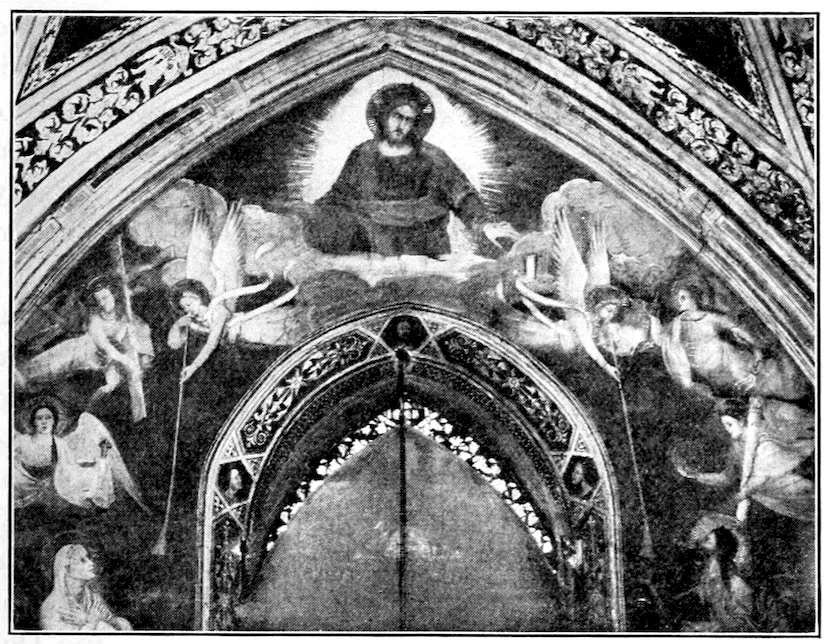
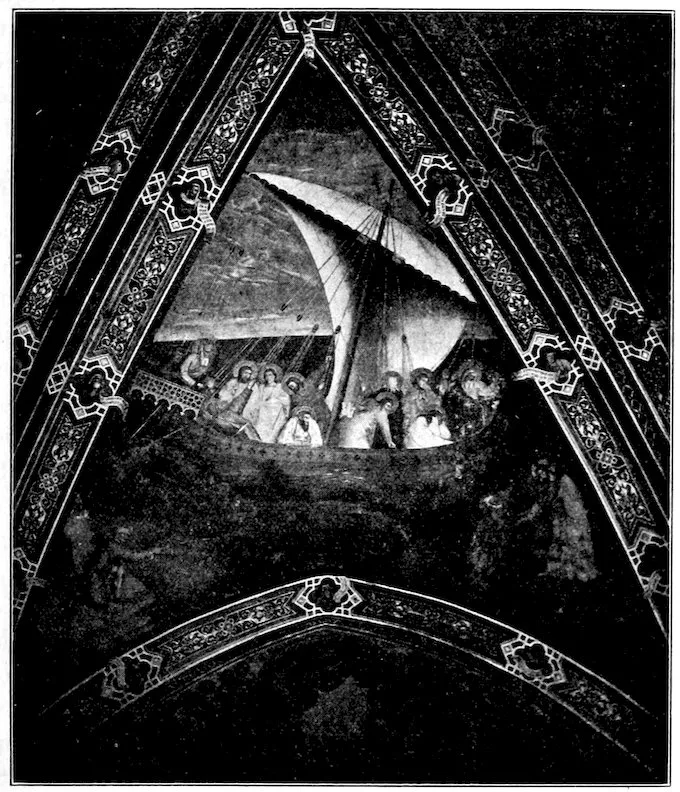
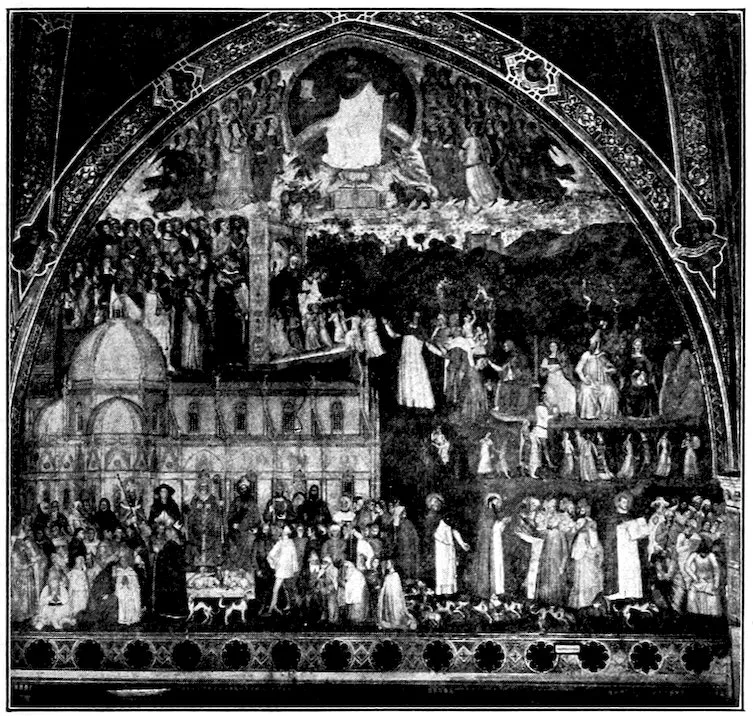
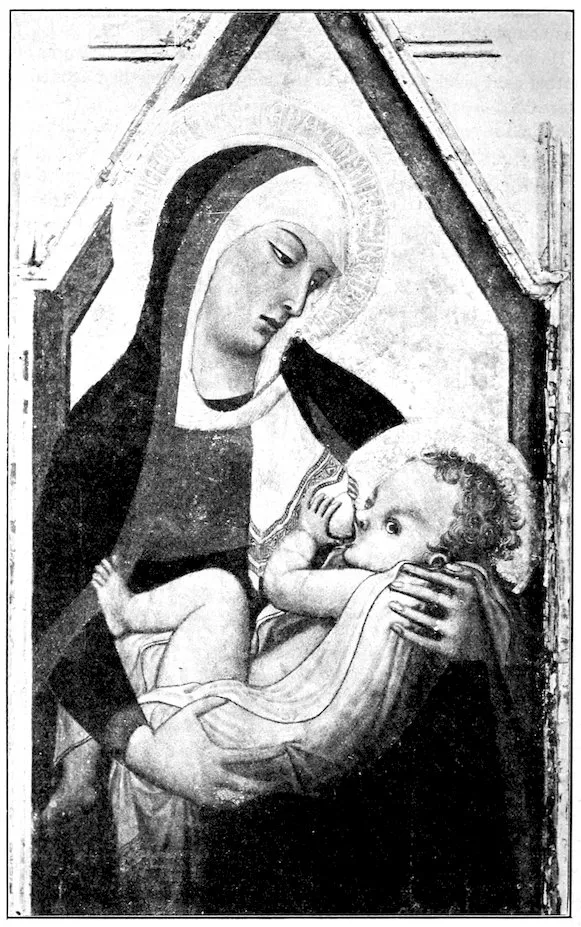
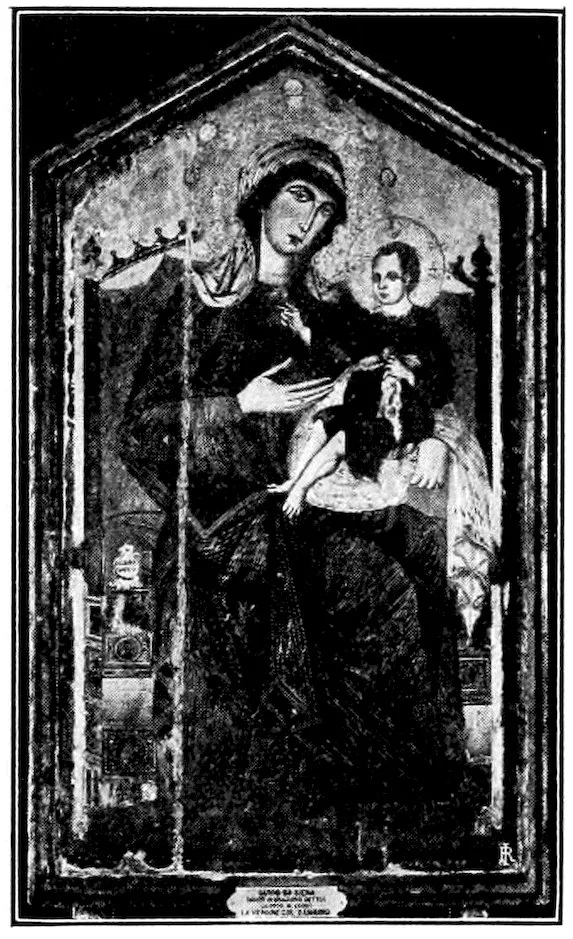
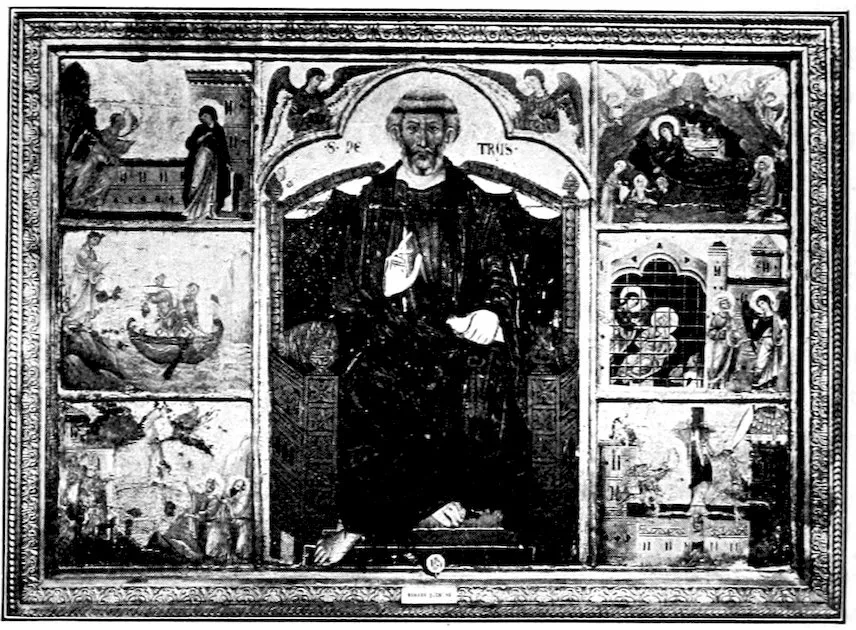
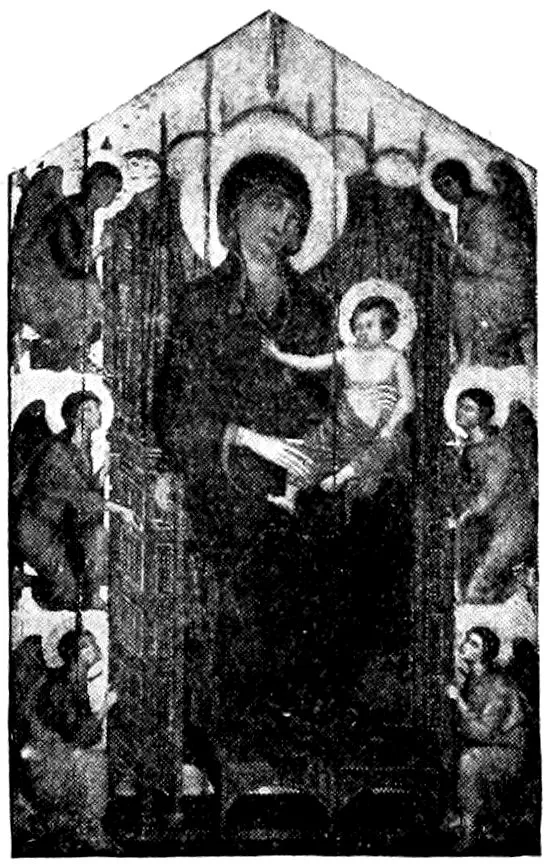
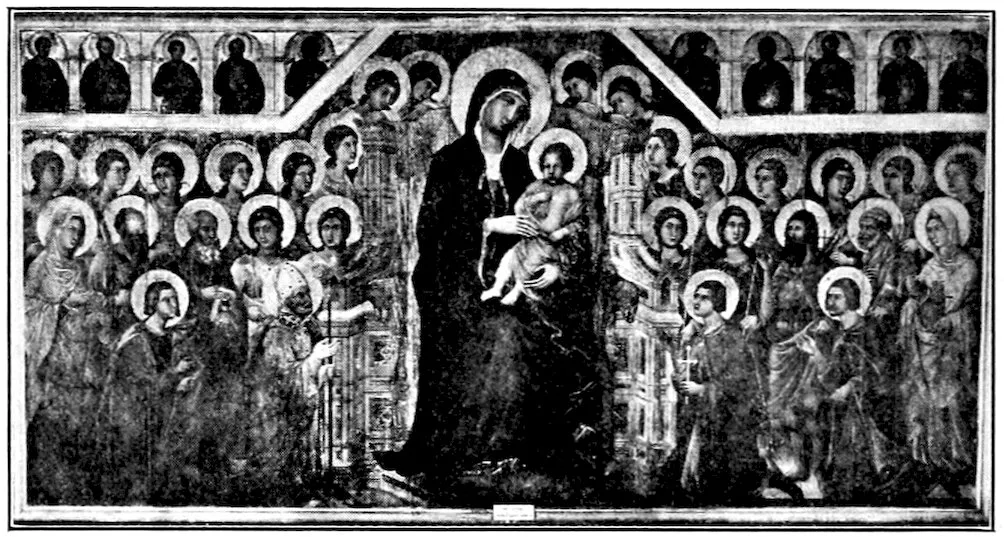
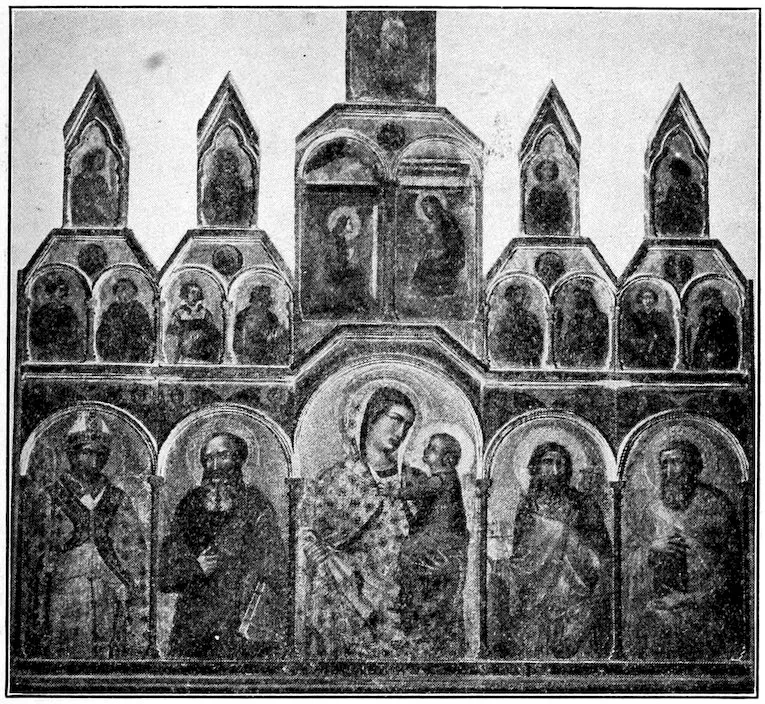
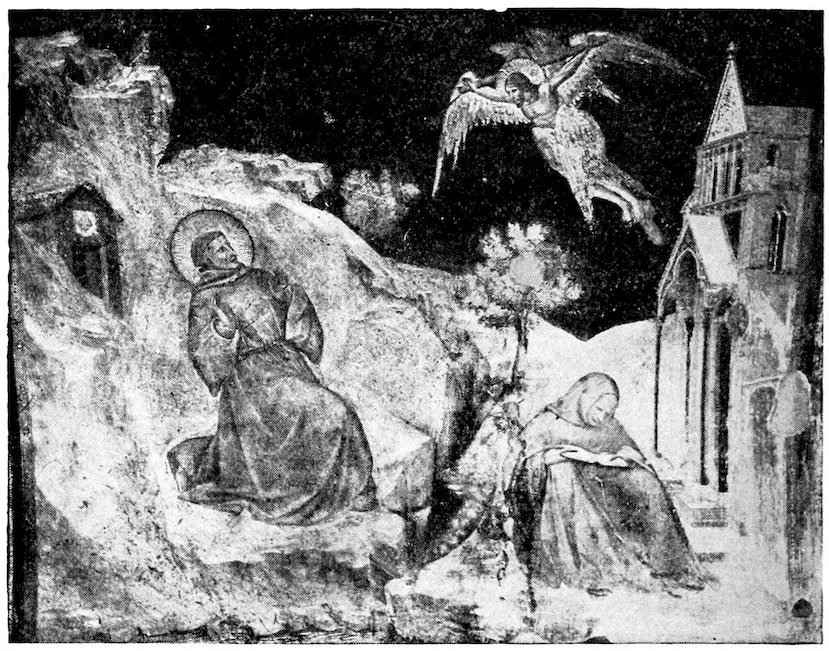
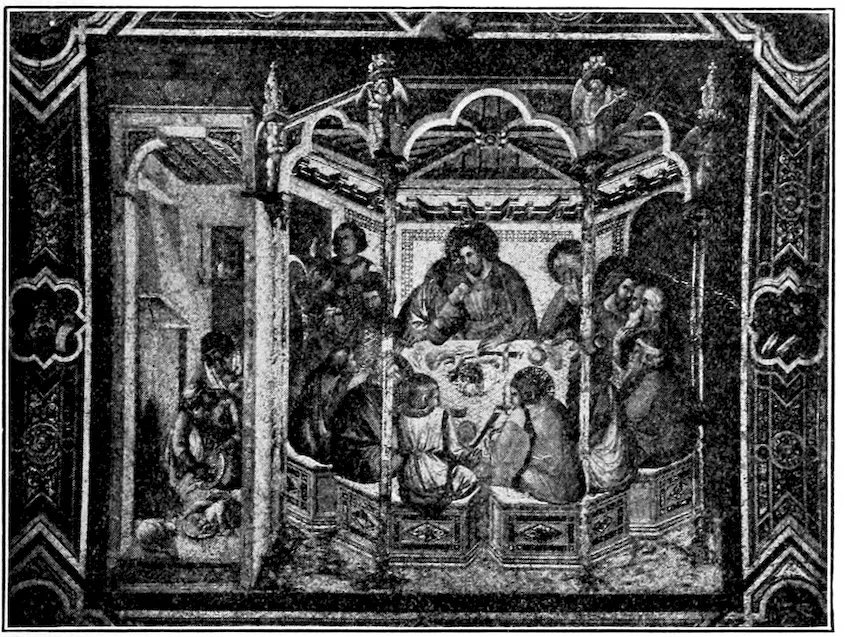
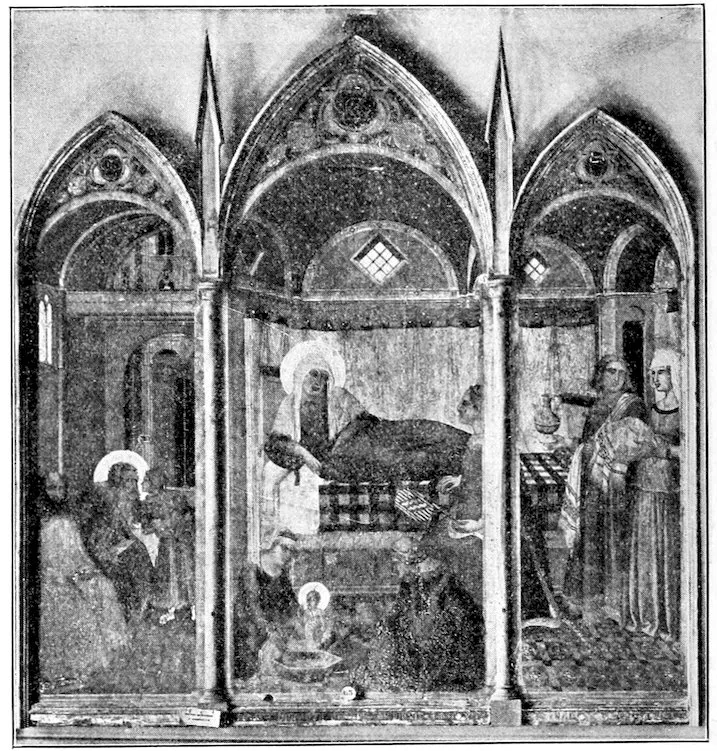
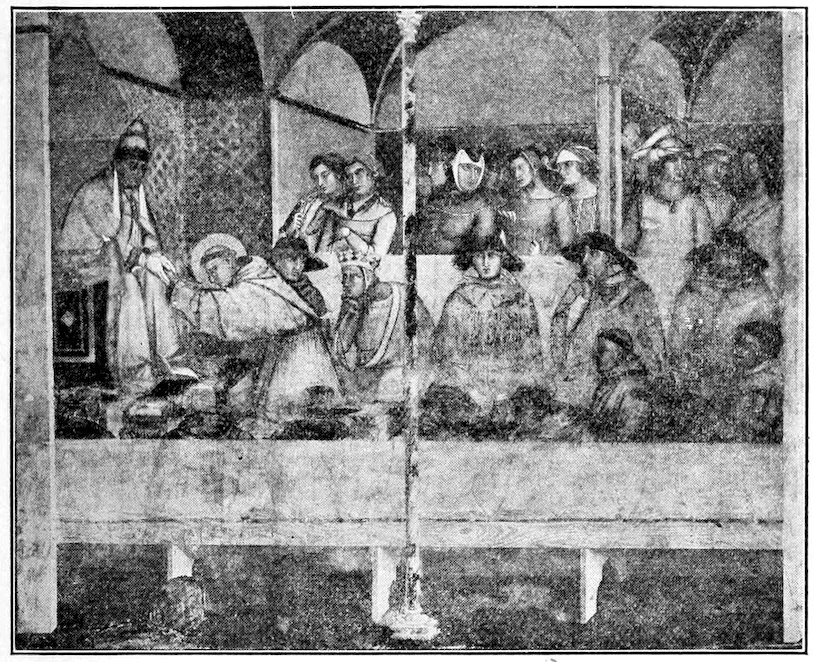
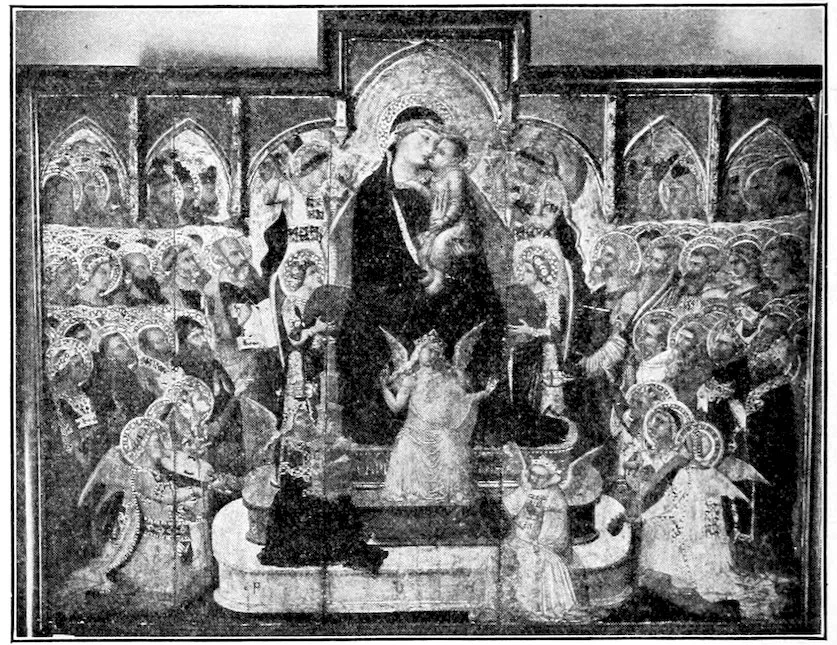
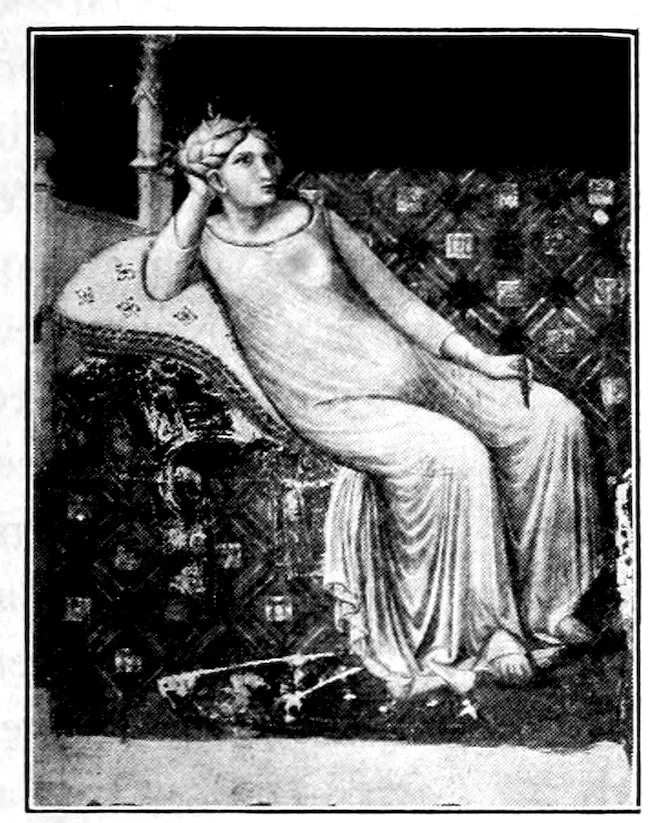
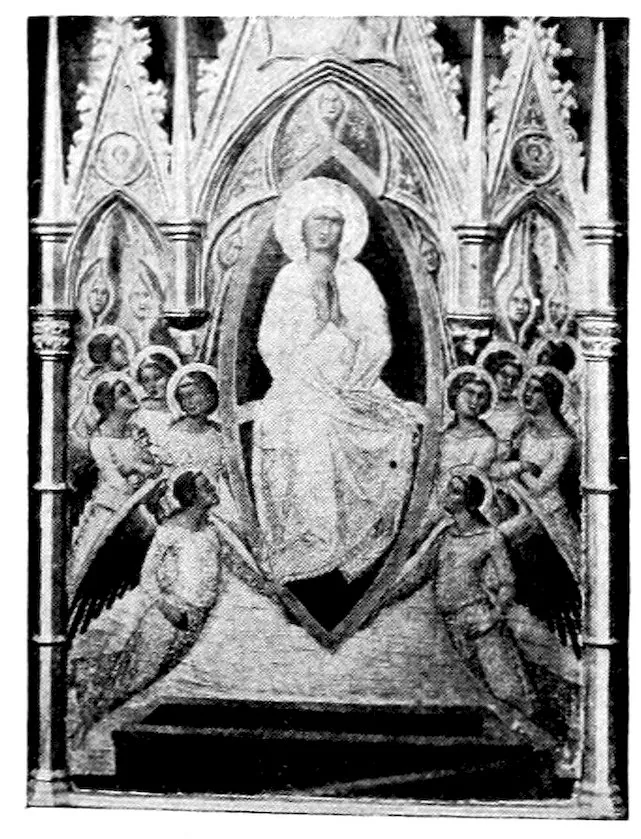
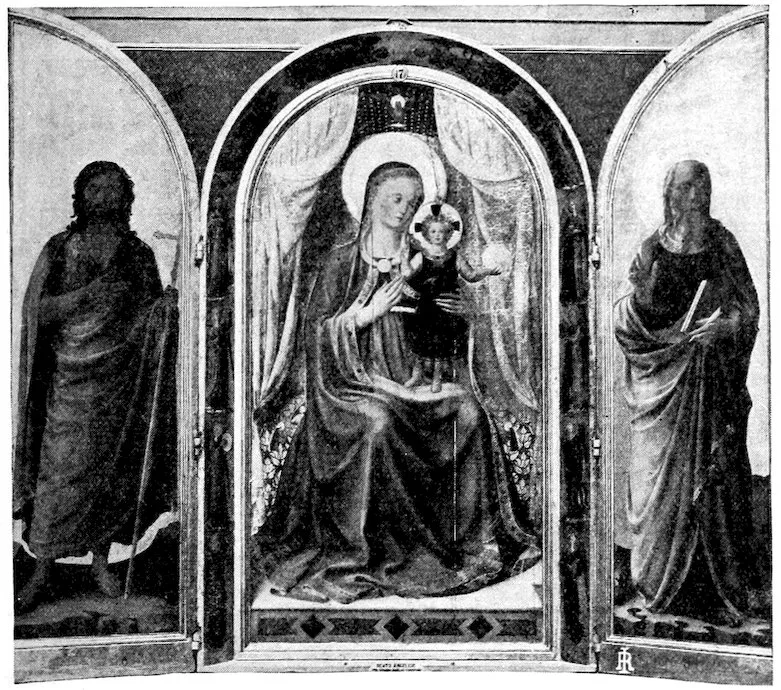
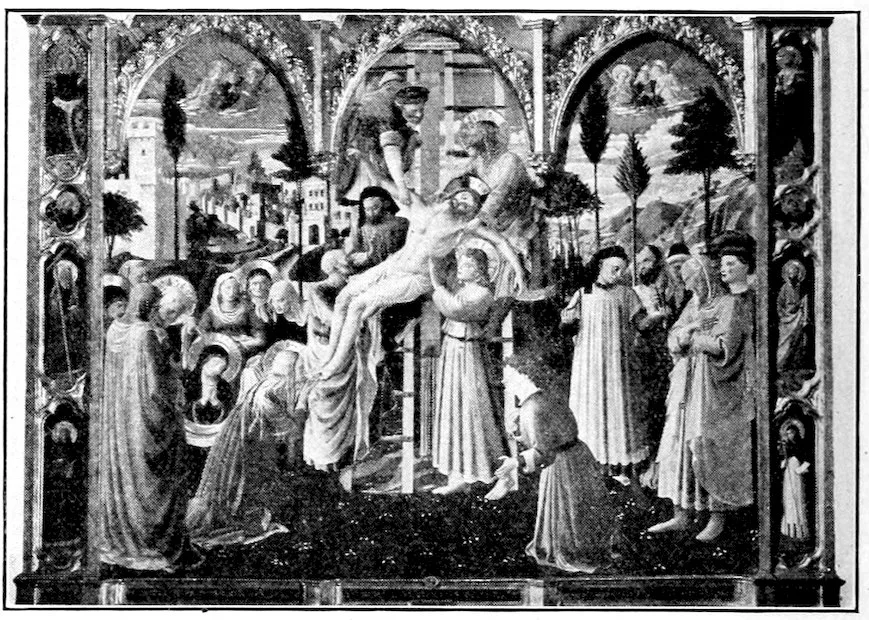
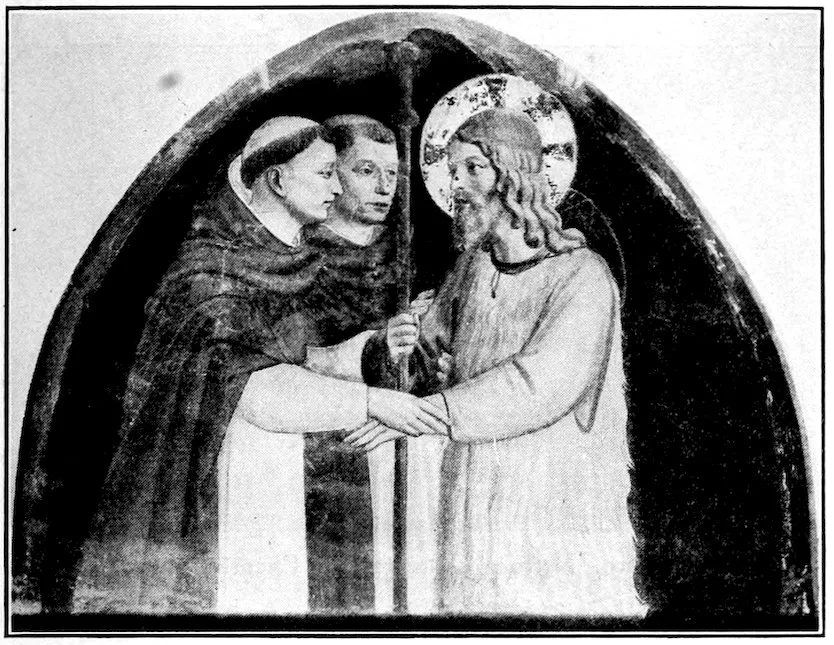
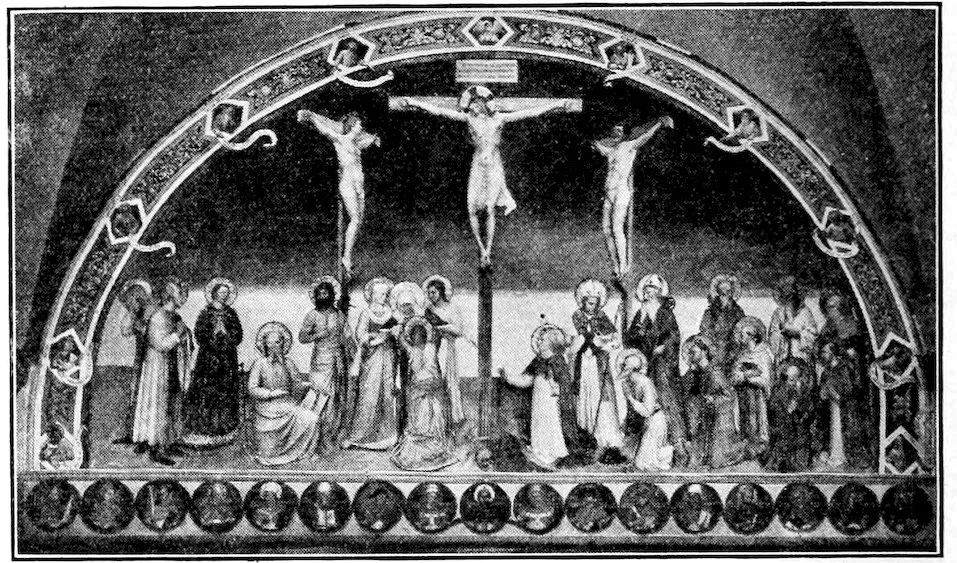
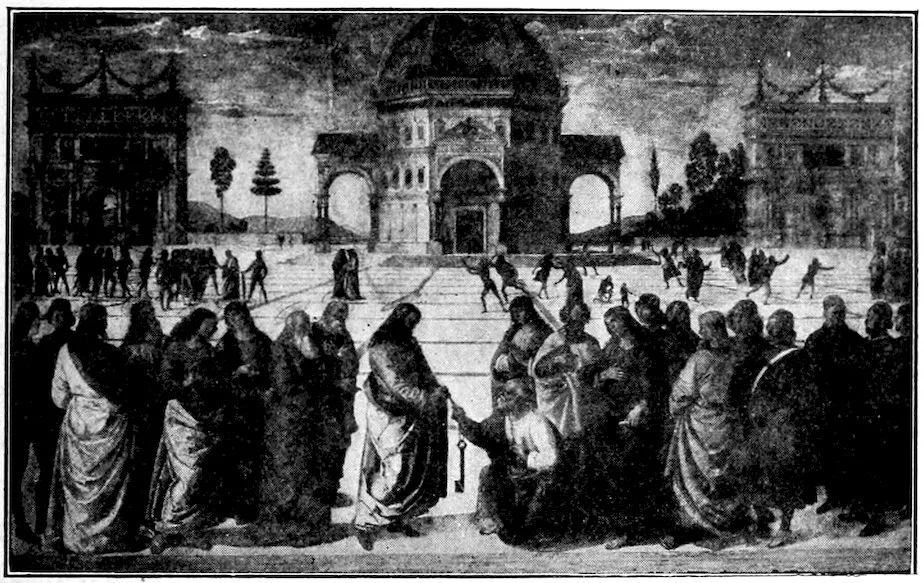
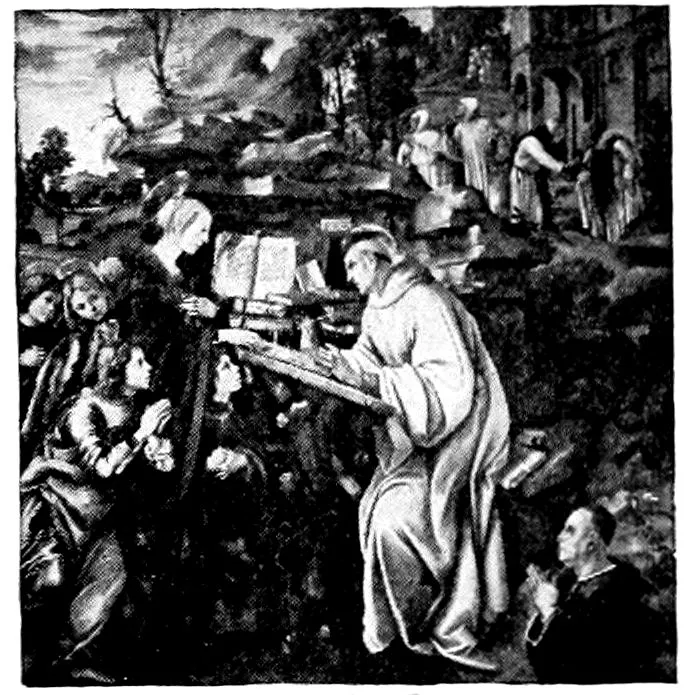
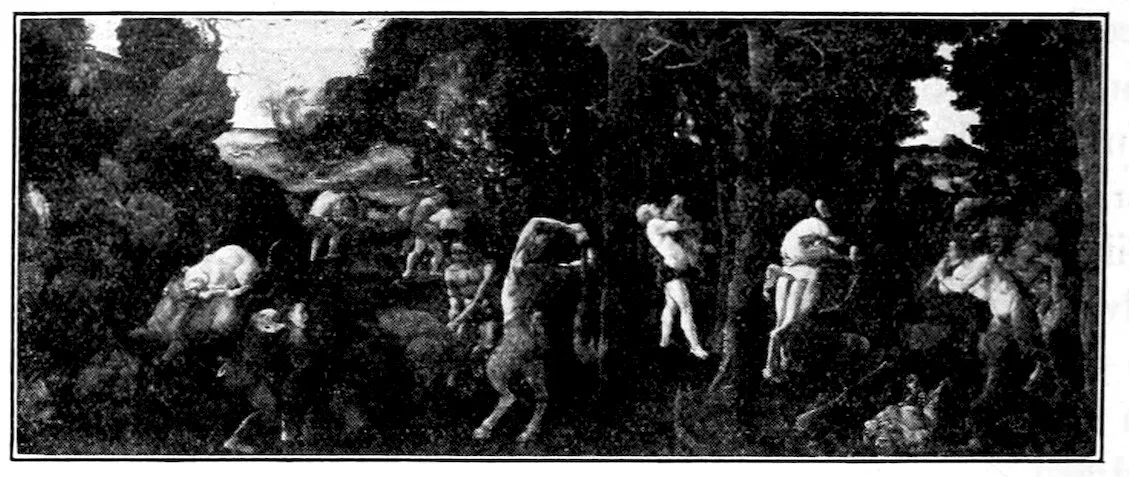
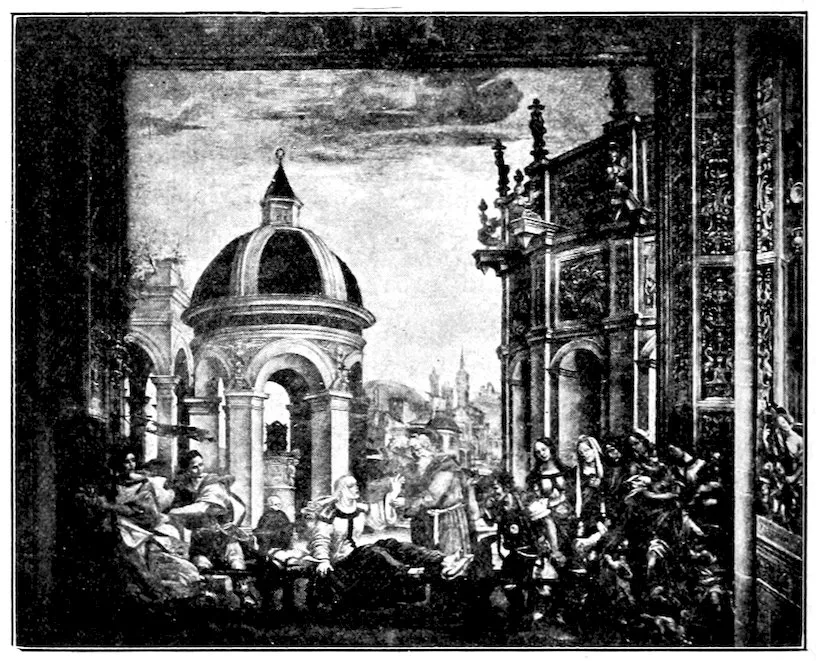
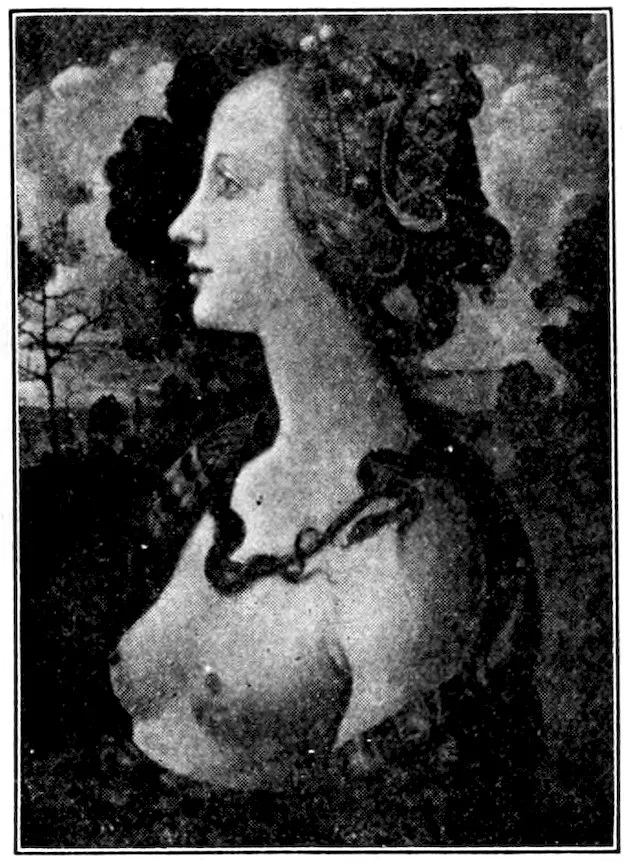
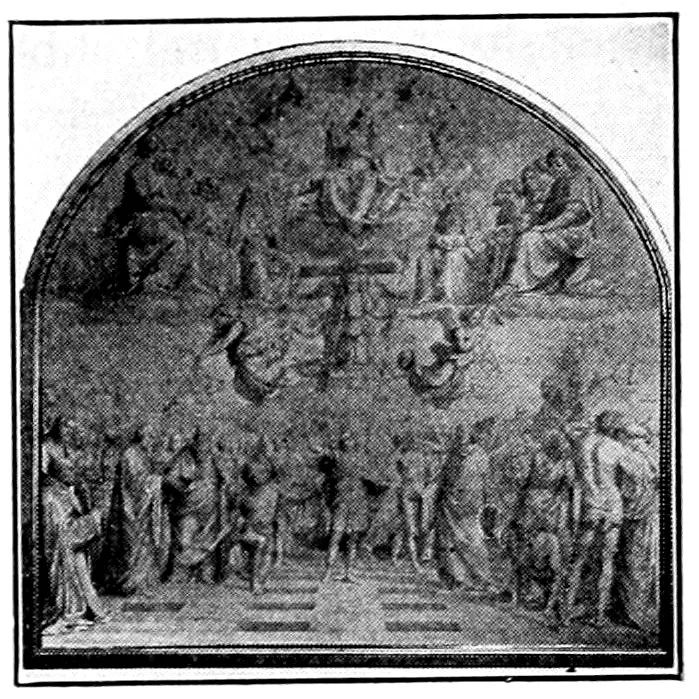
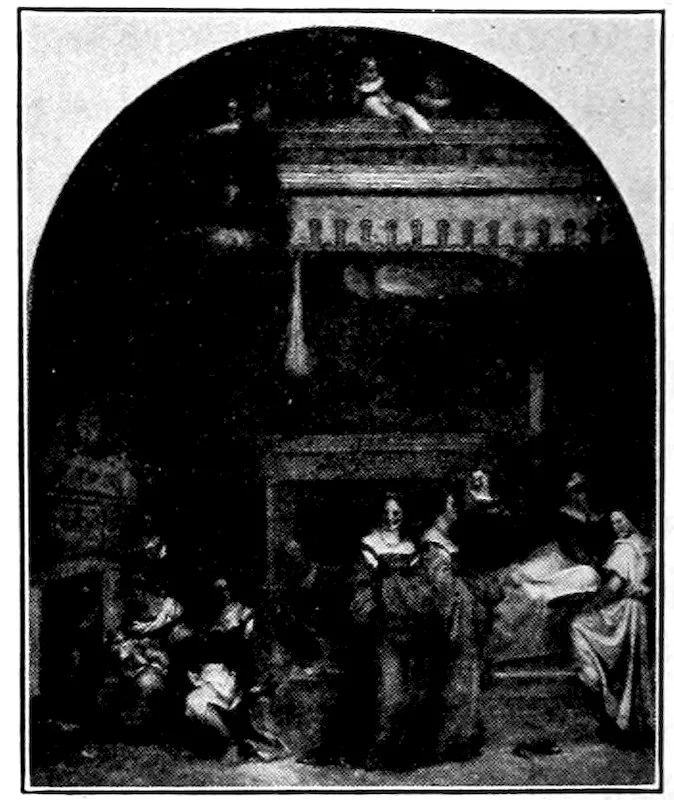
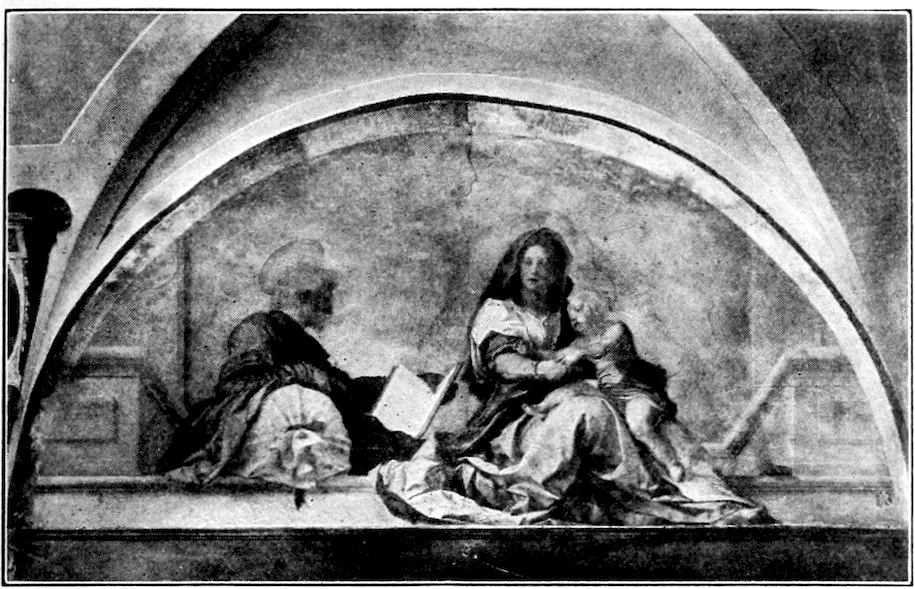
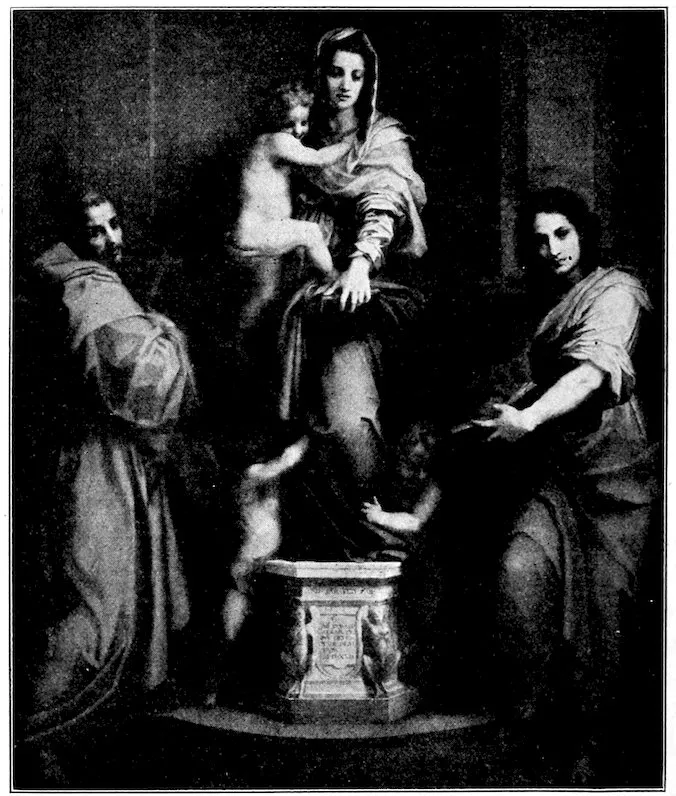
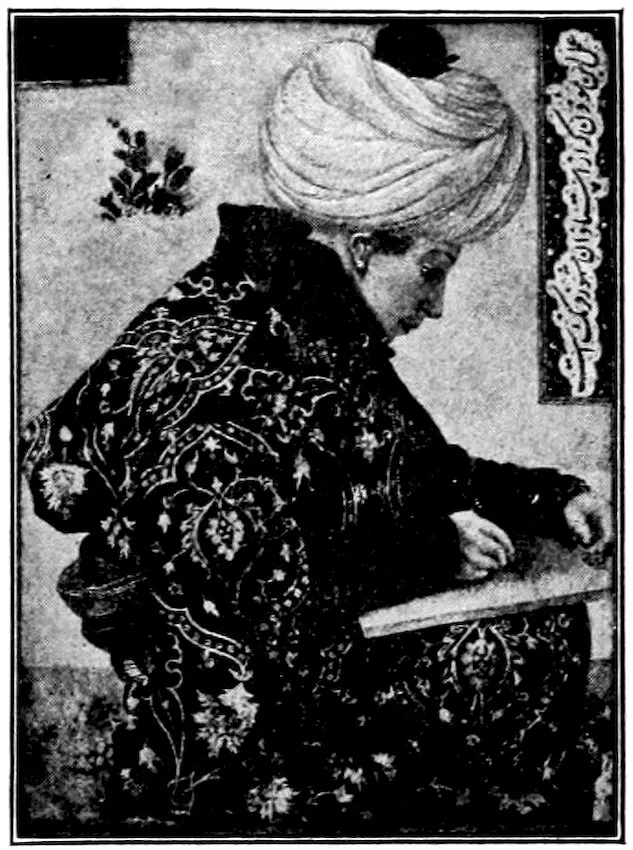
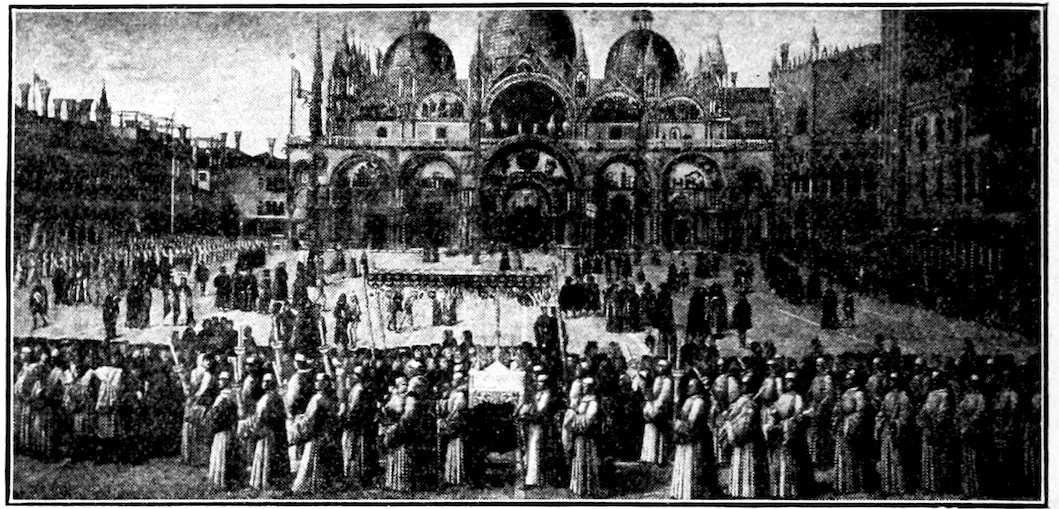
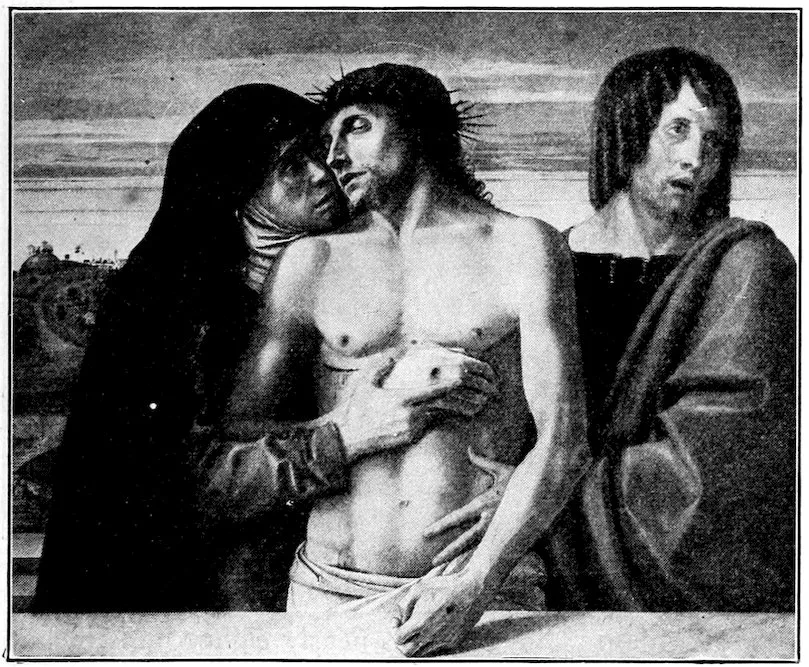
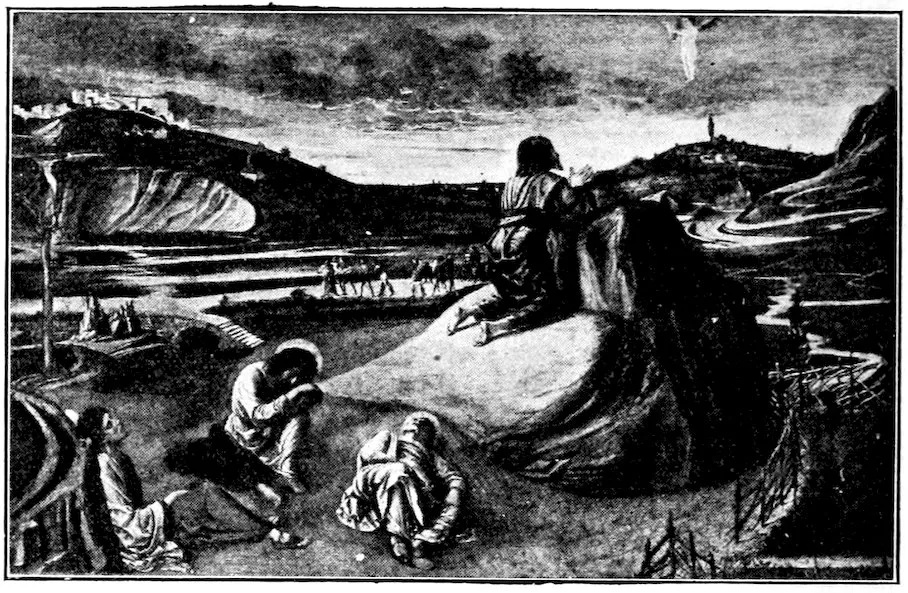
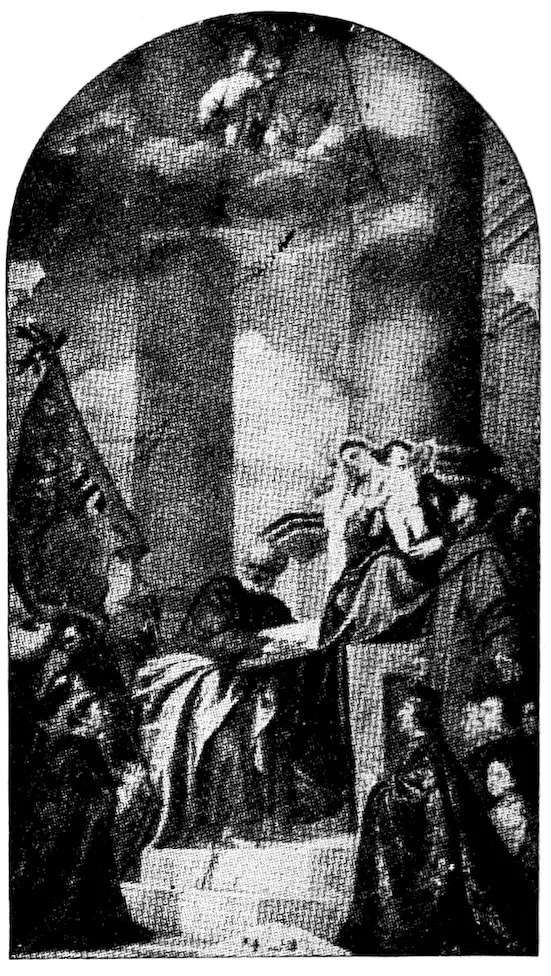
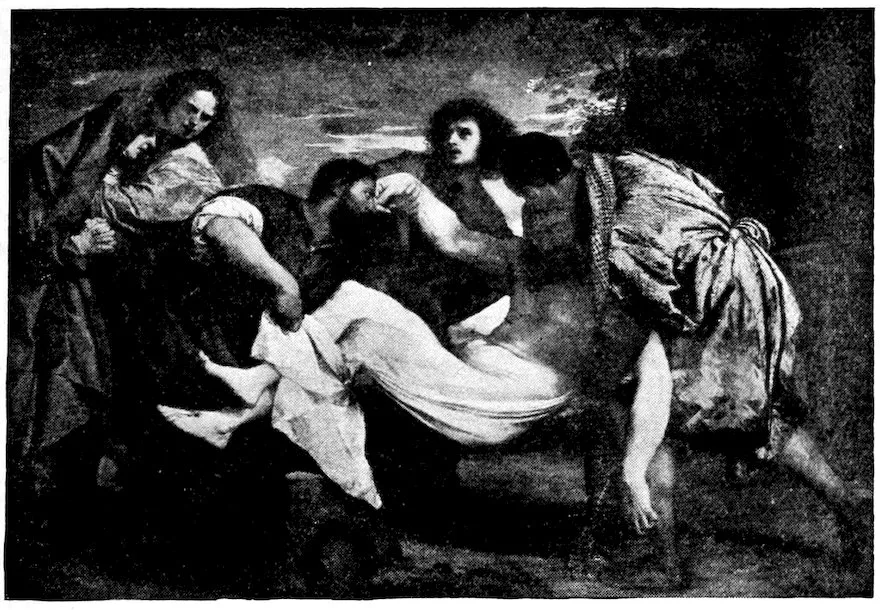
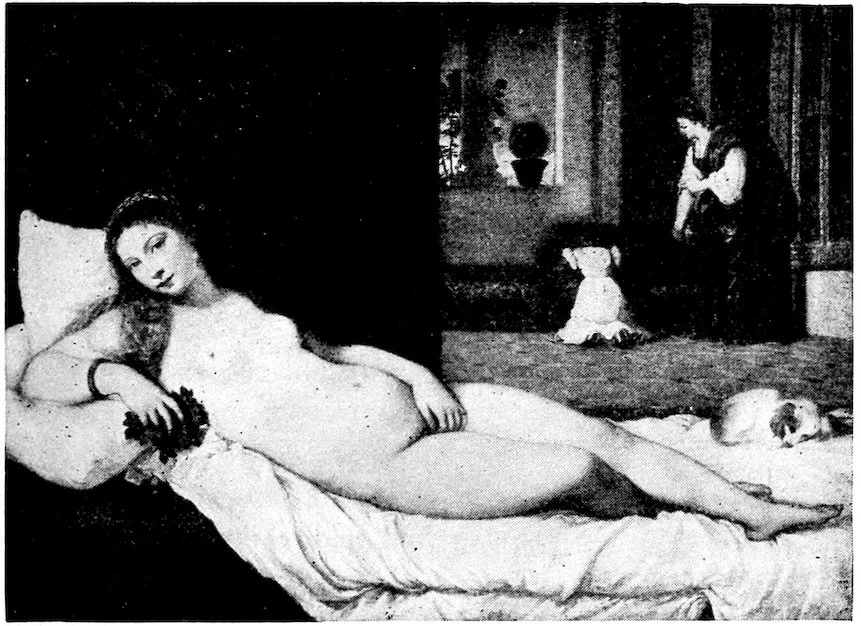
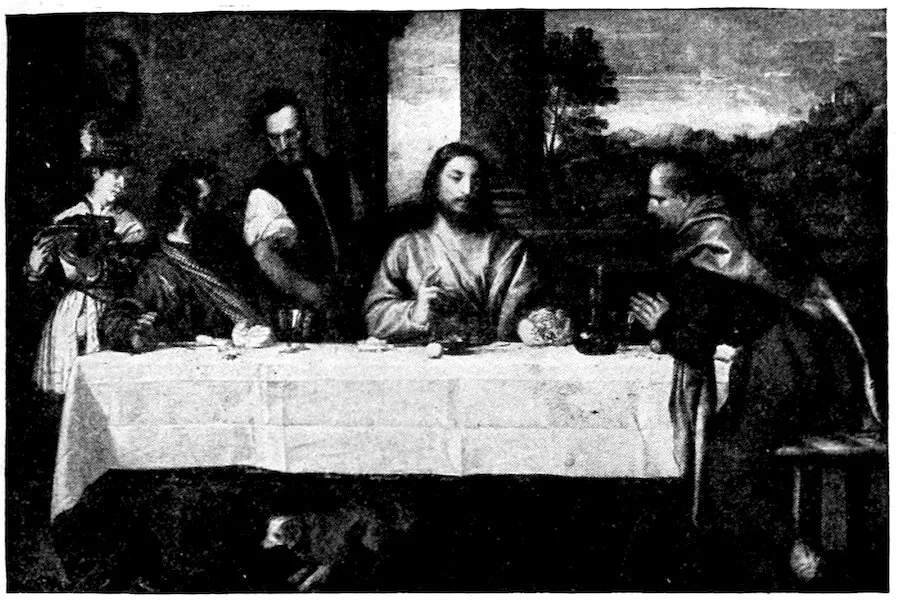
The cover image was created by the transcriber and is placed in the public domain.
BOOKS BY THE SAME AUTHOR—
HISTORY OF ITALIAN PAINTING IN THE RENAISSANCE
THE COLLECTORS
HOMER MARTIN, POET IN LANDSCAPE
ESTIMATES IN ART
THE PORTRAITS OF DANTE
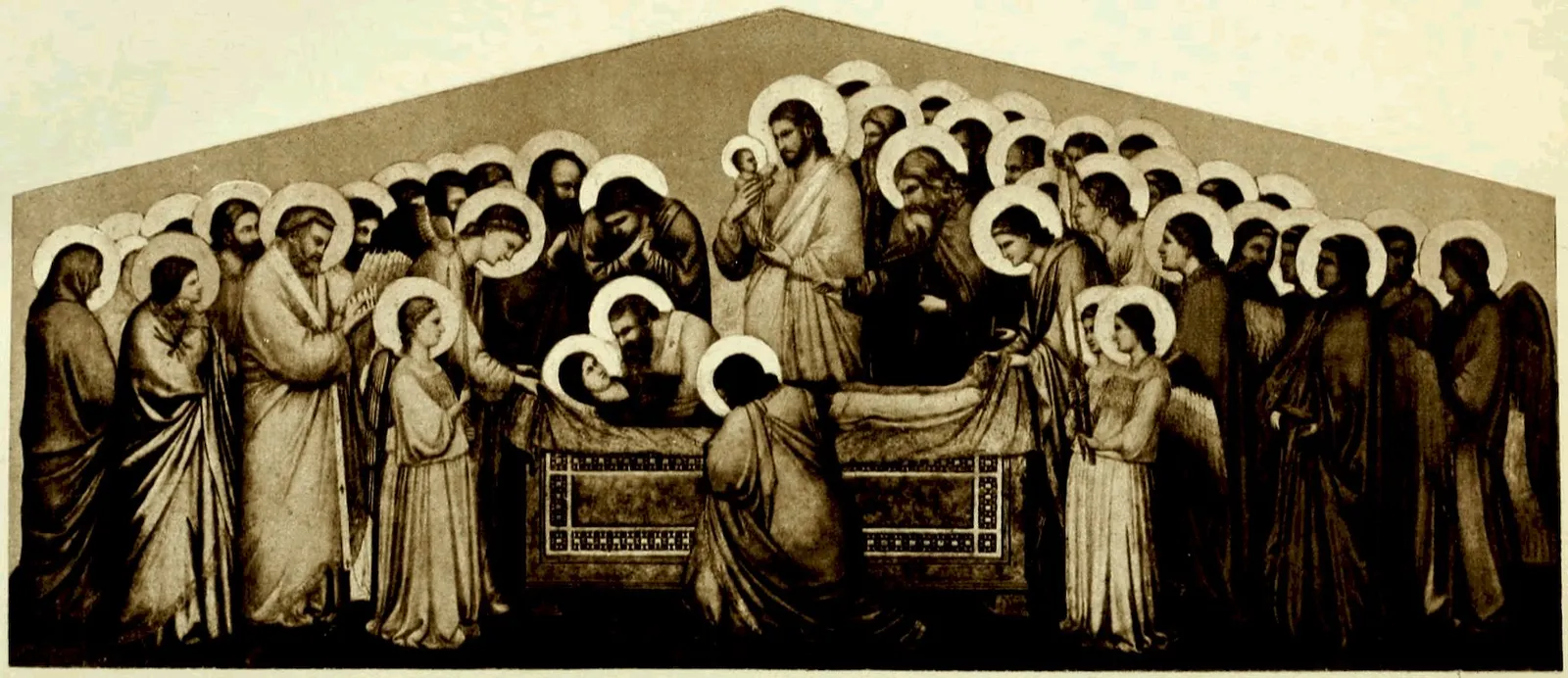
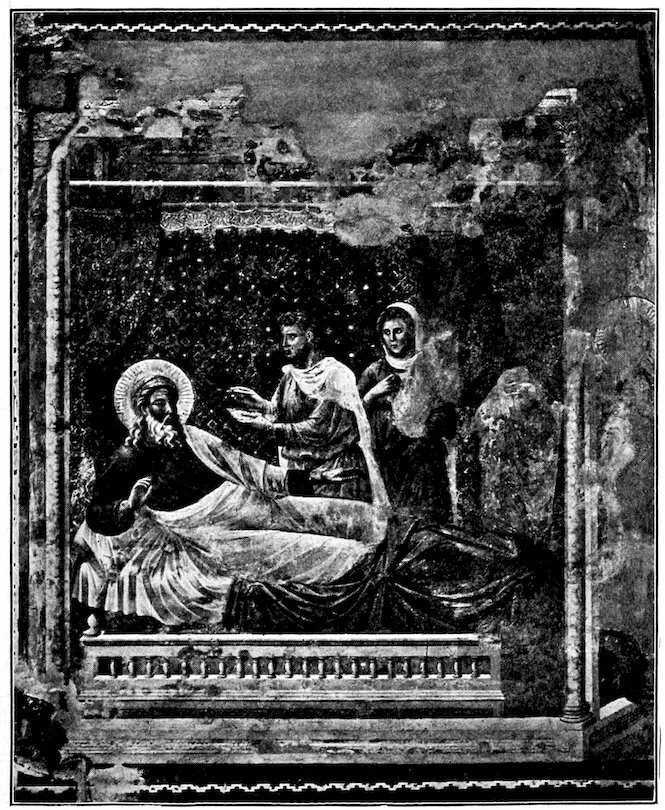
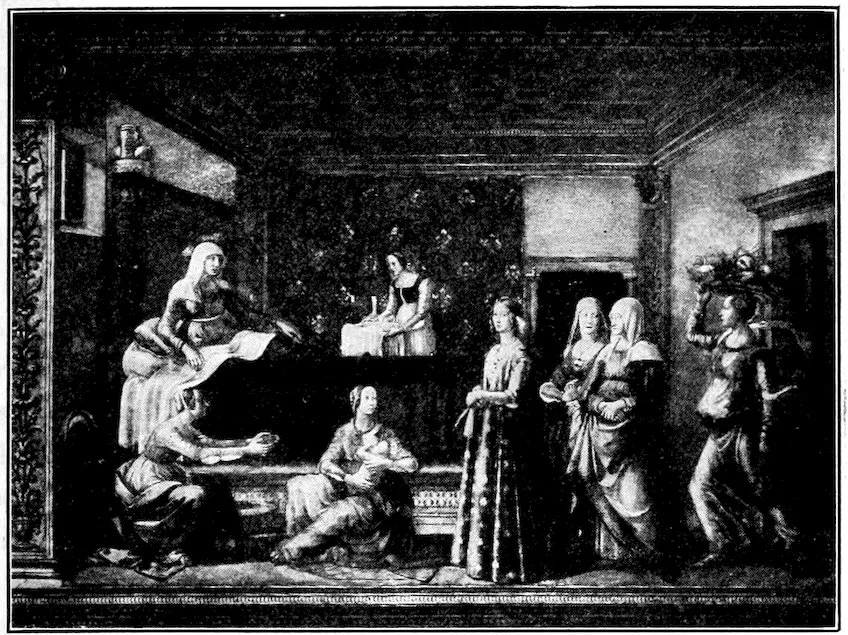
GIOTTO: DORMITION OF THE VIRGIN
Berlin
By
FRANK JEWETT MATHER, Jr.
PH.D., L.H.D.
Professor of Art and Archaeology in Princeton University
❦
LONDON
STANLEY PAUL & CO., LTD.
31, Essex Street, Strand, W. C. 2
1923
Printed in the United States of America
To
B. B.
In Friendship
PREFACE
v
This book has grown out of lectures which were delivered at
the Cleveland Art Museum in 1919–20. There I had ideal
hearers, beginners who wanted to learn and were willing to
follow a serious discussion. Since I aim at the same sort of a
reader now, I have only slightly retouched and amplified the
original manuscript. This is frankly a beginner’s book. I have
had to omit whatever might confuse the novice, including many
painters inherently delightful. Controversial problems for the
same reason have been when possible avoided. When, however,
I have had to cope with such, I have depended more on my
own eyes and judgment than on the written words of others.
But the latest literature has also been used, so that even the
adept should here and there find something to his purpose.
For opinions on contested points, I have given my authority
or personal reason in notes, which, in order not to clutter up
the text, are printed at the end. By the same token, hints on
reading and private study are tucked away in the last pages
where they will not bother readers who do not need or want
them. While I hope the book will be welcome in the classroom,
I have had as much in mind the intelligent traveller in
Europe and the private student. Throughout I have had
before me the kind of introduction to Italian painting that
would have been helpful to me thirty years ago in those days
of bewildered enthusiasm when I was making my Grand Tour.
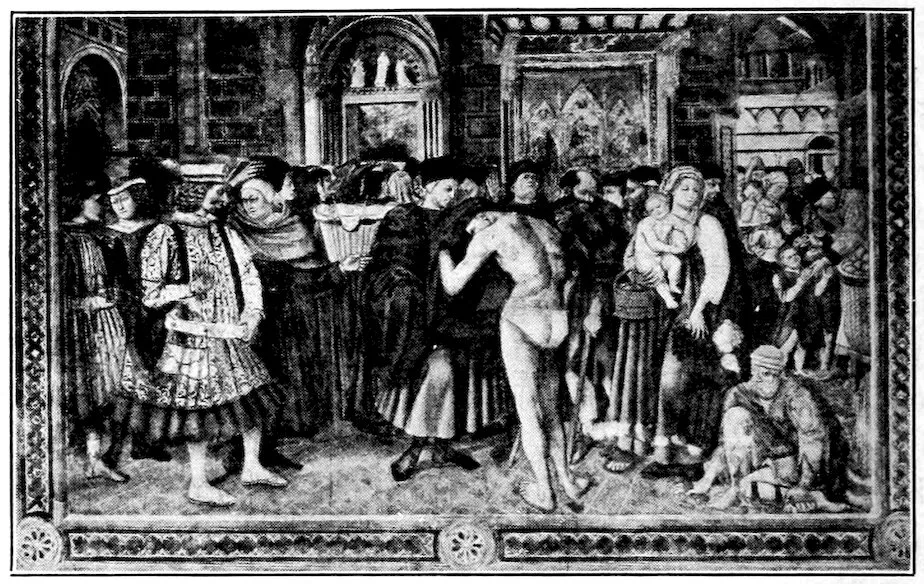
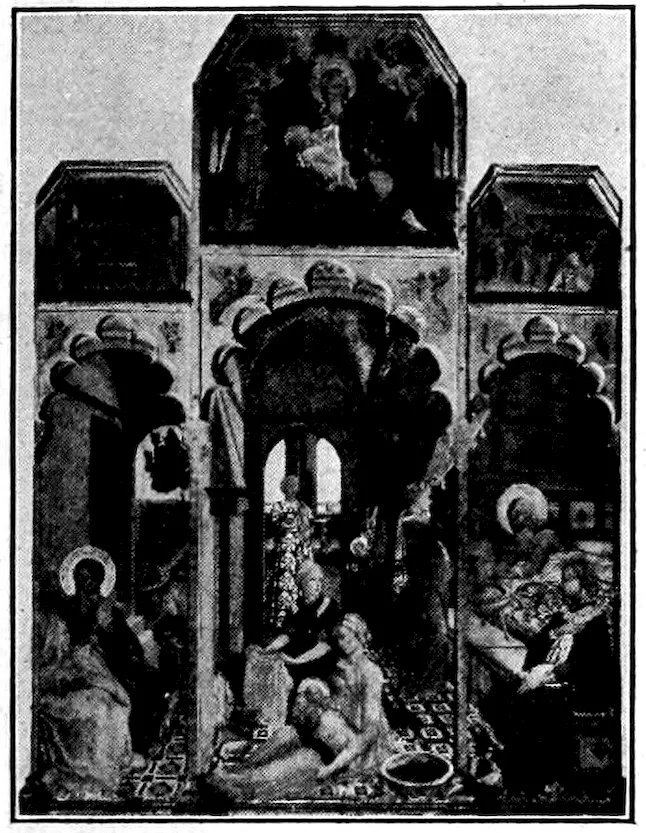
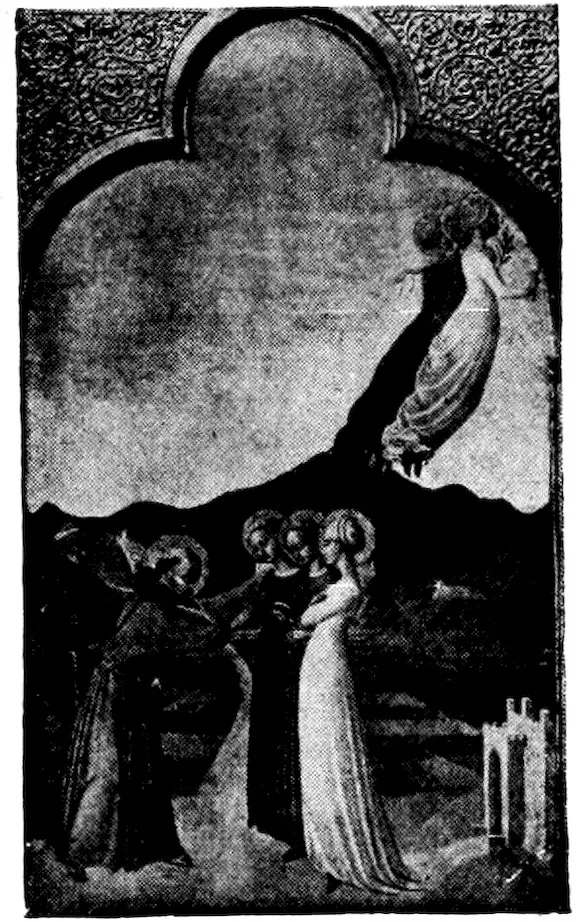
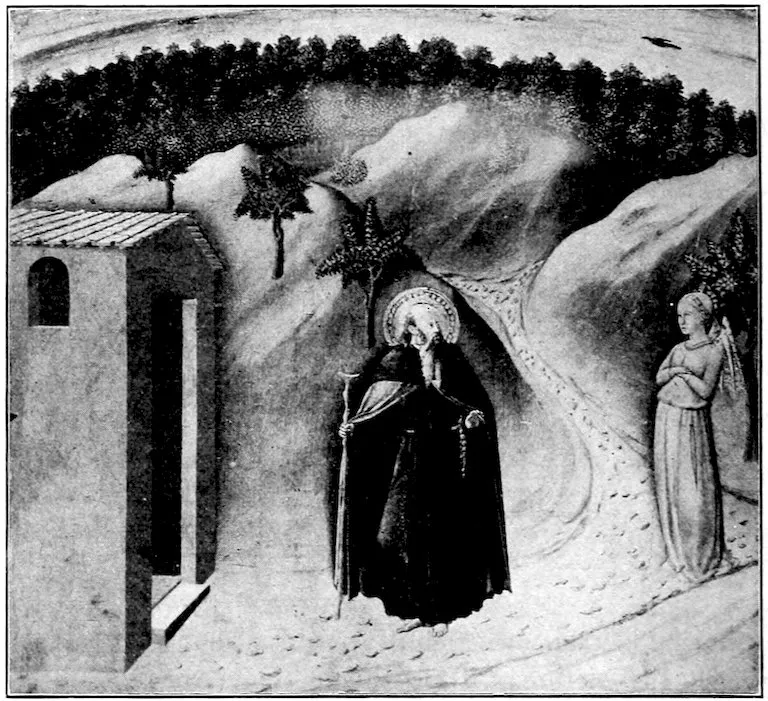
Chapter I GIOTTO AND THE NEW FLORENTINE HUMANISM — ILLUSTRATIONS FOR CHAPTER I — On the Dignity and Wealth of Old Florence — Giotto’s View of Franciscan Poverty — A Contract with Orcagna for the Altar-Piece of 1357
1
The Florentine ideal of Mass and Emotion—Its Humanism—The City of
Florence about 1300—The Position and Methods of the Painter—The
General demand for Religious Painting—Accelerated by the religious
reforms of 1200, and changed in character—Insufficiency of the current
Italo-Byzantine Style—Experiments towards a new manner: Duccio
and the Sienese, Cimabue, Cavallini and the “Isaac Master”—Giotto—Immediate
followers of Giotto, Andrea Orcagna and the return to
sculptural methods—Later Panoramists, Andrea Bonaiuti and the
Spanish Chapel.
Leonardo da Vinci, from the summit of Florentine art, has
written “What should first be judged in seeing if a picture be
good is whether the movements are appropriate to the mind
of the figure that moves.” And again he has expressed somewhat
differently the highest merits of painting as “the creation
of relief (projection) where there is none.” For Florence, at
least, these notions are authoritative, and they may well
serve as text for most that I shall say about Florentine painting.
To give significant emotion convincing mass—this
was the problem of the Florentine painter from the moment
when Giotto about the year 1300 began to find himself, to
that day more than two centuries and a half later when
Michelangelo died. No Florentine master of a strenuous sort
ever failed to perceive this mission, and no unstrenuous artist
was ever fully Florentine. This twofold aim—humanistic,
in choice and mastery of emotion; scientific, in search for those
indications which most vividly express mass where no mass
is—this twofold endeavor Florence shared with the only
2greater city of art, Athens. Thus Florence is to the art of
today what Athens was to that of classical antiquity.
In these two little communal republics were discovered and
worked out to perfection all our ideals of humanistic beauty.
Florence saw God, His Divine Son, the Blessed Virgin, and
the saints quite as Athens had seen the gods of Olympus, the
demi-gods, and the heroes simply as men and women of the
noblest physical and moral type. Both agreed in magnifying
and idealizing the people one ordinarily sees. For greater
beauty, Athens represented them nude or lightly draped; for
greater dignity, Florence chose the solemn garb of the Roman
forum. Whether pagan or Christian, the guardians of a
people’s morality were to be above haste, excitement, or any
transient emotion. They were to express intensities of feeling,
but a feeling more composed, permanent, and disciplined, than
that of every day. Judgment and criticism count for as much
in both arts as emotional inspiration. The great Florentine
artist is a thinker; he is often poet and scientist, sculptor and
architect, besides being a painter. Behind his painting lies
always a problem of mind, and as sheer personalities the greatest
painters of Siena, Venice, and Lombardy often seem mere
nobodies when compared even with the minor Florentines. We
should know something about a city that produced personality
so generously, and before considering Giotto, the first great
painter Florence bred, we shall do well to look at Florence as
he saw it about the year 1300, being a man in the thirties.
Florence was then as now a little city, its population about
100,000 souls, but it was growing. The old second wall of about
two miles’ circuit was already condemned in favor of a turreted
circuit of over six. Up the Arno the forest-clad ridge of
Vallombrosa was much as it is today; down the valley the
jagged peaks of the Carrara mountains barred the way to the
sea. The surrounding vineyards and olive orchards by reason
of encroaching forest were less extensive than they are now,
3but through every gate and from every tower one could see
smiling fields guarded by battlemented villas. In the city, the
fortress towers of the old nobility, partizans mostly of the
foreign Emperor, rose thickly, but already dismantled at their
fighting tops, for the people, meaning strictly the ruling merchant
and manufacturing classes, had lately taken the rule
from the old nobles. Many of these had fled; some had been
banished, as was soon to be that reckless advocate of the
emperor, Dante Alighieri, an excellent poet of love foolishly
dabbling in politics. Other patricians sulked in their fortress
palaces. Some shrewdly got themselves demoted and joined
the ruling trade guilds. Of these guilds a big four, five, or six,
governed the city, while a minor dozen had political privilege.
Only guild members voted for the city officers. The guilds
combined the function of a trade union and an employer’s
association, including all members of the craft from the youngest
apprentice to the richest boss-contractor. Such a guild as
the notaries, must have been much like a bar association,
while the wholesale merchants’ guild must have resembled a
chamber of commerce. The guild folk had early allied themselves
with the Pope, the only permanent representative of the
principle of order in Italy. The Pope was also the bulwark of
the new free communes against the claims of the Teutonic
Emperors. So in Florence piety, liberty, and prosperity were
convertible terms.
Within the narrow walls was a bustling, neighborly, squabbling
and making-up life. Everybody knew everybody else.
The craftsman worked in the little open archways you may
still see in the Via San Gallo, in sight and hearing of the passing
world. Of weavers’ shops alone there were 300. No
western city was ever prouder than Florence in those days.
Her credit was good from the Urals to the Pentland Hills. Her
gold florin was everywhere standard exchange. She had secret
ways of finishing the fine cloths that came in ships and caravans
4from Ghent, Ypres, and Arras; she handled the silks of China
and converted the raw pelts of the north into objects of fashion.
Her civic pride was actively expressing itself in building.
Between 1294 and 1299 she had projected a new cathedral,
the great Franciscan church of Santa Croce, a new town hall,
and the massive walls we still see. For stately buildings she
had earlier had only the Baptistry, in which every baby was
promptly christened, and the new church of the Friars Preachers
(Dominicans), Santa Maria Novella. In considering this
Florence you must think of a hard-headed, full-blooded, ambitious
community, frankly devoted to money-making, but
desiring wealth chiefly as a step towards fame. Since the
painter could provide fame in this world and advance one’s
position in the next, his estate was a favored one.
The painter himself was just a fine craftsman. He kept a
shop and called it such—a bottega. He worked only to order.
There were no exhibitions, no museums, no academies, no art
schools, no prizes, no dealers. The painters modestly joined the
guild of the druggists (speziali), who were their color makers,
quite as the up-to-date newspaper reporter affiliates himself
with the typographical union. When a rich man wanted a
picture, he simply went to a painter’s shop and ordered it,
laying down as a matter of course the subject and everything
about the treatment that interested him. If the work was of
importance, a contract and specifications were drawn up. The
kind of colors, pay by the job or by the day, the amount to
be painted by the contracting artist himself, the time of completion,
with or without penalty—all this was precisely nominated
in the bond. Naturally the painter used his shop-assistants
and apprentices as much as possible. Often he did
little himself except heads and principal figures. But he made
the designs and carefully supervised their execution on panel
or wall. A Florentine painter’s bottega then had none of the
preciousness of a modern painter’s studio. It was rather like
5a decorator’s shop of today, the master being merely the
business head and guiding artistic taste. When we speak of
a fresco by Giotto, we do not mean that Giotto painted much
of it, any more than a La Farge window implies that our great
American master of stained-glass design himself cut and set
the glass. The painter of Florence had to be a jack-of-all-trades,
a color grinder, a cabinet maker, and a wood carver;
a gilder; to be capable of copying any design and of inventing
fine decorative features himself. He must be equally competent
in the delicate methods of tempera painting as in the
resolute procedures of fresco.
These two methods set distinct limits to the work and its
effects. The colors were ground up day by day in the shop.
Each had its little pot. There was no palette. Hence only a
few colors were used, and with little mixing. For tempera
painting a good wooden panel—preferably of poplar—was
grounded with successive coats of finest plaster of Paris in glue
and rubbed down to ivory smoothness. The composition was
then copied in minutely from a working drawing. The gold
background inherited from the workers in mosaic was laid on
in pure leaf. The composition was first lightly shaded and
modelled either in green or brown earth, and then finished up
a bit at a time, in colors tempered with egg or vegetable albumen.
The paints were thick and could not be swiftly
manipulated; the whole surface set and so hardened that retouching
was difficult. How so niggling a method produced so
broad and harmonious effects will seem a mystery to the modern
artist. It was due to system and sacrifice. Though the
work was done piecemeal, everything was thought out in
advance. Dark shadows and accidents of lighting which would
mar the general blond effect were ignored. The beauty desired
was not that of nature, but that of enamels and semi-precious
stones. These panels are glorious in azures, cinnabars, crimsons,
emerald-greens, and whites partaking of all of these hues.
6Their delicacy is enhanced by carved frames, at this moment,
1300, simply gabled and moulded; later built up and arched
and fretted with the most fantastic gothic features.
If the painter in tempera required chiefly patience and delicacy,
the painter in fresco must have resolution and audacity.
He must calculate each day’s work exactly, and a whole day’s
work could be spoiled by a single slip of the hand in the tired
evening hour. For fresco, the working sketch was roughly
copied in outline on a plaster wall. Then any part selected
for a day’s work was covered with a new coat of fine plaster.
The effaced part of the design must be rapidly redrawn on the
wet ground. Then the colors were laid on from their little
pots, and only the sound mineral colors which resist lime could
be employed. The vehicle was simply water. The colors were
sucked deep into the wet plaster, and united with it to form a
surface as durable as the wall itself. Generally the colors
were merely divided into three values,—light, pure colors, and
dark. Everything was kept clear, rather flat, and blond,
highly simple and beautifully decorative. One of the later
painters, Cennino Cennini (active about 1400), tells us that a
single head was a day’s work for a good frescante. The touch
had to be sure, for a mis-stroke meant scraping the wet plaster
off, relaying it, and starting all over again. The fresco painter
accordingly needed discipline and method. Nothing could be
farther from modern inspirational methods. Where everything
was systematized and calculated in advance, you will
see it was quite safe for a master to entrust his designs to pupils
who knew his wishes. Every fresco when dry was more or less
retouched in tempera, but the best artists did this sparingly,
knowing that the retouches would soon blacken badly or
flake off.
So much for the shop methods. Now for him who makes
shops possible—the patron. A wealthy Florentine as naturally
wanted to invest in a frescoed chapel as a wealthy American
7does in a fleet of motor cars. Considering the changed
value of money, one indulgence was about as costly as the other.
But the Florentine never quite regarded paintings as luxuries.
They were necessary to him. He loved them. They enhanced
his prestige in this world and improved his chances in the next.
Then to beautify a church was really to magnify the liberty
and prosperity of Florence, which largely derived from the
Holy See. Recall that every Florentine was born a Catholic,
baptized in the fair Church of St. John with the name of a
saint. This saint, he believed, could aid him morally and
materially, was in every sense his celestial patron. It paid to
do the saint honor, and that could best be done through the
painter’s art. The poorest man might have a small portrait
of his patron, a rich man might endow a chapel and cause all
his patron’s miracles to be pictured on the wall. Think also
that every altar—a dozen or more in every large church—was
a shrine[1], containing the bread and wine that by the never-ceasing
miracle of the Mass became the Saviour’s body and
blood; and was also a reliquary or tomb, containing in whole
or part the body of some saint. Every altar then, and every
chapel inclosing one, cried out for a twofold interpretation of
its meaning. Everything about the Eucharist had to be explained
(involving pretty nearly all of Biblical history), and the
particular relic required similar illumination. Since many of
the faithful could not read, and the Catholic Church has ever
been merciful as regards sermonizing, these explanations of the
altar as miracle shrine of Our Lord and as tomb of a particular
saint were best made pictorially, and generally were so made.
Such motives for picture-making Florence of course shared
with the entire Christian world. It remains to explain why
she wanted more painting and better than any other mediæval
city. She wanted more painting chiefly because of her exceptional
civic pride and prosperity, she wanted better painting
because she had moved ahead of the world towards finer,
8more passionate, and conscious experiences of life which the
older painting was powerless to express. About the year 1200,
a century before the time we are considering, there flourished
two great religious leaders who gave to Christianity a new
dignity and appeal. St. Dominic, with his disciple, St. Thomas
Aquinas, endeavored to make Christianity more reasonable,
St. Francis of Assisi endeavored to make it more heartfelt and
compassionate. They founded two monastic orders with divergent
yet harmonious aims. The Dominicans called men to
a life of study and self-examination, enlisting the human reason
to explain and justify the universe under the Christian scheme;
the Franciscans called men to poverty, humility, and chastity,
and service to the unfortunate. Between the two—one supplying
the light of the reason and the other the light of the
heart—they overcame heresies which had menaced both
Christianity and civilization and roused the Church out of its
dogmatic slumber. It was no longer enough for the Church to
threaten. Men yielded to her now only on condition that their
heads be convinced or their hearts touched. In Florence, where
a rationalizing shrewdness and a real warm-heartedness singularly
blended, the double appeal was irresistible. By and large
the whole city either schematized with the Dominicans or
slummed with the Franciscans. Here was urgent new matter
requiring an art that could move and persuade.
Together with this religious revival and the political and
commercial progress we have noted, came a literary revival.
Before the end of the 13th century such poets as Guido Guinizelli,
Guido Cavalcanti, and Dante Alighieri had so reshaped
the rude vulgar tongue that it became worthy of its Latin
succession. The refinements of chivalric love came to Florence
in melodious verse, and what the poets called the “sweet
new style,” il dolce stil nuovo, in diction presaged a similar
sweet new style of painting. Alongside of the poets, Brunetto
Latini in the Tesoro shows glimmerings of scientific interest,
9and Giovanni Villani lends substance and dignity to the work
of the chronicler. Already the sculptors Nicola and Giovanni
of neighboring Pisa had grasped the beauties respectively of
classic sculpture and the noble intensity of that of the Gothic
North. All this immensely increased that sum of fine thinking,
feeling, and seeing which underlies all great art.
To express these new emotions the old painting was inadequate.
Italy through the so-called Dark Ages produced art
abundantly. Wherever power and order asserted themselves
amid the welter of war and oppression, stately buildings rose
and these were decorated. Thus at Rome, where the popes
gradually added temporal to spiritual power, splendid basilicas
grew over the tombs of the martyrs. At Ravenna, through the
6th and 7th centuries the seat of the Byzantine and Gothic
sovereignties, magnificent churches and baptistries were covered
with pictorial mosaics. In Sicily, at Messina, Cefalù and
Palermo, the sway of the Norman kings in the eleventh and
twelfth centuries expressed itself in churches and civic buildings
of the utmost splendor, which were adorned with mosaics by
Greek masters. When the fugitives from the valleys of the
Po, Adige, and Piave, and Brenta fled from Attila to the Venetian
fens, there again was a beginning of great building. Wherever
there was a powerful primate as at Milan, Como, Parma,
Pisa, or a wide ruling abbot as at Subiaco, Monte Cassino,
Capua, you will find art.
But hardly, except perhaps in architecture, Italian art. We
have sporadic provincial expressions dominated from afar by
the prestige of the Eastern Roman Empire. At Constantinople
there was a permanent court, a ceremonious civilization,
an artistic blending of the traditions of old Greece and of the
mysterious Levant. The merchants of the world sought from
Byzantium, jewelry, enamels, embroideries, brocades, carved
ivories, and pictured manuscripts. She was to the early
Middle Ages what Paris is to ours—the æsthetic fashion
10maker of the world,—and her skilled artists went far afield
as so many missionaries of the Byzantine style. We find them
making the mosaics of Ravenna in the 6th and 7th centuries,
of St. Mark’s at Venice from the 9th century, of many Roman
churches from an even earlier date, of Palermo in the 12th,
and of the Baptistry at Florence in the 13th. This Byzantine
manner, as practiced by the travelling Greek artists and by
their innumerable Italian imitators, is the real starting point
and jump-off place for Italian painting. Hence in first studying
the Byzantine style we do but imitate the Italian painters
who immediately preceded Giotto.
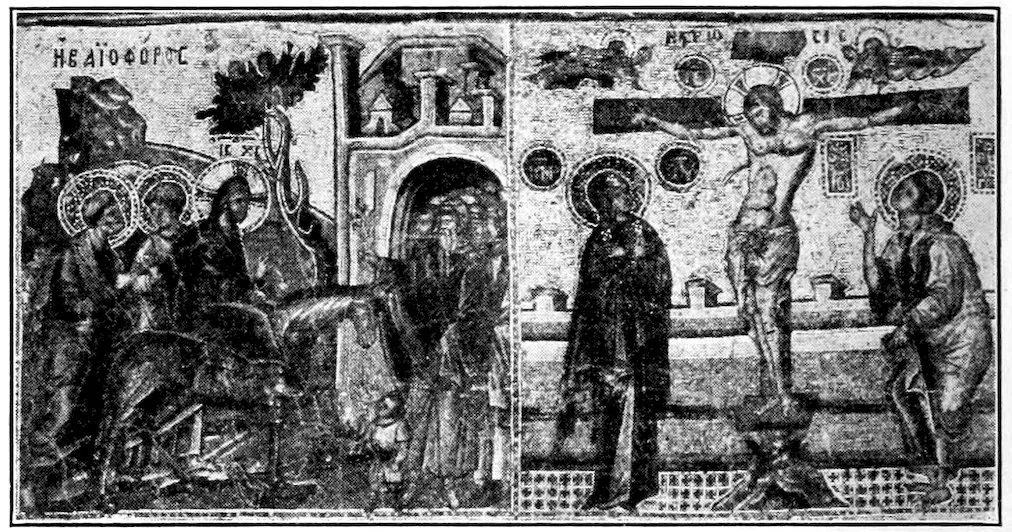
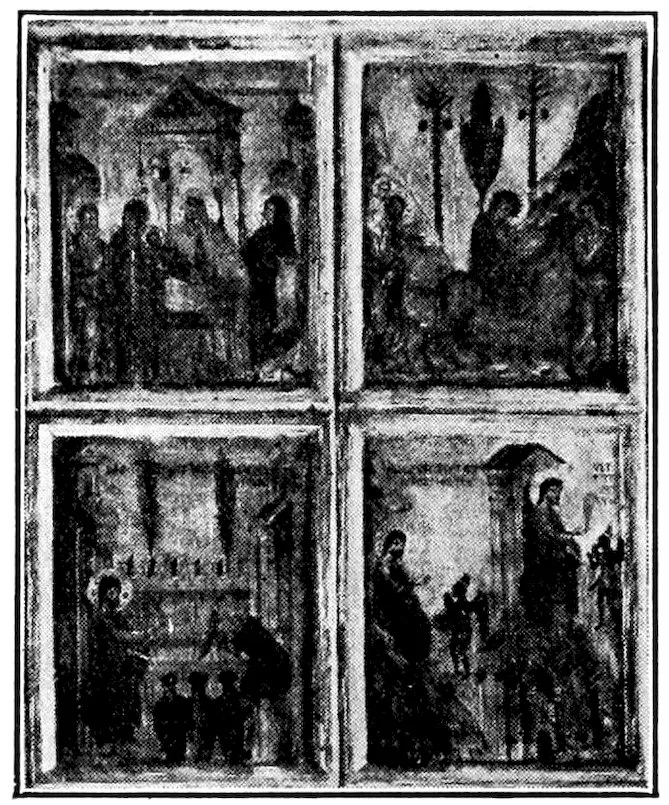
Fig. 1. Byzantine Narrative Style about 1300. Detail from Mosaic Book Covers in the Opera del Duomo.
11
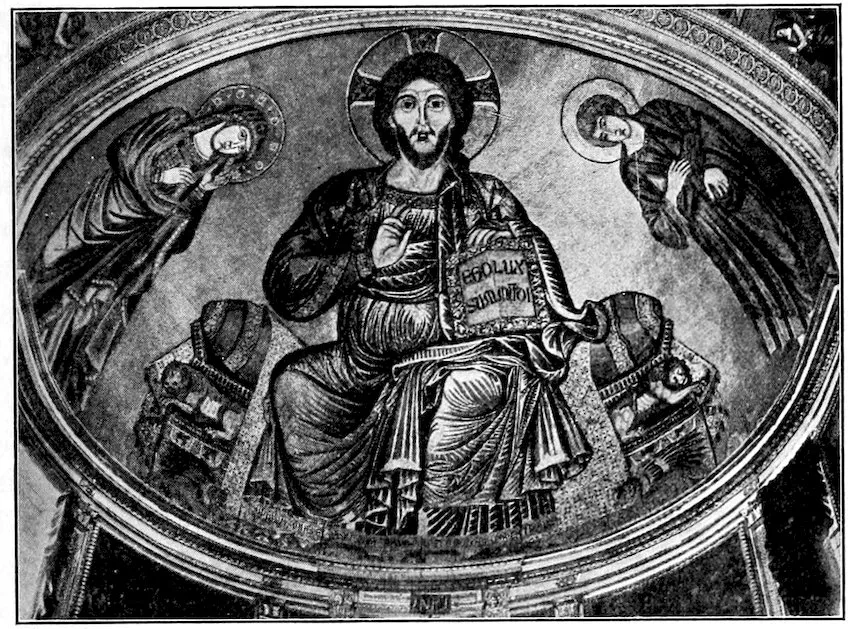
Fig. 2. Mosaic in the Cathedral, Pisa. St. John, left, is by Cimabue, 1302; the Christ is in good Byzantine tradition; the Virgin, right, is some twenty years later.
Byzantine pictures have come down to us on the largest and
on the smallest scale—in the great mosaics and wall paintings,
and as well on small panels and in the illustrated books
used in the ritual of the church. Both are important. The
mural decorations are what the early Italian painter had constantly
before his eye; the miniatured psalters, Gospels, lectionaries,
chorals and prayer books, afforded the patterns
from which he drew with little alteration the standard compositions
of the Annunciation to Mary, the Nativity of Christ,
His Adoration by the Shepherds and Kings, His Baptism, the
Raising of Lazarus, the Last Supper, Crucifixion, Descent into
Hell, Resurrection, and Ascension. But Byzantine design is
most imposing in its monumental phase. The most careless
traveller still feels awe before those solemn figures of Christ
supreme ruler (Pantokrator) and his Mother queen of heaven which
are seen throned against a background of azure or gold and attended
by solemn figures of apostles and martyrs, Figure 2.
The forms are flat,—silhouettes enriched by interior tracery,
the arrangement in the space formal, symmetrical, highly decorative.
The smaller narrative compositions,[2] Figure 1, are
clearly conceived but have small emotional appeal. For this
reason the Italians of the Golden Age spoke of the Byzantine
style as rude. This is an error. Rude in the hands of half-trained
local imitators, the style as formulated in the 9th century
12at Constantinople was highly sophisticated and decoratively of
great refinement. It was based on an admirable system of color
spotting and a fine understanding of silhouette. The contours
were cast in easy conventional curves. These were enriched
within by hatchings and splintery angles of gold which contrasted
effectively with the fluent outlines. Everything was
done by precept and copybook. In four centuries before the
year 1300, the style showed little change, indeed is still alive in
the mountains of Macedonia and, until the Revolution, in
Russia. The Byzantine artist seldom looked at a fellow
mortal with artistic intent. He looked at some earlier picture
or considered his own color preferences. Conventional and
anæmic as the narrative style was, it did all that was required
of it. Nothing better serves the purpose of an authoritative
Church than the awe-inspiring Christs of the Lombard and
Sicilian and Roman apses, and so long as the Church felt no
duty beyond that of plain statement of her claims, the unfelt
narratives from the Scriptures served every religious need.
It was different when under the leading of St. Dominic and
St. Francis,[3] the Church eagerly wished to persuade men.
Men may well have been frightened or even instructed by a
Byzantine picture; nobody was ever persuaded by one. It took
a century to work away from the Byzantine style, so deeply was
it rooted. In fact, from the year 1226, that of St. Francis’s
death, to about the end of the century, such artists as Guido
of Siena, Coppo di Marcovaldo, Giunta of Pisa, Jacopo Torriti,
Giovanni Cosma, Duccio, and Cimabue chiefly restudied the
old Byzantine manner. They wished to learn how to build
creditably before they began to tear down. Such reverent
experiment extending over two generations only proved that
the breach with Byzantine formalism was inevitable.
13
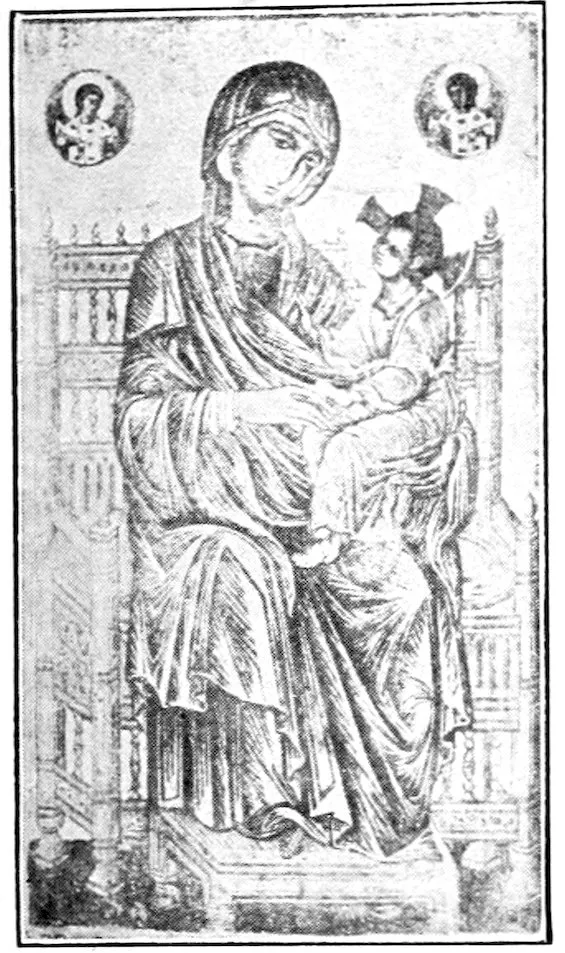
Fig. 3. Tuscan Master about 1285.—Otto Kahn, N.Y.
Fig. 4. Cimabue. Madonna in Majesty.—Uffizi.
With the deepening and broadening of personal, civic, and
religious emotions, the painter found new exactions laid upon
him which the bloodless art of Byzantium could not satisfy.
New life called for new forms to express it. We find in sculpture
from about the year 1260, that of Giovanni Pisano’s
first pulpit—wholly classical in its dignity—a kindred endeavor
in advance of the art of painting. The renewal took
three forms: the more conservative spirits accepted the Byzantine
formulas but endeavored to refine on them in a realistic
sense, to add grace to austerity. Such moderate development
of the old style fixed the character of the school of Siena and
was magnificently initiated by its greatest artist, Duccio,
active about 1300. A very beautiful Madonna of this general
tendency is in the collection of Mr. Otto Kahn at New York,
Figure 3. It has been quite variously attributed.[4] It seems to
me, however, a pure Tuscan work by Coppo or a painter akin
to him. For the greater spirits such a reform was inadequate.
Refine the Byzantine formulas to the utmost—there was no
14gain, rather loss in strength. Accordingly a vehement spirit
like Cimabue,[1–5] acknowledgedly father of the Florentine school,
accepts the Byzantine tradition loyally, but seeks to make its
rigid mannerisms express the new religious passions. At times
he is successful at this unlikely task of putting new wine into
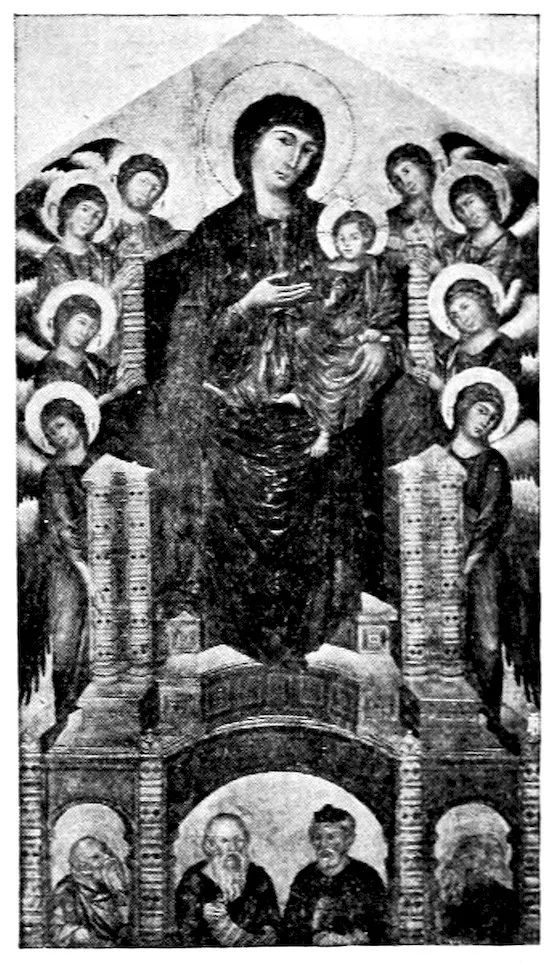
old bottles. His great enthroned Madonna at Florence, Figure
4, with solemn angels in attendance and grim patriarchs below
her throne, may have been painted as early as 1285. It
is faithful to the old monumental tradition—akin to the Christs
and Marys of the mosaics—in its impressive richness is one
of the most majestic things the century produced. It reveals
the docility of its creator but only partially his power. We
have hardly his hand but surely an echo of his influence in the
tragic crucifix in the museum of Santa Croce. It is the moment
of agony, and the powerful body writhes against the nails,
while the head sinks in death. It may represent hundreds
of similar crosses that stood high in air on the rood beam before
the chancel, in sight both of the preacher and his public.
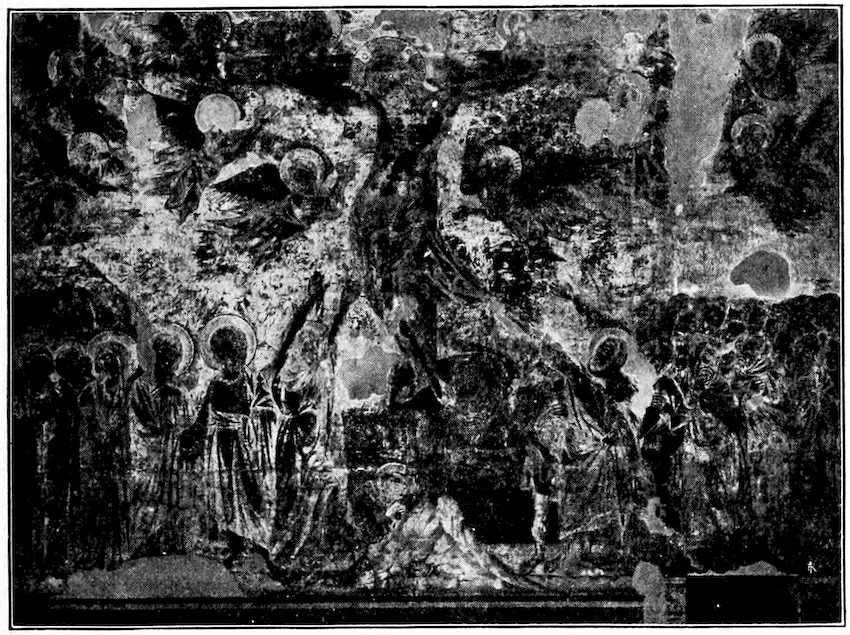
Somewhere about 1294, Cimabue was called to Assisi to
decorate the church in which St. Francis was buried. His
part was the choir and transepts of the upper church. In the
cross vault he painted the four evangelists, on the walls he
spread the stories of St. Peter and St. Paul, the legends of the
Virgin scenes from the Apocalypse, the gigantic forms of the
archangels and a Calvary, Figure 5, that is one of the most
moving expressions of Christian art. Chipped and blackened,
their lights become dark through chemical change,
these wall paintings retain an immense power and veracity.
The Byzantine forms gain a paradoxical solidity, like that of
bronze. The convulsion of the figure of Christ is given back in
the wild gestures of the mourning women and the terrified Jews.
It is the moment of the earthquake and the opening of tombs; a
cosmic terror and despair pervade the place. The work is
hampered and rude but completely expressive. The sensitive
15Japanese critic and man of the world, Okakura Kakuzo, used
to regard these sooty frescoes in the transepts of the Franciscan
basilica as the high point of all European art, which should
at least induce the tourist and the student to give a second
look at these battered and fading masterpieces. Recently an
inscribed date, 1296, has been discovered on the choir wall
which settles a long vexed question of chronology. The upper
part of the work in the transepts and choir must have been
going on for some years earlier, and the entire decoration of the
Upper Church should roughly be comprised between 1294 and
1300. Cimabue died about 1302 while working on the apsidal
mosaic at Pisa, where the St. John is by his hand, Figure 2.
He had brought life and passion into Italian painting, as his
younger contemporary Giovanni Pisano had into Italian
sculpture. Cimabue’s defect—that of a noble spirit—was
the faith that the old pictorial form could contain the new
surging emotions.
Fig. 6. Pietro Cavallini. Dormition of the Virgin. Mosaic.—S. M. in Trastevere, Rome.
17
Fig. 7. Pietro Cavallini. Apostles, fresco, from Last Judgment.—Santa Cecelia in Trastevere.
Colder spirits, as is often the case, more readily found the
right way. And the discovery was made at Rome where the
sculptured columns, arches, and sarcophagi, the pagan wall
paintings and the earliest Christian mosaics combined to continue
the lesson of classic humanism. A remarkable family of
decorators, the Cosmati; with such contemporaries as Jacopo
Torriti and Filippo Rusuti begin very cautiously to free themselves
from Byzantine trammels. But it was a painter, Pietro
Cavallini,[5] who more fully grasped that glory that had been
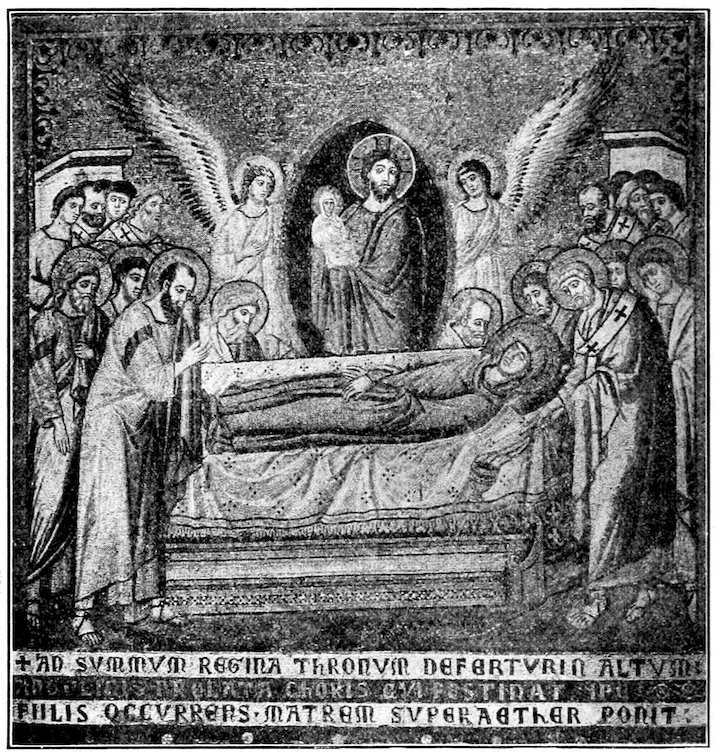
Rome. In 1291 he designed for the church of Santa Maria in
Trastevere a Madonna and four stories of the Christ Child in
mosaic. Here we glimpse a new pictorial form, Figure 6.
Those Byzantine hooks and hatchings which were quite false
to form give way to a reasonable structure in light and dark,
the hair no longer wild and ropy, is disposed in sculpturesque
locks, the draperies are no longer a cobweb pattern, but cast
in broad and classic folds. All these improvements may be
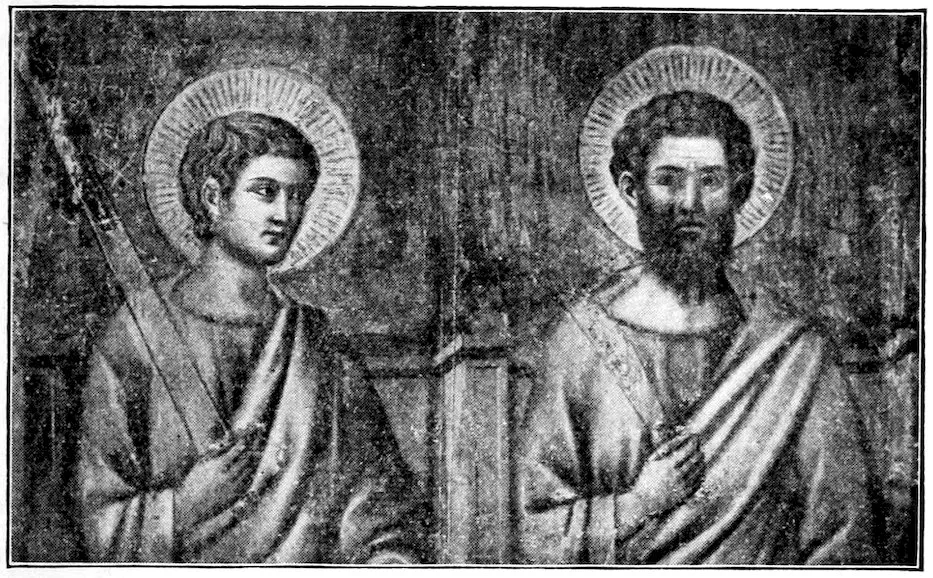
noted in more complete form in the frescoed Last Judgment
which has recently been uncovered in the church of Santa
Cecilia, Figure 7. Here the heads of Christ and the Apostles
are well built in carefully graduated light and shade, while the
draperies suggest Hellenistic statuary. But the renovation is
on the whole cold and academic. Cavallini has not much
more to say than the Byzantines, but that little he says
with far greater gravity and truthfulness. He was a lucid
and industrious but not a fine or strong spirit. His work
later at Naples—in the Church of the Donna Regina, about
1310—shows that when he will express strong emotions he
becomes merely hectic. Yet he recovered for Italian painting
more than a hint of the choice naturalism of old Rome, and
18that is his sufficient glory. There is greater power and knowledge
than his in the work of such contemporaries as the unknown
painters of the frescoed heads of prophets in Santa
Maria Maggiore at Rome and of the stories of Isaac in the
Upper Church at Assisi.[6] These show a resolute and intelligent
effort to draw in masses of light and shade, and as well an
ambition to recover the gravity of the early Christian mosaics.
It is no wonder that some critics ascribe such dramatic and
superbly constructed frescoes as The Betrayal of Esau to
young Giotto, Figure 8, but the art is too mature for any
young artist. We have rather to do with a great personality
of Roman training who broke the way for Giotto. Cavalcaselle
suggests, I think rightly, that the Florentine, Gaddo
Gaddi, may have done some of this work. But we are safe
only in calling this great painter “The Isaac Master.”
To recapitulate, there were three ways, all imperfect, open
to a young and progressive painter who like Giotto di Bondone
was forming a style about the year 1300. He might with the
Sienese evade the issue of passion and naturalism, choosing for
gracefulness, he might try over again the great adventure of
his master Cimabue, endeavoring to bring emotion into the old
unfit forms, or he might, like Pietro Cavallini, let emotion
take care of itself and work academically towards better structure,
drapery, light, and shade. His choice was absolutely
momentous for modern painting, and I want you to feel that
the issue was quite consciously and vividly before him, for he
had spent much of his youth as a humble assistant in the
basilica at Assisi, where frescoes in the vehement Tuscan manner
of Cimabue and in the dignified Roman style of the Isaac
Master were being painted side by side. His decision was to
combine the merits of the two manners—to seek, like his
master, sincerity and depth of emotion, but to embody it in
the new and nobler forms of the Roman school. This decision
virtually fixed the character of Christian art in Italy—it was
19to be warm and humanistic, but it was to revive much of that
abstract nobility which old Rome had inherited from Greece.
Thus Italian painting at the outset took a classic stamp which
when true to itself it has never lost. In fundamental ideas of
beauty, there is no real difference between Giotto, Masaccio,
Leonardo da Vinci, Raphael, Titian, Michelangelo.
Fig. 8. “The Isaac Master.” Esau before Isaac. Fresco.—Upper Church, Assisi.
Giotto di Bondone,[7] according to the best information we
20have on a disputed point, was born in 1266, at the village of
Colle, in the lovely valley of the Mugello. His people were
prosperous and his way smooth. I see no reason for doubting
the charming legend told by Ghiberti that Cimabue found the
lad Giotto by the roadside diligently scratching the outlines of
a sheep on a slate, and that that was the beginning of their
association. In any case, we may surmise that he was early
with Cimabue as apprentice and eventually went with the
Master to Assisi to grind colors, clean brushes, and paint
under direction. To be at that moment in the Franciscan
Basilica was to be at the greatest creative center of the world.
It seems to me likely that Giotto may have had a considerable
part in the actual painting of the Old and New Testament
stories in the nave, and I believe we may find his earliest designs
in certain frescoes of the upper rows. The Lamenting
over Christ’s Body, for example, singularly combines the energy
of Cimabue with the dignity of Cavallini, and there are significant
echoes of the composition in Giotto’s later version of
the same theme at Padua. Tradition also ascribes to Giotto,
maybe correctly, the Resurrection and Pentecost on the entrance
wall.[8]
After 1296, according to Vasari’s entirely credible account,
young Giotto took over the direction of the work for the newly
elected Franciscan General, Giovanni dal Muro. What share
he had in the vivacious and justly loved stories of St. Francis,[9]
in the lower range of the nave, is greatly disputed. Of the
twenty-eight frescoes involved, it seems clear to me that the
first and the last three are by an artist more nearly in the
Sienese tradition, that Nos. II to XVIII inclusive are designed
by Giotto in the style of the Old Testament stories above and
painted by him with a certain amount of assistance, and that
the rest are largely inspired by Giotto but executed in his
absence and without his final control. What is more important
is the variety and vivacity of these narratives. Young
Giotto is free to improvise, as he was not in the standard Bible
subjects, and the mood shifts readily. We have charity, with
St. Francis giving his cloak to a beggar, in an idyllic landscape;
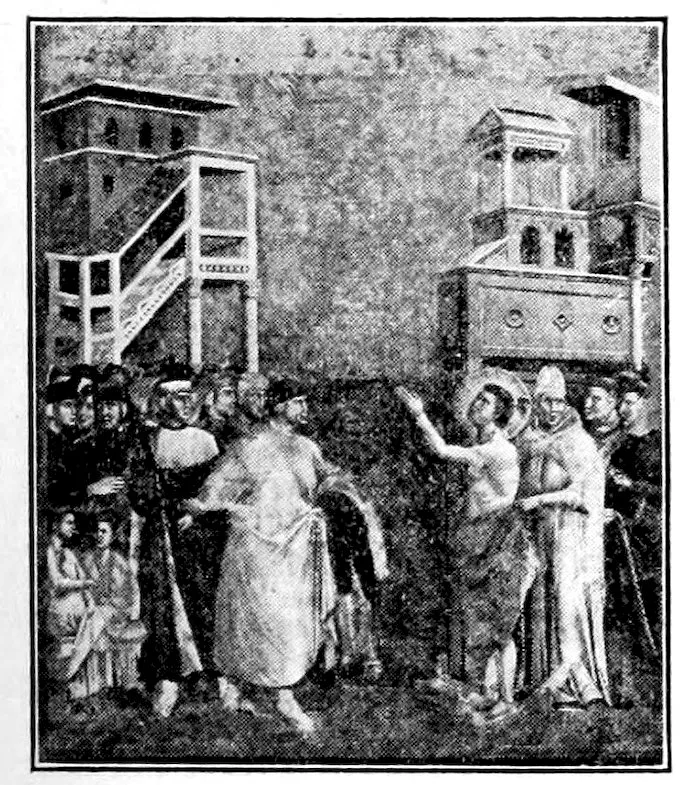
family strife in St. Francis renouncing his father, Figure 9;
sorcery in the exorcism of the devils from Arezzo; an odd mixture
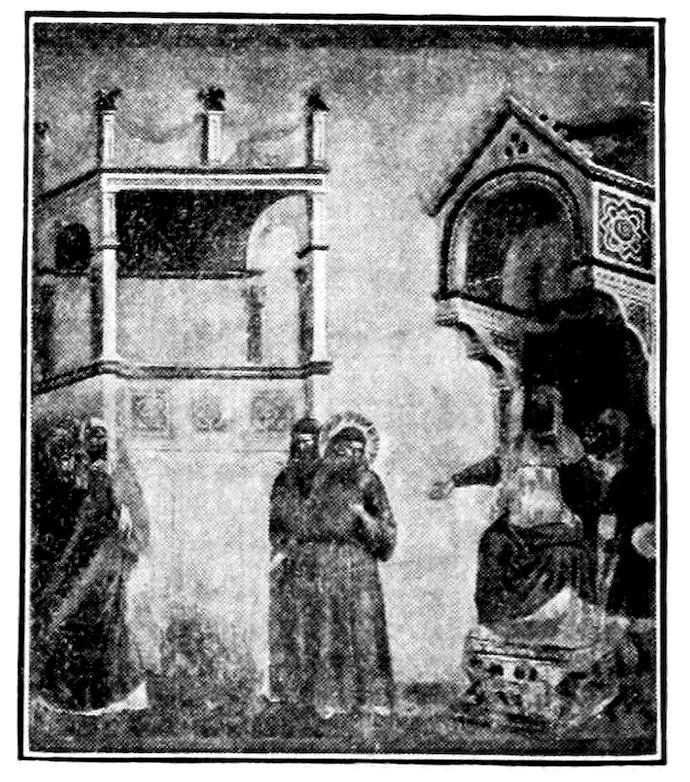
of ogreishness and witchcraft, in St. Francis’s Fire Ordeal
before the Soldan, Figure 11; a great pious intentness, in the
choristers at the Cradle Rite; intense physical appetite, in the
Miracle of the Spring; an entrancing blend of reverence and
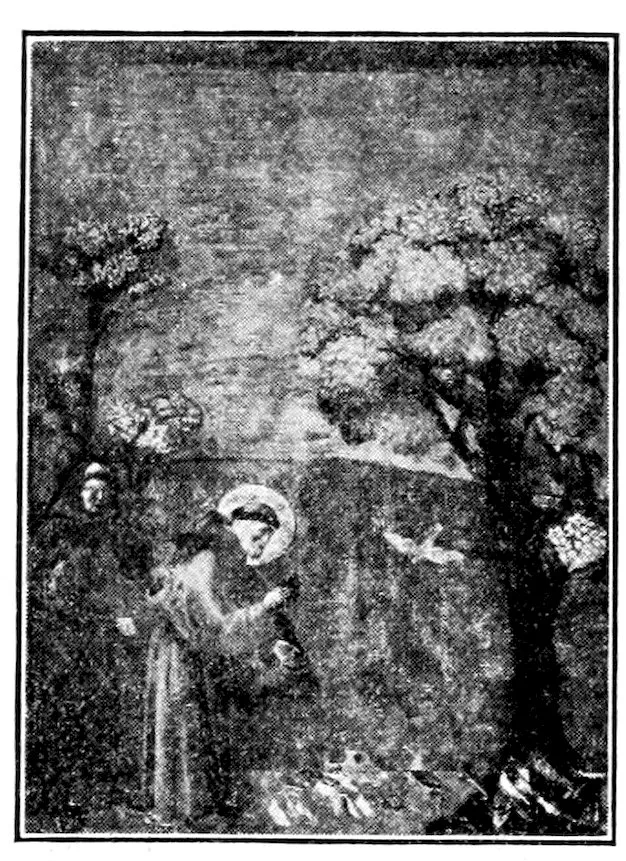
humor, in the Sermon to the Birds, Figure 10; stark tragedy
in the Death of the Knight of Celano.
21
Fig. 10. The Sermon to the Birds.—Upper Church, Assisi.
Fig. 9.—St. Francis renounces His Father.—Upper Church, Assisi.
Fig. 11. St. Francis before the Soldan.—Upper Church, Assisi.
22
Fig. 12. Early Sketch Copy after Giotto’s Mosaic of the Navicella. Compare Fig. 31.—Metropolitan Museum, New York.
Giotto is still chiefly a sprightly illustrator. He is as yet
insensitive to composition. He often perfunctorily splits his
groups, giving each a landscape—or architectural back-screen
quite in the Byzantine manner. His story-telling is brusque
and without rhythm. His sense of form is already strong
and growing, but there is little of the ease and style of
23the Isaac frescoes just above. In vitality the stories of St.
Francis mark a great advance, but they lack the gravity and
exquisiteness of balance proper to the best mural decoration.
It was at Rome that young Giotto was to broaden and refine
his art. He was called thither before the year 1300 to
design the great mosaic of Christ walking on the Sea of Galilee
beside the tempest-tossed boat of the Apostles. It stood over
the inside cloister-portal of old St. Peter’s, and has been many
times moved in the rebuilding of the church, and with each
move restored, so that what we now see in the porch is entirely
remade. From certain fragments of the old mosaic, and old
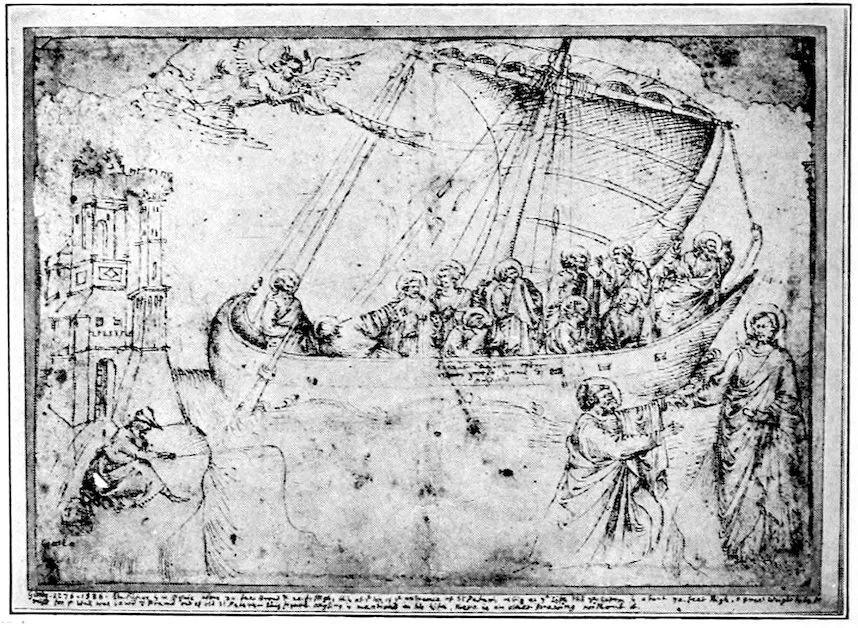
sketch copies, Figure 12, we may judge that the Navicella, as the
Italians loved to call it, was an elaborate composition of great
dramatic power, the logical consummation of the experiments at
Assisi. Our best version of the Navicella is Andrea Bonaiuti’s
adaptation, Figure 31, for the vault of the Spanish Chapel, 1365.
But Giotto was soon to renounce the facile method of diffuse
and genial narrative in favor of a concise and massive style,
akin to sculptured relief, and deeply influenced by the antique.
The arches and the columns of Imperial Rome are teaching
their silent lesson, the simple and noble forms of Cavallini
and his nameless rivals show how painting may vie with
sculpture in sense of mass and reality. With the problem of
the representation of mass on a flat surface, Giotto wrestled
eagerly and triumphantly. With a genius that few painters
have equalled, he grasped the truth that the figure painter’s
problem of representing space is chiefly that of emphatically
suggesting mass. If you convince the eye of the tangibility
of your objects, the mind will supply elbow room and air to
breathe. It isn’t necessary to simulate a box, as the Sienese
painters often did. The painter who can give a convincing
sense of mass may handle accessories and perspective with
the utmost freedom, according to the inner law of his design.
The painter who thinks first of his space is in every way more
24bound to the smaller probabilities. Much thinking of this
sort must have been done by Giotto before he worked out
his new style at Padua.
After his return from Rome, Giotto sojourned for a time
in Florence, and in 1304 or thereabouts painted the gigantic
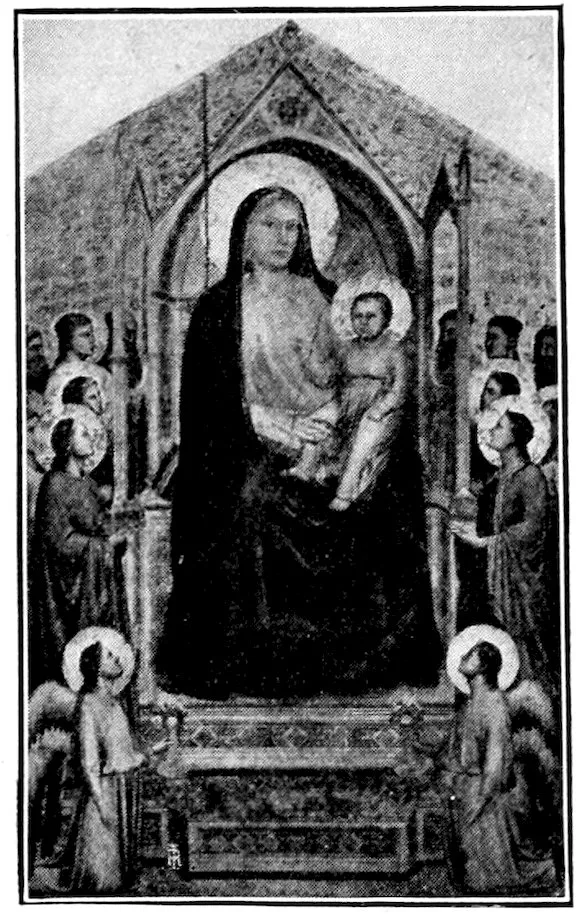
Madonna formerly in the Trinità, Figure 13. It is impressive
in mass, admirable in the intent expression of the attendant
angels, rich in color, but the great figure is unhappily crowded
by the canopy. Giotto is still a bit uncertain as to the rendering
of space, and makes a good if unpleasing effort to suggest
depth despite the limitations of a gold background. With all
its nobility and tenderness, this is by no means so good a decoration
as the great Madonna by Cimabue, Figure 4, which
hangs nearby in the Uffizi.
With the problems of space and mass, Giotto was soon to
cope triumphantly. A wealthy citizen of Padua, Enrico
Scrovegni, was planning a new chapel to the Virgin Annunciate.
Doubtless he wished the repose of his father’s soul,
for his father had been a notorious usurer. Dante incontinently
puts him in hell with other profiteers. Enrico Scrovegni
built his chapel near the ruins of a Roman arena and
dedicated it March 25, 1305. The Arena Chapel was a brick
box, barrel vaulted within—a magnificent space for a fresco
painter. Giotto spread upon it the noblest cycle of pictures
known to Christian art. Over the chancel arch he painted
the Eternal, surrounded by swaying angels, and listening to
the counter-pleas of Justice and Mercy concerning doomed
mankind, with the Archangel Gabriel serenely awaiting the
message that should bring Christ to Mary’s womb and salvation
to earth. This is the Prologue. Opposite on the entrance
wall is the Epilogue—a last judgment, with Christ enthroned
as Supreme Judge amid the Apostles, and the just being
parted from the wicked. Amid the just you may see Enrico
Scrovegni presenting the chapel to three angels.
25The side walls are ruled off into three rows of pictures,
with ornate border bands and a basement of sculpturesque
figures symbolizing the seven virtues and vices. The story reads
down from above. Below the azure vault and still a little in
the curve are the stories of the
Childhood of the Virgin—nothing
in the chapel more simple
and stately than these.[10] The
middle course is devoted to the
early deeds of Christ, from his
birth to the expulsion of the
money lenders from the temple.
The lower row depicts His Passion
ending with the Miracle of
Pentecost. Much later a disciple
of Giotto completed the story
with the last days of the Virgin,
in the Choir. Thus the narrative
in its broadest sense is a life of
the Virgin Mary, including that
of her Divine Son, and both
lives are brought into an eternal
scheme of things by the prologue, which shows a relenting
God, and the Epilogue which shows a now relentless Christ
awarding bliss and woe to the race for all eternity.
Fig. 13. Giotto. Madonna Enthroned.—Uffizi.
The first impression of a visitor to the chapel will be a
feeling of awe qualified by joy in the loveliest of colors. The
whites of the classical draperies dominate. They are shot
with rose, or pale blue, or grey green. Certain old enamels
have the same quality of making the most splendid crimsons,
blues, and greens seem merely foils to foreground masses of
white which seem to include by implication all the positive
colors. It is this bright and original color scheme balancing
crimsons and azures with violets and greens which makes a
26thing of beauty out of what would otherwise be a stilted
checkerboard arrangement.
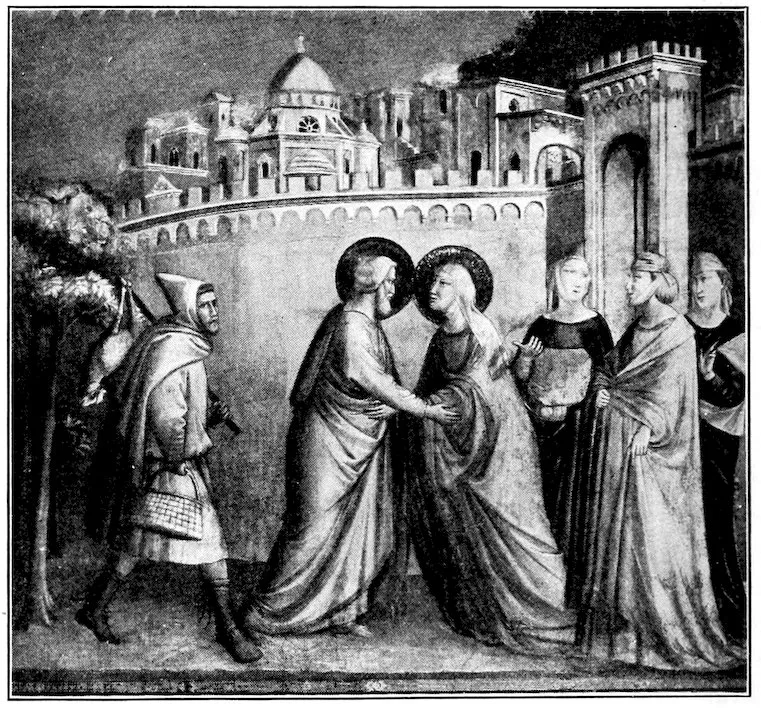
Fig. 13a. St. Joachim and St. Anna at the Beautiful Giotto Gate.—Arena, Padua.
27
Fig. 14. Giotto. The Flight into Egypt.—Arena, Padua.
Next the eye will realize splendid people gravely occupied
with solemn acts. There is the strangest blend of passion and
decorum. See the eager old man who clutches his wife before
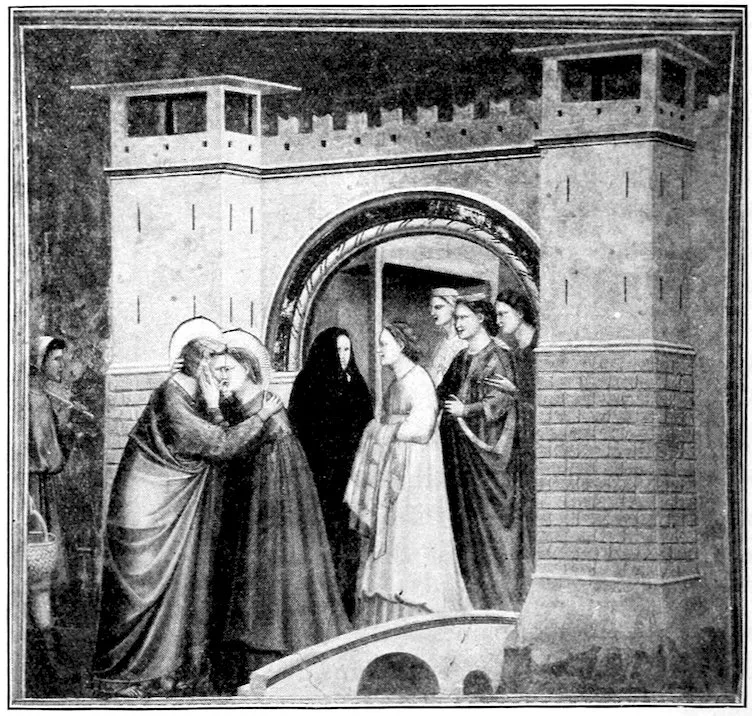
a massive city gate while she caresses him tenderly, Figure 13a,
note the firm gentleness of the bearded priest who handles a
screaming baby before the altar, mark the sense of strain and
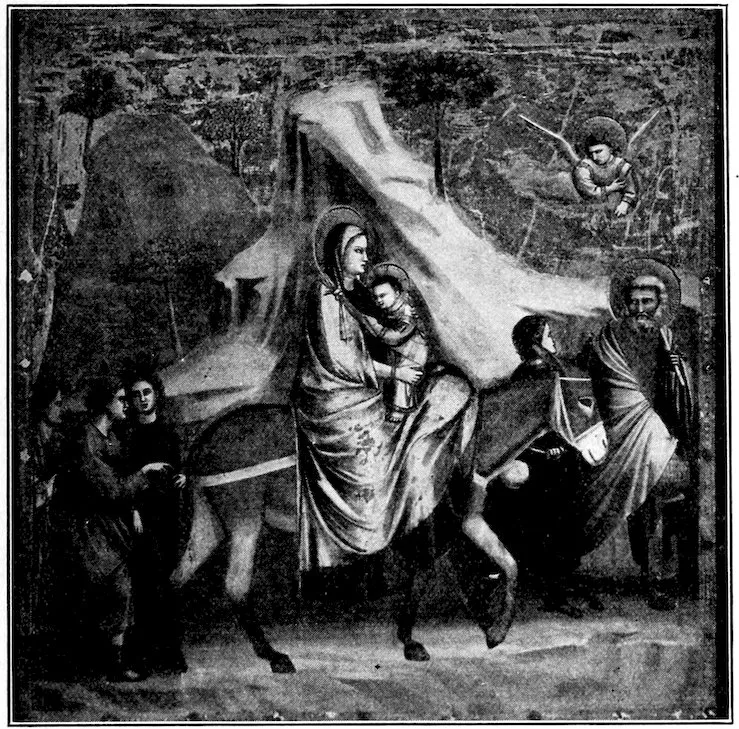
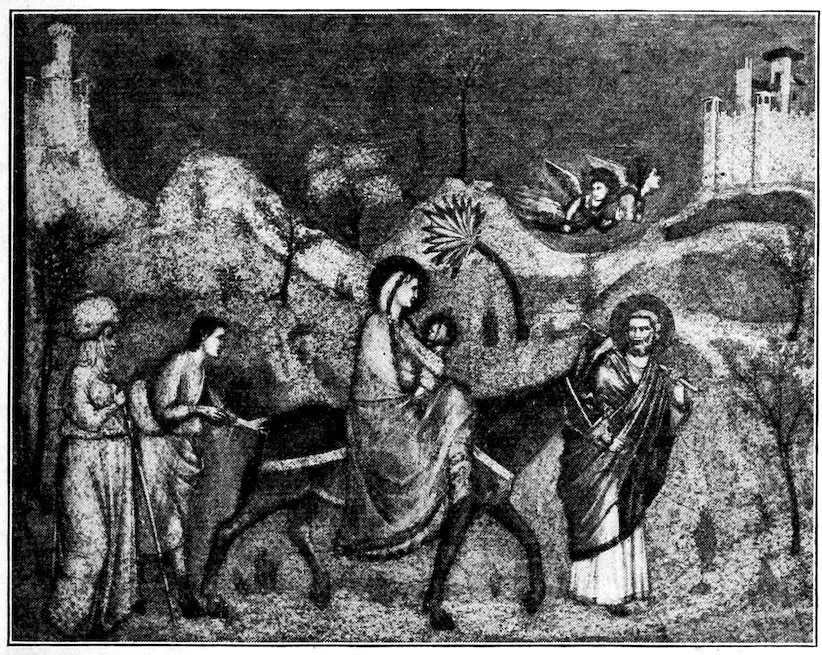
hurry where a mother and child mounted on an ass, Figure 14,
are pushed and dragged along by an old man and attendants.
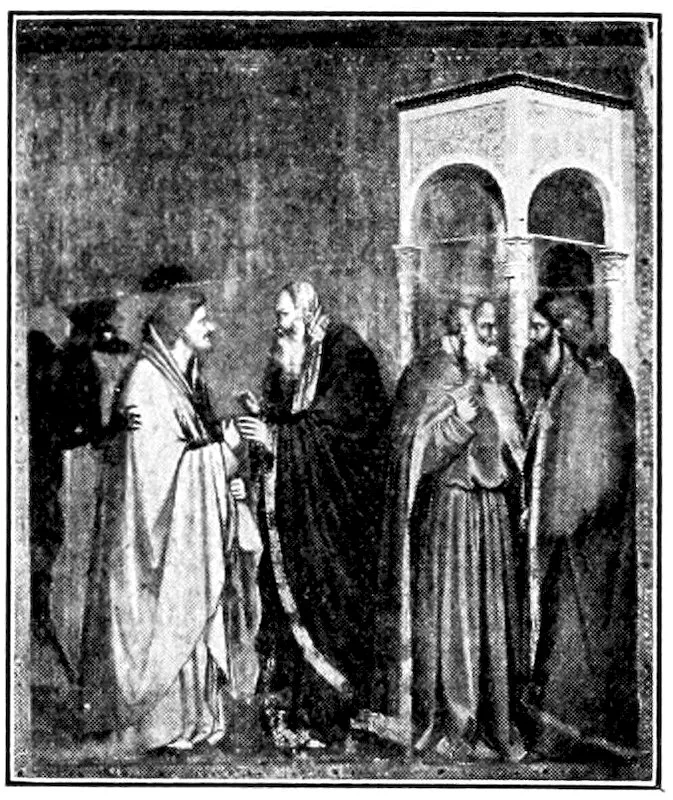
Or again, what sinister power in the scene where three
Jewish magistrates press money upon a haggard, bearded,
nervous man. You do not need the bat-like demon prompting
him to know that it is the arch-traitor Judas, Figure 15. Then
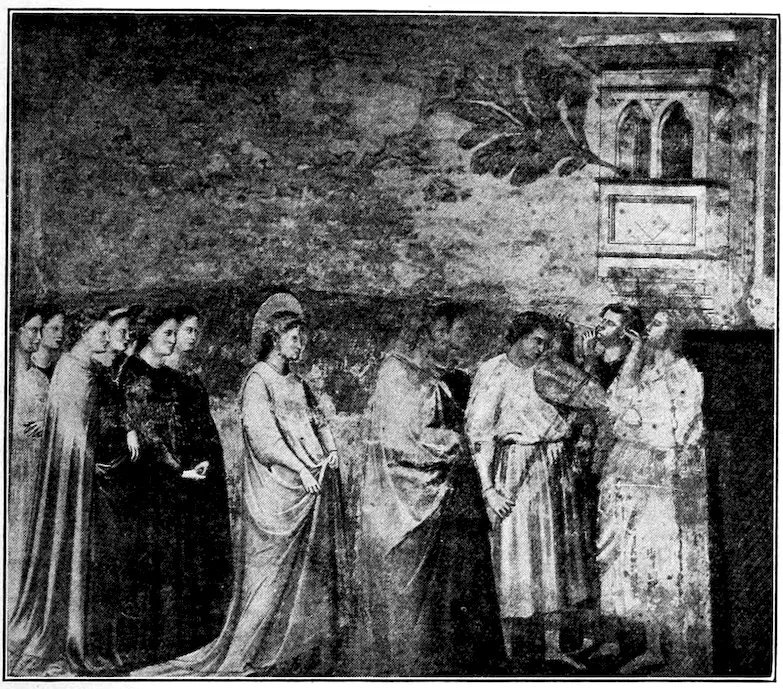
there is a strange, serene, processional composition, with the
Virgin moving homeward among her friends to a solemn
music, Figure 16. It has a rhythm like the frieze of the
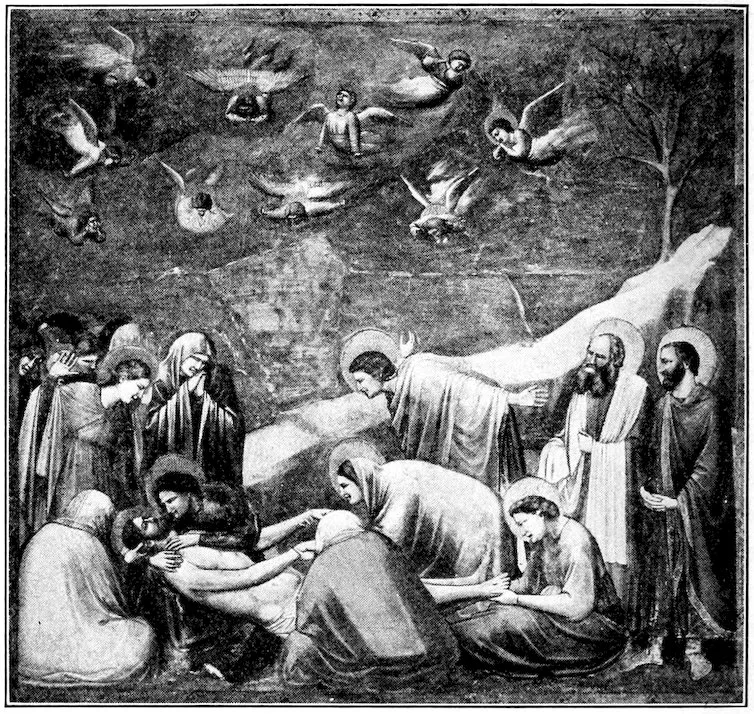
Parthenon. Perhaps your eye will fix longest on the scene
where about the pale body of the dead Christ women wail with
outstretched hands, or tend the broken body, while bearded
men, accustomed to the hardness of life, stand in mute sympathy
with folded hands, Figure 17. It is what the Gospel
ought to look like. How Giotto shows every feeling, pushing
its expression just to the verge, and there stopping, so
28that idyl and tragedy, devotion and wrath, treachery and
fealty, fear and courage, each keeps its proper and distinguishing
aspect, while all are invested in a common dignity and
nobility. You will perhaps never have seen an art at once
so varied and moving, and nevertheless
so monumental, and you
may well be curious as to the
method.
You will see readily that
these compositions are conceived
sculpturally. Every one with the
slightest change could be cut in
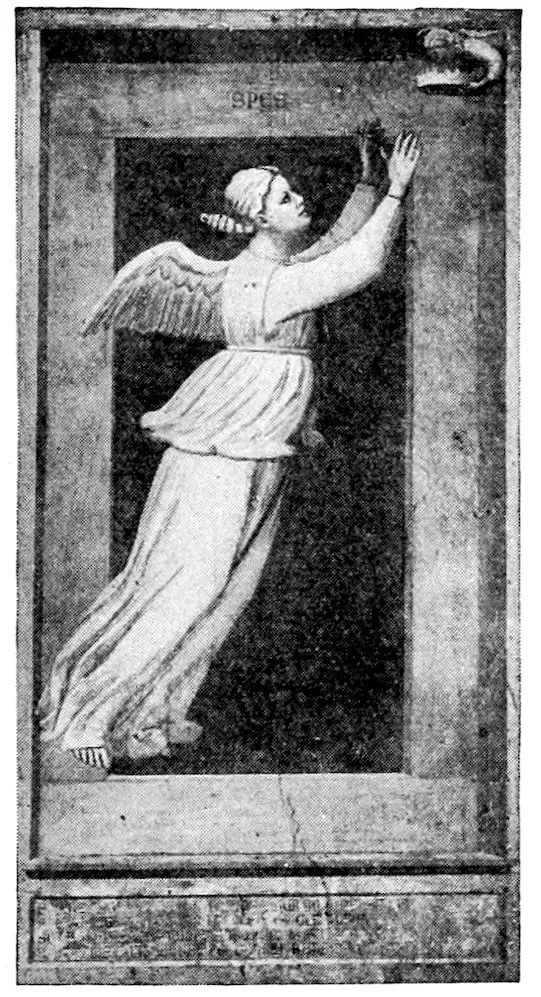
marble. Indeed the seven Virtues,
Figure 18, and seven Vices
impersonated in monochrome on
the dado of the chapel are direct
imitations of sculpture. The
figures throughout the life of
Christ and the Virgin are of even size, and usually all on one
plane. The landscapes and architectural features are arranged
simply as frames or backgrounds for the figure groups. The
figures are, whenever the subject permits, clad in drapery of
a classic cast. Expression is conveyed not much by the faces,
which have a uniform Gothic intentness, but by the action of
the entire figure and especially of the hands. The forms are
rather squat and massive, yet have a homely gracefulness.
There is nothing like perspective, and small regard for distance,
yet the figures have convincing bulk and move gravely in
adequate space. All this is due to the most consummate
draughtsmanship. Giotto simplifies his seeing; what he cares
for is the thrust of the shoulder, or the poise of hip, the swing
of the back from the pelvis, the projection of the chest, the
balance of the head on the neck and its attachment to the
shoulders. All these essential facts of mass he represents by
29the simplest lines of direction, by broad masses of light and
shade, often merely by the tugging lines in drapery that tell
of the form beneath. The cave men would have understood
Giotto, and so would the post-impressionists of today. Conciseness,
economy, force, mass—these are the technical qualities
of the work, as human insight and tenderness are its
grace. As the great analytical critic Bernard Berenson has
well remarked, this painting makes the strongest possible
appeal to our tactile sense, stirring powerfully all our memories
of touch, and presenting the painted indications as so
many swiftly grasped clues to reality. We have to do with a
magnificently conceived shorthand. No artist before or since
has made a greater expenditure of mind or achieved a more
notable inventiveness than Giotto in the Arena Chapel.
Fig. 16. Giotto. The Virgin returning from her wedding.—Arena, Padua.
30
Fig. 17. Giotto. Lamentation over Christ.—Arena, Padua.
It was dedicated March 25, 1305, Giotto being nearly forty
years old, and it was probably not completely painted on the
day of dedication, since many draperies were borrowed from
St. Mark’s, Venice, to cover, presumably, the still unpictured
parts of the walls. Giotto lived some four years in Padua,
brought his family there, received the exiled poet Dante and
with him joked not too decorously about his own ugliness and
that of his children. It seems likely enough, though not certain,
that he followed the banished Pope to Avignon about
1309, and spent some years in Southern France. What is
certain is that he was again in Florence by 1312, and that,
having found his own solution of the problem of mass in the
31Arena Chapel, he thereafter rested comfortably on his discovery,
never was quite as strenuous again, and spent his
later years at a new problem—that of decorative symmetry.
Fig. 18. Giotto. Hope.—Arena, Padua.
The first experiment towards a sweeter and more complex
style was made in the cross vaults
of the Lower Church of Assisi,
immediately above the tomb of
St. Francis. The subjects were
the three virtues of the Franciscan
vow—Poverty, Chastity,
and Obedience—with a St.
Francis in a glory of angels. In
these great triangular compositions,
allegory and symbolism
run riot, and we do well to recall
Hazlitt’s shrewd remark on
Spenser’s “Faery Queene”—“the
allegory will not bite.”
Indeed one might forget it for
the radiance of the azures, moss-greens,
rose pinks, and deeper
violets, for the delightful contrast
of the freely composed
groups with the intricate geometrical
formality of the rich borders.
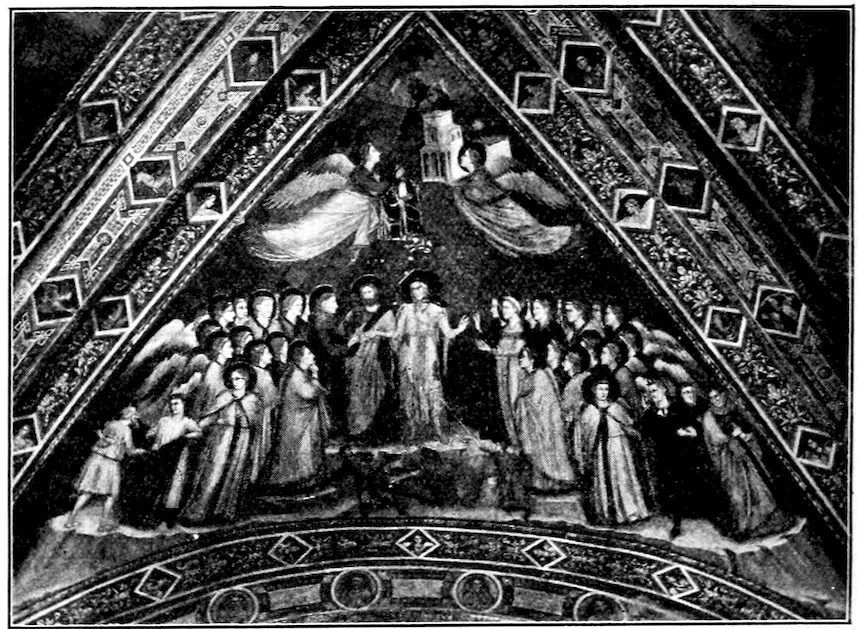
Yet to ignore the allegory completely would be to forget
the master’s intention. We may savor it best in the great composition:
St. Francis Marries his Lady Poverty, Figure 18a. The
bridal group stands on a central crag, Christ serving as priest,
St. Francis slipping a ring on the gaunt hand of a haggard, yet
strangely fascinating bride clothed in a single ragged garment.
Her bare feet show through a crisply drawn and blossomless rose
tree. Two urchins at the foot of the little cliff stand ready to
stone so unseemly a bride. From the central group to right
32and left, earnest groups of angels spread in a descending curve.
In the lower angle, left, a young man gives his rich cloak to an
old beggar, while an angel points to the bridal: Poverty is
accepted. At the lower right corner, another angel attempts
to detain a young man who passes with a gesture of contempt
in the company of two portly priests: Poverty is rejected by
such. From the apex of the great triangle, the hands of God
descend to welcome two angels, one of which offers the cloak
given to the beggar, and the other a model of the church which
is the splendid covering for the body of the Saint. The fantastic
beauty of this and its companion pieces can only be appreciated
on the spot. No frescoes of Italy surpass these for
loveliness of color and perfection of condition. It is the most
beautiful pictured Gothic ceiling in the world, perhaps the
most fantastically beautiful of all figured ceilings whatever.
Fig. 18a. Giotto. St. Francis’ Mystic Marriage with Poverty.—Lower Church, Assisi.
Because the figures are a little slight and the expression a
33bit sentimentalized, and the proportions rather arbitrarily
handled to meet the exigencies of the curved spaces, many
good critics, including Venturi and Berenson, deny these compositions
to Giotto. One of them, the St. Francis in Glory, is
clearly of inferior design and quality. For the others, it seems
to me that the designs can only be by Giotto, while the execution
is mostly by a charming assistant whose work in this ceiling
and elsewhere in this church makes us wish we knew his name.
No middle-aged painter of established repute was likely to
undertake personally the dirty and fatiguing work of painting
a ceiling in fresco. If we are right in supposing that Giotto
may have designed this ceiling, shortly after his return from
Avignon, say, after 1312, he would have been towards fifty
years old, and provided with a shop-staff of well-trained assistants.
From this time on, indeed, we may assume that he
rather directed the work of others than painted himself. Such
a view will permit us to accept as school works many fine pictures
the design of which a too strict criticism has denied to
Giotto. For example, the admirable Coronation of the Virgin,
in Santa Croce, Florence, seems to me completely designed by
Giotto, and the logical next step after the Franciscan allegories,
though there can be little actual painting by the master on the
panel, and his personal contribution may have been limited to
a small working drawing. Indeed the only one of the later
panels which seems to show throughout his actual handiwork
is the lovely Dormition of the Virgin at Berlin, Frontispiece,
which was painted for the Church of Ognissanti.
At about this period I think we may set the several crucifixes
in Florentine churches, without inquiring too narrowly
whether they are by the master or by scholars. Giotto has developed
a singularly noble type. The Christ is no longer contorted
in agony as in the crucifixes by Cimabue. He is dead,
with his head quietly sunk on the powerful breast, and the
body relaxed. The conception is humanistic. One feels
34chiefly the pity of stretching that glorious thing that is a man’s
body on a cross. Probably the earliest of these crucifixes is
that at Santa Maria Novella, while the finest is at San Felice.
About 1320 we may set the dismembered ancona, painted for
Cardinal Gaetano Stefaneschi,
which originally stood on the
high altar of St. Peter’s, Rome.
The tarnished fragments which
you may still see in the sacristy,
are more splendid in color than
any other tempera painting
whatsoever. Probably only the
central panels, Christ and St.
Peter enthroned, are from Giotto’s
hand, the side panels representing
the martyrdom of Peter
and Paul may well be both designed
and executed by the
accomplished assistant who carried out the allegories at Assisi.
Fig. 19. Giotto. Naming of St. John the Baptist.—Peruzzi Chapel, Santa Croce.
So far we have seen Giotto a wanderer. Assisi, Rome,
Padua, Rimini, delighted to do him honor, but apparently
Florence had claimed few works from his hand. We have
record of frescoes in the Badia which may have been early
works. It was the decoration of Arnolfo’s great Franciscan
church of Santa Croce that finally recalled Giotto and evoked
his most accomplished work. He completed in the transepts
of Santa Croce four chapels and as many altar-pieces. The
frescoes were white-washed in the 16th century, and the panels
broken up and lost. But in the last century the white-wash
was scraped off from two of the chapels, and there we may see,
so far as defacement and repainting permit, the masterpieces
of the early Florentine school. We may reasonably guess the
date of this work to be somewhere about 1320, Giotto
being nearly sixty.
35In the chapel maintained by that noble family, the Peruzzi,
Giotto spread on the side walls three stories from the life of
St. John the Baptist, and as many more from that of St. John
the Evangelist. The figures are superb, magisterial in pose;
the draperies grand and ample after the classical fashion.
Upon bulk and relief there is less insistence than at Padua.
Giotto has passed the experimental stage as regards form, is
less strenuous and more at his ease. Nothing is more stately
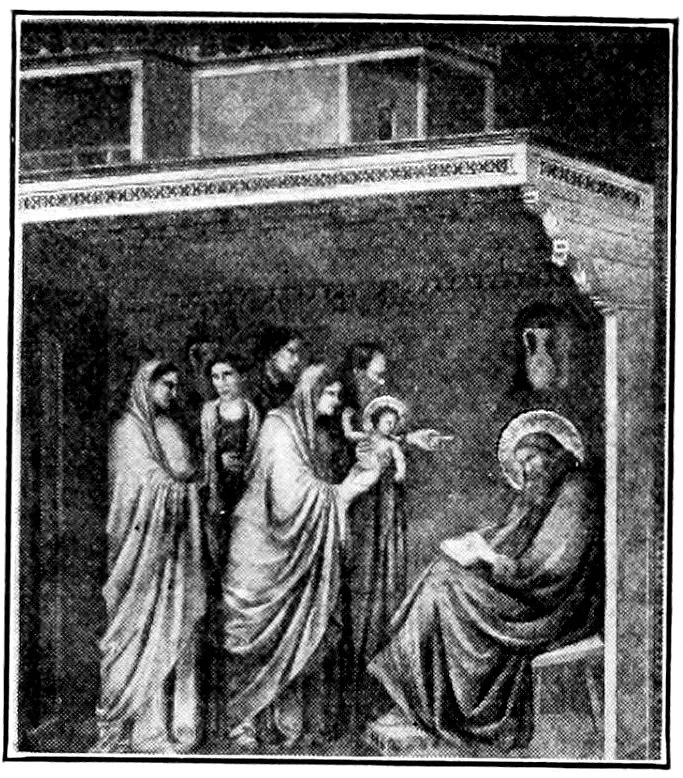
in the chapel than the presentation of the infant Baptist
to his father, who is temporarily stricken with dumbness,
Figure 19. Simeon gravely writes the name John; Elizabeth
with her adoring group of attendants carefully offers the
vivacious child to his father’s gaze. The gestures are slow,
definite, determined. The group beautifully fills the square
space without crowding it. The composition, unlike the
widely spaced Paduan designs, is drawn together into a mass.
Fig. 20. Giotto. Resuscitation of Drusiana by St. John.—Peruzzi Chapel, Santa Croce.
Upon the Feast of Herod with Salome modestly dancing
John Ruskin[11] has expended just eulogies in the petulant yet
36important little book “Mornings in Florence.” What is notable
in the scene is its general decorum and the pathetic indecision
of the weak King.
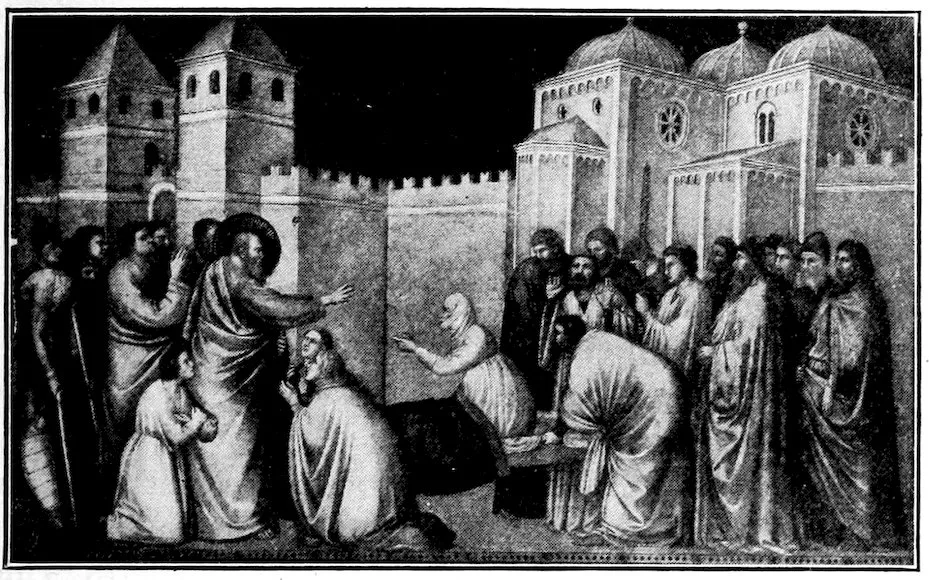
But the most accomplished design as such is the miracle of the
Resuscitation of Drusiana by St. John the Evangelist, Figure 20.
Even the inscenation before a fine Romanesque city is adequately,
if very simply, realized. The gesture of the apostle is
of majestic power, the contrast of the massive, upright, columnar
forms of the elders, with the sharply bent forms of Drusiana,
her mourners and bier bearers, is admirably invented, and the
drastic portraiture of a cripple at the left adds a tang of reality
while in no wise detracting from the dignity of the scene.
We have a work in the grand style, massively conceived,
warmly felt, wrought into an elaborate and satisfying symmetry.
The Ascension of St. John has an even graver and more
ample rhythm. The Golden Age of Raphael and Titian will
have little to add to this except the minor graces.
In the adjoining chapel of the Bardi family, Giotto, a little
later, I believe, painted six stories of St. Francis, and four
figures of the great Franciscan saints, St. Louis of France, St.
Louis of Toulouse, St. Clare, and St. Elizabeth of Hungary.
Over the entrance arch he set an animated picture of St.
Francis receiving the stigmata, the wounds of the Saviour.
Nearly thirty years earlier he had done this subject for the
Church at Assisi, and in an altar-piece which has passed from
Pisa to the Louvre. By comparing the rigid, angular figures
of the earlier composition and their ill-adjusted accessories,
with this easy and beautifully balanced arrangement, you may
see how far Giotto had gone in the direction of grace, and you
will not fail also to note how much more tragic the earlier and
less calculated work is.
For the first time, in the Bardi chapel, Giotto conceives the
decoration of the side walls as a whole. From the pointed lunettes
above, through the three compositions on each wall,
37there is an architectural axis, sometimes arbitrarily imposed,
about which the figures are symmetrically distributed. Often
the scene is a screen with projecting wings as in the St. Francis
before the Sultan of Morocco, or a similar fore-court, as in the
Mourning for St. Francis. It will be well to compare the story
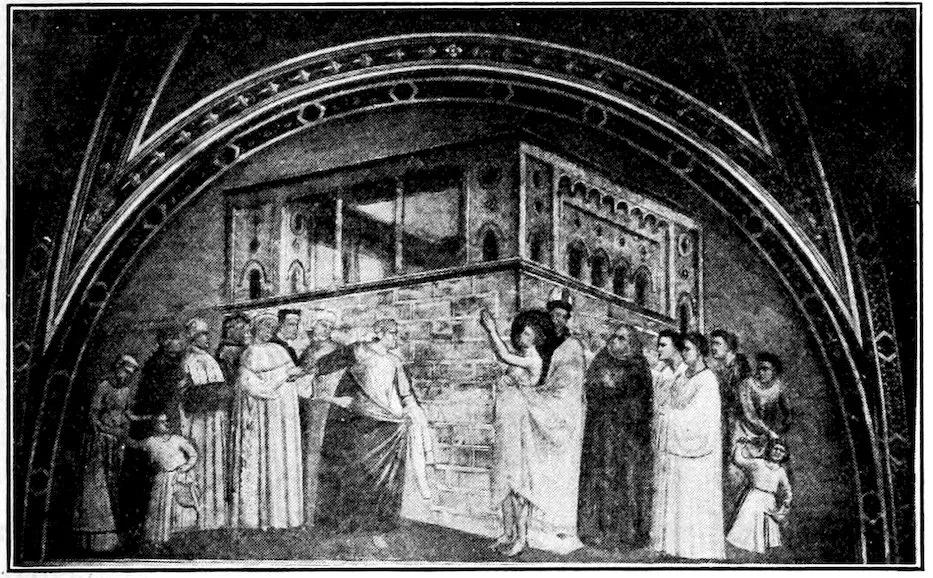
of St. Francis renouncing his father, Figure 21, with the same
subject at Assisi. You will recall that St. Francis, when rebuked
by his father for a rash and impulsive act of charity, stripped off
his clothes, then threw them at his father’s feet, and took refuge
under the robe of the Bishop of Assisi. In the earlier version
the architectural background splits the composition in two,
adding to its intensity perhaps, but displeasing to the eye.
Here in the late version a fine building seen in perspective
both unifies the two groups and serves as apex for the decorative
axis of the entire side wall.
Fig. 21. Giotto. St. Francis renounces his Father. Compare Fig. 9.—Bardi Chapel, Santa Croce.
More remarkable still is the contrast between St. Francis
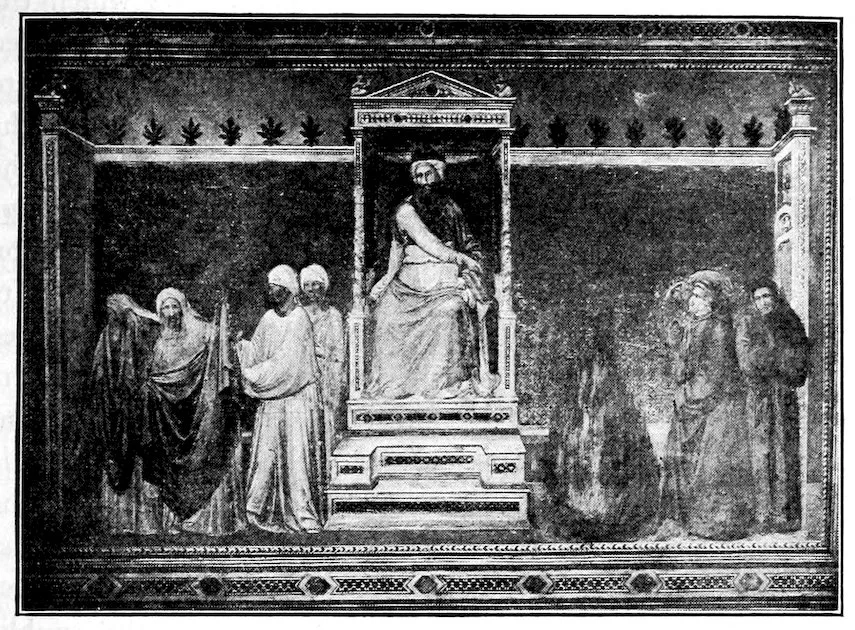
Braving the Fire Ordeal before the Soldan, Figure 22, as depicted
at Assisi and Florence. We have to do not merely with an immense
38advance in decorative composition, the accessories at
Assisi being trivial and fantastic; not merely with progress
towards a gracious symmetry and more massive and impressive
form, but also with a complete change of moral point of
view. At Assisi the Soldan is an ogre exacting a cruel test.
The Moslem priests are a cowardly pack of magicians ignobly
slinking away, St. Francis a grim fanatic. At Florence the
Soldan is a noble and humane gentleman, amazed at an unreasonable
ordeal forced upon his wise men. The Moslem doctors
are splendid scholars grudgingly shrinking from an unfair
test, St. Francis an alert little enthusiast half gloating over
the confusion he has thrown into the enemy camp. With a by
no means orthodox feeling, old Giotto, humanistic Giotto,
almost seems to take, or at least to see, the pagans’ side of it.
He who had written a manly poem against the excesses and
hypocrisies of the Franciscan ideal of poverty, is now capable
of criticizing the more extravagant propagandism of the saint
himself.
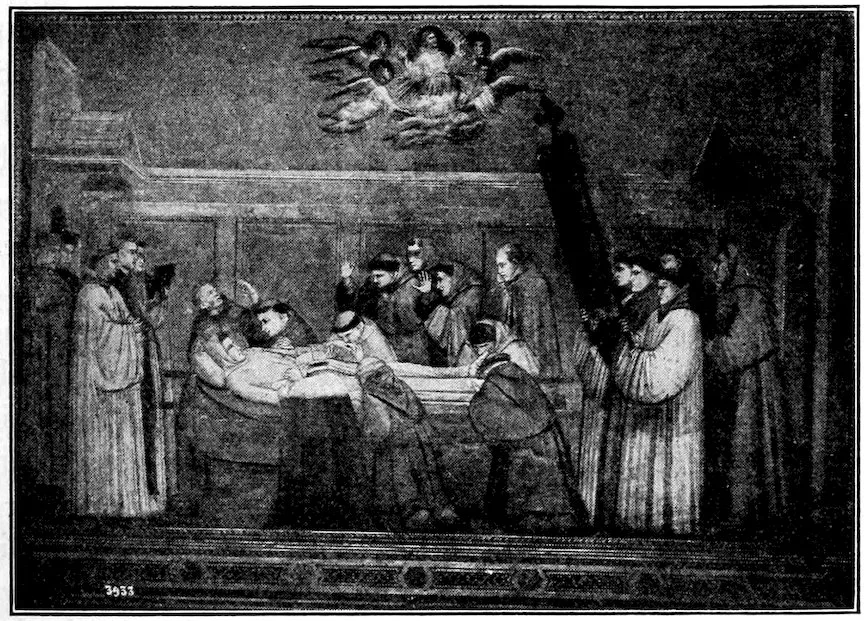
It is a criticism that admits all tenderness and sympathy,
as may be seen in the famous fresco representing the Mourning
over the body of St. Francis while his soul is translated to
heaven, Figure 23. Again John Ruskin is your best interpreter
to this picture, which after all only needs to be seen.
It combines all the qualities for which Giotto had striven—warmth,
vivacity, ingenuity, unexpectedness in the narrative
details; massiveness and dignity of the individual forms; and
a decorative symmetry at once monumental, formal, and delightfully
varied.
39
Fig. 22. Giotto. St. Francis before the Soldan. Compare Fig. 11.—Bardi Chapel, Santa Croce.
Fig. 23. Giotto. Death of St. Francis.—Bardi Chapel, Santa Croce.
40With this noble and deeply felt composition we virtually
take leave of Giotto. For though he lived for many years
yet, the works of his old age have largely perished. In the
chapel at Assisi dedicated to St. Mary Magdalen are fine frescoes
in which he surely had a leading part. From 1330 to 1333
he worked at Naples for King Robert of Anjou. Nothing remains from this visit except certain shrewd jests which the
painter exchanged with the King. In 1334 Florence recalled
him, and made him capomaestro of the Cathedral. Giotto
designed the flower-like tower which rises lightly beside the
temple of Our Lady of the
Flower, invented and perhaps
cut in marble certain reliefs on
the base representing the crafts
of men, but did not live to see
the loveliest of bell towers
finished. The task was completed
by his pupil and artistic
executor, Taddeo Gaddi. In the
last years Giotto conceived vast
compositions of a religious and
political sort for the public
buildings of the Commune.
There were allegories of a strong
and weak state, in the Bargello,
the prison-fortress of the Captain
of the People. These great symbolical designs are a kind
of missing link between Giotto and the panoramic painters who
followed him. We may find an echo of this lost work in the
Civic Allegories in the Palazzo Pubblico of Siena. These
were doing at the moment of Giotto’s death by a Sienese
painter, Ambrogio Lorenzetti, who had studied the great
Florentine master devoutly. Nothing of Giotto’s latest phase
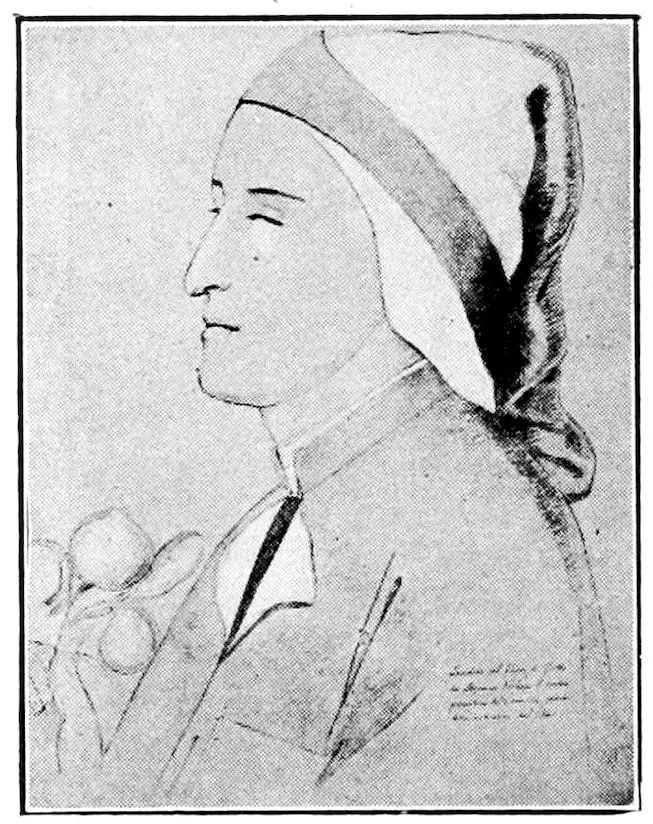
is left save a few figures in the battered frescoes in the Bargello
which contain the idealized portrait of youthful Dante, Figure
24, and the gracious Dormition of the Virgin at Berlin,
Frontispiece.
Fig. 24. Giotto. Dante, tracing from the ruined fresco in the Bargello.
Just before Giotto died, the tyrant of Milan borrowed him
from Florence. Giotto soon returned, to die early in the year
1337, being seventy years old. Almost single-handed he had
41made Italian painting. He had lent life and warmth to the
cold and academic reform of the Roman painters. He had
expressed a maximum of feeling, without sacrifice of dignity.
He had worked out beautiful and impressive forms of composition
wherein symmetry and contrast met harmoniously.
He had mastered the expression of mass on a plane surface
with a certainty and energy no artist before had even imagined,
and that few since have equalled. He had forecast and
led the way in every manner of realistic figure painting.
Florence, when true to herself, could only repeat Giotto in
one phase or another of his activity. In her casual and sprightly
mood, she carries on the method of Giotto’s stories of St.
Francis at Assisi, in mystical reflection and symbolism she
must build on the allegories over St. Francis’ tomb and on the
lost political frescoes; in her mood of strenuous search for reality
she can but repeat the Paduan chapter of Giotto’s strivings,
in rare moments of vision and fulfilment she will merely
begin where the Santa Croce frescoes of Giotto ended.
However Giotto be ranked, and personally I see no greater
artist on the rolls of history, his is indisputably the greatest
single achievement; for no other artist who accomplished so
much began with so little. It was no exaggeration that made
Lorenzo Ghiberti regard the advent of Giotto as the coming to
life of an art that had been buried for centuries. It is indeed
the measured classicism of Giotto’s art that constitutes its
greatness—its sweet and lucid reasonableness, its rugged yet
disciplined strength. Seneca or Marcus Aurelius would have
understood it perfectly, as Giotto himself, for his mellow wisdom
and wit, would have been a welcome visitor at Horace’s
Sabine farm. In his broad and flexible insight, his love of
mankind, his clear perceptions of aims and ready acceptance
of limitations, in his pathos without exaggeration, in his constructive
skill without ostentation, in his simplicity without
bareness, he is the authentic and indispensable link between
42the beauty of Greece and Rome and that of the Italian Golden
Age. To know him is to know almost everything that is needful
about older European painting, not to know him is to lack
the very rudiments of an artistic education.
Giotto left many followers,[12] not one of whom at all understood
his greatness. Like his friend Dante, he was distantly
admired, but really loved only in bits. As perceptive a person
as the artist biographer Vasari lavishes praise upon Giotto for
his more trivial inventions—the Christ Child struggling out
of the arms of the High Priest, for example. So Giotto’s followers
picked unintelligently from his great accomplishment,
choosing what the master himself would least have valued—his
simple contours without his significant mass, his variety
and vivacity without his warmth and restraint. On their own
account they added complication. The sparse economy of
Giotto’s best work could never have appealed to Florence at
large. Something richer and gayer was wanted, more like
Florentine life itself as it became after the general loosening
up of manners and morals following the plague of 1348. Its
chronicler, the author of the “Decameron,” fairly represents
the new spirit. The best of the younger painters have indeed
something of Boccaccio’s mentality—his light touch, his
charm, his panoramic richness, his fluid and undisciplined
grace. Thus arises what I may call the panoramic style of
fresco painting—superficial, full of episodes and accessories,
still religious in theme, but mundane in spirit, often cleverly
conceived, and very superficially felt. These artists had
grasped neither the meaning of Giotto’s drawing nor the
beauty of his decorative formulas, they saw only his variety
and energy. Meanwhile a great Sienese painter, Ambrogio
Lorenzetti, a profound admirer of Giotto, had worked out a
nobly spectacular form of painting in which the stage setting
was elaborate and realistic. He painted much in Florence
43about 1334 and his novelties allured the new men. So we find
fresco painting tending in a scenic direction, and panel painting
following the same course more conservatively—not merely
in Florence and Siena, but throughout Northern Italy as well.
Fig. 25. Giotto’s Assistant at Assisi. Flight into Egypt. Compare Figure 14.—Lower Church, Assisi.
44
Fig. 26. Taddeo Gaddi. St. Joachim Meets St. Anna. Compare Fig. 13a.—Baroncelli Chapel, Santa Croce.
Many of Giotto’s immediate pupils are mere names to us.
Maso, whom the sculptor commentator Ghiberti praised for
his sweetness, Stefano whom he dubbed the “ape of nature,”
Puccio Capanna—their work must be at Assisi, but criticism
has not succeeded in clearly disengaging it. The nameless
master who executed the Franciscan allegories at Assisi and
designed the stories of Christ’s youthful days, in the adjoining
right transept, is the most accomplished and individual follower
of Giotto. He works for grace, pathos, sumptuousness,
and decorative breadth. He is a Giotto with the angles rubbed
down. By comparing Giotto’s Flight of the Holy Family to
Egypt, with the later version at Assisi, Figure 25, we may grasp
the difference between master and scholar. Giotto is brusque,
harsh, noble; the flight through a rocky defile gives a sense
of urgency and peril; the composition carries forward like the
ram of a battleship. In the version at Assisi the flight has
become an attractive family excursion through a romantic
valley; the mood is gentle, charming, unspecific. A moment
in an epic has been attenuated into an idyl. This master
never fails to express a dreamy sort of poetry, and in such
compositions as the Massacre of the Innocents, and the Calvary,
he commands a genuine pathos. He is exactly what
Giotto might have been, had he skipped the strenuous Paduan
45phase, and become a decorator without the preliminary discipline
of the draughtsman. There are reasons for thinking that
this work was done by a shop assistant of Giotto’s, who for
many years directed the decoration of the Lower Church at
Assisi in Giotto’s stead. Some of the work in the Childhood
of Christ, I believe, may be as late as 1330 to 1335.
Taddeo Gaddi is a more definite and less pleasing personality.
He was Giotto’s godson and his assistant for twenty-four
years, presumably from 1313 to 1337, as well as his
artistic executor. Whether in panel or fresco, he was an admirable
craftsman; in tempera, a fine colorist. His panels are
widely scattered, some ten being in the United States; his
frescoes, all that we need to note, are in Santa Croce. In the
Baroncelli Chapel, just after Giotto’s death, Taddeo finished
these frescoes of the early life of the Virgin, repeating
themes which Giotto had used both in Padua and elsewhere
in Santa Croce itself. His way of competing with Giotto is to
stir and add and mix things up. Compare the meeting of Anna
and Joachim at the Beautiful Gate in the two masters; Giotto
at Padua is grave, noble, heartfelt; how he discriminates
between the masculine clutch of the old husband and the
tender embrace of the wife—how drastic the conception is,
but also how clear and stately. Poor Taddeo on the other
hand brings the sacred pair together with the bounce of a modern
dance, Figure 26. He brings no brains to bear, and almost no
feelings, just a sprightly and wholly casual inventiveness. Certain
delightful little panels with stories of Christ and St. Francis
which he did in Giotto’s shop for the doors of the sacristy
wardrobes of Santa Croce remind us of the pity that he ever
ceased to be an interpreter of a greater man’s designs. In
the fresco of Job’s trials, in the Campo Santo, Pisa, he seems
nearly a great artist. Conceivably he worked on designs of
his late master. At least he had a certain critical sense, for
at an artist’s reunion at San Miniato, about 1360, he told
46Andrea Orcagna and the rest of the company that painting
had constantly declined since Giotto and was declining every
day. He transmitted, his sound craftsmanship to a son, Agnolo,
who decorated the Choir of Santa Croce with the legends of
the Cross. He carried down the
panoramic style to the end of
the 14th century, practicing it
with more taste than his father,
achieving a grace without much
inwardness or force.
A later contemporary of
Giotto’s, Buonamico Buffalmacco,[13]
seems to have inherited
something of Giotto’s power,
but the identification of his work
is very uncertain, and he lives
for us chiefly as an egregious
wag in the pages of the Italian
story writers.
Fig. 27. Giottino. Deposition—Uffizi.
From another contemporary
and possibly a scholar of
Giotto, Bernardo Daddi, we have many panel pictures and a
few frescoes at Santa Croce. He is an admirable craftsman,
and a sincere illustrator, within his limitations, applying very
competently to panel painting something of the panoramic
realism of Ambrogio Lorenzetti. A prolific artist, his exquisitely
finished little panels are quite common. In America
are good examples in the New York Historical Society, in the
Platt Collection, Englewood, and a more monumental piece
in the Johnson Collection, Philadelphia. He lived well beyond
the middle of the century.
Giottino, who possibly is to be identified with Giotto’s pupil
Maso, is a more delicate spirit with unusual resources of pathos.
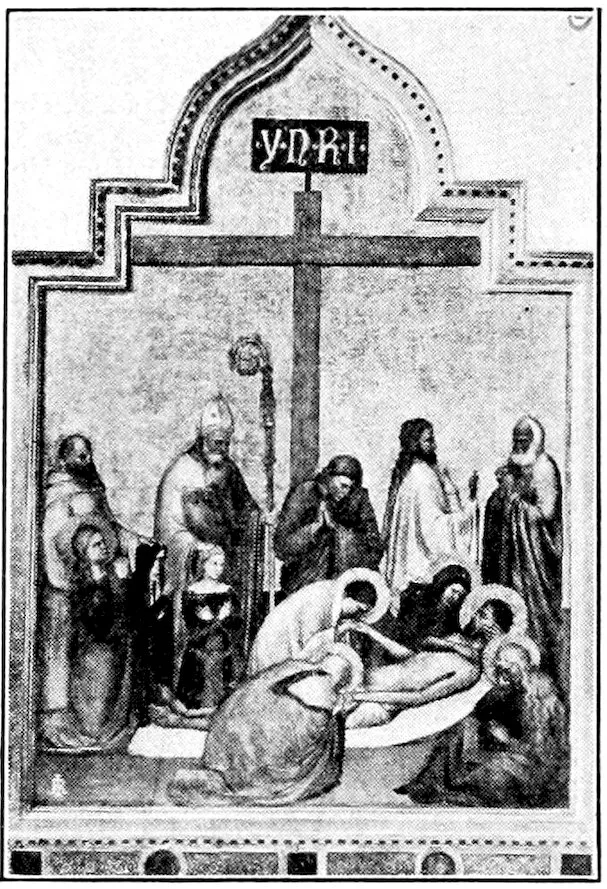
His best work is an altar-piece of the Deposition, Figure 27,
47painted about 1360 for the Church of San Remigio at Florence
and now in the Uffizi. A preference for isolated figures and for
vertical lines is noteworthy, as is the wistfulness of the
attendant donors. Similar qualities of delicate precision as
of dispersion are in the frescoes in Santa Croce which represent
the Miracles of Pope Sylvester. The note is feminine
and rather Sienese than genuinely Florentine.
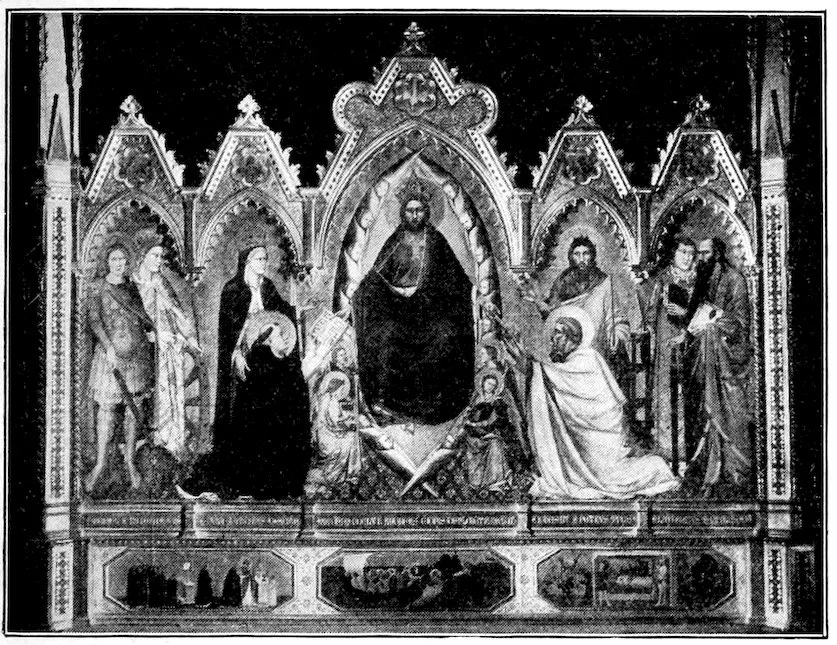
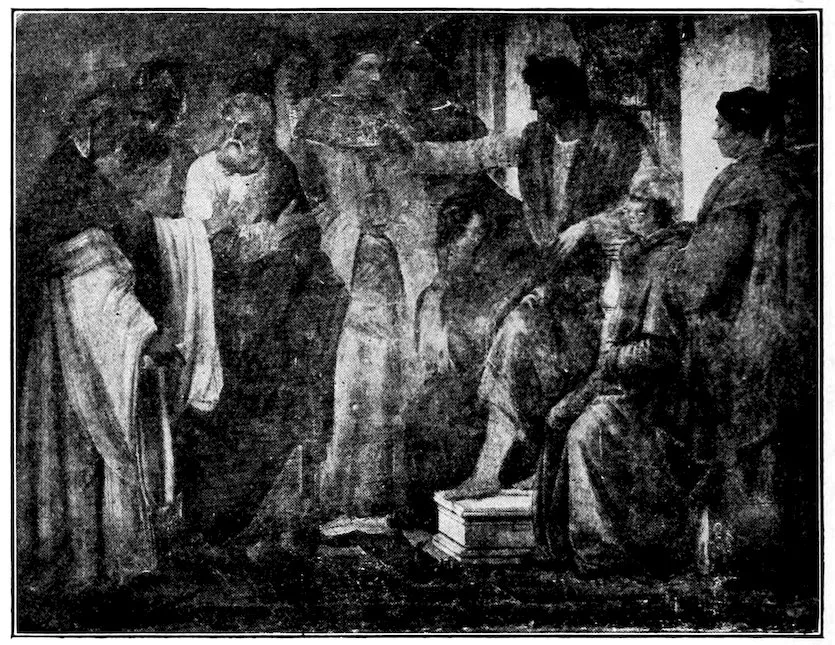
Fig. 28. Andrea Orcagna. Christ conferring authority upon St. Peter and St. Thomas Aquinas.—Strozzi Chapel, Santa Maria Novella.
Outside of Giotto’s bottega arose the rare continuers of his
tradition. Such an artist flourished about the middle of the
century in the person of Andrea di Cione, better known by
his nickname of Orcagna. He was more of a sculptor and
architect than a painter, a man of dignity and force, a poet
and thinker. Although not a pupil of Giotto, he studied that
master’s work admiringly, and sought to reproduce its massiveness.
Its brusqueness he largely rejected. Instead of
sketching the draperies summarily, he drew the folds carefully
48after the model; he liked to treat the panel and wall as
a whole, where Giotto had accepted the tradition of subdivision;
he gave to his faces a greater sweetness and he occasionally
attempted foreshortenings and impetuosities of gesture
that Giotto would have avoided. Unluckily Orcagna’s most
important frescoes have perished. We may grasp his nobility
in the altar-piece which he finished and dated in 1357, Figure 28,
for the chapel of the Strozzi family at Santa Maria Novella.
The formality of the composition is noteworthy, as is the stately
sweetness of the Madonna. The subject is Christ delegating
his Power and Wisdom respectively to St. Peter and to St.
Thomas Aquinas.
In the same chapel the figure of Christ leaning forward over
a cloud and making the sublime gesture that decrees the end
of the world and the Judgment Day, Figure 29, is probably
designed by Orcagna, as are the larger figures below. We have
here one of the freest and grandest conceptions of the period.
The lovely garden-like heaven and the quaint and ingenious hell
on the side walls are by Orcagna’s brother, Nardo di Cione. The
mood is less grave than Orcagna’s, variety counts for more.
The heads of the saints are of a most delicate beauty. Nardo
has many of the qualities of the panoramic painters without their
heedlessness. He represents a compromise between the severity
of Giotto and the diffuseness of his own day. He worked indefatigably
until 1366, and his younger brother, Jacopo, and
his imitator, Mariotto, continued the manner almost into the
new century.
Orcagna was perhaps more versatile than critics have supposed.
Recently discovered fragments of frescoes in Santa
Croce, Figure 30, show a drastic power that no other Florentine
possessed. The theme is miserable folk in time of pestilence
crying out to Death to end their sorrows. The entire fresco
would have shown Death passing them by and poising the
scythe for prosperous and happy folk beyond. The whole scene
exists in the famous frescoes of the Pisan Campo Santo which,
while traditionally ascribed to Orcagna, are unquestionably of
Sienese inspiration. They will occupy us later. Orcagna’s solitary
position in Florence reminds us that artistic succession
is rarely from master to pupil, but from great soul to great
soul across intervening mediocrity.
49
Fig. 30. Andrea Orcagna. They call Death in Vain. Fragment from ruined fresco of the Triumph of Death.—Santa Croce.
Fig. 29. Andrea Orcagna. Upper part of Fresco of Last Judgment.—Strozzi Chapel, Santa Maria Novella.
50Giorgio Vasari regarded Gherardo Starnina (active before
1400) as an important link between Giotto and the Renaissance,
and if Professor Suida is right in ascribing the frescoes
of the legend of St. Nicholas in the Castellani Chapel, Santa
Croce, to Starnina, Vasari was quite right. About this mysterious
pupil of Antonio Veneziano who worked in Spain, we
really know almost nothing. But the St. Nicholas frescoes
have a grimness and gravity which points back to Giotto and
withal a careful fusion of light and shade which anticipates
Masolino and Masaccio. Meanwhile Giotto’s own great compositions
in still undiminished splendor and impressiveness
stood ready to give lessons to the eye and mind that could read
them aright. Before such later panoramists as Niccolò di
Pietro Gerini, Mariotto di Nardo, and Spinello Aretino were
gone, that eye was already busy, in the person of a rugged
little boy of San Giovanni in Valdarno. He may have already
been called Masaccio for his untidiness. He was to rebuild
on Giotto and create the grand style of the Renaissance.
A mere catalogue of those painters who pursued the panoramic
method with ability can hardly be expected. One and
all they followed the Sienese narrative style. Prominent would
be certain incomers from other cities, Giovanni da Milano,
Antonio Veneziano, and Spinello Aretino. These are typical
decorators of the last quarter of the 14th century.
51
Fig. 31. Andrea Bonaiuti, The Navicella, fresco, closely imitated from Giotto’s Mosaic at St. Peter’s, Rome.—Spanish Chapel.
We do better to fix our attention upon the most remarkable
example of the Florentine panoramic style, the decoration of
the Spanish Chapel, the chapter house attached to the Dominican
Church of Santa Maria Novella.[14] The work
was begun by Andrea Bonaiuti in the year 1365, as we
know from a recently discovered document. As decoration it
is delightful, if rather superficially so. The artist treats his
spaces as wholes, declining to cut them up into oblongs after
the earlier fashion. He covers his great surfaces with ease and
taste, has a knack at illustration, and a fine sense of color. The
great Calvary over the triumphal arch imposes from its very
vastness; the triangles of the cross vault, including a spirited
52transcript of Giotto’s Navicella, Figure 31, are composed with
clarity and skill; the famous composition of the Dominican theologian,
St. Thomas Aquinas, enthroned above the Liberal
Arts and Sciences, and their representatives in history, combines
an almost Byzantine formality and grandeur with
prettiness and ingenuity in details. But the method is better
shown in the decoration opposite, which represents the dual
earthly powers, the Pope and the Emperor, enthroned equally,
and supported by the representatives of the spiritual orders
and secular estates, Figure 32. The group which symbolizes the
right government of society, according to mediæval ideas, is set
before a church which quite faithfully shows what the Cathedral
of Florence was then intended to be. High up in the
arch is the goal of all earthly endeavor—Heaven with Christ
enthroned amid the angels; an altar with a lamb before Him,
symbolizing His sacrifice; His Mother kneeling as intercessor
for mankind. The Gate of Heaven with St. Peter in attendance,
is naïvely set above the church on a sort of aerial raft.
Below is a novel realistic touch, the villa-studded sky line of
hills which encloses Florence. The real guide to St. Peter’s
presence is always a Dominican monk, usually St. Dominic
himself is intended—the founder and militant evangelist of
the order, as St. Thomas Aquinas was its systematic theologian.
In the lower range of the picture, St. Dominic confutes
the heretics, who tear their wicked books in despair. Above
he vainly beseeches careless gentlefolk at dalliance in an orange
grove; still higher, he leads the truly penitent to Heaven’s gate.
At the foot the Domini Canes (a bad pun for Dominicans)
are vigilant. The moral of the fresco is, happy the world
which trusts its worldly and religious business to the Emperor
and the Pope, and its personal religious problems to the Dominicans.
It is a kind of glorified poster for the order.
In its sprightliness, variety, complication and facile charm,
it is a fine example of the panoramic style. It lacks every
53quality of seriousness whether as a composition or in the
drawing of the figures. But its fairy tale profuseness and ease
have made it ever since it was painted, one of the most popular
decorations in Italy. Its success shows the kind of taste with
which the few disciplined artists of the fourteenth century had
to contend. Such obstacles have ever been the fate of the artist
who cares enough for his art to practice it austerely.
Fig. 32. Andrea Bonaiuti. Dominican Allegory of Church and State. Fresco.—Spanish Chapel.
Work of the facile and superficial character of the Spanish
Chapel Florence produced in abundance for two generations
after Giotto’s death. His faithful but dull disciple, Taddeo
Gaddi, as we have seen, gloomily foresaw the downfall of the
art of painting. But as in a great personality the recreations
54and even dissipations seldom permanently eclipse the greater
purpose, so Florence was big enough to indulge for a time her
weaker side. Had Taddeo Gaddi been more intelligent, or
even more hopeful, he would have seen that new masters must
arise, and that there would soon be pictures in Florence at
which Giotto come back to earth would gaze with that humility
with which he had once viewed the marble gods of Rome,
with that understanding sympathy which he had borne to
all his fellow mortals.
Giovanni Villani, Historie, XII, 4, regrets the passing of decorum with
the advent of the French and the Duke of Athens in 1342, but wealth
increased.
“Formerly the clothing and costumes [of the Florentines] was the
most beautiful, noble and distinguished of any nation, in the manner
of the togaed Romans.” Evidently the look of things favored the art
of a Giotto.
In book XI, ch. 91–93, Villani gives remarkable and quite modern
statistics which I paraphrase and quote, in part from the Giunta edition,
Venice, 1559. The time is about 1340.
“We found by diligence that in these times there were in Florence
25,000 men fit to bear arms, from 15 to 70 years old, among whom there
were 1506 nobles.... There were then in Florence 65 fully equipped
knights, though before the middle class which now rules was organized,
there were more than 250 knights.... There was estimated to be
90,000 ... men, women and children in the city. There is supposed
to be generally in the city 1,500 foreigners, travellers, and soldiers not
counting in the population the clergy, monks, and nuns.... In the
outlying districts are supposed to be 80,000 people. We have found
from the rector who baptizes the children (since for every male who
was baptized in San Giovanni—in order to have the count—was
dropped a black bean, and for every female a white) that for every
year in these times there were from 5,800 to 6,000, the males generally
exceeding by 300 to 500 a year.
“We find that the boys and girls at [primary] school were from 8,000
55to 10,000. The boys who study the abacus (calculation) and arabic
numbers, in six schools, from 1,000 to 1,200. And those who are learning
[Latin] grammar and logic, in four great schools, from 550 to 600.
“The churches, which were then in Florence and in the suburbs,
counting the abbeys, and monastic churches, we find to be 110, of which
57, parish churches ... 5 abbeys and two priories with 80 monks, 24
convents of nuns, with more than 500 women, 10 friaries with more
than 700 friars, 30 hospitals with more than 1000 beds to lodge
the poor and infirm, and from 250 to 300 chaplain priests.
“The shops of the cloth makers (arte della lana) were 200 and more,
and they made from 70,000 to 80,000 bolts, at a value of more than
1,200,000 gold florins, although fully a third part staid in the city for
the workers, without gain for the cloth handlers, and the workers
are more than 30,000 persons....
“The warehouses of the art of the Calimala, for the French and transalpine
cloth, were 20, which brought in per year more than 10,000 bolts
of a value of 300,000 gold florins, all of which was sold in Florence....
Banks of money changers 80.... Shops of bootmakers ... 300.
The college of judges, from 80 to 100. And notaries from 600 up, doctors
of physic and surgery 60, and druggists’ shops 100....
“The greater part of the well-to-do, rich, and noble citizens with
their families, staid in the country for four months, and some, more,
a year.”...
“Other dignities and magnificences of our city of Florence I should
not fail to bring to memory, for information of such as shall come after
us. It was, within, well built with many beautiful palaces and houses,
and in these times they were continually demolishing, thus bettering
the building by making it more comfortable and rich, bringing in from
outside the examples for every sort of betterment and beauty. Churches,
cathedrals, friaries of every rule, monasteries, magnificent and rich.
Furthermore, there was no citizen who did not have a country place,
great or small, which was not richly built, indeed far greater buildings
than in the city; and every citizen sinned by inordinate spending,
whence they were thought crazy. But it was so magnificent a thing to
see, that a foreigner, not used to coming in, believed, because of the
rich structures for three miles about, that it was all one city after the
manner of Rome, not to mention the rich palaces, towers, court yards,
terraced gardens, still further from the city, which in any other country
would have been called the rural districts. In short one would have
thought that within six miles of the city were more rich and noble inhabitants,
56than, taking them together, two Florences could have produced.
And let this suffice for telling of the facts of Florence.”
Giotto’s humanistic detachment from the Franciscan doctrine of
voluntary poverty is well illustrated in his poem which is quoted in part
from Dante Gabriel Rosetti’s translation. The original is in G.
Milanesis’ edition of Vasari, Le Vite, Vol. I, Florence 1878, pp. 426–8.
“Many there are, praisers of Poverty;
The which as man’s best state is register’d
When by free choice preferr’d,
With strict observance, having nothing here.
For this they find certain authority
Wrought of an over-nice interpreting.
Now as concerns such thing,
A hard extreme to me it doth appear,
Which to commend I fear,
For seldom are extremes without some vice,
Let every edifice,
Of work or word, secure foundation find;
Against the potent wind,
And all things perilous, so well prepared—
That it needs no correction afterward.”
Tommaso di Rossello Strozzi left a rough note of the terms of the
contract for the altar-piece of his chapel. Doubtless the actual contract
was much fuller. The minute is published by Filippo Baldinucci, Opere,
Milano 1811, Vol IV. p. 397.
“Herewith is to be written [on my part] and Andrea called Orcagna
that I Tommaso di Rossello aforesaid have given to paint for the altar-piece
which is made for the altar of [the chapel] in Santa Maria Novella,
of a breadth of five braccia, 1 sol. [over 10 feet] there or thereabouts.
The aforesaid Andrea is to paint in fine and splendid colors; and gold,
silver and everything else are truly to be used in the entire panel and
pinnacles, that is [gold] leaf. Only in the side columns may silver
be used.... And [with] as many figures as [directed] by me
Tommaso it shall be completed. And the said panel to be entirely
painted by his own hand.
57“Should it come about that the aforesaid Andrea should not give it
to us completed and painted.”
“He should pay me for every additional week that he works at the
painting as it shall seem right to the judgment of the here named arbitrators.”...
“Should it come to more than the aforesaid price, we will take the
judgment of Carlo, Paolo and Fra Jacopo.”
Such is approximately the sense of this very difficult and quite grammarless
annotation of Tommaso Strozzi. The arbitrators must have had
occasion to act, for the panel is dated 1357, two years after the promised
time.
58
Fig. 33. Ambrogio Lorenzetti. Madonna of San Francesco.
Chapter II SIENA AND THE CONTINUING OF THE MEDIÆVAL STYLE — ILLUSTRATIONS FOR CHAPTER II — A Sonnet to the Spendthrift Club — How Venus Fared in Siena — A Procession on the Completion of Duccio’s Majesty — A Contract for an Altar-piece by pietro lorenzetti
59
On the Romantic instability of Siena—Fidelity to Byzantine Ideals—Guido,
Coppo, the Master of the Altar-front of St. Peter—Duccio and
his great Majesty of the Madonna—His twofold tendency: to
elaborated staged narrative; to sparse and exquisite decoration—Simone
Martini and the Idealistic chivalric style—The Brothers Lorenzetti
and the popular panoramic style—Second half of the Fourteenth
Century—The Fifteenth Century: Sassetta and Giovanni de Paolo—Matteo,
Benvenuto and Neroccio—The Renaissance and the downfall
of the School, Francesco di Giorgio, Sodoma.
As you enter Siena by the wide Camollia gate you will read
in Latin “Siena opens her Heart still wider to thee”:—Cor
magis tibi Sena pandit. Thus Siena avows herself the city of
the heart. Where Florence studied and calculated, she mused
and dreamed; where Florence was solid, she was volatile.
For unrewarding idealisms she had a kind of genius. Long
after the other Italian communes had seen it was worst possible
business to support the emperor, Siena was faithful to
that lost cause. Every few years she changed her form of
government, and seldom for the better. Merrymaking and
pageantry were universal in old Italy, but Siena alone had a
Spendthrift Club (Brigata Spendereccia) devoted to continual
pleasure, and a poet, Folgore da San Gemignano, to celebrate
its gaieties. Siena was ardent in inconstant fashion. Early
in the 14th century was found a nude marble Venus so beautiful
that it was set up in the great square and thronged with admirers.
60Then the war with Florence went badly, and at
a few words from a pious fanatic, the citizenry smashed up
the image and secretly buried the bits on Florentine soil to
bring bad luck to the foe. Naturally no bad luck ensued to
Florence, but Siena had enjoyed two delightful emotional
crises. You will see why Siena never could produce a realistic
art, any more than Ireland has produced one. Her eye was
not on the object but on her own state of mind. Thus Florence
will produce historians, scientists, and politicians, while Siena
will produce saints and miracles.
Amid this romantic inconstancy, the continuing thread
was the cult of the Blessed Virgin. No other city thought
so delicately of her, and no other art has represented her so
ideally. Had she not saved the city? In 1259 the Florentine
Guelfs and their allies marched with overwhelming force to
the very gates of Siena. Ruin was imminent and despair
abroad, when by a common impulse the populace marched
penitently to the Cathedral and before the rude picture of
the Queen of Heaven solemnly committed the city into her
hands. In ecstacy of renewed faith the inferior army of Siena
fell upon the invaders at Montaperti and utterly routed them.
In gratitude Siena remained the city of the Virgin. When in
1310 the painter Duccio replaced the rude effigy of the
Madonna of Victory with one of the finest Madonnas known to
art, Fig. 37, the whole city suspended business and escorted
the picture from the studio to the Cathedral with hymns and
litanies in honor of their divine patroness.
Nowhere else has painting paid such homage to the Virgin
Mary. In other cities it was enough to represent her enthroned
with a handful of angels or saints in attendance. The Sienese
painters multiplied the celestial escort until it became a heavenly
court over which the Mother of God presides in sweet
majesty. Siena also grasped at the then not quite orthodox subject
of the Assumption of the Virgin into Heaven. You see
61her slender form rising amid a glory of angels more than a
hundred years before the theme was common elsewhere.
These brief hints will tell of the temper of Siena. You will
not expect such a city to be like Florence, interested in facts
and charmed by the human
spectacle. She will be rather
engrossed with the beauty of
old legends and in rare forward-looking
moments concerned with
her own devout imaginings.
She will not wish the saints to
be like the people one knows,
but like denizens of some divine,
far-off fairyland. Her painting
will not be humanistic but of an
unworldly idealism.
Fig. 34. Guido of Siena. Madonna.—Uffizi.
Such being the temper of
Siena, her artists, unlike those
of Florence, had no quarrel with
the Byzantine style. Its splendid
irreality only needed to be
made flexible and gracious.
Siena has really no new ideas to express, merely feelings
more tender and exquisite. Her pictorial reforms are reverent
and gradual, backward-looking, mediæval. Her art from 1300
to 1500, as lovely within its narrow limits as the closed garden
of the Virgin, has the great interest of teaching us what capacities
for growth lay in the mediæval tradition itself—what
painting in Italy would have been had Siena exercised her
temporary might after Montaperti and razed Florence five
years before Giotto was born.
62
Fig. 35. Sienese about 1275. Altar-front of St. Peter.—Siena.
A little earlier than the year 1225, when Florence called
in strangers to adorn the Baptistery with mosaics in the
Greek style, Guido of Siena signed and dated 1221 the most
famous of his madonnas. Unhappily the enthroned Virgin
of the Palazzo Pubblico was repainted some fifty years later,
a fact which has led many critics unnecessarily to doubt the
date.[15] But from half a dozen other pictures by Guido
we may learn that he was a diligent and rather heavy-handed
imitator of the current Greek formulas, Figure 34. At the
battle of Montaperti the Sienese captured an excellent Florentine
painter, Coppo di Marcovaldo, and in 1261 he painted
the admirable madonna which is still in the church of the Servi.
It shows a sensitive use of the Byzantine conventions. There
is pensiveness and almost shyness in the face and posture of
the Virgin, and loving intentness in that of the Child. Their
relation is to each other and not as in earlier madonnas to the
devout public. These intimate qualities have been ascribed,
I think wrongly, to restoration. But they appear even more
emphatically in the entirely unrestored Madonna, Figure 3,
63in the collection of Mr. Otto Kahn, which I think may be a
Coppo[16], and is in any case of similar date and feeling.
The same process of sweetening the old style while accepting
it, is shown in the famous altar-piece of St. Peter in the Academy
at Siena, Figure 35. The gaunt
figure of the Saint is completely traditional,
the little stories of the Annunciation
and Nativity at the side
show a new vivacity and a new grace.
Siena met the innovating painter
more than half way, for the indignant
citizens soon marred with their knives
the crucifiers of the head of the
Christian Church. The date of the
panel will not be far from 1275, and
already the painter of genius who was
to create the sweet, new style was
learning his trade.
Fig. 36. Duccio Purcellai Madonna.—Santa Maria Novella, Florence.
Of Duccio di Buoninsegna, the
father of the Sienese school, and
everything considered its greatest master, we have numerous
records,[17] and by no means all to his credit. He must
have had the artistic temperament in a degree then unusual.
The court records show half a dozen fines against him, and
he was not scrupulous about paying his debts. One forgets
these foibles before those Madonnas which are a consummate
expression of taste and those narratives which are a triumph
of tact and ingenuity. Duccio’s mind does not grasp the
harsher and more heroic emotions, but within the realm of
the tender and pathetic he is supreme. His elegance appears
in his first important work, the famous Rucellai Madonna,
Figure 36, in Santa Maria Novella at Florence, which tradition
erroneously ascribes to Cimabue. It is presumably
64the great panel which Duccio contracted to paint in 1285.[18]
He was probably young and unconsidered, for he took all
the risks, agreeing that the picture might be rejected at the
will of the patrons. The Society of Saint Mary the Virgin
would have been foolish indeed to reject the most gracious
Madonna the world had then seen. Characteristic of Duccio
are the swaying curves of the contours and especially of the
draperies, the thin, delicately folded robes of the Child and
the attendant angels and the sensitively drawn bare feet.
Working in Florence and doubtless impressed by Cimabue,
Duccio has retained in this early work a certain austerity
which gives way in his later work to a more feminine sweetness.
For that very reason the Rucellai Madonna is perhaps
the greatest Madonna of the century, since without loss of
the stately Byzantine qualities, she gains the new attributes
of grace. It was no wonder that when the name of Duccio
had faded out of the Florentine memory, Florence ascribed
this noble Madonna to the venerated founder of her native
school, Cimabue. Recent criticism has righted the unconscious
wrong thus done to Siena.
Fig. 37. Duccio. Madonna in Majesty.—Opera del Duomo, Siena.
65To mature his style Duccio needed only to intensify the
qualities of sweetness and grace which are evident already in
the Rucellai Madonna. The stages of his growth are represented
in minor works at Siena and in British and Roman
collections. But his fame, for the layman, is associated with
the magnificent altar-piece which he executed for the Cathedral
of Siena, and only the special student need look beyond it.
On the 9th of October, 1309, Duccio contracted with the
trustees of the Cathedral to do a great altar-piece wholly with
his own hands, at the rate of sixteen soldi a day and expenses.
He promised to take no other work during the painting. It
was finished in June of 1311 and carried in solemn procession
from the bottega outside the Porta a Stalloreggi to the
Cathedral. A chronicler describes the cortege “parading about
the Campo, as is usual, all the bells pealing a glory in devotion
for so noble a picture as this is.... And all that day they kept
praying with many alms which were given to poor folk, praying
to God and His Mother, who is our advocate, that she
defend us in her infinite mercy from every adversity and
every ill, and save us from the hands of traitors and foes of
Siena.” Most characteristic of the febrile patriotism of Siena
is this constant dread of the traitor.
About a year before this ceremony the trustees enlarged
the scheme for the picture, making an additional contract for
thirty-eight stories to be paid at the rate of two florins and a
half each. These were put on the back of the altar-piece,
covering very fully the life of Christ and that of the Virgin.
Thus the front of the altar-piece represents the decorative
and monumental ideals of Sienese painting while the back
exemplifies its feeling for narrative. Everything that Sienese
painting was to be is already in germ in this marvellous work.
In depicting the Virgin “in Majesty,” Figure 37, Duccio
has magnified the theme. Earlier pictures show only a handful
of angels in attendance. Here we have a cloud of celestial
66witnesses, the four patrons of Siena kneeling in the foreground,
at the sides charming alternation of grim, bearded evangelists,
orientally soft girl martyrs, and youthful archangels. Seven
years earlier Cimabue had conceived a similar great Majesty
for the Church of Santa Chiara at Pisa.[19] Doubtless Duccio
had seen it, and, though it is lost to us, we may assume, that
the Sienese artist outdid his prototype both in sweetness and
splendor.
In many ways Duccio’s Majesty is highly traditional. It
shows the Byzantine horror of voids, is a little crowded. But
this defect would be less apparent if it were raised on its historiated
base (predella) with its original pinnacles above. Everything
derives from Byzantine exemplars, reverently improved
in a realistic direction. Duccio has dared to paint the Christ
as a laddie; and not as a little old man; he has shown the
soft forms of His body through light draperies; he has kept
the austerity of the Byzantine apostles but has attenuated
their harshness; he has worked the insipid female masks of
the older art into forms of a positive and dreamy grace. One
feels the tender mood of the work in the Latin jingle at the
foot of the throne, typical of dozens of similar dedications in
Siena:
Mater Sancta Dei
Sis caussa Senis requei
Sis Duccio vita
Te quia pinxit ita
which I may rudely paraphrase:
Holy Mother of God: grant Siena rest,
Grant life to Duccio,—he did his best.
All the sensibility of the City of the Virgin is in these prattling
rhymes with which they loved to hallow and offer great pictures.
67
Fig. 38. Duccio. Entry into Jerusalem; Christ Washing the Apostles’ Feet; Last Supper. From the back of the great Madonna.—Opera del Duomo, Siena.
If the front of this panel shows only moderate innovations,
the case is not so for the back. The two score stories from the
Bible or early Christian legend, in the distribution of the
figures follow faithfully the standard Italo-Byzantine compositions.
Where Duccio steps in is in bettering the forms,
giving grace to the draperies, and animation to the gestures—above
all in providing contemporary architectural accessories,
and coping with the problem of space. He also carries to
their ultimate refinement certain decorative formulas which
the Byzantine painters had glimpsed but not fully realized.
Thus two quite opposed tendencies pass into Sienese painting
from Duccio;—a rather small preoccupation with accessories
and the problem of space, and a pure æstheticism concerned
68with finesses of decorative arrangement—in short, the prose
and the poetry of Sienese painting.
Sienese narrative painting tends to be scrupulous about
details and inscenation, quite as a good story-teller naturally
provides incidents that make for plausibility. We may see
how Duccio’s mind works in the familiar theme of Christ
entering Jerusalem, Figure 38. Duccio sets the spectator
in a garden with an open gate, thus throwing the scene back a
little. Above the procession and the rejoicing throng rises a
city wall, and still higher against the sky bristle Gothic towers
and spires. Thus the theme gains picturesqueness and variety.
One forgets that there is hardly space for the welcoming throng
before the gate, and that the donkey’s four feet are on a level
although he is going up hill. These little maladjustments
show that while Duccio took infinite pains in inventing the
setting, he borrowed the figure groups bodily from earlier
Byzantine compositions in which the setting was simpler. In
this piecing-together process he turns some pretty sharp
corners, but he never sacrifices clarity and expressiveness.
In the scene where the maid servant catches the Galilean
burr in Peter’s voice, Figure 39, and asks if he be not a follower
of Jesus, we find Duccio’s method quite at its best.
Nothing could be better than the sudden turn of the girl with
one foot on the steps. Fine, too, is the concentration of the
crowd on the exciting problem of gossip. Well-observed, their
actions as they warm their feet and hands at the fire. Vivid,
too, the impulsive gesture of Peter as he denies the charge.
The place, a court yard with a staircase leading right into the
picture above, which represents the court room where Jesus
is being questioned, is most elaborately planned. One looks
back through a portal into farther spaces. All this was so
new and interesting that I presume the Sienese have never
noticed to this day that the seated group would never fit in
the space assigned to it and that the positions of the figures
69are ambiguous. The picture does admirably its work of
telling a story spiritedly, and that is enough.
Fig. 39. Duccio. Peter denies Christ.—Opera del Duomo, Siena.
Duccio’s Calvary, Figure 41, is remarkable for breadth,
spectacular effectiveness, and a measured pathos. As usual
he multiplies actors and incidents while keeping the orderliness
of the arrangement. The slightness of all the forms, their
little weight and uncertain balance are apparent. And there
is, on the same principle of taste, a similar attenuation of
emotion. Where Giotto at Padua gave stark tragedy, Duccio
offers a gentle flutter of restrained grief.
Fig. 40. Duccio. The Marys at the Tomb.—Opera del Duomo.
Such is the average of these narratives, clear, picturesque,
circumstantial, infused with a generalized and never very
intense emotion. There are some, mostly composed with few
figures, which reveal a great fastidiousness of arrangement.
In such a composition as the Marys at the Tomb, Figure 40,
Duccio reveals himself as pure æsthete, as consummate master
of linear composition. The motive is essentially insignificant,
merely that the Marys shrunk at the sight of the angel
at the tomb, but out of that motive of withdrawal is wrought
through the little panel a lovely rhythm to which everything
contributes—the rise of the cliffs and their crinkly edges,
the contrasting angles of the tomb and its impossibly tilted
70lid, the reciprocal curve of the angel. We grasp in the picture
a general truth which reaches far beyond Duccio and Siena,
that a too conscious struggle for style precludes any complete
expression of emotional significance. For this picture is as
trivial as a narrative as it is exquisite as a decoration.
Fig. 41. Duccio. Calvary.—Opera del Duomo.
Duccio, who disappears from our sight about the year 1318,
71fixed once for all the character of the Sienese school. In
narrative it was to adopt the placid and tender tone of legend,
most unlike the urgent and dramatic mood of Giotto. The
Sienese artist was too reverent to raise the question how did
this happen, and how did the persons feel; he asked rather
“How do we feel about it as believers?” The beauty of the
work, then, is not that of outer reality but of revery and
meditation. It never has the tang and variety of good Florentine
narrative painting, but within its lovingly modulated
monotony, Sienese narrative painting is supremely charming.
Fig. 42. Simone Martini. Madonna in Majesty. Fresco.—Palazzo Pubblico, Siena.
Duccio also started in Siena a somewhat worried and petty
concern with accessories, architecture, complications of perspective.
He inaugurated a tradition of material splendor in
gilding, tooling, delicate graduation of color which remained
the glory of Sienese painting for nearly two centuries. So
72far as we know he painted only in tempera on panel, and
the Sienese generally were to triumph in this feminine form
of work rather than in the masculine methods of fresco.
Finally Duccio took over from Byzantine art and perfected certain
finesses of highly simplified and abstract composition, a
pure æstheticism distinctly Sienese and wholly alien to the
warm humanism of Florence. You will find this austerely
lovely style at its best in Simone Martini, and surviving
as late as Sassetta and the middle of the fifteenth century.
After Duccio, Sienese painting divides itself into two tendencies,
one aristocratic, chivalric and æsthetic, deriving
from his decorative manner; the other popular, narrative and
realistic, deriving from his minutely staged scenes on the back
of the great altar-piece. Of the aristocratic style Simone
Martini is the greatest exemplar, of the popular style, the
brothers Lorenzetti.
Simone Martini was born in 1283 or thereabouts. We
first meet him as an artist in the great frescoed Majesty of
the Virgin, Figure 42, completed in 1315 for the Palazzo
Pubblico, Siena. The arrangement is like that of Duccio’s
Majesty, finished only five years earlier, and the facial types
are generally those of Duccio. But the great fresco gains
clarity and impressiveness from the added space, from the
picturesque motive of a canopy, from the isolation and elevation
of the Madonna above her escort, and from the rich
Gothic forms of the throne, which are a novelty in painting.
While most of the faces show the orientalism of Duccio,
the Madonna has the level-browed, intent character of Gothic
art, and the Child is realistic. Gothic again is the graceful
border with its fine medallions, and the bright colors of the
whole. It is the most splendid enthroned Virgin in the world,
and she is conceived chivalrically as a sort of tournament
queen with her paladins upholding a canopy, and angel
pages on their knees offering roses and lilies.
73To the Sienese this was a political picture, as a rhymed
inscription in Italian shows. The saintly patrons of Siena
address the Virgin:
“Angelic flowers, roses and lilies
With which the heavenly meadow is adorned,
Delight me less than do good counsels.
But sometimes I see such as verily
Despise me and my city betray,
And gain praise the more for evil words,
With such as merit condemnation.”
The Virgin answers the saints patrons somewhat evasively:
“Fix my delights in your minds,
So that I shall, as ye wish,
Fulfil your honorable requests.
But if the powerful molest the weak,
Oppressing whether with shame or harm—
Let not your prayers be made for these
Nor for whomsoever betrays my city.”
Fig. 43. Simone Martini. St. Martin Knighted.—Lower Church, Assisi.
In Simone’s work this great
Majesty is an exception. He
preferred generally to work on a
more restricted scale, to burn
the lamp of æsthetic sacrifice.
I can merely allude to the great
idealized portrait of St. Louis of
Toulouse, in S. Lorenzo, Naples.
It was painted for King Robert
of Anjou, whose kneeling figure
appears in the picture, sometime
after 1317. The thing is resplendent
in gold and azure, adorned
by curiously twisted Gothic
borders; in sentiment it is impassive as a Buddhist painting.
74
Fig. 44. Simone Martini and Lippo Memmi. The Annunciation.—Uffizi.
About the year 1325,[20] we may surmise, Simone was called
to Assisi to fresco the Chapel of St. Martin in the Lower
Church. He set upon the walls so many fairy tales, tender
and sprightly in sentiment, provided with the few essential
accessories that a rapid story-teller would need. What more
charming than the boy Martin praying while they bind on
him the equipment of a knight, Figure 43, and musicians
sound a fanfare! What more gallant than the lad setting out
on crusade against the Teutons who lurk in a cleft of the
background! This gracious childlike quality, quite akin to the
tender phase of Duccio, is exceptional in Simone, who habitually
is the strenuous decorator.
His sparse and austere methods appear clearly in the
commemorative fresco of Guidoriccio, hired general of Siena,
and conqueror of Sassoforte. It is in the Palazzo Pubblico
75and duly dated 1328. Nothing is realistic but the horse and
rider. They are isolated, hold alone a field made up of
pure symbols for camps, and fortresses and craggy hill-tops,
yet the martial effect is unmistakable and the composition
most quaintly impressive.
The quintessence of Simone’s later art is in the famous
Annunciation of the Uffizi, Figure 44. In order to justify
the most nervously exquisite of linear arrangements he has
chosen the least significant moment of the event. His Virgin
is merely a sullen princess resenting an intrusion; the Gabriel,
an etherialized courtier pleading a cause with apologies. But
the contrast of the advancing and shrinking motives gave
Simone precisely what he wanted. He builds up areas richly
colored or brocaded, bounded by sharp curves, relieved by
flutters and spirals of flying drapery, and accentuated by such
details as the olive twigs and the lily which have the crisp
incisiveness of finest metal work. As a triumph of pure
decoration Gothic painting has nothing better to show
than this lovely panel which was finished in 1333 for the
chapel of Sant’ Ansano at Siena. It has little quality of
heart in it, and no reverence save that of consummate workmanship.
Great honors awaited Simone. He was called to the exiled
papal court at Avignon in 1339, met Petrarch, painted Petrarch’s
Laura and is lauded in one of the poet’s sonnets.
Of Simone’s work at Avignon we have only a few small panels
scattered between Antwerp, Paris, Liverpool, and Berlin.
The compositions, most of which belonged to a composite
altar-piece depicting Christ’s passion, waver between his old
simple style and a crowded and animated mood reminiscent
of Duccio, and influenced by the Lorenzetti. Simone is unable
to resist the universal tendency towards diffuse narrative,
and in so far as he yields to it, he is less than himself. Christ
Bearing His Cross, in the Louvre, exemplifies the extravagance
76and morbidness of this latest manner, Figure 45. His
strength lies in sacrifice and abstraction, his real affinities are
the contemporary Buddhist painters of China and Japan,
though of course he knew nothing of them. He died in 1344,
leaving behind him a tradition
of fastidious artistry which was
potent in Siena for over a century.
Fig. 45. Simone Martini. Christ bearing His Cross.—Louvre.
As late as 1450, Lorenzo Ghiberti
informs us in his “Commentaries,”[21]
the Sienese regarded
Simone Martini as their greatest
painter. He differed from them,
preferring, himself, Ambrogio
Lorenzetti. This was an eminently
Florentine choice, Ambrogio’s
warmth, concreteness,
and elaboration were on the
whole Florentine. He worked
for several years at Florence,
must have known Giotto, certainly
studied him with discerning
admiration. With his elder
brother, Pietro, Ambrogio Lorenzetti gave to Duccio’s tradition
of detailed narrative painting its perfected form. They were
great fresco painters, and most characteristic as such. In
panel painting they are less original, but they bring into this
highly conventional art a great ardor and curiosity. They
represent the popular average of Siena as Simone Martini
represented its aristocratic minority.
77
Fig. 46. Pietro Lorenzetti. Madonna with Saints, 1320.—Pieve, Arezzo.
We first meet Pietro Lorenzetti as an artist in the altar-back
at the Pieve, Arezzo,[22] Figure 46, which was finished in
1320. It is an ancona, or compartmented piece and the most
splendid that has come down in Romanesque form. The figures are of two sorts. The Madonna is of intent Gothic type,
and the fine motive of holding off the Christchild at elbow
length in order to see him better is borrowed from Giovanni
Pisano, who in turn took it from French Gothic sculpture.
So are the forms above in the Annunciation new and graceful,
while the little boxed room with its plastic column is also
novel. The Assumption of the Madonna in the highest pinnacle
is probably the earliest occurrence of this famous Sienese
theme in painting. But all the figures of saints in the three
orders of the side panels are taken almost without change
from Duccio’s great altar-piece. It would be interesting to
trace Pietro’s emancipation through a dozen panels. No one
better combined dignity with grace, and feeling, and splendor.
78His work in fresco is fragmentary and confused with that of
his younger brother. We are certain of nothing except a fragment
of a deeply felt Calvary in the Church of St. Francesco,
at Siena. Many critics ascribe to him the agitated and wildly
picturesque frescoes of the Passion in the left transept of the
Lower Church at Assisi.[23] But this, I think, is a mistake.
Pietro is never in his certain works so lively and indecorous
and casual. We have to do with an artist influenced by
Duccio working about 1330, Pietro himself may appear as the
Stigmatization, Figure 47, and one or two of the other simpler
compositions. The other frescoes are chiefly interesting as
showing the dangers of the panoramic method of Siena.
Take the Last Supper, Figure 48. The theme is simply lost
in the fantastic richness of the accessories. It is hard to find
Christ or Judas, for the eye seeks the radiating rafters or
the scullery where cats lurk and eager scullions wipe the
dishes.
Fig. 47. Pietro Lorenzetti, or Follower. St. Francis receiving the Stigmata. Fresco.—Lower Church, Assisi.
79
Fig. 48. School of Pietro Lorenzetti. The Last Supper. Fresco.—Lower Church, Assisi.
In the Birth of the Virgin, dated 1342, Figure 49, Pietro
spoils a carefully studied and well-felt picture by elaboration
of the setting. The frame is conceived as the plastic front of
a Gothic room within and behind which, spaces are multiplied
confusingly. Here the pedantic preoccupation with the problem
of space offends the eye and destroys the unity of what
in a simpler setting would be a monumental composition.
It illustrates the dangers of that smaller realism which from
Duccio down afflicted the more progressive painters of Siena.
Such a picture enables us to appreciate the tact and thoughtfulness
with which Ambrogio Lorenzetti approached his
narrative themes.
80
Fig. 49. Pietro Lorenzetti. Birth of the Virgin.—Opera del Duomo, Siena.
Ambrogio Lorenzetti was born about the beginning of the
century. In 1331 and later he painted remarkable frescoes
for the Church of St. Francis. These if complete would afford
the most interesting comparisons with Giotto at Florence, but
the two that remain are among the best narrative paintings
of the time. What will first strike the observer in the story
of St. Louis of Toulouse renouncing his throne as he takes the
Franciscan vow, Figure 50, is the variety and orderliness
of the emotions. The devotion of the saint is well offset by
the intense, melancholy curiosity of his brother Robert, who
becomes king through the sacrifice. The audience is divided
into admiring Franciscans and idly marveling courtiers, the
81whole well dominated by the kindly and reverend figure of
the Pope. Remarkable is the methodical division of the
spaces. A slender column establishes the picture plane and
sets the figures back. A sort of desk in a hollow square defines
and isolates the monastic group, while the courtiers
have their appropriate location in a third plane of alcoves.
Florence has next to nothing of this sort at this period, and
it may be noted that this careful division of spaces is not matter
of display and curiosity as in Duccio, but is logical and
effective as regards the persons of the narrative.
Fig. 50. Ambrogio Lorenzetti. Prince Louis of Toulouse receives the Franciscan Vow.—San Francesco, Siena.
Of similar significance, but more dramatic and picturesque,
is the martyrdom of the Franciscan missionaries before the
Sultan of Morocco. The elaborated spaces make for clarity,
the entirely professional and impersonal cruelty of the Moorish
tyrant and his bodyguard is splendidly caught and effectively
82contrasted with the courageous submission of the martyrs.
Lorenzo Ghiberti praises the energy and character of this
work, and the observer of today feels as deeply its romantic
appeal. All the figures are set on receding platforms, the
problem of space is solved along lines of intelligent literalism.[24]
Fig. 51. Ambrogio Lorenzetti. Madonna in Majesty.—Massa Marittima.
It would be a pleasure to dwell on the Madonnas of Ambrogio.
The tragic Madonna of S. Francesco, Figure 33,
the Madonna with St. Dorothy and St. Lucy, in the Siena
Academy, the Virgin in Mr. Dan Fellowes Platt’s collection are
among the best. No other early Italian so combined nobility with
motherly warmth. His splendor and sweet dignity may best be
felt in the Majesty of the Virgin, Figure 51, in the little town of
Massa Marittima. The central motive, Mary and the Child embracing,
is almost Ambrogio’s invention. He rings the changes on
it in lovely modulations, while always retaining monumentality.
This picture is as stately as Duccio’s Majesty, and
83as resplendent as Simone Martini’s, while having qualities of
ardor and fancifulness all its own. The fairy-like Virtues on
the steps of the Madonna’s throne especially show the rich
vein of pure fantasy which accompanied Ambrogio’s robustness.
The picture may be dated about 1336 or later.
Previous to its painting Ambrogio had passed some years
at Florence, where he must have studied and known Giotto,
and where he himself influenced powerfully the beginnings of the
new panoramic style. Whatever frescoes he himself did there
have perished, and the only memorials of his visit are certain
delightful little panels telling with vivacity and utmost circumstantiality
the legends of St. Nicholas. At Florence he
must have analyzed Giotto’s great political frescoes, now lost,
which depicted in symbols good and bad government. These
were surely the inspiration for the political symbols and illustrations
which Ambrogio, in the year 1337 and later, painted
in the great hall of the Palazzo Pubblico at Siena.
The most famous is the Allegory of the State. The Commune
sits enthroned, above in the air are the theological virtues—Faith,
Hope and Charity; seated at the side are the
four secular virtues—Prudence, Temperance, Justice, and
Fortitude—and with them two additional personifications
useful to a state—Magnanimity and Peace. The graceful relaxed
figure of Peace, Figure 52, with her filmy drapery is
famous. Below the platform on which the Commune sits with
attendant virtues, are the grim, disciplined forms of men-at-arms
and a throng of magistrates and citizenry. At the left are symbolized
Concord and Justice as the supporters of a well-ruled
state. Here the symbolism is childishly obvious. Concord
holds her smoothing plane. From her hand go strings which
bind in fellowship a group of citizens below and lead above
to the figure of Justice. Still higher is Wisdom. Justice deals
punishment with one hand and grants aid with the other;
the Middle Ages never admitted that Justice was merely punitive.
84The figures of Justice and Concord are superb,—Ambrogio’s
Madonna type on a heroic scale.
As a pictorial representation of the finest mediæval ideas
of statecraft, this fresco is of incomparable interest. As a
decoration it is hardly successful. The theme has hampered
the artist, the handling of the figures in several scales with
the largest above, produces confusion and topheaviness.
Beautiful in the parts, it is disappointing in the whole.
Far better merely as decoration is the companion fresco
which represents the Effects of Good Government, Figure 53.
We have a peaceful city, the entrancing spectacle of Siena as
she was about the year 1339. Girls are dancing a carol in the
foreground with the quaintest dignity, mounted merchants
are passing, and if the picture were better preserved, we should
see the mechanics—or “artists” as they still call themselves
in Italy—working cheerily in their shops. In its richness
without confusion, this is the very triumph of the panoramic
realism which Ambrogio made popular throughout Italy.
There are many more frescoes in this series, mostly by
imitators of Ambrogio. The Sienese region is full of works
by him or by his faithful followers. His panel pictures are
in many galleries of Europe and America. They all confirm
the record of Ghiberti that Ambrogio had the habits of a
nobleman—a great sympathy, a fine scrupulousness, a real
magnanimity. Certain contemporaries seem greater, Giotto
surely, Simone Martini perhaps, but no Italian painter until
Raphael himself reveals so complete and harmonious a development.
We find no trace of the brothers Lorenzetti after
1348. Presumably they perished in the great plague of that
year.
85
Fig. 52. Ambrogio Lorenzetti. Peace, from the Fresco of Good Government.—Palazzo Pubblico, Siena.
Fig. 54. Luca Tommé. The Assumption of the Virgin.—Jarves Coll., New Haven, Conn.
Fig. 53. Ambrogio Lorenzetti. Results of Good Government—The Peaceful City. Fresco.—Palazzo Pubblico, Siena.
86For a century after the plague year, 1348, the painters of
Siena imitated either the narrative realism of Ambrogio or
the decorative sparseness of Simone Martini. It is customary
to align them as of one camp or the other. We may indeed
say that such painters as Lippo Memmi, Andrea Vanni, and
Naddo Ceccarelli faithfully echo Simone, while such a master
as the influential Bartolo di Fredi, who is traceable as late as
1388, seems completely Lorenzettian. But most of the painters
follow freely both tendencies, employing Simone’s formulas in
altar-pieces with few figures, and Ambrogio’s in narrative.
Such eclecticism produced abundantly works of charm, for
delicate sentiment and ornate workmanship, but rather few
works of originality. Perhaps because of willingly accepted
limitations, the average is higher than that of Florence.
Throughout Italy it was a more popular style than the Florentine.
It dominated the coast region from Naples to Valencia,
penetrated into Umbria and the Adriatic marshes, and even
got a temporary foothold in Florence itself. It fitted in better
with mediæval ideals than the art of Giotto and Orcagna,
which implied classical antiquity and anticipated the humanism
of the Renaissance. On the whole Sienese art runs down
after the Lorenzetti died, losing the robustness which Ambrogio
had learned of Giotto, but its decline is gentle and interrupted
by beneficent reactions towards its established
glories. We may pass rapidly, and chiefly considering types,
the fifty-odd years between the Lorenzetti and the new century.
Luca Tommé is credited with an exquisite little Assumption,
Figure 54, in the Jarves Collection at Yale University. The
picture, though it may be as late as 1370, repeats loyally the
formulas which Pietro Lorenzetti invented nearly fifty years
earlier. Perhaps Bartolo di Fredi, a rather superficial and
over-fecund artist, best represents the average condition as the
fourteenth century closed. In such a panel as the Adoration
of the Magi, in the Siena Academy, Figure 55, we see the
familiar theme for the first time expanded in a Lorenzettian
sense. It becomes a pageant, probably under the influence of
contemporary mystery plays. It is best conceived in the little
scenes in the background; the facial types and the simplified
87setting on the whole recall Simone Martini. In other narrative
pictures Bartolo vies with Ambrogio Lorenzetti in complication
of planes and architecture. On the whole he is a
rather faint echo, but his note while thin is also true.
Fig. 55. Bartolo di Fredi. Adoration of the Magi.—Siena.
Fig. 56. Barna. The Transfiguration.—Collegiata, S. Gemignano.
The declining century produced only one robust painter in
Siena, the mysterious Barna whose damaged frescoes of the
Passion we see in the Collegiate Church of San Gemignano.
The forms are those of Simone Martini, the compositions even
more sparse than his, denuded of all accessories, and powerfully
impressive for this reason. The mood is brusque and
tragic, with nothing of Sienese sweetness. Barna seems a kind
of provincial Giotto misplaced and unrealized in the Sienese
country. In the fresco of the Transfiguration, Figure 56,
he rises to sublimity. Fra Angelico will merely repeat him
in San Marco sixty years later. Vasari tells us that Barna
died from a fall from his painting scaffold in 1381, and that
he was then young. If so, his originality was tremendous, for
he cleared away ruthlessly all the delightful but trivial stage
furniture so diligently collected by Duccio and the Lorenzetti.
Modern criticism ascribes to him several panels, and I venture
88to add to the list the simple and stately Marriage of St. Catherine
in the Boston Museum of Art. Certainly it is one of
the most serious creations of the period. The type of the Christ
and the concise and characterful arrangement seem to mark
it as a fine Barna. The base is interesting, representing the
composing of a blood feud, and Miracles of St. Michael and
St. Margaret. While the simple pattern continues the tradition
of Simone, Barna avoids Simone’s linear grace-notes.
The finical element of the predecessor yields to a kind of realism.
Barna is really the critic of the Sienese school. He
silently insists that one may be decorative without too much
artifice, and dramatic without overtaxing the stage carpenter,
a very solitary and elevated spirit, to whom full justice has
not yet been done.
Fig. 57. The Three Living and Three Dead, detail from the Lorenzettian fresco, The Triumph of Death.—Campo Santo, Pisa.
Most remarkable among the works inspired by the Lorenzetti
is the coarsely effective Triumph of Death, Figure 57.
in the famous cemetery cloister, Campo Santo, at Pisa. It
represents the hazards of the mortal life in view of certain
death and judgment. At the left a royal hunting party is
89stopped short by the sight and stench of three festering bodies
in coffins. The Hermit, Saint Macarius, points the obvious
lesson that kings and lords and fair ladies will turn to dust.
In the centre, miserable folk beckon and cry to Death to
descend and put them out of their distress. The harridan
death ignores the prayer and flies over a pile of corpses towards
a gay garden party. Death loves to cut down the young and
gay and happy, leaving the old and crippled to prolonged
sorrow. In the upper left hand corner you have monks going
about their quiet pursuits. The whole adjoining fresco is
given up to the lives of such desert saints. At the upper right
are angels and fiends struggling for little nude forms that
represent human souls. This motive is a sort of overflow
from a picture of the Last Judgment. The grim moral of the
three pictures is that the worldly life is one of mortal peril,
which may best be avoided by renouncing the world and joining
a monastic order. The work was completed about 1375,
is in the rougher following of the Lorenzetti, and has been
famous ever since it was painted on the cloister wall. Entirely
Sienese in its conception, in its ruggedness it transcends
the usual softness of the school. It is the last significant
work of the 14th century.
Siena passed into the fifteenth century without greatly
changing her art. In the work of such traditional figures as
Taddeo Bartoli one may observe a certain coarsening of the
tradition. Mere splendor tends to replace the old delicacy,
narrative painting becomes ever more complicated and confused.
The latter tendency is manifested in frescoes which
Domenico di Bartolo painted, between 1440 and 1443 for the
Hospital of the Scala, Figure 58. Their crowded picturesqueness
grows legitimately out of the Lorenzettian tradition,
as does the elaboration of architectural accessories. But the
work also implies a certain knowledge of the current Florentine
discoveries in linear perspective and in architecture. A
90small ingenuity runs pretty wild in these decorations, valuable
as they are in picturing the times.
Fig. 58. Domenico di Bartolo. Clothing the Naked, from fresco series, the Seven Acts of Mercy.—Scala Hospital, Siena.
About the time these frescoes were designed, a renovation
of Sienese painting was being made along divergent lines by
Stefano di Giovanni, nicknamed Sassetta,[25] and by the eager
eccentric, Giovanni di Paolo. In both cases we have a reactionary
reform. Sassetta restudies devoutly Simone Martini
and the Lorenzetti, infusing his own tender mysticism both
into decoration and narrative. In a manner he combines the
two great currents of Siena’s past. We may best approach
him through the triptych of the Birth of the Virgin in the
Collegiate church at Asciano, Figure 59. It is his earliest
work painted not much later than 1428 when, being thirty-five years old, he joined the Painters’ Guild. The picture is
conceived in the strictest Lorenzettian fashion, the frame
being treated as the front or extension of the painted architecture.
Aside from this carefully constructed setting, with
its successive spaces, the casual and familiar distribution of
91the figures suggests strongly Pietro Lorenzetti. But the rich
accessories in Sassetta’s hands are delicately selected, the
humble gestures have an artless grace, the secondary figures
such as the brocaded handmaid entering from the rear are
fascinating in their own right. An air of alert gentleness runs
through the picture. It is shared by persons of all ages.
Such episodes as the chatting of two old men before a respectfully
listening urchin add nothing to the story but strongly
reinforce the faery charm of the whole. Winsomeness has
supplanted the monumental quality of the older school. Above
in the side gables are the scenes of the passing of the Virgin’s
soul and her funeral procession, both conceived in the manner
of the Lorenzetti. But the familiar forms are singularly animated
by a new spirit of tenderness. By a paradox these little
stories are really more like Duccio than any intervening work.
Fig. 59. Sassetta. The Birth of the Virgin.—Asciano.
Fig. 60. Sassetta. Marriage of St. Francis to Poverty.—Chantilly, France.
92
Fig. 61. Sassetta. Temptation of St. Anthony.—Jarves Coll., New Haven, Conn.
Sassetta painted seven years on his masterpiece, the now
scattered ancona for the Franciscan Church at Borgo San
Sepolcro. The central panel was a St. Francis in ecstacy,
now in Bernard Berenson’s collection. On the back were
eight of the legends of the “Fioretti.” The panel was finished
in 1444. Especially delightful is the panel at Chantilly which
represents St. Francis’s mystical betrothal with Poverty,
Figure 60. This scene is before Monte Amiata, spaced off
from the group by checkerboard fields. The maidens, Chastity
and Obedience, sway lily-like beside their more resolute
sister, Poverty, upon whose timidly offered hand the little
saint firmly fixes a ring. Above, the celestial trio rises over
the mountain line, Poverty turning a regretful face to her
humble bridegroom. The simple pattern with its swaying
lines derives from Simone Martini, but there is none of his
93petulant superiority in it, none of his nervousness. The realm
is not the airless heights of a pure æstheticism but a very
human dreamland. Again Duccio at his best is the closest
analogy. Bernard Berenson in his admirable little book A
Painter of the Franciscan Legend well describes the technical
perfection of such work as this. It is conceived in “outlines
which have in themselves an energy and vitality, that, whether
they are representative or calligraphic, give off values of movement,
and values of movement have the power to suggest
the unembodied, life unclogged by matter, something in brief
that comes close to the utmost limits of what visual art can
do to evoke spirit.”
Apart from these sublimated reveries of Sassetta which
express themselves in utmost delicacy of line, hue, and touch,
he had a refreshing, drastic, almost a humorous side, which
may be exemplified in a Temptation of St. Antony, Figure
61, in the Jarves Collection at New Haven. Beside his
coral-red hut in a desert bounded by a wood that seems the
world’s end, the Saint starts away from a demure and very
plain little girl. He is perplexed, divining rather than seeing
the tiny bats’ wings which mark her as a demon. The
horizon is so curved that one almost feels the old earth swinging
unconcernedly beneath this dilemma. A picture full of
grotesque and authentic imagination, most true to the hobgoblin
tradition of the expiring Middle Ages.
Sassetta died in 1450, and his two long-lived pupils, Sano di
Pietro (1406–1481) and Giovanni di Paolo, (1403–1482) kept
something of his influence alive for still thirty years.
Sano needs few words. He took nothing from his master
but certain formal patterns, fine gilding and blithe colors.
He repeats himself tediously, there are over fifty of his panels
in the Siena Academy alone, yet is so genuine and unpretending
that one forgets his lack of delicacy and insight. A
little Coronation of the Virgin, at New Haven, may sufficiently
94represent his decorative phase. It is a nosegay of fair
colors on burnished gold. In narrative painting he is Lorenzettian
without the finesse of his master. At least he helped
prolong a lovely tradition beyond its natural term, and that
is his chief merit. “A famous painter and a man wholly
dedicated to God”—(Pictor famosus et homo lotus deditus
Deo)—we read in his death notice. Siena knew how to appreciate
a traditionalist.
Fig. 62. Giovanni di Paolo. Young St. John Baptist goes to the Desert.—Formerly Charles Butler Coll., London.
Giovanni di Paolo, on the contrary, suffered not from deficient
originality but from its excess. He selects restlessly
from the older pictures. You will find pure Duccian figures
in his paintings of the fifties. He studies the sparse decorative
perfections of Simone Martini and exaggerates their nervousness.
He drives expression into caricature, seeks strength in
distortion, was the post-impressionist of his day. His extravagance
is unpleasing in his larger pieces, but is piquant enough
95in his numerous small panels. One of a pair in English private
possession shows the Youthful St. John jauntily setting off
for the desert, with a quite cubistic treatment, Figure 62, of
the lines of the fields. The motive is still more ingeniously
employed in one of a remarkable set of pictures belonging to
Mr. Martin Ryerson of Chicago. Giovanni’s predilection for
distortion and grimace is shown in The Baptism of Christ,
a pendant to the story of the youthful John, both being
parts of one predella.
Fig. 63. Matteo di Giovanni. Saint Barbara with Saints.—S. Domenico.
Giovanni died in 1482 at the advanced age of seventy-nine,
having faithfully preserved the old Gothic tradition while
making it a vehicle of his own resolute eccentricity.
96
Fig. 64. Matteo di Giovanni. Massacre of the Innocents.
The slight concession which Siena made to the Renaissance
was inaugurated by Lorenzo Vecchietta, active from about
1440 to 1480. He was primarily a sculptor and his silver
altar-back was deemed worthy, in 1506, to displace the
great Majesty of Duccio from the high altar of the Cathedral.
Vecchietta chiefly shows the effect of his studies as architect
and sculptor in a severe regard for anatomy, and in the Renaissance
character of his architectural settings. He painted
for the Cathedral of Pienza a majestic Assumption, his masterpiece.
There are numerous frescoes by him at Siena; he
is perhaps most agreeable in little stories elaborately set amid
rich architecture, but he lacks the sprightliness of the true
narrative tradition. “He was a melancholy and solitary person,”
97writes Vasari, “and always sunk in thought.” He did
something to give to the Sienese painting of the end of the
century a new and complicating thoughtfulness.
Fig. 65. Benvenuto of Siena. Assumption of the Virgin.—Metropolitan Museum, New York.
Far the most versatile painter at Siena in the second half
of the fifteenth century was Matteo di Giovanni.[26] He was not
a native, but born about 1430 at Borgo San Sepolcro in upper
98Umbria. There he worked for a time with that stern realist
Piero della Francesca. Thus Matteo brought to Siena better
training than his fellows had, but he soon fell contentedly
into the ways of the place. His madonnas and female saints
have a new touch. They are more girlish and fragile than
their predecessors, more exquisite, more fashionable. The type
is represented in dozens of panels of which Enthroned Saint
Barbara, at Saint Domencio, dated 1477, Figure 63, is a fine
example.
Fig. 66. Girolamo di Benvenuto. Love bound by Maidens. Birth Salver.—Jarves Coll., New Haven, Conn.
In such work Matteo continues the tradition of Sassetta
along somewhat superficial lines of prettiness. He is far more
original in the several versions of the Massacre of the Innocents,
99in which seeking a maximum of intensity he achieves
only a very interesting sort of caricature. The picture at
S. Agostino, Figure 64, dated 1482, is perhaps the best of
the group. We are in the realm of the grisly fairy tale, at an
ogre’s sports. The crowding, tumult, ornate architecture are
simply Matteo’s attempts to refurbish the old Lorenzettian
tradition. His real quality best appears in the outlines prepared
for the figure decoration of the pavement of the Cathedral.
In general his is an engaging but entirely undisciplined
talent, oscillating after the fashion of the moment, alike in
Florence and Siena, between mere prettiness and sheer restlessness.
He died in 1495, Michelangelo’s star being already
in the ascendent over neighboring Florence.
A kind of petrification of the traditional charm of Siena
is in the work of Benvenuto di Giovanni, scholar of Sassetta.
He cultivates a resplendent impassivity, is severe without
much background of knowledge. His stiffness is gracious
enough, like that of an aristocrat who maintains amid difficulties
the dignity of an older school. His sense of formal
pattern and skill in modeling in a very blond key may be
enjoyed in his versions of the favorite theme of the Assumption.
One of the best of these, dated at the end of the century
in the year 1498, is in the Metropolitan Museum, Figure
65. Benvenuto was born in 1436 and died about 1518. He
might, had he chosen, have studied the whole realistic development
from Fra Angelico to Leonardo da Vinci, but his painting
keeps a chill virginal quality quite apart from life, its problems
and allurements.
His son Girolamo continued the manner with less monumentality
until his death in 1524. To his early activity belongs
the delightful salver, Love Bound by Maidens, Figure
66, in the Jarves Collection at New Haven. It is merely the
tray on which the gifts were presented to a young mother during
the visits of congratulation. It was painted for some member
100of the famous Piccolomini family, presumably about the year
1500. The stern maidens who are plucking and binding the
stripling Love, doubtless are personifications of Chastity,
Temperance and the like. In the middle distance a knight
rides off free to adventure since Love is safely bound. It is
an odd theme for a gift to a young bride and mother, but
the Italians never required consistency in their compliments.
The daintiness of the treatment is typical for Renaissance
painting at Siena, which never assumes a robust or realistic
or humanistic accent.
There is a refinement which is the harbinger of death. It
appears in Siena in the person of Neroccio di Landi. He
sublimates the style of his great predecessors, Simone and
Sassetta, adding freely the more delicate ornamentation of
the Renaissance. There is a peculiar pallor in his coloring
and tension in his modelling. It is an art of nerves and ecstasies,
wholly etherial. An admirable Annunciation in the
Jarves Collection at New Haven shows the rich setting, the
odd blend of precision with a languor that marks Neroccio as
true grandson of Simone Martini. There are many little panels
of Madonnas with saints of amber translucency. They have
the startling vividness and irreality of an hallucination. And
there is a portrait of a girl in the Widener Collection, Figure 67,
which is of a superlatively delicate prettiness. Neroccio was
born in 1447 and died in 1500. With him passed the special
fragrance of Sienese art.
Until 1475, Neroccio was in partnership with one whose
ambition went far to destroy what Neroccio and Siena stood
for. Francesco di Giorgio was born in 1439. With an ambition
and resolution wholly un-Sienese, he mastered the arts of
painting, sculpture, architecture and engineering. He met
Leonardo da Vinci at Pavia, worked for the tyrants of Milan,
competed for the façade of the Cathedral of St. Mary of the
Flower at Florence. As architect and engineer it appears
101that he became a cosmopolitan, in painting it was hardly so.
He is most delightful in his early phase which is represented
by a bride-chest in the Wheelwright collection, Boston. It
represents Prince Paris insolently appraising the charms of
the rival goddesses, and at the
right riding Troywards in disregard
of the despair of forsaken
Œnone. The classical theme is
tinged with mediævalism, naturalized
as Sienese. Later pictures,
such as The Nativity, Figure 68,
in the Sienese gallery, show Francesco
uneasy, twisting his figures
for grace and display of knowledge,
working over the old landscape
formulas in a semi-realistic
sense, adding classical architecture,
generally trying to break
the bounds of the old idealism.
The result is restlessness or at
best an ambiguous charm. Siena is beginning to regret her
isolation, to make vain efforts to overtake the tide of humanistic
realism, to envy Florence, and even Perugia and Cortona.
From the point of view of the Renaissance she was two
generations behind, and no longer indifferent to the fact.
Fig. 67. Neroccio di Landi. Portrait of a Girl.—Widener Coll., Elkins Park, Pa.
Not merely Francesco di Giorgio tries to do in a decade the
work of a century, but such younger contemporaries as Fungai
and Pacchiarotti look to Florence or Umbria. Siena was
given no time to reconstruct, and her old beautiful art could
not readily assume new forms. Siena never assimilated the
Renaissance. It invaded her, killed her native art and substituted
one without local flavor. Before Francesco di Giorgio
died, in 1502, he had seen Luca Signorelli called to Siena and
the clever decorator Pintorricchio. Siena no longer trusted
102her own artists. Francesco probably took little note of the
advent in 1501, of a young Piedmontese painter, Antonio
Bazzi,[27] nicknamed Sodoma, yet with Sodoma remained
what little future there was in
Sienese painting.
Fig. 69. Sodoma. Vision of St. Catherine of Siena. Fresco.—S. Domenico, Siena.
Sodoma brought to Siena the
knowledge of Leonardo da Vinci,
the new draughtsmanship in
light and shade. He assimilated
the sensibility of Siena but
coarsened it. No painter of the
time was more overtly sentimental.
His famous St. Sebastian at
Florence tells all that need be
known about him,—his considerable
skill, his exaggerated
pathos, his clever use of poise
and balance, his sober modern
tonalities. His sentimental power
is at its height in the fresco
at S. Domenico, Siena, which
represents S. Catherine swooning
at the vision of her lover, the Christ, Figure 69. Sodoma
worked indefatigably in and about Siena till 1549. The few
local painters of a progressive sort, Domenico Beccafumi,
Girolamo del Pacchia, either directly imitate Sodoma or draw
from similar alien sources. The only man of genius Siena
produced in these years, Baldassare Peruzzi (1481–1536), soon
went to Rome where in architecture he held his own with all
comers, whereas in painting he became a modest imitator of
Raphael.
In the ten years after 1500 the old art perished. Siena
from being the last radiant exemplar of the glory of the mediæval
spirit sunk to the estate of a fourth class station of the
103Renaissance. Her idealism could not bear the test of reality.
Her domain had been that of legend and fairy tale and dream,
she had ruled it exquisitely for two centuries until sheer taste
had absorbed her little strength. She had left unforgettable
records of her most precious feelings, but little record of her
outer activities. Think how portraits abound in Florentine
and Venetian art after 1450! There are practically none at
Siena. So it would be futile to go to Siena for a greater understanding
of the active life. But if you would requicken the
sense of legend, live over again the tenderness mankind has
ever felt for the beautiful past, hear some faint blowing
of the horns of elfland—if you want this experience, then go
to The gracious City of the Virgin and you shall find fulfilled
the generous motto over her main portal—Siena will open
her heart wide to thee.
Fig. 68. Francesco di Giorgio. Nativity.—Belle Arti.
104
by
FOLGORE DA SAN GEMIGNANO
translated by
DANTE GABRIEL ROSSETTI
“I give you horses for your games in May,
And all of them well trained unto the course—
Each docile, swift, erect, a goodly horse:
With armor on their chests and bells at play
Between their brows, and pennons fair and gay;
Fine nets and housings meet for warriors,
Emblazoned with the shields ye claim for yours,
Gules, argent, or, all dizzy at noon day;
And spears shall split and fruit go flying up
In merry counterchange for wreaths that drop
From balconies and casements far above;
And tender damsels with young men and youths
Shall kiss together on the cheeks and mouths
And every day be glad with joyful love.”
Ghiberti, in his commentaries (ed. Frey, Berlin 1886, p. 57 ff.) tells
how a marble Venus, bearing the name of Lysippus was dug up at Siena.
“I saw it only as drawn by a very great painter of the city of Siena,
who was called Ambrogio Lorenzetti. This drawing was kept with
greatest care by a very old Carthusian. This brother was a goldsmith,
and his father, and was a designer and delighted greatly in the art of
sculpture; and he began to tell me how that statue was discovered as
they were making an excavation where now are the houses of the Malavolti;
how all those instructed and versed in the art of sculpture, with
the goldsmiths and painters ran to see this so marvellous and artistic
statue. Every one praised it greatly, and also the great painters who
then were in Siena—to every one it seemed absolutely perfect. And
with all honors they set it upon their fountain, as a most splendid thing.
All gathered to place it with greatest rejoicing and honor and they
105fixed it magnificently upon that fountain, which statue reigned there
but passingly.”
“For as the city had many adversities in the war with the Florentines,
and the flower of the citizenry were assembled in council, a citizen rose
and spoke about the statue in this tenor: ‘Gentlemen and citizens,
having considered that since we have found this statue it has always
gone wrong with us, and considering that idolatry is forbidden by our
faith, we must believe of all the adversities which we have that God sends
them for our errors. And behold in truth that since we have honored
this statue we have always gone from bad to worse. I am certain that
so long as we keep it in our territory it will always go wrong with us.
As a councillor I would advise that it be taken down and shattered and
split up and be sent to be buried on the soil of the Florentines.’
“Unanimously they confirmed the words of their citizen and put them
in execution, and the statue was buried upon our soil.”
“On the day that it was carried to the Duomo the shops were shut;
and the Bishop bade a goodly and devout company of priests and friars
should go in solemn procession, accompanied by the Nine Magistrates
and all the officers of the Commune and all the people; all the most
worthy followed close upon the picture, according to their degree, with
lights burning in their hands; and then behind them came the women
and children with great devotion. And they accompanied the said
picture as far as the Duomo, making procession round the Campo as is
the use, all the bells sounding joyously for devotion of so noble a picture
as is this. And all that day they offered up prayers, with great
alms to the poor, praying God and His Mother who is our advocate,
that he may defend us in His infinite mercy from all adversity
and all evil, and that He may keep us from the hands of traitors and
enemies of Siena.”
Translated in Edmund G. Gardiner’s The Story of Siena, p. 178,
from the Anonymous contemporary chronicler published by A. Lisini
in Notizie di Duccio.
106
“Master Pietro, son of the late Lorenzetto, who was of Siena, solemnly
and willingly promises and agrees with the venerable Father Guido,
by God’s grace Bishop of Arezzo, who stipulates in the name and stead
of the people of St. Mary of Arezzo—to paint a panel of the Blessed
Virgin Mary, ... in the centre of which panel shall be a likeness of
the Virgin Mary with her Son and with four side figures according to
the wish of the aforesaid Lord Bishop, working in the backgrounds of
these figures with finest gold leaf, 100 leaves to a florin, ... and the
other ornaments of silver and of best and choicest colors; and using in
these five figures best ultramarine blue; and in the other adjoining and
surrounding spaces (panels) of this picture to be painted likenesses of
prophets and saints, according to the wish of this Lord Bishop, with
good and choice colors.”
“It must be six braccia long and five braccia high in the middle,
apart from two columns each a half braccia wide, and in each should
be six figures worked with the aforesaid gold, and the work shall be
approved by this Lord Bishop....”
“And he [Pietro Lorenzetti] must begin this work according to the
wish of this Lord Bishop, immediately after the wooden panel shall
have been made, and must continue in this work until the completion
of this picture, not undertaking any other work &c. And therefore the
said Lord Bishop Guido promises to have given and assigned to him
the panel made of wood; and to pay him for his wages for the picture
and for colors, gold and silver one hundred and sixty Pisan lire; that is
the third part at the beginning of the work, the third part at the middle
of the work, and the remaining third part when the work is finished
and complete &c.”
“Done in the church of the Holy Angels in Arcalto outside of and
next to the cemetery.”
Translated and slightly abridged from
Borghesi and Banchi, Nuovi Documenti per la Storia dell’ Arte Senese,
(Doc. 6, p. 10) Siena, 1898.
This contract well illustrates the elaborateness and strictness of such
agreements. It may be compared with the picture itself (Fig. 46).
Apparently the artist persuaded the Bishop to give up the plan of
twelve prophets and saints on two side pilasters, and made instead a
greater number (15) of figures in the upper arcade and pinnacles.
108
Fig. 70. Andrea del Castagno. David, Slayer of Goliath. Parade Shield.—Widener Coll., Elkins Park, Pa.
Chapter III MASACCIO AND THE NEW REALISM — ILLUSTRATIONS FOR CHAPTER III — Vasari on Masaccio — Leonardo da Vinci on Masaccio — Vasari on Paolo Uccello — An Appraisal of Baldovinetti’s Frescoes
109
Ghiberti, Brunellesco, and Donatello about 1400 begin to study Nature and
the Antique—The new secular spirit—Discontent with the old pictorial
style expressed in reaction by Lorenzo Monaco—in cautious reform by
Fra Angelico—and Masolino—in revolutionary reform by Masaccio—The
Cassoni painters as illustrators of contemporary manners—Masaccio
and the new structure in light and shade—The Problem of the Brancacci
Frescoes—Masaccio’s enduring influence—The early Florentine Realists—Paolo
Uccello and Perspective—Andrea del Castagno and
Anatomy—Domenico Veneziano and Oil Painting—Alesso Baldovinetti.
In the two earlier chapters we have considered what Giorgio
Vasari calls the vigorous childhood of Italian painting. We
are now to observe its splendid youth. The story appropriately
begins with three young men and the year 1401 and with a
baby, later nicknamed Masaccio, who was born that same
year. The three young Florentines represent the new time-spirit.
The lucky one, Lorenzo Ghiberti, has just won a
competition for the new bronze doors of the Baptistery, and
has in that one commission more than twenty years of happy
work ahead. Ghiberti is sensitive and thoughtful beyond the
wont of the older craftsmen artists. He writes of an antique
statue: “It has sweetness of modelling which cannot be caught
either in a strong or a dim light, only the hand and touch can
find it.” Ghiberti is a critic and analyst as well as a creator.
In his “Commentaries,” a product of his old age, he writes:
“Thus I have always sought for first principles, as to how nature
works in herself, and how I may approach her, how the
eye knows the varieties of things, how our visual power works,
how visual images come about, and in what manner the theory
110of sculpture and painting should be framed.” This is the
mood of the Renaissance in its most serious aspect.
This student mood was fully shared by two young friends
of Ghiberti. Donatello, the sculptor, and Brunellesco, later
the designer of the dome of the Cathedral at Florence, had
lost in the competition for the Baptistery doors. They accepted
defeat magnanimously, joined forces and went to Rome,
where their persistent way of poking among the ruins got them
the name of the treasure seekers. Such indeed they were, but
the treasure they sought was not gold, but the secrets of the
ancient sculptors and architects. So Donatello refined and
perfected the rugged realism he had from nature. As early
as 1416 he was to carve the alert and noble St. George for
Or San Michele. Brunellesco’s life dream was that lightest
and loveliest of domes which is still the architectural crown of
Florence, and almost incidentally he threw off designs that
filled Florence with elegant colonnades and churches which
renewed the dignity and joyousness of the best Roman building.
A resolute spirit, Brunellesco once tramped the sixty
miles from Florence to Cortona to see a newly excavated
statue. Not incidentally, then, but by hardest study, Brunellesco
worked out a correct practice of linear perspective.
This needed resource for the painter was now available when
any one had the sense to ask for it, and all the time young
Masaccio was growing up in San Giovanni up the Arno.
Such is the immediate background for the forward move in
painting which begins in 1422, or thereabouts, and runs
through fifty years of eager experimentation. As in the first
revival the sculptors and architects had shown the way to
the painters, so it was again. But there is also a remoter
social and commercial background for the Early Renaissance
which we must consider briefly. The great plague of 1348
cuts Florentine history sharply in two. It marked an acceleration
of gayety and worldliness, of sports and pageantry.
111The chronicler Matteo Villani[28] noted with amazement that
the plague had caused not repentance but dissipation. He
was shocked to see the old toga-like costume of the Florentines
give place to the bobtailed jerkins and parti-colored hose
borrowed from wicked France. Heritages were many and
heirs few. You saw the gowns of gentle and noble ladies on
backs of hussies or worse—the new wives. People ran to “the
sin of gluttony, to feasts and taverns, delicate viands and
games.” As for the poor folk, they no longer wished to work
at their trades, they expected the costliest food, they married
“ad libitum.” So began that loosening up of the old bourgeois
morals which culminated in the carnivals of the end of
the fifteenth century and in the libertine muse of Lorenzo the
Magnificent. All this meant an inspiring spectacle for the
artist to record, and plenty of lavish patronage, but also it
meant a disintegrating tendency for art. Painting is great in
Florence in the measure that it escapes the mere expansiveness
of the times and seeks discipline. As if to assert the
permanency of the spirit of discipline, the very year that set
Matteo Villani in despair, 1348, gave him also a chapter on
the founding of the Studio, a school of higher learning which
eventually became the University of Florence. And the
course of art for most of the fifteenth century was to be a
constant interplay and rivalry between the Florence of the
tavern and race-course and the Florence of the Studio, with a
final victory for the latter.
Oddly enough, the new luxury and gayety and the new
scholarship conspired to make the old painting inadequate.
The panoramic style of the fourteenth century was too simple
and unornate for the Frenchified Florentines; for the new
generation of strenuous artists, it was too slight and unskilful.
All the finer spirits at the beginning of the fifteenth century
are malcontents. Their unrest expressed itself, according to
temperament, in progress or reaction. The dominating artist
112of the moment was a reactionary, Don Lorenzo Monaco,[29]
Camaldolese monk. Turning from the superficiality of the
current Florentine style, he sought his corrective at Siena,
his birthplace, in the decorative exquisiteness of Simone Martini
and the narrative warmth and breadth of the Lorenzetti;
and he imports these qualities into Florence in an art as aristocratic
and retrospective as that of our own Pre-Raphaelites.
In his hands Gothic painting takes a new and unwarranted
lease of life. He is a brilliant colorist, a fastidious designer,
an austere spirit. Even his great Sienese exemplars have
hardly surpassed his masterpiece, the Coronation of the Virgin,
in the Uffizi. It is dated 1413. In the richness of
the Gothic frame, the profusion of small incidental figures,
the festooning curves of the swaying saints and angels,
and formal symmetry of arrangement, it well represents the
most florid type of Gothic painting as developed at Siena.
It is hard to realize that this lovely mediæval work was painted
at the moment when Brunellesco and his friends were already
turning sharply to nature and to the vision of Hellas. But
Lorenzo was a cloistered man, and appropriately a votary
of past perfections. His devout mood is best expressed
in the gracious Annunciation, Figure 71, which has happily
never left its original altar in the Church of the Trinità.
Here Lorenzo follows the Lorenzettian canons of space. A girlish
delicacy in the obedient Virgin is a new note, to be echoed
more sweetly by Lorenzo’s best follower, Fra Angelico.
Lorenzo died in 1425. Masaccio had already created the new
style of painting, but for a couple of decades faithful disciples
of Don Lorenzo carried on his style.
A lover of Plutarchian parallels and contrasts would swiftly
pass from Don Lorenzo Monaco to Masaccio. But one may
better understand the new movement by taking first men who
gradually and normally accepted the new knowledge. Such
are Fra Angelico and Masolino, who began as Gothic painters
and ended as Renaissance masters. They show us better the
average drift of the times than does so revolutionary a figure
as Masaccio.
113
Fig. 71. Lorenzo Monaco, Annunciation.—Trinità.
Fig. 72. Fra Angelico. Annunciation and Adoration of the Magi.—Museum of S. Marco.
Fig. 73. Fra Angelico. Coronation of the Virgin.—Louvre.
114Fra Angelico[30] was born in 1387 and at twenty entered the
religious state as a Dominican at Fiesole. How soon Fra
Giovanni, not yet nicknamed Angelico, became a painter we
hardly know. But four little pictures designed to inclose in
their frames relics of the saints may represent his beginnings.
Three are at San Marco, Florence, one in Mrs. John L. Gardner’s
collection at Boston. The Little Annunciation with an
Adoration of the Magi, Figure 72, may represent the work.
It is refined, tender, of jewel-like freshness of color, graceful
in linear arrangement, at first sight wholly Sienese in inspiration,
and directly dependent on Lorenzo Monaco. A kind of
veracity under the richness of the expression marks the work
as after all straightforward and Florentine. The date may be
about 1425, Fra Angelico, being in his middle thirties, and
in his art about a century behind the times. In his early
Gothic manner he conceived some of his masterpieces, such as
the Coronation of the Virgin, with its glimpse of a celestial
cloud land; and the whimsically beautiful Last Judgment.
Both are at the Museum of San Marco. One can believe the
report of Vasari that each day Fra Angelico prayed before touching
brush to such masterpieces. Such pictures have the
hush and charm of a celestial dreamland, a meditative beauty
quite un-Florentine.
115
Fig. 74. Fra Angelico. Madonna dei Linaiuoli. Originally an outdoor tabernacle.—Museum of S. Marco.
All the time Fra Angelico was placidly and intelligently
studying the new realistic movement launched by Donatello
and Masaccio. He adopts what suits him, rejecting heavy
shadows which would dull his Gothic coloring, but adding
freely realistic details in anatomy, drapery, and architecture.
The Coronation of the Virgin in the Louvre, Figure 73, though
it may be only a few months later than that of the Uffizi, no
longer takes place in a cloudland before lucent gold, but in a
quite practicable architecture imitating the niche which
Michelozzo designed in 1423 for Donatello’s St. Louis of
Toulouse. The forms too are more substantial, more mundane.
Soon the architectural accessories become of Renaissance
type, and as Mr. Langton Douglas has shown, every new
invention of Michelozzo for a space of ten years is promptly
reflected in the painting of Fra Angelico. His greatest Madonna,
that of the Linen Guild, Figure 74, painted in 1433, is
almost plastic, recalling the severe sweetness of Orcagna. The
picture is really cumbered by the rich hangings, which with
the slender swaying angels in the bevel of the frame are already
an anachronism. In the Descent from the Cross, Figure
75, we find Fra Angelico skilfully adopting the new discoveries
116in anatomy and landscape. The treatment is broad
and panoramic in the tradition of the Lorenzetti but all the
details are carefully studied from nature and not furnished
by formula. A deeply felt scene thus gains verisimilitude,
comes out of the realm of legend and becomes an actuality.
The panel was finished in 1440, and, now that Masaccio was
gone, there was no living painter who could have put into it
with equal knowledge so much feeling.
Fig. 75. Fra Angelico. Deposition.—Uffizi.
The building of the great Dominican Convent of San Marco
between 1437 and 1444 opened to Fra Angelico his great opportunity.
It was the gift of Cosimo de’ Medici, now unofficial
ruler of Florence, who had his good reasons for wishing to
assure the occasional repose of his busy soul in this world and
its permanent repose in the next. He often sought seclusion
in the convent and doubtless saw in progress the fifty or more
frescoes that Fra Angelico made to adorn it. Fra Angelico
was painting for deeply religious men, for scholars who had
117the Scriptures at their finger tips, and for this reason perhaps
he rejects all smaller realisms, reducing his compositions to
the mere figures. Thus the San Marco frescoes are more concise
even than those of Giotto, and they reach at their best
a simple sublimity as yet unattained in Italian art. Highly
formal and decorative, they are free from consciously æsthetic
taint. Sometimes I think Perugino learned much at San Marco
and that we may thus regard Fra Angelico as indirectly a
leading influence on Raphael. The sparse, effective method
may be illustrated in the fresco set over the door of the guest
quarters, the Forestiera. It represents a pilgrim Christ being
received by Dominican brothers. Figure 76. In the stranger
we entertain The Lord Himself is the simple lesson. The
figures are set against a conventional blue background but
are constructed with the authority of the new learning.
Fig. 76. Fra Angelico. Dominicans receive Christ as Pilgrim. Guest house door.—S. Marco.
In the Chapter House nearby Fra Angelico painted, about
1181440, a great Crucifixion, Figure 77. The three laden
crosses stand out sharply against a murky sky. The setting
is a mere platform, on which the familiar forms of Mary and
the beloved Apostles are almost lost in a throng of witnesses
of every age. We have the Latin Fathers, and their successors—St.
Dominic and St. Francis, among others. The
arrangement is highly formal, the mood that of meditation;
the sharper tragedy of the theme is not insisted on. The
characterization of the saints is precise and fine, the drawing
of their forms admirable. Had the composition been set
against a Gothic, blue background, the mood would have
seemed merely sentimental. What gives it, with all its abstractness,
an almost sensational tang of reality is the
arching sky, slaty above and an ominous orange behind the
figures. The expedient brings an element of definite place and
time of day for this rendezvous of saints at a mystically renewed
Calvary.
Fig. 77. Fra Angelico. Mystical Crucification. Chapter House.—S. Marco.
In the cells of the convent, Fra Angelico and his helpers
painted no less than forty-three frescoes. These were intended
for the private devotions of the brother occupying the
119cell, and the subjects were probably chosen not by Fra Angelico
himself, but by his cloister mates. The best are conceived
like the frescoes of the lower story. The background
is just a veiled sky, there are no accessories, the figures loom
in an indefinite space. Majestic
is the Transfiguration, Figure 78,
very lovely the Coronation of
the Virgin. The angelic painter
draws the maximum effect from
the simplest patterns and briefest
means. There is the measured
and simple dignity of the early
Christian mosaics with a warmer
and more personal feeling. Fra
Angelico, when he wishes, can be
elaborately realistic. He is so in
the garden scene where the Risen
Christ gently rebuffs the Magdalen,
in the crowded Adoration
of the Magi, which tradition assigns to Cosimo de’ Medici’s
cell, and in the Annunciation, Figure 79, in the corridor with its
graceful Renaissance loggia. In this more circumstantial vein,
Fra Angelico is delightful, but I think below his best. In all
the frescoes at S. Marco, however, Fra Angelico appears as
a wholly Florentine figure with an art based at once on the
study of nature and on an understanding admiration for the
masterpieces of Giotto and Orcagna.
Fig. 78. Fra Angelico. Transfiguration, fresco in a cell at S. Marco.
Something of his mediævalism, of his Sienese manner,
persists in the numerous little predella panels, such as those
telling delightfully the story of the doctor saints, Cosmo and
Damian, and the series with the life of Christ which adorned
the doors of the plate lockers of the Church of S. Marco.
With their fully developed pictorialism, their careful regard
for the minor realisms of setting, these little pictures are the
120prelude to his last phase at Rome. They are also the last
Florentine pictures that observe those traditional iconographical
forms which had persisted for four centuries.
Fig. 79. Fra Angelico. Annunciation. Fresco.—San Marco.
Fra Angelico ever refused to make money or accept promotion,
but became despite himself a celebrity. In 1445 he was
ordered to Rome by Pope Eugenius IV. The frescoes which
Fra Angelico then made in the Vatican are lost. There was
an escape to Orvieto, where Fra Angelico painted half the vault
of the Chapel of S. Brixio, which Signorelli was later to complete.
Fra Angelico was peremptorily recalled to Rome in
1447 by the new Pope, Nicholas V, who was planning a new
chapel in the Vatican. We see it today still radiant with the
legends of St. Stephen and St. Lawrence that Fra Angelico
thoughtfully composed more than four hundred years ago.
Modern critics have generally agreed in finding Fra Angelico’s
masterpieces in this chapel. If they mean his fullest display
121of knowledge, the opinion is incontestible. Nowhere else has
Fra Angelico invented such complications of architecture,
interiors, street perspectives; nowhere has he drawn better
figures in greater variety. Such frescoes as the lunette with
St. Stephen defending himself before the Jewish doctors and
preaching to the people, Figure 80, or that depicting St.
Lawrence giving alms to cripples and poor folk before a basilica,
are learned and rich. But does not their very richness
obscure both the decorative and emotional appeal?
Personally I tend to lose the figures in the complexity of the
setting. Any of Fra Angelico’s little predellas tells its story
more feelingly and clearly, and no less ably. Under the
pressure of competition at Rome, Fra Angelico for the
first time is ostentatious. To please the Pope he revives in
more specious form the trivialities of the old panoramic style.
Had he grasped Masaccio’s invention of aerial perspective and
construction in light and dark, Fra Angelico might have
carried off his elaborate settings successfully. As it is, they
confuse the eye by too many linear elements, and only mildly
delight the mind. Even the sensitive mood of legend, which
is noteworthy in these frescoes, is better represented in the
smaller panels. In fairness of
Gothic fresco coloring, however,
they are unsurpassed.
Fig. 80. Fra Angelico. St. Stephen Preaching, the Saint before the Council. Fresco.—Chapel of Nicholas V., Vatican.
122
Fig. 81. Masolino. Annunciation.—Henry Goldman, Esq. New York.
From the point of view of
tendency, these frescoes are profoundly
instructive. They show
the irresistible drift towards the
formation of a new panoramic
style, a drift that even Fra Angelico,
cloistered saint and exquisite
self-critic, was unable to
escape. In spite of his record
and better knowledge, he becomes
an inaugurator of that
picturesque, undisciplined, and
decentralized manner of narrative
which was to be represented by Ghirlandaio, Botticelli,
and their contemporaries.
In his later years Fra Angelico declined the archbishopric
of Florence and died at Rome in 1455. The tombstone which
shows the emaciation of his perishable form is in the Roman
Church of the Minerva; his imperishable monument is his
frescoed convent home of S. Marco at Florence.
Of the traditional artists Fra Angelico is by far the most
important, but his contemporary Masolino of Panicale must
be considered, partly because tradition makes him the master
of Masaccio, partly because of the problems which cluster
about his work. The picture which is here drawn of him
represents my own investigations, and differs at several points
from the views of Berenson and Toesca. If we judge Masolino
123only by the work that is unquestionably his, he is not an impressive
figure. He inherits the grace of the late Gothic
style, and he adds rather partially and inconsequentially the
new discoveries in anatomy and linear perspective. Chance
took him away from the centre of things, Florence. He
worked mostly in Lombardy, distant Hungary, provincial
Tuscany, and Rome. He has industry and charm, but nowhere
shows much intelligence. On the whole he is a poorer
story-teller than his Gothic predecessors, and only their fair
equal in panel painting. Had Vasari not ascribed to him, I
believe erroneously, the early miracles of St. Peter in the
Church of The Carmine, at Florence, the general historian of
art would need to pay little attention to Masolino. But he
has been entangled in one of the most important of artistic
problems, that of Masaccio, so we cannot ignore him.
Masolino[31] was born in 1384, and, according to Vasari, was
trained by the mysterious Starnina. We have no very early
works to show his progress, and it is merely a good guess that
the radiant Annunciation, Figure 81, in the possession of
Mr. Henry Goldman, New York, may be considerably earlier
than 1420. It shows the gentleness and animation which are
constant in Masolino. It combines the Sienese calligraphic
manner with those smaller realisms of inscenation which ultimately
derive from Duccio. It has coloristic audacities of
its own in the spotting of brightest vermillion. It gives small
hint of the Renaissance. At a later date than 1420, by which
time ordinary perspective began to be understood, I doubt if
Masolino would have indulged in that preposterous and unnecessary
central pillar which starts above in middle distance
and ends below in the picture plane. A Madonna at Bremen,
dated 1423, shows him still as Gothic as Lorenzo Monaco,
who indeed seems to have influenced him dominatingly.
In this same year, it is likely that he painted the frescoes
in the Collegiate Church at Castiglione d’Olona, a lovely
124village at the foot of the Alps. Masolino had to deal with refractory
spaces, the narrow triangular sectors of the apse.
This has caused elongation of the figures and piling up of
fantastic architecture merely to fill the spaces. The mood
is gentle and graceful, the treatment quite Gothic. These
six stories of the Virgin must have satisfied Masolino’s humanist
patron, Cardinal Branda Castiglione; for several
years later he re-employed the painter to decorate the adjoining
Baptistery. Masolino at forty, in the Collegiate
Church, was still completely Gothic. If we may believe Vasari,
at that age he suddenly mastered the new style. Only
on such a theory can he have painted the Adam and Eve and
the St. Peter reviving Tabitha, in the Brancacci Chapel, which
are in the new chiaroscuro technic. Since Masolino, years
after the time when he was working in that chapel, is still
incompletely modern as regards light and shade, it is easier
to suppose that what he actually painted in the Brancacci
Chapel, about 1424, was merely the vault and the three lunettes,
which have since been destroyed. Thus all the frescoes
now visible in this famous chapel would be by Masaccio or
his continuer, Filippino Lippi. Such was the view of the
excellent critic Cavalcaselle more than fifty years ago. However
that be, Masolino by 1427 was at Buda (now Budapest),
where he worked for that extraordinary Florentine exile and
soldier of fortune, Pippo Spano. After that trip, we hear no
more of Masolino at Florence—rather oddly, since the Brancacci
Chapel, which he had begun, still had three unpictured spaces
after Masaccio’s death in 1428. Apparently the Brancacci
family did not consider Masolino competent to complete the
work he had begun. If so, they were wise.
125
Fig. 82. Masolino. Baptism of Christ, detail of fresco.—Baptistery, Castiglione d’Olona.
We next find Masolino, after an interval of more than ten
years, decorating the Baptistery at Castiglione d’Olona for
his old patron, Cardinal Branda. The date is 1435. By this
time Masolino had learned a good deal, but had hardly assimilated his new attainments. Whether as decoration or as
story-telling, the stories of St. John the Baptist are at once
confused and pretentious, with little to recommend them save
the loveliness of their Gothic color, the prettiness of the heads,
and certain vivacious and well-observed gestures. In the
great fresco of the Baptism of Christ, Figure 82, the incidental
nudes are so carefully anatomized that they distract
from the general effect, while the deep river valley unhappily
draws the eye away from the figures in the foreground. A
similarly pictorially inept use of foreshortened Renaissance
colonnades appears in the opposite fresco depicting the Feast
of Herod and the delivery of the head of St. John to Herodias.
If it were not for the physical discomfort of travelling to the
end of those interminable colonnades and returning to note
what is happening nearby in them, these stories themselves
126would seem vivacious and well-conceived, the female heads
attractive, the color gay and pleasing. The method of composition
is still Lorenzettian
and the modern architectural
features inorganic.
Fig. 83. Masolino. St. Catherine disputing with the Pagan Doctors. Fresco.—S. Clemente, Rome.
A few years later Masolino
was swept to Rome by the great
wave of rebuilding and redecorating
which accompanied Pope
Martin V’s return from Avignon.
There in the Chapel of the
Sacrament, in the venerable
Basilica of S. Clemente, which
had formerly been Cardinal
Branda’s titular Church, Masolino
achieved his maturest work.
Completely repainted, we may
still see the legends of St. Catherine,
and a finely theatrical
Calvary by Masolino, and as well legends of St. Ambrose by
a follower of Masaccio. Here Masolino’s gift as a story-teller
is at its best. He has learned to subordinate his accessories,
and the childlike character of his themes enlists his talent in
its most engaging aspect. Such a fresco as St. Catherine
urging the mysteries of the faith before the Roman doctors,
Figure 83, is well-felt and skilfully composed, and withal most
flimsily drawn. It is incredible that a man who could do the
Tabitha in the Brancacci Chapel at forty should have relapsed
to this level at fifty-five. The evidence of the armor[32] worn
by the horsemen in the Calvary proves that that fresco, and
presumably the entire decoration of the chapel, cannot be
earlier than 1440, while of course it cannot be later than
Masolino’s own death in 1447.
To this later period belongs, I believe, the diptych at Naples
127which represents two themes rare in early Florentine painting,
the Assumption of the Virgin, and the Miracle of the Snow,
Figure 84. The latter scene
shows Pope Liberius tracing
the foundations of the Basilica
of Santa Maria Maggiore which
were indicated by a miraculous
snow-fall in midsummer. It is
delightful as story-telling, and
some of the minor figures are
entrancing, as is the landscape.
Since Michelangelo and Giorgio
Vasari once admired this picture
together at Rome, we
should not grudge it our admiration.
Nor should we fail
to note the curious defects in
construction. The heads of the
attendant figures are set on the
shoulders like a ball on a post.
You could blow any of these
heads off without overtaxing
your lungs. The picture shows
the utmost of which Masolino
was capable. It reveals him as lightly touched by the new
learning and faithful to the old panoramic ideals of narrative
which had come down from Taddeo Gaddi and the Lorenzetti.
Fig. 84. Masolino. Pope Liberius tracing the snow-marked plan of Santa Maria Maggiore.—Naples.
Logically we should next consider Masaccio, but first we
may well give an eye to a minor sort of narrative painting
which worked in the direction of contemporary realism. This
was domestic painting as distinguished from ecclesiastical or
civic.[33] In a prosperous Florentine home the chest was the
most important article of furniture. In the fifteenth century
its front was pictured with races, pageants, feasts, battles, or
128the new themes from classical mythology. Every patrician
bride normally received two such painted cassoni to contain
her trousseau. For example,[34] Giovanna di Filippo Aldobrandini
when she married Tommaso di Berto Fini, in 1418, received
two bride chests depicting the races on St. John’s day. A
complete chest in the Bargello, Florence, shows the riders
carrying to the Baptistery the palii, or lengths of brocade
which were the prizes. The front panel of the companion
chest is in the Holden Collection, at Cleveland, and commemorates
with extraordinary vivacity and fidelity the race
itself, Figure 85. The winner is just preparing to touch
the palio which hangs from the ceremonial car at the finish.
Jesters, policemen, eager women, and impatient urchins who
pelt the losers make up a remarkable picture of contemporary
customs. Besides the pictured chests, a well appointed room
had at the height of a sitter’s shoulder similar but larger
panels which were called Spalliere. And still higher there
was, on a still larger scale, what were called cornice panels.
These too were contemporary or mythological in subject matter.
Where many a room thus had three courses of pictures
from the floor to the ceiling there was abundant opportunity
for the narrative painter and remarkable stimulus to invention.
The richness and complexity of this household decoration
doubtless influenced all narrative painting, making for
the sprightliness which dominates the end of the century.
129
Fig. 85. School of Uccello. A Horse Race. Detail from a Cassone Front.—Cleveland, O.
Fig. 86. Masaccio. Birth of St. John Baptist.—Desco da Parto. Berlin.
130Besides these chest and wall panels, pictured salvers were
prepared to celebrate the birth of a patrician child. Such
wooden salvers were used to convey the congratulatory gifts
which were offered with appalling promptness to every young
mother. These Deschi da parto, or birth plates, as the Italians
called them, bore pictures alluding either to love and beauty
or to childbirth. One of the earlier mythological salvers is in
the Bargello and represents the Judgment of Paris. As yet
the artist is not sufficiently audacious to display the goddesses in classical nudity. The most famous of all birth-plates
may serve as our introduction to the greatest artist
of the first half of the century, Masaccio. It is in the
Berlin Museum, the subject is the Birth of St. John the Baptist,
Figure 86, and the date should be about 1422. In the
excellent proportions of the Renaissance portico, in the gravity
and mass of the figures, it shows the beginnings of a new
and more truthful style, based not on previous artistic formulas
but on direct and masterful observation of nature. Mr.
Berenson justly calls it “a little giant of a picture.”
Masaccio[35] was born December 21, 1401, at San Giovanni up
the Arno. His real name was Tommaso di Ser Giovanni di
Tommaso Guidi. And the slightly slurring character of his
nickname was apparently given for absent-mindedness, untidiness,
and a certain clumsiness of person. Tradition as late
as Vasari declared that Masaccio lived in a world of intense
speculation concerning his art. Contemporary tax-returns
show that he died deeply in debt and that he never really
knew how much he owed. Tradition again insists that he
never troubled to collect payments due him unless his need of
money were extreme.
All the same he was one of the most original minds of all
ages, and on the formal side, one of the most revolutionary.
He came to Florence early, probably learned his elements
under Masolino, but really drew more from the sculptor
naturalists of Donatello’s sort. In particular he frequented
the surly architect Brunellesco and from him learned the new
art of perspective. January 7, 1422, being twenty-one years
old, Masaccio was matriculated in the Druggists’ Guild as a
licensed painter. By this time he surely had made his great
discovery and taken his great decision. Reviewing the painting
of his contemporaries and predecessors, he judged that it
was all based on unnatural conventions. We can imagine him
in the Spanish Chapel viewing the carefully charted and contoured
131and colored groups, and saying impatiently “things
don’t look like that.” And in truth the older painting at its
best was a select inventory or formal description of what the
artist saw, and not a representation. One can imagine Masaccio
exclaiming, as Francisco Goya was to do more than
three centuries later, “Lines, always lines, I don’t see them
in nature.” And, as a matter of fact, there are no lines in
nature, just the meeting of areas variously colored and lighted,
contrasts of tone which the eye instantaneously interprets
as form.
Young Masaccio, then, makes the radical innovation that
the brush should work according to nature’s laws, distributing
color and light and dark so as to give the swiftest and truest
representation of mass and distance. Besides functional light
and shade, Masaccio introduced into painting the idea of
aerial perspective. He saw that distant objects diminished
not merely in size but also in definition. He felt the air as a
palpable veil between the object and the eye, and he painted
not simply the object but, as well, its veil. By a swift impulse
of sheer genius this moody lad fixed ideals of naturalistic
painting which were to remain until yesterday and the Impressionists.
In fundamental principles Velasquez marks no
great advance on Masaccio.
It is only in fresco painting that Masaccio fully reveals
his powers. So passing with mere mention such panels as The
Healing of a Demoniac, in the John G. Johnson Collection,
Philadelphia, the widely scattered parts of the altar-piece for
the Carmelites at Pisa, dated 1426, and the grim Madonna
with St. Ann in the Uffizi, the student will best turn
directly to the Carmelite Church at Florence and enter
that sanctuary of art, the Chapel of the Brancacci. The
Church itself was dedicated April 19, 1422. Shortly after
that date, young Masaccio did in fresco the dedicatory procession
with many portraits. Its realism produced a profound
132impression. Nevertheless it was heedlessly destroyed after a
century or so. By 1424, according to all probability, Masaccio
was associated with Masolino in the decoration of the Brancacci
Chapel. It was dedicated to St. Peter, and the prescribed
subjects were drawn from the “Acts of the Apostles” and “The
Golden Legend.” The vaults which contained the four evangelists
and the three lunettes, which depicted The Calling of
Peter and Andrew, the Tempest-tossed Ship of the Apostles
on Galilee, and Peter denying his Lord, were by Masolino.
Unhappily these upper frescoes have been destroyed. The
Chapel now has only two rows of frescoes in twelve pictures.
Of these three and a part of a fourth, all in the lower row, are
certainly by Filippino Lippi, who about 1484 completed the
chapel, probably with the aid of Masaccio’s designs. Three
in the upper row, are ascribed by many critics to Masolino.
According to this view, which is largely based on the opinion
of Vasari, Masaccio would be responsible for only five pictures
and most of a sixth. Other critics, whose views I share, believe
that Masaccio painted eight of the pictures and most of
a ninth. The difference of opinion, then, concerns three
pictures which many think unworthy of Masaccio’s genius.
The problem cannot be fully debated here. The grounds of
my opinion, which was that of the great Italian critic Cavalcaselle,
will appear as we review the frescoes themselves.
In general color effect these frescoes are strangely unlike
their Gothic predecessors. They have nothing of the flower-bed
gayety of the Spanish Chapel, of Lorenzo Monaco, or of
Masolino elsewhere. The effect is of a very rich smokiness, a
kind of monochrome from which only subdued colors emerge.
Yellow-browns and silvery grays predominate. There are no
hard contours. The relief is salient, but one form blends insensibly
into another. The edges of the figures are established
not by lines but by contrast of values, the contour is often
completely lost. The strong assertion of light and dark in a
133few structural planes builds out the forms from an investing
shadow. Indeed the whole chapel recalls not the Gothic fresco
painters, but such far later artists as Velasquez, Rembrandt,
or even Whistler. The method of the painter, whoever he
was, is completely modern, and uniform throughout the
chapel. He sacrifices minute definition to generalizations for
mass; and color, to emphatic construction in light and shade.
To obtain relief in the figures and distance in the backgrounds
is the main concern. It is in intention a luminist art and a
modelling art. The procedure is nearly uniform throughout
the Brancacci Chapel, though it grows abler from fresco to
fresco. It is a method that Masolino never commanded, not
at Castiglione d’Olona ten years later, nor still ten years later
at San Clemente, Rome. Hence I can only believe that the
admitted inequalities in the Brancacci Chapel merely represent
the swift development of Masaccio’s genius, and certain
interruptions in the work itself.
The first fresco, in the nave alongside, the entrance of the
chapel, depicts our first parents at the moment of the Temptation
in the Garden of Eden, Figure 87. It is stilted and awkward,
yet withal dignified. The theme, which indeed has seldom
been a happy one for any artist, has not greatly interested
the painter. He has made it an occasion for studying the
nude. We have what the modern student calls an academy.
As such, it is able. The construction is highly simplified and
is wholly in masses of light and dark, the contour
is freely effaced. The mystery of background foliage is well
suggested, the placing of the head of the serpent between the
tree and the figures is a perfect example of the new art of
aerial perspective. No painter but Masaccio had even the
notion of such an effect at this moment. Technically the
handling of this detail is just the same as that of the vastly
more beautiful angel in the Expulsion from Eden, Figure
91. Finally, the impassive mask of the Eve is identical with
134that of the Virgin, in Masaccio’s panel in the Uffizi. We
presumably have to do with an experimental phase of Masaccio
about the year 1423–5. About that time Masolino probably
was called to Buda to work for the extraordinary
Florentine soldier of fortune, Filippo Scolari, better known by
his nickname of Pippo Spano. If Vasari is right, Masaccio
had been required to prove his ability to continue the work
by painting a St. Paul near the bell-cord of the Church, in
competition with a St. Jerome by Masolino. Both are lost.
Fig. 87. Masaccio. The Temptation.—Brancacci Chapel.
Fig. 91. Masaccio. The Expulsion.—Brancacci Chapel.
135
Fig. 88. Masaccio. St. Peter raising Tabitha and healing the Cripple.—Brancacci Chapel.
However that be, Masaccio probably succeeded to the work
in 1425, his twenty-fourth year, and the next fresco after the
Adam and Eve may well have been the adjoining subjects of
Peter raising Tabitha from the Dead and healing a Cripple,
Figure 88. As a whole the composition is somewhat marred
by inadvertences and afterthoughts. It shows the influence
of Masolino in the trite and conventional gestures of the
mourners about the bier, and in certain strained facial expressions,
notably that of the turbaned bystander. Such
survivals are precisely what one would expect in a young
painter just emancipated from his master. The entirely
Masolino-like pair of strollers in the centre seem to be due to
an afterthought. The first intention is registered in the unnaturally
straight back of St. Peter’s companion, in the centre.
The fresco was apparently to have been cut into two compartments
by a pilaster at that point.[36] When the plan was abandoned
in favor of putting two episodes in one space, the two unrelated
figures had to be added to fill space and provide a transition.
One is a little ashamed of pointing out small defects in what
in all essentials is a noble and impassioned work. Technically
there is nothing better in the Chapel than the establishing of
the city background. It has scale, admirable atmospheric
136placing, dignity and pictorial significance. How anybody who
knows Masolino’s niggling and haphazard treatment of such
architectural features at Castiglione d’Olona can imagine that
he had earlier created this grandiose setting remains a mystery
to me. Even more remarkable are the gravity and grandeur
of the Peter and the Tabitha. Here we are reminded
of Giotto. Masaccio must often have pored over the Stories
of St. John in Santa Croce, and while he by no means adopted
Giotto’s shorthand indications for mass, he did adopt Giotto’s
sense for classic dignity, beautifully calculated order, and
moderation. As we continue through these remarkable frescoes
we shall see continually that the quite ruthless innovator
that was Masaccio was also a reverent traditionalist. The
particular form of his art was settled between nature and
himself, as Leonardo da Vinci later justly observed; the spirit
of his art derived mostly from Giotto. It was highly important
for the whole ongoing of art in Italy that so revolutionary
a spirit was tempered by the finest respect for the great classic
tradition. And in this great fresco of St. Peter’s miracles
one may see how a quite homely and drastic realism can
be invested with abstract power and dignity. How different
it all is from the small and often charming vivacity which
Masolino displays at Castiglione d’Olona and at Rome.
Like the Temptation, the Tabitha is more linear and colorful
than the other frescoes of the Chapel. The painter has
not quite mastered the radically new method of construction
in light and shade. Thus there is a technical break between
the Tabitha and the frescoes on the back wall, which are in a
more developed manner. We may assume an interruption in
the work. Indeed we need not assume it, for records prove
that for most of the year 1426 Masaccio was occupied with
the great altar-piece for the Carmelites at Pisa. On October
15, 1426, Masaccio solemnly engaged not to do any other
work until the altar-piece should be finished. We may believe
137then that the work in the Brancacci Chapel was taken up
anew towards 1427.
The four frescoes on the back wall, which are divided into
two groups by the window, are the first of the new work. Of
these the most remarkable is St. Peter Baptizing, Figure 89.
The drawing is magnificent. Light and dark, without aid of
the line, create so many bosses and pits which not merely
establish form but suggest the gravest emotions. A few well
chosen and well placed figures give the sense of a multitude.
Mountains tower in gigantic scale, one feels the run of the
little river from its distant source amid high ravines. The
simplest modulations of light and dark, so many sweeps of a
broad brush, establish the constructional planes of the figures
and the mountains. All the early Italian writers mark with
wondering admiration the expressiveness of the shivering man
waiting his turn at the left. It is the smallest merit of the
picture. Masaccio in this great composition commands a
homely and impressive majesty, and therein shows himself
true successor of Giotto, but he also reveals a power of synthesis
entirely modern and hardly excelled since his day.
One has only to turn to Masolino’s Baptism at Castiglione
d’Olona, Figure 82, with its niggling insistence on details, to
appreciate the gulf between the master and the pupil.
Across the window from Masaccio’s Baptism is St. Peter
Preaching. The same towering, mountain background is
used. The somewhat linear treatment of the faces has led
Mr. Berenson, with other critics, to ascribe this fresco to
Masolino. It seems to me merely less strenuously seen,
because the subject offers little inspiration. Masaccio has
lent the theme real dignity, and, in the eager face of the nun
at the front of the audience achieves an unusual sweetness.
Technically there are good but not compelling reasons for
supposing this fresco may have been done among the first,
about 1425.
138The lower scenes at the back of the Chapel are, at your
right, St. Peter healing the Sick, by the mere fall of his
shadow and, at the left, St. Peter giving Alms. In both
cases we have Florentine street scenes with a classic air
lent by the solemn figures of the apostles. We feel
the figures as far or near, and the air that veils them.
There is great intentness in the poor folk, and a rugged impersonality
in St. Peter and St. James. They are not indulging
personal compassion so much as fulfilling a divine
mission. Again the combination of a drastic realism with a
stylistic majesty is what makes these frescoes unique. They
contain vivid portraits, among these the traditional portrait
of Masolino, a gentle, heavy, middle-aged face, bearded, and
crowned with a sort of tuque—just the man to have conceived
the charming but loosely organized compositions at
Castiglione d’Olona.
What Masaccio looked like we may see in the upper fresco
on the right wall. He is the alert and determined figure impersonating
St. Thomas, at the left of the group. The story
of the Tribute Money, Figure 90, is one of the grandest
creations of European art. If, as Leonardo da Vinci asserts,
the highest task of painting is to show by the pose and gestures
of the body the emotions of the soul, this is one of the
greatest paintings. It is remarkable for the dignity lent to an
apparently unpromising theme. The story is simply that
Christ is required to pay the denarius when there is no money
in the company. By a miracle Peter finds the coin in the
mouth of a fish and pays it to the tax-gatherer. How the
creative imagination has magnified this slender theme! Masaccio
has formed a group of potent and formidable individuals,
these simple men are fit to shake a world. He has shown
them in a moment in which discouragement and determination
blend. A technicality threatens to check the salvation of
the world. He has discriminated between the assured authority
139of the Christ and the wrathful energy of St. Peter.
He has invested the majestic forms with massive draperies
grandly disposed in simple folds. He has given even the tax-gatherer
the grace of a Roman athlete. Finally he has set
the austere company before a noble river plain upon which
press the slopes of lofty mountains, while the undulating
crest of a remoter range almost bars off the sky. All objects,
human and inanimate, bear firmly on the ground and are
wrapped in an enveloping atmosphere. In the quality and
arrangement of the figures, it all derives from Giotto; in the
vastness of the scale, the introduction of mystery and distance,
it is wholly Masaccio’s own. Vasari rightly praised the
harmony and discretion with which these powerful assertions
of form are made, and sees here the beginnings of the modern
style of painting.
Fig. 90. Masaccio. The Tribute Money.—Brancacci Chapel.
Fig. 89. Masaccio. St. Peter Baptizing.—Brancacci Chapel.
Fig. 92. Masaccio. The Trinity, Fresco.—Santa Maria Novella.
140The organizing power of Masaccio is at its height in the
Tribute Money. His emotional intensity is fully involved
only in the Expulsion from Eden, Figure 91, the adjoining
fresco in the nave of the church. Before the sword of a serenely
inexorable angel, Adam and Eve stalk forth into the
unknown. Their bodies cringe as they move, with shame and
grief. An ominous light reduces their bodies to so many pits
of shadow and bosses of light. Drawing of such accurate
economy will only rarely reappear in the world, in Leonardo
da Vinci, in Rembrandt, in Honoré Daumier. The desperate
emotion is well contained within the oblong, in a monumental
balance. Remorse in the two first sinners has its shades.
The man’s head is pressed into his hands in an attempt at
restraint, while Eve’s is thrown back in anguished ululation.
The high emotional pressure is new, and symptomatic, and
significantly it is contained within monumental bounds. The
Italian Renaissance in its striving for expressiveness will
rarely fail to keep expression noble. The ingrained classicism
of the Florentine point of view is never more favorably represented
than in a subject like this which seeks a maximum emotion
on terms of order and lucidity.
What remains of Masaccio is in a sense anti-climax. Very
stately is the fresco in this chapel, of the Resurrection of the
Prince of Tyre and St. Peter enthroned. The beauty is
141that of fine arrangement and characterization. The graceful
nude boy and about ten distinguished figures behind
him were added to the composition, presumably from Masaccio’s
designs, full fifty years later. They are the work
of Filippino Lippi, who also added some portraits at the left
of this fresco. He also filled the three unpainted panels, in
an excellent imitation of Masaccio’s style. Evidently Masaccio
was called rather abruptly to his last sojourn at Rome.
For the fresco of the Raising of the Boy could have been
finished in a fortnight.
I have omitted a fine fresco of a Pietà in the Collegiate
Church at Empoli, though I believe it to be a splendid example
of Masaccio’s early style, and I can only mention for its
magnificent architectural setting in Brunellesco’s new style the
fresco of the Trinity in Santa Maria Novella, Figure 92.
It is of his latest manner and of extraordinary gravity and
mass.
In 1428, being only twenty-six years old, Masaccio drops out
of sight at Rome. Some report that he was poisoned, others
that he was slain in a street brawl. We really know nothing
about it. What we do know is that in the recorded history of
art no painter had achieved so greatly in so short a time.
Within six short years Masaccio created that method of
painting which stood uncontested till the advent of luminism
only forty years ago. And he not merely illustrated the
method of construction in light and dark, painting in atmospheric
values rather than in lines and charted areas, but
he also expressed in the new technic both the noblest traditional
emotions as also poignant new emotions quite his
own. In one superb aggressive he had moved three generations
into the future. For a hundred years the most intelligent
and ambitious artists in Florence as a matter of course
studied and copied in the Brancacci Chapel to form their
style. Botticelli, Ghirlandaio, Leonardo da Vinci, Michelangelo,
142Raphael, Andrea del Sarto thus paid homage to the
untidy youth from Castel San Giovanni, and even the iconoclasts
of today, for whom Leonardo da Vinci and his peers
are scarcely artists at all, envy the gravity and force of Masaccio.
He is the real father of modern painting, which is most
true to itself when it tempers an ardent curiosity as regards
natural appearances with a respect for the great traditions
of moderation and taste.
Masaccio’s successors, very wisely, did not closely imitate
him. They saw he was an unsafe and unapproachable model.
By a swift impulse of genius, and apparently without
analytical study of anatomy and topography, he had mastered
the broad effects that register form. Details he neglected.
He gives the action of hands and feet, not their articulations,
the scale of landscape and not its component parts.
For men of lesser genius, these short-cuts were dangerous.
While using Masaccio as inspiration, they had to verify his
discoveries through analytical studies before those innovations
could become generally available. The process of verification
and minute research occupied about fifty years
and may be said to be complete with the maturity of Leonardo
da Vinci, say about the date of The Last Supper, 1498.
The successors of Masaccio may be divided into two groups
as they quietly adopted and popularized the immediately
available part of his discoveries, or strenuously carried his
work forward. To the moderate progressive group belong
Fra Filippo Lippi and Benozzo Gozzoli, and still later Ghirlandaio;
the experimentalists are birds of quite a different
feather.
These Florentine realists may be divided into two generations.
The first asserts itself before the middle of the fifteenth
century, and is trained chiefly under the influence of
such sculptors as Donatello, Brunellesco and Ghiberti. These
painters work at the problem of light and shade, anatomy,
143and perspective, accepting in their art the guidance of sculpture.
The second generation of realists come to their own
after the middle of the century, are mostly trained as silversmiths,
and work at the new technic of oil painting, at landscape
and at the figure in action. Both groups relatively
neglected the important matter of composition. Most of
the realists sacrificed pictorial effect the better to master detail,
but they also accumulated that vast body of knowledge
upon which rests the glory of the High Renaissance, and nobody
can understand the progress of Florentine painting
without following sympathetically their great effort.
Fig. 93. Paolo Uccello. Battle of Cavalry.—Louvre.
Of the first generation, the quaintest figure is Paolo Uccello.
Born in 1397, he soon gave himself fanatically to the study
of the new science of perspective, especially to feats of foreshortening.
His pictures are so many experiments and have
a petrified inertness. Yet at his best he commands dignity
and a considerable decorative power. About the year 1435
he painted for the Medici palace several battle scenes, three
of which are respectively in the Louvre, Figure 93, National
Gallery and Uffizi. The last, representing the Florentine victory
of San Romano, shows the style. The forms are squared, in a
144fashion anticipating modern Cubism, in order to simplify
the problem of placing and foreshortening. Corpses and
lances are deliberately pointed at the spectator to offer so
many problems in perspective. The landscape is minute
and topographical. The decorative coloring is bold and original
with interesting dissonances of oranges, russets, and greens.
It is quite splendid after the unreal fashion of a tapestry.
Paolo’s masterpiece is the equestrian portrait of Sir John
Hawkwood, Figure 94, the English soldier of fortune and
occasional captain of the Florentine army, which is in the
Cathedral. It is painted in gray-green touched with color,
and simulates a tomb. The date is 1437. Since Roman times
no equestrian monument of equal dignity had been created,
and one is inclined to suspect that Uccello profited by preliminary
studies of Donatello, his close friend, which later
developed into the superb Gattamelata statue at Padua.
Uccello has a lighter vein illustrated by furniture panels at
Oxford, (a Hunt), at Paris, and Vienna, (St. George and
the Dragon), but his most ambitious work is the decoration
of the lunettes in the great cloister of Santa Maria Novella.
The stories are drawn from the Old Testament, were started
by Paolo, about the year 1446, and continued by several
assistants. The medium was gray-green, terra verde, and the
place accordingly is called the Green Cloister. Uccello’s
manner may be best sensed in the fresco of the Deluge, in
which the endeavor to set problems in perspective clashes
unhappily with the desire to present a scene of terror. The
figures are felt one at a time, there is little relation between
them, and the picture has small merit apart from
its probity in the rendering of details and a sort of abstract
earnestness.
Uccello lived on till 1475, an indulged eccentric, ignored
by the public and ridiculed by his greater friends. His zeal
for perspective was unabated with age, and many a night
his much-tried wife lost sleep as he murmured in the small
hours—“O! thou dear perspective!”
145
Fig. 94. Paolo Uccello. Tomb Portrait of Sir John Hawkwood.—Cathedral.
Fig. 96. Andrea del Castagno. Portrait of a young man.—J. P. Morgan Coll., N. Y.
Fig. 95. Andrea del Castagno. Pippo Spano.—Sant’ Apollonia.
Fig. 97. Andrea del Castagno. Tomb portrait of Niccolò da Tolentino.—Cathedral.
146Far the most powerful of these early realists is Andrea
del Castagno.[37] His aggressive and truculent forms savor
of Donatello without Donatello’s fineness. He searches the
secrets of anatomy, locates and describes the muscles and
sinews, depicts a world ruled by force of arm. Although he
builds in heavy shadows, after Masaccio’s fashion, he retains
an outline that vibrates with nervous strength. His
truthful sternness still wins approbation. He was born about
1390. We meet him first in full maturity, perhaps about
the year 1435, as decorator of the Villa of the Pandolfini.
To strengthen the ambition of that proud race, he painted
in their great hall nine figures of heroes and heroines noted
in war or in the arts. Recently transferred to the Convent
of Sant’ Apollonia, which already had a Last Supper and
a Calvary by Andrea, you may see the austere forms of Dante,
Petrarch, and Boccaccio, of Esther, Queen Thomyris and
the Cumean Sibyl, of the warrior Farinata degli Uberti,
Niccolò Accaiuoli, and Filippo Scolari. This potent and
melancholy figure of Pippo Spano, Figure 95, whom we already
know as the patron of Masolino, at Buda, is the
most striking representation that painting has given us of
those masterful Italian soldiers of fortune who managed war
and government for the less advanced nations. Pippo Spano
had gone to Buda as a clerk and had quickly become a
generalissimo, Obergespann of Temesvár. For King Sigismund
of Hungary he stemmed the Turkish onslaught, did
much to save Central Europe for Christianity. As he stands
thoughtfully confident, holding the scimitar, the weapon of
his foes, he is the beau ideal of that Italy soon to be immortalized
by Machiavelli, in which virtue meant successful force,
and both were on sale. A man’s portrait, Figure 96, in the
collection of Mr. J. P. Morgan, New York, has an even more
147sinister intensity. Equally remarkable for its heroic aggressiveness
in the young David adorning a tournament shield
in the Widener Collection, Figure 70.
In the fresco of the Crucifixion, now in the Uffizi, Andrea
reveals great knowledge linked to tragic expressiveness. No
tenderness veils the appalling theme. An athlete suffers
stoically while his mother and cousin shudder with grief.
Of its ruthless kind it is a great masterpiece and quite unforgettable.
In 1456 Andrea painted for the Cathedral the equestrian
portrait of the partisan leader, Niccolò da Tolentino, Figure
97. It is a companion piece to Uccello’s Hawkwood, and
like it simulates statuary, in monochrome. It is more martial
and restless, in the toss of the horse’s head and the snap of
the rider’s cloak. It suggests not ceremonious dignity, but
noise and impending action. It may very powerfully have
influenced Verrocchio twenty years later when he modelled
for Venice the Colleoni statue.
The truculence of Andrea’s manner led to a false and
scandalous tradition, promulgated by Vasari, that he slew
his rival Domenico Veneziano out of jealousy. As a matter
of prosaic record, Domenico Veneziano survived his alleged
assassin’s death, in 1457, by all of four years.
Domenico came down from Venice somewhere about 1438
and brought with him a new technical method. He finished
the pictures, which he began in tempera, with veilings or
glazes in an oil or varnish medium. He avoided the old frank
Gothic coloring in favor of pale tonalities which oddly forecast
our modern open-air school. The new method permitted
of bolder brushwork and successive over paintings. For the
moment it wrought havoc with the old conventional beauty,
but it offered the painter new resources and refinements,
and eventually made possible the triumphs of Leonardo and
Titian.
148
Fig. 98. Domenico Veneziano. Madonna with St. Lucy.—Uffizi.
On the whole, Domenico is merely the shadow of a great
name, for we have only a handful of works by him, and those
perhaps unrepresentative. The altar-piece of St. Lucy, in
the Uffizi, Figure 98, is novel only in its acid and original
dissonance of deep rose and pale green. The rugged St. John
the Baptist shows an attempt to obtain force of modelling
without exaggerating the shadows. This tendency persists
in such disciples of Domenico as Baldovinetti and Piero della
Francesca, and rules in Florence until Leonardo’s definitive
application of Masaccio’s methods. In the profile portraiture
of the period Domenico was a master, as shown in an admirable
female portrait in Mrs. John L. Gardner’s collection,
Figure 99. Many similar heads, which we can hardly
ascribe to particular masters, seem to derive from Domenico.
One of the most beautiful is in the Poldi Pezzoli Museum
at Milan. All of Domenico’s pupils and imitators excel
in a minute and topographical style of landscape of which
he was probably the inventor. It may be studied in Piero
della Francesca, in the Pollaiuoli, in Baldovinetti, and there
is even a trace of it in the spacious Alpine background of
the Mona Lisa.
149
Fig. 99. Domenico Veneziano. Portrait of a Girl.—Coll. Mrs. John L. Gardner, Boston.
Domenico died in 1461. By that time Florentine realism
was emerging from its first phase, and was beginning to investigate
with its new resources the facts of motion. It was
the moment, too, when certain realists sought to regain the
grace which had largely been sacrificed in the struggle for
sheer knowledge.
Fig. 100. A. Baldovinetti. Madonna.—Louvre.
Alesso Baldovinetti[38] well represents this moment in a
lovely Madonna in the Louvre, Figure 100, which shows in
perfection the new topographical landscape and that juvenile
graciousness which was to be the staple of the coming generation
of artists. Baldovinetti was born in 1425, and this loveliest
of all his pictures may represent him about the year 1460.
He had been an assistant of Fra Angelico, but in a long career,
he died in 1499, he fell behind the times. He taught Domenico
Ghirlandaio his elements, and profoundly influenced Andrea
Verrocchio and Antonio Pollaiuolo. Thus he keeps a sure if
modest place in the progress of Florentine art.
150In this chapter we have been dealing in a rough way with
the Florence of Cosimo de’ Medici. Under his astute and
delicate rule from behind the political scenes, Florence developed
in wealth, splendor, and worldliness. The old piety
was waning or assuming merely æsthetic forms. Greek
studies were beginning to pave the way for an enlightened
and sceptical humanism and, withal, a revival of the pagan
sense of beauty. And when the new beauty came, it was
gratefully mindful of those who had made it possible. Leonardo
de Vinci lauds Masaccio. He expresses the immense
debt that art owes to the first conscious realists. They did
good and harm, but to Florence at least they opened the only
way of progress. For whatever art may be elsewhere, in Florence
it was fruitful only as it was intellectualized. Good
theory, good practice—such was the creed imposed by the
early realists and later formulated by their great scion, Leonardo.
I do not offer it as a universal formula, but in these
days when pure spontaneity—that is no theory—and
false theory divide the field, the old Florentine credo is at
least worthy of consideration by all who produce art and by
all who love it. Baldovinetti was untouched by these new
stirrings which are associated with the rule of Lorenzo de’
Medici, but he dimly forecasts the grace that was soon to
come. This new spirit and its exponents must be the theme
of our next chapter.
151
Vasari’s general estimate of Masaccio’s importance is still sound.
“With regard to the good manner of painting, we are indebted above
all to Masaccio, seeing that he, as one desirous of acquiring fame, perceived
that painting is nothing but the counterfeiting of all the things
of nature, vividly and simply, with drawing and with colours, even as
she produced them for us.... This truth, I say, being recognized by
Masaccio, brought it about that by means of continuous study he
learned so much that he can be numbered among the first who cleared
away, in a great measure, the hardness, the imperfections, and the
difficulties of the art, and that he gave a beginning to beautiful attitudes,
movements, liveliness, and vivacity, and to a certain relief
truly characteristic and natural; which no painter up to his time had
done.... And he painted his works with good unity and softness,
harmonizing the flesh-colours of the heads and of the nudes with the
colours of the draperies, which he delighted to make with few folds
and simple, as they are in life and nature....
“For this reason that chapel has been frequented continually up
to our own day [1554] by innumerable draughtsmen and masters;
and there still are therein some heads so life-like and so beautiful,
that it may truly be said that no master of that age approached so
nearly as this man did to the moderns. His labours, therefore, deserve
infinite praise, and above all because he gave form in his art to the
beautiful manner of the times.”
Vasari then names twenty-five artists who studied Masaccio’s frescoes.
From De Vere’s translation of the Lives, Vol. II, p. 189, 90.
Leonardo da Vinci uses Masaccio as the example of a painter who
goes to nature rather than to other men’s painting.
That Painting declines and deteriorates from age to age, when
painters have no standard but painting already done.
“Hence the painter will produce pictures of small merit if he takes
for his standard the pictures of others. But if he will study from natural
objects he will bear good fruit; as was seen in the painters after the
Romans who always imitated each other, and so their art declined
152from age to age. After these came Giotto the Florentine who—not
content with imitating the works of Cimabue; his master—being
born in the mountains and in a solitude inhabited only by goats and
such beasts, and being guided by nature to his art, began by drawing
on the rocks the movements of the goats of which he was keeper. And
thus he began to draw all the animals which were to be found in the
country, and in such wise that after much study he excelled not only
all the masters of his time but all those of many bygone ages.”
“Afterwards this art declined again, because everyone imitated the
pictures that were already done; thus it went on from century to century
until Tomaso, of Florence, nicknamed Masaccio, showed by his
perfect works how those who take for their standard any one but nature—the
mistress of all masters—weary themselves in vain.”
J. P. Richter “Literary Works of L. da V.,” Vol. I. p. 660.
But Leonardo approves also imitation of antiquity (Richter, Vol. II,
¶1445). “The imitation of antique things is better than that of modern
things.” He would probably have sanctioned Masaccio’s devout
study of Giotto. The warning is against slavish imitation of immediate
predecessors.
The admirable and self sacrificing ardor of these first realists is best
exemplified in the case of Paolo Uccello.
“For the sake of these investigations [in perspective] he kept himself
in seclusion and almost a hermit, having little intercourse with
anyone, and staying weeks and months in his house without shaving
himself. And although those were difficult and beautiful problems, if
he had spent that time in the study of figures, he would have brought
them to absolute perfection; for even so he made them with passing
good draughtsmanship. But, consuming his time in these researches,
he remained throughout his whole life more poor than famous; wherefore
the sculptor Donatello, who was very much his friend, said to him
very often—when Paolo showed him Mazzocchi (facetted head-fillets)
with pointed ornaments, and squares drawn in perspective
from diverse aspects; spheres with seventy-two diamond-shaped facets,
with wood-shavings wound round sticks on each facet; and other fantastic
devices on which he spent and wasted his time—‘Ah, Paolo,
this perspective of thine makes thee abandon the substance for the
shadow; those are things that are only useful to men who work at the inlaying
153of wood, seeing that they fill their borders with chips and shavings,
with spirals both round and square, and with other similar things.’”
Vasari, in Schele de Vere’s translation; Vol. II. p. 132, 3.
Here I may illustrate a common practice of the times in an
appraisal of Baldovinetti’s frescoes in the choir of the Trinità by
fellow artists including Benozzo Gozzoli, Cosimo Rosselli and Pietro
Perugino.
“In the name of God—on the 19 of January 1496 (n. s. ’97)
We Benozzo di Lese, painter; and Piero di Cristofano da Castel
della Pieve, painter; and Cosimo di Lorenzo Rosselli, painter, chosen
by Alesso di Baldovinetti, painter, to see and judge and set
a price on—empowered by a contract which said Alesso has with M.
Bongianni de’Gianfigliazzi and his heirs—a chapel pictured in Santa
Trinità of Florence—that is the choir of the said church, having seen,
all together and agreeing, having examined all the costs of lime, azure,
gold and all other colours, scaffolds and everything else, including his
work, we judge from all this that the aforesaid Alesso should have
one thousand broad gold florins.
“And for clearness and truth of the said judgment I Cosimo di
Lorenzo aforesaid have made this writing with my own hand this
aforesaid day, and so I judge; and here at the foot they will sign with
their own hands that they are agreed with what is above written, and
so judge.
Benozzo di Lese &c.
I Piero Perugino &c.
Translated from Herbert Horne’s edition of Alesso’s Ricordi in Burlington
Magazine, Vol. II. (1903) p. 383.
156
Fig. 101. Ghirlandaio. Giovanna degli Albizzi.—J. P. Morgan Coll., New York.
Chapter IV FRA FILIPPO LIPPI AND THE NEW NARRATIVE STYLE — ILLUSTRATIONS FOR CHAPTER I — Pageantry in Old Florence — The Procession of the Magi — Pageants in 1466 — A Side-light on Ghirlandaio’s Patrons
157
After Masaccio two tendencies,—towards prettiness and vivacious narrative;
towards strenuous research—Fra Filippo Lippi celebrant of Gay Florence—Benozzo
Gozzoli and Pageantry—Antonio Pollaiuolo and human
dynamics—Piero della Francesca and impersonal observation of appearances—Dissolving
tendencies in the new panoramic style—illustrated
by the early frescoes in the Sistine Chapel—Perugino’s return to
simple symmetries—The Cassone painters once more—Domenico
Ghirlandaio and spectacular narrative—His portraits—The charm
of the slighter narrative style.
In the last chapter we have dealt chiefly with innovators
and reformers. Whether in art or life, these are not always
the most agreeable companions. The charming person is
generally a traditionalist, or a tactful profiteer by other men’s
discoveries. So the popular favor has ever gone not to the
strenuous artists of Masaccio’s type or Castagno’s, but to
devotees of the charm of common folk and things, like Fra
Filippo Lippi; to masters of pageantry and incident, like
Benozzo Gozzoli; or to chroniclers of the festal richness
of Florence in her short prime, like Domenico Ghirlandaio.
These artists, while by no means giants, are highly representative
of their times. They one and all aimed to please, and
amply succeeded. Their importance in the history of art is
rather slight; in the history of taste, on the contrary, they
are very important. And it is from that point of view that
we shall do well to consider them. These three masters cover
the last two-thirds of the fifteenth century. They exemplify
158the taste of the new-rich merchants who flourished under
the benevolent tyranny of the Medici.
Alongside of these gracious and adaptable spirits, struggled
the continuers of the realistic reform—Antonio Pollaiuolo,
who first systematically studied the anatomy and dynamics
of the human form; Andrea Verrocchio, who imbued accuracy
and power with grace; Sandro Botticelli, who explored solitary
roads of sentiment and wrought out of the ruggedness
of the realists strange forms of recondite beauty. At all times
we find the endeavor for artistic adaptation running alongside
the passion for sheer discovery, and producing its own
triumphs. It is this complicated, dual process which makes
the richness and continuity of the Early Renaissance. If
we compare the seventy-two years between the beginnings of
Masaccio, say 1422, and the death of Ghirlandaio, in 1494,
with the century and a half preceding, we shall note an extraordinary
acceleration both of production and progress.
There are no gaps and rests; each generation makes its discoveries
and cashes them in. Architecture, sculpture, classical
scholarship develop with a whirling rapidity which by
no means precludes taste and reflection. In an almost reckless
expansion of emotion, experience, and creative activity,
Florence keeps her head though she risks losing her soul.
And the true harbinger of this intoxicating new life is one
who often lost his head and whose soul remains enigmatic,
the wayward and fascinating painter-monk, Fra Filippo
Lippi.[39]
159
Fig. 102. Filippo Lippi. Madonna in Adoration.—Berlin.
He was the first Italian painter to care greatly for the look
of everyday people. Born about the year 1400, he was early
orphaned and thrust willy-nilly into the Carmelite Order.
As a young man he must have seen Masaccio painting those
titanic designs in the Brancacci Chapel. From Masaccio
Fra Filippo learned his trade, rather by observation than by
direct instruction. But he cared for far different things.
He really follows the tender narrative vein of Lorenzo Monaco.
To the grandeur of miracle-working apostles, he preferred the
gentle quaintness of the old man who kept the shops and
practiced the trades of Florence; to the matronly dignity
of Masaccio’s women, he preferred the shy and alluring sweetness
of the Florentine girls about him; to the majestic sweeps
of mountain and valley in Masaccio, the intimate appeal of
the cypress groves, the little ledges and trickling springs.
In technique, too, he avoided the bold short-cuts of his master.
160He hung on to the line, loved details, described everything
with solicitude. It is an art of amiability and curiosity, generally
disregardful of that grand
style towards which in her greater
moments Florence ever aspired.
The advent of Fra Filippo in the
Florence of Giotto and Orcagna
and Masaccio, was like that of
an irresistibly attractive youth in
a solemn company. He loosened
everything up. Unconsciously he
demoralized the assembly; for two
generations the art of Florence
was to be boyish and girlish.
That is its charm and its limitation,
and the difference between
the Early Renaissance and the
Golden Age will be largely that
the latter will prefer to depict with the gravity of maturity a
world that has grown up.
Fig. 103. Fra Fillipo Lippi. Madonna and Child.—Uffizi.
One of the earliest and most exquisite panels by Fra Filippo
was painted shortly after 1435 for the private chapel of Cosimo
de’ Medici’s new palace, and is now at Berlin. The theme,
young Mary kneeling before her Divine Infant, Figure 102,
is a favorite with the Florentine artists of this century. Perhaps
no one has conceived it more delightfully than Fra Filippo.
The picture gets its peculiar sweetness from the gentle, girlish
figure of the Maiden Mother, its quality of romance from
the ledgy background watered by springs and spangled with
modest flowers, its tang of reality from the chubby and stolid
Christchild and the boyish St. John the Baptist. You could
almost see such a thing today along the shaded upper Mensola
when a young Florentine mother has taken the children for
a Sunday picnic. For the old Gothic conventions and the
161bare majesty of Masaccio’s painting, Fra Filippo has substituted
the everyday joys of a feeling eye, and the charm of
closely-observed little things.
Fig. 104. Fra Filippo Lippi. Coronation of the Virgin.—Uffizi.
In most of his pictures this familiar quality is marked.
His saints are not types, but people of the Florentine middle
class. An early Madonna in the Uffizi, Figure 103, shows the
Virgin as a slight girl with her ash-blond locks elaborately
dressed and braided for a holiday. She is almost overborne
by her sturdy Son, an exacting brute, one may imagine,
while the attendant angel is a grinning street Arab caught
in the intervals of mischief. Such pictures with their winsomeness
and actuality worked powerfully to break down both
the old Gothic decorum and the new sublimity of Masaccio.
To grasp the novelty of Fra Filippo’s most famous panel
picture, The Coronation of the Virgin, painted for the nuns
of St. Ambrogio in 1441, Figure 104, and now in the Uffizi,
one has only to recall the devoutly formal and simple version
of the subject which Fra Angelico painted about the same
162time for the convent of San Marco. The composition of Fra
Filippo, on the contrary, is radiantly informal. We breathe
the air of the commencement at a very nice girls’ school,
with adoring friends and proud relatives moving at the edges
of the ceremony. Indeed God the Father has merely the air
of a benevolent trustee or visiting minor celebrity awarding
a prize to the best girl. It is all like the crowning of a Rosière
in a French village. Robert Browning in one of the most
admirable poems in “Men and Women” makes Fra Filippo
promise
“I shall paint
God in the midst, Madonna and her Babe.
Ringed by a bowery, flowery angel-brood,
Lilies and vestments and white faces, sweet
As puff on puff of grated orris-root
When ladies crowd to church at Midsummer.”
Our picture is evidence enough that the time has come to
Florentine art when youth shall be served.
Monastic vows, and in fact duties of any sort, bore lightly
on Fra Filippo. He tasted the forbidden sweets of life recklessly,
and worked only when the rare mood urged. He was
in and out of the good graces of the Medici. Called to Prato
to fresco the choir of the Collegiata, in 1455, he was nine
years achieving what a steady workman would have done
in two. But in the meantime Fra Filippo had run away with
the nun, Lucrezia Buti, shuffled off his monastic vows (through
the indulgence of the humanist Pope, Pius II), married and
settled down as the father of a family. His random joyous
course was nearly run, and his last frescoes at Prato show a
kind of discipline that is foreign to his earlier work. In 1464
he completed the Feast of Herod and the Funeral of St.
Stephen, frescoes which forecast the sort of narrative painting
that was to mark the close of the century.
About the brutality of the Feast of Herod, Figure 105, Fra
163Filippo has cast a dreamy glamour, as indeed Giotto had before
him. The youthful guests are absorbed in Salome’s
dancing. Following the sculptors of the day, Fra Filippo has
made her slight and graceful, as she trips a careless measure.
The air is simply that of a gentle society. The grim motive
of the delivery of the head of John the Baptist to Herodias
is gently emphasized by the charming act of two little handmaids
who clutch each other for fright. The sprightliness
of the invention, the generalized idyllic charm of the feeling,
the rich variety of accessories, the youthful timbre of the
whole—make this not merely one of the best but also one
of the most characteristic narrative mural paintings of the
Early Renaissance. It strikes the note which will be echoed
by Fra Filippo’s apprentice, Sandro Botticelli; which will be
exaggerated by Fra Filippo’s son, Filippino, and distantly
imitated by many another Florentine successor.
Fig. 105. Fra Filippo Lippi. Feast of Herod. Salome’s Dance. Fresco.—Collegiata. Prato.
If the Feast of Herod best exemplifies the element of homely
poetry and inventive grace in Fra Filippo, the Burial of St.
Stephen, Figure 106, just opposite in the choir proves that
he was not oblivious to the high and decorous prose of his
164master Masaccio. In formality and power of construction
few painters then living could have equalled it, and those
few could not have rivalled its spacious architectural setting
and its suggestion of atmosphere. At first sight it seems
nearly equal to the Tribute Money or at least to the Tabitha.
On more careful survey it is less noble, more insistently pathetic,
and in every way more loosely knit. In particular
the portraits at the sides have little but a mechanical relation
to the theme. Masaccio himself had admitted a similar
gallery of mere bystanders in The Miracle of the Prince, but
had he lived to complete the fresco, he would doubtless have
brought the portrait figures into some relation of interest
in the miracle. Fra Filippo virtually waives that problem
and merely flanks his real subject with bordering groups of
persons of contemporary importance. As a matter of fact, the
Florentine donor was no longer humble-minded and content
to appear among the saints in miniature and unobtrusive
guise. He now insisted in being painted to the life with his
family, friends, and dependents,—a complacent, incongruous
apparition amid the humility or heroism of the saints.
Fra Filippo made the sensible adjustment that the donors
should serve as a sort of human frame for the religious picture
in the centre. This solution became tiresomely standard
and lasted for fifty years or so, until the High Renaissance
had authority enough to impose considerations of taste and
self-effacement even upon wealthy donors.
In 1465 Fra Filippo was called to Spoleto, and there having
started a lovely apse decoration, A Coronation, for the cathedral,
he died and was buried. Quite unconsciously he had
temporarily shattered that intellectual formalism which is
the very essence of Florentine art, and had inaugurated that
moral and artistic holiday which is made visible in the painting
of Botticelli and Ghirlandaio and audible in the songs
of Lorenzo de’ Medici.
165This holiday mood is strong in Benozzo Gozzoli, and he
spread it through Umbria and the Sienese country. Born
in 1420, for a time an assistant of Fra Angelico, Benozzo’s
task was to depict with more vivacity than insight the splendors
and humors of life. This he does, whether his theme be
the legend of St. Francis, as at Montefalco in 1462, the Cavalcade
of the Magi, Florence, 1469, the Life of St. Augustine,
San Gimignano, 1465, or the doings of the Old Testament
Patriarchs and Matriarchs, at Pisa, 1468–1484. He is always
sunny, profuse, witty in an obvious way; and not without
his tinge of the poetry of youth. He loves gardens, courtyards,
forests, and equally well palaces, colonnades, crowds
and incidents. He is indefatigably panoramic, and his frescoes,
if hardly good pictures, are at least good pickings, for
their abundant and often refreshing detail.
Fig. 106. Fra Filippo Lippi. Funeral of St. Stephen. Fresco.—Collegiata. Prato.
Very splendid is that pageant of the Wise Men from the
East, Figure 107, which he painted about 1469[40] for the private
chapel of Cosimo de’ Medici’s palace. The gorgeous procession
winds about the walls, moving over the mountain
roads and through the forests which you may still see up
166the Arno valley towards Vallombrosa. Their goal was the
little panel over the altar where Filippo Lippi painted the
Madonna reverently kneeling before her Son, Figure 102.
This little picture was flanked by choirs, in fresco, of singing
angels. For the oldest of the Three Kings Benozzo chose,
according to tradition, the unfortunate Emperor John Palaeologus,
who thirty years earlier had come to Florence on the
vain mission of uniting the Eastern and Western branches of
the Christian Church. The youthful kings are said to portray
Giuliano and Lorenzo de’ Medici. What we really have is a
pictorial version of those religious pageants or representations
which were common at the times. Many times Florence had
seen her patricians in such a cavalcade. Benozzo’s fresco in
its undiminished loveliness of color and gold—the Medici apparently
either ordered few masses or burned few candles
in their family chapel—is a most precious relic of bygone
splendors. Indeed they passed before Benozzo himself, for
he lived on till 1498, four years after Lorenzo the Magnificent’s
death, and the year of Savonarola’s martyrdom; the
year, too, when Leonardo da Vinci’s Last Supper was being
finished. Few artists have had such emphatic intimations
that their world and they themselves were obsolete. It is
in every way to be hoped in Benozzo’s case that he was at
once too cheerful and too unintelligent to grasp the situation.
This may be fairly supposed of a man who was content for
fifty years of a swiftly moving world with what could be learned
from Fra Angelico.
167
Fig. 107. Benozzo Gozzoli. Detail from Procession of Magi.—Riccardi Palace.
Fig. 108. Antonio Pollaiuolo. Martyrdom of St. Sebastian.—London.
Of course some painters declined to keep holiday and feverishly
pursued the lines of realistic investigation laid down by
Castagno and his contemporaries. The most notable of these
is Antonio Pollaiuolo.[41] He was trained in sculpture under
Ghiberti, and worked most variously, at sculpture, painting,
engraving, glass designing, and even embroiderers’ patterns.
Everywhere he pursued with an almost ferocious intensity
the secrets of anatomy and especially of the human body in
violent action. He conceived the body as a powerful machine
and rejoiced to display its mechanisms—knotted muscles,
straining sinews. He chose his subjects with this sort of display
in mind: Hercules and his feats, the archers setting their
bows and crossbows for the slaying of St. Sebastian, nude men
in deadly combat with dirks and axes, nude men wildly dancing.
Nearly all these works suffer from their avowed experimentalism,
but all are alive with a tingling not to say brutal
energy. Antonio Pollaiuolo is the ancestor of all the strong
painters who for over four centuries have delighted to appal
the mild and sheeplike throng with wolfish antics. He is
the first artist who is a specialist, pursuing his own ends in
disregard of the surrounding public. As a matter of fact,
Antonio’s muscular paganism fitted in fairly well with the
notions of a Florence that worshipped power. The Medici
ordered the twelve feats of Hercules for their palace, about
168the year 1460. The great pictures are lost, but little copies
by Antonio himself give an idea of their truculent force. In
the Uffizi are Hercules crushing the breath out of the earthborn
demigod Antæus, and Hercules slaying the Hydra.
The tension, ardor, and ferocity of these tiny pictures are
extraordinary. They seem to enhance our own physical
life. At New Haven is the panel of Hercules shooting the
Centaur Nessus, who races across a ford with Deinaira
on his back. The background is an exact picture of the Arno
valley looking from the west towards Florence. The representation
of the run of the river is extraordinary. Pollaiuolo
had adopted Domenico Veneziano’s miniature conception
of landscape, but has introduced swing and motion.
Equally remarkable is the Arno landscape in the Martyrdom
of St. Sebastian, Figure 108, which was painted in 1475.
It has the defects of an experimental and academic performance,
is a show piece. The executioners are even repeated,
to show both front and rear aspects. All the same, its power
is impressive and beyond the range of any artist then living,
with the possible exception of Piero della Francesca. In
painting Pollaiuolo’s accomplishment is so even, and in draped
figures so ugly, that we may well pass the series of Virtues
which with his brother Piero he did in 1469 for the Mercantile
Court, and consider his great engraving known as the
Ten Nudes, Figure 109, the odd decorative disposition of which
is imitated by Botticelli in the Allegory of Spring; and the
fresco of Dancing Men, in which Pollaiuolo successfully vies
with the convivial and Bacchic themes of the Greek vase
painters. The group is odd and effective as pattern, and
inspired by a joyous energy.
Painting only claimed a fraction of Antonio’s effort; often
he merely made the sketch and left the execution to his rather
tame brother, Piero. At the end of his life he was called down
to Rome to make the bronze tomb for Sixtus IV. There he
169died in the year 1498, being sixty-three years old. While
his own achievement was somewhat cramped and limited,
he had made the most valuable contributions to the art, or
rather to the science of painting. He had inspired a titan
like Signorelli and a poet like Botticelli, and in certain aspects
Leonardo da Vinci and Michelangelo only continued and perfected
his work. As late as Benvenuto Cellini’s day his sketches
were passed about the studios for the instruction of young
painters in anatomy.
Fig. 109. Antonio Pollaiuolo. Fighting Men—“The Ten Nudes.” Engraving.
A kindred strenuous spirit, Piero della Francesca,[42] affords
an interesting contrast to Pollaiuolo. Though an Umbrian,
he belongs spiritually to Florence. For Piero the world was
a frozen thing. He investigated with utmost zeal the mathematical
basis of perspective, producing on that topic a laborious
and quite unreadable book. He studied anatomy
and construction in light and dark, and all the atmospheric
problems therewith associated. To attain atmospheric envelopment,
170he sacrificed color. His pictures exist in silvery
grays, suggesting the blondness and tonal unity of modern
open-air painting. The drama of life never engrossed him.
His world is passionless and
almost motionless, coldly impressive.
Although he practiced
all refinements of modelling, he
never made those relaxations of
contour which suggest movement.
His figures are finely constructed
and beautifully placed
but emotionally unrelated. They
merely exist rather splendidly, as
do some of Manet’s figures. Indeed
the warning of George Moore
as regards Manet applies equally
to Piero. It is futile to seek from
him anything but fine painting.
Fig. 110. Piero della Francesca. The Resurrection.—Borgo S. Sepolcro.
Of his origins we know next to nothing. He was born about
1410 in the Umbrian town of Borgo San Sepolcro. For several
years after 1439 we find him at Florence as a paid assistant
of Domenico Veneziano, whose pale tonalities and topographically
minute landscape reappear throughout Piero’s
work. His austere power is best represented in the bleak
Resurrection, Figure 110, which he painted in 1460 for his
native city. The stalwart Conqueror of Death has an apparitional
impressiveness. He comes with power from beyond
the grave. He dominates the world as represented by the
sleeping athletes of the guard. A most potent effect is obtained
without sacrifice to sentiment. There is a similar detachment
in the Baptism of Christ, in the National Gallery,
London. Its pearly loveliness of color is in odd contrast to
its evasions of anything like warmth or tenderness. It is less
an event than a magnificently posed scene. The landscape
171is a liberating and informal feature, a skilful adaptation of
the method of Domenico Veneziano and Pollaiuolo. It is
as crisp and calculated as a Japanese print, yet it gives
its effect of space and breadth.
Fig. 111. Piero della Francesca. Battle of Constantine, detail from fresco.—S. Francesco, Arezzo.
Piero’s great opportunity came about 1465 when he painted
in the choir of San Francesco at Arezzo ten stories from the
Legend of the Holy Cross. For stark impressiveness it is hard
to match them in Italy in this century. Only Masaccio and
Leonardo da Vinci will at all bear the comparison. On analysis,
the power rests mostly on the seriousness with which Piero
takes his technical problem. There is little real grief or pathos
in the Last Days of Adam, it is merely impersonally solemn.
Even of the admirable fresco which represents Constantine in
the uneasy dream in which he saw the vision of the cross,
there is no warmth, no unexpected or emotional quality. So
172it is throughout the series; in the Queen of Sheba visiting
Solomon, even in the splendid battle-piece, the Victory over
Maxentius, Figure 111, the obvious sentiment of the theme is
ignored, the figures have a kind of splendid unrelated existence
that requires no apology or explanation. It is an effect that
recalls the best archaic Greek sculpture.
Taken all in all, Piero is a formidable and enigmatic figure,
an exception in an eager and emotional age. His truth to his
vision is what counts. One feels it in the portrait of the humanist
sovereign and captain of Urbino, Federigo da Montefeltro.
It was painted about 1472 and is in the Uffizi, Figure
112. How sternly honest it is, and what a presentation of
a powerful and beneficent personality. Even the little decorative
picture on the back of the panel, a Triumph of Fame,
has an effect beyond its scale and obvious intention. It suggests
wide dominions and heavy responsibilities manfully
met.
Piero della Francesca lived out his life mostly in Umbria
and far from the artistic centre of things. There is a self-sufficing
quality in this voluntary isolation. He lived on to
great old age, dying in 1492, and unless his declining years
were perturbed by the faintly rising star of Leonardo da Vinci,
he might boast himself, in the words of his and Leonardo’s
friend, Fra Luca Pacioli, “the monarch of his times in the
science of painting.”
We must leave for the Umbrian chapter such sturdy continuers
of Piero della Francesca’s experimentalism as Melozzo
da Forlì and Luca Signorelli. What is more important to
note in leaving him is that such triumphs as his in fresco
painting were highly exceptional in the second half of the
fifteenth century. The successes of the period are in the
minor art of panel painting. The fantasies of Botticelli,
the best portraits of Ghirlandaio, the early panels of Perugino
and Signorelli and Leonardo da Vinci—these are the
173outstanding things. In mural painting Florence actually
retrograded, not merely as compared with the days of Masaccio,
Fra Filippo and Fra Angelico, but even as compared with
the earlier days of Andrea Bonaiuti,
Agnolo Gaddi and Spinello
Aretino. The fact has been obscured
by the superficial gain in
small realism, in sprightliness,
and mere prettiness, but in all
the serious qualities of monumental
design the decadence is
unmistakable. The favorite decorators
simply executed on a
large scale the sort of compositions
that would have been
charming on the front of a bride-chest.
In the general enthusiasm
for the parts of pictures the
sense of pictures as a whole
seemed in danger of being lost.
The undiscriminating enthusiasm for the primitive painting of
the Early Renaissance which has ruled for two generations has
so clouded critical opinion on this point, that I must be at
some pains to make my case good.
Perhaps I can do no better than to review some of the
frescoes which Pope Sixtus IV ordered about 1481 for the
new chapel of the Vatican Palace.[43] He summoned to the
Sistine Chapel the best available artists from both Tuscany
and Umbria. By the measure of their success we may estimate
the mural painting of the time.
Fig. 112. Piero della Francesca. Guidobaldo da Montefeltro, despot of Urbino.—Uffizi.
Originally the decorative scheme, later amplified by Michelangelo,
required sixteen scriptural stories, in which the deeds
of Moses were parallelled by those of Christ. The two first
and two last subjects, on the end walls, have been destroyed,
174but we still see the twelve on the side walls. In general they
all show the old Gothic coloring, are mostly vivacious in a
confused and over-rich way, and lack unity of pattern and
dramatic coherence.
Fig. 113. Assistant of Perugino. Baptism. Fresco.—Sistine Chapel.
One of the most admired is the Baptism of Christ, Figure
113, by Pintorricchio, (or, as Venturi suggests, Andrea of
Assisi) who here works as Perugino’s assistant. The story
is told in the centre and reinforced by a spacious landscape
which is confusingly full of attractive features. The theme
is mechanically stretched to fill the space by adding at both
flanks groups which have slight or no connection with the subject.
These groups are interestingly diversified with fine
portraits of the Pope’s relatives, the Roveres, and by the
alert forms of children. The effect is fairly restful and idyllic,
but the pattern is mechanical, and the emotional effect of the
real theme is frittered away in the accessories. The method
of enlarging a stock composition by adding portrait groups
is standard for the Sistine Chapel and for the period. Masaccio
175had tried it more effectively in the Miracle of the Boy, and
Filippo Lippi had made it seem almost organic in The Funeral
of St. Stephen. Pintorricchio, if it be he, is more superficially
alluring for his richness and variety, but really stands
on a far lower plane of design than his predecessors.
Fig. 114. Botticelli. Moses in the Land of Midian. Fresco.—Sistine Chapel, Rome.
If this mechanical symmetry is the standard method, there
are significant exceptions in the Sistine Chapel. The more
sensitive spirits, Botticelli and Luca Signorelli, reject so trite
a solution. Botticelli’s Moses in Midian, Figure 114, offers
a delicate evasion, by promoting a minor motive to be the
central theme. All the incidents that are dramatically important—the
slaying of the Egyptian taskmaster, and the
adoration of the Burning Bush from which Jehovah spoke—are
done with the most energetic feeling, but are relegated
to the background and edges of the composition. The picture
is really the fine grove in which Moses gallantly helps
the nymph-like daughters of Jethro to draw water. A fantastic
176idyl is foisted off on us as a substitute for one of the
decisive moments in the Providential order. Botticelli is
so winning in his evasion, that it seems almost unfeeling to
note that no Gothic painter would have done anything so
shifty. His success is not merely at the expense of the expression
of his real theme, but also at the expense of the order
and dignity proper to mural design. Having ordered a canto
of an epic, the Pope received a delicious madrigal. His contentment
is characteristic of the æsthetic casualness of the
times.
Fig. 115. Signorelli, Design only. Last Days of Moses. Fresco.—Sistine Chapel, Rome.
Signorelli, in the Last Days of Moses, Figure 115, makes a
similar but less egregious evasion. His centre of interest is
the nude youth in the foreground, but he does give a certain
prominence to the scenes where Moses invests Joshua with
authority, and where both view the Promised Land from
Mount Horeb. Though without much emotional accent,
the crowds are agreeably disposed and diversified by graceful
forms of women and children. Only the design is by Signorelli,
177the execution being by an assistant, Don Bartolommeo
della Gatta. The picture is more delightful for such passages
as the Apollo-like nude youth and the mother with her children
in the right foreground than it is as a whole, though it
is full of idyllic charm, and inadequate only when one considers
the gravity of its theme.
Fig. 116. Ghirlandaio. Christ calling Peter and Andrew. Fresco.—Sistine Chapel, Rome.
In his Calling of Peter and Andrew, Figure 116, to be fishers
of men, Domenico Ghirlandaio makes a skilful and impressive
use of that approved mechanical symmetry which has
already been noticed in Pintorricchio’s Baptism. Everything
is well centralized, the river view is a welcome outlet,
the stereotyped bystanders on the flanks at least are telling
portraits and, while not bound into the central motive, have
withal a gravity that sufficiently accords with it. The arrangement
is lucid, and the surplus accessories fairly well
subordinated. A rather perfunctory quality in the central
scene of homage and dedication reveals Ghirlandaio’s scanty
imagination. His impressiveness has a certain dullness about it.
178Few words need be spent on the picturesque and irresponsible
confusion which reigns in Cosimo Rosselli’s Destruction
of Pharaoh’s Army in the Red Sea, Figure 117. Cosimo was
one of the older painters in the chapel, forty-two years old.
Yet a juvenile sensationalism and uncalculated restlessness
prevail, and his attempts at vivacity and grace are as unhappy
as his striving for effects of terror. It may well be
that his eccentric young pupil, Piero di Cosimo, gave this
fresco its febrile energy and its theatrical landscape. Certain
it is that the three other frescoes by Cosimo are unmitigatedly
dull. Oddly it was he alone who won the praise of Pope Sixtus,
mostly for his profuse introduction of gold ornament.
Fig. 117. Cosimo Rosselli. Destruction of Pharaoh’s Army. Fresco.—Sistine Chapel.
179
Fig. 118. Perugino. Christ giving the Keys to Peter. Fresco.—Sistine Chapel, Rome.
We have seen in the Sistine Chapel a mechanical and rather
perfunctory symmetry, various clever evasions of an idyllic
sort, and a picturesque disorder side by side. The most ambitious
decorative scheme of the time seems to result in a
kind of artistic bankruptcy. But fortunately the Sistine
Chapel contains its own self-criticism and remedy, in the
extraordinary fresco by Pietro Perugino, Christ delivering
the Keys to Peter, Figure 118. Perugino is an Umbrian from
Città della Pieve, thirty-five years old, and with a certain
amount of Florentine training. He has, like Masaccio sixty
years before, looked at the art of his times and found it wanting.
He has had the lucidity to see that the malady is surplusage
and disorder. Hence, he argues, the remedy is simplicity
and order. To this he adds a sense of vastness. In
this picture the temple platform, a vastness made by man,
is set within the vastness of a river valley made by nature.
The foreground group is arranged in a formal half military
order which is cunningly made easy and flexible by differences
of posture and gesture. Every tilted head and pointed foot
has its reason. Without undue insistence, all the apostles
are interested in the rite which ordains their chief. Here is
no casual pleasure ground in which you may delightfully look
about, here is a definite vision of a momentous act which you
must see swiftly, completely, and precisely as the artist intends
180you shall see. It is the only well-considered design
among these frescoes. It points the simplest and surest way
by which the exuberance of the Early Renaissance might be
disciplined into a noble order, and within twenty years the
lesson was to be reread for all Italy by young Raphael of
Urbino. Meanwhile the somewhat irresponsible exuberance
of the new narrative painting has after all its winning aspect,
is a sign of an energy and enthusiasm that need not so much
to be tamed as to be intellectualized.
In discussing the last twenty years of the fifteenth century
in Florence I am embarrassed by the richness of the
field. Beside such typical figures as Botticelli and Ghirlandaio,
we have to do with such sensitive and morbid spirits
as Filippino Lippo and Piero di Cosimo; with Andrea Verrocchio
and a group of imitators of his fastidious manner,
notable among them young Leonardo da Vinci; with a host
of secondary painters, particularly of furniture panels, and
small altar-pieces, while if we consider rather artistic training
than accident of birth, we must reckon with the Florentine
achievement the rugged triumphs of Luca Signorelli.
But since the more distinctive and progressive of these artists
are really precursors of the Golden Age, or symptomatic
of the unrest that was its prelude, they may best be treated
later. That will leave us only the painters who are fully
representative of the festal moment of Lorenzo the Magnificent’s
greatness—the furniture painters and Ghirlandaio.
Those excesses of vivacity, those extravagances of invention,
those juvenile graces which were a weakness in mural
painting, were admirably in place in the decoration of chests
and wainscots. The greater artists gladly accepted this
little work, and some painters painted exclusively trousseau
chests (cassoni) for young brides—an enviable occupation,
for surely these fair young creatures had to be personally
consulted. The subjects glorify love, magnify valor, celebrate
181the festal life of the day, its pageants, feasts, and dances.
Of professional cassoni painters Francesco Pesellino[44] (1422–1457)
is the most famous. He is bewitching in variety and
sensitiveness of invention, in refinement of story telling,
and in glamour of color. Two admirable cassone fronts by
him are owned by Mrs. John L. Gardner, Figure 119. They
represent the six triumphs described by Petrarch in so many
Canzoni. Love, Chastity, Death, Time, Fame, and Eternity
are figured forth much as these themes were embodied
in contemporary pageants, about the year 1450. The subjects
were favorites for cassoni less because of their grave moral
import than because Petrarch was Love’s accredited Poet
Laureate.
Fig. 119. Francesco Pesellino. Cassone Front. Triumphs of Love, Chastity, and Death.—Mrs. John L. Gardner, Boston.
We have in the New York Historical Society the superb
salver, Figure 119a, which was prepared against the birth of
Lorenzo de’ Medici. Appropriately it shows knights acclaiming
fame. The date is 1448, the painter of the school of
Domenico Veneziano.
We often see the Queen of Sheba reverently approaching
Solomon. It is the admonition that a young bride should
seek wisdom. Battles and Roman triumphs are tediously
common. They set a mark of valor for the bridegroom. Wedding
Feasts are almost tautological on a bride-chest, but they
afford charming pictures of the Florence that amused itself.
182
Fig. 119a.> Follower of Domenico Veneziano, perhaps Baldovinetti. Triumph of Fame. Birth Salver for Lorenzo de’ Medici.—N. Y. Historical Society.
Mythology often dignifies these painted stories, the reference being generally to that beauty which is institutional
in brides. Thus we have in a spalliera panel in the Fogg
Museum the Judgment of Paris, with the competing goddesses
more modestly clothed than Ovid’s record justifies.
The work is possibly an exceptionally amiable product of
Cosimo Rosselli, and the date may be about 1475. The Rape of
Helen, which was of course due to her fatal beauty, is a common
if unedifying subject for bride-chests. So is Actæon torn by
the hounds of the Divine Huntress for his temerity in surprising
Diana at her bath. A delightful panel in the possession
of Mr. Martin Ryerson at Chicago recounts in many
183episodes the adventures of Ulysses from his escape from
Polyphemus to his home-coming at Ithaca. The dalliances
of the much-experienced wanderer are by no means concealed,
but at least the scene opens with prominent display
of the episode most creditable to him as a married man,
the baffling of the Sirens, and closes with the exemplary figure
of constant Penelope weaving her interminable web.
Fig. 120. Bartolommeo di Giovanni under Botticelli’s direction. Nastagio degli Onesti’s Feast. Spalliera panel.—Spiridon Coll., Paris.
In furniture painting we are generally in the realm of
comedy. But we touch pathos in Boccaccio’s story of patient
Griselda, at Bergamo, Modena, and elsewhere; while we approach
tragedy in the many versions of chaste Susanna assailed
and traduced by the elders, and attain to notable melodrama
in Boccaccio’s grim vision of the spirit lover eternally
harrying the miserable ghost of his merciless lady through
the pine wood of Ravenna. The best of these panels is
in the Spiridon Collection, Paris. The ghostly scene of the
chase takes place before the picnic party, Figure 120, artfully
arranged by Nastagio degli Onesti to prove to his unfeeling
184lady that there is a penalty in the next world for being too
cruel to a lover in this. The lesson Boccaccio tells us was
effective, and they lived happily together ever afterwards.
The panel was designed by Botticelli and painted by his
assistant, Bartolommeo di Giovanni, for the wedding of a Bini
groom and a Pucci bride in the year 1487.
With it we take leave of Florentine furniture painting,
an art too unpretentious to be considered at length in a general
survey, yet too charming in itself and too representative of the
heyday of Florentine wealth and gayety to be wholly neglected.
Sandro Botticelli and Domenico Ghirlandaio mark in very
different fashions the culmination and the close of the Early
Renaissance in Florence. Botticelli is the poet of its nostalgia.
He expresses not its joyous average, but the erotic and mystical
subtilities of Lorenzo de’ Medici’s Platonic Academy,
and later the Apocalyptic hopes and despairs that gathered
around Savonarola. He utters a discontent and ideality
which in part are completely contained in his work and in
part were only fulfilled in the rapidly approaching Golden
Age. He is aristocratic and individual, hence we shall consider
him in connection with his fellow intellectuel, Leonardo
da Vinci. Domenico Ghirlandaio,[45] on the contrary, is the
most completely contented creature, imaginable. He never
even dreamt of anything desirable beyond his Florence. He
loved the local spectacle too dearly to represent it literally.
He generally prettified it, more rarely he glorified it. Its
mundane ideals were his. Towards its people, its young men
and maidens and grave merchants and magistrates he brought,
without Fra Filippo Lippi’s sensitiveness, an equal curiosity
and admiration. And Florence fairly deserved the adoration
of such a man as was he. Wisely and generously ruled by
Lorenzo de’ Medici, who exemplified not merely the practical
virtues of the city but also her more engaging vices, author
185of wise policy and of wittily dissolute songs; combining the
self-respecting appearances of liberty with the advantages
of benevolent despotism, abounding in new wealth, lavish
in pleasure and spectacle, unrestrained
by a religion which was
becoming merely a social decency
and a form of fire-insurance
against a not impossible hell—Florence
had reached a pitch of
complacency and worldly well-being
the like of which the world
has perhaps never seen before or
since. The menacing sword of
the spirit was already swaying
over it in the eloquence of a
young Dominican monk at Ferrara.
But Florence trod the
primrose path unconscious of
the doom at hand for her. And Ghirlandaio was present to
immortalize everything that was pleasant in her short prime.
Fig. 121. Domenico Ghirlandaio. St. Jerome. Fresco.—Ognissanti.
He was born in 1449, his father appropriately being a garland-maker
for gay Florence. He was trained under Alesso
Baldovinetti, but prudently declined to compromise his own
bright coloring with the new technic of oil painting. He
studied with profit the ornate narratives of Benozzo Gozzoli.
One of his earliest frescoes, painted about 1470 in Ognissanti,
already reveals the grounds of his later popularity. The
vivid portraits of the Vespucci family so crowd about a Madonna
of Pity as to make her seem quite secondary.
Somewhat later he painted the legend of Santa Fina at
San Gimignano. Here Gozzoli’s simpler vein is imitated,
and the effect has a rusticity befitting the theme. Soon
the bottega at Florence flourished mightily. There were
two younger brothers to help, and all commissions were executed
186with businesslike dispatch. About 1480 we find him
once more painting for the Church of Ognissanti. His St.
Jerome there, Figure 121, is a beautifully groomed old prelate
in a wonderfully kept study. The Saint is caught in an
interval of work, searching perhaps for the right Latin word
to render the Hebrew text before him. He is grave and not
too stern. The colors are vivid without much regard for harmony.
Very little of the fire of the missionary who declined
to subject the mysteries of God to the rules of the grammarian
Donatus is suggested. One has only to look at Botticelli’s
St. Augustine, opposite in the church, agonized by the burden
of thought, to realize that Ghirlandaio has cared nothing for
the psychology of his theme, but has given us any comfortable
old Florentine scholar placidly occupied in his scriptorium.
Fig. 122. Ghirlandaio. The Last Supper. Fresco.—Refectory, Ognissanti.
A similar lack of emotional content mars the otherwise
delightful Last Supper, Figure 122, which was painted that
same year for the refectory of Ognissanti. Pathos, not to
say tragedy, is carefully kept out of the most solemn of scenes.
The eye is likely to go first to the tree-tops and flying birds
seen above the screen, then it becomes vaguely aware of a
187gentle company quietly feasting. Except for a faint trace of
classicism in the costumes, it could be any governing board
of any religious confraternity of the day, decorously enjoying
its annual dinner. The qualities and defects of Ghirlandaio
are fully apparent in this fresco—his lucidity and
sweetness, his emotional nullity.
The next year, 1481, Ghirlandaio painted in the Sistine
Chapel at Rome Christ Calling Peter and Andrew. We
have already considered this his nearest approach to monumental
design. Shortly before the Roman trip he married,
and when his wife Costanza died, after a decent interval,
he repeated the adventure. The two wedlocks were blessed
by nine children of whom one, Ridolfo, was to become in turn
a notable painter. Such fecundity was worthy of the man
who once sighed for a commission to fresco the seven-mile
circuit of the walls of Florence. On his return from Rome
Ghirlandaio decorated the great hall of the Palace of the Priors,
and from now on merely a list of his commissions and patrons
would be a blue book of the old aristocracy and new wealth
of Florence.
188
Fig. 123. Domenico Ghirlandaio. Miracle of the Spini Boy. Fresco.—Trinità.
Thus in 1485 he contracted with Francesco Sassetti to do
a chapel in the Trinità with Stories of St. Francis. Sassetti
was confidential treasurer for Lorenzo the Magnificent, about
the most important financial position in the world at the
moment; a selfmade and ambitious man. He had tried in
vain to get a finer chapel in a bigger church, but the patrician
vested interests prevented. Still the chapel to the right of
the Choir of the Trinità was no mean place, this Vallombrosan
foundation being one of the oldest in Florence. Ghirlandaio
took special pains with the frescoes, studying with intelligence
Giotto’s famous versions of the stories at Santa Croce.
He is most nearly monumental where he follows Giotto, as
in the Death of St. Francis, but he also shows surprising felicities
of his own. The scene where Pope Honorius III constitutes St. Francis and his fellows a monastic order, is
remarkable for not only fine incidental portraiture, but
for a nobility of space composition faintly anticipating
Raphael. One scarcely realizes the subject as such. All the
dramatic features with which Giotto emphasized the eagerness
of the saint, the humility of his companions, the professional
dignity of the Pope and the half-veiled hostility of the
papal court are absent. One’s eyes go over the group to the
familiar grandiose prospect of the Piazza della Signoria at
Florence, and one feels that never till now has he rightly apprehended
its amplitude and splendor. Then there are sharp
pleasant surprises. At the left is the ugly and fascinating
figure of Lorenzo de’ Medici and behind him the gross
apparition of Francesco Sassetti himself. And in front there
are people coming up from a lower level, only their heads and
shoulders emerging. The swarthy man who leads is Angelo
Poliziano, greatest of humanistic poets, tutor of Lorenzo’s
sons. And the boys are these gifted children destined to be
popes, and granddukes. The combination of great spaciousness
and centrality with casual unexpected graces is so piquant
and original, that I suppose Ghirlandaio may have hit upon it
189almost accidentally, owing to the inevitable relations of his
Gothic lunette to the architectural forms in the fresco. In
any case Ghirlandaio never again did anything as impressive.
It is his greatest hymn of praise
to the Florence that he so dearly
loved.
Fig. 124. Domenico Ghirlandaio. Adoration of the Magi.—Innocenti.
In the same chapel is a remarkable
picture representing
the Piazza of the Trinità with
St. Francis resuscitating a boy
of the Spini family, Figure 123.
It has extraordinary bits of invention,
but lacks the organization
of the fresco just discussed.
The altar-piece for the chapel,
an Adoration of the Shepherds,
now in the Uffizi, represents the
graciousness of Ghirlandaio in
familiar narrative his willing acceptance of the panoramic
richness of the age, and his exceptional power of portraiture
in these rustics painted from himself and from members of
the Sassetti family. The ruggedness of the characterization
suggests Flemish painting. Ghirlandaio may well have been
influenced by the great Nativity with Portraits which Hugo
van der Goes sent down from Ghent, in 1476, to the Hospital
Church of Santa Maria Nuova.
Ghirlandaio’s altar-pieces are many. They are brilliant
without real harmony of color; pretty, without much insight, in
the types of the Virgin and youthful saints. The most
elaborate of these panels, An Adoration of the Magi, Figure
124, was finished in 1488 for the Foundling Hospital dedicated
to the Massacred Innocents of Bethlehem. It still stands on
its original altar in the chapel of the Innocenti, and is a radiant
thing. The crowded group of adorers in the foreground is well
190knit together. Ghirlandaio had taken a shrewd look at Botticelli’s
Epiphany (now at Petrograd), or at Leonardo da Vinci’s
unfinished masterpiece. By a touching and appropriate invention,
Ghirlandaio has set two of the martyred Innocents kneeling
in white robes and crowned with a saint’s nimbus among
the Wise Men. There are, as usual, many portraits, including
Ghirlandaio’s own, by the pillar at the right. The deep river
valley, suggested by northern paintings or engravings, relieves
the somewhat congested character of the figure arrangement.
The girlish Madonna would do no discredit to the front cover
of a nation-wide periodical today. So gracious and ingenious
is this picture that one regrets to note that it is rather cleverly
staged than deeply felt, its manifold prettiness and picturesqueness,
of a quite obvious character.
As Ghirlandaio had moved from success to success, so he
was destined to end in his day of highest glory. In 1485 he
signed a contract with Giovanni Tornabuoni, of the old nobility,
to decorate the choir of the most aristocratic church in
Florence, Santa Maria Novella. The subjects, the Life of the
Virgin and St. John the Baptist, were already on the wall in
the guise of water-soaked and ruined frescoes by Andrea
Orcagna. Ghirlandaio provided pastoral scenes with wide
landscapes, city prospects with charming girls plentiful in
foreground, rich patrician interiors with graceful women and
their attendants making visits of ceremony, rare religious
events with heavy magistrates and dignitaries standing inattentively
by—everything in short that a prosperous and
well-bred Florentine of the moment was accustomed to think
desirable in beauty, gentleness, or worldly estate. Characteristic
are the Salutation of Mary and Elizabeth, a picture
in which the solemnity of the scene, so magnificently asserted
by Giotto at Padua, slips away into mere spectacle and civility;
the Birth of Saint John, Figure 125, with a young girl
of the Tornabuoni family making her visit with her maids,
191and all manner of graceful and rich accessories; or again, the
Presentation in The Temple, with a whole tribe of Tornabuonis
and Ghirlandaios in negligent attendance on the sacred
rite. These may stand for the whole. For their casual and
mundane richness John Ruskin has poured upon these frescoes
his double-distilled vials of wrath. What he says as to
their superficiality and emptiness of religious feeling is true
enough, yet his denunciatory rhetoric serves but as a trip-hammer
to demolish an eggshell which has after all its iridescent
frail beauty. Gentler methods are better with so
gently mundane a creature as Ghirlandaio. The Lord’s
people, as he saw them about him, were good enough for him
and for his art. Criticism should rather insist that, being
worldly, he was not worldly enough to be strong and lucid,
but too readily had recourse to promiscuous richness and perfunctory
ideals of prettiness. Still, it does not befit the age
or race whose characteristic art product is the smiling or
pensive girl on the cover of the popular magazine to throw
the first stone at Domenico Ghirlandaio.
Fig. 125. Domenico Ghirlandaio. Birth of St. John.—Santa Maria Novella.
192
Fig. 126. Domenico Ghirlandaio. Old Man and Boy.—Paris.
Whatever the verdict as to
his nominally religious painting,
in portraiture Ghirlandaio
is one of the greatest
figures of his time. Portraits
of the finest qualities abound
in his frescoes, and he has left
a few incomparable things on
panel. Few Renaissance portraits
have the authority of
the amazing old man, Figure
126, in the Louvre, who
fondles an adoring boy. In
this picture, deformity becomes
a grace, and the spiritual
and material interpretation
are of equal incisiveness
and beauty. As fine in another vein is the profile of Giovanna
degli Albizzi in the J. P. Morgan Collection, Figure 101. It
is dated in 1488. It is the supreme portrait of a Florentine
beauty of a passing and lovely moment. An instant of time,
when the old simplicity had enriched itself with new learning;
when with the new humanism the tournament and court of
love persisted; when courtly manners had become an ideal
without freezing into an official code—all this is for a sensitive
and informed observer in this placid well-poised head of
an ill-starred Florentine bride. She died in 1488, a little before
the overthrow of the Florence she typifies. Her accomplished
young husband, Lorenzo Tornabuoni, equally adequate
in the tilt yard, the study, or the council hall, lived on
for nine years and shared the death agony of the society of
193which he was a chief ornament. When his head fell under
Savonarola’s orders, a splendid chapter of early Florentine
humanism closed. Thus these young people died with their
Florence, leaving no descendants, but a memory eternally
fragrant.
The year of Giovanna’s death, 1488, Ghirlandaio, being
thirty-nine years old, took a new wife, and continued diligently
at the frescoes of Santa Maria Novella. Not being
overburdened with imagination, he probably never guessed he
was occupied with a memorial of a society already doomed.
Doubtless he followed the fashionable throng to San Marco
where for a year Fra Girolamo Savonarola had been preaching
against the current vanities. Ghirlandaio presumably approved
the oratory, with a comfortable sense that while unworldliness
might very properly be preached, no sensible
city could ever be induced to practice it. Perhaps he never
woke up to the appalling fact that Savonarola literally meant
business both evangelically and politically.
So Ghirlandaio’s Florence moved swiftly to its doom, and
the while he saved much of its look and grace on the walls
of his choir. For a year a touchy and ugly little boy
who carried the disproportionately great name of Michelangelo
Buonarotti scrambled discontentedly about the scaffolding
of the choir, lending a hand here and there, and learning
the old art of fresco painting. Ghirlandaio of course never
knew that in the restless apprentice he was training a titan.
He probably thought him a nuisance. By the end of 1493 the
frescoes of the Virgin and St. John the patron of Florence were
nearly finished, and the altar-piece, an Assumption, was already
planned. At forty-four Ghirlandaio had at once reached
his climax and painted himself down an anachronism. Of
course he didn’t know it; such self-knowledge is mercifully
spared us. The luck of Ghirlandaio was extraordinarily constant.
Nowhere is it more signally shown than in the date of
194his death. Some inkling that things were going ill under
Piero de’ Medici’s fitful rule must have come to him, but he
died in January 1494, a good ten months before the Medici
were expelled, their palaces sacked, and Savonarola in charge
of a Florence terrified into sobriety.
To those painters from Fra Filippo to Ghirlandaio who
caught the look and unpretentious poetry of Medicean Florence
we owe an especial gratitude. They are not in the direct
line of progress and they none of them reached the heights
of art. But for centuries they have never failed to give delightful
information, while infallibly touching average human
sympathies. We do ill to idolize them, for they were after
all rather small men, but we do well also to honor them according
to their accomplishment. They did their particular
task of enlivening decoration with illustrative episodes, with
tact, refinement and knowledge; with all the sympathy of
the modestly observant eye. Most of their work had to be
undone before the Grand Style was possible, but it all evinces
the vitality and variety without which as preliminary training
the Grand Style itself could hardly have attained its
elaborate and strictly ordered composure. We do well to take
Vasari’s general view of these artists of the human spectacle—not
considering them so much as weak links in a mighty
chain, but as complete in themselves, as a youth may be complete
even though the young man dies in the glory of his unfolding.
Why expect prematurely the sedate splendors of
middle age? Take then this art for what it offers—an unsystematic
fairy land which is yet half real, and keep your
higher standards in reserve for artists who better deserve them.
For austere standards are held by a truly civilized person for
purposes of discriminate praise and not as a ready means of
promiscuous blame.
195
The art of Gozzoli and the cassone painters, and, in part, that of
Filippo Lippi and Ghirlandaio implies the background of public pageantry
at Florence. There is a precious piece of old doggerel which
describes the festivities, in May 1459, for the reception of Pope Pius II
and Gian Galeazzo Sforza, Duke of Milan. The palaces and churches
were completely hung with rich stuffs, the sumptuary laws were suspended
in favor of the fair sex; besides many processions and feasts,
there was bear baiting in the Piazza della Signoria, an all night open-air ball in the Mercato Nuovo, and a tournament in the Piazza di Santa
Croce. I paraphrase the verses which describe the pageant of a Triumph
of Love which was conducted by ten year old Lorenzo de’ Medici.
The subject is common in cassoni and deschi da parto. The boy Lorenzo
mounted on a marvellously caparisoned horse headed the pageant,
and while all the people whispered their admiration—
“As prudent and wise lad he conducted the Triumph of the God of
Love.... In all triumph he made Cupid come, who so gently smites
the gentle heart. Upon a car I saw him, and so I tell, most marvellously
adorned and wrought, how it was made I dare not say. On four wheels
it was finely adorned with a raised stand and fixed on every corner
thereof as a column the form and fashion of an angel. And I who saw
it thought of a castle. Upon the four columns was a great ball and above
it another ornamented piece. This was gilded everywhere ...
so that it sparkled like the sun. I cannot tell of such beauties, but
I can tell about the top part which was most delightful. Above all ...
I saw stand a youth, with two great wings of many colors on his shoulders
and all the rest nude, holding that bow with which he wounds all hearts,
and playfully puts venom therein, so that while burning within, nothing
shows without. This Triumph so marvellous and so invested with
colors, its adornment very glorious—with so many pearls, carbuncles
and sapphires—I couldn’t reckon how many florins that Triumph was
worth I say.”
The whole poem is a real treasure of such lore and should be translated.
It is found in the new edition of Muratori, Rerum Italicarum Scriptores,
Tom. XXVII. The quotation is from page 31, lines 1330–1363.
196
On St. John’s Day, 1354, Matteo Palmieri tells us in his Annals,
there were many religious representations of which the most interesting
to us, as a probable inspirer of Gozzoli’s frescoes, is that of the
Three Kings from the East. There was—
“A magnificent and triumphant temple for the habitation [stage
setting] of the Magi, in which was inclosed an octagonal temple adorned
with the seven Virtues, and on the east side the Virgin with the New
Born Christ. [Probably figures in a tableau vivant]
“The three Magi with a cavalcade of more than 200 horse adorned
with many splendors came to make offerings to the New Born Christ.”
New ed. of Muratori, Tom. XXII, p. 173.
Probably all the artists mentioned in this chapter saw these two
splendid pageants and many more. Such sights count for much
in the alert and profusely ornamented painting of the fifteenth
century.
Piero de’ Medici “in order to give men something to think about
which should take their thoughts from the state, and a year having
passed since Cosimo had died, seized the occasion to enliven the city
and ordered two elaborate celebrations, following the others that are
customary in that city. One which represented, when the three Kings,
the Magi, came from the East behind the star which showed the birth
of Christ; the which was of such pomp and so magnificent, that in
arranging and holding it the entire city was occupied for several months.”
Machiavelli, Istorie fiorentine, Lib. VII, cap. xii.
“The other [festival, Machiavelli continues] was a tournament (for
so they used to call a spectacle, which represented a cavalry skirmish)
where the first youths of the city exercised themselves against the most
famous knights of Italy; and among the young men of Florence the
most in repute was Lorenzo, first-born son of Piero, who not by favor,
but by his own valor carried off the first honours.”
Lorenzo was then a likely lad of seventeen.
A Trick for getting a Family Chapel in 1488
The choir of Santa Maria Novella was under the patronage of the Ricci
family, but they were poor and had been unable to repair the waterstained
197frescoes of Orcagna, which had been painted a century and a
quarter earlier. So Giovanni Tornabuoni got permission to redecorate
the chapel on condition of setting the Ricci arms “in the most conspicuous
and honourable place in that chapel.” And so the contract
was drawn. Domenico Ghirlandaio actually set the Tornabuoni arms
in huge scale on the side pilasters, whereas he painted the Ricci arms
half a foot high on the door of the ciborium in the centre of the base
of his altar-piece. The rest in Vasari’s words (de Vere’s translation,
Vol. III, p. 224):
“And a fine jest it was at the opening of the chapel, for these Ricci
looked for their arms with much ado, and finally, not being able to find
them, went off to the Tribunal of Eight, contract in hand. Whereupon
the Tornabuoni showed that these arms had been placed in the most
conspicuous and honourable part of the work; and although the others
exclaimed that they were invisible, they were told that they were in
the wrong, and that they must be content, since the Tornabuoni had
caused them to be placed in so honourable a position as the neighborhood
of the most Holy Sacrament. And so it was decided by that tribunal
that they should be left untouched, as they may be seen today.
Now, if this should appear to anyone to be outside the scope of the Life
that I have to write, let him not be vexed, for it all flowed naturally
from the tip of my pen. And it should serve, if for nothing else, at least
to show how easily poverty falls a prey to riches, and how riches, if
accompanied by discretion, achieve without censure anything that a
man desires.”
200
Fig. 127. Leonardo da Vinci. Cartoon of Madonna and St. Ann.—Burlington House, London.
Chapter V DAWN OF THE GOLDEN AGE: BOTTICELLI AND LEONARDO DA VINCI — ILLUSTRATIONS FOR CHAPTER V — Poetry and Painting in the Renaissance — Leonardo and the Academic Idea of Painting — Modelling in Chiaroscuro as the Painter’s First Object — On Judging a Painter’s Work — On the Movements that Mark the Emotions — The Steps in a Painter’s Education — Judgment versus Dexterity — On Use of Memory in the Night Watches — On Selective Imitation — On High Standards — On Avoiding Harsh Shadows and Sunlight Effects — On the Most Pleasing Light — On Counterpoise of the Figure — On Freedom in Making a Composition — Painting the Grandchild of Nature — That the Painter Should be Solitary — Rubens’ Praise of Leonardo
201
Leonardo da Vinci as assimilator of the Realistic reforms—Botticelli as
reactionary—His beginnings under Fra Filippo and Pollaiuolo—Height
of his realistic achievement in Adoration of the Magi—Assertion of his
fantastic vein in the Primavera—The Dante drawings and the distraught
style of the later works, its æsthetic value—Minor Eccentrics:
Filippino Lippi—Piero di Cosimo—Leonardo da Vinci, his gradual
advance towards Chiaroscuro method, his ideals—His work with Verrocchio—The
Adoration of the Kings, its disciplined richness—Cartoon
of St. Ann—First Madonna of the Rocks—Leonardo at Milan. The
Last Supper—At Florence again. The Battle Cartoon. Mona Lisa—Second
Sojourn at Milan. The St. Ann, his influence—At Rome, in
France and the end—Leonardo’s successors at Florence; Fra Bartolommeo—
Andrea del Sarto—Agnolo Bronzino—Pontormo—Decline of
Florentine independence and of the School.
The task before an ambitious young Florentine artist about
1475 was one of assimilation. Pretty much all the knowledge
essential for the new painting existed, but in scattered shape.
Masaccio had modernized Giotto’s monumental patterns, and
had found for himself the new structural values of light and
shade. Domenico Veneziano had introduced the handier
method of oil painting, and, with Piero della Francesca, had
attempted novel refinements in paler tonalities. He and
Paolo Uccello had worked out the mysteries of linear perspective.
Andrea del Castagno had achieved a systematic
and learned anatomy. Antonio Pollaiuolo had added to this
an extraordinary knowledge of the human body in violent action.
Andrea Verrocchio had demonstrated that these realistic
strivings were compatible with grace. It had occurred to
202no one to combine all these discoveries until Leonardo da
Vinci reached his early maturity. The synthesis worked out
by him between 1480 and 1498, the dates of his unfinished
Adoration of the Kings and Last Supper respectively, is the
foundation on which Raphael built. Leonardo da Vinci is
the pioneer of the Golden Age.
It will help us to realize the greatness of his accomplishment
to study first the career of a contemporary and friend,
the exquisite artist, Sandro Botticelli. Botticelli, like Leonardo,
came under the spell of Verrocchio’s fastidiousness, and
went some distance in the direction of the new monumental
beauty. Then abruptly he turned aside along solitary lines
quite unprecedented, but akin to the mystic past of Siena.
His great refusal of progress, his broken and eccentric career,
give point to the humanistic centrality and social authority
of Leonardo’s painting. The two men represent opposite
escapes from the superficial brilliance of the art dominated
by Ghirlandaio. Leonardo moved out towards the future,
and has lived on as a fine inspiration of academic painting
ever since. Botticelli withdrew into himself, and has survived
flickeringly in the occasional admiration of kindred spirits.
Both express, if in very different fashion, the profound discontent
that preluded a new era of art. It will help us to perceive
how great Botticelli is in his solitary poetry, to consider
two younger contemporaries, Filippino Lippi, his pupil, and
Piero di Cosimo, an intelligent imitator of Leonardo, both
of whom, sharing Botticelli’s discontent, also sought escape
in self-assertiveness of an eccentric sort. As the modern age
begins to dawn, the modern temperamental artist appears.
The bottega begins to be a studio. Thus Sandro Botticelli[46]
has a double importance for us—as an exquisite artist, and
even more as the first individualist who strained sorely at
the bounds imposed by the collective taste, required a select
public, and painted to please himself.
203There is nothing of this romantic isolation in his origins.
He was born a tanner’s son, in 1444, and brought up in the
smiling country towards Careggi. At thirteen he was still at
school, hence was better educated than the average painter.
Soon he was put with a goldsmith, very likely his brother
Antonio, whose nickname—Il Botticello, the cask, paradoxically
attached itself to the creator of the Primavera.
Before his fifteenth year, 1459, young Botticelli was apprenticed
to Fra Filippo Lippi, the most sensitive eye of the time.
Young Botticelli presumably painted on the later frescoes at
Prato, and I believe may have been permitted to design certain
of the figures in The Feast of Herod. Two early pictures
of the Adoration of the Kings, both in the National Gallery,
London, show us how whole-heartedly Botticelli adopted his
master’s discursive style, how sedulously he sought variety
and richness of gesture and facial expression. But these
crowded compositions lack Fra Filippo’s direct geniality.
They are already imagined before they are observed. Fra
Filippo went to Spoleto some time before 1468 and soon died
there. So Botticelli was perhaps on his own resources from his
twenty-fourth year, though he was not inscribed in the Company
of St. Luke till 1472. What is certain is that he was
fortifying himself by imitation of far more strenuous artists
than his master. The delicate incisiveness of Verrocchio appears
as an occasional inspiration, the rugged power of Antonio
Pollaiuolo dominates his pictorial expression for many
years.
A group of early pictures shows strikingly the interplay
of realistic influences with the assertion of his own originality.
The delicately expressive Madonna, Figure 128, in Mrs. John
L. Gardner’s collection, is based on Filippo Lippi’s Madonna
in the Uffizi, Figure 103. The general arrangement is the
same. But what a change in feeling! All the overt picturesque
relations which Fra Filippo loved—the girlish Virgin
204praying to her child, the chubby baby clutching at its mother,
the impish angel grinning out of the picture—all that is
eliminated. The Virgin wistfully reaches for the ear of wheat
signifying her Son’s body that must be broken. A well-grown,
reverent angel, enigmatically smiling, offers the grapes and
wheat, symbols of the sacrament. The relation is between
the Madonna and this mysterious acolyte. Their consciousness
of a prophetic rite gains emphasis and pathos from the
only unconscious thing in the picture, the graceful babyish
action of the Divine Child. The forms of mother and Child
are those of Filippo Lippi, but with elimination of superfluous
ornament and commonplace action. The reserved, half-concealed
smile of the angel and his strange beauty derive
from Andrea Verrocchio. You may trace it from his youthful
David to his disciple’s Mona Lisa. The date of the picture
is merely a good guess, but since it is free from the influence
of Pollaiuolo, it may be before 1469.
Fig. 128. Botticelli. Chigi Madonna.—Mrs. John L. Gardner, Boston.
Fig. 130. Botticelli. Judith.—Uffizi.
In that year the brothers Pollaiuolo undertook the painting
205of seven figures of the Virtues to decorate the wainscot behind
the magistrates’ bench in the Mercanzia, the mercantile court.
Evidently they were pressed for
time, for they assigned one
panel representing Fortitude,
Figure 129, to Botticelli. John
Ruskin has celebrated in eloquent
phrase this frail embodiment
of the courage of the
mind. “Worn, somewhat, and
not a little weary; instead of
standing ready for all comers,
she is sitting—apparently in
revery; her fingers playing restlessly
and idly—nay, I think,
even nervously about the hilt
of her sword. For her battle is
not to begin today, nor did it
begin yesterday. Many a morn
and even have passed since it
began, and now—is this to be
the ending of it? And if this—by
what manner of end?”
Fig. 129. Botticelli. Fortitude.—Uffizi.
The passage beautifully illustrates the odd blend of purest
insight and casual chatter in Ruskin’s criticism. Forget that
the sword is a mace—Ruskin is never right in such trifles.
Fortitude sits merely because her sister Virtues do so in the
imposed decorative scheme. The nervous action of the hands is
chiefly an elegance. Yet the whole characterization expresses
with singular felicity the alert and thoughtful charm of this
Fortitude amid the stolid effigies of Antonio and Piero Pollaiuolo.
Ruskin, as often, is most wrong where it least matters.
We have more prosaic business with the Fortitude—to note
the pouting snub-nosed type, and the elaborate ornaments,
206which are Fra Filippo’s, the solidly drawn but ill-shapen foot,
which is Pollaiuolo’s, and the sensitiveness, which is Botticelli’s
own.
A still more complete assimilation of Pollaiuolo’s energetic
mode is revealed in the admirable little Judith, Figure 130,
which must have been painted towards 1475. The faces are
still Fra Filippo’s, and he could have invented the eager doglike
obsequiousness of the maid. But the springy action and
the fine, lean ankles and feet, the bony, expressive wrists and
hands, the minutely featured landscape, are completely in
Pollaiuolo’s vein. Botticelli’s specific invention is the sublimation
of the theme—Judith’s sense of walking in a dream after
the unspeakable ordeal of the night. And the flutter of the
robes in the clean morning wind has a stylistic grace that
amounts to Sandro’s signature.
As he came into his thirty-fifth year, 1478, Botticelli painted
two pictures so different that without conclusive evidence
we should hardly believe them the work of a single mind and
hand. The Adoration of the Kings, Figure 131, with the
sturdy Medici portraits, sums up all Botticelli’s realistic
achievement, shows him the greatest and most typical Florentine
master of the moment, and proves that his way was easy
to such triumphs of popularity as Ghirlandaio was soon to
enjoy uncontested. The other picture, The Allegory of Spring,
evinces a strange and to many repellant originality, indulges
dreams not of this earth, appeals to experiences inaccessible
save to the æsthetically elect. It was an earnest of neglect
and unpopularity, the opening of a solitary road that no
artist would travel save under inner imperious impulsion.
The Adoration of the Kings is composed after the fashion
of Fra Filippo and rendered with all the improvements of Pollaiuolo.
The group of the Mother, Child and Joseph is set
high and well back, the minutely drawn ruin, with its grace of
wall-flowers, and the peacock on the ruined edge of the masonry
207are again pure Fra Filippo, as are the juvenile charm of Our
Lady and the alertness of the Bambino. In Fra Filippo’s
best style, too, are the flanking groups of portraits which swing
back towards the central motive, leaving the centre free.
Here are great personnages set forth with dignity and force.
Masaccio also has counted for much in these portraits, and
Antonio Pollaiuolo for more. The Mage kneeling by the Child
is Piero de’ Medici, the one in front with his back turned is
Cosimo. The beautiful young king addressing him is probably
Giuliano, lately slain by the Pazzi conspirators. Lorenzo
is unmistakable at the left with his proud military pose, his
hands resting on a great sword. At the right, robed in yellow,
is the fine manly figure of Botticelli himself. There are many
other portraits of the most authoritative accent, but we have
no means of identifying them.
Fig. 131. Botticelli. Adoration of the Magi.—Uffizi.
208Artistically this magnificent little picture suffers from two
centres of interest. It is an ambiguity, however, that would
have troubled no contemporary Florentine. He was willing
to take the sacred group for granted and to gaze delightedly
at the figures of his rulers and benefactors. In technical
expression the picture is established through light, shade,
and color, its linear quality counting for rather little in the
effect. It is a logical and attractive combination of all the
realistic experiments of fifty years past, no single feature being
over-emphasized. It is prose of a most convincing and eloquent
cadence.
Fig. 132. Botticelli. Primavera—Allegory of Spring.—Uffizi.
Before turning to a picture which is all poetry, the Primavera,
we may profitably consider Botticelli’s portrait, the
robust body, the moody sensual face. He was a celibate.
One need not espouse the vagaries of a Freud to know that
such men, when gifted with imagination, dream strange dreams.
The Primavera, Figure 132, was painted for the Medici Villa
of Castello, where later Botticelli placed his Birth of Venus
209and Signorelli his Pan as God of Music. All these pictures represent
that sudden homesickness for the idyllic scenes of
classical antiquity which fell upon the Italian world about
this time. The cassone painters, working for work-a-day
people, had represented the mythologies as so many jolly
stories. For the deeply cultured circle of the Medici, these
retrospections were fraught with sadness. The life where the
gods moved among alluring nymphs and amusing fauns seemed
infinitely far off and infinitely desirable. Through Horace and
Virgil and Theocritus one could glimpse it tantalizingly.
Modern poets, like Angelo Poliziano, could recover it faintly
in Greek and Latin, or more rarely in Italian verse. But the
Italian loves to see, and here was the difficulty. The brown
soil had not yet yielded up the great store of old marbles. The
actual look of the bygone Golden Age, which within half a
century was to become matter of archæological certainty, was
now matter of hesitant intuition. One could brood over the
old poets, arrange masques in which lightly robed Tuscan girls
played the nymph or goddess—whatever expedient was used
to live oneself back, the visual ingredients of the dream were
inevitably local and Tuscan. Such pictures as the Primavera
represent this transient and appealing mood. They tremble
with unfulfilled aspirations, breathe exquisite nostalgias,
perpetuate as no other records do the very soul of the humanists
that surrounded Lorenzo the Magnificent.
For the fundamental decorative arrangement of the picture,
white forms swaying before a vertical paling, Botticelli
skilfully borrowed the motive of Pollaiuolo’s engraving,
the Ten Nudes. Figure 109. From Pollaiuolo, too, come the
nervous contours, the wiry ankles, and slender feet, and the
curiously sprung knees. The old poets Lucretius and Horace
give just the hint for the persons of the idyl. Lucretius
tells of the coming of Spring blown in by the West wind, of
Flora strewing flowers before, Figure 133, with Venus and her
son as witnesses. And Horace tells how the three graces with
ungirt robes dance before Mercury. But Botticelli has contributed
what gives the work its penetrating, sad charm. His is the
gloomy screen of orange trees and olives, the carpet of spring
flowers, the billowing lines that sweep across the panel. It
is conceived in two great rhythms of motion. The wave that
211is suave in playful Spring becomes crisp and sharp in the robe
of Flora, and is nearly arrested in the heavy drapery of Venus,
it passes with her raised hand to the shimmering veil of the dancing
Graces, and dies in the firmly set form of Mercury, whose
uplifted arm carries the movement into the steady background,
which stabilizes it all. Even to mention the particular finesses
and beauties of this fantastically lovely scene would require
an essay. I have made a fuller if very imperfect analysis in
my book, “Estimates in Art.” Now it is best to note merely
that the only joyous forms are Zephyrus, Spring and Cupid,
the rest are sad or enigmatically grave, as is Flora. Though
they celebrate the renewal of life through love in springtime,
those whose immortality has witnessed many springs carry in
their faces and bearing the old knowledge that life and love
are constantly reborn under death sentence, and that what
is renewed spring after spring has but
“The frail duration of a flower.”
Again and again the poets have told this to unregarding man.
Nobody has made it visible save Botticelli.
I suppose only a score of people at the time knew how fine
the Primavera was, and a few hundred in the world today may
know it. The thing was hidden from the public, and Botticelli
was painting himself into the most obscure sort of glory.
In his remaining thirty-two years, there are a few reversions
to his realistic vein, but his most characteristic works merely
carry on the recondite charm, the acute and personal rhythms
of the Primavera.
In 1480 was painted the Faust-like figure of St. Augustine.
Figure 134. One feels in the gnarled features and hand clutching
the breast the burden of lifelong meditation on the terrible
mysteries of free will and God’s eternal decrees. It is the effigy
of one who has agonized in thought, and is still seeking by
that Calvary of the mind a tense and hazardous peace.
212The next year Botticelli went to Rome to take charge of
the decoration of the Sistine Chapel. We have already considered
his best fresco there, Moses in Midian. Figure 114.
Of the two others—the Temptation
of Christ, and the Destruction
of Korah—we need
only add that they are immensely
rich in details, effective
as narratives, and as decorative
arrangements surpassed on the
Sistine walls only by Signorelli
and Perugino.
Fig. 134. Botticelli. St. Augustine. Fresco.—Ognissanti.
Fig. 135. Botticelli. Madonna with six Angels.—Uffizi.
There are rare moments of
something like serenity in Botticelli’s
troubled career. One was
when he painted the Pallas and
the Centaur, and another when
he designed the loveliest of his
round panels, the Madonna with
Six Angels, in the Uffizi, Figure 135. Unlike the more famous
and popular Magnificat, it is in
immaculate preservation. The
composition is subtler and less
obvious, the worn and burdened
look of the Madonna oppressed
by her tragic fate, more specific
and appealing. The late Herbert
P. Horne, Botticelli’s best biographer,
sets the picture about
1487. About the same time were
done those nuptial frescoes for
Lorenzo Tornabuoni and his
bride, Giovanna degli Albizzi. Torn from the villa walls at
Careggi, they are now among the treasures of the Louvre.
213Lorenzo is represented as received by the seven liberal arts,
Giovanna as presented to Venus by the Graces. We have
seen in the last chapter how these young people shared and
illustrated the doom impending over Medicean Florence.
Botticelli captures, if not their look, at least a fine symbol
for their as yet unchallenged beauty and discretion.
Fig. 136. Botticelli. Birth of Venus.—Uffizi.
A little earlier perhaps he added to the Primavera at Castello
the Birth of Venus, Figure 136. It is conceived in the
same bold rhythms, which this time converge on the slight,
smooth form of Venus and are steadied by the horizon and the
trees. Compared with the Primavera, the whole thing is
less rich, varied and naturalistic. Everything is more schematic
and conventional; gold is freely used without realistic pretext.
The wistful mood is still that of the Primavera. Venus comes
to earth with no joyous expectation. She glimpses unfulfilled
desires, the eternally deferred goal of earthly love. She obeys
a destiny with resignation and a pensive humility—almost
asks pardon for the confusion she is fated to produce among
mortals. These involutions and refinements have nothing
214to do with the whole-souled sensuousness of classical antiquity,
they have everything to do with that scrupulous balancing
of divine and earthly love which was the standing problem
of the Neo-Platonists surrounding Lorenzo the Magnificent.
Fig. 137. Botticelli. Dante and Beatrice in Paradise.—Print Room, Berlin.
During the ’80s Botticelli was much occupied with the
illustration of a great manuscript of the “Divine Comedy.”
Figure 137. These outlines in silverpoint retouched with the
pen find their equals only in the best Far Eastern art. The
line whips and dances and swirls across the parchment, halting
and turning to define a detail, then speeding anew on its task
of suggesting motion. Figures that float, groups that march or
dance as one, trailing smoke of incense—these volatile features
215are rendered with the most energetic delicacy. And the
most incredible episodes of Dante’s poem gain credence with
the eye through the deftest use of the pure line. It hardens
to suggest bone and sinew, tightens to express joints that
bear weight and preserve balance, loosens and gallops to give
the flutter of drapery over twinkling limbs. And all this is
done with a thin pen line that hardly changes thickness or
blackness—done with a touch as light as a feather and yet as
firm as the swing of a draughtsman’s compass. The study of
such drawings is a liberal education in the æsthetics of pure
line.
These drawings freely distort the actual forms for the sake
of greater expressiveness. Such distortion is the characteristic
mark of Botticelli’s latest style. One may note it in the
furniture panels which tell the story of St. Zenobius and the
tragic lot of the Roman heroines, Lucretia and Virginia; in the
Annunciation of the Uffizi and the Last Communion of St.
Jerome, in the Metropolitan Museum. The new manner is
characterized by habitually vehement expression. Intensity
becomes morbid, effective withal. We have to do with tortured
but very fine nerves. What personal history is involved
we can merely surmise. We know, however, that Botticelli
followed eagerly the theocratic revolution of Savonarola and
suffered deep chagrin when the attempt to make Florence
a city of God collapsed amid sordid political jealousies. His
art becomes that of a Piagnone, a Savonarolist, a contemner
of the careless world. His method changes. The figures are
unmodelled and flat, they hurtle wildly and glisten metallically
before airless landscapes. Most of the hard-won Florentine
realisms drop out, and the linear rhythms recall the Gothic
poignancy of Simone Martini.
Perhaps the finest picture of this sort is the Calumny of
Apelles, Figure 138, painted about 1490, and now in the Uffizi.
It recreates after an anecdote of Lucian, made current by
216Leonbattista Alberti, a lost masterpiece by Apelles, which
was painted to convince Alexander the Great of the evil of
calumny. An innocent prisoner is haled before an ignorant
judge. Calumny bearing a torch drags him by the hair.
Treachery and Deceit act as her tiring maids. The sordid
figure of Envy is her guide to a judge into whose asses’ ears
Ignorance and Suspicion whisper their counsels. Naked Truth
pleads in vain for the victim as Remorse turns to her with
sullen helplessness. By a pictorial irony, the sinister whirling
group is set in a stately court adorned with statues of magnanimous
heroes of old, and one glimpses through the rich
arches a cloudless sky and an untroubled sea. Very rich in
imaginative content, ornate in its use of color and gold, sharp
and definite in its rhythms, discreet in its expressive distortions,
this is perhaps the masterpiece of Botticelli’s late
style.
Fig. 138. Botticelli. The Calumny of Apelles.—Uffizi.
But one regards with surely almost pleasure and with more
217lively sympathy the little Nativity in the National Gallery,
Figure 139, a celestial idyl in sentiment, and of greatest beauty
of muted coloring. Above the shed where the Virgin Mother
worships her Divine Child, a dancing ring of angels hovers.
They hold olive branches from which depend martyrs’ crowns.
Wreathed shepherds, figures from some Theocritan idyl, kneel
outside the shed. Below, angels eagerly embrace three youthful
crowned figures, while impish baffled fiends lurk in crevices
of the rocks. The three figures may well typify Savonarola
and his two fellow-martyrs. A Greek inscription gives the date
of 1500 and hints at the fall of Savonarola and the shame of
the French invasion. There is a tenderness about the picture
that recalls the Primavera, but it is more elusive and unearthly,
more implicit in every bit of the workmanship itself than
dependent on explicit symbolism.
What Botticelli could achieve in stark tragedy at this
time is shown in the Piet of the Munich gallery, a masterpiece
which many critics have quite unaccountably ascribed
to an inferior imitator. It is of tremendous effect. The compressing
rocks seem to confine a grief too great to be liberated
in space. A shudder concentrates itself upon the fair, youthful
body of the dead Christ. One assists at a cosmic mourning,
the intolerable tension of which is mercifully relieved in the
swooning form of the Mother of Sorrows. The colors are
sombre, the whole effect fairly sculptural, though mass is attained
more by linear accents than by systematic light and
shade. Balance and pose obey not a law of physics but one
of feeling.
218
Fig. 139. Botticelli. Mystical Nativity.—London.
219The picture may be one of Botticelli’s latest. He lived on
till 1510, a lonely and indulged eccentric. He witnessed the
youthful triumphs of Raphael and Michelangelo at Florence,
and saw the superb maturity of his friend Leonardo da Vinci.
He saw the artistic world move away from himself towards
ideals of gravity and decorum and disciplined monumentality.
He could have followed that high road himself. Instead he
had sought a romantic self-expression leading to an impasse.
At least he had made the impasse singularly thrilling. Being
a wag as well as a poet, he had his compensations for neglect
and doubtless he never regretted his impolitic choice. Among
artists of febrile and romantic fibre he is one of the greatest.
To know him thoroughly is an incomparable exercise in exquisite
feeling.
Taken in its social aspect, Botticelli’s later style is a protest
against the current, superficial, narrative and decorative
modes. Against prevailing successful commonplace, he opposes
a highly refined idiosyncracy. While the more stolid
artists of the end of the century were content to rework Ghirlandaio’s
glittering vein, the more sensitive spirits sought distinction
in eccentricity. Eccentricity appears whenever an
old style has gone stale and a new one is imminent. It is the
natural expression of souls too independent to conform and
too weak to reconstruct. The grotesque was in the air. Luigi
Pulci in the “Morgante Maggiore” burlesques the ideal romances
of chivalry, and mixes the old clear categories of good
and evil. Lorenzo de’ Medici at once mimics and caricatures
the simplicity of the peasant pastorals. Cynicism runs riot
in the short-story writers and in the new comedy. There is a
confusion of standards, a new complexity of appreciation,
that at once bewilders and allures delicate spirits. Thus they
really express such a moment of hesitation better than stronger
or more ordinary artists. So a Post-Impressionist of today may
have a high symptomatic importance even though his art be
null, and a Filippino Lippi and Piero di Cosimo really tell us
more about the time-spirit than a Leonardo da Vinci.
Filippino[47] was born in 1457, at Prato, and presumably received
his first instruction from his father, Fra Filippo. At
fifteen we find him an orphan and studying with Botticelli,
whom he probably assisted at Rome in 1482. At twenty-seven,
220in 1484, he had the extraordinary honor of completing Masaccio’s
frescoes in the Brancacci Chapel. Doubtless he had his
great predecessor’s sketches to aid him. With a somewhat
lighter accent, he imitated as he might Masaccio’s simple and
massive construction in light and shade. Filippino’s Peter
before the Proconsul, Figure 140, and Crucifixion of St. Peter
are of a gravity and weight to have passed for Masaccio’s
with good critics. But the fine portraits are distinctive
for the later date, as are the portraits and the graceful
kneeling boy painted opposite in the fresco left unfinished by
Masaccio.
Fig. 140. Filippino Lippi. St. Peter before Nero. Detail of Fresco.—Brancacci Chapel.
As a work of pious assimilation, Filippino’s frescoes are
amazing; all his more original work is so much falling-off from
his beginnings. His characteristic sensitive prettiness may be
best observed in the altar-piece in the Badia representing St.
221Bernard’s Vision of the Virgin. Figure 141. As he writes her
praises, she approaches his desk escorted by eager angels. The
scenic picturesqueness of the
landscape, the accentuated prettiness
of the faces are characteristic.
Superficially like Botticelli,
Filippino is less selective and
always more sentimental. He
is rudely shaken out of a mode
in which he is attractive by the
advent of the new giants of
painting, Leonardo and Signorelli.
In his last work, painted
about 1502 for the Strozzi
Chapel of Santa Maria Novella, he spends himself in superfluous
and ineffective inventions,—trophies, archæological
ornaments. To lend impressiveness and tragedy to the
martyrdom of St. Philip and St. James, or to the miracle
of Drusiana, Figure 142, he has recourse to hideous contortions
of mouth and brows, to creaking joints and bursting
muscles, to clamor and sensationalism of all sorts. It is the
bankruptcy of the gentle spirit who only twenty years earlier
had shown himself almost a great artist in the Carmine, and
only ten years earlier had proved himself an accomplished
decorator, at the Minerva, Rome. And the pity of this plunge
into competitive and hopeless exhibitionism is that Filippino
was a man of taste and character, a collector of classical antiques,
an obliging and generous spirit. He died in 1504 at the
moment when Leonardo da Vinci was planning a real and successful
sensation for Florence, in The Fight for the Standard.
Fig. 141. Filippino Lippi. St. Bernard’s Vision.—Badia.
222
Fig. 143. Piero di Cosimo. Primitive Man. Spalliera panel.—Metropolitan Museum, N. Y.
Fig. 142. Filippino Lippi. Raising of Drusiana by St. John.—S. M. Novella, Florence.
223If Filippino became an eccentric through pressure of circumstances,
Piero di Cosimo[48] was one by nature. Born in
1462, he soon came under the dullest of masters, Cosimo
Rosselli. To Cosimo’s four hopeless frescoes in the Sistine
Chapel he added certain vivacious features, and there he
learned to know some of the ablest artists of his day. Always
a bachelor and recluse, he pursued serious studies in imitation
of such stern realists as Antonio
Pollaiuolo and Luca Signorelli.
He lived sordidly in his bottega,
literally from hand to mouth, on
the eggs which he boiled in his
glue pot, in weekly batches.
Alone he planned strange mythologies,
bestially pungent, and
there he thought out odd terrible
pageants which shocked and
enthralled his Florence. And as
he made these bizarre inventions,
he mocked them and himself.
His admirations were shifting—now
Signorelli, again the Flemish
realists and Leonardo: incompatible attractions.
Fig. 144. Piero di Cosimo. Cleopatra.—Chantilly.
You may sense his quality in two wall panels, now in the
Metropolitan Museum,[49] made for some palace. Piero had
read over the legend of primitive man as told by Ovid, and
quickly his mind bred phantoms. First he conceived a state
where dominion trembled between man and the brute creation.
Savage men with the unfair advantage of fire are
exterminating the beasts, among whom fight those half-men,
the centaurs, Figure 143. In the companion panel the
mood changes abruptly from strife and tumult to the
quaintly pastoral strains of a stone-age minuet. We assist
at a troglodyte water-party. Lovely woman dominates the
new scene. The now domesticated centaur proudly bears
her. In courtly fashion skin-clad warriors hand her into a
rude pleasure raft which may perhaps waft the picnickers to
the joys of a cannibal feast. These inventions have immense
224fantastic power, and their real originality by no means precludes
the suspicion that the artist is smiling at his own ingenuity
and at our complaisance.
Fig. 145. Piero di Cosimo. Death of Procris.—London.
Take again his Cleopatra, Figure 144, at Chantilly. The
snub-nosed Florentine beauty airs her abundant charms in
a romantic landscape, while the asp does his by no means disagreeable
duty. What a travesty of the dignity of Plutarch,
and how fetching it is as distinguished burlesque!
Cautiously and perhaps grudgingly, in the early years of
the new century, Piero follows the improvements of Leonardo.
This influence is palpable in the Rescue of Andromeda,
in the Uffizi. The chained princess carelessly displays her
appetizing attractions, while the leering and hungry dragon
lurches on the beach and surveys his prey. High up in the
sky is hope, in the brisk, knightly figure of Perseus. A musical
party lolls deliciously on the strand, equally prepared to
enjoy a heroic rescue or a monster at feeding time. We are
in the superbly irresponsible world of the fairy tale, and the
thrilling raconteur has his clever tongue in his cheek.
Exceptionally, as in that wistful poesy, The Death of
Procris, Figure 145, at London, Piero is serious enough. The
girlish body lies very quiet amid meadow flowers. A puzzled
faun and a more comprehending hound are very touching
mourners amid the unregarding beasts and birds of a tranquil
225lake-side afternoon. Such refinements of sentiment are often
the compensation for an unstable spirit. The vein is rare in
Piero, who, aside from his mythological ironies and quite conventional
religious pieces, is also a vivacious portraitist as the
galleries of New Haven, Conn., the Hague, and London
attest.
Piero lived on till 1521, surviving both Leonardo and
Raphael. The greatest artistic effort of modern times had
spent itself before his eyes, and he had mostly been content
to be witty. He represents at least a fine scorn of his flimsy
training, and remains a consummate type of the artist who
lives, like a bear in winter, on his own fat.
After a long detour, we are once more on the high road.
Perugino, with his simple and gracious symmetries, had shown
the painting of the end of the century what ailed it. But his
cure was too obvious to be acceptable until a youngster of
Raphael’s entirely modest intelligence should come along.
The reform, as often in other than artistic affairs, had to
be made from within, and was conducted by one who had much
sympathy with the random richness of the Early Renaissance
style, Leonardo da Vinci.[50]
Leonardo’s discoveries, pursued with the most patient
and gradual care, shocked no one and were quickly taken up.
He was nearly thirty before he reached consciousness of his
mission, and having attained his artistic end, he dropped
painting, with a kind of scorn, for mathematical and scientific
investigation. In his admirable “Tractate on Painting”
he has left the fullest and most eloquent records of his ideals.
The first is that the painter must know clearly what he is
about. “Without good theory no good practice is possible.”
Next the artist should be in a filial relation to nature, admiring
and imitating her directly, and not through the eyes of
other artists. As to the main object of painting, Leonardo
wavers between two definitions. Repeatedly he insists that
226that painting is greatest which through the postures of the
body shows the emotions of the soul. As often, he uses a
more technical definition—the chief business of painting is
to create a sense of relief or projection where there is none.
This relief is effected by delicate and accurate distribution of
light and shade. Light and dark are conceived in a double
fashion, as factors in relief and as offering intrinsic beauties in
their gradations. We have a refinement on the method of
Masaccio, which is merely structural and dramatic and without
much intrinsic charm. But the new beauty of chiaroscuro
soon turns out to be incompatible with the old beauty of
frank color. Pictures become dusky and mysterious, tending
to black and white values. Ever since Leonardo, academic
painting has had the sore limitation of regarding shadow as
negation of color. It is the defect of his teaching and practice.
On broader matters, however, Leonardo is profoundly right.
Seeing is a mental process and should be selective. Represent
all the muscles emphatically, and your nude will look like a
sack full of nuts. Accuracy is necessary, but is of no value
without accompanying dignity and grace. Choose the most
gracious aspects of reality, the pervasive moderate light of
evening rather than the sharp glare of the overhead sun. Observe
deaf-mutes so that you may learn the possibilities of
expression through gestures. Seek equilibrium and an active
and vital balance whether in the pose of the single figure or
in the relations of the figures to each other. Get the action
right, and afterwards add the details. These are some of the
precepts which Leonardo scribbled off about the year 1500
when he was nearing fifty and his work as a painter was almost
over. He is really describing the principles under which,
while accepting the richness and variety of the early Renaissance
style, he had once for all put it in order.
Of course this was a very gradual process. To the end Leonardo
retained something of a primitive quality, and he was by
227no means precocious. He was born in 1452, the lovechild of
a peasant girl of Vinci and a young Florentine notary, Piero
da Vinci. His earliest recollections must have been of the hills
and distant mountain prospects of his native hamlet of Vinci,
between Florence and Pisa. But he was soon taken into his
father’s home at Florence, and given an education which
hardly exceeded the proverbial “Three R’s”. Just when he was
put with the painter and sculptor, Andrea Verrocchio, is uncertain,
but it can hardly have been later than Leonardo’s
thirteenth year, 1465. As a painter, Verrocchio exists for us
chiefly in the work of his pupils. As a sculptor, however,
he is a definite enough figure. His aim was plainly to infuse
the new realism with an aristocratic elegance. What a young
patrician is his David composing himself for the ordeal with a
restrained well-bred smile! There is a splendid dandyism in
his valor. Or consider the Madonna in terra-cotta, with her
ornate head-dress, rich brooch, and carefully arranged robe,
her almost too sweet self-possession. She is a clue to the
fastidiousness of Verrocchio. Again consider the proud
hard face and the marvelously firm and delicate hands of the
unknown lady Verrocchio cut in marble. These things are
dominant for the early development of Leonardo, as the alert,
powerful and aggressive Colleoni monument is for his later
heroic creations. Something of Verrocchio’s scrupulous and
eminently dilatory character also passed over to his brilliant
pupil. Verrocchio remained a bachelor and wholly devoted to
his art, yet he took eighteen years to give to his famous bronze
group of Christ and St. Thomas its dignity and sensitive feeling.
Leonardo remained some ten years or more with Verrocchio,
painting many works that are lost to us, and a few, I believe,
that we may identify. In this most contested matter I follow
in the main the views of Dr. Sirén.
228
Fig. 146. Leonardo da Vinci, Head at Left; Verrocchio, Head at Right. Details from Verrocchio’s Baptism.—Uffizi.
229
Fig. 146a.> Verrocchio and Leonardo. Baptism of Christ.—Uffizi.
Fig. 147. Leonardo da Vinci under Verrocchio’s Direction. Annunciation.—Uffizi.
For many years Leonardo ventured little on his own account,
following with docility the directions of his master. The single
painting which we may with certainty ascribe to Verrocchio,
the Baptism of Christ, Figure 146a, in the Uffizi, already bears
traces of Leonardo’s hand. The general composition is borrowed
from an insignificant panel of Baldovinetti’s. The
stalwart ugly forms derive from Pollaiuolo. Delightful features
added in oils by Leonardo are the exquisite angel at
the left, Figure 146, and the vaporous distance and mountain
skyline. We may surmise that these improvements were added
about 1470 to a picture started several years earlier. One
other picture was designed by Verrocchio and finished after
his death in 1488 by his assistant, Lorenzo di Credi. This
Madonna, in the cathedral of Pistoia, affords an excellent
contrast between the puffy forms of Lorenzo and the firm and
living contours of Leonardo. The famous Annunciation in the
Uffizi, Figure 147, seems a kind of joint product, the actual
painting being by Leonardo, the badly balanced composition
and intrusive heavy lectern, as well as the rather cheap attitude
of surprise of the Virgin, representing a perfunctory
mood of Verrocchio. The vista of remote mountains hanging
pale in the blue sky is such as only
Leonardo could have created.
The delightful Gabriel also seems
wholly his invention. The composition
again rests on one of
Baldovinetti’s, at S. Miniato,
and the date of the picture may
be about 1475. Of about the
same date is a Madonna with an
Angel in the National Gallery,
which may well be a composition
of Verrocchio interpreted by
Leonardo. The note of sweetness
is a little forced, as in most
work of this kind. We meet Leonardo in his own right a little
earlier, in a pen sketch of a broad landscape dated in midsummer
summer of 1473, Figure 148. Its spaciousness and schematic
handling of horizontals ally it to the landscape backgrounds
we have been considering. The last work of this Verrocchian
230character is the Portrait of a Girl, in the Liechtenstein Gallery,
Vienna. Here we are in a field where Leonardo and his
master are almost indistinguishable, but the picturesquely
broken background, the bit of landscape, and the ease of
the contours, speak for the younger man. As late as 1476, his
twenty-fifth year, Leonardo was still with Verrocchio. He
probably set up his own bottega a year or so afterwards.
Fig. 148. Leonardo da Vinci. Landscape. Pen Drawing.—Uffizi.
Fig. 149. Leonardo da Vinci. Annunciation.—Louvre.
There followed four or five years of eager experiment,
much being planned and rather little carried to completion.
Relieved from the pressure of a master, actual painting seems
to have become irksome. He loves to sketch, to turn his
231designs over until they reach perfection, leaving them in the
condition of the swiftest and most accurate notations. Lack
of system and paralysis of will are already apparent. For
about two years of this joyous and irresponsible creation he
remained a primitive. Such he is in the idyllic little Annunciation
of the Louvre,[51] Figure 149, which should be for its
fluent technic no earlier than 1476. He takes the motive which
he had previously done under restrictions, reduces it to a
symmetrical order, rejects distracting details, floods it with
warm light breaking through ragged apertures of the trees, and
invests it with a penetrating humility and grace. The little
picture, which many critics set too early, is really Leonardo’s
declaration of independence. It shows features which anticipate
his mature style—a combination of a severe geometrical
symmetry in figure composition with a romantically strange
setting and lighting.
Of less import is the unpretentious little Madonna of the
Flower, recently discovered, and in the Hermitage, at Petrograd.
It is authenticated by numerous composition sketches.
Its vivacity and youthful lightness of effect are entirely in
Verrocchio’s manner, nothing is new but heavier shadows
and more emphatic modelling.
232
Fig. 150. Leonardo da Vinci. Pen Sketches for the Madonna of the Cat.—British Museum.
On a sheet of drawings in the Uffizi, which characteristically
combines with sketches of men’s heads studies of machinery,
we read “This day I began the two Virgin Marys.”
The day is effaced, but it is a month in 1478, ending in -bre—September,
October or November. One of these Madonnas
is, no doubt, the Madonna of the Flower.[52] As to the other we
have no certainty, but the sketches of this time show at least
five madonnas in process of invention. A Madonna holding
a mischievous Child who hugs a writhing cat, a Madonna with
a Dish of Fruit, a Madonna kneeling before the Child, a
theme later developed into the Madonna of the Rocks; a
Madonna seated on the Ground, and a Madonna seated in the
open with the Christchild and St. John. Dr. Jens Thys thinks
the last composition may be the one actually begun as a
picture, since such early Raphaels as the Belle Jardinière
seem to imply such a picture as their model. We do well to
turn from such speculations to the marvelous sketches for
these Madonnas, Figure 150. Nothing firmer, lighter or
more charming can be imagined. Of the line, thinned to a
hair or widened to a blot, there is the completest control.
These little figures, a couple of inches high at the most and
often of thumb-nail minuteness, may be enlarged to life size
without losing in structure or character. Nothing shows better
233the sheer fecund genius of Leonardo than these sheets,
crowded with figures, scribbled with his right-to-left handwriting,
and slantingly shaded from upper left downwards,
after the fashion of a lefthanded draughtsman. They show
how Leonardo worked in spurts of inspiration, creating a
dozen lovely compositions and contented with none. They
represent so many tensely joyous half-hours, with doubtless
long intervals of other activities and withal of sheer brooding
and unrecorded observation. They help one grasp the spasmodic
and discontinuous quality of Leonardo’s genius—why
the actual execution of pictures was ever a matter of
pain and drudgery to him. Up to his twenty-ninth year he
apparently made no prolonged effort of any sort, but spent
himself furiously in separate investigations. Then he pulled
himself together for a great picture, and though it too never
got beyond the underpainting, it broke the new path to the
Golden Age.
For several years Leonardo had turned over the theme
of an Adoration of the Child in his sketch books. These desultory
inventions were brought abruptly to a focus in March
1481, when he agreed to do an altar-piece for the monks of
S. Donato at Scopeto. We have the best circumstantial evidence
for identifying this piece with the unfinished Adoration
of the Kings, now in the Uffizi. When we live ourselves into
this dusky and mysterious sketch we step out of the early
Renaissance into a new, ardent, rich and ordered region of
invention such as the world had not witnessed since the glory
of Greece faded. The composition went through at least
three main stages. At first, as we see from a pen study in
the Bonnat Museum, at Bayonne, an Adoration of the
Shepherds was considered, the Madonna kneeling over the
Christ between flanking groups of worshippers. The
scheme was rejected as too thin and obvious. A picture of
Lorenzi di Credi’s shows us its limited possibilities. Then the
234picture became an Adoration of the Kings, with the thatched
shed, much action in the foreground group and a ruined amphitheatre
in the background. This sketch in the Louvre, Figure
151, contains all the elements of the picture, but an extraordinary
work of clarification
and refinement remained to be
done. The figures were studied
and restudied till they reached
both highest expressiveness and
individuality,[53] and an exact relation
to the dense and intricate
articulation of the foreground
group. Often there are half a
dozen separate studies for each
motive. The central group was
more closely massed till it became
a rose of eager faces and
flickering hands and kneeling
forms pressing inward towards
the Child. To increase this concentration, a mound is erected
behind the group shutting it off from the wide background.
To steady the group, the Madonna is no longer swung athwart
the motion, but her nearly straight position becomes a sort
of axis carried up by the trees above. In the richness, variety
and animation of the compact group of adorers, Leonardo has
met the Early Renaissance on its own ground and outdone it.
In the wider setting he still observes the old precepts, but in
a profounder and more significant sense. He has swept the
traditional shed aside and opened up a world, a world furtive
and active and combatant in its own wilfulness—playing,
hiding, and fighting amid the crumbling ruins of old civilizations,
and before distant towering crags which were there before
civilization or man himself was; a world oblivious of the
sublime mystery accomplishing itself in the kings who pay
homage to a Babe. What an ironic substitute for the joyous
pastoralism with which contemporary artists invested their
pictures of the Epiphany!
Fig. 151. Leonardo. Sketch for Adoration.—Louvre.
235
Fig. 152. Leonardo da Vinci. Adoration of the Magi. Underpainting.—Uffizi.
The Adoration of the Kings, Figure 152, is the richest, most
complicated, most beautifully ordered picture of its century;
even Leonardo was not to surpass it simply as a composition.
Like all rich things it will bear many analyses. You may
consider it as a triangle, with the reciprocal forms enriched,
or, with Dr. Thys, as the combination of two radiating motives,
one centred on the Madonna’s face, the other on the
soft alert body of the Child. Such analyses are only important
as temporary aids to understanding of the main fact
236that in the making of such a masterpiece a clear and subtile
geometry is involved. Later Leonardo was to declare that
there is no science which cannot undergo mathematical demonstration,
and he probably would have added—no art. Of
his own art at least the saying is true. It may have been not
so much his native indolence that arrested a work which had
claimed months of passionate preparation at the moment when
creation was at its height, as the conviction that it would
lose something if fully realized. One can see how he loved
the summary touches of dark and light, the swift, sufficient
evocation of body and soul which he had learned from Masaccio.
He may have hated to cover up such work, and a critic today
may well be in doubt whether the gain in finishing it would
have atoned for the loss. Or Leonardo da Vinci may already
have been called to Milan and a new artistic life. However
that be, the monks of Secopto, after a long wait, turned
to Filippino Lippi, who had already undertaken one lapsed
commission for Leonardo, and he promptly achieved an Adoration
of the Kings which only shows how inimitable Leonardo
was, and how little mere richness counts in any picture.
For two years between 1481 and 1483, there is silence. It
seems to me that in this time we may set the crowning of his
early work in the Madonna of the Rocks at the Louvre and
the Cartoon of St. Ann at London. The Madonna of the
Rocks, Figure 153, is the logical outcome of a half dozen
Adorations which we may trace through the drawings of 1478.
A sheet of sketches in the Metropolitan Museum shows him
turning the theme over, rejecting the established profile arrangement
of Fra Filippo, and hitting on the formal pyramidal pattern
which appears in the picture itself. There the pyramid is felt not
merely in plane, but also in depth. The forms and faces are
superbly tense without either rigidity or the fluency of Leonardo’s
later work. The setting is primitive, with minutely
studied textures of rock and crisp shapes of wall-flowers.
237Everything derives from Fra Filippo and Botticelli, but with
new meaning. The romantic strangeness of the setting, the
glimpses of sky and opening in the rock, the sifting in of light
from the heart of the picture itself, the broad contrast of the
formality of the figure arrangement
with the picturesque wildness
of the setting—all this is
purest Leonardo and represents
the culmination of many experiments.
One can trace this idea
of irregularly broken light and
an informal screen as foil for a
geometrical pattern, from the little
Annunciation of the Louvre,
through the unfinished St. Jerome
of the Vatican. The Early
Renaissance steps into the background,
where it belongs. Leonardo
never rejects it; he fulfils
it with an exquisite sense of proportion.
Fig. 153. Leonardo. Madonna of the Rocks.—Louvre.
If the first Madonna of the
Rocks was painted before 1482,
in Florence, so probably was the cartoon of the Madonna with
St. Ann, Figure 127, perhaps the most precious single work
that Leonardo has left us. The inwardness of the relation between
the two women is in the mood of the Adoration of the
Kings, single motives suggest the drawings for the Madonna
of the Cat. Later Leonardo was to lend to the motive greater
complication and formal elegance, somewhat at the cost of
emotional insight. Pictures of intense and natural feeling Leonardo
does not produce after his thirtieth year. Instead we
have dramatic objectivity in one phase, and in another, exquisite
subtilities, a calculated graciousness sweet to morbidity.
238What drew Leonardo from Florence to Milan we do not
surely know. Probably he was called directly by the Duke
Lodovico Sforza to undertake the colossal equestrian statue
of his father Francesco. Moreover, Leonardo seems to have
achieved notoriety at Florence without gaining much confidence
or achieving much success. After all, he had rather little to
show for his genius—just his sketch books and his good intentions
in unfinished masterpieces. He seems, too, never to
have mastered the practice which ever brought the best commissions,
fresco painting. Thus he had every reason to seek
new fortunes.
He heralded his coming to Milan with the most truthfully
boastful of letters in which he arrogated to himself all ability
as an inventor, civil and military engineer, painter, sculptor,
and architect; and he entered the presence of Lodovico bearing
a silver lute wrought in the form of a horse’s skull. This
dramatic entrance was the forecast of arduous duties as an entertainer.
He sang, told anecdotes and fables, arranged pageants
and masques, conducted debates on his art—in short,
accepted the thousand and one duties and distractions of a
courtier.
He painted the portraits of the Duke’s mistresses, and it
is possible that we have the girlish figure of Cecilia Gallierani
in the lady with an Ermine[54] at Cracow. The forms and
feeling are entirely like Leonardo’s work in the early
eighties. He agreed to do an altar-piece for the Church of San
Francesco, and delivered it only after a delay of twenty-three
years. This most postponed of pictures is the version
of the Madonna of the Rocks now at London. Meanwhile
Leonardo’s constant concern was “the horse,” as he calls it.
For seven years he worked at a rearing horse with a fallen foe
trodden beneath. It is shown in many drawings. It was too
sensational a theme to please him in the long run. So in 1490,
spurred by the risk of losing the job, he restudied the horse,
239using the walking motive, which had come down from classical
antiquity. Eventually the clay model was set up before the
Sforza castle, just in time for the invading French archers
to make a target of it. The rider was never even definitely
planned. The whole project remained a chagrin to Leonardo
even after the horse itself had disappeared. One day in Florence
he civilly accosted Michelangelo who turned on him with
the taunt—“Thou who did’st model a horse and could’st not
cast it in bronze.”
Amidst the distractions of the court, the irksomeness of
the rashly undertaken Sforza monument, and the increasing
passion for scientific research, Leonardo managed to carry
through his single monumental work, the Last Supper, in the
refectory of Santa Maria delle Grazie.
For three years Leonardo worked spasmodically on the
Last Supper, and it was finished in 1498. The design had been
most carefully elaborated. He started with the customary
arrangement of the apostles in pairs, John in Jesus’ bosom—a
refractory motive, and Judas in sinister isolation on the
near side of the table. Almost by accident he fell upon the
effective grouping of the apostles by threes. Then he set
himself to giving in expression and gesture the maximum emotion
that could be contained within a monumental design.
He eliminated the old casual accessories and made all the lines
of perspective converge on the face of Christ. He gave to all
the figures a classical gravity, though admitting many varieties
of age and character.
Thus even in its ruined estate The Last Supper, Figure 154,
is perhaps the most impressive picture in the world. The
moment is that when Christ says “One of you shall betray me.”
The arrangement is in five great balancing waves. From the
Christ there is an outgoing gesture of resignation and love,
from the apostles converging, incoming waves of horror, amazement,
curiosity and indignation. Each undulation is double.
240Extended arms or pointed hands check the motion where it
is excessive or connect the separate groups. Only Judas is
out of the converging rhythm. He swings back defiantly pondering
his part. Highly agitated in details, the whole is held
within a noble and pathetic decorum. It is the very ideal of
a Renaissance composition—dense, rich, energetic, varied,
yet unified by a severe and calculated pattern which subordinates
to its purpose the most diverse components. Raphael
can only imitate it in the lower part of the Disputa, and monumental
design ever since has gone to school with it.
Fig. 154. Leonardo da Vinci. Last supper.—S. Maria delle Grazie, Milan.
It was unhappily painted in tempera, not in oils as older accounts
say,[55] on the dry wall, and it soon began to deteriorate.
What we see today is merely the wraith of it, yet a wraith that
imposes itself and moves us as few better preserved masterpieces
do.
In the year 1500 the French overran Lombardy, and, Leonardo,
after wandering in Northern Italy and a martial episode
as engineer for conquering Cæsar Borgia, returned, in 1503,
to his native Florence. He is fifty and already in spirit an old
man. His always limited will power has given out, he broods
241incessantly over mathematical and physical lore, wastes himself
over fantastic inventions. His exhibit is only a cartoon,
now lost, for a St. Ann. He makes portraits by proxy, but
paints, himself, only under peculiar incentives. Such he found
in the commission for a great battle-piece for the Priors’ Palace
and in the personality of Mona Lisa.
Fig. 155. Leonardo da Vinci. Sketches for the Battle of Anghiari.—Windsor Castle.
Early in the year 1504 he began to work on the cartoon for
the Battle of Anghiari. He chose the incident of a cavalry
fight for the standard. He composed a whirl of horses and infuriated
riders, hacking and slashing about a flag—a literal
picture of bloodlust at its height. The ability he expended
on this atrocious theme may be sensed in a dozen preparatory
sketches, Figure 155. The portion which he actually painted
242on the wall is represented only by inferior copies. The
original soon faded from deficient technical methods. The old
copies tell us that this great piece, while the marvel of its
day, was sensational and highly
exhibitionistic. We need not too
much mourn its loss. The admiration
it evoked was that of
an age eager for novelty and
responsive to display.
Fig. 156. Leonardo. Mona Lisa.—Louvre.
While working on the battle-piece,
Leonardo met the young
Neapolitan wife of Francesco del
Giocondo and began her portrait,
Figure 156. She had lost children
and was habitually sad. He employed
musicians to charm the
inscrutable fascinating smile to
her face. He set her demure and
watchful before a romantic expanse
of river plain rimmed by
blue alps. Against this wild charm of nature, he made Mona
Lisa a symbol for all that is cultured, self-contained, sophisticated,
civilized. Simple people instinctively dislike her,
and are right. Subtle people adore her, and are also right.
Such as wish poetic commentary on her mysterious beauty
may find it for themselves in Walter Pater’s admirable essay.
They will do well to temper his eloquence with Kenyon Cox’s[56]
just if prosaic observation that this portrait is simply the finest,
most accurate, and subtle bit of modelling in the world. Its
mystery is perhaps merely one of amazing vision and impeccable
workmanship. The truth may well lie between two interpretations,
each of which is valid in its own field. Had
there not been some extraordinary spell in the woman
herself, Leonardo, now well weary of painting, would hardly
243have studied either her soul or her modelling with such
tenacity.
During his brief sojourn in Florence, Leonardo did cartoons
for two designs of Leda and the
Swan, his only mythological picture.
One represents her standing,
the other crouching. If we
may trust the inferior imitations,
in which alone we know these
subjects, their calculated sensuousness
was almost cloying.
Their mood is that of his least
agreeable imitator, Sodoma.
Fig. 157. Leonardo. Madonna with St. Ann.—Louvre.
In May 1506 Florence lent
Leonardo to Charles d’Amboise,
the French viceroy at Milan,
and there he spent the most of
the next five years. The Franciscans
had been biding their
time, and under legal duress made him finish the Madonna
which he had promised twenty-three years earlier. Thus the
second Madonna of the Rocks, at London, was painted somewhat
against the grain. It has more simplicity and breadth
than the earlier version and shows improvements in the position
of the angel. It also lacks the minute and painstaking
delicacy of its original, reveals a tired hand and mind. Otherwise
Leonardo achieved in painting only the third version of
the Madonna and St. Ann, Figure 157, now in the Louvre.
The interweaving of the figures is compact and masterly,
the solution of the difficult problems of the two heads consummately
clever. It has passages of the utmost loveliness,
like the foot of the Madonna, but there is some suspicion of
oversophistication, and Leonardo never summoned the energy
to finish it. Painting little himself,—for he was busy with
244canals, architecture, and the never finished equestrian monument
of Trivulzio,—Leonardo gave his stamp to the entire
Milanese school. Such pupils as Boltraffio, Cesare da Sesto,
Andrea Solario, his old partner, Ambrogio de Predis, and his
intimate, Francesco Melzi, readily grasped his mannerisms,
and filled Italy with Leonardesque pictures of inferior inspiration.
More robust and independent spirits, like Bernardino
Luini, adapted his manner intelligently to the needs of mural
painting. Lombardy under his influence for a moment seemed
to vie with Florence and Rome.
In 1513 Leonardo was called to Rome by the new Pope
Leo X, Lorenzo de’ Medici’s son, Giovanni. It was the moment
for artistic ambition to flame in one who felt himself a
great painter. Michelangelo had recently unveiled the Sistine
ceiling, and Raphael had completed the Camera della Segnatura.
Leonardo was sixty-one, when a painter should be at
his best. Yet he plunged himself into scientific experiments,
perpetrated strange practical jokes on his patrons, produced
nothing but disorderly notes, and after two wasted years left
the repute of one rather an amateur magician than an artist.
Having lived a wanderer, it was appropriate that Leonardo
should die an exile. Francis I, an enthusiastic patron of
Italian art, called him to France and settled him honorably
in the Château of Cloux, near Amboise. We hear of him as
immensely learned and venerable, but palsied, and dependent
on the affectionate care of his pupil Melzi. He died on the
morrow of Mayday 1519 at peace with the church, leaving
money to sixty poor persons who should follow his body with
candles to the tomb. Doubtless you could have marked in that
pitiful procession many of those gnarled, toothless and haggard
faces which Leonardo formerly loved to sketch in the intervals
of his endless quest of beauty. As we study the marvelous
drawing of himself in old age, Figure 158, we may surmise that
he was glad to go. It is hard to see in it the courtier who bore
245the fantastic silver lute to Lodovico, the artist who charmed
a smile from the weary and cautious face of Mona Lisa. One
sees a man immensely old, though at an age generally robust
and cheery—one who has tried
to crowd many lives into one and
has paid the inevitable penalty.
Fig. 158. Leonardo da Vinci. His own portrait.—Turin.
Broken and intermittent as it
had been, Leonardo’s painting
had sufficed to show the way. He
had substituted mystery of light
and shade for allurement of frank
color, study of the subtler and
finer shades of emotion for obvious
characterization, had founded
modern portraiture. He had
shown how to express power and
passion with delicacy, had combined
the richest animation and
variety with monumental severity
of design. After him the art
of painting was never to be the same again. Its standards
became ampler and more classic. Stolid men like Fra Bartolommeo
immediately accepted his principles of composition
and so did miraculously alert intelligences like Raphael’s.
His mere passing contact and tradition inspired that admirable
language of light and dark that became poetry in Giorgione
and Correggio. The good and the harm he did is active today
in thousands of academies and art schools. His is assuredly
the finest intelligence that ever applied itself to the painter’s
art, and if he failed in will and in fecundity, he has impressed
himself upon posterity as no other Italian painter save Titian.
His art had its limitations, but its capacity for influence, to
which he added the thoughtful eloquence of his written word,
seems limitless; and his glory is imperishable.
246Nowhere does the superiority of Florence show more clearly
than in the attitude of her artists to Leonardo. Where his
Milanese followers aped his superficial mannerisms, his Florentine
admirers studied and assimilated his construction in light
and shade and his principles of geometrical composition. Unhappily
the early years of the sixteenth century were a slack
time in Florence. Such transitional painters as Piero di Cosimo,
Granacci, Franciabigio, Il Bacchiacca, and Ridolfo Ghirlandaio
were not men to carry forward Leonardo’s discoveries,
but they and others, at least paid him an intelligent homage
and sensibly clarified their practice under his influence.
Greater intelligences like Fra Bartolommeo and Andrea del
Sarto not merely adopted Leonardo’s canons, but even at
certain points criticized them. Both saw the drawback of
Leonardo’s passionate concern with chiaroscuro—that it
flooded the canvas with colorless shadow, tending to reduce
the palette to black and white. Both men then therefore
kept their rich shadows colorful. Both worked for a more compact
and intricate composition as well as for graceful, abstract
poses. In these latter endeavors they simplified and
sharpened principles which Leonardo himself only rarely carried
to their logical extreme.
Leonardo retained certain primitive qualities. He seldom
reduced his compositions to dense arrangements of the figures,
loving to allow elbow room and delighting to open up landscape
backgrounds. And while in the “Treatise on Painting”
he advocated elaborately balanced and counterpoised poses,
in practice he usually sought an excuse for them in action. A
consummate stylist, he achieved style on a basis of function.
The pose, in his own words, must express “the emotions of
the soul.” Right here his ablest followers took issue with him.
Posture with them no longer expressed specific or individual
emotion, but abstract beauties of grace, dignity or grandeur.
The figures no longer do or feel anything, they are arranged
247as the general composition and mood of the picture require.
Such gradual advance towards pure style heralds the advent
of the High Renaissance.
Fig. 159. Fra Bartolommeo. God appearing to two Saints.—Lucca.
Of the somewhat stolid and occasionally sentimental sublimity
of Fra Bartolommeo[57]
nothing much need be said except
that it was a formative influence
on young Raphael. The Dominican
monk is an impressive and
amiable figure personally. Working
solely for the glory of God
and the profit of the Convent
of San Marco, perturbed by the
tragic fate of his cloister mate,
Savonarola, he strove incessantly
for a fuller color and a greater
dignity. In his numerous Holy
Families he is stately in a conventional
way, nowhere more so
than in the unfinished design for
a Madonna with St. Ann, in the
Uffizi. Occasionally, in such pictures
as the Deposition of the Uffizi, and the Madonna of
Pity at Lucca he achieves poignant, one is tempted to say
operatic effects, forecasting the mood of the Baroque. Lucca
also affords in the great picture God Adored by Two Saints,
Figure 159, a fine example of this painter’s simple and massive
compositions. In the fresco of The Last Judgment, which,
being ruined, is better represented by Copies, Figure 160, we
find an elaboration, in Leonardo’s sense, of the simple symmetries
of Perugino. It is the precedent for Raphael’s monumental
frescoes at Rome. His short career, from about 1495
to 1517, fell on evil times for Florence. In happier days he
might have harmonized more perfectly the stylist and the
248lyrical dramatist that, as it was, never quite came to terms in
his grave and noble personality. Yet to have mediated between
Leonardo and Raphael would seem glory enough for
any painter, and it was also no
slight service to borrow for Florentine
painting, rapidly becoming
starved of color, something
of the colorful richness of Giovanni
Bellini and Giorgione.
Fig. 160. Fra Bartolommeo. Copy of Lost Fresco of Last Judgment.—Uffizi.
“The Perfect Painter” was
what the Florentines called
Andrea del Sarto,[58] and he merited
the title. He produced no
masterpiece of the first order,
but his Work is singularly uniform
on a high level. Its chief qualities are dignity and grace
with a great richness of color. The deep shadows are warm
and full of dusky light, the stylistic
poses of the figures always
easy, and the weaving of the
complicated groupings ever tasteful
and harmonious. To the refractory
art of fresco painting
Andrea brought a richness, depth
and variety of color that others
hardly attained in oil painting.
Only Luini in the north came
near him in this regard. In short
he is a consummate technician,
carrying his art as far as skill
and taste unillumined by sheer
genius will reach.
Fig. 161. Andrea del Sarto. Birth.—Annunziata.
Little of his excellence can be laid to his early training.
Before 1500 he was working with Piero di Cosimo, and Andrea’s
249youthful frescoes of the miracles of S. Filippo Benizzi, in the
fore-court of the Annunziata, show the loose and animated
arrangements and the exaggeration of picturesque landscape
features characteristic of his master. But Andrea learned
rather of the time-spirit than of any other master. By 1514
his art is complete and one may see its flowering in the frescoes
of the Birth of the Virgin, Figure 161, and the Madonna of
the Sack, Figure 162, respectively in the fore-court and in the
cloister of the Annunziata. It is a sumptuous and grave kind
of design redeemed from heaviness by its exquisite balance of
color masses, and from conventionality by the hint of portraiture
in the artfully disposed figures.
Fig. 162. Andrea del Sarto. Madonna of the Sack.—Annunziata.
Scores of times Andrea repeats these perfections in the
great altar-backs required for the new Renaissance chapels.
The Four Saints in the Pitti, the Madonna of the Harpies in
the Uffizi, Figure 162a, the Enthroned Madonna at Berlin may
serve among many to illustrate his accomplishment in this new
vein. Somewhat reminiscent of the heavier monumentality
of Fra Bartolommeo, these great pictures add a personal and
250disquieting note from the presence of the moody, handsome
wife, Lucrezia whose caprices and infidelities are the tragic
element in an otherwise even life.
Fig. 162a. Andrea del Sarto. Madonna of the Harpies.—Uffizi.
Andrea in his later years won new glories but added no new
note to his art. The monochrome frescoes in the Cloister of
the Scalzo representing the Life of St. John Baptist merely
show the old gravity somewhat exaggerated. The series which
extended over many years (1515–1526) is uneven, and many
of these perhaps overestimated compositions are plainly
251of student execution. Without his color, Andrea seems somewhat
coldly academic. It was precisely this quality of stylistic
grandeur, however, that appealed paradoxically to the romantic
monarch, Francis I. He called Andrea to France in 1518
and kept him there in honor for a year. Had Andrea possessed
any of the capacities of a teacher and theorist, he might have
inaugurated the Renaissance in France. As it was he remained
merely a harbinger of such inferior but more influential spirits
as Il Rosso and Primaticcio who a few years later were to
found the School of Fontainebleau.
Often the portfolios of a great technician are more thrilling
than his major works. This is the case with Andrea del
Sarto. His numerous sketches in red chalk, have an athletic
charm which his painting lacks. Others have drawn differently
in this medium, but no one has drawn better.
When Andrea died in 1531, “full of glory and domestic
trials,” as Vasari recounts, the normal development of Florentine
painting ended, and Florence had already seen her artistic
star dimmed by the rising splendors of Venice and Rome.
Artistically she became a city of wit and ingenuity, chronicling
and criticizing art rather than producing it. Moreover the
obsession of Michelangelo’s sublimity worked havoc with his
dilettante imitators. Some of these have the grace of lucidity,
like Agnolo Bronzino, who (1502–1572)[59] practiced a reactionary
sort of portraiture based on the old tradition of tempera painting.
In sheer beauty of surface, enamel one is tempted to call it,
he is little inferior to his great German contemporary, Hans
Holbein, and his sense of character is only less keen because less
individual. In the haughty patricians surrounding the person
of Cosimo, the first grandduke, he found congenial sitters,
Figure 163. In the narrow field of portraiture he is nearly in
the first rank, while in his rare mythologies and religious
pictures his limitations appear painfully. He was a vicious
person, a cold æsthete, with few of the generous virtues that
252nourish the soul. Yet in his flinty way he was quite perfect,
and as one of the first professionally unmoral artists he cannot
be neglected by the psychological critic.
Fig. 164. Pontormo. The Deposition.—S. Felice.
A more appealing figure is his
master, Jacopo Carrucci, called
from his birthplace Il Pontormo.[60]
His was a tender and deeply
religious spirit with the poet’s
capacity for elation and melancholy.
In his altar-pieces, such
as the Deposition, Figure 164, at
San Felice he seeks and achieves
a positive pathos. Influenced by
Michelangelo’s sublimity, he converts
it to more specific and
psychological ends. Often he is
restless and over-emphatic as in
the frescoes of the Passion in the
cloister of the Florentine Certosa,
or in the strangely complicated
and contorted little picture of
the Martyrdom of St. Mauritius and his Legionaries, in the
Uffizi. In such work he moves towards the absolute expressionism
of an El Greco, preluding also the more conventional
emotionalism of the Baroque. As a portraitist he had no
equal at Florence except his pupil Bronzino. Often the sensitiveness
and moodiness of his characterizations recall his
Venetic contemporary, Lorenzo Lotto. Even when he is robust
he is sensitively psychological, as in the superb portrait of a
Halberdier, Figure 165. Above all he was a powerful and
subtle draughtsman whether with pen or chalk. His line writhes
in a fashion at times sinister, at times singularly blithe, and
his figure sketches have something of the imaginative thrill
of the figure studies of Blake. For the grandducal palace of
253Poggio a Cajano, Figure 166, he did in a huge lunette pierced
by a great round window a most original decoration for the
odd triangles at the base. The unconventional fields are
filled each by a rather small figure energetically posed and
surrounded by greenery. The thing is at once monumental and
pastoral and its freedom and tonality almost as modern as a
Besnard. I would willingly dwell longer on so sympathetic an
artist, but can only refer the interested reader to Dr. F. M.
Clapp’s two authoritative volumes.
Fig. 163. Bronzino. Eleonora of Toledo and her son.—Uffizi.
Fig. 165. Pontormo. The Halberdier.—C. C. Stillman, N. Y.
For a century and more after Pontormo’s death in 1556
there are still occasional artists of talent at Florence, but there
is no longer a Florentine school. The masterpieces of Michelangelo
were at Rome, those of Raphael widely scattered.
Conscious of her decline, Florence begins to import artists—the
Flemish portraitist, Sustermans; the Venetian decorator,
Luca Giordano. One of her own abler painters, Francesco
Salviati, attaches himself to the Venetian manner. Being an
academic city, Florence eschews the rugged naturalism of
254Caravaggio, but has no longer vitality enough to find a substitute
of her own. In the late sixteenth century her fresco
painting sinks to the pompous emptiness represented by Giorgio
Vasari, or by the hardly better mythologies of the brothers
Federigo and Taddeo Zuccaro. In the seventeenth century
she still can produce an idyllist of great romantic and sensuous
charm in a Francesco Furini and a genial illustrator in a Giovanni
di San Giovanni. But such names only suggest the
incoherence of the times. Florence is no longer a main current
but an eddy, and what small flood-tide still runs courses in the
more resolute academism of Bologna, which is to be capable
of inspiring a Poussin; and in the raw naturalism of Naples,
which is about to give lessons to a Velasquez.
Fig. 166. Pontormo. Frescoed Lunette.—Poggio a Cajano.
255
Reversing the maxim ut pictura poesis, the Renaissance believed
that painting should be poetical. Indeed the term poesia is commonly
applied to all painting of a mythological or idyllic sort. Angelo Poliziano’s
unfinished but very popular poem on the joust of 1468 is lavish
in descriptions, of which the painters made use. Botticelli surely got
more than a hint for the Birth of Venus from stanzas xcix-ci of La
Giostra, though the mood of the picture is wholly Sandro’s own and
unlike the pagan joyousness of Poliziano.
“One saw
Born in the sea, free and joyous in her acts,
A damsel with divine visage
Driven ashore by the ardent zephyrs
Balancing on a shell; and it seemed the heavens rejoiced thereat.”
“True the foam and true the sea you would have said
True the shell, and the blowing of the winds true.
You would have seen the gleam of the Goddess’ eye
And the heavens laugh about her, and the elements.
And the Hours in white garments on the strand,
And the winds toss their spreading soft locks.”
· · · · ·
“You could swear that you could see the goddess coming from the waves
Wringing out her hair with her right hand
And with the left covering the sweet mount of desire,
And the sand, once trodden by her feet,
Clothing itself with grass and flowers.
Then with joyous and expectant glance
You would have seen her clasped by the three nymphs
And wrapped in a starry robe.”
Botticelli’s charming and even slyly humorous picture of Venus
with sleeping Mars, at London, follows afar and discreetly La Giostra, I.
stanzas cxxii-iii, but Botticelli has taken the motive out of doors and
otherwise considerably subtilized it. Venus is
256“Seated in bed outside the covers
Just released from the arms of Mars
Who, lies backward on her lap
· · · · ·
“Above them and around the tiny loves
Played naked, flying now here now there
· · · · ·
“One fills the quiver with fresh flowers
Then comes and empties it on the bed.”
Poliziano also supplied to Raphael the theme of the Galatea, in the
Farnesina, Giostra, I. cxviii (Fig. 192a)
“Two shapely dolphins draw a car;
On it is Galatea who holds the reins,
And they swimming breathe with equal breath.
Around circle the more amorous throng.
One spits out the salt wave, the others circle round;
One seems to play at love and dallies.
The fair nymph with her trusted sisters
Laughs charmingly at their hoarse singing.”
Titian, too, may have had in mind the Giostra, I. cxi, when he composed
his Bacchus and Ariadne. (Fig. 260)
“Comes upon a car covered with ivy and rushes
Drawn by two tigers—Bacchus
And with him it seems that fauns and mænads
Tread the deep sand and shout with raised voices.
One we see staggering; others seem to stumble,
One clashes the cymbal; others seem to laugh.
One drinks from a horn, one from his hand.
One has grabbed a nymph, and one turns handsprings.”
The extraordinary mixture of liberality and dogmatism, of naturalism
and taste in Leonardo is best illustrated from his own Trattato
della Pittura. I quote from the standard edition of H. Ludwig, Vienna,
1882, using his paragraph numbers:
257
¶ 412. “The first object of the painter is to make a flat plane appear
as a body in relief and projecting from that plane, and he who in such
art excels the others, deserves the greater praise, and such research, or
rather crown of such science, is born from light and shade, or I mean
chiaroscuro. Then he who flees from shadows, flees also from the glory
of our art among noble spirits and gains it with the ignorant herd, which
desires nothing in painting but beauty of colors, forgetting entirely the
beauty and wonder of showing a flat thing as if it were in relief.”
¶ 483. “The first thing is that you consider the figures, if they have
the relief which the place and light demand....
“The second is that the scattering, or rather distribution of the
figures be made according to the way in which you wish the story to
be.
“The third is that the figures be alert and intent on their particular
purpose.”
¶ 122. “The most important thing which can be found in the theory
of painting are the movements appropriate to the mental state of each
being,—as desire, scorn, wrath, pity and the like.”
¶ 82. “Draw first designs of a good master made in the fashion of
nature and not mannered; then from a relief, in the presence of a drawing
made from that relief; then from a good natural object.”
¶ 62. “That painter who does not doubt learns little. When the
work surpasses the judgment of the worker, that worker acquires little,
and when the judgment surpasses the work, that work never ceases to
grow better, unless avarice prevents it.”
¶ 67. “Also I have proved it to be of no little use to me, when you
find yourself in bed in the dark, to repeat in the imagination the things
studied earlier, or other things of notable sort comprised in subtle
thought, and this is truly a laudable act and useful in fixing things in
memory.”
258
¶ 58a. “The painter should be solitary and think over what he sees
and discuss with himself, selecting the most excellent parts of the
species of whatever he sees, acting after the fashion of a mirror which
transmutes into as many colors as there are things what is set before
it. And so doing he will seem to be himself a second nature.”
¶ 98. “Winter evenings should be used by young painters in the
study of things prepared in summer, that is bring together all the
nudes which you have made in the summer, and make a choice of the
better limbs and bodies and practice from them and fix them in
mind.”
¶ 59. “If you painter will seek to please the first painters, you will
make your pictures well, because they alone can guide you truthfully,
but if you wish to please those who are not masters, your pictures will
have few foreshortenings and little relief or alert movement, and thereby
you will fail in that part in which painting is held to be an excellent
art, that is in giving an effect of relief where there is nothing in relief.”
¶ 87. “The light cut off from the shade too clearly is greatly blamed
by painters. Hence to avoid such a fault, if you paint bodies in the
open country, you will not make the figures as lighted by the sun, but
imagine some sort of mist or transparent clouds to be interposed between
the object and the sun, whence, since the figure is not emphasized
by the sunlight, the demarcations of light and shade will not
be emphasized.”
¶ 138. “If you have a court yard that can be covered as you wish
with a linen awning, that will be a good light; or when you wish to draw
anyone, draw him in bad weather, towards nightfall, and make the sitter
stand with his back to one of the walls of this court. In the streets
set your mind towards nightfall on the faces of the men and women,
in bad weather, how much grace and sweetness appears in them.”
¶ 88. “Do not have the head turned the way the breast is, nor the
arm the way the leg is; and if the head is turned over the right shoulder
make the parts lower on the left than on the right” [and vice versa].
259At first blush this stylistic counsel flatly contradicts Leonardo’s
principle that poses and emotions should express state of mind, but
as a matter of fact many expressive movements obey this law of counterpoise
or active equilibrium. Leonardo himself generally finds motives
for such poses. Such successors as Raphael and Andrea del Sarto
habitually used such poses without other excuse than that of their own
inherent gracefulness.
¶ 189. “Have you never considered the poets composing their verses?
They take no trouble to make fine letters, nor do they mind cancelling
some of the verses and making them better. Do you, then, painter,
make the limbs of your figures roughly and attend first to the movements
appropriate to the mental state of the beings composing your
story, rather than to the beauty and rightness of their members, because
you must understand that if such a composition in the rough
will meet the needs of the invention, it will please all the more after it
has been adorned with the perfection appropriate to all its parts. I
have seen in the clouds and spots on the wall what has aroused me
to fine inventions of various things, since these spots though entirely
without perfection in any part, did not lack perfection in their movements
and other actions.”
¶ 12. “If you shall despise painting, which is the only imitator of
all the apparent works of nature, assuredly you will despise also that
careful investigation which with philosophical and careful speculation
considers all the qualities of forms: the sea, place, plants, animals,
herbage, flowers, which are enveloped in light and shade. And truly
this speculation is science and the legitimate child of Nature, since
painting is born of this nature. But, to speak more correctly, we will
say grandchild of nature, since all apparent things are born of Nature,
of which things painting is born. Hence rightly we shall call it the
grandchild of this nature and the kinsman of God.”
¶ 50. “The painter, or rather designer, should be solitary, and
especially when he is intent on speculations and considerations which
continually appearing before the eyes give matter to be well kept in
memory. And if you are alone, you will be entirely yours. And
260if you shall be accompanied by a single companion you will
be half yours, and so much the less as the indiscretion of your companionship
shall be the greater ... And if you would say ‘I will do
in my fashion, I will hold myself apart’ ... one cannot serve two
masters. You will fulfil badly the duty of a companion, and worse
the aim of reasoning on the art ... And if you say ‘I will withdraw
myself entirely,’ ... I tell you you will be held a madman, but, lo,
thus doing you will at least be alone.”
Here Leonardo takes sharpest issue with the easy-going sociable
methods which for generations had held in the painter’s bottega, and
shows himself an individualist of modern type.
Peter Paul Rubens, who had copied Leonardo’s battle-piece, has left
the following perceptive tribute to the genius of his predecessor:
“Nothing escaped him that related to the expression of his subject:
and by the heat of his fancy, as well as by the solidity of his judgment,
he raised divine things by human, and understood how to give men
those different degrees, that elevate them to the character of heroes.
“The best of the examples which he has left us is our Lord’s Supper,
which he painted at Milan, wherein he has represented the apostles in
places that suit with them, and our Saviour in the most honourable,
the midst of all, having nobody near enough to press or incommode him.
His attitude is grand, his arms are in a loose and free posture, to show
the greater grandeur, while the apostles appear agitated one side to the
other by the vehemence of their inquietude, and in which there is,
however, no meanness, nor any indecent action to be seen. In short
by his profound speculations he arrived to such a degree of perfection,
that it seems to me impossible to speak so well of him as he deserves,
and much more to imitate him.”
The Art of Painting ... Translated from the French of Monsieur
De Piles, London about 1725. p. 107 f.
262
Fig. 167. Raphael. Count Baldassare Castiglione, author of “the Courtier.”—Louvre.
Chapter VI THE GOLDEN AGE RAPHAEL AND MICHELANGELO — ILLUSTRATIONS FOR CHAPTER VI — A Contemporary List of Great Artists, before 1510 — Michelangelo on Renaissance Counterpoise — Vasari on the “Modern Style” — Unity of Design in the Renaissance — Sir Joshua Reynolds on the Grand Style — Kenyon Cox on the Classic Spirit — The End of the Renaissance and the Coming of Fear
263
On pride and humility in Art—The new Grand Style defined—Umbrian
humility in the Early Painters—Gentile da Fabriano—The Fifteenth
Century—Luca Signorelli—Perugino—Raphael; Early development—Roman
triumph—Michelangelesque aberrations—Michelangelo.
Whether the greatest art is grounded in pride or in humility
has divided the critics. To most it will seem evident that
the artist’s assertion of his own powers is an act of pride—a
pride of person which is often reinforced by that of nation
and race. As fine a critic as John Ruskin, on the contrary,
has insisted that the greatest art springs from humility—reverence
for God, admiration of His works in nature, homage
also to one’s earthly master in art and withal to the great tradition
of one’s craft. The difference is world-wide. According
to one interpretation or the other, the work of art becomes
an act of display or of worship. Such opposites in the realm
of analysis often meet comfortably enough in the realm of
practice. A haughty individualist like Leonardo da Vinci
insists that his investigations of appearance and reality lead
to that knowledge of God without which love is impossible.
And the Golden Age of painting itself, though mostly based
on corporate and individual pride, has also its infusion of
humility. If Michelangelo represents the flowering of three
generations of research, of that pride of intellect which ever
ruled Florence, so equally does Raphael represent many generations
of humility and teachableness in his native Umbria.
264For about ten years pride and humility worked side by side,
and that was the Golden Age. Pride prevailed over humility,
and the classical style of Central Italy sunk to a pretentious
exhibitionism.
Our theme is that brief moment of accomplishment which
witnessed the rise of Rome as centre of art, and the greatest
painting of Raphael and Michelangelo. We need not hesitate
to apply to it the oldfashioned term, the Golden Age.
But we shall not use it with quite the oldfashioned unction,
knowing as we do the heavy sacrifice involved in attaining
the so-called Grand Style, and the still heavier penalty it imposed
upon the art that succeeded it.
The Florentines believed that painting had reached its
height in the years 1504 and 1505, when Leonardo da Vinci
and Michelangelo were designing the great competitive battle-pieces
for the Priors’ Palace at Florence, and Raphael was
painting his loveliest Madonnas. Modern critics might rather
be inclined to date the grand climacteric from a pathetic incident
of a few years later. In 1508, when Pope Julius II
wished to decorate the new ante-rooms of the Vatican, the
famous Stanze he called the best of the older painters—Sodoma,
Perugino, Signorelli, among others. No sooner had
they begun to decorate the vaults than their work seemed
inadequate. They were turned off incontinently and the young
man Raphael called down from Florence to take their place.
The incident shows how suddenly the new beauty dawned
upon the world of art patronage. Vividly conscious of its
advent, the Italians were less conscious of the equally sudden
waning of the great style. With the wisdom of hindsight
we can now see that the whole development was a marvelous
spurt, lasting a bare dozen years, from the battle cartoons
of 1505 to Raphael’s tapestry cartoons of 1516. Raphael
and Michelangelo, who created the lasting glory of the Renaissance,
also dug its grave. Before considering the creative
265and destructive energies of these two giants, we may profitably
note the characteristics of what whether for praise or
mockery has ever since been called the Grand Style. And
here I have little to do beyond condensing Professor Wölfflin’s
excellent book.
In the Grand Style the accent was on maturity, decorum,
and measured power. Vivacious and picturesque incidents
are eschewed. The new art demands simplicity and centrality.
The human figure dominates the compositions. The frame is
filled densely with a complicated group. The figures themselves
are ample and mature. The Madonna is no longer a
girl, but a gracious woman of thirty years. The Christ Child
is no longer an infant, but a well-grown lad, whose supple
curves harmonize with those of grown folks. As to pose, the
figures no longer are casually arranged or in some posture required
by a specific action. They are cast in conventional
poses which bring out the active beauty of the body. Heads
swing across shoulders, the upper body turns against the
thrust of the lower, the arms counter the action of the legs.
Such counterpoise is always active, implying motion. Straight
lines give way to weavings of S curves—so many springs
whose tension is kept equal. Violent motion or torsion of the
body is frequent, but one motion or torsion must be immediately
taken up and balanced by some equivalent. Following
the general principle of centrality, colors are fewer and more
studied. In portraiture, for example, we no longer have landscape
or elaborate interiors, but plain dark backgrounds. At
all points we have left spontaneity and happy accident behind
and have entered a world of exquisite calculation. Society
had moved with art towards ideals of simplicity and decorum.
You no longer find the braided, beribboned and jewelled coiffures
of Botticelli’s women, but serene brows with the hair
drawn back evenly from its part and disposed as a mass in a
net. Young gallants wear their abundant locks much the same
266way and sport seignorial spade beards. Old men are even
more magnificently provided with beards of monumental
scale. Such men are clothed no longer in parti-colored raiment,
but in richly sober black. The ideal is dignity, composure,
and magnanimity. You may trace it through all its intricacies
of casuistry in what is still one of the best pictures of what a
gentleman and lady should be, the Cortegiano of Baldassare
Castiglione. It was finished in 1516 while his friend Raphael
was designing the tapestry cartoons. And you may read much
of this high teaching in Count Castiglione’s own sensitive and
comprehending face, Figure 167, as Raphael then painted it.
It breathes that fine interplay of pride and humility which
was the mainspring of the Renaissance, and it brings us back
to the double origin of the Grand Style in the pride of Florence
and the humility of Umbria.
Umbria in the narrow sense includes only the lovely stretches
of the upper Tiber, and the rolling banks of Lakes Trasimene
and Bolsena. But all the way over the mountains to the
Adriatic the civilization was of a similar type, and so the art.
Thus we may reckon the Adriatic Marches from Ancona to
Ravenna as Umbrian from the point of view of the historian
of painting. There were no great cities and little commerce.
It is a region of small hill-top communes within the walls of
which the peasants huddled for protection at night, going
down to the fields in the day. It was a country of hot passions
and violent feuds, and equally of religious enthusiasm and
mystical piety. Great heresies had swept the land and so had
the joyous and practical Christianity of St. Francis, greatest of
Umbria’s sons. We have much of the volatility that we noted
in Siena, without, however, a capital city to centralize it, and
we also have what Siena lacked—an abiding and beautiful
humility. Umbria knew her provincial estate and accepted its
limitations.
Nowhere is this more plainly shown than in her art. For
267two centuries she was in the position of inducing foreign
artists to come in, ever in an attitude of admiration and docility.
Thus Giunta of Pisa, Cimabue and his Roman contemporaries;
Giotto and his Florentine pupils; Simone Martini
and other Sienese painters decorated the chief monument of
Umbria, the Basilica of St. Francis at Assisi. Their work
extended over a century to say 1330. Later still Sienese artists
were employed at Perugia, among others, Taddeo Bartoli, and
the region promised to become an artistic dependency of
Siena. But with the dawning of the Renaissance and the
extension of Florentine power beyond Arezzo, Florentine artists
are preferred. We find Domenico Veneziano at Perugia,
in 1438, in the pay of the ruling Baglioni. A little earlier Fra
Angelico had painted for several years at Cortona. In the
early fifties Benozzo Gozzoli painted his Franciscan frescoes at
Montefalco, and was otherwise active in the Tiber valley. In
1468 Fra Filippo Lippi was called to Spoleto. Soon after,
Umbria learned to depend on her own artists. In the Adriatic
Marches there had been a limited penetration of Giotto’s
style, chiefly by way of Padua and Rimini. By the end of the
century the Lorenzettian manner dominated. It was succeeded
by the influence of the Venetian Renaissance as exemplified
by such rather backward artists as the Vivarini and Carlo
Crivelli. Still later the diffused influence of Giovanni Bellini
meets harmoniously that of Perugino.
Thus in humility and teachableness Umbria very slowly,
and through most various stages of discipleship, worked out
her own originality. And when it came one felt deeply in it
the teaching of her spacious intervals and blue mountains.
It is so with the first notable painter that Umbria produced,
Gentile da Fabriano.[61] He felt landscape as no artist before
him. Born about 1360, he was trained by his fellow townsman,
Alegretto Nuzi. Alegretto had made sound studies at Florence
268and had also observed with admiration the pictures of the
Lorenzetti. His own altar-pieces have the Sienese splendor
with a touch of sweetness that is wholly Umbrian. His pupil
Gentile prefers more ornate and florid compositions such as we
see in his early Coronation of the Virgin at Milan. Soon
Gentile gave himself to the panoramic narrative style, outdoing
the Lorenzetti in elaboration, vivacity, and gracefulness.
Superficially he resembles such Florentine contemporaries as
Lorenzo Monaco and Masolino, but his mood is broader and
more genial, and his decorative accent more splendid. Before
1410 he was called to Venice to paint in the new Ducal Palace.
His animated historical frescoes were soon destroyed by fire,
but his sojourn was long enough to impress his manner, through
his pupil Jacopo, Bellini, and numerous imitators, on the Venetian
narrative school.
Fig. 168. Gentile da Fabriano. Adoration of the Magi.—Uffizi.
269
Fig. 169. Gentile da Fabriano. The Nativity. Predella piece from Adoration of Magi.—Uffizi.
Passing to Florence, he left there the fullest expression of
his gracious talent in the resplendent Adoration of the Kings,
Figure 168, now in the Uffizi, which was painted for Palla
Strozzi’s chapel in the Trinità. It was signed in May 1423,
and perhaps because it was the season of flowers, Gentile
painted in the rich pilasters growing sprays of morning glory,
iris, anemone, and cornflower. Within its fantastic Gothic
frame we witness a pageant such as Italy often saw on holy
days—the procession of the Wise man moving through her
streets. Around the Mother and her Child devotion reigns,
but soon the scene passes off into the tumult of waiting men-at-arms,
of chafing steeds, and snarling animals of the chase.
The color is a radiance of scarlet, crimson, azure and gold,
after the Gothic fashion. But the picture is more than Gothic
in the tender and almost atmospheric shading of the rolling
hills in the background. Skilfully blending Sienese idealism
with narrative breadth and vivacity, the picture is the last
and most magnificent memorial to a chivalry now merely an
afterglow, but dying with all the iridescence of the sunset hour.
As is usually the case, the modern contribution of the picture
is modestly made in the predella panels. The Nativity,
Figure 169, with the light radiating tenderly from the Christ
270Child and golden stars glimmering above the hill-top pastures
is perhaps the first nocturne in art, and still one of the
loveliest. The Flight into Egypt, shows a joyous sunrise
creeping over the glad hills. The means are conventional,
the highlights are touched in
with gold, but the mood and
effect are there. Young Masaccio
surely considered these little
panels before he undertook his
more naturalistic adventure in
structural light and shade.
Fig. 170. Andrea da Bologna. Madonna of Humility.—Cleveland.
Soon Pope Martin V, returning
from exile at Avignon and planning
to restore the splendors of
Christian Rome, called Gentile
and set him to decorating the
nave of St. John Lateran. Again
fire has deprived us of the monumental
works which constituted
Gentile’s contemporary fame. We
know that they won the praise of
the greatest Flemish painter who
visited Renaissance Italy, Rogier
de la Pasture of Tournai. And
two generations later crabbed
Michelangelo declared almost sentimentally that Gentile was
gentle both by name and by nature. For us it is important to
note that Gentile forecast precisely the future triumphs of
Raphael, carrying the glory of Umbrian painting widely
through Italy before asserting it at Rome.
Of course such work as Gentile’s was highly exceptional in
the Umbrian Marches. The average state of things is represented
by the shy and humble Madonnas which Francescuccio
Ghisi repeated indefinitely. This type of Madonna of
271Humility is nowhere more delightfully represented than in the
lovely panel at the Cleveland Museum, Figure 170, for which
I have elsewhere suggested the attribution of Andrea da
Bologna.[62] She is most unlike the majestic Madonnas of Florence
and Siena. To assure us that this gentle Mother is after
all Queen of Heaven and the Second Eve come for our salvation,
the artist has given her a resplendent aureole with tiny
miniatures of her champions, the apostles, and has stretched
at her feet that First Eve in whom we all sinned. The picture
will have been painted before 1380, and, with its Byzantine
reminiscences, it well exemplifies the mediævalism that held
its own in the Adriatic Marches long after Tuscany had set
her face towards the Renaissance.
It would add little to our survey of Umbria to dwell on
Ottaviano Nelli at Urbino, a gently vivacious story-teller;
nor yet on those early painters at Camerino and San Severino
who tinged the softer native style with the splendid severity
of the early Venetian manner. I pass their works with regret,
for they are often lovely in their frank dependence on greater
spirits. In a general survey the middle years of the fifteenth
century in Umbria show rather little to attract us until the
rise of Pietro Perugino. He emerges in an artistic world dominated
in the Tiber Valley by the Florentine, Gozzoli, and beyond
the mountains by Carlo Crivelli and the Vivarini. Such
predecessor of Perugino as Benedetto Bonfigli of Perugia need
not detain us. He had learned a little, a very little, from the
Florentine, Domenico Veneziano, paints Madonnas with a
modest ideality; and narratives, the life of St. Ercolano in
the Communal Palace of Perugia, with abundant and muddled
detail, after the fashion of Gozzoli and Domenico di Bartolo.
His bottega was a factory of those quaint and often terrible
religious banners, Figure 171, which the devout Umbrians
carried processionally to avert the recurrent plague. We need
not dwell upon Perugino’s alleged master, Fiorenzo di Lorenzo,
272whose ugly and emphatic draughtsmanship derives from Verrocchio
and the Pollaiuoli. We may best appreciate Perugino’s
extraordinary originality by considering contemporaries who
came up with equal advantages. Lorenzo di San Severino exemplifies
the usual Umbrian blend of Gozzoli and Venetian
influences. And in such a picture as the Enthroned Madonna,
Figure 172, in the Holden Collection, at Cleveland, he attains
an ideality of feeling and a beauty of workmanship of the most
refreshing sort. This picture must have been painted about
1490. It may represent the high mark reached in the Marches
towards the end of the century—may thus dispense us from considering
such inherently charming painters as Girolamo da
Camerino and his fellow townsman Giovanni Boccatis.
Fig. 171. Bontigli Plague Banner. The Virgin protecting her Devotees from plague Shafts hurled by Christ.—Chiesa del Gonfalone, Perugia.
Fig. 172. Lorenzo di San Severino. Madonna and Saints.—Cleveland, O.
A very similar training produces more ambitious but hardly
273more pleasing results in Niccolò Liberatore of Foligno, (1430 to
1502). Early influenced by Gozzoli, he later aped the intensity
of the Venetian, Carlo Crivelli. Niccolò thus chafes within
the modest bounds proper to art in Umbria. He essays tragedy
and too often achieves burlesque.
He paints, like most of the Umbrians,
processional banners, and
also the most complicated altar-pieces,
in which cusps, carving
and pinnacles almost efface the
Madonna and saints, who show
a peasantlike uneasiness amid so
much splendor. Such is the character
of the triptych in the Vatican,
which is dated 1466. It represents
rather favorably Niccolò’s
at once slender and ambitious
talent.
Fig. 173. Melozzo da Forlì. Pope Sixtus IV and his Court. Fresco.—Vatican.
Such obscure artists as we
have been considering[63] could
maintain the idealism out of
which a Perugino should grow,
could provide his spiritual background. They could do little
to nurture him on the positive side. That task fell to men of
greater power, who had saturated themselves with Florentine
realism—Melozzo da Forlì[64] and Luca Signorelli. Both were
pupils of that giant among Umbro-Florentines, Piero della
Francesca. Melozzo was born in 1438 and early employed by
the Dukes of Urbino. He practices an energetic draughtsmanship
both in decoration and portraiture, indulges the boldest
foreshortening, adds a positive athleticism to that pride of
life which we have noted in more static form in his master.
Thus his frescoes for the domes of the sacristy of the Santa
Casa at Loreto, and the justly famous fragments of playing
274angels from the demolished sacristy of old St. Peter’s at
Rome reveal a strength and measured audacity which at once
rival the contemporary effort of Mantegna at Mantua and
forecast the more pagan exuberance of Mantegna’s greatest
pupil, Correggio. This robust and masculine manner appears
in a more restrained and traditional form in the superb fresco
portraits of Pope Sixtus IV and his Court, Figure 173, in the
Vatican. Such work transcends Umbrian standards.
Fig. 174. Luca Signorelli. Pan, God of Music.—Berlin.
Even more does the intense and rugged art of Melozzo’s
fellow disciple, Luca Signorelli.[65] Born at Cortona in 1441, we
know little of his early career except that he studied with Piero
della Francesca, passed to Florence and was permanently
swayed by the anatomical and passionate realism of Antonio
Pollaiuolo. Signorelli’s early work is obscure to us. We may
well study him first in the pastoral mythology, Pan, God of
Harmony, Figure 174, now at Berlin. It was painted about
1490 for the Medici, for the villa for which Botticelli designed
275the Primavera and Birth of Venus. It is inferior to its companion
pieces in imagination and delicacy, and particularly in
color, but in its own measured way it echoes delightfully the
poetic wistfulness of early Florentine humanism. Similar qualities
of imagination are in the great fresco The Last Days of
Moses, in the Sistine Chapel, painted in 1482 after his design.
But the vein is exceptional in Signorelli. Soon he gave himself
to a rugged realism, unpleasing
in his religious themes. Meeting
little favor in the great cities, he
painted many altar-pieces for the
Umbrian towns. These pictures
are stern in spirit and leaden in
color. There is no attempt to
please. Relentlessly Signorelli
pursued his personal quest of
expressive anatomy. Legend tells
us that, dry-eyed, he sketched
the fair body of his own murdered
son for the picture of the
Entombment at Cortona. We
see him introducing nude figures
into the background of the round
Madonna at the Uffizi, Figure
175. The experimentalist dominates the artist.
Fig. 175. Signorelli. Madonna.—Uffizi.
In the year 1500, being nearly sixty, he found the real use
for his truculent art. He was called to paint in the Chapel of
S. Brixio, in the Cathedral of Orvieto. The subject was the
Last Judgment. More than fifty years earlier Fra Angelico
had begun the work with angel choirs in the vaults. With a
far different temper Signorelli continued the task. At the entrance
and back of the Chapel he showed mankind scourged by
the final plagues. In the four arched spaces at the sides he set
The Preaching of Antichrist, a sinister scene detailed with all
276the circumstantiality of the Early Renaissance. For the three
remaining scenes, the Resurrection of the Dead, Figure 176,
the Condemnation of the Sinful, Figure 177, and the Reward
of the Just, he invented new modes both of interpretation and
of composition. How far we are from the solemn assizes of
Giotto or the garden and labyrinth motives of Fra Angelico!
In every case we have in the lunette celestial figures, or at
least supernal, while below we have swarming masses of nude
folk, bewildered at the forgotten light, aspiring heavenwards
or shrinking from the clutches of the fiends.
What distinguishes these frescoes is a magnificently just
matter-of-factness. Only one question is raised by the artist.
Given the literal truth of the Book of Revelations, how would
the last judgment look, and how would one feel if he were indeed
there? So he reasons it out—the struggle of the skeletons
to push up to the light, their reinvestiture successively
with sinews, muscles and skin, the embarrassment as a half
assembled body vainly seeks recognition. And all this he contrasts
with the confident, strong bearing of the archangels
above. Again in the Ascent of the Just to Heaven, the
aspiration is chiefly physical, magnificently so. These clean
strong bodies chiefly wish to escape the corruption from
which the last trump has summoned them. And even the
guardian angels are less tender than jubilant at the thought
of fit recruits to replenish St. Michael’s celestial militia.
Equally the damned wince, not from conscience, but from physical
dread of the chains and claws and the imminence of the
eternal fires.
277
Fig. 176. Luca Signorelli. The General Resurrection.—Cathedral, Orvieto.
Fig. 177. Luca Signorelli. The Souls of the Damned.—Cathedral, Orvieto.
278This sturdy, upright art seems hardly Italian. The spirit of it
is ruthless and Northern. It mitigates nothing, tells pretty
much everything, presents the body in its ugliness, disregards
obvious considerations of style. Yet as a successful blend of a
vast technical experiment in anatomy with an honest and
powerful effort of imagination, this is one of the most remarkable achievements of the Italian Renaissance. It has little
of the Italian nobility, but it powerfully influenced those who
had. Perugino and Raphael imitated Signorelli’s orderly arrangement
of his scenes in a double, vertical order, and Michelangelo
fed his dream of a heroic world of splendid nudity from
the drastic visions of Signorelli. Over-rich and over-emphatic
as Signorelli is, he is also an elemental, tonic power. No one is
quite the same after a visit to the Chapel of S. Brixio.
If Signorelli was the greatest character in Umbria before
Raphael, Pietro Perugino was the finest intelligence and taste.
He was born in 1446 at Città della Pieve and at nine years old
was put with a poor Perugian painter. His early activity is
matter only of ingenious conjecture.[66] There is an ambiguous
range of pictures variously ascribed to him and to Fiorenzo di
Lorenzo, a difficult and rather unimportant problem which I
willingly let alone. What is certain is that in his early twenties
Perugino was studying with Verrocchio at Florence alongside
of Leonardo da Vinci. By 1481 and 1482 Perugino emerges
artistically full-grown in the Sistine Chapel.
His superiority, as shown in the fresco of the Giving of the
Keys to Peter, Figure 118, and in numerous works of his forty-two
remaining years, is so uniform and almost monotonous that
its greatness has until recently passed unnoticed. Only such
critics as Mr. Berenson and Professor Wölfflin have done him
full justice. He worked upon perfectly clear and conscious
ideals of simplicity, symmetry, and spaciousness; in all of
which he took issue with his times. Rejecting the picturesque
richness and confusion of the Early Renaissance, he took
counsel of the Byzantine painters and of Fra Angelico at San
Marco. They taught him the worth of simple geometrical
forms of figure composition, and how to sacrifice details to
broad effects. That his groups disposed in simple pyramids,
oblongs, or ovals should not seem too bare, he cunningly varied
the positions of the figures, thus relieving the severity of the
279underlying symmetry. Every tilted head, pointed foot and
swaying thigh has its precise compositional value. As for the
figures, there is no strenuousness of draughtsmanship, they are
simply good enough. A principle of artistic economy, alien to
the spirit of the moment, rules here as elsewhere.
So far he appears as a critic and amender of the Early Renaissance
style. His positive contribution was a particularly
spacious and lovely sort of landscape, an immensity of light and
air to set behind the restricted patterns of his figures. This
landscape is a beautiful generalization of the scenery of the
upper Tiber valley. The forms are few. Feathery trees mark
the middle distance; a river valley opens gently with interlocking
banks toward distant blue mountains. Above a silvery
horizon, the heavens gradually deepen to an intense blue,
accentuated by sparse floating clouds. There are few colors, a
warm brown, a fresh green, a paler and a deeper blue, a variety
of grays. With these simple means is attained a sense of
infinite space and of encompassing peace.
All these perfections are in the great frescoed Crucifixion
Figure 178, in the convent of Santa Maria Maddelena dei
280Pazzi, at Florence. The date is 1495, Perugino’s fifty-second
year. The lyrical quietism of the effect rests on delicate evasions
of the very formal symmetry. Such features as the
tilted head of the Saint John and
the three trees at the left balancing
the Magdalen at the right
of the cross are essential. Indeed
any slight change either in the
position of the figures or the lines
of the landscape would produce
a discord.
Fig. 179. Perugina. Enthroned Madonna.—Vatican.
We have a very similar effect
with the addition of a stately and
simple architecture in the enthroned
Madonna of the Vatican.
Figure 179. Again the formality
of the pyramidal pattern is relieved
by varied dispositions of the figures which individually
considered may seem affected, but which are essential to the
composition. More overtly emotional but still restrained is
the Deposition, Figure 180a, of the Uffizi Gallery. It is arranged
as an oval with catenary internal curves, anticipating much
more complicated patterns of Raphael. At this moment, 1494,
no living artist but Leonardo could have woven this group together
with such certainty of taste, and he could have hardly
equalled its broad and serene landscape.
In the first years of the new century Perugino decorated the
merchants’ exchange of Perugia, the Cambio, with frescoes
partly religious, partly moral and symbolical. The most
famous represent the Virtues, Figure 180, in pairs, hovering
in the heavens with their representatives below. For example,
Prudence and Justice with the great law-givers. So Fortitude
and Temperance are represented respectively by the venerable
forms of brave Horatius, and Leonidas; of Cato and
281Cincinnatus. It seems that Perugino executed most of this
latter decoration through assistants, and it has been suggested
that Raphael is responsible both for the design and painting
of the beautiful Sibyls.[67]
Fig. 180. Perugino. Prudence and Justice with their Representatives. Fresco.—Cambio, Perugia.
Like most of his contemporaries Perugino outlived his
fame. He was insulted by Michelangelo, criticized for repeating
his figures, thrust out of the Vatican in 1508 and superseded
by his former helper, Raphael. And his exquisite art in his
later years shows a certain relaxation. He died of the plague
in 1524 and was denied Christian burial, although in his day
he had painted plague banners to protect the faithful.
The known atheism of Perugino affords a curious problem.
How reconcile it with the mild and gentle religiosity of his
art? Were he a modern artist, one might hold that he entered
by æsthetic sympathy into experiences of religion which his
rational self denied. For an atheist of the Renaissance the
282explanation seems too subtle. They were of tough fibre and
kept their sympathy logically in hand. Mr. Berenson has
offered the ingenious explanation that in his noble composition
in space Perugino appealed to
emotions which are so nearly
akin to religion as to be readily
substituted therefor. In the great
spaces of Perugino the spirit finds
liberation and a sense of the
infinite. Such intuition of infinity
one finds also in personal
religion, and the two experiences
are in a degree interchangeable.
Æsthetically satisfactory, this
explanation may fail to convince
a devout person. He will want
to know how the art of an avowed
atheist enthralled the pious folk inhabiting the valley sanctified
by the memory of St. Francis. Whatever be the explanation,
the space composition of Perugino later sufficed to express
Raphael’s vision of the central mystery of Christianity, of the
nobility of pagan intellect and of the serene splendor of the
Grecian Olympians.
Fig. 180a.> Perugino. The Deposition.—Uffizi.
Raphael Sanzio[68] is the finest example of the Umbrian virtue
of teachableness. His course is a series of exquisitely felt
admirations. His readiness to assimilate any sort of excellence
was his strength, and at times his weakness, for he was
not always self-critical enough to reject merits alien to his own
personality. His admitted primacy rests on perfection of composition,
and that perfection represented a beautiful synthesis
of the methods of Perugino, Fra Bartolommeo, and Leonardo
da Vinci. In dramatic power, force of draughtsmanship, and
charm of color many of his contemporaries surpassed him.
His, indeed, is a triumph of tact and judgment, and not of
283any single achievement. He seems one of the young men of
the Platonic dialogues come back to earth—graciously prudent,
gently effective, superior yet companionable. He approached
art as his fellow Umbrian, St. Francis, approached
life, with friendly confidence. He was equally at home with
noble and artisan, with austere prelate and libertine humanist.
Men readily gave him their loyalty and women their love.
Raphael Sanzio was born at Urbino in 1483. His father,
Giovanni, a mediocre poet and painter, left him an orphan
at eleven. Raphael’s first steps in painting were probably
guided by Timoteo Viti, who practiced, partly under Perugino’s
influence, the timidly idyllic style of the Northern Marches—Bologna
and Ferrara. Such boyish efforts of Raphael as the
Orleans Madonna, the Three Graces, and the Dream of a
Knight, in the National Gallery show Raphael’s complete
assimilation of this idyllic manner. The little picture at
London in which a stripling Hercules slumbers between an
attractive girlish Wisdom and a most innocent effigy of Vice—holding
the flower that signifies the primrose path—shows us
Raphael at seventeen and by no means precocious.
In the year 1500 he was called from Urbino to work in
Perugino’s home shop at Perugia, soon rising to the position
of foreman. In four years he made the most devout and complete
assimilation of his master’s style. Such pictures as the
Coronation of Mary, in the Vatican, and the Marriage of the
Virgin, Figure 181, at Milan, would surely be reckoned as
consummate Perugino’s were it not for signatures and old
tradition. The Marriage of the Virgin in particular is merely
a rearrangement of Perugino’s composition for the Giving of
the Keys to Peter. But Raphael has eliminated unnecessary
incidents and has outdone Perugino himself in sweetness and
calm. The picture was finished in 1504, and that year Raphael
took letters of recommendation from his first patroness, the
Duchess of Urbino, to the Magistracy of Florence.
284
Fig. 181. Raphael. Marriage of the Virgin.—Milan.
Fig. 182. Raphael. Maddalena Doni.—Pitti.
Imagine a youngster of twenty-one who has diligently
mastered a pictorial style only to learn that it is already obsolete.
That is Raphael taking the manner of Perugino to a Florence
agog over the battle cartoons of Leonardo and Michelangelo.
The coolness with which young Raphael faced this
emergency is characteristic. In four years he made himself
over into a realistic draughtsman. Abandoning the readymade
faces and figures of Perugino, he wisely held to Perugino’s
sweetness and spacious compositional patterns. Young Raphael
achieves an extraordinary act of criticism. He takes from the
reformers just what he needs and no more—from Leonardo
his incisiveness and psychology as a draughtsman and his dense
and rich compositional patterns, from Fra Bartolommeo his
dignity and monumentality, from Michelangelo very little
as yet; and, withal, he retains whatever still seemed valuable
from his Umbrian experience. Thus with resolute and unperturbed
intelligence within four years he completely reconstructed
285his style, and put himself on a parity with older
contemporaries who had been experimenting for a score of
years.
The steps of this re-education are most interesting. In
1505 he did the portraits of Agnolo Doni and his wife Maddalena,
Figure 182. The posture of the woman is that of
Leonardo’s Mona Lisa. The draughtsmanship and characterization
are severe, the hint of Umbrian landscape is a
survival. In later portraits we shall see the elimination of
accessories, the line yielding to the most refined modelling in
light and dark, the effect concentrated without insistency. A
comparison of the Doni portraits with those of ten years
later, the Julius II and the Fornarina, will tell better than
words of the tendency of Raphael’s portraiture towards its
ultimate mastery.
In 1505 Raphael returned for a time to Perugino to paint
the fresco of the Trinity at the Convent of San Severo.
In the splendid geometrical pattern he has already improved
on the flat groupings of Perugino. The consistory of Saints
bends back in depth after the fashion of a semi-dome.
Raphael borrows the new motive from Fra Bartolommeo’s
fresco of the Last Judgment painted in 1499 for the Florentine
Hospital of Santa Maria Nuova. Sixteen years later Perugino
added the languid saints at the base of the Trinity, a touching
reversal of the natural relations of master and pupil. As for
Raphael, in a single experiment he has mastered the sort of
symmetrical composition in depth which should suffice within
five years for his masterpiece, the Disputa.
286
Fig. 183. Raphael. Madonna del Granduca.—Pitti.
Fig. 184. Raphael. La Belle Jardinière.—Louvre.
The matronly sweetness of Raphael’s early madonnas has
won them affection from the first. With increasing dignity,
they retain a hint of the girlish refinement of their predecessors
of the Early Renaissance. But they are less assertively
fastidious, more normal and natural. All these obvious
reasons for liking them are sound, and these pictures
afford as well an insight into Raphael’s consciously directed
studies. The effect is ever towards richer and more complicated
composition, and towards more interesting and stylistic
dispositions of the figures. The naturalness is that of taste
and calculation. Near the beginning of the series we have the
lovely Madonna of the Grand Duke, 1505, Figure 183. The
upright, frontal position and form and serene oval of the face
recall Perugino. But reality has supervened,—Perugino never
painted such a Bambino,—and for the sake of concentration
the background is kept plain. We see in the Madonna of the
Tempi Family, at Munich, the Madonna turned in three-quarters
position, the pose energized, the body swaying in a
slight counterpoise. Then he tries seated poses which offer the
triangular pattern of Leonardo. Perhaps the earliest of this
series is the lovely Cowper Madonna, now in the Widener Collection.
Soon he adds figures, constructs the pyramids more
287ornately and restores the background of landscape. At the
head of this line is the Madonna of the Finch in the Pitti.
It illustrates that gracious formality which Leonardo established
in the Madonna of the Rocks. Finding the balance of
the two standing nude children
a little too obvious, Raphael carries
the motive to its perfection
in the Belle Jardinière of the
Louvre. Figure 184. Here, to
break the rigid symmetry, the St.
John kneels, and superfluous
trees have been cleared away
from the background. He seeks
further to enrich the pyramid,
and in the Madonna of the
Canigiani family, at Munich, Figure
185, finished in 1507, we
have at once the densest of symmetries
and the stylistic handling
of all the figures in active and counterpoised attitudes. In
two years the process is complete. Later, in the Madonna of
the Fish and of the Pearl, executed by students, Raphael will
adopt diagonal arrangements, he will take up the old Circular
form in the Madonna of the Chair, and will amplify the
simple patterns of Perugino in the Sistine Madonna and the
Madonna of Foligno. The forms and faces will become graver,
nobler, more mature, but the whole course is fully anticipated
in the joyous and lucid years of experiment from 1505 to 1507.
Fig. 185. Raphael. Canigiani Holy Family.—Munich.
In that year Raphael pulled himself together to produce a
masterpiece and signally failed. So far he must have seemed
only a charming painter, a more gracious Fra Bartolommeo or
a more learned Albertinelli, he will now surpass Leonardo and
equal Michelangelo—a perilous competition for a man of
twenty-five. In 1507 Atalanta Baglioni of Perugia ordered a
288Deposition to be set over the tomb of her murdered son, the
tyrant Astorre. Raphael, in a theme properly lyrical and pathetic,
tries to add tumult and drama—tries too hard. At
first he adopted a scheme very similar to that of Perugino’s
masterpiece, with the
dead Christ on the
ground, a quietly
mourning group and a
spacious landscape.
The design is shown
in a pen sketch at Oxford.
He rejects this
motive as too quiet
and familiar. By successive
efforts and exaggerations
he arrives
at the picture which
we now see in the Borghese
Gallery. Figure
186. It has become a
disagreeable tangle of legs, a display of over-muscular arms
which support nothing—a welter of histrionic gestures. The
clew to the trouble is in the effective but meaningless pose of
the woman at the right, which is borrowed directly from
Michelangelo’s Madonna of the Doni Family. Figure 195. The
landscape no longer liberates the spirit, but almost crowds
the figures out of the frame. Doubtless so self-critical an
artist as Raphael learned much from this failure. It must have
shown him that the rich density and measured dramatic effect
of Leonardo were not as accessible as he had thought, and
he accordingly restudied the whole problem of energetic monumental
design. Moreover it showed him, at least for some
years, that Michelangelo was the worst of models for him and
threw him back upon his proper exemplars, Perugino and Fra
Bartolommeo—in short, upon that native humility which was
at once his charm as a man and his strength as an artist.
Fig. 186. Raphael. The Entombment.—Borghese, Rome.
289In 1508 Raphael was called to Rome through the influence of
a former Urbino friend, Bramante, now the architect of new St.
Peter’s. The task set by Pope Julius II was the decoration of
the four new antechambers called the Stanze. About the same
time Michelangelo began on the ceiling of the Sistine Chapel.
Thus the two artists worked within two hundred feet of each
other, but held apart partly by a natural rivalry, and even more
by the irascible and suspicious nature of Michelangelo. And
two masterpieces were produced as from two different worlds—Michelangelo’s
all tragic and perturbed, Raphael’s all hopeful
and serene. Between 1509 and 1511 Raphael frescoes the
Camera della Segnatura, mostly with his own hand. The
scheme comprised the finest leading ideals of contemporary
humanism, and the little room is the most important of documents
for the student of the Renaissance. Religious authority,
legal justice, secular philosophy and science, the arts—such
are the four great themes impersonated on the side walls, and
echoed in symbol and human illustration on the beautiful
ceiling; these are the props of a perfect society.
Religious authority and theology are represented by the
famous fresco called erroneously the Dispute concerning the
Sacrament, Figure 187. Christ, as the fully revealed member
of the Trinity, sits in a heaven rayed and studded with gold;
beside him sit the prophets and apostles—the actual witnesses
of his passion. The seated group sweeps grandly back describing
a sort of semi-dome in space. Below and precisely in
the centre, on an altar, glitters the wafer which in the recurrent
miracle of the Mass becomes Christ’s body. To right and left
of the altar are closely compacted and agitated groups insisting
on the truth of the miracle of transubstantiation. These
are the martyrs and church doctors, those who after the apostolic
age either in experience or divine intuition certified to
290the central mystery of the Church. The upper group is composed
after the fashion of Fra Bartolommeo and Perugino,
is a mere expansion of Raphael’s fresco at San Severo; the
lower group is held together after the fashion of Leonardo da
Vinci’s Last Supper, the vehemence of the particular gestures
being assimilated in a running balance of thrust against thrust,
so that the whole effect is of a rich and energetic harmony. The
figures themselves are established adequately, but in draughtsmanship
are inferior either to Leonardo’s or Michelangelo’s.
With the thriftiness of a born decorator, Raphael makes the
figure count in its place and beyond that takes no unnecessary
pains. It might indeed be argued that the decoration would be
worse as a whole if the parts were more perfect. Finally, note
how essentially classical, Roman, juridical the motive is; how
concrete and material. Raphael seeks to express nothing more
mystical than the obvious equation of Christ and the host, and
he merely cites a multitude of witnesses to prove that the equation
is true. This very simplicity of motive has thoroughly
humanized what might have been a tenuous theme. The picture
is a magnificent conclave out of many ages, a symbol of
the cumulative splendor of the Catholic tradition.
Fig. 187. Raphael. La Disputa—The Truth of the Eucharist. Fresco.—Vatican.
291
Fig. 188. Raphael. The School of Athens. Fresco.—Vatican.
On the opposite wall, in the School of Athens, Figure 188,
Raphael pictures a similar continuity of human thought on
the secular plane. The arched space opens into a vast basilica
whose gods, represented as colossal statues at the sides, are
Apollo and Minerva. Raphael has studied the Basilica of
Constantine and has modestly scanned Bramante’s plans for
new St. Peter’s. He invents a vaulted interior more impressive
than any that man has ever built. Within finite bounds he
suggests the infinity of Umbrian space. Without the figures,
or with quite other figures, we should still have a great picture.
But the group is as nobly disposed as the architecture.
292You may imagine a foreshortened ring of which the reverend
forms of Plato and Aristotle are the twin jewels. Aristotle
at the right is in the vigor of middle age as a scientist should be.
His disciples crowd towards him or gather in secondary groups
about some leader. Science is social and co-operative. Raphael
puts himself in this group. Plato at the left is immensely old
and feeble. Speculative philosophy requires only strength
of spirit. His disciples are generally isolated in personal
meditation. Philosophical truth is arrived at not in society
but in solitude. Certain ardent young faces recall Leonardo da
Vinci, and the construction of the group is his. We have linking
motives, like that of sprawling Diogenes on the steps,
curves that repeat or counter the vault above, turns and thrusts
of bodies in active balance, an energetic variety within a serene
harmony. The mood is less agitated than that of the Disputa,
while the composition is freer. Human science and philosophy
are at once less bound than is theology, and move more equably
because they strive for more readily attainable ends. Like its
companion piece, the School of Athens is both a citation of
witnesses and a profession of faith, of faith in the capacity of
the human mind.
The fresco of Parnassus repeats approximately the grouping
of the School of Athens, but changes the mood to one of
lyrism, and shifts the scene to a hill top. About Apollo and
the Muses wander the forms of the elder and recent poets.
Often the faces are a bit insipid, but no one thinks of that, so
easy are the postures, so gracious the whole effect, so instinct
with the quiet good breeding of an academic pastoral. All
the Umbrian reticence and discretion and humility of Raphael
are in this beautifully calculated work. It betrays, too,
certain ominous symptoms of display, in the way, for example,
in which the figures at the window protrude beyond the wall.
Primarily this is only a way of softening two ugly angles of the
window opening, but it is also a concession to Michelangelo’s
293dangerous habit of painting away the architecture. All the forms
have an amplitude and dignity akin to that of classical sculpture.
Hellas is for Raphael no longer a far-away, inaccessible
world, as it was, for example, to Botticelli. Raphael has effectively
reconstructed it, in part by a gracious act of intuition,
in part by study of the wall paintings and statues of old Rome.
Fig. 189. Raphael. Prudence, Temperance, Force—generally called Jurisprudence. Fresco.—Vatican.
The decoration of the Camera della Segnatura was completed
triumphantly with the fresco symbolizing Jurisprudence, Figure
189, in which Raphael invents a new and beautiful compositional
formula. Having to deal with a lunette awkwardly
shortened by the window, he used three seated figures signifying
the judging, restraining and rewarding aspects of justice.
There is no strict centrality and no exact symmetry. The
large curves of the figures play off from each other in a continuous
rhythm melting into the bounding curve. One may conceive
it in terms of the growth of plants, as so many sprays
meeting, diverging, opposing each other, and all managing to
conform to the line of an arch. It is a type of composition that
Raphael will develop with still greater subtlety in the Sibyls
of the Madonna della Pace.
When Raphael finished the Camera della Segnatura he was
294about twenty-eight years old. His remaining nine years added
certain remarkable portraits, the Castiglione, the Leo X, Figure
190, the Fornarina and the young Cardinal at Madrid, one
sublime altar-piece, in the Sistine
Madonna; a dramatic masterpiece
in the Transfiguration, and
a few frescoes. But in the main
these are years of retrogression.
His popularity had got beyond
his power to utilize it. Michelangelo
in 1512 had unveiled the
ceiling of the Sistine Chapel.
Raphael, with all Rome, felt
qualities of energy and grandeur
which he himself lacked, and,
with less than his usual intelligence,
began a fruitless emulation.
The last three Stanze show
in their very look that Raphael is no longer his unperturbed
self. The figures no longer hold up their place on the wall, they
crowd out toward the spectator appallingly. The compositions
no longer show restful patterns which conform to the flatness
of the wall. There are disturbing flashes of light and obscure
gaps. The figures themselves are contorted and vehement;
straining sinews and knotted muscles are advertised for their
own sake. Emulating the sublimity of Michelangelo, Raphael
only achieves sensationalism. Then he is no longer a painter
but a director of painting. Nothing but the designs are now
his own. The working sketches and cartoons are by his pupils,
who work under the sway of a young Mantuan of facile and
brutal talent, Giulio Romano. One passes through the last
three Stanze with mixed feelings. The high pleasures of art
are left behind; remains the spell of great power and intelligence
now almost untouched by taste.
Fig. 190. Raphael. Pope Leo X.—Pitti.
295
Fig. 191. Raphael. Heliodorus driven from the Temple by a Celestial Horseman. Fresco.—Vatican.
The Stanza of Heliodorus finished in 1514 contains a superbly
dramatic fresco of Heliodorus, Figure 191, thrust by a
celestial horseman from the temple he would profane. The execution
is mostly by Giulio Romano. Raphael himself appears
in one of his most massive designs, the Mass of Bolsena.
The theme is a sceptical priest persuaded of the truth of
the sacramental miracle through the bleeding of the wafer.
The miracle takes place in the presence of Pope Julius II.
There is a weight of character in the picture which is unique in
Raphael’s mural painting. The adjustment of masses is in an
impeccable symmetry all the more difficult that the space is
irregular and refractory. The fine figures that carry the theme
down into the narrow rectangles alongside the window are in
part repainted by a young rival of Raphael, Michelangelo’s
protegé, Sebastiano del Piombo.
The Chamber of the Incendio, finished in 1517, shows even
more plainly the devastating influence of Michelangelo. The
subject is a fire arrested miraculously by Pope Leo IV, Figure
192. It is a magnificent display of poses and anatomy, an
296artistic show window rather than a decoration. The eye
wanders in bewilderment to find the picture and finds
nothing but isolated, splendid forms posing superbly or simulating
unfelt emotions. From the point of view of decoration,
the space has been systematically violated. Again the remorseless
hand of Giulio Romano is everywhere felt. This is
the last anteroom of the Vatican which Raphael saw finished,
though he left to his helpers many sketches for the two remaining
Stanze.
Fig. 192. Raphael’s Design executed by Giulio Romano. Il Borgo. The Fire at Rome.—Vatican.
In 1516 and 1517 Raphael is superintending half a dozen
great tasks at once. From the early months of 1515 he had
297been Bramante’s successor as architect of new St. Peter’s,
the same year he became superintendent of all archæological
excavations at Rome. To these heavy administrative charges
he adds the decoration of the Farnesina, the continuation of
the Stanze, designs for mosaics in Santa Maria del Popolo,
plans for two private palaces, sixteen cartoons for the Vatican
tapestries, and the preliminary studies for the Loggia of the
Vatican. He designs half a dozen great altar-pieces and paints
with his own hand the Portrait of Leo X, the marvelous St.
Cecilia at Bologna, the Sibyls of the Pace, and the Sistine
Madonna. He was rich and beloved, great nobles pressed
him with social attentions, and a cardinal vainly sought to
ally him with his family by marriage.
We can consider these multiform activities of the later
years only in general terms. The tapestry cartoons at South
Kensington representing the miracles of St. Peter and St. Paul
complete that magnificent line of narrative painting that begins
with Giotto. Raphael works for simplicity and concentration
and dignity in an eminently classic spirit. One
feels the influence of Masaccio. Though rudely executed to
guide the Flemish weavers and executed by the assistant,
Penni, the mind of Raphael controls the form throughout.
Such designs as the Miraculous Draught of Fishes, Paul
Preaching at Athens, the Death of Ananias, the Blinding of
the Sorcerer Elymas are among the marvels of our art. Yet
many of these designs are over-studied, and few I feel fully
bear the comparison with the best of Giotto and Masaccio.
A little over-emphasis of style recalls the bitter word of
Michelangelo concerning Raphael—that he succeeded not by
grace of nature but by study.
The frescoes of the Life of Psyche, in the Farnesina, are
beautiful in arrangement and full of a robust paganism. But
the wall is overcharged with the weight of figures which too
often show Giulio Romano’s heavy and insolent hand. All
298the same, the whole effect is gracious and the garlanded
borders of the coves and spandrels by Giovanni da Udine are
delightful. To realize how much these frescoes lost from
student execution one has only to consider the Galatea, Figure
192a, in the same Palace, which Raphael painted himself in
1514. It is on the verge of over-ripeness, but keeps its saving
element of restraint. In answer to an inquiry from that great
diplomat and gentleman, Count Baldassare Castiglione, Raphael
wrote that though beautiful models were not rare, for the
Galatea as for other figures, he had followed only an idea;
and indeed the mind’s eye is what ever counts with Raphael.
Raphael’s final work for the Vatican was the decoration of
an open, vaulted Loggia. He invented fifty-two little Bible
stories, leaving most of the painting to his assistant, Penni,
and he drew about the arches, pilasters and window frames the
most delicious arabesques. From study of similar decoration
in the Baths of Titus he worked out a style, crisp, formal and
sophisticated, and as various as Gothic ornament itself. Geometrical,
animal, and plant forms meet and blend audaciously.
299There is interplay of spiral and angular motives, the whole
effect is highly playful and ingenious. The style has had vogue
to our own day and still speaks to us charmingly of the
unserious side of Raphael.
Fig. 194. Raphael. The Transfiguration.—Vatican.
Perhaps in the harassed, competitive
years we have been
describing, Raphael turned occasionally
upon his own ingenuity,
and refreshed himself by renewing
these simple and gracious
modes in which he had been
bred. Such a theory would account
for the Sistine Madonna,
Figure 193, and in part for his
last picture, the Transfiguration.
The most memorable of Raphael’s
Madonnas is based on the
lucid symmetry of Perugino.
Although, for greater concentration,
the background is merely
a sky, the hovering figures are
easily spaced in the usual triangle. The effect is ineffably
grand and gentle. A quiet silvery cloudland is created and
filled by the devotion of the attendant saints and the inspired
glance of the Virgin and her Son. With all the resources of
the Renaissance, Raphael has expressed an emotion as intense
and reverent as that of Fra Angelico. It is an amazing act of
the sympathetic intelligence, for there is no reason to suppose
that the painter was ever a deeply religious spirit.
Almost as traditional was the unfinished picture before
which in springtime of 1520 Raphael’s body lay in state. The
Transfiguration, Figure 194, repeats the method of the Disputa.
The celestial group of Christ and Moses and Elijah is disposed
as Perugino would have counselled, in a swaying triangular
300group set before the gulf of the firmament. Raphael painted
this part with his own hand. The lower part, which was left
to Giulio Romano to finish, rests on the maxims and practice of
Leonardo. An energetic variety compelled into a close balance
is the ideal, a formal order which contains and softens otherwise
extravagant expressions and gestures. There is perhaps
intended not merely an illustration of the Gospel text, but also
the contrast between that life of contemplation towards which
the soul aspires, and that world of suffering of mind and body
which presses closely upon our rare moments of spiritual
escape.
Even that world of facts had been very kind to Raphael.
It was fitting then that in his last days he should forget the
haunting spectre of Michelangelo’s sublimity, and should use
his last forces in an imitation which was a sort of gratitude
to those two great masters who had set him on the right way.
One would like to believe that the Sistine Madonna and the
Transfiguration are the sign that Raphael when overtaken by
an untimely death was purging himself of an unfruitful rivalry,
and becoming once more master of his own soul. Yet since
even Michelangelo shipwrecked on the Michelangelesque, it
is an open question whether Raphael could ever have permanently
recovered his natural equipoise. However that be,
Raphael in the glorious years from 1500 to 1512 resumes and
perfects every gentle, orderly, and reasonable strain in
Italian painting. Whether in portraiture or narrative, in
mythology or symbolism, in pictures of the Madonna or in
pure decoration, he gave to Italian painting its final stamp.
He achieved a grandeur of space composition akin to the movement
of a symphony, a hidden structure more appealing than
any separate hue or form. His best work rests on a great
humility, and his later pride went far towards undoing him as
an artist. Such pride was the breath of life and the source of
strength to his rival Michelangelo, the fulfiller and perfector
301of everything that had been insurgent, unbounded and not
quite reasonable in the art of Florence.
By a peculiar irony all that was valuable in such truculent
and self-sufficing predecessors as Donatello and Bertoldo,
Andrea del Castagno, Antonio Pollaiuolo and Luca Signorelli
was finally concentrated in the small and ill-favored body of
a neurasthenic. There is the tragedy of Michelangelo[69] in its
simplest terms. A Titan in capacity to feel and work, he
lived in an atmosphere of suspicion and fear. Thrice he ran
away from physical danger, once was virtually a military deserter.
To unworthy dependent relatives he gave lavishly,
scolding and fretting as he gave. He deliberately affronted
two of the most courteous and accomplished colleagues, Leonardo
da Vinci and Perugino. He suspected the worst of his
gracious and generous rival, Raphael. From a Roman studio
as unkempt and filthy as its owner, he snarled at the world
and himself like a dog from a kennel.
Yet, note the paradox, this snarling is embodied in fine
poetry, and this haggard and more than untidy artist is the
friend of such elect spirits as Tommaso Cavalieri and Vittoria
Colonna. Transient solaces. Near the end of his long life he
writes:—
“Alas! Alas! again and once again
I see my past and there I find not one—
In all, not one whole day that has been mine.”
These were the words of a man who was admired like a god
and had achieved a lifework of unexampled copiousness and
athleticism.
The great enigma, how Michelangelo converted what are
usually weaknesses into sources of artistic strength, may best
be faced in his life and works. He was born at Caprese in 1475,
soon taken back to Florence and put to nurse with a stonecutter’s
302wife, with whose milk he later used to say he sucked
in the mallets and chisels he wielded so powerfully. At thirteen
he was articled to Ghirlandaio as a paid assistant and doubtless
did some minor work on those prettiest of frescoes in the
choir of Santa Maria Novella.
Extricating himself from an uncongenial
task, he became one of
the protegés of Lorenzo de’ Medici,
studying the antique marbles
of the Medici Gardens under
the kindly guidance of old Bertoldo.
There he mingled freely
for three years in the most
learned and gentle society of the
time. He mastered anatomy and
modelling, searched the compositional
secrets of Masaccio.
Soon Savonarola’s revolution dismantled that artistic paradise
which had been the Medici Gardens, and Michelangelo became
what he frequently was afterwards, a fugitive and a solitary
man, without either fixed friendships or abiding place.
Fig. 195. Michelangelo. Holy Family of the Doni.—Uffizi.
How he made himself great in sculpture is not our theme.
He was thirty and already the master of the David and the
Pietà before he began to be a painter. His first commission,
in 1505, was for a Holy Family, Figure 195, in medallion form
for Agnolo Doni, who at the same time was having his portrait
painted by Raphael. The picture as we see it in the Uffizi
shows a master who thinks in fresco. The brown flesh, the dull
yellows and blues of the draperies could have come from the
Brancacci chapel. Remarkable is the complete waiver of charm
and sweetness. The superb figures are skilfully contorted into
interesting poses, the circle is densely filled and the few interstices
left by the main figures are filled with athletic nudes.
The aim, which is successfully attained, is an austere grandeur.
303There is to be no ordinary human appeal in our youthful
Lord and his parents.
Fig. 196. Michelangelo. Detail from Cartoon of the Bathers, by the contemporary engraver, Marcantonio.
At this moment Leonardo was already well advanced on the
cartoon for the Battle of the Standard, treating it in terms of
literal narrative. In 1505 Michelangelo
received a signal honor in
the commission for the companion
fresco, the Battle of Pisa. Both
were for the Hall of the Great
Council. We can imagine Michelangelo
casting about for a reason
to abandon a narrative treatment
and to find one that could be expressed
by the nude. He found
it in an incident in Leonardo
Aretino’s Chronicle. It seemed
that the trumpet found the Florentine
men-at-arms bathing in the
Arno. Here was the theme of
what was properly called The Bathers. Great muscular forms
are drawing themselves up the bank, and are hurrying into
clothes and armor. We have not a fight, but its alarm and imminence,
a fine imaginative substitute for the obvious event.
The picture was never executed, and the cartoon, which was
the marvel of its day, was soon destroyed, but Michelangelo’s
sketches tells us something of the composition, and the contemporary
engraver, Marcantonio, Figure 196, has left us a
masterly print of the central group. It is plain that Michelangelo
made a display of minute anatomy that put his contemporaries
to shame, plain also that he subordinated this
feature to monumental effect. The failure to execute the fresco
and the destruction of the cartoon must count among the
capital losses in the history of art.
Burdened already with the impossible task of the tomb of
304Julius II, Michelangelo was called to Rome to fresco the vault
of the Sistine Chapel. Contemporary gossip believed that he
was proposed by the jealous and shifty Bramante, architect of
St. Peter’s, in the hope of discrediting him. If so, Bramante
reckoned ill. At first Michelangelo planned a very modest
scheme of colossal figures of Apostles in the twelve spandrels.
Soon, dismissing his incompetent helpers, he attacked single-handed
the present great scheme. He worked at it four bitter
years, and came out of it temporarily crippled and with eyes
distorted from the constant strain of looking upwards. The
ceiling was unveiled on All Saint’s Day of 1512 and has been a
portent ever since.
Fig. 197. Michelangelo. The two Western Compartments of the Ceiling of the Sistine Chapel: God parting Light from Darkness; God creating the Sea and Plants. Example of the Decorative Scheme.
Enter the Sistine Chapel, turn your back to the overwhelming
apparition of the Last Judgment, and your eye will naturally
seek the lightest part of the rich decoration. In a long
305strip, down the centre of the ceiling, made up of nine oblongs
alternately large and small, colossal figures stand out against
the sky. We see the drama of the Creation and Fall of man.
Nude titans play the minor parts in so many simultaneous
scenes. The gigantic, draped form of the Eternal dominates
the first five. We see him an aged athlete, an expression of utmost
physical force, rending chaos asunder into light and darkness;
by his touch illumining the sun and moon; Figure 197,
drawing out the plants from the earth. I know no more sublime
conception in painting than the figure of God assigning
the oceans their place, Figure 198. Here is a form that would
weigh tons hovering with the lightness of an eagle in space,
with extended beneficent arms as solid as reality but coaxed
out of the wet plaster with touch and hues as delicate as those
of a Whistler symphony. A miracle of conception and of workmanship.
Fig. 198. Michelangelo. God hovering over the Waters. Shows the decorative use of the so-called “Slaves.”—Vatican.
306
Fig. 199. Michelangelo. Creation of Adam.
The eye will dwell longest on the great fresco of the Creation
of Adam, Figure 199. It is all noble energy in the figure of
God giving life by His touch, all noble languor in the relaxed
form of Adam only dimly conscious of himself and wistful.
There could be no truer or more striking illustration of the
pessimistic view that life was imposed upon the earth and
brought sadness with it. The titan form of Adam has a singular
and enigmatic relaxation. He undergoes a gift he has never
besought and faces it with something between confusion, mistrust
and resignation. Perhaps the splendid body would have
been more at ease, had the soul not been added. So in a spirit
of Christian pessimism Michelangelo represents Deity sharing
its divine powers with the first man.
At the centre of the ceiling is the creation of Eve, again
an extraordinary study in lassitude, but with a significant
difference in the figure of Eve. The woman, the chosen receptacle
and transmitter of life, accepts the gift eagerly. She
presses up to God in thankful adoration. No doubts or ambiguities
here. And what a figure—fit to be the mother of a
race, exulting already in a fecundity that is to be most grievous.
Compare her action with the languid and almost disdainful
gesture of Adam in the last fresco, and learn that if
307the world is still peopled it is due to the unreflective and unshaken
fealty to life of all Eve’s true daughters.
Fig. 200. Michelangelo. The Temptation and Expulsion from Eden.
Perhaps the most decorative subject, if one may use the
word of themes so morally impressive, is that which represents
the sin of the forbidden fruit and the expulsion from Eden,
Figure 200. The elements of pathos which are strong in the
story of Genesis are absent. Michelangelo has not deigned to
show us a habitable or desirable Eden. We see instead the
swiftly changing episodes of a great doom, which culminates in
this scene. Marvelous are the paired groups, superb the contrast
between careless appetite under the tree of knowledge
and utter shame in the exiled pair. One feels that Eve, who
shrinks most, will soonest recover. Her mission is still valid in
the world of sin and shame. The composition is the first one
made up entirely of nudes.
We may pass quickly over the three compartments devoted
to the story of Noah. The scale of the figures, especially in the
Deluge, is too small to count at the distance from the eye.
These three frescoes were the beginning of the work, the
proper scale being arrived at through trial and error. Inherently
the two small oblongs are among the most beautiful
308in the ceiling, having a stylistic grace that is less marked in
the earlier more august themes. With the charm of Greek
intaglios these stories of Noah combine monumentality.
Fig. 201. Michelangelo. The Prophet Jeremiah.
I have tried to put myself in the position of a visitor to the
Sistine Chapel following the instincts of his eye. At this point,
having glanced over the ceiling, his mind might well come in
and ask the meaning of a whole of which he is becoming dimly
aware. The nine scenes above are simply the historic axioms
upon which the Christian scheme of redemption is based. The
abstract sparseness of the nine episodes from Genesis is justified
by the fact that they are less human events than terms in a
great argument, which runs as follows: We were created innocent,
sinned in our first parents, were spared in the world-flood
and promised eventual redemption.
This prolonged drama of redemption is witnessed by a
solemn chorus of draped male and female figures enthroned
309impressively in the spandrels. Here, representing respectively
the pagan and Hebrew world, are seven sibyls and five
prophets who had the dim but certain vision of a coming Redeemer.
These figures as Hawthorne has well said are “necessarily
so gigantic because the weight of thought within them is
so massive.” They brood quietly or sway with the burden of
yearning. They are magnificently draped and contrast most
decoratively with the many nudes of the ceiling. They vary
in age and disposition. Contrast the actively inspired and
youthful Daniel, or the fiery Ezechiel with the ponderous
gravity of Jeremiah, Figure 201. What shades of delicate
characterization are in the athletic loveliness of the Delphic
Sibyl, Figure 202, the powerfully concentrated senility of
The Cumean Sibyl, she who predicted to Virgil the new era
of salvation, and the aristocratic aloofness of the Libyan
seeress, Figure 203, most daintily preparing her day’s work in
divination.
Fig. 202. Michelangelo. The Delphic Sibyl.
Fig. 203. Michelangelo. The Libyan Sibyl.
Magnificent is the indignant sprawling form of the unwilling
prophet Jonah, remanded by the sea to an ungrateful mission.
310He is the active counterpart of the passive Adam on the ceiling.
He obeys under protest. The form itself, foreshortened against
the curve of the spandrel, is a masterpiece of draughtsmanship.
Decoratively it is the link between the nudes of the
ceiling and the draped prophets and sibyls.
Below the prophetic figures, in the older frescoes of the side
walls, are set the foreshadowing of the work of salvation in
the life of Moses and its accomplishment in the life of Christ,
and the drama closes with Michelangelo’s Last Judgment on
the altar wall. There Christ separates eternally the saved
from the damned, echoing the definitive gesture with which
God in the adjoining ceiling separates light from darkness.
So the scheme closes with the inexorable logic with which it
began.
The decorative task of Michelangelo was to mediate between
the prophets and sibyls and the ceiling frescoes above,
and likewise to link the great figures with the side walls below.
Above, he set a multitude of nude forms. On the massive
sides of the twelve thrones are four caryatids in two pairs.
At the top of these piers are seated the lithe forms of nude
youths, Figure 198, forty in all, supporting medallions and
bent into every conceivable attitude that might set off the
flexibility and power of these superb young bodies. But however
extravagant any single pose may be, it is immediately
balanced by an opposing thrust from some other body, so that
the whole composition is locked together into an active and
thrilling equilibrium. Even the triangles over the coves are
filled with huddled nudes most adroitly disposed in the narrow
and refractory spaces.
Below the prophets and sibyls, the linking motives are made
up of draped figures. Weakest are the caryatid geniuses below
each throne. The triangular splays at the corners contain those
four bloody and sensational acts which assured the perpetuity
of God’s Chosen People—the Raising of the Brazen Serpent,
311the Slaying of Goliath and of Holophernes, the Hanging of
Haaman.
Fig. 204. Michelangelo. Decoration of Cove over Window.
In the triangles roofing the coves and in the lunettes about
the arched window heads are family groups of the ancestors
and precursors of Christ. Figure 204. The mood of anticipation
which has been calm and official in the prophets becomes
agitated, passionate, personal in these half hidden groups.
So many pilgrims of eternity yearn for the fulfillment that
shall give meaning to their wanderings—a promised goal
and rest. Very subtle and beautiful is the contrast between
the groups sundered by the window heads, individually
meditative, and those which blend their longing in the
close relations forced by the triangular coves. What has
begun as noble abstraction finishes in terms of almost inexpressible
tenderness. In color the whole gigantic composition
is unified by a sonorous chord of yellow and violet which is
moderately asserted in the ceiling and pushed to the utmost in
312the spandrels. Of the color John La Farge has written: “The
unity is so great, the balance of effects so harmonious,
that it is only by study that we see expressed in the methods
of the painting the ancient rules, handed down by practice,
which unite with the latest teaching
of modern scientific coloring.”
What a mind it took to
hold the tumultuous and pathetic
details of this great work within
an enveloping order and calm!
Fig. 205. Michelangelo. The Last Judgment.
In framing his great work out
of nudes relieved by draped
figures, Michelangelo renewed the
Grecian practice. Precisely the
difference between the Sistine
ceiling and the metopes of the
Parthenon, or the frieze of Pergamon,
raises the question—What
does the nude of Michelangelo express? I do not find in
it, at least in the Sistine ceiling, much of that terribleness,
terribiltà, which has been remarked by critics from Vasari to
Henri Beyle. It seems to me rather an art of lassitude and
relaxation, the reluctantly awaking Adam being the clue to
the mood. Except for the gestures of God and Eve, the gestures
and poses are unspecific. The lithe bodies of the
slaves are twisted only that they may attain consciousness of
powers which have no use. The relaxation which marks nearly
all the nudes, whether in the stories or in the incidental ornament,
is not that of fatigue after action, nor yet that of preparation
for an ordeal. In barren lassitude we have expressed
powers which do not imply action or use, but breathe a great
melancholy. We are far from the splendors of passion and
achievement, we see humanity confused at a fate that calls
itself God, a passive factor in an arbitrary process that makes
313the glory of the flesh a vain thing. As a humanist, Michelangelo
asserts that failing glory, as a Christian he accepts the
nothingness of mankind and the rightness of God’s inscrutable
and apparently cruel designs. Perhaps the spell of Michelangelo,
his æsthetic, to put it pedantically, is simply the noble
resignation with which the humanist accepts the Christian
pessimism as regards this world. And here I may note that
Rodin has significantly shown that even the forms of Michelangelo
are not uprising and resilient like the antique, but compressed
and yielding like those of the Christian Gothic sculptors.
Twenty-one years after the Sistine ceiling was unveiled,
Michelangelo began reluctantly the great fresco of the Last
Judgment, Figure 205. He worked on it for seven years,
and it was unveiled on Christmas Day of 1541. How the choristers
had the heart to chant the angelic message of peace and
good will before it, I cannot imagine. Michelangelo was sixty-six
years old, a disillusioned and embittered man, an alien in
the corrupt and pleasure loving Rome of Paul III. He has
put into the Christ all his contempt for mankind. The Christ
who earlier wrathfully hurled the darts in the Umbrian plague
banners has become a far darting Apollo, Figure 206, rejoicing
in his dire task. Behind him the murky air is full of
hurtling contorted angels, in aspect quite indistinguishable
from fiends, who bear the implements of the Passion. Below,
the just and unjust rise or fall in knots and festoons of writhing
nude bodies all equally sinister. The conception is violently
corporeal, and never elsewhere in painting has the human body
been used with such ingenuity and power. But it is a power
that defeats itself. I believe the spectator is not so much
appalled as confused before the Last Judgment. Its vehemence
seems so unrelieved and insensate. If this be indeed the goal
of mankind, no wonder moody Adam in the ceiling above
faces his Creator with doubt and a hint of distrust.
314
Fig. 206. Michelangelo. Christ with the Virgin and the Apostles. From the Last Judgment.
Its sheer display of force won all contemporaries, and the
French critic and superman, Stendhal, has highly praised the
work for its burning energy. While not sharing his enthusiasm,
I gladly refer the reader to his admirable pages. In my
own opinion the creative ardor of Michelangelo had waned by
this time. He offers, instead, his spleen, which is more valuable
than most men’s genius, and his amazing technical skill.
Michelangelo has become Michelangelesque. That is deplorably
true in the frescoes for the Pauline Chapel which were
finished in 1547, his seventy-second year. Nothing is left but
sensationalism, and the Pope does well not to exhibit these
works. As regards humanity, Michelangelo’s vein is completely
exhausted. He still is capable of exquisite calculation,
as in the design for the dome of St. Peter’s, still retains a dæmonic
capacity for work and emotion, but the sculptor in him
is nearly dead and the painter completely so. The poet of
315the rugged sonnets has superseded them both. When he died
at 89, in 1564, the little ill-favored body was honored like that
of a king. His sheer power had swept the whole rising generation
of artists under his sway. To their own hurt and to the
bankruptcy of the Golden Age.
Such forms as Michelangelo’s are tolerable only when possessed
by that melancholy poetry of his which gives them
meaning. If the serene intelligence of a Raphael had not
found emotions to fill such forms, if Michelangelo himself
in his later years falls back on a monotonous formula of terribleness,
what hope was there for such uninspired imitators as
the Venustis, Volterras, and Vasaris? One and all, they entertained
monstrous delusions of effortless attainment—cleverly
contorted their nudes, shrewdly calculated their terrors.
And the Roman art of the Golden Age, forgetting both the wise
humility of Umbria and the reasonable pride of Florence,
suddenly collapsed in the ugliest and most irrational ostentation.
Michelangelo had passed—to fulfill and to destroy.
In an offhand mention in The Courtier Baldasarre Castiglione tells
us who seemed to be great artists to a cultured and well-informed
gentleman about the year 1508. Titian had not yet emerged and of the
older men only Leonardo da Vinci and Mantegna are remembered.
As seniors, they are the first mentioned.
“Again various things give equal pleasure to the eyes, so that we can
with difficulty decide what are more pleasing to them. You know that
in painting Leonardo da Vinci, Mantegna, Raphael, Michelangelo,
Giorgio da Castelfranco are very excellent, yet they are all unlike in
their work; so that no one of them seems to lack anything in his own
manner, since each is known as the most perfect in his style.”
The Book of the Courtier by Count Baldesar Castiglione, translated by
Leonard Ekstein Opdycke, New York, 1903, p. 50.
316
It is said then that Michelangelo once gave his advice to Marcoda
Siena, his pupil, that “one should make the figure pyramidal, spiral,
(serpentinata) and multiplied by one, two, and three.” Lomazzo
Trattato, Milan, 1484, p. 23. The pose, that is, should be contained geometrically,
should display opposing thrusts, and should be mathematically
proportioned within the inclosing geometrical form.
Vasari’s account of the Grand Style or “Third Manner,” in the
Preface to Part III (De Vere’s translation, Vol. IV, pp. 79–85) is still
authoritative. He praises the artists before Leonardo, but finds in them
a certain hardness, lack of finish and uncertainty of proportions. The
change to the perfect manner was caused by the discovery of ancient
marbles.
“After them [the predecessors of Leonardo], their successors were
able to attain to it through seeing excavated out of the earth certain
antiquities cited by Pliny as amongst the most famous, such as the
Laocoon, the Hercules, the Great Torso of the Belvedere, and likewise
the Venus, the Cleopatra, the Apollo, and an endless number of others,
which, both with their sweetness and their severity, with their fleshy
roundness copied from the greatest beauties of nature, and with certain
attitudes which involve no distortion of the whole figure but only a
movement of certain parts, which are revealed with a most perfect
grace, brought about the disappearance of a certain dryness, hardness,
and sharpness of manner....
[He mentions the contemporary admiration of such precursors as
Francia and Perugino.]
“But their error was afterwards clearly proved by the works of Leonardo
da Vinci, who, giving a beginning to that third manner which we
propose to call the modern—besides the force and boldness of his drawing,
and the extreme subtlety wherewith he counterfeited all the minutenesses
of nature exactly as they are—with good rule, better order, right
proportion, perfect drawing, and divine grace, abounding in resources
and having a most profound knowledge of art, may be truly said to have
endowed his figures with motion and breath.
“There followed after him, although at some distance, Giorgione da
Castelfranco, who obtained a beautiful gradation of colour in his pictures ...;
and not inferior to him in giving force, relief, sweetness, and
317grace to his pictures, with his colouring, was Fra Bartolommeo di San
Marco. But more than all did the most gracious Rafaello da Urbino,
who, studying the labours of the old masters and those of the Moderns,
took the best from them, and, having gathered it together, enriched the
art of painting with that complete perfection which was shown in ancient
times by the figures of Apelles and Zeuxis, nay, even more, if we
may make bold to say it, as might be proved if we could compare their
works with his. Wherefore nature was left vanquished by his
colours....
“In the same manner, but sweeter in colouring and not so bold, there
followed Andrea del Sarto, who may be called a rare painter, for his
works are free from errors.
“But he who bears the palm from both the living and the dead, transcending
and eclipsing all others, is the divine Michelangelo Buonarotti,
who holds the sovereignty not merely of one of these arts, but of all
three together. This master surpasses and excels not only all those
moderns who have almost vanquished nature, but even those most
famous ancients who without a doubt did so gloriously surpass
her; and in his own self he triumphs over moderns, ancients,
and nature, who could scarcely conceive anything so strange
and so difficult that he would not be able, by the force of his most divine
intellect and by means of his industry, draughtsmanship, art, judgment
and grace, to excel it by a great measure; and that not only in
painting and in the use of colours under which title are comprised all
forms, and all bodies upright or not upright, palpable or impalpable,
visible or invisible, but also in the highest perfection of bodies in the
round, with the point of his chisel.”
The humanist Benedetto Varchi, renewing the debate which Leonardo
da Vinci had started concerning the relative rank of sculpture and
painting, sent the text of his lecture to Michelangelo and asked for his
opinion. The sculptor writes in 1549:
“In my opinion painting should be considered excellent in proportion
as it approaches the effect of relief, while relief should be considered
bad as it approaches the effect of painting. I used to consider that
sculpture was the lantern of painting and that between the two things
there was the same difference as that between the sun and the moon.
318But now that I have read your book, in which, speaking as a philosopher,
you say that things which have the same end are themselves the same,
I have changed my opinion; and I now consider that painting and sculpture
are one and the same thing, unless greater nobility be imparted
by the necessity for a keener judgment, greater difficulties of execution,
stricter limitations and harder work. And if this be the case, no painter
ought to think less of sculpture than of painting and no sculptor less of
painting than of sculpture. By sculpture I mean the sort that is executed
by cutting away from the block: the sort that is executed by
building up resembles painting. That is enough, for as one and the other,
that is to say, both painting and sculpture proceed from the same faculty,
it would be an easy matter to establish harmony between them and to
let such disputes alone, for they occupy more time than the execution
of the figures themselves. As to that man [Leonardo da Vinci] who
wrote saying that painting was more noble than sculpture, as though he
knew as much about it as he did of the other subjects on which he has
written, why my serving-maid would have written better!”
From Robert W. Carden, Michelangelo, a Record of his Life, Boston
and New York, 1913, a book which from Michelangelo’s letters gives
a very intimate view of the sculptor’s character.
No critic of art has better expressed the ideal of the Grand Style than
Sir Joshua Reynolds. I quote from the third of his Discourses, in the
admirable edition of Roger E. Fry, New York, 1906. pp. 51 ff.
“Every language has adopted terms expressive of this excellence.
The gusto grande of the Italians, the beau idéal of the French and the
great style, genius and taste among the English, are but different appellations
of the same thing. It is this intellectual dignity, they say, that
ennobles the Painter’s Art; that lays the line between him and the
mere mechanic: and produces those great effects in an instant, which
eloquence and poetry, by slow and repeated efforts, are scarcely able
to retain....” [The grand style is seen to rest upon a sort of generalizing
tendency.] “The whole beauty and grandeur of the Art consists,
in my opinion, in being able to get above all singular forms, local customs,
particularities and details of every kind.” [The artist] “being
enabled to distinguish the accidental deficiencies, excrescences, and
deformities of things, from their general figures, he makes out an abstract
idea of their forms more perfect than any one original; and, what
319may seem a paradox, he learns to design naturally by drawing his figures
unlike to any one object.” [Sir Joshua advocates the study of the antique,
not to imitate any single work, but to master the principle that
underlies them all.] “Beauty and simplicity have so great a share in
the composition of the great style, that he who has acquired them has
little else to learn. It must not, indeed, be forgotten that there is a
nobleness of conception, which goes beyond any thing in the mere exhibition
of perfect form; there is an art of animating and dignifying the
figures with intellectual grandeur, of impressing the appearance of
philosophic wisdom, or heroic virtue. This can only be acquired by
him that enlarges the sphere of his understanding by a variety of knowledge,
and warms his imagination with the best productions of ancient
and modern poetry.”
The ideals of the High Renaissance are eloquently, if incidentally,
defined by the late Kenyon Cox in The Classic Point of View, New York,
1911. pp. 3–5.
“The Classic spirit is the disinterested search for perfection; it is
the love of clearness and reasonableness and self-control; it is, above
all, the love of permanence and of continuity. It asks of a work of art,
not that it shall be novel or effective, but that it shall be fine and noble.
It seeks not merely to express individuality or emotion, but to express
disciplined emotion and individuality restrained by law. It strives for
the essential rather than the accidental, the eternal rather than the momentary—loves
impersonality more than personality, and feels more
power in the orderly succession of the hours and the seasons than in the
violence of earthquake or of storm. And it loves to steep itself in tradition.
It would have each new work connect itself in the mind of him
who sees it with all the noble and lively works of the past, bringing
them to his memory and making their beauty and charm a part of the
beauty and charm of the work before him. It does not deny originality
and individuality—they are as welcome as inevitable. It does not
consider tradition as immutable or set rigid bounds to invention. But
it desires that each new presentation of truth and beauty shall show us
the old truth and the old beauty, seen only from a different angle and
colored by a different medium. It wishes to add link by link to the chain
of tradition, but it does not wish to break the chain.”
320
An artistic collapse whether in an artist or a nation is usually due to
a prior collapse in morale. Florence suffered such loss of face when the
Imperialists stormed the city and crushed the Republic. We may study
the disaster in Michelangelo’s personal case and in its effect on the citizenry
at large. Michelangelo was military engineer. Writing from Venice,
Sept. 25, 1529, he describes his desertion with singular objectivity:
“I had intended to remain in Florence to the end of the war, having
no fears for my own safety. But on Tuesday morning, the 21st of September,
a certain person came out by the Porta a San Nicolò while I
was engaged in inspecting the bastions, and whispered in my ear that I
must remain there no longer if I valued my life. He accompanied me to
my house, dined there, brought me horses, and never left my side until
he had carried me out of Florence, declaring that it was for my good that
he so acted. Whether it were God or the devil I cannot say.”
From Robert W. Carden, Michelangelo, a Record of his Life, Boston
and New York, 1913, p. 168.
Florence suffered not from hallucinations, as this seems to have been,
but from the humiliation and confusion incident upon defeat and foreign
occupation. I translate from Benedetto Varchi’s Storia, the extract in
Ancona and Bacci’s Manuele della Letteratura Italiana, Vol. II, p. 506.
“The city of Florence when her liberty was lost was full of such
sorrow, of such terror, of such confusion, that it can hardly be described
or even imagined.... The nobles were indignant among themselves
and inwardly resented being scorned and vilified by the lowest classes;
the plebeians in extreme need, would not refrain at least from relieving
their minds about the nobility; the rich, how they could manage not to
lose their property; the poor, day and night, what they should do not
to die utterly and of famine; the citizens were dismayed and desperate,
because they had spent and lost a lot: the peasants, much more, because
there remained for them nothing at all; the priests were ashamed of
having deceived the laity; the laity grieved at having believed the
priests; men had become extraordinarily suspicious and covetous;
women immeasurably incredulous and distrustful: finally, every one
with lowered face and staring eyes, seemed beside himself, and all without
exception pallid and bewildered feared at all times every sort of ill.”
From such a shell-shocked community as this, no serene or noble
art was to be expected. It was much that Florence in bondage still
could nurture the exquisitely morbid art of a Pontormo and the aristocratic
detachment and finesse of a Bronzino.
322
Fig. 207. Giovanni Bellini. St. Francis receiving the Stigmata.—H. C. Frick Coll., New York.
Chapter VII VENETIAN PAINTING BEFORE TITIAN — ILLUSTRATIONS TO CHAPTER VII — Praise of Mantegna in the Renaissance — Titian’s View of Mantegna — Ariosto’s Honor List of Painters — Lomazzo’s List of Great Painters and Their Kindred Poets — Giorgione—Leonardo on Rural and Pastoral Delights
323
On the splendor of Venice—Italo-Byzantine painters of the 14th Century—Paduan,
Veronese, and Umbrian Painters at Venice—Jacopo Bellini—Squarcione’s
school at Padua, Carlo Crivelli—Andrea Mantegna, mentor
for Northern Italy—Antonello da Messina’s Realism—The flowering
of the old Narrative School in Gentile Bellino—Giovanni Bellini—The
backward Vivarini—Carpaccio and the end of the old Narrative Style—Literary
background of Giorgione’s Art—Giorgione of Castelfranco.
When, about the middle of the fifth century, a pitiful throng
of refugees sought safety from Attila and his Huns in the fens
at the head of the Adriatic, they took with them what was
left of the constructive genius of the Roman Empire. They
raised amid the lagoons a healthful and convenient city, which
in the course of centuries became the most beautiful in Europe.
They developed a strong and wise oligarchy, under forms sufficiently
democratic to satisfy the people. They attained an
extraordinary capacity for diplomacy and overseas trade—a
brilliant commercialized civilization. Secure in their isolation
and wealth, the Venetians mediated the long strife between
the popes and the Teutonic emperors, making favorable
terms with both. Venice enjoyed a wholly exceptional political
stability. No other commune of Europe could have fittingly
assumed the title, Serenissima. Her galleys and sailing craft
plied to Candia, Rhodes, Smyrna, Alexandretta, Constantinople.
Down the Adriatic to Malta, her trading stations shone
white under the yellow cliffs. Her incoming ships brought back
the splendid rugs and silks and embroideries from the Levant,
the beautiful potteries of Asia Minor, Persia and distant China,
the veined marbles and porphyries of Egypt and of Istria to
324build into her churches and palaces. She was astute and powerful
enough to divert a crusade into a plundering expedition
against her rival, Constantinople. And thus she got the four
antique bronze horses still chafing above the portico of St.
Mark’s and many a relic of the later Byzantine splendor.
Her doors ever opened to the Orient. Her quays swarmed with
turbaned traders. The Greeks had their churches and confraternities
at Venice, and so had the Slavonians. For articles
of luxury the northern caravans came to Venice over the
Brenner to load from the German warehouses on the Grand
Canal.
So stable, rich and proud a city was singularly slow in producing
its own art. Venice was never primarily a manufacturing
community, and from the first she expected to import
most articles of luxury and display. Thus when the manydomed
Basilica rose over the body of her patron, St. Mark,
Venice called masters from Constantinople to enrich the surfaces
with mosaics, and when, towards the end of the fourteenth
century, she wished to picture the new Palace of the Doges, she
called not her own artists to the task, but those of Padua,
Verona and distant Fabriano. Her originality and greatness
in painting do not clearly assert themselves until about 1475
in the work of the brothers Bellini, and by 1577, the year
of Titian’s death, the period of her artistic supremacy has
passed. The whole development is comprised within a century;
its acceleration is even more remarkable than the tardiness
of its appearance. In three generations Venetian painting made
the progress that had required six in Tuscany, and the whole
preparatory period, which in Florence stretched over a century
and three-quarters, is included in the single life of such a master
as Giovanni Bellini.
This means that Venetian painting followed simpler and more
unperturbed ideals than that of Florence. The composure,
complacency, and self-centered quality of the Venetians was
325a source of strength to their artists and as well a limitation.
The city stuck closely to its chief business of gaining greatly
in order to live magnificently. And unlike Florence, Venice
interprets magnificence in the most material terms, in terms
of velvet and veined marbles, fair skins and lustrous hair, in
feasting and measured revelry, grave and gentle manners,
colorful pageantry in honor of God, his saints and the Serenissima
Republica. You will not find poets, scholars, scientists
a-plenty at Venice. Her painters have no tendency to be also
architects, sculptors, mathematicians, theorists in æsthetics;
they stick placidly to the main business of painting. And perhaps
just because the Venetian painter refused to be diverted
from the problems proper to his craft, his progress was so rapid
and assured, and the Venetian school, simply as painting, the
most beautiful school of painting the world has ever seen.
It was written in the lagoon itself that Venetian painting
should be a school of color. Long before the marble and
porphyry palaces and the shining bridges of Renaissance Venice
spanned the canals, the brown water gave its satiny reflections
of rude hut, coppered galley, tawny sail, and, in days of complete
calm, of the serrated ivory of the Julian Alps or the velvety
azure of the Euganean Hills. As the city grew palatially,
the marble and gold of the palace fronts, and spires and domes,
with the buff and red of soaring bell towers, further enriched
the shimmering of the lagoon. Its waters were ruffled not
merely by winds blending and effacing the weaving of borrowed
colors, but also by the passing of gilded processional
barges with rhythmical oars celebrating the Assumption of
the Virgin or the marriage of Venice to the Adriatic.
Ashore the splendor was hardly less. Along the balustrades
of innumerable little bridges, the rose or yellow marble got
an ineffable finish from the touch of countless hands. Dusky
archways gave upon courts encrusted with variegated marbles,
porphyry and mosaics. In the gloomy streets, gay pictorial
326frescoes enlivened the fronts of the less pretentious houses.
In the great Piazza of St. Mark and other open spaces, often
passed in solemn procession the religious confraternities called
Schools, the members garbed with a splendor rare even in the
Renaissance. There were clubs
of young fops, not yet broken to
the paternal commerce, who
gave themselves to the invention
and display of the finest tailoring
and haberdashery. And the
unorganized kindred activities of
the women of all ages were as
effective from the point of view
of social display. Such was the
spectacle that Venice offered the
painter for record and even more
for inspiration. And the greatness
of the Venetian painters lay
in their capacity to lend to this
chiefly material splendor their
own kind of ideality.
Fig. 208. Presentation; Flight to Egypt; Miracle at Cana; Temptation. From an Italo-Byzantine Altar-front of about 1350.—Trieste.
When Venetian painting about the year 1350 made its first
timid assertions of originality, the leading influence was that
of the late Byzantine artists of the Slavonian coast and the
Ionian Islands. We see their narrative painting assuming a
very slightly Italian guise in the composite altar-front preserved
in the museum of Trieste. Figure 208. Its date cannot be
very late in the fourteenth century, and the stereotyped
religious compositions represent models vividly before the
Venetian painter up to the Renaissance. Such Venetian masters
as Paolo, active from 1332 to 1358, and Lorenzo, whose
work falls a generation later, make slight and external improvements
on the Byzantine manner.[70] They reject its more
rigid formulas—the gold web over drapery, the multiplied
327small folds, the painfully schematized muscles. They add on
their own account radiant blond coloring, splendid brocades,
more gorgeous fashions of gilding, and a new type of architectural
arrangement. The elaborate altar-backs with perforated
pilasters, and flamboyant arches and cresting; with full-length
figures below and half-length of like scale above, become
the standard form of Venetic ancona about 1350 and
remains so for nearly a century and a half. We may see the
form, with the upper central panel modernized, in Lorenzo’s
Annunciation of 1357, in the Venetian Academy. The effect
depends largely on the frame-maker. Such altar-pieces are
made more thoughtfully by Caterino and Donato and indeed
persist in all Northern Italy until after 1450. Figure 211.
We may study a similar type of ancona with narratives
instead of single figures in the very accomplished and colorful
work doubtfully ascribed to Nicolo Semitecolo, towards
the beginning of the new century. Though the narratives
follow pretty closely the old Byzantine requirements, the
whole surface shows the flower-bed variety and harmony of
color which is proper to Venice. Such work, as a blend of Byzantine
and Gothic features, repeats what Siena had effected
with far greater originality and finesse about seventy years
earlier under Duccio and Simone Martini. Modena and Bologna
and Padua through the latter half of the fourteenth century
share this development, but again on a basis of rather
marked inferiority to Siena.
The Venetian authorities were fully conscious of the backwardness
of their own artists. When the Ducal Palace was
finished in 1365, they called to fresco its great hall not any of
the various local followers of Paolo and Lorenzo, but Guariento
from neighboring Padua. He executed the great Coronation of
the Virgin which was later damaged by fire and covered by
Tintoretto’s Paradise. The temporary removal of Tintoretto’s
canvas showed for a time the crumbling remains of Guariento’s
328fresco. It is in an elaborate Gothic-Byzantine style and abounds
in incidental architectural ornament. Below the ceremony of
the Coronation there is a screen of pierced marble niches occupied
by graceful angels. It is a motive that will often recur in
the new century. On the whole Guariento brings little new
to Venice, but he does demonstrate the decorative possibilities
of the local style. His influence was restricted because the
Venetians soon ceased to work in fresco.
The impetus necessary to lift Venetian painting out of its
routine condition was supplied in the fifteenth century by
Gentile da Fabriano and Pisanello. Gentile, who worked in
the Ducal Palace about 1410, commanded both the exquisiteness
of the Sienese style and its narrative breadth. Unhappily
his Venetian frescoes which are lauded in contemporary accounts
have perished. His sweetness and ideality are attested by
various Madonnas. We may infer his raciness and vivacity
as a narrative painter from the predella of his master work,
the Adoration of the Kings (1423). The little panel of the Presentation
in the Temple is admirable for its architectural inscenation
and for the actuality of its incidental figures. We
have a man whose eye takes in the look of things. This is
even more the case with Pisanello (1397–1455), who worked
a little later in the same hall. He has severe notions of
draughtsmanship, as befitted the greatest of all medallists.
He brought from Verona, where his artistic ideas were formed,
the ideal of elaborate and credible setting, especially as regards
the relations of figures to architecture. In his ruined fresco
of St. George of Verona, Figure 209, we may catch his quality.
But the Veronese style is really better represented by such immediate
predecessors as Avanzo and Altichiero. Jointly about
1385 they frescoed the great Oratorio of St. George at Padua.
Especially remarkable are the legends of the titular saint,
Figure 210. Through repainting one may still discern the
dignity and discretion of the arrangement, and in particular
the just and tasteful elaboration of contemporary architectural
features. Florentine and Sienese frescoes of the time are hardly
as accomplished. The festal value of the architecture persists
as a leading ideal of the school of Verona down to her greatest
master, Paolo Veronese, and the ideal was taken up with
conviction at Venice—became indeed the distinctive feature
of her narrative school.
329
Fig. 210. Altichiero of Verona. St. George baptizes the Family of the Princess. Fresco.—Oratory of St. George, Padua.
Fig. 209. Pisanello. St. George meets the Princess. Fresco.—Sant’ Anastasia. Verona.
330Jacopo Bellini,[71] the first great painter whom Venice herself
developed, was the pupil of Gentile da Fabriano and also profoundly
influenced by the Veronese. Thus he combines in
himself the two main strains of early Venetian painting—its
desire for sweetness and its desire for vivacity and elaborate
truthfulness in narrative. Alongside of Jacopo Bellini
worked the faithful imitators of Paolo, Lorenzo, and Guariento.
Such artists as Jacobello del Fiore and Michele Giambono, while
often inherently attractive, are of small importance. Their
contemporary, Antonio Vivarini, though in most ways less
sensitively the artist, prepared the way for the conservative
school of Murano. Antonio’s quality is somewhat obscured
by his habit of working with a German partner, Giovanni.
Yet the part of Antonio, as represented by his altar-piece in
the Vatican, dated 1464, Figure 211, seems to have been merely
to build cautiously on the work of Guariento and Lorenzo.
His nephew, Alvise, and his younger brother, Bartolommeo,
become influential figures towards the end of the century.
The hope of the future rested with that far more searching
spirit, Jacopo Bellini. He gave to art not merely his own
indefatigable curiosity but two sons of genius, Gentile and Giovanni.
All the leading tendencies of the Early Renaissance
in Venice originate with this remarkable family. We first meet
Jacopo Bellini in 1424 as an assistant of Gentile da Fabriano
and he worked on till 1470. The great decorative canvases
which he made for the Ducal Palace, and for the Schools of
St. Mark and St. John the Evangelist have perished, while
331the few pictures remaining from his brush are mostly of late
date and inadequately express his ambitions. His Madonnas
at the Uffizi, Venice, Paris, and Milan retain the exquisite
sweetness of his master’s vein. Their modest grace may be
felt in the little Madonna, Figure 212, at Venice. Of admirable
gentleness and spirit is the ornate Annunciation painted
in 1444, in Sant’ Alessandro at Brescia. Its predella panels,
although probably of student execution, show how definitely
his narrative compositions derive from Altichiero and the
Veronese.
Fig. 211. Antonio Vivarini. St. Antony (polychromed wood statue) and Saints. 1464.—Vatican Gallery, Rome.
332
Fig. 212. Jacopo Bellini. Madonna.—Venice.
But we get the full stature of
the man, not from the minor
paintings which chance has
spared, but from the two extraordinary
sketch books respectively
in the Louvre and the
National Gallery. Here we trace
his day by day exercises. Perspective
is his constant concern.
He piles up elaborate architecture
with an extravagance which
even his Veronese exemplars
never ventured. The subject
matter gets lost in the setting.
The Annunciation becomes a
mere episode in an architectural extravaganza. So does the
Feast of Herod, Figure 213. The buildings generally are of
ornate Early Renaissance type. He loves to adorn them with
swags and statues and low reliefs. Sometimes he sketches
actual Roman sculptures and coins, medallions, and inscriptions.
He makes strange, stern backgrounds for his outdoor
scenes, with twisted stratified mountains and stately distant
cities. He loves wild beasts; draws capital horses for St.
George or for Perseus. He is a bit of a humanist, doing bacchanals,
with mischievous satyrs. There are a few fine portraits
and designs for Madonnas. Thus these sketches with
the silver point and quill pen anticipate every mode of the
next generation—the narrative style, the altar-piece, the
pastoral mythology. One feels in the sketch books a nature
rather alert and curious than thorough—a certain lack of
concentration and real seriousness. But the sketches evince
333an inexhaustible fancy, and if they are ever published cheaply,
they should rival in popularity the most loved picture-books
of fairyland. Jacopo was not only a versatile but a travelled
artist. Active for a time at the brilliant court of Lionello
d’Este at Ferrara, he had also visited Florence and probably
Rome. But his most important move as regards the history
of art, was to Padua, about 1453. There the whole course of
Venetian painting was shaped by the apparently casual fact
that an austere young painter named Andrea Mantegna fell in
love with Jacopo’s daughter, Niccolosia, and married her.
Through that alliance, the most formidable of brothers-in-law
became the artistic mentor of Gentile and Giovanni Bellini.
Fig. 213. Jacopo Bellini. The Feast of Herod (in upper right loggia).—From the Paris Sketch Book.
For a moment, indeed, Padua and Mantegna quite efface
Venice in interest. For ten years before this lucky marriage,
Padua had been the scene of intense artistic activity. Donatello,
the most powerful realist sculptor of Florence, was at
work on the bronze reliefs for the altar of Sant’ Antonio, and
on the Gattamelata statue. He gave young Mantegna a
334strong impulse in the direction of constructive realism. Such
Florentine realists as Paolo Uccello and Fra Filippo Lippi
were also transient visitors at this time. And Padua, ever an
academic city, saw the first systematic art school started by
a shrewd and able master, Francesco Squarcione. Squarcione
collected Roman marbles and bronzes, concerned himself with
the new mysteries of perspective, foreshortening and precise
anatomy. He made his students acquire a line with the resiliency
of bronze. He made them copy minutely veined
marbles and sculptured reliefs. He insisted that every picture
should have garlands of laurel mixed with vegetables and fruits.
The whole surface had to be brought to the lustrous surface of
an enamel. Severe teaching usually attracts good pupils.
So it was in Squarcione’s case; he had scores of pupils from all
of the Venetic region and even from Dalmatia beyond the
Adriatic. He was too sensible to paint much himself; it
didn’t pay so successful a teacher. So the few pictures ascribed
to him are either of small importance or of dubious authenticity.
But his stamp is on all his pupils. What his teaching
meant may be grasped in early Mantegna and even better in a
painter who never emancipated himself—Carlo Crivelli, of
Venice, “Eques Aureatus.”
335
Fig. 214. Carlo Crivelli. Madonna. Angels bearing Symbols of the Passion.—Verona.
Fig. 215. Carlo Crivelli. Pietà.—Boston.
Crivelli’s[72] fame was great but provincial. Originally most
of his altar-pieces adorned churches of the Adriatic Marches.
Dozens have passed thence to the museums of Europe and
America. One and all they seem less painted things than the
most splendid of mineral productions. It is incredible that
mere brush and paint can achieve so tense a line and such
jewel-like surfaces. Entirely typical is an early Madonna, at
Verona, Figure 214. The great ancona of 1476 in the
National Gallery shows him faithful to the arrangements of
the early Venetians. The Annunciation, in the same gallery,
painted ten years later, reveals him affected by the narrative
tradition of Jacopo Bellini. In America fine Pietàs at Boston,
Figure 215, New York, and in the Johnson Collection, Philadelphia,
exemplify his rectitude and energy. While Mrs.
Gardner’s St. George and the Dragon, as the most fastidious
of fairy tales, consoles us for the absence of this subject among
the few pictures of Jacopo Bellini. From his beginnings about
1460 to his death in 1493, Carlo Crivelli remained true to his
early teaching. Whoever understands his works has little
need to consult further the entirely similar achievement of
such great Ferrarese painters as Marco Zoppo (1440 ca.–1498)
and Cosimo Tura (1430 ca.–1495). The influence of Squarcione
passed to the conservative painters at Venice, and influenced the
entire Murano school. We have a resplendent masterpiece of
this sort in the single known work of Antonio da Negroponte,
Figure 216, in San Francesco della Vigna, at Venice. It combines
with its evident Squarcionesque features, the magnificence of the old Gothic-Byzantine style, and much of
the sweetness of Jacopo Bellini. Its date is about 1450, and the
picture is an excellent point of departure for our understanding
of the radical reform that came
into Venice and all Lombardy
with the activity of Andrea
Mantegna.
336
Fig. 216. Fra Antonio da Negroponte. Madonna.—S. Francesco della Vigna.
337Born in 1431 at Vicenza, we
find Mantegna[73] enrolled at the
tender age of thirteen in the
painters’ guild at Padua. He is
described as an adoptive son
of Squarcione. Mantegna was
scarcely twenty-four when he
engaged with other fellow pupils
to decorate a chapel in the
Church of the Eremitani, the
subject being the legends of St.
James and St. Christopher. In the six panels assigned to
Mantegna, his quality and superiority are already manifest.
His style is severely archæological and Roman. He endeavors
honestly to reconstruct the times of the apostles. But his
method is more severe than that of the Romans themselves.
The line moves with the slow authority of an engraved contour.
The relief is dry and harsh. There is little sense of
difference between living forms and sculptured figures. The
landscape is built in spiral strata as if worked out of metal.
Here transpires clearly the influence of Jacopo Bellini, which
is as evident also in the ornate architectural settings. The
colors are at once dull and garish, the textures scrupulously
studied after Squarcione’s precepts. A most strenuous art
this, and with all its pedantry full of power and dignity.
Fig. 217. Mantegna. St. James led to Execution. Fresco.—Eremitani, Padua.
Certain innovations in perspective should be noted. In the
fresco, St. James led to Execution, Figure 217, Mantegna
338avoids the usual conventional perspective, which tilts the picture
towards the spectator; and treats the group as if it were
on an actual stage set at the height of the fresco. Thus no
ground is seen; the projecting floor cuts off the feet of the figures;
and all vanishing points are precisely set at the level of
the spectator’s eye below. The aim is to create illusion.
Fig. 218. Andrea Mantegna. Madonna with Saints.—San Zeno, Verona.
Before the completion of the Eremitani frescoes, Mantegna
had married Niccolosia Bellini, had profited largely by her
father’s advice, and had influenced strongly her two brothers,
Gentile and Giovanni. They seem to have been the first
eager pupils of the man who was soon to be the artistic schoolmaster
for all Northern Italy. Two years after his marriage,
in 1455, Mantegna liberated himself from legal bondage to
Squarcione, and soon after began the masterpiece of his developed
Renaissance style, the altar-back for San Zeno Maggiore
at Verona, Figure 218. It was finished in 1459, the
artist being twenty-eight years old. It is a little over-rich,
finished throughout like a miniature, and very stately. In
arrangement it obeys the artist’s new law of illusion. The
base of the picture is precisely at the level of the eye, so no
339floor is seen. The carved classical frame is regarded as the
front of an actual pavillion which is continued in paint. Without
the frame, the architectural perspective of the picture
would not explain itself, and if the picture were set higher
or lower all the perspective relations would be wrong. At
Siena, a century and more earlier, the Lorenzetti had devised
this motive of an open box of which the frame is the plastic front.
Mantegna made this sort of illusionism standard for Venice
and all Northern Italy. Its value is open to question, but
I believe that the monumental altar-pieces of Mantegna and
Giovanni Bellini gain something in gravity and stability from
this careful adjustment of the perspective to the actual position
of the spectator. At any rate it was the rigid logic and
probity of Mantegna that gave to Venetian art precisely
the tonic stimulus it needed.
By thirty he was famous, and yielding to repeated persuasion,
he left Padua for Mantua and the court of the most
generous art patrons of the moment, the Gonzagas. His
most notable work for them was the decoration of the Camera
degli Sposi, 1474, in their great palace, and the canvases of
the triumphs of Cæsar, 1481 to 1494, which, sadly damaged and
repainted, are now seen at Hampton Court. The two series
represent strikingly the dual and never completely harmonized
strains in Mantegna’s genius—realism and archaism. He
was never more the realist than in the room decorated in honor
of the marriage of Lodovico Gonzaga and Barbara of Brandenburg,
the Camera degli Sposi. The motives are wholly novel—no
religious subjects, nothing mythological, just the Gonzaga
family and their courtiers, sitting in conversation, meeting
ceremoniously, or preparing for the hunt. Nowhere before had
such a consistent use of the principle of illusionism been made,
not even in Roman mural painting of the Antonine age. Mantegna
has completely painted away the real walls of the room,
and has replaced the real architecture by a simulated classical
340pavillion, with arcades looking out to the country side and
a round opening above. All the figures are out of doors. To
see the scheme properly you must stand precisely in the centre
of the room and turn on your heel. The arrangement in short
is periscopic. As you look up you will see a balcony with
cupids, Figure 219, standing on the outside ledge and maids
of honor and peacocks looking down over the balustrade.
You see everything feet foremost as if it were actually there.
Then you look out through the arcades where the view of outside
doings is sometimes interrupted by a curtain. Generally
it is drawn aside that you may see these great folk at ease outside
their pleasure house, Figure 220. The portraits are of
utmost dignity and authority. In dealing with real people
Mantegna’s style is less pinched than in his classical decorations.
If I have insisted on the point of illusionism, it is only
because the audacious logic of Correggio and a host of baroque
followers for a century and more really grows out of this scheme
at Mantua. You will see the open well with figures outside
the parapet in Correggio’s dome at Parma, and the figures
outside the painted roof in the Convent of St. Paolo. Indeed,
you have only to let the clouds come down through
such open roofs and seat decorative figures on the clouds to
arrive at the fully developed baroque style. And it is odd
enough that its most romantic extravagances are clearly deducible
from this rather sober and pedantic illusionism of
Andrea Mantegna.
Fig. 219. Mantegna. Detail of Ceiling.—Camera degli Sposi, Mantua.
341
Fig. 220. Mantegna. Portraits of the Gonzaga Family. Fresco.—Camera degli Sposi, Mantua.
Of the painted cloths representing the Triumphs of Cæsar,
Figure 221, (1484–1492), nine remain in debased condition at
Hampton Court, England. Here the classicism of Mantegna
finds its most legitimate expression. The designs are better
seen in the engravings of his school and in the later woodcut
copies by Andreini.
342
Fig. 221. Mantegna. Triumph of Cæsar.—Hampton Court, England.
Despite such great commissions, Mantegna lived in something
near poverty. He could never resist a beautiful antique,
and he was proud and difficult in his relations to exacting
patrons. His style after his Roman visit of 1488 to 1490 loses
something of its tension and develops breadth. Perhaps the
most impressive picture of this time is the Madonna of Victory,
Figure 222, in the Louvre, which was painted in 1495 to celebrate
Gianfrancesco Gonzaga’s drawn battle with the French
at Fornovo. Its severity is mollified by the graciousness of the
evergreen bower in which the group is set and by the contrasting
seriousness of St. Elizabeth and the kneeling donor. These
figures forecast a mystical and tender quality in certain of
the later Madonnas.
343In his last years Mantegna undertook an attractive but
difficult task in decorating the study of the famous bluestocking,
Isabella d’Este, wife of Gianfrancesco. With the
pertinacity of a suffragette born
out of due time, this great lady
framed the most elaborate written
programmes, upon the literal
accomplishment of which she
insisted. Her correspondence
with such unfortunate protegés
as Perugino and Lorenzo Costa
is among the delightful eccentricities
of Renaissance annals.
The resultant decorations reflect
the sophisticated and somewhat
brittle grace of Isabella’s own
personality. None are better
than those of Mantegna which
were done about the year 1500.
His Parnassus, Figure 223, with
its romantically picturesque gods
and godesses, and its admirable
round of dancing muses, is the
best that Northern Italy can show in comparison with Botticelli’s
mythologies, unless it be the companion piece, Minerva
expelling the Vices, Figure 224, which is wonderful alike in
energy, inventiveness and grotesque humor, anticipating in
its mood similar refinements in Spenser’s “Faerie Queene”
and Milton’s “Comus.” Mantegna in these works becomes
the true precursor of that poetic pastoralism which in
Giorgione soon dominates the Venetian scene.
Fig. 222. Mantegna. Madonna of Victory.—Louvre.
344
Fig. 223. Mantegna. Parnassus.—Louvre.
Fig. 224. Mantegna. Minerva Expelling the Vices.—Louvre.
345Mantegna lived on, none too well treated by the younger
Gonzagas, until 1506. To relieve his poverty he offered for
sale his most treasured marble, an Agrippina. He left in his
studio his most rigid and painful piece,—the Foreshortened
Christ he called it. All his probity is in the picture. For
Giovanni Bellini and others it served as the highest model of
the tragic style, and it refutes the shallow views of such as
find Mantegna merely academic and cold. He left many
engravings and marvellous drawings in which perhaps better
than in the paintings we may feel the exquisiteness of his
austerely fastidious taste. Such a drawing as the Judith in
the Uffizi, Figure 225, is an epitome of all that Mantegna had
to bequeath to the Renaissance.
Well his contemporaries knew the value of his example.
It rebuked the slackness of their own practice. Alongside
the exquisitely modelled foot of his St. Sebastian in the Louvre,
stands the severed marble foot from a Greek statue. As
he ever measured his work against the antique, so the
painters of Milan, Vicenza, Ferrara, Verona and Venice had
to measure their work against his. And that simple act of
honest comparison in a single generation furthered the art of
Northern Italy to a degree that in Tuscany it had taken a
century to attain.
346
Fig. 225. Andrea Mantegna. Judith. Wash Drawing.—Uffizi.
347
Fig. 226.—Antonello da Messina. The Condottiere.—Louvre.
Fig. 227. Antonello da Messina. St. Jerome in his Study.—London.
At the moment when Mantegna’s influence was at its height,
it was happily modified in a realistic direction by the advent
of Antonello da Messina.[74] Despite recent discoveries, the
career of this great Sicilian realist remains obscure. Vasari
imagined him a traveler in Flanders and a direct pupil of
Jan van Eyck, whose invention of oil painting he was believed
to have adopted. The legend is thoroughly discredited by newly
discovered documents. Antonello came up in Sicily under the
influence of visiting Spanish masters. From them he caught at
second hand the point of view of Northern realism, from them
he learned the advantages of the more fluid and lustrous oil
vehicle. But he must also have seen and carefully studied
fine paintings of the Flemish school. There were such in Sicily
and at Naples. Antonello emerges about 1470 as the most
energetic and truthful draughtsman of his time, and a portraitist
of powerful character equipped with a new and better
technique. In 1475 he was in Venice and Lombardy. Such
portraits as the captain of mercenaries, Il Condottiere, Figure
226, at the Louvre, immediately set the standard for the entire
region. We no longer find flat profiles, but heads perfectly
drawn in three-quarters aspect, modelled minutely, but with
no loss of character and effect. No such eye as Antonello’s,
unless it were that of Piero della Francesca, had as yet applied
itself to the problems of painting. Whether in the nude, in
his St. Sebastians and Crucifixions, or in his rare interiors,
such as the St. Jerome in his Study, Figure 227, in the National
Gallery, he announced new perfections in lighting, modelling
and perspective. He painted for the Church of San Cassiano
at Venice a stately and massive Madonna which led the local
painters in the direction of mass and monumentality. Recent
criticism has recognised the mutilated central panel in the
Vienna gallery. Antonello’s work imposes itself primarily
by its mere intensity of existence. It has no charm, and no
348especial emotion. Precisely this impersonality makes it an admirable
and safe model. Before his coming the Venetians had
experimented with oil mediums, but they gladly adopted his lustrous
enamels, and strong shadows. He returned soon to his
native Sicily, where he died in 1479, but his brief sojourn in
the North had left its stamp. Montagna of Vicenza, Cima of
Conegliano, Buonsignori of Verona, Alvise Vivarini of Venice
are among his conscious emulators, and all the figure painting
of Venice assumes new gravity and authority. And we
may mark his influence even in the leading masters of the new
school, Gentile and Giovanni Bellini.
The tardy emergence of these two brothers of genius is
one of the puzzles of the Venetian school. Neither makes
any impression till he is in his forties, and their work has no
directive influence till after 1480. The simplest explanation
is that of Mr. Berenson. He suggests that the brothers loyally
contented themselves with the position of partners in their
father’s bottega until his death in 1470. From that moment
their progress is swift. Giovanni enlarges the style of the
altar-piece in a Renaissance and monumental sense, and later
moves gradually in a pastoral direction. Gentile brings to
its perfection the complicated narrative style of his father.
Both paint admirable portraits. Since Gentile is less an innovator
than a perfector of an established mode, we may well
begin with him.
349
Fig. 228. Gentile Bellini. Sultan Mahomet II.—London.
Fig. 229. Gentile Bellini. A Turkish Youth. Miniature.—Mrs. John L. Gardner, Boston.
Such early works as the organ shutters of St. Mark’s and
the processional banner with the portrait of the Blessed
Lorenzo Giustiniani, 1465, show that he based himself on
Mantegna. His career, however, is associated with narrative
mural paintings for the schools, in which work he developes
a real originality. Whatever he painted in 1466 for the Great
School of St. Mark was soon destroyed in a fire. It was presumably
the fame of these canvases that got him in 1469 the
titles of knight and count palatine. In 1479, being fifty years
old, he was called to Constantinople to serve that cruel voluptuary,
Sultan Mahomet II. Gentile’s portrait of him, now in
the National Gallery, Figure 228, is an appalling piece of
exact characterization. One feels the malignity of a character
softened by vices, but retaining all mental lucidity and capacities
for both cruelty and calculated self-indulgence. A more
amiable souvenir of this trip is the exquisite miniature portrait
of a young Moslem prince, Figure 229, which is at Fenway
Court. Gentile brought back to Venice the new title of Pasha.
We do not find him about his proper work until 1492, when he
agrees to do “not for money but by superhuman inspiration”
the new canvases necessitated by the fire in the Great School
of St. Mark.
The greatest of these is the view of the Piazza of St. Mark’s
with the procession made by the School itself on Corpus
Christi day, Figure 230. In the centre is their venerated
relic of the True Cross. About it attention is fixed and almost
military, relaxing gradually at the sides. There are hundreds
350of figures and scores of portraits in the picture, yet there is no
smallness of presentation. Such eighteenth century town
painters as Canale and his followers could hardly improve
upon the truthfulness of the scene as regards light and air
even. Its value as record is immense. And, barring a certain
stiffness, its value as art is hardly less.
Fig. 230. Gentile Bellini. Corpus Christi Procession in Piazza of S. Marco.—Venice.
Another panel from this series shows Gentile’s really great
capacity as an out-of-doors painter. It represents the miraculous
recovery of the reliquary of the cross which had fallen
into the canal. How perfectly the play of light over the
encrusted and plastered palaces is felt, its shimmer upon
the smooth water and through the moving crowds! In the
essentials of plein-airisme we moderns have not so much
surpassed this work. And if Gentile seems after all not quite
a great artist, it is due to that impassivity which is proper to
a luminist. With equal realism, Gentile’s imitator, Carpaccio,
added sentiment, hence he is beloved and Gentile ignored. Yet
early Venetian narrative painting is complete with Gentile,
and from every consideration of naturalism it is immensely
superior to anything produced at Florence in this period. It
gains all the smaller points of representation with the most
351amazing ease, perhaps because it waives the greater issue of
monumentality. It is well put together, but shows little selection,
is even at its best rather casually full of persons and things.
This produces, as compared with Florence, an odd reversal of
conditions. The altar-piece, which in Florence is rather intimate,
is in Venice far the most monumental type of painting.
We study the development of monumental design better in
Giovanni Bellini’s altar-backs than in his brother’s narratives.
To Gentile, at once a searching spirit in details and a conservative
on the whole, it must have been a great satisfaction
to have perfected the narrative mode that his father had so
brilliantly inaugurated.
Fig. 231. Giovanni Bellini. Pietà.—Milan.
After 1500, being in the seventies and ailing, old Gentile
acquired the ominous habit of frequently making and unmaking
wills. His last one, which became effective in 1507, left
352to his vigorous brother, Giovanni, the precious paternal sketch books
and the heavy duty of finishing for St. Mark’s School
the vast Canvas of St. Mark Preaching at Alexandria, which
is now at Milan. Giovanni was nearly eighty himself, but he
put the great work through handsomely.
Fig. 232. Giovanni Bellini. Christ at Gethsemane.—London.
Giovanni Bellini[75] was a natural son, but as was the humane
Italian custom, taken into his father’s family. He was born
about 1430, and his early efforts were completely dominated
by Mantegna. Indeed he hardly finds himself artistically
until he is fifty, and then he develops a most gracious capacity
for growth which ceases only with his death at eighty-five.
Of the score of pictures which are Mantegnesque in quality
the earliest and most remarkable is the Pietà at Milan, Figure
231. In the tragic power it outdoes Mantegna himself, and
with all its hardness, it is more painter-like. The distribution
of light and dark is broader, the expression more homely and
genuine. Only a little later, perhaps towards 1470, is the
Christ on the Mount of Olives, at London, Figure 232. With
353a very similar picture by Mantegna in the same gallery, it
is based on a sketch of Jacopo Bellini’s. Although Giovanni
frankly imitates the rigid folds of drapery and landscape from
Mantegna, it is with a distinct
difference. The mood is gentler,
details are less obtrusive, there
is an exquisite sense of evening
sky, and of hills in gloom, and
of the coming of twilight over
a river plain. It is the first
greatly felt landscape in Venetian
painting, and though Giovanni
was far to surpass it in
fineness and accuracy, even he
never excelled it in depth and
truthfulness of feeling. The
serenity of the eventide is the
fitting foil to Our Lord’s single
moment of human weakness and
despair.
Fig. 233. Giovanni Bellini. Madonna.—Estate Theodore Davis.
Giovanni’s early Madonnas are singularly various. We
have one very stately and tender in the estate of Theodore M.
Davis, Figure 233. The Madonna in the John G. Johnson
collection, Philadelphia, is wistful and emaciated. One belonging
to Mr. Philip Lehman, New York, is of sensuous, peasant
type, while the painting, unlike the soberness of the two
earlier ones, shows the utmost resplendence of Mantegnesque
enamels. Its date may be about 1470. So we see Giovanni
wholly flexible and experimental at forty, and developing
chiefly under Mantegna’s influence.
Giovanni’s emancipation from Mantegna takes place very
gradually. It is virtually complete in the Transfiguration,
Figure 234, at Naples which may be dated towards 1480.
Bellini asserts himself fully in the gracious monumentality of
354the chief group, while his Arcadian mood is forecast in the ample
landscape softly invested with a colorful light and shade.
There is a more specific emotion and a more romantic richness
of setting in St. Francis receiving the Stigmata, Figure 207,
Frick Collection, which may be a year or two later. These are
both Wordsworthian pictures, imbued with a mystical tenderness
for natural appearances. Such are the sources from which
Giorgione will soon draw his pagan pastoralism.
Fig. 234. Giovanni Bellini. The Transfiguration.—Naples.
Towards 1480 Giovanni Bellini’s work assumes monumental
breadth, and withal a new sweetness. His Madonnas settle
into what was to be the Venetian type—superb, mature forms
at once queenly and maternal. Earlier there had been no
Madonna type in his work but a singular variety of forms and
faces. In generalizing the stately charm of Venetian motherhood,
Giovanni moves towards the grand style, and does so
nearly twenty years sooner than the Florentines. His characteristic
355works are now great altar-pieces, with monumental distribution
of the figures within fine architectural spaces. Generally
the frame is a part of the pictorial organism, the plastic
front of a pavillion. It is about the only survival of Mantegna’s
practice in these solemn and gracious pictures. Unluckily
the first of the series perished in 1867 in the disastrous
fire which robbed us also of Titian’s Death of St. Peter Martyr.
But surviving copies of this altar-back for the Church of S.
Giovanni e Paolo confirm the tradition that it was painted
well before 1480. In its arrangement and details, especially
in the tendency to crowd the many figures forward, it reveals
to me the influence of Antonello da Messina’s great altar-piece
for San Cassiano. It had apparently a somewhat rigid
formality like that of the slightly earlier piece at Pesaro.
Bellini is not yet quite at ease in his new and broader style,
but he has at least glimpsed the ideal of monumentality and
acquired a new technique, that
of oil painting, in which to express
it.
Fig. 235. Giovanni Bellini. Madonna with Saints.—Frari, Venice.
356
Fig. 235a.> Giovanni Bellini. Madonna of St. Job.—Venice.
We find him full-grown in the
noble Madonna of St. Job, Figure
235a, made for the church of
that name about 1484 and now
in the Venice Academy. In this
picture the new Venetian ideals
of ardor and gravity unite harmoniously
with the old ideal of
material splendor. What playings
of light and half-lights there
are over mosaics, polished marbles
and carvings! How admirably
the strict symmetry of the
group is relieved by varying the postures of the six saints
and by contrasting the sober garb of the monkish saints with
the superb nudity of Saints Job and Sebastian and the shimmering
silks of the playing angels below. And the great
picture, with all its monumentality, retains much of that old
lyrical fire, which is gradually yielding to more sedate and
reflective aims.
We shall find the two great Madonnas of 1488, for the
Frari, Figure 235, and for St. Peter’s at Murano, conceived
more impassively. For the city church, Bellini insisted on
hieratic effect and incidental splendors, reverting to the form
of the triptych and arranging it after Mantegna’s fashion with
the frame and picture in one perspective. It is perhaps the
grandest as it is the most formal of his altar-backs, consciously
regal in the attitude of the Virgin, with saints as magisterial
357as so many Venetian senators. For the suburban church at
Murano he set the Madonna low amid her paladins and opened
up delicious landscape vistas at the sides. The thing, with
all its dignity, is lyrical, and almost intimate. It anticipates
the mood of the later open-air Sacred Conversations.
Fig. 236.—Giovanni Bellini. Madonna with St. Paul and St. George.—Venice.
In the nineties and the early years of the new century,
masterpiece follows masterpiece, and we must proceed by
selection. Giovanni invents a charming form of altar-piece
for private chapels. These Madonnas and saints at half-length have already the mood of the later conversation pieces,
and need only the less symmetrical scheme which Bellini’s
pupil, Titian, will soon give them. For harmony one might
prefer the Madonna with two female saints, or for robust
contrast and vitality the Madonna with two burly military
champions, Figure 236. Both are in the Venetian Academy.
358
Fig. 237. Giovanni Bellini. Madonna of the Trees.—Venice.
The single, half-length Madonnas, Figure 237, of this period
are counted by scores, and are in many public and private
collections in Europe and America. They are singularly uniform
in inspiration, and yet the
mood is so rich and noble that
an apparent monotony is never
cloying. Bellini’s gift in these
pictures is to combine a kind of
serene obviousness with great
delicacy. There are hints of
wistfulness and sadness through
the series, but such sentiments
are never much insisted on. The
real mysticism of these pictures
is nothing but the notation of
the most natural and mysterious
thing in the world—the bond
between mother and babe, the
pride of it, the exclusiveness of
it, the joyous burden of it. Art could hardly be less theological
or more genuinely religious than in these Madonnas. I
think no human being could miss either their naturalness or
their sacredness.
As Giovanni Bellini approached the scriptural term of
years, and the century drew to its close, he cultivates by way
of recreation certain old leads which become new and powerful
influences on his successors. The element of tact in the man
is miraculous. He does nothing till the time has come when the
doing will be most useful. Thus such pastoral recreations as
the Religious Allegory in the Uffizi, Figure 238, and the little
symbolical panels in the Venice Academy lead directly to the
fantastic Arcadianism of Giorgione. The Religious Allegory
is vaguely an illustration for the old French poem “Man’s
Pilgrimage.” We have a Paradise, with the new souls in infant
359form. The apostles Peter and Paul stand guard outside
the celestial barrier, while the Madonna presides within.
Beyond a dark stream is the hazardous world, a place of caverns
and crags, and hermits and centaurs; of mystery and uncertainty.
Perhaps Giovanni Bellini cared rather more for the
darkling shadows over water and river bank, for the broken
light under a veiled sky than for the formal allegory. Certainly
the element of strangeness and glamour is evident
enough in the five little panels depicting virtues and vices.
Again the faery quality, our earth grown strange to us, is the
basis of the charm. We have noted similar fantastic inventions
at Florence, notably in the work of Piero di Cosimo.
Bellini evokes a more normal poetry which is based on a more
intimate study of nature. Such landscapes as his, even when
unpeopled, suggest nymphs and shepherds.
Fig. 238. Giovanni Bellini. Religious Allegory, Souls in Paradise.—Uffizi.
360
Fig. 240. Giovanni Bellini. Doge Loredano.—London.
Fig. 239. Giovanni Bellini. Madonna with Saints.—S. Zaccaria.
At seventy, at the opening of the new century, Giovanni
Bellini’s mind was still flexible, so much so that we hardly
know whether he leads or follows such pupils of genius as
Titian and Giorgione. His color acquires a deeper glow, his
warm shadows are heavier and more carefully graduated; he
drops his few remaining Mantegnesque habits. In the
Madonna for San Zaccaria,
Figure 239, dated 1505, we have
no longer the illusionistic perspective
of the altar-pieces of the
’80s. The group is set well back,
the suffusion of the niche with
air is more dense, the saintly
figures have exchanged the old
resolute, hieratic attitudes for a
gentle dreaminess; the mood is
that of Giorgione’s contemporary
altar-piece at Castelfranco. In
the portrait of Doge Loredano,
Figure 240, of the same year
resolution and wistfulness blend fascinatingly. The delineation
has the force and certainty of Antonello da Messina
with a refinement Antonello
never even glimpsed.
In these later years Giovanni
Bellini multiplied, largely
through student aid, conversation
pieces with gracious
gatherings of saints in the open
air. The mood is that of courtly
revery. Titian and Palma will
later repeat the theme indefinitely.
One of the best is at S.
Francesco della Vigna, and bears
the date 1507. It is an idyl
borrowing religious forms. In
the altar-piece painted in 1513,
Figure 241, for the church of
361S. Giovanni Crisostomo, Giambellino anticipates the new
and compositional forms of the rising generation. The rich
architecture opens upon a contemplative old man reading on
a crag, with majestic mountain
lines behind him athwart a
serene sky. Everything above
is off centre and diagonal, stability
being preserved by the
great vertical figures of the
saints in the foreground, and by
the formality of the parapet
behind them. We have almost
a picture within a picture, the
maximum of formality and informality,
of nature and artifice—all
those elaborate and calculated
beauties which we associate
with Titian’s maturity. There is
withal a mystical earnestness of
which Titian himself lacked the
secret.
Fig. 241. Giovanni Bellini. St. John Crisostom.—S. Giov. Crisostomo.
In his remaining two years
Bellini designed the lovely and
modest nude Lady at her Toilet, at Vienna, and the Feast of
the Gods, Figure 242, now in Mr. Joseph Widener’s collection
at Philadelphia. His career ends in a rather skeptical acceptance
of the sensuous graces of the new humanism, for the gods
are merely Venetian picnickers on an excursion. The penetrating
poetry of the picture is of a homely sort without pretensions
to grandeur. The landscape is partly by Titian.
Giovanni died in 1515, being more than eighty-five years
old. As late as 1506, Albrecht Dürer found him the greatest
artist at Venice. He had begun with the faint dawn of the
Renaissance and ended in its midday glow. He had raised
362Venetian painting to monumental estate, had mastered the
secrets of landscape and its illumination, had initiated a delightful
pastoralism, had conveyed religious emotion in forms
humanly sweet and grave, had made the best of every world.
Scores of his pupils extended his manner to Brescia, Bergamo,
Vicenza, and Treviso. His genius knew neither haste nor
hesitation, he was almost never below his best. The Renaissance
produced a few painters of greater scope and powers,
but none more consistently great as an artist or more venerable
as a personality.
Fig. 242. Giovanni Bellini. Feast of the Gods.—Widener Coll., Elkins Park, Pa.
363
Fig. 243. Bartolommeo Vivarini. Madonna with Saints.—Naples.
To appreciate his value a glance at less progressive contemporaries
will suffice. We find Bartolommeo Vivarini normally continuing the routine of the Murano School. In the
polyptych at Bologna, done with his elder brother Antonio in
1450, we have with slight Squarcionesque improvements the
old attenuated Venetian forms. In the highly decorated
Madonna at Naples, dated 1465, we have an intelligent use
of both the Squarcionesque realisms, and the refinements of
Jacopo Bellini. Figure 243. Later pieces such as the triptych
of 1487 at the Frari reveal a heavy-handed imitation of
Mantegna, and any little originality of the master soon
gets lost in the voluminous output of the shop. Bartolommeo
died in the last year of his century, whose fair average
he had well represented. His nephew Alvise Vivarini deserves
364notice as the transmitter of the realism of Antonello da
Messina to such artists as Montagna, Cima, and Lorenzo Lotto.
As a portraitist he has real power. His great altar-pieces have
their bleak and unattractive nobility. Venice greatly honored
him in confiding several of the new panels for the Ducal Palace
to his care. But since these works of the eighties were soon
burned, our view of Alvise remains imperfect. I suspect
modern criticism has somewhat exaggerated his importance.
He was active from about 1460 to 1503, and his altar-pieces
afford the best foils for Giovanni Bellini, as revealing a lesser
capacity for growth.
365
Fig. 244. Carpaccio. Prince Hero Taking Leave of his Father (L) and Greeting Ursula (R).—Venice.
We have now to trace the old narrative style to its climax
and end in Vittore Carpaccio.[76] He inherited all the panoramic
and luministic accomplishments of Gentile Bellini, but applied
them with far greater imagination. He deals with legend,
giving it contemporary color, and in his sensitive hands it becomes
the most veridical and charming of fairy lands. Carpaccio’s
training is obscure to us. It may be that the very
mediocre narrative painter, Lazzaro Bastiani, first taught him.
In any case he drew more from Gentile Bellini’s resolute handling
of light, textures and costume. We first meet Carpaccio
as an artist in the decoration of the Great School of St. Ursula
from 1492 to 1495. He was probably all of fifty years old.
The childlike legend, with its numerous embassies, meetings
and partings, settings out and arrivings, gave him spectacular
opportunities of which he made the most winning use. In the
nine canvases now in the Academy we find an epitome of the
courtesy, circumstance and adventure that accompanied
travel in those days, and the mere spectacle is underlaid with a
pensive ideality; for these are no ordinary journeys, but the
quest of martyrdom by a princely youth and maiden. Nothing
is insisted on, however, but the gayety of the events, and the
picturesqueness of their settings. As in all good story-telling,
the persuasiveness depends on veracious minor episodes.
There are the most attentive scribes and secretaries, as if to
carry off the unlikely matter they are inditing. The heavy
ease of men-at-arms and self-conscious elegance of young
Venetian fops make them credible witnesses to else incredible
legend. To adorn his tales Carpaccio borrowed from the woodcut
illustrations to Breydenbach’s “Itinerary to Jerusalem.”
It is remarkable how he invests these mere skeletons of cities
with color, sunlight, the glamour of the orient. About all he
draws a veil of air saturated with sunlight, concentrated into
rising clouds whose shadows darken the lustrous blue of the
tranquil lagoon. There never was a more ravishing raconteur
in the art of making incidentals count for essentials.
Such a picture as Prince Hero taking leave of his father and
greeting St. Ursula, Figure 244, is the fulfilment of all that
old Jacopo Bellini and his Veronese precursors had dreamed
of. It is typical of a series which has its more intimate phases
only by way of exception. The virginal beauty of the legend
gets a real expression only in the Vision of St. Ursula. Figure
245. The character of the earnest, slumbering face and the
sweet slight body carries through the exquisitely indicated
space, and we hardly need to be told that the wistful boyish
angel is offering a martyr’s palm. Possibly it takes a mundane
366person like Carpaccio to realize the beauty of the more fantastic
religious ardors. A completely devout person takes
them as in the day’s work.
Fig. 245. Carpaccio. Dream of St. Ursula.—Venice.
Before the end of the century, Carpaccio painted for the
School of S. Giovanni Evangelista the Miracle of the healing
of a Demoniac. The picture is now in the Academy. It
is a marvellous panorama of contemporary Venice, with the
bustle of eager crowds, the slipping of gondolas over the canal,
and light flickering over and caressing the manifold colors
of the gay scene. It has the fidelity of Gentile Bellini
without his dryness.
367
Fig. 246. Carpaccio. St. George and the Dragon.—School of St. George of the Slavonians.
The most delightful if not the most important monument of
Renaissance Venice is unquestionably the School of St. George
of the Slavonians. It is the only school that retains its primitive
paintings still set in the original carved and golded wainscoting.
There one sees in the ground floor the legends of
St. Jerome, an odd mixture of gravity, richness, and humor.
Nothing more sumptuous than the Saint in his exquisitely
appointed study, or more archly comic than the scene of consternation
when the Saint brings home his lion from the desert.
The series was painted about 1502. Upstairs we have the
chivalric legend of St. George of Cappadocia, painted some
eight years later. Nothing could be more romantically entrancing
than the boyish champion charging intrepidly over
the sun-dried shreds and tatters of his predecessors into the
very jaws of the most confidently virulent of dragons, Figure
246, unless it be the scene where he leads his tame dragon into
the astounded court, or that in which he proudly baptizes his
future bride and her parents while a Turkish band plays a fanfare.
About the blowing of these horns of elfland there is no
faintness whatever. We are in the realm of most palpable
adventure and romance, and the emphasis depends on splendid
color and on drawing of a magical alertness.
368Carpaccio’s merit as the liveliest and most persuasive of
raconteurs seems so definite that it is almost a shock to meet
him in other capacities. Also a disappointment to find in the
New Testament subjects from
the School of the Albanians,
1504, that in such stereotyped
subjects he can be almost mediocre.
Certainly in the great
altar-piece of the Presentation
in the Temple, Figure 247, at
the Academy, he shows that he
fully understands the new monumentality
of Giovanni Bellini.
The date is 1510. The picture
is of the most reverent composure,
and as tender as it is
grand. In the portrait of Two
Courtesans on a Balcony, in
the Correr, Carpaccio shows a
force of character wholly modern. With a kind of irony he
has taken the moral emptiness of his sitters out of doors,
flooded it with sunlight and air, given it harshness and ugliness,
lavishing upon the rich costumes and fair skins the most
delicate pains. John Ruskin will tell you that these are honest
women. Such faith is more worthy of reverence than of imitation.
The greatness of Carpaccio lies in the impartiality
with which he renders a certain kind of life on its own terms.
The romancer is capable of appalling truthfulness.
Fig. 247. Carpaccio. The Presentation.—Venice.
That he was also a mystic of the most intense sort is hard
to believe. Yet if the marvellous Meditation on the Passion,
Figure 248, in the Metropolitan Museum, be really by him,
such is the case. In a desert the Dead Christ sits in a crumbling
throne, while two grim sages, St. Job and St. Onophrius,
sit in rapt contemplation. Their mood has evoked the bodily
369vision of their Lord. Art has produced few such symbols for
the hallucinative intensity of the life contemplative. These
weather-beaten forms seem an emanation from the sands and
blistering sunlight. They have few relations to our world.
Their souls move in vast uninhabited spaces. That Carpaccio
can have produced this masterpiece as late as 1520, and cast
it deliberately in a style learned forty years earlier seems to
me a fantastic hypothesis, even if it has enlisted grave authority.
The abundant similarities of the landscape with
that of the St. Francis of the Frick Collection make me feel
that the invention of this picture is Giovanni Bellini’s, at his
moment of highest emotional power, about 1480. Since the
actual painting is evidently in large part Carpaccio’s, I am
driven to the by no means satisfactory hypothesis that Carpaccio may have executed this masterpiece, and the group to
which it belongs, while serving as studio assistant to Giovanni
Bellini. Such a view at least expresses my conviction that the
picture transcends Carpaccio’s powers.
Fig. 248.—Ascribed to Carpaccio, perhaps Giovanni Bellini’s Design. Desert Hermits Meditating the Passion.—New York.
370As for his later years, his work goes off, he loses most of his
Venetian patronage, and paints for the obscure Istrian and
Dalmatian seaports, the critics mock him, he dies some time
after 1523, leaving no deep impression. Vasari dispatches him
with a few condescending lines, and nobody cares for him till
young Burne-Jones came to Venice some sixty years ago.
He plainly stands out of the main line of progress. He was too
romantically traditional in his themes, and too minutely naturalistic
in his vision to fit into the monumental development of
the Renaissance. In a sense he merely brings the old narrative
tradition to a splendid close. But in so doing he preserves the
look of an exquisite moment—of Venice still in her mediæval
gayety and splendor, not yet reduced to her ultimate magnificent
decorum. In him we glimpse the eager comeliness of
patrician youth, self-sufficient in love of living. And this we
see between the glistening waters of the lagoon and the lambent
blue heavens, with pearly domes and bell towers rising as
lightly as the drifting summer clouds above. All this may or
may not be apart from what the wise esteem artistic greatness.
In any case it is charm of the most persuasive and durable
kind.
Whether Giorgione of Castelfranco is to be regarded as the
last of the Venetian primitives or as the first of the men of
the Renaissance is no simple problem. It is further complicated
by the fact that we do not surely know what pictures
he painted. According to the austerity or geniality of the
critics, the lists vary from eight, Lionello Venturi’s, to over
seventy, Herbert Cook’s. Naturally I also have my own list,
which, with old copies, runs to twenty-four, but I am unwilling
to claim demonstrative weight for what are merely strong
371subjective convictions. Walter Pater daintily evaded the
issue by writing the most subtle of essays not on the person,
but on the School of Giorgione. I shall in part imitate him in
defining first the Giorgionesque
mood before considering the
canon of his works.
Fig. 249. Giorgione. Portrait of a Youth.—Berlin.
On the side of minor technique
Giorgione marks a great advance.
He early abandons the old frank
coloring of Giovanni Bellini for a
mysterious method which abolishes
line, builds in mass, invests
the picture with deep shadows
that are marvellously warm and
colorful. What contemporaries
loved to call the Venetian fire
originates with him about 1505.
Vasari may well be right in saying
that he learned the method directly from Leonardo da
Vinci, who was a fugitive in Venice in the year 1500. Only
Leonardo never taught him that shadow is color. That was
Giorgione’s own beautiful discovery, one immensely important
for all decorative painting ever since.
In his early phase, if I am right in thinking that Sir Martin
Conway’s two stories of Paris, Figure 250, and the Ordeal of
the Infant Moses and Judgment of Solomon in the Uffizi, are
his, Giorgione was merely a graceful continuer of the slighter
narrative mood of Giovanni Bellini and Carpaccio,—that is,
distinctly a primitive artist. In his fully developed Arcadian
vein he is neither a primitive nor fully of the Renaissance, but
midway between, and his work constitutes not so much a
pioneer effort as a delectable episode quite complete in itself.
Unhappily we are almost without biographical details. Giorgione
was born in 1478, in Castelfranco, a long day’s ride
372towards the Friulian Alps. The country abounds in streams,
meadows, and immemorial trees—is a subalpine Arcadia.
He came pretty young to Venice and worked with Giovanni
Bellini. Legend tells us that he was big and handsome, amorous,
and a musician. We know that he died of the plague of
1510, in his thirty-third year. The rest is conjecture from
pictures some of which are his, and all of which are inspired
by him.
Fig. 250. Giorgione. The Infant Paris found by Shepherds.—Sir Martin Conway. Maidstone, England.
These breathe a single mood, that of Arcadian revery. It
is a world of desire indulged for its own sweetness, of day
dreaming apart from will, action, and results. More blithely
it had pre-existed in the Idyls of Theocritus; more pensively,
in the Eclogues of Virgil. This world revives a far-away pastoral
golden age, of lovers and their lasses, of nymphs and
fauns, of vague ardors at once tempered and reinforced by a
sympathetic nature. We are dealing with one of the oldest
resources of poetry, and we can only understand this most
373beautiful visualization of the old theme by associating it with
the tradition of literary pastoralism.
Of course the Eclogues of Virgil were read generation by
generation, if not very understandingly, through the Middle
Ages. Still the more sensitive felt the appeal of mountain
shadows lengthening over the evening meadows and the pathos
of love-lorn shepherds sighing musically for hard-hearted shepherdesses.
By the middle of the fourteenth century, the pastoral
mode becomes once more contemporary, incidentally in the
interludes of Bocaccio’s Decameron, explicitly in his idyl of
alternate prose and verse, the Ameto. These are pale lights
before the dawn. Pastoralism becomes widely current in the
Arcadia of Jacopo Sannazaro, the bulk of which was ready by
1489. It is the parent of those slow-moving, sentimental, and
ever lengthy romances in verse and prose of which Sir Philip
Sidney’s Arcadia is the most familiar to the modern reader.
Dante had once longed for a magic boat in which congenial
souls should drift forever and do nothing but discourse of love.
Transfer these discourses to a leafy nook beside a running
stream, with the herds in view below the branches, and nymphs
and satyrs overhearing the debate—and you have Sannazaro’s
Arcadia. We have the eternal poetry and perhaps eternal
fallacy of a bygone golden age where duty and effort are absent,
where love and poesy reign.
In his most famous song, Alma beata, Sannazaro, celebrating
a dead beauty, makes heaven itself merely an Arcadia—
“Other mountains, other plains,
Other groves and streamlets
In heaven I see, and withal new blossoms.
Other fauns and sylvans, through sweet summer places,
Pursue their nymphs in happier loves than ours.”
You find the mood clear cut in the Venetian nobleman and prelate,
Pietro Bembo, both in his Asolani and in the separate
374poems. These were being handed about in Giorgione’s time,
from 1500 on. Thus Bembo sings of the shepherd’s life:
“Tryphon, who in place of ministrants and lackeys,
Loggias and marbles, woven gold and purple,
Lovest about thee willows leafy, cloister
Of joyous hillocks, plants and rivulets—
Well may the world admire thee.”
Naturally the denizens of such paradises live and dress in a
state of nature. The nymphs are lightly clothed and readily
discard their slight draperies for the joys of the bath, which
they considerately take within the range of their shepherd
swains. Bembo warmly praises those “courteous garments”
which do not too much hide the fair throat and bosom, and
roundly curses more churlish concealing fashions.
Sannazaro describes with a confusing mixture of metaphors
what may be called a fortunate bath fall.
“Leading one day my herds beside a stream,
I saw a light amid those waters fair,
Which bound me fast straightway with two blond tresses,
And stamped a face all milk and roses
Forever on my heart.”
Earlier painters than Giorgione[77] had essayed these pastoral
themes. Botticelli, Signorelli; in a sardonic way, Piero di
Cosimo; Giovanni Bellini and even Andrea Mantegna had
variously attempted this sort of painted poesy. But the
flavor of the Giorgionesque poesy is fuller and richer. His
beauty is that of languor, revery, dream. Whatever the ostensible
theme may be, his painting is Arcadian. His people
have not merely no relation to our world, but slight and ambiguous
relations to each other within the picture. They are
isolated in their own musings, rarely look at each other, never
suggest an action, but only a mood. Even the portraits suggest
375rather temperament than character or will. The proud
youth, at Berlin, Figure 249, withdraws himself from purpose
and deed. It is an early Giorgione. The Shepherd with a
Flute, at Hampton Court, is bemused with his own fancy.
It is of the later years. The fastidious patrician, at New York,
reveals an almost worried and sickly detachment. If indeed
a Giorgione, which I cannot doubt, it is of his latest manner.
Fig. 251. Giorgione. Fire Ordeal of Infant Moses.—Uffizi.
Fig. 252. Giorgione. “Soldier and Gipsy.”—Giovanelli Palace.
Take the little Carpaccian idyls at Florence which cannot
be much later than 1500. How far we are from real narrative!
In the Ordeal of Moses, Figure 251, a child is thrusting his
tender fingers among live coals. Ladies and gentlemen stand
languidly about and bask in the pleasantness of their own
thoughts. There is a similar nonchalance in the Judgment
of Solomon where a newborn babe is threatened with the
sword. The horror is treated as a negligible incident of an
al fresco party.
376
Fig. 253. Giorgione. The Three Philosophers.—Vienna.
Again what is the meaning of the mysterious idyl in Prince
Giovanelli’s gallery? Figure 252. In view of the picturesque
walls and moat of Castelfranco, a half nude mother, oblivious
of a coming thunder shower, nurses her child. Equally oblivious
of her and the weather, a fashionably dressed youth
turns away. Ruins reflect the ominous lightning flashes.
Old records call this (one of the few certain Giorgiones) The
Soldier and the Gipsy—evidently a bad guess. A learned
Viennese professor chooses to think that this is Prince Adrastus
finding the forsaken Princess Hypsiphile. Nobody can prevent
such conjectures or disprove them. It is safer to imagine
that coming rain and thunder at Venice recalls some old memory
of similar weather and state of mind at Castelfranco,
evokes some old desire of which this richly fanciful masterpiece
is the enigmatic symbol. Some story of loving and parting
surely underlies the poesy, it would be foolish to be more
specific than Giorgione himself has chosen to be. The Three
Philosophers, at Vienna, Figure 253, again has been explained
377as Aeneas surveying the future site of Rome. What we actually
have is a glowing nook at eventide in which three grave
men of different ages go separately about some task requiring
thought and mathematical calculation. And even this duty
is yielding to the spell and mystery of the evening hour. These
pictures are probably a little earlier than the altar-piece of
1504 at Castelfranco.
Fig. 254. Giorgione. Madonna with St. George and St. Francis.—Castelfranco.
378
Fig. 255. Giorgione. Landscape by Titian. Sleeping Venus.—Dresden.
That lovely work, Figure 254, has much of the intimacy of
Bellini’s altar-piece at S. Zaccaria, in formal arrangement it
is rather monumental. The mood, however, is one of revery.
St. Francis of Assisi makes his gesture only for himself,
and St. George, exponent of the active life, broods moodily
beneath his slackly held pennon. The Arcadian landscape
quietly reinforces the idyllic feeling. Externally the thing
is splendid in color, and as saturated with atmosphere as it
is with mood.
From now on the question of chronology becomes at once
difficult, and, since we are dealing only with five years or so,
relatively unimportant. The sleeping Venus at Dresden,
Figure 255, may have been designed about 1505. A Cupid
slumbering at the Goddess’s feet has been painted out, and
the landscape was finished by Titian. The noble sleeping
body, to use a word of Lucretius which Montaigne commends,
379seems “poured out” on the receptive earth—so grandly and
easily it lies. The gestures are unconscious caresses. The
Goddess dreams of old joys. What faun or sylvan even would
not respect that dream? Not
with passion, then, though himself
knowing all its sting, does
Giorgione deal, but with ardors
sublimated in memory. The
marvellous lines of this Venus,
as sweeping as the curves of
hills or river currents, were imitated
again and again, but
neither Titian, Palma Vecchio,
nor the rest ever recaptured the
evasive poetry of their model.
Fig. 256. Giorgione. Judith.—Petrograd.
In 1508, working with Titian,
Giorgione finished certain frescoes
for the outside of the German
Warehouse. The remaining
red blurs, and Zanetti’s
fragmentary copies, tell us that
the postures begin to have the
breadth and conscious counterpoise
of the advancing Renaissance,
but that the mood is still that of languor. Very like
one of these figures is the fascinating Judith, at Petrograd,
Figure 256. After the horrors of the night, she stands
dreamily. Her lovely left leg escapes from the courteous
draperies, and the foot touches lightly the brow of the peaceful,
severed head of Holophernes. The touch of the foot is
almost careless, as if merely to assure herself that the portent
is really true. Her head bends gently, her nerveless beautiful
fingers barely feel her girdle or support her great sword.
Behind her, morning forests and fields stretch towards a tranquil
380sea and sky. The gestures are those of one between
sleeping and waking, irresolutely feeling for some basis in
reality. We are in a realm where the most awful deeds and
experiences count only as raw material for delicate imaginings.
Fig. 257. Giorgione. Pastoral Symphony.—Louvre.
In the later works problems multiply, and a critic is pretty
well reduced to personal intuitions. No doubt, however,
should attach to the pathetic and nearly effaced Christ of St.
Roch. The Christ is nobler than the earlier example at
Fenway Court, the feeling more expansive. Still nobody, not
even the executioner, seems to will the atrocity of the deed.
The thing is not an act but a vision, pervaded by a dreamy
tenderness.
The completely repainted Pastoral Concert, Figure 257, at
the Louvre is never the less fraught with Giorgione’s peculiar
poetry. A courtly lover has struck a chord on the lute, and
gazes intently, perhaps sadly, at a shepherd sitting close to
him. A rustic, nude nymph whose back only is seen takes the
pipe from her lips to listen. A proud beauty turns toward a
fountain, light draperies slip away from her superb form,
381and with a graceful gesture of idleness she pours back into
the fountain a tinkling jet from a crystal pitcher, while she
bends to note the ripple and catch the pleasant, idle sound.
This strange scene takes place on the edge of a vale that winds
down to a glittering sea, affording a path to a shepherd and his
flocks. The meaning? Modern criticism is loath to look beyond
contrasts of nude and clothed forms, swing of tree-tops
and of sky, subtle interplay of light and shade. My own
reading is merely based on the contrast between the rustic
and urban lovers, and an intuition that the courtier in peering
so wistfully at the shepherd is merely seeing himself in a
former guise. In lassitude, perhaps in satiety, beside a courtly
mistress who is absent from him in spirit, there rises the vision
of earlier simpler love and of a devoted shepherdess who once
piped for him in the shade. The vision rises as his listless
hand sweeps the lute strings in a chord unmarked by the far
lovelier mistress at the fountain. The golden age of love, like
Arcady itself, is ever in the past. Such may be the reading of
this poesy. Indeed all Giorgione’s pictures are less facts than
apparitions born of roving thought in idleness,—such stuff
as dreams are made of.
The famous Concert, Figure 258, of the Pitti since Morelli’s
time has been generally classed as an early Titian, I think
erroneously. The precise and powerful execution of the Monk’s
head is certainly his, but I question if the motive itself lay
within the scope of his lucid and uncomplicated imagination.
An Augustinian monk holds the initial harmony on the clavichord
and turns towards the ’cellist while the singer waits impassively.
And this simple theme becomes a universal symbol
for thwarted desire. The player asks a kind of sympathy
which this world rarely affords, which certainly these companions
cannot give. As in the Pastoral Symphony, the
music awakens impossible longings, is the accompaniment of
inadequacy. Titian was too robust ever to have imagined
382such a thing, and I feel we need only modify the old tradition
to the extent of giving Titian a hand in an unfinished Giorgione
to account for this poignant and most characteristic masterpiece.
Fig. 258. Giorgione cum Titian. The Concert.—Pitti.
There remains old and good tradition for crediting Giorgione
with the design of the altar-piece in San Giovanni Crisostomo.
The execution is unquestionably by Sebastiano del
Piombo. If this view be correct, Giorgione attained the external
features of the coming Renaissance style, missing its
athleticism. Certainly the abstraction of the saint and the
unmotivated appearance of the three virtues, and their unrelated
gracefulness, is entirely in Giorgione’s manner, while the
whole invention is alien to Sebastiano’s heavy and forthright
talent.
383For the view I have tried to give of this poet picture-maker
I may claim at least the merit of consistency. There is only
one theme—languor of love and of remembered happiness;
and there is only one setting—the
Arcadia of the pastoral
poets. Giorgione is the first
painter who realized Leonardo’s
definition of painting as “mute
poetry,” yet not quite mute for
there is generally a suggestion
of music. And the music is less
heard than contemplated, as is
the case in one of his latest
pictures, the Shepherd Boy, Figure
259, who hesitates to set the
flute to his lips lest the melody
fall short of that which the imagination
has already heard.
Fig. 259. Giorgione. Shepherd with a Flute.—Hampton Court.
For ten years after Giorgione’s death his mood dominated
Titian with most of the rising artists. It seemed likely to
replace the sturdy and objective art of Venice with a quite
alien subjectivism. Meanwhile the normal effort of old
Giovanni, Bellini and of young Titian continued. The Renaissance
offered to the outer eye new dignities and splendors.
The inner eye went bankrupt in the numerous imitators of
Giorgione, in trivial symbolism and merely playful mythology.
After her brief pause in Arcadia, Venice once more took account
of her own proud charms. The nymphs paled before the
comparison, Arcadia vanished. But it never was wholly forgotten,
and, ever since, those who have craved actually to see
the golden age of poesy have had to consult Giorgione of
Castelfranco.
384
The immense authority of Mantegna kept his name on all honor lists
of painters long after his death.
Lorenzo of Pavia, writing in 1504 to Isabella d’Este, says of a
Madonna by Giovanni Bellini:
“The Painter has made a great effort to do himself honour, chiefly
out of respect to M. Andrea Mantegna, and although it is true that in
point of invention it cannot compare with the work of Messer Andrea,
that most excellent master, I pray Your Excellency to take the picture,
both for your own honour and also because of the merit of the work.”
Julia Cartwright, Isabella d’Este, New York, 1903, Vol. I, p. 351.
A little later Lorenzo writes:
“And, as I have said before, in point of invention no one can rival
Andrea Mantegna, who is indeed a most excellent painter, the foremost
of our age. But Zuan Bellini excels in colouring.” l. c. 352.
On Oct. 16, 1506, Lorenzo writes, on learning of Mantegna’s death:
“I am much grieved to hear of the death of our Messer Andrea Mantegna.
For indeed we have lost a most excellent man and a second
Apelles, but I believe that the Lord God will employ him to make some
beautiful work. As for me, I can never hope to see again a finer draughtsman
and more original artist.”
Isabella replied:
“Lorenzo,—We were sure that you would grieve over the death of
M. Andrea Mantegna, for, as you say, a great light has gone out.”
l. c. I. 369.
As late as 1519, Titian admired the Mantegnas at Mantua. Girolamo
da Sestola, Isabella’s music master, writes to her:
“M. Dosso and M. Tiziano, another good master who is making a
fine picture here [The Bacchanal, at Madrid] for the Lord Duke, went
to Mantua. He saw all Mantegna’s works, and praised them greatly
to our signor, and he also praised your studies. But above all, he admired
your Tondo [the frescoed ceiling of the Camera degli Sposi, Fig.
219] exceedingly, and calls it the finest thing he has ever seen. Our
Signor has one here, but Titian says yours is incomparably the finest.”
l. c. II. 171, 2.
385
Ariosto as late as 1515 still includes Mantegna and Giovanni Bellini
among the best artists. The list is instructive as to the fallibility of
contemporary judgments. The two Dossi and Sebastiano del Piombo
today have lost their place in the roll.
“And those who were and still are in our days—
Leonardo, Andrea Mantegna, Giambellino,
The Dossis, he who chiselled and colored equally
Michel, more than mortal, Angel divine,
Sebastian, Raphael, Titian who honors
No more Cadore, than they Venice and Urbino.”
Orlando Furioso, Canto XXXIII, 2.
“Each painter has naturally had a genus more conformable to one
poet rather than another, and has followed that poet in his work, as it
is easy to see in the modern painters. For one sees that Leonardo has
expressed the movement and decorum of Homer, Polidoro the grandeur
and sweep of Virgil, Michelangelo the profound obscurity of Dante,
Raphael the pure majesty of Petrarch, Andrea Mantegna the keen
judgment of Sannazaro, Titian the variety of Ariosto, and Gaudenzio
Ferrari the devotion which one finds expressed in the books of the
saints.”
Paolo Lomazzo, Trattato dell’ Arte delle Pittura, Milan, 1584, p. 283.
See also Castiglione’s list in Illustrations to Chapter VI, p. 313.
“What moves thee, O man, to quit thy city habitations and leave
thy friends and kin, and go in places wild by reason of mountains and
valleys, if not the natural beauty of the world, the which, if thou well
considerest, thou enjoyest only through the sense of sight? And if the
poet wishes to call himself also a painter in such matters, why do you
not take such sites as described by the poet and stay at home without
feeling the excessive heat of the sun? And would not this be more useful
and less wearisome since it is done in coolness and without moving about
and risk of illness?
“But the mind cannot enjoy the benefit of the eyes, windows of its
habitation, and cannot receive the varieties of delightful spots, cannot
386see the shady valleys furrowed by the play of winding streams, cannot
see the various flowers which with their colors make a harmony for the
eye—and so with all the things which can be represented to that eye.”
“But if the painter in the cold and harsh winter time sets before thee
those same places painted, and others, in which thou mayest have experienced
thy pleasures beside some fountain, thou canst see again
thyself as a lover, with thy loved one in blossoming meadows, under the
sweet shadow of verdurous trees—wilt thou not receive quite an other
pleasure than from hearing such an effect described by the poet?”
Leonardo, Trattato, Wien, 1882, p. 44.
This is so fully in the mood of Giorgione’s idyllism that one likes to
think that he may have talked over such themes with Leonardo when
they met in Venice in 1500.
388
Fig. 260. Titian. Bacchus and Ariadne.—London.
Chapter VIII VENETIAN PAINTING OF THE RENAISSANCE — ILLUSTRATIONS FOR CHAPTER VIII — Titian’s Assumption the Beginning of the Venetian Grand Style — Aurelio Luini on Titian’s Impressionism — On Belle Nature and the Antique — George Frederick Watts on the Greek Affinities of Venetian Painting
389
Titian before 1545—Some contemporaries, Sebastiano del Piombo, Palma
Vecchio—The advent of Modern Sensitiveness in Lorenzo Lotto—Moretto
of Brescia—Correggio—Titian’s last Manner, its subjectivism
and impressionism—The Portraitist Moroni—Tintoretto and the new
dramatic emotionalism—Paolo Veronese, his spectacular mastery and
impressionism, his characteristic works—Eighteenth Century Venetians:
Tiepolo, Canaletto and Guardi—Longhi.
The glory of Venetian painting is to an unusual degree that
of a single individual, Titian[78] of Cadore. He lived nearly
a hundred years, from 1477 to 1576, and we can trace his painting
for more than seventy years of serene and unbroken progress.
He had great contemporaries—Sebastiano del Piombo,
Palma Vecchio, Tintoretto, Paolo Veronese, Lorenzo Lotto,
Moroni, Moretto of Brescia—but so various and comprehensive
is his achievement that their work seems merely so many
extensions of the paths first explored by him. In his noble
and measured sensuousness, he seems nearer the Greeks than
any other Italian painter.
If he is something less than admirable as a character, it is
because of an unpleasantly calculating side. He schemed
ruthlessly for preferment and lucrative sinecures, had the
repute of envying young artists of talent, flattered to the limit
his Hapsburg patrons, bargained and begged concerning prices,
let himself be puffed egregiously by his blackguard friend,
Pietro Aretino, first and most formidable of yellow journalists.
390Yet this element of craft in the man was eminently Venetian.
They schemed for splendor and pleasure, and measured even
their indulgences. Thus we should not expect lyrical raptures
or extremes of any sort in Titian. His art is one of judgment
and moderation. Indeed that calculating spirit which makes
him unamiable as a man was a source of strength to
him as an artist. One of his pupils, Palma Giovine, has described
his manner of working. First he laid in his pictures
heavily in neutral tones. Then he turned them to the wall for
months to dry. Then he would pass from one to the other,
scrutinizing each “as if it were his worst enemy.” He would
add color, amend drawing and composition, thus systematically
carrying many pictures forward at a time, and subjecting each
to repeated criticism and correction. He never painted a figure
at one go, saying that “he who improvises his song never
achieves learned verses or well turned.” Precisely the greatness
of Titian lay in his capacity to put ardor into these prolonged
critical processes. Thus if certain raptures are denied
him, he is never below himself, but always as noble in sentiment
as he is resplendent in color.
Tiziano Vecellio was born at Cadore, in the Dolomites, in
1477.[79] Its shadowy oaks and blue alps live in his backgrounds.
At eleven he was put with a mosaic worker, Zuccati, at Venice.
He may have worked for a time with Gentile Bellini, but attained
his real development in the studio of Giovanni Bellini,
under the stimulus of his fellow pupil, Giorgione. This intimate
and poetical phase of Titian’s genius lasts from before
1505 to 1516 and the Assumption.
His second period is that of fullest color and vitality. It
runs from 1517 to say 1536, Titian’s fortieth to fifty-ninth
year, and the characteristic works are the monumental altar-pieces
at Venice and the Mythologies painted for the Este
family at Ferrara.
The third period extends from about 1537 to 1548. It is
391marked by deeper resonances of color that is tending towards
tone, and by a more objective and static ideal. Energy is no
longer squandered, and intimate poetry is not sought. Typical
works are those mythologies and portraits done for the Duke
of Urbino, and the early Hapsburg portraits.
Fig. 262. Titian. Portrait of a Youth.—Temple Newsham, England.
The fourth period begins with 1548 or a little earlier, Titian’s
seventieth year, and lasts nearly thirty years till his death.
A looser and more synthetic construction, the substitution of
broken shades and tone for frank color, a more tragic and ardent
mood, a more energetic grandeur of composition, with lesser
formality, are the marks of this amazing last phase, in which
Titian becomes a precursor of Rembrandt and Velasquez.
Since he now works chiefly for the Hapsburgs, the great examples
are at Madrid and Vienna.
392
Fig. 263. Titian. The Tribute Money.—Dresden.
The earliest Titians show the sultry shadows of Giorgione,
and are distinguishable from his work only by a more linear
quality, and by a greater explicitness of mood. Titian’s poetry
is direct and rarely ambiguous. What ardors of flesh and spirit
are suggested in his early portraits of men! The portrait of
a bearded man in London, Figure 261, is conceived entirely
in Giorgione’s fashion, as a short bust showing the hands, and
the mysterious envelopment in warm shadow is Giorgione’s
as is the sensitiveness of touch
and characterization. But with
all his gentle beauty, the man is
formidable. His aloofness is no
revery, but some preparation of
will for action. Again Giorgione
would hardly have labored to
suggest the material splendor of
the silvery satin sleeve. Even
more perfect is the half-length
of a young patrician at Temple
Newsham, Figure 262, England.
It is full of a reserved poetry,
yet the effect is as well almost
shrewd and diplomatic. This
youth has the Venetian capacity
for both passion and affairs. Both these portraits should be
a little earlier than 1510. Such masterpieces of smouldering
ardor as the Knight of Malta, erroneously ascribed to
Giorgione and the Man with a Glove, at Paris, must be a
little later. In concentration these are as fine as Giorgione’s
portraits, but quite a different spirit transpires from the
investing shadows. These men of Titian are no day-dreamers,
but resolute and purposeful. They live little in memory and
much in prospect. Their imagination implies action and
possession. Even the drawing is more resolute. Study the eye
sockets, temples, and cheek bones of these early Titians.
Nowhere in Giorgione do you get such a sense of inner bony
structure, of thicker and thinner cushions of flesh, of tenser or
slacker skin. The method finds its most admirable expression
in the two marvellous heads of the Tribute Money (1514–5),
393at Dresden, Figure 263. Yet how little mystery or pathos is
invoked. With a gesture and an expression of exquisite
consideration and breeding, the Saviour baffles the most eager
and fanatical of inquisitors. Nothing could be more unlike
the abstracted and almost morose Christs of Giorgione.
As usual, Titian stands on the ground of the finest worldliness,
as the Greeks had done. With the supernal, whether in heaven
or Arcadia, he has little concern.
Fig. 264. Titian. The Three Ages.—Bridgewater House, London.
In the early poesies Titian at once manifests his adoration of
Giorgione and his own independence. In the Three Ages,
Figure 264, at Bridgewater House we may grasp at its highest
beauty his robust Arcadianism. In a meadow landscape an
ardent nymph woos her bronzed swain. Complacently he
accepts her unreserved advances. Nothing could be more
explicit than the relation between the lovers, and with
equal plainness an old man and sleeping child serve to
teach us that youth and its sweetest ardors are but a brief
pause between childhood and old age. Let us then seize
the moments when nature and love are kind to us. Such
is the forthright poetry of Titian. It is the poetry of every
394boy and every girl—simple, classic, unchangeable. Think
of the overtones and personal interpretations with which
Giorgione would have overlaid such a theme. Such twilight
mysteries are alien to Titian’s fervent and lucid spirit. He
loves the morning hour with work and love ahead, as
Giorgione loves the veiling glamour and brooding memories
of eventide.
Fig. 265. Titian. “Sacred and Profane Love.”—Borghese, Rome.
The Three Ages was probably painted about 1512, the far
more famous poesy, misnamed Sacred and Profane Love, Figure
265, is two or three years later. The sumptuous variety
and richness of Titian are here at their height. Luminous
marbles, pearly nude forms, lustrous stuffs, dark shimmer of
foliage and sun-swept slopes of grass seem created merely to
set off their respective beauties of hue and texture. Purples,
azure, rose, saturated greens form a sonorous chord of colors
which is so satisfying that one scarcely asks why a Cupid stirs
the waters of a magic fountain, and why a splendidly clothed
figure sits tranquilly at the side while a superb nude figure
turns impulsively and holds aloft a burning lamp.
Explanations of the fable abound. It is Venus persuading
Helen to harken to Paris, or Medea to aid Jason. So the
Germans. I am sure only that if we knew the meaning it
would be quite as simple as these explanations. My friend,
395the late William P. Andrews, suggested that we have a lovely
symbolism for the inquietude of maidenhood and the composure
of matronhood—love in prospect and retrospect.
The universality of the interpretation is in its favor. Titian’s
mind worked socially and concretely.
Plainly the nude figure
is reminiscent of Giorgione’s listless
beauty by the fountain in
the Pastoral Concert, Figure 257.
Titian’s maiden lacks something
of the momentary grace and
spontaneity of her model, but
has in compensation a fuller
grandeur.
Fig. 266. Titian. Flora.—Pitti.
Perhaps the ideal portrait of
Flora (1515–16), in the Pitti,
Figure 266, should be reckoned
with the poesies rather than
with portraits. In material beauty few Titians excel it. The
curded whites of the drapery vie with the flushed ivory of face
and bosom. The sweetness of the impression is almost awe-inspiring.
What a world it is that thrusts forth carelessly such
beauty as this! Think of Giorgione’s quite similar Shepherd
with the Pipe, Figure 259, and imagine again the twilight
mystery with which he would have invested this apparition.
Titian on the contrary thinks and feels like every man, but
with an intensity and clearness quite his own. The lyrical
and subjective note is incidental and superficial in him even
when he most seems to resemble his lost comrade.
Titian’s progress in composition is best noted in the religious
pieces. From the first he seeks to break up the old inert
symmetries. He invents active balances, brings the main
thrusts to the sides of the pictures rather than to the centre.
Thus even his Conversation Pieces gain implications of action
396and energy. In the altar-piece of St. Peter with Donors, at
Antwerp, perhaps as early as 1502, and still somewhat in
Bellini’s style, we find the enthroned figure moved to the side
and the accessory figures arranged in a processional approach.
The somewhat later altar-piece
of St. Mark at the Salute,
painted probably in 1504, Figure
267, again evades the old central
symmetries. The Saint is enthroned
off centre and his position
gains great energy and
novelty from its elevation and
consequent foreshortening. The
four plague saints keep the old
symmetry, their types are partly
from Bellini (the St. Sebastian),
partly from nature. The structure
in glowing shadow is that of
Giorgione. We trace the same
evasion of old symmetries and
the same Giorgionesque fire in
the Baptism of Christ, in the Capitoline at Rome, and Christ
and Mary Magdalen, at London. Such pictures with their
slightly conscious emphasis prepare the way for the more
assured and sonorous harmonies of the great altar-backs of
the ’20s.
Fig. 267. Titian. St. Mark with Plague Saints.—Salute.
The Madonnas and Conversation pieces again show us most
vividly how his taste is working. The Gipsy Madonna, Figure
268, at Vienna, painted about 1505, is highly Giorgionesque,
but Giorgione never painted such sculptural forms, nor ever
conceived so resolute a Christchild. Even the throwing of the
outlet to one side reveals Titian. At Madrid and Vienna are
superb half-length Madonnas arranged symmetrically after
Bellini’s fashion, but with greater freedom of pose. Titian
397soon saw that the old compositional forms could not express
the new energy. He makes repeated experiments, shifts the
Madonna to one side, as in the unfinished Madonna with St.
Anthony at Florence. He adds figures and rearranges them
until the Conversation piece becomes an audience, with the
saints and donors approaching the Madonna, as in an Adoration
of the Magi. We find the completed form in the
admirable Conversation piece, of about 1510 with its two versions
in the Louvre and at Vienna, Figure 269; and considerably
later, a further development in those numerous full-length
Holy Families in landscapes of which the Madonna of
the Hare (1530), Figure 270, and The Marriage of St. Catherine,
at London, are consummate types. And with all the
conscious experimentalism of this work, the sense of character
and of beauty is unperturbed. As compared with the contemporary Holy Families of Raphael, the accent is more individual
and local. These superb Madonnas and gracious
female saints with attendant martyrs and church doctors,
are merely the lads and lasses of Carpaccio’s legends, grown
up to manhood and womanhood, increased in dignity and
sweetness.
Fig. 268. Titian. Gipsy Madonna.—Vienna.
398
Fig. 269. Titian. Madonna with Saints.—Vienna.
Until the death of Giovanni Bellini, in 1515, Titian seems a
little hampered by his example as by that of Giorgione. Then,
as if relieved of a restraint, Titian pursues his own aims. His
design, in such great altar-backs as the Assumption and the
Madonna of the Pesaro family, doubles its breadth and energy.
His mythologies, in the bacchanals for the Alabaster Chamber
of Alphonso d’Este, at Ferrara, are no longer pensive lyrics,
but dithyrambs; primordial lyrics, for animation and power.
The religious pictures, such as the noble Entombment in the
399Louvre, are no longer insistently pathetic. Subjective poetry
is everywhere giving way to masculine assertion of the splendor
of love, motherhood, comradeship. And these great objective
commonplaces, which were the very staple in their
day of Greek Epic and Sculpture, receive in Titian their finest
modern embodiment. His new energy requires a changed
color. All the hues are brighter and more resonant. Their
harmonies no longer require the bond of deep shadow, but are
positive and established at the middle of the color scale, where
color is most itself. If the music of Giorgione was that of
vibrating lute strings, that of Titian has the clarity and clangor
of exquisitely harmonized woodwind and brass.
Fig. 270. Titian. Holy Family with Rabbit.—London.
Before sounding this new music, Titian prudently secured
the sinecure, a Commissionership of the Salt Taxes, which old
Giovanni Bellini had enjoyed. While scheming for it, he was
designing also the most famous of his great altar-pieces, the
Assumption, Figure 271. It was finished in 1518, set on the
high altar of the Friar’s Church, whither it has lately returned.
Titian adopts a form of composition which Fra Bartolommeo
400and Raphael had employed. The upper celestial tier is symmetrically
arranged, almost in a domical way, the lower tier
abounds in swinging turns and gestures, one carefully balancing
the others. The forms are large and athletic, such as the Renaissance
preferred, for greater gravity. Their weight is compensated
by the ease with which they hold themselves and by
the numerous floating and falling cherubs, playfully at home in
their clouds, like so many celestial rose leaves for the crispness
and lightness with which Titian’s brush has touched them in.
Fig. 271. Titian. The Assumption.—S. M. dei Frari.
Fig. 272. Titian. Pesaro Madonna.—Frari.
An over-spiritual observer might ask, Why are the Apostles
so jubilant at losing their beloved Mistress? Only a little
earlier, Giovanni Bellini, who painted the theme for San Pietro
Martire at Murano, invested his witnesses with pathos, silence,
401wonder and awe. In comparison Titian is obvious, and barely
reverent. He thinks of nothing but that this is Mary’s moment
of highest glory, so of course her friends cheer boisterously as
they wave her off heavenwards. Titian’s mind does not work
in half tones of sensibility, yet he is honestly religious in his
own way. The Lord’s people are good enough for him, and he
likes them not in the hush of devotion but in the expansive
moments of action. The attitude is operatic. Choruses have
no business with overtones, all voices shall be robusto. What
infallible taste he shows along these simple lines! There is no
smallness, no mere floridness of utterance, no hint of over-emphasis.
Such art is the despair of the modern artist. He
cannot feel so simply. The great enduring commonplaces
are denied to his more complicated genius.
Perhaps Titian is even more himself in the Madonna of the
Pesaro Family, Figure 272, which was in hand from 1519 to
1526. For animation he sets the throne of Mary to the right,
and carries splendid columns back in depth. He gives to every
gesture of saint or donor a balancing relation to the gracious
curve of the body of the Queen of Heaven. He renews the
Giorgionesque mystery in the portraits of children, adds
picturesque accessories of armor, velvet, and silken banner.
The picture is as rich as it is logical and monumental, as varied
in character as it is unified in mood. It is only by chance that
it stands almost over Titian’s tomb, and yet it would have been
hard to find a picture that better represents both his more
intimate and his more objective perfections. Even such
masterpieces as the Madonna with six Saints in the Vatican
(1523), and the lost Slaying of Saint Peter Martyr (before 1530),
which enjoyed three centuries of praise, seem a little set and
over-reasonable in comparison.
Alphonso d’Este’s Alabaster Chamber at Ferrara represented
the high point of mythological poesy for the Full Renaissance,
as Castello with its Signorelli and Botticellis marked a similar
402culmination for the Early Renaissance. It is lamentable that
we see these essential expressions of two great moments torn
from their context and relegated to the promiscuity of museums.
Yet the scattered poesies from the Alabaster Chamber remain a
delight, at London, Madrid, and Philadelphia, and give us the
truest impression of the pagan greatness of Titian in his maturity.
For this series old Giovanni Bellini, in 1514, painted a
sylvan Feast of the Gods, Figure 242. Titian, succeeding to
the work, freely repainted the landscape, to harmonize it
with his own poesies. Two years later Titian set up The
Worship of Venus, now in the Prado. Before the white
image of the goddess the shadowy lawn swarms with winged
loves. They frolic, dally, pluck apples shaken down by
their mates from the trees above. The strong little bodies
glow delicately like the inside of a great shell. A rhythm of
joyous life runs through the picture. In due course Rubens,
Boucher and Fragonard will fill earth and air with tumbling
Cupids like these, but will hardly recapture the spontaneous
ecstasy of this scene. It is baffling to learn that its origins are
academic—from the imaginary gallery of the Alexandrian
philosopher, Philostratus. Again a two year interval, for Titian
ever declined to be hurried, and, in 1520, the Bacchanal, or
Bacchus among the Andrians, was ready. About the lolling
figures of two clothed nymphs, the sleek brown bodies of
nude sylvans bend in grand gestures as they pour the wine.
At the left Bacchus in professional aloofness goes about
the serious business of emptying a flagon. At the right is
flung the relaxed body of a nymph overcome by sleep and wine.
Her splendid nudity shines forth in competition with a soaring
afternoon cloud, while behind her a lightly draped shepherd
dances with his lass. The orgy is swept by the clean breeze
and dappled with sunlight—purifying elements. We have
not intoxication in the gross sense, but the Greek notion of an
elemental Bacchic inspiration.
403The decoration was triumphantly completed in 1523 with the
Bacchus and Ariadne, Figure 260, now in the National Gallery.
The noisy train of the god of wine sweeps into the picture
oblivious of the heroine. As the leopards swing the car along
the strand, the God flings himself rapturously towards the form
of startled Ariadne, who with a grand, hesitating gesture
turns her head and body away while her legs and feet still
bear her towards her wooer. The thing sparkles with wine-red
and azure, tingles electrically with passion, gives forth a
clamor which is also a harmony. Its exuberance is well contained
in noble compositional forms. The passionate yet
disciplined soul of Titian approaching fifty is fully expressed
in this marvellous work.
Fig. 273. Titian. The Entombment.—Louvre.
Passing to the religious pictures once more, the Entombment,
Figure 273, now in the Louvre, which was painted for the
Gonzagas about 1525, is again a masterpiece of unaffected feeling
and of finest disposition of masses. The central group looms
against the sky with the grandeur of a great dome. Whoever
404has seen strong men caring for the dead or stricken will realize
the reserve and nobility of acts which are expressions of sympathies
too deep for words. I saw things like that at the
Messina earthquake. Equally fine and restrained is the protective
attitude of the Magdalen towards a Mary stark and
mute with grief. Magnificent is the contrast of the grand
nude forms of the dead Christ, with the rich stuffs in which the
attendants are clothed. I imagine when Titian conceived this
simple elegy with such power and pathos he may have had
scornful reference to Raphael’s distorted and sensational version
of the same theme, Figure 186. And perhaps the æsthetic
lesson of the picture is that choice feeling is far more difficult
of attainment than fine painting.
In 1533, Titian, by command, met the Emperor Charles V
at Augsburg, was promptly made a knight and later a count
palatine. From now on he was much employed by the Emperor
and his son Philip. With that relationship a change begins to
come over his art. He becomes less exuberant, more official
and objective. Titian at sixty has said almost every possible
thing on his own account, and is content for a space to be
observer and recorder of the stately world about him. We
have descriptions of him at this time, maintaining a princely
hospitality in his palace, and declining to share the dissipations
which he willingly provided for such loose-living friends as
Francesco Sansovino and Pietro Aretino.
He strangely depoetizes himself. The change comes somewhere
about 1536, and a notable evidence of it is in the portrait
of a lady in peacock blue velvet, in the Pitti. Posterity has
agreed to call her simply La Bella, and so impersonal a
style well befits her impassive beauty. Materially Titian
has never painted more exquisitely, but it has become a
painting of surfaces. The appeal is vague, general, social,
there are no personal intimations, merely a magnificent
statement of entirely obvious perfections.
405Again Titian is content to be the mere painter in the so-called
Venus of Urbino, Figure 274. It was painted about
1538, and is in the Uffizi. Evidently the sleeping Venus of
Giorgione is in Titian’s mind, but what a loss in awaking her!
Titian sees the gracious forms for what they are of nacreous
light and rosy shadow, he sees the room for what it is in distribution
of curtained interior and alcove space irradiated by
morning light. He studies curiously the delicate nuances of
bluer sheet and creamier skin, he models out the slender body
with faintest investment of almost imperceptible shadow. In
short, he is just a painter, but what a painter he is!
Fig. 274. Titian. Venus of Urbino.—Pitti.
About the same time he did the official portraits of Eleonora
and Federigo Gonzaga. He treats them as grandees. They
are imposing, almost pompous, every inch the prince and
princess. He sees with a courtier’s eye, and gives to official
portraiture that impersonal cast which it has since only too
faithfully retained. He revives the great traditions of Venetian
406narrative painting. The great wall painting, in the Ducal
Palace, of the Imperial Victory at Cadore has perished. Old
copies and engravings tell us of its energy, picturesqueness and
panoramic breadth. Fortunately the great mural canvas,
finished in 1538 and representing Mary entering the Temple,
is still in its place; for the old School of the Carità has become
the Academy. In this picture Titian realizes all that the
Veronese and Venetian painters from Altichiero down had
sought for. Like his predecessors, he is chiefly spectacular,
subordinating character, but he attains a monumental breadth
which they never remotely glimpsed. The scheme is worked
out in magnificent oblongs varied by triangular forms which
repeat the motive of the steps. The chief narrative motives,
the childish determination of the Virgin, the gracious expectancy
of the high priest, the admiration of the women below,
hold their own amazingly in the vast space. The surface sings
with color. The painting was affixed to the wall in 1538, fully
ten years before Paolo Veronese had made this sort of pageantry
his special domain.
Almost as dispassionate is the great canvas, depicting Christ
before the People (1543), at Vienna. It becomes less an
expression of the submission of Christ than an exaltation of
the Imperial power that has him in charge and of the mob
spirit that cries for his blood. The architectural surroundings
are magnificent. There are wonderful details, as in the howling
boy at the left and the white form of a girl caught in the throng.
Her sudden apparition as an element of relief and mystery
anticipates by nearly a century a similar device in Rembrandt’s
Night Watch.
Very characteristic in its patrician decorum is The Disciples
at Emmaus, in the Louvre, Figure 275, which was painted
about 1545. Here there is no intensity in the moment of
surprise and revelation. Benignly the Christ breaks bread;
reverently and without excitement the disciples give him his
407due worship. All the homeliness and surprise that are in St.
Luke’s narrative, and that Rembrandt later emphasized, have
been leveled out in the interest of discretion and nobility.
The disciples show no more enthusiasm than a Venetian dignitary
and prelate should.
Fig. 275. The Supper at Emmaus.—Louvre.
Two portraits which were both painted within the year
1545 show Titian at the parting of the ways. The Aretino,
in the Pitti Palace, the even finer sketch being in the Frick
Collection, New York, Figure 276, reveals the truculent and
sensual man of letters in all his formidable massiveness. The
satin and velvets in which he is clad are painted lightly but
with fullest regard for their textures and material beauty. Titian
liked Aretino and had profited by his bitter and venal pen. So
without emphasizing Aretino’s effrontery and brutality Titian
brings out his resolute intelligence.
In the portraits of Paul III, Figure 277, especially in that
scene where the decrepit Pope muses craftily between two
smooth flatterers and traitors, his own kinsmen, the sinister
408air seems filled with contesting wills. A veil of atmosphere
interposes itself before the figures. The touch is light, contrasts
are evaded, materials count for very little, there is no
copying of rich surfaces. Even the color is reduced to tones
of gray merely warmed with reds or cooled with blues.
Fig. 276. Titian. Pietro Aretino.—Frick Coll., N. Y.
Fig. 277. Titian. Paul III and his Nephews.—Naples.
In its tremulous psychology, in its reticence, in its substitute
of richly broken monochrome for a gamut of real color, this
picture is a kind of negation of everything Titian had attained.
His remaining thirty years were given to ideals which are no
longer bounded by the Venetian lagoon, but are as broad
perhaps and indeterminate as the modern imagination itself.
Before exploring this mystery of Titian’s renovation of his
art at seventy, and since his Venetian style has closed, we may
do well to consider some of his contemporaries at Venice and in
Lombardy.
Sebastiano del Piombo[80] was born at Venice in 1487, and like
most of his generation emulated the smouldering harmonies of
Giorgione. He paints such admirable portraits as the so-called
Fornarina, at Florence, which long passed for a Raphael. He
soon passes from the lyrism of Giorgione to a dramatic mode
409quite his own. He was called to Rome, made keeper of the
Papal Seal, became an executant of Michelangelo’s designs,
and thus indulged a losing rivalry with Raphael. He commands
a heavy dignity in his male portraits, and in his various
pictures of the Dead Christ and Mary, attains a robust and
telling pathos. Down to his death, in 1547, he maintained a
tradition of Giorgionesque color in the alien air of Rome, and
represented something of the gravity of the Venetian Renaissance
in a city rapidly giving itself to sensationalism.
Fig. 278. Palma Vecchio. Adoration of the Shepherds.—Louvre.
Palma Vecchio[81] is a more considerable figure. Born at
Serinalta amid the Bergamesque hills, in 1480, we find him at
Venice, by 1505 among the pupils of Giovanni Bellini. Like
the rest, he is touched by Giogione’s poetry, but on the whole
he merely intensifies and refines upon simpler methods. He
follows Titian in the conversation piece, and does many Arcadian
Holy Families which are beautifully lighted, radiantly
colored and felt with a warmth and simplicity that just misses
sentimentality. Among the best is the Adoration of the
Shepherds, Figure 278, in the Louvre.
410With Titian, he loves women of generous build and he sets
off their impressive charms by careful posing, employing all
the new devices of counterpoise. One may see him at his
grandest in the altar-piece of St. Barbara,
Figure 279, painted after 1561. The saint is
worthy to be the patroness of artillerymen.
She holds her martyr’s palm like a field
marshal’s baton, she is imperiously confident
and yet gentle—a lovely Amazon of the
Christian pantheon.
Fig. 279. Palma Vecchio.—S.M. Formosa.
In the Arcadian nude Palma has delicacy
and refinement of workmanship, but the
mood is obvious. For him beauty is literally
skin deep, and he gives himself to the impossible
competition of paint with nature’s
nacreous shades and ineffable carnations.
But he so nearly succeeds that just as a
painter of lovely surfaces no Venetian painter
quite equalled him, not even Titian, and with
this single talent Palma almost made himself a great portraitist.
Indeed if painting surfaces were all of portraiture, he
would be the greatest portraitist of the Renaissance. But his
big, blond models lose condition in his hands. Charming as is
such a group as the Three Graces at Dresden, or the dozen or
more single portraits of men and women, they lack the last
quality of distinction. He tries to gain it by adopting rather
overtly the pathos and wistfulness of Giorgione, but it doesn’t
suit his exquisitely groomed cavaliers nor yet their even more
exquisitely groomed and most ample light o’loves. Indeed,
despite a handful of superb portraits, Palma has ever the air
rather of a consummate beauty doctor than that of a great
artist. However that be, his influence was widespread
throughout Northern Italy, and especially around his native
Bergamo. He died in 1528, leaving a Veronese pupil, Bonifazio,
411to complete his unfinished canvases and to carry on to
the middle of the century his brilliant and gentle style. Within
his narrow range Palma is admirable, never uneasy, never
below himself. In his unperturbed Arcadianism and even in
his harmless sentimentalism, in his delicacy and robustness,
he seems more Venetian than the Venetians themselves.
Composure is the very soul of the grand style whether in
fifth century Athens or in sixteenth century Florence, Rome,
or Venice. It accepts the human spectacle as worthy and
thrilling, admires without misgivings the best things that
come before its eye. That is why radicals hate the grand
style—and rightly, for it is always aristocratic, caring rather
little for the average man and much for that privileged remnant
which lives in highest bodily efficiency and mental ease. The
grand style is on the side of what Matthew Arnold called the
barbaric virtues of wealth, health, and generous living. The
moment the artist begins to question the social order, to be
curious about the foibles and fates of individuals as such, the
grand style is in peril. This delicate and inquisitive sensibility
makes its appearance in Italy not long after the death of
Raphael. You will find it in Pontormo, at Florence, in Lorenzo
Lotto, in the Venetic region, in Moretto of Brescia, above all
in Correggio, more assertively in Tintoretto, and latent in
Titian’s last phase. It is a tremor on the sea of history that
heralds a new dawn.
412
Fig. 280. Lorenzo Lotto. Adoration of the Shepherds.—Brescia.
Lorenzo Lotto,[82] born at Treviso in 1480, first and most
characteristically embodies the new intimacy. He worked
widely through Lombardy and the Marches, enjoying a transitory
vogue at Venice. Trained in the austere methods of
Alvise Vivarini, he soon gave himself to his own native melancholy.
One may see his qualities and defects in the great
Enthroned Madonna, in San Bartolommeo at Bergamo. Mr.
Berenson has well remarked that the saints are no longer demi-gods
and objects of worship, but “pious souls in whose faces
and gestures we discern the zeal, the fervor, the yearning, the
reverie, or even the sentimental ecstacy peculiar to the several
temperaments most frequently occurring among the children
of Holy Mother Church.” Note too how the stately architecture
derived from Giovanni Bellini and the crowded figure
group mutually dwarf one another. Intimacy and monumentality
do not live well together. This picture was finished
in 1516, the year that Titian began the Assumption. Does not
the contrast show Lotto an alien in his time and a harbinger
of ours? In later pictures of less monumental pretensions,—as
in a Nativity, Figure 280, at Brescia, which may profitably
be contrasted with Palma’s more assured version,—he attains
a penetrating beauty of a morbid kind, and his sensitiveness
makes him a most appealing portraitist. He has left an extraordinary
413gallery of shy, inadequate, sometimes morose and
invalid men, and women, Figure 281. They have not the confidence
of the Renaissance, but hesitations like our own.
Which shows perhaps that the Renaissance mood was ever
urban and the affair of a minority of statesmen, merchants
and humanists. In the little cities where there was no enlightened
court the human spirit retained and betrayed its
immemorial frailties and misgivings. Lotto died in 1556, having
widely diffused his sensitive art through the Marca and Lombardy.
Fig. 281. Lorenzo Lotto. The Marriage Yoke.—Madrid.
414
Fig. 282. Moretto of Brescia. Madonna with St. Nicholas.—Brescia.
Fig. 283. Correggio. Detail of Ceiling.—Convent of S. Paolo, Parma.
It is significantly the provincial painters and not the born
Venetians who indulge these quite feminine refinements of
sensibility. Such a one is Moretto of Brescia, born in 1498 and
active until 1555. Although closely in touch with Palma and
Titian, he avoids their positive color and dreams his pictures
in delicate harmonies of silver and blue. There is a morning
coolness about them which anticipates certain perfections of
early Velasquez and even of the
figure painting of Corot. He is
a distinguished spirit but an
anomaly in the age of Aretino.
Milton would have understood
him. In portraiture, as in the
richly clad nobleman of the
National Gallery, he forces the
note of picturesqueness to restlessness.
In such religious pictures
as the Madonna in Glory,
(1540), in San Giorgio Maggiore,
at Verona, or in the Madonna
with St. Nicholas, at
Brescia, (1539), Figure 282, he
shows an ecstatic lyrical feeling, and finds the free and florid
compositional forms to express it. It has an informality
415which Titian would never have permitted himself at this
moment.
Fig. 284. Correggio. St. Augustine. Fresco. Toschi’s Copy.—Cathedral, Parma.
Of course the greatest of those who in the name of sentiment
undermined the grand style was
Antonio Correggio,[83] a provincial
painter, a disappointed and unsuccessful
man, who lived out
his less than fifty short years
(1489?–1534) in or near Parma.
His ideas he took from Mantegna,
master of all Northern
Italy, whose illusionism he carried
a point further. He made
in 1518 for the ceiling of the
reception room of the Convent
of San Paolo, Figure 283, a
trellis through the verdurous
ovals of which one sees pairs of
nude boy geniuses at play. He
paints away the domes of the Church of San Giovanni (1524)
and of the Cathedral (1530), shows us Christ or His
Mother soaring into the clouds with hosts of accompanying
angels. He brings the clouds down through the painted wall
and sets them before the pendentives. Church Doctors, Figure
284, or Evangelists ride their cloud-thrones easily in the
company of the fairest nude angels of either sex. The painting
fairly annuls the architecture. These decorative frescoes are
so vital and so richly various that they demand admiration
and disarm criticism. To walk among the demi-gods and
goddesses that loll on the parapet painted about the Cathedral
dome, Figure 285, is to have known the company of Homer’s
immortals. The impression is over-powering and unforgettable.
Cautious people have always resented such profusion and such
unrestrained assertion of life and joy. At the time they called
416the dome, with its confusion of wriggling rosy legs of ascending
angels, the “frog pond.” They cavilled at Correggio’s price
and appealed to Titian, who knowing a miracle of fine workmanship,
told them that if they turned the dome over and filled
it with ducats, it would not be too much.
Fig. 285. Correggio. Detail of fresco decoration of Dome of the Cathedral. After Toschi’s Copy.—Parma.
It was Correggio’s distinction to fill an immense decoration
with lyrical ecstacy. Michelangelo in the ceiling of the Sistine
Chapel had done as much in elegiac vein. Both set a destructive
example to smaller men who followed. For two centuries
after Correggio’s death in 1534 the clouds blew into churches,
and rosy angelic apparitions cooled their nude charms in these
clouds and dangled their delicate legs therefrom, and painters
worked their will upon mere architecture, and the baroque style
took possession of all Catholic Europe. At its best it is captivating
even to an unwilling Protestant imagination, but it
never regained the height of its beginnings in Correggio.
417
Fig. 286. Correggio. “The Day.”—Parma.
Fig. 287. Correggio. Marriage of St. Catherine.—Louvre.
In his religious pieces and mythologies, Correggio is respectful
to the grand style. He had in one way or another taken
account of his Titian, Raphael,
and Michelangelo, and he builds
his groups in their active symmetries.
But such an allegiance
to the decorous style is merely
superficial, his affinities are with
the following centuries and the
devotees of sensibility. Even in
a grandly composed picture like
the Holy Family called The Day,
Figure 286, the women are disquieting
in their personal loveliness.
There is no relation to
the Parthenon marbles, as there
always seems to be in Titian, no
suggestion of a larger air. These
Maries know love, and raptures
and tears. In the somewhat earlier Marriage of St. Catherine,
Figure 287, at Paris, the mood is simply one of great tenderness.
In later pictures like the
Madonna with St. George and
the Holy Night, at Dresden, the
excitement of all the figures
becomes almost unpleasant. So,
in the mythologies, Leda, or
Danae, or Antiope, Figure 288,
is not goddesslike but perturbingly
feminine and desirable. A
most delicate erotic appeal is in
all this work. It is like Alexandrian
sculpture. It is still
noble, but less so than Titian or
418Raphael, less abstract and stylistic. The exquisite ambiguity
of the mood is not quite compatible with the compositional
formulas. One feels it is but a step and a legitimate one from
Correggio to the rare, sentimental
nudes of Gainsborough
and Sir Joshua and Romney.
Fig. 288. Correggio. Jupiter and Antiope.—Louvre.
In every phase Correggio’s
work is distinguishable by the
most beautiful handling of color
and light and dark. Like Moretto
and Lotto he prefers a
blonder scale than the Venetian,
and makes his surfaces
so many miracles of ivory, silvery
grays and straw yellows,
invested with shadow tenuously
modulated, yet of strongest
modelling power. He cares nothing
about textures or individually
rich passages; it is the whole picture that counts. The
brush sweeps lightly and swiftly, there is no loading of color,
everywhere an exquisite economy and a subtlety that conceals
itself. At all points, technically as well as psychologically,
Correggio deals in overtones. And by that token he
is not of the Renaissance, but is greater or smaller than it, as
you may choose to decide. He is more our contemporary than
he is Titian’s.
Meanwhile Titian himself is passing into a subjective phase.
In 1545 he was at Rome. Michelangelo, who offered him unusual
courtesies, doubtless showed him the Sistine ceiling
and the recently finished Last Judgment. Titian, as he
writes himself, studied with humble amazement the “marvellous
419old stones” that the Roman soil was yielding up to
the newly founded museums.
Fig. 289. Charles V. at Mühlberg.—Madrid.
Even before the Roman trip, his style begins to show an old
man’s restless vehemence. The titanic ceiling decorations
for the Salute, of 1543 and 1544, Abraham and Isaac, Cain and
Abel, David and Goliath, display
at once an almost sensational
energy and a lesser regard
for the superficial attractions of
color. The rugged designs are
hacked out in bold splotches of
light and dark. The method
begins to be luministic. The
partial foreshortening of the
figures to adjust them to being
seen from below is the decorative
compromise which prevails
at Venice from Tintoretto
to Tiepolo. The new point of
view is easiest studied in Christ crowned with Thorns, in the
Louvre. Titian passes swiftly through this overtly dramatic
stage. The same year, 1548, that saw the Crowning with
Thorns, saw also the equestrian portrait of Charles V, Conqueror,
Figure 289, after the battle of Mühlberg. What is odd
about the picture is the elimination of all military conventions—no
battle reek, no stricken foes, no busy staff. Instead just
the pale, inflexible, thoughtful face of a slight old man, physically
frail but firmly seated on a cantering horse. There is
no frank color except the purple scarf and the gold of armor
and horse trappings. Everything is expressed in marvellous
grays and browns which contain hints of all the colors. There
is no linear drawing; edge melts into edge without abrupt contrasts.
A twilight mystery, a veiled quality, adds immensely
to the expression of melancholy and might. The mere spectacle
420of life has become relatively uninteresting to Titian.
He rather meditates on those creative throes of the mind which
underlie action. His conqueror is a thinker.
Fig. 290. Titian. The Rape of Europa.—Mrs. John L. Gardner, Boston.
In Titian’s own portrait, of 1550, at Berlin, the new method
is more strongly announced. The form grows out of a silvery
gloom by reason of hesitating flickers of light which yet have
extraordinary modelling power. In character the work is
remarkable. One senses smouldering under the weathered
surfaces of this man of seventy-three the most formidable
capacities for wrath and for passion.
The nudes and mythologies of these final years, the various
Danae’s and the Nymph and Faun at Vienna, the Calisto
and Actæon at Bridgewater House, the Venus and Adonis
at Madrid, all show a very different temper from the early
421poesies. There is no suggestion of meditative dalliance, no
shy Arcadianism. These are mortals stung and lashed by
desire. Love is not sweet on their lips but bitter and fateful.
Even Europa, Figure 290, at Fenway Court, the finest of these
later poesies, seems to fill the sunlight sky and sea with a
spasm of erotic expectancy. Passion becomes cosmic. Strange
capacities for tenderness also appear. Compare the Deposition
in the Prado, Figure 291, of 1559, with the masterpiece of
forty years earlier, Figure 273, at the Louvre. The noble domelike
arrangement persists, but within the compositional dome
what a change! The body of the Christ is no longer grandly
disposed. It crumples as it is turned into the tomb. The thing
has the unexpectedness of fact. The canvas is soberly incandescent
with half-lit faces which gleam through the deep
grays and browns. Each light is a focus of compassion.
Titian himself, impersonating St. Joseph of Arimathea, supports
the Christ.
Fig. 291. Titian. The Entombment.—Madrid.
422
Fig. 292. Titian. Education of Cupid.—Borghese, Rome.
In one of the latest poesies, the Education of Cupid, Figure
292, at the Borghese, Rome, the new method may be studied.
The forms are built up of little and apparently indeterminate
touches of russets and grays that glow from within. The form
builds itself out vibratingly. It is no longer as palpable to
the hand as that of the early Titians, but it is more palpable
to the eye and to the mind. Tone has driven out color; atmospheric
envelopment has replaced minute description; the
artist merely creates gradations of light which afford the illusion
of bulk. It is what we call today, rather loosely, impressionism,
or, more accurately, luminism. In the character
of these goddesses we have no longer wistfulness, that ineffable
adolescent quality of Titian’s early poesies, but women
fully conscious of their power to give or take away.
His later pictures, The Crowning with Thorns at Munich
(1570) and the Pietà (1576) in the Venice Academy, are
nobly tragic in mood. Titian faces the last great event not
423as a humanist, but as a humble believer sorrowing in the
suffering of his Lord. Carried off by the plague in 1576, Titian
had lived nearly a century, for over seventy years had been a
famous painter. In that long course there is no sign of failure
of power. His dominant mood changes according to his age
from the ardent pastoralism of his early maturity, through
the dramatic energy of his middle age, and the impersonal
splendor of his first old age. And when he had passed the
scriptural term, he developed new depths of feeling, and
created to contain them a pulsating realm of light and dark in
twilight. He had begun with the cool preciseness of Giovanni
Bellini and closed with a passionate mystery of expression
which foretells Rembrandt. So far as Venice was concerned,
he not merely led its Renaissance, but was its Renaissance,
both in rise and decay. And it is noteworthy that while
Raphael and Michelangelo end in ostentation of power and decline
of feeling, Titian ends in deeper capacities whether for
passion or sympathy, works away from the daylight realities
of humanism towards new depths in natural appearance and
new depths in his own soul.
Around such a man a throng of able painters naturally
grew up. The poorest imitated him, the better took hints
from his marvellous practice and went their own way. Among
these was Giambattista Moroni of Bergamo, born in 1520 and
trained under Moretto of Brescia. Mediocre as a religious
painter, he was a portraitist of acutest vision for character.
A provincial, he cared little for the idealizations of the time.
In such a portrait as the Tailor, at London, or the amazing
old Abbess in the Metropolitan Museum, or the Husband and
Wife, at Cleveland, or The Widower, at Dublin, Figure 293,
he gives us the very look of people, even to their uneasiness
as they submit to the ordeal of being portrayed, and withal
424their intelligence, diligence, and patience. Titian, when overdriven
with portrait commissions, habitually referred his clients
to Moroni, as an abler artist in the specialty. And indeed
Moroni, while lacking Titian’s
style, looked harder at his sitters
than Titian ever did. He
died in 1572, four years before
his generous friend.
Fig. 293. G-B. Moroni. The Widower.—Dublin.
The Bassanos, the father
Jacopo and his sons Leandro
and Francesco, were too popular
to be omitted. Their style is
pretty eclectic with something of
late Titian and Tintoretto in it.
They treat the old religious
themes, are good portraitists,
and carry out on their own initiative
a bucolic sort of painting,
with abundant horses, cattle and dogs. So homely a tradition
has its place in breaking down the decorum of the grand
style. The excellent average of the family in their craft may
be judged from Leandro’s Pietà, at Cleveland.
Sometimes over the velvety calm of Venice and the lagoon
will roll up a thunder storm. The radiant color becomes more
sombrely rich under the tossing clouds. Their steely edges
break into the lightning flash; domes and towers for a moment
stagger under the lashing of the rain squall. The storm passes,
the leaden clouds show saffron backs against the blue, the
evening is here with double serenity and purity. Such is
Jacopo Tintoretto amid the reflective tranquility, and confident
splendors of Venetian painting—a wind of the spirit,
a shattering, yet consoling, apparition. Tenderness, tragedy,
425romance, are his realm. Where his contemporaries dealt in
superb averages, he deals in transcendent exceptions. Thus
he has ever been a baffling figure to the critics. For the febrile
Ruskin, he is among the greatest of painters; for the coolly
analytical Kenyon Cox, he is little better than a reckless sensationalist.
Every one, friend or foe of his art, must admit
its Shakespearean richness and variety. He lacks Titian’s
Olympian poise, but is more universal.
Fig. 294. Tintoretto. Tithonus and Aurora. Tempera color sketch.—British Museum.
Jacopo Robusti,[84] the dyer’s son, was born in Venice in 1518.
At seventeen he was put with Titian. Once passing through
the studio Titian saw on the floor a number of Tintoretto’s
sketches. Not trusting himself to speak, he sent word that
the newcomer should never again enter his studio. An act
which contemporary gossip ascribed to jealousy, is rather to
be referred to disgust at Tintoretto’s unbridled vehemence.
Whoever has studied Tintoretto’s tempera sketches, Figure
294, in the British Museum may realize how Titian felt. The
426sketches are superb, but Titian in 1535 was in no way to realize
their value. Twenty years later he may have appreciated them.
Fig. 295. Tintoretto. Presentation of Virgin in the Temple.—S. M. dell’ Orto.
Driven out by the best master in Venice, Tintoretto was
reduced to the process of self-education, in which he was
aided by that brilliant decorative colorist and ever luckless
artist, Andrea Schiavone. Tintoretto’s earliest work of note
is the decoration of his own parish church of the Orto, which
he undertook about the year 1546 for the costs. The gigantic
canvases of the Deluge and Worship of the Golden Calf in the
Choir made his fame, but we see his peculiar quality better in
the Presentation in the Temple, Figure 295. It was finished
only a few years after Titian’s masterpiece in the Scuola della
Carità, hence the contrast between the two works on the same
427theme is enlightening. Titian’s picture is fundamentally a
spectacle and a ceremony. Everything goes as arranged and
expected. Tintoretto’s picture is a sudden and thrilling event
full of unexpected graces. The little Virgin is well within the
picture, but keeps her prominence through her position against
the sky and even more by reason of the focusing of intense interest
on her by all the persons in the composition. It is a
charming invention that three mothers and their infant
daughters on the steps should share in the glory of her consecration.
At the left a prophetic figure suddenly grasps the import
of the moment and sways with wide stretched arms towards
the hope. From him to the head of the steps rises a
pathetic line of cripples and beggars mercifully veiled in half
light. These are witnesses to the human misery that the Virgin
through her Son is to assuage. The unifying principle, apart
from the fine linear design, is the light which floods out of the
picture over the beautifully carved steps. Everything is conceived
in depth, while Titian’s Presentation is relatively on one
plane. Golden browns and yellows of great luminosity are
prevailing colors, the crimsons and blues serving merely as
relief and accent. With all its richness of illustrative content,
the thing is a noble decoration.
A little later, perhaps in 1548, Tintoretto did the first of
three canvases for the Scuola Grande di San Marco. It represents
the moment when a Christian slave is about to be brained.
The liberating figure of St. Mark, Figure 296, swoops down,
the maul snaps in the executioner’s hand. With a singular
delicacy the entire interest of the bystanders is concentrated
on the helpless white body of the martyr. The suspense is
breathless. Only the old magistrate high at the right has seen
the miraculous breaking of the executioner’s sledge. His
gesture carries the eye to the figure of the downward swooping
saint, thus the most sensational feature is last seen and comes
as a climax. Such dramatic modulations are of the very essence
428of Tintoretto’s genius. Again, though the sweeping
curves of the linear design are splendidly balanced, the light
is the ultimate harmonizer. It ripples out in an increasing
wave towards the spectator, kindling as it goes the colors of
rich stuffs and the bronzed or pearly roundings of brows,
shoulders, throats and limbs. The carrying of a uniform
rhythm of motion through earth and sky is again Tintoretto’s
invention. He uses it here as elsewhere not as a
sprightly device—which was later the baroque attitude—but
as a necessary factor in emotional expression.
Fig. 296. Tintoretto. Miracle of the Slave.—Venice.
In 1561 Tintoretto finished the great Marriage at Cana for
the Salute. The picture is tremendously developed in depth,
and the Christ is set in the distance. The foreground figures
alone are concerned with the miracle. Very effective is the
contrast of the quiet feasters with those who are stirred by
the marvel. The lighting is consummately fine. There are
passages of extreme loveliness, such as the swaying row of
women’s faces on the right of the table, but the whole thing is
far from clear; illustrative and decorative features are imperfectly
429harmonized. In this great scale Tintoretto’s richness
and insatiate inventiveness tend to work against him.
Before considering his colossal labor in the School of St.
Roch, we should note his avowed ideal. It might be read on
the walls of his studio: “The Drawing of Michelangelo and
the Coloring of Titian.” In the studio were casts of Michelangelo’s
sculptures brought up at great expense from Florence
and Rome. And to Michelangelo we owe the slender and alert
proportions of Tintoretto’s figures, quite different as they are
from the gravity, almost ponderosity of Titian, Palma, and
Paolo Veronese. The color is based on late Titian, but is more
sonorous, simple, and uncomplicated by minor tones. The
brush stroke is unlike anything earlier—sketchy, impetuous,
definitive, working by first intention. Accordingly the surfaces
are much broken, and, to a near view, lack preciousness.
We have neither the fluent enamel of Giorgione and early
Titian, nor yet the muffled richness of Titian’s later manner.
But in the best Tintorettos the touch is infallibly crisp, right
and expressive. To exaggerate these generously avowed influences
of the master who repudiated him and the master
he never saw would be easy. As a matter of fact, Tintoretto
is always more the illustrator than either of his models. If
he adopts the grand poses of Michelangelo, he does so not
for abstract beauty, but ever seeks a motive for them. If
he chooses Michelangelo’s slender, athletic proportions, he invests
them with tenderness and enthusiasm. Unlike Titian, he
avoids both classical draperies and rich contemporary costumes,
choosing compromise forms of dress which, without ceasing
to be classical, should seem familiar, and fit for a real world.
If he adopts Titian’s coruscating light, he gives it a special
poetry. It does not glow evenly through the picture, but
flashes intermittently, as an accent or accompaniment to
emotion.
In 1560 the famous charitable confraternity of St. Roch
430determined to decorate their beautiful School. They called
Federico Zuccaro, and Francesco Salviati, who had Roman
honors, Tintoretto, and his friends, Schiavone and Paolo
Veronese. The subject in competition was to be a cartoon of
St. Roch in glory for the ceiling of the refectory. When the
day came, Tintoretto unveiled not a cartoon but the finished
oval. That was his drawing, he said; he hoped they would
not be offended, but he knew no other way. The misunderstandings
due to this summary procedure were soon cleared
up. Tintoretto became titular painter to the School, later
a member, and worked at the two great halls and ante-rooms
for twenty-eight years.
St. Roch was the Physician Saint who cared for the plague
stricken. Thus the upper hall was pictured with examples of
miraculous mercy and deliverance chosen from the Old Testament.
The lower hall was devoted to the more familiar
stories of the life of Christ and of His Mother. Sadly darkened
and neglected, often in impossible light, these pictures baffle
all but the enthusiast. One needs all the vicarious enthusiasm
that may be drawn from a Ruskin to do San Rocco with any
thoroughness. Whoever persists will be rewarded, for while
Tintoretto is by no means at his greatest as a painter in this
work, it reveals his inexhaustible inventiveness, his warmth and
tenderness, and power, as no other series does, whereas it has
in the little moonlit landscapes with St. Mary Magdalen
and St. Mary of Egypt faery refinements elsewhere lacking
in the master.
Everybody knows at least the great Calvary, with its
sense of cosmic disaster. Marvellous is the storm which
sweeps towards the cross from behind, superb alike the
cluster of faithful friends at the foot of the cross and the
proud riders at the flanks. Hate, love and indifference mingle
in the scene. It gets its profound tragedy on terms of fact,
is free from all mystical sentimentality. What was it like on
431that awful evening? is the only question the artist asks himself,
and his answer, a sheer gift of the imagination, transcends all
the lyrical sweetness and measured solemnity of the ritual
crucifixions. Humanism and religion
unite for once in this masterpiece.
Fig. 297. Tintoretto. Christ Tempted by Satan.—Scuola di S. Rocco.
Among the scores of narratives
in the two halls the eye will rest
upon Moses Smiting the Rock,
for its majesty; upon the meeting
of Mary and Elizabeth which
has the intensity of Giotto’s
fresco at neighboring Padua, with
an abandon all its own; upon the
Flight into Egypt, with its
idyllic landscape; upon the awful
tumult and despair of the
Massacre of the Innocents; upon
the pathos of the white-robed
Christ, awaiting his doom from
an indifferent proconsul. These
occur among many that are
equally memorable. Perhaps the
subtle humanism of Tintoretto
is best shown in the Temptation
of Christ, Figure 297. Instead of the ignoble bat-like Satan of
the mediæval painters, we have a magnificent starry-eyed
youth, a veritable genius of the pride of life. With outstretched,
generous arms he offers unstinted power and pleasure.
The Christ regards him with tranquil kindness, as one
might a splendid animal fawning too eagerly. For so Christian
a man as Tintoretto, it implies extraordinary sympathy to
imagine a Satan in his own way gloriously sure of his case.
In these compositions the method is most various. But
432where there are many figures Tintoretto generally avoids
the convention of placing the chief personages on the picture
plane. You look over heads or between bodies to glimpse the
Saints or the Blessed Virgin or Christ. And curiously this
procedure does not confuse the eye. On the contrary these
apparently casual but really most thoughtful arrangements
heighten the sense of reality; one feels like a witness, like
one himself on the edges of the throng.
Along with the decoration of San Rocco, Tintoretto undertook
frequent commissions for the Ducal Palace. But the
fire of 1577 consumed his picture of the naval victory
at Lepanto, with much else. In the mythologies of the Anticollegio
painted in 1578 we have the loveliest poesies of the
Venetian school. These are the Marriage of Bacchus and
Ariadne, Mercury and the Graces, Minerva expelling Mars
and the Forge of Vulcan. From the point of view both
of decoration and sentiment these are perhaps the finest
nudes in painting. They glow with outdoor health, the
firm wholesome bodies sway from sheer joy in motion, or
hover lightly in the limpid air. The noble forms are fixed for
us in transparent shadows, and broad dapplings of light.
There is little of the sheer dreaminess of Giorgione, who yet
counts for something in the work, nor yet of the explicit sensuousness
of Titian. These noble creatures go about our
business,—marrying, seeking grace in life, composing strife,
providing munitions should strife arise. Miss Phillipps is
probably right in divining here an allegory of the greatness of
Venice, bride of the Adriatic, protected by her diplomacy, admired
for her arts, yet ever ready in her arsenals. What is
better worth noting is the combination of breadth and delicacy
in the finest of these poesies, The Marriage of Bacchus
and Ariadne, Figure 298. The interlocking of the superb
forms in a flowing rhythm or pattern, the technical miracle of
Venus’s easy turn in the air as she offers the ring and the
433starry crown, the exquisite alternations of light and half
light others might conceivably have invented. What is proper
to Tintoretto and to him alone is the hesitating hand of
Ariadne and her almost resigned and reluctant acceptance of
a new love, being mindful of love once betrayed. Also the
delicacy of Bacchus’s ardent gesture, as knowing himself
to be not only wooer but consoler, is purest Tintoretto.
The picture with its companion pieces is the effulgent afterglow
of the Arcadianism that began with Giorgione. It
breathes a charm that has never since been fully recoverable.
Fig. 298. Tintoretto. Bacchus and Ariadne.—Ducal Palace.
While these poesies were in progress, about 1575, Tintoretto
painted for the Church of San Cassiano the most original of
his Crucifixions, Figure 299. One looks over the narrow
top of Golgotha to a peaceful expanse of marbled evening
sky. The heads and serried pikes of the Roman legionaries
suggest a throng behind the hill. The sharpest note of color
is a banner, and the purple robe just stripped from the Christ.
434Between John and Mary and the executioners on the ladder
and against the sky the strangest episode passes. It is the
moment when a Pharisee hands up to the executioner the
mocking placard “Jesus of Nazareth King of the Jews.”
With a sudden impulse John points out the act to Mary, to
console her. Christ’s enemies affirm the truth of him. Even
in the hour of defeat and death he is eternally his people’s
king. The level light which ripples softly over the nude
forms of Christ and the thieves takes away all harshness.
At San Rocco Tintoretto presented an epic and cosmic
terror. Here he suggests all the intimate and lyrical hopes
that have grown out of the sacrifice on Calvary.
Fig. 299. Tintoretto. Calvary.—S. Cassiano.
Like all the Venetians Tintoretto was an admirable portraitist.
435His sober and powerful vein is well shown in the
Madonna with Three Magistrates, Figure 300.
Fig. 300. Tintoretto. Madonna with Three Magistrates.—Venice.
Among the later altar-pieces none is finer than the Miracle
of St. Agnes in the Orto. It has all of Tintoretto’s sweetness,
power and suddenness, and is nearly in its original condition
of color. In 1587, being nearly seventy years old, he got the
commission for his greatest and perhaps his last picture, the
Paradise, in the Hall of the Great Council in the Ducal
Palace. Darkened and dried, it is still to the perceptive
observer a billowing sea of rapturous faces of the blest, obeying
in its widening circles of cloud-borne angels an oceanic
rhythm. During the three years that Tintoretto was painting
it, his young daughter and comrade, Marietta, dressed
like a Shakespearean page for greater convenience, worked and
chattered beside him on the scaffolding. She hardly lived to
see the great canvas set on its wall. Tintoretto lived on till
1594, and then his aged and withered body was carried across
the canal from his palace to his vault in the Orto. Such
friends as Schiavone and Paolo Veronese had gone before him,
the old merrymakings and impromptu concerts in his home
had ceased. It was a very tired old man who bid his sons continue
the honorable trade of painting. He had shared nobly
the greatest range of human emotions, and his last artistic
vision was of an ecstatic peace in Paradise.
436After Tintoretto, Paolo Veronese[85] seems an anti-climax.
His imagination is very limited. His greatest pictures treat
the sole theme of stately feasts. His soul is that of a very
high class society editor. But no well-advised person looks
to Paolo Veronese for soul. One rather seeks in him judgment
and fine painting. Both are at their maximum.
Paolo Caliari was born at Verona in 1528, trained by a half
primitive master, Antonio Badile, and influenced by the energetic
compositions of Brusasorci. Paolo inherited the long
Veronese tradition for spectacular narrative painting with
splendid architectural accessories, and he carries the local tradition
to its close and height. He came to Venice at twenty-seven,
a finished and famous artist, bringing with him a novel
sort of color. He avoids the contrasts and keen resonances of
the true Venetians, painting rather in luminous half tones
based on gray and blue. His forms are rich and solid without
heavy shadow, and his canvases have the generally blond
and uniform color quality of the modern out-of-door school.
His preference is for feasts and pageants. We have the
spectacle of a rich and gentle society, dignified in its pleasures
and resplendent in its costume. Gold brocade sets off the
pearly skins of the portly and gracious ladies in his pictures,
and their cavaliers are as magnificently clad in satins, velvets
and furs. The feasts are generally half out of doors in great
colonnades, with the light glinting impartially upon fair throats
and faces and upon channeled columns and sculptured balustrades.
Behind, pale cornices and spires swim against a blue
sky.
It was the habit of the wealthy chapters of monks who
maintained the great Venetian churches to paint in their
refectories some Scriptural feast, as a warrant perhaps for
their own daily convivialities. Earlier, the most solemn of
all meals, The Last Supper, would have been chosen. Not so
with Veronese and his contemporaries. They chose instead
437the Marriage at Cana or the Feast in the House of Simon or
of Levi, Figure 301,—splendid events of small or only incidental
religious significance, and treated merely as contemporary
banquets.
Fig. 301. Paolo Veronese. Feast in Levi’s House.—Venice.
Of the four great feasts painted by Paolo Veronese the
Marriage at Cana, in the Louvre, painted in 1563, is earliest,
and most imposing. It builds up indefinitely from the
marble pavement, with tier upon tier of people, clinging
to columns and peering from balconies. One may count no
less than two hundred and fifty heads. It has all the stir of
a public banquet and everywhere the greatest richness of table
accessories and costumes. The theme called for little religious
emotion. The miracle itself is a convivial one. Yet
Veronese has made this different from other feasts by a most
complicated system of guiding lines which always lead the
eye to the gentle face of the Christ in the centre. He fairly
dominates all this animation and splendor. In the trio of
musicians in the foreground Veronese has given us a precious
hint of the part music played in the life of all Venetian artists.
Paolo himself plays the viola, Tintoretto the ’cello, and Titian
the bass. What is remarkable about the great canvas is its
unity. Bathed in equable cool light, the eye takes it in at a
438glance; there is no confusing or distracting emphasis; the
whole thing is nobly tranquillizing.
In 1569 Veronese was in Rome. We may possibly see some
slight influence of Michelangelo
in the frescoes of the Villa Barbaro,
at Maser. These contain
the only nudes of Veronese that
have a real athleticism, and the
whole decoration has a more
positive and sprightly spirit than
is usual in Veronese’s placid
style. Working in a country
house for liberal and congenial
patrons, Daniele Barbaro was
himself an architect of merit,
Veronese sheds something of
that professional dignity which
is sometimes excessive in his
official work.
Fig. 302. Paolo Veronese. Marriage of St. Catherine.—Santa Caterina.
Among his numerous altar-pieces,
the Marriage of St. Catherine,
Figure 302, in the Venetian Church of that name is perhaps
the most gracious. The women are adorable—hothouse
flowers, incredible for poise, hue and delicate surface
bloom. They are not very personal, their charm is a
social one. But they are very gentle, reasonably unconscious
of their own beauty, and quite unforgettably lovely. It
took a wonderful eye to see them at once so simple and so
regal.
In the last twelve years of his life, Veronese was constantly
employed in the Ducal Palace and the adjoining public buildings.
He employed assistants freely, and the work affords difficult
critical problems. The work is uneven. In mythology
he belies the hopes based on the frescoes at Maser, where it
439seemed as if he too might attain the Olympian mood. It is
sadly lacking in the hoydenish group that enacts Europa and
the Bull, Figure 303, in the Ducal Palace. Why are these
heavy Venetian lasses risking their skins and skirts and
shins near the seaside and a bull? The flat prose of the
feeling, or rather the absence of any real feeling, makes one
forget the splendor of the painting. Such also is the effect of
the superbly painted Venus and Mars, at New York, and of
most of the mythologies. We have to do with sheer prose and
not very sincere prose at that.
Fig. 303. Paolo Veronese. Rape of Europa.—Ducal Palace.
When, however, the theme can be drawn from everyday
Venice, Veronese is overpoweringly fine. Again and again
in looking at the ceilings of the Ducal Palace one catches
his breath before such visions of magnificence as Venice as
Justice, Figure 304, Venice as Queen of the World. For all its
440contemporary quality, it attains a strange other-worldliness.
It is as if some one had looked at superb Venice through a
magnifying glass that ennobled the forms and greatly enhanced
the colors. You feel how
Veronese loved it all and how
little he cared for anything beyond
the splendor, dignity and
prosperity of his adoptive city.
He gives us the look of Venice
at her climax of Renaissance
glory, as Carpaccio had given the
dying radiance of her mediæval
estate. From the point of view
of judgment, style and fine
craftsmanship, it is impossible to
overpraise Veronese. He should
be regarded rather as a great
painter in the narrower sense
than a supreme artist. When
he died in 1588, only fifty years old, he left a very enduring
inheritance.
Fig. 304. Paolo Veronese. Venice attended by Force and Justice. Ceiling Panel.—Ducal Palace.
It was on the whole his moderate and judicious sumptuousness
that inspired the painters of the next century. It was well
that they sought his imitable merits and not the passion of
Titian and Tintoretto. It was largely thanks to Veronese
that Venetian art suffered no such sharp decline as befell that
of Florence and Rome. The decorative tradition of Veronese
sufficed to nourish a Piazetta and a Tiepolo a century and a
half after his death.
441
Fig. 305. G-B. Tiepolo. Time revealing Truth.—Villa Biron, Vicenza.
For Giovanni Battista Tiepolo[86] (1695–1770) in sheer force
and fertility yields to none of his Renaissance predecessors.
There never was a more valiant draughtsman or a more splendid colorist. Such decorations as those of the Scuola del Carmine,
and the Labia Palace fall little behind Veronese’s pageantry
in grandeur while representing an audacity of stroke
and coloration which Veronese lacked. So the tragic scenes
of Christ’s Passion at San Luigi have the intensity of Tintoretto
if lacking something of his nobility. In the ceiling
decorations of Tiepolo, Figure 305, we see the freest fancies of
442the Baroque, its customary tumult of shimmering clouds and
hovering pearly figures, repeated with a lightness and audacity
and withal measure which the Baroque itself never attained
save in its great initiator Correggio. Such powers as Tiepolo’s
soon won him international patronage. He painted in Austria
and died at Madrid. With him perishes the grandeur of
the Venetian school. Only a tinge of masquerade and exhibitionism
puts him lower than his constant exemplar, Paolo
Veronese.
Fig. 306. Antonio Canale. Island of San Michele.—Royal Collections, Windsor.
Indeed the simplicity which is the most enduring charm of
any art is more felt in the minor Venetians of Tiepolo’s time,
as in Antonio Canale, called Canaletto, Figure 306, who painted
443the irradiated panorama of the Venetian lagoon and canals
with the ardent precision of a reborn Gentile Bellini. Francesco
Guardi[87] (1712–1765), Canaletto’s pupil, with a freer brush
and fancy paints the spectacle of Venice, Figure 307, its balls
and promenades and water pageants, with the sensitiveness
of a Carpaccio. But Carpaccio’s youthful world is no longer
there to paint. Romance has given way to casual amorous
intrigue, sentiment to show. But out of the welter of sophisticated
gayety still rise clean against the heavens the pale domes
and bell towers of an older and finer Venice. Guardi is perhaps
at his best in the numerous tiny oil sketches which deal
with the remote and solitary groves and ruins of the lagoon.
Here we have felicities of broken color and niceties of observation,
accurate notations of evanescent effects of light, which
can still give lessons to the most modern landscapists.
Fig. 307. Francesco Guardi. Scuola di San Marco. Pen and Wash Drawing.—Lamperti Coll., Milan.
444In Pietro Longhi (1702–1762) Venice developed a sympathetic
chronicler of her social pleasures, Figure 308. The
world of his delicate and witty little canvases is that of the
card party, the formal call, the
vanity and ceremony of philandering,
the shop, the musicale,
the masked ball. Only Holland
has given so true and sympathetic
a record of her smaller
affairs, and at the moment, only
Hogarth in England and Chardin
in France were doing the thing
with equal ability.
Fig. 308. Pietro Longhi. Maskers at the Zoo.—London.
Nothing better shows the
slightly anachronistic quality of
Tiepolo’s grandeur than a fine
Longhi. The Venetian imagination
had moved indoors, so to
speak, had foregone in favor of
individual gratifications the old vision of the collective splendor.
Venice no longer dines grandly in the open with Veronese,
she coquettishly sips coffee with Longhi. If she had declined
in nobility, she had at least kept her sincerity and taste. Her
affair had ever been rather with appearances than with ideals
or interpretations. But since the Greeks no other nation had
considered appearances with such noble candor. She kept
to the end the good pictorial habit of letting appearances
explain themselves. Thus if a Titian will stand beside a Pheidian
marble, so will a Tiepolo beside an Alexandrian masterpiece,
while a trim belle of Pietro Longhi need feel no confusion
before a Tanagra figurine. Time passes gently over a city
whose artistic aims are as limited as her taste is sure. Venice
had ever been gracious in her grandeur, and gracious she remained
even after she had ceased to be grand.
445
Titian’s contemporaries were fully aware that the Assumption (1518)
marked the beginning of the Grand Style at Venice and that the change
was revolutionary. The critic Lodovico Dolce writes in his Dialogo
della Pittura, Florence, 1735, p. 286 f. putting the words into the mouth
of Aretino:
“After not much time [after the Fondaco frescoes, 1508] he was given
to paint a great panel for the high altar of the Friars Minor; where
Titian, still young, painted in oils the Virgin, who rises to heaven among
many angels who accompany her, and above her he figured a God Father
flanked by two angels. It seems really as if she rises with a face full of
humility, and her robes fly lightly. At the bottom are the disciples
who with various attitudes manifest joy and amazement, and are mostly
larger than life, and assuredly in that picture is contained the grandeur
and terribleness of Michelangelo, the pleasingness and grace of Raphael,
with the coloring proper to nature, and, moreover, this was the first
public work which he made in oils; and he made it in very little time, and
young.”
“Thereupon the stupid painters and the vulgar herd who up to then
had seen nothing but the cold and dead things of Giovanni Bellini, of
Gentile, and of [Alvise] Vivarini (since Giorgione, working in oils, had
not yet had any public work; and for the most part made no other works
than half figures and portraits) which were without movement and
without relief, spake great ill of that picture. Afterwards, as envy cooled,
and opening their eyes a little to the truth, the people began to be amazed
at the new manner discovered in Venice by Titian: and all the painters
from then on strove to imitate it; but being off their own path, became
confused. And surely it must seem a miracle that Titian, without having
at that time seen the antiquities of Rome, which were the light of all the
good painters, solely with that little spark, which he had discovered in
the works of Giorgione, saw and perceived the idea of perfect
painting.”
The general critical justness of this statement must condone its abundant
overstatements and errors of fact.
446
“Aurelio Luini has excellently understood this art [of landscape]
to whom it once happened that visiting Titian, and asking him his
opinion about the background of trees, besides many reasons which
he heard from him about making the foliage sparkle against the background,
he saw one of his [Titian’s] wonderful landscapes which he had
at home, which, having seen quietly, Aurelio thought a daubed up thing,
but afterwards, having withdrawn to a distance, it seemed to him that
the sun shone resplendently in it, making the paths retreat on this side
and that; so that Aurelio had to say that he had never seen a rarer
thing in the world in the way of landscapes.”
Lomazzo, Trattato, Milan, 1584, p. 474, 5.
The Renaissance idea that Nature must be ennobled and corrected
by the Antique is plainly formulated by Dolce, again under the name of
Aretino, Dialogo, p. 190.
“One should then choose the most perfect form, imitating nature in
part.... And partly one should imitate the beautiful marble and
bronze figures of the ancient masters. Whereof who so shall taste and
possess fully the marvellous perfection, will be able with certainty to
correct many defects of nature, and make his pictures noteworthy and
grateful to all. Inasmuch as the ancient things contain the entire perfection
of art, and can be the exemplars of all beauty.”
This is one of the earliest full statements of the notion of belle nature,
and of the antique as normative. The dogma persists with unabated
rigor down to Sir Joshua Reynolds (see Illustration to Chapter VI,
p. 316) and Jacques Louis David.
“The revival of the Greek Language and Greek Literature raised
the long ebb into a wave that swept over civilized Europe. On its glittering
crest the Venetian painters especially were lifted into the society
of gods, goddesses, nymphs, and satyrs. They might see sky, sea and
earth peopled with radiant beings; perhaps with a sort of semi-belief
such as we accord to the Lorelei and fairies, creations that somehow
easily worked in with creeds and experience. Anyhow, they might see
447Pan come dallying down the sparkling brook-side, now shouting to the
laughing brown nymphs rustling through the reeds, and pretending to
be afraid, now scattering a shower of notes from his pipes that would
fall upon the ears as the brightness of the iris over a fountain falls upon
the eye.”...
“It may seem strange if I place the Venetian school and Titian, with
his liberal line—which, however, is by no means wanting in reticence—in
closer relationship with Greek art of the great period than the more
classical schools of Tuscany and Rome. Supposing one were to endeavor
to paint a restoration of the pediments of the Parthenon, it would be
possible to interpolate with figures by Titian, never with any by Poussin,
or, I think, even by Raphael or Michael Angelo.”...
“In spite of extravagant and even absurd defects (for the great
artist’s eyes no longer served him faithfully), when Titian, towards the
end of his life painted the ‘Europa’ ... the muse who inspired
Pheidias laid her hand on the old man’s shoulder, and she inspired
the wealth of volume, ease of line, and glowing sense of nature’s exuberance.”
George Frederick Watts, his Life and Writings, London and New York,
Vol. III., pp. 251, 253, 254.
450
Fig. 309. Caravaggio. Death of the Virgin.—Louvre.
Chapter IX THE REALISTS AND ECLECTICS — ILLUSTRATIONS FOR CHAPTER IX — On the Eclectic Ideal
451
The Confusion following Raphael and Michelangelo—Giulio Romano—Caravaggio
and realistic Revolt—Salvator Rosa, romantic Individualism
and the Picturesque—The Carracci and the Eclectic Ideal—Later
Eclectics; Guido Reni—Domenichino—The Waning of Italian Greatness—Influence
of Italy on the Schools of France, Flanders, and Spain.
Italian painting suddenly declined for lack of taste. The
followers of Raphael and Michelangelo possessed astonishing
power and knowledge, but, save their own cleverness, no
longer had anything to express. Thus painting became merely
an art of self-exploitation and display, a matter of difficult
foreshortenings, complicated groupings, and novel constructions
in light and shade. Such at least was the case at Rome,
and partly at Florence. At Venice, Milan, Cremona, Ferrara,
and generally in the North the decline was gradual and benign.
Sincere art of a minor character was still produced.
But in the artistic centre the collapse was complete, and all
the more disastrous that nobody realized that a collapse had
come.
It is staggering to find that Vasari, in the face of merited
ridicule, had no doubt that he was a great painter. How he
boasts of his own powers! “But what matters most for this
art, is that they have made it so perfect today, and so easy
for him who possesses design, that where formerly a picture was
made by one of our masters in six years, today our masters
make six in one. And I am the credible witness of this both
by my observation and by my work. And many more perfect
452and finished pictures are now seen, than formerly were made
by the important masters.” (Vol. IV, p. 13.) Nothing is more
appalling than to find Vasari at Florence and Lomazzo at Milan
regularly naming Giulio Romano, Polidoro and Maturino along
with Raphael and Michelangelo. Evidently the old sure
taste of the Renaissance has yielded to confusion.
Fig. 310. Giulio Romano. Battle for Troy. Fresco.—Palazzo del Tè. Mantua.
Indeed patronage had changed. It is no longer spontaneous
but organized. We now have academies, art schools, art
criticism, exhibitions, archæologists, picture dealers. Art no
longer rests on generally accepted ideas and broad approbations,
but is a game between experts.
To enumerate the followers of Michelangelo and Raphael
and allot to each his due dispraise would be in no way profitable.
Giulio Romano may represent them all. With extraordinary
powers as a draughtsman of the figure, and with paradoxical
taste in minor decoration, we know him already as the vulgarizer
of Raphael’s designs in the Stanza of Heliodorus and
of the Burning City. Later (1524–46) removed from Raphael’s
453influence, at Mantua, he develops a coarse titanism. The old
Castello of the Gonzagas and the Palazzo del Tè, Figure 310,
are tediously full of sensational and occasionally obscene mythologies
which are done with amazing energy and facility, but are
as restless and undecorative in design as they are hot and foxy
in color. And the immoderations and indecencies have not
even the excuse of naturalness, they are coldly calculated and
studied. Such talented Florentine imitators of Michelangelo
as Pontormo and Bronzino we have already considered. At
Rome, he left at least one disciple of talent, Daniele da Volterra,
in the composition of whose masterpiece the Deposition in the
Convent of the Trinità, at Rome, the master himself may have
had a hand. Rather than delay over these complacent epigones
we do well to pass to those few more intelligent artists
who saw that something was amiss.
Michelangelo Amerighi, (1569–1608), called from his Lombard
birthplace Caravaggio, and Annibale Carracci of Bologna
are here the outstanding names. The former bitterly fought
the grand style in the name of naturalism, the latter attempted
to reintegrate it through a critical eclectism. Their influence
is dominant from the last decade of the sixteenth
century.
Caravaggio[88] had carefully studied the impressionistic manner
of late Titian but finally adopts a harsh and resolute chiaroscuro
with the light restricted and the canvas mostly black.
Thus his modelling is both brutal and academic. His real
fight was with the nobility of Raphael. His saints are taken
from the streets and often from the gutters. He loves character
above all, and wants it proletarian. Within his chosen
limitations he is a powerful and sincere artist. His masterpieces
are the Entombment in the Vatican, and the Death of
the Virgin in the Louvre, Figure 309, which created so much
disapproval that it had to be removed from its altar. Both
pictures take the theme out of the realm of legend, making it
454drastic and contemporary. Both, while rejecting all grandeur
in the figures, preserve the tradition thereof in the composition.
One gets Caravaggio in epitome in The Peter denying his
Lord of the Vatican. Figure 311. It is a powerful character
study from low life. Indeed character is his watchword.
One finds it extravagantly over-emphasized in his famous
pothouse and gambling scenes, a revolutionary innovation.
The most famous and one of the best is The Card Players, at
Dresden, Figure 312. It is the symbol of the painter’s love
of low life. He killed his man in a duel, and died himself
when turned out of prison into the August sun.
Before that fitting end he had fled to Naples where amid
the corruption of the Spanish overlordship his proletarian ideals
became generally contagious. They were taken up eagerly
by the Valencian, José Ribera, who with an equal sense for
character and a more genuine religious feeling transmitted
the manner to Seville and eventually to Velasquez. So Caravaggio
became the founder of the modern realistic and impressionistic
schools, a precursor of Courbet and Manet.
Except for a surplusage of too emphatic character studies,
smiling and weeping philosophers, Ribera was a true and most
skilful artist. Having no quarrel with an earlier grand style,
he had the grace of simplicity.
455
Fig. 311. Caravaggio. St. Peter denying his Lord.—Vatican.
Fig. 312. Caravaggio. The Card Players.—Dresden.
456Both at Rome and Naples swaggering Caravaggio had enormous
success. His heads, we read, brought more than other
men’s compositions. He boasted himself the greatest painter
of all time, and was often believed. From his swarthy tones
his entire school took the name, the Tenebrists. His experiments
in interior and artificial lighting were widely imitated,
and again ultimately passed into recent Impressionism. His
rejection of noble form in favor of what one sees, and of decorative
color in favor of natural, was the sharpest possible challenge
of the Renaissance style, and outside of Italy where the
noble tradition was only incipient did much to arrest its diffusion. From the point of view of modern art there are few
more important figures. From the point of view of art broadly
he has his serious limitations. Most damaging is his waiver
of civilization, he looks at low life not with the eyes of a detached
artist but with those of a ruffian. He did not have the
intelligence to live up to his own formula. Annibale Carracci
was once looking at Caravaggio’s Judith, and, being pressed for
an opinion, remarked that it was “too natural.” He spoke as
an admirer of the grand style. A modern realist would make
the far more radical criticism that Caravaggio is never natural
enough. He really makes no close study of the subtleties of
natural appearance or of the actual refinements of illumination,
but rather substitutes for the old stately formulas a new,
more ugly, and less studied formula of his own. Logically
he should have gone forward with Ribera and Velasquez to a
real investigation of appearances. But his logic was only that
of scorn, and it would doubtless have somewhat compensated
him for a sordid and premature end, could he have forseen
that his biographers would credit him with the ruin of Italian
painting.
Through Ribera, Caravaggio’s influence passes to the Neapolitan,
Salvator[89] Rosa (1615–1673). With greater vivacity
and better color Salvator repeats the character studies and
tavern scenes, also bringing the proletarian mood into mythology.
He painted battle pieces of real ferocity. He was an
irascible, vain and capricious person, proud of being so; a
scorner of his own patrons and of the bourgeois generally;
a maker of epigrams, and a writer of satires. His specialty
is the sinister and picturesque, and he practices it with gusto
and ability, Figure 313. Salvator is the real discoverer of the
picturesque, the first enthusiast for the savage aspects of nature.
Likewise he was one of the first artists to study effects—sunsets,
storms, mists, and whirling clouds. He excursioned
in the Abruzzo, equally savoring its crags, torrents,
457and forests, and its ferocious banditti. His letters on these
wanderings are among the first and most important documents
of the modern cult of nature. He writes: “You have saddened
me by giving me the news of
your having been in Garfagna,
and having rejoiced in the savagery
of that country so congenial
to my nature.... To
be merely reminded of it brings
the tears to my eyes.” Again
he writes from the Adriatic
Apennines: “I have been two
weeks in continual travel and the
trip is much more strange and
picturesque than that of Florence,
beyond comparison so,
since there is such an extravagant
mixture of the rough and cultivated, of the level and precipitous
that nothing more could be desired for the satisfaction
of the eye.”... “At Terni, four miles off the road I saw the
famous falls of the Velino, a thing to haunt and possess the
most insatiable mind because of its horrid beauty. To see a
river that plunges straight down a mountain for half a mile, and
sends up its foam as high!” Much of the stormy and energetic
character of such scenes is transcribed in the best landscapes of
Salvator, Figure 314. In their age they evoked little following.
But these forests, cascades, evening seaports, and ruined
sites were freely bought by the English, greatly admired and
had their part in producing the literary enthusiasm for wild
nature in the eighteenth century.
Fig. 313. Salvator Rosa. Landscape with figures.—Pitti.
Salvator avows his “extravagant genius,” is driven by the
lust for novelty, is a modern and romantic spirit. Withal
he was a man of capacity and taste with an open-minded understanding
of quite alien merit. “Here, we esteem M. Poussin,”
458he writes in October, 1665, “more than any one else in the
world.”
Poussin could never have returned the compliment. His
approbation was for Raphael, the Carracci and Domenichino.
Indeed a chief glory of the Bolognese Eclectics was that their
critical method sufficed to nurture so classic a spirit as Poussin’s
and so to establish the academic tradition for Northern
Europe.
Fig. 314. Salvator Rosa. Landscape.—Pitti.
Though the Eclectic movement is properly associated with
the cousins Lodovico and Annibale Carracci,[90] it somewhat antecedes
them. The impetus comes from Flanders with the painter
of Antwerp, Denis Calvert, who came to Bologna late in the
sixteenth century and founded an art school. Like all the
better educated Flemings, he represented a profound nostalgia
459for Renaissance grandeur, and also a certain detachment from
the particular Italian artists who had embodied the ideal of
grandezza. Such a man is, perforce, an eclectic, studying widely
the methods of his great predecessors and seeking to assimilate
in his own art their various perfections. Besides, methods of
comparative study which had formerly been extremely difficult
if not impossible were now easy. Casts were available of the
antique marbles, fairly faithful engravings were at hand for
all the great painters. It is significant that both the Carracci
were reproductive engravers. Denis Calvert was no genius,
but a prudent and sagacious artist who made the most of a
slender endowment. His critical and assimilative spirit passed
over to his best pupils. Their reform, unlike Caravaggio’s,
was not revolutionary, but based on a careful restudy of the
grand style, which they had never wavered in venerating.
Annibale Carracci was reared in devotion to Raphael,
whose fine St. Cecilia was at Bologna. Venice lured him,
but he was rebuffed by Tintoretto. Annibale made profound
studies of Correggio at Parma, whence he writes that Raphael
now seems wooden to him in comparison. He is now launched
on the impossible quest of combining with the austere grandeur
of the Roman School, the charm of Venetian coloring and the
emotional instability of Correggio. Thus it was an attempt
to restore the grand style largely in the name of one of its
chief disintegrators, and as such it was from the first headed
for failure. Yet it was an attempt dictated by the times,
and the inevitable choice of any superior spirit who wished to
reknit the Renaissance tradition.
It was the moment of the Catholic Reaction and of the endeavor
of the new Jesuit Order to rebuild a shaken Church
on the basis of persuasion. Largely shorn of authority, the
Church must now be popular or perish. It wisely chose to
be popular, adopting the thrilling novelties of Baroque architecture,
borrowing from the opera its swelling choral cadences,
460everywhere stressing the note of charm, surprise and emotion.
So the moderation and austerity which underlay the Renaissance
style were forbidden to the Eclectics, and they chiefly
differed from the rival Naturalists in choosing to make their
sensationalism as decorous as the circumstances permitted.
Such is the social background of the Carracci’s reform, and they
deserve utmost credit for achieving so much under such limitations.
Fig. 315. Lodovico Carracci. Assumption.—Bologna.
Fig. 316. Annibale Carracci. Madonna in Glory.—Bologna.
Agostino (1568–1602) was the brains of the family, courtier,
scholar, man of the world. Annibale (1560–1609) was the
nerves,—moody, shy, solitary, with titan ambitions in a small
and unprepossessing frame. His cousin, Lodovico (1555–1619),
was possibly the best artist of the three if only because
he attempted less and followed sentimentalism frankly without
too much bothering about grandeur.
Lodovico, Figure 315, and Annibale, Figure 316, enriched
461the churches of Bologna with great animated altar-pieces which
enthralled their contemporaries, and today seem more than a
little affected. But that is merely because we no longer share
what was an entirely sincere way of religious feeling. They
started an Academy in which the antique, the nude, and competitive
composition were the staple of instruction quite as in
French and British State art schools today. In the Bolognese
palaces the Carracci did in fresco great mythological series,
consulting Homer, Virgil and Ovid and Apollonius of Rhodes.
In the main they had friezes to do, and they drew heavily
from Correggio, tempering his alacrity with something of the
heavier energy of the Roman style.
In 1585 the Carracci set up their Academy. It was soon
thronged. Agostino, a courtly, learned and accomplished person,
was the leading influence, being lecturer as well as drawing
master. Even, Annibale, habitually an offish and difficult
man, is said to have been affable and helpful to his disciples.
In studying his pictures, one feels that he was thwarted of
his true development. Not only was he much of a realist,
painting tavern scenes, Figure 317, after Caravaggio’s lead, but
also a studious and charming landscape painter, Figure 318.
His soberly colored and gracefully composed landscapes were
an important influence on Poussin. Annibale’s adventures in
the grand style, though audacious and loudly applauded,
really did some violence to his modest and sensitive spirit.
His was the least academic temperament imaginable, and the
final disastrous quarrel with his eminently academic brother,
Agostino, was inevitable.
462
Fig. 317. Annibale Carracci. The Bean Eater.—Prince Colonna, Rome.
Fig. 318. Annibale Carracci. Flight to Egypt.—Doria, Rome.
Annibale and Agostino were called to Rome in 1595 to fresco
Cardinal Odoardo Farnese’s palace. Annibale was thirty-five
years old, Agostino a few years younger. Both had reaped
all honors possible at Bologna, and they came to the Eternal
City at a fortunate moment. The favorite decorators were
men of routine talent, Taddeo Zuccaro and the Cavaliere
d’Arpino. Caravaggio’s amazing and perturbing genius had
already asserted itself, but he was not a mural painter. After
a preliminary series of mythologies in the riverside casino of
the Palazzo Farnese, Annibale turned, in 1597, to the decoration
of the great hall. It was a lofty tunnel-like room of refractory
proportions. The theme was to be the loves of the
gods. But the great spaces in which are represented Bacchus
and Ariadne, the Judgment of Paris, Polyphemus and Galatea,
Cephalus and Aurora, Hero and Leander, amongst other subjects,
yield in effect to the general plan and the incidental decoration.
Annibale, who despite contemporary accounts to the
contrary, controlled everything, has taken as his motive the
architectural framework which Michelangelo designed for the
Sistine, with its burden of decorative nudes. One looks past
heavy painted cornices, Figure 319, to painted statuary in
profusion, thickly set, and, behind, more nudes in natural
hues, the whole echoed by nudes in stucco relief on the walls.
464We have instead of the relative flatness of Michelangelo and
his predecessors a consistent lumpiness, which, while theoretically
tasteless, is actually rich, satisfying, and even light.
Only an extraordinary ability could have kept any kind of
unity in this wilful and extravagant complexity, Figure 320.
But unity there is and coherent expression of a mood at once
pompous and festal.
Fig. 320. Annibale Carracci and Helpers. Grand Hall, Farnese Palace.—Rome.
The pictures, as we have noted, seem to count for less than
their borders. When we examine the love scenes, we find
them at once coarse and mannered. They are superficially
like Giulio Romano at Mantua but without his self-satisfied
brutality. To this extent they are inferior, and indeed
the strain to be at once grand, graceful, and passionate is
465only too apparent throughout the pictorial part. Yet as a
whole the decoration seems hardly inferior in power, ingenuity,
and rhythmical fulness to such ancient masterpieces of kindred
inspiration as the Pergamon frieze. For the moment
the decoration was enthusiastically
acclaimed, after three-quarters
of a century it taught
Charles Le Brun the way to
decorate the Louvre and the
Palace at Versailles, and even
today the admirer of the fountains
of Rome and of her
Baroque churches must admit
that Annibale caught the very
spirit of his day, in its superfluity
of learned vaingloriousness
and shortage of the simpler and
more noble passions.
Fig. 321. Guido Reni. Madonna with two Saints.
For the artist the work brought
only chagrin. The Cardinal
treated him with stinginess and
personal spite. His irritation
with his brother reached the explosive
point. Agostino left him staggering under the weight
of an ungrateful task, he fell into a dangerous melancholy, and
in 1609 died miserably, leaving his helpers Albani and Domenichino
to finish the gallery.
Of the followers of the Carracci, Guido Reni[91] (1575–1642)
and Domenichino (1581–1641), are the most important. At
his worst Guido Reni is the most repellant of sentimentalists,
at his best a realist of the calibre of Ribera himself. In his time
there are no grander old men than his, better painted or more
fully realized as characters. You find them at their best in
the Madonna of St. Paul, at Berlin, or the Immaculate Conception
466at Petrograd, or the Madonna with St. Jerome, in the
Vatican, Figure 321. It is hard to reconcile them with
his sleek and cheaply seductive Magdalens, Cleopatras and
Venuses. What steadies him in his inconsistency is a fine
and simple sense of composition. He is lucid where his masters,
the Carracci, tend to be confused. His taste is more coherent
than his character. Under other conditions than those of
academic Bologna and Papal Rome he might easily have become
a realist of Zurbaran’s type. As it was, he undertook
the usual synthesis of the grand style with the new sentimentality.
Generally speaking he is neither grand nor sentimental
enough, but superficial in both regards. Yet his discretion
saves him in such works as the ceiling of the Villa Rospigliosi
(1615) and the supremely elegant St. Michael, Figure 323, of
the Cappucini. I like the Aurora, Figure 322, nay love it
well this side of idolatry, for the same reason that I like Kipling’s
lines
“An’ the dawn comes up like thunder
Outer China ’crost the bay.”
Both the fresco and the verses have the same pounding and
obvious, yet thrilling cadences, both bring lyricism to the
brink of bombast without letting it go over.
Fig. 323. Guido Reni. Saint Michael.—Cappucini, Rome.
Fig. 324. Domenichino. Last Communion of St. Jerome.—Vatican.
Domenico Zampieri, called Domenichino,[92] (1581–1641) is
a far more serious figure. We see him best not in the sentimental
sibyls which he multiplied nor even in the studied emotionalism
of his most famous altar-piece, the Last Communion of St.
Jerome, in the Vatican, Figure 324, but, rather in such decorations
as those in S. Andrea della Valle, and in the monastic
church of Grotta Ferrata. Here we find a heavy and simple
emphasis, a great clarity both of figure construction and of
composition. For his personal awkwardness, patience
and quietism his comrades mockingly called him the Ox. It
took character to play the ox amid the febrile sprightliness of
the Catholic Reaction. His gravity is marked also in his color.
He forsakes the old decorative conventions of the Renaissance
and works in olive and silvery tones which suggest in a generalizing
way the coolness and freshness of nature. Above all
he is not facile like most of his contemporaries, but studious,
468dilatory, and considerate. At times he yields to the prevailing
sentimentality, but usually he is both spontaneous and reticent.
He seldom insists, but candidly lets the picture be seen. All
these qualities appear in the modestly hoydenish masterpiece,
Diana and her Nymphs, in the Borghese Gallery, Figure 325.
It is completely captivating for its element of surprise, its
manly wholesomeness, its winsome setting of lithe girlish
bodies amid verdure under a gray sky. This unaffected mood
in mythology has rarely been recaptured. We have it in
Vermeer’s little Diana at the Hague and, only yesterday, in
the Nausicaa of Lucien Simon. Such qualities of lucidity,
reserve, and simple nobility made Domenichino the natural
model for Nicholas Poussin. We can trace the influence through
Poussin’s masterpieces, and had France been wise enough to
understand her greatest painter, her academic tradition, which
was promoted in Poussin’s name, might have taken a much
more fruitful course than it actually did.
Fig. 325. Domenichino. Diana and her Nymphs.—Borghese, Rome.
469An ill fate finally took Domenichino to Naples. There he
found the ruffianly local painters banded against every foreigner,
and in particular he met the systematic animosity of
the truculent Spaniard, Ribera. Outright terrorism alternated
with petty persecution. They defaced his work and tampered
with his materials. Soon they broke his delicate and timid
spirit, even turned him against the wife with whom he had
lived on terms of ideal affection. Today it remains uncertain
whether he died of shattered nerves or was actually poisoned.
Presumably the barbarous Neapolitans would have done about
the same to any visiting artist, but doubtless they turned the
screw a shade harder upon a gentle idealist who brought into
their realistic stews some afterglow of the quietistic dignity of
a Montagna or a Cima.
When all reservations are made, the Eclectics had fairly done
their work of correcting the disorder of the late Renaissance
and of restoring something of the old decorum. They made
possible the revival of the grand style at Rome, in the eighteenth
century, by Carlo Maratta and Raphael Mengs. The Eclectics
were the bridge by which the classical manner passed over into
Western Europe, an indispensable link in the chain of the
great hellenistic tradition. That should be enough to keep
them in memory if not in unqualified honor.
Our review of the late sixteenth and early seventeenth, century
in Italy will have served its purpose if it has convinced
the reader that this was no time of stagnation. We have rather
to do with activities of exploration and reconstruction which
are much too restless and various. The intellectual power of
the Italian painters had not greatly diminished in comparison
with the Renaissance. Italy still was capable of giving the
leads which have guided painting elsewhere ever since. What
was lacking was not energy but patience, reflection and taste.
The Italian artist tended to regard himself as a swift and resolute
executant first of all, and no longer knew how to nourish
470his spirit as a man. Even as executants, the realists and eclectics
had the humiliation of finding themselves outdone by
foreigners. Successively in the seventeenth century Ribera,
Rubens, Van Dyck, Velasquez, Claude Lorrain and Poussin
came to Italy and sojourned there. It was in every case apparent
that the foreigner excelled all native artists in his field.
The traditional authority of Italian painting still held, but
its contemporary glory was evidently waning.
But even in decline Italy was strong enough to hand on her
torch to newer hands. From Titian stems the florid classicism
and aristocratic portraiture of Rubens and Van Dyck, which
dominated the whole eighteenth century in France and England;
through Caravaggio and Ribera, Italy made Velasquez the
founder of those most characteristic nineteenth century movements,
realism and impressionism; through Raphael, the
Carracci and Domenichino, she fed the white flame of Poussin’s
classicism, which in one way or another has determined the
academic development of all Western Europe. Thus Italian
painting, eternally alive in the timeless region where dwells the
fame of Giotto, Masaccio, Leonardo, Giorgione, Raphael,
Michelangelo, Titian, is as well most practically and actually
alive in the recent and present struggles, failures, and triumphs
of our modern schools. Without understanding Italian painting
we cannot understand our own painting. And while the modern
world will hardly return to the coherence, solidity, and grace
of the great Gothic and Renaissance masters, I am confident
that there can be no exit from our present confusion and incoherence
until our painters learn at least to consult those
great Italian predecessors who dwelt on the heights above
which is the abode of the human spirit’s creative rest.
471
The nearly contemporary account of Carlo Cesare Malvasia, Felsina
Pittrice, Bologna, 1841, Tom. I. p. 263 is instructive.
“Lodovico ... was the first who supplied a firm prop to tottering painting
and was able to save it from imminent harm and ruin. He was the one
who courageously opposed that vainglorious time, which succeeded the
most perfect age, and liberating it from the common ills of those erroneous
mannerisms which dared to tyrannize that fair profession that had been
raised so high, not only wished to restore it to its first vigor, but also
to a state still more perfect and sublime.... Taking the best from
all the best artists, one sees him, with a facility no longer used and valued,
form from them a brief compendium, rather a precious extract, outside
of and beyond which little more remained for the studious to desire.
And coupling and uniting with the discretion of Raphael the intelligence
of Michelangelo, and adding withal with the color of Titian the
angelic purity of Correggio, he succeeded in forming from all these
manners a single one, which had nothing to envy in the Roman, Florentine,
Venetian and Lombard manners.”
A Sonnet supposed, without complete evidence, to have been addressed
by Annibale Carracci to the painter Niccolò d’Abate gives an
even more complete and correct account of the elements that blended in
the style of the Carracci. I quote it from Rouchès, La Peinture Bolonaise,
Paris, 1913, p. 123, note 1.
“To make a good painter let him have
At ready and eager hand the drawing of Rome,
The movement with the shading of Venice,
And the dignified coloring of Lombardy.
The terrible manner of Michelangelo
And Correggio’s pure and sovereign style
And the true symmetry of Raphael,
Tibaldi’s decorum and substance,
The inventiveness of learned Primaticcio
And a little of Parmigianino’s grace.
Not without having strenuously made such studies
Let him place before himself for imitation
The works which our Niccolò has left here.”
THE END
NOTES — CHAPTER I. — CHAPTER II.—SIENA — CHAPTER III.—MASACCIO AND THE NEW REALISM — CHAPTER IV.—FRA FILIPPO LIPPI AND THE NEW NARRATIVE STYLE — CHAPTER V.—BOTTICELLI AND LEONARDO DA VINCI — CHAPTER VI. — CHAPTER VII.—EARLY VENETIAN PAINTING — CHAPTER VIII.—TITIAN AND THE VENETIAN RENAISSANCE — CHAPTER IX.—THE REALISTS AND ECLECTICS
473
1. For the altar as tomb-shrine see Yrjö Hirn’s learned and fascinating
book, The Sacred Shrine, London, 1912.
2. For the Byzantine pictorial style see the excellent summary in Fogg Art
Museum, Collection of Mediaeval and Renaissance Paintings, Harvard Univ.
Press, 1919, pp. 3–10; also a more extended treatment in O. M. Dalton Byzantine
Art and Archaeology, Oxford, 1911, chapters V, VI, VII.
3. For the influence of St. Dominic, St. Thomas Aquinas, and St. Francis
read the respective chapters in Taylor, The Mediaeval Mind; for St. Francis,
Thomas Okey’s translation, The little Flowers of St. Francis in “Everyman’s
Library.” E. Gebhart, Italie Mystique, Paris, 1908, is also enlightening.
4. Burlington Magazine, Vol. XXXII (1918) pp. 45–6. Mr. Berenson in
Rassegna d’Arte, “Dedalo,” Vol. II., (1921) fasc. V, makes this superb Madonna
a Constantinople picture of the late 12th century. His confessedly slight
argument fails to convince me. Aside from the air of the picture, the form of
the wooden throne is specific for Tuscany and the second half of the 13th
century.
Cimabue. Andreas Aubert, Cimabue Frage, Leipzig, 1907, is the standard
work. The various views on the early frescoes of the Upper Church at
Assisi are well summarized in Brown and Rankin, A Short History, pp. 54 and
57–59.
An unsuccessful attempt to reduce Cimabue to a myth has been made by
Langton Douglas in his edition of C. &. C., Vol. I., p. 187–193. The constructive
and accepted view is that of Aubert. My list differs slightly from his and is:
Louvre Madonna, about 1275, Louvre.
Trinità Madonna, about 1285, Uffizi.
The frescoes of the Choir and transepts of S. Francesco at Assisi, saving
possibly the big Ascent to the Cross, circa 1296, Assisi.
Madonna with St. Francis (fresco), after 1290, Assisi,
Lower Church of San Francesco.
St. John in mosaic in the Apse of the Cathedral at Pisa, 1301.
Venturi’s endeavor to attach to Cimabue some of the later New Testament
mosaics in the vault of the Florentine Baptistry, see Storia, Vol. V., p.
229—is plausible but not convincing. His attribution of lost frescoes in the
portico of old St. Peter’s, known from sketch copies, Storia, Vol. V, p. 195—has
no solid basis. Two fresco fragments, heads of Peter and Paul, remain,
and are published by Wilpert, Die Mosaiken &, bd. I, fig. 144, and by him
correctly assigned to Cavallini or some Roman follower.
R. van Marle, in La Peinture Romaine, Strasbourg, 1921, has made a
most careful study of all the earliest frescoes in the Upper Church. Generally
I concur in his conclusions, but cannot see Cavallini in the far abler work of
the Isaac Master. The date, 1296, which Van Marle found in the Choir at
Assisi, makes it pretty certain that all the frescoes in the Upper Church were
executed between 1293–5 and 1300.
In Toskanische Maler im XIII Jahrhundert, Berlin, 1922, Dr. O. Sirén
makes a comprehensive survey of the earliest painters of Lucca, Pisa, and
Florence. He endeavors to reconstruct the works of Coppo di Marcovaldo
whom he regards as a formative influence on Cimabue. To the usual list of
Cimabue’s works Dr. Sirén adds, with Aubert, a great Madonna in the Servi,
Bologna; and also a Madonna in the Verzocchi Collection, Milan; and an extraordinarily
fine crucifixion in the d’Hendecourt Collection, London. Dr. Sirén
also accepts for Cimabue the triptych of Christ, St. Peter and St James, which
Berenson first published in Art in America, for 1920. Of these accretions
none but the d’Hendecourt Crucifixion is at all persuasive to me.
5. 474The latest and fullest discussion of Pietro Cavallini is by Stanley Lothrop
in Memoirs of the American Academy in Rome, Vol. II, 1918. I think he is in
error in seeing Cavallini at Assisi and Perugia. Van Marle, note above, has
thrown additional light on the continuity of a Roman school.
6. C. &. C. (Ed. Hutton) Vol. I, pp. 194–5. Zimmermann (Giotto &c.,
Leipzig, 1899), H. Thode (Franz von Assisi, Berlin, 1904), and Fr. Hermanin
(Gallerie nazionali Italiane, Vol. V (1902), p. 113) ascribe the Stories of Isaac
and some other superior frescoes of the upper row to youthful Giotto. They
seem too accomplished and mature for that and are all allied to Gaddo Gaddi’s
mosaics at Rome.
7. Giotto. Osvald Sirén, Giotto and Some of his Followers, Cambridge,
Harvard Univ. Press, 1917, in 2 Vols., gives a reasonable chronology and is
valuable for illustrations.
Roger E. Fry, Monthly Review, Vol. I, pp. 126–151; Vol. II, pp. 139–157;
Vol. III, pp, 96–121 is an admirable critical analysis of Giotto’s style, but the
ascriptions and chronology are often doubtful. Excellent on the frescoes at
Sta. Croce. The essay is reprinted in Vision and Design, London, 1921.
J. B. Supino’s startling views in the chronology of Giotto, expressed
in Giotto, Florence, 1920, in 3 Vols., seem to me fantastic.
His general order is the Allegories of the Lower Church and the Baroncelli
altar-piece about 1300, the Arena frescoes 1305, the St. Francis series in the
Upper Church about 1310, the Peruzzi Chapel about 1312, etc.
My list would be:
The Early Part of the St. Francis Series (II-XVIII)
before
1300
The Mosaic of the Navicella (completely restored)
about
1300
Stigmatization of St. Francis (Louvre)
„
„
The Arena Frescoes
about
1305
The Madonna of Ognissanti
„
„
The Franciscan Allegories, Lower Church (design only)
„
1312–20
The Stefaneschi Altar-piece (in part)
„
1320, perhaps earlier
The Peruzzi Chapel, Santa Croce
after
1320
The Bardi Chapel, „ „
about
1325
The Dormition of the Virgin, at Berlin
„
1325
Madonna, Ancona, Bologna (design only)
„
1330
The Paradise in the Bargello
after
1330
Part of the Magdalen Legends there
„
„
Part of the Magdalen Legends, Lower Church, Assisi
„
„
Baroncelli Altar-piece (design only)
„
„
Small panels of the Life of Christ
at New York, Fenway Court, Boston;
„
„
Munich and Berenson Collection,
„
„
Settignano (bottega works)
„
„
8. 475Padre Angelis, Collis Paradisi, 1704, I, p. 33.
9. About the 28 stories of St. Francis there is no agreement except that
Nos. I and XXVI-VIII are by the “Cecelia Master.” Venturi sees Giotto only
in the later stories. I agree with Berenson that the ruder frescoes, II-XVIII,
which are based on the so-called Roman work above show us Giotto at his
beginnings. For the various views consult Brown and Rankin, A Short History,
pp. 48–9, 59, 61.
10. Alex. Romdahl’s attempt to set the upper row many years later than the
rest is entirely unconvincing to me. See Jahrbuch der K. Preussischen Kunstsammlungen,
1911, pp. 3–18.
12. Giotto’s Followers. Osvald Sirén, Giotto and Some of his Followers,
see note 7, may be freely consulted for illustrations and very cautiously for
attributions.
13. Peleo Bacci’s ascription of the recently discovered Passion frescoes in
the Badia to Buffalmacco seems reasonable, Bollettino d’ Arte, V (1911) pp. 1–27.
Dr. Sirén ascribes these frescoes to Nardo di Cione and follows Venturi in identifying
Buffalmacco with the “Cecelia Master.” Burlington Magazine, Vol.
XXXVI, p. 10. The hypothesis still lacks solid foundation.
14. By Vasari the Spanish Chapel was divided between Taddeo Gaddi and
Simone Martini. C. &. C. discovered that the work was by an Andrea da
Firenze who as a document attests painted stories of S. Ranieri at Pisa, in 1377.
The contract which proves this Andrea to have been Andrea Bonaiuti, active
1343–77, was published in Arte e Storia, Florence, Feb., 1917, p. 33. It gives
the date of the contract for the Spanish Chapel, 1365.
The very elaborate decoration of the Spanish Chapel is fully described
in C. &. C. (Hutton) Vol. I., pp. 309–312. There are useful literary illustrations
in Venturi, Storia dell’ arte italiana, Vol. V., pp. 792–809. Ruskin in Mornings
in Florence gives a partial analysis which is fascinating from a literary point of
view, but badly overestimates the merit of the work.
General Works:
Langton Douglas. A History of Siena. New York, 1902.
Ferdinand Schevill. Siena, the Story of a Mediæval Commune, New York, 1909.
Edmund G. Gardiner. The Story of Siena and San Gemignano, London, 1902.
William Heywood and Lucy Olcott. Guide to Siena, History and Art, London, 1903.
476Painting, the School.
Emil Jacobsen. Sienesische Meister des Trecento in der Gemälde Galerie zu
Siena, Strassburg, 1907; Das Quattrocento in Siena, Strassburg, 1908;
Sodoma und das Cinquecento in Siena, Strassburg, 1910; all very
valuable for illustrations.
Venturi, Storia dell’ Arte Italiana, Vols. V and VII.
Bernard Berenson, Central Italian Painters of the Renaissance, New York
and London, 1909.
C. Ricci, Il Palazzo Pubblico di Siena e la Mostra d’Antica Arte Senese,
Bergamo, 1904, offers a good and inexpensive survey of Sienese
handicraft in general.
Sienese Pictures in the United States. Consult the illustrated catalogues
of the Fogg Museum, Harvard; and of the Jarves Collection, Yale. Also
many special articles in Art in America, especially the series in Vol. VIII-IX,
by F. Mason Perkins, Some Sienese Paintings in American Collections.
15. The fact that the Madonna of the Palazzo Pubblico had been much repainted
in Duccio’s time not unnaturally threw Milanesi and other critics off
the track. But the date is entirely genuine (see C. & C. [Douglas] Vol. I, p. 162,
note 1*; and E. Jacobsen, Das Trecento, p. 18). The latter writes, “The signature
and date are genuine. There is no tenable ground for doubting them.”
I have satisfied myself by close inspection that such is the case, and the half
dozen or so other panels associated with this Madonna stylistically all seem to
belong to the first half of the 13th century.
16. Sirén, Burlington Magazine, XXXII (1918) p. 45, ascribes this panel to
Cavallini. Berenson in Dedalo, Vol. II, fasc. v, allots it to Constantinople
at the end of the 12th century. Neither view is even plausible to me.
17. Duccio. A. Lisini, Notizie di Duccio &c. Siena, 1898. Curt Weigelt,
Duccio di Buoninsegna, Leipzig, 1911, the standard monograph, well
illustrated.
18. The whole matter of the Rucellai Madonna is well discussed by Douglas
in his edition of C. & C., Vol. I. Appendix to chapter VI. Andreas Aubert,
Cimabue, p. 138 ff., and Curt Weigelt, Duccio, both agree that the Rucellai
Madonna is the picture called for by the contract of 1285, hence is by Duccio.
Aside from many stylistic similarities to Duccio’s early Madonna with Franciscans
in the Siena Academy, the exquisitely drawn bare feet of the Angels
in the Rucellai Madonna amount almost to a signature for Siena’s greatest
painter. H. Thode and O. Sirén hold that a picture designed and begun by
Duccio was finished by Cimabue, Toskanische Maler, pp. 308–9, and note 41
to latter page. The hypothesis that Duccio was strongly influenced by Cimabue
in this work seems simpler.
19. The contract is worth quoting in part from G. Fontana, Due documenti
inediti riguardanti Cimabue, Pisa, 1878; it is reprinted in Strzygowski, Cimabue
und Rom, Wien, 1888. The papers were recovered from a grocer who was
about to use them for wrappers.
“Which picture of the Majesty of Divine and Blessed Virgin Mary and
of the Apostles and other saints is to be made in columns and in the predella
and [main] spaces of the picture good and pure florin gold shall be used; the
other pictures which are to be made in the aforesaid panel above the columns
in tabernacles, gables, and frames shall be made ... of good silver gilt.”
The picture apparently was a polyptych of three, five, or seven panels
with columns and round arches, with an upper order of gables and
tabernacles. It seems to have been the first well-peopled Madonna in
Majesty, and it probably served as Duccio’s exemplar. Cimabue died before
finishing it, but since in Nov. 1302 he received a large installment of 40
Pisan lire, he must at least have fully drawn the composition on the panel.
20. 477Simone Martini. See the standard work by Raimond van Marle,
Simone Martini, Strasbourg, 1920.
There is considerable difference among critics in dating these frescoes, and
no objective evidence. The early date, 1322–25, suggested by Venturi and
Van Marle, is confirmed by the stylistic character of the work. It lacks the
calligraphic, linear formulas which abound in Simone’s works after 1330.
The early date also agrees with the general probabilities of the course of events
in the decoration of the Lower Church at Assisi.
22. The contract for this altar-piece is translated in the illustrations to chapter
II, p. 106.
23. Venturi, Vol. V, pp. 680–694, offers a sensible compromise view of the
authorship of this series, assigning to Pietro himself only the Deposition,
Entombment, Stigmatization of St. Francis and a Madonna and Saints,
ascribing most of the subjects to an assistant. Dr. Ernest Dewald in a forthcoming
Princeton dissertation takes a more skeptical view than Venturi as to
Pietro’s presence at Assisi.
24. However the “Cecelia Master,” active about 1300, deals ably with
such spatial problems. See O. Sirén, Burlington Magazine, Vol. XXXIV,
p. 234, and XXXVI, p. 4. and Giotto, plates 11–13, Vol. II.
25. Sassetta. Bernard Berenson. A Painter of the Franciscan Legend,
(Sassetta), London and New York, 1909.
26. Matteo di Giovanni. We have the standard work of G. Hartlaub, Matteo
da Siena, Strassburg, 1910. Mr. Berenson in Essays in the Study of Sienese
Painting, New York, 1918, essay on Cozzarelli, has made useful criticisms of
the list of pictures usually ascribed to Matteo.
27. Sodoma. Hobart Cust, Giovanni Antonio Bazzi, usually styled “Sodoma,”
New York, 1906.
On the general matter of the realists of the Early Renaissance not much has
been added to Crowe and Cavalcaselle, but Mr. Berenson’s comment in Florentine
Painters and Central Italian Painters of the Renaissance is of high critical
value. Vasari is interesting, but never more inaccurate than when dealing
with this group. As usual the latest collected information is in Venturi. Storia,
Vol. VII, part I, and elsewhere.
28. Matteo Villani, Istorie, Florence, 1581, Lib. I, cap. iv, pp. 5–6.
29. Lorenzo Monaco. The standard work is by O. Sirén, Don Lorenzo
Monaco, Strassburg, 1905.
30. 478Fra Angelico. Langton Douglas. Fra Angelico, London and New
York, 1900.
Vasari’s Life is admirable and in essentials correct.
31. Masolino-Masaccio. The summary in C. & C. (Douglas) Vol. IV;
(Hutton), Vol. II, reasonably brings the controversy up to date. The latest
review is by Dr. Richard Offner, Art in America, Vol. VIII, pp. 68–76, A St.
Jerome by Masolino. Dr. Offner, in Dedalo, Mar., 1923, publishes a fine St.
Julian, by Masolino, which reveals in a new light that artist’s romantic
temperamentalism. Mr. Berenson, l. c., publishes a predella piece for the
same panel.
The large album of plates accompanying August H. Schmarsow’s Masaccio,
der Begründer des Klassischen Stils &c. Kassel, 1900, is indispensable to the
serious student. It is available in the great libraries. Cuts of all the works
involved in the controversy are more readily attainable in P. Toesca’s Masolino
da Panicale, Bergamo, 1908, and in Venturi, Storia, Vol. VII, pt. I.
32. The rider with his back turned at the left of the fresco of the Calvary
has a rondel protecting the nape of his neck. It is a short-lived and unsuccessful
invention which was not used before 1435–40. This information, which I
owe to Dr. Bashford Dean of the Metropolitan Museum, dates the Calvary
well after Masaccio’s death, and, inferentially, all the other frescoes in the
same chapel.
33. Cassoni and other Furniture Panels. The standard work is by Paul
Schubring, Cassoni &c. Leipzig, 1915.
Many of the examples in American Collections have been published and
discussed by William Rankin and myself in the Burlington Magazine, Vol.
VIII, IX. See also a popular sketch by me in Arts and Decoration, Dec. ’05.
The furnishing and decoration of a patrician Florentine house in the 15th
century is learnedly and delightfully treated by A. Schiaparelli, La Casa
fiorentina &c., Florence, 1908.
34. See my article in Art in America, Vol. VIII, p. 154, and in Arts and Decoration,
Note 6, above.
In essentials the view and chronology of Masaccio’s works here given differs
from Cavalcaselle’s only in relegating the frescoes in S. Clemente to Masolino
and their proper date in the late 30s or early 40s. In this I have been partially
anticipated by Pietro Toesca, Masolino da Panicale, Bergamo, 1908.
The reader may justly wish me to commit myself on this most disputed
question to the extent of a list. I give it in a tentative chronological order assuming
that Masaccio may have begun to work as early as 1420.
Early Works under Masolino’s influence:
Madonna and Saints (fresco). Shrine at Montemarciano near S. Giovanni.
Pietà (fresco). Cathedral, Empoli.
Miracle of healing by Christ (ruined by repainting). John C. Johnson Coll., Philadelphia.
Madonna and St. Ann. Uffizi, Florence.
Adam and Eve Tempted (fresco). Brancacci Chapel.
Resuscitation of Tabitha (fresco). Brancacci Chapel.
479Later Works:
St. Peter Preaching (fresco, possibly earlier). Brancacci Chapel.
Birth of St. John (salver). Kaiser Friedrich Museum, Berlin.
Polyptych for the Carmine, Pisa, 1426.
The Madonna, some small pilaster pieces, and a small rondel with bust of God Father. National Gallery, London.
Three predella panels (largely school work) and some small pilaster pieces. Kaiser Friedrich Museum, Berlin.
Crucifixion central pinnacle. Naples Museum.
A Saint (upper order). Civic Museum, Pisa.
A Saint (upper order). Lanckoronski, Vienna.
The Trinity (fresco). S. Maria Novella, Florence.
All the remaining frescoes of the Brancacci Chapel save the parts and panels now universally assigned to Filippino Lippi.
37. Andrea del Castagno, see the important articles by Herbert P. Horne in
the Burlington Magazine, Vol. VII, 1905. Richard Offner, in Art in America,
Vol. VII, pp. 227–35, first published the admirable portrait in Mr. Morgan’s
Library, New York. A magnificent tournament shield with the figure of a
David is in the Widener Collection, Elkins Park, Penna., and was first published
by Guido Cagnola in Rassegna d’ Arte, Vol. XIII (1913), p. 49.
Andrea worked at Venice in 1442. See G. Fiocca, Burlington Magazine,
Vol. XL, p. 11.
38. Alesso Baldovinetti. See E. Londi, Alesso Baldovinetti, Firenze, 1907.
39. Fra Filippo Lippi. Edward C. Strutt, Fra Filippo Lippi, London,
1906. Vasari’s Life is capital. Robert Browning’s poem, in Men and Women,
an admirable side-light.
40. Benozzo Gozzoli. I accept Col. G. F. Young’s date for these frescoes.
See The Medici, New York, 1909, Vol. I., Chapter vii, where there is a good
analysis of this decoration.
41. Antonio Pollaiuolo. Maud Crutwell’s Antonio Pollaiuolo, London and
New York, 1907. For later information consult Venturi, Storia, Vol. VII,
pt. I, pp. 558–578.
42. Piero della Francesca. W. G. Waters, Piero della Francesca, London,
1901; and Corrado Ricci’s superbly illustrated folio, Piero della Francesca,
Rome, 1910.
43. Early Frescoes of the Sistine Chapel. Magnificently reproduced in the
album accompanying Ernst Steinmann’s Die Sixtinische Cappelle, Munich,
1901.
44. Francesco Pesellino. Consult Dr. W. Weisbach’s able and beautifully
illustrated work, Francesco Pesellino und die Romantik der Frührenaissance,
Berlin, 1901. For cuts of Cassoni, Paul Schubring, Cassoni, Leipzig, 1915,
and the books and articles already cited in note 6 to Chapter 3.
45. 480Domenico Ghirlandaio. A copious and satisfactory life is that of Gerald
S. Davies, Ghirlandaio, London and New York, 1909. Briefer but of greater
cultural scope is Ghirlandaio, by Henri Hauvette, Paris, “Les maîtres de l’art.”
For a summary criticism my article in The Nation (N. Y.), Aug. 20, 1908,
p. 167. Ruskin’s famous assault on Ghirlandaio in Mornings in Florence is
joyous reading if whimsically exaggerated.
46. Botticelli. The standard work is Herbert P. Horne, Sandro Botticelli,
London, 1908. A little additional information may be found in Crowe and
Cavalcaselle, A History of Painting in Italy, Hutton Ed. Vol. II, and in
Venturi, Storia dell’ Arte Italiana, Vol. VII, pt. 1.
Walter Pater’s essay in The Renaissance offers beautifully a one-sided view.
The essays, the Soul of a Fact, and Quattrocentisteria, in Maurice Hewlett’s
Earthwork out of Tuscany are poetically illuminative. Mr. Berenson’s analysis
in Florentine Painters of the Renaissance is important. I have written more
fully on Botticelli in Estimates in Art, New York, 1912.
Botticelli’s Dante illustrations are published in a cheaper and more sumptuous
form by Friedrich P. Lippmann. Botticelli, Zeichnungen von Sandro Botticelli,
Berlin, 1896.
Lists of Botticelli’s works differ considerably. I incline to accept a number
of early paintings which are neglected by such exclusive critics as Berenson
and Horne. My own list, which for reasons of space cannot be given here,
would not differ much from that of A. Venturi, in Storia VII, i, 588–642.
47. Filippino Lippi. I. B. Supino, Les deux Lippi, Firenze, 1904.
48. Piero di Cosimo. Fritz Knapp, Piero di Cosimo, Halle, 1899. As usual
later information in Venturi, Storia, Vol. VII, pt. 1.
49. This extraordinary series of which four have been recovered is fully discussed
and somewhat differently interpreted by Roger E. Fry, in Burlington
Magazine, Vol. XXXVIII, p. 131f. See also letter on page 257.
50. Leonardo da Vinci. The standard life is by W. von Seidlitz, Leonardo
da Vinci, Berlin, 1909. The early work of Leonardo and his relations with
Verrocchio have been thoroughly and lucidly analyzed by Jens Thys, Leonardo
da Vinci, London, 1913. Amid the confusingly rich bibliography, the student
may do well to stick to Vasari’s admirable Life in any of the translations, to
Dr. O. Sirén’s scholarly and cautious book Leonardo da Vinci, New Haven,
and London, 1916 and to the late Dr. J. P. Richter’s incomparable work “The
Literary Works of Leonardo da Vinci,” London, 1883, obtainable only in
libraries. Giovanni Poggi, Leonardo da Vinci, Firenze, 1919, has thoroughly
edited Vasari’s Life, and should be consulted for latest views and for illustrations.
My own view on the early development of Leonardo, a most disputed
matter, is set forth more fully in Art and Archæology, Vol. IV. pp. 111–122.
For literary side-lights Walter Pater’s essay, in The Renaissance; for an iconoclastic
view Berenson in Study and Criticism of Italian Art, Fourth Series,
New York, 1920. Edward McCurdy’s selected translations from The Notebooks
of Leonardo da Vinci, New York, 1906, are valuable for those to whom
Richter is inaccessible. Leonardo’s drawings, which are no less important than
his paintings, may best be approached through Mr. Berenson’s monumental
work, The Drawings of the Florentine Painters, New York and London, 1903,
while the drawings before 1480 are clearly and ably discussed by Dr. Thys.
51. 481The capital mistake of the more exclusive critics of Leonardo’s early
work is that they set this delightful little masterpiece at the beginning of the
series in an impossibly early date. There is no such manipulation of paint and
no such feeling for unity of landscape before 1475 or so. Being a revision of
the design of the Uffizi Annunciation, it is necessarily later.
My list of Leonardo’s would include, in approximate order:
1.
In Verocchio’s Baptism. The landscape at left and distance, the Angel kneeling to right,
about 1470, Uffizi.
2.
Madonna and Child with an Angel, design by Verrocchio, London.
3.
The Annunciation, design mostly by Verrocchio, about 1475, Uffizi.
4.
Portrait of a Girl, possibly a Verrocchio, Prince Liechtenstein, Vienna.
5.
Annunciation, Louvre.
6.
Benois Madonna, about 1478–9, Petrograd.
7.
St. Jerome, unfinished, Vatican, Rome.
8.
Adoration of the Magi, left unfinished about 1481, Uffizi.
9.
Cartoon of St. Ann, Burlington House, London.
10.
Madonna of the Rocks, between 1480–83, Paris.
11.
So-called Belle Ferronnière, perhaps bottega piece, about 1490, Paris.
12.
Girl with an Ermine, perhaps a bottega piece, about 1495, Cracow.
13.
Clay model of the Sforza horse, destroyed in 1500.
14.
Last Supper, 1498, Santa Maria delle Grazie, Milan.
15.
Cartoon for a St. Ann, lost but represented by sketches at Venice, 1503.
16.
Madonna of the Distaff, represented by old copies.
17.
Cartoon for Battle of Anghiari, only central group painted, partly represented by
sketches and old copies, 1504.
18.
Portrait of Mona Lisa, Paris.
19.
Cartoon for a standing Leda, probably only the figure, since numerous old copies have
widely varying accessories.
20.
Madonna of the Rocks, 1507, London.
21.
Cartoon for a Kneeling Leda, the figure only. Sketches and old copies.
22.
Madonna and St. Ann, Paris.
23.
St. John, half-length, Paris.
All Leonardo’s main activity as a painter lies from 1470–1500. He painted
a picture about every two years.
Various sculptures have been ascribed to Leonardo. Of these only two,
which will have been made in Verrocchio’s bottega and under his direction,
seem to me to deserve the distinction. A terra cotta Madonna and Child in
the Metropolitan Museum, there ascribed to Verrocchio’s school, may represent
Leonardo’s modelling about 1465. A stucco Madonna owned by Mr.
George Diblee, at Oxford, is perhaps ten years later. The first is discussed
by me in Art and Archaeology, Vol. IV, p. 122; the second is reproduced and
accepted as a Leonardo by Prof. A. Venturi in L’ Arte, Vol. XXV, p. 131.
52. The best study of this picture and of its contemporary influence is that
of George Gronau in Zeitschrift für bildende Kunst. N. F. Vol. XXIII, pp.
253–259. He fails to perceive that so primitive a picture as late as 1478
furnishes the best reason for accepting most of the rejected early Leonardos.
53. 482In all this matter Jens Thys’s admirable studies are indispensable.
See note 5 above.
54. The Lady and the Ermine and the Belle Ferronnière are thoroughly discussed
by H. Ochenkowski, Burlington Magazine, Vol. XXXIV, p. 186 f., where
a full bibliography will be found.
55. This error which has persisted since Vasari was finally corrected by
the great restorer Cavenaghi in his report of the last restoration. Malaguzzi
Valeri in Milano, Bergamo, 1906, pt. 2, p. 14, first advanced the correct view
that the painting was done in tempera.
56. Kenyon Cox, Concerning Painting, New York, 1917, p. 73.
57. Fra Bartolommeo. The standard work is Fritz Knapp’s Fra Bartolommeo
della Porta, Halle, 1903. H. v. d. Gablentz, Fra Bartolommeo in 2 vols.,
Leipzig, 1922.
58. Andrea del Sarto. H. Guinness, Andrea del Sarto, London and New
York, 1901. Andrea’s drawings are finely analyzed by Bernard Berenson in
The Drawings of the Florentine Painters.
59. Bronzino. Hans Schulze, Die Werke Angelo Bronzino’s, Strassburg,
1911.
60. Pontormo. We have two admirable books by the same writer, Dr.
F. M. Clapp; Les Dessins de Pontormo, Paris, 1914; Pontormo, his Life and
Work, New Haven, 1916.
Pontormo’s supreme masterpiece of portraiture, The Halberdier, is published
by myself in Art in America, Vol. X, p. 66.
The High Renaissance. The indispensable books are, for leading ideas,
J. C. Burckhardt, Civilization of the Renaissance in Italy, New York, 1890;
for the stylistic development in Art, H. Wölfflin, The Art of the Italian Renaissance,
New York, 1913. Very valuable for history and biography are J. Addington
Symonds’s The Renaissance in Italy, 5 Vols., London; and H. O.
Taylor’s Thought and Expression in the Sixteenth Century, New York, 1920.
For Renaissance ideals of nobility and moderation the capital contemporary
work is Il Cortegiano, by Baldassare Castiglione, translated as The Courtier
by L. E. Opdycke, New York, 1905. For stylistic analysis Berenson’s introductions
to Florentine Painters, and to Central Italian Painters of the Renaissance,
are suggestive and important.
61. Gentile da Fabriano. A. Colasanti, Gentile da Fabriano. Bergamo, 1909.
Also my Essay review. The Nation, Vol. 89 (1909) pp. 168–170.
62. Andrea da Bologna. The Nation (N. Y.) Vol. 95. (1912) p. 392.
63. Fifteenth Century Umbrians. Walter Rothes, in Anfänge ... der Alt-Umbrischen
Malerschulen, Strassburg, 1908, gives excellent illustrations for
the Early Umbrian Artists. Also for cuts, U. Gnoli, La Mostra Umbra, Bergamo.
64. Melozzo da Forlì. A. Schmarsow, Melozzo da Forlì, Berlin, 1886, and C.
Ricci, Melozzo da Forlì, Rome, 1911, are the standard works.
65. 483Luca Signorelli. Maud Crutwell, Luca Signorelli, London, 1901. See
Venturi, vii, as usual.
66. Pietro Perugino. Venturi, Storia, Vol. VII, pt. 2, ch. v, makes Perugino
the direct pupil of Piero della Francesca, ascribing to Perugino many pictures
formerly ascribed to Fiorenzo di Lorenzo. The view while attractive is not
wholly convincing to me. All of Perugino’s works are published in Klassiker
der Kunst, No. XXV, Stuttgart, 1914. The best general estimate of Perugino
is that of Wölfflin and of Berenson, in Central Italian Painters.
67. The Cambio frescoes. While it is inherently likely that Raphael worked
on these frescoes, Prof. Venturi’s plea for Raphael’s authorship of God, the
Prophets and Sibyls, Storia, Vol. VII, pt. 2, p. 828 ff. depends largely on the
shaky evidence of drawings attributed arbitrarily to Raphael.
Raphael and Michelangelo. From the point of view of pure style the best
treatment of these artists and of the High Renaissance is that of Heinrich
Wölfflin in The Art of the Italian Renaissance, New York, 1913. It is a book
that every student should read and if possible own. Mr. Berenson’s treatment
of space composition, in the introduction to Central Italian Painters of the
Renaissance, is perhaps his finest achievement in criticism.
68. Raphael. Hermann Grimm’s two volume Life of Raphael is still valuable
for background. Among the numerous popular books in English none is outstanding.
Henry Strachey’s Raphael, in “Great Masters of Art,” is good, and
so are Julia Cartwright’s two monographs: The Early Work of Raphael and
Raphael in Rome, in the Portfolio Series, London, 1895.
For Raphael’s participation in the frescoes of the Cambio it seems to me
that Professor Venturi, in Storia dell’ Arte Italiana, Vol. VII, part 2, makes out
only a plausible case.
Reproductions of all of Raphael’s works in Klassiker der Kunst, No. I.,
Raphael, Stuttgart and Leipzig.
Among the innumerable essays on Raphael none is more understanding
than John La Farge’s, in Great Masters, New York, 1903.
69. Michelangelo. The best source for the study of Michelangelo, painter,
is the superb plates in Ernst Steinmann’s Die Sixtinische Cappelle, Munich,
1901. Among recent short biographies that of Charles Holroyd, Michelangelo,
London and New York, 1911 and Romain Rolland (a longer study, The Life of
Michelangelo, New York, 1912; a different and shorter work, Michelangelo, a
Study, &c., New York, 1915) are perhaps the best. The two volume biographies
by Hermann Grimm and by J. Addington Symonds are valuable, especially
for historical background. But the reader may be wise to content himself with
one of the brief biographies and such contemporary lives as Vasari’s, Ascanio
Condivi’s, and Francesco d’Olanda’s. The two latter are translated in Holroyd’s
book. The drawings of Michelangelo are admirably discussed and presented
in a perfect selection by Mr. Berenson in The Drawings of the Florentine
Painters. The drawings are chronologically arranged and beautifully reproduced
by Karl Frey, Die Handzeichnungen Michelangelo’s, 2 vols., Berlin,
1911. W. R. Valentiner treats The Late Years of Michelangelo (New York,
1914) with insight, devoting himself chiefly to the more finished drawings.
For a brief yet comprehensive survey, John La Farge in Great Masters, New
York, 1903. The works are completely reproduced in Klassiker der Kunst,
No. VII. Michelangelo, Stuttgart and Leipzig.
484
70. Little literature of a general sort is available to the English speaking
reader. Crowe and Cavalcaselle, A History of Painting in Northern Italy,
admirably edited by Tancred Borenius, in three volumes, London, 1913, is
the chief repository of facts. Evelyn March Phillipps, The Venetian School
of Painting, London, 1912, is an excellent brief survey. For readers of
Italian Lionello Venturi’s Le Origini della Pittura Veneziana, Venice, 1911,
is the best book. A treasure house of materials in Laudadeo Testi’s two
volumes, La Storia della Pittura Veneziana, Bergamo. John Ruskin’s masterpiece,
Stones of Venice, may be consulted with profit and delight. There
are treasures of antiquarian information in Pompeo Molmenti, La Storia di
Venezia nella Vita Privata, 3 vols., Bergamo, 1905.
71. Jacopo Bellini. The extraordinary and fascinating sketch books are
published in two forms, by Corrado Ricci, Jacopo Bellini e i suo libri di designi,
2 vols., Florence, 1908, and by V. Goloubew, Les Dessins de Jacopo Bellini,
Bruxelles, 1908.
72. G. McNeill Rushforth, Carlo Crivelli, London, 1900.
73. Andrea Mantegna. The standard work is by Paul Kristeller, Andrea
Mantegna, London and New York, 1901. Maud Crutwell’s short biography,
Andrea Mantegna, London, 1901, is excellent. Mr. Berenson’s subtle analysis
in North Italian Painters of the Renaissance perhaps overstresses Andrea’s
defects. Mantegna’s complete works are reproduced in Klassiker der Kunst,
No. XVI, Stuttgart, 1910.
74. Antonello da Messina. See L. Venturi, Le Origini, and A. Venturi,
Storia, VII, pt. 4. Recent attributions, Bernard Berenson, Study and Criticism
of Italian Art, 3rd Series, London, 1916, p. 79 ff.
75. Giovanni Bellini. Nothing notable in English except casual criticism by
Ruskin and Roger E. Fry’s admirable little book, Giovanni Bellini, London,
1899, which is unfortunately out of print. For such as read German—Georg
Gronau, Die Künstler-familie Bellini, Leipzig, 1907, with abundant illustrations.
Recently discovered pictures and a better chronology, in Bernard Berenson:
Venetian Painting in America, New York, 1916.
76. Vettor Carpaccio. Ludwig and Molmenti’s The Life and Works of Victor
Carpaccio, London, 1907, gives, aside from its main topic, a vivid picture
of the cultural condition of Venice about 1500. See my essay review of it in
The Nation, Vol. 86, (1908) pp. 315 ff. John Ruskin’s delightful comments
on Carpaccio are mostly in the Guide to the Academy at Venice and in St. Mark’s
Rest, chapter The Shrine of the Slaves, Library ed. Vol. XXIV.
77. Giorgione. For the smallest list L. Venturi, Giorgione e il Giorgionismo,
Milan, 1913; for the longest list Herbert Cook, Giorgione; for a middle view
L. Justi, Giorgione, 2 vols., Berlin, 1908, most useful plates.
The general conditions of the problem are clearly stated by the late Richard
Norton in Bernini and other Studies, New York, 1914. L. Hourticq, in La Jeunesse
de Titien, Paris, 1919, has lately worked over the pictures which lie between
Titian and Giorgione in an interesting but highly subjective fashion. Kenyon
Cox, Art in America, Vol. I, pp. 115 ff., makes the plausible suggestion that
485the several portraits signed V or VV are by Titian, the letters meaning
Vecellius Venetus. This would make the Berlin portrait a Titian.
Walter Pater’s essay on The School of Giorgione, in The Renaissance is as
masterly for insight as it is for verbal beauty.
I hesitate to add one more to the varying opinions concerning
Giorgione’s paintings. At least I may introduce a novelty by classing them according
to probability, or rather according to the completeness of my own
conviction. In the whole matter we are largely in the field of taste and opinion.
E means early.
Paintings, m. j. surely by Giorgione
1. The Shepherds finding the Infant Paris (repainted fragment, E) Budapest
2. “The Soldier and the Gipsy” E. Prince Giovanelli
3. Madonna with St. Francis and St. George (1504) Castelfranco
4. The Three Philosophers (finished by Sebastiano del Piombo) Vienna
5. Orpheus and Eurydice (cassone panel) Bergamo
6. The Sleeping Venus (landscape by Titian) Dresden
7. Fresco of Nude Woman, nearly effaced (1508), represented by Zanetti’s
print Fondaco de’ Tedeschi
8. Judith (cut down at sides) Petrograd
9. His own Portrait (much cut down and damaged) Brunswick
10. Christ with his Cross Church of S. Rocco
11. The Concert (finished by Titian? or repainted in his manner?) Florence
Paintings probably by Giorgione. I accept these, but do not think the evidence
demonstrative.
12–13. Stories of the Infant Paris (two cassone panels, E.) Sir Martin
Conway, Allington Castle, Maidstone, England
14. The Fire Ordeal of Moses (door panel, E.) Florence
15. The Judgment of Solomon (door panel, E.) Florence
16. Christ bearing his Cross, E. Fenway Court, Boston.
17. Homage to a Poet, E. London
18. Portrait of a Young Man (possibly an early Titian) Berlin
19. Boy With an Arrow (old copy?) Vienna
20. Shepherd with a Flute Hampton Court
21. David with Goliath’s Head (copy? or ruined original?) Vienna
22. Altar-piece of St. John Chrysostom (mostly executed by Sebastiano del
Piombo) S. Giovanni Crisostomo
23. The Pastoral Symphony (radically repainted in recent times.) Paris
24. Portrait of a Man New York
This list might still be extended by half a dozen numbers by including
pictures which may represent lost originals by Giorgione, but here we are in
a field too subjective for profitable discussion in a handbook.
Pictures generally ascribed to Giorgione, I think erroneously.
The Knight of Malta (probably a Titian about 1515) Florence
Portrait of Broccardo Budapest
Storm Calmed by St. Mark (probably a Palma) Venice
486Judgment of Solomon (Hourticq plausibly regards as copy of lost fresco by
Titian) Banks Coll., Kingston Lacy
Madonna with St. Antony and St. Roch (probably a Titian) Madrid
Portrait of a Woman Casino Borghese, Rome
The reason for excluding such works is their over-pathetic or over-dramatic
quality. The argument applies especially to the Adulteress before Christ at
Glasgow. Corroborative technical evidence against this group may be found
in L. Venturi’s excellent monograph.
On the Venetian Renaissance in general we have the works cited at the head
of Notes for Chapter VII and for biographies and lists D. V. Hadeln, new
ed. Ridolfi, Le Maraviglie dell’ Arte, Berlin, 1914. A brief survey by the late
Kenyon Cox, in Concerning Painting, New York, 1917, pp. 98–132, is valuable.
78. Titian. Crowe and Cavalcaselle’s The Life and Times of Titian, in 2 vols.,
London, 1881, is still the fullest repository of information. Georg Gronau’s
popular but carefully done Titian, London and New York, 1904, takes account
of later documentary discoveries. As a painter’s analysis of technical aims
Charles Rickett’s Titian, London, 1910, is noteworthy. Nearly all of Titian’s
works are published in Klassiker der Kunst, No. III, Stuttgart, 1906. Several
newly discovered pictures are reproduced in the recent volumes, 1918–22, of
the Burlington Magazine, Art in America, and Zeitschrift für bildende Kunst.
79. Titian’s Age. All the available material on this disputed matter is
offered by Mr. Herbert Cook and Dr. George Gronau in a controversy printed
as appendices to Cook’s Giorgione, London, 1907. The early evidence is very
conflicting.
Writing
in
1557
Dolce implies
Titian
was
born
about
1489
„
„
1566–7
Vasari
„
„
„
„
1489
„
„
1564
A Spanish Envoy
„
„
„
1474
„
„
1567
A Spanish Consul
„
„
„
1482
„
„
1571
Titian himself
„
„
„
„
1477
„
„
1584
Borghini
„
„
„
„
1478–9
Writing in 1545 and 1548 Titian refers to his old age and disabilities (Cook,
p. 141 note), expressions more natural if he was sixty-eight and seventy-one
than they would be if he were only fifty-six and fifty-nine.
Mr. Cook’s theory that Titian and his Spanish official friends grossly exaggerated
his age to secure prompter remittances from the Emperor seems to
me gratuitous and flimsy. Dr. Gronau convinces me that neither Dolce nor
Vasari can be regarded as serious witnesses. L. Hourticq in La Jeunesse de
Titien, Paris, 1919, adds next to nothing to Cook in maintaining the later
date for Titian’s birth.
The whole weight of evidence points to the fact that Titian told the broad
truth about his age, perhaps, indulging in a round number. I am sure he was
well over ninety when he described himself as ninety-five in the letter of 1571,
and that he died all but a centenarian.
80. 487Pietro d’Achiardi, Sebastiano de Piombo, Roma, 1908.
81. Max von Boehn, Giorgione und Palma Vecchio, Leipzig, 1908.
82. Bernard Berenson, Lorenzo Lotto, London, 1905. Comprises also careful
studies of Alvise Vivarini, Cima, Montagna and other Venetic painters. In
The Study and Criticism of Italian Art, 3rd series, London, 1916, the superb
Saint Justine of the Valsecchi Collection is rightly restored to Giovanni Bellini,
l.c. p. 38 ff.
83. Correggio. The standard work, C. Ricci, Antonio Allegri da Coreggio,
New York, 1896. A delightful critical study, T. Sturge Moore, Correggio,
London and New York, 1906. The complete works in Klassiker der Kunst,
No. XVII, Stuttgart.
A new and convincing view of Correggio’s date of birth and early development
in Venturi, Storia, Vol. VII, pt. iii, pp. 1152 ff.
84. Evelyn March Phillipps, Tintoretto, London, 1911. Many of the extraordinary
tempera sketches are reproduced in the Burlington Magazine for January
and February, 1910. H. Thode, Tintoretto, Leipzig, 1901.
Many eloquent criticisms by Ruskin in Modern Painters and Stones of Venice
(see indices) and in the Guide to the Academy at Venice, Library ed. Vol. XXIV.
85. Paolo Veronese. See Kenyon Cox’s masterly essay in Old Masters and
New, New York.
86. G. B. Tiepolo. The standard work is by Pompeo Molmenti. G. B.
Tiepolo, Milan, 1909.
87. G. A. Simonson. Francesco Guardi, London, 1905. Numerous additions
by the same author in the Burlington Magazine for succeeding years.
On this period there is little available literature in English, but there are excellent
sketches of most of the artists treated in this chapter in C. Ricci, Art
in Northern Italy, New York, 1911.
A. Pératé in A. Michel, Histoire de l’Art, Vol. Vª, gives a fuller summary.
88. Caravaggio. W. Kallab, Austrian Jahrbuch, Vol. XXVI (1906), p. 272 ff.,
brief illustrated essay. Felix Witting, Michelangelo da Caravaggio, Strassburg,
1916.
89. Salvator Rosa. Lady Morgan, The Life and Times of Salvator Rosa,
in two vols., Paris, 1824. Leandro Ozzola, Vita e opere di Salvator Rosa,
Strassburg, 1908.
The passages translated in the text are from Bottari, Raccolta di lettere sulla
Pittura &c., Vol. I, pp. 447, 450 f., Milan, 1822.
90. The Carracci. The fundamental source is Carlo Cesare Malvasia’s
highly contentious and anecdotal work Felsina Pittrice; I have used the two volume
edition, Milan, 1841.
Gabriel Rouchès, La Peinture Bolonaise à la Fin du XVIe Siècle, Paris, 1913,
is the standard work on the Eclectic School. On the landscape of this school,
which is highly important as preparatory to Claude and Poussin, Rouchès
has two remarkable essays in Gazette des Beaux Arts, 5e période Tome, III.
(Jan. and Feb. nos. 1921) pp. 7 ff., and 119 ff.
Hans Tietze, in Austrian Jahrbuch, Vol. XXVI (1906) p. 51 ff., Annibale
488Carracci’s Galerie im Palazzo Farnese und seine Römische Werkstätte—a very
thorough and richly illustrated monograph on the Carracci, including such
scholars as Francesco Albani, and Domenichino.
91. Guido Reni. Max von Boehn, Guido Reni, Leipzig, 1910, fully illustrated.
92. Domenichino. Luigi Serra, Domenico Zampieri detto Domenichino,
Rome, 1909. Also Tietze’s article, above, note 3.
HINTS FOR READING
489
Comprehensive Histories of Italian Painting. For English speaking
readers the greatest resource for reference is Crowe and Cavalcaselle, A New
History of Painting in Italy, which covers the Central Italian field up to about
1500. I prefer the three volume edition by Edward Hutton, published by J. M.
Dent and Co., London; and E. P. Dutton, New York, (1908–9) to the fuller
six-volume edition annotated by Langton Douglas and published conjointly
by the Murrays of London and the Scribners of New York. For the North
Italian field Crowe and Cavalcaselle’s History of Painting in Northern Italy,
re-edited in three volumes by Tancred Borenius, John Murray-Charles
Scribner’s Sons, 1912, is indispensable. Both works are ordinarily cited as
“C. & C.” The Italian articles in A. Michel’s Histoire de l’Art, Paris, are excellent.
Manuals. Bernard Berenson’s four Handbooks, Venetian Painters of the
Renaissance, Florentine Painters of the Renaissance, Central Italian Painters of
the Renaissance, and Northern Italian Painters of the Renaissance, New York and
London, G. P. Putnam and Sons, are uniquely useful. Each contains a thorough
critical discussion and lists of the works of the more important painters. The
latest editions should be used.
A Short History of Italian Painting, by Alice van Vechten Brown and William
Rankin, Dent-Dutton, 1914, offers brilliant, if uneven, characterizations and
able summaries of contested points.
Technique. Consult the delightful The Book of Art by Cennino Cennini,
edited by Christiana J. Herringham, London: George Allen, 1922, for methods
of painting in tempera and fresco.
Biography. Giorgio Vasari’s picturesque Lives of the Painters may most
profitably be read in the translation of Gaston DuC. de Vere, in ten volumes,
London: Philip Lee Warner; New York: The Macmillan Company. There
are many color-prints. The matter is available inexpensively in the handy
“Everyman’s Library.” Mrs. Ady, “Julia Cartwright,” has epitomized the
chief lives agreeably, with necessary corrections, in The Painters of Florence,
E. P. Dutton and Company, 1916.
Periodicals. The reader may most profitably cultivate the habit of paging
over the files of The Burlington Magazine and Art in America, Rassegna d’Arte
and L’Arte, which contain good reproductions of many fine Italian pictures in
private collections.
Historical Background. Excellent the many Italian Chapters in Henry
Osborn Taylor’s The Mediaeval Mind, in two volumes, The Macmillan Company,
1911. For Florentine conditions consult Guido Biagi, Men and Manners
of Old Florence, Chicago, A. C. McClurg and Company, 1909, and The
Builders of Florence, by J. Wood Brown, London, Methuen and Company, 1907.
490Photographs, etc. The ideal way to use a handbook would be to skim it
before visiting a great European gallery and to reread it carefully while the
impression of the pictures themselves was still vivid. But the student must
also depend much on photographic reproductions. For Italy those of Messrs.
Alinari at Florence and of Dominick Anderson at Rome are comprehensive,
finely made, and remarkably cheap. Alinari has most of the Italian paintings
of the Louvre and Dresden Gallery; Anderson, those of the Prado, Madrid,
and National Gallery, London. The collections of Hanfstaengl and of Bruckmann,
Munich, cover most of the galleries of Northern and Central Europe.
Photographs of the Italian pictures in the Metropolitan Museum, New York;
the Museum of Fine Arts, Boston; the Fogg Museum, Cambridge, Mass., and
the Jarves Collection, Yale University, New Haven, Conn., may be purchased
from those museums. Besides these four main collections of Italian pictures
in America, that of the New York Historical Society, New York, and of Mrs.
John L. Gardner, Fenway Court, Boston, occasionally open to the public, are
noteworthy. The art museums of Worcester, Mass., Providence, R. I., Cleveland,
O., Indianapolis, Detroit, Chicago and Minneapolis have Italian pictures
of quality. There is something in the Wilstach Gallery, Philadelphia, and
whenever the John G. Johnson Collection shall be worthily exhibited, Philadelphia
will be rich indeed in Italian art. The student should not fail to utilize
such local resources, however slight they may seem, for one minor original
thoroughly enjoyed is worth days of poring over reproductions.
For students who cannot afford a considerable number of photographs the
University Prints, Newton, Mass., afford a tolerable substitute. For quick
reference the numerous cuts in Venturi’s monumental Storia dell’ Arte Italiana,
Milan, Ulrico Hoepli, are very useful. The halftones in the “Künstler Monografien,”
Leipzig, Velhagen and Klasing, and the larger prints in the “Klassiker
der Kunst,” Stuttgart and Leipzig, serve a similar purpose. Details may be
had from any importing bookseller.
INDEX
491
Where an artist has a family name, that is the indexed word, e.g., Bellini,
Giovanni. Where there is no surname, the Christian name is used, e.g., Nardo
di Cione, Andrea da Bologna. So is the Christian name the index word when
an apparent surname is really only descriptive of birthplace or civil estate,
e.g., Domenico Veneziano, Lorenzo Monaco. In the case of well-known artists,
the most familiar name is employed, e.g., Angelico, Fra; Giorgione, Titian,
Perugino, Raphael, Andrea del Sarto, Pontormo, Botticelli, Michelangelo, etc.
J. E. Spingarn: “I regard this book as the most important body
of criticism that has ever been translated into English from a
modern tongue.”
THE POETRY OF DANTE $2.00
Keith Preston, in Chicago News: “His design is to scrape off
the barnacles from his poet and present the essential poetry—free
from historical philosophical and allegorical incumbrances ... at the same time he reviews the canons of art with vigor
and sanity.”
TENNEY FRANK
VIRGIL: A Biography $2.00
The New Republic: “You will find a new force drawing you to
Virgil, and discover at what a heavy cost to you instruction in
Latin has been entrusted to grammarians, instead of Tenney
Franks.”
A HISTORY OF ROME
New York Times: “From beginning to end, a narrative of vital
interest whose dramatic developments every now and then
become profoundly fascinating.”
American Historical Series: Library Edition, 8vo., 613 pp., $4.50
J. B. FLETCHER
DANTE
A brief book on his personal confessions, teaching and art.
Home University Library 90 cents
W. W. FOWLER
ROME
The Spectator: “A masterly sketch of Roman character and
what it did for the world.”
Home University Library 90 cents
HENRY HOLT AND COMPANY
PUBLISHERS (VI. ’23) NEW YORK
Books on Art
FRANK JEWETT MATHER, JR.’S
HISTORY OF ITALIAN PAINTING $3.50
In the Renaissance. With over 325 illustrations.
ESTIMATES IN ART $2.00
With 10 illustrations
SYMONDS’
SHORT HISTORY OF THE RENAISSANCE $2.00
TAINE’S
LECTURES ON ART: First Series $2.50
A. W. M. STIRLING’S
WILLIAM De MORGAN AND HIS WIFE $6.00
With illustrations of their art works.
In the Home University Library Each, 90 cents
SIR F. WEDMORE’S
PAINTERS AND PAINTINGS
With 16 full page illustrations.
W. R. LETHABY’S
ARCHITECTURE
An Introduction to Its History and Theory. With line drawings.
A. C. BROCK’S
WILLIAM MORRIS: His Work and Influence
The story of how Morris turned from making works of art to remaking society.
Art Books for the Young
JOHN D. CHAMPLIN’S
YOUNG FOLKS CYCLOPAEDIA: LITERATURE
AND ART $3.00
With numerous illustrations.
ANNA CURTIS CHANDLER’S
MAGIC PICTURES OF THE LONG AGO $1.40
Illustrated from those in the Metropolitan Museum
of Art, New York.
MORE MAGIC PICTURES OF LONG AGO $1.40
Similarly illustrated.
MAUDE I. G. OLIVER’S
FIRST STEPS IN THE ENJOYMENT OF PICTURES
Illustrated.
HENRY HOLT AND COMPANY
PUBLISHERS (VI ’23) NEW YORK
Revised and Enlarged, Fifth Edition
The Home Book of Verse
COMPILED BY
BURTON E. STEVENSON
(American and English 1580–1920)
The third edition was revised from end to
end—590 poems added, pages renumbered,
author, title, and first line indices, and the biographical
matter corrected, etc., etc. In the
two editions since there has been little change
beyond the noting of some dates of deaths, etc.
The hundreds of letters from readers and
poets suggesting additions or corrections as well
as the columns of reviews of the first edition
have been considered. Poets who were chary
of lending their support to an unknown venture
have now generously permitted the use of their
work.
This edition includes the “new” poets such as
Masefield, Chesterton, Frost, Rupert
Brooke, de la Mare, Ralph Hodgson, etc.
“A collection so complete and distinguished that it is
difficult to find any other approaching it sufficiently
for comparison.”—New York Times Book Review on
the first edition.
India Paper, 4096 pages. Gilt-edged. Boxed.
Cloth, one volume, $15.00 net.
Cloth, two volumes, $18.50 net.
¾ Morocco, one volume, $20.00 net.
HENRY HOLT AND COMPANY
PUBLISHERS NEW YORK
TRANSCRIBER’S NOTES
Silently corrected obvious typographical errors and variations in spelling.
Retained archaic, non-standard, and uncertain spellings as printed.