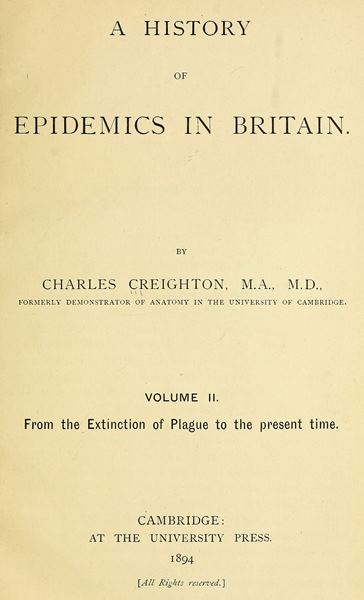
A History of Epidemics in Britain, Volume II (of 2)
by Charles Creighton
★★★★★No ratings yet
Language: English
Sign in to rate this book.
Sign in to shelve this book.
About this eBook
- Author
- Creighton, Charles, 1847-1927
- Title
- A History of Epidemics in Britain, Volume 2 (of 2) From the Extinction of Plague to the Present Time
- Credits
- E-text prepared by the Online Distributed Proofreading Team ( www.pgdp.net) from page images generously made available by Internet Archive ( archive.org)
- Language
- English
- LoC Class
- RA: Medicine: Public aspects of medicine
- Subject
- Epidemics -- Great Britain -- History
- Category
- Text
- eBook-No.
- 43671
- Project Gutenberg
- https://www.gutenberg.org/ebooks/43671
- Release Date
- September 8, 2013
- Copyright
- Public domain in the USA.
Contents
- 1.A HISTORY OF EPIDEMICS IN BRITAIN.
- 2.PREFACE.
- 3.CONTENTS.
- 4.CHAPTER I. — The epidemic fever of 1661, according to Willis. — Sydenham’s epidemic Constitutions. — Typhus fever perennial in London. — The epidemic Constitutions following the Great Plague. — The epidemic fever of 1685-86. — Retrospect of the great Fever of 1623-25. — The extinction of Plague in Britain. — Fevers to the end of the 17th century. — Fevers of the seven ill years in Scotland. — The London fever of 1709-10. — Prosperity of Britain, 1715-65. — The epidemic fevers of 1718-19. — The Epidemic Fevers of 1726-29: evidence of Relapsing Fever. — The epidemic fever of 1741-42. — Sanitary Condition of London under George II. — The Window-Tax. — Gaol-Fever. — Circumstances of severe and mild Typhus. — Ship-Fever. — Fever and Dysentery of Campaigns: War Typhus, 1742-63. — Ship-Fever in the Seven Years’ War and American War. — The “Putrid Constitution” of Fevers in the middle third of the 18th Century. — Miliary Fever. — Typhus Fever in London, 1770-1800. — Typhus in Liverpool, Newcastle and Chester in the last quarter of the 18th century. — Fever in the Northern Manufacturing Towns, 1770-1800. — Typhus in England and Scotland generally, in the end of the 18th century. — Fevers in the Dearth of 1799-1802. — Comparative immunity from Fevers during the War and high prices of 1803-15. — The Distress and Epidemic Fever (Relapsing) following the Peace of 1815 and the fall of wages. — The Epidemic of 1817-19 in Scotland: Relapsing Fever. — The Relapsing Fever of 1827-28. — Typhoid or Enteric Fever in London, 1826. — Return of Spotted Typhus after 1831: “Change of Type.” Distress of the Working Class. — Enteric Fever mixed with the prevailing Typhus, 1831-42. — Relapsing Fever in Scotland, 1842-44. — The “Irish Fever” of 1847 in England and Scotland. — Subsequent Epidemics of Typhus and Relapsing Fevers. — Relative prevalence of Typhus and Enteric Fevers since 1869. — Circumstances of Enteric Fever.
- 5.CHAPTER II. — Dysentery and Fever at Londonderry and Dundalk, 1689. — A generation of Fevers in Cork. — Famine and Fevers in Ireland in 1718 and 1728. — The Famine and Fever of 1740-41. — The Epidemic Fevers of 1799-1801. — The Growth of Population in Ireland. — The Famine and Fevers of 1817-18. — Famine and Fever in the West of Ireland, 1821-22. — Dysentery and Relapsing Fever, 1826-27. — Perennial Distress and Fever. — The Great Famine and Epidemic Sicknesses of 1846-49. — Decrease of Typhus and Dysentery after 1849.
- 6.CHAPTER III. — Retrospect of Influenzas and Epidemic Agues in the 16th and 17th centuries. — The Ague-Curers of the 17th Century. — The Peruvian Bark Controversy. — The Influenza of 1675. — The Influenza of 1679. — The Epidemic Agues of 1678-80. — The Influenza of 1688. — The Influenza of 1693. — The Influenza of 1712. — Epidemic Agues and Influenzas, 1727-29. — The Influenza of 1733. — The Influenza of 1737. — The Influenza of 1743. — Some Localized Influenzas and Horse-colds. — The Influenza of 1762. — The Influenza of 1767. — The Influenza of 1775. — The Influenza of 1782. — The Epidemic Agues of 1780-85. — The Influenza of 1788. — The Influenza of 1803. — The Influenza of 1831. — The Influenza of 1833. — The Influenza of 1837. — The Influenza of 1847-48. — The Influenzas of 1889-94. — The Theory of Influenza. — Influenza at Sea. — The Influenzas of Remote Islands.
- 7.CHAPTER IV. — Smallpox after the Restoration. — Sydenham’s Practice in Smallpox. — Causes of Mild or Severe Smallpox. — Pockmarked Faces in the 17th Century. — The Epidemiology continued to the end of the 17th century. — Smallpox in London in 1694: the death of the Queen. — Circumstances of the great Epidemic in 1710. — Inoculation brought into England. — The popular Origins of Inoculation. — Results of the first Inoculations; the Controversy in England. — Revival of Inoculation in 1740: a New Method. — The Suttonian Inoculation. — Extent of Inoculation in Britain to the end of the 18th Century. — The Epidemiology continued from 1721. — Smallpox in London in the middle of the 18th century. — The Epidemiology continued to the end of the 18th century. — The range of severity in Smallpox, and its circumstances. — Cowpox. — Chronology of epidemics resumed from 1801. — The Smallpox Epidemic of 1817-19. — Extent of Inoculation with Cowpox or Smallpox, 1801-1825. — The Smallpox Epidemic of 1825-26. — A generation of Smallpox in Glasgow. — Smallpox in Ireland, 1830-40. — The Epidemic of 1837-40 in England. — Legislation for Smallpox after the Epidemic of 1837-40. — Other effects of the epidemic of 1837-40 on medical opinion. — The age-incidence of Smallpox in various periods of history.
- 8.CHAPTER V. — Sydenham’s description of Measles in London, 1670 and 1674. — Measles in the 18th century. — Increasing mortality from Measles at the end of the 18th century. — Measles in Glasgow in 1808 and 1811-12: Researches of Watt. — Measles in the Period of Statistics.
- 9.CHAPTER VI. — Whooping-Cough in Modern Times. — Whooping-Cough as a Sequel of other Maladies.
- 10.CHAPTER VII. — The Throat-distemper of New England, 1735-36. — Angina maligna in England from 1739. — An epidemic of Throat-disease in Ireland, 1743. — Malignant Sore-throat in Cornwall, 1748. — Fothergill’s Sore-throat with Ulcers, 1746-48. — “Scarlet Fever” at St Albans, 1748. — Epidemics of Sore-throat with Scarlet rash in the period between Fothergill and Withering. — Scarlatina anginosa in its modern form, 1777-78. — History of Scarlatina after the Epidemic of 1778. — Scarlatina (1788) and Diphtheria (1793-94) described by the same observer. — Scarlatinal Epidemics, 1796-1805. — Scarlatina since the beginning of Registration, 1837. — Reappearance of Diphtheria in 1856-59. — Conditions Favouring Diphtheria.
- 11.CHAPTER VIII. — Summer Diarrhoea of Infants in London, 17th century. — Summer Diarrhoea of Infants, 18th century. — Modern Statistics of Infantile Diarrhoea. — Causes of the high death-rates from Infantile Diarrhoea. — Cholera Nostras. — Dysentery in the 17th and 18th centuries. — Dysentery in the 19th century.
- 12.CHAPTER IX. — Asiatic Cholera at Sunderland in October, 1831. — Extension of Cholera to the Tyne, December, 1831. — The Cholera of 1832 in Scotland. — The Cholera of 1832 in Ireland. — The Cholera of 1832 in England. — The Cholera of 1848-49 in Scotland. — The Cholera of 1849 in Ireland. — The Cholera of 1849 in England. — The Cholera of 1853 at Newcastle and Gateshead. — The Cholera of 1854 in England. — The Cholera of 1853-54 in Scotland and Ireland. — The Cholera of 1865-66. — The Antecedents of Epidemic Cholera in India.
- 13.INDEX.
Community reviews
Sign in to write a review.
No reviews yet.