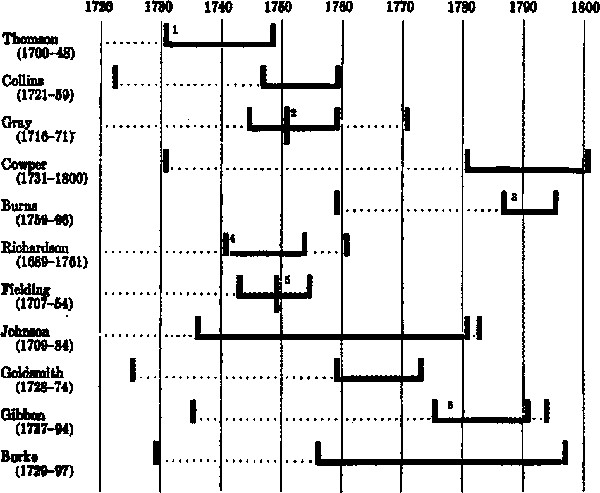
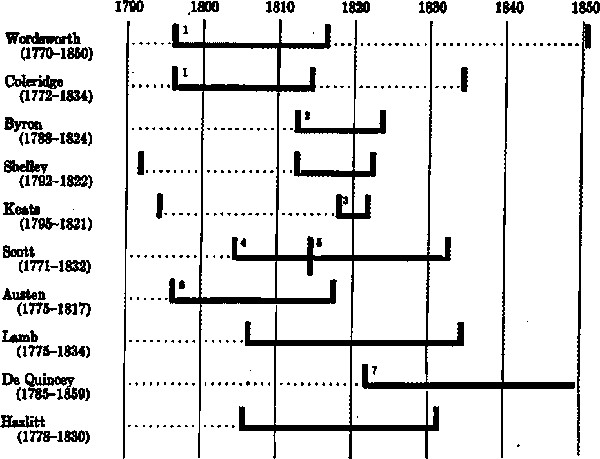
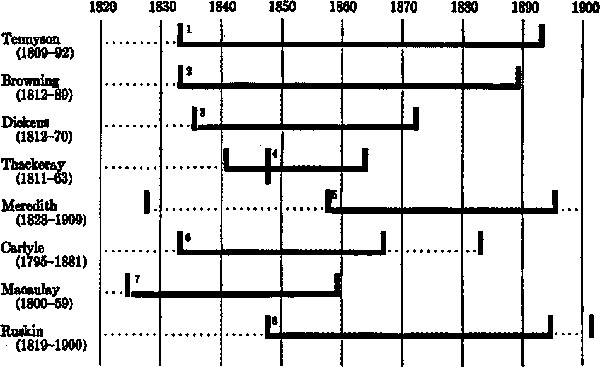
This work features some large and wide tables. These are best viewed
with a wide screen.
A HISTORY OF
ENGLISH LITERATURE
Let us now praise famous men, ...
Such as found out musical tunes,
And recited verses in writing....
Their bodies are buried in peace;
But their name liveth for evermore.
The Wisdom of Jesus the Son of
Sirach, or Ecclesiasticus
A PRACTICAL TEXT-BOOK
BY
EDWARD ALBERT, M.A.
GEORGE WATSON’S COLLEGE, EDINBURGH, AUTHOR OF
“A PRACTICAL COURSE IN ENGLISH”
NEW YORK
THOMAS Y. CROWELL COMPANY
PUBLISHERS
Copyright, 1923
By THOMAS Y. CROWELL COMPANY
Third Printing
Printed in the United States of America
PREFACE
It may be of use to explain briefly the principles underlying the
construction of this book.
In the first place the aim has been to make the book comprehensive.
All first-class and nearly all second-class authors (so far as
such classification is generally accepted) have been included. Due
proportion between the two groups has been attempted by giving the more
important authors greater space. The complete index should assist in
making the book a handy volume of reference as well as a historical
sketch.
In accordance with the plan of making the volume as comprehensive as
possible, a chapter has been added dealing with modern writers. An
attempt of this kind has certain obvious drawbacks; but it has at
least the double advantage of demonstrating the living nature of our
literature, and of setting modern authors to scale against the larger
historical background.
Secondly, the endeavor has been to make the book practical. Discussion
has been avoided; facts, so far as they are known and verifiable, are
simply stated; dates are quoted whenever it is possible to do so, and
where any doubt exists as to these the general opinion of the best
authorities has been taken; there are frequent tabulated summaries to
assist the mind and eye; and, lastly, there are the exercises.
It would be as easy to overpraise as it is to underestimate the value
of the exercises. But in their favor one can at least point out that
they enable the student to work out for himself some simple literary
and historical problems; that they supply a collection of obiter
dicta by famous critics; and that they are a storehouse of many
additional extracts. The index to all the extracts in the book should
assist the student in locating every quotation from any writer he may
have in view.
While he has never neglected the practical aspect of his task, the
writer of the present work has never been content with a bleak summary
of our literary history. It has been his ambition to set out the facts
with clearness, vivacity, and some kind of literary elegance. How far
he has succeeded the reader must judge.
The use of the Bibliography (Appendix II) is strongly urged upon all
readers. Such a book as the present cannot avoid being fragmentary and
incomplete. The student should therefore pursue his inquiries into the
volumes mentioned in the Appendix. Owing to the restrictions of space,
the Bibliography is small. But all the books given are of moderate
price or easily accessible. Moreover, they have been tested by repeated
personal use, and can be recommended with some confidence.
There remains to set on record the author’s gratitude to his colleagues
and good friends, for their skill and good-nature in revising the
manuscript and in making many excellent suggestions.
Permissions to use copyrighted material have been courteously granted
by the following American publishers:
Brentano’s, Inc. for the right to print extracts from the works
of Bernard Shaw; E. P. Dutton & Company for Siegfried Sassoon;
Duffield & Company for H. G. Wells; Dodd Mead & Company
for Rupert Brooke; Harper & Brothers for Thomas Hardy; John
W. Luce & Company for J. M. Synge; and Charles Scribner’s
Sons for John Galsworthy, and R. L. Stevenson.
We have also obtained from the literary agents of Rudyard Kipling,
Joseph Conrad, and J. E. Flecker, permission to use the selections
included from these authors. To all the above we wish to express our
acknowledgment and thanks.
CHAPTER I THE OLD ENGLISH PERIOD — THE BEGINNINGS — THE HISTORICAL BACKGROUND — LITERARY FEATURES OF THE PERIOD — THE LANGUAGE — BEOWULF — OTHER POETRY — PROSE — THE DEVELOPMENT OF LITERARY FORMS — THE DEVELOPMENT OF LITERARY STYLE — EXERCISES
A HISTORY OF ENGLISH LITERATURE
Of the actual facts concerning the origin of English literature we
know little indeed. Nearly all the literary history of the period,
as far as it concerns the lives of actual writers, is a series of
skillful reconstructions based on the texts, fortified by some scanty
contemporary references (such as those of Bede), and topped with a mass
of conjecture. The results, however, are astonishing and fruitful, as
will be seen even in the meager summary that appears in the following
pages.
The period is a long one, for it starts with the fifth century and
concludes with the Norman Conquest of 1066. The events, however, must
be dismissed very quickly. We may begin in 410 with the departure of
the Romans, who left behind them a race of semi-civilized Celts. The
latter, harassed by the inroads of the savage Caledonians, appealed
for help to the adventurous English. The English, coming at first as
saviors, remained as conquerors (450–600). In the course of time they
gained possession of nearly all the land from the English Channel to
the Firth of Forth. Then followed the Christianizing of the pagan
English, beginning in Kent (597), a movement that affected very deeply
all phases of English life. In succession followed the inroads of the
Danes in the ninth century; the rise of Wessex among the early English
kingdoms, due in great measure to the personality of King Alfred, who
compromised with the Danes by sharing England with them (878); the
accession of a Danish dynasty in England (1017); and the Gallicizing
of the English Court, a process that was begun before the Conquest of
1066. All these events had their effect on the literature of the period.
1. Pagan Origins. The earliest poems, such as Widsith
and Beowulf, present few Christian features, and those that
do appear are clearly clumsy additions by later hands. It is fairly
certain, therefore, that the earliest poems came over with the pagan
conquerors. They were probably the common property of the bards or
gleemen, who sang them at the feasts of the warriors. As time went on
Christian ideas were imposed upon the heathen poetry, which retained
much of its primitive phraseology.
2. Anonymous Origins. Of all the Old English poets, we have
direct mention of only one, Cædmon. The name of another poet, Cynewulf,
obscurely hinted at in three separate runic or riddling verses. Of the
other Old English poets we do not know even the names. Prose came much
later, and, as it was used for practical purposes, its authorship is in
each case established.
3. The Imitative Quality. Nearly all the prose, and the larger
part of the poetry, consists of translations and adaptations from the
Latin. The favorite works for translation were the lives of saints,
the books of the Bible, and various works of a practical nature. The
clergy, who were almost the sole authors, had such text-books at hand,
and were rarely capable of reaching beyond them. This secondhand nature
of Old English is certainly its most disappointing feature. In most
cases the translations are feebly imitative; in a few cases the poets
(such as Cynewulf) or the prose-writers (such as Alfred) alter, expand,
or comment upon their Latin originals, and then the material is of
much greater literary importance.
4. The Manuscripts. It is very likely that only a portion of
Old English poetry has survived, though the surviving material is
quite representative. The manuscripts that preserve the poetical texts
are comparatively late in their discovery, are unique of their kind,
and are only four in number. They are (a) the Beowulf
manuscript (containing also a portion of a poem Judith),
discovered in 1705, and said to have been written about the year 1000;
(b) the Junian manuscript, discovered in 1681 by the famous
scholar Junius, and now in the Bodleian Library, containing the Cædmon
poems; (c) the Exeter Book, in the Exeter Cathedral library (to
which it was given by Leofric about 1050, being brought to light again
in 1705), which preserves most of the Cynewulf poems; and (d)
the Vercelli Book, discovered at Vercelli, near Milan, in 1832, which
contains, along with some prose homilies, six Old English poems,
including Andreas and Elene.
The Old English language was that of a simple and semi-barbarous
people: limited in vocabulary, concrete in ideas, and rude and forcible
in expression. In the later stages of their literature we see the
crudeness being softened into something more cultured. In grammar the
language was fairly complicated, possessing declinable nouns, pronouns,
and adjectives, and a rather elaborate verb-system. There were three
chief dialects: the Northern or Northumbrian, which was the first to
produce a literature, and which was overwhelmed by the Danes; the West
Saxon, a form of the Mercian or Midland, which grew to be the standard,
as nearly all the texts are preserved in it; and the Kentish or Jutish,
which is of little literary importance.
1. Origin of the Poem. It is almost certain that the poem
originated before the English invasions. There is no mention of
England; Beowulf himself is the king of the “Geatas.” The poem,
moreover, is pagan in conception, and so antedates the Christian
conversion. With regard to the actual authorship of the work there is
no evidence. It is very likely that it is a collection of the tales
sung by the bards, strung together by one hand, and written in the West
Saxon dialect.
2. The Story. There are so many episodes, digressions, and
reversions in the story of Beowulf that it is almost impossible
to set it down as a detailed consecutive narrative. Putting it in its
very briefest form, we may say that Beowulf, son of Ecgtheow, and
king of the Geatas, sails to Denmark with a band of heroes, and rids
the Danish King Hrothgar of a horrible mere-monster called Grendel.
The mother of Grendel meets with the same fate, and Beowulf, having
been duly feasted and rewarded, returns to his native land. After a
prosperous reign of forty years Beowulf slays the dragon that ravishes
his land, but himself receives a mortal wound. The poem concludes with
the funeral of the old hero.
3. The Style. We give a short extract, along with a literal
translation, to illustrate the style. The short lines of the poem are
really half-lines, and in most editions they are printed in pairs
across the page. The extract deals with Beowulf’s funeral rites:
It will be observed that the language is abruptly and rudely
phrased. The half-lines very frequently consist of mere tags or, as
they are called, kennings. Such conventional phrases were
the stock-in-trade of the gleemen, and they were employed to keep
the narrative in some kind of motion while the invention of the
minstrel flagged. At least half of the lines in the extract are
kennings—beorhtū byrnū, hláf-ord leófne, higū
un-róte, and so on. Such phrases occur again and again in
Old English poetry. It will also be observed that the lines are
strongly rhythmical, but not metrical; and that there is a system of
alliteration, consisting as a rule of two alliterated sounds in the
first half-line and one in the second half-line.
With regard to the general narrative style of the poem, there is
much primitive vigor in the fighting, sailing, and feasting; a deep
appreciation of the terrors of the sea and of other elemental forces;
and a fair amount of rather tedious repetition and digression.
Beowulf, in short, may be justly regarded as the expression of a
hardy, primitive, seafaring folk, reflecting their limitations as well
as their virtues.
1. The Pagan Poems. The bulk of Old English poetry is of a
religious cast, but a few pieces are distinctly secular.
(a) Widsith (i.e., “the far traveler”) is usually
considered to be the oldest poem in the language. It consists of more
than a hundred lines of verse, in which a traveler, real or imaginary,
recounts the places and persons he has visited. Since he mentions
several historical personages, the poem is of much interest, but as
pure poetry it has little merit.
(b) Waldhere (or Walter) consists of two
fragments, sixty-eight lines in all, giving some of the exploits of a
famous Burgundian hero. There is much real vigor in the poem, which
ranks high among its fellows.
(c) The Fight at Finnesburgh, a fragment of fifty lines,
contains a finely told description of the fighting at Finnesburgh.
(d) The Battle of Brunanburgh is a spirited piece on this
famous fight, which took place in 937. The poem has much more spirit
and originality than usual, contains some fine descriptions, and forces
the narrative along at a comparatively fast pace.
(e) The Battle of Maldon is a fragment, but of uncommon
freshness and vivacity. The battle occurred in 993, and the poem seems
to be contemporary with the event.
2. The Dramatic Monologues. These poems, which are called The
Wanderer, The Seafarer, Deor’s Complaint, The
Wife’s Complaint, The Husband’s Message, and Wulf and
Eadwacer, appear in the Exeter Book. It is unlikely that they were
composed at the same time, but they are alike in a curious meditative
pathos. In Old English literature they come nearest to the lyric. As
poetry, they possess the merit of being both original and personal,
qualities not common in the poems of the period.
3. The Cædmon Group. In his Historia Ecclesiastica Bede
tells the story of a herdsman Cædmon, who by divine inspiration was
transformed from a state of tongue-tied ineffectiveness into that of
poetical ecstasy. He was summoned into the presence of Hilda of Whitby,
who was abbess during the years 658–80. He was created a monk, and
thereafter sang of many Biblical events. On a blank page of one of the
Bede manuscripts there is quoted the first divinely inspired hymn of
Cædmon, a rude and distinctly uninspired fragment of poetry, nine lines
in all, composed in the ancient Northumbrian dialect.
That is all we know of the life and works of Cædmon; but in the Junian
manuscript a series of religious paraphrases was unearthed in the year
1651. In subject they corresponded rather closely to the list set out
by Bede, and in a short time they were ascribed to Cædmon. The poems
consist of paraphrases of Genesis, Exodus, and Daniel and three shorter
poems, the chief of which is the Harrowing of Hell. Modern
scholarship now recognizes that the poems are by different hands, but
the works can be conveniently lumped together under the name of the
shadowy Northumbrian. The poems appear in the West Saxon dialect, in
spite of the fact that Cædmon must have written in his own dialect; but
the difficulty is overcome by pointing out that a West Saxon scribe
might have copied the poems.
In merit the poems are unequal. At their best they are not sublime
poetry, but they are strong and spirited pieces with some aptitude in
description. On the average they are trudging mediocrities which are
frequently prosaic and dull.
4. The Cynewulf Group. In 1840 the scholar Kemble lighted upon
three runic (or pre-Roman) signatures which appeared respectively
in the course of the poems called Christ and Juliana
(in the Exeter Book) and Elene (in the Vercelli Book). The
signatures read “Cynewulf” or “Cynwulf.” In 1888 a signature “Fwulcyn”
was discovered in The Fates of the Apostles. This is all we
know of Cynewulf, if we accept the quite general personalities that
appear in the course of the poems. Yet an elaborate life has been
built up for the poet, and other poems, similar in style to the signed
pieces, have been attributed to him. The Phœnix, The Dream of
the Rood, and the Riddles of the Exeter Book are the most
considerable of the additional poems.
The Cynewulfian poems are much more scholarly compositions than the
Beowulf or even the Cædmon poems. There is a greater power
of expression, less reliance on the feeble kenning, and some real
expertness in description. The ideas expressed in the poems are broader
and deeper, and a certain lyrical fervor is not wanting. The date is
probably the tenth century.
1. Alfred (848–900). Though there were some prose writings
of an official nature (such as the laws of Ine, who died about 730)
before the time of Alfred, there can be little objection to the claim
frequently made for him, that he is “the father of English prose.” As
he tells us himself in his preface to the Pastoral Care, he was
driven into authorship by the lamentable state of English learning,
due in large measure to the depredations of the Danes. Even the
knowledge of Latin was evaporating, so the King, in order to preserve
some show of learning among the clergy, was compelled to translate
some popular monastic handbooks into his own tongue. These works
are his contribution to our literature. As he says, they were often
“interpreted word for word, and meaning for meaning”; but they are made
much more valuable by reason of the original passages freely introduced
into them. The books, four in number, are an able selection from the
popular treatises of the day: the Universal History of Orosius;
the Ecclesiastical History of Bede; the Pastoral Care of
Pope Gregory; and the Consolation of Philosophy of Boëthius. His
claim to the translation of Bede is sometimes disputed; and there is a
fifth work, a Handbook or commonplace book, which has been lost.
The chronological order of the translations cannot be determined, but
they were all written during the last years of the reign.
We add a brief extract to illustrate his prose style. It is not a
highly polished style; it is rather that of an earnest but somewhat
unpracticed writer. When it is simplest it is best; in its more
complicated passages it is confusing and involved. The vocabulary is
simple and unforced.
Swa clæne heo wæs oðfeallen on Angelcynne [-þ] swiðe feawa
wæron be-heonan Humbre þe hira þe-nunge cuðon understanden
on Englisc, oððe furðon an ærend-ge-writ of Ledene
on Englisc areccan; and ic wene [-þ] naht monige be-geondan
Humbre næron. Swa feawa heora wæron [-þ] ic furbon anne
ænlepne ne mæg geþencan be-suðan Thamise þa þa ic to rice
feng. Gode Ælmightigum sy þanc, [-þ] we nu ænigne an steal
habbað lareowa. For þam ic þe beode, [-þ] þu do swa ic gelyfe
[-þ] þu wille.
So clean [completely] has ruin fallen on the English nation,
that very few were there this side the Humber that could
understand their service in English or declare forth an
Epistle [an errand-writing] out of Latin into English; and
I think that not many beyond Humber were there. So few
such were there, that I cannot think of a single one to the
south of the Thames when I began to reign. To God Almighty
be thanks, that we now have any to teach in stall [any
place]. Therefore I bid thee that thou do as I believe that
thou wilt.
Preface to “Pastoral Care”
2. Ælfric (955–1020) is known as “the Grammarian.” Of his
life little is known. It is probable that he lived near Winchester,
and he was certainly the first abbot of Eynsham, near Oxford, in 1006.
A fair number of his works, both in Latin and English, have come down
to us. Of his English books, two series of homilies, adapted from
the Latin, seem to have been composed about the year 990. A third
series of homilies, called The Lives of the Saints, is dated
approximately at 996. Several of his pastoral letters survive, as
well as a translation of Bede’s De Temporibus and some English
translations of Biblical passages.
Ælfric’s style is interesting, for it is representative of the
scholarly prose of his time, a century after Alfred. It is flowing and
vigorous, showing an almost excessive use of alliteration. In many
cases it suggests a curious hybrid between the poetry and prose of the
period.
3. Wulfstan was Archbishop of York from 1003 till his death
in 1023. In his prose, which survives in more than fifty homilies
and in his famous Letter to the English People (Lupi Sermo
ad Anglos), he shows the effects of “style” to a marked degree.
His Letter in particular is a fervid epistle, detailing with
considerable power and fluency the dreadful plight of the English
nation in the year 1014. The alliteration and rhythm are exceedingly
well marked, much more so than in the case of Ælfric.
4. The Anglo-Saxon Chronicle was probably inspired by
King Alfred, who is said even to have dictated the entries dealing with
his own campaigns. The Chronicle has come down to us in four
versions, all of which seem to have sprung from a common stock. The
four versions are preserved in seven manuscripts, of which the most
notable are those connected with Canterbury and Peterborough. From the
period of the English invasions till the year 892 the books are fairly
in accord. At the latter year they diverge. Each introduces its local
events and miscellaneous items of news, and they finish at different
dates. The last date of all is about the middle of the twelfth century.
The style of the Chronicle varies greatly; it ranges from the
baldest notes and summaries to quite ambitious passages of narrative
and description. Of the latter class the well-known passage on the
horrors of Stephen’s reign is a worthy example. We give a brief
extract, dated 1100, just at the close of the Old English period, which
is a fair average of the different methods:
On þisum geare aras seo ungeþwærnes on Glæstinga byrig
betwyx þam abbode Ðurstane and his munecan. Ærest hit
com of þæs abbotes unwisdome [-þ] he misbead his munecan on
fela thingan, and þa munecas hit mændon lufelice to him and
beadon hine [-þ] he [`s]ceolde healdan hi rihtlice beon and lufian
hi, and hi woldon him beon holde and gehyrsume.
In the year arose the discord in Glastonbury betwixt the Abbot
Thurstan and his monks. First it came from the Abbot’s
unwisdom: In that he mis-bade [ruled] his monks in many
things and the monks meant it lovingly to him and bade him
that he should hold [treat] them rightly and love them and
they would be faithful to him and hearsome [obedient].
From the time when it first appears till it is swamped by the
Norman Conquest Old English literature undergoes a quite noticeable
development. In the mass the advance appears to be considerable, but
when we reflect that it represents the growth of some five hundred
years, we see that the rate of progress is undoubtedly slow. We shall
take the poetical and prose forms separately.
1. Poetry. Poetry is much earlier in the field, and its
development is the greater. It begins with the rude forms of
Beowulf and concludes with the more scholarly paraphrases of
Cynewulf.
(a) The epic in its untutored form exists in
Beowulf. This poem lacks the finer qualities of the epic: it is
deficient in the strict unity, the high dignity, and the broad motive
of the great classical epic; but a crude vigor and a certain rude
majesty are not wanting. It is no mean beginning for the English epic.
The later poems of the Cædmon and Cynewulf types are too discursive and
didactic to be epics, though in places they are like The Battle of
Maldon and The Fight at Finnesburgh in their narrative force.
(b) The lyric—that is, the short and passionate
expression of a personal feeling—hardly exists at all. The nearest
approach to it lies in the dramatic monologues, such as Deor’s
Complaint. These poems are too long and diffuse to be real lyrics,
but they have some of the expressive melancholy and personal emotion of
the lyric.
2. Prose. The great bulk of Old English prose consists of
translation; and in its various shapes English prose adopts the methods
of its originals. We have many homilies, some history, and a few
pastoral letters, all based strictly upon Latin works. There are very
few passages of real originality, and they are short and disjointed.
Of historical writing we have the rudiments in the Anglo-Saxon
Chronicle. On the whole, the development is very small, for the
prose is bound by the curse of imitativeness.
1. Poetry. We have once more to distinguish between the earlier
Beowulf stage and the later Cynewulf stage. In the earlier
period the style is more disjointed, abrupt, and digressive, and is
weighted down by the reliance upon the kenning. In the later stage
there is greater passion and insight, less reliance upon the stock
phrases, and a greater desire for stylistic effects.
2. Prose. In spite of its limited scope, Old English prose shows
quite an advance in style. The earlier style, represented by the prose
of Alfred, is rather halting and unformed, the sentences are loosely
knit, the vocabulary is meager, and there is an absence of the finer
qualities of rhythm and cadence. By the time of Wulfstan the prose
has gained in fluency. It is much more animated and confident, and it
freely employs alliteration and the commoner rhetorical figures.
But within this development both of prose and poetry there was
already the seed of decay. During the last century of the period the
poetical impulse was weakening; there is little verse after the time
of Cynewulf. The prose too was failing, and the language was showing
symptoms of weakness. The inflections were loosening even before the
Norman Conquest, and the Old English vocabulary was being subtly
Gallicized. The Norman Conquest was in time to put an abrupt finish to
a process already well advanced.
1. Examine the style of the following poetical passages. Point out
examples of kennings, and mention the purposes they serve. Comment upon
the type of sentence, the use of alliteration, and the nature of the
vocabulary. Compare the style with that of the Beowulf extract
given on page 4.
(1) Us is riht micel,
For us it is much right
That we rodera weard,
That we the Guardian of the skies,
Wereda wuldor-cining,
The glory-King of hosts,
Wordum herigen
With our words praise,
Modum lufien.
In our minds love.
He is mægna sped,
He is of power the essence,
Heofod ealra
The head of all
Heah-gesceafta,
Exalted creatures,
Fréa Ælmīhtig.
The Lord Almighty.
Næs him fruma æfre
To him has beginning never
Ór geworden
Origin been,
Ne nu ende cymth
Nor now cometh end
Écean drihtnes,
To the eternal Lord,
Ac he bíth á ríce
But he is ever powerful
Ofer heofen-stolas.
Over the heavenly thrones.
Cædmon.
(2) Nis tháer on thám lande
There in that land is not
Láth geníthle,
Harmful enmity,
Ne wop ne wracu,
Nor wail nor vengeance,
Weá-tácen nán,
Evil-token none,
Yldu ne yrmthu,
Old age nor poverty,
Ne se enga death,
Nor the narrow death,
Ne lífes lyre,
Nor loss of life,
Ne láthes cyme,
Nor coming of harm,
Ne syn ne sacu,
Nor sin nor strife,
Ne sár-wracu,
Nor sore revenge,
Ne wædle gewin,
Nor toil of want,
Ne wélan ansýn,
Nor desire of wealth,
Ne sorg ne sláep,
Nor care nor sleep,
Ne swar leger,
Nor sore sickness,
Ne winter-geweorp,
Nor winter-dart,
Ne weder-gebregd
Nor dread of tempest
Hreóh under heofonum.
Rough under the heavens.
The Phœnix.
2. Comment briefly upon the style of the following prose extract. How
does it compare with modern English prose?
Ðu bæde me for oft engliscera gewritena. And
ic þe ne getiðode ealles swa timlice ær ðam þe þu mid
weorcum þæs gewilnodest æt me þa ða þu me bæde for Godes lufon
georne [-þ] ic þe æt ham æt þinum huse gespræce. And pu ða swiðe
mændest þa þa ic mid þe wæs [-þ] þu mine gewrita begitan ne
mihtest. Nu wille ic [-þ] þu hæbbe huru þis litle nu ðe wisdom
gelicað. And pu hine habban wilt [-þ] þu ealles ne beo minra boca
bedæled. God luvað pa godan weorce and he wyle big habban æt us.
Thou hast oft entreated me for English Scripture, and
I gave it thee not so soon, but thou first with
deeds hast importuned me thereto; at what time thou didst so earnestly
pray me for God’s love that I should speak to thee at thy house at home,
and when I was with thee great moan thou madest that thou couldst
get none of my writings. Now will I that thou have at least this little,
sith knowledge is so acceptable unto thee: and thou wilt have it rather
than be altogether without my books. God loveth good deeds and
will have them at our hands [of us].
Ælfric, Introduction to the Old Testament
3. What appears to you to be the reasons why in Old English poetry
appears before prose?
4. Mention some of the effects of translation upon both the poetry and
the prose of the Old English.
5. “Old English prose is much nearer modern English prose than Old
English poetry is to modern English poetry.” Discuss this statement.
CHAPTER II THE MIDDLE ENGLISH PERIOD — THE HISTORICAL BACKGROUND (1050–1350) — STATE OF THE ENGLISH LANGUAGE — LITERARY FEATURES OF THE AGE — POETRY — PROSE — THE DEVELOPMENT OF LITERARY FORMS — THE DEVELOPMENT OF STYLE IN POETRY — EXERCISES
The extensive period covered by this chapter saw many developments
in the history of England: the establishment of Norman and Angevin
dynasties; the class-struggle between king, nobles, clergy, and people;
and the numerous wars against France, Scotland, and Wales. But, from
the literary point of view, much more important than definite events
were the general movements of the times: the rise of the religious
orders, their early enthusiasm, and their subsequent decay; the
blossoming of chivalry and the spirit of romance, bringing new sympathy
for the poor and for womankind; the Crusades, and the widening of the
European outlook which was gradually to expand into the rebirth of the
intellect known as the Renaissance. All these were only symptoms of a
growing intelligence that was strongly reflected in the literature of
the time.
This period witnesses the disappearance of the pure Old English
language and the emergence of the mixed Anglo-French or Middle English
speech that was to be the parent of modern English. As a written
language Old English disappears about 1050, and, also as a written
language, Middle English first appears about the year 1200. With the
appearance of the Brut about 1200 we have the beginning of
the numerous Middle English texts, amply illustrating the changes
that have been wrought in the interval: the loss of a great part of
the Old English vocabulary; a great and growing inrush of French
words; the confusion, crumbling, and ultimate loss of most of the old
inflections; and the development of the dialects. There are three main
dialects in Middle English: the Northern, corresponding to the older
Northumbrian; the Midland, corresponding to Mercian; and the Southern,
corresponding to the Old English Kentish or Southern. None of the three
can claim the superiority until late in the period, when the Midland
gradually assumes a slight predominance that is strongly accentuated in
the period following.
The latter part of the three hundred years now under review provides a
large amount of interesting, important, and sometimes delightful works.
It is, however, the general features that count for most, for there is
hardly anything of outstanding individual importance.
1. The Transition. The period is one of transition and
experiment. The old poetical methods are vanishing, and the poets are
groping after a new system. English poets had two models to follow—the
French and the Latin, which were not entirely independent of each
other. For a time, early in the period, the French and Latin methods
weighed heavily upon English literature; but gradually the more
typically native features, such as the systematic use of alliteration,
emerge. It is likely that all the while oral tradition had preserved
the ancient methods in popular songs, but that influence was slight for
a long period after the Norman Conquest.
2. The anonymous nature of the writing is still strongly
in evidence. A large proportion of the works are entirely without
known authors; most of the authors whose names appear are names only;
there is indeed only one, the Hermit of Hampole, about whom we have
any definite biographical detail. There is an entire absence of any
outstanding literary personality.
3. The Domination of Poetry. The great bulk of the surviving
material is poetry, which is used for many kinds of miscellaneous work,
such as history, geography, divinity, and rudimentary science. Most
of the work is monastic hack-work, and much of it is in consequence of
little merit.
Compared with poetry of the period, the prose is meager in quantity
and undeveloped in style. The common medium of the time was Latin and
French, and English prose was starved. Nearly all the prose consists of
homilies, of the nature of the Ancren Riwle; and most of them
are servile translations from Latin, and destitute of individual style.
For the sake of convenience we can classify the different poems into
three groups, according to the nature of their subjects.
1. The Rhyming Chronicles. During this period there is an
unusual abundance of chronicles in verse. They are distinguished by
their ingenuous use of incredible stories, the copiousness of their
invention, and in no small number of cases by the vivacity of their
style.
(a) The Brut. This poem was written by a certain
Layamon about the year 1205. We gather a few details about
the author in a brief prologue to the poem itself. He seems to have
been a monk in Gloucestershire; his language certainly is of a nature
that corresponds closely to the dialect of that district. The work,
thirty thousand lines in length, is a paraphrase and expansion of the
Anglo-Norman Brut d’Angleterre of Wace, who in turn simply
translated from Geoffrey of Monmouth’s Latin history of Britain. In the
Brut the founder of the British race is Brutus, great-grandson
of Æneas of Troy. Brutus lands in England, founds London, and becomes
the progenitor of the earliest line of British kings. In style the poem
is often lifeless, though it has a naïve simplicity that is attractive.
The form of the work, however, is invaluable as marking the transition
from the Old English to the Middle English method.
Alliteration, the basis of the earlier types, survives in a casual
manner; at irregular intervals there are rudely rhyming couplets,
suggesting the newer methods; the lines themselves, though they are of
fairly uniform length, can rarely be scanned; the basis of the line
seems to be four accents, occurring with fair regularity. The following
extract should be scrutinized carefully to bring out these features:
To niht a mine slepe,
At night in my slepe
Their ich læi on bure,
Where I lay in bower [chamber]
Me imæette a sweuen;
I dreamt a dream—
Ther oure ich full sari æm.
Therefore I full sorry am.
Me imætte that mon me hof
I dreamt that men lifted me
Uppen are halle.
Up on a hall;
Tha halle ich gon bestriden,
The hall I gan bestride,
Swulc ich wolde riden
As if I would ride;
Alle tha lond tha ich ah
All the lands that I owned,
Alle ich ther ouer sah.
All I there overlooked.
And Walwain sat biuoren me;
And Walwain sate before me;
Mi sweord he bar an honde.
My sword he bare in hand.
Tha com Moddred faren ther
Then approached Modred there,
Mid unimete uolke.
With innumerable folk.
(b) Robert of Gloucester is known only through his
rhyming history. From internal evidence it is considered likely that
he wrote about 1300. From his dialect, and from local details that
he introduces into the poem, it is probable that he belonged to
Gloucestershire. Drawing largely upon Layamon, Geoffrey of Monmouth,
and other chroniclers, he begins his history of England with Brutus and
carries it down to the year 1270. The style of the poem is often lively
enough; and the meter, though rough and irregular, often suggests the
later “fourteener.” As a rule the lines are longer than those of the
Brut, and the number of accents is greater.
(c) Robert Manning (1264–1340) is sometimes known as
Robert of Brunne, or Bourne, in Lincolnshire. In 1288 he entered a
Gilbertine monastery near his native town. His Story of Ingelond
(1338) begins with the Deluge, and traces the descent of the English
kings back to Noah. The latter portion of the book is based upon
the work of Pierre de Langtoft, and the first part upon Wace’s
Brut. The meter is a kind of chaotic alexandrine verse; but an
interesting feature is that the couplet rhymes are carefully executed,
with the addition of occasional middle rhymes.
Manning’s Handlyng Synne (1303) is a religious manual based on
a French work, Manuel des Pechiez. The poem, which is thirteen
thousand lines in length, is a series of metrical sermons on the Ten
Commandments, the Seven Deadly Sins, and the Seven Sacraments. The
author knows how to enliven the work with agreeable anecdotes, and
there are signs of a keen observation. The meter is an approximation to
the octosyllabic couplet.
Manning’s language is of importance because it marks a close approach
to that of Chaucer: a comparative absence of old words and inflections,
a copious use of the later French terms, and the adoption of new
phrases.
(d) Laurence Minot, who probably flourished about 1350,
appears as the author of eleven political songs, which were first
published in 1795. The pieces, which sing of the exploits of Edward
III, are violently patriotic in temper, and have a rudely poetical
vigor. Their meters are often highly developed.
2. Religious and Didactic Poetry. Like most of the other poetry
of the period, this kind was strongly imitative, piously credulous, and
enormous in length.
(a) The Ormulum, by a certain Orm, or
Ormin, is usually dated at 1200. As it survives it is an
enormous fragment, twenty thousand lines in length, and composed in
the East Midland dialect. It consists of a large number of religious
homilies addressed to a person called Walter. Of poetical merit the
poem is destitute; but it is unique in the immense care shown over a
curious and complicated system of spelling, into which we have not
the space to enter. Its metrical form is noteworthy: a rigidly iambic
measure, rhymeless, arranged in alternate lines of eight and seven
syllables respectively. This regularity of meter is another unique
feature of the poem, which we illustrate by an extract:
An Romanisshe Kaserrking
A Roman Kaiser-king
Wass Augusstuss [gh]ehatenn
Was called Augustus
And he wass wurrthenn Kaserrking
And he became Kaiser-king
Off all mannkinn onn eorthe,
Of all mankind on earth,
And he gann thenkenn off himmsellf
And he gan think of himself
And off hiss micle riche.
And of his muckle kingdom,
And he bigann to thenkenn tha,
And he began to think
Swa summ the goddspell kithethth
Just as the gospel tells
Off thatt he wollde witenn wel
Of what he would well know
Hu mikell fehh himm come,
How much money [fee] would come to him
[GH]iff himm off all hiss kinedom.
If to him of all his kingdom
Illc mann an penning [gh]æfe.
Each man a penny gave.
(b) The Owl and the Nightingale, the date of which is
commonly given as 1250, is attributed to Nicholas of Guildford.
The poem consists of a long argument between the nightingale,
representing the lighter joys of life, and the owl, which stands for
wisdom and sobriety. The poem is among the most lively of its kind,
and the argument tends to become heated. In meter it is rhyming
octosyllabic couplets, much more regular than was common at the time.
(c) The Orison to Our Lady, Genesis and
Exodus, the Bestiary, the Moral Ode, the
Proverbs of Alfred, and the Proverbs of Hendyng
are usually placed about the middle of the thirteenth century.
Of originality there is little to comment upon; but as metrical
experiments they are of great importance. The Proverbs show some
regular stanza-formation, and the Moral Ode is remarkable for
the steadiness and maturity of its measure, a long line coming very
close to the fourteener.
(d) The Cursor Mundi was composed about 1320. It is a
kind of religious epic, twenty-four thousand lines long, composed in
the Northern dialect. The author, who divides his history into seven
stages, draws upon both the Old and the New Testaments. The meter shows
a distinct advance in its grip of the octosyllabic couplet.
(e) Richard Rolle of Hampole, who died in 1349, is one
of the few contemporary figures about whom definite personal facts are
recorded. He was born in Yorkshire, educated at Oxford, and ran away
from home to become a hermit. Subsequently he removed to Hampole, near
Doncaster, where he enjoyed a great reputation for sanctity and good
works.
He wrote some miscellaneous prose and a few short poems, but his chief
importance lies in his authorship of the long poem The Pricke of
Conscience. This work, which is based upon the writings of the
early Christian Fathers, describes the joys and sorrows of a man’s
life as he is affected in turn by good and evil. The meter is a close
approximation to the octosyllabic couplet, which shows extensions
and variations that often resemble the heroic measure. It has been
suggested that Hampole is the first English writer to use the heroic
couplet; but it is almost certain that his heroic couplets are
accidental.
(f) The Alliterative Poems. In a unique manuscript,
now preserved in the British Museum, are found four remarkably fine
poems in the West Midland dialect: Pearl, Cleannesse,
Patience, and Sir Gawain and the Green Knight. There is
no indication of the authorship, but judging from the similarity of the
style it is considered likely that they are by the same poet. The date
is about 1300. The first three poems are religious in theme, and of
them Pearl is undoubtedly the best. This poem, half allegorical
in nature, tells of a vision in which the poet seeks his precious pearl
that has slipped away from him. In his quest he spies his pearl, which
seems to be the symbol of a dead maiden, and obtains a glimpse of the
Eternal Jerusalem. The poem, which contains long discussions between
the poet and the pearl, has some passages of real, moving beauty, and
there is a sweet melancholy inflection in some of the verses that
is rare indeed among the fumbling poetasters of the time. The meter
is extraordinarily complicated: heavily alliterated twelve-lined
stanzas, with intricate rhymes arranged on a triple basis (see p.
149). Cleannesse and Patience, more didactic in theme,
are of less interest and beauty, but they have an exultation and stern
energy that make them conspicuous among the poems of the period. They
are composed in a kind of alliterative blank verse. Sir Gawain and
the Green Knight is one of the most captivating of the romances.
Its meter also is freely alliterated and built into irregular rhyming
stanzas which sometimes run into twenty lines.
3. The Metrical Romances. The great number of the romances that
now appear in our literature can be classified according to subject.
(a) The romances dealing with early English history and its
heroes were very numerous. Of these the lively Horn and
Havelock the Dane and the popular Guy of Warwick and
Bevis of Hampton were among the best. Even contemporary
history was sometimes drawn upon, as in the well-known Richard
Cœur-de-Lion.
(b) Allied to the last group are the immense number of Arthurian
romances, which are closely related and often of high merit. Sir
Tristrem, one of the earliest, is by no means one of the worst;
to it we may add the famous Arthur and Merlin, Ywain and
Gawain, the Morte d’Arthure, and Sir Gawain and the Green
Knight.
(c) There was also a large number of classical themes, such as
the exploits of Alexander the Great and the siege of Troy. King
Alisaunder is very long, but of more than average merit. Further
examples are Sir Orpheo and The Destruction of Troy.
(d) The group dealing with the feats of Charlemagne is smaller,
and the quality is lower. Rauf Coilyear, an alliterative
romance, is probably the best of them, and to it we may add Sir
Ferumbras.
(e) A large number of the romances deal with events which are to
some extent contemporary with the composition. They are miscellaneous
in subject, but they are of much interest and some of them of great
beauty. Amis and Amiloun is a touching love-story; William of
Palerne is on the familiar “missing heir” theme; and The Squire
of Low Degree, who loved the king’s daughter of Hungary, is among
the best known of all the romances.
It would take a volume to comment in detail upon the romances. The
variety of their meter and style is very great; but in general terms we
may say that the prevailing subject is of a martial and amatory nature;
there is the additional interest of the supernatural, which enters
freely into the story; and one of the most attractive features to the
modern reader of this delightful class of fiction is the frequent
glimpses obtainable into the habits of the time.
1. The Ancren Riwle, or Rule of Anchoresses, is
one of the earliest of Middle English prose texts, for it dates from
about 1200. The book, which is written in a simple, matter-of-fact
style, is a manual composed for the guidance of a small religious
community of women which then existed in Somersetshire. Nothing certain
is known regarding the author. Its Southern dialect shows some traces
of Midland. As in some respects the text is the forerunner of modern
prose, we give an extract:
Uorþi was ihoten a Godes half iðen olde lawe þet put
were euer iwrien; & [gh]if eni unwrie put were, & best feolle
þerinne, he hit schulde [gh]elden þet þene put unwrieh. Ðis is a
swuðe dredlich word to wummen þet scheaweð her to wep-monnes
eien. Heo is bitocned bi þe þet unwrieð þene put: þe
put is hire veire neb, & hire hwite swire, & hire hond, [gh]if hes
halt forð in his eihsihðe.
Therefore it was ordered on the part of God in the old law
that a pit should be ever covered, and if there were any uncovered
pit, and a beast fell therein, he should pay for it,
that uncovered the pit. This is a very dreadful saying for a
woman that shows herself to a man’s eyes. She is betokened
by the person that uncovers the pit; the pit is her fair face, and
her white neck, and her hand, if she holds it forth in his eyesight.
2. The Ayenbite of Inwyt was written by Dan Michel of
Northgate, who flourished about 1340. The book is a servile translation
of a French work, and is of little literary importance. To the
philologist it is very useful as an example of the Southern dialect of
the period.
1. Poetry. (a) Meter. The most interesting feature
of this period is the development of the modern system of rhymed
meters, which displaced the Old English alliterative measures. Between
the Old English poems of Cynewulf (about 950) and the Middle English
Brut (about 1205) there is a considerable gap both in time and
in development. This gap is only slightly bridged by the few pieces
which we proceed to quote.
In this example we have two rough couplets. The first pair rhyme, and
in the second pair there is a fair example of assonance. The meter,
as far as it exists at all, is a cross between octosyllables and
decasyllables.
A few brief fragments by Godric, who died in 1170, carry the process
still further. The following lines may be taken as typical:
These lines are almost regular, and the rhyme in the second couplet is
perfect.
The Brut, with its ragged four-accented and nearly rhymeless
lines, shows no further advance; but the Ormulum, though it
does without rhyme, is remarkable for the regularity of its meter.
Then during the thirteenth century there comes a large number of
poems, chiefly romances and homilies. Much of the verse, such as in
Horn, Havelock the Dane, and the works of Manning, is in
couplet form. It is nearly doggerel very often, and hesitates between
four and five feet. This is the rough work that Chaucer is to make
perfect. The following example of this traditional verse should be
carefully scanned:
For Engelond ys ful ynow of fruyt and of tren,
Of wodes and of parkes, that joye yt ys to sen.
Of foules and of bestes of wylde and tame also.
Of salt fysch and eche fresch, and fayr ryueres ther to.
Of welles swete and colde ynow, of lesen and of mede.
Of seluer or and of gold, of tyn and of lede.
Robert of Gloucester
During the fourteenth century, with the increase of dexterity, came
the desire for experiment. Stanzas in the manner of the French were
developed, and the short or bobbed line was introduced. The
expansion of the lyric helped the development of the stanza. Thus we
pass through the fairly elaborate meters of Minot, the Proverbs
of Hendyng, and the romances (like The King of Tars) in
the Romance sestette, to the extremely complicated verses of Sir
Tristrem, Sir Gawain and the Green Knight, and Pearl.
We add a specimen of the popular Romance sestette, and a verse from a
popular song of the period.
(b) The Lyric. The most delightful feature of the
period is the appearance of the lyric. There can be little doubt that
from Old English times popular songs were common, but it is not till
the thirteenth century that they receive a permanent place in the
manuscripts. We then obtain several specimens that for sweetness and
lyrical power are most satisfying.
Apart from its native element, the lyric of the time drew its main
inspiration from the songs of the French jongleurs and the
magnificent, rhymed Latin hymns (such as Dies Iræ and Stabat
Mater) of the Church. These hymns, nobly phrased and rhymed,
were splendid models to follow. Many of the early English lyrics
were devoutly religious in theme, especially those addressed to the
Virgin Mary; a large number, such as the charming Alysoun, are
love-lyrics; and many more, such as the cuckoo song quoted below (one
of the oldest of all), are nature-lyrics. In the song below note the
regularity of the meter:
(c) The Metrical Romances. A romance was originally a
composition in the Romance tongue, but the meaning was narrowed into
that of a tale of the kind described in the next paragraph. Romances
were brought into England by the French minstrels, who as early as
the eleventh century had amassed a large quantity of material. By the
beginning of the fourteenth century the romance appears in English, and
from that point the rate of production is great. Romantic tales are the
main feature of the literature of the time.
TABLE TO ILLUSTRATE THE DEVELOPMENT OF LITERARY FORMS
YEAR
POETRY
PROSE
Lyrical
Narrative
Didactic
Narrative
Didactic
Beowulf
700
Cædmon
800
900
Alfred
A.S.
Cynewulf
CHRONICLE
1000
Ælfric
Wulfstan
1100
Ormulum
1200
Brut
AncrenRiwle
1300
Manning
Alysoun,
THE
Hampole
etc.
ROMANCES
1400
Cursor Mundi
The chief features of the romance were: a long story, cumulative
in construction, chiefly of a journey or a quest; a strong martial
element, with an infusion of the supernatural and wonderful;
characters, usually of high social rank, and of fixed type and
rudimentary workmanship, such as the knightly hero, the distressed
damsel, and the wicked enchanter; and a style that was simple to
quaintness, but in the better specimens was spirited and suggestive
of mystery and wonder. In meter it ranged from the simple couplet of
The Squire of Low Degree to the twenty-lined stanza of Sir
Tristrem. In its later stages, as Chaucer satirized it in Sir
Thopas, the romance became extravagant and ridiculous, but at its
best it was a rich treasure-house of marvelous tales.
2. Prose. The small amount of prose is strictly practical in
purpose, and its development as a species of literature is to come
later.
With poetry in such an immature condition, it can be easily understood
that style is of secondary importance. The prevailing, almost the
universal, style is one of artless simplicity. Very often, owing
chiefly to lack of practice on the part of the poet, the style becomes
obscure; and when more ambitious schemes of meter are attempted (as in
Pearl) the same cause leads to the same result. Humor is rarely
found in Middle English, but quaint touches are not entirely lacking,
as facts revealed in the life of Hampole show. Pathos of a solemn and
elevated kind appears in the Moral Ode, and the romance called
The Pistyl of Susan and the Pearl, already mentioned,
have passages of simple pathos.
1. The following extracts show the development of English poetry from
Old English to Chaucerian times. Trace the changes in meter (scansion,
rhyme, and stanza-formation), alliteration, and style. Are there any
traces of refinements such as melody and vowel-music?
(1) Swá íú wætres thrym
When of old the water’s mass
Ealne middan-geard,
All mid-earth,
Mére-flód, theáhte
When the sea-flood covered
Eorthan ymb-hwyrft,
The earth’s circumference,
Thá [`s]e æthela wong
Then that noble plain
Æg-hwæs án-súnd
In everything entire
With yth-fare
Against the billowy course
Gehealden stód,
Stood preserved,
Hreóhra wæga
Of the rough waves
Eádig unwemmed,
Happy, inviolate,
Thurh áest Godes;
Through favour of God.
Bídeth swá geblówen
It shall abide thus in bloom,
Oth bæles cyme
Until the coming of the funeral fire
Dryhtnes dómes.
Of the Lord’s judgment.
The Phœnix, 900
(2) And ich isæh thæ vthen
And I saw the waves
I there sæ driuen;
In the sea drive;
And the leo i than ulode
And the lion in the flood
Iwende with me seolue.
Went with myself.
Tha wit I sæ comen,
When we two came in the sea,
Tha vthen me hire binomen.
The waves took her from me;
Com ther an fisc lithe,
But there came swimming a fish;
And fereden me to londe.
And brought me to land.
Tha wes ich al wet,
Then was I all wet
And weri of soryen, and seoc.
And weary from sorrow, and sick.
Tha gon ich iwakien
When I gan wake
Swithe ich gon to quakien.
Greatly I gan quake.
Layamon, Brut, 1200
(3) Ich am eldre þan ich wes. a winter and ek on lore.
Ich welde more þan ich dude. my wyt auhte beo more.
Wel longe ich habbe child ibe[`s]. a werke and eke on dede.
Þah ich beo of wynter old. to yong ich am on rede.
Vnneð lif ich habbe ilad. and yet me þinkþ ich lede.
Hwenne ich me biþenche. ful sore ich me adrede.
Mest al þat ich habbe idon. is idelnesse and chilce.
Wel late ich habbe me bi-þouht. bute god do me mylce.
Veole idel word ich habbe ispeke. seoþþe ich speke cuþe.
And feole yonge deden ido. þat me of-þincheþ nuþe.
That euer of synne and of smach,[23] smart is to fele;
Forthy the derk dede see hit is demed ever more,
For hit dede[gh] of dethe duren there [gh]et.
For hit is brod and bothemle[gh] and bitter as the galle,
And no[gh]t may lenge in that lake that any lyf bere[gh],
And all the coste[gh] of kynde hit combre[gh][24] vchone[25]
For lay ther-on a lump of led and hit on loft flete[gh],
And folde ther-on a ly[gh]t fyther and hit to founs synkke[gh],
And ther water may walter to wete any erthe,
Shal neuer grene ther-on growe, gresse ne wod nawther.
Cleannesse, 1350
2. Account for the poor quality of English prose during this period.
3. What were the effects of the Norman Conquest upon English literature?
4. Describe the main features of the romance.
CHAPTER III THE AGE OF CHAUCER — THE HISTORICAL BACKGROUND (1350–1450) — LITERARY FEATURES OF THE AGE — GEOFFREY CHAUCER (1340–1400) — OTHER POETS — PROSE-WRITERS — THE DEVELOPMENT OF LITERARY FORMS — THE DEVELOPMENT OF LITERARY STYLE — EXERCISES
Compared with the periods covered by the last two chapters, the period
now under review is quite short. It includes the greater part of the
reign of Edward III and the long French wars associated with his name;
the accession of his grandson Richard II (1377); and the revolution of
1399, the deposition of Richard, and the foundation of the Lancastrian
dynasty. From the literary point of view, of greater importance are the
social and intellectual movements of the period: the terrible plague
called the Black Death, bringing poverty, unrest, and revolt among the
peasants, and the growth of the spirit of inquiry, which was strongly
critical of the ways of the Church, and found expression in the
teachings of Wyclif and the Lollards, and in the stern denunciations of
Langland.
1. The Standardizing of English. The period of transition is
now nearly over. The English language has shaken down to a kind of
average—to the standard of the East Midland speech, the language of
the capital city and of the universities. The other dialects, with the
exception of the Scottish branch, rapidly melt away from literature,
till they become quite exiguous. French and English have amalgamated
to form the standard English tongue, which attains to its first full
expression in the works of Chaucer.
2. A curious “modern” note begins to be apparent at
this period. There is a sharper spirit of criticism, a more searching
interest in man’s affairs, and a less childlike faith in, and a less
complacent acceptance of, the established order. The vogue of the
romance, though it has by no means gone, is passing, and in Chaucer it
is derided. The freshness of the romantic ideal is being superseded by
the more acute spirit of the drama, which even at this early time is
faintly foreshadowed. Another more modern feature that at once strikes
the observer is that the age of anonymity is passing away. Though many
of the texts still lack named authors, the greater number of the books
can be definitely ascribed. Moreover, we have for the first time a
figure of outstanding literary importance, who gives to the age the
form and pressure of his genius.
3. Prose. This era sees the foundation of an English prose
style. Earlier specimens have been experimental or purely imitative;
now, in the works of Mandeville and Malory, we have prose that is
both original and individual. The English tongue is now ripe for a
prose style. The language is settling to a standard; Latin and French
are losing grip as popular prose mediums; and the growing desire for
an English Bible exercises a steady pressure in favor of a standard
English prose.
4. Scottish Literature. For the first time in our literature, in
the person of Barbour (died 1395), Scotland supplies a writer worthy of
note. This is only the beginning; for the tradition is handed on to the
powerful group of poets who are mentioned in the next chapter.
1. His Life. In many of the documents of the time Chaucer’s name
is mentioned with some frequency; and these references, in addition to
some remarks he makes regarding himself in the course of his poems,
are the sum of what we know about his life. The date of his birth is
uncertain, but it is now generally accepted as being 1340. He was born
in London, entered the household of the wife of the Duke of Clarence
(1357), and saw military service abroad, where he was captured. Next
he seems to have entered the royal household, for he is frequently
mentioned as the recipient of royal pensions and bounties. When
Richard II succeeded to the crown (1377) Chaucer was confirmed in his
offices and pensions, and shortly afterward (1378) he was sent to Italy
on one of his several diplomatic missions. More pecuniary blessings
followed; then ensued a period of depression, due probably to the
departure to Spain (1387) of his patron John of Gaunt; but his life
closed with a revival of his prosperity. He was the first poet to be
buried in what is now known as Poets’ Corner in Westminster Abbey.
2. His Poems. The order of Chaucer’s poems cannot be ascertained
with certitude, but from internal evidence they can as a rule be
approximately dated.
It is now customary to divide the Chaucerian poems into three stages:
the French, the Italian, and the English, of which the last is a
development of the first two.
(a) The poems of the earliest or French group are closely
modeled upon French originals, and the style is clumsy and immature.
Of such poems the longest is The Romaunt of the Rose, a lengthy
allegorical poem, written in octosyllabic couplets, and based upon Jean
de Meung’s Le Roman de la Rose. This poem, which, though it
extends to eight thousand lines, is only a fragment, was once entirely
ascribed to Chaucer, but recent research, based upon a scrutiny of
Chaucerian style, has decided that only the first part, amounting
to seventeen hundred lines, is his work. Other poems of this period
include The Dethe of the Duchesse, probably his earliest, and
dated 1369, the date of the Duchess’s death, The Compleynte unto
Pité, Chaucer’s ABC, The Compleynte of Mars, The
Compleynte of Faire Anelida, and The Parlement of Foules.
Of these the last is the longest; it has a fine opening, but, as so
often happens at this time, the work diffuses into long speeches and
descriptions.
(b) The second or Italian stage shows a decided advance upon the
first. In the handling of the meters the technical ability is greater,
and there is a growing keenness of perception and a greater stretch of
originality. Troilus and Cressida is a long poem adapted from
Boccaccio. By far the greater part of the poem is original, and the
rhyme royal stanzas, of much dexterity and beauty, abound in excellent
lines that often suggest the sonnets of Shakespeare. The poem suffers
from the prevailing diffuseness; but the pathos of the story is touched
upon with a passionate intensity.
“If no love is, O God, what fele I so?
And if love is, what thing and which is he?
If love be good, from whennes com’th my wo?
If it be wikke, a wonder thinketh me
When every torment and adversite
That com’th of him may to me savory thinke;
For ay thurste I the more that ich it drinke.
“And if that in myn owne lust I brenne,
From whennes com’th my wailing and my pleynte?
If harm agree me, wher-to pleyne I thenne?
I n’ot, ne why unwery that I fainte.
O quike deth! O swete harm so queynte!
How may of thee in me swich quantite,
But if I consente that it be?”
The Hous of Fame, a shorter poem in octosyllabic couplets, is
of the dream-allegory type, as most of Chaucer’s poems of this period
are; and it is of special importance because it shows gleams of the
genuine Chaucerian humor. In this group is also included The Legende
of Good Women, in which Chaucer, starting with the intention of
telling nineteen affecting tales of virtuous women of antiquity,
finishes with eight accomplished and the ninth only begun. After a
charming introduction on the daisy, there is some masterly narrative,
particularly in the portion dealing with Cleopatra. The meter is the
heroic couplet, with which Chaucer was to familiarize us in The
Canterbury Tales.
(c) The third or English group contains work of the greatest
individual accomplishment. The achievement of this period is The
Canterbury Tales, though one or two of the separate tales may be of
slightly earlier composition. For the general idea of the tales Chaucer
may be indebted to Boccaccio, but in nearly every important feature
the work is essentially English. For the purposes of his poem Chaucer
draws together twenty-nine pilgrims, including himself. They meet at
the Tabard Inn, in Southwark, in order to go on a pilgrimage to the
tomb of Thomas à Becket at Canterbury. The twenty-nine are carefully
chosen types, of both sexes, and of all ranks, from a knight to a
humble plowman; their occupations and personal peculiarities are many
and diverse; and, as they are depicted in the masterly Prologue
to the main work, they are interesting, alive, and thoroughly human. At
the suggestion of the host of the Tabard, and to relieve the tedium of
the journey, each of the pilgrims is to tell two tales on the outward
journey, and two on the return. In its entirety the scheme would have
resulted in an immense collection of over a hundred tales. But as it
happens Chaucer finished only twenty, and left four partly complete.
The separate tales are linked with their individual prologues, and with
dialogues and scraps of narrative. Even in its incomplete state the
work is a small literature in itself, an almost unmeasured abundance
and variety of humor and pathos, of narrative and description, and
of dialogue and digression. There are two prose tales, Chaucer’s own
Tale of Melibœus and The Parson’s Tale; and nearly all
the others are composed in a powerful and versatile species of the
heroic couplet.
To this last stage of Chaucer’s work several short poems are ascribed,
including The Lack of Stedfastness and the serio-comic
Compleynte of Chaucer to his Purse.
There is also mention of a few short early poems, such as Origines
upon the Maudeleyne, which have been lost.
During his lifetime Chaucer built up such a reputation as a poet that
many works were at a later date ascribed to him without sufficient
evidence. Of this group the best examples are The Flower and the
Leaf, quite an excellent example of the dream-allegory type, and
The Court of Love. It has now been settled that these poems are
not truly his.
3. His Prose. The two prose tales cannot be regarded as among
Chaucer’s successful efforts. Both of them—that is, The Tale of
Melibœus and The Parson’s Tale on Penitence—are lifeless
in style and full of tedious moralizings. Compared with earlier prose
works they nevertheless mark an advance. They have a stronger grasp of
sentence-construction, and in vocabulary they are copious and accurate.
The other prose works of Chaucer are an early translation of Boëthius,
and a treatise, composed for the instruction of his little son Lewis,
on the astrolabe, then a popular astronomical instrument.
The following extract is a fair example of his prose:
“Now, sirs,” saith dame Prudence, “sith ye vouche saufe to be
gouerned by my counceyll, I will enforme yow how ye shal gouerne
yow in chesing of your counceyll. First tofore alle workes
ye shall beseche the hyghe God, that he be your counceyll;
and shape yow to suche entente that he yeue you counceyll and
comforte as Thobye taught his sone. ‘At alle tymes thou shall
plese and praye him to dresse thy weyes; and loke that alle thy
counceylls be in hym for euermore.’ Saynt James eke saith: ‘Yf
ony of yow haue nede of sapience, axe it of God.’ And after
that than shall ye take counceyll in yourself, and examyne well
your thoughtys of suche thynges as ye thynke that ben beste
for your profyt. And than shall ye dryue away from your hertes
the thynges that ben contraryous to good counceyl: this is to
saye—ire, couetyse, and hastynes.”
The Tale of Melibœus
4. Features of his Poetry. (a) The first thing that
strikes the eye is the unique position that Chaucer’s work
occupies in the literature of the age. He is first, with no competitor
for hundreds of years to challenge his position. He is, moreover, the
forerunner in the race of great literary figures that henceforth, in
fairly regular succession, dominate the ages they live in.
(b) His Observation. Among Chaucer’s literary virtues
his acute faculty of observation is very prominent. He was a man of
the world, mixing freely with all types of mankind; and he used his
opportunities to observe the little peculiarities of human nature. He
had the seeing eye, the retentive memory, the judgment to select, and
the capacity to expound; hence the brilliance of his descriptions,
which we shall note in the next paragraph.
(c) His Descriptions. Success in descriptive passages
depends on vivacity and skill in presentation, as well as on
the judgment shown in the selection of details. Chaucer’s best
descriptions, of men, manners, and places, are of the first rank in
their beauty, impressiveness, and humor. Even when he follows the
common example of the time, as when giving details of conventional
spring mornings and flowery gardens, he has a vivacity that makes his
poetry unique. Many poets before him had described the break of day,
but never with the real inspiration that appears in the following lines:
The bisy larke, messager of day,
Salueth in her song the morwe gay,
And firy Phœbus riseth up so brighte
That all the orient laugheth with the lighte.
The Knight’s Tale
The Prologue contains ample material to illustrate Chaucer’s
power in describing his fellow-men. We shall add an extract to show him
in another vein. Observe the selection of detail, the terseness and
adequacy of epithet, and the masterly handling of the couplet.
First on the wal was peynted a forest,
In which ther dwelleth neither man nor best,
With knotty, knarry, barreyne trees olde
Of stubbes sharpe and hidouse to biholde,
In which ther ran a rumbel and a swough,
As though a storm sholde bresten every bough;
And dounward from an hille, under a bente,
Ther stood the temple of Mars armypotente,
Wroght al of burned steel, of which the entree
Was long and streit, and gastly for to see.
The northern light in at the dores shoon,
For wyndowe on the wal ne was ther noon
Thurgh which men myghten any light discern,
The dores were al of adament eterne,
Y-clenched overthwart and endelong
With iren tough, and for to make it strong,
Every pyler, the temple to sustene,
Was tonne greet, of iren bright and shene.
The Knight’s Tale
(d) His Humor and Pathos. In the literature of his
time, when so few poets seem to have any perception of the fun in
life, the humor of Chaucer is invigorating and delightful. The humor,
which steeps nearly all his poetry, has great variety: kindly and
patronizing, as in the case of the Clerk of Oxenford; broad and
semi-farcical, as in the Wife of Bath; pointedly satirical, as in the
Pardoner and the Summoner; or coarse, as happens in the tales of the
Miller, the Reeve, and the Pardoner. It is seldom that the satirical
intent is wholly lacking, as it is in the case of the Good Parson, but,
except in rare cases, the satire is good-humored and well-meant. The
prevailing feature of Chaucer’s humor is its urbanity: the man of the
world’s kindly tolerance of the weaknesses of his erring fellow-mortals.
Chaucer lays less emphasis on pathos, but it is not overlooked. In
the poetry of Chaucer the sentiment is humane and unforced. We have
excellent examples of pathos in the tale of the Prioress and in The
Legende of Good Women.
We give a short extract from the long conversation between Chaucer and
the eagle (“with fethres all of gold”) which carried him off to the
House of Fame. The bird, with its cool acceptance of things, is an
appropriate symbol of Chaucer himself in his attitude toward the world.
Thus I longe in his clawes lay,
Til at the laste he to me spak
In mannes vois, and seyde, “Awak!
And be not so agast, for shame!”
And called me tho by my name.
And, for I sholde the bet abreyde—
Me mette—“Awak,” to me he seyde,
Right in the same vois and stevene
That useth oon I coude nevene;
And with that vois, soth for to sayn,
My minde cam to me agayn;
For hit was goodly seyd to me,
So nas hit never wont to be....
And sayde twyes “Seynte Marie!
Thou art noyous for to carie.”...
“O god,” thoughte I, “that madest kinde,
Shal I non other weyes dye?
Wher Ioves wol me stellifye,
Or what thing may this signifye?
I neither am Enok, nor Elye,
Ne Romulus, ne Ganymede
That was y-bore up, as men rede,
To hevene with dan Iupiter,
And maad the goddes boteler.”
(e) His Narrative Power. As a story-teller Chaucer
employs somewhat tortuous methods, but his narrative possesses a
curious stealthy speed. His stories, viewed strictly as stories,
have most of the weaknesses of his generation: a fondness for long
speeches, for pedantic digressions on such subjects as dreams and
ethical problems, and for long explanations when none are necessary.
Troilus and Cressida, heavy with long speeches, is an example of
his prolixity, and The Knight’s Tale, of baffling complexity and
overabundant in detail, reveals his haphazard and dawdling methods; yet
both contain many admirable narrative passages. But when he rises above
the weaknesses common to the time he is terse, direct, and vivacious.
The extract given below will illustrate the briskness with which his
story can move.
This sely widwe, and eek hir doghtres two,
Herden thise hennes crie and maken wo,
And out at dores stirten they anon,
And syen the fox toward the grove gon,
And bar upon his bak the cok away,
And cryden, “Out! Harrow! And weylaway!
Ha! Ha! The Fox!” And after hym they ran,
And eek with staves many another man;
Ran Colle, oure dogge, and Talbot, and Gerland
And Malkyn, with a dystaf in hir hand;
Ran cow and calf, and eek the verray hogges,
So were they fered for berkynge of the dogges,
And shoutyng of the men and wommen eek;
They ronne so hem thoughte hir herte breek.
They yolleden, as feendes doon in helle;
The dokes cryden, as men wolde hem quelle;
The gees, for feere, flowen over the trees;
Out of the hyve cam the swarm of bees;
So hidous was the noys, a benedicitee!
Certes, he Jakke Straw, and his meynee,
Ne made never shoutes half so shrille,
Whan that they wolden any Flemyng kille,
As thilke day was maade upon the fox.
The Nun’s Priest’s Tale
(f) His Metrical Skill. In the matter of poetical
technique English literature owes much to Chaucer. He is not an
innovator, for he employs the meters in common use. In his hands,
however, they take on new powers. The octosyllabic and heroic couplets,
which previously were slack and inartistic measures, now acquire a new
strength, suppleness, and melody. Chaucer, who is no great lyrical
poet, takes little interest in the more complicated meters common in
the lyric; but in some of his shorter poems he shows a skill that is as
good as the very best apparent in the contemporary poems.
(g) Summary. We may summarize Chaucer’s achievement by
saying that he is the earliest of the great moderns. In comparison with
the poets of his own time, and with those of the succeeding century,
the advance he makes is almost startling. For example, Manning,
Hampole, and the romancers are of another age and of another way of
thinking from ours; but, apart from the superficial archaisms of
spelling, the modern reader finds in Chaucer something closely akin.
All the Chaucerian features help to create this modern atmosphere: the
shrewd and placidly humorous observation, the wide humanity, the quick
aptness of phrase, the dexterous touch upon the meter, and, above all,
the fresh and formative spirit—the genius turning dross into
gold. Chaucer is indeed a genius; he stands alone, and for nearly two
hundred years none dare claim equality with him.
1. William Langland, or Langley (1332–1400), is one of
the early writers with whom modern research has dealt adversely. All we
know about him appears on the manuscripts of his poem, or is based upon
the remarks he makes regarding himself in the course of the poem. This
poem, the full title of which is The Vision of William concerning
Piers the Plowman, appears in its many manuscripts in three forms,
called respectively the A, B, and C texts. The A text is the shortest,
being about 2500 lines long; the B is more than 7200 lines; and the
C, which is clearly based upon B, is more than 7300 lines. Until
quite recently it has always been assumed that the three forms were
all the work of Langland; but the latest theory is that the A form is
the genuine composition of Langland, whereas both B and C have been
composed by a later and inferior poet.
From the personal passages in the poem it appears that the author was
born in Shropshire about 1332. The vision in which he saw Piers the
Plowman probably took place in 1362.
The poem itself tells of the poet’s vision on the Malvern Hills. In
this trance he beholds a fair “feld ful of folk.” The first vision,
by subtle and baffling changes, merges into a series of dissolving
scenes which deal with the adventures of allegorical beings, human like
Do-wel, Do-bet, and Do-betst, or of abstract significance like the Lady
Meed, Wit, Study, and Faith. During the many incidents of the poem the
virtuous powers generally suffer most, till the advent of Piers the
Plowman—the Messianic deliverer—restores the balance to the right
side. The underlying motive of the work is to expose the sloth and
vice of the Church, and to set on record the struggles and virtues of
common folks. Langland’s frequent sketches of homely life are done with
sympathy and knowledge, and often suggest the best scenes of Bunyan.
The style has a somber energy, an intense but crabbed seriousness,
and an austere simplicity of treatment. The form of the poem is
curious. It is a revival of the Old English rhymeless measure, having
alliteration as the basis of the line. The lines themselves are fairly
uniform in length, and there is the middle pause, with (as a rule) two
alliterations in the first half-line and one in the second. Yet in
spite of the Old English meter the vocabulary draws freely upon the
French, to an extent equal to that of Chaucer himself.
We quote the familiar opening lines of the poem. The reader should note
the strong rhythm of the lines—which in some cases almost amounts to
actual meter—the fairly regular system of alliteration, and the sober
undertone of resignation.
2. John Gower, the date of whose birth is uncertain, died in
1408. He was a man of means, and a member of a good Kentish family; he
took a fairly active part in the politics and literary activity of the
time, and was buried in London.
The three chief works of Gower are noteworthy, for they illustrate the
unstable state of contemporary English literature. His first poem,
Speculum Meditantis, is written in French, and for a long
time was lost, being discovered as late as 1895; the second, Vox
Clamantis, is composed in Latin; and the third, Confessio
Amantis, is written in English, at the King’s command according to
Gower himself. In this last poem we have the conventional allegorical
setting, with the disquisition of the seven deadly sins, illustrated
by many anecdotes. These anecdotes reveal Gower’s capacity as a
story-teller. He has a diffuse and watery style of narrative, but
occasionally he is brisk and competent. The meter is the octosyllabic
couplet, of great smoothness and fluency.
3. John Barbour (1316–95) is the first of the Scottish poets to
claim our attention. He was born in Aberdeenshire, and studied both at
Oxford and Paris. His great work is The Brus (1375), a lengthy
poem of twenty books and thirteen thousand lines. The work is really
a history of Scotland from the death of Alexander III (1286) till the
death of Bruce and the burial of his heart (1332). The heroic theme is
the rise of Bruce, and the central incident of the poem is the battle
of Bannockburn. The poem, often rudely but pithily expressed, contains
much absurd legend and a good deal of inaccuracy, but it is no mean
beginning to the long series of Scottish heroic poems. The spirited
beginning is often quoted:
1. Sir John Mandeville is the English form of the name of
Jehan de Mandeville, who compiled and published a French book
of travels between 1357 and 1371. This French work was very popular,
and it was translated into several languages, including English. The
English version has a preface, in which it is stated that the author
was a Sir John Mandeville, a knight, born at St. Albans, who crossed
the sea in 1322 and traveled in many strange regions. Much of the
personal narrative is invention; nowadays the very existence of Sir
John is denied. The real author of the book is said to be Jehan de
Bourgogne, who died at Liège in 1372.
It has now been demonstrated that the so-called “Travels” is
a compilation from several popular books of voyages, including those
of a Friar Odoric, of an Armenian called Hetoum, and (to a very small
extent) of the famous traveler Marco Polo. These, with a few grains of
original matter, are ingeniously welded into one of the most charming
books of its kind. The travels are full of incredible descriptions and
anecdotes, which are set down with delightful faith and eagerness. The
style is sweet and clear, with some colloquial touches; and the short
narrations freely dispersed through the text, tersely phrased and
accurately gauged in length, are rendered with great skill.
We add an example to illustrate this admirable prose style. Observe
the brief sentences, many of which begin with “and,” the simple but
effective diction, and the straightforward style of narrative.
And zee schull undirstonde that whan men comen to Jerusalem her
first pilgrymage is to the chirche of the Holy Sepulcr wher
oure Lord was buryed, that is withoute the cytee on the north
syde. But it is now enclosed in with the ton wall. And there is
a full fair chirche all rownd, and open above, and covered with
leed. And on the west syde is a fair tour and an high for belles
strongly made. And in the myddes of the chirche is a tabernacle
as it wer a lytyll hows, made with a low lityll dore; and that
tabernacle is made in maner of a half a compas right curiousely
and richely made of gold and azure and othere riche coloures,
full nobelyche made. And in the ryght side of that tabernacle
is the sepulcre of oure Lord. And the tabernacle is viij fote
long and v fote wide, and xj fote in heghte. And it is not longe
sithe the sepulcre was all open, that men myghte kisse it and
touche it. But for pilgrymes that comen thider peyned hem to
breke the ston in peces, or in poudr; therefore the Soudan[28]
hath do make a wall aboute the sepulcr that no man may towche
it. But in the left syde of the wall of the tabernacle is well
the heighte of a man, is a gret ston, to the quantytee of a
mannes bed, that was of the holy sepuler, and that ston kissen
the pilgrymes that comen thider. In that tabernacle ben no
wyndowes, but it is all made light with lampes that hangen befor
the sepulcr.
2. John Wyclif, or Wycliffe (1320–84), was born in
Yorkshire about the year 1320. He was educated at Oxford, took holy
orders, received the living of Lutteworth in Leicestershire (1374), and
took a prominent part in the ecclesiastical feuds of the day. He was
strong in his denunciation of the abuses then rampant, and only the
influence of his powerful friends saved him from the fate of a heretic.
He died peacefully in 1384.
An active controversialist, he wrote many Latin books in support of his
revolutionary opinions. In addition, he issued a large number of tracts
and pamphlets in English, and carried through an English translation of
the Bible. His English style is not polished, but it is vigorous and
pointed, with a homely simplicity that makes its appeal both wide and
powerful.
3. Sir Thomas Malory may be included at this point, though his
famous work, the Morte d’Arthur, was composed as late as the “ix
yere of the reygne of Kyng Edward the furth” (1469). Nearly all we know
about Malory is contained in the preface of Caxton, the first printer
of the book. Caxton says that the book was written by Sir Thomas Malory
“oute of certeyn bookes of frensshe.”
Like the travels of Mandeville, the Morte d’Arthur is a
compilation. In the case of Malory’s books, French Arthurian romances
are drawn upon to create a prose romance of great length and detail.
However diverse the sources are, the book is written with a uniform
dignity and fervor that express the very soul and essence of romance.
The prose style, never pretentious, is always equal to the demands put
upon it, and frequently it has that flash of phrase that is essential
to the creation of a literary style. Malory is, in short, our first
individual prose stylist.
And on the morn the damsel and he took their leave and thanked
the knight, and so departed, and rode on their way until they
came to a great forest. And there was a great river and but one
passage, and there were ready two knights on the further side
to let them the passage. “What sayest thou,” said the damsel,
“wilt thou match yonder knights, or turn again?” “Nay,” said
Sir Beaumains, “I will not turn again and they were six more.”
And therewithal he rushed into the water, and in the midst of
the water, either brake their spears upon other to their hands,
and then they drew their swords and smote eagerly at other. And
at the last Sir Beaumains smote the other upon the helm that
his head stonied, and therewithal he fell down in the water,
and there was he drowned. And then he spurred his horse upon
the land, where the other knight fell upon him and brake his
spear, and so they drew their swords and fought long together.
At the last Sir Beaumains clave his helm and his head down to
the shoulders: and so he rode unto the damsel, and bade her ride
forth on her way.
The Chaucerian age saw a great and significant advance in poetical
forms of literature, and a noteworthy one in the domain of prose.
1. Poetry. With regard to poetry, we can observe the various
forms separating themselves and straightening out into form and
coherence.
(a) The lyric, chiefly the religious and love-lyric,
continues to be written and developed. Chaucer himself contributes very
little toward it, but a number of anonymous bards add to the common
stock. It is seldom that we can give precise dates to the lyrics of
this period; but about this time were composed such exquisite pieces as
The Nut-brown Maid, a curious hybrid between the lyric and the
ballad, and the lovely carols of the Church.
(b) The Rise of the Ballad. The origin of the ballad has
always been a question in dispute. There is little doubt, however, that
ballads began to assume a position of importance at the end of the
fourteenth century.
The true ballad-form had several features to make it distinct from the
romance: it is commonly plebeian in origin and theme, thus contrasting
with the romance, which is aristocratic in these respects; it is short,
and treats of one incident, whereas the romance form is cumulative, and
can absorb any number of adventures; it is simple in style, and is as a
rule composed in the familiar ballad-stanza. Some of the fine ballads
belonging to this time are Chevy Chace, Gil Morrice, and
Sir Patrick Spens. Very old ballads, as can be seen in the case
of Chevy Chace, which exists in more than one version, have
descended to modern times in a much more polished condition than they
were in at first. In their earliest condition they were rude and almost
illiterate productions, the compositions of the popular minstrels.
(c) The Rise of the Allegory. This is perhaps the
suitable place to note the rise of allegory, which in the age of
Chaucer began to affect all the branches of poetry. Even at its best
the allegorical method is crude and artificial, but it is a concrete
and effective literary device for expounding moral and religious
lessons. It appeals with the greatest force to minds which are still
unused to abstract thinking; and about the period now under discussion
it exactly suited the lay and ecclesiastical mind. Hence we have a
flood of poems dealing with Courts of Love, Houses of Fame, Dances of
the Seven Deadly Sins, and other symbolical subjects. Especially in
the earlier stages of his career, Chaucer himself did not escape the
prevailing habit. We shall see that the craze for the allegory was to
increase during the next century and later, till it reached its climax
in The Faerie Queene.
(d) Descriptive and Narrative Poems. In this form of
poetry The Canterbury Tales is the outstanding example, but
in many passages of Langland and Gower we have specimens of the same
class. We have already mentioned some of the weaknesses that are
common to the narrative poetry of the day, and which were due partly
to lack of practice and partly to reliance upon inferior models: the
tantalizing rigmaroles of long speeches and irrelevant episodes, the
habit of dragging into the story scientific and religious discussions,
and an imperfect sense of proportion in the arrangement of the plot.
In the best examples, such as those of Chaucer, there is powerful grip
upon the central interest, a shrewd observation and humor, and quite
often a brilliant rapidity of narration.
(e) The metrical romance is still a popular form, but the
great vogue of the last century is on the wane. Among the lower classes
it is being supplanted by the ballad; and the growing favor that is
being shown to the fabliau—that is, the short French tale,
realistic in subject and humorous-satirical in style—is leading to
tales of the coarser Chaucer type.
2. Prose. In prose we have the first English travel-book in
Mandeville’s Travels; one of the earliest translations of the
Bible in Wyclif’s; and, among others, a prose chronicle in the work
of John of Trevisa (1326–1412), who issued a prose version of
Higden’s Polychronicon. As yet such works are in an undeveloped
state, but already some considerable growth is apparent. Prose is
increasing both in quantity and in quality, and the rate of increase is
accelerating.
1. Poetry. We have already stated that the time of transition
and experiment is nearly over. English poetical style has established
itself, and the main lines of development have been laid down. For this
we are indebted almost entirely to Chaucer.
(a) With regard to meter, it is curious to observe
that with increasing practice the tendency is toward simplicity. The
extremely complicated stanzas are becoming less common, and rhyme
royal and other shorter verses are coming into favor. Along with
simplification is a greater suppleness and dexterity. There is less
rigidity in the position of the pause, and a greater freedom in the
substitution of three-syllabled feet for two-syllabled feet. These
features are most strongly developed in the couplet forms. It is this
union of simplicity and freedom that is to remain the dominating
characteristic of English verse, thus contrasting with the quantitative
system of the classical measures and the syllabic nature of the French.
(b) There is an interesting revival in alliteration.
In the true alliterative poem the basis of the line is a system of
repeating sounds, such as was the custom in Old English verse. One
of the earliest examples of this type which occurs after the Norman
Conquest is Wynnere and Wastour (1352), an anonymous poem of no
great merit. The tradition is continued in the alliterative romances of
the type of Cleannesse; and it attains its climax in Piers
Plowman. Though this last poem gained a great popularity it left
no important literary descendants. Hence the revival of the ancient
system of alliteration remains as an interesting curiosity. In a very
short time after Langland, alliteration becomes simply an ornament
to meter—sometimes a device of great beauty, but not vital to the
metrical scheme.
As regards the actual poetic diction of the period, there is a
considerable liking shown for ornate French and classical terms. This
can be observed in the earlier poems of Chaucer and in the Confessio
Amantis of Gower. We have not yet attained to the aureate diction
of the succeeding generation, but the temptation to use French terms
was too strong to be resisted. Langland, though he draws upon the
French Element, writes with much greater simplicity; and the ballads
also are composed in a manner quite plain and unadorned.
2. Prose. The state of prose is still too immature to allow of
any style beyond the plainest. Wyclif’s, the earliest of the period,
is unpolished, though it can be pointed and vigorous. Mandeville’s
prose style, though it is devoid of artifices, attains to a certain
distinction by reason of its straightforward methods, its short and
workmanlike sentences, and a brevity rare in his day. In the case
of Malory, who comes some time after the others, we have quite an
individual style. It is still unadorned; but it has a distinction of
phrase and a decided romantic flavor that make Malory a prose stylist
of a high class. His prose is, indeed, a distinct advance upon that of
his predecessors.
1. The following series of extracts is intended to show the development
of English prose style from Old English times to those of Malory.
The student should write a brief commentary upon the development of
the prose, paying attention to vocabulary, sentence-construction,
clearness, and brevity.
(1) Ða ic ða ðis eall gemunde, ða wundrade ic swiðe
swiðe ðara godena wiotona ðe giu wæron giond Angelcynn,
ond ða bec ealla be fullan geliornod hæfdon, ðæt hie hiora
ða nænne dæl noldon on hiera agen geðiode wendan. Ac ic
ða sona eft me selfum andwyrde, ond cwæþ: “Hie ne
wendon ðætte æfre menn sceolden swæ reccelease weorðan,
ond sio lar swæ oðfeallan; for ðære wilnunga hie hit forleton
ond woldon ðaet her ðy mara wisdom on londe wære ðy we
ma geðeoda cuðon?”
When I recollected all this, I wondered very much that of all
the scholars that long were throughout England and had
learnt all the books in full, none at all wished to turn them
into their own tongue. But in a short space I answered myself,
saying: “They did not believe that men should ever be
so reckless, and learning so fall away; through that desire they
held back from it, and wished that the more wisdom there
might be in the land the more tongues we might know.”
Alfred, Pastoral Care, 900
(2) Thæt witen ge wel alle, thæt we willen and unnen, thæt
thæt ure rædesmen alle other the moare dæl of heom, thæt
beoth ichosen thurg us and thurg thæt loandes folk on ure
kuneriche, habbeth idon and schullen don in the worthnesse
of Gode and on ure treowthe for the frem of the loande
thurg the besigte of than toforeniseide redesmen, beo stedefaest
and ilestinde in alle thinge a buten ænde, and we
hoaten alle ure treowe in the treowthe, thæt heo us ogen,
thæt heo stedefaestliche healden and swerien to healdan and
to werien the isetnesses.
This know ye well all, that we will and grant that which our
councillors, all or the greater part of them, who are chosen by
us and by the land’s people in our kingdom, have done and
shall do, to the honour of God and in allegiance to us, for the
good of the land, by the ordinance of the aforesaid councillors,
be stedfast and permanent in all things, time without end,
and we command all our true men by the faith that they owe
us, that they stedfastly hold, and swear to hold and defend
the regulations.
Proclamation of Henry III, 1258
(3) And for als moche as it is longe tyme passed that ther was
no generalle passage ne vyage over the see; and many men desiren
for to here speke of the Holy Lond, and han therof gret solace
and comfort; I, John Maundevylle, Knyght alle be it I be not
worthi, that was born in Englond, in the town of Seynt Albones,
passede the see, the yeer of our Lord MCCCXXII, in the
day of Seynt Michelle; and hidra to have been longe tyme over
the see, and have seyn and gon thorghe manye dyverse londes, and
many provynces and kingdomes and iles and have passed thorghout
Turkey, Percye, Surrye, Egypt the highe and the lowe, Ermonye,
Inde the lasse and the more, and many iles, that ben abouten
Inde where dwellen many dyverse folkes and of dyverse maneres
and schappes of men, of which I schalle speke more pleynly
hereafter.
Mandeville, Travels, 1370
(4) Yn Brytayn buþ meny wondres, noþeles foure buþ most
wonderfol. Þe furste ys at Pectoun, þar bloweþ so strong a wynd
out of þe chenes of þe eorþe þat hyt casteþ vp a[gh]e[29] cloþes
þat me casteþ in. Þe secunde ys at Stonhenge, bysydes Salesbury,
þar gret stones & wondur huge buþ arered[30] an hy[gh], as
hyt were [gh]ates, so þat þar semeþ [gh]ates yset apon oþer
[gh]ates; noþeles hyt ys no[gh]t clerlych yknowe noþer parceyuet
hou[gh] & whar-fore a buþ so arered & so wonderlych yhonged. Þe
þriddle ys at Cherdhol,[31] þer ys gret holwenes vndur eorþe;
ofte meny men habbeþ y-be þer-ynne & ywalked aboute with-ynne
& yseye ryuers & streemes, bote nowhar conneþ hy fynde ende.
Þe feurþe ys, þat reyn[32] ys ys ye arered vp of þe hulles, &
anon yspronge aboute yn þe feeldes. Also þer ys a gret pond þat
conteyneþ þre score ylondes couenable[33] for men to dwelle
ynne; þat pound ys byclypped aboute wiþ six score rooches.[34]
John of Trevisa, 1387
(5) So Balan prayed the lady of her gentleness, for his true
service that she would bury them both in that same place where
the battle was done. And she granted them with weeping it
should be done richly in the best manner. “Now will ye send for
a priest, that we may receive our sacrament and receive the
blessed body of our Lord Jesus Christ.” “Yea,” said the lady,
“it shall be done.” And so she sent for a priest and gave them
their rites. “Now,” said Balin, “when we are buried in one tomb,
and the mention made over us how two brethren slew each other,
there will never good knight nor good man see our tomb but they
will pray for our souls.” And so all the ladies and gentlewomen
wept for pity. Then, anon Balan died, but Balin died not till
the midnight after, and so were they buried both, and the lady
let make a mention of Balan how he was there slain by his
brother’s hands, but she knew not Balin’s name.
Malory, Morte d’ Arthur, 1470
2. Comment upon the style of each of the following extracts. Note
the use of French words, the type of sentences, the clearness of
construction, and the handling of the meter. Compare (1) with the
extract given from Chaucer on page 39. Which is the better narrative,
and which shows the more humor?
(1) In a Croniq I fynde thus,
How that Caius Fabricius
Wich whilome was consul of Rome,
By whome the lawes yede and come,
Whan the Sampnitees to him brouht
A somme of golde, and hym by souht
To done hem fauoure in the lawe,
Towarde the golde he gan hym drawe:
Where of in alle mennes loke,
A part in to his honde he tooke,
Wich to his mouthe in alle haste
He put hit for to smelle and taste,
And to his ihe and to his ere,
Bot he ne fonde no comfort there:
And thanne he be gan it to despise,
And tolde vnto hem in this wise:
“I not what is with golde to thryve
Whan none of alle my wittes fyve
Fynt savour ne delite ther inne
So is it bot a nyce sinne
Of golde to ben to coveitous,
Bot he is riche an glorious
Wich hath in his subieccion
The men wich in possession
Ben riche of golde, and by this skille,
For he may alday whan he wille,
Or be him leef or be him loth,
Justice don vppon hem bothe.”
Lo thus he seide and with that worde
He threwe to fore hem on the borde
The golde oute of his honde anon,
And seide hem that he wolde none,
So that he kepte his liberte
To do justice and equite.
Gower, Confessio Amantis
(2) The kyng and hise knyghtes To the kirke wente
To here matyns of the day And the mass after.
Thanne waked I of my wynkyng, And wo was withalle,
That I ne had slept sadder And y-seighen moore.
Ac er I hadde faren a furlong, Feyntise[35] me hente,[36]
That I ne myghte ferther a foot For defaute of slepynge,
And sat softly a-doun, And seide my bileve,
And so[37] I bablede on my bedes Thei broughte me a-slepe.
And thanne saugh I much moore Than I bifore of tolde,
For I seigh the feld ful of folk, That I bifore of seide
And how Reson gan arayen hym Al the reaume[38] to preche
And with a cros afore the kyng Comsede[39] thus to techan.
Langland, Piers Plowman
3. The two extracts given below represent the older and the more modern
versions of Chevy Chace. Compare them with regard to diction,
vivacity, and general competence in the handling of meter.
To have sayvde thy lyffe I wold have pertyd[43] with
My landes for years thre,
For a better man of hart, nare of hande
Was not in all the north countre.”
(2) With that, there came an arrow keen
Out of an English bow,
Which struck Erle Douglas to the heart,
A deepe and deadly blow:
Who never spoke more words than these,
“Fight on, my merry men all;
For why, my life is at an end;
Lord Percy sees my fall.”
Then leaving life, Erle Percy tooke
The dead man by the hand;
And said, “Erle Douglas, for thy life
Wold I had lost my land.
“O Christ! my verray heart doth bleed
With sorrow for thy sake;
For sure, a more redoubted knight
Mischance did never take.”
4. “In the union of the two [art and strength] Chaucer stood alone.”
(Saintsbury.) Compare Chaucer with Langland and Gower, and show how he
combines the strength of the former with the art of the latter.
5. The following quotations on Chaucer can each be taken as the theme
of a short discussion, and all of them can be used as the foundation of
a longer paper.
(1) Dan Chaucer, well of English undefiled,
On Fame’s eternall beadroll worthy to be filed.
Spenser
(2) He is the father of English poetry.... He followed nature
everywhere.... The verse of Chaucer is not harmonious to us....
There is the rudeness of a Scotch tune in it.[44]
Dryden
(3) He was a healthy and hearty man, so humane that he loved
even the foibles of his kind.... He was a truly epic poet,
without knowing it.... He has left us such a picture of
contemporary life as no man ever painted.
Lowell
(4) Dan Chaucer, the first warbler, whose sweet breath
Preluded those melodious bursts that fill
The spacious times of great Elizabeth
With sounds that echo still.
Tennyson
6. Point out some of the traces that the social and religious unrest
has left upon the literature of the time.
7. “There exists a general impression that our prose dates from the
sixteenth century.” (Earle.) Is this impression a correct one?
CHAPTER IV FROM CHAUCER TO SPENSER — THE HISTORICAL BACKGROUND (1450–1550) — LITERARY FEATURES OF THE AGE — POETRY — PROSE-WRITERS — THE DEVELOPMENT OF LITERARY FORMS — THE DEVELOPMENT OF THE ENGLISH BIBLE — THE DEVELOPMENT OF LITERARY STYLE — EXERCISES
The dates that appear at the head of this section are only approximate,
but the general features of the time are well defined. In England
the period begins with wars, unrest, and almost chaos; it concludes
with a settled dynasty, a reformed religion, and a people united and
progressive. Abroad, as well as in England, there is apparent the
broad intellectual flood known as the Renaissance, running deep and
strong: the renewed desire for knowledge, changes in religious ideals,
the discovery of new worlds, both geographical and literary, and the
enormous quickening of heart and mind. In England the scene is being
prepared for the great age to follow.
1. Poverty of Material. Considering the length of the period,
the poverty of the output is hard to explain. There is no English poet
of any consequence; the prose writing is thin in quality and quantity;
and if it were not for the activities of the Scottish poets the age
would be poor indeed.
2. Scottish Poetry. Scottish poetry comes late into notice,
but it comes with a bound. The poverty and disunion of Scotland, its
severance from the intellectual stimulus of English thought, and the
dearth of educational facilities all combine to retard its literary
development. But these disadvantages are rapidly passing away, with the
beneficial results apparent in this chapter.
3. The Development of the Drama. The popularity of the romance
is almost gone; the drama, more suited to the growing intelligence of
the time, is rapidly taking on a new importance. The professional actor
and the playwright, owing to real demand for their services, are making
their appearance. The development of the drama is sketched in this
chapter.
4. The Importance of the Period. The importance of the time is
belied by its apparent barrenness. In reality it is a season of healthy
fallow, of germination, of rest and recuperation. The literary impulse,
slowly awakening, is waiting for the right moment. When that movement
comes the long period of rest gives the new movement swift and enduring
force.
1. The Scottish Poets. (a) James I (1394–1437) was
captured by the English in 1405, and remained in England till 1424,
when he married Joan Beaufort, the cousin of Henry V, and returned to
Scotland. The chief poem associated with his name is The Kingis
Quhair (quire or book). The attempts to disprove his
authorship have not been successful. It seems to have been written
during his captivity, and it records his first sight of the lady
destined to be his wife. It follows the Chaucerian model of the dream,
the garden, and the introduction of allegorical figures. The stanza is
the rhyme royal, which is said to have derived its name from his use
of it. The diction, which is the common artificial blend of Scottish
and Chaucerian forms, is highly ornamented; but there are some passages
of really brilliant description, and a few stanzas of passionate
declamation quite equal to the best of Chaucer’s Troilus and
Cressida. It is certainly among the best of the poems that appear
between the periods of Chaucer and Spenser. Other poems, in particular
the more plebeian Peblis to the Play and Christis Kirk on the
Green, have been ascribed to James, but his authorship is extremely
doubtful.
The two following stanzas are fair examples of James’s poetry. The man
who wrote them was no mean poet.
(b) Sir David Lyndsay (1490–1555) was born in Fifeshire
about the year 1490. He entered the royal service, and rose to fill the
important position of Lyon King-of-Arms.
His longer works, which were written during his service at Court,
include The Dreme, in rhyme royal stanzas, with the usual
allegorical setting; The Testament of Squyer Meldrum, in
octosyllabic couplets, a romantic biography with a strongly Chaucerian
flavor; The Testament and Compleynt of the Papyngo, which has
some gleams of his characteristic humor; and Ane Pleasant Satyre
of the Thrie Estatis, a morality-play, coarse and vulgar, but
containing much of his best work. It is full of telling satire directed
against the Church, and it shows acute observation of the frailties
of his fellows. Lyndsay represents the ruder type of the Scottish
Chaucerian. He has a coarseness beyond the standard even of his day;
but he cannot be denied a bluff good-humor, a sound honesty of opinion,
and an abundant and vital energy.
(c) Robert Henryson (1425–1500) has left us few
details regarding his life. In one of his books he is described as
a “scholemaister of Dunfermeling”; he may have studied at Glasgow
University; and he was dead when Dunbar (see below) wrote his
Lament for the Makaris in 1506. Hence the dates given for his
birth and death are only approximations.
The order of his poems has not been determined. His longest is a
version of the Morall Fabillis of Esope, composed in rhyme
royal stanzas and showing much dexterity and vivacity; The
Testament of Cresseid is a continuation of Chaucer’s Troilus
and Cressida, and it has a finely tragic conclusion; Orpheus
and Eurydice, an adaptation from Boëthius, has, along with much
commonplace moralizing, some passages of real pathos; and among his
thirteen shorter poems Robene and Makyne, a little pastoral
incident, is executed with a lightness, a brevity, and a precision
that make it quite a gem among its fellows. His Garment of Gude
Ladies, though often quoted, is pedantically allegorical, and of no
high quality as poetry.
We quote two stanzas from The Testament of Cresseid. The diction
is an artificial blend of that of Chaucer and of colloquial Scots, and
it is heavily loaded with descriptive epithet; but it is picturesque
and dramatic, in some respects suggesting the later work of Spenser.
Under his girdill ane flasche[60] of felloun flanis,[61]
Fedderit[62] with ice, and heidit with hailstanis.
The Testament of Cresseid
(d) William Dunbar (1460–1520) is generally considered
to be the chief of the Scottish Chaucerian poets. He was born in East
Lothian, studied at St. Andrews University (1477), and went to France
and became a wandering friar. Returning to Scotland, he became attached
to the household of James IV, and in course of time was appointed
official Rhymer. He died about 1520.
Dunbar wrote freely, often on subjects of passing interest; and
though his work runs mainly on Chaucerian lines it has an energy and
pictorial quality that are quite individual. Of the more than ninety
poems associated with his name the most important are The Golden
Targe, of the common allegorical-rhetorical type; The Thrissill
and the Rois, celebrating the marriage of James IV and the English
Margaret (1503); The Dance of the Sevin Deidlie Sins, with
its strong macabre effects and its masterly grip of meter;
The Twa Meryit Wemen and the Wedo, a revival of the ancient
alliterative measure, and outrageously frank in expression; and The
Lament for the Makaris, in short stanzas with the refrain Timor
Mortis conturbat me, quite striking in its effect.
The following short extract reveals Dunbar’s strong pictorial quality
and his command of meter.
(e) Gawain Douglas (1474–1522) was a member of the famous
Douglas family, his father being the fifth Earl of Angus, Archibald
“Bell the Cat.” He studied at St. Andrews University (1489) and
probably at Paris, became a priest, and rose to be Bishop of Dunkeld.
He took a great share in the high politics of those dangerous times,
and in the end lost his bishopric, was expelled to England, and died in
London.
His four works belong to the period 1501–13: The Palice of
Honour, of elaborate and careful workmanship, and typical of
the fifteenth-century manner; King Hart, a laboriously
allegorical treatment of life, the Hart being the heart of life,
which is attended by the five senses and other personifications of
abstractions; Conscience, a short poem, a mere quibble on the
word “conscience,” of no great poetical merit; and the Æneid,
his most considerable effort, a careful translation of Virgil, with
some incongruous touches, but done with competence and some poetical
ability. It is the earliest of its kind, and so is worthy of some
consideration. Douglas is the most scholarly and painstaking of his
group; but he lacks the native vigor of his fellows. His style is often
overloaded and listless, and in the selection of theme he shows little
originality.
2. John Skelton (1460–1529) comes late in this period, but he
is perhaps the most considerable of the poets. His place of birth is
disputed; he may have studied at Oxford, and he probably graduated at
Cambridge. He took orders (1498), entered the household of the Countess
of Richmond, the mother of Henry VII, and became a tutor to Prince
Henry. In 1500 he obtained the living of Diss in Norfolk, but his sharp
tongue ruined him as a rector. He fell foul of Wolsey, and is said to
have escaped imprisonment by seeking sanctuary in Westminster Abbey,
where he died in 1529.
In his Garlande of Laurell Skelton gives a list of his own
works, most of which have perished. This poem itself is a dreary
effort, stilted in style and diffuse in treatment. It is in satire that
Skelton appears at his best. His satirical poems, in spite of their
shuffling and scrambling meters, are usually sharp, often witty, and
nearly always alive. Why come ye not to Court? is addressed to
Wolsey, and for jeering impertinence it is hard to find its equal,
at that time at least; The Tunnynge of Elynore Runnynge is
realism indeed, for it faithfully portrays the drunken orgies of a pack
of women in an ale-house. His more serious poems include a Dirge
on Edward IV, The Bowge of Court, and a quite excellent
morality-play, Magnificence.
We quote an example of Skelton’s peculiar meter, which came to be
called “Skeltonics.” It is a species of jingling octosyllabic couplet,
but crumbling and unstable, often descending to doggerel. It is,
however, lively, witty in a shallow fashion, and attractive. His own
description of it is quite just:
For though my rhyme be ragged,
Tattered and jagged,
Rudely rayne beaten,
Rusty and moughte eaten,
It hath in it some pyth.
The following extract shows his powers of invective:
3. John Lydgate (1370–1451) had a great reputation in his day,
but little of it has survived. He was born at Lydgate, near Newmarket,
and became a monk at Bury St. Edmunds, where he rose to be priest
in 1397. He studied and wrote much, gaining a wide reputation both
as a scholar and a poet. The dates of his birth and death are only
approximately fixed.
Lydgate was a friend of Chaucer, upon whom he models much of his
poetry. But as a poet he is no Chaucer. He has none of the latter’s
metrical skill and lively imagination, and the enormous mass of his
poems only enhances their futility. The Falls of Princes, full
of platitudes and wordy digressions, is no less than 7,000 verses
long; The Temple of Glass, of the common allegorical type, is
mercifully shorter; and so is The Story of Thebes, a feeble
continuation of Chaucer’s Knight’s Tale. On rare occasions,
as in London Lickpenny, he is livelier; but he has no ear for
meter, and the common vices of his time—prolixity, lack of humor, and
pedantic allegory—lie heavy upon him.
4. Thomas Occleve, or Hoccleve (1368–1450), may have been
born in Bedfordshire; but we know next to nothing about him, and that
he tells us himself. He was a clerk in the Privy Seal Office, from
which in 1424 he retired on a pension to Hampshire.
His principal works are The Regement of Princes, written
for the edification of Henry VIII, and consisting of a string of
tedious sermons; La Male Règle, partly autobiographical, in a
sniveling fashion; The Complaint of Our Lady; and Occleve’s
Complaint.
The style of Occleve’s poetry shows the rapid degeneration that set
in immediately after the death of Chaucer. His meter, usually rhyme
royal or couplets, is loose and sprawling, the style is uninspired,
and the interest of the reader soon ebbs very low. He himself, in his
characteristic whining way, admits it with much truth:
Fader Chaucer fayne wold han me taught,
But I was dul, and learned lite or nought.
5. Stephen Hawes (1474–1530) was a Court poet during the first
twenty years of the sixteenth century. Very little is known of him,
even the dates of his birth and death being largely matters of surmise.
His chief works include The Passetyme of Pleasure, a kind
of romantic-homiletic poem, composed both in rhyme royal stanzas
and in couplets, and dealing with man’s life in this world in a
fashion reminiscent of Bunyan’s, The Example of Virtue, The
Conversion of Swerers, and A Joyfull Medytacyon. Of all
the poets now under discussion Hawes is the most uninspired; his
allegorical methods are of the crudest; but he is not entirely without
his poetical moments. His Passetyme of Pleasure probably
influenced the allegory of Spenser.
6. Alexander Barclay (1476–1552) might have been either a
Scotsman or an Englishman for all that is known on the subject. He was
a priest in Devonshire, and later withdrew to a monastery in Ely. His
important poem, The Ship of Fools, a translation of a German
work by Sebastian Brant, represents a newer type of allegory. The
figures in the poem are not the usual wooden creatures representing
the common vices and virtues, but they are sharply satirical
portraits of the various kinds of foolish men. Sometimes Barclay adds
personal touches to make the general satire more telling. Certayne
Ecloges, another of Barclay’s works, is the earliest English
collection of pastorals. It contains, among much grumbling over the
times, quite attractive pictures of the country life of the day.
1. Reginald Pecock (1395–1460) may have been born in Wales,
and perhaps in 1395. He was educated at Oxford, and took orders,
when he became prominent through his attacks upon the Lollards. In
his arguments he went so far that he was convicted of heresy (1457),
forced to make a public recantation, and deprived of his bishopric of
Chichester. He died in obscurity about 1460.
His two works were The Repressor of Over-much Blaming the Clergy
(1449) and The Book of Faith. In his dogma he strongly supported
the ancient usages of the Church; and in the style of his argument he
is downright and opinionative. His prose, often rugged and obscure, is
marked by his preference for English words in place of those of Latin
origin. His books are among the earliest of English controversial
works, and thus they mark a victory over the once all-important Latin.
2. William Caxton (1422–91), the first English printer, was born
in Kent about the year 1422. He was apprenticed to a London mercer,
and in his capacity of mercer went to Bruges to assist in the revival
of English trade with the Continent. In Bruges, where he lived for
thirty-three years, he started his translations from the French, and
in that city he may have learned the infant art of printing. In 1476
he established himself in London as a printer. There he began to issue
a series of books that laid the foundation of English printing. The
first book printed in England was The Dictes and Sayengis of the
Philosophers (1477). The main part of the volume was the work of
Lord Rivers, but Caxton, as was his habit, revised it for the press.
In addition to printing many older texts, such as Chaucer and Malory,
Caxton did some original work of great value. He translated and printed
no fewer than twenty-one books, French texts, the most remarkable
of which were the two earliest, The Recuyell of the Historyes of
Troye (1469) and The Game and Playe of Chesse (1474). Like
King Alfred, he added to many of his books introductory remarks, some
of great personal or general interest.
We give a brief extract from his preface to The Recuyell.
Observe the rather clumsy sentences and the plain language.
When I remember that every man is bounden by the commandment
and counsel of the wise man to eschew sloth and idleness, which
is mother and nourisher of vices, and ought to put myself unto
virtuous occupation and business, then I, having no great charge
of occupation, following the said counsel, took a French book
and read therein many strange and marvellous histories wherein
I had great pleasure and delight, as well for the novelty of
the same as for the fair language of French, which was in prose
so well and compendiously set and written, which methought I
understood the sentence and substance of every matter. And
forsomuch as this book was new and late made and drawn into
French, and never had seen it in our English tongue, I thought
in myself it should be a good business to translate it into our
English, to the end that it might be had as well in the realm
of England as in other lands, and also for to pass therewith
the time, and thus concluded in myself to begin this said
work. And forthwith took pen and ink and began boldly to run
forth as blind Bayard, in this present work which is named the
Recuyell of the Trojan histories.
3. John Fisher (1459–1535) was born in Yorkshire about 1459, was
educated at Cambridge, and entered the Church. In due course he became
Bishop of Rochester. During the time of the Reformation he opposed
Henry VIII’s desire to be acknowledged as the head of the English
Church, and was imprisoned in the Tower (1531). While there he was made
a cardinal by the Pope; and he was beheaded by the orders of Henry.
Fisher wrote much in Latin, and in English he is represented by a
small collection of tracts and sermons and a longer treatise on
the Psalms. Though they are of no great quantity, his prose works
are in their nature of much importance. They are the first of the
rhetorical-religious books that for several centuries were to be an
outstanding feature of English prose. In addition, they show a decided
advance in the direction of style. They are written in the style of
the orator and are the result of the conscious effort of the stylist:
the searching after the appropriate word (often apparent by the use of
two or three words of like meaning), the frequent use of rhetorical
figures of speech, and a rapid and flowing rhythm. In brief, in the
style of Fisher we can observe the beginnings of an ornate style. It is
still in the making, but it is the direct ancestor of the prose style
of Jeremy Taylor and other divines of the same class.
In the following passage observe the use of such doublets as “painful
and laborious,” “rest and ease,” and “desire and love.” The rhythm is
supple, there is a quick procession of phrases, and the vocabulary is
copious and Latinized to a considerable extent.
What life is more painful and laborious of itself than is the
life of hunters which, most early in the morning, break their
sleep and rise when others do take their rest and ease, and in
his labour he may use no plain highways and the soft grass, but
he must tread upon the fallows, run over the hedges, and creep
through the thick bushes, and cry all the long day upon his
dogs, and so continue without meat or drink until the very night
drive him home; these labours be unto him pleasant and joyous,
for the desire and love that he hath to see the poor hare chased
with dogs. Verily, verily, if he were compelled to take upon him
such labours, and not for this cause, he would soon be weary of
them, thinking them full tedious unto him; neither would he rise
out of his bed so soon, nor fast so long, nor endure these other
labours unless he had a very love therein.
The Ways to Perfect Religion
4. Hugh Latimer (1491–1555) was born in Leicestershire, educated
at Cambridge, and rose to be chaplain to Henry VIII and Bishop of
Worcester. He resisted some of the reforms of Henry, was imprisoned in
the Tower, and was released on the death of the King. At the accession
of Mary he was once again thrown into jail, and was burned at Oxford.
Latimer’s English prose works consist of two volumes of sermons
published in 1549. They are remarkable for their plain and dogmatic
exposition, their graphical power, and their homely appeal. He is the
first of the writers of plain style.
5. Sir Thomas More (1478–1535) was born in London, and was the
son of a judge. He was educated in London, attached to the household of
the Archbishop of Canterbury, and became a lawyer. A man of eager and
aspiring mind, he fell under the influence of Erasmus, Colet, and other
humanists of the period. For a time he sat in Parliament and saw State
service. His advanced political views led to his imprisonment (1534),
and he was beheaded in the following year.
Owing to their elegance and wit, his Latin works are of unusual
importance. They include his Utopia, the description of his
imaginary ideal state. This book was not translated into English until
1551, and so does not count as an English work of More’s. His English
prose works include The Lyfe of John Picus, The Historie of
Richard III, and a number of tracts and letters. He writes ably
and clearly, but with no great distinction of manner. He is the first
writer of the middle style.
1. Poetry. In this period we have to chronicle the appearance
of the eclogue or pastoral in the work of Barclay
(Ecloges) and in some shorter poems like Henryson’s Robene
and Makyne. The pastoral, which in classical times had been
practiced by Virgil and Theocritus, became a common form of poetical
exercise in Italy, France, and Spain before, in the sixteenth century,
it appeared in England. It was marked by a set of conventional
shepherds and shepherdesses, possessing such names as Colin, Phyllis,
and Phœbe; by stock scenes introducing sheep, meadows, and flowers; and
it was often made the medium for philosophical and political theories.
As yet the golden age of the pastoral had not made its appearance in
England, but the beginning of the vogue was apparent.
A glance at the poems mentioned in this chapter will reveal the
importance of the allegory. In this period it grew and
hardened into a mechanical and soulless device, for the poets lacked
sufficient poetical fire to give it life. The allegory, as we can see
in Dunbar’s Golden Targe and Lydgate’s Temple of Glass,
usually opened with a garden and a dream, conventionalized to an absurd
degree, and it continued with the introduction of the Goddess of Love,
the Virtues and Vices, and similar stock personations. The allegory,
however, in spite of its enormous elaboration, was not at the end of
its popularity, and, as we shall see in the next chapter, it was to add
another great poet to its list of devotees.
The development of the ballad and carol continued, with
highly satisfactory results. These poems began to acquire polish and
expertness, for the early rudeness was becoming a thing of the past.
To this period probably belong the lovely carol to the Virgin Mary
beginning “I sing of a maiden,” and the ballads connected with Robin
Hood, Fair Rosamund, and many others.
2. Prose. There were no outstanding achievements in prose,
but facts all helped to reveal the waning influence of Latin and
the increasing importance given to English. English prose appeared
in theological works, as in those of Fisher; and Cranmer
(1489–1556) gave it a new field in his notable English Prayer Book.
Historical prose was represented by The Chronicle of England
of Capgrave (1393–1464), who wrote in a businesslike fashion;
a species of philosophical prose appeared in The Governance of
England of Fortescue (1394–1476), and in The Boke named
the Governour of Eylot (1490–1546), a kind of educational
work; The Castle of Health, also by the last author, was a
medical work. The great race of Elizabethan translators is well begun
by Lord Berners (1467–1533), who translated Froissart with
freedom and no mean skill; and, lastly, the English Bible was taking
shape.
The work on the English Bible began as early as the eighth century,
when Bede translated a portion of the Gospel of St. John into Old
English prose. The work was ardently continued during the Old English
period—for example, in the Lindisfarne Gospels (about 700) and
the prose of Ælfric (about 1000). During the Anglo-Norman period,
owing to the influence of French and Latin, English translation did
not flourish; but efforts were made, especially in the Psalms and
the Pauline epistles. Translation was systematically undertaken by
Wyclif (1320–84), under whose direction two complete versions
were carried through about 1384 and 1388. How much actual translation
Wyclif accomplished will never be known, but his was the leading
spirit, and to him falls the glory of being the leader in the great
work. To the second of the Wycliffian versions is sometimes given the
name of John Purvey, the Lollard leader who succeeded Wyclif.
The two versions are simple and unpretentious renderings, the second
being much more finished than the first.
After Wyclif translation flagged till the Reformation bent men’s minds
anew to the task. The greatest of all the translators was William
Tyndale (1485–1536), who did much to give the Bible its modern
shape. Tyndale suffered a good deal of persecution owing to his
hardihood, and was driven abroad, where much of his translation was
accomplished, and where it was first printed. It was at Cologne that
the first English Bible appeared in print. A feature of Tyndale’s
translation was its direct reliance upon the Hebrew and Greek
originals, and not upon the Latin renderings of them. Of these Latin
texts the stock version was the Vulgate, upon which Wyclif to a large
extent relied.
Miles Coverdale (1488–1568) carried on the work of Tyndale.
Though he lacked the latter’s scholarship, he had an exquisite taste
for phrase and rhythm, and many of the most beautiful Biblical
expressions are of his workmanship.
Translations now came apace. None of them, however, was much
improvement upon Tyndale’s. In 1537 appeared the finely printed version
of “Thomas Matthew,” who was said to be John Rogers, a friend
of Coverdale. The Great Bible, the first of the authorized
versions, was executed by a commission of translators, working under
the command of Henry VIII. It was based on Matthew’s Bible. Another
notable translation was the Calvinistic Geneva Bible (1560).
This book received the popular name of “Breeches Bible,” owing
to its rendering of Genesis iii, 7: “They sewed fig leaves together,
and made themselves breeches.” In the reign of Elizabeth was issued the
Bishops’ Bible (1568), a magnificent folio, which was translated
by a committee of bishops and learned men. It was intended to be a
counterblast to the growing popularity of the Breeches Bible.
With these we are close upon the great Authorized Version
(1611), which we shall mention in the next chapter, where also we
shall briefly discuss the influence and the literary qualities of this
translation. A few representative passages from the early translations
will be found in the exercises attached to this chapter.
3. The Drama. As we have arrived on the threshold of the great
Elizabethan drama, it is here convenient to sketch the growth of the
dramatic form of literature.
(a) The Origins. (1) Classical. By the fourth
or fifth century the Latin drama had become degraded almost past
recognition. It left the merest traces in the mimes, who were
professional strolling players common to all Europe during the Dark
Ages. Their performances seem to have been poor and ribald enough, and
they left little trace upon English drama.
(2) Popular Elements. At the great festivities, such as those
at Easter and Yule, there were popular shows that included a large
amount of acting and speaking. These plays, rude and childish probably,
were survivals of ancient pagan beliefs and contained many scraps of
folk-lore. There were nature-myths, such as that representing the
expulsion of winter, in which a figure representing summer was slain
and then revived. In England these mummings, as they were
called, developed into elaborate sword-play, into morris-dancing
(partly of foreign origin), and into dramatic versions of the feats
of Robin Hood and St. George. These plays, which were commonly acted
at the feast of Corpus Christi, were the occasion of fun and license,
particularly at the election of the “Abbot of Unreason,” with his
attendants, the hobby-horse and the clown.
(3) Ecclesiastical Elements. In early times the Church was the
chief supporter of the popular drama. The Church service, including
the Mass itself, contains dramatic elements. In the course of time, in
order to make the Church services more intelligible and attractive,
there grew up a habit of exhibiting “living pictures” illustrating
Gospel stories, especially those connected with Easter. As early
as the fifth century we have mention of such primitive dramatic
entertainments, which were accompanied by the singing of hymns. Such
was the origin of the mystery.
(b) The Mystery-play. The mystery was the dramatic
representation of some important Biblical theme, such as the Nativity
or the Resurrection. There were stock characters, set speeches (usually
in doggerel verse), and a rudimentary plot supplied by the Biblical
narrative. The mystery was in existence as early as the tenth century.
Priests took part in the plays, though it is not certain that they
wrote them; and the performances took place in the vicinity of some
church. This feature proved so attractive that the mystery developed
quite elaborate forms. The mystery-play proper centered around the
Crucifixion and the Resurrection, but other themes that grew into favor
were those of the Fall, Noah, Daniel, and Lazarus.
We add a brief passage from an ancient Cornish mystery. The reader
should observe the set speeches of uniform length, the simple style,
and the rhymeless stanzas.
Mary Magdalene. Oh! let us hasten at once,
For the stone is raised
From the tomb.
Lord, how will it be this night,
If I know not where goes
The head of royalty?
Mary, Mother of James. And too long we have stayed,
My Lord has gone his way
Out of the tomb, surely.
Alas! my heart is sick;
I know not indeed if I shall see him,
Who is very God.
Mary Salome. I know truly, and I believe it,
That he is risen up
In this day.
How long will it be to us now,
That we find not our Lord?
Alas! woe! woe!
[They sing.
The Dirge
Alas! mourning I sing, mourning I call,
Our Lord is dead that bought us all.
The Three Maries
(c) The Miracle-play. From the well-developed
mystery-play it was but a step to the miracle-play. In such
plays the theme passed from the Scriptural story to that of the lives
of the saints. The plots were much more varied, the characters nearer
to human experience, and the style rather more urbane.
(d) The Morality-play registered a further advance.
In such plays virtues and vices were presented on the stage as
allegorical creations, often of much liveliness. Abstractions such as
Justice, Mercy, Gluttony, and Vice were among the commonest characters.
An important feature of this class of play is the development of
characterization. It is almost crude; but it is often strongly marked
and strongly contrasted, with broad farcical elements. The favorite
comic character was Vice, whose chief duty was to tease the Devil.
Everyman (about 1490), perhaps the best of the morality-plays,
is represented by the brief extract here given. The characters are
simply but effectively drawn, and the play does not lack a noble
pathos.
Everyman. O all thing faileth, save God alone;
Beauty, Strength, and Discretion;
For when Death bloweth his blast,
They all run from me full fast.
Five-Wits. Everyman, my leave now of thee I take;
I will follow the other, for here I thee forsake.
Everyman. Alas! then may I wail and weep,
For I took you for my best friend.
Five-Wits. I will no longer thee keep;
Now farewell, and there an end.
Everyman. O Jesu, help, all hath forsaken me!
Good-Deeds. Nay, Everyman, I will bide with thee,
I will not forsake thee indeed;
Thou shalt find me a good friend at need.
Everyman. Gramercy, Good-Deeds; now may I true friends see;
They have forsaken me every one;
I loved them better than my Good-Deeds alone.
Knowledge, will ye forsake me also?
Knowledge. Yea, Everyman, when ye to death do go:
But not for no manner of danger.
Everyman. Gramercy, Knowledge, with all my heart.
(e) The Play-cycles. As the plays developed, so did the
demands upon the stagecraft of the performers. At first the priests
were equal to it. Quite elaborate erections were used. In the very
early productions a popular setting was an erection in three stories.
The top represented heaven, with the heavenly inhabitants, the “middel
erde” was in the center, and lowest of all were the flames of hell,
tenanted by cheerfully disposed devils. In the course of time the
acting passed from the priests into the hands of the craftsmen, the
students, and the schoolboys. The merchants’ guilds, in particular,
were the most consistent supporters of the drama.
A curious feature was the fashion in which the plays ran in cycles or
groups, each of which became associated with some town. The earliest
is the Chester play-cycle (1268–76), comprising twenty-four plays;
others are the York, with forty-nine; the Townley, with thirty-two,
acted at the fairs at Widkirk; and the Coventry, of which only one play
survives. Each member of the play-series was connected in theme with
the others, and the complete cycle illustrated Bible history in all its
stages.
Each company of the guild, say the Barbers or the Wax-chandlers, took a
unit of the series. Each unit was short, corresponding to an act
of the modern drama. They were composed in a great variety of meters,
from doggerel to complicated lyrical stanzas.
Each company having selected and rehearsed its play, the entire
apparatus was enclosed in a huge vehicle called the pageant.
The body of the vehicle was enclosed, and served as the dressing-and
property-room; the top was an open-air stage. On the day of the
festival, which at York and Coventry was Corpus Christi, the whole
contrivance was pulled about the town, and performances were given
at certain fixed points, of which the abbey was the chief. In A
Midsummer Night’s Dream Shakespeare has caricatured many features
of these artisans’ dramatic performances.
(f) The Interlude. The last predecessor of the drama
proper was the interlude, which flourished about the middle
of the sixteenth century. It had several distinguishing points: it
was a short play that introduced real characters, usually of humble
rank, such as citizens and friars; there was an absence of allegorical
figures; there was much broad farcical humor, often coarse; and there
were set scenes, a new feature in the English drama. It will be
observed that the interlude was a great advance upon the morality-play.
John Heywood, who lived in the latter half of the sixteenth
century, was the most gifted writer of the interlude. The four
P’s is one of his best. It is composed in doggerel verse, and
describes a lying-match between a Pedlar, a Palmer, a Pardoner, and a
Potycary. His Johan Johan has much sharp wit and many clever
sayings.
(g) The Earliest Dramas. Our earliest dramas began to
appear about 1550. Their immediate cause was the renewed study of the
classical drama, especially the plays of Seneca (3 B.C.-A.D.
65), whose mannerisms were easily imitated by dramatic apprentices. The
classical drama gave English drama its five acts, its set scenes, and
many other features.
(1) Tragedies. The first tragedies had the Senecan stiffness
of style, the conventional characters and plot, though in some cases
they adopted the “dumb show,” an English feature. Gorboduc
(1562), afterward called Ferrex and Porrex, written by Norton
and Lord Buckhurst, was probably the earliest, and was acted at the
Christmas revels of the Inner Temple. The meter was a wooden type
of regular blank verse. Other plays of a similar character were
Appius and Virginia (1563), of anonymous authorship; the
Historie of Horestes (1567), also anonymous; Jocasta
(1566); and Preston’s Cambises, King of Percia (1570). Hughes’s
Misfortunes of King Arthur (1587) broke away from the classical
theme, but, like the others, it was a servile imitation of classical
models. Many of the plays, however, preserved a peculiarly English
feature in the retention of the comic Vice.
(2) Histories. Along with the alien classical tragedy arose
a healthier native breed of historical plays. These plays, the
predecessors of the historical plays of Shakespeare, were dramatized
forms of the early chronicles, and combined both tragic and comic
elements. This union of tragedy and comedy was alien to the classical
drama, and was the chief glory of the Elizabethan stage. Early
historical plays were The Famous Victories of Henry the Fifth
(before 1588), a mixture of rude verse and prose; The Troublesome
Raigne of King John (before 1591); and The Chronicle History of
King Leir (1594).
(3) Comedies. Though the comedies drew much upon Latin
comedians, such as Plautus, and upon Italian models also, they were to
a great extent the growth of the English mumming element. They were
composed usually in mixed verse and prose, the humor was of a primitive
character, but the best of them had verve and high good-humor, and they
were distinguished by some worthy songs and ditties. Ralph Roister
Doister (1551), by Nicholas Udall, is the earliest extant
comedy. Its author was the headmaster of Eton, and the play seems to
have been composed as a variant upon the Latin dramas that were the
stock-in-trade of the schoolboy actors then common. Another comedy
was Gammer Gurton’s Needle (1575), the authorship of which is
in dispute. The plot is slight, but the humor, though the reverse of
delicate, is abundant, and the play gives interesting glimpses of
contemporary English life.
We add a small scene from an early comedy. It shows the doggerel verse
and the uninspired style—the homely natural speech of the time.
Christian Custance Margerie Mumblecrust
C. Custance. Who took thee this letter, Margerie Mumblecrust?
M. Mumble. A lusty gay bachelor took it me of trust,
And if ye seek to him he will love your doing.
C. Custance. Yea, but where learned he that manner of wooing?
M. Mumble. If to sue to him, you will any pains take,
He will have you to his wife (he saith) for my sake.
C. Custance. Some wise gentleman, belike. I am bespoken:
And I thought verily this had been some token
From my dear spouse Gawin Goodluck, whom when him please,
God luckily send home to both our hearts’ ease.
M. Mumble. A joyly man it is, I wot well by report,
And would have you to him for marriage resort;
Best open the writing, and see what it does speak.
C. Custance. At this time, nurse, I will neither read ne break.
M. Mumble. He promised to give you a whole peck of gold.
C. Custance. Perchance, lack of a pint when it shall be all told.
M. Mumble. I would take a gay rich husband, and I were you.
C. Custance. In good sooth, Madge, e’en so would I, if I were thou.
But no more of this fond talk now, let us go in,
And see thou no more move me folly to begin.
Nor bring me no more letters for no man’s pleasure,
But thou know from whom.
M. Mumble. I warrant ye shall be sure.
Ralph Roister Doister
Summary. We can thus see the material that lay to the hand of
Shakespeare and his fellows. It was almost of uniform development and
of ancient and diverse origin; it was frequently coarse and childish,
but its material was abundant and vital. The time was at hand, and
so was the genius of the master to give this vast body a shape and
impulse. Almost in a day, after centuries of slow ripening, the harvest
came, with a wealth and excellence of fruition that is one of the
marvels of our literature.
1. Poetry. In English poetry there was a marked decadence
in style. In the works of Lydgate, Skelton, and Hawes the meters
often became mere doggerel; there was little trace of real poetical
imagination and phrasing; and the actual vocabulary is not striking.
Compared with that of Chaucer, their work seems childish and inept.
Many reasons have been advanced to explain this rapid collapse. The
most obvious one is the sheer lack of talent: there is nobody to carry
on the Chaucerian tradition with any great credit. Another cause is
probably the rapid decay of the use of the final e, which in the
meter of Chaucer was an item of much moment. Pronunciation of English
was rapidly changing, and the new race of poets had not the requisite
skill to modify the old meter to suit the new age. In Scottish poetry
there is much activity. To a large extent the Scottish poets were
content to imitate the mannerisms of Chaucer. In one respect, indeed,
they carried his descriptive-allegorical method too far, and made
their poems lifeless. Such were the less successful poems of Dunbar
(The Golden Targe), and of Gawain Douglas (The Palice of
Honour). On the other hand, peculiar Scottish features were not
lacking: a breezy and sometimes vulgar humor, bred, perhaps, of the
ruder folk and the bleaker air; a robust independence and common sense;
a note of passion and pathos; and a sense of the picturesque both in
nature and in man. We find such features illustrated, wholly or in
part, in such poems as Lyndsay’s Satyre of the Thrie Estatis, in
Dunbar’s Lament for the Makaris, and at the close of Henryson’s
Testament of Cresseid.
2. Prose. The development of prose style was marked by a
number of small improvements which in the aggregate represented no
small advance. Unlike the poetry of the time, prose suffered from
no retrogression. There was a perceptible increase in skill, due to
increased practice; there was a growing perception of the beauties
of rhythm and cadence; and, in the purely formal sense, there was
the appearance of the prose paragraph. Above all, the chief prose
styles—the ornate, the middle, and the plain—are appearing faintly
but perceptibly. With their arrival the rapid development of English
prose is assured.
1. The following prose passages are early examples of ornate, middle,
and simple styles. Analyze them carefully with respect to their
sentence-construction, vocabulary, and rhythm, and show how each
deserves its name.
(1) Forasmuch as this honourable audience now is here assembled
to prosecute the funeral observances and ceremonies about this
most noble prince late our king and sovereign, king Henry
the seventh. And all be it I know well mine unworthiness and
inabilities to this so great a matter, yet for my most bounden
duty, and for his gracious favour and singular benefits exhibit
unto me in this life, I would now after his death right
affectuously some thing say, whereby your charities the rather
might have his soul recommended. And to that purpose I will
entreat the first psalm of the dirige, which psalm was
written of the holy king and prophet king David, comforting him
after his great falls and trespasses against Almighty God and
read in the church in the funeral obsequies of every Christian
person when that he dieth.
Fisher, Funeral Sermon on Henry VII
(2) Maistres Alyce, in my most hartywise, I commend me to you.
And whereas I am enfourmed by my son Heron of the losse of my
barnes and our neighbours’ also with all the corn that was
therein; albeit (saving God’s pleasure), it is gret pitie of so
much good corne lost; yet sith it hath liked hym to sende us
such a chaunce, we must and are bounden, not only to be content,
but also to be glad of his visitacion. He sente us all that we
have loste, and sith he hath by such a chaunce taken it away
againe, his pleasure be fulfilled! Let us never grudge thereat,
but take it in good worth and hartely thank him as well for
adversitie as for prosperitie.
More, Letter to his Wife
(3) Now-a-dayes the judges be afraid to heare a poore man
against the rich, insomuch they will either pronounce against
him, or so drive off the poore man’s sute, that he shall not be
able to go thorow with it. The greatest man in a realme cannot
so hurt a judge as the poore widdow; such a shrewd turne she
can do him. And with what armour, I pray you? She can bring the
judge’s skinne over his eares, and never lay hands upon him.
And how is that? “The teares of the poore fall downe upon their
cheekes, and go up to heaven,” and cry for vengeance before God,
the judge of widdowes, the father of widdowes and orphanes.
Poore people be oppressed even by lawes. Wo worth to them that
make evill lawes against the poore!
Latimer, Sermons
2. Point out in what respects the style and sentiment of each of the
following extracts represent its age and nationality. Write a critique
on the passages taken together: point out their common features.
And our land’s laird took her for his heryield.[80]
The vicar took the best cow by the heid
Incontinent, when my father was deid.
And when the vicar heard tell how that my mother
Was deid, fra hand, he took till him the other.
Lyndsay, Satyre of the Thrie Estatis
3. The following series of translations of Matthew iii, 1–4,
illustrates the development of Biblical style. Write a short comment
upon them, comparing them and pointing out the development.
(a) (1) In þo dayes come Ihone baptist prechand in desert
of þe Iewry, & seyand, (2) Do [gh]e penaunce; forwhy þe kyngdome
of heuyne sal come negh. (3) Þis is he of whome it was seide be
Isay þe prophete, sayand, Þe voice of þe cryand in þe desert,
redye [gh]e þe way of God, right make [gh]e þe lityl wayes of
him.’ (4) & Ihone his kleþing of þe hoerys of camels, & a gyrdyl
of a skyn about his lendys; & his mete was þe locust & hony of
þe wode.
Anonymous, 1300
(b) (1) In thilke days came Ioon Baptist, prechynge in
the desert of Iude, sayinge, (2) Do [gh]e penaunce, for the
kyngdom of heuens shal nei[gh] (or cume ni[gh]e). (3)
Forsothe this is he of whome it is said by Ysaye the prophet, A
voice of a cryinge in desert, Make [gh]e redy the wayes of the
Lord; make [gh]e ri[gh]tful the pathes of hym. (4) Forsothe that
ilk Ioon hadde cloth of the heeris of cameylis, and a girdil of
skyn aboute his leendis; sothely his mete weren locustis, and
hony of the wode.
Wyclif, First Version, 1384
(c) (1) In tho daies Ioon Baptist cam, and prechide in
the desert of Iudee, and seide, (2) Do [gh]e penaunce, for the
kyngdom of heuenes shal nei[gh]e. (3) For this is he, of whom
it is seid bi Ysaie, the prophete, seyinge, A vois of a crier
in desert, Make [gh]e redi the weies of the Lord; make [gh]e
ri[gh]t the pathis of hym. (4) And this Ioon hadde clothing of
camels heeris, and a girdil of skynne aboute his leendis; and
his mete was honysoukis and hony of the wode.
Wyclif, Second Version, 1388
(d) In those dayes Ihon the baptyser cam and preached in
the wyldernes of Iury, saynge, Repent, the kyngedom of heven ys
at hond. Thys ys he of whom it ys spoken be the prophet Isay,
whych sayth; the voice of a cryer in wyldernes, prepaire ye the
lordes waye, and make hys pathes strayght. Thys Ihon had hys
garment of camelles heere, and a gyrdyll of a skynne about hys
loynes. Hys meate was locustes and wyldhe ony.
Tyndale, 1526
(e) In those dayes Ihon the Baptyst came and preached
in the wildernes of Jury, saynge: Amende youre selues, the
kyngdome of heuen is at honde. This is he, of whom it is spoken
by the prophet Esay, which sayeth: The voyce of a cryer in
the wyldernes, prepare the Lordes waye, and make his pathes
straight. This Ihon had his garment of camels heer, and a
lethren gerdell aboute his loynes. Hys meate was locustes and
wylde hony.
Coverdale, 1536
(f) In those dayes came Iohn the Baptyst, preaching in
the wyldernes of Iewry, saying, Repent of the life that is past,
for the kyngdome of heauen is at hande, For thys is he, of whom
the prophet Esay, spake, which sayeth, the voyce of a cryer in
the wyldernes, prepare ye the waye of the lorde: make hys pathes
strayght. This Iohn had hys garment of camels heer and a gyrdell
of a skynne aboute hys loynes. His meate was locustes and wylde
hony.
The Great Bible, 1539
4. In the following series of extracts from the early plays comment
upon the general standard of style, and point out any development that
is apparent. Pay particular attention to the meter.
(1) (From the Chester play-cycle, dating probably from the
fourteenth century.)
[Here they make signs as though they were working with divers
instruments.
Noah. Now in the name of God I will begin,
To make the ship that we shall in,
That we be ready for to swim,
At the coming of the flood,
These boards I join together,
To keep us safe from the weather,
That we may roam both hither and thither,
And safe be from this flood....
God. Noah, take thou thy company,
And in the ship hie that you be,
For none so righteous man to me
Is now on earth living.
The Deluge
(2) (From a sixteenth-century interlude.)
Bale [speaking as Epilogue]. The matters are such as we have uttered here,
As ought not to slide from your memorial;
For they have opened such comfortable gear,
As is to the health of this kind universal,
Graces of the Lord and promises liberal,
Which he gives to man for every age,
To knit him to Christ, and so clear him of bondage.
Bale, God’s Promises
(3) (A historical play.)
For non other cawse God hath kyngs constytute
And gevyn them the sword, but forto correct all vyce.
I have attempted this thing to execute
Uppon transgressers accordyng unto justyce;
And be cawse I wyll not be parcyall in myn offyce
For theft and murder to persones spirytuall,
I have ageynst me the pristes and the bysshoppes all
A lyke dysplesure in my fathers tyme ded fall,
Forty yeres ago, for ponyshment of a clarke.
No cun[`s]ell myght them to reformacyon call,
In ther openyon they were so stordy and so starke,
But ageynst ther prynce to the pope they dyd so barke,
That here in Ynglond in every cyte and towne
Excommunycacyons as thonder bolts came downe.
Bale, Kynge Johan
(4) (From the earliest comedy.)
R. Roister. Now, nurse, take this same letter here to thy mistress,
And as my trust is in thee, ply my business.
M. Mumble. It shall be done.
Mathew Merygreeke. Who made it?
R. Roister. I wrote it each whit.
M. Mery. Then needs it no mending.
R. Roister. No, no.
M. Mery. No, I know your wit,
I warrant it well.
M. Mumble. It shall be delivered.
But if ye speed, shall I be considered?
M. Mery. Whough! Dost thou doubt of that?
M. Mumble. What shall I have?
M. Mery. An hundred times more than thou canst devise to crave.
M. Mumble. Shall I have some new gear? for my old is all spent.
M. Mery. The worst kitchen-wench shall go in ladies’ raiment....
[Here they sing, and go out singing.
Udall, Ralph Roister Doister
5. Trace the influence of the Church upon the early English drama, and
account for the decay of the Church influence.
6. Point out some of the effects of the Reformation that are apparent
in the literature of the day.
7. In what respects is the period 1450–1550 a period of literary
decadence, and in what respects does it show an advance?
8. Account for the sudden appearance of Scottish literature, and for
its rapid rise to such a high standard.
9. In what respects was the Scottish literature of the time imitative,
and in what respects was it original?
10. “As the Romance decays, the Drama develops.” Is this quite true? If
so, can you account for the fact?
11. “The most original and powerful poetry of the fifteenth century was
composed in popular form for the ear of the common people.” Discuss
this statement with reference to the ballads, the carols, the songs,
and the dramas of the time, as they compare with the other poetry of
the day.
12. “It is doubtful if anyone in the fifteenth century thought of prose
as a medium of artistic expression.” Comment upon this statement.
CHAPTER V THE AGE OF ELIZABETH — TIME-CHART OF THE CHIEF AUTHORS — THE HISTORICAL BACKGROUND (1550–1630) — LITERARY FEATURES OF THE AGE — EDMUND SPENSER (1552–99) — OTHER POETS — PRE-SHAKESPEARIAN DRAMA: THE UNIVERSITY WITS — WILLIAM SHAKESPEARE (1564–1616) — POST-SHAKESPEARIAN DRAMA — THE ENGLISH BIBLE: THE AUTHORIZED VERSION — FRANCIS BACON, BARON VERULAM, VISCOUNT ST. ALBANS (1561–1626) — OTHER PROSE-WRITERS — THE DEVELOPMENT OF LITERARY FORMS — THE DEVELOPMENT OF LITERARY STYLE — EXERCISES
The thick line indicates the period of active literary
production.
This chapter introduces the reign of Elizabeth, sees it reach its
climax and conclusion, and then witnesses the literary decline under
the first of the Stuarts. The dominating features of the period can be
conveniently summarized under two heads.
1. Settlement. Both in politics and religion the English nation
was attaining to a state of stability. Dynastic problems, though they
were troublesome, were not sufficient to cause serious trouble; and the
union of the Crowns finally set at rest the ancient quarrel between
Scotland and England. In religion the same general features were
apparent—a general subsidence into quiescence, with minor disturbances
at regular intervals. The settlement was all for the good of literature.
2. Expansion. In our history this is perhaps the most remarkable
epoch for the expansion of both mental and geographical horizons. New
knowledge was pouring in from the East, and new worlds were opening
in the West. The great voyagers, whose exploits were chronicled in
the immortal pages of Hakluyt (1553–1616), brought home both
material and intellectual treasures from beyond the “still-vexed
Bermoothes,” as Shakespeare called them. It is unnecessary to enlarge
upon the important effects which these revolutionary discoveries
produced in literature.
1. The New Classicism. By the time of Elizabeth the Renaissance,
as it was called, had made itself strongly felt in England. In
particular, there was an ardent revival in the study of Greek, which
brought a dazzling light into many dark places of the intellect.
The new passion for classical learning, in itself a rich and worthy
enthusiasm, became quite a danger to the language. In all branches
of literature Greek and Latin usages began to force themselves upon
English, with results not wholly beneficial. It said much for the
native sturdiness of English that, after a brief and vexed period of
transition, it threw off the worst effects of this deadening pressure.
English did not emerge unscathed from the contest. But, applied to this
slight extent, the new classical influences were a great benefit: they
tempered and polished the earlier rudeness of English literature.
2. Abundance of Output. After the lean years of the preceding
epoch the prodigal issue of the Elizabethan age is almost embarrassing.
As we have pointed out, the historical situation encouraged a healthy
production. The interest shown in literary subjects is quite amazing
to a more chastened generation. Pamphlets and treatises were freely
written; much abuse, often of a personal and scurrilous character,
was indulged in; and literary questions became almost of national
importance. To a great extent the controversies of the day were puerile
enough, but at least they indicated a lively interest in the literature
of the period.
3. The New Romanticism. The romantic quest is for the remote,
the wonderful, and the beautiful. All these desires were abundantly
fed during the Elizabethan age, which is our first and greatest
romantic epoch. On the one hand, there was the revolt against the
past, whose grasp was too feeble to hold in restraint the lusty youth
of the Elizabethan age; on the other, there was a daring and resolute
spirit of adventure in literary as well as in other regions; and, most
important of all, there was an unmistakable buoyancy and freshness
in the strong wind of the spirit. It was the ardent youth of English
literature, and the achievement was worthy of it.
4. The Drama. The bold and critical attitude of the time was in
keeping with the dramatic instinct, which is analytic and observant.
Hence, after the long period of incubation detailed in the last
chapter, the drama made a swift and wonderful leap into maturity.
Yet it had still many early difficulties to overcome. The actors
themselves were at variance, so much so that outrageous brawls were
frequent. On more than one occasion between 1590 and 1593 the theaters
were closed owing to disturbances caused by the actors. In 1594 the
problem was solved by the licensing of two troupes of players, the Lord
Chamberlain’s (among whom was Shakespeare) and the Lord Admiral’s.
Another early difficulty the drama had to face was its fondness for
taking part in the quarrels of the time—for example, in the burning
“Marprelate” controversy. Owing to this meddling the theaters were
closed in 1589. Already, also, a considerable amount of Puritanical
opposition was declaring itself. The most important anti-dramatic book
of the day was Gosson’s virulent School of Abuse (1579), to
which Sidney replied with his Apologie for Poetrie (about 1580).
In spite of such early difficulties, the drama reached the splendid
consummation of Shakespeare’s art; but before the period closed decline
was apparent.
5. Poetry. Though the poetical production was not quite equal to
the dramatic, it was nevertheless of great and original beauty. As can
be observed from the disputes of the time, the passion for poetry was
absorbing, and the outcome of it was equal to expectation.
6. Prose. For the first time prose rises to a position of
first-rate importance. The dead weight of the Latin tradition was
passing away; English prose was acquiring a tradition and a universal
application; and so the rapid development was almost inevitable.
7. Scottish Literature. A curious minor feature of the age
was the disappearance of Scottish literature, after its brief but
remarkable appearance in the previous age. At this point it took to
ground, and did not reappear till late in the eighteenth century.
1. His Life. From a passage in one of his sonnets it seems
clear that Spenser was born in 1552; and from another passage, in his
Prothalamion, we can deduce that he was born in London. His
parentage is unknown; but, though Spenser claimed kinship with the
noble branch of the Spenser family, it is fairly certain that he was
a member of some northern plebeian branch. He was educated at the
Merchant Taylors’ School (just founded in 1560) and at Cambridge. He
left Cambridge in 1576, and for a few years his movements are unknown,
though he probably spent the time in the North of England. He comes
into view in London during the year 1579 as a member of the famous
literary circle surrounding Sir Philip Sidney and his uncle the Earl
of Leicester. Sidney patronized Spenser, introducing him to the Queen
and encouraging him in his imitation of the classical meters. In 1580
Sidney’s patronage bore fruit, for Spenser was appointed secretary to
Lord Grey de Wilton, who had just been appointed Lord-Deputy of Ireland.
In Ireland Spenser remained for eighteen years, serving the English
government in more than one capacity, and seeing his share of the
rebellion, outrage, and misery that afflicted the unhappy land. In the
end his services were requited by the grant of Kilcolman Castle, near
Limerick, and an estate of three thousand acres. In 1589 he visited
London to publish the first three books of The Faerie Queene.
After remaining in London for nearly two years he returned to Ireland;
married an Irishwoman (1591); revisited London in 1596, bringing
a second instalment of his great work; and once more returned to
Kilcolman, which was ultimately burnt down (1598) during one of the
sporadic rebellions that tormented the country. One of his children
perished in the fire. A ruined and disappointed man, he repaired to
London, where in the next year he died, “for lack of bread,” according
to the statement of Ben Jonson.
2. His Minor Poems. The first of the poems that have descended
to us is The Shepherd’s Calendar (1579). The title, adopted
from a popular compilation of the day, suggests the contents: a series
of twelve eclogues, one for each month of the year. Each eclogue, as
is common with the species, is in dialogue form, in which the stock
pastoral characters, such as Cuddie, Colin Clout, and Perigot, take
part. The pieces, though they are of no great poetical merit, served as
excellent poetical exercises, for they range widely in meter, contain
much skillful alliteration, and juggle with the conventional phrases of
the pastoral.
A volume of miscellaneous poems, including The Ruins of Time,
The Tears of the Muses, Mother Hubberd’s Tale, and
The Ruins of Rome, appeared in 1591; in 1595 he published
his Amoretti, a series of eighty-eight sonnets celebrating
the progress of his love; Epithalamion, a magnificent ode,
rapturously jubilant, written in honor of his marriage; and Colin
Clouts Come Home Againe, somewhat wordy, but containing some
interesting personal details. In 1596 appeared his Four Hymns
and Prothalamion, the latter not so fine as the great ode of the
previous year.
Spenser’s shorter poems illustrate his lyrical ability, which is
moderate in quality. His style is too diffuse and ornate to be
intensely passionate; but, especially in the odes, he can build up
sonorous and commanding measures which by their weight and splendor
delight both mind and ear. To a lesser extent, as in Mother
Hubberd’s Tale, the shorter poems afford him scope for his
satirical bent, which can be sharp and censorious.
We quote from the Epithalamion, which stands at the summit of
English odes:
Open the temple gates unto my love,
Open them wide that she may enter in,
And all the posts adorn as doth behove,
And all the pillars deck with girlonds trim,
For to receive this Saint with honour due,
That cometh unto you.
With trembling steps, and humble reverence,
She cometh in, before the Almighty’s view;
Of her, ye virgins, learn obedience,
When so ye come into these holy places,
And humble your proud faces.
Bring her up to the high altar, that she may
The sacred ceremonies there partake,
The which do endless matrimony make;
And let the roaring organs loudly play
The praises of the Lord in lively notes;
The whiles, with hollow throats,
The choristers the joyous anthem sing,
That all the woods may answer, and their echo ring.
3. Prose. In addition to his letters, which are often
interesting and informative, Spenser left one longish prose work, a
kind of State paper done in the form of a dialogue. Called A View
of the Present State of Ireland (1594), it gives Spenser’s views
on the settlement of the Irish question. His opinions are exceeding
hostile to the Irish, and his methods, if put in force, would amount to
pure terrorism. The style of the pamphlet is quite undistinguished.
4. The Faerie Queene. In spite of the variety and beauty of his
shorter poems, The Faerie Queene is by far the most important of
Spenser’s works.
(a) Dates of Composition. The work appeared in
instalments. In 1589 Spenser crossed to London and published the first
three books; in 1596 the second three followed; and after his death two
cantos and two odd stanzas of Book VII appeared. It was reported that
more of the work perished in manuscript during the fire at Kilcolman,
but this is not certain.
(b) The Plot. The construction of the plot is so obscure
(“clowdily enwrapped in Allegorical devises,” as Spenser himself says)
that he was compelled to write a preface, in the form of a letter
to his friend Sir Walter Raleigh, explaining the scheme underlying
the whole. There were to be twelve books, each book to deal with the
adventures of a particular knight, who was to represent some virtue.
As we have the poem, the first book deals with the Knight of the Red
Cross, representing Holiness; the second with Temperance; the third
with Chastity; the fourth with Friendship; and so on. The chief of
all the twelve is Prince Arthur, who is to appear at critical moments
in the poem, and who in the end is to marry Gloriana, the Queen of
“Faerie-londe.” The plot is exceedingly leisurely and elaborate; it
is crammed with incident and digression; and by the fifth book it is
palpably weakening. It is therefore no misfortune (as far as the plot
is concerned) that only half of the story is finished.
(c) The Allegory. With its twelve divisions, each of
which bears many smaller branches, the allegory is the most complex in
the language. Through the story three strands keep running, twisting
and untwisting in a manner both baffling and delightful. (1) There are
the usual characters, poorly developed, of the Arthurian and classical
romance, such as Arthur, Merlin, Saracens, fauns, and satyrs. (2)
There are the allegorized moral and religious virtues, with their
counterparts in the vices: Una (Truth), Guyon (Temperance), Duessa
(Deceit), Orgoglio (Pride).
(3) Lastly, there is the strongly Elizabethan
political-historical-religious element, also strongly allegorized. For
example, Gloriana is Elizabeth, Duessa may be Mary, Queen of Scots,
Archimago may be the Pope, and Artegal (Justice) is said to be Lord
Grey. Sometimes the allegory winds and multiplies in a bewildering
fashion. Elizabeth, who is grossly and shamelessly flattered in the
poem, is sometimes Gloriana, sometimes Belphœbe, or Britomart, or
Mercilla. It is very ingenious, but it retards the story.
(d) The Style. No one, however, goes to Spenser for a
story; one goes to steep the senses in the rich and voluptuous style.
The style has its weaknesses: it is diffuse, and lacks judgment; it
is weak in “bite” and in sharpness of attack; and it is misty and
unsubstantial. But for beauty long and richly wrought, for subtle and
sustained melody, for graphic word-pictures, and for depth and magical
color of atmosphere the poem stands supreme in English. Its imitators,
good and bad, are legion. Milton, Keats, and Tennyson are among the
best of them, and its influence is still powerful.
(e) The Technique. To the formal part of the poem Spenser
devoted the intelligence and care of the great artist. (1) First of
all, he elaborated an archaic diction: “he writ no language,” said
Ben Jonson, who did not like the diction. When the occasion demanded
it he invented words or word-forms; for example, he uses blend
for blind, kest for cast, and vilde for
vile. The result is not perhaps ideal, but on the whole it suits
the old-world atmosphere of the poem. (2) He introduced the Spenserian
stanza, which ever since has been one of the most important measures
in the language. Longer than the usual stanza, but shorter than the
sonnet, as a unit it is just long enough to give an easy pace to the
slowly pacing narrative. The complicated rhymes of the stanza suit
the interwoven harmonies of the style; and the long line at the end
acts either as a dignified conclusion or as a longer and stronger link
with the succeeding stanza. (3) The alliteration, vowel-music, and
cadence are cunningly fashioned, adroitly developed, and sumptuously
appropriate. In these last respects Spenser is almost peerless.
We add two brief extracts to illustrate some features of the style. The
reader should analyze the stanza and observe the graphical power and
the melodic beauty.
(1) And more to lulle him in his slumber soft,
A trickling streame from high rock tumbling downe,
And ever-drizling raine upon the loft,
Mixt with a murmuring winde, much like the sowne
Of swarming Bees, did cast him in a swowne.
No other noyse, nor peoples troublous cryes,
As still are wont t’annoy the walled towne,
Might there be heard; but carelesse Quiet lyes
Wrapt in eternall silence farre from enimyes.
(2) At last he came unto a gloomy shade,
Covered with boughes and shrubs from heavens light,
The antique shapes of kings and kesars straunge and rare.
1. Sir Thomas Wyat (1503–42) was descended from an ancient
Yorkshire family which adopted the Lancastrian side in the Wars of the
Roses. He was educated at Cambridge, and, entering the King’s service,
was entrusted with many important diplomatic missions. In public
life his principal patron was Thomas Cromwell, after whose death he
was recalled from abroad and imprisoned (1541). Though subsequently
acquitted and released, he died shortly afterward.
None of Wyat’s poems is very long, though in number they are
considerable. The most numerous of them are his love-poems, ninety-six
in all, which appeared in a compendium of the day called Tottel’s
Miscellany (1557). The most noteworthy of these poems are the
sonnets, the first of their kind in English, thirty-one in number. Of
these, ten are written almost entirely in the Italian or Petrarchan
form. In sentiment the shorter poems, and especially the sonnets, are
serious and reflective; in style and construction they are often too
closely imitative to be natural and genial; but as indications of the
new scholastic and literary influences at work upon English, sweetening
and chastening the earlier uncouthness, they are of the highest
importance. Wyat’s epigrams, songs, and rondeaux are lighter than the
sonnets, and they also reveal a care and elegance that were typical of
the new romanticism. His Satires are composed in the Italian
terza rima, once again showing the direction of the innovating
tendencies.
2. Henry Howard, Earl of Surrey (1518–47), whose name is usually
associated in literature with that of Wyat, was the younger poet of
the two. He was the son of Thomas Howard, Earl of Surrey, and when
his father became Duke of Norfolk (1524) the son adopted the courtesy
title of Earl of Surrey. Owing largely to the powerful position of his
father, Surrey took a prominent part in the Court life of the time,
and served as a soldier both in France and Scotland. He was a man of
reckless temper, which involved him in many quarrels, and finally
brought upon him the wrath of the ageing and embittered Henry VIII. He
was arrested, tried for treason, and beheaded on Tower Hill.
About 1542 Surrey began his literary relations with Wyat, who was his
elder by fifteen years. His poems, which were the recreations of his
few leisure moments, and which were not published till after his death
(1557), appeared along with Wyat’s in Tottel’s Miscellany. They
are chiefly lyrical, and include a few sonnets, the first of their
kind, composed in the English or Shakespearian mode—an arrangement of
three quatrains followed by a couplet. There are in addition a large
number of love-poems addressed to a mysterious “Geraldine.” They are
smoother than Wyat’s poems, and are much more poetical in sentiment
and expression. His most important poem was published separately:
Certain Bokes of Virgiles Æneis turned into English Meter
(1557). Though the actual translation is of no outstanding merit, the
form is of great significance; it is done in blank verse, rather rough
and frigid, but the earliest forerunner of the great achievements of
Shakespeare and Milton.
In the development of English verse Surrey represents a further stage:
a higher poetical faculty, increased ease and refinement, and the
introduction of two metrical forms of capital importance—the English
form of the sonnet, and blank verse. We add a specimen of the earliest
English blank verse. It is wooden and uninspired, but as a beginning it
is worthy of attention.
But now the wounded quene with heavie care
Throwgh out the vaines doth nourishe ay the plage,
Surprised with blind flame, and to her minde
Gan to resort the prowes of the man
And honor of his race, whiles on her brest
Imprinted stake his wordes and forme of face,
Ne to her lymmes care graunteth quiet rest.
The next morowe with Phœbus lampe the erthe
Alightned clere, and eke the dawninge daye
The shadowe danke gan from the pole remove.
3. Thomas Sackville, Earl of Dorset (1536–1608), was born at
Buckhurst, in Sussex, and was educated both at Oxford and Cambridge. He
was called to the Bar, entered Parliament, took part in many diplomatic
and public missions, and was created Lord Buckhurst in 1566. His plain
speaking did not recommend itself to Elizabeth, and for a time he was
in disgrace. He was restored to favor, created Lord High Treasurer, and
made Earl of Dorset in 1604.
In bulk Sackville’s poetry does not amount to much, but in merit it
is of much consequence. Two poems, The Induction and The
Complaint of Henry, Duke of Buckingham, appeared in a miscellany
called The Mirror for Magistrates (1555). Both are composed
in the rhyme royal stanza, are melancholy and elegiac in spirit and
archaic in language, but have a severe nobility of thought and a
grandeur of conception and of language quite unknown since the days of
Chaucer. The poems undoubtedly assisted Spenser in the composition of
The Faerie Queene.
Sackville collaborated with Norton in the early tragedy of
Gorboduc (see p. 77).
We add a few stanzas from The Induction to illustrate the somber
graphical power of the poem:
Crook-backed he was, tooth-shaken, and blear-eyed,
Went on three feet, and sometime crept on four;
With old lame bones, that rattled by his side;
His scalp all piled,[97] and he with eld forelore;
His withered fist still knocking at Death’s door;
Fumbling and drivelling as he draws his breath;
For brief, the shape and messenger of Death.
4. George Gascoigne (1535–77) is another of the founders of the
great Elizabethan tradition. He was born in Bedfordshire, educated at
Cambridge, and became a lawyer. Later in life he entered Parliament.
In addition to a large number of elegant lyrics, he composed one of
the first regular satires in the language, The Steel Glass
(1576). This poem has the additional importance of being written in
blank verse. Among his other numerous works we can mention his tragedy
Jocasta (1566), a landmark in the growth of the drama (see p.
77); his Supposes (1566), an important early comedy which was
the basis of Shakespeare’s Taming of the Shrew; and Certayne
Notes of Instruction concerning the Making of Verse in English
(1575), one of our earliest critical essays. In ease and versatility
Gascoigne is typical of the best early Elizabethan miscellaneous
writers.
5. Sir Philip Sidney (1554–86) was the chief of an elegant
literary coterie, and exercised an influence which was almost
supreme during his short life. He was the most commanding literary
figure before the prime of Spenser and Shakespeare. Born in Kent
of an aristocratic family, he was educated at Shrewsbury and
Oxford, and then traveled widely. He took a brilliant part in the
military-literary-courtly life common with the young nobles of the
time, and at the early age of thirty-two was mortally wounded at
Zutphen when assisting the Dutch against the Spaniards.
Sidney was successful in more than one branch of literature, but
he owes his position chiefly to his collection of sonnets called
Astrophel and Stella. Though they are strongly imitative of
Italian sentiment, and are immature in thought and in general ideas,
they are often remarkable for their flashes of real passion and their
genuine poetical style. In metrical form they adopt the English scheme,
and thus in another respect they foreshadow the great Shakespearian
sonnets, to which alone they take second place.
6. Michael Drayton (1563–1631) represents the later epoch of
Elizabethan literature. He was born in Warwickshire, studied at Oxford,
was attached to a noble family as tutor, came to London about 1590, and
for the remainder of his long life was busy in the production of his
many poems.
His first book was a collection of religious poems called The
Harmony of the Church (1591); then followed a number of long
historical poems, which include England’s Heroical Epistles
and The Barons’ Wars (1603). His Polyolbion is the
most important of his longer poems, and belongs to a later period of
his career. It is a long, careful, and tedious description of the
geographical features of England, interspersed with tales, and written
in alexandrines. His shorter poems, such as his well-known poem on
Agincourt, and his verse tales and pastorals, such as The Man in the
Moon and Nymphidia, are skillful and attractive. Drayton
is rarely an inspired poet—the wonderful sonnet beginning “Since
there’s no help” (see p. 152) is perhaps his only poem in which we
feel inspiration flowing freely—but he is painstaking, versatile, and
sometimes (as in Nymphidia) delightful.
7. Thomas Campion (1567–1620) was born in London, educated at
Cambridge, studied law in Gray’s Inn, but ultimately became a physician
(1606). He wrote some masques that had much popularity, but his chief
claim to fame lies in his attractive lyrics, most of which have been
set to music composed partly by the poet himself. His best-known
collections of songs were A Booke of Ayres (1601), Songs of
Mourning (1613), and Two Bookes of Ayres (1613). Campion
had not the highest lyrical genius, but he had an ear skillful in
adapting words to tunes, the knack of sweet phrasing, and a mastery of
complicated meters. He is one of the best examples of the accomplished
poet who, lacking the highest inspiration of poetry, excels in the
lower technical features.
The lyric of Campion’s that we add is typical not only of his own grace
and melody, but also of the later Elizabethan lyrics as a whole. The
ideas, in themselves somewhat forced and fantastic, are expressed with
great felicity.
There is a garden in her face,
Where roses and white lilies blow;
A heavenly paradise is that place,
Wherein all pleasant fruits do grow;
There cherries grow that none may buy,
Till “Cherry-ripe” themselves do cry.
Those cherries fairly do enclose
Of orient pearl a double row,
Which when her lovely laughter shows,
They look like rose-buds fill’d with snow:
Yet them no peer nor prince may buy
Till “Cherry-ripe” themselves do cry.
Her eyes like angels watch them still;
Her brows like bended bows do stand,
Threat’ning with piercing frowns to kill
All that attempt with eye or hand
These sacred cherries to come nigh,
Till “Cherry-ripe” themselves do cry.
8. Phineas Fletcher (1582–1650) and Giles Fletcher
(1588–1623) are usually associated in the history of literature.
They were brothers, were both educated at Cambridge, and both took holy
orders. Both were poetical disciples of Spenser.
Phineas Fletcher’s chief poem is The Purple Island, or The Isle of
Man (1633), a curious work in twelve cantos describing the human
body in an allegorical-descriptive fashion. There is much digression,
which gives the poet some scope for real poetical passages. In its plan
the poem is cumbrous and artificial, but it contains many descriptions
in the Spenserian manner. The stanza is a further modification of the
Spenserian, which it resembles except for its omission of the fifth and
seventh lines.
Giles’s best-known poem is Christ’s Victorie and Triumph (1610),
an epical poem in four cantos. The title of the poem sufficiently
suggests its subject; in style it is glowingly descriptive,
imaginative, and is markedly ornate and melodious in diction. It is
said partly to have inspired Milton’s Paradise Regained. The
style is strongly suggestive of Spenser’s, and the stanza conveys the
same impression, for it is the Spenserian stanza lacking the seventh
line.
The Fletchers are imitators, but imitators of high quality. They lack
the positive genius of their model Spenser, but they have intensity,
color, melody, and great metrical artistry.
9. John Donne (1573–1631) was born in London, the son of a
wealthy merchant. He was educated at Oxford, and then studied law.
Though he entered the public service and served with some distinction,
his bent was always theological, and in 1616 he was ordained. In 1621
he was appointed Dean of St. Paul’s.
Donne’s poetical works are probably more important than those composed
in prose, valuable though the latter are. He began poetical composition
with Satires (1593), forcible and picturesque, though crabbed
and obscure in language. His other poems include The Progress of the
Soul, his longest poem, composed about 1600; An Anatomy of the
World (1611), a wild, exaggerated eulogy of a friend’s daughter,
who had just died; and a large number of miscellaneous poems, including
songs, sonnets, elegies, and letters in verse.
In his nature Donne had a strain of actual genius, but his natural
gifts were so obscured with fitful, wayward, and exaggerated mannerisms
that for long he was gravely underrated. His miscellaneous poems
show his poetical features at their best: a solemn, half-mystical,
half-fanatical religious zeal; a style of somber grandeur, shot with
piercing gleams of poetical imagery; and an almost unearthly music of
word and phrase. Often, and especially in the Satires, he is
rough and obscure; in thought and expression he is frequently fantastic
and almost ludicrous; but at his best, when his stubborn, melancholy
humor is fired with his emotional frenzy, he is almost alone in his
curious compound of gloom and brilliance, of ice and consuming fire. He
is the last of the Elizabethans, and among the first of the coming race
of the “Metaphysicals.”
His prose works comprise a large number of sermons, a few theological
treatises, of which the greatest is The Pseudo-Martyr (1609),
and a small number of personal letters. In its peculiar manner his
prose is a reflex of his poetry. There is the same soaring and
exaggerated imagery, the same fierce pessimism, and often the same
obscurity and roughness. In prose his sentences are long and shapeless,
but the cadence is rapid and free, and so is suited to the purposes of
the sermon.
As a brief specimen of his poetical mannerisms, good and bad, we add
the following sonnet. The reader will observe the rugged grandeur of
the style and the curious intellectual twist that he gives to the
general idea of the poem.
Death, be not proud, though some have called thee
Mighty and dreadful, for thou art not so;
For those, whom thou think’st thou dost overthrow,
Die not, poor Death; nor yet canst thou kill me.
From rest and sleep, which but thy picture be,
Much pleasure; then from thee much more must flow:
And soonest our best men with thee do go,
Rest of their bones, and soul’s delivery.
Thou’rt slave to fate, chance, kings, and desperate men,
And dost with poison, war, and sickness dwell,
And poppy or charms can make us sleep as well,
And better than thy stroke. Why swell’st thou then?
One short sleep past, we wake eternally;
And death shall be no more: Death, thou shalt die.
Holy Sonnetts
10. Samuel Daniel (1562–1619) was born near Taunton in Somerset,
educated at Oxford, and became tutor to the son of the Countess of
Pembroke. For a time (1599) he was Poet Laureate, and was made (1603)
Master of the Queen’s Revels by James I.
His poems include a sonnet-series called Delia (1592), a romance
called The Complaint of Rosamund (1592), some long historical
poems, such as The Civil Wars (1595), and a large number of
masques, of which The Queenes Wake (1610) and Hymen’s
Triumph (1615) are the most important. His best work appears in
his sonnets, which, composed in the English manner, carry on the great
tradition of Sidney, Spenser, and Shakespeare. In his longer poems
he is prosy and dull, though the masques have pleasing touches of
imagination.
11. The poetical miscellanies which abound during this
period are typical of the time. By the very extravagance of their
titles they reveal the enthusiasm felt for the revival of English
poetry. Each volume consists of a collection of short pieces by
various poets, some well known and others unknown. Some of the best
poems are anonymous. Among much that is almost worthless, there are
happily preserved many poems, sometimes by unknown poets, of great and
enduring beauty. We have already drawn attention (p. 96) to Tottel’s
Miscellany (1557), which contained, among other poems, the pieces
of Wyat and Surrey. Other volumes are The Paradyse of Daynty
Devises (1576), A Handfull of Pleasant Delites (1584),
The Phœnix Nest (1593), and The Passionate Pilgrim
(1599). The last book contains poems by Shakespeare, Marlowe, and
Ralegh. The most important of the miscellanies is England’s
Helicon (1600), which surpasses all others for fullness, variety,
and excellence of contents.
In the last chapter we gave a summary of the rise of the English
drama; it is now necessary to give an account of the early Elizabethan
playwrights.
The name “University Wits” is usually applied to a group of young
men, nearly all of whom were associated with Oxford or Cambridge, who
did much to found the Elizabethan school of drama. They were all more
or less acquainted with each other, and most of them led irregular
and stormy lives. Their plays had several features in common. These
features were of a nature almost inevitable in strong and immature
productions.
(a) There was a fondness for heroic themes, such as the lives of
great figures like Mohammed and Tamburlaine.
(b) Heroic themes needed heroic treatment: great fullness and
variety; splendid descriptions, long swelling speeches, the handling of
violent incidents and emotions. These qualities, excellent when held in
restraint, only too often led to loudness and disorder.
(c) The style also was “heroic.” The chief aim was to achieve
strong and sounding lines, magnificent epithets, and powerful
declamation. This again led to abuse and to mere bombast, mouthing,
and in the worst cases to nonsense. In the best examples, such as in
Marlowe, the result is quite impressive. In this connection it is to be
noted that the best medium for such expression was blank verse, which
was sufficiently elastic to bear the strong pressure of these expansive
methods.
(d) The themes were usually tragic in nature, for the dramatists
were as a rule too much in earnest to give heed to what was considered
to be the lower species of comedy. The general lack of real humor in
the early drama is one of its most prominent features. Humor, when
it is brought in at all, is coarse and immature. Almost the only
representative of the writers of real comedies is Lyly, who in such
plays as Alexander and Campaspe (1584), Endymion (1592),
and The Woman in the Moon gives us the first examples of
romantic comedy.
1. George Peele (1558–98) was born in London, educated at
Christ’s Hospital and at Oxford, and became a literary hack and
free-lance in London. His plays include The Araygnement of Paris
(1581), a kind of romantic comedy; The Famous Chronicle of King
Edward the First (1593), a rambling chronicle-play; The Old
Wives’ Tale (1595), a clever satire on the popular drama of the
day; and The Love of King David and Fair Bethsabe (published
1599). Peele’s style can be violent to the point of absurdity; but he
has his moments of real poetry; he can handle his blank verse with
more ease and variety than was common at the time; he is fluent; he
has humor and a fair amount of pathos. In short, he represents a great
advance upon the earliest drama, and is perhaps the most attractive
among the playwrights of the time.
We give a short example to illustrate the poetical quality of his blank
verse:
David. Now comes my lover tripping like the roe,
And brings my longings tangled in her hair.
To ’joy her love I’ll build a kingly bower,
Seated in hearing of a hundred streams,
That, for their homage to her sovereign joys,
Shall, as the serpents fold into their nests,
In oblique turnings wind the nimble waves
About the circles of her curious walks,
And with their murmur summon easeful sleep
To lay his golden sceptre on her brows.
The Love of King David and Fair Bethsabe
2. Robert Greene (1560–92) wrote much and recklessly, but his
plays are of sufficient merit to find a place in the development of
the drama. He was born at Norwich, educated at Cambridge (1575) and
at Oxford (1588), and then took to a literary life in London. If all
accounts, including his own, are true, his career in London must have
taken place in a sink of debauchery. He is said to have died, after
an orgy in a London ale-house, “of a surfeit of pickle herringe and
Rennish wine.”
Here we can refer only to his thirty-five prose tracts, which are
probably the best of his literary work, for they reveal his intense
though erratic energy, his quick, malicious wit, and his powerful
imagination. His plays number four: Alphonsus, King of Arragon
(1587), an imitation of Marlowe’s Tamburlaine; Friar Bacon
and Friar Bungay (1589), easily his best, and containing some fine
representations of Elizabethan life; Orlando Furioso (1586),
adapted from an English translation of Ariosto; and The Scottish
Historie of James the Fourth (acted in 1592), not a “historical”
play, but founded on an imaginary incident in the life of the King.
Greene is weak in creating characters, and his style is not of
outstanding merit; but his humor is somewhat genial in his plays, and
his methods less austere than those of the other tragedians.
3. Thomas Nash (1567–1601) was born at Lowestoft, educated
at Cambridge, and then (1586) went to London to make his living by
literature. He was a born journalist, but in those days the only scope
for his talents lay in pamphleteering. He took an active part in the
political and personal questions of the day, and his truculent methods
actually landed him in jail (1600). He finished Marlowe’s Dido,
but his only surviving play is Summer’s Last Will and Testament
(1592), a satirical masque. His Jack Wilton, or The Unfortunate
Traveller (1594), a prose tale, is important in the development of
the novel (see p. 336).
4. Thomas Lodge (1558–1625) was the son of a Lord Mayor of
London, was educated in London and at Oxford, and studied law. He
deserted his legal studies, took to a literary career, and is said to
have been an actor at one time.
His dramatic work is small in quantity. He probably collaborated with
Shakespeare in Henry VI, and with other dramatists, including
Greene. The only surviving play entirely his own is The Woundes
of Civile War, a kind of chronicle-play. His pamphleteering was
voluminous and energetic; and he imitated the euphuistic tales of Lyly.
5. Thomas Kyd (1558–94) is one of the most important of the
University Wits. Very little is known of his life. He was born in
London, educated (probably) at Merchant Taylors’ School, adopted
a literary career, and became secretary to a nobleman. He became
acquainted with Marlowe, and that brilliant but sinister spirit
enticed him into composing “lewd libels” and “blasphemies.” Marlowe’s
sudden death saved him from punishment for such offenses; but Kyd was
imprisoned and tortured. Though he was afterward released, Kyd soon
died under the weight of “bitter times and privy broken passions.”
Much of this dramatist’s work has been lost. Of the surviving plays
The Spanish Tragedy (about 1585) is the most important. Its
horrific plot, involving murder, frenzy, and sudden death, gave the
play a great and lasting popularity. There is a largeness of tragical
conception about the play that resembles the work of Marlowe, and there
are touches of style that dimly foreshadow the great tragical lines
of Shakespeare. Other plays of Kyd’s are Soliman and Perseda
(1588), Jeronimo (1592), a kind of prologue to The Spanish
Tragedy, and Cornelia (1594), a tedious translation from the
French.
6. Christopher Marlowe (1564–93) is symbolical both of the best
and the worst of his boisterous times. The eldest son of a shoemaker,
he was born at Canterbury, and educated there and at Cambridge. Like
so many more of that day, he adopted literature as a profession, and
became attached to the Lord Admiral’s players. Marlowe’s great mental
powers had in them a twist of perversity, and they led him into many
questionable actions and beliefs. He became almost the pattern of the
evil ways of his tribe. Charges of atheism and immorality were laid
against him, and only his sudden death saved him from the experiences
of his friend Kyd. Marlowe is said to have met his death in a tavern
brawl, “stabbed to death by a bawdy servingman, a rival of his in his
lewde love.” In fairness to the memory of Marlowe it must be remembered
that these charges were made against him by the Puritanical opponents
of the stage.
With Marlowe’s tragedies we at length come within measureable distance
of Shakespeare. The gulf between the work of the two men is still very
great. In Marlowe there is none of that benign humanity that clings to
even the grimmest of Shakespeare’s tragedies. Marlowe’s characters
are bleak in nature and massive in outline; enormous and majestical,
but forbidding and almost inhuman. His style has the same qualities:
glowing with a volcanic energy, capable of a mighty soaring line and
phrase (“Marlowe’s mighty line,” as Ben Jonson called it), but diffuse,
truculent, exaggerated, and bombastic. It is a lopsided style lacking
the more amiable qualities of humor, flexibility, sweetness, and
brevity.
His four great plays, all written within a few years, are
Tamburlaine the Great (1587), Doctor Faustus (1588),
The Jew of Malta (1589), and Edward II (1593). All four,
in their march of horrors and splendors, are not unlike one another.
The last has a conclusion which for pity and terror ranks among the
great achievements of Elizabethan tragedy. The plays, moreover, show a
progressing dexterity in the handling of blank verse. Marlowe’s life
was pitiably short. If he had lived there might have been another
triumph to chronicle.
He also collaborated with Nash in the tragedy of Dido (1593),
and left uncompleted a poor fragment of a play called The Massacre
at Paris.
We give a brief extract to show the “mighty line.” In the passage
Tamburlaine, “the Scourge of God,” mentally reviews his past conquests.
And I have marched along the river Nile
To Machda where the mighty Christian priest,
Called John the Great, sits in a milk-white robe,
Whose triple mitre I did take by force,
And made him swear obedience to my crown,
From thence unto Cazates did I march,
Where Amazonians met me in the field,
With whom, being women, I vouchsafed a league,
And with my power did march to Zanzibar,
The eastern part of Afric, where I viewed
The Ethiopian sea, rivers and lakes,
But neither man nor child in all the land;
Therefore I took my course to Manico,
Where unresisted, I removed my camp,
And by the coast of Byather, at last
I came to Cubar, where the negroes dwell,
And conquering that, made haste to Nubia.
There having sacked Borno, the kingly seat,
I took the king, and led him bound in chains
Unto Damasco, where I stayed before.
1. His Life. In considering the life of Shakespeare we have at
our disposal a fair number of facts; but on these facts the industry
of commentators has constructed an additional mass of great magnitude
and complexity. It is therefore the duty of the historian with only
a limited space at his disposal to keep his eye steadily upon the
established facts and, without being superior or disdainful, to turn
toward speculation or surmise, however ingenious or laborious, a face
of tempered but obdurate skepticism.
The future dramatist, as we learn from the church records, was baptized
in the parish church at Stratford-on-Avon on April 26, 1564. He may
have been born on April 23, St. George’s Day, which happens also to
be the date of his death in 1616. His father, John Shakespeare, was a
burgess of the town, and seems to have followed the occupations of a
butcher, a glover, and a farmer. The boy may have attended the grammar
school of the town, though Ben Jonson, himself a competent scholar,
affirmed that Shakespeare knew “small Latin and less Greek.” From
various entries in the town records it is clear that John Shakespeare,
after flourishing for a time, fell on evil days, and the son may have
assisted in the paternal butcher’s shop. A bond dated November 28,
1582, affords clear evidence of Shakespeare’s marriage on that date to
a certain “Anne Hatthwey of Stratford.” As at this time Shakespeare was
only eighteen, and (as appears from the inscription on her monument)
the bride was eight years older, speculation has busied itself over the
somewhat ill-assorted match.
In 1584 Shakespeare left his native town. Why he did so is not known.
The most popular explanation, which appeared after his death, is that
he was convicted of poaching on the estate of a local magnate, Sir
Thomas Lucy, and that he fled to escape the consequences. Then, until
1592, when he reappears as a rising actor, Shakespeare disappears
from view. During this period he is said to have wandered through the
country, finally coming to London, where he performed various menial
offices, including that of holding horses at the stage-door. On the
face of them such tales are not improbable, but they grew up when the
dramatist had become a half-mythical figure.
In 1592 Robert Greene, in a carping book called A Groatsworth of
Wit, mentions “an upstart crow ... in his own conceit the only
Shakescene in a country.”[98] This reference, most probably a gibe at
Shakespeare, shows that he is now important enough to merit abuse. In
1595 his name appears on the payroll of the Lord Chamberlain’s company
of actors, who performed at the Court. This company, one of the most
important in the town, also played in the provinces, especially during
the plague of 1603, in the Shoreditch Theatre till it was demolished
in 1598, in the Globe Theatre, and finally (after 1608) in the
Blackfriars. During this period, as can be inferred from his purchases
of property both in London and Stratford, Shakespeare was prospering in
worldly affairs. He was a competent but not a great actor; tradition
asserts that his chief parts were of the type of Adam in As You Like
It and the Ghost in Hamlet. His chief function was to write
dramas for his company, and the fruit of such labor was his plays.
About 1610 Shakespeare left London for Stratford, where he stayed at
New Place, a house that he had bought. He may have written his last
plays there; but it is likely that his connection with his company
of actors ceased when the Globe Theatre was burned down during a
performance of Henry VIII in 1613. His will, a hurriedly
executed document, is dated March 25, 1616. His death occurred a month
later, April 23.
2. His Poems. Shakespeare’s two long narrative poems were
among the earliest of his writings. Venus and Adonis (1593),
composed in six-line stanzas, showed decided signs of immaturity. Its
subject was in accordance with popular taste; its descriptions were
heavily ornamented and conventional; but it contained individual lines
and expressions of great beauty. Already the hand of Shakespeare was
apparent. The Rape of Lucrece (1594), in rhyme royal stanzas,
is of less merit. As was common in the poetry of that day, the action
was retarded with long speeches, but there were Shakespearian touches
all through. In 1599 a collection of verse called The Passionate
Pilgrim appeared with Shakespeare’s name on the title-page. Of the
constituent poems only one, taking its name from the title of the book,
has been decidedly fixed as Shakespeare’s. It consists of some sonnets
of unequal merit.
In 1609 a collection of Shakespeare’s sonnets was printed by Thomas
Thorpe, who dedicated the volume to a certain “Mr. W. H.” as being
“the onlie begetter” of the sonnets. Speculation has exhausted itself
regarding the identity of “Mr. W. H.” The most probable explanation is
that he was William Herbert, Earl of Pembroke. The sonnets themselves
consist of 154 numbers, which are all composed in the English form of
the sonnet, that of three quatrains clenched with a couplet. The entire
collection falls into two groups of unequal size, divided, at number
cxxvi, by a poem of six couplets. The first group consists largely
of a series of cryptic references, often passionately expressed, to
his friendship with a youth, apparently of high rank, who may be,
and probably is, the mysterious “Mr. W. H.” The second group, also
obscurely phrased, is taken up with reproaches addressed to his
mistress, “a black beauty,” whose hair is like “black wires.” The
identity of this “Dark Lady of the Sonnets” is one of the romances of
our literature. She may be, as is often asserted, Mary Fitton, who
happened to be fair; but she probably did not exist at all. Among the
numerous sonneteers of the time it was a common trick to apostrophize
a lovely and fickle mistress, as a rule quite imaginary, and it may be
that Shakespeare was following the custom of the period.
Concerning the literary quality of the sonnets there can be no
dispute. In the depth, breadth, and persistency of their passion,
in their lordly but never overweening splendor of style, and, above
all, in their mastery of a rich and sensuous phraseology, they are
unique. Byron once remarked that the tissue of poetry cannot be all
brilliance, any more than the midnight sky can be entirely stars; but
several of the sonnets (for example, xxx, xxxiii, lv, lxxi, cxvi) are
thick clusters of starlight; and all through the series the frequency
of lovely phrasing is great indeed. We quote one sonnet that is
nearly perfect; the second that we give, after a splendid opening,
deteriorates toward the conclusion.
(1) Let me not to the marriage of true minds
Admit impediments. Love is not love
Which alters when it alteration finds,
Or bends with the remover to remove:
O, no! it is an ever-fixed mark,
That looks on tempests and is never shaken;
It is a star to every wandering bark,
Whose worth’s unknown, although his height be taken.
Love’s not Time’s fool, though rosy lips and cheeks
Within his bending sickle’s compass come;
Love alters not with his brief hours and weeks,
But bears it out even to the edge of doom.
If this be error, and upon me proved,
I never writ, nor no man ever loved.
Sonnet cxvi
(2) When in the chronicle of wasted time
I see descriptions of the fairest wights,
And beauty making beautiful old rime,
In praise of ladies dead and lovely knights,
Then, in the blazon of sweet beauty’s best,
Of hand, of foot, of lip, of eye, of brow,
I see their antique pen would have expressed
Even such a beauty as you master now.
So all their praises are but prophecies
Of this our time, all you prefiguring;
And, for they looked but with divining eyes,
They had not skill enough your worth to sing:
For we, which now behold these present days,
Have eyes to wonder, but lack tongues to praise.
Sonnet cvi
Shakespeare’s later poetical work is worthily represented in the
numerous lyrics that are scattered through the plays. It is not quite
certain how much of the songs is original; it is almost certain that
Shakespeare, like Burns, used popular songs as the basis of many of
his lyrics. As they stand, however, the lyrics show a great range of
accomplishment, most of it of the highest quality. It varies from the
nonsense-verses in Hamlet and King Lear to the graceful
perfection of Ariel’s “Full fathom five”; from the homely rusticity
of “It was a lover and his lass” to the scholarly ease and wry humor
of “O mistress mine”; it includes such gems as the willow-song in
Othello, “Take, O take those lips away,” in Measure for
Measure, and the noble dirge, “Fear no more the heat o’ the
sun,” in Cymbeline. If Shakespeare had not been our greatest
dramatist, he would have taken a place among our greatest lyrical poets.
3. His Plays. Concerning the plays that are usually accepted
as being Shakespeare’s, almost endless discussion has arisen. In the
following pages we shall indicate the main lines of Shakesperian
criticism.
(a) The Order of the Plays. All the manuscripts of the
plays have perished; Shakespeare himself printed none of the texts;
and though eighteen of them appeared singly in quarto form during
his lifetime, they were all unauthorized editions. It was not till
1623, seven years after his death, that the First Folio edition was
printed. It contained thirty-six dramas (Pericles was omitted),
and these are now universally accepted as Shakespeare’s. In the Folio
edition the plays are not arranged chronologically, nor are the dates
of composition given. The dates of the separate Quartos are registered
at Stationers’ Hall, but these are the dates of the printing. With
such scanty evidence to hand to assign the order of the plays, a task
fundamental to all discussion of the dramas, much ingenious deductive
work has been necessary. The evidence can be divided into three groups.
(1) Contemporary References. With one important exception, such
are of little value. The exception occurs in a book by Francis Meres
(1565–1647), an Elizabethan schoolmaster. In Palladis Tamia, Wit’s
Treasury (1598) he gives a list of contemporary authors, among whom
is Shakespeare. Meres mentions twelve of Shakespeare’s plays, along
with “his Venus and Adonis, his Lucrece, and his sugred
sonnets among his private friends.” This valuable reference supplies us
with a list of plays which were written before 1598.
(2) Internal References. In the course of the plays there occur
passages, more or less obscure, that can be traced to contemporary
events. Such are the references to “the imperial votaress” (perhaps
Elizabeth) in A Midsummer Night’s Dream, to “the two-fold balls
and treble sceptres” (perhaps the Union of 1603) in Macbeth, and
to a famous eclipse of the moon in the Sonnets. Owing to the
invariable obscurity of the passages, this class of evidence should be
used cautiously, but unfortunately it has been made the basis of much
wild theorizing.
(3) The Literary Evidence. Soberly examined, and taken strictly
in conjunction with the statement of Meres and the dates of the Quartos
(when these are available), this type of evidence is by far the most
reliable. We can examine the workmanship of the plays, paying attention
to the construction of the plots, the force and originality of the
characters, the standard of style, the metrical dexterity—in short,
the general level of competence. In a general survey of the dramas
no great skill is necessary on the part of the reader to observe a
distinct variation in craftsmanship. By grading the plays according to
their literary development a certain rough approximation of date can be
deduced.
(b) The Dates of the Plays. The following table, which
to a large extent is the outcome of generations of discussion and
contention, represents a moderate or average estimate of the dates
of the plays. It can be only an approximate estimate, for no exact
decision can ever be possible.
1590
1 Henry VI
1591–2
2 Henry VI
3 Henry VI
1593
Richard III
Edward III (in part)
The Comedy of Errors
1594
Titus Andronicus
The Taming of the Shrew
Love’s Labour’s Lost
Romeo and Juliet
1595
A Midsummer Night’s Dream
The Two Gentlemen of Verona
King John
1596
Richard II
The Merchant of Venice
1597
1 Henry IV
1598
2 Henry IV
Much Ado about Nothing
1599
Henry V
Julius Cæsar
1600
The Merry Wives of Windsor
As You Like It
1601
Hamlet
Twelfth Night
1602
Troilus and Cressida
All’s Well that Ends Well
1603
(Theaters closed)
1604
Measure for Measure
Othello
1605
Macbeth
King Lear
1606
Antony and Cleopatra
Coriolanus
1607
Timon of Athens (unfinished)
1608
Pericles (in part)
1609
Cymbeline
1610
The Winter’s Tale
1611
The Tempest
1613
The Two Noble Kinsmen (in part)
Henry VIII (in part)
(c) Classification of the Plays. It is customary to
group the plays into sets that to some extent traverse the order given
above.
(1) The Early Comedies. In these plays there is a certain amount
of immaturity: the plots show less originality; the characters are less
finished; the power of the style is less sustained; the humor is often
puerile and quibbling; and there is a large amount of prose. Of this
type are The Comedy of Errors, Love’s Labour’s Lost, and
The Two Gentlemen of Verona.
(2) The Histories. These show an advance, particularly in style.
There is more blank verse, which, though it is often stiffly imitative
of the older playwrights, abounds in splendid passages. The appearance
of such characters as Falstaff in Henry IV and other plays is a
sign of growing strength.
(3) The Tragedies. The great tragedies, such as Hamlet,
Macbeth, and King Lear, are the climax of Shakespearian
art. They reveal the best of his characterization and the full power of
his style.
(4) The Later Comedies. A mellowed maturity is the chief feature
of this group, which contains Cymbeline, The Winter’s
Tale, and The Tempest. The creative touch of the dramatist,
making living men out of figment, is abundantly in view; the style
is notable and serenely adequate; and with the ease of the master
the author thoroughly subdues the meter to his will. No more fitting
conclusion—rich, ample, and graciously dignified—could be found to
round off the work of our greatest literary genius.
4. His Prose. Shakespeare’s prose appears all through the
plays, sometimes in passages of considerable length. In the aggregate
the amount is quite large. In the earlier comedies the amount is
considerable, but the proportion is apt to diminish in the later
plays. With regard to the prose, the following points should be
observed: (a) it is the common vehicle for comic scenes, though
used too in serious passages (one of which is given below); (b)
it represents the common speech of the period, and some of it, as can
be seen in Hamlet, is pithy and bracing. Even the rather stupid
clowning that often takes place cannot altogether conceal its beauty.
We quote a passage from Hamlet. The style is quite modern in
phrase, and the beauty and grace of it are far beyond the ordinary
standard of Shakespeare’s literary contemporaries.
I have of late—but wherefore I know not—lost all my mirth,
forgone all custom of exercises; and indeed it goes so heavily
with my disposition that this goodly frame, the earth, seems to
me a sterile promontory; this most excellent canopy, the air,
look you, this brave o’erhanging firmament, this majestical roof
fretted with golden fire, why, it appears no other thing to me
but a foul and pestilent congregation of vapours. What a piece
of work is man! How noble in reason! how infinite in faculty!
in form, in moving, how express and admirable! in action how
like an angel! in apprehension how like a god! the beauty of
the world! the paragon of animals! And yet, to me, what is this
quintessence of dust?
Hamlet
5. Features of his Plays. The extent, variety, and richness of
the plays are quite bewildering as one approaches them. All that can
be done here is to set down in order some of the more obvious of their
qualities.
(a) Their Originality. In the narrowest sense of the
term, Shakespeare took no trouble to be original. Following the custom
of the time, he borrowed freely from older plays (such as King
Leir), chronicles (such as Holinshed’s), and tales (such as The
Jew, the part-origin of The Merchant of Venice). To these
he is indebted chiefly for his plots; but in his more mature work
the interest in the plot becomes subordinate to the development of
character, the highest achievement of the dramatist’s art. He can work
his originals deftly: he can interweave plot within plot, as in A
Midsummer Night’s Dream; he can solidify years of history into five
acts, as in King John and Antony and Cleopatra; and, as
in Macbeth, he makes the dust of history glow with the spirit of
his imagination.
(b) Characters. (1) In sheer prodigality of
output Shakespeare is unrivaled in literature. From king to
clown, from lunatic and demi-devil to saint and seer, from lover to
misanthrope—all are revealed with the hand of the master. Surveying
this multitude, one can only cry out, as Hamlet does, “What a piece of
work is man!”
(2) Another feature of Shakespeare’s characterization is his attitude
of impartiality. He seems indifferent to good and evil; he
has the eye of the creator, viewing bright and dismal things alike,
provided they are apt and real. In his characters vice and virtue
commingle, and the union is true to the common sense of humanity. Thus
the villain Iago is a man of resolution, intelligence, and fortitude;
the murderer Claudius (in Hamlet) shows affection, wisdom, and
fortitude; the peerless Cleopatra is narrow, spiteful, and avaricious;
and the beast Caliban has his moments of ecstatic vision. The list
could be extended almost without limit, but these examples must serve.
(3) Hence follows the vital force that resides in the creations
of Shakespeare. They live, move, and utter speech; they are rounded,
entire, and capable. Very seldom, and that almost entirely in the
earlier plays, he uses the wooden puppets that are the stock-in-trade
of the inferior dramatist. Of such a kind are some of his “heavy”
fathers, like Egeus (in A Midsummer Night’s Dream), and his
sentimental lovers, like Orsino (in Twelfth Night). Yet, as
a rule, in the hands of Shakespeare the heavy father can develop
into such living beings as the meddlesome old bore Polonius (in
Hamlet), and the tediously sentimental lover can become the
moody and headstrong Romeo, or the virile and drolly humorous Orlando
(in As You Like It).
(c) Meter. As in all the other features of his work, in
meter Shakespeare shows abnormal range and power. In the earlier plays
the blank verse is regular in beat and pause; there is a fondness for
the stopped and rhymed couplet; and in a few cases the couplet passes
into definite stanza-formation in a manner suggestive of the early
pre-Shakespearian comedies.
Lysander. Why should you think that I should woo in scorn?
Scorn and derision never come in tears:
Look, when I vow, I weep; and vows so born,
In their nativity all truth appears.
How can these things in me seem scorn to you,
Bearing the badge of faith to prove them true?
A Midsummer Night’s Dream
As Shakespeare becomes more sure of his instrument the verse increases
in ease and dexterity; the cadence is varied; the pause is shifted
to any position in the line. In the later plays there is an especial
fondness for the extra syllable at the end of the line. And before he
finishes he has utterly subdued the meter to his will. In the last line
of the extract now given every foot is abnormal:
Lear. And my poor fool is hanged! No, no, no life!
Why should a dog, a horse, a rat, have life,
And thou no breath at all? Thou’lt come no more,
Never, never, never, never, never!
King Lear
(d) Style. For lack of a better name we call
Shakespeare’s style Shakesperian. One can instantly recognize it, even
in other authors, where it is rarely visible. It is a difficult, almost
an impossible, matter to define it. There is aptness and quotability
in it: sheaves of Shakespeare’s expressions have passed into common
speech. To a very high degree it possesses sweetness, strength, and
flexibility; and above all it has a certain inevitable and final
felicity that is the true mark of genius.
The following specimen shows the average Shakespearian style, if such a
thing exists at all. It is not extremely elevated or poetical, but it
is strong, precise, and individual.
If thou didst ever hold me in thy heart,
Absent thee from felicity awhile,
And in this harsh world draw thy breath in pain,
To tell my story.
Hamlet
Such a style moves easily into the highest flights of
poetry:
(1) That strain again! it had a dying fall:
O! it came o’er my ear like the sweet sound
That breathes upon a bank of violets,
Stealing and giving odour.
Twelfth Night
(2) Cleopatra.Come, thou mortal wretch,
[To the asp, which she applies to her breast.
With thy sharp teeth this knot intrinsicate
Of life at once untie; poor venomous fool,
Be angry, and despatch....
Charmian.O eastern star!
Cleopatra.Peace, peace!
Dost thou not see my baby at my breast,
That sucks the nurse asleep?
Antony and Cleopatra
Or it can plumb the depths of terror and despair. The
following are the words of a condemned wretch shivering on the brink of
extinction:
Ay, but to die, and go we know not where;
To lie in cold obstruction and to rot;
This sensible warm motion to become
A kneaded clod; and the delighted spirit
To bathe in fiery floods, or to reside
In thrilling region of thick-ribbed ice;
To be imprisoned in the viewless winds,
And blown with restless violence round about
The pendant world; or to be worse than worst
Of those that lawless and incertain thoughts
Imagine howling: ’tis too horrible!
Measure for Measure
The style lends itself to the serenely ecstatic reverie of
the sage:
Our revels now are ended. These our actors,
As I foretold you, were all spirits and
Are melted into air, into thin air:
And, like the baseless fabric of this vision,
The cloud-capped towers, the gorgeous palaces,
The solemn temples, the great globe itself,
Yea, all which it inherit, shall dissolve,
And, like this insubstantial pageant faded,
Leave not a rack behind. We are such stuff
As dreams are made on, and our little life
Is rounded with a sleep.
The Tempest
It can express, on the other hand, the bitterest cynicism:
But, man, proud man,
Drest in a little brief authority,
Most ignorant of what he’s most assured,
His glassy essence, like an angry ape,
Plays such fantastic tricks before high heaven
As make the angels weep.
Measure for Measure
Or, in prose, Shakespeare can put into words the artless
pathos of the humble hostess of the inn:
Hostess. Nay, sure, he’s not in hell: he’s in Arthur’s
bosom, if ever man went to Arthur’s bosom. A’ made a finer end
and went away an it had been any christom child; a’ parted even
just between twelve and one, even at the turning o’ the tide;
for after I saw him fumble with the sheets and play with flowers
and smile upon his fingers’ ends, I knew that there was but one
way; for his nose was as sharp as a pen, and a’ babbled of green
fields. “How now, Sir John?” quoth I: “what, man! be of good
cheer.” So a’ cried out “God, God, God!” three or four times.
Henry V
Shakespeare can rant, and often rants badly; but at its best his
ranting glows with such imaginative splendor that it becomes a thing of
fire and majesty:
His legs bestrid the ocean; his reared arm
Crested the world; his voice was propertied
As all the tuned spheres, and that to friends;
But when he meant to quail and shake the orb,
He was as rattling thunder. For his bounty,
There was no winter in’t, an autumn ’twas
That grew the more by reaping; his delights
Were dolphin-like, they showed his back above
The element they lived in; in his livery
Walked crowns and crownets, realms and islands were
As plates dropped from his pocket.
Antony and Cleopatra
With such a style as this Shakespeare can compass the world of human
emotion, and he does so.
6. Summary. “He was the man,” said Dryden, “who of all modern,
and perhaps ancient poets, had the largest and most comprehensive soul.”
In the following section it will be found that, although much of the
work was composed during Shakespeare’s lifetime, the most typical of
the plays appeared after his death. On the whole, moreover, the work
marks a decline from the Shakespearian standard, and so we are probably
justified in calling this type of drama post-Shakespearian.
1. Ben Jonson (1573–1637) was born at Westminster, and educated
at Westminster School. His father died before Jonson’s birth, and the
boy adopted the trade of his stepfather, who was a master bricklayer.
Bricklaying did not satisfy him for long, and he became a soldier,
serving in the Low Countries. From this he turned to acting and writing
plays, engaging himself, both as actor and playwright, with the Lord
Admiral’s company (1597). At first he had little success, and the
discouragement he encountered then must have done much to sour a temper
that was not at any time very genial. In his combative fashion he took
part freely in the squabbles of the time, and in 1598 he killed a
fellow-actor in a duel, narrowly escaping the gallows. On the accession
of James I in 1603 there arose a new fashion for picturesque pageants
known as masques, and Jonson turned his energies to supplying this
demand, with great success. After this period (160315) he commanded
great good-fortune, and during this time his best work was produced. In
1617 he was created poet to the King, and the close of James’s reign
saw Jonson the undisputed ruler of English literature. His favorite
haunt was the Mermaid Tavern, where he reigned as dictator over a
younger literary generation. He was buried in Westminster Abbey, and
over him was placed the epitaph “O rare Ben Jonson!”
Jonson’s works, extremely voluminous and of varying merit, can be
classified for convenience into comedies, tragedies, masques, and
lyrics. His one considerable prose work, a kind of commonplace book, to
which he gave the curious name of Timber, is of much interest,
but does not affect his general position.
He began with the comedy Every Man in his Humour, which was
written in 1598; then followed Every Man out of His Humour
(1599), Cynthia’s Revels (1600), and The Poetaster
(1601). These earliest comedies are rather tedious in their characters,
for they emphasize unduly the “humor” or peculiar characteristic of
each individual. They are, however, ingenious in plot, rich in rugged
and not entirely displeasing fun, and full of vivacity and high
spirits. The later group of comedies shows a decided advance. The
characters are less angular, livelier, and much more convincing; the
style is more matured and equable. Such comedies, perhaps the best of
all Jonson’s dramatic work, are Volpone, or The Fox (1605),
Epicene, or The Silent Woman (1609), and The Alchemist
(1610). His last comedies are lighter and more farcical, and show less
care and forethought. They include Bartholomew Fair (1614),
The Devil Is an Ass (1616), and The Staple of News
(1625). His last unfinished play, The Sad Shepherd, a pastoral
comedy, is unapproached among his dramas for its combination of sober
reflection, lightness of fancy, and delicacy of touch. In nearly all
his comedies Jonson opened up a vein that was nearly new and was to be
very freely worked by his successors—the comedy of London life and
humors, reflecting the manners of the day.
His two historical tragedies, Sejanus his Fall (1603) and
Catiline his Conspiracy (1611), are too labored and mechanical
to be reckoned as great tragedies, though their author would fain have
had them so. They show immense learning, they have power, variety, and
insight, but they lack the last creative touch necessary to stamp them
with reality, and to give them a living appeal.
As for his masques, they are abundant, graceful, and humorously
ingenious. Into them Jonson introduced the device of the anti-masque,
which parodied the principal theme. The best of them are The
Masque of Beauty (1608), The Masque of Queens (1609), and
Oberon, the Fairy Prince (1611).
The lyrics, which are freely introduced into his plays, and the
elegies, epitaphs, and other occasional pieces, many of which appeared
in a volume called Underwoods (“consisting of divers poems”),
represent Jonson’s work in its sweetest and most graceful phase. His
song, a translation from Philostratus, beginning “Drink to me only with
thine eyes,” is deservedly famous. We cannot resist quoting two brief
but typical pieces:
In the estimation of his own age Jonson stood second to none; to
a later generation he is overshadowed by the towering bulk of
Shakespeare. But even the enormous prestige of Shakespeare cannot or
ought not to belittle the merits of Jonson. Of Jonson we can justly
say that he had all good literary gifts except one, and that the
highest and most baffling of all—true genius. He had learning—perhaps
too much of it; industry and constancy well beyond the ordinary;
versatility; a crabbed and not unamiable humor, diversified with
sweetness, grace, and nimbleness of wit; and a style quite adequate to
his needs. But the summit of it all—the magical phrase that catches
the breath, the immortal spirit that creates out of words and buckram
“forms more real than living man”—these were lacking; and without
these he cannot join the circle of the very great.
2. Francis Beaumont (1584–1616) and John Fletcher
(1575–1625) combined to produce a great number of plays, said to be
fifty-two in all. How much of the joint work is to be assigned to the
respective hands is not accurately known.
The elder, Fletcher, was a cousin of Giles and Phineas Fletcher (see
(p. 101), and was born at Rye, Sussex. He was educated at Cambridge,
and lived the life of a London literary man. He died of the plague
in 1625. His colleague Beaumont, who was probably the abler of the
two, was the son of a judge, Sir Francis Beaumont, was educated at
Oxford, and entered the Inner Temple (1600), but was captivated by
the attractions of a literary life. He died almost within a month of
Shakespeare, and was buried in Westminster Abbey.
They excelled in comedy, especially in the comedy of London life.
Theirs is not the heavy “humorous” comedy of Jonson, but is lighter
and more romantic. Their characters are slighter, but more pleasing
and human; their humor is free and genial, and their representation of
contemporary life is happy and attractive. Their plots are ingenious
and workmanlike, and their incidents numerous and striking. Their
style shows a distinct decline from the high standard of Shakespeare.
They have a greater fondness for prose, their blank verse is looser and
weaker, but they are capable of poetical lines and phrases. Typical
comedies are A King and No King (1611), esteemed by Dryden the
best of them all, The Knight of the Burning Pestle (1611),
a very agreeable farce, and The Scornful Lady (1616). Their
tragedies, such as The Maid’s Tragedy (1619), Philaster
(1620), suggesting Twelfth Night, and The Faithful
Shepherdess (by Fletcher alone), are not too tragical, and they are
diversified by attractive incidents and descriptions.
3. George Chapman (1559–1634) was born at Hitchin. Beyond this
fact little is known of him. He took part in the literary life of his
time, for his name appears in the squabbles of his tribe. He died in
London.
His first play, The Blind Beggar of Alexandria (1596) was
followed by many more, both comical and tragical. Among them are
Bussy d’Ambois (1597), Charles, Duke of Byron (1608),
and The Tragedie of Chabot (1639). These are historical plays,
dealing with events nearly contemporary with his own time. Chapman’s
comedies include All Fools (1605) and Eastward Hoe!
(1605), in the latter of which he combined with Jonson and Marston.
Chapman writes agreeably and well; he has firmness, competence,
and variety, and his comic and tragic powers are considerable. His
translation of Homer has something of the pace and music of the
original.
4. John Marston (1575–1634) was born at Coventry, was educated
there and at Oxford, became a literary figure in London, and later
took orders. Latterly he resigned his living in Hampshire, and died in
London.
Marston specialized in violent and melodramatic tragedies, which do not
lack a certain impressiveness, but which are easily parodied and no
less easily lead to abuse. They impressed his own generation, who rated
him with Jonson. For a later age they are spoiled to a great extent
by exaggeration, rant, and excessive speeches. Typical of them are
Antonio and Mellida (1602) and Antonio’s Revenge (1602),
which were ridiculed by Jonson in The Poetaster.
5. Thomas Dekker (1570–1641) was born in London, where his
life was passed as a literary hack and playwright. His plays, chiefly
comedies, have an attraction quite unusual for the time. They have a
sweetness, an arch sentimentality, and an intimate knowledge of common
men and things that have led to his being called the Dickens of the
Elizabethan stage. His plots are chaotic, and his blank verse, which
very frequently gives place to prose, is weak and sprawling. The best
of his plays are Old Fortunatus (1600), The Shoemaker’s
Holiday (1600), and Satiromastix (1602). He collaborated
with other playwrights, including Ford and Rowley, with whom he wrote
The Witch of Edmonton (about 1633), and Massinger, in The
Virgin Martyr (1622).
6. Thomas Middleton (1570–1627) was born in London, wrote much
for the stage, and in 1620 was made City Chronologer.
He is one of the most equable and literary of the dramatists of the
age; he has a decided fanciful turn; he is a close observer and critic
of the life of the time, and a dramatist who on a few occasions can
rise to the heights of greatness. His most powerful play, which has
been much praised by Lamb and others, is The Changeling (1624);
others are Women beware Women (1622), The Witch, which
bears a strong resemblance to Macbeth, and The Spanish
Gipsy (1623), a romantic comedy suggesting As You Like It.
Along with Dekker he wrote The Roaring Girle, or Moll Cutpurse
(1611), which is a close dramatic parallel to the earliest novels.
7. Thomas Heywood (1575–1650) was born in Lincolnshire about
1575, was educated at Cambridge, and became an author and dramatist
in London. He himself asserts that he had a hand (“or at least a main
finger”) in two hundred and twenty plays, of which twenty-three survive.
Like so many more dramatists of the time, he excelled in his pictures
of London life and manners. He was a rapid and light improviser,
an expert contriver of stage situations, but otherwise content with
passable results, and caring little about the higher flights of the
dramatist. His best play is A Woman Killed with Kindnesse
(1603), which contains some strongly pathetic scenes; The English
Traveller (1633) is only slightly inferior. Other plays of his are
The Royall King (1600), The Captives (1624), and a series
of clumsy historical dramas, including King Edward the Fourth
(1600) and The Troubles of Queene Elizabeth (1605).
8. John Webster, who flourished during the first twenty years of
the seventeenth century, excels his fellows as a tragical artist. Next
to nothing is known regarding his life, and much of his work has been
lost, but what remains is sufficient to show that he was a writer of no
mean ability. Selecting themes of gloomy and supernatural horror, of
great crimes and turbulent emotions and desires, he rises to the height
of his argument with an ability equal to his ambition. In several
respects—in bleak horror and in largeness of tragical conception—he
resembles Marlowe; but he is terse and precise when Marlowe is simply
turgid; his plots have the inexorable march of Fate itself; and he
far excels Marlowe in brief and almost blinding flashes of sorrow and
pity. His two great plays are The White Devil (1612) and The
Duchess of Malfy (1623). Other and inferior plays ascribed to him
are The Devil’s Law Case (1623) and Appius and Virginia.
9. Cyril Tourneur (1575–1626) seems to have been a soldier and
to have served in the Low Countries. He took part in Buckingham’s
disastrous expedition to Cadiz, and on his return died in Ireland.
In the work of Tourneur we have horrors piled on horrors. His two plays
The Revenger’s Tragedy (1600) and The Atheist’s Tragedy
(1611) are melodramatic to the highest degree. He attempts much, but
achieves little. He does not lack a certain poetic sensibility; but he
lacks grip, method, and balance, and he is weakest where Webster is
strongest.
In the last chapter we indicated the growth of the Bible from the
earliest to Reformation times. The task of translation was completed
by the issue of King James’s Bible, or the Authorized
Version (1611).
The need for a standard text was urged during the conference between
the dissentient sects held at Hampton Court in 1604. James I, who was
present at some stages of the conference, approved of the project.
Forty-seven scholars, including the ablest professorial and episcopal
talent, were appointed for the task; they were divided into six
companies, each receiving a certain portion of the Biblical text for
translation; each company revised the work of its fellow-translators.
The task, begun in 1607, was completed in 1611. Since that date little
of sufficient authority has been done to shake the Authorized Version’s
dominating position as the greatest of English translations.
It may be of use here to set down some of the more obvious features of
this great work.
1. With regard to the actual work of translation, it
ought to be regarded simply as the climax of a long series of earlier
translations. The new translators came to handle a large mass of work
already in existence. All the debatable ground in the texts had been
fought over again and again, and in a dim fashion a standard was
emerging. The translators themselves acknowledge this in the preface to
their work: their task, they say, is “to make a good one better, or out
of many good ones one principal good one.” In other words, their task
was largely one of selection and amendment. The reliance upon earlier
work resulted in a certain old-fashioned flavor that was felt even in
Jacobean times. “It is not the English,” says Hallam, “of Daniel or
Ralegh or Bacon.... It abounds, especially in the Old Testament, in
obsolete phraseology.” It is a tribute to the compelling power and
beauty of the Authorized Version that its archaisms have long been
accepted as permissible, and even inevitable. Allowing, however, for
all the reliance upon earlier work, one cannot overpraise the sound
judgment, the artistic taste, and the sensitive ear of every member of
the band who built up such a stately monument to our tongue.
2. Diversity of the Work. One can best appreciate the vastness
and complexity of the Bible by recollecting that it is not a single
book, but an entire literature, or even two literatures, for both
in time and temper the New Testament is separated from the Old.
The different books of the Bible were composed at widely different
times, and many hands worked at them. Their efforts resulted in a
huge collection of all the main species of literature—expository,
narrative, and lyrical. These will be noticed in their order below.
3. Unity of the Work. If the Bible were a collection of
discordant elements it would not possess its peculiar literary
attraction. In spite of the diversity of its sources it has a
remarkable uniformity of treatment and spirit. The core and substance
of the entire work is the belief and delight in the Divine Spirit;
and, added to this, especially in the Old Testament, a fiery faith
in the pre-eminence of the Jewish race. With regard to the literary
style, from cover to cover it is almost unvaried: firm, clear, simple,
dignified, and thoroughly English. It represents the broad and stable
average of the labors of generations of devout and ardent men; and it
endureth unshaken.
4. The Expository Portions. Considered from the purely literary
point of view, the expository parts (that is, those that contain
exhortation, information, or advice) are of least importance. In
bulk they are considerable, and include the Book of Deuteronomy in
the Old Testament and the Pauline Epistles in the New. They have all
the distinction of the Biblical style, and they are expressed with
clearness, dignity, and precision.
5. The narrative portions include the bulk of the Bible,
and are of great literary interest and value. In the Old Testament
they comprise the Pentateuch and many other books, and in the New
Testament they include the Gospels and the Acts of the Apostles. The
tone of the Old Testament differs somewhat from that of the New. As
can be supposed, the former is often harsher in note, and is sometimes
confused and contradictory (from the unsatisfactory condition of some
of the texts); the New Testament narrative, which came under the
influence of the Greek, is more scholarly and liberal in tone. Both,
however, have a breadth, solidity, and noble austerity of style that
make the Biblical narrative stand alone. It is perhaps unnecessary to
quote, but one short specimen may not be out of place:
Then took they him, and led him, and brought him into the high
priest’s house. And Peter followed afar off.
And when they had kindled a fire in the midst of the hall, and
were set down together, Peter sat down among them.
But a certain maid beheld him as he sat by the fire, and
earnestly looked upon him, and said, This man was also with him.
And he denied him, saying, Woman, I know him not.
And, after a little while, another saw him, and said, Thou art
also of them. And Peter said, Man, I am not.
And about the space of one hour after, another confidently
affirmed, saying, Of a truth this fellow also was with him; for
he is a Galilean.
And Peter said, Man, I know not what thou sayest. And
immediately, when he yet spake, the cock crew.
And the Lord turned, and looked upon Peter. And Peter remembered
the word of the Lord, how he had said unto him, Before the cock
crow, thou shalt deny me thrice.
And Peter went out, and wept bitterly.
St. Luke
6. The Lyrical Portions. These (which include the Psalms, the
Song of Solomon, much of the Book of Job, and the frequent passages,
such as the song of Sisera, which occur in the narrative books) are
perhaps the most important as literature. In addition to their native
shrewdness and persistence, the Jews had a strongly emotional strain,
which finds wide expression in the Bible. Their poetry, like that
of the Old English, was rhythmic; it went by irregularly distributed
beats or accents. The English translators to a large extent preserved
the Jewish rhythms, adding to them the music, the cadence, the soar
and the swing of ecstatic English prose. In theme Jewish poetry is
the primitive expression of simple people regarding the relations of
man and God and the universe. Its similes and metaphors are based
upon simple elemental things—the heavens, the running water, and
the congregations of wild beasts. The emotions are mystically and
rapturously expressed, and convey the impression of much earnestness.
The following extract is fairly typical of its kind:
As the hart panteth after the water brooks, so panteth my soul
after thee, O God.
My soul thirsteth for God, for the living God: when shall I come
and appear before God?
My tears have been my meat day and night, while they continually
say unto me, Where is thy God?
When I remember these things, I pour out my soul in me: for I
had gone with the multitude, I went with them to the house of
God, with the voice of joy and praise, with a multitude that
kept holyday.
Why art thou cast down, O my soul? and why art thou disquieted
in me? hope thou in God: for I shall yet praise him for the help
of his countenance.
The Book of Psalms
7. The Influence of the Bible. The English Bible has been a
potent influence in our literature. Owing largely to their poetical or
proverbial nature, multitudes of Biblical expressions have become woven
into the very tissue of the tongue: “a broken reed,” “the eleventh
hour,” “a thorn in the flesh,” “a good Samaritan,” “sweat of the brow,”
and so on. More important, probably, is the way in which the style
affects that of many of our greatest writers. The influence is nearly
all for the good; for a slight strain of the Biblical manner, when kept
artistically within bounds, imparts simplicity, dignity, and elevation.
Bunyan shows the style almost undiluted; but in the works of such
widely diverse writers as Ruskin, Macaulay, Milton, and Tennyson the
effects, though slighter, are quite apparent.
1. His Life. Bacon was born in London, the son of Sir Nicholas
Bacon, the Lord Keeper of the Great Seal. The family was connected
with the Cecils and other political magnates of the time. Bacon was
a delicate youth, and for a time he was educated privately; then he
proceeded to Cambridge, and thence entered Gray’s Inn (1576). To
complete his education he spent three years in France. On his being
called to the Bar his family influence helped him to acquire a fair
practice; but Bacon was ambitious and longed for the highest rewards
that his profession could bestow. He became a member of Parliament
in 1584, but the recognition that he expected from the Queen did
not come his way, hard though he fought for it. He assisted in the
prosecution of the Earl of Essex, a nobleman who had befriended
him earlier in his career. Essex, an injudicious man, had involved
himself in a charge of treason, and the ingenuity of Bacon was largely
instrumental in bringing him to the block. On the accession of James
I Bacon, who was never remiss in urging his own claims to preferment,
began to experience prosperity, for he was tireless in urging the
royal claims before Parliament. He was made a knight in 1603, and
Attorney-General in 1613. In the latter capacity he was James’s chief
agent in asserting and enforcing the King’s theories of divine right,
and he became thoroughly unpopular with the House of Commons. His
reward came in 1618, when he was appointed Lord Chancellor and created
Baron Verulam, and in 1621, when he became Viscount St. Albans. Popular
dissatisfaction was mounting against the King and his agents, and when
Parliament met in 1620 it laid charges of bribery and corrupt dealings
against the Lord Chancellor. Bacon quailed before the storm; made what
amounted to a confession of guilt; and was subjected to the huge fine
of £40,000 (which was partially remitted), imprisonment during the
King’s pleasure (which was restricted to four days in the Tower of
London), and exile from Court and office. He spent the last five years
of his life in the pursuit of literary and scientific works.
2. His Works. Bacon wrote both in Latin and English, and of the
two he considered the Latin works to be the more important.
(a) His English works include his Essays, which first
appeared in 1597. Then they numbered ten; but the second (1612)
and third (1625) editions raised the number to thirty-eight and
fifty-eight respectively. They are on familiar subjects, such as
Learning, Studies, Vainglory, and Great Place; and in method they
represent the half-casual meditations of a trained and learned mind.
His other English works were The Advancement of Learning (1605),
containing the substance of his philosophy; Apophthegms (1625),
a kind of jest-book; and The New Atlantis, left unfinished at
his death, a philosophical romance modeled upon More’s Utopia.
(b) His Latin works were to be fashioned into a vast scheme,
which he called Instauratio Magna, expounding his philosophical
theories. It was laid out on the following plan, but it was scarcely
half finished:
(1) De Augmentis Scientiarum (1623). This treatise, in
which the English work on the Advancement of Learning is
embodied, gives a general summary of human knowledge, taking
special notice of gaps and imperfections in science.
(2) Novum Organum (1620). This work explains the new
logic, or inductive method of reasoning, upon which his
philosophy is founded. Out of the nine sections into which he
divides the subject the first only is handled with any fullness,
the other eight being merely named.
(3) Sylva Sylvarum (left incomplete). This part was
designed to give a complete view of what we call Natural
Philosophy and Natural History. The subjects he has touched on
under this head are four—the History of Winds, Life and Death,
Density and Rarity, Sound and Hearing.
(4) Scala Intellectus. Of this we have only a few of the
opening pages.
(5) Prodromi. A few fragments only were written.
(6) Philosophia Secunda. Never executed.
3. His Style. Of Bacon as a philosopher we can only say that
he is one of the founders of modern systematic thought. His most
important literary work is his Essays. In its three versions
this work shows the development of Bacon’s English style. In the first
edition the style is crisp, detached, and epigrammatic, conveying
the impression that each essay has arisen from some happy thought or
phrase, around which other pithy statements are agglomerated. In the
later editions the ideas are expanded, the expression loses its spiky
pointedness, and in the end we have an approach to a freer middle
style, an approximation to the swinging manner of Dryden. Bacon had no
ear for rhythm and melody; a born rhetorician, he preferred the sharper
devices of antithesis and epigram; and he was always clear, orderly,
and swiftly precise in his phrasing. Following the fashion of the
time, he was free in his use of allusions, conceits, and Latin tags,
creating rather a garish ornamental effect; but his style is saved from
triviality by his breadth of intellect, by his luminous intensity of
ideas, and by his cool man-of-the-world sagacity.
For the sake of comparison we quote the same extract from the first and
third editions of the Essays. The second extract, it will be
noticed, is a studied expansion of the first.
(1) Crafty men contemn them, simple men admire them, wise men
use them; for they teach not their own use, but that is a wisdom
without them and above them won by observation. Read not to
contradict nor to believe, but to weigh and consider. Some books
are to be tasted, others to be swallowed, and some few to be
chewed and digested; that is, some books are to be read only
in parts, others to be read but cursorily, and some few to be
read wholly and with diligence and attention. Reading maketh
a full man, conference a ready man, and writing an exact man.
And therefore, if a man write little, he had need have a great
memory; if he confer little, he had need have a present wit;
and if he read little, he had need have much cunning to seem to
know that he doth not. Histories make men wise; poets witty; the
mathematics subtle; natural philosophy deep; moral grave; logic
and rhetoric able to contend.
(2) Crafty men contemn studies, simple men admire them, and
wise men use them; for they teach not their own use; but that
is a wisdom without them, and above them, won by observation.
Read not to contradict and confute; nor to believe and take
for granted; nor to find talk and discourse; but to weigh and
consider. Some books are to be tasted, others to be swallowed,
and some few to be chewed and digested; that is, some books
are to be read only in parts; others to be read, but not
curiously; and some few to be read wholly, and with diligence
and attention. Some books also may be read by deputy, and
extracts made of them by others; but that would be only in
the less important arguments, and the meaner sort of books;
else distilled books are like common distilled waters, flashy
things. Reading maketh a full man; conference a ready man; and
writing an exact man. And therefore, if a man write little, he
had need have a great memory; if he confer little, he had need
have a present wit; and if he read little, he had need have much
cunning, to seem to know that he doth not. Histories make men
wise; poets witty; the mathematics subtile; natural philosophy
deep; moral grave; logic and rhetoric able to contend.
Of Studies
1. Roger Ascham (1515–68) is representative of the earliest
school of Elizabethan prose. He was born in Yorkshire, and educated
privately and at St. John’s College, Cambridge, where he became a
Fellow (1535) and a teacher of Greek (1540). He took part in the
literary and religious disputes of the time, but managed to keep his
feet on the shifting grounds of politics. He was appointed tutor to
Elizabeth (1548) and secretary to Queen Mary; he visited the Continent
as secretary to an embassy; and ultimately was appointed a canon of
York Minster.
His two chief works were Toxophilus (1544), a treatise, in the
form of a dialogue, on archery; and The Scholemaster (1570),
an educational work containing some ideas that were then fairly fresh
and enlightening. Ascham was a man of moderate literary talent, of
great industry, and of boundless enthusiasm for learning. Though he
is strongly influenced by classical models, he has all the strong
Elizabethan sense of nationality. In Toxophilus he declares
his intention of “writing this English matter in the English speech
for Englishmen.” In style he is plain and strong, using only the more
obvious graces of alliteration and antithesis.
2. John Lyly (1553–1606) marks another stage in the march of
English prose. He was born in Kent, educated at Oxford, and, failing to
obtain Court patronage, became a literary man in London. At first he
had considerable success, and entered Parliament; but at a later stage
his popularity declined, and he died poverty-stricken in London.
We have already mentioned his comedies (see p. 105), which at the time
brought him fame and money. But his first prose work, Euphues,
the Anatomy of Wit (1579), made him one of the foremost figures
of the day. He repeated the success with a second part, Euphues
and his England (1580). The work is a kind of travel-romance,
recounting the adventures of Euphues, a young Athenian. The narrative
is interspersed with numerous discussions upon many topics. It was,
however, the style of its prose that gave the book its great vogue. It
is the first consciously fabricated prose style in the language. It
is mannered and affected almost to the point of being ridiculous. Its
tricks are obvious and easily imitated, and they are freely applied
by the next generation: balanced phrases, intricate alliteration,
labored comparisons drawn from classical and other sources, and ornate
epithets. The effect is quaint and not displeasing, but the narrative
labors under the weight of it. It certainly suited the growing literary
consciousness of its day, and hence its pronounced, though temporary,
success.
The following extract will illustrate the euphuistic manner:
Philautus being a town-born child, both for his own countenance,
and the great countenance which his father had while he
lived, crept into credit with Don Ferardo one of the chief
governors of the city, who although he had a courtly crew of
gentlewomen sojourning in his palace, yet his daughter, heir
to his whole revenues stained the beauty of them all, whose
modest bashfulness caused the other to look wan for envy, whose
lily cheeks dyed with a vermilion red, made the rest to blush
for shame. For as the finest ruby staineth the colour of the
rest that be in place, or as the sun dimmeth the moon, that
she cannot be discerned, so this gallant girl more fair than
fortunate, and yet more fortunate than faithful, eclipsed the
beauty of them all, and changed their colours. Unto her had
Philautus access, who won her by right of love, and should have
worn her by right of law, had not Euphues by strange destiny
broken the bonds of marriage, and forbidden the banns of
matrimony.
Euphues and his England
3. Richard Hooker (1553–1600) was born near Exeter, and educated
at Corpus Christi College, Oxford, where he was elected a Fellow
(1577). In 1582 he took orders, and later was appointed to a living in
Kent, where he died.
His great work, at which he labored during the greater part of his
life, was The Laws of Ecclesiastical Polity. The first four of
the proposed eight books were issued in 1593; he finished one more;
and though the remaining three were published under his name when he
was dead, it is very doubtful if he was entirely responsible for them.
In the work he supports Episcopacy against Presbyterianism. In style
he is strongly affected by classical writers; but he usually writes
with homeliness and point; his sentences are carefully constructed;
the rhythm moves easily; and there is both precision and melody in his
choice of vocabulary. His style is an early example of scholarly and
accomplished English prose.
4. Sir Thomas Overbury (1581–1613) may be taken as typical of a
fairly large class of Elizabethan writers. He was born in Warwickshire,
educated at Oxford, and became a figure at the Court of King James. His
chief friend at Court was James’s favorite Robert Carr, with whom he
quarreled over a love-affair. For this Overbury fell into disfavor, and
was imprisoned in the Tower, where he was poisoned under mysterious and
barbarous circumstances.
Overbury survives in literature as the author of a series of
Characters (1614). Based on the ancient Greek work
of Theophrastus, the book consists of a number of concise
character-sketches of well-known types, such as a Milkmaid, a Pedant,
a Franklin, and “an Affectate Traveller.” The sketches are solely of
types, not of individuals, and so lack any great literary merit. But
they are important for several reasons: they are a curious development
of the pamphlet, which was so common at that time; they are another
phase of the “humours” craze, seen so strongly in the Jonsonian and
other dramas; and they are an important element in the growth of the
essay. In style the book is strongly euphuistic, thus illustrating
another tendency of the time. They were added to and imitated by other
writers, including John Earle (1601–65).
5. Robert Burton (1577–1640) was the son of a country gentleman,
and was born in Leicestershire. He was educated at Oxford, where, in
holy orders, he passed most of his life.
His famous work, The Anatomy of Melancholy, was first issued
in 1621, and then constantly revised and reissued. It is an elaborate
and discursive study of melancholy, its species and kinds, its causes,
results, and cure. The book—labored, saturnine, and fantastic to an
extraordinary degree—has exercised a strong fascination over many
scholarly minds, including those of Dr. Johnson and Charles Lamb. Its
learning is immense and unconventional, being drawn from many rare
authors; its humor curiously crabbed, subdued, and ironical; and its
“melancholy,” though pervading, is not oppressive. The diction, harsh
and unstudied, is rarely obscure; the enormous sentences, packed with
quotation and allusion, are loosely knit. Both as a stylist and as a
personality Burton occupies his own niche in English literature.
6. The Sermon-writers. At the beginning of the seventeenth
century the sermon rose to a level of literary importance not hitherto
attained, and afterward rarely equaled. We have already mentioned Donne
(see p. 102), probably the most notable of his group, and we give space
to two other writers.
(a) James Ussher (1581–1656) was born in Dublin, and
was descended from an ancient Protestant family. He was educated at
Trinity College, Dublin, and rose to be Bishop of Meath and Archbishop
of Armagh (1626). In 1640 he visited England, where, owing to the
disturbed state of Ireland, he had to remain for the remainder of his
life. His many sermons, discourses, and tracts show learning, adroit
argument, and a plain and easy style. His Chronologia Sacra was
for a long time the standard work on Biblical chronology.
(b) Joseph Hall (1574–1656) was educated at Cambridge,
took orders, and became a prominent opponent of the Puritans, among
whom was Milton. He was appointed Bishop of Exeter (1627) and of
Norwich (1641). When the Puritans rose to power Hall’s opinions brought
him into disgrace. He was imprisoned, and, though liberated, forbidden
to preach. He died in retirement.
Hall’s earliest work was in verse, and consisted of a series of satires
called Virgidemiarum (1597), which were condemned by the Church
as being licentious. His theological and devotional works, the product
of his later years, are very numerous, and include tracts, sermons,
and treatises. Though he is often shallow and voluble, he writes
with literary grace. He is without doubt the most literary of the
theologians of the time.
7. The Translators. The zeal for learning which was such a
prominent feature of the early Elizabethan times was strongly apparent
in the frequent translations. This class of literature had several
curious characteristics. The translators cared little for verbal
accuracy, and sometimes were content to translate from a translation,
say from a French version of a Latin text. The translators, moreover,
borrowed from each other, and repeated the errors of their fellows.
These habits deprived their work of any great pretensions to
scholarship; but they were eager adventurers into the new realms of
learning, and to a great extent they reproduced the spirit, if not the
letter, of their originals.
One of the first and most popular of the translations was North’s
Diall of Princes (1557), from an Italian original. North also
translated Plutarch’s Lives (1579), a work that had much
influence upon Shakespeare and other dramatists. Other classical
translations were those of Virgil, done by Phaer in 1558 and
Stanyhurst in 1583, and of Ovid, by Turberville in 1567
and by Chapman in 1595. Chapman’s Translation of Homer (1596) is
perhaps the most famous of them all. It is composed in long, swinging
lines, and is lively, audacious, and pleasing.
8. The Pamphleteers. All through this period there is a flood of
short tracts on religion, politics, and literature. It was the work of
a host of literary hacks who earned a precarious existence in London.
These men represented a new class of writer. The Reformation had closed
the Church to them; the growth of the universities and of learning
continually increased their numbers. In later times journalism and
its kindred careers supplied them with a livelihood; but at this time
they eked out their existence by writing plays and squabbling among
themselves in the pages of broadsheets.
In its buoyancy and vigor, its quaint mixture of truculence and
petulance, Elizabethan pamphleteering is refreshingly boyish and
alive. It is usually keenly satirical, and in style it is unformed and
uncouth. The most notorious of the pamphleteers were Thomas Nash
(1567–1601), Robert Greene (1560–92), and Thomas Lodge
(1558–1625). We quote a well-known passage from a pamphlet of
Greene, in which he contrives to mingle praise of his friends with sly
gibes at one who is probably Shakespeare. The style is typical of the
pamphlets.
And thou,[100] no less deserving than the other two,[101] in
some things rarer, in nothing inferior; driven (as myself) to
extreme shifts, a little have I to say to thee; and were it
not an idolatrous oath, I would swear by sweet St. George,
thou art unworthy better hap, sith thou dependest on so mean
a stay. Base-minded men all three of you, if by my misery ye
be not warned; for unto none of you (like me) sought those
burs to cleave,—those puppets, I mean,—that speak from our
mouths,—those antics garnished in our colours. Is it not
strange that I, to whom they all have been beholden,—is it not
like that you, to whom they all have been beholden,—shall
(were ye in that case that I am now) be both at once of them
forsaken? Yes, trust them not: for there is an upstart crow,
beautified with our feathers, that with his tiger’s heart wrapt
in a player’s hide, supposes he is as well able to bombast
out a blank-verse as the best of you: and being an absolute
Johannes factotum, is in his own conceit the only
Shakescene in a country. Oh, that I might entreat your rare wits
to be employed in more profitable courses, and let those apes
imitate your past excellence, and never more acquaint them with
your admired inventions! I know the best husband of you all
will never prove an usurer, and the kindest of them all will
never prove a kind nurse: yet, whilst you may, seek you better
masters; for it is pity men of such rare wits should be subject
to the pleasures of such rude grooms.
A Groatsworth of Wit bought with a Million of Repentance
At the beginning of the Elizabethan age English literary forms were
still to a large extent in the making; at the end of the period there
is a rich and varied store of most of the chief literary species. All
that can be done here is to give the barest outline of this development.
1. Poetry. (a) Lyrical Poetry. The temper of the
age was suited to the lyrical mood, and so the abundance of the lyric
is very great. It begins with the first efforts of Wyat and Surrey
(1557); it continues through the dramas in all their stages; and it
appears in the numerous miscellanies of the period. Then the lyrical
impulse is carried on without a break into the melodies of Campion and
the darker moods of Donne. The forms of the lyric are many, and on the
whole its notes are musical, wild, and natural.
An interesting sub-species of the lyric is the sonnet. We
have seen how it took two forms—the Italian or Petrarchan form, and
the English or Shakespearian type. During this period both kinds
flourished, the English kind to a greater degree. Wyat began (1557)
with a group of the Italian type; Surrey introduced the English form.
Then the sonnet, in one or other of its two forms, was continued by
Sidney in Astrophel and Stella (published in 1591), by Spenser,
by Shakespeare, by Daniel in Delia (1592), and by Watson in
Heoatompathia, or Passionate Century of Sonnets (1582). Later in
the period the sonnet was less popular, though Drayton wrote at least
one of great power.
(b) Descriptive and Narrative Poetry. This is a
convenient title for a large and important class of poems. In this
period it begins with such works as Sackville’s Induction
(1555), and continues with Marlowe’s Hero and Leander (1598)
and Shakespeare’s Venus and Adonis (1593) and The Rape of
Lucrece (1594). It culminates in the sumptuous allegorical poetry
of Spenser; and it begins its decline with the Spenserians of the
type of the Fletchers and with Drayton’s Endimion and Phœbe
(1600). The pastoral, which is a kind of descriptive poem, is seen in
Spenser’s Shepherd’s Calendar (1579), in Browne’s Britannia’s
Pastorals (1613), and in Drayton. Almost purely descriptive
poetry is represented in Drayton’s Polyolbion (1612); and a
more strongly narrative type is the same poet’s England’s Heroical
Epistles (1597). All these poems are distinguished by strong
descriptive power, freshness of fancy, and sometimes by positive genius
of style.
(c) Religious, satirical, and didactic
poetry cannot take a position equal in importance to the rest.
During the period the satirical intent is quite strong, but it does
not produce great poetry. Gascoigne’s Steel Glass (1576) is one
of the earliest satires; and it is followed by Donne’s Satires
(1593) and Hall’s Satires (1597). Drayton’s Harmony of
the Church (1591) is religious in motive; so are several poems
of Donne, and also many of those of the Jesuit Robert Southwell
(1561–95).
2. Drama. The opening of the Elizabethan period saw the drama
struggling into maturity. The early type of the time was scholarly in
tone and aristocratic in authorship. An example of the earliest type
of playwright is Fulke Greville, Lord Brooke (1554–1628), who
distinguished himself both as a dramatic and lyrical poet.
To this stage succeeded that of Shakespeare, which covered
approximately the years 1595 to 1615. Of this drama all we can say
here is that it is the crown and flower of the Elizabethan literary
achievement, and embodies almost the entire spirit both of drama and
poetry.
The decline begins with Jonson, and continues with Beaumont and
Fletcher, Dekker, Heywood, and the other dramatists mentioned in this
chapter. The decline is made clear in several ways: in the narrowing
of the ample Shakespearian motive, which comprises all mankind, into
themes of temporary, local, and fragmentary importance; in the lack of
creative power in the characterization, resulting (as in Jonson) in
mere types or “humors,” or (as in Dekker and Fletcher) in superficial
improvisation, or in ponderous tragical figures (as in Webster and
Tourneur); and lastly, in the degradation of the style, which will
be noted below. Sometimes the decline is gilded with delicate fancy,
as in Fletcher’s Faithful Shepherdess, or in the exquisite
Parliament of Bees (1607) by John Day (1574–1640); but
the grace and charm of such plays cannot conceal the falling-off in
power and imagination.
With regard to the development of the different dramatic types, we have
already noted that tragedy developed first; in Shakespeare all kinds
received attention, tragedy most of all. In post-Shakespearian drama
light comedy was the most popular species, chiefly because the tragic
note of exalted pity had degenerated into melodrama and horrors.
A special word is perhaps necessary on the masque, which
during this time had a brief but brilliant career. The masque is
a short dramatic performance composed for some particular festive
occasion, such as the marriage or majority of a great man’s son; it is
distinguished by ornate stage-setting, by lyrics, music, and dancing,
and by allegorical characters. It finds a place in Shakespeare’s
Tempest and other plays; it is strongly developed in the works
of Jonson, Fletcher, and other poets of the time; and it attains its
climax during the next age in the Comus (1637) of Milton.
3. Prose. In Elizabethan times the development of prose was
slower and slighter than that of poetry.
(a) The essay, beginning in the pamphlet,
character-sketch, and other miscellaneous writing, develops in the
work of Bacon. Its rise will be sketched more fully in a future chapter
(see p. 268).
(b) The novel has some meager but significant beginnings
in More’s Utopia (1516), Sidney’s Arcadia (published
in 1590), Lyly’s Euphues (1579), Bacon’s New Atlantis
(1626), and most of all in Nash’s The Unfortunate Traveller
(1594). The rise of the novel is also reserved for a later chapter (see
p. 336).
(c) Miscellaneous prose, in the pamphlets, theological
works, sermons, translations, travels, and such abnormalities as
Burton’s Anatomy of Melancholy (1621), is exceedingly voluminous
and important. We have here a large, loose, and varied mass of English
prose, the central exercising-ground of the average prose-writer, that
is to be the foundation of many important groups of the future.
1. Poetry. The period immediately preceding was that of the
clumsy poetry of Hawes, Skelton, and their kind; succeeding it is the
strength and beauty of Elizabethan poetry. Between these two extremes
the different stages of development are fairly well marked.
(a) The earliest period (say from 1550–80) is that of Wyat,
Surrey, Sidney, and the University Wits. This is the formative and
imitative period, during which the dependence upon classical originals
is particularly strong. The style has the precision and the erratic
character of the diligent pupil. There are few deliberate innovations,
and lapses into barbarism are not unknown. In this period appear the
sonnet, blank verse, and many of the beautiful lyrical metrical forms.
The lyrical style is least restrained by the influence of classical
models.
(b) The Spenserian and Shakespearian stage (from about 1580 to
1615) is the stage of highest development. The native English genius,
having absorbed the lessons of foreign writers, adds to them the youth
and ardor of its own spirit. The result is a fullness, freshness, and
grandeur of style unequaled in any other period of our literature.
There are the lyrics and allegories of Spenser; the poems, dramas, and
lyrics of Shakespeare; and the innumerable miscellanies, poems, and
plays of other writers. The style is as varied as the poems; but the
universal note is the romantic one of power and ease.
(c) In the second decade of the seventeenth century the decline
is apparent. The inspired phraseology, the wealth and flexibility of
vocabulary, and the general bloom of the style pass into the lightness
of fancy and the tinkling unsubstantial verse of the nature of
Campion’s. Or the high seriousness degenerates into the gloomy manner
of the Websterian tragedy. The handling of blank verse is typical of
the movement. The sinewy Shakesperian blank verse becomes nerveless; in
drama prose is commoner in quantity and coarser in fiber. In the lyric
much of the old technical dexterity survives, but the deeper qualities
of passion and sincerity are less common and robust.
2. Prose. Unlike that of poetry, the style of prose enjoys a
steady development, continued from the previous age, and maintained
through the Elizabethan age. Euphuism, which appeared early in this
epoch, was a kind of literary measles incidental to early growth, and
it quickly passed away, leaving the general body of English prose
healthier than before. There is an increase in the raw material of
prose in the shape of many foreign words that are imported; there is a
growing expertness in sentence-and paragraph-construction and in the
more delicate graces of style, such as rhythm and melody. The prose
of Hooker and Bacon (in his later stages) represents the furthest
development of the time. Prose style has yet a great deal to learn, but
it is learning fast.
TABLE TO ILLUSTRATE THE DEVELOPMENT OF LITERARY FORMS
1. The following extracts illustrate the growth of the English lyric
from earliest times. Arrange the passages approximately in order of
development, adding dates when it seems possible. Write a note on the
style of each, and point out in what respects it is typical of its
author or period.
Swim’st thou in wealth, yet sink’st in thine own tears?
O punishment!
Then he that patiently want’s burden bears
No burden bears, but is a king, a king!
O sweet content! O sweet, O sweet content!
Work apace, apace, apace, apace;
Honest labour bears a lovely face;
Then hey nonny nonny, hey nonny nonny!
Dekker, Sweet Content
2. In the following passages, which illustrate the development of blank
verse, examine the metrical features (such as the scansion, variation
of the pause, and the melody) of each, and mention if any improvement
is apparent.
(1) It was the time when granted from the gods,
The first sleep creeps most sweet in weary folk,
Lo, in my dream before mine eyes, methought
With rueful cheer I saw where Hector stood
(Out of whose eyes gushed streams of tears),
Drawn at a car as he of late had been,
Distained with bloody dust, whose feet were bowl’n[113]
With the strait cords wherewith they haled him.
Surrey, Æneid, 1557
(2) That age is dead and vanished long ago,
Which thought that steel both trusty was and true
And needed not a foil of contraries,
But shewed all things even as they were in deed.
In stead whereof, our curious years can find
The crystal glass, which glimpseth brave and bright,
And shews the thing much better far than it,
Beguiled with foils, of sundry subtle sights
So that they seem and covet not to be.
Gascoigne, The Steel Glass, 1576
(3)Prospero.Of the king’s ship
The mariners, say how thou hast disposed
And all the rest o’ the fleet.
Ariel.Safely in harbour
Is the king’s ship: in the deep nook, where once
Thou call’dst me up at midnight to fetch dew
From the still-vex’d Bermoothes, there she’s hid:
The mariners all under hatches stow’d;
Who, with a charm join’d to their suffer’d labour,
I have left asleep: and for the rest o’ the fleet
Which I dispersed, they all have met again
And are upon the Mediterranean flote,
Bound sadly home for Naples,
Supposing that they saw the king’s ship wreck’d
And his great person perish.
Shakespeare, The Tempest, 1611
3. Comment upon the style, meter, and general level of excellence shown
in the following sonnets. Point out any development that is observable.
(1) The sweet season, that bud and bloom forth brings,
(3) Since there’s no help, come, let us kiss and part,—
Nay, I have done, you get no more of me;
And I am glad, yea, glad with all my heart,
That thus so cleanly I myself can free;
Shake hands for ever, cancel all our vows,
And when we meet at any time again,
Be it not seen in either of our brows
That we one jot of former love retain.
Now at the last gasp of love’s latest breath,
When, his pulse failing, passion speechless lies,
When faith is kneeling by his bed of death,
And innocence is closing up his eyes,
—Now if thou wouldst, when all have given him over,
From death to life thou mightest him yet recover!
Drayton, 1620
4. Hooker’s is sometimes considered to be the most highly developed of
Elizabethan prose styles. In the following two extracts examine the
vocabulary, sentence-construction, and general competence of the first,
and compare it with the second, which was written about two hundred
years earlier.
(1) Touching musical harmony, whether by instrument or by voice,
it being but of high and low in sounds a due proportionable
disposition, such notwithstanding is the force thereof, and
so pleasing effects it hath in that very part of man which is
most divine, that some have been thereby induced to think
that the soul itself by nature is, or hath in it, harmony; a
thing which delighteth all ages, and beseemeth all states; a
thing as seasonable in grief as in joy; as decent being added
unto actions of greatest weight and solemnity, as being used
when men most sequester themselves from action. The reason
hereof is an admirable facility which music hath to express and
represent to the mind, more inwardly than any other sensible
mean, the very standing, rising and falling, the very steps and
inflections every way, the turns and varieties of all passions
whereunto the mind is subject; yea, so to imitate them, that,
whether it resemble unto us the same state wherein our minds
already are, or a clean contrary, we are not more contentedly by
the one confirmed, than changed and led away by the other. In
harmony, the very image and character even of virtue and vice
is perceived, the mind delighted with their resemblances, and
brought by having them often iterated into a love of the things
themselves. For which cause there is nothing more contagious and
pestilent than some kinds of harmony; than some, nothing more
strong and potent unto good.
Hooker, The Laws of Ecclesiastical Polity, 1592
(2) This Emperor Prester John, when he goeth in to battle,
against any other lord, he hath no banners borne before him: but
he hath three crosses of gold, fine, great and high, full of
precious stones: and every of the crosses be set in a chariot,
full richly arrayed. And for to keep every cross, be ordained
ten thousand men of arms, and more than a hundred thousand
men on foot, in manner as men would keep a standard in our
countries, when that we be in land of war. And this number of
folk is without the principal host, and without wings ordained
for the battle. And when he hath no war, but rideth with a privy
retinue, then he hath borne before him but a cross of tree,
without peinture, and without gold or silver or precious stones;
in remembrance, that Jesu Christ suffered death upon a cross of
tree.
Mandeville, Travels, 1400
5. In what respects is each of the following extracts typical of
its author and its age? Write a very brief appreciation of the
style of each.
(1) Was this the face that launched a thousand ships,
And burnt the topless towers of Ilium?
Sweet Helen, make me immortal with a kiss.—
Her lips suck forth my soul: see where it flies!
Come, Helen, come, give me my soul again.
Here will I dwell, for heaven is in those lips,
And all is dross that is not Helena.
I will be Paris, and for love of thee,
Instead of Troy, shall Wittenberg be sacked;
And I will combat with weak Menelaus,
And wear thy colours on my plumed crest;
Yea, I will wound Achilles in the heel,
And then return to Helen for a kiss.
Oh, thou art fairer than the evening air
Clad in the beauty of a thousand stars.
Marlowe, Doctor Faustus
(2) Iffida, the water standing in her eyes, clasping my hand in
hers, with a sad countenance answered me thus:
“My good Fidus, if the increasing of my sorrows, might mitigate
the extremity of thy sickness, I could be content to resolve
myself into tears to rid thee of trouble: but the making of a
fresh wound in my body is nothing to the healing of a festered
sore in thy bowels: for that such diseases are to be cured
in the end, by the names of their original. For as by basil
the scorpion is engendered and by the means of the same herb
destroyed: so love which by time and fancy is bred in an idle
head, is by time and fancy banished from the heart: or as the
salamander which, being a long space nourished in the fire,
at the last quencheth it, so affection having taken hold of
the fancy, and living as it were in the mind of the lover, in
tract of time altereth and changeth the heat, and turneth it to
chillness.
Lyly, Euphues and his England
(3) Cozen german to idleness, and a concomitant cause which goes hand
in hand with it, is nimia solitudo, too much solitariness—by
the testimony of all physicians, cause and symptom both; but as it is
here put for a cause, it is either coact, enforced, or else voluntary.
Enforced solitariness is commonly seen in students, monks, friars,
anchorites, that, by their order and course of life, must abandon all
company, society of other men, and betake themselves to a private
cell; otio superstitioso seclusi (as Bale and Hospinian well
term it), such as are the Carthusians of our time, that eat no flesh
(by their order), keep perpetual silence, never go abroad; such as
live in prison, or some desert place, and cannot have company, as many
of our country gentlemen do in solitary houses; they must either be
alone without companions, or live beyond their means, and entertain
all comers as so many hosts, or else converse with their servants
and hinds, such as are unequal, inferior to them, and of a contrary
disposition; or else, as some do, to avoid solitariness, spend their
time with lewd fellows in taverns, and in ale-houses, and thence
addict themselves to some unlawful disports, or dissolute courses.
Burton, The Anatomy of Melancholy
(4) Mr Peter, as one somewhat severe of nature, said plainly, that the
rod only was the sword that must keep the school in obedience, and
the scholar in good order. Mr Wotton, a man of mild nature, with soft
voice, and few words, inclined to Mr Secretary’s judgment, and said,
“In mine opinion the school-house should be in deed, as it is called
by name, the house of play and pleasure, and not of fear and bondage;
and as I do remember, so saith Socrates in one place of Plato. And
therefore, if a rod carry the fear of a sword it is no marvel if those
that be fearful of nature choose rather to forsake the play, than to
stand always within the fear of a sword in a fond man’s handling.”
Ascham, The Scholemaster
(5) Come little babe, come silly soul,
Thy father’s shame, thy mother’s grief,
Born as I doubt to all our dole,
And to thyself unhappy chief:
Sing lullaby and lap it warm,
Poor soul that thinks no creature harm.
Thou little think’st and less dost know
The cause of this thy mother’s moan;
Thou want’st the wit to wail her woe,
And I myself am all alone;
Why dost thou weep, why dost thou wail,
And know’st not yet what thou dost ail?
Come little wretch, ah silly heart,
Mine only joy; what can I more?
If there be any wrong thy smart,
That may the destinies implore;
’Twas I, I say, against my will;
I wail the time, but be thou still.
A Sweet Lullaby
(from The Arbor of Amorous Devices)
(6) Ere long they come where that same wicked wight
And all about it wandring ghostes did wayle and howle.
And all about old stockes and stubs of trees,
Whereon nor fruit nor leafe was ever seene,
Did hang upon the ragged rocky knees;
On which had many wretches hanged beene,
Whose carcases were scattred on the greene,
And throwne about the clifts. Arrived there,
That bare-head knight, for dread and dolefull teene,
Would faine have fled, ne durst approchen neare;
But th’ other forst him staye, and comforted in feare.
That darksome cave they enter, where they find
That cursed man, low sitting on the ground,
Musing full sadly in his sullein mind:
His griesie lockes, long growen and unbound,
Disordered hong about his shoulders round,
And his face, through which his hollow eyne
Lookt deadly dull, and stared as astound;
His raw-bone cheekes, through penurie and pine,
Were shronke into his jawes, as he did never dine.
Spenser, The Faerie Queene
6. What features of Shakespeare’s life and literary work does Arnold
refer to in the following sonnet? How far do his statements appear to
you inaccurate or exaggerated?
7. Compare very carefully the two given extracts from Shakespeare’s
plays. Observe the handling of each: the simplicity or ornateness of
diction, the power of expression, and the strength and flexibility of
the blank verse. On these grounds, which would you say was taken from
an early and which from a later?
(1) Cordelia. He wakes; speak to him.
Doctor. Madam, do you: ’tis fittest.
Cordelia. How does my royal lord? How fares your majesty?
Lear. You do me wrong to take me out o’ the grave:
Thou art a soul in bliss; but I am bound
Upon a wheel of fire, that mine own tears
Do scald like molten lead.
Cordelia. Sir, do you know me?
Lear. You are a spirit, I know: when did you die?
Cordelia. Still, still, far wide!
Doctor. He’s scarce awake: let him alone awhile.
Lear. Where have I been? Where am I? Fair daylight?
I am mightily abused. I should e’en die with pity,
To see another thus. I know not what to say.
I will not swear these are my hands: let’s see;
I feel this pin prick. Would I were assured
Of my condition!
King Lear
(2) Portia. It must not be. There is no power in Venice
Can alter a decree established:
’Twill be recorded for a precedent,
And many an error by the same example
Will rush into the state. It cannot be.
Shylock. A Daniel come to judgment! yea, a Daniel!
O wise young judge, how I do honour thee!
Portia. I pray you, let me look upon the bond.
Shylock. Here ’tis, most reverend doctor, here it is.
Shylock. An oath, an oath, I have an oath in heaven.
Shall I lay perjury upon my soul?
No, not for Venice.
Portia.Why, this bond is forfeit;
And lawfully by this the Jew may claim
A pound of flesh, to be by him cut off
Nearest the merchant’s heart.—Be merciful:
Take thrice thy money; bid me tear the bond.
The Merchant of Venice
8. Explain and discuss the following statements concerning Shakespeare.
Whenever you can, illustrate with examples from the plays.
(1) He was not of an age, but for all time.—Jonson.
(2) Panting time toiled after him in vain.—Johnson.
(3) The genius of Shakespeare was an innate universality.
Keats.
(4) His plays are distinguished by signal adherence to the great
laws of nature, that all opposites tend to attract and temper
each other.—Coleridge.
(5) The striking peculiarity of Shakespeare’s mind was its
power of communicating with other minds, so that it contained a
universe of thought and feeling within itself.—Hazlitt.
9. What were the signs of the “dramatic decline” that set in after
Shakespeare? Mention some dramatists whose plays show this decline.
10. Try to account for the weakness of English prose when compared with
the poetry of the time.
(1) No single prose writer of the time, not even Hooker, holds
the same rank that Spenser holds in poetry.—Saintsbury.
(2) The poets and dramatists of the age of Elizabeth completed
their work quickly, and attained, by leaps and bounds, to the
consummate perfection of their diction. But prose style grows
more slowly; and its growth is hindered rather than quickened by
the very variety of its subject.—Craik.
11. In what respects is the title “Elizabethan literature” open to
objection when it is applied to the matter of this chapter? Suggest
other titles.
12. To what extent were the University Wits immature dramatists? What
was their contribution to the English drama?
13. “The age of Elizabeth made the most of both native and classical
elements.” Discuss this statement.
14. It is frequently stated that during the second half of the
Elizabethan period drama weakened and prose strengthened. Confirm or
confute the statement.
15. How was this time “the Golden Age of the lyric”?
CHAPTER VI THE AGE OF MILTON — TIME-CHART OF THE CHIEF AUTHORS — THE HISTORICAL BACKGROUND (1630–60) — LITERARY FEATURES OF THE AGE — JOHN MILTON (1608–74) — OTHER POETS — DRAMA — SIR THOMAS BROWNE (1605–82) — OTHER PROSE-WRITERS — THE DEVELOPMENT OF LITERARY FORMS — THE DEVELOPMENT OF LITERARY STYLE — EXERCISES
The thick line indicates approximately the period of active literary
production.
The entire period covered by this chapter is dominated by the Civil
War. The earlier years are marked by the quarrels and alarms which led
up to actual hostilities in 1642; the middle of the period is occupied
with the spasmodic fighting that lasted till the execution of Charles
I in 1649; and the last portion covers the establishment of the
Commonwealth, the rise and disappearance of Cromwell (1654–58), the
confusion following upon his death, and the final restoration of the
monarchy in 1660.
1. The Reaction. During this period the decline from the
high Elizabethan standard is apparent in several ways. (a)
The output, especially of poetry, is much smaller, and the fashion
is toward shorter poems, especially the lyric of a peculiar type.
(b) There is a marked decay in the exalted poetical fervor of
the previous age. In the new poetry there is more of the intellectual
play of fancy than of passion and profundity. And, especially in
prose, there is a matured melancholy that one is apt to associate with
advancing years. (c) In prose there is a marked increase in
activity, which is an almost invariable accompaniment of a decline in
poetry.
2. The Pressure of Historical Events. Viewed from a broad
aspect, the Civil War was only a domestic incident in English history;
but the very narrowness of the issue intensified the bitterness of
the contest. It divided the people into two factions, and among other
things vitally affected the literature of the time. Poetry was benumbed
and lifeless, and prose assumed a fierce and disputatious character.
3. The Dominance of Milton. The age is distinguished by the
efforts of Milton to keep literature alive. Upon his “Atlantean
shoulders” he bears its reputation. Other poets were scrappy and
uneven, like the “Metaphysicals”; or flat and uninspired, like Cowley;
or shallow and trivial, like Denham. In Milton alone, and even in the
prose of Milton to a considerable extent, we find satisfying quantity
and quality.
4. The Metaphysical Poets. This term was first used by Johnson,
who applied it to Donne and Cowley. It was applied to a kind of poetry,
usually lyrical poetry, that often startled the reader by the sudden
leaps of its fancy into remoteness and (in exaggerated instances)
absurdity. The fashion was popular just before the Civil War broke
out, and it can be seen in the works of Herrick, Crashaw, Herbert,
Vaughan, and others. More detailed examination of this curious poetical
mode will be found in the notices of these poets.
5. The Cavalier Poets. This name is often loosely applied to
the Metaphysical poets; but the latter were usually of a religious
and mystical cast, whereas the Cavalier poets were military and
swashbuckling in disposition. They were well represented by Lovelace
and Suckling.
6. The Expansion of Prose. The development of prose is carried
on from the previous age. In spite of the hampering effects of the
civil strife, the prose output was copious and excellent in kind.
There was a notable advance in the sermon; pamphlets were abundant;
and history, politics, philosophy, and miscellaneous kinds were well
represented. In addition, there was a remarkable advance in prose style.
7. The Collapse of the Drama. Many things combined to oppress
the drama at this time. Chief among these were the civil disturbances
and the strong opposition of the Puritans. In temper the age was not
dramatic. It is curious to note that Milton’s greatest work, which in
the Elizabethan age would probably have been dramatic in form, took on
the shape of the epic. The actual dramatic work of the period was small
and unimportant; and the unequal struggle was terminated by the closing
of the theaters in 1642.
1. His Life. Milton was born in Bread Street, Cheapside, London.
His father was a money-scrivener, an occupation that combined the
duties of the modern banker and lawyer. Milton was educated at St.
Paul’s School, London, and at Cambridge. At the university his stubborn
and irascible nature declared itself, and owing to insubordination
he was “sent down” for a term. On taking his final degree (1632) he
abandoned his intention of entering the Church and retired to Horton,
a small village in Buckinghamshire, some seventeen miles from London,
whither his father had withdrawn from business.
Milton’s next few years were those of a sequestered man of letters.
Poetry, mathematics, and music were his main studies. In 1638 he left
for a tour on the Continent, staying some months in Italy, where he
met many scholars and literary men. He was recalled to England by the
news that civil war was imminent. He settled down in London and set up
a small private school, and when hostilities broke out a year or two
later he took no part in the fighting. His pen, however, was active
in support of the Parliamentary cause, to which he was passionately
attached.
In 1643 he married a woman much younger than himself, and almost
immediately his wife left him, and did not return for two years. This
unfortunate circumstance led Milton to write two strong pamphlets
on divorce, which caused a great scandal at the time. Then in 1649,
after the execution of the King, he was appointed by the Commonwealth
Government Secretary for Foreign Tongues. In this capacity he became
secretary to the Council of State, and drafted Latin documents for
transmission to foreign Powers. In addition, he wrote numerous
pamphlets in support of the republican cause. By this time his eyesight
was failing; and when the Restoration came in 1660 to ruin his hopes,
it found him blind, poor, and alone. He escaped, however, from the
severe punishments that were inflicted upon many prominent Roundheads.
He was slightly punished by a nominal imprisonment; retired to an
obscure village in Buckinghamshire to write poetry; and died in London,
where he was buried.
2. His Prose. Most of Milton’s prose was written during the
middle period of his life (1640–60), when he was busy with public
affairs. The prose works have an unusual interest, because as a rule
they have a direct bearing on either his personal business or public
interests. In all they amount to twenty-five pamphlets, of which
twenty-one are in English and the remaining four in Latin.
He began pamphleteering quite early (1641), when he engaged in a lively
controversy with Bishop Hall over episcopacy. Then, while teaching,
he wrote a rather poor tract, Of Education (1644). When his
wife deserted him he composed two pamphlets on divorce (1643–4),
which scandalized the public by the freedom of their opinions and the
slashing nature of their style. The critics of the pamphlets sought
to confound Milton on a technical matter by pointing out that he had
not licensed the books, as required by law. To this Milton retorted
with the greatest of all his tracts, Areopagitica (1644), a
noble and impassioned plea for the liberty of the Press. Later works
include a defense (in Latin) of the execution of Charles I and of other
actions of the Commonwealth Government. During the last years of his
life Milton partly completed a History of Britain and other
scholastic works.
When we consider the style of Milton’s prose we must keep in mind
how it was occasioned. His pamphlets were cast off at white heat and
precipitated into print while some topic was in urgent debate either
in Milton’s or the public mind. Hence in method they are tempestuous
and disordered; voluble, violent, and lax in style. They reveal intense
zeal and pugnacity, a mind at once spacious in ideals and intolerant
in application, a rich fancy, and a capacious scholarship. They lack
humor, proportion, and restraint; but in spite of these defects they
are among the greatest controversial compositions in the language. A
short extract will illustrate some of the Miltonic features:
I deny not but that it is of greatest concernment in the Church
and Commonwealth, to have a vigilant eye how books demean
themselves as well as men; and thereafter to confine, imprison,
and do sharpest justice on them as malefactors: for books are
not absolutely dead things, but do contain a potency of life
in them to be as active as that soul was whose progeny they
are; nay, they do preserve as in a vial the purest efficacy and
extraction of that living intellect that bred them. I know they
are as lively, and as vigorously productive, as those fabulous
dragons’ teeth; and being sown up and down, may chance to
spring up armed men. And yet on the other hand, unless wariness
be used, as good almost kill a man as kill a good book; who
kills a man kills a reasonable creature, God’s image; but he
who destroys a good book, kills reason itself, kills the image
of God as it were in the eye. Many a man lives a burden to the
earth; but a good book is the precious life-blood of a master
spirit, embalmed and treasured up on purpose to a life beyond
life.
Areopagitica
3. His Poetry. The great bulk of Milton’s poetry was written
during two periods separated from each other by twenty years:
(a) the period of his university career and his stay at Horton,
from 1629 to 1640; and (b) the last years of his life, from
about 1660 to 1674. The years between were filled by a few sonnets.
(a) While still an undergraduate Milton began to compose
poems of remarkable maturity and promise. They include the fine and
stately Ode on the Morning of Christ’s Nativity (1629), and
the poems On Shakespeare (1630) and On Arriving at the Age
of Twenty-three (1631). These poems show Milton’s command of
impressive diction and his high ideals, both literary and religious.
While at Horton (1634) he composed L’Allegro and Il
Penseroso, two longish poems in octosyllabic couplets dealing with
the respective experiences of the gay and thoughtful man. The pieces
are decorative rather than descriptive, artificial rather than natural,
but they are full of scholarly fancy and adroit poetical phrasing.
Comus (1637) belongs to this period, and is a masque containing
some stiff but beautiful blank verse and some quite charming lyrical
measures. Lycidas (1637) is an elegy on his friend Edward King,
who was drowned on a voyage to Ireland.
Lycidas, which is to be reckoned as among the highest of
Milton’s achievements, is something quite new in English poetry. In
form it is pastoral, but this artificial medium serves only to show
the power of Milton’s grip, which can wring from intractable material
the very essence of poetry. The elegy has the color and music of the
best Spenserian verse; but it has a climbing majesty of epithet and
a dignified intensity of passion that Spenser does not possess. Its
meter is an irregular stanza-sequence and rhyme-sequence of a peculiar
haunting beauty.
For, so to interpose a little ease,
Let our frail thoughts dally with false surmise;
Ay me! whilst thee the shores and sounding seas
Wash far away,—where’er thy bones are hurled,
Whether beyond the stormy Hebrides
Where thou perhaps, under the whelming tide,
Visitest the bottom of the monstrous world;
Or whether thou, to our moist vows denied,
Sleep’st by the fable of Bellerus old,
Where the great Vision of the guarded mount
Looks towards Namancos and Bayona’s hold....
(b) This period (1660–74) gives us the poetry of the matured
Milton. The work of the middle years is composed of a few sonnets.
These, with some others written at different times, sufficiently show
Milton’s command of the Italian form, which he uses throughout. He
gives it a sweep and sonorous impressiveness that set him alone beside
Wordsworth, who in this respect is his poetical successor. The best
of Milton’s sonnets are On his Blindness and On the Late
Massacre in Piedmont.
The great work of this time is Paradise Lost. It was begun as
early as 1658, and issued in 1667. At first it was divided into ten
books or parts, but in the second edition it was redivided into twelve.
In form it follows the strict unity of the classical epic; in theme it
deals with the fall of man; but by means of introduced narratives it
covers the rebellion of Lucifer in heaven, the celestial warfare, and
the expulsion of the rebels. In conception the poem is spacious and
commanding; it is sumptuously adorned with all the detail that Milton’s
rich imagination, fed with classical and Biblical lore, can suggest;
the characters, especially that of Lucifer, are drawn on a gigantic
scale, and do not lack a certain tragic immensity; and the blank
verse in which the work is composed is new and wonderful. This type
of blank verse has founded a tradition in English; it has often been
imitated and modified, but never paralleled. It lacks the suppleness
of the Shakespearian measure; but it is instinct with beauty and
scholarly care. It is almost infinite in modulation; varied cunningly
in scansion, in pause, in cadence, and in sonorous dignity of music.
It has its lapses into wordiness and bombast, but the lapses are few
indeed.
In the following extract the construction of the blank verse should be
carefully observed. The variation of foot, pause, and melody is worthy
of the closest study.
No sooner had the Almighty ceased, but all
The multitude of angels, with a shout
Loud as from numbers without number, sweet
As from blest voices, uttering joy, Heaven rung
With jubilee, and loud hosannas filled
The eternal regions. Lowly reverent
Towards either throne they bow, and to the ground,
With solemn adoration, down they cast
Their crowns inwove with amarant and gold—
Immortal amarant, a flower which once
In Paradise, fast by the tree of life,
Began to bloom; but soon for man’s offence
To Heaven removed, where first it grew, there grows,
And flowers aloft, shading the fount of life,
And where the river of bliss, through midst of Heaven,
Rolls o’er Elysian flowers her amber stream.
In 1671 Milton issued his last volume of poetry, which contained
Paradise Regained and Samson Agonistes. The former poem,
which tells of Christ’s temptation and victory, is complementary to the
earlier epic, and Milton hoped that it would surpass its predecessor.
In this his hopes were dashed. It is briefer and poorer than
Paradise Lost; it lacks the exalted imagination, the adornment,
and the ornate rhythms of the earlier poem. There is little action,
the characters are uninteresting, and the work approaches Paradise
Lost only in a few outstanding passages.
Samson Agonistes, which tells of Samson’s death while a prisoner
of the Philistines, has a curious interest, for in the Biblical hero
Milton saw more than one resemblance to himself. In form the work
has the strict unity of time, place, and action universal in Greek
tragedy. In style it is bleak and bare, in places harsh and forbidding;
but in several places Milton’s stubborn soul is wrung with pity and
exalted by the hope that looks beyond. The speech of Samson’s father
over his dead son is no inappropriate epitaph for Milton himself:
Come, come, no time for lamentation now,
Nor much more cause; Samson hath quit himself
Like Samson, and heroically hath finished
A life heroic, on his enemies
Fully revenged, hath left them years of mourning,
To himself and father’s house eternal fame;
And, which is best and happiest yet, all this
With God not parted from him, as was feared,
But favouring and assisting to the end.
Nothing is here for tears, nothing to wail
Or knock the breast, no weakness, no contempt,
Dispraise, or blame, nothing but well and fair,
And what may quiet us in a death so noble.
4. Features of his Poetry. (a) The Puritan Strain.
All through his life Milton’s religious fervor was unshaken. Even his
enemies did not deny his sincerity. It is seen even in one of his
earliest sonnets:
All is, if I have grace to use it so,
As ever in my great Taskmaster’s eye.
It persists even to the end, when it runs deeper and
darker. In Paradise Lost, for example, his chief motive is to
“justify the ways of God to men.”
This religious tendency is apparent in (1) the choice of religious
subjects, especially in the later poems; (2) the sense of
responsibility and moral exaltation; (3) the fondness for preaching and
lecturing, which in Paradise Lost is a positive weakness; (4)
the narrowness of outlook, strongly Puritanical, seen in his outbursts
against his opponents (as in Lycidas), in his belief regarding
the inferiority of women, and in his scorn for the “miscellaneous
rabble.”
(b) The Classical Strain. Curiously interwoven with the
severity of his religious nature is a strong bent for the classics,
which is pagan and sensuous. His learning was wide and matured;
he wrote Latin prose and verse as freely as he wrote English. His
classical bent is apparent in (1) his choice of classical and
semi-classical forms—the epic, the Greek tragedy, the pastoral, and
the sonnet; (2) the elaborate descriptions and enormous similes in
Paradise Lost; (3) the fondness for classical allusion, which
runs riot through all his poetry; (4) the dignity of his style, and its
precision and care. His very egoism takes a high classical turn. In his
blindness he compares himself with
Blind Thamyris and blind Mæonides,
And Tiresias and Phineus, prophets old.
In his choice of diction we have the classical element abundantly
apparent; and, lastly, the same element appears in the typical Miltonic
grandeur and frigidity, the arrogant aloofness from men and mortals.
(c) His Poetical Genius. As a poet Milton is not a great
innovator; his function is rather to refine and make perfect. Every
form he touches acquires a finality of grace and dignity. The epic, the
ode, the classical drama, the sonnet, the masque, and the elegy—his
achievements in these have never been bettered and seldom approached.
As a metrist he stands almost alone. In all his meters we observe the
same ease, sureness, and success.
(d) His Position in Literature. In literature Milton
occupies an important central or transitional position. He came
immediately after the Elizabethan epoch, when the Elizabethan methods
were crumbling into chaos. His hand and temper were firm enough to
gather into one system the wavering tendencies of poetry, and to give
them sureness, accuracy, and variety. The next generation, lacking the
inspiration of the Elizabethans, found in him the necessary stimulus to
order and accuracy; and from him, to a great extent, sprang the new
“classicism” that was to be the rule for more than a century.
1. Abraham Cowley (1618–67) was born in London, the son of
a wealthy citizen. He was educated at Westminster School and at
Cambridge, where he distinguished himself as a classical scholar. In
the Civil War he warmly supported the King; followed the royal family
into exile, where he performed valuable services; returned to England
at the Restoration; and for the remainder of his life composed books in
retirement.
Cowley, even more than Pope and Macaulay, is the great example of
the infant prodigy. When he was ten he wrote a long epical romance,
Piramus and Thisbe (1628), and two years later produced an even
longer poem called Constantia and Philetus (1630). All through
his life he was active in the production of many kinds of work—poems,
plays, essays, and histories. His best-known poem was The
Davideis (1637), a rather dreary epic on King David, in heroic
couplets. Other poems were The Mistress (1647), a collection of
love-poems, and the Pindarique Odes, which are a curious hybrid
between the early freedom of the Elizabethans and the classicism of
the later generation. His prose works included his Essays and
Discourse concerning Oliver Cromwell (1661).
Both in prose and poetry Cowley was a man of various methods, showing
the wavering moods of the transitional poet. His heroic couplets and
irregular odes foreshadow the vogue of the approaching “correctness”;
his essays, in their pleasant egoism and miscellaneous subject-matter,
suggest Addison; and his prose style, plain and not inelegant, draws
near to the mode of Dryden. His variety pleased many tastes; hence the
popularity that was showered upon him during his day. But he excelled
in no particular method; and hence the partial oblivion that has
followed.
2. The Metaphysical Poets. The works of this group of poets
have several features in common: (i) the poetry is to a great extent
lyrical; (ii) in subject it is chiefly religious or amatory; (iii)
there is much metrical facility, even in complicated lyrical stanzas;
(iv) the poetic style is sometimes almost startling in its sudden
beauty of phrase and melody of diction, but there are unexpected turns
of language and figures of speech (hence the name of the group).
(a) Robert Herrick (1591–1674) was born in London, and
educated at Westminster School and at Cambridge, where he lived for
fourteen years. He was appointed to a living in Devonshire, where he
died.
His two volumes of poems are Noble Numbers (1647) and
Hesperides (1648). Both are collections of short poems, sacred
and profane. In them he reveals lyrical power of a high order; fresh,
passionate, and felicitously exact, but at the same time meditative and
observant. Herrick was strongly influenced by Jonson and the classics;
he delighted in the good things of this world; but that did not prevent
his having a keen enjoyment of nature and a fresh outlook upon life.
Among the best known of his shorter pieces are To Anthea, To
Julia, and Cherry Ripe.
(b) George Herbert (1593–1633) was born at Montgomery
Castle, educated at Westminster School and at Trinity College,
Cambridge, where he was appointed Fellow and reader, took holy orders,
and was given in turn livings near Huntingdon and at Bemerton, near
Salisbury.
None of his poems was published during his lifetime. On his death-bed
he gave to a friend the manuscript of The Temple, a collection
of religious poems in various meters. The poems, of a high quality, are
inspired with a devout piety which is often fantastically expressed and
quaintly figured. His poetry is not so “metaphysical” as that of some
others of his group; but neither does it rise to the great heights that
they sometimes achieve.
(c) Richard Crashaw (1613–50), the son of a clergyman,
was born in London, and educated at the Charterhouse and at Cambridge.
During the Civil War, in which he was a strong Royalist, he was
compelled to escape to France, where he became a Roman Catholic. At a
later stage he went to Rome and to Loretto. At the latter place he died
and was buried.
Crashaw represents the best and the worst of the Metaphysical poets.
At his best he has an energy and triumphant rapture that, outside the
poems of Shelley, are rarely equaled in English; at his worst he is
shrill, frothy, and conceited. His style at its best is harmonious,
precise, and nobly elevated; at its worst it is disfigured by
obscurity, perversity, and unseemly images. His chief work is Steps
to the Temple (1646).
We quote an extract to show the exalted mood to which his poetry can
ascend:
Live in these conquering leaves; live all the same;
And walk through all tongues one triumphant flame;
Live here, great heart;[124] and love, and die, and kill;
And bleed, and wound, and yield, and conquer still.
Let this immortal life where’er it comes
Walk in a crowd of loves and martyrdoms.
Let mystic deaths wait on’t; and wise souls be
The love-slain witnesses of this life of thee.
O sweet incendiary! show here thy art,
Upon this carcase of a hard cold heart....
Oh thou undaunted daughter of desires!
By all thy power of lights and fires;...
By all thy brim-filled bowls of fierce desire;
By thy last morning’s draught of liquid fire;
By the full kingdom of that final kiss
That seized thy parting soul, and sealed thee his;...
Leave nothing of myself in me.
The Flaming Heart
(d) Henry Vaughan (1622–95) was born in Wales, and
was descended from an ancient family. He went to London to study
law, then turned to medicine, and practiced at Brecon. His books
include Poems (1646), Olor Iscanus (1647), Silex
Scintillans (1650), and Thalia Rediviva (1678).
Vaughan’s love-poems, though they are often prettily and sometimes
beautifully phrased, are inferior to his religious pieces, especially
those in Silex Scintillans. His religious fervor is nobly
imaginative, and strikes out lines and ideas of astonishing strength
and beauty. His regard for nature, moreover, has a closeness and
penetration that sometimes (for example, in The Retreat)
suggests Wordsworth.
(e) Thomas Carew (1595–1645) was born in Kent, educated
at Oxford, and studied law in the Middle Temple. He attained to some
success as a courtier, but later died in obscurity. The date of his
death is uncertain, but it was probably 1645.
His Poems (1640) show his undoubted lyrical ability. The pieces
are influenced by Donne and Jonson, but they have a character of their
own. The fancy is warmly colored, though it is marred by license and
bad taste. We quote a lyric which can be taken as representative of
the best of its kind. Its fancy is too rich and beautiful to be called
fantastic, and its golden felicity of diction is rarely equaled.
Ask me no more where Jove bestows,
When June is past, the fading rose,
For in your beauty’s orient deep
These flowers, as in their causes, sleep.
Ask me no more whither do stray
The golden atoms of the day,
For, in pure love, heaven did prepare
Those powders to enrich your hair.
Ask me no more whither doth haste
The nightingale when May is past,
For in your sweet dividing throat
She winters and keeps warm her note.
Ask me no more if east or west
The phœnix builds her spicy nest,
For unto you at last she flies,
And in your fragrant bosom dies.
3. The Cavalier poets are lyrical poets, and deal chiefly
with love and war.
(a) Richard Lovelace (1618–58) was born at Woolwich, was
educated at the Charterhouse and at Oxford, and became an officer in
the King’s household. When the Civil War broke out he was imprisoned
by the Roundheads; and, being liberated on parole, could do little
actively to assist Charles. At a later stage he saw some soldiering in
France, returned to England, and died in obscure circumstances.
His volume Lucasta (1649) contains the best of his shorter
pieces, which had appeared at different times previously. He is
essentially the poet of attractive scraps and fancies, elegantly and
wittily expressed. Some of his lyrics, such as To Althea, from
Prison and To Lucasta, Going to the Wars, have retained
their popularity.
(b) Sir John Suckling (1609–42) was born in Middlesex,
and at the age of eighteen fell heir to a large fortune. He was
educated at Oxford, traveled on the Continent, served as a volunteer
under Gustavus Adolphus, and became a favorite of Charles I. He was
implicated in Royalist plots, and escaped abroad (1640), where he died
under conditions that are somewhat mysterious.
To some extent (for he seems to have lacked physical courage) Suckling
was the cavalier of the romances and the Restoration plays—gay,
generous, and witty. His poems largely reflect these characteristics.
As a poet he has great ability, but he is usually the elegant amateur,
disdaining serious and sustained labor. Some of his poems, such as the
Ballad upon a Wedding (see p. 186), and “Why so pale and wan,
fond lover?” show the tricksy elegance that is his chief attraction.
1. Philip Massinger (1583–1640) was born at Salisbury, educated
at Oxford, and became a literary man in London, writing plays for the
King’s Men, a company of actors. If we may judge from his begging
letters that survive, he found in dramatic work little financial
encouragement. He died and was buried in London.
Massinger did much hack-work, and was fond of working out topical
and moral themes; so that a large amount of his work is of little
permanent importance. The best of his many plays are A New Way
to Pay Old Debts (1625) and The City Madam (1632), two
quite fine comedies; and The Duke of Milan (1618) and The
Unnatural Combat (1619), quite respectable tragedies. The level
of Massinger’s workmanship is laudably high; he is remarkably uniform
in quality; and in a few cases (as in that of Sir Giles Overreach in
A New Way to Pay Old Debts) he has created characters of real
distinction. He followed the fashion of the time in collaborating with
other dramatists. The Virgin Martyr, produced jointly with
Dekker, is perhaps the most important of this class of play.
2. John Ford (1586–1640) was born in Devonshire, educated at
Oxford, and studied, though he seems never to have practiced, law. He
became an active producer of plays, chiefly tragedies, both on his own
account and in collaboration with other playwrights.
In his nature Ford had a morbid twist which gave him a strange liking
for the horrible and the unnatural. His plays are unequal in quality;
but the most powerful of them are prevented from being revolting by
their real tragic force and their high literary aims. In The Broken
Heart (acted in 1629) he harrows the reader’s feelings almost
beyond endurance; his Perkin Warbeck (1634), a historical
tragedy, is reckoned to be the best historical drama outside of
Shakespeare; and in The Witch of Edmonton (about 1633) he
collaborated with Dekker and Rowley to produce a powerful domestic
drama. Others of the sixteen plays attributed to him are The Lover’s
Melancholy (1629), Love’s Sacrifice (1633), and The
Fancies Chaste and Noble (1638).
Browne may be taken as representative of the best prose-writers of the
period.
1. His Life. He was born in London, educated at Winchester and
Oxford, and studied medicine. For a time he practiced in Oxfordshire;
then he traveled abroad, receiving his degree of M.D. at Leyden.
Returning to London (1634), he soon removed to Norwich, where for the
remainder of his life he successfully practiced as a doctor.
2. His Works. Almost alone among his contemporaries, Browne
seems to have been unaffected by the commotions of the time. His
prose works, produced during some of the hottest years of civil
contention, are tranquilly oblivious of unrest. His books are only
five in number, are individually small in size, and are of great and
almost uniform merit. Religio Medici (1642), his confession of
faith, is a curious mixture of credulity and skepticism; Pseudodoxia
Epidemica, or Vulgar Errors (1646), shared the same mental
inconsistency, resembles the work of Burton in its out-of-the-way
learning; Hydriotaphia or Erne Buriall (1658), commonly
considered to be his masterpiece, contains reflections on human
mortality induced by the discovery of some ancient funeral urns; The
Garden of Cyrus (1658) is a treatise on the quincunx. The last
work, Christian Morals, was published after his death.
3. His Style. As a philosopher Browne is either obscure and
confusing, as in Religio Medici, or unoriginal and obvious, as
in Hydriotaphia. His learning, though it is wide and accurate,
is too far-fetched and strange to be of much practical use. But as a
literary stylist he is very valuable indeed. He shows the ornate style
of the time in its richest bloom. His diction is strongly Latinized,
sometimes to the limit of obscurity; and he has the scholastic habit
of introducing Latin tags and references. In this he resembles Burton;
but in other respects he is far beyond the author of The Anatomy of
Melancholy. His sentences are carefully wrought and artistically
combined into paragraphs; and, most important from the purely literary
point of view, the diction has a richness of effect unknown among other
English prose-writers. The rhythm is harmonious, and finishes with
carefully attuned cadences. The prose is sometimes obscure, rarely
vivacious, and hardly ever diverting; but the solemnity and beauty
of it have given it an enduring fascination. A brief extract will
illustrate some of its qualities:
Pious spirits who passed their days in raptures of futurity,
made little more of this world, than the world that was before
it, while they lay obscure in the chaos of preordination, and
night of their fore-beings. And if any have been so happy
as truly to understand Christian annihilation, ecstasies,
exolution, liquefaction, transformation, the kiss of the spouse,
gustation of God, and ingression into the divine shadow, they
have already had an handsome anticipation of heaven; the glory
of the world is surely over, and the earth in ashes unto them.
To subsist in lasting monuments, to live in their productions,
to exist in their names and predicament of chimeras, was large
satisfaction unto old expectations, and made one part of their
Elysiums. But all this is nothing in the metaphysics of true
belief. To live, indeed, is to be again ourselves, which being
not only an hope, but an evidence in noble believers, ’tis all
one to lie in St Innocent’s churchyard, as in the sands of
Egypt. Ready to be anything, in the ecstasy of being ever, and
as content with six foot as the moles of Adrianus.
Hydriotaphia
1. Edward Hyde, Earl of Clarendon (1609–74), was born in
Wiltshire, educated at Oxford, and studied law. A man of excellent
address, he was a successful lawyer, and became a member of the House
of Commons. At first he was attached to the Parliamentary side, but he
separated from the party on account of their attitude to the Church.
He changed over to the Royalists, and thenceforward became one of the
foremost advocates of the King’s cause. After the downfall of the
Royalists he accompanied the young Charles into exile; and at the
Restoration he was appointed Lord Chancellor and raised to the peerage
as Earl of Clarendon. He was too severe for the frivolous Restoration
times, was exiled (1667), and died in France. His body was buried in
Westminster Abbey.
His great work, The History of the Great Rebellion, was begun as
early as 1646 and finished during the years of his last exile. It was
not published till 1704. To some extent the work is based on his own
knowledge of the struggle; it lacks proportion and complete accuracy;
but the narrative is strong and attractive, and it contains masterly
character-sketches of some of the chief figures in the struggle. It
is composed in long, lumbering sentences, loaded with parentheses
and digressions, but the style is readable. It is the most important
English work of a historical nature up to the date of its issue.
2. Thomas Hobbes (1588–1679) was born at Malmesbury, and was the
son of a clergyman. He finished his education at Oxford, and became
tutor to the future Earl of Devonshire. He supported the Royalist
cause, was exiled by the Roundheads, and at the Restoration was awarded
a pension. The remainder of his long life was devoted to literature.
Hobbes took an active part in the intellectual broils of the period,
and much of his work is violently contentious. His chief book was
The Leviathan (1651), which expounded his political theories.
The ardor of his opinions embroiled him with both of the chief
political parties, but the abuse that it occasioned gave the book an
immense interest. The style in which it is written is hard, clear, and
accurate—almost the ideal medium for sustained exposition and argument.
3. Jeremy Taylor (1613–67) is the most prominent literary
divine of the period. The son of a barber, he was born and educated at
Cambridge, though latterly he removed to Oxford. Taking holy orders,
he distinguished himself as an ardent expounder of the Royalist cause,
and for a time he was imprisoned by the Parliamentary party. At the
Restoration he was rewarded by being appointed to the Irish bishoprics
of Down and Dromore. He died in Ireland.
A learned, voluble, and impressive preacher, Taylor carried the same
qualities into his prose works, which consisted of tracts, sermons,
and theological books. His most popular works, in addition to his
collections of sermons, were The Liberty of Prophesying
(1647), Holy Living (1650), and Holy Dying (1651). In
his writings he is fond of quotations and allusions and of florid,
rhetorical figures, such as simile, exclamation, and apostrophe; and
his language, built into long, stately, but comprehensible sentences,
is abundant, melodious, and pleasing.
4. Thomas Fuller (1608–61) was born in Northamptonshire, his
father being a clergyman. He was educated at Cambridge, and took holy
orders. He received various appointments, and by his witty sermons
attracted the notice of Charles I. During the Civil War he was a
chaplain to the Royalist forces; but when his side was defeated he made
his peace with the Parliamentary party and was permitted to carry on
his literary labors. He died the year after the Restoration.
Fuller had an original and penetrating mind, a wit apt for caustic
comment, and an industry that remained unimpaired till the end of his
life. His literary works are therefore of great interest and value.
His serious historical books include The History of the Holy
War (1639), dealing with the Crusades, and The Church-History
of Britain (1655). Among his pamphlets are Good Thoughts in
Bad Times (1645), and An Alarum to the Counties of England and
Wales (1660). The work that has given him his reputation is his
Worthies of England, published by his son in 1662. It shows his
peculiar jocosity at its best.
1. Poetry. (a) The Lyric. The period is rich
in lyrical poetry of a peculiar kind. The theme is chiefly love or
religion. Most of the love-poems are dedicated to ladies of the usual
literary convention, such as Althea, Celia, and Phyllis, who both
in name and nature resemble the stock characters of the artificial
pastoral poetry. The language addressed to such creations cannot
be that of deep and genuine passion; it is rather that of polite
compliment, verbal quibble, or courtly jest. This type of lyric is a
charming literary exercise, but hardly the inspired searching of the
lover’s heart. We have already noticed the poems of Herrick, Lovelace,
and Carew as being representative of this class. To these names may be
added those of George Wither (1588–1667), who writes freshly and
sweetly, Andrew Marvell (1621–78), who sometimes reveals real
passion, and the numerous miscellaneous songwriters, mostly anonymous,
who in inspired moments could produce such charming lyrics as “Phillada
flouts me.”
The religious lyric, on the other hand, as we can see in the case
of Crashaw and Vaughan, is frequently passionately inspired; but
the passions are vaguely expressed; and we have commented upon the
incongruity that frequently disfigures the style. In the case of Milton
his lyrics are superbly phrased, but they too lack spontaneity. His
sonnets, among the noblest of their class, have much more depth of
feeling.
(b) The Epic. The true epic treats of a sublime subject
in the grand manner. In some respects Beowulf is an epic, but
strictly speaking the epic does not appear till this age. Cowley’s
Davideis (1637) and Davenant’s Gondibert (1651) aspire
to be great epics; but though they subscribe to the rules governing
the outward form of the species they lack the inner spirit and they
are failures. Milton’s Paradise Lost (1658) has the heat and
inspiration, but the Puritan bias in his nature led him to the rather
unsuitable subject of the fall of man. It is unsuitable because it is
weak in heroic action. Much more appropriate would have been the story
of King Arthur, which for a long time he thought of using. Otherwise
Milton’s treatment of the subject is strictly orthodox. Nominally at
least he adheres to the epical unity of action; he draws his characters
with a wide sweep; and the style is a triumph of English epical style.
His Paradise Regained (1671) is worked out on the same lines,
but it is shorter and weaker than the earlier epic.
(c) The Ode. In Spenser’s Epithalamion and
Prothalamion we have seen the irregular ode attain to a high
degree of perfection. In this age we observe the appearance of the
Pindaric ode, which was to be so popular in the succeeding generations.
Though it appears to be irregular, the Pindaric ode is really bound
by stringent rules; its language is ornately artificial; and its
diction mannered and unreal. Therefore it is suited to the needs of a
transitional period that desires artificiality with a show of freedom.
Cowley’s Pindarique Odes (1656) are the first of their class in
English.
(d) Descriptive and Narrative Poetry. In this wide class
we may include Milton’s L’Allegro and Il Penseroso,
Herrick’s pastoral poems, and Crashaw’s religious-descriptive pieces.
To these may be added the Cooper Hill (1641) of Sir John
Denham (1615–69), a descriptive poem much praised in its day, and
the romantic poem Pharonnida (1659) by William Chamberlayne
(1619–89). In all these poems we may observe the growing tendency
to avoid contact with actual wild nature, and to seek rather the
conventional and bookish landscapes familiar in the more artificial
classical authors. Already the new classicism is declaring itself.
2. Drama. Earlier in this chapter we have noticed the decline
and temporary collapse of the drama (1642). The plays of Massinger
sustain the expiring spirit of the great Elizabethans; those of Ford
follow the tragical school of Webster and Tourneur. Other playwrights
are James Shirley (1596–1666), who wrote some pleasing comedies
of London life, such as The Lady of Pleasure (1637), and the
feebler writers Suckling and Davenant.
3. Prose. While the period is almost devoid of narrative prose
of the lighter sort, it is quite rich in prose of other kinds.
(a) The Sermon. This period has been called “the Golden
Age of the English pulpit.” No doubt the violent religious strife of
the time has much to do with the great flow of sermon writing, which is
marked with eloquence, learning, and strong argument. In addition to
Jeremy Taylor and Fuller, already mentioned, we may notice Robert
South (1634–1716), who writes rather more briefly and simply than
the rest, Isaac Barrow (1630–77), learned and copious, and
Richard Baxter (1615–91), a Nonconformist, whose Saints’
Everlasting Rest (1649) has survived all his preachings.
(b) Philosophical Works. On the moral side there are the
works of Sir Thomas Browne; on the political those of Hobbes; and on
the religious side the books of John Hales (1584–1656). Works of
this type show a growing knowledge and advancing scholarship, joined
sometimes to quaint conceits and artless credulity.
(c) Historical Works. In this class Clarendon’s and
Fuller’s works stand pre-eminent. The development of the history will
be noticed in a future chapter (see p. 340).
(d) Miscellaneous Prose. In this large and varied
group may be included the pamphlets of Milton, Hobbes, Fuller, and
many more; the attractive books of Isaac Walton (1593–1683),
whose Compleat Angler (1653) is the classic of its kind; the
interesting Resolves, short miscellaneous essays, of Owen
Felltham (1602–68); and the Letters (1645), an early type of
essay-journalism, of James Howell (1594–1666).
1. Poetry. In surveying the poetical style of the age one is
aware of conflicting tendencies, a state of affairs quite in keeping
with the transitional nature of the time.
(a) The lyrical style shows a decline from the natural
splendors of the Elizabethan age; but it shows an increase in care,
in polish, and in actual metrical dexterity. Moreover, in the best
examples of the time we find a melodious resonance and beauty that
is quite peculiar to the period. The lyric of Carew quoted on p. 172
illustrates this felicity both of sound and expression. The startling
“metaphysical” quality of the works of many of the poets has been
commented upon. It is revealed at its worst in the works of John
Cleveland (1613–58), whose more violent efforts came to be known
as “Clevelandisms.” The following is a mild example of his
manner:
The flowers, called out of their beds,
Start and raise up their drowsy heads;
And he that for their colour seeks,
Will find it mantling in her cheeks,
Where roses mix; no civil war
Between her York and Lancaster.
The marigold, whose courtier face
Echoes the sun, and doth unlace
Her at his rise, at his full stop
Packs and shuts up her gaudy shop,
Mistakes her cue, and doth display:
Thus Phillis antedates the day.
On Phillis, walking before Sunrise
(b) In blank verse conflicting movements are also
apparent. In Milton the style reaches a magnificent climax. But in the
drama, especially in the drama of minor playwrights of the ability of
Suckling and Davenant, it becomes a huddle of verse and prose, so bad
that one hesitates to say where the verse ends and the prose begins. It
is the last stage of poetical decrepitude.
(c) The heroic couplet begins to appear, ushering in its
long reign. We have it appearing as early as Spenser’s Shepherd’s
Calendar (1579) and Sandys’s Ovid (1626); but the true
stopped couplet, as used by Dryden and developed by Pope, is usually
set down to the credit of Cowley’s Davideis (1637), or Denham’s
Cooper’s Hill (1641), or the shorter poems of Edmund Waller
(1606–87), who wrote stopped couplets as early as 1623. The heroic
couplet will receive further notice in the next chapter.
TABLE TO ILLUSTRATE THE DEVELOPMENT OF LITERARY FORMS
2. Prose. In prose also we see the opposing tendencies.
The principal movement is toward ornate prose, in Browne, Jeremy
Taylor, Clarendon, and in the Scottish writer William Drummond
(1585–1649), whose Cypress Grove (1616) is in the
fashionable funereal vein. In the middle style we have the precision of
Hobbes in The Leviathan. At the other extreme from the ornate,
the miscellaneous writers adopt great simplicity. Of this class,
which includes Howell and Felltham, the best example is Isaac Walton,
whose artless prose is shown in the following specimen:
Piscator. O sir, doubt not but that angling is an art.
Is it not an art to deceive a trout with an artificial fly? a
trout that is more sharp-sighted than any hawk you have named,
and more watchful and timorous than your high-mettled merlin
is bold! and yet I doubt not to catch a brace or two to-morrow
for a friend’s breakfast. Doubt not, therefore, sir, but that
angling is an art, and an art worth your learning; the question
is rather, whether you be capable of learning it? for angling
is somewhat like poetry, men are to be born so—I mean with
inclinations to it, though both may be heightened by discourse
and practice; but he that hopes to be a good angler must not
only bring an inquiring, searching, observing wit, but he must
bring a large measure of hope and patience, and a love and
propensity to the art itself; but having once got and practised
it, then doubt not but angling will prove to be so pleasant that
it will prove to be like virtue, a reward to itself.
The Compleat Angler
1. The following extracts illustrate the good and bad features of the
“metaphysical” style in poetry. Comment upon each feature as it appears
to you, and estimate the value of the style as a literary medium.
(1) Our two souls therefore, which are one,
Though I must go, endure not yet
A breach, but an expansion,
Like gold to airy thinness beat.
If they be two, they are two so
As stiff twin compasses are two,
Thy soul, the fix’d foot, makes no show
To move, but doth, if th’ other do.
And though it in the centre sit,
Yet when the other far doth roam,
It leans and hearkens after it,
And grows erect as that comes home.
Such wilt thou be to me, who must
Like th’ other foot obliquely run,
Thy firmness makes my circle just,
And makes me end where I begun.
Donne, A Valediction forbidding Mourning
(2) But at my back I always hear
Time’s winged chariot hurrying near,
And yonder all before us lie
Deserts of vast eternity.
Thy beauty shall no more be found,
Nor, in thy marble vault, shall sound
My echoing song: then worms shall try
That long preserved virginity,
And your quaint honour turn to dust,
And into ashes all my lust:
The grave’s a fine and private place,
But none, I think, do there embrace.
Marvell, To his Coy Mistress
(3) When, like committed linnets, I
With shriller throat shall sing
The sweetness, mercy, majesty,
And glories of my King;
When I shall voice aloud, how good
He is, how great should be,
Enlarged winds that curl the flood
Know no such liberty.
Stone walls do not a prison make,
Nor iron bars a cage;
Minds innocent and quiet take
That for an hermitage;
If I have freedom in my love,
And in my soul am free,
Angels alone, that soar above,
Enjoy such liberty.
Lovelace, To Althea, from Prison
(4) Each little pimple had a tear in it,
To wail the fault its rising did commit.
Dryden, Upon the Death of the Lord Hastings
(5) The plants, whose luxury was lopped,
Or age with crutches underpropped,
Whose wooden carcases are grown
To be but coffins of their own,
Revive, and at her general dole,
Each receives his ancient soul.
Cleveland
(6) Her finger was so small, the ring,
Would not stay on, which they did bring,
It was too wide a peck:
And to say the truth (for out it must)
It looked like the great collar (just)
About our young colt’s neck.
Her feet beneath her petticoat,
Like little mice, stole in and out,
As if they feared the light:
But O, she dances such a way!
No sun upon an Easter-day
Is half so fine a sight.
Her cheeks so rare a white was on,
No daisy makes comparison,
(Who sees them is undone),
For streaks of red were mingled there,
Such as are on a Catherine pear
The side that’s next the sun.
Suckling, A Ballad upon a Wedding
2. Compare the following examples of Milton’s earlier and later blank
verse respectively. Observe the metrical dexterity, the cadence, and
the vowel-music.
(1) They left me then, when the gray-hooded even,
Like a sad votarist in palmer’s weed
Rose from the hindmost wheels of Phœbus’ wain.
But where they are, and why they came not back,
Is now the labour of my thoughts; ’tis likeliest
They had engaged their wandering steps too far;
And envious darkness, ere they could return,
Had stole them from me: else, O thievish night,
Why shouldst thou, but for some felonious end,
In thy dark lantern thus close up the stars,
That nature hung in heaven, and filled their lamps
With everlasting oil, to give due light
To the misled and lonely traveller?
Comus
(2) Then feed on thoughts, that voluntary move
Harmonious numbers; as the wakeful bird
Sings darkling, and in shadiest covert hid,
Tunes her nocturnal note. Thus with the year
Seasons return; but not to me returns
Day, or the sweet approach of even or morn,
Or sight of vernal bloom, or summer’s rose,
Or flocks, or herds, or human face divine;
But cloud instead, and ever-during dark
Surrounds me, from the cheerful ways of men
Cut off, and for the book of knowledge fair,
Presented with a universal blank
Of nature’s works to me expung’d and ras’d,
And wisdom at one entrance quite shut out.
Paradise Lost
3. The following paragraph is fairly typical both of the prose of
Jeremy Taylor and of that of the period in general. Point out the good
and bad qualities of the style, and estimate its value.
Anger is a perfect alienation of the mind from prayer, and
therefore is contrary to that attention which presents our
prayers in a right line to God. For so have I seen a lark rising
from his bed of grass, and soaring upwards, singing as he
rises, and hopes to get to heaven, and climb above the clouds;
but the poor bird was beaten back with the loud sighings of an
eastern wind, and his motion made irregular and inconstant,
descending more at every breath of the tempest than it could
recover by the libration and frequent weighing of his wings,
till the little creature was forced to sit down and pant, and
stay till the storm was over; and then it made a prosperous
flight, and did rise and sing, as if it had learned music and
motion from an angel, as he passed sometimes through the air,
about his ministries here below. So is the prayer of a good
man: when his affairs have required business, and his business
was matter of discipline, and his discipline was to pass upon a
sinning person, or had a design of charity, his duty met with
the infirmities of a man, and anger was its instrument; and the
instrument became stronger than the prime agent, and raised a
tempest, and overruled the man; and then his prayer was broken,
and his thoughts were troubled, and his words went up towards a
cloud; and his thoughts pulled them back again, and made them
without intention; and the good man sighs for his infirmity, but
must be content to lose that prayer, and he must recover it when
his anger is removed, and his spirit is becalmed, made even as
the brow of Jesus, and smooth like the heart of God; and then it
ascends to heaven upon the wings of the holy dove, and dwells
with God, till it returns, like the useful bee, laden with a
blessing and the dew of heaven.
Jeremy Taylor, On Prayer
4. Explain the references in the following passages. What parts of
Milton’s character and literary works are emphasized?
(1) Nor second he, that rode sublime
Upon the seraph-wings of Ecstasy,
The secret of th’ abyss to spy.
He passed the flaming bounds of place and time—
The living throne, the sapphire-blaze,
Where angels tremble while they gaze,
He saw; but, blasted with excess of light,
Closed his eyes in endless night.
Gray, The Progress of Poesy
(2) Milton! thou shouldst be living at this hour.[131]
England hath need of thee: she is a fen
Of stagnant waters; altar, sword, and pen,
Fireside, the heroic wealth of hall and bower,
Have forfeited their ancient English dower
Of inward happiness. We are selfish men;
Oh! raise us up, return to us again;
And give us manners, virtue, freedom, power.
Thy soul was like a star, and dwelt apart;
Thou hadst a voice whose sound was like the sea:
Pure as the naked heavens, majestic, free,
So didst thou travel on life’s common way,
In cheerful godliness; and yet thy heart
The lowliest duties on herself did lay.
Wordsworth, To Milton
(3) He left the upland lawns and serene air
Wherefrom his soul her noble nurture drew,
And reared his helm among the unquiet crew
Battling beneath; the morning radiance rare
Of his young brow amid the tumult there
Grew grim with sulphurous heat and sanguine dew:
Yet through all soilure they who marked him knew
The sign of his life’s dayspring, calm and fair.
But when peace came, peace fouler far than war,
And mirth more dissonant than battle’s tone,
He, with a scornful sigh of that clear soul,
Back to his mountain clomb, now bleak and frore,
And with the awful night he dwelt alone,
In darkness, listening to the thunder’s roll.
Ernest Myers, Milton
5. “Milton neither belonged to nor founded a school.” Expand this
statement, and try to account for the truth of it.
6. Point out the effects, good and bad, of the civil and religious
strife upon the literature of the time.
7. “Both in prose and poetry the period is a turning-point in the
history of English literature.” Discuss this statement.
8. Write a brief essay on “The Poetry of Puritanism.”
CHAPTER VII THE AGE OF DRYDEN — TIME-CHART OF THE CHIEF AUTHORS — THE HISTORICAL BACKGROUND (1660–1700) — THE NEW CLASSICISM — JOHN DRYDEN (1631–1700) — RESTORATION COMEDY — OTHER COMEDY-WRITERS — RESTORATION TRAGEDY — POETRY — PROSE-WRITERS — THE DEVELOPMENT OF LITERARY FORMS — THE DEVELOPMENT OF LITERARY STYLE — EXERCISES
The thick line shows the period of active literary work.
Three historical events deeply influenced the literary movements of the
time: the Restoration of the year 1660; the Roman Catholic controversy
that raged during the latter half of Charles II’s reign; and the
Revolution of the year 1688.
1. The Restoration (1660). The Restoration of Charles II brought
about a revolution in our literature. With the collapse of the Puritan
Government there sprang up activities that had been so long suppressed
that they flew to violent excesses. The Commonwealth had insisted on
gravity and decorum in all things; the Restoration encouraged a levity
that often became immoral and indecent. Along with much that is sane
and powerful, this latter tendency is prominent in the writing of the
time, especially in the comedies.
2. The Religious Question. The strength of the
religious-political passions of the time is reflected in the current
literature. The religion of the King was suspect; that of his brother
James was avowedly Papist; and James was the heir-apparent to the
crown. There was a prevalent suspicion of the Catholics, which, though
it might have been groundless, was of such depth and intensity that
it colors all the writings of the time. The lies of Titus Oates added
to the popular frenzy, so that when the Earl of Shaftesbury sought
to exclude James from the throne and supplant him by the Duke of
Monmouth it needed all the efforts of Charles (himself secretly a Roman
Catholic) to save his brother. The famous poem of Dryden, Absalom
and Achitophel, is an outstanding example of a kind of poem that
abounded during those troubled years.
3. The Revolution (1688). James succeeded to the throne in 1685;
but so soon did he reveal his Roman Catholic prejudices that he was
rejected in three years and was replaced by Protestant sovereigns.
Henceforth religious passions diminish in intensity; and the literature
of the succeeding years tends to emphasize the political rather than
the religious side of public affairs.
By the year 1660 Elizabethan romanticism had all but spent itself. Of
the great figures of the earlier era only one survived, John Milton,
and he had still to write Paradise Lost; but in everything
Milton was of the past. At the Restoration he retired and worked in
obscurity, and his great poem reveals no signs of the time in which his
later years were cast.
At the Restoration the break with the past was almost absolute. It
involved our literature in the deepest degree; subject and style took
on a new spirit and outlook, a different attitude and aim. Hence a
post-Restoration period is often set up as the converse and antithesis
of the previous Elizabethan age. It is called classical, as
opposed to the Elizabethan romanticism. Though the contrast
between the two epochs need not be over-emphasized, yet the differences
are very great. Let us see in what respects the new spirit is shown.
1. Imitation of the Ancients. Lacking the genius of the
Elizabethans, the authors of the time turned to the great classical
writers, in particular to the Latin writers, for guidance and
inspiration. This habit, quite noticeable during the time of Dryden,
deepened and hardened during the succeeding era of Pope—so much so
that the latter laid down as a final test of excellence
Learn hence for ancient rules a just esteem;
To copy nature is to copy them.
2. Imitation of the French. Charles II had spent most of his
years of exile in France, and when he returned to England he brought
with him a new admiration for French literature. In particular the
effects of this penetrated very deeply into the drama, especially
into comedy, the most copious literary product of the Restoration.
Of French comedy the great Molière was the outstanding exponent,
and his influence was very great. In the more formal tragedy French
and classical models were combined to produce a new type called
the heroic play. The type is well represented by Dryden’s
Tyrannic Love.
3. The “Correct” School. The Elizabethans too had drawn upon
the ancients, but they used their gains freely and joyously, bending
the work of the classical authors to their own wills. The imitative
work of the new school was of a frigid and limited quality. The school
of Dryden was loath to alter; the age of Pope abandoned freedom
altogether. Pope puts it thus:
Those Rules of old, discovered, not devised,
Are Nature still, but Nature methodised.
Thus they evolved a number of “rules,” which can usefully
be summarized in the injunction “Be correct.” “Correctness” means
avoidance of enthusiasm; modern opinions moderately expressed; strict
care and accuracy in poetical technique; and humble imitation of the
style of the Latin classics.
Dryden did not attain altogether to this ideal. Pope and his immediate
successors called him “copious,” thus hinting at a lack of care and
an unrestrained vigor that were survivals of an earlier virility. Yet
Dryden has the new tendency very clearly marked. To him Dr. Johnson
first applied the epithet “Augustan,” saying that Dryden did to English
literature what Augustus did to Rome, which he “found of brick and left
of marble.” Dryden is the first great exponent of the new ideas that
were to dominate our literature till the end of the eighteenth century.
1. His Life. Dryden’s life was a long one. It was, in addition,
an exceedingly fruitful one. For forty years he continued to produce
an abundance of literary works of every kind—poems, plays, and prose
works. The quality of it was almost unfailingly good, and at the end of
his life his poetry was as fresh and vivacious as it had been in the
prime of his manhood.
Of Dryden it can be said without qualification that he is
representative of his age. Indeed, it has been urged as a fault against
his character that he adapted himself with too facile a conscience to
the changing fortunes of the times. His earliest work of any importance
is pre-Restoration, and consists of a laudation of Oliver Cromwell. At
the Restoration he changed his views, attaching himself to the fortunes
of Charles II and to the Church of England. This loyalty brought its
rewards in honors and pensions, so that for many years Dryden was
easily the most considerable literary figure in the land. Yet his
career was not without its thorns, for smaller men were busy with
their slanders. On the accession of James II in 1685 Dryden changed
his faith and political persuasion, becoming a Roman Catholic. To his
new beliefs he adhered steadfastly, even when in 1688 the Revolution
brought certain disasters to such public men as adhered to Catholicism.
Thus Dryden lost his posts of Poet Laureate and Historiographer Royal.
The Laureateship was conferred on Shadwell, his most rancorous foe; and
Dryden retired with dignity to sustain his last years with his literary
labors. To this last period of his career we owe some of his finest
translations and narrative poems. When he died in 1700 he was accorded
a splendid funeral in Westminster Abbey, though it was many years
before his grave was marked by a tombstone.
2. His Poetry. Dryden began his life’s work with poetry; he
concluded it with poetry; and the years between are starred with
the brightness of his greater poems. As early as February, 1664,
Pepys records in his diary that he met “Mr. Dryden, the poet”; and
he remained “Mr. Dryden, the poet,” till the day of his death. It is
therefore as a poet that Dryden is chiefly to be judged.
His first published poem of any consequence was a series of heroic
stanzas on the death of the Protector Oliver Cromwell (1659). It
consists of thirty-seven quatrains of no particular merit. They
move stiffly, and are quite uninspired by any political or personal
enthusiasm, but they show a certain angular force and a little metrical
dexterity. Two stanzas will show the art of the earliest Dryden:
His grandeur he derived from Heaven alone,
For he was great, ere Fortune made him so;
And wars, like mists that rise against the sun,
Made him but greater seem, not greater grow.
No borrowed bays his temples did adorn,
But to our crown he did fresh laurels bring;
Nor was his virtue poisoned, soon as born,
With the too early thoughts of being king.
In 1660 he made a great step forward in poetical craftsmanship by
publishing Astrœa Redux, in celebration of Charles II’s return.
The poem represents a complete reversal of the poet’s political
opinions; but it is nevertheless a noteworthy literary advance. In its
handling of the subject it shows a firmer grip and stronger common
sense; in its style a new command of sonorous and dignified phrasing;
and (as important a feature as any of the others) it is written in the
heroic couplet.
Methinks I see those crowds on Dover’s strand,
Who in their haste to welcome you to land
Choked up the beach with their still growing store,
And made a wilder torrent on the shore.
Here we see Dryden, though not yet at his best, coming to
his own. The couplet marches with a steady but animated ring and swing.
Its phrasing is apt and vivid; and it possesses a strength and music
that are new. It marks the beginning of that adherence to the use of
the couplet which was to be Dryden’s lifelong habit, and which was to
mark a new epoch in our literature.
Two other poems of this year—one on the coronation and one addressed
to the Chancellor, Clarendon,—resemble Astrœa Redux in their
main features, and are little inferior.
In 1666 he produced Annus Mirabilis, dealing with the
extraordinary events of the year, particularly the Fire of London and
the Dutch war. The poem is long, and often dull. When he attempts
“style” he is sometimes florid and ridiculous. Moreover, the meter
returns to the quatrain. The work is inferior to those of 1660, but is
still an advance on the stanzas to Cromwell.
For more than fifteen years succeeding this Dryden devoted himself
almost entirely to the writing of plays. Then, about 1680, events both
political and personal drove him back to the poetical medium, with
results both splendid and astonishing. Political passions over the
Exclusion Bills were at their height, and Dryden appeared as the chief
literary champion of the monarchy in the famous satirical allegory
Absalom and Achitophel (1681). Absalom is the Duke of Monmouth,
the unfortunate aspirant to the succession; and Achitophel is his
daring but injudicious counselor Shaftesbury. These two are surrounded
by a cluster of lesser politicians, upon each of whom Dryden bestows
a Biblical name of deadly aptness and transparency. The satire is of
amazing force and range, rarely stooping to scurrility, but punishing
its victims with devastating scorn and a wrathful aloofness; and it
takes shape in the best quality of Dryden’s couplet. Long practice in
dramatic couplet-writing had now given Dryden a new metrical facility,
tightening and strengthening the measure, and giving it crispness and
energy without allowing it to become violent and obscure. We give a
specimen of this measure, which in many ways represents the summit of
Dryden’s poetical achievement:
Of these the false Achitophel was first;
A name to all succeeding ages curst:
For close designs and crooked counsels fit;
Sagacious, bold, and turbulent of wit;
Restless, unfixed in principles and place;
In power unpleased, impatient of disgrace:
A fiery soul, which, working out its way,
Fretted the pigmy body to decay,
And o’er-informed the tenement of clay.
A daring pilot in extremity;
Pleased with the danger when the waves went high,
He sought the storms; but, for a calm unfit,
Would steer too nigh the sands to boast his wit.
Great wits are sure to madness near allied,
And thin partitions do their bounds divide;
Else why should he, with wealth and honour blest,
Refuse his age the needful hours of rest?
Punish a body which he could not please;
Bankrupt of life, yet prodigal of ease?
And all to leave what with his toil he won,
To that unfeathered two-legged thing—a son.
Of such satire as this Dryden himself says not unfairly, “It is not
bloody, but it is ridiculous enough. I avoided the mention of great
crimes, and applied myself to the representing of blind sides and
little extravagances.” The hitting is hard, but not foul.
Next year he produced another political poem, The Medal, which
called forth an answer from an old friend of Dryden’s, Shadwell. Dryden
retorted in MacFlecknoe, a personal lampoon of gigantic power
and ferocity, but degraded with much coarseness and personal spite. A
similar poem is the second part of Absalom and Achitophel, to
which poem Dryden contributed a violent attack on Shadwell, giving him
the name of Og. The main part of the work was composed by Nahum Tate, a
satellite of Dryden’s.
A new poetical development was manifest in Religio Laici
(1682) and The Hind and the Panther (1687). The first poem
is a thesis in support of the English Church; the second, written
after the accession of James, is an allegorical defense of the Roman
Catholic faith. Alterations like these in Dryden’s opinions gave free
play to the gibes of his enemies. In spite of their difference in
opinion, these poems have much in common: a clear light of argument,
a methodical arrangement of ideas, and a mastery of the couplet that
often lifts the drabness of the expository theme into passages of noble
feeling and splendor. The allegorical treatment of The Hind and the
Panther allows of a livelier handling; but the poem is very long,
consisting of more than one part, and much of it is dogmatic assertion
and tedious argument.
After the Revolution, when he was driven from his public appointments,
Dryden occupied himself chiefly with translations. He once more used
the couplet medium, turning Virgil, Ovid, and Boccaccio into English,
and adapting Chaucer to the taste of his time. The translation is so
free that much of it is Dryden’s own, and all of it teems with his own
individuality. We give a passage to illustrate both the latest phase of
his couplet and his power as a narrative poet:
Scarce the third glass of measured hours was run,
When like a fiery meteor sunk the sun,
The promise of a storm; the shifting gales
Forsake by fits and fill the flagging sails;
Hoarse murmurs of the main from far were heard,
And night came on, not by degrees prepared,
But all at once; at once the winds arise,
The thunders roll, the forky lightning flies.
In vain the master issues out commands,
In vain the trembling sailors ply their hands;
The tempest unforeseen prevents their care,
And from the first they labour in despair.
The giddy ship betwixt the winds and tides,
Forced back and forwards, in a circle rides,
Stunned with the different blows; then shoots amain,
Till counterbuffed she stops, and sleeps again.
Cymon and Iphigenia
Though it is small in bulk, Dryden’s lyrical poetry is of much
importance. The longest and the best-known pieces of this class are
his Song for St. Cecilia’s Day (1687) and Alexander’s
Feast, written for the same anniversary in 1697. Both show Dryden
as a master of melodious verse and of a varied and powerful style. The
numerous lyrics that appear in his plays are charming. One stanza will
illustrate this sweetly facile phase of the poet’s art:
On a bank, beside a willow,
Heaven her covering, earth her pillow,
Sad Amynta sighed alone;
From the cheerless dawn of morning
Till the dews of night returning,
Singing thus she made her moan:
“Hope is banished,
Joys are vanished,
Damon, my beloved, is gone!”
His numerous prologues and epilogues, written in couplets, show
abundant wit and vivacity, yet they habitually appeal to the worst
instincts of his audiences, being very often coarse and unmannerly.
3. His Drama. In his dramatic work, as elsewhere, Dryden is a
faithful reflex of his time. His methods and objects vary as the public
appreciation of them waxes and wanes, with the result that he gives us
a historical summary of the popular fancy.
His first play was a comedy, The Wild Gallant (1663), which had
but a very moderate success. It has the complicated plot of the popular
Spanish comedies and the “humors” of Jonson’s. After this unsuccessful
attempt at public favor Dryden turned to tragedy, which henceforth
nearly monopolizes his dramatic work.
His tragedies fall into two main groups:
(a) The Heroic Play. This is a new type of the tragedy
that became prominent after the Restoration, and of which Dryden is
one of the earliest and most skillful exponents. The chief features of
the new growth are the choice of a great heroic figure for the central
personage; a succession of stage incidents of an exalted character,
which often, through the inexpertness of the dramatist, became
ridiculous; a loud and ranting style; and the rhymed couplet. Dryden’s
Rival Ladies (1663) is a hybrid between the comic and heroic
species of play; The Indian Emperor (1665), Tyrannic Love
(1669), The Conquest of Granada (1670), and Aurengzebe
(1675) show the heroic kind at its best and worst. Though Dryden is
heavily weighted with the ponderous mechanism of the heroic play, his
gigantic literary strength is often sufficient to give it an attraction
and a kind of heavy-footed animation.
(b) His Blank-verse Tragedies. The heroic play was so
easily parodied and made ridiculous, that the wits of the Restoration
were not slow to make a butt of it. Their onslaughts were not without
their effect on Dryden, for already in Aurengzebe a shamefaced
weakening of the heroic mannerisms is apparent. In the prologue to this
play Dryden fairly admits it, saying that he
Grows weary of his long-loved mistress, Rime.
Passion’s too fierce to be in fetters bound,
And Nature flies him like enchanted ground.
His next play, All for Love, or The World well Lost (1678), is
in blank verse, and is considered to be his dramatic masterpiece. For
subject he chose that of Shakespeare’s Antony and Cleopatra.
It was a daring thing to attempt what Shakespeare had already done;
but Dryden, while following the earlier play somewhat closely, never
actually copies it. He produces a play of a distinctly different
nature, and of a high merit. The characters are well drawn and
animated, and the style, though lacking the daimonic force of
Shakespeare’s at his best, is noble and restrained. We give Dryden’s
handling of the death of Cleopatra, a passage which should be compared
with that of Shakespeare given on p. 121.
(Antony is lying dead on the stage; Charmion and Iras, the
Queen’s two handmaidens, are in attendance on her.)
Charmion.To what end
These ensigns of your pomp and royalty?
Cleopatra. Dull that thou art! Why, ’tis to meet my love;
As when I saw him first, on Cydnos’ bank,
All sparkling, like a goddess....
Haste, haste, both,
And dress the bride of Antony.
Charmion.’Tis done.
Cleopatra. Now seat me by my lord; I claim this place....
Reach me the casket.
Iras.Underneath the fruit
The aspic lies.
Cleopatra.Welcome, thou kind deceiver!
[Putting aside the leaves.
Thou best of thieves, who with an easy key
Dost open life, and, unperceived by us,
Even steal us from ourselves....
Haste, bare my arm, and rouse the serpent’s fury.
[Holds out her arm, and draws it back.
Coward flesh,
Wouldst thou conspire with Cæsar to betray me,
As thou wert none of mine? I’ll force thee to it,
And not be sent by him,
But bring, myself, my soul to Antony.
[Turns aside, and then shows her arm bloody.
Take hence; the work is done....
Charmion.The next is ours.
Iras. Now, Charmion, to be worthy
Of our great queen and mistress.
[They apply the aspics.
Cleopatra. Already, death, I feel thee in my veins:
I go with such a will to find my lord,
That we shall quickly meet.
A heavy numbness creeps through every limb,
And now ’tis at my head: my eyelids fall,
And my dear love is vanquished in a mist.
Where shall I find him, where? O turn me to him,
And lay me on his breast! Cæsar, thy worst;
Now part us, if thou canst.[Dies.
[Iras sinks down at her feet, and dies; Charmion
stands behind her chair, as dressing her head.
After the Revolution he wrote Don Sebastian (1690),
Cleomenes (1691), and Love Triumphant (1694). The last
was a tragi-comedy and a failure. The other two, however, were quite
up to the average of his plays. In addition, at various stages of his
career he collaborated with Lee in two other tragedies, and attempted,
with lamentable results, to improve upon Shakespeare’s Tempest
and Troilus and Cressida.
4. His Prose. Dryden’s versatility is apparent when we observe
that in prose, as well as in poetry and drama, he attains to primacy
in his generation. In the case of prose he has one rival, John Bunyan.
No single item of Dryden’s prose work is of very great length; but in
his Essay of Dramatic Poesie (1668), in his numerous dedicatory
epistles and prefaces, and in the scanty stock of his surviving letters
we have a prose corpus of some magnitude. The general subject
of his prose is literary criticism, and that of a sane and vigorous
quality. The style is free, but not too free; there are slips of
grammar, but they are not many. The Essay of Dramatic Poesie
is his longest single prose work. It is cast into dialogue form, in
which four characters, one of whom is Dryden himself, discuss such
well-worked themes as ancients versus moderns and blank verse
versus rhyme. Studded throughout the book are passages of rare
ability, one of which is the following, which illustrates not only his
prose style, but also his acute perception of literary values:
To begin, then, with Shakespeare. He was the man who, of all
modern and perhaps ancient poets, had the largest and most
comprehensive soul. All the images of nature were still present
to him, and he drew them not laboriously, but luckily; when
he describes anything, you more than see it, you feel it too.
Those who accuse him to have wanted learning, give him the
greater commendation. He was naturally learned; he needed not
the spectacles of books to read nature; he looked inwards and
found her there. I cannot say he is everywhere alike; were he
so, I should do him injury to compare him with the greatest
of mankind. He is many times flat, insipid; his comic wit
degenerating into clenches, his serious swelling into bombast.
But he is always great when some great occasion is presented to
him; no man can say he ever had a fit subject for his wit, and
did not then raise himself as high above the rest of poets,
Quantum lenta solent inter viburna cupressi.
Virg., Ecl., i, 26
In comedy alone Dryden showed a certain incapacity; his mind seemed to
be too rugged and unresilient to catch the sharper moods of the current
wit. Fortunately this weakness of his was atoned for by the activities
of a brilliant group of dramatists who made Restoration comedy a thing
apart in English literature.
The new comedy, of a slower growth than the new heroic play, owed
much of its inspiration to French comedy. It marked a new stage in
the civilization of England. The plays of the Shakespearian era were
beginning to be thought out of date. In his diary Evelyn notes that
“the old plays begin to disgust this refined age.” Though the age was
no doubt refined in certain respects, it was also decadent, and this
decadent spirit is reflected in its comedy.
The novel features of the type are:
(a) The theme is mainly of courtiers and their class, their
vices and affectations, their love-intrigues and money-grabbing. The
characters are still to a great extent those of the “humorsome” quality
so common in the time of Jonson. Their names reveal their dispositions:
Sir Fopling Flutter; Scrub (a servant); Colonel Bully; Sir John Brute;
Squire Sullen; Gibbet (a highwayman); Lady Bountiful. Such characters
as these are involved in plots of great and unnatural complication,
with much bustle and unlimited love-intrigue. In rare cases, as in some
of the plays of Shadwell, the characters are much more human and the
conditions more natural; and then we obtain deeply interesting glimpses
of the habits of the time. But in general the whole atmosphere of the
comedies is artificial and unreal.
(b) The prevailing love-theme is treated in a characteristic
fashion which is fortunately rare in English. It is not handled
coarsely; indeed, the age shows a ridiculous squeamishness at the
grosser forms of vice; but it is handled with a cool licentiousness
and a vicious pleasure that are often exceedingly clever, but always
repulsive. It is art, but art of a perverted kind.
(c) The style of the comedy suits the treatment. It is prose of
a neat and brilliant kind: deft and forcible, clean-cut and precise.
The style of Congreve, a specimen of which is given below, is a model
of its kind.
William Congreve (1670–1729). Though Congreve is not the first
in time, he is probably the first in merit among the comedy-writers. He
had a long life, but a glance at the table at the head of the chapter
will show that only a short period of his life was productive of
literary work. His plays were produced between 1693 and 1700. The last
play was not successful, and repeated attacks were forthcoming upon his
defects, so he wrote no more.
His first comedy was The Old Bachelor (1693); then came The
Double Dealer (1693 or 1694), Love for Love (1695), and
The Way of the World (1700). In 1697 he produced one tragedy,
The Mourning Bride, which had no success. The earlier plays
have a slight touch of seriousness, which is rarer still in the later
comedies.
All are marked by the same features. The characters are numerous,
brilliant, and sharply defined. In each case, however, they are too
one-sided to be real; but they fulfill their purpose in the plays. The
plots are full of scandalous notions delicately adumbrated; and the
style is as keen and deadly as a sharp sword.
The following is a passage from The Way of the World. Two
gentleman are backbiting an acquaintance.
Fainall. He comes to town in order to equip himself for
travel.
Mirabell. For travel! Why the man that I mean is above
forty.
Fainall. No matter for that; ’tis for the honour of
England, that all Europe should know that we have blockheads of
all ages.
Mirabell. I wonder there is not an act of parliament to
save the credit of the nation, and prohibit the exportation of
fools.
Fainall. By no means, ’tis better as ’tis; ’tis better to
trade with a little loss, than to be quite eaten up with being
overstocked.
Mirabell. Pray, are the follies of this knight-errant,
and those of the squire his brother, anything related?
Fainall. Not at all; Witwoud grows by the knight, like
a medlar grafted on a crab. One will melt in your mouth, and
t’other set your teeth on edge; one is all pulp, and the other
all core.
Mirabell. So one will be rotten before he be ripe, and
the other will be rotten without ever being ripe at all.
1. William Wycherley (1640–1715). The productive period of
Wycherley’s life was brief but fruitful. He produced four plays in
five years: Love in a Wood (1672), The Gentleman Dancing
Master (1673), The Country Wife (1675), and The Plain
Dealer (1677). He was a man of good family, and he was at Court,
where he seems to have been no better than the average courtier of his
time.
His contemporaries call his plays “manly.” By this they probably refer
to a boisterous indecency that riots through his comedies, in which
nearly every person is a fool, and every clever man a rogue and a rake.
He is much coarser in the grain than Congreve, and cannot keep his work
at such a high level. Yet he shows much wit in handling dialogue, and
has a sharp, though distorted, vision for human weaknesses.
2. George Etheredge (1635–91). Not much is known regarding the
life of Etheredge; but he appears to have been a courtier, and to have
served abroad. If all stories about him are true, he had an ample
share of the popular vices. He is said to have been killed by tumbling
downstairs while drunk. His three plays are The Comical Revenge, or
Love in a Tub (1664), She Would if She Could (1668), and
The Man of Mode (1676). They are more uneven than Wycherley’s,
and at their worst are grosser; but they are clever, and can be lively
and amusing.
3. Sir John Vanbrugh (1666–1726). Vanbrugh’s career, though much
of it is obscure, seems to have been a varied one, for at different
times he was a soldier, a herald, and an architect. His best three
comedies are The Relapse (1697), The Provoked Wife
(1698), and The Confederacy (1705).
In the general opinion Vanbrugh is held to be a good second to
Congreve, but his plays are exceedingly unequal. His wit is rather more
genial than is common at this time, and sometimes his touch is firm and
sure.
4. Thomas Shadwell (1640–92). Dryden’s abuse of Shadwell has
given the latter a notoriety that he scarcely deserves. Little is
known about his life except that he was created Poet Laureate at the
deposition of Dryden in 1688. He wrote many plays, some of which were
popular in their day. The best three are The Sullen Lovers
(1668), The Squire of Alsatia (1688), and Bury Fair
(1689).
Shadwell is coarse without being clever to atone for it. His characters
are often wooden and unreal, but he has the knack of laying his hand
on good material. His Squire of Alsatia is full of interesting
information about the life of the time, and Scott drew largely upon it
for The Fortunes of Nigel.
5. George Farquhar (1678–1707). He had an adventurous career,
was in turn a clergyman, an actor, and a soldier, and died when he
was thirty years old. The pathos of his early death has given him a
fame of its own. He wrote seven plays, the best of which are the last
two, viz., The Recruiting Officer (1706) and The Beaux’
Stratagem (1707).
Farquhar comes late among the Restoration dramatists, and by this time
the cynical immorality of the age seems to have worn thin. His temper
is certainly more genial, and his wit, though it has lapses, is more
decorous. The Beaux’ Stratagem (see pp. 225–6) is a lively and
ingenious comedy with a cleverly engineered plot.
With regard to tragedy, Dryden is amply representative of his age.
The period is less rich in tragedy than it is in comedy, for several
reasons. (a) The spirit of the time was too irresponsible and
vivacious to provide a healthy breeding-ground for this type of play.
(b) The average poetical standard was not high; and tragedy of
a superior type needs a high level of poetic merit. (c) There
was a lack of fresh models, the tragedians being dependent on the
Elizabethan plays (which were not popular), and on the classical French
tragedies. Yet there are a few tragedians who deserve a brief mention.
1. Thomas Otway (1651–85). As was so often the case with the
dramatists of the time, Otway had a varied and troubled career, closed
with a miserable death. His first play, Alcibiades, was produced
about 1675; then followed Don Carlos (1676), The Orphan
(1680), and his masterpiece, Venice Preserved (1682).
Venice Preserved (see p. 226) for long held the reputation of
being the best tragedy outside Shakespeare, and that reputation has
kept it in the forefront. It shows his work at its best. It has a
rugged and somber force, and reveals a considerable skill in working
out a dramatic situation. But Otway tends to lay on the horrors too
thickly; his style is unreliable, and his comic passages are farce of
the coarsest kind. If he is second to Shakespeare, he is a very bad
second.
2. Nathaniel Lee (1653–92). Lee’s life is the usual tale of
mishaps, miseries, and drunkenness, with a taint of madness as an
additional calamity. He wrote many tragedies, some of which are
Nero (1673), Sophonisba (1676), The Rival Queens
(1677), and Mithridates (1678). He also collaborated with
Dryden in the production of two plays.
During his own time Lee’s name became a byword to distinguish a kind of
wild, raving style, which in part at least seems to have been a product
of his madness. But he can write well when the spirit is in him; he has
a command of pathos, and all through his work he has touches of real
poetic quality.
3. Elkanah Settle (1648–1724). Settle was in some ways the
butt of his literary friends, and Dryden has given him prominence by
attacking him in his satires. In his day he obtained some popularity
with a heroic play, The Empress of Morocco (1673). It is a poor
specimen of its kind, but his other dramas are worse.
4. John Crowne (1640–1703). Crowne is another of the dramatists
who attacked Dryden and who were in turn assailed by the bigger man. A
voluminous playwright, Crowne’s best-known works are the tragedies of
Caligula (1698), a heroic play, and Thyestes, in blank
verse, and a comedy, Sir Courtly Nice (1685). Crowne is quite
a good specimen of the average Restoration dramatist. The plays show
considerable talent and a fair amount of skill in versification.
5. Nicholas Rowe (1674–1718). During his lifetime Rowe was a
person of some importance, and was made Poet Laureate in 1714. His
best-known plays are Tamerlane (1702), The Fair Penitent
(1703), and the popular Jane Shore (1714). Johnson says of him,
“His reputation comes from the reasonableness of some of his scenes,
the elegance of his diction, and the suavity of his verse.”
Samuel Butler (1612–80). Besides Dryden and the tragedy-writers
the only considerable poet of the period is Samuel Butler, and his fame
rests on one work, Hudibras.
As a middle-aged man Butler saw the rough and tumble of the Civil
War, and was nearly fifty when the Restoration occurred. He seems to
have been of humble birth and to have served as a kind of superior
menial in a number of noble households. In the course of these several
occupations he acquired the varied knowledge that he was to put to good
use in his poem. In 1663 he published Hudibras, which was at
once a success. Two other parts followed in 1664 and 1678 respectively.
Hudibras was topical, for it was a biting satire on the
Puritans, who were the reverse of popular when the King returned. In
general outline it is modeled upon the adventures of Don Quixote and
Sancho Panza, who find their respective parallels in Sir Hudibras and
his squire Ralpho. Sir Hudibras is a Puritan knight who undergoes many
absurd adventures; but the poem lacks the real pathos and genuine
insight of its great Spanish original. It is wholly, almost spitefully,
satirical. The poem is composed artfully. The adventures are well
chosen in order to throw the greatest amount of ridicule on the
maladroit hero; the humor, though keen and caustic, is never absolutely
brutal in expression; there is a freakish spattering of tropes and a
mock-solemn parade of scholastic learning; and (a feature that added
immeasurably to its success) it is cast in an odd jigging octosyllabic
couplet. This meter of Hudibras is remarkable. It is varied
and yet uniform, and it carries the tale with an easy relish. Though
it is sometimes almost doggerel, it has always a kind of distinction,
and each couplet is clenched with an ingenious rhyme that is the most
amusing feature of all.
He was in logic a great critic,
Profoundly drilled in analytic;
He could distinguish, and divide
A hair ’twixt south and south-west side;
On either which he would dispute,
Confute, change hands, and still confute;
He’d undertake to prove by force
Of argument a man’s no horse;
He’d prove a buzzard is no fowl,
And that a lord may be an owl—
A calf, an alderman—a goose, a justice—
And rooks, committee-men and trustees.
He’d run in debt by disputation,
And pay with ratiocination:
All this by syllogism, true
In mood and figure, he would do.
For rhetoric, he could not ope
His mouth but out there flew a trope;
And when he happened to break off
I’ th’ middle of his speech, or cough,
H’ had hard words, ready to show why.
And tell what rules he did it by:
Else, when with greatest art he spoke,
You’d think he talked like other folk;
For all a rhetorician’s rules
Teach nothing but to name his tools.
1. John Bunyan (1628–88). In the domain of Restoration prose
Bunyan alone contests the supremacy of Dryden. And Bunyan stands in a
class by himself.
The main facts of his life are well known. He himself has given them
an imperishable shape in his Grace Abounding (1666), a kind of
religious autobiography. Though the statements of this book need not
be taken too literally, he seems to have misspent his youth. He draws
a horrible picture of his own depravity; but as religious converts are
well known to delight in depicting their original wickedness in the
darkest colors, this need not be taken too seriously. He served as a
soldier in the Civil War, and seems to have been no better than the
ordinary soldier. Religious conversion came to him about 1656, saving
him, according to his own account, from everlasting fire. In the flood
of his new enlightenment he became a preacher, and, being unlicensed,
was arrested. He was cast into Bedford jail, and remained there for
twelve years (1660–72). He was released, and obtained a license; but
this was canceled in 1675, and he was imprisoned for six months.
Beginning with this latter period we have all his most famous works:
The Pilgrim’s Progress (1677), The Life and Death of Mr.
Badman (1680), and The Holy War (1682). He was eventually
set at liberty, and spent his last years preaching in peace.
Except for Grace Abounding, all Bunyan’s major works are
allegorical. In each case the allegory is worked out with ease,
force, and clearness. Readers of all ages enjoy the narrative, while
they follow the double meaning without an effort. The allegorical
personages—for example, Mr. Worldly Wiseman, Mrs. Diffidence, Giant
Despair, Madame Wanton, My Lord Hategood, Mr. Standfast—are fresh and
apt, and are full of an intense interest and a raw dramatic energy.
Their individual adventures combine and react with a variety that keeps
the story from monotony, and yet the simple idea of a forward journey
is never lost. The plot, working upon the fortunes of the different
characters, gives us the nearest approach to the pure novel that had
so far been effected. The numerous natural descriptions are simply
done, but they are full of a great unspoilt ability. Lastly, Bunyan’s
style is unique in prose. Though it is undoubtedly based upon the
great Biblical models, it is quite individual. It is homely, but not
vulgar; strong, but not coarse; equable, but not monotonous; it is
sometimes humorous, but it is never ribald; rarely pathetic, but never
sentimental. It has remained the pattern of a plain style, and is one
of the masterpieces of the English language.
The following extract gives us an idea of Bunyan’s narrative and
descriptive power, and is a fair specimen of his masculine prose:
I saw them in my dream, so far as this valley reached, there
was, on the right hand, a very deep ditch; that ditch it is
into which the blind have led the blind in all ages, and have
both there miserably perished. Again, behold, on the left hand,
there was a very dangerous quag, into which even if a good man
falls, he finds no bottom for his feet to stand on: into that
quag King David once did fall, and had no doubt therein been
smothered, had not He that is able plucked him out. The pathway
was here also exceeding narrow, and therefore good Christian was
the more put to it: for when he sought, in the dark, to shun the
ditch on the one hand, he was ready to tip over into the mire
on the other; also, when he sought to escape the mire, without
great carefulness he would be ready to fall into the ditch. Thus
he went on, and I heard him here sigh bitterly; for besides
the danger mentioned above, the pathway here was so dark, that
oft-times when he lifted up his foot to set forward, he knew
not where, or upon what, he should set it next. About the midst
of the valley I perceived the mouth of Hell to be; and it stood
also hard by the way-side. And ever and anon the flame and
smoke would come out in such abundance, with sparks and hideous
noises, that he was forced to put up his sword, and betake
himself to another weapon, called All-prayer. So he cried, in my
hearing, “O Lord, I beseech thee, deliver my soul.” Thus he went
on a great while, yet still the flames would be reaching towards
him. Also he heard doleful voices, and rushings to and fro; so
that sometimes he thought he should be torn to pieces or trodden
down like mire in the streets.
The Pilgrim’s Progress
2. Lord Halifax (1633–95). Halifax was an outstanding figure in
the House of Lords during the exciting times of the Exclusion Bills,
of which he was the chief opponent. He ranks high as an orator; as an
author his fame rests on a small volume called Miscellanies. The
book contains a number of political tracts, such as The Character of
a Trimmer, and a piece of a more general character called Advice
to a Daughter. In his writings Halifax adopts the manner and
attitude of the typical man of the world: a moderation of statement, a
cool and agreeably acid humor, and a style devoid of flourishes. In him
we find a decided approach to the essay-manner of Addison.
3. Sir William Temple (1628–99). Temple also was a politician
of some importance, filled diplomatic posts abroad, and was a
moderate success in affairs at home. He is an example of the moneyed,
leisured semi-amateur in literature. He wrote little and elegantly,
as a gentleman should, and patronized authors of lesser fortune and
greater genius. His best work is his Essay on Poetry. His style
resembles that of Halifax in its mundane, cultured reticence; but
at times he has higher flights, in which he shows some skill in the
handling of melodious and rhythmic prose.
4. John Tillotson (1630–94). In Tillotson we have one of the
popular preachers of the time, and his Sermons is mentioned
by Addison as being a standard work of its class. He is a literary
descendant of the great school of Jeremy Taylor and Thomas Fuller, but
his style lacks their richness and melody, though it gains in clearness
and crispness.
5. The Diarists. By a coincidence it happened that the two most
famous diary-writers in English were working at the same time, and
during this period. Not dissimilar in several respects, their works
show both the drawbacks and the advantages of the diary manner. The
books are private documents, and so have no formal pretensions to
literary excellence in style, which is not an undiluted misfortune.
Yet the style is often ragged and incoherent, and much reading at it
produces a feeling of flatness and monotony. But, on the other hand,
being private jottings, they are intimate, and so are interesting, full
of information concerning public and personal affairs, and containing
illuminating comments on people and incidents.
(a) Of the two Samuel Pepys (1633–1703) is the less
worthy as a man, but his very human quality makes him the livelier and
the more interesting. By occupation he was a kind of civil servant
in the Admiralty, and prospered so well that he became a member of
Parliament and Secretary to the Admiralty. His diary, which was meant
to be strictly personal, was written in cipher, and the reading of
it gives one the impression of surreptitiously peeping into his back
window when the blinds are up. By a multitude of detail the book shows
Pepys to have been mean and lustful; vain and trivial; ambitious, and
yet without the resolution that should attend it. Yet withal he is
intensely human and alive, full of a magpie alertness; and in addition
he has the gift of inspiring in his readers the same vividness of
curiosity. We could ill spare Pepys from among those mortals who have
become immortal in their own despite.
May 1st, 1669—Up betimes. Called by my tailor, and here
first put on a summer suit this year; but it was not my fine one
of flowered tabby vest and coloured camelot tunic, because it
was too fine with the gold lace at the bands, that I was afraid
to be seen in it; but put on the stuff suit I made the last
year, which is now repaired; and so did go to the office in it,
and sat all the morning, the day looking as if it would be foul.
At noon home to dinner, and there find my wife extraordinary
fine, with her flowered tabby gown that she made two years ago,
now laced exceeding pretty; and, indeed, was fine all over; and
mighty earnest to go, though the day was very lowering; and she
would have me put on my fine suit, which I did. And so anon we
went alone through the town with our new liveries of serge,
and the horses’ manes and tails tied with red ribbons, and the
standards gilt with varnish, and all clean, and green reins,
that people did mightily look upon us; and, the truth is, I did
not see any coach more pretty, though more gay, than ours all
the day.
(b) John Evelyn (1620–1706) is the other diarist, and
is much more respectable and much less amusing than Pepys. His diary
is a more finished production in the matter of style, and may have
been produced with an eye on the public. The style is only moderate in
quality, and has little of the freshness that distinguishes Pepys’. The
diary, however, is full of accurate information, and in some of the
more moving incidents, such as that of the Great Fire, it warms into
something like real eloquence.
Viewed as a whole, this period is seen to be one of transition; and,
being so, it is to a large extent one of stagnation, time’s dead
low-water. The Elizabethan fervor had spent itself, and the new
classicism was still in the making. Yet the time is important in the
development of literary forms and style.
1. Poetry. (a) The Lyric. The form of the lyric
shows little change. In bulk it is inconsiderable, for the lyrical
spirit is largely in abeyance. Outside Dryden, who is the best example
of the lyrical bard, we have the slight work of the courtiers,
the Earl of Dorset (1637–1706), the Earl of Rochester
(1647–80), and Sir Charles Sedley (16391701). These were
fashionable men, taking their poetry with fashionable irresponsibility.
Their poems, which nearly all deal with the love-theme in an artificial
manner, have a decided charm and skill, being modeled on the Caroline
poems that were the mode before the Civil War. Of real originality
there is hardly a trace.
(b) The Ode. Once more Dryden towers pre-eminent in this
class of poem. His two odes on the anniversary of St. Cecilia’s Day and
his other ode on the death of Mrs. Anne Killigrew are among the best of
any period. Written in the irregular Pindaric meter, they are full of
the high passion that gives the artificial medium some real fire and
energy. We give the opening lines of the elegiac poem:
Thou youngest Virgin-Daughter of the skies,
Made in the last promotion of the blest;
Whose palms, new plucked from Paradise,
In spreading branches more sublimely rise,
Rich with immortal green above the rest:
Whether, adopted to some neighbouring star,
Thou roll’st above us in thy wandering race,
Or in procession fixed and regular
Moved with the heaven’s majestic pace,
Or called to more superior bliss,
Thou tread’st with seraphim the vast abyss.
(c) The Satire. Several circumstances combined to make
this age abound in satirical writing. It was a period of bitter
political and personal contention, of easy morals and subdued
enthusiasms, of sharp wit and acute discrimination. For these reasons
satire acquired a new importance and a sharper edge.
The older satire, such as is represented in the poems of Donne and
of Andrew Marvell (1621–78), was of a more general kind, and seemed
to have been written with deliberate clumsiness and obscurity. These
habits were repugnant to the ideals of the new age, whose satire
is more personal and more vindictive. Its effect is immensely more
incisive, and it obtains a new freshness and point by the use of
the heroic couplet, in which it is almost wholly written. Dryden’s
Absalom and Achitophel is an excellent example of the political
satire, while his MacFlecknoe shows the personal type. Literary
satire is also well represented in The Rehearsal (1671), which
parodied the literary vices of the time, especially those of the heroic
play. This work, which was reproduced year after year, with topical
hits in every new edition, was the work of several hands, though the
Duke of Buckingham receives the chief credit. Butler’s Hudibras
is a satire on the Puritans. The miscellaneous satire of John Oldham
(1653–83) had much of the earlier clumsiness.
(d) Narrative poetry. Dryden’s translations and
adaptations of Chaucer, Virgil, Ovid, and Boccaccio are the chief
examples of this form. Among others, he gives us Chaucer’s Wife
of Bath’s Tale, The Knight’s Tale, and several tales
from Boccaccio. There is no fresh development to record. Butler’s
Hudibras is narrative of a kind, though the chief interest is
satirical.
2. Drama. The development of the drama is considerable. We
summarize briefly what has already been indicated.
(a) In tragedy the most novel in the matter of form is
the heroic play, whose peculiarities have already been pointed
out on p. 199. There is little further development. The tragical
faculty is weakening all through the period, even in comparison with
the post-Shakespearian plays. This type of play is best represented
by Dryden’s All for Love and Otway’s Venice Preserved.
The characters are becoming more stagy, and the situations are made as
horrible as the ingenuity of the dramatist can devise.
(b) In comedy the advance is noteworthy. The comedy of
“humors” is dying out, though considerable traces of it are still
visible. The influence of the French is giving the comedy a new “snap”
and glitter, and the almost universal medium is prose. Congreve’s
Way of the World (1700), Wycherley’s Country Wife (1675),
and Farquhar’s Beaux’ Stratagem (1707) are good examples.
3. Prose. With the exception of the work of Dryden and Bunyan,
the prose work of the time is of little moment. Dryden’s prose is
almost entirely devoted to literary criticism; Bunyan’s contribution
shows a remarkable development of the prose allegory. The remainder of
the prose-writers deal with political and miscellaneous subjects, with,
in addition, some theological and historical writing.
The main tendency of the age, in all departments of literature, is
toward a clear, plain, and forcible style.
1. Poetry. The new movement was seen most clearly in the
development of the heroic couplet, which was soon to spread
throughout poetry and through much of the drama. As we have seen
(p. 182), in the previous age the couplet had become so loose that
it resembled a cross between prose and verse. An exponent of such a
measure is Chamberlayne (1619–89):
Poor love must dwell
Within no climate but what’s parallel
Unto our honoured births; the envied fate
Of princes oft these burdens find from state
When lowly swains, knowing no parent’s voice
Of negative, make a free and happy choice.
This is a curious liquid measure. The pause is irregularly
distributed, and the rhythm is light and easy.
Cowley and Denham likewise obtain much credit for the introduction of
the new measure; but the chief innovator is Edmund Waller (1606–87).
Dryden, in his dedication to The Rival Ladies says, “Rime has
all the advantages of prose besides its own. But the excellence and
dignity of it were never fully known till Mr. Waller first taught it.”
An extract from Waller will suffice:
While in this park I sing, the listening deer
Attend my passion, and forget to fear;
When to the beeches I report my flame,
They bow their heads, as if they felt the same,
To gods appealing, when I reach their bowers,
With loud complaints, they answer me in showers.
The note here is quite different from that of the previous extract. The
tread of the meter is steady and almost uniform, and the pauses cluster
about the middle and the end of the lines. It must be noted, too, that
a large proportion of Waller’s poetry took this form.
Dryden adopted the heroic couplet, but he improved upon the wooden
respectability of his predecessors’ verse. While he retained all the
couplet’s steadiness and force, he gave it an additional vigor, a
sinewy elegance, and a noble rhythm and beauty. It is worth while
giving another example of his couplet:
A milk-white hind, immortal and unchanged,
Fed on the lawns and in the forest ranged;
Without unspotted, innocent within,
She feared no danger, for she knew no sin.
Yet had she oft been chased with horns and hounds
And Scythian shafts; and many winged wounds
Aimed at her heart; was often forced to fly,
And doomed to death, though fated not to die.
Dryden, The Hind and the Panther
In its own fashion this passage is as melodious and powerful as some of
the noblest lines of Milton.
In other forms of poetry the style contains little to be commented
upon. The blank verse continues the disintegration that
(with the exception of the verse of Milton) began with the death of
Shakespeare. We give a good example of this Restoration blank verse:
Through a close lane as I pursued my journey,
And meditating on the last night’s vision,
I spied a wrinkled hag, with age grown double,
Picking dry sticks, and mumbling to herself;
Her eyes with scalding rheum were galled and red,
And palsy shook her head; her hands seemed withered;
And on her crooked shoulder had she wrapped
The tattered remnant of an old striped hanging.
Otway, The Orphan
In this passage we can observe the absence of the high poetic fire
of the Elizabethans and the lack of the thunderous depth of Milton.
Observe the regularity of the beat, the uniformity of the pauses, and
the frequency of the hypermetrical ending. There is, nevertheless, a
certain somber, dogged attraction about the style of the passage. The
average blank verse of the time is much less regular, and much less
attractive.
The lyric still shows a reflection of the Caroline manner, as
can be seen in the following example:
Love still has something of the sea,
From whence his mother rose;
No time his slaves from doubt can free,
Nor give their thoughts repose.
They are becalmed in clearest days,
And in rough weather tossed;
They wither under cold delays,
Or are in tempests lost.
Sedley (out of seven stanzas)
This lyric has an undoubted sweetness of expression, though it is
artificial in thought.
2. Prose. Though the prose writing of the period is not great
in bulk, it shows a profound change in style. Previous writers, such
as Browne, Clarendon, and Hobbes, had done remarkable and beautiful
work in prose, but their style had not yet found itself. It was wayward
and erratic, often cumbrous and often obscure, and weighted with a
Latinized construction and vocabulary. In Dryden’s time prose begins
definitely to find its feet. It acquires a general utility and a
permanence; it is smoothed and straightened, simplified and harmonized.
This is the age of average prose, and prepares the way for the work
of Swift and Addison, who stand on the threshold of the modern prose
style. Less than forty years intervene between Dryden and Sir Thomas
Browne; yet Dryden and his school seem to be nearer the twentieth
century than they are to Browne.
Not that Dryden’s style is flawless. It is sometimes involved
and obscure; there are little slips of grammar and many slips of
expression; but on the average it is of high quality, and the
impression that the reader receives is one of great freshness and
abounding vitality. Further examples of this good average style will be
found in the work of Temple and Halifax.
In the case of Bunyan the style becomes plainer still. But it is
powerful and effective, and bears the narrative nobly. Pepys and Evelyn
have no pretensions to style as such, but their work is admirably
expressed, and Evelyn in especial has passages of more elevated diction.
In some authors of the period we find this desire for unornamented
style degenerating into coarseness and ugliness. Such a one is
Jeremy Collier (1650–1726), whose Short View of the
Profaneness and Immorality of the English Stage (1698) caused a
great commotion in its day. It attacked the vices of the stage with
such vigor that it is said to have driven some of the playwrights from
their evil courses. The style of this famous book is so colloquial that
it becomes in places ungrammatical. Thomas Sprat (1635–1713) was
another disciple of the same school. He wrote on the newly formed Royal
Society, which demanded from its members, “a close, naked, natural way
of speaking.” This expresses the new development quite well. A greater
man than Sprat but a fellow-member of the Royal Society, was John
Locke (1632–1704), who in his famous Essay concerning Human
Understanding (1690) put the principle into practice. Locke’s style
is bare to baldness, but it is clear. We give an example:
Some men are remarked for pleasantness in raillery; others,
for apologues, and apposite, diverting stories. This is apt to
be taken for the effect of pure nature, and that the rather,
because it is not got by rules, and those who excel in either
of them, never purposely set themselves to the study of it as an
art to be learnt. But yet it is true, that at first some lucky
hit, which took with somebody, and gained him commendation,
encouraged him to try again, inclined his thoughts and
endeavours that way, till at last he insensibly got a facility
in it without perceiving how; and that is attributed wholly to
nature, which was much more the effect of use and practice. I
do not deny that natural disposition may often give the first
rise to it; but that never carries a man far without use and
exercise, and it is practice alone that brings the powers of
the mind as well as those of the body to their perfection. Many
a good poetic vein is buried under a trade, and never produces
anything for want of improvement. We see the ways of discourse
and reasoning are very different, even concerning the same
matter, at court and in the university. And he that will go but
from Westminster Hall to the Exchange, will find a different
genius and turn in their ways of talking; and one cannot think
that all whose lot fell in the city were born with different
parts from those who were bred at the university or inns of
court.
TABLE TO ILLUSTRATE THE DEVELOPMENT OF LITERARY FORMS
In one prominent case we have a survival of the more elaborate
style of the past, and that is in the history of Gilbert Burnet
(1643–1715), Bishop of Salisbury, whose History of his own
Times was published after his death. The style of the book is
modeled on that of Clarendon. Burnet’s style is not of the same class
as that of his predecessor: it has lapses into colloquialism; its
sentences are snipped into small pieces by means of frequent colons and
semicolons; and he has not Clarendon’s command of vocabulary.
1. The two following lyrics are respectively of the Restoration and
the Caroline periods. Compare and contrast them in (a) subject,
(b) style, and (c) meter. Summarize the effect of either
of them, and say which you prefer and why you prefer it.
(1) Love in fantastic triumph sate,
Whilst bleeding hearts around him flowed,
For whom fresh pains he did create,
And strange tyrannic power he showed.
From thy bright eyes he took his fires,
Which round about in sport he hurled;
But ’twas from mine he took desires
Enough t’ undo the amorous world.
From me he took his sighs and tears,
From thee his pride and cruelty;
From me his languishment and fears,
And every killing dart from thee:
Thus thou, and I, the god have armed
And set him up a deity;
But my poor heart alone is harmed,
While thine the victor is, and free.
Aphra Behn (1640–89)
(2) Fair Daffodils, we weep to see
You haste away so soon:
As yet the early-rising Sun
Has not attain’d his noon.
Stay, stay,
Until the hasting day
Has run
But to the even-song;
And, having pray’d together, we
Will go with you along.
We have short time to stay, as you,
We have as short a Spring;
As quick a growth to meet decay
As you, or any thing.
We die,
As your hours do, and dry
Away
Like to the Summer’s rain;
Or as the pearls of morning’s dew
Ne’er to be found again.
To Daffodils, Herrick (1591–1674)
2. Write a brief criticism of the following passage of Dryden’s
prose. Comment upon (a) the vocabulary, (b) the type
of sentence, (c) any colloquialisms or slips of grammar, and
(d) its value as literary criticism.
He must have been a man of a most wonderful comprehensive
nature, because, as it has been truly observed of him, he
has taken into the compass of his Canterbury Tales
the various manners and humours (as we now call them) of the
whole English nation, in his age. Not a single character has
escaped him. All his pilgrims are severally distinguished from
each other; and not only in their inclinations, but in their
very physiognomies and persons. Baptista Porta could not have
described their natures better, than by the marks which the poet
gives them. The matter and manner of their tales, and of their
telling, are so suited to their different educations, humours,
and callings, that each of them would be improper in any other
mouth. Even the grave and serious characters are distinguished
by their several sorts of gravity: their discourses are such as
belong to their age, their calling, and their breeding; such as
are becoming of them, and of them only. Some of his persons are
vicious, and some virtuous; some are unlearned, or (as Chaucer
calls them) lewd, and some are learned. Even the ribaldry of
the low characters is different; the Reeve, the Miller, and
the Cook, are several men, and distinguished from each other
as much as the mincing Lady Prioress, and the broad-speaking,
gap-toothed Wife of Bath. But enough of this; there is such a
variety of game springing up before me, that I am distracted in
my choice, and know not which to follow. ’Tis sufficient to say,
according to the proverb, that “Here is God’s plenty.” We have
our forefathers and great-granddames all before us, as they were
in Chaucer’s days; their general characters are still remaining
in mankind, and even in England, though they are called by other
names than those of monks and friars, and canons, and lady
abbesses, and nuns; for mankind is ever the same, and nothing
lost out of Nature, though everything is altered.
Preface to the “Fables”
3. The extracts given below illustrate the development of the stopped
couplet. Point out briefly the change that comes over the meter, paying
attention to (a) the regularity of the accent, (b) the
pause, and (c) the cæsura.
(1) The sable mantle of the silent night
Shut from the world the ever-joysome light.
Care fled away, and softest slumbers please
To leave the court for lowly cottages.
Wild beasts forsook their dens on woody hills,
And sleightful otters left the purling rills;
Rooks to their nests in high woods now were flung,
And with their spread wings shield their naked young.
When thieves from thickets to the cross-ways stir,
And terror frights the lonely passenger;
When naught was heard but now and then the howl
Of some vile cur, or whooping of the owl.
William Browne, 1620
(2) Oh, virtue’s pattern, glory of our times,
Sent of past days to expiate the crimes;
Great King, but better far than thou art great,
Whom state not honours but who honours state;
By wonder born, by wonder first installed,
By wonder after to new kingdoms called;
Young, kept by wonder from home-bred alarms,
Old, saved by wonder from pale traitor’s harms,
To be for this thy reign, which wonders brings,
A king of wonder, wonder unto kings.
If Pict, Dane, Norman, thy smooth yoke had seen,
Pict, Dane, and Norman, had thy subjects been;
If Brutus knew the bliss thy rule doth give,
E’en Brutus joy would under thee to live.
For thou thy people dost so dearly love,
That they a father more than prince thee prove.
Drummond, 1630
(3) The seas are quiet when the winds give o’er;
So, calm are we when passions are no more!
For then we know how vain it was to boast
Of fleeting things, so certain to be lost.
Clouds of affection from our younger eyes
Conceal that emptiness which age descries.
The soul’s dark cottage, battered and decayed,
Lets in new light through chinks that time has made;
Stronger by weakness, wiser, men become
As they draw near to their eternal home.
Leaving the old, both worlds at once they view,
That stand upon the threshold of the new.
Waller, 1687
(4) See barbarous nations at thy gates attend,
Walk in thy light, and in thy temple bend;
See thy bright altars thronged with prostrate kings,
And heaped with products of Sabæan springs!
For thee Idume’s spicy forests blow,
And seeds of golden Ophir’s mountains glow.
See heaven its sparkling portals wide display,
And break upon thee in a flood of day.
Pope, 1730
4. In the following extract from Bunyan explain carefully the literal
meaning that lies behind the allegory. Remark upon (a) its
clearness, (b) its appropriateness and beauty. Add a note on
Bunyan’s style, especially with regard to its connection with the Bible.
But we will come again to this valley of humiliation. It is
the best and most fruitful piece of ground in all these parts.
It is fat ground, and, as you see, consisteth much in meadows;
and if a man was to come here in summer-time, as we do now, if
he knew not anything before thereof, and if he also delighted
himself in the sight of his eyes, he might see that which would
be delightful to him. Behold how green this valley is! also how
beautiful with lilies! I have known many labouring men that
have got good estates in this valley of humiliation. “For God
resisteth the proud, but giveth grace to the humble”; for indeed
it is a very fruitful soil, and doth bring forth handfuls. Some
also have wished that the next way to their father’s house were
here, that they might be troubled no more with either hills or
mountains to go over; but the way is the way, and there’s an end.
5. The following extracts illustrate respectively Restoration comedy
and tragedy:
(1) (This is part of a scene between Aimwell, a gentleman who
is staying at an inn, and Gibbet, a highwayman, who is trying to
insinuate himself into his company by calling himself a military
officer.)
EnterGibbet
Gibbet. Sir, I’m yours.
Aimwell. ’Tis more than I deserve, sir, for I don’t know
you.
Gibbet. I don’t wonder at that, sir, for you never saw me
before—[aside]—I hope.
Aimwell. And pray, sir, how came I by the honour of
seeing you now?
Gibbet. Sir, I scorn to intrude upon any gentleman, but
my landlord—
Aimwell. O sir, I ask your pardon, you’re the captain he
told me of?
Gibbet. At your service, sir.
Aimwell. What regiment, may I be so bold?
Gibbet. A marching regiment, an old corps.
Aimwell [aside]. Very old, if your coat be
regimental. [Aloud] You have served abroad, sir?
Gibbet. Yes, sir, in the plantations,’twas my lot to be
sent into the worst service; I would have quitted it indeed, but
a man of honour, you know—Besides, ’twas for the good of my
country that I should be abroad: anything for the good of one’s
country—I’m a Roman for that.
Aimwell. You found the West Indies very hot, sir?
Gibbet. Ay, sir, too hot for me.
Aimwell. Pray, sir, han’t I seen your face at Will’s
coffee-house?
Gibbet. Yes, sir, and at White’s too.
Aimwell. And where is your company now, captain?
Gibbet. They an’t come yet.
Aimwell. Why, d’ye expect them here?
Gibbet. They’ll be here to-night, sir.
Aimwell. Which way do they march?
Gibbet. Across country.
Farquhar, The Beaux’ Stratagem
Remark upon the style of the dialogue, and how it suits the situation.
(2) (This extract occurs near the end of “Venice Preserved,”
Otway’s famous tragedy. Pierre, a conspirator against the
Venetian Senate, is about to be tortured publicly on the wheel.
His friend Jaffier, who has wronged Pierre, has come to witness
the execution.)
Officer. The day grows late, sir.
Pierre.I’ll make haste. O Jaffier!
Though thou’st betrayed me, do me some way justice.
Jaffier. No more of that: thy wishes shall be satisfied....
[Going away, Pierre holds him.
Pierre. No—this—no more![He whispers Jaffier.
Jaffier.Ha! is’t then so?
Pierre.Most certainly.
Jaffier. I’ll do’t.
Pierre.Remember.
Officer.Sir.
Pierre.Come, now I’m ready.
[He and Jaffier ascend the scaffold.
Captain, you should be a gentleman of honour.
Keep off the rabble, that I may have room
To entertain my fate and die with decency.
Come!
[Takes off his gown. Executioner prepares to bind him.
Priest.Son!
Pierre.Hence, tempter!
Officer.Stand off, priest.
Pierre. I thank you, sir.
You’ll think on’t.[To Jaffier.
Jaffier. ’Twon’t grow stale before to-morrow.
Pierre. Now, Jaffier! Now I am going. Now—
[Executioner having bound him.
Jaffier. Have at thee, thou honest heart!
Then, here! [Stabs him.
And this is well too![Stabs himself.
Priest.Damnable deed!
Pierre. Now thou hast indeed been faithful.
This was done nobly—we’ve deceived the Senate.
Jaffier. Bravely.
Pierre. Ha! Ha! Ha!—Oh! Oh!—[Dies.
Jaffier.Now, you curs’d rulers,
Thus of the blood ye’ve shed I make libation,
And sprinkle it mingling; may it rest upon you,
And all your race: be henceforth peace a stranger
Within your walls; let plagues and famine waste
Your generations—O poor Belvidera!...
I’m sick—I’m quiet—[Dies.
Remark upon the power of this scene, the skill shown in the variation
of the speeches, the use of colloquialisms, and the climax. Does it
strike you as being overdone? Add a note on the meter.
6. The following is Dryden’s character-sketch of the Duke of
Buckingham, who receives the name of Zimri. (Dryden, in his Essay
on Satire, says: “How easy it is to call rogue and villain, and
that wittily! but how hard to make a man appear a fool, a blockhead,
or a knave without using any of these opprobrious names! There is
a vast difference between the slovenly butchering of a man and the
fineness of stroke that separates the head from the body, and leaves
it standing in its place.... The character of Zimri, in my Absalom
and Achitophel, is, in my opinion, worth the whole poem. It is not
bloody, but it is ridiculous enough.”)
Some of their chiefs were princes of the land;
In the first rank of these did Zimri stand,
A man so various that he seemed to be
Not one, but all mankind’s epitome:
Stiff in opinions, always in the wrong,
Was everything by starts, and nothing long;
But in the course of one revolving moon
Was chymist, fiddler, statesman, and buffoon;
Then all for women, painting, rhyming, drinking,
Besides ten thousand freaks that died in thinking.
Blest madman who could every hour employ
With something new to wish or to enjoy!
Railing and praising were his usual themes,
And both, to show his judgment, in extremes:
So over violent or over civil
That every man with him was God or Devil.
In squandering wealth was his peculiar art;
Nothing went unrewarded but desert.
Beggared by fools whom still he found too late,
He had his jest, and they had his estate.
He laughed himself from Court; then sought relief
By forming parties, but could ne’er be chief:
For spite of him, the weight of business fell
On Absalom and wise Achitophel;
Thus wicked but in will, of means bereft,
He left not faction, but of that was left.
From this passage quote the lines which hint that Buckingham is
respectively “a fool, a blockhead, or a knave” without actually calling
him so. Quote other lines that seem to be particularly effective.
Remark upon the style of the couplet: the meter, the position of the
pause, and the kind of rhyme. Finally, write a paragraph summarizing
the effect the passage produces on the reader.
7. The passage given below is an extract from Dryden’s earliest printed
poem (1658). Compare it with the passage given in the last exercise.
Each little pimple had a tear in it,
To wail the fault its rising did commit,
Who, rebel-like, with their own lord at strife,
Thus made an insurrection ’gainst his life.
Or were these gems sent to adorn his skin,
The cabinet of a richer soul within?
No comet need foretell his change drew on,
Whose corpse might seem a constellation.
Upon the Death of the Lord Hastings
8. Waller was smooth; but Dryden taught to join
The varying verse, the full resounding line,
The long majestic march, the energy divine.
Pope
From the passages already quoted give extracts to show the truth of the
above statement.
9. Use the following quotation to sketch the development of English
prose from the death of Shakespeare to the death of Dryden:
When we find Chapman, the Elizabethan translator of Homer,
expressing himself in his preface thus: “Though truth in her
very nakedness sits in so deep a pit, that from Gades to Aurora
and Ganges few eyes can sound her, I hope yet those few here
will so discover and confirm, that, the date being out of her
darkness in this morning of our poet, he shall now gird his
temples with the sun,”—we pronounce that such a prose is
intolerable. When we find Milton writing: “And long it was not
after, when I was confirmed in this opinion, that he, who would
not be frustrate of his hope to write well hereafter in laudable
things, ought himself to be a true poem,”—we pronounce that
such a prose has its own grandeur, but that it is obsolete and
inconvenient. But when we find Dryden telling us: “What Virgil
wrote in the vigour of his age, in plenty and at ease, I have
undertaken to translate in my declining years; struggling with
wants, oppressed with sickness, curbed in my genius, liable to
be misconstrued in all I write,” then we exclaim that here at
last we have the true English prose, prose such as we would
all gladly use if we only knew how. Yet Dryden was Milton’s
contemporary.
Matthew Arnold
10. “A good deal of the unconquerable individuality of the earlier part
of the century survives in it, and prevents monotony. After Addison
everybody tries to write like Addison; after Johnson almost everybody
tries to write like Johnson. But after Dryden everybody dare not yet
try to write like Dryden.” (Saintsbury.) Show how far this statement
applies to the prose style of the age.
11. “The characteristic feature of The Pilgrim’s Progress is
that it is the only work of its kind which possesses a strong human
interest.” (Macaulay.) Show how Bunyan, in plot, characters, and
style, arouses this “strong human interest” in his allegory. From this
point of view compare him with Spenser, who, Macaulay says, does not
arouse this interest.
12. The period of Dryden is often called “the Age of Satire.” Account
for the prominence of satire in this period, and point out some of the
effects it had on current and the succeeding writing.
13. What are the main features of Restoration drama?
14. “No man exercised so much influence on the age. The reason is
obvious. On no man did the age exercise so much influence.” (Macaulay.)
How far is this statement true of Dryden?
CHAPTER VIII THE AGE OF POPE — TIME-CHART OF THE CHIEF AUTHORS — THE HISTORICAL BACKGROUND (1700–50) — THE AGE OF PROSE — JONATHAN SWIFT (1667–1745) — JOSEPH ADDISON (1672–1718) — SIR RICHARD STEELE (1672–1729) — DANIEL DEFOE (1659–1731) — OTHER PROSE-WRITERS — ALEXANDER POPE (1688–1744) — OTHER POETS — THE DEVELOPMENT OF LITERARY FORMS — THE DEVELOPMENT OF LITERARY STYLE — EXERCISES
The thick line shows the period of active literary work
In the beginning of the eighteenth century the old quarrels take on new
features.
1. The Rise of the Political Parties. In the reign of Charles II
the terms “Whig” and “Tory” first became current; by the year 1700 they
were in everybody’s mouth. About that time domestic politicians became
sharply cleft into two groups that were destined to become established
as the basis of the British system. Domestic affairs, while they never
approached the stage of bloodshed, took on a new acrimony that was
to affect literature deeply. Actual points of political faith upon
which the parties were divided are not of great importance to us here;
but, generally speaking, we may say that the Whig party stood for the
pre-eminence of personal freedom as opposed to the Tory view of royal
divine right. Hence the Whigs supported the Hanoverian succession,
whereas the Tories were Jacobites. The Tories, whose numbers were
recruited chiefly from the landed classes, objected to the foreign war
upon the score that they had to pay taxes to prolong it; and the Whigs,
representing the trading classes generally, were alleged to be anxious
to continue the war, as it brought them increased prosperity. In the
matter of religion the Whigs were Low Churchmen and the Tories High
Churchmen.
2. The Foreign War. This War of the Spanish Succession was
brilliantly successful under the leadership of Marlborough, who,
besides being a great general, was a prominent Tory politician. The
Tories, as the war seemed to be indefinitely prolonged, supplanted
(1710) the Whigs, with whom they had been co-operating in the
earlier stages of the war, and in 1713 they concluded the war by
the unfortunate Treaty of Utrecht. Contemporary literature is much
concerned both with the war and the peace.
3. The Succession. When Anne ascended the throne the succession
seemed to be safe enough, for she had a numerous family. Nevertheless,
her children all died before her, and in 1701 it became necessary to
pass the Act of Settlement, a Whig measure by which the crown was
conferred upon the House of Hanover. On the death of Anne, in the
year 1714, the succession took effect, in spite of the efforts of the
Tories, who were anxious to restore the Stuarts. The events of this
year 1714 deeply influenced the lives of Addison, Steele, Swift, and
many other writers of lesser degree.
The age of Pope intensified the movement that, as we have seen, began
after the Restoration. The drift away from poetical passion was more
pronounced than ever, the ideals of “wit” and “common sense” were
more zealously pursued, and the lyrical note was almost unheard. In
its place we find in poetry the overmastering desire for neatness
and perspicuity, for edge and point in style, and for correctness in
the technique of the popular forms of poetry. These aims received
expression in the almost crazy devotion to the heroic couplet, the
aptest medium for the purpose. In this type of poetry the supreme
master is Pope; yet even the most ardent admirer of Pope must admit his
defects as a poet of the passions. Indeed, one of his most competent
biographers[147] asserts that “most of his work may be fairly described
as rhymed prose, differing from prose not in substance or in tone of
feeling, but only in the form of expression.”
Thus the poet who is admitted to be far and away the most important
of the age is considered to be largely prosaic. On the other hand,
the only other great names of the period—Swift, Addison, Steele,
Defoe—are those of prose-writers primarily, and prose-writers of a
very high quality.
The main reason for this temporary predominance of prose is hard to
discover. One can put it down only to the mysterious ebb and flow, the
alternate coming and going, of the spirit of poetry. This alternation
is noticeable through all the stages of our literary history, and
nowhere is it more distinct than in the century we are discussing. The
spirit of poetry was soaring to its culmination in the Elizabethan age;
during the era of Dryden it was fluttering to earth; in Pope’s lifetime
it was crouching “like veiled lightnings asleep”; but it was soon to
arise with new and divine strength.
Some other outstanding conditions of the age remain to be considered.
Most of them, it will be noticed, help to give prose its dominating
position.
1. Political Writing. We have already noticed the rise of
the two political parties, accompanied by an increased acerbity of
political passion. This development gave a fresh importance to men
of literary ability, for both parties competed for the assistance of
their pens, bribed the authors with places and pensions (or promises
of them), and admitted them more or less deeply into their counsels.
In previous ages authors had had to depend on their patrons, often
capricious beings, or upon the length of their subscription lists; they
now acquired an independence and an importance that turned the heads of
some of them. Hardly a writer of the time is free from the political
bias. Swift became a virulent Tory, Addison a tepid Whig; Steele was
Whig and Tory in turn. It was indeed the Golden Age of political
pamphleteering, and the writers made the most of it.
2. The Clubs and Coffee-houses. Politicians are necessarily
gregarious, and the increased activity in politics led to a great
addition to the number of political clubs and coffee-houses, which
became the foci of fashionable and public life. In the first
number of The Tatler Steele announces as a matter of course
that the activities of his new journal will be based upon the clubs.
“All accounts of Gallantry, Pleasure and Entertainment shall be under
the article of White’s Chocolate-House; Poetry under that of Will’s
Coffee-House; Learning under the title of Grecian; Foreign and Domestic
News you will have from Saint James’ Coffee-House.” These coffee-houses
became the “clearing-houses” for literary business, and from them
branched purely literary associations such as the famous Scriblerus and
Kit-Cat Clubs, those haunts of the fashionable writers which figure so
prominently in the writings of the period.
3. Periodical Writing. The development of the periodical will
be noticed elsewhere (see pp. 267–8). It is sufficient here to point
out that the struggle for political mastery led both factions to issue
a swarm of Examiners, Guardians, Freeholders, and
similar publications. These journals were run by a band of vigorous and
facile prose-writers, who in their differing degrees of excellence
represent almost a new type in our literature.
4. The New Publishing Houses. The interest in politics, and
probably the decline in the drama, caused a great increase in the size
of the reading public. In its turn this aroused the activities of a
number of men who became the forerunners of the modern publishing
houses. Such were Edmund Curll (1675–1747), Jacob Tonson (1656–1736),
and John Dunton (1659–1733). These men employed numbers of needy
writers, who produced the translations, adaptations, and other popular
works of the time. It is unwise to judge a publisher by what authors
say of him, but the universal condemnation leveled against Curll and
his kind compels the belief that they were a breed of scoundrels who
preyed upon authors and public, and (what is more remarkable) upon one
another. The miserable race of hack-writers—venomously attacked by
Pope in The Dunciad—who existed on the scanty bounty of such
men lived largely in a thoroughfare near Moorfields called Grub Street,
the name of which has become synonymous with literary drudgery.
5. The New Morality. The immorality of the Restoration, which
had been almost entirely a Court phenomenon and was largely the
reaction against extreme Puritanism, soon spent itself. The natural
process of time was hastened by opinion in high quarters. William
III was a severe moralist, and Anne, his successor, was of the same
character. Thus we soon see a new tone in the writing of the time,
and a new attitude to life and morals. Addison, in an early number of
The Spectator, puts the new fashion in his own admirable way:
“I shall endeavour to enliven morality with wit, and to temper wit
with morality.” Another development of the same spirit is seen in the
revised opinion of women, who are treated with new respect and dignity.
Much coarseness is still to be felt, especially in satirical writing,
in which Swift, for instance, can be quite vile; but the general upward
tendency is undoubtedly there.
1. His Life. Swift was born in Dublin, and, though both his
parents were English, his connection with Ireland was to be maintained
more or less closely till the day he died. His father dying before
Jonathan’s birth, the boy was thrown upon the charity of an uncle, who
paid for his education in Ireland. He seems to have been very wretched
both at his school at Kilkenny and at Trinity College, Dublin, where
his experiences went to confirm in him that savage melancholia that
was to endure all his life. Much of this distemper was due to purely
physical causes, for he suffered from an affection of the ear that
ultimately touched his brain and caused insanity. In 1686, at the
age of nineteen, he left Trinity College (it is said in disgrace),
and in 1689 entered the household of his famous kinsman Sir William
Temple, under whose encouragement he took holy orders, and on the
death of Temple in 1699 obtained other secretarial and ecclesiastical
appointments. His real chance came in 1710, when the Tories overthrew
the Marlborough faction and came into office. To them Swift devoted the
gigantic powers of his pen, became a political star of some magnitude,
and, after the manner of the time, hoped for substantial rewards. He
might have become a bishop, but it is said that Queen Anne objected
to the vigor of his early writings; and in the wreck of the Tory
party in 1715 all he could save was the Deanery of St. Patrick’s, in
Dublin. An embittered man, he spent the last thirty years of his life
in gloom, and largely in retirement. He was involved in obscure but
not dishonorable philanderings with Esther Johnson (Stella) and Esther
Vanhomrigh (Vanessa), whose names figure prominently in his personal
writings. His last years were passed in silence and lunacy, and he
expired (in Johnson’s words) “a driveller and a show.”
2. His Poetry. Swift would have been among the first to smile
at any claim being advanced for him on the score of his being a great
poet, yet in bulk his verse is considerable, and in quality it is
striking. His poems were to a large extent recreations: odd verses
(sometimes humorously doggerel) to his friends; squibs and lampoons
on his political and private enemies, including the famous one on
Partridge, the quack astrologer; and one longish one, Cadenus and
Vanessa (1730), which deals with his fancy for Esther Vanhomrigh.
In his poems he is as a rule lighter of touch and more placable in
humor than he is in his prose. His favorite meter is the octosyllabic
couplet, which he handles with a dexterity that reminds the reader
of Butler in Hudibras. He has lapses of taste, when be
becomes coarse and vindictive; and sometimes the verse, through mere
indifference, is badly strung and colloquially expressed.
The following is from some bitter verses he wrote (1735) on his own
death just before the final night of madness descended. Note the fierce
misery inadequately screened with savage scorn.
Yet thus, methinks, I hear them speak:
“See, how the Dean begins to break!
Poor gentleman, he droops apace!
You’ll plainly find it in his face.
That old vertigo in his head
Will never leave him, till he’s dead.
Besides, his memory decays:
He recollects not what he says;
He cannot call his friends to mind;
Forgets the place where last he dined;
Plies you with stories o’er and o’er;
He told them fifty times before.
How does he fancy we can sit
To hear his out-of-fashion wit?
But he takes up with younger folks,
Who for his wine will bear his jokes.
Faith, he must make his stories shorter,
Or change his comrades once a quarter:
In half the time he talks them round,
There must another set be found.”
3. His Prose. Almost in one bound Swift attained to a mastery of
English prose, and then maintained an astonishing level of excellence.
His first noteworthy book was The Battle of the Books,
published in 1704. The theme of this work is a well-worn one, being the
dispute between ancient and modern authors. At the time Swift wrote it
his patron, Sir William Temple, was engaged in the controversy, and
Swift’s tract was in support of his kinsman’s views. Swift gives the
theme a half allegorical, mock-heroic setting, in which the books in a
library at length literally contend with one another. The handling is
vigorous and illuminating, and refreshed with many happy remarks and
allusions. The famous passage where a bee, accidentally blundering into
a spider’s web, argues down the bitter remarks of the spider, is one of
Swift’s happiest efforts.
The Tale of a Tub, also published in 1704, though it was
written as early as 1696, is regarded by many as Swift’s best work. It
certainly reveals his power at its highest. It is a religious allegory,
perhaps suggested by the work of Bunyan, on three men: Peter, who
stands for the Roman Catholic Church; Jack, who represents the extreme
Protestant sects; and Martin, the personification of the Anglican and
Lutheran Churches. Each of the three has a coat left to him by his
father, and they have many experiences, beginning with the changes that
they make on the coats that have been left to them. As a narrative the
book soon loses clearness and coherence; but later a ferocious assault
is developed by Swift upon Peter and Jack. Martin escapes more lightly
than the others, and this is unusually discriminating on the part of
the author. The chief interest in the book lies in Swift’s uncanny
penetration of intellect, which thrusts itself into all manner of human
activities, and also in the weight and blighting scorn of his comment
upon those activities. The satire is irresistible. Nothing escapes
it; nothing can resist it. When he has finished we feel he has made a
wilderness of everything we call sacred and beautiful.
The great strength of Swift’s satiric method lies in its cosmic
elemental force. Unlike that of Pope, it is never paltry or mean. It
has a terrifying intensity, caused by an aloofness that is inflexible,
dominating, and unchallengeable. Yet The Tale of a Tub, while it
fully reveals the power that stamps him as a writer of the first rank,
throws into prominence the faults that seriously mar his achievement.
His satire is too indiscriminate, lashing out at whatever comes in
the way, whether it be good or bad. Secondly, it is often violent and
revoltingly cruel. Thirdly, it can be coarse and indecent. These flaws,
partly the common vices of the time, are likewise the fruit of his
mental malady, and they deepen as he grows older.
The following extract shows the suggestiveness of his allegory, the
corrosive power of his satire, and his redoubtable style:
Whenever it happened that any rogue of Newgate was condemned to
be hanged, Peter would offer him a pardon for a certain sum of
money; which when the poor caitiff had made all shifts to scrape
up, and send, his lordship would return a piece of paper in this
form:
“To all mayors, sheriffs, jailors, constables, bailiffs,
hangmen, etc. Whereas we are informed that A. B. remains in the
hands of some of you, under the sentence of death: We will and
command you, upon sight hereof to let the said prisoner depart
to his own habitation whether he stands condemned for murder,
etc., etc., for which this shall be your sufficient warrant; and
if you fail hereof, God damn you and yours to all eternity; and
so we bid you heartily farewell. Your most humble man’s man,
Emperor Peter.”
The wretches, trusting to this, lost their lives and money too.
Peter, however, became outrageously proud. He has been seen
to take three old high-crowned hats and clap them on his head
three-storey high, with a huge bunch of keys at his girdle, and
an angling-rod in his hand. In which guise, whoever went to
take him by the hand in the way of salutation, Peter, with much
grace, like a well-educated spaniel, would present them with
his foot; and if they refused his civility, then he would raise
it as high as their chops, and give them a damned kick in the
mouth, which has ever since been called a salute.
The Tale of a Tub
The next period of his life (1704–14) was occupied mainly in the
composition of political tracts, some of which are of great power.
Several of them were written for The Examiner, a Tory journal.
They include Remarks on the Barrier Treaty (1712) and The
Public Spirit of the Whigs (1714). To this period also belongs the
Journal to Stella, which is a kind of informal private log-book
written by him and sent regularly to Esther Johnson. It has all
Swift’s shrewdness and vivacity, without much of the usual scorn and
coarseness. It is not as intimate and revealing as the diary of Pepys,
yet it gives us many glimpses of the inner man: vain and arrogant,
ambitious and crafty, but none the less a generous and considerate
friend and a loyal ally.
During the third period—that of his final stay in Ireland—the shadow
deepens. The earlier years produce one of the most compelling efforts
of his pen. He supported the Irish in their revolt against “Wood’s
halfpence,” writing in their cause his Drapier’s Letters (1724).
This gained for him an almost embarrassing popularity. Then followed
some miscellaneous political work, and then his longest and most famous
book, Gulliver’s Travels (1726). The main idea of this book is
an old one, being at least as old as the time of Lucian, a Greek writer
of the second century: it deals with imaginary voyages, in Gulliver’s
case among the pigmies (Lilliputians), the giants (Brobdingnagians),
the moonstruck philosophers (Laputans), and the race of horses, with
their human serfs the Yahoos.
Gulliver’s Travels resembles its fellow-allegory The
Pilgrim’s Progress in its popularity and human interest; but in
temper the two books are worlds apart. Bunyan views human failings
with a discerning eye, but he accepts them with a benign quiescence,
and with a tempered faith in man’s ultimate redemption. Swift, on the
other hand, said to Pope, “I heartily hate and detest that animal
called man,” and this book is an elaboration of that attitude. He
magnifies man into a giant, and then he diminishes him into a mannikin,
and he finds him wicked and insolent and mean; he regards man in his
wisdom, and he finds him a fool; in despair, in the last book of the
Travels, he turns from man altogether, and in the brute creation
he discovers a charity and sagacity before which humanity grovels as a
creature beastly beyond measure. The last stages of the book are morbid
and revolting to the point of insanity.
The two earlier stages of the Travels have a charm and vivacity
that delight old and young. The bitterness of the satire lurks in the
allegory, but it is so delicately tinseled over that it does not repel.
The crowded incidents are plausible and lively, and they are often
spiced with a quaint and alluring humor; his comments upon mankind are
shrewd and arresting, as well as satirical, and are yet not brutal nor
obscene. The style is Swift’s best: not mannered or labored; clean,
powerful, and tireless; easy without being slovenly, and as clear as
summer noonday.
The queen, who often used to hear me talk of my sea-voyages,
and took all occasions to divert me when I was melancholy,
asked me whether I understood how to handle a sail or an oar,
and whether a little exercise of rowing might not be convenient
for my health. I answered, that I understood both very well;
for although my proper employment had been to be surgeon or
doctor to the ship, yet often upon a pinch I was forced to work
like a common mariner. But I could not see how this could be
done in their country, where the smallest wherry was equal to
a first-rate man-of-war among us, and such a boat as I could
manage would never live in any of their rivers. Her majesty
said, if I would contrive a boat, her own joiner should make
it, and she would provide a place for me to sail in. The
fellow was an ingenious workman, and, by my instructions, in
ten days finished a pleasure-boat, with all its tackling, able
conveniently to hold eight Europeans. When it was finished,
the queen was so delighted that she ran with it in her lap to
the king, who ordered it to be put in a cistern full of water
with me in it by way of trial; where I could not manage my two
sculls, or little oars, for want of room. But the queen had
before contrived another project. She ordered the joiner to
make a wooden trough of three hundred feet long, fifty broad,
and eight deep, which being well pitched, to prevent leaking,
was placed on the floor along the wall in an outer room of the
palace. It had a cock near the bottom to let out the water, when
it began to grow stale; and two servants could easily fill it in
half an hour. Here I often used to row for my own diversion, as
well as that of the queen and her ladies, who thought themselves
well entertained with my skill and agility. Sometimes I would
put up my sail, and then my business was only to steer, while
the ladies gave me a gale with their fans; and when they were
weary, some of the pages would blow my sail forward with their
breath, while I showed my art by steering starboard or larboard,
as I pleased. When I had done, Glumdalclitch always carried back
my boat into her closet, and hung it on a nail to dry.
1. His Life. Educated at the Charterhouse, Addison went to
Oxford, where he became a Fellow of Magdalen College. He early made his
mark as a serious and accomplished scholar, and seems to have attracted
the notice of the Whig leaders, who marked him out as a future
literary prop of their faction. He obtained a traveling scholarship of
three hundred pounds a year, and saw much of Europe under favorable
conditions. Then the misfortunes of the Whigs in 1703 reduced him to
poverty. In 1704, it is said at the instigation of the leaders of
the Whigs, he wrote the poem The Campaign, praising the war
policy of the Whigs in general and the worthiness of Marlborough in
particular. This poem brought him fame and fortune. He obtained many
official appointments and pensions, married a dowager countess (1716),
and became a Secretary of State (1717). Two years later he died, at the
age of forty-seven.
2. His Poetry. In his Latin verses Addison attained early
distinction. These verses were highly praised at a time when praise
for proficiency in such a medium was of some significance. Then his
Campaign in 1704 gave him a reputation as one of the major
poets of the age. The poem is poor enough. It is written in the heroic
couplet, and with some truth it has been called a “rhymed gazette.” The
story is little more than a pompous catalogue of places and persons;
the style is but mediocre, and warms only when it is feebly stirred
by the ignorant enthusiasm that a sedentary civilian feels for the
glory of war. The hero is Marlborough, who is drawn on a scale of
epic grandeur. The most famous passage of the work is that comparing
the general to the angel that rides the storm. The poem literally
made Addison’s fortune; for after reading it the Whig Lord Treasurer
Godolphin gave him the valuable appointment of Commissioner of Appeals.
’Twas then great Marlbro’s mighty soul was prov’d,
That, in the shock of charging hosts unmov’d,
Amidst confusion, horror, and despair,
Examin’d all the dreadful scenes of war;
In peaceful thought the field of death survey’d,
To fainting squadrons sent the timely aid,
Inspir’d repuls’d battalions to engage,
And taught the doubtful battle where to rage.
So when an angel by divine command
With rising tempests shakes a guilty land,
Such as of late o’er pale Britannia past,
Calm and serene he drives the furious blast;
And pleas’d th’ Almighty’s orders to perform,
Rides in the whirlwind, and directs the storm.
His only other poetical works worthy of notice are his hymns, which are
melodious, scholarly, and full of a cheerful piety. The one that begins
“The spacious firmament on high” is among the best.
3. His Drama. Addison was lucky in his greatest dramatic effort,
just as he was lucky in his longest poem. In 1713 he produced the
tragedy of Cato, part of which had been in manuscript as early
as 1703. It is of little merit, and shows that Addison, whatever his
other qualities may be, is no dramatist. It is written in laborious
blank verse, in which wooden characters declaim long, dull speeches.
But it caught the ear of the political parties, both of which in the
course of the play saw pithy references to the inflamed passions of
the time. The play had the remarkable run of thirty-five nights,
and was revived with much success. Addison also attempted an opera,
Rosamond (1706), which was a failure; and the prose comedy of
The Drummer (about 1715) is said, with some reason, to be his
also. If it is, it adds nothing to his reputation.
4. His Prose. Several political pamphlets are ascribed to
Addison, but as a pamphleteer he is not impressive. He lacked the
brutal directness of Swift, whose pen was a terror to his opponents.
It is in fact almost entirely as an essayist that Addison is justly
famed.
These essays began almost casually. On April 12, 1709, Steele
published the first number of The Tatler, a periodical that
was to appear thrice weekly. Addison, who was a school and college
friend of Steele, saw and liked the new publication, and offered his
services as a contributor. His offer was accepted, and his first
contribution, a semi-political one, appeared in No. 18. Henceforward
Addison wrote regularly for the paper, contributing 42 numbers, which
may be compared with Steele’s share of 188. The Tatler finished
in January, 1711; then in March of the same year Steele began The
Spectator, which was issued daily. The paper had some variations
of fortune, price, and time of issue, but eventually it ran until
December, 1712; obtained an unprecedented popularity (it was said that
in its palmiest days it sold ten thousand copies of each issue), and
exercised a great influence upon the reading public of the period. In
The Spectator Addison rapidly became the dominating spirit,
wrote 274 essays out of a complete total of 555, and wholly shaped its
policy when Steele tired of the project. Steele wrote 236 essays. In
March, 1713, Addison assisted Steele with The Guardian, which
Steele began. It was only a moderate success, and terminated after 175
numbers, Addison contributing 53.
In all, we thus have from Addison’s pen nearly four hundred essays,
which are of nearly uniform length, of almost unvarying excellence of
style, and of a wide diversity of subject. He set out to be a mild
censor of the morals of the time, and most of his compositions deal
with topical subjects—fashions, headdresses, practical jokes, polite
conversation. Deeper themes were handled in a popular and sketchy
fashion—immorality, jealousy, prayer, death, and drunkenness. Politics
were touched, but gingerly. Sometimes he adopted the allegory as a
means of throwing his ideas vividly before his readers; and so we
have the popular Vision of Mirza and the political allegory of
Public Credit. Literary criticism, of a mild and cautious kind,
found a prominent place in the essays, as well as many half-personal,
half-jocular editorial communications to the readers. And, lastly,
there was the famous series dealing with the Spectator Club.
It is certain that Steele first hit on the idea of Sir Roger de
Coverley, an imaginary eccentric old country knight who frequented
the Spectator Club in London. Around the knight were grouped a number
of contrasted characters, also members of the mythical club. Such
were Will Honeycomb, a middle-aged beau; Sir Andrew Freeport, a city
merchant; Captain Sentry, a soldier; and Mr. Spectator, a shy, reticent
person, who bears a resemblance to Addison himself. Addison seized
upon the idea of the club; gave it life, interest, and adventure;
cast over it the charm of his pleasantly sub-acid humor; and finished
up by making the knight die with affecting deliberation and decorum.
Sandwiched between essays on other topics, this series appeared at
intervals in the pages of The Spectator, and added immensely to
the popularity of the journal. In literature it has an added value.
If Addison had pinned the Coverley papers together with a stronger
plot; if, instead of only referring to the widow who had stolen the
knight’s affections, he had introduced a definite love-theme; if he had
introduced some important female characters, we should have had the
first regular novel in our tongue. As it is, this essay-series brings
us within measurable distance of the genuine eighteenth-century novel.
We give an extract to illustrate both his humor and his style. His
humor is of a rare order. It is delicate, almost furtive; sometimes it
nearly descends to a snigger, but it seldom reveals anything that is
not gentlemanly, tolerant, and urbane. To Swift, with his virile mind,
such a temper seemed effeminate and priggish. “I will not meddle with
The Spectator,” he wrote to Stella; “let him fair sex it
to the world’s end.”
His style has often been deservedly praised. It is the pattern of the
middle style, never slipshod, or obscure, or unmelodious. He has an
infallible instinct for the proper word, and an infallible ear for
a subdued and graceful rhythm. In this fashion his prose moves with
a demure and pleasing grace, in harmony with his subject, with his
object, and with himself.
As I was yesterday morning walking with Sir Roger before his
house, a country fellow brought him a huge fish, which, he told
him, Mr William Wimble had caught that very morning; and that he
presented it with his service to him, and intended to come and
dine with him. At the same time he delivered a letter, which my
friend read to me as soon as the messenger left him.
“Sir Roger,
“I desire you to accept of a jack, which is the best I have
caught this season. I intend to come and stay with you a week,
and see how the perch bite in the Black river. I observed with
some concern, the last time I saw you upon the bowling-green,
that your whip wanted a lash to it; I will bring half a dozen
with me that I twisted last week, which I hope will serve you
all the time you are in the country. I have not been out of the
saddle for six days last past, having been at Eton with Sir
John’s eldest son. He takes to his learning hugely.
“I am, Sir, your humble servant,
“Will Wimble”
This extraordinary letter, and message that accompanied it,
made me very curious to know the character and quality of the
gentleman who sent them; which I found to be as follow:—Will
Wimble is younger brother to a baronet, and descended of the
ancient family of the Wimbles. He is now between forty and
fifty; but being bred to no business and born to no estate,
he generally lives with his eldest brother as superintendent
of his game. He hunts a pack of dogs better than any man in
the country, and is very famous for finding out a hare. He is
extremely well versed in all the little handicrafts of an idle
man. He makes a May-fly to a miracle; and furnishes the whole
country with angle-rods. As he is a good-natured, officious
fellow, and very much esteemed on account of his family, he is a
welcome guest at every house, and keeps up a good correspondence
among all the gentlemen about him. He carries a tulip root in
his pocket from one to another, or exchanges a puppy between a
couple of friends, that live perhaps in the opposite sides of
the country. He now and then presents a pair of garters of his
own knitting to their mothers or sisters; and raises a great
deal of mirth among them, by inquiring as often as he meets
them, how they wear? These gentleman-like manufactures and
obliging little humours make Will the darling of the country.
The Spectator
1. His Life. Steele had a varied and rather an unfortunate
career, due largely to his own ardent disposition. Like Addison, he was
educated at the Charterhouse, and then proceeded to Oxford, leaving
without taking a degree. His next exploit was to enter the army as
a cadet; then he took to politics, became a member of Parliament,
and wrote for the Whigs. Steele, however, was too impetuous to be a
successful politician, and he was expelled from the House of Commons.
He became a Tory; quarreled with Addison on private and public
grounds; issued a number of periodicals; and died ten years after his
fellow-essayist.
2. His Drama. Steele wrote some prose comedies, the best of
which are The Funeral (1701), The Lying Lover (1703),
The Tender Husband (1705), and The Conscious Lovers
(1722). They follow in general scheme the Restoration comedies, but are
without the grossness and impudence of their models. They have, indeed,
been criticized as being too moral; yet in places they are lively, and
reflect much of Steele’s amiability of temper.
3. His Essays. It is as a miscellaneous essayist that Steele
finds his place in literature. He was a man fertile in ideas, but he
lacked the application that is always so necessary to carry those ideas
to fruition. Thus he often sowed in order that other men might reap.
He started The Tatler in 1709, The Spectator in 1711,
and several other short-lived periodicals, such as The Guardian
(1713), The Reader (1714), The Englishman (1715), and
The Plebeian (1718). After the rupture with Addison the loss of
the latter’s steadying influence was acutely felt, and nothing that
Steele attempted had any stability.
Steele’s working alliance with Addison was so close and so constant
that the comparison between them is almost inevitable. Of the two
writers, some critics assert that Steele is the worthier. In
versatility and in originality he is at least Addison’s equal. His
humor has none of Addison’s simpering prudishness; it is broader
and less restrained, with a naïve, pathetic touch about it that is
reminiscent of Goldsmith. His pathos is more attractive and more
humane. But Steele’s very virtues are only his weaknesses sublimed;
they are emotional, not intellectual; of the heart, and not of the
head. He is incapable of irony; he lacks penetration and power; and
much of his moralizing is cheap and obvious. He lacks Addison’s care
and suave ironic insight; he is reckless in style and inconsequent in
method. And so, in the final estimate, as the greater artist he fails.
The passage given illustrates Steele’s easy style, the unconstrained
sentences, the fresh and almost colloquial vocabulary, and the genial
humor.
(Mr Bickerstaff, the Mr Spectator of “The Tatler,” visits an
old friend.)
As soon as we were alone, he took me by the hand. “Well, my good
friend,” says he, “I am heartily glad to see thee; I was afraid
you would never have seen all the company that dined with you
to-day again. Do not you think the good woman of the house a
little altered since you followed her from the playhouse, to
find out who she was, for me?” I perceived a tear fall down his
cheek as he spoke, which moved me not a little. But, to turn the
discourse, said I, “She is not indeed quite that creature she
was, when she returned me the letter I carried from you; and
told me, she hoped as I was a gentleman I would be employed no
more to trouble her, who had never offended me; but would be so
much the gentleman’s friend as to dissuade him from a pursuit
which he could never succeed in. You may remember I thought
her in earnest; and you were compelled to employ your cousin
Will, who made his sister get acquainted with her, for you. You
cannot expect her to be for ever fifteen.” “Fifteen!” replied
my good friend: “Ah! you little understand, you that have lived
a bachelor, how great, how exquisite a pleasure there is in
being really beloved! It is impossible that the most beauteous
face in nature should raise in me such pleasing ideas as when I
look upon that excellent woman. That fading in her countenance
is chiefly caused by her watching with me in my fever. This was
followed by a fit of sickness, which had like to have carried
her off last winter. I tell you sincerely, I have so many
obligations to her that I cannot, with any sort of moderation,
think of her present state of health. But as to what you say of
fifteen, she gives me every day pleasures beyond what I ever
knew in the possession of her beauty, when I was in the vigour
of youth. Every moment of her life brings me fresh instances of
her complacency to my inclinations, and her prudence in regard
to my fortune. Her face is to me much more beautiful than when
I first saw it; there is no decay in any feature which I cannot
trace from the very instant it was occasioned by some anxious
concern for my welfare and interests.”
1. His Life. Much of Defoe’s life is still undetermined, but
it is certain that he was born, lived, and died in poor and somewhat
disreputable circumstances. He was born in London, became a soldier,
and then took to journalism. He is one of the earliest, and in some
ways the greatest, of the Grub Street hacks. He entered the service
of the Whigs, by whom he was frequently employed in obscure and
questionable work. He died in London, a fugitive from the law, and in
great distress.
2. His Prose. This is of amazing bulk and variety, and for
convenience can be divided into two groups.
(a) Political Writings. Like most of the other writers of
his time, Defoe turned out a mass of political tracts and pamphlets.
Many of them appeared in his own journal, The Review, which,
issued in 1704, is in several ways the forerunner of The Tatler
and The Spectator. His Shortest Way with the Dissenters
(1702) brought upon him official wrath, and caused him to be fined and
pilloried. He wrote one or two of his political tracts in rough verses
which are more remarkable for their vigor than for their elegance. The
best known of this class is The True-born Englishman (1701).
In all his propaganda Defoe is vigorous and acute, and he has a fair
command of irony and invective.
(b) His Fiction. His works in fiction were all produced
in the latter part of his life, at almost incredible speed. First came
Robinson Crusoe (1719); then Duncan Campbell, Memoirs
of a Cavalier, and Captain Singleton, all three books in
1720; in 1722 appeared Moll Flanders, A Journal of the Plague
Year, and Colonel Jack; then Roxana (1724) and A
New Voyage round the World (1725).
This great body of fiction has grave defects, largely due to the
immense speed with which it was produced. The general plan of the novel
in each case is slatternly and unequal; as, for example, in Robinson
Crusoe, where the incomparable effect of the story of the island is
marred by long and sometimes tedious narratives of other lands. Then
the style is unpolished to the verge of rudeness. In homely and direct
narrative this may not be a grave drawback, but it shuts Defoe out from
a large province of fiction in which he might have done valuable work.
But at its best, as in the finest parts of Robinson Crusoe, his
writing has a realism that is rarely approached by the most ardent of
modern realists. This is achieved by Defoe’s grasp of details and his
unerring sense of their supreme literary value, a swift and resolute
narrative method, and a plain and matter-of-fact style that inevitably
lays incredulity asleep. To the development of the novel Defoe’s
contribution is priceless.
In the passage now given note Defoe’s completely unadorned style, the
loosely constructed sentences, and the almost laughable attention to
the minutest detail:
I went to work upon this boat the most like a fool that ever man
did who had any of his senses awake. I pleased myself with the
design, without determining whether I was able to undertake it;
not but that the difficulty of launching my boat came often into
my head; but I put a stop to my own inquiries into it, by this
foolish answer: Let us first make it: I warrant I will find some
way or other to get it along when it is done.
This was a most preposterous method; but the eagerness of my
fancy prevailed, and to work I went. I felled a cedar-tree,
and I question much, whether Solomon ever had such a one for
the building of the Temple at Jerusalem; it was five feet ten
inches diameter at the lower part next the stump, and four feet
eleven inches diameter at the end of twenty-two feet, where it
lessened, and then parted into branches. It was not without
infinite labour that I felled this tree; I was twenty days
hacking and hewing at the bottom, and fourteen more getting
the branches and limbs and the vast spreading head of it cut
off; after this it cost me a month to shape it and dub it to a
proportion, and to something like the bottom of a boat, that
it might swim upright as it ought to do. It cost me near three
months more to clear the inside, and work it out so as to make
an exact boat of it: this I did indeed without fire, by mere
mallet and chisel, and by the dint of hard labour, till I had
brought it to be a very handsome periagua, and big enough to
have carried six-and-twenty men, and consequently big enough to
have carried me and all my cargo.
Robinson Crusoe
1. John Arbuthnot (1667–1735). Arbuthnot was born in
Kincardineshire, Scotland, studied medicine at Oxford, and spent the
latter part of his life in London, where he became acquainted with
Pope and Swift. His writings are chiefly political, and include the
Memoirs of Scriblerus (1709), which, though published in the
works of Pope, is thought to be his; The History of John Bull
(1712 or 1713), ridiculing the war-policy of the Whigs; and The Art
of Political Lying (1712).
Arbuthnot writes with wit and vivacity, and with many pointed
allusions. At his best he somewhat resembles Swift, though he lacks the
great devouring flame of the latter’s personality.
2. Lord Bolingbroke (1678–1751). Henry St. John, Viscount
Bolingbroke, was one of the chief political figures of the period. At
the age of twenty-six he was Secretary for War in the Tory Government;
was thereafter implicated in Jacobite plots; was compelled to flee to
France; was pardoned, and permitted to return to England in 1723; had
once more to return to France in 1735; then, after seven years’ exile,
was finally restored to his native land.
Bolingbroke prided himself on being both a patron of letters and a man
of letters. He influenced Pope, not always to the latter’s advantage.
In 1753 appeared his Letter to Windham (written in 1717); then
in 1749 he produced Letters on the Spirit of Patriotism and
The Idea of a Patriot King. These reflect the Tory sentiments
of their author, are written with a vigor that is often near to
coarseness, and have all the tricks and vices of the rhetorician.
3. George Berkeley (1685–1753). Born in Ireland, Berkeley was
educated at Dublin, where he distinguished himself in mathematics.
Taking holy orders, he went to London (1713), and became acquainted
with Swift and other wits. He was a man of noble and charitable mind,
and interested himself in many worthy schemes. He was appointed a dean,
and then was made Bishop of Cloyne in 1734. He was a man of great
and enterprising mind, and wrote with much charm on a diversity of
scientific, philosophical, and metaphysical subjects.
Among his books are The Principles of Human Knowledge, a
notable effort in the study of the human mind that appeared in 1710,
Dialogues of Hylas and Philonous (1713), and Alciphron, or
the Minute Philosopher (1733). He is among the first, both in time
and in quality, of the English philosophers who have dressed their
ideas in language of literary distinction. He writes with delightful
ease, disdaining ornament or affectation, and his command of gentle
irony is capable and sure.
4. Lady Mary Wortley Montagu (1689–1762). This lady, famous in
her day for her masculine force of character, was the eldest daughter
of the Duke of Kingston. In 1712 she married Edward Wortley Montagu,
and moved in the highest literary and social circles. In 1716 her
husband was appointed ambassador at Constantinople, and while she was
in the East she corresponded regularly with many friends, both literary
and personal. She is the precursor of the great letter-writers of the
later portion of the century. Her Letters are written shrewdly
and sensibly, often with a frankness that is a little staggering. She
had a vivid interest in her world, and to a certain extent she can
communicate her interest to her reader.
5. Earl of Shaftesbury (1671–1713). Anthony Ashley Cooper,
third Earl of Shaftesbury, is another example of the aristocratic
dilettante man of letters. He had little taste for the politics
of the time, and aspired to be famous as a great writer. He traveled
much, and died at Naples in 1713.
His books are written with great care and exactitude, and are pleasant
and lucid without being particularly striking. His Characteristics
of Men, Manners, Opinions, and Times (1716), though it contains
nothing very original or profound, suited the taste of the time and
was widely popular. Pope drew upon it for much of his matter in his
Essay on Man.
1. His Life. Pope was born in London, the only child of a
considerable city tradesman. From his birth two conditions were to
influence very deeply the career of the future poet: first, he was puny
and delicate, and, secondly, he was baptized into the Roman Catholic
faith. His bodily infirmity, which amounted almost to deformity, caused
him to be privately educated; and to the end of his life his knowledge
had that extensive range, joined to the liability to make the grossest
blunders, which is so often the mark of an eager and precocious
intelligence imperfectly trained. Pope’s religious faith, though he
was never excessively devout as a Roman Catholic, closed to him all
the careers, professional and political, in which a man of his keen
intelligence might have been expected to succeed. He was thus forced
into the pursuit of letters as his only road to fame. From his earliest
youth we find him passionately desirous of making his name as an author.
His youth was passed at Binfield, his father’s small estate near
Windsor Forest. Before he was twenty years old he got into touch with
Wycherley, now old and besotted. Through him Pope became acquainted
with Addison, Swift, and Steele, whose friendship he eagerly
cultivated. His early verses, admirably attuned to the ear of the age,
brought him recognition and applause; his translation of Homer brought
him wealth; and from that point he never looked back. He became the
dominating poetical personality of the day. In 1718 he removed to his
house at Twickenham, whose pinchbeck beauties became the wonder, envy,
and derision of literary and social London. It remained his home till
“that long disease, his life,” was finished in 1744.
2. His Character. In this book it is fortunately seldom that
we are called upon to analyze the character of an English writer in
any detail, but in the case of Pope it is necessary. With no man more
than Pope are such personal considerations relevant and cogent; for in
no writings more than in Pope’s do we find the author’s vices and his
weaknesses—as well as his virtues—so fully portrayed.
By the time he was thirty Pope’s hands were full of the gifts of
fortune, but he was far from being happy. He was so easily stung that
his numerous detractors were irresistibly impelled to sting him; and
his agonies, his vicious petulance, and his wild retaliation were so
pathetic and yet so ludicrous that his foes were incited to try his
temper again. Hence much of Pope’s life was a series of skirmishes
with friends and foes alike. His disposition, too, had so many flaws
that it trembled at the pressure of a finger. His stinginess, though
he was rich beyond the dreams of a poet’s avarice, was a byword. His
snobbishness was extreme; he fawned before lords, and he assailed his
less fortunate poetical brethren with a rancor whose very coarseness
blunts its edge. His vanity was egregious, and shrank from criticism
as a raw nerve shrinks from fire. His nature stooped to actions so
tortuous and reprehensible that his biographers confess, with a sigh
of relief, that they cannot get quite to the bottom of them. His
procedure in the publication of some of his work almost stupefies the
investigator with its combination of duplicity, bad faith, and sheer
cross-grained perversion of the truth.
Yet he had his virtues, to which his friends testified with a curious
half-laughing mixture of contempt and admiration. He could sometimes
be generous in a crabbed, distorted fashion; and if only his friends
allowed for his weaknesses, he repaid their consideration with a
devoted cordiality that defied the shocks of fortune. At bottom his
nature was not unkindly, but it was corroded and overlaid with the
effects of his physical weakness, with his natural vanity, and with a
shrinking self-criticism. And, above all, he was an artist. He lived
for his art; everything he wrote was stamped with the joy of creation
and his desire for perfection and permanency; and it is as an artist
that he will finally be judged.
3. His Poetry. “I lisped in numbers,” he tells us. But his
earliest work of any importance is his Pastorals. According to
his own statement (which need not be believed) they were begun when he
was sixteen years old. They appeared in 1709, when he was twenty-one.
They contain the usual trumpery of “sylvan strains,” “warbling
Philomel,” and other expressions that are the bane of the artificial
pastoral. Yet though the work is immature in some respects, it shows
that Pope has found his feet with regard to his metrical method. The
poem is written in the heroic couplet, which is neat, effective, and
melodious in a namby-pamby fashion. We give a specimen of his earliest
numbers:
And yet my numbers please the rural throng,
Rough satyrs dance, and Pan applauds the song:
The nymphs, forsaking ev’ry cave and spring,
Their early fruit, and milk-white turtles bring;
Each am’rous nymph prefers her gifts in vain,
On you their gifts are all bestowed again.
For you the swains the fairest flow’rs design,
And in one garland all their beauties join;
Accept the wreath which you deserve alone,
In whom all beauties are compris’d in one.
In 1711 appeared the Essay on Criticism, also written in heroic
couplets. The poem professes to set forth the gospel of “wit” and
“nature” as it applies to the literature of the period. The work is
clearly immature. There is nothing novel in its theories, which are
conventionality itself; but it dresses the aged theories so neatly
and freshly that the poem is a lasting monument to the genius of the
writer. It is full of apt, quotable lines that have become imbedded in
the language:
A little learning is a dangerous thing!...
And snatch a grace beyond the reach of art....
To err is human: to forgive, divine....
True wit is nature to advantage dressed....
Windsor Forest (1713) is another pastoral in the familiar meter.
Artificial still, it nevertheless shows a broader treatment, and a
still stronger grip of the stopped couplet.
By this time Pope was well known, and he set about his ambitious scheme
of translating the Iliad, which was eventually issued in 1720.
For the book, as he was zealously assisted by his literary friends, he
was successful in compiling a phenomenal subscription list, which (with
the additional translation of the Odyssey) brought him more than
ten thousand pounds. Such a triumph produced the inevitable reaction
on the part of his critics, who maintained that Pope knew little Latin
and less Greek, and that the translation was no translation at all. It
certainly bears no close resemblance to the original Greek. Bentley,
the famous classical scholar, remarked to the chagrined author, “A
pretty poem, Mr. Pope, but you must not call it Homer.” The line of
Pope has none of the great lift of the Homeric line, but it is often
vigorous and picturesque, and answers with fair facility to the demands
he makes upon it.
The troops exulting sat in order round,
And beaming fires illumined all the ground.
As when the moon, refulgent lamp of night,
O’er heaven’s pure azure spreads her sacred light,
When not a breath disturbs the deep serene,
And not a cloud o’ercasts the solemn scene,
Around her throne the vivid planets roll,
And stars unnumber’d gild the glowing pole,
O’er the dark trees a yellower verdure shed,
And tip with silver every mountain’s head:
Then shine the vales, the rocks in prospect rise,
A flood of glory bursts from all the skies;
The conscious swains, rejoicing in the sight,
Eye the blue vault, and bless the useful light.
In 1712, in a volume of Lintot’s Miscellanies, appeared The
Rape of the Lock, one of the most brilliant poems in the language.
The occasion of it was trivial enough. A Lord Petre had offended a
Miss Fermor by cutting off a lock of her hair; dissensions between the
families had followed, and Pope set about to laugh both parties back
into good-humor. He makes of the incident a mock-heroic poem, and,
rather unwisely, invents elaborate machinery of sylphs, gnomes, and
other airy beings that take part in the mortals’ misdemeanors. The
length becomes disproportionate to the theme, but the effect is quite
dazzling. The style is highly artificial and mannered; but we must
remember that Pope is jocular all through, and that he is purposely
pitching his style as high as the subject permits. It abounds in
rhetorical devices, such as climax, antithesis, and apostrophe. The
effect produced is like that of a crackle of colored fireworks; smart
epigrams explode in almost every line, and conceits dazzle with their
brilliance. Yet so great an artist is Pope that by sheer skill he
prevents the work from being flashy or vulgar: the workmanship is too
delicate and precise.
But when to mischief mortals bend their will,
How soon they find fit instruments of ill!
Just then, Clarissa drew, with tempting grace,
A two-edged weapon from her shining case;
So ladies, in romance, assist their knight,
Present the spear, and arm him for the fight.
He takes the gift with reverence, and extends
The little engine on his fingers’ ends;
This just behind Belinda’s neck he spread,
As o’er the fragrant steams she bent her head.
Swift to the lock a thousand sprites repair,
A thousand wings, by turns, blow back the hair!
And thrice they twitched the diamond in her ear;
Thrice she looked back, and thrice the foe drew near.
Just in that instant, anxious Ariel sought
The close recesses of the virgin’s thought:
As on the nosegay in her breast reclined,
He watched the ideas rising in her mind,
Sudden he viewed, in spite of all her art,
An earthly lover lurking at her heart.
Amazed, confused, he found his power expired,
Resigned to fate, and with a sigh retired.
The peer now spreads the glittering forfex wide
To enclose the lock; now joins it, to divide.
E’en then, before the fatal engine closed,
A wretched sylph too fondly interposed;
Fate urged the shears, and cut the sylph in twain
(But airy substance soon unites again),
The meeting points the sacred hair dissever
From the fair head, for ever, and for ever!
The Dunciad appeared in 1728, with many subterfuges to conceal
the authorship, and it reappeared in a larger, though not in an
improved form, in 1742. In this poem he turns to rend the host of minor
writers who had been making his life a misery with their pin-pricks.
It shows his satirical powers at their best and at their worst. It is
charged with a stinging wit, but is too spiteful and venomous, and
confounds the good with the bad. Yet here as elsewhere Pope has many
fine passages. The conclusion is probably the noblest that he ever
composed:
In vain, in vain—the all-composing hour
Resistless falls: the Muse obeys the Power.
She comes! She comes! The sable throne behold
Of Night primeval and of Chaos old!
Before her, Fancy’s gilded clouds decay,
And all its varying rainbows die away.
Wit shoots in vain its momentary fires,
The meteor drops, and in a flash expires....
See skulking Truth to her old cavern fled,
Mountains of casuistry heaped o’er her head!...
See Mystery to Mathematics fly!
In vain! They gaze, turn giddy, rave, and die.
Religion blushing veils her sacred fires,
And unawares Morality expires....
Lo! thy dread empire, CHAOS! is restored;
Light dies before thy uncreating word;
Thy hand, great Anarch! lets the curtain fall,
And universal darkness buries all.
The last years of his life were occupied chiefly in the composition of
poetical epistles and satires (1731–35). Some of these are of great
power, and show Pope’s art at its best. The Epistle to Arbuthnot
contains the famous satirical portrait of Addison, with whom Pope had
quarreled:
Peace to all such; but were there one whose fires
True genius kindles, and fair fame inspires;
Blest with each talent and each art to please,
And born to write, converse, and live with ease:
Should such a man, too fond to rule alone,
Bear, like the Turk, no brother near the throne,
View him with scornful, yet with jealous eyes,
And hate for arts that caused himself to rise;
Damn with faint praise, assent with civil leer,
And without sneering, teach the rest to sneer;
Willing to wound, and yet afraid to strike,
Just hint a fault, and hesitate dislike;
Alike reserved to blame, or to commend,
A timorous foe, and a suspicious friend;
Dreading even fools, by flatterers besieged,
And so obliging, that he ne’er obliged;
Like Cato, give his little senate laws,
And sit attentive to his own applause;
While wits and templars every sentence raise,
And wonder with a foolish face of praise:—
Who but must laugh, if such a man there be?
Who would not weep, if Atticus were he?
In this passage, though he does not perceive it, Pope is holding up a
glass to his own method. Observe how he “damns with faint praise”; how
he is “willing to wound, and yet afraid to strike.” Nearly the whole
extract might be applied to its author.
The last considerable poem is the Essay on Man (1734), which
owes much to the suggestions of Bolingbroke. At the beginning of the
poem he says “The proper study of mankind is man,” and then proceeds
with a long and confused treatment of man and his place in the
universe. As a contribution to philosophy it is contemptible, but from
it we can detach clusters of passages full of force and beauty. The
verse has all its author’s care and lucidity. In some places, indeed,
the style is cut to the very bone, as it is in the well-known line,
“Man never is but always to be blessed.”
4. His Prose. As a writer of prose Pope is of secondary
importance. His Letters, published under a cloud of devious
tricks, clearly are written with an eye on the public. They are
addressed chiefly to notable persons, such as Swift and Gay, and
consist of pompous essays upon abstract subjects. Sometimes in other
letters he forgets himself, and writes easily and brightly, especially
when he is telling of his own experiences.
5. Summary. It is now useful to draw together the various
features of the work of this important poet.
(a) Both in subject and in style his poems are limited.
They take people of his own social class, and they deal with their
common experiences and their common interests and aspirations. Pope
rarely dips below the surface, and when he does so he is not at his
best. With regard to his style, we have seen that it is almost wholly
restricted to the heroic couplet, used in a narrative and didactic
subject. He is almost devoid of the lyrical faculty, and the higher
artistic emotions—“passion and apathy, and glory and shame”—are
beyond his artistic grasp.
(b) Within these limits his work is powerful and
effective. The wit is keen; the satire burns like acid; and his
zeal is unshakable. In serious topics, as in the Essay on Man,
he can give imperishable shape to popular opinions.
(c) His work is careful and almost fastidious,
and thus confers an enormous benefit upon English poetry. He cured
poetry of the haphazard methods of the earlier ages. With inspiration
lacking, care was more than ever necessary, and in this Pope led the
way. His verse reads so easily owing to the great care he took with it.
True ease in writing comes from art, not chance,
As those move easiest who have learned to dance.
Essay on Criticism
(d) His meter is among the most discussed in our
literature. Its merits and demerits are quite clear to view. Against
it we can urge its artificiality, its lack of originality, and the
vile creeping paralysis that it communicated to the other metrical
forms. Yet in its favor we must recognize its strength, unbreakable and
pliable, like a strong bow, its clearness, point, and artistic brevity,
and its incomparable excellence in some forms of satire and narrative.
It is unprofitable to compare it with blank verse and other forms. We
must recognize it as in a class apart.
1. Matthew Prior (1664–1721). Born in Dorsetshire, Prior studied
at Cambridge, and was early engaged in writing on behalf of the Tories,
from whom he received several valuable appointments. In 1701 he entered
the House of Commons; and in 1715, becoming involved in Jacobite
intrigues, he was imprisoned. He was liberated in 1717, and died in
1721.
His first long work is The Town Mouse and the Country Mouse
(1687), written in collaboration with Charles Montagu, and ridiculing
The Hind and the Panther. Other longer works are Alma
(1716) and Solomon (1718). The first imitates Butler in
Hudibras, and with fair success; the second, written in the
heroic couplet, aims at being a serious poem, but its seriousness is
often marred with levity, and it shows no wisdom or insight.
Prior’s chief distinction lies in his miscellaneous verse, which is
varied, bulky, and of a high quality. In some respects it resembles
the verses of Swift, for much of it is composed in the octosyllabic
couplet, and it has a fair amount of Swift’s force and dexterity. Prior
lacks Swift’s deadly power and passion, but he surpasses the Dean in
versatility, in an easy wit and impudence, and in sentimentality. In
this pleasant ease of verse and sentiment he is rarely approached. Some
of the best of his shorter pieces are The Chameleon, The
Thief and the Cordelier, and To Chloe.
2. John Gay (1685–1732). Gay was born in humble circumstances,
and was apprenticed to a silk-mercer; but, being ambitious, he entered
the service of the Duchess of Monmouth (1713). His poems having brought
him some fame, he sought a public appointment. He was only moderately
successful in this search, and his lazy and indifferent habits spoiled
the chances that came in his way. He died in London, an amiable and
shiftless idler.
His chief works are Rural Sports (1713), written in the heroic
couplet, and resembling Pope’s Pastorals, The Shepherd’s Week
(1714), and What d’Ye Call it? (1715), a pastoral farce.
Trivia, or The Art of Walking the Streets of London (1715) is a
witty parody of the heroic style, and it contains bright descriptions
of London streets; then came two plays, Acis and Galatea and
The Beggar’s Opera (1728). This last play had a great success,
which has lasted to the present day. It became the rage, and ran for
sixty-two performances. It deserved its success, for it contains some
pretty songs and much genuine though boisterous humor. Gay had the real
lyrical gift, which was all the more valuable considering the age he
lived in. His ballad Black-eyed Susan is still popular.
3. Edward Young (1683–1765). Young had a long life, and produced
a large amount of literary work of variable quality. He was born in
Hampshire, went to Oxford, and late in life (about 1730) entered the
Church. He lived much in retirement, though in his later years he
received a public appointment.
His major works are The Last Day (1713) and The Force of
Religion (1714), which are moralizings written in the heroic
couplet; The Love of Fame (1724), which shows an advance in the
use of the couplet; and a poem in blank verse, The Complaint, or
Night Thoughts (1742). This last poem, which was inspired by the
death of his wife, had a great and long-enduring popularity, which
has now vanished. Like Young’s other poems, it shows some power of
expression and somber satisfaction at his own misery. In the history
of literature it is of some consequence, for the blank verse is of
considerable strength, and as a reaction against the dominance of the
couplet its value is undeniable.
4. Sir Samuel Garth (1661–1719). Garth was an older man than
most of the other poets mentioned in this chapter. He was a popular
physician, assisted Pope in the young man’s first efforts, and was
knighted when George I ascended the throne.
The Dispensary, published in 1699, is the one work which gives
him his place. It deals with a long-defunct squabble between physicians
and apothecaries, and its importance is due to its being written in a
kind of heroic couplet that is a link in style between Dryden and Pope.
5. Richard Savage (1697–1743). Savage’s melancholy fate, and
his early friendship with Johnson, have given him a prominence that he
scarcely deserves. He was born in London, and, according to his own
story, was the child of Richard Savage, Earl Rivers. Savage passed
his youth in miserable circumstances, took to hack-work with the
publishers, besotted himself with drink and debauchery, and died in a
debtor’s prison in Bristol.
His two chief poems are The Bastard (1728) and The
Wanderer (1729). Both are written in the heroic couplet, and
consist of long frenzied moralizings of his own unhappy lot. These
works have much energy and some power of expression, but they are
diffuse and rhetorical in style. Savage cannot rid himself of his
personal grievances, which, inflamed by his dissipations, produce a
morbid extravagance that ruins his work as poetry.
6. Lady Winchilsea (1661–1720). Born in Hampshire, the daughter
of Sir William Kingsmill, Anne, Countess of Winchilsea, passed most of
her life in London, where she became acquainted with Pope and other
literary notables. Some of her poems, which were of importance in their
day, are The Spleen (1701), a Pindaric ode; The Prodigy
(1706); and Miscellany Poems (1714), containing the Nocturnal
Reverie.
Wordsworth says, “It is remarkable that, excepting the Nocturnal
Reverie and a passage or two in Windsor Forest of Pope, the
poetry of the period intervening between the publication of Paradise
Lost and The Seasons does not contain a single new image
of nature.” This statement is perhaps an exaggeration, but there is
no doubt that Lady Winchilsea had the gift of producing smooth and
melodious verse, and she had a discerning eye for the beauties of
nature.
7. Ambrose Philips (1675–1749). Philips was a Shropshire man,
was educated at Cambridge, and became a considerable figure in the
literary world. He was a friend of Pope, and wrote Pastorals
(1709), which Pope damned with faint praise. The two poets quarreled,
and Pope gave the other immortality in The Dunciad. Philips
obtained several posts under the Government, and passed a happy and
prosperous life.
He wrote three tragedies, the best of which is The Distressed
Mother (1712). He produced a fair amount of prose for the
periodicals, and his miscellaneous verse, of a light and agreeable
kind, was popular in its day. His poetry was called “namby-pamby,”
from his Christian name; and the word has survived in its general
application.
8. Sir Richard Blackmore (1650–1729). Blackmore was an
industrious physician, and an industrious and unsuccessful poet. His
name became a byword by reason of his huge, dreary epics, which he
composed in his spare time. Some of them are Prince Arthur
(1695), Job (1700), and The Creation (1712). They are
written in tolerable heroic couplets.
9. Thomas Parnell (1679–1718). Parnell was born in Ireland,
entered the Church, became an archdeacon, and prospered in his post.
His poems consist of miscellaneous work, and were extremely popular
in their day. The best of his work is contained in The Hermit
(1710), which is written in heroic couplets, and in places reminds the
reader of The Deserted Village. He shows skill as a versifier,
and he has a genuine regard for nature.
10. Allan Ramsay (1686–1758). Born in Lanarkshire, Ramsay came
to Edinburgh at the age of fifteen, and became a wig-maker. He soon
took to writing verses, which admitted him into the society of the
Edinburgh wits. He started a bookseller’s shop in the city, and became
a kind of local unofficial Poet Laureate. His ballads became very
popular, and he brought upon himself the notice of the leaders of the
literary world in London.
Ramsay published much miscellaneous writing, of which a large amount
was issued to satisfy a passing demand. The quality can be poor
enough; but some of it is more meritorious. A piece like Lochaber
No More is quite noteworthy, and others reveal his freakish and
pleasing sense of humor. His Gentle Shepherd (1725), a pastoral
drama, has many of the vices of its species; but on the other hand
it contains pleasing natural descriptions, some delightful though
sentimental characters, and a few charming lyrics. As a literary
ancestor of Burns, Ramsay is important. He influenced the poetry of the
Ayrshire man, who freely acknowledged the aid he obtained. Ramsay also
shows how the natural genius of Scotland, while bowing to the supremacy
of the school of Pope, nevertheless diverged on lines natural to itself.
The period under review marks a hardening of the process discernible
in the last chapter. The secession from romanticism is complete; the
ideals of classicism reign supreme. Yet so unsleeping is the sense of
progress in our literature that, even at the lowest ebb of the romantic
spirit, a return to nature is feebly beginning. In the next chapter we
shall notice this new movement, for in the next period we shall see it
becoming full and strong.
1. Poetry. In no department of literature is the triumph of
classicism seen more fully than in poetry.
(a) The lyric almost disappears. What remains is of a
light and artificial nature. The best lyrics are found in some of
Prior’s shorter pieces, in Gay’s Beggar’s Opera, and in Ramsay’s
Gentle Shepherd.
(b) The ode still feebly survives in the Pindaric form.
Pope wrote a few with poor success, one of them being On St.
Cecilia’s Day, in imitation of Dryden’s ode. Lady Winchilsea was
another mediocre exponent of the same form.
(c) The satiric type is common, and of high quality. The
best example is Pope’s Dunciad, a personal satire. Of political
satire in poetry we have nothing to compare with Dryden’s. Satire
tends to be lighter, brighter, and more cynical. It is spreading to
other forms of verse besides the heroic couplet, and we can observe it
in the octosyllabic couplet in the poems of Swift, Prior, and Gay. A
slight development is the epistolary form of the satire, of which Pope
became fond in his latter years. Such is his Epistles of Horace
Imitated.
(d) Narrative Poetry. This is of considerable bulk, and
contains some of the best productions of the period. Pope’s translation
of Homer is a good example, and of the poorer sort are Blackmore’s
abundant epics. We have also to notice a slight revival of the ballad,
which was imitated by Gay and Prior. Their imitations are bloodless
things, but they are worth noticing because they show that the interest
is there.
(e) The Pastoral. The artificial type of the pastoral was
highly popular, for several reasons. It gave an air of rusticity to
the most formal of compositions; it was thought to be elegant; it was
easily written; and it had the approval of the ancients, who made free
use of the type. Pope and Philips have been mentioned as examples of
the pastoral poets.
2. Drama. Here there is almost a blank. The brilliant and exotic
flower of Restoration comedy has withered, and nothing of any merit
takes its place. In tragedy Addison’s Cato is almost the only
passable example. In comedy Steele’s plays are an expurgated survival
of the Restoration type. The only advance in the drama is shown in
The Beggar’s Opera, whose robust vitality, sprightly music, and
charming songs make it stand alone in its generation.
3. Prose. In prose we have to chronicle a distinct advance. For
the first time we have periodical literature occupying a prominent
place in the writing of the time. At this point, therefore, it is
convenient to summarize the rise of periodical literature.
(a) The Rise of the Periodical Press. The first
periodical published in Europe was the Gazetta (1536), in
Venice. This was a manuscript newspaper which was read publicly in
order to give the Venetians information regarding their war with the
Turks. In England news-sheets were published during the reign of
Elizabeth, but they were irregular in their appearance, being issued
only when some notable event, such as a great flood or fire, made
their sale secure. The first regular English paper was The Weekly
Newes (1622), issued by Nathaniel Butter. The sheet contained some
items of news from abroad, and was devoid of editorial comment or
literary matter.
During the Civil War of the middle of the seventeenth century both
Royalists and Roundheads issued their newspapers, which appeared
spasmodically and seldom survived for any length of time. A Royalist
journal was the Mercurius Anglicus, which was succeeded by
several others of somewhat similar names. The Roundhead publications
were the Mercurius Pragmaticus, the Mercurius Politicus,
and others. After the Restoration newspaper-writing became so popular
and so troublesome that the Government in 1662 suspended all private
sheets and issued in their place the one official organ, The Public
Intelligencer. This became The Oxford Gazette (1665), and
finally The London Gazette (1666). The office of Gazetteer
became an official appointment, and Steele held it for a time.
In 1682 the freedom of the Press was restored, and large numbers of
Mercuries and other periodicals appeared and flourished in their
different fashions. Advertisements began to be a feature of the papers.
In The Jockey’s Intelligencer (1683) the charge is “a shilling
for a horse or coach, for notification, and sixpence for renewing.”
In 1702 The Daily Courant, the first daily newspaper, was
published, and it survived until 1735. Then in the early years of the
eighteenth century the fierce contests between the Whigs and the Tories
brought a rapid expansion of the Press. The most famous of the issues
were Defoe’s Review (1704), a Whig organ whose writings brought
its editor into disrepute; and its opponent The Examiner, the
Tory paper to which men like Swift and Prior contributed regularly.
These newspapers are almost entirely political, but they contain
satirical work of much merit.
Then in 1709 Steele published The Tatler. At first it was
Steele’s intention to make it entirely a news-paper; but under
the pressure of his own genius and of that of Addison its literary
features were accentuated till the daily essay became the feature of
leading interest. The Spectator, begun in March, 1711, carried
the tendency still farther. The literary journal has come to stay.
Steele’s Plebeian (1718) is an early example of the political
periodical.
(b) The Rise of the Essay. Johnson defines an essay as “a
loose sally of the mind, an irregular indigested piece, not a regular
or orderly performance.” This definition is not quite complete, for it
does not cover such an elaborate work as Locke’s Essay concerning
Human Understanding. But for the miscellaneous prose essay, which
it is our immediate business to consider here, the definition will
do. An essay, therefore, must in other words be short, unmethodical,
personal, and written in a style that is literary, easy, and elegant.
The English essay has its roots in the Elizabethan period, in the
miscellaneous work of Lodge, Lyly, and Greene, and other literary
free-lances (see p. 142). Sir Philip Sidney’s Apologie for
Poetrie, published about 1580, is a pamphlet that attains a
rudimentary essay-form. But the first real essayist in English is
Francis Bacon (1561–1626), who published a short series of essays in
1597, enlarged in two later editions (1612 and 1625). His work follows
that of the French writer Montaigne, whose essays appeared about 1580.
In Bacon we have the miscellany of theme and the brevity, but we lack
the intimacy of treatment and of style. Bacon’s essays are rather the
disconnected musings of the philosopher than the personal opinions of
the literary executant.
The defects of Bacon were remedied by Abraham Cowley (1618–67), who
writes on such subjects as Myself, The Garden, and other
familiar themes. His style is somewhat heavy, but he has a pleasant
discursive manner, different from the dry and distant attitude of
Bacon. He provides the link between Addison and Bacon. Another advance
is marked by a group of character-writers who flourished in the first
half of the seventeenth century. They gave short character-sketches,
often very acute and humorous, of various types of people. The
best known of such writers are Joseph Hall (1574–1656), John Earle
(1601–65), and Sir Thomas Overbury (1581–1613). Overbury wrote short
accounts of such types as the Tinker, the Milkmaid, and
the Franklin. His sketches are short, are pithily expressed, and
reveal considerable knowledge and insight.
During the Restoration period we have Dryden’s Essay of Dramatic
Poesie (1666), Locke’s Essay concerning Human Understanding
(1690), and Temple’s Essay on Poetry (1685). The two first works
are too long to be called essays proper, and fall rather under the name
of treatises. Temple’s essay, one of many that he published, is rather
long and formal, but it is nearer the type we are here considering.
With the development of the periodical press the short essay takes
a great stride forward. It becomes varied, and acquires character,
suppleness, and strength. The work of Addison and Steele has already
been noticed at some length. In The Tatler (1709) and The
Spectator (1711) they laid down the lines along which the essay
was to be developed by their great successors. Other essayists of the
time were Swift and Pope, who contributed to the periodicals, and
Defoe, whose miscellaneous work is of wide range and of considerable
importance.
(c) Prose Narrative. Much of the narrative is still
disguised as allegory, as in Swift’s Gulliver’s Travels and
Addison’s Vision of Mirza. In his method Swift shows some
advance, for he subordinates the allegory and adds to the interest in
the satire and the narrative. The prominence given to fiction is still
more noticeable in the novels of Defoe, such as Robinson Crusoe.
We are now in touch with the novel proper, which will be treated in the
next chapter.
(d) Miscellaneous Prose. There is a large body of
religious, political and philosophical work. Much of it is satirical.
In political prose Swift is the outstanding figure, with such books as
the Drapier’s Letters; and in religious writing his Tale of
a Tub has a sinister importance. Other examples are Bolingbroke’s
Spirit of Patriotism (political), Berkeley’s Alciphron
(philosophical), and Steele’s The Christian Hero (religious).
1. Poetry. In poetry we have to chronicle the domination of the
heroic couplet. This meter produced a close, clear, and almost
prosaic style, as we have noticed in the work of Pope. Blank verse is
still found in Young’s Night Thoughts. Another example of blank
verse is found in the mock epic of John Philips (1676–1708)
called The Splendid Shilling (1703). The use of blank verse at
this time is important, for it marks both a resistance to the use of
the couplet and a promise of the revival of the freer forms of verse.
The following is a fair example of the blank verse of the period. In
style it is quite uninspired, and is philosophically dull, but it is
metrically accurate and has a certain dignity and force.
Amidst my list of blessings infinite
Stands this the foremost, “That my heart has bled.”
’Tis Heaven’s last effort of goodwill to man;
When pain can’t bless, Heaven quits us in despair.
Who fails to grieve, when just occasion calls,
Or grieves too much, deserves not to be blest;
Inhuman, or effeminate, his heart:
Reason absolves the grief, which reason ends.
May Heaven ne’er trust my friend with happiness,
Till it has taught him how to bear it well,
By previous pain; and made it safe to smile!
Young, Night Thoughts
The lyric still survives as a pale reflection of the Caroline
species. A short specimen will suffice to show the facile versification
and the lack of real passion that marks the treatment of the almost
universal love-theme:
Blessed as the immortal gods is he,
The youth who fondly sits by thee,
And hears and sees thee all the while,
Softly speak, and sweetly smile.
’Twas this deprived my soul of rest,
And raised such tumults in my breast;
For while I gazed, in transport tossed,
My breath was gone, my voice was lost.
Ambrose Philips, Sappho
The only other kind of meter of any consequence is the octosyllabic
couplet, which is largely employed in occasional and satirical
compositions. Its style is neat, sharp, and dexterous, as can be
observed in Swift’s and Prior’s verses.
2. Prose. In prose the outstanding feature is the emergence
of the middle style. Of this the chief exponent is Addison, of whom
Johnson says, “His prose is of the middle style, always equable, and
always easy, without glowing words and pointed sentences.” We now find
established a prose suitable for miscellaneous purposes—for newspaper
and political work, for the essay, for history and biography. The step
is of immense importance, for we can say that with Addison the modern
era of prose is begun.
Along with this went the temporary disappearance of ornate prose. Prose
of this style, though it had its beauties, was yet liable to be full
of flaws, and was unacceptable to the taste of the age of Pope. It
was therefore avoided. When ornate prose re-emerged later in the work
of Johnson and Gibbon it was purged of its technical weaknesses, a
development largely due to the period of maturing that it had undergone
in the time we are now considering.
While the school of Addison represents the middle style, the plainer
style is represented in the work of Swift and Defoe. Swift reveals the
style at its best—sure, clean, and strong. Defoe’s writing is even
plainer, and often descends to carelessness and inaccuracy. This is due
almost entirely to the haste with which he wrote. We give an example of
this colloquial style:
“Well,” said I, “honest man, that is a great mercy, as things
go now with the poor. But how do you live then, and how are you
kept from the dreadful calamity that is now upon us all?” “Why,
sir,” says he, “I am a waterman, and there is my boat,” says he,
“and the boat serves me for a house; I work in it in the day,
and I sleep in it in the night, and what I get I lay it down
upon that stone,” says he, showing me a broad stone on the other
side of the street, a good way from his house; “and then,” says
he, “I halloo and call to them till I make them hear, and they
come and fetch it.”
Defoe, A Journal of the Plague Year
TABLE TO ILLUSTRATE THE DEVELOPMENT OF LITERARY FORMS
1. Compare the two following passages as examples of satire. They
represent the bitterest passages from Dryden and Pope respectively.
Remark upon the two methods—whether they are personal or general,
vindictive or magnanimous. Add a note on the style of Dryden contrasted
with that of Pope, and compare their handling of the heroic couplet.
Say which passage you prefer, and why you prefer it.
This painted child of dirt, that stinks and stings;
Whose buzz the witty and the fair annoys,
Yet wit ne’er tastes, and beauty ne’er enjoys:
So well-bred spaniels civilly delight
In mumbling of the game they dare not bite.
Eternal smiles his emptiness betray,
As shallow streams run dimpling all the way:
Whether in florid impotence he speaks,
And, as the prompter breathes, the puppet squeaks;
Or at the ear of Eve, familiar toad,
Half froth, half venom, spits himself abroad,
In puns, or politics, or tales, or lies,
Or spite, or smut, or rhymes, or blasphemies.
His wit, all see-saw between that and this,
Now high, now low, now master up, now miss,
And he himself one vile antithesis.
Amphibious thing! that, acting either part,
The trifling head or the corrupted heart,
Fop at the toilet, flatt’rer at the board,
Now trips a lady, and now struts a lord.
Eve’s tempter thus the Rabbins have exprest,
A cherub’s face, a reptile all the rest;
Beauty that shocks you, parts that none will trust;
Wit that can creep, and pride that licks the dust.
Pope, Epistle to Arbuthnot
2. The two following extracts are from love-lyrics of the period.
Comment upon the treatment of the theme, paying attention to the
strength of feeling expressed, and the naturalness of the expression.
Is the English or the Scottish poem the more natural? Write a note on
the style of each, and say if it suits the subject.
(1) All in the downs the fleet was moored,
The streamers waving in the wind,
When black-eyed Susan came aboard,
“Oh! where shall I my true-love find?
Tell me, ye jovial sailors, tell me true,
If my sweet William sails among the crew?”
William, who high upon the yard
Rocked with the billow to and fro,
Soon as her well-known voice he heard,
He sighed, and cast his eyes below:
The cord slides swiftly through his glowing hands,
And, quick as lightning, on the deck he stands.
*****
“O Susan, Susan, lovely dear,
My vows shall ever true remain;
Let me kiss off that falling tear;
We only part to meet again.
Change as ye list, ye winds! my heart shall be
The faithful compass that still points to thee.”
*****
The boatswain gave the dreadful word,
The sails their swelling bosom spread;
No longer must she stay aboard;
They kissed, she sighed, he hung his head.
Her lessening boat unwilling rows to land,
“Adieu!” she cries, and waved her lily hand.
Gay, Black-eyed Susan
(2) Hear me, ye nymphs, and every swain,
I’ll tell how Peggy grieves me;
Though thus I languish and complain,
Alas! she ne’er believes me.
My vows and sighs, like silent air,
Unheeded, never move her;
At the bonnie bush aboon Traquair,
’Twas there I first did love her.
*****
Yet now she scornful flies the plain,
The fields we then frequented;
If e’er we meet she shows disdain,
She looks as ne’er acquainted.
The bonnie bush bloomed fair in May,
Its sweets I’ll aye remember;
But now her frowns make it decay—
It fades as in December.
Ye rural powers, who hear my strains,
Why thus should Peggy grieve me?
Oh, make her partner in my pains,
Then let her smiles relieve me!
If not, my love will turn despair,
My passion no more tender;
I’ll leave the bush aboon Traquair—
To lonely wilds I’ll wander.
Robert Crawford (died 1733)
3. The following three extracts are from the works of Swift, Addison,
and Defoe. Ascribe each piece to its author, in each case giving
distinctly your reasons for the selection of the authorship.
(1) When we were arrived upon the verge of his estate, we
stopped at a little inn to rest ourselves and our horses. The
man of the house had it seems been formerly a servant in the
knight’s family; and to do honour to his old master, had some
time since, unknown to Sir Roger, put him up in a sign-post
before the door; so that the knight’s head had hung out upon
the road about a week before he himself knew anything of the
matter. As soon as Sir Roger was acquainted with it, finding
that his servant’s indiscretion proceeded wholly from affection
and goodwill, he only told him that he had made him too high
a compliment; and when the fellow seemed to think that could
hardly be, added with a more decisive look, That it was too
great an honour for any man under a duke; but told him at the
same time, that it might be altered with a very few touches, and
that he himself would be at the charge of it.
(2) I turned away over the fields, from Bow to Bromley, and down
to Blackwall, to the stairs that are there for landing or taking
water.
Here I saw a poor man walking on the bank or sea-wall, as
they call it, by himself. I walked awhile also about, seeing
the houses all shut up; at last I fell into some talk, at a
distance, with this poor man. First I asked him how people did
there-abouts? “Alas! sir,” says he, “almost desolate; all dead
or sick: here are very few families in this part, or in that
village,” pointing at Poplar, “where half of them are not dead
already, and the rest sick.” Then pointing to one house, “There
they are all dead,” said he, “and the house stands open; nobody
dares go into it. A poor thief,” says he, “ventured in to steal
something, but he paid dear for his theft, for he was carried to
the churchyard too, last night.”
(3) I arrived at the fleet in less than half an hour. The enemy
was so frightened when they saw me that they leapt out of their
ships, and swam to shore, where there could not be fewer than
thirty thousand souls. I then took my tackling, and fastening
a hook to the hole at the prow of each, I tied all the cords
together at the end. While I was thus employed, the enemy
discharged several thousand arrows, many of which stuck in my
hands and face; and besides the excessive smart, gave me much
disturbance in my work. My greatest apprehension was for my
eyes, which I should have infallibly lost, if I had not suddenly
thought of an expedient.
4. We give two extracts, one dramatic and one non-dramatic, from the
blank verse of the time. Does the verse strike you as being passionate,
interesting, or profound? How would you describe it? Discuss the
meter—its regularity, melody, and power.
(1) It must be so—Plato, thou reason’st well,
Else whence this pleasing hope, this fond desire,
This longing after immortality?
Or whence this secret dread and inward horror
Of falling into nought? Why shrinks the soul
Back on herself and startles at destruction?
—’Tis the Divinity that stirs within us;
’Tis heaven itself that points out an hereafter,
And intimates Eternity to man.
Addison, Cato
(2) Be wise to-day: ’tis madness to defer;
Next day the fatal precedent will plead;
Thus on, till wisdom is push’d out of life.
Procrastination is the thief of time;
Year after year it steals till all are fled,
And to the mercies of a moment leaves
The vast concerns of an eternal scene.
If not so frequent, would not this be strange?
That ’tis so frequent, this is stranger still.
Young, Night Thoughts
5. What is the object of Swift in the following satirical passage?
How does he achieve it? How are the style, figures of speech, and
meter suited to his purpose? Compare this extract with that from
Hudibras given on pp. 208–9. Which is the wittier and more
deadly? How is the superiority gained?
Hobbes clearly proves that every creature
Lives in a state of war by nature.
The greater for the smallest watch,
But meddle seldom with their match.
A whale of moderate size will draw
A shoal of herrings down his maw:
A fox with geese his belly crams;
A wolf destroys a thousand lambs:
But search among the rhyming race,
The brave are worried by the base.
If on Parnassus’ top you sit,
You rarely bite, are always bit.
Each poet of inferior size
On you shall rail and criticise,
And strive to tear you limb from limb;
While others do as much for him.
The vermin only tease and pinch
Their foes superior by an inch.
So, naturalists observe, a flea
Hath smaller fleas that on him prey;
And these have smaller still to bite ’em,
And so proceed ad infinitum.
Thus every poet in his kind
Is bit by him that comes behind:
Who, though too little to be seen,
Can tease, and gall, and give the spleen.
Rhapsody on Poetry
6. We give an example of Swift’s prose satire, a passage in which he
describes the progress of a political lie. What is the figure of speech
underlying the passage, and how does it assist his purpose? Compare
this passage with the poetical one given in the last exercise: do the
two passages correspond in style, figurativeness, and force? Which
strikes you as being the more effective?
No wonder if an infant so miraculous in its birth should be
destined for great adventures: and accordingly we see it hath
been the guardian spirit of a prevailing party for almost twenty
years. It can conquer kingdoms without fighting, and sometimes
with the loss of a battle. It gives and resumes employments;
can sink a mountain to a mole-hill, and raise a mole-hill to
a mountain; hath presided for many years at committees of
elections; can wash a blackmoor white; make a saint of an
atheist, and a patriot of a profligate; can furnish foreign
ministers with intelligence, and raise or let fall the credit
of the nation. This goddess flies with a huge looking-glass in
her hands, to dazzle the crowd, and make them see, according as
she turns it, their ruin in their interest, and their interest
in their ruin. In this glass you will behold your best friends,
clad in coats powdered with fleurs de lis, and triple
crowns; their girdles hung round with chains, and beads, and
wooden shoes; and your worst enemies adorned with the ensigns of
liberty, property, indulgence, moderation, and a cornucopia in
their hands. Her large wings, like those of a flying-fish, are
of no use but while they are moist; she therefore dips them in
mud, and soaring aloft scatters it in the eyes of the multitude,
flying with great swiftness; but at every turn is forced to
stoop in dirty ways for new supplies.
The Examiner
7. “The bulk of your natives appear to me to be the most pernicious
race of odious little vermin that Nature ever suffered to crawl
upon the face of the earth.” The King of Brobdingnag says this to
Gulliver. How far does this represent Swift’s attitude in Gulliver’s
Travels, and how far does he succeed in conveying this impression?
8. “I fared like a distressed prince who calls in a powerful neighbour
to his aid: I was undone by my auxiliary; when I had once called him
in, I could not subsist without dependence on him.” This is Steele’s
own estimate of Addison’s contribution to The Tatler and The
Spectator. As far as you can, estimate the share of each writer in
the production of the two periodicals, and apportion their relative
importance.
9. How much of their personal peculiarities and weaknesses appears in
the writings of Swift, Pope, and Steele? How far does the nature of
their literary work drive them to this self-revelation?
10. Account for the decline of the drama during the first half of the
eighteenth century.
11. From an examination of the table given on p. 273 answer the
following questions: What branches of poetry are most weakly
represented during the age of Pope? Why is that so? What branch of
prose-writing is the strongest? Why is that so?
12. Why is the period of Pope called “the Age of Prose”? Does this
description of the time need modification?
13. Give reasons for the rise of periodical literature during this
period.
14. The humor of Addison “is that of a gentleman, in which the quickest
sense of the ridiculous is constantly tempered by good nature and good
breeding.... He preserves a look of demure serenity.... The mirth of
Swift is the mirth of Mephistopheles.... Swift moves laughter, but
never joins in it.” (Macaulay.) Compare the humor of Swift with that of
Addison. Which of the two does Pope more closely resemble in humor?
15. “Fancy, provided she knows her place, is tolerated; but Imagination
is kept at a distance.” (Saintsbury.) Show how far this statement
applies to the poetry of this time.
CHAPTER IX THE AGE OF TRANSITION — TIME-CHART OF THE CHIEF AUTHORS — THE TRANSITION IN POETRY — THE HISTORICAL BACKGROUND (1740–1800) — THE AGE OF TRANSITION — SAMUEL JOHNSON (1709–84) — JAMES THOMSON (1700–48) — OLIVER GOLDSMITH (1728–74) — OTHER TRANSITIONAL POETS — ROBERT BURNS (1759–96) — OTHER POETS OF THE NEW SCHOOL — SAMUEL RICHARDSON (1689–1761) — HENRY FIELDING (1707–54) — OTHER NOVELISTS — EDWARD GIBBON (1737–94) — OTHER HISTORIANS — EDMUND BURKE (1729–97) — OTHER PROSE-WRITERS — THE DEVELOPMENT OF LITERARY FORMS — THE DEVELOPMENT OF LITERARY STYLE — EXERCISES
The thick line shows the period of active literary work.
The following table is meant to convey a rough idea of the drift of
poetry toward Romanticism. In the table the lateral position of the
title of a work gives an approximate estimate of its approach to
the Romantic ideal. Such an estimate, especially in the case of the
transitional poems, cannot be determined absolutely, and need not be
taken as final. The table, nevertheless, reveals not only the steady
drift, but also the manner in which the different stages of development
overlap.
Date
Classical
Transitional
Romantic
1730
The Dunciad
The Seasons
Epistle to Arbuthnot
1740
London
Night Thoughts
1750
Vanity of Human Wishes
Collins’s Odes
The Castle of Indolence
Gray’s Elegy
1760
Ossian
The Traveller
1770
Chatterton’s poems
The Deserted Village
1780
The Village
The Task Burns’s poems
1790
Blake’s poems
The period covered by the present chapter is that of the middle and
later stages of the eighteenth century. During this time several
relevant historical movements call for notice.
1. Decline of the Party Feud. The contest between the Whigs
and the Tories still continues, but it is hardly of the previous
bitterness. The chief reason for this change is found in the weakness
of the Tory party, which by rash management and precipitate action
made itself so unpopular that for nearly thirty years—those in the
middle of the century—the Whigs had hardly any opposition. With the
accession of George III in 1760 the Tories swiftly climbed into power,
and, with the shadow of the French Revolution already looming up, party
feeling soon acquired additional ferocity.
2. Commercial and Imperial Expansion. Under the pacific
management of the great Whig minister Walpole, and owing to the
successful wars of his successors, the eighteenth century saw an
immense growth in the wealth and importance of the British Empire.
On literature this material welfare had its effect by endowing and
stimulating research and original work. The possession of India and
America in itself was an inspiration, and when the new territories
brought new burdens, like that of the American revolt, the clash of
ideals led to fresh literary effort, as can easily be seen in the work
of Burke.
3. The French Revolution. Long before it burst, the storm of the
Revolution was, in the words of Burke, blackening the horizon. During
the century new ideas were germinating; new forces were gathering
strength; and the Revolution, when it did come in 1789, was only the
climax to a long and deeply diffused unrest. Revolutionary ideas
stirred literature to the very depths; the present chapter, and the
next as well, are a chronicle of their effects upon the literature of
England.
Like all other periods of transition, the one under review is disturbed
and confused. It is a matter of great difficulty to trace the different
tendencies, but with care the task may be accomplished with some
accuracy.
1. The Double Tendency. Two movements can be clearly observed in
the writing of the time, namely:
(a) The allegiance to the old order of classicism. In this
movement the chief and almost the only figure is that of Samuel
Johnson. He is a host in himself, however.
(b) The search after the new order of Romanticism. In their
different degrees, as can be seen from the second table at the
beginning of this chapter, many writers were engaged in the search.
It began as early as 1730, with the publication of Thomson’s
Seasons; and though it lapsed for a time, it was to continue
with gathering force during the latter years of the century.
2. The New Romanticism. The general features of the Romantic
movement were:
(a) A return to nature—to the real nature of earth and air, and
not to the stuffy, bookish nature of the artificial pastoral.
(b) A fresh interest in man’s position in the world of nature.
This led to great activity in religious and political speculation, as
will be seen further on.
(c) An enlightened sympathy for the poor and oppressed. In
English literature during this time one has but to think of the work of
Cowper, Burns, and Crabbe, and even of the classically minded Gray, to
perceive the revolution that is taking place in the minds of men.
(d) A revolt against the conventional literary technique, such
as that of the heroic couplet. On the other hand, we have a desire
for strength, simplicity, and sincerity in the expression of the new
literary ideals.
(e) Fresh treatment of Romantic themes in such poems as The
Lay of the Last Minstrel, The Ancient Mariner, La Belle
Dame sans Merci.
In the present chapter we shall perceive all the above features dimly
taking shape. In the next chapter they will be the dominating features
of the era.
3. The New Learning. The middle and later stages of the
eighteenth century show a minor Renaissance that touched nearly
all Europe. The increase in wealth and comfort coincided with a
general uplifting of the standard of the human intellect. In France
particularly it was well marked, and it took for its sign and seal the
labors of the Encyclopædists and the social amenities of the older
salons. Many of the leading English writers, including Gibbon,
Hume, and Sterne, visited Paris, which was the hub of European culture.
In England the new learning took several channels. In literature we
have the revival of the Romantic movement, leading to (a)
research into archaic literary forms, such as the ballad, and
(b) new editions of the older authors, such as Shakespeare and
Chaucer. The publication of Bishop Percy’s Reliques (1765)
which contained some of the oldest and most beautiful specimens of
ballad-literature, is a landmark in the history of the Romantic
movement. Even Pope and Johnson were moved to edit Shakespeare, though
they did it badly. The editions of Theobald and Warburton were examples
of scholarly and enlightened research.
4. The New Philosophy. The spirit of the new thinking, which
received its consummate expression in the works of Voltaire, was marked
by keen skepticism and the zest for eager inquiry. Scotland very early
took to it, the leading Scottish philosopher being Hume. It would seem,
perhaps, that this destructive spirit of disbelief would injure the
Romantic ideal, which delights in illusion. But finally the new spirit
actually assisted the Romantic ideal by demolishing and clearing away
heaps of the ancient mental lumber, and so leaving the ground clear for
new and fresher creations.
5. The Growth of Historical Research. History appears late in
our literature, for it presupposes a long apprenticeship of research
and meditation. The eighteenth century witnessed the swift rise of
historical literature to a place of great importance. Like so many
other things we have mentioned, it was fostered in France, and it
touched Scotland first. The historical school had a glorious leader in
Gibbon, who was nearly as much at home in the French language as he was
in English.
6. The New Realism. At first, as might be expected, the spirit
of inquiry led to the suppression of romance; but it drew within the
circle of literary endeavor all the ranks of mankind. Thus we have the
astonishing development of the novel, which at first concerned itself
with domestic incidents. Fielding and his kind dealt very faithfully
with human life, and often were squalidly immersed in masses of sordid
detail. In the widest sense of the word, however, the novelists were
Romanticists, for in sympathy and freshness of treatment they were
followers of the new ideal.
7. The Decline of Political Writing. With the partial decay of
the party spirit the activity in pamphleteering was over; poets and
satirists were no longer the favorites of Prime Ministers. Walpole,
the greatest of contemporary ministers, openly despised the literary
breed, for he did not need them. Hence writers had to depend on their
public, which was not entirely an evil. This caused the rise of the
man of letters, such as Johnson and Goldsmith, who wrote to satisfy a
public demand. Later in the century, when the political temperature
once again approached boiling-point, pamphlets began again to acquire
an importance, which rose to a climax in the works of Junius and Burke.
1. His Life. Johnson has a faithful chronicler in Boswell,
whose Life of Johnson makes us intimate with its subject to a
degree rare in literature. But even the prying zeal of Boswell could
not extort many facts regarding the great man’s early life. Johnson
was born at Lichfield, the son of a bookseller, whose pronounced
Tory views he inherited and steadfastly maintained. From his birth
he was afflicted with a malignant skin-disease (for which he was
unsuccessfully “touched” by Queen Anne) which all through his life
affected his sight and hearing, and caused many of the physical
peculiarities that astonished and amused the friends of his later
years. After being privately educated, he proceeded to Oxford, where
he experienced the miseries and indignities that are the lot of a
poor scholar cursed with a powerful and aspiring mind. Leaving the
university, he tried school-teaching, with no success; married a woman
twenty years older than himself; and then in 1737 went to London and
threw himself into the squalors and allurements of Grub Street.
In his Essay on Johnson Macaulay has given an arresting
description of the miseries endured by the denizens of Grub Street; and
in this case even the natural exaggeration of Macaulay is not quite
misplaced. We know next to nothing regarding the life of Johnson during
this early period. It is certain that it was wretched enough to cause
the sturdy old fellow, in after years, to glance at this period of his
life with a shudder of loathing, and to quench the curiosity of Boswell
with ultra-Johnsonian vehemence. Very slowly he won his way out of
the gutter, fighting every step with bitter tenacity; for, as he puts
it in his poem of London, with all the outstanding emphasis
of capitals, SLOW RISES WORTH BY POVERTY OPPRESSED. From
the obscure position of a publisher’s hack he became a poet of some
note by the publication of London (1738), which was noticed by
Pope; his Dictionary (1747–55) advanced his fame; then somewhat
incomprehensibly he appears in the limelight as one of the literary
dictators of London, surrounded by a circle of brilliant men. In 1762
he received a pension from the State, and the last twenty years of
his life were passed in the manner most acceptable to him: dawdling,
visiting, conversing, yet living with a gigantic vitality that
made his fellows wonder.
It is in these latter years that we find him imperishably figured
in the pages of Boswell. All his tricks of humor—his bearishness,
his gruff goodwill, his silent and secret benevolences; his physical
aberrations—his guzzlings, his grunts, his grimaces, his puffings and
wallowings; his puerile superstitions; his deep and beautiful piety;
his Tory prejudices, so often enormously vocal; his masterful and
unsleeping common sense; the devouring immensity of his conversational
powers: we find all these set out in The Life of Doctor Johnson.
2. His Poetry. He wrote little poetry, and none of it, though
it has much merit, can be called first-class. His first poem,
London (1738), written in the heroic couplet, is of great and
somber power. It depicts the vanities and the sins of city life viewed
from the depressing standpoint of an embittered and penurious poet. His
only other longish poem is The Vanity of Human Wishes (1749).
The poem, in imitation of the Tenth Satire of Juvenal, transfers to
the activities of mankind in general the gloomy convictions raised ten
years earlier by the spectacle of London. The meter is the same as in
London, and there is the same bleak pessimism, but the weight
and power of the emotion, the tremendous conviction and the stern
immobility of the author, give the work a great value. There are many
individual lines of solemn grandeur. The following passage shows all he
has to offer to the young aspirant to literary fame:
When first the college rolls receive his name,
The young enthusiast quits his ease for fame;
Resistless burns the fever of renown,
Caught from the strong contagion of the gown.
O’er Bodley’s dome his future labours spread,
And Bacon’s mansion trembles o’er his head.
Are these thy views? Proceed, illustrious youth,
And Virtue guard thee to the throne of Truth!
Yet, should thy soul indulge the generous heat
Till captive Science yields her last retreat;
Should Reason guide thee with her brightest ray,
And pour on misty Doubt resistless day;
Should no false kindness lure to loose delight,
Nor praise relax, nor difficulty fright;
Should tempting Novelty thy cell refrain,
And Sloth effuse her opiate fumes in vain;
Should Beauty blunt on fops her fatal dart,
Nor claim the triumph of a letter’d heart;
Should no disease thy torpid veins invade,
Nor Melancholy’s phantoms haunt thy shade;
Yet hope not life from grief or danger free,
Nor think the doom of man revers’d for thee:
Deign on the passing world to turn thine eyes,
And pause awhile from letters, to be wise;
There mark what ills the scholar’s life assail,
Toil, envy, want, the patron, and the jail.
See nations, slowly wise, and meanly just,
To buried merit raise the tardy bust.
If dreams yet flatter, once again attend,
Hear Lydiat’s life and Galileo’s end.
3. His Drama. When he first came to London in 1737 he brought
the manuscript, in part, of Irene, a solemn and ponderous
tragedy. In 1749, through the heroic exertions of his old pupil David
Garrick, who was then manager of Drury Lane Theatre, it was given a
hearing, and had a run of nine nights. Even Johnson’s best friends
had to admit that it was no success, and it then utterly disappeared,
taking with it Johnson’s sole claim to dramatic merit.
4. His Prose. Any claim that Johnson has to be called a
first-rate writer must be based on the merit of his prose; but even
his prose is small in bulk and strangely unsatisfying in kind. His
earliest effort was contributed to Cave’s Gentleman’s Magazine,
and comprised Parliamentary reporting, in which he fabricated the
speeches of the legislators, to the great benefit of the legislators.
Various hack-work followed; and then in 1747 he planned, and in eight
years produced, his Dictionary. He also wrote The Rambler
(1750–52) and The Idler (1758–60), which were periodicals in
the manner of The Spectator, without the ease and variety of
their original. To these he regularly contributed essays, which were
quite popular in their day, though to modern notions they would be
the reverse of acceptable. They treat mainly of abstract subjects,
and are expressed in an extremely cumbrous style which soon came
to be known as Johnsonese. This type of prose style is marked by a
Latinized vocabulary, long and balanced sentences, and an abstract mode
of expression. The passage given below illustrates these mannerisms,
as well as a kind of elephantine skittishness with which Johnson was
sometimes afflicted:
Another cause of the gaiety and sprightliness of the dwellers
in garrets is probably the increase of that vertiginous motion,
with which we are carried round by the diurnal revolution of
the earth. The power of agitation upon the spirits is well
known; every man has felt his heart lightened in a rapid
vehicle, or on a galloping horse; and nothing is plainer, than
that he who towers to the fifth story is whirled through more
space by every circumrotation than another that grovels upon
the ground-floor. The nations between the tropics are known to
be fiery, inconstant, inventive, and fanciful; because, living
at the utmost length of the earth’s diameter, they are carried
about with more swiftness than those whom nature has placed
nearer to the poles; and therefore, as it becomes a wise man
to struggle with the inconveniences of his country, whenever
celerity and acuteness are requisite, we must actuate our
languor by taking a few turns round the centre in a garret.
The Rambler
He wrote Rasselas (1759) in order to pay for his mother’s
funeral. It was meant to be a philosophical novel, but it is really
a number of Rambler essays, written in Johnsonese, and strung
together with the personality of an inquiring young prince called
Rasselas. It is hardly a novel at all; the tale carries little
interest, the characters are rudimentary, and there are many long, dull
discussions. In the book, however, there are abundant shrewd comments
and much of Johnson’s somber clarity of vision.
His later years were almost unproductive of literary work. Yet he kept
himself deeply interested in the events of the day. For instance, he
started a violent quarrel with Macpherson, whose Ossian had
startled the literary world. We give a letter that Johnson wrote to the
Scotsman, which shows that he sometimes wrote as he spoke—crisply,
clearly, and scathingly:
Mr James Macpherson,
I have received your foolish and impudent letter. Any violence
offered me I shall do my best to repel; and what I cannot do
for myself, the law shall do for me. I hope I shall never be
deterred from detecting what I think a cheat by the menaces of a
ruffian.
What would you have me retract? I thought your book an
imposture: I think it an imposture still. For this opinion I
have given my reasons to the public, which I here dare you to
refute. Your rage I defy. Your abilities, since your Homer, are
not so formidable; and what I hear of your morals inclines me
to pay regard not to what you shall say, but to what you shall
prove. You may print this if you will.
Sam. Johnson
His Journey to the Western Islands of Scotland (1774), a
travel book, shows the faculty of narrative, and contains passages of
great skill. His last work of any consequence was The Lives of the
Poets (1779–81), a series of prefaces to a collection of poetical
works. They are the best specimens of Johnson’s criticism, which is
virile and sagacious, though it is influenced by the emotions of the
classical school of Pope.
Thus when we come to estimate the value of his work we must arrive at
the conclusion that the towering eminence which he held among really
able men was due rather to the personality of the man than to the
outstanding genius of the writer. Moreover, it is important to observe
that he founded no school and left no literary following. He is the
last of the old generation.
Thomson can hardly be called a great poet, yet in the history of
literature he is unusual enough to be regarded (chronologically) as a
freak. As such he is important, and it is necessary to give him some
prominence.
1. His Life. Born near Kelso, close to some of the loveliest
valleys on the Scottish side of the Border, Thomson early came to
London (1725) to seek a patron and fame. His Winter (1726),
though its novelty embarrassed the critics, brought him recognition
and afterward praise; he obtained the patronage of the great, and
assiduously cultivated it; traveled as a tutor to a noble family;
obtained Government places and emoluments; and passed a happy and
prosperous life at his cottage near Richmond.
2. His Poetry. His Winter was afterward quadrupled
in size by including the other three seasons, and became The
Seasons (1730). It is a blank-verse poem, and consists of a long
series of descriptive passages dealing with natural scenes, mainly
those with which he was familiar during his youth on the Scottish
Border. There is a great deal of padding, and the style is often marked
by clumsy expressions; yet on the whole the treatment is exhilarating,
full of concentrated observation and joy in the face of nature. Above
all, it is real nature, obtained from the living sky and air, and
not from books; and, coming when it did, the poem exerted a strong
counter-influence against the artificial school of poetry.
Thomson also wrote Liberty (1736), a gigantic poem in blank
verse, intolerably dull. It had no success. As Johnson says, “The
praises of Liberty were condemned to harbour spiders, and to gather
dust.”
In the last year of his life he published The Castle of
Indolence, which is even more remarkable than The Seasons.
The poem is written in Spenserian stanzas, and in the true Spenserian
fashion it gives a description of a lotus-land into which world-weary
souls are invited to withdraw. The work is imitative, and so cannot
claim to be of the highest class, but it is an imitation of the
rarest merit. For languid suggestiveness, in dulcet and harmonious
versification, and for subtly woven vowel-music it need not shirk
comparison with the best of Spenser himself. We give three verses of
this remarkable poem. Coming at such a period, and expressing as they
do the essence of romantic idealism, the verses are well worth quoting:
Full in the passage of the vale above,
A sable, silent, solemn forest stood,
Where nought but shadowy forms was seen to move,
As Idlesse fancied in her dreaming mood;
And up the hills, on either side, a wood
Of blackening pines, aye waving to and fro,
Sent forth a sleepy horror through the blood;
And where this valley winded out below,
The murmuring main was heard, and scarcely heard, to flow.
A pleasing land of drowsy-head it was,
Of dreams that wave before the half-shut eye;
And of gay castles in the clouds that pass,
For ever flushing round a summer sky:
There eke the soft delights, that witchingly
Instil a wanton sweetness through the breast,
And the calm pleasures, always hovered nigh;
But whate’er smacked of noyance or unrest,
Was far, far off expelled from this delicious nest.
Joined to the prattle of the purling rills,
Were heard the lowing herds along the vale,
And flocks loud bleating from the distant hills,
And vacant shepherds piping in the dale:
And now and then sweet Philomel would wail,
Or stock-doves plain amid the forest deep,
That drowsy rustled to the sighing gale;
And still a coil the grasshopper did keep;
Yet all these sounds yblent inclined all to sleep.
The Castle of Indolence
Thomson also wrote some dramas, including one bad tragedy,
Sophanisba (1729); and in collaboration with Mallet he produced
the masque Alfred (1740), which happens to contain the song
Rule, Britannia. The song is usually said to be Thomson’s.
As another typical example of the transition poet we take Goldsmith,
whose work was produced a full generation after that of Thomson.
1. His Life. Much of Goldsmith’s early life is obscure, and our
knowledge of it rests upon his own unsupported and hardly reliable
evidence. He was born at Pallas, a small village in County Longford,
in Ireland, and he was the son of the poor but admirable curate of
the village. His father, the village, and various local features are
duly registered, and unduly idealized, in the poem The Deserted
Village. In 1745 Goldsmith proceeded to Trinity College, Dublin;
graduated, after some misadventures; and then tried various careers
in turn—law, medicine, and playing the flute—at various places,
including Dublin, Edinburgh, Leyden, Venice, and Padua. At the
last-mentioned place he graduated, according to his own account, as
a doctor, and claimed title as such. In truth, a settled career was
beyond Goldsmith’s capacity. He had all the amiable vices of the stage
Irishman: he was shiftless and improvident, but generous and humane;
unstable and pitifully puerile in mind, but with bright, piercing
flashes of humor and insight. During his years of wandering he roved
over Europe, playing the flute for a living; then in 1756 he returned
to England, poor, unknown, but undaunted.
Then followed desperate attempts at making a living. In succession he
was chemist, printer’s reader, usher in a school, and finally (the last
refuge of the literary down-at-heels) publisher’s hack and a denizen
of Grub Street. In time, however, by their sheer merit, his writings
drew upon him the regard of famous persons, including Dr. Johnson and
Charles James Fox, the eminent politician. Once recognition came, it
came with a rush; money and praise poured in; but his feckless habits
kept him poor, and he drifted about in mean London lodgings till his
death in 1774. It was said that he brought his doom upon himself by
prescribing for his own ailment. He left debts for two thousand pounds.
During his latter years he was a member of Johnson’s famous club,
where his artless ways—his bickerings, witticisms, and infantile
vanity—were the cause of the mingled amusement, admiration, and
contempt of his fellow-members.
2. His Poetry. Though his poetical production is not large,
it is notable. His first poem, The Traveller (1764), deals
with his wanderings through Europe. The poem, about four hundred
lines in length, is written in the heroic couplet, and is a series
of descriptions and criticisms of the places and peoples of which
he had experience. The descriptions, though often superficial and
half-informed, are fired with the genius of the man, and are arresting
and noteworthy. His critical comments, which require on his part clear
thinking and some knowledge of social and economic facts, are of
hardly any value. Similar drawbacks are seen in his only other poem of
any length, The Deserted Village (1770). In this poem, as he
deals with the memories of his youth, the pathetic note is more freely
expressed. His natural descriptions have charm and genuine feeling;
but his remedies for the agricultural depression of Ireland are
innocently empty of the slightest practical value.
The peculiar humor and pathos of Goldsmith are hard to analyze. Both
emotions arise for simple situations, and are natural and free from
any deep guile, yet they have a certain agreeable tartness of flavor,
and show that Goldsmith was no fool in his observation of mankind.
Often the humor is so dashed with pathos that the combined effect is
attractive to a very high degree. The passage given below illustrates
his artless emotion naturally expressed:
In all my wanderings round this world of care,
In all my griefs—and God has given my share—
I still had hopes my latest hours to crown,
Amidst these humble bowers to lay me down;
To husband out life’s taper at the close,
And keep the flame from wasting by repose:
I still had hopes, for pride attends us still,
Amidst the swains to show my book-learned skill,—
Around my fire an evening group to draw,
And tell of all I felt, and all I saw;
And as a hare whom hounds and horns pursue,
Pants to the place from whence at first he flew,
I still had hopes, my long vexations past,
Here to return—and die at home at last.
The Deserted Village
Goldsmith’s miscellaneous poems are important, for they include some
of his characteristic humorous and pathetic writing. The ballad called
The Hermit is done in the sentimental fashion, the witty
Elegy on the Death of a Mad Dog is suggestive of Swift without
Swift’s savage barb, and the fine lines beginning “When lovely woman
stoops to folly” are among the best he ever wrote.
3. His Drama. Goldsmith wrote two prose comedies, both of which
rank high among their class. The first, called The Good-natured
Man (1768), is not so good as the second, She Stoops to
Conquer (1773). Each, but especially the latter, is endowed with
an ingenious and lively plot, a caste of excellent characters, and
a vivacious and delightful style. Based on the Restoration comedy,
they lack the Restoration grossness. The second play had an immense
popularity, and even yet it is sometimes staged.
4. His Prose. The prose is of astonishing range and volume.
Among his works of fiction we find The Citizen of the World
(1759), a series of imaginary letters from a Chinaman, whose comments
on English society are both simple and shrewd. This series was
contributed to The Public Ledger, a popular magazine. He wrote
many other essays in the manner of Addison, almost as well done as
those of Addison. His other important work of fiction is his novel
The Vicar of Wakefield (1766), which is in the first rank of the
eighteenth-century novels. The plot of the novel is simple, but fairly
well handled, the characters are human and attractive, and the book has
all the Goldsmith qualities of humor and pathos.
We give an example of his style. The passage is taken from one of his
essays, in which he sketches the character of a man who, while he
pretends to be hard-hearted, is in reality of a generous disposition.
The humor is typical; it is artless, but it is acute and pervading, and
shows us quite plainly that the writer was by no means the zany that
Boswell (who disliked Goldsmith) desired us to imagine in his Life
of Johnson.
He was proceeding in this strain, earnestly to dissuade me from
an imprudence of which I am seldom guilty, when an old man, who
still had about him the remnants of tattered finery, implored
our compassion. He assured us that he was no common beggar,
but forced into the shameful profession, to support a dying
wife, and five hungry children. Being prepossessed against such
falsehoods, his story had not the least influence upon me; but
it was quite otherwise with the man in black; I could see it
visibly operate upon his countenance, and effectually interrupt
his harangue. I could easily perceive that his heart burned to
relieve the five starving children, but he seemed ashamed to
discover his weakness to me. While he thus hesitated between
compassion and pride, I pretended to look another way, and he
seized the opportunity of giving the poor petitioner a piece of
silver, bidding him at the same time, in order that I should
hear, go work for his bread, and not tease passengers with such
impertinent falsehoods for the future.
The Bee
In addition, Goldsmith produced a great mass of hack-work, most of
which is worthless as historical and scientific fact, but all of
which is enlightened with the grace of his style and personality.
Some of these works are An Inquiry into the Present State of
Polite Learning in Europe (1759), his first published book;
The History of England (1762); and The History of Earth and
Animated Nature, a kind of text-book on natural history, which was
unfinished when he died.
5. Summary. Goldsmith’s work is so varied and important that it
is necessary to summarize briefly. The following are its main features:
(a) Variety. In his projected Latin epitaph on Goldsmith,
Johnson gives prominence to the statement that Goldsmith touched on
nearly every type of writing and adorned them all:
Qui nullum fere scribendi genus
Non tetigit,
Nullum quod tetigit non ornavit.
(b) Its high quality is also apparent. In matters of
knowledge Goldsmith was deficient, but in grace, charm, and amiable
good-humor he is in the first flight of our writers.
(c) As a transitional poet he is worthy of careful
observation. In the mechanics of poetry—such as meter, rhyme, and
rhetorical devices—he follows the older tradition; but in his broad
humanity of outlook, in his sympathetic treatment of natural scenes,
and in the simplicity of his humor and pathos he is of the coming age.
1. Thomas Gray (1716–71). Gray was born in London, the son of a
money-scrivener, a kind of lawyer, who was in affluent circumstances.
Gray, however, owed his education largely to the self-denial of his
mother; he was educated at Eton and Cambridge, at the latter of which
places he met Horace Walpole. With Walpole he toured Italy; then,
returning to the university, he took his degree, finally settling down
to a life that was little more than an elegant futility. He was offered
the Laureateship, but refused it (1757); he obtained a professorship
at Cambridge, but he never lectured. He wrote a little, traveled a
little; but he was a man of shrinking and fastidious tastes, unapt for
the rough shocks of the world, and, fortunately for himself, able to
withdraw beyond them.
His first poem was the Ode on a Distant Prospect of Eton College
(1747), which contained gloomy moralizings on the approaching fate
of those “little victims,” the schoolboys. Then, after years of
revision and excision, appeared the famous Elegy written in a
Country Churchyard (1751). This poem was smooth and graceful; it
contained familiar sentiments turned into admirable, quotable phrases;
and so, while it was agreeably familiar, it was fresh enough to be
attractive. Its popularity has been maintained to the present day. His
Pindaric Odes (1757) were unsuccessful, being criticized for
their obscurity. The Bard and The Progress of Poesy, the
two Pindaric Odes in the book, certainly require some elucidation,
especially to readers not familiar with history and literature. At
the first glance Gray’s odes are seen to have all the odic splendor
of diction; in fact, the adornment is so thickly applied that it can
almost stand alone, like a robe stiff with gems and gold lace. Yet the
poems have energy and dignity. Johnson, who had a distaste for both the
character and the work of Gray, cavils at the work, saying that it has
a strutting dignity. “He is tall by walking on tiptoe. His art and his
struggle are too visible.”
The prose work of Gray is notable. It consists partly of letters
written during his travels, describing the scenes he visits. In them
he shows vigor of style, a sharp eye and a generous admiration for the
real beauties of nature. His descriptions, such as those of the Lake
District, are quite admirable, and well in advance of the general taste
of his age.
In spite of its slender bulk, Gray’s achievement both in prose and
verse is of great importance. He explored the origins of romance in
the early Norse and Celtic legends; his sympathies with the poor and
oppressed were genuine and emphatically expressed; and his treatment of
nature was a great improvement upon that of his predecessors.
Johnson’s final estimate of Gray is not unfair, and we can leave the
poet with it: “His mind had a large grasp; his curiosity was unlimited,
and his judgment cultivated; he was likely to love much where he loved
at all, but he was fastidious and hard to please.”
2. William Collins (1721–59). Collins was born at Chichester,
and was educated at Winchester and Oxford, but all his life he was
weighted with the curse of insanity, and for this reason he had to take
untimely leave of the university. He tried to follow a literary career
in London, but with scant success, being arrested for debt. He was
released by the generosity of his publishers, and a fortunate legacy
relieved him from the worst of his financial terrors. He lapsed into a
mild species of melancholia, finally dying in his native city at the
early age of thirty-eight.
The work of Collins is very small in bulk, and even of this scanty
stock a fair proportion shows only mediocre ability. His Persian
Eclogues (1742) are in the conventional style of Pope, and though
they profess to deal with Persian scenes and characters, the Oriental
setting shows no special information or inspiration. The book that
gives him his place in literature is his Odes (1747), a small
octavo volume of fifty-two pages. The work is a collection of odes to
Pity, Fear, Simplicity, Patriotism, and kindred abstract subjects.
Some of the odes are overweighted with the cumbrous creaking machinery
of the Pindaric; but the best of them, especially the Ode to
Evening (done in unrhymed verse), are instinct with a sweet
tenderness, a subdued and shadowy pathos, and a magical enchantment of
phrase. In the same book two short elegies, one beginning “How sleep
the brave” and the other on James Thomson (“In yonder grave a Druid
lies”), are as captivating, with their misty lights and murmuring
echoes of melancholy, as the best of Keats. In the finest work of
Collins, with his eager and wistful searching, with what Johnson
morosely called his “flights of imagination that pass the bounds of
nature,” we are ushered over the threshold of romance.
3. William Cowper (1731–1800). Cowper was born at Great
Berkhampstead, in Hertfordshire, where his father was rector. He was
to have been a barrister, and was actually called to the Bar (1754),
but a great and morbid timidity of disposition, which increased till it
became religious and suicidal mania, hampered him cruelly through life.
Family influence obtained for him a good post on the clerical staff of
the House of Lords, but his extreme shyness made him quite unfit for
this semi-public appointment. The consequent disappointment disordered
his wits, and he attempted suicide, but was fortunately prevented. The
latter part of his life was spent chiefly at Olney, in Buckinghamshire,
where his good friends the Unwins treated him with great kindness and
good sense. His feeling of gratitude for their care, expressed or
implicit in many of his poems and letters, is one of the most touching
features in the literature of the time. This comparatively happy
state of affairs did not last till the end, for the years immediately
preceding his death were much clouded with extreme mental and bodily
affliction.
Cowper’s poems were produced late in life, but in bulk the work
is large. It is curiously mixed and attractive in its nature. His
Poems (1782) is his first attempt at authorship. The book
contains little that is noteworthy. The bulk of it is taken up with
a collection of set pieces in heroic couplets, quite in the usual
manner, on such subjects as The Progress of Error, Truth, Hope, and
Charity. At the very end of the volume a few miscellaneous short
pieces are more encouraging as novelties. One of them is the well-known
poem containing the reflections of Alexander Selkirk (“I am monarch of
all I survey”). His next work is The Task (1785), a long poem
in blank verse, dealing with simple and familiar themes and containing
many fine descriptions of country scenes. In places the style is marked
by the prevailing artificial tricks, and as a whole the poem is seldom
inspired with any deep or passionate feeling; but his observation is
acute and humane, it includes the homeliest detail within its kindly
scope, and he gives us real nature, like Thomson in The Seasons.
At the end of this volume the ballad of John Gilpin finds a
place. It is an excellent example of Cowper’s prim but sprightly humor,
an extraordinary gift for a man of his morbid temperament. Other short
poems were added to later editions of his first volume. These include
the Epitaph on a Hare, curiously and touchingly pathetic; lines
On the Receipt of my Mother’s Picture, which reveal only too
painfully the suppressed convulsions of grief and longing that were
stirred within him by memories of the past; and The Castaway,
written in a lucid interval just before the end, and sounding like the
wail of a damned spirit. The poem gives a tragic finality to his life.
It describes the doom of a poor wretch swept overboard in a storm, and
concludes:
No poet wept him; but the page
Of narrative sincere,
That tells his name, his worth, his age,
Is wet with Anson’s tear;
And tears by bards or heroes shed
Alike immortalise the dead.
I therefore purpose not, or dream,
Descanting on his fate,
To give the melancholy theme
A more enduring date:
But misery still delights to trace
Its semblance in another’s case.
No voice divine the storm allay’d,
No light propitious shone,
When, snatch’d from all effectual aid,
We perished, each alone:
But I beneath a rougher sea,
And whelm’d in deeper gulfs than he.
Cowper’s letters, private epistles addressed to various personal
friends, are among the most delightful of their kind. They show the man
at his best—almost jovial in a delicate fashion, keenly observant,
and with a genuine gift for narrative. The style is so clear that the
disposition of the writer shines through it with unruffled benignity.
Though Cowper comes late among the transition poets, he does not travel
very far on the road to novelty. His mind is over-timorous, and he
lacks robustness of temper. But in his feeling for nature, in the ease
and versatility of his poetical work, in his undoubted lyrical gift
(rarely expressed), his work marks an advance far beyond that of the
classicists.
4. George Crabbe (1754–1832). Crabbe comes very late among the
poets now under review, but in method he is largely of the eighteenth
century. He was born in Suffolk, at Aldeburgh, where his father had
been a schoolmaster and a collector of customs. He was apprenticed to
a surgeon, but later left his native town to seek fame as an author in
London (1780). He had little success at first, but gradually attracted
attention. He fixed on a settled career by taking holy orders, and
obtained the patronage of several influential men. Ultimately he
obtained the valuable living of Trowbridge (1814), where he died as
late as 1832, only a few months before Sir Walter Scott.
His chief poetical works are The Library (1781), The
Village (1783), which made his name as a poet, The Borough
(1810), and Tales in Verse (1812). The poems in their succession
show little development, resembling each other closely both in subject
and style. They are collections of tales, told in heroic couplets with
much sympathy and a good deal of pathetic power, dealing with the lives
of simple countryfolk such as Crabbe encountered in his own parish.
There is a large amount of strong natural description, though it is
subsidiary to the human interest in the stories themselves. Crabbe
has often been criticized for being too gloomy and pessimistic; he is
pessimistic in the sense that he is stubbornly alive to the miseries
of the poor, and he is at a loss how to relieve them. His work was
warmly recognized by Wordsworth and other thinkers who had the welfare
of the poor at heart. Crabbe, however, cannot be classed as a great
poet; he lacks the supreme poetic gift of transforming even squalor and
affliction into things of splendor and appeal; but he is sympathetic,
sincere, and an acute observer of human nature.
5. Mark Akenside (1721–70). Akenside was born at Newcastle,
studied medicine at Edinburgh, and graduated at Leyden in 1744. He
started practice at Northampton, but did not succeed. Later he had
more success in London. In the capital he took to political writing,
in which he was moderately proficient, and he obtained a pension as
a reward. He was a well-known character, and is said to have been
caricatured by Smollett in Peregrine Pickle.
His best political poem is his Epistle to Curio (1744), which
contains some brilliant invective against Pulteney. His best-known book
is The Pleasures of the Imagination (1744), a long and rambling
blank-verse poem. The style is somewhat Miltonic in its energy and its
turn of phrase, but it is deficient in the Miltonic genius. The poem
has some loud but rather fine descriptive passages, especially those
dealing with his native Tyne, for the beauties of which he shows a
laudable enthusiasm.
6. Christopher Smart (1722–71). Smart was born in Kent, and was
educated at Cambridge, where he graduated. He was a man of unbalanced
mind, which, leading him into many extravagances, brought him finally
to a madhouse and a miserable death in a debtor’s prison.
The poem connected with his name is The Song to David (1763),
which is said to have been partly written on the walls of the madhouse
in which he was confined. The poem, consisting of nearly a hundred
six-line stanzas, is a wild, rhapsodical effusion, full of extravagance
and incoherence, but in places containing bursts of tremendous poetic
power. The following stanzas, the last in the poem, give an idea of
these poetical bomb-shells:
Glorious the sun in mid career;
Glorious the assembled fires appear;
Glorious the comet’s train:
Glorious the trumpet and alarm;
Glorious the Almighty’s stretched-out arm;
Glorious the enraptured main:
Glorious the northern lights astream;
Glorious the song, when God’s the theme;
Glorious the thunder’s roar:
Glorious hosanna from the den;
Glorious the catholic amen;
Glorious the martyr’s gore:
Glorious—more glorious is the crown
Of Him that brought salvation down,
By meekness called thy Son;
Thou that stupendous truth believed,
And now the matchless deed’s achieved,
Determined, Dared, and Done.
7. William Shenstone (1714–63). Born at the Leasowes, in
Worcestershire, Shenstone was educated at Oxford. After leaving the
university he retired to his estate, which he beautified in the fashion
of the time. He was a man of an agreeable nature, but was shy and
retiring, and spent nearly all his life in the country.
His published works consist chiefly of odes, elegies, and what he
called Levities, or Pieces of Humour (often dreary enough), and
The Schoolmistress (1742). His poems are largely pastoral, but
they are by no means the artificial pastoral of Pope. He studies nature
himself, and does not derive his notions from books. In this matter he
resembles Cowper. The Schoolmistress, which by a notable advance
is written in the Spenserian stanza, deals in rather a sentimental
fashion with the teacher in his first school; it is sympathetic in
treatment, and in style is an interesting example of the transition.
8. Charles Churchill (1731–64). Churchill was educated at
Westminster School and at Cambridge, took orders (1756), and obtained
a curacy. When he was about twenty-seven years old he suddenly started
on a wild course of conduct, abandoned his curacy, took to politics and
hack journalism, and to drinking and debauchery. He died at Boulogne at
the age of thirty-three.
He lives in literature as a satirical poet, and the best of his work is
in The Rosciad (1761), a bitter attack on the chief political
and social figures of the time. The poem, which is written in the
Dryden heroic couplet, was greeted as the work of a new Dryden, but it
has little of that poet’s superb elevation and contempt. It is vigorous
and acute, but it is too often cheap and nasty. It had much popularity,
but when the topical need for it was over it had no permanent value.
Churchill continued to satirize the age in a wild indiscriminate
fashion in poems called Night (1761), The Ghost (1763),
and The Prophecy of Famine (1763).
9. Robert Blair (1699–1746). Blair was born at Edinburgh,
and became a clergyman in East Lothian. The poem that brought him
his transitory reputation was The Grave (1743). It is a long
blank-verse poem of meditation on man’s mortality. It does not make
cheerful reading, and the sentiments are quite ordinary. It has,
however, a certain strength and dignity, and the versification shows
skill and some degree of freshness. The poem is reminiscent of Young’s
Night Thoughts.
In this section we shall deal with those poets who wrote in the middle
and later years of the eighteenth century, and who abandoned the
classical tradition. In their generation they came too early to be
definitely included in the school of Wordsworth and Coleridge, but in
their work they are often as romantically inclined as any of their
great successors. We begin with Burns, one of the latest, and probably
the greatest, of Wordsworth’s poetical forbears. With the appearance of
Burns we can say that the day of Romanticism is come. There had been
false dawns and deceptive premonitions, but with him we have, in the
words of Swinburne,
A song too loud for the lark,
A light too strong for a star.
1. His Life. He was born in a small clay-built cottage, the
work of his father’s hands, in the district of Kyle, in Ayrshire. His
father, a small farmer, was a man of an unbending disposition, and
the boy had to toil with the rest of the family to wring subsistence
from the soil. He had not much formal education, and all his life he
tried spasmodically to improve it; but it was mainly the force of his
own natural ability that permitted him to absorb the moderate amount
of learning he did acquire. As he grew older he showed himself to be
the possessor of a powerful and lively mind, which was often afflicted
with spasms of acute mental depression. The audacity of his temper
soon brought him into extravagances of conduct which were visited by
the censure and punishment of the rigid Scottish Church. For Burns’s
own sake it is unfortunate that his memory has been pursued with an
infatuation of hero-worship that seeks to extenuate and even to deny
facts that are grave and indisputable. One can only say that his chief
weaknesses—drink and dissipation—were largely the faults of his time.
He was no worse than many other men of his age; but his poetic gifts
proclaimed and perhaps exaggerated his vices, of which he repented when
he was sober and unwisely boasted when he was otherwise.
His life was hard and bitter; his different attempts at farming and at
other occupations met with no success, and he determined to seek his
fortune in the West Indies (1786). In the nick of time he learned that
the small volume of verse that he had recently issued at Kilmarnock was
attracting much attention, and he was persuaded to remain in Scotland
and discover what fame had in store for him. The reputation of his
poems rose with prodigious rapidity, and within a year there was a
demand for an Edinburgh edition. He was in Edinburgh in 1787, where he
became a nine days’ wonder to the lion-hunting society of the capital
city. He then obtained a small post in the Excise, and, taking a farm
near Dumfries, married and essayed to lead a regular life. He found
this impossible, for fame brought added temptation. His farming was a
failure, and the income from his poems and from his post in the Excise
was insufficient to keep him decently. At the age of thirty-seven he
died at Dumfries, of premature old age.
2. His Poetry. His sole poetical work of any magnitude is his
volume of Poems (1786), which he edited five times during his
lifetime, with numerous additions and corrections on each occasion. At
different times he contributed to The Scots Musical Museum and
to Thomson’s Select Scottish Melodies. After the poet’s death
his literary editor, Dr. Currie, published (1800) a large number of
additional pieces, along with a considerable amount of correspondence.
We have thus one tale, Tam o’ Shanter, which was included in
the third edition of the poems, that of 1793; one longish descriptive
piece, The Cotter’s Saturday Night; more than two hundred songs,
ranging in quality from very good to middling; and a great number of
short epistles, epigrams, elegies, and other types of miscellaneous
verse.
3. Features of his Poetry. The poetry is of such a miscellaneous
character, and its composition was often so haphazard in the matter of
time, that it is almost impossible to give a detailed chronology of it.
We shall therefore take it in the mass, and attempt the difficult task
of giving an analysis of its various features.
(a) The best work of Burns was almost entirely lyrical
in motive. He is one of the rare examples, like Shelley, of the born
singer who can give to human emotion a precious and imperishable
utterance. He was essentially the inspired egoist: what interested
him was vivid and quickening; what lay outside his knowledge and
experience was without life or flavor. He thought of reviving the
Scottish drama, but, even if he had entered on the project, it is
doubtful if he would have succeeded, for he lacked the faculty of
putting himself completely in another man’s place. His narrative gift,
as it is revealed in Tam o’ Shanter, becomes fused with the
heat of some lyrical emotion (in this case that of drunken jollity),
and then it shines with a clear flame. But with the departure of the
lyrical emotion the narrative impulse ends as well.
(b) While keeping within the limits of the lyric he traverses
an immense range of emotion and experience. The feelings he
describes are those of the Scottish peasant, but the genius of the poet
makes them germane to every member of the human race; he discovers
the touch of nature that makes the whole world kin. Here we have the
“passion and apathy, and glory and shame” that are the inspiration of
the lyrical poet, and we have them in rich abundance.
(c) His humor and pathos are as copious and varied as
his subject-matter. His wit can be rollicking to coarseness, as it
is in The Jolly Beggars; and there are no poems richer in
bacchanalian flavor than Willie brewed a Peck o’ Maut and
Tam o’ Shanter. He can run to the other extreme of emotion,
and be graceful and sentimental, as in Afton Water and My
Luve is like a Red, Red Rose. We have beautiful homely songs in
John Anderson, my Jo and O’ a’ the Airts; and he can be
bitter and scornful in such poems as The Unco Guid and The
Holy Fair. His pathos ranges from the piercing cry of Ae Fond
Kiss, through the pensive pessimism of Ye Banks and Braes,
to the tempered melancholy of My Heart’s in the Hielands. The
facility of this precious lyrical gift became a positive weakness, for
he wrote too freely, and much of his songwriting is of mediocre quality.
We give brief extracts to illustrate these features of his poetry. The
first shows him in his mood of vinous elation; in the second he is
acutely depressed and almost maudlin; the third for pure loveliness is
almost unexcelled.
(1) O, Willie brewed a peck o’ maut,
And Rob and Allan cam’ to see;
Three blither hearts, that lee-lang night,
Ye wad na find in Christendie.
Chorus
We are na fou, we’re nae that fou,
But just a drappie in our ee;
The cock may craw, the day may daw,
And aye we’ll taste the barley bree.
Here are we met, three merry boys,
Three merry boys, I trow, are we;
And mony a night we’ve merry been,
And mony mae we hope to be.
It is the moon—I ken her horn,
That’s blinkin’ in the lift sae hie;
She shines sae bright to wyle us hame,
But, by my sooth, she’ll wait a wee!
(2) Thou ling’ring star, with less’ning ray,
That lov’st to greet the early morn,
Again thou usher’st in the day
My Mary from my soul was torn.
O Mary! dear departed shade!
Where is thy place of blissful rest?
Seëst thou thy lover lowly laid?
Hear’st thou the groans that rend his breast?
*****
Still o’er these scenes my mem’ry wakes,
And fondly broods with miser care!
Time but th’ impression stronger makes,
As streams their channels deeper wear.
My Mary, dear departed shade!
Where is thy place of blissful rest?
Seëst thou thy lover lowly laid?
Hear’st thou the groans that rend his breast?
To Mary in Heaven
(3) O, my luve is like a red, red rose,
That’s newly sprung in June;
O, my luve is like the melodie
That’s sweetly played in tune.
As fair art thou, my bonny lass,
So deep in luve am I;
And I will luve thee still, my dear,
Till a’ the seas gang dry.
Till a’ the seas gang dry, my dear,
And the rocks melt wi’ the sun:
And I will luve thee still, my dear,
While the sands o’ life shall run.
And fare thee well, my only luve!
And fare thee well a while!
And I will come again, my luve,
Though it were ten thousand mile.
(d) The poet’s political and religious views have been
given prominence by his admirers, but they scarcely deserve it. His
politics, as expressed in such poems as A Man’s a Man for a’
That, are merely the natural utterances of a strong and sensitive
mind deeply alive to the degradation of his native people. His
religious views, in so far as they are colored by his unhappy personal
experiences with the Scottish Church, are of value solely as the
inspiration of capital satirical verse, but in The Cotter’s Saturday
Night Burns pays a spontaneous and beautiful tribute to the piety
of the Scottish peasant. The following extract from Holy Willie’s
Prayer sufficiently reveals his personal bias:
Lord, bless Thy chosen in this place,
For here Thou hast a chosen race:
But God confound their stubborn face,
And blast their name,
Wha bring Thy elders to disgrace,
And public shame.
Lord, mind Gaw’n Hamilton’s deserts,
He drinks, and swears, and plays at cartes,
Yet has sae mony takin’ arts,
Wi’ great and sma’,
Frae God’s ain priests the people’s hearts
He steals awa’.
But, Lord, remember me and mine,
Wi’ mercies temp’ral and divine,
That I for gear and grace may shine,
Excelled by nane,
And a’ the glory shall be Thine.
Amen, amen!
(e) His style is noteworthy for the curious double
tendency that is typical of the transition. When he writes in the
“correct” manner he has all the petty vices of the early school. The
opening lines of his Address to Edinburgh are:
Edina! Scotia’s darling seat!
All hail thy palaces and tow’rs,
Where once beneath a monarch’s feet
Sat Legislation’s sov’ran pow’rs!
Here we see a paltry classicism and a metrical
scrupulousness (leadingto the mutilation of words like “pow’rs”) that
were far below Burns’s notice. The latter vice will be seen even in
such poems as To Mary in Heaven, quoted above. But when he
shakes himself free from such trifling arts his style is full and
strong, and as redolent of the soil as his own mountain daisy.
(f) As the national poet of Scotland his position is
unique. He is first, and the rest nowhere. His rod, like Aaron’s, has
swallowed up the rods of the other Scottish poets; so that in the
popular fancy he is the author of any striking Scottish song, such as
Annie Laurie or Auld Robin Gray. His dominating position
is due to three factors:
(1) He has a matchless gift of catching traditional airs and wedding
them to words of simple and searching beauty. It is almost impossible
to think of Auld Lang Syne or Scots wha hae or Green
grow the Rashes, O! without their respective melodies being
inevitably associated with them. And these tunes were born in the blood
of the Scottish peasant.
(2) He rejoices in descriptions of Scottish scenery and customs.
The Cotter’s Saturday Night is packed with such features, and
all through his work are glimpses of typical Scottish scenes. The
opening stanzas of A Winter Night are often quoted to show his
descriptive power:
(3) Lastly, he came just at the time when the Scottish tongue, as a
separate literary medium, was fast vanishing. The Edinburgh society
that prided itself on being the equal of the literary society of London
was soon to pass away with the greatest of Edinburgh writers. Burns
captured the dialect of his fellows, and gave it permanence.
1. James Macpherson (1738–96). This writer was born at
Kingussie, in the county of Inverness, and was educated for the Church.
He never became a regular minister, for at the age of twenty he was
producing bad poetry, and soon after he definitely adopted a literary
career. He traveled in the Highlands of Scotland and abroad, settled in
London (1764), and meddled in the politics of the time. Then he entered
Parliament, realized a handsome fortune, and died in his native parish.
After producing some worthless verse in the conventional fashion, in
1760 he issued something very different. It was called Fragments of
Ancient Poetry translated from the Gaelic. The work received a
large share of attention, and a subscription was raised to allow him to
travel in the Highlands to glean further specimens of native poetry.
The fruits of this were seen in Fingal (1762) and Temora
(1763). Macpherson declared that the books were his translations of the
poems of an ancient Celtic bard called Ossian. Immediately a violent
dispute broke out, many people (including Johnson) alleging that the
books were the original compositions of Macpherson himself. The truth
is that he gave substance to a large mass of misty Gaelic tradition,
and cast the stories into his peculiar prose style.
The controversy hardly matters to us here. What matters is that the
tales deal largely with the romantic adventures of a mythical hero
called Fingal. They include striking descriptions of wild nature,
and they are cast in a rhythmic and melodious prose that is meant to
reproduce the original Gaelic poetical measure. As an essay in the
Romantic method these works are of very high value. (See p. 349.)
2. Thomas Chatterton (1752–70). Chatterton was born at Bristol,
and was apprenticed to an attorney. At the age of eighteen he went to
London to seek his fortune as a poet. Almost at once he lapsed into
penury, and, being too proud to beg, poisoned himself with arsenic. He
was eighteen years old.
The brevity and pathos of Chatterton’s career have invested it with a
fame peculiar in our literature. He is held up as the martyr of genius,
sacrificed by the callousness of the public. His fate, however, was
largely due to his own vanity and recklessness, and his genius has
perhaps been overrated. In 1768, while still at Bristol, he issued
a collection of poems which seemed archaic in style and spelling.
These, he said, he had found in an ancient chest lodged in a church in
Bristol; and he further stated that most of them had been written by a
monk of the fifteenth century, by name Thomas Rowley. The collection
received the name of The Rowley Poems, and includes several
ballads, one of which is The Battle of Hastings, and some
descriptive and lyrical pieces, such as Songs to Ælla. A slight
knowledge of Middle English reveals that they are forgeries thinly
disguised with antique spelling and phraseology; but, especially after
their author’s death, they gained much currency, and had some influence
on their time. There is much rubbish in the poems, but in detached
passages there is real beauty, along with a marvelous precocity of
thought.
3. William Blake (1757–1827). Blake was a Londoner, being born
the son of a City hosier. At the age of ten he was an artist; at the
age of twelve he was a poet; and thereafter his father apprenticed him
to an engraver. All his life Blake saw visions and dreamed dreams,
hovering on the brink of insanity; and his mental peculiarities
are abundantly revealed in the two arts that he made his own. His
engravings and his poems, conceived on wild and fantastic lines, kept
him fully occupied all his life, though they brought him neither money
nor fame. But his desires were easily satisfied, and he died poor and
unknown, but cheerful and serene, in the city of his birth.
His chief poetical works are Poetical Sketches (1783), Songs
of Innocence (1789), and Songs of Experience (1794). They
are extraordinary compositions, full of unearthly visions, charming
simplicity, and baffling obscurity. His genius is undoubted, but it is
wayward and fitful, the sport of his unbalanced mind. His astonishing
lines on the tiger are well known, and are a good specimen of his
poetical gifts:
Tiger, tiger, burning bright
In the forests of the night,
What immortal hand or eye
Could frame thy fearful symmetry?
*****
And what shoulder and what art
Could twist the sinews of thy heart?
And, when thy heart began to beat,
What dread hand and what dread feet?
*****
When the stars threw down their spears,
And water’d heaven with their tears,
Did He smile His work to see?
Did He who made the lamb make thee?
4. Robert Fergusson (1750–74). Fergusson was born in Edinburgh,
and received his education at the university of that city, but soon
fell into loose and disreputable habits. He contributed much to the
local press, and acquired some reputation as a poet of the vernacular.
His irregular habits led to the madhouse, in which he died at the early
age of twenty-four.
Fergusson is chiefly notable as the forerunner of Burns, who was
generous in his praise of the earlier poet. His best poems are short
descriptive pieces dealing with Scottish life, such as The King’s
Birthday, To the Tron Kirk, and The Farmer’s Ingle.
This last poem perhaps suggested Burns’s Cotter’s Saturday
Night. Fergusson gives clear and accurate descriptions, and his use
of the vernacular Scots tongue is vigorous and natural, thus providing
Burns with a model for his best style. (See p. 346.)
1. His Life. Richardson was born in Derbyshire, the son of a
joiner, by whom he was apprenticed to a London printer. Richardson
was an industrious youth, and in the course of time rose high in the
pursuit of his occupation. He became a master-printer, produced the
journals of the House of Commons, and became printer to the King. He
was a man of retiring and almost effeminate habits, but was generous
and well liked.
2. His Novels. Richardson’s first attempts at writing fiction
began at the age of thirteen, when he was the confidant of three
illiterate young women, for whom he wrote love-letters. This practice
afterward stood him in good stead. He was over fifty years old before
he printed a novel of his own, called Pamela (1740). The book,
which takes the form of a series of fictitious letters, deals with
the fortunes of Pamela, a poor and virtuous maid of low degree, who
marries and afterward reforms her wicked master. The work was instantly
successful, exhausting five editions during the first year of its
issue. The characters, especially the chief female character, slowly
but accurately fabricated during the gradual evolution of the simple
plot, were new to the readers of the time, and mark a great step
forward in the history of the English novel. Richardson’s next novel,
which was also constructed in the form of letters, was Clarissa
Harlowe (1749). This treats of characters higher in the social
scale, with indifferent success, and the end is made tragical. The
heroine is a young lady of rank and fortune who is persecuted by a
villain called Lovelace, and who dies finally of a broken heart.
His third and last novel, also in letter-form, was Sir Charles
Grandison (1753), dealing chiefly with persons still higher in
the social world. Richardson contemplated calling the book A Good
Man, for he intended the hero to be the perfection of the manly
virtues. But Sir Charles is too good, and succeeds only in being
tedious and unreal. The character of the social milieu in which
the action is cast also weighs heavily upon Richardson, with the
result that this book, which he intended to be his masterpiece, is the
hollowest of the three.
3. Features of his Novels. Richardson’s works are largely the
reflection of the man himself, and, in spite of their faults and
limitations, are of immense importance in the development of the novel.
(a) Their most prominent feature is their immense length.
In the last two works this is most noticeable.
(b) In spite of the great length of the books, the plots
have little complexity; the length is due to an enormous accumulation
of detail, both of character and incident, which is ingenious, but
clogs the course of the story. He is really an adept in the minute
analysis of motive and emotion, which gradually evolves a character
that is entire and convincing, and he fills in his sketch with a
multitude of tiny strokes.
(c) His novels convey the general impression of a certain kind
of bloodlessness—a literary anemia—that is due to several causes.
His themes are those of love-making; they are handled with a great
parade of morality, but have nevertheless a simpering prudishness that
conveys a stealthy suggestion of immorality. Then his good people are
laboriously virtuous; his villains are stuffily vile; he is devoid
of humor; the action is too frequently indoors; the sentiment is
protracted and sickly. After a spell of reading such work one is glad
to escape into the open air.
(d) Yet his merits are very real, and the cumbrous machinery
of the letter-series assists him. His character-drawing is among the
best of his time, and is still among the most remarkable in English;
he is specially happy in his treatment of feminine characters; his use
of dialogue shows an advance, though it might be even more frequently
employed. He gives a good start to the modern novel, though it is still
a long distance from maturity.
1. His Life. A cadet of an ancient family, Fielding was born
in Somersetshire, was educated at Eton, and studied law at Leyden.
Lack of funds stopped his legal studies for a time; he took to writing
plays for a living, but the plays were of little merit; then, having
married, he resumed his studies and was called to the Bar. After some
time in practice he was appointed (1749) Bow Street magistrate, a post
which brought him a small income (“of the dirtiest money on earth,”
as he said) and much hard work. His magisterial duties, however, had
their compensations, for they gave him a close view of many types of
human criminality which was of much use to him in his novels. Fielding
himself was no Puritan, and his own excesses helped to undermine his
constitution. In the hope that it would improve his health, he took a
voyage to Portugal (1754); but he died some months after landing, and
was buried at Lisbon.
2. His Novels. In 1742 appeared Joseph Andrews, which
begins in a loud guffaw of laughter—not unkind, but not very
delicate—at the namby-pamby Pamela of Richardson. In the story Joseph
Andrews, the hero, is a footman, and the brother of Pamela. Along with
a poor and simple curate called Abraham Adams he survives numerous
ridiculous adventures. In a short time Fielding forgets about the
burlesque, becomes interested in his own story, and we then see a
novel of a new and powerful kind. From the very beginning we get the
Fielding touch: the complete rejection of the letter-method; the bustle
and sweep of the tale; the broad and vivacious humor; the genial and
half-contemptuous insight into human nature; and the forcible and pithy
prose style. His next works were A Journey from this World to the
Next (1743) and Jonathan Wild the Great (1743). Jonathan
Wild is the biography of the famous thief and highwayman who was
hanged at Newgate. The story is one long ironical comment upon human
action. In it Fielding deliberately turns morality inside out, calling
good by the name of evil, and evil by the name of good. In the hands
of a lesser writer such a method would at length become teasing and
troublesome; but Fielding, through the intensity of his ironic insight,
gives us new and piercing glimpses of the ruffian’s mentality. We give
an extract to illustrate Fielding’s ironic power, which in several
respects resembles that of Swift:
In Wild everything was truly great, almost without alloy, as his
imperfections (for surely some small ones he had) were only such
as served to denominate him a human creature, of which kind none
ever arrived at consummate excellence. Indeed, while greatness
consists in power, pride, insolence, and doing mischief to
mankind—to speak out—while a great man and a great rogue are
synonymous terms, so long shall Wild stand unrivalled on the
pinnacle of GREATNESS. Nor must we omit here, as the
finishing of his character, what indeed ought to be remembered
on his tomb or his statue, the conformity above mentioned of his
death to his life; and that Jonathan Wild the Great, after all
his mighty exploits was, what so few GREAT men can
accomplish—hanged by the neck till he was dead.
Jonathan Wild the Great
His greatest novel, Tom Jones (1749), completes and perfects his
achievement. In the book we have all his previous virtues (and some of
his weaknesses), with the addition of greater symmetry of plot, clearer
and steadier vision into human life and human frailty, and a broader
and more thickly peopled stage. His last novel, Amelia (1751),
had as the original of the heroine Fielding’s first wife, and the
character of the erring husband Booth is based upon that of Fielding
himself. This novel, though possessing power and interest, lacks the
spontaneity of its great predecessor. The last work he produced was his
Voyage to Lisbon, a diary written during his last journey. It
possesses a painful interest, for it reveals a strong and patient mind,
heavy with bodily affliction, yet still lively in its perception of
human affairs.
3. Features of his Novels. (a) Like Richardson, Fielding
had a genius for sounding the emotions of the human heart, but his
methods are different. Richardson pores over human weaknesses with
puckered brow and with many a sigh; Fielding looks, laughs, and
passes on. He does not seek to analyze or over-refine; and so his
characters possess a breadth, humanity, and attraction denied to
Richardson’s. Even a sneaking rogue like Blifil in Tom Jones has
a Shakespearian roundness of contour that keeps him from being quite
revolting.
(b) Fielding is breezy, bustling, and energetic in his
narrative. He shows us life on the highway, in the cottage,
and among the streets of London. Coleridge truly said that to take up
Fielding after Richardson is like emerging from the sick-room on to the
open lawn.
(c) Fielding’s humor is boisterous and broad to the point
of coarseness—a kind of over-fed jollity. But it is frank and open,
with none of the stealthy suggestiveness of Richardson. In dealing
with this aspect of Fielding’s work (an aspect frequently repulsive
to the more squeamish taste of the moderns) we must make allowance for
the fashion of his time, which united a frankness of incident with a
curious decorum of speech. He had also in him a freakishness of wit,
the excess of his grosser mood, which led to fantastic interludes and
digressions in his novels. For instance, in describing the numerous
scuffles among his characters, he frequently adopts an elaborate
mock-heroic style not quite in accordance with later taste. Fielding’s
comic characters, such as Partridge, the humble companion of Tom Jones,
are numerous, diversified, and exceedingly likeable and lively.
(d) A word must be given to his style. He breaks away
from the mannered, artificial style of the earlier novelists, and gives
us the good “hodden grey” of his own period. His style has a slight
touch of archaism in the use of words like “hath,” but otherwise it is
fresh and clear. His use of dialogue and conversation is of a similar
nature.
We add an extract to illustrate Fielding’s easy style, his almost
haphazard cast of sentence, and his use of natural dialogue:
As soon as the play, which was Hamlet, Prince of Denmark,
began, Partridge was all attention, nor did he break silence
till the entrance of the ghost; upon which he asked Jones:
“What man that was in the strange dress; something,” said he,
“like what I have seen in a picture. Sure it’s not armour, is
it?” Jones answered: “That is the ghost.” To which Partridge
replied, with a smile: “Persuade me to that, sir, if you can.
Though I can’t say I ever actually saw a ghost in my life, yet
I am certain I should know one if I saw him better than that
comes to. No, no, sir; ghosts don’t appear in such dresses as
that neither.” In this mistake, which caused much laughter in
the neighbourhood of Partridge, he was suffered to continue till
the scene between the ghost and Hamlet, when Partridge gave
that credit to Mr Garrick which he had denied to Jones, and
fell into so violent a trembling that his knees knocked against
each other. Jones asked him what was the matter, and whether
he was afraid of the warrior upon the stage. “O la! sir,” said
he, “I perceive now it is what you told me. I am not afraid of
anything, for I know it is but a play; and if it was really a
ghost, it could do one no harm at such a distance, and in so
much company; and yet if I was frightened, I am not the only
person.” “Why, who,” cries Jones; “dost thou take me to be such
a coward here besides thyself?” “Nay, you may call me coward if
you will; but if that little man there upon the stage is not
frightened, I never saw any man frightened in my life. Ay, ay;
go along with you! Ay, to be sure! Who’s fool, then? Will you?
Who ever saw such foolhardiness? Whatever happens, it is good
enough for you. Oh! here he is again! No further! No, you’ve
gone far enough already; further than I’d have gone for all the
king’s dominions!” Jones offered to speak, but Partridge cried:
“Hush, hush, dear sir; don’t you hear him?” And during the
whole speech of the ghost, he sat with his eyes fixed partly on
the ghost, and partly on Hamlet, and with his mouth open; the
same passions, which succeeded each other in Hamlet, succeeding
likewise in him.
Tom Jones
1. Tobias Smollett (1721–71). Smollett was a Scotsman, being
born in Dumbartonshire. Though he came of a good family, from an early
age he had to work for a living. He was apprenticed to a surgeon, and,
becoming a surgeon’s mate on board a man-of-war, saw some fighting and
much of the world. He thus stored up abundant raw material for the
novels that were to follow. When he published Roderick Random
(1748) the book was so successful that he settled in London; and the
remainder of his life is mainly the chronicle of his works.
Roderick Random is an example of the “picaresque” novel: the
hero is a roving dog, of little honesty and considerable roguery; he
traverses many lands, undergoing many tricks of fortune, both good
and bad. The story lacks symmetry, but it is nearly always lively,
though frequently coarse, and the minor characters, such as the seaman
Tom Bowling, are of considerable interest. His other novels are
Peregrine Pickle (1751), Ferdinand, Count Fathom
(1753), Sir Launcelot Greaves (1762), and The Expedition of
Humphrey Clinker (1771).
The later books follow the plan of the first with some fidelity. Most
of the characters are disreputable; the plots are as a rule formless
narratives of travel and adventure; and a coarse and brutal humor is
present all through. Smollett, however, brings variety into his novels
by the endless shifting of the scenes, which cover nearly all the
globe, by his wide knowledge and acute perception of local manners and
customs, and by his use of a plain and vigorous narrative style. His
characters, especially his female characters, are crudely managed, but
his naval men—comprising Commodore Trunnion, Lieutenant Hatchway, and
Boatswain Pipes—form quite a considerable gallery of figures. Smollett
is the first of our novelists to introduce the naval type.
2. Laurence Sterne (1713–68). Sterne was born at Clonmel, was
educated at Cambridge, took orders, and obtained a living in Yorkshire
(1740). His habits were decidedly unclerical, even though we judge them
by the easy standard of the time. He temporarily left his living for
London to publish Tristram Shandy (1759). Then he toured abroad,
returned to England to write his second novel, and died in London while
visiting the city on business connected with the production of his book.
His two novels are Tristram Shandy (1759–67) and A
Sentimental Journey (1768). The first made him famous, and rather
turned his head, confirming him in some of his worst mannerisms. Both
novels are bundles of episodes and digressions, often irritatingly
prolonged. The characters are elaborately handled, caressed, and
bewept. Perhaps the most famous of them is “my uncle Toby,” with his
Corporal Trim. Both books are saturated with a sentiment that modern
taste can only call sloppiness. This sentiment, however, does not
prevent a sniggering indecency from appearing in the narrative. The
style is distinguished by many antics, such as exclamation, inversion,
and unfinished sentences. These mannerisms have long made Sterne
distasteful to all but highly trained palates, but no one can deny him
great ingenuity and industry, which can gradually unswathe characters
and incidents from their trappings of talk and digression, an acute
perception of character, and an immense opinion of his own importance.
The following is an exciting incident that occurred just after the
birth of Tristram Shandy. Susannah, the serving-maid, rouses Mr. Shandy
with the news that the child is in a fit. Observe the staccato dialogue
and the ingenious variation of the paragraph. The humor is typical of
Sterne.
“Bless me, sir,” said Susannah, “the child’s in a fit”—“And
where’s Mr Yorick?”—“Never where he should be,” said Susannah,
“but his curate’s in the dressing-room, with the child upon his
arm, waiting for the name—and my mistress bid me run as fast as
I could to know, as Captain Shandy is the godfather, whether it
should not be called after him.”
“Were one sure,” said my father to himself, scratching his
eyebrow, “that the child was expiring, one might as well
compliment my brother Toby as not—and ’t would be a pity in
such a case, to throw away so great a name as Trismegistus upon
him—But he may recover.”
“No, no”—said my father to Susannah, “I’ll get up”—“There’s
no time,” cried Susannah, “the child’s as black as my shoe.”
“Trismegistus,” said my father—“But stay—thou art a leaky
vessel, Susannah,” added my father; “can’st thou carry
Trismegistus in thy head the length of the gallery without
scattering?”—“Can I?” cried Susannah, shutting the door in a
huff—“If she can, I’ll be shot,” said my father, bouncing out
of bed in the dark, and groping for his breeches.
Susannah ran with all speed along the gallery.
My father made all possible speed to find his breeches.
3. Horace Walpole (1717–97). Walpole was the son of Sir Robert
Walpole, the famous Whig minister. He touched upon several kinds of
literature, his letters being among the best of their kind. His one
novel, The Castle of Otranto (1764), is of importance, for
it was the first of the productions of a large school (sometimes
called the “terror school”) of novelists who dealt with the grisly
and supernatural as their subject. Walpole’s novel, which he
published almost furtively, saying, like Chatterton, that the work
was of medieval origin, described a ghostly castle, in which we have
walking skeletons, pictures that move out of their frames, and other
blood-curdling incidents. The ghostly machinery is often cumbrous, but
the work is creditably done, and as a return to the romantic elements
of mystery and fear the book is noteworthy.
4. Other Terror Novelists. (a) William Beckford
(1759–1844). The one novel now associated with Beckford’s name is
Vathek (1784). Beckford, who was a man of immense wealth and
crazy habits, drew largely upon The Arabian Nights for material
for the book. The central figure of the novel is a colossal creature,
something like a vampire in disposition, who preys upon mankind and
finally meets his doom with suitable impressiveness. Beckford had a
wild, almost staggering, magnificence of imagination, and his story,
though crude and violent in places, does not lack a certain reality.
(b) Mrs. Ann Radcliffe (1764–1823). This lady was the
most popular of the terror novelists, and published quite a large
number of books that followed a fairly regular plan. Among such
were her A Sicilian Romance (1790), The Romance of the
Forest (1791), and the most popular of them all, The Mysteries
of Udolpho (1794). Her stories took on almost a uniform plot,
involving mysterious manuscripts, haunted castles, clanking chains, and
cloaked and saturnine strangers. At the end of all the horrors Mrs.
Radcliffe rather spoils the effect by giving away the secrets of them,
and revealing the fact that the terrors were only illusions after all.
Nowadays the novels appear tame, but they showed the way to a large
number of other writers, for they were fresh to the public of their
time.
(c) Matthew Gregory Lewis (1775–1818). Lewis is perhaps
the crudest of the terror school, and only one book of his, The
Monk (1795), is worth recording. Lewis, who is lavish with his
horrors, does not try to explain them. His imagination is grimmer and
fiercer than that of any of the other writers of the same class, and
his book is probably the “creepiest” of its kind.
5. Henry Mackenzie (1745–1831). This novelist is the most
considerable of the sentimental school, who took Sterne for their
master. His best-known work is The Man of Feeling (1771), in
which maudlin sentiment has free play. To his contemporaries Mackenzie
was known as “the Man of Feeling.”
6. Frances Burney (1752–1840), whose married name was Madame
d’Arblay, is rather an important figure, for she exercised a
considerable influence on her age. Her diaries and letters are clever
and informative, and her two best novels, Evelina (1778)
and Cecilia (1782), are lively and acute representations of
fashionable society. Johnson, with his heavy jocularity, called her a
“character-monger,” meaning that her chief effects were obtained in
the portraying of character. In the construction of Evelina she
returns to the clumsy letter-method of Richardson, but she has a wit of
an agreeably acid flavor. She is no mean predecessor of Jane Austen.
(See p. 354.)
1. His Life. Gibbon, who was born at Putney, was a sickly
child, and, according to his own grateful acknowledgment, he owed his
life to the exertions of his aunt, Catherine Porten. He had little
regular schooling, but from his early years he was an eager reader of
history. At the age of fifteen he entered Magdalen College, Oxford,
an institution of which he always spoke afterward with aversion and
contempt. “To the University of Oxford,” he writes, “I acknowledge
no obligation, and she will as readily renounce me as a son, as I am
willing to disclaim her as a mother.” His private historical studies
led him to become a Roman Catholic when he was sixteen years old, to
the great horror of his father, and resulted in his expulsion from the
university. His father packed him off to Lausanne, in Switzerland, in
the hope that the Protestant atmosphere of the place would wean him
from his new faith.
From his stay in Lausanne began Gibbon’s long and affectionate
acquaintance with French language and learning, two sources from
which he was to draw the chief inspiration for his masterpiece. He
returned to England in 1758, and had a brief and mixed experience in
the Militia; afterward he toured the Continent, visiting the famous
salons of Paris and seeing Rome. Returning to England after some
years, he entered Parliament (1774), hoping for political preferment.
In this he was only moderately successful, for he was a lukewarm and
rather cynical politician. He returned to Lausanne, where he completed
his great work in June 1787. He finally came back to England, and died
in lodgings in London.
2. His Works. His first projected book, A History of
Switzerland (1770), was never finished. Then appeared the first
volume of The Decline and Fall of the Roman Empire (1776). At
nearly regular intervals of two years each of the other five volumes
was produced, the last appearing in 1788. His Autobiography,
which contains valuable material concerning his life, is his only other
work of any importance, and it is written with all his usual elegance
and suave, ironic humor.
To most judges The Decline and Fall ranks as one of the greatest
of historical works, and is a worthy example of what a history ought
to be. In time it covers more than a thousand years, and in scope it
includes all the nations of Europe. It sketches the events leading
up to the dissolution of the Roman Empire, and traces the rise of
the states and nations that previously formed the component parts of
the Roman world, concluding with the fall of Constantinople in the
fifteenth century. For this great task Gibbon’s knowledge is adequate;
recent specialized research has rarely been able to pick holes in his
narrative. Moreover, he had also that infallible sense of proportion
which is the mark of the born historian: he knows what and when to
omit, to condense, or give in full. In consequence his gigantic
narrative has the balance and the beauty that result from a single
and indivisible mind directing it, and suggests in plan and
workmanship a vast cathedral.
Exception has been taken to Gibbon’s humor, and with some reason.
His skeptical bias, the product of his studies in French, pervades
the entire work. This mental attitude need be no disadvantage to the
historian, for it leads him to scrutinize his evidence very severely.
But in the case of Gibbon it is troublesome at times, especially when
he deals with the rise of the Christian faith. In the chapters devoted
to the early Christians he sets the facts down solemnly, but all the
time he is subtly and sneeringly ironical, a characteristic that
aroused the great indignation of Johnson. At many other points when
recording disagreeable incidents Gibbon reveals a sniggering nastiness
of humor unworthy of so great a writer.
His prose style, deliberately cultivated as being most suited to
his subject, is peculiar to himself. It is lordly and commanding,
with a full, free, and majestic rhythm. Admirably appropriate to its
gigantic subject, the style has nevertheless some weaknesses. Though
it never flags, and rarely stumbles, the very perfection of it tends
to monotony, for it lacks ease and variety. The extract shows the
elaborate construction of the sentences and the rolling character of
the rhythm:
Three days Mahomet and his companion were concealed in the
cave of Thor, at the distance of a league from Mecca; and in
the close of each evening, they received from the son and
daughter of Abubeker a secret supply of intelligence and food.
The diligence of the Koreish explored every haunt in the
neighbourhood of the city; they arrived at the entrance of the
cavern; but the providential deceit of a spider’s web and a
pigeon’s nest is supposed to convince them that the place was
solitary and inviolate. “We are only two,” said the trembling
Abubeker. “There is a third,” replied the prophet; “it is
God himself.” No sooner was the pursuit abated, than the two
fugitives issued from the rock, and mounted their camels; on
the road to Medina they were overtaken by the emissaries of the
Koreish; they redeemed themselves with prayers and promises from
their hands. In this eventful moment the lance of an Arab might
have changed the history of the world. The flight of the prophet
from Mecca to Medina has fixed the memorable era of the Hegira,
which, at the end of twelve centuries, still discriminates the
lunar years of the Mahometan nations.
1. David Hume (1711–76). Born and educated at Edinburgh,
Hume first distinguished himself as a philosopher, publishing the
Treatise on Human Nature (1739–40) and Essays, Moral,
Political, and Literary (1741). Later he turned to historical work,
writing The History of England, in six volumes, which appeared
between the years 1754 and 1762. At first the work was coldly received,
for it traversed the popular Whig notions, but in time the book raised
Hume to the position of the leading historian of the day. He died in
the same year that witnessed the issue of the first volume of The
Decline and Fall.
As a historian Hume makes no pretense at profound research, so that his
work has little permanent value as history. He possesses a clear and
logical mind and a swift and brilliant narrative style. In the history
of literature his work is of importance as being the first of the
popular and literary histories of the country.
2. William Robertson (1721–93). Robertson also was a Scot, being
born in the country of Midlothian. After leaving the university he
entered the Scottish Church. He had an active and successful career as
a historian, producing among other works The History of Scotland
(1759), The History of Charles V (1769), and The History of
America (1777).
The range of Robertson’s subject-matter shows that he could have been
no deep student of any particular epoch of history. He aimed at a
plain and businesslike narrative of events, taking the average man’s
view of the facts he chronicled, and, with perhaps the exception of
his pronounced bias in favor of Mary Queen of Scots, he is never
conspicuously personal in his opinions.
3. James Boswell (1740–95) was born in Edinburgh of a good
Scottish family. He studied law, but his chief delight was the pursuit
of great men, whose acquaintance he greedily cultivated.
He lives in literature by his supreme effort, The Life of Samuel
Johnson (1791), which ranks as one of the best biographies in
existence. Boswell sought and obtained Johnson’s friendship; endured
any humiliation for the sake of improving it; and for twenty-one
years, by means of an astonishing amount of patience, pertinacity, and
sheer thick-skinned imperviousness to slight and insult, obtained an
intimate personal knowledge of Johnson’s life and habits. Boswell has
suffered at the hands of Macaulay, who has pictured him as being a
knavish buffoon. No doubt he had glaring faults; but on the other hand
he had great native shrewdness, a vigorous memory, a methodical and
tireless industry which made him note down and preserve many details
of priceless value, and a natural genius for seizing upon points of
supreme literary importance. All these gifts combine to make his book a
masterpiece.
The following extract illustrates Boswell’s acute perception, his eye
for detail, and his limpid and vivacious style:
That the most minute singularities which belonged to him, and
made very observable parts of his appearance and manner, may not
be omitted, it is requisite to mention, that while talking or
even musing as he sat in his chair, he commonly held his head to
one side towards his right shoulder, and shook it in a tremulous
manner, moving his body backwards and forwards, and rubbing his
left knee in the same direction, with the palm of his hand. In
the intervals of articulating he made various sounds with his
mouth, sometimes as if ruminating, or what is called chewing
the cud, sometimes giving half a whistle, sometimes making his
tongue play backwards from the roof of his mouth, as if clucking
like a hen, and sometimes protruding it against his upper gums
in front, as if pronouncing quickly under his breath, too,
too, too: all this accompanied sometimes with a thoughtful
look, but more frequently with a smile. Generally when he had
concluded a period, in the course of a dispute, by which time he
was a good deal exhausted by violence and vociferation, he used
to blow out his breath like a whale. This I suppose was a relief
to his lungs; and seemed in him to be a contemptuous mode of
expression, as if he had made the arguments of his opponent fly
like chaff before the wind.
The Life of Samuel Johnson.
Burke shares with Gibbon the place of the greatest prose stylist of
the period now under review. He is, moreover, recognized as one of the
masters of English prose.
1. His Life. Born in Dublin, Burke was educated at Trinity
College, Dublin, and then removed to London to study law in the Middle
Temple. He soon showed that his real bent lay toward politics and
literature, and it was not long before he published some books that
attracted a good deal of attention and admitted him into the famous
Johnson Club. In politics he attached himself to the Whig party,
obtained some small appointments, and became member for Wendover
(1765). Both as an orator and as a pamphleteer he was a powerful
advocate for his party, and very soon his splendid gifts won for him
a leading place in the House of Commons. His style of oratory, often
labored, rhetorical, and theatrical, exposed him to much censure and
ridicule, and his speeches were frequently prolonged to the point of
dullness. But at its best his eloquence was powerful in attack and
magnificent in appeal, rising to the very summit of the orator’s art.
When the Whigs attained to office in 1783 Burke was appointed Paymaster
of the Forces. He was leader in the prosecution of Warren Hastings,
making a speech of immense length and power (1788). On the outbreak
of the French Revolution in 1789 he left his party and attacked the
revolutionaries with all his great energy. In 1794, broken in health,
he retired from Parliament, but continued to publish pamphlets till his
death in 1797.
2. His Works. The considerable sum of Burke’s achievement can
for the sake of convenience be divided into two groups: his purely
philosophical writings, and his political pamphlets and speeches.
(a) His philosophical writings, which comprise the smaller
division of his product, were composed in the earlier portion of his
career. A Vindication of Natural Society (1756) is a parody
of the style and ideas of Bolingbroke, and, though it possesses much
ingenuity, it has not much importance as an original work. A
Philosophical Inquiry into the Origin of our Ideas of the Sublime and
Beautiful (1756) is his most considerable attempt at philosophy. As
philosophy the book is only middling, for its theory and many of its
examples are questionable, but it has the sumptuous dressing of Burke’s
language and style.
(b) His political works are by far his most substantial claim
to fame. In variety, breadth of view, and illuminating power of vision
they are unsurpassed in the language. The chief of the many works are
Thoughts on the Present Discontents (1770), a resounding attack
on the Tory Government then in power; Reflections on the French
Revolution (1790), which marked his departure from his old party
and his fierce challenge to the extreme revolutionary policy; Letter
to a Noble Lord (1796); and Letters on a Regicide Peace
(1797). In addition we have much purely oratorical work, such as the
notable speeches on the American question and his great philippic
against Warren Hastings.
3. Features of his Work. Though the occasion of Burke’s
political writings has vanished, the books can still be read with
profit and pleasure. Burke was the practical politician, applying to
the problems of his day the light of a clear and forcible intelligence;
yet, above this, he had an almost supreme faculty for discerning the
eternal principles lying behind the shifting and troubled scenes of
his time. He could distill from the muddy liquid of contemporary party
strife the clear wine of wisdom, and so deduce ideas of unshakable
permanence. Thus pages of his disquisition, scores of his dicta, can
still be applied almost without qualification to the problems of any
civilized state and time. A good deal of the writing is of an inferior
quality; it can be flashy, labored, and dull; but as a whole it
possesses the foundations of sanity and wisdom.
We have in addition the permanent attraction of Burke’s style. His
prose is marked by all the devices of the orator: much repetition,
careful arrangement and balance of parts, copious use of the rhetorical
figures (such as metaphor, simile, epigram, and exclamation),
variation of the sentence, homely illustrations, and a swift but steady
rhythm. When he overdoes these devices he is garish and vulgar, but
for the most part his style impresses the reader with an effect of
elevation, strength, and noble perspicuity.
In the extract now given, note that the actual vocabulary does not
abound in long Latinized words as in the case of Johnsonese. The ornate
effect is produced rather by the elevation of the sentiment and the
sweeping cadence of the style.
On the scheme of this barbarous philosophy, which is the
offspring of cold hearts and muddy understandings, and which
is as void of solid wisdom as it is destitute of all taste and
elegance, laws are to be supported only by their own terrors,
and by the concern which each individual may find in them from
his own private speculations, or can spare to them from his
own private interests. In the groves of their Academy,
at the end of every vista, you see nothing but the gallows!
Nothing is left which engages the affections on the part of the
commonwealth. On the principles of this mechanic philosophy, our
institutions can never be embodied, if I may use the expression,
in persons, so as to create in us love, veneration, admiration,
or attachment. But that sort of reason which banishes the
affections is incapable of filling their place. These public
affections, combined with manners, are required sometimes as
supplements, sometimes as correctives, always as aids, to law.
The precept given by a wise man, as well as a great critic, for
the construction of poems is equally true as to states: “Non
satis est pulchra esse poemata, dulcia sunto.” There ought to
be a system of manners in every nation which a well-formed mind
would be disposed to relish. To make us love our country, our
country ought to be lovely.
Reflections on the French Revolution
1. Adam Smith (1723–90). This author was born at Kirkcaldy, in
Fifeshire, and completed his education at Glasgow and Oxford. He was
appointed professor at Glasgow University, whence he issued his famous
book The Wealth of Nations (1776).
In the history of economics the work is epoch-making, for it lays the
foundations of modern economic theory. In the history of literature it
is noteworthy because it is another example of that spirit of research
and inquiry that was abroad at this time, playing havoc with literary
convention as well as with many other ideas. The book is also a worthy
example of the use of a plain businesslike style in the development of
theories of far-reaching importance.
2. William Paley (1743–1805) may be taken as the typical
theological writer of the age. He was a brilliant Cambridge scholar,
and obtained high offices in the Church, finally becoming an
archdeacon. His chief books are Moral and Political Philosophy
(1785), Horæ Paulinæ (1790), and A View of the Evidences of
Christianity (1794). His style is lively and attractive, and he
possessed much vigor of character and intellect.
3. The Earl of Chesterfield (1694–1773) was of the famous
Stanhope family. In his day he was an illustrious wit and man of
fashion, and held high political offices. He is an example of the
aristocratic amateur in literature, and he wrote elegant articles for
the fashionable journals, such as The World.
His Letters to his Son, which were published shortly after his
death in 1773, caused a great flutter. They appeared diabolically
cynical and immoral, and as such they were denounced by Johnson. No
doubt they affect the tired cynicism of the man of the world, but that
does not prevent them from being keen and clever, and underneath their
bored indifference to morality they reveal a shrewd judgment of men and
manners. (See p. 342.)
4. William Godwin (1756–1836) is a prominent example of
the revolutionary man of letters of the time. He was the son of a
dissenting minister, and intended to follow the same profession, but
very soon drifted away from it. He then devoted himself to the pursuit
of letters, in which he developed his extreme views on religion,
politics, sociology, and other important themes. His Political
Justice (1793) was deeply tinged with revolutionary ideas, and had
a great effect on many young and ardent spirits of the age, including
Shelley. His novel Caleb Williams (1794) was a dressing of the
same theories in the garb of fiction. Godwin is worth notice because he
reveals the spread of the revolutionary doctrines that were so strongly
opposed by Burke.
5. Gilbert White (1720–93) deserves mention as the first
naturalist who cast his observations into genuine literary form. He was
born at Selborne, Hampshire, studied at Oxford, and took holy orders.
He settled at his native place, and published The Natural History of
Selborne (1789). The book is a series of genuine letters written to
correspondents who are interested in the natural history of the place.
White reveals much closeness and sympathy of observation, and he can
command a sweet and readable style. He shows the “return to nature” in
a practical and praiseworthy form. (See p. 355.)
This, being an age of transition, is an age of unrest, of advance and
retreat, of half-lights and dubious victories. But if we bring together
the different types of literature, and mark how they have developed
during the period, we can see that the trend of the age is quite clear.
1. Poetry. In 1740 we have Pope still alive and powerful, and
Johnson an aspiring junior; in 1800, with Burns and Blake, Romanticism
has unquestionably arrived. This great change came gradually, but its
stages can be observed with some precision.
(a) The first symptom of the coming change was the decline
of the heroic couplet, the dominance of which passed away with
its greatest exponent, Pope. Toward the middle of the century a large
number of other poetical forms can be observed creeping back into favor.
(b) The change was first seen in the free use of the Pindaric
ode in the works of Gray and Collins, which appeared in the
middle years of the century. The Pindaric ode is a useful medium for
the transitional stage, for it has the double advantage of being
“classical” and of being free from the more formal rules of couplet
and stanza. Gray’s The Bard (1757) and Collins’s ode The
Passions (1747) are among the best of the type.
(c) Another omen was the revival of the ballad, which
was due to renewed interest in the older kinds of literature. The
revived species, as seen in Goldsmith’s The Hermit and Cowper’s
John Gilpin, has not the grimness and crude narrative force
of the genuine ballad, but it is lively and often humorous. Another
ballad-writer was Thomas Percy (1729–1811), who, in addition to
collecting the Reliques (1765), composed ballads of his own,
such as The Friar of Orders Grey. Chatterton’s Bristowe
Tragedy has much of the fire and somberness of the old ballads.
(d) The descriptive and narrative poems begin with the
old-fashioned London (1738) of Johnson; the development is seen
in Goldsmith’s Traveller (1764) and Deserted Village
(1770), in which the heroic couplet is quickened and transformed by a
real sympathy for nature and the poor; the advance is carried still
further by the blank-verse poems of Cowper (The Task) and Crabbe
(The Village) and the Spenserian stanzas of minor poets like
Shenstone (The Schoolmistress).
(e) Finally there is the rise of the lyric. The Pindarics
of Collins and Gray are lyrics in starch and buckram; the works of
Chatterton, Smart, Macpherson, Cowper, and, lastly, of Burns and Blake
show in order the lyrical spirit struggling with its bonds, shaking
itself free, and finally soaring in triumph. Romanticism has arrived.
2. Drama. In this period nothing is more remarkable than the
poverty of its dramatic literature. Of this no real explanation can be
given. The age was simply not a dramatic one; for the plays that the
age produced, with the exceptions of a few notable examples of comedy,
are hardly worth noticing.
Tragedy comes off worst of all. The sole tragedy hitherto mentioned
in this chapter is Johnson’s Irene (1749), which only the
reputation of its author has preserved from complete oblivion. A
tragedy which had a great vogue was Douglas (1754), by John
Home (1722–1808). It is now almost forgotten. Joanna Baillie
(1762–1851) produced some historical blank-verse tragedies, such
as Count Basil (1798) and De Montfort (1798). Her plays
make fairly interesting reading, and some of their admirers, including
Scott, said that she was Shakespeare revived.
Among the comedies we have the sprightly plays of Goldsmith, already
noticed, Fielding’s Tom Thumb, and the work of Richard
Brinsley Sheridan (1751–1816).
Sheridan was an Irishman, and became a prominent wit and politician.
His wit is admirably revealed in his three brilliant prose comedies.
The Rivals (1775), The School for Scandal (1777), and
The Critic (1779). The three all resemble the best of the
Restoration comedies, without the immorality that taints their models.
The plots are ingenious and effective, though they depend largely on
a stagy complexity of intrigue; the characters, among whom are the
immortal figures of Mrs. Malaprop, Bob Acres, and Sir Fretful Plagiary,
are stage types, but they are struck off with daring skill; and the
dialogue is often a succession of brilliant repartees. The worst that
can be said against the plays is that they are artificial, and that the
very cleverness of them becomes fatiguing. With the work of Sheridan
the artificial comedy reaches its climax.
3. Prose. The prose product of the period is bulky, varied,
and of great importance. The importance of it is clear enough when we
recollect that it includes, among many other things, possibly the best
novel in the language (Tom Jones), the best history (The
Decline and Fall), and the best biography (The Life of Doctor
Johnson).
(a) The Rise of the Novel. There are two main classes of
fictional prose narratives, namely, the tale or romance and the novel.
The distinction between the two need not be drawn too fine, for there
is a large amount of prose narrative that can fall into either group;
but, broadly speaking, we may say that the tale or romance depends for
its chief interest on incident and adventure, whereas the novel depends
more on the display of character and motive. In addition, the story (or
plot, or fable) of the novel tends to be more complicated
than that of the tale, and it often leads to what were called by the
older writers “revolutions and discoveries”—that is, unexpected
developments in the narrative, finishing with an explanation that is
called the dénouement. The tale, moreover, can be separated from
the romance: the plot of the tale is commonly matter-of-fact, while
that of the romance is often wonderful and fantastic.
There is little doubt that the modern novel has its roots in the
medieval romances, such as Sir Gawain and the Green Knight and
those dealing with the legends of King Arthur. Another source of the
novel were the collections of ballads telling of the adventures of
popular heroes of the type of Robin Hood. These romances were written
in verse; they were supplied with stock characters, like the wandering
knight, the distressed damsel, and the wicked wizard; they had stock
incidents, connected with enchanted castles, fiery dragons, and
perilous ambushes; and their story rambled on almost interminably. They
were necessary to satisfy the human craving for fiction, and they were
often fiction of a picturesque and lively kind.
The age of Elizabeth saw the rise of the prose romance. We have
examples in the Euphues (1579) of Lyly and the Arcadia of
Sidney. As fiction these tales are weighed down with their fantastic
prose styles, and with their common desire to expound a moral lesson.
Their characters are rudimentary, and there is little attempt at a plot
and love-theme. Yet they represent an advance, for they are fiction.
They are interesting from another viewpoint. They show us that curious
diffidence that was to be a drag on the production of the novel even as
late as the time of Scott. Authors were shy of being novelists for two
main reasons: first, there was thought to be something almost immoral
in the writing of fiction, as it was but the glorification of a pack
of lies; and, secondly, the liking for fiction was considered to be the
craving of diseased or immature intellects, and so the production of it
was unworthy of reasonable men. Thus if a man felt impelled to write
fiction he had to conceal the narrative with some moral or allegorical
dressing.
A new type of embryo novel began to appear at the end of the sixteenth
century, and, becoming very popular during the seventeenth, retained
its popularity till the days of Fielding and Smollett.
This class is known as the picaresque novel, a name derived from
the Spanish word picaron, which means a wandering rogue. As
the name implies, it is of Spanish origin. For hero it takes a rascal
who leads a wandering life, and has many adventures, most of them of
a scandalous kind. The hero is the sole link between the different
incidents, and there is much digression and the interposing of other
short narratives. In Spain the picaresque type originated in parodies
of the old romances, and of such parodies the greatest is the Don
Quixote (1604) of Cervantes. In France the type became common, the
most famous example of it being the Gil Blas (1735) of Le Sage.
In England the picaresque novel had an early start in Jack Wilton,
or The Unfortunate Traveller, by Nash, (1567–1601), whose work
often suggests that of Defoe. Nash’s work is crude, but it has vigor
and some wit. A later effort in the same kind is The English
Rogue (1665), by Richard Head. The book is gross and scandalous to
an extreme degree, but it has energy, and, as it takes the hero to many
places on the globe, the reader obtains interesting glimpses of life in
foreign parts.
Another type that came into favor was the heroic romance. This
was based on the similar French romances of Mademoiselle Scudéri
(1607–1701) and others. This class of fiction was the elegant variety
of the grosser picaresque novel, and it was much duller. The hero of
a heroic romance was usually of high degree, and he underwent a long
series of romantic adventures, many of them supernatural. There was
much love-making, involving long speeches containing “noble sentiments,
elegantly expressed.” The length of these romances was enormous;
the Grand Cyrus of Mademoiselle Scudéri ran to ten large
volumes. Popular English specimens were Ford’s Parismus, Prince of
Bohemia (1598) and Parthenissa (1654), by Roger Boyle. It
is worth noting that the artificial heroic romance collapsed about the
end of the seventeenth century, whereas the picaresque class, which in
spite of its grave faults was a human and interesting type of fiction,
survived and influenced the novel in later centuries.
By the end of the seventeenth century the novel is dimly taking shape.
Aphra Behn (1640–89) wrote stories that had some claims to
plot, character-drawing, and dialogue. Her Orinooko, or The Royal
Slave shows some power in describing the persecution of a noble
negro, a kind of Othello, at the hands of brutal white men. The work
of Bunyan (1628–88) was forced to be allegorical, for the Puritans,
of whom he was one, abhorred the idea of writing fiction, which they
regarded as gilded lies. Yet The Pilgrim’s Progress abounds in
qualities that go to make a first-rate novel: a strong and smoothly
working plot, troops of human and diverse characters, impressive
descriptive passages, and simple dialogue dramatically sound. His other
works, notably The Life and Death of Mr. Badman, are also very
close to the novel proper.
In the eighteenth century we see another development in the Coverley
papers (1711) of Steele and Addison. There is little plot in this
essay-series, and only a rudimentary love-theme; but the allegorical
fabric is gone, there is much entertaining character-sketching, and
the spice of delicate humor. We should note also that we have here the
beginnings of the society and domestic novel, for the papers deal with
ordinary people and incidents.
The genuine novel is very near indeed in the works of Defoe
(1659–1731). His novels are of the picaresque type in the case of
Captain Singleton (1720), Moll Flanders (1722), and
Colonel Jack (1722). They have many of the faults of their
kind: the characters are weakly drawn, the plots are shaky and
sprawling, and much of the incident is indecorous; yet they have a
virile and sustaining interest that is most apparent in the best parts
of Robinson Crusoe (1719).
Then, toward the middle of the century, came the swift and abundant
blossoming of the novel, raising the type to the rank of one of the
major species of literature. The time was ripe for it. The drama,
which had helped to satisfy the natural human desire for a story,
was moribund, and something had to take its place. Here we can only
summarize very shortly the work of the novelists already discussed in
this chapter. Richardson’s Pamela (1740) had the requisites
of plot, characters, and dialogue, and these of high merit; but the
diffidence of the early fiction-writer possessed him, and he had to
conceal the novel-method under the clumsy disguise of a series of
letters. Fielding’s robust common sense had no such scruples, and his
Tom Jones (1749) shows us the novel in its maturity. Later
novelists could only modify and improve in detail; with Fielding the
principles of the novel were established.
The modifications of Fielding’s immediate successors can be briefly
noticed. Smollett reverted to the picaresque manner, but he added the
professional sailor to fiction, and gave it types of Scottish character
that Scott was to improve upon; Sterne made the novel sentimental and
fantastic, and founded a sentimental school; the Radcliffe novels,
popular toward the end of the century, made fiction terrific; while in
The Vicar of Wakefield (1766) Goldsmith showed us what the novel
can do in respect of a simple yet effective plot, human and lovable
personages, dialogue of a dramatic kind, and a tender and graceful
humor. Johnson’s Rasselas (1759), which reverted to the methods
of Euphues, was pure reaction, but it possesses an interest as a
reversion to a long-dead type.
(b) The Rise of the Historical Work. The development
of history came late, but almost necessarily so. The two main
requirements of the serious historian are knowledge of his subject
and maturity of judgment. Before the year 1750 no great historical
work had appeared in any modern language. Raleigh’s History of the
World (1614) is not a real history; it is only the fruit of the
mental exertions of an imprisoned man who seeks relaxation. Clarendon’s
History of the Great Rebellion, which was not published till
1704, is largely the record of his own personal experiences and
opinions. He makes little attempt at an impartial and considered
judgment or at placing the rebellion in its proper perspective.
The general advance in knowledge and the research into national affairs
which were the features of eighteenth-century culture quickly brought
the study of history into prominence. France led the way, and the
Scots, traditionally allied to the French, were the first in Britain
to feel the influence. Hence we have Hume’s History of England
(1754) and the works of Robertson. These books excelled in ease and
sense, but the knowledge displayed in them was not yet sufficient to
make them epoch-making. Gibbon’s Decline and Fall (1776) in
knowledge, in method, and in literary style is as near perfection as
human frailty can attain. Thus within twenty or thirty years the art
of writing history in English advanced from a state of tutelage to
complete development.
(c) Letter-writing. The habit of writing letters became
very popular during the eighteenth century, and flourished till well
into the nineteenth, when the institution of the penny post made
letter-writing a convenience and not an art. It was this popularity of
the letter that helped Richardson’s Pamela into public favor.
A favorite form of the letter was a long communication, sometimes
written from abroad, discussing some topic of general interest. Such
a letter was semi-public in nature, and was meant to be handed round
a circle of acquaintances. Frequently a series of letters was bound
into book-form. Collections of this kind were the letters of Lady
Mary Wortley Montagu (1689–1762), written to Pope and others from
Constantinople, and of Thomas Gray, from the Lake District and the
Continent. Sometimes the letters contain comments on political and
social matters, as in the famous compositions of Lord Chesterfield to
his son, which we have already noticed. We give an extract from one of
Chesterfield’s letters, for it is valuable as an example of witty and
polished prose. A letter of the type of Chesterfield’s is really an
essay which is given a slightly epistolary form.
London, May 27, 1753
... You are now but nineteen, an age at which most of your
countrymen are illiberally getting drunk in Port at the
University. You have greatly got the start of them in learning;
and, if you can equally get the start of them in the knowledge
and manners of the world, you may be very sure of outrunning
them in Court and Parliament, as you set out so much earlier
than they. They generally begin but to see the world at
one-and-twenty; you will by that age have seen all Europe.
They set out upon their travels unlicked cubs; and in their
travels they only lick one another, for they seldom go into
any other company. They know nothing but the English world,
and the worst part of that too, and generally very little of
any but the English language; and they come home, at three or
four-and-twenty, refined and polished (as is said in one of
Congreve’s plays) like Dutch skippers from a whale-fishing.
The care which has been taken of you, and (to do you justice)
the care you have taken of yourself, has left you, at the age
of nineteen only, nothing to acquire but the knowledge of the
world, manners, address, and those exterior accomplishments.
But they are great and necessary acquisitions, to those who
have sense enough to know their true value; and your getting
them before you are one-and-twenty, and before you enter upon
the active and shining scene of life, will give you such an
advantage over all your contemporaries, that they cannot
overtake you: they must be distanced. You may probably be placed
about a young prince, who will probably be a young king. There
all the various arts of pleasing, the engaging address, the
versatility of manners, the brilliant, the Graces, will outweigh
and yet outrun all solid knowledge and unpolished merit. Oil
yourself therefore, and be both supple and shining, for that
race, if you would be first, or early, at the goal.
A type of letter which is frankly a work written for publication
is well represented by the famous Letters of Junius, which
caused a great stir in their day. They are what are called “open
letters”—that is, they are for general perusal, while they gain
additional point by being addressed to some well-known personage. The
public, as it were, has the satisfaction of looking over the shoulder
of the man to whom they are addressed. “Junius” is now supposed to have
been Sir Philip Francis (1740–1818), though the identity of
the writer was long concealed. They began to appear in The Public
Advertiser in 1769, and by their immensely destructive power they
shook the Government to its base. In force and fury they resemble
Swift’s Drapier’s Letters, but they tend to become petty and
spiteful.
The more intimate and private letters of this period, of which there
is a large and interesting collection, are of a deeper significance to
us now, for they contain a human interest by revealing the nature of
the people who wrote them. In The Life of Doctor Johnson Boswell
published many of Johnson’s letters, the most famous of which is that
containing the snub to Chesterfield. It is quoted in the exercises
attached to this chapter. Horace Walpole, as we have already noted
(p. 323), left a voluminous correspondence which for wit, vivacity,
and urbane and shallow common sense is quite remarkable. The private
letters of Cowper are attractive for their easy and unaffected grace
and their gentle and pervasive humor. We add an extract from a letter
by Cowper. The style of it should be compared with that of Chesterfield.
(To William Hayley.)
Weston, February 24, 1793
... Oh! you rogue! what would you give to have such a dream
about Milton, as I had about a week since? I dreamed that
being in a house in the city, and with much company, looking
toward the lower end of the room from the upper end of it, I
descried a figure which I immediately knew to be Milton’s.
He was very gravely, but very neatly attired in the fashion
of his day, and had a countenance which filled me with those
feelings which an affectionate child has for a beloved father,
such, for instance, as Tom has for you. My first thought was
wonder, where he could have been concealed so many years; my
second, a transport of joy to find him still alive; my third,
another transport to find myself in his company; and my fourth,
a resolution to accost him. I did so, and he received me with a
complacence, in which I saw equal sweetness and dignity. I spoke
of his Paradise Lost, as every man must, who is worthy
to speak of it at all, and told him a long story of the manner
in which it affected me, when I first discovered it, being at
that time a schoolboy. He answered me by a smile and a gentle
inclination of his head. He then grasped my hand affectionately,
and with a smile that charmed me, said, “Well, you for your part
will do well also”; at last recollecting his great age (for I
understood him to be two hundred years old), I feared that I
might fatigue him by much talking; I took my leave, and he took
his, with an air of the most perfect good breeding. His person,
his features, his manner, were all so perfectly characteristic,
that I am persuaded an apparition of him could not present him
more completely. This may be said to have been one of the dreams
of Pindus,[169] may it not?... With Mary’s kind love, I must now
conclude myself, my dear brother, ever yours,
(d) The Periodical Essay. Compared with the abundance
of the earlier portion of the century, the amount produced later
seems of little importance. The number of periodicals, however,
was as great as ever. Johnson wrote The Rambler and The
Idler, and contributed also to The Adventurer and others;
Goldsmith assisted The Bee during its brief career. The
Connoisseur, to which Cowper contributed for a space, The
Mirror and The Lounger, published in Edinburgh by Mackenzie,
“the Man of Feeling,” The Observer and The Looker On
all imitated The Spectator with moderate success, but show no
important development in manner or matter.
(e) Miscellaneous Prose. The amount of miscellaneous
prose is very great indeed, and a fair proportion of it is of high
merit. We have already given space to the political and philosophical
writings of Burke, whose work is of the highest class, as represented
in The Sublime and Beautiful and Reflections on the French
Revolution. Political writing of a different aim is seen in
Godwin’s Political Justice; and the religious writings of Paley,
the critical writings of Percy, and the natural history of Gilbert
White are all to be included in this class.
1. Poetry. In poetical style the transitional features are well
marked. The earlier authors reveal many artificial mannerisms—for
example, extreme regularity of meter and the frequent employment of the
more formal figures of speech, such as personification and apostrophe.
The Pindaric odes of Gray and Collins are examples of the transitional
style:
Ye distant spires! ye antique towers!
That crown the watery glade,
Where grateful Science still adores
Her Henry’s holy shade;
And ye that from the stately brow
Of Windsor’s heights the expanse below
Of grove, of lawn, of mead survey,
Whose turf, whose shade, whose flowers among
Wanders the hoary Thames along
His silver-winding way.
Gray, Ode on a Distant Prospect of Eton College
In this verse there are the conventional personifications
of Science and the Thames, and such stock phrases as “the watery
glade.” The whole poem, however, is infused with a new spirit of
mingled energy and meditation.
As the century draws to a close we have many of the newer styles
appearing: the more regular blank verse of Cowper; the lighter heroic
couplet of Goldsmith; the archaic medley of Chatterton; and the intense
simplicity of Burns and Blake. As a further example of the new manner
we quote a few stanzas from a poem by Fergusson, who, dying in the year
1774 (ten years before the death of Johnson), wrote as naturally as
Burns himself:
2. Prose. As in poetry, we have in prose many men and many
manners. The simplest prose of the period is found chiefly in the works
of the novelists, of whom Fielding and Smollett are good examples.
Smollett’s prose, as in the following example, is almost colloquial in
its native directness.
After we had been all entered upon the ship’s books, I inquired
of one of my shipmates where the surgeon was, that I might
have my wounds dressed, and had actually got as far as the
middle deck (for our ship carried eighty guns) in my way to the
cockpit, when I was met by the same midshipman, who had used
me so barbarously in the tender: he, seeing me free from my
chains, asked, with an insolent air, who had released me? To
this question, I foolishly answered with a countenance that too
plainly declared the state of my thoughts; “Whoever did it, I am
persuaded did not consult you in the affair.” I had no sooner
uttered these words, than he cried, “Damn you, I’ll teach you to
talk so to your officer.” So saying, he bestowed on me several
severe stripes, with a supple jack he had in his hand: and going
to the commanding officer, made such a report of me, that I was
immediately put in irons by the master-at-arms, and a sentinel
placed over me.
Roderick Random
The excellent middle style of Addison, the prose-of-all-work, survives,
and will continue to survive, for it is indispensable to all manner of
miscellaneous work. Goldsmith’s prose is one of the best examples of
the middle style, and so is the later work of Johnson, as well as the
writings of the authors of miscellaneous prose already mentioned in
this chapter. The following passage from Goldsmith shows his graceful
turn of sentence and his command of vocabulary. The style is clearness
itself.
The next that presented for a place, was a most whimsical figure
indeed. He was hung round with papers of his own composing, not
unlike those who sing ballads in the streets, and came dancing
up to the door with all the confidence of instant admittance.
The volubility of his motion and address prevented my being able
to read more of his cargo than the word Inspector, which
was written in great letters at the top of some of the papers.
He opened the coach-door himself without any ceremony, and was
just slipping in, when the coachman, with as little ceremony,
pulled him back. Our figure seemed perfectly angry at this
repulse, and demanded gentleman’s satisfaction. “Lord, sir!”
replied the coachman, “instead of proper luggage, by your bulk
you seem loaded for a West India voyage. You are big enough,
with all your papers, to crack twenty stage-coaches. Excuse me,
indeed, sir, for you must not enter.”
The Bee
The more ornate class of prose is represented by the Rambler
essays of Johnson and the writings of Gibbon and Burke. Of the three
Johnsonese is the most cumbrous, being overloaded with long words and
complicated sentences, though it has a massive strength of its own.
Gibbon bears his mantle with ease and dignity, and Burke has so much
natural vitality that his style hardly weighs upon him at all; he does
stumble, but rarely, whereas it is sometimes urged as a fault of the
prose of Gibbon that it is so uniformly good that the perfection of it
becomes deadening.
TABLE TO ILLUSTRATE THE DEVELOPMENT OF LITERARY FORMS
A fresh and highly interesting style is the poetic prose of
Macpherson’s Ossian. Macpherson’s style is not ornate, for
it is drawn from the simplest elements; it possesses a solemnity of
expression, and so decided a rhythm and cadence, that the effect is
almost lyrical. In the passage now given the reader should note that
the sentences are nearly of uniform length, and that they could easily
be written as separate lines of irregular verse:
Her voice came over the sea. Arindal my son descended from
the hill; rough in spoils of the chase. His arrows rattled by his
side; his bow was in his hand; five dark grey dogs attend his
steps. He saw fierce Erath on the shore; he seized and bound
him to an oak. Thick wind the thongs of the hide around his
limbs; he loads the wind with his groans. Arindal ascends the
deep in his boat, to bring Daura to land. Amar came in his
wrath, and let fly the grey-feathered shaft. It sunk, it sunk in
thy heart, O Arindal my son; for Erath the traitor thou diedst.
The oar is stopped at once; he panted on the rock and expired.
What is thy grief, O Daura, when round thy feet is poured thy
brother’s blood! The boat is broken in twain. Amar plunges
into the sea, to rescue his Daura, or die. Sudden a blast from
the hill came over the waves. He sunk, and he rose no more.
1. The first extract given below is in Johnsonese, the second
is written in Johnson’s later manner. Compare the
two with regard to their vocabulary and sentence-construction,
and say which is the more ornate and which is the
clearer and more vigorous. Which of the two do you
prefer?
(1) In this work, when it shall be found that much is omitted,
let it not be forgotten that much likewise is performed; and
though no book was ever spared out of tenderness to the author,
and the world is little solicitous to know whence proceeded the
faults of that which it condemns, yet it may gratify curiosity to
inform it, that the English Dictionary was written with little
assistance of the learned, and without any patronage of the great;
not in the soft obscurities of retirement, or under the shelter of
academic bowers, but amid inconvenience and distraction, in sickness
and in sorrow. It may repress the triumph of malignant
criticism to observe, that if our language is not here fully displayed,
I have only failed in an attempt which no human powers
have hitherto completed. If the lexicons of ancient tongues, now
immutably fixed, and comprised in a few volumes, be yet, after
the toil of successive ages, inadequate and delusive; if the aggregated
knowledge and co-operating diligence of the Italian
academicians did not secure them from the censure of Beni; if
the embodied critics of France, when fifty years had been spent
upon their work, were obliged to change its economy, and give
their second edition another form, I may surely be contented without
the praise of perfection.
Johnson, Preface to “Dictionary,” 1755
(2) It is not to be inferred that of this poetical vigour Pope
had only a little, because Dryden had more; for every other
writer since Milton must give place to Pope; and even of Dryden
it must be said, that if he has brighter paragraphs he has not
better poems. Dryden’s performances were always hasty, either
excited by some external occasion, or extorted by domestic
necessity; he composed without consideration, and published
without correction. What his mind could supply at call, or
gather in one excursion, was all that he sought, and all that he
gave. The dilatory caution of Pope enabled him to condense his
sentiments, to multiply his images, and to accumulate all that
study might produce or chance might supply. If the flights of
Dryden therefore are higher, Pope continues longer on the wing.
If of Dryden’s fire the blaze is brighter, of Pope’s the heat is
more regular and constant. Dryden often surpasses expectation,
and Pope never falls below it. Dryden is read with frequent
astonishment, and Pope with perpetual delight.
Johnson, Lives of the Poets, 1780
2. Compare the following passage with the example of Johnsonese
given in the last question. Which is the more abstract, and which
is the more ornate? Is there any resemblance between the two in
sentence-construction and vocabulary?
There are few great personages in history who have been more
exposed to the calumny of enemies, and the adulation of friends,
than Queen Elizabeth, and yet there is scarce any whose
reputation has been more certainly determined by the unanimous
consent of posterity. The unusual length of her administration,
and the strong features of her character, were able to overcome
all prejudices; and obliging her detractors to abate much of
their invectives, and her admirers somewhat of their panegyrics,
have at last, in spite of political factions, and, what is
more, of religious animosities, produced an uniform judgment
with regard to her conduct. Her vigour, her constancy, her
magnanimity, her penetration, vigilance, address, are allowed
to merit the highest praises, and appear not to have been
surpassed by any person who ever filled a throne: a conduct less
rigorous, less imperious, more sincere, more indulgent to her
people, would have been requisite to form a perfect character.
By the force of her mind, she controlled all her more active
and stronger qualities, and prevented them from running into
excess. Her heroism was exempt from all temerity, her frugality
from avarice, her friendship from partiality, her active temper
from turbulency and a vain ambition. She guarded not herself
with equal care or equal success from lesser infirmities—the
rivalship of beauty, the desire of admiration, the jealousy of
love, and the sallies of anger.
Hume, The History of England
3. The following poetical extracts, which are arranged in chronological
order, are meant to show the transition from the classical to Romantic
methods. In each examine the subject, style, and the attitude of the
author, and explain how the transition is revealed.
(1) For lo! the board with cups and spoons is crowned,
The berries crackle, and the mill turns round:
On shining altars of Japan they raise
The silver lamp; the fiery spirits blaze:
From silver spouts the grateful liquors glide,
While China’s earth receives the smoking tide;
At once they gratify their scent and taste,
And frequent cups prolong the rich repast.
Straight hover round the fair her airy band:
Some, as she sipped, the fuming liquor fanned;
Some o’er her lap their careful plumes displayed,
Trembling and conscious of the rich brocade.
Pope, The Rape of the Lock, 1712
(2) In elbow-chair, like that of Scottish stem,
By the sharp tooth of cank’ring eld defaced,
In which, when he receives his diadem,
Our sov’reign prince and liefest liege is placed,
The matron sate; and some with rank she grac’d,
(The source of children’s and of courtier’s pride!)
Redress’d affronts, for vile affronts there pass’d;
And warn’d them not the fretful to deride,
But love each other dear, whatever them betide.
Right well she knew each temper to decry;
To thwart the proud, and the submiss to raise;
Some with vile copper-prize exalt on high,
And some entice with pittance small of praise;
And other some with baleful sprig she frays;
Ev’n absent, she the reins of power doth hold,
While with quaint arts the giddy crowd she sways;
Forewarn’d, if little bird their pranks behold,
’Twill whisper in her ear, and all the scene unfold.
Shenstone, The Schoolmistress, 1742
(3) But thou, O Hope, with eyes so fair,
What was thy delighted measure?
Still it whisper’d promis’d pleasure,
And bade the lovely scenes at distance hail;
Still would her touch the strain prolong;
And from the rocks, the woods, the vale,
She call’d on Echo still, through all the song:
And, where her sweetest theme she chose,
A soft responsive voice was heard at every close,
And Hope enchanted smil’d, and wav’d her golden hair.
Collins, The Passions, 1747
(4) There often wanders one, whom better days
Saw better clad, in cloak of satin trimmed
With lace, and hat with splendid riband bound.
A serving-maid was she, and fell in love
With one who left her, went to sea, and died.
Her fancy followed him through foaming waves
To distant shores, and she would sit and weep
At what a sailor suffers; fancy, too,
Delusive most where warmest wishes are,
Would oft anticipate his glad return,
And dream of transports she was not to know.
She heard the doleful tidings of his death,
And never smiled again.
Cowper, The Task, 1785
(5) How sweet I roamed from field to field,
And tasted all the summer’s pride;
Till I the Prince of Love beheld,
Who in the sunny beams did glide.
He showed me lilies for my hair,
And blushing roses for my brow:
He led me through his gardens fair,
Where all his golden pleasures grow.
With sweet May-dews my wings were wet,
And Phœbus fired my vocal rage;
He caught me in his silken net,
And shut me in his golden cage.
He loves to sit and hear me sing,
Then laughing, sports and plays with me;
Then stretches out my golden wing,
And mocks my loss of liberty.
Blake, Songs of Innocence, 1789
4. (a) Classify the styles of the following extracts into plain,
ornate, or middle, and give reasons for your classification in each
case. (b) How far does the style of each suit the subject?
(c) Give a short account of each of the authors represented.
(d) How far does the style in each case reveal the character of
the author?
(1) Sir, your throne cannot stand secure upon the principles
of unconditional submission and passive obedience; on powers
exercised without the concurrence of the people to be governed;
on Acts made in defiance of their prejudices and habits; on
acquiescence procured by foreign mercenary troops, and secured
by standing armies. These may possibly be the foundation of
other thrones; they must be the subversion of yours. It was
not to passive principles in our ancestors, that we owe the
honour of appearing before a sovereign, who cannot feel that
he is a prince without knowing that we ought to be free. The
Revolution was a departure from the ancient course of the
descent of this monarchy. The people, at that time, re-entered
into their original rights; and it was not because a positive
law authorised what was then done, but because the freedom
and safety of the subject, the origin and cause of all laws,
required a proceeding paramount and superior to them. At that
ever-memorable and instructive period, the letter of the law
was superseded in favour of the substance of liberty. To the
free choice, therefore, of the people, without either king
or parliament, we owe that happy establishment, out of which
both King and Parliament were regenerated. From that great
principle of liberty have originated the statutes, confirming
and ratifying the establishment from which your majesty derives
your right to rule over us. Those statutes have not given us our
liberties; our liberties have produced them. Every hour of your
majesty’s reign your title stands upon the very same foundation,
on which it was at first laid; and we do not know a better, on
which it can possibly be placed.
Burke, Address to the King
(2) (Evelina, a demure young miss, is describing her
experiences in a letter to her friend Miss Mirvan.)
I burst into tears: with difficulty I had so long restrained
them; for my heart, while it glowed with tenderness and
gratitude, was oppressed with a sense of its own unworthiness.
“You are all, all goodness!” cried I, in a voice scarce
audible; “little as I deserve,—unable as I am to repay, such
kindness,—yet my whole soul feels,—thanks you for it!”
“My dearest child,” cried he, “I cannot bear to see thy
tears;—for my sake dry them; such a sight is too much for me;
think of that, Evelina, and take comfort, I charge thee!”
“Say then,” cried I, kneeling at his feet, “say then that you
forgive me! that you pardon my reserve,—that you will again
suffer me to tell you my most secret thoughts, and rely upon my
promise never more to forfeit your confidence!—my father!—my
protector!—my ever-honoured,—ever-loved—my best and only
friend!—say you forgive your Evelina, and she will study better
to deserve your goodness!”
He raised, he embraced me: he called me his sole joy, his only
earthly hope, and the child of his bosom! He folded me to his
heart: and while I wept from the fulness of mine, with words of
sweetest kindness and consolation, he soothed and tranquillised
me.
Dear to my remembrance will ever be that moment when, banishing
the reserve I had so foolishly planned, and so painfully
supported, I was restored to the confidence of the best of men!
Burney, Evelina
(3) (The courtship of Tom Jones and Sophia Western is
interrupted by the entrance of Sophia’s father, a bluff old
squire.)
At this instant, Western, who had stood some time listening,
burst into the room, and with his hunting voice and phrase,
cried out, “To her, boy, to her, go to her.—— That’s it,
little honeys, O that’s it! Well! what, is it all over? Hath
she appointed the day, boy? What, shall it be to-morrow or next
day? It shan’t be put off a minute longer than next day, I am
resolved.” “Let me beseech you, sir,” says Jones, “don’t let
me be the occasion”—— “Beseech—,” cries Western. “I thought
thou hadst been a lad of higher mettle than to give way to a
parcel of maidenish tricks.—— I tell thee ’tis all flimflam.
Zoodikers! she’d have the wedding to-night with all her heart.
Would’st not, Sophy? Come, confess, and be an honest girl
for once. What, art dumb? Why dost not speak?” “Why should I
confess, sir?” says Sophia, “since it seems you are so well
acquainted with my thoughts?”—— “That’s a good girl,” cries
he, “and dost consent then?” “No, indeed, sir,” says Sophia,
“I have given no such consent.”—“And wunt not ha un then
to-morrow, nor next day?” says Western.—— “Indeed, sir,”
says she, “I have no such intention.” “But I can tell thee,”
replied he, “why hast nut; only because thou dost love to be
disobedient, and to plague and vex thy father.”—“Pray, sir,”
said Jones, interfering—— “I tell thee thou art a puppy,”
cries he. “When I forbid her, then it was all nothing but
sighing and whining, and languishing and writing; now I am vor
thee, she is against thee. All the spirit of contrary, that’s
all. She is above being guided and governed by her father, that
is the whole truth on’t. It is only to disoblige and contradict
me.” “What would my papa have me do?” cries Sophia. “What would
I ha thee do?” says he, “why gi’ un thy hand this moment.”——
“Well, sir,” says Sophia. “I will obey you.—There is my hand,
Mr Jones.”
Fielding, Tom Jones
(4) Thus kites and buzzards sail round in circles with wings
expanded and motionless; and it is from their gliding manner
that the former are still called in the north of England gleads,
from the Saxon verb glidan to glide. The kestrel,
or windhover, has a peculiar mode of hanging in the air in
one place, his wings all the while being briskly agitated.
Hen-harriers fly low over heaths or fields of corn and beat the
ground regularly like a pointer or setting-dog. Owls move in a
buoyant manner, as if lighter than the air; they seem to want
ballast. There is a peculiarity belonging to ravens that must
draw the attention even of the most incurious—they spend all
their leisure time in striking and cuffing each other on the
wing in a kind of playful skirmish; and, when they move from
one place to another, frequently turn on their backs with a
loud croak and seem to be falling to the ground. When this odd
gesture betides them, they are scratching themselves with one
foot, and thus lose the centre of gravity. Rooks sometimes dive
and tumble in a frolicsome manner; crows and daws swagger in
their walk; wood-peckers fly volatu undoso, opening and
closing their wings at every stroke, and so are always rising or
falling in curves.
White, The Natural History of Selborne
5. The following are three examples of the heroic couplet, arranged
in chronological order. Examine the meter, vocabulary, and subject of
each, and state if any development is noticeable.
(1) Enlarge my life with multitude of days!
In health, in sickness, thus the suppliant prays;
Hides from himself his state, and shuns to know,
That life protracted is protracted woe.
Time hovers o’er, impatient to destroy,
And shuts up all the passages of joy:
In vain their gifts the bounteous seasons pour,
The fruit autumnal and the vernal flow’r;
With listless eyes the dotard views the store:
He views, and wonders that they please no more.
Now pall the tasteless meats and joyless wines,
And Luxury with sighs her slave resigns.
Johnson, The Vanity of Human Wishes, 1749
(2) Near yonder copse, where once the garden smiled,
And still where many a garden flower grows wild:
There, where a few torn shrubs the place disclose,
The village preacher’s modest mansion rose.
A man he was to all the country dear,
And passing rich with forty pounds a-year;
Remote from towns he ran his godly race,
Nor e’er had changed, nor wished to change, his place;
Unpractised he to fawn, or seek for power,
By doctrines fashioned to the varying hour;
Far other aims his heart had learned to prize,
More skilled to raise the wretched than to rise.
Goldsmith, The Deserted Village, 1770
(3) When Plenty smiles—alas! she smiles for few—
And those who taste not, yet behold her store,
Are as the slaves that dig the golden ore—
The wealth around them makes them doubly poor.
Or will you deem them amply paid in health,
Labour’s fair child, that languishes with wealth?
Go, then! and see them rising with the sun,
Through a long course of daily toil to run;
See them beneath the Dog-star’s raging heat,
When the knees tremble and the temples beat;
Behold them, leaning on their scythes, look o’er
The labour past, and toils to come explore;
See them alternate suns and showers engage,
And hoard up aches and anguish for their age;
Then own that labour may as fatal be
To these thy slaves, as thine excess to thee.
Crabbe, The Village, 1783
6. We give first Johnson’s famous letter in which he refuses to accept
the tardy patronage of Lord Chesterfield. Show how the style is
appropriate to the subject, and how the letter reveals the life and
character of Johnson. Compare the style and temper of this letter with
those of the one that follows. In this extract Horace Walpole describes
the burial of George II. From this brief extract, what can you tell of
the character of Walpole?
(1)
February 7, 1755
My Lord,
I have been lately informed, by the proprietor of The
World, that two papers, in which my Dictionary is
recommended to the public, were written by your Lordship. To
be so distinguished is an honour which, being very little
accustomed to favours from the great, I know not well how to
receive or in what terms to acknowledge.
When, with some slight encouragement, I first visited your
Lordship, I was overpowered, like the rest of mankind, by the
enchantment of your address, and could not forbear to wish
that I might boast myself le vainqueur du vainqueur de la
terre,—that I might obtain that regard for which I saw the
world contending; but I found my attendance so little encouraged
that neither pride nor modesty would suffer me to continue
it. When I had once addressed your Lordship in public, I had
exhausted all the art of pleasing which a retired and uncourtly
scholar can possess. I had done all that I could; and no man is
well pleased to have his all neglected, be it ever so little.
Seven years, my Lord, have now passed since I waited in your
outward rooms, or was repulsed from your door; during which time
I have been pushing on my work through difficulties, of which
it is useless to complain, and have brought it at last to the
verge of publication, without one act of assistance, one word of
encouragement, or one smile of favour. Such treatment I did not
expect, for I never had a patron before. The shepherd in Virgil
grew at last acquainted with Love, and found him a native of the
rocks. Is not a patron, my Lord, one who looks with unconcern on
a man struggling for life in the water, and when he has reached
ground, encumbers him with help?
The notice you have been pleased to take of my labours, had it
been early, had been kind; but it has been delayed till I am
indifferent, and cannot enjoy it; till I am solitary, and cannot
impart it; till I am known, and do not want it. I hope it is
no very cynical asperity, not to confess obligations when no
benefit has been received; or to be unwilling that the public
should consider me as owing that to a patron, which Providence
has enabled me to do for myself.
Having carried on my work thus far with so little obligation to
any favourer of learning, I shall not be disappointed though
I should conclude it, if less be possible, with less; for I
have been long wakened from that dream of hope in which I once
boasted myself with so much exultation,
My Lord,
Your Lordship’s most humble, most obedient Servant,
Sam. Johnson
(2)
Arlington Street, November 13, 1760
... Do you know, I had the curiosity to go to the burying
t’other night; I had never seen a royal funeral; nay, I walked
as a rag of quality, which I found would be, and so it was, the
easiest way of seeing it. It is absolutely a noble sight. The
Prince’s Chamber, hung with purple, and a quantity of silver
lamps, the coffin under a canopy of purple velvet, and six vast
chandeliers of silver on high stands, had a very good effect.
The Ambassador from Tripoli and his son were carried to see
that chamber. The procession through a line of foot-guards,
every seventh man bearing a torch, the horse-guards lining the
outside, their officers with drawn sabres and crape sashes
on horseback, the drums muffled, the fifes, bells tolling,
and minute guns, all this was very solemn. But the charm was
the entrance of the Abbey, where we were received by the Dean
and Chapter in rich copes, the choir and almsmen all bearing
torches; the whole Abbey so illuminated, that one saw it to
greater advantage than by day; the tombs, long aisles, and
fretted roof, all appearing distinctly, and with the happiest
chiaroscuro. There wanted nothing but incense, and little
chapels here and there, with priests saying mass for the repose
of the defunct—yet one could not complain of its not being
catholic enough. I had been in dread of being coupled with some
boy of ten years old—but the heralds were not very accurate,
and I walked with George Grenville, taller and older enough to
keep me in countenance.
Walpole
7. From a scrutiny of the subject and style of the following extracts
assign the authorship of each. State clearly the reasons that lead you
to select the particular author. Write a brief appreciation of the
style of each extract.
(1) Mr Davies mentioned my name; and respectfully introduced
me to him. I was much agitated; and recollecting his prejudice
against the Scotch, of which I had heard much, I said to Davies,
“Don’t tell where I come from.”—“From Scotland,” cried
Davies, roguishly. “Mr Johnson,” said I, “I do indeed come from
Scotland, but I cannot help it.” I am willing to flatter myself
that I meant this as light pleasantry to soothe and conciliate
him, and not as a humiliating abasement at the expense of my
country. But however that might be, this speech was somewhat
unlucky; for with that quickness of wit for which he was so
remarkable, he seized the expression “come from Scotland,” which
I used in the sense of being of that country; and, as if I had
said that I had come away from it, or left it, retorted, “That,
sir, I find, is what a very great many of your countrymen cannot
help.” This stroke stunned me a good deal; and when we had sat
down, I felt myself not a little embarrassed, and apprehensive
of what might come next.
(2) I have presumed to mark the moment of conception: I shall
now commemorate the hour of my final deliverance. It was on the
day, or rather night, of the 27th of June, 1787, between the
hours of eleven and twelve, that I wrote the last lines of the
last page, in a summer-house in my garden. After laying down my
pen I took several turns in a berceau, or covered walk
of acacias, which commands a prospect of the country, the lake,
and the mountains. The air was temperate, the sky was serene,
the silver orb of the moon was reflected from the waters,
and all nature was silent. I will not dissemble the first
emotions of joy on recovery of my freedom, and, perhaps, the
establishment of my fame. But my pride was soon humbled, and a
sober melancholy was spread over my mind, by the idea that I had
taken an everlasting leave of an old and agreeable companion,
and that, whatsoever might be the future fate of my history, the
life of the historian must be short and precarious.
(3) An’ now, auld Cloots,[188] I ken ye’re thinkin,
(4) “I fought just as well,” continued the Corporal, “when the
regiment called me Trim, as when they called me James Butler.”
... “And for my own part,” said my uncle Toby, “though I
should blush to boast of myself, Trim;—yet, had my name been
Alexander, I could have done no more at Namur than my duty.” ...
“Bless your Honour!” cried Trim, advancing three steps as he
spoke, “does a man think of his Christian name when he goes upon
the attack?” ... “Or when he stands in the trench, Trim?” cried
my uncle Toby, looking firm.... “Or when he enters a breach?”
said Trim, pushing in between two chairs.... “Or forces the
lines?” cried my uncle, rising up, and pushing his crutch like a
pike.... “Or facing a platoon?” cried Trim presenting his stick
like a firelock.... “Or when he marches up the glacis?” cried my
uncle Toby, looking warm and setting his foot upon his stool.
8. How far are the statements in the following passage correct? Give
examples of what Macaulay refers to, and say if his remarks are
exaggerated in any form.
Johnson came up to London precisely at the time when the
condition of a man of letters was most miserable and degraded.
It was a dark night between two sunny days.... A writer had
little to hope from the patronage of powerful individuals.
The patronage of the public did not yet furnish the means of
comfortable subsistence.... If he had lived thirty years earlier
he would have sat in parliament, and would have been entrusted
with embassies to the High Allies.
Macaulay
9. State how far the principles set out in the passage below are
followed in the novel of the eighteenth century.
A novel is a large diffused picture, comprehending the
characters of life, disposed in different groups and exhibited
in various attitudes, for the purposes of an uniform plan. This
plan cannot be executed with propriety, probability, or success,
without a principal personage to attract the attention, unite
the incidents, unwind the clue of the labyrinth, and at last
close the scene, by virtue of his own importance.
Smollett, Ferdinand, Count Fathom
10. “The eighteenth century established a prose style.” (Craik.)
Discuss this statement on some such lines as the following: (a)
Was there no “established” style in prose before the eighteenth
century? (b) Who “established” it then? (c) What are the
peculiarities of the new prose style? (d) What are the purposes
for which it was used? (e) Has it been perpetuated? (f)
Who has used it?
11. Matthew Arnold calls Burns “a beast with splendid gleams.” Why a
“beast”? And what does he mean by the “gleams”? Is the criticism fair
to Burns?
12. Account for the great development of the novel during the
eighteenth century.
13. Who are most obviously the “transitional” poets of the century? In
what sense are they transitional?
14. Give a historical account of the rise of the lyric during the
eighteenth century.
15. Estimate the influence of French learning and literature upon
English literature during the eighteenth century.
CHAPTER X THE RETURN TO NATURE — TIME-CHART OF THE CHIEF AUTHORS — THE HISTORICAL BACKGROUND (1790–1830) — THE RETURN TO NATURE — WILLIAM WORDSWORTH (1770–1850) — SAMUEL TAYLOR COLERIDGE (1772–1834) — LORD BYRON (1788–1824) — PERCY BYSSHE SHELLEY (1792–1822) — JOHN KEATS (1795–1821) — OTHER POETS — WALTER SCOTT (1771–1832) — JANE AUSTEN (1775–1817) — OTHER NOVELISTS — CHARLES LAMB (1775–1834) — THOMAS DE QUINCEY (1785–1859) — WILLIAM HAZLITT (1778–1830) — OTHER WRITERS OF MISCELLANEOUS PROSE — THE DEVELOPMENT OF LITERARY FORMS — THE DEVELOPMENT OF LITERARY STYLE — EXERCISES
The thick line shows the period of important literary work.
To an overwhelming extent the history of the time is the record of the
effects of the French Revolution.
1. The European War. The close of the eighteenth century saw
England and France engaged in open warfare (1793). Many causes
contributed to set the war in motion, and many more kept it intractably
in operation. Hostilities dragged on till 1815, in the end bringing
about the extinction of the French Republic, the birth of which was
greeted so joyfully by the English Liberals, the rise and destruction
of the power of Napoleon, and the restoration of the Bourbon dynasty.
These events had their effects in every corner of Europe, and in none
more strongly than in England.
2. The Reaction. It has been well said: “At the beginning of
every revolution men hope, for they think of all that mankind may
gain in a new world; in its next phase they fear, for they think of
what mankind may lose.” This was the case with the French Revolution.
The elder writers of the period, with Wordsworth and Coleridge as
conspicuous examples, hailed the new era with joy. Then, as the
Revolution proceeded to unexpected developments, there came in turn
disappointment, disillusion, dejection, and despair, and, notably in
the case of Wordsworth, the rejection of youthful ideas and the soured
adoption of the older reactionary faith. The younger writers, such as
Leigh Hunt, Shelley, and Keats, still adhered to the Revolutionary
doctrines, but the warmth of the early days had already passed away.
3. Social Conditions. The conclusion of the long war brought
inevitable misery; low wages, unemployment, and heavy taxation gave
rise to fiery resentment and fierce demands on the part of the people.
Men like Shelley and Ebenezer Elliott called aloud for social justice;
in gentler mood Mrs. Hemans and Tom Hood bewailed the social misery. We
have the massacre of Peterloo and the wild rioting over the Reform Bill
and the Corn Laws.
The Reform Bill (1832) was a grudging concession to the general
discontent. To conservative minds, like those of Scott and the maturer
Wordsworth, the Bill seemed to pronounce the dissolution of every
social tie. But the Bill brought only disappointment to its friends. In
the next chapter we shall see how the demand for social amelioration
deepened and broadened, and colored the literature of the time.
The interest in social conditions became intensified toward the end
of the nineteenth century, until it has grown to be one of the chief
features of modern literature.
In the last chapter we noted the beginnings and development of the new
feeling for nature. This chapter sees the full effects of the movement,
and the subsequent reaction that followed.
1. Abundant Output. Even the lavishness of the Elizabethans
cannot excel that of this age. The development of new ideas brings
fresh inspiration for poetry, and the poetical sky is bright with
luminaries of the first magnitude. In prose we may note especially the
fruitful yield of the novel, the rejuvenation of the essay, and the
unprecedented activity of critical and miscellaneous writers. This is
the most fertile period of our literature.
2. Great Range of Subject. The new and buoyant race of writers,
especially the poets, lays the knowledge and experience of all ages
under a heavy toll. The classical writers are explored anew, and are
drawn upon by the genius of Keats and Shelley; the Middle Ages inspire
the novels of Scott and the poems of Coleridge, Southey, and many more;
modern times are analyzed and dissected in the work of the novelists,
the satires of Byron, and the productions of the miscellaneous writers.
This is indeed the return to nature, for all nature is scrutinized and
summed up afresh.
3. Treatment of Nature. If for the moment we take the restricted
meaning of the word, and understand by “nature” the common phenomena of
earth, air, and sea, we find the poetical attitude to nature altering
profoundly. In the work of Cowper, Crabbe, and Gray the treatment is
principally the simple chronicle and sympathetic observation of natural
features. In the new race of poets the observation becomes more matured
and intimate. Notably in the case of Wordsworth, the feeling for
nature rises to a passionate veneration that is love and religion too.
To Wordsworth nature is not only a procession of seasons and seasonal
fruition: it is the eye of all things, natural and supernatural, into
which the observant soul can peer and behold the spirit that inhabits
all things. Nature is thus amplified and glorified; it is to be sought,
not only in the flowers and the fields, but also in
the light of setting suns,
And the round ocean and the living air,
And the blue sky, and in the mind of man.
4. Political and Periodical Writing. The age did not produce a
pamphleteer of the first class like Swift or Burke, but the turbulence
of the period was clearly marked in the immense productivity of its
political writers. The number of periodicals was greatly augmented,
and we notice the first of the great daily journals that are still a
strong element in literature and politics. The Morning Chronicle
(1769) and The Morning Post (1772) were started by Henry Bate,
The Times (1785) by John Walter. Of a more irresponsible type
were the Radical Political Register (1802) of Cobbett and
The Examiner (1808) of Leigh Hunt. A race of powerful literary
magazines sprang to life: The Edinburgh Review (1802), The
Quarterly Review (1809), The London Magazine (1817),
Blackwood’s Magazine (1817), and The Westminster Review
(1827). Such excellent publications reacted strongly upon authorship,
and were responsible for much of the best work of Hazlitt, Lamb,
Southey, and a host of other miscellaneous writers.
5. The Influence of Germany. The increasing bitterness of the
long war with France almost extinguished the literary influence of
the French language, which, as was indicated in the last chapter, had
been affecting English literature deeply. In the place of French, the
study of German literature and learning came rapidly into favor. The
first poetical work of Scott is based on the German, and the effects
of the new influence can be further observed in the works of Coleridge,
Shelley, Byron, and many more. In the course of time German increased
its hold upon English, until by the middle of the nineteenth century it
was perhaps the dominating foreign tongue.
1. His Life. Wordsworth was born at Cockermouth, a town which
is actually outside the Lake District, but well within hail of it.
His father, who was a lawyer, died when William was thirteen years
old. The elder Wordsworth left a modest sum of money, which was not
available at the time of his death, so that William had to depend on
the generosity of two uncles, who paid for his schooling at Hawkshead,
near Lake Windermere. Subsequently Wordsworth went to Cambridge,
entering St. John’s College in 1787. His work at the university was
quite undistinguished, and having graduated in 1791 he left with no
fixed career in view. After spending a few months in London he crossed
over to France (1791), and stayed at Orléans and Blois for nearly a
year. An enthusiasm for the Revolution was aroused in him; he himself
has chronicled the mood in one of his happiest passages:
Bliss was it in that dawn to be alive,
But to be young was very heaven.
He returned to Paris in 1792 just after the September massacres, and
the sights and stories that greeted him there shook his faith in
the dominant political doctrine. Even yet, however, he thought of
becoming a Girondin, or moderate Republican, but his allowance from
home was stopped, and he returned to England. With his sister Dorothy
(henceforward his lifelong companion) he settled in a little cottage
in Dorset; then, having met Coleridge, they moved to Alfoxden, a house
in Somersetshire, in order to live near him. It was there that the
two poets took the series of walks the fruit of which was to be the
Lyrical Ballads.
After a visit to Germany in 1798 the Wordsworths settled in the Lake
District, which was to be their home for the future. In turn they
occupied Dove Cottage, at Town-End, Grasmere (1802), Allan Bank (1808),
Grasmere Parsonage (1811), and lastly the well-known residence of
Rydal Mount, which was Wordsworth’s home from 1813 till his death.
Shortly after he had moved to Rydal Mount he received the sinecure of
Distributor of Stamps for Westmorland, and was put out of reach of
poverty.
The remainder of his life was a model of domesticity. He was carefully
tended by his wife and sister, who, with a zeal that was noteworthy,
though it was injudicious, treasured every scrap of his poetry that
they could lay their hands on. His great passion was for traveling. He
explored most of the accessible parts of the Continent, and visited
Scotland several times. On the last occasion (1831) he and his daughter
renewed their acquaintance with Scott at Abbotsford, and saw the great
novelist when he was fast crumbling into mental ruin. Wordsworth’s
poetry, which at first had been received with derision or indifference,
was now winning its way, and recognition was general. In 1839 Oxford
conferred upon him the degree of D.C.L.; in 1842 the Crown awarded him
a pension of £300 a year; and on the death of Southey in 1843 he became
Poet Laureate.
Long before this time he had discarded his early ideals and become the
upholder of conservatism. Perhaps he is not “the lost leader” whose
recantation Browning bewails with rather theatrical woe; but he lived
to deplore the Reform Bill and to oppose the causes to which his early
genius had been dedicated. Throughout his life, however, he never
wavered in his faith in himself and his immortality as a poet. He
lived to see his own belief in his powers triumphantly justified. It
is seldom indeed that such gigantic egoism is so amply and so justly
repaid.
2. His Poetry. He records that his earliest verses were
written at school, and that they were “a tame imitation of Pope’s
versification.” This is an interesting admission of the still surviving
domination of the earlier poet. At the university he composed
some poetry, which appeared as The Evening Walk (1793) and
Descriptive Sketches (1793). In style these poems have little
originality, but they already show the Wordsworthian eye for nature.
The firstfruits of his genius were seen in the Lyrical Ballads
(1798), a joint production by Coleridge and himself, which was
published at Bristol.
Regarding the inception of this remarkable book both Wordsworth and
Coleridge have left accounts, which vary to some extent, though not
materially. Coleridge’s may be taken as the more plausible. He says in
his Biographia Literaria:
It was agreed that my endeavours should be directed to persons
and characters supernatural, or at least romantic, yet so as
to transfer from our inward nature a human interest and a
semblance of truth sufficient to procure for these shadows of
the imagination that willing suspension of disbelief for the
moment which constitutes poetic faith. Mr Wordsworth was to give
the charm of novelty to things of everyday life by awakening
the mind’s attention to the loveliness and wonders of the world
before us.
This volume is epoch-making, for it is the prelude to the
Romantic movement proper. Wordsworth had the larger share in the book.
Some of his poems in it, such as The Thorn and The Idiot
Boy, are condemned as being trivial and childish in style; a few,
such as Simon Lee and Expostulation and Reply, are more
adequate in their expression; and the concluding piece, Tintern
Abbey, is one of the triumphs of his genius.
During his visit to Germany in 1798–99 Wordsworth composed such typical
poems as Lucy Gray, Ruth, and Nutting, which along
with a large number of the same kind were issued in two volumes in
1807. This work, which comprises the flower of his poetry, was sharply
assailed by the critics; but on the whole it amended the puerilities
of the earlier volume, and set in motion the steady undercurrent of
appreciation that was finally to overwhelm his detractors. While he
was in Germany he planned The Prelude, which was not concluded
till 1805, and remained unpublished during his lifetime. The
Prelude, which dealt with his education and early ideals, was
meant to be the introduction to an enormous blank-verse poem, chiefly
on himself. The entire work was to be called The Recluse, and
The Excursion (1814) was the second and only other completed
part of it. It is on the whole fortunate that the entire poem was never
finished. The Excursion is in itself a huge poem of nine books,
and long stretches of it are dull and prosaic. It is inferior to The
Prelude, which, though it is unequal in style, has some of the very
best Wordsworthian blank verse; and it is only reasonable to imagine
that further instalments of The Recluse would mark an increasing
decline in poetic merit.
After the publication of The Excursion Wordsworth’s poetical
power was clearly on the wane, but his productivity was unimpaired. His
later volumes include The White Doe of Rylstone (1815), The
Waggoner (1819), Peter Bell (1819), Yarrow Revisited
(1835), and The Borderers (1842), a drama. The progress of the
works marks the decline in an increasing degree. There are flashes of
the old spirit, such as we see in his lines upon the death of “the
Ettrick Shepherd”; but the fire and stately intonation become rarer,
and mere garrulity becomes more and more apparent.
3. His Theory of Poetry. In the preface to the second edition
of the Lyrical Ballads Wordsworth set out his theory of poetry,
and to this theory he continued to do lip-service, while in practice he
constantly violated it. The Wordsworthian dogma can be divided into two
portions, concerning (a) the subject and (b) the style of
poetry.
(a) Regarding subject, Wordsworth declares his preference for
“incidents and situations from common life”; to obtain such situations
“humble and rustic life is generally chosen, because in that condition
the essential passions of the heart find a better soil.” In this
respect Wordsworth was staunch to his declared opinions, because the
majority of his poems deal with humble and rustic. life, including his
own.
(b) With regard to style, Wordsworth declares that the language
of poetry ought to be “the language really used by men,” especially
by rustics, because the latter “speak a plainer and more emphatic
language.” A little reflection will show that this contention is
at best only half true, and Wordsworth laid himself open to deadly
criticism. It was this part of his theory, moreover, that he himself
constantly violated. Coleridge, who was Wordsworth’s great friend, but
who held his critical faith higher than personal predilection, had but
to quote Wordsworth’s own poems to condemn him. No doubt Wordsworth
in such pieces as Lucy Gray and We are Seven does use
the language of ordinary men; but in his greatest poems he prefers a
language of a certain stiff ornateness, fired and fused by the passion
of his imaginative insight. As Coleridge pointed out, it is not likely
that a rustic would say
The sounding cataract
Haunted me like a passion.
Yet this expression is typical of Wordsworth’s style at
its best.
4. Features of his Poetry. (a) Its Inequality and
its Limitations. All the critics of Wordsworth are at pains to
point out the mass of inferior work that came from his pen. Matthew
Arnold, one of the acutest of the poet’s admirers, closes the record
of Wordsworth’s best work with the year 1808, even before the
composition of The Excursion. This poem is long, meditative,
and often prosaic, and these tendencies become more marked as the
years pass. Before the year 1808 he had produced poems as intensely
and artistically beautiful as any in the language. It was hard,
however, for Wordsworth to appreciate his limitations, which were many
and serious. He had little sense of humor, a scanty dramatic power,
and only a meager narrative gift, but he strove to exploit all these
qualities in his work. His one drama, The Borderers, was only a
partial success, and his narrative poems, like Ruth and The
White Doe of Rylstone, are not among the best of his work.
(b) Its Egoism. In a person of lesser caliber such a
degree of self-esteem as Wordsworth’s would have been ridiculous;
in his case, with the undoubted genius that was in the man, it was
something almost heroic. Domestic circumstances—the adoration
of a couple of women and the cloistral seclusion of the life he
led—confirmed him in the habit of taking himself too seriously. The
best of his shorter poems deal with his own experiences; and his
longest works, The Prelude and The Excursion, describe
his career, both inward and outward, with a fullness, closeness, and
laborious anxiety that are unique in our literature.
(c) In spite of this self-obsession he is curiously deficient
in the purely lyrical gift. He cannot bare his bosom, as Burns
does; he cannot leap into the ether like Shelley. Yet he excels,
especially in the face of nature, in the expression of a reflective and
analytic mood which is both personal and general. The following lyric
illustrates this mood to perfection:
My heart leaps up when I behold
A rainbow in the sky:
So was it when my life began;
So is it now I am a man;
So be it when I shall grow old,
Or let me die!
The Child is father of the Man;
And I could wish my days to be
Bound each to each by natural piety.
Sometimes he does touch on intimate emotions, but then he tends to
be diffident and decorous, hinting at rather than proclaiming the
passions that he feels. The series of Lucy poems are typical of
their kind:
She dwelt among the untrodden ways
Beside the springs of Dove,
A Maid whom there were none to praise,
And very few to love.
*****
She lived unknown, and few could know
When Lucy ceased to be;
But she is in her grave, and, oh,
The difference to me!
Such a lyrical gift, reflective rather than passionate, finds a
congenial mode of expression in the sonnet, the most complicated and
expository of the lyrical forms. In his sonnets his lyrical mood burns
clear and strong, and as a result they rank among the best in English
poetry.
(d) His Treatment of Nature. His dealings with nature are
his chief glory as a poet.
(1) His treatment is accurate and first-hand. As he explained, he wrote
with his eye “steadily fixed on the object.” Even the slightest of his
poems have evidence of close observation:
The cattle are grazing,
Their heads never raising;
There are forty feeding like one.
The most polished of his poems have the same stamp, as can
be seen in Resolution and Independence. “The image of the hare,”
he says with reference to this poem, quoted below, “I then observed on
the ridge of the Fell.”
There was a roaring in the wind all night;
The rain came heavily and fell in floods;
But now the sun is rising calm and bright;
The birds are singing in the distant woods;
Over his own sweet voice the Stock-dove broods;
The Jay makes answer as the Magpie chatters;
And all the air is filled with pleasant noise of waters.
All things that love the sun are out of doors;
The sky rejoices in the morning’s birth;
The grass is bright with rain-drops;—on the moors
The hare is running races in her mirth;
And with her feet she from the plashy earth
Raises a mist, that, glittering in the sun,
Runs with her all the way, wherever she doth run.
(2) This personal dealing with Nature in all her moods produces a joy,
a plenteousness of delight, that to most readers is Wordsworth’s most
appealing charm. Before the beauty of nature he is never paltry; he is
nearly always adequate; and that is perhaps the highest achievement
that he ever desired. The extracts just quoted are outstanding examples
of this aspect of his poetry.
(3) In his treatment of nature, however, he is not content merely to
rejoice: he tries to see more deeply and to find the secret springs of
this joy and thanksgiving. He says:
To me the meanest flower that blows can give
Thoughts that do often lie too deep for tears.
He strives to capture and embody in words such deep-seated
emotions, but, almost of necessity, from the very nature of the case,
with little success. He gropes in the shadows, and comes away with
empty hands. He cannot solve the riddle of
those obstinate questionings
Of sense and outward things,
Fallings from us, vanishings.
Yet, with a remarkable fusion of sustained thought and of
poetic imagination, he does convey the idea of “the Being that is in
the clouds and air,” the soul that penetrates all things, the spirit,
the mystical essence, the divine knowledge that, as far as he was
concerned, lies behind all nature. Lastly, in one of the most exalted
poetical efforts in any language, he puts into words the idea of the
continuity of life that runs through all existence:
Our birth is but a sleep and a forgetting:
The Soul that rises with us, our life’s Star,
Hath had elsewhere its setting,
And cometh from afar;
Not in entire forgetfulness,
And not in utter nakedness,
But trailing clouds of glory do we come
From God, who is our home.
Ode: Intimations of Immortality
(e) In style Wordsworth presents a remarkable contrast,
for he ranges from the sublime (as in the extract last quoted) to the
ridiculous:
In the sweet shire of Cardigan,
Not far from pleasant Ivor-hall,
An old Man dwells, a little man,—
’Tis said he once was tall.
Full five-and-thirty years he lived
A running huntsman merry;
And still the centre of his cheek
Is red as a ripe cherry.
Simon Lee
This verse illustrates the lower ranges of his style,
when he is hag-ridden with his theories of poetic diction. The first
two lines are mediocre; the second pair are absurd; and the rest of
the verse is middling. This is simplicity overdone; yet it is always
to be remembered that at his best Wordsworth can unite simplicity
with sublimity, as he does in the lyrics we have already quoted. He
has a kind of middle style; at its best it has grace and dignity,
a heart-searching simplicity, and a certain magical enlightenment
of phrase that is all his own. Not Shakespeare himself can better
Wordsworth when the latter is in a mood that produces a poem like the
following:
“She shall be sportive as the fawn
That wild with glee across the lawn,
Or up the mountain springs;
And hers shall be the breathing balm,
And hers the silence and the calm,
Of mute insensate things.
“The floating clouds their state shall lend
To her; for her the willow bend;
Nor shall she fail to see
Even in the motions of the Storm
Grace that shall mould the Maiden’s form
By silent sympathy.
“The stars of midnight shall be dear
To her; and she shall lean her ear
In many a secret place
Where rivulets dance their wayward round,
And beauty born of murmuring sound
Shall pass into her face.”
The Education of Nature
1. His Life. Coleridge was born in Devonshire, and was the
youngest of the thirteen children of the vicar of Ottery St. Mary. As
a child he was unusually precocious: “I never thought as a child,” he
says, “never had the language of a child.” When he was nine years old
his father died, and then at the age of ten he obtained a place in
Christ’s Hospital, where he astonished his schoolmates, one of whom
was Charles Lamb, with his queer tastes in reading and speculation. He
went to Cambridge (1791), where he was fired with the revolutionary
doctrines. He abandoned the university and enlisted in the Light
Dragoons, but a few months as a soldier ended his military career. In
1794 he returned to Cambridge, and later in the year became acquainted
at Oxford with Southey, with whom he planned the founding of an ideal
republic in America. With Southey he lived for a space at Bristol, and
there he met Southey’s wife’s sister, whom he eventually married. At
Bristol Coleridge lectured, wrote poetry, and issued a newspaper called
The Watchman, all with the idea of converting humanity; yet in
spite of it all humanity remained unperturbed in its original sin. At
this time (1797) he met Wordsworth, and, as has already been noticed,
planned their joint production of the Lyrical Ballads, which was
published at Bristol.
After a brief spell as a Unitarian minister, Coleridge, who was now
dependent on a small annuity from two rich friends, studied German
philosophy on the Continent; returned to England (1799), and for a
time lived in the Lake District; tried journalism and lecturing; and
in general pursued a restless and unhappy existence. As a writer and
lecturer he was already failing, and failing fast. His work languished,
and his ability and energy were relaxed. The cause of this early
decline lay in his habit of opium-taking, which was now apparently
past mending. He parted from his wife and children, leaving them to
the charity of his friends. Till 1816 he drifted about in London, a
moral and physical wreck, his rare genius revealing itself only in
fitful gleams. In 1816, after repeated efforts to rid himself of the
foul fiend that would not let him be, he entered the house of a Mr.
Gillman, in Highgate. This provided for him a kind of refined and
sympathetic inebriates’ home. Here he gradually shook himself free from
opium-taking, and he spent the last years of his life in an atmosphere
of subdued content, visited by his friends, and conversing interminably
in that manner of wandering but luminous intelligence that marked his
later years. From the house in Highgate he issued a few books that,
with all their faults, are among the best of their class.
2. His Poetry. The real blossoming of Coleridge’s poetical
genius was brief indeed, but the fruit of it was rich and wonderful.
With the exception of a very few pieces, the best of his poems were
composed within two years, 1797–98.
His first book was Poems on Various Subjects (1797), issued at
Bristol. The miscellaneous poems that the volume contains have only
a very moderate merit. Then, in collaboration with Wordsworth, he
produced the Lyrical Ballads. This remarkable volume contains
nineteen poems by Wordsworth and four by Coleridge; and of these four
by far the most noteworthy is The Rime of the Ancient Mariner.
Wordsworth has set on record the origin of the Ancient Mariner.
He and Coleridge discussed the poem during their walks on the Quantock
Hills. The main idea of the voyage, founded on a dream of his own,
was Coleridge’s; Wordsworth suggested details, and they thought of
working on it together. Very soon, however, Coleridge’s imagination was
fired with the story, and his friend very sensibly left him to write
it all. Hence we have that marvelous series of dissolving pictures,
so curiously distinct and yet so strangely fused into one: the voyage
through the polar ice; the death of the albatross; the amazing scenes
during the calm and the storm; and the return home. In style, in swift
stealthiness of narrative speed, and in its weird and compelling
strength of imagination the poem is without a parallel.
In 1797 Coleridge also wrote Christabel and Kubla Khan.
Both of these poems remained unfinished, and lay unpublished till 1816.
Christabel is the tale of a kind of vampire which, by taking the
shape of a lovely lady, wins the confidence of the heroine Christabel.
The tale is barely begun when it collapses. Already Coleridge’s fatal
indecision is declaring itself. The poem is long enough, however, to
show us Coleridge’s superlative power as a poet. There are passages
of wonderful beauty and of charming natural description, though they
scarcely reach the heights of the Ancient Mariner. The meter,
now known as the Christabel meter, is a loose but exceedingly
melodious form of the octosyllabic couplet. It became exceedingly
popular, and its influence is still unimpaired. We give a brief extract
to show the meter, and also to give a slight idea of the poet’s
descriptive power:
There is not wind enough to twirl
The one red leaf, the last of its clan,
That dances as often as dance it can,
Hanging so light, and hanging so high,
On the topmost twig that looks up at the sky.
Kubla Khan is the echo of a dream—the shadow of
a shadow. Coleridge avers that he dreamt the lines, awoke in a fever
of inspiration, threw the words on paper, but before the fit was over
was distracted from the composition, so that the glory of the dream
never returned and Kubla Khan remained unfinished. The poem,
beginning with a description of the stately pleasure-dome built by
Kubla Khan in Xanadu, soon becomes a dreamlike series of dissolving
views, grows wilder and wilder into a dervish-dance of the imagination,
and collapses in mid-career.
In the same year Coleridge composed several other poems, including
the fine Frost at Midnight, Love, and the Ode to
France. In 1802 he wrote the great ode Dejection, in
which he already bewails the suspension of his “shaping spirit of
Imagination.” Save for a few fragments, such as the beautiful epitaph
The Knight’s Tomb, the remainder of his poems are of poorer
quality and slight in bulk. His play Remorse was, on the
recommendation of Byron, accepted by the management of the Drury
Lane Theatre and produced in 1813. It succeeded on the stage, but as
literature it is of little importance.
3. Features of his Poetry. Within its peculiar limits his
poetical work, slight though it is, is of the highest.
(a) The most conspicuous feature of the poems is their intense
imaginative power. Sometimes this riots into excess. It exploits
the weird, the supernatural, and the obscure. Yet, such is the power
of true imagination, it can produce what Coleridge calls “that
willing suspension of disbelief,” and for the moment he can compel us
to believe it all. He sees nature with a penetrating and revealing
glance, drawing from it inspiration for the stuff of his poetry. He is
particularly fine in his descriptions of the sky and the sea and the
wider and more remote aspects of things.
(b) No poet has ever excelled Coleridge in witchery of
language. His is the song the sirens sang. The Ancient
Mariner has more than one passage like the following:
And now ’twas like all instruments,
Now like a lonely flute;
And now it is an angel’s song,
That makes the heavens be mute.
It ceased; yet still the sails made on
A pleasant noise till noon,
A noise like of a hidden brook
In the leafy month of June,
That to the sleeping woods all night
Singeth a quiet tune.
The epitaph we have mentioned is another fine example:
Where is the grave of Sir Arthur O’Kellyn?
Where may the grave of that good man be?
By the side of a spring, on the breast of Helvellyn,
Under the twigs of a young birch tree.
The oak that in summer was sweet to hear,
And rustled its leaves in the fall of the year,
And whistled and roared in the winter alone,
Is gone,—and the birch in its stead is grown.—
The knight’s bones are dust,
And his good sword rust:—
His soul is with the saints, I trust.
The reader of such passages can discover something of the secret of
their charm by observing the dexterous handling of the meter, the
vowel-music, and other technical features, but in the last analysis
their beauty defies explanation: it is there that genius lies.
(c) Along with his explosive fervor Coleridge preserves a fine
simplicity of diction. He appeals directly to the reader’s
imagination by writing with great clearness. In this respect he
often closely resembles Wordsworth. His meditative poem Frost at
Midnight strongly shows this resemblance:
Therefore all seasons shall be sweet to thee,
Whether the summer clothe the general earth
With greenness, or the redbreast sit and sing
Betwixt the tufts of snow on the bare branch
Of mossy apple-tree, while the nigh thatch
Smokes in the sun-thaw; whether the eave-drops fall
Heard only in the trances of the blast,
Or if the secret ministry of frost
Shall hang them up in silent icicles,
Quietly shining to the quiet moon.
4. His Prose. The same blight that afflicted Coleridge’s poetry
lies upon his prose. It is scrappy, chaotic, and tentative. In bulk it
is large and sprawling; in manner it is diffuse and involved; but in
its happier moments it possesses a breadth, a depth, and a searching
wisdom that are as rare as they are admirable.
Most of his prose was of journalistic origin. In theme it is chiefly
philosophical or literary. In 1796 he started The Watchman,
a periodical, ambitious in scope, which ran to ten numbers only. To
this journal Coleridge contributed some typical essays, which, among
much that is both obscure and formless, show considerable weight and
acuteness of thought. He followed with much more miscellaneous prose,
some of it being written for The Morning Post, to which he was
for a time a contributor. In 1808 he began a series of lectures on
poetry and allied subjects, but already the curse of opium was upon
him, and the lectures were failures. While he resided in the Lake
District he started The Friend (1809), which was published at
Penrith, but like The Watchman it had a brief career. Then
in 1817, when he had shaken himself free from opium, he published
Biographia Literaria and Sibylline Leaves.
Biographia Literaria is his most valuable prose work. It
pretends to record his literary upbringing, but as a consecutive
narrative it is quite worthless. After sixteen chapters of
philosophizing, almost entirely irrelevant, he discusses the poetical
theory of his friend Wordsworth, and then in the last seven chapters of
the book he gives a remarkable demonstration of his critical powers. He
analyzes the Wordsworthian theory in masterly fashion, and, separating
the good from the bad, upon the sounder elements bases a critical dogma
of great and permanent value. These last chapters of the book, which
are the most enduring exposition of the Romantic theory as it exists in
English, place Coleridge in the first flight of critics.
In addition, he gave another series of lectures (1818), and wrote
(1825) Aids to Reflection. But he seemed to be incapable of
writing a work of any size. After his death his Table Talk was
published, giving fleeting glimpses of a brilliant and erratic mind.
We give a short extract from his prose. This shows not only his sincere
and temperate admiration for the poems of Wordsworth, but also the
nature of his prose style. As a style it is not wholly commendable. It
is too involved, and clogged with qualifications and digressions; but,
though he develops his ideas in a curious indirect fashion, he makes
rapid progress.
Had Mr Wordsworth’s poems been the silly, the childish things,
which they were for a long time described as being; had they
been really distinguished from the compositions of other poets
merely by meanness of language and inanity of thought; had they
indeed contained nothing more than what is found in the parodies
and pretended imitations of them; they must have sunk at once,
a dead weight, into the slough of oblivion, and have dragged
the preface along with them. But year after year increased the
number of Mr Wordsworth’s admirers. They were found, too, not
in the lower classes of the reading public, but chiefly among
young men of strong sensibility and meditative minds; and their
admiration (inflamed perhaps in some degree by opposition) was
distinguished by its intensity, I might almost say, by its
religious fervour. These facts, and the intellectual
energy of the author, which was more or less consciously felt,
where it was outwardly and even boisterously denied, meeting
with sentiments of aversion to his opinions, and of alarm at
their consequences, produced an eddy of criticism, which would
of itself have borne up the poems by the violence with which it
whirled them round and round. With many parts of this preface,
in the sense attributed to them, and which the words undoubtedly
seem to authorise, I never concurred; but on the contrary
objected to them as erroneous in principle, and as contradictory
(in appearance at least) both to other parts of the same
preface, and to the author’s own practice in the greater number
of the poems themselves. Mr Wordsworth in his recent collection
has, I find, degraded this prefatory disquisition to the end of
his second volume, to be read or not at the reader’s choice. But
he has not, as far as I can discover, announced any change in
his poetic creed.
Biographia Literaria
1. His Life. George Gordon Byron, sixth Lord Byron, was as
proud of his ancestry as he was of his poetry, and his ancestors
were as extraordinary as was his poetry. They stretched back to the
Norman Conquest, and included among them a notorious admiral, Byron’s
grandfather. The poet’s father was a rake and a scoundrel. He married
a Scottish heiress, Miss Gordon of Gight, whose money he was not long
in squandering. Though the poet was born in London, his early years
were passed in Aberdeen, his mother’s native place. At the age of ten
he succeeded his grand-uncle in the title and in the possession of
the ruinous Abbey of Newstead, and Scotland was left behind for ever.
He was educated at Harrow and Cambridge, where he showed himself to
be heir to the ancestral nature, dark and passionate, but relieved by
humor and affection. All his life through Byron cultivated the somber
and theatrical side of his disposition, which latterly became a byword;
but there can be little doubt that his “Byronic” temperament was not
entirely affected. His mother, a foolish, unbalanced woman, warped
the boy’s temper still more by her frequent follies and frenzies. The
recollection of the tortures he underwent in the fruitless effort to
cure him of a malformity of his foot remained with him till his death.
Leaving the university (1807), he remained for a while at Newstead,
where with a few congenial youths he plunged into orgies of puerile
dissipation. In the fashion of the time, he gloried in the reputation
he was acquiring for being a dare-devil, but he lived to pay for it.
Wearying of loose delights, he traveled for a couple of years upon the
Continent. He had previously taken his seat in the House of Lords, but
made no mark in political affairs.
Then with a sudden bound he leaped into the limelight. His poem on his
travels became all the rage. He found himself the darling of society,
in which his youth, his title, his physical beauty, his wit, and his
picturesque and romantic melancholy made him a marvel and a delight.
He married a great heiress (1814), but after a year his wife left him,
for reasons that were not publicly divulged. Regarding his conduct dark
rumors grew apace; his popularity waned, and in the face of a storm
of abuse he left England for good (1816). For the last eight years of
his life he wandered about the Continent, visiting Italy, and there
meeting Shelley. Finally the cause of Greek independence caught his
fancy. He devoted his money, which was inconsiderable, and the weight
of his name, which was gigantic, to the Greeks, who proved to be very
ungrateful allies. He died of fever at Missolonghi, and his body was
given a grand funeral in the England that had cast him out.
2. His Poetry. Byron’s first volume was a juvenile effort,
Hours of Idleness (1807), which was little more than the
elegant trifling of a lord who condescends to be a minor poet. This
frail production was roughly handled by The Edinburgh Review,
and Byron, who never lacked spirit, retorted with some effect. He
composed a satire in the style of Pope, calling it English Bards and
Scotch Reviewers (1809). The poem is immature, being often crudely
expressed, and it throws abuse recklessly upon good writers and bad;
but in the handling of the couplet it already shows some of the Byronic
force and pungency. The poem is also of interest in that it lets us see
how much he is influenced by the preceding age.
Next view in state, proud prancing on his roan,
The golden-crested haughty Marmion,
Now forging scrolls, now foremost in the fight,
Not quite a felon, yet but half a knight,
The gibbet or the field prepared to grace;
A mighty mixture of the great and base.
And think’st thou, Scott! by vain conceit perchance,
On public taste to foist thy stale romance,
Though Murray with his Miller may combine
To yield thy muse just half-a-crown per line?
Then followed the two years of travel, which had their fruit in the
first two cantos of Childe Harold’s Pilgrimage (1812). The hero
of the poem is a romantic youth, and is very clearly Byron himself.
He is very grand and terrible, and sinister with the stain of a dark
and awful past. He visits some of the popular beauty-spots of the
Continent, which he describes in Spenserian stanzas of moderate skill
and attractiveness. The poem is diffuse, but sometimes it can be terse
and energetic; the style is halfheartedly old-fashioned, in deference
to the stanza. Byron is to do much better things, but already he shows
a real appreciation of nature, and considerable dexterity in the
handling of his meter.
On, on the vessel flies, the land is gone,
And winds are rude in Biscay’s sleepless bay.
Four days are sped, but with the fifth, anon,
New shores descried make every bosom gay;
And Cintra’s mountain greets them on their way,
And Tagus dashing onward to the deep,
His fabled golden tribute bent to pay;
And soon on board the Lusian pilots leap.
And steer ’twixt fertile shores where yet few rustics reap.
Childe Harold brought its author a dower of fame, which in the
next few years he was to squander to the uttermost. In the intervals of
society functions he produced poetic tales in astonishing profusion:
The Giaour and The Bride of Abydos in 1813, The
Corsair and Lara in 1814, The Siege of Corinth and
Parisina in 1815. These tales deal with the romantic scenes
of the East; they almost uniformly reproduce the young Byronic hero
of Childe Harold; and to a great extent they are mannered and
stagy. Written in the couplet form, the verse is founded on that of
the metrical tales of Scott, whom Byron was not long in supplanting
in popular favor, although the masculine fervor of Scott’s poems is
lacking from his work. In sentiment his lines are often sickly enough,
yet they sometimes have a vehemence that might be mistaken for passion,
and a tawdriness that imitates real beauty.
In 1816 Byron was hounded out of England, and his wanderings are
chronicled in the third (1816) and fourth (1817) cantos of Childe
Harold’s Pilgrimage. In meter and general scheme the poem is
unaltered, but in spirit and style the new parts are very different
from the first two cantos. The descriptions are firmer and terser, and
are often graced with a fine simplicity; the old-fashioned mannerisms
are entirely discarded; and the tone all through is deeper and more
sincere. There is apparent an undercurrent of bitter pessimism that is
only natural under the circumstances, though he dwells too lengthily
upon his misfortunes. The following stanza is a fair specimen of this
later and simpler style:
They keep his dust in Arqua, where he died;
The mountain village where his latter days
Went down the vale of years, and ’tis their pride—
An honest pride—and let it be their praise,
To offer to the passing stranger’s gaze
His mansion and his sepulchre; both plain
And venerably simple, such as raise
A feeling more accordant with his strain
Than if a pyramid formed his monumental fane.
During these years on the Continent he was not idle. Some of his longer
poems are The Prisoner of Chillon (1816) and Mazeppa
(1819), the last of his metrical tales. He also composed a large number
of lyrics, most of them only mediocre in quality; and he added several
great satirical poems, the most notable of which are Beppo
(1818), The Vision of Judgment (1822), directed mainly against
Southey, and, the longest of all, Don Juan.
In range, in vigor, and in effectiveness Don Juan ranks as
one of the greatest of satirical poems. It was issued in portions
during the years 1819–24, just as Byron composed it. It is a kind of
picaresque novel cast into verse. The hero, like that of the picaresque
novel, has many wanderings and adventures, the narration of which might
go on interminably. At the time of its publication it was denounced by
a shocked world as vile and immoral, and to a great extent it deserves
the censure. In it Byron expresses the wrath that consumes him, and
all the human race comes under the lash. The strength and flexibility
of the satire are beyond question, and are freely revealed in bitter
mockery, in caustic comment, and in burning rage. The stanzas, written
in ottava rima, are as keen and supple as a tempered steel
blade. The style is a kind of sublimated, half-colloquial prose,
showing a disdainful abrogation of the finer poetical trappings; but
in places it rises into passages of rare and lovely tenderness. When
affliction came upon him, in the words of Lear he had vowed a vow:
No, I’ll not weep;
I have full cause of weeping, but this heart
Will break into a hundred thousand flaws
Or ere I’ll weep.
But sometimes the poet prevails over the satirist, and the
mocking laughter is stifled with the sound of bitter weeping.
The first extract given below shows Byron in his bitter and cynical
mood; the tone of the second and third is far removed from such
asperity:
(1) Ovid’s a rake, as half his verses show him,
Anacreon’s morals are a still worse sample,
Catullus scarcely has a decent poem,
I don’t think Sappho’s Ode a good example,
Although Longinus tells us there is no hymn
Where the sublime soars forth on wings more ample;
But Virgil’s songs are pure, except that horrid one
Beginning with “Formosum Pastor Corydon.”
Lucretius’ irreligion is too strong
For early stomachs to prove wholesome food;
I can’t help thinking Juvenal was wrong,
Although no doubt his real intent was good,
For speaking out so plainly in his song,
So much indeed as to be downright rude;
And then what proper person can be partial
To all those nauseous epigrams of Martial?
(2) Round her she made an atmosphere of life;
The very air seemed lighter from her eyes,
They were so soft and beautiful, and rife
With all we can imagine of the skies,
As pure as Psyche ere she grew a wife—
Too pure even for the purest human ties;
Her overpowering presence made you feel
It would not be idolatry to kneel.
Her eyelashes, though dark as night, were tinged—
It is the country’s custom—but in vain;
For those large black eyes were so blackly fringed,
The glossy rebels mocked the jetty stain,
And in her native beauty stood avenged:
Her nails were touched with henna; but again
The power of art was turned to nothing, for
They could not look more rosy than before.
(3) Thus lived—thus died she; never more on her
Shall sorrow light or shame. She was not made
Through years or moons the inner weight to bear,
Which colder hearts endure till they are laid
By age in earth: her days and pleasures were
Brief, but delightful—such as had not stayed
Long with her destiny; but she sleeps well
By the sea-shore whereon she loved to dwell.
That isle is now all desolate and bare,
Its dwelling down, its tenants passed away;
None but her own and father’s grave is there
And nothing outward tells of human clay;
Ye could not know where lies a thing so fair;
No one is there to show, no tongue to say
What was; no dirge except the hollow seas
Mourns o’er the beauty of the Cyclades.
3. His Drama. Byron’s dramas are all blank-verse tragedies
that were composed during the later stages of his career, when he was
in Italy. The chief are Manfred (1817), Marino Faliero
(1820), The Two Foscari and Cain (1821), and The
Deformed Transformed (1824). In nearly all we have a hero of the
Byronic type. In Cain, for example, we have the outcast who
defies the censure of the world; in The Deformed Transformed
there are thinly screened references to Byron’s own deformity. In this
fashion he showed that he had little of the real dramatic faculty,
for he could portray no character with any zeal unless it resembled
himself. The blank verse has power and dignity, but it lacks the higher
poetic inspiration.
4. Features of his Poetry. (a) For a man of his
egotistical temper Byron’s lyrical gift is disappointingly
meager. He wrote many tuneful and readable lyrics, such as She
walks in Beauty and To Thyrza. His favorite theme draws on
variations of the following mood:
Do thou, amid the fair white walls,
If Cadiz still be free,
At times, from out her latticed halls,
Look o’er the dark blue sea;
Then think upon Calypso’s isles,
Endeared by days gone by;
To others give a thousand smiles,
To me a single sigh.
In such lyrics he is merely sentimental, and the reader
cannot avoid thinking that he is posturing before the world. When
he attempts more elevated themes, as he does in The Isles of
Greece, he is little better than a poetical tub-thumper. Of the
genuine passionate lyric there is little trace in his poems.
(b) His satirical power is gigantic. In the expression
of his scorn, a kind of sublime and reckless arrogance, he has the
touch of the master. Yet in spite of his genius he has several defects.
In the first place, his motive is to a very large extent personal,
and so his scorn becomes one-sided. It is, however, a sign of the
essential bigness of his mind that he hardly ever becomes mean and
spiteful. Secondly, he lacks the deep vision of the supreme satirist,
like Cervantes, who behind the shadows of the crimes and follies
of men can see the pity of it all. In the third place, he is often
deliberately outrageous. When he found how easily and deeply he could
shock a certain class of people he went out of his way to shock them,
and succeeded only too well. No doubt this satisfied Byron’s injured
feelings, but it is a rather cheap and juvenile proceeding, and
detracts from the solid value of his work.
(c) He treats nature in a rather lordly fashion, more as
a humble helper in his poems than as a light and inspiration. In his
later poems he agreeably modified this attitude; and his passion for
the sea never paled.
(d) His style has been sufficiently revealed in the
extracts we have given. He could modulate it with great skill to the
purpose in hand. Dignified in his dramas, melodious in his songs,
vigorous in his narratives, and stinging in his satires, he is hardly
ever dull, seldom obscure, and always the master of his medium.
(e) A word is necessary regarding the fluctuations of his
reputation. In his earlier manhood he was reckoned among the
great poets; he lived to hear himself denounced, and his poetry
belittled. After his death Victorian morality held up hands in horror
over his iniquity, and his real merits were steadily decried. Since
those days his reputation has been climbing back to take a stable
position high above the second-rate poets. In some European countries
he still ranks second to none among English poets. He broke down the
labored insularity of the English, and he gave to non-English readers a
clear and forcible example of what the English language can accomplish.
1. His Life. Shelley was born in Sussex, the heir to a
baronetcy and a great fortune. He was educated at Eton and Oxford,
but from a very early age showed great eccentricity of character. He
frequented graveyards, studied alchemy, and read books of dreadful
import. While he was at the university he wrote several extraordinary
pamphlets, one of which, The Necessity of Atheism, caused him
to be expelled from Oxford. He had already developed extreme notions
on religion, politics, and morality generally, a violence that was
entirely theoretical, for by nature he was among the most unselfish
and amiable of mankind. His opinions, as well as an early and unhappy
marriage which he contracted, brought about a painful quarrel with his
relatives. This was finally composed by the poet’s father, Sir Timothy
Shelley, who settled an annuity upon his son. The poet immediately took
to the life that suited him best, ardently devoting himself to his
writing, and wandering where the spirit led him. In 1816 his first wife
committed suicide; and Shelley, having married the daughter of William
Godwin, settled in Italy, the land he loved the best. The intoxication
of Rome’s blue sky and the delicious unrestraint of his Italian
existence set his genius blossoming into the rarest beauty. In the
full flower of it he was drowned, when he was only thirty years old,
in a sudden squall that overtook his yacht in the Gulf of Spezzia. His
body—a fit consummation—was burned on the beach where it was found,
and his ashes were laid beside those of Keats in the Roman cemetery
that he had nobly hymned. It is impossible to estimate the loss to
literature that was caused by his early extinction. The crudeness
of his earlier opinions was passing away, his vision was gaining
immeasurably in clearness and intensity, and his singing-robes seemed
to be developing almost into seraph’s wings. In his case the grave can
indeed claim a victory.
2. His Poetry. His earliest effort of any note is Queen
Mab (1813). The poem is clearly immature; it is lengthy, and
contains much of Shelley’s cruder atheism. It is written in the
irregular unrhymed meter that was made popular by Southey. The
beginning is worth quoting, for already it reveals a touch of the airy
music that was to distinguish his later work:
How wonderful is Death,
Death and his brother Sleep!
One, pale as yonder waning moon
With lips of lurid blue;
The other, rosy as the morn
When throned on ocean’s wave
It blushes o’er the world:
Yet both so passing wonderful!
Alastor, or The Spirit of Solitude (1816) followed. It is
a kind of spiritual autobiography. The chief character is a wild
youth who retires into the wilderness and stays there under highly
romantic circumstances. The poem is too long and formless, and in
places the expression becomes so wild as to be only a foamy gabble
of words. It is written in blank verse that shows Shelley’s growing
skill as a poet. After this came Laon and Cynthia (1817),
afterward called The Revolt of Islam. It has the fault of its
immediate predecessor—lack of grip and coherence; but it is richer in
descriptive passages, and has many outbursts of rapturous energy.
Then Shelley left for Italy. The first fruits of his new life were
apparent in Prometheus Unbound (1819). This wonderful production
is a combination of the lyric and the drama. The story is that of
Prometheus, who defied the gods and suffered for his presumption.
There is a small proportion of narrative in blank verse, but the
chief feature of the poem is the series of lyrics that both sustain
and embellish the action. As a whole the poem has a sweep, a soar,
and an unearthly vitality that sometimes staggers the imagination. It
is peopled with spirits and demigods, and its scenes are cast in the
inaccessible spaces of sky, mountain, and sea.
In The Cenci (1819) Shelley started to write formal drama. In
this play he seems deliberately to have set upon himself the restraints
that he defied in Prometheus Unbound. The plot is not of the
sky and the sea; it is a grim and sordid family affair; in style it
is neither fervent nor ornate, but bleak and austere. Yet behind this
reticence of manner there is a deep and smoldering intensity of passion
and enormous adequacy of tragic purpose. Many of the poet’s admirers
look upon it as his masterpiece; and there can be little doubt that,
with the exception possibly of the Venice Preserved of Otway,
it is the most powerful tragedy since the days of Shakespeare. The
last words of the play, when the heroine goes to her doom, are almost
heart-breaking in their simplicity:
Beatrice. Give yourself no unnecessary pain,
My dear Lord Cardinal. Here, mother, tie
My girdle for me, and bind up this hair
In any simple knot; ay, that does well.
And yours I see is coming down. How often
Have we done this for one another! Now
We shall not do it any more. My lord,
We are quite ready. Well, ’tis very well.
The poems of this period are extraordinary in their number and quality.
Among the longer ones are Julian and Maddalo (1818) and The
Masque of Anarchy (1819). The latter, inspired by the news of the
massacre of Peterloo, expresses Shelley’s revolutionary political
views, and is very severe on Lord Castlereagh. The beginning of the
poem is startling enough:
I met Murder on the way,
He had a mask like Castlereagh;
Very smooth he looked, yet grim,
Seven bloodhounds followed him.
In The Witch of Atlas (1820) and Epipsychidion (1821)
Shelley rises further and further into the ether of poetical
imagination, until he becomes almost impossible of comprehension.
Adonais (1821) is a lament for the death of Keats. In plan
the poem is crazily constructed, but it glows with some of the most
splendid of Shelley’s conceptions:
He has outsoared the shadow of our night.
Envy and calumny and hate and pain,
And that unrest which men miscall delight,
Can touch him not and torture not again.
From the contagion of the world’s slow stain
He is secure; and now can never mourn
A heart grown cold, a head grown grey, in vain—
Nor, when the spirit’s self has ceased to burn,
With sparkless ashes load an unlamented urn.
He lives, he wakes—’tis Death is dead, not he;
Mourn not for Adonais.—Thou, young Dawn,
Turn all thy dew to splendour, for from thee
The spirit thou lamentest is not gone!
Ye caverns and ye forests, cease to moan!
Cease, ye faint flowers and fountains; and, thou Air,
Which like a mourning veil thy scarf hadst thrown
O’er the abandoned Earth, now leave it bare
Even to the joyous stars which smile on its despair!
With the longer poems went a brilliant cascade of shorter lyrical
pieces. To name them is to mention some of the sweetest English lyrics.
The constantly quoted Skylark and Cloud are among them;
so are some exquisite songs, such as Lines to an Indian Air,
Music, when soft voices die, On a Faded Violet, To
Night, and the longer occasional pieces—for example, Lines
written among the Euganean Hills, and the Letter to Maria
Gisborne. Of his many beautiful odes, the most remarkable is To
the West Wind. The stanzas have the elemental rush of the wind
itself, and the conclusion, where Shelley sees a parallel to himself,
is the most remarkable of all:
Make me thy lyre, ev’n as the forest is:
What if my leaves are falling like its own!
The tumult of thy mighty harmonies
Will take from both a deep autumnal tone,
Sweet though in sadness. Be thou, Spirit fierce,
My spirit! be thou me, impetuous one!
Drive my dead thoughts over the universe,
Like wither’d leaves, to quicken a new birth;
And, by the incantation of this verse,
Scatter, as from an unextinguish’d hearth
Ashes and sparks, my words among mankind!
Be through my lips to unawaken’d earth
The trumpet of a prophecy! O Wind,
If Winter comes, can Spring be far behind?
3. His Prose. Shelley began his literary career with two boyish
romances, Zastrozzi and St. Irvyne. These books were
written when he was still at school, and are almost laughably bad in
style and story. The only other prose work that is worth mention is
his short essay The Defence of Poetry. The work is soundly
written, and is a strong exposition of the Romantic point of view. His
published letters show him to have been a man of considerable common
sense, and not merely the crazy theorist of popular imagination. His
prose style is somewhat heavy, but always clear and readable.
4. Features of his Poetry. (a) His lyrical power
is equal to the highest to be found in any language. It is now
recognized to be one of the supreme gifts in literature, like the
dramatic genius of Shakespeare. This gift is shown at its best when
it expresses the highest emotional ecstasy, as in the lyrics of
Prometheus Unbound. It is a sign of his great genius that, in
spite of the passion that pervades his lyrics, he is seldom shrill and
tuneless. He can also express a mood of blessed cheerfulness, a sane
and delectable joy. To the Spirit of Delight he says:
I love Love, though he has wings,
And like light can flee,
But above all other things,
Spirit, I love thee.
Thou art love and life! O come,
Make once more my heart thy home.
He can also express the keenest note of depression and despair, as in
the lyric O World! O Life! O Time!
(b) In his choice of subject he differs from such a poet
as Burns, who is almost the only other poet who challenges him as
master of the lyric. Shelley lacks the homely appeal of Burns; he loves
to roam through space and infinity. In his own words he
Feeds upon the aerial kisses
Of shapes that haunt thought’s wildernesses.
He rejoices in nature, but nature of a spiritual kind, which he peoples
with phantoms and airy beings:
I love all that thou lovest,
Spirit of Delight!
The fresh Earth in new leaves drest,
And the starry night;
Autumn evening, and the morn
When the golden mists are born.
I love snow, and all the forms
Of the radiant frost:
I love waves, and winds, and storms,
Everything almost
Which is nature’s, and may be
Untainted by man’s misery.
(c) His descriptive power at once strikes the
imagination. The effect is instantaneous. His fancy played among wild
and elemental things, but it gave them form and substance, as well
as a radiant loveliness. His favorite device for this purpose is
personification, of which the following is an excellent example:
For Winter came; the wind was his whip;
One choppy finger was on his lip;
He had torn the cataracts from the hills,
And they clanked at his girdle like manacles.
The Sensitive Plant
We add another extract to show his almost unearthly skill in
visualizing the wilder aspects of nature. Note the extreme simplicity
and ease of the style:
We paused among the pines that stood
The giants of the waste,
Tortured by storms to shapes as rude
As serpents interlaced.
The Pine Forest
(d) His style is perfectly attuned to his purpose. Like
all the finest lyrical styles, it is simple, flexible, and passionate.
Sometimes, as in The Cenci, it rises to a commanding simplicity.
The extracts already given sufficiently show this.
(e) Shelley’s limitations are almost as plain as his
great abilities. His continual rhapsodizings tend to become tedious and
baffling; in his narrative he is diffuse and argumentative; he lacks
humor; and his political poetry is often violent and unreasonable.
(f) His Reputation. During his lifetime Shelley’s
opinions obscured his powers as a poet. Even to Scott, who with all
his Tory prejudices was liberal enough in his views on literature, he
was simply “that atheist Shelley.” After his death his reputation rose
rapidly, and by the middle of the nineteenth century his position was
assured. By the curious alternation that seems to affect popular taste,
his fame since that time has paled a little; but no fluctuations in
taste can ever remove him from his place among the great.
1. His Life. Keats was born in London, the son of the well-to-do
keeper of a livery stable. He was educated at a private school at
Enfield, and at the age of fifteen was apprenticed to a surgeon. In
1814 he transferred his residence to London, and followed part of the
regular course of instruction prescribed for medical students. Already,
however, his poetical bent was becoming apparent. Surgery lost its
slight attraction, and the career of a poet became a bright possibility
when he made the acquaintance of Leigh Hunt (1815), the famous Radical
journalist and poet, whose collisions with the Government had caused
much commotion and his own imprisonment. Keats was soon intimate with
the Radical brotherhood that surrounded Leigh Hunt, and thus he became
known to Shelley and others. In 1817 he published his first volume of
verse, but it attracted little notice, in spite of the championship
of Hunt. By this time the family tendency to consumption became
painfully manifest in him, and he spent his time in searching for
places, including the Isle of Wight and the suburbs of London, where
his affliction might be remedied. While he was staying in London he
became acquainted with Fanny Brawne, and afterward was engaged to
her for a time. His malady, however, became worse, and the mental and
physical distress caused by his complaint, added to despair regarding
the success of his love-affair, produced a frantic state of mind
painfully reflected in his letters to the young lady. These letters
were foolishly printed (1879), long after the poet’s death.
His second volume of verse, published in 1818, was brutally assailed by
The Quarterly Review and (to a lesser degree) by Blackwood’s
Magazine. These Tory journals probably struck at him because of
his friendship with the radical Leigh Hunt. Keats bore the attack with
apparent serenity, and always protested that he minded it little; but
there can be little doubt that it affected his health to some degree.
In 1820 he was compelled to seek warmer skies, and died in Rome early
in the next year, at the age of twenty-five.
2. His Poetry. When he was about seventeen years old Keats
became acquainted with the works of Spenser, and this proved to be
the turning-point in his life. The mannerisms of the Elizabethan
immediately captivated him, and he resolved to imitate him. His
earliest attempt at verse is his Imitation of Spenser (1813),
written when he was eighteen. This and some other short pieces were
published together in his Poems (1817), his first volume
of verse. This book contains little of any outstanding merit. The
different poems, which include the pieces On Death, To
Hope, and Sleep and Poetry, follow the methods of Shenstone,
Gray, and Byron. Of a different quality was his next volume, which bore
the title of Endymion (1818). Probably based partly on Drayton’s
Man in the Moon and Fletcher’s Faithful Shepherdess, this
remarkable poem of Endymion professes to tell the story of the
lovely youth who was kissed by the moon-goddess on the summit of Mount
Latmos. Keats develops this simple myth into an intricate and flowery
tale of over four thousand lines. The work is clearly immature, and
flawed with many weaknesses both of taste and of construction, but
many of the passages are most beautiful, and the poem shows the tender
budding of the Keatsian style—a rich and suggestive beauty obtained
by a richly ornamented diction. The first line is often quoted, and
it contains the theory that Keats followed in a subconscious fashion
during most of his poetical career:
A thing of beauty is a joy for ever.
The crudeness of the work laid it temptingly open to
attack, and, as we have noticed, the hostile reviews found it an easy
prey.
Keats’s health was already failing, but the amount of poetry he wrote
is marvelous both in magnitude and in quality. His third and last
volume, published just before he left England, contains a collection of
poems of the first rank, which were written approximately in the order
that follows.
Isabella, or The Pot of Basil (1818), is a version of a tale
from Boccaccio, and deals with the murder of a lady’s lover by her two
wicked brothers. The poem, which is written in ottava rima,
marks a decided advance in Keats’s work. The slips of taste are fewer;
the style is richer and deeper in tone; and the conclusion, though it
is sentimentally treated, is not wanting in pathos.
The Eve of St. Agnes (1818) has for a plot the merest incident
dealing with the elopement of two lovers. The tale is so sumptuously
adorned with the silks and jewels of poetical imagination that it
is almost lost in the decoration. This is sometimes considered his
masterpiece; it is certainly the most typical of his poems. The
richness of fancy and pictorial effect mark the summit of the poet’s
art. It is somewhat hectic and overloaded, but its faults are quite
venial. We add one of its exquisite Spenserian stanzas:
Full on this casement shone the wintry moon,
And threw warm gules on Madeleine’s fair breast,
As down she knelt for heaven’s grace and boon;
Rose-bloom fell on her hands, together prest,
And on her silver cross soft amethyst,
And on her hair a glory, like a saint:
She seemed a splendid angel, newly drest,
Save wings, for heaven:—Porphyro grew faint:
She knelt, so pure a thing, so free from mortal taint.
Hyperion (1818) is of a different type. For this poem Keats
adopts blank verse, and for theme he goes to the primeval warfare
between early deities, such as Saturn and Thea, and younger divinities,
such as Apollo and Minerva. The poem remains unfinished, owing,
it is stated, to the poet’s discouragement over the reception of
Endymion. It is doubtful if Keats could ever have finished it.
The scale of the story is so gigantic, and the style is pitched at such
an altitude of sublimity that Keats appears to have been lacking in
mere physical fitness to carry it to a conclusion. In the fragment that
we have an observant reader can see that the poet’s grip is loosening,
and his breath failing, before the effort ceases entirely. Keats, with
his usual insight, appropriately writes the poem in a style of bleak
and almost terrible simplicity. The opening lines are among the best:
Deep in the shady sadness of a vale,
Far sunken from the healthy breath of morn,
Far from the fiery noon, and eve’s one star,
Sat gray-haired Saturn, quiet as a stone,
Still as the silence round about his lair;
Forest on forest hung about his head
Like cloud on cloud. No stir of air was there,
Not so much life as on a summer’s day
Robs not one light seed from the feathered grass,
But where the dead leaf fell, there did it rest.
A stream went voiceless by, still deadened more
By reason of his fallen divinity
Spreading a shade: the Naiad ’mid her reeds
Pressed her cold finger closer to her lips.
Next was written The Eve of St. Mark (1819), which also remains
unfinished. The tale shows how far even Keats can improve upon himself.
It is adorned with brilliant descriptive passages, and the strokes are
more dashing than usual. The earlier languor and sentimentality are
almost eliminated:
The bells had ceased, the prayers begun,
And Bertha had not yet half done
A curious volume, patched and torn,
That all day long, from earliest morn,
Had taken captive her two eyes,
Among its golden broideries;
Perplexed her with a thousand things,
The stars of heaven, and angels’ wings,
Martyrs in a fiery blaze,
Azure saints and silver rays,
Moses’ breastplate, and the seven
Candlesticks John saw in heaven,
The winged Lion of St Mark,
And the Covenantal Ark,
With its many mysteries,
Cherubim and golden mice.
The story of Lamia (1819) is taken from Burton’s Anatomy of
Melancholy, and tells of a beautiful enchantress. It is the weakest
of all the longer poems, and the lapses are more numerous. The language
becomes mannered and overdone:
He answered, bending to her open eyes,
Where he was mirrored small in paradise,—
“My silver planet, both of eve and morn!
Why will you plead yourself so sad forlorn,
While I am striving how to fill my heart
With deeper crimson, and a double smart?
How to entangle, trammel up and snare
Your soul in mine, and labyrinth you there,
Like the hid scent in an unbudded rose?”
In this passage we observe the strength of Keats running
to seed. Phrases like “plead yourself” and “labyrinth you” go beyond
the limits of poetical license; and the whole passage in conception
resembles the conceits of the Caroline poets rather than the finer
and stronger flights of imagination of which Keats was so thoroughly
capable.
Together with the longer poems are many shorter pieces of supreme
beauty. The great odes—To a Nightingale, On a Grecian
Urn, To Autumn—were nearly all written in 1819. Among the
other shorter poems La Belle Dame sans Merci, a kind of lyrical
ballad, is considered to be one of the choicest in the language.
In 1819 Keats collaborated in a drama, Otho the Great, and began
another, King Stephen, which he did not complete. Neither effort
is of much consequence. The Cap and Bells, a longish fairy-tale
which also is unfinished, is much below the level of his usual work.
3. Features of his Poetry. (a) His style should
be considered first, for Keats is above all a stylist. The typical
Keatsian poetry is, one imagines, the ideal of what is popularly
considered to be “poetry”: it is gorgeously attractive, with its
melodic beauty and sensuous passion; soft and caressing, like velvet;
and richly colored and odorous. At its very best the spell of it
works like a divine enchantment; but at even a little less than the
best it becomes unctuous, sickly, and stuffily uncomfortable. There
can be little doubt that Keats’s physical malady shows itself in his
writings. With all their genius, they are the work of an unhealthy
brain. His heroes are languid and neurotic creatures, and his style is
attuned to their swoons and faintings. A stanza from Isabella
will illustrate what has already been exemplified in the verse we have
quoted from The Eve of St. Agnes:
So once more had he waked and anguished
A dreary night of love and misery,
If Isabel’s quick eye had not been wed
To every symbol on his forehead high;
She saw it waxing very pale and dead,
And straight all flushed; so, lisped tenderly,
“Lorenzo!”—here she ceased her timid quest,
But in her tone and look he read the rest.
(b) His descriptive and romantic quality is of the
highest. He modeled his work upon that of Spenser, but before he had
finished he almost bettered his model. In beauty and splendor he is
nearly unrivaled. He ranges among classical and medieval subjects, and
distills from them the essence of their beauty. For example, he knew no
Greek, but he could reproduce the full charm of the Greek seaboard:
Who are these coming to the sacrifice?
To what green altar, O mysterious priest,
Lead’st thou that heifer lowing at the skies,
And all her silken flanks with garlands drest?
What little town by river or sea-shore,
Or mountain-built with peaceful citadel,
Is emptied of its folk, this pious morn?
And, little town, thy streets for evermore
Will silent be; and not a soul to tell
Why thou art desolate, can e’er return.
Ode on a Grecian Urn
(c) Keats’s lyrical faculty is limited. When brooding
over his woes he can utter a complaint on the true lyrical note. Hence
we obtain such results as his wonderful last sonnet and La Belle
Dame sans Merci, which is a lyric thinly disguised as a ballad.
He was perhaps physically unable to experience the healthier joys of
Burns, and so was incapable of expressing them.
(d) His Influence. A single glance at the table at the
head of this chapter will show how piteously short was his poetical
career; but, short as it was, his labor created a larger school than
that of any of his contemporaries. His tradition was carried on by
Tennyson and the Pre-Raphaelites, and to this day his influence is
strong in English poetry.
1. Robert Southey (1774–1843). Southey was born at Bristol,
educated at Westminster School and at Oxford, and settled down to lead
the laborious life of a man of letters. He produced a great mass of
work, much of which is of considerable merit, and he ranked as one of
the leading writers of his age. Most of his work was written at Greta
Hall, near Keswick, where he lived most of his life. He was made Poet
Laureate in 1813. His reputation, especially as a poet, has not been
maintained.
His poems, which are of great bulk, include Joan of Arc (1798),
Thalaba the Destroyer (1801), The Curse of Kehama (1810),
and Roderick the Goth (1814); they are pretentious in style
and subject, but are now almost forgotten. Some shorter pieces, such
as The Holly-tree, The Battle of Blenheim, and The
Inchcape Rock, are still in favor, and deservedly so.
His numerous prose works include The History of Brazil (1810–19)
and The Peninsular War (1822–33). The slightest of them all,
The Life of Nelson (1813), is the only one now freely read. It
shows Southey’s easy yet scholarly style at its best.
2. Walter Savage Landor (1775–1864). Landor had a long life,
for he was born five years after Wordsworth, and lived to see the
full yield of the Victorian era. Of an ancient family, he was born in
Warwickshire, and was educated at Rugby and Oxford. Later he was fired
with republican ideas, abandoned his projected career in the British
Army, and supported the revolutionaries in Spain. In temper he was
impulsive to the point of mania; and his life is marked by a succession
of violent quarrels with his friends and enemies. The middle years of
his life were passed in Italy. He returned to England in 1838, and
lived in Bath until 1858. In this year his pugnacity involved him in an
action for damages, in which as defendant he cut a lamentable figure.
Poor and dishonored, he forsook England, and settled again in Florence,
where he died.
His Gebir (1798) is a kind of epic poem written in blank verse.
It is “classical” in its stiff and formal style; but it has a stately
beauty and much powerful natural description. Count Julian
(1812), a tragedy, has much the same qualities, good and bad, as
Gebir. His shorter pieces, especially the eight-line lyric
Rose Aylmer, have more ease and passion, and are gracefully
expressed.
His bulkiest prose work is his Imaginary Conversations, which
was published at intervals from 1824 to 1846. The volumes record
imaginary dialogues between all kinds of people on a great variety of
subjects. They have Landor’s chief defect, a stony lifelessness; but in
style they are stately, strong, and scholarly, with frequent passages
of noble description. All his life he continued to issue essays and
pamphlets. A collection of them, called Dry Sticks (1858), as
has been noticed, brought upon his head the weight of the law. Landor
professed to despise popularity; he was moody, crotchety, and often
deliberately perverse. Posterity has repaid him by consigning him to an
oblivion that only the devotion of a small but eminent band of admirers
keeps from being absolute.
3. Thomas Moore (1779–1852). Moore was born in Dublin, took his
degree at Trinity College, and studied law in the same city. He too
was imbued with revolutionary notions, and attempted to apply them to
Ireland, but with no success. He obtained a valuable appointment in
the Bermudas, the duties of which were discharged by a deputy, who in
this case proved faithless and caused Moore financial loss. Moore was
a friend of Byron and a prominent literary figure of the time. Most of
his life was passed as a successful man of letters.
His poems were highly successful during his lifetime, but after his
death there was a reaction against them. His Irish Melodies are
set to the traditional musical airs of Ireland. They are graceful,
and adapt themselves admirably to the tunes. Moore, however, lacked
the depth and far-ranging strength of Burns, and so he failed to do
for Ireland what the Ayrshire poet did for Scotland: he did not raise
the national sentiment of Ireland into one of the precious things of
literature. His Lalla Rookh (1817) is an Oriental romance,
written in the Scott-Byron manner then so popular. The poem had an
immense success, which has now almost totally faded. It contains
an abundance of florid description, but as poetry it is hardly
second-rate. Moore’s political satires, such as The Twopenny
Postbag (1813), The Fudge Family in Paris (1818), and
Fables for the Holy Alliance (1823), are keen and lively, and
show his Irish wit at its very best.
His prose works include his Life of Byron (1830), which has
taken its place as the standard biography of that poet. It is an able
and scholarly piece of work, and is written with much knowledge and
sympathy.
4. Thomas Campbell (1777–1844). Campbell was born in Glasgow,
of a poor but ancient family. After studying at Glasgow University he
became tutor to a private family; but his Pleasures of Hope
(1799) brought him fame, and he adopted the career of a poet. He
visited the Continent, and saw much of the turmoil that there reigned.
Returning, he settled in London, where he was editor of The New
Monthly Magazine from 1820 to 1830.
His longer poems are quite numerous, and begin with the Pleasures
of Hope, which consists of a series of descriptions of nature in
heroic couplets, written in a style that suggests Goldsmith. Other
longer poems include Gertrude of Wyoming (1809), a longish tale
of Pennsylvania, written in Spenserian stanzas, and The Pilgrim of
Glencoe (1842). Campbell, however, is chiefly remembered for his
stirring songs, some of which were written during his early Continental
tour and were published in newspapers. His most successful are Ye
Mariners of England and The Battle of the Baltic, which are
spirited without containing the bluster and boasting that so often
disfigure the patriotic song.
5. Samuel Rogers (1763–1855). Rogers was born in London, the
son of a rich banker. He soon became a partner in his father’s firm,
and for the rest of his life his financial success was assured. His
chief interest lay in art and poetry, which he cultivated in an earnest
fashion. He was a generous patron of the man of letters, and was
acquainted with most of the literary people of the time. His breakfasts
were famous.
His Pleasures of Memory (1792) is a reversion to the typical
eighteenth-century manner, and as such is interesting. He could
compose polished verses, but he was little of the poet. Other works are
Columbus (1812), Jacqueline (1814), a tale in the Byronic
manner, and Italy (1822).
Rogers was a careful and fastidious writer, but his excellence does not
go much further. His name is a prominent one in the literary annals of
the time, but his wealth rather than his merit accounts for this.
6. Leigh Hunt (1784–1859), unlike Rogers, was not a wealthy
amateur who could trifle for years with mediocre production; he was of
the arena, taking and giving hard knocks in both political and literary
scuffles. He was born in Middlesex, educated at Christ’s Hospital, and
while still in his teens became a journalist, and remained a journalist
all his life. His Radical journal The Examiner (1808) was
strongly critical of the Government, and Hunt’s aptitude for abuse
landed him in prison for two years. His captivity, as he gleefully
records, made a hero of him; and most of the literary men who prided
themselves upon their Liberalism—among them being Wordsworth, Byron,
Moore, Keats, and Shelley—sought his friendship. Hunt had a powerful
influence on Keats, and published some of the latter’s shorter poems
in The Examiner. He tried various other journalistic ventures,
but none of them had the success of The Examiner; his attempted
collaboration in journalism with Byron was a lamentable failure. He
died, like Wordsworth and others, a respectable pensioner of the
Government he had once so strongly condemned.
He much fancied himself as a poet, and popular taste confirmed him in
his delusion. The best of his longer poems is Rimini (1811),
an Italian tale in verse. The poem is of interest because its flowing
couplets were the model for Keats’s Endymion. Hunt’s shorter
pieces—for example, Abou Ben Adhem—are often graceful, but
their poetical value is not very high.
His prose includes an enormous amount of journalistic matter, which was
occasionally collected and issued in book form. Such was his Men,
Women, and Books (1847). His Autobiography (1850) contains
much interesting biographical and literary gossip. He is an agreeable
essayist, fluent and easygoing; his critical opinions are solid and
sensible, though often half-informed. He wrote a novel, Sir Ralph
Esher (1832), and a very readable book on London called The
Town (1848). Hunt is not a genius, but he is a useful and amiable
second-rate writer.
7. James Hogg (1770–1835). Hogg became known to the world as
“the Ettrick Shepherd,” for he was born of a shepherd’s family in the
valley of the Ettrick, in Selkirkshire. He was a man of much natural
ability, and from his infancy was an eager listener to the songs and
ballads of his district. He was introduced to Walter Scott (1802) while
the latter was collecting the Border minstrelsy, and by Scott he was
supported both as a literary man and as a farmer. Many of his admirers
assisted him in the acquisition of a sheep-farm, but Hogg proved to
be a poor farmer. He was known to most of the members of the Scottish
literary circle, but his shiftless and unmanageable disposition
alienated most of his friends. He died in his native district.
Hogg had little education and very little sense of discrimination, so
that much of his poetry is very poor indeed. Sometimes, however, his
native talent prevails, and he writes such poems as Kilmeny
and When the Kye comes Hame. The latter is a lyric resembling
those of Burns in its humor and simple appeal. In Kilmeny (in
The Queen’s Wake) he achieves what is commonly held to be the
true Celtic note: the eerie description of elves and the gloaming, and
murmuring and musical echoes of things half seen and half understood.
Some of his books are The Forest Minstrel (1801), The Queen’s
Wake (1813), and The Brownie of Bodsbeck (1818), the last
being a prose tale.
8. Ebenezer Elliott (1781–1849). Elliott was born at Masborough,
in Yorkshire, and worked as an iron-founder. The struggles of the poor,
oppressed by the Corn Laws, were early borne in upon him, and his
poetical gift was used in a fierce challenge to the existing system.
Like Crabbe, he devoted himself to the cause of the poor; and it
is a tribute to his merit as a poet that, in spite of his bristling
assertiveness, he produced some work of real value. He became known as
the “Corn Law Rhymer,” and he lived to see the abolition of the laws
that he had always attacked.
His best book is Corn Law Rhymes (1830), which includes the
powerful and somber Battle-song. This poem is a kind of anthem
for the poor, and breathes a spirit of fierce unrest.
9. Felicia Hemans (1793–1835). Mrs. Hemans’s maiden name was
Browne, and she was born at Liverpool. Later she removed to Wales,
where a large part of her life was spent. At the age of fifteen she
began to write poetry, and persisted in the habit all her life. She
married somewhat unhappily, but she lived to be a highly popular
poetess, and produced a large amount of work. She died in Dublin.
Nobody can call Mrs. Hemans a great poetess, but her verses are facile
and fairly melodious, and she can give simple themes a simple setting.
One can respect the genuine quality of her emotions, and the zeal with
which she expressed them. Some of her better lyrics—for example,
The Stately Homes of England, The Graves of a Household,
and The Pilgrim Fathers—are in their limited fashion well done.
10. Thomas Hood (1799–1845). Hood was a native of London,
and became a partner in a book-selling firm. He took to a literary
career, and contributed to many periodicals, including The London
Magazine. For a time he edited The New Monthly Magazine, but
he was much troubled by illness, and died prematurely.
Hood first gained notoriety with some humorous poems, published under
the title of Whims and Oddities (1826). To modern taste the
humor is rather cheap, for it consists largely of verbal quibblings,
such as the free use of the pun. It seemed to be acceptable to the
public of the time, for the book had much success. Other volumes in the
same vein were The Comic Annual, Up the Rhine (1839),
and Whimsicalities (1843). Hood, in spite of his smartness,
could not keep free of vulgarity, and his wit often jars. As a kind of
tragic relief Hood sometimes produced poems of a tearful intensity,
such as The Death-bed and The Bridge of Sighs. One could
believe that his grief was genuine if he did not dwell so much upon
it. His Song of the Shirt, first published in Punch
in 1845, is rather a versified political pamphlet than a real poem,
but it is powerful verse, and one can forgive much on account of the
motive, which was to help the sweated sempstress. His Dream of
Eugene Aram (1829) was an attempt at the horrible, and was long
a bravura piece for aspiring elocutionists. It is a middling
specimen of poetical rhetoric.
11. John Clare (1793–1864) was a true peasant poet, and in his
day he had a great popularity. After his death his works fell into
neglect, but recently (1920) a reissue of his poems, some of them new
to the public, has recalled attention to the considerable value of
much that he wrote. He was born near Peterborough, his father being a
cripple and a pauper. At the age of thirteen he saved sufficient money
to buy a copy of The Seasons, which fired his poetic ability.
His Collection of Original Trifles (1817) attracted notice,
and his Poems (1820) was much praised. The patronage of rich
admirers put him above poverty, but a tendency to insanity developed,
and, like Christopher Smart, he died in a madhouse.
Clare’s poems are seen at their best when they deal with simple rustic
themes, and then they are quite charming. He rejoices in the ways of
animals and insects. He is not a great poet, but there are many poets
with flaunting credentials who have less claims to consideration than
he.
12. James Smith (1775–1837) and Horace Smith (1779–1849),
two brothers, collaborated in the production of a work that was one
of the “hits” of the period. This book was Rejected Addresses
(1812). When the Drury Lane Theatre was burned down and rebuilt the
management offered a prize for the best poem to be recited on the
opening night. The Smiths hit on the idea of making parodies of the
notable poets of the time and pretending that they were the rejected
poems of the writers mentioned. The result is the classical collection
of parodies in English. Scott, Wordsworth, and other well-known authors
are imitated, usually with much cleverness. The Wordsworth poem is
recited by Nancy Lake, a girl of eight, who is drawn upon the stage in
a perambulator:
My brother Jack was nine in May,
And I was eight on New Year’s Day;
So in Kate Williams’ shop
Papa (he’s my papa and Jack’s)
Bought me, last week, a doll of wax,
And brother Jack a top.
1. His Life. Scott was born in Edinburgh, of an ancient stock
of Border freebooters. At the age of eighteen months he was crippled
for life by a childish ailment; and though he grew up to be a man of
great physical robustness he never lost his lameness. He was educated
at the High School of Edinburgh and at the university; and there he
developed that powerful memory which, though it rejected things of no
interest to it, held in tenacious grasp a great store of miscellaneous
knowledge. His father was a lawyer, and Scott himself was called to
the Scottish Bar (1792). As a pleader he had little success, for he
was much more interested in the lore and antiquities of the country.
He was glad, therefore, to accept a small legal appointment as Sheriff
of Selkirkshire (1799). Just before this, after an unsuccessful
love-affair with a Perthshire lady, he had married the daughter of
a French exile. In 1806 he obtained the valuable post of Clerk of
Session, but for six years he received no salary, as the post was still
held by an invalid nominally in charge.
In 1812, on receipt of his first salary as Clerk of Session, he
removed from his pleasant home of Ashiestiel to Abbotsford, a
small estate near Melrose. For the place he paid £4000, which he
characteristically obtained half by borrowing and half on security
of the poem Rokeby, still unwritten. During the next dozen
years he played the laird at Abbotsford, keeping open house, sinking
vast sums of money in enlarging his territory, and adorning the house
in a manner that was frequently in the reverse of good taste. In
1826 came the crash. In 1801 he had assisted a Border printer, James
Ballantyne, to establish a business at Edinburgh. In 1805 Scott became
secretly a partner. As a printing firm the concern was a fair success;
but in an evil moment, in 1809, Scott, with another brother, John
Ballantyne, started a publishing business. The new firm was poorly
managed from the beginning; in 1814 it was only the publication of
Waverley that kept it on its legs, but the enormous success
of the later Waverley Novels gave it abounding prosperity—for the
time. Then John Ballantyne, a reckless fellow, plunged heavily into
further commitments, which entailed great loss; Scott in his easy
fashion also drew heavily upon the firm’s funds; and in 1826 the whole
erection tumbled into ruin. With great courage and sterling honesty
Scott refused to take the course that the other principals accepted
naturally, and compound with his creditors. Instead he attempted what
turned out to be the impossible task of paying the debt and surviving
it. His liabilities amounted to £117,000, and before he died he had
cleared off £70,000. After his death the remainder was made good,
chiefly from the proceeds of Lockhart’s Life, and his creditors
were paid in full.
The gigantic efforts he made brought about his death. He had a slight
paralytic seizure in 1830. It passed, but it left him with a clouded
brain. He refused to desist from novel-writing, or even to slacken the
pace. Other illness followed, his early lameness becoming more marked.
After an ineffectual journey to Italy, he returned to Abbotsford, and
died within sound of the river he loved so well.
2. His Poetry. Scott’s earliest poetical efforts were
translations from the German. Lenore (1799), the most
considerable of them, is crude enough, but it has much of his later
vigor and clatter. In 1802 appeared the first two volumes of The
Minstrelsy of the Scottish Border. In some respects the work is a
compilation of old material; but Scott patched up the ancient pieces
when it was necessary, and added some original poems of his own, which
were done in the ancient manner. The best of his own contributions,
such as The Eve of St. John, have a strong infusion of the
ancient force and fire, as well as a grimly supernatural element.
In The Lay of the Last Minstrel (1805) there is much more
originality. The work is a poem of considerable length, professing
to be the lay of an aged bard who seeks shelter in the castle of
Newark. As a tale the poem is confused and difficult; as poetry it
is mediocre; but the abounding vitality of the style, the fresh and
intimate local knowledge, and the healthy love of nature made it a
revelation to a public anxious to welcome the new Romantic methods. The
poem was a great and instant success, and was quickly followed up with
Marmion (1808).
In popular estimation Marmion is held to be Scott’s masterpiece.
The story deals with Flodden Field, and is intricate in detail, as
Scott labors to obtain a dénouement. For several cantos the tale
is cumbered with the masses of antiquarian and topical matter with
which Scott’s mind was fully charged. Once the narrative is within
touch of Flodden it quickens considerably. The conclusion, dealing
with the death of Marmion and the close of the battle, is one of the
triumphs of martial verse:
But as they left the dark’ning heath,
More desperate grew the strife of death.
The English shafts in volleys hail’d,
In headlong charge their horse assail’d;
Front, flank, and rear, the squadrons sweep
To break the Scottish circle deep,
That fought around their King.
But yet, though thick the shafts as snow,
Though charging knights like whirlwinds go
Though bill-men ply the ghastly blow,
Unbroken was the ring;
The stubborn spear-men still made good
Their dark impenetrable wood,
Each stepping where his comrade stood,
The instant that he fell.
No thought was there of dastard flight;
Link’d in the serried phalanx tight,
Groom fought like noble, squire like knight,
As fearlessly and well;
Till utter darkness closed her wing
O’er their thin host and wounded King....
Next came The Lady of the Lake (1810), a still greater success,
but clumsy in plot and heavy with unpoetical matter. The poem made
the fortune of the Trossachs. In Rokeby (1813) the scene
shifts to the North of England. As a whole this poem is inferior to
its predecessors, but some of the lyrics have a seriousness and depth
of tone that are quite uncommon in the spur-and-feather pageantry of
Scott’s verse. The Bridal of Triermain (1813) and The Lord of
the Isles (1814) mark a decline in quality.
In addition to the longer poems Scott composed many lyrics, and
continued to write such till late in his career. Most of them are
passable in a tuneful and picturesque fashion; and in a few, such
as Proud Maisie and A Weary Lot is Thine, he attains
to something finer and deeper. A ballad from Rokeby has an
intensity that gives it a strongly lyrical cast. The conclusion is as
follows:
“With burnish’d brand and musketoon
So gallantly you come,
I read you for a bold Dragoon,
That lists the tuck of drum.”
“I list no more the tuck of drum,
No more the trumpet hear;
But when the beetle sounds his hum,
My comrades take the spear.
“And O! though Brignall banks be fair,
And Greta woods be gay,
Yet mickle must the maiden dare,
Would reign my Queen of May!
“Maiden! a nameless life I lead,
A nameless death I’ll die;
The fiend whose lantern lights the mead
Were better mate than I!
And when I’m with my comrades met
Beneath the green-wood bough,
What once we were we all forget,
Nor think what we are now.
“Yet Brignall banks are fresh and fair,
And Greta woods are green,
And you may gather garlands there,
Would grace a summer queen.”
As a poet Scott’s reputation has depreciated and continues to
depreciate. His faults, like his merits, are all on the surface: he
lacks the finer poetical virtues, such as reflection, melody, and
delicate sympathy; he (in poetry) is deficient in humor; he records
crude physical action simply portrayed. Even the vigor that is often
ascribed to him exists fitfully, for he loads his narrative with
overabundant detail, often of a technical kind. When he does move
freely he has the stamp, the rattle, and the swing of martial music.
One must nevertheless do credit to the service he did to poetry by
giving new zest to the Romantic methods that had already been adopted
in poetry.
3. His Prose. About 1814 Scott largely gave up writing poetry,
and save for a few short pieces wrote no more in verse. There are
two chief reasons for his desertion of the poetical form. With his
native shrewdness he saw that he had marketed as much verse as the
public could absorb; and, secondly, as he confessed in the last year
of his life, Byron had “bet” him by producing verse tales that were
fast swallowing up the popularity of his own. In 1814 Scott returned
to a fragment of a Jacobite prose romance that he had started and
left unfinished in 1805. He left the opening chapters as they
stood, and on to them tacked a rapid and brilliant narrative dealing
with the Forty-five. This made the novel Waverley, which
was issued anonymously in 1814. Owing chiefly to its ponderous and
lifeless beginning, the book hung fire for a space; but the remarkable
remainder was almost bound to make it a success. After Waverley
Scott went on from strength to strength: Guy Mannering
(1815), The Antiquary (1816), The Black Dwarf (1816),
Old Mortality (1816), Rob Roy (1818), The Heart of
Midlothian (1818), The Bride of Lammermoor (1819), and
The Legend of Montrose (1819). All these novels deal with
scenes in Scotland, but not all with historical Scotland. They are
not of equal merit, but even the weakest, The Black Dwarf,
is astonishingly good. Scott now turned his gaze abroad, producing
Ivanhoe (1820), the scene of which is pitched in early England;
then turned again to Scotland and suffered failure with The
Monastery (1820), though he triumphantly rehabilitated himself
with The Abbot (1820), a sequel to the last. Henceforth he
ranged abroad or stayed at home as he fancied in Kenilworth
(1821), The Pirate (1822), The Fortunes of Nigel (1822),
Peveril of the Peak (1823), Quentin Durward (1823),
St. Ronan’s Well (1824), Redgauntlet (1824), The
Betrothed (1825), and The Talisman (1825). By this time such
enormous productivity was telling even on his gigantic powers. In the
later books the narrative is often heavier, the humor more cumbrous,
and the descriptions more labored.
Then came the financial deluge, and Scott began a losing battle against
misfortune and disease. But even yet the odds were not too great for
him; for in succession appeared Woodstock (1826), The Fair
Maid of Perth (1828), Count Robert of Paris (1831), and
Castle Dangerous (1831). The last works were dictated from
the depths of mental and bodily anguish, and the furrows of mind and
brow are all over them. Yet frequently the old spirit revives and the
ancient glory is renewed.
It should never be forgotten that along with these literary] labors
Scott was filling the office of Clerk of Session, was laboriously
performing the duties of a Border laird, and was compiling a mass of
miscellaneous prose. Among this last are his editions of Dryden (1808)
and Swift (1814), heavy tasks in themselves; the Lives of the
Novelists (1820); the Life of Napoleon (1827), a gigantic
work that cost him more labor than ten novels; and the admirable
Tales of a Grandfather (1827–29). His miscellaneous articles,
pamphlets, journals, and letters are a legion in themselves.
4. Features of his Novels. (a) Rapidity of
Production. Scott’s great success as a novelist led to some
positive evils, the greatest of which was a too great haste in
the composition of his stories. His haphazard financial methods,
which often led to his drawing upon future profits, also tended to
overproduction. Haste is visible in the construction of his plots,
which are frequently hurriedly improvised, developed carelessly, and
finished anyhow. As for his style, it is spacious and ornate, but he
has little ear for rhythm and melody, and his sentences are apt to be
shapeless. The same haste is seen in the handling of his characters,
which sometimes finish weakly after they have begun strongly. An
outstanding case of this is Mike Lambourne in Kenilworth.
It is doubtful if Scott would have done any better if he had taken
greater pains. He himself admitted, and to a certain extent gloried in,
his slapdash methods. So he must stand the inevitable criticisms that
arise when his methods are examined.
(b) His contribution to the novel is very great
indeed. To the historical novel he brought a knowledge that was not
pedantically exact, but manageable, wide, and bountiful. To the sum
of this knowledge he added a life-giving force, a vitalizing energy,
an insight, and a genial dexterity that made the historical novel
an entirely new species. Earlier historical novels, such as Clara
Reeve’s Old English Baron (1777) and Miss Porter’s Scottish
Chiefs (1810), had been lifeless productions; but in the hands of
Scott the historical novel became of the first importance, so much so
that for a generation after his time it was done almost to death. It
should also be noted that he did much to develop the domestic novel,
which had several representatives in the Waverley series, such as
Guy Mannering and The Antiquary. To this type of fiction
he added freshness, as well as his broad and sane handling of character
and incident.
(c) His Shakespearian Qualities. Scott has often been
called the prose Shakespeare, and in several respects the comparison is
fairly just. He resembles Shakespeare in the free manner in which he
ranges high and low, right and left, in his search for material. On the
other hand, in his character-drawing he lacks much of the Elizabethan’s
deep penetration, though he has much of Shakespeare’s genial, tolerant
humor, in which he strongly resembles also his great predecessor
Fielding. It is probably in this large urbanity that the resemblance to
Shakespeare is observed most strongly.
(d) His Style. The following extract will give some
idea of Scott’s style at its best. It lacks suppleness, but it is
powerful, solid, and sure. In his use of the Scottish vernacular he
is exceedingly natural and vivacious. His characters who employ the
Scottish dialect, such as Cuddie Headrigg or Jeanie Deans, owe much of
their freshness and attraction to Scott’s happy use of their native
speech:
Fergus, as the presiding judge was putting on the fatal cap of
judgment, placed his own bonnet upon his head, regarded him with
a steadfast and stern look, and replied in a firm voice: “I
cannot let this numerous audience suppose that to such an appeal
I have no answer to make. But what I have to say you would
not bear to hear, for my defence would be your condemnation.
Proceed, then, in the name of God, to do what is permitted to
you. Yesterday and the day before you have condemned loyal and
honourable blood to be poured forth like water. Spare not mine.
Were that of all my ancestors in my veins, I would have perilled
it in this quarrel.” He resumed his seat, and refused again to
rise.
Evan Maccombich looked at him with great earnestness, and,
rising up, seemed anxious to speak; but the confusion of the
court and the perplexity arising from thinking in a language
different from that in which he was to express himself, kept him
silent. There was a murmur of compassion among the spectators,
from the idea that the poor fellow intended to plead the
influence of his superior as an excuse for his crime. The judge
commanded silence, and encouraged Evan to proceed.
“I was only ganging to say, my lord,” said Evan, in what he
meant to be an insinuating manner, “that if your excellent
Honour and the honourable court would let Vich Ian Vohr go
free just this once, and let him gae back to France, and no to
trouble King George’s government again, ony six o’ the very best
of his clan will be willing to be justified in his stead; and if
you’ll just let me gae down to Glennaquoich, I’ll fetch them up
to ye mysell, to head or hang, and you may begin wi’ me the very
first man.”
Waverley
1. Her Life. Jane Austen was the daughter of a Hampshire
clergyman. She was educated at home; her father was a man of good taste
in the choice of reading material, and Jane’s education was conducted
on sound lines. Her life was unexciting, being little more than a
series of pilgrimages to different places of residence, including the
fashionable resort of Bath (1801). On the death of the rector his wife
and two daughters removed to the neighbourhood of Southampton, where
the majority of Jane Austen’s novels were written. Her first published
works were issued anonymously, and she died in middle age, before her
merits had received anything like adequate recognition.
2. Her Novels. The chronology of Miss Austen’s novels is not
easy to follow, for her earliest works were the last to be published.
In what follows we shall take the books approximately in their order of
composition, not of publication.
Her first novel was Northanger Abbey, which was finished in
1798, but not published till 1818, after her death. The book begins as
a burlesque of the Radcliffe type of the terror novel, which was then
all the rage. The heroine, after a visit to Bath, is invited to an
abbey, where she imagines romantic possibilities, but is in the end
ludicrously undeceived. The incidents in the novel are ingloriously
commonplace, and the characters flatly average. Yet the treatment is
deft and touched with the finest needle-point of satiric observation.
The style is smooth and unobtrusive, but covers a delicate pricking of
irony that is agreeable and masterly in its quiet way. Nothing quite
like it had appeared before in the novel.
In Pride and Prejudice (1797) the same methods are to be seen.
We have the same middle-class people pursuing the common round. The
heroine is a girl of spirit, but she has no extraordinary qualities;
the pride and prejudice of rank and wealth are gently but pleasingly
titillated, as if they are being subjected to an electric current of
carefully selected intensity. In unobtrusive and dexterous art the book
is considered to be her masterpiece.
Sense and Sensibility (1798) was her third novel, and it
followed the same general lines as its predecessors. Then came a long
pause, for she could find no publisher to issue her work. The first to
see print was the last mentioned, which appeared in 1811. Stimulated
to further effort, in quick succession she wrote Mansfield Park
(1814), Emma (1816), and Persuasion (1818). The latter
group are of the type of the others; if there is development it is
seen in the still more inflexible avoidance of anything that is
unusual or startling. The novels are all much the same, yet subtly and
artistically different.
3. Features of her Novels. (a) Her Plots. Her
plots are severely unromantic. Her first work, beginning as a burlesque
of the horrible in fiction, finishes by being an excellent example
of her ideal novel. As her art develops, even the slight casualties
of common life—such an incident, for example, as the elopement
that appears in Pride and Prejudice—become rarer; with the
result that the later novels, such as Emma, are the pictures
of everyday existence. Only the highest art can make such plots
attractive, and Jane Austen’s does so.
(b) Her characters are developed with minuteness and
accuracy. They are ordinary people, but are convincingly alive. She
is fond of introducing clergymen, all of whom strike the reader as
being exactly like clergymen, though each has his own individual
characteristics. She has many characters of the first class, like
the servile Mr. Collins in Pride and Prejudice, the garrulous
Miss Bates in Emma, and the selfish and vulgar John Thorpe in
Northanger Abbey. Her characters are not types, but individuals.
Her method of portrayal is based upon acute observation and a quiet but
incisive irony. Her male characters have a certain softness of thew
and temper, but her female characters are almost unexceptionable in
perfection of finish.
(c) Her place in the history of fiction is remarkable.
Her qualities are of a kind that are slow to be recognized, for there
is nothing loud or garish to catch the casual glance. The taste for
this kind of fiction has to be acquired, but once it is acquired it
remains strong. Jane Austen has won her way to a foremost place, and
she will surely keep it.
We add a short extract to illustrate her clear and careful style, her
skill in handling conversation, and the quiet irony of her method.
(Catherine Morland, the heroine of the novel, is introduced
to the society of Bath, where she cuts rather a lonely figure
till she meets a young man called Tilney—“not quite handsome,
but very near it.” The following is part of their conversation
at a dance.)
After chatting some time on such matters as naturally arose from
the objects around them, he suddenly addressed her with—“I have
hitherto been very remiss, madam, in the proper attentions of a
partner here; I have not yet asked you how long you have been in
Bath; whether you were ever here before; whether you have been
at the Upper Rooms, the theatre, and the concert; and how you
like the place altogether. I have been very negligent—but are
you now at leisure to satisfy me in these particulars? If you
are I will begin directly.”
“You need not give yourself that trouble, sir.”
“No trouble, I assure you, madam.” Then forming his features
into a set smile, and affectedly softening his voice, he added,
with a simpering air, “Have you been long in Bath, madam?”
“About a week, sir,” replied Catherine, trying not to laugh.
“Really!” with affected astonishment.
“Why should you be surprised, sir?”
“Why, indeed!” said he, in his natural tone; “but some emotion
must appear to be raised by your reply, and surprise is more
easily assumed, and not less reasonable, than any other.—Now
let us go on. Were you never here before, madam?”
“Never, sir.”
“Indeed! Have you yet honoured the Upper Rooms?”
“Yes, sir, I was there last Monday.”
“Have you been to the theatre?”
“Yes, sir, I was at the play on Tuesday.”
“To the concert?”
“Yes, sir, on Wednesday.”
“And are you altogether pleased with Bath?”
“Yes—I like it very well.”
“Now I must give one smirk, and then we may be rational again.”
Northanger Abbey
1. Maria Edgeworth (1767–1849). This novelist was born in
County Longford, Ireland. Her life is largely the catalogue of her
books, which are numerous, varied, and in quality very unequal. Her
best novels deal with Irish life. They were warmly praised by Scott,
who declared that they gave him ideas for his own stories. Castle
Rackrent (1800) is successful in its dealing with Irish characters;
Lenora (1806) shows a good deal of power; Tales of
Fashionable Life (1809) contains much of her best work, including
The Absentee, which is commonly considered her masterpiece.
Other works are Patronage (1814), Harrington (1817), and
Ormand (1817). Her type of fiction is lively and agreeable,
except when she indulges in a shallow kind of moralizing. In her day
her popularity ran a close second to Scott’s, but now only a slight
flicker survives.
2. John Galt (1779–1839) was born in Ayrshire, and there he
passed the early years of his life, afterward removing to Greenock.
He studied for the Bar, but delicate health drove him abroad. After
much traveling he settled in Scotland, and produced a large amount of
literary work. He engaged unsuccessfully in business transactions,
then took once more to writing novels and to journalism. He died at
Greenock, where his career had commenced.
The best of his novels are The Ayrshire Legatees (1820), in the
form of a letter-series, containing much amusing Scottish narrative;
The Annals of the Parish (1821), his masterpiece, which is the
record of a fictitious country minister, doing in prose very much
what Crabbe had done in verse; The Entail (1821); and The
Provost (1822). Galt had a vigorous style and abundant imagination,
with a great deal of humor and sympathetic observation. He is too
haphazard and uneven to be a great novelist, though he has value as a
painter of Scottish manners.
3. William Harrison Ainsworth (1805–82) was an early imitator of
Scott. He wrote a great number of novels, which cover many periods of
English history. The first was Sir John Chiverton (1825), but he
scored his great success with the Dick Turpin romance Rookwood
(1834). A few of the many others were Jack Sheppard (1839),
an immense success, The Tower of London (1840), Old
St. Paul’s (1841), Windsor Castle (1843), The Star
Chamber (1854), The Constable of the Tower (1861), and
Preston Fight (1875). Ainsworth possesses little of Scott’s
genius, for his handling of history is crude and heavy, and consists
of throwing in large, undigested lumps of history. He is feeble in his
treatment of his characters, but when he is in the right vein he can
give the reader a vigorous narrative and a fair quality of description.
4. George P. R. James (1801–60) was another follower of the
method of Scott, and he was responsible for a hundred and eighty-nine
volumes, chiefly novels. He was born in London; traveled abroad;
settled down to novel-writing; on the strength of some serious
historical work was appointed Historiographer Royal; entered the
consular service; and died at Venice.
Richelieu (1828), which bears a strong resemblance to
Quentin Durward, was his earliest, and is by many considered
to be his best, novel. Others include Darnley (1830), De
l’Orme (1830), The Gipsy (1835), and Lady Montague’s
Page (1858). As was almost inevitable with such mass-production, he
makes his novels on a stock pattern. He is fond of florid pageantry,
and can be rather ingeniously mysterious in his plots. He has little
power in dealing with his characters, and no imaginative grasp of
history. In style he is undistinguished, but fluent and clear.
5. Charles Lever (1806–72). Lever was born in Dublin, was
educated at Trinity College and Göttingen, and became a physician. The
success of his novels caused him to desert his profession, and in the
course of time (1842) he became editor of The Dublin University
Magazine, which had published his first stories. In his latter
years he lived abroad, was appointed consul in Sardinia (1858), and
after some other changes died when consul at Trieste.
Harry Lorrequer (1839), his first novel, made a great hit. It
is a novel of the picaresque type, dealing with the adventures of the
hare-brained but lovable hero. Charles O’Malley (1841) is of
the same species, and others are Jack Hinton (1842) and Tom
Burke of Ours (1844). The scenes of these novels are pitched in
Ireland; there is little plot, what there is consisting of the scrapes
of the heroes; the humor is rough-and-tumble, though agreeably lively;
and the heroes, who are all much the same, are amiable fellows, with
a propensity for falling into trouble and falling out of it. A later
class of Lever’s novels was more of the historical cast, and includes
The O’Donovan (1845) and The Knight of Gwynne (1847).
Others dealt with the Continent, and include The Dodd Family
Abroad (1854) and The Fortunes of Glencore (1857). These
latter are more stable and serious, and as novels are better than the
earlier groups.
6. Frederick Marryat (1792–1848) followed the Smollett tradition
of writing sea-stories. He was born in London, entered the Navy at an
early age (1806), and saw some fighting just before the conclusion of
the Napoleonic Wars. He saw further service in different parts of the
world, rose to be a captain, and spent much of his later life writing
the novels that have given him his place in literature.
His earliest novel was The Naval Officer (1829), a loose and
disconnected narrative, which was followed by The King’s Own
(1830), a much more able piece of work. From this point he continued
to produce fiction at a great rate. The best of his stories are
Jacob Faithful (1834), Peter Simple (1834), Japhet
in Search of a Father (1836), Mr. Midshipman Easy (1836),
and Masterman Ready (1841). All his best books deal with the
sea, and have much of its breeziness. Marryat has a considerable
gift for plain narrative, and his humor, though it is often coarse,
is entertaining. His characters are of the stock types, but they are
lively and suit his purpose, which is to produce a good yarn.
7. Michael Scott (1789–1835) was another novelist whose favorite
theme was the sea. Scott was not a sailor like Marryat, but a merchant,
first in Jamaica and then in his native city of Glasgow. His two tales,
Tom Cringle’s Log (1829) and The Cruise of the Midge
(1834), were published in Blackwood’s Magazine. They have
attempts at fine writing which Marryat did not aspire to, and are none
the better for it, for Scott seldom succeeds in being impressive. His
actual nautical details lack the intimacy and freshness of Marryat’s.
He was, however, a gifted story-teller, and his tales are rarely dull.
8. Benjamin Disraeli (1804–81), Lord Beaconsfield, was a
Londoner of Jewish race, and after many struggles and failures rose
to be leader of the Tory party in Parliament and Prime Minister. His
political career does not concern us here.
He began his literary career as a novelist. Vivian Grey (1826)
soon set the fashionable world talking of its author. It dealt with
fashionable society, it was brilliant and witty, and it had an easy
arrogance that amused, incensed, and attracted at the same time. The
general effect of cutting sarcasm was varied, but not improved, by
passages of florid description and sentimental moralizing. His next
effort was The Voyage of Captain Popanilla (1829), a modern
Gulliver’s Travels. The wit is very incisive, and the satire,
though it lacks the solid weight of Swift’s, is sure and keen. Disraeli
wrote a good number of other novels, the most notable of which were
Contarini Fleming (1831), Henrietta Temple (1837),
Coningsby (1844), Sybil (1845), and Tancred
(1847). These last books, written when experience of public affairs
had added depth to his vision and edge to his satire, are polished and
powerful novels dealing with the politics of his day. At times they
are too brilliant, for the continual crackle of epigram dazzles and
wearies, and his tawdry taste leads him to overload his ornamental
passages. Disraeli also carried further the idea of Captain
Popanilla by writing Alroy (1832), Ixion in Heaven
(1833), and The Infernal Marriage, which are half allegorical,
half supernatural, but wholly satirical romances. In style the prose is
inflated, but the later novels sometimes have flashes of real passion
and insight.
9. Edward Bulwer-Lytton (1805–73) was the son of General Bulwer.
On the death of his mother he succeeded to her estate and took the
name of Lytton, later becoming Lord Lytton. He was at first educated
privately, and then at Cambridge, where he won a prize for English
verse. He had a long and successful career both as a literary man and
as a politician. He entered Parliament, was created in turn a baronet
and a peer, and for a time held Cabinet rank.
His earliest efforts in literature were rather feeble imitations
of the Byronic manner. His first novel was Falkland (1827),
which was published anonymously, and then came Pelham (1828).
These are pictures of current society, and are immature in their
affectation of wit and cynicism. They contain some clever things, but
they lack the real merit of the early novels of Disraeli. Another of
the same kind was Devereux (1829). Paul Clifford (1830)
changed the scene to the haunts of vice and crime, but was not at all
convincing. Lytton now took to writing historical novels, the best
of which were The Last Days of Pompeii (1834), Rienzi
(1835), and Harold (1848). They are rather garish, but clever
and attractive, and they had great popularity. He did not neglect the
domestic novel, writing The Caxtons (1849) and My Novel
(1853); and the terror and supernatural species were ably represented
by A Strange Story (1862) and The Coming Race (1871).
Lytton is never first-rate, but he is astonishingly versatile, and,
considering the speed of his production, his books are of a high
quality. His plays, such as Richelieu (1839) and Money
(1840), had great success.
1. His Life. Lamb was born in London, his father being a kind of
factotum to a Bencher of the Middle Temple. The boy, who was a timid
and retiring youth, was educated at Christ’s Hospital, where he was a
fellow-pupil of Coleridge, whose early eccentricities he has touched
upon with his usual felicity. He would have entered the Church, but
an impediment in his speech made such a course impossible; instead he
obtained a clerkship first in the South Sea House, then (1792) in the
East India House, where the remainder of his working life was spent.
There was a strain of madness in the family which did not leave him
untouched, for in 1795–96 he was under restraint for a time. In the
case of his sister, Mary Lamb, the curse was a deadly one. In September
1796 she murdered her mother in a sudden frenzy, and thereafter she
had intermittent attacks of insanity. Lamb devoted his life to the
welfare of his afflicted sister, who frequently appears in his essays
under the name of Cousin Bridget. After more than thirty years’ service
Lamb retired (1825) on a pension, and the last ten years of his life
were passed in blessed release from his desk. He was a charming man,
a delightful talker, and one of the least assuming of writers. His
reputation, based upon his qualities of humor, pathos, and cheery
goodwill, is unsurpassed in our literature.
2. His Essays. Lamb started his literary career as a poet,
producing short pieces of moderate ability, including the well-known
The Old Familiar Faces and To Hester. He attempted a
tragedy, John Woodvil (1801), in the style of his favorite
Elizabethan playwrights, but it had no success on the stage. His
Tales from Shakespeare (1807), written in collaboration with his
sister, are skillfully done, and are agreeable to read. His critical
work, narrow in scope, is remarkable for its delicate insight and good
literary taste. All these writings, however, are of little importance
compared with his essays.
The first of his essays appeared in The London Magazine in
1820, when Lamb was forty-five years old. It was signed “Elia,” a name
taken almost at random as that of an old foreigner who used to haunt
the South Sea House. The series continued till October 1822, and was
published as The Essays of Elia (1823). A second series lasted
from May 1824 to August 1825, and was published under the title of
The Last Essays of Elia (1833).
The essays are unequaled in English. In subject they are of the usual
miscellaneous kind, ranging from chimneysweeps to old china. They are,
however, touched with personal opinions and recollections so oddly
obtruded that interest in the subject is nearly swamped by the reader’s
delight in the author. No essayist is more egotistical than Lamb; but
no egotist can be so artless and yet so artful, so tearful and yet so
mirthful, so pedantic and yet so humane. It is this delicate clashing
of humors, like the chiming of sweet bells, that affords the chief
delight to Lamb’s readers.
It is almost impossible to do justice to his style. It is
old-fashioned, bearing echoes and odors from older writers like Sir
Thomas Browne and Fuller; it is full of long and curious words; and
it is dashed with frequent exclamations and parentheses. The humor
that runs through it all is not strong, but airy, almost elfish, in
note; it vibrates faintly, but in application never lacks precision.
His pathos is of much the same character; and sometimes, as in
Dream-Children, it deepens into a quivering sigh of regret. He
is so sensitive and so strong, so cheerful and yet so unalteringly
doomed to sorrow.
The extract given below deals with the playhouse, which was one of
his greatest passions. The reader can easily observe some of the
above-mentioned features of his style.
In those days were pit orders. Beshrew the uncomfortable manager
who abolished them!—with one of these we went. I remember
the waiting at the door—not that which is left—but between
that and an inner door in shelter—O when shall I be such an
expectant again!—with the cry of nonpareils, an indispensable
playhouse accompaniment in those days. As near as I can
recollect, the fashionable pronunciation of the theatrical
fruiteresses then was, “Chase some oranges, chase some
num-parels, chase a bill of the play;”—chase pro chuse.
But when we got in, and I beheld the green curtain that veiled
a heaven to my imagination, which was soon to be disclosed—the
breathless anticipations I endured! I had seen something like it
in the plate prefixed to Troilus and Cressida, in Rowe’s
Shakespeare—the tent scene with Diomede—and a sight of that
plate can always bring back in a measure the feeling of that
evening.—The boxes at that time, full of well-dressed women of
quality, projected over the pit; and the pilasters reaching down
were adorned with a glistering substance (I know not what) under
glass (as it seemed), resembling—a homely fancy—but I judged
it to be sugar-candy—yet, to my raised imagination, divested
of its homelier qualities, it appeared a glorified candy!—The
orchestra lights at length arose, those “fair Auroras!” Once the
bell sounded. It was to ring out yet once again—and, incapable
of the anticipation, I reposed my shut eyes in a sort of
resignation upon the maternal lap. It rang the second time. The
curtain drew up—I was not past six years old—and the play was
Artaxerxes!
My First Play
1. His Life. De Quincey was born at Manchester, where his father
was a rich merchant. The elder De Quincey left considerable property,
but De Quincey himself was improvident and unreliable in his financial
affairs. He was educated first at Manchester Grammar School and then
at Oxford. There he studied for a long time (1803–8), distinguishing
himself by his ability in Greek. While he was an undergraduate (1804)
he first became acquainted with opium, soaking his tobacco in the drug
and then smoking it in order to alleviate the pains of neuralgia. His
money was always easily spent, and his early struggles were a painful
effort to make both ends meet. He earned a precarious livelihood by
journalism, and lived for a long time (1809–30) in the Lake District,
becoming intimate with the local literary celebrities. During this time
his devotion to the drug was excessive, but he produced a large amount
of work. Then, becoming loosely attached to the staff of Blackwood’s
Magazine, he removed to Edinburgh. In this neighborhood he remained
till the end of his long life, and was buried in the Scottish capital.
2. His Works. De Quincey is one of the authors whose work is to
be rigorously sifted. He wrote a large amount of prose; most of it is
hack-work, a fair proportion is of good quality, and a small amount is
of the highest merit. He wrote no book of any great length, in this
respect resembling another opium-eater, Coleridge.
The book that made his name was his Confessions of an English
Opium-Eater (1821), which appeared in The London Magazine.
The work, which is chaotic in its general plan, is a series of visions
that melt away in the manner of dreams. Much is tawdry and unreal, but
the book contains passages of great power and beauty. The remainder
of his work is a mass of miscellaneous production, the best of which
is The English Mail-coach, Suspiria de Profundis, and
Murder considered as One of the Fine Arts.
A great part of his work is dreary and diffuse, and vitiated by a humor
that is extremely flat and ineffective. He displays a wide range of
knowledge, though it is often flawed with inaccuracy. In style he is
apt to stumble into vulgarity and tawdriness; but when inspiration
descends upon him he gives to the English tongue a wonderful strength
and sweetness. In these rare moments he plunges into an elaborate style
and imagery, but never loses grip, sweeping along with sureness and
ease. In rhythm and melody he is almost supreme; he can “blow through
bronze” and “breathe through silver,” and be impressive in both.
The passage we now give is among his most impressive efforts. It has
the unity and passion of the lyric, and its effect is both thrilling
and profound. Observe the studied rhythm, often ejaculatory, the deep
and solemn beauty, and the simplicity of diction. This is poetic prose
at its best:
As a final specimen, I cite one of a different character, from
1820.
The dream commenced with a music which now I often heard in
dreams—a music of preparation and of awakening suspense; a
music like the opening of the coronation anthem, and which,
like that, gave the feeling of a vast march—of infinite
cavalcades filing off—and the tread of innumerable armies. The
morning was come of a mighty day—a day of crisis and of final
hope for human nature, then suffering some mysterious eclipse,
and labouring in some dread extremity. Somewhere, I knew not
where—somehow, I knew not how—by some beings, I knew not
whom—a battle, a strife, an agony was conducting—was evolving
like a great drama, or piece of music; with which my sympathy
was the more insupportable from my confusion as to its place,
its cause, its nature, and its possible issue. I, as is usual in
dreams (where, of necessity, we make ourselves central to every
movement), had the power, and yet had not the power, to decide
it. I had the power, if I could raise myself, to will it; and
yet again had not the power, for the weight of twenty Atlantics
was upon me, or the oppression of inexpiable guilt. “Deeper than
ever plummet sounded,” I lay inactive.
Then, like a chorus, the passion deepened. Some great interest
was at stake; some mightier cause than ever yet the sword
had pleaded, or trumpet had proclaimed. Then came sudden
alarms: hurryings to and fro: trepidations of innumerable
fugitives, I knew not whether from the good cause or the
bad: darkness, and lights: tempest, and human faces; and at
last, with the sense that all was lost, female forms, and the
features that were worth all the world to me, and but a moment
allowed,—and clasped hands, and heart-breaking partings, and
then—everlasting farewells! and with a sigh, such as the caves
of hell sighed when Sin uttered the abhorred name of Death, the
sound was reverberated—everlasting farewells! and again, and
yet again reverberated—everlasting farewells!
And I awoke in struggles, and cried aloud—“I will sleep no
more!”
The Confessions of an English Opium-Eater
The period now under review is very rich in critical and miscellaneous
work. Of the writers of literary criticism Hazlitt may be taken as
representative.
1. His Life. Hazlitt was born in Shropshire, the son of a
Unitarian minister. His first intention was to be a painter, but he
abandoned the idea and took to letters as a profession. He was a
friend of Coleridge, with whom he shared an ardent admiration for
revolutionary principles. This enthusiasm, and others of a similar
nature, Hazlitt was not slack in expressing; and this habit, added to a
brawling acerbity of temper, made his life largely a series of quarrels
and controversies.
2. His Works. His output was very large, and included many
political works. Those that are of importance here are The
Characters of Shakespeare’s Plays (1817), Lectures on the
English Poets (1818), and The Spirit of the Age (1825). His
longest work was the Life of Napoleon (1828) but it was of no
great value.
Hazlitt’s criticism, though it is limited in scope to English
literature, shows great ability, shrewd insight, and sanity in its
enthusiasms. It is far more precise and equable than that of Coleridge,
broader and more incisive than Lamb’s, and much more reasoned and
scientific than De Quincey’s. It is often spoilt by his political
views, but when they are allowed for it can be trusted to a great
degree.
His style is admirable for his purpose. It is readable and clear,
and when necessary it can rise into expressing the keen zest that
Hazlitt felt for the good and the wholesome in English literature. The
following extract is of interest as a comparison of Addison and Steele:
It may be said, that all this is to be found, in the same or a
greater degree, in the Spectator. For myself, I do not
think so; or, at least, there is in the last work a much greater
proportion of commonplace matter. I have, on this account,
always preferred the Tatler to the Spectator.
Whether it is owing to my having been earlier or better
acquainted with the one than the other, my pleasure in reading
these two admirable works is not at all in proportion to their
comparative reputation. The Tatler contains only half
the number of volumes, and, I will venture to say, at least an
equal quantity of sterling wit and sense. “The first sprightly
runnings” are there—it has more of the original spirit, more
of the freshness and stamp of nature. The indications of
character and strokes of humour are more true and frequent;
the reflections that suggest themselves arise more from the
occasion, and are less spun out into regular dissertations. They
are more like the remarks which occur in sensible conversation,
and less like a lecture. Something is left to the understanding
of the reader. Steele seems to have gone into his closet chiefly
to set down what he observed out of doors. Addison seems to have
spent most of his time in his study, and to have spun out and
wire-drawn the hints, which he borrowed from Steele, or took
from nature, to the utmost. I am far from wishing to depreciate
Addison’s talents, but I am anxious to do justice to Steele,
who was, I think, upon the whole, a less artificial and more
original writer. The humorous descriptions of Steele resemble
loose sketches, or fragments of a comedy; those of Addison are
rather comments, or ingenious paraphrases, on the genuine text.
The English Comic Writers
1. Francis Jeffrey (1773–1850), one of the founders of The
Edinburgh Review, was born at Edinburgh, educated at the high
school and university of his native city, and was called to the
Scottish Bar. Though for many years an industrious writer for his
journal, he maintained a considerable legal practice, and distinguished
himself in politics as an ardent Whig and a supporter of the Reform
Bill of 1832. When, after the passage of the Bill, his party came into
office he was rewarded by being appointed Lord Advocate. This meant the
abandonment of his position on the Review, though he always kept
a paternal eye on its progress. He was finally appointed to the Bench,
with the title of Lord Jeffrey.
The Edinburgh Review was at first a joint production of a group
of young and zealous Whigs, including Sydney Smith and Dr. John Brown.
After the first number Jeffrey was in sole control, and he drew around
him a band of distinguished contributors, including at one time Sir
Walter Scott and Lockhart. The journal led the way among the larger
reviews, and was noted for its briskness. It was not above prejudice,
as was shown in its opposition to the Lake School, but it did much to
raise the standard of criticism, and it succeeded in bringing much
talent to light, including the early efforts of Macaulay.
2. Sydney Smith (1771–1845) was for a time a colleague of
Jeffrey. He was born in Essex, and was the son of a clergyman. He was
educated at Winchester and Oxford, and became a clergyman in his turn.
After traveling on the Continent as a tutor, he settled for a time at
Edinburgh, and assisted in the launching of The Edinburgh Review
(1802). He took a large share in the political squabbles of the time,
and wrote much on behalf of the Whig party.
His works consist of many miscellaneous pieces, most of them of a
political character. The most noteworthy of them is a collection called
The Letters of Peter Plymley (1807), which deals with Catholic
Emancipation. A more general selection from his writings was published
in 1855, and his Wit and Wisdom in 1861. Nowadays it is somewhat
difficult to account for his great influence, for he has left so little
of real merit; but to his own contemporaries he was a very important
person. He was admired and feared as a wit, and some of his best
witticisms have been preserved. He was always a gentlemanly opponent,
always easy but deadly in the shafts leveled against his political
foes. He wrote the prose of an educated man, and is clear and forcible.
3. John Wilson (1785–1854), who appears in literature as
Christopher North, was born at Paisley, the son of a wealthy
manufacturer. He was educated at Glasgow and Oxford, wrote poetry,
and for a time settled in the Lake District. He lost most of his
money, tried practice as a barrister, and then joined the staff of
Blackwood’s Magazine. He was appointed in 1820 Professor of
Moral Philosophy at Edinburgh University.
His early poems, The Isle of Palms (1812) and The City of
the Plague (1816), are passable verse of the romantic type. His
novels—for example, The Trials of Margaret Lyndsay (1823)—are
sentimental pictures of Scottish life. His longest work, and the one
that perpetuates his name, is his Noctes Ambrosianæ (beginning
in 1822), which had a long and popular run in Blackwood’s. This
is an immensely long series of dialogues on many kinds of subjects.
The characters are the members of a small club who meet regularly,
consume great quantities of meat and drink, and frequently indulge in
immoderate clowning. The talk is endless, and is often tedious in the
extreme. At times Wilson rises into striking descriptive passages,
more florid and less impressive than De Quincey’s, but beautiful in a
sentimental fashion. His taste, however, cannot be trusted, and his
humor is too often crude and boisterous.
4. John G. Lockhart (1794–1854) was born at Cambusnethan,
educated at Glasgow and Oxford, and became a member of the Scottish
Bar. He soon (1817) became a regular contributor to Blackwood’s
Magazine, sharing in its strong Tory views and its still stronger
expression of them. He rather gloried in these literary and political
fisticuffs, which in one case led to actual bloodshed, though he did
not participate in it. In 1820 he married Scott’s favorite daughter
Sophia, and lived to be the biographer of his famous father-in-law. He
was editor of The Quarterly Review from 1826 till 1852.
Lockhart wrote four novels, the best of which are Valerius
(1821) and Adam Blair (1822). They are painstaking endeavors,
but they lack the fire of genius, and are now almost forgotten. His
poetry is quite lively and attractive, especially his Spanish
Ballads (1821). Peter’s Letters to his Kinsfolk (1819) is
a collection of brilliant sketches of Edinburgh society. Lockhart’s
fame, however, rests on The Life of Scott (1837–38), which
was first published in seven volumes. This book ranks as one of the
great biographies in the language. Though it is full of intimate and
loving detail, it possesses a fine sense of perspective and coherence;
and while it is influenced by a natural partiality for its subject,
the story is judiciously told. In this book Lockhart casts aside his
aggressiveness of manner. His descriptions, as, for example, that of
the death of Scott, have a masterly touch.
5. William Cobbett (1762–1835) was born at Farnham, Surrey, and
was the son of a farm-laborer. He enlisted in the Army, rose to be
sergeant-major, emigrated to America, where he took to journalism, and
returned to England, to become actively engaged in politics. In 1835 he
was elected to Parliament, but was not a success as a public man. He
was a man of violent opinions, boxed the political compass, and died an
extreme Radical.
He was an assiduous journalist, beginning with Peter Porcupine’s
Journal (1801). His other paper was his Political Register,
which he began in 1802 and carried on till 1835. His further literary
work is contained in his Rural Rides in England. He writes with
an unaffected simplicity that reminds the reader of Bunyan, and his
descriptions of contemporary England are clear and forcible.
6. The historians belonging to this period are both
numerous and important, but we can mention only a few.
(a) Henry Hart Milman (1791–1868) was educated at Eton
and Oxford, and afterward wrote some plays, including the tragedy
Fazio (1817). His chief historical works are The History
of the Jews (1829) and The History of Latin Christianity
(1856). Milman is a solid and reliable historian, with a readable style.
(b) George Grote (1794–1871) was a London banker, and
entered politics. His History of Greece (1846–56) is based
on German research, and is well informed and scholarly. The work,
however, is sometimes considered to be too long and tedious in its
detail.
(c) Henry Hallam (1777–1859) was a member of the Middle
Temple, but he practiced very little. He wrote on both literary and
historical subjects, and contributed to The Edinburgh Review.
His historical works include A Constitutional History of England
(1827) and An Introduction to the Literature of Europe
(1838–39). Hallam acquired a great and deserved reputation for solid
scholarship. Like Gibbon, he tried to attune his style to his subject,
and wrote in a grave and impressive manner, but, lacking the genius of
Gibbon, he succeeded only in making his style lifeless and frigid.
The amount of actual development during this period was not so great
as the immense output. Authors were content with the standard literary
forms, and it was upon these as models that the development took place.
1. Poetry. (a) This was indeed the golden age of the
lyric, which reflected the Romantic spirit of the time in
liberal and varied measure. It comprised the exalted passion of
Shelley, the meditative simplicity of Wordsworth, the sumptuous
descriptions of Keats, and the golden notes of Coleridge. It is to be
noted that in form the lyric employed the ancient externals of the
stereotyped meters and rhymes. There was some attempt at rhymeless
poems in the work of Southey and the early poems of Shelley, but this
practice was never general.
(b) With descriptive and narrative poems the age was
richly endowed. One has only to recall Byron’s early work, Keats’s
tales, Coleridge’s supernatural stories, and Scott’s martial and
historical romances to perceive how rich was the harvest. Once more the
poets work upon older methods. The Spenserian stanza is the favorite
model, but the ballad is nearly as popular. These older types suffered
some change, as was almost inevitable with such inspired minds at work
upon them. The Spenserian manner was loosened and strengthened; it was
given richer and more varied beauties in The Eve of St. Agnes,
and a sharper and more personal note in the Childe Harold of
Byron. In the case of Wordsworth we observe the frequent use of blank
verse for meditative purposes, as in The Prelude.
(c) Satirical poems were numerous; and their tone was
fierce, for the success of the French Revolution led to the expression
of new hopes and desires. Outstanding examples were Byron’s Don
Juan and The Vision of Judgment and Shelley’s Masque of
Anarchy.
2. Drama. Drama was written as freely as ever, but rather as a
form of literary exercise than as a serious attempt at creating a new
dramatic standard. Tragedy almost monopolized the activities of the
major poets. Of all the tragedies Shelley’s Cenci came first in
power and simplicity. Byron’s tragedies had little merit as dramas;
and Wordsworth’s Borderers and Coleridge’s Remorse added
little to the fame of their authors.
The comic spirit in drama was in abeyance. Shelley’s Œdipus
Tyrannus, or Swellfoot the Tyrant, is almost the only instance
of it worth mention, and this was a poor specimen of that writer’s
creative power.
3. Prose. (a) The Novel. Of the different kinds
of prose composition, the novel showed in this period the most marked
development. This was largely due to the work of Scott and Jane Austen,
who respectively established the historical and domestic types of novel.
With regard to the work of Scott, we can here only briefly summarize
what has already been said. He raised the historical novel to the rank
of one of the major kinds of literature; he brought to it knowledge,
and through the divine gift of knowledge made it true to life; he fired
historical characters with living energy; he set on foot the device
of the unhistorical hero—that is, he made the chief character purely
fictitious, and caused the historical persons to rotate about it; he
established a style that suited many periods of history; and pervading
all these advances was a great and genial personality that transformed
what might have been mere lumber into an artistic product of truth and
beauty.
Miss Austen’s achievement was of a different kind. She revealed the
beauty and interest that underlie ordinary affairs; she displayed the
infinite variety of common life, and so she opened an inexhaustible
vein that her successors were assiduously to develop.
Most of the other novelists of the time were either imitators of Scott,
like James and Ainsworth, or a combination of Scott and Miss Austen,
like Bulwer-Lytton. Disraeli developed a rather different species in
his brilliant society novels, which depended for their chief effects
on satiric insight and caustic epigram. Tancred is probably the
best of this species.
(b) Periodical Literature. At the beginning of this
chapter we noted the chief members of a great new community of literary
journals. These periodicals were of a new type. Previous literary
journals, like The Gentleman’s Magazine (1731), had been feeble
productions, the work of elegant amateurs or underpaid hack-writers.
Such papers had little weight. The new journals were supreme in the
literary world; they attracted the best talent; they inspired fear and
respect; and in spite of many defects their literary product was worthy
of their reputation.
(c) The Essay. Finding a fresh outlet in the new
type of periodical, the essay acquired additional importance. The
purely literary essay, exemplified in the works of Southey, Hazlitt,
and Lockhart, increased in length and solidity. It now became a
review—that is, a commentary on a book or books under immediate
inspection, but in addition expounding the wider theories and opinions
of the reviewer. This new species of essay was to be developed still
further in the works of Carlyle and Macaulay.
The miscellaneous essay, represented in the works of Lamb, likewise,
acquired an increased dignity. It was growing beyond the limits set by
Addison and Johnson. It was more labored and aspiring, and contained
many more mannerisms of the author. This kind also was to develop in
the hands of the succeeding generation.
(d) Other prose works must receive scanty notice. The art of
letter-writing still flourished, as can be seen in the works of Byron,
Shelley, and Lamb. Lamb in particular has a charm that reminds the
reader of that of Cowper. Byron’s letters, though egotistical enough,
are breezy and humorous.
Biographical work is adequately represented in The Life of
Byron, by Moore, and The Life of Scott, by Lockhart.
These books in their general outlines follow the model of Boswell,
though they do not possess the artless self-revelation of their great
predecessor. There is an advance shown by their division into chapters
and other convenient stages, a useful arrangement that Boswell did not
adopt.
The amount of historical research was very great, and the historians
ranged abroad and tilled many fields; but in their general methods
there was little advance on the work of their predecessors.
1. Poetry. This period being instinct with the spirit of revolt,
it may be taken for granted that in poetic style there is a great range
of effort and experiment. The general tendency is toward simplicity
of diction and away from the mannerisms of the eighteenth century. In
the case of the major poets, the one who comes nearest in style to the
eighteenth century is Byron; next to him, in spite of his theories of
simplicity, comes Wordsworth, who has a curious inflation of style that
is kept within bounds only by his intense imaginative power. The best
work of Coleridge and Shelley is marked by the greatest simplicity;
but, on the other hand, Keats is too fond of golden diction to resist
the temptation to be ornate.
2. Prose. In this period we behold the dissolution of the more
formal prose style of the previous century. With this process the
journalists and miscellaneous prose-writers have much to do. In the
place of the older type we see a general tendency toward a useful
middle style, as in the books of Southey and Hazlitt. Outside this
mass of middle prose we have a range from the greatest simplicity to
the highest efforts of poetic prose. At one end of the scale we have
the perfectly plain style of Cobbett. The passage we give (from the
Rural Rides) could not be simpler, but it is energetic and
expressive:
When I returned to England in 1800, after an absence from the
country parts of it for sixteen years, the trees, the hedges,
even the parks and woods, seemed so small! It made me laugh to
hear little gutters, that I could jump over, called rivers. The
Thames was but a ‘creek!’ But when in about a month after my
arrival in London, I went to Farnham, the place of my birth,
what was my surprise! Every thing was become so pitifully small!
I had to cross in my postchaise the long and dreary heath of
Bagshot. Then at the end of it, to mount a hill called Hungry
Hill: and from that hill I knew that I should look down into the
beautiful and fertile vale of Farnham. My heart fluttered with
impatience, mixed with a sort of fear, to see all the scenes of
my childhood; for I had learned before the death of my father
and mother.
From Cobbett we range through a large number of writers, like Lockhart
and Miss Austen, who write in the usual middle style to the more
labored manner of Scott, who in his descriptive passages adopts a kind
of Johnsonese. When he writes in the Scots dialect he writes simply
and clearly, but in his heavier moods we have a style like that which
follows. Note the long and complicated sentences, and the labored
diction.
The brow of the hill, on which the Royal Life-Guards were now
drawn up, sloped downwards (on the side opposite to that which
they had ascended) with a gentle declivity for more than a
quarter of a mile, and presented ground which, though unequal in
some places, was not altogether unfavourable for the manœuvres
of cavalry, until near the bottom, when the slope terminated
in a marshy level, traversed through its whole length by what
seemed either a natural gully or a deep artificial drain, the
sides of which were broken by springs, trenches filled with
water, out of which peats and turf had been dug, and here
and there by some straggling thickets of alders, which loved
the moistness so well that they continued to live as bushes,
although too much dwarfed by the sour soil and the stagnant
bog-water to ascend into trees. Beyond this ditch or gully the
ground arose into a second heathy swell, or rather hill, near to
the foot of which, and as if with the object of defending the
broken ground and ditch that covered their front, the body of
insurgents appeared to be drawn up with the purpose of abiding
battle.
Old Mortality
From Scott the evolution of style can be traced through the mannered,
half-humorous ornateness of Lamb to the florid poetic prose of Wilson
and the dithyrambic periods of De Quincey. As a final specimen we give
an extract from the Noctes Ambrosianæ. The style is fervidly
exclamatory, but it lacks the depth of De Quincey’s at its best.
Shepherd. Oh that I had been a sailor! To hae
circumnavigated the world! To hae pitched our tents, or built
our bowers, on the shores o’ bays sae glittering wi’ league-long
wreaths o’ shells, that the billows blushed crimson as they
murmured! To hae seen our flags burning meteor-like, high up
among the primeval woods, while birds, bright as bunting, sat
trimming their plumage amang the cordage, sae tame in that
island where ship had haply never touched before, nor ever might
touch again, lying in a latitude by itself, and far out of the
breath o’ the tradewinds! Or to hae landed with a’ the crew,
marines and a’—except a guard on shipboard to keep aff the
crowd o’ canoes—on some warlike isle, tossing wi’ the plumes on
chieftain’s heads, and sound—sound—sounding wi’ gongs! What’s
a man-o’-war’s barge, Mr Tickler, beautiful sight tho’ it be, to
the hundred-oared canoe o’ some savage Island-king!
TABLE TO ILLUSTRATE THE DEVELOPMENT OF LITERARY FORMS
1. Below are given two extracts on autumn, one written by Keats and one
by Shelley. Compare them carefully with regard to selection of details,
style, and meter. How far does each reflect the nature of its author?
(1) Season of mists and mellow fruitfulness!
Close bosom-friend of the maturing sun;
Conspiring with him how to load and bless
With fruit the vines that round the thatch-eaves run;
To bend with apples the moss’d cottage-trees,
And fill all fruit with ripeness to the core;
To swell the gourd, and plump the hazel shells
With a sweet kernel; to set budding more,
And still more, later flowers for the bees,
Until they think warm days will never cease;
For Summer has o’er-brimmed their clammy cells.
Keats, Ode to Autumn
(2) The warm sun is failing, the bleak wind is wailing,
The bare boughs are sighing, the pale flowers are dying,
And the Year
On the earth her death-bed, in a shroud of leaves dead,
Is lying.
Come, Months, come away,
From November to May,
In your saddest array;
Follow the bier
Of the dead cold Year,
And like dim shadows watch by her sepulchre.
Shelley, Autumn: A Dirge
2. From an examination of the following extracts, and from what has
already been said regarding their respective authors, write a brief
account of the style of the authors. How do the extracts compare as
regards clearness, lucidity, and melody?
(1) During the first year that Mr Wordsworth and I were
neighbours, our conversations turned frequently on the two
cardinal points of poetry, the power of exciting the sympathy of
the reader by a faithful adherence to the truth of nature, and
the power of giving the interest of novelty by the modifying
colours of imagination. The sudden charm, which accidents of
light and shade, which moonlight or sunset diffused over a known
and familiar landscape, appeared to represent the practicability
of combining both. These are the poetry of nature. The thought
suggested itself (to which of us I do not recollect) that a
series of poems might be composed of two sorts. In the one, the
incidents and agents were to be, in part at least, supernatural;
and the excellence aimed at was to consist in the interesting of
the affections by the dramatic truth of such emotions, as would
naturally accompany such situations, supposing them real. And
real in this sense they have been to every human being who, from
whatever source of delusion, has at any time believed himself
under supernatural agency. For the second class, subjects were
to be chosen from ordinary life; the characters and incidents
were to be such, as will be found in every village and its
vicinity, where there is a meditative and feeling mind to seek
after them, or to notice them, when they present themselves.
Coleridge, Biographia Literaria
(2) I thought that it was a Sunday morning in May, that it was
Easter Sunday, and as yet very early in the morning. I was
standing, as it seemed to me, at the door of my own cottage.
Right before me lay the very scene which could really be
commanded from that situation, but exalted, as was usual,
and solemnised by the power of dreams. There were the same
mountains, and the same lovely valley at their feet; but the
mountains were raised to more than alpine height, and there
was interspace far larger between them of meadows and forest
lawns; the hedges were rich with white roses; and no living
creature was to be seen, excepting that in the green churchyard
there were cattle tranquilly reposing upon the verdant graves,
and particularly round about the grave of a child whom I had
tenderly loved, just as I had really beheld them, a little
before sunrise in the same summer, when that child died.
De Quincey, The Confessions of an English Opium-Eater
(3) When a child, what a mysterious pleasure it was to witness
their operation!—to see a chit no bigger than one’s-self enter,
one knew not by what process, into what seemed the fauces
Averni—to pursue him in imagination, as he went sounding
on through so many dark stifling caverns, horrid shades!—to
shudder with the idea that “now, surely, he must be lost for
ever!”—to revive at hearing his feeble shout of discovered
daylight—and then (O fulness of delight!) running out of doors,
to come just in time to see the sable phenomenon emerge in
safety, the brandished weapon of his art victorious like some
flag waved over a conquered citadel! I seem to remember having
been told that a bad sweep was once left in a stack with his
brush, to indicate which way the wind blew. It was an awful
spectacle certainly; not much unlike the old stage direction in
Macbeth, where the “Apparition of a child crowned, with a
tree in his hand, rises.”
Lamb, The Praise of Chimney-Sweepers
(4) If a young reader should ask, after all, What is the best
way of knowing bad poets from good, the best poets from the
next best, and so on? the answer is, the only and two-fold
way; first, the perusal of the best poets with the greatest
attention; and second, the cultivation of that love of truth
and beauty which made them what they are. Every true reader of
poetry partakes of a more than ordinary portion of the poetic
nature; and no one can be completely such, who does not love,
or take an interest in everything that interests the poet, from
the firmament to the daisy—from the highest heart of man, to
the most pitiable of the low. It is a good practice to read
with pen in hand, marking what is liked or doubted. It rivets
the attention, realises the greatest amount of enjoyment, and
facilitates reference. It enables the reader also, from time to
time, to see what progress he makes with his own mind, and how
it grows up to the stature of its exalter.
Leigh Hunt, Letters
3. Each of the following extracts from narrative poetry is an example
of the Romantic style. How is the Romantic spirit revealed in each, and
how far is each different from the others?
(1) The moving Moon went up the sky,
And nowhere did abide:
Softly she was going up,
And a star or two beside—
Her beams bemock’d the sultry main,
Like April hoar-frost spread;
But where the ship’s huge shadow lay,
The charmed water burnt alway
A still and awful red.
Beyond the shadow of the ship,
I watch’d the water-snakes:
They mov’d in tracks of shining white,
And when they rear’d, the elfish light
Fell off in hoary flakes.
Within the shadow of the ship
I watch’d their rich attire:
Blue, glossy green, and velvet black,
They coil’d and swam; and every track
Was a flash of golden fire.
Coleridge, The Rime of the Ancient Mariner
(2) And still she slept an azure-lidded sleep,
In blanched linen, smooth, and lavendered,
While he forth from the closet brought a heap
Of candied apple, quince, and plum, and gourd,
With jellies soother than the creamy curd,
And lucent syrops, tinct with cinnamon,
Manna and dates, in argosy transferred
From Fez; and spiced dainties, every one,
From silken Samarcand to cedared Lebanon.
Keats, The Eve of St. Agnes
(3) Like adder darting from his coil,
Like wolf that dashes through the toil,
Like mountain-cat who guards her young,
Full at Fitz-James’s throat he sprung;
Received, but recked not of a wound,
And locked his arms his foeman round.
Now, gallant Saxon, hold thine own!
No maiden’s hand is round thee thrown!
That desperate grasp thy frame might feel,
Through bars of brass and triple steel!
They tug, they strain; down, down they go,
The Gael above, Fitz-James below!
The Chieftain’s gripe his throat compressed,
His knee was planted on his breast;
His clotted locks he backward threw,
Across his brow his hand he drew,
From blood and mist to clear his sight,
Then gleamed aloft his dagger bright!
Scott, The Lady of the Lake
(4) While thus they spake, the angelic caravan,
Arriving like a rush of mighty wind,
Cleaving the fields of space, as doth the swan
Some silver stream (say Ganges, Nile, or Inde,
Or Thames, or Tweed), and ’midst them an old man
With an old soul, and both extremely blind,
Halted before the gate, and in his shroud
Seated their fellow traveller on a cloud.
But bringing up the rear of this bright host
A Spirit of a different aspect waved
His wings, like thunder-clouds above some coast
Whose barren beach with frequent wrecks is paved;
His brow was like the deep when tempest-toss’d;
Fierce and unfathomable thoughts engraved
Eternal wrath on his immortal face,
And where he gazed a gloom pervaded space.
Byron, The Vision of Judgment
4. The two following extracts represent two styles used by Scott. How
far is each appropriate to the characters, the period, and the occasion
of each novel? Which seems the more natural? How does this compare with
Shakespeare’s use of prose and blank verse in his plays?
(1) “Od, here’s another,” quoth Mrs Mailsetter. “A
ship-letter—post-mark, Sunderland.” All rushed to seize
it.—“Na, na, leddies,” said Mrs Mailsetter, interfering; “I hae
had eneugh o’ that wark—ken ye that Mr Mailsetter got an unco
rebuke frae the secretary at Edinburgh, for a complaint that
was made about the letter of Aily Bisset’s that ye opened, Mrs
Shortcake?”
“Me opened!” answered the spouse of the chief baker of Fairport;
“ye ken yoursel’, madam, it just cam open o’ free will in my
hand—what could I help it?—folk suld seal wi’ better wax.”
“Weel I wot that’s true, too,” said Mrs Mailsetter, who kept a
shop of small wares, “and we have got some that I can honestly
recommend, if ye ken onybody wanting it. But the short and the
lang o’t is, that we’ll lose the place gin there’s ony mair
complaints o’ the kind.”
“Hout, lass—the provost will take care o’ that.”
“Na, na—I’ll neither trust to provost nor bailie,” said the
postmistress,—“but I wad ay be obliging and neighbourly,
and I’m no again your looking at the outside of a letter
neither.—See, the seal has an anchor on’t—he’s done’t wi’ ane
o’ his buttons, I’m thinking.”
The Antiquary
(2) “And these are all nobles of Araby?” said Richard, looking
around on wild forms with their persons covered with haiks,
their countenances swart with the sunbeams, their teeth as
white as ivory, their black eyes glancing with fierce and
preternatural lustre from under the shade of their turbans, and
their dress being in general simple, even to meanness.
“They claim such rank,” said Saladin; “but, though numerous,
they are within the conditions of the treaty, and bear no arms
but the sabre—even the iron of their lances is left behind.”
“I fear,” muttered De Vaux in English, “they have left them
where they can be soon found.—A most flourishing House of
Peers, I confess, and would find Westminster Hall something too
narrow for them.”
“Hush, De Vaux,” said Richard, “I command thee.—Noble
Saladin,” he said, “suspicion and thou cannot exist on the same
ground.—Seest thou,” pointing to the litters—“I too have
brought some champions with me, though armed, perhaps, in breach
of agreement, for bright eyes and fair features are weapons
which cannot be left behind.”
The Talisman
5. Compare Wordsworth’s view of nature with that of Byron, as revealed
in the two following extracts. Which view seems to be the deeper and
clearer? How far does each reflect the life and habits of the author?
(1)The sounding cataract
Haunted me like a passion; the tall rock,
The mountain, and the deep and gloomy wood,
Their colours and their forms, were then to me
An appetite; a feeling and a love
That had no need of a remoter charm,
By thought supplied, or any interest
Unborrowed from the eye. That time is past,
And all its aching joys are now no more,
And all its dizzy raptures. Not for this
Faint I, nor mourn, nor murmur; other gifts
Have followed,—for such loss, I would believe,
Abundant recompense. For I have learned
To look on nature, not as in the hour
Of thoughtless youth, but hearing oftentimes
The still, sad music of humanity,
Nor harsh nor grating, though of ample power
To chasten and subdue.
Wordsworth, Tintern Abbey
(2) And I have loved thee, Ocean! and my joy
Of youthful sports was on thy breast to be
Borne like thy bubbles, onward: from a boy
I wantoned with thy breakers, they to me
Were a delight; and if the freshening sea
Made them a terror,’twas a pleasing fear,
For I was as it were a child of thee,
And trusted to thy billows far and near,
And laid my hand upon thy mane—as I do here.
Byron, Childe Harold’s Pilgrimage
6. The first extract below gives Shelley’s idea of the cause of Keats’s
death. Compare it with the more cynical utterance of Byron, quoted
next. How far does each extract reveal the author’s attitude toward
life in general? How far is each statement true?
(1) Our Adonais has drunk poison—oh!
What deaf and viperous murderer could crown
Life’s early cup with such a draught of woe?
The nameless worm would now itself disown:
It felt, yet could escape, the magic tone
Whose prelude held all envy, hate, and wrong,
But what was howling in one breast alone,
Silent with expectation of the song,
Whose master’s hand is cold, whose silver lyre unstrung.
Adonais
(2) John Keats, who was killed off with one critique,
Just as he really promised something great,
If not intelligible, without Greek
Contrived to talk about the gods of late,
Much as they might have been supposed to speak.
Poor fellow! His was an untoward fate;
’Tis strange the mind, that very fiery particle,
Should of itself be snuffed out by an article.
Don Juan
7. Compare Scott and Coleridge as narrative poets.
8. How far does the supernatural enter into the work of Scott, Shelley,
and Coleridge? Give a brief account of each.
9. Mention some of the chief literary critics of the period. What are
the main features of their criticism?
10. Give an account of the contemporary drama, naming some of the chief
plays and giving a criticism of their principal features.
11. What use do Shelley, Keats, and Coleridge make of natural features?
How do their attitudes compare with that of Wordsworth?
12. Write a note on the chief satirists of the period both in prose and
poetry.
13. Estimate the importance of Scott’s contribution to the novel.
14. Who are the chief lyrical poets of the period? Point out their
respective excellences and defects.
15. “In the earliest years of the nineteenth century, all the
influences which were most harmful to prose style were most rife. The
best elements of the eighteenth-century prose were gone, and a new host
were rushing into literature.” (Craik.) What were the influences that
were at work? How far did they affect prose style? How far did the
influence of journalism affect prose style?
16. “In point of genius the period is a period of poetry; in point of
mere form the remarkable change in it concerns not poetry but prose.”
(Saintsbury.) Discuss this statement. How far do the poets excel the
prose-writers in merit? Did the prose-writers revolt more strongly
against the earlier fashions?
17. “The Excursion and The Prelude, his poems of greatest
bulk, are by no means Wordsworth’s best work. His best work is in his
shorter pieces.” (Matthew Arnold.) Discuss this statement.
CHAPTER XI THE VICTORIAN AGE — TIME-CHART OF THE CHIEF AUTHORS — THE HISTORICAL BACKGROUND — LITERARY FEATURES OF THE AGE — ALFRED, LORD TENNYSON (1809–92) — ROBERT BROWNING (1812–89) — OTHER POETS — CHARLES DICKENS (1812–70) — WILLIAM MAKEPEACE THACKERAY (1811–63) — GEORGE MEREDITH (1828–1909) — OTHER NOVELISTS — THOMAS CARLYLE (1795–1881) — THOMAS BABINGTON MACAULAY (1800–59) — JOHN RUSKIN (1819–1900) — OTHER WRITERS OF MISCELLANEOUS PROSE — THE DEVELOPMENT OF LITERARY FORMS — THE DEVELOPMENT OF LITERARY STYLE — EXERCISES
The thick line represents the period of important literary work.
1. An Era of Peace. The few colonial wars that broke out during
the Victorian epoch did not seriously disturb the national life.
There was one Continental war that directly affected Britain—the
Crimean War—and one that affected her indirectly though strongly—the
Franco-German struggle; yet neither of these caused any profound
changes. In America the great civil struggle left scars that were soon
to be obliterated by the wise statesmanship of her rulers. The whole
age may be not unfairly described as one of peaceful activity. In the
earlier stages the lessening surges of the French Revolution were still
left; but by the middle of the century they had almost completely died
down, and other hopes and ideals, largely pacific, were gradually
taking their place.
2. Material Developments. It was an age alive with new
activities. There was a revolution in commercial enterprise, due to
the great increase of available markets, and, as a result of this, an
immense advance in the use of mechanical devices. The new commercial
energy was reflected in the Great Exhibition of 1851, which was greeted
as the inauguration of a new era of prosperity.
3. Intellectual Developments. There can be little doubt that
in many cases material wealth produced a hardness of temper and an
impatience of projects and ideas that brought no return in hard cash;
yet it is to the credit of this age that intellectual activities
were so numerous. There was quite a revolution in scientific thought
following upon the works of Darwin and his school, and an immense
outburst of social and political theorizing which was represented in
England by the writings of men like Herbert Spencer and John Stuart
Mill. In addition, popular education became a practical thing. This
in its turn produced a new hunger for intellectual food, and resulted
in a great increase in the productions of the Press and of other more
durable species of literature.
The sixty years (1830–90) commonly included under the name of the
Victorian age present many dissimilar features; yet in several respects
we can safely generalize.
1. Its Morality. Nearly all observers of the Victorian age are
struck by its extreme deference to the conventions. To a later age
these seem ludicrous. It was thought indecorous for a man to smoke in
public and (much later in the century) for a lady to ride a bicycle.
To a great extent the new morality was a natural revolt against the
grossness of the earlier Regency, and the influence of the Victorian
Court was all in its favor. In literature it is amply reflected.
Tennyson is the most conspicuous example in poetry, creating the
priggishly complacent Sir Galahad and King Arthur. Dickens, perhaps the
most representative of the Victorian novelists, took for his model the
old picaresque novel; but it is almost laughable to observe his anxiety
to be “moral.” This type of writing is quite blameless, but it produced
the kind of public that denounced the innocuous Jane Eyre as
wicked because it dealt with the harmless affection of a girl for a
married man.
2. The Revolt. Many writers protested against the deadening
effects of the conventions. Carlyle and Matthew Arnold, in their
different accents, were loud in their denunciations; Thackeray never
tired of satirizing the snobbishness of the age; and Browning’s cobbly
mannerisms were an indirect challenge to the velvety diction and
the smooth self-satisfaction of the Tennysonian school. As the age
proceeded the reaction strengthened. In poetry the Pre-Raphaelites, led
by Swinburne and William Morris, proclaimed no morality but that of
the artist’s regard for his art. By the vigor of his methods Swinburne
horrified the timorous, and made himself rather ridiculous in the eyes
of sensible people. It remained for Mr. Hardy (whom we reserve for the
next chapter) to pull aside the Victorian veils and shutters and with
the large tolerance of the master to regard men’s actions with open
gaze. To the present day, sometimes wisely, often unwisely, poet and
novelist have carried on the process; and the end is not yet.
3. Intellectual Developments. The literary product was
inevitably affected by the new ideas in science, religion, and
politics. The Origin of Species (1859) of Darwin shook to its
foundations scientific thought. We can perceive the influence of such a
work in Tennyson’s In Memoriam, in Matthew Arnold’s meditative
poetry, and in the works of Carlyle. In religious and ethical thought
the “Oxford Movement,” as it was called, was the most noteworthy
advance. This movement had its source among the young and eager
thinkers of the old university, and was headed by the great Newman, who
ultimately (1845) joined the Church of Rome. As a religious portent
it marked the widespread discontent with the existing beliefs of the
Church of England; as a literary influence it affected many writers
of note, including Newman himself, Froude, Maurice, Kingsley, and
Gladstone.
4. The New Education. The Education Acts, making a certain
measure of education compulsory, rapidly produced an enormous reading
public. The cheapening of printing and paper increased the demand for
books, so that the production was multiplied. The most popular form
of literature was the novel, and the novelists responded with a will.
Much of their work was of a high standard, so much so that it has been
asserted by competent critics that the middle years of the nineteenth
century were the richest in the whole history of the novel.
5. International Influences. During the nineteenth century the
interaction among American and European writers was remarkably fresh
and strong. In Britain the influence of the great German writers was
continuous, and it was championed by Carlyle and Matthew Arnold.
Subject nations, in particular the Italians, were a sympathetic theme
for prose and verse. The Brownings, Swinburne, Morris, and Meredith
were deeply absorbed in the long struggle of the followers of Garibaldi
and Cavour; and when Italian freedom was gained the rejoicings were
genuine.
6. The Achievement of the Age. With all its immense production,
the age produced no supreme writer. It revealed no Shakespeare, no
Shelley, nor (in the international sense) a Byron or a Scott. The
general literary level was, however, very high; and it was an age,
moreover, of spacious intellectual horizons, noble endeavor, and bright
aspirations.
1. His Life. Alfred Tennyson, the son of a clergyman, was
born at his father’s living at Somersby in Lincolnshire. After some
schooling at Louth, which was not agreeable to him, he proceeded to
Cambridge (1828). At the university he was a wholly conventional
person, and the only mark he made was to win the Chancellor’s Prize
for a poem on Timbuctoo. He left Cambridge without taking a degree;
but before doing so he published a small volume of mediocre verse.
During the next twenty years he passed a tranquil existence, living
chiefly with his parents, and writing much poetry. Pleasant jaunts—to
the Lake District, to Stratford-on-Avon, and other places—varied his
peaceful life, and all the while his fame as a poet was making headway.
In 1844 he lost most of his small means in an unlucky speculation, but
in the nick of time (1845) he received a Government pension. He was
appointed Poet Laureate (1850) in succession to Wordsworth, married,
and removed to Freshwater, in the Isle of Wight, which was his home for
the next twenty years. In his later years recognition and applause came
increasingly upon him, and he was regarded as the greatest poet of his
day. In 1884 he was created a baron, sat in the House of Lords, and for
a time took himself rather seriously as a politician, falling out with
Gladstone over the Irish question. He died at Aldworth, near Haslemere,
in Surrey, and was buried in Westminster Abbey.
2. His Poetry. When he was seventeen years old Tennyson
collaborated with his elder brother Charles in Poems by Two
Brothers (1826). The volume is a slight one, but in the light of
his later work we can already discern a little of the Tennysonian
metrical aptitude and descriptive power. His prize poem of
Timbuctoo (1829) is not much better than the usual prize poem.
His Poems, Chiefly Lyrical (1830), published while he was an
undergraduate, are yet immature, but in pieces like Isabel and
Madeleine the pictorial effect and the sumptuous imagery of his
maturer style are already conspicuous.
His volume of Poems (1832) is of a different quality, and marks
a decided advance. In this book, which contains Mariana in the
South and The Palace of Art, we see the Tennysonian features
approaching perfection. Poems (1833), with such notable items
as Œnone and The Lotos-Eaters, advances still further in
technique. Then in 1842 he produced two volumes of poetry that set him
once and for all among the greater poets of his day. The first volume
contains revised forms of some of the numbers published previously,
the second is entirely new. It opens with Morte d’Arthur, and
contains Ulysses, Locksley Hall, and several other poems
that stand at the summit of his achievement.
The later stages of his career are marked chiefly by much longer poems.
The Princess (1847) is a serio-comic attempt to handle the theme
that was then known as “the new woman.” For the sake of his story
Tennyson imagines a ladies’ academy with a mutinously intellectual
princess at the head of it. For a space a tragedy seems imminent, but
in the end all is well, for the Princess is married to the blameless
hero. The poem is in blank verse, but interspersed are several
singularly beautiful lyrics. The humor is heavy, but many of the
descriptions are as rich and wonderful as any Tennyson ever attempted.
In Memoriam (1850) caused a great stir when it first appeared.
It is a very long series of meditations upon the death of Arthur
Henry Hallam, Tennyson’s college friend, who died at Vienna in 1833.
Tennyson brooded over the subject for years; and upon this elegiac
theme he imposed numerous meditations on life and death, showing how
these subjects were affected by the new theories of the day. To a later
generation his ideas appear pallid enough; but at the time they marked
a great advance upon the notions of the past. The poem is adorned with
many beautiful sketches of English scenery; and the meter—now called
the In Memoriam meter—which is quite rare, is deftly managed.
Maud and Other Poems (1855) was received with amazement by the
public. The chief poem is called a “monodrama”; it consists of a series
of lyrics which reflect the love and hatred, the hope and despair, of
a lover who slays his mistress’s brother, and then flies broken to
France. The whole tone of the work is forced and fevered, and it ends
in a glorification of war and bloodshed. It does not add to Tennyson’s
fame.
Beginning in 1859, Tennyson issued a series of Idylls of the
King, which had considered and attempted a great theme that
Milton abandoned—that of King Arthur and the Round Table. Many
doting admirers saw in the Idylls an allegory of the soul
of man; but in effect Tennyson drew largely upon the simple tales
of Malory, stripping them of their “bold bawdry” to please his
public, and covering them with a thick coating of his delicate and
detailed ornamentation. It is doubtful if this unnatural compound of
Malory-Tennyson is quite a happy one, but we do obtain much blank verse
of noble and sustained power.
The only other poem of any length is Enoch Arden (1864), which
became the most popular of all, and found its way in translation into
foreign languages. The plot is cheap enough, dealing with a seaman,
supposedly drowned, who returns and, finding his wife happily married
to another man, regretfully retires without making himself known. The
tale, as ever, is rich with Tennysonian adornment. In particular, there
is a description of the tropical island where Enoch is wrecked that is
among the highest flights of the poet:
The mountain wooded to the peak, the lawns
And winding glades high up like ways to Heaven,
The slender coco’s drooping crown of plumes,
The lightning flash of insect and of bird,
The lustre of the long convolvuluses
That coiled around the stately stems, and ran
Even to the limit of the land, the glows
And glories of the broad belt of the world,
All these he saw; but what he fain had seen
He could not see, the kindly human face,
Nor ever hear a kindly voice, but heard
The myriad shriek of wheeling ocean-fowl,
The league-long roller thundering on the reef.
His last poems contain a harsher note, as if old age had brought
disillusion and a peevish discontent with the pleasant artifices that
had graced his prime. Even the later instalments of the Idylls
of the King contain jarring notes, and are often fretful and
unhappy in tone. Among the shorter poems, Locksley Hall Sixty Years
after (1885) and The Death of Œnone (1892) are sad echoes of
the sumptuous imaginings of the years preceding 1842.
3. His Plays. Tennyson’s dramas occupied his later years. He
wrote three historical plays—Queen Mary (1875), Harold
(1877), and Becket (1884). The last, owing chiefly to the
exertions of Sir Henry Irving, the actor-manager, was quite a stage
success. None, however, ranks high as a real dramatic effort, though
all show much care and skill. The Falcon (1879) is a comedy
based on a story from Boccaccio; The Cup (1880) is based on a
story from Plutarch, and scored a success, also through the skill of
Irving. The Foresters (1892), dealing with the familiar Robin
Hood theme, was produced in America.
4. His Poetical Characteristics. (a) His
Craftsmanship. No one can deny the great care and skill shown in
Tennyson’s work. His method of producing poetry was slowly to evolve
the lines in his mind, commit them to paper, and to revise them till
they were as near perfection as he could make them. Consequently we
have a high level of poetical artistry. No one excels Tennyson in the
deft application of sound to sense and in the subtle and pervading
employment of alliteration and vowel-music. Such passages as this
abound in his work:
Myriads of rivulets hurrying thro’ the lawn,
The moan of doves in immemorial elms,
And murmuring of innumerable bees.
The Princess
This is perhaps not the highest poetry, but shows only a
kind of manual, or rather aural, dexterity; yet as Tennyson employs it,
it is effective to a degree.
His excellent craftsmanship is also apparent in his handling of
English meters, in which he is a tireless experimenter. In blank verse
he is not so varied and powerful as Shakespeare, nor so majestical
as Milton, but in the skill of his workmanship and in his wealth of
diction he falls but little short of these great masters.
(b) His Pictorial Quality. In this respect Tennyson
follows the example of Keats. Nearly all of his poems, even the
simplest, abound in ornate description of natural and other scenes. His
method is to seize upon appropriate details, dress them in expressive
and musical phrases, and thus throw a glistening image before the
reader’s eye:
The silk star-broider’d coverlid
Unto her limbs itself doth mould
Languidly ever; and, amid
Her full black ringlets downward rolled,
Glows forth each softly-shadowed arm
With bracelets of the diamond bright:
Her constant beauty doth inform
Stillness with love, and day with light.
The Sleeping Beauty
Till now the doubtful dusk reveal’d
The knolls once more where, couched at ease,
The white kine glimmered, and the trees
Laid their dark arms about the field:
And sucked from out the distant gloom
A breeze began to tremble o’er
The large leaves of the sycamore,
And fluctuate all the still perfume.
In Memoriam
Such passages as these reveal Tennyson at his best; but
once again the doubt arises as to whether they represent the highest
poetry. They show care of observation and a studious loveliness of
epithet; but they lack the intense insight, the ringing and romantic
note, of the best efforts of Keats.
(c) Tennyson’s lyrical quality is somewhat uneven. The
slightest of his pieces, like Blow, bugle, blow, are musical and
attractive; but on the whole his nature was too self-conscious, and
perhaps his life too regular and prosperous, to provide a background
for the true lyrical intensity of emotion. Once or twice, as in the
wonderful Break, break, break and Crossing the Bar, he
touches real greatness:
Break, break, break,
On thy cold gray stones, O Sea!
And I would that my tongue could utter
The thoughts that arise in me.
O well for the fisherman’s boy,
That he shouts with his sister at play!
O well for the sailor lad,
That he sings in his boat on the bay!
And the stately ships go on
To their haven under the hill;
But O for the touch of a vanished hand,
And the sound of a voice that is still!
Break, break, break,
At the foot of thy crags, O Sea!
But the tender grace of a day that is dead
Will never come back to me.
This lyric has a brevity, unity, and simple earnestness of
emotion that make it truly great.
(d) The extracts already given have sufficiently revealed the
qualities of his style. It can be quite simple, as in The
Brook and Will Waterproof’s Lyrical Monologue; but his
typical style shows a slow and somewhat sententious progress, heavy
with imagery and all the other devices of the poetical artist. In
particular, he is an adept at coining phrases—“jewels five words
long,” as he himself aptly expressed it; and he is almost invariably
happy in his choice of epithet.
(e) His reputation has already declined from the idolatry
in which he was held when he was alive. He himself foresaw “the
clamour and the cry” that was bound to arise after his death. To his
contemporaries he was a demigod; but younger men strongly assailed his
patent literary mannerisms, his complacent acceptance of the evils
of his time, his flattery of the great, and his somewhat arrogant
assumption of the airs of immortality. Consequently for twenty years
after his death his reputation suffered considerably. Once more
reaction has set in, and his detractors have modified their attitude.
He is not a supreme poet; and whether he will maintain the primacy
among the singers of his own generation, as he undoubtedly did during
his lifetime, remains to be seen; but, after all deductions are made,
his high place in the Temple of Fame is assured.
1. His Life. Browning was born at Camberwell, his father being
connected with the Bank of England. The future poet was educated
semi-privately, and from an early age he was free to follow his
inclination toward studying unusual subjects. As a child he was
precocious, and began to write poetry at the age of twelve. Of his
predecessors Shelley in particular influenced his mind, which was
unformed and turbulent at this time with the growing power within.
After a brief course at London University, Browning for a short period
traveled in Russia (1833); then he lived in London, where he became
acquainted with some of the leaders of the literary and theatrical
worlds. In 1834 he paid his first visit to Italy, a country which was
for him a fitful kind of home. In 1845 he visited Elizabeth Barrett,
the poetess, whose works had strongly attracted him. A mutual liking
ensued, and then, after a private marriage, a sort of elopement
followed, to escape the anger of the wife’s stern parent. The remainder
of Browning’s life was occupied with journeys between England and
France and Italy, and with much poetical activity. His wife died at
Florence in 1861, leaving one son. Browning thereupon left the city
for good and returned to England, though in 1878 he went back once
more to Italy. His works, after suffering much neglect, were now being
appreciated, and in 1867 Oxford conferred upon him the degree of D.C.L.
He died in Italy, and was buried in Westminster Abbey.
2. His Poems and Plays. His first work of any importance is
Pauline (1833). The poem is a wild imitation of the more
extravagant outbursts of Shelley, whom it praises effusively. The work
is crude and feverish, and at the time it attracted little notice.
Paracelsus (1835) reveals Browning’s affection for unusual
subjects. The poem, a very long one, is composed largely of monologues
of the medieval charlatan whose name forms the title. The work gave
the public its first taste of Browning’s famous “obscurity.” The style
is often harsh and rugged, but the blank verse contains many isolated
passages of great tenderness and beauty. There are in addition one or
two charming lyrics that are as limpid as well-water:
Thus the Mayne glideth
Where my love abideth.
Sleep’s no softer: it proceeds
On through lawns, on through meads,
On and on, whate’er befall,
Meandering and musical,
Though the niggard pasturage
Bears not on its shaven ledge
Aught but weeds and waving grasses
To view the river as it passes,
Save here and there a scanty patch
Of primrose too faint to catch
A weary bee.
His next effort was the play Strafford (1837), which was
written at the suggestion of the actor Macready, and was fairly
successful. Sordello (1840) established Browning’s reputation
for obscurity. The poem professes to tell the life-story of a Mantuan
troubadour, but most of it is occupied with long irrelevant speeches
and with Browning’s commentary thereon. Pippa Passes (1841)
is in form a drama. In plot it is highly improbable, as it is based
on several coincidences that all happen in one day. The work is
rather more terse than its predecessors, and the purple patches are
more numerous. Pippa’s songs, moreover, are often of great beauty.
In Dramatic Lyrics (1842) there are many examples of clear
and forcible work, including his Cavalier lyrics and such well-known
pieces as Home Thoughts from Abroad. Other works of this period
include The Return of the Druses (1843), a play; Dramatic
Romances (1846), which shows the Browning obscurity and virility
at their best and worst; Luria (1846), perhaps the weakest of
his tragedies, resembling Othello in some respects; Men and
Women (1855), consisting of dramatic monologues, some of great
power and penetration; Dramatis Personæ (1864), containing
more monologues; Balaustion’s Adventure (1871), a transcript
from Euripides; and the longest of all his works, The Ring and the
Book (1868–69), with which the period closes.
The Ring and the Book is (the word is so apt as to be
inevitable) a literary “stunt.” It is the story of the murder of a
young wife, Pompilia, by her worthless husband, in the year 1698, and
the same story is told by nine different people, and continues for
twelve books. The result is a monument of masterly discursiveness.
In the later stages of his career Browning’s mannerisms are accentuated
in the dreary wildernesses of Prince Hohenstiel-Schwangau
(1871), Red Cotton Night-Cap Country (1873), The Inn
Album (1875), and La Saisiaz (1878). It is difficult to
understand the use of such poems, except to give employment to the
Browning Societies that were springing up to explain them. But his
better qualities are shown in Fifine at the Fair (1872), which
is still too long; Dramatic Idylls (1879–80); Jocoseria
(1883); Ferishtah’s Fancies (1884); and Parleyings with
Certain People (1887). His long life’s work has a powerful close in
Asolando (1889), which, along with much of the tired disillusion
of the old man, has in places the firmness and enthusiasm of his prime.
The last verses he ever wrote describe himself in the character he most
loved to adopt:
One who never turned his back but marched breast forward,
Never doubted clouds would break,
Never dreamed, though right were worsted, wrong would triumph,
Held we fall to rise, are baffled to fight better,
Sleep to wake.
No, at noonday in the bustle of man’s worktime
Greet the unseen with a cheer!
Bid him forward, breast and back as either should be,
“Strive and thrive!” cry, “Speed,—fight on, fare ever
There as here!”
3. Features of his Work. (a) His Style. Browning’s
style has been the subject of endless discussion, for it presents a
fascinating problem. Within itself it reveals the widest range. Its
famous “obscurity” was so pronounced that it led to the production
of “Browning dictionaries” and other apparatus to disclose the deep
meanings of the master. This feature of his work is partly due to his
fondness for recondite subjects, to his compression and also to his
diffuseness of thought and language, and to his juggling with words
and meters. It often leads to such passages as the following, which is
nothing less than jockeying with the English language:
Now, your rater and debater
Is baulked by a mere spectator
Who simply stares and listens
Tongue tied, while eye nor glistens
Nor brow grows hot and twitchy,
Nor mouth, for a combat itchy,
Quivers with some convincing
Reply—that sets him wincing?
Nay, rather, reply that furnishes
Your debater with what burnishes
The crest of him, all one triumph,
As you see him rise, hear him cry “Humph!
Convinced am I? This confutes me.
Receive the rejoinder that suits me!
Confutation of vassal for prince meet—
Wherein all the powers that convince meet,
And mash my opponent to mincemeat!”
Pacchiarotto
In contrast with this huddle of words, Browning can write clearly and
with perfect cohesion and directness, as may easily be seen in such
well-known poems as How They Brought the Good News from Ghent to
Aix, Time’s Revenges, and The Glove. His middle
style, common in his blank verse and his lyrics, is somewhat like that
of Byron in its fine prosaic aptness:
This flower she stopped at, finger on lip,
Stooped over, in doubt, as settling its claim;
Till she gave me, with pride to make no slip,
Its soft meandering Spanish name:
What a name! Was it love or praise?
Speech half-asleep or song half-awake?
I must learn Spanish, one of these days,
Only for that slow sweet name’s sake.
Garden Fancies
(b) His Descriptive Power. In this respect Browning
differs widely from Tennyson, who slowly creates a lovely image by
careful massing of detail. Browning, however, makes one or two dashing
strokes, and, by his complete mastery of phrase, the picture is
revealed:
Yon otter, sleek-wet, black, lithe as a leech;
Yon auk, one fire-eye in a ball of foam,
That floats and feeds; a certain badger brown
He hath watched hunt with that slant white-wedge eye
By moonlight; and the pie with the long tongue
That pricks deep into oakworts for a worm,
And says a plain word when she finds her prize.
Caliban upon Setebos
This love for the picturesque leads him into many crooked byways of
life, manners, and history, often with results that dismay his warmest
admirers. Frequently, however, the stubborn thistle of his style
blossoms into glossy purples. For example, in The Ring and the
Book, we often light upon a tender passage like the following,
which refreshes the whole arid page around it:
So, when the she-dove breeds, strange yearnings come
For the unknown shelter by undreamed-of shores,
And there is born a blood-pulse in her heart
To fight if needs be, though with flap of wing,
For the wool-flock or the fur-tuft, though a hawk
Contest the prize.
(c) His Teaching. Much play has been made with this side
of his writings. But, after analysis, his teaching can with fairness be
summed up in the simple exhortation to strive, hope, and fear not. A
fair proportion of his poems are inspired with the facile optimism that
led him to cry,
God’s in his heaven,
All’s right with the world,
but his sager mind let him perceive that much of the world
was wrong. He had generous enthusiasms, such as that for the cause
of Italian liberty; several strong prejudices, such as that against
spiritualism; but on the whole his is a fair reflex of the average mind
of his day, with the addition of much reading and observation and the
priceless boon of genuine poetical genius.
(d) His Reputation. Recognition was slow in coming, but
like Wordsworth he lived to see his name established high among his
fellows. He wrote too freely, and often too carelessly and perversely,
and much of his work will pass into oblivion; but the residue will be
of quality high enough to make his fame secure.
1. Elizabeth Barrett Browning (1806–61), whose maiden name was
Elizabeth Barrett, was the daughter of a West India planter, and was
born at Durham. She began to write poems at the age of eight; her first
published work worth mentioning was An Essay on Mind (1826),
which is of slight importance. When she was about thirty years old
delicate health prostrated her, and for the rest of her life she was
almost an invalid. In 1846, when she was forty, she and Robert Browning
were married, and stole off to Italy, where they made Florence their
headquarters. She was a woman of acute sensibilities, and was fervid
in the support of many good causes, one of which was the attainment
of Italian independence. On the death of Wordsworth in 1850 it was
suggested that the Laureateship should be conferred upon her, but the
project fell through. After a very happy married life she died at
Florence.
Only the chief of her numerous poetical works can be mentioned here.
After her first work noted above there was a pause of nine years;
then appeared Prometheus Bound (1835). Other works are The
Seraphim (1838), Sonnets from the Portuguese (1846), Casa
Guidi Windows (1851), Aurora Leigh (1857), an immense poem
in blank verse, and Last Poems (1861). She wrote many of her
shorter pieces for magazines, the most important contributions being
The Cry of the Children (1841) for Blackwood’s and The
Great God Pan (1860) for the Cornhill. As a narrative
poet Mrs. Browning is a comparative failure, for in method she is
discursive and confused, but she has command of a sweet, clear, and
often passionate style. She has many slips of taste, and her desire
for elevation sometimes leads her into what Rossetti called “falsetto
masculinity,” a kind of hysterical bravado.
2. Matthew Arnold (1822–88) was a writer of many activities,
but it is chiefly as a poet that he now holds his place in literature.
He was the son of the famous headmaster of Rugby, and was educated at
Winchester, Rugby, and at Balliol College, Oxford, where he gained the
Newdigate Prize for poetry. Subsequently he became a Fellow of Oriel
College (1845). In 1851 he was appointed an inspector of schools, and
proved to be a capable official. His life was busily uneventful, and in
1886 he resigned, receiving a pension from the Government. Less than
two years afterward he died suddenly of heart disease.
His poetical works are not very bulky. The Strayed Reveller
(1848) appeared under the nom de plume of “A”; then followed
Empedocles on Etna (1853), Poems (1854), and New
Poems (1868). None of these volumes is of large size, though much
of the content is of a high quality. For subject Arnold is fond of
classical themes, to which he gives a meditative and even melancholy
cast common in modern compositions. In some of the poems—as, for
example, in the nobly pessimistic Scholar-Gipsy—he excels in
the description of typical English scenery. In style he has much of
the classical stateliness and more formal type of beauty, but he can
be graceful and charming, with sometimes the note of real passion. His
meditative poetry, like Dover Beach and A Summer Night,
resembles that of Gray in its subdued melancholy resignation, but all
his work is careful, scholarly, and workmanlike.
His prose works are large in bulk and wide in range. Of them all
his critical essays are probably of the highest value. Essays in
Criticism (1865) contains the best of his critical work, which
is marked by wide reading and careful thought. His judgment, usually
admirably sane and measured, is sometimes distorted a little by his
views on life and politics. Arnold also wrote freely upon theological
and political themes, but these were largely topics of the day, and his
works on such subjects have no great permanent value. His best books of
this class are Culture and Anarchy (1869) and Literature and
Dogma (1873).
3. Edward Fitzgerald (1809–83), like Thomas Gray, lives in
general literature by one poem. This, after long neglect, came to be
regarded as one of the great things in English literature. He was a man
of original views and retiring habits, and spent most of his life in
his native Suffolk. In 1859 he issued the Rubáiyát of the early
Persian poet Omar Khayyám. His version is a very free translation,
cast into curious four-lined stanzas, which have an extraordinary
cadence, rugged yet melodious, strong yet sweet. The feeling expressed
in the verses, with much energy and picturesque effect, is stoical
resignation. Fitzgerald also wrote a prose dialogue of much beauty
called Euphranor (1851); and his surviving letters testify to
his quiet and caustic humor.
4. Arthur Hugh Clough (1819–61) was born at Liverpool, and
educated at Rugby, where Dr. Arnold made a deep impression upon his
mind. He proceeded to Oxford, where, like his friend Matthew Arnold,
he later became a Fellow of Oriel College. He traveled much, and then
became Warden of University Hall, London. This post he soon resigned,
and some public appointments followed. He died at Florence, after a
long pilgrimage to restore his failing health. His death was bewailed
by Arnold in his beautiful elegy Thyrsis.
Clough’s first long poem was The Bothie of Tober-na-Vuolich
(1848), which is written in rough classical hexameters and contains
some fine descriptions of the Scottish Highlands. He wrote little
else of much value. His Amours de Voyage (1849) is also in
hexameters; Dipsychus (1850) is a meditative poem. His poetry is
charged with much of the deep-seated unrest and despondency that mark
the work of Arnold. His lyrical gift is not great, but once at least,
in the powerful Say not the Struggle Naught Availeth, he soared
into greatness.
5. Dante Gabriel Rossetti (1828–82) was the eldest of the
Pre-Raphaelite school of artists and poets. He himself was both artist
and poet. He was the son of an Italian refugee, and early became an
artist. In art, as in poetry, he broke away from convention when he saw
fit. His poetical works are small in bulk, consisting of two slight
volumes, Poems (1870) and Ballads and Sonnets (1881).
Of the high quality of these poems there can be little question. With
a little more breadth of view, and with perhaps more of the humane
element in him, he might have found a place among the very highest. For
he had real genius, and in The Blessed Damozel his gifts are
fully displayed: a gift for description of almost uncanny splendor, a
brooding and passionate introspection, often of a religious nature,
and a verbal beauty as studied and melodious as that of Tennyson—less
certain and decisive perhaps, but surpassing that of the older poet in
unearthly suggestiveness. In his ballads, like Rose Mary and
Troy Town, the same powers are apparent, though in a lesser
degree; these have in addition a power of narrative that is only a very
little short of the greatest. An extract appears on p. 515.
6. Christina Georgina Rossetti (1830–94) was a younger sister
of the poet last named, and survived him by some years. Her life was
uneventful, like her brother’s, and was passed chiefly in London.
Her bent was almost entirely lyrical, and was shown in Goblin
Market (1862), The Prince’s Progress (1866), A
Pageant (1881), and Verses (1892). Another volume, called
New Poems (1896), was published after her death, and contains
much excellent early work. Her poetry, perhaps less impressive than
that of her brother in its descriptive passages, has a purer lyrical
note of deep and sustained passion, with a somewhat larger command of
humor, and a gift of poetical expression as noble and comprehensive
as his own. They resemble each other in a curious still undertone of
passionate religious meditation joined to a fine simplicity of diction.
7. William Morris (1834–96) produced a great amount of
poetry, and was one of the most conspicuous figures in mid-Victorian
literature. He was born near London, the son of a wealthy merchant,
and was educated at Marlborough and Oxford. His wealth, freeing him
from the drudgery of a profession, permitted him to take a lively and
practical interest in the questions of his day. Upon art, education,
politics, and social problems his great energy and powerful mind led
him to take very decided views, sometimes of an original nature. Here
we are concerned only with his achievement in literature.
At an early period he was drawn into the Pre-Raphaelite movement,
for he was keenly alive to its studied beauty and rather extreme
medievalism. The Defence of Guenevere (1858), written in this
manner, was received with neglect. The poems are laboriously fantastic,
but they show great beauty and a sense of restrained passion. The
Life and Death of Jason (1866) is a long narrative poem on a
familiar theme, written in the heroic couplet in a manner suggestive
of Chaucer, but easy and melodious to an extent that makes the tale
almost monotonous. The Earthly Paradise (1868–70) develops this
narrative method still further, and is a collection of twenty-four
tales on various subjects of classical and medieval origin. In meter
the poems vary, but the couplet is prominent. In range and vivacity
the work is extraordinary, and the framework into which the tales are
set is both ingenious and beautiful. Poems by the Way (1891)
contains some fine miscellaneous pieces. A brief extract from his poems
will be found on p. 514.
Morris also busied himself with the composition of long prose tales,
produced in great quantity during the later years of his life. The
tales are written in a curious headlong, semi-rhythmical, semi-archaic
style. Much reading of it tends to give the reader mental indigestion,
but the vigor and skill of the prose are very considerable. Some of the
tales are The House of the Wolfings (1889), The Roots of the
Mountains (1890), The Story of the Glittering Plain (1891),
and The Sundering Flood (1898).
8. Algernon Charles Swinburne (1837–1909) had a long life and
his poetical work was in proportion to it. Of aristocratic lineage, he
was educated at Eton and Oxford. He left Oxford (1860) without taking a
degree, and for the rest of his life wrote voluminously, if not always
judiciously. He was a man of quick attachments and violent antagonisms,
and these features of his character did much to vitiate his prose
criticisms, of which he wrote a large number. In his later years, from
1879 onward, he lived with his friend Theodore Watts-Dunton at Putney
Hill, where he died.
Atalanta in Calydon (1865), an attempt at an English version of
an ancient Greek tragedy, was his first considerable effort in poetic
form, and it attracted notice at once. At a bound the young poet had
attained to a style of his own: tuneful and impetuous movement, a
cunning metrical craftsmanship, and a mastery of melodious diction.
The excess of these virtues was also its bane, leading to diffuseness,
breathlessness, and incoherence. Poems and Ballads (1866), a
second extraordinary book, was, owing to its choice of unconventional
subjects, criticized as being wicked. In it the Swinburnian features
already mentioned are revealed in a stronger fashion. Only a few
of his later poetical works can be mentioned here: Songs before
Sunrise (1871), a collection of poems chiefly in praise of
Italian liberty, some of them of great beauty, but marred by his
reckless defiance of the common view; Erectheus (1876), a
further and less successful effort at Greek tragedy; and Tristram of
Lyonesse (1882), a narrative of much passion and force, composed in
the heroic couplet. Some of his shorter poems were reproduced in two
further series of Poems and Ballads in 1878 and 1889, but they
are inferior to those of his prime.
Swinburne wrote a large number of plays, of which the most noteworthy
are The Queen Mother and Rosamond (1860), with which he began
his career as an author; three plays on the subject of Mary Queen
of Scots, called Chastelard (1865), Bothwell (1874),
and Mary Stuart (1881); Locrine (1887); and The
Sisters (1892). The gifts of Swinburne are lyrical rather than
dramatic, and his tragedies, like those of most of his contemporaries,
are only of literary importance. His blank verse is strongly phrased,
and in drama his diffuseness—that desire for mere sound and speed
which was his greatest weakness—has little scope.
9. Arthur Edward O’Shaughnessy (1844–81) was born in London,
of Irish descent. In 1861 he joined the staff of the British Museum
Library, where a promising career was cut short by his early death.
He wrote little, and his books came close upon each other: The
Epic of Women (1870), Lays of France (1872), Music and
Moonlight (1874), and Songs of a Worker (1881), the last
appearing after his death. His longer poems have a certain haziness and
incoherence, but the shorter pieces have a musical and attractive style
and a certain half-mystical wistfulness. His ode beginning “We are the
music-makers” is often quoted, and other poems quite as good are A
Neglected Heart and Exile.
1. His Life. Dickens was born near Portsea, where his father
was a clerk in the Navy Pay Office. Charles, the second of eight
children, was a delicate child, and much of his boyhood was spent at
home, where he read the novels of Smollett, Fielding, and Le Sage. The
works of these writers were to influence his own novels very deeply.
At an early age also he became very fond of the theater, a fondness
that remained with him all his life, and affected his novels to a
great extent. In 1823 the Dickens family removed to London, where
the father, an improvident man of the Micawber type, soon drew them
into money difficulties. The schooling of Charles, which had all
along been desultory enough, was temporarily suspended. The boy for a
time worked in a blacking factory while his father was an inmate of
the debtors’ prison of the Marshalsea. After a year or so financial
matters improved; the education of Charles was resumed; then in 1827
he entered the office of an attorney, and in time became an expert
shorthand-writer. This proficiency led (1835) to an appointment as
reporter on the Morning Chronicle. In this capacity he did much
traveling by stage-coach, during which a keen eye and a retentive
memory stored material to exploit a greatness yet undreamed of.
Previously, in 1833, some articles which he called Sketches by
Boz had appeared in The Monthly Magazine. They were brightly
written, and attracted some notice.
In 1836 Messrs. Chapman and Hall, a firm of publishers, had agreed to
produce in periodical form a series of sketches by Seymour, a popular
black-and-white artist. The subjects were of a sporting and convivial
kind, and to give them more general interest some story was needed to
accompany them. Dickens was requested to supply the “book,” and thus
originated The Pickwick Papers (1836). Before the issue of the
second number of the prints Seymour committed suicide, and Hablot
K. Browne, who adopted the name of “Phiz,” carried on the work. His
illustrations are still commonly adopted for Dickens’s books.
The Pickwick Papers was a great success; Dickens’s fame was
secure, and the rest of his life was that of a busy and successful
novelist. He lived to enjoy a reputation that was unexampled,
surpassing even that of Scott; for the appeal of Dickens was wider
and more searching than that of the Scottish novelist. He varied his
work with much traveling—among other places to America (1842), to
Italy (1844), to Switzerland (1846), and again to America (1867). His
popularity was exploited in journalism, for he edited The Daily
News (1846), and founded Household Words (1849) and All
the Year Round (1859). In 1858 Dickens commenced his famous series
of public readings. These were actings rather than readings, for he
chose some of the most violent or affecting scenes from his novels and
presented them with full-blown histrionic effect. The readings brought
him much money, but they wore him down physically. They were also given
in America, with the greatest success. He died in his favorite house,
Gad’s Hill Place, near Rochester, and was buried in Westminster Abbey.
2. His Novels.Sketches by Boz (1833), a series dealing
with London life in the manner of Leigh Hunt, is interesting, but
trifling when compared with The Pickwick Papers (1836), its
successor. The plot of the latter book is rudimentary. In order to
provide an occasion for Seymour’s sketches Dickens hit upon the idea
of a sporting club, to be called the Pickwick Club. As the book
proceeds this idea is soon dropped, and the story becomes a kind of
large and genial picaresque novel. The incidents are loosely connected
and the chronology will not bear close inspection, but in abundance
of detail of a high quality, in vivacity of humor, in acute and
accurate observation, the book is of the first rank. It is doubtful
if Dickens ever improved upon it. Then, before Pickwick was
finished, Oliver Twist (1837) appeared piecemeal in Bentley’s
Miscellany; and Nicholas Nickleby (1838) was begun before
the second novel had ceased to appear. The demand for Dickens’s novels
was now enormous, and he was assiduous in catering for his public.
For his next novels he constructed a somewhat elaborate framework,
calling the work Master Humphrey’s Clock; but he sensibly
abandoned the notion, and the books appeared separately as The Old
Curiosity Shop (1840), which was an immense success, and Barnaby
Rudge (1841), a historical novel. In 1842 he sailed to America,
where his experiences bore fruit in American Notes (1843) and
Martin Chuzzlewit (1843). These works were not complimentary to
the Americans, and they brought him much unpopularity in the United
States. A Christmas Carol (1843) and Dombey and Son
(1848) appeared next, the latter being written partly at Lausanne. Then
in 1849 he started David Copperfield, which contains many of his
personal experiences and is often considered to be his masterpiece,
though for many critics The Pickwick Papers retains its primacy.
From this point onward a certain decline is manifest. His stories drag;
his mannerisms become more apparent, and his splendid buoyancy is less
visible. Bleak House (1852) and Hard Times (1854) were
written for his Household Words; Little Dorrit (1856)
appeared in monthly parts; A Tale of Two Cities (1859) and
Great Expectations (1860) were for All the Year Round.
After producing Our Mutual Friend (1864) he paid his second
visit to America, and was received very cordially. He returned to
England, but did not live to finish The Mystery of Edwin Drood,
which was appearing in monthly parts when he died.
3. Features of his Novels. (a) Their Popularity.
At the age of twenty-six Dickens was a popular author. This was a happy
state of affairs for him, and to his books it served as an ardent
stimulus. But there were attendant disadvantages. The demand for his
novels was so enormous that it often led to hasty and ill-considered
work: to crudity of plot, to unreality of characters, and to looseness
of style. It led also to the pernicious habit of issuing the stories
in parts. This in turn resulted in much padding and in lopsidedness of
construction. The marvelous thing is that with so strong a temptation
to slop-work he created books that were so rich and enduring.
(b) His Imagination. No English novelist excels Dickens
in the multiplicity of his characters and situations. Pickwick
Papers, the first of the novels, teems with characters, some of
them finely portrayed, and in mere numbers the supply is maintained to
the very end of his life. He creates for us a whole world of people.
In this world he is most at home with persons of the lower and middle
ranks of life, especially those who frequent the neighborhood of London.
(c) His Humor and Pathos. It is very likely that the
reputation of Dickens will be maintained chiefly as a humorist. His
humor is broad, humane, and creative. It gives us such real immortals
as Mr. Pickwick, Mrs. Gamp, Mr. Micawber, and Sam Weller—typical
inhabitants of the Dickensian sphere, and worthy of a place in any
literary brotherhood. Dickens’s humor is not very subtle, but it goes
deep, and in expression it is free and vivacious. His satire is apt to
develop into mere burlesque, as it does when he deals with Mr. Stiggins
and Bumble. As for his pathos, in its day it had an appeal that appears
amazing to a later generation, whom it strikes as cheap and maudlin.
His devices are often third-rate, as when they depend upon such themes
as the deaths of little children, which he describes in detail. His
genius had little tragic force. He could describe the horrible, as in
the death of Bill Sikes; he could be painfully melodramatic, as in
characters like Rosa Dartle and Madame Defarge; but he seems to have
been unable to command the simplicity of real tragic greatness.
(d) His mannerisms are many, and they do not make for
good in his novels. It has often been pointed out that his characters
are created not “in the round,” but “in the flat.” Each represents one
mood, one turn of phrase. Uriah Heep is “’umble,” Barkis is “willin’.”
In this fashion his characters become associated with catch-phrases,
like the personages in inferior drama. Dickens’s partiality for the
drama is also seen in the staginess of his scenes and plots.
(e) In time his style became mannered also. At its
best it is not polished nor scholarly, but it is clear, rapid,
and workmanlike, the style of the working journalist. In the early
books it is sometimes trivial with puns, Cockneyisms, and tiresome
circumlocutions. This heavy-handedness of phrase remained with him
all his life. In his more aspiring flights, in particular in his
deeply pathetic passages, he adopted a lyrical style, a kind of
verse-in-prose, that is blank verse slightly disguised. We add a
passage of this last type. It can be scanned in places like pure blank
verse:
For she was dead. There, upon her little bed, she lay at rest.
The solemn stillness was no marvel now.
She was dead. No sleep so beautiful and calm, so free from trace
of pain, so fair to look upon. She seemed a creature fresh from
the hand of God, and waiting for the breath of life; not one who
had lived and suffered death.
Her couch was dressed with here and there some winter berries
and green leaves, gathered in a spot she had been used to
favour. “When I die, put near me something that has loved the
light, and had the sky above it always.” Those were her words.
The Old Curiosity Shop
We give also a specimen of the typical Dickensian style. The reader
should observe in it the qualities of ease, perspicuity, and humor:
The particular picture on which Sam Weller’s eyes were fixed,
as he said this, was a highly coloured representation of a
couple of human hearts skewered together with an arrow, cooking
before a cheerful fire, while a male and female cannibal in
modern attire: the gentleman being clad in a blue coat and white
trousers, and the lady in a deep red pelisse with a parasol
of the same: were approaching the meal with hungry eyes, up a
serpentine gravel path leading thereunto. A decidedly indelicate
young gentleman, in a pair of wings and nothing else, was
depicted as superintending the cooking; a representation of the
spire of the church in Langham Place, London, appeared in the
distance; and the whole formed a “valentine,” of which, as a
written inscription in the window testified, there was a large
assortment within, which the shopkeeper pledged himself to
dispose of, to his countrymen generally, at the reduced rate of
one and sixpence each.
The Pickwick Papers
1. His Life. Thackeray was born at Calcutta, and was descended
from an ancient Yorkshire family. His father having died in 1816, the
boy was sent to England for his education; and on the voyage home
he had a glimpse of Napoleon, then a prisoner on St. Helena. His
school was the Charterhouse, and his college was Trinity College,
Cambridge, which he entered in 1829. Both at school and college he
struck his contemporaries as an idle and rather cynical youth, whose
main diversions were sketching and lampooning his friends and enemies.
For a time Thackeray had some intention of becoming an artist, and
studied art in Paris. Then the loss of his entire fortune drove him
into journalism for a living. He contributed both prose and light
verse to several periodicals, including Punch and Fraser’s
Magazine, winning his way slowly and with much difficulty, for
his were gifts that do not gain ready recognition. It was not till
nearly the middle of the century that Vanity Fair (1847) brought
him some credit, though at first the book was grudgingly received.
Thenceforward he wrote steadily and with increasing favor until his
death, which occurred with great suddenness. Before his death he had
enjoined his executors not to publish any biography, so that of all
the major Victorian writers we have of him the scantiest biographical
materials.
2. His Novels. For a considerable number of years Thackeray was
groping for a means of expression, and wavered between verse, prose,
and sketching. His earliest literary work consisted of light and
popular contributions to periodicals. The most considerable of these
are The Yellowplush Papers (1837), contributed to Fraser’s
Magazine and dealing with the philosophy and experiences of Jeames,
an imaginary footman, and The Book of Snobs (1846), which
originally appeared in Punch as The Snob Papers. Snobs,
who continued to be Thackeray’s pet abhorrence, are defined by him as
those “who meanly admire mean things,” and in this early book their
widespread activities are closely pursued and harried. The History
of Samuel Titmarsh (1841), The Great Hoggarty Diamond
(1841), and The Fitzboodle Papers (1842) appeared first in
Fraser’s Magazine. They are deeply marked with his biting humor
and merciless observation of human weaknesses, but they found little
acceptance. The Memoirs of Barry Lyndon (1842) is a distinct
advance. It is a species of picaresque novel, telling of the adventures
of a gambling rascal, an amiable scapegrace who prowls over Europe.
In range the book is wider, and the grasp of incident and character
is more sure. In Vanity Fair (1847) the genius of Thackeray
reaches high-water mark. In theme it is concerned chiefly with the
fortunes of Becky Sharp, an adventuress. In dexterity of treatment, in
an imaginative power that both reveals and transforms, and in a clear
and mournful vision of the vanities of mankind the novel is among the
greatest in the language. Pendennis (1848) continues the method
of Vanity Fair. Partly autobiographical, it portrays life as
it appears to the author. Thackeray refuses to bow to convention and
precedent, except when these conform to his ideals of literature. In
this book Thackeray openly avows his debt to Fielding, the master
whom he equals and in places excels. Henry Esmond (1852) is a
historical novel of great length and complexity, showing the previous
excellences of Thackeray in almost undiminished force, as well as
immense care and forethought, a minute and accurate knowledge of the
times of Queen Anne, and an extraordinary faculty for reproducing both
the style and the atmosphere of the period. By some judges this book
is considered to be his best. His novel The Newcomes (1854) is
supposed to be edited by Pendennis. In tone it is more genial than its
predecessors, but it ends tragically with the death of the aged Colonel
Newcome. With The Virginians (1857) the list of the great novels
is closed. This book, a sequel to Henry Esmond, is a record of
the experiences of two lads called Warrington, the grandsons of Henry
Esmond himself. In the story, a pale shadow of her former self, appears
Beatrix Esmond, the fickle heroine of the earlier book.
In 1860 Thackeray was appointed first editor of The Cornhill
Magazine, and for this he wrote Lovel the Widower (1860),
The Adventures of Philip (1861), and a series of essays,
charming and witty trifles, which were reissued as The Roundabout
Papers (1862). Both in size and in merit these last novels are
inferior to their predecessors. At his death he left an unfinished
novel, Denis Duval.
Like Dickens, Thackeray had much success as a lecturer on both
sides of the Atlantic, though in his methods he did not follow his
fellow-novelist. Two courses of lectures were published as The
English Humourists (1852) and The Four Georges (1857).
All his life he delighted in writing burlesques, the best of which
are Rebecca and Rowena (1850), a comic continuation of
Ivanhoe, and The Legend of the Rhine (1851), a burlesque
tale of medieval chivalry.
3. His Poetry. On the surface Thackeray’s verse appears to
be frivolous stuff, but behind the frivolity there is always sense,
often a barb of reproof, and sometimes a note of sorrow. The
Ballads of Policeman X is an early work contributed in numbers to
Punch. Others, such as The White Squall and The Ballad
of Bouillabaisse, have more claim to rank as poetry, for they show
much metrical dexterity and in places a touch of real pathos.
4. Features of his Works. (a) Their Reputation.
While Dickens was in the full tide of his success Thackeray was
struggling through neglect and contempt to recognition. Thackeray’s
genius blossomed slowly, just as Fielding’s did; for that reason the
fruit is more mellow and matured, and perhaps on that account it will
last the longer. Once he had gained the favor of the public he held it,
and among outstanding English novelists there is none whose claim is so
little subject to challenge.
(b) His Method. “Since the writer of Tom Jones
was buried,” says Thackeray in his preface to Pendennis, “no
writer of fiction among us has been permitted to depict to the best
of his power a MAN. We must shape him and give him a certain
conventional temper.” Thackeray’s novels are a protest against this
convention. He returns to the Fielding method: to view his characters
steadily and fearlessly, and to set on record their failings as well
as their merits and capacities. In his hands the results are not
flattering to human nature, for most of his clever people are rogues
and most of his virtuous folk are fools. But whether they are rogues,
or fools, or merely blundering incompetents, his creations are rounded,
entire, and quite alive and convincing.
(c) His Humor and Pathos. Much has been made of the
sneering cynicism of Thackeray’s humor, and a good deal of the
criticism is true. It was his desire to reveal the truth, and satire
is one of his most potent methods of revelation. His sarcasm, a deadly
species, is husbanded for deserving objects, such as Lord Steyne and
(to a lesser degree) Barnes Newcome. In the case of people who are only
stupid, like Rawdon Crawley, mercy tempers justice; and when Thackeray
chooses to do so he can handle a character with loving tenderness, as
can be seen in the case of Lady Castlewood and of Colonel Newcome. In
pathos he is seldom sentimental, being usually quiet and effective. But
at the thought of the vain, the arrogant, and the mean people of the
world Thackeray barbs his pen, with destructive results.
(d) His style is very near to the ideal for a novelist.
It is effortless, and is therefore unobtrusive, detracting in no wise
from the interest in the story. It is also flexible to an extraordinary
degree. We have seen how in Esmond he recaptured the Addisonian
style; this is only one aspect of his mimetic faculty, which in his
burlesques finds ample scope. We add a typical specimen of his style:
As they came up to the house at Walcote, the windows from within
were lighted up with friendly welcome; the supper-table was
spread in the oak-parlour; it seemed as if forgiveness and love
were awaiting the returning prodigal. Two or three familiar
faces of domestics were on the look-out at the porch—the old
housekeeper was there, and young Lockwood from Castlewood in
my lord’s livery of tawny and blue. His dear mistress pressed
his arm as they passed into the hall. Her eyes beamed out on
him with affection indescribable. “Welcome,” was all she said:
as she looked up, putting back her fair curls and black hood. A
sweet rosy smile blushed on her face: Harry thought he had never
seen her look so charming. Her face was lighted with a joy that
was brighter than beauty—she took a hand of her son who was in
the hall waiting his mother—she did not quit Esmond’s arm.
Henry Esmond
Of the later Victorian novelists Meredith takes rank as the most
noteworthy.
1. His Life. The known details of Meredith’s earlier life are
still rather scanty, and he himself gives us little enlightenment. He
was born at Portsmouth, and until he was sixteen he was educated in
Germany. At first he studied law, but, rebelling against his legal
studies, took to literature as a profession, contributing to magazines
and newspapers. Like so many of the eager spirits of his day, he was
deeply interested in the struggles of Italy and Germany to be free.
For some considerable time he was reader to a London publishing house;
then, as his own books slowly won their way, he was enabled to give
more time to their composition. In 1867 he was appointed editor of
The Fortnightly Review. He died at his home at Boxhill, Surrey.
2. His Poetry. During all his career as a novelist Meredith
published much verse. Chillianwallah (1849), his first published
work, contains much spirited verse; other works are Modern Love
(1862), Ballads and Poems (1887), and Poems (1892). Like
his novels, much of Meredith’s poetry is almost willfully obscure, as
it undoubtedly is in Modern Love; but in the case of such poems
as The Nuptials of Attila he is clear and vigorous. He loved
nature and the open air, and in poems like the beautiful Love in the
Valley such affection is brightly visible. Like Swinburne, he was
always eager to champion the cause of the oppressed.
3. His Novels. Meredith’s first novel of importance is The
Ordeal of Richard Feverel (1859). Almost at one stride he attains
to his full strength, for this novel is typical of much of his later
work. In plot it is rather weak, and almost incredible toward the end.
It deals with a young aristocrat educated on a system laboriously
virtuous; but youthful nature breaks the bonds, and complications
follow. Most of the characters are of the higher ranks of society, and
they are subtly analyzed and elaborately featured. They move languidly
across the story, speaking in a language as extraordinary, in its
chiseled epigrammatic precision, as that of the creatures of Congreve
or Oscar Wilde. The general style of the language is mannered in the
extreme; it is a kind of elaborate literary confectionery—it almost
seems a pity on the part of the hasty novel-reader to swallow it in
rude mouthfuls. Nevertheless, behind this appearance of artificiality
there ranges a mind both subtle and sure, an elfish, satiric spirit,
and a passionate ideal of artistic perfection. Such a novel could
hardly hope for a ready recognition; but its ultimate fame was assured.
The next novel was Evan Harrington (1860), which contains
some details of Meredith’s own family life; then followed Emilia
in England (1864), the name of which was afterward altered to
Sandra Belloni, in which the scene is laid partly in Italy.
In Rhoda Fleming (1865) Meredith tried to deal with plebeian
folks, but with indifferent success. The heroines of his later
novels—Meredith was always careful to make his female characters
at least as important as his male ones—are aristocratic in rank
and inclinations. Vittoria (1867) is a sequel to Sandra
Belloni, and contains much spirited handling of the Italian
insurrectionary movement. Then came The Adventures of Harry
Richmond (1870), in which the scene is laid in England, and
Beauchamp’s Career (1874), in which Meredith’s style is seen in
its most exaggerated form. In The Egoist (1879), his next novel,
Meredith may be said to reach the climax of his art. The style is fully
matured, with much less surface glitter and more depth and solidity;
the treatment of the characters is close, accurate, and amazingly
detailed; and the Egoist himself, Sir Willoughby Patterne—Meredith
hunted the egoist as remorselessly as Thackeray pursued the snob—is a
triumph of comic artistry. The later novels are of less merit. The
Tragic Comedians (1880) is chaotic in plot and over-developed
in style; and the same faults may be urged against Diana of the
Crossways (1885), though it contains many beautiful passages;
One of our Conquerors (1890) is nearly impossible in plot and
style, and The Amazing Marriage (1895) is not much better.
We add a short typical specimen of Meredith’s style. Observe the
studied precision of phrase and epithet, the elaboration of detail, and
the imaginative power.
She had the mouth that smiles in repose. The lips met full on
the centre of the bow and thinned along to a lifting dimple;
the eyelids also lifted slightly at the outer corners and
seemed, like the lip into the limpid cheek, quickening up the
temples, as with a run of light, or the ascension indicated
off a shoot of colour. Her features were playfellows of one
another, none of them pretending to rigid correctness, nor
the nose to the ordinary dignity of governess among merry
girls, despite which the nose was of fair design, not acutely
interrogative or inviting to gambols. Aspens imaged in water,
waiting for the breeze, would offer a susceptible lover some
suggestion of her face; a pure smooth-white face, tenderly
flushed in the cheeks, where the gentle dints were faintly
intermelting even during quietness. Her eyes were brown, set
well between mild lids, often shadowed, not unwakeful. Her hair
of lighter brown, swelling above her temples on the sweep to
the knot, imposed the triangle of the fabulous wild woodland
visage from brow to mouth and chin, evidently in agreement
with her taste; and the triangle suited her; but her face was
not significant of a tameless wildness or of weakness; her
equable shut mouth threw its long curve to guard the small
round chin from that effect; her eyes wavered only in humour,
they were steady when thoughtfulness was awakened; and at such
seasons the build of her winter-beechwood hair lost the touch
of nymph-like and whimsical, and strangely, by mere outline,
added to her appearance of studious concentration. Observe the
hawk on stretched wings over the prey he spies, for an idea of
this change in the look of a young lady whom Vernon Whitford
could liken to the Mountain Echo, and Mrs Mountstuart Jenkinson
pronounced to be “a dainty rogue in porcelain.”
The Egoist
1. Charlotte Brontë (1816–55) is the most important of three
sisters, the other two being Emily Brontë (1818–48) and Anne
Brontë (1820–49). They were the daughters of an Irish clergyman who
held a living in Yorkshire. Financial difficulties compelled Charlotte
to become a schoolteacher and then (1832) a governess. Along with Emily
she visited Brussels in 1842, and then returned home, where family
cares kept her closely tied. Later her books had much success, and so
she was released from many of her financial worries. She was married in
1854, but died in the next year. Her two younger sisters, brilliant but
erratic creatures, had predeceased her.
The three sisters began their career jointly with a volume of verse,
in which they respectively adopted the names of Currer, Ellis, and
Acton Bell. The poems, which appeared in 1846, are unusually fine in
parts, especially the pieces ascribed to Emily. Charlotte’s first
novel, The Professor, which was written before the poems were
published, had no success, and was not published till after her
death. Jane Eyre (1847), which was given to the world after
The Professor had failed to find a publisher, created a stir
by its unusual candor, passion, and power. It was based on the work
of Thackeray, whom Miss Brontë, in the second edition of the book,
acknowledged as her Master in the art of fiction. Her other novels were
Shirley (1849) and Villette (1853).
The truth and intensity of Charlotte’s work are unquestioned: she can
see and judge with the eye of a genius. But these merits have their
disadvantages. In the plots of her novels she is largely restricted to
her own experiences; her high seriousness is unrelieved by any humor;
and her passion is at times overcharged to the point of frenzy. But to
the novel she brought an energy and passion that gave to commonplace
people and actions the wonder and beauty of the romantic world.
Emily wrote a novel, Wuthering Heights (1847), a wild effort,
hit or miss, at the tragical romance. Where she is successful she
attains to a tragical emphasis that is almost sublime; but as a whole
the book is too unequal to rank as very great.
The third sister, Anne, in her short life wrote two novels, Agnes
Grey (1847) and The Tenant of Wildfell Hall (1847). They are
much inferior to the novels of her sisters, for she lacks nearly all
their power and intensity.
2. Charles Reade (1814–84) was born in Oxfordshire, being the
youngest son of a squire. He was educated at Iffley and Oxford, and
then, entering Lincoln’s Inn, was called to the Bar. He was only
slightly interested in the legal profession, but very fond of the
theater and traveling. After 1852 he settled down to the career of the
successful man of letters. He died at Shepherd’s Bush.
He began authorship with the writing of plays. As a playwright he had
a fair amount of success, his most fortunate production being Masks
and Faces (1852), written in collaboration with Tom Taylor.
Peg Woffington (1853) was his first novel, and was followed by
Christie Johnstone (1853), which deals with Scottish fisherfolk.
It’s Never too Late to Mend (1856), sometimes considered to be
his masterpiece, treats of prisons and of life in the colonies. The
Cloister and the Hearth (1861), one of his best novels, is a story
of the later Middle Ages, and shows the author’s immense care and
knowledge; Hard Cash (1863) is an attack upon private lunatic
asylums; and Griffith Gaunt (1866), Foul Play (1869),
and some other inferior books are in the nature of propaganda against
abuses of the time.
When he is at his best Reade tells a fine tale, for he can move with
speed and describe with considerable power. But he tends to overload
his narrative with historical and topical detail, of which he collected
great masses. His style, too, is frequently marred by annoying tricks
of manner, such as over-emphasis and mechanical repetition. Since his
own day his reputation has declined.
3. Anthony Trollope (1815–82) is another Victorian novelist who
just missed greatness. The son of a barrister, he was born in London,
educated at Harrow and Winchester, and obtained an appointment in the
Post Office. After an unpromising start he rapidly improved, and rose
high in the service.
In all Trollope wrote over fifty novels, the best of which are
The Warden (1855), Barchester Towers (1857), Doctor
Thorne (1858), Framley Parsonage (1861), and The Last
Chronicle of Barset (1867). He is at his best when he deals with
the lives of the clergymen of the town that he calls Barchester, which
has been identified with Salisbury. His novels, owing to the rapidity
of their output, tend to become mechanical and ill constructed; but
he has a genial humor, a lively narrative method, and much shrewd
observation. Barchester Towers contains several characters not
unworthy of Dickens.
4. Wilkie Collins (1824–89) is considered to be the most
successful of the followers of Dickens. At one time, about 1860, his
vogue was nearly as great as that of Dickens himself. Collins was
born in London, and was a son of a famous painter. After a few years
spent in business he took to the study of the law, but very soon
abandoned that for literature. He was a versatile man, dabbling much in
journalism and play-writing.
Collins specialized in the mystery novel, to which he sometimes added
a spice of the supernatural. In many of his books the story, which is
often ingeniously complicated, is unfolded by letters or the narratives
of persons actually engaged in the events. To a certain extent this
method is cumbrous, but it allowed Collins to draw his characters
with much wealth of detail. His characters are often described in
the Dickensian manner of emphasizing some humor or peculiarity. He
wrote more than twenty-five novels, the most popular being The
Dead Secret (1857), The Woman in White (1860)—the most
successful of them all—No Name (1862), and The Moonstone
(1868). The Moonstone is one of the earliest and the best of the
great multitude of detective stories that now crowd the popular press.
Collins was in addition one of the first authors to devote himself to
the short magazine story; After Dark is a little masterpiece.
5. George Eliot—the pen name of Mary Ann Evans
(1819–80)—was during her lifetime reckoned to be among the
greatest authors, but time has dealt rather unkindly with her
reputation. Even yet, however, she ranks among the greatest of women
novelists. The daughter of a Warwickshire land-agent, she was born near
Nuneaton, and after being educated at Nuneaton and Coventry lived much
at home. Her mind was well above the ordinary in its bent for religious
and philosophical speculation. In 1846 she translated Strauss’s
Life of Jesus, and on the death of her father in 1849 she took
entirely to literary work. She was appointed assistant editor of the
Westminster Review (1851), and became the center of a literary
circle. In later life she traveled extensively, and married (1880) Mr.
J. W. Cross. She died at Chelsea in the same year.
Her first fiction consisted of three short stories published in
Blackwood’s Magazine and reissued under the title of Scenes
from Clerical Life (1857). Adam Bede (1859), her second
book, was brilliantly successful. It is a story of country life, subtly
yet powerfully told. To this succeeded The Mill on the Floss
(1860), partly autobiographical. This book is longer and heavier than
its predecessor, but it has much tragic force and acute observation,
and a placidly caustic humor. Silas Marner (1861) is shorter,
crisper, and exceedingly effective, but Romola (1863), a
laborious story of medieval Florence, is overweighted with learning
and philosophizing. After this point the decline is rapid in Felix
Holt (1866), Middlemarch (1872), Daniel Deronda
(1876), and The Impressions of Theophrastus Such (1879).
In some respects George Eliot is first rate: in humorous observation
of country folk, in keen analysis of motive, and in a curious kind of
grim subdued passion. But she lacks fire and rapidity, and is deficient
in the warmer kind of humanity. The consequence is that, especially in
the later books, when the heart became subordinated to the head, her
people are icily unreal. In these last books, moreover, she allowed her
religious, racial, and political theories to run away with her, and
thus to ruin her work as artistic fiction.
6. Charles Kingsley (1819–75) was a Devonshire man, being
born at Holne and brought up at Clovelly. He completed his education
at Oxford (1842), where he was very successful as a student, and
took orders. During his early manhood he was a strenuous Christian
Socialist, and for the first few years of his curacy he devoted himself
to the cause of the poor. All his life was spent, first as curate and
then as rector, at Eversley, in Hampshire. In the course of time his
books brought him honors, including the professorship of history at
Oxford and a chaplaincy to the Queen.
His first novels, Alton Locke (1849) and Yeast (1849),
deal in a robust fashion with the social questions of his day. They
are crude in their methods, but they were effective both as fiction
and social propaganda. Hypatia (1853) has for its theme the
struggle between early Christianity and intellectual paganism; in
workmanship it is less immature, but the cruelly tragic conclusion made
it less popular than the others. Westward Ho! (1855), a tale of
the good old days of Queen Elizabeth, marks the climax of his career
as a novelist. At first the book strikes the reader as being wordy
and diffuse, and all through it is marred with much tedious abuse of
Roman Catholics; but once the tale roams abroad into exciting scenes
it moves with a buoyant zest, and reflects with romantic exuberance
the spirit of the early sea-rovers. Two Years Ago (1857) and
Hereward the Wake (1866) did not recapture the note of their
great predecessor.
Kingsley excels as the manly and straightforward story-teller.
His characters, though they are clearly stamped and visualized,
lack delicacy of finish, yet they suit his purpose excellently. In
treatment he revels in a kind of florid description which is not always
successful.
As a poet Kingsley achieved some remarkable results, especially in
his short poems. Of these a few, including the familiar Sands of
Dee, The Three Fishers, and Airly Beacon, are of
the truly lyrical cast: short, profoundly passionate, and perfectly
phrased. His longer poems, such as The Saint’s Tragedy
(1848), are not nearly so good. Kingsley could write also a rhythmic
semi-poetical prose, as is seen in his book of stories from the Greek
myths called The Heroes (1856) and to a less degree in his
delightful fantasy The Water Babies (1863).
7. Walter Besant (1836–1901) is a good example of the class
of light novelist that flourished in the later Victorian epoch. He
was born at Portsmouth, educated at London and Cambridge, held a
professorship in Mauritius, and then, returning to England (1868),
settled down to the life of a novelist. Along with James Rice
(1844–82) he wrote many novels, including Ready-Money
Mortiboy (1872) and The Golden Butterfly (1876). These books
do not aspire to be great literature, but they are healthy and amusing
productions.
8. George Borrow (1803–81) had a curious career which did not
lose its interest from his method of telling its story. He was born in
Norfolk, and was the son of a soldier. From his earliest manhood he led
a wandering life, and consorted with queer people, of whose languages
and customs he was a quick observer. At one stage of his career he
was a colporteur for the Bible Society, visiting Spain and Morocco
(1835–39). Then he married a lady with a considerable income, and died
a landed proprietor in comfortable circumstances.
His principal books were The Bible in Spain (1843), telling of
his adventures as an agent of the Bible Society; Lavengro (1851)
and The Romany Rye (1857), dealing with his life among the
gypsies; and Wild Wales (1862). His books are remarkable in that
they seriously pretend to tell the actual facts of the author’s life,
but how much is fact and how much is fiction will never be accurately
known, so great is his power of imagination. Taken as mere fiction, the
books exert a strong and strange fascination on many readers. They
have a naïve simplicity resembling that of Goldsmith, a wry humor, and
a quick and natural shrewdness. As a blend of fact and fiction, of hard
detail and misty imagination, of sly humor and stockish solemnity, the
books stand apart in our literature.
9. Richard D. Blackmore (1825–1900) was born in Berkshire, and
educated at Tiverton and Oxford. He was called to the Bar, but forsook
the law for the occupation of a farmer, which suited him much better.
He died at Teddington-on-Thames.
He began authorship by writing verse of little value; then turned to
writing novels, which are much worthier as literature. The best of
these are Lorna Doone (1869), an excellent historical romance of
Exmoor, The Maid of Sker (1872), and Cripps the Carrier
(1876). Blackmore had little skill in contriving plots, and many of his
characters, especially his wicked characters, carry little conviction.
Yet he has a rare capacity for tale-telling, a real enthusiasm for
nature, and a romantic eloquence of style that falls little short of
greatness. Lorna Doone stands high among historical novels.
10. Robert Louis Stevenson (1850–94) was born at Edinburgh,
and was called to the Scottish Bar. He had little taste for the legal
profession, and a constitutional tendency to consumption made an
outdoor life necessary. He traveled much in an erratic manner, and
wrote for periodicals. Then, when his malady became acute, he migrated
to Samoa (1888), where the mildness of the climate only delayed a death
which came all too prematurely. He lies buried in Samoa.
His first published works were of the essay nature, and included An
Inland Voyage (1879), Travels with a Donkey (1879), and
Virginibus Puerisque (1881). His next step was into romance,
in which he began with The New Arabian Nights (1882), and then
had real success with Treasure Island (1883), a stirring yarn
of pirates and perilous seas. Then came Dr. Jekyll and Mr. Hyde
(1886), a fine example of the terror-mystery novel, and several
historical novels: Kidnapped (1887), The Black Arrow
(1888), The Master of Ballantrae (1889), and Catriona
(1893), which was a sequel to Kidnapped. With the exception of
The Black Arrow, the historical novels deal with Scotland in the
eighteenth century. At his death he left a powerful fragment, Weir
of Hermiston.
In the novel Stevenson carries on the tradition of George Meredith. He
applies to the novel a cultivated style and a laborious craftsmanship.
These features would in themselves have made his novels unattractive,
but to them he added a pawky sense of humor, a swift and brilliant
descriptive faculty, and a wide knowledge of and a deep regard for
the lore of his native land. Compared with Scott he seems cramped
and finicking in his methods, and his outlook is sometimes crude and
juvenile, but his finer qualities more than atone for his shortcomings.
Stevenson’s poetry is charming and dexterous, excelling in its
treatment of child-nature. His best volumes are A Child’s Garden of
Verses (1885), Underwoods (1887), and Ballads (1889).
11. Samuel Butler (1835–1902) was born in Nottinghamshire, and
educated at Shrewsbury and Cambridge. In 1860 he emigrated to New
Zealand, where a few years’ successful sheep-farming allowed him to
return to England and live a modest literary life. Butler was a man who
harbored unusual ideas on music, art, education, and social conditions
in general. His mind was at once cultured and credulous; and his gift
of pungent language gave him much influence among the more ardent and
advanced minds of his day.
His first work, Erewhon (1872), appeared originally in a
newspaper in New Zealand. It is a combination of Gulliver’s
Travels and Utopia adapted to modern life, and full of
Butler’s odd prejudices and sardonic wit. Its acute thinking and solid
narrative gifts are also very apparent. His great novel The Way of
All Flesh was published posthumously in 1903. It is modern enough
in its keen satire upon conventional education and parental methods
of control and in its candid personal disclosures. As time goes on the
work will probably take its place as one of the outstanding novels of
the period.
1. His Life. Carlyle, who was born at Ecclefechan, in
Dumfriesshire, was the son of a stonemason. He was educated at Annan
and at Edinburgh University, and, giving up his intention of entering
the Church, became for a time a schoolteacher in Kirkcaldy. After a few
years’ teaching, during which he saved a little money, he abandoned the
profession and removed to Edinburgh, where he did literary hack-work
for a living. At this time (1818) he was poor in means and wretched
in health, and his spiritual and bodily torments are revealed in
Sartor Resartus. In 1828 he married Jane Welsh, an able woman
who possessed a little property of her own; and after a brief spell
of married life in Edinburgh they removed to Craigenputtock, a small
estate in the wilds of Dumfriesshire owned by Mrs. Carlyle. Here they
lived unhappily enough, but here Carlyle wrote some of his best-known
books. In 1834 they removed to London, and settled permanently
in Chelsea. Carlyle’s poverty was still acute, and as a means of
alleviating it he took to lecturing. He was moderately successful
in the effort. Then his books, at first received with complete
indifference or positive amazement and disgust, began to find favor,
and for the last twenty years of his life he was prominent among the
intellectual leaders of the time. His wife died in 1866, and in his
latter years he was much afflicted with illness and by his deep concern
for the state of public affairs. He died at Chelsea, and was buried
among his own people at Ecclefechan.
2. His Works. Carlyle’s earliest work consisted of translations,
essays, and biographies. Of these the best are his translation of
Goethe’s Wilhelm Meister (1824), his Life of Schiller
(1825), and his essays on Burns and Scott. Then Sartor Resartus
(1833) appeared piecemeal in Fraser’s Magazine. It is an
extraordinary book, pretending to contain the opinions of a German
professor; but under a thin veil of fiction Carlyle discloses his
own spiritual struggles during his early troubled years. The style
is violent and exclamatory, and the meaning is frequently obscured
in a torrent of words, but it has an energy and a rapturous ecstasy
of revolt that quite take the breath away. Carlyle then turned to
historical writing, which he handled in his own unconventional fashion.
His major historical works are The French Revolution (1837),
a series of vivid word-pictures rather than sober history, but full
of audacity and color; Oliver Cromwell’s Letters and Speeches
(1845), a huge effort relieved from tedium only by Carlyle’s volcanic
methods; The Life of John Sterling (1851), a slight work,
but more genial and humane than his writing usually is; and The
Life of Frederick II (1865), enormous in scale and heavy with
detail. His works dealing with contemporary events are numerous, and
include Chartism (1839), Past and Present (1843), and
Latter-day Pamphlets (1850). The series of lectures he delivered
in 1837 was published as Heroes and Hero-worship (1840).
3. Features of his Works. (a) His Teaching. It is
now a little difficult to understand why Carlyle was valued so highly
as a sage in moral and political affairs. Throughout his works there is
much froth and thunder, but little of anything that (to a later age) is
solid and capable of analysis. Carlyle, however, was a man of sterling
honesty, of sagacious and powerful mind, which he applied without
hesitation to the troubles of his time. His influence, therefore, was
rather personal, like that of Dr. Johnson, and cannot be accurately
gauged from his written works. His opinions were widely discussed and
widely accepted, and his books had the force of ex cathedra
pronouncements. In them he sometimes contradicted himself, but he did
great service in his denunciation of shams and tyrannies, and in his
tempestuous advocacy of hard work and clear thinking.
(b) His Historical Method. Carlyle’s method was
essentially biographical—he sought out the “hero,” the superman who
could benevolently dominate his fellows, and compel them to do better.
Such were his Cromwell and his Frederick. His other aim was to make
history alive. He denounced the “Dryasdust” who killed the living
force in history. To achieve his purpose he sought out and recorded
infinite detail of life and opinion, and by means of his own masculine
imagination and pithy style he brought the subject vividly before his
reader’s eye.
(c) His style is entirely his own. At the first glance a
typical passage seems rude and uncouth: with many capital letters in
the German fashion, with broken phrases and ejaculations, he proceeds
amid a torrent of whirling words. Yet he is flexible to a wonderful
degree: he can command a beauty of expression that wrings the very
heart: a sweet and piercing melody, with a suggestion, always present,
yet always remote, of infinite regret and longing. In such divine
moments his style has the lyrical note that requires only the lyrical
meter to become great poetry.[223]
The following are two specimens of his style. The first, based on
German models, is in his cruder early manner; the second is more
matured and restrained. Note in this the quizzical humor.
(1) “Es leuchtet mir ein, I see a glimpse of it!”
cries he elsewhere: “there is in man a Higher than
Love of Happiness: he can do without Happiness, and instead
thereof find Blessedness! Was it not to preach-forth this same
Higher that sages and martyrs, the Poet and the Priest,
in all times, have spoken and suffered; bearing testimony,
through life and through death, of the Godlike that is in Man,
and how in the Godlike only has he Strength and Freedom? Which
God-inspired Doctrine art thou also honoured to be taught; O
Heavens! and broken with manifold merciful Afflictions, even
till thou become contrite, and learn it!
O, thank thy Destiny for these; thankfully bear what yet
remain: thou hadst need of them; the Self in thee needed to be
annihilated. By benignant fever-paroxysms is Life rooting out
the deep-seated chronic Disease, and triumphs over Death. On the
roaring billows of Time, thou art not engulfed, but borne aloft
into the azure of Eternity. Love not Pleasure; love God. This
is the Everlasting Yea, wherein all contradiction is
solved: wherein whoso walks and works, it is well with him.”
Sartor Resartus
(2) The good man,[224] he was now getting old, towards sixty
perhaps; and gave you the idea of a life that had been full of
sufferings; a life heavy-laden, half-vanquished, still swimming
painfully in seas of manifold physical and other bewilderment.
Brow and head were round, and of massive weight, but the face
was flabby and irresolute. The deep eyes, of a light hazel,
were as full of sorrow as of inspiration; confused pain looked
mildly from them, as in a kind of mild astonishment. The whole
figure and air, good and amiable otherwise, might be called
flabby and irresolute; expressive of weakness under possibility
of strength. He hung loosely on his limbs, with knees bent,
and stooping attitude; in walking, he rather shuffled than
decisively stept; and a lady once remarked, he never could
fix which side of the garden walk would suit him best, but
continually shifted, in cork-screw fashion, and kept trying
both. A heavy-laden, high-aspiring, and surely much-suffering
man. His voice, naturally soft and good, had contracted
itself into a plaintive snuffle and sing-song; he spoke as if
preaching,—you would have said, preaching earnestly and also
hopelessly the weightiest things. I still recollect his “object”
and “subject,” terms of continual recurrence in the Kantean
province, and how he sang and snuffled them into “om-m-mject,”
“sum-m-mject,” with a kind of solemn shake or quaver, as he
rolled along. No talk, in his century or in any other, could be
more surprising.
The Life of John Sterling
1. His Life. Macaulay was born in Leicestershire, his father
being Zachary Macaulay, the earnest upholder of negro emancipation.
Macaulay was educated privately, and then at Cambridge. From his
infancy he was remarkable for his precocity and his prodigious memory.
At Cambridge he twice won the Chancellor’s Medal for English verse;
and after taking high honors he was called to the Bar. By this time
his father’s business had collapsed, and Macaulay had to depend partly
upon his pen for a living. At first he contributed to Knight’s
Quarterly, but later he began writing his famous essays for The
Edinburgh Review. Having entered Parliament as a Whig (1830), a
very promising political career seemed to be opening before him when
he accepted a lucrative legal post in India. He was in India for four
years; then, returning to England, he re-entered political life, and
became in turn Secretary of State for War and Paymaster of the Forces.
In 1857 he was raised to the peerage, and died when he was still busy
with his History.
2. His poetry was nearly all written early in his career,
and most of it is included in his Lays of Ancient Rome (1842).
In style the poems resemble the narrative poems of Scott, and in
subject they are based upon the legends of early Rome, the best-known
dealing with the story of Horatius. His verse is virile stuff, moving
with vigor and assurance, and is full of action and color. Like his
prose, however, it is hard and brassy, and quite lacking in the softer
qualities of melody and sweetness and in the rich suggestiveness of the
early ballad. It is not great poetry, but it will always be popular
with those who like plenty of action and little contemplation.
3. His Prose Works. Before he left for India Macaulay had
written twenty-two essays for The Edinburgh Review; he added
three during his stay in India, and finished eleven others after he
returned to England. With the five biographies that he contributed
to The Encyclopedia Britannica, these include all his shorter
prose works. The essays are of two kinds—those dealing with literary
subjects, such as those on Milton, Byron, and Southey, and the
historical studies, including the famous compositions on Warren
Hastings and Lord Clive. His method of essay-writing was as follows: he
brought under review a set of volumes that had already been published
on the subject, then, after a survey, long or short as the case might
be, of these volumes, gave his own views at great length. His opinions
were often one-sided, and his great parade of knowledge was often
flawed with actual error or distorted by his craving for antithesis and
epigram; but the essays are clearly and ably written, and they disclose
an eye for picturesque effect that in places is almost barbaric.
His History of England, the first volume of which was published
in 1849, was unfinished at his death. After two long preliminary
chapters, it began with the Whig revolution of 1688, and Macaulay
intended to carry the story down to his own time. But he managed to
compass within the three completed volumes only the events of a few
years. His historical treatment is marked by the following features:
(a) There are numerous and picturesque details, which retard
his narrative while they add to the general interest. (b) The
desire for brilliant effect resulted in a hard, self-confident manner,
and in a lack of broader outlines and deeper views. These defects have
deprived his History of much of its permanent value. (c)
To this he added such a partiality for the Whig point of view that his
statements, though they are always interesting and illuminating, are
generally distrusted as statements of fact. To sum up, he said, “I
shall not be satisfied unless I produce something which shall for a
few days supersede the last fashionable novel on the tables of young
ladies.” He had full reason to be satisfied; his book had an instant
and enormous success, which, however, has been followed by distrust and
neglect.
The extract given below gives some idea of his style. It is entirely
direct and clear, and free from any shade of doubt and hesitancy.
Observe the use of the short detached sentence, and the copious and
expressive vocabulary:
Then was committed that great crime, memorable for its singular
atrocity, memorable for the tremendous retribution by which
it was followed. The English captives were left at the mercy
of the guards, and the guards determined to secure them for
the night in the prison of the garrison, a chamber known by
the fearful name of the Black Hole. Even for a single European
malefactor, that dungeon would, in such a climate, have been
too close and narrow. The space was only twenty feet square.
The air-holes were small and obstructed. It was the summer
solstice, the season when the fierce heat of Bengal can scarcely
be rendered tolerable to natives of England by lofty halls and
by the constant waving of fans. The number of the prisoners was
one hundred and forty-six. When they were ordered to enter the
cell, they imagined that the soldiers were joking; and, being
in high spirits on account of the promise of the Nabob to spare
their lives, they laughed and jested at the absurdity of the
notion. They soon discovered their mistake. They expostulated;
they entreated; but in vain. The guards threatened to cut down
all who hesitated. The captives were driven into the cell at the
point of the sword, and the door was instantly shut and locked
upon them.
Essay on Clive
1. His Life. Ruskin was born in London, of Scottish parentage,
and was educated privately before he went to Oxford. During his
boyhood he often traveled with his father, whose business activities
involved journeys both in England and abroad. After leaving the
university Ruskin, who did not need to earn a living, settled down
to a literary career. He was not long in developing advanced notions
on art, politics, economics, and other subjects. In art he was in
particular devoted to the cause of the landscape-painter Turner, and
in social and economic theories he was an advocate of an advanced form
of socialism. To the present generation his ideas appear innocuous, or
even inevitable, but by the public of his own day they were received
with shocked dismay. At first the only notice he received was in the
jeers of his adversaries; but gradually his fame spread as he freely
expounded his opinions in lectures and pamphlets, as well as in his
longer books. In 1869 he was appointed Slade Professor of Fine Arts at
Oxford. Illness, however, which was aggravated by hard work and mental
worries, led him to resign (1879) after a few years; and though shortly
afterward (1883) he resumed the post, it had at last to be abandoned.
He retired to Brantwood, on Coniston Water, in the Lake District, where
he lived till his death, his later years being clouded by disease and
despair.
2. His Works. Ruskin’s works are of immense volume and
complexity. They were often issued in a haphazard fashion, and
this makes it all the more difficult to follow the order of their
publication. For a start he plunged into what turned out to be the
longest of his books, Modern Painters, the first volume of
which was issued in 1843 and the fifth and last in 1860. This work,
beginning as a thesis in defense of the painting of Turner, develops
Ruskin’s opinions on many other subjects. The first volume was not
long in attracting notice, chiefly owing to its sumptuous style,
which was of a kind unknown in English for centuries. The Seven
Lamps of Architecture (1849) is a shorter and more popular work,
which once again expounds his views on artistic matters. The
Stones of Venice (1851–53), in four volumes, is considered to be
his masterpiece both in thought and style. It is less diffuse than
Modern Painters; there is a little more plan in the immense
array of discursive matter; and the luxuriance of the style is somewhat
curtailed. His other writings are of a miscellaneous kind, and
comprise The Two Paths (1859), a course of lectures; Unto
this Last (1860), a series of articles on political economy which
began to appear in The Cornhill Magazine, but were stopped
owing to their hostile reception; Munera Pulveris (1862), also
an unfinished series of articles on political economy, published in
Fraser’s Magazine, and also withdrawn owing to their advanced
views; The Crown of Wild Olive (1864), a series of addresses;
Sesame and Lilies (1865), a course of three lectures, which is
now the most popular of his shorter works; and Præterita, which
first began to appear in 1855, and which is a kind of autobiography.
3. His Style. Ruskin himself often deplored the fact that people
read him more for his style than for his creed. His views, which he
argued with power and sincerity, must in time give way to others; many
of them are now self-evident, so rapid sometimes is the progress of the
human intellect; but his prose style, an art as delicate and beautiful
as any of those he spent his life in supporting, will long remain a
delectable study. For its like we must return to the prose of Milton
and Clarendon, and refine and sweeten the manner of these early masters
to reproduce the effect that Ruskin achieves. In its less ornate
passages Ruskin’s diction is marked by a sweet and unforced simplicity;
but his pages abound in purple passages, which are marked by sentences
of immense length, carefully punctuated, by a gorgeous march of image
and epithet, and by a sumptuous rhythm that sometimes grows into actual
blank verse capable of scansion. In his later books Ruskin to a certain
extent eschewed his grandiose manner, and wrote the language of the
Bible, modernized and made supple; but to the very end he was always
able to rise to the lyrical mood and fill a page with a strong and
sonorous sentence.
The paragraph given below, it will be noticed, is one sentence. Observe
the minute care given to the punctuation, the aptness of epithet, and
the rhythm, which in several places is so regular that the matter can
be scanned like poetry.
Then let us pass farther towards the north, until we see the
orient colours change gradually into a vast belt of rainy green,
where the pastures of Switzerland, and poplar valleys of France,
and dark forests of the Danube and Carpathians stretch from the
mouths of the Loire to those of the Volga, seen through clefts
in gray swirls of rain-cloud and flaky veils of the mist of
the brooks, spreading low along the pasture lands: and then,
farther north still, to see the earth heave into mighty masses
of leaden rock and heathy moor, bordering with a broad waste of
gloomy purple that belt of field and wood, and splintering into
irregular and grisly islands amidst the northern seas, beaten by
storm, and chilled by ice-drift, and tormented by furious pulses
of contending tide, until the roots of the last forests fall
from among the hill ravines, and the hunger of the north wind
bites their peaks into barrenness; and, at last, the wall of
ice, durable like iron, sets, deathlike, its white teeth against
us out of the polar twilight.
The Stones of Venice
1. John Addington Symonds (1840–93) was among the foremost of
the literary critics who flourished after the middle of the century.
He was the son of a Bristol physician, and was educated at Harrow and
Oxford. A tendency to consumption checked whatever desire he had to
study the law, and much of his life was spent abroad.
A large proportion of his work was contributed to periodicals, and was
collected and issued in volume form. The best collection is Studies
of the Greek Poets (1873). His longest work is The Renaissance
in Italy (1875–86), in which he contests Ruskin’s views on art. In
style he is often ornate and even florid, and in treatment he can be
diffuse to tediousness; but as a critic he is shrewd and well informed.
2. Walter Horatio Pater (1839–94) was, both as a stylist and as
a literary critic, superior to Symonds. Born in London, he was educated
at Canterbury and Oxford, becoming finally a Fellow of Brasenose.
He devoted himself to art and literature, producing some remarkable
volumes on these subjects.
His first essays appeared in book-form as Studies in the History
of the Renaissance (1878), and were concerned chiefly with art;
Marius the Epicurean (1885) is a remarkable philosophical novel,
and is the best example of his distinguished style; Imaginary
Portraits (1887) deals with artists; and Appreciations
(1889) is on literary themes, and is prefaced by an important essay on
style.
Pater’s individual style is among the most notable of the latter
part of the century. It is the creation of immense application and
forethought; every word is conned, every sentence proved, and every
rhythm appraised, until we have the perfection of finished workmanship.
It is never cheap, but firm and equable, with the strength and
massiveness of bronze. Its very perfections are a burden, especially
in his novel; it tends to become frigid and lifeless, and the subtle
dallyings with refinements of meaning thin it down to mere euphuism. In
the novel the action is chilled, and the characters frozen until they
resemble rather a group of statuary than a collection of human beings.
3. James Anthony Froude (1818–94) was born near Totnes, where
his father was archdeacon. After three years at Westminster School he
proceeded to Oxford, where he was not long in feeling the effects of
the High Church movement led by Newman. From this he afterward broke
away, and was elected to a fellowship at Exeter College. He toiled
ardently at literary work, contributing freely to The Westminster
Review and other magazines. In 1860 he became editor of Fraser’s
Magazine.
Froude was a man of strong opinions, to which he gave free expression
both by voice and pen, and his career was often marked with
controversy. His handling of the life of Carlyle provoked much angry
comment. In the course of time his true merits came to be valued
adequately, and after being appointed to several Government commissions
he was elected (1892) Regius Professor of History at Oxford.
Froude’s miscellaneous work was published in four volumes called
Short Studies on Great Subjects (1867–83). His History of
England (1856–69) was issued in twelve volumes. In period it covers
the time of the Reformation, and in method it follows the lead of
Carlyle in its great detail and picturesque description. In its general
attitude it is an indirect, and therefore an unfair, attack upon the
High Church views of Newman. The work, nevertheless, is composed with
much vigor, and is in the main accurate, though slightly lax in detail.
Other books are The English in Ireland (1871–74), Cæsar
(1879), Oceana (1886), and an Irish novel, The Two Chiefs
of Dunboy (1889). His biography of Carlyle was issued during the
period 1882–84.
4. The Historians. The nineteenth century produced many
historical writers, of whom only a very few can find a place here.
(a) Alexander Kinglake (1809–91) was born near Taunton,
and educated at Eton and Cambridge. He was called to the Bar, and
practiced with some success, but in 1856 he retired to devote himself
to literature. He saw much of the world, and watched the progress of
the war in the Crimea. In 1857 he became Member of Parliament for
Bridgwater.
His History of the Crimean War (1863–87) is enormously bulky
and full of detail. In attitude it is too favorable to the British
commander, Lord Raglan, and in style it is tawdry; at its best,
however, it is a picturesque narrative. His other work of note is
Eothen (1844), a clever account of Eastern travel.
(b) John Richard Green (1837–83) was born and educated at
Oxford, and became a curate in the East End of London. He was delicate
in health, and was compelled to retire from his charge in 1869. His
last years were spent in writing his historical works.
Of these works the best is A Short History of the English People
(1874), which at once took rank as one of the few popular text-books
which are also literature. It is devoted to the history of the
people and not to wars and high politics. It is told with a
terse simplicity that is quite admirable. The Making of England
(1882) and The Conquest of England (1883) are the only two other
works he lived to finish.
(c) Edward Augustus Freeman (1823–92) was celebrated
as the chief opponent of Froude. He was educated privately, and then
at Oxford, where he became a Fellow of Trinity College and Regius
Professor of Modern History (1884). He wrote many historical works, the
most valuable of which are The History of the Norman Conquest
(1867–79) and The Reign of William Rufus (1882). Freeman
specialized in certain periods of English history, which he treated
laboriously and at great length. This, as well as his arid style,
makes his history unattractive to read, but he did much solid and
enthusiastic work for the benefit of his students and successors.
5. The Scientists. The nineteenth century beheld the exposition
of scientific themes raised to the level of a literary art.
(a) Hugh Miller (1802–56) was a natural genius,
self-taught and self-inspired. He was born at Cromarty, in the north
of Scotland, and became a stonemason, in which capacity he studied
geology. In 1835 he became an accountant in a bank. He wrote much for
the periodical press, and his writing attracted considerable notice.
Latterly he suffered from mental disorder, and in the end committed
suicide.
The Old Red Sandstone (1841) contains much patient observation
of geological fact, and is still regarded as a valuable contribution to
the subject; The Testimony of the Rocks (1857) appeared after
his death. He wrote a little fiction of mediocre quality, published as
Tales and Sketches (1863). Miller’s style is unforced and often
impressive, and for sincerity, piety, and homely wisdom his books leave
little to be desired.
(b) Charles Darwin (1809–82) is one of the greatest
names in modern science. He was born at Shrewsbury, where he received
his early education, passing later to Cambridge. In 1831 he became
naturalist in The Beagle, a man-of-war that went around the
world on a scientific mission. This lucky chance determined his career
as a scientist. The remainder of his life was laboriously uneventful,
being devoted almost wholly to biological and allied studies.
His chief works are The Voyage of the Beagle (1836), a mine of
accurate and interesting facts; The Origin of Species (1859),
which is to modern science what The Wealth of Nations is to
modern economics—the foundation of belief; and The Descent of
Man (1871). We cannot discuss his theories of evolution, but as
general literature his books possess a living interest owing to their
rich array of garnered evidence and their masterly gifts of exposition
and argument.
(c) Thomas Henry Huxley (1825–95) was one of the ablest
and most energetic of Darwin’s supporters. He was born at Ealing,
and became a surgeon in the Navy. His first post was on Nelson’s
Victory. Like Darwin, he traveled abroad on a warship, The
Rattlesnake, and during these four years (1846–50) he saw and
learned much. Retiring from the Navy, he took enthusiastically to
scientific research, and became President of the Royal Society and
a prominent public figure in the heated discussions concerning the
theories that were then so new and disturbing.
Huxley produced no work in the same class as The Origin of
Species. His work consisted of lectures and addresses, which were
issued in volume form as Man’s Place in Nature (1863), Lay
Sermons and Addresses (1870), and American Lectures (1877).
The Victorian epoch was exceedingly productive of literary work of a
high quality, but the amount of actual innovation is by no means great.
Writers were as a rule content to work upon former models, and the
improvements they did achieve were often dubious and unimportant.
1. Poetry. (a) The lyrical output is very large
and varied, as a glance through the works of the poets already
mentioned will show. In form there is little of fresh interest.
Tennyson was content to follow the methods of Keats, though Browning’s
complicated forms and Swinburne’s long musical lines were more freely
used by them than by any previous writers.
(b) In descriptive and narrative poetry there is a
greater advance to chronicle. In subject—for example, in the poems of
Browning and Morris—there is great variety, embracing many climes and
periods; in method there is much diversity, ranging from the cultured
elegance of Tennyson’s English landscapes to the wild impressionism of
Whitman in America. The Pre-Raphaelite school, also, united several
features which had not been seen before in combination. These were
a fondness for medieval themes treated in an unconventional manner,
a richly colored pictorial effect, and a studied and melodious
simplicity. The works of Rossetti, Morris, and Swinburne provide many
examples of this development of poetry. On the whole we can say that
the Victorians were strongest on the descriptive side of poetry, which
agreed with the more meditative habits of the period, as contrasted
with the warmer and more lyrical emotions of the previous age.
There were many attempts at purely narrative poetry, with interesting
results. Tennyson thought of reviving the epic, but in him the
epical impulse was not sufficiently strong, and his great narrative
poem was produced as smaller fragments which he called idylls.
Browning’s Ring and the Book is curious, for it can be called a
psychological epic—a narrative in which emotion removes action from
the chief place. In this class of poetry The Earthly Paradise of
William Morris is a return to the old romantic tale as we find it in
the works of Chaucer.
2. Drama. Nearly all the major poets of the period wrote tragedy
on the lines of the accepted models. Few of these attained to real
distinction; they were rather the conscientious efforts of men who
were striving to succeed in the impossible task of really reviving the
poetical drama. Of them all, Swinburne’s tragedies, especially those
concerned with Mary Queen of Scots, possess the greatest warmth and
energy; and Browning’s earlier plays, before he over-developed his
style, have sincerity and sometimes real dramatic power. As for comedy,
it was almost wholly neglected as a purely literary form.
A development to be noticed is the popularity of the dramatic
monologue. In Ulysses, Tithonus, and other pieces
Tennyson achieved some of his most successful results; and Browning’s
host of monologues, wide in range and striking in detail, are perhaps
his greatest contribution to literature. The method common to this kind
of monologue was to take some character and make him reveal his inmost
self in his own words.
3. Prose. (a) By the middle of the nineteenth century the
novel, as a species of literature, had thrust itself into the
first rank. We shall therefore consider it first.
In the novels of Thackeray and Dickens the various qualities of the
domestic novel are gathered together and carried a stage forward.
Dickens did much to idealize the England of his day, and to depict
the life of the lower and middle classes with imagination and humor.
As a satirist and an observer of manners Thackeray easily excels his
contemporaries. The other novelists were to a great extent gleaners
in the spacious field that was reaped by the two greater writers.
Charlotte Brontë supplied a somber passion that colored the drabness of
her life; Trollope specialized with his parsons; Collins wrote mystery
stories. Of the rest, George Eliot showed a closeness of application
to the mental process of her characters that was carried further in
the work of Meredith, and has led to the “psychological” novels of the
present day.
In Esmond the historical novel made an advance. Here Thackeray
was not content to master the history of the period he described;
he sought to reproduce also the language and atmosphere. This is
an extremely difficult thing to achieve, and is possible only in
novels dealing with a limited period of time, but Thackeray scored a
remarkable success.
(b) The development of the Short story, as a separate
species of literature, will be touched upon in the next chapter.
(c) In the case of the essay we have to note the
expansion of the literary type into the treatise-in-little. This method
was made popular by Macaulay, and continued by Carlyle, Symonds, Pater,
and many others. Of the miscellaneous essayists, both Dickens, in some
parts of The Uncommercial Traveller, and Thackeray, in The
Roundabout Papers, successfully practiced the shorter Addisonian
type; and this again was enlarged and made more pretentious by Ruskin,
Pater, and Stevenson.
(d) The lecture becomes a prominent literary species for
a time. Carlyle, Thackeray, Dickens, and many others both in England
and America published lectures in book-form. Earlier critics like
Hazlitt and Coleridge had done so; but, almost for the first time,
Ruskin gave a distinct style and manner to the lecture.
(e) The historians are strongly represented. Carlyle and
Macaulay, in spite of their great industry and real care for history,
have now fallen behind in the race as historians, and survive chiefly
as stylists. The new method that arose was typified in the solid and
valuable work of William Stubbs (1825–1901), Edward A.
Freeman (1823–92), and Samuel R. Gardiner (1829–1902). These
historians avoided the charms of literary style, concentrated upon some
aspect of history, and, basing their results upon patient research into
original authorities, produced valuable additions to human knowledge.
(f) We have already noticed that in this period the
scientific treatise attained to literary rank. We may mention
as early examples of this type Sir Thomas Browne’s curious treatise on
Urne Buriall, Burton’s Anatomy of Melancholy, and the
graceful essays of Berkeley.
With such an amount of writing as characterizes this age it is quite
certain that both in prose and poetry a wide range of style will be
observable.
1. Poetry. In the case of poetry the more ornate style was
represented in Tennyson, who developed artistic schemes of vowel-music,
alliteration, and other devices in a manner quite unprecedented. The
Pre-Raphaelites carried the method still further. In diction they were
simpler than Tennyson, but their vocabulary was more archaic and their
mass of detail more highly colored. The style of Browning was to a
certain extent a protest against this aureate diction. He substituted
for it simplicity and a heady speed, especially in his earlier
lyrics; his more mature obscurity was merely an effect of his eager
imagination and reckless impetuosity. Matthew Arnold, in addition, was
too classical in style to care for over-developed picturesqueness, and
wrote with a studied simplicity. On the whole, however, we can say
that the average poetical style of this period, as a natural reaction
against the simpler methods of the period immediately preceding, was
ornate rather than simple.
2. Prose. With regard to prose, the greater proportion by far is
written in the middle style, the established medium in journalism, in
all manner of miscellaneous work, and in the majority of the novels.
Outside this mass of middle prose, the style of Ruskin stands highest
in the scale of ornateness; of a like kind are the scholarly elegance
of Pater and the mannered dictions of Meredith and Stevenson. The style
of Carlyle and that of Macaulay are each a peculiar brand of the middle
style, Macaulay’s being hard, clear, and racy, and Carlyle’s gruff and
tempestuous, with an occasional passage of soothing beauty.
Of the simpler writers there is a large number, among whom many
novelists find a place. We have space here to refer only to the
easygoing journalistic manner of Dickens and to the sub-acid flavor of
the prose of Thackeray.
We add a specimen of Stevenson’s prose style. This style, which
in its mannered precision is typical of many modern prose styles,
is noteworthy on account of its careful selection of epithet, its
clear-cut expressiveness, and its delicate rhythm.
But Hermiston was not all of one piece. He was, besides, a
mighty toper; he could sit at wine until the day dawned, and
pass directly from the table to the Bench with a steady hand and
a clear head. Beyond the third bottle, he showed the plebeian
in a larger print; the low, gross accent, the low, foul mirth,
grew broader and commoner; he became less formidable, and
infinitely more disgusting. Now, the boy had inherited from
Jean Rutherford a shivering delicacy, unequally mated with
potential violence. In the playing-fields, and amongst his
own companions, he repaid a coarse expression with a blow; at
his father’s table (when the time came for him to join these
revels) he turned pale and sickened in silence. Of all the
guests whom he there encountered, he had toleration for only
one: David Keith Carnegie, Lord Glenalmond. Lord Glenalmond was
tall and emaciated, with long features and long delicate hands.
He was often compared with the statue of Forbes of Culloden in
the Parliament House; and his blue eye, at more than sixty,
preserved some of the fire of youth. His exquisite disparity
with any of his fellow-guests, his appearance, as of an artist
and an aristocrat stranded in rude company, rivetted the boy’s
attention; and as curiosity and interest are the things in the
world that are the most immediately and certainly rewarded, Lord
Glenalmond was attracted to the boy.
Weir of Hermiston
TABLE TO ILLUSTRATE THE DEVELOPMENT OF LITERARY FORMS
1. The following are brief extracts from dramatic monologues by
Tennyson, Browning, and William Morris. Compare them with regard to
subject, point of view, and style. How far does each reflect the
character of the author?
(1) There lies the port: the vessel puffs her sail:
There gloom the dark broad seas. My mariners,
Souls that have toil’d, and wrought, and thought with me—
That ever with a frolic welcome took
The thunder and the sunshine, and opposed
Free hearts, free foreheads—you and I are old;
Old age hath yet his honour and his toil;
Death closes all: but something ere the end,
Some work of noble note, may yet be done,
Not unbecoming men that strove with Gods.
The lights begin to twinkle from the rocks:
The long day wanes: the slow moon climbs: the deep
Moans round with many voices. Come, my friends,
’Tis not too late to seek a newer world.
Tennyson, Ulysses
(2) First, every sort of monk, the black and white,
I drew them, fat and lean: then, folk at church,
From good old gossips waiting to confess
Their cribs of barrel-droppings, candle-ends,—
To the breathless fellow at the altar-foot,
Fresh from his murder, safe and sitting there
With the little children round him in a row
Of admiration, half for his beard, and half
For that white anger of his victim’s son
Shaking a fist at him with one fierce arm,
Signing himself with the other because of Christ
(Whose sad face on the cross sees only this
After the passion of a thousand years).
Browning, Fra Lippo Lippi
(Guenevere speaking.)
(3) And every morn I scarce could pray at all,
For Launcelot’s red-golden hair would play,
Instead of sunlight, on the painted wall,
Mingled with dreams of what the priest would say;
Grim curses out of Peter and of Paul;
Judging of strange sins in Leviticus;
Another sort of writing on the wall,
Scored deep across the painted heads of us.
Christ sitting with the woman at the well,
And Mary Magdalen repenting there,
Her dimmed eyes scorched and red at sight of hell
So hardly ’scaped, no gold light on her hair.
Morris, King Arthur’s Tomb
2. In the following extracts point out the features of subject and
style that are characteristic of their respective authors. In each case
say how far the style suits the subject.
(1) Day has bent downwards. Wearied mortals are creeping home
from their field labour; the village artisan eats with relish
his supper of herbs, or has strolled forth to the village
street for a sweet mouthful of air and human news. Still
summer-eventide everywhere! The great sun hangs flaming on the
utmost Northwest; for it is his longest day this year. The
hill-tops rejoicing will erelong be at their ruddiest, and blush
Good-night. The thrush, in green dells, on long-shadowed leafy
spray, pours gushing his glad serenade, to the babble of brooks
grown audibler; silence is stealing over the Earth.
Carlyle, The French Revolution
(2) Monmouth was startled by finding that a broad and profound
trench lay between him and the camp which he had hoped to
surprise. The insurgents halted on the edge of the rhine and
fired. Part of the royal infantry on the opposite bank returned
the fire. During three-quarters of an hour the roar of the
musketry was incessant. The Somersetshire peasants behaved
themselves as if they had been veteran soldiers, save only that
they levelled their pieces too high.
Macaulay, The History of England
(3) We may not measure to the full the depth of this heavenly
gift, in our own land; though still, as we think of it longer,
the infinite of that meadow sweetness, Shakespeare’s peculiar
joy, would open on us more and more, yet we have it but in
part. Go out, in the spring time, among the meadows that slope
from the shores of the Swiss lakes to the roots of their lower
mountains. There, mingled with the taller gentians and the white
narcissus, the grass grows deep and free; and as you follow
the winding mountain paths, beneath arching boughs all veiled
and dim with blossom—paths that for ever droop and rise over
the green banks and mounds sweeping down in scented undulation,
steep to the blue water, studded here and there with new-mown
heaps, filling all the air with fainter sweetness—look up
towards the higher hills, where the waves of everlasting green
roll silently into their long inlets among the shadows of the
pines; and we may, perhaps, at last know the meaning of those
quiet words of the 147th Psalm, “He maketh grass to grow up on
the mountains.”
Ruskin, Modern Painters
(4)Rats!
They fought the dogs and killed the cats,
And bit the babies in the cradles,
And ate the cheeses out of the vats,
And licked the soup from the cooks’ own ladles,
Split open the kegs of salted sprats,
Made nests inside men’s Sunday hats,
And even spoiled the women’s chats,
By drowning their speaking
With shrieking and squeaking
In fifty different sharps and flats.
Browning, The Pied Piper of Hamelin
3. The two extracts given below are typical of the Pre-Raphaelite
school. Point out the features in style and subject common to both.
Write a brief appreciation of this style of poetry.
(1) The banners seemed quite full of ease,
That over the turret roofs hung down;
The battlements could get no frown
From the flower-moulded cornices.
Who walked in that garden there?
Miles and Giles and Isabeau,
Tall Jehane du Castel Beau,
Alice of the golden hair,
Big Sir Gervaise, the good knight,
Fair Ellayne le Violet,
Mary, Constance fille de fay,
Many dames with footfall light.
Morris, Golden Wings
(2) “We two,” she said, “will seek the groves
Where the lady Mary is,
With her five handmaidens, whose names
Are five sweet symphonies,
Cecily, Gertrude, Magdalen,
Margaret and Rosalys.
“Circlewise sit they, with bounds locks
And foreheads garlanded;
Into the fine cloth white like flame
Weaving the golden thread,
To fashion the birth-robes for them
Who are just born, being dead.
“He shall fear, haply, and be dumb:
Then will I lay my cheek
To his, and tell about our love,
Not once abashed or weak:
And the dear Mother will approve
My pride, and let me speak.
“Herself shall bring us, hand in hand,
To Him round whom all souls
Kneel, the clear-ranged unnumbered heads
Bowed with their aureoles:
And angels meeting us shall sing
To their citherns and citoles.”
D. G. Rossetti, The Blessed Damozel
4. From a consideration of the specimens given below, and of other
examples that occur to you, write a brief essay on the Victorian lyric.
(1) Say not the struggle naught availeth,
The labour and the wounds are vain,
The enemy faints not, nor faileth,
And as things have been they remain.
If hopes were dupes, fears may be liars;
It may be, in yon smoke concealed,
Your comrades chase e’en now the fliers,
And, but for you, possess the field.
For while the tired waves, vainly breaking,
Seem here no painful inch to gain,
Far back, through creeks and inlets making,
Comes silent, flooding in, the main.
And not by eastern windows only,
When daylight comes, comes in the light,
In front, the sun climbs slow, how slowly!
But westward, look, the land is bright!
Clough
(2) Oh, to be in England
Now that April’s there,
And whoever wakes in England
Sees, some morning unaware,
That the lowest boughs and the brushwood sheaf
Round the elm-tree bole are in tiny leaf,
While the chaffinch sings on the orchard bough
In England—now!
And after April, when May follows,
And the whitethroat builds, and all the swallows!
Hark, where my blossomed pear-tree in the hedge
Leans to the field and scatters on the clover
Blossoms and dewdrops—at the bent spray’s edge—
That’s the wise thrush; he sings each song twice over,
Lest you should think he never could recapture
The first fine careless rapture!
And though the fields look rough with hoary dew,
All will be gay when noontide wakes anew
The buttercups, the little children’s dower
—Far brighter than this gaudy melon-flower!
R. Browning
(3) Strew on her roses, roses,
And never a spray of yew!
In quiet she reposes;
Ah, would that I did too!
Her mirth the world required;
She bathed it in smiles of glee.
But her heart was tired, tired,
And now they let her be.
Matthew Arnold
5. Compare the novels of Charlotte Brontë and George Eliot, the chief
women novelists of the middle of the nineteenth century.
6. Trace the development of the historical novel from the death of
Scott to the death of Stevenson.
7. Write a brief account of the drama of this period.
8. Who are the principal prose stylists of the period? Write a note on
the style of each, quoting whenever you can.
9. “The characteristic of the novel, as it was reconstituted towards
the middle of the century, was the preference for strictly ordinary
life.” (Saintsbury.) Examine this statement.
10. “Prose style in our day is a complex matter.” (Craik.) Expand this
statement, pointing out the wide range of style necessary to meet
modern requirements.
11. “Men of genius may be divided into regular and irregular.” Bagehot,
who makes this remark, calls Dickens an irregular genius. Suggest some
of his reasons for doing so.
12. “Wordsworth, Tennyson, and Browning represent respectively the
pure, ornate, and grotesque in poetry.” (Bagehot.) What justification
is there for such a statement?
13. “Tennyson’s poetry undoubtedly represents the ideas and tastes,
the inherited predilections, the prevailing currents of thought, of
Englishmen belonging to his class and generation.” (Sir A. Lyall.)
Write a brief essay on this statement.
14. “Thackeray’s manner was mainly realistic.” (Trollope.) How far was
Thackeray a realist? How far did he describe persons and actions as
they really were? Quote examples from his novels. Compare him in this
respect with Dickens.
15. “The novel has supplanted the sermon, the essay, and the play in
the place which each at different times held as the popular form
of literature.” (Saintsbury.) Expand and comment upon this quotation.
16. In what respects did the spread of popular education affect the
literary production of the period?
CHAPTER XII THE POST-VICTORIAN AGE — THE HISTORICAL BACKGROUND (1890–1920) — LITERARY FEATURES OF THE AGE — THOMAS HARDY — JOSEPH CONRAD (1857–1924) — HERBERT GEORGE WELLS — OTHER NOVELISTS — GEORGE BERNARD SHAW — OTHER DRAMATISTS — WRITERS OF MISCELLANEOUS PROSE — THE POETS — THE DEVELOPMENT OF LITERARY FORMS — THE DEVELOPMENT OF LITERARY STYLE
The period covered by this chapter, thirty years in extent, begins
with the decline of the Victorian tradition, and practically ends with
the European War. It is a time of unrest, of a hardening of temper, of
the decay of the larger Victorian ideals, and of the growth of a more
critical, cynical, and analytic spirit. The period, one will find, is
not very rich in literature of the highest class; and looking back over
our literature, and studying the rise and fall of the literary impulse,
the alternation of rich harvest with lean years, one is tempted to
regard the post-Victorian age as an interval between two epochs,
between the great Victorian age and another, still to be, that will be
as truly great.
1. Decline of Poetry. For almost the first time in the history
of English literature the poetical product must be relegated to a
subordinate position. Much verse, some of great charm and considerable
power, has been written, but very little of real outstanding literary
importance. It is this decided decline in the poetical spirit that must
make the period take an inferior place in our literary history. Even
the Great War failed to produce a poet who might proclaim its ideals
as Wordsworth did those of the French Revolution. One is reluctantly
driven to conclude that the divine poetical impulse was not there.
2. The Domination of the Novel. Comparatively late in its
appearance, the novel has now become the most prominent of the
literary forms. The output is enormous, the general level quite
high, and the scope of its subject almost all-embracing. The growth
of the popular press, including the cheap magazine specializing in
the production of fiction, the cheapening of books and journals, the
increasing use of shorthand and the typewriter, all combine to add to
the torrent of fiction.
3. Modern “Realism.” The tendency of the time is to avoid
sentiment, and to look upon life critically and even cynically. There
is a supercilious attitude toward enthusiasm, which is banned as
being “Victorian,” a word which has assumed a derogatory meaning.
In the domain of fiction this feeling is the strongest. Victorian
convention is anathema; all subjects are explored, and handled with
a frankness that would have horrified the moralists of the earlier
age. A particularly strong school of novelists is interested in social
subjects, and is affected with the prevailing economic unrest.
4. Foreign Influences. In other countries the same tendency
toward realism is apparent, and has helped the movement in England.
In Europe there were two geniuses of international importance, and
both of them were fired with revolutionary social ideals: Henrik Ibsen
(1828–1906), the Norse dramatist, and Leo Tolstoï (1828–1910), the
Russian novelist. The influence of Ibsen went right to the roots of
English drama, and the works of Tolstoï awoke English readers to the
importance of Russian fiction, which is strongly realistic. French
novelists of the realistic school, such as Émile Zola (1840–1902), had
their share in the development of the English novel.
5. The Celtic Revival. The revival of Irish literature is of
much interest. It began in the effort of a group of writers to preserve
and reanimate Irish sentiment and (to a certain extent) the Irish
language. It has affected all branches of literature: it has affected
poetry, producing poems such as those of Mr. Yeats; it has created
a type of drama, and a theater in which to act it; its dramatists
include Mr. Synge, Lady Gregory, and (partly) Mr. Shaw; it has added a
novelist of importance in George Moore; and it has a worthy example of
a man of letters in George Russell, whose nom de plume is “A. E.”
We shall deal with three outstanding novelists, each of whom is
representative of a different class. We shall have space sufficient for
a small number only of the other novelists.
1. His Life. Thomas Hardy was born (1840) in Dorsetshire, and
after being educated locally finished his studies at King’s College,
London. He adopted the profession of an architect, being specially
interested in the architecture of early churches. Ambitious to achieve
fame as an author, he began, as so many other literary aspirants have
done, with poetry. In this branch of literature he met with scant
recognition; so, when he was over thirty years old, he took to the
writing of novels. These too had no popular success, though they did
not go unpraised by discerning critics. Nevertheless, Hardy continued
uninterruptedly to issue works of fiction, which gradually but surely
brought him fame. He was enabled to abandon his profession as an
architect and retire to his native Dorchester, where he lived the life
of a literary recluse. Popular applause, which he had never courted, in
the end came in full measure. On the occasion of his eightieth birthday
the greatest literary figures of the day united to do him homage, and
the King, with characteristic felicity, sent a message of gracious
compliment. Some years previously (1910) he had received the Order of
Merit, no inappropriate distinction.
2. His Poetry. As early as 1865, and thence onward, Mr. Hardy
issued fugitive pieces of poetry, which were at length collected
and published as Wessex Poems (1898). Many of the poems,
none of which is very long, are of the dramatic monologue type. The
typical Hardy note is apparent in nearly all of them; a careful and
measured utterance, a stern eye for the tragedy of common things,
and a somber submission to the dictates of an unkind fate. One or two
of them are brighter, with a wry kind of humor, like the well-known
Valenciennes. A second collection, Poems of the Past and
Present (1901), has a deeper and more sardonic note, but the
feeling of pitiful regret is still predominant. This is particularly so
in the poems on the South African War. The Dead Drummer, a poem
of this group, three brief stanzas in length, tells of Drummer Hodge
slain and buried in the veld. The Hardy attitude is almost perfectly
revealed in the last stanza:
Yet portion of that unknown plain
Will Hodge for ever be;
His homely northern breast and brain
Grow up a southern tree;
And strange-eyed constellations reign
His stars eternally.
In The Dynasts, which was published in several parts between
1903 and 1908, we meet with Mr. Hardy’s most ambitious poetical effort.
In scope the poem is vast, for it deals with the Napoleonic wars, with
all Europe for its scene. In length it is prodigious, and before the
reader has reached the end he is overwhelmed with the magnitude of
it. In form it is dramatic, in the sense that Shelley’s Prometheus
Unbound is dramatic; the scene shifts from point to point, the
historical figures utter long monologues, and superhuman intelligences,
such as Pity and the Spirit of the Years, add commentaries upon the
activities of mankind. Above and behind all of it broods a sense of
stern fatalism—the Immanent Will, as the author calls it; and in
front of this enormous curtain of fate and futility even the figure of
Napoleon is dwarfed and impotent.
Satires of Circumstance (1914) is another collection of shorter
pieces. The satires themselves, which occupy quite a small portion of
the book, are almost brutal and rancorous in their choice and treatment
of unhappy incidents. No doubt their author judges such a tone to be
necessary in the production of satire. The effect is very impressive.
For example, in the short piece called In the Cemetery he begins:
“You see those mothers squabbling there?”
Remarks the man of the cemetery.
“One says in tears, ‘’Tis mine lies here!’
Another, ‘Nay, mine, you Pharisee!’
Another, ‘How dare you move my flowers
And put your own on this grave of ours!’
But all their children were laid therein
At different times, like sprats in a tin.”
And the cemetery man goes on to say that all the bodies
had been removed to make room for a drain-pipe, and that the quarreling
was taking place over the drain-pipe.
A further group of poems in this same volume is called Poems of
1912–1913. In this group of poems, which are elegiac in nature,
Mr. Hardy’s lyrical genius develops a late but splendid bloom. It is
unique in our history for a poet over seventy years old to surpass all
the efforts of his prime. In the depth of their emotion and the terse
adequacy of their style they represent the consummation of his poetry.
We quote briefly:
(1) I found her out there
On a slope few see,
That falls westwardly
To the sharp-edged air,
Where the ocean breaks
On the purple strand,
And the hurricane shakes
The solid land.
(2) Nobody says: Ah, that is the place
Where chanced, in the hollow of years ago,
What none of the Three Towns cared to know—
The birth of a little girl of grace—
The sweetest the house saw, first or last;
Yet it was so
On that day long past.
Nobody thinks: There, there she lay
In a room by the Hoe, like the bud of a flower,
And listened, just after the bed time hour,
To the stammering chimes that used to play
The quaint Old Hundred-and-Thirteenth tune
In Saint Andrew’s tower
Night, morn, and noon.
*****
Nay: one there is to whom these things,
That nobody else’s mind calls back,
Have a savour that scenes in being lack,
And a presence more than the actual brings;
To whom to-day is beneaped and stale,
And its urgent clack
But a vapid tale.
Places
3. His Novels. Mr. Hardy’s first novel, Desperate
Remedies (1871), is, even as a first attempt, a little
disappointing. Under the Greenwood Tree (1872) is an
improvement, and in its sweet and faithful rendering of country life
suggests Silas Marner. Next appeared A Pair of Blue Eyes
(1873), much more powerful, in which coincidences combine to produce
a pitifully tragic conclusion. This is a fine specimen of the Hardy
“pessimism.” By this time Mr. Hardy had matured his style and developed
his views, and the succeeding novels display a masterly power that
rarely deserts him: Far from the Madding Crowd (1874), The
Hand of Ethelberta (1876), The Return of the Native (1878),
The Trumpet-Major (1879), A Laodicean (1881), Two
on a Tower (1882), The Mayor of Casterbridge (1885), and
The Woodlanders (1887). Then Mr. Hardy’s career as a novelist
culminated in two novels which have already taken rank among the great
books of the language: Tess of the d’Urbervilles (1891) and
Jude the Obscure (1894). The first is the story of a woman (“a
pure woman,” the novelist calls her), of a noble line long decayed,
who, as the victim of a malign and persistent destiny, commits murder
and perishes on the scaffold; the second is the life-history of an
obscure craftsman, fired by the noblest ideals, who struggles to attain
to better things, but dies broken and disappointed, like Job cursing
the day he was born: drab and somber tales, lit by rare gleams of
delicious humor and sentiment, and lifted to the level of great art by
boundless insight and pity. After this The Well Beloved (1897)
was of the nature of an anti-climax, and Mr. Hardy wrote no more novels.
4. Features of his Novels. (a) Their Literary
Quality. Of the novelists of his time Mr. Hardy is the most
assiduous in his attention to the practices of his great literary
predecessors, such as Sophocles, Shakespeare, and Shelley. This,
perhaps, gives his novels rather a heavy touch, so that he will never
find a facile popularity; but he is never cheap and never tawdry, he
builds broad and square, and his work will surely endure.
(b) Their English Quality. Like Chaucer and Shakespeare,
Mr. Hardy, though he includes all humanity in his outlook, is
profoundly and essentially English. His works embrace English folk
and strike their roots deep into English soil. His most successful
creations are those of peasants bred in his own native shire, or in the
adjacent shires. Hence he has given us a notable gallery of men and
women who are true to their breed and satisfying in their actuality.
The scene of the majority of his novels is a section of England that
he calls Wessex. This includes approximately all the south and west
of England south of a line joining Oxford and Bristol. Within this
boundary he moves with ease and precision, and there he finds adequate
literary sustenance. From a man of the caliber of Mr. Hardy such
parochialism hardly requires an apology, but if it does he has given it
fully. We quote a passage in which he defends his practice, and which
in addition provides a good specimen of his expository prose:
It has sometimes been conceived of novels that evolve their
action on a circumscribed scene—as do many (though not all) of
these—that they cannot be so inclusive in their exhibition of
human nature as novels wherein the scenes cover large extents
of country, in which events figure amid towns and cities,
even wander over the four quarters of the globe. I am not
concerned to argue this point further than to suggest that
the conception is an untrue one in respect of the elementary
passions. But I would state that the geographical limits of the
stage here trodden were not absolutely forced upon the writer
by circumstances; he forced them upon himself from judgment.
I considered that our magnificent heritage from the Greeks in
dramatic literature found sufficient room for a large proportion
of its action in an extent of their country not much larger
than the half-dozen counties here reunited under the old name
of Wessex, that the domestic emotions have throbbed in Wessex
nooks with as much intensity as in the palaces of Europe, and
that, anyhow, there was quite enough human nature in Wessex for
one man’s literary purpose. So far was I possessed by this idea
that I kept within the frontiers when it would have been easier
to overleap them and give more cosmopolitan features to the
narrative.
General Preface to the Wessex Edition
(c) Their Pessimism. It cannot be denied that the novels
are somewhat oppressive in the gloom of their atmosphere. As a novelist
Mr. Hardy seems to conceive mankind as overlooked by a deliberately
freakish and malignant Fate. His characters are consistently
unfortunate when they deserve it least. In places, as in the case of
Tess, he appears to bear down the scales, throwing against them the
weight of repeated unhappy coincidences. Such a dismal method would
in the end be repulsive to the reader’s sense of pity and justice if
Mr. Hardy did not add to it a certain largeness and detachment of view
and a somber but sympathetic clarity of vision that make the reader’s
objections seem paltry and spiritless.
(d) Their Humor and Pathos. In many places, as in the
rustic scenes of The Mayor of Casterbridge, the novels have
a delicacy and acuteness of humor that strongly resembles that of
George Eliot. At other times the humor is hard and heavy, as it is in
his satires; at others, again, it has an odd grotesqueness. A short
poetical extract will illustrate the last type:
That night your great guns, unawares,
Shook all our coffins as we lay,
And broke the chancel window-squares.
We thought it was the Judgment-day
And sat upright. While drearisome
Arose the howl of wakened hounds:
The mouse let fall the altar-crumb,
The worms drew back into the mounds.
Channel Firing
His pathos is deep, sure, and strong, never degenerating into
mawkishness or sentimentality. The conclusion of Tess of the
d’Urbervilles is a pattern of the dignified expression of sorrow:
Upon the cornice of the tower a tall staff was fixed. Their eyes
were riveted on it. A few minutes after the hour had struck
something moved slowly up the staff, and extended itself upon
the breeze. It was a black flag.
“Justice” was done, and the President of the Immortals,
in Æschylean phrase, had ended his sport with Tess. And
the d’Urberville knights and dames slept on in their tombs
unknowing. The two speechless gazers bent themselves down to
the earth, as if in prayer, and remained thus a long time,
absolutely motionless: the flag continued to wave silently. As
soon as they had strength they arose, joined hands again, and
went on.
(e) His Style. Like many other great novelists, Mr. Hardy
has no outstanding tricks of style. The general impression given is
one of immense strength and dignity. His vocabulary is copious, but
handled with scholarly care and accuracy. He is apt in phrase and pithy
in expression, and in moments of emotion his prose moves with a strong
rhythmic beauty. In his poetry the style may sometimes be crabbed and
unorthodox, but only to suit a definite satiric purpose. We may sum up
by saying that in his style, as in all the other constituents of his
writing, he is always the sane and catholic artist.
1. His Life. “Joseph Conrad” is the pen-name of Teodor Jozef
Konrad Korzeniowski, who was born in the south of Poland in 1857.
His father was implicated in the Nationalist plots of the Poles, and
the son shared some of his father’s wanderings and exile. For a time
the boy was educated at Cracow, but very soon an obstinate love of
the sea manifested itself; and in 1874, in spite of all obstacles,
he shipped as a seaman at Marseilles. His earliest seafaring was
done in the Mediterranean. In 1878 he satisfied a lifelong desire by
visiting England and making his first practical acquaintance with the
English language. He had long wished to sail under the English flag,
and for the remainder of his career he continued to do so. Till 1894
he led the life of a deep-sea sailor, rising from the position of an
ordinary seaman to that of a master-mariner in the Mercantile Marine.
Bad health, partly occasioned by a voyage up the Congo, stopped his
seafaring; and then his first novel was accepted by a London publisher.
Henceforth he was able to devote himself to writing novels, for his
books, after a moderate beginning, have brought him a rapidly widening
circle of readers.
2. His Novels. Mr. Conrad’s first novel, Almayer’s
Folly, was begun about 1889 and not finished till 1894, when it
was published. In some respects the novel is immature, for it is
halting in plot, and there is a tendency to fumble in the handling
of some of the characters; but the power and originality of the work
are unquestionable. The scene is that of an Eastern river, fatally
beautiful, haunted with disease, death, and the destinies of mysterious
men. The principal characters are wild and diabolical, of strange race
and stranger desires. Over the whole of the book hangs the glamour
of a style quite new to English prose: rich and exotic as a tropical
blossom, subtly pervasive and powerful, languorous and debilitating,
but most fascinating. The book is typical of the remainder of Mr.
Conrad’s novels; he was to improve upon it; but only in degree, not
in substance. We have space to mention only the more important of
his later works: An Outcast of the Islands (1896), a kind of
sequel to the first book; The Nigger of the Narcissus (1898),
a brighter tale, full of the glory of the deep seas; Lord Jim
(1900), an astonishing story, detailed with microscopic care, of a
broken sailor who “makes good”; Youth (1902), perhaps Mr.
Conrad’s masterpiece—briefer, more direct, and instinct with the
beauty of romantic youth; Nostromo (1903), a tale of South
American politics and treasure-hunting; The Secret Agent
(1907), in which the novelist leaves his favorite Eastern scenes for
the grimmer purlieus of London; ’Twixt Land and Sea (1912),
three short stories, containing some of his best work; Chance
(1914); Within the Tides (1915); Victory (1915); The
Shadow Line (1917); The Arrow of Gold (1919), in which
the interest shifts to Spain and the Carlist plotters; and The
Rescue (1920). In addition there are several other volumes of short
stories; two volumes of memories and impressions, extremely valuable
as specimens of the Conrad manner, called The Mirror of the Sea
(1906) and Some Reminiscences (1912); and two volumes written in
collaboration with Ford Madox Hueffer, The Inheritors (1901) and
Romance (1903).
3. Features of his Novels. (a) Their Exotic
Quality. Just as Mr. Hardy is probably the most English of the
greater novelists, so Mr. Conrad is, in no disparaging sense of the
term, the most un-English. No other novelist can so well convey the
charm and repulsiveness of alien regions. The impression is borne upon
the reader through every constituent of the novels. The setting, in
the best examples, is among tropical islands, or upon the deep seas.
The characters are men and women thoroughly in tune with the scene:
nautical people, generally of mixed or alien breed—Danish, Malay, or
Italian. Even when Mr. Conrad introduces English scenes and people in
some fashion they always succeed in conveying the impression of being
un-English.
(b) The style of the books, moreover, adds to the
prevailing feeling. It is haunting and beautiful, sumptuous in detail,
delicate in rhythm, but curiously and decidedly exotic.
A brief extract cannot do justice to the style of Mr. Conrad, but we
shall quote two passages in illustration. The first shows his prose in
its less happy mood: somewhat mechanical and cumbrous in its imagery,
and forced and overloaded with epithet. The second is much better.
Here every word is necessary and appropriate, the rhythm is free, and
the music sweet and persuasive.
(1) Shaw tried to speak. He swallowed great mouthfuls of tepid
water which the wind drove down his throat. The brig seemed
to sail through undulating waves that passed swishing between
the masts and swept over the decks with the fierce rush and
noise of a cataract. From every spar and every rope a ragged
sheet of water streamed flicking to leeward. The overpowering
deluge seemed to last for an age; became unbearable—and, all
at once, stopped. In a couple of minutes the shower had run its
length over the brig and now could be seen like a straight grey
wall, going away into the night under the fierce whispering
of dissolving clouds. The wind eased. To the northward, low
down in the darkness, three stars appeared in a row, leaping
in and out between the crests of the waves like the distant
heads of swimmers in a running surf; and the retreating edge of
the cloud, perfectly straight from east to west, slipped along
the dome of the sky like an immense hemispheric iron shutter
pivoting down smoothly as if operated by some mighty engine. An
inspiring and penetrating freshness flowed together with the
shimmer of light through the augmented glory of the heaven, a
glory exalted, undimmed, and strangely startling as if a new
universe had been created during the short flight of the stormy
cloud. It was a return to life, a return to space; the earth
coming out from under a pall to take its place in the renewed
and immense scintillation of the universe.
The brig, her yards slightly checked in, ran with an easy motion
under the topsails, jib, and driver, pushing contemptuously
aside the turbulent crowd of noisy and agitated waves. As the
craft went swiftly ahead she unrolled behind her over the uneasy
darkness of the sea a broad ribbon of seething foam shot with
wispy gleams of dark discs escaping from under the rudder.
Far away astern, at the end of a line no thicker than a black
thread, which dipped now and then in its long curve in the
bursting froth, a toy-like object could be made out, elongated
and dark, racing after the brig over the snowy whiteness of her
wake.
The Rescue
(2) The Narcissus, left alone, heading south, seemed
to stand resplendent and still upon the restless sea, under
the moving sun. Flakes of foam swept past her sides; the water
struck her with flashing blows; the land glided away, slowly
fading; a few birds screamed on motionless wings over the
swaying mastheads. But soon the land disappeared, the birds
went away; and to the west the pointed sail of an Arab dhow
running for Bombay rose triangular and upright above the sharp
edge of the horizon, lingered, and vanished like an illusion.
Then the ship’s wake, long and straight, stretched itself out
through a day of immense solitude. The setting sun, burning on
the level of the water, flamed crimson below the blackness of
heavy rainclouds. The sunset squall, coming up from behind,
dissolved itself into the short deluge of a hissing shower. It
left the ship glistening from trucks to water-line, and with
darkened sails. She ran easily before a fair monsoon, with
her decks cleared for the night; and, moving along with her,
was heard the sustained and monotonous swishing of the waves,
mingled with the low whispers of men mustered aft for the
setting of watches; the short plaint of some block aloft; or,
now and then, a loud sigh of wind.
The Nigger of the Narcissus
(c) Their Graphic Power. The strongest appeal of Mr.
Conrad’s novels is to the eye and the ear. His pictures of seafaring
life and of life connected with the sea have never been surpassed.
Their veracity and beauty are due to his personal acquaintance with the
subject; to a scrupulous and artistic selection of detail, often of
the technical kind that the sailor loves; and, once more, to the charm
of the expression. In addition, his faculty of graphic description
is often revealed in the deft manner in which he can outline some
personality that flits across the pages of a story:
He held up his head in the glare of the lamp—a head vigorously
modelled into deep shadows and shining lights—a head powerful
and misshapen with a tormented and flattened face—a face
pathetic and brutal: the tragic, the mysterious, the repulsive
mask of the nigger’s soul.
The Nigger of the Narcissus
(d) Their Narrative Method. Mr. Conrad has evolved a
narrative method of his own, which, while it is usually successful in
his own hands, would probably be disastrous in hands less careful and
adroit. The method is, first, indirect. The author’s favorite device
is to create some character (a Captain Marlow often appears for this
purpose) who relates the story, or part of the story, in his own
words. Often another story crops up in the original story, adding
complications, with, as can be seen in Lord Jim, results that
are a little bewildering. Secondly, the greatest attention is given to
details. The motives and impressions of the characters are discussed
and analyzed, and their trivial actions faithfully recorded. Moreover,
Mr. Conrad delights in leading his characters into morasses of doubt
and hesitation. He may be called the novelist of doubt and hesitation,
so skilled is he in the elaborate suggestion of such emotions.
Consequently many a Conrad story, like one of his ships, is becalmed
in its career, and stirs uneasily without making much progress. Hence
he who runs must not read Conrad. This author demands a reader who is
patient and wary, and who follows the course of the narrative very
carefully, for he has a troublesome habit of inserting important matter
in the midst of less essential details. If the reader will but observe
these cautions, he will be led, deviously perhaps, but none the less
certainly, into many regions of delightful romance.
1. His Life. Mr. Wells was born in Kent in the year 1866. His
early education was private, and later he studied at London University.
Here he finally graduated in science, zoology and kindred subjects
being his special choice. But he had his living to earn while he
carried on his studies, and the experiences of these early years are
reflected in his novels. Teaching, lecturing, and journalistic work
followed; but literature was not long in exercising its fascination,
and an early measure of success was soon his portion. Henceforth he
devoted himself to the writing of books, which command a wide public
both in England and America.
2. His Works. For the literary historian the books of Mr. Wells
provide an interesting study, as, in the course of their production,
they register a clear development of manner. The books themselves are
so numerous that here we can mention only the more important among them.
As was only to be expected, Mr. Wells began by utilizing his scientific
training as an adjunct to his story-telling. His first efforts in
fiction were a series of scientific romances, extremely ingenious
in their mingling of fact and fiction, rapidly and felicitously
narrated, and casting shrewd side-glances at many social problems.
The best of this class were The Time Machine (1895), The
Invisible Man (1897), and The Food of the Gods (1904). The
second stage of the novelist’s career (slightly overlapping the first
stage) was represented by a series of genuine novels, which reveal
considerable talent in the manipulating of plot, a faculty, amounting
to positive genius, for depicting ordinary people with zest, accuracy,
and humor, and a clear and flexible style admirably in keeping with
his subject. Love and Mr. Lewisham (1900), Kipps (1905),
and The History of Mr. Polly (1910) were representative of
this group. In the third stage problems of modern society, social,
religious, political, and commercial, which had all along strongly
attracted the attention of Mr. Wells, elbowed themselves into the midst
of the fictitious material, claiming an equal place. Of such a nature
were Tono-Bungay (1909), which is almost an epical treatment of
modern commercialism, Ann Veronica (1909), concerning a modern
love-affair, and The New Machiavelli (1911), on contemporary
politics. In the fourth stage the discursive and dogmatic elements
take the principal place, subordinating the fictitious portions, as
can be seen in Boon (1915), an extraordinary book, crammed
with excellent lively literary criticism, but chaotic, splenetic, and
irresponsible; Mr. Britling Sees It Through (1916), a book
treating of the Great War, with an able beginning, but a hazy and
unsatisfactory conclusion; and Joan and Peter (1918), also
dealing partly with the War, but much concerned with educational
matters. A collection of short stories, The Country of the Blind
(1911), contains, along with much that is scamped and trashy, some
first-rate work, notably in the tale that gives the title to the book.
In addition to his numerous works of fiction Mr. Wells has written
books that are almost entirely pamphlets, expressing his ideas on
social and other problems; The Island of Doctor Moreau (1896),
A Modern Utopia (1905), and New Worlds for Old (1908)
are only a few out of many. He has also, with much hardihood and
considerable success, given the world The Outline of History
(1920), a work that antagonized the pedants and charmed and instructed
the ordinary intelligent man.
3. Features of his Novels. (a) Their “Modern”
Quality. Possessed of an eager and inquiring mind, of great energy,
and of a wide public ready to give ear to his opinions, Mr. Wells has
come more and more to use the novel as a means of voicing his hopes,
his criticisms, and his fears. Such a course must in the end bring
about the decay of his novels as works of art. It is possible, indeed,
that his later works will rapidly fall into oblivion, as did the later
novels of George Eliot, who pursued a course in some respects similar
to that of Mr. Wells. No one, however, can question the force and
vivacity of his expressed opinions, and the eager reception that awaits
them in many quarters. To many of his time he is the sage and prophet,
as Carlyle, in his own fashion, was to the Victorian age; and as the
need for Carlyle passed away with the problems that he handled, so,
perhaps, will the need for the pen of Mr. Wells. It is possible that
Kipps will be widely read when such works as The Soul of a
Bishop have been entirely forgotten.
(b) Their Literary Quality. In addition to his
intellectual gifts, Mr. Wells possesses an imagination of great power
and grasp. This appears all through his works, being perhaps most
prominent in the earlier romances, such as The First Men in the
Moon, and in the earlier novels. In the novels the strength of
Mr. Wells’s imagination becomes a positive drawback when it leads to
overproduction, which in its turn brings a certain mechanical quality
in the plot and in the central characters. His descriptions, however,
alike of homely English scenes and of the most fantastic and barbarous
regions, are brilliantly dashing and real. Like Dickens, he excels in
the creation of ordinary folks, of the type of tradesmen and clerks,
upon whom he expends a wealth of observation and humorous comment.
(c) Their Humor. Freshness and abundance are the
outstanding qualities of Mr. Wells’s humor. Sometimes he is almost
juvenile in his high spirits. In its more sober moments the humor is
the urbane acceptance of men’s little weaknesses, somewhat patronizing
perhaps, but sharply scrutinizing and faithfully recording. In other
moods it is satirical, and then it is swift and destructive. In its
more reckless phase it passes into jeering and irreverent laughter. The
humor of Mr. Wells is a powerful weapon, and he is somewhat careless in
his handling of it.
(d) His Style. The clearness and rapidity of Mr.
Wells’s style has undoubtedly led to a lack of taste and balance
and (in the mind of the reader) to a sense of improvisation. In its
more careless passages it conveys the impression of a brilliant but
shallow loquacity. The style, nevertheless, has some great and positive
virtues: an instant command of epithet, a vivid pictorial quality,
and sometimes a rich suggestiveness of romance. As an example of this
last quality, the love-passages in The Country of the Blind are
idyllically beautiful.
The two brief extracts that follow illustrate two different aspects
of his style. The first is a picture of a tropical scene, the style
resembling in some respects that of Mr. Conrad. It lacks the intimate
detail of Mr. Conrad’s descriptions, but it is much less labored. The
second is an example of the pictorial narrative power that is Mr.
Wells’s chief claim to literary greatness:
(1) Here and there strange blossoms woke the dank intensities
of green with a trumpet-call of colour. Things crept among the
jungle and peeped and dashed back rustling into stillness.
Always in the sluggishly drifting, opaque water were eddyings
and stirrings; little rushes of bubbles came chuckling up
lightheartedly from this or that submerged conflict and
tragedy; now and again were crocodiles like a stranded fleet of
logs basking in the sun. Still it was by day, a dreary stillness
broken only by insect sounds and the creaking and flapping of
our progress, by the calling of the soundings and the captain’s
confused shouts; but in the night as we lay moored to a clump
of trees the darkness brought a thousand swampy things to life,
and out of the forest came screamings and howlings, screamings
and yells that made us glad to be afloat. And once we saw
between the tree stems long blazing fires. We passed two or
three villages landward, and brown-black women and children came
and stared at us and gesticulated, and once a man came out in a
boat from a creek and hailed us in an unknown tongue; and so at
last we came to a great open place, a broad lake rimmed with a
desolation of mud and bleached refuse and dead trees, free from
crocodiles or water birds or sight or sound of any living thing,
and saw far off, even as Nasmyth had described, the ruins of
the deserted station and hard by two little heaps of buff-hued
rubbish under a great rib of rock. The forest receded. The land
to the right of us fell away and became barren, and far off
across a notch in its backbone was surf and the sea.
Tono-Bungay
(2) There was a fumbling at the latch of the front door.
“’Ere’s my lord,” said Mrs Coombes. “Went out like a lion and
comes back like a lamb, I’ll lay.”
Something fell over in the shop: a chair, it sounded like.
Then there was a sound as of some complicated step exercise in
the passage. Then the door opened and Coombes appeared. But
it was Coombes transfigured. The immaculate collar had been
torn carelessly from his throat. His carefully brushed silk
hat, half-full of a crush of fungi, was under one arm; his
coat was inside out, and his waistcoat adorned with bunches of
yellow-blossomed furze. These little eccentricities of Sunday
costume, however, were quite overshadowed by the change in his
face; it was livid white, his eyes were unnaturally large and
bright, and his pale blue lips were drawn back in a cheerless
grin. “Merry!” he said. He had stopped dancing to open the door.
“Rational ’njoyment. Dance.” He made three fantastic steps into
the room and stood bowing.
“Jim!” shrieked Mrs Coombes, and Mr Clarence sat petrified, with
a drooping lower jaw.
“Tea,” said Mr Coombes. “Jol’ thing, tea. Tose-stools, too.
Brosher.”
“He’s drunk,” said Jennie in a weak voice. Never before had she
seen this intense pallor in a drunken man, or such shining,
dilated eyes.
The Purple Pileus
1. George Gissing (1857–1903) was born at Wakefield, and
concluded his education at Owens College, Manchester. He took to
literature, but with little success, and for years lived in dire
poverty. In time his books met with a somewhat wider acceptance, though
they were never popular; and his scholarship and the high quality
of his literary criticism always commanded respect. He died in the
Pyrenees, whither failing health had compelled him to go.
His novels are almost entirely devoted to the lives of the poorer
classes: Workers of the Dawn (1880), The Unclassed
(1884), Demos (1889), Grub Street (1891), and The Odd
Women (1893) are only a selection from his books. His Private
Papers of Henry Ryecroft (1903) is partly autobiographical, and
is an excellent example of his style. He handles his subjects with a
depressing fidelity that will always restrict his novels to a narrow
circle of readers. He lacks Mr. Hardy’s Elizabethan largeness of
vision, and will not rank as a really great writer, but he deserves
honorable mention as a novelist who in poverty and distress would not
bow the knee to false gods, who steadily kept in view the highest
ideals, and who died true to his literary faith.
2. George Moore, born in Mayo in the year 1857, is the son of
a landowner in that county. He was educated at Oscott, and then for
some years studied art in Paris. During those years he imbibed that
passion for French art and French fiction that was never to leave him.
As an artist he had no success; but as a novelist, after a moderate
beginning, he has won the admiration of an important section of the
reading public. He is a man of varied but unstable enthusiasms, which
are reflected in his novels. In the course of time he was caught up in
the Celtic Revival, which he valiantly served with his pen, though he
was not backward in candid criticism of it.
Mr. Moore began authorship with two volumes of verse, the first of
which was Flowers of Passion (1878). Neither of them was of any
great merit. He started his career as a novelist as disciple of the
great French realist Zola, publishing in this manner A Mummer’s
Wife (1884). This novel, a squalid tale unrelieved by any bright
touches, followed the example of Zola with much audacity, and shocked
the more staid opinion in England. Other stories of the same kind
followed, the more noteworthy being A Drama in Muslin (1886) and
The Confessions of a Young Man (1888). His more mature works,
though they never lacked frankness, were rather more restrained in
manner; characteristic specimens were Esther Waters (1894) and
Sister Teresa (1901). Subsequently he wrote some attractive
books of reminiscence, of which the best is Hail and Farewell,
published in three volumes between the years 1911 and 1914.
In his later books Mr. Moore’s style is delightfully sweet and clear.
The earlier books, in which he followed his model with a devoted
fidelity, are devoid of the ornaments of style. In humor he is often
whimsical and charming, though his wit seldom lacks the sharp touch of
satire.
3. Rudyard Kipling was born (1865) at Bombay, where his father
was an official. He was educated in Devonshire, and wished to join
the Army, a project that had to be abandoned. Returning to India,
he joined the editorial staff of the Lahore Civil and Military
Gazette and of The Pioneer. For these journals he began
writing short stories, which very soon attracted an attention that
became worldwide. After some years’ residence in the United States,
Mr. Kipling settled in England. For a time his popularity was immense,
and received international recognition in the award of the Nobel Prize
for literature (1907). Passing years have dimmed his brightness, and
recently his voice has fallen nearly silent.
Mr. Kipling first became known as a writer of short stories, and it is
upon the short story that his fame will probably rest. As the writer
of such a type of fiction he is very well equipped: he has a genius
for terse narrative, a swift eye for dramatic incident and detail, a
capacity for touching off men’s characters, and a style which, though
it may be cocksure and jerky, is none the less attractive and intensely
individual. Plain Tales from the Hills (1887) and Soldiers
Three (1888) are among the most enjoyable of the volumes of short
stories. In his longer tales he is less at his ease. The Light that
Failed (1891) is not a great success; but Kim (1901), a
kind of picaresque Indian tale, is crammed with a rich abundance of
observation and description. The two Jungle Books (1894 and
1895) are among the most delightful of books written for children.
As a poet of Army life and of British Imperialism Mr. Kipling was
long a notable figure. The climax came during the South African War
of 1899–1902; after that the patriotic poem began to suffer eclipse.
A good deal of Mr. Kipling’s poetry is brazen and commonplace,
but it rarely lacks energy and picturesqueness. In such pieces as
Mandalay, however, he touches the deeper springs of humanity,
and becomes a real poet; and in The Recessional (1897), a short
poem that in essence expresses the negation of all his usual teachings,
he has attained to poetical greatness.
4. Arnold Bennett, whose full name is Enoch Arnold Bennett, was
born in North Staffordshire in 1867. He was educated at Newcastle, and
studied for the law, which he later forsook for journalism (1893). He
was on the staff of Woman till 1900, when his books claimed all
his time.
Mr. Bennett’s most notable contribution to the novel is a group of
interrelated stories dealing with his native Staffordshire. These
stories, very full in detail, are realistic presentations of the
squalid life of the pottery district; the personages introduced are
commonplace, and the style, though it does not lack vivacity and humor,
is studiously subdued. Anna of the Five Towns (1902), The Old
Wives’ Tale (1908), Clayhanger (1910), Hilda Lessways
(1911), and These Twain (1916) represent this group. The
Card (1911) is lighter and more humorous; and The Pretty
Lady (1918), rather unequal, contains some telling reflections upon
modern society.
Like Mr. Hardy, Mr. Bennett has essayed to render with artistic
completeness the life of one section of England; unlike Mr. Hardy,
however, he tends to become swamped with detail, so that he fails to
give his works unity and singleness of purpose. In addition, his style
has a certain aridity and a lack of flavor and attraction. On the other
hand, he writes with clearness and care, his humor is reticent but
keenly penetrating, and his character-drawing able and realistic.
5. Compton Mackenzie may be taken as the latest type of novelist
who will claim our attention. Born at West Hartlepool in 1883, he was
the son of Mr. Edward Compton, the well-known actor. He was educated
at St. Paul’s School and at Oxford, and then became associated with
literature and the stage. He served in the South African War, and in
the Great War he was with the Naval Division in the Dardanelles.
After publishing Poems (1907), Mr. Mackenzie produced The
Passionate Elopement (1911), a novel of much promise, that was
realized in Carnival (1912), a story dealing partly with
theatrical life, and revealing much shrewd insight and satirical
humor. Like Thackeray and Mr. Bennett, Mr. Mackenzie developed the
novel series, introducing the same people into several successive
stories. Sinister Street (1914), Guy and Pauline (1915),
Sylvia Scarlett (1918), and Sylvia and Michael (1919),
are more or less closely interrelated in theme. Poor Relations
(1919) revealed a rich and somewhat unexpected vein of light comedy,
which Mr. Mackenzie did not improve upon in Rich Relatives
(1921). Much of Mr. Mackenzie’s work is of unnecessary length, and
much of it, in comformity with the modern manner, is laboriously and
somewhat unpleasantly detailed in its revelation of personal and social
relations; but his writing is seldom lacking in competence; it has
ease, versatility, and a certain cool urbanity; and at its best it
reaches a high level.
1. His Life. Mr. Shaw, born in Dublin in 1856, is the son of a
retired civil servant. His early education was received in Dublin, and
at the age of fifteen he was earning his living as a clerk. Coming to
London (1876), he tried novel-writing as an alternative to clerking,
but with no success at all. He was one of the first members (1884) of
the Fabian Society, and took a vigorous part in its socialistic work.
A witty and voluble speaker, not without moments of real eloquence, he
was much in demand as a lecturer. In 1885 he began his connection with
journalism, and was successively on the staff of several London papers,
writing on music, painting, and the drama. In music he was a strong
advocate of Wagner. The dramatic works of the great Norwegian Ibsen
were for long his pet subject. During the years 1895–98 his dramatic
articles in The Saturday Review attracted much attention owing
to the freshness of their opinions and the vitality of their style.
About this time he started to write and produce plays of his own; and
with them he began his long verbal contest with the British public
over their failure to appreciate the merit of his work. In the end,
owing partly to his own voluble persistence, but chiefly to the virtues
inherent in his dramas, he won the day; so that a new play by Mr. Shaw,
if indeed it does not command a wide acceptance of its views, is at
least received as a powerful and stimulating addition to the dramatic
literature of our time.
2. His Novels. Mr. Shaw began his career as an author by
writing four novels which were rejected by every publisher in London,
and subsequently saw the light in obscure periodicals of socialistic
sympathies. The best of the four are The Irrational Knot (1880)
and Cashel Byron’s Profession (1882). He republished the books
in 1901, calling them “Novels of my Nonage.” To readers acquainted with
the later writings of Mr. Shaw there are several familiar features
plainly to be seen: the straight, clean thrust of the style, the
bold and dramatic portraiture of the characters, and the irreverent
mishandling of treasured institutions. There is even the note typical
of the earliest plays—a curious frigidity and barrenness of emotion,
as if the novelist had made a vow to cut sentiment clean out of his
books. The crude socialism preached in the stories probably scared the
publishers; for, though they by no means represent even the average of
Mr. Shaw’s work, they are always readable and often amusing.
3. His Plays. As a playwright Mr. Shaw began as a disciple of
Ibsen. In his early attempts he succeeded in reproducing the cold
and intellectual realism of the great Norwegian, but he quite failed
to catch the humane and intensely romantic idealism that lies deep
within the heart of the Ibsen plays. Widowers’ Houses (1885),
a didactic play on the subject of slum-property, was a discouraging
beginning to his play-writing. It was hard and repulsive in sentiment;
it lacked the later Shavian high spirits and verbal acrobatics; and it
appealed only to a small circle of enthusiasts. The Philanderer
(1893) was much lighter and more attractive, though it did not lack
harsher touches, almost callous in their nonchalance; it showed,
however, the beginning of that mastery of the technique of the stage
that was henceforth to distinguish nearly all Mr. Shaw’s plays. Mrs.
Warren’s Profession (1893), grimmer and abler, was refused a
license by the censor of plays; and then with Arms and the Man
(1894) Mr. Shaw had his first successful bout with the British public.
In the play the satiric intention was obvious, for the “glories” of war
were freely ridiculed; but the satire was so overlaid with a briskness
of action, with a rocketing interchange of witticisms, and with an
almost reckless display of high spirits that both the general public
and the cautious critics were taken by storm. From this point Mr. Shaw
never looked back, and his plays appeared in a steady procession. We
can mention only the more important of them: Candida (1894),
an attempt at the romantic sentimental comedy, only too rare with
Mr. Shaw; You Never Can Tell (1896), purely and hilariously
comic, and masterly from beginning to end; Cæsar and Cleopatra
(1898), quaintly serio-comic, but picturesque and brilliant; Man and
Superman (1903), containing many of its author’s opinions expressed
with startling audacity, but too long and voluble; John Bull’s Other
Island (1904), on the Irish question; The Doctor’s Dilemma
(1906), very censorious on the medical profession; and Androcles
and the Lion (1912). At this point the War intervened, and the
effects of it on Mr. Shaw’s acutely sensitive mind, along with the
pressure of increasing years, can be seen in the style of the later
plays. One can detect a certain waning strength. The energy and gayety
are still visible, but they appear fitfully; the high scorn is apt to
degenerate into querulousness; and there is a hardening of temper,
for which the dramatist tries to atone by fits of puerile burlesque.
Heartbreak House (1917) is abrupt and even savage in places; and
Back to Methuselah (1920), in spite of its infinity of range and
the brilliance of disconnected passages, is heavy with the weight of
mortality.
We have still to mention Mr. Shaw’s prefaces, which are remarkable
features of his plays. As the plays successively appeared, the prefaces
increased in length, till they began to rival in importance the
plays themselves. Each of them is a tractate on some question that
for the time engrossed the attention of the playwright. For example,
the preface to Cæsar and Cleopatra deals in Shavian fashion
with Shakespeare, that to Androcles and the Lion with early
Christianity, and that to Back to Methuselah with what he
calls Creative Evolution. The prefaces are diffuse, paradoxical, and
egotistical; but they are brilliant and incisive, and they represent
the best of Mr. Shaw’s non-dramatic prose.
4. Features of his Plays. (a) Their Wit. The
distinction between wit and humor is commonly expressed by saying that
humor appeals to the emotions, whereas wit touches only the intellect:
humor deals with incidents and actions, wit with words and phrases. Mr.
Shaw ranks among the greatest wits in the language. He delights in the
quick cut and thrust of verbal sword-play, in the clever distortion of
a phrase, and in the brilliant paradoxical sally of the intellect. It
is this wittiness that has given him his commanding position in foreign
countries. It is not that Mr. Shaw is inhumanly devoid of emotion and
sympathy, but he is afraid of such emotions, and often deliberately
stifles them. In Candida he attains to a high level of delicate
sentimentality, but in How He lied to Her Husband he jeers at
the admirers of his own handiwork. In his later plays he wearies a
little over this exuberant play of wit. In Back to Methuselah,
for example, perhaps the most attractive feature is a mood of sere
romantic melancholy.
(b) His Contribution to the Drama. Mr. Shaw’s long
experience as a dramatic critic taught him at least what he was to
avoid. When he began his career as a dramatist the theater was given
up to the production of frivolous and even immoral pieces. Mr. Shaw
vitalized this stuffy atmosphere, gave to play-writing a strong and
vigorous tone, and added to it a spirit of broad comedy. From the
purely formal point of view, he employed all the devices of stagecraft
to give his plays an attractive and realistic setting. As regards the
literary side of his plays, he marks in his work a great increase in
the importance given to the stage-directions. Like Ibsen, he elaborates
this feature of his plays till on the printed page they are almost
as important as the dialogue. He is reverting to the precepts of
Aristotle, who maintained that the drama is an affair of action,
not of speech. Consequently Mr. Shaw’s plays often read like an
interesting hybrid between the novel and the drama. We add an extract
to illustrate this combination of speech and action:
Behind the Emperor’s box at the Coliseum, where the
performers assemble before entering the arena. In the middle
a wide passage leading to the arena descends from the floor
level under the imperial box. On both sides of this passage
steps ascend to a landing at the back entrance to the box. The
landing forms a bridge across the passage. At the entrance to
the passage are two bronze mirrors, one on each side.
On the west side of this passage, on the right hand of
anyone coming from the box and standing on the bridge, the
martyrs are sitting on the steps. Lavinia is seated half-way
up, thoughtfully trying to look death in the face. On her left
Androcles consoles himself by nursing a cat. Ferrovious stands
behind them, his eyes blazing, his figure stiff with intense
resolution. At the foot of the steps crouches Spintho, with his
head clutched in his hands, full of horror at the approach of
martyrdom.
On the east side of the passage the gladiators are standing
and sitting at ease, waiting, like the Christians, for their
turn in the arena. One (Retiarius) is a nearly naked man with a
net and trident. Another (Secutor) is in armour with a sword.
He carries a helmet with a barred visor. The Editor of the
gladiators sits on a chair a little apart from them.
The Call Boy enters from the passage.
The Call Boy. Number six. Retiarius versus Secutor.
The gladiator with the net picks it up. The gladiator with
the helmet puts it on; and the two go into the arena, the
net-thrower taking out a little brush and arranging his hair
as he goes, the other tightening his straps and shaking his
shoulders loose. Both look at themselves in the mirrors before
they enter the passage.
Lavinia. Will they really kill one another?
Spintho. Yes, if the people turn down their thumbs.
The Editor. You know nothing about it. The people indeed! Do you
suppose we would kill a man worth perhaps fifty talents to please the
riff-raff? I should like to catch any of my men at it.
Spintho. I thought——
The Editor [contemptuously]. You thought! Who cares what
you think? You’ll be killed all right enough.
Spintho [groans and again hides his face].!!!...
Lavinia. Does the Emperor ever interfere?
The Editor. Oh yes; he turns his thumb up fast enough if the
vestal virgins want to have one of his pet fighting men killed.
Androcles and the Lion
(c) His Defects. As a dramatist Mr. Shaw has many faults.
When he is anxious to expound one of his opinions he subordinates the
dramatic interest and permits his characters to become merely the
mouthpieces of his views. Jack Tanner, the chief character in Man
and Superman, is the stock example of such a personage. Nearly all
his characters, moreover, though they are galvanically active, hardly
impress the reader as being actually alive. Like Dickens, Mr. Shaw is
skillful in the creation of freaks and oddities, but he is weak in the
presentation of living and ordinary people.
(d) His Opinions. Like Mr. Wells, Mr. Shaw holds decided
views on many subjects, from phonetics to the construction of the
universe, and he is not backward in expressing them. More than once he
has declared that he would never have written a word if he had not some
message to convey. He has, however, a curious method of exposition,
which he has purposely developed in order to shock his opponents into
attention: a jesting, paradoxical mishandling of the truth, often
glaringly personal, and stated with almost brutal clearness. As a
result Mr. Shaw rarely finds himself taken seriously by the superficial
reader, though the deep underlying seriousness of his opinions is
nearly always perceptible to the attentive mind. It has often been
urged that his opinions are purely destructive; and his efforts to
provide alternatives to the institutions he condemns are not always of
the happiest.
(e) His Style. Like his great fellow-countryman Swift,
Mr. Shaw has a powerful and logical mind, with the same fierce satiric
purpose and (it may be added) the same type of Irish nationalism. His
prose is more amusing, less destructive, more diffuse, and less simple
than that of the great Dean. In his dramatic dialogue, however, Mr.
Shaw is pithy, direct, and absolutely clear. The example already given
shows its character.
We add a brief specimen of his expository prose. It is the peroration
to a long preface, and therefore somewhat more elevated in style
than the average. It contains a characteristic mock-serious personal
reference which sheds light on Mr. Shaw’s own opinion of his work.
I now find myself inspired to make a second legend of Creative
Evolution without distractions and embellishments. My sands
are running out; the exuberance of 1901 has aged into the
garrulity of 1920; and the war has been a stern intimation that
the matter is not one to be trifled with. I abandon the legend
of Don Juan with its erotic associations, and go back to the
legend of the Garden of Eden. I exploit the eternal interest of
the philosopher’s stone which enables men to live for ever. I
am not, I hope, under more illusion than is humanly inevitable
as to the crudity of this my beginning of a Bible for Creative
Evolution. I am doing the best I can at my age. My powers are
waning; but so much the better for those who found me unbearably
brilliant when I was in my prime. It is my hope that a hundred
apter and more elegant parables by younger hands will soon leave
mine as far behind as the religious pictures of the fifteenth
century left behind the first attempts of the early Christians
at inconography. In that hope I withdraw and ring up the curtain.
Preface to “Back to Methuselah”
1. Oscar O. W. Wilde (1856–1900) was the son of a famous
Irish surgeon, and was educated at Dublin and Oxford. At Oxford he
distinguished himself both as a scholar and as an eccentric. In the
latter capacity he posed as an “æsthete” in opposition to the common
type of “athlete,” wearing fantastic garments, and behaving with an
extraordinary combination of folly, extravagance, and presumption.
On leaving the university he dabbled in literature in an amateurish
fashion, writing poems, novels, and plays, and contributing to
magazines and reviews. His opinions—he held that “morality” does not
exist in “art”—led to much heated discussion, and to many charges
being made against his moral character. Wilde instituted proceedings
for libel, which in turn brought to light many unpleasant facts against
him, and in the end landed him in jail (1895). On regaining his liberty
(1897) he lived a wandering life on the Continent, and died miserably
in Paris.
Wilde’s early poems and novels, an example of which latter is The
Picture of Dorian Gray (1891), are sumptuous in detail, cynically
phrased, and richly ornamented in style;[237] but over them all
is a curious taint, a faint malodorous corruption, that repels
the healthy-minded reader. His plays, however, almost escape this
infection. In tone they are hard and cynical, and in the portrayal
of character they are exceedingly weak, but they are brilliant with
epigram and telling phrase, are ingeniously contrived, and have many
clever situations. They are the cleverest society comedies since the
days of Wilde’s great fellow-country-man Sheridan. The best of them
are Lady Windermere’s Fan (1892) and The Importance of Being
Earnest (1895).
2. John Galsworthy (born in 1867) in drama takes the place
occupied in the novel by Gissing. In sincerity, in his close scrutiny
of the vexed problems of to-day, and in his deep sympathy for the poor
and wretched Mr. Galsworthy much resembles the earlier novelist. As
a playwright, however, he is too deeply engrossed with his problems
to do complete justice to his talents. He is too serious, his humor
is wan and meager, and the severe detachment of his plays makes them
rather cold and depressing. The Silver Box (1906) deals with the
inequality of “justice” as it is administered in the police courts;
Joy (1907), Strife (1909), and Justice (1910)
discuss various social and domestic problems; and The Skin Game
(1920) deals with the post-war profiteer.
Mr. Galsworthy has written a considerable number of novels, which
culminate in The Forsyte Saga (1922). This immense work includes
three longish novels and two shorter tales, all of which had previously
been published individually. In its breadth and power of comprehension,
and in its keen and destructive vision into social and personal
weaknesses, the book takes rank as one of the most noteworthy of the
present day.
3. Sir James Barrie was born in 1860 at Kirriemuir, a small town
in Forfarshire. Educated at Dumfries and at Edinburgh University, he
became a journalist, settling ultimately in London. His early sketches
and novels, such as Auld Licht Idylls (1888), A Window in
Thrums (1889), and Sentimental Tommy (1896), squared with
the average Englishman’s notions of Scotland, and were exceedingly
successful. The element of pathos was heavily drawn upon, and their
quaint and attractive humor—a delicate compound of fancy, pathos, and
whimsical sentiment—was something quite new of its kind.
His plays strongly resemble the novels. In them he displays a sweet
ethereal fancy that adds to the humor and pathos. The Admirable
Crichton (1903) is fresh and delightful; Peter Pan, a golden
venture into unashamed nonsense, is to the stage what Alice in
Wonderland is to literature—a children’s classic; and Quality
Street (1901), What Every Woman Knows (1908), A Kiss for
Cinderella (1916), Dear Brutus (1917), and Mary Rose
(1920) have the sweetly sensitive tears-in-laughter that make the
Barrie plays quite different from all others.
4. John M. Synge (1871–1909) deserves mention as being the most
important playwright of the purely Celtic school. He was always in
delicate health, and his period of play-writing was very brief. During
the years of his literary output he lived in close association with
Irish peasantry, especially that of the Aran Islands, where the Celtic
spirit is least affected by modern movements.
The Shadow of the Glen (1903) and Riders to the Sea
(1904) are short plays of one act; and with the longer plays called
The Well of the Saints (1905), The Playboy of the Western
World (1907), The Tinker’s Wedding (1909), and Deirdre
of the Sorrows (1910), they represent his published works. All
portray the life of the Irish peasant; but it is the peasant as viewed
from the outside by the cultured literary man. The observation is often
keen, and the satiric intention apparent; but the peasant remains an
idealized literary figure, and his language is idealized language. As
acting plays, moreover, they are heavy and lifeless, for Synge was
little skilled in stage technique. Their real importance lies in their
style: a slow-moving, wonderful prose, rich in poetic embellishment
and sonorous rhythms, and full of the typical Celtic mysticism.
Consequently Synge’s plays will be read far more than they will be
acted. A specimen of his style will be found on p. 568.
1. Gilbert K. Chesterton was born in London in the year 1874.
He was educated at St. Paul’s School, then studied art, but ultimately
became a journalist. He wrote much literary and miscellaneous prose
for journals, and distinguished himself as a writer of much ingenuity,
topsy-turvy humor, and a robust, rampageous style. His books of verse,
such as Gray-beards at Play (1900), The Wild Knight
(1900), and Wine, Water, and Song (1915), are quite excellent
in their way: clever and vigorous, skillfully constructed, and
genuinely funny. His novels are fine-spun webs of ingenious nonsense,
and include The Club of Queer Trades (1905) and The Man Who
was Thursday (1908). His literary and miscellaneous work, often
apparently willful and inconsequent, is usually sane and substantial at
bottom. His critical work is well represented by his books on Dickens
and Browning, and his miscellaneous writing, gloriously Chestertonian,
by Tremendous Trifles (1909) and A Shilling for my
Thoughts (1916).
2. Hilaire Belloc, the son of a Frenchman, was born in France
in 1870. He was educated in England, served two years with the French
Artillery, and finished his education at Oxford University. Mr. Belloc
has contributed to most kinds of literature. His serious verses are
noteworthy for their ease and vigor, and his nonsense verses, such
as A Bad Child’s Book of Beasts, are excellent fooling. As a
humorist Mr. Belloc specializes in a super-solemnity of manner while
he is stating the most ridiculous problems. His humor, however, rarely
lacks the sharp stab of satire. His novels, like those of Disraeli, are
a shrewd commentary upon our political life. They have an unwinkingly
solemn humor, biting scorn scarcely concealed, and a clear and incisive
style. Mr. Clutterbuck’s Election (1908) and A Change in
the Cabinet (1909) come high in the thin ranks of the first-rate
political novel. His miscellaneous work is often clever, whimsically
learned, and often distinguished by the same parade of grave nonsense.
On Nothing (1908) sets him high among modern essayists. His two
travel volumes, The Path to Rome (1902) and The Pyrenees
(1909), in spite of their somewhat labored mannerisms, deserve to
become classical.
3. Lord Morley (1838–1923) is the sole writer of serious
miscellaneous prose that we have space to mention. He was born at
Blackburn, took his degree at Oxford, and became a journalist of a
Radical and philosophical type. He was in turn editor of more than one
important review, entered Parliament (1883), and was closely associated
with Mr. Gladstone during the struggles over the Irish Home Rule Bills.
He held high offices under the Liberal Government, was created Viscount
Morley of Blackburn (1908), and on the outbreak of war in 1914 retired
from public life.
Lord Morley wrote a great deal of literary, philosophical, and
miscellaneous work, distinguished by its scholarly care and accuracy,
by a deep but placable seriousness, and by a strong and flexible style.
His monographs on Voltaire (1872), Burke (1879), and
Walpole (1889) are models of what such brief works ought to be;
his Life of Cromwell (1900) is a sane and scholarly treatment
of a difficult subject; and his monumental Life of Gladstone
(1903), though it lacks proportion in some respects, is a well-filled
storehouse of historical fact, and, on this side of idolatry, a
reverent tribute to a great man.
In the section that follows we have made a careful selection from the
poets of the period. Many more names might have been included, of a
value and interest little inferior to those given a place. In any case,
a selection such as this must be in the nature of an experiment, for
time alone will sift out the poems of permanent value.
1. Sir William Watson was born in 1858, the son of a Yorkshire
farmer, and was educated privately. His life has been devoted
to letters: a devotion that was recognized by Mr. Gladstone, who
transferred to him (1893) the Civil List pension that had been granted
to Tennyson. He was knighted in 1917.
His fairly abundant poetry includes The Prince’s Quest (1880),
after the manner of Tennyson; Wordsworth’s Grave (1890), the
style of which suggests the meditative poetry of Matthew Arnold;
Lacrymæ Musarum (1893), which contains a fine elegy on the death
of Tennyson; The Muse in Exile (1913); and The Superhuman
Antagonists (1919). Sir William Watson is at his best as an elegiac
poet, when, though he is apt to become diffusely meditative, he writes
with sincerity and a scholarly enthusiasm. In the heroic vein, such as
he attempted in the last poem mentioned above, he is merely violent,
without being impressive. His political poetry, such as The Year of
Shame (1897), is strong rhetorical verse, palpably sincere, but of
no high poetical merit.
2. Francis Thompson (1859–1907) had a career suggestive of that
of the poets of the eighteenth century. He was born in Lancashire, and
was dedicated to the profession of medicine. He abandoned medicine, and
went to London as a friendless literary adventurer. Then followed the
tragically familiar tale of loneliness, poverty, opium, and disease.
After a time (1893) his poems drew a little attention to himself, and
he was rescued just in time from the fate of Chatterton. His health,
however, was never fully restored, and finally he died of consumption.
In style and temper Thompson is a strange blend of the poets of
past epochs. He has the rapt religious enthusiasm and the soaring
imagination of the Metaphysical poets, as can be clearly seen in his
truly magnificent Hound of Heaven; or again, as in The
Daisy, he is the inspired babbler of the type of William Blake. In
one sense he wrote too much, when he marred his splendid lyrical energy
with too abundant detail; in another sense he wrote too little, for the
fire that was within him was extinguished before it could burn clear.
He is not quite another Coleridge, hag-ridden with opium, but at least
he is a lyrical poet far above mediocrity.
3. John Masefield (born 1874) has contributed much poetry to
modern literature. Quite a budget of long descriptive-narrative poems
has come from him, including The Widow in the Bye Street (1912),
a grimly realistic tale; Dauber (1913), full of the splendor
and terror of the sea; and Reynard the Fox (1920), a bustling
tale of the foxhunt. These long poems are well informed and masterfully
narrated, with many purple passages of description, and in the grimmer
incidents a strong fidelity to fact that does not stop short of strong
language. Mr. Masefield’s shorter poems, though they do not include any
great lyrics, are dignified, reticent, and tuneful. He is undoubtedly
at his best when he writes of the sea, a subject that was never far
from the hearts of his great poetical predecessors.
4. William H. Davies was born at Newport, Monmouthshire, in
1870. In his youth he emigrated to America, where he became a tramp,
and then served as a cattleman on a steamer. An accident in which he
lost a foot made him incapable of hard physical work, so for a living
he sang in the streets and lived in common lodging-houses. His first
volume of verse, The Soul’s Destroyer (1906), rescued him from
penury. His Collected Poems (1916) and Forty New Pieces
(1918) contain his best work.
Like Burns, Mr. Davies is the natural, untaught lyrical genius. His
capacity is neither so deep nor so intense as that of Burns, but
within his limits he can write poems of great beauty. When he writes
of nature he almost recreates the spirit of Wordsworth, he shows such
insight, freshness, and ease. His artless simplicity is at times almost
grotesque, yet the reader cannot help admitting that it is in keeping
with his subject. This marked naïveté, however, is often given a queer
metaphysical twist; or it sometimes rises, with a mighty rhythm,
into passages of noble harmony. At least half a dozen of his shorter
pieces—the expressive Thunderstorms; the exquisite Moon,
so old in theme and so original in expression; the dainty Sweet
Stay-at-Home, with its haunting Caroline meter and phrasing; the
absolutely perfect The White Cascade, eight lines long; the
provokingly beautiful Dreams of the Sea, that one cries out upon
as being too wonderful to be merely imitative of the grand Marlowe
manner; and the amazing verses, Elizabethan to the core, beginning
When I Am Old—are stamped with immortality. The temptation to
quote is irresistible:
(1) When I am old, and it is spring,
And joy leaps dancing, wild and free,
Clear out of every living thing,
While I command no ecstasy;
And to translate the songs of birds
Will be beyond my power in words:
*****
For when these little songs shall fail,
These happy notes that to the world
Are puny mole-hills, nothing more,
That unto me are Alps of gold—
That toad’s dark life must be my own,
Buried alive inside a stone.
(2) Thou knowest the way to tame the wildest life,
Thou knowest the way to bend the great and proud:
I think of that Armada whose puffed sails,
Greedy and large, came swallowing every cloud.
But I have seen the sea-boy young and drowned,
Lying on shore, and, by thy cruel hand,
A seaweed beard was on his tender chin,
His heaven-blue eyes were filled with common sand.
And yet, for all, I yearn for thee again,
To sail once more upon thy fickle flood:
I’ll hear thy waves wash under my death-bed,
Thy salt is lodged for ever in my blood.
Dreams of the Sea
5. John Drinkwater (born 1882) was educated at Oxford High
School, and for a time worked in insurance offices. He has done much
to revive the modern drama, helping to found the Birmingham Repertory
Theatre. As a poet he is representative of the work of his day:
meditative rather than passionate, descriptive rather than narrative,
and always clear, competent, and precise. He is one of the best of
modern blank-verse writers. His shorter poems will be found in his
Poems of 1908–1914 (1914) and Swords and Ploughshares
(1915).
6. Rupert C. Brooke (1887–1915) was educated at Rugby and
Cambridge, and for a time traveled in America. In 1914 he enlisted in
the Royal Naval Division, took part in the fighting at Antwerp, and
died of fever while on active service in the Dardanelles.
Brooke’s lamentably early death gave rise to a quite natural tendency
to overpraise his poetry. The exaggerated estimates made at his death
must be revised, and real justice done to his name. As a poet he is
not consistently great, but he is always readable, often delightfully
mannered and humorous (as in the poem called Heaven), and on at
least one occasion, in the splendid sonnet called The Soldier,
touches greatness. His sonnets are perhaps his best achievement.
In this very difficult species of composition he has the requisite
technical skill and delicate ear for rhythm, and he can catch the
unmistakable surge and swell that mark the successful sonnet.
We quote from his piece called Heaven. In felicity of phrasing
and aptness of humor it is of the best Metaphysical tradition.
But somewhere, beyond Space and Time,
Is wetter water, slimier slime!
And there (they trust) there swimmeth One
Who swam ere rivers were begun,
Immense, of fishy form and mind,
Squamous, omnipotent, and kind;
And under that Almighty Fin,
The littlest fish may enter in.
Oh! never fly conceals a hook,
Fish say, in the Eternal Brook,
But more than mundane weeds are there,
And mud, celestially fair;
Fat caterpillars drift around,
And Paradisal grubs are found;
Unfading moths, immortal flies,
And the worm that never dies.
And in that Heaven of all their wish,
There shall be no more land, say fish.
7. William B. Yeats was born in Dublin in 1865, and was educated
both in London and in his native city. He studied art, but his real
bent was literary. He was one of the chief supporters of the Celtic
Revival, helped to found the Irish Literary Theatre (1899), wrote plays
for it, and discovered other literary talent, including that of Mr.
Synge.
Mr. Yeats’s poetry was published in several volumes, and was issued
in a collected edition in 1908. The Wanderings of Oisin (1889)
was his first volume, and among the rest we may mention The
Countess Cathleen (1892), a romantic drama, The Wind among
the Reeds (1899), containing some of his best lyrics, and The
Wild Swans of Coole (1917). Of his poetical plays The Land of
Heart’s Desire (1894) is perhaps the best, and of the prose dramas
Cathleen ni Hoolihan (1902) is a fine example.
Mr. Yeats is a fastidious poet, writing little and revising often.
As a consequence the average merit of his poetry is very high; and
sometimes, as in the often-quoted Lake Isle of Innisfree, he
breathes the pathos and longing that are generally regarded as typical
of the Celtic spirit. His style has the usual Celtic peculiarities: a
meditative and melancholy beauty, a misty idealism, and a sweet and
dignified diction. Mr. Yeats is the most important of the modern Irish
poets.
1. The Novel. In mass of production the novel easily outdoes all
other species of literature; in general workmanship it has advanced
exceedingly; and in importance it probably deserves to take the first
place. We shall comment briefly upon a few of the outstanding lines of
development.
(a) The Novel as Propaganda. The “purpose novel” has long
been a feature of our literature, but was never so prominent as it is
to-day. It seems as if the novel were swallowing up the duties of the
sermon, the pamphlet, and the text-book. Of all the subjects that are
discussed social and religious questions are the most popular.
(b) The Realism of the Novel. This will probably be
regarded as typical of the age. The realistic novel certainly forms a
large proportion of the whole. In subject it deals with modern life
in all its complexity; in detail it seeks to reflect faithfully the
world we live in; and in style it is studiously subdued. How much this
modern development makes for the improvement of the novel is a question
still unsolved. In the hands of a novelist of the caliber of Mr. Hardy
realism becomes actual beauty, and George Gissing and Mr. Galsworthy
are able to make it artistically important. In lesser hands, however,
realism is apt to degenerate into squalor and ugliness, and the
studious simplicity of style becomes a dreary burden.
(c) The Romantic Novel. Along with the flood of realistic
novels, there is a steady stream of the romantic kind. Mr. Kipling, who
seems to delight in such mundane things as machinery, is concerned with
showing the intense romantic beauty behind them. Other writers, such as
Maurice Hewlett and Kenneth Grahame, are openly absorbed
in things that are remote and beautiful—the essential qualities of
the romance. On the other hand, it is unfortunately true that the
historical novel shows hardly a flicker of life.
(d) The Commercializing of the Novel. It is a common
habit to decry the age one lives in, and the present age is no
exception. It is freely declared that, in spite of the importance
attained by the novel, there are few great novelists, and that the
level of merit, such as it is, will rapidly fall. The decline,
moreover, is (it is declared) due to the stress that is being laid upon
the commercial value of fiction. Novels are now expensive things to
publish; to make each one of them worth publishing a large circulation
must be assured; to ensure this circulation the novel must appeal to
the vulgar taste, and must avoid originality and teasing literary
devices—these are the charges levelled against the modern novel. Such
assertions are exaggerated, but there is no doubt that the persistent
desire to turn the novel into a commercial chattel will lead to its
decline as literature.
2. The Short Story. This type of fiction has become so
important that it is here necessary to give a very brief sketch of its
development.
(a) Definition. To define a “short” story, we must
clearly come to some conclusion as to length. We can approximately
define this length by saying that a short story should be capable of
being read at one brief sitting.
(b) Medium of Publication. At the very outset a
difficulty met the writer of the short story: how was he to get his
work published? The short story is not long enough to appear as a
book by itself. There were two ways of overcoming the difficulty: by
inserting (or interpolating) the short story in the midst of a long
one, or by using it as an item in a magazine. We shall trace the
development of both these methods. The publication of collections of
short stories in volume form is a comparatively modern practice.
(c) The Interpolated Story. This was the earliest form
of the short story. As early as the romance of Don Quixote
we have one or more of the characters of the main story relating
some short tale that acts as a foil to the principal narrative. The
interpolated story is a common device in the picaresque novel, and it
is freely employed by Defoe, Fielding, Smollett, and Sterne. Scott,
in his famous Wandering Willie’s Tale, which is introduced in
Redgauntlet, continues the practice; and as late as Dickens we
have the common use of short stories, some of them of very inferior
quality, in The Pickwick Papers. At this point the interpolated
story becomes quite rare in good fiction, for the magazine has appeared
on the scene and has provided the natural medium for the genuine short
story. In many cases the interpolated tale is of great merit, but it
spoils the unity of the main story, and so it is better out of the way.
(d) The Magazine Short Story. The development of the
popular magazine led to the establishment of this class of tale. In
English its history can be said to begin with Addison, whose Coverley
papers are really a collection of short stories; the record continued
through the eighteenth century in the miscellaneous work of Goldsmith
and Dr. Johnson. During the first half of the nineteenth century there
was a decline in the production of the short story. The lighter type
of magazine was not yet in favor, and the more ponderous journals,
like The Quarterly Review and The Edinburgh Review,
which specialized in literary and political articles, held the stage.
Blackwood’s Magazine and The London Magazine encouraged
the more popular kinds of fiction. Among their contributors were
James Hogg, De Quincey, and Charles Lamb. Some of the essays of these
writers, such as Lamb’s famous tale of roast pig, are short stories
thinly disguised. Another contributor of the same kind was Douglas
Jerrold (1803–57), whose Cakes and Ale (1842) is one of
the first collections of short stories and sketches. After the middle
of the century there was a rapid increase in part-fiction magazines,
such as Dickens’s All the Year Round (1859) and Thackeray’s
Cornhill Magazine (1860). As the century drew near its close the
number of lighter magazines largely increased, until nowadays we have a
large proportion entirely given over to the supply of fiction. Nearly
all the writers of the modern epoch have taken to the short story, and
most of them have issued this class of their work in volume form. To
the names already mentioned in this chapter we may add those of Sir
Arthur Conan Doyle (born 1859) and W. W. Jacobs (born 1863).
The former struck a rich vein in the popular detective story, and the
latter specialized in the humorous presentation of the longshoreman.
3. The Drama. (a) The Poetical Drama. In this
class of drama there is little to set on record. The blank-verse
tragedy is still written with skill and enthusiasm, but there is little
of outstanding merit, and nothing of originality. The poetical dramas
of Mr. Yeats—for example, The Countess Cathleen (1892) and
The Shadowy Waters (1900)—have all his mystical beauty, and are
the most original of their class. Stephen Phillips (1868–1915)
achieved some distinction, and even considerable stage success, with
his smooth and Tennysonian blank-verse tragedies, such as Paolo
and Francesca (1899), Ulysses (1902), and The Virgin
Goddess (1910). Mr. Hardy’s Dynasts is dramatic only in
form; it is rather a philosophical poem with a dramatic setting.
(b) The Prose Drama. In this age the activity of the
prose drama is second only to that of the novel. The mood of the time
is essentially critical, and the prose drama is an excellent medium for
expressing such a mood. Among the earliest of the modern dramatists is
Sir Arthur Pinero (born 1855), and we can trace the development
through the work of Mr. Galsworthy, already mentioned, and of St.
John Hankin (1869–1909) and Granville Barker (born 1877).
Their plays have the note of the realistic novel in the emphasis they
lay upon common life and common speech. The plays of Mr. Shaw, by
reason of their wit and high spirits, stand rather apart from this
class; and the brilliance of the Wilde comedies is that of a past age.
4. Poetry. (a) The main poetical tendency of the time is
toward the lyric, especially toward a chastened and rather tepid
form of it. Of this class, the lyrics of Sir William Watson are fairly
typical. Mr. Davies’s best pieces, and some of Mr. Hardy’s, are good
examples of the simple and direct lyric, and Francis Thompson excels in
the descriptive style.
(b) In the class of descriptive-narrative poetry we
have the sea-pieces of Mr. Masefield and the rustic poetry of Mr.
Drinkwater. To these we must add the work of Ralph Hodgson
(born 1871), several of whose poems, in particular The Bull
and The Song of Honour, have some of the ecstatic energy of the
young Coleridge.
(c) In addition to what we may call the standard types of
poetry, there are experiments in vers libre, or free
verse (that is, rhymeless verse of the type of Matthew Arnold’s
The Strayed Reveller), and the more daring efforts of others
who defy the conventions of rhyme, meter, and even intelligibility.
Experiments such as these are all for the good of poetry, which, if it
is to live at all, must live by progressing. So far, the attempts of
the innovators have produced nothing that is really noteworthy; and
with that we must leave them.
1. Poetry. As can easily be understood, in such a troubled age
there is little uniformity in style. The average verse is distinguished
by a correct and scholarly diction, somewhat ornate, but clear and ably
used. Of the highly ornate style there is little to mention, except the
more elaborate compositions of Francis Thompson; but from the scholarly
elegance of Dr. Bridges (born 1844) we may run down the scale
of simplicity through the mannered graces of Mr. Kipling, the crabbed
satiric verses of Mr. Hardy, the high simplicity of Mr. Davies, to
the sweet child-verse of Walter de la Mare (born 1873), whose
Songs of Childhood (1902), Peacock Pie (1913), and other
volumes are the almost perfect expression of artless youth. When we
arrive here we cannot allow to pass unnoticed the lyrics of James
Stephens (born 1882), whose poems of country life are simplicity
itself, but full of the deepest sympathy. His short poem called The
Snare is a little masterpiece.
When simplicity develops further it becomes realism, and in poetry
the prevailing taste is revealed. The European War, as was natural,
produced a crop of realistic poems. Of this kind are the verses of
Siegfried Sassoon (born 1886), whose war-poems are distinguished
by a passionate desire to get to grips with reality.
2. Prose. In this age, as in most other ages, there is much
lamentation over the decay of English prose. There is probably a great
deal of truth in the charge that our prose is lapsing into slovenly
ways, and there is no doubt that the stress of modern methods leads to
haphazard and makeshift production. On the other hand, we have but to
glance at the names that have a place in this chapter to find exponents
of prose styles who represent the best traditions: the reverent respect
shown for English in the ornate prose of Mr. Conrad; the massive
middle prose of Mr. Hardy; the sonorous and poetical mannerisms of the
Celts; the eighteenth-century grace and precision of Lord Morley; the
swift, clean swoop of the Shavian manner; and the quick ease of Mr.
Wells. Surely such an age is not unblessed. With regard to the future
none dare dogmatize; but, with a confidence born of the knowledge of
nineteen centuries, one can look forward undismayed.
GENERAL QUESTIONS AND EXERCISES
Note.—In answering some of the following questions the
General Tables (Appendix I) will be of use.
1. With the aid of the following and other quotations, give an account
of the origin and development of English blank verse. Compare and
contrast the styles of the given extracts.
(1) Now came still evening on, and twilight gray
Had in her sober livery all things clad;
Silence accompanied, for beast and bird,
They to their grassy couch, these to their nests,
Were slunk, all but the wakeful nightingale—
She all night long her amorous descant sung;
Silence was pleased. Now glowed the firmament
With living sapphires; Hesperus, that led
The starry host, rode brightest till the moon,
Rising in clouded majesty, at length
Apparent queen, unveiled her peerless light
And o’er the dark her silver mantle threw.
Milton, Paradise Lost
(2) At length a pleasant instantaneous gleam
Startles the pensive traveller while he treads
His lonesome path, with unobserving eye
Bent earthwards; he looks up—the clouds are split
Asunder,—and above his head he sees
The clear Moon, and the glory of the heavens.
There, in a black-blue vault she sails along,
Followed by multitudes of stars, that, small
And sharp and bright, along the dark abyss
Drive as she drives: how fast they wheel away,
Yet vanish not!—the wind is in the tree,
But they are silent;—still they roll along
Immeasurably distant; and the vault,
Built round by those white clouds, enormous clouds,
Still deepens its unfathomable depth.
At length the Vision closes; and the mind,
Not undisturbed by the delight it feels,
Which slowly settles into peaceful calm,
Is left to muse upon the solemn scene.
Wordsworth, The Prelude
(3) And from the reading, and that slab I leant
My elbow on, the while I read and read
I turned, to free myself and find the world,
And stepped out on the narrow terrace, built
Over the street and opposite the church,
And paced its lozenge brickwork sprinkled cool;
Because Felice-church-side stretched, a-glow
Through each square window fringed for festival,
Whence came the clear voice of the cloistered ones
Chanting a chant made for midsummer nights—
I know not what particular praise of God,
It always came and went with June. Beneath
I’ the street, quick shown by openings of the sky
When flame fell silently from cloud to cloud,
Richer than that gold snow Jove rained on Rhodes,
The townsmen walked by twos and threes, and talked,
Drinking the blackness in default of air—
A busy human sense beneath my feet:
While in and out the terrace-plants, and round
One branch of tall datura, waxed and waned
The lamp-fly lured there, wanting the white flower.
Over the roof o’ the lighted church I looked
A bowshot to the street’s end, north away
Out of the Roman gate to the Roman road
By the river, till I felt the Apennine.
Browning, The Ring and the Book
2. Point out the features of each of the following extracts that are
typical of the author or his period. Write a brief critique of the
style of each.
(1) Although there be none so ignorant that doth not know,
neither any so impudent that will not confess, friendship to
be the jewel of human joy: yet whosoever shall see this amity
grounded upon a little affection, will soon conjecture that
it shall be dissolved upon a light occasion: as in the sequel
of Euphues and Philautus you shall soon see, whose hot love
waxed soon cold: for as the best wine doth make the sharpest
vinegar, so the deepest love turneth to the deadliest hate. Who
deserved the most blame, in mine opinion, it is doubtful and
so difficult, that I dare not presume to give verdict. For love
being the cause for which so many mischiefs have been attempted,
I am not yet persuaded whether of them was most to be blamed,
but certainly neither of them was blameless.
Lyly, Euphues and his England
(2) A doubtful truce restored the appearances of concord, till
the death of Abu Taleb abandoned Mahomet to the power of his
enemies, at the moment when he was deprived of his domestic
comforts by the loss of his faithful and generous Cadijah. Abu
Sophian, the chief of the branch of Ommiyah, succeeded to the
principality of the republic of Mecca. A zealous votary of
the idols, a mortal foe of the line of Hashem, he convened an
assembly of the Koreishites and their allies, to decide the fate
of the apostle. His imprisonment might provoke the despair of
his enthusiasm; and the exile of an eloquent and popular fanatic
would diffuse the mischief through the provinces of Arabia.
His death was resolved; and they agreed that a sword from each
tribe should be buried in his heart, to divide the guilt of the
blood, and baffle the vengeance of the Hashemites. An angel or a
spy revealed their conspiracy; and flight was the only resource
of Mahomet. At the dead of night, accompanied by his friend
Abubeker, he silently escaped from his house: the assassins
watched at the door; but they were deceived by the figure of
Ali, who reposed on the bed, and was covered with the green
vestment of the apostle.
Gibbon, The Decline and Fall of the Roman Empire
(3) There was no sleeping in the daytime on the planter’s
clearing: the wages were too high to risk. Deesa sat on Moti
Guj’s neck and gave him orders, while Moti Guj rooted up the
stumps—for he owned a magnificent pair of tusks; or pulled at
the end of a rope—for he had a magnificent pair of shoulders;
while Deesa kicked behind the ears and said he was the king of
elephants. At evening time Moti Guj would wash down his three
hundred pounds’ weight of green food with a quart of arrack,
and Deesa would take a share and sing songs between Moti Guj’s
legs till it was time to go to bed. Once a week Deesa led Moti
Guj down to the river, and Moti Guj lay on his side luxuriously
in the shallows, while Deesa went over him with a coir-swab and
a brick.... Then Deesa would look at his feet, and examine his
eyes, and turn up the fringes of his mighty ears in case of
sores or budding ophthalmia. After inspection, the two would
“come up with a song from the sea,”
Moti Guj all black and shining, waving a torn tree branch twelve
feet long in his trunk, and Deesa knotting up his own long wet
hair.
Kipling, Moti Guj—Mutineer
(4) As the dawn was just breaking he found himself close to
Covent Garden. The darkness lifted, and, flushed with faint
fires, the sky hollowed itself into a perfect pearl. Huge carts
filled with nodding lilies rumbled slowly down the polished
empty street. The air was heavy with the perfume of the flowers,
and their beauty seemed to bring him an anodyne for his pain. He
followed into the market, and watched the men unloading their
waggons. A white-smocked carter offered him some cherries. He
thanked him, and wondered why he refused to accept any money for
them, and began to eat them listlessly. They had been plucked at
midnight, and the coldness of the moon had entered into them.
A long line of boys carrying crates of striped tulips, and of
yellow and red roses, defiled in front of him, threading their
way through the huge jade-green piles of vegetables. Under the
portico, with its grey sun-bleached pillars, loitered a group of
draggled, bareheaded girls, waiting for the auction to be over.
Others crowded round the swinging doors of the coffee-house in
the Piazza. The heavy cart-horses slipped and stamped upon the
rough stones, shaking their bells and trappings. Some of the
drivers were lying asleep on a pile of sacks. Iris-necked and
pink-footed, the pigeons ran about picking up seeds.
Wilde, The Picture of Dorian Gray
3. With the aid of the following extracts, and of others known to you,
say what subjects are best suited to the simple style in poetry. State
the merits of the style, and its limitations. Write a critical note
upon each of the given extracts.
(1) Dreamers, mark the honey bee;
Mark the tree
Where the blue cap “tootle tee”
Sings a glee,
Sung to Adam and to Eve—
Here they be.
When floods covered every bough,
Noah’s ark
Heard that ballad singing now;
Hark, hark,
“Tootle, tootle, tootle tee”—
Can it be
Pride and fame must shadows be?
Come and see—
Every season owns her own;
Bird and bee
Sing creation’s music on;
Nature’s glee
Is in every mood and tone
Eternity
Clare, The Blue Tit
(2) Few months of life has he in store
As he to you will tell,
For still, the more he works, the more
Do his weak ankles swell.
My gentle Reader, I perceive
How patiently you’ve waited,
And now I fear that you expect
Some tale will be related.
O Reader! had you in your mind
Such stores as silent thought can bring,
O gentle Reader! you would find
A tale in every thing.
What more I have to say is short,
And you must kindly take it:
It is no tale; but, should you think,
Perhaps a tale you’ll make it.
Wordsworth, Simon Lee
(3) Piping down the valleys wild,
Piping songs of pleasant glee,
On a cloud I saw a child,
And he laughing said to me:
“Pipe a song about a lamb!”
So I piped with merry cheer.
“Piper, pipe that song again!”
So I piped; he went to hear.
*****
“Piper, sit thee down, and write
In a book that all may read.”
So he vanished from my sight;
And I plucked a hollow reed,
And I made a rural pen,
And I stained the water clear,
And I wrote my happy songs
Every child may joy to hear.
Blake, Songs of Innocence
4. Sketch the history of the prose drama from the Restoration to modern
times. The following extracts are fairly typical of the style and
formal features of the drama:
(1)(To them) Lady WishfortandFainall
Lady Wishfort. Nephew, you are welcome.
Sir Wilfull Witwoud. Aunt, your servant.
Fainall. Sir Wilfull, your most faithful servant.
Sir Wilfull. Cousin Fainall, give me your hand.
Lady Wishfort. Cousin Witwoud, your servant; Mr.
Petulant, your servant—nephew, you are welcome again. Will
you drink anything after your journey, nephew, before you eat?
Dinner’s almost ready.
Sir Wilfull. I’m very well I thank you, aunt—however, I
thank you for your courteous offer. ’Sheart, I was afraid you
would have been in the fashion too, and have remembered to have
forgot your relations. Here’s your cousin Tony, belike, I mayn’t
call him brother for fear of offence.
Lady Wishfort. O he’s a rallier, nephew—my cousin’s
a wit; and your great wits always choose to rally their
best friends. When you have been abroad, nephew, you’ll
understand raillery better. [Fainalland Mrs.
Marwoodtalk apart.
Sir Wilfull. Why then let him hold his tongue in the
meantime; and rail when that day comes.
Congreve, The Way of the World
(2) Mrs. Candour. What do you think of Miss Simper?
Sir Benjamin Backbite. Why, she has very pretty teeth.
Lady Teazle. Yes, and on that account, when she is
neither speaking nor laughing (which very seldom happens), she
never absolutely shuts her mouth, but leaves it always on a jar,
as it were—thus—[Shows her teeth.
Mrs. Candour. How can you be so ill-natured?
Lady Teazle. Nay, I allow even that’s better than the
pains Mrs. Prim takes to conceal her losses in front. She
draws her mouth till it positively resembles the aperture of
a poor’s-box, and all her words appear to slide out edgewise
as it were thus: How do you do, madam? Yes, madam.[Mimics.
Lady Sneerwell. Very well, Lady Teazle; I see you can be
a little severe.
Lady Teazle. In defence of a friend, it is but justice.
But here comes Sir Peter to spoil our pleasantry.
Enter Sir Peter Teazle
Sir Peter. Ladies, your most obedient. [Aside]
Mercy on me, here is the whole set! a character dead at every
word, I suppose.
Sheridan, The School for Scandal
(3) Sarah [tidying herself, in great excitement].
Let you be sitting here and keeping a great blaze, the way he
can look on my face; and let you seem to be working, for it’s a
great love the like of him have to talk of work.
Michael [moodily, sitting down and beginning to work
at a tin can]. Great love, surely.
Sarah [eagerly]. Make a great blaze now, Michael
Byrne.
[The Priest comes in on right; she comes
forward in front of him.
Sarah [in a very plausible voice]. Good evening,
your reverence. It’s a grand fine night, by the grace of God.
Priest. The Lord have mercy on us! What kind of living
woman is it that you are at all?
Sarah. It’s Sarah Casey I am, your reverence, the Beauty
of Ballinacree, and it’s Michael Byrne is below in the ditch.
Priest. A holy pair, surely! Let you get out of my way.
[He tries to pass by.
Sarah [keeping in front of him]. We are wanting a
little word with your reverence.
Synge, The Tinker’s Wedding
(4) Hornblowerenters—a man of medium height,
thoroughly broadened, blown out, as it were, with success. He
has thick, coarse hair, just grizzled, very bushy eyebrows,
a wide mouth. He wears quite ordinary clothes, as if that
department were in charge of someone who knew about such things.
He has a small rose in his buttonhole, and carries a Homburg
hat, which one suspects will look too small on his head.
Hornblower. Good morning! good morning! How are ye,
Dawker? Fine morning! Lovely weather!
[His voice has a curious blend in its tone of brass and oil,
and an accent not quite Scotch nor quite North country.
Haven’t seen ye for a long time Hillcrist.
Hillcrist [who has risen]. Not since I sold you
Longmeadow and those cottages, I believe.
Hornblower. Dear me, now! that’s what I came about.
Hillcrist [subsiding again into his chair].
Forgive me! Won’t you sit down?
Hornblower [not sitting]. Have ye got gout? That’s
unfortunate. I never get it. I’ve no disposition that way. Had
no ancestors, you see. Just me own drinking to answer for.
Hillcrist. You’re lucky.
Galsworthy, The Skin Game
5. What do you understand by “Romanticism” in poetry? Point out any
Romantic features in the following extracts. Does Romanticism take any
other forms than those apparent in the given passages? Give an account
of what is commonly known as the Romantic Revival. Are there any other
periods in our literature in which Romanticism flourished?
(1) Full fathom five thy father lies;
Of his bones are coral made:
Those are pearls that were his eyes:
Nothing of him that doth fade,
But doth suffer a sea-change
Into something rich and strange.
Sea-nymphs hourly ring his knell:
Hark! now I hear them—ding-dong, bell.
Shakespeare, The Tempest
(2) And they are gone: aye, ages long ago
These lovers fled away into the storm.
That night the Baron dreamt of many a woe,
And all his warrior-guests, with shade and form
Of witch, and demon, and large coffin-worm,
Were long be-nightmared. Angela the old
Died palsy-twitched, with meagre face deform;
The Beadsman, after thousand aves told,
For aye unsought for slept among his ashes cold.
Keats, The Eve of St. Agnes
(3) At the Gate of the Sun, Bagdad, in olden time.
The Merchants (together)
Away, for we are ready to a man!
Our camels sniff the evening and are glad.
Lead on, O Master of the Caravan:
Lead on the Merchant-Princes of Bagdad.
The Chief Draper
Have we not Indian carpets dark as wine,
Turbans and sashes, gowns and bows and veils,
And broideries of intricate design,
And printed hangings in enormous bales?
The Chief Grocer
We have rose-candy, we have spikenard,
Mastic and terebinth and oil and spice,
And such sweet jams meticulously jarred
As God’s own Prophet eats in Paradise.
The Principal Jews
And we have manuscripts in peacock styles
By Ali of Damascus; we have swords
Engraved with storks and apes and crocodiles,
And heavy beaten necklaces, for Lords.
J. E. Flecker (1885–1915),
The Golden Journey to Samarkand
6. In what respects are the following passages realistic? What are
the chief aspects of realism in poetry? Are there any periods in our
literature when realism was a prominent feature?
(2) Here is a thing that happened. Like wild beasts whelped, for den,
In a wild part of North England, there lived once two wild men
Inhabiting one homestead, neither a hovel nor hut,
Time out of mind their birthright: father and son, these—but—
Such a son, such a father! Most wildness by degrees
Softens away: yet, last of their line, the wildest and worst were these.
*****
Thus were they found by the few sparse folk of the countryside;
But how fared each with other? E’en beasts couch, hide by hide,
In a growling, grudged agreement: so, father and son aye curled
The closelier up in their den because the last of their kind in the world.
Browning, Halbert and Hob
(3) (A newcomer overhears some men discussing his wife.)
“And he knows nothing of her past;
I am glad the girl’s in luck at last;
Such ones, though stale to native eyes,
Newcomers snatch at as a prize.”
“Yes, being a stranger he sees her blent
Of all that’s fresh and innocent,
Nor dreams how many a love-campaign
She had enjoyed before his reign!”
That night there was the splash of a fall
Over the slimy harbour-wall:
They searched, and at the deepest place
Found him with crabs upon his face.
Hardy, Satires of Circumstance
(4) Some ancient man with silver locks
Will lift his weary face to say:
“War was a fiend who stopped our clocks
Although we met him grim and gay.”
And then he’ll speak of Haig’s last drive,
Marvelling that any came alive
Out of the shambles that men built
And smashed, to cleanse the world of guilt.
But the boys, with grin and sidelong glance,
Will think, “Poor grandad’s day is done.”
And dream of those who fought in France
And lived in time to share the fun.
Sassoon, Songbooks of the War
7. Trace the presence of realistic elements in the English novel from
Fielding to Thomas Hardy.
8. The following extracts illustrate the history of the ballad. What
features have they in common, and in what respects do they differ?
Trace the history of the ballad in English literature.
(1) The lady she walked in yon wild wood,
Aneath the hollin tree,
And she was aware of two bonny bairns
Were running at her knee.
“Now why pull ye the red rose, fair bairns,
And why the white lilie?”
“O we sue wi’ them at the seat of grace
For the soul of thee, ladie.”
She heard a voice, a sweet, low voice,
Say, “Weans, ye tarry lang”—
She stretched her hand to the youngest bairn,
“Kiss me before ye gang.”
She sought to take a lily hand,
And kiss a rosy chin—
“Oh nought sae pure can abide the touch
Of a hand red-wet wi’ sin!”
“O! where dwell ye, my ain sweet bairns,
I’m woe and weary grown!”
“O! lady, we live where woe never is,
In a land to flesh unknown.”
There came a shape that seemed to her
As a rainbow ’mang the rain;
And sair these sweet babes pled for her,
And they pled and pled in vain.
“And O! and O!” said the youngest babe,
“My mother maun come in.”
“And O! and O!” said the eldest babe,
“Wash her twa hands frae sin.”
“And O! and O!” said the youngest babe,
“She nursed me on her knee.”
“And O! and O!” said the eldest babe,
“She’s a mither yet to me.”
Anonymous
(2) Good people all, of every sort,
Give ear unto my song;
And if you find it wondrous short,
It cannot hold you long.
In Islington there was a man
Of whom the world might say,
That still a goodly race he ran
When’er he went to pray.
A kind and gentle heart he had,
To comfort friends and foes;
The naked every day he clad
When he put on his clothes.
And in that town a dog was found,
As many dogs there be,
Both mongrel, puppy, whelp, and hound,
And curs of low degree.
This dog and man at first were friends;
But when a pique began,
The dog, to gain some private ends,
Went mad and bit the man.
Around from all the neighbouring streets
The wondering neighbours ran,
And swore the dog had lost his wits,
To bite so good a man.
The wound it seem’d both sore and sad
To every Christian eye;
And while they swore the dog was mad,
They swore the man would die.
But soon a wonder came to light,
That showed the rogues they lied:
The man recover’d of the bite,
The dog it was that died.
Goldsmith, Elegy on the Death of a Mad Dog
(3) Oh, East is East, and West is West, and never the twain shall meet,
Till Earth and Sky stand presently at God’s great Judgment Seat;
But there is neither East nor West, Border, nor Breed, nor Birth,
When two strong men stand face to face, though they come from the ends of the earth!
Kamal is out with twenty men to raise the Border-side,
And he has lifted the Colonel’s mare that is the Colonel’s pride:
He has lifted her out of the stable-door between the dawn and the day,
And turned the calkins upon her feet, and ridden her far away.
Kipling, The Ballad of East and West
9. What effects had Milton’s politics and public work upon his prose
and verse? In this respect compare him with Dryden. Write a general
essay upon “The Influence of Contemporary Events upon the Poet and the
Man of Letters.”
10. Observe the style and subject of each of the following extracts,
and name the author of each. Write a critical comparison of the
extracts. In what respects is each typical of its period?
(1) Then said Christian, “You make me afraid, but whither shall
I fly to be safe? If I go back to mine own country, that is
prepared for fire and brimstone; and I shall certainly perish
there. If I can get to the celestial city, I am sure to be in
safety there. I must venture. To go back is nothing but death;
to go forward is fear of death, and life everlasting beyond it.
I will yet go forward.” So Mistrust and Timorous ran down the
hill; and Christian went on his way. But thinking again of what
he heard from the men, he felt in his bosom for his roll, that
he might read therein and be comforted; but he felt and found it
not.
(2) His prose is the model of the middle style: on grave
subjects not formal, on light occasions not grovelling; pure
without scrupulosity, and exact without apparent elaboration;
always equable and always easy, without glowing words or pointed
sentences. Addison never deviates from his track to snatch a
grace; he seeks no ambitious ornaments and tries no hazardous
innovations. His page is always luminous, but never blazes in
unexpected splendour.
(3) Two men I honour, and no third. First, the toilworn
Craftsman that with earth-made Implement laboriously conquers
the Earth, and makes her man’s. Venerable to me is the hard
Hand; crooked, coarse; wherein notwithstanding lies a cunning
virtue, indefeasibly royal, as of the Sceptre of this Planet.
Venerable too is the rugged face, all weather-tanned, besoiled,
with its rude intelligence; for it is the face of a Man living
manlike. O, but the more venerable for thy rudeness, and even
because we must pity as well as love thee! Hardly-entreated
Brother! For us was thy back so bent, for us were thy straight
limbs and fingers so deformed: thou wert our Conscript, on whom
the lot fell, and fighting our battles wert so marred.
11. Compare Shakespeare’s methods of description and characterization
with those of Chaucer. Wherein lies the difference, and wherein the
resemblance?
12. Give a historical account of the sonnet in English, from its
inception to the death of Tennyson. Who were the most successful
writers in this type of poetry, and why were they so successful?
13. Distinguish between wit and humor. In which class would you place
the works of Chaucer, Bernard Shaw, Swift, Thackeray, Charles Lamb,
Wilde, Goldsmith, and Shakespeare? Give reasons for your classification.
14. In what respects is Burns a national poet? Try to explain why in
this respect he is unique in British literature.
15. It has been said that Shakespeare’s women characters are more
important in his comedies than they are in his tragedies. Quote the
examples of some of his plays in support of this statement, and try to
account for it.
16. Compare any one of Shakespeare’s comedies with one by Goldsmith or
Sheridan.
17. Trace the Celtic (Irish and Scottish) influence in English
literature. Can you account for the comparative poverty of the Welsh
influence in English?
18. Mention some of the great English nature-poets. What is their
outlook upon nature? What aspects of nature particularly appealed to
them? State your preference among the poets you mention, quote from his
works, and give reasons for your choice.
19. Discuss the statement that “Wycliff, Langland, and Chaucer are the
three great figures of English literature in the Middle Ages.” Would
you place any of their contemporaries along with them?
20. What is Chaucer’s attitude to chivalry and to the Church? Compare
his Knight (in The Prologue) with a similar character of Spenser
and Tennyson.
21. Give a historical account of the English essay (a) from its
origin to the death of Addison; (b) from the death of Addison
to the death of Charles Lamb; (c) from the time of Lamb to
modern times. Then give a brief summary of the history of the essay,
indicating its periods of progress and decay.
22. What are the chief merits of the literary essay? Mention some
English essayists who approach the ideal essay-manner.
23. Distinguish between the tale and the novel. Show how the one
developed into the other. Give some account of one medieval and one
modern prose tale-teller.
24. Mention five books of exploration and travel. Give a more detailed
account of the one that appeals most strongly to you. What are the
ideals to which in your opinion the travel-book ought to aspire?
25. Compare Milton’s Samson Agonistes with any tragedy by
Shakespeare.
26. Account for the late appearance of historical literature, and
sketch its subsequent development.
27. In the light of your knowledge of the English lyric criticize
Shelley’s statement that “Our sweetest songs are those that tell of
saddest thought.”
28. Give an account of the verse-tale (a) from Chaucer to Dryden
and (b) from Crabbe to William Morris. What style and meter are
best adapted to the verse-tale? Illustrate by means of extracts.
29. Estimate the importance of journalism as an aid to literature;
give a short account of its rise; and add a note upon the literary
attainments of modern journalism.
30. What effect had the attitude of the Church upon the early drama?
Has the Church exerted any influence, good or bad, on any other kind of
literature?
31. Mention some of the earliest literary critics in English; and
continue with a brief history of literary criticism up to modern times.
32. Mention three important biographies in English. In what respects do
they conform to the ideal biography?
33. Consider the works of Dickens, Wordsworth (especially his sonnets),
Samuel Butler (1835–1902), Milton (both prose and verse), Gibbon,
Bunyan, and Shelley as political, religious, or social propaganda.
Write a general essay on the use and abuse of propaganda in works of
literature.
34. Estimate the value of the work of the female novelist and the
poetess. In which of these two departments of literature is woman’s
achievement the higher? Does the level of her accomplishment show any
signs of rising?
35. Discuss Charles Lamb, Meredith, Walter Pater, John Ruskin, and R.
L. Stevenson as prose stylists. Write an account of prose style during
the nineteenth century.
36. What are the qualities of good poetical satire? Trace the course of
the satire in English from Dryden to Byron.
37. Compare Scott and Byron as poetical tale-tellers, as lyrical
writers, and as men. Comment upon the history of their respective
reputations.
38. What is meant by an “ode”? What are the requirements of a good ode?
Mention the chief odes in English, from those of Spenser to those of
Tennyson.
39. Compare Lycidas, Adonais, and The
Scholar-Gipsy as elegies. Add to this an account of other
important English elegies, and sketch the growth of this type of poem.
40. Give a short account of six heroines in standard English novels;
add an account of six heroines of poems; and conclude with a
description of six of Shakespeare’s heroines.
41. What was Scott’s contribution to the historical novel? How far has
the historical novel advanced since his death?
42. Mention some patriotic poems in English. What are the merits and
chief weaknesses of this particular kind of poetry?
43. In Irish and Scottish literature are there any literary
peculiarities that are essentially Irish and Scottish? Discuss the
general question of nationality in literature.
44. Taking Lamb, Scott, George Eliot, Charlotte Brontë, and Junius as
the chief examples, consider the use of the nom de plume or
of anonymity in literature. To what extent is anonymity a feature of
modern journalism?
45. What novels dealing with life in India or British colonial life are
known to you? Have they any features in common?
46. Has the spread of modern education affected the standard of
literature? What species of literature has it encouraged, and which has
it depressed?
47. Discuss the statement that “the English epic began and ended with
Milton.” Trace the course of the epic in English.
48. Justify the statement that “English poetry is full of the color and
odor of the sea.” Who are the chief sea-poets in English?
49. Is the cinematograph likely to affect the literature of the future?
Is it likely to affect in any way the literature of the past?
50. (a) Write a paragraph of description and criticism upon each
of the following works:
Gulliver’s Travels, Sesame and Lilies, The Fortunes
of Nigel, Doctor Faustus, Ancren Riwle, Henry
Esmond, The Nigger of the Narcissus, Absalom and
Achitophel, Euphues and his England, The Faithful
Shepherdess, Locksley Hall, Jude the Obscure, Il
Penseroso, The Pickwick Papers, Abt Vogler, Urne
Buriall, Northanger Abbey, The Blessed Damozel, To
a Mouse, The Vanity of Human Wishes, The Egoist,
Paradise Regained, Satires of Circumstance, The Woman
in White, Lady Windermere’s Fan, The Dance of the Sevin
Deidlie Sins, Old Mortality, Tono-Bungay, Plays
for Puritans.
(b) Write a paragraph on each of the following characters.
Mention the work in which each appears, and write a critical estimate:
Jeanie Deans, Prospero, Sir Charles Grandison, Michael Fane, Delilah,
Sir Galahad, Mr. Collins, Jos Sedley, Mrs. Proudie, Falstaff, Roderick
Random, Major Barbara, Enoch Arden, Mr. Worldly Wiseman, Arthur Kipps,
Maggie Tulliver, Sir Andrew Aguecheek, Childe Harold, Hilda Lessways,
Marmion, Angel Clare, Archimago, Sairey Gamp, Alan Breck, Peter Pan,
Dr. Primrose, Amyas Leigh, the Wife of Bath, Mrs. Battle, Lord Jim.
(c) Mention works in which the following types or professions
are depicted. Estimate the degree of success attained in each character.
APPENDIX I GENERAL TABLES — I. PROSE FORMS — II. THE NOVEL — III. THE ESSAY — IV. PROSE STYLE — V. THE DRAMA — VI. POETICAL FORMS — VII. MISCELLANEOUS FORMS (PROSE AND POETRY) — VIII. CHIEF METRICAL FORMS: PART I — IX. CHIEF METRICAL FORMS: PART II
(1) Authors’ names appear in roman type; the titles of books are
given in italics.
(2) Every author and book that is mentioned in the tables has
already found a place earlier in this history. Reference to the
index at the end will lead to further information.
(3) The chief use of each table is to provide a clear view of
some aspect of English literature. To effect this a certain
amount of rigidity is unavoidable in the classification.
The reader should clearly understand that a greater elasticity
of opinion is possible than appears in the tables. Caution,
therefore, is necessary in the use of them.
Date
Tale and
Romance
Essay
Novel
Miscellaneous
Pecock
Malory
1500
Utopi
Ascham
Nash
Arcadia
Arcadia
1600
Ford
Bacon
Hooker
Overbury
Bacon
Burton
Browne
Boyle
Clarendon
Dryden
Milton
Temple
Behn
Dryden
1700
Addison
Defoe
Steele
Defoe
Swift
Richardson
Johnson
Fielding
Johnson
Goldsmith
Smollett
Burke
Sterne
Goldsmith
Gibbon
1800
Coleridge
Austen
Southey
Hazlitt
Scott
Lamb
Lockhart
Marryat
Dickens
Lever
Thackeray
Ruskin
Borrow
Thackeray
Stevenson
Meredith
1900
Hardy
Stevenson
Date
Picaresque
Society and
Domestic
Historical
Didactic
1500
Utopia
The Unfortunate
Traveller
Arcadia
1600
Head
1700
Behn
Addison
Defoe
Richardson
Fielding
Johnson
Smollett
Sterne
Burney
1800
Austen
Edgeworth
Porter
Marryat
Scott
Dickens
Bulwer-Lytton
Borrow
Thackeray
G. P. R. James
Meredith
Thackeray
1900
Hardy
Stevenson
Pater
Date
Scientific and Didactic
Literary Criticism
Miscellaneous
1500
Apologie for Poetrie
1600
Bacon
Milton
Cowley
Dryden
Howell
1700
Locke
Temple
Addison
Addison
Steele
Steele
Bolingbroke
Swift
Hume
Johnson
Johnson
Goldsmith
Goldsmith
1800
Cobbett
Jeffrey
Hazlitt
Coleridge
Lamb
Hazlitt
Thackeray
Carlyle
Froude
Macaulay
Stevenson
1900
Symonds
N.B.—In this table the classification is often only approximate.
Date
Plain
Middle
Ornate
Poetic
Mandeville (d. 1372)
Malory
1500
More
Fisher
Ascham
Nash
Hooker
Lyly
1600
Bacon
Overbury
The Bible
Burton
Milton
Browne
Walton
Hobbes
Jeremy Taylor
Bunyan
Dryden
Locke
Temple
1700
Addison
Swift
Fielding
Goldsmith
Johnson
Burke
Macpherson
Cowper
Gibbon
1800
Cobbett
Southey
De Quincey
Lamb
Wilson
Macaulay
Ruskin
Carlyle
Thackeray
Meredith
W. Morris
1900
G. B. Shaw
N.B.—Some cross-classification is unavoidable in this table.
APPENDIX II BIBLIOGRAPHY — I. GENERAL WORKS — II. BIOGRAPHY AND CRITICISM
The Cambridge History of English Literature.
A Short History of English Literature, G. Saintsbury.
Cyclopædia of English Literature.
A History of English Poetry, W. J. Courthope.
A History of English Prosody, G. Saintsbury.
History of English Dramatic Literature, Sir A. W. Ward.
Chronicle of the English Drama, F. G. Fleay.
The English Novel, Sir W. Raleigh.
The English Novel, G. Saintsbury.
English and Scottish Popular Ballads, F. J. Child.
Scottish Vernacular Literature, A. Henderson.
Early English Literature, Stopford A. Brooke.
Early English Literature, B. ten Brink.
English Literature from the Norman Conquest to Chaucer, W. H. Schofield.
The Transition Period, G. Gregory Smith.
Elizabethan Literature, G. Saintsbury.
History of Eighteenth-Century Literature, E. Gosse.
The Age of Dryden, R. Garnett.
The Augustan Age, O. Elton.
Nineteenth-Century Literature, G. Saintsbury.
A Survey of English Literature, 1830–1880, O. Elton.
English Prose (extracts), H. Craik.
English Poets (extracts), T. H. Ward.
The Encyclopædia Britannica.
Dictionary of National Biography.
Notes.—1. Abbreviations:
E., “English Men of Letters.”
S.W., “Studies of Living Writers.”
W.D., “Writers of the Day.”
P.B., “The People’s Books.”
2. When the title of a book is not given it is identical with
the name of the writer being dealt with. For instance, the title
of Courthope’s work on Addison is Joseph Addison.
Addison, Joseph
E., W. J. Courthope.
See English Humourists, Thackeray, and English Comic
Writers, Hazlitt.
Arnold, Matthew
E., Herbert Paul.
See Studies in Literature, Sir A. T. Quiller-Couch.
Austen, Jane
E., F. W. Cornish.
S. F. Maldon.
Bacon, Francis
E., R. W. Church.
See Essays, Macaulay.
P.B., A. R. Skemp.
Bennett, Arnold
W.D., F. J. Harvey Dalton.
See Some Impressions of my Elders, St. John G. Ervine.
Brontë, Charlotte
Charlotte Brontë and her Circle, Clement K. Shorter.
Life of, Mrs. Gaskell.
Browne, Sir Thomas
E., E. Gosse.
Browning, Robert
E., G. K. Chesterton.
P.B., A. R. Skemp.
E. Gosse.
Introduction to the Study of, A. Symons.
The Poetry of, Stopford A. Brooke.
See Obiter Dicta, A. Birrell, and Literary
Studies, W. Bagehot.
Bunyan, John
E., J. A. Froude.
Life of, W. Hale White.
See The Art of Letters, R. Lynd, and Essays,
Macaulay.
Burke, Edmund
E., Lord Morley.
Life of, Sir J. Prior.
See Obiter Dicta, A. Birrell.
Burney, Fanny
E., A. Ainger.
Burns, Robert
E., Principal Shairp.
Life of, J. G. Lockhart.
Primer of, W. A. Craigie.
See English Poets, Hazlitt; Essays, Carlyle;
Familiar Studies of Men and Books, R. L. Stevenson;
Essays, W. E. Henley.
Butler, Samuel (1612–80)
See English Comic Writers, Hazlitt.
Butler, Samuel (1835–1902)
Life of, H. Festing Jones.
Records and Memorials of, R. A. Streatfield.
Byron, Lord
Life of, T. Moore.
E., John Nichol.
See Essays, Macaulay; Essays, W. E. Henley;
English Poets, Hazlitt.
Carlyle, Thomas
E., John Nichol.
Life of, J. A. Froude.
P.B., L. Maclean Watt.
See Obiter Dicta, A. Birrell, and My Study
Windows, J. R. Lowell.
Chaucer, Geoffrey
E., Sir A. Ward.
See My Study Windows, J. R. Lowell, and Riches of,
C. Cowden-Clarke.
Coleridge, S. T.
E., H. D. Traill.
P.B., S. L. Bensusan.
See English Poets, Hazlitt; Essays and Studies,
A. C. Swinburne; Studies in Literature, Sir A. T.
Quiller-Couch; The Art of Letters, R. Lynd.
Collins, William
See Lives of the Poets, Dr. Johnson, and The Art of
Letters, R. Lynd.
Congreve, William
Life of, E. Gosse.
See Lives of the Poets, Dr. Johnson; English Comic
Writers, Hazlitt; Essays, Macaulay; English
Humourists, Thackeray.
Conrad, Joseph
S.W., R. Curle.
W.D., Hugh Walpole.
See The Moderns, J. Freeman.
Cowper, William
E., Goldwin Smith.
See English Poets, Hazlitt; Literary Studies, W.
Bagehot; The Art of Letters, R. Lynd.
Crabbe, George
E., A. Ainger.
T. H. Kebbel.
Defoe, Daniel
E., W. Minto.
See British Novelists, D. Masson, and Hours in a
Library, Sir Leslie Stephen.
De Quincey, Thomas
E., D. Masson.
See Hours in a Library, Sir Leslie Stephen.
Dickens, Charles
Life of, J. Forster.
G. K. Chesterton.
E., Sir A. W. Ward.
P.B., S. Dark.
See Literary Studies, W. Bagehot.
Donne, John
Life and Letters of, E. Gosse.
See English Poets, Hazlitt; Studies in Literature,
Sir A. T. Quiller-Couch; The Art of Letters, R. Lynd.
Dryden, John
E., G. Saintsbury.
See Lives of the Poets, Dr. Johnson, and Essays,
Macaulay.
Eliot, George
E., Sir Leslie Stephen.
Oscar Browning.
Fielding, Henry
E., Austin Dobson.
See English Humourists, Thackeray, and Essays, W.
E. Henley.
Galsworthy, John
W.D., Sheila Kaye-Smith.
See Some Impressions of my Elders, St. John G. Ervine.
Gibbon, Edward
E., J. C. Morrison.
See Literary Studies, W. Bagehot, and Essays Political
and Biographical, Sir Spencer Walpole.
Goldsmith, Oliver
E., W. Black.
Austin Dobson.
See English Comic Writers, Hazlitt, and English
Humourists, Thackeray.
Gray, Thomas
E., E. Gosse.
See Essays in Criticism, Matthew Arnold, and The Art
of Letters, R. Lynd.
Hardy, Thomas
W.D., H. Child.
The Art of, L. P. Johnson.
H. C. Duffin.
See Studies in Literature, Sir A. T. Quiller-Couch, and
The Moderns, J. Freeman.
Hazlitt, William
E., A. Birrell.
See Essays, W. E. Henley, and Hours in a Library,
Sir Leslie Stephen.
Johnson, Samuel
Life of, J. Boswell.
E., Sir Leslie Stephen.
See Essays, Macaulay, and Obiter Dicta, A. Birrell.
Jonson, Ben
Life of, J. A. Symonds.
E., G. Gregory Smith.
See English Comic Writers, Hazlitt.
Keats, John
Life of, Lord Houghton.
Life of, Sir Sidney Colvin.
E., Sir Sidney Colvin.
P.B., E. Thomas.
See Essays, F. Jeffrey; Essays in Criticism,
Matthew Arnold; Four Poets, Stopford A. Brooke.
Kipling, Rudyard
Rudyard Kipling: A Criticism, R. Le Gallienne.
W. D., J. Farmer.
Lamb, Charles
Life of, E. V. Lucas.
E., A. Ainger.
P.B., Flora Masson.
See The Spirit of the Age, Hazlitt, and Obiter
Dicta, A. Birrell.
Landor, W. S.
E., Sir Sidney Colvin.
Macaulay, Lord
Life and Letters of, Sir G. O. Trevelyan.
E., J. C. Morrison.
See Literary Studies, W. Bagehot; Critical
Miscellanies, Lord Morley; Hours in a Library, Sir
Leslie Stephen.
Marlowe, Christopher
See English Dramatic Poets, C. Lamb, and English Comic
Writers, Hazlitt.
Meredith, George
The Poetry and Philosophy of, G. M. Trevelyan.
Some Characteristics, R. Le Gallienne.
See Studies in Literature, Sir A. T. Quiller-Couch;
The Art of Letters, R. Lynd; Studies in Prose and
Verse, A. Symons.
Milton, John
Life of, D. Masson.
E., Mark Pattison.
Sir Walter Raleigh.
See Essays, Addison; Lectures, S. T. Coleridge;
Literary Studies, W. Bagehot; Essays, Macaulay;
Obiter Dicta, A. Birrell.
Morris, William
Life and Letters of, J. W. Mackail.
E., Alfred Noyes.
See The Art of Letters, R. Lynd, and Studies in Prose
and Verse, A. Symons.
Pope, Alexander
E., Sir Leslie Stephen.
See Lives of the Poets, Dr. Johnson; My Study
Windows, J. R. Lowell; English Poets, Hazlitt; The
English Humourists, Thackeray; Obiter Dicta, A.
Birrell; Hours in a Library, Sir Leslie Stephen.
Richardson, Samuel
E., Austin Dobson.
See The English Comic Writers, Hazlitt, and Hours in a
Library, Sir Leslie Stephen.
Rossetti, D. G.
Record and Study of, W. Sharp.
F. G. Stephen.
See Essays and Studies, A. C. Swinburne.
Ruskin, John
E., Frederic Harrison.
Life of, W. G. Collingwood.
Studies in, E. T. Cook.
Scott, Walter
Life of, J. G. Lockhart.
E., R. H. Hutton.
G. Saintsbury.
See The Spirit of the Age, Hazlitt; Essays,
Carlyle; Hours in a Library, Sir Leslie Stephen;
Literary Studies, W. Bagehot; Four Poets, Stopford
A. Brooke.
Shakespeare, William
Life of, Sir Sidney Lee.
E., Sir Walter Raleigh.
P. B., C. Herford.
Studies in, J. C. Collins.
Shakespearian Tragedy, A. C. Bradley.
Ten Plays of, Stopford A. Brooke.
Among my Books, J. R. Lowell.
See English Comic Writers, Hazlitt; Literary
Studies, W. Bagehot; Lectures on Dramatic Literature,
Hazlitt; Essays and Lectures on, S. T. Coleridge;
Essays, Carlyle; Shakespeare’s Mind and Art, E.
Dowden.
Shaw, George Bernard
George Bernard Shaw: His Life and Works, A. Henderson.
G. K. Chesterton.
S.W., J. McCabe.
See The Moderns, J. Freeman; Dramatists of To-day,
E. E. Hale; Some Impressions of my Elders, St. John G.
Ervine.
Shelley, Percy Bysshe
Life of, E. Dowden.
E., J. A. Symonds.
P.B., Sydney Waterlow.
See Essays, D. Masson; Essays, R. H. Hutton;
Literary Studies, W. Bagehot; The Art of Letters,
R. Lynd; Four Poets, Stopford A. Brooke.
Smollett, Tobias
See English Comic Writers, Hazlitt; English
Humourists, Thackeray; Essays, W. E. Henley.
Southey, Robert
E., E. Dowden.
See Essays, Macaulay.
Spenser, Edmund
E., R. W. Church.
Life of, J. W. Hales.
See English Poets, Hazlitt, and Essays, Leigh Hunt.
Steele, Richard
See English Humourists, Thackeray, and Studies in
English Literature, Dennis.
Sterne, Laurence
Life of, P. Fitzgerald.
See English Humourists, Thackeray, and Literary
Studies, W. Bagehot.
Stevenson, R. L.
Life of, G. Balfour.
Sir Walter Raleigh.
See Studies in Prose and Verse, A. Symons.
Swift, Jonathan
E., Sir Leslie Stephen.
See Lives of the Poets, Dr. Johnson; English Comic
Writers, Hazlitt; English Humourists, Thackeray.
Swinburne, A. C.
See Studies in Literature, Sir A. T. Quiller-Couch, and
Victorian Poets, Stedman.
Taylor, Jeremy
Life of, R. Heber.
E., E. Gosse.
See Lectures, S. T. Coleridge.
Tennyson, Alfred
Life of, H. Tennyson.
Life of, A. C. Benson.
E., Sir Alfred Lyall.
P.B., A. Watson.
See The Art of Letters, R. Lynd; Literary Studies,
W. Bagehot; Essays, R. H. Hutton; Essays, P.
Bayne; Victorian Poets, Stedman.
Thackeray, W. M.
Life of, Merivale and Marzila.
E., Anthony Trollope.
See Characters and Sketches, Hannay, and Literary
Studies, W. Bagehot.
Thomson, James
E., G. C. Macaulay.
See Lives of the Poets, Dr. Johnson, and English
Poets, Hazlitt.
Wells, H. G.
W.D., J. D. Beresford.
See The Moderns, J. Freeman, and Some Impressions of
my Elders, St. John G. Ervine.
Wilde, Oscar
See Studies in Prose and Verse, A. Symons, and The Art
of Letters, R. Lynd.
Wordsworth, William
Life of, C. Knight.
E., T. W. H. Myers.
Sir Walter Raleigh.
P.B., Rosaline Masson.
See English Poets, Hazlitt; Biographic Literaria,
S. T. Coleridge; Essays in Criticism, Matthew Arnold;
Literary Studies, W. Bagehot; Essays, D. Masson;
Essays, R. H. Hutton; Appreciations, W. Pater;
Hours in a Library, Sir Leslie Stephen.
III. ESSAYS ON LITERARY SUBJECTS. A series of books of
essays arranged in order of composition. These volumes form the
basis of a history of English criticism.
Sidney, Sir Philip, Apologie for Poetrie.
Dryden, John, Essay of Dramatic Poesie.
Addison, Joseph, Spectator essays.
Johnson, Dr., Lives of the Poets.
Coleridge, S. T., Biographia Literaria; Essays and Lectures on Shakespeare.
Hazlitt, William, Lectures on the English Poets; The English Comic Writers.
Lamb, Charles, English Dramatic Poets.
Hunt, Leigh, Imagination and Fancy.
Macaulay, Lord, Essays.
Thackeray, W. M., The English Humourists.
Arnold, Matthew, Essays in Criticism.
Hutton, R. H., Essays.
Bagehot, W., Literary Studies.
Swinburne, A. C., Essays and Studies.
Quiller-Couch, Sir A. T., Studies in Literature.
Stephen, Sir Leslie, Hours in a Library.
Henley, W. E., Views and Reviews; Essays.
Collins, J. Churton, Essays and Studies.
Gosse, E., Seventeenth-Century Studies; Some Diversions of a Man of Letters.
Dobson, A., Eighteenth-Century Studies.
Saintsbury, G., Corrected Impressions.
Freeman, J., The Moderns.
Lynd, R., The Art of Letters.
Ervine, St. John G., Some Impressions of my Elders.