When the treaty of Amiens had been signed, the English
people firmly believed that the great war was ended, that the
period of stress and anxiety, of heavy taxation and huge
armaments, of threatened invasions and domestic strife, was
finally closed. Bonaparte, who needed an interval of peace for
the working out of his domestic policy, had affected a frank,
liberal, and conciliatory spirit in dealing with our diplomatists,
and had produced on them the impression that a reasonable as
well as strong man was now at the helm at Paris. The France
with which we had come to terms was no longer the wild and
militant republic of the old Jacobin days, but a well-ordered
and strongly centralized monarchy, though its ruler did not yet
bear the title of king. If Bonaparte had really intended to
accept the situation, and dwell in peace beside us as a loyal
neighbour, the treaty of Amiens would have needed no defence.
But Addington and his fellows had not gauged the First Consul's
true character or the peculiarities of his position. He had risen
to power by war; his power depended on his military prestige,
and a permanent peace would have ruined his control over his
army, which he had gorged with plunder and glory, and turned
into a greedy and arrogant military caste. But it was hard to
expect English statesmen to see through the character and
designs of a man whom the French themselves had not yet
learnt to know. And when an honourable peace was proffered,
it would have been wrong to refuse it: the internal condition of
England called for rest and retrenchment.
Schemes of
Bonaparte.
But the First Consul's real objects in concluding the peace of
Amiens were purely personal and selfish. He wished to recover
the lost French colonies, and to rebuild the ruined French navy.
He needed peace to reorganize the control of
France over her vassal states in Holland, Italy,
and Switzerland, which she had bound to her chariot-wheels
during the late wars. Most of all he required a space of leisure
to prepare for that assumption of monarchical power which he
had been plotting ever since his return from Egypt.
His conduct
towards
England.
While England was thinking only of peace, and while
thousands of English were embarking on the continental travel
which had been denied them for nine years,
Bonaparte was already beginning to show the
cloven hoof. In the autumn of 1802 he annexed
to France the continental half of the dominions of our old ally
the King of Sardinia, and the Duchy of Parma. He sent
30,000 men into Switzerland to occupy the chief passes of the
Alps. He ordered the vassal republics in Holland and North
Italy to place prohibitive duties on English merchandise.
These actions, though irritating, were not actual breaches of the
peace, but things grew more serious when he made the impudent
request that we should expel from our shores the exiled princes
of the old royal house of France, and that our government
should suppress certain newspapers which criticized his rule in
France too sharply. These demands were of course refused;
the First Consul then began to harp on the question of the
evacuation of Malta. That island was still garrisoned by
English troops, as its old masters, the Knights of St. John, were
not yet in a position to resume their dominion there. When
England refused to evacuate Malta at once, and ventured to
remonstrate about the annexation of Piedmont and Parma,
Bonaparte assumed a most offensive attitude. He summoned
Lord Whitworth, our ambassador at Paris, into his presence,
and in the midst of a large assembly at the Tuileries delivered
an angry harangue to him, declaring that the English cabinet
had no respect for honour or treaties, and was wishing to drive
him to a new war. He did not wish to fight, he said, but if he
once drew the sword, it should never be sheathed till England
was crushed.
War declared.—Seizure
of
English subjects
in France.
This insulting message roused even the feeble Addington to
anger. With extreme reluctance and dismay, the cabinet began
to contemplate the possibility of a renewed war with France.
A royal message was laid before Parliament asking for increased
votes for the army and navy, which had
just been cut down on account of the peace. Bonaparte,
on the other hand, began to move masses
of troops towards the shores of the English Channel, and to order
the building of many ships of war. Addington attempted
further negotiations for staving off a collision, but met no
response from the First Consul, who refused to listen to any
offers till we should have evacuated Malta, and recognized the
legality of his annexations in Italy and Switzerland. Nothing
could be done to bring him to reason, and on May 12, 1803, our
ambassador left Paris, and war was declared, only thirteen
months after the signing of the peace of Amiens. Bonaparte
had, perhaps, been intent on bullying the English cabinet, and
had fancied that they would yield to his hectoring. He showed
intense irritation when war was declared, and committed a
flagrant breach of international law by seizing all the English
tourists and travellers who were passing through France on
business or pleasure, and imprisoning them as if they were
prisoners of war. They were about 10,000 in number, and
Bonaparte had the cruelty to keep them confined during the
whole of the war. Another sign of his malice was that he kept
accusing the English government of instigating assassins to
murder him—there was, indeed, hardly a crime which he did
not lay to the account of his enemies.
The second act of the great drama of the French war had
now begun: the first had lasted nine years, this was to endure
for eleven—from May, 1803, to March, 1814. The whole war
is indeed one, if we regard it as the last struggle for commercial
and maritime supremacy between England and her old rival,
and compare it with the Seven Years' War and the war of
American Independence.
Nature of the
contest between
England
and France.
But, on the other hand, the aspect of the strife was greatly
changed by the fact that England had no longer the principles
of the Revolution to fight, but was engaged in a
struggle against an ambitious despot, a world-conqueror
who had no parallel save Cæsar or
Alexander the Great. The France of Bonaparte only resembled
the France of Robespierre in the unscrupulous vigour of her
assaults on her enemies. She was no longer professing to fight
for a principle—the deliverance of oppressed peoples from the
yoke of monarchy and the proclamation of Liberty, Equality,
and Fraternity for all men. Though Bonaparte still made a
parade of being a beneficent liberator, yet France was now
fighting to make herself the tyrant-state of Europe, to win
power and plunder, not to carry out the principles of the
Revolution. In the long struggles that followed the declaration
of war in 1803, Bonaparte at one time and another struck down
every government in Europe that dared to stand against him,
but England he could never subdue. From the moment when
Sidney Smith turned him back from the walls of Acre, down to
the moment when Wellington drove him a broken and defeated
adventurer from the hillside of Waterloo, it was always England
that stood between him and complete success. Hence it came
that he honoured her with a venomous hatred such as he never
bestowed on any other foe. It may be said with much truth
that his whole career after 1803 was a crusade against England,
and that all his actions were directed to secure her ruin,
whether that ruin was to be brought about in the open strife
of contending fleets, or in the slow but deadly working of
laws aimed against English commerce and industries. When
Bonaparte was meeting and beating the Austrian, the Prussian,
or the Russian, he felt that he was fighting the hired soldiers
of England; for every confederacy against him was cemented
with English gold. The final object of all his continental wars
was to crush us; his victories were all means to that end.
In a contest between a single despot and a free state, the
former has in many ways the advantage. He has no Parliament
to criticize his actions, no public opinion before which he is
bound to justify his every deed. He can work out his schemes
in his own brain, and give them the unity that a single master-mind
inspires. He can secure the implicit obedience of his
lieutenants, because he alone can make or mar their career.
On the other hand, the policy dictated by an English cabinet of
a dozen men was prone to lack consistency and singleness of
aim, and their plans and projects were divulged to Parliament,
criticized by opponents, and trumpeted out to all Europe by
the Press, before they were well set in hand. It was no light
responsibility that the Addington ministry took upon themselves
when they declared war on the unscrupulous First Consul.
The long struggle which followed may be divided into four
epochs. In the first—1803-1805—Bonaparte strove to settle
the national duel by an actual invasion of England, and lamentably
failed. In the second—1805-1808—England fought by
subsidizing foreign allies, while Bonaparte struck at his enemy
by the "Continental System," a plan for starving English trade.
In the third period—1808-1814—a new aspect was given to the
struggle by the interference of England on land. Instead of
relying on subsidies, we poured troops into Spain, and met
the French face to face. At the same time the intolerable
oppression which Bonaparte exercised over all the states of the
continent, led to national risings against him, which finally, in
1814, wrought his downfall. The fourth period comprises only
the "Hundred Days" of March-June, 1815, in which the
tyrant tried to seize once more his old place and power, and
suffered his final defeat at Waterloo.
Bonaparte resolves
to invade
England.
In the first opening months of the war, Bonaparte set his
mind on bringing the struggle to a rapid conclusion, by crossing
the Channel and invading England. He despatched
120,000 veteran troops to the coast
between Dunkirk and St. Valery, and fixed his
own head-quarters at Boulogne, where the cliffs of Folkestone
and Dover were actually in sight. "The Channel is but a
ditch," he said, "and any one can cross it who has but the
courage to try." A fog might enable his whole army to slip
across unseen, or a fortunate gale might drive away the English
fleet for the short twenty-four hours that he required. Hundreds,
and afterwards thousands, of flat-bottomed boats were collected
at Boulogne and the neighbouring ports, and fitted up, some as
armed gunboats, some as transports. The troops were trained
to embark with extraordinary speed, so that they might not lose
a minute when the signal for sailing should be given. But from
June, 1803, to September, 1805, they waited—and yet the signal
was never given.
Defensive
measures.—The
Volunteer
Movement.—Recall
of Pitt.
England faced the trial with wonderful courage. The nation
was so wrathful at the wanton renewal of the war
by Bonaparte, and at his arrogant threat of invasion,
that it made efforts such as had never been
dreamed of before. While the Addington ministry
were doubting how best to meet the projected attack, the
nation itself solved the problem by the great Volunteer Movement.
Almost every able-bodied man in England and Scotland
offered himself for service. By the autumn of 1803 there were
347,000 volunteers under arms, besides 120,000 regular troops
and 78,000 militia. This was a marvellous effort for a kingdom
which then only counted 15,000,000 souls.
[54] The volunteers, it is
true, were imperfectly trained, often insufficiently officered, and
unprovided with a proper proportion of cavalry and artillery.
But when we consider their numbers and enthusiasm, it is only
fair to conclude that even if Bonaparte had thrown across his
120,000 or 150,000 men into Kent or Sussex, he would have
been able to do little against such a vast superiority of numbers.
Not contented with enrolling men for land service, the government
displayed great energy in strengthening our first line of
defence, the fleet. The dockyards were worked with such zeal
and speed that 166 new vessels were added to the navy before
the year was over. Blockading squadrons were hastily sent out
to face all the French and Dutch naval ports, as they had done
in the old war. Not the least of the signs of national enthusiasm
was that, in obedience to the public voice, Pitt—whose name was
now bound up with a vigorous war-policy—was recalled to the
helm of state with the king's consent, while the weak Addington
retired into the background.
Attempted
Irish rebellion.—English
success
in India.
While Bonaparte was drilling his army for rapid embarkation,
and multiplying his gunboats, he utilized the time to stir up
trouble for England in all parts of the world.
He gave his approval to a wild scheme for an
Irish rebellion, headed by the rash young revolutionary,
Robert Emmet, whose only achievement was to cause
a riot in Dublin, murder Lord Kilwarden, the Chief Justice of
Ireland, and get himself promptly hung. A more dangerous
blow was aimed at our empire in India. French military
adventurers had been many and prosperous in the native courts
of that country ever since the days of Dupleix, and the First
Consul hoped by their aid to stir up the Nizam and the Mahratta
powers against England. But he had to deal with the able
and vigorous Lord Wellesley, the greatest Governor-General
that India has known since Warren Hastings. Wellesley forced
the Nizam to dismiss his French officers, and allied himself
with the Peishwah, the nominal head of the Mahratta confederacy,
against the other chiefs of that nation. In 1803 Lord
Lake conquered Delhi and the Doab from the French
mercenaries of Scindiah, the most powerful of these rulers,
while Arthur Wellesley, the Governor-General's brother, was
fighting further to the south against Scindiah himself and the
Rajah of Berar. In the brilliant battles of Assaye and Argaum
this young general beat the Mahratta hosts, though they were
nine to one against him. The two hostile princes were forced
to make peace, and cede to the East India Company their
outlying dominions, Scindiah's fortresses in the north, which
became the nucleus of our "North-Western Provinces," and the
Rajah of Berar's province of Orissa, which was added to Bengal
(1804).
Bonaparte assumes
the title
of Emperor.
In the winter of 1803-4, Bonaparte began to doubt the wisdom
of attacking England with his flotilla of gunboats and transports
only, and resolved to wait till he could concentrate
in the Straits a fleet of line-of-battle ships, capable
of beating off the English Channel squadron.
While this plan was being worked out, he brought the internal
affairs of France to a crisis. In the spring of 1804, an abortive
royalist conspiracy against him was detected, and he took
advantage of it to assume a higher and firmer position in the
state than that of First Consul. Accordingly, his servile senate
requested him to accept the title of Emperor. In May, 1804, he
forced the Pope, who stood in mortal dread of annexation, to
come up to Paris and preside at his coronation, a great and
costly pageant, which marked the end of even the shadow of
liberty in France. Bonaparte assumed the title of Napoleon I.,
thus making his own strange Christian name notable for the first
time since history begins.
He determines
to employ the
Spanish fleet.
When his coronation festivities were over, Napoleon set his
mind seriously to the task of concentrating a great fleet in the
Channel, to cover the crossing of his army. In
the autumn of 1804, the days of the old naval
leagues against England in 1782 and 1797 were
renewed, when the Emperor forced Spain to join him, demanding
either a money contribution or an auxiliary fleet. The feeble
Charles IV. chose to give the money, but the vessels which bore
the treasure were seized by an English squadron, and Pitt
promptly declared war on Spain. By utilizing the large Spanish
fleet, Napoleon thought that he could gather together an
armament strong enough to keep the Channel open for the
crossing of the legions which lay at Boulogne. But, meanwhile,
English blockading vessels were already watching Cartagena,
Cadiz, and Ferrol, as well as Toulon and Brest, and a hard task
lay before the Emperor, when he determined to concentrate the
scattered naval forces of France and Spain.
While Napoleon was busy with this scheme, Pitt had been
returning to his old policy of finding continental allies for
England, and stirring them up against France. Austria and
Russia had been greatly displeased by the same reckless
annexations in 1803 which had driven England into war; but
their grudges might not have grown into an anti-French
coalition, if it had not been for the energy of Pitt's diplomacy
and the large subsidies which he offered.
Napoleon's
naval scheme.
In the spring of 1805, things came to a head. On the one
hand, the French Emperor's scheme for the invasion of England
was ready; on the other, Pitt's continental allies
were secretly arming. Napoleon's plan was complicated
but ingenious; its strength lay in the fact that it was
not easy for the English to judge what exactly would be his
method, or to provide against it. He ordered the French
Mediterranean fleet at Toulon to take advantage of the first
rough weather, and to escape from its harbour, whenever the
English blockading squadron, now headed by the ever-active
and vigilant Nelson, should be blown out to sea. Then his chief
admiral, Villeneuve, was to slip past Gibraltar, and to join the
Spanish fleet at Cadiz, driving off the English ships which were
watching that port. The united Franco-Spanish armament was
then to sail right across the Atlantic, to the West Indies, as if
to attack our colonies there. But the real object of this demonstration
was to entice Nelson, who was certain to chase them
when he found their route, far away from Europe. For when
they had reached the West Indies, the allied fleet were to turn
sharply back again, and steer across the Atlantic for Brest,
where they would find another large French fleet, blockaded
by Admiral Cornwallis and the English Channel squadron.
Villeneuve, as the Emperor calculated, would be able to deliver
the Brest fleet some weeks before Nelson could appear in
Europe. He would then have seventy ships to oppose the thirty-five
with which England guarded the Channel, and with such
overwhelming superiority would be able to clear the Dover
Straits, and convoy across the army which had been waiting so
long at Boulogne.
Villeneuve escapes
to the
West Indies.
In the first part of this great naval campaign, the Emperor's
elaborate scheme worked well. Villeneuve slipped out of Toulon
while Nelson's fleet was blown away by rough
weather. He hurried away to Cadiz, liberated the
Spaniards there, and was off to the West Indies
before Nelson could find out what had become of him. Very
tardily the great English admiral discovered his route, and
hurried across the Atlantic in pursuit. In due pursuance of the
scheme of Napoleon, Villeneuve turned back and steered for
Brest, while his pursuer was seeking him off Barbados.
Battle off Cape
Finisterre.
But here the good fortune of the French ended, and a combination
of chance and skill saved England. So slow was the
Franco-Spanish fleet, and so bad its seamanship,
that Nelson gained many days upon them. He
luckily chanced upon a ship that had seen them turn back,
hastily shifted his own course to follow, and sent to England to
warn the Lords of the Admiralty that Villeneuve might be
expected off Brest. With most commendable haste, a squadron
under Admiral Calder was organized, to encounter Villeneuve
before he could reach Europe. It sailed out just in time to meet
him as he got into the Bay of Biscay, and fought him off Cape
Finisterre. Villeneuve was not a man of nerve, and though
Calder's squadron was far inferior to his own, he turned aside
after an indecisive battle. So Napoleon heard in August, 1805,
to his disgust and wild anger, that the fleet which was to enable
him to cross the Channel, had not appeared off Brest, but had
dropped into Ferrol to refit after the fight with Calder.
Villeneuve retires
to Cadiz.—Return
of
Nelson.
Then to make things yet worse, Villeneuve sailed from Ferrol
not for Brest, but for Cadiz, to strengthen himself yet further,
with Spanish reinforcements. This delay enabled
the eager Nelson to arrive in European waters,
and at the critical moment he and Calder, with
twenty-eight ships, lay outside Cadiz, while the thirty-five Franco-Spanish
vessels were within its harbour. The Emperor's plan
was therefore wrecked, and no chance remained of the longed-for
fleet sailing up the Channel to meet the 150,000 men who
sat idly waiting for it at Boulogne.
Napoleon abandons
the plan
of invasion.
Seeing his scheme shattered, while at the same time rumours
of the Austro-Russian coalition had reached him, Napoleon
dropped his long-cherished invasion scheme.
He suddenly turned his back on the sea, and,
declaring war on his continental enemies before
they were ready for him, came rushing across France toward
Germany with incredible speed. But before he started he sent
his unfortunate admiral at Cadiz a bitter letter, in which he
taunted him with cowardice for having turned away from Brest,
and ruined the plan for invading England. Stung to the heart
by the imputation of want of courage, Villeneuve came out of
Cadiz to fight Nelson, in order to show that he was not afraid,
not in order to secure any useful end, for the time for that
was over.
Battle of Trafalgar.
Off Cape Trafalgar twenty-seven English ships met the
thirty-three allied vessels, and at the great battle of that name
completely destroyed Villeneuve's fleet. Nelson's
splendid naval tactics easily compensated for the
disparity of numbers. Seeing the enemy lying before him in
a long line, he formed his own ships into two columns and
swooped down on the centre of the Franco-Spanish Armada.
He cut the enemy in two, and destroyed their midmost ships
ere the wings could come up. Of the thirty-three hostile
vessels nineteen were taken and one burnt, but in the moment
of success, the great admiral fell; he had led the attacking
column in his own ship, the Victory, and, pushing into the
thickest of the enemy, was laid low by a musket-ball ere the
fight was half over. But he lived long enough to hear that
the day was won, and died contented (October 21, 1805). In
her grief for Nelson, England half forgot her joy at the most
decisive naval triumph that we had ever gained, for Napoleon
was driven to own himself impotent at sea, and the spirits of
the French seamen were so broken that they never dared again
to put out to sea, save in small numbers for secret and hurried
cruises. For the future the Emperor determined to strike at
English commerce by decrees and embargos, not to attack
England herself by armed force.
Ulm and Austerlitz.—End
of
the "Holy Roman
Empire."
But, for the moment, to put down Austria and Russia was
his task. Already, before Trafalgar had been fought, he had
crushed the vanguard of the Austrians at Ulm,
where the imbecile General Mack laid down his
arms with nearly 40,000 men, while the Russians
were still miles away, toiling up from Poland. Vienna fell into
his hands before the allies were able to join their forces. A
month later they met the French on the snow-covered hillside of
Austerlitz, a village some eighty miles north-east of the Austrian
capital. Here Napoleon beat them with awful slaughter. Left
with only the wreck of an army, the Emperor Francis II. asked
for peace, and got it on humiliating terms. He had to cede his
Italian dominions, as well as the Tyrol, the very cradle of the
Hapsburg dynasty. Moreover, he gave up his old title of head
of the "Holy Roman Empire"—the imperial style which had
lasted since the days of Charlemagne, and had remained in the
Austrian line for 350 years—and was constrained to take the new
and humbler name of Emperor of Austria.
Death of Pitt.—The
Ministry
of "All the
Talents."
The news of this disaster to the coalition which had cost him
so much trouble to knit together, and from which he had
expected so much, broke Pitt's heart. He had
been in ill-health ever since he took office in 1804,
the constant stress of responsibility, while the invasion
was impending, having shattered his nerves. He died on
January 23, 1806, aged no more than forty-six. He had been
prime minister for nearly half this short span of life, and had
certainly done more for England in his tenure of office than any
man who has ever occupied that position. The death of Pitt,
and the public dismay at the break up of the coalition of 1805,
led to a demand for a strong and united ministry that should
combine all parties for the national defence. There was no man
among the Tories great enough to take up Pitt's mantle, and
Addington, the late prime minister, Lord Grenville and several
other leaders of that party were ready to admit the long-exiled
Whigs to a share in the administration. The king was discontented
at having to receive his old foe, Charles James Fox, as
a minister, but bowed to the force of public opinion. Thus
came into being the short Fox-Grenville cabinet, which contemporary
wits called the ministry of "All the Talents," on
account of its broad and comprehensive character, for it included
all shades of opinion, from Addington at the one end to Fox at
the other.
Failure of negotiations
with
Napoleon.—Death
of Fox.
Fox had always opposed war with France, and had maintained
that if the late ministry had met Napoleon in an open
and liberal spirit they might have secured an
honourable peace. But when he himself was
given the opportunity of testing the Corsican's
real temper, he met with a bitter disappointment. Napoleon was
too angry with England to think of any accommodation. He
offered Fox terms which were absolutely insulting, considering
that England had held her own and successfully kept off
invasion. Fox died soon after, worn out by the hard work of
office, to which he had been a stranger for twenty years (September,
1806).
End of the Grenville
Ministry.—Abolition
of
the Slave Trade.
After his decease and the failure of the peace negotiations,
the Grenville Ministry had no great reason for existence; it was
forced to continue the war-policy of Pitt, but
met with no success in several small expeditions
that it sent out to vex the French and Spaniards.
In March, 1807, the ministers resigned, after a quarrel with the
king on the same point which had wrecked Pitt in 1802—the
question of Catholic Emancipation. The only good work which
this short administration had done in its thirteen months of
office was to abolish the slave-trade. On the resignation of the
Whigs the Tories came back into power. Their nominal chief
was now William Bentinck, Duke of Portland, an aged man,
one of the Whigs who had been made Tories by the
French Revolution. But the shrewd and ambitious Spencer
Perceval, the new Chancellor of the Exchequer, was the real
leader of the Tories. He was a narrow-minded man of
moderate ability, whose only merit was that he clung to the
policy of Pitt, and continued to hammer away at the French in
spite of all checks and failures.
The Confederation
of the
Rhine.
After Austerlitz, Napoleon assumed the position of tyrant of
all Central Europe. He created his younger brother Lewis king
of Holland, and drove out the Spanish Bourbons
from Naples, in order to make his eldest brother
Joseph king of the Two Sicilies. He formed the
smaller German states into the "Confederation of the Rhine," of
which he declared himself protector.
Prussia declares
war on
France.
These high-handed doings were certain to provoke further
fighting, for Russia, though defeated at Austerlitz, did not consider
herself beaten, and the strong military state
of Prussia was bound to resent the ascendency of
the French in Germany. Frederic William III.,
the rather irresolute monarch who swayed that country, had
been half inclined to help Austria in 1805. But he delayed till
the campaign of Austerlitz was over, and then found that he
must fight Napoleon alone. Relying on the strength of his
army and the old traditions of Frederic the Great, he declared
war on France in 1806, hastily patching up treaties of alliance
with Russia and England.
Battle of Jena.
Of all the disasters which befell the powers of the continent at
Napoleon's hands, none was so sudden and crushing as that
which Prussia suffered in 1806. Only a few weeks
after the declaration of war, the Prussian monarchy
was ruined. The Emperor's swiftness and power of concentration
were never shown more brilliantly. After defeating the
Prussians at Jena (October, 1806), he pursued them so furiously
that he captured their whole army—more than 100,000 men—at
Magdeburg, Lubeck, and Prenzlow. Nearly all the Prussian
fortresses surrendered, and Frederic William escaped beyond
the Vistula, with only 12,000 men, to join his Russian allies.
After entering Berlin, Napoleon pushed on into Poland to meet
the advancing forces of Czar Alexander. In the bitter cold of a
Polish February, he fought the battle of Eylau with the Russians,
and, for the first time in his life, failed to gain a decisive victory
over these stubborn foes. But, in the following May, he finally
settled the campaign by winning the bloody fight of Friedland,
after which the Czar asked for peace.
The Treaty of
Tilsit.—Dismemberment
of
Prussia.
At the treaty of Tilsit Napoleon dictated his terms to Russia
and Prussia. Alexander was left comparatively unmolested;
he was not stripped of territory, but only compelled
to promise aid to Napoleon's schemes against
England. But Prussia was absolutely crushed;
half her territory was taken from her—the eastern districts to
form a new Polish state called the Grand Duchy of Warsaw,
the western to make, along with Hanover and Hesse, a new
"kingdom of Westphalia" for Napoleon's youngest brother
Jerome. In addition, all the Prussian fortresses received French
garrisons, and a fine of £26,000,000 was imposed on the
mutilated kingdom (June, 1807).
The Berlin
Decrees.
Since Trafalgar the Emperor had been pondering over new
schemes for ruining England. In a leisure moment during the
Prussian campaign he devised the celebrated
"Berlin Decrees." The English, as he thought,
mainly lived upon the revenues that they earned by being the
middlemen between Europe and the distant lands of Asia and
America. Their carrying trade was the staple of their prosperity,
and if he could destroy it England must go bankrupt.
Accordingly, the Berlin Decrees declared a blockade against
goods made or brought over by the English, in every country
that France could influence. Now the idea of a naval blockade
is familiar enough, but Napoleon's scheme contemplated its
exact converse. He had resolved to station soldiers and
custom-house officers round every mile of coast in Europe, to
prevent English vessels from approaching the shore, and to see
that not a pound's worth of English manufactures or colonial
produce should be imported. The decrees declared the British
Isles under blockade as regards the rest of Europe; no subject
of France or of any vassal power was to trade with them. All
Napoleon's unfortunate subject-allies, Prussia, Holland, Spain,
and the powers of Italy were forced to assent to this strange
edict, and the Czar of Russia was cajoled into accepting it.
Napoleon thought that he had thereby struck a deadly blow at
England, for every European state, save Sweden, Turkey, and
Portugal, and the islands of Sicily and Sardinia, was at his beck
and call. But he had not calculated on the greatness of the
sacrifice which he was asking his allies to make. They were to
give up, in order to please him, many of the comforts, even the
necessities of life—West Indian sugar and coffee, the tea, pepper,
and spices of the East, the cloth and linen of England, the
muslin of Hindustan.
The "Orders in
Council" of
1807.
The English government boldly accepted the Emperor's
challenge, and replied that if there was to be no English trade
with the continent, there should not be any trade
at all. By the "Orders in Council" of November,
1807, the whole coast-line of France and her allies
was declared in a state of blockade, and the war-vessels of
England were directed to seize as prizes all ships entering them,
whether neutral or not, unless before sailing for the continent
such vessels should have touched at an English port. Napoleon
replied by the Milan Decrees (Dec. 17, 1807), which declared
that any vessel belonging to a neutral power which had touched
at any British port should be considered a lawful prize, and
ordered all British merchandise found on the continent to
be confiscated and burnt. Thus, between the Berlin Decrees
and the Orders in Council, all the ports of Europe were formally
closed. The one great neutral power, the United States of
America, felt this blow bitterly, and bore a deep grudge against
both parties in the strife.
Results of the
"Continental
System."
From the very first the result of the "Continental System," as
the Emperor's plan was named, was very different from what
he had expected. The English manufactures and
colonial wares, which he intended to exclude, contrived
to creep, nevertheless, within the bounds of
his empire. All along the coasts of Germany, France, Italy,
and Spain, there sprang up an extraordinary development of
smuggling. From Heligoland, the Channel Isles, Gibraltar,
and Sicily, hundreds of vessels sailed by night to land their
cargoes in secret. But if the merchandize arrived, it came by
such hazardous and circuitous ways that its price was vastly
increased. Napoleon did not succeed in ruining the commerce
of England, but he succeeded in making Germans and Russians
and Italians pay monstrous prices for their coffee or their sugar,
and got their well-earned curses for it.
The French invade
Portugal.
Napoleon's restless energy in carrying out his scheme for the
isolation and financial ruin of England, led him into new troubles
in another part of Europe, less than three months
after he had ended his Polish campaign by the
peace of Tilsit. The little kingdom of Portugal was, with
Turkey, almost the last state in Europe which had not accepted
the Continental System. Loth to lose their valuable commerce
with England, the Portuguese tried evasion, and returned shifty
answers when Napoleon bade their prince-regent accept the
Berlin Decrees. Without waiting for further provocation the
tyrant, who had now grown impatient of the slightest remonstrance
against his fiat, declared that "the house of Braganza
had ceased to reign," and sent an army under General Junot
across Spain to occupy Lisbon. The prince-regent was forced
to fly by sea, and the French overran the whole of his kingdom.
Joseph Bonaparte
proclaimed
King
of Spain.
But from the first moment of his interference in the Peninsula,
it is probable that Napoleon had wider schemes than the mere
conquest of Portugal. The crown of Spain was
now worn by the imbecile and worthless old king
Charles IV., who lived in constant strife with his
cowardly and intriguing son and heir, the Infant Ferdinand.
There was nothing to choose between them in the way of
incompetence and effeteness. In 1807 this wretched pair were
at the height of their domestic quarrels, and each was trying to
curry favour with Napoleon. They were always carrying complaints
about each other to him, and asking for his support.
Then Napoleon, as if he were the recognized arbiter of kings,
summoned the quarrelsome father and son to meet him at
Bayonne on the French frontier, that he might settle their
disputes. They came, each full of charges against his relative;
but Napoleon, when he had them both safely under his hand,
suddenly adopted a new tone, pronounced them both unfit to rule
a great nation, and then declared that his own brother, Joseph
Bonaparte (whom he had made ruler of Naples two years
before), would be the best king for Spain. Accordingly, he
forced the two Bourbons, half by threats, half by cajolery, to
abdicate, and sent them into the interior of France. A few
Spanish nobles who had accompanied them to Bayonne were
induced to accept Joseph, and then Napoleon pretended that
his brother was legally constituted King of Spain. There were
many French troops in the Peninsula, who had been sent there
under the pretence that they were to help Junot in conquering
Portugal. At the concerted signal these regiments seized the
neighbouring Spanish fortresses, and proclaimed Joseph king.
After a rising of the populace of Madrid had been put down
with much bloodshed by the French troops in the capital, it
seemed as if Napoleon's piracy and kidnapping were to be
crowned with success (June 15, 1808).
Resistance of
the Spaniards.
This, however, was in reality far from being the case. As a
matter of fact he had now succeeded in involving himself in the
most protracted and exhausting war in which he
was ever engaged. He had roused by his
treachery the most revengeful and fanatical people in Europe,
and had now to conquer a barren and arid country, "where
large armies starve and small armies get beaten." Spain
sprang to arms on the news of the crime of Bayonne. The
great towns everywhere proclaimed Ferdinand VII. king, and
though the central government was destroyed, "juntas" or
revolutionary committees were formed in every province and
began to raise troops to resist King Joseph.
England determines
to aid the
Spaniards.
The news of the Spanish insurrection was received with joy
in England, more especially because it was the first really
national rising against the Emperor that had yet
been seen. Even the Whigs were enthusiastic for
aiding Spain. "Hitherto," said Sheridan, "Bonaparte
has contended with princes without dignity, numbers
without ardour, and peoples without patriotism; he has yet to
learn what it is to combat a nation animated by one spirit
against him." Misled by their sympathy into over-estimating
the strength of Spain and the valour of her raw provincial
levies, the English government, influenced mainly by Canning,
a disciple of Pitt, who was now the most prominent among the
younger Tory statesmen, determined to strike a bold blow by
land against Napoleon. For the last three years the very
considerable body of regular troops in England, set free from
the task of watching the Boulogne army, had been frittered
away on small expeditions against outlying parts of the French
and Spanish dominions, and had suffered nothing but checks.
Now the cabinet determined to send a really formidable army
to the Peninsula. It was resolved to throw 20,000 men ashore
in Portugal to assail Junot, who was cut off from the rest of the
French armies by the revolt in Spain. To the Spaniards were
sent subsidies of arms and money, but no troops.
The Capitulation
at Baylen.
Bonaparte's notion that Spain could be annexed by a proclamation,
and held down by 80,000 men, was destined to receive
a rude shock. Almost simultaneously, two disasters
fell upon his armies. A corps had been sent southwards
to conquer Andalusia, where the insurrection was at its
strongest. Its leader, General Dupont, allowed himself to be
surrounded by superior numbers of Spanish levies at Baylen,
and after some grossly mismanaged fighting, laid down his arms
with his whole force of 15,000 men (July 20, 1808).
Battle of
Vimiero.—The
Convention of
Cintra.
Junot, in Portugal, suffered almost the same fate. The English
began to land in Portugal a few days after the capitulation
of Baylen. When their leading divisions were
ashore, headed by Sir Arthur Wellesley, the
victor of Assaye and Argaum, Junot marched
against them to drive them into the sea. Finding Wellesley on
the hillside of Vimiero, he attacked him recklessly (Aug. 21), for
the French had not yet learnt to appreciate the worth of the
British infantry. He received a crushing defeat, and his army
would have been destroyed if Wellesley had been allowed to
pursue him. But on the night of the battle, more troops arrived
from England, and with them Sir Hew Dalrymple, who was
in command of the whole expedition. The cautious veteran
refused Wellesley permission to follow up the flying enemy,
and Junot escaped to Lisbon. But the Frenchman had been so
badly beaten, that by an agreement called the "Convention
of Cintra" he gave up Lisbon and all Portugal in return for
being granted a safe passage back to France. English public
opinion was disappointed that Junot's whole army had not been
captured, and Dalrymple and Wellesley were put on trial for not
taking Lisbon by force. The former, the responsible person,
was deprived of his command; the latter was acquitted and sent
back to Portugal to repeat his triumph of Vimiero on larger
fields of battle. Meanwhile, while he was being tried in England,
Sir John Moore, an able and experienced general, received the
command of the English army in the Peninsula.
Napoleon in
Spain.—Sir
John Moore's
campaign.
The news of Baylen and Vimiero had roused Napoleon to
fury, which grew still greater when he heard that his brother
Joseph had evacuated Madrid and fallen back
behind the Ebro. He determined to march in
person against Spain with the "Grande Armée,"
nearly 250,000 veterans, the victors of Austerlitz and Jena.
Proclaiming that he was "about to carry his victorious eagles to
the Pillars of Hercules, and drive the British leopard into the
sea," he hurried over the Pyrenees, and fell upon the raw Spanish
levies who had now advanced to the line of the Ebro. With
a few crushing blows, he scattered them to right and left, and
entered Madrid (Dec. 4, 1808). All northern and central Spain
were overrun, and Napoleon might have accomplished his
boast, and advanced to Cadiz and Lisbon, but for the daring
diversion made by Sir John Moore and his 25,000 English.
When that able officer heard that the Emperor had passed southward
and taken Madrid, he fell upon his line of communication,
and threatened to cut off his connection with France. He knew
that this act would bring overwhelming numbers against him,
but he also knew that it would save Southern Spain for a space.
When Napoleon learnt that Moore was in his rear, he hurriedly
left Madrid and directed 100,000 men to chase the much-daring
general. But Moore, satisfied to have drawn off the French,
continually retreated before them in the most skilful manner,
always offering battle to the French van, and retreating when
their main body appeared. He thus drew Napoleon up into
the extreme north-western corner of Spain, among the rugged
hills of Galicia. While engaged in this pursuit the Emperor
received unwelcome news which drew him hastily back to Paris.
Napoleon
leaves Spain.—Battle
of
Corunna.
The English government had not been idle during the
autumn of 1808, and had formed a new coalition with Austria,
who in three years had begun to recover the
disaster of Austerlitz, and to chafe against Napoleon's
dictatorial ways and the inconveniences
of the Continental System. Seeing the Emperor entangled in
the Spanish war, Austria thought the opportunity of attacking
him too good to be missed, and was preparing to send her armies
into South Germany while Napoleon was chasing Moore into
Galicia. The Emperor was forced to leave the greater part of
his army in Spain, and to hurry off to the Danube with his
guards and picked troops. Marshal Soult, whom he sent in
pursuit of Moore, followed him as far as the sea, where an
English fleet was waiting at Corunna to pick up the way-worn
and jaded troops. To secure a safe embarkation, Moore turned
sharply on the head of Soult's army, and drove it back at the
battle of Corunna (Jan. 16, 1809). He fell in the moment of
victory, but his efforts had not been in vain: his troops sailed
away in safety, and the French invasion of Spain had been
checked for four months by his bold stroke.

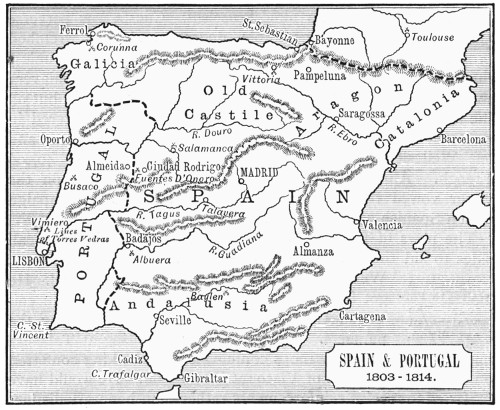
SPAIN & PORTUGAL
1803-1814.
The English cabinet had resolved not to abandon Spain and
Portugal; when Moore's regiments returned to England many
of them were sent back to Lisbon, and placed under Wellesley,
the victor of Vimiero, whose trial had ended in a triumphant
acquittal. In April, 1809, began that wonderful series of
campaigns which was to last till March, 1814, and to bear the
English standard in triumph from the Tagus to the Garonne.
Fettered by timid instructions from the home government, linked
to rash and jealous allies, and starting with no more than 20,000
British troops, Wellesley was bidden to hold his own in the
Peninsula, where more than 200,000 French troops were still
encamped. He showed the rarest combination of prudence
and daring, and brought his almost impossible task to a
successful end, in spite of the tiresome stupidity of his Spanish
confederates, and the inefficient support which the home
government gave him. At any moment, during the first three
years of his command, a single defeat would have caused the
cabinet to recall him and withdraw his army from the Peninsula,
but the defeat never came, and Wellesley at last won the confidence
he merited, and was given adequate means to carry out
his mighty schemes. The story of the war is the best proof
of his abilities. A calm, stern, silent man, with an aquiline nose,
clear grey eyes, and a slight, erect figure, he inspired implicit
confidence, if his taciturnity and hatred of display or emotion
prevented him from winning the love and enthusiasm of his
troops as many lesser generals have done. "The sight of his
long nose among us on a battle morning," wrote one of
his veterans, "was worth 10,000 men of reinforcements any
day."
Soult driven
from Portugal.—Battle
of
Talavera.
While Napoleon was engaged in his Austrian war of 1809,
Wellesley easily held his own in the Peninsula. He defeated
Marshal Soult at Oporto, and drove him out of
Portugal with the loss of all his artillery and
baggage. Then, turning southward, he marched
against Madrid in the company of the Spanish general Cuesta.
But he found his allies almost useless. Cuesta was perverse
and imbecile to an incredible degree, and his wretched
provincial levies fled at the mere sound of the cannon, unless
they were ensconced behind walls and trenches. At Talavera
the allied armies beat Marshal Victor and King Joseph, but all
the fighting fell on the English. Cuesta's troops, sheltered in
the town of Talavera, refused to come out of their defences and
left Wellesley's 20,000 men to repel the assaults of 40,000
French. After this experience of Spanish co-operation the
victor vowed that he would never again share a campaign
with a Spanish army (July 28, 1809).
Wellington
retires to Portugal.—The
Walcheren
expedition.
The news of Talavera brought the French armies from all
sides to aid the defeated marshal, and, beset by 100,000 men,
Wellesley was obliged to retreat on Portugal. He
got back in perfect safety, but his imbecile colleague
Cuesta was caught and crushed by the
pursuers. The result of the fighting at Talavera
had given the English troops confidence, and the king conferred
on the victor the title of Viscount Wellington. He would have
preferred to receive reinforcements rather than honorary distinctions,
but the cabinet had decreed otherwise. They had sent all
the available troops in England, some 40,000 men, on an ill-judged
expedition against Antwerp, which was too strongly fortified
and lay too far inland to be readily taken by an army of such a
size. The general placed in command was Lord Chatham, Pitt's
elder brother, a dilatory commander who moved slowly and
allowed himself to be detained in the siege of the minor fortresses
which guarded the way to Antwerp. The army landed on the
swampy isle of Walcheren and beleaguered Flushing for three
weeks, but in the trenches the troops were smitten with marsh
fever, and succumbed so rapidly that the expedition had to be
given up, when 11,000 men were simultaneously in hospital.
Flushing was destroyed, but the troops had to return to England,
and had exercised no influence whatever on the fate of the war
(July to August, 1809). If sent to Wellesley, they would have
enabled him to crush King Joseph and take Madrid.
Battle of
Wagram.—Marriage
of Napoleon.
Meanwhile the Austrian war had ended in the triumph of
Napoleon at the battle of Wagram (August, 1809), though the
gallant efforts of the Archduke Charles, and the
insurrection of the patriots of the Tyrol and
Northern Germany, had seemed at first to shake
his power. The Emperor of Austria was forced to cede all his
Illyrian coast-line, that Napoleon might make his blockade of
English goods the stricter, to surrender half his share of Poland,
and to give—the bitterest drop in his cup—the hand of his
daughter Maria Louisa to the conqueror. This unhallowed
union was only made possible by the divorce of Josephine
Beauharnais, the wife with whom Napoleon had lived for the
last fourteen years (October, 1809).
The "Lines of
Torres Vedras."—Masséna's
retreat.
Freed from the Austrian war, and with his "Grande Armée"
once more unoccupied, Napoleon resolved to make an end of
the Spanish insurrection. He gave 70,000 fresh
troops to Masséna, the ablest of his marshals,
and bade him drive Wellington into the sea and
conquer all Spain and Portugal. The English general had
foreseen some such assault from the moment that he heard the
news of the defeat of Austria. He spent the winter of 1809-1810
in constructing a triple series of fortifications across the peninsula
on which Lisbon stands, the famous "Lines of Torres Vedras."
When Masséna advanced against Portugal Wellington retired
slowly before him, wasting the country and compelling all
the people to take refuge in Lisbon. He turned at Busaco
(September 29, 1810) to inflict a sharp check on the heads
of Masséna's columns, but finally withdrew into his formidable
lines. The French were brought to a stand before the unexpected
obstacle, for they had no knowledge that Wellington
had so strengthened his place of refuge. The position, armed
with 600 pieces of artillery, and defended by 30,000 English, and
the whole of the militia of Portugal, seemed too strong to be
meddled with. Masséna lay in front of the lines for four
months, sending in vain for reinforcements to Spain. But his
colleague Soult, occupied in the conquest of Andalusia, and the
sieges of Cadiz and Badajos, would not come to his aid. Masséna's
army suffered bitter privations in the wasted and depopulated
country, and at last, in March, 1811, he was fain to draw back
and retreat from Portugal, after having lost more than 20,000
men by sword and famine. Wellington followed him, perpetually
harassing his retreat, and took post again on the borders of
Spain, from which he had been forced back six months before.
Battles of
Fuentes
d'Onoro and
Albuera.
The triumphant defence of the lines of Torres Vedras was the
turning point of the whole Peninsular War. The French were
never again able to invade Portugal, and Wellington,
strongly reinforced from England after his
success was known, was for the future able to
undertake bolder strokes and no longer forced to keep to the
defensive. The last offensive movements of the French were
stopped by two bloody actions fought in May, 1811, within a
few days of each other. In the north Masséna attacked
Wellington in order to try to save the beleaguered fortress of
Almeida; but he was repulsed at Fuentes d'Onoro (May 5),
and was shortly afterwards recalled in disgrace by his master.
In the south Marshal Soult marched to relieve Badajos, which
was being besieged by Lord Beresford, Wellington's second-in-command,
aided by the Spanish general Blake. Beresford
met the French at Albuera, and almost lost the battle, partly
by his own unskilful generalship, partly by the sudden flight of
his Spanish auxiliaries. But the day was saved by the celebrated
charge of the "Fusilier Brigade," in which the 7th and 23rd
Fusiliers, only 1500 strong, stormed a precipitous hill held by
7000 French, and forced Soult to retreat. This was the
bloodiest fight which an English army ever gained. Beresford
lost 4300 men out of 7500, yet his indomitable troops won the
day for him (May 16).
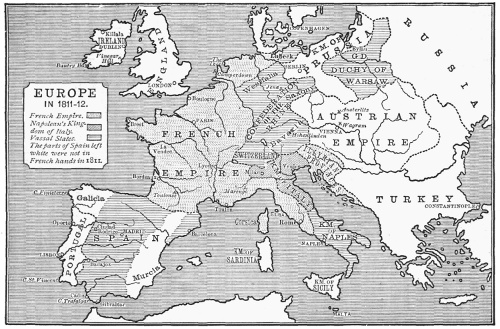
EUROPE IN 1811-12.
Further Annexations
by Napoleon.
The years 1810-1811 were the last years of Napoleon's ascendency
in Europe. They are marked by his final attempt to
make the Continental System effective, by the
annexation of almost the whole coast-line of Central
Europe. He had already taken Rome and Central
Italy from the Pope in 1809. Now he expelled his own brother
Lewis from Holland, and appropriated that country. He next
added to his dominions the whole north coast of Germany as far
as the Baltic, including the Hanseatic towns and the realms of
four or five of his vassals, the princes of the Confederation of
the Rhine. These wild and arbitrary seizures, which made the
coast of France extend from Rome to Lubeck, were to Napoleon
mere episodes in the struggle with England. The Dutch and
Germans would not enforce the blockade against English goods
as stringently as he wished, and so he annexed them to make
their secret trade with England impossible. The Continental
System was now in full swing; it was working in all Napoleon's
own dominions, in France, Italy, and Illyria, in the lands of all
his vassals—the German states, Poland, Denmark, Naples,
Prussia—in Sweden, where one of his marshals, Bernadotte, had
lately been made heir to the throne, and even in the territories
of his reluctant allies the emperors of Austria and Russia. Yet,
in spite of Napoleon's many assertions to the contrary, England
was neither ruined nor likely to sue for peace.
Perceval and
Lord Liverpool.—War
policy of
the Tories.
There had of late been many changes in the persons who
ruled England, but the policy of Pitt was still maintained by
his successors. The old king, George III., had
gone mad in 1810, and the nominal control of the
country was now in the hands of his worthless,
vicious son George, Prince of Wales, the old ally of the Whigs.
But the regency was given him guarded with so many checks
and limitations, that he was completely in the hands of the
ministry, and could not do much harm. First Perceval, and after
he had been shot by a lunatic in 1812, Robert Jenkinson, Earl
of Liverpool, swayed the policy of England as prime minister.
Both were men of moderate abilities and narrow minds, but they
had the saving virtue of obstinacy, and stuck to the old policy
of war with France through thick and thin. Their task was no
easy one: debt was accumulating in appalling loads from the
expenses of the war; the taxes were increased year by year;
trade was much hampered by the Continental System; a series
of bad harvests raised the cost of corn to famine-price, and led
to endless discontent and rioting both in town and country; our
allies were beaten one by one on the continent. There was
no compensating gain save Wellington's successes in Spain,
and the fact that we had now full control of the seas and had
absorbed the colonial trade of the whole world. Yet the Tories
hardened their hearts, and hammered away at "the Corsican
Ogre" with untiring zeal. Nor can it be doubted for a moment
that they were right; Napoleon had to be put down, or England
must perish. All honour therefore to the men, narrow-minded
and prejudiced though they were, who carried out the struggle
to the bitter end.
Russia and the
Continental
System.
They were at last about to be rewarded for their perseverance.
Towards the end of 1811 Napoleon became involved in a third
struggle with Russia, more deadly than those of
1805 and 1806-7. The cause of the quarrel was
the inevitable Continental System. Hitherto England
had been the largest buyer of Russian goods, and Russia had
been wont to get her luxuries and colonial wares from England.
The enforced prohibition of trade with her best customer did
Russia untold harm, and the Czar Alexander found that every
class of his subjects was groaning under the yoke of the Berlin
Decrees. Discontent was rife, and Alexander knew well
enough that Russia is "a despotism tempered by assassination,"
and remembered the fate of his own father. He saw at last
that his empire was losing more from alliance with Napoleon
than she could lose by open war against him. Finally the Russian
government began to provoke the Emperor by an almost overt
neglect of his wishes, and practically abandoned the Continental
System.
Napoleon's
Russian campaign.
Napoleon was at the height of his arrogance and autocratic
insolence. Instead of making an end to the war in Spain—"the
running sore" as he called it, from the drain
which it caused on his resources—he resolved to
impose his will on Russia by force, and declared
war upon the Czar. A vast army of 600,000 men was concentrated
in eastern Germany, and crossed the Niemen in June,
1812. But the Russians had taken example by the policy by which
Wellington had foiled Masséna in 1810: instead of fighting on
their frontier, they withdrew into the heart of their vast plains,
wasting the country behind them, and leaving no food for the
invader. The French army had lost half its horses and a
third of its men, before it approached Moscow or fought a
serious engagement. The Russians turned to bay at Borodino,
in front of their ancient capital; but Napoleon stormed their
entrenchments at the cost of 25,000 men, and entered Moscow.
But he found it deserted by its inhabitants, and a few days after
his arrival the whole city was burnt, whether by the deliberate
resolve of the Russians, or by the carelessness of the French
soldiery. Winter was now at hand, and for want of food and
shelter the Emperor resolved to retire on Poland. But the season
was too late, and he was surprised on his way by the snow.
His harassed and half-starved soldiers died by thousands on
the roadside: the Russians cut off every straggler, and less
than a tenth of the magnificent army that had crossed the
Niemen struggled back to Germany (Nov. 1812-Jan. 1813).
Storming of
Ciudad Rodrigo
and Badajos.
The fortune of war had at last turned, and Napoleon's first
disaster was soon to be followed by his fall. Prussia and all
his other unwilling subjects in northern Germany
took arms when the fate of the "Grande
Armée" became known, and to meet them the
Emperor had to call up his last reserves of men, and especially
to draw on the large force in the Spanish peninsula. But he
found that little help could come from Spain, for 1812 had been
as fatal to his marshals in the south as to himself in the far
north. Early in the year Wellington had swooped down on
Ciudad Rodrigo and Badajos, the two fortresses in French hands
which covered the Spanish frontier. He stormed each of them
after a siege of a few days, making the desperate courage of his
soldiery serve instead of a long bombardment, and paying for
his rapid success by a heavy loss of men. Badajos was actually
escaladed with ladders, the breaches having proved inaccessible.
The French marshals came hurrying up to save their strongholds,
but found them already fallen into English hands.
Battle of
Salamanca.
There followed the decisive battle of Salamanca, in which
Wellington defeated Marshal Marmont, and crushed the main
army of the enemy. This fight was a splendid
exhibition of his skill: his able adversary had for
a moment put his left wing in a hazardous position. Before
half an hour had elapsed, Wellington had pounced upon the
isolated divisions, routed them, and attacked and scattered the
main body. Thus, as was happily said, he "beat forty thousand
men in forty minutes." In consequence of this victory Wellington
was able to retake Madrid, after it had been four years in hostile
hands. To check his further success the French marshals had
to evacuate all southern and central Spain, and mass their forces
against the victor. When they beset him with 100,000 men he
was forced to retreat towards the Portuguese frontier for a
space. But the net result of the campaign had been to deliver
Andalusia and most of Castile from the enemy, and more was
to follow. Napoleon had to withdraw so many of his veterans
from Spain, to replace his losses in the Russian war, that in the
next spring Wellington was no longer in his wonted inferiority
of numbers. He used his opportunity with his usual skill and
promptness.
Battle of Vittoria.—Last
efforts of the
French in
Spain.
Attacking the French before they had concentrated from their
scattered winter-quarters, he chased them before him in disorder
all across northern Spain. It was only at Vittoria,
close under the Pyrenees, that they could collect
in numbers strong enough to face him. But
there he fell upon them, routed Marshal Jourdan,
cut off his retreat on France, and drove him into the mountains
with the loss of every single cannon and waggon that the
French army possessed (June 21, 1813). The autumn of the
year was occupied in subduing St. Sebastian and Pampeluna,
the two fortresses that guarded the French frontier, and in
repulsing, at the "Battles of the Pyrenees," two gallant attempts
made by Marshal Soult to relieve the beleaguered fortresses.
At last they fell, and Wellington prepared to invade France
in the next spring.
Fall of
Napoleon.—Restoration
of Louis XVIII.
Meanwhile, Napoleon, with a horde of conscripts and the few
veteran troops that he could collect, had been fighting hard in
Germany. Against the Russians and Prussians he
held his ground for some time, but when his own
father-in-law, Francis of Austria, joined the enemy,
he was overwhelmed by numbers. The three-days' strife at
Leipzig, which the Germans call the "battle of nations," sealed
his fate. It was only with the wrecks of an army that he
escaped across the Rhine in the autumn of 1813. The allies
followed him without giving him a moment's respite, a wise
strategy that they had learnt from his own earlier doings. The
Emperor made a desperate fight in France, but the odds were
too many against him. After some ephemeral successes he was
defeated at Laon by one body of the allies, and their main army
slipped past him and took Paris (April 4, 1814). On the news of
the fall of the capital the French marshals compelled Napoleon
to abdicate, and laid down their arms. The humbled despot
vainly attempted to commit suicide, fearing death at the victors'
hands. But they spared his life, gave him the little Tuscan
island of Elba as an appanage, and bade the man who had been
the ruler of all Europe to spend the rest of his life in governing
a rock and 10,000 Italian peasants. The crown of France was
given—with questionable wisdom—to the representative of the
Bourbons, the eldest surviving grandson of Lewis XV. This
shrewd and selfish old invalid, who was known as the Count of
Provence, now took the title of Lewis XVIII. and mounted
his martyred brother's long-lost throne.
Wellington in
France.—Battle
of Toulouse.
While the Austrians, Russians, and Prussians had been
conquering Napoleon and capturing Paris, Wellington had not
been idle. He had invaded France from the south,
taken the great city of Bordeaux, and beaten
Marshal Soult at the battle of Toulouse, when the
news of Napoleon's abdication brought his brilliant campaign to
a conclusion (April 14, 1814).
The American
War.—Naval
successes of the
United States.
All Europe now began to disarm, dreaming that the deadly
struggles of the last twenty-two years were over at last. Diplomatists
from all nations were summoned to meet
at Vienna, to rearrange the map of Europe and
parcel out Napoleon's ill-gotten spoils. England
alone was unable to disband her armies, for she had still got a war
on hand. In 1812 Napoleon had succeeded in stirring up against
us the United States of America. Their grievance was the
Orders in Council, by which we had prohibited neutral ships
from trading with France, in retaliation for the Emperor's
Berlin Decrees against our own commerce. After five years
of bickering and recrimination the Americans declared war on
us—though they might with equally good logic have attacked
Napoleon, whose conduct to them had been even more harsh
and provoking than that of the Perceval cabinet. With all her
attention concentrated on the Peninsula in 1812-13, England
had little attention to spare for this minor war, and Canada
was left much undermanned. But the small garrison and the
Canadian militia fought splendidly, and three separate attempts
to overrun the colony were beaten back, and two American
armies forced to capitulate. But while so successful on land,
the English were much vexed and surprised to suffer several
small defeats at sea in duels between single vessels. The few
frigates which the United States owned were very fine vessels,
heavily armed and well manned; on three successive occasions
an American frigate captured an English one of slightly inferior
force in single combat, a feat which no French ship had ever
been able to accomplish in the whole war.
[55] In course of time
the American vessels were hunted down and destroyed by our
squadrons, but it was a great blow to English naval pride that
the enemy had to be crushed by superiority of numbers instead
of being beaten in equal fight. But the fact was that individually
the American ships were larger and carried heavier guns than
our own, so that the first defeats were no matter of shame to
our navy.
Battles of
Bladensburg
and New Orleans.—End
of the war.
When Napoleon had been crushed, England was able to turn
serious attention to America, and to send many of the old
Peninsular veterans over the Atlantic. But their
arrival did not crush the enemy so easily as had
been expected. One expedition under General
Ross, landing in Maryland, beat the Americans at
Bladensburg, and burnt Washington, the capital of the United
States (1814). But two others failed: the imbecile Sir
George Prevost invaded the State of New York, but turned
back without having done any serious fighting. On the other
hand, the overbold Sir Edward Pakenham, one of the bravest of
Wellington's officers, was slain at New Orleans with 2000 of
his followers because he endeavoured to storm from the front
impregnable earthworks held by a steady foe (January 8, 1815).
The war, however, had ceased just before Pakenham fell.
Napoleon having abdicated, and the English having withdrawn
the Orders in Council, the causes of our strife with America had
been removed, and the two powers had signed the peace of
Ghent on December 24, 1814. This agreement restored the
old condition of affairs, each party surrendering its conquests, and
agreeing to let bygones be bygones. But the struggle had bred
much ill blood, not to be forgotten for many a year.
Napoleon
escapes from
Elba.
By the new year of 1815, when the treaty of Ghent had been
signed, England was at peace with all men, and the Liverpool
ministry began to take in hand the reduction of
our army and navy, the restoration of finance, and
the protection of English interests in the resettlement
of Europe at the congress at Vienna, which had met in the
previous autumn. All the diplomatists of the great powers were
hard at work settling the new boundaries of their states, when
suddenly the alarming news was heard that Napoleon had escaped
from Elba and landed in France. The rule of the selfish old
Lewis XVIII. and the elderly companions who had returned
with him from a twenty years' exile, had irritated and disgusted
the French, and most of all the army. When, therefore, Napoleon
landed in Provence with seven hundred men, and called on his
countrymen to rise in behalf of liberty and expel the imbecile
Bourbons, his appeal met with a success such as he himself had
hardly hoped for. Not a shot was fired against him; regiment after
regiment went over to his side, and Lewis XVIII. had at last to fly
from Paris and take refuge in Flanders (March, 1815). Napoleon
proclaimed himself Emperor once more, but promised the French
a liberal constitution in place of his old autocratic rule. He
also made overtures to the allied powers, saying that he was
tired of war, and would accept any honourable terms. But they
knew his lying tongue of old, and wisely refused to listen to his
smooth speeches. One after another, all the monarchs of Europe
declared war on him.
Napoleon
enters Belgium.—Battles
of Ligny and
Quatre Bras.
Napoleon's second tenure of power was only to last from
March 13 till June 22, 1815, the "Hundred Days," as they are
generally called. Forced to fight, he displayed
his old energy, and resolved to strike at the allies
before they could concentrate their scattered
forces from the remotest ends of Europe. He
called his old veterans to arms, and hastily organized an army
of 130,000 men for an immediate attack on the nearest foe. By
waiting longer he could have collected an army thrice as great,
but, on the other hand, his enemies would have been able to
mass their whole force against him. The only troops ready to
oppose him by June, 1815, were two armies in Belgium, one of
Prussians under the old Marshal Blücher, which lay about
Namur, Liège, and Charleroi, the other a combined force of
British, Germans, and Dutch under Wellington, now a duke,
stationed round Brussels and Ghent. The Prussians were
120,000 strong, and Wellington had 30,000 English and 65,000
Hanoverians, Germans, and Dutch. Napoleon was therefore
bound to be outnumbered, but he thought that he could crush one
army before the other came to its aid, if he could only strike
hard and fast enough. His advance into Belgium was rapid
and skilful. He made for the point where the English left
touched the Prussian right, near Charleroi, and thrust himself
between them. On June 16 he engaged and beat Blücher's
Prussians at Ligny, while his lieutenant, Marshal Ney, held
back at Quatre Bras the front divisions of Wellington's army as
they came marching up to try to join the Prussians.
The Prussians were severely beaten, but the indomitable old
Blücher gathered together his defeated forces, and marched
north to rejoin the English, while Napoleon vainly dreamed
that he was flying eastward towards Germany. Thus it came
to pass that the Emperor sent Marshal Grouchy and 33,000 men
to pursue the Prussians on the wrong road, a mistake which
allowed Blücher to execute an undisturbed retreat on Wavre,
where he was again in touch with the duke.
Meanwhile, Napoleon, on the 17th, marched to join his
lieutenant Ney, who had been forced back from Quatre Bras by
the English, and needed his aid. The Emperor, believing that
the Prussians were disposed of, thought he could now deal a
crushing blow at Wellington's motley army, and was overjoyed
when he found the duke offering him battle on the hillside of
Mont St. Jean, twelve miles north of Quatre Bras, in a good
position which covered the road to Brussels. On this hillside
was fought next day (June 18, 1815) the decisive battle which
the English call Waterloo, from the name of the village where
Wellington wrote his despatch that same night.
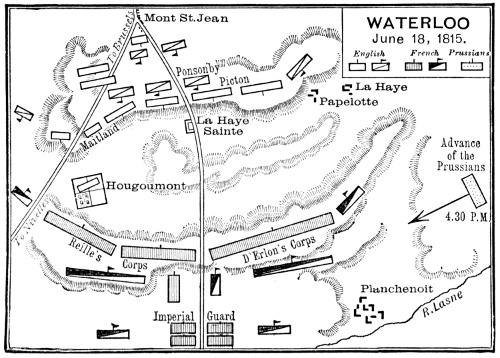
WATERLOO June 18, 1815.
The Battle of
Waterloo.
The armies were not very different in numbers. Napoleon's
72,000 French were opposed to 67,000 troops in the allied army.
But Wellington could only count on his 23,000
English and 22,000 Hanoverians and Brunswickers,
for good and zealous service. He was hindered rather
than helped by the presence of 20,000 raw Dutch and Belgian
conscripts, who had no heart in the war, and would as soon have
fought for Napoleon. His army was stretched along the gentle
slope which is crossed by the Brussels road, with the infantry in
the front line, and the cavalry partly in reserve, partly on the
wings. In front of his position were the two farms of Hougoumont
and La Haye Sainte, the former held by the English
guards, the latter by a picked battalion of Hanoverians.
Napoleon ranged his men on the opposite ridge, and launched
them against the English in successive attacks. His first attempt
to storm the farm of Hougoumont was manfully beaten back.
He then sent four heavy columns against the English left, but
they were utterly routed by the charge of Picton's infantry and
Ponsonby's famous "Union Brigade" of dragoons, the Royals,
Scots Greys and Inniskillens. His third effort was to break
the English centre by the furious charges of 15,000 gallant
horsemen, supported by a tremendous fire of artillery. But the
English squares held fast, though assailed for five hours by
constant onsets of cavalry and pounded in the intervals by an
overwhelming force of cannon. Most of the Dutch and Belgians
and some of the Germans retired from the field, and many fled
to Brussels: but the indomitable squares held their own, even
after the farm of La Haye Sainte had been stormed, and a gap
opened in the English centre. In the thick of the fighting,
Napoleon was surprised to see new troops coming up on his
right: these were Blücher's Prussians, marching from Wavre to
aid the English, according to a promise which the old marshal
had made to the Duke on the previous day. To hold them back,
Napoleon had to detach nearly all his reserves; but for a final
stroke against Wellington he sent out 5000 men of the "Old
Guard" to break through the long-tried English line. But this
last effort was foiled by the steady fire of Maitland's English
guards, and when the attacking columns were seen recoiling
down the hillside and Wellington's last cavalry reserves came
charging after them, the whole French army broke and fled.
Napoleon confined
at St.
Helena.
Never was a more complete rout seen. The defeated army
disbanded itself: Napoleon could not rally a man, and fled to
Paris, where he abdicated for a second time.
Wellington and Blücher rapidly followed him and
entered Paris (July 6). The ex-Emperor, fearing
death at the hands of the infuriated Prussians, fled across
France to Rochefort, and surrendered himself to the English
man-of-war which blockaded that port. After much discussion
the ministers resolved to send him as a prisoner to the desolate
island of St. Helena, where he lived for six years, spending his
time in dictating mendacious accounts of his life and campaigns,
and in petty quarrels with the governor of the island.
Supremacy of
the English
mercantile
marine.
Napoleon was now really disposed of, and the pacification
of Europe was complete. The congress of Vienna had completed
its work, and all the territorial changes
which it dictated were carried out at leisure.
England's share of the plunder in Europe was
the islands of Malta and Heligoland and the Ionian Isles;
beyond seas she got the French isle of Mauritius in the Indian
Ocean and the valuable Dutch colony of the Cape of Good
Hope. But her real gain was the fact that she had absorbed,
during the course of the war, nearly the whole of the carrying
trade of the world. Twenty years of her ascendency at sea had
destroyed the mercantile marines of France, Holland, Spain,
and Italy, and it was many years before those countries could
recover from their losses. The naval and commercial supremacy
which we enjoy to-day is the direct result of the great wars
of 1793-1815.
The resettlement
of Europe.
This being so, the changes on the continent were of comparatively
little moment to us. France was confined within her
old boundaries of 1789. Russia took the greater part of Poland,
Austria was given Lombardy and Venetia, Prussia annexed
half Saxony and most of the small states along
the Rhine. Belgium and Holland were joined in
an unnatural union as the "Kingdom of the Netherlands," while
the old despots of Central and Southern Italy returned to their
long-lost thrones. These boundaries were to last, with little
alteration, for half a century.


