We have now arrived at the sixteenth century. The middle ages,
that is, the period of transition between ancient and modern civilization,
has now come to an end. Events of the highest importance, such as the
invention of printing (1436), the taking of Constantinople by the Turks
(1453), with the consequent emigration of many Greek men of letters
and science, who took up their residence in the West and especially
in Italy, and lastly, the discovery of America (1492), marked the beginning
of a new era, and are the most essential factors in bringing about
the revival of art and science.
In the midst of the vigorous intellectual life which characterized the
sixteenth century, dentistry, too, like many other branches of science,
made very notable progress; we, therefore, in this period shall have to
record many important facts and many important names.
It is, indeed, in the sixteenth century, and, to be more precise, about the
year 1544, that we meet for the first time with a monograph, in which
dental affections are spoken of independently of general medicine and
surgery. The book we allude to, by Walter Hermann Ryff, is also
noteworthy because it is not written like the preceding works, in Latin,
the customary language of the learned, but, instead, in German, that is,
in a living tongue.
As we are now mentioning the first German author on Dentistry, it
may be permitted us briefly to glance at the beginning of medicine and
dental art among the German peoples.
Among the Germans, as in other nations, the first to practise the healing
art were priests, priestesses, and wise women. To cure disease they
used partly empirical remedies, and partly witchcraft and superstitious
means of every kind. Thus, to facilitate dentition, it was thought an
excellent thing to pass a thread through the eyes of a mouse and then to
tie the blood-covered thread around the neck of the child. It was held,
besides—and this prejudice has left even until now some traces—that the
putting of the milk teeth, when they fall out, into the nest of a mouse
assures the cutting of new teeth.
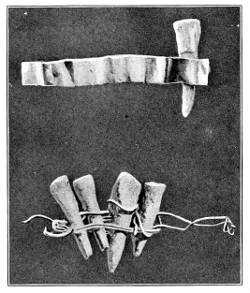
We must here mention, with regard to the origin of dentistry among
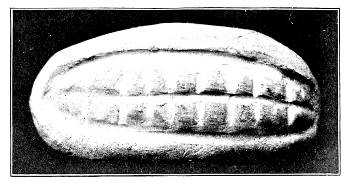
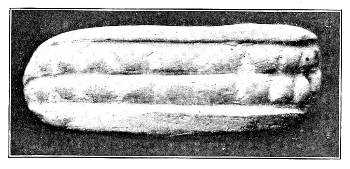
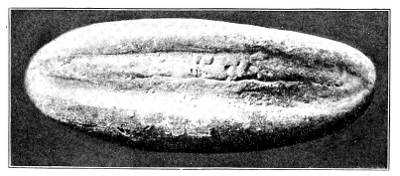
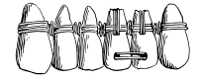
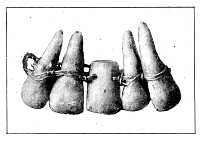
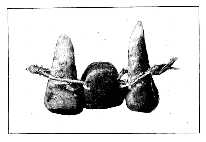
the Germans, a very important fact related by Joseph Linderer,271 a fact
which shows that even among the ancient Germans recourse was had to
the application of artificial teeth.
We here reproduce the very words of the said author, translated
literally:
“Being by chance a few years ago at Dresden and visiting the Museum
of Antiquities, my attention was attracted, in the last room, to two osseous
pieces, which with other objects were enclosed in a glass case, with the
written inscriptions: Comb-shaped osseous pieces, found in ancient
German urns. As soon as I had observed them, I saw at once that
they were artificial teeth; but as I had to be contented with examining
them through the glass of the case, it was not possible for me to decide
whether these pieces were really of bone, as they seemed to be, or of another
substance. Taking into account their antiquity, their whiteness is very
notable. Every piece is composed, if I remember rightly, of five teeth,
that is, of a canine and four incisors; the chief difference of these pieces
from the prosthetic pieces in ivory still in use (the author is writing in
1848) consists in this, that the pieces of which I speak have not at all a
broad base, designed to rest on the gums, the base having instead the
same thickness as the rest. The five teeth are well separated from one
another. Besides, the canine makes the proper angle with the incisors,
and at each side of the piece is found, in a convenient place, a hole, which
shows that these teeth were fastened to those of the subject by means of
a metallic or other kind of thread. As the above-described pieces are
white, we must infer that they were removed from the mouth of the
respective individuals before the body was burnt, and afterward put into
the urn with the ashes, just as they used to put in coins, bits of arrows,
and the like.”
For many centuries dental surgery—which, however, was still in a very
primitive state—was practised in Germany, as in many other countries,
principally by barbers. These in certain places, and at certain periods,
formed corporate bodies, whose members were legally authorized to
extract teeth and to practise minor surgery in general. But besides barbers,
there were various kinds of individuals, unfurnished with any authorization—tooth-drawers,
charlatans, wandering story-tellers, necromancers,
Jews, and even hangmen—who invaded the field of medical practice,
in spite of its being forbidden them, except in fairs, to administer medicaments
and to perform surgical operations.272
In 1460 there appeared in Germany a book on Surgery by Heinrich
von Pfolsprundt, Knight of the Teutonic Order.273 The author had
acquired great experience as surgeon in the military expeditions of his
order, and we see from his book that he was very skilled in the cure
of wounds and fractures. On the other hand, he shows himself hostile
to every bloody operation with the exception of rhinoplast. Pains of
the teeth and gums were cured by him by means of beverages.274
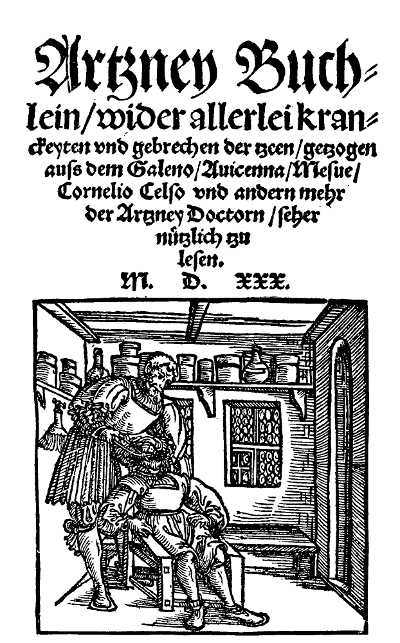
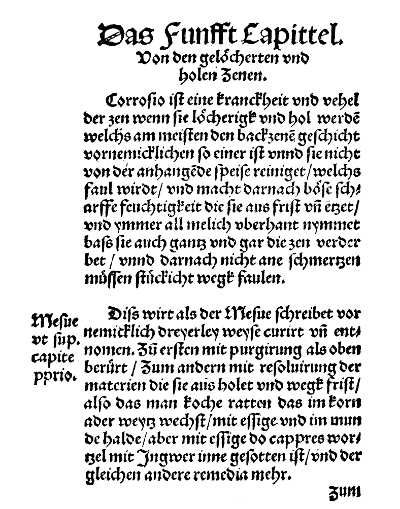
Title page of Zahnarzneybuchlein.
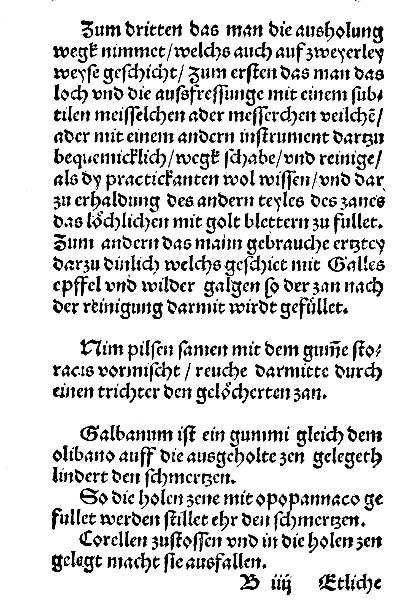
[The accompanying reproduction of the title page and two text pages from an edition
of Zahnarzneybuchlein, printed by Michael Blum, in Leipzig, 1530, and translated below,
is of interest in connection with the history of the use of gold-foil as a filling material,
in that a marginal note refers to Mesue as the author from whom the three methods of
treating caries has been derived, one of these methods being the filling of the carious
cavity with gold-foil.
Mesue was Surgeon to the Caliph Haroun al Raschid, who flourished 786-809. If the
reference to Mesue is correct, it would, therefore, indicate that the filling of teeth with
gold was known to the Arabs as early as the latter part of the eighth century. Examination
of the writings of Mesue has thus far failed to bring to light any record therein of
the treatment of caries by gold filling, although in his work previously referred to (see
page 138) the other methods quoted by the anonymous author of Zahnarzneybuchlein
are fully set forth.
[Translation.]
FIFTH CHAPTER.
ON CARIOUS AND HOLLOW TEETH.
Corrosion is a disease and defect of the teeth when they become carious and hollow,
which most often happens in the molars, especially if one does not clean them of the
165adhering food which becomes moist and consequently produces bad, sharp [acid] moisture
that eats and corrodes them, always gradually increasing, until it spoils the teeth entirely,
which afterward must fall away in pieces not without pains.
“Mesue ut supra capite proprio.” This, as Mesue writes, is chiefly cured and removed in
three ways. First, by purging as treated upon above. Second, by dissolving the material
which renders them hollow and eats them away; also by boiling cockles that grow in
barley or wheat, in vinegar and holding this in the mouth. In this vinegar the root of
caper and ginger and other similar remedies must have been previously boiled. Third, by
removing the decay, which is done in two ways. First, by scraping and cleaning the hole
and the carious part with a fine chisel, knife, or file, or other suitable instrument, as is
well known to practitioners, and then by filling the cavity with gold leaves for the preservation
of the other portion of the tooth. Second, by using suitable medicine, such as
oak apples or wild galls, with which the tooth is filled after having been cleaned.
The following editions of Zahnarzneybuchlein, besides the Basle and Mayence editions
noted by Dr. Guerini at page 166, were issued and copies thereof are preserved in the
libraries of the several collectors as stated. Edition of 1530, printed by Michael Blum,
Leipzig, in collection of Edward C. Kirk. Edition of 1536, printed by Chr. Egenolff,
Frankfurt a/M, in collection of William H. Trueman. Edition of 1541, printed by Chr.
Egenolff, Frankfurt a/M, in Dental Cosmos library and collection of E. Sauvez. Edition
of 1576, printed by Chr. Egenolffserben, in collection of H. E. Friesell.—E. C. K.]
The book, therefore, lacks importance from a dental point of view,
except in the sense that it shows how little skilled in the cure of dental
affections were the German surgeons of those days.
It is worthy of note that this author, also, speaks of anesthetic inhalations;
he, however, only translates, almost to a word, what Guy de
Chauliac says on this subject.
Toward the end of the fifteenth century and in the first half of the
sixteenth there were published in German, by anonymous authors, some
short translations and compilations on dental subjects, taken especially
from Greek and Arabian authors.275 Of these writings, the first one known,
taken from Galen and Abulcasis, was printed at Basle in 1490; and
another—one of the best—saw the light at Mayence in 1532. These
works were perhaps due to intelligent barbers, or perhaps—and this
seems to be the most probable—they were written, through the initiative
of enterprising printers, by doctors and surgeons, who wished to remain
unknown, on account of the special subject treated; for, owing to the fact
that the diseases of the dental system were generally left in the hands of
barbers and other unprofessional persons, the doctors and surgeons of
those days would have been ashamed to interest themselves in such
things.
Walter Hermann Ryff, of Strasburg, was born in the beginning of
the sixteenth century, and died about 1570. He was a rather mediocre
doctor and surgeon, and a man of the worst morals, so much so that
many cities expelled him from their midst.276 He wrote many medical
works, in which, however, there is very little original matter. Their
principal merit consists, perhaps, in the fact that they were written not
in Latin, as then was universally customary, but rather in the vernacular
of the author and in a popular style; so that Ryff may be looked upon as
the first who endeavored to diffuse among the people useful medical and
hygienic knowledge.
Among Ryff’s books there are two which are very important to us.
One is his Major Surgery, and the other is a pamphlet entitled Useful
Instruction on the Way to Keep Healthy, to Strengthen and Reinvigorate
the Eyes and the Sight. With Further Instruction on the Way of Keeping
the Mouth Fresh, the Teeth Clean, and the Gums Firm.277
Of these books, there now only exist some extremely rare copies; so
much so that neither Albert von Haller nor Kurt and Wilhelm Sprengel,
who rendered such great services to the history of surgery, ever had the
pleasure of examining them. Dr. Geist-Jacobi has been more fortunate
than they, and has therefore been able to give us some very interesting
information about their contents.
The Major Surgery is a mere compilation which does not contain
anything new of importance. It was published in part in 1545, and
in part in 1572, after the death of the author. The work is illustrated
with very beautiful wood engravings; and it is just this which gives the
principal value to this book. Some of the illustrations contained in the
first part of it—that is, in that published in 1545—represent dental instruments,
notwithstanding dental surgery is not treated in this part of
the book. The author gives notice that he will treat all that concerns
dental affections in the latter part of this book, in a special chapter.
Unfortunately, this chapter was never written, because death prevented
Ryff from completing the second part of his work.
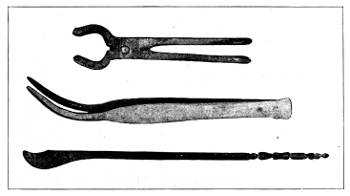
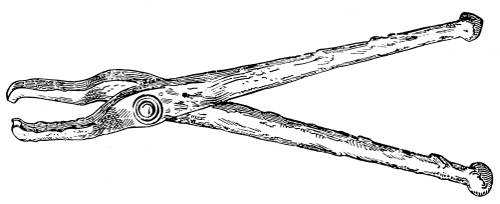
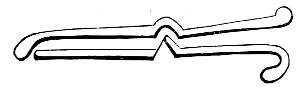
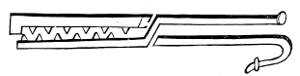
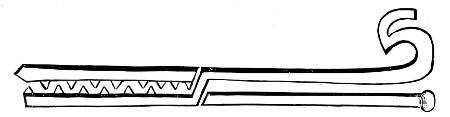
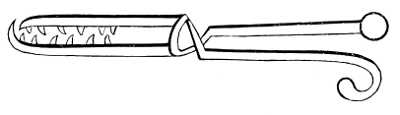
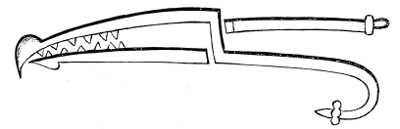
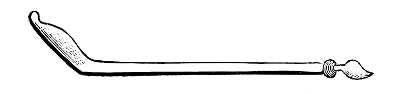
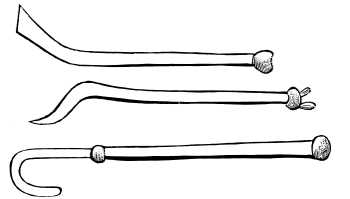
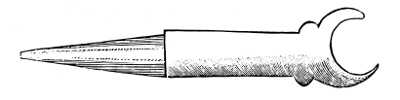
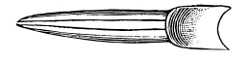
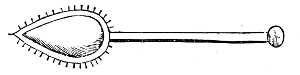
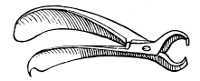
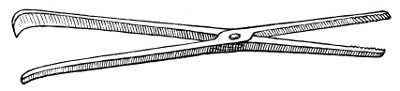
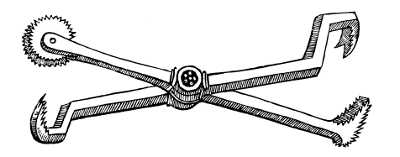
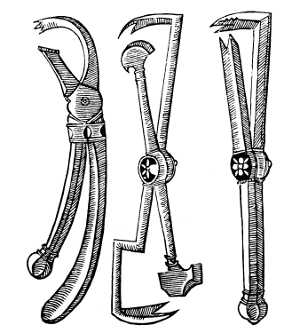
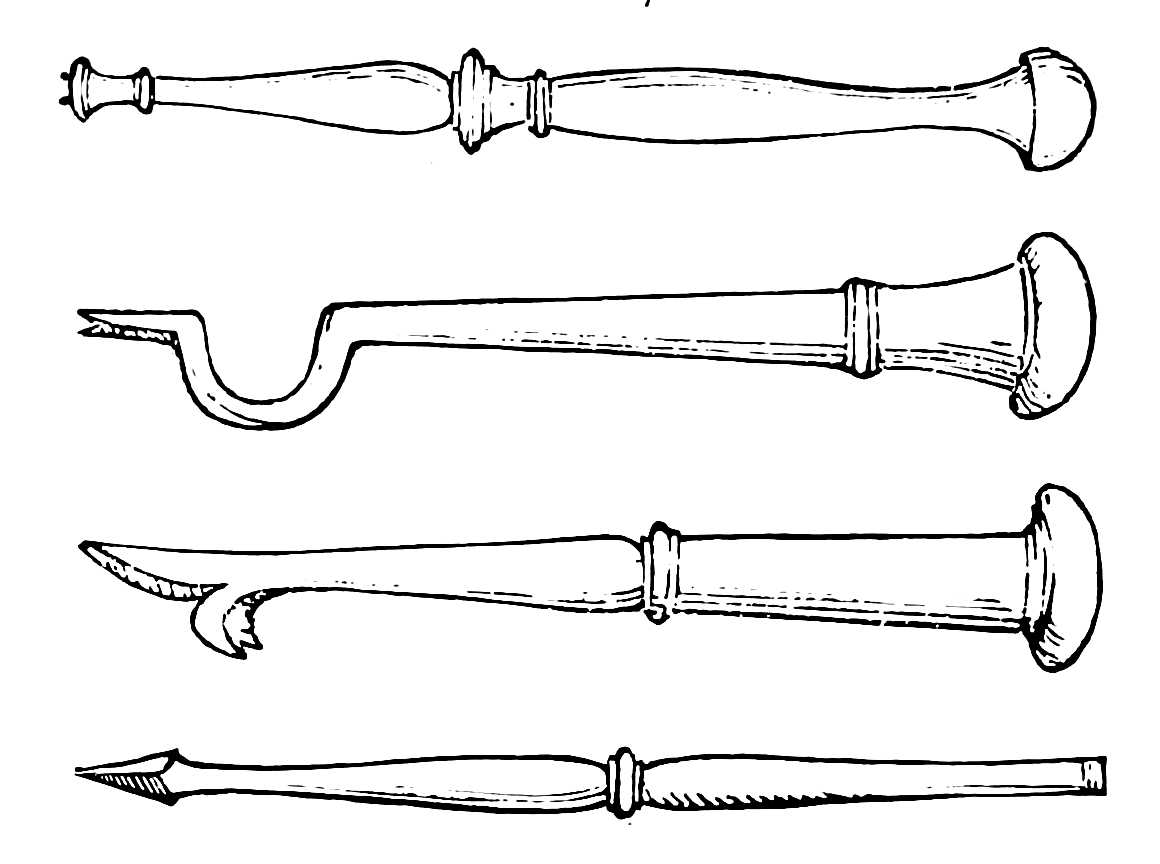
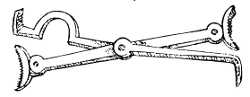
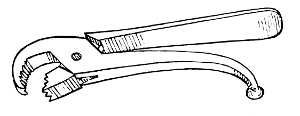
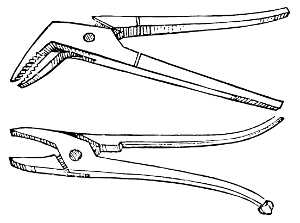
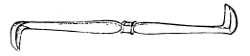
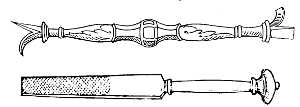
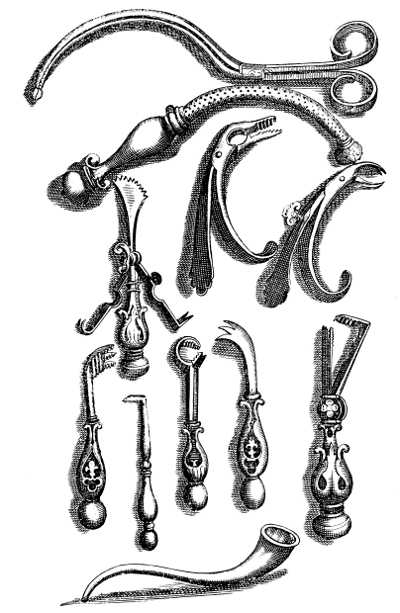
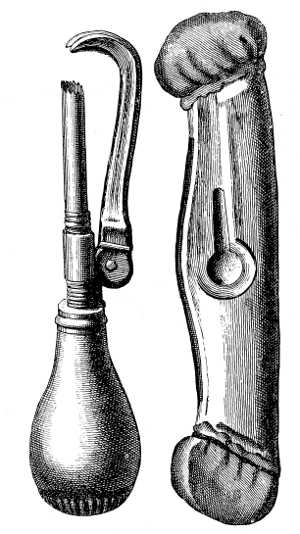
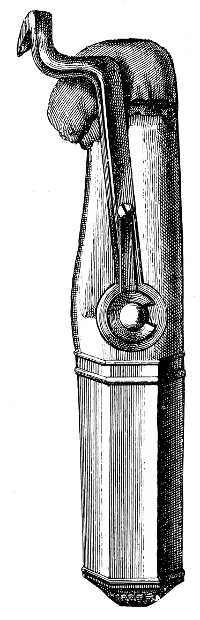
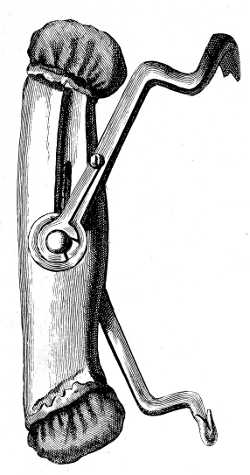
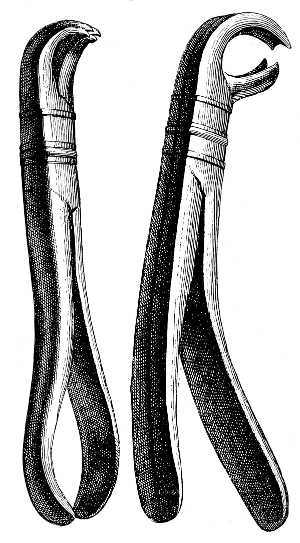
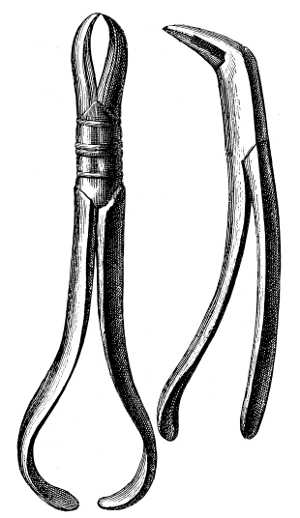
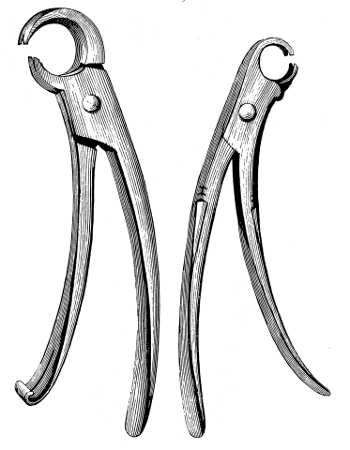
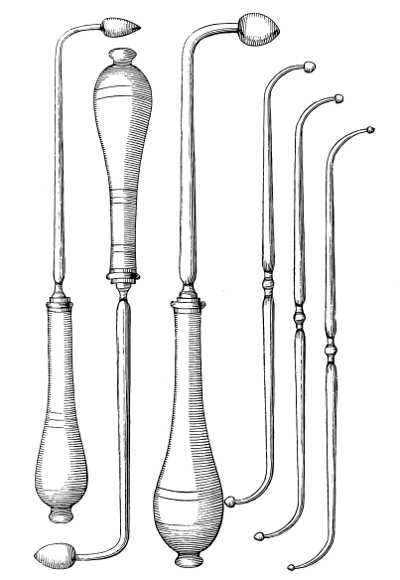
Fig. 59
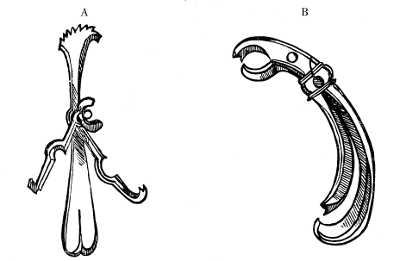
Pelican and dental forceps (Walter Hermann Ryff).
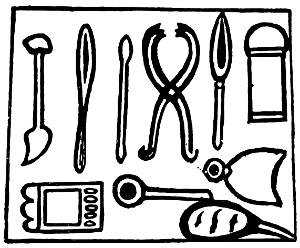
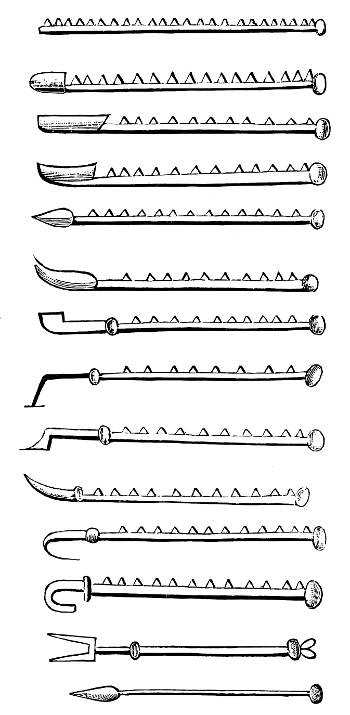
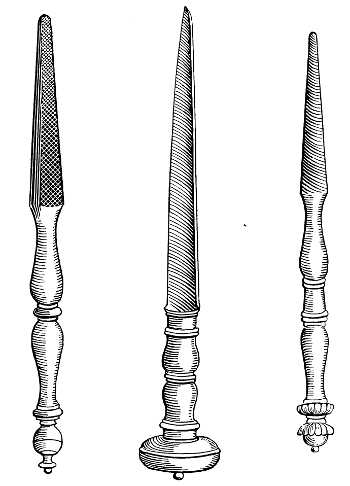
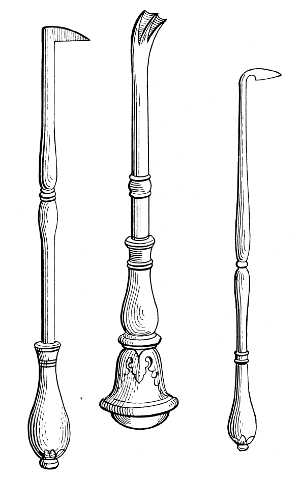
The dental instruments represented in his Major Surgery are many in
number. Among them, first of all, are found the fourteen dental scrapers
of Abulcasis, then the “duck-bill”—designed for the extraction of dental
roots and broken teeth—various kinds of pelican (Fig. 59 A), the “common
dental forceps” (Fig. 59 B), the “goat’s foot,” and many other kinds of
elevators, among which, observes Geist-Jacobi, may be seen instruments
even now in use, and even some which are said to have been recently
invented.
Ryff’s other book is especially noteworthy because, as we have already
mentioned, it treats, for the first time, of dental matters, independently
of general medicine and surgery. This pamphlet, printed at Würzburg
about the year 1544, is made up of sixty-one pages, and is divided
into three parts, the first of which is dedicated to the eyes, the second to
the teeth, and the third to the first dentition. It is written in popular
style, and the author certainly intended it for the instruction of the
public, and not for professional men; so true is this, that in it he does not
speak of the technical part of the extraction of teeth, or of gold filling—a
method already known for a long time—or of dental prosthesis.
The first part, relative to diseases of the eyes and the manner of curing
them, has no importance for us. The second part begins with the
following paragraph:
“The eyes and the teeth have an extraordinary affinity or reciprocal
relation to one another, by which they very easily communicate to each
other their defects and diseases, so that the one cannot be perfectly healthy
without the other being so too.”278
This last statement is absolutely false, as a disease of the eyes may
very well exist with a perfect condition of the teeth, and vice versa.
However, Ryff has the merit of being, perhaps, the first who has noted
the undeniable relation which exists between the dental and ocular affections.
After a rapid glance at the anatomy and physiology of the teeth, the
author enumerates the causes of dental disease, which, according to him,
are principally heat, cold, the gathering of humors, and traumatic actions.
The prophylaxis of dental diseases is beyond any doubt one of the
best parts of the book; however, the ten rules counselled by Ryff for
keeping the teeth healthy—rules which Dr. Geist-Jacobi has made
known to us in full—are reproduced, almost to a word, from Giovanni
d’Arcoli’s work; therefore, the author has no other merit than that of
having translated them into the vulgar tongue, thus diffusing the knowledge
of useful precepts for preventing dental diseases. We refrain from
reproducing the aforesaid rules here, as they are, with slight variations,
identical with those which we gave when speaking of Arculanus.
Nor can any credit be given to Ryff for the rules which he gives in
regard to the diagnosis of dental pains, as this part of his work is also
taken wholly from the Italian author just mentioned.
After these diagnostic rules Ryff, continuing to translate from the book
of Giovanni d’Arcoli, adds:
“If the pain comes from the gums, extraction is of no use; if it comes
from the tooth, extraction makes it cease; when, lastly, it is in the nerve,
sometimes extraction removes it, and sometimes it does not, according as
the matter obtains or not a free exit.”
The barbers and tooth-drawers, he says, must well remember this
rule, in order to avoid extracting, thoughtlessly and with no benefit,
sound teeth, since then the pain persists in spite of the operation. Also,
it must be borne in mind that, in case of violent pain, it is necessary
to operate as soon as possible, so that the patient may not faint or be
attacked by the falling sickness, if the pain should be communicated to
the heart or brain.
The idea that violent dental pains could give rise to syncope or to epilepsy
(in regard to which we only observe that even very recent writers
enumerate dental caries among the causes of the so-called reflex epilepsy)
is also found in Giovanni d’Arcoli, who expresses himself in regard to this
in the following terms: “Such very violent pains are sometimes followed
by syncope or epilepsy, through injury communicated to the heart or
brain.”279
“The most atrocious pain,” says Ryff, “is when an apostema ripens
in the root;” literal translation of words written about a century before
by Arculanus: “Fortissima dolor est, qui provenit ab apostemate, quod
in radice dentis maturatur.”
Likewise taken from Arculanus is the observation (already made,
however, by much more ancient writers) that “when the cheeks swell,
toothache ceases.” Arculanus, however, expresses himself in a less
absolute manner, and therefore more corresponding to the truth, since
he says “the pain generally ceases” (secundum plurimum dolor sedatur).
Even in regard to the therapeutics of dental pains, Ryff does not
tell us anything new. Dr. Geist-Jacobi gives this author the merit of
having made, in regard to the cure of dental pains, a distinction between
cura mendosa (that is, imperfect, palliative, tending simply to calm the
pain) and cura vera (that is, directed against the causes of the disease).
But this very important distinction is also taken from Arculanus, who in
his turn took it from Mesue. In fact, after having spoken of the general
rules relative to the cure of dental diseases, Giovanni of Arcoli adds:
“As to the particular therapy, it is divided into cura mendosa and cura
vera, as may be found in Mesue. And the cura mendosa is so called
because it calms the pain by abolishing sensibility, not by taking away
the cause of it. Such is, for the sake of example, the cure, consisting in
fumigations of henbane, made to reach the diseased tooth by means of
a small tube, adapted to a funnel.”
The third part of Ryff’s pamphlet has as its title:
“How the pains of the gums should be calmed or mitigated in suckling
infants, so as to promote the cutting of the teeth without pain.”
This part, as Geist-Jacobi informs us, is very brief, not taking up more
than a page and one-half of print. Neither does it contain anything of
importance. To render the cutting of teeth easier, Ryff advises that
infants should have little wax candles given to them to chew and the
gums anointed with butter, duck’s fat, hare’s brains, and the like. The
tooth of a wolf may be hung around the neck of the child, so that it may
gnaw at it. It is also recommended that the head of the child should be
bathed with an infusion of chamomile.
From what has been said, one may see very clearly that the aforesaid
book is, from the scientific point of view, entirely valueless, because
the best part of it is merely copied from the work of Giovanni d’Arcoli.
However, the author has the indisputable merit of having endeavored
to diffuse the knowledge of useful precepts of dental hygiene. His book,
besides, we repeat, has great historical value, for from it dates the
beginning of odontologic literature, properly so called.
On this point we believe it is necessary to correct an error into which
Dr. Geist-Jacobi has fallen. At the beginning of his very valuable article
on Walter Hermann Ryff280 he says: “In the fifth century of the Christian
era, the iatrosophist Adamantius of Alexandria published an exclusively
odontalgic work, of which, however, we only know the title.” The
same he repeats in his History of Dental Art (pp. 55 and 56), without,
however, giving us any proof of his statement. “Of the odontologic
treatise of Adamantius,” he says, “unfortunately the title alone is known
to us, and even that has reached us indirectly, that is, by means of Ætius;
it is of the following tenor.”
Now, whoever takes the trouble to translate these Greek words will
easily perceive that they do not constitute one title, but two distinct ones
(which even Dr. Geist-Jacobi has had to unite by the conjunction and).
These, however, are nothing more than the titles of two chapters of the
Tetrabiblos of Ætius, as anyone may see for himself by turning over the
pages of this work either in the Greek original, or in the beautiful Latin
translation of Giano Cornario (Venice, 1553). In this great composition
of Ætius dental diseases are treated of in Chapters XXVII to XXXV of
Sermo IV, Tetrabiblos II; and the two Greek titles above referred to
are the titles of Chapters XXVII and XXXI.
In the translation of Giano Cornario they read as follows:
Cura dentium a calido morbo doloroso affectorum, ex Adamantio sophista
(cure of teeth affected by warm, painful disease, according to Adamantius
the sophist).
Cura dentium a siccitate dolore affectorum, ex Adamantio sophista
(cure of teeth affected by pain from dryness, according to Adamantius
the sophist).
The work of Adamantius, from which Ætius took the contents of the
chapters thus entitled, is lost to us, but we have no reason, and not even
the least indication, for supposing that this work was a treatise on dental
diseases, and not one on general medicine. It is absurd to consider the
above-mentioned titles as belonging to an odontological monograph,
on the one hand, because, admitting for a moment the existence of such
a work, it should have had but one title and not two, and on the other
hand, because it is by no means to be supposed that a great and wise
physician, such as Adamantius undoubtedly was, should have had the
whim to write a book, not on dental disease or on dental pains in general,
but only and exclusively on dental pains caused by heat or by dryness.
What reason would there have been for not extending the treatment of
the subject to those cases of odontalgia resulting from humidity or from
cold, that is, from causes as common and, according to the ideas of that
time, very frequently associated with one of the first two (as humidity
with heat, and cold with dryness)?
Besides, if the titles of the two chapters spoken of be compared with
those of the others, in which Ætius treats of dental affections, such analogy
will be noticed between the various titles as to make us consider that
they have been formulated by Ætius himself, even when the contents of
these chapters are taken from other writers. So that the two aforesaid
titles not only do not belong to any dental work, but probably they
have never existed, even as simple titles of chapters, in the medical book
of Adamantius, from which the contents of the two chapters of Ætius
above mentioned have been taken.
In order that every one may easily be convinced that the two titles
made so conspicuous by Dr. Geist-Jacobi have nothing particular about
them, but are, instead, perfectly analogous to the titles of various other
chapters of Ætius, we give here the translation of the titles of five chapters,
all concerning dental maladies, that is, the two chapters in discussion
and other three:
Chapter XXVII: Cure of teeth affected by warm, painful disease,
according to Adamantius the sophist.
Chapter XXIX: Cure of teeth affected with pain from humidity.
Chapter XXXI: Cure of teeth affected by pain from dryness, according
to Adamantius the sophist.
Chapter XXXII: Cure of teeth affected by pain from heat and
humidity.
Chapter XXXIII: Cure of decayed teeth, according to Galen.
It appears very clear, therefore, from the great analogy existing between
the headings of all the above-mentioned chapters, that the titles referred
to by Geist-Jacobi have not at all the historical importance and significance
that he attributes to them, and that the same have been formulated
by Ætius himself. To argue from such titles that Adamantius was the
author of a book on dentistry is not only inadmissible, for all the reasons
already given, but also because if it were allowable to reason with such
lightness, it might also be stated—by arguing from the title of Chapter
XXXIII—that Galen was the author of a monograph on the treatment
of dental caries; a thing which is absolutely untrue. Consequently, the
beginning of odontologic literature cannot be traced back to Adamantius,
but, as Dr. Geist-Jacobi would have it, to an author much less
ancient, that is, to Walter Hermann Ryff, or, if it is preferred, even to the
anonymous writers of the odontologic compilations which appeared in
Germany at the end of the fifteenth century.
Andreas Vesalius. We must now speak of Andreas Vesalius, an
extraordinary man, who by his genius infused new life into medical
science, and who, although he gave but little attention to dental matters,
yet fully deserves a place of honor in the history of dentistry; for this,
like every other branch of medicine, received great advantage from
his reforming work, which broke down forever the authority of Galen,
thus freeing the minds of medical men from an enslavement which
made every real progress impossible.
Andreas Vesalius was born at Brussels, December 31, 1514. He
studied at Louvain and then at Paris, where at that time great scientists
taught, and among others the celebrated anatomist Jacques Dubois,
generally known by the Latinized name of Sylvius.281 The latter, a great
admirer of Galen, whose anatomical writings served as texts for his
lectures, became jealous of the young Belgian student, who was his assistant,
and who gave undoubted proofs of great genius, and of extraordinary
passion in anatomical research. Vesalius often defied the greatest
dangers in order to obtain corpses either from the cemetery of the Innocents
or from the scaffold at Montfaucon. He soon surpassed his most
illustrious masters, and at only twenty-five years of age published splendid
anatomical plates, which astonished the learned. He acquired also great
renown as surgeon, and in this capacity he followed the army of Charles
V in one of his wars against France. After having been professor of
anatomy in the celebrated University of Louvain (Belgium), he was
invited by the Venetian Republic to teach in the University of Padua,
which, through him, became the first anatomical school in Europe.
Yielding to the requests of the magistrates of Bologna and Pisa, he also
taught in those famous universities, before immense audiences.
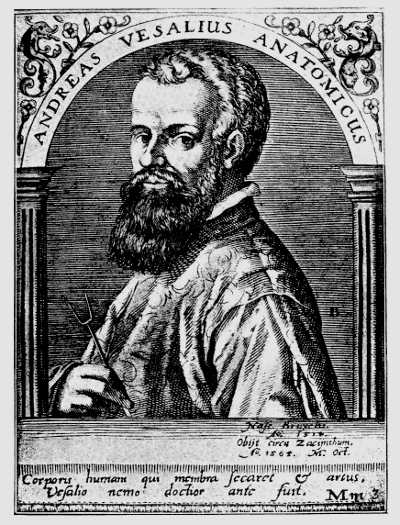
Andreas Vesalius.
Before Vesalius, Galen’s anatomy had served as the constant basis for
the teaching of this science. Although even from the end of the fifteenth
century dead bodies were dissected in all the principal universities, the
teachers of anatomy always conformed, in their descriptions, to those of
Galen, so that the authority of this master, held infallible, prevailed even
over the reality of facts.
Vesalius, for the first time, dared to unveil and clearly put in evidence
the errors of Galen; but this made him many enemies among the blind
followers and worshippers of that demigod of medicine. Europe resounded
with the invectives that were bestowed upon Vesalius. Among
others, there rose against him Eustachio at Rome, Dryander at Marburg,
Sylvius at Paris, and this last did not spare any calumny that might
degrade his old pupil, who had become so celebrated. In spite of this,
the fame of Vesalius kept on growing more and more, so much so that
Charles V called him to Madrid, to the post of chief physician of his
Court, a place which he kept under Philip II, also after the abdication
of Charles V. The good fortune of Vesalius, unhappily, was not to
be of long duration. In 1564 a Spanish gentleman died, in spite of the
care bestowed upon him by Vesalius, and the illustrious scientist requested
from the family, and with difficulty obtained, the permission to dissect
the body. At the moment in which the thoracic cavity was opened the
heart was seen, or thought to be seen, beating. The matter reached the
ears of the relations of the deceased, and they accused Vesalius, before
the Inquisition, of murder and sacrilege; and he certainly would not have
escaped death except by the intervention of Philip II, who, to save him,
desired that he should go on a pilgrimage to the Holy Land, as an expiation.
On his return, the ship which carried Vesalius was wrecked, and
he was cast on a desert beach of the Isle of Zante, where, according to
the testimony of a Venetian traveller, he died of hunger, October 15, 1564.
Vesalius left to the world an immortal monument, his splendid treatise
on Anatomy,282 published by him when only twenty-eight years of age,
and of which, from 1543 to 1725, not less than fifteen editions were issued.
The appearance of this work marked the commencement of a new
era. The struggle between the supporters of Galen and those of Vesalius
rendered necessary, on both sides, active research concerning the
structure of the human body, so that anatomy, the principal basis of
scientific medicine, gradually became more and more perfect, and, as
a consequence of this, as well as of the importance which the direct
observation of facts acquired over the authority of the ancients, there
began in all branches of medicine a continual, ever-increasing progress,
which gave and still gives splendid results, such as would have been
impossible under the dominion of Galenic dogmatism.
In the great work of Vesalius the anatomy of the teeth is unfortunately
treated with much less accuracy than that of the other parts of the body.
However, his description of the dental apparatus283 is far more exact
than that of Galen, and represents real progress. The number of the
roots of the molar teeth (large and small) is indicated by Galen in a
very vague and inexact manner, since he says that the ten upper molars
have generally three, sometimes four roots, and that the lower ones have
generally two, and rarely three. Vesalius, having examined the teeth
and the number of their roots in a great number of skulls, was able to
be much more precise. In regard to roots, he makes, for the first time,
a very clear distinction between the premolars next to the canine (small
molars) and the other three, and says that the former in the upper jaw
usually have two roots, and in the lower, one only, whilst the last three
upper molars usually have three roots and the lower ones two. As
everyone sees, these indications are, in the main, exact.
Other important facts established by Vesalius are as follows:
The canines are, of all the teeth, those which have the longest roots.
The middle upper incisors are larger and broader than the lateral ones,
and their roots are longer. The roots of the last molars are smaller than
those of the two preceding molars. In the penultimate and antepenultimate
molars, more often than in the other teeth, it sometimes happens
that a greater number of roots than usual are found, it being not very
rare to meet with upper molars with four roots, and lower ones with three.
The molars are not always five in each half jaw; sometimes there are
only four, either on each side, or on one side only, in only one jaw or in
both. Such differences generally depend on the last molar, which does
not always appear externally, remaining sometimes completely hidden
in the maxillary bone, or only just piercing with some of its cusps the thin
plate of bone which covers it; a thing which Vesalius could observe in
many skulls in the cemeteries.
In regard to the last molar, the author speaks of its tardy eruption
and of the violent pains which not unfrequently accompany it. The
doctors, he adds, not recognizing the cause of the pain, to make it cease
have recourse to the extraction of teeth, or else, attributing it to some
defects of the humors, overwhelm the sufferer with pills and other internal
remedies, whereas the best remedy would have been the scarification of
the gums in the region of the last molar and sometimes the piercing of
the osseous plate which covers it.
This curative method, of which no one can fail to recognize the importance,
was experimented by Vesalius on himself, in his twenty-sixth
year, precisely at the time that he had just begun to write his great treatise
on anatomy.
The existence of the central chamber of the teeth appears to have
been unknown to Galen, as he does not allude to it in the least. Vesalius
was the first to put this most important anatomical fact in evidence. He
expresses an opinion that the central cavity facilitates the nutrition of
the tooth. He says, besides, that when a hole is produced in a tooth
by reason of acrid corrosive humors, the corrosion, when once the internal
cavity is reached, spreads rapidly and deeply in the tooth, owing to the
existence of the said cavity, and sometimes reaches even the end of
the root.
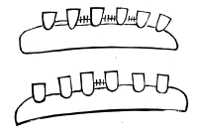
In the chapter in which Vesalius treats of the anatomy of the teeth
(Chapter XI, p. 40), two very well-drawn figures are found, one of which
represents a section of a lower molar, showing the pulp cavity and its
prolongation into the two root canals. The other represents the upper and
lower teeth of the right side, in their reciprocal positions, and shows very
clearly their general shape, the length of their roots, and the number of these.
The changes which take place in the alveolus, after the extraction of
a tooth have not escaped the notice of Vesalius. He says that after an
extraction the walls of the alveolus approach one another, and the cavity
is gradually obliterated.
Aristotle had affirmed that men have a greater number of teeth than
women. Vesalius declares this opinion absolutely false—although, after
Aristotle, it has been repeated by many other ancient writers—and says
that anyone can convince himself that the assertion of Aristotle is contrary
to the truth, as it is possible for everybody to count his own teeth.
In spite of this, we find the above-mentioned error even in writers
subsequent to Vesalius; for example, in Heurnius (professor at Leyden
toward the end of the sixteenth century), who expresses an opinion
that rarely do women have thirty-two teeth, like men.
We find but little in Vesalius concerning the development of the teeth.
He, indeed, made some observations and researches on this point, but
these, from their insufficiency, led him to quite mistaken conclusions.
The teeth of children, he says, have imperfect, soft, and, as it were, medullary
roots; and the part of the tooth which appears above the gums is
united to the root, so to say, as a mere appendix, after the fall of which
there grows from the root the permanent tooth. This error arose in the
mind of Vesalius from observing that when children lose their milk teeth,
these have the appearance of a kind of stump, as if the root had actually
remained in the socket. Besides this, he had observed with what facility
the milk teeth fall out; and he here calls to mind that, when about seven
years old, he himself and his companions used to pluck out their loosened
teeth, and especially the incisors, with their fingers, or with a thread tied
around the tooth. The softness of the dental roots in children, the easy
fall of the milk teeth, and the want of the lower part of the roots in these,
must have raised the idea in his mind that the roots of the milk teeth
remained in the socket, and that the upper part of the temporary teeth,
instead of being a continuation of the root, was joined to this as a simple
appendix, and in a very weak way, as though designed to remain in place
for a limited length of time only.
In Vesalius284 is found a dental terminology—Latin, Greek, Hebrew,
and Arabic—which affords some interest. The incisors are called in
Latin incisorii, risorii, quaterni, quadrupli; and the two middle incisors
have been denominated by some authors duales. The canines are called
in Greek kynodontes, which means the same as the Latin canini, dog’s
teeth. In Latin they have been also denominated mordentes, and by some
also risorii, a name which by others is given to the incisors, as we have
already seen. The molars have also been called in Latin maxillares,
paxillares, mensales, genuini.285 But some authors give this last name
only to the last molars, or wisdom teeth, dentes sensus et sapientiæ et
intellectus. These teeth have also been called serotini (that is, tardy),
ætatem complentes (that is, completing the age, the growth), and also,
in barbaric Latin, cayseles or caysales, negugidi, etc.
In the rebellion against the authority of the ancients, Vesalius
had a predecessor whose name, deservedly famous, may be recorded
here. Paracelsus (born in 1493 at Maria-Einsiedeln, Switzerland), on
being nominated, in 1527, Professor of Medicine and Surgery at Basle,
inaugurated his lectures by burning in the presence of his audience, who
were stunned by such temerity, the writings of Galen and Avicenna,
just as Luther, seven years before, had burnt in the public square of
Wittenberg the papal bulls and decretals. The sixteenth century, in
its exuberance of intellectual life, was undoubtedly one of the grandest
centuries in history; human thought in that glorious epoch shattered its
chains, and declared its freedom both in matters of science and of religion.
Paracelsus, a man of powerful genius, but not well balanced in mind,
of corrupt morals, and of an unlimited pride, had, notwithstanding these
undeniable defects, the merit of beginning a healthy reform in the science
and practice of medicine, by substituting the study of nature for the authority
of the ancients and by giving a great importance to chemistry, both for
the explanation of organic phenomena and for the cure of disease.
It is to be lamented that this man of genius did not contribute in any
way to the progress of dentistry. His works have no importance for us.
As a matter of mere curiosity we only record here that Paracelsus considered
the too precocious development of the teeth as a great anomaly,
and regarded as monsters those children who were born with teeth.286
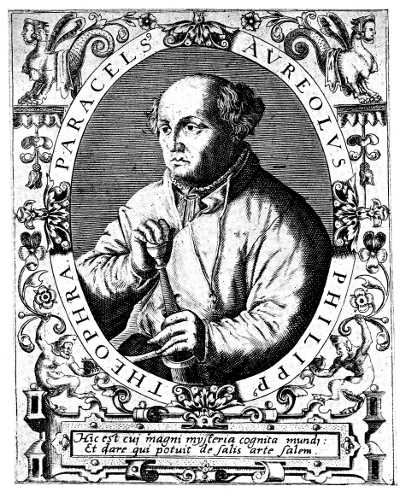
Paracelcus.
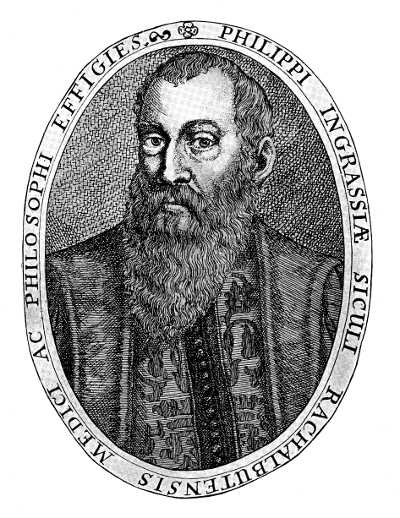
Gian Filippo Ingrassia.
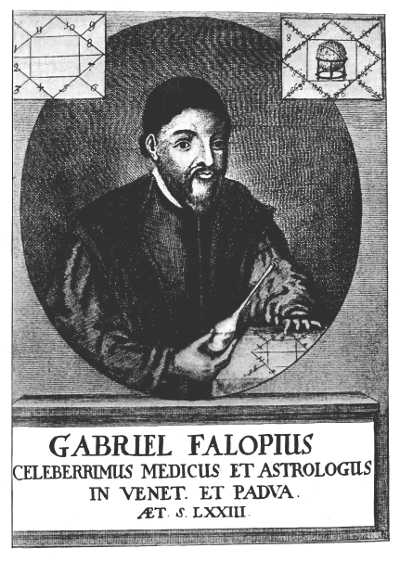
Gabriel Fallopius.
Gian Filippo Ingrassia (1510 to 1580), a distinguished Sicilian
anatomist, was one of the first who spoke of the dental germ. He says
that the existence of the tooth properly so called is preceded by that
of a soft dental substance enclosed in the bone, and which he considers
almost as a secretion of the latter.
Matteo Realdo Colombo, of Cremona, a pupil of Vesalius and his
successor in the professorship of Anatomy at Padua, added but little,
as regards the teeth, to what his master has taught. He combated
the erroneous idea that the teeth were formed in the alveoli shortly
before their eruption. Having dissected the jaws of many fetuses, and
having always observed in them the existence of teeth, he could affirm
with every certainty that the teeth begin to be formed in intra-uterine
life.
Like Vesalius, Realdo Colombo believed that the permanent teeth
were developed from the roots of the milk teeth; and, therefore, he
advised the utmost caution in extracting these, since, if the whole root
were removed, the tooth would not grow again.287
Gabriel Fallopius (1523 to 1562), the eminent anatomist of Modena,
also a disciple of Vesalius, carried out accurate and successful researches
in regard to the development of the teeth, and made them known in his
book, Observationes anatomicæ, published at Venice in 1562, the year
in which he died.
His investigations enabled him to show the falsity of the opinion held
by Vesalius, that the permanent teeth are developed from the roots of
the temporary ones. He was, besides, the first who spoke in clear terms
of the dental follicle.
The teeth, says Fallopius,288 are generated twice over, that is, the first
time in the uterus, after the formation of the jaws, and the second time in
extra-uterine life, before the seventh year. The first teeth are, at the
time of birth, still imperfect, without roots, completely enclosed in their
alveoli, and formed of two different substances; the part with which they
must break their way out is osseous and hollowed; the deeper part, instead,
is soft and humid and is seen covered with a thin pellicle, a thing
which may also be observed in the feathers of birds when they are still
tender. In fact, the part of the feather which comes out of the skin
is hard and corneous, whilst the part which is embedded in the wings is
soft and humid and has the appearance of coagulated blood or mucus.
So also in the fetal teeth, the part corresponding to the future root presents
itself like coagulated mucus. Little by little this soft substance hardens
and becomes osseous, thus constituting the root of the tooth.
Fallopius’ reference to the analogy between the development of teeth
and that of feathers was highly important, as a point of departure for
embryological researches which showed clearly the real nature of teeth,
thus destroying the mistaken idea—held by Galen and many other authors—that
these organs were bones.
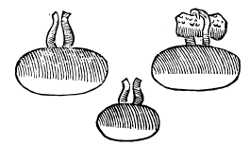
On coming to speak of the teeth generated in extra-uterine life, that
is of the permanent teeth, Fallopius relates having observed that they
have their origin in the following manner: A membranous follicle is
formed inside the bone furnished with two apices, one posterior (that is
to say, deeper down, more distant from the surface of the gums), to which
is joined a small nerve, a small artery, and a small vein (cui nervulus,
et arteriola, et venula applicantur); the other anterior (that is more superficial),
which terminates in a filament or small string, like a tail. This
string reaches right to the gum, passing through a very narrow aperture
in the bone, by the side of the tooth which is to be substituted by the new
one. Inside the follicle is formed a special white and tenacious substance,
and from this the tooth itself, which at first is osseous only in the part
nearest the surface, whilst the deeper part is still soft, that is, formed of
the above-mentioned substance. Each tooth comes out traversing and
widening the narrow aperture through which the “tail” of the follicle
passes. The latter breaks, and the tooth comes out of the gum, bare
and hard; and in process of time the formation of its deeper part is
completed.
The author says that his long and laborious researches into the development
of the teeth were carried out with great accuracy, and he is, therefore,
in a position to give as absolute certainties the facts exposed by
him. Indeed, the observations of Fallopius were, for the most part,
confirmed by subsequent research. As to the “tail” of the dental follicle,
it is identical with the iter dentis or gubernaculum dentis of some authors.
Fallopius described it as a simple string, but later on this prolongation
of the dental follicle has been considered, at least by some, as the narrowest
part or neck of the follicle itself, that is, as a channel through
which the tooth passes, widening it, on its way out, and precisely for this
reason it has been called iter dentis (the way of the tooth) or gubernaculum
dentis (helm or guide of the tooth).
Bartholomeus Eustachius, another great anatomist of the sixteenth
century, occupied himself in the study of teeth with special interest, and
wrote a very valuable monograph on this subject. He was a native of
San Severino, Marche (Italy), and a contemporary of Vesalius, Ingrassia,
Realdo Colombo, and Fallopius; he died in 1574, after having immortalized
his name through many anatomical discoveries and writings of the
highest value.
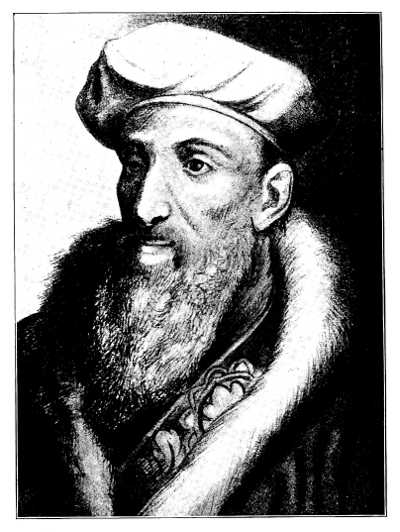
Bartholomeus Eustachius
His book on the teeth, Libellus de dentibus, published at Venice in 1563,
is the first treatise ever written on the anatomy of teeth, and represents a
noteworthy progress in this branch of study.
In this little book—divided into thirty chapters, forming in all ninety-five
pages—the author treats with great accuracy and in an admirable
manner all that concerns the anatomy, physiology, and development
of the teeth.
Eustachius not only treasured up what ancient authors had written
on this subject, but he himself made very long and patient researches and
observations on men and animals, on living individuals as well as on
corpses, and not only on adult subjects, but also on children of every age,
on stillborn children and on abortive fetuses.
The macroscopic anatomy of the teeth was brought by him to a high
degree of perfection. Very wonderful, among other things, is the accuracy
with which he studied and specified in several synoptical tables the number
of the roots of molar teeth, and all the variations occurring not only in
their number, but also in their form, length, etc.
In Chapter IV, speaking of the means by which teeth are held in their
sockets, Eustachius mentions in quite explicit terms the ligaments of the
teeth. He begins by saying that the perfect correspondence between the
dental roots and the alveoli, both in shape and in size, is one of the elements
which contribute to the firmness of the teeth, since the alveolus, being
exactly applied, on all sides, to the root or roots of the tooth, causes the
latter, by this simple fact, to be fixed in a determined position. Also,
the nerves inserted in each single tooth contribute, as was already the
opinion of Galen, to the stability of these organs. “There exist besides”—Eustachius
continues—“very strong ligaments, principally attached
to the roots, by which these latter are tightly connected with the alveoli”
(adsunt præterea vincula fortissima radicibus præcipue adherentia, quibus
præsepiolis arctissime colligantur). Lastly, says the author, the gums,
too, embracing the teeth at their exit from the alveoli, contribute to their
firmness. And here Eustachius notes that in the joining of the gums to
the teeth there is great analogy to that of the skin with the finger nails;
a very proper observation, which makes us almost suppose that the
perspicacious mind of Eustachius may have guessed the kindred nature
of nails and teeth.
In Chapter XV are related the researches made by the author to ascertain
at what period the development of the teeth begins. Here is a passage
of this chapter, almost literally translated:
“Hippocrates, before anyone else, wrote that the first teeth are formed
in the uterus. Wishing to assure myself thereof, I dissected many
abortive fetuses, and by very careful observations I found it to be true
that the teeth have their origin during intra-uterine life. Wherefore, the
opinion of those who consider that the first teeth are formed from the milk,
and those of the second dentition from food and drink, must be declared
entirely false. In fact, by opening both jaws of a stillborn fetus, one
may find, on each side of each jaw, the incisors, the canine, and three
molars, partly mucous and partly osseous, and already sufficiently
large and entirely surrounded by their alveoli. Then removing, with a
skilful hand, the incisors and the canines, there may be observed a very
thin partition only just ossified; and if this be removed with equal care,
an equal number of incisors and canines, almost mucous and very much
smaller, appear, which, enclosed in special alveoli behind the first, would
exactly correspond in position each with its congener, if in both jaws
the canine were not resting for the greater part on the next incisor so as
almost to hide it.”
As to the molars (by which name also the bicuspids are here meant),
Eustachius says that he found but three on each side, and no trace whatever
of the others. Nevertheless, he considers it quite probable that the
germs of the latter should also exist in the fetus, although so small as to
escape observation. He gives many ingenious reasons in support of his
mode of thinking, and comes to the general conclusion, that not only
the temporary teeth but also the permanent ones have, all of them, their
origin during fetal life; a false conclusion simply because too general,
and which shows once more how, in biological science, one runs great
risk of falling into error whenever one tries to draw too free deductions
from observed phenomena.
The researches of Fallopius and Eustachius confirm and complete each
other. These two eminent anatomists, who gave great glory to Italy
by their immortal discoveries and works, were the first to shed a brilliant
light upon the development of the teeth, and thus opened up the way to
all subsequent research on odontogeny.
In settling the period in which the formation of the teeth begins,
Fallopius was still more successful than Eustachius. His patient investigations
showed him that the development of the teeth commences partly
in the uterus and partly after birth, which is perfectly true, as was made
clear by later embryological researches. Fallopius found in each fetal
jaw twelve teeth.289 In this he agrees perfectly with his contemporary,
Eustachius, who, as we have seen a short while ago, found in fetusus,
only just born, the incisors, the canines, and three molars for each side of
each jaw. Eustachius, however, observed in the fetus the germs of the
permanent incisors and canines as well, a thing not noted by Fallopius.
It is not to be wondered at that some discrepancy should exist between
the observations of these two eminent anatomists. The researches of
which we are speaking are sufficiently delicate and difficult; and even much
more recent authors are far from agreeing perfectly, as far as regards the
period, in which the development of the teeth begins. Serres, in his Essai
sur l’anatomie et la physiologie des dents (Paris, 1817), sustains the view
that in the fetus he has observed the germs of all the teeth, both temporary
and permanent, while Joseph Linderer (Handbuch der Zahnheilkunde,
Berlin, 1842) says that, although he has followed the preparative method
indicated by Serres, he could never discover in the fetus the germs of
all the teeth. Perhaps, he adds, the time when the development of the
teeth begins varies considerably in individuals, just as we remark differences
in the time of eruption.
In Chapter XVII of his book, Eustachius speaks of the process of
formation of the teeth, which he studied in abortive fetuses, in stillborn
children, in children a few months old, and also in kids.
On dissecting a fetal jaw, there may be found on each side, as we have
already seen, the incisors, the canines, and three molars, still soft and
imperfect, separated from one another by very thin osseous partitions.
Each of these teeth is enclosed within a follicle or little bag of a grayish
white color, rather more mucous and glutinous than membranous, and
in form somewhat like the pod of a vegetable, with the only difference
that it shows an opening at one of the extremities, from which the tooth
somewhat protrudes, as if it were germinating. The more recent and
softer the tooth, the more its follicle has a mucous appearance and differs
from the nature of membranes. As it does not adhere to the underlying
tooth, it is easy to separate them. As to the tooth, it is at that
period of its development partly osseous and partly mucous, since that
part which later on projects from the gum soon becomes transformed
into a white thin and concave scale, which gives the idea of one of the
little cells of a honeycomb. This scale is harder and more conspicuous
in the incisors, since these, at this stage, are better formed; the canines
are less advanced in development, and the molars still less; and among
these latter, those are less developed which are more distant from the
canines. The deeper part of the tooth consists of a mucous and tenacious
substance, harder, however, than the substance of the follicle, and of a
whitish color with a tendency to dark red, translucent, and somewhat
brilliant.
Thus, says Eustachius, the teeth present themselves in a human fetus;
but he who cannot obtain a human fetus may observe the same things
in a kid.
Although the author does not express himself very explicitly, he seems
to consider the follicle of the tooth substantially identical with its ligament.
“This is at first mucous, but afterward, becoming more consistent,
causes the tooth to adhere to the socket and gum very firmly, as if it were
glued.”
“As the part of the tooth which comes out of the gum projects from
the aperture of the follicle like a gem from its bezel, so—says Eustachius—some
believe that the crown of a temporary tooth is a mere appendix,
and that the follicle comes out of its concavity through a dividing line
which they imagine to exist between this supposed appendix and the
remaining part of the tooth. But assuredly those who assert such things
show that they have studied the anatomy of the teeth so carelessly that,
by this one error, they make manifest their great ignorance together with
their great temerity.290 The line which is observed on the tooth on the
part corresponding to the adhesion of the gingival margin and of the dental
ligament is very superficial, and after having scraped it away, there does
not remain any trace of a division. But apart from this everyone can
very easily observe, even in infants, or in kids, that the tooth when ossified
does not present any line of division and that the still mucous follicle
envelops it freely, and may be easily separated from the tooth; which
would not be the case, if the follicle issued from between the tooth and
its supposed appendix.”
Thus, Eustachius declares entirely false the opinion already expressed
by Celsus, that the permanent tooth grows from the root of the milk tooth.
He affirms clearly and decisively that between the external and the radical
part of a milk tooth no real division exists, and that the ossification of the
tooth, beginning from the crown, proceeds without any interruption right
down to the end of the root. If it were true, says he, that in children only
the imaginary epiphysis or appendix falls, and that the new tooth is substantially
represented by the remaining part of the first, it could never
happen, as instead it often does, that the new tooth appears before the
first one falls. Besides, between the lower part of the first tooth and the
upper part of the second no correspondence exists either in size or shape,
as ought necessarily to be the case if the two parts were joined together.
This is not all; the lower part of the temporary tooth is perforated, and
receives in its interior bloodvessels and nerves, whilst the upper part of
the permanent tooth is quite massive and imperforated. How, then,
could this second tooth transmit bloodvessels and nerves into the cavity
of the first? Again, how could the continuity of these bloodvessels
and nerves with their respective branches be possible, if an imperforate
body, such as the crown of the permanent tooth, were really interposed?
But what is the use of so many arguments? exclaimed Eustachius.
To remove even the slightest doubt and to put an end to any controversy
on such a point, only one fact is sufficient, which is revealed to us by
anatomical dissection, and that is, that the teeth which appear about the
seventh year are not only not united to those which fall at the same
period, but cannot even be in contact with them, owing to the presence of
a thin osseous partition.
In the following chapter291 Eustachius speaks of the central cavity of
the teeth and of the substance contained in it. In young teeth, he says,
the dental cavity is very large, in proportion to the size of the tooth.
According to some anatomists, the central cavity of a tooth is coated by
a very soft and thin membrane, formed by a tissue of very small vessels
and nerves; and besides, this cavity is filled with marrow, like hollow
bones. The observations of the author, however, do not agree with these
statements. The dental cavity does not contain any fatty substance
analogous to the marrow of bones. As to the above-mentioned membrane,
Eustachius doubts its existence. The large hollow existing in
children’s teeth contains, he says, a mucous substance, somewhat hard,
and very smooth at its surface—almost like a cuticle—but which has rather
the appearance of a concretion than of a membranous tissue. At any
rate, adds Eustachius, if the substance alluded to is made to dry up in the
shade, it acquires an appearance not unlike that of a membrane. It
is certain, however, that at an early age the substance contained in the
dental cavity does not adhere to the walls of the latter after the manner
of a periosteum, but is found in simple contact with the same, and can,
therefore, be separated from them with the greatest ease.
As years pass by, the dental cavity becomes narrower and narrower,
because the substance contained inside the tooth gradually becomes
ossified at the surface, adhering to the dental scale previously formed, in
the very same manner as the internal or woody part of a tree adheres
to the bark. Of the two hard substances which make up a tooth, the
outer one is white, tense, and dense, like marble, the underlying one,
instead, is somewhat dark, rough, and less compact. To observe accurately
the above-mentioned facts, the author advises searching for them,
first, in the molar teeth of the ox or the ram, and then in human teeth,
and likewise, first in children or in recently born animals, and then in
adults.
Chapters XIX and XX are, comparatively speaking, of little importance.
In the former the author undertakes especially to examine the
opinions of Galen on dental bloodvessels and nerves, and discusses whether
it were known to him that these vessels and nerves penetrate into the
internal part of the teeth. In the latter, Eustachius speaks of the great
difficulties that are encountered in dissecting dental bloodvessels and
nerves, and reproves those who, by inaccurate illustrative figures, convey
the erroneous idea that these parts are very clearly and easily observable.
In Chapter XXI the author goes on to speak of the best mode of
proceeding in order to make successful observation of the small nerves
and vessels going to the roots of the teeth. These researches are much
more easily made in large animals than in man; and therefore such things
as cannot be observed well in the latter must be studied in the former.
In the first place, it is necessary to dissect the lower jaw; and after
having done so several times, with all the accuracy required in making
researches of this kind, one may proceed to study the dental nerves and
vessels of the upper jaw, which is much more difficult. Having opened
up the inside of the lower jaw, one observes a cavity full of marrow, and
within this a nerve enclosed entirely in its own sheath. Having removed
the marrow, and opened the sheath lengthwise, one perceives that the
nerve therein enclosed is constituted (analogous to what may be observed
in the large nerves of the limbs) by several nervous strings, and that among
these runs a comparatively large artery, besides small vascular branches
of minor importance. If one then removes the sheath from the bone,
together with the nerve and the vessels contained in it, raising it very
gently, one sees, issuing therefrom, some very slender fibers, on the nature
of which it is, however, difficult to pronounce; and, considering their
thinness, one can hardly conceive that they are composed of three different
elements, that is, of small nervous, arterial, and venous twigs. At any
rate, the author admits that this may be so. On arriving at the lesser
teeth, the nerve and the artery that accompanies it divide into two branches,
one of which traverses the opening presented by the bone at that point
(mental foramen), and is destined to the lower lip; the other directs its
course toward the roots of the incisors. The small twigs which penetrate
into the roots of the incisor and canine teeth are less slender than those
which enter the roots of the molars, and are easily to be seen not only in
large animals, but also in man. If the tooth of an ox or that of a ram
be split through the middle, the mucous substance contained in the
interior is seen to be traversed by small bloodvessels; and one perceives,
besides, certain fibers, which are probably nerves. All these things, says
Eustachius, I have observed many times in different animals, in some
cases more, in others less distinctly. But it is an exceedingly difficult
thing to follow the single twigs, of which we have spoken, from their
origin to their insertion, or, vice versa, from their insertion to their origin.
And so, adds the great anatomist, being able to observe but a small
part of the things I should like to see, I find myself compelled, in my
perplexity, to supply by the aid of ratiocination the deficiency of the
senses. I therefore maintain that the interior part of a tooth is susceptible
of experiencing pain accompanied by a feeling of pulsation (a fact already
mentioned by Galen), because a nerve and an artery penetrate into it.
In the ox the penetration of bloodvessels into the roots of the teeth can
be more readily ascertained than in man. It may be admitted that the
same occurs in the human teeth; and this, for the reasons already given,
and also because only by admitting the existence of an artery within the
cavity of the tooth can be explained the copious flow of florid red blood
from a decayed tooth, which has, in some cases, been known to imperil
the life of a patient. And I myself, says Eustachius, have observed
with my own eyes an accident of this kind.
The author then passes on to speak of the eruption of the teeth,292 but
the data with which he furnishes us are neither very precise nor very
exact.
Eustachius, without declaring himself for or against it, cites, in this
chapter, the opinion of those who believe in the possibility of a third
dentition in old people. He returns to this subject in the last chapter
but one of his book, which treats of dental anomalies: “Ali,” says he,
“testifies to old persons having had all their teeth renewed. This has
been derided as chimerical by medical men of later date, or at least only
admitted under the condition that such teeth be of a nature completely
different from the first.”
Our teeth, says the author, grow old together with us, and toward
the term of life they abandon us, a fact which also distinguishes them
from the other bones. When, however, it occurs, through illness, that
the teeth are extracted or fall out spontaneously before the period of
old age, the alveoli become filled up with a bony substance; and in addition
the two osseous scales of the maxillary bones approach one another
and unite together in such a manner as to form a sharp margin, every
vestige of a cavity being obliterated.
Speaking of the nutrition and growth of the teeth,293 Eustachius says
that—given the existence of the dental nerves and bloodvessels—it is
not difficult to explain how the teeth are nourished, grow, live, and feel.
He therefore rejects the opinion of those who held that the teeth of the
lower jaw derived their nourishment from the marrow contained within
this bone, and that those of the upper jaw received it from a humorous
substance similar to marrow, existing in the large cavity of the upper
maxillary bone. Against the supporters of this opinion Eustachius
raises, among others, the following objections, viz., that the marrow of
the inferior jaw does not in any way touch the teeth, so that such a mode
of nourishment cannot be imagined, and that it is completely erroneous
that the large cavity of the upper maxillary bone contains a humor
similar to marrow. This passage of Eustachius’ book gives clear evidence
that he was well acquainted with the maxillary sinus, described a century
later by the English anatomist, Highmore, who gave it his name. The
existence of this cavity was, besides, already known before the time of
Eustachius.
The author also says that those who believe that the internal cavity of
the teeth contains marrow, and that this serves to nourish them, are
grossly deceived.
In the same chapter, Eustachius confutes an opinion, at that time generally
diffused and put forward for the first time by Aristotle, viz., that
the teeth grow throughout a whole lifetime. In the senile age, he says,
the teeth become impaired still earlier than the other organs. They
become thinner by deficiency of nourishment, and, at the same time,
discolored; the incisors and canines, as they waste away, come to be also
less sharp than they were; and the molars, losing their tubercles or cups,
become levelled down and smooth. If, notwithstanding the evident
wearing out of the teeth, they seem sometimes to grow longer, this appearance
is not to be trusted, for it happens not unfrequently that the teeth
appear to have grown longer simply by atrophy of the gums, or also
because some humor or other morbid substance pushes them outward.
As to the sensibility of the teeth,294 Eustachius is of the opinion that these
organs possess, besides the sensibility to pain, two other species of sensibility;
for, following the ideas of Galen, he also holds that the teeth
together with the tongue partake in the sense of taste; and he further
considers the disagreeable sensation known as setting on edge of the teeth,
as a species of tactile sensation peculiar to these organs.
But in which part of the tooth does the faculty of feeling reside?
Among the authors previous to, or contemporaries of, Eustachius,
some affirmed that the sensibility of the tooth resides in the pellicle which
lines its inside cavity, others in the membrane which, like periosteum,
clothes the root of the tooth, others in both these parts. Eustachius
does not show himself more partial to the one than the other of these
opinions; he is, however, firmly persuaded that the hard substance of the
tooth is also endowed with sensibility. Though it is not easy to explain
how this may be, he considers it probable that the nerve, fraying
itself out inside of the tooth in minute filaments at the time when the
substance of the tooth is still soft and mucous, intermixes intimately
with it, thus communicating to it the faculty of feeling, which then persists
in it, even after the ossification of the tooth. Such an hypothesis is
certainly worthy of the lofty intellect of Eustachius, and has in itself, so
it seems to me, something of truth.
In the two following chapters,295 the author speaks in a masterly and
admirable manner of the functions of the teeth and of their utility.
Among many other true and interesting observations, he remarks that
by the loss of their teeth even the most powerful dogs become cowards.
Besides what concerns the human teeth, excellent notions of comparative
anatomy, above all in what regards the monkey, the dog, and the ruminants,
are to be found in this little but most precious book of Eustachius.
The teeth, says he, are not equally hard in all animals, and many
ancient authors have affirmed that ferocious animals have much harder
teeth than tame ones.
Chapter XXIX, relating to dental anomalies, is one of the most interesting.
We here quote the greater part of it.
“Some historians relate that Pyrrhus, King of Epirus, Eurifeus, of
Greece, and many others, had, instead of teeth, a continuous bone, furrowed
by somewhat deep vertical lines, in no way different from what
one sees in the multiple molars of the goat. It has never happened
to me, says Eustachius, to witness a similar union of all the teeth; I
have, however, sometimes observed continuity between three or four
molars, precisely in the same manner as in sheep. It also once happened
to me to observe in the case of an old man, a fellow citizen of mine, that
the teeth were covered up on every side by a hard and almost stony substance,
and no longer exhibited any trace of separation, offering instead
the appearance of a single bone.”
“One reads that Timarchus, of Cyprus, had two rows or series of teeth
and Hercules three.”
The author never had any opportunity of observing any such anomalies;
notwithstanding, he refers to cases of the kind observed by other anatomists
of his time, and, in a particular manner, to the case of a triple dental
series in a youth who died at the age of eighteen. As the truth of the
fact was testified to by highly respectable medical men, Eustachius lends
faith thereto. “Neither can it be said”—he adds—“that in the case
we are speaking of the new teeth erupted from other sockets before the
temporary ones were shed, for there would then have been only a double
and not a triple series; indeed, the series would not even have been double
along all the line, but only along the line of the temporary teeth; and
besides this, the double series would not have been maintained up to
eighteen years of age—the time of the death of the subject—but only until
the shedding of the deciduous teeth.”
“That teeth are sometimes cut in the palate is a fact attested to by
Alessandro de Benedetti and others. It has also occurred, within my own
experience, to observe this in the person of a Roman woman, who had a
tooth in the roof of the mouth, near the opening which is in proximity
to the incisors,296 and at Gubbio there is, in the monastery of the Trinità,
a nephew of the distinguished jurisconsult Girolamo Gabrielli, who at
the age of eighteen cut a tooth in the middle of the palate.”
“Pliny and Solinus tell of individuals born with all their teeth. Other
authors, that Pheretes was without teeth all his life.”
“I hold it to be a fable that some women lose a tooth for each child
they bear.”
“In some cases it has happened that the falling out and renewal of
the teeth has not taken place before the age of thirteen or fourteen.
In other cases, the same teeth were shed and renewed twice, that is, once
after the seventh year, and again after the fourteenth year. It ought
also to be mentioned that in some young persons of twenty, the last molar,
or wisdom tooth, having been drawn, it was renewed during the same
year. Lastly, it is also to be noted that in strong and healthy young persons,
one of the other molars being extracted, it is sometimes renewed.”297
In the last chapter298 the author alludes to some dental affections. In
referring to the fluxions to which teeth are subject, he says he has observed
more than one case in which such a quantity of matter resembling chalk
was collected in the alveoli, that these gradually being filled thereby, all
the teeth became loosened and dropped out little by little.
Speaking of dental diseases requiring surgical intervention, the author
remarks that dental surgery was, in his days, a most abject calling, notwithstanding
its having had, according to Cicero, a very high initiator—Æsculapius,
the god of medicine.
Ambroise Paré. Whilst the anatomy of the dental system was illustrated
by the researches of Fallopius and Eustachius, the celebrated
French surgeon Ambroise Paré was contributing in the highest degree to
the progress of practical dentistry.
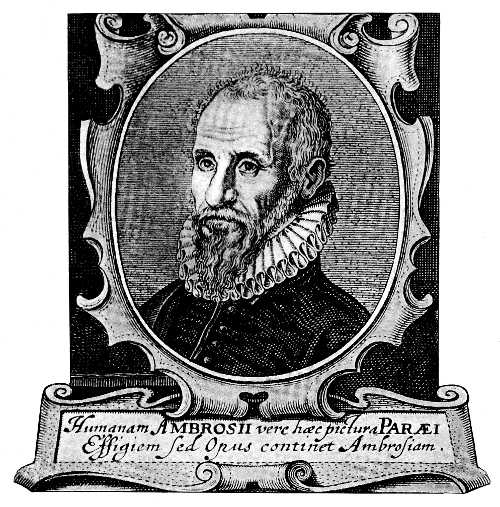
Ambroise Paré.
Ambroise Paré (Latinized Paræus) was born at Bourg-Hersent in the
year 1517. His father and one of his brothers were box-makers; another
brother was a barber. We have no very precise information about the
early years of his life; so much is certain, however, that Ambroise Paré
did not enjoy any of those advantages deriving from a good literary education,
and after having received some instruction from a chaplain, whose
disciple and servant he was at one and the same time, he was bound
over as apprentice to a barber, who also taught him the art of bleeding.
Toward the age of sixteen we find him in Paris in the employ of a
chirurgien-barbier. After this he practised minor surgery for some years
in the Hôtel-Dieu. But having undertaken the study of surgery without
literary preparation and without any knowledge of Latin, he was obliged,
especially for the latter reason, to contend with great difficulties, so that,
although he had acquired in a few years sufficient practice in surgery to
enable him to pass from the Hôtel-Dieu to the sanitary service of the
French army, it was only in 1554, that is, at thirty-seven years of age,
that he was permitted to take the examination required for becoming
a member of the College of Surgeons of Paris. Within the short space
of five months he was successively named Bachelor, Licentiate, and
Doctor in Surgery. His reputation, which had already become extraordinary
even before he had any academic degree, procured him introduction
to the Court of France as surgeon in ordinary. In 1562 he became
chief surgeon to the Court and occupied this post under the reigns of
Charles IX and Henri III. Ambroise Paré was a Protestant, and it
is said that in the massacre of St. Bartholomew’s night, he owed his
escape to the king, Charles IX, who, to save his life, hid him in his wardrobe.
He died full of honors, in the year 1592.
In his works this great surgeon treats the subject of dental maladies
and their cure very thoroughly; this may be in part attributed to the circumstance
of his having first been simply a barber (and, therefore, also a
tooth-puller) and afterward a surgeon-barber, which placed him in very
favorable conditions for acquiring vast experience in the practice of
dentistry.
In Chapter II, Book IV, of his works,299 Ambroise Paré speaks of the
anatomy and physiology of the teeth. It must, however, be confessed
that Vesalius and, still more so, Eustachius treat of dental anatomy with
much more exactness than he does.
After having spoken of the incisors and the canines, he says that the
ten upper molars generally have three roots, and very often four, whilst
the ten lower ones have only three; this is because the lower jaw is harder
than the upper, and also because the lower molars, estant assises sur la
racine, et non suspendues, comme celles de la mandibule d’en haut, n’avoient
besoin de tant de racines pour leur stabilité asseurance.300
Ambroise Paré, too, admits that the teeth grow throughout the whole
lifetime, and that the wearing away consequent on reciprocal friction and
mastication is compensated in this way.
Galen had already affirmed, and Ambroise Paré also held erroneously,
that the exquisite sensibility of the teeth aids the sense of taste.
In speaking of the development of the teeth, Ambroise Paré says only
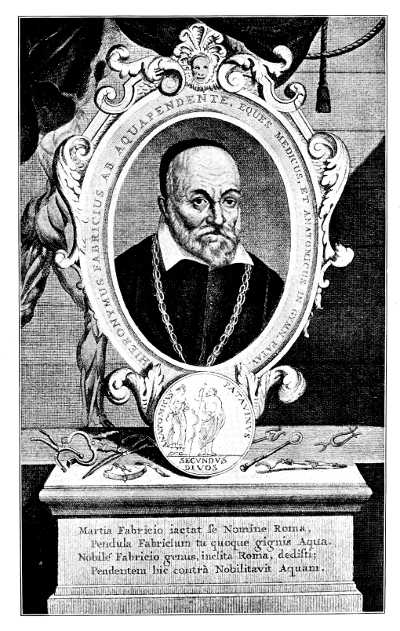
that they are already solid and osseous before birth, he himself having
observed this in dissecting the jaws of a child who had died immediately
after birth.
In Chapter VII, Book XIII,301 Paré treats of fracture of the lower jaw.
The method of cure he proposes is altogether identical with that of Celsus.
With regard to the teeth, he says that “si elles sont divisées, ebranlées,
ou separées hors de leurs alvéoles ou petites cavités, elles doivent estre
reduites en leurs places et seront liées et attachées contre celles qui sont
fermes, avecques un fil d’or ou d’argent, ou de lin. Et les y faut tenir
jusques à ce qu’elles soient bien affermies, et le callus soient refait et rendu
solide.”302
Toothache, says Paré,303 is, of all others, the most atrocious pain that
can torment a man without being followed by death. It depends, in
many cases, on a humorous fluxion of a hot or cold nature which flows
into the alveolus, forcing the tooth outward, loosening it, and causing
the patient so much pain on the slightest pressure being exercised on it,
that he cannot dare to bite with it in the least. If, however, the tooth
is corroded, hollowed out, or pierced to the root, the pain is so strong,
when the patient drinks—particularly if the liquid is cold—that he seems
to have had a stab with a stiletto inside the tooth.
If the pain is acute and pungent, like that produced by needles being
thrust into the diseased tooth; if the patient complains of a strong pulsation
at the root of the tooth, and in the temples; if the application of cold
remedies calms the pain, all these signs indicate that the cause of the evil
is heat. Instead, the cause of the pain may be held to be cold when the
patient complains of a great heaviness in the head, emits a quantity of
saliva, and finds relief in the application of hot remedies. In the treatment
of toothache one must fulfil the following three indications:
1. Regulate fittingly the mode of living.
2. Evacuate or dissipate the morbid humors; this may be effected
by various means, namely, by purgatives, by bleeding, by gingival
scarification, by the application of leeches on the site of the pain, by
cupping on the back of the neck, or on the shoulders.
3. Applying in each single case the medicaments best adapted for
calming the pain.
The author here goes through a long enumeration of anti-odontalgic
remedies that offer no particular interest, as they are not at all new.
When a decayed tooth becomes the seat of excessive pain, and this
does not yield to any remedy, one must either have recourse to extraction
or cauterize it; this can be done either with potential caustics—such as
oil of vitriol, aqua fortis—or with the actual cautery. By cauterizing,
Paré adds, one burns the nerve, thus rendering it incapable of again feeling
or causing pain.
Erosion or caries304 is the effect of an acute and acrid humor, that corrodes
and perforates the teeth, often to their very roots. To combat this
morbid condition, even when it is not accompanied by pain, one must
also have recourse (besides general treatment) to cauterization either
with oil of vitriol, with aqua fortis, or with a small actual cautery.
If, as often happens, that the seat of the erosion lies in such a manner
between two teeth as to make it impossible to apply caustics or other
medicaments, one must file just sufficiently between the healthy and the
corroded tooth to render the part accessible, taking care, however, to file
more on the side of the affected tooth than on that of the healthy one.
The file may be used, besides, to plane down a tooth that stands out
above the level of the others, and for similar purposes.
If one or more teeth have been shaken by a blow or a fall, or have come
out of their alveoli altogether, the surgeon should not remove them, but
rather reduce them and bind to the neighboring teeth, that they may
entirely reacquire their original firmness.
In allusion to this subject, Ambroise Paré refers to the case of a friend
of his, who having sustained, through a blow from the hilt of a dagger,
a fracture of the lower jaw with almost complete expulsion of three
teeth from their alveoli, had the fracture reduced by him; after replacing
the teeth and binding them to the neighboring ones, he prescribed astringent
mouth washes and liquid or semiliquid nourishment, such as meat
juice, panada, barley soup, jelly, and such like. The patient was completely
cured and able to masticate with the three teeth as well as before.
Also in the case of extraction of a healthy instead of a diseased tooth,
Paré recommends replacing it immediately and binding it to the neighboring
ones, for, he says, by this means the tooth can take root again.
As we have seen, the first author who speaks of replantation is Abulcasis,
but to Ambroise Paré belongs the merit of having treated the subject
much more explicitly, and of having insisted on the utility of this operation,
indeed, on the duty of carrying it out whenever it seems indicated.
Fig. 60
Dental files (Ambroise Paré).
Further, he is the first to mention another very important operation,
namely, transplantation, albeit he himself had never performed it. The
case he refers to has become a generally known anecdote. We give it in
his own words: “Un homme digne d’estre creu m’a affirmé qu’une princesse
ayant fait arracher une dent, s’en fit remettre subit une autre d’une
sienne demoiselle, laquelle se reprint, et quelque temps après maschoit
dessus comme sus celle qu’elle avoit fait arracher auparavant.”305
Fig. 61
One of the pelicans used by Ambroise Paré.
Fig. 62
Two other pelicans and a pair of curved pincers (Ambroise Paré).
Ambroise Paré has recourse to extraction when a tooth is the cause of
very violent pain, or when the existence of a carious cavity and concomitant
putrefying processes render the breath fetid, and endanger the healthy
teeth in its vicinity. If the persistence of a deciduous tooth should cause
the cutting of the corresponding permanent tooth outside the line of the
dental arch, thus giving rise to deformity, Paré advises laying bare and
then extracting the deciduous tooth; for after this the new tooth may be
pressed toward the point before occupied by the other, until it assumes its
natural position.
Sometimes, when a tooth is too firmly planted, one prefers, says Paré,
instead of extracting it, to break off the crown for the purpose of being
able to act directly on the dental nerve with appropriate remedies, or
to destroy the sensibility of the nerve entirely, by cauterization. This
unreasonable and reprehensible method of cure is also quoted, under
the denomination of deschapellement, by another French author, a contemporary
of Paré—Urbain Hemard—who observes, however, that one
rarely had recourse to it; for the pain and shock which are caused by this
operation are not less than those caused by extraction.
It very often happens that the patient cannot indicate exactly which
tooth it is that gives him pain, his sufferings being so acute as to appear
spread over a great part of the jaw. One cannot, therefore, trust too
much to the indications given by the patient as to the point of departure
of the pain, and must take care not to extract a healthy instead of a
diseased tooth.
The extraction of a tooth should not be carried out with too much violence,
as one risks producing luxation of the jaw or concussion of the
brain and the eyes, or even bringing away a portion of the jaw together
with the tooth (the author himself has observed this in several cases),
not to speak of other serious accidents which may supervene, as, for
example, fever, apostema, abundant hemorrhage, and even death.
In extracting a tooth it is necessary to place the patient on a very low
seat, or even on the ground, with his head between the legs of the operator.306
After having laid the tooth bare sufficiently, if one sees that it is very
loose, one may push it out of its socket with a poussoir, that is, with a
trifid lever. But if the tooth is too firmly rooted to be extracted with this
instrument, one must make use of curved pincers, or else one may have
recourse to a pelican. The author notes, however, that much skill is
required in using this latter instrument, for otherwise it will almost certainly
happen that several good teeth will be knocked out, instead of the
one intended to be extracted. In proof of this, he relates the following
anecdote, which we relate in the words of the author, that it may not
lose anything of its quaint originality:
“Je veux icy reciter une histoire d’un maistre barbier, demeurant à
Orleans, nommé maistre François Loüis, lequel avoit par dessus tous,
l’honneur de bien arracher une dent, de façon que tous les samedis
plusieurs paysans ayans mal aux dents venoient vers luy pour les faire
arracher, ce qu’il faisait fort dextrement avec un polican, et lorsqu’il
avoit fait, le jettoit sus un ais en sa boutique. Or avoit-il un serviteur
nouveau, Picard, grand et fort, qui desiroit tirer les dents à la mode de
son maistre. Arriva cependant que ledit François Louys disnoit, un
villageois, requerant qu’on luy arrachait une dent, ce Picard print l’instrument
de son maistre et s’essaya faire comme luy; mais en lieu d’oster la
mauvaise dent au pauvre villageois, luy en poussa et arracha trois bonnes.
Et sentant une douleur extrème, et voyont trois dents hors de sa bouche,
commença à crier contre le Picard; lequel pour le faire taire luy dit
qu’il ne dist mot, et qu’il ne criast si haut, attendu que si le maistre venoit
il luy feroit payer les trois dent pour une. Donc le maistre oyant tel
bruit, sortit hors de table pour sçavoir la cause et raison de leur noise et
contestation; mais le pauvre paysan redoutant les menaces du Picard,
et encore apres avoir enduré telle douleur qu’on ne luy fist payer triplement
la peine dudit Picard, se tent, n’osant declarer audit maistre ce
beau chef d’œuvre; et ainsi le pauvre badaud de village s’en alla quitte;
et pour une dent qu’il pensoit faire arracher, en remporta trois en sa
bourse, et celle qui luy causoit le mal en sa bouche.”307 Paré adds in conclusion:
“Partant je conseille à ceux qui voudront faire arracher les dents,
qu’ils aillent aux vieux dentateurs, et non aux jeunes qui n’auront encore
reconneu leurs fautes.”308
Fig. 63
Two gum lancets and a trifid lever called “poussoir” (Ambroise Paré).
But let us now return to our subject. After the extraction of a tooth,
it is necessary—says Paré—to leave the wound to bleed freely, so that
the part may get rid of the morbid humors; then the gums and the
alveolus must be pressed, on both sides, with the fingers, to readjust the
socket, which will have been widened and sometimes even broken in
extracting the tooth. After this, the patient should rinse his mouth
with oxycrate; and when the weather is cold and windy, the patient
should take care to avoid fluxion in the other teeth.
The following chapter speaks, “de la limosité ou rouillure des dents,
et de la manière de les conserver.”
After meals the mouth must be rinsed with water and wine, or with
water with a little vinegar added to it, and the teeth cleaned from all
residues of food, so that their putrefying may not spoil the teeth and make
the breath fetid. An earthy yellowish substance, like rust, often forms
on the teeth from want of cleanliness and also when they are not used to
masticate; this substance corrodes the teeth, just as rust corrodes iron.
It is necessary to remove this substance, by scraping the teeth with small
instruments suitable for the purpose, and then the teeth themselves must
be rubbed with a little aqua fortis and aqua vitæ mixed together, to take
away what the instruments have not been able to remove. In order to
preserve the teeth it is necessary, besides, to rub the teeth frequently
with appropriate dentifrices. Among these the author mentions simple
bread crust, burnt and reduced to powder.
In Chapter III of Book XVII he speaks of artificial teeth. Sometimes,
says Paré, by the effect of a blow, the front teeth are lost; this not only
constitutes a deformity, but is also the cause of defects of speech. Therefore,
after the necessary treatment, when the gums are hardened, the
lost teeth must be substituted with artificial ones made out of bone,
ivory, or the teeth of the Rohart,309 which are excellent for this purpose;
and the artificial teeth must be tied to the neighboring ones with gold or
silver wire.
Fig. 64
The palatine obturator with sponge of Ambroise Paré.
Chapter IV of the same book is most important, for palatal obturators
are therein spoken of for the first time. “Sometimes a portion of the
bone of the palate is destroyed by the shot of an arquebus, or by some
other wound or by a syphilitic ulcer (par ulcère de verole), the patients
being thereby disabled from properly pronouncing words and from
making themselves understood. To repair this defect we have found an
expedient through the help and ministry of our art. It consists in the
application of an instrument somewhat larger than the palatal perforation;
this is made of gold or silver, of about the thickness of a crown (coin),
and has the form of a vaulted roof, to which a sponge is attached; when
introduced into the aperture, the sponge, absorbing the humidity natural
to such parts, will very soon swell up, and thus the instrument is held firm.
In this way, words are better pronounced.”
Besides the above instrument, the author gives us the figure of another
instrument, sans esponge (without sponge), which, taken altogether,
is like a large cuff button. The small part, designed to be introduced
into the aperture of the palate, can be made to turn round from below,
by means of a small pair of pincers, so as to fix the obturator.
Fig. 65
Paré’s palatine obturator without sponge.
In the last chapter of Book XVIII, first dentition and the treatment
required during this period are spoken of. The cutting of teeth, says
Paré, is accompanied by pain, itching, and pricking of the gums; often,
as well by diarrhea, fever, epileptic convulsions, which sometimes end
fatally. The symptoms by which it may be known that teeth are about
to come forth are as follows: The wet-nurse feels the mouth of the
suckling infant to be hotter than usual; the gums are swollen; the child
is restless, crying often and sleeping but little; it emits a quantity of
saliva from the mouth, and frequently puts its fingers in its mouth, trying
to rub its gums, and soothe, in this way, the pain and itching which it
feels. It is then necessary to treat the nurse as if she had fever, and the
infant should be suckled less than usual; some cooling and thirst quenching
drinks should be given to it—for a child in such conditions suffers
from intense thirst; the nurse should often rub the gums of the little patient
with softening and soothing substances, as, for example, oil of sweet
almonds, fresh butter, honey, or mucilage made from the seeds of the
fleawort or of the quince; the brains of a hare (these may be roasted or
boiled) have not only a very soothing action, but also, according to a very
ancient belief shared by Paré, possess the occult property of aiding the
cutting of the teeth. But oftentimes, neither these nor other remedies
are of any use, because the gums are too hard and the teeth cannot cut
their way through at all; the tension of the gums then produces very violent
pain, fever, and other accidents, death even supervening in some cases.
The author, therefore, advises lancing the gums deeply, just above the
tooth which ought to appear, thus opening it a way, that it may more
easily come out. He relates that he has performed this operation on his
own children in the presence of many medical authorities.
Almost as if to show the high value of this operative procedure, Paré
tells the case of a child, the son of the Duke of Nevers, who died at the age
of about eight months without having cut any teeth. He, together with
other doctors, was invited to carry out an autopsy. No lesion whatever
was found sufficient to cause death, but the gums were very hard, thick,
and swollen; an incision into them showed that the teeth were ready to
come out, if only their eruption had been facilitated by lancing at the
right time. Paré and the other doctors were of the unanimous opinion
that death was caused solely by the impossibility of cutting the teeth on
account of the hardness of the gums.
Among the many strange cases given in Book XIX (Des monstres et
prodiges), Paré also speaks—trusting to the word of Alexander Benedetti—of
the case of a woman, who, after the complete loss of her teeth caused
by age, cut them all again at eighty years of age.
Although Paré treats so amply and with such competence all that
concerns dental diseases and their cure, he does not make the least
allusion to the stopping of teeth, beyond recommending, as had already
been done by Celsus, that when a tooth that is to be extracted shows a
large cavity, the latter should be well filled with linen or lead, so that the
tooth be not fractured under the pressure of the instrument and so leave
the root behind in the alveolus.
A century before Ambroise Paré, Giovanni d’Arcoli had already
mentioned the filling of teeth with gold leaf, and, as we have seen already,
there is very good reason to believe that the practice of this operation
dated back to a still earlier period. How is it, then, that the illustrious
French surgeon does not say a word about this? Very probably stoppings
were not at all in use among French dentateurs and perhaps, even in
Italy, this operation was only rarely carried out.
Jacques Houllier (1498 to 1562), a celebrated French physician and
surgeon, also known under the Latinized name of Jacobus Hollerius,
was the first to stand out, although timidly, against the theory of dental
worms. He did not decidedly deny their existence, this having been
affirmed by so many illustrious writers; he, however, speaks of them
as if the point were a doubtful one: “It is said that worms are generated
in the teeth, which corrode the teeth themselves, and produce a pain which
is not very violent and causes itching with little or no salivation (vermes
ajunt subnasci dentibus, et hos corrodere, à quibus dolor non ita fortis,
pruriginosus, nulla aut pauca salivatio).”
But even while putting in doubt the existence of dental worms, he believes
it his duty to enumerate the various remedies, recommended for
their destruction. As to fumigations with the seeds of the hyoscyamus,
Houllier, declares that what is believed by the common people, and what
has been written by doctors of antiquity about worms being killed and
seen to fall from the teeth by the effect of these fumigations, is all nonsense.
In fact, he says, when the seeds of the hyoscyamus are burnt there fly
away from them what appear to be little worms, even if the fumes do not
reach the worm-eaten tooth. (Quod autem vulgus sibi persuadet, et
ab antiquis medicis scriptum est de suffumigio è semine hyoscyami, videtur
fabulosum. Nam inde ajunt manifeste vermes excidere. Re vera, incenso
semine, evolant tanqua vermiculi, etiam si non attingit fumus vermiculosum
dentem.)
Apart from this, in the works of Houllier, nothing is found that is of
interest for the history of dentistry. He repeats several errors and
prejudices of the ancients; he says, for example, that men have ordinarily
thirty-two teeth, women, twenty-eight; and he, too, believes in the expulsive
virtues of the fat of green frogs when applied to a tooth (adeps
ranæ viridis dentem depellit).
Houllier does not contribute in any way to dental therapeutics, he only
enumerates the methods of cure recommended by preceding authors.310
Volcherus Coiter (1534 to 1600), of Gröningen, an ardent student of
anatomy, and a pupil of Fallopius, Eustachius, and Aranzio, studied
with great attention the development of bones, dissecting many fetuses and
children of various ages for that purpose. He clearly states his opinion
that the teeth are not bones, since they do not pass, like the latter, through
the cartilaginous stage, but are derived instead from a mucous substance.311
Johann Jacob Wecker, a doctor of Colmar, published in 1576 a
valuable medical work composed of synoptical tables, in which is briefly
summarized the best of what had been written by preceding Greek,
Latin, and Arabic authors.
One gathers from this author that at the time in which he wrote it
was considered an excellent preservative against the plague to rub the
teeth with theriac, mithridate, angelica, and zedoary. From this it may
be perceived that even in those days doctors had understood the importance
of the cleanliness and disinfection of the mouth as a prophylactic
against infective diseases.
In the above-mentioned book may be found a sufficiently complete
exposition of dental therapeutics of that and of the preceding periods.
There is nothing, however, which is not already known to us from our
examination of the earlier writers. Worthy of notice is the information
that, among other things, to facilitate the cutting of teeth rubbing the
jaws with turpentine was recommended at that time.312
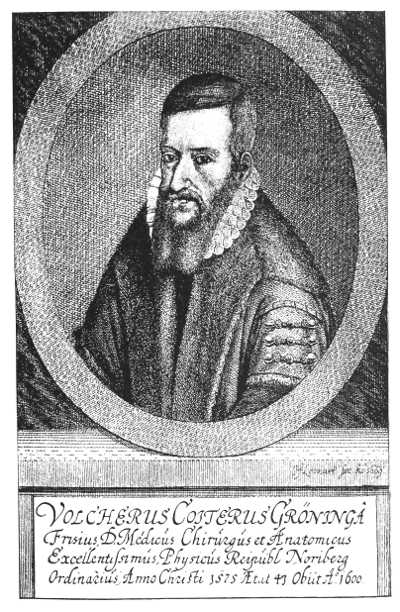
Volcherus Coiter.
Donato Antonio of Altomare, a Neapolitan physician and philosopher,
dedicated a long chapter of his Ars medica313 to the subject of
dental pains and their treatment. He classifies these pains with great
accuracy, taking into account their seat and causes, and pointing out in
each single case the method of cure to be followed according to the warm,
cold, dry, or humid nature of the pain. In what he says, however, we
do not find anything new.
Giulio Cesare Aranzio (1530 to 1589), a celebrated surgeon and
anatomist of Bologna, in which city he taught from the age of twenty-six
years until his death, is of the opinion that parulides—that is to say,
inflammations or abscesses of the gums—and epulides—that is fleshy
excrescences of the same—are usually caused by caries or putrescence
of the teeth; but that in certain individuals, from a peculiar weakness
of the gums, these are easily attacked by inflammation when the wind is
in the south.
In the case of parulides, to soothe the pain and to accelerate the
suppurative process, emollient substances should be used; afterward it
is necessary to open the abscess with a lancet, to wash the mouth with
mulse, and to aid the process of cicatrization by using syrup of roses.
As to epulides, these must be made to disappear, by sprinkling the
tumor with the powder of gall-nuts, or by moistening them frequently
with a decoction of gall-nuts, or with sulphur water. But if they do not
yield to these remedies, and are the cause of functional disturbances,
the surest and most prudent method of cure would be the use of the
red-hot iron.
Giovanni Andrea Della Croce, a celebrated Venetian physician
and surgeon, was the author of a most valuable treatise on surgery, which
was published first in Latin (Chirurgiæ universalis opus absolutum,
Venetitiis, 1573), and then in Italian under the title of Chirurgia
universale e perfetta, Venezia, 1583. According to this author, dental
fistulæ are more common to the lower jaw than to the upper one. To
cure these fistulæ, it is necessary to extract the diseased teeth from which
they originate, even should they ache but little or not at all. To confirm
this, he relates in full a very interesting case of a dental fistula, that he
cured by the extraction of a tooth which hardly ached at all.
Flajani314 chose to see in this case a precocious example of the opening
of Highmore’s antrum through the alveolus. But the description given
by Andrea della Croce of his case does not at all warrant this supposition.
At the end of his book Andrea della Croce gives us the figures of many
dental instruments, which have, however, nothing new about them.
Gerolamo Capivacci, of Padua, repeats the advice (already given by
preceding authors) to avoid, in eating and drinking, the rapid changes
from heat to cold, and vice versa, since, says he, nature does not tolerate
these rough changes.315 In the mercurial treatment of syphilis,316 he recommends
the patient, as soon as the action of the remedy manifests itself
in the oral cavity, to keep a piece of gold in his mouth, that the mercury,
on account of its particular affinity, may unite with the gold and the harmful
effects of this strange remedy on the mouth may be thus avoided.
A strange method of curing mercurial stomatitis!
Johann Schenck von Grafenberg (1530 to 1598), a celebrated
doctor of Freyburg-in-Breisgau, has left us, in his Observationes medicæ,
a very rich and interesting collection of clinical cases. In this work he
refers to many observations upon dental diseases by earlier authors, which,
however, have already been noted by us in their time and place. Among
other things, Schenck von Grafenberg relates that Cardanus was able,
more than twenty times, to calm a violent toothache which tormented
him by lightly pressing the sick tooth between the thumb and index
finger of his left hand.
Peter Foreest (1522 to 1597), a very famous Dutch doctor of Alkmaar,
repeats the very old error—already in decisive terms denied by Andreas
Vesalius—that women have only twenty-eight teeth, whilst men usually
have thirty-two. To the two central incisors he gives the name of columellares.
Sugar and all sweet things, says this author, are very harmful
to the teeth, and he gives as a proof the fact that apothecaries have, in
general, very bad teeth, on account of the frequency with which they
taste syrups and the like. Perhaps things are now changed, since I
am not aware that chemists in our days are to be distinguished by the
bad state of their teeth!
In regard to toothache, Foreest records an important observation which
he had made on himself; an aching tooth which a surgeon had not succeeded
in extracting, but which was simply loosened, ceased, without
anything else being done, from giving him pain, and in a short while
became firm again, and he continued to use this tooth for about five years.
However, on a renewal of the pain he was obliged at last to have it extracted.
On the strength of this observation, the author believes that
in certain appropriate cases, recourse may be had to the luxation of a
tooth, rather than to its extraction to obtain a cessation of toothache.
This method of cure had already been advised by a still earlier writer,
that is, by Avicenna. When a subluxation produces the rupture of the
dental nerve, this, in its results is equivalent to a replantation.
Foreest is the first to speak of the violent inflammation of the gums
and of the whole mouth, caused by the application of artificial teeth of
ivory fixed in their place with gold wire. This cannot at all astonish
us when we consider how imperfectly, in those days, dental prosthesis
was carried out and how the immobility of the artificial pieces, caused
them to be a source of permanent irritation to the neighboring parts,
especially on account of the difficulty met with in giving proper care to
cleanliness. He, therefore, entirely rejects the application of artificial
teeth. He is likewise but little inclined to the use of the pelican, it being
very easy to break the teeth with it, and, instead, he recommends the use,
whenever it be possible, of another instrument which he calls pes bovinus.
Foreest relates several cases of dental fistulæ which he had cured by
the extraction of the faulty teeth. In one of these cases, observed in
a lady, the fistula had opened between the nose and the cheek, so that
a malady of the upper jaw was feared (and, in fact, as William Sprengel
observes, it is not improbable that this was a case of affection of Highmore’s
antrum); he obtained a complete cure in a short time by the extraction
of a diseased tooth.
According to Peter Foreest, the existence of dental worms is as certain
as is that of intestinal, auricular, and other worms. Even on the pretended
efficacy of remedies, capable of making the teeth fall out without
pain, he does not throw the slightest doubt.
Foreest attributes to his master, Benedictus of Faenza, the merit of
having introduced into therapeutics the trephining of teeth for the cure
of certain violent pains not accompanied by any external lesion of the
tooth. We know, however, that the invention of this operation dates
back to Archigenes. Benedictus trephined the tooth with a very fine
drill (stylo vel terebello subtilissimo) and then filled it with theriac, using,
likewise, as occasion required, other remedies.
To demonstrate the propriety and the necessity of laying bare the neck
of the tooth before extracting it, he relates a case in which fracture of
the jaw was the result of having neglected this precaution.
Among the sundry causes of the looseness of teeth, he mentions the
softening of the dental nerve (emollitio), but this erroneous opinion had
already been expressed by Galen.
As a means of cleaning teeth and keeping them free from tartar, he
advises, among other things, the use of pumice-stone powder. He disapproves,
however, of the use of oil of vitriol—unless in very minute
quantities of, at the very most, one or two drops.317
Urbain Hémard, a surgeon to the Cardinal d’Armagnac, published
in 1582, at Lyons, a booklet entitled: Recherche de la vraye anathomie
des dents, nature et proprietez d’icelles, où est amplement discouru de ce
qu’elles ont plus que les autres os; avecque les maladies qui leur adviennent,
et les remedies. This is the first dental monograph that appeared in
France. The pamphlet is written with much erudition, but its contents
are almost entirely taken from preceding authors. Hémard indicates
by the term deschapellement (decrowning) the removal of the crown of a
tooth for curative purposes. He speaks of this operation as of a method
but recently introduced into therapeutics; but, and very reasonably, too,
he shows himself somewhat hostile to such a method of cure.
As to what concerns the anatomy of the teeth, Hémard’s book does not
contain anything original. The following passage, transcribed by Portal,318
shows luminously that Urbain Hémard, instead of making researches of
his own, has simply copied the Italian Eustachius, translating the latter
almost literally. The beauty of it is that Portal had not noticed the
plagiarism in the least, since he says that if Urbain Hémard had taken
into account the researches of Fallopius and Eustachius as well, his book
would have acquired still greater value. But, in truth, he has taken into
account, and has valued the researches of Eustachius so much as to palm
them off as his own! We here quote, side by side, with a paragraph taken
from Hémard’s book, the corresponding passage of Eustachius, that our
readers may be convinced of the truth of what we have stated:
| EUSTACHIUS. |
HÉMARD. |
... aperta utraque maxilla occurrunt
incisores, canini, ac tres molares, nimirum
secundus, tertius et quartus; partim mucosi,
partim ossei, non obscuræ magnitudinis,
suisque præsepiolis undique vallati:
incisoribus autem et caninis docta manu
detractis, tenuissimum interstitium vix
osseum factum conspicitur; quo pari diligentia
amoto, obviam veniunt totidem
incisores et canini pene mucosi et longe
minores, qui post alios priores in propriis
caveis latentes, singuli singulis e regione
oppositi collocati essent, nisi utriusque
maxillæ caninus magna ex parte proximo
incisori incumberet, eumque propterea fere
occultaret.319
Primorum molarium et genuinorum qui
circa septennium ac longe etiam postea oriuntur,
fateor me nullum vestigium vidisse.
Verisimile tamen est, rationique consentaneum,
eos perinde ac secundos incisores
et caninos rude quoddam, sed minus perspicuum
initium ortus in utero sumere;
sensimque postea similiter formari et absolvi |
... leur ayant ouverte l’une et l’autre
mâchoire, j’y ai trouvé seulement les dents
incisoyres, les canines, et les trois mâchelieres
de chaque cousté de mâchoire; à
sçavoir la seconde, la troysième et la quatrième,
lesquelles estoit partie osseuses
parti mucillagineuses, de médiocre grandeur,
garnies à l’entour de leurs petits estuis
ou alvéoles. Et depuis ayant tirees dehors
lesdictes dents incisives et canines, il se
trouve un entre-deux osseux; lequel ayant
pareillement osté, il se presente de dessoubs
autant de dents incisives et canines, toutes
presque mucillagineuses, représentant la
substance d’un blanc d’œuf à demy cuite
moindres pourtant que les précédentes
estant cachées dans les mesmes estuits
après les premières.
Quant est des premieres mâchelieres
et des gemeles qui à sept ans, ou longtemps
après commencent à sortir, je confesse
n’en avoir trouvé jamais aucune
trace n’y commencement.
Toutesfois, il est vraysemblable et raisonable
aussi, qu’elles ayent pris dans la matrice,
tout ainsi que les incisoyres et canines
secondes, quelque petit commencement de
naysance et forme, moins apparante toutefois,
mais qui depuis se façonne et parfaict
tout ainsi que des autres. |
At the time when Urbain Hémard was publishing his pamphlet in
France, several other monographs were already appearing in various
parts of Europe on teeth and their affections. A few years after Ryff
had initiated dental literature in Germany, other odontological writings
were published in Spain and in Italy.
Fig. 66
Title page of Francisco Martinez’s book (Valladolid, 1557).
Francisco Martinez,320 in 1557, gave to the press in Valladolid a
Coloquio breve y compendioso sobre la materia de la dentadura y maravillosa
obra de la boca, con muchos remedios y avisos necessarios, y la orden de
curar y adreçar los dientes.
Fig. 67
Four of the instruments represented in Francisco Martinez’s book.
Fig. 68
A dental excavator used for ascertaining which one among several decayed teeth
was the one causing the pain (F. Martinez).
Fig. 69
A chisel and a mallet for separating teeth (F. Martinez).
Fig. 70
A pelican (F. Martinez).
Girolamo Fabrizio.
In the same year and city was printed a Latin pamphlet, De dentione,
by Franciscus Martinus de Castrillo, probably the author of the preceding
book. In 1563 was published in Venice the excellent treatise
of Eustachius on the anatomy of the teeth (Libellus de dentibus). At
Frankfort was published, in 1576, the second dental monograph in the
German language, Zahnarzney, by Adam Bodenstein von Carlstad;
and two years later Petrus Monavius published in Basle a Latin pamphlet
on dental diseases (De dentium affectibus).
Fig. 71
Fig. 72
Different kinds of forceps (F. Martinez).
The above-mentioned works, apart from the book of Eustachius, which
is, of its kind, a real masterpiece, have but little importance. We have
cited them here solely to show in what years and in what countries the
very first dental monographs appeared.
Girolamo Fabrizio, of Aquapendente (1537 to 1619), a celebrated
anatomist and surgeon, wrote some very valuable works, among which
a treatise on surgery, in which the part relative to the affections of the
dental system is treated briefly but with great orderliness and clearness,
thus giving a very precise idea of what dental surgery was at the end of
the sixteenth century.
The principal operations which it is necessary to perform on teeth are,
he says, seven in number,321 viz.:
1. Forced opening of the dental arches in cases of prolonged constriction
of the same, so as to prevent the patient from dying of hunger.
2. Cleaning of the teeth.
3. Medication of carious cavities.
4. Filling with gold-leaf.
5. Removal or resection of teeth abnormally situated.
6. Removal of any unevenness or sharpness of the teeth.
7. Extraction.
Fig. 73
Instruments for removing deposits from the teeth (F. Martinez).
Fig. 74
A dental scraper.
A universal toothpick and a file for sharpening its points.
An instrument for removing sharp corners from the molar teeth (F. Martinez).
Fig. 75
A figure representing St. Apollonia, reproduced from the last page of F. Martinez’s book.
In regard to the first operation, the author first of all examines the
various causes of the constriction of the dental arches, and according to
the various nature of this, he indicates in what cases it is fitting to have
recourse to the forced opening of the jaws by means of appropriate dilators,
and in what cases it is best to avoid it. In the latter case one must
seek to feed the patient in other ways—that is, either by alimentary
clysters, or by a little tube passed through a space already existing or
purposely made by the extraction of one or two teeth; or else by letting
a cannula reach down to the pharynx, through the nose, or, lastly, by
introducing a cannula into the oral cavity through the free space existing
behind the last molars. But in regard to this last method, Fabricius
notes that if the constriction is of a spasmodic nature, the spasm may
affect not only the elevator muscles of the jaws, but also those that govern
deglutition, including sometimes even those of the tongue itself, and in
this case, as the food introduced into the oral cavity could not be swallowed,
it is preferable to convey it directly into the pharynx, by means of a cannula
passed through the nostrils.
The second of the above-mentioned operations322 is designed, says
Fabricius, to take away the dirtiness of the teeth and the bad odor of the
mouth (dentium immunditiam et oris fœtorem tollit). The dental tartar
(ostracoderma) must be removed by slender instruments of an appropriate
shape, which, for people of high position (promagnatibus) shall be made
of silver. This advice is sufficient to make us understand that Fabricius,
although an excellent surgeon, had no practice in dental operations;
otherwise he would have known that the hardness and adhesion of tartar
is generally so great that its removal absolutely requires scrapers of
tempered steel and not of a soft metal like silver.
To arrest caries, he first drops into the carious hollow, by means of a
small silver funnel, some drops of oil of vitriol, or of some other caustic
liquid; and then he performs actual cauterization with appropriate instruments;
after which the cavity is filled with gold leaf (auro foliato).
When one or more teeth have appeared in an irregular position and
offend the walls of the oral cavity or else the tongue, the excision (resection)
of the tooth or teeth must be performed with a pair of strong pincers,
whose shape must vary according to whether the teeth are situated externally
or internally with regard to the dental arches. But as after the
resection there will almost always remain some points or sharp irregularities,
which by their presence would continue to irritate the soft parts, it
will be necessary to remove these irritating prominences by means of
the file.
As to extraction, Fabricius of Aquapendente counsels great prudence
in performing the operation, and on this point he repeats all the warnings
already given by Celsus, an author whom he greatly admires and the
study of whose writings he warmly recommends.
It seems that in those times there was more than sufficient reason to
inculcate extreme caution in regard to the extraction of teeth. This
was not then performed by true dentists, but rather by barbers and by
ignorant tooth-pullers, or else, in exceptional cases, by general surgeons,
very skilful, perhaps, in everything else, but little practised in the operation
we are speaking of; besides this, the instruments left much to be
desired; and lastly there was not, nor could there be, any idea of asepsis.
What wonder, therefore, if the extraction of teeth was frequently the cause
of serious injuries! Fabricius relates that it often happened to him to
have to extract, in little fragments, half or sometimes a whole jaw, which
had been attacked by putrefaction, as the result of the extraction of one
single tooth. This, adds the author, may easily happen, because, when
the jaw is attacked by pus in one point, its very anatomical constitution
favors the rapid spreading of the putrefying process to the other parts of
the bone, as this latter, apart from its external lamina, is entirely composed
of a sponge-like substance.
The instruments which are used for the extraction of teeth, are, says
Fabricius, of nine kinds;323 and the most important among them—generically
called forceps—are indicated by special names, taken from their
resemblance to the mouth or beak of certain animals. Thus, the forceps
with which it is usual to perform the extraction of molar teeth are called
“pelicans,” and of these there are two kinds, according as they are used
for the right or the left side, for the upper molars or the lower ones.
A third kind of instrument goes under the name of “beak” (rostrum),
and serves for the extraction of the incisors.
A fourth kind is the “crow’s beak,” or “crow’s bill,” which is used
for the extraction of roots.
Two other instruments are named in Italian “cagnoli,” for they imitate
the strong bite of the dog (in Italian cane) and are used in cases where
the pelican is not adapted.
A seventh instrument is called by the Latin term of terebra (drill or
auger). It is used instead of a lever to separate the teeth from one another
when they are too close to each other, and so render their extraction
much easier.
The eighth instrument is a “trifid lever” (vectis trifidus), so called
because it is furnished with three points.
The ninth and last kind of instruments are the dentiscalpia, slender,
sharp, and oblong tools, with which the gums are separated from the
teeth before extraction.
Fabricius also speaks of dental prosthesis, but very briefly. He says
that artificial teeth are made of ivory or of bone (for example, from the
tibia of the ox) and are fastened by gold wire. One has recourse to this
means especially to correct the bad appearance and the defects in speech
deriving from the loss of the front teeth.
This author also makes some allusion to palatal obturators,324 but in
very general terms, limiting himself to saying that when a perforation
exists in the hard palate, it may be corrected by a piece of sponge or
cotton, or with a plate of silver fixed in the palate, so as to close up the
aperture (corrigitur spongia, vel gossypio, vel lamina argentea, quæ palato
appendatur, ut foramen obstruat).
For epulides and parulides Fabricius advises the same methods of cure
that had been recommended by Paul of Ægina.
In the case of flaccidity of the gums accompanied by looseness of the
teeth, the treatment must consist, first of all, in superficial cauterization
with the red-hot iron, after which the gums must be smeared with honey,
the mouth washed with mulse, and lastly astringent powders must be
used.
If the gums are much swollen, in near relation to the molar teeth, the
use of the red-hot iron, says Fabricius, becomes very difficult from the
want of space, and from the close vicinity of the healthy parts, which
must not be injured. In such a case, it is necessary to remove, with suitable
cutting instruments, as much as is possible of the morbid tissue
(caro crassa et putrida); then to cauterize the remaining part, making
the cautery, if necessary, pass through a tube, so as not to injure the
surrounding parts. When, however, the gingival swelling bleeds very
easily, and its excision thus might give rise to a profuse hemorrhage,
it will be best to perform the operation with cutting instruments heated
red-hot.
Fabricius remarks that although other authors do not make any allusion
to these large gingival excrescences, he had had occasion to observe
several cases, and had also had various instruments especially constructed
for their cure.325
Johann Heurn, or in Latin Heurnius (1543 to 1601), of Utrecht, in
his book on the diseases of the eyes, ears, nose, teeth, and mouth, treats
sufficiently at length of dental diseases and their cure, but without adding
anything of importance to what had been written by preceding authors.
His work is a mere compilation, which would be without any importance
whatever if it did not serve to show what credit was still given at that
period to all the errors and prejudices which are to be found in the
writings of the ancients.
Heurnius, although he wrote a long time after Vesalius, still adheres,
in regard to the number of teeth, to the already mentioned opinion of
Aristotle; he says, in fact, that women rarely have thirty-two teeth like
men.326
He warns those who suffer from odontalgia not to have recourse thoughtlessly
to tooth-drawers, but to recur, instead, to the doctor, who will always
treat the affection according to the cause on which it depends.
And here the author repeats the numerous distinctions found in many
preceding writers, and especially in Arculanus. The pain may be located
in the gums, in the dental nerve, or in the very substance of the tooth;
and in each of these cases it may depend on warm or cold matter, on
dryness, humidity, etc.
Fig. 76
A Dutch dentist. (From a picture of the XVI century.) By Lucas Van Leyden.
The method of treatment must vary in all these cases; and in regard to
this the author enters into minute particulars, commencing with dietetic
cure—which itself must be varied according to the causes of the affection—and
then treats of all the other therapeutic means—purgatives, bloodletting,
revulsives, local narcotic or resolvent medicaments, and so forth.
The letting of blood was, it seems, a very favorite method of cure; not
only were the veins of the arm opened, but also those of the tongue,
of the gums, of the lips, and of the ears!
Another remedy which the author seems to have a predilection for is
oil of vitriol. When a tooth shows a carious perforation, he applies
inside it, by means of a split feather, a drop of oil of vitriol, which, says
he, causes the fall of the tooth after a few days.
Elsewhere he says that “sometimes worms are produced in carious teeth;
to kill them a drop of oil of vitriol is an excellent remedy; and this at the
same time cures the decay of the tooth and takes away the sensibility of
the nerve.”
This passage does not agree very well with the preceding one, according
to which oil of vitriol would act much more radically by causing the tooth
to fall out altogether. But we will not take exception to so small a matter;
so much the more, as the author, if he were still alive, might perhaps show
us by some subtle distinction that the contradiction alluded to is only an
apparent one!
To free the teeth from tartar, Heurn likewise counsels oil of vitriol,
diluted, however, with other liquids.
A tooth must not be sacrificed excepting when it is loose and attacked
by incipient necrosis, so as to leave no hope of arresting the putrefactive
process. It is then our duty, says Heurn, to remove the tooth without
causing much pain. For this purpose, after the tooth has been separated
all around from the gums, it must be raised somewhat from the alveolus;
then it must be sprinkled with powder of euphorbia, or a paste made with
flour and the juice of the tithymalus must be applied around it, taking
care, however, to cover the neighboring teeth with wax. After two or
three days the tooth will be so loose that it can be pulled out very easily
with the fingers or with a pair of pincers.
Dental surgery properly so called has been entirely neglected by
Heurn. He was perhaps so persuaded of the efficacy of the above-mentioned
remedies as to believe that every other species of intervention
was useless. On the contrary, he does not abstain from speaking very
seriously of the miraculous virtues of certain remedies (serpent scales,
dog’s teeth, etc.); and tells us, among other things, that the broth made
from a frog, when held for a length of time in the mouth, soothes dental
pains, whatever be the causes from which they originate. One would
seem to have gone back again to the days of Pliny!
In 1593 a rumor spread throughout Germany of a great marvel that
had appeared at Schweidnitz in Silesia: a golden tooth had erupted in
the mouth of a child aged seven years, which, more precisely designated,
was the first large molar on the left of the lower jaw.
In our days news of such a kind would be immediately qualified,
and universally held to be an imposture. But three centuries ago the
most marvellous and unlikely things were easily believed in, often even
by the learned; and, therefore, the fact alluded to was taken into serious
consideration, so much so that for a long time many learned pamphlets
and dissertations were written concerning it.
Jacob Horst, Physician and Professor of Medicine at the Julius
University in Helmstadt, published, in 1595, a very singular book on the
golden tooth of the Silesian child.327 Without raising any doubt as to the
reality of the fact, he maintained that the phenomenon was produced
from the effect partly of natural and partly of supernatural causes, in
relation with the constellation under which the child was born. On the
day of its birth, that is, December 22, 1585, the sun was in conjunction
with Saturn in the sign of Aries. In consequence of this circumstance
the nutritive force had developed marvellously on account of the
increase in heat, and consequently, instead of osseous substance, golden
matter had been secreted!
After having explained (!) in this way the origin of the phenomenon,
Horst passes on to examine what events may be portended by this unheard-of
marvel, he not having the least doubt that it—like earthquakes,
eclipses, and comets—must be the precursory sign of important events.
Supporting his assertions by arguments of various kinds, some of which are
taken from the Bible, he concludes that the gold tooth of the Silesian child
means neither more nor less than the approach of the golden age! The
Roman Emperor would sweep the Turks, the enemies of Christianity,
out of Europe, and the Millenium or Golden Age would commence.
As the tooth was situated on the left side of the lower jaw, it might be
deduced, according to Horst, that heavy calamities would precede the
beginning of the epoch of happiness thus predicted. On the other
hand, as the golden tooth was the last of the dental series of the child,
this was to signify that the golden epoch thus foretold would be the last
of the ages of this world before the universal judgment!
Martin Ruland, in the same year, 1595, wrote about the gold tooth.328
Shortly after, he was answered by Johann Ingolstetter; and the controversy
which arose between them in this important subject lasted for
a long time, without, however, leading to any definite conclusion.
Balthasar Camindus, a doctor of Frankfort, meanwhile had noted
that for some months the marvellous Silesian boy had not lent himself
to being examined by the learned, becoming terribly enraged whenever
they wished to compel him. From this he inferred that it was a case of
nothing else but an imposture, and that the famous tooth could not have
anything special about it, save that its crown had been very skilfully
covered with a thin plate of gold.
In spite of this the discussions on the portentous tooth continued for
a long time; and even one hundred years after, that is, in 1695, a new
dissertation appeared on the golden tooth.
The greater number of those who wrote on this subject did not throw
the slightest doubt upon the reality of the fact, but only sought to explain
in the most varied ways the genesis of this phenomenon.
Duncan Liddel. Among those who had the good sense not to put
faith in the thing, and who very decidedly affirmed that this was a mere
case of imposture, Duncan Liddel, a Scotchman and professor in a German
University, deserves to be recorded.329
He had heard that the famous gold tooth was larger than the others,
and that the neighboring molar was wanting; from which he argued
that this was simply the case of a tooth the crown of which had been
covered with a plate of gold. Answering the arguments of Horst, he accused
him of gross ignorance in the most elementary notions of astronomy,
and this for having affirmed that when the famous child was born, that is,
December 22, the sun happened to be in conjunction with Saturn in the
sign of the Ram. As the sun does not enter the sign of the Ram until
March, if it had been there on December 22 this would have been a
greater portent than if the whole body of the child had been formed of
nothing else but teeth of gold!330
The above-mentioned fact is not the only one of its kind. Serres
relates that once there was a great noise made in Poland about the pretended
golden teeth of another child who was carried round from city to
city for the purpose of making money. A Franciscan monk had sought
to explain, in one of his writings, the formation of these teeth. The
anatomist Kircher answered him in a pamphlet which had the very
suitable epigraph: O præclare pater, nimium ne crede colori.331 In fact,
the pretended teeth were only covered with a layer of tartar of golden
color. As the falsity of the pretended miracle might be brought to light
at any moment with much scandal, a bishop thought it well to put an
end in haste to the comedy, by ordering the removal of the deceitful layer
of tartar from the teeth of the child, to be performed in public, so that the
imposture might be made completely clear.
From the above story we can, at any rate, deduce an important conclusion
for the history of dental art, that is to say, that even as early
as 1593 there was an artificer (we do not know whether a goldsmith or
dentist) who knew how to construct a gold crown, although only for the
purposes of deception.
The first signs of the separation of dental science from general medicine
were to be perceived in the sixteenth century, the period in which, as we
have seen, the earliest dental monographs appeared. From that time
this separation tended to accentuate itself ever more strongly; dental
monographs became more numerous and dentistry progressed ever
more rapidly, both in its scientific and practical aspects.
In the seventeenth century, about which we are now to speak, we
shall have to call attention to many facts of the highest importance for
the development of dentistry, and with regard to literature, it is worthy
of note that while the publications on dentistry that appeared in the
various countries of Europe during the preceding century only amounted
to about twenty (taking also into account several pamphlets on the
famous golden tooth!), in the seventeenth century the number was considerably
higher, that is, about a hundred. We shall speak of the most
important of these, as also of the works on general medicine or on surgery
of the same period, that present some interest from the point of view of
dentistry.
Johann Stephan Strobelberger, physician to the imperial baths
of Carlsbad, published in the year 1630 a very curious book, the title of
which, being translated, runs somewhat as follows: Complete Treatise
of Gout in the teeth, or, more properly said, of Odontagra or toothache;
in which are set forth, theoretically and practically, for the use of physicians
and surgeons, the means of mitigating these pains, as well as the various
modes of ably extracting teeth with or without instruments.”332
This book merely presents some interest, because it gives us a clear
idea of the pitiful state in which the dental art still was in the first half
of the seventeenth century, and shows us most clearly what enormous
progress our specialty has made in little less than two centuries. Apart
from this, Strobelberger’s monograph is of no importance, it being
nothing more than a most accurate compilation of all that is to be found
on the subject of dental affections in earlier works, especially from the
medical point of view; the surgical part of dental therapeutics is treated
in a much less complete manner, and prosthesis is entirely excluded from
the plan of the work, which, however, is fully in accordance with the title
of the book.
Under the generic name of gout,333 or podagra, are meant, says the
author (Chapter I), all the affections produced by diseased humors,
falling “by drops” into the articular cavities and the parts surrounding
them. Strictly speaking, however, only gout in the feet is named podagra,
whilst when the disease is seated in other parts of the body it is indicated
by other names, gout in the hands being called chiragra; in the fingers
dactilagra; in the knee, gonagra; in the elbow, pechiagra; in the shoulder,
omagra; in the spinal column, rachisagra, and so on. When the seat of
the evil is in the teeth or in their articulations, by analogy it is denominated
odontagra, or odontalgia, an affection which Paul of Ægina was the
first to consider as being of a gouty nature (Chapter II).
After having spoken of the sensibility of the teeth (Chapter III), of the
various kinds of dental pains (Chapter IV), of the different causes, external
and internal, which produce them (Chapters V to VII), of the signs which
make known their special nature in each case (Chapters VIII to X),
and of the prognosis (Chapter XI), the author occupies himself very
minutely, throughout the rest of the book, with all that concerns means
of cure, dedicating to this subject sixty-seven chapters and a long appendix.
If, after the publication of Strobelberger’s book, all previous works
treating of dental affections had been entirely lost, it would be of inestimable
value for the history of dentistry, the author having gathered
together in an almost complete manner—citing faithfully the respective
authors—all that had been written about dental diseases before him.
On the other hand, the book contains almost nothing original; therefore,
rather than analyze minutely its contents—which would involve a long
repetition of things already noted—we limit ourselves merely to a few
observations.
Strobelberger, like Heurnius, is of opinion that for the cure of dental
pains it is necessary to have recourse to doctors rather than to dentispices,
or tooth drawers (Chapter XII); however, he does not consider the calling
of the latter absolutely useless; indeed, he expressly advises (page 174)
that they should be applied to for the instrumental extraction of the teeth,
it not being possible for such operations to be carried out well and without
danger except by those who, through great practice, have acquired
the necessary skill in the use of the relative instruments. He refers to
the words of Hollerius, already quoted, as to the falseness of the opinion
that fumigations made with the seeds of hyoscyamus cause the worms to
fall out of the teeth. Notwithstanding, he does not in the least doubt the
existence of the worms themselves; and he, like Heurnius, recommends
killing them with oil of vitriol or with a decoction made from a frog cooked
in water and vinegar (Chapter XXXIII). From this, one clearly perceives
that the doubts expressed by Hollerius about the existence of dental
worms had not in the least shaken the popular belief in them. Nor,
indeed, could it be otherwise when one considers that Hollerius, as we
duly noted in another place, had not the courage either decidedly to deny
the existence of dental worms, or to formulate in a clear and explicit
manner the doubts which had arisen in his mind on this subject. We
are, therefore, unable to recognize the merit which Linderer334 and Geist-Jacobi335
have attributed to this author, viz., that of having effectually
affirmed the non-existence of dental worms.
Among innumerable vegetable remedies recommended by Strobelberger
against odontalgia, we will only cite two American plants, the
guaiacum and the tobacco-plant (Nicotiana tabacum). Of the decoction
of guaiacum (Chapter XXXVI) the author says that, used as a mouth
wash, it has the triple virtue of strengthening the gums, of preventing
putrefactive processes, and of calming toothache.
The anti-odontalgic virtue of tobacco is mentioned (Chapter XXXVIII)
for the first time in this work, but, as we learn from Strobelberger himself,
Heurnius has already obtained, experimenting in his own case, the
cessation of an attack of toothache by holding in his mouth spoonfuls
of tepid decoction of nicotiana for the space of two hours.
The same soothing effects may be obtained, says the author, from
the smoke of tobacco; but he attributes this not to the narcotic action of
the remedy, but to the fact that it causes the flow of much saliva from
the mouth and mucus from the nostrils, through which the morbid
humors which provoke the pain are eliminated.
To those suffering from odontalgia, says Strobelberger (Chapter XL),
the internal use of certain mineral waters is also of value, and especially
that of the waters of Carlsbad (Thermæ Carolinæ). Like many other
remedies, they are useful in rendering the secretions more active, favoring
thus the elimination of morbid substances from the blood. For the
same object of purifying the organism and dispersing the accumulated
humors causing the pain, many other means of cure were in usage, such
as aperients (Chapter XXV), phlebotomy, and arteriotomy (Chapter
XXVIII), leeching (Chapter XXIX), scarification and cupping (Chapter
XXX), blistering and cauterizing (Chapter XXXI), masticatories, viz.,
substances intended to be chewed for the purpose of exciting salivary
secretion (Chapter XXVI), sternutatories, viz., substances which provoke
sneezing (Chapter XXVII), and so forth.
Like Arculanus, Strobelberger makes a distinction between the real
and the false cure of odontalgia (cura vera et cura mendosa). This
latter he also subdivides in palliative cure and vain cure (Chapter LV).
The palliative cure is constituted by the use of narcotics and stupefying
remedies (Chapter LVI), whilst the vain cure is represented by certain
remedies which he calls “fanatical” or rather “fantastical.” The vain
cure, in its turn, undergoes a new distinction, since it comprises three
species of remedies, that is, the wearing of amulets, the superstitious
remedies, and the ridiculous remedies. Indeed, this last apellation might
also fittingly be applied to the preceding ones!
One would be inclined to believe that the author who qualifies these
remedies as vain, fantastic, superstitious, and ridiculous was a thoroughly
unprejudiced man; however, this is not so. Strobelberger, too, had to
pay his tribute to the dominating prejudices of his century; this manifestly
appears from various passages in his book, and especially from the
Chapters XVI and XLIV. The first of these bears the following title:
“How to procure immunity from toothache,” and Strobelberger therein
asserts in all seriousness, basing his assertion on the authority of Rhazes,
that “if the canine tooth of a lion be suspended to a child’s neck before
the milk teeth fall out and during the eruption of the second teeth, it
will secure the child immunity from dental pains.” In Chapter XLIV
the author speaks of those animals whose teeth are useful to man as
remedies against toothache, and reiterates—lending, as it seems, perfect
faith thereto—various prejudices that are found in Pliny and other
writers of antiquity.
As to the remedies which Strobelberger recognizes as vain—that is,
as devoid of real curative virtue—he remarks that they may nevertheless
be useful by acting powerfully on the imagination of the sufferer, thus
causing, in fact, the cessation of pain (Chapter LVII). This clear and
explicit affirmation of the efficacy of suggestion in a book published 270
years ago is certainly not without interest.
If, says Strobelberger, a place is to be accorded, in dental therapeutics,
to the vain remedies, among these, amulets deserve the preference; and
the best accredited amulet is the root of the lepidium, already recommended
by Dioscorides, who affirms that if it be hung around the neck
of the sufferer it will cause the pain to cease.
One of the superstitious remedies to be used against this affection
(Chapter LVIII), consists in touching the aching tooth with the tooth
of a dead person, and afterward greasing it with horse’s marrow.
Among the ridiculous remedies (Chapter LIX), the author describes
one that was especially in use among soldiers. With a piece of chalk
or of rubble one writes on a table:
| Chiacia | Chiacia | Chiacia |
| X O X | X O X | X O X |
One then pricks the tooth with a knife or an iron toothpick until it
bleeds slightly; then thrusting the point of the instrument, to which
the blood adheres, into the first cross, then into the second, then into the
third, and so on, one asks the patient each time if the tooth still pains
him. Before one gets to the last cross the pain ceases! This stolid
cure, says the author, has no other value than that of the scarification
of the part affected.
Strobelberger held, as did many of the preceding authors, that the extraction
of a tooth ought to be the last remedy, that is, to be had recourse to
when all others, including cauterization, which he considers as the last
but one, have proved ineffectual. There are cases, however, in which
the extraction of a tooth is absolutely indicated, and here, by the way,
the author acquaints us with the following poetic aphorism, which
expressed the unanimous opinion of doctors:
Si dens pertusus, vel putridus esse notatur,
Corrumpens alios, tunc protinus ejiciatur.
That is, if one finds that a tooth is hollow or decayed, and corrupts the
others, it must at once be extracted.
Strobelberger, like the greater number of his predecessors, is fully
persuaded that diseased teeth may be made to fall out by the use of special
remedies; indeed, this clearly appears from the title of the work itself,
as, without doubt, the reader will already have observed. Such remedies
are called by him “odontagoga,” and he describes them at great length
in five different chapters (X to XIV) of the second section of his book,
dedicated to the surgical care of the teeth.
In regard to violent extraction of teeth, Strobelberger shows still greater
cautiousness and timidity than Celsus or Abulcasis. He requires that,
after the gum has been detached, one should endeavor to extract the
tooth with the fingers or by means of a thread; if, however, this does not
succeed, one may have recourse to the trifid lever; only at last, that is,
when even the lever has failed, does he allow the use of an appropriate
dental forceps.
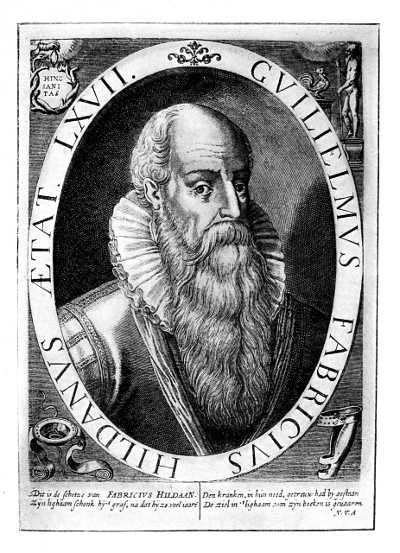
Wilhelm Fabry.
Arnauld Gilles, a Frenchman, in the year 1622, published in Paris
a work whose curious title we will here note: The flower of the remedies
against toothache.336 We know nothing else about this publication,
which, however, to judge from its title, cannot be other than a mere
compilation.
Dupont, another Frenchman, in 1633, published an important pamphlet,
which I have, unfortunately, not been able to see. I can, therefore,
only quote what Sprengel says of it.337 Dupont recommends, in cases of
obstinate toothache, the extraction and immediate replantation of the
tooth; which, he says, becomes quite firm again, but will no more cause
any pain. In confirmation of this, Denis Pomaret related, a little later,
a case in which a healthy tooth having been pulled out by mistake, and
immediately put back into the socket and treated with astringent remedies,
became perfectly firm again.338
Although Abulcasis and Ambroise Paré had already recommended
the replantation of teeth, the loss of which had been caused by trauma,
and although Peter Foreest had already made known as a result of
his own personal experience that the luxation (not, however, complete
extraction) of a tooth and its successive replantation is capable of causing
toothache to cease, nevertheless, we must recognize that the merit of
having elevated replantation in non-traumatic cases to a special method
of cure must be attributed to Dupont.
Wilhelm Fabry (1560 to 1634), a German, and native of the small
town of Hilden near Cologne, better known by his Latin name of Fabricius
Hildanus, was chief doctor to the city of Berne, and acquired great fame
as well by his extraordinary professional ability as by his works, consisting
principally in reports of many hundreds of important and instructive
clinical cases. He is rightly considered one of the most illustrious German
surgeons. His writings have largely contributed not only to the progress
of surgery in general, but also to that of dental surgery in particular.
One of his observations clearly shows the etiological relation frequently
existing between a prosopalgia or a supposed hemicrania and a dental
affection. The case referred to is that of a lady who had been subject
for six months to violent pain in the upper teeth of one side of the jaw.
The toothache little by little disappeared, giving place to an obstinate
cephalalgia in the same side of the head, which gradually became so intense
as to be perfectly insupportable, the patient being particularly subject
to it when the weather was cold and damp. After four years of atrocious
suffering, and after innumerable remedies had been tried without avail,
Fabricius Hildamus—having had the luminous idea of seeking the cause
of the evil in the teeth—obtained a complete cure, without further trouble,
by extracting four of the patient’s teeth, which were decayed.
Nowadays, it is an all-important canon of medical practice, that in
every case of neuralgia occurring within the region influenced by the trifacial
nerve one should give particular attention to the state of the teeth
and carefully treat every affection of the same. Notwithstanding—we
say it with regret—there are still medical men who ignore or neglect
this precept, and prescribe internal remedies or have recourse to injections
of morphine when they ought, in the first place, to call in the aid of a
dentist. How many patients would have been delivered from slow
martyrdom if the example of the clear-seeing physician of Berne had
been followed from his days up to the present time!
Fabricius Hildanus relates, besides, many cases of dental fistula,
cured by him through the extraction of roots or of decayed teeth. In
one such case the fistula dated from fourteen years back. Fabricius
Hildanus, contrary to the opinion of many other doctors, extracted a
decayed tooth, and by this operation obtained, in a brief period of time,
the complete recovery of the patient.
Among the many very important clinical cases cited by Fabricius
Hildanus, the following deserves to be recorded: In the year 1590 a
woman presented herself to him who had a hard tumor in the space behind
the last molar on the right side. The author, after having prepared the
patient for the operation by the methods then in use (that is, by aperient
medicine, by bleeding, and appropriate diet), destroyed the tumor by
the application of escharotic substances. The remaining wound, however,
defying all the cicatrizing remedies which the author had recourse
to, one after the other, by reason of its being continually disturbed by
the movements of the jaws, he then thought of maintaining the dental
arches in a determined position, and this he obtained by means of two
pieces of wood somewhat hollowed out above and below, which he placed on
the right and on the left between the upper and the lower teeth, fixing them
to the teeth themselves by brass wires passing through two openings made
expressly in each of the two pieces of wood. In this way he succeeded
in obtaining the absolute immobility of the jaws and the complete cure
of the wound in a few days, during which time the patient was nourished
with liquid food.339
A very interesting case, inasmuch as it demonstrated the damage and
peril which may result from certain absurd means of cure, was reported
to this author by Claudio Deodato, physician to the Prince-Bishop of
Basle. The case was that of a patient who, after having tried in vain
a great number of remedies for a stubborn toothache, finally had
recourse to the use of aqua fortis; but this substance, which in those days
was in frequent use for dental caries and for toothache, produced most
deleterious effects in the patient, that is to say, the loss of almost all his
teeth, necrosis of the inferior jaw, with fistulous sinuses and ulceration
of the neck, abundant sanious discharge, fever, a cachectic condition,
incipient necrosis of the upper jaw, etc.340 Fabricius Hildanus, consulted
by Claudio Deodato about this most serious case, proposed both a local
and a general treatment, the result of which is, however, not mentioned
in his book.
In the fifth “centuria of medical and surgical observations and cures”341
we find a case of oral surgery, to which it is worth while briefly to refer
here. It relates to an epulis situated next to the upper canine of the
left side. The tumor, already of ancient date, had at this time reached the
size of a walnut, was very hard, livid in color, irregular in form, and
adhered somewhat to the upper lip; according to the author, it was of
a cancerous nature. After the usual preparative measures, Fabricius
Hildanus proceeded to the ablation of the tumor, and to this end he first
pierced it with a curved needle and strong thread, in order to get a good
hold on it, and he then removed it entirely down to the bone, by means
of a curved bistoury.342
Fabricius Hildanus, having dissected several abortive fetuses of under
four months, was able to verify the exactitude of the assertion made by
Hippocrates, afterward luminously confirmed by different Italian anatomists,
that the teeth begin to be formed during intra-uterine life. And
with reference to this he also relates the following fact:
The wife of a Protestant minister gave birth to a female child which
already had a fully developed tooth, a lower middle incisor, equal in size
to that of a child of two years old, and which interfered with the sucking
by injuring the nipple of the mother’s breast and the tongue of the child
itself. So it was necessary that it should be removed. But it was found
to be so firm that the surgeon sought in vain to extract it with a thread,
and was obliged to have recourse to the forceps.343
Observation XXXI of the third centuria relates a case of rhinoplasty.
In the year 1590, when the Duke of Savoy made war on the inhabitants
of Geneva, a girl named Susanna N. fell into the hands of the soldiers,
who tried to deflower her; enraged at not succeeding in their intent, they
cut off her nose. Two years later the girl went to Lausanne, the residence
of J. Griffon, an eminent surgeon of that time, who performed the
rhinoplastic operation on her in so splendid a manner that one would
have taken the new nose for a natural one, not only from its normal
appearance, but also because the scar was hardly visible. Fabricius
Hildanus, having had occasion to see and examine the patient several
times, even up to twenty-one years after the operation, was able to testify
to the perfect condition of the nose; in the extreme cold of the winter,
however, it was apt to become livid at the point. He does not describe
the operative process followed by Griffon, but merely says that the first
inventor of this operation was Gaspare Tagliacozzi, of the University
of Bologna, and that Griffon had undertaken the reproduction of the same
from his own conception of it, based on the information imparted to him in
conversation, by an Italian who had been operated upon by Tagliacozzi.
Johann Schultes (1595 to 1645), a physician in Ulm, was the author
of a very important work entitled Armamentarium chirurgicum, in which
are given plates and descriptions of almost all the surgical instruments
that had been in use up to that date. As to the part relating to dental
and oral surgery, we find the following instruments named in this work:
1. Several kinds of pelicans; an instrument which was so called from
its resemblance to the beak of the bird of the same name, and used for
extracting the molar teeth.
2. The common dental forceps, then named cagnolo by the Italians,
because of the supposed likeness to a dog’s muzzle.
3. The crow’s beak forceps (rostrum corvinum), designed for the
extraction of dental roots, and, therefore, corresponding to the rhizagra
of Celsus.
4. Two special dental forceps, or dentiduces, for the removal of teeth
which could not be extracted either with the pelican or with the common
dental forceps.
5. Bifid and trifid elevators (vectes bifidi et trifidi), to be used for the
extracting of incisors and canine teeth, as well as roots.
6. Dentiscalpia for detaching the gum from the tooth before proceeding
to extract it, in order that this may be the more easily accomplished and
with less danger.
7. A silver funnel or cannula (infundibulum seu fistula argentea),
for nourishing patients affected with trismus, by conveying liquid food
into the fauces, through the free space behind the last molars.
8. Forceps more or less like in form to the beak of the parrot or the
vulture (rostrum psittacinum et vulturinum), for the removal or resection
of teeth that have grown in abnormal positions.
9. A screw dilator (dilatatorium cum cochlea), for gradually opening
the dental arches in cases of spasmodic constriction of the jaws.344
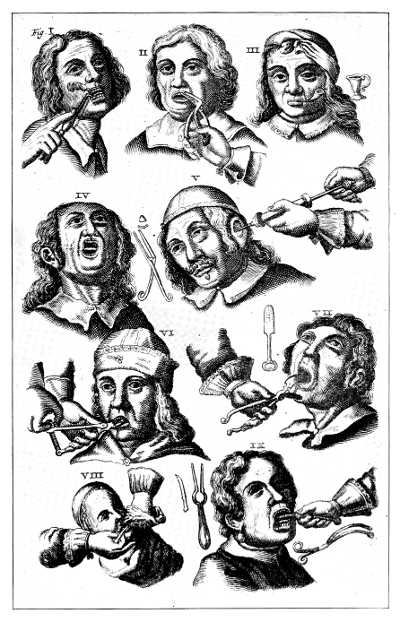
A plate of Schulte’s “Armamentarium Chirurgicum,”
showing some dental and other operations.
Fig. 77
A plate from Schultes’ “Armamentarium chirurgicum,” showing several dental instruments.
Marco Aurelio Severino (1580 to 1656), of Tarsia, a celebrated
professor of surgery in the Neapolitan University, had a great predilection
for the use of the cauterizing iron, which he also used very frequently
in curing caries and other dental diseases. At times, to effect a cessation
of violent toothache, he would have recourse to the cauterization of the
antihelix! Against flaccidity of the gums and loosening of the teeth he
also used cauterization, disapproving the use of astringent substances,
as these cannot get so far as the roots of the affected teeth. Severino
boasts of having cured by cauterization at least two hundred cases of
dental diseases.
Lazare Rivière (1589 to 1655), a professor at the University of
Montpelier, also known by his latinized name of Lazarus Riverius,
treats of dental affections and their cure, in various parts of his works,
considering them, however, almost exclusively from a medical point of
view.
He speaks first of all of the different causes of odontalgia, and, among
these, does not omit to mention worms. These, he says, may be generated
in the carious cavities, owing to the putrefaction of substances retained
in their interior. Whenever odontalgia is caused by worms, the pain,
says Rivière, is not continuous, but ceases and returns at brief intervals;
besides, the sufferer perceives at times the movement of the worm inside
the tooth!
What one reads in the works of this author as to remedies to be used
for odontalgia clearly demonstrates how irrationally dental diseases were
treated in the seventeenth century and what tortures were inflicted on the
patients. In many cases, and especially when the pain was held to be occasioned
by “hot humors,” the treatment was begun by bleeding in the arm.
The following day an aperient was administered. Afterward, if the pain
still persisted, the sufferer was cupped in the region of the scapulæ or of
the spine, blisters were applied to the nape of the neck or behind the ears,
resinous plasters to the temples; all this without taking into account the
remedies which were introduced into the ears, or the various medications
or operations performed on the aching part itself, and many other things
besides. In fact, in order to cure a toothache, the whole body of the
sufferer was seized upon and put to torture, and in the majority of cases
they assuredly finished by extracting the diseased tooth! When we reflect
on the extraordinary frequency of dental disorders we cannot do less
than recognize that the dentists, by the radical change effected in the
methods of treatment, have diminished in no small degree the sufferings
of humanity!
According to Rivière, the small veins (sic) that nourish the teeth pass
through the ear (!); and this would explain how the cessation of a toothache
may be obtained by the introduction of certain remedies into the
meatus auditorius externus. Relief may be obtained, for instance, by
dropping oil of bitter almonds into the ear on the side affected by the pain,
or by allowing the vapor of hot vinegar, in which pennyroyal or origanum
has been boiled, to penetrate into it. Others, adds the author, pour a
little pure vinegar into the ear, which is especially efficacious against
“hot fluxions.” When, however, the toothache depends on a “cold
fluxion,” it calms the pain wonderfully to drop into the ear a tepid mixture
of garlic juice and theriac. The same advantage, says the author, may
be obtained by introducing a piece of garlic, peeled and cut into the form
of a suppository, into the ear.
The author also makes a lengthy enumeration of anodyne and narcotic
remedies (among which opium), observing, however, that those remedies,
unless the vehemence of the pain obliges the use of them, ought not to
have the preference, it being much more rational and much more advantageous
to institute a cure which aims directly at the cause itself of the pain
(fluxions, worms, etc.).
He informs us that Amatus Lusitanus, a celebrated physician of the
sixteenth century, extolled, as a remedy for toothache, a decoction of gum
sandarach in wine and vinegar; the said decoction was to be made with
an ounce of sandarach in six ounces of wine and the same quantity
of vinegar, and ought to be kept in the mouth some length of time,
whilst hot.
Rivière further speaks of various masticatories, which were composed
of mastich, staphisagria, pyrethrum, henbane, etc.
He also mentions oil of cloves, which even then was used against toothache,
by introducing into carious cavities a small piece of cotton-wool
soaked in it. Oil of camphor was used in the same manner, but the most
efficacious of all, according to the author, was oil of boxwood.
As to worms in the teeth, they may be destroyed by the use of bitter
substances!
In the case of a caries penetrating into the inner cavity of the tooth,
to effect the cessation of pain, it is necessary to burn the nerve with the
actual cautery, or with aqua fortis, or with oil of vitriol. If this be
repeated several times, the tooth gradually falls to pieces.
After having enumerated all these remedies, the author speaks of the
extraction of the teeth, and of all the precautions with which this must
be carried out in order to avoid the various accidents which may result
from the operations and may even, sometimes, become a cause of death.
When abundant hemorrhage follows the extraction of a tooth, this
may often be made to cease by applying a small, very compact ball of
linen into the alveolus and maintaining it there by pressure during one
or two hours. Should this not suffice, one can combine with compression
the use of astringent substances. Finally, as a last remedy, use may
be made of the red-hot iron.
In the case of timid patients, who shrink from an instrumental operation,
recourse may be had to eradicating remedies, the author being fully
convinced of their efficacy. Indeed, one of these—helleboraster—is
said to be so powerful that, when rubbed on the teeth, these fall out
within the space of a few hours; for which reason it is absolutely necessary,
in making use of it, to cover over the neighboring teeth with wax,
so that the healthy ones may not also fall out, as happened, says the
author, in the case of a poor peasant.
The internal use of mercury, and even the use of certain mercurial
preparations used by women as cosmetics, is of damage to the teeth and
imparts to them a blackish or dirty looking color.
Numerous remedies exist for cleaning the teeth, but according to
Rivière the best way of cleaning them consists in rubbing them with
a small stick immersed in sulphuric acid (spiritus sulphuris aut vitrioli)
and afterward drying them with a piece of linen. This remedy not
only cleans and renders the teeth white, but it preserves them also from
caries! If the teeth are very dirty, the spirit of vitriol may be used
pure; otherwise one mixes it with mel rosatum or with water.
The great enthusiasm shown by Rivière for the above-mentioned
remedy does not, however, derive from a long experience, made by himself
or by others, of its advantages, but is based principally on a fact
referred to by Montanus, and which,345 we will here recount, because, from
it, one clearly perceives how credulously our forebears accepted general
affirmations and formulated therapeutic precepts.
Montanus recounts in one of his writings, how, being in Rome in his
early youth, he became acquainted with a woman of about twenty years
of age, known by the name of Maria Greca (by the way the author
speaks of her, one is led to suspect she was a courtesan); and how, having
seen her again, thirty years later, and found her in pretty much the same
conditions as formerly, he expressed his surprise at this; whereupon
Maria Greca told him that she herself believed that she owed the conservation
of her beauty to the habit, already of many years’ standing,
of using one or two drops of oil of vitriol every morning, as a friction for
the teeth and gums. In her youth she had had very bad teeth, but by
reason of this cure they had become, and were at the time being, beautiful
and perfectly firm; the gums also were in excellent condition; it seemed,
therefore, to her that this conservation of health and freshness, in spite
of her fifty years, depended precisely on the daily use, in the manner
described, of oil of vitriol!346
Rivière, besides, recommends tobacco ashes for cleaning the teeth, a
counsel not yet given by any previous author. He also gives the formulæ
for two dentifrice powders, the basis of which is alum; he calls attention
to the great importance of taking assiduous care to keep the teeth clean,
and advises that after each meal the residues of food be removed from
the interstices of the teeth and the mouth well rinsed with wine.347
Nicolaus Tulp, in Latin, Tulpius (1593 to 1674), a distinguished
physician and anatomist of Amsterdam, contradicts the then prevailing
opinion among doctors, that is, that the cure of dental affections and the
operations relating thereto were matters to be held in little account.
He observes that diseases of the teeth may give rise to the most serious
consequences, which can even be the cause of death, and are, therefore,
worthy of being taken into equally serious consideration as all the other
diseases of the several parts of the human body.
This author relates a clinical case tending to demonstrate how incisions
made in the gums, advised in the first place by Vesalius, in order to
facilitate the erupting of the last molar, are not always exempt from
danger. A young doctor of Amsterdam, by name Goswin Hall, being
tormented by insupportable pain caused by the difficult eruption of a
wisdom tooth, had the gum lanced above it. But the pain, instead of
diminishing, became worse; fever and delirium supervened, followed by
death! (Here, however, we must be allowed to observe that nothing
demonstrates that the real cause of death was the lancing of the gum,
or that without this the case would have had a different termination.
An event can occur after another and yet be quite independent of the
former and result from quite different causes.)
Among the cases cited by Tulp, the following is also worthy of mention.
He relates having arrested a violent and persistent attack of hemorrhage,
which came on after the extraction of a tooth, by applying and compressing
a piece of sponge inside the alveolus.348
The belief that dental caries and toothache could be caused by worms
was, at that time, still in full vigor, and it gained still greater force by
reason of observations recorded by different scientists, whose affirmations
could with difficulty be doubted, for at that period the greater number
still swore blindly in verba magistri.
Oligerus Jacobaens (1650 to 1701), a Danish physician and anatomist,
who taught in the University of Copenhagen, declared that in scraping
the decayed cavity of a tooth that was the cause of violent pain, he had
seen a worm come forth, which, having been put into water, moved about
in it for a long time.
Martin Six, having split some decayed teeth a short time after they
had been extracted, asserts that he determined the existence of worms in
them. (It is probable that this observer, as well as others, mistook the
dental pulp for a worm, an unpardonable error, in truth, at a time when
the anatomical constitution of the teeth had already been very well
studied by several scientists, and especially by the celebrated Bartolomeo
Eustachius.)
Gabriel Clauder (1633 to 1691) not only believed in dental worms,
but maintained besides that these were the most frequent among all the
causes of toothache. In a certain way, to sustain this opinion of his, he
relates a case in which a tooth of healthy appearance being the seat of
great pain, a tooth-drawer had asserted that there must be a worm in
its interior; and, in fact, on the tooth being extracted and afterward split,
the little animal whose existence the tooth-drawer had divined, was found
to be existing inside of it!
Philip Salmuth asserts that by using rancid oil he got a worm out
of the decayed tooth of a person suffering from violent toothache, thus
causing the cessation of the pain. The worm, he says, was an inch and
a half in length (!) and similar in form to a cheese maggot.
Nicolaus Pechlin (1646 to 1706), professor of medicine at Kiel,
testifies to having seen five such dental worms, like maggots, come out
by the use of honey, though he does not say whether they issued from
several cavities or from one only!
Gottfried Schulz. But all this is nothing compared to what
Gottfried Schulz has dared to assert, viz., that by using the gastric juice
of the pig, worms of great size can be enticed out of decayed teeth; some
of these even reaching the dimension of an earth-worm!
It is not much to be wondered at that these things should have been
blindly believed in, if we reflect that only a short time previous to this
the story of the golden tooth had been taken seriously by men of great
erudition, and that in the very epoch of which we are speaking the illustrious
anatomist Thomas Bartholin (1616 to 1680), of Copenhagen,
relates having seen a man, at Padua, who had an iron tooth! Besides,
the possibility of such a phenomenon was explained in a most curious
manner by Thomas Minadous, who explained that in the same way
as iron is generated in the macrocosm, that is, in the world, so it is
equally admissible that it may be generated in the microcosm, that is,
in man!349
Nathaniel Highmore. In the year 1651 the English physician and
anatomist Nathaniel Highmore (1613 to 1684), of Hampton, published
a treatise on anatomy (Corporis humani disquisitio anatomica, etc.), by
which he acquired a celebrity superior, perhaps, to his merits. This
work, however, served without doubt to diffuse the knowledge of an
anatomical fact of the highest importance, especially from the point of
view of dentistry and surgery.
There is no doubt that the existence of the maxillary sinus was already
known before Highmore, the celebrated anatomists Vesalius, Ingrassias,
Eustachius, and Fallopius having spoken of it very clearly; only through
ignorance of the history of anatomy has it been affirmed by many that this
cavity was discovered by Highmore, to whom is only due the merit of
having described the maxillary sinus, by him called antrum, most accurately,
and of having made known the possibility of a communication
between it and the mouth. Highmore calls attention to the fact that the
inferior wall of the antrum often presents small projections, which correspond
with the tops of the alveoli, and that the osseous lamina which
interposes between these latter and the maxillary sinus is often extremely
thin; for which reason, it may easily happen that, in extracting one of the
teeth below the cavity, one may bring away together with the tooth the
small osseous plate that forms the bottom of the alveolus, thus leaving
the maxillary sinus open at its inferior part. With regard to this, he
refers to a most interesting case which afterward acquired a high degree
of notoriety. It relates to a lady who had suffered from toothache for
some years, and who from time to time had had several decayed teeth extracted,
without, however, finding relief. The pain only ceased after the
patient had had the left upper canine removed. But after this operation
an incessant flow of humors from the alveolus of the extracted tooth took
place. The patient, in great anxiety at this circumstance and desirous
of seeing clearly into the causes of it, herself explored the affected part
with a silver probe, the entire length of which penetrated into the cavity,
producing in the patient the effect of its having reached the eye. Still
more amazed, and urged on by the desire of becoming still better acquainted
with the extent of the evil, she now made use of a long feather,
which she had previously stripped, and discovered to her painful surprise
that this new instrument of exploration entered to so great a distance
that it, according to her idea, penetrated into the skull. From this she
derived argument for the belief that the morbid phenomenon had its
origin in her brain. Believing herself affected with a serious malady,
she consulted Highmore, who had the satisfaction of being able to tranquillize
her completely by making her understand that the jaw bone is
hollow in the inside, and that its cavity had remained open underneath
in consequence of the extraction of the canine tooth; and also, that the
feather had not penetrated to such a distance as she supposed, but had
curved inside the bone. As to the discharge which had given so much
trouble and alarm, Highmore considered it quite a natural circumstance,
derived simply from the opening of the antrum, as he held that in many
cases the maxillary sinus contains mucus, and that this condition was,
therefore, altogether normal. So he did not propose any treatment,
and the lady thenceforth supported her infirmity with resignation.
This most interesting case soon became generally known, and contributed,
without doubt, not a little to attract the attention of medical men
to the anatomical peculiarities which Highmore had pointed out in the
upper maxillary bone, thus causing his name to become inseparably
associated with the maxillary sinus.
It is evident, however, that Highmore never even suspected to what
very important practical applications his description would give rise.
He knew nothing about the diseases of the antrum, and believed that,
even in perfectly normal conditions, this cavity is often filled with liquid;
the idea, therefore, of its being advisable, in certain cases, to extract a
tooth and perforate the alveolus in order to give exit to the liquid contained
in the maxillary sinus never occurred to him.
About fifty years went by before a rational treatment for affections of
the antrum was initiated, the merit of which, as we shall see at its time
and place, was due to William Cowper. During that half century
maladies of the maxillary sinus continued to be badly diagnosticated and
badly treated.
Bernardo Valentini. In the year 1686, that is, thirty-five years
after the publication of Highmore’s book, Bernardo Valentini, professor
at the University of Giessen, described a case of tumefaction and abscess
in the cheek, treated by him with emollient remedies, and in which,
although according to him caries of the underlying bone did not exist,
the separation of a sufficiently large osseous fragment took place. Without
doubt the affection of the cheek was derived in this case from some
disease of the antrum; however, it would appear that Valentini did not
in the least perceive any such casual relation, as he makes no allusion
whatever to it.350
Antonio Molinetti, professor at the University of Padua, had, however,
ten years previously, diagnosticated and cured an affection of the
antrum by means of an operation. In his book Dissertationes anatomico-pathologicæ,
published at Venice in 1675, Molinetti relates that
in a case of abscess of the maxillary sinus, which caused the patient great
suffering, he performed the operation of trepanning the upper maxillary
bone anteriorly, after incision of the soft parts overlying it. In a certain
way we may, therefore, consider Molinetti as a precursor of William
Cowper.
Having spoken of the very important anatomical fact illustrated by
Highmore, we will now also speak briefly of those authors who, in the
seventeenth century, occupied themselves with the anatomy of the teeth.
Their number is sufficiently large; we will, however, only make mention
of such as contributed to the development of this branch of science, or
who, at least, expressed some opinion worthy of note.
The celebrated anatomist Adrian Spiegel (1578 to 1625), better known
by the Latinized name of Spigelius, wrote nothing noteworthy about
the teeth, but he appears to have been the first to affirm that the teeth
are more firmly fixed in the alveolus, when their roots are curved after
the manner of hooks.351
Diemerbroek, a Dutchman, relates several cases of dental anomalies,
as for example, of teeth being cut in the palate, and which injured the
tongue. The author cites his own case, relating that having had a
canine tooth extracted when well advanced in years, it was, nevertheless,
succeeded by a new one. He relates, besides, that he had seen in Utrecht
a woman, aged fifty-six years, who again cut two incisors after having
lost the former ones two years previously. Apart from this, Diemerbroeck
tells us nothing of interest or importance regarding the teeth,
often repeating old ideas, the falseness of which had already been luminously
demonstrated. For instance, he says that the permanent teeth are
developed from the roots of the deciduous ones remaining in the alveoli;
an unpardonable error for an anatomist of the seventeenth century, for
which he was afterward taken to task by Duverney.352
Thomas Bartholin, whom we have already mentioned, speaks of
a tooth which had made all the round of the alveolar border; that is
to say, of a dental arch constituted by a single piece; and the Italian
anatomist Bernardo Genga makes mention of an analogous case.353
It is superfluous to add that these authors allowed themselves to be
deceived by false appearances, owing especially to an abundant and uniform
deposit of tartar on the surface of the teeth and in their interstices,
which gave to the dental arch the appearance of one continuous piece.
Rinaldus Fredericus, in his erudite dissertation entitled De dentium
statu naturali et præternaturali, spoke of the dental system with sufficient
thoroughness, if we consider the epoch in which he wrote. He commences
his work with a long chapter on the importance and dignity of the teeth
(dignitas dentium). Among other things, he relates that formerly, in
certain parts of India, the teeth were so highly valued as to be offered
in sacrifice to the gods. He says, too, on the authority of certain authors,
that the ancients were led to believe that the teeth served for the resurrection
of the body, from the circumstance of their not showing signs of
corruption when found in sarcophagi.
Discoursing of the genesis of the teeth, Fredericus says that “every
tooth is at first enclosed within a follicle, that is, in a frail, skin-like
membrane, in the same manner as the grain in the wheat-ear.” Taking
this comparison as his point of departure,354 he gives to dentition the name
germination.
This author says that the teeth of the Ethiopians and of the Indians
are generally whiter than those of the northern peoples, but that those
of the Indians soon lose their primitive whiteness by reason of the widely
diffused habit of chewing betel-nuts.
Fredericus refers to an experiment which, according to him, demonstrates
the “sympathetic relations” between the teeth and the ear (whilst
in reality it only proves the facility with which sounds may be transmitted
through solid bodies). “If, by night,” says he, “one holds tightly
between one’s teeth the end of a stick, stuck upright in the ground,
one hears the footsteps of a person approaching from afar much more
easily.”
Through the researches of three great men, Marcello Malpighi,
Friedrich Ruysch, and Antoni van Leeuwenhoeck, an altogether new
science arose in the seventeenth century, viz., histology, or the anatomy
of the tissues, whose revelations contributed not a little to the development
of modern odontology.
Marcello Malpighi (1628 to 1694), the celebrated Italian anatomist,
was the initiator of microscopic observations on the tissues, and is, therefore,
justly considered the founder of histology, within the range of which
he made most important discoveries.355
Friederich Ruysch (1638 to 1731), professor at Amsterdam, rendered
his name illustrious particularly by bringing to a high degree of perfection
the processes of anatomical preparations and of embalming.356
His magnificent injections, carried out with a method of his own
invention, enabled him to trace the most minute vascular ramifications
and to demonstrate the existence of capillary vessels in parts where their
presence had as yet never been suspected.
Ruysch studied accurately the anatomical constitution of the teeth, and
especially their vessels. He called attention to the membrane which lines
the maxillary sinus, and discovered in it a number of bloodvessels.
But in addition to his purely anatomical observations, this author also
merits our consideration from the point of view of pathology. He confirmed
a most important fact to which allusion had already been made
by preceding authors, that is, the atrophy of the alveolar parietes as
following on the extraction or on the falling out of teeth. Ruysch, however,
makes the observation that atrophy of the alveolar parietes may
also precede the falling out of the teeth, and rather be the cause than an
effect of it. In such cases the teeth, before falling out, always become
more and more loosened, proportionately to the atrophic process. This
pathological condition, against which none of the astringent remedies
habitually used are of avail, is mostly considered, says Ruysch, to be
owing to scurvy; but, he adds, the accumulation of tartar may also
be the cause of it. Substantially, Ruysch affirms the relation existing
between the accumulations of tartar and the production of that very
frequent disease that was afterward named expulsive periodontitis or
alveolar pyorrhea.
This author also relates two cases of polypous affection of the maxillary
sinus. In one of these cases, the existence of a polypus in the maxillary
sinus was determined by Ruysch while dissecting a corpse. The other
case relates to a female patient upon whom two surgeons had performed
the extraction of several molar teeth and the extirpation of an epulis
believed by them to be of a malignant character. After the operation they
cauterized the diseased part to a great depth with a red-hot iron, reaching
as far as the maxillary sinus, which remained open, and from which
Ruysch afterward extracted with his little finger several polypi.357
Antoni Van Leeuwenhoek (1632 to 1723), like the preceding author,
a Dutchman, was the first maker of powerful microscopes, by means of
which he made many important discoveries; among others, that of the
tubular structure of the dentine or tooth bone. This discovery he made
known and demonstrated in the year 1678, before the Royal Society in
London. In his description of the structure of the teeth, Leeuwenhoek
says that 600 to 700 of the dentinal tubuli have hardly the consistence of
one hair of a beard.358
In the year 1683 he discovered in the tartar scraped from between the
teeth a form of microörganism upon which he laid special stress. This
observation he embodied in the form of a contribution which was presented
to the Royal Society of London on September 14, 1683. This
paper is of particular importance, not only because of the careful, objective
nature of the description given of the bodies seen by him, but also for the
illustrations which accompany it. From a perusal of the text and an
inspection of the plates, there remains little room for doubt that the
bodies described by Leeuwenhoek were not animalcules, as he believed,
but bacteria.359
Domenico Gagliardi, professor of anatomy and of medicine at Rome,
published an excellent work on the anatomy of the bones,360 in which he
occupies himself not only with the structure of bones, properly so called,
but also with that of the teeth. He considers the enamel to be formed
by parallel and contiguous fibers, coated, so to speak, by a concreted
juice, sui generis, which acquires a much greater consistence than that
of the bones. Gagliardi says that by rubbing teeth hard together, or
striking them with a steel, he was able to extract sparks from them.361
Jean Duverney (1648 to 1730), a celebrated French anatomist,
wrote a good monograph362 about the teeth. As different anatomists of
the sixteenth century had already done, he examined many fetal jaws
in order to study in them the formation of the teeth. In relating his
observations, he says that he found in every alveolus a mass of soft viscous
matter, having the form of the tooth that is to derive from it, and which
may be considered as its nucleus. This nucleus is entirely surrounded
by a membrane, which the author likens to that which surrounds the
fetus, and to which he gives the name of choroid membrane. From the
surface of the nucleus a gelatinous juice transpires, which, thickening
in layers, forms the enamel and the rest of the tooth. The choroid
membrane is abundantly furnished with nerves, and with blood and
lymph vessels. Into the interior of the teeth penetrate vascular and
nervous branches which serve to maintain its vitality. In fetal jaws one
finds, besides the germs of the deciduous teeth, also those of the permanent
ones. The “choroid membrane” does not follow the tooth when it
issues from the alveolus; it remains instead within the latter, forming
the peridental membrane.
Duverney says that in old people the root cavity diminishes in so considerable
a manner, and the vessels are so compressed that they almost
entirely disappear. It is then that a period of decadence begins in the
tooth, it is more feebly nourished, wears away more rapidly than hitherto,
and becomes shorter.
The author also speaks of senile atrophy of the jaws, especially of the
alveolar processes. With regard to this, he observes that if in old age
the lower jaw advances beyond the upper, this depends wholly on the
disappearance of the alveolar border, which projected more in the upper
than in the lower one.
Duverney admits the existence of direct vascular relation between the
gums and the teeth; because in the case of diseases of the gums it is rare
not to find the teeth altered as well.
From the point of view of the development and nutrition of the teeth,
Duverney finds much analogy between the tusks of the elephant, the
teeth, properly so called, the feathers of birds, and the hair of mammifera.363
Gottfried Bidloo, a Dutch anatomist, expresses the idea that the
air contributes, after the eruption of the teeth, to hardening them. He
did not, however, give any proof of this opinion of his.364
Clopton Havers, an Englishman, wrote a book on osteology, by which
he acquired great reputation,365 and in which he treats as well of teeth
and their structure. This author believes the enamel of the teeth to
be of the nature of stone, and the ivory of the nature of bone. The
dental roots, which, he says, are precisely of a bony nature, are covered
over with a periosteum, which is in close relation with the gums and with
the periosteum of the jaw bone. Clopton Havers held that the dental
follicle no longer furnishes any nourishment to the enamel from the
moment that this has reached its perfect formation. On the other hand,
he assures his readers that he has observed, through the microscope,
nervous threads which, departing from the bulb of the tooth, traverse the
ivory through small canals, arriving thus at the periosteum. By this
anatomical disposition the sensibility of the teeth may, according to him,
be explained.366
Having made this passing allusion to the anatomy of the teeth in the
seventeenth century, we will now resume the illustration of those facts
relating to the pathological and curative part of the science.
Walter Harris, an Englishman, in a pamphlet on acute infantile
maladies,367 recommends again, in cases of difficult dentition, the incision
of the gums, a curative practice which had already fallen into disuse.368
In the authors of that time we find registered a great number of cases
of epulis. Hiob Van Meekren speaks of an enormous tumor of the
gum that developed in consequence of a traumatic action which had
occasioned the loss of a tooth. Before deciding on the extirpation of the
tumor, the author thought well to pierce it with a bistoury, to be able to
judge whether its ablation might not possibly give rise to a dangerous
hemorrhage. The wound having bled but little, he proceeded to operate;
but the tumor was so large that it was necessary to remove it in various
portions.369
The same author refers to a case of a soft epulis, bleeding easily, that
developed after a badly performed dental extraction. It was to be foreseen
that the ablation of such a tumor would give rise to an abundant hemorrhage.
This was, however, staunched by simply using astringent powders,
without having recourse to the actual cautery, which the operator had
held in readiness.370
Daniel Major, wishing to remove a large epulis by tying it, was
obliged, in order to keep the ligature in position, to pass the thread through
a circular incision made at the base of the tumor. He first used a
thread of silk, afterward a silver one, and tightened the ligature every
day until the epulis fell off.371
Johann Acoluthus was obliged, in order to extirpate a large epulis,
to previously split the labial commissure. After the ablation of the
principal mass of the tumor, he destroyed the remaining part of it by
application of the red-hot iron.372
One reads of other cases of epulis in Stalpaart van der Wyl, Mercklin,
Preuss, Bern, Valentini, etc. This last author even speaks of an epidemic
of epulis. However this may be, it is very probable that epulis
was much more frequent in past times than it is now, and this probably
depended partly on the incongruous modes of treating diseases of the
mouth, and partly on the slight attention paid to cleanliness of the teeth.
Kornelis van Soolingen, a celebrated Dutch physician and surgeon,
who flourished toward the end of the seventeenth century, speaks contemptuously
of dental operations, and especially of extractions. He says
that such operations ought to be left to charlatans, used to taking out
teeth with the point of the sword, and to doing many other things of like
nature! This unjust contempt was at that time widely diffused in the
medical class, it resulted, however, substantially, from the great difficulties
encountered by doctors and surgeons in general, in performing the
operation of extraction, owing to want of practice, and also from the
desire to avoid the responsibility of the accidents to which the extraction
might give rise; so true is this, that an author of the preceding century,
Theodor Zwinger (1538 to 1588), a celebrated Swiss doctor and professor
at Basle, had declared with great frankness that the extracting of
teeth ought to be left to barbers and charlatans, as it might easily occasion
unpleasant accidents, such as fractures of the jaw, laceration of the gums,
serious hemorrhage, and the like.
In spite of his contempt for practical dentistry, Kornelis van Soolingen
takes the treatment of dental affections into attentive consideration. For
the stopping of carious teeth, he recommends a mixture similar to that
which Rhazes had recommended many centuries before, that is, a cement
of mastic and turpentine; because, says he, when the stopping is made
with metallic substances, it is never so perfect as to entirely impede the
penetration of moisture.
Great credit is due to Kornelis for having first brought into usage
the instrument makers’ emery wheels for grinding down sharp edges
of teeth, thus initiating the practice of trepanning the teeth with sphere-shaped
burs.373
Paul Wurfbein refers to a case of extensive necrosis of the lower
jaw, in which a certain Dr. Bürlin having removed the necrotic portion,
regeneration of the bone took place.
Friederich Dekkers (1648 to 1730) refers a similar case, in which,
although quite one-half of the lower jaw had been removed, the bone
formed again completely.374
Benjamin Martin, apothecary to the Prince de Condé, was the
author of a pamphlet on the teeth,375 in which he gave a succinct description
of these organs and spoke briefly of their diseases. He shows himself
decidedly opposed to the use of the file and to the application of false
teeth, because, according to him, both of these things may be the cause
of great harm. With regard to the file, he says that nothing so easily
tends to loosen the teeth as the use of this instrument, not to speak of
various other inconveniences, among which is the danger of opening the
interior cavity of the tooth.376
Matthias Gottfried Purmann (1648 to 1721), a celebrated surgeon
of Breslau, was the first to make mention of models in dental prosthesis.
As to the mode in which these models were obtained, some admit as
natural that he first took a cast, and formed the model on this; but as
Purmann does not hint in the least at such a process, the supposition is
altogether gratuitous. Indeed, his description rather excludes any probability
that the model was taken from a cast. Here is the literal translation,
as nearly as possible, of the passage in which Purmann speaks
of artificial teeth and of the mode of applying them.
“The front teeth, or pronouncing teeth, ought, when they are wanting,
to be substituted by artificial ones, in order to avoid defects of pronunciation,
as well as to obviate deformity of the mouth, and this is carried out
in the following manner: One has other teeth made of bone, or of ivory,
according to the number, the size, and the proportions of those wanting;
for which purpose one may previously have a model executed in wax,
reproducing the particular conditions of the teeth and jaws, in order
afterward to make and exactly adjust the whole on the pattern of it;
then, when the base of these teeth is well fitted on the jaw and small
holes have been made in the artificial teeth and also in the natural
ones next to them, one applies the artificial teeth in the existing void
and fixes them as neatly as possible with a silver wire by the help of
pincers.”377
It would appear that the author is here describing a prosthetic method,
which he had never practised himself; and this results from the fact of
his advising the perforation of the natural teeth for the passage of the silver
wire destined to keep the prosthetic piece in its place. Evidently desiring
to describe the mode practised by the specialists of those days for fixing
artificial teeth, he erroneously imagines that the metal thread was passed
through the holes drilled in the natural teeth; this would have been impossible,
first, because of the atrocious pain due to the sensibility of the
dentine and of the dental pulp, and then because of the pathological
consequences to which the perforation of the teeth would have given rise.
We may, therefore, surely hold that Purmann is simply describing, and
not even accurately, a prosthetic method already in use among the
specialists of that period.
On examination of the passage cited above—which, however, is not
so clear as might be desired—it would appear that the models of which
the author speaks were most probably quite different from those in use
now. It is almost certain that the specialists of those days first made a
sketch of the prosthetic part to be constructed, using for the purpose
a piece of wax which they partly modelled with the hand and partly
carved; and after having tried on this model until it fitted perfectly in
the mouth, and was in every way satisfactory, they probably passed
it on to a craftsman to make an exact reproduction of it in bone or
ivory.
In the year 1632 a little book was published in Naples, having for its
title, Nuova et utilissima prattica di tutto quello ch’al diligente Barbiero
s’appartiene; composta per Cintio d’Amato.378 This pamphlet was
reprinted in Venice in 1669, and again in Naples in 1671. We here
make mention of it, not for any special importance which it really has as
regards the development of the dental art, but because of its being most
probably the first book in the Italian language in which dental matters
are spoken of independently of general medicine and surgery.
Tommaso Antonio Riccio. The edition of 1671 was published
under the supervision of Tommaso Antonio Riccio, who was for many
years a disciple of Cintio d’Amato, and who greatly eulogizes his master
and praises his work. He expresses himself in the following bombastic
manner: “This book, the offspring of Master Cintio d’Amato, excellent
in the Barber’s Art, ought to find a place in the bosom of Eternity; because
by reason of its having been twice given to the light, it has proved its
worthiness to live forever in the memory of men, gaining for itself, by
its excellence, immortal glory before all such as are practised in the
Art.”
The book—which consists of about one hundred and eighty pages,
and is illustrated by several admirable engravings—contains, among
other things, two pages of verses, written by various authors, viz., by
Cintio d’Amato himself, by Giovan Battista Bergazzano, also a barber,
and by others. The greater part of these verses are in praise of the
two doctors and Martyrs in Christ, Cosmos and Damianus, special protectors
of the Art and of the author.
The verses of Cintio d’Amato reveal the possession of a literary and
poetic culture above the ordinary, in spite of his being only a master
barber. As to his book, it may be considered, for the time in which it
was written, as an excellent treatise on so-called minor surgery. The
author expounds, in a few chapters, the anatomical notions relating to
bleeding; speaks at great length of this operation and of everything
concerning it; refers with much detail to all pertaining to the use of leeches,
cupping, scarification, cauteries, issues, blistering, primary treatment of
the wounded, nursing of the sick, etc.; at the end of the book there is
also a long chapter on the embalming of corpses.
As regards the treatment of the teeth and gums the author dedicates
six chapters thereto, entitled, respectively: “On the relaxation of the
gums” (Chapter XXXVII); “Preparation for strengthening the gums
and making the teeth firm” (Chapter XXXVIII); “On tartar and
spots on the teeth” (Chapter XXXIX); “Another preparation for
whitening and preserving the teeth” (Chapter XL); “Mode of burning
hart’s horn, very necessary in preparations for the teeth” (Chapter
XLVII); “‘Water of salt,’ which makes the teeth white and is also
good for ulcers of the gums” (Chapter XLIX).
Evidently Cintio d’Amato treats of dental matters only within extremely
restricted limits. He tells us nothing with regard to the treatment of
toothache, nothing about caries, about prosthesis, and, what is still more
remarkable, he does not allude even in passing to the extraction of teeth.
Now, if in a book treating of all that which appertains to the diligent barber,
the most important dental subjects are passed over in silence, this shows
that, contrary to the generally diffused opinion of today, the dental art
was not at that time (at least not in Italy) exclusively, or even in great
part, in the hands of the barber. Even at that time there must have
been dental specialists, and the proof of this may be found in d’Amato’s
book itself, in the chapter entitled “Necessity and Origin of the Barber’s
Art.”379 The author, after having spoken of the divisions which the
practice of the medical art had undergone from the most remote times,
and after having alluded to the great number of parts into which Medicine
was divided in the time of Galen, adds: “Which may also be seen in
our own times, for as many as are the members of the human body, so
many are nowadays the various kinds of doctors and of medicines.
Some are for the teeth, some are for the ears, some for sexual maladies,
others are ordinary doctors, others cure cataracts, others ruptures and
stone, some make new ears, lips, noses, and others remedy harelips.”
As, under the generic name of doctors, Cintio d’Amato also comprises
surgeons, it results from the above passage that in his time, that is, in
the seventeenth century, there were surgeons who dedicated themselves
specially to the treatment of the teeth; there were, in fact, dentists; and
even admitting that the greater number of these were no better than
simple tooth-pullers, this cannot be true of them all indiscriminately.
Cintio d’Amato’s book demonstrates in the most vivid manner that even
among the barber and phlebotomist class, that is, among the practitioners
of minor surgery, there were, at that time, men of considerable culture.
This ought to hold good with still greater reason concerning surgeons,
whose professional level was certainly superior to that of barbers;380 and
as dentists belonged to the class of surgeons (whence the denomination
still in use of “surgeon-dentist”), it is but natural to admit that besides
the ignorant tooth-puller there were even then more or less cultured
dentists well capable of treating dental diseases and performing dental
operations within the limits permitted by the knowledge of the times.
The six chapters in which Cintio d’Amato speaks of matters referring
to the teeth do not contain anything whatever of real importance; notwithstanding
this, we will here refer to the beginning of Chapter XXXIX,
treating “Of tartar and spots on the teeth,” because it is of some historical
interest:
A TOOTH-PULLER AT A PUBLIC PLACE IN HOLLAND
From an engraving of the Seventeenth Century.
“It happens in general that owing to vapors that rise from the stomach,
a certain deposit is formed on the teeth, which may be perceived by
rubbing them with a rough cloth on waking. One ought, therefore, to
rub and clean them every morning, for, if one is not aware of this, or
considers it of little account, the teeth become discolored and covered
with a thick tartar, which often causes them to decay and to fall out.
It is then necessary that the diligent barber should remove the said tartar
with the instruments destined for this purpose.”
We have seen that the practice of the dental art was for the most part
in other hands than in the barber’s. Nevertheless, the important operation
of the removal of tartar was also carried out by him. If, therefore,
even the barbers, who were not in the least the true representatives of the
dental art of that period, carried out such an important operation, it may
logically be argued from this, in support of what we have said before,
that the sphere of action of the true dental specialists of those times
(especially of the best among them) was not at all so limited as imagined
by those who affirm that in past times dentists properly so called did not
exist, but only tooth-pullers.
The barbers, however, having become, in a certain manner, members
of the medical class, sought to extend their sphere of action, and it is
probable that in a later period than that of Tiberio Malfi and Cintio
d’Amato they invaded the whole field of dental activity; for which reason,
when the barber’s art came down to a very low level, the dental art must
have degenerated, too, and have been represented for a certain time only
by ignorant barbers and tooth-pullers. Vicissitudes similar to these
have occurred in different epochs, not only in various parts of Italy,
but also in other countries of Europe.
Fleurimond. In 1682 a little book on dental hygiene was published
in Paris by a certain Fleurimond, the title of which was: Moyens de
conserver les dents belles et bonnes. Portal, in his history of anatomy
and surgery, makes mention of this pamphlet, and, briefly alluding to
certain parts of it, he says: “The author proves by observation that
acids act upon the enamel of the teeth. He makes some very just reflections
upon dentition. Fleurimond speaks of a tooth powder invented by
him, but does not say how compounded.”381
In fact, it seems that this pamphlet was compiled from a commercial
point of view, viz., that of making known the special tooth powder invented
by the author. The era of advertisement had already begun!
Anton Nuck (1650 to 1692), a Dutch surgeon and anatomist, who
taught most ably in the University of Leyden, devoted great attention
to dental surgery and prosthesis. Relative to the extraction of teeth, he
says that, in order to be able to carry out this most important operation,
an exact anatomical knowledge of the alveoli and of the teeth themselves
is required. He insists on a principle of capital importance that has
only had its full application in the nineteenth century, viz., that the
instruments to be used for the extraction of teeth ought to vary according
to the tooth to be extracted. For the removal of the incisors, he says,
the “goat’s foot” should have the preference; the canines ought to be
extracted with the common dental forceps, but sometimes, when they
are decayed, they may be extracted with greater security with the pelican;
for the small molars the straight-branched pelican is to be preferred,
for the large molars the curved pelican; as to the extraction of roots
or of splinters of bone, this ought to be carried out with the rostrum
corvinum.
The author counsels never to extract teeth during pregnancy, except
under circumstances of the greatest urgency, and especially to avoid the
extracting of the upper canines (or eye teeth), this being capable of producing
pernicious effect on the visual organs of the fetus!
The best way of obtaining the cessation of a violent toothache without
having recourse to extraction is, according to the author, cauterization of
the antitragus, an operation which he carried out with a special cauterizing
instrument, made to pass through a small tube, the better to localize
and to limit the action of the red-hot iron. With regard to this means of
cure already recommended by other authors, we may remark that, although
it seems ridiculous at first sight, and although no one could be so senseless
as to make use of it in our days, nevertheless, for the times of which
we are writing, when the curing of toothache was in a great measure
effected by indirect means, this remedy might well stand on a level with
many others, and was not perhaps altogether inefficacious. It is a sufficiently
well-known physiological fact that the application of a strong
stimulus in one part of the body may diminish or suppress a painful
sensation in another part of the organism. It is an equally well-known
fact that it is in no way a matter of indifference, in producing this phenomenon,
to what part the stimulus be applied, especially because of the
great difference existing in the relations of the several parts of the body
with the brain—the centre of sensation. It is, therefore, very possible
that the cauterization of the antitragus may really have the effect of
causing strong toothache to cease, at least temporarily.
Nuck used a variety of remedies to arrest dental hemorrhage, such as
tinder, burnt linen, vitriol, sulphuric acid and the cauterizing iron.
As to the use of the file, far from rejecting it entirely, as does Martin,
he holds it necessary in many cases for planing down points and sharp
edges of broken teeth, as well as for removing, at least in a measure,
the inconvenience and deformed appearance caused by irregular teeth.
He says the file may be used without causing the slightest harm, if one
takes care not to approach the inner cavity of the tooth too nearly, and
above all not to penetrate right to it, which would give rise to intolerable
pain. Such an accident, he adds, may happen much more easily when,
instead of using the file, whole pieces of teeth are removed with the
excising forceps.
This author acquaints us with a tooth powder, much used in his time,
especially by Parisian ladies. The ingredients were powdered cuttle
fish, coral powder, cream of tartar, Armenian bole, and powder of
red roses.
At that time artificial teeth were generally made of ivory; Nuck, however,
observes that it soon becomes yellow by the action of food and
drink, and of the saliva itself. He therefore recommends, instead, the
use of hippopotamus’ tusks, giving the preference to the whitest. According
to Nuck, artificial teeth made of hippopotamus’ tusks would be
capable of preserving their color even for seventy years. In the case of
all the teeth of the lower jaw being wanting, the entire dental arch ought
to be framed in with a single piece of ivory or tusk of hippopotamus.382
Carlo Musitano, a celebrated Neapolitan doctor (1635 to 1714).
According to Carlo Musitano, the real cause of toothache consists in
the irritant action of saline or acid particles on the extremely thin membrane
that lines the alveoli or on the exquisitely sensitive nerves of the
teeth. As he believes, these particles have an angular form, sometimes
pointed or even hooked, and they reach the sensitive parts either directly
from the outside, through the air, the food or drink (especially when the
teeth are already decayed), or else through the blood and other humors,
which often, by reason of their deteriorated quality, contain great quantities
of such irritant particles.
Among the various influences which may be conducive to toothache,
atmospheric conditions ought also to be included; thus, says the author,
the inhabitants of the Baltic littorals, and other northern peoples, are very
subject to toothache, for the reason that in those regions the air contains,
in abundance, saline particles of various kinds which penetrate into the
organism by the act of respiration. It is said, on the contrary, that in
Egypt, where the air is remarkably mild, the teeth are not subject either
to pain or to decay.
Musitano, too, believes in worms in the teeth, but does not admit,
as preceding authors had done, that they generate spontaneously. He
holds instead that they result from the eggs of flies and other insects,
which, together with food, are introduced into the carious cavities and
there develop by the heat of the mouth.
The treatment of toothache ought to differ according to its causes.
If the pain be owing to acidity, one uses medicines adapted for tempering
the acids; if it be owing to the action of saline substances, one has recourse
to remedies which dissolve them; if to worms, to such remedies as destroy
them, and so on. Purgatives and bleeding ought, however, never to be
used as remedies against toothache; for, far from doing good, they often
do harm. As to the other torments usually inflicted on poor sufferers,
they are the punishment of their sins, for God often gives the unrighteous
into the hands of doctors! (This language will perhaps appear less
strange when the reader comes to know that Carlo Musitano was at one
and the same time priest and physician!)
After a lengthy enumeration of medicaments to be used against toothache,
which we pass over in silence because already known, the author
speaks of two remedies which carry us back absolutely to the days of
Pliny! He relates us a fact experienced by himself, that, by touching
an aching tooth with the leg of a frog completely cleaned of the flesh,
the pain ceases altogether. Also, if the aching tooth be touched with the
root of a tooth extracted from the jaw of a corpse, the pain ceases, the
tooth becomes as cold as ice, and often, after a certain time, it falls to
pieces.
As to worms, the best mode of destroying them is by using bitter substances,
such as myrrh, aloes, colocynth, centaurea minor, etc., but sometimes
the use of sweet substances, such as honey, is a good means of
drawing them out of the carious cavities!
Musitano also cites a great number of remedies against the setting on
edge of the teeth. Among the best of these he mentions urine applied to
the teeth whilst still warm! Alkali in general, and particularly lye,
such as is used for washing purposes, are good remedies against the
setting on edge of the teeth.
The treatment of loose teeth ought to vary according to whether this
pathological condition depends on old age, or on scurvy, on syphilis,
on superabundance of humors, etc. Sometimes, especially in old persons,
it may be useful to bind the teeth with gold wire, in order to prevent their
falling out, but this operation must be very ably performed, otherwise it
may give rise to inflammation.
Relative to artificial teeth, Musitano says that they are made of ivory
or hippopotamus tusks; of these last he does not speak as of a novelty;
we may, therefore, deem it probable that hippopotamus tusks were used
in Naples for making artificial teeth even before the Dutchman Anton
Nuck (contemporary of Musitano) made mention of them in his writings.
In cases of difficult dentition, the best remedy, according to Musitano,
for facilitating the eruption of the teeth consists in friction of the gums,
once, or at most twice, with blood drawn fresh from the comb of a cock!
If, however, even this remedy fails to produce the desired effect, it will
then be necessary to lance the gum at the point where the tooth is to erupt,
or to press it hard with the thumb, that the tooth may the easier come
through.
The sole merit of this author (as to what concerns our specialty)
consists in his having declared bleeding useless, or even harmful in the
treatment of toothache, and, besides, in his having recommended, with
great warmth and in most impressive terms, cleanliness of the teeth.
What is more beautiful, says he, than a mouth furnished with white teeth,
similar to so many pearls? And what is more abominable than black
or livid teeth, covered with a fetid deposit or with tartar? Unclean teeth
spoil the appearance of the person, and nauseate those who behold
them.383
William Cowper (1666 to 1709). Toward the end of the seventeenth
century the celebrated English doctor and anatomist, William Cowper,
opened up a new field of action to oral surgery by inaugurating the
rational treatment of the diseases of the maxillary sinus. In order to
empty Highmore’s antrum of deposits and to be able to carry out the
necessary irrigations, he extracted in most cases the first permanent
molar, and then penetrated through its alveolus into the sinus with a
pointed instrument.
James Drake, also an Englishman and a contemporary of Cowper,
operated in the same manner; and it was this author who made known
in a book of his384 the operative method of Cowper; for which reason
the above-mentioned proceeding is sometimes called “the Cowper-Drake
operation.” A certain time elapsed, however, before it became
generally known. Thus, in a book published by Johann Hoffmann
in 1713 there is no mention made of this operation, albeit the author
refers therein385 to the case of a young girl, one of whose canine teeth having
been extracted by him, there ensued a considerable flow of whitish pus
from the maxillary sinus. In speaking of this case, Hoffmann stigmatizes
many of the surgeons of his time who were not acquainted with the
existence of Highmore’s antrum, and therefore, in cases of patients whose
teeth had fallen out as an effect of syphilis, if they happened to penetrate
with the sound into the maxillary sinus, believed this to be an accidental
excavation of the bone, produced by caries.
However, the honor of having initiated the rational treatment of diseases
of the maxillary sinus is not exclusively due to William Cowper
and to James Drake; a large share is also due to the celebrated German
physician and anatomist, Heinrich Meibom. The mucous membrane of
the maxillary sinus was considered by him as the real point of departure
of the diseases which occur in this cavity, it being liable to become
inflamed and to suppurate, thus giving rise to much pain and to various
accidents. Meibom rejects the operation of Molinetti, that is, the trepanning
of the cavity from the front, the lesion produced in the soft parts
of the face being likely to give rise to unpleasant consequences. “Some,
he adds, try the introduction of medicated vapors into the antrum,386
but the best way is to open the maxillary sinus by extracting a tooth,
as the pus generally makes its way as far as the roots of the teeth.”387 The
author says that his father, who was also a physician, had already used
the above method with success. He does not speak at all of the artificial
opening of the antrum by perforation; but, as is well known, this is not
necessary in many cases, so that, even now, the operation is sometimes
reduced to procuring the opening of the sinus by the simple extraction of
a tooth, as was, in fact, practised by Heinrich Meibom and his father.
Seeing that Heinrich Meibom was born twenty-eight years before
William Cowper, and was already known to the scientific world when
Cowper was still a child, it is very probable that his operative method,
having come to the knowledge of the latter, was only followed up and
perfected by him.
Charles St. Yves (1667 to 1733), oculist in Paris, records an interesting
case of a secondary affection of the maxillary sinus. The point of
departure of the evil was an abscess in the orbit. The suppurative
process, after having produced an erosion and the perforation of the
orbital plane, had reached by propagation the antrum of Highmore,
whence the pus took its way, issuing through the nose. St. Yves had a
molar tooth extracted on the affected side (we do not know which side
it was), after which, day by day, he made injections of detersive liquids
through the orbital fistula, which returned constantly through the
alveolus of the extracted tooth. By this means the cure of the patient
was obtained.388
Christopher Schelhammer (1649 to 1716), who was professor in
various German universities, and distinguished himself specially as an
anatomist and as an ear doctor, strongly recommends stopping decayed
teeth as the best means of causing pain to cease. If, however, the stopping
does not hold, by reason of the cavity being too extended, it is then
necessary, says Schelhammer, to extract the tooth; this, however, may
very well be stopped after extraction, and then replanted, for it will take
root again, but no longer be the cause of any pain.389
Pierre Dionis, a celebrated surgeon and anatomist of Paris (died
1718), in his Anatomie de l’homme,390 admits the possibility of a double
dental series, holding the case, however, to be of very rare occurrence.
Another work of his, entitled Cours d’operations de Chirurgie, wherein
he treats very extensively of diseases of the teeth and mouth, and their
surgical cure, is of much more importance in relation to dentistry. He
recognizes the high importance of this part of surgery, but expresses the
opinion that one of the dental operations, that is the extraction of teeth,
ought to be left entirely to the tooth-pullers, not only because they are,
by reason of great practice, better qualified to perform it than general
surgeons, but also because the output of force required for this tooth-pulling
operation renders the hand heavy and tremulous, and, lastly,
because, according to him, it always has something of charlatanism
about it. (This is a luminous example of how preconceived ideas can
influence the minds even of men of the greatest talent.)
Pierre Dionis, like many of the preceding authors, had frequently
occasion to observe cases of epulis. He speaks at great length of the
treatment of this affection, as well as of parulis, but says nothing on the
subject of sufficient importance to be worth recording.
Dental operations, according to Dionis, are of seven kinds:
1. The opening of the dental arches in the case of spasmodic constriction
of the jaws. This operation, of the greatest importance for nourishing
and keeping patients alive, is carried out by means of a lever and of a
screw dilator.
2. The cleaning of the teeth. For this, as for the other operations,
says Dionis, a certain amount of skill is required. The author advises
the use of gold instruments if one be called upon to clean the teeth of
persons of rank. This appears rather strange in the present levelling
times, but Pierre Dionis lived in the days of Louis XIV, whose doctor he
was, that is, in a period of unbridled luxury, when the nobles and those
in power would have nothing in common with the lower classes.
3. Operations for the preservation of the teeth. These, says Dionis,
are of the greatest importance, it being necessary to oppose a barrier to
the destructive processes of the teeth. Caries, when so situated as to
permit of it, ought to be scraped away; for approximal caries one ought to
have recourse to the file; in the case of caries of the triturating surfaces,
cauterization should be used, by applying a drop of oil of vitriol with a
miniature paint brush. Should the caries, however, be in a very advanced
stage, it is better to make use of the cauterizing iron. But in cases of
intense and persistent pain there is no other remedy than extraction.
4. Stopping of the carious cavity. Dionis does not enumerate this
operation among those intended for the preservation of the teeth. At
that period, this operation was performed solely with a view to preventing
the penetration into and the retention within the carious cavity
of alimentary substances, and the disadvantages caused thereby. The
carious process, says the author, often ceases altogether, and the pain then
generally ceases also. However, as the residual cavity often becomes
troublesome in various ways, among others by making the breath offensive,
it is better to stop it. For this purpose, gold or silver leaf is generally
made use of; but this mode of stopping is not durable, because gold or
silver in leaf is apt to become loosened and fall out. It is therefore preferable,
says Dionis, to make a stopping with a piece of gold or silver
corresponding in size and shape to the cavity.391 Many, he adds, prefer
lead as a stopping, on account of its softness, whilst others simply
use wax.
5. The use of the file. The indications given by Pierre Dionis for using
the file do not differ from those we find in other authors. Dionis warns,
however, against using the file to level down a tooth which has become
lengthened through the loss of its antagonist, for after a certain time it
would again project above the level of the others.
6. Extraction. This operation, says Dionis, ought not to be performed
too lightly, but only in those cases in which it is really necessary; that is,
when a tooth is the cause of insupportable pain and its crown is almost
entirely worn away; when nothing remains of a tooth but its root; when a
tooth is so loosened in its socket as to leave no hope of its again becoming
firm; when supernumerary teeth or irregularly planted teeth give rise to
inconvenience or deformity; and lastly, to remove deciduous teeth that
have become loosened. The opinion that if the loosened milk teeth be
not promptly extracted they cause the permanent teeth to grow irregularly,
is, however, considered by Dionis to be a prejudice.
Dionis strongly doubts whether a tooth that has been extracted and
replanted can really take root again, as had been affirmed by Dupont,
Pomaret, and other authors. This shows that Dionis had had no experience
on this point.
7. The application of artificial teeth. These teeth, says Dionis, are
generally made of ivory, but may also be made of ox bone, which is less
liable to turn yellow than ivory. He does not mention the use of hippopotamus
tusks, but we learn from him that one Guillemeau made artificial
teeth with a composition of his own invention, which was obtained
by fusing together white wax and a small quantity of gum elemi, and then
adding ground mastic, powder of white coral and of pearls. This fact is, as
everyone can see, most important, for it constitutes the first step toward
the manufacture and use of mineral teeth. Dionis tells us that the teeth
made of Guillemeau’s composition never became yellow, and that it was
also very good for stopping decayed teeth.392 It would seem, therefore,
that it could be used as cement is now used.
The Guillemeau of whom Dionis speaks is probably Jacques Guillemeau,
the author of a book now no longer to be found, which was translated
from the French, first into Dutch, and afterward into German.
Crowley, in his Dental Bibliography, only quotes the German edition,
published at Dresden in 1710, the title of which runs thus: Der
aufrichtige Augen und Zahnarzt.393
Jean Verduc, also a Frenchman, relates a case of the surgeon Carmeline,394
analogous to that of Denis Pomaret, in which a sound tooth
which had been extracted by mistake was immediately replanted and
took root again, becoming quite firm. However, Verduc does not speak
of replantation as a special method of cure, but merely refers to the above
case incidentally in speaking of the extraction of teeth. He considers this
operation a most dangerous one, and advises not having recourse to
it except in cases of utmost necessity. Notwithstanding this, Verduc
gives us to understand that teeth were drawn with sufficient ability by
most of the operators of the time, and precisely because of this he omits
describing the manner of performing the operation. According to Verduc,
the drawing of teeth is often of little or no advantage against toothache.395
In proof of this assertion he relates the case of a hypochondriac, who
little by little had as many as eighteen teeth extracted, without, however,
getting the better or the wiser; but as this case does not prove anything
at all, one is disposed to think that Verduc, in relating it, had the intention
of being humorous.
Monsieur de Lavauguyon. To another French surgeon, Monsieur
de Lavauguyon, also a contemporary of Dionis, belongs the merit of
having declared useless, in the greater number of cases, the practice, at
that time general, of separating the gums from the tooth before proceeding
to the extraction of the latter. He says that this is only necessary when
a tooth, either because broken or because its crown emerges too little
above the gum, offers an insufficient hold for the pelican.396
Our historical survey has now reached the end of the seventeenth
century. Embracing at a glance the whole of this last period of time,
we remark, among many facts of minor importance, some events which,
in the history of the development of dental art, stand out in strong relief.
Such are the replantation of teeth used as a special curative method by
Dupont and others; the method of plugging in cases of alveolar hemorrhage,
the credit of which is due to Rivière and to Tulpius; the description
of the maxillary sinus given by Highmore; the rational treatment
of affections of the antrum, inaugurated by Meibom, Cowper, and
Drake; the researches into the microscopic structure of the teeth, brilliantly
initiated by Leeuwenhoek, who discovered the dentinal tubuli;
the use of models introduced by Purmann into the workmanship of
prosthetic pieces; the employment of hippopotamus’ tusks in making
artificial teeth, first recommended by Nuck; and the invention of Guillemeau,
which was the first step toward the use of mineral teeth.
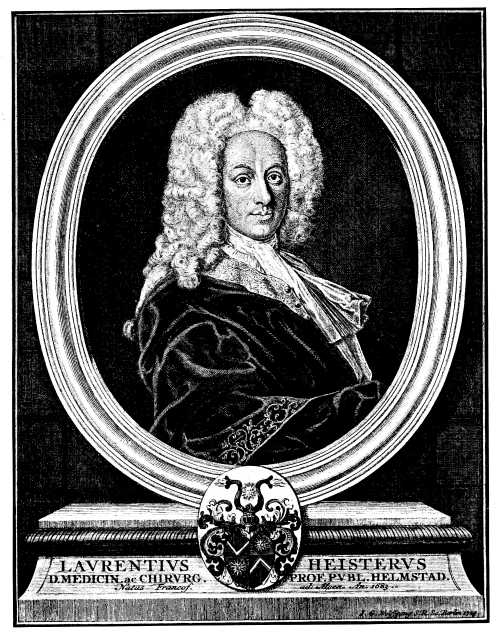
Lorenz Heister.
Although there have been, even from the most remote times, individuals
who have dedicated themselves exclusively to the cure of dental
maladies, or to repairing the losses of the dental system by artificial
means, and notwithstanding the progress gradually accomplished in this
branch of the medical art, which progress was especially remarkable
during the sixteenth and seventeenth centuries, it is not to be denied that,
up to the beginning of the eighteenth century, dentistry was, in great part,
considered one with medicine and surgery in general. It is but natural
that dental art (and the same may be said of every special branch of
medicine) could not assume a real individuality until it had attained to
the higher grades of its development. As a matter of fact, dentistry,
toward the end of the seventeenth century, was already a true specialty,
although it counted but few worthy representatives at that time. The
definite separation between the science and art of dentistry and general
medicine and surgery, although it may have been retarded, could not fail
to take place; and this, as we shall presently see, was effected by the
celebrated French dentist Pierre Fauchard.
But, to remain faithful to chronological order, we will first speak
briefly of some other writers.
Ludwig Cron, a barber of Leipsic, in a pamphlet published in 1717,
with the title The barber’s apprentice versed in bleeding and tooth pulling,397
declares, in a still more emphatic and general way than De Lavauguyon,
that it is useless to detach the gum before proceeding to extract a tooth.
This barber, strong in his own experience, dares to assert absolutely useless
this ancient practice, advised first by Cornelius Celsus, and recommended
after him, and in homage to his authority, by many other writers.
It is, therefore, possible that even previous to Cron and De Lavauguyon
many operators had dispensed with the practice recommended by Celsus,
although this had become an accepted canon of the high medical profession.
Lorenz Heister (1683 to 1758), of Frankfort-am-Main, one of the
most celebrated surgeons of the eighteenth century, wrote a dissertation
on toothache,398 treating besides very extensively of dental affections and
their cure in a masterly work on surgery, published for the first time in
1718, and which went through numerous editions in various languages.
When the caries of a tooth is superficial, Heister advises the removal
of the decayed part with the file; or, when the caries is deep down,
the cavity ought first to be well cleaned with a toothpick or other like
instrument, then filled with heated white wax, or mastic, the stopping
being renewed as often as may be necessary. When a molar tooth is
decayed, especially in the centre, the best way, says Heister, is to fill it
with gold or lead leaf, or with a piece of the latter fitting into the cavity.
If the carious cavity of a painful molar cannot be cleaned as it ought to be,
the dropping of a little oil of cloves or of cinnamon or of guaiacum into
it will be found useful, or even a few drops of spirit of vitriol; for in this
manner one obtains at the same time the double advantage of destroying
the impurities contained in the carious cavity and of soothing the pain.
But if by chance the pain should persist, recourse must be had to the
cauterizing iron, or to extraction. Sometimes, however, even the most
violent toothache can be made to cease, either by scarifying the gums
(a method already recommended by Pliny), by cauterizing the antitragus,
or by pressing the aching tooth hard between the fingers, as Schelhammer399
and some other writers had advised.
Heister writes at length on the extraction of teeth, on the indications
and counterindications appertaining thereto, on the instruments with
which the operation should be carried out, and so on. Regarding the
position of the patients, he thinks it best to place them on a low seat or
on the ground, if the tooth to be extracted is situated in the lower jaw,
but if an upper tooth is to be extracted, patients should be placed on a
chair or on a bed.
Movable prosthetic pieces are mentioned for the first time by this
author. Although he is very concise in his manner of speaking of artificial
teeth (this indicating that dental prosthesis was considered outside the
sphere of action of the general surgeon), we nevertheless learn from him
that partial sets of teeth made of ivory or hippopotamus tusks, and
without special appliances for fixing them, were then in use, which,
when applied in the void between the neighboring teeth, were maintained
in position simply by their form. The author advises keeping prosthetic
pieces very clean, removing them every evening before going to bed, and
not putting them back in the mouth until they have been well cleaned.
Heister also speaks of nasal prosthesis; this was then carried out by
applying noses made of wood or of silver, properly painted. In cases of
trismus, this author altogether rejects the forcible opening of the jaws
by means of screw dilators and such like instruments, as they act too
violently, and, according to him, only aggravate the morbid condition.
Even the extraction of a tooth is useless in such cases, as the patient
can always absorb a certain quantity of liquid food through the closed
teeth. On the other hand, the author expresses himself in favor of the
incision of the gums in cases of difficult dentition. According to him,
convulsions and the other nervous symptoms which children are subject to
during the period of dentition depend wholly on the hardness and strained
condition of the gum. It is, therefore, natural that the symptoms should
disappear when an incision of the gums, reaching to the tooth that is
coming through, has caused the tension to cease.
The author speaks very particularly of the treatment of epulis and
parulis; but his views on this subject contain nothing of great importance.
René Jacques Croissant de Garengeot (1688 to 1759), the celebrated
French surgeon, speaks very little of dental surgery in his works.
He declares himself averse to the carrying out of too many operations
on the teeth, and especially disapproves the use of the file, because, according
to him, it ruins the enamel.400 For a long time, especially in France,
Garengeot was believed to have been the inventor of the key known by
his name; but he merely perfected this instrument. In fact, through a
later author, Lecluse, it clearly results that the key existed before Garengeot.
“For extracting,” writes Lecluse, “one may make use of the pelican
that Garengeot has constructed on the English key.” In a note, he afterward
adds, “that the English key is an instrument used by dentists in
England.” However, it is not in the least certain that the key is really
an instrument of English origin.
Loder, who wrote at the end of the eighteenth century, informs us that
the so-called English key was called the German key in England; it is,
therefore, not improbable, that this instrument, as some maintain, had
its origin in Germany.401
Johann Junker (1679 to 1759), professor of medicine at the University
of Halle, wrote on dental maladies, not only in a treatise on surgery, published
in 1721, but also in three dissertations which were published some
time later, and were entitled respectively: De affectibus dentium (1740),
De dentitione difficili (1745), De odontalgia (1746). The author, however,
for the most part, only repeats things already known; his writings have,
therefore, little or no importance for us. He counsels the Cowper-Drake
operation in treating the affections of Highmore’s antrum; in carrying
out the operation, however, he thinks the extraction of the second molar
to be preferable to that of the first. To prevent the formation of tartar
on the teeth, he advises assiduous care in keeping the mouth clean, and
recommends, among other things, rubbing the teeth with sage. He disapproves
having recourse too readily to metal instruments to remove
tartar from the teeth, because, according to him, it favors the production
of dental caries. He holds it dangerous to extract the upper or lower
canines when they are not loose, as, by reason of the depth of their roots
an injury to the surrounding nerves may be the result, which not only
might cause great pain, but in the case of the upper canines might lead
to inflammation of the eye, and even of the dura mater!
When the caries is incipient, Junker advises rubbing the teeth several
times a day for some time with common salt, in order that this should
penetrate into their structure.402
Guillaume Maquest de la Motte (1655 to 1737), a distinguished
French surgeon and the writer of an excellent treatise (Traité complet
de chirurgie, Paris, 1722), repeats the advice already given by preceding
authors, to which he annexes the highest importance, that is, the opening
in time of abscesses of the gums and of the palate even before they be
completely matured, in order to prevent the suppurative process from
extending and damaging the bone below. This author relates having
several times arrested serious hemorrhage following on the extraction of
teeth, by applying a little vitriol inside the alveolus, and, on this, graduated
compresses, which the patient pressed on the part with the teeth of the
opposite jaw.403
Johann Adolph Göritz, of Regensburg, in one of his writings published
in 1725, disapproves the too frequent recurrence to extraction of
the teeth, that is, carrying out the operation when it is not absolutely
necessary. He is also averse to the application of artificial teeth. In
support of his opinion he relates a case in which, a certain time after the
application of an artificial tooth, the natural ones to which it had been
fixed became loose, so that it was necessary to proceed to the fixing of all
three, that is, the artificial tooth and the two neighboring ones, to the firm
teeth beyond them; these, however, became loosened in their turn, and
it was at last necessary to extract six teeth. The great space thus created
was filled with a prosthetic piece made of hippopotamus tusk; but the
author did not believe much good would come of this either. In fact, he
is of opinion that the natural teeth should be preserved by every possible
means, and that, on the other hand, even in the case of a few being lost,
it is better not to resort to substitutes. In the worst case, should the
dental void cause too great inconvenience by damaging the pronunciation,
or for some other reason, it may be filled by an “imitation” in soft
wood.404
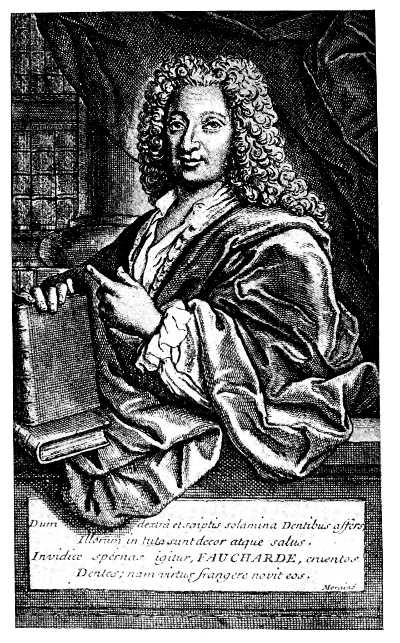
Pierre Fauchard.
If one takes into consideration the by no means slight inconvenience
to which fixed artificial teeth gave rise, one cannot but admit the aversion
to them, expressed by Göritz and others, to have been justified.
Ernst Ferdinand Gebauer, in 1726, made known a case in which,
a tooth having been badly extracted by an incapable surgeon, the upper
jaw was so seriously injured that a diffusive carious process ensued,
which after many years’ suffering brought the patient to the grave.405
Johann Bernhardt Fischer (1685 to 1772), a very famous doctor,
born in Lübeck, who had the honor of becoming archiater of the Russian
Empire, related, in 1726, a case of replantation, similar to those by Pomaret
and Carmeline; but Heinrich Bass (1690 to 1754), of Bremen, professor
of anatomy and surgery in Halle, endeavored to demonstrate that in these
cases the tooth did not really take root, but was rather maintained in
position by the contracting of the surrounding gum. One perceives
from this that there were still, at that time, discordant opinions on the
subject of replantation, and that this operation was far from occupying,
in dental surgery, the accredited position it has acquired today.
Heinrich Bass also combats the abuse of extracting teeth inconsiderately,
without absolute necessity, and expresses the opinion that this
is especially blamable in the case of teeth of the upper jaw, principally
because the extraction of either the canine or of the first or second large
upper molars might easily produce the opening of Highmore’s antrum,
and thus give rise to regrettable accidents. He is not, however, averse,
like Göritz, to the use of artificial teeth; indeed, he advises the application
of whole dental sets, even in the upper jaw, so long as there be two natural
teeth existing to fix the prosthetic piece to.406
Pierre Fauchard, the founder of modern scientific dentistry, was born
in Brittany about the year 1690, and died at Paris in the year 1761. His
celebrated work, Le Chirurgien Dentiste, was already written in the year
1723, but not published until 1728. It marks a new epoch in the history
of dental art. The most renowned physicians, surgeons, and anatomists
of the time testified their admiration for Fauchard’s work, which was
translated into German in 1733, and afterward went through two French
editions in the years 1746 and 1786.407 We have been able to obtain the
second edition408 of this most important treatise, and of this we now intend
making use for accurately analyzing the work, as it is probably more
complete than the first, whilst the third, having been published after the
author’s death, is probably merely a reprint.
The work consists of two volumes in duodecimo, in all 863 pages. In
the beginning there is the portrait of the author and a long and interesting
preface. The portrait, which we here reproduce, has also its historical
importance, and this for two reasons, the first of which being that in it
Fauchard is revealed to us as a person of very distinguished appearance,
and this gives us an idea of the social condition of the surgeon-dentists
of his time; the second, because there are annexed to the portrait the
following Latin verses, by a certain Moraine, in which, whilst eulogizing
the writings of the author and his ability in the treatment of the teeth,
and in restoring force and beauty to them, he counsels him “to despise
the tooth of envy,” as it will certainly break against his merit.
Dum dextra et scriptis solamina dentibus affers
Illorum in tuto sunt decor atque salus.
Invidiæ spernas igitur, Faucharde, cruentos
Dentes; nam virtus frangere novit eos.
That Fauchard, in common with all men of rare merit, had to combat
all his life against envy, we are able to perceive from what we read at
the end of the second volume of his work. The author here says that
“the rumor having been falsely set about that he has abandoned the profession;
which rumor cannot have been invented otherwise than by those
individuals who, sacrificing honor to interest, would attract to themselves
the persons who honor the author with their confidence; he therefore
finds it necessary to give warning that he still continues the practice of
his art in Paris, in the Rue de la Comédie Française, together with his
brother-in-law and sole student, M. Duchemin.”
More than a century and a half has passed by since Fauchard was
obliged to defend himself against lies invented and set about to his damage
by envious colleagues, but even at the present day, when, given the high
grade that civilization has reached, and professional competition ought not
to make use of other weapons than intelligence, study, and application,
some do not hesitate to have recourse to means equally disloyal, ignoble,
and shameless as those practised by some contemptible dentists of the
middle of the eighteenth century.
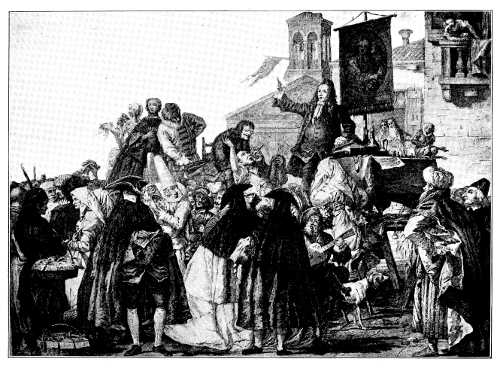
A CHARLATAN ON HIS PUBLIC STAGE
The preface of Fauchard’s book is especially important for the notices
therein contained regarding the author, as well as the conditions of dental
art at that period. And first of all, we find in it the proof of what we have
already said elsewhere, namely, that even before Fauchard, there were not
only tooth-pullers but also dentists properly so called. Indeed, Fauchard
makes mention also of the examination that aspirant dentists had to
undergo as far back as the year 1700. It may interest our readers if
we here give in detail some extracts in which the author speaks on these
subjects:
“Although surgery in general,” says Fauchard, “has been greatly perfected
in these latter times; although important discoveries have been
made in anatomy and in the modes of operating, and many learned
and interesting observations have been published, nevertheless, dentists
nowhere find in works on surgery sufficient aids to guide them in all
their operations.” These last words should be sufficient alone to prove
that the dentists spoken of by Fauchard were not mere tooth-pullers.
“The authors who have written on anatomy, on surgical diseases and
operations, have only treated very superficially the part relating to maladies
of the mouth and teeth. If some writers have spoken in particular about
the teeth and their diseases, as, for instance, Urbain Hemard and B.
Martin, they have not done so in a sufficiently ample manner.
“Besides, there does not exist any public or private course of surgery
in which the theory of dental maladies is amply taught and in which one
can receive fundamental instruction in this art, so necessary for the healing
of these maladies and of those of the neighboring parts.
“This branch of the art having been but little cultivated, if not wholly
abandoned by the most celebrated surgeons, their negligence has caused
it to fall into the hands of persons without theory and without experience,
who practise it in a haphazard fashion, guided neither by principles nor
method. In Paris, it is only since 1700 that people’s eyes have become
opened to this abuse.
“In this town, those who intend to become dentists are now obliged
to undergo an examination, but although the examiners be most learned
and well versed in all the other parts of surgery, I think, if I may be
allowed to express my opinion, that as they do not ordinarily themselves
practise dental surgery, it would not be amiss on these occasions
to admit an able and experienced dentist, who might sound the aspirant
as to the difficulties which have come before him in the course of the long
practice of his art, and who could communicate to them the means of
surmounting them. In this way one would not have to acknowledge that
the attainment of the greater part of dental experts409 is below mediocrity.
“To supply this want of instruction it would have been of great use
if some able dentist, for example the late Monsieur Carmeline, who, in
his day, practised with general applause, had made us acquainted with
his mode of operating and with the knowledge acquired through the
successful treatment of a great number of important cases.
“What this celebrated surgeon-dentist has not done, I today dare to
undertake. I shall at least afford an example of what he might have done
with greater erudition and better success.
“From my youth I was destined to the surgical profession; the other
arts I have practised410 have never made me lose sight of it. I was the
disciple of Alexandre Poteleret, surgeon-in-chief to His Majesty’s ships,
who had great experience in diseases of the mouth. To him I owe the
first rudiments of the knowledge I have acquired in the surgical speciality
I practise, and the progress I made under this able man gave me the
emulation that has led me to further important discoveries. I have
collected among different writers what seemed to me most reliable.
I have frequently discussed these matters with the ablest surgeons and
doctors of my acquaintance, and have neglected nothing in order to profit
by their counsels and by their ideas.
“The experience which I have acquired during an uninterrupted practice
of more than forty years has led me insensibly to the acquirement of
further knowledge and to the modification of what seemed to me defective
in my earlier ideas. I offer to the public the results of my labors and of
my studies, hoping that they may be of some use to those who wish to
exercise the profession of surgeon-dentist.”
The reason why dentists before the time of Fauchard published hardly
anything concerning their art, was perhaps out of a sentiment of jealousy,
which rendered them (that is, the best of the profession and therefore the
ones most capable of writing) but little disposed to make known to others
the results of their studies and of their experience, lest the fruits of their
long labors should be utilized by others and they themselves be materially
damaged by competition. That this sentiment of jealous egotism
really existed in many dentists may be, in a certain manner, deduced from
a few words of Fauchard himself, who, although he has the very great
merit of breaking with mean, old-world prejudices, nevertheless expresses
the prevalent idea of the time, consisting in the belief that every artificer,
every inventor, had not only the right, but also the duty of surrounding
his discoveries with secrecy and mystery. These are the words in
which, making known a certain improvement in dental prosthesis invented
by him, he at the same time expressed his conviction that by so
doing he is acting against his own interests:
“I have perfected and also invented several artificial pieces both for
substituting a part of the teeth and for remedying their entire loss, and
these pieces substitute them so well that they serve perfectly for the same
uses as the natural teeth. To the prejudice of my own interests I now
give the most exact description possible of them.”
Now, although a man of elevated mind, such as Fauchard, may have
been capable of sacrificing his material interests to higher aims, it is
not, however, to be wondered at, taking also into consideration the lesser
degree of culture and of professional ability of his predecessors, that none
among them should have been found sufficiently disinterested to publish
the results of their particular studies and experience, besides all those
technical details which according to the ideas of that time constituted
the secrets of the profession.
In the course of this history, we have seen that the dental art was
practised from the most remote times and in the most various countries,
remaining, notwithstanding, for centuries in an embryonal condition. It
was toward the end of the seventeenth and the beginning of the eighteenth
century that, in the midst of the highly advanced civilization of the great
French capital, it attained a high degree of development, entitling it to
be considered a special branch of the medical art.
It would, therefore, be wrong to believe that the dental art was created,
for the most part, by Fauchard, and one clearly perceives, from the perusal
of his work, that although he made most important contributions to this
specialty, which he cultivated with passion, nevertheless, the greater
part of the things therein treated of were already known before his time,
although no reference to them is to be found in previous works; and this
for the reasons we have already suggested. The highest merit of Fauchard
consists, still more than in his inventions and improvements, in his having
most ably collected and incorporated in a single work the whole doctrine
of dental art, theoretical as well as practical, thus setting in full light the
importance of the specialty, and giving it a solid scientific basis.
France is therefore the first country where modern dentistry reached
a high degree of development and also the first country where, earlier
than elsewhere, that is, about 1700, the dentists began to form a well-defined
class, to belong to which it was necessary to pass a special examination.
This examination, as we learn from Fauchard, was held before
a commission of which no dentist formed a part, and exactly for this
reason gave but negative results and responded but little to its intended
aim. The greater number of those who were authorized to practise
dentistry after undergoing this examination showed a professional ability
below mediocrity. Nevertheless, although few in number, good and able
dentists were in no way wanting, as clearly appears from the preface
to Fauchard’s work, and better still from the following paragraph,411
wherein the author speaks of the great perfection reached by dental
surgery in Paris:
“The teeth and the other parts of the mouth being subject, as we
have seen in the course of this work, to so many important diseases,
requiring the aid of the most able dentists, it is strange that the sovereigns
of foreign countries, the heads of republics, and also the administrators
of our own provinces do not provide for the expense of sending young
surgeons to Paris, to be instructed in a part of surgery so essential, and,
notwithstanding, so ignored and neglected everywhere excepting in this
great city, where it has reached its highest perfection, both as regards
the embellishment of the mouth and the cure of diseases, often of a
most serious nature. These scholars would, thereafter, form others and
would render great services to their nation and to their fellow citizens.”
In the first chapter of his work, Fauchard speaks “of the structure,
position, and connection of the teeth; of their origin and of their growth.”
He distinguishes in each tooth a body, a root, and a neck, making the
remark, however, that this last is to be considered as forming part of the
body. According to the author, the name of “crown” can only be applied
suitably to the body of the molar teeth, but not to that of the incisors or
of the canines, which has no resemblance with a crown. Although in
the adult the number of the teeth is normally thirty-two, it may be that
some persons have, nevertheless, thirty-one, thirty, twenty-nine, or even
only twenty-eight teeth, and this independently of any eventual loss, but
for the simple reason that the wisdom teeth are often cut very late in life
(even after fifty years of age), or do not all come forth, or sometimes are
never cut at all. The author refers to some cases of a supernumerary
tooth situated in general between the two superior central incisors and
similar in form to the lateral incisors. He also observed two individuals
who had each thirty-four teeth, sixteen in the lower and eighteen in
the upper jaw, and in these cases the two supernumeraries were situated
behind the incisors. Fauchard declares the popular opinion expressed
also by some ancient authors, of the milk teeth having no roots, to be false.
The roots of these teeth, he says, are gradually worn away before the
latter are shed, when the permanent teeth are just on the point of coming
through; however, if it so happens that one or more of the milk teeth be
extracted some time before the period in which they are usually shed,
their roots are found to be as long and as strong in proportion to the body
as those of the permanent teeth. In children one finds, besides the
twenty deciduous teeth, the germs of the thirty-two permanent ones,
for which reason it may be said that children have in all thirty-two teeth
without counting the germs that may sometimes be found at the extremities
of the roots of the large molars. As, however, the existence of such
germs is an exceptional fact, the twelve large molars, if extracted, are
not ordinarily regenerated. This may be possible, however, if the germs
in question exist, and, indeed, the author observed two persons in both of
whom a large molar had been regenerated in the place of the one which
had to be extracted.
Fauchard gives an excellent description of the alveoli and of the roots
of the teeth; he alludes to the varieties which these latter may present,
and to the importance of the same from the point of view of extraction.
Thus, speaking of the molars, he says: “Their roots sometimes touch
one another at the points, whilst at the base, close to the body of the tooth,
they are far apart. These are the so-called dents barrées (barred teeth),
which it is so difficult to extract, it being unavoidable to bring away
together with the tooth the spongy osseous part occupying the interval
between the roots.”
In this same chapter the author calls our attention to some anomalies
worthy of note. He says that he has observed teeth that seemed to him
to be derived from the union of two or three germs. He also relates that
a colleague of his showed him a tooth that appeared to be formed by the
union of two, between the roots of which was a third tooth whose crown
was united to the vault formed by the roots of the first two.
Fauchard describes exactly the pulp cavity and the root canals, and
speaks of their gradual restriction, ending in an almost entire disappearance
in old age.412 He treats of the nerves, of the arteries, and of the veins
of the teeth in a most detailed manner; then, after alluding to their general
structure, he goes on to speak of the microscopic constitution of the
enamel, following in this the description given of it in 1699 by the academician
La Hire.
In regard to the development of the teeth, Fauchard repeats what
Urbain Hémard had previously written. He apparently ignores the
researches of the Italian anatomists, from whom, and especially from
Eustachius, Urbain Hémard had literally reproduced all that concerns
odontogeny.
In the second chapter Fauchard speaks “of the maladies of children at
the period of teething and of the remedies best adapted thereto.” Among
other means of treatment, he advises the incision of the gum when this
is red, swollen, and distended and the tooth below it can be felt. For
the incisors and canines a simple incision ought to be made in the same
curve as the dental arch; for the molars a crosswise incision should be
made directly down to the tooth below, taking care not to leave any strips
of uncut gingival tissue, lest these, being distended by the emerging tooth,
should continue to be the cause of pain and other morbid phenomena.
Although Fauchard does not tell us anything substantially new about
teething maladies and their treatment, he nevertheless treats this subject
with much practical good sense, and does not merely make servile repetition
of what preceding authors have written about it.
In the three following chapters the author speaks of the utility of the
teeth, of the rules to be observed for their preservation, of the modes of
keeping them white, and of strengthening the gums.
From a passage in the fifth chapter we learn that tooth brushes were
then already in use. Fauchard, however, advises the use of small sponges
in their stead. He says: “Those who use brushes of horsehair, or pieces
of cloth or of linen for cleaning the teeth, do not reflect that all these
materials are too rough, and that the practice of using them frequently
and without discretion often exercises a destructive action upon the
teeth.413 Not without good reason, I advise the abandonment of this usage,
it being preferable, after having had the teeth cleaned by the dentist,
to wash the mouth every morning with tepid water, and to rub the teeth
up and down, inside and outside, with a small, very fine sponge wetted in
water; and it is still better to add to this water a fourth part of aqua vitæ
the better to fortify the gums and render the teeth firm.”
Instead of a small sponge, says Fauchard, the end of a root of marshmallow
or lucern, which has first been subjected to a special preparation,
may be used with benefit for rubbing the teeth. The author gives a
long and minute description of this preparation, which we, however,
omit, because devoid of historical interest.
As, however, the above means are not always sufficient for preserving
the teeth and gums in good condition, it is necessary in many cases, says
Fauchard, to make use of some paste, powder, or mouth wash. The
author mentions a great number of compositions of this kind, giving the
formula for each one—almost always most complicated—and indicating
the peculiar advantages of each of them. We will here quote one of the
formulæ as an example.
“A spirituous water, desiccative, balsamic, antiscorbutic, efficacious
against many maladies of the mouth:
“℞—good sarsaparilla, four ounces; aristolochia rotunda, dried rinds
of bitter organes, of lemons, and pomegranates, ana three ounces; pyrethrum,
two ounces; cloves, one ounce; mustard seeds, one ounce; wild
rocket seeds, two ounces. Pound well in a mortar and put the whole into
a retort with a long neck. Add thereto half a pound of pulverized
candied sugar and the same quantity of clarified rose honey. Pour in
three pints of good spirit of wine. Cork the retort well and leave all to
digest in a cool place for five or six days. Then heat the retort forty-eight
hours in the water bath over a slow fire, without letting the liquid come
to the boil. Afterward, when cold, decant in a glass bottle, to be kept well
corked. Pour another three pints of spirit of wine on the residue of the
drugs; cork the retort again, replacing it in the water bath for forty-eight
hours, and regulating the fire as above. Then, after letting it cool,
pour off the liquid into the same bottle. Next remove all the residue from
the retort, place it in a thick, white linen cloth, and force the remaining
liquid through it, and add to that in the bottle. Put back half of the
entire quantity of liquid in the same retort, and add thereto aloetic
elixir and baume du commandeur, ana four ounces; pulverized dragon’s
blood, three ounces and a half; pulverized gum of guaiac and Peruvian
balsam, ana three ounces; gum lac, two ounces. Cork the retort again
and replace it in the water bath for forty-eight hours, as above. Let
cool, decant the liquid in another glass bottle, and cork well. Pour the
remaining half of the first liquid upon the rest of the drugs, replace
the retort in the water bath for forty-eight hours, let cool, and pour the
contents in the last bottle. Filter the liquid well, and pour it into a bottle
of sufficient size to be able to add the following liquids: aqua vulneraria
and first cinnamon water, ana three pints; second cinnamon water, three
half-pints; spirit of cochlearia, four pints. Shake the bottle well, filter
again, and store in well-corked bottles.”
The author adds that the doses of the different drugs may be reduced
in proportion to the quantity of liquor to be prepared; and that he prepares
so large a quantity at a time because of the great sale he has for it
among his clients.
The preparation in question is counselled by the author as a remedy
against pathological conditions, and of the gums especially. One makes
use of it in the following manner: Pour from seven to eight drops into a
wineglass of water; wet the tip of the finger and rub the gums and the
teeth well. Or mix seven or eight drops in a good spoonful of water,
using a fine sponge to rub the teeth and gums.
The example we have cited suffices to show how much care one took
at that time in the preparation of substances destined to be used in the
preservation of the teeth, and demonstrates at the same time that Fauchard,
inventor of that and many other preparations, besides being an able
surgeon-dentist, was also exceedingly well versed in dental materia medica.
Chapter VII treats of the general causes of dental, alveolar, and gingival
diseases, and contains the complete enumeration of these maladies.
The causes of dental affections may be of two orders, viz., internal (general
diseases, dyscrasic conditions) and external (the action of heat and cold,
mechanical causes, etc.).
After having spoken in particular of various causes, Fauchard adds:
“Little or no care as to the cleanliness of the teeth is ordinarily the
cause of all the maladies that destroy them.”
The author divides maladies of the dental apparatus into three classes,
that is:
1. Maladies deriving from external causes and acting, therefore, especially
on the crown or uncovered part of the tooth.
2. Maladies of the hidden parts of the tooth, that is, of the neck and
root.
3. Symptomatic maladies, deriving from the teeth.
In the first class the author includes 45 pathological states, 17 in the
second and 41 in the third, making up a total of 103 morbid conditions.
This should be sufficient to give us an idea of the accuracy with which
Fauchard studied the maladies of the dental apparatus, especially if one
considers that preceding authors had reduced these maladies to a very
small number. Fauchard’s classification is very complete, for notwithstanding
the progress made in succeeding years in this science, the
pathological conditions not to be found comprised in it are exceedingly
few. Naturally, the 103 diseases enumerated by Fauchard do not represent
as many distinct morbid entities. The author, in classifying dental
maladies, keeps especially in view the requirements of the practitioner,
and therefore makes numerous distinctions in each morbid process.
Thus, he distinguishes a great many varieties of caries, viz., the soft and
putrid caries, the dry caries, the caries in part dry and in part soft, the
caries complicated by fracture, the superficial caries, the deeper and the
deepest, the caries of the different surfaces of the crown, and so on.
Also in the classification of other morbid processes, Fauchard makes
multifarious distinctions.
The passage referring to worms in the teeth deserves to be here
reproduced:414
“Sometimes worms are to be found in the carious cavities of the teeth,
or in the deposit of tartar that covers them, and to these the name of dental
worms has been given. Observations recorded by illustrious authors
are extant which attest this. Not having ever seen these worms, I neither
admit nor deny their existence. Nevertheless, I conceive the thing nor
to be physically impossible, although at the same time I do not believe
at all that these worms destroy the teeth or cause them to decay, but rather
that the eggs of some insect having been introduced into the carious cavity
of the tooth, either through alimentary substances or through the saliva,
these eggs thus deposited have developed and produced the worms
alluded to. However this may be, as they are not the real cause of the
caries, their eventual presence does not require any particular consideration.”
Fauchard again recurs to the subject of worms in Chapter VIII,
in speaking of the particular causes of caries.415
“It was, and is still, believed by the vulgar and also by some writers
that all toothache is caused by worms, which little by little destroy the
tissue of the osseous fibers and the nervous threads. If this were so, the
explanation of pains and of decay in the teeth would be very simple. This
opinion is founded on pretended experiences relating to these insects,
which may, it is said, be made to fall out of the teeth by the smoke of
henbane seeds; this, however, has been declared fabulous by Andry,
dean of the medical faculty of Paris, as well as other similar facts which
he exposes in his book on the generation of worms.416
“Andry relates, however, that with the help of the microscope one may
succeed in seeing certain worms that form beneath the deposit collected
upon the teeth as the effect of want of cleanliness; these worms, he says,
are exceedingly small and characterized by a small round head with a
small black spot; the body is long and fine, pretty nearly like the worms
seen in vinegar through the microscope. He adds that these worms
destroy the teeth little by little, causing a bad odor, but not much pain.
He believes it an error of the imagination to ascribe violent pains in the
teeth to dental worms, and holds that these only produce a very slight,
dull pain accompanied by itching.
“I have done everything possible,” continues Fauchard, “to convince
myself with my own eyes of the existence of these worms. I have made
use of the excellent microscopes of Manteville, sworn surgeon of Paris,
and have made a great number of experiments with them both on caries
in teeth newly extracted as well as on tartar of different consistency
accumulated on the same, but have never succeeded in discovering
any worms. I am also still less disposed to believe in the existence of
these animals, because Hémard declares that he has never been able to
find any worms in carious cavities. I am thoroughly convinced of Andry’s
sincerity; neither do I doubt the truth of the facts he relates; but it is
easy to perceive from his own words how little the pretended healers of
teeth and their specifics for killing worms are to be held in account; from
the moment that, according to this writer, the pains for which one is
most obliged to have recourse to remedies are almost always those not
proceeding from the cause in question.”
In short, Fauchard does not believe at all that dental caries is occasioned
by worms; and only from respect for the authority of Andry and
other writers does he admit the accidental existence of these little animals
in the carious cavities or upon the teeth, refusing, however, to attribute
any importance to the same as regards the etiology of caries.
This disease, says Fauchard,417 is produced by a humor that insinuates
itself into the midst of the osseous fibers of the teeth, and displacing the
particles which compose these fibers, gives rise to their destruction. The
causes from which these disorders derive may be external or internal.
The external causes are blows, violent efforts made by the teeth; the
improper use of the file, the application of acids or of other substances
that injure the enamel, alteration of the saliva, impressions of heat or
cold, and also certain kinds of nourishment. Blows or violent efforts
may produce caries, according to the writer, by occasioning the effusion
of the liquid contained in the vessels. The author gives analogous
explanations for the other external causes. As to the internal causes,
they consist, he says, in alteration of the blood and of the humors.
The teeth, says Fauchard, are more subject to caries than all the
rest of the bones in the human body, because, their tissues being denser,
the vessels are on this account closer together and more easily liable to
be obstructed, choked up, and broken. Besides, the position of the teeth
exposes them more than the other bones to the immediate action of external
causes capable of producing the disorders alluded to; and finally, what
demonstrates the dental caries to be produced, for the most part, by
external causes, is that false teeth, either human or formed from those
of animals, sometimes become carious just in the same way as the natural
ones; which evidently happens by the sole action of external causes.
It is undeniable that the ideas expressed by Fauchard on the pathogeny
of caries, cannot hold good against criticism. Nevertheless, we
owe a great deal to this author for having once for all put an end to the
ridiculous theory of dental worms, and for having tried to find a reasonable
explanation of the manner in which caries is produced.
The teeth, says Fauchard, have not all the same disposition toward this
morbid process; indeed, notable differences are to be observed in this
respect. The molars are, in fact, more apt to become decayed than the
incisors or the canines; and the upper incisors and canines are more
subject to this disease than the inferior ones, because, by reason of their
position, they are more frequently uncovered and more exposed to heat
and cold, whether in eating and drinking or whether in the mere aspiration
or expiration of the air. It is to be observed, besides, that when
the eruption of the last molars is considerably delayed they easily decay.418
Having very frequently observed the symmetrical decay of corresponding
teeth on both sides of the same jaw, Fauchard considers that these
cases are not simply accidental, but rather holds that the fact depends
on a special cause, which, however, is not easy to determine. He offers,
at any rate, a sufficiently good explanation when he says that as certain
morbid causes (bad humors, etc.) must affect both sides of the mouth
identically, it is but natural that the effects of such causes should be
altogether analogous on the right and on the left, and manifest themselves
symmetrically on teeth having the same configuration, the same structure,
and the same consistence.
Before speaking of the treatment of caries,419 Fauchard alludes to the
fallaciousness of the many remedies against toothache which were largely
sold at his time by charlatans and impostors of every kind.
“Some pretend to cure toothache with an elixir or some special essence;
others with plasters; others by means of prayers and signing with the cross;
others with specifics for killing the worms that are supposed to gnaw the
tooth and so cause pain; others pretend to be so clever that they can cure
the most inveterate toothache by merely touching the tooth with a finger
dipped into or washed with some rare and mysterious liquid; others
finally promise to cure every kind of toothache by scarifying the ears with
the lancet or cauterizing them with a red-hot iron.”
“I am well aware,” adds Fauchard, “that it can be alleged in favor of
this last prejudice that the celebrated Italian doctor Valsalva indicates
with great precision the point in which the actual cautery is to be applied
to the ear, in order to calm toothache. He also determines the size of
the iron and the manner of applying it. The authority of so celebrated
an author, whose opinion is certainly worthy of respect, should induce me
to believe that there may perhaps be some cases in which it is possible
to use this remedy with success; nevertheless, I cannot persuade myself
that such treatment can be useful in common cases of toothache.
“At Nantes, a city of Brittany, I knew a Turk, a watchmaker by
profession, who was renowned for this mode of curing toothache. But
I also know that, in spite of the pretended cures, the greater number of
those who put themselves into his hands were obliged finally to have
recourse to me, in order to find relief for their sufferings. I afterward
saw several other persons use the same remedy with no better success.
“There are, besides, an infinity of other remedies vaunted as efficacious
against toothache, but the greater number of them are so ridiculous and
extravagant that it would be both tiresome and useless to speak of them.
We will, nevertheless, give one more mentioned by M. de Brantôme.”420
The author here quotes a passage of this writer, wherein he says that,
having been suffering from toothache for two days, the apothecary
of Elizabeth of France, wife of Philip II of Spain, brought him a most
singular herb, which when held in the hollow of the hand had the virtue
of making the pain cease immediately; and in this way he was, in fact,
effectually cured.
And here Fauchard expresses himself of the same opinion as Urbain
Hémard, who believes the cure of toothache by means of words, or by the
touch of paper on which certain signs are written, or remedies held in the
hand, etc., to be merely the effect of the force of the imagination, and he
opines that the patient, having a vivid belief in the mysterious thing
proposed to him remains under the impression of an inward commotion,
by the effect of which it may well be that the morbid humor is deviated
from the painful part to other parts of the body. The effects of the various
passions on the bodily functions are, says Fauchard, very well known.
Thus, when under the influence of anger the wounded at times do not
feel any pain, and those who suffering from a tormenting toothache go
to a dentist to have the tooth drawn are sometimes seized by such great
fear as not to feel the pain any longer, and go away, only to return later
on renewal of their sufferings; although there have been cases where the
pain ceased altogether.
In spite of this explanation, of which we will not here discuss the value,
allowing it, however, as satisfactory enough, Fauchard continues by making
a most curious consideration, which as it is of a somewhat surprising
effect in a scientific work, we will not deprive our readers of it. He believes
it to be his duty to give the following warning, namely, that “the modes
of cure, by means of certain words, of certain signs, laying on of hands,
written charms, etc., savoring much of superstition and of diabolic
artifice, are prohibited by the Church as sinning against the first Commandment,
as much in him who practises them as him who consents
thereto.”
After the above preliminaries, the author passes on to treat the important
subject of the mode of curing caries.421 According to him, when
caries has not yet attacked the internal cavity of the tooth at all, or only
in a very slight degree, there are four modes of curing it: the first consists
in the use of files or scrapers, the second in the application of lead, the
third in the use of oil of cinnamon or of cloves, and the fourth in the
application of the actual cautery. Fauchard expresses most energetically
his disapproval of the means of cure recommended by Dionis in cases
of caries of the triturating surfaces, which consisted in the cauterizing
of the decayed spot with a drop of oil of vitriol applied by means of a
miniature paint brush, declaring this to be both dangerous and hurtful
because of the destructive and corrosive action of the oil of vitriol and
because of the impossibility of limiting its action solely to the affected part
of the tooth.
The general method of cure followed by Fauchard is described by him
in these terms:
“When a tooth is but slightly decayed, it is sufficient to remove the
caries with the instruments of which I will speak hereafter, and to fill
the cavity with lead. If, however, the cavity be rather deeper and occasions
pain, one should, after having scraped it, put a small ball of cotton-wool
soaked in oil of cinnamon or of cloves into the hollow of the caries
every day. This medication must be continued for a sufficient time,
taking care to squeeze in the cotton-wool by degrees to accustom the
sensitive parts to the pressure. Four or five days later one removes
the material from the carious cavity. This treatment sometimes prevents
a return of the pain; it produces on the osseous fibers of the tooth a
slight but sufficient exfoliation and impedes the progress of the caries.
If the pain should not cease after having continued this method for a
sufficient length of time, one should then have recourse to the actual
cautery and stop the tooth after a certain time, if the form and situation
of the decayed cavity permit it; for one sometimes meets with cavities
that are not able to maintain the stopping.
“If the caries penetrates as far as the cavity of the tooth, it may give
rise to an abscess; and this I have often observed in persons to whom the
caries of the incisors or of the canines occasioned great pain. In such
cases I introduce the extremity of the sound into the cavity of the tooth
in order to facilitate the evacuation of matter. As soon as the pus is
evacuated the pain ceases. I then leave these patients in repose for two
or three months; after this time, I stop the decayed tooth or teeth to avoid
their getting worse.”
As anyone may perceive, the methods used by Fauchard against caries
left much to be desired, when compared with those now in use. With
such imperfect methods it is but natural that one did not always succeed
in obtaining the immediate cessation of the pain resulting from caries.
The want of additional remedies was, therefore, felt; and, in fact, Fauchard
tells us422 of two with which he had experimented and found most efficacious
against toothache. The first is a resinous plaster to be applied to the
temples; the other is a paste to be applied, in quantity equal to the size
of a small bean, between the gums and the cheek, and which was composed
of various ingredients, among others, pyrethrum, black pepper,
ginger, stavesacre, mace, cloves, cinnamon, sea salt, and vinegar. After
having given the mode of preparation and application of the two above-mentioned
remedies, Fauchard adds: “These remedies prove especially
efficacious if one takes care to introduce a little cotton-wool or lint into
the decayed cavity, soaked in oil of cloves, or cinnamon, mixed with
an equal quantity of extract of opium, and if one resorts opportunely to
bleeding and purging; which ought never to be neglected in the case of
plethoric persons.”
Finally, the author speaks of another remedy,423 and one which we
never should have expected to find in his book; but he assures us that
by it many persons who had almost all the teeth decayed and suffered very
often from toothache found great relief.
“It consists in rinsing the mouth every morning and also in the evening
before going to bed with a few spoonfuls of one’s own urine immediately
after it has been emitted, always provided the individual be not ill. One
is to hold it in the mouth for some time, and the practice ought to be
continued. This remedy is good but undoubtedly not pleasant, except in
so far as that it procures great relief. Some of those to whom I have
recommended it, and who have used it, have assured me that in this
manner they were relieved of pain to which, up to then, they had continually
been subject. It is rather difficult in the beginning to accustom
one’s self to it; but what would one not do to secure one’s self health
and repose.”
In order to explain the virtue of the urine as a remedy, the author
pauses to speak of its chemical composition, and then adds:
“The rectified spirit of urine424 could be substituted for the human urine.
One should then take two drams of this substance and mix it with two
or three ounces of aqua vitæ, or water of cresses or of cochlearia. Sal
volatile425 has the same virtues. Those who wish to make use of it should
dissolve fifteen to thirty grains of it in the same quantity of the above
liquid.”
Fauchard then passes on to speak of trepanning of the teeth when
they are worn away or decayed and cause pain.426 He begins by saying
that most varieties of pain caused by the canines and the incisors when
worn away or decayed cease after the use of the trepan. He, however,
understands the term trepanning in a very wide sense, comprehending
therein the use of any instrument whatever (even a needle or a pin) with
which one penetrates into the inner cavity of the teeth.
In interstitial caries of the canines and incisors one ought, says Fauchard,
first to enlarge the interstice with a small file of a convenient shape,
then to scrape the decayed cavity, and finally to open up the canal or inner
cavity of the tooth with a perforator or with a small trepan.
“In this way the pus or other humors that may have collected in the
tooth can easily find their way out, and the pain will cease at once or in
a short time.”
The author describes with much minuteness the manner of trepanning,
and then adds:
“After this operation one should let a few weeks pass without doing
anything to the affected tooth, and afterward, in order to impede further
decay, one must put a little cotton-wool into it soaked in oil of cinnamon
or of cloves. The tooth must be left in this state for some months, taking
care to renew the cotton-wool. It is necessary to observe that in beginning
to put in the cotton-wool this should be done with lightness and without
pressing it down much, so that if pus should gather again it may be able
to make its way through the cotton-wool, the principal object of this
being to hinder the penetrating of alimentary substances into the tooth,
which would be the cause of further decay. If the cotton were pressed
into the tooth from the beginning, the pus, not being able to find an exit,
would accumulate, and might cause much pain, if the nervous parts
of the tooth were not yet dried up or destroyed. The same thing
might happen after the application of a lead stopping, and one would be
obliged to remove it and let considerable time pass before putting it in
again.”
Further on the author says that while the trepanning of incisors or
canines almost always causes the pain to cease, by opening up an exit
to the morbid matter retained within the cavity of such teeth, the same
is not the case with the molars, these having several roots and several
cavities, of great variety, which lend themselves but little to accurate
trepanning. “Hémard,” he adds, “judges it necessary to extract these
teeth, or at least to break off the crown (les déchapeller), in order to give
exit to the corrupt matter that is closed up in the cavity; this sometimes
causes the pain to cease. He (Hémard) says that he has seen many
abscesses in the interior of teeth, which were not externally decayed, and
that after having broken off the crown he found within the cavity a
corrupt matter of an insupportable smell.”
Relative to such cases, Fauchard says that, besides the teeth, also the
surrounding parts suffer and are imperilled by these conditions. “The
greater part of the violent fluxions deriving therefrom often terminate in
abscesses and fistulæ of the gums and of the surrounding parts, and
sometimes with considerable and dangerous decay of the bone, as I have
related in some of my observations.”
One sees that Fauchard was clinically very well acquainted with the
grave forms of pulpitis and their possible consequences, although ignoring
the true nature of this process, which has only been studied and illustrated
much more recently.
Chapter XL (page 177) treats of dental tartar, of its cause, of the harmful
effects it produces, and of the prophylaxis and therapy relating thereto.
Three illustrations which are added to this chapter represent the different
aspects of a mass of tartar of exceptional size formed around the
body of a lower molar. The surgeon Bassuel, a friend of the author,
had removed this mass of tartar, together with the entire molar, from the
jaw of an old woman. The mass itself was almost the size of a hen’s
egg, the superficies being very irregular; it rendered mastication altogether
impossible and caused the cheek to stand out in such a way as to give
the appearance of a tumor.427
In the following chapter428 the author enumerates the various dental
operations: “Cleaning the teeth, separating them, shortening them,
removing the caries, cauterizing, stopping, straightening crooked teeth,
steadying loose teeth, trepanning, simple drawing of teeth, replacing them
in their own alveoli, or transplanting them to another mouth, and finally
substituting artificial teeth for those wanting.” He then adds: “All
these operations require in him who carries them out a light, secure, and
skilful hand and a perfect theoretic knowledge, by which he may decide
on the opportuneness of performing them, of deferring them, or of
abandoning them altogether. In fact, one may know perfectly well
how to carry out an operation and nevertheless undertake it in a case in
which it is not at all proper to operate. Into such an error no one can
fall save through sheer ignorance of the cause of the disease or of the right
means of curing it. From this it must be concluded that the knowledge
required in order to be a good dentist is not so limited as some imagine,
and that the imprudence and the danger of placing one’s self in ignorant
hands is as great as the temerity of those who undertake to exercise so
delicate a profession without the knowledge of even its first elements.”
Before speaking in detail of all the above operations, the author dedicates
a lengthy chapter429 to describing with the greatest minuteness the
position to be given in general, as well as in special cases, to the head and
body of the patient, and the manner in which the dentist should place
himself with regard to the former, so as to be able to make a proper use of
each of his hands. As a rule, Fauchard made the patient seat himself
in a convenient arm-chair; in exceptional cases he placed him on a sofa,
or on a bed. He draws this subject to a close with the following words:
“It is, indeed, surprising that the greater part of those who practise
tooth drawing should ordinarily seat the patient on the ground, this
being both indecent and not very clean. This position is not only uncomfortable,
but causes sometimes a sense of fear, especially in pregnant
women, to whom it may, besides, prove very harmful. But it is still
more surprising that certain authors should even nowadays affirm this
to be the most convenient position, while it is instead one to be entirely
rejected.”
In speaking of extraction of the teeth,430 Fauchard begins by saying that
the milk teeth, although destined to be shed, should never be extracted,
except in cases of absolute necessity, as, for instance, when being decayed,
they give rise to intolerable pain. The alveoli of the infantile jaw are
weak, whilst the roots of the deciduous teeth are sometimes firmer and
more solid than one would believe, and hence it is that in extracting a
milk tooth one runs the risk of injuring the alveolus and even of carrying
away a portion of it altogether with the tooth, not to speak of the danger
of damaging or even destroying the germ of the permanent tooth lying
below. Besides, Fauchard adds, there are sometimes deciduous teeth
that are never shed and never renewed. One must, therefore, defer
drawing children’s teeth as long as possible unless they are loose. When,
however, intolerance of pain or a caries endangering the integrity of
the neighboring teeth oblige one to recur without delay to extraction, one
should carry out the operation with prudence and judgment, so as to
avoid the dangers alluded to. It sometimes happens, says Fauchard,
that one finds in children a crooked tooth by the side of a straight one;
in these cases ignorant tooth-drawers have often been known to remove
the crooked (permanent) tooth, and to leave the straight, viz., the deciduous
one, which afterward falls of itself, the individual thus remaining
deprived of one of his teeth for the rest of his life. The rule to be observed
in order to avoid a similar error is always to extract the older of the two
teeth and to leave the one that has been cut more recently, which is easily
recognized by its being ordinarily firmer in the socket and of a better color
than the first.
And here the author inveighs against all the charlatans of his day who
dared, without being dentists, to perform dental operations, and whose
number, it would seem, was ever increasing, so much so that he is led
to exclaim: “There will shortly be more dentists than persons affected
with dental diseases!” In proof of this he relates the case of a cutler of
Paris, who extracted the molar tooth of a young girl because black spots
having appeared on it, he believed it to be decayed; but perceiving
that he had only removed the crown (it was a deciduous tooth about to
fall out), and thinking that he had broken the tooth, proceeded to extract
the root, removing, in his gross ignorance, the permanent tooth on the
point of coming through.
Returning to the indications for the extraction of teeth, Fauchard says
that when a tooth planted irregularly in the mouth cannot be straightened
by any of those means to which he afterward alludes, and occasions
damage or inconvenience or constitutes a deformity, the sole remedy is
its removal. As to decayed teeth and the pain that they produce, when
the evil cannot be remedied with oil of cinnamon or oil of cloves, with the
actual cautery, or by stopping, one must have recourse to extraction, and
this to satisfy four different indications, that is, before all, to procure the
cessation of violent pain; in the second place, to prevent the caries from
being communicated to the neighboring teeth; thirdly, to remove the
fetid smell deriving from the substances that are retained within the
carious cavity, and to impede the teeth on the same side from becoming
covered with tartar, as inevitably happens when by reason of painfulness
in eating they are forced to be inactive; fourth and lastly, because the
dental caries, not infrequently gives rise to other diseases, which ordinarily
cannot be cured unless the cause from which it arises be recognized
and suppressed.
“Sometimes,” continues Fauchard, “such violent and obstinate pain
arises in a tooth that we are obliged to extract it, although not decayed
nor presenting deformity.”
The author combats the old prejudice, that it is not right to draw
teeth in cases of pregnant women or of nursing mothers, lest the operation
should prove dangerous to the patient or to the fetus, or produce alteration
or arrest of the milk secretion. Only the fear arising from this prejudice
can, according to the author, cause any of the dreaded contingencies.
The dentist ought, therefore, to seek to dissipate the fears of these patients,
by persuading them of the innocuous nature of the operation as well as
of its short duration, and should represent to them, on the other hand
(if the operation be really necessary), the advantages of promptly deciding
on it, to avoid the harm and the peril that prolonged suffering and the
tortures of sleeplessness might occasion to themselves as well as to the
unborn child or to the suckling infant, such as abortion, premature
confinement, alteration of the milk, etc.
According to Fauchard, “one should always take the precaution of
hiding the instruments from the patient’s sight, especially in the case of
extracting a tooth, so as not to terrify him.”
The author then speaks of cases where it is necessary to open the jaws
by force;431 of the instruments to be used; of the mode of employing them;
of all the precautions to be observed under such circumstances; of the
necessity that may eventually arise of sacrificing some one tooth when
the enforced opening of the jaws has been impracticable; of the advisability
of sacrificing preferably in such cases one of the premolars in
order to damage as little as possible the masticatory function and the
appearance of the face; of the instruments best adapted for carrying out
this operation; of the danger it presents and of the best mode of avoiding
it; finally, of what it is necessary to do in given cases to keep the
mouth open, in order to not be obliged to repeat the operation a second
time.
The six following chapters of the first volume treat very extensively of
the anatomy and physiology of the gums,432 of gingival diseases and their
treatment.433 The subject is treated in a masterly manner, although these
chapters do not offer anything of original importance.
The same may be said of Chapter XXII, in which the author speaks
of scorbutic affections and of their treatment.
The chapters we have cited are accompanied by four plates, representing
thirteen instruments for use in the treatment of the above diseases.
Fig. 78
Instruments for opening the mouth in cases of lockjaw (Fauchard).
The author then speaks434 of the accidents which may arise from caries
and from other dental diseases, not only in the parts nearest to the teeth,
but also in localities more or less distant from them, for example, fistulæ
reaching as far as the cheek bone or the eye, necrotic destruction of the
maxillary bones, etc.
The first volume of Fauchard’s work finishes with a collection of most
interesting cases, which may be read even at the present day with pleasure,
and from which one may derive some useful information. These cases
are about eighty in number, spread over fifteen chapters, according to
the various nature of the cases themselves. This valuable collection
gives clear evidence of Fauchard’s eminence both as operator and observer,
and affords at the same time an idea of the extent of his practice which
enabled him to collect so considerable a number of cases of more than
common interest.
Chapter XXV contains some observations on “well-authenticated cases”
of regeneration of permanent teeth in individuals of ages varying from
fifteen to seventy-five years. We will here give two of them by way of
curiosities:
“In the year 1708 Mademoiselle Deshayes, now the wife of M. de Sève,
residing at Paris in rue de Baune, and who was then fourteen years of
age, had the first large molar on the right side of the inferior jaw extracted
by me, because decayed and causing pain. The following year she returned
to have her teeth cleaned by me, and whilst doing this I observed
that the tooth extracted had been wholly regenerated.”435
“In the year 1720 the eldest son of M. Duchemin, player in ordinary to
the King, who was then sixteen years old, came to me to have the second
large molar on the left side of the lower jaw extracted. It was very
much decayed. I drew it, and a year and a half after the tooth was
completely regenerated.”436
In Chapter XXVIII the author relates twelve cases of dental irregularities
corrected by him with satisfactory and at times even surprising
results. We here refer, in Fauchard’s own words, to the last two of these
cases, not because of their being the most important, but because
from them it is evident that Fauchard was not the only dentist who
undertook such corrections, although he was perhaps the only one who,
in certain cases, carried them out with a rapid method.
“In the year 1719 M. l’abbé Morin, about twenty-two years of age,
whose countenance was greatly deformed from the bad arrangement of
the incisors and canines, consulted various colleagues of mine as to the
possibility of correcting the irregularity of his teeth. Some found the
thing so difficult that they advised him to do nothing at all, that is, not to
risk any attempt. He came to me by chance one day whilst another dentist
was with me. We both examined his mouth with much attention.
Now, as this dentist was my elder, and I believed him to have more experience
than I had, I begged him to give me his opinion as to the best method
to follow in this case, in order to insure success. Whether it be that he
would not give me advice, or that he was not in a position to be able to do
so, the fact is, that his answer was not such as I could have wished. I
therefore felt myself obliged to tell him that I hoped to put this gentleman’s
teeth in order within three or four days. My colleague was not
aware that this could be done so quickly; urged by curiosity, he returned
when the time I had indicated had elapsed, and found, not without surprise,
M. Morin’s teeth reduced to perfect order.”437
“Several years ago the wife of M. Gosset, Reviseur des Comptes, sent
for me to examine the teeth of her daughter, then twelve years of age.
I found the lateral incisor on the left side of the lower jaw strongly inclined
toward the palate in such a manner as to constitute a real disfigurement.
Interrogated by the mother as to the possibility of remedying this, I
replied that it could easily be done in eight or ten days, with the method
of threads, if the young girl were only sent every day to my house. As,
however, the young lady received instruction from several masters who
came to her house each day, my proposal was not accepted, in order not
to distract her from her studies. This induced me to say to the mother
that, if she were willing, I would put the crooked tooth into its natural
position in a few minutes. Surprised at so short a time being demanded
for the operation, she consented to my performing it immediately. Making
use of the file, I began by separating the tooth from the neighboring ones
which pressed upon it, slightly diminishing the space it ought to have
occupied. This done, I straightened the tooth with the pelican, placing
it in its natural position, to the great astonishment of the young girl’s
mother and of other persons present, who told me they had many times
seen similar corrections that had been carried out by the late M. Carmeline
and others, never, however, with this method or in so short a
time. As soon as I had reduced the tooth to its normal position I fixed
it to those next to it by means of a piece of common thread, which I left
there eight days; and during that time I made the young girl rinse her
mouth four or five times a day with an astringent mouth wash. After
the tooth had become firm, it would not have been suspected that it had
ever been out of its normal position.”438
In Chapter XXX the author gives an account of five cases of dental
replantation and one of transplantation. This last operation was carried
out on a captain who had the upper canines on the left side decayed and
aching; he inquired of the author if it were possible to draw it and replace
it by another person’s tooth. Having received an affirmative reply, the
officer sent immediately for a soldier of his company to whom he had
already spoken on the subject. This man’s canine was found by
Fauchard to be too large; nevertheless, for want of better he extracted and
transplanted it, after having diminished it in length and in thickness.
This it was not possible to do without the cavity of the tooth remaining
open, and for this reason, when, after about two weeks’ time it had become
quite firm, he stopped it. But the stopping immediately caused such
insupportable pain (which circumstance astonished the writer not a
little) that he was obliged to take it out again the following day, on which
the pain ceased directly. Fauchard saw this patient eight years afterward,
and was assured by him that the transplanted tooth had lasted him six
years, but that its crown had been gradually destroyed by caries. The
root had been extracted by a dentist, not without considerable pain.439
We now give one of his cases of replantation in the words of the author
himself:
“On April 10, 1725, the eldest daughter of M. Tribuot, organ builder
to His Majesty the King, called on me; she was tormented by violent
toothache caused by caries of the first small molar on the right side of
the upper jaw; but although she was desirous of having the tooth removed,
to be freed of the pain, she, on the other hand, could not, without difficulty,
make up her mind, thinking of the disfigurement which its loss would
occasion, and thus it was that she was induced to ask me if it would not
be possible to put it back again after having extracted it, as I had already
done in the case of her younger sister. I replied that this might very well
be done, provided the tooth came out without being broken, without
any splintering of the alveolus, or great laceration of the gum. The
patient, upon this, completely made up her mind. I extracted the tooth
very carefully so as not to break it, neither were the gum nor the alveolus
injured in any way. I therefore was induced to put the decayed tooth back
in its alveolus, and having done this, I took care to tie it to the neighboring
teeth with a common thread, which I left in position for a few days.
The tooth became perfectly firm, and only caused pain for two days
after being replanted.... To better preserve it, I stopped the carious
cavity.”440
Not without interest is a case of disease of Highmore’s antrum, originating
in the following way. A charlatan attempted to extract by means of
a common key a canine tooth which had erupted in an abnormal position.
He applied the hollow of the key to the tooth and beat upon the handle
with a stone. But the tooth, instead of penetrating into the hollow of
the key, was driven into the maxillary sinus.441
Two important cases of “stony excrescence” of the gums (probably
osteomas) are to be found in Chapter XXXII. One of these tumors
was removed by the dentist Carmeline after the patient had been tortured
with useless operations by surgeons, who, not recognizing the true seat of
the evil and mistaking it for a tumor in the cheek, had, over and above
all the rest, produced a permanent disfigurement of the patient’s face and
a perforation of the cheek that he was obliged to keep closed for the
remainder of his life with a wax plug, to prevent the exit of the saliva
and of liquid or masticated aliments.442
Several important observations on obstinate cases of cephalalgia, prosopalgia,
otalgia, and other varieties of pain arising from dental caries
are to be found in Chapter XXXIII. In all these cases the removal of
the decayed tooth or teeth procured the prompt cessation of pain. Among
others worthy of note is a case of violent otalgia caused by the
decay of a lower molar, which, however, was itself not painful. This
circumstance drew Fauchard himself into error, causing him to believe
that the otalgia was independent of the decayed tooth; he therefore
merely stopped the tooth to prevent the caries from extending farther.
The pain in the ear continued, however, and the patient therefore consulted
a doctor of the Faculty of Paris, Coutier, who told her that the
decayed tooth might be the cause of the earache, and that, therefore,
before undertaking any other cure, she ought to have it extracted. This
advice was followed and the earache ceased promptly and completely.443
In another case a patient twenty-seven years of age was tormented
by violent pain in all her teeth on the left side, in the temple and the
ear, as well as in the chin, the palate, and the throat. The doctors and
surgeons consulted decided the cause to be rheumatism. The patient
was bled not less than four times and subjected to various other methods
of treatment (purgatives, clysters, poultices, etc.), but all in vain. She,
however, perceiving that one of her teeth was decayed, had it taken out.
It was believed that the cause of the malady had thus been found and
removed; but an hour later the pain began again with the same violence
as before, continuing for some months; after this it ceased of itself.
On the return of the pain, later on, in all its former intensity, the patient
consulted the very able surgeon Petit, who advised her to see Fauchard,
as possibly the malady might have its cause and point of departure in
some bad tooth. Fauchard found one of the inferior molars decayed.
This being extracted, the pain promptly ceased, not to return any more.444
Chapter XXXV contains twelve cases of serious maladies arising
from dental diseases. One of these cases was observed in a patient
aged fifty-seven years, who in consequence of caries of the last inferior
molar on the right lost through necrosis a considerable portion of the
lower jaw, including the whole of the right condyle; he was affected,
besides, with caries of the temporal bone, in so advanced a degree that
the probe could reach the dura mater; he was, therefore, in serious
danger of his life, had to undergo several surgical operations of exceptional
gravity, and even after recovery remained permanently subject to various
disturbances, such as a salivary fistula, paralysis of the lower eyelid, etc.
And all this because the surgeons whom the patient had called in had
directed all their attention to the secondary facts, instead of suppressing
the primary cause of the evil, represented by a dental affection.
A case observed by the surgeon Juton and communicated by him to
the author is also a very important one. The patient was suffering with
a large abscess on the right side of the lower jaw, accompanied by such
great swelling of the cheek that it was impossible to open the mouth wide
enough to examine the teeth. Juton proposed opening the abscess
immediately, but the patient would not consent. The following day
he was sent for in great haste. The gathering had changed its seat,
making its way between the skin and muscles of the neck, where it now
formed so huge a tumefaction that the patient was in danger of being
suffocated. The abscess was now immediately opened, but the swelling
of the face still persisted; it was therefore only after a month had elapsed
that it was possible to extract the root of the last molar, which had been
the original cause of the whole malady. The surgeon observed that the
liquid injected into the fistulous opening in the neck issued from the
alveolus of the last molar. After the extraction of the root a prompt
recovery was effected.445
The second volume of Fauchard’s work is entirely devoted to operative
dentistry and prosthesis.
Before speaking of the modes of cleaning, filing, and stopping the
teeth, the author combats the opinion maintained by some, that these
operations are in part useless, in part also dangerous, as having the effect
of loosening the teeth, of depriving them of their enamel, and ruining
them.
Fauchard then describes the instruments proper for detaching the
tartar;446 he speaks of the method to be followed in cleaning the teeth in
order to not endanger the enamel;447 he speaks of the different kinds of
dental files, of their different uses in relation to the various cases and
indications; of the precautions to be taken in making use of them;448 of
the instruments to be used for scraping and cleaning the carious cavities
and of the mode of employing them.449
All of the above-named instruments are illustrated by figures, in contemplating
which one cannot but reflect on the inferiority of the instruments
then in use as compared with those of the present day. The greater
admiration is therefore due to Fauchard’s talent, which, in spite of such
imperfect and at times absolutely primitive means, enabled him to obtain
the brilliant results cited in his observations.
Fig. 79
Instruments for detaching dental tartar (Fauchard).
Chapter VI is dedicated to the stopping of decayed teeth. The
sole materials used by the author for stopping were lead, tin, and gold.
“Fine tin,” he says, “is preferable to lead, for lead turns black much
more easily and is much less durable; both are preferable to gold, because
lighter and adapting themselves better to the unevenness of the carious
cavities. Besides, gold being dear, not everyone can or will make the
corresponding outlay.” The author here adds that those who, from
vanity or because possessed by the opinion that gold has special virtues,
will not have their tooth stopped except with it, not unfrequently find
dentists who, as the saying, goes, content them and cozen them by using
leaf tin or lead colored yellow, and making them pay for it as gold
stopping!
Fig. 80
Some of the dental files used by Fauchard. The little square figure represents a small
grooved wedge destined to be inserted in large interdental spaces, in order to give more
firmness to the teeth to be filed.
The leaf metals were introduced and compressed into the carious
cavities by means of three kinds of pluggers, which would nowadays
be considered altogether insufficient and unfit for the purpose, but which
then, nevertheless, served to produce excellent stoppings. The author
speaks450
of a lead stopping which had lasted in perfect condition for forty
years.
Before stopping the tooth the cavity was scraped and its opening
widened, if necessary, but no special form was given to the cavity itself,
as is done at the present day.
Fig. 81
Instruments for scraping the carious cavities (Fauchard).
As at that time the state of the dental pulp was not taken into consideration
before stopping a tooth, it often occurred that the stopping caused
violent pain, which rendered its removal necessary.451
Fauchard says that “if the sensibility of the carious cavity be too great,
the lead ought only to be pressed in very lightly at first, then after one or
two days a little more, continuing thus until it is properly compressed
and fitted in, always provided, of course, that the pain does not increase.
The sensitive parts of the tooth become thus more easily used to the pressure
of the lead, and the pain is in this manner avoided or moderated.”452
Fig. 82
Three instruments for plugging teeth. The two small figures represent silver plates
for straightening teeth (Fauchard).
The author also makes the remark453 that sometimes, in scraping a carious
cavity, “it is not possible to avoid uncovering and touching the nerve
with the instruments; one becomes aware of this by the pain caused, and
better still by a little blood issuing from the dental vessels.” In such
cases, Fauchard advises stopping of the tooth immediately, for if it be
carried out with delay, it is sure to be followed by inflammation and
great pain, rendering necessary the removal of the lead or even the
extraction of the tooth.
Fig. 83
A gum lancet and two elevators, the second of which is destined to act from
inside outward (Fauchard).
Cauterization of the teeth454 continued to be much used in Fauchard’s
time, and this is very easily explainable when one considers that there
was not then any other means of destroying the dental pulp. In making
use of the actual cautery, the immediate end in view was to cause the
cessation of obstinate toothache. “When the teeth give great pain and
no relief is to be derived from the use of other remedies, one ought to
cauterize the caries after having removed the extraneous substances that
may eventually be found in the carious cavity. After the cauterization
one scrapes the cavity and fills it up with cotton-wool soaked in oil of
cinnamon. Later on one stops the tooth.”455
Fig. 84
An extracting instrument called by Fauchard lever or tirtoire, and the handle of a
pelican without the hooks.
The chapter in which Fauchard treats of the correction of dental
irregularities is of particular interest. In speaking of his observations,
we have already seen that in this field also he knew how to obtain splendid
and admirable results. He, nevertheless, made use of the most simple
means—the file, pressure with the fingers, common threads or silk ones,
little plates of silver or gold. At times, for straightening teeth, he made
use of the pelican and the straight pincers, afterward tying the teeth in
their normal position. He rarely had recourse to extraction as a means
of carrying out dental corrections.456
Fig. 85
Fauchard’s simple pelican (with
one changeable hook).
Fig. 86
Fauchard’s double pelican.
To steady loose teeth,457 Fauchard, as did the ancients, made use of gold
threads. When the spaces separating a loose tooth from the neighboring
ones were too large, he introduced small pieces of hippopotamus ivory into
them of about the height of a line, and not exceeding the tooth itself in
thickness; on each side of these was a vertical groove destined to serve
as a support to the next tooth. Each of these pieces was furnished
with two holes, through which were passed the gold threads which served
to bind together the teeth and the piece of ivory itself. This latter was
fixed close down to the gum.
Fig. 87
Dental forceps (Fauchard).
Fauchard occupies himself in three different chapters (X, XI, XII)
at great length with the extraction of teeth. He describes a pelican of
his own invention, and speaks of the advantages it presents over other
pelicans previously in use. Notwithstanding this, it cannot be said
that the instruments used by Fauchard for extracting teeth and roots
show a sensible improvement on those in use before his time.
Fig. 88
Straight forceps and crane’s bill or crow’s bill forceps (Fauchard).
Among the most usual operations, the author enumerates transplantation
and especially replantation of the teeth.458 Whenever, says Fauchard,
a wrong tooth is extracted by accident, it ought to be immediately
replanted, and the same ought to be done when violent pain renders it
necessary to extract a tooth that is not much decayed, as the patient is
thus relieved without losing the tooth.459 Fauchard adds that this operation
succeeds excellently in the case of incisors and canines, and very
often, too, with small molars.
Fig. 89
Cutting forceps (Fauchard).
Fig. 90
Cutting forceps (Fauchard).
After having spoken of transplantation, he says:460 “There is another
mode of replacing human or natural teeth which I have never yet seen
used except by a provincial dentist whose name I ignore.” This special
method consists in the transplantation of a tooth—it matters little whether
recently extracted or not—after having made three or four notches in
its root of about a line in depth. The author goes on to describe all the
particularities of the operation, and then adds: “After twenty-five or
thirty days one removes the thread, and the tooth is found to be firm in
the alveolus, owing to the fact that this latter, exercising a pressure on the
root on every side, becomes perfectly moulded upon it. In this manner,
the tooth will remain mortised, and may be preserved for a considerable
time.”
Fig. 91
Pincers used by Fauchard in the operation of tying teeth with gold wire. The three
larger figures represent natural or artificial teeth in which holes and horizontal grooves
have been made in order to fix them with gold threads. The two smaller represent
pieces of hippopotamus ivory with a vertical groove on each side, destined to fill large
interdental spaces and to steady loose teeth by means of gold ligatures.
This method, invented by an unknown provincial dentist, has been
recently applied by Znamenski, of Moscow, for the implantation of artificial
teeth made of porcelain, of caoutchouc, or gutta-percha.
One of Fauchard’s greatest merits consists in the improvements introduced
by him in dental prosthesis and in his having, besides, been the
first to treat of this most important part of dental art in a clear and
particularized manner.
The materials then most used in dental prosthesis were human teeth,
hippopotamus tusks, ivory of the best quality, and ox bone.461
The author minutely describes the methods to be followed to repair
dental losses in every possible case and of whatever extent.
According to the circumstances, Fauchard used, for maintaining artificial
teeth in their place, linen, silk, or gold thread, passed through holes
made in them, and tied to the natural teeth.
When a set of two, three, four, or more teeth was to be applied, Fauchard
first prepared them separately and then united them together by means of
one or two threads of gold or silver in such a manner that the set formed
at last a single piece, which was then fixed to the natural teeth. When the
piece consisted of several teeth it was reinforced with a small plate of
gold or silver fixed to its inside by means of small tacks of the same metal
riveted on one side to the plate, on the other to the front part of each tooth.
The author remarks that a similar prosthetic piece lasted longer than
those previously described, but required proportionately much more work
and much greater expense. He adds that, by employing this plate, one
can even dispense with threading and fixing the teeth together with gold
or silver wire; but that it was then necessary to make a horizontal groove
at the back of each tooth corresponding to the width and thickness of the
plate, which could be fitted into the serial groove and fixed to each single
tooth by means of two small rivets.462
At other times the prosthesis was carried out in a single piece of material
(ivory, hippopotamus tusk, etc.) that was carved in such a manner as to
substitute exactly the teeth wanting, it being fixed to the natural teeth
in the usual manner.
Fauchard sometimes left the dental roots in their place (if they were in
good condition), applying upon them artificial crowns, which he either
bound to the neighboring teeth or fixed with screws to the respective roots.
“When one wishes to apply an artificial crown to the root of a natural
tooth, one files away the part of the root that emerges above the gum, and
even more if possible. One then removes, with proper instruments, all
that is decayed in the root itself; after which one stops the root canal with
lead and fits the base of the artificial tooth to the root in such a manner
that they correspond perfectly to each other. One drills one or two holes
in the tooth through which to pass the ends of a thread, which serves
to fasten it to the natural teeth on each side of it, as described above.
“If the root canal has been very considerably enlarged by the carious
process, so as to have rendered it necessary to stop it, the root being,
nevertheless, still quite steady, one bores a small hole in the lead as deep
and as straight as possible, without, however, penetrating farther down
than the root canal. The artificial crown is then united to the root by
a pivot in the manner I shall now describe.”463
The method of applying pivot teeth is described with great accuracy.
In it the author considers all the different circumstances that may present
themselves, and says, among other things, that if the root is still sensitive
to pain, one should apply the actual cautery inside the canal, before
fitting the artificial crown to the root. For fixing the pivot inside the
artificial crown (which was generally the crown of a human tooth),
Fauchard used a special cement made with gum lac, Venetian turpentine,
and powdered white coral.464
In the case of there not being any whole teeth to which the prosthetic
piece would be fixed, but only roots, Fauchard made two holes in it in
perfect correspondence with the canals of two roots, and fixed the prosthetic
piece to these by means of two pyramidal screws.465
This method suggests in a certain way the idea of bridge work.
In Chapters XVII, XVIII, XXIV, and XXV, Fauchard describes
various methods for the application of entire sets of false teeth, both upper
and lower, as well as double.
The author says that if the lower jaw is entirely toothless, a set of
teeth can be adapted thereto without the need of any special contrivance;
however, it is necessary that the prosthetic piece should fit perfectly, so
that the configuration of the maxillary arch and the irregularities of the
gum, finding themselves in complete correspondence with the piece itself,
may keep it steady in its place. The support offered by the tongue
interiorly, by the cheeks and the under lip exteriorly, contributes to keep
the artificial set steady; one can thus masticate as easily with it as with
one’s own teeth, especially if the teeth of the upper jaw be still existing
and the individual be already sufficiently used to the wearing of it.466
With regard to the application of an entire set of upper teeth, one learns
from Fauchard that although some attempt had been made in this direction
before this time, the results had been very unsatisfactory. He
relates that: “In 1737 a lady of high rank, of about the age of sixty, who
had not lost any of her lower teeth, but was deprived entirely of the upper
ones, applied to M. Caperon, dentist to the King, who was most able in
his profession, in the hope that he might be able to furnish her mouth
with an upper set. But he said that, no tooth whatever being left in
existence, every possible point of attachment was wanting, and it would
therefore be as difficult to do this as it would be to build in the air.”467 He,
however, directed the lady to Fauchard, who asked for a few days to think
the matter over, and succeeded in devising a means of applying an
upper set of teeth, which, in fact, entirely satisfied the wishes and wants
of the client. “As this lady,” says the author, “simply wished to have the
front of her mouth decorated, and to be able to pronounce more perfectly,
I gave less extension to the set. The lady eats easily with it and could
not now do without it. For greater convenience she has two similar
sets, which she uses alternately.”468
Fig. 92
Complete dentures (Fauchard). f. 3 represents an enamelled denture with artificial
gums; f. 4 and f. 5, steel springs.
Fig. 93
An upper denture supported by springs fixed to a gold appliance which embraces the
natural teeth of the lower jaw (Fauchard).
The author describes with great minuteness the manner in which the
prosthetic apparatus in question was constructed and supported, and then
speaks of the successive improvements introduced by him into this most
important part of prosthetic dentistry, particularly in what regards the
springs destined for the support of the upper set of teeth.
Fig. 94
A spring denture for a case in which the lower front teeth still exist. Figs. 1 to 6,
various parts of the apparatus (Fauchard).
Fauchard also relates having made an attempt to apply an upper set
of teeth without the aid of springs, which proved successful in three cases.
“One can,” says he, “adopt an entire set of teeth to the upper jaw, of
much greater simplicity than those described, and which is maintained in
its place by the sole support of the cheeks and the lower teeth. It must
be very light indeed and serves almost solely to improve the appearance
and the pronunciation; but when the individual gets used to it, he can also
masticate with it. A set of teeth of this kind ought to adhere well to the
gums and to be constructed in such a manner that the cheeks may afford
it sufficient pressure and support together with the aid of the lower teeth;
these latter sometimes bring it back into its place, without anyone perceiving
the movement except the wearer himself. Not long since I had
to renovate a set of teeth of this kind made by me more than twenty-four
years ago, and worn by the owner to the greatest advantage. I
have since made two others which have proved most useful to the persons
wearing them. It is true that there are few mouths adapted for wearing
these sets, so much so that, excepting the three referred to, I have never
made any others. To be able to construct similar sets successfully, the
dentist must be possessed of skill and ingenuity. Apart from this, they
are the most suitable for persons who cannot spend much, as they cost
less to make.”469
Fauchard did not merely content himself with having perfected dental
prosthesis in the manner alluded to; he also succeeded in giving a quite
natural appearance to artificial teeth. To reach this end he placed the
art of the enameller under contribution to the dental art. Thus he had
artificial pieces covered over with enamel, imparting to them the hue
that seemed to him best adapted, and also imitating admirably the natural
color of the gums, so as to render the illusion perfect. The pieces to be
enamelled were worked by special rules, which are minutely given in
Chapter XIX of the second volume of his book.
Fauchard also brought the palatine prosthesis to a high degree of perfection.
He describes five different obturators of the palate, which of
themselves alone would be sufficient to testify to the highly inventive
genius of the author, although they are defective in being somewhat too
complicated. Some of these fixtures are a combination of a dental set
and palatine obturator.
We ought now to mention, in the order of chronology, some authors of
lesser importance.
Vasse and De Diest wrote about the danger of fatal hemorrhage
following on dental operations.470 They report a few cases of this kind,
giving the blame of these accidents, however, to the carelessness of the
operator.
Lavini published in Florence, in the year 1740, a very good treatise
on dentistry (Trattato sopra la qualità de’ denti, col modo di cavarli,
mantenerli e fortificarli), which, however, marks no advance on the work
of Fauchard.
M. Bunon (died 1749), a French dentist, wrote four admirable works
on dentistry, which were published from 1741 to 1744. We will here
briefly allude to the most salient ideas therein contained.
This author combated strenuously some prejudices then generally
diffused; such as that of its not being advisable to extract teeth during
pregnancy, and that of the extraction of an upper canine (eye tooth) being
attended with great danger. He demonstrated the absurdity of the
latter idea by putting in evidence the anatomical fact that the upper
canines are innervated by the infra-orbital nerve, which does not stand in
any relation whatever to the organ of sight.471
Among the other remedies recommended by him against the disorders
and perils of first dentition, there is one most curious, not to say ridiculous:
he advises rubbing the nape of the neck, the shoulders, the back, and the
lower limbs of the child, but in doing this the friction should proceed
from above downward, in order to offer resistance to the flow of humors
toward the upper parts of the body. The utility and efficacy of this kind
of massage in favoring the process of dentition seems, of a truth, very
open to question.
Bunon speaks at length of erosion of the teeth, and declares himself to
be the discoverer of this disease, which destroys the enamel of the teeth
already before their eruption. The first molars, the canines, and the
incisors are much more frequently damaged and affected by it than the
other teeth. According to Bunon, it is generally due to measles, smallpox,
malignant fevers, or scurvy, when children are subject to these maladies
during dentition, and more especially during the first. He is of the opinion
that erosion not only generates caries, but may be considered as being the
origin of the greater part of dental affections.
This author distinguishes three principal kinds of dental tartar, the
black, the pale yellow, and the brownish yellow; he admits, however,
two other kinds that are less frequent, that is, the red tartar and the green.
He relates having observed in the jaw of a child, who died at the age
of three years and a half, a splintering of the alveolar parietes in all
directions, and attributes this phenomena to disproportion between the
size of the teeth and the alveoli. On the basis of his anatomical observations,
he says that caries only appears on teeth that have already come out
of the gums, whilst erosion is produced in teeth not yet erupted, indeed,
at times, several years previous to their eruption.
We will also mention, by way of a curiosity, Bunon’s proposal to substitute
the word legs for that of dental roots.472
Fr. A. Gerauldy, a French dentist, wrote (1737) an excellent treatise
on dental maladies and on the mode of preserving the teeth. His book,
which was also translated into German,473 contributed to the diffusion of
knowledge relative to dental prophylaxis and therapeutics, but apart from
this brought no increment to the progress of practical dentistry. Some
of the ideas of the author, however, merit consideration. He clearly
expresses the opinion that the shedding of the milk teeth is brought about
by the pressure exercised upon them by the germs of the permanent teeth
in course of development. The loss of the teeth in young subjects, or in
those who have not yet reached forty years of age, is explained by the
author in an altogether special manner. He relates that Louis XIV, at
the age of thirty-five, had lost all his upper teeth, and the considerations
he makes on the subject bring him to the conclusion that the precocious
loss of the upper teeth depends in many cases on a paralysis of the nervous
fibers that go to them, which paralysis is probably caused by a dissolute
and intemperate life, having as its consequence the weakening of the organism
and, above all, of the nervous system. Without doubt there is some
truth in Gerauldy’s ideas, it being well known that the falling of the teeth
(as well as of the nails and the hair) often depends on nutritive disorders
deriving from nervous disturbances. We have the clear proof of this in
certain cases of tabes dorsalis accompanied by the spontaneous falling
of the teeth and nails.
Joseph Hurlock, an Englishman, published a treatise in 1742,474 in
which he warmly recommends lancing the gums in cases of difficult
dentition; he declares this to be entirely without danger, and affirms that
it constitutes the sole means of salvation for not a few infants who without
it would die of convulsions.
Mouton, in 1746, that is, in the same year in which the second edition
of Fauchard’s work was issued, gave to the light a monograph, the
first extant, on mechanical dentistry.475 The methods of this author for
the most part do not differ from those of Fauchard, nevertheless one
finds several important innovations in his work. To prevent the further
deterioration of teeth already much destroyed, and to preserve them some
time longer, Mouton had recourse to the application of “calottes d’or,”
that is, gold crowns. He used this for the front teeth as well as for the
molars, but in the former case he had them enamelled to give them the
same appearance as natural teeth.
Mouton also invented a new method of applying artificial teeth. Up to
then the ordinary method had been that of fixing them to the natural
teeth by means of threads passed through holes made in the artificial teeth
expressly for that purpose. Mouton is the first to speak of artificial
teeth fixed to the natural teeth adjoining them by means of springs
or clasps.
This author relates having carried out several transplantations with
perfect success, a thing that contributed greatly to his renown not only
in France, but also in England. He distinguished himself, besides, by the
correction of dental irregularities. Lastly, it is to be noted that this
author frequently had recourse, as a remedy against toothache, to the
stretching of the dental nerve by means of moving and partially raising
the tooth (subluxation).
A. Westphal. In proof of the great utility of lancing the gums in
cases of difficult dentition, A. Westphal reports a case in which the difficult
eruption of an upper canine tooth provoked considerable inflammation
and protrusion of the eye on the same side as the tooth; these symptoms
promptly disappeared, however, as soon as the gum was lanced down to
the tooth itself.476
J. Bertin also declares himself in favor of this operation; he recommends
never to neglect it in cases of difficult dentition, and to make the
said incisions deep and wide enough.477
L. H. Runge, a surgeon of Bremen, published, in 1750, a monograph on
the diseases of the frontal and maxillary sinuses. He says that in cases
of inflammation of Highmore’s antrum, the pus may make its way, corroding
the bone, as far as the alveoli, or, sometimes, as far as the orbital
cavity; and, vice versa, alveolar suppuration can give rise, by diffusion,
to abscess of the maxillary sinus. In this latter, tumors of various kinds
may form (polypi, cysts, sarcomas, cancers, exostosis), the existence of
which is ignored at first, and only becomes manifest tardily. Runge’s
father, who was also a surgeon, had occasion to observe, and to treat
an important case of disease of the maxillary sinus, with considerable
dilatation of the same, not only on the side of the cheek, but also on the
side of the palate and of the nasal fossæ. With a strong scalpel he perforated
the outer wall of the antrum above the molars (keeping the cheek
detached) and enlarged the aperture by making the instrument turn
around on its own axis, thus giving exit to a considerable quantity of non-purulent
liquid. Detersive and aromatic injections were used for some
time. The canine tooth, situated obliquely, having been extracted, its
alveolus was found to communicate with the antrum. From this moment,
the injections being continued, a rapid improvement was obtained and the
patient was so completely cured that no deformity of the face remained.
Runge relates a case in which, having extracted a canine tooth, he found
a cyst adhering to its root. From this he is induced to believe that in the
case related above the disorder was also to be attributed to a large cyst
having its origin in the root of the canine.
According to him, the ozena always stands in relation to a suppurative
affection of the maxillary sinus, and for its treatment one must, therefore,
have recourse to Drake’s operations.478
Georg Heurmann, a surgeon in Copenhagen, recommends making
use, after the Cowper-Drake operation, of a small cannula in order to
facilitate the exit of the pathological material contained in the sinus, and
also to render it easier to introduce into it medicated or detersive substances.479
Lécluse. One of the most celebrated French dentists of the eighteenth
century is Lécluse. Dental literature was enriched by him with several
works, partly written in popular style, partly addressed to dental specialists.
In 1750 he published his Traité utile au public, où l’on enseigne
la méthode de remédier aux douleurs et aux accidents qui précèdent et qui
accompagnent la sortie des premières dents, de procurer un arrangement
aux secondes, enfin de les entretenir et de les conserver pendant le cours
de la vie. The work seems to have been very favorably received, as its
first edition, printed in Nancy, was followed by a second, printed in Paris,
only four years later. In 1755 he published another book: Eclaircissements
essentiels pour parvenir à préserver les dents de la carie et le
conserver jusqu’à l’extrème vieillesse. But the most important of his
works is the Nouveaux éléments d’odontologie,480 the first edition of which
was published in 1754, and followed by a second in 1782.
We do not enter into a minute examination of these works, which,
taken altogether, do not contain anything very new. We will only remark
that Lécluse treated in a succinct but correct manner the anatomy of
the mouth; invented some and perfected other instruments, the most
important of which is the elevator that still bears his name, and finally,
that he frequently performed the operation of replantation, warmly
recommended by him as an excellent means of cure in certain cases of
caries. The extracted tooth was stopped and afterward replanted, and,
says Lécluse, became fast within eight days, proving as serviceable as a
perfectly healthy tooth, and never again causing any pain.
Philip Pfaff, dentist to Frederick the Great, King of Prussia, was the
first among the Germans who wrote a real treatise on dentistry. His
book481 contains, in 184 succinctly but well-written pages, the anatomical
and physiological notions relative to the teeth, as well as all that belongs
to dental pathology, therapy, and prosthesis.
Besides a few observations about supernumerary teeth, Pfaff relates
several cases in which the incisors, inferior as well as superior, were
renewed (twice consecutively), that is, once at the usual epoch, and the
second time between the seventh and thirteenth years. He also cites
from the anatomical tables of Kulmus the following epitaph in low Latin,
that seems to allude to a case of third dentition:
“Decanus in Kirchberg, sine dente canus, ut anus
Interum dentescit, ter juvenescit, his requiescit.”
In cases of hemorrhage ensuing on the extraction of teeth, the best
hemostatic, according to Pfaff, is essence of turpentine, a remedy which
in these cases he had always found efficient. He introduced a little ball
of lint bathed in this essence as deeply as possible into the alveolus, applying
upon it some blotting paper reduced to pulp or some dry lint that the
patient compressed tightly by closing his teeth.
Gingival abscesses as well as fistulæ of the maxillary region almost
always owe their origin, says Pfaff, to decayed teeth, and can, therefore,
in general, not be cured except by the extraction of these teeth.
The prosthetic methods described by this author are, for the most part,
identical with those of Fauchard and the other French dentists already
mentioned. As to the materials used for prosthesis at different periods,
Pfaff mentions, besides ivory, bone, hippopotamus tusk, teeth of sea cow,
and human teeth, also teeth made of silver, of mother of pearl, and
even of copper enamelled.
The chief merit one must concede to Philip Pfaff is that of having been
the first to make use of plaster models. It is, therefore, to two Germans—Pfaff
and Purmann, the latter who, as we have already seen, used wax
models—that one of the greatest progressive movements in dental prosthesis
is indebted, that is, the method of taking casts and making models,
of which method one finds no trace whatever in the authors of antiquity,
and which, it would appear, was not known even to Fauchard himself.
The wax casts of an entire jaw were taken by Pfaff in two pieces, one of the
right half of the jaw, and the other of the left; which were then reunited,
and one thus avoided spoiling the cast in removing it from the mouth.
Another great merit of Philip Pfaff is that of having first carried out
the capping of an exposed dental pulp, previous to stopping a tooth.
Notwithstanding this, Pfaff is not the first who, as Geist-Jacobi is
inclined to believe,482 had dared to apply a filling over an exposed dental
pulp without first cauterizing it. As we have already seen, Fauchard did
not hesitate in the least to fill a tooth when the dental pulp had become
exposed in scraping the carious cavity. But the French dentist carried
out, with much delicacy, a simple filling, whilst Pfaff first capped the
dental nerve.
Jacob Christian Schaffer. In 1757 the evangelical pastor, J. Ch.
Schaffer (we do not know if he was at the same time a dentist, or merely an
amateur in odontology), wrote a little book483 to disprove the existence
of worms in decayed teeth, and to show the fallacy of believing that the
supposed worms may be made to drop out by means of fumigations of
henbane seeds. His book appeared, as a matter of fact, rather behind-hand,
for in it Schaffer repeats in substance what Houllier had already
said two centuries earlier, and after him various other authors, including
Fauchard. At any rate, to coöperate in the complete destruction of error
and in the diffusion of truth is always laudable. We feel, however,
bound to add that in the very same year in which Schaffer’s pamphlet
was published, Dufour, a Frenchman, described a worm that had been
taken out of a decayed tooth, and called attention to the fact that it was
altogether different from the “dental worms” described by Andry.484
Bourdet. An excellent book on dentistry485 appeared in France in the
year 1757, the work of Bourdet, a celebrated dentist and elegant writer,
in whom the gifts of literary and scientific culture were coupled with a
vast experience and a profound spirit of observation. His merits procured
him the honor of being appointed dentist to the King.
This author condemns as harmful the use of hard substances (such as
bone rings, etc.) that people are in the habit of putting into children’s
hands during the period of the first dentition, in the idea that by pressing
these objects between the gums, as children instinctively do, they cut their
teeth more easily. As to emollients, he holds them to be completely
useless, and prefers to all these remedies the use of lemon juice.
According to Bourdet, the teeth are so apt to decay, partly because of
the frequent changes of temperature to which they are exposed, and
partly because, differently from the bones, they are not provided with any
protective organic covering.
In many cases of caries, Bourdet extracted the tooth, filled it with lead
or gold leaf, and replanted it; but if, in extracting, the alveolus had been
somewhat injured (a thing very likely to happen with the instruments
of the period), he replanted the tooth immediately, to preserve the alveolus
from the damaging action of the air, and carried out the stopping at a
later time.
Even in certain cases of violent toothache not depending on caries,
Bourdet luxated the tooth and replaced it in position directly. But as
some dentists had accused him of having passed off as new an operation
already made known by Mouton since the year 1746, Bourdet defended
himself by saying that whilst Mouton only shook the tooth, raising it a
little, simply to distend the nerve, he, instead, effected a complete luxation,
in order altogether to interrupt the continuity of the nerve. Anyhow,
this operation was not new, as it had already been recommended and
practised by Peter Foreest, in the sixteenth century, and in an even more
remote epoch by the Arabian surgeon Abulcasis.
Sometimes, when the permanent canine comes forth, it has not room
enough, and therefore grows outward. In this case Bourdet extracts
the first premolar; the canine then advances gradually of itself toward
the space left by the extracted tooth, until it occupies its place exactly.
He also counsels the extraction of the first premolar on the opposite side
of the jaw, in order to preserve the perfect symmetry of the dental arch on
both sides. When the arch formed by the jaws is too large and of an ugly
appearance, Bourdet advises extracting the first upper and lower premolars,
so that the maxillary arches may acquire a more regular form. In cases
in which the defect of form exists only in the lower jaw, that is, in children
who have protruding chins, Bourdet corrects this deformity by extracting
the first lower molars shortly after their eruption, that is, toward seven
years of age. In this manner, says the author, the lower jaw grows smaller
and the deformity disappears. The inventor of this method, as Bourdet
himself tells us, was the dentist Capuron.
Bourdet made prosthetic pieces, whose base, representing the gums and
the alveoli, was made entirely of gold and covered over with flesh-colored
enamel on the outside, so as to simulate the natural appearance of the
gums; the teeth were adjusted into the artificial alveoli and fixed with
small pins. At other times he made use of a single piece of hippopotamus
tusk, in which he carved not only the base, but also the three back teeth
on each side, whilst the ten front teeth were human teeth fixed to the base
with rivets.
One of Bourdet’s principal merits is that of having brought artificial
plates to perfection by fixing them not, as heretofore, to the opening of the
palate or inside the nose, but by means of lateral clasps fitted to the teeth.
In a special pamphlet, published in 1764,486 Bourdet treats of the diseases
of Highmore’s antrum. To facilitate the exit of pathological humors
from the sinus, after the Cowper operation, he introduced a small cannula,
forked at one end, into the antrum and fixed the two branches of the fork
to the neighboring teeth by tying.
In some diseases of the maxillary sinus (polypus, sarcoma, etc.) Bourdet
recommends cauterizing.
Besides his principal work, the pamphlet on the diseases of Highmore’s
antrum, and some others of less importance, Bourdet wrote an excellent
book on dental hygiene,487 which had the honor of two translations, one
German, the other Italian; the latter published in Venice in 1773.
This celebrated author inveighs bitterly against charlatans and quack
dentists, and throws light on all their impostures. It appears, however,
that in the midst of this despicable class, so justly condemned by him,
there existed a courageous though unscientific operator, to whom posterity
would have attributed due honor had his name been handed down,
for he was the first, in all probability, to try the implanting of teeth in
artificial alveoli. This is, at least, what we deduce from a passage in one
of Bourdet’s works, in which we read that a charlatan sought to impose
on the public the belief that he could make a hole in the jawbone and
plant therein an expressly prepared artificial tooth, which in a brief space
of time would become perfectly firm and as useful as a natural one.
Bourdet adds that an attentive investigation led to the recognition of the
said tooth being simply that of a sheep. It would appear, therefore, that
the operation had been in reality performed, it matters but little whether
with the tooth of a sheep or with one of another kind.
Jourdain was another eminent writer on dental matters, at this period.
Rather than a true surgeon-dentist like Fauchard and Bourdet, Jourdain
was a general surgeon who had dedicated himself with particular predilection
to the study and treatment of oral and maxillary diseases. And
precisely for this reason his writings, although of great scientific importance,
are far from possessing for dental art, properly so-called, the same
value as the works of Fauchard, Bourdet, and other great dentists of the
eighteenth century. His works, as Geist-Jacobi justly observes, give us
the impression of his having been a theorist rather than a practical dentist.
In 1759 Jourdain described in the Journal de Médecine488 an improved
pelican and another instrument to be used for straightening teeth inclined
inward. Two years later he published his treatise on the diseases of
Highmore’s antrum and on fractures and caries of the maxillary bone.489
After this, appeared his book on the formation of the teeth.490 He therein
describes with great accuracy the dental follicle from its first appearing
to the moment of birth, following it throughout its evolution. This lengthy
book is most interesting, for it is not a mere compilation, but gives the
results of personal research and experience. But by far the most important
of all the works of this author is his treatise on the diseases and
surgical operations of the mouth.491 This book went through several
French editions, was translated into German in 1784, and has had, besides,
two English editions in America of comparatively recent date, that is,
at Baltimore in 1849, and at Philadelphia in 1851; all of which proves
the great value of the work; it treats, however, much more of general
surgery of the mouth and neighboring regions than of dental art properly
so called. The first volume of 626 pages is almost entirely dedicated to
the diseases of the maxillary sinus, which, for this author, were ever the
object of favorite and particular study. He is not in favor of carrying out
irrigation of the antrum through the mouth, even when an alveolar opening
has resulted spontaneously through the extraction of a decayed tooth;
he prefers instead, whenever this is possible, the reopening of the nasal
orifice, by means of sounds and cannulæ adapted for the purpose, that is,
varying in thickness and in length, and curved according to the necessities
of the case. The natural opening of the antrum being reëstablished,
one irrigates the cavity through it by means of a cannula to which a small
syringe has been screwed. When the teeth are sound, notwithstanding
the diseased condition of the antrum, Jourdain is absolutely contrary to
the performing of the Cowper-Drake operation. When, on the contrary,
the malady owes its origin to decayed teeth, Jourdain extracts them, but,
as already said, carries out the detersive and medicated injections through
the natural opening.
The author divides the collections of the maxillary sinus into purulent and
lymphatic. The purulent are painful and corrode the bone, the lymphatic
are not painful and do not corrode the bone, but distend and soften it,
producing external tumefaction which yields to pressure, and, on this being
diminished, gave out a characteristic sound. These so-called lymphatic
gatherings referred to by Jourdain are none other than mucous cysts
of the maxillary sinus. Also the other diseases of Highmore’s antrum
(polypi, etc.) are taken by this author into attentive and minute consideration.
The second part of the work is dedicated to the other diseases of the
maxillary bones (especially of the inferior one), as well as to those of the
lips, cheeks, salivary ducts, gums, frenum linguæ, etc. Dental hemorrhage
and difficult dentition are also spoken of in this volume.
The author relates, with regard to the latter subject, that he had
observed, in corpses of infants who had succumbed to a difficult dentition,
that the crowns of the erupting teeth were covered by the alveolar
margins folded upon them. This, according to him, must be the reason why
even lancing of the gums proves useless in some cases of difficult dentition;
it is therefore necessary, whenever it is possible to recognize the existence
of this state of things, to destroy the bony margins that oppose the erupting
of the teeth; the author declares that he has frequently done this, with
fortunate results.
In 1784 Jourdain published a treatise on artificial dentures.492 He
therein specially speaks of a complete denture with four springs, perfectly
adapted to the purpose of mastication. The author attributes
the merit of its invention to Massez, who had imagined it toward 1772.
If we may judge, however, by what Joseph Linderer says,493 this denture
appears to have been too complicated, even when compared with those
described by Fauchard.
Lamorier and Russel, contemporaries of Jourdain, also studied the
diseases of the maxillary sinus, and published in the Mémoires de l’Académie
de Chirurgie, vol. iv, several important cases of polypi and other
diseases of the antrum. Lamorier is not in favor of the Cowper-Drake
operation. He recommends perforating the antrum immediately above
the first molars, or rather between it and the malar bone. In this he
seems to have been influenced by the considerations that the wall of the
cavity here presents the least thickness, and that this is the most dependent
part of the sinus. But he did not always deem it necessary to make a
perforation here, when a fistulous opening had previously formed in some
other place. His method of operating is as follows: The jaws being closed,
the angle of the mouth is drawn outward and slightly upward with a curved
instrument called by the author a speculum; this done, the gum is incised
below the molar apophysis and the bone laid bare, and then pierced
with a spear-pointed punch. The opening is afterward enlarged if found
necessary.
Several contributions to the knowledge of the diseases of the maxillary
sinus and their treatment were made about this time by Beaupréau,
Dubertrand, Caumont, Dupont, Chastanet, Doublet, David, and
especially by Thomas Bordenave, who published an important work on
this subject, collecting a great number of clinical cases of great interest.
Speaking of the Cowper-Drake operation, he expresses the opinion that
the tooth to be extracted is not the same in all cases, for if some one of
the teeth situated below the maxillary sinus should either show signs of
decay or be the seat of persistent pain, the choice should fall upon that
one. If, however, these teeth are all apparently sound, the one should be
chosen that, under percussion, is most sensible to pain. In those cases
in which the choice is altogether free, Bordenave prefers the extraction of
the first large molar, for the double reason that it is generally situated in
correspondence to the central part of the cavity, and that it is separated
from the antrum by a very thin osseous lamina. In certain cases, the
maxillary sinus is divided, by body lamellæ, into various cavities, and
then, as one easily understands, it may be necessary to extract more than
one tooth for the evacuation of the pathological contents. When the
teeth situated below the antrum have fallen out, or have been extracted
some time, and their alveoli are in consequence obliterated, it will be
better to have recourse to Lamorier’s method. This method may besides
be useful, according to Bordenave, either when all the teeth are sound and
it would consequently be a pity to sacrifice any of them, or in special cases
(such as large polypi of Highmore’s antrum, extraneous bodies, etc.)
in which the Cowper-Drake operation would not afford sufficient space.
L. B. Lentin, a German, in 1756, published a pamphlet494 in which he
recommended electricity as a means of cure for toothache. Other writers
recommended the use of the magnet, which means of cure had already
been advised for various affections by Patacelus. During the latter half
of the seventeenth century, Talbot, J. J. Weckes, and P. Borelli related
several cures of headache and toothache by the use of the magnet. In
the eighteenth century F. W. Klaerich, a medical man in Göttingen,
wrote that he had used the magnet advantageously in not less than 130
cases of toothache.495 We find it recommended later by others, Brunner,
and particularly J. G. Teske, who, in 1765, wrote a pamphlet entitled
New experiments for the curing of toothache by means of magnetic
steel.496
He considers the use of the magnet as the most efficacious of all remedies
against toothache, and believes its action to be similar to that of electricity.
In the following year, however, the belief in the new means of cure
was sensibly shaken by F. E. Glaubrecht, who declared that although
the magnet calms or causes the cessation of the pain at first, it returns
constantly and with much greater violence.497 The curing efficacy of the
magnet in cases of toothache was highly vaunted in France by Condamine.498
Pasch attributes the effects of the magnet to the chill produced in the
parts to which it is applied; in proof of this he adduces the fact that if the
magnet becomes heated by being kept some time in the hand, it loses its
efficacy altogether, whilst on the other side one may obtain the very
same beneficial results with a simple steel spatula, just on account of the
action of the cold; finally, he adds that the chill produced by the magnet
on the affected part explains very well not only the good, but also the
bad effects which it produces in many cases, such as increase of the pain,
inflammation, tumefaction, and even at times spasmodic contractions.499
Thenceforth the enthusiasm for the magnetic cure diminished gradually,
all the more so inasmuch as that shortly after the celebrated English
dentist Thomas Berdmore ridiculed it by placing it in the same class as
charms, exorcisms, and other foolish and superstitious means of cure.500
Adam Anton Brunner. One of the most distinguished German
dentists in the second half of the eighteenth century was Adam Anton
Brunner. His two principal works are the Introduction to the science
necessary for a dentist,501 and the Treatise on the eruption of the milk teeth.502
This author falls into various errors with regard to deciduous teeth.
According to him they are twenty-four in number, and without roots;
but these may develop in those milk teeth which in exceptional cases
remain in their places after the period in which they generally are shed.
A milk tooth, says Brunner, ought never to be extracted unless there
be manifest signs of the presence of the corresponding permanent tooth,
or when it is painful and decayed. Badly grown teeth can often be put
in order solely by the pressure of the fingers frequently repeated, but when
this is not sufficient, one must have recourse to waxed threads or to special
contrivances.
In applying a pivot tooth, he screws the pivot to the artificial crown
and perforates the root canal only just sufficiently to admit the other
extremity, which he drives in by little strokes of a hammer upon the
crown, without its being necessary to use cement. We learn from this
author that in his time there were turners and other craftsmen who
occupied themselves with dental prosthesis.503
Brunner prefers gold for fillings to any other substance whatever.
J. G. Pasch, whose name we have already mentioned, relates the
case of a young maidservant becoming suddenly affected with deafness,
and who recovered her hearing completely on the eruption of one of her
wisdom teeth. From a passage of this author’s we learn that at that
time many had recourse to the crushing of the infra-orbital nerve as a
cure for certain cases of toothache. He, however, decidedly rejects
such a remedy, as it proves for the most part ineffectual and may, besides,
produce very serious consequences. This author carried out many
experiments as to the effects of acids on the teeth.504
C. A. Gräbner505 recommends not deceiving children by extracting
their teeth unexpectedly, but rather to persuade them of the necessity of
the operation; for by deceiving them one loses their confidence, and in
many cases inspires them with an invincible aversion to the dentist.
This author invented a so-called “calendar of dentition,” for the
purpose of showing at a glance the period of eruption of each of the
deciduous and permanent teeth, and as well for noting down the time
at which the various teeth are changed, so as to avoid every possible
error in this respect. This calendar consists of a figure or diagram
representing the two dental arches, with transversal lines that separate
the different teeth one from the other, the relative indications being also
given.
The observations of this most sensible and conscientious dentist with
regard to the extraction of teeth are worthy of note: “The haphazard
pulling out of a tooth is an easy enough thing; the only requisites for doing
this are impudence and the audacity natural to the half-starved charlatan.
But to carry out the extraction of a tooth in such a manner that, whatever
be the circumstances of the case, no disgrace may accrue to the operator
or damage to the patient, requires serious knowledge, ability, and prudence.”
Rueff relates the case of a man, aged forty years, who, having made
use of fumigations of henbane seeds to relieve himself of violent toothache,
obtained the desired end, but at the same time lost his virile power.
He, however, reacquired his force by the care of the author.506
Thomas Berdmore was the dentist of George III of England, and one
of the first and most eminent representatives of the dental art in that
country. Before him, no one had had the appointment of dentist to the
royal family. In the year 1768 he published an excellent work on dentistry,507
that was translated into various languages and went through many
editions; the last of these appeared in Baltimore in the year 1844, that is,
seventy-six years after the first English edition—a splendid proof of the
worth and fame of this work.
Berdmore contributed to the progress of dentistry in England not only
by his writings, but also by imparting theoretical and practical instruction
to many medical students desirous of practising dental art as a specialty.508
One of these was Robert Wooffendale, who went to America in the
year 1766, and was the first dentist whose name is there recorded.
Berdmore considers as the principal advantage of the application of
single artificial teeth the support they afford to the neighboring ones.
Although in no way an impassioned partisan of dental grafting, like his
contemporary, the celebrated surgeon Hunter, he, nevertheless, sometimes
had recourse to replantation, recognizing the advantages to be derived
from this operation, provided it be ably and opportunely carried out;
but he was decidedly averse to transplantation. Before definitely
inserting a gold filling, Berdmore considers it a good practice to try the
tolerance of the tooth with a temporary filling of cement or some other
like substance. His experiments as to the action of acids on the teeth
are most interesting. He found that nitric acid destroys the enamel in
a quarter of an hour; muriatic acid acts almost as rapidly, but with the
difference that it also alters the color of the interior parts; sulphuric acid
renders the teeth very white, and, even if used for three or four days,
only destroys a small portion of the dental substance, but by reason of its
action the enamel becomes rough and can be easily scraped away with
a knife. Remarkable experiments on this subject were also made later
by Kemme.509
Pierre Auzebi, a dentist at Lyons, published a treatise on odontology
in 1771, which is only remarkable for certain strange ideas that he therein
exposes, the entire book being in complete contradiction with the great
progress already realized, at that period, in dental science. Auzebi
likens the human body to a hydraulic machine, formed by the union of
solid and liquid parts. For him the bones are merely folded membranes
and the teeth are bones composed of small membranes. The author declares
that he is unable to admit the theory of germs in the genesis of the
teeth because “these germs, being all in identical conditions as to heat
and moisture, ought all to develop at the same time like the grains of
corn in a field.” Rather than having their origin from special germs,
the teeth, he says, are derived from lymph, this being, according to Auzebi,
the fundamental substance from which all the hard parts of the body are
generated. A drop of lymph gathered at the bottom of the alveolus
hardens and constitutes the first beginning in the formation of the teeth.
Beneath this other lymph is gradually collected, which pushes upward
and the part of the tooth already formed, surrounds the dental vessels,
and thus becomes the root of the tooth. To facilitate dentition he recommends,
among other things, rubbing the gums with hard, rough, and
angular bodies. He also maintains, as does Brunner, that the milk teeth
have no roots, contradicting, in this respect, the opinion of Fauchard, of
Bunon, of Bourdet, who decidedly affirm that the deciduous teeth are
furnished with roots, precisely the same as the permanent ones. According
to him, when it so happens that the milk teeth have roots, they are not
shed. To calm toothache, the author recommended a sedative elixir, the
aspirating of a few drops of which sufficed to obtain the desired effect.510
John Aitkin, in 1771, perfected the English key, so as to render the
extraction of the teeth easier and to avoid the danger of fracturing the
alveolus or the tooth itself, and of injuring the gums.511
Frère Côme, a celebrated French surgeon, also contributed to the
perfecting of this instrument.512
In 1771-72, Fr. L. Weyland and Henkel recorded some very important
cases of diseases of Highmore’s antrum.513
W. Bromfield, in a collection of surgical observations and cases published
in London in the year 1773, also speaks of affections of the maxillary
sinus. He says that he has had opportunity of persuading himself that
the purulent gatherings of this cavity not unfrequently discharge spontaneously
during the night, finding their exit through the natural orifice
of the antrum, when the body is in the horizontal position.514
John Hunter, the celebrated surgeon, must be named among the
most illustrious champions of odontology in England. He was born
February 13, 1728. His first instructor in medical studies was his brother,
William Hunter, a scientist of great merit, whose school of anatomy in
London was attended by numerous students from all parts of the British
Kingdom. Under so excellent a guide John Hunter made rapid progress,
and in less than twenty years became the most famous physiologist and
professor of surgery of that day. He was surgeon-general to the English
army.
His Natural History of the Human Teeth (London, 1771) and his
Practical Treatise on the Diseases of the Teeth (London, 1778) initiated
in England a new epoch for the dental art, which, abandoning its blind
empiricism, began to take its stand on the basis of rigorous scientific
observation.
But although Hunter’s merits were great with respect to the scientific
development of odontology, we must remember that he was a general
surgeon, and not a dentist, and that precisely for this reason he had not,
neither could he have, other than a restricted personal experience relative
to the treatment of dental diseases. This explains why the anatomical
and physiological part of Hunter’s works on the teeth is so far superior
to the part concerning practical treatment.
Indeed, in the field of practice, this author often falls into grave contradictions,
and is frequently hesitating and uncertain on important points
of dental therapeutics.
Hunter gives a very long and detailed description of all the parts constituting
the oral cavity and the masticatory apparatus. He sought to
establish a scientific nomenclature for the teeth, and in fact the denominations
of cuspidati for the canine teeth and of bicuspids or bicuspidati
for the small molars originated with him. Hunter says that the enamel
of the teeth is a fibrous structure, and that its fibers depart from the body
of the tooth like rays. He believes it to be entirely inorganic, as it is
absolutely impossible to convert it into animal mucus. The tooth is
constituted for the most part by a long mass (it is thus he calls the dentine),
which is, however, much harder and denser than any other bone. This
part of the tooth is formed of concentric lamellæ, and is vascular, as is
proved by the exostosis of the roots and the adhesions that exist at times
between the roots and the alveoli. Hunter gives a good description of
the pulp cavity and of the pulp itself. He studied odontogeny with great
care, as is demonstrated by his special researches on this point. He
admits the existence of distinct germs for the enamel and for the dentine.
According to him the incisors are formed from three points of ossification,
the canines from one, and the molars from three or four. The tooth after
its eruption is an extraneous body “with respect to a circulation through
its substance, but they have most certainly a living principle by which
means they make part of the body, and are capable of uniting with any
part of a living body.” The milk teeth, says Hunter, are not shed by a
mechanical action of the second teeth, but by an organizing law of Nature.
The physiology of the masticatory apparatus is treated by Hunter with
great accuracy and most extensively. This author combats, by many
arguments, the opinion that the teeth grow continually; he explains the
apparent lengthening of those teeth whose antagonists are wanting, by the
tendency of the alveoli to fill up, which, however, is not possible in normal
conditions, because of the constant pressure exercised upon the teeth by
their antagonists.
Caries, says Hunter, is a disease of altogether obscure origin; it is not
owing to external irritation or to chemical processes, and seems to be a
morbid form altogether peculiar to the teeth. Only in very rare cases
does it attack the roots of the teeth. It rarely appears after fifty years of
age. Hunter does not admit that this disease may be communicated by
one tooth to another. As to its treatment, the caries, if superficial, may
be completely removed by filing the decayed part of the tooth before the
disease penetrates to the cavity, and its spreading will thus be arrested
for a time at least. In cases where the caries penetrates to some depth,
without, however, the destruction of the crown of the tooth being so
extensive as to render it useless, Hunter believed the best mode of treatment
to be extraction and replanting of the tooth after having subjected
it to boiling in order to cleanse it perfectly and to destroy its vitality entirely,
this being, according to him, the mode of preventing the further destruction
of the tooth, which once dead can no longer be the seat of any disease.
If, instead, one wishes to have recourse to cauterization of the nerve, it
is necessary to reach as far as the apex of the root; which, however, is
not always possible. This is a very important point, for no one before
Hunter had yet affirmed the necessity of entirely destroying the diseased
pulp as an indispensable condition of the success of the filling to be later
carried out in order to conserve the tooth.
Hunter is extremely concise when speaking of the filling of teeth;
considering the great importance of this argument, his conciseness
can only depend on his having had no personal experience in the matter.
He considers lead preferable for fillings.
The frequent occurrence of erosion of the teeth, whether of the cuneiform
variety or of other kinds, did not escape the attention of this acute observer,
but he was not able to give any explanation of it.
In cases of empyema of Highmore’s antrum, Hunter advises the
opening of the cavity through the alveolus of the first or second large
molar.
Periodontitis is classified by the author among the diseases of the
alveolar process. He occupies himself with this affection at great length,
seeking to explain the mode in which it is produced. He distinguishes
two forms of the disease, according to whether or not there be exit of
pus from the alveolus. The alveolar process is, in his opinion, the
principal seat of the disease, to which, as a complication, is added the retraction
of the gums. For the diseased alveolus the tooth becomes, in a
certain manner, an extraneous body, of which it tends to rid itself. The
alveolar margins undergo absorption; the bottom of the alveolus tends to
fill up, analogously to what occurs after extraction, and the falling out of
the tooth ensues as a natural consequence of this process. An altogether
similar process, producing the falling out of the teeth, is the normal
consequence of senility.
The author considers that the malady in question has as its point of
departure an irritation caused by a tooth; and as almost a proof of this
he relates a case in which the extraction of the affected tooth, an upper
incisor which became too long, and the transplantation of another tooth
caused the cessation of the morbid process and the perfect consolidation
of the transplanted tooth. However, Hunter does not draw from
this isolated case the conclusion that transplantation may be elevated
to a method of cure for this malady. Indeed, he says that, so far as is
known to him, there is no means of prevention or of cure for it. His
treatment, therefore, is merely directed to the curing, in so far as is
possible, the phlogistic symptoms, by scarifications of the gum and by the
use of astringent remedies. He does not exclude the possibility of a complete
recovery, but the mode in which this obtains seems to him as obscure
as is the nature of the disease itself.
In speaking of the correction of dental irregularities, Hunter advises
not to extract the milk teeth unless this be an absolute necessity. He
says, besides, that it is useless to extract any tooth whatever, unless one
endeavors at the same time to force the irregular tooth or teeth into their
normal position by exercising the requisite pressure upon them. In young
subjects the regulating of crooked teeth is an easy matter, because of the
softness of the maxillary bone. However, it should not be undertaken
before all the bicuspids have come through. To correct protrusion of the
upper jaw, the author recommends the extraction of a bicuspid on each
side. To regulate the incisors it is sometimes necessary to make them
rotate on their axis with the forceps. In certain cases of protrusion of
the lower jaw one may have recourse with advantage to the inclined plane.
As a general rule, it is useless to lay bare a tooth with the lancet
before extracting it, although in certain cases this may be advantageous
in order to render its extraction easier and less painful.
Hunter was a strenuous partisan of replantation and transplantation
of the teeth; he made various experiments on animals, and treated this
important argument with particular fulness and much better than had
been done up to then by others.
In cases of difficult dentition he considered incision of the gums most
useful and, if necessary, to be had recourse to several times.
Foucou, the French dentist, in 1774, made known a compressor invented
by him for arresting hemorrhage ensuing on the extraction of
teeth. This instrument, which could be used for either jaw, exercised its
pressure not only in a vertical direction, but also laterally, and did not give
much inconvenience to the patient. Carabelli, who wrote seventy years
later, speaks with praise of Foucou’s compressor, which he considers the
best instrument of its kind.
Courtois, in his book published in 1775,515 says that the enamel of the
teeth only reaches its perfection of development at twenty to twenty-two
years of age, and begins thenceforward to wear away gradually. In
speaking of the enamel, he advises avoiding the use of the file as much
as possible. This author’s book is interesting for the many important
clinical cases it contains.
Willich, in 1778, related a most curious case relating to a woman,
aged forty years, who had never had her menstrual function, but had,
nevertheless, given birth to two children; the extraction of a tooth was
followed by an alveolar hemorrhage that lasted an hour; thenceforward,
this hemorrhage recurred regularly each month, for the space of eight
years.
Bücking, in 1782, published a Complete Guide to the Extraction of the
Teeth,516 wherein he minutely describes all the instruments, their use, the
position of the operator and of the patient, indicating at the same time
the instruments best adapted for the extraction of each tooth. He declares
himself averse to the practice of subluxation as a means of cure for toothache,
a method which, first recommended by the Arab physician Avicenna,
and later, in the sixteenth century, by Peter Foreest, had fallen into
oblivion for a long time, and was again brought into credit by two celebrated
French dentists, Mouton and Bourdet, the latter of whom relates
having had recourse to it successfully in not less than six hundred
cases.
Notwithstanding the high authority of this illustrious dentist, Bücking
does not consider this method of cure advisable, adducing, however,
in support of his opinion, arguments of no great value, viz., that teeth
after subluxation continue painful for a certain time, and that they always
remain in an oblique position. The method in question, which has the
effect of breaking the dental nerve, is, in our opinion, practically equivalent
to a replantation, or is, in point of fact, a replantation, when the luxation
of the tooth is complete. The arguments that Bücking brings forward
against it are futile; the first objection, for the most part, does not subsist,
and, in any case, the persistence of pain for a short time would be of small
importance compared with the great advantage of preserving the tooth; as
to the second, it is to be understood of itself that subluxation performed
by means of the pelican (the instrument then used for the operation)
would cause the tooth to assume an oblique position; but even supposing
it did not straighten up of itself, there could not have been any difficulty
for the good dentists of that period in forcing the tooth again into normal
position and in maintaining it there. The weak side of the operation
consisted rather in the fact of its being probably carried out without due
consideration of the dangers resulting from the possible alterations of the
dental pulp.
At the time of which we are writing many believed that the enamel of
the teeth could be regenerated altogether or in part, and that, therefore,
it was of no great consequence that it should be worn away by the use of
the file or of abrasive dentifrice powders. Thus, for example, the renowned
surgeon Theden expressly recommended such powders, as the best adapted
for cleaning the teeth and for freeing them from tartar.517
Van Wy,518 the Dutch surgeon, in 1784, related two cases of regeneration
of the maxillary bones; other cases of the same kind were related some
years later by Percy and Boulet.519
Chopart and Desault recommended, in cases of difficult dentition,
the excision of the gum in correspondence with the teeth that are to come
out, rather than simple incisions.520
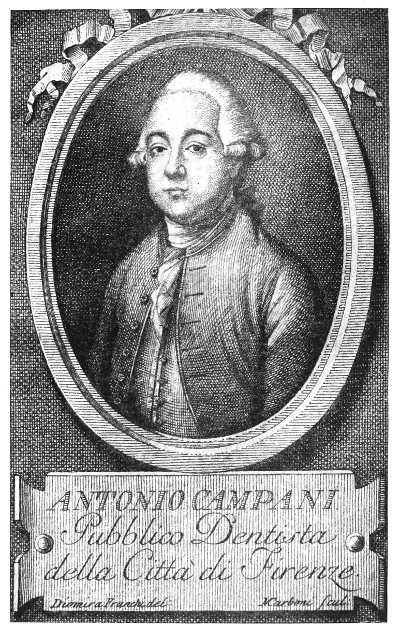
Antonio Campani.
Fig. 96
Pelican for extracting incisor, canine, and molar teeth (Campani, 1786).
Antonio Campani, of Florence, published in 1786 a treatise on dentistry,521
very elegantly printed, and illustrated with thirty-six plates very
neatly carried out. This book, however, contains nothing of real importance
for the development of dentistry.
Benjamin Bell, the English surgeon, a contemporary of Hunter,
also devoted much attention to diseases of the teeth, and, if it may be
argued from the clear and precise manner in which he expresses his
opinions on various questions relating to dental pathology and therapy,
it would seem that he had much greater experience in this field than the
celebrated Hunter.
Fig. 97
Pelicans for extracting wisdom teeth (Campani).
With regard to incision of the gums, in cases of difficult dentition, this
author contradicts certain assertions of the German surgeon Isenflamm
(1782), who argued that when the tooth is already to be perceived through
the gum, the incisions are altogether useless, while if the tooth be still at
some depth, the gingival incision will soon close again, so that the cicatrix
will render the eruption of the tooth still more difficult. Bell admits, too,
that lancing the gum is altogether superfluous when the tooth has pierced
the tissue, all the more so that the accidents provoked by the eruption
are then generally already passed and gone, but the operation ought,
in his opinion, to take place much earlier; and should the wound close
again before the tooth has erupted, the gum must be lanced a second time.
Fig. 98
Campani’s forceps: The first for molar teeth when loose or after having been shaken
with the pelican; the second for deciduous teeth.
Bell contradicts the opinion of Jourdain and Hunter that the morbid
gatherings of Highmore’s antrum are generally consequent upon the closing
of the normal opening of the cavity in the middle meatus. In many
cases of disease of the maxillary sinus this orifice remains open, the
liquid therein collected discharging itself not unfrequently through it,
in certain positions of the body. Instead of penetrating into the antrum
through the nasal orifice, as Jourdain would have it, Bell advises opening
the cavity by Lamorier’s, or, better still, by Drake’s method. Except in
special cases, the first or second molar ought to be extracted, but preferably
the second. After trepanning the alveolus and emptying the cavity,
the opening should be closed with a conically shaped peg to prevent
its slipping into the cavity. From time to time the liquid that tends to
reaccumulate should be allowed exit, and detersive injections should be
made, preferably of lime water.
Fig. 99
Two key instruments with changeable hooks (Campani).
Looseness of the teeth, which in old age may be considered a normal
condition, is always a disease when it occurs in youth. In certain cases
its cause is unknown, in others it depends on an affection of the gums,
either of a scorbutic nature or consequent on an accumulation of tartar.
Fig. 100
An instrument especially destined to extract loose bicuspid teeth. The screw in the
interior of the instrument allowed the hook to be brought to just the right point in each
case (Campani).
According to Bell, dental caries is generally owing to a bad condition
of the humors of the entire body and to a peculiar morbid disposition,
rather than to external causes acting locally, although these latter may
contribute, together with the general causes, to the producing of the
disease.
Fig. 101
Campani’s dental cauteries: The large ones for cases of post-extractive hemorrhage; the
small ones for the cauterization of carious cavities.
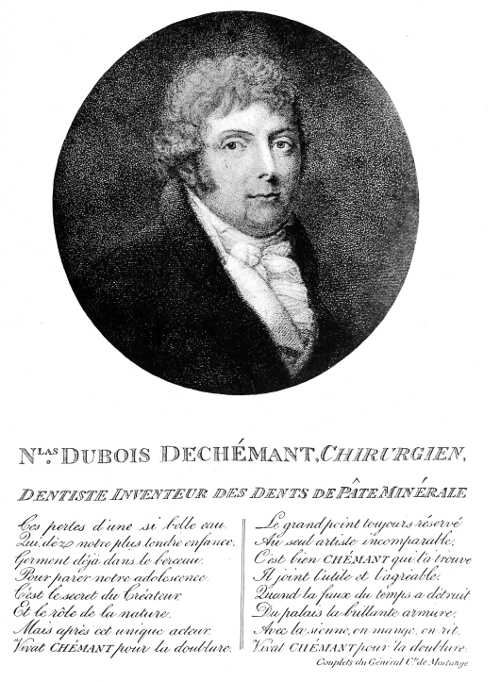
Nicholas Dubois Dechémant.
This author was decidedly averse to the use of the file. For stopping
carious cavities he advises the use of mastic, gum lac, or wax, if the cavity
is large and funnel-shaped; this stopping, however, requires to be renewed
frequently. But when the cavity, wider at the bottom, narrows toward
the surface, one ought to use gold or, still better, tin-foil. The pulp
ought always to be destroyed previously by cauterization.
Bell advises great caution in carrying out transplantation, it having been
proved by many examples that contagious maladies of a serious nature
may easily be communicated in this way from one individual to another.522
In the case of a young woman who had an upper incisor transplanted,
Watson observed undoubted symptoms of syphilitic infection with supervening
accidents of exceptional gravity, which in spite of careful treatment
ended in death.523
Hunter also relates having observed, in seven cases of transplantation,
very serious accidents which, however, he did not believe to be
owing to syphilis, although bearing a certain symptomatic resemblance
to it. Contrariwise, the well-known German surgeon Richter not only
admitted the possibility of transmitting syphilis through a transplanted
tooth, but even that the transplantation of an altogether healthy tooth
from the mouth of a person undoubtedly free from syphilis might be
followed by serious accidents of a syphilitic nature, and this because the
possible existence of a latent syphilis in the person to whose mouth the
tooth was transplanted cannot be excluded; in which case the abnormal
stimulus exercised by the transplanted tooth might very well give rise
to syphilitic manifestations. Therefore, the fact that the person who
furnished the tooth was and continued to be in a state of perfect health
(as precisely in the case cited by Watson) would not be sufficient proof
that the accidents ensuing on the transplantation might not be of a
syphilitic nature.
Lettson also observed, in certain cases of transplantation, accidents
of more or less gravity which he held to be due to syphilis, calling,
however, to mind a case cited by Kuhn, of Philadelphia, where the
possibility of syphilis was not to be thought of, as the morbid symptoms
disappeared entirely, without any treatment, as soon as the transplanted
tooth was removed.524
August G. Richter, the above-named German surgeon, in those
portions of his work dedicated to dental affections and diseases of Highmore’s
antrum, treated these subjects with admirable clearness and order,
without contributing, however, anything original to the development of
dental surgery.525
Nicholas Dubois de Chemant, in 1788, of whom we shall later have
occasion to speak again, published in Paris his first pamphlet on mineral
teeth, entitled Sur les avantages des nouvelles dents, et rateliers artificiels,
incorruptibles, sans odeur.
Jean Jacques Joseph Serre (1759 to 1830). Among the dentists of
the end of the eighteenth century and the beginning of the nineteenth,
a special mention is due to Jean Jacques Joseph Serre. He was born at
Mons, in Belgium, but his remarkable practical and scientific activity
was chiefly called into exercise in Vienna and in Berlin. He published
several works, the most important of which is a practical treatise on
dental operations.526
Among his minor works, one edited in Vienna, in 1788, treats of toothache
during pregnancy; another, printed in Leipsic in 1791, treats most
extensively of diseases of the gums; a third speaks of the mode of maintaining
the teeth and gums in good condition. This little book of dental
hygiene, like the rest of Serre’s books, met with great favor, and went
through two editions in a brief space of time (Berlin, 1809 to 1812).
The works of this author show great study, very wide practice, and an
admirable spirit of observation and research. They had the merit of
greatly contributing to raise the level of dental culture in Germany, and
one finds in them a pretty nearly complete account of the dentistry of
that period. Apart from this, they possess a special interest because of
the vast number of dates and important historical facts therein contained.
As it would be useless here to enter into a minute analysis of the contents
of these books, we will limit ourselves to mentioning a few ideas of which
Serre was a strenuous supporter.
He combats an old prejudice that had recently been reinforced by the
authority of Jourdain, that is, that it does harm to extract a tooth when
the soft parts around it are inflamed and swollen. He likewise combats
the prejudice, also of very ancient date, that teeth ought not to be extracted
during pregnancy. Only, he considers it as well to avoid the cauterization
of the dental pulp in cases of gestation. In extracting teeth, the forceps
ought only to be used after the tooth has been luxated by means of the
pelican. Serre highly approves of this instrument, although he recognizes
it to be a dangerous one in the hands of those who do not know
how to make a proper use of it. This author invented or perfected various
extracting instruments, among which a conical screw for extraction of
roots hollowed out by caries deserves particular mention, and which,
under a somewhat modified form, is still in use.
Jean Jacques Joseph Serre.
One of the most interesting chapters of Serre’s great work is the one
in which he treats of affections of Highmore’s cavity.527 He speaks at
length of the anatomy of the maxillary sinus, of its relation to the teeth
situated below it, of the various modes in which the diseases of the antrum
are produced, of their symptoms and treatment. He passes in review
the various operative methods, and finds that in general the Cowper-Drake
is the one to be preferred to all the others. He says that to open
the sinus the simple extraction of a molar suffices in the greater number
of cases, the trepanning of the alveolus not being generally necessary.
J. Arneman, in 1766, published at Göttingen a synopsis of surgical
instruments528 that deserves mention in so far that the dental instruments of
that time as well as those of earlier periods are therein taken into account
with sufficient exactness.
A. F. Hecker attributed the accidents of difficult dentition to a special
alteration of the saliva caused by the irritation deriving from the erupting
teeth. In these cases the saliva is supposed by him to acquire a high
degree of acridness and to become almost similar to the poison of rabies.
Departing from this theory, the author declares it to be necessary to mitigate
the irritation produced on the gums and other parts of the mouth
by the altered condition of the saliva, as well as to modify the quality of
the saliva itself and to promote the elimination of the same from the body
by emetics and aperients. According to him, liquid carbonate of potash
administered in drops, together with syrup of poppy heads, manna, etc.,
is a most useful remedy, having specially for its effect to diminish the
acridness of the saliva.
Besides this remedy, the author extols the use of blisters behind the
ears, as also of tepid baths, which calm pain and spasms, favor the excretions,
and procure repose and sleep. He rejects the incision of the
gums as altogether useless, and is most opposed to the use of opium,
which he states renders children liable to apoplexy.
And here we will mention, rather by way of curiosity than for any
real historical interest which they possess, two pamphlets on odontitis,
published respectively in 1791 and 1794 by Ploucquet and Kappis, who
maintained that not only the dental pulp, but all the parts that form the
tooth are susceptible of inflammation.529 In Kappis’ pamphlet we find the
following ideas developed, upon which we do not think necessary to comment.
The inflammatory process consists essentially in the increased flow
of humors to a given part and in a more or less intense reaction of the
vital force. Both of these things may take place in the teeth. These are
liable to swell, that is, to undergo an increase of all their dimensions, in
proof of which assertion the author relates the case of an individual,
who when attacked by a violent toothache had found the spaces between
his teeth so narrowed that it was no longer possible to make use of his
usual toothpick, even if he had tried to do so regardless of pain. But
when the toothache was over, the same toothpick again became serviceable
as before. He says that there is no cause for wonder that in odontitis
no redness of the teeth is to be perceived, for in other inflammations
as well, redness is wanting, and, moreover, it exists in the interior membrane
of the tooth. As in other inflammations, so also in odontitis, the
usual issue is resolution. Dental fistulæ may derive from internal suppuration.
The impurities deposited on the teeth are by him supposed
to be owing to an increase of their secretion! According to the author,
caries, the breaking down of teeth apparently healthy, as well as their falling
out, is generally caused by an inflammation of these organs, that is,
by odontitis, an affection that, he says, may be of very varied kind, the
principal forms being the rheumatic, arthritic, sympathetic, and gastric.
Ranieri Gerbi.530 In a book by this author we find recommended a
very singular cure for toothache, even of the most violent nature. It
is in no way scientific, and is besides not particularly pleasant, notwithstanding
that the author, professor at the University of Pisa, was a
scientist of merit, enjoying special esteem as a mathematician and
cultivator of natural sciences.
Under the name of curculio anti-odontalgicus he describes an insect
living habitually inside the flowers of the carduus spinosissimus, that
could be used with great advantage against toothache, in the following
manner: One crushes fourteen or fifteen larvæ of the insect between the
thumb and forefinger, and then rubs the two fingers together until the
matter remaining upon them is entirely absorbed. Instead of the larvæ
(which, as is known, represent the first stage of insect life) one may also
use the fully developed insects. One then applies the two fingers that
have crushed the insects or their larvæ upon the decayed and aching
tooth. If the pain is of a nature to be cured by this means, it diminishes
almost instantaneously, and ceases altogether in a few minutes. It is
said that the fingers preserve their healing power for a great length of
time, even a whole year, and in proof of these assertions Ranieri Gerbi
speaks of no less than six hundred cures performed! Other insects
besides the curculio anti-odontalgicus, used in the same manner, are said
to possess the same curative properties, among them the curculio jaceæ,
carabus chrysocephalus, and the curculio Bacchus, which last, says Gerbi,
has long been used for this purpose by the peasants of Tuscany. The
author also says that some German doctors and naturalists experimented
with success with several insects indigenous to Germany as remedies
against toothache. These insects, also mentioned in a work published in
Bayreuth in 1796, author unknown, are:531 the coccinella septempunctata,
the coccinella bipunctata, the carabus ferrugineus, the chrysomela sanguinolenta,
the chrysomela populi, the cantharis or Spanish fly, and others.
Later on, Hirsch also extolled the healing power of another insect, the
cynips rosarum. With regard to the mode of application, Gerbi says
that instead of crushing and rubbing these insects or their larvæ between
the fingers, one can use a piece of wash leather in a similar manner.
It is to be observed, however, that the insects that are found generally
in the ripe wild teasle—or more precisely their larvæ—had already been
used for a long time as a remedy against toothache; indeed, we even find
these means of cure recommended in the natural history of Pliny. In a
book entitled Histoire d’un voyage aux îles Malouines fait en 1763 et
1764, by a certain Dom Pernetty, this author speaks of some remedies
made known to him by the Superior of the Franciscan friars of Montevideo;
and among others one finds the following: “One draws out the
worm that is generally found in the head of the fuller’s teasle when this is
ripe. One rolls this worm between the index finger and the thumb, lightly
pressing it until it dies of languor. The one or the other of the two fingers
applied on the aching tooth will have the virtue, for a year at least, of
making the toothache cease.”532
Heinrich Callisen, in an excellent treatise on surgery533 published at
Copenhagen in 1788, writes at sufficient length and with great accuracy
on dental and maxillary diseases. According to this writer, it rarely
suffices to trepan one alveolus for the treatment of the morbid collections
of Highmore’s antrum, as the maxillary sinus is very often divided by
partitions into various cells, so that in order to give exit to the pus
contained in each of them, it is necessary to extract several teeth and
trepan their alveoli.534 One ought not, therefore, to give the preference to
this method, unless in the case of the teeth in question being decayed.
But should they all be in a good state, or should a large opening be
necessary because of the nature of the disease in the cavity, it will be better
to follow Lamorier’s method, that is, to incise the gum crosswise under
the malar process and then, after scraping away the periosteum, trepan
the bone. Further, in the case of the disease in the maxillary sinus
having given rise to tumefaction, softening of the bone, and fluctuation
in the palatine region, it is precisely there that the perforation ought to
be carried out. To prevent the reclosing of the opening before the
cure is completed, the author advises the use of pledgets, small bougies,
a piece of prepared sponge, or even a small tube. According to Callisen,
the injections through the nasal orifice of the maxillary sinus are partly
impracticable, and partly of no utility.
It always does more harm than good to file or to scrape the decayed
part of a tooth, without stopping it afterward, as by thus doing, says the
author, one only renders it still more liable to the access and the action of
harmful external influences. In preparing the cavity for stopping, the
bottom of it should be more ample than its external aperture, that the
filling may remain firm.
For extracting molars, he makes use either of the pelican or of the
key; for the incisors and the canines, of the forceps; and for roots, of the
goat’s foot.
Callisen treats incipient idiopathic epulis by destroying it through
cauterization, after having covered the teeth with wax; if the epulis
be large and more or less hard, he removes it with the bistoury; as to
symptomatic epulis, he holds the removal of the original cause to be the
best mode of treatment.
This author declares himself decidedly in favor of replantation and
transplantation, expressing the idea that these methods are always to be
preferred to the application of artificial teeth. He maintains that after a
tooth has been replanted, and its consolidation has taken place, there is
no possibility of any further pain, the nerve being broken. The author
relates a brilliant cure which he carried out upon a lieutenant, who,
during the siege of Copenhagen, had received a blow that had sent
all his front teeth into his mouth. Callisen immediately put them all
back in their places with such ability that they became perfectly firm
again. With reference to transplantation, he only believes in its being
possible for teeth with a single root.
In works published toward 1790, Lentin and Conradi, devoted their
particular attention to the morbid conditions that produce looseness and
spontaneous falling of the teeth. For the treatment of these conditions
Conradi recommended general and local remedies. The general remedies
were directed to the suppressing of acridness in the blood, which he considered
to be an etiological element of primary importance. As to the
local remedies, they ought specially to consist in keeping the teeth clean
by the use of a toothbrush, in painting the gums with tincture of catechu
and myrrh, and in rinsing the mouth frequently with a decoction of
cinchona or of willow bark. Against toothache caused by caries, he particularly
advises essence of cloves, introduced into the carious cavity on
a piece of cotton-wool.535
Friedrich Hirsch was much less disposed than were many of the
preceding writers to incision of the gums in cases of difficult dentition.
Against the accidents connected with this morbid condition, he prefers,
in general, the use of gentle aperients or of emetics, and regards the
scarification of the gums as opportune only in cases where symptoms
indicating a high degree of nervous tension manifest themselves.
Against incipient caries, Hirsch used simple cauterization, which he
held to be capable of arresting the morbid process, at least in many
cases. He says, however, that when a real carious cavity exists, it is
absolutely necessary to stop it; and for this purpose, rather than metallic
or resinous fillings, he prefers a cement of turpentine and quicklime,
made into a paste with varnish of oil of linseed. Nevertheless, when it
is a case of the lower teeth, tin-foil is also, according to him, an excellent
filling material.
Like some of the preceding authors, Hirsch admitted the existence of
interior caries in apparently healthy teeth, and was the first to indicate
a good mode of diagnosticating these occult dental affections. It consists
in tapping the suspected teeth with a sound until one finds the one in
which the percussion provokes pain, and this will be the diseased tooth.
One detaches the gum from the neck of this tooth, and at the point, on
the neck itself or on the beginning of the root, where a small protrusion
is found, one perforates the tooth with a chisel, or some other fit instrument,
so as to penetrate to the interior of it. Through this passage one
introduces into the tooth a fine, curved, red-hot sound, repeating the
operation several times. Lastly, one fills the cavity with lead; and in this
manner the tooth will be cured and no longer painful.
In speaking of the correction of dental anomalies, Hirsch relates a case
in which the deformity consisted in the union of two central incisors, which
formed one single piece, resembling a paddle, and spoiled the appearance
of the face. He divided them with a saw, cauterized the surfaces of the
section, scarified the gum, and, to gain a little space, introduced a small
wedge, until the gum had grown up within the new dental interstice, thus
giving an altogether normal appearance to the part.
It is noteworthy that Hirsch made use almost exclusively of the goat’s
foot for the extraction of teeth, of whatever kind they might be, the instrument
being rather longer, however, than that ordinarily known by this
name, and making his left hand serve as a lever rest.
To arrest strong hemorrhage ensuing from the extraction of teeth,
Hirsch used scraped parchment, which he introduced into the alveolus
and pressed with force into it by means of a sound; then he superposed
compresses and kept the jaws tight together with a bandage passed around
the head.
This author, too, was very favorable to replantation. As to transplantation,
he says that even when the gum and the alveolus are quite
healthy, the individual entirely free from scurvy and syphilis, and not
above fifty years of age, the transplanted teeth do not take root perfectly
except in an average of one case in three. For carrying out this operation
he never made use of teeth extracted from the mouth of a living person,
but, on the contrary, he used the teeth of young and healthy subjects
who had died a violent death; these were, besides, carefully cleaned
before transplanting them, and in this way the author believed the transmission
of disease to be nearly impossible.536
Fig. 102
Full lower set in hippopotamus ivory, with human front teeth; seventeenth century.
(From Guerini’s collection.)
Fig. 103
Upper denture in ivory, at the end of the eighteenth century, for a case in which the
last molars and the front teeth were present. (From Guerini’s collection.)
J. E. Wichmann combated energetically the practice, then pretty
general, of endeavoring to facilitate the eruption of the teeth by
incision of the gums. He considered this practice as one to be absolutely
rejected, supporting his opinion on the consideration that dentition,
being an altogether physiological process, which, moreover, takes place
in parts relatively of but little importance, never can give rise of itself
alone to serious accidents. Besides this, he says, it is very difficult to
say which tooth precisely is about to erupt and at what point. The
incisions would, therefore, have to be made by chance, which would often
render the morbid condition still more serious.
K. A. Blumenthal endeavored to confute Wichmann’s opinions,
with but little success; for, indeed, the same opinions, expressed later
by J. H. Sternberg in a more detailed manner and with ampler views
of the subject, met with ever-increasing approval. Thenceforth, the
practice of gingival incisions in cases of difficult dentition fell more
and more into discredit.537
Robert Bunon,538 the French dentist, is one of the most illustrious personalities
to be met with in the history of our profession. He was born
at the beginning of the eighteenth century, and devoted himself betimes to
the dental art, gathering instruction therein partly from different dentists
and partly from the few odontological books he was able to find. In this
manner he learned pretty much all that was known at that time by dentists
in general. He then decided to travel, in order to acquire further knowledge
and experience. He practised especially in the north of France and
in what is now the state of Belgium; at Antwerp, Brussels, Givet, Maubeuge,
Cambrai. In his ardent thirst for knowledge, when he happened
to pass through a town where some dentist of note resided, he never
neglected to call on him, thus acquiring fresh information and perfecting
himself as well in the practical exercise of his profession. At
the same time, his desire to learn all that was new concerning dental art
and science was so intense that he had translations made of the medical
and surgical works of Latin, Italian, German, and English authors.
However, all this reading, although it enlarged his general knowledge,
taught him nothing, or almost nothing, about those subjects that interested
him above all the others. His practical experiences, meanwhile, brought
a great number of patients to his notice, and, being by nature a very
acute observer, he was able to establish the existence of many facts up
to then unknown. At this time he commenced his studies on dental
erosion, on the development of the teeth, and on the prophylaxis of dental
maladies, his favorite subject. “I felt,” he writes, “that the necessity
of having recourse day by day to the extraction of teeth resulted from
deficient knowledge on our part, and I considered this extreme remedy
as one of the greatest evils to humanity.”539 He therefore endeavored
to extend his own knowledge in every possible way, and as one means of
doing this he visited hospitals and schools; and, ardent champion as he
was of conservative dentistry and of prophylaxis, he succeeded in interesting
medical men and surgeons, midwives and schoolmasters, and parish
priests as well, in the question of the preservation of the teeth. The teeth
he extracted he kept for the purpose of studying the conformation, the
lesions, the dental anomalies; sometimes he split them up to examine
the dental pulp. And he never neglected an opportunity of procuring
anatomical pieces that appeared interesting to him.
In 1728 Fauchard’s book, Le Chirurgien Dentiste, appeared. The
fame of this work reached Belgium, where Bunon then was, and he
immediately set about trying to get a copy of it. After searching in various
towns, he finally found one in Givet. He read it with the greatest interest,
and later, in one of his works, spoke of it in terms of highest praise. It
would seem, however, that he did not learn much that was new to him by
reading this book, which proves that he already possessed a vast odontological
culture and was also profoundly versed in technical dentistry,
which forms the most important part of Fauchard’s book. He was
somewhat astonished at finding in this celebrated author’s work hardly
anything on the subjects that principally interested him, that is, the erosion,
the development of the teeth, and the prophylaxis of caries. This
circumstance very clearly reveals the different mental tendencies in these
two great men, the one, drawn toward the practical side of the profession
which principally interests him and forms the basis of his work, the other,
an impassioned searcher into causes, and student of prophylaxis.
After the perusal of Fauchard’s book, Bunon, who had already conceived
the idea of publishing the results of his observations and of his
own particular studies, felt more than ever the propriety and necessity of
doing so; and to realize his idea, he established himself toward the year
1735 at Paris. Two years later, just when the manuscript of his work
was almost finished, Gerauldy’s book appeared. Bunon relates that he
opened this book in fear and trembling; its title, The art of preserving
the teeth, gave him reason to fear that Gerauldy might have profited by
some of the ideas and observations he had communicated to various
persons, to write a book similar to the one that he himself had it in his
mind to publish.540 He was able, fortunately, to convince himself immediately
that his fears of being forestalled and plagiarized were unfounded.
Notwithstanding, Bunon was determined not to publish his book until
the opportune moment and with all possible probability of success. With
this object in view, he made up his mind first to obtain the diploma of
surgeon-dentist. To reach this aim, he was obliged to conform to the
regulations of the Edict of May, 1699, which then regulated the practising
of dentistry, and this was as much as to say that he was obliged to enter
the College of Surgery, to undertake two years’ practice with a regularly
licensed surgeon, to undergo theoretical and practical examinations, and
to take oath before the Chief Surgeon of the Realm. Once in possession
of the diploma of surgeon-dentist, he was separated thenceforward from
the vulgar crowd of charlatans and invested with all the prestige which
a degree, so rarely acquired at that time, conferred upon its possessor;
but before facing public opinion he desired to make himself known,
and, so to say, first to try his ground, by making known some of his newer
ideas, and see what reception they might meet with from his colleagues
and the public in general. He, therefore, published, in January, 1741,
in the newspaper Mercure de France, a letter on the so-called eye tooth,541
combating the then widely diffused prejudice that the extraction of an
upper canine constituted a grave peril to the eye. He demonstrated the
absurdity of this idea by putting in evidence the anatomical fact that
the upper canines are innervated by the infra-orbital nerve, which has no
relation whatever with the visual organ.
Still better to further his object of making himself a name, he published
in the same year and in the aforementioned paper his dissertation on the
teeth of pregnant women.542 There he demonstrated the falseness of the
idea that one ought never to extract teeth during the state of gestation,
and brought into relief the necessity of treating the dental diseases of
pregnant women with still more accuracy than those of other persons.
These publications, bearing as they did the marks of good sense,
favorably interested the public opinion. The way was therefore prepared,
and Bunon judging the moment to have come for publishing his work,
placed it in the hands of a literary man for the necessary corrections of
style. He also showed his manuscript to several persons of consideration,
but was grieved to perceive that the new ideas put forward in it were
skeptically received. He now thought it might be as well to appeal to the
judgment of a highly competent authority, and fixed on M. de la Peyronie,
Head Surgeon of the Realm. This gentleman, after reading the work,
highly praised the author, and Bunon gained permission to publish the
book under his patronage, on consideration that he should give his word
to furnish the proof of the many assertions made therein on all kinds of
subjects.
The goal was now reached, and Bunon, on the strength of such
illustrious patronage, published his book in March of 1743, under the
title, Essay on the maladies of the teeth, wherein are suggested the means
of obtaining their good conformation from the earliest age, and of assuring
their preservation during the whole course of life.543
All the principal journals of the time (Journal des Savants, Journal
de Trévoux, Journal de Verdun, Mercure de France, etc.) published
extracts from the book and eulogized the author, who had even the high
satisfaction of receiving an honorable mention from the Royal Academy
of Surgery, in the public sitting held in 1743.
Bunon, therefore, was now famous, and had, besides, gained wealthy
clients, as we see from the perusal of his observations, where the best
names in France are to be met with, put in evidence by him without the
least thought of professional secrecy. He could now enjoy his well-merited
successes, in accordance with the thought expressed by him in
one of his books: “All those who labor for the progress of an art have
legitimate right to the honor and to all the recompenses to which success
is entitled.”544
The study of Bunon’s work proves, in fact, that he had good right to be
proud of having written it. The mere perusal of it, however, does not
suffice to enable the reader to judge of its merits, for to do this properly,
it is necessary to study at the same time his other book, published in
1746, entitled Experiences and demonstrations made at the Hospital of
Salpêtrière and at St. Côme, before the Royal Academy of Surgery, serving
as continuation and proof to the Essay on the maladies of the teeth.545 The
essay is, in fact, a small 12mo book of 212 pages, written in a concise
style, and, strange to say, most concise in the most important points.
Many facts of great moment are given under the form of rapid indications,
or of assertions without proof; thus their importance is apt to pass
completely unobserved by those who do not take the trouble of studying
this work thoroughly and with the help of the explanations, illustrations,
and comments contained in the second book we have referred to.
M. A. Barden, of the École Odontotechnique of Paris, was the first
to undertake a serious and conscientious study of Bunon’s works. By
so doing he has thrown full light on the author’s great merits, and
brought forward the high scientific importance of his works.
One of the important questions studied by Bunon concerns the hygiene
to be observed in order to obtain the development of a good dentition. On
this question he rightly establishes the principle that hygiene and dental
prophylaxis should begin from the period of the formation of the milk
teeth. He works out this principle with rigorous logic, and finishes
by tracing the hygiene of the mother during pregnancy, of the woman
(be she mother or nurse) during the nursing period, and of the nursling
as well.
As to the accidents of first dentition, Bunon sets forth a highly scientific
opinion, fully coinciding with the ideas of modern writers, that is, that
dentition is not the sole cause, nor even the principal cause, of such
accidents, but simply a coöperating cause. He made the observation
that in healthy infants, children of healthy parents and nursed by healthy
women, the time of teething is gotten over without difficulty, while
serious accidents occur frequently in weak and sickly children not brought
up and nourished according to hygienic principles, or born, as not often
happens, with special hereditary predispositions.
One of Bunon’s merits is that of having attributed to the first teeth all
the importance they really have, and of having insisted on the necessity
of attentively curing their maladies. He also drew attention to the
dangers that may result from the eventual persistence of the first teeth at
the epoch of the second dentition, or from the persistence of their roots
after the destruction of the crown by caries. These roots, he says, by
their contact with the neighboring permanent teeth may infect them,
and cause them to decay.
Bunon’s researches into the development of the teeth enabled him to
describe precisely the position that the various teeth of the second dentition
occupy in the jaw with regard to the milk teeth, before these are
shed.
Bunon was, besides, the first author who studied accurately dental hypoplasia,
and it is greatly to his honor that his ideas and observations about
this pathological condition have been accepted and confirmed in substance
by the greater part of the authors who have come after him, having
remarkable worth even at the present day. According to him, this congenital
defect of the teeth is owing to infantile maladies, such as hereditary
syphilis, infantile scurvy, malignant fevers, smallpox, or measles; the
harmful effects of these maladies, however, are limited to the teeth in
progress of development, and have no influence on those that have already
come forth. Erosion, as this defect was termed by Bunon, sometimes
affects the first teeth, but is to be found much more frequently in the
second or permanent ones. Those most often affected are the first molars,
and in frequency follow the incisors, the canines, the premolars; the
second and third molars are the most rarely affected.
Bunon studied with great accuracy the means of preventing anomalous
positions of the permanent teeth, owing, according to him, almost always
to want of space. In certain cases he advises the extraction of the milk
tooth in order to facilitate the eruption of the permanent one, and, necessity
urging, he does not hesitate to sacrifice one of the permanent teeth to
procure the advantage of a normal position of the others. With regard
to this subject, the following passage is worthy of note, for in it we find
sketched out the theory of preventive extraction as a means of facilitating
the eruption of the wisdom tooth: “It is better to have the teeth incomplete
as to number than to have the ordinary number badly arranged;
for the mouth will appear none the less well furnished because of having
one or two teeth the less; the other teeth will be commodiously distributed,
and the last molars will find sufficient room when they come forth; thus,
the disorders which these teeth often occasion will be avoided.”546
After caries, Bunon considers dental tartar as the most potent enemy
to the vitality of the teeth. He distinguishes three principal species:
the black, the lemon or light yellow, and the brownish yellow; however,
he allows of two other varieties of less frequent occurrence, the red and
the green tartar.
At a period when an extraordinary confusion obtained with regard to
gingivitis, because of the great number of varieties allowed, Bunon strongly
affirms the unity of this morbid process, and considers tartar as the constant
cause of it, without denying, however, that other causes of various
kinds may contribute at the same time to produce it.
In cases of scorbutic stomatitis, Bunon advises, and very rightly,
the complete removal of tartar from the teeth before having recourse to
any other local treatment. He also insists on the necessity of attending
to the teeth and gums, and especially of freeing the former from tartar
before undertaking the specific treatment of syphilis, considering the good
state of the teeth and gums as one of the most important prophylactic
measures against mercurial stomatitis.
Anyone who takes the trouble of reading Bunon’s works attentively
cannot help admiring his depth of insight, his spirit of observation, his
exquisite clinical sense, and his ingenuity. As illustrating this last quality
of his, we may cite two cases of fracture of the lower jaw that he succeeded
in curing in a short time by the method of binding the teeth, the preceding
attempts of experienced surgeons having entirely failed. One of these
cases is particularly interesting. The seat of the fracture corresponded
with the bicuspids, which, however, had fallen out from the effects of
trauma; the neighboring teeth were also loosened. Bunon filled the empty
space left by the bicuspids with a piece of ivory, provided with two holes;
then, by an ingenious crossing of threads passing from the second molar
on the one side to the second bicuspid on the other, very tightly tied, he
formed, so to speak, one single block, and succeeded in bringing about
the consolidation of the shaking teeth and the complete cure of the
fracture, which was effected in less than a month.
RUSPINI WITH HIS FAMILY IN A COUNTRY PLACE
From an old painting in oil.
The Italian dentist Ruspini presenting the children of his orphanage to the members of the
Free Masons Hall in London with whose aid the institution had been founded.
The unfavorable judgments passed on Bunon by some writers result,
in a great measure, from the circumstance that one finds quoted in his
books certain modes of treatment that today appear positively ridiculous.
But those who, very wrongly and with deplorable levity, consider Bunon
as nothing more than a vulgar empiric, ought to reflect that even the greatest
men cannot altogether avoid the influence of the ideas and the prejudices
of their time. Some tribute they are almost fatally bound to pay to these
prejudices. It is, therefore, not to be wondered at, if one finds in Bunon’s
works, as well as in those of many other old writers, indications given
of more or less strange remedies. Thus, as facilitating the eruption of
teeth, he recommends among other remedies the rubbing of the gums
with a mixture of honey, fresh butter, hare’s brains, and oil of lilies, or
with the fat of an old cock, dog’s milk, and pig’s brains. Against the
disorders and dangers of the teething period he also advises rubbing the
nape of the infant’s neck, the shoulders, the back, and the lower limbs,
always taking care, however, to rub from above downward, thus offering
opposition to the flow of humors toward the upper parts of the body.
These means and methods of treatment reflect, so to speak, the medical
ideas and the curative practices of that time, and come down, in part, from
remote ages, as evidently appears from what is said in different parts of
this book. But such small blemishes ought certainly not to be taken into
account in passing judgment on Bunon’s works, the most substantial
part of which is made up of very original ideas and observations. The
high intrinsic value of Bunon’s works gives him a just right to be considered
one of the most illustrious forerunners of modern scientific
dentistry.
Bartolomeo Ruspini, an Italian dentist, exercised his profession in
London with great success for more than thirty years. He was patronized
by all the greatest personages of the Kingdom and also by the Royal
family, from whom he received special marks of distinction. He attained
a very conspicuous position, and with the aid of the London Freemasons’
Lodge, of which he was an influential member, but chiefly by the results
of his professional work, he was able to found an orphanage that was
called by his name, being moved to do this by his great love for children,
whose dental maladies and disorders had always been an object of particular
study for him. In 1768 he published A Treatise on the Teeth,
Their Structure and Various Diseases. This book was remarkably well
received and went through a number of editions, the last in the year
1797. Ruspini did not, in reality, contribute very much to the development
of dental science. He is, however, to be especially remembered as
the inventor of a very good mouth mirror, a means of examination which
afterward gradually came into general use.
Having brought our history of dentistry up to the end of the eighteenth
century, in order to complete our work we must now speak of an innovation
in dental prosthesis, which, although gradually brought to perfection
in the following century, was first introduced at that time. We allude to
the
The merit of this invention is due, in part, to an individual outside
the dental profession, namely, to the French chemist Duchâteau, of St.
Germain en Laye, near Paris, who first had the idea of employing porcelain
as material for dental prosthesis. However, his idea would not have
yielded fruitful results had it not been for the coöperation of the dentist
Dubois de Chemant, who succeeded in putting it into practice.
The circumstances connected with this invention were the following:
The chemist Duchâteau had for some time worn a denture of hippopotamus
ivory, but as usually happened with all the prosthetic pieces of that
time, which were made of organic material, and were, therefore, subject
to decay, this denture had acquired a very disagreeable odor, resulting
from the action of the buccal humors. Besides which, Duchâteau
being obliged, by reason of his profession, to continually taste pharmaceutic
preparations, his denture had gradually become impregnated with
medicinal substances that imparted a nauseous taste to everything he
ate. The unpleasantness of this was a subject of much consideration
with him, and thus it was that, to remedy the evil, he gradually matured
the idea of having a porcelain denture made, on the model of the ivory
one. In the year 1774 he applied to the porcelain manufactory of M.
Guerhard in Paris for the carrying out of his design. The first trial
was not successful, for in the baking the paste contracted so much that
the denture was no longer of the right dimensions. To remedy this, he
now had another and larger denture made, to allow for its contraction
in the baking. But the results did not correspond with his wishes, and
many trials were still necessary before Duchâteau was able to obtain a
denture which he judged fit for use, although not without defects. As
this denture, because of its dead whiteness, produced an unpleasant
effect, he had a yellowish tint, resembling that of the natural teeth, given
to it, and, as is usual with painting on porcelain, fixed this color by baking
a second time.
However, this denture proving unserviceable, Duchâteau was obliged
to put it aside and begin new experiments. These were made with a
special kind of porcelain paste used in France for the first time in 1740,
which vitrified in baking at 12° to 25° by Wedgwood’s pyrometer, whilst
the usual porcelain required a temperature of 72° to 75° by the same
test; but the results thus obtained were no better than the preceding
ones, and upon these new failures Duchâteau applied to the dentist
Dubois de Chemant, of Paris, for his collaboration. Together they
made fresh attempts, modifying the composition of the paste by adding
a certain quantity of pipe clay and other coloring earths to it. These
modifications enabled them to carry out the baking of the pieces at a
much lower temperature, and after various experiments the final result
was a denture that fitted the gums well enough, and which, in point of
fact, Duchâteau was able to wear.
Encouraged by this success, he tried to manufacture like dentures for
personages of high rank, hoping to gain money thereby, but his want of
knowledge of the dental art prevented him from succeeding in his undertaking.
However, in 1776 he laid this new process before the Royal
Academy of Surgeons in Paris, receiving the thanks of that body as well
as an honorable mention.
Whilst Duchâteau, discouraged by failure, was giving up all idea of
deriving profit from the practical application of his invention, Dubois de
Chemant, on the contrary, did not cease working for a moment, in order
to bring the new method of prosthesis to perfection. Little by little he
introduced important modifications into the composition of the mineral
paste used in the manufacture of the dentures, incorporating therewith
Fontainebleau sand, alicant soda, marl, red oxide of iron, and cobalt.
His experiments and researches aimed at three principal ends, viz.:
1. The obtaining of mineral teeth offering all the gradations of color
presented by natural ones.
2. The arriving at a rigorous calculation of the contraction of the mineral
paste in the baking, so as to be able to make prosthetic pieces of the
desired form and dimensions.
3. The perfecting of the means of attachment of the prosthetic pieces,
and, in particular, of the springs.
By working with intelligence and perseverance, Dubois de Chemant
gradually obtained satisfactory results, and when, in 1788, he published
his first pamphlet on mineral teeth, he had already made dentures and
partial prosthetic pieces for a certain number of persons, who wore them
to great advantage.
As to the chemist Duchâteau, from 1776 to 1788, that is, during the
twelve years subsequent to his communication to the Academy of Surgeons,
he did absolutely nothing at all. He is, therefore, entitled to the
credit of having had a happy idea and of having endeavored to put it into
practice; but the merit of having given life to the idea, abandoned for
so many years by him with whom it originated, is exclusively due to
Dubois de Chemant; he is, therefore, with reason considered the true
inventor of mineral teeth.
Dubois de Chemant, however, was so unjust as to take the whole
credit of the invention for himself, declaring in his writings that the
original idea had been exclusively his own, and was in no way due to
Duchâteau.
In 1789 Dubois de Chemant made his invention known to the Academy
of Sciences and to the Faculty of Medicine of Paris; both pronounced in
favor of it, and in consequence of the opinion given by such high authorities,
he soon after obtained an inventor’s patent from Louis XVI.
Dubois’ successes now aroused the envy of many of his colleagues, and
especially of Dubois Foucou, the king’s dentist, who, together with the
greater part of the dentists of Paris and the chemist Duchâteau, brought
an action against him, accusing him of having usurped the invention
of Duchâteau, and demanding, for this reason, the annulment of the inventor’s
patent that had been granted him. But the law courts, in an
opinion dated January 26, 1792, rejected the demand for annulment,
recognized the patent of invention as fully valid, and condemned Dubois
Foucou, Duchâteau, and their confederates to the costs of the judgment.
Paris being at that time in full revolution, Dubois de Chemant was
induced to emigrate to England. He established himself in London, and
there obtained a patent without much difficulty, according him the
exclusive right, for fourteen years, of manufacturing dentures of mineral
paste.
Dubois de Chemant wrote several pamphlets in order to make known
to the public this new kind of dental prosthesis and its advantages; some
of these were published in Paris (1788, 1790, 1824), and others during his
long residence in London, where he remained from 1792 to 1817. In
these pamphlets he upholds the great superiority of “the incorruptible
teeth of mineral paste” over all other kinds of artificial teeth; he calls
special attention to the fact that teeth of bone, ivory, and of every other
organic substance whatever gradually become spoilt through the action of
the saliva, of oral heat, of food and drink, etc., and not only lose their
primitive color and assume a dirty hue, most unpleasant to the eye, but
acquire a bad odor, at times quite insupportable, becoming, besides, a
cause of irritation to the gums and the mucous membrane of the mouth,
not to speak of their gradual softening and wearing out, which renders
them unserviceable after a certain time. All these disadvantages were
avoided by using the new prosthetic material, this being incorruptible
and inalterable.
The prosthetic appliances by Dubois de Chemant were made in one
single piece that represented the gums and teeth, whether in the case of
one or more teeth, or of whole dental sets. He used to take a cast of the
parts on which the prosthesis was to be applied, and by a process, the
details of which are not known; he succeeded in obtaining prosthetic
pieces that fitted the parts perfectly, notwithstanding the difficulties resulting
from the shrinking of the paste in baking. If the piece required
retouching, he did this by means of special tools for grinding down porcelain.
He could, besides, drill holes in the porcelain for the application
of the means of attachment. In fact, Dubois de Chemant was the
creator of a new method of prosthesis applicable to any and every case,
and which gained the praise and admiration of the great doctors and
scientists of that day, among whom may be mentioned Geoffroy, Vicq
d’Asyr, Descemet, Bajet, Petit Radel, Darcet, Sabatier, Jenner, and
others. The Paris Faculty of Medicine gave it as their judgment that
the prosthetic pieces manufactured by Dubois de Chemant united the
qualities of beauty, solidity, and comfort to the exigencies of hygiene.
These eulogies must, however, be received with a certain reserve, as,
beyond doubt, the mineral teeth of that time still left much to be desired.
In England, where, as we have already said, they had been introduced by
the inventor, they at first obtained a great success, which was, however,
of short duration, and Maury547 tells us that toward 1814 they had fallen
into great discredit and had been entirely abandoned; this signifies that
practically they did not fulfil the expectations held out.
Dubois Foucou and Fonzi. Among the first who occupied themselves
with the manufacturing of mineral teeth, contributing also to their
improvement, are to be named Dubois Foucou, to whom we have already
made reference, and Fonzi, an Italian by birth, who exercised the profession
of dentist in Paris. Dubois Foucou made some improvements in
the coloring of porcelain teeth, and in 1808 published a pamphlet in
which he explained his mode of proceeding in manufacturing them.548
In the same year Fonzi made known a new kind of teeth,549 which he
called terro-metallic. These differed from those of Dubois de Chemant
in that they were all single teeth intended to be applied on a base by
means of small hooks of platina, with which each tooth was furnished.
In addition to this important innovation, Fonzi also discovered the
means of imitating in some degree the semitransparent tint peculiar to
natural teeth.
Notwithstanding this, the teeth made by Fonzi, of which there are still
some specimens in various dental museums, had anything but a good
appearance, and there still remained much to be done before mineral
teeth reached the height of perfection which they attained later on.
Fig. 104
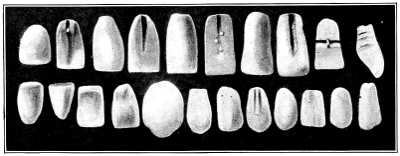
Earliest specimens of mineral teeth.
The credit of having introduced many new improvements in the manufacture
of mineral teeth belongs especially to the Americans. Among
those who particularly distinguished themselves in this department of
dental art, we may note Charles W. Peale, Samuel W. Stockton, James
Alcock, and Dr. Elias Wildman. But the most brilliant results, as is
well known, were obtained by the celebrated Samuel S. White, who, by
an intelligent and persevering activity, dedicated almost exclusively to
improving mineral teeth and to bringing them into general use, contributed
vastly to the progress of modern dental art. Samuel S. White
undoubtedly stands forth as one of the noblest and grandest figures in
the history of dentistry, and his name will ever be recorded with honor
and veneration by dentists of all ages.