When we reflect upon the momentous
and happy results which have always followed the introduction of
Christianity amongst a people;—how it has ever proved an
up-lifting and progressive power; influencing man in the holiest
affections and most inward laws of his moral being; extending its
benign agency through all the relationships of social life, and
acting in various methods as a living principle in the
community;—we think that in ascribing to our religious
history a deeper significance and importance than appertains to
any other department of inquiry, we are only claiming for it a
position which may be established by a wide induction of
facts.
The condition of a nation, socially and politically, is to a
great extent decided by the character of its religious teaching
and worship. The history of our own country, and that of
every other in the world, affords many striking illustrations of
the fact. Many instances might be quoted where the
connection is remarkably verified, and we venture to ascribe the
proud
position of England mainly to the operation of its Christian
faith.
The churches of Britain were the outbirths of its religious
life. They were reared by the earnest piety of our
forefathers. Their history presents an inviting sphere of
investigation, from the valuable aid they furnish, in tracing the
successive incidents and onward development of Christianity;
which soon after its first promulgation, diffused a welcome light
over the Pagan darkness, which enveloped the primeval inhabitants
of our country.
The subject of the first introduction of Christian truth into
Britain, and who was the first herald employed by Providence in
proclaiming it, is one of deep interest, and has long engaged the
investigation of the learned. The theories which have been
offered are conflicting, as to the time, and by whom, this great
boon was conferred upon our country. But as all the varied
traditions seem to point to the apostolic age, we may the more
readily acquiesce, in not being able to fix upon the exact period
and the actual instrument; especially when we remember, how many
of the world’s benefactors have been unknown to those who
are most indebted to them. There is an unwritten biography
of the great and the good; though their names and heroic deeds
are not recorded by the pen of the historian or the chisel of the
sculptor, they have not the less nobly fulfilled their mission to
their age and posterity. Their record, though not with men, is
“on high.” And as there is a law surrounding
us, which permits no disinterested deed or true thought to
perish, but immortalizes them, in their effects on the minds of
men and the developments of life;—so certainly as that law
governs human experience, have we reaped the advantage of many a
noble life’s devotion, albeit unchronicled and
unknown. The results of their achievements are nevertheless
with us still.
The foundation of the Church in Britain has been ascribed, by
many eminent authorities, to St. Paul; and the learned Dr.
Burgess, Bishop of St. David’s, goes so far as to say, that
this interesting point is established by as much substantial
evidence as any historical fact can require; and he proceeds to
give the testimony of the first six centuries in support of the
doctrine. The first and most important testimony is that of
Clemens Romanus, “the intimate friend and fellow-labourer
of St. Paul,” who says, that in preaching the gospel the
apostles went to the utmost bounds of the west, which
seems to have been the usual designation of Britain.
Theoderet speaks of the inhabitants of Spain, Gaul, and
Britain, as dwelling in the utmost bounds of the
west. In the second century, Irenœus speaks of
Christianity as propagated to the utmost bounds of the earth by
the apostles and their disciples; and Tertullian, at the
beginning of the third century, gives a kindred testimony.
In the fourth century, (A.D.
270–340), Eusebius says, that some of the apostles passed over the
ocean to the British Isles; and Jerome, in the same century,
ascribes this province to St. Paul, and says, that after his
imprisonment, having been in Spain, he went from ocean to ocean,
and preached the gospel in the western parts.
Theodoret, in the fifth century, and Venantius Fortunatus in the
sixth, are also quoted as witnesses to the same effect.
The learned bishop has conducted the argument with consummate
ability; and in the judgment of many has demonstrated the
point.
Gildas, a Briton, called the wise, very positively ascribes
the first mission to Britain to St. Joseph of Arimathea, who,
according to his account, evangelized Gaul. This opinion is
supported by Bede, William of Malmesbury, and many eminent
divines of the Church.
Sammes, in his ‘Antiquities of Britain,’ inclines
to the same idea, and gives an illustration of the first church
supposed to be built by him; but it does not appear to be based
upon sufficient evidence to entitle it to acceptance.
The conversion of Britain to the Christian faith has also been
ascribed to St. Peter, St. James the Great, and to Simon
Zelotes. Bishop Taylor and Dr. Cox are disposed to award
the honour to the latter. Southey is of opinion that the
Gospel was first introduced here by the family of Caractacus, who
propagated it among the British tribes; and he is certainly
upheld in this by many weighty considerations.
As there is existing such contrariety of belief among those
master intellects, who have deeply studied the subject, we should
certainly regard it as vain presumption, to record any dogmatic
judgment.
Previous to the Roman conquests, the Britons were accustomed
to celebrate the rites of Druidism; but as it was the custom of
the Romans to carry into the lands they conquered, not only their
civil polity but also their religion, the gods of their Pantheon
became consequently the gods of our ancestors. Near the
existing memorials of Druidical superstition, there arose the
majestic fanes of a more polished mythology. At Bath there
is said to have been a temple dedicated to Minerva, while on the
site now occupied by the splendid cathedral of St. Paul there was
a temple to Diana. It appears from a passage in
King’s Vale Royal, there was a tradition generally
accepted in his day, that on the present site of Chester
Cathedral, was a temple dedicated to Apollo, during the period
that the city was inhabited by the Legionaries.
“I have heard it,” he says, “from a scholar,
residing in the city, when I was there, anno 1653, that there was
a temple dedicated to Apollo in old time, in a place adjoining to
the Cathedral Church, by the constant tradition of the
learned.”
We are not aware that the supposition is capable of being
verified by any existing record, but when we take into
consideration the policy generally pursued by the Romans in
subjugating a country, it seems to be countenanced by strong
probability. With this form of Paganism, however, there
came zealous men, of true apostolic stamp, whose earnest
inculcation of vital principles, accelerated the progress of a
better faith. So conspicuous had that progress become early
in the third century, that Tertullian, in his work written
against the Jews, A.D. 209, states
that “even those places in Britain, hitherto inaccessible
to the Roman arms, have been subdued by the gospel of
Christ.”
Early in the fourth century, Christianity had become so
extensively diffused throughout the land, that Maximius and
Galerius, themselves bigoted Pagans, recommended to the Emperor
Diocletian the enforcement of extreme measures, in order to crush
the growing religion; and the ever-memorable persecution under
his reign was the result, when Christians were indiscriminately
slaughtered, and churches wantonly destroyed.
Under the empire of his successor, Constantine Chlorus,
persecution was extinguished; churches were re-built, the offices
of religion generally resumed, and the people enjoyed a long
tranquillity.
The recall of the Romans to the defence of the integral parts
of their empire, in conjunction with the laborious teaching of
the early Christians, led to the speedy decline of their mythology
in Britain, where indeed it appears never to have taken any deep
root. The growing power of truth supplanted Pagan
superstition, and the zeal of the Christian converts, speedily
destroyed the statues and altars of its deities, which yet
existed in this Island as memorials of its conquest by Roman
arms. “Here had been within the bounds of Britain,
saith our stories, before the time of King Lucius, whose reign
began about the year 179, flamines and arch-flamines, who were
governors over others, the priests of that religion, which the
people in their Paganism did profess, as idolatry hath ever made
a counterfeit show of the true service of God; and when Lucius
was converted to the Christian faith, to enlarge the power of
Christian knowledge and settle a government in the Church of
Christ, abolishing those seats of heathenish idolators, he took
advantage of the temples and other conveniences, wickedly used by
them, to turn them to the true service of God and Christ; and
therefore ordained in England three Archbishops and twenty-eight
Bishops; one of which Archbishops he placed at London, to whom
was subject Cornwall, &c., &c., and the third was the
Archbishop Caerleon, that is Chester. Thus far I note only
to show that when Lucius began the Christian religion, it may
appear that both Chester had been a place for the Arch-flamines
in the time of Paganism, and was also an Archbishop’s see
at the first plantation of the truth.”
The
ground on which the temple of Apollo once stood (if the tradition
be trustworthy) was occupied early in the second century by a
monastery dedicated to St. Peter and St. Paul, “which was
the mother church and burial place to all Chester, and seven
miles about Chester, and so continued for the space of 300 years
and more.” To this monastery (according to Bradshaw
the monk) the relics of St. Werburgh, daughter of Wulphere, King
of Mercia, were removed from Hanbury in 875, for fear of an
incursion of the Danes, and here re-buried with great pomp; a
ceremony usually called “the translation of the
body.” The same author informs us that the army of
Griffin, King of Wales, was stricken with blindness for their
sacrilegious boldness, in attempting to disturb these sainted
remains. This and other reputed miracles of St. Werburgh
appear to have induced the celebrated Ethelfleda, Countess of
Mercia, to translate the monastery of St. Peter and St. Paul, to
the centre of the city, and to erect on its site a convent or
monastery of secular nuns, dedicated to St. Werburgh and St.
Oswald. Earl Leofric was a great benefactor to this
foundation, having repaired its decayed buildings at his own
expense: and in 1093, when (says Rodolphus Glaber) “princes
strove a vie that cathedral churches and minsters should
be erected in a more decent and seemly form, and when Christendom
roused as it were herself, and, casting away her old habiliments,
did put on every where the bright and white robe of the churches,”
Hugh Lupus expelled the canons secular, and laid the foundation
of a magnificent building, the remains of which are still
existing; it was established by him as an Abbey of Benedictine
Monks from Bec in Normandy, to pray (as the foundation charter
expresses it) “for the soul of William their King, and
those of King William his most noble father, his mother Queen
Maud, his brothers and sisters, King Edward the Confessor,
themselves the founders, and those of their fathers, mothers,
antecessors, heirs, parents and barons, and of all christians as
well living as deceased.” The confirmation charter by
the second Ranulf (surnamed De Gernon or Gernons), Earl of
Chester, in which the grant of Hugh Lupus is recapitulated, is in
the possession of the Marquis of Westminster, by whose kindness,
this most important and interesting instrument, has been lent for
the use of the Archæological Association, and has just been
published in the pages of their journal. It is most
beautifully written in columns or pages, for the facility of
reading. The charter occupies nine, and commences with the
copy of the original grant of “Hugone Cestreasi comite,
anno ab incarnatione Domini milesimo nonugesimo” to the
Abbey of St. Werburgh, which was witnessed by Anselm, Archbishop
of Canterbury, followed by the grants of several of the other
witnesses, and it concludes by the confirmation of them all by
the second Ranulf: (“Ego secundus Ranulfus comes
Cæstrie concedo et confirmo hos omnibus donationes quos mei
antecessores vel barones eor’m dederunt,”) with
additional grants from himself. Anselm, Abbot of Bec,
afterward Archbishop of Canterbury, regulated the new foundation
and appointed Richard his chaplain the first abbot.
Hugh Lupus, following the example of most of his predecessors,
lived a life of the wildest luxury and rapine. At length,
falling sick from the consequence of his excesses, and age and
disease coming on, the old hardened soldier was struck with
remorse; and—an expiation common enough in those
days—the great Hugh Lupus took the cowl, retired in the
last state of disease into the monastery, and in three days was
no more.
The Abbey was so richly endowed by the founder and his
successors, that at the dissolution, its revenues amounted to no
less a sum than £1,073 17s. 7d. per annum.
Peter of Lichfield appears to have been the first Bishop who
fixed his seat at Chester, having removed hither from Lichfield
in 1075. But his successor, Robert de Lindsey, removed the
seat of the see to Coventry in 1095, from whence it was brought
back to Lichfield in the reign of Henry 1st. From this
latter period until the dissolution, the Bishops of this diocese
took their titles from Coventry, Lichfield, or Chester, according
as they fixed their residences, those cities being then all
included in the same bishoprick. In the year 1540, in the reign of
Henry 8th, monasteries were suppressed, and that of St. Werburgh
shared the fate of the others. An impartial examination
into this eventful period of our history, gives a painful
exhibition of the precipitate haste and questionable motive with
which these measures were carried into execution, while at the
same time we are fully alive to all the important advantages in
which they resulted. “It is painful to read, or to
imagine, the ruthless violence and wanton waste with which the
measures of the Reformation were carried into effect; and we must
long mourn for what we lost on that occasion, while we rejoice in
what we gained. Recognizing to the largest extent the
blessings of the Reformation, believing that it was the source of
civil as well as of religious liberty, and that the present proud
position of England arises from the effort then made by men to
burst the bonds in which it had been held;—admitting all
this, it is impossible to deny that the work of reformation was
often urged forward by motives of a baser kind than the love of
truth; and it is impossible not to regret the unsparing zeal and
brutal violence with which it was carried on.” Before
proceeding to describe the important changes which transpired
under the reign of Henry the 8th, it may not be unsuitable or
without interest, to introduce a biographical list of the lordly
abbots who presided over this ancient institution:—
Richard, 1st Abbot, had been monk of Bec,
in Normandy, and chaplain to Anselm. He died April
26, 1117, and was buried in the east angle of the south
cloister.
William, 2nd abbot, is stated in the charlutary to be
elected abbot in 1121, the government of the church having been
perhaps intermediately confided to Robert the prior, who died in
1120. He died 11th non. Oct. 1140, and was buried at the
head of his predecessor.
Ralph, 3rd abbot, elected 11 cal. Feb. in the same
year. He died Nov. 16, 1157, and was buried at the head of
abbot Richard, and at the left side of abbot William.
Robert Fitz-Nigel, 4th abbot, supposed to be of the
family of the barons of Halton, elected 1157, received the
bishop’s benediction at Lichfield on the day of St.
Nicholas. He died in 1174, and was buried in the east
cloister under a marble stone to the right hand of the entrance
to the chapter-house.
Robert, 5th abbot, elected on St. Werburgh’s day,
3 non. Feb. 1174, received the benediction in the church of St.
John, at Chester, on the day of St. Agatha the Virgin. This
abbot obtained a bull from Pope Clement, confirming the
possessions of the abbey, and granting various privileges; and
died 2 cal. Sep. 1184, on which the king took the abbey into his
hands, and committed the custody of it to Thomas de
Husseburne.
Robert de Hastings, 6th abbot, in 1186, was placed in
this abbey by Henry II. and Baldwin, archbishop of
Canterbury. He received the benediction at Canterbury, from
the hands of Baldwin, whom he had the honour of entertaining as
legate, at Chester, in the next year, from St. John’s-day
to the following Sunday. This appointment was opposed by
earl Randal, and after much controversy before Hubert, archbishop
of Canterbury, Hastings was deposed, on the condition of Geoffry,
who was elected in his room, paying him an annual pension of xx.
marks. This abbot was buried at the head of his
predecessors, William and Ralph, in the south cloister.
Geoffrey 7th abbot, was confirmed on the deposition of
Hastings in 1194. The situation (from a document contained
in the red book of the abbey) appears not to have been
particularly enviable at this period. The greater part of
the church was in ruins, and the rebuilding had proceeded no
further than the choir, from want of money. The inroads of
the Welsh had deprived the monks of a valuable rectory and two
manors, and the inundations of the sea had been equally fatal in
Wirral and Ince. Abbot Geoffry died May 7, 1208, and was
buried in the chapter-house, on the left hand of the entrance,
near the door.
Hugh Grylle, 8th abbot, was elected 1208. He
occurs as a witness to the marriage covenant of John, Earl of
Chester, with Helen, daughter of Llewelyn, Prince of Wales; and
many grants to the monastery were made in his time. The
repairs of the church were probably completed, and their affairs
in a more prosperous state generally, as Earl Randal grants to
this abbot and his convent a permission to extend their buildings
in the direction of the Northgate. Grylle died April 21,
1226, and was buried in the Chapter-house, under the second arch
from the door, on the left hand side of the feet of Geoffry.
William Marmion, 9th Abbot, succeeded in 1226, and died
in 1228. His place of interment is stated to be in the
cloister, close to Robert Fitz-nigel, on the left hand side of
him. The name of this abbot occurs in a very curious
document, relative to the office of hereditary cook of the
abbey.
Walter Pincebech, 10th abbot, received the benediction
in London, on Michaelmas-day, 1228. This abbot is witness
to the contract between Randal Blundeville and Roger de Maresey,
respecting the lands between Ribble and Mersey, anno 1232.
He continued to hold the abbey till 1240, when he was
interred in the Chapter-house, at the head of Hugh Grylle.
A short time before his death, he appropriated the rectory of
Church Shotwick to support the increase of the kitchen expenses
of the convent, occasioned by adding six monks to the previous
number.
Robert Frind, 11th Abbot, was consecrated at Coventry,
by Hugh de Pateshul, bishop of that see, on St. Matthew’s
day, 1240. He died 1249, and was buried in the
Chapter-house, under the second arch, on the right hand of the
door. This abbot added the appropriation of the chapel of
Wervin to the funds of the kitchen, in consequence of having
increased the number of his monks to forty.
Thomas Capenhurst, 12th abbot, succeeded in 1249.
He was of the family of the mesne lords of Capenhurst, and had to
struggle with a series of powerful enemies of the convent.
The first was Roger de Montalt, justiciary of Chester, who
endeavoured by means of the additional power which he enjoyed by
his office, to wrest from the abbey restitution of the manors of
Lawton, and Goosetrey, and the churches of Bruera, Neston, and
Coddington, which had been given by his ancestors to the
abbey. A portion of these possessions was occupied by an
armed force, and the business was only compromised by severe
sacrifices on the part of the monks. The resignation of
Bretton manor is the only one noticed in the chronicle of the
abbey, but the chartulary mentions several other losses, to which
may certainly be added, that of Lea, in Broxton hundred, of which
the Montalts had afterwards possession. The chronicle does
not fail to notice the judgments of heaven on Roger de Montalt,
that his eldest son died within fifteen days after the
compromise, and that Roger himself died of want, his burial place
remaining unknown unto the common people. A similar attempt
to recover Astbury, was made by Roger Venables in 1259, and according
to the Chronicle, was attended with an equal interposition of
Providence, the Baron of Kinderton dying the year after. In
1263, another contest arose between the abbot and William la
Zuche, justiciary, who occupied the abbey with an armed force,
and proceeded to extremities of insult, which occasioned all the
churches in Chester to be laid under an interdict. In the
next year the gardens and buildings of the abbey in
“Baggelon” were destroyed to facilitate the
strengthening of Chester against a siege, which was apprehended
from the barons and the Welshmen. Capenhurst survived this
last grievance only one year, and dying 4 cal. May, 1265, was
buried at the head of his predecessor, on the right hand of the
entrance into the chapter-house. It is observable that
however violent the measures were, to which the laity resorted at
this period, for the purpose of wresting back from the church the
possessions which the liberality of their ancestors had bestowed
on it, the regular clergy themselves were little more scrupulous;
witness the circumstances noticed in the contest between the
abbots of Basingwerk and Chester, for the rectory of West Kirby,
in which Ralph de Montalt, presented by this abbot, is positively
stated to have been put into possession of his rectory in war
time, by absolute force of arms.
Simon de Albo Monasterio, or Whitchurch, who had
previously been a monk of this abbey, succeeded as 13th abbot,
and if we may judge from the frequent occurrence of his name in
the abbey chartulary, was one of the most active heads this
monastery ever enjoyed. He was regularly elected by the
entire convent xv. cal. May, 1265, in the 45th year of his age,
and the 22nd after assuming the cowl, Simon de Montford being
then usurper of the Earldom of Chester. His admission was
opposed by Lucas de Taney, Justiciary of Chester, who kept the
abbey open for three weeks, and taking the revenues into his hands, wasted
them by the most scandalous profligacy. Simon de Montfort,
however, much to his honour, on hearing the circumstances,
admitted the abbot, and directed Lucas de Taney to make ample
compensation to the abbey, after which Roger de Menland, then
bishop of Coventry and Lichfield, confirmed his election at
Tachebrook, on Whit-Monday, and Simon de Montford having invested
him with the temporalities at Hereford the Monday following, the
new abbot received the benediction from his before-mentioned
diocesan at Tachebrooke, on Trinity Sunday. On this same
day the partizans of Prince Edward laid siege to Chester Castle,
and a reverse of fortune speedily taking place, the election of
the abbot was declared void by the lawful earl, as having been
unratified by himself. The abbot, however, made his peace
with Prince Edward at Beeston, and compensation was made him at
the instance of James de Audley, Justiciary, even to the
replacing from the stores in the Castle, two casks of wine, which
had been consumed by the Prince’s attendants, during his
deposition. The struggles between the laity and the clergy,
which are particularly observable in the documents of Vale Royal
and this monastery, about this period, and had so peculiarly
disquieted the abbacy of Thomas de Capenhurst, were continued in
that of his successor. Philip Burnel, and his wife
Isabella, baroness of Malpas, attempted to recover the manors of
Saighton, Huntington, Cheveley, and Boughton, a domain as
desirable to the abbey, from its richness as its contiguity to
Chester. After a protracted contest, the claimants released
their right to abbot Simon in the king’s court at
Westminster, in 1281, in the royal presence, but the monks
purchased the compliance by a bond for the payment of £200
sterling. The chartulary states that the influence of
Robert Burnel, bishop of Bath and Wells, and uncle to the
claimant, was corruptly used in obtaining this bond: payment was, however,
never made, for the abbot had shortly afterwards the address to
procure a release, on stipulating for the maintenance of two
chaplains to pray for the soul of the said Philip Burnel for
ever. Among the following donations by the family of
Burnel, was the grant of a fountain at Christleton, which was
doubtless of high importance. A cistern twenty feet square
was made at Christleton, and another formed within the cloisters,
and a communication established by pipes, which a patent from
Edward I. enabled the monks to carry through all intervening
lands, permitting even the city walls to be taken down for the
purpose. It is observable that a forester of Delamere,
Randle de Mereton, whose estate was trespassed on in consequence
of this order, ventured on cutting off the pipes which the abbots
had laid, for which he was ordered to make reparation by a royal
mandate, 13 Edward I. This abbot departed this life April
24, 1289, aged 69, and was interred in the chapter house, on the
south side, under a marble stone, within an arch supported by six
marble pillars. During this abbacy, the monastery, or a
considerable portion thereof, was re-built, as appears by
precepts directed to Reginald de Grey, 12 Edward I. to allow
venison from the forests of Delamere and Wirral for the support
of the monks then occupied “on the great work of the
building of the church.” Abbot Simon also
appropriated a large share of the revenues of the abbey to the
several uses of the infirmary, the kitchen, the refectory, and
the distribution of alms, as specified in the chartulary.
After the death of Simon de Whitchurch, the king retained the
abbey in his hands for two years.
Thomas de Byrche-Hylles, a chaplain of his predecessor,
succeeded as 14th abbot, Jan. 30, 1291. He died 1323, and
was buried on the south side of the choir, above the
bishop’s throne, nearly in the line of the pillars.
On his gravestone was a brass plate with his effigies, and in this spot
his body was found in almost complete preservation, on opening a
grave for the remains of dean Smith, in 1787.
William de Bebington, 15th abbot, previously prior of
the monastery, was elected abbot Feb. 5, 1324. In 1345, he
obtained the mitre for himself and his successors, and in the
year following, an exemption from the visitation. He died
Nov. 20, 1349, and was buried on the right side of his
predecessor.
Richard Seynesbury, 16th abbot, was elected 1349.
In 1359, he stated the privileges of his abbey in plea to a writ
of quo warranto. In 1362, about the feast of the
Annunciation, the abbot of St. Alban’s, provincial
president of the Benedictines, the prior of Coventry, and the
superior of St. Alban’s, visited Chester Abbey as
commissioners, deputed by the abbot of Evesham. In
consequence of this visitation, Richard de Seynesbury, who
(according to the chronicle) was fearful of a scrutiny into his
offences and excessive dilapidations, resigned his abbey into the
hands of the pope, as the abbey, being an exempt, was under the
papal protection. An inquiry into his conduct was
instituted at Rome; and in the following year pope Urban admitted
the abbot’s resignation, and conferred the office on his
successor. This abbot died in Lombardy.
Thomas de Newport, 17th abbot, received the benediction
in the papal court on the feast of the Annunciation, and was
installed at Chester on the day of St. Remigius following.
This abbot died at his manor house of Little Sutton, in Wirral,
June 1, 1385, and was buried in the chapter-house, within the
inner door, with his effigy in brass upon the stone.
William de Mershton, 18th abbot, formerly a monk of
this convent, was elected abbot July 30, 1385. He died on
the 13th of January following, and was buried without the choir,
on the right of William de Bebington, in the south aisle.
Henry de Sutton, 19th abbot. He occurs as
abbot in 1410, which was the 24th year of his presiding over this
monastery, as appears by the pleas of the abbey, holden over the
monastery gate, before Nicholas Fare, the abbot’s
seneschal. This abbot was for a time justice of Chester,
and in 1399 had license to fortify his three manor-houses at
Little Sutton, Saighton, and Ince. He was buried in the
broad aisle, close to the north side of the south pillar, next to
the entrance into the choir, before a painting formerly called
the piety of St. Mary.
Thomas Yerdesley, 20th abbot, occurs as abbot in
several portmote pleadings 7 Henry V. and is mentioned also
several times in the reign of Henry VI. He was one of the
justices in commission to hold assizes for the county, and dying
1434, was buried under a marble stone on the north side of the
choir, above the shrine of St. Werburgh.
John Salghall, 21st abbot, suffered excommunication in
1440, for not appearing in convocation after being personally
cited; but afterwards appearing and pleading exemption, he was
absolved. This abbot died in 1450, and was buried in St.
Mary’s chapel, between two pillars on the south side, under
an alabaster stone, which had his effigy in brass fixed upon
it. The site of his interment was formerly called the
chapel of St. Erasmus.
Richard Oldham, 22nd abbot, 1452; about twenty years
afterwards he was promoted to the bishopric of the Isle of Man,
and dying Oct. 13, 1485, was buried at Chester abbey; a short
time before which he was indicted in the portmote court, for
removing the city boundaries about the Northgate, and at the same
time (21 Edw. iv,) ‘divers wymen’ were indicted, who
were the paramours ‘of the monks of Chester.’
Simon Ripley, 23rd abbot, rebuilt the nave, tower, and
south transept of the abbey, and probably commenced the great
plan of alterations and improvements which were interrupted by the
reformation. This abbot also rebuilt or considerably
improved the great manor-house at Saighton, the embattled tower
of which is still remaining. He died at Warwick, August 30,
1492, and was buried in the collegiate church there. On the
north side of the north-east large pillar, supporting the central
tower, was formerly painted the history of the transfiguration,
in which was introduced a figure of this abbot under a canopy,
with a book in one hand, the other lifted up in the act of
blessing, and the ring upon the fourth finger.
John Birchenshaw was appointed 24th abbot by the Pope,
Oct. 4, 1493. He is supposed by Willis to have been a
native of Wales, from his name appearing in an inscription on the
great bell of Conway church. His attention, like that of
his predecessor, was turned to restoring the magnificence of the
buildings of the abbey. The beautiful western entrance is
his work, and he doubtless intended to have added two western
towers to this great entrance, of one of which he laid the
foundations in 1508. The half of Ince manor-house is
apparently in the style of this abbot’s time; and for the
further improvement of Saighton manor-house, which had already
been sumptuously restored by his predecessor, he obtained, 6
Henry VIII. the royal licence to impark 1000 acres in Huntington,
Cheveley, and Saighton. At the same time he had charter of
free warren granted in all his lands in Cheshire, not being
parcel of the king’s forests. In the year 1511, in
the mayoralty of Thomas Smith, violent dissensions had arisen
between the city and this abbot. Thomas Hyphile, and Thomas
Marshall, were successively appointed, and acted as abbots in his
room. After a contest, however, which lasted many years,
Birchenshaw was restored about 1530, and is supposed to have
enjoyed his abbacy to the time of his death, which happened about
seven years afterwards. In 1516, a commission was issued at
Rome to
Thomas, Cardinal of York, to hear and make award between Geoffry,
Bishop of Lichfield, and this abbot, respecting the use of the
mitre, crosier, and other pontificals, and the giving the
blessing.
John Clarke, 25th and last abbot (omitting Hyphile and
Marshall), was elected about the year 1537. He had the good
fortune to comply with the wishes of his sovereign at the
dissolution, and accordingly was suffered to retain the
government of the dissolved abbey of St. Werburgh, under the
character of dean of the new cathedral, which King Henry
established within its walls. At the dissolution, the clear
yearly value of the abbey was £889 18s. [21] The monks had also the patronage
of several rich unappropriated rectories. Their lands
extended over various parts of Cheshire and other counties, but
in Wirral created an overwhelming influence, and extended in
almost an unbroken ring round the city of Chester. Many
considerable families held lands by the tenure of various offices
in the abbey. The manorial lord of Burwardsley was their
champion; and a valuable rectory (Ince) was appropriated to the
uses of the almoner. The Earl of Derby was seneschal at the
time of the dissolution. By a charter of one of the earls
of the name of Randal, the abbots were directed at any period to
have their mansion-houses fitted up in a state fit to receive the
abbot’s retinue and to be the seats of the courts; and by
licence from the bishops of Lichfield, oratories were also
established in these manor-houses. Irby, Bromborough,
Sutton, and Saighton, appear to have been the principal ones at
an early period. The three first were the original seats of
the courts held for the Wirral manor, and Saighton occurs in a
licence for fortifying by Edward I. noticed in the
chartulary. By a subsequent licence for fortifying, 19
Richard II. it appears that Sutton, Saighton, and Ince, had then
become the
principal manorial residences, and these continued such to the
dissolution.
On the general dissolution of the monasteries, Chester was
erected into an independent bishoprick, and St. Werburgh’s
was converted into a Cathedral Church, which it has ever since
remained. It was dedicated to Christ and the Blessed Virgin
Mary; and a dean and six prebendaries installed in it, Thomas
Clarke, the last abbot, being appointed the first dean.
By charter of endowment, dated 5th August, 1541, Henry VIII.
granted to the Bishop of Chester and his successors the
Archdeaconries of Chester and Richmond, with all their
appurtenances, rights, &c.; the Manors of Abbots Cotton in
the county of Chester; lands in the parishes of St. Mary, St.
Martin, St. Michael, St. Werburgh, and Trinity in the city of
Chester; city lands in Mancot, Harden, Christleton, Nantwich,
Northwich, Middlewich, Over, Wollaston, Neston, Heswell, Bidston,
Sandbach, Thornton, Eccleston, Rosthern and Davenham; parcel of
the late Monastery of St. Werburgh; the advowson of Over Rectory;
pensions issuing out of Handley Rectory, Budworth Chapel, and
Bidston Rectory; parcel of Birkenhead Abbey; the advowsons of
Tattenhall and Waverton; rectories of Clapham, Esingwold,
Thornton, Stuart, Bolton-in-Lonsdale, Bolton-le-Moors, and
prebend of Bolton-le-Moors in Lichfield Cathedral; and the Manor
of Weston in the county of Derby.
But the See of Chester did not long remain in possession of these rich
endowments, for in 1546 the arbitrary and avaricious Henry
despoiled the Bishopric of the manors and real estates narrated
in the above charter of endowment, and in lieu thereof compelled
the Bishop to accept of the rectories and advowsons of Cottingham
in Yorkshire, Kirby, Ravensworth, Pabrick, Brompton, Wirklington,
Ribchester, Chipping Mottram, and Bradley in Staffordshire,
Castleton in Derbyshire, and Wallasey, Weverham, Backford, and
Boden in Cheshire, paying as a chief rent £15 19s. 9d.
The endowments made by Henry VIII. to the Deanery of Chester,
consisted of manors and lands to the yearly value of £563
3s. 8d., besides spiritualities to the value of £358 10s.
2d. But these splendid gifts were not destined to remain
long in possession of the Dean and Chapter. In 1550 Sir
Robert Cotton, Comptroller of the Household to Edward VI., having
procured the imprisonment of the Dean and two Prebendaries,
obtained from them a deed of surrender of the Deanery estates in
his own favour. The estates so obtained were disposed of by
Cotton in fee farm to certain gentlemen in Cheshire at very low
prices. But the Chapter having discovered some years
afterwards that the original grant of Henry VIII. was null
through the omission of the word
“Cestriæ” in the description of the
grantees, they petitioned the Queen to re-grant to them the
estates illegally obtained by Cotton as before mentioned; and
their petition was twice argued in the Court of Exchequer.
But the
gentlemen to whom Cotton had sold the lands, apprehensive of the
issue, bestowed a bribe of six years’ rent upon Robert
Dudley, Earl of Leicester, the then all-powerful favourite of
Queen Elizabeth, who, thus stimulated, prevailed with the Queen
to put a stop to the proceedings in the Exchequer, and grant a
commission to him and certain other Privy Councillors to hear
and determine the matters at issue between the parties. The
result was, that in 1580 the charter of Henry VIII. was recalled,
and the estates confirmed to the fee farmers, on payment of
certain rents, with which, and a few impropriations, the Queen by
advice of the Earl and his coadjutors, re-endowed the
Chapter.
The following is a list of the Bishops, with the date of their
consecration, from the foundation of the see in 1541, to the
present time, for which we are mainly indebted to the valuable
foot notes appended to Gastrell’s Notitia.
John Bird, D.D. descended from an ancient family in Cheshire,
educated as a Carmelite Friar at Oxford, and distinguished there
by his learning and zeal. In 1516 he became provincial of
the order of Carmelites throughout England, which office Godwin
erroneously states he held at the dissolution of the
monasteries. Bird did not advocate the king’s
supremacy, until he found that the pope’s power was waning,
when Henry 8th appointed him one of his chaplains, and thus
confirmed his hitherto wavering opinions. He was soon after
consecrated Bishop of Ossery, from which he was translated in
1539 to Bangor, and thence to Chester in 1541. On Queen Mary’s
accession, he accommodated himself to the changes which were
introduced, but could not preserve his see, of which he was
deprived in 1553, in consequence of his being married. Wood
states that the Bishop, after his deprivation, lived in obscurity
at Chester, and, dying there in 1556, was buried in the
Cathedral. Bishop Bird was a learned man, and published
several short discourses in Latin and English. Posterity,
however, would have thought more favourably of him, had he not
alienated some of the revenues of his see, and made leases
injurious to his successors.
George Coates was B.A. in 1522, when he was elected
Probationer Fellow of Balliol College, Oxford. He
afterwards became a Fellow of Magdalene College in the same
university; M.A. 1526, Proctor 1531, and elected Master of
Balliol in 1539. He was also Rector of Cotgrove, near
Nottingham, and became Prebendary of Chester in 1544; and on the
1st of April, 1554, was consecrated Bishop of Chester. He
did not long survive his last appointment, as he died at Chester
in the year 1555, very shortly after he had condemned George
Marsh to the fires of martyrdom at Boughton. This intrepid
martyr regarded his faith as being too precious to be sacrificed,
even to save his life. He held his principles with
unflinching steadfastness; they were the ripened convictions of
his judgment—the pabulum of his inward life—and he
nobly maintained them, even to the death.
The
following account is given by Foxe of the life and persecutions
of this faithful and holy man:—
George Marsh was born in the parish of Dean, in
the county of Lancaster, and, having received a good education,
his parents brought him up in the habits of trade and
industry. About the 25th year of his age, he married a
young woman of the country; with whom he continued living upon a
farm, having several children. His wife dying, he having
formed a proper establishment for his children, went into the
university of Cambridge, where he studied, and much increased in
learning, and was a minister of God’s holy word and
sacraments, and was for awhile curate to the Rev. Laurence
Saunders. In this situation he continued for a time,
earnestly setting forth the true religion, to the weakening of
false doctrine, by his godly readings and sermons, as well there
and in the parish of Dean, as elsewhere in Lancashire. But
such a zealous protestant could hardly be safe. At length
he was apprehended, and kept close prisoner in Chester, by the
bishop of that see, about the space of four months, not being
permitted to have the relief and comfort of his friends; but
charge being given unto the porter, to mark who they were that
asked for him, and to signify their names to the bishop.
He was afterwards sent to Lancaster castle; and being brought
with other prisoners to the sessions, he was made to hold up his
hand with the malefactors; when the Earl of Derby had the
following conversation with him, which is given to us partly in
his own expressive and unaffected language.
“I told his lordship, that I had not dwelt in the
country these three or four years past, and came home but lately
to visit my mother, children, and other friends, and that I meant
to have departed out of the country before Easter, and to have
gone out of the realm. Wherefore I trusted, seeing nothing
could be laid against me, wherein I had offended against the
laws, that his lordship would not with captious questions examine
me, to bring my body into danger of death, to the great
discomfort of my mother. On the earl asking me into what
land I would have gone? I answered, I would have gone
either into Germany, or else into Denmark. He said to his
council, that in Denmark they used such heresy as they have done
in England: but as for Germany the emperor had destroyed it.
“I then said that I trusted, as his lordship had been of
the honourable council of the late king Edward, consenting and
agreeing to acts concerning faith towards God and religion, under
great pain, would not so soon after consent to put poor men to
shameful deaths for believing what he had then professed.
To this he
answered that he, with the lord Windsor, lord Dacres, and others,
did not consent to those acts, and that their refusal would be
seen as long as the parliament-house stood. He then
rehearsed the misfortune of the dukes of Northumberland and
Suffolk, with others, because they favoured not the true
religion; and again the prosperity of the queen’s highness,
because she favoured the true religion; thereby gathering the one
to be good, and of God, and the other to be wicked, and of the
devil; and said that the duke of Northumberland confessed so
plainly.”
And thus have you heard the whole trouble which George Marsh
sustained both at Latham and also at Lancaster. While at
Latham it was falsely reported that he had consented, and agreed
in all things with the earl and his council; and while at
Lancaster, many came to talk with him, giving him such counsel as
Peter gave Christ: but he answered that he could not follow their
counsel, but that by God’s grace he would live and die with
a pure conscience, and as hitherto he had believed and
professed.
Within a few days after, the said Marsh was removed from
Lancaster; and coming to Chester, was sent for by Dr. Cotes, then
bishop, to appear before him in his hall, nobody being present
but they twain. Then he asked him certain questions
concerning the sacrament, and Marsh made such answers as seemed
to content the bishop, saving that he utterly denied
transubstantiation, and allowed not the abuse of the mass, nor
that the lay people should receive under one kind only, contrary
to Christ’s institution: in which points the bishop went
about to persuade him, howbeit, (God be thanked,) all in
vain. Much other talk he had with him, to move him to
submit himself to the universal church of Rome; and when he could
not prevail he sent him to prison again. And after, being
there, came to him divers times, one Massie, a fatherly old man,
one Wrench the schoolmaster, one Hensham the bishop’s
chaplain, and the archdeacon, with many more; who, with much
philosophy, worldly wisdom, and deceitful vanity, after the
tradition of men, but not after Christ, endeavoured to persuade
him to submit himself to the church of Rome, to acknowledge the
pope as its head, and to interpret the Scripture no otherwise
than that church did.
To these Mr. Marsh answered, that he did acknowledge and
believe one only catholic and apostolic church, without which
there is no salvation; and that this church is but one, because
it ever hath confessed and shall confess and believe one only
God, and one only Messiah, and in him only trust for salvation:
which church also is ruled and led by one Spirit, one word, and one
faith; and that this church is universal and catholic, because it
ever hath been since the world’s beginning, is, and shall
endure to the world’s end, and comprehending within it all
nations, kindreds, and languages, degrees, states, and conditions
of men: and that this church is built only upon the foundations
of the prophets and apostles, Jesus Christ himself being the
chief corner stone, and not upon the Romish laws and decrees,
whose head the bishop of Rome was. And where they said the
church did stand in ordinary succession of bishops, being ruled
by general councils, holy fathers, and the laws of the holy
church, and so had continued for the space of fifteen hundred
years and more; he replied that the holy church, which is the
body of Christ, and therefore most worthy to be called holy, was
before any succession of bishops, general councils, or Romish
decrees: neither was it bound to any time or place, ordinary
succession, or traditions of fathers; nor had it any supremacy
over empires and kingdoms; but it was a poor simple flock,
dispersed abroad, as sheep without a shepherd in the midst of
wolves; or as a family of orphans and fatherless children: and
that this church was led and ruled by the word of Christ, he
being the supreme head of this church, and assisting, succouring,
and defending it from all assaults, errors and persecutions,
wherewith it is ever encompassed about.
After the bishop of Chester had taken pleasure in punishing
his prisoner, and often reviling him, giving taunts and odious
names of heretic, &c., he caused him to be brought forth into
a chapel in the cathedral church, called Our Lady Chapel, before
him the said bishop, at two o’clock in the afternoon; when
were also present the mayor of the city, Dr. Wall and other
priests assisting him, George Wensloe, chancellor, and one John
Chetham, registrar. Then they caused George Marsh to take
an oath to answer truly unto such articles as should be objected
against him. Upon which oath taken, the chancellor laid
unto his charge, that he had preached and openly published most
heretically and blasphemously, within the parishes of Dean,
Eccles, Bolton, Bury, and many other parishes within the
bishop’s diocese, in the months of January and February
last preceding, directly against the pope’s authority, and
catholic church of Rome, the blessed mass, the sacrament of the
altar, and many other articles. Unto all which in sum he
answered, that he neither heretically nor blasphemously preached
or spake against any of the said articles; but simply and truly,
as occasion served, and as it were thereunto forced in
conscience, maintained the truth respecting the same articles, as
he said all now present did likewise acknowledge in the time of
King Edward VI.
Then
they examined him severally of every article, and bade him answer
Yes, or No, without equivocation; for they were come to examine,
and not to dispute at that present. He accordingly answered
them every article very modestly, agreeably to the doctrine by
public authority received and taught in this realm at the death
of King Edward; which answers were every one written by the
registrar, to the uttermost that could make against him.
This ended, he was returned to his prison again.
Within three weeks after this, in the said chapel, and in like
sort as before, the bishop and others before named, there being
assembled, he was again brought before them. Then the
chancellor, by way of an oration, declared unto the people
present, that the bishop had done what he could in showing his
charitable disposition towards Marsh, but that all that he could
do would not help; so that he was now determined, if Marsh would
not relent and abjure, to pronounce sentence definitive against
him. Wherefore he bade George Marsh to be now well advised
what he would do, for it stood upon his life; and if he would not
at that present forsake his heretical opinions, it would, (after
the sentence given) be too late, though he might never so gladly
desire it.
Then the chancellor read all his answers that he made at his
former examination; and at every one he asked, whether he would
stick to the same, or no? To which he answered again,
“Yea, yea.” Here also others took occasion to
ask him (for that he denied the bishop of Rome’s authority
in England) whether Linus, Anacletus, and Clement, that were
bishops of Rome, were not good men, and he answered, “Yes,
and divers others. But,” said he, “they claimed
no more authority in England than the bishop of Canterbury doth
at Rome; and I strive not with the place, neither speak I against
the person or the bishop, but against his doctrine; which in most
points is repugnant to the doctrine of Christ.”
“Thou art an arrogant fellow indeed, then,” said the
bishop. “In what article is the doctrine of the
church of Rome repugnant to the doctrine of Christ?”
To whom George Marsh said, “O my lord, I pray you judge
not so of me; I stand now upon the point of life and death: and a
man in my case hath no cause to be arrogant, neither am I, God is
my record. And as concerning the disagreement of the
doctrine, among many other things, the church of Rome erreth in
the sacrament. For Christ, in the institution thereof, did
as well deliver the cup as the bread, saying, ‘Drink ye all
of this,’ and St. Mark reporteth that they did drink
of it. In like manner St. Paul delivered it unto the
Corinthians. In the same sort also it was used in the primitive
church for the space of many hundred years. Now the church
of Rome doth take away one part of the sacrament from the
laity. Wherefore if I could be persuaded in my conscience
by God’s word that it were well done, I could gladly yield
in this point.” “Then,” said the bishop,
“there is no disputing with a heretic.”
Therefore, when all his answers were ready, he asked him whether
he would stand to the same, or else forsake them, and come unto
the catholic church? to which Mr. Marsh answered, that “he
held no heretical opinion, but utterly abhorred all kinds of
heresy, although they did so slander him. And he desired
all to bear him witness, that in all articles of religion he held
no other opinion than was by law established, and publicly taught
in England at the death of Edward VI.; and in the same pure
religion and doctrine he would, by God’s grace, stand,
live, and die.”
The bishop of Chester then took a writing out of his bosom,
and began to read the sentence of condemnation; but when he had
proceeded half through it, the chancellor called him, and said,
“Good my lord, stay, stay! for if you read any further, it
will be too late to call it again.” The bishop
accordingly stopped, when several priests, and many of the
ignorant people, called upon Mr. Marsh, with many earnest words,
to recant. They bade him kneel down and pray, and they
would pray for him: so they kneeled down, and he desired them to
pray for him, and he would pray for them. When this was
over, the bishop again asked him, whether he would not have the
queen’s mercy in time? he answered, “he gladly
desired the same, and loved her grace as faithfully as any of
them: but yet he durst not deny his Saviour Christ, lest he lose
his mercy everlasting, and so win everlasting death.”
The bishop then proceeded with the sentence for about five or
six lines, when again the chancellor, with flattering words and
smiling countenance, stopped him, and said, “Yet good my
lord, once again stay, for if that word be spoken, all is past,
no relenting will then serve.” Then turning to Mr.
Marsh, he asked, “How sayest thou? wilt thou
recant?” Many of the priests and people again
exhorted him to recant, and save his life. To whom he
answered, “I would as fain live as you, if in so doing I
should not deny my master Christ; but then he would deny me
before his Father in heaven.”
The bishop then read his sentence unto the end, and afterwards
said unto him, “Now, I will no more pray for thee than I
will for a dog.” Mr. Marsh answered, that
notwithstanding, he would pray for his lordship. He was
then delivered to the sheriffs of the city; when his late keeper,
finding he
should lose him, said with tears, “Farewell, good
George;” which caused the officers to carry him to a prison
at the north gate, where he was very strictly kept until he went
to his death, during which time he had little comfort or relief
of any creature. For being in the dungeon, or dark prison,
none that would do him good could speak with him, or at least
durst attempt it, for fear of accusation; and some of the
citizens who loved him for the gospel’s sake, although they
were never acquainted with him, would sometimes in the evening
call to him, and ask him how he did. He would answer them
most cheerfully, that he did well, and thanked God highly that he
would vouchsafe of his mercy to appoint him to be a witness of
his truth, and to suffer for the same, wherein he did most
rejoice; beseeching that he would give him grace not to faint
under the cross, but patiently bear the same to his glory, and to
the comfort of his church.
The day of his martyrdom being come, the sheriffs of the city,
with their officers, went to the Northgate, and thence brought
him forth, with a lock upon his feet. As he came on the way
towards the place of execution, some proffered him money, and
looked that he should have gone with a little purse in his hand,
in order to gather money to give unto a priest to say masses for
him after his death; but Mr. Marsh said, he would not be troubled
to receive money, but desired some good man to take it if the
people were disposed to give any, and give it to the prisoners or
the poor. He went all the way reading intently, and many
said, “This man goeth not unto his death as a thief, or as
one that deserveth to die.” On coming to the place of
execution without the city, a deputy chamberlain of Chester
showed Mr. Marsh a writing under a great seal, saying, that it
was a pardon for him if he would recant. He answered,
forasmuch as it tended to pluck him from God, he would not
receive it upon that condition.
He now began to address the people, showing the cause of his
death, and would have exhorted them to be faithful unto Christ,
but one of the sheriffs told him there must be no sermoning
now. He then kneeling down, prayed earnestly, and was then
chained to the post, having a number of fagots under him, and a
barrel with pitch and tar in it over his head. The fire
being unskilfully made, and the wind driving it to and fro, he
suffered great extremity in his death, which notwithstanding he
bore very patiently. When the spectators supposed he had
been dead, suddenly he spread abroad his arms, saying,
“Father of heaven, have mercy upon me,” and so
yielded his spirit into the hands of the Lord. Upon this,
many of the people said he was a martyr, and died marvellously
patient; which caused the bishop shortly after to make a sermon
in the cathedral church, and therein to affirm, that the said
Marsh was a heretic, burnt as such, and was then a fire-brand in
hell.
He was succeeded by Cuthbert Scott, S.T.P. He was
educated at Christ’s College, Cambridge, and was appointed
Master of the College in 1553; became Vice-Chancellor of the
University in 1555, and had the temporalities of the see of
Chester delivered to him in 1556. He was an active and
zealous Romanist, and was implicated in the burning of
Bucer’s bones at Cambridge. He was concerned in most
of the political movements of his day, and being disaffected
towards Queen Elizabeth, and opposed to the reformed religion,
was imprisoned in the Fleet in London, from which he escaped, and
died at Louvain about the year 1560.
William Downham, D.D., was born in Norfolk, elected Fellow of
Magdalene College, Oxford, in 1544, and appointed chaplain to the
Lady Elizabeth, who, when queen, nominated him to a Canonry in
Westminster in 1560; and on the 4th May, 1561, he was consecrated
Bishop of Chester. He died in November, 1577, aged 72, and
was buried in the Cathedral of Chester, with a monumental
inscription, preserved by Webb, but the monument itself has long
since perished.
His sons were eminent theologians, and had the merit suitably
rewarded. George Downham became Bishop of Derry, and John
Downham, B.D., a learned writer, had various preferments.
William
Chadderton, D.D., was born at Nuthurst, near Manchester. He
was educated at the Grammar School of Manchester, and afterwards
became Fellow of Christ’s College, Cambridge. In 1567
he was appointed Regius and Lady Margaret’s Professor of
Divinity, and the following year President of Queen’s
College. Shortly afterwards he became a Canon of
Westminster, and was fortunate in being appointed chaplain to the
royal favourite, Dudley, Earl of Leicester, to whom he was
chiefly indebted for his subsequent promotion. In 1568 he
became Archdeacon of York, and held the dignity for ten
years. In 1579 he was nominated to the see of Chester,
which had been for some time vacant, and in the same year he
accepted the Wardenship of Manchester, where he chiefly
resided. He was a member of the Ecclesiastical Commission
for the North; and it must be admitted that he used considerable
severity towards the Papists, fines and imprisonments being
amongst the strongest arguments he employed to induce that body
to acknowledge the queen’s supremacy. One of the
priests executed at Lancaster, in 1584, as a traitor and rebel,
complained of Chadderton as “a Calvinist, and a false and
cruel Bishop,” charges which lose much of their severity
when proceeding from the friend of Campian and Parsons.
Antony á Wood says, that “the Bishop showed more
respect to a cloak than a cassock,” and there is no doubt
that he was a successful preacher, and a zealous
puritan; although by a reference to the Act Books of the Bishop
of Chester it will be found that he was strict in enforcing the
use of clerical vestments, and both suspended and deprived some
of his clergy for their disregard of the Rubric. On the 5th
April, 1595, he was translated to Lincoln, when he resigned the
Wardenship of Manchester. He died at Southoe, in
Huntingdonshire, April 11th, 1608.
Hugh Bellot, D.D., second son of Thomas Bellot, Esq., of
Moreton Hall, in the county of Chester. Le Neve says he was
brought up in Queen’s College, Cambridge, though Leycester
gives him to St. John’s. He was Proctor in 1570, and
afterwards Rector of Tydd, near Wisbeach, and Vicar of Gresford,
both in episcopal patronage. He was consecrated Bishop of
Bangor in the year 1585, and translated to Chester June 25th,
1595. He was Bishop of Chester about seven months, and was
buried at Wrexham, in Denbighshire, in 1596, aged 54, where a
monument was erected to his memory by his brother, Cuthbert
Bellot, Prebendary of Chester.
Richard Vaughan, D.D., a native of Caernarvonshire, educated
at St. John’s College, Cambridge, and one of the
queen’s chaplains. He was B.D. in Oct., 1588, when he
was collated by Bishop Aylmer to the Archdeaconry of
Middlesex. He was also a Canon of Wells. He succeeded
Bellot in the see of Bangor, and was also his successor at
Chester, being translated thither, according to Lee, May 16th,
1596, which is probably the correct date, although the generality of
his biographers state that he did not become Bishop of Chester
until 1597, which might be the date of his consecration. He
was translated to London in 1604, and, dying of apoplexy on the
30th March, 1607, was buried in St. Paul’s Cathedral.
Wood says he was accounted an excellent preacher and pious
liver. It appears from the Bishop’s registers that,
like some of his predecessors, he was much concerned to repress
the spirit of insubordination and impatience of episcopal
restraint which he found existing among his clergy. Failing
in his attempts to act as the spiritual adviser and comforter of
his clerical brethren, and to uproot their antipathy to certain
ancient and decent ecclesiastical forms, he frequently cited them
to appear before him in the parish church of Aldford, in which
village he then resided, and publicly vindicated in their
presence the polity of the church. The bishop did not
succeed, however, in removing the scruples of these good men, who
regarded their superior as one who sought to fetter their
independence and destroy their liberty. On the 3rd of Oct.
1604, a large body of Lancashire dissentients appeared before the
bishop at Aldford. They appear to have been men of holy
character, laborious in the discharge of their ministerial
functions in populous parishes, and apparently received kind and
impartial treatment. They were all publicly admonished by
the bishop, and required to conform to the liturgy and
ceremonies of the church, and also to subscribe, ex animo,
to the three articles in the 36th canon. They were cited to
appear again at the same place on the 28th of November following,
but only one complied with the order. In those days, when
roads were proverbially bad, and public conveyances unknown, a
journey to Aldford must have been attended with serious
inconveniences, especially on a gloomy and boisterous November
day. Burnet says, in reference to these dissentients, that
“they were very factious and insolent.” During
the Episcopate of Bishop Vaughan, the cathedral was much
repaired; he caused the bells to be re-cast and hung in the great
tower; the west roof he had new leaded, and the timber work
repaired. On his translation to London—
George Lloyd, D.D., rector of Halsall, near Ormskirk, and
bishop of Sodor and Man in 1509, was translated to Chester
January 14th, 1604–5. He died at
Thornton-in-the-Moors, near Chester, of which parish he was
Rector, on the 1st of August, 1615, aged 55 years, and was
privately buried in the choir of the Cathedral of Chester.
Gerard Massie, B.D., was nominated to the bishopric on the
death of Lloyd; but died before consecration.
Thomas Moreton, S.T.P., son of Richard Moreton, of York,
Mercer, born in that city, March 20th, 1564, and educated there
and at Halifax. He distinguished himself by his extensive
classical and theological attainments at Cambridge, and was elected a
Fellow of St. John’s College. He became B.D. in 1598,
and was presented to the rectory of Long Marston, near
Tadcaster. In 1602 he rendered himself conspicuous by his
fearless attendance on the sick during the prevalence of the
plague in York; and becoming chaplain to Lord Evers, accompanied
that nobleman, in 1603, in his embassy to the Emperor of
Germany. On his return he was appointed domestic chaplain
to the Earl of Rutland, and wrote the first part of the
Apologia Catholica, in consequence of the merit of which
Archbishop Matthews collated him to a prependal stall at
York. In 1608 he graduated D.D., and was appointed chaplain
to James I., from whom he received the deanery of Gloucester; and
in the following year succeeded to the deanery of
Winchester. He was a great benefactor to Winchester
Cathedral. He was elected Bishop of Chester May 22nd, 1616,
and was consecrated at Lambeth July 7th. With this see he
held the rectory of Stockport, and diligently applied himself to
reconcile popish recusants and scrupulous non-conformists to the
church; and his success was noticed in the royal declaration in
1618. He was translated to Lichfield and Coventry March
6th, 1618, and advanced to Durham June 29th, 1632. He died
at the house of Sir Henry Yelverton, Bart., at Easton Mauduit,
Northamptonshire, September 23rd, 1659, aged 95 years, unmarried,
and was buried in the parish church there, with a long epitaph recounting
his preferments and sufferings. He endured, with much
resignation, hardships, confiscation, and imprisonment.
Clarendon mentions Bishop Moreton as being one of the “less
formal and more popular prelates.”
John Bridgeman, D.D., the successor of Moreton, was educated
at Cambridge, and elected Fellow of Magdalen College, of which he
was afterwards chosen master, and appointed chaplain to James
I. He was also prebendary of Lichfield and
Peterborough. He was consecrated Bishop of Chester 9th May,
1619, at Lambeth, the revenues of the sees amounting at that time
to £420 per annum. In 1621 he became rector of
Bangor-Iscoed, in Flintshire. He held his see until
episcopacy was suspended under the commonwealth; and on the 15th
December, 1650, his palace, with all the furniture, was sold by
the republicans for £1059. He died at his son’s
house at Moreton, and was buried at Kinnersley church, in
Shropshire, about the year 1658. Bishop Bridgeman
maintained annually at his own expense, hopeful young men at the
University, and preferred some to ecclesiastical honours, who
afterwards assisted to deprive him of his mitre. He was
father of Sir Orlando Bridgeman, created Baronet June 7th, 1660,
who was successively Lord Chief Baron of the Exchequer, Lord
Chief Justice of the Common Pleas, and Lord Keeper of the Great
Seal. He was also the direct ancestor of the present Earl
of Bradford.
Brian
Walton, D.D., a native of Cleveland, in the north riding of
Yorkshire, born in the year 1600, admitted of Magdalen College,
Cambridge, as a sizer, and removed thence to St. Peter’s
College in 1616. He graduated M.A. in 1623, and D.D. in
1639, being then a prebendary of St. Paul’s, and chaplain
to Charles I. His persecutions and losses during the great
rebellion having driven him into retirement, he projected his
great work, the Polyglot Bible, an imperishable monument of his
learning and industry, which was first printed at London in six
folio volumes in 1657. On presenting this work to Charles
II. at the restoration, he was made chaplain to the king, and
consecrated Bishop of Chester in Westminster Abbey, on the 2nd
December, 1660. A. á Wood gives a minute and graphic
description of the enthusiastic reception which the bishop met
with when he went to take possession of this long desecrated
see. The joy of the people on the national resuscitation of
episcopacy was unbounded, and evinced itself by the most public
and decided manifestations.—Wood’s
Athenæ, Vol. 2, p. 731. He enjoyed
his dignity for a short time only, and dying at his house in
Aldersgate-street, London, on the 29th November, 1661, aged 62,
was buried in St. Paul’s Cathedral.
Henry Ferne, D.D. was born at York, in 1642, he was chaplain
to Charles I.; he was one of the king’s commissioners,
along with Sheldon, Hammond, and others, to treat at Uxbridge, in
matters relating to the Church. He was a personal
favourite of the king, and suffered much for the royal cause; but
at the Restoration, a succession of dignities and rewards were
conferred upon him. He was consecrated Bishop of Chester,
February 9th, 1661–2, and died five weeks afterwards, on
March 16th, and was buried with great honour March 25th, 1662,
aged 59 years, having never been at Chester. In 1642, he
published his “Case of Conscience touching
Rebellion,” being the first printed vindication of the
royal cause.
George Hall, D.D. son of the pious and learned Joseph Hall,
Bishop of Norwich, was entered of Exeter College, Oxford, in
1628, being then aged 16 years, elected Fellow of his college in
1632, collated to a Prebend in Exeter Cathedral, in 1639, and
installed Archdeacon of Cornwall, October 8th, 1641. He was
presented by his college to the vicarage of Menherriot, near
Liskeard, but was deprived of his benefice, and prevented keeping
a school for his subsistence, during the usurpation. At the
Restoration, he became chaplain to the king, was appointed Canon
of Windsor, and collated by Archbishop Juxon to the Archdeaconry
of Canterbury in 1660, which latter dignity he held in
commendam with the see of Chester, of which he was
consecrated bishop May 11th, 1662. About the same time he
was presented to the rectory of Wigan, by Sir Orlando Bridgeman,
Chief Justice of the Common Pleas. His death was occasioned
by a wound he received from a knife which happened to be in his
pocket, as he accidentally fell from a terrace in the rectory
gardens at Wigan, on the 23rd August, 1668, aged 55 years.
He was buried in the rector’s chancel, within Wigan church,
where a marble monument was erected to his memory, on which he is
styled “Ecclesiæ Dei servus inutilis, sed
cordatus.” He published several sermons, and a
treatise against popery, with the singular title of “The
Triumphs of Romans over Despised Protestancy. London,
1655.”
John Wilkins, D.D., was born in 1614; and in 1627 was entered
of New Inn, Oxford, but removed to Magdalen Hall, where he
graduated. On the breaking out of the rebellion he took the
covenant; and in 1648 was created B.D., and made warden of Wadham
College by the Presbyterian Committee for the Reformation of the
University. He afterwards subscribed to the engagement, and
complied with the various changes of the times, though apparently
steadily attached to the monarchy. About 1656, he married
Robina, sister of Oliver Cromwell, by whom he had no issue; and
in 1659 he was appointed master of Trinity College,
Cambridge. On the restoration he took the required oaths,
and was appointed Dean of Ripon, afterwards Dean of Exeter; and
also preached to the Honourable Society of Gray’s
Inn. Through the influence of George, Duke of Buckingham,
he obtained the Bishopric of Chester, and was consecrated November
15th, 1668, holding with it the rectory of Wigan. He died
at the house of Dr. Tillotson, who had married his
daughter-in-law, on November 19th, 1672, and was buried in the
church of St. Lawrence, Jewry, London. He was one of the
founders of the Royal Society, to which he bequeathed £400,
and a pious, learned, and scientific man. Calamy says
“many ministers were brought in by Bishop Wilkins’
soft interpretation of the terms of conformity.”
“He was no great read man,” says Aubrey, “but
one of much and deepe thinkeing, and of a working head, and a
prudent man as well as ingeniose. He was a lustie, strong
growne, well sett, broad shouldered person; cheerful and
hospitable. He was extremely well beloved in his
diocese.” Bishop Wilkins wrote several curious and
learned works, which are now scarce and of considerable
value.
John Pearson, D.D., F.R.S., born at Snoring (or Creake), in
Norfolk, February 12th, 1612, educated at Eton, admitted of
King’s College, Cambridge, B.A. 1635, M.A. 1639, and
shortly afterwards Prebendary of Sarum. During the civil
war he was chaplain to Lord Goring, and afterwards in the same
capacity in the family of Sir Robert Cook in London. In
1650, he was minister of St. Clement’s, Eastcheap, London,
at which Church, he preached his incomparable lectures on the
Creed, and afterwards published them, as he states in the
dedication to his parishioners, at their request. At the
Restoration, he was nominated one of the king’s chaplains,
installed Prebendary of Ely, September 22nd, 1660, and on the
26th of the same month and year, appointed Archdeacon of Surrey,
and admitted Master of Trinity College, on the 14th April,
1662. Elected F.R.S. 1667.
This great and learned man was consecrated Bishop of Chester,
February 9th, 1672–3. He died July 16th, 1686, and
was buried in his own Cathedral without any memorial.
Burnet says he was in all respects the greatest divine of the
age; a man of great learning, strong reason, and a clear
judgment. He was a judicious and grave preacher, more
instructive than affective, and a man of a spotless life, and of
an excellent temper. He was not active in his diocese, but
too remiss and easy in his episcopal functions, and was a much
better divine than a Bishop. He was a speaking instance of
what a great man may fall to, for his memory went from him so
entirely that he became a child some years before he
died.—Hist. Own Times, Vol. 3, p.
109–10.
Bishop Pearson has achieved for himself a splendid fame by his
able work on the Creed, which will long perpetuate his
memory.
Thomas Cartwright, D.D. son of a schoolmaster of the same
name, was born at Southampton, 1st Sept. 1634, and was educated
by presbyterian parents. He was admitted of Magdalen
college, Oxford, but removed to Queen’s college by the
parliamentary visitors in 1649; he afterwards became chaplain of
his college and vicar of Walthamstow, in Essex, and in 1659,
preacher at St. Mary Magdelene’s, in Fish-street, and an
active promoter of the popular faction. At the Restoration,
he turned round and distinguished himself by his extravagant zeal
for the royal cause. He had many valuable preferments
bestowed upon him, and was created D.D. although not standing for
it. In 1672, being chaplain to the king, he was installed
Prebendary of Durham, and in 1675, nominated Dean of Ripon, and
was consecrated, October 17th, 1686, Bishop of Chester,
“not by constraint but willingly.” James the
Second found him a ready and expert agent, and appointed him one
of the three commissioners to eject the President and Fellows of
Magdelen college, Oxford, for nobly resisting the king’s
arbitrary attempts to restore popery. Cartwright being an
unpopular man, found it necessary to leave the kingdom on the
arrival of the Prince of Orange in 1688. He escaped in
disguise, and joined James II. at St. Germains, whom he shortly
afterwards accompanied to Ireland, where, being seized with a
dysentery, he died on the 15th April, 1689, aged 54, and was
buried the next night by the Bishop of Meath, in the choir of
Christ Church, Dublin. He died in communion with the Church
of England, although attempts were made by the Romanists, in his
last moments, to shake his creed, which his previous inconsistency
and constant intercourse with the agents of the Church of Rome
had rendered questionable. His diary, from August 1686, to
October 1687, has been edited for the Camden Society by Mr.
Hunter, and will increase the unfavourable estimate which
posterity has formed of the vacillating principles of this
unhappy prelate; although there still appears to be insufficient
evidence to conclude with Ormerod that the bishop, on his
death-bed, expressed his faith in equivocal terms, leaving it
doubtful whether he died in communion of the protestant or popish
churches; for even Burnet, who says he was “one of the
worst of men,” adds, “bad as he was, he never made
that step, even in the most desperate state of his
affairs;” and Antony á Wood rescues him from a
similar charge.
Nicholas Stratford, D.D., was consecrated Bishop of Chester at
Fulham, on 15th September, 1689. He was a firm supporter of
the polity and principles of the English Church, and was esteemed
a learned and primitive ecclesiastic. It is recorded of him
that he never admonished or reproved others, but in the spirit of
meekness and conciliation, a testimony which appears sufficiently
confirmed by the christian tone which pervades his
“Dissuasion against Revenge,” which he addressed to
the conflicting parties in Manchester on leaving that
parish. He was appointed one of the governors of the bounty
of the Queen Anne in the first charter. He died February
12th, 1706–7, aged 74, and was buried in his own
cathedral, his whole diocese witnessing that in simplicity and
godly sincerity he had had his conversation in the world; he was
charitable and benevolent, humble and devout. Chester Blue
Coat Hospital was founded by this excellent bishop, and the
Infirmary was founded by his son, who bequeathed £300 to
the charity.
Sir William Dawes, Bart., D.D., was appointed Dean of Bocking
by Dr. Tenison, Archbishop of Canterbury, and about 1697 was
nominated chaplain to King William III., whose favour he secured
by a sermon he preached on the 5th November. Being
disappointed of the Bishopric of Lincoln in 1705, the queen
nominated him without application to that of Chester, and on the
8th February 1707, he was consecrated. He was very
bountiful to the poor clergy of the diocese, and augmented
several small livings. In 1714 he was translated to York;
Archbishop Sharpe, who died at Bath February 2nd, 1713–14,
having obtained a promise from Queen Anne that Sir William Dawes
should be his successor, because his grace thought that he would
be diligent in executing the duties of his laborious office.
Francis Gastrell, D.D., was consecrated Bishop of Chester in
1714, a learned and pious man, who laboured with untiring energy,
and whose episcopate was characterized by great benevolence,
prudence, and wisdom. He compiled a most valuable MSS.
concerning the benefices of the diocese, entitled “Notitia
Cestriensis,” which is considered “the
noblest document extant on the subject of the ecclesiastical
antiquities of the diocese.” He is also the author of
a very useful work, entitled “The Christian
Institutes.” He died November 24th, 1725.
Samuel Peploe, S.T.P., was appointed to the see of Chester
April 12th, 1726. He died February 21st, 1752, was buried
in the cathedral near the altar, where a monument was erected to
his memory.
Dr. Edmund Keene, master of St. Peter’s, Cambridge, and
rector of Stanhope, succeeded Peploe, and held the rectory of
Stanhope in commendam. He was consecrated March 22nd,
1752. The present episcopal palace was re-built by him out
of his own fortune, at an expense of £2,200. On his
installation to the see of Ely in 1771—
William Markham, LL.D., Dean of Christ Church, Oxford, was
elected Bishop January 26th. Shortly afterwards he was
appointed preceptor to the Prince of Wales, and the Duke of
York. From this See in 1776, he was translated to the
Archbishopric of York. He died in his 89th year,
universally beloved, and was buried in the cloisters of
Westminster Abbey.
Beilby Porteus, D.D., was born at York, May 8th, 1731, of
American parents, and was the youngest but one of nineteen
children. He received his early education at York and
Ripon, and was afterwards admitted a sizer of Christ’s
College, Cambridge, in which University his merits and
abilities soon became distinguished, and were made more generally
known by his excellent poem on “Death,” which
received the Seatonian Prize. In 1769, he was made chaplain
to His Majesty, and December 31st, 1776, was promoted to the
Bishopric of Chester, from whence he was translated to London in
1787, on the demise of Dr. Louth, and died on the 14th May, 1808,
in the 78th year of his age. In 1772, he joined with some
other clergymen in an unsuccessful endeavour to obtain an
amendment of some portions of the Prayer Book. In 1769, he
gave his support to a measure for enlarging the liberties of
protestant dissenters, and in 1781 opposed an effort “to
lay such restrictions on the catholics as would prevent their
increase.” He felt a deep interest in the cause of
the slave, and made strenuous efforts to improve the condition of
the negroes of the West Indies. Among other charitable
benefactions, he transferred in his lifetime nearly £7000
stock to the Archdeaconries of the diocese of London, as a
permanent fund for the relief of the poorer clergy of that
diocese; and he also established three annual gold medals at
Christ’s College, Cambridge, and by his will bequeathed his
library to his successors in the See of London, with a liberal
sum towards erecting a building for its reception in the
episcopal palace at Fulham. This learned and pious prelate
wrote several works, which are highly esteemed. At his own
request, the inscription on his tomb simply records the dates
of his birth and death. [49] He was
succeeded by—
William Cleaver, D.D., who was advanced to the See of Chester
through the interest of his former pupil, the Marquis of
Buckingham, whom he had attended as chaplain when Lord Lieutenant
of Ireland. He was consecrated Bishop, January 20th, 1788,
and was translated to Bangor in 1799, and from thence, on the
death of Bishop Horsley in 1806, to the diocese of St. Asaph,
over which he continued to preside until his death, which took
place May 15th, 1815.
Henry William Majendie, D.D., canon of St. Paul’s, was
nominated in the place of Bishop Cleaver, May 24th, and
consecrated June 14th, 1800, translated in 1810, to the See of
Bangor.
Bowyer Edward Sparke, D.D., Dean of Bristol, was consecrated
January 21st, 1810, and translated to the See of Ely in 1812.
George Henry Law, Prebendary of Carlisle, was consecrated
Bishop of Chester, July 5th, 1812, and translated to the See of
Bath and Wells in the year 1824. Bishop Law was a fine
scholar, and a most able divine.
Charles James Blomfield, D.D., the present learned Bishop of
London, was consecrated to the See of Chester in 1824. He
was Fellow of Trinity College, Cambridge, in which University his
great talents and lofty erudition secured for him high academical
honours. Upon his translation to the See of London in 1828 [50a] he was succeeded by—
John Bird Sumner, D.D., who has been as labouring in the use
of his pen, as he was faithful and assiduous in the fulfilment of
his episcopal duties. His voluminous writings have achieved
for him great fame as an able and eloquent divine. His
prize essay, entitled “The Records of Creation,” is a
wonderful display of learning and reasoning power, and will
doubtless long perpetuate his brilliant reputation. His
piety, earnest zeal, and affable bearing, during the period he
held the Episcopate of Chester, secured the affection of all
classes. He was universally beloved. After having
occupied the See of Chester for twenty years, he was in 1848
appointed Archbishop of Canterbury.
John Graham, D.D., was consecrated Bishop of this Diocese in
1848, and is at present, with pious earnestness and diligence,
fulfilling the duties of his high office.
When Henry the Eighth dissolved the monastery of St. Werburgh
and erected it into a Cathedral Church, he founded a Deanery, two
Archdeaconries, and six Prebendaries. Under this new
regime, John Clarke, the last Abbot of the monastery, was
appointed first Dean. His successor was Henry Mann, who
was, in 1546, consecrated Bishop of the Isle of Man. He was
succeeded by William Cliff, L.L.D. in 1547; Richard Walker in
1558; John Peers in 1567; Richd. Langworth in 1571; Robert Dorset
in 1579; Thomas Modesley in 1580; John Rutter in 1589; William Barlow in
1602; Henry Parry in 1605, who was afterwards made Bishop of
Rochester, from which he was successively translated to
Gloucester and Worcester; he was succeeded by Thomas Mallory in
1606, who held his appointment 38 years; he died at Chester,
April 3rd, 1644, and was buried in the choir of the
Cathedral.
William Nicols, installed April 12th, 1644. His
successor, after a vacancy of about 2 years, was Henry Bridgman,
presented July 13th, 1660, he was consecrated Bishop of the Isle
of Man, with leave to hold the Deanery, in
commendam. He died in Chester, May 15th, 1682, and was
buried in the Cathedral, without any memorial. Leycester
says, “he hath beautified and repaired the Deans’
house in the Abbey court very much.”
He was succeeded by James Arderne in 1682; he died August
18th, 1691, and was buried in the choir of the Cathedral, with
the following memorial on one of the pillars:—“Near
this place lies the body of Dr. James Arderne, of this County, a
while Dean of this Church, who though he bore more than a common
affection to his private relations, yet gave the substance of his
bequeathable estate to this Cathedral, which gift, his will was,
should be mentioned, that clergymen may consider whether it be
not a sort of sacrilege to sweep all away from the church and
charity, into the possession of their lay kindred, who are not
needy. Dat. Oct. 27th, 1688. This plain monument with
the above inscription, upon this cheap stone, is according to the
express words of Dean Arderne’s will.” His
successor was Lawrence Fogg, in 1691. His first preferment
was the Rectory of Hawarden, in Flintshire, from which he was
ejected for non-conformity. Subsequently, conforming, he
was presented to the vicarage of St. Oswald’s, by the Dean
and Chapter, in 1672: he was buried in the chapel of the
Cathedral, and a monument was erected to his memory. Walter
Offley was installed in 1718. Thomas Allen in 1721.
Thomas Brooke in 1733. William Smith in 1758. This
learned divine was presented by the Earl of Derby to the Rectory
of Trinity, Chester, in 1735. In 1753 he was nominated one
of the Ministers of St. George’s Church, Liverpool, by the
corporation. In 1766, he was instituted to the Rectory of
Handley, Cheshire, by the Chapter of the Cathedral, and in the
following year he resigned the Chaplainship of St. George’s
Church, on which occasion the corporation of Liverpool presented
him with 150 guineas, “for his eminent and good services in
the said church.” He died January 8th, 1787, in the
76th year of his age, and was buried on the south side of the
communion table in the cathedral. An elegant monument was
erected to his memory by his widow, with an inscription, reciting
his merits as a christian, a scholar, and a preacher.
Dr. Smith was worthily distinguished for his learning. He was an eminent scholar, a sound
divine, and a good poet. His elegant translations of the
Greek classics were held in great repute, and have been several
times reprinted. He was succeeded by George Cotton, who was
installed February 10th, 1787. Hugh Cholmondley was
appointed in 1806.
In this worthy Dean the poor had a generous benefactor, while
the active interest he took in every object which proposed the
good of the city, rendered him beloved by all. He was most
laborious in his attention to the duties of his office, and many
important restorations were effected in the cathedral by
him. He was succeeded by Robert Hodgson, D.D., in
1816. Dr. Vaughan was appointed as his successor in 1820,
who was succeeded by Edward Coppleston, D.D., afterwards promoted
to the Bishopric of Llandaff, who erected the screen which
separates the church of St. Oswald, from the south side of the
cathedral, at an expense of £600. Henry Philpotts,
D.D., was appointed Dean in 1828, and on his promotion to the
Bishopric of Exeter, in 1831, was succeeded by Dr. Davys, the
well known author of “Village Conversations on the
Liturgy,” “History of England for Children,”
&c.
On his promotion to the See of Peterborough in 1839, the Rev.
F. Anson, D.D., was appointed Dean of Chester, to whose
unremitting zeal, directed by sound judgment and refined taste,
we are indebted for the important improvements which have been
effected in the cathedral since his appointment. Through
his indefatigable energy, the noble edifice has been greatly
beautified; and many essential alterations have been introduced
in the choral service and architectural arrangements, which have
added very much to its decoration and general effect.
During the siege of Chester by the republican army, the
cathedral was very much damaged by those heroic but unscrupulous
men. Notwithstanding that one of the articles of surrender
was to the effect that “no church within the city, or
evidence or writings, belonging to the same shall be
defaced,” in the face of this solemn engagement, they
wantonly defaced the cathedral choir, injured the organ, broke
nearly all the painted glass, and removed the fonts from the
churches. Although the parliamentary forces were cemented
by their renowned leader, chiefly by religious enthusiasm, and
all their extraordinary movements directed and sustained mainly
by that feeling; it nevertheless did not restrain them from
committing violent outrages on the churches of the land.
Religious impulse banded them together, and impressed a singular
unity on all their movements. The memorable counsel of
Cromwell to his men will be remembered,—“put your
trust in the Lord, and keep your powder dry;”—to them
the counsel was opportune, and met with a deep response; but they
respected but little the dictates of conscience and the christian
associations of others, whose religious views and
modes of worship differed from their own. Whatever judgment
may be entertained respecting their political course, and the
issues in which it resulted, we apprehend that the acts of
violence they perpetrated on the sacred edifices which others
frequented and revered, as the places of their holy service,
cannot be justified on any principle.
In 1683 the cathedral was again wantonly damaged by a reckless
mob, instigated by the ambitious Duke of Monmouth. The
Cowper MSS. gives us the following detail of the disgraceful
outrages which unhappily they succeeded in perpetrating.
“In the middle of August, James, Duke of
Monmouth, came to Chester, greatly affecting popularity, and
giving countenance to riotous assemblies and tumultuous mobs,
whose violence was such as to pelt with stones the windows of
several gentlemen’s houses in the city, and otherwise to
damage the same. They likewise furiously forced the doors
of the cathedral church and destroyed most of the painted glass,
burst open the little vestries and cupboards, wherein were the
surplices and hoods belonging to the clergy, which they rent to
rags, and carried away; they beat to pieces the baptismal font,
pulled down some monuments, attempted to demolish the organ, and
committed other enormous outrages.”
It now remains for us to give a description of this venerable
religious edifice. Although in its general external
appearance, it may not present the prepossessing attractions
which appertain to some other cathedral churches, it nevertheless
has a history of peculiar interest; and in its architectural
delineations is well worthy of the study of the ecclesiologist
and the antiquary. From whatever side the cathedral is
viewed, it presents the appearance of a massive pile, and
exhibits a pleasing variety of styles in accordance with the
taste of different ages; some parts decorated with elaborate
workmanship, while others are perfectly simple and
unadorned. The principal parts now standing are not,
perhaps, older than the 14th and 15th century, when the richly
ornamented style of Gothic architecture was at its zenith in this
country. Its general character may be termed the
perpendicular. It has been generally supposed that there
are some remaining specimens of the Saxon, and Lysons favours the
theory; but Mr. Asphitel, in an interesting and able lecture,
delivered before the Archæological Society, stated that he
could not, from the most minute research, discover any portions
of the Saxon church. He considered it probable there might
be some portions in the foundations, but none, in his opinion,
were visible.
The west front is said to have been the work of Abbot Ripley,
who was appointed to the abbacy in 1485. It is now in an
unfinished state, and it would seem that there was an intention
to form two western towers. The foundation of them was laid
with much ceremony by Abbot Birchenshaw, in 1508, the Mayor being then
present: but the project was most likely abandoned for want of
funds. “Had the original design been executed,”
says Winkle, “it would not have been very imposing.
The effect of it, as it now appears, is much injured by a
building which is connected with it, and shuts out one of the
turrets which flank on either side the west wall of the
nave. The original intention seems to have been the usual
one, viz., a square tower on each side of the west end of the
nave. The foundations of that on the north side still
exist, the site of that on the south is now occupied by a
building called the consistory court, once perhaps a chapel, in
the west wall of which is a pointed window of four lights, with
perpendicular tracery, and flowing crocketted canopy with rich
finial; above the window is a belt of pannelled tracery, and on
each side of it is a niche with overhanging canopies, adorned
with pendants and pinnacles, and resting on good brackets.
The statues are gone. The parapet of this building is quite
plain. The west entrance is a singular and beautiful
composition. The door itself is a Tudor arch, inclosed
within a square head, the spandrils are filled with rich and
elegant foliations, the hollow moulding along the top is deep and
broad, and filled with a row of angels half-lengths; all this is
deeply recessed within another Tudor arch, under another square
head, with plain spandrils of ordinary panelling. On each
side of the door are four niches, with their usual accompaniments
of
crocketted canopies, pinnacles, and pendants, and instead of
brackets, the statues stood on pedestals with good bases and
capitals. Above this entrance is the great west window of
the nave, deeply and richly recessed; it is of eight lights, with
elaborate tracery, of some breadth just below the spring of the
arch, and above this some simple tracery of the kind most common
to the latest age of the pointed style. The arch of the
window is much depressed, and has above it a flowing crocketted
canopy, the gable has no parapet, but is finished off with a
simple coping. The flanking turrets before-mentioned are
octagonal, and have belts of panelled tracery and embattled
parapets.
“Leaving the west front, and turning to the
south, a rich and deep porch presents itself behind the
consistory court. The south face of that court is very
similar, in all respects, to the west, already described.
The porch is flanked by buttresses which once had
pinnacles. The entrance is under a Tudor arch, within a
square head, the spandrils richly panelled, over the square head
is a broad belt of quatrefoil panelling, above that a hollow
moulding adorned with the Tudor flower. Above this are two
flat-headed windows, of two lights each, with a deep niche
between them, resting on a projecting bracket, the statue of
course is gone, but the projecting and richly decorated canopy
remains, on both sides of which the wall above is adorned with
two rows of panelling, the open embattled parapet which once crowned the
whole has disappeared. The south side of the nave and its
aisle is plain, but not without dignity; the windows are all
pointed and of perpendicular character; those of the aisle have
straight canopies, with projecting buttresses between, which
still have niches, and once had both pinnacles and statues.
The aisle has no parapet. The windows of the clerestory are
unusually large and lofty, and their canopies are flowing in
form, but perfectly plain, and without finials, they have no
buttresses between them, and the parapet is very shallow and
quite plain.
“The next feature of this cathedral, which is now to be
described in due order, is a very singular one, and indeed
unique, viz., the south wing of the transept. It is no
uncommon case to find the two portions of the transept unlike
each other in some respects; but in no other instance are they so
perfectly dissimilar as at Chester. Here, the south wing is
nearly as long as the nave, and of equal length with the choir,
and considerably broader than either, having, like them, aisles
on both sides; while the north, which probably stands upon the
original foundations, has no aisles, is very short, and only just
the breadth of one side of the central tower. The east and
west faces of this south portion of the transept are nearly
similar. The aisles have no parapet; the windows are
pointed, of four lights each, with late decorated tracery and
small intervening buttresses. The clerestory
has a parapet similar to that of the nave; the windows are
pointed, large, and lofty, with perpendicular tracery, and two
transoms. The south front of this transept, flat at top, is
flanked with square embattled turrets and buttresses, and has a
large window of the perpendicular age filling up nearly all the
space between them. The south face of the aisles on each
side have pointed windows, similar to those already described,
and sloping tops without parapet, but flanked by double
buttresses at the external angles, without pinnacles.
“The south face of the choir, with its aisle, is in
nearly all respects similar to the south portion of the transept;
but the aisle is lengthened out beyond the choir, and becomes the
side aisle of the Lady Chapel, and has an octangular turret near
the east end, with embattled parapet, and beyond it a plain heavy
clumsy buttress: the sloping parapet of the east face of this
aisle meets at the top the flat plain parapet of the most eastern
compartment of the Lady Chapel which projects beyond the aisle,
to that extent. The windows of the Lady Chapel are all
pointed, and of good perpendicular character; the projecting
portion has double buttresses at the external angles, and the
eastern face has a low gable point. This chapel is very
little higher than the side aisles of the choir, the east face of
which is seen over it, with a large lofty pointed window, with
perpendicular tracery and several transoms, flanked with
octagonal turrets, engaged, and terminated with something like domes
of Elizabethan architecture. The parapet of this east face
of the choir is flat. The north side of Lady Chapel is
similar to the south; the choir and its aisles exhibit features
of early English character on this side, but the chapter-room
conceals a considerable portion of it, which is a small building
of an oblong form, and also of early English architecture.
Over its vestibule and the arched passage leading into the east
walk of the cloister, is seen the large window in the north front
of the transept; the arch is much depressed, the tracery very
common and plain, and it has two transoms; the walls of this wing
of the transept are very plain, flat at top, and no
parapet. The whole north side of the nave can be seen only
from the cloister-yard. The south walk of the cloister is
gone, and in the wall of the aisle, below the windows, are still
seen several enriched semicircular arches resting on short
cylindrical columns, evidently belonging to the original church
of Hugh Lupus. The windows of the aisle are Tudor arched,
with the ordinary tracery of this period; but, owing to the
cloister once existing beneath, are necessarily curtailed of half
their due length: there is a thin flat buttress between each; the
aisle has no parapet. The clerestory is lofty, and the
windows pointed, and not so much depressed as those in the aisle
beneath: they are not so lofty as those in the south side, nor
have they any canopies. There is a thin buttress between
each, without pinnacles, and the parapet is quite plain, but
not so shallow as that on the south side.
“The central tower is perhaps the best external feature
of this cathedral, it is indeed only of one story above the roof
ridge, but it is loftier than such towers usually are; in each
face of it are two pointed windows, divided down the middle with
a single mullion, with a quatrefoil at the top, and all of them
have flowing crocketted canopies with finials. At each of
the four angles of the tower is an octagonal turret engaged, all
of which like the tower itself, are terminated with an embattled
parapet.”
On entering the interior (says the same authority) through the
west doorway, into the nave, some disappointment and regret
cannot but be felt. Here is no vaulted roof, but a flat
ceiling of wood, resting on brackets of the same material,
slightly arched, which gives the nave the appearance of having
less elevation than it really possesses; for the naves of many
much more magnificent cathedrals are not so lofty as this by
several feet, but by being vaulted, their apparent height is
increased. The stone vaulting appears to have been actually
commenced, and it is to be regretted that the desirable work was
not completed, as it would certainly have given to the nave a
much more imposing effect. The north wall of the nave, to
the height of the windows, is Norman work, and contains, on the
side of the cloisters, six tombs, where, as it appears from an
old MS. written on the back of an old charter, now in the British
Museum, the early Norman Abbots are interred. Under a wide
arch, sunk in the south wall, which from the ornaments attached
to the pillar near it, appears part of the original building, is
a coffin-shaped stone, with a cross fleury on the lid, over the
remains of some Abbot. Nearly opposite to this, is an
altar-tomb, the sides of which are ornamented with Gothic niches,
with trefoil heads, and with quatrefoils set alternately, the
quatrefoils being also alternately filled with roses and
leopards’ heads; the lid slides, and discloses the lead
coffin, a part of which has been cut away; on the lid is a plain
coffin-shaped stone. It is highly probable that this tomb
contains the remains of one of the later Abbots. The
pillars of the nave are clustered, and have rich bases and
foliated capitals, and the arches are pointed. In this part
of the Cathedral and the north transept, are several monuments
worthy the attention of visitors. A pyramidical monument by
Nollekins, representing a female figure resting on a rock,
against which is placed a broken anchor, erected by Capt. John
Matthews, R.N. to the memory of his wife. One, in white
marble, by Banks, representing the genius of history weeping over
an urn, having three vols., inscribed “Longinus,”
“Thucydides,” “Xenophon,” placed by it;
erected to the memory of Dean Smith, the learned translator of
those works. One to the memory of Mrs. Barbara Dod, erected
by the minor canons. One to Capt. John William Buchanan, of
the 16th light dragoons slain at the battle of Waterloo.
One of Cavalier Sir Willm. Mainwaring, killed at Chester during
the great civil war, 1644. Against the north wall, a
handsome monument, enclosing a bust of Sir John Grey Egerton,
Bart., erected by subscriptions of the citizens of Chester, in
memory of their honourable and independent representative.
One in memory of Major Thomas Hilton, who died at Montmeir, in
the Burmese empire, 2nd February, 1829. One to Augusta, the
wife of the Rev. James Slade, canon of the Cathedral, and
daughter of Bishop Law. One of Capt. John Moor Napier, who
died of asiatic cholera, in Scinde, July 7th, 1846, aged 28
years: this monument was executed by Westmacott, the inscription
was written by his uncle, the gallant Sir Charles Napier, and is
as follows:—
The tomb is no record of high lineage;
His may be traced by his name.
His race was one of soldiers:
Among soldiers he lived—among them he died.
A soldier, falling where numbers fell with him
In a barbarous land.
Yet there died none more generous,
More daring, more gifted, more religious.
On his early grave
Fell the tears of stern and hardy men,
As his had fallen on the grave of others.
To the memory of their comrade, the officers of the General
Staff in Scinde erect this cenotaph.—[The above was
executed by Westmacott.]
In the north transept is a piece of exceedingly fine tapestry,
executed after one of the cartoons of Raphael, representing the history of
Elymas the Sorcerer. Wright, in his travels through France
and Italy, after describing the tapestry he saw in the Vatican at
Rome, says “We have an altar-piece in the choir of Chester,
after one of the same cartoons (it is that of Elymas the
Sorcerer), which, in my mind, is much superior to any of
these.” There is also a well-executed stone monument
to Roger Barnston, Esq., and a tablet in memory of good
Chancellor Peploe.
The choir well merits the attention of every visitor of
taste. From the organ loft to the Bishop’s throne,
the sides are ornamented with rich spiral tabernacle work,
underneath which are massive and highly ornamented stalls.
The choir is separated from the nave and broad aisle by a Gothic
stone screen; there are five pointed arches on each side; above
them, is an arcade of pointed arches, resting on slender shafts,
and above it are the clerestory windows. The pavement of
the choir is of black and white marble. At the west end of
it, are four stalls on each side of the entrance, and there are
twenty others on each side of the choir; over these are rich
canopies, with pinnacles and pendants in great profusion.
Above the stalls on the right hand, opposite the pulpit, is the
Bishop’s throne, which formerly stood at the east end in
St. Mary’s Chapel, and is said to have been the shrine of
St. Werburgh, or as suggested by Pennant, the pedestal on which
originally stood the real shrine which contained the sacred
reliques. At the Reformation it was removed to its present
position, and converted into a throne for the Bishop. It is
a rich specimen of Gothic architecture, decorated with carved
work, and embellished with a range of thirty curious small
statues, variously habited, holding scrolls in their hands, and
originally inscribed with their names, but now defaced. Dr.
Cowper published in 1799, an elaborate history of these figures,
and was of opinion that they represented kings and saints of the
royal Mercian line, ancestors or relations of St. Werburgh.
Very great improvements have recently been effected within the
choir. The restoration of the bishop’s throne was
effected by the munificence of the Rev. Canon Slade, as an
obituary testimonial to his late father-in-law, Bishop Law, in
memory of whom, the following inscription, engraven upon a brass
plate, is affixed to the throne:—
In gloriam Dei hanc cathedram reficiendam curabit
A.D. MDCCCXLVI. Jacobus Slade, A.M. hujus ecciesiæ
Canonicus. Necuen in piam memoriam Georgii Henrici Law,
S.T.P. per xii. annes Episcopi Cestriensis. dein
Bathoniensis.
At the back of the throne is a magnificent stone screen, the
gift of the Archbishop of Canterbury, corresponding in style with
that on the opposite side behind the pulpit, which was erected by
the Dean and Chapter. The altar screen was presented by the
Rev. Peploe Hamilton, of Hoole, near Chester; the larger chair
within the rails of the communion table is the liberal gift of the
Dean, and the small one was presented by the Rev. Canon
Blomfield; the new lectern, of carved oak in the form of an
eagle, by the Rev. Chancellor Raikes, executed by Mr. Harris, of
Chester; the new stone pulpit, from a beautiful design by Mr.
Hussey, is the liberal gift of Sir Edward S. Walker, of this
city. The seats of the choir have been provided with new
crimson cushions, the stalls have been re-painted, and the
canopies gilded by Mr. John Morris, through the liberality of the
Dean. Towards the restoration of the cathedral, Her Majesty
the Queen also contributed a donation of £105 in the name
of the Prince of Wales as Earl of Chester.
The execution of the alterations were entrusted to Messrs.
Furness and Kilpin, of Liverpool, and it is gratifying to add
that Chester artificers have been chiefly employed in carrying
them out. Mr. Haswell built the organ screen, the throne,
the pulpit, the stone work of the new east window in the choir,
and re-laid the marble pavement.
Mr. Harrison constructed the reredos at the back of the altar;
and the oak seats, screens and altar rails are the work of Mr. J.
Evans.
Under the east window is an arch opening to the Lady Chapel,
which consists of a middle and two side aisles, the stone
vaulting of which is adorned with richly carved key-stones.
The side aisles are divided from the middle portion of two
arches, sprung from a massy pier on each side, apparently part of the
original building, cut down and crusted over with clusters of
light pillars, terminated in elegant pointed arches, with
quatrefoils inserted in the mouldings. On the north side of
the chancel, which extends beyond the side aisles, are two
elegant pointed arches; one contains two piscinas; the other was
apparently a seat for the officiating priest: another pointed
arch appears also on the opposite side.
The cloisters are on the north side of the church, and form a
quadrangle of about 110 feet square; originally, there were four
walks, but the south walk is destroyed. The general style
of the cloisters is that of the fifteenth century, with carved
key-stones at the intersections of the vaulting, the arches of
the windows are depressed; a lavatory projects from the west walk
of the cloisters, and did extend along the south walk; over the
east walk was a dormitory, which was sometime ago destroyed, much
to the injury of the appearance of these conventual ruins.
It is obvious that the present cloisters are only a restoration
of an earlier one. In the east walk of the cloisters is the
entrance into the Chapter House, or rather its singular
vestibule, 30 feet 4 inches long, and 27 feet 4 inches
wide. The vaulted roof of this apartment is supported by
four columns without capitals, surrounded by eight slender
shafts. The Chapter room itself is an elegant building, 35
feet high, 50 feet long, and 26 broad. The stone vaulting
rests on
clusters of slender shafts, with foliated capitals; all the
windows are in the latest style, those at the east and west ends
consist of five lights each. A gallery goes round three
sides of the room, and where it passes the windows is carried
between the mullions, and a corresponding series of light shafts
connected with them, which have elegant sculptured capitals, and
support the mouldings of the lancet arches above.
Notwithstanding the soft nature of the stone, the carving is all
in an excellent state of preservation.
Pennant has ascribed the erection of this beautiful building
to Randle Meschines, on the ground of his having removed the body
of Hugh Lupus, “de cœmiterio in capitulum,” as
mentioned in his charter to the Abbey; and he is, most probably,
right in supposing that the same respect would have been paid at
the time of his death, if a Chapter House had then existed.
This argument, however, merely tends to prove that the Chapter
House was built by Handle Meschines, but as far as can be
inferred from the architecture, it may be reasonably doubted
whether any part of the present Chapter House was built long
before the extinction of the local earldom. The learned Dr.
Ormerod is of opinion that this is about the date of its
erection, and he is supported by several other competent
authorities, who concur with him on the point.
In the Chapter House are preserved some interesting local
relics, among which is a red sand stone, 24 inches by 8
inches, found on the site of the Deanery, bearing this
inscription:—
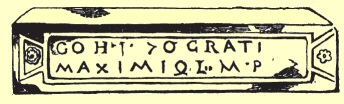
Mr. Roach Smith, an eminent authority in such matters, says
that this inscription is to be ascribed to the century of
Ocratius Maximus, of the first Cohort of the 20th Legion; it has
evidently been a facing stone, probably in the city wall; it
resembles in character the centurial commemorations on the stones
in the great northern wall, and like them, apparently refers to
the completion of a certain quantity of building.
There is also the head part of a stone coffin, found by
persons employed in digging in the Chapter House in 1723.
The scull and bones were entire, and lay in their proper
position, enveloped in an ox-hide. On the breast was a
piece of cloth, the texture of which could not be
ascertained. It has been supposed by Pennant and others,
that these remains were those of Hugh Lupus, which were removed
hither from the churchyard, by his nephew Randle, Earl of
Chester. Ormerod seems to be of opinion that this relic
designated the place of sepulchre of Abbot Simon Ripley. It is now
generally admitted by those most competent to form a judgment on
the subject, that Ormerod has given a true interpretation of this
interesting relic. The initials, he says, are clearly S.
R., and the wolf’s head corresponds in style of carving
with a similar one introduced by Simon Ripley on the tower of
Saighton Manor House. There are also two shot-torn banners
of the 22nd Cheshire regiment of Infantry, which were received
from India, after that gallant corps had been presented with new
colours, and were presented by the government to the then Dean of
Chester (Dr. Davys) for preservation in the Cathedral.
The appearance of this noble room would certainly be much
improved by the removal of the unsightly bookcases, which are not
in the slightest unison with the beautiful architecture they so
much obstruct. Mr. Ashpitel says, “he considers the
Chapter House, with its singularly tasteful vestibule, to be the
finest in the kingdom of its form;” and has animadverted,
with deserving severity, upon the tastelessness of a professed
architectural critic, who could pass over the building with the
disparaging criticism, “poor enough?” He (Mr.
Ashpitel) had been told the same story, but he found beauties
which grew upon him more and more at every visit. The
Norman remains, he says, are extremely fine—there is work
of all kinds of great beauty; and there are the most curious and
instructive transitions from style to style that perhaps
were ever contained in one building.
The north walk of the cloister contained the chief entrance
into the refectory of the convent, which still remains a
magnificent apartment, now divided by a modern passage, the
eastern and greater portion being used as the King’s
School. It was seventy-eight feet long, and thirty-four
feet high, with a roof of oak resting on brackets, which was
removed some years ago. Six pointed windows with
intervening buttresses lighted the north side, and four the
south. At the east end were three lancet-shaped windows,
with slender detached shafts, all included within one greater
arch. In the south east angle of this once noble room, is a
flight of steps within the wall, with a projection at the upper
end like a stone pulpit; these steps led to the ancient
dormitory, and opens into the refectory by an elegant range of
pointed arches, trefoiled within, whose spandrils are pierced
with a series of quatrefoils.
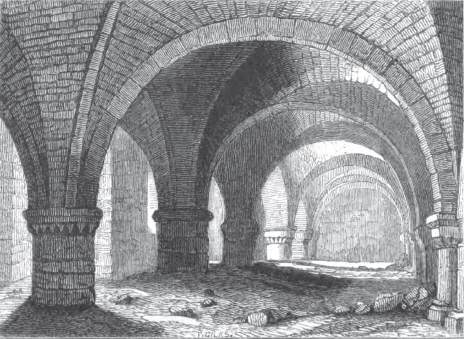
We now direct the visitor’s attention to a portion of
the Norman edifice, which has of late excited very deep interest,
the Promptuarium, lately excavated:
“the chamber is a sort of gallery or
cloister on the ground floor, about ninety feet long by forty
feet wide, traversed in the centre by a row of pillars (with one
exception cylindrical), which divide it into six double bays,
from which pillars, and four corresponding ones at each side,
spring the intersecting arches by which the building is
vaulted. The side pillars are as entirely Norman in
their character as the centre ones, being simply the square pier,
on each face of which is the pilaster attached; the groining of
the roof is without the finish of ribs at the joints, a finish
characteristic of a later period. The chamber, which has at
present only a borrowed light from the cloisters on the east, was
originally lighted from the west side, by a window in each bay,
except the second bay from the south end, in which was a
principal entrance. This doorway and the windows are now
all choked up by the adjoining garden. On the same side,
and at the north end, is a very large chimney and
fire-place. A glance at the groining and arches at the
north end, informing us that the chamber did formerly end here, I
was induced to think, by this situation of the fire-place, that
its length was originally very much greater. I have since
found the termination of the chamber in the cellars of the
present Registry, where the groining is supported by corbels,
which shew that the vaults extended there, but no further.
One double bay, therefore, added to the present remains, gives us
the entire length of the building,—about one hundred and
five feet. In this last bay, on the east side, is a
principal doorway (four inches wider than the one on the west
side), leading towards the refectory. On the east side
also, and near the north end, is a postern from the cloisters and
a spiral staircase, partly constructed in the thickness of the
wall, leading to the chamber above, of which there are now no
remains. Two small archways at opposite sides of the
chamber, precisely similar in form and size, and rising from
beneath the level of the floor, seemed to indicate a subterranean
passage connecting them. An excavation round each has,
however, discovered no channel between them. In considering
the character and situation of this vaulted chamber it should be
borne in mind that though now apparently subterranean, it is only
so with reference to the west side, the level of the floor being
four feet above the level of the nave of the cathedral. The
ground which now rises above it on the west side is all
made ground of late date, belonging to the Palace, the
original level of which is identical with this chamber, as shewn
by the area round the present Palace kitchens, and by those
apartments belonging to the Abbot’s residence, which yet
remain.” [74]
Mr. Ashpitel, in his interesting lecture on Chester Cathedral,
bestowed the name of Promptuarium on this Norman cloister, he
says, “these are vaulted apartments of early Norman work,
and are described in the charter of Henry VIII., by which he
divides the properties between the bishop and dean,
promptuaria et pannaria, the former derived from a word
denoting a butler or steward, probably a buttery; and the latter,
from pannus, a cloth, probably the place for
clothing.”
Mr.
Ayrton, in an able paper on the Norman remains of the cathedral,
read before the Chester Archæological Association, entered
into an elaborate inquiry on the subject, stating his reasons for
concluding that this is not a Promptuarium, but, in his
opinion, a spacious hall, where the splendid hospitality of the
Abbots was displayed to strangers, friends, and dependents.
His arguments are marshalled with great ingenuity and force; and
as every contribution which tends to throw light on the use, to
which this remain of the ancient monastery was devoted, possesses
much importance and interest; we will here insert his
observations upon it:—
“Let us see how far we have any authority
for considering this building a ‘Promptuarium,’ that
is, a store-room or buttery. All that Ormerod says of it
is, that ‘it is a kind of crypt, consisting of a double row
of circular arches, springing, with one exception, from short
cylindrical columns. This building was probably used as a
depository for the imported stores of the abbey, of which we may
form no mean idea from a charter from the King of the Isles to
the Abbot of St. Werburgh, granting ingress and egress to the
vessels of the Monks of the Abbey of St. Werburgh, with sale and
purchase of goods, toll free, and right of fishing upon his
coasts.’ (Vol. I. page 218.) But he gives us no
authority for the use ascribed to it; only his own unsupported
supposition hazarded when the building was not so far cleared or
intelligible as at present. The name
“Promptuarium” was bestowed on it by Mr. Ashpitel
when it was cleared out and restored to its present condition at
the expense of the British Archæological Association, under
the direction of the Local Committee, preparatory to the Congress
of 1849. He derives the name from a sentence in Henry the
VIII’s. charter (dividing the properties between the Bishop
and the Dean and Chapter,) and speaks of this building in the
plural, which agrees with his reading of the charter, but
does not agree with the fact. He says, in his lecture on
Chester Cathedral, ‘These are vaulted apartments of early
Norman work, and are described in the charter of Henry VIII., by
which he divides the properties between the Bishop and the Dean
as Promptuaria et Pannaria, the former derived from a word
denoting a butler or steward, probably a buttery, and the latter
from pannus, a cloth, probably the place for
clothing.’ The sentence to which Mr. Ashpitel
alludes, and which he applies to this building, is the one
describing the chamber which was called the “secunda
aula”—“nec non secundam aulam,
seu interiorem cum suis pannariis, promptuariis,
et ceteris ejusdem membris.”
“No doubt the hall, which was of great importance, had
its Promptuaria and pannaria, with its other appropriate offices;
but I see no ground for applying these plural designations to a
single chamber of such extent and character. We find the
same terms used elsewhere in the charter with reference to other parts
of the building, where there is no such chamber on which to
bestow them. I must also suggest that we do not elsewhere
find in remains of this date, buildings of such unbroken extent,
magnitude, and continuous design, for such a purpose.
Store-houses and offices there were attached to every conventual
building of like importance, but we shall find them, I apprehend,
always more equally quadrangular, more confined, and with a
regard to convenience which predominates over the attention paid
to style and effect. Here we have a chamber of vast extent
(we have now ascertained its original length to have been 105
feet), in which the design has been kept carefully unbroken by
the details or partitions necessary to offices such as the word
‘Promptuarium’ describes. We see throughout the
whole extent great attention paid to the arrangements, the
regularity, and the ornamentation of the building; and we find
the pillars, the capitals, shafts, and bases, unbroken and
uninjured save by the hand of time, and, notwithstanding the
friable nature of the stone, for the most part as sharp and well
defined as they were left by the chisel of the mason. It
appears to me impossible to reconcile all these particulars with
the purposes assigned to the building by Ormerod, or by Mr.
Ashpitel.
“I may now perhaps be asked, ‘If this chamber was
neither a store-room nor a Promptuarium, what was
it?’ It is not without hesitation that I attempt to answer
that question. From its length, its double bay of arches,
and its situation between the church, the refectory, and the
Abbot’s apartments, I should have deemed it a cloister;
probably the Norman cloister, when the ground occupied by
the present cloisters was differently appropriated; but, unlike a
cloister, it is closed on every side, and the existence of the
fire-place does not agree with that assumption; added to which
the original windows are all on the side belonging to the
Abbot’s apartments, the side to the church having been
entirely closed with the exception of the postern. My
belief is, that it was no other than the “Secunda
Aula” itself, mentioned in Henry the Eighth’s
charter; a sort of spacious hall for the accommodation of the
Abbot’s friends and dependents, for the reception of
strangers, and the exercise of that large hospitality which was
dealt out so freely and bountifully in the eleventh and
succeeding centuries in all important monastic
establishments. That its claim to the title of the
“Secunda Aula” has hitherto been overlooked, may
arise from its having been erroneously considered (as by Ormerod)
a sort of crypt, or subterranean building; whereas a little
consideration of its level, and the ground around it, will shew
us that it has only assumed that character since the sixteenth
century.” [78]
There
is a vaulted passage at the south end of the
“Promptuarium,” or “Secunda
Aula,” leading from the Abbot’s apartments to the
Cathedral. It is groined in exactly the same proportions as
the bays of the Norman chamber, and the arches are circular,
springing from pillars precisely similar, but the groining is
ribbed, and not with cylindrical, but eliptical mouldings.
These mouldings stamp a semi-Norman character on the work, being
almost a transition to the early English style.
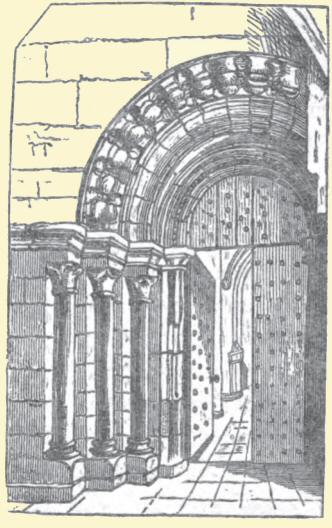
Two beautiful Norman doorways gave ingress and egress from
this passage, and still remain, though the one which opened to
the present west cloister is closed, and sadly disfigured by the
alterations of the sixteenth century. The other doorway to
the west, is perfect, excepting the shafts of the pillars, which
are gone. The capitals supporting one side of the
architrave are foliated and of late character for Norman
work.
At the
south end of the east cloister, and forming the present entrance
from that cloister to the cathedral, is a Norman doorway, of
about the same date as the arcade adjoining it. The
architrave is very ornate, bearing the billet ornament,
accompanied by a bead which runs between the mouldings.
Unfortunately the stone has perished more in this doorway from
exposure than in those of the vaulted passage; but still more has
been lost from the unmerciful treatment it has received at the
hands of the plasterer. It is quite choked up with plaster
and colouring, which might, with a little care and trouble, be
all removed, and the door restored to something more like its
original effect. The capitals of the pilasters are
foliated, and identical with those already noticed in the Norman
doorway of the vaulted passage.
In 1843, a liberal subscription for the purchase of two
painted windows having been made, the Dean and Chapter made an
appeal for an additional fund, for the praiseworthy purpose of
restoring some portion of the ancient beauties of the
cathedral. The appeal was most liberally responded to by
the subscription of the munificent sum of £4000. A
new organ has been erected at a cost of £1000., built by
Messrs. Gray and Davidson, of London; it is a large and splendid
instrument, of great power and richness of tone; the top of which
is carved with tabernacle work, in unison with that of the
choir. The instrument contains the following
stops:—
The
Great Organ, extending from CC to F, contains Double
Diapason, sixteen feet—Open Diapason, eight feet—Open
Diapason, eight feet—Stopped Diapason and Clarabella, eight
feet—Fifth, six feet—Principal, four
feet—Flute, four feet—Twelfth, three
feet—Fifteenth, two feet—Sesquialtra, three
ranks—Furniture, two ranks—Mixture, two
ranks—Trumpet, eight feet—Clarion, four feet.
Swell Organ, from FF to F, contains:—Double
Diapason, sixteen feet—Open Diapason, eight
feet—Stopped Diapason, eight feet—Principal, four
feet—Fifteenth, two feet—Sesquialtra, three
ranks—Hautboy, eight feet—Cornopean, eight
feet—Clarion, four feet.
Choir Organ from GG to F, contains:—Open
Diapason, eight feet—Dulciana, eight feet—Stopped
Diapason, eight feet—Principal, four feet—Flute, four
feet—Fifteenth, two feet—Clarionet, eight feet.
Pedal Organ, from CCC to D, two octaves and two notes,
contains:—Open Diapason (wood), sixteen feet—Stopped
Diapason, sixteen feet—Principal, eight
feet—Fifteenth, four feet—Tierce, three and a quarter
feet—Sesquialtra, two ranks.
Couplæ:—Swell to Great Manual—Swell
to Choir Manual—Choir to Great Manual—Great Manual to
Pedals—Choir Manual to Pedals.
There are four Composition Pedalsr for changing the Stops in
the Great Organ.
The old pews, which were sadly out of keeping with the rich
Gothic woodwork of the stalls, have been removed, and the choir
has been new seated in the Gothic style.
The whole of the choir has been vaulted, which has greatly
contributed to its improved appearance. The walls of the
choir, aisles, and Lady Chapel, have been repaired, cleaned, and
coloured. Three beautiful stained glass windows have been
placed at the east end of the choir and in the Lady Chapel, which
have given a much more solemn and impressive aspect to the
interior. The clerestory window of the choir has five
figures, representing our Saviour and the four Evangelists,
surrounded with their various emblems; over which are five scenes
from the life of Christ, viz., the Agony in the Garden; Bearing
the Cross; the Crucifixion; the Resurrection; and the
Ascension. This window was executed by Mr. Wailes, of
Newcastle-on-Tyne, at the cost of £200. The window of
the Lady Chapel represents, in its lower divisions, the following
important transactions in the history of the Redeemer’s
sojourn upon earth:—The Annunciation to the
Shepherds—the Nativity—the Offerings of the Wise Men
of the East—the Presentation in the Temple—Christ
Disputing with the Doctors—the Baptism—the Miracle of
turning the Water into Wine—Healing the Lame—Walking
on the Sea—Feeding the Multitude—the
Transfiguration—the Raising of Lazarus—the Entry into
Jerusalem—Washing the Disciples’ Feet—and the Last
Supper. The upper division of the window contains figures
of the twelve Apostles; ranged in the order in which their names
are given in Sacred Writ. This window was also executed by
Mr. Wailes, at the cost of £360, and of the outer guards
£60.
A magnificent window by the same artist, has also been placed
in the south aisle of the choir, by the Very Rev. the Dean, in
memory of three deceased members of his family. The
inscription is as follows:—
“Sancta Catherina—‘The souls of
the righteous are in the hand of God.’—Catherine
Louisa Anson, died and buried at Southwell, March 28, 1832, aged
18, third daughter.”
“Sanctus Thomas—‘Thy brother shall rise
again’—Thomas Anson, Lieut. R.N., died and buried at
Sudbury, March 17, 1845, aged 24, fourth son.”
“Sancta Maria—‘The Lord gave and the Lord
hath taken away.’—Mary Blomfield, wife of the Rev. G.
B. Blomfield, Canon of Chester, died and buried at Stevenage,
August 6, 1848, aged 38, 2nd daughter of the Rev. Frederick
Anson, D.D. Dean of Chester, by whom this memorial is
placed.”
Another obituary window has more recently been erected; placed
next to the latter. It is in memory of George Edward Anson,
Esq., son of the Dean of Chester. The inscription is as
follows:—In memory of George Edwd. Anson, Esq. C.B., Keeper
of H.M. Privy Purse; Treasurer of H.R.H. Prince Albert, and
to the Prince of Wales. Suddenly called away from the
faithful but unostentatious discharge of high official duties to
his rest in Christ, on the 9th day of October, 1849, aged
37. He was the 2nd son of the Rev. Frederick Anson, D.D.,
Dean of this Cathedral, with whose bereavement the inhabitants of
this city and neighbourhood record their sympathy, and
commemorate his zeal in the restoration of the Cathedral Church,
by erecting this memorial window. Mr. Hardman of Birmingham
was the artist; and the cost of the window £180. The
events represented are the Raising of Jairus’
Daughter—Raising of Lazarus—Raising the Widow’s
Son—Entombment and Resurrection of our Lord—and, Our
Lord appearing to Mary.
The service of the cathedral is performed with great solemnity
and fine taste; and the talented organist, Mr. Gunton, merits
great praise for the admirable manner in which he fulfils his
important duties.
The hours of Service are:—Week-day: morning, 7 10;
afternoon, 3. Sunday:—morning, 11; afternoon, 4
o’clock. During the winter months the service begins
at 4 in the afternoon. There is an anthem every day in the
afternoon service.
The following is a list of the dignitaries of the
cathedral:—
F. Anson, D.D.
Rev. J. Slade, M.A.
|
Rev. T. Eaton, M.A.
|
Rev. G. B. Blomfield, M.A.
|
Rev. T. Hillyard, M.A.
|
Rev. Henry Raikes, M.A.
|
Rev. H. McNeile, D.D.
|
Rev. C. A. Thurlow, M.A.
|
Rev. H. Stowell, M.A.
|
R. W. Gleadowe, M.A.
|
W. H. Massie, M.A.
|
W. Harrison, M.A.
|
E. E. Thurland, B.A., Precentor, &c.
|
In concluding this record of the venerable Cathedral of
Chester, we think it will have appeared, that while it has a
history of deep interest and significance, it has also
many architectural beauties, well deserving of a minute and
careful study.
“Amid the imposing growth of material wealth
and pride, it is not unseasonable to remember that temple
architecture is the oldest in the world; and to ask, after so
impressive a vindication of its longevity, whether having been
the earliest, it may not prove the latest term of human
civilization. I am persuaded that so it will be; for there
is in the soul of man ‘a temple not made with hands,’
which demands and shapes forth the visible structure as its shell
of life; which is ever fresh amid the change and wreck of ages,
and can build again the ruins of the past; indeed, the hidden
cloister of whose worship will remain still open, and thrill with
higher strains, when time and its structures shall be no
more.”
G. PRICHARD, BRIDGE STREET ROW,
CHESTER.
GEORGE PRICHARD, BOOKSELLER, STATIONER, AND BINDER, BRIDGE STREET ROW, CHESTER, — JUST PUBLISHED.
Has constantly on Sale a general Assortment of MODERN
PUBLICATIONS, in the various branches of Literature, including
School Books, all kinds of Children’s Books, and a great
variety of Works suitable for Presents. BIBLES AND PRAYER BOOKS, in
plain and Elegant Bindings.
BOOKBINDING EXECUTED IN THE NEATEST
STYLE,
ON MODERATE TERMS.
ACCOUNT BOOKS RULED TO ANY PATTERN,
And Bound on an improved principle.
COPPER-PLATE AND LETTER-PRESS PRINTING
OF EVERY DESCRIPTION, NEATLY
EXECUTED.
CARD AND BILL HEAD PLATES ENGRAVED.
A STOCK OF MODERN MUSIC KEPT FOR
SALE.
Threepence in the Shilling allowed
on every piece, and any piece
not on hand procured in two or three days.
LONDON NEWSPAPERS, MAGAZINES, &
ALL OTHER PERIODICALS
Regularly supplied, and New Publications procured on
the shortest notice.
OIL AND WATER COLOURS,
Brushes, prepared Canvass, Drawing
Paper, Boards, and every
description of Drawing Materials of the best quality.
DRAWINGS LENT OUT TO COPY.
PICTURESQUE VIEWS IN CHESTER,
Done up in an elegant cover. Price Two Shillings.
VIEWS IN CHESTER AND NORTH
WALES;
Plain and Coloured.
DITTO ON SHEETS OF NOTE PAPER;
One Penny per Sheet.
BOOK OF PATRIOTIC AND OTHER
SONGS,
FOR THE USE OF SCHOOLS,
Price Two-pence, or One Shilling and Sixpence per dozen.
MUSIC OF DITTO,
Price Fourpence, or Three Shillings per dozen.
JUST PUBLISHED, PRICE TWO
SHILLINGS,
THE CHESTER GUIDE;
CONTAINING A
COPIOUS HISTORY OF THE ANTIQUITIES AND PUBLIC
BUILDINGS OF THE CITY,
AND A DESCRIPTIVE ACCOUNT OF EATON HALL.
WITH TWENTY-EIGHT
ILLUSTRATIONS.
NEW ILLUSTRATED HAND-BOOK OF NORTH
WALES.
JUST PUBLISHED,
PRICE SIX SHILLINGS,
THE ILLUSTRATED HAND-BOOK
OF NORTH WALES:
A GUIDE FOR THE TOURIST, THE
ANTIQUARIAN,
AND THE ANGLER;
Being the Fifth Edition of Hemingway’s Panorama,
with revisions
and additions,
BY JOHN HICKLIN;
WITH A MAP AND FIFTY-TWO ENGRAVINGS BY
THOMAS GILKS,
From Original Drawings
BY GEORGE PICKERING, ESQ. OF
CHESTER.
ALSO, JUST PUBLISHED.
PRICE THREE SHILLINGS.
FIFTH THOUSAND.
EXCURSIONS IN NORTH WALES:
A
COMPLETE GUIDE TO THE TOURIST
Through that romantic country.
Containing descriptions of its picturesque
beauties, Historical antiquities, and modern wonders.
Edited by John
Hicklin, of the ‘Chester Courant.’
LONDON:
WHITTAKER AND CO.; HAMILTON, ADAMS, AND CO.;
LONGMAN AND CO.; SIMPKIN & CO.; AND
GROOMBRIDGE AND SONS.
T. M’GLASHAN, DUBLIN.
GEORGE PRICHARD, BRIDGE STREET ROW, CHESTER.


