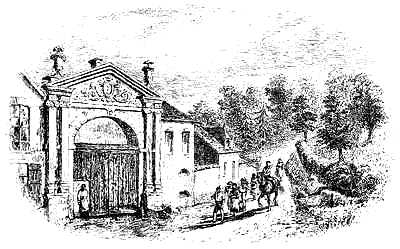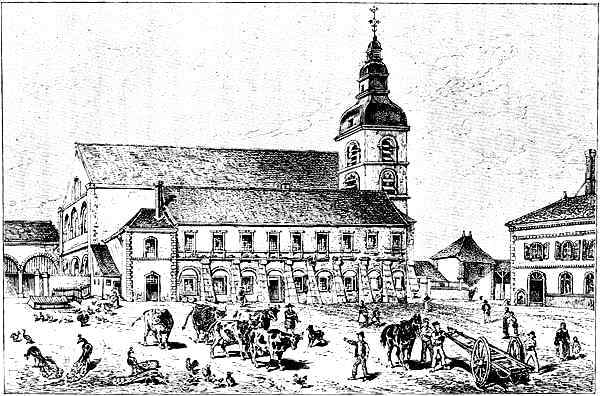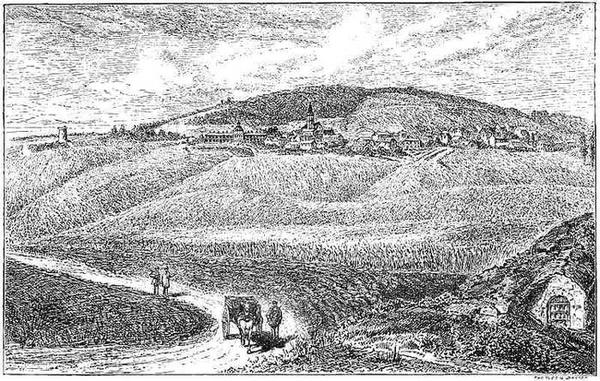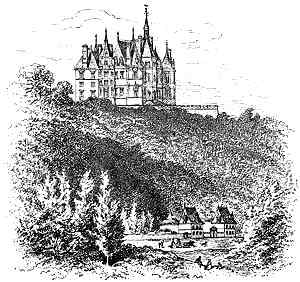
CHÂTEAU DE BOURSAULT.
The vinelands in the neighbourhood of Epernay—Viticultural
area of the Champagne—A visit to the vineyards of ‘golden
plants’—The Dizy vineyards—Antiquity of the Ay vineyards—St.
Tresain and the wine-growers of Ay—The Ay vintage of 1871—The
Mareuil vineyards and their produce—Avernay; its vineyards, wines,
and ancient abbey—The vineyards of Mutigny and Cumières—Damery
and ‘la belle hôtesse’ of Henri Quatre—Adrienne Lecouvreur
and the Maréchal de Saxe’s matrimonial schemes—Pilgrimage to
Hautvillers—Remains of the Royal Abbey of St. Peter—The ancient
church—Its quaint decorations and monuments—The view from the
heights of Hautvillers—The abbey vineyards and wine-cellars in the
days of Dom Perignon—The vinelands of the Côte d’Epernay—Pierry
and its vineyard cellars—The Moussy, Vinay, and Ablois St. Martin
vineyards—The Côte d’Avize—Chavot, Monthelon, Grauves, and
Cuis—The vineyards of Cramant and Avize, and their light delicate
white wines—The Oger and Le Mesnil vineyards—Vertus and its
picturesque ancient remains—Its vineyards planted with Burgundy
grapes from Beaune—The red wine of Vertus a favourite beverage of
William III. of England.
WITH the exception of certain famous vineyards of the Rhône, the
vinelands of the Champagne may, perhaps, be classed among the most
picturesque of the more notable vine-districts of France. Between Paris
and Epernay, even, the banks of the Marne present a series of scenes
of quiet beauty. The undulating ground is everywhere cultivated like a
garden. Handsome châteaux and charming country houses peep out from
amid luxuriant foliage. Picturesque antiquated villages line the river’s
bank or climb the hill-sides, and after leaving La Ferté-sous-Jouarre,
the cradle of the Condés, all the more favoured situations commence to
be covered with vines.
This is especially the case in the vicinity of Château-Thierry—the
birthplace of La Fontaine—where the view is shut in on all sides by
vine-clad slopes, which the spring frosts seldom spare. Hence merely one
good vintage out of four gladdens the hearts of the peasant proprietors,
who find eager purchasers for their produce among the lower-class
manufacturers of Champagne. In the same way the petit vin de Chierry,
dexterously prepared and judiciously mingled with other growths, often
figures as ‘Fleur de Sillery’ or ‘Ay Mousseux.’ In reality it is not
until we have passed the ornate modern Gothic château of Boursault,
erected in her declining years by the wealthy Veuve Clicquot, by far the
shrewdest manipulator of the sparkling products of Ay and Bouzy of her
day, and the many towers and turrets of which, rising above umbrageous
trees, crown the loftiest height within eyeshot of Epernay, that we find
ourselves in that charmed circle of vineyards whence Champagne—the
wine, not merely of princes, as it has been somewhat obsequiously
termed, but essentially the vin de société—is derived.
The vinelands in the vicinity of Epernay, and consequently near the
Marne, are commonly known as the ‘Vineyards of the River,’ whilst
those covering the slopes in the neighbourhood of Reims are termed the
‘Vineyards of the Mountain.’ The Vineyards of the River comprise three
distinct divisions—first, those lining the right bank of the Marne
and enjoying a southern and south-eastern aspect, among which are Ay,
Hautvillers, Cumières, Dizy, and Mareuil; secondly, the Côte d’Epernay
on the left bank of the river, of which Pierry, Moussy, and Vinay form
part; and thirdly, the Côte d’Avize (the region par excellence of
white grapes), which stretches towards the south-east, and includes the
vinelands of Cramant, Avize, Oger, Le Mesnil, and Vertus. The entire
vineyard area is upwards of 40,000 acres.[378]
The Champagne vineyards most widely celebrated abroad are those of Ay
and Sillery, although the last named are really the smallest in the
Champagne district. Ay, distant only a few minutes by rail from Epernay,
is in the immediate centre of the Vinelands of the River, having Mareuil
and Avenay on the east, and Dizy, Hautvillers, and Cumières on the west;
while Sillery lies at the foot of the so-called Mountain of Reims, and
within an hour’s drive of the old cathedral city.
It was on one of those occasional sunshiny days in the early part of
October[379] when we first visited Ay—the vineyard of ‘golden plants,’
the unique premier cru of the Wines of the River—and the various
adjacent vinelands. The road lay between two rows of closely-planted
poplar-trees reaching almost to the village of Dizy, whose quaint gray
church-tower, with its gabled roof, is dominated by the neighbouring
vine-clad slopes, which extend from Avenay to Venteuil, some few miles
beyond Hautvillers, the cradle, so to speak, of the vin mousseux of
the Champagne. The vineyards of Dizy, the upper soil of which is largely
mixed with loose stones, have chiefly a southern or western aspect,
and, excepting in the case of the precipitous height suggestively
styled ‘Grimpe Chat,’ their incline is generally a gentle one. In these
vineyards, which rank among the premiers crus of the Champagne, a
quantity of wine from white grapes is regularly made.
From Dizy the road runs immediately at the base of vine-clad slopes,
broken up occasionally by a conical peak detaching itself from the mass,
and tinted from base to summit with richly-variegated hues, among which
deep purple, yellow, green, gray, and crimson by turns predominate.
On our right hand we pass a vineyard called Le Léon, which tradition
asserts to be the one whence Pope Leo the Magnificent, the patron of
Michael Angelo, Raffaelle, and Da Vinci, drew his supply of Ay
wine. The village of Ay lies immediately before us at the foot of the slopes
of vines, with the tapering spire of its ancient church rising above
the neighbouring hills and cutting sharply against the bright blue sky.
The vineyards, which spread themselves over a calcareous declivity,
have mostly a full southern aspect, and the predominating vines are
those known as golden plants, the fruit of which is of a deep purple
colour. After these comes the plant vert doré, and then a moderate
proportion of the plant gris, white varieties of grapes being no
longer cultivated as formerly.[380]
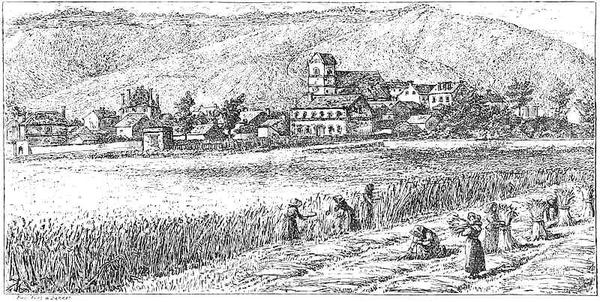
DIZY AND ITS VINEYARD SLOPES.
The Ay vineyards are mentioned in a charter of Edmund of Lancaster, son
of our Henry II. and guardian of Jehanne, heiress of Henri le Gros,
Count of Champagne, dated 1276, and confirming the right of the Abbey
of Avenay to four hogsheads of wine from the terroir of Ay.[381] If
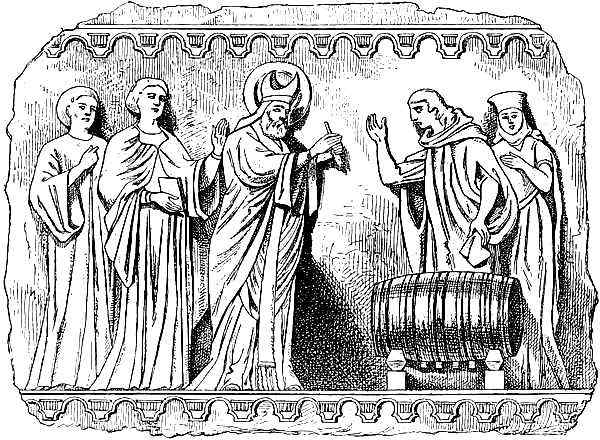
faith, however, may be placed in monkish legends, their existence dates
back to the sixth century, at which epoch St. Tresain, the patron saint
of Avenay and a contemporary of St. Remi, emigrated to the Champagne
from Scotland. Having given away all he possessed in charity, he
became perforce a swineherd at Mutigny, a village on the summit of the
hill overlooking Ay, Mareuil, and Avenay. One day the vine-growers of
Ay, hearing that St. Remi was at Ville-en-Selve, sought him out, and
clamorously accused St. Tresain of neglecting to look after his pigs,
which had devastated the vineyards on the slopes, and so caused great
loss to the community. When called
upon for his defence, St. Tresain
acknowledged that he was wont to listen in the church-porch to the
celebration of mass, and to forget on these occasions all such sublunary
matters as swine. St. Remi, finding him so deeply religious, not only
forgave him his negligence and relieved him from his porcine charge for
the future, but appointed him parish priest of Mareuil and Mutigny, the
inhabitants of which, it is to be hoped, received more attention from
him than his pigs had done. St. Tresain, although his promotion was
brought about by the complaint of the men of Ay, retorted on the latter
in a vindictive and unsaintly spirit, for he ill-naturedly cursed them,
and declared that after thirty years of age not one of them or their
posterity should prosper temporally or spiritually—a prophecy which, if
it affected the vine-growers of that epoch, has proved harmless enough
in the case of their descendants.[382]
At Ay we visited the pressoir of the principal producer of vin brut,
who, although the owner of merely five hectares, or about twelve and
a half acres of vines, expected to make as many as 1500 pièces of
wine that year, mainly of course from grapes purchased from other
growers.[383] On our way from Ay to Mareuil, along the lengthy Rue
de Châlons, we looked in at the little auberge at the corner of the
Boulevard du Sud, and found a crowd of coopers and others connected in
some way with the vintage, taking their cheerful glasses round. The
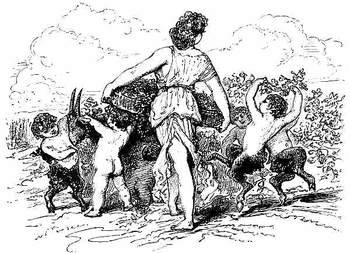
walls of the room were appropriately enough decorated with capering
bacchanals squeezing bunches of purple grapes and flourishing their
thyrsi about in a very tipsy fashion. All the talk—and there was an
abundance of it—had reference to the yield of this particular vintage
and the high rate the Ay wine had realised. Eight hundred francs the
pièce of 200 litres, equal to 44 gallons, appeared to be the price fixed
by the agents of the great Champagne houses, and at this figure the bulk
of the vintage was disposed of before a single grape passed through the
winepress.[384]
The Mareuil vinelands, which include the vineyard bequeathed some
six hundred years ago by Canon John de Brie to the chapter of Reims
cathedral, and possibly those vineyards bestowed in 1208 on the Abbey
of Avenay by Alain de Jouvincourt, cover the slopes of two coteaux,
the first a continuation of the Côte d’Ay, and the second a detached
spur, known as the Mont de Fourche, overlooking the Marne canal. Owing
to the steepness of the slopes and to the roads through the vineyards
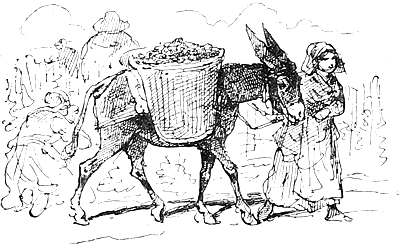
being impracticable for carts, the grapes were being conveyed to the
press-houses in baskets slung across the backs of mules and donkeys,
most of which, on account of their known partiality for the ripe fruit,
were muzzled while thus employed. The wine yielded by
the Mareuil
vineyards possesses body and vinosity, and while of course regarded
as inferior to that of Ay, found a ready market the year of our visit
at from five to six hundred francs the pièce. Prior to the French
Revolution, the produce of the winepresses of the Seigneurs of Mareuil
and the Abbess of Avenay were almost as renowned as the best growths of
Ay. The reputation of the wine was then shared by the inhabitants of the
village; the popular local diction, ‘Les gens d’Ay, les messieurs de
Mareuil, et les crottés d’Avenay,’ referring to the days when the first
was inhabited by enriched wine-growers, the second by people of some
position, and the third merely by peasants, simply from its being cut
off, in a great measure, from outside intercourse through the badness
of its approaches. It was not until after 1776, when the seigneurie
of Louvois was purchased from the Marquis de Souvré by Madame Adelaïde,
aunt of Louis XVI., that the road from Epernay to Louvois, which
passes through Mareuil and Avenay, was, if not constructed, at any
rate rendered practicable, in order to facilitate the visits of the
princess to her new acquisition. These roads exist, though no traces
remain of the ancient fort of Mareuil on the bank of the Marne, taken
from the English in 1359 by Gaucher de Chatillon, captain of Reims,
and alternately occupied by Leaguers and Royalists during the War of
Religion in the sixteenth century. Nor does there seem any chance of
identifying either the ‘vineyard called la Gibaudelle, lying next the
vineyard of Oudet, surnamed Leclerc,’ in the territory of Mareuil, which
Guillaume de Lafors and Marguerite his wife bestowed upon the Abbey
of Avenay in 1273, or those from which, in the fourteenth century,
Archbishop Richard Pique of Reims used to draw ten muids or hogsheads of
wine annually for ‘droits de vinage.’
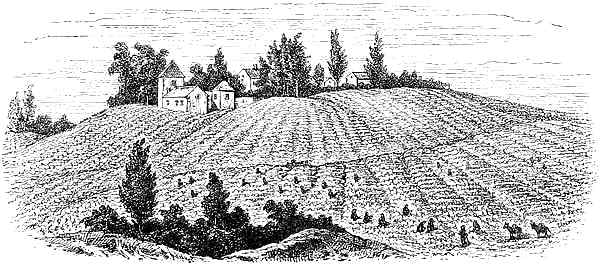
AVENAY AS SEEN FROM THE RAILWAY.
The vineyards of Avenay also date prior to the thirteenth century,
mention being frequently made of them in the charters of that
epoch.[385] Their best wine, which Saint Evremond extolled so
highly, is vintaged to-day up the slopes of Mont Hurlé. Avenay itself is a
tumbledown little village situated in the direction of Reims, and
the year of our visit we found the yield from its vineyards had been
scarcely more than the third of an average one, and that the wine
produced at the first pressure of the grapes had been sold for 500
francs the pièce. We tasted there some very fair still red wine, made
from the same grapes as Champagne, remarkably deep in colour, full
of body, and possessing that slight sweet bitterish flavour which
characterises certain of the better-class growths of the South of France.
Although at Avenay vineyards cover the slopes as of yore, when Marmontel
used to wander amongst them in company with his inamorata Mademoiselle
Hévin de Navarre, no traces remain of the ancient royal abbey—founded
by St. Bertha in 660, on the martyrdom of her husband, St. Gombert, one
of the early Christian missionaries to Scotland—where Charles V. took
up his quarters when invading Champagne in 1544, and where the deputies
of the Leaguers of Reims and of the Royalists of Châlons met in October
1592 to settle the terms of the ‘Traité des Vendanges,’ securing to both
parties liberty to gather in the vintage unmolested.[386] The villagers
still point out the house where Henri Quatre slept, and the window from
which he harangued the populace during the visit paid by him to Madame
Françoise de la Marck, the Abbess of Avenay,[387] in August of the same
year. This, by the way, does not seem to have been the only occasion
when the spot was honoured by the presence of Royalty; for a tradition,
which, although unsupported by any documentary evidence, appears to be
worthy of credence, is current to the effect that Marie Antoinette paid
a visit to the Abbey of Avenay during her sojourn at Louvois as the
guest of Madame Adelaïde in 1786. The spring which, according to the
legend, gushed forth when St. Bertha, in imitation of Moses, struck the
rock with her distaff, is still shown to travellers; and scandal has
gone so far as to say that recourse is sometimes had to it to eke out
the native vintage.
On leaving Avenay we ascended the hills to Mutigny, and wound
round thence to Cumières, on the banks of the Marne, finding the
vintage in full operation all throughout the route. The vineyards of
Cumières—classed as a second cru—yield a wine which, though celebrated
in the verses of Eustache Deschamps, a famous and prolific Champenois
poet of the fourteenth century, varies to-day considerably in quality,
the best coming from the ‘Côtes-à-bras,’ the property of the Abbey of
Hautvillers in Dom Perignon’s day. The Cumières vineyards join those of Hautvillers
on the one side and Damery on the other, the latter a cosy
little river-side village, where the bon Roi Henri sought relaxation
from the turmoils of war in the society of the fair Anne du Pay, sa
belle hôtesse, as the gallant Béarnais was wont to style her. Damery
also claims to be the birthplace of Adrienne Lecouvreur, the celebrated
actress of the Regency, and mistress of the Maréchal de Saxe, who coaxed
her out of her 30,000 l. of savings to enable him to prosecute his suit
with the obese Anna Iwanowna, niece of Peter the Great, which, had he
only been successful, would have secured the future hero of Fontenoy
the coveted dukedom of Courland. From Cumières can be distinguished
far away on the horizon the ruined tower of the bourg of Châtillon,
the birthplace of Pope Urban II., preacher of the first Crusade, and a
devotee of the wine of Ay.[388]
It was during the budding spring-time when we made our formal pilgrimage
to Hautvillers across the swollen waters of the Marne at Epernay. Our
way lay for a time along a straight level poplar-bordered road, with
verdant meadows on either hand; then diverged sharply to the left,
and we commenced ascending the vine-clad hills, on a narrow plateau
of which the church and abbey remains are picturesquely perched. The
closely-planted vines extend along the undulating slopes to the summit
of the plateau, and wooded heights rise up beyond, affording shelter
from the bleak winds that sweep over here from the north. Spite of the
reputation which the wine of Hautvillers enjoyed a couple of centuries
ago, and its association with the origin of vin mousseux, the
vineyards to-day appear to have been relegated to the rank of a second
cru, their produce ordinarily commanding less than two-thirds of the
price obtained for the Ay and Verzenay growths.[389]
The church of Hautvillers and the remains of the abbey are situated at
the farther extremity of the village, at the end of its one long street,
named, pertinently enough, the Rue de Bacchus. Time, the iconoclasts
of the great Revolution, and the quieter, yet far more destructive,
labours of the Bande Noire, have spared but little of the royal abbey
of St. Peter, where Dom Perignon lighted upon his happy discovery of
the effervescent quality of Champagne. The quaint old church, scraps of
which date back to the twelfth century, the remnants of the cloisters,
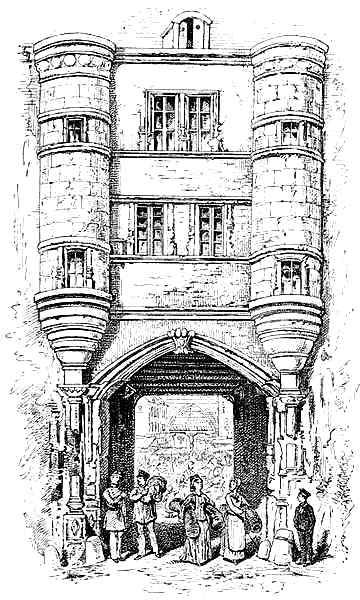
and one of the abbey’s ancient gateways, are all that remain to testify
to the grandeur of its past, when it was the proud boast of the
brotherhood that it had given nine archbishops to the see of Reims, and
two-and-twenty abbots to various celebrated monasteries.
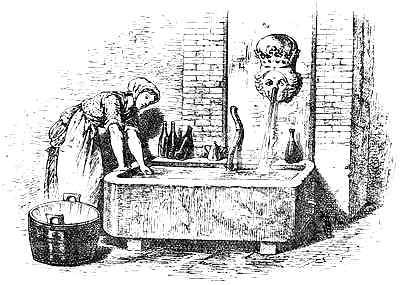
FOUNTAIN AT A CAFÉ IN THE RUE DE BACCHUS, HAUTVILLERS.
Passing through an unpretentious gateway, we find ourselves in a
spacious courtyard, bounded by buildings somewhat complex in character.
On our right rises the tower of the church with the remains of the
old cloisters, now walled-in and lighted by small square windows, and
propped up by heavy buttresses. To the
left stands the residence of the
bailiff, and beyond it an eighteenth-century château on the site of the
abbot’s house. Formerly the abbey precincts were bounded on this side
by a picturesque gateway-tower leading to the vineyards, and known as
the ‘Porte des Pressoirs,’ from its contiguity to the winepresses. The
court is enclosed on its remaining sides by huge barn-like buildings,
stables, and cart-sheds; while roaming about are numerous live stock,
indicating that what remains of the once-famous royal abbey of St. Peter
has degenerated into an ordinary farm. To-day the abbey buildings and
certain of its lands are the property of M. Paul Chandon de Brialles,
of the firm of Moët & Chandon, the great Champagne manufacturers of
Epernay, who maintains them as a farm, keeping some six-and-thirty cows
there, with the object of securing the necessary manure for the numerous
vineyards which the firm own hereabouts.
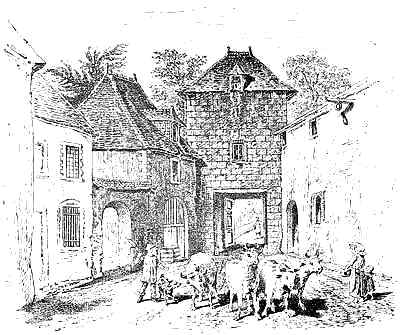
THE PORTE DES PRESSOIRS, ABBEY OF HAUTVILLERS
(Destroyed by fire in 1879).
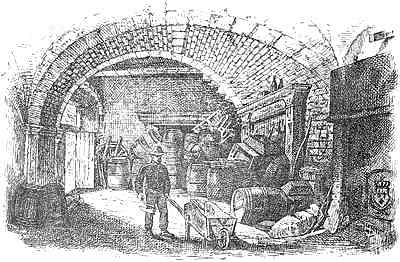
REMAINS OF CLOISTERS, ABBEY OF HAUTVILLERS.
The dilapidated cloisters, littered with old casks, farm implements,
and the like, preserve ample traces of their former architectural
character, changed as they are since the days when the sandalled feet
of the worthy cellarer resounded through the echoing arches as he paced
to and fro, meditating upon coming vintages and future marryings of
wines. Vine-leaves and bunches of grapes decorate some of the more
ancient columns inside the church, and grotesque mediæval monsters,
such as monkish architects habitually delighted in, entwine themselves
around the capitals of others. The stalls of the choir are elaborately
carved with cherubs’ heads, medallions and figures of saints, cupids
supporting shields, and free and graceful arabesques of the epoch of
the Renaissance. In the chancel, close by the altar-steps, are a couple
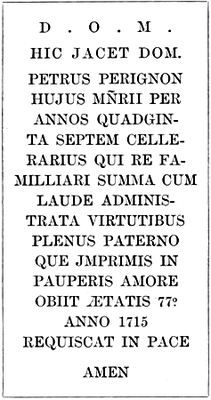
of black-marble slabs, with Latin inscriptions of dubious orthography,
the one to Johannes Royer, who died in 1527, and the other, which has
been already cited in detail, setting forth the virtues
and merits of
Dom Petrus Perignon, the discoverer of the effervescing qualities of
Champagne. In the central aisle a similar slab marks the resting-place
of Dom Thedoricus Ruynart—obit 1709—an ancestor of the Reims Ruinarts;
and little square stones interspersed among the tiles with which the
side aisles of the church are paved record the deaths of other members
of the Benedictine brotherhood during the seventeenth and eighteenth
centuries. Several large pictures grace the walls of the church, the
most interesting one representing St. Nivard, Bishop of Reims, and his
friend, St. Berchier, designating to some mediæval architect the site
which the contemplated Abbey of St. Peter is to occupy, as set forth in
the legend already related.
|
|
|
|
FROM THE ABBEY CHURCH, HAUTVILLERS.
|
At a short distance from the abbey farm, Messrs. Moët & Chandon have
erected a tower, whence a splendid view, extending over the vineyards of
Cumières, Hautvillers, Dizy, and Ay, with those lying on the opposite
bank of the river, is to be obtained. Gazing from here, it is easy to
imagine the scene presented in the days when the Abbey of St. Peter
still reared its stately walls, when Louis Chaumejan de Tourille wore
the abbatial insignia, and Dom Perignon displayed with equal pride as
the badge of his office the key of the abbey cellars. Over these slopes
on a dewy autumn morning the latter’s eyes, ere sealed in blindness,
must have often wandered, and an unctuous chuckle must have welled up
from between his lips as he marked the grapes steadily advancing towards
maturity. We can fancy him pausing from time to time
‘To breathe an ejaculatory prayer
And a benediction on the vines,’
although in those halcyon days there was neither oïdium nor phylloxera
to be dreaded, and an extra taper or so to St. Vincent, the patron of
vine-dressers, sufficed to secure the crop from ordinary accidents of
flood and field.
When the epoch of the vintage arrived, and the slopes were all alive
with bands of vintagers engaged in stripping the ripened purple bunches
from the vines, and carefully transporting them to the winepress, one
can picture Dom Perignon smiling contentedly at the report of the
gray-haired bailiff that no such crop had been garnered for years
before. And when the must began to gush forth as the stalwart bare-armed
peasants tugged at the levers of the huge press on which M. de Tourille
had placed the glorifying inscription elsewhere cited, with what
satisfaction must Perignon have recognised a foreshadowing of that
divine aroma which lends so exquisite a charm to the choice vintages of
the Champagne! Later on we can imagine him entering the abbey cellar,
stored with the results of his careful labours, as a
‘sacred place,
With a thoughtful, solemn, and reverent pace,’
and softly chanting to himself, as he draws off a flagon of the best and
choicest vintage which the gloomy vaults contain:
‘Ah, how the streamlet laughs and sings!
What a delicious fragrance springs
From the deep flagon as it fills,
As of hyacinths and daffodils!’
The vineyards of the Côte d’Epernay, on the southern bank of the Marne,
extend eastward from beyond Boursault, on whose wooded height stands the
fine château built by Madame Clicquot, and in which her granddaughter,
the Comtesse de Mortemart, to-day resides. They then follow the course
of the river, and, after winding round behind Epernay, diverge towards
the south-west.
Amongst them are the slopes of Pierry, Mardeuil,
Moussy, Vinay, Ablois, and Chouilly, the last named situate somewhat
apart from the rest to the east of Epernay, and yielding a light wine,
qualified as slightly purgative. The vines of the Côte d’Epernay produce
only black grapes, and many of the vineyards are of great antiquity, the
one known as the Closet, near Epernay, having been bequeathed under that
name by a canon of Laon named Parchasius to the neighbouring Abbey of
St. Martin six and a half centuries ago.
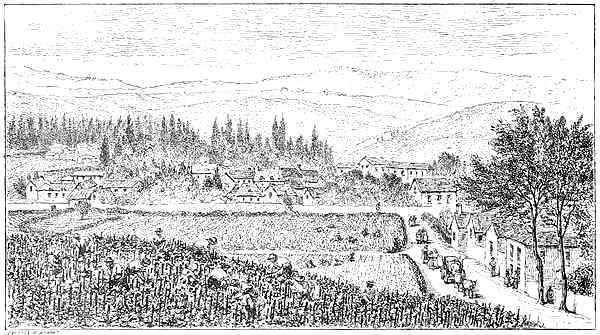
THE VILLAGE OF PIERRY.
A short drive along the high-road leading from Epernay to Orleans brings
us to the village of Pierry, cosily nestling amongst groves of poplars
in the valley of the Cubry, with some half-score of châteaux of the last
century, belonging to well-to-do wine-growers of the neighbourhood,
screened from the road by umbrageous gardens. Vines mount the slopes
that rise around, the higher summits being crowned with forest, while
here and there some pleasant village shelters itself under the brow
of a lofty hill. Near Pierry many cellars have been excavated in the
chalky soil, to the flints so prevalent in which the village is said
to owe its name. The entrances to these cellars are closed by iron
gateways, and on the skirts of the vineyards we come upon whole rows
of them picturesquely overgrown with ivy, and suggestive in appearance
of catacombs. Early in the last century the wine vintaged here in the
Clos St. Pierre, belonging to an abbey of this name at Châlons, acquired
a high reputation through the care bestowed upon it by Brother Jean
Oudart, whose renown almost rivalled that
of Dom Perignon himself; and
to-day the Pierry vineyards, producing exclusively black grapes, hold a
high rank among the second-class crus of the Marne.[390]
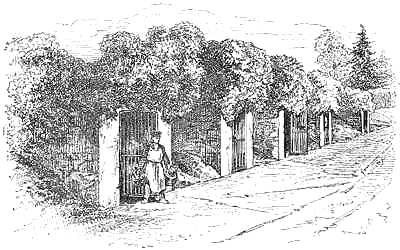
VINEYARD WINE-CELLARS AT PIERRY.
Crossing the Sourdon, a little stream which, after bubbling up in the
midst of huge rocks in the forest of Epernay, rushes down the hills,
and then changes its name to the Cubry, we soon reach Moussy, where
vineyards have been in existence for something like eight centuries;
for we find enumerated in the list of bequests made to the hospital of
St. Mary at Reims in the eleventh and twelfth centuries sundry ‘vineas
in Moiseio’ devised by such long-forgotten notabilities as Pontius,
priest and canon, Tebaldus Papilenticus, Johannes de Germania, and
Macela, wife of Pepinus. Spite, however, of their long pedigree and
advantageous southern aspect, the Moussy vineyards rank to-day merely
as a second cru. Continuing to skirt the vine-clad slopes we come to
Vinay, noted for an ancient grotto[391]—the former comfortless abode
of some rheumatic anchorite—and a pretended miraculous spring to
which fever-stricken pilgrims to-day credulously resort. The water may
possibly merit its renown; but the wine here produced is very inferior,
due no doubt to the class of vines, the meunier being the leading
variety cultivated. At Ablois St. Martin, once a fief of Mary Queen
of Scots, and picturesquely perched partway up a slope in the midst
of hills covered with vines and crowned with forest trees, the Côte
d’Epernay ends, and the produce becomes of a choicer character.
As the Côte d’Avize lies to the south-east, to reach it we have to
retrace our steps to Pierry, and follow the road which there branches
off, leaving on our right hand the vineyards of Chavot, Monthelon, and
Grauves, now of no particular note, although of undoubted antiquity,
Blanche of Castille, Countess of Champagne, having endowed the Abbey of
Argensolles, on its foundation in 1224, with sundry strips of vineland,
including one at Grauves, possibly the vineyard of Les Roualles, which
yields a wine not unlike certain growths of the Mountain of Reims.
After passing through Cuis, where the slopes, planted with both black
and white varieties of vines, are extremely abrupt, and where Simon la
Bole, man-at-arms of Epernay, and his wife Basile gave, in 1210, ‘four
hogsheads of vinage to be taken annually’ to Hugo, Abbot of St. Martin
at Epernay, we eventually reach Cramant, one of the grand premiers
crus of the Champagne. From the vineyards around this picturesque
little village, and extending along the somewhat precipitous Côte de
Saran—a prominent object, on which is M. Moët’s handsome château—there
is vintaged a wine from white grapes, especially remarkable for
lightness and delicacy and the richness of its bouquet, and an admixture
of which is essential to every first-class Champagne cuvée.
From Cramant the road runs direct to Avize, a large thriving village,
lying at the foot of vineyard slopes, where numerous Champagne firms
have established themselves. Its prosperity dates from the commencement
of the last century (1715), when the Count de Lhery, its feudal lord,
cleared away the remains of its ancient ramparts, filled up the moat,
and planted the ground with vines, the produce of which proved admirably
suited for the sparkling wines then coming into vogue. Prior to this
the Avize wine, made almost entirely from white grapes, fetched only
from 25 to 30 francs the queue; but being found well adapted for the
manufacture of the strongly-effervescent wine known as saute-bouchon,
it soon commanded as much as 300 francs, and the arpent
of vineyard
rose in value from 250 to 2000 francs.[392] To-day the light delicate
wine of Avize is classed, like that of Cramant, as a premier cru, and
it is the same with the wine of Oger,[393] lying a little to the south,
while the neighbouring growths of Le Mesnil hold a slightly inferior
rank. The latter village and its gray Gothic church lie under the hill
in the midst of vines that almost climb the forest-crowned summit. The
stony soil hereabouts is said to be better adapted to the cultivation of
white than of black grapes; besides which, the wines of Le Mesnil are
remarkable for their effervescent properties.
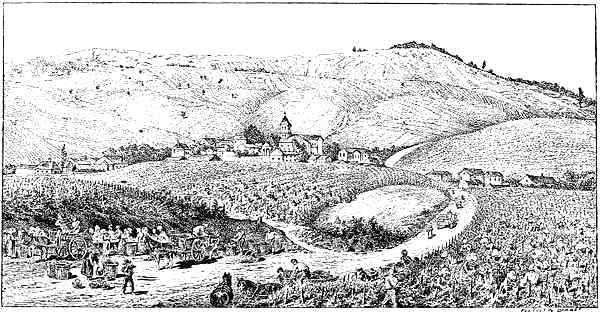
LE MESNIL AND ITS VINEYARDS.
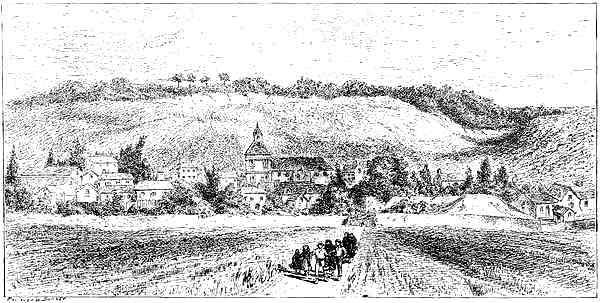
VIEW OF VERTUS.
Vertus forms the southern limit of the Côte d’Avize, and the vineyard
slopes subsiding at their base into a broad expanse of fertile fields,
and crested as usual with dense forest, rise up behind the picturesque
old town, which is mentioned in a letter of the Emperor Louis and a
charter of Charles the Bald in the ninth century. It was once strongly
fortified, though a dilapidated gateway is all that to-day remains
of the ancient ramparts, which failed to secure it in 1380, when the
English, under the ‘Comte de Bouquingouan,’ presumably Buckingham, burnt
the whole of the town except the Abbey of St. Martin, and elicited from
the native poet, Eustache Deschamps, dit Morel, ‘huissier d’armes’ to
Charles VI. and castellan of Fismes, a lamentation, wherein he fails not
to mention the high renown of the local vintage.[394]
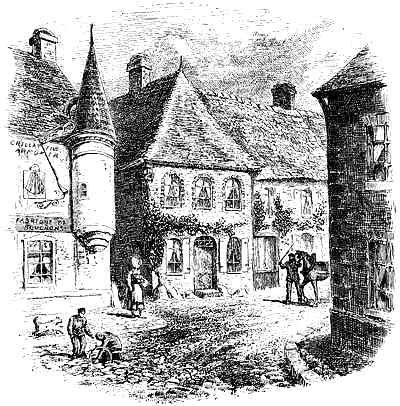
OLD HOUSES AT VERTUS.
Vertus can still boast a curious old church of the eleventh century,
with solid Romanesque towers, elaborate mouldings, and richly ornamented
capitals; also a picturesque promenade, shaded with centenarian trees,
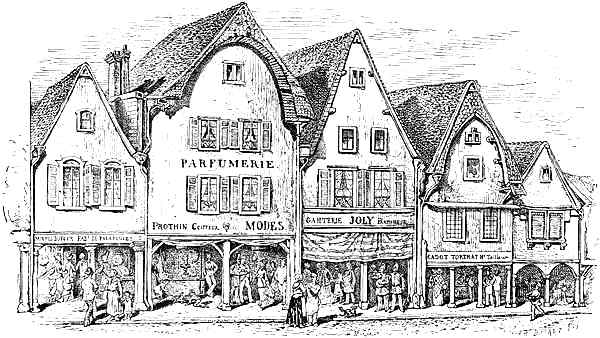
together with several quaint old houses, including one with a florid
Gothic window surrounded by a border of grapes and vine-leaves, and
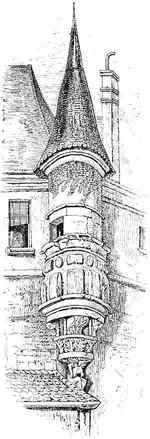
another with a quaintly projecting corner turret, dominated by a conical
roof. The Vertus vineyards are mentioned in a charter of the Abbey of
Ste. Marie, dated 1151. They were originally planted with vines from
Beaune in Burgundy, and in the fourteenth century yielded a red wine
held in high repute, of pleasant flavour, and rich in perfume,[395]
but which would appear to have been imbued with those purgative
properties[396] traceable in other growths of the Champagne. The red
wine of Vertus formed the favourite beverage of William III. of England,
and was long in high repute. To-day, however, the growers find it more
profitable to make white instead of red wine from their crops of black
grapes, the former commanding a good price for conversion into vin
mousseux, from being in the opinion of some manufacturers especially
valuable for binding a cuvée together. The Vertus growths rank among
the second-class Champagne crus.[397]
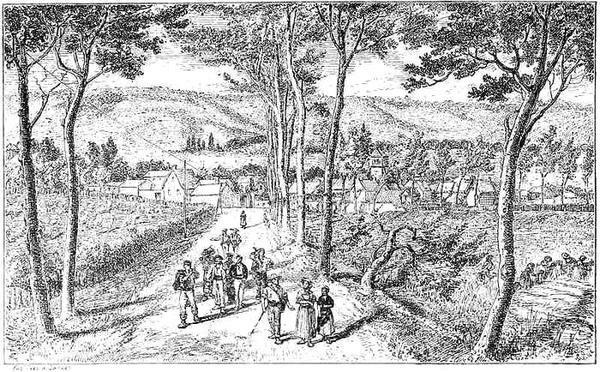
SILLERY AND ITS VINEYARDS.
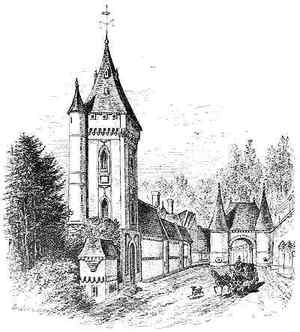
TOWER AND GATEWAY OF
THE CHÂTEAU DE SILLERY.
The wine of Sillery—Origin of its renown—The Maréchale
d’Estrées a successful Marchande de Vin—The Marquis de Sillery
the greatest wine-farmer in the Champagne—Cossack appreciation
of the Sillery produce—The route from Reims to Sillery—Henri
Quatre and the Taissy wines—Failure of the Jacquesson
system of vine cultivation—Château of Sillery—Wine-making
at M. Fortel’s—Sillery sec—The vintage at Verzenay and
the vendangeoirs—Renown of the Verzenay wine—The Verzy
vineyards—Edward III. at the Abbey of St. Basle—Excursion
from Reims to Bouzy—The herring procession at St. Remi—Rilly,
Chigny, and Ludes—The Knights Templars’ ‘pot’ of wine—Mailly and
the view over the Champagne plains—Wine-making at Mailly—The
village in the wood—Château and park of Louvois, Louis le
Grand’s War Minister—The vineyards of Bouzy—Its church-steeple,
and the lottery of the great gold ingot—Pressing grapes at
the Werlé vendangeoir—Still red Bouzy—Ambonnay—A pattern
peasant vine-proprietor—The Ambonnay vintage—The vineyards of
Ville-Dommange and Sacy, Hermonville and St. Thierry—The still red
wine of the latter.
THE vineyards of the Mountain of Reims may be divided into two zones,
one of which, known as the Basse Montagne, is situate north-west
of Reims, and comprises the vineyards of St. Thierry, Marsilly,
Hermonville, and others; whilst the more important zone lies to the
south of the old cathedral city, and includes the better-known crus
of Sillery, Verzy, Verzenay, Mailly, Ludes, Chigny, and Rilly. The
vinelands of Bouzy and Ambonnay are also
reckoned within it, though
situate somewhat apart on a southern slope of the Mountain some few
miles from the Marne.
The smallest of the Champagne vineyards are those of Sillery, and yet
no wine of the Marne enjoys a greater renown, due originally to the
intelligence and energy of the family of the Brularts, Marquises of
Sillery and Puisieux, to whom the estate originally belonged, and who
seem to have devoted great attention to viticulture from certainly the
middle of the seventeenth century. The reputation of the still wine of
Sillery, ‘the highest manifestation of the divinity of Bacchus in all
France,’ was firmly established at this epoch. ‘As to M. de Puyzieux,’
writes St. Evremond to his friend Lord Galloway in August 1701, ‘he
acts wisely to fall in with the bad taste now in fashion concerning
Champagne in order to sell his own the better;’ but at the same time
he counsels his correspondent to get the marquis to make him ‘a little
barrel after the fashion in which it was made forty years before, prior
to the existing depravation of taste.’[398] The marquis here referred to
was Roger Brulart, Governor of Epernay, who was himself a joyous bon
vivant, and died from over-indulgence in the good things provided at
a dinner given by the Chartreux in 1719.[399] He was succeeded by his
nephew, Louis Philogène Brulart, Marquis de Sillery et de Puisieux, to
whom, in 1727, on the occasion of his marriage with Mademoiselle de
Souvré, granddaughter of Louvois, the Sieurs Quatresous and Chertemps
presented at his château of Sillery, on behalf of the town of Epernay, a
basket of one hundred flasks of wine.[400] He died in 1771, leaving an
only daughter, Adelaïde Félicité Brulart de Sillery, married, in 1744,
to Louis César le Tellier, Maréchal Duc d’Estrées.
The wine attained its apogee under the fostering care of the Maréchale
d’Estrées, to whom not only this cru, but those of Mailly, Verzy, and
Verzenay belonged, and who concentrated their joint produce in the
capacious cellars of her château, afterwards sending it forth with her
own guarantee, under the general name of Sillery, which, like Aaron’s
serpent, thus swallowed up the others. The Maréchale’s social position
enabled her to secure for her wines the recognition they really merited,
being made with the utmost care and a rare intelligence, shown by the
removal of every unripe, rotten, or imperfect grape from the bunches
before pressing, so that the Vin de la Maréchale, as it was styled,
became famous throughout Europe.[401] This lady is not to be confounded
with that other Maréchale d’Estrées mentioned by St. Simon, noted for
her exquisite and magnificent although rare entertainments, and so
sordid that when her daughter, who was covered with jewels, fell down at
a ball, her first cry was, not like Shylock’s, ‘My daughter!’ but ‘My
diamonds!’ as, rushing forward, she strove to pick up, not the fallen
dancer, but her scattered gems.
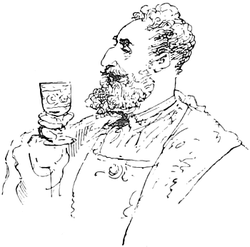
HENRI QUATRE.
Later owners of the famous Sillery cru did their best to sustain its
reputation, and Arthur Young, who stopped here in 1787, speaks of the
Marquis de Sillery as ‘the greatest wine-farmer in the Champagne,’
having on his own hands 180 arpents of vines, and cellar-room for a
couple of hundred pièces of wine.[402] Among more recent appreciation of
the merits of Sillery sec may be mentioned the Cossacks, who pillaged
the district in 1814, and who, not being able to carry off all the wine
from the cellar of the Count de Valence at Sillery, stove in some thirty
pièces of the best, and set the place afloat.[403]
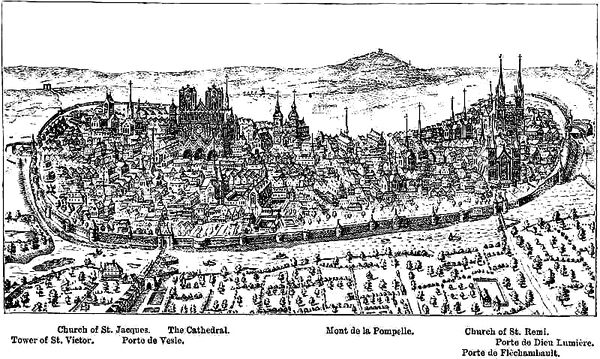
The drive from Reims to Sillery has nothing attractive about it. A long,
straight, level road bordered by trees intersects a broad tract of open
country, skirted on the right by the Petite Montagne of Reims, with
antiquated villages nestled among the dense woodland. After crossing the
Châlons line of railway—near where one of the new forts constructed
for the defence of Reims rises up behind the villages and vineyards
of Cernay and Nogent l’Abbesse—the country becomes more
undulating. Poplars border the broad Marne canal, and a low fringe of foliage marks
the course of the languid river Vesle, on the banks of which is Taissy,
famous in the old days for its wines, great favourites with Sully, and
which almost lured Henri Quatre from his allegiance to the vintages of
Ay and Arbois that he loved so well.[404]
To the left rises Mont de la Pompelle, where the first Christians of
Reims suffered martyrdom, and where, in 1658, the Spaniards under
Montal, when attempting to ravage the vineyards of the district, were
repulsed with terrible slaughter by the Rémois militia, led on by
Grandpré. A quarter of a century ago the low ground on our right near
Sillery was planted with vines by the late M. Jacquesson, the then owner
of the Sillery estate, and a large Champagne manufacturer at Châlons,
who was anxious to resuscitate the ancient reputation of the domain.
Under the advice of Dr. Guyot, the well-known writer on viticulture, he
planted the vines in deep trenches, which led to the vineyards being
punningly termed Jacquesson’s celery beds. To shield the vines from
hailstorms prevalent in the district, and the more dangerous spring
frosts, so fatal to vines planted in low-lying situations, long rolls
of straw-matting were stored close at hand with which to roof them over
when needful. These precautions were scarcely needed, however; the vines
languished through moisture at the roots, and eventually were mostly
rooted up.
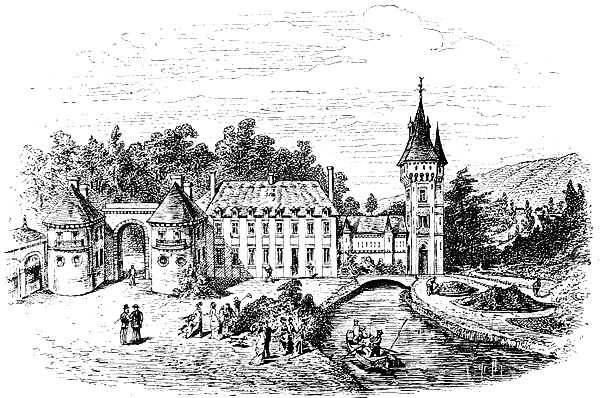
CHÂTEAU DE SILLERY.
After again crossing the railway we pass the trim restored turrets
of the famous château of Sillery, with its gateways, moats, and
drawbridges, flanked by trees and floral parterres. It was here
that the stout squire Laurent Pichiet kept watch and ward over the ‘forte
maison de Sillery’ on behalf of the Archbishop of Reims at the close
of the fourteenth century, that the Maréchale d’Estrées carried on her
successful business as a marchande de vins, and that the pragmatic and
pedantic Comtesse de Genlis, governess of the Orleans princes, spent, as
she tells us, the happiest days of her life. The few thriving vineyards
of Sillery cover a gentle eminence which rises out of the plain, and
present on the one side an eastern and on the other a western aspect.
They have fallen somewhat from their high estate since the days when old
Coffin of Beauvais University sang their praises in Latin:
‘Let Horace the charms of old Massica own,
And the praise of Falernian sound;
Such wines, although famous, must bow to that grown
On Sillery’s fortunate ground.’
[405]
To-day the Vicomte de Brimont and M. Fortel of Reims, the latter of whom
cultivates some forty acres of vines, yielding ordinarily about 300
hogsheads, are the only wine-growers at Sillery. Before pressing his
grapes—of course for sparkling wine—M. Fortel has them thrown into a
trough, at the bottom of which are a couple of grooved cylinders, each
about eight inches in diameter, and revolving in contrary directions,
the effect of which, when set in motion, is to disengage the grapes
partially from their stalks. Grapes and stalks are then placed under
the press, which is on the old cider-press principle, and the must runs
into a reservoir beneath, whence it is pumped into large vats, each
holding from 250 to 500 gallons. Here it remains from six to eight
hours, and is then run off into casks, the spigots of which are merely
laid lightly over the holes, and in the course of twelve days the wine
begins to ferment. It now rests until the end of the year, when it is
drawn off into new casks and delivered to the buyer, invariably one or
other of the great Champagne houses, who willingly pay an exceptionally
high price for it. The second and third pressures of the grapes yield an
inferior wine, and from the husks and stalks eau-de-vie, worth about
five shillings a gallon, is distilled.
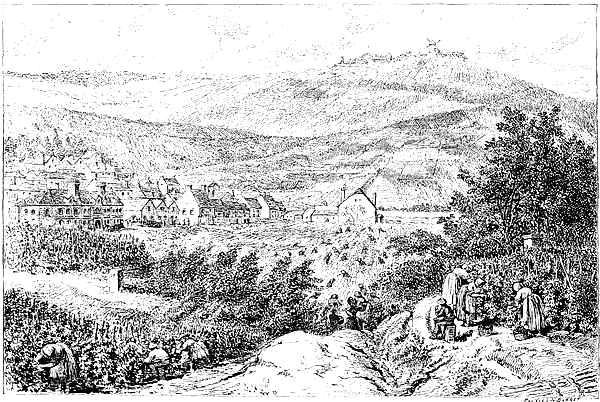
THE VINEYARDS OF VERZENAY.
The wine known as Sillery sec is a full, dry, pleasant-flavoured, and
somewhat spirituous amber-coloured wine. Very little of it is made
nowadays, and most that is comes from the adjacent vineyards of Verzenay
and Mailly, and is principally reserved by the growers for their own
consumption. One of these candidly admitted that the old reputation
of the wine had exploded, and that better white Bordeaux and Burgundy
wines were to be obtained for less money. In making dry Sillery, which
locally is esteemed as a valuable tonic, it is essential that the
grapes should be subjected to only slight pressure; while to have it in
perfection it is equally essential that the wine should be kept for ten
years in the wood according to some, and eight years in bottle according
to others, to which circumstance its high price is in all probability
to be attributed. In course of time it forms a deposit, and has the
disadvantage common to all the finer still wines of the Champagne
district of not travelling well.
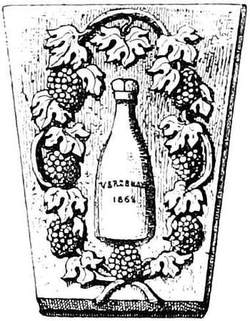
DEVICE ABOVE ENTRANCE TO
VENDANGEOIR AT VERZENAY.
Beyond Sillery the vineyards of Verzenay unfold themselves, spreading
over the extensive slopes and stretching to the summit of the steep
height to the right, where a windmill or two are perched. Everywhere the
vintagers are busy detaching the grapes with their little hook-shaped
serpettes, the women all wearing projecting close-fitting bonnets, as
though needlessly careful of their anything but blonde complexions. Long
carts laden with baskets of grapes block the narrow roads, and donkeys,
duly muzzled, with panniers slung across their backs, toil up and down
the steeper slopes. Half-way up the principal hill, backed by a dense
wood and furrowed with deep trenches, whence soil has been removed for
manuring the vineyards, is the village of Verzenay—where in the Middle
Ages the Archbishop of Reims had a fief—overlooking a veritable sea
of vines. Rising up in front of
the old gray cottages, encompassed
by orchards or gardens, are the white walls and long red roofs of the
vendangeoirs belonging to the great Champagne houses—Moët & Chandon,
Clicquot, G. H. Mumm, Roederer, Deutz & Geldermann, and others—all
teeming with bustle and excitement, and with the vines almost reaching
to their very doors. Messrs. Moët & Chandon have as many as eight
presses in full work, and own no less than 120 acres of vines on the
neighbouring slopes, besides the Clos de Romont—in the direction of
Sillery, and yielding a wine of the Sillery type—belonging to M. Raoul
Chandon. Verzenay ranks as a premier cru, and for three years in
succession—1872, 3, and 4—its wines fetched a higher price than either
those of Ay or Bouzy. In 1873 the vin brut commanded the exceptionally
large sum of 1050 francs the hogshead of 44 gallons. All the inhabitants
of Verzenay are vine-proprietors, and several million francs are
annually received by them for the produce of their vineyards from the
manufacturers of Champagne. The wine of Verzenay, remarkable for its
body and vinosity, has always been held in high repute,[406] which is
apparently more than can be said of the probity of the inhabitants, for,
according to an old Champagne saying, ‘Whenever at Verzenay “Stop thief”
is cried every one takes to his heels.’
Just over the Mountain of Reims is the village of Verzy, the
vine-growers of which distinguished
themselves in the fifteenth century
by their resistance to the officials sent to levy the ‘aide en gros’
of two sols per queue, imposed by Louis XI. on all wine made within a
radius of four miles of Reims. The Verzy vineyards—ranked to-day as a
second cru—date at least from the days of the Knights Templars, when
the Commanderie of Reims had ‘two vineyards near the abbey’ here. They
adjoin those of Verzenay, and are almost exclusively planted with white
grapes, the only instance of the kind to be met with in the district.
In the Clos St. Basse, however—taking its name from the Abbey of St.
Basle, of which the village was a dependency, and where Edward III. of
England had his head-quarters during the siege of Reims—black grapes
alone are grown, and its produce is almost on a par with the wines of
Verzenay.
Immediately prior to the Revolution, one-fourth of the inhabitants of
Verzy were landholders, each cultivating about five arpents of vines,
and obtaining therefrom, on an average, twenty poinçons, out of which
the abbey exacted one and three-quarters for ‘droits de dimes et de
banalité de pressoir.’ Southwards of Verzy are the third-class crus of
Villers-Marmery and Trépail, the former of which was of some repute in
the Middle Ages.
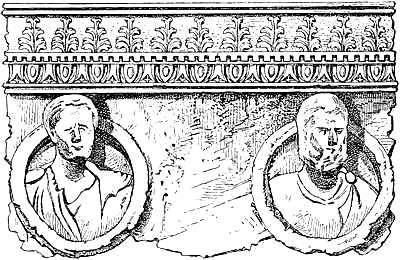
PORTION OF FRIEZE OF OLD HOUSE, RUE DU BARBATRE, REIMS.
We made several excursions to the vineyards of Bouzy, driving out of
Reims along the ancient Rue du Barbâtre and past the quaint old church
of St. Remi, one of the sights of the Champagne capital, and notable,
among other things, for its magnificent ancient stained-glass windows,
and the handsome modern tomb of the popular Rémois saint. It was here
in the Middle Ages that that piece of priestly mummery, the procession
of the herrings, used to take place at dusk on the Wednesday before
Easter. Preceded by a cross, the canons of the church marched in double
file up the aisles, each trailing a cord after him, with a herring
attached. Every one’s object was to tread on the herring in front of
him, and prevent his own herring from being trodden upon by the canon
who followed behind—a difficult enough proceeding, which, if it did not
edify, certainly afforded much amusement to the lookers-on.
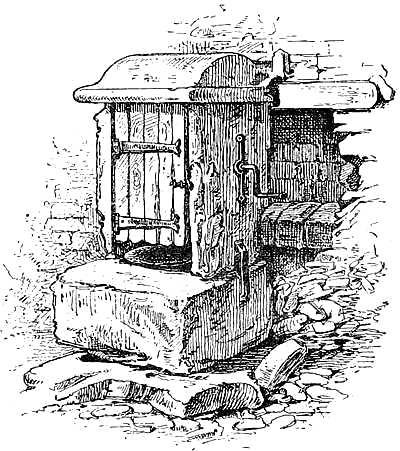
ANCIENT WELL, RUE DU BARBATRE, REIMS.
After crossing the canal and the river Vesle, and leaving the gray
antiquated-looking village of Cormontreuil on our left, we traversed a
wide stretch of cultivated country streaked with patches of woodland,
with occasional windmills dotting the distant heights, and villages
nestling among the trees up the mountain-sides and in the quiet hollows.
Soon a few vineyards occupying the lower slopes, and thronged by bands
of vintagers, came in sight, and the country too grew more picturesque.
We passed successively on our right hand Rilly, a former fief of the
Archbishop of Reims, and noted for its capital red wine; then Chigny,
where the Abbot of St. Remi had a vineyard as early as the commencement
of the thirteenth century; and afterwards Ludes,—all three of them
situated more or less up the mountain, with vines in every direction,
relieved by a dark background of forest-trees.
In the old days, the
Knights Templars of the Commanderie of Reims had the right of vinage
at Ludes, and exacted their modest ‘pot’ (about half a gallon) per pièce
on all the wine the village produced. On our left hand is Mailly, the
vineyards of which join those of Verzenay, and, though classed only as a
second cru, yielding a wine noted for finesse and bouquet, identified
by some as the vintage which was recommended in the ninth century to
Bishop Hincmar of Reims by his confrère, Pardulus of Laon. From the
wooded knolls hereabouts a view is gained of the broad plains of the
Champagne, dotted with white villages and scattered homesteads among the
poplars and the limes, the winding Vesle glittering in the sunlight,
and the dark towers of Notre Dame de Reims, with all their rich Gothic
fretwork, rising majestically above the distant city.
At one vendangeoir we visited, at Mailly, between 350 and 400 pièces of
wine were being made at the rate of some thirty pièces during the long
day of twenty hours, five men being engaged in working the old-fashioned
press, closely resembling a cider-press, and applying its pressure
longitudinally. This ancient press doubtless differs but little from the
one which the chapter of Reims Cathedral possessed at Mailly in 1384. As
soon as the must was expressed it was emptied into large vats, holding
about 450 gallons, and in these it remained for several days before
being drawn off into casks. Of the above thirty pièces, twenty resulting
from the first pressure were of the finest quality, while four produced
by the second pressure were partly reserved to replace what the first
might lose during fermentation, the residue serving for second-class
Champagne. The six pièces which came from the final pressure, after
being mixed with common wine of the district, were converted into
Champagne of an inferior quality.
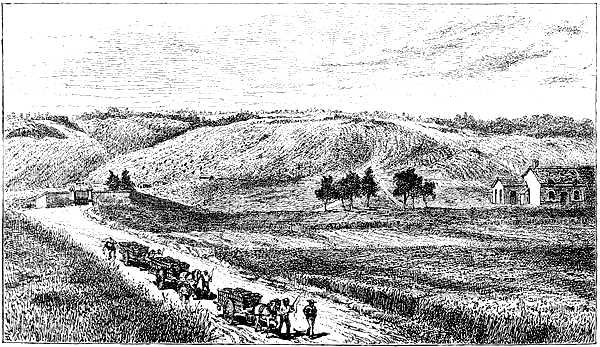
THE VINEYARDS OF BOUZY.
We now crossed the mountain, sighting Ville-en-Selve—the village in the
wood—among the distant trees, and eventually reached Louvois, whence
the Grand Monarque’s domineering war minister derived his marquisate,
and where his château, a plain but capacious edifice, may still be
seen nestled in a picturesque and fertile valley, and surrounded by
lordly pleasure-grounds. Château and park are to-day the property of
M. Frédéric Chandon, who has bestowed much care on the restoration
of the former. Soon after we left Louvois the vineyards of Bouzy
appeared in sight, with the prosperous-looking little village rising
out of the plain at the foot of the vine-clad slopes stretching to
Ambonnay, and the glittering Marne streaking the hazy distance. The commodious
new church is said to have been indebted for its spire to
the lucky gainer—who chanced to be a native of Bouzy—of the great
gold ingot lottery prize, value 16,000 l., drawn in Paris some years
ago. The Bouzy vineyards occupy a series of gentle inclines, and have
the advantage of a full southern aspect. The soil, which is of the
customary calcareous formation, has a marked ruddy tinge, indicative of
the presence of iron, to which the wine is in some degree indebted for
its distinguishing characteristics—its delicacy, spirituousness, and
pleasant bouquet. Vintagers were passing slowly in between the vines,
and carts laden with grapes came rolling over the dusty roads. The
mountain which rises behind the vineyards is scored up its sides and
fringed with foliage at its summit, and a small stone bridge crosses the
deep ravine formed by the swift-descending winter torrents.
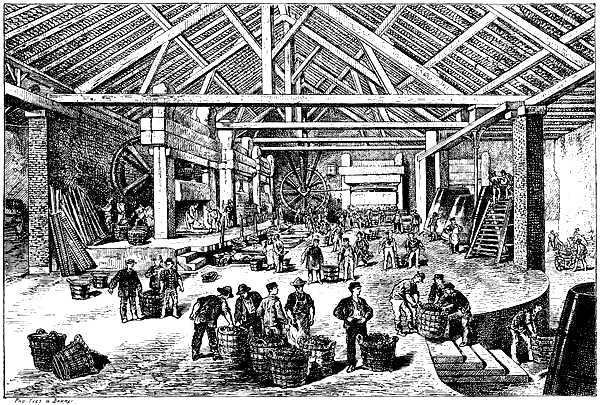
THE VENDANGEOIR OF M. WERLÉ AT BOUZY.
The principal vineyard proprietors at Bouzy, which ranks, of course, as
a premier cru, are M. Werlé, M. Irroy, and Messrs. Moët & Chandon,
the first and last of whom have capacious vendangeoirs here, M. Irroy’s
pressing-house being in the neighbouring village of Ambonnay. M. Werlé
possesses at Bouzy from forty to fifty acres of the finest vines,
forming a considerable proportion of the entire vineyard area. At the
Clicquot-Werlé vendangeoir, containing as many as eight presses, about
1000 pièces of wine are made annually. At the time of our visit, grapes
gathered that morning were in course of delivery, the big basketfuls
being measured off in caques—wooden receptacles holding two-and-twenty
gallons—while the florid-faced foreman ticked them off with a piece of
chalk on the head of an adjacent cask.
As soon as the contents of some half-hundred or so of these baskets had
been emptied on to the floor of the press, the grapes undetached from
their stalks were smoothed compactly down, and a moderate pressure was
applied to them by turning a huge wheel, which caused the screw of the
press to act—a gradual squeeze rather than a powerful one, and given
all at once, coaxing out, it was said, the finer qualities of the fruit.
The operation was repeated as many as six times; the yield
from the three first pressures being reserved for conversion into Champagne,
while the result of the fourth squeeze would be applied to replenishing
the loss, averaging 7 ½ per cent, sustained by the must during
fermentation. Whatever comes from the fifth pressure is sold to make an
inferior Champagne. The grapes are subsequently well raked about, and
then subjected to a couple of final squeezes, known as the rébêche,
and yielding a sort of piquette, given to the workmen employed at the
pressoir to drink.
The small quantity of still red Bouzy wine made by M. Werlé at the
same vendangeoir only claims to be regarded as a wine of especial mark
in good years. The grapes, before being placed beneath the press, are
allowed to remain in a vat for as many as eight days. The must undergoes
a long fermentation, and after being drawn off into casks is left
undisturbed for a couple of years. In bottle—where, by the way, it
invariably deposits a sediment, which is indeed the case with all the
wines of the Champagne, still or sparkling—it will outlive, we were
told, any Burgundy.
Still red Bouzy has a marked and agreeable bouquet and a most delicate
flavour, is deliciously smooth to the palate, and to all appearances is
as light as a wine of Bordeaux, while in reality it is quite as strong
as Burgundy, to the finer crus of which it bears a slight resemblance.
It was, we learnt, very susceptible to travelling, a mere journey to
Paris being, it was said, sufficient to sicken it, and impart such a
shock to its delicate constitution that it was unlikely to recover from
it. To attain perfection, this wine, which is what the French term a
vin vif, penetrating into the remotest corners of the organ of taste,
requires to be kept a couple of years in wood and half a dozen or more
years in bottle.
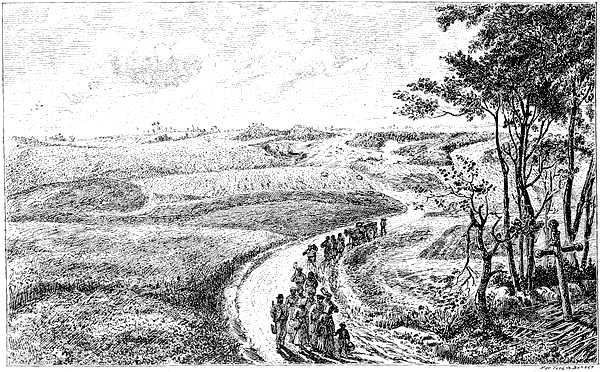
THE AMBONNAY VINEYARDS.
From Bouzy it was only a short distance along the base of the
vine-slopes to Ambonnay, where there are merely two or three hundred
acres of vines, and where we found the vintage almost over. The village
is girt with fir-trees, and surrounded with rising ground fringed either
with solid belts or slender strips of foliage. An occasional windmill
cuts against the horizon, which is bounded here and there by scattered
trees. Inquiring for the largest vine-proprietor, we were directed to an open
porte-cochère, and on entering the large court encountered
half a dozen labouring men engaged in various farming occupations.
Addressing one whom we took to be the foreman, he referred us to a wiry
little old man, in shirt-sleeves and sabots, absorbed in the refreshing
pursuit of turning over a big heap of rich manure with a fork. He proved
to be M. Oury, the owner of we forget how many acres of vines, and a
remarkably intelligent peasant, considering what dunderheads the French
peasants as a rule are, who had raised himself to the position of a
large vine-proprietor. Doffing his sabots and donning a clean blouse, he
conducted us into his little salon, a freshly-painted apartment about
eight feet square, of which the huge fireplace occupied fully one-third,
and submitted patiently to our catechising.
At Ambonnay, as at Bouzy, they had that year, M. Oury said, only half an
average crop; the caque of grapes had, moreover, sold for exactly the
same price at both places, and the wine had realised about 800 francs
the pièce. Each hectare (2 ½ acres) of vines had yielded 45 caques of
grapes, weighing some 2 ¾ tons, which produced 6 ½ pièces, equal to
286 gallons of wine, or at the rate of 110 gallons per acre. Here the
grapes were pressed four times, the yield from the second pressure being
used principally to make good the loss which the first sustained during
its fermentation. As the squeezes given were powerful ones, all the best
qualities of the grapes were by this time extracted, and the yield from
the third and fourth pressures would not command more than eighty francs
the pièce. The vintagers who came from a distance received either a
franc and a half per day and their food, consisting of three meals, or
two francs and a half without food, the children being paid thirty sous.
M. Oury further informed us that every year vineyards came into the
market, and found ready purchasers at from fifteen to twenty thousand
francs the hectare, equal to an average price of 300 l. the acre,
which, although Ambonnay is classed merely as a second cru, has since
risen in particular instances to upwards of 600 l. per acre. Owing to
the properties being divided into such infinitesimal portions, they were
not always bought up by the large Champagne houses, who objected to be
embarrassed with the cultivation of such tiny plots, preferring rather
to buy the produce from their owners.
There are other vineyards of lesser note in the neighbourhood of
Reims producing very fair wines, which enter more or less into the
composition of Champagne, and almost all of which can boast of a
pedigree extending back at least to the Middle Ages. Noticeable among
these are Ville-Dommange and Sacy, south-west of Reims. At Sacy the
Abbey of St. Remi had a vineyard in 1218; and in the return of church
property made in 1384, the doyen of the Cathedral is credited with
‘rentes de vin’ and about six jours of vineland here, the Convent of
Clermares at Reims owning a piece of ‘vigne gonesse.’ North-west of
the city the best-known vineyards are those of Hermonville—mentioned
likewise at the beginning of the thirteenth century, and in the return
which we have just quoted—and St. Thierry, where the Black Prince took
up his quarters during the siege of Reims, and where Gerard de la Roche
wrought such havoc amongst the vines in the twelfth century, to the
great indignation of their monkish owners. The still red wine of St.
Thierry, which recalls the growths of the Médoc by its tannin, and those
of the Côte d’Or by its vinosity, is to-day almost a thing of the past,
it being found here, as elsewhere, more profitable to press the grapes
for sparkling in preference to still wine.
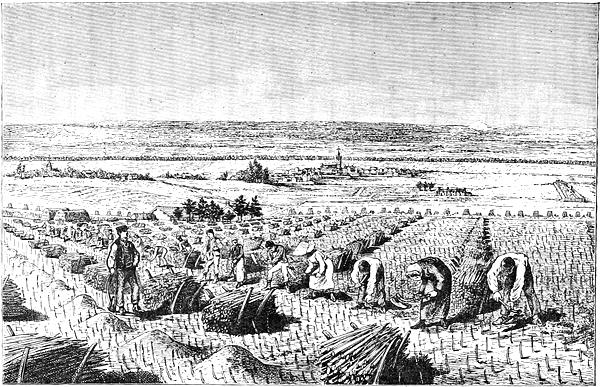
LABOURERS AT WORK IN THE EARLY SPRING IN M. ERNEST
IRROY’S BOUZY VINEYARDS.
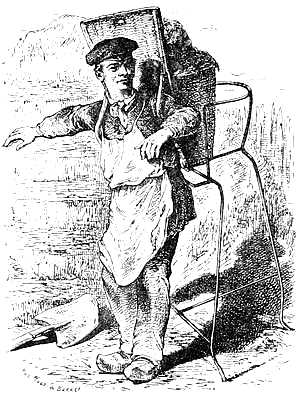
CARRYING MANURE TO THE VINEYARDS.
A combination of circumstances essential to the production
of good Champagne—Varieties of vines cultivated in the Champagne
vineyards—Different classes of vine-proprietors—Cost of
cultivation—The soil of the vineyards—Period and system of
planting the vines—The operation of ‘provenage’—The ‘taille’ or
pruning, the ‘bêchage’ or digging—Fixing the vine-stakes—Great
cost of the latter—Manuring and shortening back the vines—The
summer hoeing around the plants—Removal of the stakes after the
vintage—Precautions adopted against spring frosts—The Guyot
system of roofing the vines with matting—Forms a shelter from
rain, hail, and frost, and aids the ripening of the grapes—Various
pests that prey upon the Champagne vines—Destruction caused
by the Eumolpe, the Chabot, the Bêche, the Cochylus, and the
Pyrale—Attempts made to check the ravages of the latter with the
electric light.
GOOD Champagne does not rain down from the clouds, or gush out from the
rocks, but is the result of incessant labour, patient skill, minute
precaution, and careful observation. In the first place, the soil
imparts to the natural wine a special quality which it has been found
impossible to imitate in any other quarter of the globe. To the wine
of Ay it lends a flavour of peaches, and to that of Avenay the savour
of strawberries; the vintage of Hautvillers, though somewhat fallen
from its former high estate, is yet marked by an unmistakably nutty
taste; while that of Pierry smacks of the locally-abounding flint, the
well-known pierre à fusil flavour. So, on the principle that a little
leaven leavens the whole lump, the produce of grapes grown in the more
favoured vineyards is added in definite proportions, in order to secure
certain special characteristics, as well as to maintain a fixed standard
of excellence.
While it is admitted that climate is not without its influence in
imparting a delicate sweetness and aroma, combined with finesse and
lightness, to the wine, some authorities maintain that to the careful
selection of the vines best suited to the soil and temperature of the
district the excellence of genuine Champagne is mainly to be ascribed.
Four descriptions of vines are chiefly cultivated in the Champagne,
three of them yielding black grapes, and all belonging to the pineau
variety, from which the grand Burgundy wines are produced, and so styled
from the clusters taking the conical form of the pine. The first is the
franc pineau, the plant doré of Ay, with its closely-jointed shoots
and small leaves, producing squat bunches of small round grapes, with
thickish skins of a bluish-black tint, and sweet and refined in flavour.
The next is the plant vert doré, with its leaves of vivid green, more
robust and more productive than the former, but yielding a less generous
wine, and the berries of which, growing in compact pyramidal bunches,
are dark and oval, very thin-skinned, and remarkably sweet and juicy.
The third variety, extensively planted in the vineyards of Verzy and
Verzenay, is the plant gris, or burot, as it is styled in the Côte d’Or,
a somewhat delicate vine, whose fruit has a brownish tinge, and yields
a light and perfumed wine. The remaining species is a white grape known
as the épinette, a variety of the pineau blanc, and supposed by some to
be identical with the chardonnet of Burgundy, which yields the famous
wine of Montrachet. It is met with all along the Côte d’Avize, notably
at Cramant, the delicate and elegant wine of which ranks immediately
after that of Ay and Verzenay. The épinette is a prolific bearer, and
its round transparent golden berries, which hang in somewhat straggling
clusters amongst its dark-green leaves, are both juicy and sweet. It
ripens, however, much later than either of the black varieties.
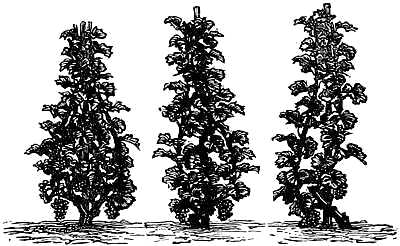
TYPES OF THE CHAMPAGNE VINES IN BEARING.
There are several other species of vines cultivated in the Champagne
vineyards, notably the common meunier, or miller, prevalent in the
valley of Epernay, which bears black grapes, and takes its name from the
young leaves appearing to have been sprinkled with flour. This variety
being more hardy than the franc pineau is replacing the latter on the
lower parts of the slopes, which are the most exposed to frosts—a
regrettable circumstance, as it impairs the quality of the wine. There
are also the black and white gouais; the meslier, a prolific white
variety yielding a wine of fair quality; the black and white gamais, the
leading grape in the Mâconnais, and chiefly found in some of the Vertus
vineyards; together with the tourlon, the marmot, the cohéras, the plant
doux, and half a score of others.
The land in the Champagne, as in other parts of France, is minutely
subdivided, and it has been estimated that the 40,000 acres of vines are
divided amongst no less than 16,000 proprietors. A few of the principal
Champagne firms are large owners of vineyards; and as the value of the
soil has more than quadrupled within the last thirty years, even the
smallest peasant proprietors have cause for congratulation.[407] These
latter cultivate their vineyards themselves; while the larger landowners
employ labourers, termed forains when coming from a distance and
working by the week for their lodging, food, and from 20 to 30 francs
wages, or tâcherons when paid by the job. The last-mentioned class
usually contract to cultivate and dress an arpent of vines, exclusive of
the vintage, at from 8 l. to 12 l. per annum.
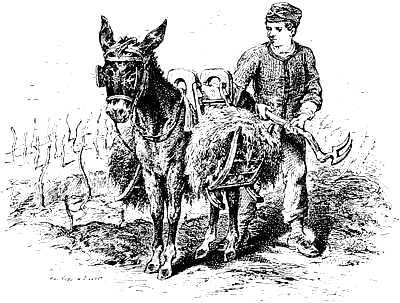
MANURING THE NEWLY-PLANTED YOUNG VINES.
In the Champagne the old rule holds good—poor soil, rich product, grand
wine in moderate quantity. The soil of the vineyards is chalk, with a
mixture of silica and light clay, combined with a varying proportion of
oxide of iron. Many of the best have a substratum of stones and sand,
and a thin superstratum of vegetable earth. The ruddier the soil, and
consequently the more impregnated with ferruginous earth, the better
suited it is found to the cultivation of black grapes; whilst the gray
or yellowish soils, such as abound in the Côte d’Avize, are preferable
for the white varieties.
The vines are almost invariably planted on rising ground, the lower
slopes, which seldom escape the spring frosts, producing the best wines.
The vines are placed very close together, there often being as many
as six within a square yard, and the result is that they reciprocally
impoverish each other. Planting takes place between November and April,
the vine-growers of the River being usually in advance of those of the
Mountain in this operation. Plants two or three years old and raised in
nurseries are usually made use of. These are placed either in holes or
trenches. The roots have a little earth sprinkled over them, to which a
liberal supply of manure or compost is added, and the holes having been
filled up and trodden, the vines are pruned down to a couple of buds
above the ground.
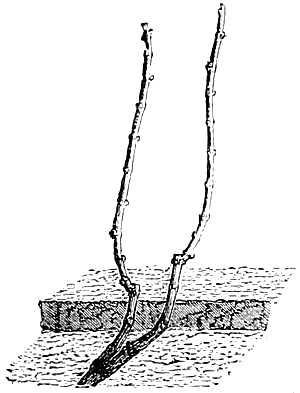
VINE PREPARED FOR ‘PROVINAGE.’
In the course of two or three years they are ready for the operation
of ‘provinage,’ or layering, a method of multiplication universally
practised in the Champagne. This consists in burying in a trench, from
six to eight inches deep dug on one side of the plant, two or more of
the principal shoots, left when the vine was pruned for this especial
purpose. The whole of the two-years’-old wood is thus buried, and the
ends of the shoots of one-year-old, which are left above ground, are cut
down to the second bud. The shoots thus laid underground are dressed
with a light manure, and in course of time take root and form new
vines, which bear during their second year. This operation is performed
simultaneously with the ‘bêchage’ in the early spring, and is annually
repeated until the vine is five years old, the plants thus being in
a state of continual progression; a system which accounts for the
juvenescent aspect of the Champagne vineyards, where none of the wood of
the vines showing above ground is more than three years old.
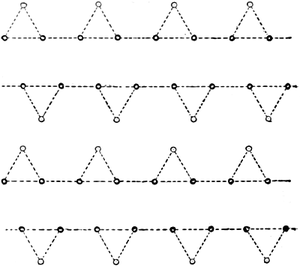
PLAN OF ‘PROVINAGE À L’ÉCART’ IN A NEWLY-PLANTED
VINEYARD.
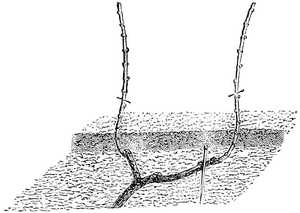
The two principal plans adopted in provining are styled the ‘écart’ and
the ‘avance.’ In the first, which is usually followed
in newly-planted
vineyards, the two shoots are carried forward to the right and left—so
as to form the two base points of an equilateral triangle, of which the
point of departure is the summit—and are maintained in this position
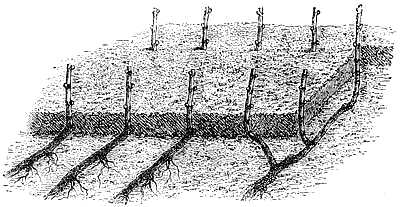
by the aid of wooden or iron pegs. In the ‘provinage à l’avance’ both
shoots are carried forward in the same direction, and sometimes a
variation embodying the two systems is employed.
PROVINAGE À L’ÉCART.
PROVINAGE À L’AVANCE.
When the vine has attained its fifth year it is allowed to rest for a
couple of years, and then the provining is resumed, the shoots being
dispersed in any direction throughout the vineyard, so as to fill up
vacancies. The plants remain in this condition henceforward, merely
requiring to be renewed from time to time by judicious provining. For
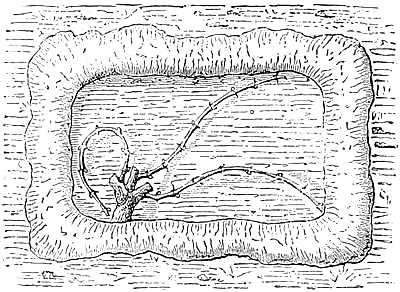
instance, it is sometimes found necessary to bend one of the shoots
round into a circle, so that its end may issue from the ground at the
point occupied by the parent stock. The system of provinage is sometimes
carried to excess in the Champagne, with a view of increasing the yield
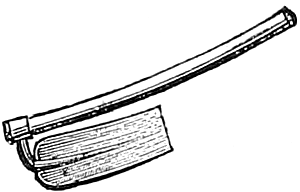
of wine, which suffers, however, in quality. The network of roots, too,
renders the various operations of cultivation difficult and dangerous,
as they are liable to be injured by the short-handled hoe in universal
use among the Champenois vine-dressers.
TRIPLE ‘PROVINAGE’ TO REPLACE THE PARENT STOCK.
Viticulturists inclined to make experiments have tried the system of
arranging the vines in transverse and longitudinal lines, quincunxes,
&c., or have replaced their vine-stakes with iron wires supported by
wooden pickets. Some of these experiments have proved successful,
although none of them are as yet in general use.
VINE DRESSER’S HOE.
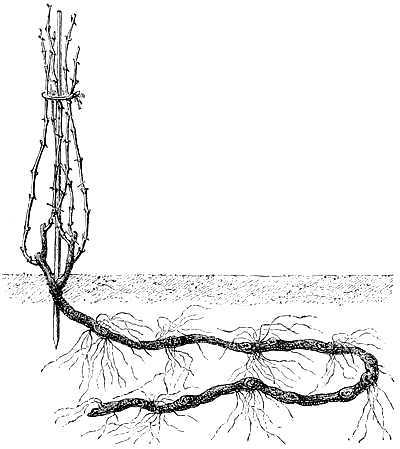
VINE PRIOR TO THE FEBRUARY PRUNING, SHOWING THE EXTENT OF
ROOT.
The first operation of importance carried out during the year in the
vineyards is the ‘taille,’ or pruning, which takes place in February,
and consists in cutting away the superfluous shoots, simply leaving
one—or, if it is intended to multiply by provinage, two—on each
stock. This is followed about March or
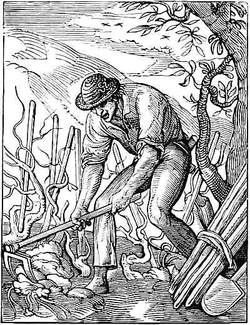
April by the ‘bêchage,’ or
‘hoyerie’—that is, the digging round the roots of the vine—with which
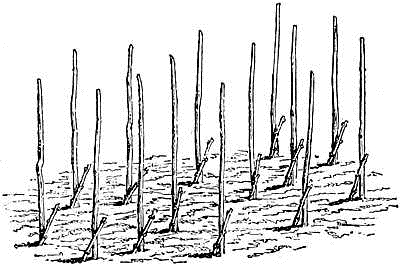
is combined the provinage. A trench being opened, as already noted, and
the vine laid bare to the roots, it is bent down so that, on filling
up the trench with earth and manure, the stock is entirely covered and
only the new wood appears above ground. This new wood is then shortened
back, and the stakes intended for the support of the vines are fixed in
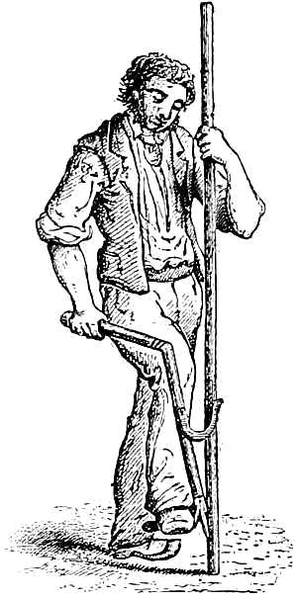
the ground. These stakes are set up in the spring of the year by men
or women, the former of whom force them into the ground by pressing
against them with their chest, which is protected with a shield of wood.
The women use a mallet, or have recourse to a special appliance, in
working which the foot plays the principal part. The latter method is
the least fatiguing, and in some localities is practised by the men.
An expert labourer will set up as many as 5000 stakes in the course of
the day. When of oak these stakes cost sixty francs the thousand; and
as the close system of plantation followed in the Champagne renders the
employment of no less than 24,000 stakes necessary on every acre of
land, the cost per acre of propping up the vines amounts to upwards of
57 l., or more than treble what it is in the Médoc and quadruple what
it is in Burgundy. The stakes last only some fifteen years, and their
renewal forms a serious item in the vine-grower’s budget.
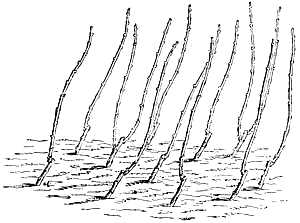
VINES IN FEBRUARY AFTER THE ‘TAILLE.’
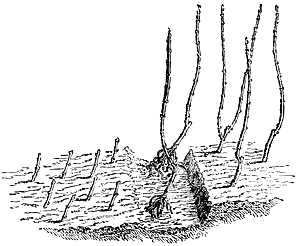
THE ‘BÊCHAGE’ OF THE VINES.
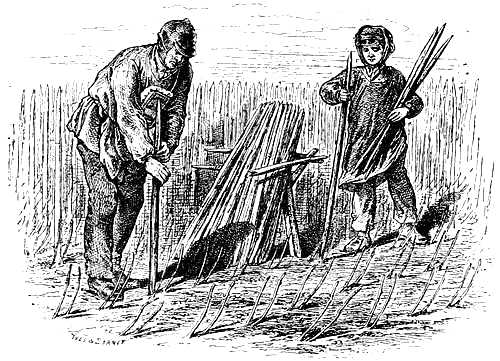
PUTTING STAKES TO THE VINES IN THE SPRING.
APPARATUS FOR FIXING VINE-STAKES.
UNSTACKING THE VINE-STAKES.
NEWLY-STAKED VINES AFTER THE ‘BÊCHAGE.’
VINES IN AUTUMN AFTER THE VINTAGE.
In May or June, after the vines have been hoed around their roots,
they are secured to the stakes, and their tops are broken off at a
shoot to prevent them from growing above the regulation height, which
is ordinarily from 30 to 33 inches. They are liberally manured with a
kind of compost formed of the loose friable soil termed ‘cendre’—dug
out from the sides of the hills, and of supposed volcanic origin—mixed
with animal and vegetable refuse. The vines are shortened back while
in flower, and in the course of the summer the ground is hoed a second
and a third time, the object being, first, to destroy the superficial
roots of the vines and force the plants to live solely on their deep
roots; and secondly, to remove all pernicious weeds from round about
them. After the third hoeing, which takes place in the middle of August,
the vines are left to themselves until the period of the vintage,
excepting that some growers remove a portion of the leaves in order
that the grapes may receive the full benefit of the sun, and raise up
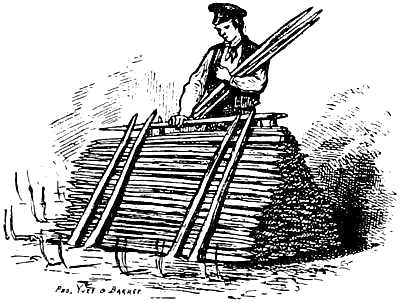
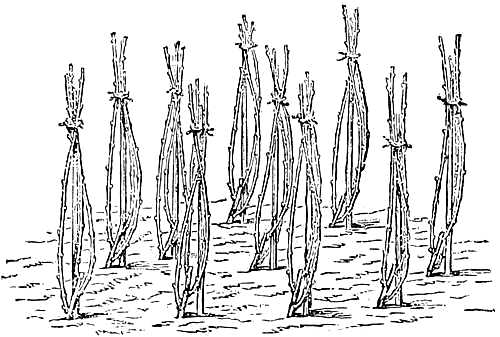
those bunches that rest upon the ground. The vintage over, the stakes
supporting the vines are pulled up later in the autumn and stacked in
compact masses, styled ‘moyères,’ with their ends out of the ground,
or else ‘en chevalet,’ the vine, which is left curled up in a heap,
remaining undisturbed until the winter, when the earth around it is
loosened. In the month of February following the vine is pruned and
subsequently sunk into the earth, as already described, so as to leave
only the new wood above ground. Owing to the vines being planted so
closely together they naturally starve one another, and numbers of them
perish. Whenever this is the case, or the stems chance to get broken
during the vintage, their places are filled up by provining.
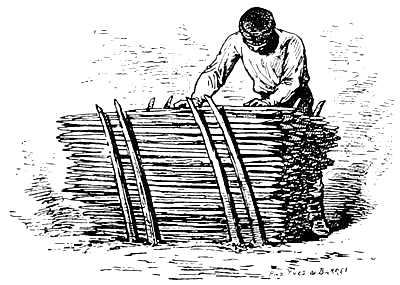
STACKING STAKES ‘EN CHEVALET.’
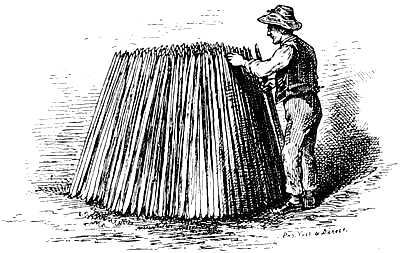
STACKING STAKES IN A ‘MOYÈRE.’
The vignerons of the Champagne regard the numerous stakes which support
the vines as affording some protection against the white frosts of the
spring. To guard against the dreaded effects of these frosts, which
invariably occur between early dawn and sunrise, and the loss arising
from which is
estimated to amount annually to 25 per cent, some of
the cultivators place heaps of hay, fagots, dead leaves, &c., about
twenty yards apart, taking care to keep them moderately damp. When a
frost is feared the heaps on the side of a vineyard whence the wind
blows are set light to, whereupon the dense smoke which rises spreads
horizontally over the vines, producing the same result as an actual
cloud, intercepting the rays of the sun, warming the atmosphere, and
converting the frost into dew. Among other methods adopted to shield the
vines from frosts is the joining of branches of broom together in the
form of a fan, and afterwards fastening them to the end of a pole, which
is placed obliquely in the ground, so that the fan may incline over the
vine and protect it from the sun’s rays. A single labourer can plant, it
is said, as many as eight thousand of these fans in the ground during a
long day.

UNROLLING MATTING FOR ROOFING THE VINES WITH.
Dr. Guyot’s system of roofing the vines with straw matting, to protect
them alike against frosts and hailstorms, is very generally followed
in low situations in the Champagne, the value of the wine admitting
of so considerable an expense being incurred. This matting, which is
made about a foot and a half in width, and in rolls of great length,
is fastened either with twine or wire to the vine-stakes; and it is
estimated that half a dozen men can fix nearly 11,000 yards of it, or
sufficient to roof over 2 ½ acres of vines, during an ordinary day.
To carry out the system properly, a double row of tall and short stakes
connected with iron wires has to be provided. The matting can then be
used as a shelter to the young vines in spring, as a south wall to aid
the ripening of the grapes in summer, and as a protection against rain
and autumn frosts.
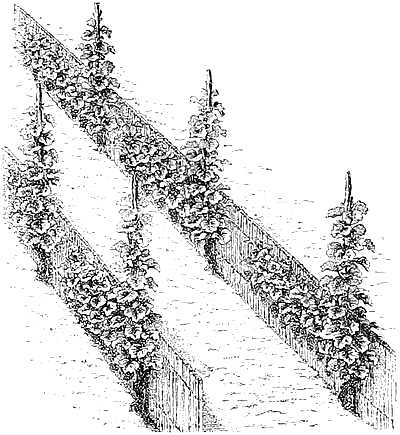
MATTING ARRANGED TO AID THE RIPENING OF THE GRAPES.
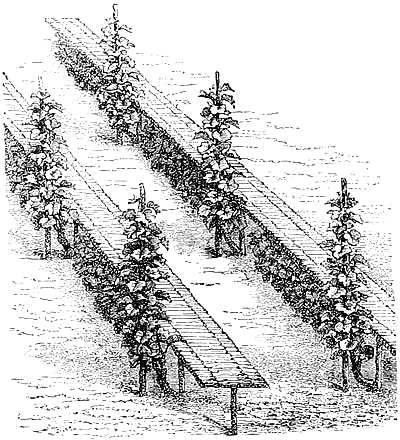
MATTING ARRANGED TO PROTECT THE VINES
AGAINST AUTUMN FROSTS.
Owing to the system of cultivation by rejuvenescence, and the constant
replenishing of the soil by well-compounded manures, the Champenois
wine-growers entertain great hopes that their vineyards will
escape the ravages of the phylloxera vastatrix. They certainly deserve such
an immunity, for, according to Dr. Plonquet of Ay, they are already
the prey of no less than fifteen varieties of insects, which feed upon
the leaves, stalks, roots, or fruit of the vines. One of the most
destructive of these is the eumolpe, gribouri, or écrivain as it is
popularly styled, from the traces it leaves upon the vine-leaves bearing
some resemblance to lines of writing. It is a species of beetle, the
larvæ of which pass the winter amongst the roots of the vine, and in the
spring attack the young leaves and buds, their ravages often proving
fatal to the plant. Then there is the chabot, which has caused great
destruction at Verzy and Verzenay; the attelabe, cunche, or bêche, which
rolls up the leaves of the vine like cigars, and seems to be identical
with the hurebet or urbec of the Middle Ages; and the cochylis, teigne,
or vintage-worm, which develops into a white-and-black butterfly,
producing in the course of the year two generations of larvæ, having the
form of small red caterpillars, one of which attacks the blossoms of
the vine, while the second pierces and destroys the grapes themselves.
The list of foes further comprises the altise, a kind of beetle allied
to the gribouri; the liset or coupe-bourgeon, a tiny worm assailing the
first sprouting shoots; and the hanneton or cockchafer.
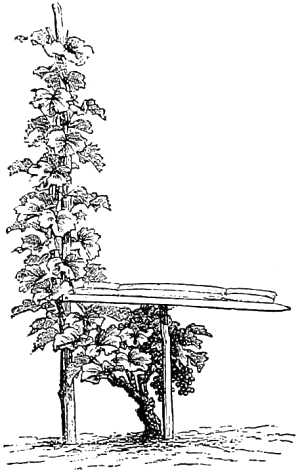
MATTING ARRANGED TO KEEP OFF RAIN OR HAIL.
The greatest havoc, however, appears to be wrought by the pyrale, a
species of caterpillar, which feeds on the young leaves, flowers, and
shoots until the vine is left completely bare. The larva of this insect,
after passing the winter either in the crevices of the stakes or in the
cracks in the bark of the vine, emerges in the spring, devours leaves,
buds, and shoots indifferently, and eventually becomes transformed into
a small yellow-and-brown butterfly, which deposits its eggs amongst the
bunches of grapes in July. Between 1850 and 1860 the vineyards of Ay
were devastated by the pyrale, which, like the locusts of Scripture,
spared no green thing; and all the efforts made to rid them of this
scourge proved ineffectual until the wet and cold weather of 1860 put
a stop to the insect’s ravages.[408] More recently it was discovered
that its attacks could be checked by sulphurous acid, or by scalding
the stakes and the vine-stocks with boiling water during the winter.
Nevertheless, it appeared impossible to check its destructiveness at Ay,
where it made its reappearance in 1879, and caused an immense amount of
damage. On this occasion an ingenious gentleman, M. Testulat Gaspar, was
seized with the idea of combating the pyrale by means of the electric
light. His theory was, that on a powerful light being exhibited in a
central position at midnight amongst the vineyards, with a number of
tin reflectors distributed in every direction around, the butterflies,
roused from slumber, would wing their way in myriads towards the latter,
when their flight could be arrested by sheets of muslin stretched
between poles, smeared with honey and baited with a dash of Champagne
liqueur. The theory was put to the test in August 1879, amongst the
vineyards between Dizy and Ay, where the pyrale was committing the
greatest ravages. The light was turned on, and the butterflies rose
‘in millions;’ but they failed to flock to the reflectors, and the
honey-smeared muslin proved quite useless to secure the few which came
in contact with it.
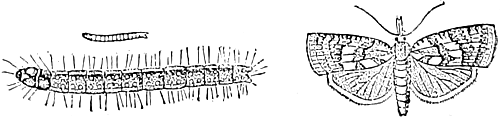
THE PYRALE.
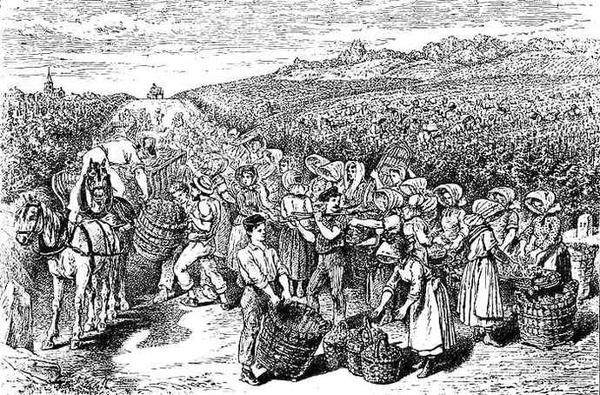
A VINTAGE SCENE IN THE CHAMPAGNE.
Period of the Champagne vintage—Vintagers summoned
by beat of drum—Early morning the best time for plucking
the grapes—Excitement in the neighbouring villages at
vintage-time—Vintagers at work—Mules employed to convey the
gathered grapes down the steeper slopes—The fruit carefully
examined before being taken to the wine-press—Arrival of the
grapes at the vendangeoir—They are subjected to three squeezes,
and then to the ‘rébêche’—The must is pumped into casks and left
to ferment—Only a few of the vine-proprietors in the Champagne
press their own grapes—The prices the grapes command—Air of
jollity throughout the district during the vintage—Every one
is interested in it, and profits by it—Vintagers’ fête on St.
Vincent’s-day—Endless philandering between the sturdy sons of toil
and the sunburnt daughters of labour.
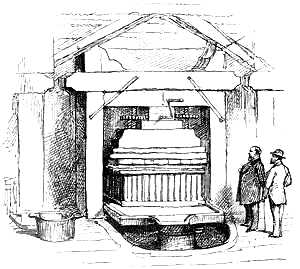
WINE-PRESS IN THE CHAMPAGNE.
WHEN the weather has been exceedingly propitious, the vintage in the
Champagne commences as early as the third week in September, and in good
average years the pickers set to work during the first week of October.
If, however, the summer has been an indifferent one, and only an
inferior vintage is looked forward to, it is scarcely before the latter
half of October that the gathering of the grapes is proceeded with.
There is no vintage-ban in the Champagne, as in Burgundy and other parts
of France; but, as a rule, the growers of Ay and of the neighbouring
slopes commence operations a week or more earlier than those of the
Mountain of Reims, whilst around Cramant and Avize, the
white-grape
region, the vintagers usually set to work when in the other districts
they have nearly finished.
The pleasantest season of the year to visit the Champagne is certainly
during the vintage. When this is about to commence, the vintagers—some
of whom come from Sainte Menehould, forty miles distant, while others
hail from as far as Lorraine—are summoned at daybreak by beat of drum
in the market-places of the villages adjacent to the vineyards, and then
and there a price is made for the day’s labour. This, as we have already
explained, is generally either a franc and a half, with food consisting
of three meals, or two francs and a half, rising on exceptional
occasions to three francs, without food, children being paid a franc and
a half. The rate of wage satisfactorily arranged, the gangs start off to
the vineyards, headed by their overseers.
The picking ordinarily commences with daylight, and the vintagers assert
that the grapes gathered at sunrise always produce the lightest and most
limpid wine. Moreover by plucking the grapes when the early morning sun
is upon them, they are believed to yield a fourth more juice. Later on
in the day, too, spite of all precautions, it is impossible to prevent
some of the detached grapes from partially fermenting, which frequently
suffices to give a slight excess of colour to the must, a thing
especially to be avoided in a high-class Champagne. When the grapes have
to be transported in open baskets for some distance to the press-house,
jolting along the road either in carts or on the backs of mules, and
exposed to the torrid rays of a bright autumnal sun, the juice expressed
from the fruit, however dexterously the latter may be squeezed in the
press, is occasionally of a positive purple tinge, and consequently
useless for conversion into Champagne.
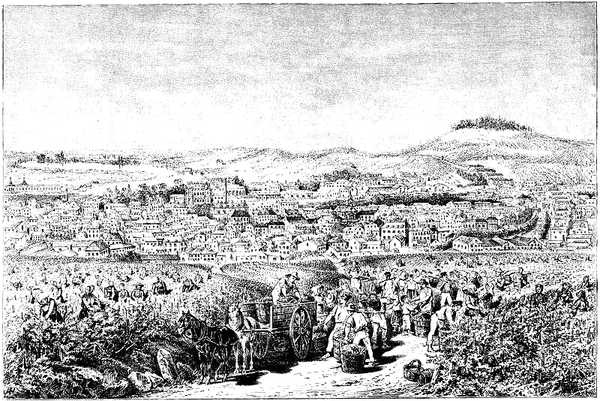
THE CHAMPAGNE VINTAGE IN THE NEIGHBOURHOOD OF EPERNAY.
At vintage-time everywhere is bustle and excitement; every one is big
with the business in hand. In these ordinarily quiet little villages
nestling amidst vine clad hollows, or perched half-way up a slope
tinted from base to summit with richly-variegated hues, there is a
perpetual pattering of sabots and a rattling and bumping of wheels over
the roughly-paved streets. The majority of the inhabitants are afoot:
the feeble feminine half, baskets on arm, thread their way with the
juveniles through the rows of vines planted half-way up the mountain,
and all aglow with their autumnal glories of green and purple, crimson
and yellow; while the sturdy masculine portion are mostly passing to and
fro between the press-houses and the wine-shops. Carts piled up with
baskets, or crowded with peasants from a distance on their way to the
vineyards, jostle the low railway-trucks laden with brand-new casks,
and the somewhat rickety cabriolets of the agents of the big Champagne
houses, who are reduced to clinch their final bargain for a hundred or
more pièces of the peerless wine of Ay or Bouzy, Verzy or Verzenay,
beside the reeking wine-press.
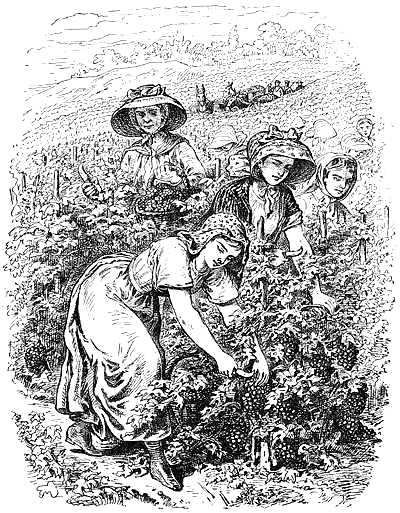
Dotting the steep slopes like a swarm of huge ants are a crowd of men,
women, and children, the
men, in blue blouses or stripped to their
shirt-sleeves, being for the most part engaged in carrying the baskets
to and fro and loading the carts; whilst the women, in closely-fitting
neat white caps, or wearing old-fashioned unbleached straw-bonnets of
the contemned coalscuttle type, resembling the ‘sun-bonnet’ of the
Midland counties, together with the children, are intent on stripping
the vines of their luscious-looking fruit. They detach the grapes with
scissors or hooked knives, technically termed ‘serpettes,’ and in some
vineyards proceed to remove all damaged, decayed, or unripe fruit from
the bunches before placing them in the baskets which they carry on their
arms, and the contents of which they empty from time to time into a
larger basket resembling an ass’s pannier in shape, numbers of these
being dispersed about the vineyard for the purpose, and invariably in
the shade. When filled the baskets are carried by a couple of men to the
roadside, along which dwarf stones carved with initials, and indicating
the boundaries of the respective properties, are encountered every eight
or ten yards, into such narrow strips are the vineyards divided. Large
carts with railed open sides are continually passing backwards and
forwards to pick these baskets up; and when one has secured its load it
is driven slowly to the neighbouring pressoir, so that the grapes may
not be in the least degree shaken, such is the care observed throughout
every stage of the process of Champagne manufacture. When the vineyard
slopes are very steep—as, for instance, at Mareuil—and the paths
do not admit of the approach of carts, mules, equipped with panniers
and duly muzzled, are employed to convey the gathered fruit to the
press-house.
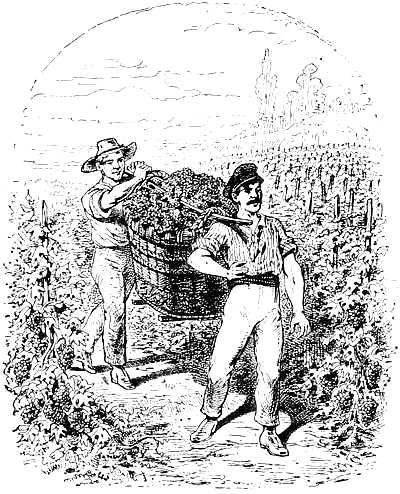
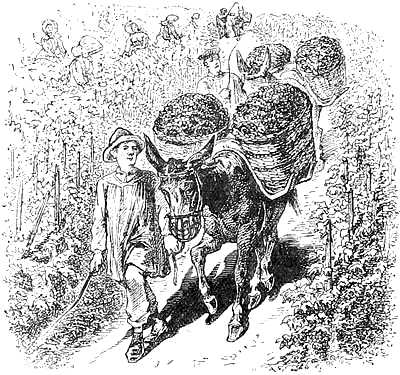
In many vineyards the grapes are inspected in bulk instead of in detail
before being sent to the wine-press. The hand-baskets, when filled,
are brought to a particular spot, where their contents are minutely
examined by some half-dozen men and women, who pluck off the bruised,
rotten, and unripe berries, and fling them aside into a separate basket.
In other vineyards we came upon parties of girls, congregated round a
wicker sieve perched on the top of a large tub by the roadside, engaged
in sorting the grapes, pruning away the diseased stalks, and picking
off all the doubtful berries. The latter were let fall through the
interstices of the sieve, while the sound fruit was deposited in large
baskets standing beside the sorters, and which, as soon as they were
filled, were conveyed to the pressoir. When the proprietor is of an
economic turn he usually has the refuse grapes pressed for wine for home
consumption. Spite of the
minute examination to which the grapes are
subjected, a sharp eye will frequently discover in the heart of what
looks like a regular and well-grown bunch a grape that is absolutely
rotten, and capable of infecting its companions when the whole are
heaped up together in the wine-press.
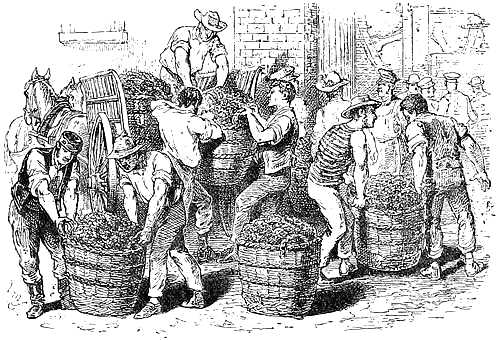
ARRIVAL OF THE GRAPES AT THE PRESS-HOUSE.
Carts laden with grapes are continually arriving at the pressoirs,
discharging their loads and driving off for fresh ones. The piled-up
baskets, marked with the names of the vineyard-owners whose grapes they
contain, are temporarily stored under a shed in a cool place, and are
brought into the pressoir from time to time as required. In the district
of the River the grapes are weighed, while in that of the Mountain they
are measured, before being emptied on to the floor of the press. In some
places the latter is of the old-fashioned type, resembling the ordinary
cider-press; but usually powerful presses of modern invention, worked by
a large fly-wheel requiring four sturdy men to turn it, are employed.
The grapes are spread over the floor of the press in a compact mass, and
in some rare cases are lightly trodden by a couple of men with their
naked feet before being subjected to mechanical pressure, which is again
and again repeated, only the first squeeze giving a high-class wine, and
the second
and third a relatively inferior one. After three pressures
the grapes are usually worked about with peels, and subjected to a final
squeeze known as the ‘rébêche,’ which produces a sort of piquette,
given to the workmen to drink, but in many instances forming the
habitual, and indeed only, beverage of the economically-inclined peasant
proprietor.
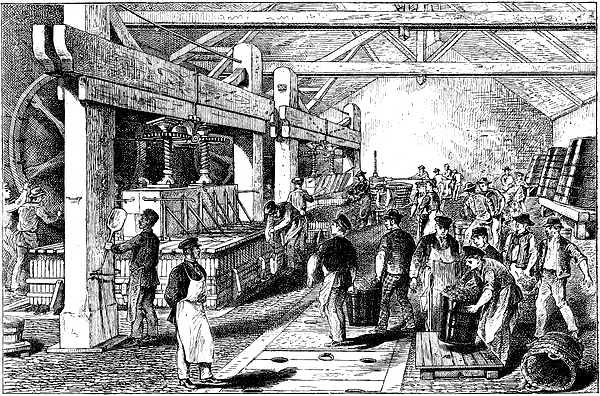
THE VINTAGE IN THE CHAMPAGNE: A WINE-PRESS AT WORK.
The must filters through a wicker basket into the reservoir beneath,
whence, after remaining a certain time to allow of its ridding itself
of the grosser lees, it is pumped through a gutta-percha tube into the
casks. The wooden stoppers of the bungholes, instead of being fixed
tightly in the apertures, are simply laid over them, and after the
lapse of ten or twelve days fermentation usually commences, and during
its progress the must, which is originally of a pale-pink tint, fades
to a light-straw colour. The wine usually remains undisturbed until
Christmas, when it is drawn off into fresh casks and delivered to the
purchaser.
One peculiarity of the Champagne district is that, contrary to the
prevailing practice in the other wine-producing regions of France, where
the owner of even a single acre of vines will crush his grapes himself,
only a limited number of vine-proprietors press their own grapes.
The large Champagne houses, possessing vineyards, always have their
pressoirs in the neighbourhood, and other large vine-proprietors press
the grapes they grow; but the multitude of small cultivators invariably
sell the produce of their vineyards to one or other of the former at a
certain rate, either by weight or else by caque, a measure estimated to
hold sixty kilogrammes (equal to 132 lb. avoirdupois) of grapes. The
price which the fruit fetches varies of course according to the quality
of the vintage and the requirements of the manufacturers; but the
average may be taken at about 80 centimes per kilogramme, equivalent to
rather more than 3 ½ d. per lb.[409]
If in the Champagne the picturesque rejoicings immortalised in the
Italian vintage scenes of Léopold Robert are lacking, and if the grapes,
instead of being trodden to the blithe accompaniment of flute and
fiddle, as in some parts of France, are pressed in more quiet fashion,
a pleasant air of jollity nevertheless pervades the district at the
season of the vintage. Every one participates in the interest which
this excites. It influences the takings of all the artificers and all
the tradespeople, and brings grist to the mill of the baker and the
bootmaker, as well as to the café and cabaret. The contending interests
of capital and labour are, moreover, singularly satisfied, the vintagers
being content at getting their two francs and a half a day, and the
men at the pressoirs their three francs and their food; the vineyard
proprietor reaping the return of the time, care, and money expended
upon his patch of vines, and the Champagne manufacturer acquiring raw
material on sufficiently satisfactory terms, the which, when duly
guaranteed by his name and brand, will bring to him both fame and
fortune.
Should the vintage be a scanty one, the plethoric
commissionnaires-en-vins will wipe their perspiring foreheads with
satisfaction when they have at last secured the full number of hogsheads
they had been instructed to buy—at a high figure maybe; still this is
no disadvantage to them, as their commission mounts up the higher. And
even the thickest-skulled among the small vine-proprietors, who make
all their calculations on their fingers, see at a glance that, although
the crop may be no more than half an average one, they are gainers,
thanks to the ill-disguised anxiety of the agents to secure all the
wine they require, which has the effect of sending prices up to nearly
double those of ordinary years, and this with only half the work in the
vineyard and at the winepress to be done.
The vintage in the Champagne comes to a close without any of those
festivals which still linger in the department of the Gironde. On
the 22d of January, the fête of St. Vincent, the patron saint of
vine-growers, it is customary, however, for one of the proprietors in
each village to pay for a mass and give a breakfast to his relatives
and friends, at which he presents a bouquet to one of the guests, who,
in his turn, is expected to pay for the mass and give the breakfast
the year following. On the same day the proprietors entertain their
workpeople, who, after having eaten and drunk their fill, wind up the
day with song and dance, leading to no end of innocent philandering
between the sturdy sons of toil and the sunburnt daughters of labour. On
these occasions the famous vintage song is sometimes heard:
‘Vendangeons et vive la France,
Le monde un jour avec nous trinquera.’
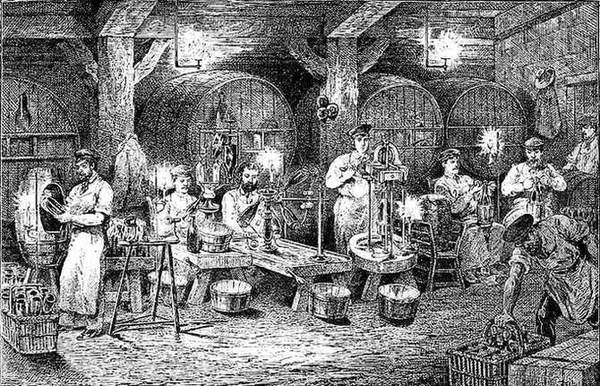
THE DISGORGING, LIQUEURING, CORKING, STRINGING, AND
WIRING OF CHAMPAGNE.
The treatment of Champagne after it comes from the
wine-press—The racking and blending of the wine—The proportions
of red and white vintages composing the ‘cuvée’—Deficiency
and excess of effervescence—Strength and form of Champagne
bottles—The ‘tirage’ or bottling of the wine—The process of
gas-making commences—Details of the origin and development of
the effervescent properties of Champagne—The inevitable breakage
of bottles which ensues—This remedied by transferring the wine
to a lower temperature—The wine stacked in piles—Formation of
sediment—Bottles placed ‘sur pointe’ and daily shaken to detach
the deposit—Effect of this occupation on those incessantly
engaged in it—The present system originated by a workman of
Madame Clicquot’s—‘Claws’ and ‘masks’—Champagne cellars—Their
construction and aspect—Raw recruits for the ‘Regiment de
Champagne’—Transforming the ‘vin brut’ into Champagne—Disgorging
and liqueuring the wine—The composition of the liqueur—Variation
in the quantity added to suit diverse national tastes—The corking,
stringing, wiring, and amalgamating—The wine’s agitated existence
comes to an end—The bottles have their toilettes made—Champagne
sets out on its beneficial pilgrimage round the world.
THE special characteristic of Champagne is that its manufacture only
commences where that of other wines ordinarily ends. No one would
recognise in the still brut fluid—which, after being duly racked and
fined, has somewhat the taste and colour of an acrid Rhine wine, with a
more or less pronounced bitter flavour—that exhilarating essence which
is capable of raising the most depressed spirits, and imparting gaiety
to the dismallest gatherings. Much as Champagne may stand indebted to
Nature, soil, climate, and species of vine, the sparkling fluid has
contracted a far greater debt towards man, to whose incessant labour,
patient skill, and minute precautions it owes that combination of
qualities which causes it to be so highly prized.
In the preceding chapter we left the newly-expressed must flowing
direct from the press into capacious reservoirs, whence it is drawn
off into large vats, where it clears itself by depositing its mucous
lees, usually within twenty-four hours. It is then transferred to new
or perfectly clean casks, holding some forty gallons
each, in which
a sulphur match has been previously burnt. These casks are not filled
quite up to the bunghole, which is generally covered with a vine-leaf
kept in its place by a piece of tile. The bulk of the newly-made wine
is left to repose at the vendangeoirs until the commencement of the
following year; still, when the vintage is over, numbers of long narrow
carts laden with casks of newly-expressed must may be seen rolling along
the dusty highways, bound for those towns and villages in the department
of the Marne where the manufacture of Champagne is carried on, and
where the leading firms have their establishments. Chief amongst these
is the cathedral city of Reims, after which comes the rising town of
Epernay, stretching to the very verge of the river; then Ay, nestling
between the vine-clad slopes and the Marne canal, with the neighbouring
village of Mareuil; next Pierry; and finally Avize, in the centre of
the white-grape district southwards of Epernay. Châlons, owing to its
distance from the vineyards, does not usually draw its supply of wine
until the new year.
In the vast celliers of the manufacturers’ establishments, where a
temperature of about 60 to 70 degrees Fahrenheit usually prevails,
the wine undergoes its first fermentation, entailing a loss of about
7 ½ per cent, and lasting from a fortnight to a month, according as
to whether the wine be mou—that is, rich in sugar—or the reverse.
In the former case fermentation naturally lasts much longer than when
the wine is vert or green. This active fermentation is converted
into latent fermentation by transferring the wine to a cooler cellar,
as it is essential it should retain a certain proportion of its
natural saccharine to insure its future effervescence. The casks have
previously been completely filled, and their bungholes tightly stopped,
a necessary precaution to guard the wine from absorbing oxygen, the
effect of which would be to turn it yellow, and cause it to lose some of
its lightness and perfume. After being racked and fined—an operation
generally performed about the third week in December—the produce of
the different vineyards is ready for mixing together in accordance
with the traditional theories of the various manufacturers; and should
the vintage have been an indifferent one, a certain proportion of old
reserved wine of a good year enters into the blend.
The mixing is usually effected in gigantic vats holding at times as many
as 12,000 gallons each, and having fan-shaped appliances inside, which,
on being worked by handles, insure a complete amalgamation of the wine.
This process of marrying wine on a gigantic scale is technically known
as making the cuvée. Usually four-fifths of wine obtained from black
grapes, and now of a pale-pink hue, are tempered by one-fifth of the
juice of white ones. It is necessary that the first should comprise a
more or less powerful dash of the finer growths both of the Mountain of
Reims and of the River; while, as regards the latter, one or other of
the delicate vintages of the Côte d’Avize is essential to the perfect
cuvée. The aim is to combine and develop the special qualities of the
respective crus, body and vinosity being secured by the red vintages of
Bouzy and Verzenay, softness and roundness by those of Ay and Dizy, and
lightness, delicacy, and effervescence by the white growths of Avize
and Cramant. The proportions are never absolute, but vary according to
the manufacturer’s style of wine and the taste of the countries which
form his principal markets. In the opinion of some clever amalgamators,
a blend comprising one-third of the vintages of Sillery, Verzenay, and
Bouzy, one-third of those of Mareuil, Ay, and Dizy, and the remaining
third composed of the produce of Pierry, Cramant, and Avize, constitutes
the wine of Champagne par excellence. Others not less expert declare
that a simple mixture of the Ay, Pierry, and Cramant vintages furnishes
a perfect wine. As when this blending takes place the wine is only
imperfectly fermented and exceedingly crude, the reader may imagine the
delicacy and discrimination of palate requisite to judge of the flavour,
finesse, and bouquet which the cuvée is likely eventually to develop.
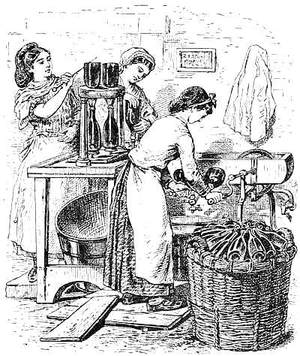
These, however, are not the only matters to be considered. There is,
above everything, the effervescence, which depends upon the quantity of
carbonic acid gas the wine already contains, and the further quantity
it is likely to develop, which depends upon the amount of its natural
saccharine. After the bottling, if the gas be present in excess, there
will be a shattering of bottles and a flooding of cellars; while, on
the other hand, if there be a paucity, the corks will refuse to pop,
and the wine to sparkle aright in the glass. The amount of saccharine
in the cuvée has therefore to be accurately
ascertained by means of
a glucometer; and should it fail to reach the required standard, as is
the case at times when the season has been wet and cold and the vintage
a poor one, the deficiency is made up by the addition of the purest
sugar-candy. If, on the other hand, there be an excess of saccharine,
the only thing to be done is to defer the final blending and bottling of
the wine until the superfluous saccharine matter has been absorbed by
fermentation in the cask.
The cuvée completed, the blended wine, which in its present condition
gives to the uninitiated palate no promise of the exquisite delicacy
and aroma it is destined to develop, is drawn off again into casks for
further treatment. This comprises fining with some gelatinous substance,
usually isinglass, made into a jelly and strained through a ‘tammy;’
while, as a precaution against ropiness and other maladies, liquid
tannin, derived from nut-galls, catechu, or grape husks and pips, is
at the same time frequently added to supply the place of the natural
tannin, which has departed from the wine with its reddish hue at the
epoch of its first fermentation. If at the expiration of a month the
wine has not become perfectly clear and limpid, it is racked off the
lees, and the operation of fining is repeated.
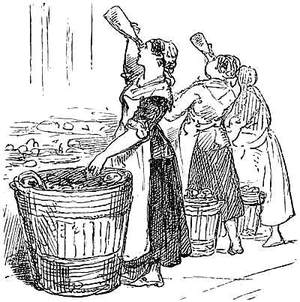
The operation of bottling the wine next ensues, when the scriptural
advice not to put new wine into old bottles is rigorously followed. For
the tremendous pressure of the gas engendered during the subsequent
fermentation of the wine is such that the bottle becomes weakened, and
can never be safely trusted again.[410] It is because of this pressure
that the Champagne bottle is one of the strongest made, as indicated by
its weight, which is almost a couple of pounds. To insure this unusual
strength, it is necessary that the sides should be of equal thickness
and the bottom of a uniform solidity throughout, in order that no
particular expansion may ensue from sudden changes of temperature. The
neck must, moreover, be perfectly round and widen gradually towards
the shoulder. In addition—and this is of the utmost consequence—the
inside ought to be perfectly smooth, as a rough interior causes the gas
to make efforts to escape, and thus renders an explosion imminent. The
composition of the glass, too, is not without its importance, as on one
occasion a manufactory established for the production of glass by a new
process turned out Champagne bottles charged with alkaline sulphurets,
and the consequence was that an entire cuvée was ruined by their
use, through the reciprocal action of the wine and these sulphurets.
The acids of the former disengaged hydrosulphuric acid, and instead of
Champagne the result was a new species of mineral water.
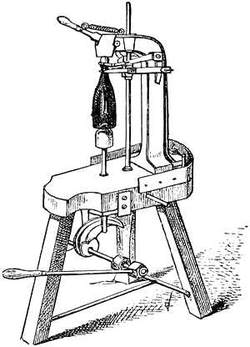
MACHINE FOR FIXING THE AGRAFES.
Most of the bottles used for Champagne come from the factories of
Loivre (which supplies the largest quantity), Folembray, Vauxrot, and
Quiquengrogne, and they cost on the average from 28 to 33 francs the
hundred.[411] They are generally tested by a practised hand, who, by
knocking them sharply together, professes to be able to tell, from the
sound that they give, the substance of the glass and its temper, though
occasionally a special machine, subjecting them to hydraulic pressure,
is had recourse to.
The operation of washing, which takes place immediately preceding the
bottling of the wine, is invariably performed by women, who at the
larger establishments accomplish it with the aid of machines, provided
at times with a revolving brush, although small glass beads are
generally used by preference. Each bottle after being washed is minutely
examined, to make certain of its perfect purity, and is then placed neck
downwards in a tall basket to drain.
With the different Champagne houses the mode of bottling the wine,
which may take place any time between April and August, varies in some
measure, still the tirage, as this operation is called, is ordinarily
effected as follows: The wine, after a preliminary test as to its
fitness for bottling, is emptied from the casks into vats or tuns of
varying capacity in the salle du tirage. From these it flows through
pipes into oblong reservoirs, each provided with a row of syphon-taps,
on to which the bottles are slipped, and from which the wine ceases to
flow directly the bottles become filled. Men or lads remove the full
bottles, replacing them by empty ones, while other hands convey them to
the corkers, whose guillotine machines are incessantly in motion. Speed
in the process is of much importance, as during a single day the wine
may undergo a notable change. From the corkers the bottles are passed
on to the agrafeurs, who secure the corks by means of an iron clip
termed an agrafe; and they are afterwards conveyed either to a spacious
room above-ground known as a cellier or to a cool vault underground,
according to the number of atmospheres which the wine may indicate.
With reference to these atmospheres, it should be explained that air
compressed to half its volume acquires twice its ordinary force, and
to a quarter of its volume quadruple this force—hence the phrase
of two, four, or more atmospheres. The exact degree of pressure is
readily ascertained by means of a manometer, an instrument resembling
a pressure-gauge, with a hollow screw at the base, which is driven
through the cork of the bottle. A pressure of 5 ¾ atmospheres
constitutes what is styled a ‘grand mousseux,’ and the wine exhibiting
it may be safely conveyed to the coolest subterranean depths, for no
doubt need be entertained as to its future effervescent properties.
Should the pressure, however, scarcely exceed four atmospheres, it is
advisable to keep the wine in a cellier above-ground, that it may more
rapidly acquire the requisite sparkling qualities. If fewer than four
atmospheres are indicated, it would be necessary to pour the wine back
into the casks again, and add a certain amount of cane-sugar to it;
but such an eventuality very rarely happens,
thanks to the scientific
formulas and apparatus, which enable the degree of pressure the wine
will show to be determined beforehand to a nicety. Still mistakes are
sometimes made, and there are instances where charcoal fires have had
to be lighted in the cellars to encourage the latent effervescence to
develop itself.[412]
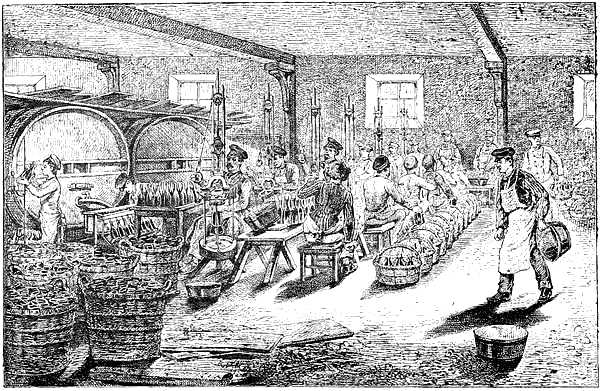
THE TIRAGE OR BOTTLING OF CHAMPAGNE.
The bottles are first placed in a horizontal position, the side to be
kept uppermost being indicated by a daub of whitewash, and are stacked
in rows of varying length and depth, one above the other, to about the
height of a man, with narrow laths between them. Thus they will spend
the summer, providing all goes well; but in about three weeks’ time
the process of gas-making inside the bottles is at its height, and a
period of considerable anxiety to the Champagne manufacturer ensues,
through his dread lest an undue number of them should burst from the
expansion of the carbonic acid gas generated in the wine. The glucometer
notwithstanding, it is impossible to check a certain amount of breakage,
especially when a hot season has caused the grapes, and consequently
the raw wine, to be sweeter than usual. Moreover, when once casse
or breakage sets in on a large scale, the temperature of the cellar
is raised by the volume of carbonic acid gas let loose, which is not
without its effect on the remaining bottles. Not only does the increased
temperature unduly accelerate fermentation, but the mere shock of one
bottle exploding often starts such of its neighbours as are predisposed
that way, in addition to the direct havoc wrought by the heavier
fragments of flying glass. The only remedy is the instant removal of the
wine to a lower temperature whenever this is practicable.
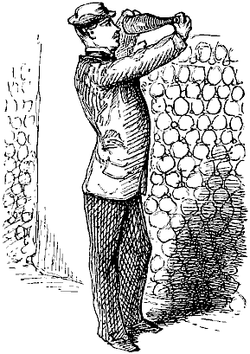
A manufacturer of the pre-scientific days of the last century relates
how one year, when the
wine was rich and strong, he only preserved
120 out of 6000 bottles; and it is not long since that 120,000 out of
200,000 were destroyed in the cellars of a well-known Champagne firm.
M. Mauméné, moreover, relates that in 1850 he was called in to consult
about the checking of a casse, which had already reached 96 per
cent.[413] Over-knowing purchasers affect to select a wine which has
exploded in the largest proportion in the cellars, as being well up to
the mark as regards its effervescence, and are in the habit of making
inquiries as to its performances in this direction.
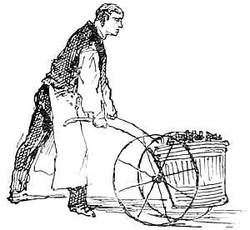
It is evident that, in spite of the teachings of science, the bursting
of Champagne bottles has not yet been reduced to a minimum, for whereas
in some cellars it averages 7 and 8 per cent, and rises to 15 when the
pressure is unusually strong, in others it rarely exceeds 2 ½ or 3.
The period between May and September is that in which the greatest
destruction takes place. In the month of October, the first and severest
breakage being over, the newly-bottled wine is definitively stacked in
the cellars in piles from two to half a dozen bottles deep, from six to
seven feet high, and frequently a hundred feet or upwards in length.
Usually the bottles remain in their horizontal position, in which they
gradually develop two essential qualities, that of effervescing well
and that of travelling satisfactorily, for about eighteen or twenty
months, though some firms, who pride themselves upon shipping perfectly
matured wines, leave them thus for double this space of time. During
this period the temperature to which the wine is exposed is, as far
as practicable, carefully regulated; for the risk of breakage, though
greatly diminished, is never entirely at an end.
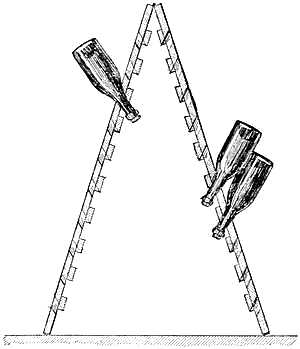
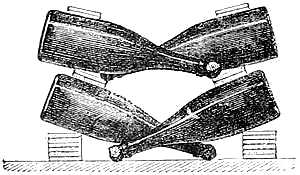
By this time the fermentation is over; but in the interval, commencing
from a few days after the bottling of the wine, a loose dark-brown
sediment has been forming, which has now settled on the lower side of
the bottle, and to get rid of which is a delicate and tedious task. As
the time approaches for preparing the wine for shipment, the bottles
are placed sur pointe, as it is termed—that is to say, slantingly
in racks with their necks downwards, the inclination being increased
from time to time to one more abrupt.[414] The object of this change in
their position is to cause the sediment to leave the side of the bottle
where it has gathered. Afterwards it becomes necessary to twist and
turn it and coagulate it, as it were, until it forms a kind of muddy
ball, and eventually to get it well down into the neck of the bottle,
so that it may be finally expelled with a bang when the temporary cork
is removed and the proper one adjusted. To accomplish this the bottles
are sharply turned in one direction every day for at least
a month or six weeks, the time being indefinitely extended until the sediment
shows a disposition to settle near the cork. The younger the wine the
longer the period necessary for the bottles to be shaken, new wine often
requiring as much as three months. Only a thoroughly practised hand can
give the right amount of revolution and the requisite degree of slope;
and in some of the cellars men were pointed out to us who had acquired
such dexterity as to be able at a pinch to shake with their two hands as
many as 50,000 bottles in a single day, whilst 30,000 to 40,000 is by no
means an uncommon performance.
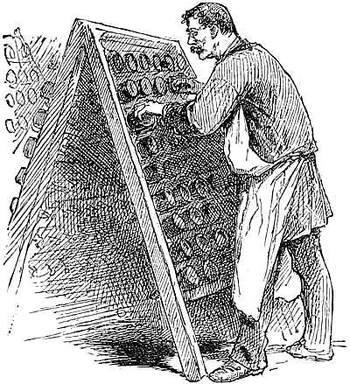
Some of these men have spent thirty or forty years of their lives
engaged in this perpetual task. Fancy being entombed all alone day after
day in vaults which are invariably dark and gloomy, and often cold and
dank, and being obliged to twist sixty to seventy of these bottles
every minute throughout the day of ten hours! Why, the treadmill and
the crank, with their periodical respites, must be pastime compared to
this maddeningly monotonous occupation, which combines hard labour,
with the wrist, at any rate, with next to solitary confinement. One can
understand these men becoming gloomy and taciturn, and affirming that
they sometimes see devils hovering over the bottle-racks and frantically
shaking the bottles beside them, or else grinning at them as they pursue
their humdrum task. Still it may be taken for granted that the men who
reach this stage are accustomed to drink freely of raw spirits, as an
antidote to the damp to which they are exposed, and merely pay the
penalty of their over-indulgence.
In former times the bottles used to be placed with their heads downwards
on tables pierced with holes, from which they had to be removed
and agitated. At a still earlier date the process was more or less
successfully accomplished by holding the bottles upside down by the
neck, tapping them at the bottom to detach the sediment, and then, after
shaking them well up, laying them on their sides until the operation was
repeated. In 1818, however, a man named Müller, in the employment of
Madame Clicquot, suggested that the bottles should remain in the tables
whilst being shaken, and further that the holes should be cut obliquely,
so that they might recline at varying angles. His suggestions were
privately adopted by Madame Clicquot; but eventually the improved plan
got wind, and the system which he initiated now prevails throughout the
Champagne.[415]
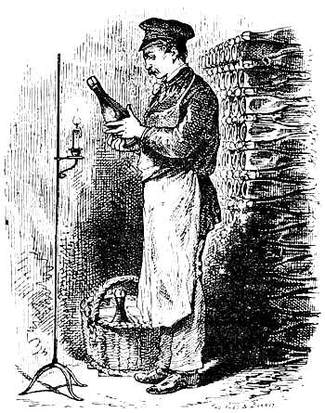
When the bottles have gone through their regular course of shaking, they
are examined before a lighted candle to ascertain whether the deposit
has all fallen on to the cork, and the wine has become perfectly clear.
Sometimes it happens that, twist these men never so wisely, the deposit,
instead of becoming flaky or granular, refuses to stir, and takes the
shape of a bunch of threads technically called a ‘claw,’ or an adherent
membrane styled a ‘mask.’ When this is the case an attempt is made to
start it by tapping the part to which it adheres with a piece of iron,
the result being frequently the sudden explosion of the bottle in the
workman’s hands. By way of precaution, therefore, the operator protects
his face with a wire mask, or by gigantic wire spectacles, which give to
him a ghoul-like aspect. Frequently it is found impossible to detach the
‘mask’ from the side of the bottle, and in this case the only thing that
remains is to pour the wine back again into the cask, with the view of
mixing it in some future cuvée.[416]
The cellars of the Champagne manufacturers are very varied in character.
The wine that has been grown on the chalky hills is left to develop
itself in vaults burrowed out of the calcareous strata which underlie
the entire district. In excavating these cellars the sides and roofs
are frequently worked smooth and regular as finished masonry. The
larger ones
are composed of a number of spacious and lofty galleries,
sometimes parallel with each other, but often ramifying in various
directions, and evidently constructed on no definite plan. They are
of one, two, and, in rare instances, of three stories, and now and
then consist of a series of parallel galleries communicating with each
other, lined with masonry, and with their stone walls and vaulted roofs
resembling the crypt of some conventual building. Others of ancient
date are less regular in their form, being merely so many narrow,
low, winding corridors, varied, perhaps, by recesses hewn roughly out
of the chalk, and resembling the brigands’ cave of melodrama; while
a certain number of the larger cellars at Reims are simply abandoned
quarries, the broad and lofty arches of which are suggestive of the nave
and aisles of some Gothic church. In these varied vaults, lighted by
solitary lamps in front of metal reflectors, or by the flickering tallow
candles which we carry in our hands, we pass rows of casks filled with
last year’s vintage or reserved wine of former years, and piles after
piles of bottles of vin brut in seemingly endless sequence—squares,
so to speak, of raw recruits for the historically famous ‘Regiment
de Champagne’[417]—awaiting their turn to be thoroughly drilled and
disciplined. These are varied by bottles reposing neck downwards in
racks at different degrees of inclination, according to the progress
their education has attained. Reports caused by exploding bottles now
and then assail the ear, and as the echo dies away it becomes mingled
with the rush of the escaping wine, cascading down the pile, and finding
its way across the sloping sides of the floor to the narrow gutter in
the centre. The dampness of the floor and the shattered fragments of
glass strewn about show the frequency of this kind of accident.
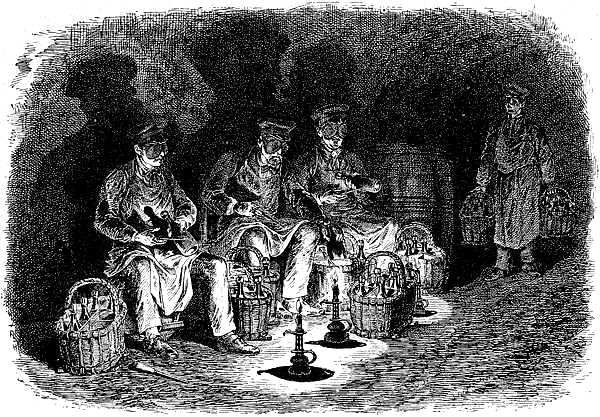
DETACHING THE ‘MASK’ FROM THE SIDES OF THE BOTTLES.
In these subterranean galleries we frequently come upon parties of
workmen engaged in transforming the perfected vin brut into Champagne.
Viewed at a distance while occupied in their monotonous task, they
present in the semi-obscurity a series of picturesque Rembrandt-like
studies. One of the end figures in each group is engaged in the
important process of
dégorgement, which is performed when the
deposit, of which we have already spoken, has satisfactorily settled
in the neck of the bottle. Baskets full of bottles with their necks
downwards are placed beside the operator, who stands before a cask set
on end, and having a large oval opening in front. This nimble-fingered
manipulator seizes a bottle, raises it for a moment before the light
to test the clearness of the wine and the subsidence of the deposit;
holds it horizontally in his left hand, with the neck directed towards
the opening already mentioned; and with a jerk of the steel hook which
he holds in his right hand loosens the agrafe securing the cork.
Bang goes the latter, and with it flies out the sediment and a small
glassful or so of wine, further flow being checked by the workman’s
finger, which also serves to remove any sediment yet remaining in the
bottle’s neck. Like many other clever tricks, this looks very easy when
adroitly performed, though a novice would probably allow the bottle
to empty itself by the time he discovered that the cork was out. Yet
such is the dexterity acquired by practice that the average amount
of wine, foam, and deposit ejected by this operation does not exceed
one-fourteenth of the contents of the bottle. Occasionally a bottle
bursts in the dégorgeur’s hand, and his face is sometimes scarred from
such explosions. The sediment removed, the dégorgeur slips a temporary
cork into the bottle, or places the latter in a machine provided with
fixed gutta-percha corks and springs for securing the bottles firmly in
their places. The wine is now ready for the important operation of the
dosage, upon the nature and amount of which the character of perfected
Champagne, whether it be dry or sweet, light or strong, very much
depends.[418]
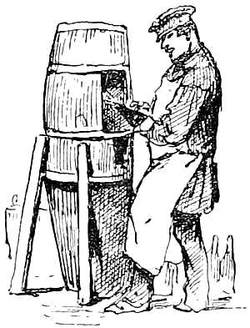
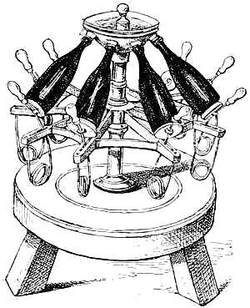
Different manufacturers have different recipes for the composition of
this syrup, all more or less complex in character, and varying with
the quality of the wine and the country for which it is intended;
but the genuine liqueur consists of nothing but old wine of the best
quality, to which a certain amount of sugar-candy and perhaps a dash of
the finest cognac spirit has been added.[419] The saccharine addition
varies according to the market for which the wine is destined: thus the
high-class English buyer demands a dry Champagne, the Russian a wine
sweet and strong as ‘ladies’ grog,’ and the Frenchman and German a sweet
light wine. To the extra-dry Champagnes a modicum dose is added, while
the so-called ‘brut’ wines receive no more than from one to three per
cent of liqueur.[420]
In establishments wedded to old-fashioned usages the dose is
administered with a tin can or ladle; but more generally an ingenious
machine which regulates the percentage of liqueur to a nicety is
employed. The bottle being usually nearly full when passed to the
doseur, he, when a heavy percentage of liqueur has to be administered,
is constrained, under the old system, to pour out some of the wine to
make room for it, and this surplus in many cases is afterwards
transformed into the well-known
tisane de Champagne. As soon as the
dosage is accomplished, the bottle is passed to another workman known
as the égaliseur, who fills it up with pure wine, frequently with a
part of that which has been poured out by the doseur, to the requisite
level for corking. In the event of a pink Champagne being required, the
wine thus added will be red, although manufacturers of questionable
reputation sometimes employ the solution of elderberries, known as
teinte de Fismes, to impart that once-favourite roseate hue which has
been compared to the glow of fading sunlight on a crystal stream.
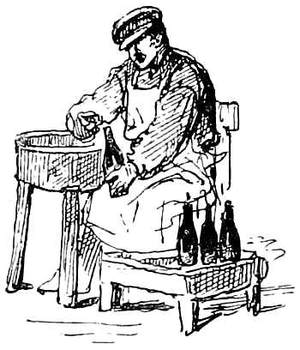
THE DOSEUR.
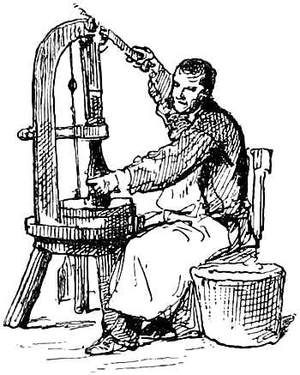
THE CORKER.
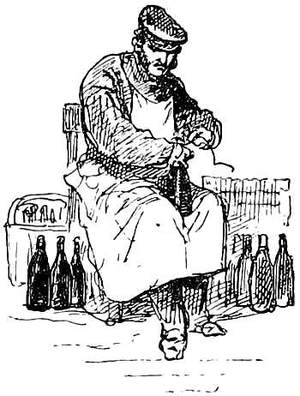
THE METTEUR DE FIL.
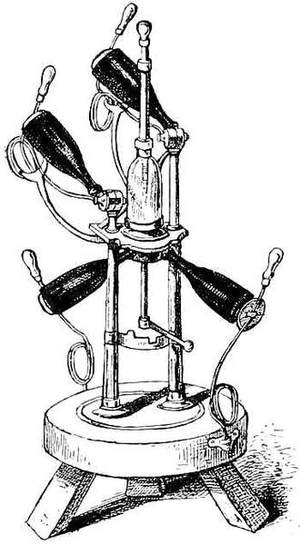
DOSING MACHINE.
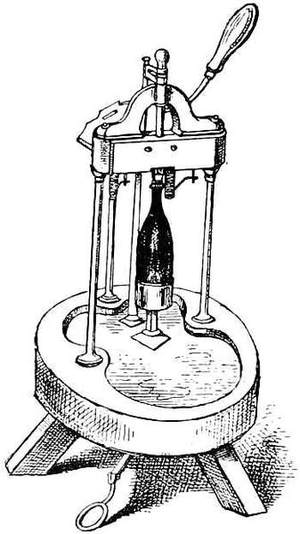
CORKING MACHINE.
The égaliseur in his turn hands the bottle to the corker, who places
it under a machine furnished with a pair of claws (so as to compress the
cork to a size sufficiently small to allow it to enter the neck of the
bottle) and a suspended weight, which in falling drives it home. These
corks, principally obtained from Catalonia and Andalucia, are bound to
possess a close and regular fibre and perfect elasticity. They form
no unimportant item in the Champagne manufacturer’s budget, costing
upwards of twopence each, and are delivered in huge sacks resembling
hop-pockets. Previous to being used they are either boiled in wine or
soaked in a solution of tartar, or else they have been steamed by the
cork merchants, in order to prevent their imparting a bad flavour to
the wine, and to hinder any leakage. They are commonly handed warm to
the corker, who dips them into a small vessel of wine before making use
of them. Some firms, however, prepare their corks by subjecting them to
cold-water douches a day or two beforehand. The ficeleur receives
the bottle from the corker, and with a twist of the fingers secures
the cork with string, at the same time rounding its hitherto flat top,
at a rate which allows from a thousand to twelve hundred bottles to
pass through his hands in course of the day. The metteur de fil next
affixes the wire with like celerity;[421] and then the final operation
is performed by a workman seizing a couple of bottles by the neck and
whirling them round his head, as though engaged in the Indian-club
exercise, in order to secure a perfect amalgamation of the wine and the
liqueur.
The final manipulation accomplished, the agitated course of existence
through which the wine has been passing at last comes to an end, and
the bottles are conveyed to another part of the establishment, where
they repose for several days, or even weeks, in order that the mutual
action of the wine and the liqueur upon each other may be complete. When
the time arrives for despatching them, they are confided to feminine
hands to have their dainty toilettes made, and are tastefully labelled,
and are either capsuled, or else have their corks and necks imbedded
in sealing-wax or swathed in gold or silver foil, whereby they are
rendered presentable at the best-appointed tables. All that now remains
is to wrap them up in coloured tissue-paper, to slip them into straw
envelopes, or encircle them with wisps of straw, and pack them either in
cases or baskets for despatch to all quarters of the civilised globe.
It is thus that Champagne sets out on its beneficial pilgrimage to
promote the spread of mirth and light-heartedness, to drive away dull
care and foment good-fellowship, to comfort the sick and cheer the
sound. Wherever civilisation penetrates, Champagne sooner or later is
sure to follow; and if Queen Victoria’s morning drum beats round the
world, its beat is certain to be echoed before the day is over by the
popping of Champagne corks. Nowadays the exhilarating wine graces not
merely princely but middle-class dinner-tables, and is the needful
adjunct at every petit souper, as well as the stimulant to the wildest
revels in all the gayer capitals of the world. It gives a flush to
beauty at garden-parties and picnics, sustains the energies of the
votaries of Terpsichore until the hour of dawn, and imparts to many a
young gallant the necessary courage to declare his passion. It enlivens
the dullest of réunions, brings smiles to the lips of the sternest
cynics, softens the most irascible tempers, and loosens the most
taciturn tongues.
The grim Berliner and the gay Viennese both acknowledge the exhilarating influence
of the wine. Champagne sparkles in crystal goblets in the
great capital of the North, and the Moslem wipes its creamy foam from
his beard beneath the very shadow of the mosque of St. Sophia; for the
Prophet has only forbidden the use of wine, and of a surety—Allah be
praised!—this strangely-sparkling delicious liquor, which gives to the
true believer a foretaste of the joys of Paradise, cannot be wine. At
the diamond-fields of South Africa and the diggings of Australia the
brawny miner who has hit upon a big bit of crystallised carbon, or a
nugget of virgin ore, strolls to the ‘saloon’ and shouts for Champagne.
The mild Hindoo imbibes it quietly, but approvingly, as he watches the
evolutions of the Nautch girls, and his partiality for the wine has
already enriched the Anglo-Bengalee vocabulary and London slang with the
word ‘simkin.’ It is transported on camel-backs across the deserts of
Central Asia, and in frail canoes up the mighty Amazon. The two-sworded
Daimio calls for it in the tea-gardens of Yokohama, and the New Yorker,
when not rinsing his stomach by libations of iced water, imbibes it
freely at Delmonico’s.
Wherever the Romans died they left traces behind them in their quaint
funeral urns; wherever the civilised man of the nineteenth century has
set his foot—at the base of the Pyramids and at the summit of the
Cordilleras, in the mangrove swamps of Ashantee and the gulches of the
Great Lone Land, in the wilds of the Amoor and on the desert isles
of the Pacific—he has left traces of his presence in the shape of
the empty bottles that were once full of the sparkling vintage of the
Marne. They are strewn broadcast over the face of the globe, literally
from Indus to the Pole. The crews of the Alert and the Discovery
left them on the ice-bound verge of the paleocrystic sea; the French
expeditionary columns have scattered them within the limits of the
Great Sahara. In the lodges of the red man they are found playing the
part of a great medicine, and in the huts of the negro they assume all
the importance due to a big fetish. Stanley, arriving fainting and
exhausted at the mouth of the Congo, hailed with joy the foil-tipped
flask that the hospitable merchants who answered his appeal for succour
had despatched; and as he quaffed its contents, recalled how he and
Livingstone, when thousands of miles from any other European, had
emptied a bottle of sparkling Champagne together on the night of their
memorable meeting at Ujiji. And when, after the battle of Ulundi, the
victorious British troops occupied Cetewayo’s kraal, they found within
the sable potentate’s private chamber several empty Champagne bottles,
the contents of which, it is to be presumed, he had quaffed the night
before to the success of his followers. In the Transvaal too, during
the negotiations for an armistice, Sir Evelyn Wood regaled the Boer
delegates with Champagne. On a subsequent occasion, the latter were
unable to return the compliment, excusing themselves by suggestively
remarking, ‘We don’t take such things with us when we go to fight.’
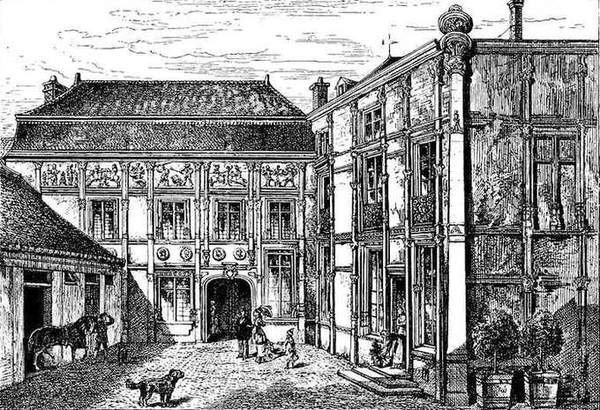
RENAISSANCE HOUSE AT REIMS, IN WHICH MADAME CLICQUOT RESIDED.
The city of Reims—Its historical associations—The
Cathedral—Its western front one of the most splendid conceptions
of the thirteenth century—The sovereigns crowned within its
walls—Present aspect of the ancient archiepiscopal city—The
woollen manufactures and other industries of Reims—The city
undermined with the cellars of the great Champagne firms—Reims
hotels—Gothic house in the Rue du Bourg St. Denis—Renaissance
house in the Rue de Vesle—Church of St. Jacques: its gateway
and quaint weathercock—The Rue des Tapissiers and the Chapter
Court—The long tapers used at religious processions—The Place
des Marchés and its ancient houses—The Hôtel de Ville—Statue
of Louis XIII.—The Rues de la Prison and du Temple—Messrs.
Werlé & Co., successors to the Veuve Clicquot-Ponsardin—Their
offices and cellars on the site of a former Commanderie of the
Templars—Origin of the celebrity of Madame Clicquot’s wines—M.
Werlé and his son—Remains of the Commanderie—The forty-five
cellars of the Clicquot-Werlé establishment—Our tour of inspection
through them—Ingenious dosing machine—An explosion and its
consequences—M. Werlé’s gallery of paintings—Madame Clicquot’s
Renaissance house and its picturesque bas-reliefs—The Werlé
vineyards and vendangeoirs.
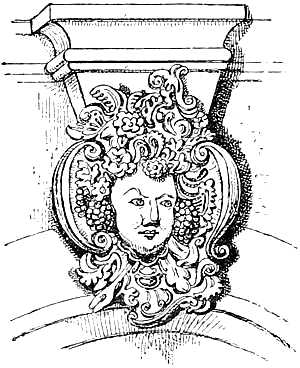
HEAD OF BACCHUS IN THE COURTYARD
OF THE HÔTEL DU LION D’OR.
THE ancient city of Reims is pleasantly situate in a spacious natural
basin, surrounded by calcareous hills, for the most part planted with
vines. It is fertile in historical associations, rich in archæological
treasures, and at the same time able to claim the respect more readily
accorded in the nineteenth century to a busy and prosperous commercial
centre. Indeed, its historical, archæological, and commercial importance
is in advance of its actual political situation, for administratively
it only ranks as a simple subprefecture in the department of the
Marne. The student of history can hardly afford to neglect a city so
intimately associated with the story of monarchy in France, and one
which has witnessed the coronations of a long series of sovereigns,
beginning with Clovis and ending with Charles X. From the day
when the ‘proud Sicamber’ bent his neck at the adjuration of St. Remi, and
vowed to adore that which he had burnt and to burn that which he had
adored, down to the time when the future exile of Holyrood had his
forehead touched by Jean Baptiste Antoine de Latil with the remnant
of the ‘sacred pomatum’ so miraculously saved from revolutionary
hands, few of the titular rulers of the country have failed to honour
it with their presence. As the Durocortorum of Cæsar, the residence
of Charlemagne, the seat of the great Ecclesiastical Councils of the
twelfth century, the stronghold of the League, and the scene of one of
the first Napoleon’s most brilliant feats of arms during the campaign of
1813–14, it has also earned for itself a conspicuous place in history.
To Englishmen it is, perhaps, most noteworthy as having successfully
checked the victorious advance of the third Edward after Cressy, and
witnessed the apogee of that meteoric career, which began in the
inn-yard at Domremi and ended in the market-place at Rouen, the career
of Jeanne la Pucelle. Nor must it be forgotten that Reims sheltered the
childhood of Mary Stuart, and saw the heralds of England hurl solemn
defiance at Henri II. in the Abbey of St. Remi, at the command of Mary
Tudor.
To the archæologist as to the ordinary sightseer, the chief attractions
presented by Reims consist in its numerous ecclesiastical edifices, some
still serving the purpose for which they were originally erected, others
long since converted to secular usages. Most conspicuous among them is
the cathedral church of Notre Dame, the stately basilica in which the
sovereigns of France were wont to be crowned. This superb monument of
Gothic architecture was commenced in 1210, upon the plans of Robert
de Coucy, by Archbishop Alberic de Humbert. It was completed at the
commencement of the fourteenth century, and though the original design
was somewhat modified—owing, it is said, to the contributions of the
faithful not coming in with sufficient rapidity—it remains a marvel
of strength, admirably combined with grace. The exterior is extremely
fine; and the western face, with its elaborately ornate portal, has been
described as ‘one of the most splendid conceptions of the thirteenth
century.’[422] Amidst the almost bewildering multiplicity of ornament,
the triple porch, surmounted by a group representing the Coronation
of the Virgin, the great rose window, flanked by colossal effigies of
David and Goliath, and the range of statues known as the Gallery of
the Kings, running across the façade near its summit, are conspicuous.
The interior, although fine, and containing many objects of interest,
is less impressive, while the plundered treasury can still boast of
many quaint and curious relics of bygone times. But the chief interest
centres in the fact of the surrounding walls having witnessed so many
scenes of stately pomp and pageantry. St. Louis, Philip the Fair, Philip
of Valois, the unfortunate John the Good, Charles the Simple, and
Charles the Victorious, with Joan of Arc, standard in hand, by his side;
the wily Louis XI., Louis the Father of his People, the magnificent
Francis I., and his scarcely less magnificent son, the young husband
of Mary Queen of Scots; the savage Charles IX., Henri III., with his
protest that the crown hurt him, Louis the Just, the Roi Soleil himself,
Louis the Well-Beloved, the hapless Louis Seize, and Charles X., have
all knelt here in turns whilst the crown was placed on their heads, the
sword girded to their sides, and the oriflamme waved above them.
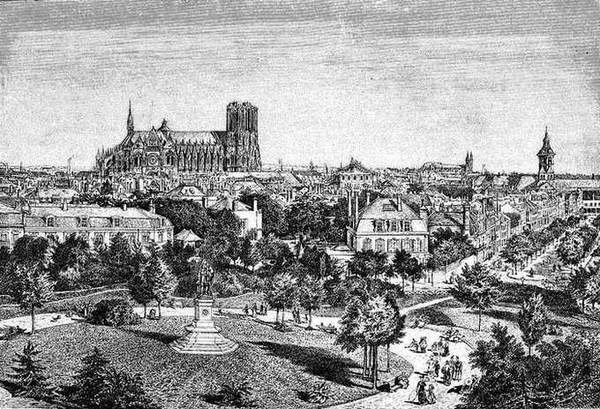
GENERAL VIEW OF REIMS, 1880.
Many of the most famous cities of the Middle Ages are mere fossilised
representatives of former grandeur, but with Reims the case is
otherwise. If somewhat fallen from its former high estate, politically
speaking—though it should be remembered that Troyes was the titular
capital of the Champagne when the province was ruled by independent
Counts—its material prosperity has augmented. Round the nucleus of
narrow and often tortuous streets, representing the old archiepiscopal
city—the ‘Little Rome’ of the twelfth century—a network of spacious
thoroughfares and broad boulevards has spread itself, and the life
and movement of a busy manufacturing population are not lacking. In
addition to the wine trade, which of course employs, both directly and
indirectly, a large number of hands, Reims is one of the most important
seats of the woollen manufacture in France, and the industrial element
forms a very important factor amongst its inhabitants. In
addition to the flannels, merinoes, blankets, trouserings, shawls, &c., that
are annually produced, to the value of from thirty to forty million
of francs, there is also a considerable production of gingerbread,
biscuits, and dried pears, enjoying a wide-spread reputation.
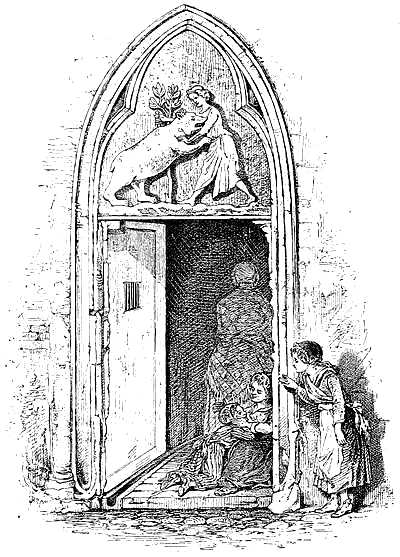
GOTHIC DOORWAY IN THE RUE DU BOURG ST. DENIS, REIMS.
The cellars of the great Champagne manufacturers of Reims are scattered
in all directions over the historical old city. They undermine its
narrowest and most insignificant streets, its broad and handsome
boulevards, and on the eastern side extend beyond its more distant
outskirts. In whichever direction we may elect to proceed when
visiting the principal Champagne establishments, our starting-point
will necessarily be the vicinity of the Cathedral, for it is here
that all the hotels are situated. Facing the great western doorway of
the ancient Gothic edifice is the Hôtel Lion d’Or, formerly the Hôtel
Petit Moulinet, where the allied sovereigns sojourned on their way to
Paris in 1814, and Napoleon rested on his flight after the battle of
Waterloo. Close by is the Hôtel Maison Rouge, with the commemorative
tablet on its renovated façade setting forth that in the year 1429, at
the coronation of Charles VII. in this hostelry, then named the Striped
Ass, the father and mother of Jeanne Darc were lodged at the expense of
the city council. Almost facing is the newly-erected Grand Hôtel, and
on the north-western side of the Cathedral is the Hôtel de Commerce,
the resort, as its name implies, of most of the commercial travellers
frequenting the capital of the Champagne. The visitor to Reims, be his
object business or pleasure, is bound to put up at one or other of these
four hostelries, and hence the starting-point of his peregrinations is
necessarily the same.
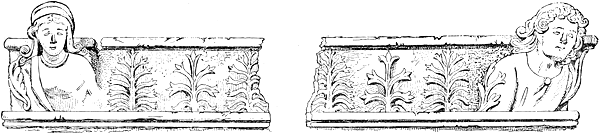
FRIEZE OF OLD HOUSE IN THE RUE DE VESLE, REIMS.
Proceeding along the Rue Tronçon Ducoudray, we reached the Rue de Vesle,
where the Palais de Justice and the new theatre are situated. In the
adjacent Rue du Bourg St. Denis is an old house—the ground-floor of
which is a wine-shop styled Buvette du Théâtre—notable for its antique
Gothic doorway, containing, within the upper portion of the arch, the
bas-relief of a man fighting with a bear. There is a tradition that
on this spot formerly stood a hospital dedicated to St. Hubert, and
intended for the reception of persons wounded when hunting, or who
might have chanced to be bitten by mad dogs. In the Rue de Vesle is
another old house with an ornamental frieze surmounting its façade,
which looks on to one of the entrances of the Church of St. Jacques.
This edifice, originally erected at the close of the twelfth century,
is hemmed in on all sides by venerable-looking buildings, while above
them rises its tapering steeple, surmounted by a mediæval weathercock
in the form of an angel. The interior of the church presents a curious
jumble of architectural styles from early Gothic to late Renaissance.
One noteworthy object of art which it contains is a life-size crucifix
carved by Pierre Jacques, a Remois sculptor of the days of the Good King
Henri, and from an anatomical point of view a perfect chef-d’œuvre.
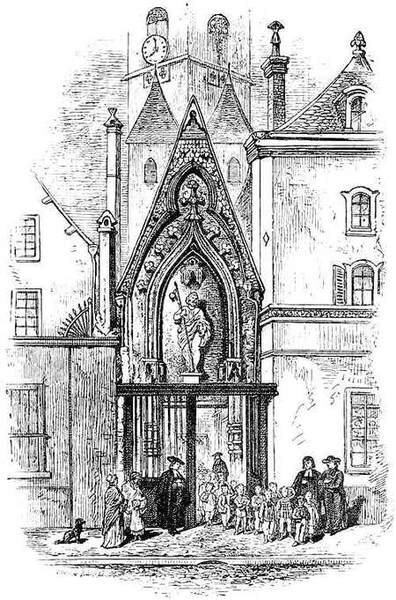
GATEWAY OF THE CHURCH OF ST. JACQUES, REIMS.
WEATHERCOCK OF THE CHURCH OF ST. JACQUES.
The Rue de Vesle merges into the Rue des Tapissiers, where in former
times the carpet manufacturers of Reims had their warehouses. In the
fourteenth and fifteenth centuries the carpets of Reims were as famous
in France as those of Aubusson are to-day, but subsequently they began
to decline. Half-way up this street—where, by the way, in 1694 the
first numbers of the Gazette de France, the oldest existing French
newspaper, were printed, the news being duly forwarded from Paris—we
pass the ancient gateway leading to the chapter-court of the Cathedral.
Within the court a weekly market of small wares is now held; but in the
days when the archbishops, dukes, and peers of Reims wielded sovereign
sway in the capital of the Champagne, this open space was a champ
clos, where trials by battle took place. The surrounding buildings
comprised residences for various ecclesiastics connected with the
Cathedral, together with a small farm whence these epicurean priests
derived their supply of fresh milk and fatted capons. According to
ancient custom, the inhabitants of the houses facing the chapter-gateway
were required to keep their doors and windows open on days of religious
processions, the tapers carried by the clergy on these occasions being
of such immoderate length that it was necessary to incline them, and run
them into the doors and windows of the houses opposite when the bearers
passed under the archway.
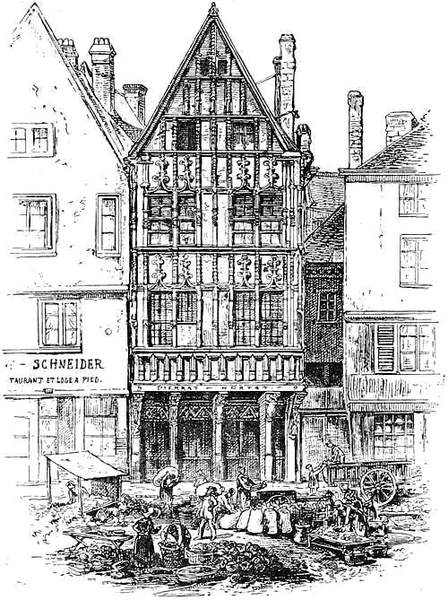
GOTHIC HOUSE IN THE MARKET-PLACE, REIMS.
At the end of the Rue des Tapissiers is the handsome Place Royale,
connected with the Place des Marchés by a broad rectangular street
lined with lofty edifices in the modern Parisian style of architecture.
A break ensues in this range of massive-looking buildings as we enter
the ancient Place des Marchés, the forum of Roman Reims, and to-day
bordered more or less by houses of a mediæval character, remarkably
well preserved. Principal among these is a Gothic timber-house of
the fifteenth century, with its projecting upper stories supported
by elaborately-carved corbels, and its entire façade enriched with
mouldings and finials, and with columns and capitals overlaid with
sculptured ornaments.
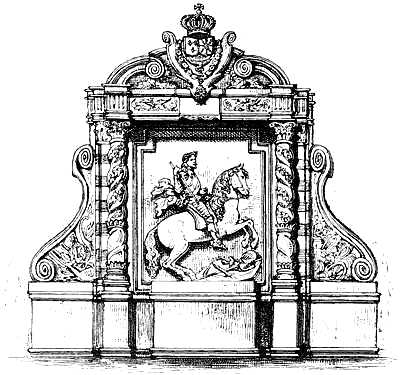
STATUE OF LOUIS XIII. ON THE HÔTEL DE VILLE, REIMS.
Some little distance beyond the Place des Marchés is the Place
de l’Hôtel de Ville, which derives all its interest from the
handsome-looking edifice in the florid Italian style of the early part
of the seventeenth century which gives it its name. The façade of this
building is profusely
decorated with Ionic, Doric, and Corinthian
columns, and on the pediment above the principal entrance is a
bas-relief equestrian statue of Louis XIII., whom the Latin inscription
beneath fulsomely characterises as ‘the just, the pious, the victorious,
the clement, the beloved of his people, the terror of his enemies, and
the delight of the world,’ and to whom ‘the senate and inhabitants of
Reims have raised this imperishable trophy.’ Some century and a half
later, however, the imperishable trophy got hurled down and shattered
into fragments by the populace, and its vacant place was only filled by
the present statue in the year 1818.
To the right of the Place is the Chambre des Notaires of Reims, raised
on the site of the ancient présidial, or court of justice, where the
city magistrates used to be elected during the Middle Ages, and to which
a chapel and a prison were attached. The latter building evidently gave
its name to the adjoining Rue de la Prison, the gloomy-looking houses
of which—of a more massive character than the gabled structures of
the market-place and the Rue de l’Etape—with their formidably-barred
windows, possible relics of the religious wars, seem to frown, as it
were, upon the passer-by. In a narrow tortuous street leading from this
thoroughfare Messrs. Werlé & Co., the successors of the famous Veuve
Clicquot-Ponsardin, have their offices and cellars, on the site of a
former Commanderie of the Templars; and strangers passing by this quiet
spot would scarcely imagine that under their feet hundreds of busy hands
are incessantly at work, disgorging, dosing, shaking, corking, storing,
wiring, labelling, capsuling, waxing, tinfoiling, and packing hundreds
of thousands of bottles of Champagne destined for all parts of the
civilised world.
The house of Clicquot, established in the year 1798 by the husband of
La Veuve Clicquot-Ponsardin, who died in 1866, in her 89th year, was
indebted for much of the celebrity of its wine to the lucky accident of
the Russians occupying Reims in 1814 and 1815, and freely requisitioning
the sweet Champagne stored in the widow’s capacious cellars. Madame
Clicquot’s wines were slightly known in Russia prior to this date; but
the officers of the invading army, on their return home, proclaimed
their merits throughout the length and breadth of the Muscovite Empire,
and the fortune of the house was made. Madame Clicquot, as every one
knows, amassed enormous wealth, and succeeded in marrying both her
daughter and granddaughter to counts of the ancien régime.

HEADS OF PHŒBUS AND BACCHUS.
The present head of the firm is M. Werlé, who comes of an old Lorraine
family although born in the ancient free imperial town of Wetzlar on
the Lahn, where Goethe lays the scene of his ‘Sorrows of Werther,’ the
leading incidents of which really occurred there. M. Werlé entered
the establishment which he has done so much to raise to its existing
position so far back as the year 1821. His care and skill, exercised for
nearly two-thirds of a century, have largely contributed to obtain for
the Clicquot brand that high repute which it enjoys to-day all over the
world. M. Werlé, who has long been naturalised in France, was for many
years Mayor of Reims and President of its Chamber of Commerce, as well
as one of the deputies of the Marne to the Corps Législatif. He enjoys
the reputation of being the richest man in Reims, and, like his late
partner, Madame Clicquot, he has also secured brilliant alliances for
his children, his son, M. Alfred Werlé, having married the daughter of
the Duc de Montebello, while his daughter espoused the son of M. Magne,
Minister of Finance under the Second Empire.
Half-way down the narrow Rue du Temple is an ancient gateway, on
which may be traced the half-effaced sculptured heads of Phœbus
and Bacchus. Immediately in front is a green porte-cochère forming
the entrance to the Clicquot-Werlé establishment, and conducting to
a spacious trim-kept courtyard, set off with a few trees, with some
extensive stabling and cart-sheds on the left, and on the right hand
the entrance to
the cellars. Facing us is an unpretending-looking
edifice, where the firm has its counting-houses, with a little corner
tower surmounted by a characteristic weathercock consisting of a figure
of Bacchus seated astride a cask beneath a vine-branch, and holding
up a bottle in one hand and a goblet in the other. The old Remois
Commanderie of the Knights Templars existed until the epoch of the Great
Revolution, and today a few fragments of the ancient buildings remain
adjacent to the ‘celliers’ of the establishment, which are reached
through a pair of folding-doors and down a flight of stone steps. The
date of the foundation of this Commanderie is uncertain, but it is
known that a Templar’s church occupied a portion of the site in 1170.
In 1311 both the church and the Commanderie passed into possession of
the Order of St. John of Jerusalem, which held them until the epoch of
the Revolution. Formerly the échevins of Reims used to be elected in
the ancient hall of the Commanderie, which at one period was a sanctuary
for debtors, and also for criminals. Early in the present century the
buildings were sold and demolished.
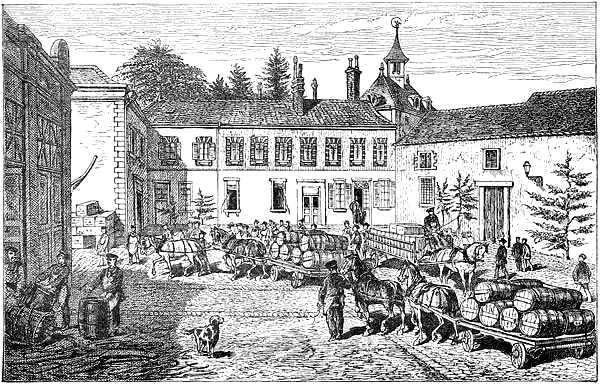
THE CLICQUOT-WERLÉ ESTABLISHMENT AT REIMS.
After being furnished with lighted candles, we set out on our tour of
inspection of the Clicquot-Werlé establishment, entering first of all
the vast cellar of St. Paul, where the thousands of bottles requiring
to be daily shaken are reposing necks downward on the large perforated
tables which crowd the apartment. It is a peculiarity that each of the
Clicquot-Werlé cellars—forty-five in
number, and the smallest among
them a vast apartment—has its special name. In the adjoining cellar
of St. Matthew other bottles are similarly arranged, and here wine in
cask is likewise stored. We pass rows of huge tuns, each holding its
twelve or thirteen hundred gallons of fine reserved wine designed for
blending with more youthful growths; next, are threading our way between
seemingly endless piles of hogsheads filled with later vintages, and
anon are passing smaller casks containing the syrup with which the vin
préparé is dosed. At intervals we come upon some square opening in the
floor through which bottles of wine are being hauled up from the cellars
beneath in readiness to receive their requisite adornment before being
packed in baskets or cases, according to the country to which they are
destined to be despatched. To Russia the Clicquot Champagne is sent in
cases containing sixty bottles, while the cases for China contain as
many as double that number.
|
|
|
|
Arms of the Dauphins
of France.
|
|
Arms of the Knights
of Malta.
|
|
DEVICES FROM THE COMMANDERIE AT REIMS.
|
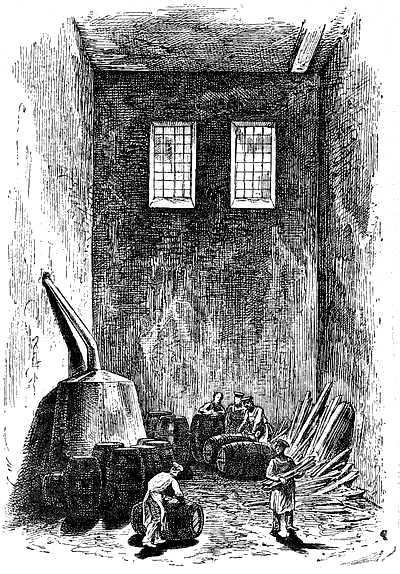
REMAINS OF THE COMMANDERIE AT REIMS.
The ample cellarage which the house possesses has enabled M. Werlé to
make many experiments which firms with less space at their command would
find it difficult to carry out on the same satisfactory scale. Such,
for instance, is the system of racks in which the bottles repose while
the wine undergoes its diurnal shaking. Instead of these racks being,
as is commonly the case, at almost upright angles, they are perfectly
horizontal, which, in M. Werlé’s opinion, offers a material advantage,
inasmuch as the bottles are all in readiness for disgorging at the same
time, instead of the lower ones being ready before those above, as is
the case when the ancient system is followed, owing to the uppermost
bottles getting less shaken than the others.
After performing the round of the celliers we descend into the caves,
a complete labyrinth of gloomy underground corridors excavated in the
bed of chalk which underlies the city, and roofed and walled with solid
masonry, more or less blackened by age. In one of these cellars we catch
sight of rows of workpeople engaged in the operation of dosing, corking,
securing, and shaking the bottles of wine which have just left the hands
of the dégorgeur by the dim light of half-a-dozen tallow-candles. The
latest invention for liqueuring the wine is being employed. Formerly,
to prevent the carbonic acid gas escaping from the bottles while
the process of liqueuring was going on, it was necessary to press a
gutta-percha ball connected with the machine, in order to force the
escaping gas back. The new machine, however, renders this unnecessary,
the gas, by its own power and composition, forcing itself back into the
wine.
In the adjoining cellar of St. Charles are stacks of bottles awaiting
the manipulation of the dégorgeur; while in that of St. Ferdinand
men are engaged in examining other bottles before lighted candles, to
make certain that the sediment is thoroughly dislodged, and the wine
perfectly clear before the disgorgement is effected. Here, too, the
corking, wiring, and stringing of the newly-disgorged wine are going
on. Another flight of steps leads to the second tier of cellars, where the
moisture trickles down the dank dingy walls, and save the dim
light thrown out by the candles we carried, and by some other far-off
flickering taper, stuck in a cleft stick, to direct the workmen, who
with dexterous turns of their wrists, give a twist to the bottles, all
is darkness. On every side bottles are reposing in various attitudes,
the majority in huge square piles on their sides, others in racks
slightly tilted; others, again, almost standing on their heads, while
some, which through overinflation have come to grief, litter the floor
and crunch beneath our feet. Tablets are hung against each stack of
wine indicating its age, and from time to time a bottle is held up
before the light to show us how the sediment commences to form, or to
explain how it eventually works its way down the neck of the bottle,
and finally settles on the cork. Suddenly we are startled by a loud
report, resembling a pistol-shot, which reverberates through the vaulted
chamber, as a bottle close at hand explodes, dashing out its heavy
bottom as neatly as though it had been cut by a diamond, and dislocating
the necks and pounding-in the sides of its immediate neighbours. The
wine trickles down, and eventually finds its way along the sloping sides
of the slippery floor to the narrow gutter in the centre.
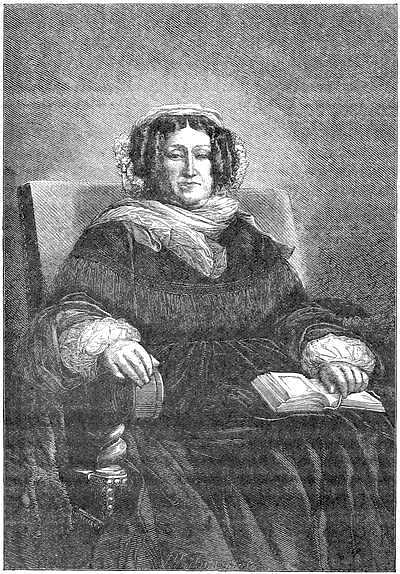
MADAME VEUVE CLICQUOT AT EIGHTY YEARS OF AGE
(From the painting by Léon Coignet).
Ventilating shafts pass from one tier of cellars to the other, enabling
the temperature in a certain measure to be regulated, and thereby
obviate an excess of breakage. M. Werlé estimates that the loss in
this respect during the first eighteen months of a cuvée amounts to 7
per cent, but subsequently is considerably less. In 1862 one Champagne
manufacturer lost as much as 45 per cent of his wine by breakages. The
Clicquot cuvée is made in the cave of St. William, where 120 hogsheads
of wine are hauled up by means of a crane, and discharged into the vat
daily as long as the operation lasts. The tirage, or bottling of the
wine, ordinarily commences in the middle of May, and occupies fully a
month.
M. Werlé’s private residence is close to the establishment in the Rue
du Temple, and here he has collected a small gallery of high-class
modern paintings by French and other artists, including Meissonier’s
‘Card-players,’ Delaroche’s ‘Beatrice Cenci on her way to Execution,’
Fleury’s ‘Charles V. picking up the brush of Titian,’ various works by
the brothers Scheffer, Knaus’s highly-characteristic genre picture,
‘His Highness on a Journey,’ and several fine portraits, among which is
one of Madame Clicquot, painted by Léon Coignet, when she was eighty
years of age, and another of M. Werlé by the same artist, regarded as a
chef-d’œuvre. Before her father’s death Madame Clicquot used
to reside in the Rue de Marc, some short distance from the cellars in which
her whole existence centred, in a handsome Renaissance house, said to
have had some connection with the row of palaces that at one time lined
the neighbouring and then fashionable Rue du Tambour. This, however,
is extremely doubtful. A number of interesting and well-preserved
bas-reliefs decorate one of the façades of the house looking on to the
court. The figures are of the period of François Premier and his son
Henri II., who inaugurated his reign with a comforting edict for the
Protestants, ordaining that blasphemers were to have their tongues
pierced with red-hot irons, and heretics to be burnt alive, and who had
the ill-luck to lose his eye and life through a lance-thrust of the
Comte de Montgomerie, captain of his Scotch guards, whilst jousting
with him at a tournament held in honour of the marriage of his daughter
Isabelle with the gloomy widower of Queen Mary of England, of sanguinary
fame.
The first of these bas-reliefs represents two soldiers of the Swiss
guard, the next a Turk and Slav tilting at each other, and then
comes a scroll entwined round a thistle, and inscribed with this
enigmatical motto: ‘Giane le sur ou rien.’ In the third bas-relief a
couple of passionate Italians are winding up a gambling dispute with a
hand-to-hand combat, in the course of which table and cards have got
canted over; the fourth presents us with two French knights, armed
cap-à-pie, engaged
in a tourney; while in the fifth and last a couple
of German lansquenets essay their gladiatorial skill with their long
and dangerous weapons. Several years back a tablet was discovered in
one of the cellars of the house, inscribed ‘Ci-gist vénérable religieux
maistre Pierre Derclé, docteur en théologie, jadis prieur de céans.
Priez Dieu pour luy. 1486,’ which would almost indicate that the house
had originally a religious character, although the warlike spirit of
the bas-reliefs decorating it renders any such supposition with regard
to the existing building untenable. We should mention that the spaces
above the porte cochère, and the window by its side, are occupied
by four medallions, which present that curious mingling of classic
and contemporary styles for which the epoch of the Renaissance was
remarkable.
MEDALLIONS FROM MADAME CLICQUOT’S HOUSE.
The Messrs. Werlé own numerous acres of vineyards, comprising the very
finest situations in the well-known districts of Verzenay, Bouzy, Le
Mesnil, and Oger, at all of which places they have vendangeoirs or
pressing-houses of their own. Their establishment at Verzenay contains
seven presses, that at Bouzy eight, at Le Mesnil six, and at Oger two,
in addition to which grapes are pressed under their own supervision at
Ay, Avize, and Cramant, in vendangeoirs belonging to their friends.
Since the death of Madame Clicquot the legal style of the firm has been
‘Werlé & Co., successors to Veuve Clicquot-Ponsardin,’ the mark, of
which M. Werlé and his son are the sole proprietors, still remaining
‘Veuve Clicquot-Ponsardin,’ while the corks of the bottles are branded
with the words ‘V. Clicquot-P. Werlé,’ encircling the figure of a comet.
The style of the wine—light, delicate, elegant, and fragrant—is
familiar to all connoisseurs of Champagne. What, however, is not equally
well known is that within the last few years the firm, in obedience
to the prevailing taste, have introduced a perfectly dry wine of
corresponding quality to the richer wine which made the fortune of the
house, and gave enduring fame to the Clicquot brand.
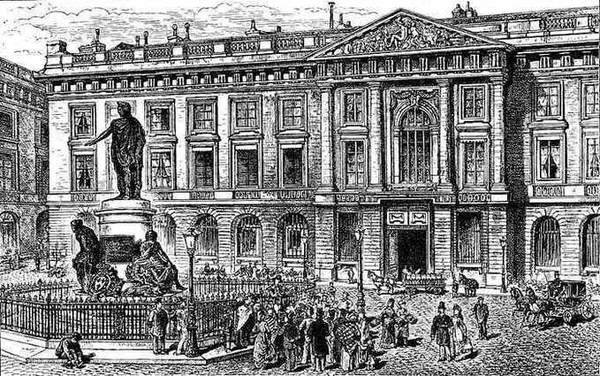
THE PLACE ROYALE AT REIMS.
The house of Louis Roederer founded by a plodding German
named Schreider—The central and other establishments of the
firm—Ancient house in the Rue des Elus—The gloomy-looking Rue
des Deux Anges and prison-like aspect of its houses—Inside
their courts the scene changes—Handsome Renaissance house and
garden, a former abode of the canons of the Cathedral—The
Place Royale—The Hôtel des Fermes and the statue of the ‘wise,
virtuous, and magnanimous Louis XV.’—Birthplace of Colbert in
the Rue de Cérès—Quaint Adam and Eve gateway in the Rue de
l’Arbalète—Heidsieck & Co.’s central establishment in the Rue de
Sedan—Their famous ‘Monopole’ brand—The firm founded in the last
century—Their extensive cellars inside and outside Reims—The
matured wines shipped by them—The Boulevard du Temple—M. Ernest
Irroy’s cellars, vineyards, and vendangeoirs—Recognition by the
Reims Agricultural Association of his plantations of vines—His
wines and their popularity at the best London clubs—Various
Champagne firms located in this quarter of Reims—The Rue du
Tambour and the famous House of the Musicians—The Counts de la
Marck assumed former occupants of the latter—The Brotherhood of
Minstrels of Reims—Périnet & Fils’ establishment in the Rue St.
Hilaire—Their cellars of three stories in solid masonry—Their
soft, light, and delicate wines—A rare still Verzenay—The firm’s
high-class Extra Sec.
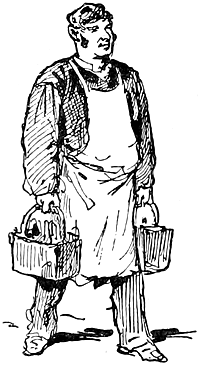
THE house of Louis Roederer, originally founded by a plodding German
named Schreider, was content to pursue the sleepy tenor of its way for
some years—until indeed it suddenly felt prompted to lay siege to
the Muscovite connection of La Veuve Clicquot-Ponsardin, and secure a
market for its wine at Moscow and St. Petersburg. It next opened up the
United States, and finally introduced its brand into England. The house
possesses cellars in various parts of Reims, and has its offices in one
of the oldest quarters of the city—namely, the Rue des Elus, or ancient
Rue des Juifs, where the old synagogue formerly stood, and the records
of which date as far back as 1103.
At the corner of this street, and abutting on the Place des Marchés,
is a curious old house, the overhanging upper stories of which are
supported by huge massive carved brackets, decorated with figures more
or less quaint in design. M. Louis Roederer’s offices in the Rue des
Elus are at the farther end of a
courtyard, beyond which is found
a second court, where carts laden with cases of Champagne seem to
indicate that some portion of the shipping business of the house is
here carried on. Several requests made by us for permission to visit M.
Louis Roederer’s establishments having been refused, it is only of their
external appearance that we are competent to speak. One of them, in
the Boulevard du Temple, is distinguished by a rather imposing façade,
and has a carved head of Bacchus surmounting its porte-cochère;
while the principal establishment, a picturesque range of buildings of
considerable extent, is situated in the neighbouring Rue de la Justice.
Leading from the Rue des Elus into the Rue de Vesle is a gloomy-looking
ancient street known as the Rue des Deux Anges, all the houses of which
have their windows secured by iron gratings, and their massive doors
thickly studded with huge nails. These prison-like façades, which in
all probability refer to the epoch of the religious wars, succeed each
other in lugubrious monotony along either side of the way; but gain
admittance to their inner courts, and quite a different scene presents
itself. In one notable instance, looking on to a pleasant little
flower-garden, we found a small but charming Renaissance house, with its
windows ornamented with elaborate mouldings, and surmounted by graceful
sculptured heads, while at one corner there rose up a tower with a
sun-dial displayed on its front. In this and in an adjoining house the
canons of the cathedral were accustomed to reside in the days when
something like four-fifths of the city were the property of the Church.
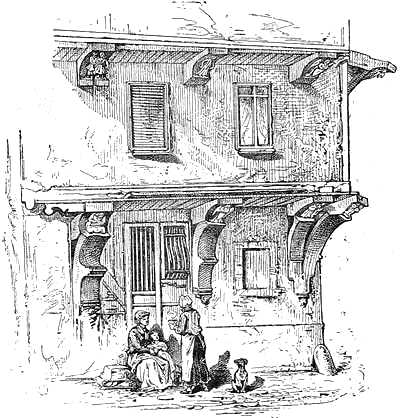
OLD HOUSE AT THE CORNER OF THE RUE DES ÉLUS
AND THE PLACE DES MARCHÉS, REIMS.
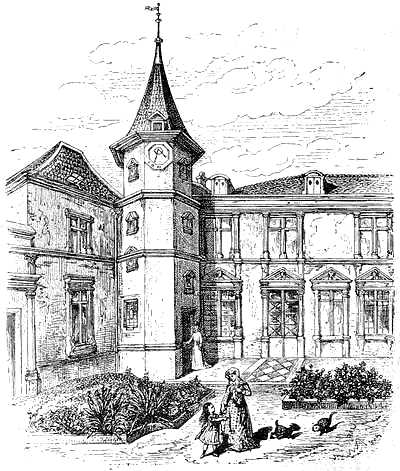
RENAISSANCE HOUSE IN THE RUE DES DEUX ANGES, REIMS.
Proceeding along the Rue de Vesle and the neighbouring Rue des
Tapissiers, we find ourselves once more in the Place Royale, the
principal side of which is occupied by
the once notable Hôtel des
Fermes, where, in the days of the ancien régime, the farmers-general
of the Champagne were accustomed to receive the revenues of the
province. A bronze statue rises in the centre of the Place, which from
its Roman costume and martial bearing might be taken for some hero of
antiquity, did not the inscription on the pedestal apprise us that it is
intended for the ‘wise, virtuous, and magnanimous Louis XV.,’ a misuse
of terms which has caused a Transatlantic Republican to characterise the
monument as a brazen lie. Leading out of the Place Royale is the Rue de
Cérès, in which there is a modernised sixteenth-century house claiming
to be the birthplace, on the 29th August 1619, of Jean Baptiste Colbert,
son of a Reims wool-merchant, and the famous minister who did so much
to consolidate the finances of the State which the royal voluptuary,
masquerading at Reims in Roman garb, afterwards made such dreadful havoc
of.
HEADS SURMOUNTING THE PRINCIPAL WINDOWS OF THE
RENAISSANCE HOUSE IN THE RUE DES DEUX ANGES.
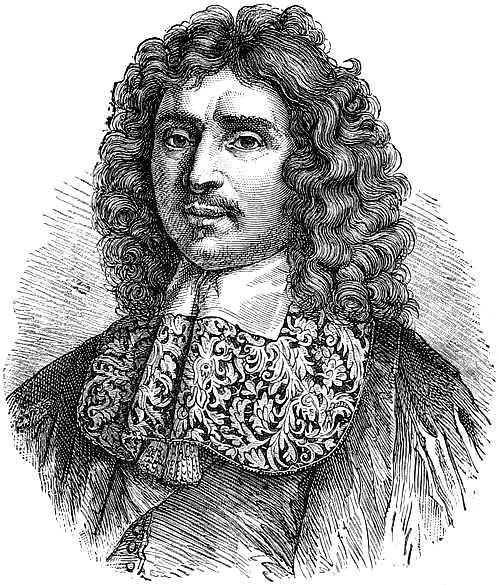
JEAN BAPTISTE COLBERT
(From a portrait of the time).
We again cross the Place des Marchés, at the farther end of which, on
the left-hand side, is the Rue de l’Arbalète, notable for a curious
Renaissance gateway, with its pediment supported by two life-size
figures, which the Rémois, for no very sufficient reason, have
popularly christened Adam and Eve. Beyond the Place des Marchés and
the Place de l’Hôtel de Ville, and at no great distance from the
Clicquot-Werlé establishment, is the narrow winding Rue de Sedan,
where the old-established firm of Heidsieck & Co., which has secured a
high-class reputation in both eastern and western hemispheres for its
famous Monopole and Dry Monopole brands, has its central offices. The
original firm dates back to 1785, when France was struggling with those
financial difficulties that a few years later culminated in that great
social upheaving which kept Europe in a state of turmoil for more than
a quarter of a century. Among the archives of the firm is a patent,
bearing the signature of the Minister of the Prussian Royal Household,
appointing Heidsieck & Co. purveyors of Champagne to Frederick William
III. The Champagne-drinking Hohenzollern par excellence, however,
was the son and successor of the preceding, who, from
habitual over-indulgence in the exhilarating sparkling beverage during the last
few years of his reign, acquired the sobriquet of King Clicquot.
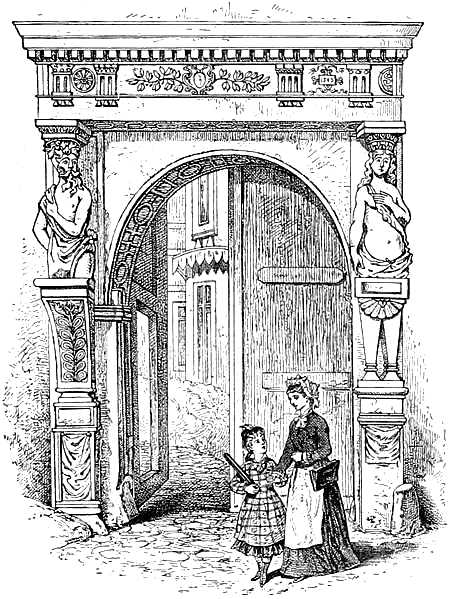
ADAM AND EVE GATEWAY, RUE DE L’ARBALÈTE, REIMS.
On passing through the large porte-cochère giving entrance to
Messrs. Heidsieck’s principal establishment, one finds oneself in a
small courtyard, with the surrounding buildings overgrown with ivy and
venerable vines. On the left is a dwelling-house enriched with elaborate
mouldings and cornices, and at the farther end of the court is the
entrance to the cellars, surmounted by a sun-dial bearing the date
1829. The latter, however, is no criterion of the age of the buildings
themselves, as these were occupied by the firm at its foundation,
towards the close of the last century. We are first conducted into an
antiquated-looking low cellier, the roof of which is sustained with
rude timber supports, and here bottles of wine are being labelled and
packed, although this is but a mere adjunct to the adjacent spacious
packing-room, provided with its loading platform and communicating
directly with the public road. At the time of our visit this hall was
gaily decorated with flags and inscriptions, the day before having been
the fête of St. Jean, when the firm entertain the people in their employ
with a banquet and a ball, at which the choicest wine of the house
liberally flows. From the packing-room we descend into the cellars,
which, like all the more ancient vaults in Reims, have been constructed
on no regular plan. Here we thread our way between piles after piles
of bottles, many of which, having passed through the hands of the
disgorger, are awaiting their customary adornment. The lower tier of
cellars is mostly stored with vin sur pointe, and bottles with their
necks downward are encountered in endless monotony along a score or more
of long galleries. The only variation in our lengthened promenade is
when we come upon some solitary workman engaged in his monotonous task
of shaking his 30,000 or 40,000 bottles per diem.
The disgorging at Messrs. Heidsieck’s takes place, in accordance with
the good old rule, in the cellars underground, where we noticed large
stocks of wine three and five years old, the former in the first stage
of sur pointe, and the latter awaiting shipment. It is a specialty of
the house to ship only matured wine, which is necessarily of a higher
character than the ordinary youthful growths, for a few years have a
wonderful influence in developing the finer qualities of Champagne. At
the time of our visit, in the spring of 1877, when the English market
was being glutted with the crude full-bodied wine of 1874, Messrs.
Heidsieck were continuing to ship wines of 1870 and 1872, beautifully
rounded by keeping, and of fine flavour and great delicacy of perfume.
Of these thoroughly matured wines the firm had fully a year’s
consumption on hand.
Messrs. Heidsieck & Co. have a handsome modern establishment in the Rue
Coquebert—a comparatively new quarter of the city, where Champagne
establishments are the rule—the courtyard of which, alive with workmen
at the time of our visit, is broad and spacious, while the surrounding
buildings are light and airy, and the cellars lofty, regular, and well
ventilated. In a large cellier here, where the tuns are ranged side by
side between the rows of iron columns supporting the roof, the firm
make their cuvée. Here, too, the bottling of their wine takes place,
and considerable stocks
of high-class reserve wines and more youthful
growths are stored ready for removal when required by the central
establishment. The bulk of Messrs. Heidsieck’s reserve wines, however,
repose in the outskirts of Reims, near the Porte Dieu-Lumière, in one of
the numerous abandoned chalk quarries, which of late years the Champagne
manufacturers have discovered are capable of being transformed into
admirable cellars.
In addition to shipping a rich and a dry variety of the Monopole
brand, of which they are sole proprietors, Messrs. Heidsieck export
to this country a rich and a dry Grand Vin Royal. It is, however, to
their famous Monopole wine, and especially to the dry variety, which
must necessarily comprise the finest growths, that the firm owe their
principal celebrity.
Few large manufacturing towns like Reims—which is one of the most
important of those engaged in the woollen manufacture in France—can
boast of such fine promenades and such handsome boulevards as the
capital of the Champagne. As the ancient fortifications of the city were
from time to time razed, their site was levelled and generally planted
with trees, so that the older quarters of Reims are almost encircled
by broad and handsome thoroughfares, separating the city, as it were,
from its outlying suburbs. In or close to the broad Boulevard du Temple,
which takes its name from its proximity to the site of the ancient
Commanderie of the Templars, various Champagne manufacturers, including
M. Louis Roederer, M. Ernest Irroy, and M. Charles Heidsieck, have their
establishments; while but a few paces off, in the neighbouring Rue
Coquebert, are the large and handsome premises of Messrs. Krug & Co.
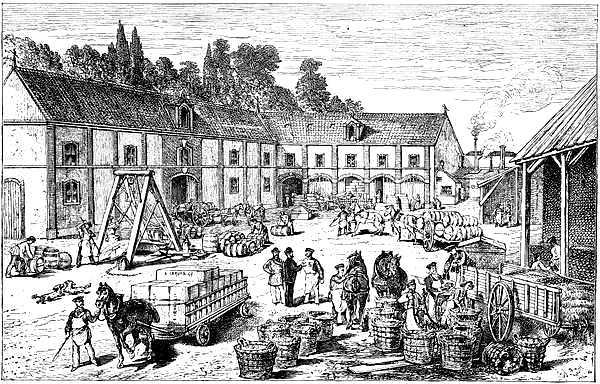
M. ERNEST IRROY’S ESTABLISHMENT AT REIMS.
The offices of M. Ernest Irroy, who is known in Reims not merely as a
large Champagne grower and shipper, but also as a distinguished amateur
of the fine arts, taking a leading part in originating local exhibitions
and the like, are attached to his private residence, a handsome mansion
flanked by a large and charming garden in the Boulevard du Temple. The
laying out of this sylvan oasis is due to M. Varé, the head gardener
of the city of Paris, who contributed so largely to the picturesque
embellishment of the Bois de Boulogne. M. Irroy’s establishment,
which comprises
a considerable range of buildings grouped around two
courtyards, is immediately adjacent, although its principal entrance is
in the Rue de la Justice. The vast celliers, covering an area of upwards
of 3000 square yards, and either stocked with wine in cask or used for
packing and similar purposes, afford the requisite space for carrying on
a most extensive business. The cellars beneath comprise three stories,
two of which are solidly roofed and lined with masonry, while the
lowermost one is excavated in the chalk. They are admirably constructed
on a symmetrical plan, and their total surface is very little short
of 7000 square yards. Spite of the great depth to which these cellars
descend, they are perfectly dry, the ventilation is good, and their
temperature moreover is remarkably cool, one result of which is that M.
Irroy’s loss from breakage never exceeds four per cent per annum. M.
Irroy holds a high position as a vineyard proprietor in the Champagne,
his vines covering an area of nearly ninety acres. At Mareuil and Avenay
he owns some twenty-five acres, at Verzenay and Verzy about fifteen,
and at Ambonnay and Bouzy close upon fifty acres. His father and his
uncle, whose properties he inherited or purchased, commenced some
thirty years ago to plant vines on certain slopes of Bouzy possessing
a southern aspect, and he has followed their example with such success
both at Bouzy and Ambonnay, that the Reims Agricultural Association
in 1873 conferred upon him a silver-gilt medal for his plantations of
vines, and in 1880 presented him with a coupe d’honneur. M. Irroy owns
vendangeoirs at Verzenay, Avenay, and Ambonnay; and at Bouzy, where
his largest vineyards are, he has built some excellent cottages for
his labourers. He has also constructed a substantial bridge over the
ravine which, formed by winter torrents from the hills, intersects the
principal vineyard slopes of Bouzy.
M. Ernest Irroy’s wines, prepared with scrupulous care and rare
intelligence, have been known in England for some years past, and are
steadily increasing in popularity. They are emphatically connoisseurs’
wines. The best West-end clubs, such as White’s, Arthur’s, the old
Carlton, and the like, lay down the cuvées of this house in good years
as they lay down their vintage ports and finer clarets, and drink them,
not in a crude state, but when they are in perfection—that is, in five
to ten years’ time. M. Irroy exports to the British colonies and to the
United States the same fine wines which he ships to England.
Several well-known Champagne firms have their establishments in this
quarter of Reims. In addition to those already mentioned, we may
instance G. H. Mumm & Co., who are located in the Rue Andrieux, only
a short distance from the grand triumphal arch known as the Gate of
Mars, by far the most important Roman remain of which the Champagne can
boast. Within a stone’s throw of this arch there formerly stood the
ancient château of the Archbishops of Reims, demolished close upon three
centuries ago. In the Rue de Mars, a winding ill-paved thoroughfare
leading from the Gate of Mars to the Place de l’Hôtel de Ville, Jules
Mumm & Co., an offshoot from the once famous firm of P. A. Mumm & Co.,
are installed; while in a massive and somewhat pretentious-looking
house, dating back to the time of Louis Quatorze, in a corner of the
Place de l’Hôtel de Ville, Ruinart Père et Fils, who claim to rank as
the oldest existing Champagne establishment, have their offices. The
late Vicomte de Brimont, the recent head of the firm, was a collateral
descendant of the Dom Ruinart, whose remains repose nigh to those of the
illustrious Dom Perignon in the abbey church of Hautvillers. From the
Place de l’Hôtel de Ville we proceed through the narrow Rue du Tambour,
originally a Roman thoroughfare, and during the Middle Ages the locality
where the nobility of Reims principally had their abodes. Half-way up
this street stands the famous House of the Musicians, one of the most
interesting architectural relics of which the capital of the Champagne
can boast. It evidently dates from the early part of the fourteenth
century, but by whom it was erected is unknown. Some ascribe it to
the Knights Templars, others to the Counts of Champagne, while others
suppose it to have been the residence of the famous Counts de la Marck,
who in later times diverged into three separate branches, the first
furnishing Dukes of Cleves and Jülich to Germany, and Dukes of Nevers
and Counts of Eu to France; while the second became Dukes of Bouillon
and Princes of Sedan, titles which passed to the Turennes when Henri de
la Tour d’Auvergne, Vicomte de Turenne, married the surviving heiress
of the house. The third branch
comprised the Barons of Lumain, allied
to the Hohenzollerns. Their most famous member slew Louis de Bourbon,
Archbishop of Liège, and flung his body into the Meuse; and subsequently
became celebrated as the Wild Boar of the Ardennes, of whom all readers
of Quentin Durward will retain a lively recollection.
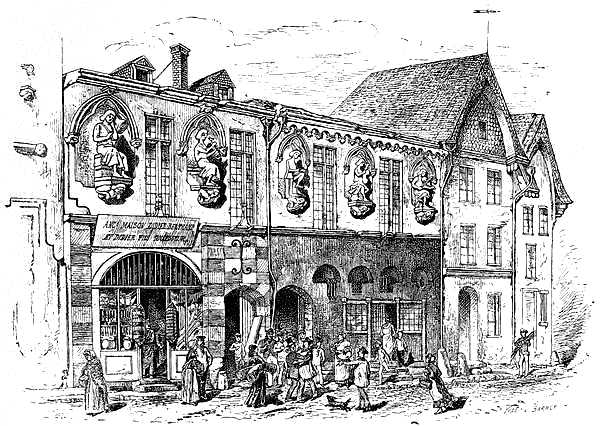
THE HOUSE OF THE MUSICIANS IN THE RUE DU TAMBOUR, REIMS.
To return, however, to the House of the Musicians. A probable conjecture
ascribes the origin of the quaint mediæval structure to the Brotherhood
of Minstrels of Reims, who in the thirteenth century enjoyed a
considerable reputation, not merely in the Champagne, but throughout
the North of France. The house takes its present name from five seated
statues of musicians, larger than life-size, occupying the Gothic niches
between the first-floor windows, and resting upon brackets ornamented
with grotesque heads. It is thought that the partially-damaged figure
on the left-hand side was originally playing a drum and a species of
clarionet. The next one evidently has the remnants of a harp in his
raised hands. The third or central figure is supposed merely to have
held a hawk upon his wrist; whilst the fourth seeks to extract harmony
from a dilapidated bagpipe; and the fifth, with crossed legs, strums
complacently away upon the fiddle. The ground-floor of the quaint old
tenement is to-day an oil and colour shop, the front of which is covered
with chequers in all the tints of the rainbow.
Leading from the Rue du Tambour is the Rue de la Belle Image, thus named
from a handsome statuette of the Virgin, which formerly decorated a
corner niche; and beyond is the Rue St. Hilaire, where Messrs. Barnett
et Fils, trading under the designation of Périnet et Fils, and the
only English house engaged in the manufacture of Champagne, have an
establishment which is certainly as perfect as any to be found in Reims.
Above-ground are several large store-rooms, where vintage-casks and the
various utensils common to a Champagne establishment are kept; and a
capacious cellier, upwards of one hundred and fifty feet in length, with
its roof resting on massive timber
supports. Here new wine is stored
preparatory to being blended and bottled; and in the huge tun, holding
nearly three thousand gallons, standing at the further end, the firm
make their cuvée; while adjacent is a room where stocks of corks and
labels, metal foil, and the like are kept.
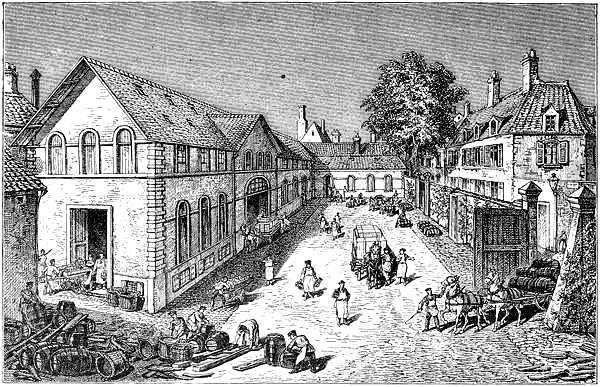
MESSRS. PÉRINET ET FILS’ ESTABLISHMENT IN THE RUE ST.
HILAIRE, REIMS.
Underneath this building there are three stories of cellars—an
exceedingly rare thing anywhere in the Champagne—all constructed
in solid masonry on a uniform plan, each story comprising two wide
galleries, running parallel with each other and connected by means of
transverse passages. Spite of the great depth to which these cellars
descend, they are perfectly dry; the ventilation, too, is excellent;
and their different temperatures render them especially suitable for
the storage of Champagne, the temperature of the lowest cellar being 6°
Centigrade (43° Fahrenheit), or one degree Centigrade below the cellar
immediately above, which in its turn is two degrees below the uppermost
of all. The advantage of this is that, when the wine develops an excess
of effervescence, any undue proportion of breakages can be checked by
removing the bottles to a lower cellar, and consequently into a lower
temperature.
The first cellars we enter are closely stacked with wine in bottle,
which is gradually clearing itself by the formation of a deposit; while
in an adjoining cellar on the same level the operations of disgorging,
liqueuring, and corking are going on. At the end of this gallery is a
spacious compartment, where a large stock of pure Champagne cognac
of grand vintages is stored for cask and liqueur use. In the cellars
immediately beneath, bottles of wine repose in solid stacks ready for
the dégorgeur; while others rest in racks, in order that they may
undergo their daily shaking. In the lowest cellars reserved wine in cask
is stored, as it best retains its natural freshness and purity in a very
cool place. All air is carefully excluded from the casks; any ullage
is immediately replaced; and, as evaporation is continually going on,
the casks are examined every fortnight, when any deficiency is at once
replenished. At Messrs. Périnet et Fils’, as at all the first-class
establishments, the vin brut is a mélange comprising the produce of
some of the best vineyards, and has every possible attention paid to it
during its progressive stages of development.
From the second tier of cellars at Messrs. Périnet et Fils’ a gallery
extends, under the Rue St. Hilaire, to some extensive vaults excavated
beneath an adjacent building, in which the Reims Military Club is
installed. These vaults, arranged in two separate stories, are eight
in number, and in them we found a quarter of a million bottles of vin
brut, reposing either in solid stacks or sur pointe, the latter going
through their daily shaking in order to fit them for the operation of
dégorgement. On the whole the cellars of Périnet et Fils, including
the six long galleries already described, suffice for the storage of a
million bottles of Champagne.
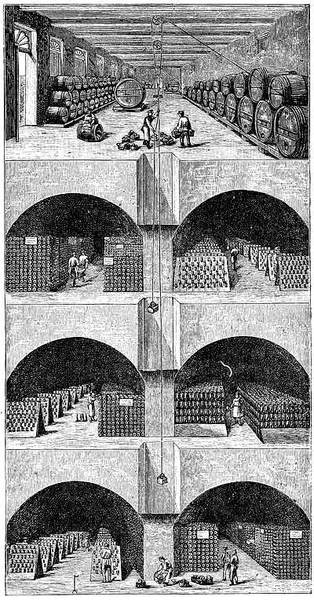
THE CELLIER AND CELLARS OF MESSRS. PÉRINET ET FILS.
Before leaving the establishment Champagnes of different years were
shown to us, all of them soft, light, and delicate, and with that fine
flavour and full perfume which the best growths of the Marne alone
exhibit. Among several curiosities submitted to us was a still Verzenay
of the year 1857, one of the most delicate wines it was ever our fortune
to taste. Light in body, rich in colour, of a singularly novel and
refined flavour, and with a magnificent yet indefinable bouquet, the
wine was in every respect perfect. Not only was the year of the vintage
a grand one, but the wine must have been made with the greatest possible
care, and from the most perfect grapes, for so delicate a growth to have
retained its flavour in such perfection, and preserved its brilliant
ruby colour for such a length of time.
From the samples shown to us of Périnet et Fils’ Champagne, we were
prepared to find that at some recent tastings in London, the particulars
of which have been made public, their Extra Sec took the first place at
each of the three severe competitions to which it was subjected.
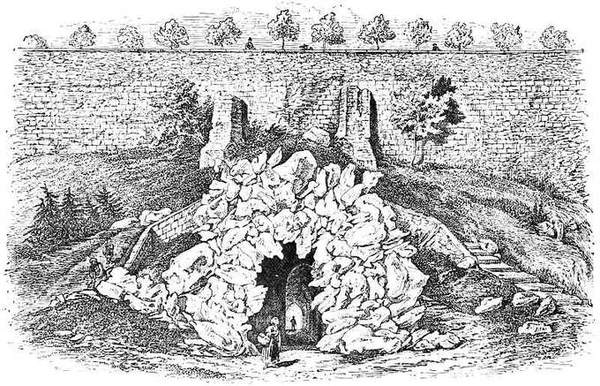
GROTTO BENEATH THE OLD FORTIFICATIONS OF REIMS.
La Prison de Bonne Semaine—Mary Queen of Scots at
Reims—Messrs. Pommery & Greno’s offices—A fine collection
of faïence—The Rue des Anglais a former refuge of English
Catholics—Remains of the old University of Reims—Ancient tower
and grotto—The handsome castellated Pommery establishment—The
spacious cellier and huge carved cuvée tuns—The descent to the
cellars—Their great extent—These lofty subterranean chambers
originally quarries, and subsequently places of refuge of the
early Christians and the Protestants—Madame Pommery’s splendid
cuvées of 1868 and 1874—Messrs. de St. Marceaux & Co.’s new
establishment in the Avenue de Sillery—Its garden-court and
circular shaft—Animated scene in the large packing hall—Lowering
bottled wine to the cellars—Great depth and extent of these
cellars—Messrs. de St. Marceaux & Co.’s various wines—The
establishment of Veuve Morelle & Co., successors to Max
Sutaine—The latter’s ‘Essai sur le Vin de Champagne’—The Sutaine
family formerly of some note at Reims—Morelle & Co.’s cellars well
adapted to the development of sparkling wines—The various brands
of the house—The Porte Dieu-Lumière.
HEAD OVERSEER AT POMMERY AND GRENO’S.
NIGH the cathedral of Reims, and in the rear of the archiepiscopal
palace, there runs a short narrow street known as the Rue Vauthier le
Noir, and frequently mentioned in old works relating to the present
capital of the Champagne. The discovery of various pillars and statues,
together with a handsome Gallo-Roman altar, whilst digging some
foundations in 1837, points to the fact that a Pagan temple formerly
occupied the site. The street is supposed to have taken its name,
however, from some celebrated gaoler, for in mediæval times here stood
‘la prison de bonne semaine.’ On the site of this prison a château was
subsequently built, which tradition has erroneously fixed upon as the
residence of the beautiful and luckless Mary Queen of Scots, in the
days when her uncle, Cardinal Charles de Lorraine, was Lord Archbishop
of Reims. Temple, prison, and palace have alike disappeared, and where
they stood there now rises midway between court and garden a
handsome mansion, the residence of Madame Pommery, head of the well-known firm of
Pommery & Greno. To the left of the courtyard, which is entered through
a monumental gateway, are some old buildings, let into the walls of
which are a couple of sculptured escutcheons, the one comprising the
arms of France, and the other those of the Cardinal de Lorraine. On the
right-hand side of the courtyard are the Pommery offices, together with
the manager’s sanctum, replete with artistic curiosities, the walls
being completely covered with remarkable specimens of faïence, including
Rouen, Gien, Palissy, Delft, and majolica, collected in the majority of
instances by Madame Pommery in the villages around Reims. Here we were
received by M. Vasnier, who at once volunteered to accompany us to the
cellars of the firm outside the city. Messrs. Pommery & Greno originally
carried on business in the Rue Vauthier le Noir, where there are
extensive cellars, but their rapidly-increasing connection long since
compelled them to emigrate beyond the walls of Reims.
In close proximity to the Rue Vauthier le Noir is the Rue des Anglais,
so named from the English Catholic refugees, who, flying from the
persecutions of our so-called Good Queen Bess, here took up their abode
and established a college and a seminary. They rapidly acquired great
influence in Reims, and one of their number, William Gifford, was even
elected archbishop. At the end of this street, nigh to Madame Pommery’s,
there stands an old house erected late in the fifteenth century, with
a corner tower and rather handsome Renaissance window, which formerly
belonged to some of the clergy of the cathedral, and subsequently became
the ‘Bureau Général de la Loterie de France,’ an institution abolished
by the National Convention in 1793.
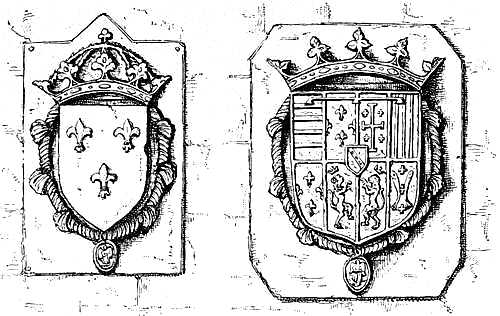
OLD COATS OF ARMS IN THE COURTYARD OF MADAME POMMERY’S
RESIDENCE.
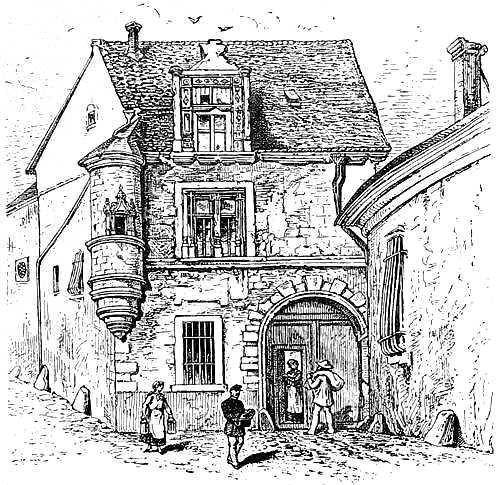
OLD HOUSE IN THE RUE DES ANGLAIS, REIMS.
The Rue des Anglais conducts into the Rue de l’Université, where a few
remnants of the old University, founded by Cardinal Charles de Lorraine
(1538–74), formerly attracted attention, notably a conical-capped
corner tower, the sculptured ornaments at the base of which had
crumbled into dust beneath the corroding tooth of Time.[423] From the
Rue de l’Université our way lies along the Boulevard du Temple to the
Porte Gerbert, about a mile beyond which there rises up the curious
castellated structure in which
the Pommery establishment is installed,
with its tall towers commanding a view of the whole of Reims and its
environs. As we drive up the Avenue Gerbert we espy on the right an
isolated crumbling tower, a remnant of the ancient fortifications of
Reims,[424] while close at hand, and under the old city-walls, is a
grotto, to which an ancient origin is likewise ascribed. In another
minute we reach the open iron gates of Messrs. Pommery’s establishment,
flanked by a picturesque porter’s lodge; and proceeding up a broad
drive, we alight under a Gothic portico at the entrance to the spacious
and lofty cellier. Iron girders support the roof of this vast hall, 180
feet in length and 90 feet in width, without the aid of a single column.
At one end is the office and tasting-room, provided with a telegraphic
apparatus and telephone, by means of which communication is carried
on with the Reims bureaux. Stacked up on every side of the cellier,
and often in eight tiers when empty, are rows upon rows of casks, 6000
of which contain wine of the costly vintage of 1880 sufficient for
a million and a half bottles of Champagne. The temperature of this
hall is carefully regulated; the windows are high up near the roof,
and the sun’s rays are rigidly excluded, so that a pleasant coolness
pervades the building. On the left-hand side stand two huge tuns, with
the monogram P. and G., surmounting the arms of Reims, carved on their
heads. These are capable of containing 5500 gallons of wine, and in
them the firm make their cuvée. A platform, access to which is gained
by a staircase in a side aisle, runs round one of these foudres; and
when the wine, which has been hoisted up in casks and poured through a
metal trough into the foudre, is being blended, boys stand on this
platform and, by means of a handle protruding above the cask, work the
paddle-wheels placed inside, thereby securing the complete amalgamation
of the wine. Adjoining are the chains and lifts worked by steam, by
means of which wine is raised and lowered from and to the cellars
beneath, one lift raising or lowering eight casks, whether full or
empty, in the space of a minute.
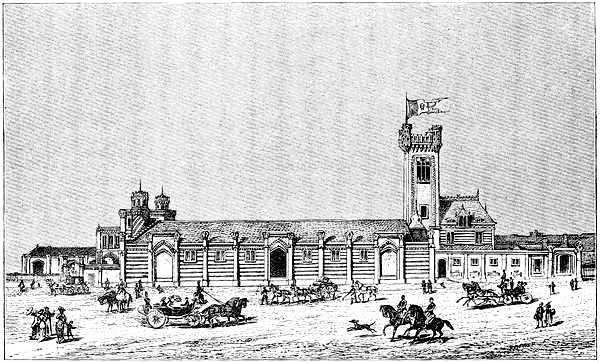
THE POMMERY AND GRENO ESTABLISHMENT IN THE OUTSKIRTS OF
REIMS.
At the farther end of the hall a Gothic door, decorated with ornamental
ironwork, leads to the long broad flight of steps, 116 in number,
and nearly twelve feet in width, conducting to the suite of lofty
subterranean chambers, where bottles of vin brut repose in their
hundreds of thousands in
slanting racks or solid piles, passing
leisurely through those stages of development necessary to fit them
for the dégorgeur. Altogether there are 130 large shafts, 90 feet in
depth and 60 feet square at their base, which were originally quarries,
and are now connected by spacious galleries. This side of Reims abounds
with similar chalk quarries, commonly believed to have served as places
of refuge for the Protestants at the time of the League and after the
revocation of the Edict of Nantes; and it is even conjectured that the
early Christians—the followers of St. Sixtus and St. Sinicus—here
hid themselves from their persecutors. Since the cellars within the
city have no longer sufficed for the storage of the immense stocks
required through the development of the Champagne trade, these vast
subterranean galleries have been successfully utilised by various
firms. Messrs. Pommery, after filling up the chambers above the water
level, proceeded to excavate the connecting tunnels, shore up the
cracking arches, and repair the flaws in the chalk with masonry, finally
converting these abandoned quarries into magnificent cellars for the
storage of Champagne. No less than 60,000 l. was spent upon them and
the castellated structure aboveground. Several millions of bottles of
Champagne can be stored in these capacious vaults, the area of which is
nearly 450,000 square feet.
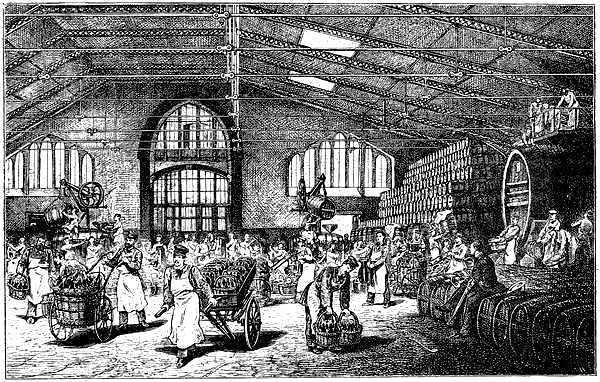
INTERIOR OF MESSRS. POMMERY AND GRENO’S CELLIER.
Madame Pommery made a great mark with her splendid cuvées of 1868 and
1874, the result being that her brand has become widely popular, and
that it invariably realises exceptionally high prices.
On leaving Messrs. Pommery’s we retrace our steps down the Avenue
Gerbert, bordered on either side with rows of plane-trees, until we
reach the treeless Avenue de Sillery, where Messrs. de St. Marceaux &
Co.’s new and capacious establishment is installed. Simple and without
pretension, the establishment, which covers an area of upwards of 18,000
feet, is distinguished for its perfect appropriateness to the industry
for which it was designed. The principal block of building is flanked by
two advanced wings enclosing a garden-court, set off with flowers and
shrubs, and from the centre of which rises a circular shaft, covered
in with glass, and admitting light and air to the cellars below. In
the building to the left the wine is received on its arrival from the
vineyard, and here are ranged large quantities of casks replete with
the choice crus of Verzenay, Ay, Cramant, and Bouzy, while
thousands of bottles ready for labelling are stacked in massive piles at the end
of the packing-hall in the corresponding wing of the establishment.
Here, too, a tribe of workpeople are arraying the bottles with gold and
silver headdresses, and robing them in pink paper, while others are
filling, securing, marking, and addressing the cases or baskets destined
to Hong-Kong, San Francisco, Yokohama, Bombay, London, New York, St.
Petersburg, Berlin, or Paris.
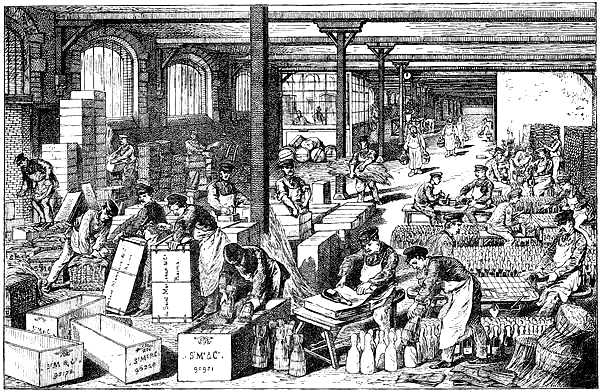
THE PACKING-HALL OF MESSRS. DE ST. MARCEAUX AT REIMS.
The wine in cask, stored in the left-hand wing, after having been duly
blended in an enormous vat, is drawn off into bottles, which are then
lowered down a shaft to the second tier of cellars by means of an
endless chain, on to which the baskets of bottles are swiftly hooked.
The workman engaged in this duty, in order to guard against his falling
down the shaft, has a leather belt strapped round his waist, by means
of which he is secured to an adjoining iron column. We descended into
the lower cellars down a flight of ninety-three broad steps—a depth
equal to the height of an ordinary six-storied house—and found no less
than four-and-twenty galleries excavated in the chalk, devoid of masonry
supports, and containing upwards of a million bottles of Champagne.
These galleries vary in length, but are of uniform breadth, and allow
either for a couple of racks with wine sur pointe, or stacks of
bottles, in four row’s on either side, with ample passage-room down the
centre.
The upper range of cellars comprises two large arched galleries of
considerable breadth, one of which contains wine in wood and wine sur
pointe, while the other is stocked with bottles of wine heads downward,
ready to be delivered into the hands of the dégorgeur.
MM. de St. Marceaux & Co. have the honour of supplying the King of the
Belgians, the President of the French Republic, and several German
potentates with an exceedingly delicate Champagne known as the Royal St.
Marceaux. The same wine is popular in Russia and other parts of Europe,
just as the Dry Royal of the firm is much esteemed in the United States.
The brand of the house most appreciated in this country is its Carte
d’Or, a very dry wine, the extra superior quality of the firm, which
secured the first place at a recent Champagne competition in England.
Some little distance beyond the remnants of the ancient fortifications
of Reims, skirting the Butte de St. Nicaise, is the establishment of
Veuve Morelle & Co., successors to Veuve Max
Sutaine & Co. This house
was founded in 1823 by the late M. Maxime Sutaine, who, like several
other notabilities in the Reims wine trade, was as familiar with art and
science as with the special industry to which he had devoted himself.
An amateur painter of no mean skill, he showed himself thoroughly at
home in the biographical and critical notices on artists and art in
his native province which he produced. His name, however, is chiefly
identified in literature with his Essai sur le Vin de Champagne.[425]
This work may be regarded as the first attempt to collect the scattered
materials relating to the history of Champagne wine, and to deal with
them in a critical spirit. Though necessarily imperfect, its value is
undoubtedly great, and it has been frequently quoted from in the present
volume. The family of Sutaine long held an honourable position at Reims,
the name of one of M. Max Sutaine’s immediate ancestors, who filled the
position of lieutenant of the city in 1765, appearing on the bronze slab
at the base of the statue of Louis XV. in the Place Royale, erected
during that year.
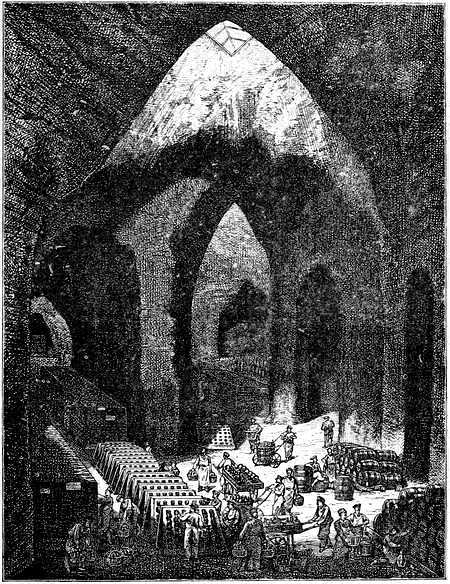
THE CELLARS OF MAX SUTAINE AND CO. IN THE
CHEMIN DE LA PROCESSION, REIMS.
The cellars of the firm of Veuve Morelle & Co., successors to Max
Sutaine & Co., are very extensive; and while more than usually
picturesque in appearance, are in every respect admirably adapted for
the rearing and development of the delicate wines of the Champagne.
These cellars, hewn out of the chalk, are of great depth. The firm has
been careful to adhere to the good traditions of its predecessors in the
composition of its cuvées, and at the same time to avoid those errors
which experience and the resources of modern science have made manifest.
Its rule is only to send out wines of a good cru, and never before they
are thoroughly matured, thereby avoiding the shipment of young wines.
The chief kinds bearing the brand of Max Sutaine & Co. are Vin Brut
(of great years), Extra Dry, Creaming Sillery, and Bouzy for England,
Sillery Sec for Russia, and Verzenay and Cabinet for Germany and Belgium.
It should be mentioned that of late years the abandoned quarries,
so numerous on this side of the city, have been largely utilised by
the Reims Champagne manufacturers as cellars for the
storage of their wines. Beyond the firms that have been already alluded to as
possessing cellars in this direction, there remain to be enumerated
Messrs. Kunkelmann & Co., Ruinart Père et Fils, the Goulets, Jules
Champion, Théophile Roederer, &c. The cellars of several of the last
named are immediately outside the Porte Dieu-Lumière, near which is a
seventeenth-century house having let into its face a curious bas-relief,
of evidently much earlier date, the subject of which has been a source
of considerable perplexity to local antiquaries.
A like cloud enshrouds the origin of the name of Dieu-Lumière, bestowed
upon the fortified gate formerly standing here, and originally erected
during the fourteenth century, when, the circle of the ramparts having
been carried round the Bourg de St. Remi so as to unite it to the old
city, the Porte St. Nicaise was walled up.[426] Like the other portals
of Reims, it has no lack of historical associations. Its vaulted roof
resounded with the trampling of barbed war-steeds when, on the 16th
July 1429, Charles the Victorious swept beneath it into the city,
with Joan of Arc by his side and the steel-clad chivalry of France at
his back.[427] The year 1583 saw its keys handed to the Duc de Guise,
and the green flag of the League, with its device ‘Auspice Christo,’
hoisted above it; and twenty-three years later, as Henri Quatre rode
through it amidst shouts of welcome, the jesting remark, ‘I had no idea
I was so well beloved at Reims,’ was the only attempt at revenge made
by the easy-going Béarnais on the population who had so long flouted
his authority. Rebuilt in 1620, it witnessed the triumphant return of
Grandpré’s cavalry and the Rémois militia, after their victory over
Montal and his Spaniards at La Pompelle in 1657, and the successful
assault of the renegade Saint Priest, whose Cossacks entered the walls
at this point in 1814, and gave way to the most brutal excesses.
Nor must it be forgotten that Marie Louise passed through this gate
en route for Paris, on which occasion its summit was crowned with
elaborate allegorical devices supported by cupids weaving garlands of
flowers; or that for several centuries the relics of St. Timotheus and
his companions were annually carried through it on Whit-Monday by the
clergy of Reims, escorted by a procession of pilgrims, to the scene of
the martyrdom of these early Christians at La Pompelle.
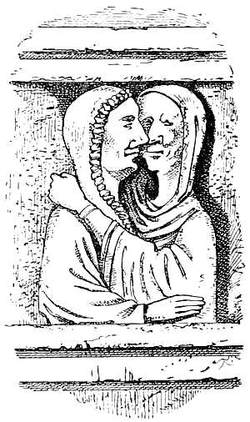
BAS-RELIEF NEAR THE PORTE
DIEU-LUMIÈRE.
The connection of Epernay with the production of wine of
remote date—The town repeatedly burnt and plundered—Hugh the
Great carries off all the wine of the neighbourhood—Vineyards
belonging to the Abbey of St. Martin in the eleventh, twelfth,
and thirteenth centuries—Abbot Gilles orders the demolition of
a wine-press which infringes the abbey’s feudal rights—Bequests
of vineyards in the fifteenth century—Francis I. bestows Epernay
on Claude Duke of Guise in 1544—The Eschevins send a present
of wine to their new seigneur—Wine levied for the king’s camp
at Rethel and the strongholds of the province by the Duc de
Longueville—Epernay sacked and fired on the approach of Charles
V.—The Charles-Fontaine vendangeoir at Avenay—Destruction of
the immense pressoirs of the Abbey of St. Martin—The handsome
Renaissance entrance to the church of Epernay—Plantation of the
‘terre de siége’ with vines in 1550—Money and wine levied on
Epernay by Condé and the Duke of Guise—Henri Quatre lays siege
to Epernay—Death of Maréchal Biron—Desperate battle amongst the
vineyards—Triple talent of the ‘bon Roy Henri’ for drinking,
fighting, and love-making—Verses addressed by him to his ‘belle
hôtesse’ Anne du Puy—The Epernay Town Council make gifts of wine
to various functionaries to secure their good-will—Presents of
wine to Turenne at the coronation of Louis XIV.—Petition to
Louvois to withdraw the Epernay garrison that the vintage may be
gathered in—The Duke and Duchess of Orleans at Epernay—Louis
XIV. partakes of the local vintage at the maison abbatiale on his
way to the army of the Rhine—Increased reputation of the wine of
Epernay at the end of the seventeenth century—Numerous offerings
of it to the Marquis de Puisieux, Governor of the town—The Old
Pretender presented at Epernay with twenty-four bottles of the
best—Sparkling wine sent to the Marquis de Puisieux at Sillery,
and also to his nephew—Further gifts to the Prince de Turenne—The
vintage destroyed by frost in 1740—The Epernay slopes at this
epoch said to produce the most delicious wine in Europe—Vines
planted where houses had formerly stood—The development of the
trade in sparkling wine—A ‘tirage’ of fifty thousand bottles
in 1787—Arthur Young drinks Champagne at Epernay at forty sous
the bottle—It is surmised that Louis XVI., on his return from
Varennes, is inspired by Champagne at Epernay—Napoleon and his
family enjoy the hospitality of Jean Remi Moët—King Jerome
of Westphalia’s true prophecy with regard to the Russians and
Champagne—Disgraceful conduct of the Prussians and Russians
at Epernay in 1814—The Mayor offers them the free run of his
cellars—Charles X., Louis Philippe, and Napoleon III. accept the
‘vin d’honneur’ at Epernay—The town occupied by German troops
during the war of 1870–1.
IF Reims be the titular capital of the Champagne wine-trade, Epernay can
boast of containing the establishments of some of the most eminent firms
engaged therein. Its connection with the production of the wines of
Champagne is of the remotest. The vineyards stretching
for miles around
the ancient Sparnacum claim indeed an antiquity far exceeding that of
any existing portion of the town itself, which, despite the remote date
of its foundation, and the fact that it was a place of considerable
importance as early as 445, presents a thoroughly modern aspect. Unlike
Reims—so rich in the remains of antiquity—it possesses no mementoes of
the days when its lord Eulogius gave it to St. Remi,[428] and he in turn
bequeathed it to the Church.
The reason is simple, for the history of Epernay may be briefly summed
up in the words—fire, pestilence, and pillage. From the days when
misfortune first overtook it, after the division of the Frankish
monarchy on the death of Clovis, it has been burnt down on half a dozen
occasions, repeatedly depopulated by the plague, and captured and sacked
times out of number. The contending sovereigns of Austrasia and Neustria
alternately obtained forcible possession of it, and the rival counts of
Paris and Vermandois snatched it repeatedly from each other’s hold, like
hungry dogs contending for a bone; whilst the Normans, the Hungarians,
the vassals of Charles of Lorraine, and the followers of Otho of Germany
added their quota to the work of destruction during the long period of
anarchy preceding the establishment of the Capetian race upon the throne
of France. The founder of the said race, Hugh the Great, distinguished
himself in 947 by plundering the town of Epernay, ravaging the
surrounding country, and profiting by the fact that it was vintage-time
to carry off all the wine of the neighbourhood.[429]
Even during the epoch of comparative tranquillity which prevailed up
to the English invasion, Epernay became from time to time the prey of
robber knights like Thomas de Marlé and rebellious nobles like Count
John of Soissons; and at the commencement of the thirteenth century
Count Thibault of Champagne was fain to burn it, in order to prevent it
from serving as a rallying-place for the lords who had risen against
Queen Blanche and her infant son Louis IX. After the battle of Poitiers
it was pillaged by the partisans of Charles the Bad of Navarre; Edward
the Black Prince entered it twice as a conqueror; and John of Gaunt
exacted a heavy tribute from it. In the struggles which followed
the death of Henry V. of England it was again taken and re-taken,
partially burnt and utterly ruined, remaining for three years absolutely
depopulated after the unwelcome visit paid it by the Duke of Burgundy in
1432.
Yet during all these ravages the vineyards clothing the slopes around
the town were gradually developed, chiefly by the fostering care of
the good fathers of the Abbey of St. Martin. The charter of foundation
of this abbey, which was endowed in 1032, makes mention of vineyards
amongst its possessions, and they are also spoken of in the confirmation
of donations and privileges granted by Pope Eugenius III. in 1145. Count
Henry of Champagne in 1179 gave the canons of the abbey the hospital
of Epernay, with the fields and vineyards belonging to it; and twenty
years later, Abbot Guy purchased from Abbot Noah, of the monastery of
the Chapelle aux Planches, near Troyes, the fields, vineyards, house,
barn, and garden adjoining the ‘ruisseau du Cotheau’ at Epernay for 110
livres. In 1203, Parchasius, a canon of Laon, left by will to the abbey
the ‘vigne du Clozet,’ which is still celebrated for the excellence
of its products, at Epernay; and in 1217, Abbot
Theodoric gave the
‘terres de la Croix Boson’ at Mardeuil to sundry of the inhabitants of
that village, on the condition of planting them with vines and paying a
yearly rent of fourteen hogsheads of wine obtained therefrom as vinage.
Tithes of wine at Oger, Cuis, Cramant, Monthelon, &c., and the vineyards
of Genselin, Beaumont, and Montfelix also figure amongst the possessions
of the abbey in the thirteenth century.[430]
A certain proportion of the tithes of the ‘fields, meadows, and
vineyards’ owned by the abbey at Epernay was assigned to the dependent
priory in the faubourg of Igny-le-Jard by Abbot Richard de Cuys in 1365.
The cultivation of the grape seems to have been carried on in even
the most distant of the numerous possessions of the abbey, which drew
‘rentes de vin’ from Chatillon and Dormans; and in 1373 we find Abbot
Gilles de Baronne compelling an unfortunate inhabitant of Romains, near
Fismes, to demolish forthwith a wine-press he had dared to erect to the
prejudice of the ‘droits seigneuriaux et bannaux’ which the abbey had
over that village. The military orders had their share, too; for the
Commandery of the Temple at Reims owned at Epernay at the commencement
of the fourteenth century a house and some vineyards, still bearing the
name of ‘Les Tempières.’ In 1419, Philippe le Maître and his wife left
to the curé of Epernay a little vineyard at Montebon to pay for a yearly
mass; and at a somewhat later date, Isabelle la Linotte bequeathed to
the abbey the vineyard De la Ronce at Mardeuil.[431]
FRANCIS I.
(From a portrait of the time).
Indeed, the history of Epernay is most intimately connected with that of
its wine, which figures throughout its records as a constant attraction
to friends and foes. After the final expulsion of the English, the town
gradually recovered its prosperity, and became an appanage of the Dukes
of Orleans. At the commencement of the sixteenth century we find Francis
I.—to whom it had reverted on the death of Louise of Savoy—presenting
it to Claude, Duke of Guise, and the eschevins resolving in 1544 that
their new seigneur should be offered ‘twenty poinçons of the best
wine that can be found in the cellars of the district, and that after
the vintage twenty more of the new crop shall be sent to him.’[432] A
levy of one hundred poinçons had already been demanded of them for the
camp formed by the King at Rethel two years before; and the various
strongholds of the province had been freely supplied with wine exacted
from Epernay by the Duke de Longueville, lieutenant-governor of the
Champagne.
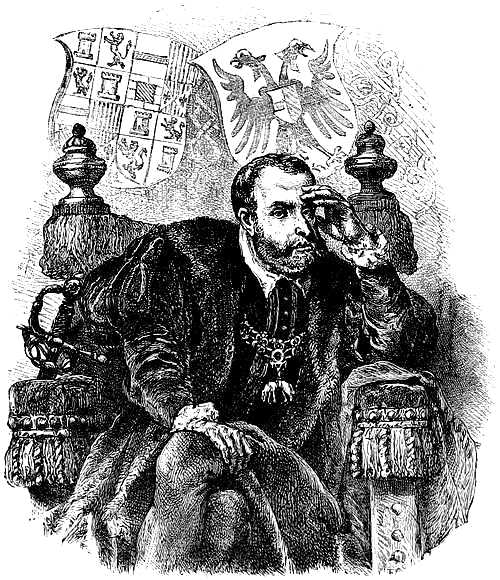
THE EMPEROR CHARLES V.
(From a portrait of the time).
On the advance of Charles V. in 1544, the Dauphin, afterwards Henri
II., following the example
successfully set by Anne de Montmorency
in Provence, pitilessly sacked the entire district of the Marne, in
order that the enemy might find nothing to live on, and stored the
product, which included an enormous quantity of wine, in Epernay. The
Emperor advanced, meeting with but little opposition, and having taken
up his quarters in the Abbey of Avenay, amused himself with building
the vendangeoir known as Charles-Fontaine on the adjacent slope, as a
testimony of his intention to make, if possible, a permanent sojourn in
a province, the vinous products of which he so highly esteemed.[433]
But whilst the illustrious patron of Titian and his ‘swarthy grave
commanders’ were snugly tippling the choicest vintages contained in the
abbey cellars, and his followers camped outside Epernay were waiting for
the hour when they should revel at pleasure on the wine stored in the
town, their hopes vanished literally in smoke. For Francis, fearing the
town would be unable to hold out, had sent word to Captain Sery to burn
it, and destroy the accumulated store of provisions, in order to prevent
them falling into the hands of the enemy. This was accordingly done on
the 3d September, and amongst the property consumed were the immense
pressoirs of the Abbey of St. Martin. In this conflagration the church
of Epernay was no doubt also destroyed, as the handsome Renaissance
doorway—the sole ancient portion of the existing edifice—was evidently
erected in the latter half of the sixteenth century. The misfortunes of
the town did not cease with this calamity, for a great pestilence seems
to have marked the return of the inhabitants to their ruined dwellings
at the epoch of the following vintage.[434]
Five years later, six
arpents of the ‘terre de siege’ where the Spaniards had encamped were
planted with vines by the Count de Nanteuil-le-Haudouin, and received
the name of the Vineyard de la Plante.[435]
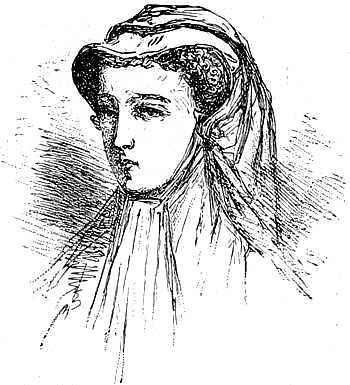
MARIE STUART, QUEEN OF SCOTS.
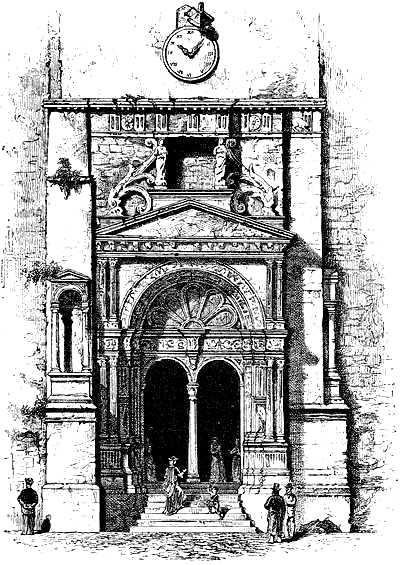
RENAISSANCE DOORWAY TO THE CHURCH OF EPERNAY.
ATTACK ON THE HUGUENOTS AT EPERNAY.
As a matter of course, the hapless fate of the town pursued it during
the religious wars of the sixteenth century. In 1567 the Huguenots,
under Condé, seized on Epernay—then a portion of the appanage of the
unfortunate Marie Stuart of Scotland—and exacted a ransom of 10,500
livres, towards which the Abbey of St. Martin contributed 3451 livres,
partly in money and partly in wine, calculated at no more than eleven
livres the queue. A higher price appears to have ruled on the recapture
of the town by the Duke of Guise the same year, when the levy made
consisted of 500 pièces of wine, estimated at twenty-four livres the
queue.[436] Guise was driven out by the inhabitants in 1588; but after
one
fruitless assault, the Leaguers under Rosné succeeded in obtaining
forcible possession of Epernay four years later.
On Henri Quatre laying siege in turn to Epernay in 1592, the vineyards
around the town were again literally watered with blood. One notable
episode of this siege was the death of Maréchal Biron, the most devoted
of Henri’s adherents. On the 27th July the King and Biron were returning
on horseback from Damery to the camp. As they advanced up the road
leading from Mardeuil to the faubourg of Igny, the wind blew off Henri’s
hat, adorned with the famous white plume, and Biron, picking it up,
jestingly placed it upon his own head. At this moment the white plume
unluckily caught the eye of Petit, the master gunner of Epernay, and he
at once pointed a cannon at it from the Tour Saint Antoine. ‘For the
Béarnais!’ he exclaimed, as he fired; and the ball carried away the head
of the Maréchal, to whom Henri was speaking, and upon whose shoulder the
King’s hand was actually resting. ‘Ah, mordieu, the dog has bitten the
Béarnais!’ cried the exulting gunner, believing it was the King who had
fallen, and alluding to the name of the cannon, which was known as the
‘Dog of Orleans,’ from its having been captured from the English at the
siege of that city, and bearing on its breech the figure of a dog.[437]
HENRI QUATRE BEFORE EPERNAY.
The death of Maréchal Biron, and the fact that Henri was devoting quite
as much attention to his ‘belle hôtesse’ at Damery, the fair Présidente
Anne du Puy, as he was to the siege, encouraged St. Paul, who commanded
at Reims for the League, to despatch a strong body of Walloon pikemen
and musketeers to the relief of the beleaguered town. They approached
by the hollow road leading from the Faubourg des Ponts Neufs to the
slope of the Vignes des Capinets, and passing between the vineyards
Dure Epine and Gouttes d’Or. Attacked by the Royalists, they drew up
in good order in the latter spot, and prepared to defend themselves
with all the stubborn valour of their race, their dense array of pikes
bristling amongst the bright green leaves—for it was the close of
summer, and the vines were in all the glory of their luxuriant foliage.
Vainly for a long time the Royalists assailed them. Attack after attack
was repulsed, till the ‘golden drops’ were turned to drops of gore; and
it was not until the white plume of King Henri came dashing on in the
forefront of his choicest cavalry that the Walloons were finally broken
and routed, after inflicting upon their assailants a far greater loss than
they themselves sustained. The vineyard thus baptised in blood was
thenceforward known as the Vigne des Sièges.[438]
Though data may be lacking to connect the ‘bon Roi Henri’ directly with
the wine of Epernay, there can be no doubt that the sovereign whose
triple talent for drinking, fighting, and love-making has been handed
down to us in song[439] found a fair opportunity of exercising all three
of these attributes during the siege. Of fighting, as we have seen,
he had plenty, and, Anacreon-like, he seems to have blended love and
wine together.[440] He who, when a new-born babe, had his lips wetted
in the old castle of Pau by stout Antoine de Bourbon with a cup of the
generous wine of the South, and who gloried in the title of the Sieur
d’Ay, was not likely to neglect the nectar vintaged on the slopes around
Epernay. And probably the recollection of the raven-haired, black-eyed,
bronze-skinned Bernais peasant-girls, whom tradition vows he used to woo
when in the first flush of youthful manhood beneath the trellised vines
of Jurançon and Gan, served by contrast to heighten the fairer charms of
the blonde Anne du Puy, in whose honour he is reported to have sung:
‘Morning bright,
Thy pure light
I rejoice when I see;
The fair dove
Whom I love
So, is rosy like thee.
She is fair,
None so rare,
With a waist matched by none;
By my hand
It is spanned,
And eyes bright as the sun.
Wet with new
Fallen dew,
The rose sparkles less bright;
Freer from spot
Ermine’s not,
Nor is lily more white.
Fair Dupuis,
All agree,
On ambrosia is fed;
From her lip
When I sip
Nectar’s perfume is shed.’
[441]
At the outset of the seventeenth century Epernay had its full share in
the troubles that marked the early part of the reign of Louis XIII.,
being taken in turn by Condé, by the Count de Soissons, acting for
the malcontent nobles leagued against Richelieu in 1634, and by the
King’s forces the year following. The peaceful
records are, however,
plentiful and interesting. In 1631 we find the town council deciding to
present ‘six caques of white wine, the best that can be found,’ to M. de
Vignolles, and the same to M. d’Elbenne; and two years later protesting
to the ‘treasurers of France’ their inability to pay 70,000 livres,
demanded towards the maintenance of the army, owing to the all but total
failure of the wine crop. The council were fully aware of the merits of
their vintage, and of the advantages of appealing to the heart by way of
the stomach. Six ‘feuillettes’ of the best wine were ordered to be sent
in September 1636 to M. de Vaubecourt, and one to his secretary, ‘to
retain their good-will towards the town,’ and induce the former to use
his influence with a committee appointed by the King for repaying loans
and advances, and also towards getting rid of the garrison. A little
later the Marquis de Senneterre received a queue of wine to withdraw his
troops from the town. The Maréchal de Chatillon, M. de Vaubecourt, M.
de Belfonds, and the Count d’Estaing were in frequent receipt of such
gifts; and it is noteworthy that amongst them figure ‘two caques of
wine in bottles,’ sent to each of the two first at Sainte Ménéhoulde in
1639.[442]
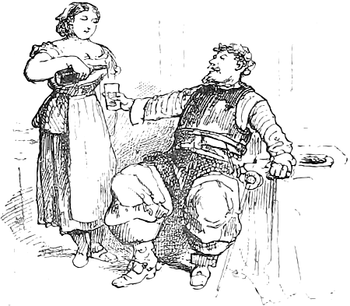
The successful efforts of Turenne against his great rival Condé during
the wars of the Fronde were encouraged by frequent presents of the wine
of Epernay. As the brother of the Duc de Bouillon, to whom the town
of Epernay had been given in 1643 in exchange for Sedan, and as the
protector of the district against the Spaniards, he received numerous
tokens of the citizens’ good-will. In September 1652 twelve caques of
wine were sent to him, with the result that he at once ordered his
soldiers to repair the broken bridge across the Marne. In the following
January a chevreuil and two caques, and in June wine, fowls, and game,
were presented to him. In June 1654 it was resolved that a deputation
should be sent to the coronation of Louis XIV. at Reims, ‘to render the
homage due to the King,’ and to present ‘a caque of wine in bottles’ to
M. de Turenne, which helped no doubt to spread the fame of the Epernay
wine amongst the nobility present on that occasion.
The same social lever was applied in 1660 to the ‘traitant général’
of the so-called ‘don gratuit’ exacted on the occasion of the King’s
marriage, two feuillettes being proffered in order to get him to reduce
the assessment. Representations made to an eschevin of Paris, despatched
to Epernay in 1662 to see if there was any store of grain in the town
that could be sold to benefit the starving poor of the capital, to the
effect that the district was a wine-growing and not a corn country;
and the despatch of a deputation in August 1666 to Louvois, to request
that the garrison might be withdrawn to allow of the vintage being
gathered in—the inhabitants of the surrounding country having fled to
avoid sheltering soldiers,—serve to show the importance of the Epernay
wine-trade. In 1671, on the passage of the Duke and Duchess of Orleans
from Châlons, fruit and sweetmeats were presented to them, and wine to
the lords of their suite, at a cost of 211 livres 7 sols; and two years
later, Louis XIV. partook of the local vintage during his sojourn at the
‘maison abbatiale,’ when on his way to the army of the Rhine.
Towards the close of this century the wine grew in repute, and was
eagerly sought after. In November 1677 two caques were sent to ‘a person
who enjoys some credit,’ and who was willing to accord his protection to
the town in the matter of quartering troops upon it; and the following
January twelve more caques were despatched to this ‘unknown,’ who may
have been Louvois himself. As to Roger Brulart, Marquis de Puisieux
et de Sillery and Governor of Epernay, a joyous companion, if we may
credit St. Simon, his appreciation of the local vintage is borne ample
testimony to. In 1677 six caques of ‘the best’ were sent to him by the
town council; but by 1691 he must have become used to larger offerings,
as in September a letter was addressed to him begging
him to be
satisfied with the like amount, as ‘the inhabitants could not manage
more,’ and could only promise, with regard to three caques still due,
that they would ‘make an effort’ to supply them the following year.
Wise in their generation, they sent at the same time ‘twelve bottles of
the best wine’ to his intendant, and a similar gift to his secretary;
but the following year they were forced to write again that it would be
impossible to supply the wine promised unless he obtained a permission
to levy it.[443]
The Old Pretender, or, as he is styled in the local records, ‘Jacques
Stuart III., roy d’Angleterre,’ arrived at Epernay in September 1712,
and was presented with ‘twenty-four bottles of the best;’ whilst the
Marquis de Puisieux, who accompanied him, was satisfied with nothing
less than a ‘carteau,’ or quarter-cask. And when the latter announced
his intention of paying a visit in the autumn of 1719 to Maître
Adam Bertin du Rocheret, conseiller du roy and ex-president of the
Grenier-à-sel at Epernay, a resolution was passed to offer him wine on
his arrival, and to send ‘a hundred flasks of the best’ to his château
of Sillery. The use of the word ‘flaçons’ clearly implies that the
discoveries of Dom Perignon were being acted upon at Epernay, and that
the gift in question was one of sparkling wine.
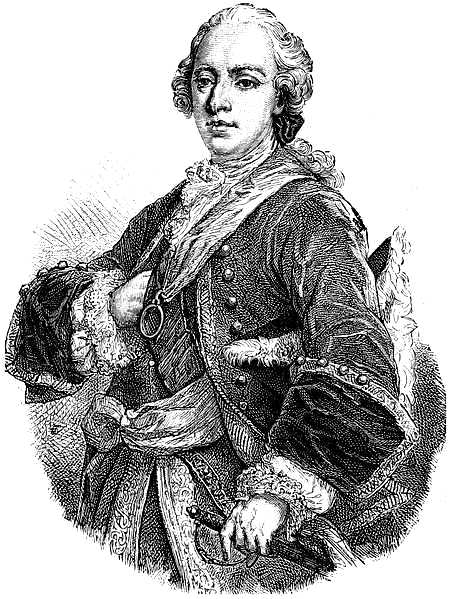
JAMES EDWARD FRANCIS STUART, THE OLD PRETENDER.
In June 1722 the Sieurs Quatresous and Chertemps, despatched to
congratulate the marquis’s nephew and successor, Louis Philogène
Brulart, on his appointment to the governorship of the town and his
marriage with Mademoiselle de Souvré, granddaughter of Louvois,
took with them a similar offering. At the coronation of Louis XV.,
in October, deputies were sent to compliment the Prince de Turenne,
representative of his father the Duc de Bouillon, seigneur d’Epernay,
and to present him with ‘game, trout, and other fish,’ and ‘a basket of
a hundred flasks of the best.’ In August 1725 the bourgeois were drawn
up under arms, and four dozen bottles were got ready, on the passage
through the town of the Duke of Orleans, son of the late Regent, on
his way to espouse, as the King’s proxy, Marie Leczinska. This was,
however, a sad year for the wine-growers, for ten months of incessant
rain, beginning in April, not only ruined the at first promising crop
entirely, but caused floods which wrought some havoc. The terrible
hail-storm of 1730, which devastated the vineyards of Reims, fortunately
spared those of Epernay; but a frost in October 1740 destroyed the
vintage, and led to a dearness of provisions which pressed even on the
most well-to-do.[444]
For the next three-quarters of a century Epernay continued quietly
to profit by the yield of ‘the slopes laden with vines producing the
most delicious wines in Europe,’ to quote the expression of Stapart,
who in 1749 notes the importance of the trade in wine carried on,
not only with Paris, but
with foreign countries; though at the same
time complaining of the decreasing size of the town, and the fact of
vineyards being planted where houses had formerly stood.[445] The
only events of importance were from time to time an unusually good
or an uncommonly bad crop, or—as the manufacture of vin mousseux
gradually swallowed up that of still wine—a disastrous casse, like
the memorable one of 1776, varied by an occasional royal visit or so.
By 1780, Max Sutaine notes that a single manufacturer would turn out
from five to six thousand bottles of sparkling Champagne, and exults
over the fact that seven years later an enterprising firm risked a
tirage of fifty thousand, though people at the time regarded this as
something prodigious, and wondered where an outlet would be found.[446]
Very likely a bottle of this identical tirage was ‘the excellent vin
mousseux’ with which Arthur Young regaled himself, at a cost of forty
sous, on the 7th July of the same year, at that ‘very good inn’ the
Hôtel de Rohan, at Epernay.[447] At this same inn the hapless Louis XVI.
stopped to dine on his return from the intercepted flight to Varennes;
and when we recall his timid nature, we may fairly surmise that it was
Champagne which inspired him, amidst the insults of the mob, to remind
the authorities that his ancestor, Henri Quatre, had entered the town in
a very different fashion, and by implication to assert that he might yet
do the same.[448]
The Emperor Napoleon, the Empress Josephine, the King of Westphalia,
and the other members of the Bonaparte dynasty, who from time to time
visited Epernay and partook of the hospitality of Jean Remi Moët,
showed a healthy appreciation of its vintage. Indeed King Jerome, in
giving an order for six thousand bottles premier cru, remarked with
a strange foresight that he would have taken more, only he was afraid
that it would be the Russians after all who would come and drink it.
Sure enough the eventful year 1814 witnessed the arrival at Epernay of
a host of self-invited guests, all equally appreciative of the merits
of Champagne, and gifted with an almost unlimited power of consumption,
but entertaining insuperable objections to pay for what they consumed.
The Prussians and Russians who came hither in February and March
misconducted themselves in a very sad manner, burning and pillaging
houses, insulting and maltreating the inhabitants, requisitioning all
the wine they could lay hands on, and drinking in a manner recalling the
Bacchic exploits of Gargantua and Pantagruel. The mayor, Jean Remi Moët,
moved by the state of affairs, offered the invaders the free run of his
cellars rather than that they should pillage those of others, doubtless
under the idea that the reputation his house would thus acquire abroad
would soon enable him to retrieve the temporary loss—a proviso happily
and amply realised. Beyond the facts that Epernay has profited, and
continues to profit, by the ever-increasing development of the taste
for sparkling wine; that Charles X., Louis Philippe, and Napoleon III.
have successively favoured it with their presence, and accepted the vin
d’honneur offered on such occasions; and that during the war of 1870–1
the town, in common with the rest of the province of Champagne, was
occupied by the German invading army, there is nothing more to be said
respecting its history.
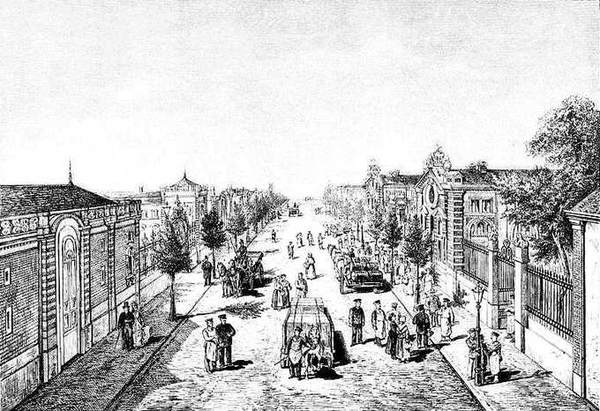
THE RUE DU COMMERCE (FAUBOURG DE LA FOLIE), EPERNAY.
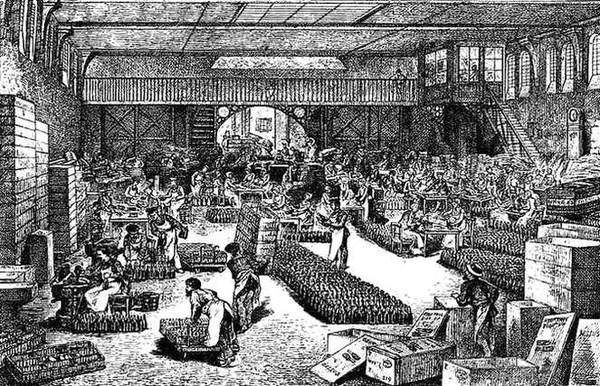
THE PACKING-HALL AT MESSRS. MOËT AND CHANDON’S, EPERNAY.
Early records of the Moët family at Reims and Epernay—Jean
Remi Moët, the founder of the commerce in Champagne wines—Extracts
from old account-books of the Moëts—Jean Remi Moët receives
the Emperor Napoleon, the Empress Josephine, and the King of
Westphalia—The firm of Moët & Chandon constituted—Their
establishment in the Rue du Commerce—The delivery and washing
of new bottles—The numerous vineyards and vendangeoirs of the
firm—Their cuvée made in vats of 12,000 gallons—The bottling
of the wine—A subterranean city, with miles of streets,
cross-roads, open spaces, tramways, and stations—The ancient
entrance to these vaults—Tablet commemorative of the visit of
Napoleon I.—The original vaults known as Siberia—Scene in
the packing-hall—Messrs. Moët & Chandon’s large and complete
staff—The famous ‘Star’ brand of the firm—Perrier-Jouët’s
château, offices, and cellars—Classification of the wine of
the house—The establishment of Messrs. Pol Roger & Co.—Their
large stock of the fine 1874 vintage—The preparations for the
tirage—Their vast fireproof cellier and its temperature—Their
lofty and capacious cellars—Pierry becomes a wine-growing district
consequent upon Dom Perignon’s discovery—Esteem in which the
growths of the Clos St. Pierre were held—Cazotte, author of Le
Diable Amoureux, and guillotined for planning the escape of Louis
XVI. from France, a resident at Pierry—His contest with the Abbot
of Hautvillers with reference to the abbey tithes of wine—The
Château of Pierry—Its owner demands to have it searched to prove
that he is not a forestaller of corn—The vineyards and Champagne
establishment of Gé-Dufaut & Co.—The reserves of old wines in the
cellars of this firm—Honours secured by them at Vienna and Paris.
THOSE magnates of the Champagne trade, Messrs. Moët & Chandon, whose
famous ‘Star’ brand is familiar in every part of the civilised globe,
and whose half-score miles of cellars contain as many million bottles of
Champagne as there are millions of inhabitants in most of the secondary
European States, have their head-quarters at Epernay in a spacious
château—in that street of châteaux named the Rue du Commerce, but
commonly known as the Faubourg de la Folie—which is approached through
handsome iron gates, and has beautiful gardens in the rear extending
in the direction of the River Marne. The existing firm dates from the
year 1833, but the family of Moët—conjectured to have originally come
from the Low Countries—had already been
associated with the Champagne
wine trade for well-nigh a century previously. If the Moëts came from
Holland they must have established themselves in the Champagne at a
very early date, for the annals of Reims record that in the fourteenth
century Jehan Moët de Mennemont, escuier, held a fief at Attigny from
the Archbishop Richard Pique, and that in the following century Jean
and Nicolas Moët were échevins of the city. A Moët was present in
that capacity at the coronation of Charles VII. in 1429, when Joan of
Arc stood erect by the principal altar of the cathedral with her sacred
banner in her hand; and for having contributed to repulse an attempt on
the part of the English to prevent the entrance of the Royal party into
the city, the Moëts were subsequently ennobled by the same monarch. A
mural tablet in the church of St. Remi records the death of D. G. Moët,
Grand Prior, in 1554; and nine years later we find Nicol Moët claiming
exemption at Epernay for the payment of tailles on the ground of his
being a noble.
An old commercial book preserved in the family archives shows that in
the year 1743—at the epoch when the rashness of the Duc de Grammont
saved the English army under George II. from being cut to pieces at
Dettingen—a descendant of the foregoing, one Claude Louis Nicolas Moët,
who owned considerable vineyard property in the vicinity of Epernay,
decided upon embarking in the wine trade. It is his son, however,
Jean Remi Moët, born in 1758, who may be looked upon as the veritable
founder of the present commerce in Champagne wines, which, thanks to
his efforts, received a wonderful impulse, so that instead of the
consumption of the vintages of the Marne being limited as heretofore to
the privileged few, it spread all over the civilised world.
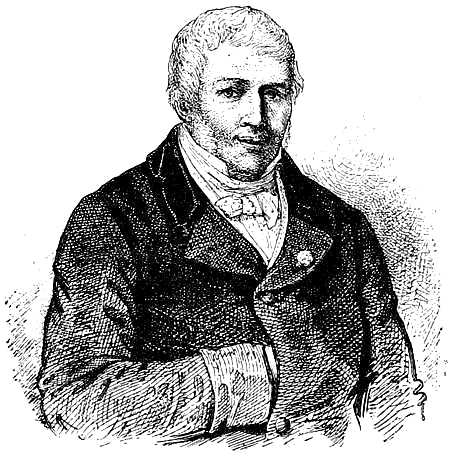
JEAN REMI MOËT.
At Messrs. Moët & Chandon’s we had the opportunity of inspecting some of
the old account-books of the firm, and more particularly those recording
the transactions of Jean Remi Moët and his father. The first sales of
sparkling wine, on May 23d, 1743, comprised 301 bottles of the vintage
of 1741 to Pierre Joly, wine-merchant, bon des douze chez le Roi,
whatever that may mean, at Paris; 120 bottles to Pierre Gabriel Baudoin,
also bon des douze, at Paris; and a similar quantity to the Sieur
Compoin, keeping the ‘hotellerie ditte la pestitte Escurie,’ Rue du
Port-Maillart, at Nantes in Brittany. The entry specifies that the wine
for Nantes is to be left at Choisy-le-Roi, and taken by land to Orleans
by the carters of that town, who are to be found at the Ecu d’Orléans,
Porte St. Michel, Paris, the carriage as far as Choisy being 4 livres 10
deniers (about 4 francs) for the two half-baskets, and to Paris 3 livres
15 deniers the basket.
Between 1750 and ’60 parcels of wine were despatched to Warsaw, Vienna,
Berlin, Königsberg, Dantzig, Stettin, Brussels, and Amsterdam; but one
found no mention of any sales to England till the year 1788, when the
customers of the firm included ‘Milord’ Farnham, of London, and Messrs.
Felix Calvert & Sylvin, who had a couple of sample-bottles sent to them,
for which they were charged five shillings. In the same year Messrs.
Carbonnell, Moody, & Walker (predecessors of the well-known existing
firm of Carbonnell & Co.) wrote in French for two baskets, of ten dozens
each, of vin de Champagne ‘of good body, not too charged with liqueur,
but of excellent taste, and not at all sparkling.’ The Chevalier
Colebrook, writing from Bath, also requests that 72 bottles of Champagne
may be sent to his friend the Hon. John Butler, Molesworth-street,
Dublin, ‘who, if contented with the wine, will become a good customer,
he being rich, keeping a good house, and receiving many amateurs of vin
de Champagne.’ Shortly afterwards the Chevalier himself receives
50 bottles of still wine, vintage 1783. In 1789 120 bottles of Champagne,
vintage 1788, are supplied to ‘Milord’ Findlater, of London; and in 1790
the customers of the house include Power & Michel, of 44 Lamb-street,
London, and Manning, of the St. Alban Tavern, the latter of whom is
supplied on March 30th with 130 bottles of Champagne at three livres, or
two ‘schillings,’ per bottle; while a month later Mr. Lockart, banker,
of 36 Pall Mall, is debited with 360 bottles, vintage 1788, at three
shillings.
In this same year M. Moët despatches a traveller to England named
Jeanson, and his letters, some two hundred in number, are all preserved
in the archives of the house. On the 17th May 1790 he writes from
London as follows: ‘As yet I have only gone on preparatory and often
useless errands. I have distributed samples of which I have no news.
Patience is necessary, and I endeavour to provide myself with it. How
the taste of this country has changed since ten years ago! Almost
everywhere they ask for dry wine, but at the same time require it so
vinous and so strong that there is scarcely any other than the wine
of Sillery which can satisfy them.... To-morrow I dine five miles
from here, at M. Macnamara’s. We shall uncork four bottles of our
wine, which will probably be all right.’ In May 1792 Jean Remi Moët is
married, and thenceforward assumes the full management of the house. On
December 20 of the year following, when the Reign of Terror was fairly
inaugurated, we find the accounts in the ledger opened to this or the
other ‘citoyen.’ The orthodox Republican formula, however, did not long
continue, and ‘sieur’ and ‘monsieur’ resumed their accustomed places,
showing that Jean Remi Moët had no sympathy with the Jacobin faction of
the day. In 1805 he became Mayor of Epernay, and between this time and
the fall of the Empire received Napoleon several times at his residence,
as well as the Empress Josephine and the King of Westphalia. The
Emperor, after recapturing Reims from the Allies, came on to Epernay,
on which occasion he presented M. Moët with the Cross of the Legion of
Honour. In 1830 the latter was arbitrarily dismissed from his mayoralty
by Charles X., but was speedily reinstated by Louis Philippe, though he
did not retain his office for long, his advanced age compelling him to
retire from active life in the course of 1833. At this epoch the firm,
which since 1807 had been known as Moët & Co., was remodelled under the
style of Moët & Chandon, the two partners being M. Victor Moët, son of
the outgoing partner, and M. P. G. Chandon, the descendant of an old
ennobled family of the Mâconnais, who had married M. Jean Remi Moët’s
eldest daughter. The descendants of these gentlemen are to-day (1880) at
the head of the business, the partners being, on the one hand, M. Victor
Moët-Romont and M. C. J. V. Auban Moët-Romont; and on the other, MM.
Paul and Raoul Chandon de Briailles.
Facing Messrs. Moët & Chandon’s offices at Epernay is a range of
comparatively new buildings, with its white façade ornamented with
the well-known monogram M. & C., surmounted by the familiar star.
It is here that the business of blending and bottling the wine is
carried on. Passing through the arched gateway, access is obtained
to a spacious courtyard, where carts laden with bottles are being
expeditiously lightened of their fragile contents by the busy hands of
numerous workmen. Another gateway on the left leads into the spacious
bottle-washing room, which from the middle of May until the middle
of July presents a scene of extraordinary animation. Bottle-washing
apparatus, supplied by a steam-engine with 20,000 gallons of water
per diem, are ranged in fifteen rows down the entire length of this
hall, and nearly 200 women strive to excel each other in diligence
and celerity in their management, a practised hand washing from 900
to 1000 bottles in the course of the day. To the right of this salle
de rinçage, as it is styled, bottles are stacked in their tens of
thousands, and lads furnished with barrows, known as diables, hurry to
and fro, conveying these to the washers, or removing the clean bottles
to the adjacent courtyard, where they are allowed to drain prior to
being taken to the salle de tirage or bottling-room.
Before, however, the washing of bottles on this gigantic scale
commences, the ‘marrying’ or blending of the wine is accomplished in a
vast apartment, 250 feet in length and 100 feet broad, during the early
spring. The casks of newly-vintaged wine, which have been stowed away
during the winter months in the extensive range of cellars hewn out of
the chalk underlying Epernay,
where they have slowly fermented, are
mixed together in due proportion in huge vats, each holding upwards
of 12,000 gallons. Some of this wine is the growth of Messrs. Moët &
Chandon’s own vineyards, of which they possess as many as 900 acres
(giving constant employment to 800 labourers and vinedressers) at Ay,
Avenay, Bouzy, Cramant, Champillon, Chouilly, Dizy, Epernay, Grauves,
Hautvillers, Le Mesnil, Moussy, Pierry, Saran, St. Martin, Verzy, and
Verzenay, and the average annual cost of cultivating which is about
£40 per acre. At Ay the firm own 210 acres of vineyards; at Cramant
and Chouilly, nearly 180 acres; at Verzy and Verzenay, 120 acres; at
Pierry and Grauves, upwards of 100 acres; at Hautvillers, 90 acres;
at Le Mesnil, 80 acres; at Epernay, nearly 60 acres; and at Bouzy,
55 acres. Messrs. Moët & Chandon, moreover, possess vendangeoirs,
or pressing-houses, at Ay, Bouzy, Cramant, Epernay, Hautvillers, Le
Mesnil, Pierry, Saran, and Verzenay, in which the large number of 40
presses are installed. At these vendangeoirs no less than 5450 pièces
of fine white wine, sufficient for 1,360,000 bottles of Champagne, are
annually made—that is, 1200 pièces at Ay, 1100 at Cramant and Saran,
800 at Verzy and Verzenay, and smaller quantities at the remaining
establishments. All these establishments have their celliers and their
cellars, together with cottages for the accommodation of the numerous
vinedressers in the employment of the firm.
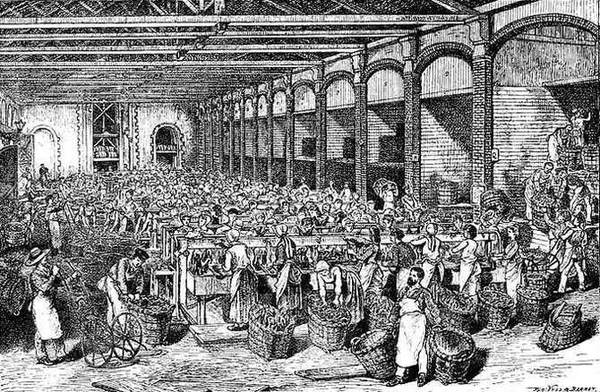
WASHING BOTTLES AT MESSRS. MOËT AND CHANDON’S, EPERNAY.
Extensive as are the vineyards owned by Messrs. Moët & Chandon, the
yield from them is utterly inadequate to the enormous demand which
the great Epernay firm are annually called upon to supply, and large
purchases have to be made by their agents from the growers throughout
the Champagne. The wine thus secured, as well as that grown by the firm,
is duly mixed together in such proportions as will insure lightness with
the requisite vinosity, and fragrance combined with effervescence, a
thorough amalgamation being effected by stirring up the wine with long
poles provided with fan-shaped ends. If the vintage be indifferent in
quality, the firm have scores of huge tuns filled with the yield of
more favoured seasons to fall back upon to insure any deficiencies of
character and flavour being supplied.
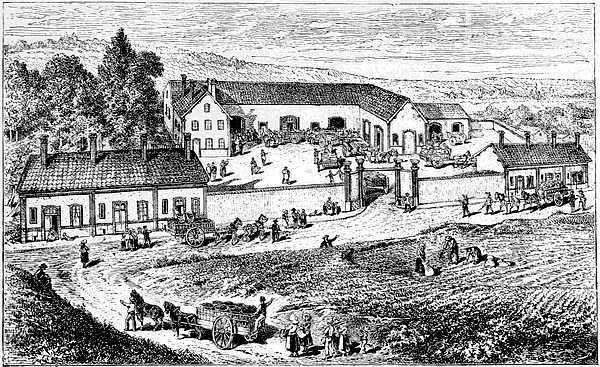
MESSRS. MOËT AND CHANDON’S VENDANGEOIR AT BOUZY.
The casks of wine to be blended are raised from the cellars, half a
dozen at a time, by means of a lift provided with an endless chain,
and worked by the steam-engine of which we have already spoken. They
are emptied, through traps in the floor of the room above, into the
huge vats which, standing upon a raised platform, reach almost to the
ceiling. From these vats the fluid is allowed to flow through hose into
rows of casks stationed below. Before being bottled the wine reposes for
a certain time; is next duly racked and again blended; and is eventually
conveyed through silver-plated pipes into oblong reservoirs, each fitted
with a dozen syphon-taps, so arranged that directly the bottle slipped
on to one of them becomes full the wine ceases to flow.
Upwards of 200 workpeople are employed in the salle de tirage at
Messrs. Moët & Chandon’s, which, while the operation of bottling is
going on, presents a scene of bewildering activity. Men and lads are
gathered round the syphon-taps, briskly removing the bottles as they
become filled, and supplanting them by empty ones. Other lads hasten to
transport the filled bottles on trucks to the corkers, whose so-called
‘guillotine’ machines send the corks home with a sudden thud. The
corks being secured with agrafes, the bottles are placed in large
flat baskets called manettes, and wheeled away on trucks, the quarts
being deposited in the cellars by means of lifts, while the pints
slide down an inclined plane by the aid of an endless chain, which
raises the trucks with the empty baskets at the same time the full
ones make their descent into the cellars. What with the incessant thud
of the corking-machines, the continual rolling of iron-wheeled trucks
over the concrete floor, the rattling and creaking of the machinery
working the lifts, the occasional sharp report of a bursting bottle,
and the loudly-shouted orders of the foremen, who display the national
partiality for making a noise to perfection, the din becomes at times
all but unbearable. The number of bottles filled in the course of the
day naturally varies, still Messrs. Moët & Chandon reckon that during
the month of June a daily average of 100,000 are taken in the morning
from the stacks in the salle de rinçage, washed, dried, filled,
corked, wired, lowered into the cellars, and carefully arranged in
symmetrical order. This represents a total of two and a half million
bottles during that month alone.
The bottles on being lowered into the cellars, either by means of the
incline or the lifts, are
placed in a horizontal position, and, with
their uppermost side daubed with white chalk, are stacked in layers from
two to half a dozen bottles deep, with narrow oak laths between. The
stacks are usually about 6 or 7 feet high, and 100 feet and upwards in
length. Whilst the wine is thus reposing in a temperature of about 55°
Fahrenheit, fermentation sets in, and the ensuing month is one of much
anxiety. Thanks, however, to the care bestowed, Messrs. Moët & Chandon’s
annual loss from bottles bursting rarely exceeds three per cent, though
fifteen was once regarded as a respectable and satisfactory average. The
broken glass is a perquisite of the workmen, the money arising from its
sale, which at the last distribution amounted to no less than 20,000
francs, being divided amongst them every couple of years.
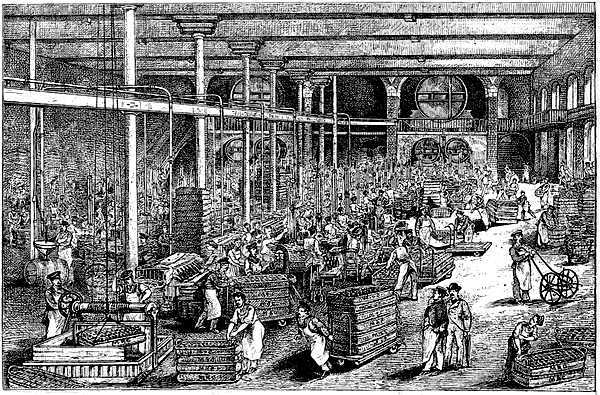
BOTTLING CHAMPAGNE AT MESSRS. MOËT AND CHANDON’S, EPERNAY.
The usual entrance to Messrs. Moët & Chandon’s Epernay cellars—which,
burrowed out in all directions, are of the aggregate length of nearly
seven miles, and have usually between 10,000,000 and 12,000,000 bottles
and 20,000 casks of wine stored therein—is through a wide and imposing
portal, and down a long and broad flight of steps. It is, however,
by the ancient and less imposing entrance, through which more than
one crowned head has condescended to pass, that we set forth on our
lengthened tour through these intricate underground galleries—this
subterranean city, with its miles of streets, cross-roads, open
spaces, tramways, and stations devoted solely to Champagne. A gilt
inscription on a black-marble tablet testifies that ‘on the 26th July
1807, Napoleon the Great, Emperor of the French, King of Italy, and
Protector of the Confederation of the Rhine, honoured commerce by
visiting the cellars of Jean Remi Moët, Mayor of Epernay, President
of the Canton, and Member of the General Council of the Department,’
within three weeks of the signature of the treaty of Tilsit. Passing
down the flight of steep slippery steps traversed by the victor of Eylau
and Jena, access is gained to the upper range of vaults, brilliantly
illuminated by the glare of gas, or dimly lighted by the flickering
flame of tallow-candles, upwards of 60,000 lb. of which are annually
consumed. Here group after group of the small army of 350 workmen
employed in these subterranean galleries are encountered, engaged in
the process of transforming the vin brut into
Champagne. At Messrs.
Moët & Chandon’s, the all-important operation of liqueuring the wine is
effected by aid of machines of the latest construction, which regulate
the quantity administered to the utmost nicety. The corks are branded by
being pressed against steel dies heated by gas by women, who can turn
out 3000 per day apiece, the quantity of string used to secure them
amounting to nearly ten tons in the course of the year.
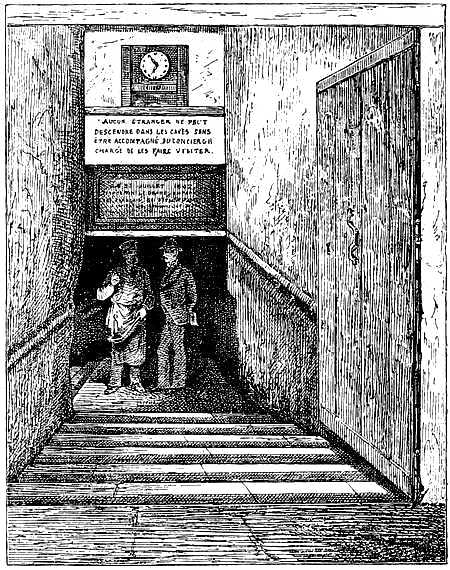
TABLET COMMEMORATIVE OF THE VISIT OF NAPOLEON I.
There is another and a lower depth of cellars to be explored, to
which access is gained by trap-holes in the floor—through which the
barrels and baskets of wine are raised and lowered—and by flights of
steps. From the foot of the latter there extends an endless vista of
lofty and spacious passages hewn out of the chalk, the walls of which,
smooth as finished masonry, are lined with thousands of casks of raw
wine, varied at intervals by gigantic vats. Miles of long, dark-brown,
dampish-looking galleries stretch away to the right and left, devoid
of the picturesque festoons of fungi which decorate the London Dock
vaults, yet exhibiting a sufficient degree of mouldiness to give them
an air of respectable antiquity. These multitudinous galleries, lit
up by petroleum-lamps, are mostly lined with wine in bottles stacked
in compact masses to a height of six or seven feet, only room enough
for a single person to pass being left. Millions of bottles are thus
arranged, the majority on their side, in huge piles, with tablets hung
up against each stack to note its age and quality; and the rest, which
are undergoing daily evolutions at the hands of the twister, in racks
at various angles of inclination. These cellars contain nearly 11,000
racks, and as many as 600,000 bottles are commonly twisted here daily.
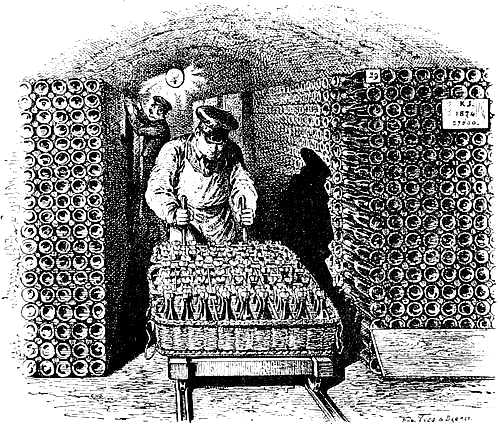
The way runs on between regiments of bottles of the same size and shape,
save where at intervals pints take the place of quarts; and the visitor,
gazing into the black depths of the transverse passages to the right and
left, becomes conscious of a feeling that if his guide were suddenly
to desert him, he would feel as hopelessly lost as in the catacombs
of Rome. There are two galleries, each 650 feet in length, containing
about 650,000 bottles, and connected
by 32 transverse galleries, with
an aggregate length of 4000 feet, in which nearly 1,500,000 bottles are
stored. There are, further, eight galleries, each 500 feet in length,
and proportionably stocked; also the extensive new vaults, excavated
some five or six years back, in the rear of the then existing cellarage,
and a considerable number of smaller vaults. The different depths and
varying degrees of moisture afford a choice of temperature of which the
experienced owners know how to take advantage. The original vaults,
wherein more than a century ago the first bottles of Champagne made
by the infant firm were stowed away, bear the name of Siberia, on
account of their exceeding coldness. This section consists of several
roughly-excavated low winding galleries, resembling natural caverns, and
affording a striking contrast to the broad, lofty, and regular-shaped
corridors of more recent date.
When the proper period arrives for the bottles to emerge once more into
the upper air, they are conveyed to the packing-room, a spacious hall
180 feet long and 60 feet broad. In front of its three large double
doors wagons are drawn up ready to receive their loads. The 70 men and
women employed here easily foil, label, wrap, and pack up some 10,000
bottles a day. Cases and baskets are stacked in different parts of
this vast hall, at one end of which numerous trusses of straw used in
the packing are piled. Seated at tables ranged along one side of the
apartment women are busily occupied in pasting on labels or encasing the
necks of bottles in gold or silver foil, whilst elsewhere men, seated on
three-legged stools in front of smoking caldrons of molten sealing-wax
of a deep green hue, are coating the necks of other bottles by plunging
them into the boiling fluid. When labelled and decorated with either wax
or foil, the bottles pass on to other women, who swathe them in pink
tissue-paper and set them aside for the packers, by whom, after being
deftly wrapped round with straw, they are consigned to baskets or cases,
to secure which last no less than 10,000 lb. of nails are annually used.
England and Russia are partial to gold foil, pink paper, and wooden
cases holding a dozen or a couple of dozen bottles of the exhilarating
fluid, whereas other nations prefer waxed necks, disdain pink paper, and
insist on being supplied in wicker baskets containing fifty bottles each.
Some idea of the complex character of so vast an establishment as that
of Messrs. Moët & Chandon may be gathered from a mere enumeration of
their staff, which, in addition to twenty clerks and 350 cellarmen
proper, includes numerous agrafe-makers and corkcutters, packers and
carters, wheelwrights and saddlers, carpenters, masons, slaters and
tilers, tinmen, firemen, needlewomen, &c., while the inventory of
objects used by this formidable array of workpeople comprises no fewer
than 1500 distinct heads. A medical man attached to the establishment
gives gratuitous advice to all those employed, and a chemist dispenses
drugs and medicines without charge. While suffering from illness the men
receive half-pay, but should they be laid up by an accident met with
in the course of their work full salary is invariably awarded to them.
As may be supposed, so vast an establishment as this is not without a
provision for those past work, and all the old hands receive liberal
pensions from the firm upon retiring.
It is needless to particularise Messrs. Moët & Chandon’s wines, which
are familiar to all drinkers of Champagne. Still it may be mentioned
that the great Epernay firm, with the view of meeting the requirements
of the time, have lately commenced shipping a high-class vin brut, or
natural Champagne, possessing great vinosity, combined with remarkable
delicacy of flavour. To this fine dry wine the name of ‘Brut Impérial’
has been given by the house. Moët & Chandon’s famous ‘Star’ brand is
known in all societies, figures equally at clubs and mess-tables, at
garden-parties and picnics, dinners and soirées, and has its place in
hotel cartes all over the world. One of the best proofs of the wine’s
universal popularity is found in the circumstance that as many as a
thousand visitors from all parts of the world come annually to Epernay
and make the tour of Messrs. Moët & Chandon’s spacious cellars.
A little beyond Messrs. Moët & Chandon’s, in the broad Rue du Commerce,
we encounter a heavy, ornate, pretentious-looking château, the residence
of the late M. Perrier-Jouët, presenting a striking contrast to the
almost mean-looking premises opposite, where the business of the firm is
carried on. On the left-hand side of a courtyard surrounded by
low buildings, which serve as celliers, store-houses, packing-rooms,
and the like, are the offices; and from an inner courtyard, where
piles of bottles are stacked under open sheds, the cellars themselves
are reached. Previous to descending into these we passed through the
various buildings, in one of which a party of men were engaged in
disgorging and preparing wine for shipment. In another we noticed one
of those heavy beam presses for pressing the grapes which the more
intelligent manufacturers regard as obsolete, while in a third was the
cuvée vat, holding no more than 2200 gallons. In making their cuvée
the firm commonly mix one part of old wine to three parts of new. An
indifferent vintage, however, necessitates the admixture of a larger
proportion of the older growth. The cellars, like all the more ancient
ones at Epernay, are somewhat straggling and irregular; still they are
remarkably cool, and on the lower floor remarkably damp as well. This,
however, would appear to be no disadvantage, as the breakage in them is
calculated never to exceed 2 ½ per cent.
The firm have no less than five qualities of wine, and at one of the
recent Champagne competitions at London, where the experts engaged had
no means of identifying the brands submitted to their judgment, Messrs.
Perrier-Jouët’s First Quality got classed below a cheaper wine of their
neighbours, Messrs. Pol Roger & Co., and very considerably below the
Extra Sec of Messrs. Périnet et fils, and inferior even to a wine of De
Venoge’s, the great Epernay manufacturer of common-class Champagne.
Champagne establishments, combined with the handsome residences of the
manufacturers, line both sides of the long imposing Rue du Commerce at
Epernay. On the left hand is a succession of fine châteaux, commencing
with one belonging to M. Auban Moët, whose terraced gardens overlook
the valley of the Marne, and command views of the vine-clad heights of
Cumières, Hautvillers, Ay, and Mareuil, and the more distant slopes
of Ambonnay and Bouzy; while on the other side of the famous Epernay
thoroughfare we encounter beyond the establishments of Messrs. Moët
& Chandon and Perrier-Jouët the ornate monumental façade which the
firm of Piper & Co.—of whom Messrs. Kunkelmann & Co. are to-day the
successors—raised some years since above their extensive cellars. In a
side street at the farther end of the Rue du Commerce stands a château
of red brick, overlooking on the one side an extensive pleasure-garden,
and on the other a spacious courtyard, bounded by celliers, stables,
and bottle-sheds, all of modern construction and on a most extensive
scale. These form the establishment of Messrs. Pol Roger & Co., settled
for many years at Epernay, and known throughout the Champagne for their
large purchases at the epoch of the vintage. From the knowledge they
possess of the best crus, and their relations with the leading vineyard
proprietors, they are enabled whenever the wine is good to acquire large
stocks of it. Having bottled a considerable quantity of the fine wine of
1874, they resolved to profit by the exceptional quality of this vintage
to commence shipping Champagne to England, where their agents, Messrs.
Reuss, Lauteren, & Co., have successfully introduced the new brand.
Passing through a large open gateway, we enter the vast courtyard of
the establishment, which, with arriving and departing carts—the first
loaded with wine in cask or with new bottles, and the others with cases
of Champagne—presents rather an animated scene. Under a roof projecting
from the wall of the vast cellier on the right hand a tribe of
‘Sparnaciennes’—as the feminine inhabitants of Epernay are termed—are
occupied in washing bottles in readiness for the coming tirage. The
surrounding buildings, most substantially constructed, are not destitute
of architectural pretensions.
The extensive cellier, the area of which is 23,589 square feet, is
understood to be the largest single construction of the kind in the
Champagne district. Built entirely of iron, stone, and brick, its
framework is a perfect marvel of lightness. The roof, consisting of
rows of brick arches, is covered above with a layer of Portland cement,
in order to keep it cool in summer and protect it against the winter
cold, two most desirable objects in connection with the manipulation of
Champagne. Here an endless chain of a new pattern enables wine in bottle
to be lowered and raised with great rapidity to or from the cellars
beneath—lofty and capacious excavations of two stories, the lower one
of which is reached by a flight of no less than 170 steps.
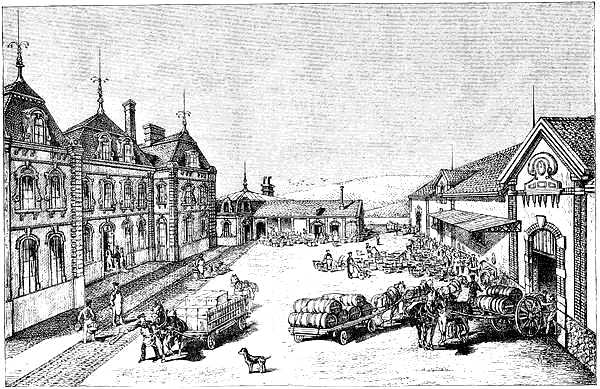
COURTYARD OF MESSRS. POL ROGER AND CO.’S ESTABLISHMENT AT EPERNAY.
Less than a couple of miles southward of Epernay, on the high-road to
Troyes, is the village of Pierry, which, unlike most of the Champagne
villages, is one of those happy spots with little or no history. Up to
the close of the seventeenth century it was an insignificant hamlet; but
at that epoch—when Dom Perignon’s discovery gave such an impetus to
the viticultural industry of the Marne—the waste land lying around it
was broken up and planted with vines, and a number of rich strangers,
chiefly from Epernay, built themselves houses and vendangeoirs here,
and contributed to the erection of the church. The Benedictines of
St.-Pierre-aux-Monts at Châlons, who continued to be the titular
seigneurs of Pierry up to the period of the Revolution, were not
behindhand in attention to their vines, and during the early part of the
eighteenth century the wine vintaged in their Clos St. Pierre, under the
fostering care of Brother Jean Oudart—whose renown almost equalled that
of Perignon himself—was very highly esteemed.[449]
During the eighteenth century Pierry continued to be a favourite
residence of well-to-do landowners,[450] and was further embellished by
the construction of numerous handsome châteaux, the most interesting,
from a historic point of view, being that formerly belonging to
Cazotte.[451] It was here that the ex-Commissary General of the navy
composed the greater part of his works, and elaborated that futile
scheme for the escape of Louis XVI. after Varennes, which was to conduct
its author to the scaffold.[452]
The visionary dreamer, to whom we owe the Diable Amoureux, appears at
Pierry in the triple character of a practical viticulturist, a village
Hampden withstanding with dauntless breast that little tyrant of the
surrounding vineyards—the Abbot of Hautvillers,[453] and a local
legislator put forward in the proprietarial interest at the outbreak of
that Revolution[454] which he appears to have foreseen, if not to have
directly prophesied, as he has been credited with doing.[455]
Amongst the most imposing of the remaining Pierry châteaux is the one
situate in that part of the village known as Corrigot, and now in the
occupation of Messrs. Gé-Dufaut & Co. Its grandiose aspect, various
courts, charming garden, fine trees, and clear lake justify this firm in
adopting, in combination with an anchor, the title Château de Pierry as
the brand of their wine. Prior to the Revolution the château belonged
to M. de Papillon de Sannois, a fermier-général of that period. The
municipal records of Pierry contain a petition addressed by him to
the authorities in 1791, at a time when a panic prevailed respecting
the forestallers of corn, begging them to institute a formal search
throughout his residence, in order to give the lie to the rumours
accusing him of having bought up and stored away a considerable quantity
of wheat. The municipality accepted his invitation, and the result was a
certificate to the effect that the total amount of wheat and oats stored
there only represented three months’ consumption for the household.
Messrs. Gé-Dufaut & Co. are the owners of vineyards both in Pierry
and the neighbouring parts, and for upwards of thirty years the
firm have been engaged in preparing and shipping Champagnes.
Their cellars, excavated in the mingled stone, chalk, and earth which form
the prevailing soil of the district, extend beneath the vineyards
belonging to the firm, and are walled and vaulted throughout. The
circumstance of their being on one level, slightly below the celliers
of the establishment, is a great convenience as regards the various
manipulations which the wine has to undergo. Considerable reserves of
old wines of the best years are stored in these vaults. The cultivation
of the vineyards owned by the firm, and the pressing, maturing, and
general cellar management of their wines are under the personal
superintendence of the various partners, with a highly satisfactory
result, as is proved by the first-class medal secured by the firm at
the Vienna Exhibition of 1873, and the gold medal awarded to them at
the Paris Exhibition of 1878. Messrs. Gé-Dufaut & Co. ship their wines
to Europe, America, and India, and more especially to England, where
their dry, natural, and unalcoholised Champagne has acquired a deserved
reputation. The firm, moreover, are the officially appointed furnishers
of Champagne to the Courts of Italy and Spain.
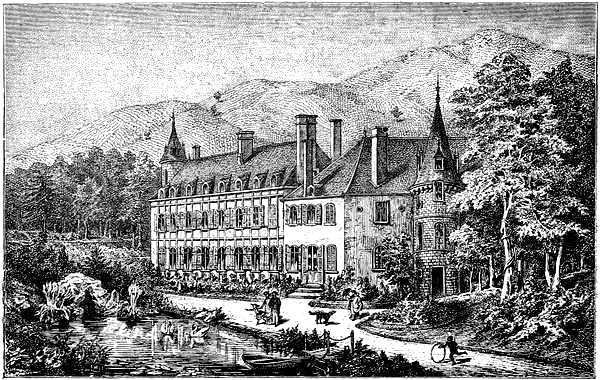
CHÂTEAU OF PIERRY, THE PROPERTY OF MESSRS. GÉ-DUFAUT AND CO.
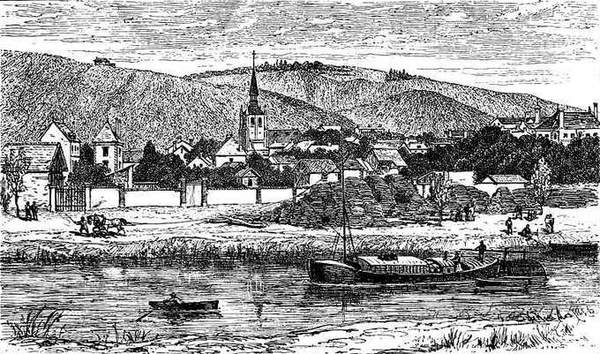
VIEW OF AY FROM THE BANKS OF THE MARNE CANAL.
The bourgade of Ay and its eighteenth-century
château—Gambling propensities of a former owner, Balthazar
Constance Dangé-Dorçay—Appreciation of the Ay vintage by
Sigismund of Bohemia, Leo X., Charles V., Francis I., and
Henry VIII.—Bertin du Rocheret celebrates this partiality in
triolets—Estimation of the Ay wine in the reigns of Charles IX.
and Henri III.—Is a favoured drink with the leaders of the League,
and with Henri IV., Catherine de Medicis, and the courtiers of that
epoch—The ‘Vendangeoir d’Henri Quatre’ at Ay—The King’s pride in
his title of Seigneur d’Ay and Gonesse—Dominicus Baudius punningly
suggests that the ‘Vin d’Ay’ should be called ‘Vinum Dei’—The
merits of the wine sung by poets and extolled by wits—The Ay wine
in its palmy days evidently not sparkling—Arthur Young’s visit to
Ay in 1787—The establishment of Deutz & Geldermann—Drawing off
the cuvée there—Mode of excavating cellars in the Champagne—The
firm’s new cellars, vineyards, and vendangeoir—M. Duminy’s
cellars and wines—The house founded in 1814—The new model Duminy
establishment—Picturesque old house at Ay—Messrs. Pfungst
Frères & Co.’s cellars—Their finely-matured dry Champagnes—The
old church of Ay and its numerous decorations of grapes and
vine-leaves—The sculptured figure above the Renaissance
doorway—The Montebello establishment at Mareuil—The château
formerly the property of the Dukes of Orleans—A titled Champagne
firm—The brilliant career of Marshal Lannes—A promenade through
the Montebello establishment—The press-house, the cuvée-vat, the
packing-room, the offices, and the cellars—Portraits and relics at
the château—The establishment of Bruch-Foucher & Co.—The handsome
carved gigantic cuvée-tun—The cellars and their lofty shafts—The
wines of the firm.
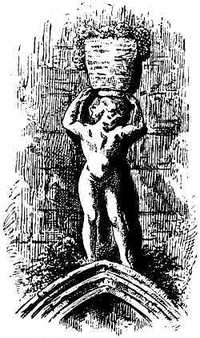
FIGURE ABOVE THE DOORWAY
OF AY CHURCH.
THE historic bourgade of Ay is within a short walk of the station
on the line of railway connecting Epernay with Reims. The road lies
across the light bridge spanning the Marne canal, the tall trees
fringing which hide for a time the clustering houses; still we catch
sight of the steeple of the antique church, relieved by a background of
vine-covered slopes, and of an eighteenth-century château rising above
a mass of foliage. Perched half-way up the slope, covered with ‘golden
plants,’ which rises in the rear of the
village, the château, with its
long façade of windows, commands the valley of the Marne for miles;
and from the stately-terraced walk, planted with ancient lime-trees,
geometrically clipped in the fashion of the last century, a splendid
view of the distant vineyards of Avize, Cramant, Epernay, and Chouilly
is obtained. The château formed one of a quartette of seignorial
residences which, at the commencement of the present century, belonged
to Balthazar Constance Dangé-Dorçay, whose ancestors had been lords of
Chouilly under the ancien régime. Dorçay had inherited from an aunt
the châteaux of Ay, Mareuil, Boursault, and Chouilly, together with a
large patrimony in land and money; but a mania for gambling brought him
to utter ruin, and he dispossessed himself of money, lands, and châteaux
in succession, and was reduced, in his old age, to earn a meagre
pittance as a violin-player at the Paris Opera-house. The old château of
Boursault, which still exists contiguous to the stately edifice raised
by Madame Clicquot on the summit of the hill, was risked and lost on
a single game at cards by this pertinacious gamester, whose pressing
pecuniary difficulties compelled him to sell the remaining châteaux one
by one. That of Ay was purchased by M. Froc de la Boulaye, and by him
bequeathed to his cousin the Count de Mareuil, whose son is to-day a
partner in the Champagne house of Ayala & Co.
The wine of Ay, from an early date, has found equal favour in the
eyes of poets and princes. Eustache Deschamps sang its praises in
the fourteenth century, and was echoed a hundred years later by the
anonymous author of the Eglogue sur le Retour de Bacchus.[456]
Sigismund of Bohemia, the betrayer of John Huss, on visiting France
in 1410, desired to pass through Ay in order to taste the wine at the
place of its production.[457] Leo X., Charles V., Francis III., and our
own Henry VIII., each had a house in or near Ay; ‘for amongst all the
great affairs of state which these princes had to unravel, supplying
themselves with this vintage was not the least of their cares.’[458]
Malicious tongues have asserted that they were somewhat suspicious
of the honesty of the wine-growers of the district, and, in order to
secure a genuine article, deemed it needful to have a commissioner or
agent resident on the spot, to superintend the making of the wine set
apart for their own consumption.[459] Tradition still points out, on
the right of the road from Dizy to Ay, a vineyard called Le Léon, as
the one whence the Pope derived his wine, though no traces remain of
the vendangeoir built by the Emperor in a coppice above Ay during the
siege of Epernay in 1544, and still standing in 1727.[460] The president
Bertin du Rocheret has celebrated the partiality of a couple of these
potentates for the wine of Ay in some triolets addressed to M. de
Senécé, and published in the Mercure in 1728:
‘Ay produces the best wine—
I call the world to witness this;
Though you may for Reims opine,
Ay produces the best wine.
It ranks the first, and the most fine
St. Evremond has said it is.
Ay produces the best wine—
I call the world to witness this.
Charles the Fifth was well aware
Of this—far better than his friend
Adrian in the papal chair;
Charles the Fifth was well aware
Of this, and so, to get his share,
Sought in France his days to end.
Charles the Fifth was well aware
Of this—far better than his friend.
Lest some fraud the juice should mix,
And his table thus disgrace,
He would his own vintage fix,
Lest some fraud the juice should mix.
Leo, fearing the like tricks,
Bought in Ay a pressing-place,
Lest some fraud the juice should mix,
And his table thus disgrace.’
[461]
The wine of Ay ranked at the court of Charles IX. as ‘a very pleasant
and noble wine;’[462] and even that bigoted uprooter of vines and heresy
had a vendangeoir in this stronghold of Protestantism,[463] which the
Catholics of the Champagne marched against, singing—
‘Parpaillot d’Ay,
T’es bien misérable,
T’as quitté ton Di
Pour servir le diable;
Tu n’auras ni chien, ni chat,
Pour te chanter Libera,
Et tu mourras mau-chrétien,
Toi qu’a maudit Saint Trézain.’
[464]

HENRI III.
(From a painting of the period).
In the reign of Henri III. the wines of Ay—‘claret and yellowish,
subtile, fine, and in taste very pleasing to the palate, ... yet
therewithal such wines as the Greeks call Oligophora, and as will not
admit the mixture of much water’[465]—were ‘eagerly sought after for
the use of kings, princes, and great lords.’[466] At a time when the
bulk of the vintage of Burgundy was denounced as rough, sour, and harsh;
and that of Bordeaux stigmatised as thick and black; and when good and
bad years were allowed to have a considerable influence upon the growths
of the Isle of France, the Orleannais, and Anjou, it was admitted that
‘the wines of Ay do, for the most part, hold the first and principal
place, ... and are, in all good and evil years, found better than any
others.’[467] The kings and princes of the day made the wines of Ay
their ordinary drink.[468] They flowed freely in the scandalous orgies
with which the French Heliogabalus and his mignons alternated their
pious flagellations and solemn processions, and mantled in the beakers
over which the chiefs of the League sat in dark and solemn conclave;
they were quaffed by the Béarnais to the bright eyes of the fair De
Saulve, and cheered the nightly vigils of Catherine de Medicis and Ruggieri;
they sharpened the biting wit of Chicot, and spurred the
plotting spirit of Francis of Anjou. Guise and Crillon, Joyeuse and
D’Epernon, Mayenne and D’Aubigné made common cause in recognising their
merits; Quelus and Maugiron may have quaffed a goblet before setting
forth on their fatal journey to the Barrière Saint Antoine; and a cup,
filled by the fair hands of the Duchess de Montpensier, may have fired
the brain and nerved the arm of the regicide Jacques Clément.
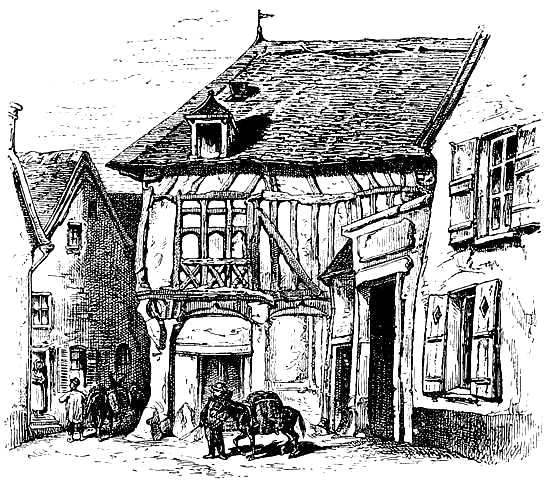
OLD HOUSE AT AY, KNOWN AS THE VENDANGEOIR OF HENRI QUATRE.
Henri Quatre boasted the merits of his vineyard at Prepaton, near
Vendôme, when he was only King of Navarre,[469] and delighted in the
wine of Arbois.[470] At Ay, within a few yards of the church, there
is a quaint old timber house traditionally known as the ‘vendangeoir
d’Henri Quatre,’ with obliterated carved escutcheons on the pillars of
its doorway. In this dilapidated yet interesting structure we have a
mute but certain testimony to the King’s appreciation of the wine of Ay,
if not a confirmation of the truth of the assertion that Henri was as
proud of his title of Seigneur d’Ay as of that of King of France.[471]
Giving an audience to the Spanish ambassador, and irritated at the long
list of titles appended by the punctilious hidalgo to his royal master’s
name, he exclaimed: ‘You will say to his Highness Philip, King of Spain
and the Indies, Castille, Leon, Arragon, Murcia, and the Balearic Isles,
that Henri, Sieur of Ay and of Gonesse ...,’ being the places producing
the best wine and the whitest bread in France.[472] When encamped at
Damery, during the siege of Epernay, this favourite beverage, and the
smiles of the fair Anne Dudey, Présidente du Puy, helped to relieve the
tedium of campaigning; for, as Bertin du Rocheret has sung,
‘Our great Henry, king benign,
With it cheered his “belle hôtesse.”
When at Damery he’d dine,
Our great Henry, king benign,
Chose it for his favourite wine;
And for bread, that of Gonesse
Our great Henry, king benign,
With it cheered his “belle hôtesse.”’
[473]
With the vintage of Ay in such universal esteem, it is scarcely to
be wondered at that Dominicus Baudius, professor of eloquence at
the University of Leyden and historiographer to the States of the
Netherlands, should, in the fulness of his admiration, have declared to
his friend the Président du Thou that instead of vin d’Ay it ought to
be called vinum Dei.[474]
Olivier de Serres, the French Tusser, praises this divine liquor.[475]
The anonymous author of the Hercule Guepin, a poem penned at the
commencement of the seventeenth century in honour of the wine of
Orleans, is forced to acknowledge the merits of that of Ay;[476] and
that indefatigable commentator, the Abbé de Marolles, in a note to his
edition of Martial, classes the growths of Ay, Avenay, and Epernay
amongst the best that France produced. ‘Vive le bon vin d’Ay!’ exclaims
Guy Patin enthusiastically; and that strange compound of the wit and
the philosopher, St. Evremond, has extolled its qualities in prose and
verse.[477] ‘If you ask me which wine of all others I prefer,’ he writes
from London to the Count d’Olonne, about 1671, ‘without yielding to
tastes introduced by people of sham daintiness, I will answer that good
wine of Ay is the most natural of all wines, the most healthy, the best
purified from all earth smack; of a most exquisite charm, through the
peach flavour which is peculiar to it; and is, in my opinion, the finest
of all flavours.’[478]
It is improbable that the wine of Ay of Francis I., or of Henri Quatre,
was mousseux, for had it been so history would have mentioned it. In
good years the still wine of Ay has a bouquet and perfume sufficient to
account for its ancient reputation. Neither was the wine St. Evremond
preferred sparkling, though his reference to the taste introduced by
sham gourmets points probably to the custom of drinking the wine
before its fermentation was completed, or else to the practice of icing
it. When once, however, the introduction of vin mousseux added a new
charm to the pleasures of the table, the poets who sang the praises
of the foaming nectar seem one and all to have celebrated it as the
‘pétillant Ay,’ and to have chosen, perhaps for euphonistic reasons,
that spot as its birthplace.[479] The material results were equally
satisfactory; for Arthur Young mentions that when, on July 8, 1787, he
visited ‘Ay, a village not far out on the road to Reims very famous for
its wines,’ he was provided with a letter for M. Lasnier, who had 60,000
bottles in his cellar, whilst M. Dorsé had from 30,000 to 40,000.[480]
A century ago the foregoing were no doubt considered large stocks, but
to-day the very smallest of the Ay firms would think itself poorly
provided if its cellars contained under quadruple this quantity. The
largest Champagne establishment at Ay is that of Messrs. Deutz &
Geldermann, whose extra dry ‘Gold Lack’ and ‘Cabinet’ Champagnes have
long been favourably known in England, through the energetic exertions
of their agents, Messrs. J. R. Parkington & Co., of Crutched Friars.
The Ay firm have their offices in a massive-looking corner-house at
the further extremity of the town, in the direction of the steep hills
sheltering it on the north. This forms their central establishment,
and here are spacious celliers for disgorging and finishing off the
wine, a large packing-hall, and rooms where bales of corks and other
accessories of the trade are stored, the operations of making the cuvées
and bottling being accomplished in an establishment some little distance
off.
On proceeding thither, we find an elegant château with a charming
terraced garden, lying at the very foot of the vine-clad slopes, and on
the opposite side of the road some large celliers where wine in wood is
stored, and where the cuvées of the firm, consisting usually of upwards
of 50,000 gallons each, are made in a vat of gigantic proportions,
furnished with a raised platform at one end for the accommodation of the
workman who agitates the customary paddles. When the wine is completely
blended it is drawn off into casks disposed for the purpose in the
cellar below, as shown in the accompanying engraving, and after being
fined it rests for about a month to clear itself. To each of
these casks of newly-blended wine a portion of old wine is added separately,
and at the moment of bottling the whole is newly amalgamated.
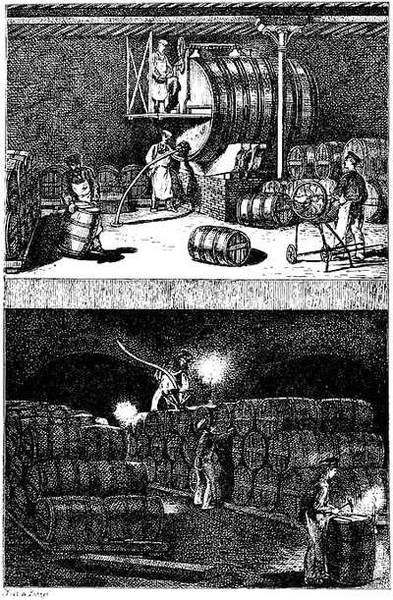
DRAWING OFF THE CUVÉE AT DEUTZ AND GELDERMANN’S, AY.
Adjoining M. Deutz’s château is the principal entrance to the extensive
cellars of the firm, to which, at our visit in 1877, considerable
additions were being made. In excavating these cellars in the chalk a
uniform system is pursued. The workmen commence by rounding off the
roof of the gallery, and then proceed to work gradually downwards,
extracting the chalk, whenever practicable, in blocks suitable for
building purposes, which, being worth from three to four shillings the
square yard, help to reduce the cost of the excavation. When any serious
flaws present themselves in the sides or roof of the galleries, they are
invariably made good with masonry.
This splendid range of cellars now comprises eight long and lofty
galleries no less than seventeen feet wide, and the same number of feet
in height, and of the aggregate length of 2200 yards. These spacious
vaults, which run parallel with each other, and communicate by means of
cross passages, underlie the street, the château, the garden, and the
vineyard slopes beyond, and possess the great advantage of being always
dry. They are capable, we were informed, of containing several million
bottles of Champagne, in addition to a large quantity of wine in cask.
Messrs. Deutz & Geldermann possess vineyards at Ay, and own a large
vendangeoir at Verzenay, where in good years they usually press 500
pièces of wine. They, moreover, make large purchases of grapes at Bouzy,
Cramant, Le Mesnil, Pierry, &c., and invariably have these pressed
under their own superintendence. Beyond large shipments to England,
where their wine is deservedly held in high estimation, Messrs. Deutz &
Geldermann transact a considerable business with other countries, and
more especially with Germany, in which country their brand has been
for years one of the most popular, while to-day it is the favourite at
numerous regimental messes and the principal hotels.
Within a hundred yards of the open space, surrounded by houses of
different epochs and considerable diversity of design, where the Ay
market-hall stands, and in one of those narrow winding streets common to
the town, an escutcheon, with a bunch of grapes for device, surmounting
a lofty gateway, attracts attention. Beyond, a trim courtyard, girt
round with orange-trees in bright green
boxes, and clipped in orthodox
fashion, affords access to the handsome residence and offices of M.
Duminy, well known in England and America as a shipper of high-class
Champagnes, and whose Parisian connection is extensive. On the
right-hand side of the courtyard is the packing-room; and through the
cellars, which have an entrance here, one can reach the celliers in an
adjoining street, where the cuvée is made and the bottling of the wine
accomplished.
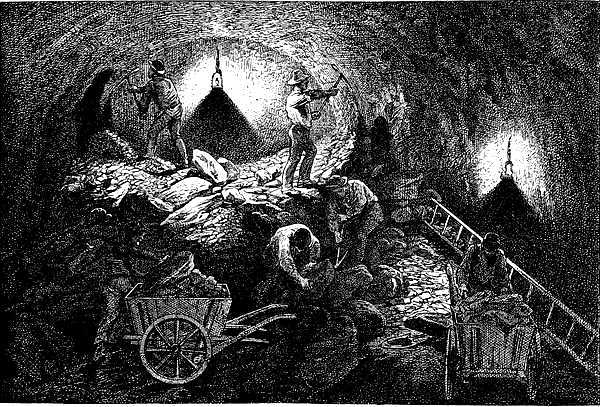
THE EXCAVATION OF DEUTZ AND GELDERMANN’S NEW CELLARS AT AY.
M. Duminy’s cellars are remarkably old, and consequently of somewhat
irregular construction, being at times rather low and narrow, as well as
on different levels. In addition, however, to these venerable vaults,
packed with wines of 1874 and ’78, M. Duminy has a new and extensive
establishment on the outskirts of Ay, as well as various subterranean
adjuncts in the town itself. This new establishment, which stands under
the vineclad slope, and merely a stone’s throw from the railway line to
Reims, consists of a large ornamental building looking on to a spacious
courtyard ordinarily alive with busy workpeople. In addition to the
pavilion already erected, it is intended to construct one of similar
design, and to connect the two with a monumental tower. The requisite
land has already been purchased, the architectural plans are prepared,
and the work is now in active progress.
Entering the courtyard of which we have spoken, we notice the new
offices of the firm on the left hand, and extending along the wall
beyond is a long zinc-roofed shed, crowded with baskets filled with
newly-purchased Champagne bottles. On the opposite side of the courtyard
is a building in which the operation of bottle-washing is carried on.
The pavilion in the rear of the courtyard is of somewhat monumental
proportions, and is ornamented with dressings of white stone and red
brick. Entering through the principal doorway, we find ourselves in a
vast cellier, where the packing operations are carried on, and where are
a couple of huge tuns in which the cuvées of the house are made. A stone
staircase conducts to an upper cellier, where several hundred casks of
vin brut are stored, and for the raising or lowering of which lifts
are provided at stated distances. In an apartment
above this second
cellier straw envelopes for bottles and other accessories employed in
the trade are kept.
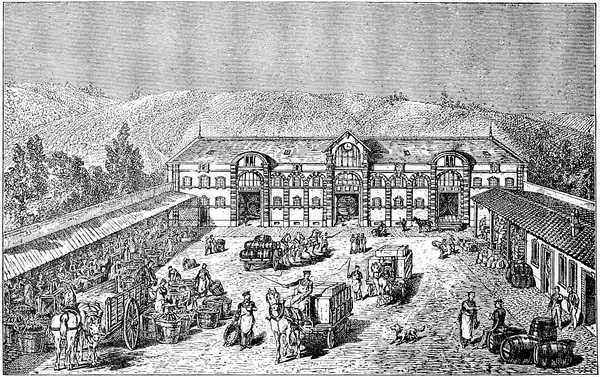
M. DUMINY’S NEW ESTABLISHMENT AT AY.
The cellars extend, not merely beneath this large building and the
courtyard in front, but run under the adjacent mountain-slope. They
comprise four galleries on the same level, vaulted and faced with brick
or stone, each gallery being about 500 feet in length and upwards of
twelve feet in width and height. Eight transverse passages connect
these galleries with each other, and numerous lifts communicate with
the cellier and the courtyard above. The galleries that run under
the vineyard slope are ventilated by shafts no less than 120 feet in
height. M. Duminy has already provided room here for a million bottles
of sparkling wine; and it is estimated that, when the establishment
is completed, two and a half millions of bottles can be stored here
in addition to the stock contained in the old cellars possessed by M.
Duminy in the town. During its two-thirds of a century of existence
the house has invariably confined itself to first-class wines, taking
particular pride in shipping fully-matured growths. Besides its own
large reserve of these, it holds considerable stocks long since disposed
of, and now merely awaiting the purchasers’ orders to be shipped.
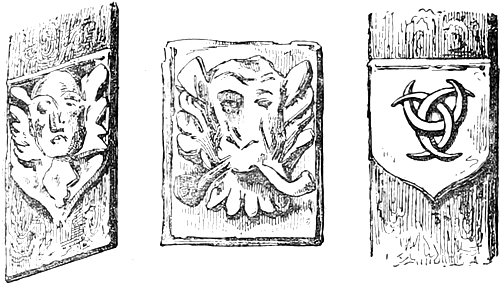
A few paces beyond M. Duminy’s we come upon an antiquated,
decrepit-looking timber house, with its ancient gable bulging over as
though the tough oak brackets on which it rests were at last grown
weary of supporting their unwieldy burden. Judging from the quaint
carved devices on the timbers at the lower portions of this building,
one may imagine it to have been the residence of an individual of some
importance in the days when the principal European potentates had their
commissioners installed at Ay to secure them the finest vintages. The
house evidently dates back to this or to an earlier epoch.
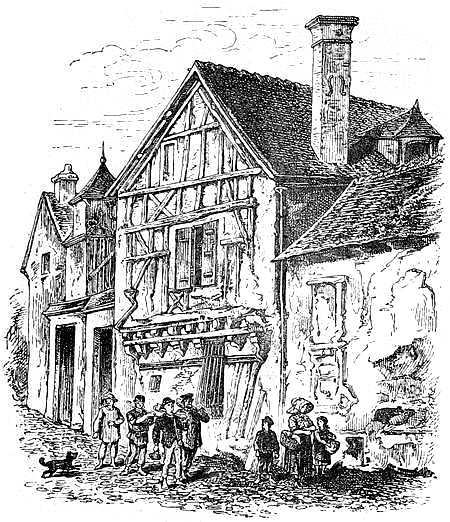
ANCIENT TIMBER HOUSE AT AY.
The cellars of Messrs. Pfungst Frères et Cie. are situated some little
distance from the vineyard owned by them at Ay. The firm lay themselves
out exclusively for the shipment of high-class Champagne, and the
excellent growths of this district necessarily form an important element
in their carefully-composed cuvées. A considerable portion of their
stock consists of reserves of old wine of grand years; and a variety of
samples of finely-matured Champagnes were submitted to our judgment.
All of these wines were of superior quality, combining delicacy and
fragrance with dryness, the latter being their especial feature. In
addition to their business with England, where the brand of the firm is
rapidly increasing in popularity among connoisseurs of matured wines,
Messrs. Pfungst Frères ship largely to India and the United States.
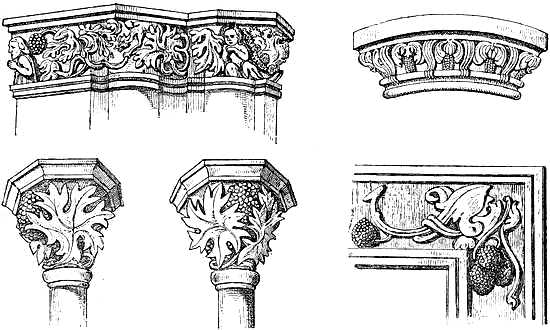
CAPITALS AND MOULDINGS IN AY CHURCH.
On the northern side of the town stands the handsome Gothic church
of Ay, dating from about the middle of the fifteenth century. The
existing building replaced the edifice erected some two hundred years
previously, and traces of which are still to be seen in the present
transept. The stone tower, which is in striking contrast with the other
portions of the structure, bears the date 1541 on its western face.
This tower and the interior of the church were greatly damaged by
the fire—traditionally ascribed to lightning—which occurred at the
close of the sixteenth century, and
the former had to be strengthened
by filling up the arched windows and by the addition of buttresses.
The bell, whose terrible tocsin used to warn good citizens that the
patrie was in danger in the days of the Revolution, when the church
was converted into a Temple of Reason, had previously swung in the abbey
of Hautvillers, and may have summoned the vintagers to labour as well
as the faithful to prayer. From 1867 to 1877 extensive interior repairs
and restorations, costing upwards of 6000 l., greatly transformed
the interior of the church. Care was, however, taken to preserve the
numerous bits of mediæval and Renaissance sculpture with which both
the interior and exterior of the edifice were studded. In many of
the ornamental mouldings, as well as the capitals of the columns,
grape-laden vine-branches had been freely introduced, as if to indicate
the honour in which the vine, the material source of all the prosperity
enjoyed by the little town, was held both by mediæval and later
architects; and these appear all to have been scrupulously restored.
One of the most characteristic decorations of this character is the
sculptured figure of a boy bearing a basket of grapes upon his head,
which surmounts the handsome Renaissance doorway.
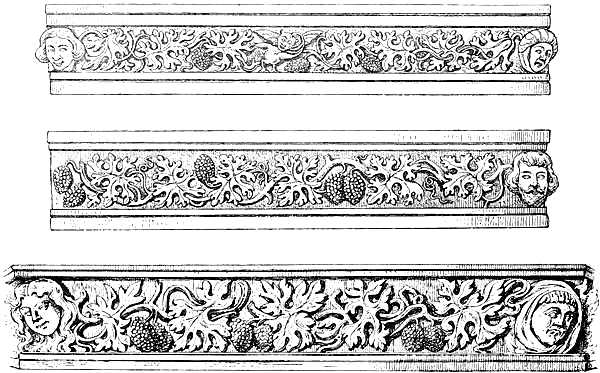
MOULDINGS FROM AY CHURCH.
Within half an hour’s walk of Ay, in an easterly direction, is the
village of Mareuil, a long straight street of straggling houses, bounded
by trees and garden-plots, with vine-clad hills rising abruptly behind
on the one side, and the Marne canal flowing placidly by on the other.
The archaic church, a mixture of the Romanesque and Early Gothic, stands
at the farther end of the village, and some little distance on this
side of it is a massive-looking eighteenth-century building, spacious
enough to accommodate a regiment of horse, but conventual rather than
barrack-like in aspect, from the paucity of windows looking on to the
road. A broad gateway leads into a spacious courtyard, to the left of
which stands a grand château; while on the right there rises an ornate
round tower of three stories, from the gallery on the summit of which
a fine view over the valley of the Marne is obtained. The buildings,
enclosing the court on three sides, comprise press-houses, celliers,
and packing-rooms, an antiquated sun-dial marking the hour on the blank
space above the vines that climb beside the entrance gateway. The more
ancient of these tenements formed the vendangeoir of the Dukes of
Orleans at the time they owned the château of Mareuil, purchased in
1830 by the Duke de Montebello, son of the famous Marshal Lannes, and
minister and ambassador of Louis Philippe and Napoleon III.
The acquisition of this property, to which were attached some
important vineyards, led, several years later, to the duke’s founding,
in conjunction with his brothers, the Marquis and General Count de
Montebello, a Champagne firm, whose brand speedily acquired a notable
popularity. To-day the business is carried on by their sons and heirs,
for all the original partners in the house have followed their valiant
father to the grave. Struck down by an Austrian cannon-ball in the
zenith of his fame, the career of Marshal Lannes, brief as it was,
furnishes one of the most brilliant pages in French military annals.
Joining the army of Italy as a volunteer in 1796, he was made a colonel
on the battle-field in the gorges of Millesimo, when Augereau’s bold
advance opened Piedmont to the French. He fought at Bassano and Lodi,
took part in the assault of Pavia and the siege of Mantua, and at
Arcola, when Napoleon dashed flag in hand upon the bridge, Lannes
was seriously wounded whilst shielding his general from danger. He
afterwards distinguished himself in Egypt, and led the van of the
French army across the Alps, displaying his accustomed bravery both at
Montebello and Marengo. At Austerlitz, where he commanded the right
wing of the army, he greatly contributed to the victory; and at Jena,
Friedland, and Eylau his valour was again conspicuous. Sent to Spain,
he defeated the Spaniards at Tudela, and took part in the operations
against Saragossa. Wounded at the battle of Essling, when the Archduke
Charles inflicted upon Napoleon I. the first serious repulse he had
met with on the field of battle, the valiant Lannes expired a few days
afterwards in the Emperor’s arms.
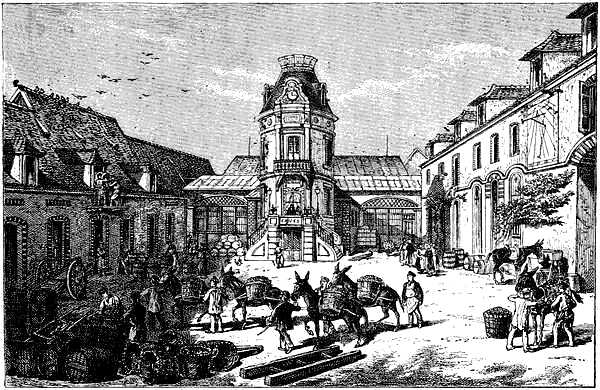
THE MONTEBELLO ESTABLISHMENT AT MAREUIL.
We were met at Mareuil, on the occasion of our visit, by Count Alfred
Ferdinand de Montebello, the present manager of the house, and conducted
by him over the establishment. In the press-house, to the left of the
courtyard, were two of the ponderous presses used in the Champagne, for,
like all other large firms, the house makes its own wine. Grapes grown
in the Mareuil vineyards arrive here in baskets slung over the backs of
mules, muzzled, so that while awaiting their loads they may
not devour
the fruit within reach. In a cellier adjoining the press-house stands a
large vat, capable of holding fifty pièces of wine, with a crane beside
it for hauling up the casks when the cuvée is made. Here the tirage
likewise takes place; and in the range of buildings roofed with glass,
in the rear of the tower, the bottled wine is labelled, capped with
foil, and packed in cases for transmission to Paris, England, and other
places abroad.
A double flight of steps, decorated with lamps and vases, leads to
the handsome offices of the firm, situated on the first-floor of the
tower; while above is an apartment with a panelled ceiling, gracefully
decorated with groups of Cupids engaged in the vintage and the various
operations which the famous wines of the Mountain and the River undergo
during their conversion into Champagne. On the ground-floor of the tower
a low doorway conducts to the spacious cellars, which, owing to the
proximity of the Marne, are all on the same level as well as constructed
in masonry. The older vaults, where the Marquis de Pange, a former owner
of the château, stored the wine which he used to sell to the Champagne
manufacturers, are somewhat low and tortuous compared with the broad and
lofty galleries of more recent date, which have been constructed as the
growing connection of the firm obliged them to increase their stocks.
Spite, however, of numerous additions, portions of their reserves have
to be stored in other cellars in Mareuil. Considerable stocks of each of
the four qualities of wine supplied by the firm are being got ready for
disgorgement, including Cartes Noires and Bleues, with the refined Carte
Blanche and the delicate Crêmant, which challenge comparison with brands
of the highest repute.
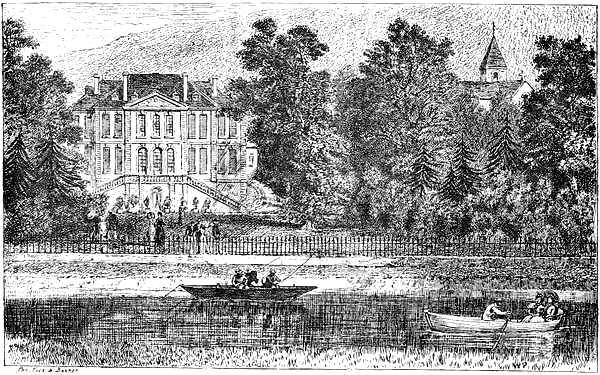
CHÂTEAU OF MAREUIL, BELONGING TO THE DUKE OF MONTEBELLO.
In the adjacent château, the gardens of which slope down to the Marne
canal, there are various interesting portraits, with one or two relics
of the distinguished founder of the Montebello family, notably Marshal
Lannes’s gold-embroidered velvet saddle trappings, his portrait and
that of Marshal Gerard, as well as one of Napoleon I., by David, with
a handsome clock and candelabra of Egyptian design, a bust of Augustus
Cæsar, and a portrait of the Regent d’Orleans.
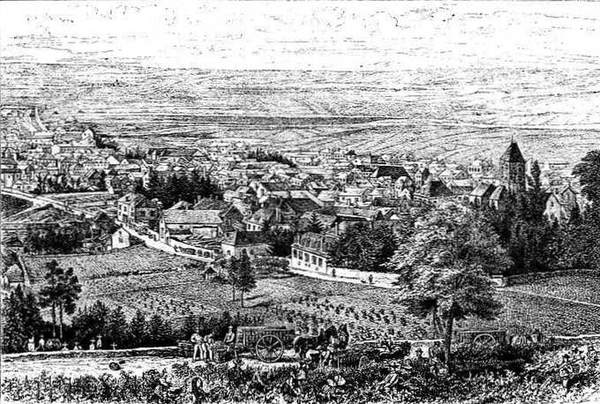
GENERAL VIEW OF AVIZE.
Avize the centre of the white grape district—Its situation
and aspect—The establishment of Giesler & Co.—The tirage and
the cuvée—Vin Brut in racks and on tables—The packing-hall, the
extensive cellars, and the disgorging cellier—Bottle stores and
bottle-washing machines—Messrs. Giesler’s wine-presses at Avize
and vendangeoir at Bouzy—Their vineyards and their purchases
of grapes—Reputation of the Giesler brand—The establishment
of M. Charles de Cazanove—A tame young boar—Boar-hunting
in the Champagne—M. de Cazanove’s commodious cellars and
carefully-selected wines—Vineyards owned by him and his
family—Reputation of his wines in Paris and their growing
popularity in England—Interesting view of the Avize and Cramant
vineyards from M. de Cazanove’s terraced garden—The vintaging of
the white grapes in the Champagne—Roper Frères’ establishment
at Rilly-la-Montagne—Their cellars penetrated by roots of
trees—Some samples of fine old Champagnes—The principal Châlons
establishments—Poem on Champagne by M. Amaury de Cazanove.
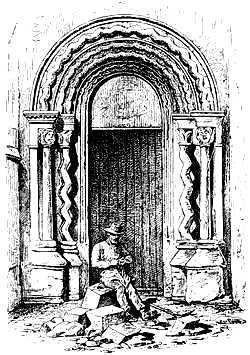
DOORWAY OF AVIZE CHURCH.
AVIZE, situated in the heart of the Champagne white grape district,
may be reached from Epernay by road through Pierry and Cramant, or
by the Châlons Railway to Oiry Junction, between which station and
Romilly there runs a local line, jocularly termed the chemin de fer
de famille, from the general disregard displayed by the officials for
anything approaching to punctuality. Avize can scarcely be styled a
town, and yet its growing proportions are beyond those of an ordinary
village. It lies pleasantly nestled among the vines, sheltered by bold
ridges on the north-west, with the monotonous plains of La Champagne
pouilleuse, unsuited to the cultivation of the vine, stretching away
eastward in the direction of Châlons. Avize cannot pretend to the same
antiquity as its neighbour Vertus, and lacks the many picturesque
vestiges of which the latter can boast. Its church dates back only to
the fifteenth century, although the principal doorway in the Romanesque
style evidently belongs to a much earlier epoch. There is a general
air of trim prosperity about the place, and the villagers have that
well-to-do appearance common to the inhabitants of the French wine
districts. Only at vintage-time, however, are there any particular
outdoor signs of activity, although half a score of Champagne firms
have their establishments here, giving employment to the bulk of the
population, and sending forth their two or three million bottles of the
sparkling wine of the Marne annually.
Proceeding along the straight level road leading from the station to the
village, we encounter on our right hand the premises of Messrs. Giesler
& Co., the reputation of whose brand is universal. When M. Giesler
quitted the firm of P. A. Mumm, Giesler, & Co., at Reims, in 1838, he
removed to Avize, and founded the present extensive establishment.
Entering through a large open gateway, we find ourselves within a
spacious courtyard, with a handsome dwelling-house in the rear, and
all the signs of a Champagne business of magnitude apparent. A spiral
staircase conducts to the counting-house on the first story of a range
of buildings on the left hand, the ground floor of which is divided
into celliers. Passing through a door by the side of this staircase, we
enter a large hall where the operation of bottling the wine is going on.
Four tuns, each holding five ordinary pièces of wine, and raised upon
large blocks of wood, are standing here, and communicating with them
are bottling syphons of the type commonly employed in the Champagne.
Messrs. Giesler do not usually consign the newly-bottled wine at once to
the cellars, but retain it above-ground for about a fortnight, in order
that it may develop its effervescent qualities more perfectly. We find
many thousands of these bottles stacked horizontally in the adjoining
celliers, in one of which stands the
great cuvée tun, wherein some
fifty hogsheads of the finest Champagne growths are blended together
at one time, two hundred hogsheads being thus mingled daily while the
cuvées are in progress. The casks of wine having been hoisted from the
cellars to the first floor by a crane, and run on to a trough, their
bungs are removed, and the wine flows through an aperture in the floor
into the huge tun beneath, its amalgamation being accomplished by the
customary fan-shaped appliances, set in motion by the turning of a
wheel. In an adjacent room is the machine used for mixing the liqueur
which Messrs. Giesler add so sparingly to their light and fragrant wines.
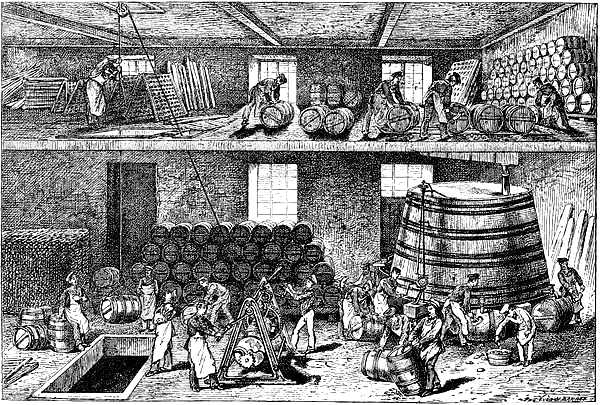
MAKING THE CUVÉE AT MESSRS. GIESLER’S, AT AVIZE.
There are a couple of floors above these celliers, the uppermost
of which is used as a general store, while in the one beneath many
thousands of bottles of vin brut repose sur pointe, either in racks
or on tables, as at the Clicquot-Werlé establishment. This latter
system requires ample space, for as the workman who shakes the bottles
is only able to use one hand, the operation of dislodging the sediment
necessarily occupies a much longer time than is requisite when the
bottles rest in racks.
The buildings on the opposite side of the courtyard comprise a
large packing-hall, celliers where the wine is finished off, and
rooms where corks and suchlike things are stored. Here, too, is the
entrance to the cellars, of which there are three tiers, all lofty
and well-ventilated galleries, very regular in their construction,
and faced with either stone or brick. In these extensive vaults are
casks of fine reserved wines for blending with youthful vintages,
and bottles of vin brut, built up in solid stacks, that may be
reckoned by their hundreds of thousands. At Messrs. Giesler’s the
disgorging of the wine is accomplished in a small cellier partially
underground, and the temperature of which is very cool and equable. The
dégorgeurs, isolated from the rest of the workpeople, are carrying
on their operations here by candlelight. So soon as the sediment is
removed, the bottles are raised in baskets to the cellier above, where
the liqueuring, recorking, stringing, and wiring are successively
accomplished. By pursuing this plan the loss sustained by the
disgorgement is believed to be reduced to a minimum.
Extensive as these premises are, they are still insufficient for the
requirements of the firm; and across the road is a spacious building
where new bottles are stored, and the washing of the bottles in
preparation for the tirage takes place. By the aid of the machinery
provided sixteen women, assisted by a couple of men, commonly wash some
fifteen or sixteen thousand bottles in the course of a day. Here, too,
stands one of the two large presses with which, at the epoch of the
vintage, a hundred pièces of wine are pressed every four-and-twenty
hours. The remaining press is installed in a cellier at the farther end
of the garden on the other side of the road. Messrs. Giesler possess
additional presses at their vendangeoir at Bouzy, and during the vintage
have the command of presses at Ay, Verzenay, Vertus, Le Mesnil, &c.; it
being a rule of theirs always to press the grapes within a few hours
after they are gathered, to obviate their becoming bruised by their own
weight and imparting a dark colour to the wine, a contingency difficult
to guard against in seasons when the fruit is over-ripe. The firm own
vineyards at Avize, and have agreements with vine-proprietors at Ay,
Bouzy, Verzenay, and elsewhere, to purchase their crops regularly every
year. Messrs. Giesler’s brand has secured its existing high repute
solely through the fine quality of the wines shipped by the house—wines
which are known and appreciated by all real connoisseurs of Champagne.
From Messrs. Giesler’s it is merely a short walk to the establishment
of M. Charles de Cazanove, situated in the principal street of Avize.
On entering the court we encountered a tame young boar engaged in
the lively pursuit of chasing some terrified hens; while a trio
of boar-hounds, basking on the sunny flagstones, contemplated his
proceedings with lazy indifference. Boars abound in the woods
hereabouts, and hunting them is a favourite pastime with the residents;
and the young boar we had noticed proved to be one of the recent
captures of the sons of M. de Cazanove, who are among the warmest
partisans of the exciting sport.
The house of M. Charles de Cazanove was established in 1843, by its
present proprietor, on the foundation of a business which had been in
existence since 1811. Compared with the monumental grandeur of some
of the great Reims and Epernay establishments, the premises present
a simple and modest aspect; nevertheless, they are capacious and
commodious, besides which, the growing business
of the house has led
to the acquisition of additional cellarage in other parts of Avize.
More important than all, however, is the quality of the wine with which
these cellars are stocked; and, following the rule observed by Champagne
firms of the highest repute, it has been a leading principle with M. de
Cazanove always to rely upon the choicer growths—those light, delicate,
and fragrant wines of the Marne which throw out the true aroma of
the flower of the vine. M. de Cazanove, who is distinguished for his
knowledge of viticulture, occupies an influential position at Avize,
being Vice-President of the Horticultural Society of the Marne, and a
member of the committee charged with guarding the Champagne vineyards
against the invasion of the phylloxera. His own vines include only
those fine varieties to which the crus of the Marne owe their great
renown. He possesses an excellent vineyard at Grauves, near Avize; and
his mother-in-law, Madame Poultier of Pierry, is one of the principal
vine-growers of the district.
M. de Cazanove’s wines are much appreciated in Paris, where his business
is very extensive. His shipments to England are also considerable; but
from the circumstance of some of his principal customers importing the
wine under special brands of their own, the brand of the house is not so
widely known as we should have anticipated.
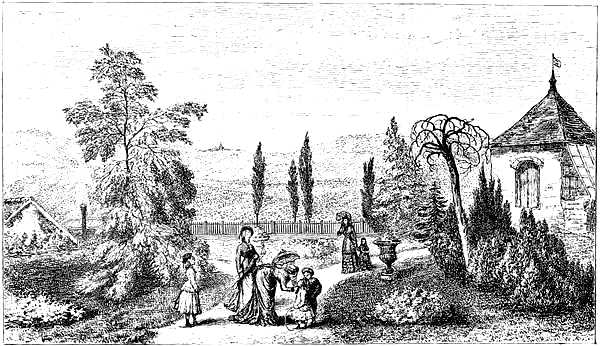
VINEYARDS OF AVIZE AND CRAMANT, FROM THE GARDEN OF M. C.
DE CAZANOVE.
From M. de Cazanove’s terraced garden in the rear of his establishment a
fine view is obtained of one of the most famous viticultural districts
of the Champagne, yielding wines of remarkable delicacy and exquisite
bouquet. On the left hand rises up the mountain of Avize, its summit
fringed with dense woods, where in winter the wild-boar has his lair.
In front stretch the long vine-clad slopes of Cramant, with orchards
at their base, and the housetops of the village and the spire of the
quaint old church just peeping over the brow of the hill. To the right
towers the bold forest-crowned height of Saran, with M. Moët’s château
perched half-way up its north-eastern slope; and fading away in the hazy
distance are the monotonous plains of the Champagne.
We have already explained that the wines of Avize and Cramant rank as
premiers crus of the white grape district, and that every Champagne
manufacturer of repute mingles one or the other in his cuvée. The white
grapes are usually gathered a fortnight or three weeks later than the black
varieties, but in other respects the vintaging of them is
the same. The grapes undergo the customary minute examination by the
éplucheuses, and all unripe, damaged, and rotten berries being thrown
aside, the fruit is conveyed with due care to the press-houses in the
large baskets known as paniers mannequins. The pressing takes place
under exactly the same conditions as the pressing of the black grapes;
the must, too, is drawn off into hogsheads to ferment, and by the end
of the year, when the active fermentation has terminated, the wine is
usually clear and limpid.
At Rilly-la-Montagne, on the line of railway between Reims and Epernay,
Roper Frères & Cie., late of Epernay, have their establishment. Starting
from the latter place, we pass Ay and Avenay, and then the little
village of Germaine in the midst of the forest, and nigh the summit of
the mountain of Reims, with its ‘Rendezvous des Chasseurs’ in immediate
proximity to the station. Finally we arrive at Rilly, which, spite of
its isolated situation, has about it that aspect of prosperity common
to the more favourable wine districts of France. This is scarcely
surprising, when the quality of its wines is taken into consideration.
The still red wine of Rilly has long enjoyed a high local reputation,
and to-day the Rilly growths are much sought after for conversion
into Champagne. White wine of 1874, from black grapes, fetched, we
are informed, as much as 600 to 700 francs the pièce; while the finer
qualities from white grapes realised from 300 to 400 francs. Messrs.
Roper Frères & Cie. are the owners of some productive vineyards situated
on the high-road to Chigny and Ludes.
The establishment of Roper Frères is adjacent to a handsome modern house
standing back from the road in a large and pleasant garden, bounded by
vineyards on two of its sides. In the celliers all the conveniences
pertaining to a modern Champagne establishment are to be found, while
extending beneath the garden are the extensive cellars of the firm,
comprising two stories of long and spacious galleries excavated in the
chalk, their walls and roofs being supported whenever necessary by
masonry. A curious feature about these cellars is that the roots of the
larger trees in the garden above have penetrated the roof of the upper
story, and hang pendent overhead like innumerable stalactites. Here,
after the comparatively new wine of 1874 had been shown to us—including
samples of the vin brut or natural Champagne of which the firm make a
specialty at a moderate price—some choice old Champagnes were brought
forth, including the fine vintages of 1865, 1857, and 1846. The latter
wine had of course preserved very little of its effervescence, still its
flavour was exceedingly fine, being soft and delicate to a degree. At
the Vienna Exhibition of 1873, and the London Exhibition of 1874, the
collection of Champagnes exhibited by Roper Frères met with favourable
recognition from the international juries.
Our tour through the Champagne vineyards and wine-cellars here comes
to an end. It is true there are important establishments at Châlons,
notably those of the Perriers, Freminet et Fils, Dagonet et Fils, and
Jacquard Frères. As, however, any description of these would be little
else than a recapitulation of something we have already said, we content
ourselves with merely notifying their existence, and close the present
chapter with a poem on Champagne, from the pen of M. Amaury de Cazanove
of Avize:
ODE AU CHAMPAGNE.
Pour ta beauté, pour ta gloire, ô Patrie,
Nous t’adorons … surtout pour tes malheurs!
Oublions-les…. Avec idolâtrie,
Chantons ton ciel, tes femmes et tes fleurs.
France, nous chanterons tes femmes et tes roses;
France, nous chanterons tes vins, autre trésor;
Qu’on voie, ouvrant tes lèvres longtemps closes,
Un fier sourire étinceler encor!
Nectar qu’aux dieux jadis versait Hébé la blonde!
O noir Falerne! ô Massique vermeil!
Pauvres vins du vieux temps oubliés à la ronde …
Car le Champagne a fait le tour du monde
En conquérant, à nos drapeaux pareil;
Il rit, léger, sous la mousse qui tremble,
Et semble
Dans le cristal un rayon de soleil.
‘Je suis le sang des coteaux de Bourgogne!’
Dit celui-là baron à parchemin,
Grand assommeur qui vous met sans vergogne
Son casque au front, si lourd le lendemain….
‘C’est moi l’exquis Bordeaux, je sens la violette;
Mes rubis, le gourmet goutte à goutte les boit,
Et mon parfum délicat se complète
Par ta saveur, aile d’un perdreau froid.’
Messeigneurs les Grand Vins, s’il faut qu’on vous réponde;
Bordeaux, Bourgogne, écoutez un conseil:
Vantez un peu moins fort vos vertus à la ronde….
Car le Champagne a fait le tour du monde
En conquérant, à nos drapeaux pareil;
Il rit, léger, sous la mousse qui tremble,
Et semble
Dans le cristal un rayon de soleil.
Car le Champagne est le vrai vin de France;
C’est notre cœur pétillant dans nos yeux,
Se relevant plus haut sous la souffrance;
C’est dans sa fleur l’esprit de nos aïeux;
Le souffle de bravoure aimable, qui tressaille
Sous le vent de l’épée aux plumes des cimiers;
C’est le galant défi de la bataille:
‘A vous, Messieurs les Anglais, les premiers!’
Certain buveur de bière en vain ricane et gronde;
Aux cauchemars de ses nuits sans sommeil
Dieu livre ses remords! … Nous chantons à la ronde
Que le Champagne a fait le tour du monde
En conquérant, à nos drapeaux pareil;
Il rit, léger, sous la mousse qui tremble,
Et semble
Dans le cristal un rayon de soleil.
[481]
Avize, 8 Juillet 1877.
THE BOAR TAKES SOIL.
The Champagne forests the resort of the wild-boar—Departure
of a hunting-party in the early morning to a boar-hunt—Rousing
the boar from his lair—Commencement of the attack—Chasing the
boar—His course is checked by a bullet—The dogs rush on in full
pursuit—The boar turns and stands at bay—A skilful marksman
advances and gives him the coup de grâce—Hunting the wild-boar
on horseback in the Champagne—An exciting day’s sport with M.
d’Honnincton’s boar-hounds—The ‘sonnerie du sanglier’ and the
‘vue’—The horns sound in chorus ‘The boar has taken soil’—The
boar leaves the stream, and a spirited chase ensues—Brought to
bay, he seeks the water again—Deathly struggle between the boar
and a full pack of hounds—The fatal shot is at length fired,
and the ‘hallali’ is sounded—As many as fifteen wild-boars
sometimes killed at a single meet—The vagaries of some tame
young boars—Hounds of all kinds used for hunting the wild-boar
in the Champagne—Damage done by boars to the vineyards and the
crops—Varieties of game common to the Champagne.
THE Champagne does not merely comprise vineyards producing some of the
finest wine in the world. In parts it is covered by vast and luxuriant
forests, where the pleasures of the chase are not lacking to the
Champenois, who as a rule are eager in the pursuit of sport. In winter
these forests are the resort of wild-boar, who haunt by preference the
woods around Reims, journeying thither, it is said, by night from the
famous forest of the Ardennes—the scene of Rosalind’s wanderings and
Touchstone’s eccentricities, as set forth in As You Like It; and whose
gloomy depths and tangled glens shelter not merely boars, but wolves as
well.
In the villages of the Champagne on a cold winter’s morning, with
it snowing or blowing, you
are frequently awake before daylight by
the noise of barking dogs, of horns sounding the departure, and of
some vehicle rolling heavily over the stones. A party of sportsmen
is proceeding to the meet. Jokes and laughter enliven the journey,
but every one becomes silent and serious upon reaching the place of
rendezvous, for the object of the gathering is the excitable and
perilous boar-hunt.
In the Champagne it is no longer the fashion, as in Burgundy,
‘With javelin’s point a churlish swine to gore.’
The more certain rifle is the weapon usually employed, and these arms
are now examined and carefully loaded. Meanwhile the reports of the
keepers are attentively listened to. They have beaten the wood, each
on his own side, accompanied by a bloodhound, and they inform the
hunters what they have seen or found. Great experience is necessary to
accomplish the rembuchement, as this tour of inspection is termed,
in a satisfactory manner; and with some it is a veritable science.
Eventually, after a discussion among the more experienced ones, it is
decided to follow the scent which appears to be freshest; whereupon
the dogs are brought up coupled, and let loose upon the trail. The
attack now begins. There are always two or three piqueurs who follow
the dogs, exciting them with their voices, and making all the noise
possible, as long as the game has not been roused from its lair.
Meanwhile the marksmen place themselves at the posts indicated by the
president of the hunt, the most experienced being assigned the best
spots, whilst those whose habit it is never to harm the boar go of their
own accord ‘up wind’—that is, to bad places—thus causing the animal to
‘refuse,’ and to pass within range of guns that rarely let him escape
unhurt.
At first the dogs raise a somewhat distant cry—perhaps one has followed
a wrong scent—and some of the huntsmen remark in a low tone to
themselves that after all they would have done better to have stopped at
home, and turned out of their beds at a less unseasonable hour; then,
at least, they would not be standing with frozen feet in the snow, and
with colds in the head in perspective. But suddenly there comes a cry of
‘Vlô!’—the Champenois expression for designating the boar—‘Attention!’
‘Look out!’ Then the report of a couple of shots, and finally the
howling of the pack of dogs. Snow and cold are at once forgotten. Each
man grasps his rifle and waits for the boar to pass by. The branches
of the underwood creak and break; there is a noise as of a squadron of
cavalry dashing into a wood; then, all of a sudden, a black mass is
caught sight of approaching. But the boar is a cunning fellow; he has
seen the sportsman who is in wait for him, or has scented his presence,
and will pass out of range. Now that luck has betrayed the latter, he
has to content himself with the rôle of a spectator.
So far as one can judge by the barking of the dogs, the boar is
directing his course to where an experienced marksman is posted—one
who is not about to fire his first difficult shot. Observe him: he is
perfectly motionless, for the least movement might betray his presence;
his eyes alone dart right and left in quest of the foe. Here comes the
boar, passing like a cannon-ball along the line, and there is scarcely
time to catch a glimpse of him between the reports of two shots, which
succeed each other with the rapidity of lightning. The boar is by no
means an animal easy to knock over. The forest roads are never more
than ten to fifteen paces broad; and as there are marksmen both on the
right and left, it is necessary to reserve your fire until the animal
has crossed the road and is plunging again into cover. In addition to
this, there are only two spots where a mortal wound can be inflicted
upon the boar—either behind the shoulder or in the neck. Hit elsewhere,
he will lose but little blood, and the only effect of the wound will be
to render him more savage. He will rip up a dog or two, perhaps, and
then rush off far away, without showing any further sign of injury.
Boars carrying several bullets in their bodies, but rejoicing in capital
health, as well as others covered with cicatrices, are frequently
killed. Firing too high is a common fault with many marksmen, arising
from the fact that in winter the boar’s bristles are very long and
thick, and that each one stands on end at the sight of an enemy, thus
making the animal look much higher on his legs than he really is.
But to return to our description of the hunt. The boar has just been
hit by one of those rare marksmen, every bullet of whose rifle goes
straight to its intended billet. Although struck, the animal continues
his onward course, a couple of drops of blood which have tinged the
snow with red showing unmistakably that he has not been missed. The
dogs who follow him closely hesitate for a minute as they reach the
roadway, but the leader has espied the spot where the boar was wounded;
he sniffs the blood, and darts off again, followed by the pack, who
have full confidence in his discernment. The dogs are torn and wounded
by the thorns and briers which continually obstruct their path, for the
boar rushes through the thickest and most inaccessible cover, in hopes
of retarding the progress of his pursuers; but the hounds divine that
their prey is near, and the most tired among them recover all their
energy. Suddenly a great silence succeeds the furious yelping and baying
of a short time ago. The boar is about to turn at bay. His strength is
becoming exhausted, and feeling that he is doomed to die, he has faced
round, with his back towards some inaccessible thicket, so as not to be
taken in the rear, and confronts his pursuers, determined to die bravely
and to sell his life dearly. It is no longer the baying of a pack in
full cry that now rends the air, but isolated yelpings and plaintive
howlings, such as watch-dogs give vent to when strangers are wandering
round the house they protect.
Then comes the crowning feat of the hunt, and the most difficult to
accomplish. The most intrepid marksman advances towards the dogs, his
hunting-knife and rifle alike ready, the former to be made use of should
the latter not suffice. He has need of great prudence and great coolness
to accomplish his task, for directly the boar hears his approach he will
unhesitatingly dash upon him. He must await the animal’s onslaught with
a firm heart and steady hand, and only fire when sure of his aim. Often,
however, the hunter is bothered by the dogs, which surround the boar on
all sides, hang on to him from behind, and excite his fury. The position
may become critical, and many a sportsman who has counted too much upon
his nerve has found himself compelled to climb a tree, whence he has
been able to ‘bowl over’ the enemy, without incurring any danger. It is
needless to add that when discovered in this position he has felt very
much ashamed at having resorted to such an expedient.
In the Champagne the wild boar is almost invariably pursued on foot, the
minute subdivision of the land into different holdings and consequent
limitation of the right of sport rendering it very difficult to follow
the animal on horseback. M. Roederer, it is true, started a pack
of hounds in the Forest of Reims; but at his death there were not
sufficient lovers of the chase to keep up this style of sport, and
every one fell into the habit of knocking over a wild-boar in the same
prosaic fashion as a simple rabbit. However, some few years back, a
rich landowner from Brittany, the Vicomte d’Honnincton, having had an
opportunity of sport in the Champagne, and having seen that large game
abounded, installed himself near the fine Forêt de la Traconne, in the
neighbourhood of Sézanne, and resumed the chase of the wild-boar on
horseback. The great success he met with induced him to take up his
quarters in this district, and his pack, composed of a cross between the
English staghound and the Artois hound, has become justly famous.
In the month of December 1878, an exciting day’s sport was had with M.
d’Honnincton’s boar-hounds. The presence of herds of wild-boar having
been noted in the neighbouring woods between Epernay and Montmort, M.
d’Honnincton was soon to the fore with his pack, and all the sportsmen
for miles around were summoned. The meet was at the Château de la
Charmoye, a regular hunters’ rendezvous, belonging to the Vicomte de
Bouthylliers, and situate in the heart of the woodland. During breakfast
one of the huntsmen came to announce that a huge solitaire had passed
the night at a short distance from the château. Everything, therefore,
promised well for sport. The guests mounted in haste, each one equipped
in true French style, with an immense hunting-horn round his body and
a light gun or a pistol attached to the saddle. The lively strains of
the horn had begun to sound on every side, and the hounds were being
uncoupled, when the boar, disturbed by all this noise, majestically
traversed the main avenue of the château, and pushed on towards a group
of ladies assembled to witness the departure of the sportsmen. A finer
start would have been impossible.
The hounds dashed towards their prey
as soon as they caught sight of him at full cry, and the sonnerie du
sanglier and the vue were blazed forth by the horns on every side.
The hunt commenced. The greatest difficulty and the object of all was to
hinder the boar from plunging into the thick of the forest, where, in
the dense cover, he would have gained a considerable advance upon the
dogs. Thanks to the activity of the huntsmen, who cut off his retreat on
this side, it was possible to drive him towards the plain of Montmort;
and from this moment the sport was as fine as can be imagined, it being
easy to note the minor details of the hunt even from a distance. The
boar made his way with difficulty over the ground saturated by rain, and
the eagerness of the hounds increased in proportion as they gained upon
him.
A broadish rivulet with very steep banks was reached. The boar tried to
clear it at a bound, but fell into mid-stream. The sportsmen all came up
at this moment, and with their horns began to sound in chorus ‘The boar
has taken soil;’ the hounds plunged in and began to swim after the boar,
and the scene became a truly exciting one. At length the boar succeeded
in quitting the stream; but frightened by the horsemen whom he saw on
the opposite shore, he recrossed it a second and then a third time,
amidst the hounds, who were assailing him on every side, and each time
met with the same difficulty in ascending the bank. It may be readily
understood that he was getting exhausted by his efforts, and began
to appear done up. He recovered his vigour, however, and soon gained
ground on the hounds. He had still two or three miles to cover in order
to regain the forest, and it was necessary at all costs to prevent him
from accomplishing this. Then ensued a wild hunt, a mad steeplechase
over fields, hedges, brooks, ditches; the horses in several places sank
over their hocks, and were covered with foam, but whip and spur restored
energy to the least ardent. The boar was gasping, but still kept on,
and the steam from his body, which quite surrounded him and caused him
to resemble a four-legged demon, could be plainly perceived from a
distance. In this style the hunt swept through the little village of
Lucy, with all the dogs of the place howling, the women and children
shrieking, and the men arming themselves with spades and pitchforks.
But the boar not losing courage on this account, and despising these
primitive weapons, did not stop, and drew nearer and nearer to the wood.
The hounds were getting tired, and the most experienced sportsmen began
to despair somewhat of a successful day, when suddenly the beast plunged
into a pond situate close to the forest, halted, rolled several times in
the mud, and rose completely covered in steam and mire. It is all over:
the animal is at bay, and cannot go any further.
This is the interesting moment. The boar pulls himself together, feeling
that he is to die, and, up to his belly in water, he bravely awaits the
pack. With his eye glowing with rage, his bristles erect, he utters
grunts of defiance. The fifty dogs throw themselves on to him without
a moment’s hesitation; but four or five are sent rolling into the
middle of the water, never more to rise. The struggle which follows is
terrible; the boar’s tusks tell at every blow, and the water becomes
literally red with blood. At length the foremost sportsmen come up, and
it is high time they do. Seven dogs are already lying on their backs,
with their legs in the air, and almost all bear marks of the boar’s
terrible tusks. The first who is ready alights from his steed, and
boldly advances into the water; for it would be imprudent to fire at the
boar from the edge of the pond, and thereby run the risk of wounding
him, and rendering him still more furious, or even of killing one of the
dogs, by whom he is surrounded. An interval of solemn silence ensues;
the horns only wait for the shot to be fired to sound the hallali. The
dogs make way in order to let the sportsman advance; the boar draws back
a little, and then making a bound recovers all his strength for a rush
upon his enemy. Woe to the man who misses him! the boar will give him no
quarter. But the sportsman waits for him very quietly, and when he is
only two paces from him plants a bullet between his eyes, which lays him
dead. The notes of the hallali awake the echoes: never had a hunt been
crowned by finer results. The setting sun lighted up the scene, which
transpired just below the Château de Montmort, scarcely half a mile off,
and the ladies assembled on the terrace of the old château of Sully
waved their handkerchiefs in congratulation to the fortunate sportsmen.
The foregoing narrative furnishes a good idea of the ordinary method of
hunting the wild-boar
on horseback in the Champagne, a method which,
though offering at times varying details, arising from the size of the
animal pursued and the number and strength of the hounds engaged in the
chase, presents, on the whole, a general resemblance to the description
just given.
Some years back boars were far from numerous in the Champagne, hiding
themselves, moreover, in inaccessible positions far away in the woods,
so that it was necessary to cover a larger extent of ground in order to
sight a recent trail. Latterly, however, these animals have multiplied
considerably, each sow having seven or eight young ones at a litter, and
littering three times a year. In the forests around Reims and Epernay
twelve, and even fifteen, boars have been killed during a single hunt.
It not unfrequently happens that a herd of fifty, and even a hundred,
boars are encountered together, when a veritable massacre often ensues,
if the hunting-party only comprises a sufficient number of guns.
The victims include at times some sows with young grice, which the
hunters frequently try to bring up. One of these little animals, who had
been named ‘Snow’ from having been captured one day when the snow was on
the ground, followed his owner about everywhere like the most faithful
poodle. His master would often take him into the wood and simulate a
hunt with his dogs. Snow, however, possessed vices as well as virtues,
and one of his habits was an extremely disagreeable one. Like the rest
of his species, he was very fond of rolling himself in the mire, and, on
returning home, would proceed to clean himself by rubbing unconcernedly
against the dresses of the ladies of the house. One Sunday his master
had taken him out for a walk, and as they returned home they passed
the church, which the ladies of the locality, arrayed in their richest
attire, were just leaving. During his walk Snow had taken two or three
mud-baths, and, on meeting the fair devotees of Avize, he thought the
occasion a propitious one for cleansing himself. He at once put the idea
into practice, employing the silk dresses of the ladies for the purpose.
The children who accompanied them were greatly terrified, and rushed
shrieking into the adjoining houses, pursued by the gambolling boar,
who seemed to greatly enjoy the panic he had caused. As La Fontaine has
remarked,
‘Rien que la mort n’était capable
D’expier son forfait.’
So, after such an offence, poor Snow was sentenced to undergo capital
punishment, and expiated by death his want of regard for the silk attire
of the fair sex.
Another boar named ‘Scotsman,’ and belonging to the same sportsman, was
also an amusing fellow. He would stretch himself out in the sun of an
afternoon as majestically as the Sultan on his divan, whilst a hen with
whom he had contracted a tender friendship kindly relieved him of his
parasites.
A gentleman of the same district owns two enormous sows, which follow
him like greyhounds whenever he rides out. When a friend asks him to
step indoors and to refresh or rest himself, he replies: ‘I must beg
you to excuse me; I have with me Catherine and Rigolette, who might
inconvenience you.’ The friend looks round to see who these interesting
young people may be, and his surprise may be imagined when two big swine
familiarly place their forepaws upon his shoulders.
Several sportsmen of the Champagne possess packs of hounds, and the
true boar-hound, the ‘dog of black St. Hubert breed,’ is really a
magnificent animal, with his long pendant ears, his open chest, and
broad-backed body. Hounds of the La Vendée and Poitou breeds are
also used at boar-hunts. Dogs, though they may be of excellent race,
require, however, skilful training before they will hunt the boar. It
is necessary they should see several boars killed ere they will venture
to tackle this formidable enemy, of which the dog is instinctively
afraid. House-dogs, curs, and terriers will at times pursue the boar
admirably, and prolong his standing for hours without approaching within
range of the beast’s tusks, whilst animals of a higher spirit will allow
themselves to be ripped up alive, or, if they escape, will not dare to
again approach their foe after a first repulse.
Since boars became so numerous in the Champagne they have done
considerable damage to the crops, a corn or potato field being soon
devastated by them. At harvest-time a watch has often
to be set for
them by night. A few years ago, at the moment of the vintage, people
were even compelled to light large fires near the vineyards to scare
away these dangerous neighbours.
The shooting season in the Champagne extends from the commencement of
September till the end of February; but boar-hunting is often prolonged
until the first of May, and occasionally battues are organised during
the summer.
Other four-footed game tenanting the forests of the Champagne are
the roe-deer, in tolerable quantity; a few fallow-deer and stags and
wolves, which latter are still numerous, spite of the warfare carried on
against them. The roe-deer is hunted, like the boar, with hounds; but
this easy sport, which does not possess the attraction of danger, is
quite neglected when boars are numerous. The forests also give shelter
to hares in abundance, martins, wild-cats, and foxes, the latter being
rigorously destroyed on account of their depredations. They are stifled
by smoke in their holes, or else poisoned or taken in traps.
Sportsmen are so numerous in every little village of the Marne, the
shooting license only costing five-and-twenty francs, that feathered
game has become very rare. The most remarkable specimen is the
caimpetière, or small bustard, which exists only in the Champagne and
Algeria, and the flesh of which is highly esteemed.
Partridges and hares would have entirely disappeared from the plains
were it not for the shelter which the vineyards afford them, for woe
to him who ventures to shoot among the vines! The vine is as sacred to
the Champenois as the mistletoe was to their Gallic forefathers. Great
severity is shown in respect to trespassers at the epoch when the vines
are sprouting, for each broken bud represents a bunch of grapes, which
its owner hoped might realise its weight in gold.
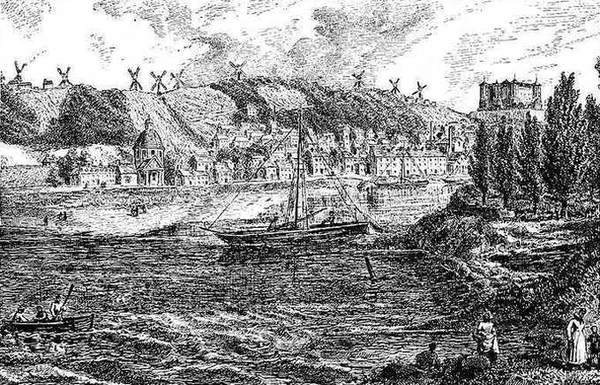
THE VINEYARDS OF THE COTEAU DE SAUMUR.
PART III. — I. S PARKLING S AUMUR AND S PARKLING S AUTERNES . — II. T HE S PARKLING W INES OF B URGUNDY , THE J URA , AND THE S OUTH OF F RANCE . — III. F ACTS AND N OTES R ESPECTING S PARKLING W INES .
The sparkling wines of the Loire often palmed off as
Champagne—The finer qualities improve with age—Anjou the
cradle of the Plantagenet kings—Saumur and its dominating
feudal Château and antique Hôtel de Ville—Its sinister Rue
des Payens and steep tortuous Grande Rue—The vineyards of
the Coteau of Saumur—Abandoned stone-quarries converted into
dwellings—The vintage in progress—Old-fashioned pressoirs—The
making of the wine—Touraine the favourite residence of the
earlier French monarchs—After a night’s carouse at the epoch
of the Renaissance—The Vouvray vineyards—Balzac’s picture
of La Vallée Coquette—The village of Vouvray and the Château
of Moncontour—Vernou, with its reminiscences of Sully and
Pépin-le-Bref—The vineyards around Saumur—Remarkable ancient
Dolmens—Ackerman-Laurance’s establishment at Saint-Florent—Their
extensive cellars, ancient and modern—Treatment of the
newly-vintaged wine—The cuvée—Proportions of wine from black
and white grapes—The bottling and disgorging of the wine
and finishing operations—The Château of Varrains and the
establishment of M. Louis Duvau aîné—His cellars a succession
of gloomy galleries—The disgorging of the wine accomplished in
a melodramatic-looking cave—M. Duvau’s vineyard—His sparkling
Saumur of various ages—Marked superiority of the more matured
samples—M. E. Normandin’s sparkling Sauternes manufactory at
Châteauneuf—Angoulême and its ancient fortifications—Vin de
Colombar—M. Normandin’s sparkling Sauternes cuvée—His cellars
near Châteauneuf—Recognition accorded to the wine at the Concours
Régional d’Angoulême.
AFTER the Champagne, Anjou is the French province which ranks next in
importance for its production of sparkling wines. Vintaged on the banks
of the Loire, these are largely consigned to the English and other
markets, labelled Crême de Bouzy, Sillery and Ay Mousseux, Cartes Noires
and Blanches, and the like; while their corks are branded with the names
of phantom firms, supposed to be located at Reims and Epernay. As a
rule, these wines come from around Saumur; but they are not necessarily
the worse on that account, for the district produces capital sparkling
wines, the finer qualities of which improve greatly by being kept for a
few years. One curious thing shown to us at Saumur was the album of a
manufacturer of sparkling wines containing examples of the many hundred
labels ticketed with which his produce had for years past been sold.
Not one of these labels assigned to the wines the name of their real
maker or their true birthplace, but introduced them under the auspices
of mythical dukes and counts, as being manufactured at châteaux which
are so many ‘castles in Spain,’ and as coming from Ay, Bouzy, Châlons,
Epernay, Reims, and Verzenay, but never by any chance from Saumur.
Being produced from robuster growths than the sparkling wines of
the Department of the Marne, sparkling Saumur will always lack that
excessive lightness which is the crowning grace of fine Champagne;
still, it has only to be kept for a few years, instead of being drunk
shortly after its arrival from the wine-merchant, for its quality to
become greatly improved and its intrinsic value to be considerably
enhanced. We have drunk sparkling Saumur that had been in bottle for
nearly twenty years, and found the wine not only remarkably delicate,
but, singular to say, with plenty of effervescence.
STATUE OF RICHARD CŒUR DE LION
AT FONTEVRAULT.
To an Englishman Anjou is one of the most interesting of the ancient
provinces of France. It was the cradle of the Plantagenet kings, and
only ten miles from Saumur still repose the bones of Henry, the first
Plantagenet, and Richard of the Lion Heart, beneath their elaborate
coloured and gilt effigies, in the so-called Cimetière des Rois of the
historic Abbey of Fontevrault. The famous vineyards of the Coteau de
Saumur, eastward of the town and bordering the Loire, extend as far as
here, and include the communes of Dampierre, Souzay, Varrains, Chacé,
Parnay, Turquant, and Montsoreau, the last-named within three miles of
Fontevrault, and chiefly remarkable through its seigneur of ill-fame,
Jean de Chambes, who instigated his wife to lure Bussy d’Amboise to an
assignation in order that he might the more surely poignard him. Saumur
is picturesquely placed at the foot of this bold range of heights, near
where the little river Thouet runs into the broad and rapid Loire.
A massive-looking old château, perched on the summit of an isolated
crag, stands out grandly against the clear sky and dominates the town,
the older houses of which crouch at the foot of the lofty hill and
climb its steepest sides. The restored antique Hôtel de Ville, in the
Pointed style, with its elegant windows, graceful belfry, and florid
wrought-iron balconies, stands back from the quay bordering the Loire.
In the rear is the Rue des Payens, whither the last of the Huguenots of
this ‘metropolis of Protestantism,’ as it was formerly styled, retired,
converting their houses into so many fortresses to guard against being
surprised by their Catholic adversaries. Adjacent is the steep tortuous
Grande Rue, of which Balzac—himself a Tourangeau—has given such a
graphic picture in his Eugénie Grandet, the scene of which is laid at
Saumur. To-day, however, only a few of its ancient carved-timber houses,
quaint overhanging corner turrets, and fantastically studded massive oak
doors, have escaped demolition.
The vineyards of the Coteau de Saumur, yielding the finest wines, are
reached by the road skirting the river, the opposite low banks of which
are fringed with willows and endless rows of poplars, which at the
time of our visit were already golden with the fading tints of autumn.
Numerous fantastic windmills crown the heights, the summit of which
is covered with vines, varied by dense patches of woodland. Here, as
elsewhere along the banks of the Loire, the many abandoned quarries
along the face of the hill have been turned by the peasants into cosy
dwellings by simply walling-up the entrances, while leaving, of course,
the necessary apertures for doors and windows. Dampierre, the first
village reached, has many of these cave-dwellings, and numbers of its
houses are picturesquely perched up the sides of the slope. The holiday
costumes of the peasant women
encountered in the neighbourhood of
Saumur are exceedingly quaint, their elaborate and varied headdresses
being counterparts of coiffures in vogue so far back as three and four
centuries ago.
PEASANT WOMEN OF THE ENVIRONS OF SAUMUR.
Quitting the banks of the river, we ascend a steep tortuous road, shut
in on either side by high stone walls—for hereabouts all the best
vineyards are scrupulously enclosed—and finally reach the summit of
the heights, whence a view is gained over what the Saumurois proudly
style the grand valley of the Loire. Everywhere around the vintage is
going on. The vines are planted rather more than a yard apart, and those
yielding black grapes are trained, as a rule, up tall stakes, although
some few are trained espalier fashion. Women dexterously detach the
bunches with pruning-knives and throw them into the seilles—small
squat buckets with wooden handles—the contents of which are emptied
from time to time into baskets—the counterpart of the chiffonnier’s
hotte, and coated with pitch inside so as to close all the crevices of
the wickerwork—which the portes-bastes carry slung to their backs.
When white wine is being made from black grapes for sparkling Saumur,
the grapes are conveyed in these baskets to the underground pressoirs in
the neighbouring villages before their skins get at all broken, in order
that the wine may be as pale as possible in colour.
The black grape yielding the best wine in the Saumur district is the
breton, said to be the same as the carbinet-sauvignon, the leading
variety in the grand vineyards of the Médoc. Other species of black
grapes cultivated around Saumur are the varennes, yielding a soft and
insipid wine of no kind of value, and the liverdun, or large gamay,
the prevalent grape in the Mâconnais, and the same which in the days
of Philippe-le-Hardi the parlements of Metz and Dijon interdicted
the planting and cultivation of. The prevalent white grapes are the
large and small pineau blanc, the bunches of the former being of an
intermediate size, broad and pyramidal in shape, and with the berries
close together. These have fine skins, are oblong in shape, and of a
transparent yellowish-green hue tinged with red, are very sweet and
juicy, and as a rule ripen late. As for the small
pineau, the bunches
are less compact, the berries are round and of a golden tint, are finer
as well as sweeter in flavour, and ripen somewhat earlier than the fruit
of the larger variety.
We noticed as we drove through the villages of Champigny and
Varrains—the former celebrated for its fine red wines, and more
especially its cru of the Clos des Cordeliers—that hardly any of the
houses had windows looking on to the narrow street, but that all were
provided with low openings for shooting the grapes into the cellar,
where, when making red wine, they are trodden, but when making white
wine, whether from black or white grapes, they are invariably pressed.
Each of the houses had its ponderous porte-cochère and low narrow portal
leading into the large enclosed yard at its side, and over the high
blank walls vines were frequently trained, pleasantly varying their dull
gray monotony.
The grapes on being shot into the openings just mentioned fall through
a kind of tunnel into a reservoir adjacent to the heavy press, which
is invariably of wood and of the old-fashioned cumbersome type. They
are forthwith placed beneath the press and usually subjected to five
separate squeezes, the must from the first three being reserved for
sparkling wine, while that from the two latter, owing to its being more
or less deeply tinted, only serves for table-wine. The must is at once
run off into casks, in order that it may not ferment on the grape-skins
and imbibe any portion of their colouring matter. Active fermentation
speedily sets in, and lasts for a fortnight or three weeks, according to
whether the temperature chances to be high or low.
The vintaging of the white grapes takes place about a fortnight later
than the black grapes, and is commonly a compound operation, the best
and ripest bunches being first of all gathered just as the berries
begin to get shrivelled and show symptoms of approaching rottenness.
It is these selected grapes that yield the best wine. The second
gathering, which follows shortly after the first, includes all the
grapes remaining on the vines, and yields a wine perceptibly inferior in
quality. The grapes on their arrival at the press-house are generally
pressed immediately, and the must is run off into tuns to ferment. At
the commencement these tuns are filled up every three or four days to
replace the fermenting must which has flowed over; afterwards any waste
is made good at the interval of a week, and then once a fortnight, the
bungholes of the casks being securely closed towards the end of the
year, by which time the first fermentation is over.
It should be noted that the Saumur sparkling wine manufacturers draw
considerable supplies of the white wine, required to impart lightness
and effervescence to their vin préparé, from the Vouvray vineyards.
Vouvray borders the Loire a few miles from the pleasant city of Tours,
which awakens sinister recollections of truculent Louis XI., shut up in
his fortified castle of Plessis-lez-Tours, around which Scott has thrown
the halo of his genius in his novel of Quentin Durward. A succession
of vineyard slopes stretch from one to another of the many historic
châteaux along this portion of the Loire, the romantic associations
of which render the Touraine one of the most interesting provinces of
France. Near Tours, besides the vineyards of Saint-Cyr are those of
Joué and Saint-Avertin; the two last situate on the opposite bank of
the Cher, where the little town of Joué, perched on the summit of a
hill in the midst of vineyards, looks over a vast plain known by the
country-people as the Landes de Charlemagne, the scene, according to
local tradition, of Charles Martel’s great victory over the Saracens.
The Saint-Avertin vineyards extend towards the east, stretching almost
to the forest of Larçay, on the borders of the Cher, where Paul Louis
Courier, the famous vigneron pamphleteer of the Restoration, noted
alike for his raillery, wit, and satire, fell beneath the balls of an
assassin. A noticeable cru in the neighbourhood of Tours is that of
Cinq Mars, the ruined château of which survives as a memorial of the
vengeance of Cardinal Richelieu, who, after having sent its owner to the
scaffold, commanded its massive walls and towers to be razed ‘à hauteur
d’infamie,’ as we see them now.
Touraine, from its central position, its pleasant air, and its fertile
soil, was ever a favourite residence of the earlier French monarchs,
and down to the days of the Bourbons the seat of government continually
vacillated between the banks of the Seine and those of the Loire. The
vintages that ripen along the river have had their day of court favour
too; for if Henri of Andelys sneeringly
describes the wine of Tours
as turning sour, in his famous poem of the Bataille des Vins, the
sweet white wines of Anjou were greatly esteemed throughout the Middle
Ages, and, with those of Orleans, were highly appreciated in Paris down
to the seventeenth century. The cult of the ‘dive Bouteille’ and the
fashion of Pantagruelic repasts have always found favour in the fat and
fertile ‘garden of France;’ and the spectacle of citizens, courtiers,
and monks staggering fraternally along, ‘waggling their heads,’ as
Rabelais describes them, after a night of it at the tavern, was no
uncommon one in the streets of its old historic towns during the period
of the Renaissance.
TAVERN ROYSTERERS AT EARLY MORNING IN THE TOURAINE.
On proceeding to Vouvray from Tours, we skirt a succession of
poplar-fringed meadows, stretching eastward in the direction of Amboise
along the right bank of the Loire; and after a time a curve in the river
discloses to view a range of vine-clad heights, extending some distance
beyond the village of Vouvray. Our route lies past the picturesque
ruins of the abbey of Marmoûtier, immortalised in the piquant pages of
the Contes Drôlatiques, and the Château des Roches—one of the most
celebrated castles of the Loire—the numerous excavations in the soft
limestone ridge on which they are perched being converted as usual into
houses, magazines, and wine-cellars. We proceed through the village of
Rochecorbon, and along a road winding among the spurs of the Vouvray
range, past hamlets, half of whose inhabitants live in these primitive
dwellings hollowed out of the cliff, and finally enter the charming
Vallé Coquette, hemmed in on all sides with vine-clad slopes. Here
a picturesque old house, half château, half homestead, was pointed
out to us as a favourite place of sojourn of Balzac, who held the
wine of Vouvray in high esteem, and who speaks of this rocky ridge as
‘inhabited by a population of vine-dressers, their houses of several
stories being hollowed out in the face of the cliff, and connected by
dangerous staircases hewn in the soft stone. Smoke curls from most of
the chimneys which peep above the green crest of vines, while the blows
of the cooper’s hammer resound in several of the cellars. A young girl
trips to her garden over the roofs of these primitive dwellings, and an
old woman, tranquilly seated on a ledge of projecting rock, supported
solely by straggling roots of ivy spreading itself over the disjointed
stones, leisurely turns her spinning-wheel, regardless of her dangerous
position.’ The foregoing picture, sketched by the author of La Comédie
Humaine forty years ago, has scarcely changed at the present day.
At the point where the village of Vouvray climbs half-way up the
vine-crested ridge the rapid-winding Cise throws itself into the Loire,
and on crossing the bridge that spans the tributary stream we discern on
the western horizon, far beyond the verdant islets studding the swollen
Loire, the tall campaniles of Tours Cathedral, which seem to rise out
of the water like a couple of Venetian towers. Vouvray is a trim little
place, clustered round about with numerous pleasant villas in the midst
of charming gardens. The modern château of Moncontour here dominates
the slope, and its terraced gardens, with their fantastically-clipped
trees and geometric parterres, rise tier above tier up the face of the
picturesque height that overlooks the broad fertile valley, with its
gardens, cultivated fields, patches of woodland, and wide stretches
of green pasture which, fringed with willows and poplars, border the
swollen waters of the Loire. Where the river Brenne empties itself
into the Cise the Coteau de Vouvray slopes off towards the north, and
there rise up the vine-clad heights of Vernou, yielding a similar but
inferior wine to that of Vouvray. The village of Vernou is nestled under
the hill, and near the porch of its quaint little church a venerable
elm-tree is pointed out as having been planted by Sully, Henry IV.’s
able Minister. Here, too, an ancient wall, pierced with curious arched
windows, and forming part of a modern building, is regarded by popular
tradition as belonging to the palace in which Pépin-le-Bref, father of
Charlemagne, lived at Vernou.
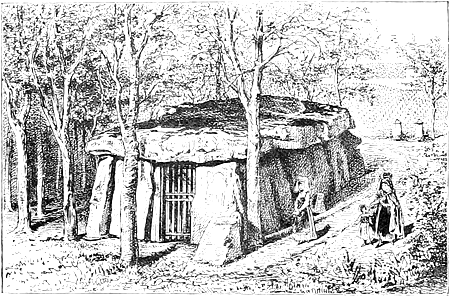
DOLMEN AT BAGNEUX, NEAR SAUMUR.
The communes of Dampierre, Souzay, and Parnay, in the neighbourhood
of Saumur, produce still red wines rivalling those of Champigny,
besides which all the finest white wines are vintaged hereabouts—in
the Perrière, the Poilleux, and the Clos Morain vineyards, and in the
Rotissans vineyard at Turquant. Wines of very fair quality are also
grown on the more favourable slopes extending southwards along the
valley of the Thouet, and comprised in the communes of Varrains,
Chacé, St. Cyr-en-Bourg, and Brézé. The whole of this district,
by the way, abounds with interesting archæological remains. While
visiting the vineyards of Varrains and Chacé we came upon a couple of
dolmens—vestiges of the ancient Celtic population of the valley of
the Loire singularly abundant hereabouts. Brézé, the marquisate of
which formerly belonged to Louis XVI.’s famous grand master of the
ceremonies—immortalised by the rebuff he received from Mirabeau—boasts
a noble château on the site of an ancient fortress, in connection with
which there are contemporary excavations in the neighbouring limestone,
designed for a garrison of 500 or 600 men. Beyond the vineyards of
Saint-Florent, westward of Saumur and on the banks of the Thouet, is an
extensive plateau, partially overgrown with vines, where may be traced
the remains of a Roman camp. Moreover, in the southern environs of
Saumur, in the midst of vineyards producing exclusively white wines,
is one of the most remarkable dolmens known. This imposing structure,
perfect in all respects save that one of the four enormous stones which
roof it in has been split in two, and requires to be supported, is no
less than 65 feet in length, 23 feet in width, and 10 feet high.
At Saint-Florent, the pleasant little suburb of Saumur, skirting the
river Thouet, and sheltered by steep hills formed of soft limestone,
which offers great facilities for the excavation of extensive
cellars, the largest manufacturer of Saumur sparkling wines has his
establishment. Externally this offers but little to strike the eye. A
couple of pleasant country houses, half hidden by spreading foliage,
stand at the two extremities of a spacious and well-kept garden, beyond
which one catches a glimpse of some outbuildings sheltered by the
vine-crowned cliff, in which a labyrinth of gloomy galleries has been
hollowed out. Here M. Ackerman-Laurance, the extent of whose business
ranks him as second among the sparkling wine manufacturers of the world,
stores something like 10,000 casks and several million bottles of wine.
At the commencement of the present century, in the days when, as Balzac
relates in his Eugénie Grandet, the Belgians bought up entire vintages
of Saumur wine, then largely in demand with them for sacramental
purposes, the founder of the Saint-Florent house commenced to deal
in the ordinary still wines of the district. Nearly half a century
ago he was led to attempt the manufacture of sparkling wines, but his
efforts to bring them into notice failed; and he was on the point of
abandoning his enterprise, when an order for one hundred cases revived
his hopes, and led to the foundation of the present vast establishment.
As already mentioned, for many miles all the heights along the Loire
have been more or less excavated for stone for building purposes, so
that every one hereabouts who grows wine or deals in it has any amount
of cellar accommodation ready to hand. It was the vast extent of the
galleries which M. Ackerman père discovered already excavated at
Saint-Florent that induced him to settle there in preference to Saumur.
Extensive, however, as the original vaults were, considerable additional
excavations have from time to time been found necessary; and to-day the
firm is still further increasing the area of its cellars, which already
comprise three principal avenues, each the third of a mile long, and
no fewer than sixty transverse galleries, the total length of which is
several miles. One great advantage is that the whole are on the ordinary
level.
Ranged against the black uneven walls of the more tortuous ancient
vaults which give access to these labyrinthine corridors are thousands
of casks of wine—some in single rows, others in triple tiers—forming
the reserve stock of the establishment. As may be supposed, a powerful
vinous odour permeates these vaults, in which the fumes of wine have
been accumulating for the best part of a century. After passing beneath
a massive stone arch which separates the old cellars from the new, a
series of broad and regularly proportioned galleries are reached, having
bottles stacked in their tens of thousands on either side. Overhead the
roof is perforated at regular intervals with circular shafts, affording
both light and ventilation, and enabling the temperature to be regulated
to a nicety. In these lateral and transverse galleries millions of
bottles of wine in various stages of preparation are stacked.
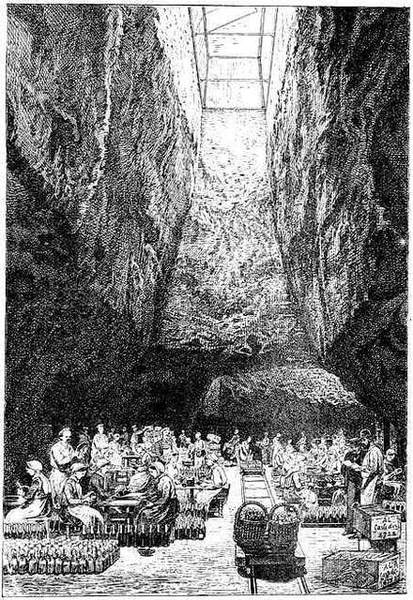
THE CELLARS OF M. ACKERMAN-LAURANCE AT SAINT-FLORENT.
LABELLING AND PACKING SPARKLING SAUMUR.
We have explained that in the Champagne it is the custom for the
manufacturers of sparkling wine to purchase considerable quantities of
grapes from the surrounding growers, and to press these themselves,
or have them pressed under their own superintendence. At Saumur only
those firms possessing vineyards make their own vin brut, the bulk
of the wine used for conversion into sparkling wine being purchased
from the neighbouring growers. On the newly-expressed must arriving
at M. Ackerman-Laurance’s cellars it is allowed to rest until the
commencement of the ensuing year, when half of it is mixed with wine
in stock belonging to last year’s vintage, and the remaining half is
reserved for mingling with the must of the ensuing vintage. The blending
is accomplished in a couple of colossal vats hewn out of the rock, and
coated on the inside with cement. Each of these vats is provided with
200 paddles for thoroughly mixing the wine, and with five pipes for
drawing it off when the amalgamation is complete. Usually the cuvée will
embrace 1600 hogsheads, or 80,000 gallons of wine, almost sufficient
for half a million bottles. A fourth of this quantity can be mixed in
each vat at a single operation, and this mixing is repeated again and
again until the last gallon run off is of precisely the same type as the
first. For the finer qualities of sparkling Saumur the proportion of
wine from the black grapes to that from white is generally at the rate
of three or four to one. For the inferior qualities more wine from white
than from black grapes is invariably used. Only in the wine from white
grapes is the effervescent principle retained to any particular extent;
but, on the other hand, the wine from black grapes imparts both quality
and vinous character to the blend.
The blending having been satisfactorily accomplished, the wine is
stored in casks, never perfectly filled, yet with their bungholes
tightly closed, and slowly continues its fermentation, eating up its
sugar, purging itself, and letting fall its lees. Three months later it
is fined. It is rarely kept in the wood for more than a year, though
sometimes the superior qualities remain for a couple of years in cask.
Occasionally it is even bottled in the spring following the vintage;
still, as a rule, the bottling of sparkling Saumur takes place during
the ensuing summer months, when the temperature is at the highest,
as this insures to it a greater degree of effervescence. At the time
of bottling its saccharine strength is raised to a given degree by
the addition of the finest sugar-candy, and henceforward the wine is
subjected to precisely the same treatment as is pursued with regard to
Champagne.
It is in a broad but sombre gallery of the more ancient vaults—the
roughly-hewn walls of which are black from the combined action of
alcohol and carbonic acid gas—that the processes of disgorging the
wine of its sediment, adding the syrup, filling up the bottles with
wine to replace that which gushes out when the disgorging operation is
performed, together with the re-corking, stringing, and wiring of the
bottles, are carried on. The one or two adjacent shafts impart very
little light, but a couple of resplendent metal reflectors, which at a
distance one might fancy to be some dragon’s flaming eyes, combined with
the lamps placed near the people at work, effectually illuminate the
spot.
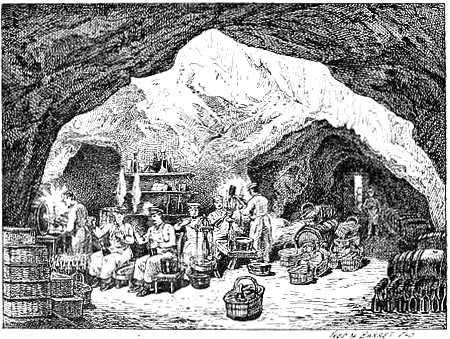
THE CELLARS OF M. LOUIS DUVAU AÎNÉ AT THE CHÂTEAU OF
VARRAINS.
Another considerable manufacturer of sparkling Saumur is M. Louis
Duvau aîné, owner of the château of Varrains, in the village of the
same name, at no great distance from the Coteau de Saumur. His cellars
adjoin the château, a picturesque but somewhat neglected structure
of the last century, with sculptured medallions in high relief above
the lower windows, and florid vases surmounting the mansards in the
roof. In front is a large rambling court shaded with acacia and lime
trees, and surrounded by outbuildings, prominent among which is a
picturesque dovecot, massive at the base as a martello tower, and
having an elegant open stone lantern springing from its bell-shaped
roof. The cellars are entered down a steep incline under a low stone
arch, the masonry above which is overgrown with ivy in large clusters
and straggling creeping plants. We soon come upon a deep recess to the
right, wherein stands a unique cumbersome screw-press, needing ten or
a dozen men to work the unwieldy capstan which sets the juice flowing
from the crushed grapes into the adjacent shallow trough. On our left
hand are a couple of ancient reservoirs, formed out of huge blocks of
stone, with the entrance to a long vaulted cellar filled with wine in
cask. We advance slowly in the uncertain light along a succession of
gloomy galleries, with moisture oozing from their blackened walls and
roofs, picking our way between bottles of wine stacked in huge square
piles and rows of casks raised in tiers. Suddenly a broad flood of
light shooting down a lofty shaft throws a Rembrandtish effect across
a spacious and most melodramatic-looking cave, roughly hewn out of the
rock, and towards which seven dimly-lighted galleries converge. On all
sides a scene of bustling animation presents itself. From one gallery
men keep arriving with baskets of wine ready for the disgorger; while
along another bottles of wine duly dosed with syrup are being borne off to be
decorated with metal foil and their distinctive labels. Groups
of workmen are busily engaged disgorging, dosing, and re-corking the
newly-arrived bottles of wine; corks fly out with a succession of loud
reports, suggestive of the irregular fire of a party of skirmishers;
a fizzing, spurting, and spluttering of the wine next ensues, and is
followed by the incessant clicking of the various apparatus employed in
the corking and wiring of the bottles.
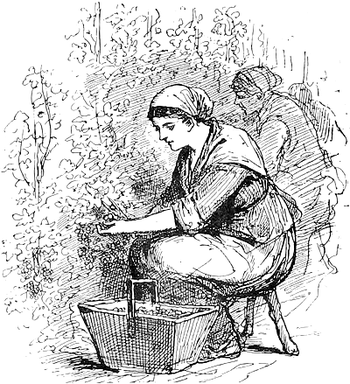
Gradual inclines conduct to the two lower tiers of galleries, for the
cellars of M. Duvau consist of as many as three stories. Down below
there is naturally less light, and the temperature, too, is sensibly
colder. Advantage is taken of this latter circumstance to remove
the newly-bottled wine to these lower vaults whenever an excessive
development of carbonic acid threatens the bursting of an undue
proportion of bottles, a casualty which among the Saumur sparkling
wine manufacturers ranges far higher than with the manufacturers of
Champagne. For the economy of time and labour, a lift, raised and
lowered by means of a capstan worked by horses, is employed to transfer
the bottles of wine from one tier of cellars to another.
The demand for sparkling Saumur is evidently on the increase, for M.
Duvau, at the time of our visit, was excavating extensive additional
cellarage. The subsoil at Varrains being largely composed of marl, which
is much softer than the tufa of the Saint-Florent coteau, necessitated
the roofs of the new galleries being worked in a particular form in
order to avoid having recourse to either brickwork or masonry. Tons
of this excavated marl were being spread over the soil of M. Duvau’s
vineyard in the rear of the château, greatly, it was said, to the
benefit of the vines, whose grapes were all of the black variety;
indeed, scarcely any wine is vintaged from white grapes in the commune
of Varrains.
At M. Duvau’s we went through a complete scale of sparkling Saumurs,
commencing with the younger and less matured samples, and ascending
step by step to wines a dozen and more years old. Every year seemed to
produce an improvement in the wine, the older varieties gaining greatly
in delicacy and softening very perceptibly in flavour.
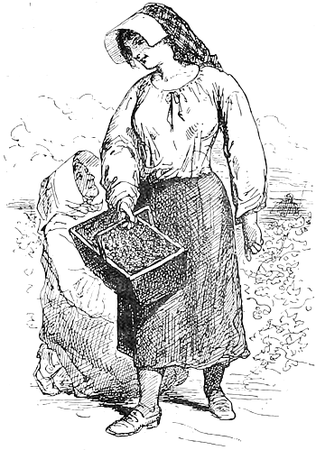
Finding that sparkling wines were being made in most of the
wine-producing districts of France, where the growths were sufficiently
light and of the requisite quality, Messrs. E. Normandin & Co. conceived
the idea of laying the famous Bordeaux district under contribution
for a similar purpose, and, aided by a staff of experienced workmen
from Epernay, they have succeeded in producing a sparkling Sauternes.
Sauternes, as is well known, is one of the finest of white wines,
soft, delicate, and of beautiful flavour, and its transformation
into a sparkling wine has been very successfully accomplished.
Messrs. Normandin’s head-quarters are in the thriving little town
of Châteauneuf, in the pleasant valley of the Charente, and within
fifteen miles of Angoulême, a famous old French town, encompassed by
ancient ramparts and crumbling corner-towers; and which, dominated by
the lofty belfry of its restored semi-Byzantine cathedral, rising in
a series of open arcades, spreads itself picturesquely out along a
precipitous height, watered at its base by the rivers Anguienne and
Charente. Between Angoulême and Châteauneuf vineyard plots dotted
over with walnut-trees, or simple rows of vines divided by strips of
ripening maize, and broken up at intervals by bright green pastures,
line both banks of the river Charente. The surrounding country is
undulating and picturesque. Poplars and elms fringe the roadsides,
divide the larger fields and vineyards, and
screen the cosy-looking
red-roofed farmhouses, which present to the eyes of the passing tourist
a succession of pictures of quiet rural prosperity.
Châteauneuf communicates with the Sauternes district by rail, so
that supplies of wine from there are readily obtainable. Vin de
Colombar—a famous white growth which English and Dutch cruisers used
to ascend the Charente to obtain cargoes of when the Jerez wines were
shut out from England by the Spanish War of Succession—vintaged
principally at Montignac-le-Coq, also enters largely into Messrs.
Normandin & Co.’s sparkling Sauternes cuvée. This colombar grape is
simply the semillon—one of the leading varieties of the Sauternes
district—transported to the Charente. The remarkably cool cellars where
the firm store their wine, whether in wood or bottle, have been formed
from some vast subterranean galleries whence centuries ago stone was
quarried, and which are situated about a quarter of an hour’s drive
from Châteauneuf, in the midst of vineyards and cornfields. The wine is
invariably bottled in a cellier at the head establishment, but it is
in these cellars where it goes through the course of careful treatment
similar to that pursued with regard to Champagne.
In order that the delicate flavour of the wine may be preserved, the
liqueur is prepared with the finest old Sauternes, without any addition
of spirit, and the dose is administered with the most improved modern
appliance, constructed of silver, and provided with crystal taps. At the
Concours Régional d’Angoulême of 1877, the jury, after recording that
they had satisfied themselves by the aid of a chemical analysis that the
samples of sparkling Sauternes submitted to their judgment were free
from any foreign ingredient, awarded to Messrs. Normandin & Co. the only
gold medal given in the Group of Alimentary Products.
Encouraged, no doubt, by the success obtained by Messrs. Normandin &
Co. with their sparkling Sauternes, the house of Lermat-Robert & Co.,
of Bordeaux, introduced a few years ago a sparkling Barsac, samples of
which were submitted to the jury at the Paris Exhibition of 1878.
|
|
|
|
VINTAGER OF THE CÔTE D’OR.
|
VINTAGER OF THE JURA.
|
Sparkling wines of the Côte d’Or at the Paris Exhibition
of 1878—Chambertin, Romanée, and Vougeot—Burgundy wines and
vines formerly presents from princes—Vintaging sparkling
Burgundies—Their after-treatment in the cellars—Excess
of breakage—Similarity of proceeding to that followed
in the Champagne—Principal manufacturers of sparkling
Burgundies—Sparkling wines of Tonnerre, the birthplace of the
Chevalier d’Eon—The Vin d’Arbanne of Bar-sur-Aube—Death there
of the Bastard de Bourbon—Madame de la Motte’s ostentatious
display and arrest there—Sparkling wines of the Beaujolais—The
Mont-Brouilly vineyards—Ancient reputation of the wines of the
Jura—The Vin Jaune of Arbois beloved of Henri Quatre—Rhymes
by him in its honour—Lons-le-Saulnier—Vineyards yielding
the sparkling Jura wines—Their vintaging and subsequent
treatment—Their high alcoholic strength and general
drawbacks—Sparkling wines of Auvergne, Guienne, Dauphiné,
and Languedoc—Sparkling Saint-Péray the Champagne of the
South—Valence, with its reminiscences of Pius VI. and Napoleon
I.—The ‘Horns of Crussol’ on the banks of the Rhône—Vintage
scene at Saint-Péray—The vines and vineyards producing
sparkling wine—Manipulation of sparkling Saint-Péray—Its
abundance of natural sugar—The cellars of M. de Saint-Prix,
and samples of his wines—Sparkling Côte-Rotie, Château-Grillé,
and Hermitage—Annual production and principal markets of
sparkling Saint-Péray—Clairette de Die—The Porte Rouge of Die
Cathedral—How the Die wine is made—The sparkling white and
rose-coloured muscatels of Die—Sparkling wines of Vercheny and
Lagrasse—Barnave and the royal flight to Varennes—Narbonne
formerly a miniature Rome, now noted merely for its wine and
honey—Fête of the Black Virgin at Limoux—Preference given to the
new wine over the miraculous water—Blanquette of Limoux, and how
it is made—Characteristics of this overrated wine.
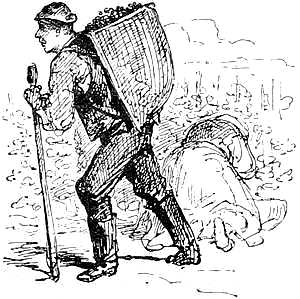
SPARKLING wines are made to a considerable extent in Burgundy, notably
at Beaune, Nuits, and Dijon; and though as a rule heavier and more
potent than the subtile and delicate-flavoured wines of the Marne, still
some of the higher qualities, both of the red and white varieties,
exhibit a degree of refinement which those familiar only with the
commoner kinds can scarcely form an idea of. At the Paris Exhibition of
1878 we tasted, among a large collection of the sparkling wines of the
Côte d’Or, samples of Chambertin, Romanée, and Vougeot, of the highest
order. Although red wines, they had the merit of being deficient in
that body which forms such an objectionable feature in sparkling wines
of a deep shade of
colour. M. Regnier, the exhibitor of sparkling red
Vougeot, sent, moreover, a white sparkling wine, from the species of
grape known locally as the clos blanc de Vougeot. These wines, as well
as the Chambertin, came from the Côte de Nuits, the growths of which are
generally considered of too vigorous a type for successful conversion
into sparkling wine, preference being usually given to the produce of
the Côte de Beaune. Among the sparkling Burgundies from the last-named
district were samples from Savigny, Chassagne, and Meursault, all famous
for their fine white wines.
Burgundy ranks as one of the oldest viticultural regions of Central
Europe, and for centuries its wines have been held in the highest
renown. In the Middle Ages both the wines and vines of this favoured
province passed as presents from one royal personage to another, just as
grand cordons are exchanged between them nowadays. The fabrication of
sparkling wine, however, dates no further back than some sixty years or
so. The system of procedure is much the same as in the Champagne, and,
as there, the wine is mainly the produce of the pineau noir and pineau
blanc varieties of grape. At the vintage, in order to avoid bruising the
ripened fruit and to guard against premature fermentation, the grapes
are conveyed to the pressoirs in baskets, instead of the large oval vats
termed balonges, common to the district. They are placed beneath the
press as soon as possible, and for superior sparkling wines only the
juice resulting from the first pressure, and known as the mère goutte,
or mother drop, is employed. For the ordinary wines, that expressed at
the second squeezing of the fruit is mingled with the other. The must
is at once run off into casks, which have been previously sulphured, to
check, in a measure, the ardour of the first fermentation, and lighten
the colour of the newly-made wine. Towards the end of October, when this
first fermentation is over, the wine is removed to the cellars, or to
some other cool place, and in December it is racked into other casks. In
the April following it is again racked, to insure its being perfectly
clear at the epoch of bottling in the month of May. The sulphuring
of the original casks having had the effect of slightly checking the
fermentation and retaining a certain amount of saccharine in the wine,
it is only on exceptional occasions that the latter is artificially
sweetened previous to being bottled.
A fortnight after the tirage the wine commonly attains the stage known
as grand mousseux, and by the end of September the breakage will have
amounted to between 5 and 8 per cent, which necessitates the taking
down the stacks of bottles and piling them up anew. The wine as a rule
remains in the cellars for fully a couple of years from the time of
bottling until it is shipped. Posing the bottles sur pointe, agitating
them daily, together with the disgorging and liqueuring of the wine, are
accomplished precisely as in the Champagne.
Among the principal manufacturers of sparkling Burgundies are Messrs.
André & Voillot, of Beaune, whose sparkling white Romanée, Nuits, and
Volnay are well and favourably known in England; M. Louis Latour, also
of Beaune, and equally noted for his sparkling red Volnay, Nuits, and
Chambertin, as for his sparkling white varieties; Messrs. Maire et Fils,
likewise of Beaune; M. Labouré-Goutard and Messrs. Geisweiller et Fils,
of Nuits; Messrs. Marey & Liger-Belair, of Nuits and Vosne; and M.
Regnier, of Dijon.
In the department of the Yonne—that is, in Lower Burgundy—sparkling
wines somewhat alcoholic in character have been made for the last half
century at Tonnerre, where the Chevalier d’Eon, that enigma of his
epoch, was born. The Tonnerre vineyards are of high antiquity, and
for sparkling wines the produce of the black and white pineau and the
white morillon varieties of grape is had recourse to. The vintaging is
accomplished with great care, and only the juice which flows from the
first pressure is employed. This is run off immediately into casks,
which are hermetically closed when the fermentation has subsided. The
after-treatment of the wine is the same as in the Champagne. Sparkling
wines are likewise made at Epineuil, a village in the neighbourhood of
Tonnerre, and at Chablis, so famous for its white wines, about ten miles
distant.
An effervescing wine known as the Vin d’Arbanne is made at Bar-sur-Aube,
some fifty miles north-east of Tonnerre, on the borders of Burgundy,
but actually in the province of Champagne, although far beyond the
limits to which the famed viticultural district extends. It was at
Bar-sur-Aube where the Bastard de Bourbon, chief of the sanguinary
gang of écorcheurs (flayers), was sewn
up in a sack and flung
over the parapet of the old stone bridge into the river beneath, by
order of Charles VII.; and here, too, Madame de la Motte, of Diamond
Necklace notoriety, was married, and in after years made a parade
of the ill-gotten wealth she had acquired by successfully fooling
that infatuated libertine the Cardinal Prince de Rohan, until her
ostentatious display was cut short by her arrest. This Vin d’Arbanne
is produced from pineaux and white gamay grapes, which, after being
gathered with care at the moment the dew falls, are forthwith pressed.
The wine is left on its lees until the following February, when it is
racked and fined, the bottling taking place when the moon is at the full
in March.
Red and white sparkling wines are made to a small extent at Saint-Lager,
in the Beaujolais, from wine vintaged in the Mont-Brouilly vineyards,
one of the best known of the Beaujolais crus. Mont-Brouilly is a lofty
hill near the village of Cercie, and is covered from base to summit on
all its sides with vines of the gamay species, rarely trained at all,
but left to trail along the ground at their own sweet will. At the
vintage, as we witnessed it, men and women—young, middle-aged, and
old—accompanied by troops of children, were roaming all over the slopes
dexterously nipping off the bunches of grapes with their thumb and
finger nails, and flinging them into the little wooden tubs with which
they were provided. The pressing of the grapes and the after-treatment
of the wine destined to become sparkling are the same in the Beaujolais
as in Upper and Lower Burgundy.
The red, straw, and yellow wines of the Jura have long had a high
reputation in the East of France, and the Vin Jaune of Arbois, an
ancient fortified town on the banks of the Cuisance, besieged and sacked
in turn by Charles of Amboise, Henri IV., and Louis XIV., was one of the
favourite beverages of the tippling Béarnais who styled himself Seigneur
of Ay and Gonesse, and who acquired his liking for it while sojourning
during the siege of Arbois at the old Château des Arsures. In one of
Henri Quatre’s letters to his minister Sully we find him observing, ‘I
send you two bottles of Vin d’Arbois, for I know you do not detest it.’
A couple of other bottles of the same wine are said to have cemented the
king’s reconciliation with Mayenne, the leader of the League; and the
lover of La Belle Gabrielle is moreover credited with having composed at
his mistress’s table some doggrel rhymes in honour of the famous Jura
cru:
‘Come, little page, serve us aright,
The crown is often heavy to bear;
So fill up my goblet large and light
Whenever you find a vacancy there.
This wine is surely no Christian wight,
And yet you never complaint will hear
That it’s not baptised with water clear.
Down my throat I pour
The old Arbois;
And now, my lords, let us our voices raise,
And sing of Silenus and Bacchus the praise!’
In more modern times the Jura, not content with the fame of the
historic yellow wines of Arbois and the deservedly-esteemed straw wines
of Château-Châlon, has produced large quantities of sparkling wine,
the original manufacture of which commenced as far back as a century
ago. To-day the principal seats of the manufacture are at Arbois and
Lons-le-Saulnier, the latter town the capital of the department, and one
of the most ancient towns of France. Originally founded by the Gauls
on the banks of the Vallière, in a little valley bordered by lofty
hills, which are to-day covered with vines, it was girded round with
fortifications by the Romans. Subsequently the Huns and the Vandals
pillaged it; then the French and the Burgundians repeatedly contested
its possession, and it was only definitively acquired by France during
the reign of Louis XIV. Rouget de l’Isle, the famous author of the
‘Marseillaise,’ was born at Lons-le-Saulnier, and here also Marshal Ney
assembled and harangued his troops before marching to join Napoleon,
whom he had promised Louis XVIII. to bring back to Paris in an iron cage.
The vineyards whence the principal supplies for these sparkling wines
are derived are grouped
at varying distances around Lons-le-Saulnier at
L’Etoile, Quintigny, Salins, Arbois, St. Laurent-la-Roche, and Pupillin,
with the Jura chain of mountains rising up grandly on the east. The
best vineyards at L’Etoile—which lies some couple of miles from
Lons-le-Saulnier, surrounded by hills, planted from base to summit with
vines—are La Vigne Blanche, Montmorin, and Montgenest. At Quintigny,
the wines of which are less potent than those of Arbois, and only retain
their effervescent properties for a couple of years, the Paridis,
Prémelan, and Montmorin vineyards are held in most repute, while at
Pupillin, where a soft agreeable wine is vintaged, the principal
vineyards are the Faille and the Clos. The vines cultivated for the
production of sparkling wines are chiefly the savagnin, or white pineau,
the melon of Poligny, and the poulsard, a black variety of grape held
locally in much esteem.
At the vintage, which commences towards the end of October and lasts
until the middle of the following month, all the rotten or unripe grapes
are carefully set aside, and the sound ones only submitted to the action
of a screw-press. After the must has flowed for about half an hour, the
grapes are newly collected under the press and the screw again applied.
The produce of this double operation is poured into a vat termed a
sapine, where it remains until bubbles are seen escaping through the
chapeau that forms on the surface of the liquid. The must is then
drawn off—sometimes after being fined—into casks, which the majority
of wine-growers previously impregnate with the fumes of sulphur. When
in cask the wine is treated in one of two ways; either the casks are
kept constantly filled to the bunghole, causing the foam which rises to
the surface during the fermentation to flow over, and thereby leave the
wine comparatively clear, or else the casks are not completely filled,
in which case the wine requires to be racked several times before it
is in a condition for fining. This latter operation is effected about
the commencement of February, and a second fining follows if the first
one fails to render the wine perfectly clear. At the bottling, which
invariably takes place in April, the Jura wines rarely require any
addition of sugar to insure an ample effervescence. Subsequently they
are treated in exactly the same manner as the vintages of the Marne
are treated by the great Champagne manufacturers. In addition to white
sparkling wine, a pink variety, with natural effervescent properties, is
made by mixing with the savagnin and melon grapes a certain proportion
of the poulsard species, from which the best red wines of the Jura are
produced.
One of the principal sparkling wine establishments at Lons-le-Saulnier
is that of M. Auguste Devaux, founded in the year 1860. He manufactures
both sweet and dry wines, which are sold largely in France and elsewhere
on the Continent, and have lately been introduced into England. Their
alcoholic strength is equivalent to from 25° to 26° of proof spirit,
being largely above the dry sparkling wines of the Champagne, which the
Jura manufacturers regard as a positive advantage rather than a decided
drawback, which it most undoubtedly is.
Besides being too spirituous, the sparkling wines of the Jura are
deficient in refinement and delicacy. The commoner kinds, indeed,
frequently have a pronounced unpleasant flavour, due to the nature
of the soil, to careless vinification, or to the inferior quality of
liqueur with which the wines have been dosed. Out of some fifty samples
of all ages and varieties which in my capacity of juror I tasted at
the Paris Exhibition of 1878, I cannot call to mind one that a real
connoisseur of sparkling wines would care to admit to his table.
Sparkling wines are made after a fashion in several of the southern
provinces of France—in Auvergne, at Clermont-Ferrand, under the shadow
of the lofty Puy de Dôme; in Guienne, at Astaffort, the scene of a
bloody engagement during the Wars of Religion, in which the Protestant
army was cut to pieces when about to cross the Garonne; at Nérac, where
frail Marguerite de Valois kept her dissolute Court, and Catherine de
Médicis brought her flying squadron of fascinating maids-of-honour to
gain over the Huguenot leaders to the Catholic cause; and at Cahors, the
Divina, or divine fountain of the Celts, and the birthplace of Pope John
XXII., of Clement Marot, the early French poet, and of Léon Gambetta;
in Dauphiné, at Die, Saint-Chef, Saint-Péray, and Largentière—so named
after some abandoned silver mines—and where the vines are cultivated
against low walls
rising in a series of terraces from the base to the
summit of the lofty hills; and in Languedoc, at Brioude, where St.
Vincent, the patron saint of the vine-dressers, suffered martyrdom, and
where it is the practice to expose the must of the future sparkling wine
for several nights to the dew in order to rid it of its reddish colour;
also at Linardie, and, more southward still, at Limoux, whence comes the
well-known effervescing Blanquette.
Principal among the foregoing is the excellent wine of Saint-Péray,
commonly characterised as the Champagne of the South of France. The
Saint-Péray vineyards border the Rhone some ten miles below the
Hermitage coteau—the vines of which are to-day well-nigh destroyed by
the phylloxera—but are on the opposite bank of the river. Our visit to
Saint-Péray was made from Valence, in which dull southern city we had
loitered in order to glance at the vast Hôtel du Gouvernement—where
octogenarian Pius VI., after being spirited away a prisoner from Rome
and hurried over the Alps in a litter by order of the French Directory,
drew his last breath while silently gazing across the rushing river at
the view he so much admired—and to discover the house in the Grande
Rue, numbered 4, in an attic of which history records that Napoleon I.,
when a sub-lieutenant of artillery in garrison at Valence, resided, and
which he quitted owing three and a half francs to his pastrycook.
We crossed the Rhone over one of its hundred flimsy suspension-bridges,
on the majority of which a notice warns you neither to smoke nor run,
and were soon skirting the base of a lofty, bare, precipitous rock, with
the ‘horns of Crussol,’ as the peasants term two tall pointed gables
of a ruined feudal château, perched at the dizzy edge, and having a
perpendicular fall of some five or six hundred feet below. The château,
which formerly belonged to the Dukes of Uzès, recognised by virtue of
the extent of their domains as premiers pairs de France, was not
originally erected in close proximity to any such formidable precipice.
The crag on which it stands had, it seems, been blasted from time to
time for the sake of the stone, until on one unlucky occasion, when too
heavy a charge of powder was employed, the entire side of the rock,
together with a considerable portion of the château itself, were sent
flying into the air. The authorities, professing to regard what remained
of the edifice as an historical monument of the Middle Ages, hereupon
stepped in and prohibited the quarry being worked for the future.
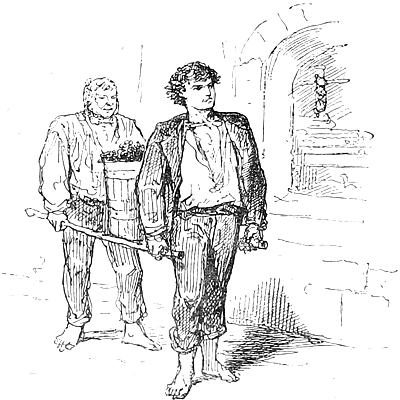
CONVEYING GRAPES TO THE PRESS AT SAINT-PÉRAY.
Passing beneath the cliff, one wound round to the left and dived into
a picturesque wooded dell at the entrance to a mountain pass, then
crossed the rocky bed of a dried-up stream, and drove along an avenue
of mulberry-trees, which in a few minutes conducted us to Saint-Péray,
where one found the vintage in full operation. Carts laden with tubs
filled with white and purple grapes, around which wasps without number
swarmed, were arriving from all points of the environs and crowding the
narrow streets. Any quantity of grapes were seemingly to be had for the
asking, for all the pretty girls in the place were gorging themselves
with the luscious-looking fruit. In the coopers’ yards brand-new casks
were ranged in rows in readiness for the newly-made wine, and through
open doorways, and in all manner of dim recesses, one caught sight of
sturdy men energetically trampling the gushing grapes under their bare
feet, and of huge creaking winepresses reeking with the purple juice.
It was chiefly common red wine, of an excellent flavour, however, that
was being made in these nooks and corners, the sparkling white wine
known as Saint-Péray being manufactured in larger establishments, and
on more scientific principles. It is from a white species of grape
known as the petite and grosse rousette—the same which yields the
white Hermitage—that the Champagne
of the south is produced; and the
vineyards where they are cultivated occupy all the more favourable
slopes immediately outside the village, the most noted being the
Coteau-Gaillard, Solignacs, Thioulet, and Hungary.
Although there is a close similarity between the manufacture of
Champagne and the effervescing wine of Saint-Péray, there are still one
or two noteworthy variations. For a wine to be sparkling it is requisite
that it should ferment in the bottle, a result obtained by bottling
it while it contains a certain undeveloped proportion of alcohol and
carbonic acid, represented by so much sugar, of which they are the
component parts. This ingredient has frequently to be added to the
Champagne wines to render them sparkling, but the wine of Saint-Péray
in its natural state contains so much sugar that any addition would
be deleterious. This excess of saccharine enables the manufacturer
to dispense with some of the operations necessary to the fabrication
of Champagne, which, after fermenting in the cask, requires a second
fermentation to be provoked in the bottle, whereas the Saint-Péray
wine ferments only once, being bottled immediately it comes from the
wine-press.
The deposit in the wine after being impelled towards the neck of the
bottle is got rid of by following the same system as is pursued in the
Champagne, but no liqueur whatever is subsequently added to the wine.
On the other hand, it is a common practice to reduce the over-sweetness
of sparkling Saint-Péray in years when the grapes are more than usually
ripe by mixing with it some old dry white wine.
At Saint-Péray we visited the cellars of M. de Saint-Prix, one of the
principal wine-growers of the district. The samples of effervescing wine
which he produced for us to taste were of a pale golden colour, of a
slightly nutty flavour, and with a decided suggestion of the spirituous
essence known to be concentrated in the wine, one glass of which will go
quite as far towards elevating a person as three glasses of Champagne.
Keeping the wine for a few years is said materially to improve its
quality, to the sacrifice, however, of its effervescing properties. M.
de Saint-Prix informed us that he manufactured every year a certain
quantity of sparkling Côte-Rotie, Château-Grillé, and Hermitage. The
principal markets for the Saint-Péray sparkling wines—the production
of which falls considerably short of a million bottles per annum—are
England, Germany, Russia, Holland, and Belgium.
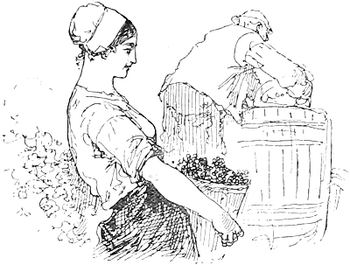
The other side of the Rhone is fruitful in minor sparkling wines, chief
among which is the so-called Clairette de Die, made at the town of
that name, a place of some splendour, as existing antiquities show, in
the days of the Roman dominion in Gaul. Later on, Die was the scene
of constant struggles for supremacy between its counts and bishops,
one of the latter being massacred by the populace in front of the
cathedral doorway—ever since known by the sinister appellation of the
Porte Rouge—and Catholics and Huguenots alike devastated the town in
the troublesome times of the Reformation. Clairette de Die is made
principally from the blanquette or malvoisie variety of grape, which,
after the stalks have been removed, is both trodden with the feet and
pressed. The must is run off immediately into casks, and four-and-twenty
hours later it is racked into other casks, a similar operation being
performed every two or three days for the period of a couple of months,
when, the fermentation having subsided, the wine is fined and usually
bottled in the following March. Newly-made Clairette de Die is a sweet
sparkling wine, but it loses its natural effervescence after a couple of
years, unless it has been treated in the same manner as Champagne, which
is rarely the case. The wine enjoys a reputation altogether beyond its
merits.
In addition to the well-known Clairette, some of the wine-growers
of Die make sparkling white and rose-coloured muscatels of superior
quality, which retain their effervescing properties for several
years. A sparkling wine is also made some ten miles from Die, on the road
to Saillans, in a district bounded on the one side by the waters of
the Drôme, and on the other by strange mountains with helmet-shaped
crests. The centre of production is a locality called Vercheny, composed
of several hamlets, one of which, named Le Temple, was the original
home of the family of Barnave. The impressionable young deputy to the
National Assembly formed one of the trio sent to bring back the French
royal family from Varennes after their flight from Paris. It will be
remembered how, under the influence of Marie Antoinette and Madame
Elizabeth, Barnave became transformed during the journey into a faithful
partisan of their unhappy cause, and that he eventually paid the penalty
of his devotion with his life.
In the extreme south of France, and almost under the shadow of the
Pyrenees, a sparkling wine of some repute is made at a place called
Lagrasse, about five-and-twenty miles westward of Narbonne, the
once-famous Mediterranean city, the maritime rival of Marseilles, and
in its palmy days, prior to the Christian era, a miniature Rome, with
its capitol, its curia, its decemvirs, its consuls, its prætors, its
questors, its censors, and its ediles, and which boasted of being the
birthplace of three Roman Emperors. To-day Narbonne has to content
itself with the humble renown derived from its delicious honey and
its characterless full-bodied wines. Limoux, so celebrated for its
Blanquette, lies a long way farther to the west, behind the Corbières
range of mountains that join on to the Pyrenees, and the jagged peaks,
deep barren gorges, and scarred sides of which have been witness of many
a desperate struggle during the century and a half when they formed the
boundary between France and Spain.
We arrived at Limoux just too late for the famous fête of the Black
Virgin, which lasts three weeks, and attracts crowds of southern
pilgrims to the chapel of Our Lady of Marseilles, perched on a little
hill some short distance from the town, with a fountain half-way up,
whose water issues drop by drop, and has the credit of possessing
unheard-of virtues. The majority of pilgrims, however, exhibit a decided
preference for the new-made wine over the miraculous water, and for
one-and-twenty days something like a carnival of inebriety prevails at
Limoux.
Blanquette de Limoux derives its name from the species of grape it is
produced from, and which we believe to be identical with the malvoisie,
or malmsey. Its long-shaped berries grow in huge bunches, and dry
readily on the stalks. The fruit is gathered as tenderly as possible,
care being taken that it shall not be in the slightest degree bruised,
and is then spread out upon a floor to admit of whatever sugar it
contains becoming perfect. The bad grapes having been carefully picked
out, and the seeds extracted from the remaining fruit, the latter is
now trodden, and the must, after being filtered through a strainer, is
placed in casks, where it remains fermenting for about a week, during
which time any overflow is daily replenished by other must reserved for
the purpose. The wine is again clarified, and placed in fresh casks with
the bungholes only lightly closed until all sensible fermentation has
ceased, when they are securely fastened up. The bottling takes place in
the month of March, and the wine is subsequently treated much after the
same fashion as sparkling Saint-Péray, excepting that it is generally
found necessary to repeat the operation of dégorgement three, if not
as many as four, times.
Blanquette de Limoux is a pale white wine, the saccharine properties
of which have become completely transformed into carbonic acid gas
and alcohol. It is consequently both dry and spirituous, deficient in
delicacy, and altogether proves a great disappointment. At its best it
may, perhaps, rank with sparkling Saint-Péray, but unquestionably not
with an average Champagne.
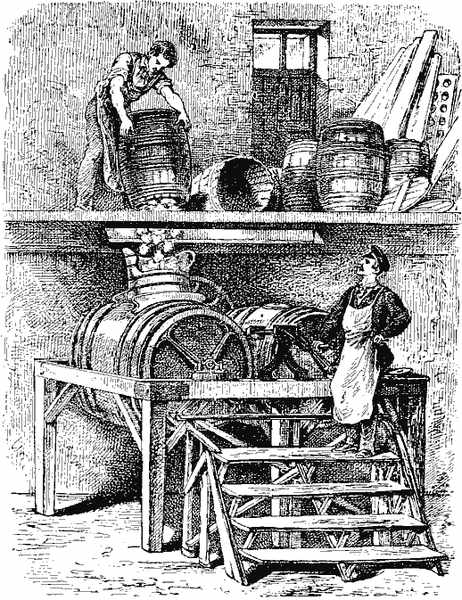
PREPARING THE CHAMPAGNE LIQUEUR.
Dry and sweet Champagnes—Their sparkling properties—Form
of Champagne glasses—Style of sparkling wines consumed in
different countries—The colour and alcoholic strength of
Champagne—Champagne approved of by the faculty—Its use in
nervous derangements—The icing of Champagne—Scarcity of grand
vintages in the Champagne—The quality of the wine has little
influence on the price—Prices realised by the Ay and Verzenay
crus in grand years—Suggestions for laying down Champagnes of
grand vintages—The improvement they develop after a few years—The
wine of 1874—The proper kind of cellar in which to lay down
Champagne—Advantages of Burrow’s patent slider wine-bins—Increase
in the consumption of Champagne—Tabular statement of stocks,
exports, and home consumption from 1844–5 to 1877–8—When to serve
Champagne at a dinner-party—Charles Dickens’s dictum that its
proper place is at a ball—Advantageous effect of Champagne at an
ordinary British dinner-party.
IN selecting a sparkling wine, one fact should be borne in mind—that
just as, according to Sam Weller, it is the seasoning which makes the
pie mutton, beef, or veal, so it is the liqueur which renders the
wine dry or sweet, light or strong. A really palatable dry Champagne,
emitting the fragrant bouquet which distinguishes all wines of fine
quality, free from added spirit, is obliged to be made of the very
best vin brut, to which necessarily an exceedingly small percentage
of liqueur will be added. On the other hand, a sweet Champagne can be
produced from the most ordinary raw wine—the Yankees even claim to
have evolved it from petroleum—as the amount of liqueur it receives
completely masks its original character and flavour. This excess of
syrup, it should be remarked, contributes materially to the wine’s
explosive force and temporary effervescence; but shortly after the
bottle has been uncorked
the wine becomes disagreeably flat. A fine
dry wine, indebted as it is for its sparkling properties to the natural
sweetness of the grape, does not exhibit the same sudden turbulent
effervescence. It continues to sparkle, however, for a long time after
being poured into the glass, owing to the carbonic acid having been
absorbed by the wine itself instead of being accumulated in the vacant
space between the liquid and the cork, as is the case with wines
that have been highly liqueured. Even when its carbonic acid gas is
exhausted, a good Champagne will preserve its fine flavour, which the
effervescence will have assisted to conceal. Champagne, it should be
noted, sparkles best in tall tapering glasses; still these have their
disadvantages, promoting, as they do, an excess of froth when the wine
is poured into them, and almost preventing any bouquet which the wine
possesses from being recognised.
Manufacturers of Champagne and other sparkling wines prepare them
dry or sweet, light or strong, according to the markets for which
they are designed. The sweet wines go to Russia and Germany—the
sweet-toothed Muscovite regarding M. Louis Roederer’s syrupy product
as the beau-idéal of Champagne, and the Germans demanding wines with
twenty or more per cent of liqueur, or nearly quadruple the quantity
that is contained in the average Champagnes shipped to England. France
consumes light and moderately sweet wines; the United States gives a
preference to the intermediate qualities; China, India, and other hot
countries stipulate for light dry wines; while the very strong ones
go to Australia, the Cape, and other places where gold and diamonds
and suchlike trifles are from time to time ‘prospected.’ Not merely
the driest, but the very best, wines of the best manufacturers, and
commanding of course the highest prices, are invariably reserved for the
English market. Foreigners cannot understand the marked preference shown
in England for exceedingly dry sparkling wines. They do not consider
that as a rule they are drunk during dinner with the plats, and not
at dessert, with all kinds of sweets, fruits, and ices, as is almost
invariably the case abroad.
Good Champagne is usually of a pale straw colour, but with nothing of
a yellow tinge about it. When its tint is pinkish, this is owing to a
portion of the colouring matter having been extracted from the skins
of the grapes—a contingency which every pains are taken to avoid,
although, since the success achieved by the wine of 1874, slightly pink
wines are likely to be the fashion. The positive pink or rose-coloured
Champagnes, such as were in fashion some thirty years ago, are simply
tinted with a small quantity of deep-red wine. The alcoholic strength of
the drier wines ranges from eighteen degrees of proof spirit upwards,
or slightly above the ordinary Bordeaux, and under all the better-class
Rhine wines. Champagnes, when loaded with a highly alcoholised liqueur,
will, however, at times mark as many as thirty degrees of proof spirit.
The lighter and drier the sparkling wine, the more wholesome it is, the
saccharine element in conjunction with alcohol being not only difficult
of digestion, but generally detrimental to health.
The faculty are agreed that fine dry Champagnes, consumed in moderation,
are among the safest wines that can be partaken of. Any intoxicating
effects are rapid but exceedingly transient, and arise from the alcohol
suspended in the carbonic acid being applied rapidly and extensively
to the surface of the stomach. ‘Champagne,’ said Curran, ‘simply gives
a runaway rap at a man’s head.’ Dr. Druitt, equally distinguished by
his studies upon wine and his standing as a physician, pronounces
good Champagne to be ‘a true stimulant to body and mind alike—rapid,
volatile, transitory, and harmless. Amongst the maladies that are
benefited by it,’ remarks he, ‘is the true neuralgia—intermitting fits
of excruciating pain running along certain nerves, without inflammation
of the affected part, often a consequence of malaria, or of some other
low and exhausting causes. To enumerate the cases in which Champagne
is of service would be to give a whole nosology. Who does not know the
misery, the helplessness of that abominable ailment influenza, whether
a severe cold or the genuine epidemic? Let the faculty dispute about
the best remedy if they please; but a sensible man with a bottle of
Champagne will beat them all. Moreover, whenever there is pain, with
exhaustion and lowness, then Dr. Champagne should be had up. There is
something excitant in the wine—doubly so in the sparkling wine, which,
the moment it touches the lips, sends an
electric telegram of comfort
to every remote nerve. Nothing comforts and rests the stomach better, or
is a greater antidote to nausea.’
Champagne of fine quality should never be mixed with ice or iced water;
neither should it be iced to the extent Champagnes ordinarily are; for,
in the first place, the natural lightness of the wine is such as not
to admit of its being diluted without utterly spoiling it, and in the
next, excessive cold destroys alike the fragrant bouquet of the wine and
its delicate vinous flavour. Really good Champagne should not be iced
below a temperature of fifty degrees Fahr.; whereas exceedingly sweet
wines will bear icing down almost to freezing point, and be rendered
more palatable by the process. The above remarks apply to all sorts of
sparkling wine.
In the Champagne, what may be termed a really grand vintage commonly
occurs only once, and never more than twice, in ten years. During the
same period, however, there will generally be one or two other tolerably
good vintages. In grand years the crop, besides being of superior
quality, is usually abundant, and as a consequence the price of the raw
wine is scarcely higher than usual. Apparently from this circumstance
the sparkling wine of grand vintages does not command an enhanced value,
as is the case with other fine wines. It is only when speculators
recklessly outbid each other for the grapes or the vin brut, or when
stocks are low and the vin brut is really scarce, that the price of
Champagne appears to rise.
That superior quality does not involve enhanced price is proved by the
amounts paid for the Ay and Verzenay crus in years of grand vintages.
During the present century these appear to have been 1802, ’06, ’11,
’18, ’22, ’25, ’34, ’42, ’46, ’57, ’65, ’68, and ’74—that is, thirteen
grand vintages in eighty years. Other good vintages, although not equal
to the foregoing, occurred in the years 1815, ’32, ’39, ’52, ’54, ’58,
’62, ’64, and ’70. Confining ourselves to the grand years, we find
that the Ay wine of 1834, owing to the crop being plentiful as well as
good, only realised from 110 to 140 francs the pièce of 44 gallons,
although for two years previously this had fetched them 150 to 200
francs. In 1842 the price ranged from 120 to 150 francs, whereas the
vastly inferior wine of the year before had commanded from 210 to 275
francs. In 1846, the crop being a small one, the price of the wine rose,
and in 1857 the pièce fetched as much as from 480 to 500 francs; still
this was merely a trifle higher than it had realised the two preceding
years. In 1865 the price was 380 to 400 francs, and in 1868 about the
same, whereas the indifferent vintages of 1871, ’72, and ’73—the latter
eventually proved to be of execrable quality—realised from 500 to 1000
francs the pièce. It was very similar with the wine of Verzenay. In
1834 the price of the pièce ranged from 280 to 325 francs, or about the
average of the three preceding years. In 1846, the crop being scarce,
the price rose considerably; while in 1857, when the crop was plentiful,
it fell to 500 francs, or from 5 to 20 per cent below that of the two
previous years, when the yield was both inferior and less abundant.
In 1865 the price rose 33 per cent above that of the year before;
still, although Verzenay wine of 1865 and 1868 fetched from 420 to 450
francs the pièce, and that of 1874 as much as 900 francs, the greatly
inferior vintages of 1872–73 commanded 900 and 1030 francs the pièce.
Subsequently the price of the wine fell to 350 and 450 francs the pièce,
to rise again, however, in 1878 to 900 francs, which was followed by
a fall the following year to 250 francs. In 1880, when the yield was
no more than the quarter of an average one, and the quality was as yet
undetermined, the Ay and Verzenay wines commanded the high price of
1500 francs and upwards the pièce. Exceptionally high prices were also
realised for the wines of the neighbouring localities.
Consumers of Champagne, if wise, would profit by the circumstance that
quality has not the effect of causing a rise in prices, and if they
were bent upon drinking their favourite wine in perfection, as one
meets with it at the dinner-tables of the principal manufacturers, who
only put old wine of grand vintages before their guests, they would lay
down Champagnes of good years in the same way as the choicer vintages
of port, burgundy, and bordeaux are laid down. The Champagne of 1874
was a wine of this description, with all its finer vinous qualities
well developed, and consequently needing age to attain not merely the
roundness, but the refinement, of flavour pertaining to a high-class
sparkling wine. Instead of being drunk a few months after it was shipped
in the spring and
summer of 1877, as was the fate of much of the wine
in question, it needed being kept for three years at the very least
to become even moderately round and perfect. In the Champagne one had
many opportunities of tasting the grander vintages that had arrived at
ten, twelve, or fifteen years of age, and had thereby attained supreme
excellence. It is true their effervescence had moderated materially, but
their bouquet and flavour were perfect, and their softness and delicacy
something marvellous.
A great wine like that of 1874 will go on improving for ten years,
providing it is only laid down under proper conditions. These are,
first, an exceedingly cool but perfectly dry cellar, the temperature
of which should be as low as from 50° to 55° Fahr., or even lower if
this is practicable. The cellar, too, should be neither over dark nor
light, scrupulously clean, and sufficiently well ventilated for the
air to be continuously pure. It is requisite that the bottles should
rest on their sides, to prevent the corks shrinking, and thus allowing
both the carbonic acid and the wine itself to escape. For laying down
Champagne or any kind of sparkling wine, an iron wine-bin is by far
the best; and the patent ‘slider’ bins made by Messrs. W. & J. Burrow,
of Malvern, are better adapted to the purpose than any other. In these
the bottles rest on horizontal parallel bars of wrought-iron, securely
riveted into strong wrought-iron uprights, both at the back and in
front. They are especially adapted for laying down Champagne, as they
admit of the air circulating freely around the bottles, thus conducing
to the preservation of the metal foil round their necks, and keeping the
temperature of the wine both cool and equable.
From the subjoined table it will be seen that the consumption of
Champagne has more than quadrupled since the year 1844–5, a period of
six-and-thirty years. A curious fact to note is the immense increase
in the exports of the wine during the three years following the
Franco-German war, during which contest both the exports and home
consumption of Champagne naturally fell off very considerably. No
reliable information is available as to the actual quantity of Champagne
consumed yearly in England, but this may be taken in round numbers at
about four millions of bottles. The consumption of the wine in the
United States varies from rather more than a million and a half to
nearly two million bottles annually.
OFFICIAL RETURN BY THE CHAMBER OF COMMERCE AT REIMS OF THE TRADE
IN CHAMPAGNE WINES FROM APRIL 1844 TO APRIL 1881.
Years— from April
to April. |
Manufacturers’
Stocks. |
Number of Bottles
exported. |
Number of Bottles
sold in France. |
Total Number of
Bottles sold. |
| 1844–45 |
23,285,218 |
4,380,214 |
2,255,438 |
6,635,652 |
| 1845–46 |
22,847,971 |
4,505,308 |
2,510,605 |
7,015,913 |
| 1846–47 |
18,815,367 |
4,711,915 |
2,355,366 |
7,067,281 |
| 1847–48 |
23,122,994 |
4,859,625 |
2,092,571 |
6,952,196 |
| 1848–49 |
21,290,185 |
5,686,484 |
1,473,966 |
7,160,450 |
| 1849–50 |
20,499,192 |
5,001,044 |
1,705,735 |
6,706,779 |
| 1850–51 |
20,444,915 |
5,866,971 |
2,122,569 |
7,989,540 |
| 1851–52 |
21,905,479 |
5,957,552 |
2,162,880 |
8,120,432 |
| 1852–53 |
19,376,967 |
6,355,574 |
2,385,217 |
8,740,790 |
| 1853–54 |
17,757,769 |
7,878,320 |
2,528,719 |
10,407,039 |
| 1854–55 |
20,922,959 |
5,895,773 |
2,452,743 |
9,348,516 |
| 1855–56 |
15,957,141 |
7,137,001 |
2,562,039 |
9,699,040 |
| 1856–57 |
15,228,294 |
8,490,198 |
2,468,818 |
10,959,016 |
| 1857–58 |
21,628,778 |
7,368,310 |
2,421,454 |
9,789,764 |
| 1858–59 |
28,328,251 |
7,666,633 |
2,805,416 |
10,472,049 |
| 1859–60 |
35,648,124 |
8,265,395 |
3,039,621 |
11,305,016 |
| 1860–61 |
30,235,260 |
8,488,223 |
2,697,508 |
11,185,731 |
| 1861–62 |
30,254,291 |
6,904,915 |
2,592,875 |
9,497,790 |
| 1862–63 |
28,013,189 |
7,937,836 |
2,767,371 |
10,705,207 |
| 1863–64 |
28,466,975 |
9,851,138 |
2,934,996 |
12,786,134 |
| 1864–65 |
33,298,672 |
9,101,441 |
2,801,626 |
11,903,067 |
| 1865–66 |
34,175,429 |
10,413,455 |
2,782,777 |
13,196,132 |
| 1866–67 |
37,608,716 |
10,283,886 |
3,218,343 |
13,502,229 |
| 1867–68 |
37,969,219 |
10,876,585 |
2,924,268 |
13,800,853 |
| 1868–69 |
32,490,881 |
12,810,194 |
3,104,496 |
15,914,690 |
| 1869–70 |
39,272,562 |
13,858,839 |
3,628,461 |
17,487,300 |
| 1870–71 |
39,984,003 |
7,544,323 |
1,633,941 |
9,178,264 |
| 1871–72 |
40,099,243 |
17,001,124 |
3,367,537 |
20,368,661 |
| 1872–73 |
45,329,490 |
18,917,779 |
3,464,059 |
22,381,838 |
| 1873–74 |
46,573,974 |
18,106,310 |
2,491,759 |
20,598,069 |
| 1874–75 |
52,733,674 |
15,318,345 |
3,517,182 |
18,835,527 |
| 1875–76 |
64,658,767 |
16,705,719 |
2,439,762 |
19,145,481 |
| 1876–77 |
71,398,726 |
15,882,964 |
3,127,991 |
19,010,955 |
| 1877–78 |
70,183,863 |
15,711,651 |
2,450,983 |
18,162,634 |
| 1878–79 |
65,813,194 |
14,844,181 |
2,596,356 |
17,440,537 |
| 1879–80 |
68,540,668 |
16,524,593 |
2,665,561 |
19,190,154 |
| 1880–81 |
54,505,964 |
18,220,980 |
2,330,924 |
20,551,904 |
Distinguished gourmets are scarcely agreed as to the proper moment
when Champagne should be introduced at the dinner-table. Dyspeptic Mr.
Walker, of ‘The Original,’ laid it down that Champagne ought to be
introduced very early at the banquet, without any regard whatever to
the viands it may chance to accompany. ‘Give Champagne,’ he says, ‘at
the beginning of dinner, as its exhilarating qualities serve to start
the guests, after which they will seldom flag. No other wine produces
an equal effect in increasing the success of a party—it invariably
turns the balance to the favourable side. When Champagne goes rightly,
nothing can well go wrong.’ These precepts are sound enough; still
all dinner-parties are not necessarily glacial, and the guests are
not invariably mutes. Before Champagne can be properly introduced at
a formal dinner, the conventional glass of sherry or madeira should
supplement the soup, a white French or a Rhine wine accompany the fish,
and a single glass of bordeaux prepare the way with the first entrée
for the sparkling wine, which, for the first round or two, should be
served briskly and liberally. A wine introduced thus early at the repast
should of course be dry, or, at any rate, moderately so.
We certainly do not approve of Mr. Charles Dickens’s dictum that
Champagne’s proper place is not at the dinner-table, but solely at a
ball. ‘A cavalier,’ he said, ‘may appropriately offer at propitious
intervals a glass now and then to his danceress. There it takes its
fitting rank and position amongst feathers, gauzes, lace, embroidery,
ribbons, white-satin shoes, and eau-de-Cologne, for Champagne is
simply one of the elegant extras of life.’ This is all very well;
still the advantageous effect of sparkling wine at an ordinary
British dinner-party, composed as it frequently is of people brought
indiscriminately together in accordance with the exigencies of the
hostess’s visiting-list, cannot be gainsaid. After the preliminary
glowering at each other, more Britannico, in the drawing-room,
everybody regards it as a relief to be summoned to the repast, which,
however, commences as chillily as the soup and as stolidly as the
salmon. The soul of the hostess is heavy with the anxiety of prospective
dishes, the brow of the host is clouded with the reflection that our
rulers are bent upon adding an extra penny to the income-tax. Placed
between a young lady just out and a dowager of grimly Gorgonesque
aspect, you hesitate how to open a conversation. Your first attempts are
singularly ineffectual, only eliciting a dropping fire of monosyllables.
You envy the placidly languid young gentleman opposite, limp as his
fast-fading camellia, and seated next to Belle Breloques, who is
certain, in racing parlance, to make the running for him. But even
that damsel seems preoccupied with her fan, and, despite her aplomb,
hesitates to break the icy silence. The two City friends of the host
are lost in mute speculation as to the future price of indigo or Ionian
Bank shares, while their wives seem to be mentally summarising the exact
cost of each other’s toilettes. Their daughters, or somebody else’s
daughters, are desperately jerking out monosyllabic responses to feeble
remarks concerning the weather, the theatres, operatic débutantes,
the people in the Row, æstheticism, and kindred topics from a couple of
F.O. men. Little Snapshot, the wit, on the other side of the Gorgon, has
tried to lead up to a story, but has found himself, as it were, frozen
in the bud. When lo! the butler softly sibillates in your ear the magic
word ‘Champagne,’ and as it flows, creaming and frothing, into your
glass, a change comes over the spirit of your vision.
The hostess brightens, the host coruscates. The young lady on your right
suddenly develops into a charming girl, with becoming appreciation of
your pet topics and an astounding aptness for repartee. The Gorgon
thaws, and implores Mr. Snapshot, whose jests are popping as briskly as
the corks, not to be so dreadfully funny, or he will positively kill
her. Belle Breloques can always talk,
and now her tongue rattles faster
then ever, till the languid one arouses himself like a giant refreshed,
and gives her as good as he gets. The City men expatiate in cabalistic
language on the merits of some mysterious speculation, the prospective
returns from which increase with each fresh bottle. One of their wives
is discussing church decoration with a hitherto silent curate, and the
other is jabbering botany to a red-faced warrior. The juniors are in
full swing, and ripples of silvery laughter rise in accompaniment to the
beaded bubbles all round the table.
Gradually, as people drift off from generalities to their own particular
line—gastronomy, politics, art, sport, fashion, literature, church
matters, theatricals, speculation, scandal, dress, and the like—the
scraps of sentences that the ear catches flying about the table present
a mosaic somewhat resembling the following: ‘Forster should have sent
him to Kilmainham—to see that dear delightful Mr. Irving in—ten-inch
armour-plating, but could not steer in a sea-way, so—sat down in the
saddle and rammed his spurs into—Petsy Prettitoes and half a dozen
girls from the Cruralia, who were—ordained last week by the Bishop of
London, when his lordship—said there was no doubt who best deserved the
vacant Garter, and declared—a dividend of seven per cent for the—comet
year with a bouquet—of sunflowers and lilies on satin, which you
should—cover with a light crust—of stiff clay, with a rasper on the
further side as—the third story of the hotel overlooking—the Euphrates
Valley Railway, which would lead to—the loveliest bit of landscape
in the Academy—with the finest hair in the world, and eyes like—a
boiled cod’s head and shoulders—cut low at the neck, with a gold
shoulder-strap, and—nothing else to speak of before the House except
the Bill for—her photographs, which are in all the shop-windows, beside
Mrs. Langtry’s—who never ought to have allowed Bismarck to—assist at
the consecration of—the Henley course—so the Duke started at once
for Aldershot, and reviewed—the two best novels of the season—cut up
with tomatoes and a dash of garlic—and was positive he saw them dining
together at Richmond on—fourteen brace of birds and five hares in—the
loveliest set of embroidered vestments and an altar-cloth worked for—a
Conservative majority, which will drive the Government to—take a couple
of stalls at Her Majesty’s to hear Carmen—who gave him the last
galop, but he—blundered at his first fence and fell—to seventy-two
and a half, whilst the preference shares were—all ordered on foreign
service and—heard nothing from the Irish members but—Oscar Wilde’s
poems bound in red morocco—with a white-satin train and—plenty of body
and a good colour—all through riding every morning in—a private box
on the upper tier—and that is why Gladstone at once gave orders—for
them to be actually shut up together—in the strong room of the Bank
of England, with a reserve fund of bullion—from the music in the
first act of Patience—equal to that of Job when he said—well, only
half a glass, then, since you are so pressing.’ And all this is due to
Champagne, that great unloosener not merely of tongues, but, better
still, of purse-strings, as is well known to the secretaries of those
charitable institutions which set the exhilarating wine flowing earliest
at their anniversary dinners.