Transcriber’s Note
Text on cover added by Transcriber and placed in the Public Domain.
By HENRY CURWEN.
“In these days, ten ordinary histories of kings and courtiers were well exchanged
against the tenth part of one good History of Booksellers.”—Thomas Carlyle.
WITH PORTRAITS AND ILLUSTRATIONS.
London: CHATTO AND WINDUS, PICCADILLY.
PREFACE.
“History” has been aptly termed the
“essence of innumerable biographies;” and
this surely justifies us in the selection of
our title; but in inditing a volume to be issued in a
cheap and popular form, it was manifestly impossible
to trace the careers of all the eminent members,
ancient and modern, of a Trade so widely extended;
had we, indeed, possessed all possible leisure for
research, every available material, and a space
thoroughly unlimited, it is most probable that the
result would have been distinguished chiefly for its
bulk, tediousness, and monotony. It was resolved,
therefore, in the first planning of the volume, to
primarily trace the origin and growth of the Bookselling
and Publishing Trades up to a comparatively
modern period; and then to select, for fuller treatment,
the most typical English representatives of each
one of the various branches into which a natural
division of labour had subdivided the whole. And,
by this plan, it is believed that, while some firms at
present growing into eminence may have been
omitted, or have received but scant acknowledgment,
no one Publisher or Bookseller, whose spirit and labours
have as yet had time to justify a claim to a niche in
the “History of Booksellers,” has been altogether
passed over. In the course of our “History,”
too, we have been necessarily concerned with the
manner of the “equipping and furnishing” of nearly
every great work in our literature. So that, while on
the one hand we have related the lives of a body of
men singularly thrifty, able, industrious, and persevering—in
some few cases singularly venturesome,
liberal, and kindly-hearted—we have on the other, by
our comparative view, tried to throw a fresh, at all
events a concentrated, light upon the interesting story
of literary struggle.
No work of the kind has ever previously been
attempted, and this fact must be an apology for
some, at least, of our shortcomings.
Long ages before the European invention of the art
of printing, long even before the encroaching masses
of Huns and Visigoths rolled the wave of civilization
backward for a thousand years, the honourable trades,
of which we aim to be in some degree the chroniclers,
had their representatives and their patrons. Without
going back to the libraries of Egypt—a subject fertile
enough in the pages of mythical history—or to the
manuscript-engrossers and sellers of Ancient Greece—though
by their labours much of the world’s best poetry,
philosophy, and wit was garnered for a dozen centuries,
like wheat ears in a mummy’s tomb, to be scattered to
the four winds of heaven, when the Mahometans seized
upon Constantinople, thenceforth to fructify afresh,
and, in connection with the art of printing, as if the
old world and the new clasped hands upon promise of
a better time, to be mainly instrumental in the “revival
of letters”—it will be sufficient for our present purpose
to know that there were in Rome, at the time of the
Empire, many publishing firms, who, if they could not
altogether rival the magnates of Albemarle Street and
the “Row,” issued books at least as good, and, paradoxical
as it may seem, at least as cheaply as their
modern brethren.
To the sauntering Roman of the Augustan age literature
was an essential; never, probably, till quite modern
times was education—the education, at all events, that
supplies a capability to read and write—so widely spread.
The taste thus created was gratified in many ways. If
the Romans had no Mudie, they possessed public
libraries, thrown freely open to all. They had public
recitations, at which unpublished and ambitious writers
could find an audience; over which, too, sometimes
great emperors presided, while poets, with a world-wide
reputation, read aloud their favourite verses.
They had newspapers, the subject-matter of which
was wonderfully like our own. The principal journal,
entitled Acta Diurna, was compiled under the sanction
of the government, and hung up in some place of
frequent resort for the benefit of the multitude, and
was probably copied for the private accommodation
of the wealthy. All public events of importance were
chronicled here; the reporters, termed actuarii, furnished
abstracts of the proceedings in the law courts
and at public assemblies; there was a list of births,
deaths, and marriages; and we are informed that the
one article of news in which the Acta Diurna particularly
abounded was that of reports of trials for divorce.
Juvenal tells us that the women were all agog for
deluges, earthquakes, and other horrors, and that the
wine-merchants and traders used to invent false news
in order to affect their various markets. But, in
addition to all these means for gratifying the Roman
taste for reading, every respectable house possessed a
library, and among the better classes the slave-readers
(anagnostæ) and the slave-transcribers (librarii) were
almost as indispensable as cooks and scullions. At
first we find that these slaves were employed in
making copies of celebrated books for their masters;
but gradually the natural division of labour produced
a separate class of publishers. Atticus, the Moxon of
the period, and an author of similar calibre, saw an
opening for his energies in the production of copies of
favourite authors upon a large scale. He employed a
number of slaves to copy from dictation simultaneously,
and was thus able to multiply books as
quickly as they were demanded. His success speedily
finding imitators, among whom were Tryphon and
Dorus, publishing became a recognized trade. The
public they appealed to was not a small one. Martial,
Ovid, and Propertius speak of their works as
being known all the world over; that young and old,
women and girls, in Rome and in the provinces, in
Britain and in Gaul, read their verses. “Every one,”
says Martial, “has me in his pocket, every one has
me in his hands.”
“Laudat, amat, cantat nostros mea Roma libellos: Meque sinus omnis, me manus omnis habet.”
Horace speaks of the repugnance he felt at seeing his
works in the hands of the vulgar. And Pliny writes
that Regulus is mourning ostentatiously for the loss
of his son, and no one weeps like him—luget ut nemo.
“He composes an oration which he is not content
with publicly reciting in Rome, but must needs enrich
the provinces with a thousand copies of it.”
School-books, too, an important item in publishing
eyes, were in demand at Rome: Juvenal says that “the
verses which the boy has just conned over at his desk
he stands up to repeat,” and Persius tells us that poets
were ambitious to be read in the schools; while Nero,
in his vanity, gave special command that his verses
should be placed in the hands of the students.
Thus, altogether, there must have been a large
book-buying public, and this fact is still further
strengthened by the cheapness of the books produced.
M. Geraud1 concludes that the prices were lower
than in our own day. According to Martial the first
book of his Epigrams was to be bought, neatly bound,
for five denarii (nearly three shillings), but in a
cheaper binding for the people it cost six to ten sestertii
(a shilling to eighteenpence); his thirteenth
book of Epigrams was sold for four sestertii (about
eightpence), and half that price would, he says, have
left a fair profit (Epig. xiii. 3). He tells us, moreover,
that it would only require one hour to copy the
whole of the second book,
“Hæc una peragit librarius hora.”
This book contains five hundred and forty verses,
and though he may be speaking with poetical licence,
the system of abbreviations did undoubtedly considerably
lessen the labour of transcribing, and it would be
quite possible, by employing a number of transcribers
simultaneously, to produce an edition of such a work
in one day.
In Rome, therefore, we see that from the employment
of slave labour—and some thousands of slaves
were engaged in this work of transcribing—books were
both plentiful and cheap.2
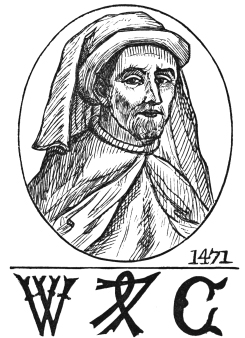
William Caxton. The first printer at Westminster.
1410–1491.
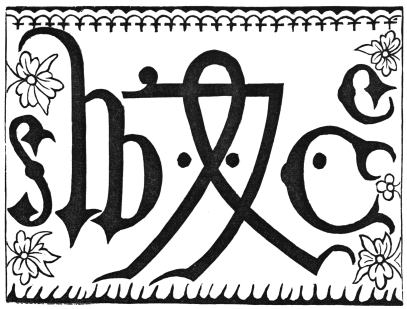
Caxton’s Monogram.
(Facsimile from his Works.)
In the Middle Ages this state of things was entirely
altered. Men were too busy in giving and receiving
blows, in oppressing and being oppressed, to have the
slightest leisure for book-learning. Slaves, such as
then existed, were valued for far different things than
reading and writing; and even their masters’ kings,
princes, lords, and other fighting dignitaries, would
have regarded a quill-pen, in their mail-gloved hands,
as a very foolish and unmanly weapon. There was
absolutely no public to which bookmakers could
have appealed, and the art of transcribing was confined
entirely to a few monks, whose time hung
heavily upon their hands; and, as a natural result,
writers became, as Odofredi says, “no longer writers
but painters,” and books were changed into elaborate
works of art. Nor was this luxurious illumination
confined to Bibles and Missals; the very law-books
were resplendent, and a writer in the twelfth century
complains that in Paris the Professor of Jurisprudence
required two or three desks to support his copy of
Ulpian, gorgeous with golden letters. No wonder
that Erasmus says of the Secunda Secundea that “no
man can carry it about, much less get it into his
head.”
At first there was no trade whatever in books, but
gradually a system of barter sprung up between the
monks of various monasteries; and with the foundation
of the Universities a regular class of copyists was
established to supply the wants of scholars and professors,
and this improvement was greatly fostered by
the invention of paper.
The booksellers of this period were called Stationarii,
either from the practice of stationing themselves
at booths or stalls in the streets (in contradistinction
to the itinerant vendors) or from the other
meaning of the Latin term statio, which is, Crevier
tells us, entrepôt or depository, and he adds that the
booksellers did little else than furnish a place of
deposit, where private persons could send their manuscripts
for sale. In addition to this, indeed as their
chief trade, they sent out books to be read, at exorbitant
prices, not in volumes, but in detached parts,
according to the estimation in which the authors were
held.
In Paris, where the trade of these stationarii was
best developed, a statute regarding them was published
in 1275, by which they were compelled to take
the oath of allegiance once a year, or, at most,
once every two years. They were forbidden by this
same statute to purchase the books placed in their
hands until they had been publicly exposed for sale
for at least a month; the purchase money was to
be handed over direct to the proprietor, and the bookseller’s
commission was not to exceed one or two per
cent. In addition to the stationarii, there were in
Paris several pedlars or stall-keepers, also under
University control, who were only permitted to exhibit
their wares under the free heavens, or beneath the
porches of churches where the schools were occasionally
kept. The portal at the north end of the
cross aisle in Rouen Cathedral is still called le Portail
des Libraires.
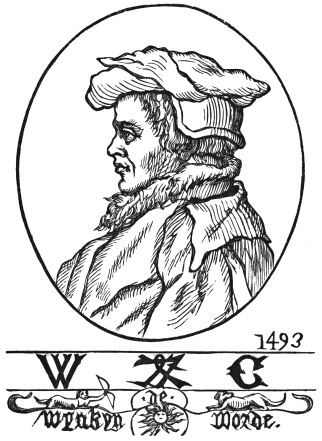
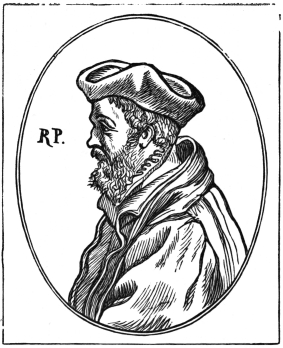
Wynkyn de Worde. 1493–1534. The second printer at Westminster.
(From a drawing by Fathorne.)
Headpiece of William Caxton.
In England the first stationers were probably themselves
the engrossers of what they sold, when the
learning and literature of the country demanded as
the chief food A B C’s and Paternosters, Aves and
Creeds, Graces and Amens. Such was the employment
of our earliest stationers, as the names of their
favourite haunts—Paternoster Row, Amen Corner,
and Ave Maria Lane—bear ample witness; while
the term stationer soon became synonymous with
bookseller, and, in connection with the Stationers’
Company, of no little importance, as we shall soon
see, in our own bookselling annals.
In 1292, the bookselling corporation of Paris consisted
of twenty-four copyists, seventeen bookbinders,
nineteen parchment makers, thirteen illuminators, and
eight simple dealers in manuscripts. But at the time
when printing was first introduced upwards of six
thousand people are said to have subsisted by
copying and illuminating manuscripts—a fact that,
even if exaggerated, says something for the gradual
advancement of learning.
The European invention of printing, which here
can only be mentioned; the diffusion of Greek manuscripts
and the ancient wisdom contained therein,
consequent upon the capture of Constantinople by
the Turks; the discovery of America; and, finally,
the German and English religious Reformations, were
so many rapid and connected strides in favour of
knowledge and progress. All properly-constituted
conservative minds were shocked that so many new
lights should be allowed to stream in upon the
world, and every conceivable let and hindrance was
called up in opposition. Royal prerogatives were
exercised, Papal bulls were issued, and satirists (soi-disant)
were bitter. A French poet of this period,
sneering at the invention of printing, and the discovery
of the New World by Columbus, says of the
press, in language conveyed by the following doggerel:—
“I’ve seen a mighty throng Of printed books and long, To draw to studious ways The poor men of our days; By which new-fangled practice, We soon shall see the fact is, Our streets will swarm with scholars Without clean shirts or collars, With Bibles, books, and codices As cheap as tape for bodices.”
In spite of this feeling against the popularization of
learning and the spread of education—a feeling not
quite dead yet, if we may trust the evidence of a few
good old Tory speakers on the evil effects (forgery,
larceny, and all possible violation of the ten commandments)
of popular education—a feeling perhaps subsiding,
for a country gentleman of the old school
told us recently that he “would wish every working
man to read the Bible—the Bible only—and that with
difficulty”—a progressive sign—the world was too well
aware of the good to be gathered from the furtherance
of these novelties to willingly let them die, and
though the battle was from the first a hard one, it has
been, from first to last, a winning battle.
Richard Pynson. Died about 1530.
Monogram used by Richard Pynson.
It will be essential throughout this chapter, and
indeed throughout the whole work, to bear in mind
that it was not till quite modern times that a separate
class was formed to buy copyrights, to employ printers,
and to sell the books wholesale, to which their
names were affixed on the title-pages—to be in fact, in
the modern acceptation of the word, Publishers.
There was no such class among the old booksellers; but
they had to do everything for themselves, to construct
the types, presses, and other essentials for printing, to
bind the sheets when printed, and finally, when the
books were manufactured, to sell them to the general
public. For long, many of the booksellers had printing
offices; they all, of course, kept shops, at which
not only printed books but stationery was retailed;
bookbinders were not unfrequent among them; and,
to very recent times, they were the chief proprietors
of newspapers, a branch of the trade that appears,
from some modern instances, to be again falling in
their direction.
In England the printing press found a sure asylum,
but at first the books printed were very few in number
and the issue of each book small. The works
produced by Caxton consisted almost entirely of
translations. “Divers famous clerks and learned
men,” says one of the early printers, “translated and
made many noble works into our English tongue.
Whereby there was much more plenty and abundance
of English used than there was in times past.”
Wynkyn de Worde followed closely in his master’s
footsteps; but soon a new source of employment for
the press was discovered, and De Worde turned his
attention to the production of Accidences, Lucidaries,
Orchards of Words, Promptuaries for Little Children,
and the like. With the Reformation came of course
a great demand for Bibles, and, between the years
1526 and 1600, so great was the rush for this new
supply of hitherto forbidden knowledge that we have
no less than three hundred and twenty-six editions,
or parts of editions, of the English Bible.
In the “Typographical Antiquities” of Ames and
Herbert are recorded the names of three hundred and
fifty printers in England and Scotland, who flourished
between 1474 and 1600. Though these “printers”
were also booksellers, their history belongs more
properly to the annals of printing. We will, therefore,
confine ourselves to a preliminary account of the
Stationers’ Company, and then enter forthwith upon
such biographical sketches as our space will allow, of
the men who may be regarded, if not uniformly in
the modern sense as publishers, at any rate as the
representative booksellers of old London.
The “Stationers or Text-writers who wrote and
sold all sorts of books then in use” were first formed
into a guild in the year 1403, by the authority of the
Lord Mayor and Court of Aldermen, and possessed
ordinances made for the good government of their
fellowship; and thus constituted they assembled
regularly in their first hall in Milk Street under the
government of a master and two wardens; but no
privilege or charter has ever been discovered, under
which, at that period, they acted as a corporate body.
The Company had, however, no control over printed
books until they received their first charter from
Mary and Philip on 4th May 1557. The object of
the charter is thus set forth in the preamble: “Know
ye that we, considering and manifestly perceiving that
several seditious and heretical books, both in verse
and prose, are daily published, stamped and printed,
by divers scandalous, schismatical, and heretical
persons, not only exciting our subjects and liege-men
to sedition and disobedience against us, our crown
and dignity; but also to the renewal and propagating
very great and detestable heresies against the faith
and sound Catholic doctrine of Holy Mother the
Church; and being willing to provide a proper remedy
in this case,” &c. The powers granted to the Company
by this charter were, verbally, absolute. Not
only were they to search out, seize, and destroy books
printed in contravention of the monopoly, or against
the faith and sound Catholic doctrine of Holy Mother
Church; but they might seize, take away, have, burn,
or convert to their own use, whatever they should
think was printed contrary to the form of any statute,
act, or proclamation, made or to be made. And this
charter renewed by Elizabeth in 1588, amplified by
Charles II. in 1684, and confirmed by William and
Mary in 1690, is still virtually in existence. It is
scarcely strange that such enormous powers as these
were but little respected; indeed Queen Elizabeth
herself was one of the first to invade their privileges,
and she granted the following, among other monopolies,
away from the Stationers’ Company:—
To Byrde, the printing of music books.
To Serres, psalters, primers, and prayer books.
To Flower, grammars.
To Tothill, law books.
To Judge (the Queen’s Printer), Bibles and Testaments.
To Watkin and Roberts, almanacs and prognostications.
To Vautrollier, Latin Testaments and other Latin books.
To Marsh, school-books.
To Day, A B C’s and catechisms.
(This last had his printing office in Moorgate Street,
ornamented with the motto, “Arise, for it is Day!”)
The Stationers’ Company, sorely damaged in trade
by the sudden and almost entire loss of their privileges,
petitioned the Queen, representing that they
were subject to certain levies, that they supplied
when called upon a number of armed men, and that
they expected to derive some benefit when they
underwent these liabilities. As a reply they were
severely reprimanded for daring to question the
Queen’s prerogative, upon which they petitioned again,
but more humbly, that they might at least be placed
on an equal footing with the interlopers, and be permitted
to print something or other. Her Majesty
was shortly pleased to sanction an arrangement by
which they were to possess the exclusive right of
printing and selling psalters, primers, almanacs, and
books tending to the same purpose—the A B C’s, the
Little Catechism, Nowell’s English and Latin Catechisms,
&c.
Ward, and Wolf a fishmonger, however, disputed
the power of the Company, declaring it to be lawful,
according to the written law of the land, for any
printer to print all books; and when the Master and
Wardens of the Company went to search Ward’s
house, preparatory to seizing, burning, or conveying
away his books, they were ignominiously defeated by
his wife. The Lord Treasurer likewise sent commissioners
thither, “but they, too, could bring him to
nothing.”
Learning from this how useless the tremendous
powers conferred upon them by their charter really
were, the Stationers’ Company took a wiser course
and subscribed £15,000 to print the books in which
they had the exclusive property.
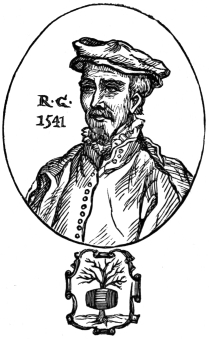
Richard Grafton, English Printer and Historian. Died after 1572.
The first printer of the Common Prayer.
John Wight or Wyghte. Was living in 1551. A printer of law books.
The “entry” of copies at Stationers’ Hall was
commenced in 1558, but without the delivery of any
books, and these entries seem originally to have been
intended by the booksellers of the Company to make
known to each other their respective copyrights, and
to act as advertisements of the works thus entered.
Half a century later, Sir Thomas Bodley was appointed
librarian at Oxford, and so great was his zeal for
obtaining books that he persuaded the Company of
Stationers in London to give him a copy of every
book that was printed, and this voluntary offering
was rendered compulsory by the celebrated Licensing
Act of 1663, which prohibited the publication of any
book unless licensed by the Lord Chamberlain, and
entered in the Stationers’ Registers, and which fixed
the number of copies to be presented gratis at three.
In the reign of William and Mary the liberty of the
press was restored, but in the new Act the door was
unfortunately thrown open to infractions of literary
property by clandestine editions of books, and in the
following reign the property of copyright was secured
for fourteen years, though the perpetuity of copyright
was still vulgarly believed in, and, by the better class
of booksellers, still respected. The number of compulsory
presentation copies was gradually increased
to eleven, forming a very heavy tax upon expensive
books, and was only in our own times reduced to five.
At present the registration of books at Stationers’
Hall is quite independent of the presentations, which
are still compulsory. The fee for the registration or
assignment of a copyright is five shillings.
By the end of the last century all the privileges
and monopolies of the Company had been shredded
away till they had nothing left but the right to publish
a common Latin primer and almanacs. In 1775
J. Carnan,3 an enterprizing tradesman, questioning
the legality of the latter monopoly, published an
almanac on his own account, and defended himself
against an action brought by the Company in which
the monopoly was declared worthless. As, however,
the Company still paid the Universities for the lease
of the sole right to publish almanacs, they endeavoured
to recover their privilege by Act of Parliament, but
were defeated by Erskine in a memorable speech,
who showed that, while supposed to be protectors of
the order and the decencies of the press, the Company
had not only entirely omitted to exercise their duties,
but that, even in using their privileges, they had, to
increase their revenue, printed, in the “Poor Robin’s”
and other almanacs, the most revolting indecencies;
and the question was decided against them.
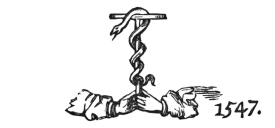
Rayne Wolfe.
Paul’s Churchyard.
King Henry VIII.’s printer.
1547.
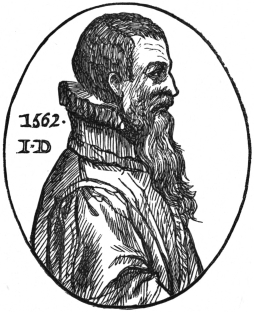
John Day or Daye. “A famous printer. He lived over Aldgate.”
1522–1584.
The “earliest men of letters”—if we accept the
word in its modern meaning of those who earn their
bread by their pens—were the dramatists; but the
publication of their plays was a mere appendix to the
acting thereof, and Shakespeare never drew a penny
from the printing of his works. The Elizabethan
dramatists—the Greenes and Marlowes—led a life of
wretchedness only paralleled later on by the annals of
Grub Street. As the use of the printing press expanded,
however, a race of authors by profession sprang
into existence. At the time of the Commonwealth
James Howell, author of the “Epistolæ Ho-elianæ,”
who was thrown into the Fleet prison, appears to
have made his bread by scribbling for the booksellers;
Thomas Fuller, also, was among the first, as well as
the quaintest, hack-writers; he observes, in the preface
to his “Worthies,” that no stationers have hitherto
lost by him. His “Holy State” was reprinted four
times before the Restoration, but the publisher continued
to describe the last two impressions, on the
title-page, as only the third edition, as if he were
unwilling that the extent of the popularity should be
known—a fact probably unprecedented. But still
the great writers had either private means, or lived
on the patronage of rank and wealth; for the reward
of a successful book in those days did not lie in so
much hard cash from one’s publisher, but in hopes of
favour and places from the great. The famous agreement
between Milton and Samuel Simmons, a printer,
is one of the earliest authenticated agreements of
copy money being given for an original work; it was
executed on April 27th, 1667, and disposes of the
copyright of “Paradise Lost” for the present sum
of five pounds, and five pounds more when 1300
copies of the first impression should be sold in retail,
and the like sum at the end of the second and third
editions, to be accounted as aforesaid; and that (each
of) the said first three impressions shall not exceed
fifteen books or volumes of the said manuscript. The
price of the small quarto edition was three shillings
in a plain binding. Probably, as Sir Walter Scott
remarks, the trade had no very good bargain of it, for
the first impression of the poem does not seem to
have been sold off before the expiration of seven
years, nor till the bookseller (in accordance with a
practice nor confined solely to that age) had given it
five new title-pages. The second five pounds was
received by Milton, and in 1680, for the present sum
of eight pounds, his widow resigned all further right
in the copyright, and thus the poem was sold for
eighteen pounds instead of the stipulated twenty.
The whole transaction must be regarded rather as an
entire novelty, than as an example of a bookseller’s
meanness—a view too often unjustly taken.
The first “eminent man of letters” was Dryden,
who serves us as a connecting link between those who
earned their livelihood by writing for the stage and
those who earned it by working for the booksellers,
and the first “eminent publisher” was Jacob Tonson,
his bookseller. Dryden, like his predecessors,
commenced life as a dramatist, but in his times plays
acquired a marketable value elsewhere than on the
stage. Before Tonson started, Dryden’s works—almost
entirely plays—were sold by Herringman, the chief
bookseller in London, says Mr. Peter Cunningham,
before Tonson’s time; but now only remembered
because Dryden lodged at his house, taking his money
out in kind, as authors then often did.
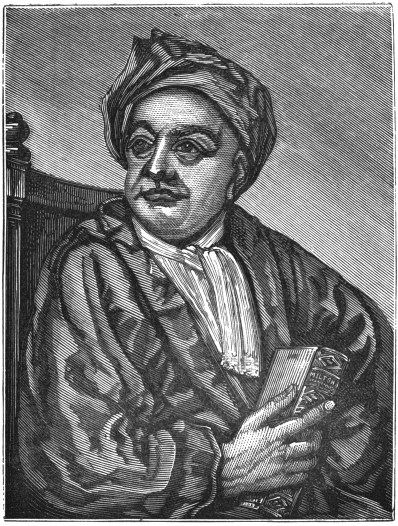
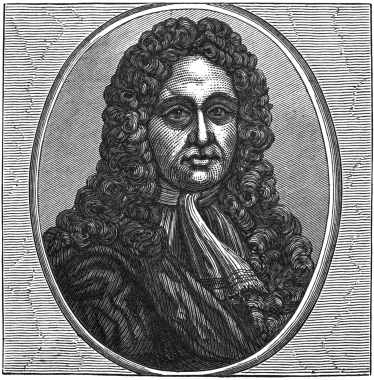
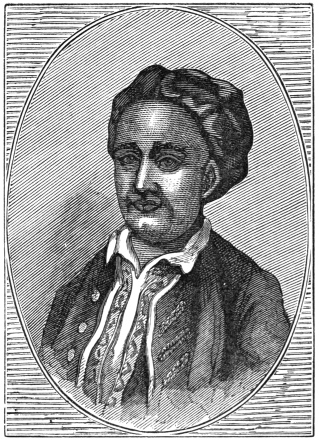
Jacob Tonson.
1656–1736.
(From the Portrait by Kneller.)
Jacob Tonson, born in 1656, was the son of a barber-surgeon
in Holborn, who died when his two sons
were both very young, leaving them each a hundred
pounds to be paid them on their coming of age. The
two lads resolved to become printers and booksellers,
and, at fourteen, Jacob was apprenticed to Thomas
Barnet. After serving the usual term of seven
years he was admitted to the freedom of the Stationers’
Company, and immediately commenced business
with his small capital at the Judge’s House, in
Chancery Lane, close to the corner of Fleet Street.
Like many other publishers he began trade by selling
second-hand books and those produced by other firms,
but he soon issued plays on his own account; finding,
however, that the works of Otway and Tate, which were
among his first attempts, had no very extensive sale,
he boldly made a bid for Dryden’s next play, but the
twenty pounds required by the author was too great a
venture for his small capital, so “Troilus and Cressida;
or Truth found too Late,” was published conjointly by
Tonson and Levalle in 1679. This connection with
Dryden, which lasted till the poet’s death, was of
only less importance to the furtherance of Tonson’s
fortune than a bargain concluded four years later
with Brabazon Aylmer for one-half of his interest in
the “Paradise Lost,” which Dryden told him was one
of the greatest poems England had ever produced.
Still he waited four years before he ventured to publish,
and then only by the safe method of subscription,
and in 1788 the folio edition came out, and by the
sale of this and future editions Tonson was, according
to Disraeli, enabled to keep his carriage. The other
moiety of the copyright was subsequently purchased.
There is a pleasant description of Tonson, in these
early days, in a short poem by Rowe:—
“While in your early days of reputation You for blue garter had not such a passion, While yet you did not live, as now your trade is, To drink with noble lords and toast their ladies, Thou Jacob Tonson, wert, to my conceiving, The cheerfullest, best honest fellow living.”
From John Dunton, the bookseller, we get the
following description:—“He was bookseller to the
famous Dryden, and is himself a very good judge of
persons and authors; and, as there is nobody more
competently qualified to give their opinion upon
another, so there is none who does it with a more
severe exactness, or with less partiality; for, to do
Mr. Tonson justice, he speaks his mind upon all
occasions, and will flatter nobody.”
Not only did Tonson first make “Paradise Lost”
popular, but some years afterwards he was the first
bookseller to throw Shakespeare open to a reading
public.
Then, as now, however, the works in most urgent demand
were “novelties,” and with these Dryden supplied
his publisher as fast almost as pen could drive upon
paper. From the correspondence between Dryden
and Tonson, printed in Scott’s edition of the poet’s
works, they seem to have been privately on very
friendly terms, falling out only when agreements were
to be signed or payments to be made. Tonson was
at this time publishing what are sometimes known as
Tonson’s, sometimes as Dryden’s, Miscellany Poems,
written, so the title-pages averred, by the “most
eminent hands.” Apropos of this, Pope writes,
“Jacob creates poets as kings create knights, not for
their honour, but for their money. I can be satisfied
with a bare saving gain without being thought an
eminent hand.” The first volume of the “Miscellany”
was published in 1684, and the second in the following
year, and of this second, Dryden writes, after
thanking the bookseller for two melons—“since we
are to have nothing but new, I am resolved we shall
have nothing but good, whomever we disoblige.”
The third “Miscellany” was published in 1693, and
Tonson sends an earnest letter of remonstrance anent
the amount of “copy” received of the translation of
Ovid:—“You may please, sir, to remember that upon
my first proposal about the third ‘Miscellany,’ I offered
fifty pounds, and talked of several authors without
naming Ovid. You asked if it should not be guineas,
and said I should not repent it; upon which I immediately
complied, and left it wholly to you what, and
for the quantity too; and I declare it was the furthest
in the world from my thoughts that by leaving it to
you I should have the less.” He proceeds to show
that Dryden had sold a previous, though recent translation
to another bookseller at the rate of 1518 lines
for forty guineas, while he adds, “all that I have for
fifty guineas are but 1446; so that if I have no more,
I pay ten guineas above forty, and have 72 lines less
for fifty in proportion. I own, if you don’t think fit
to add something more, I must submit; ’tis wholly at
your choice, for I left it entirely to you; but I believe
you cannot imagine I expected so little; for you were
pleased to use me much kindlier in Juvenal, which is
not reckoned so easy to translate as Ovid. Sir, I
humbly beg your pardon for this long letter, and,
upon my word, I had rather have your good will than
any man’s alive.”
These were hard times for Dryden, for through the
change of government he had been deprived of the
laureateship, and it is little likely that Tonson ever
received his additional lines or recovered his money.
Frequent at this period were the bickerings between
them. On one occasion, the bookseller having refused
to advance a sum of money, the poet forwarded
the following triplet with the significant message,
“Tell the dog that he who wrote these lines can write
more:”—
“With leering looks, bull-faced and freckled fair, With two left legs, with Judas-coloured hair, And frowsy pores that taint the ambient air.”
The descriptive hint is said to have been successful.
On another occasion, when Bolingbroke was visiting
Dryden, they heard a footstep. “This,” said Dryden,
“is Tonson; you will take care not to depart before
he goes away; for I have not completed the sheet
which I promised him; and, if you leave me unprotected,
I shall suffer all the rudeness to which resentment
can prompt his tongue.” And yet, almost at
this period, we find Dryden writing, “I am much
ashamed of myself that I am so much behindhand
with you in kindness.”
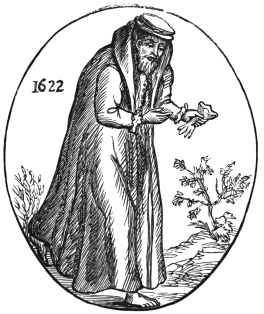
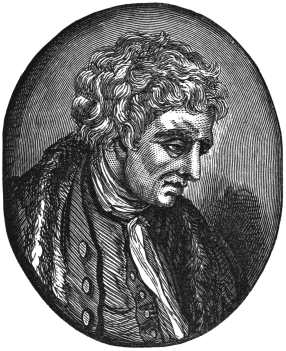
Richard Jones, Jhones, or Johnes, English Printer. Was living in 1571.
John Dunton.
1659–1733.
Dryden’s translations of the classics had been most
successful in selling off the “Miscellanies” very
rapidly, and Tonson now induced the author, by the
offer of very liberal terms, to commence a translation
of Virgil. As usual, the preliminary terms were to
be settled in a tavern—a custom between authors and
booksellers that seems to have been universal. “Be
ready,” writes Dryden, “with the price of paper, and
of the books. No matter for any dinner; for that is
a charge to you, and I care not for it. Mr. Congreve
may be with us as a common friend.” There were two
classes of subscribers, the first of whom paid five
guineas each, and were individually honoured with
the dedication of a plate, with their arms engraved
underneath; the second class paid two guineas only.
The first class numbered 101, and the second 250,
and the money thus received, minus the expense of
the engravings, was handed over to Dryden, who received
in addition from Tonson fifty guineas a book
for the Georgics and Æneid, and probably the same
for the Pastorals collectively. But the price actually
charged to the subscribers of the second class appears
to have been exorbitant, and reduced the amount of
Dryden’s profits to about twelve or thirteen hundred
pounds—still a very large sum in those days.
Frequent, however, were the disputes between them
during the progress of the work. The currency at
this time was terribly deteriorated. In October,
1695, the poet writes, “I expect fifty pounds in good
silver: not such as I have had formerly. I am not
obliged to take gold, neither will I; nor stay for it
beyond four-and-twenty hours after it is due.” Good
silver, however, was very scarce, and was at a premium
of forty per cent; so after a year’s wrangling
he had to put up with the fate of all who then sold
labour for money. “The Notes and Queries,” continues
Dryden, perhaps as a gibe at Jacob’s parsimony,
“shall be short; because you shall get the
more by saving paper.” Again he attacks him, this
time half playfully:—“Upon trial I find all of your
trade are sharpers, and you not more than others;
therefore I have not wholly left you.” Tonson all
along wished to dedicate the work to King William,
but Dryden, a staunch Tory, would not yield a tittle
of his political principles, so the bookseller consoled
himself by slyly ordering all the pictures of Æneas in
the engravings to be drawn with William’s characteristic
hooked nose; a manœuvre that gave rise to
the following:—
“Old Jacob, by deep judgments swayed, To please the wise beholders, Has placed old Nassau’s hook-nosed head On young Æneas’ shoulders.
“To make the parallel hold tack, Methinks there’s little lacking; One took his father pick-a-back, And t’other sent his packing.”
In December, 1699, Dryden finished his last work,
the “Fables,” for which “ten thousand verses” he was
paid the sum of two hundred and fifty guineas, with
fifty more to be added at the beginning of the second
impression. In this volume was included his Ode to
St. Cecilia, which had first been performed at the
Music Feast kept in Stationers’ Hall, on the 22nd of
November, 1697.
In 1700 the poet died, but Tonson was by this time
in affluent circumstances.
About the date of Dryden’s death, probably before
it, as his portrait was included among the other members,
the famous Kit-Cat Club was founded by Tonson.
Various are the derivations of the club. The
most circumstantial account of its origin is given by
the scurrilous writer, Ned Ward, in his “Secret History
of Clubs.” It was established, he says, “by an
amphibious mortal, chief merchant to the Muses, to
inveigle new profitable chaps, who, having more wit
than experience, put but a slender value as yet upon
their maiden performances.” (Tonson must have
been a rare publisher if he found “new chaps” to be
in any way profitable.) With the usual custom of the
times, Tonson was always ready to give his author,
especially upon concluding a bargain, wherewithal to
drink, but he now proposed to add pastry in the shape
of mutton pies, and, according to Ward, promises to
make the meeting weekly, provided his clients would
give him the first refusal of their productions. This
generous proposal was very readily agreed to by
the whole poetic class, and the cook’s name being
Christopher, called for brevity Kit, and his sign the
Cat and Fiddle, they very merrily derived a quaint
denomination from puss and her master, and from
thence called themselves the Kit-Cat Club. According
to Arbuthnot, their toasting-glasses had verses
upon them in honour of “old cats and young kits,”
and many of these toasts were printed in Tonson’s
fifth “Miscellany.” At first they met in Shire Lane,
(Ward says Gray’s Inn Lane), and subsequently at
the Fountain Tavern in the Strand. In a short time
the chief men of letters having joined the club,
“many of the quality grew fond of sharing the everlasting
honour that was likely to crown the poetical
society.” Sir Godfrey Kneller, himself a member,
painted portraits of all the members, commencing
with the Duke of Somerset, and these were hung
round the club-room at Tonson’s country house at
Water Oakeley, where the members of the club were
in after-times wont to meet. The tone of the club-room
became decidedly political, and interesting as
it is, our space forbids us to do more than give the
following lines from “Faction Displayed” (1705),
which, by-the-way, quotes Dryden’s threatening triplet,
already alluded to:—
“I am the Touchstone of all modern wit; Without my stump, in vain you poets writ. Those only purchase everlasting fame That in my ‘Miscellany’ plant their name. I am the founder of your loved Kit-Kat, A Club that gave direction to the state. ’Twas here we first instructed all our youth To talk profane and laugh at sacred truth; We taught them how to toast and rhyme and bite, To sleep away the day, and drink away the night.”
By this time Tonson had taken his nephew into
partnership, had left his old shop in Chancery Lane,
and changed his sign from the “Judge’s Head” to the
“Shakespeare’s Head;” and he and his descendants
had certainly a right to the latter symbol, for the
editions of Rowe, Pope, Theobald, Warburton, Johnson,
and Capell, were all associated with their name.
The following schedule of the prices paid to the
various editors possesses some bibliographical interest:—
£
s.
d.
Rowe
36
10
0
Hughes
28
7
0
Pope
217
12
0
Fenton
30
14
0
Gay
35
17
6
Whalley
12
0
0
Theobald
652
10
0
Warburton
500
0
0
Capell
300
0
0
Dr. Johnson, for 1st edition.
375
0
0
”for 2nd edition.
100
0
0
Upon Dryden’s death Tonson had looked round
anxiously for a likely successor, and had made
humble overtures to Pope, and in his later “Miscellanies”
appeared some of Pope’s earliest writings; but
Pope soon deserted to Tonson’s only rival—Bernard
Lintot, who also opposed him in an offer to publish
a work of Dr. Young’s. The poet answered both
letters the same morning, but unfortunately cross-directed
them: in the one intended for Tonson he
said that Lintot was so great a scoundrel that printing
with him was out of the question, and in Lintot’s that
Tonson was an old rascal.
Jacob Tonson died in 1736, and is reported on his
death-bed to have said—“I wish I had the world to
begin again, because then I should have died worth a
hundred thousand pounds, whereas now I die worth
only eighty thousand;”—a very improbable story, for,
in spite of Dryden’s complaints, Tonson seems to
have been a generous man for the times, and to have
fully earned his title of the “prince of booksellers.”
His nephew died a few months before this, and was
succeeded by his son, Jacob Tonson the third, who
carried on the business in the same shop opposite
Catherine Street in the Strand, until his removal
across the road, only a short time before his death.
He died in 1767, when the time-honoured name was
erased from the list of booksellers.
Bernard Lintot, or, as he originally wrote his name,
Barnaby Lintott, was the son of a Sussex yeoman,
and commenced business as a bookseller at the sign of
the Cross Keys, between the Temple Gates, in the year
1700. He is thus characterized by John Dunton—“He
lately published a collection of Tragic Tales, &c., by
which I perceive he is angry with the world, and scorns
it into the bargain; and I cannot blame him: for
D’Urfey (his author) both treats and esteems it as it
deserves; too hard a task for those whom it flatters;
or perhaps for Bernard himself, should the world ever
change its humour and grin upon him. However, to
do Mr. Lintot justice, he is a man of very good principles,
and I dare engage will never want an author of
Sol-fa,4 so long as the play-house will encourage his
comedies.” The world, however, did grin upon him,
for in 1712 he set up a “Miscellany” intended to rival
Tonson’s, and here appeared the first sketch of the
“Rape of the Lock,” and this introduction to Pope
was to turn out of as much importance in his fortunes
as the previous connection with Dryden had been to
Tonson.
A memorandum-book, preserved by Nichols, contains
an exact account of the money paid by Lintot
to his various authors. Here are the receipts for
Pope’s entire works:—
£
s.
d.
1712, Feb. 19. Statius, first book; Vertumnus and Pomona
16
2
6
1712, March 21. First edition of the Rape
7
0
0
1712, April 9. To a Lady presenting Voiture upon Silence to the author of a Poem called Successio
3
16
6
1712–13, Feb. 23. Windsor Forest
32
5
0
1713, July 22. Ode on St. Cecilia’s Day
15
0
0
1714, Feb. 20. Additions to the Rape
15
0
0
1715, Feb. 1. Temple of Fame
32
5
0
1715, April 31. Key to the Lock
10
15
0
1716, July 17. Essay on Criticism
15
0
0
In 1712 Pope, mindful of Dryden’s success, commenced
his translation of Homer, and in 1714 Lintot,
equally mindful probably of the profits Tonson
had derived from Virgil, made a splendid offer for its
publication. He agreed to provide at his own expense
all the subscription and presentation copies,
and in addition to pay the author two hundred pounds
per volume. The Homer was to consist of six quarto
volumes, to be delivered to subscribers, as completed,
at a guinea a volume, and through the unremitting
labours of the poet’s literary and political friends, six
hundred and fifty-four copies were delivered at the
original rate, and Pope realized altogether the munificent
sum of five thousand, three hundred and twenty
pounds, four shillings.
It was probably just after the publication of the
first volume, in August, 1714, that Pope wrote his
exquisitely humorous letter to the Earl of Burlington,
describing a journey to Oxford, made in company
with Lintot. “My lord, if your mare could
speak, she would give an account of what extraordinary
company she had on the road; which since she
cannot do, I will.” Lintot had heard that Pope was
“designed for Oxford, the seat of the Muses, and
would, as my bookseller, by all means accompany me
thither.... Mr. Lintot began in this manner: ‘Now,
damn them, what if they should put it in the newspapers,
how you and I went together to Oxford?
What would I care? If I should go down into Sussex,
they would say I was gone to the Speaker. But
what of that? If my son were but big enough to go
on with the business, by God! I would keep as good
company as old Jacob.’... As Mr. Lintot was talking
I observed he sat uneasy on his saddle, for which I expressed
some solicitude. ‘’Tis nothing,’ says he; ‘I
can bear it well enough, but since we have the day
before us, methinks it would be very pleasant for you
to rest awhile under the woods.’ When we alighted,
‘See here, what a mighty pretty Horace I have in
my pocket! what if you amused yourself by turning
an ode, till we mount again? Lord, if you pleased,
what a clever Miscellany might you make at leisure
hours.’ ‘Perhaps I may,’ said I, ‘if we ride on;
the motion is an aid to my fancy, a round trot very
much awakens my spirits; then jog on apace, and I’ll
think as hard as I can.’
“Silence ensued for a full hour, after which Mr.
Lintot tugged the reins, stopped short and broke out,
‘Well, sir, how far have you gone?’ I answered,
‘Seven miles.’ ‘Zounds, sir,’ said Lintot, ‘I thought
you had done seven stanzas. Oldworth, in a ramble
round Wimbleton hill, would translate a whole ode in
half this time. I’ll say that for Oldworth (though I
lost by his Sir Timothy’s), he translates an ode of
Horace the quickest of any man in England. I
remember Dr. King would write verses in a tavern
three hours after he could not speak; and there’s Sir
Richard, in that rambling old chariot of his, between
Fleet ditch and St. Giles’s pound shall make half a
job.’ ‘Pray, Mr. Lintot,’ said I, ‘now you talk of
translators, what is your method of managing them?’
‘Sir,’ replied he, ‘those are the saddest pack of rogues
in the world; in a hungry fit, they’ll swear they
understand all the languages in the universe. I have
known one of them take down a Greek book upon my
counter and cry, Ay, this is Hebrew. I must read
it from the latter end. My God! I can never be
sure of those fellows, for I neither understand Greek,
Latin, French nor Italian myself.’ ‘Pray tell me
next how you deal with the critics.’ ‘Sir’, said he,
‘nothing more easy. I can silence the most formidable
of them; the rich ones for a sheet a-piece of the
blotted manuscript, which costs me nothing; they’ll
go about to their acquaintance and pretend they had
it from the author, who submitted to their correction:
this has given some of them such an air, that in time
they come to be consulted with, and dictated to as
the top critic of the town. As for the poor critics, I’ll
give you one instance of my management, by which
you may guess at the rest. A lean man, that looks
like a very good scholar, came to me t’other day; he
turned over your Homer, shook his head, shrugged
up his shoulders, and pished at every line of it. One
would wonder, says he, at the strange presumption
of some men; Homer is no such easy task, that every
stripling, every versifier—He was going on, when my
wife called to dinner. ‘Sir,’ said I, ‘will you please
to eat a piece of beef with me?’ ‘Mr. Lintot,’ said
he, ‘I am sorry you should be at the expense of this
great book; I am really concerned on your account.’
‘Sir, I am much obliged to you; if you can dine
upon a piece of beef, together with a slice of pudding.’
‘Mr. Lintot, I do not say but Mr. Pope, if he would
condescend to advise with men of learning—’ ‘Sir, the
pudding is on the table, if you please to go in.’ My
critic complies, he comes to a taste of your poetry,
and tells me in the same breath that the book is commendable
and the pudding excellent. These, my
lord, are a few traits by which you may discern the
genius of Mr. Lintot, which I have chosen for the
subject of a letter. I dropt him as soon as I got to
Oxford.”
Pope’s Iliad took longer in coming out than was
expected. Gay writes facetiously, “Mr. Pope’s Homer
is retarded by the great rains that have fallen of late,
which causes the sheets to be long a-drying.” However,
in 1718, the six volumes had been completely
delivered to the subscribers, and three days afterwards
Tonson announced, as a rival, the first book of
Homer’s Iliad, translated by Mr. Tickell. “I send
the book,” writes Lintot to Pope, “to divert an hour,
it is already condemned here; and the malice and
juggle at Button’s (for Addison had assisted Tickell
in the attempted rivalry) is the conversation of those
who have spare moments from politics.”
Lintot intended to reimburse his expenses by a
cheap edition, but here he was anticipated by the
piratical dealers, who caused a cheap edition to be
published in Holland; a nefarious proceeding that
Lintot met by bringing out a duodecimo edition at
half-a-crown a volume, “finely printed from an Elzevir
letter.”
The Odyssey was published in 1725, likewise by
subscription, and Pope gained nearly three thousand
pounds by the transaction, avowing, however, that he
had only “undertaken” the translation, and had
been assisted by friends; and “undertaker Pope”
became a favourite byword among his many unfriendly
contemporaries. Lintot was, however, disappointed
with his share of the profits, and, pretending to have
found something invalid in the agreement, threatened
a suit in Chancery. Pope denied this, quarrelled, and
finally left him, and turned his rancour to good
account in the pages of the Dunciad.
By this time Lintot’s fortunes were firmly assured.
Pope was, says Mr. Singer, “at first apprehensive that
the contract (for the Iliad) might ruin Lintot, and
endeavoured to dissuade him from thinking any more
of it. The event, however, proved quite the reverse.
The success of the work was so unparalleled as to at
once enrich the bookseller, and prove a productive
estate to his family,” and he must have certainly been
progressing when Humphrey Walden, custodian of
the Earl of Oxford’s heraldic manuscripts, made, in
1726, the following entry in his diary: “Young Mr.
Lintot, the bookseller, came inquiring after arms, as
belonging to his father, mother and other relations,
who now, it seems, want to turn gentlefolks. I could
find none of their names.” “Young Mr. Lintot” was
Bernard’s son and successor—Henry.
There was scarcely a writer of eminence in the
“Augustan Era,” whose name is not to be found in
Lintot’s little account book of moneys paid. In 1730,
however, he appears to have relinquished his business
and retired to Horsham in Sussex, for which county
he was nominated High Sheriff, in November, 1735,
an honour which he did not live to enjoy, and which
was consequently transferred to his son. Henry
Lintot died in 1758, leaving £45,000 to his only
daughter, Catherine.
Edmund Curll is, perhaps, as a name, better known
to casual readers than any other bookseller of this
period, and it is not a little comforting to find that
the obloquy with which he has ever been associated
was richly merited. He was born in the west of
England, and after passing through several menial
capacities, became a bookseller’s assistant, and then
kept a stall in the purlieus of Covent Garden. The
year of his birth is unknown, and the writer of a contemporary
memoir, The Life and Writings of E. C—l,
who prophesied that “if he go on in the paths of glory
he has hitherto trod,” his name would appear in the
Newgate Calendar, has unluckily been deceived. He
appears to have first commenced publishing in the
year 1708, and to have combined that honourable
task with the vending of quack pills and powders for
the afflicted. The first book he published was An
Explication of a Famous Passage in the Dialogue of
St. Justin Martyr with Typhon, concerning the Immortality
of Human Souls, bearing the date of 1708; and,
curiously enough, religious books formed in aftertime
a very large portion of his stock, side by side, of
course, with the most filthy and ribald works that
have ever been issued.
In 1716 began his quarrel with Pope, originating as
far as we know in the publication of the Court Poems,
the advertisement of which said that the coffee-house
critics assigned them either to a Lady of Quality, Mr.
Gay, or the translator of Homer. It is not clear now
whether Pope was really annoyed by the appearance
of the volume, or whether he had first secretly promoted
it, and then endeavoured to divert suspicion.
At all events, he had a meeting with Curll at the
“Swan Tavern,” in Fleet Street, where, writes the
bookseller, “My brother, Lintot, drank his half-pint
of old hock, Mr. Pope his half-pint of sack, and I the
same quantity of an emetic powder; but no threatenings
past. Mr. Pope, indeed, said that no satire
should be printed (tho’ he has now changed his mind).
I answered that they should not be wrote, for if they
were they would be printed.” Curll, on entering the
tavern, declared he had been poisoned, and for months
the town was amused with broadsides and pamphlets
relative to the affair. Pope afterwards published his
version of the story in his Miscellanies; the “Full and
True Account” is, however, as gross and unquotable
as Curll’s own worst publication.
Later on in the same year the bookseller fell into a
fresh scrape. A Latin discourse had been pronounced
at the funeral of Robert South by the captain of
Westminster School, and Curll, thinking it would be
readily purchased by the public,
“did th’ oration print, Imperfect, with false Latin in’t,”
and thereby aroused the anger of the Westminster
scholars, who enticed him into Dean’s Yard on the
pretence of giving him a more perfect copy; there, he
met with a college salutation, for he was first presented
with the ceremony of the blanket, in which,
“when the skeleton had been well shook, he was carried
in triumph to the school, and, after receiving a
mathematical construction for his false concords, he
was re-conducted to Dean’s Yard, and on his knees
asking pardon of the aforesaid Mr. Barber (the captain
whose Latin he had murdered) for his offence,
he was kicked out of the yard, and left to the huzzas
of the rabble.”
No sooner was Curll out of one scrape than he fell
into another; for, still in this same year, he was summoned
to the bar of the House of Lords for printing
and publishing a paper entitled An Account of the
Trial of the Earl of Winton, a breach of the standing
orders of the House. However, having received
kneeling a reprimand from the Lord Chancellor, he
was dismissed upon payment of the fees.
While the authorities were quick enough to punish
any violation of their own peculiar privileges, they
were graciously pleased to wink at the perpetual
offences Curll was committing against public morals,
for Curll was a strong politician on the safe party
side, and in his political publications had in view the
interests of the government. However, he was attacked
on all sides by public opinion and the press.
Mist’s Weekly Journal for April 5, 1718, contained
a very strong article on the “Sin of Curllicism.”
“There is indeed but one bookseller eminent among
us for this abomination, and from him the crime
takes its just denomination of Curllicism. The fellow
is a contemptible wretch a thousand ways; he is
odious in his person, scandalous in his fame; ...
more beastly, insufferable books have been published
by this one offender than in thirty years before by all
the nation.” Curll, “the Dauntless,” did not long
remain in silence, and his reply is characteristically
outspoken, for the writer was never a coward. “Your
superannuated letter-writer was never more out than
when he asserted that Curllicism was but of four
years’ standing. Poor wretch! he is but a novice in
chronology;” and then, after threatening the journalist
with the terrors of an outraged government, he concludes
“in the words of a late eminent controvertist,
the Dean of Chichester.”
Curll was fond of the dignitaries of the Church, and
endeavoured to play a shrewd trick upon one of
them; he sent a copy of Lord Rochester’s Poems
(certainly not the most innocent book he published)
to Dr. Robinson, Bishop of London, with a tender of
his duty, and a request that his lordship would please
to revise the interleaved volume as he thought fit;
but the bishop, not to be caught, “smiled” and said,
“I am told that Mr. Curll is a shrewd man, and
should I revise the book you have brought me, he
would publish it as approved by me.”5
Public dissatisfaction seems to have been expressed
more forcibly against Curll than heretofore, and to
have taken the form of a remonstrance to government,
for he published The Humble Representation
of Edmund Curll, Bookseller and Citizen of London,
containing Five Books complained of to the Secretary.
As the books were eminently of a nature requiring
an apology, we cannot do more than give their titles:
1. The Translation of Meibomius and Tractatus de
Hermaphroditis; 2. Venus in the Cloister; 3. Ebrietatis
Encomium; 4. Three New Poems, viz. Family
Duty, The Curious Wife, and Buckingham House;
and 5. De Secretis Mulierum. At last the government
did interfere, as we learn from a notice in Boyer’s
Political State, Nov. 1725:—
“On Nov. 30, 1725, Curll, a bookseller in the Strand,
was tried at the King’s Bench Bar, Westminster, and
convicted of printing and publishing several obscene
and immodest books, greatly tending to the corruption
and depravation of manners, particularly one translated
from a Latin treatise entitled De Usu Flagrorum
in Re Venereâ; and another from a French
book called La Religieuse en Chemise.” In the indictment
Curll is thus accurately summed up: homo
iniquus et sceleratus ac nequiter machinans et intendens
bonos mores subditorum hujus regni corrumpere et eos
ad nequitiam inducere; and in the State Trials we
read the following report of the sentence:—
“This Edmund Curll stood in the pillory at Charing
Cross, but was not pelted or used ill; for being an
artful, cunning (though wicked) fellow, he had contrived
to have printed papers dispersed all about
Charing Cross, telling the people how he stood there
for vindicating the memory of Queen Anne.”
It does, in fact, appear that he received three sentences
at once, and that not until Feb. 12, 1728.
For publishing the Nun in her Smock, and the treatise
De Usu Flagrorum, he was sentenced to pay a fine of
twenty-five marks each, and to enter into recognizances
of £100 for his good behaviour for one year;
but for publishing the Memoirs of John Ker of
Kersland, Esq. (a political offence), he was fined
twenty marks, and ordered to stand in the pillory for
the space of one hour.6
In 1729 Curll was again pilloried—this time by
Pope in the Dunciad, in connection with Tonson and
Lintot:
“With authors, stationers obey’d the call (The field of glory is a field for all); Glory and gain th’ industrious tribe provoke, And gentle Dulness ever loves a joke; A poet’s form she placed before their eyes, And bade the nimblest racer seize the prize.
* * * * *
——Lofty Lintot in the circle rose: ‘The Prize is mine, who ‘tempts it are my foes; With me began this genius, and shall end.’ He spoke, and who with Lintot shall contend?
“Fear held them mute. Alone untaught to fear, Stood dauntless Curll: ‘Behold that rival here! The race by vigour, not by vaunts, is won: So take the hindmost, hell,’ he said, ‘and run.’ Swift as a bard the bailiff leaves behind He left huge Lintot, and outstript the wind. As when a dab-chick waddles through the copse On feet and wings, and flies, and wades, and hops, So labouring on with shoulders, hands, and head, Wide as a windmill all his figure spread, With arms expanded Bernard views his state, And left-legged Jacob seems to emulate.”
And finally Curll stumbles into an unsavoury pool:—
“Obscene with filth the miscreant lies bewrayed, Fallen in the plash his wickedness had laid; Then first (if poets aught of truth declare) The caitiff vaticide conceived a prayer.”
In reference to Curll there is a note to this passage,
“He carried the trade many lengths beyond what it
ever before had arrived at; he was the envy and
admiration of all his profession. He possessed himself
of a command over all authors whatever; he
caused them to write what he pleased; they could not
call their very names their own. He was not only
famous among them; he was taken notice of by the
state, the church, and the law, and received particular
marks of distinction from each.”
We have no space to discuss the vexed question as
to how the letters of Pope published by Curll came
into his hands—the discussion would occupy a volume
and remain a moot question after all. But we are
disposed to believe with Johnson and Disraeli that
“being inclined to print his own letters, and not
knowing how to do so without the imputation of
vanity, what in this country has been done very rarely,
he contrives an appearance of compulsion; that when
he could complain that his letters were surreptitiously
published, he might decently and defensively publish
them himself.” The letters at all events were genuine,
and Pope in a feigned or real indignation caused Curll
to be brought for a third time (the second had been
for publishing the Duke of Buckingham’s words) before
the bar of the House of Lords for disobeying its
standard rules; but on examination the book was
not found to contain any letters from a peer, and Curll
was dismissed, and boldly continued the publication
till five volumes had been issued.
In spite, or perhaps on account of the unblushing
effrontery with which he run amuck at everything
and everybody, Curll was a successful man, as his
repeated removals to better and better premises
plainly testifies. Over his best shop in Covent
Garden he erected the Bible as a sign. He has had
many apologists, among others worthy John Nichols,
as deserving commendation for his industry in preserving
our national remains, but the scavenger, when
he gathers his daily filth, lays little claim to doing
a meritorious action, he only works unpleasantly for
his daily bread; and it has been the repeated cry of
publishers, even in our own times, in reproducing an
immoral book, that they were wishing only for the
preservation of something rare and curious. It were
not well that any book once written should ever
die,—that any one link in the vast chain of human
thought should ever be irrecoverably lost, but the
publisher of such a book must, at least, bear the
same penalty of stigma as the author, for he has not
even the author’s self-vanity as an excuse, but only
the still more wretched plea of mercenary motive.
We will conclude our notice of Curll by an extract
from “John Buncle,” by Thomas Amory, who knew
him personally and well. “Curll was in person very
tall and thin—an ungainly, awkward, white-faced
man. His eyes were a light gray—large, projecting,
goggle, and purblind. He was splay-footed and
baker-kneed.... He was a debauchee to the
last degree, and so injurious to society, that by filling
his translations with wretched notes, forged letters,
and bad pictures, he raised the price of a four-shilling
book to ten. Thus, in particular, he managed Burnet’s
‘Archæology.’ And when I told him he was
very culpable in this and other articles he sold, his
answer was, ‘What would I have him do? He was
a bookseller;—his translators, in pay, lay three in a
bed at the Pewter Platter Inn, in Holborn, and he
and they were for ever at work deceiving the public.’
He, likewise, printed the lewdest things. He lost his
ears for the ‘Nun in her Smock’ and another
thing. As to drink, he was too fond of money to
spend any in making himself happy that way; but,
at another’s expense, he would drink every day till
he was quite blind and as incapable of self-motion as
a block. This was Edmund Curll. But he died at last
as great a penitent, I think, in the year 1748 (it was
1747), as ever expired. I mention this to his
honour.”7
Thomas Guy, more eminent certainly as a very successful
money-maker, and a generous benefactor to
charitable institutions, than as a bookseller, was born
in Horsley-down, the son of a coal-heaver and
lighterman. The year of his birth is uncertain, but
in 1660, he was bound apprentice to John Clarke,
bookseller, in the porch of Mercers’ Chapel, and, in
1668, having been admitted a liveryman of the
Stationers’ Company, he opened a small shop in
“Stock Market” (the site of the present Mansion
House, then a fruit and flower market, where, also,
offenders against the law were punished) with a stock-in-trade
worth above £200. From the first, Guy’s
chief business seems to have been in Bibles, for
Maitland, his biographer relates, “The English Bibles,
printed in this kingdom, being very bad, both in
the letter and the paper, occasioned divers of the
booksellers in this city to encourage the printing
thereof in Holland, with curious types and fine paper,
and imported vast numbers of the same to their no
small advantage. Mr. Guy, soon becoming acquainted
with this profitable commerce, became a large dealer
therein.” As early as Queen Elizabeth’s time, the
privilege of printing Bibles had been conferred on
the Queen’s (or King’s) printer, conjointly, of course,
with the two Universities, and the effect of this prolonged
monopoly resulted, not only in exorbitant
prices, but in great typographical carelessness, and,
says Thomas Fuller, under the quaint heading of “Fye
for Shame,” “what is but carelessness in other books
is impiety in setting forth of the Bible.” Many of
the errors were curious;—the printers in Charles I.’s
reign had been heavily fined for issuing an edition in
which, the word “not” being omitted, the seventh,
commandment had been rendered a positive, instead
of a negative injunction. The Spectator wickedly suggests
that, judging from the morals of the day, very
many copies must have got abroad into continuous
use. In the Bible of 1653, moreover, the printers
allowed “know ye not that the unrighteous shall
inherit the kingdom of God” to stand uncorrected.
However, the Universities and the King’s printer still
possessed the monopoly, and this new trade of good
cheap Bibles “proving not only very detrimental to
the public revenues, but likewise to the King’s printer,
all ways and means were devised to quash the same,
which, being vigorously put in execution, the booksellers,
by frequent seizures and prosecutions, became
so great sufferers, that they judged a further pursuit
thereof inconsistent with their interests.” Defeated
in this manner, Guy cautiously induced the University
of Oxford to contract with him for an assignment of
their privilege, and not only obtained type from
Holland, and printed the Bible in London, but was,
later on, in 1681, according to Dunton, a partner with
Parker in printing the Bible, at Oxford (Parker could
have been no connection of the famous publishing
family).
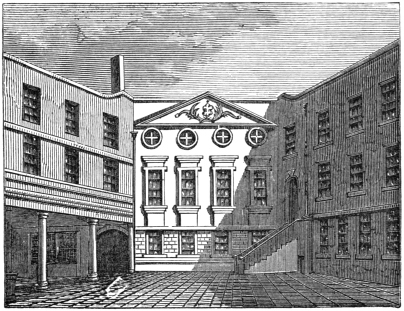
Thomas Guy, founder of Guy’s Hospital. 1644–1724.
(From the statue by J. Bacon, R.A.)
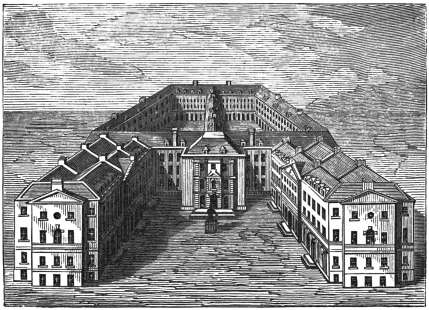
Guy’s Hospital.
(Bird’s-eye view from a Print, 1738.)
Guy seems to have contracted in his early days
very frugal and personally pernicious habits. According
to Nichols, he is said to have dined every day at
his counter, “with no other table-cloth than an old
newspaper,” and if the “Intelligence” or the “Newes”
of that period really served him for a cloth, the dish
that contained his meat must have been uncommonly
small. “He was also,” it is added, “as little nice in
his apparel.” It was probably, too, in the commencement
of his career, that, looking round for a tidy and
inexpensive helpmate, he asked his servant-maid to
become his wife. The girl, of course, was delighted,
but, alas! presumed too much upon her influence over
her careful lover; seeing that the paviours who were repairing
the street, in front of the house (an order was
issued, in 1671, to every householder to pave the
street in front of his dwelling, “for the breadth of six
feet at least from the foundation”) had neglected a
broken place, she called their attention to it, but they
told her that Guy had carefully marked a particular
stone, beyond which they were not to go. “Well,”
said the girl, “do you mend it; tell him I bade you,
and I know he will not be angry.” When Guy saw
the extra charge in the bill, however, he at once
renounced his matrimonial scheme.
The Bible trade proved prosperous, and Guy, ready
for any lucrative and safe investment for his money,
speculated in Government securities, and, according
to Nichols and Maitland, acquired the “bulk of his
fortune” by purchasing seaman’s tickets; but the
practice of paying the royal sailors by ticket does not
seem to have existed later than the year 1684; so
that if he dealt in them at all it must have been a
very early period in his career, when it appears unlikely
that he would have had much spare cash to invest.
Maitland adds “as well as in Government securities,
and this was probably the manner in which the ‘bulk
of his fortune’ was really acquired.”
That his finances were in a healthy condition, is apparent,
from his appearance in Parliament as member
for Tamworth, from 1695 to 1707. According to
Maitland, “as he was a man of unbounded charity,
and universal benevolence, so he was likewise a good
patron of liberty, and the rights of his fellow-subjects;
which, to his great honour, he strenuously asserted
in divers parliaments.” An honourable testimony
to his character, supported also by Dunton:
“Thomas Guy, of Lombard-street, makes an eminent
figure in the Company of Stationers, having been
chosen sheriff of London, and paid the fine....
He is a man of strong reason, and can talk very
much to the purpose on any subject you can propose.
He is truly charitable.”
Throughout his life, he was very kind to his relatives,
lending money when needed to help some,
and pensioning others. To charities, whose purpose
was pure benevolence, apart from sectarian motive,
his purse was ever open, and St. Thomas’s Hospital
and the Stationers’ Company were largely indebted
to his generosity.
In his latter days, Guy was able to multiply his
fortune many fold. The South Sea Company was a
good investment for a wary, cool-headed business
man, and he became an original holder in the stock.
“It no sooner received,” says Maitland, “the sanction
of Parliament, than the national creditors from all
parts came crowding to subscribe into the said company
the several sums due to them from the government,
by which great run, £100 of the Company’s
stock, that before was sold at £120 (at which time,
Mr. Guy was possessed of £45,500 of the said stock)
gradually arose to above £1,050. Mr. Guy wisely
considering that the great use of the stock was owing
to the iniquitous management of a few, prudently
began to sell out his stock at about £300 (for that
which probably at first did not cost him about £50
or £60) and continued selling till it arose to about
£600 when he disposed of the last of his property
in the said company,” and then the terrible panic
came.
He was between seventy and eighty years of age
when he determined to devote his fortune to building
and endowing a hospital which should bear his name,
and, dying in 1724, he lived just long enough to see
the walls roofed in. The cost of building “Guy’s
Hospital” amounted to £18,793, and he left £219,499
as endowment. At Tamworth, his mother’s birthplace,
which he represented in Parliament for many years,
he erected alms-houses and a library. Christ’s Hospital
received £400 a year for ever, and, after many
gifts to public charities, he directed that the balance
of his fortune, amounting to about £80,000, should
be divided among all who could prove themselves in
any degree related to him. Guy’s noble philanthropy
would be unequalled in bookselling annals, but that
Edinburgh, happily boasting of a Donaldson, can
rival London in the generosity of a bookseller.
We have had occasion to quote several times
from “Dunton’s Characters;” and, as the author was
himself a bookseller, and was, moreover, the only contemporary
writer who thought it worth his while to
preserve any continuous record of the bookselling
fraternity, we must give him a passing notice here.
John Dunton, the son of a clergyman, was born in
1689, and, after passing through a disorderly apprenticeship,
commenced bookselling “in half a shop,
a warehouse, and a fashionable chamber.” “Printing,”
he says, “was the uppermost in my thoughts, and
hackney authors began to ply me with specimens as
earnestly and with as much passion and concern as
the waterman do passengers with oars and sculls.”
Having some private capital he went ahead merrily,
printing six hundred books, of which he repented only
of seven, and these he recommends all who possess to
burn forthwith. Somewhat erratic in his habits he
went to America to recover a debt of £500, consoling
his wife, “dear Iris,” through whom he became connected
with Wesley’s father, by sending her sixty
letters in one ship. Here he stayed for nearly a
twelvemonth, pleasantly viewing the country at his
leisure, and cultivating a platonic friendship with
maids and widows. At his return he found his
business disordered, and sought to make amends by
another voyage to Holland. By this time he had
pretty nearly dissipated his capital, but luckily came
“into possession of a considerable estate” through the
death of a cousin. “The world,” he says, “now
smiled on me, and I have humble servants enough
among the stationers, booksellers, printers, and
binders.”
Of all his publications, the only one that attained
any fame was the “Athenian Mercury,” which reached
twenty volumes. His three literary associates in this
work were Samuel Wesley, Richard Sault, and Dr.
John Norris, and with his aid they resolved all “nice
and curious questions in prose and verse,” concerning
physic, philosophy, love, &c. They were afterwards
reprinted in four volumes, under the title of the
Athenian Oracle, and form a curious picture of the
wants, manners, and opinions of the age; but the
work is, perhaps, chiefly to be remembered as one of
the earliest periodicals not professing to contain
“news.”
Dunton now, finding that he did not make much
money by bookselling in London, went over to
Dublin for six months with a cargo of books and
started as auctioneer, naturally falling foul of the
Irish booksellers, whom he dressed off in a tract
entitled “The Dublin Scuffle.” He returned to
England complacently believing that he had done
more service to learning by his auctions “than any
single man that had come into Ireland these hundred
years.”
In London, however, he was by this time so involved
in commercial difficulties, that he was fain to give up
bookselling altogether, and take to bookmaking
instead; and his pen was so indefatigable that he
soon bid fair to be the author of as many volumes as
he had published. The book that concerns us most
here is the “Life and Errors of John Dunton, written
by himself in Solitude,” in which is included the
“Lives and Characters of a Thousand Persons now
living in London.” In this latter part he was obliged,
“out of mere gratitude,” “to draw the characters of
the most eminent of the profession in the three
kingdoms;” consequently we find some half-dozen
lines of “character” given to every bookseller of his
time in London, “gratitude” compelling him, however,
to be almost invariably laudatory; the other
parts of the “three kingdoms” are thus summarily
and easily dealt with, “Of three hundred booksellers
now trading in country towns, I know not of one
knave or a blockhead amongst them all.” The book,
however rambling and incoherent, contains much
worth preservation, and is not unpleasant desultory
reading.
Dunton’s own “character” has been preserved elsewhere
than in his Life and Confessions. Warburton
describes him as “an auction bookseller and an
abusive scribbler;” Disraeli, “as a crack-brain,
scribbling bookseller, who boasted that he had a
thousand projects, fancied he had methodised six
hundred, and was ruined by the fifty he executed.”
His greatest project, by the way, was intended “to
extirpate lewdness from London.” “Armed with a
constable’s staff, and accompanied by a clerical companion,
he sallied forth in the evening, and followed
the wretched prostitutes home to a tavern, where
every effort was used to win the erring fair to the
paths of virtue; but these he observes were perilous
adventures, as the cyprians exerted every art to lead
him astray in the height of his spiritual exhortations.”
There is something so Quixotic about his schemes,
so complacent about his marvellous self-vanity, that
we are really grieved when we find him ending his
life, as most “projectors” do, with Dying Groans
from the Fleet Prison; or, a Last Shift for Life.
Shortly after this, in 1733, his teeming brain and his
eager pen were at rest for ever.
Another bookseller, also a “man of letters,” but of
very different calibre from poor John Dunton, must
have a niche here, not because he was eminent as a
publisher, but because he was, taken altogether, the
most famous man who has ever stood behind a bookseller’s
counter. One of our greatest novelists, his
general life is so well known, that we will only treat
here of his bookselling career. Samuel Richardson,
born in 1689, was the son of a joiner in Derbyshire; a
quiet shy boy, he became the confident and love-letter
writer of the girls in his neighbourhood, gaining
thereby his wonderful knowledge of womankind.
Fond of books, and longing for opportunities of study,
he was, at the age of sixteen, apprenticed to John
Wilde, of Stationers’ Hall, but his master, though
styling him the “pillar of his house,” grudged him, he
says, “every hour that tended not to his profit.” So
Richardson used to sit up half the night over his
books, careful at that time to burn only his own
candles. On the termination of his apprenticeship, he
became a journeyman and corrector of the press, and
six years later commenced business in an obscure
court in Fleet-street, where he filled up his leisure
hours by compiling indices, and writing prefaces and
what he terms “honest dedications” for the booksellers.
Through his industry and perseverance his business
became much extended, and he was selected by
Wharton to print the True Briton; but, after the
publication of the sixth number, he would not allow
his name to appear, and consequently escaped the
results of the ensuing prosecution. Through the
friendly interest of Mr. Speaker Onslow he printed
the first edition of the Journal of the House of Commons,
completed in twenty-six folio volumes, for
which, after long and vexatious delays, he received
upwards of £3000. He also printed from 1736 to
1737 the Daily Journal, and in 1738 the Daily
Gazette.
In 1740 Mr. Rivington and Mr. Osborne proposed
that he should write for them a little volume of letters,
which resulted in his first novel Pamela, the publication
of which will be treated in our account of the
Rivingtons. This was followed by Clarissa, one of
the few books from which it is absolutely impossible
to steal away, when once the dread of its size has
been overcome. Though famous now as the first great
novelist who had written in the English tongue,
Richardson was not then above his daily work. He
writes to his friend Mr. Defreval, “You know how my
business engages me. You know by what snatches of
time I write, that I may not neglect that, and that I
may preserve that independency which is the comfort
of my life. I never sought out of myself for patrons.
My own industry and God’s providence have been my
sole reliance.” In 1754, he was, to the great honour
of the members, chosen master of the Stationers’
Company, the only fear of his friends being that he
would not play the gourmand well. “I cannot,”
writes Edwards, “but figure to myself the miserable
example you will set at the head of their loaded
tables, unless you have two stout jaw-workers for your
wardens, and a good hungry court of assistants.”
Samuel Richardson, Bookseller and Novelist. 1689–1761.
(From a Picture by Chamberlin.)
The honourable post he occupied shows his position
in the trade at this time. This was improved in 1760,
by the purchase of a moiety of the patent of law-printer,
which he carried on in partnership with Miss
Lintot, grand-daughter of Bernard Lintot. He died
in the following year, leaving funeral-rings to thirty-four
of his acquaintances, and adding in his will,
“Had I given rings to all the ladies who have
honoured me with their correspondence, and whom I
sincerely venerate for their amiable qualities, it would,
even in this last solemn act, appear like ostentation.”
It is impossible in treating of Richardson not to refer
to his vanity; but the love of praise was his only
fault, and it has grown to us, like the foible of a loved
friend, dearer than all his virtues. It is not unpleasant
to think that the ladies of that time, by
the way in which they petted, coaxed, and humoured
him, conferred an innocent pleasure upon the truest
of all the delineators of their sex, except perhaps
Balzac, who, if he knows it better, is more unfortunate
in his knowledge. With all Richardson’s vanity, he
drew a portrait of himself that is not far removed
from caricature. “Short, rather plump than emaciated,
notwithstanding his complaints; about five feet
five inches; fair wig; lightish cloth coat, all black
besides; one hand generally in his bosom, the other
a cane in it, which he leans upon under the skirts of
his coat usually, that it may imperceptibly serve him
as a support, when attacked by sudden tremors or
startlings, and dizziness which too frequently attacks
him, but, thank God, not so often as formerly; looking
directly foreright as passers-by would imagine,
but observing all that stirs on either side of him without
moving his short neck; hardly ever turning back;
of a light brown complexion; teeth not yet failing
him; smoothish face and ruddy cheeked; at some
times looking to be about sixty-five, at other times
much younger; regular even pace, stealing away
ground rather than seeming to rid it; a gray eye, too
often over-clouded by mistiness from the head; by
chance lively—very lively it will be, if he have hope
of seeing a young lady whom he loves and honours;
his eye always on the ladies; if they have very large
hoops, he looks down supercilious, and as if he would
be thought wise, but, perhaps, the sillier for that; as
he approaches a lady, his eyes are never set upon her
face but upon her feet, and thence he raises it pretty
quickly for a dull eye; and one would think (if one
thought him at all worthy of observation) that from
her air and (the last beheld) her face, he sets her
down in his mind as so and so, and then passes on to
the next object he meets.”
Among other letters to Richardson we come across
an affecting one from Dr. Johnson: “I am obliged to
entreat your assistance, I am under arrest for five
pounds eighteen shillings.” As round Pope and
Dryden formerly, so it is now round Johnson that the
booksellers of the next decade cluster; and from the
moment when first he rolled into a London bookseller’s
shop, his huge unwieldy body clad in coarse
country garments, worn and travel-stained, his face
scarred and seamed with small-pox—to ask for literary
employment, and to be told he had better rather
purchase a porter’s knot, the future of the trade was
very much wrapt up in his own. Forced by hunger
to work for the most niggardly pay, he was yet not
to be insulted with impunity. “Lie there, thou lump
of lead,” he exclaims as he knocked down Osborne of
Gray’s Inn Gate, with a folio. “Sir,” he explains to
Boswell afterwards, “he was impertinent to me, and I
beat him.”
Edward Cave, founder of the “Gentleman’s Magazine.” 1691–1754.
The King’s Printing House, Blackfriars.
(From a drawing made about 1750.)
Among the earliest of Johnson’s employers was
Edward Cave. The son of a shoemaker at Rugby, he
contrived, in spite of the contumely excited by his
low estate, to pick up much learning at the Grammar
School, and after narrowly escaping an university
training, and for a while obtaining his livelihood as
clerk to a collector of excise and apprentice to a
timber merchant, he found more congenial employment
in a printing office, and conducted a weekly
newspaper at Norwich. Returning to London, he
contrived by multifarious work—correcting for the
press, contributing to Mist’s Journal, writing news
letters, and filling a situation in the Post Office simultaneously—to
save a small sum of money sufficient to
start a petty printing office at St. John’s Gate. He
was now able to realize a project he had before offered
to half the booksellers in London, of establishing the
Gentleman’s Magazine, and to Cave must be conceded
the honour of inventing that popular species of periodical
literature. The first number was printed in
1731, and its success induced several rivals to enter
the field, but only one—The London Magazine—and
that a joint concern of the leading publishers, was at
all able to hold any opposition to it; and the London
Magazine ceased to exist in 1785, while the Gentleman’s
Magazine has only quite recently displayed a
sudden rejuvenation. In its early days Johnson was
the chief contributor to its pages. He had a room
set apart for him at St. John’s Gate, where he wrote
as fast as he could drive his pen, throwing the sheets
off, when completed, to the “copy” boy. The Life of
Savage was written anonymously, in 1744, and Mr.
Harte spoke in high terms of the book, while dining
with Cave. The publisher told him afterwards:
“Harte, you made a man very happy the other day
at my house by your praise of Savage’s Life.” “How
so? none were present but you and I.” Cave replied,
“You might observe I sent a plate of victuals behind
the screen; there lurked one whose dress was too
shabby for him to appear; your praise pleased him
much.”
In 1736, Cave began to carry out his scheme of
publishing the reports of the debates in Parliament in
the monthly pages of his magazine. With a friend or
two he used to lurk about the lobby and gallery,
taking sly notes in dark corners, remembering what
they could of the drift of the argument, and then
retiring to a neighbouring tavern to compare and
adjust their notes. This rough material was placed
in the hands of an experienced writer, and thus
dressed up, presented to the readers of the magazine.
In 1738, the House complained of the breach of privilege
committed by Cave, and, among other debaters,
Sir William Younge earnestly implored the House to
put a summary check to these reports, prophesying
that otherwise “you will have the speeches of the
House every day printed, even during your session,
and we shall be looked upon as the most contemptible
assembly on the face of the earth.” After this check
some expedient was necessary, and the proceedings in
Parliament were given as Debates in the Senate of
Great Lilliput, and were entrusted to Johnson’s pen.
On one occasion a large company were praising a
speech of Pitt’s; Johnson sat silent for a while, then
said, “That speech I wrote in a yard in Exeter
Street.” It had been reprinted verbatim from the
magazine, and had been drawn up entirely from rough
notes and hints supplied by the messengers. When
congratulated on his uniform political impartiality,
Johnson replied: “That is not quite true, sir; I saved
appearances well enough, but I took care that the
Whig dogs should not have the best of it.” Cave’s
attention to the magazine was unremitting to the day
of his death; “he scarce ever looked out of the
window,” says Johnson, “but for its improvement.”
In 1749, the first popular review was started, by
Ralph Griffiths; but before the time of the Monthly
Review there had been various journals professing to
deal only with literature. In 1683, had been published
a Weekly Memento for the Ingenius, or an
Account of Books, and, in 1714, the first really critical
journal, under the quaint title, The Waies of Literature,
and these had been succeeded by others. Still,
the Monthly Review was a very great improvement.
Among the chief early contributors was Goldsmith,
who escaped the miseries of ushership, and the weariness
of a diplomaless doctor, waiting for patients who
never came, or, at all events, never paid, to live as a
hack writer in Griffiths’ house. Here, induced by
want, or kindliness to a fellow-starver, he got into
trouble by borrowing money from his master to pay
for clothes, and appropriating it to other purposes.
Termed villain and sharper, and threatened with the
Roundhouse, he writes: “No, sir; had I been a
sharper, had I been possessed of less good nature
and native generosity, I might surely now have been
in better circumstances; I am guilty I own of meanness,
which poverty unavoidably brings with it.”
As to the payment for periodical writing in that
day, we are told by an author who recollected the
Monthly Review for fifty years, that in its most palmy
days only four guineas a sheet were given to the most
distinguished writers, and as late as 1783, when it
was reported that Doctor Shebbeare received as much
as six guineas, Johnson replied, “Sir, he might get six
guineas for a particular sheet, but not communibus
sheetibus;” and yet he afterwards explains the fact of
so much good writing appearing anonymously, without
hope of personal fame, “those who write in them
write well in order to be paid well.”
Of all the booksellers of the Johnsonian era, Robert
Dodsley, however, was facile princeps. Born in the
year 1703, he commenced life as a footman, but a
poem entitled The Muse in Livery, so interested his
mistress, the Hon. Mrs. Lowther, that she procured
its publication by subscription. After this he entered
the service of Dartineuf, a celebrated voluptuary, the
reputed son of Charles II., and one of the most intimate
friends of Pope. Here he wrote a dramatic
satire, The Toy Shop, with which Pope was so pleased,
that he interested himself in procuring its acceptance
at Covent Garden. The piece was successful, and
Pope, adding a substantial present on his own account
of one hundred pounds, Dodsley was enabled to open
a small bookseller’s shop in Pall Mall, then far from
enjoying its present fashionable repute. In this new
situation, without any apprenticeship whatever, he
soon attracted the attention not only of celebrated
literary men, but his shop became a favourite lounge
for noble and wealthy dilettanti. In 1738, began his
first acquaintance with Johnson, who offered him the
manuscript of London, a Satire. “Paul Whitehead
had a little before got ten guineas for a poem, and I
would not take less than Paul Whitehead,” and without
any haggling, the bargain was concluded. Busy
as he soon began to be in his shop, Dodsley did not
neglect original composition. He produced several
successful farces, and in 1744, edited and published
the work by which his name is best known now,
A Collection of Plays by Old Authors, which did much
to revive the study of Elizabethan literature, and was
most fruitful in its influence on later generations.
In about the following year Dodsley proposed to
Johnson that he should write a dictionary of the
English language, and after some hesitation on the
author’s part, the proposal was accepted. The dictionary
was to be the joint property—as was then
beginning to be the case with all works of importance—of
several booksellers, viz.: Robert Dodsley,
Charles Hitch, Andrew Millar, Messrs. Longman, and
Messrs. Knapton; the management of it during
publication being confided to Andrew Millar. The
work took eight years, instead of the three on which
Johnson had calculated, of very severe study and
labour, and the £1575 which was then considered a
very handsome honorarium, was all drawn out in drafts,
for at the dinner given in honour of the completion
of the great work, when the receipts were produced it
was found that he had nothing more to receive.
Johnson, after sending his last “copy” to Millar,
inquired of the messenger what the bookseller said.
“He said, ‘Thank God I have done with him.’” “I
am glad,” said the Doctor smiling, “that he thanks
God for anything.”
Andrew Millar was by this time the proprietor of
Tonson’s shop in Fleet Street, and was a man of
great enterprise. He was the publisher, among other
authors, of Thomson, Fielding, and Hume, and
Johnson invariably speaks well of him. “I respect
Millar, sir; he has raised the price of literature:” “and,”
writes John Nichols, “Jacob Tonson and Andrew
Millar were the best patrons of literature, a fact
rendered unquestionable by the valuable works
produced under their fostering and genial hands.”
Literature now was rapidly changing its condition.
Johnson had discovered that the subscription system
was essentially a rotten one, and that the real reading
public, the author’s legitimate patrons, were reached
of course through the medium of the booksellers:
“He that asks for subscriptions soon finds that he
has enemies. All who do not encourage him defame
him:” and then again—“Now learning is a trade;
a man goes to a bookseller and gets what he can.
We have done with patronage. In the infancy of
learning we find some great men praised for it. This
diffused it among others. When it becomes general
an author leaves the great and applies to the multitude.”
As to what the booksellers of the eighteenth
century were, and as to how they compare with the
publishers of the nineteenth century, we will quote
from an unedited letter of Mr. Thomas Carlyle, dated
3rd May, 1852, addressed to Mr. John Chapman,
bookseller (Emerson’s first English publisher, we
believe), now Dr. Chapman:—
“The duties of society towards literature in this
new condition of the world are becoming great, vital,
inextricably intricate, little capable of being done or
understood at present, yet all important to be understood
and done if society will continue to exist along
with it, or it along with society. For the highest
provinces of spiritual culture and most sacred interests
of men down to the lowest economic and ephemeral
concerns, where ‘free press’ rules supreme, society was
itself with all its sovereignties and parliaments depending
on the thing it calls literature; and bound
by incalculable penalties in many duties in regard to
that. Of which duties I perceive finance alone, and
free trade alone will by no means be found to be the
sum.... What alone concerns us here is to remark
that the present system of book-publishing discharges
none of these duties—less and less makes even the
appearance of discharging them—and, indeed, as I
believe, is, by the nature of the case, incapable of
ever, in any perceptible degree, discharging any of
them in the times that now are. A century ago, there
was in the bookselling guild if never any royalty of
spirit, as how could such a thing be looked for there?
yet a spirit of merchanthood, which had its value in
regard to the prosaic parts of literature, and is even
to be thankfully remembered. By this solid merchant
spirit, if we take the victualling and furnishing of such
an enterprise as Samuel Johnson’s English Dictionary
for its highest feat (as perhaps we justly
may); and many a Petitor’s Memories, Encyclopædia
Britannica, &c., in this country and others,
for its lower, we must gratefully admit the real usefulness,
respectability, and merit to the world. But in
later times owing to many causes, which have been
active, not on the book guild alone, such spirit has
long been diminished, and has now ‘as good as disappeared
without hope of reinstation in this quarter.’”
To return to Dodsley, we find that in 1753 he
commenced the World, a weekly essay ridiculing
“with novelty and good humour, the fashions, follies,
vices, and absurdities of that part of the human species
which calls itself the World”. Three guineas was
allowed as literary remuneration for each number,
but Moore, the editor, a receiver of this allowance,
obtained much gratuitous assistance from Lord Chesterfield,
Horace Walpole, and other men of wit and
fashion. Another periodical, but a bi-weekly, the
Rambler, all the work of Samuel Johnson, appeared
without intermission for the space of two years, and
in its gravity, its high morality, and its sententious
language presents a curious contrast to its livelier
companion. Dodsley, after having published Burke’s
earliest productions, entrusted to his care the management
of a very important venture, the Annual
Register, which was to carry Dodsley’s name up to our
own times. In the same year, 1758, his last play
Cleone, in which he ventured to rise to tragedy,
after having been declined by Garrick was acted at
Covent Garden amidst the greatest applause, and for
a number of nights, that, in those times, constituted a
wonderful “run.” And the author, fond to distraction
of his last child, “went every night to the stage side
and cried at the distress of poor Cleone;” yet when it
was reported that Johnson had remarked that if
Otway had written it, no other of his pieces would
have been remembered, Dodsley had the good sense
to say “it was too much.”
A long and prosperous career enabled Dodsley to
retire some years before his death, which occurred at
Durham, in 1764.
Thomas Cadell, who had served his apprenticeship
to Andrew Millar, was now taken into partnership,
and in a few years he and the Strahans quite filled
the place that Dodsley and Millar had previously
occupied. Together they became the proprietors of
the copyright of works by the great historical and
philosophical writers who shed a lustre round the close
of the eighteenth century, and among their clients we
find the names of Robertson, Gibbon, Adam Smith
and Blackstone. For the History of Charles V.
Robertson received £4500, then supposed to be the
largest sum ever paid for the copyright of a single
work, and out of Gibbon’s Decline and Fall of the
Roman Empire the booksellers are said to have
cleared £60,000. Cadell retired with an enormous
fortune, and was honoured by being elected Sheriff of
London at a very critical and important time. Alexander
Strahan, became King’s printer, and left a
fortune of upwards of a million. His business was
eventually carried on by the Spottiswoodes.
Thomas Cadell.
1742–1802.
The practice, we have already referred to, of booksellers
fraternising pleasantly together for the purpose
of bringing out expensive editions at a lessened risk,
led to many famous associations, the earliest of
which, the “Congers,” will be dealt with hereafter in
connection with the history of families still represented
in the trade, but the “Chapter Coffee House” is too
important to be passed over altogether.
There is an amusing account of the Chapter Coffee
House in the first number of the Connoisseur. It “is frequented
by those encouragers of learning, the booksellers....
Their criticisms are somewhat singular.
When they say a good book, they do not mean to
praise the style or sentiment, but the quick and extensive
sale of it.... A few nights ago I saw one of these
gentlemen take up a sermon, and after seeming to peruse
it for some time, with great attention, he declared
it was ‘very good English.’ The reader will judge
whether I was most surprised or diverted, when I discovered
that he was not commending the purity or
elegance of the diction, but the beauty of the type,
which, it seems, is known among the printers by that
appellation.... The character of the bookseller is
generally formed on the writers in his service. Thus
one is a politician or a deist; another affects humour,
or aims at turns of wit or repartee; while a third perhaps
is grave, moral, and sententious.”
In this Coffee House the associated booksellers
met to talk over their plans, and many a germ of most
valuable projects was originated here; the books so
published coming in time to be called “Chapter
Books.” Among the chief members of the association
were John Rivington, John Murray, and Thomas
Longman, James Dodson, Alderman Cadell, Tom
Davies, Robert Baldwin (whose name, if not family,
figured in bookselling annals for a century and a half),
Peter Elmsley, and Joseph Johnson. Johnson was
Cowper’s publisher; the first volumes of the poems
fell dead, and he begged the author to think nothing
further of the loss, which they had agreed to share.
In gratitude Cowper sent him the Task as a present;
it was a wonderful success, and altogether Johnson
is said to have made £10,000 out of Cowper’s
poems. He assisted in the publication of the Homer
without any compensation at all. The most important
“Chapter books” were Johnson’s English
Poets, including his Lives of the English Poets,
for which latter he received two hundred guineas, and
a present of another hundred, and, on their re-publication
in a separate edition, a fourth hundred. “Sir,”
observed the Doctor to a friend, “I have always said
the booksellers were a generous set of men. Nor in
the present instance have I reason to complain. The
fact is, not that they paid me too little, but that I
have written too much.”
Of course when the booksellers met, the literary
men were not far absent. “I am quite familiar”
(writes poor Chatterton in his sad, boastful letters,
meant to cheer up the hearts of the dear ones at
home, while his own heart was breaking in London)
“at the Chapter Coffee House, and know all the
geniuses there. A character is now quite unnecessary;
an author carries his character in his pen.”
Later on, the Chapter Coffee House became the
place of call for poor parsons, who stood there ready
for hire, on Sunday mornings, at sums varying from
five shillings to a guinea. Sermons, too, were kept
in stock here for purchase, or could be written, there
and then, to order.
At the very close of the last century a fresh band
of “Associated Booksellers” was formed, consisting
of the following: Thomas Hood (father of the poet),
John Cuthel, James Nunn, J. Lea, Lackington, Allen
and Co., and others. The vignette which ornamented
their books was a Beehive, with the inscription of
“Associated,” and thus they got the title of the “Associated
Busy Bees.”
Two of the principal booksellers towards the end
of the last century, require, from the magnitude of
their business, a somewhat lengthier notice.
George Robinson, born at Dalston near Carlisle,
received his business training under John Rivington.
In 1764 he started as a wholesale bookseller in Paternoster
Row, and, by 1780, he could boast of the
largest wholesale trade in London. Nor were the
higher branches of his calling neglected, and in the
purchase of copyrights he rivalled the oldest established
firms. Among his publications we may mention
the Critical Review, the Town and Country Magazine,
and the New Annual Register; the Modern
Universal History (in sixty volumes), the Biographica
Britannica, and Russell’s Ancient and Modern Europe;
Bruce’s Travels and the Travels of Anacharsis; the
illustrated works of Hogarth, Bewick, and Heath;
and the lighter productions of Macklin, Murphy,
Godwin, Mrs. Inchbald, Mrs. Radcliffe, Dr. Moore,
and Dr. Wolcot.
For the Mysteries of Udolpho Mrs. Radcliffe
received five hundred guineas, the largest sum that
had at that time been given for a novel, and Peter
Pindar (Dr. Wolcot) made a still better bargain for
his poems. They had already acquired a prodigious
popularity, and in selling the copyright a question
arose, as to whether they should be purchased for a
lump sum or an annuity. While the treaty was pending
Wolcot was seized with a violent and rather ostentatious
attack of asthma, which sadly interrupted him in
discussing the arrangements, and he was eagerly
offered an annuity of £250. The arrangement was
made by Walker, a partner with Robinson in this
transaction. Walker soon called to inquire after his
friend’s illness, “Thank you, much better,” said Wolcot,
“I have taken measure of my asthma, the fellow
is troublesome, but I know his strength and am his
master.” Walker’s face grew longer, and when he
rejoined his wife in the next room, the doctor heard
a shrill, feminine expostulation, “There, you’ve done
it, I told you he wouldn’t die!” He outlived all the
parties concerned, and was in his own case, perhaps,
scarcely justified in originating the famous saying,
“that publishers quaff champagne out of the skulls of
authors.”
This over-eager parsimony was not in any way
due to Robinson; his generosity to his authors
was well known, and his house became a general
rendezvous for the literary men of the day, who
were heartily welcome whenever they chose to turn
up, provided always that they did not come late
for dinner. After Robinson’s death in 1801, his son
and brother carried on the business, but met with
reverses, principally through loss of stock at a fire;
but the wonderful prices that were realized at the
auction, consequent on their declared bankruptcy,
fairly set them afloat again. One bookseller, alone,
is said to have invested £40,000 at the sale, and even
the copyright of Vyse’s Shilling Spelling Book was
sold for £2,500, with an annuity of fifty guineas a
year to the old schoolmaster Vyse.
James Lackington, in his Memoirs and Confessions
has left plenty of material, had we space, for an
amusing and instructive biography. He was born at
Wellington in 1746, and his father, a drunken cobbler,
would not even pay the requisite twopence a week
for his son’s education. Loafing about the streets
all day as a child, he thought he might turn his
wanderings to account by crying pies, and as a pie-boy
he acquired such a pre-eminence that he was
soon engaged to vend almanacs. At fourteen he
left this vagrant life to be apprenticed to a shoemaker,
and his master’s family becoming strong adherents to
the new sect of Methodists, he too was converted,
and would trudge, he says, through frost and snow at
midnight to hear “an inspired husbandman, shoemaker,
blacksmith, or a woolcomber” preach to ten
or a dozen people, when he might have quietly stopped
at home to listen to “the sensible and learned ministers
at Taunton.”
However, what he heard “made me think they
knew many matters of which I was totally ignorant,”
and he set to work arduously at night to learn his
letters, and when he was able to read, he bought
Hobbe’s Homer at a bookstall, and found that his letters
did but little in assisting his comprehension;
however, in his zeal for knowledge he allowed himself
“but three hours’ sleep in the twenty-four.” The art
of writing was acquired in a similar manner, and then
he started on a working tour, making shoes on the
road for sustenance, but suffering many hardships
and miseries. To make matters worse, at Bristol he
married a young girl of his own class, whose ill-health,
though he was passionately fond of her, added
no little to his troubles. Accordingly he went to
London, that for her sake he might earn higher
wages, and not altogether unhopeful of the fortunes he
had heard were to be gained there by dogged hard
work and endurance. They arrived with the typical
half-crown in their pockets, and then Lackington,
anxious to obtain the small legacy of £10 he had
left at home, went for it personally; “it being such a
prodigious sum that the greatest caution was used on
both sides, so that it cost me about half the money in
going down for it, and in returning to town again.”
After working some time as a journeyman bookseller
he opened a little cobbler’s shop; and, thinking he
knew as much about books as the keeper of an old
bookstall in the neighbourhood, wishing also to have
opportunity for study, he invested a guinea in a bagful
of old books. To increase his stock he borrowed
£5 from a fund “Mr. Wesley’s people kept to lend
out, for three months, without interest, to such of
their society whose characters were good, and who
wanted a temporary relief.... In our new situation
we lived in a very frugal manner, often dining on
potatoes and quenching our thirst with water; being
absolutely determined, if possible, to make some provision
for such dismal times as sickness, shortness of
work, &c., which we had frequently been involved in
before, and could scarcely help expecting not to be
our fate again.” He soon found customers, and “as
‘soon laid out the money’ in other old trash which
was daily brought for sale.”
James Lackington, Bookseller.
1746–1816.
In a short time he had realized £25, and was able
to take a book-shop in Chiswell Street; and here he
almost immediately lost his wife, which for a time involved
him in the deepest distress, but in the following
year he married again, and then resolved to quit his
Wesleyan friends, a sect he thought incompatible with
the dignity of a bookseller; indeed “Mr. Wesley often
told his society in Broadment, Bristol, in my hearing,
that he could never keep a bookseller six months in
his flock.” From this time success uniformly attended
his undertakings, and was due, he says, primarily to his
invariable principle of selling at very low figures and
only for ready-money. When he began to attend the
trade sales he created consternation among his brethren.
“I was very much surprised to learn that it
was common for such as purchased remainders to
destroy or burn one-half or three-fourths of such books,
and to charge the full publication price, or nearly that,
for such as they kept on hand.” With this rule he
complied for a short time; but afterwards resolved to
keep the whole stock. The trade endeavoured to
hinder his appearance at the sale-rooms, but in time
they were forced to yield, and he continued to sell off
remainders at half or a quarter the published price.8
“By selling them in this cheap manner, I have disposed
of many hundred thousand volumes, many
thousand of which have been intrinsically worth their
original prices.” Such a method attracted a crowd of
customers, and he soon began to buy manuscripts from
authors. As to how his circumstances were improving
we read, “I discovered that lodgings in the country
were very healthy. The year after, my country
lodging was transformed into a country house, and in
another year the inconveniences attending a stage
coach were remedied by a chariot,” on the doors of
which “I have put a motto to remind me to what I
am indebted to my prosperity, viz.:—Small Profits do
Great Things.” Again, he was very fond of repeating,
“I found all I possess in small profits, bound by industry
and clasped with economy.”
The shop in Chiswell Street was now changed into
a huge building at the corner of Finsbury Square,
grandly styled the “Temple of the Muses;” above it
floated a flag, over the door was the inscription
“Cheapest bookshop in the world,” and inside appeared
the notice that “the lowest price is marked on
every Book, and no abatement made on any article.”
“Half-a-million of volumes” were said, according to
his catalogue, “to be constantly on sale,” and these
were arranged in galleries and rooms, rising in tiers—the
more expensive books at the bottom, and the
prices diminishing with every floor, but all numbered
according to a catalogue, which Lackington compiled
himself, and even the first he issued contained 12,000
volumes. During his first year at the “Temple of the
Muses” he cleared £5000. In 1798, he was able to
retire with a large fortune, and he again joined the
Methodists, building and endowing three chapels for
them, in contrition for having maligned them in his
rambling Memoirs. Latterly he was fond of travelling,
and made a tour of bookselling inspection through
England and Scotland, seeing discouraging signs in
every town but Edinburgh, “where indeed a few
capital articles are kept.” “At York and Leeds there
were a few (and but very few) good books; but in
all the other towns between London and Edinburgh
nothing but trash was to be found.” In Scotland, he
looked forward with great curiosity to seeing the
women washing soiled linen in the rivers, standing
bare-legged the while, and indeed this incident seems
to have afforded him more gratification than any in
his travels except the following: “In Bristol, Uxbridge,
Bridgewater, Taunton, Wellington, and other places, I
amused myself in calling on some of my masters,
with whom I had, about twenty years before, worked
as a journeyman shoemaker. I addressed each with
‘Pray, sir, have you got any occasion?’ which is the
term made use of by journeymen in that useful occupation,
when seeking employment. Most of these
honest men had quite forgotten my person, as many
of them had not seen me since I worked for them; so
that it is not easy for you to conceive with what surprize
and astonishment they gazed on me. For you
must know that I had the vanity (I call it humour) to
do this in my chariot, attended by my servants; and
on telling them who I was all appeared to be very
happy to see me.”
James Lackington died in his country house in
Budleigh Lutterton, in Devonshire, in 1815. His life
is an eminent example how a man of no attainments
or advantages can conquer success by sheer hard work
and perseverance.
Lackington was not the only man of his time who
perceived that the conditions of literature were displaying
at least a chance of change; that the circle of
the book-buying public was incessantly enlarging,
and that, by supplying the best books at the cheapest
remunerative rates, not only would the progress of
education be accelerated, but that the very speculation
would bring fortune as well as honour to the innovators
in the Trade. One of the first booksellers to
adopt this principle was John Bell, whose name is
still preserved in Bell’s Weekly Messenger. His
British Poets, British Theatre and Shakespeare,
published in small pocket volumes, carried consternation
into the trade, but scattered the English
classics broadcast among the people. He was the
first to discard the long s. He was soon rivalled by
Cook and Harrison, and all three were distinguished,
not only by publishing in little pocket volumes, exquisitely
printed, and embellished by the best artists
for the many, what had before been produced in folios
and quartos for the few, but as the inventors of the
“number trade,” by which even expensive works were
sold in small weekly portions to those to whom literature
had hitherto been an unknown luxury. Such
were the Lives of Christ, The Histories of England,
Foxe’s Book of Martyrs, Family Bibles with Notes,
and The Works of Flavius Josephus. Many of these
“number books,” though of no great literary merit,
exhibited every possible attraction on their copious
title-pages, and were announced with the then novel
terms of “beautiful,” “elegant,” “superb,” and “magnificent.”
Andrew Donaldson.
(From an Etching by Kay. 1789.)
Stationers’ Hall, near Paternoster Row.
(From an Etching by R. Cole. 1750.)
But the pioneer to whom the cheap book-buying
public is most indebted was Alexander Donaldson,
who, though an Edinburgh man, fought out his chief
battles among his London brethren. Donaldson’s
contemporaries in Edinburgh in the middle of the
eighteenth century were Bell, Ellis, and Creech, the
only bookseller worth recording before that date being
Alexander Ramsay, the poet. Donaldson having
struck out the idea of publishing cheap reprints of
popular works, extended his business by starting a
bookshop in the Strand, London—a step that brought
him into collision with the London publishers—and
authors, for Johnson calls him “a fellow who takes
advantage of the state of the law to injure his
brethren ... and supposing he did reduce the price
of books is no better than Robin Hood who robbed
the rich in order to give to the poor.” In 1771,
Donaldson reprinted Thomson’s Seasons, and an action
at law was brought against him by certain booksellers.
He proved that the work in question had first been
printed in 1729, that its author died in 1748, and that
the copyright consequently expired in 1757; and the
Lords decided in his favour, thereby settling finally
the vulgar and traditional theory that copyright was
the interminable possession of the purchaser. To follow
this interesting question for a moment. In Anne’s
reign it was decided that copyright was to last for
fourteen years, with an additional term of fourteen
years, provided that the author was alive at the expiry
of the first. In 1773–4, following upon Donaldson’s
prosecution, a bill to render copyright perpetual
passed through the Commons, but was thrown out in
the Lords, and in 1814 the term of fourteen years
and a conditional fourteen was extended to a definite
and invariable period of twenty-eight years. Finally
in 1842, the present law was passed, by which the
term was prolonged to forty-two years, but the copyright
was not to expire in any case before seven years
after the author’s death.
Donaldson left a very large fortune, which was
greatly augmented by his son, who bequeathed the
total amount, a quarter of a million, to found an
educational hospital for poor children in Edinburgh,
under the title of “Donaldson’s Hospital.”
During the period under review the localities affected
by the bookselling and publishing trade had
greatly changed and altered. The stalls of the “Chap.
Book” venders had disappeared from London Bridge
and the Exchange, and even Little Britain had been
entirely vacated. Little Britain, from the time of the
first Charles to Mary and William, was as famous for
books as Paternoster Row afterwards became. But,
even in 1731, a writer in the Gentleman’s Magazine
says, “The race of booksellers in Little Britain is now
almost extinct; honest Ballard, well known for his curious
divinity catalogues (he was said to have been the
first to print a catalogue), being then the only genuine
representative ... it was, in the middle of the last
century, a plentiful and learned emporium of learned
authors, and men went thither as to a market. This
drew to the place a mighty trade, the rather because
the shops were spacious and the learned gladly resorted
to them, where they seldom failed to meet with
agreeable conversations.” The son of this Ballard
died in 1796, and was by far the best of the Little
Britain booksellers. When the “trade” deserted
Little Britain, about the reign of Queen Anne, they
took up their abode in Paternoster Row, then principally
in the hands of mercers, haberdashers, and lace-men—a
periodical in 1705 mentioning even the
“semptresses of Paternoster Row;” for the old manuscript
venders, who had christened the whole neighbourhood,
had died out centuries before. It now became
the headquarters of publishers and more
especially of old booksellers, but with the introduction
of magazines and “copy” books, that latter portion
of the trade migrated elsewhere, and the street assumed
its present appearance of wholesale warehouses,
and general and periodical publishing houses. It was
not long indeed before the tide of fashion carried
many of the eminent firms westward, and the movement
in that direction is still apparent.
THE LONGMAN FAMILY. CLASSICAL AND EDUCATIONAL LITERATURE.
The family of Longman can trace a publishing
pedigree back to a date anterior to that of any
other house still represented amongst us—the Rivingtons
only excepted. As in the previous chapter, we
shall select one member—necessarily that one to whom
most public interest is attached—as the typical representative
of the firm, touching lightly, however, upon
all. And, in accordance with the scheme of the
present volume, our remarks will primarily be devoted
to a narrative of their business connections with that
branch of literature—classical and educational works—with
which the name of Longman is more immediately
associated.
For the whole of the seventeenth century the
Longman family occupied the position of thriving
citizens in the busy seaport town of Bristol, then the
Liverpool of the day, and acquired some considerable
wealth in the manufacture of soap and sugar, achieving
in many instances the highest honours in civic authority.
Ezekiel Longman, who is described as “of
Bristol, gentleman,” died in the year 1708, leaving, by
a second marriage, a little boy only nine years of
age, who, as Thomas Longman, is afterwards to be
the founder of the great Paternoster Row firm.
By a provision of his father’s will, Thomas was to
be “well and handsomely bred and educated according
to his fortune;” this, we presume, was duly
accomplished, and in June, 1716, we find that he was
bound apprentice for seven years to Mr. John Osborn,
bookseller, of Lombard Street, London—a man in a
good, substantial way of business, but not to be confused
with the other Osbornes of the time. Unlike
Jacob, Longman served his seven years, and reaped a
due reward in the person of his master’s daughter;
and, as at the expiry of his time, the house of William
Taylor (known to fame as the publisher of
Robinson Crusoe) had lost its chief, Osborn being
appointed executor for the family, we find that in
August, 1824 “all the household goods and books
bound in sheets” according to valuation were purchased
by Longman for £2,282 9s. 6d.—a very considerable
sum in those days, and, towards the end of
the month, £230 18s. was further paid for part shares
in several profitable copyrights.
In acquiring this business Longman took possession
of two houses, both ancient in the trade, the
Black Swan and the Ship, which, through the profitable
returns of Robinson Crusoe, Taylor had amalgamated
into one; and here on the self-same freehold
ground, the immense publishing establishment of the
modern Longmans is still standing.
The first trade mention we find of his name occurs
in a prospectus dated Oct., 1724, of a proposal to publish,
by subscription, The Works of the Honourable
Robert Boyle, Esq. (the father of chemistry, and
brother of the Earl of Cork), “to be printed for W.
and J. Innes, at the West End of St. Paul’s Churchyard,
J. Osborn, at the Oxford Arms, in Lombard
Street, and T. Longman, at the Ship and Black
Swan, in Paternoster Row.” In a few months after
this Osborn followed his daughter to the Row, and,
adding his capital to that of his son-in-law, remained
in partnership with him until the end of his days.
In 1726, we find their names conjointly prefixed to
the first edition of Sherlock’s Voyages, and between
that date and 1730 to a great variety of school books.
All the works of importance, many even of the
minor books, were, at that time, published not only
by subscription in the first instance, but the remaining
risk, and the trouble of a pretty certain venture,
were divided amongst a number of booksellers: and
the share system was so general that in the books of
the Stationers’ Company there is a column ruled off,
before the entries of the titles of works and marked
“Shares,” and subdivided into halves, eight-twelfths,
sixteenths, twenty-fourths, and even sixty-fourths.
Much of the speculative portion of a bookseller’s
business in those days consisted, therefore, not in the
original publication of books, but in the purchase and
sale of their shares, and to this business we find that
Thomas Longman was especially addicted. As early
as November, 1724, he bought one-third of the Delphin
Virgil from Jacob Tonson, junior; in 1728 a twentieth
of Ainsworth’s Latin Dictionary, one of the most
profitable books of the last century, for forty pounds,
and, much later on, one-fourth part of the Arabian
Nights’ Entertainment for the small sum of twelve
pounds.
The chief interest of the career of the house at this
period lies in their connection with the Cyclopædia of
Ephraim Chambers, which was not only the parent of
all our English encyclopædias, but also the direct
cause of the famous Encyclopédie of the French philosophers.
Longman’s share in this work, first published
in 1728, cost but fifty pounds, and consisted,
probably, only of one sixty-fourth portion; as, however,
the proprietors died off, Longman steadily purchased
all the shares that were thrown on the book-market,
until, in the year 1740, the Stationers’ book
assigns him eleven out of the sixty-four—a larger
number than was ever held by any other proprietor.
One of the few direct allusions to Longman’s personal
character relates to his kindness to Ephraim
Chambers. A contemporary writes in the Gentleman’s
Magazine:—“Mr. Longman used him with the
liberality of a prince, and the kindness of a father;
even his natural absence of mind was consulted, and
during his illness jellies and other proper refreshments
were industriously left for him at those places where it
was least likely that he should avoid seeing them.”
Chambers had received £500 over and above the
stipulated price for this great work, and towards the
latter end of his life was never absolutely in want of
money; yet from forgetfulness, perhaps from custom,
he was parsimonious in the extreme. A friend called
one day at his chambers in Gray’s Inn, and was
pressed to stay dinner. “And what will you give me,
Ephraim?” asked the guest; “I dare engage you have
nothing for dinner!” To which Mr. Chambers calmly
replied, “Yes, I have a fritter, and if you’ll stay with
me I’ll have two.”
After the death of his partner and father-in-law,
who bequeathed him all his books and property,
Thomas Longman seems to have prospered amazingly.
In 1746 he took into partnership one Thomas Shenrell;
but, except for the fact that this name figures in conjunction
with his for the two following years, then
to disappear for ever, little more is known. In
1754, however, he took a nephew into partnership,
after which the title-pages of their works ran:—“Printed
for T. and T. Longman at the Ship in
Pater-Noster-Row.” Before this, however, he is to be
found acting in unison with Dodsley, Millar, and
other great publishers of the day, in the issue of such
important works as Dr. Samuel Johnson’s Dictionary
of the English Language. On the 10th of June, 1855,
only two months after the publication of the dictionary,
he died, and Johnson is obliged to put off his well-earned
holiday-trip to Oxford. “Since my promise
two of our partners are dead (Paul Knapton was the
second) and I was solicited to suspend my excursion
till we could recover from our confusion. Thomas
Longman the first had no children, and left half the
partnership stock to his nephew and namesake, the
rest of the property going to his widow.”
Thomas Longman, the nephew, was born in 1731,
and, at the age of fifteen, entered the publishing firm
as an apprentice, and at the date of his uncle’s death
was only five-and-twenty.
Under his management the old traditions were
kept up—more copyrights of standard books were
purchased, the country trade extended, and more
than this the business relations of the house were very
vastly increased in the American colonies. One of
Osborn’s earliest books, by-the-way, had been entered
at Stationers’ Hall in 1712 as Psalms, Hymns, and
Spiritual Songs of the Old and New Testament. For
the edification and comfort of the Saints in Public and
Private, more especially in New England. The
nephew probably followed up the colonial trade of his
uncle and master, for at the first commencement of
hostilities in that country he had a very large sum
engaged in that particular business, and, to the honour
of the succeeding colonists, several of his correspondents
behaved very handsomely in liquidating their
debts in full, even subsequent to amicable arrangements
and to the peace of 1783.
As in the case of the founder of the house, the folio
Cyclopædia, still the only one in the field, occupied
the chief attention of the firm. Already in 1746 it
had reached a fifth edition; “and whilst,” adds
Alexander Chalmers, “a sixth edition was in question
the proprietors thought that the work might admit of
a supplement in two additional folio volumes. This
supplement, which was published in the joint names
of Mr. Scott and Dr. Hill, though containing a number
of valuable articles, was far from being uniformly
conspicuous for its exact judgment and due selection,
a small part of it only being executed by Mr. Scott,
Dr. Hill’s task having been discharged with his usual
rapidity.” There the matter stood for some years,
when the proprietors determined to convert the whole
into one work. Several editions were tried and found
wanting, and finally Dr. John Calder, the friend of
Dr. Percy, was engaged, but provisionally only, for
the duty. He drew up an elaborate programme, containing
no less than twenty-six propositions. The
agreement, as it illustrates, in some degree, the relative
positions of authors and publishers, may be quoted.
Dr. Calder agreed to prepare a new edition of
Chambers’s Cyclopædia to be completed in two years.
He received £50 as a retaining fee upon signing the
agreement, and £50 a quarter until the work was
finally out of the printer’s hands. In spite of this
retaining fee the proprietors appear to have been
smitten with fear, perhaps dreading a repetition of
Dr. Hill’s inaccuracies, and sent round a specimen
sheet to the eminent literati of the day, asking their
opinions upon the matter and the style. All the
verdicts were unfavourable, one contemptuous critic
complaining that the author had twice referred
favourably to the Encyclopædia Britannica, “a Scots
rival publication in little esteem.” Dr. Johnson cut
away a large portion of his sheet as worthless; but,
at poor Calder’s request, who began to be perplexedly
alarmed by all these adverse reviews, explained this
superfluity as arising simply from trôp de zèle. “I
consider the residuum which I lopped away, not as
the consequence of negligence or inability, but as the
result of superfluous business, naturally exerted in the
first article. He that does too much soon learns to
do less.” Then apologizing for Calder’s turbulence
and impatience, the kindly doctor prays “that he may
stand where he stood before, and be permitted to
proceed with the work with which he is engaged. Do
not refuse this request, sir, to your most humble
servant, Samuel Johnson.” Again and again the
doctor interposed his influence, but in vain, and
Abraham Rees, a young professor in a dissenting
college near town, was engaged, and a new issue of
the Cyclopædia (still Chambers’s), in weekly parts, was
commenced in 1778, running on till 1786, attaining a
circulation of four or five thousand, then a large one,
for each number; and Longman, as chief proprietor,
must have profited exceedingly by the work.
In the books of the Stationers’ Company we find
repeated entry of Longman as publisher or shareholder
in such miscellaneous works as Gil Blas,
Humphrey Clinker, and Rasselas; and, true to the old
traditions of the firm, educational works were by no
means neglected. Among others we note a record of
Cocker’s Arithmetic, since proverbially and bibliographically
famous.
Cocker was an unruly master of St. Paul’s School,
twice deposed for his extreme opinions, but twice
restored for his marvellous talents of teaching. “He
was the first to reduce arithmetic to a purely
mechanical art.” The first edition, however, was
published only after his death by his friend “John
Hawkins, writing master”—a copy sold by Puttick
and Simpson, in 1851, realized £8 10s. The fifty-second
edition was published in 1748, and the last
reprint, though at that time the work was in Longman’s
hands, bears “Glasgow, 1777,” on the title-page.
“Ingenious Cocker now to rest thou’rt gone, No art can show thee fully, but thy own, Thy rare arithmetic alone can show The vast sums of thanks we for thy labour owe.”
In those days the publishers clave together in a
manner undreamt of in these latter times of keener
competition. Nichols, in speaking of James Robson
(a Bond-street bookseller), and a literary club of booksellers,
observes that Mr. Longman, with the late
Alderman Cadell, James Dodsley, Lockyer, Davies,
Peter Elmsley, Honest Tom Payne of the Mew’s
Gate, and Thomas Evans of the Strand, were all
members of this society. They met first at the
“Devil’s Tavern,” Temple-bar, then moved to the
“Grecian,” and finally from a weekly gathering, became
a monthly meeting at the “Shakspeare.” Here was
originated the germ of many a valuable production.
Under their auspices Davies (in whose shop Boswell
first met Johnson) produced his only valuable work,
the Life of Garrick. Poor Davies had been an actor
till Churchill’s satire drove him off the stage—
“He mouths a sentence as curs mouth a bone.”
From this he fled to the refuge of a bookselling shop
in Russell-street, Covent-garden. He is described
variously as “not a bookseller, but a gentleman
dealing in books,” and as “learned enough for a
clergyman.” Here he strived indifferently well till
we come upon his epitaph—
“Here lies the author, actor Thomas Davies, Living he shone a very rara avis; The scenes he played life’s audience must commend— He honour’d Garrick, Johnson was his friend.”
At this club meeting, too, Johnson’s Lives of the Poets
were first resolved on, and by the club clique the
work was ultimately produced.
William West, a bookseller’s assistant, who died at
a great age at the Charter House, in 1855, has left in
his Fifty Years’ Reminiscences, and in the pages of the
Aldine Magazine, a number of garrulous, amusing,
but sometimes incoherent stories of the old booksellers.
West says he knew all the members of the
club, and bears witness that “Longman was a man
of the most exemplary character both in his profession
and in his private life, and as universally esteemed for
his benevolence as for his integrity.” He mentions in
particular Longman’s generosity in offering George
Robinson any sum he wished on credit, when his
business was in a critical condition.
West adds, “I was in the habit of going to Mr.
Longman’s almost daily from the years 1785 to 1787
or 1788, for various books for country orders, being
what is termed in all wholesale booksellers’ shops ‘a
collector.’ Mr. Norton Longman had been caused by
his father wisely to go through this same wholesome
routine of his profession; and I am informed that the
present Mr. L. (Thomas Norton Longman), although
at the very head of the book trade, has pursued a
similar course with his sons.”
Longman—and this brings us to the subject—had
married a sister of Harris, the patentee, and long the
manager of Covent Garden Theatre. By her he had
three sons, and of these Thomas Norton Longman,
born in 1771, about 1792 began to take his father’s
place in the publishing establishment; and about this
time Thomas Brown entered the office as an apprentice.
In 1794, Mr. Owen Rees was admitted a
member, and the firm’s title was altered to “Longman
and Co.;” and at this time, too, the younger Evans,
“rating,” we are told, “only as third wholesale bookseller
in England,” became bankrupt, and the whole
of his picked stock was transferred to 39, Paternoster Row.
The stock was further increased by a legacy
from the elder Evans to Brown’s father in 1803. This
elder Evans, as the publisher of the Morning Chronicle,
had incurred the displeasure of Goldsmith, who, mindful
of Johnson’s former valour, “went to the shop,”
says Nichols, “cane in hand, and fell upon him in a
most unmerciful manner. This Mr. Evans resented in
a truly pugilistic method, and in a few moments the
author of the Vicar of Wakefield was disarmed and
stretched on the floor, to the no small diversion of the
bystanders.”
Thomas Longman.
1771–1842.
Seven years, however, before this, Thomas Longman
the second died, on the 5th February, 1797. Of the
position to which he had attained it is sufficient to
mention that when the Government were about to
impose an additional duty on paper, subsequent to
that of 1794, the firm of Longman urged such strong
and unanswerable arguments against it and its impolicy
that the idea was relinquished; and at this time the
house had nearly £100,000 embarked in various
publications.
Longman left his business to his eldest son, and to
his second son, George, he bequeathed a handsome
fortune, which enabled him to become a very extensive
paper manufacturer at Maidstone, in Kent, and for
some years he represented that borough in Parliament.
As a further honour, he was drawn for Sheriff of
London, but did not serve the office.
Edward Longman, the third son, was drowned at an
early age in a voyage to India, whither he was proceeding
to a naval station in the East India Company’s
service.
At the time of Thomas Norton Longman’s accession
to the chiefdom of the Paternoster Row firm, the
literary world was undergoing a seething revolution.
Genius was again let loose upon the earth to charm
all men by her beauty, and to scare them for a while
by her utter contempt for precedent. The torpor in
which England had been wrapped during the whole of
the foregone Hanoverian dynasty was changing into
an eager feeling of unrest, and, later on, to a burning
desire to do something, no matter what, and to do it
thoroughly in one’s own best manner, and at one’s own
truest promptings. No man saw the coming change
more clearly than Longman; and anxious to profit by
the first-fruits of the future, yet careful not to cast
away in his hurry that ponderous ballast of dictionary
and compilation, he soon gathered all the young
writers of the day within the precincts of his publishing
fold.
Down at Bristol, the ancestral town of both Longman
and Rees, Joseph Cottle had been doing honest
service—without, we fear, much profit—in issuing the
earliest works of young men who were to take the
highest rank among their fellows. Cottle had published
Southey’s Joan of Arc in 1796, and in 1798
had issued the Lyrical Ballads, the joint composition
of Coleridge and Wordsworth. When, in 1800,
Longman purchased the entire copyrights of the
Bristol firm, at a fair and individual valuation, the
Lyrical Ballads were set down in the bill at exactly
nothing, and Cottle obtained leave to present the copyright
to the authors. In connection with Cottle and
Longman, we must here mention a story that does
infinite credit to both. At the very close of the
eighteenth century, Southey and Cottle in conjunction
prepared an edition of Chatterton’s works, to be published
by subscription for the benefit of his sister,
whose sight was now beginning to fail her. Hitherto,
though much money had been made from the works
of the “boy poet,” they had been printed only for the
emolument of speculators.
The edition unfortunately proved a failure, but
Longman and Rees entered into a friendly arrangement
with Southey, and he was able to report in 1804
that Mrs. Newton lived to receive £184 15s. from the
profits, when, as she expressed it, she would otherwise
have wanted bread. Ultimately, Mary Ann Newton,
the poet’s niece, received about £600, the fruits of the
generous exertion of a brother poet, and of the good
feeling of a kind-hearted publisher.
The first edition of the Lyrical Ballads did
eventually sell out, and then Wordsworth, detaching
his own poems from the others, and adding several
new ones thereto, obtained £100 from Longman for
the use of two editions, but the sale was so very slow
that the bargain was probably unprofitable.
In this same year 1800 the house of Longman also
published Coleridge’s translation of Schiller’s Wallenstein,
written in the short space of six weeks.
Very few copies were sold, but after remaining on
hand for sixteen years, the remainder was sold off
rapidly at a double price.
Southey (a Bristol man himself) met, too, with much
kindness from the firm, but after his first poem with
but little, as a poet, from the public. We have seen
before that “the profits” on Madoc “amounted to
exactly three pounds seventeen shillings and a penny.”
No wonder that he writes to a friend, “Books are now
so dear that they are becoming articles of fashionable
furniture more than anything else; they who do buy
them do not read, and they who read them do not buy
them. I have seen a Wiltshire clothier who gives his
bookseller no other instructions than the dimensions
of his shelves; and have just heard of a Liverpool
merchant who is fitting up a library, and has told his
bibliopole to send him Shakespeare, Milton, and Pope,
and if any of those fellows should publish anything
new to let him have it immediately. If Madoc
obtains any celebrity, its size and cost will recommend
it to those gentry libros consumere nati, born to buy
octavos and help the revenue.” Southey’s prose,
however, proved infinitely more profitable, and for
some years he was the chief contributor to Longman’s
Annual Review started in 1802, the same year as
the Edinburgh Review. About this time Longman
first went to Scotland, paid a visit to Walter Scott,
and purchased the copyright of the Minstrelsy then
publishing; and in the following year Rees crossed
the borders, and returned with an arrangement to
publish the Lay of the Last Minstrel on the half-profit
system, Constable having, however, a very small
share in it. Scott’s moiety of profits was £169 6s.,
and success being then ensured, Longman offered £500
for the copyright, which was at once accepted. They
afterwards added £100, “handsomely given to supply
the loss of a fine horse which broke down suddenly
while the author was riding with one of the worthy
publishers” (Owen Rees).
Already in the first few years of the century we
find the house connected with Wordsworth, Southey,
Coleridge, and Scott, but it was by no means entirely
to poetry that Longman and Rees trusted. In 1799
they purchased the copyright of Lindley Murray’s
English Grammar, one of the most profitable school
books ever issued from the press—for many years the
annual sale of the Abridgment in England alone was
from 48,000 to 50,000 copies. Chambers’ Cyclopædia
was entirely re-written, re-cast, and re-christened, and
again, under the management of Abraham Rees, after
whom it was named, came out in quarto form in parts,
but at a total cost of £85. The ablest scientific and
technical writers of the day were retained, and among
them we find the names of Humphry Davy, John
Abernethy, Sharon Turner, John Flaxman, and Henry
Brougham. For the first twenty years of this century
Rees’ New Cyclopædia filled the place that the Encyclopædia
Britannica—“a Scots rival in little esteem”—was
afterwards to occupy.
In 1803, we find the trade catalogue has extended
so much in bulk and character that it is divided into
no less than twenty-two classes. Among their books
we note Paley’s Natural Theology (ten editions
published in seven years), Sharon Turner’s Anglo-Saxon
History, Pinkerton’s Geography, Cowper’s Homer,
and Gifford’s Juvenal.
About this time too, they engaged very extensively
in the old book trade, a branch of the business discarded
about the year 1840. In a catalogue of the
year 1811 we find some very curious books. Here
are the celebrated Roxburgh Ballads, now in the
British Museum; a Pennant’s London, marked
£300; a Granger’s Biographical Dictionary, £750;
Pilkington’s Dictionary of Painters, £420; two
volumes of Cromwelliana, £250; an extraordinary
assemblage of Caxtons, Wynkyn de Wordes, and
other early printed books, one supposed to date from
1446; a unique assemblage of Garrickiana, and
many other articles of a matchless character.9
Longman was himself indefatigable in business, for
fifty years unremittingly he came from and returned
to Hampstead on horseback; but as the rious
branches of the trade clearly prove, the superintendence
of so vast a business was altogether beyond
the power of any single man; and perhaps nothing
tended more to raise the firm to the eminent position
it soon attained than the plan of introducing fresh
blood from time to time;—the new members being
often chosen on account of the zeal and talent they
had displayed as servants of the house. In 1804
Thomas Hurst, with the whole of his trade and connection,
and Cosmo Orme (the founder of the hospital
for decayed booksellers) were admitted. In 1811,
Thomas Brown, whom we have already noticed as an
apprentice, became a member of the firm, and until
his retirement in 1859, took the sole management of
the cash department, with so regular and just a system
that an author could always learn what was coming
to him, and when he was to receive it—a plan not
invariably adopted in a publisher’s counting-house.
The firm was in 1824 further strengthened by the
admission of Bevis Green, who had been apprenticed
to Hurst in 1807. The title of the firm at this, its
best known, period was, therefore, “Longman, Hurst,
Rees, Orme, Brown, and Green.” When, however,
Thomas Roberts entered, the title was changed to
“Longman, Green, Longman, Roberts, and Green;”
but we are anticipating, for Roberts died as recently
as 1865, having acquired some distinction in private
life as a Numismatist. For the sake of convenience,
and for the sequence of the story, it will, perhaps, be
as well to consider the firm as represented, as in fact
from his leading position it was by Thomas Norton
Longman, touching only upon the others individually
when some directly personal interest arises. Before
all these partnerships, however, were accomplished
facts Longman had taken a much more precious, and
even more zealous partner in the person of Miss Mary
Slater of Horsham, Sussex, whom he had married as
far back as the 2nd July, 1799.
Wordsworth of course continued his connection
with the firm, though his profits were absolutely nil.
Though a poetic philosopher he was not quite proof
against the indifference of the public. In the edition
of the Lyrical Ballads published in 1805 we find the
significant epigraph, Quam nihil ad genium, Papinique
tuum. In 1807, he published two new volumes, in
which appeared many of his choicest pieces, and
among them his first sonnets. Jeffrey, however,
maintained that they were miserably inferior, and his
article put an absolute stop to the sale. Wordsworth
had, perhaps deprived himself of all right to complain,
for his harshest reviewer did him far more justice than
he was wont to deal out to his greatest contemporaries.
In 1814, we find Longman announcing, “Just published,
the Excursion, being a portion of the Recluse, by
William Wordsworth, in 4to., price £2 2s., boards.”
Jeffrey used the famous expression—“This will never
do;” and Hogg wrote to Southey that Jeffrey had
crushed the poem. “What!” retorted Southey,
“Jeffrey crush the Excursion! Tell him he might as
easily crush Skiddaw!” Wordsworth, who had invariably
a high value of his own works, even of his
weakest ones, writes also,—“I am delighted to learn
that the Edinburgh Aristarch has declared against the
Excursion, as he will have the mortification of seeing
a book enjoy a high reputation to which he has not
contributed.” For a while, however, Jeffrey’s curse
was potent, and it took six years to exhaust an edition
of only 500 copies. We need scarcely follow Wordsworth’s
various publications (do their dates not lie on
every table of every drawing-room in the land?),
but the whole returns from his literary labours up to
1819 had not amounted to £140; and even in 1829
he remarks that he had worked hard through a long
life for less pecuniary emolument than a public performer
earns for two or three songs.
Longman had at one time an opportunity of
becoming Byron’s publisher, but declined the English
Bards and Scotch Reviewers on account of the violent
attacks it contained upon his own poets—those of the
Lake school. With Scott we have seen that he had
had dealings, and in these, at all events, Sir Walter’s
joke, that Longmanum est errare, did not hold good.
Before the collective edition of 1830, 44,000 copies
of the Lay of the Last Minstrel were sold. Though
Longman was inclined to believe that Scott was not the
author of Waverley, he was equally anxious to secure
the publication of some of that extraordinary series of
romances; and at a time when the Ballantynes were
in trouble, purchased Guy Mannering by granting bills
in advance for £1500, and taking a portion of their
stock, to the extent of about £600 more. The
Monastery was also published by him in 1820, and he
is said, though the authority is more than dubious, to
have paid Scott upwards of £20,000 in about fifteen
years.
What Scott was to Constable, and Byron to Murray,
that was Moore to Longman. “Anacreon Moore,” as
he loved to be called, had gained a naughty reputation
from Mr. Thomas Little’s Poems, and, in 1811, we find
him writing to Longman—“I am at last come to a
determination to bind myself to your service, if you
hold the same favourable disposition towards me as
at our last conversation upon business. To-morrow I
shall be very glad to be allowed half-an-hour’s conversation
with you, and as I dare say I shall be up all
night at Carlton House, I do not think I could reach
your house before four o’clock. I told you before
that I never could work without a retainer. It will
not, however, be of that exorbitant nature which your
liberality placed at my disposal the first time.” Soon
after this the Prince Regent threw over his old Whig
friend, but Moore was so successful in his political
warfare that he more than gained as a poet what he
lost as a courtier, and his Two-penny Post Bag went
through fourteen editions. He was, however, anxious to
apply his genius to the creation of some work more
likely to raise his reputation than the singing of lascivious
songs, or the jerking off of political squibs.
Accordingly Perry, the editor of the Morning Chronicle,
was sent to discuss preliminary matters with Longman.
“I am of opinion,” said Perry, “that Mr.
Moore ought to receive for his poem the largest price
that has been given in our day for such a work.”
“That,” replied Longman promptly, “was £3000.”
“Exactly so,” rejoined the editor, “and no smaller a
sum ought he to receive.” Longman insisted upon a
perusal beforehand:—
“Longman has communicated his readiness to
terms, on the basis of the three thousand guineas, but
requires a perusal beforehand; this I have refused.
I shall have no ifs.”
Again Moore writes, “To the honour and glory of
romance, as well on the publisher’s side as on the
poet’s, this very generous view of the transaction was
without any difficulty acceded to;” and again, “There
has seldom occurred any transaction in which trade
and poetry have shone so satisfactorily in each other’s
eyes.” So Moore left London to find a quiet resting-place
“in a lone cottage among the fields in Derbyshire,”
and there Lalla Rookh was written; the
snows of two or three Derbyshire winters aiding, he
avers, his imagination, by contrast, to paint the everlasting
summers and glowing scenery of the East.
The arrangement had hitherto been verbal, but on
going up to town, in the winter of 1814, he received
the following agreement from Longman.
“COPY OF TERMS WRITTEN TO MR. MOORE.
“That upon your giving into our hands a poem of yours of the length
of Rokeby, you shall receive from us the sum of £3000. We also
agree to the stipulation that the few songs which you may introduce
into the work shall be considered as reserved for your own setting.”
Soon Moore writes to say that about 4000 lines are
perfectly finished, but he is unwilling to show any
portion of the work until the 6000 are completed, for
fear of disheartenment. He requests Longman, however,
“to tell our friends that they are done, a poetic
licence to prevent the teasing wonderment of the
literary quidnuncs at my being so long about it.” Longman
replies that “we are certainly impatient for the
perusal of your poem, but solely for our gratification.
Your sentiments are always honourable.” At length,
after very considerable delays on the part of the
author, the poem appeared, and its wonderful success
fully justified the publisher’s extraordinary liberality.
Moore drew a thousand pounds for the discharge of
his debts, and left, temporarily only, we fear, £2000
in Longman’s hands, the interest of which was to be
paid quarterly to his father.
This was Moore’s greatest effort; nor did he attempt
to surpass it. One substantial proof of admiration of
the poet’s performance should not be overlooked:
“The young Bristol lady,” says Moore in his diary,
Dec. 23rd, 1818, “who inclosed me three pounds after
reading Lalla Rookh had very laudable ideas on the
subject; and if every reader of Lalla Rookh had
done the same I need never have written again.”
As it was, however, he was soon obliged to set to
work once more—this time as a biographer. The lives
of Sheridan, Fitzgerald, and many others, bear testimony
to his industry; but in spite, perhaps because,
of their pleasant gossiping tone, they are far from
accurate. At one time he had so many lives upon his
hands together, that he suggested the feasibility of
publishing a work to be called the Cat, which should
contain nine of them. His Life of Byron we have
already alluded to, but we must again call attention
to Longman’s generosity in allowing him to transfer
the work to Murray. Longman was not less eager in
his kindness to his clients in private than in business
relations. His Saturday “Weekly Literary Meetings”
were about the pleasantest and most sociable in
London. As early as 1804 we find Southey writing
to Coleridge: “I wish you had called on Longman;
that man has a kind heart of his own, and I wish you
to think so; the letter he sent me was a proof of it.
Go to one of his Saturday evenings, you will see a
coxcomb or two, and a dull fellow or two; but you
will, perhaps, meet Turner and Duppa, and Duppa is
worth knowing.” Throughout the day the new publications
were displayed in a separate department for
the use of the literary men, and house dinners were of
frequent occurrence; the whole of the “Lake School”
were steady recipients of Longman’s hospitality whenever
they came to town.
As, perhaps, the strongest proof of a man’s kindliness
of heart, Longman is invariably represented as
being “almost adored by his domestics, from his
uniform attention to the comforts of those who have
grown gray in his service.” He was a liberal patron
of the “Association for the Relief of Decayed Booksellers,”
and was also one of the “Court of Assistants
of the Company of Stationers,” but, with the characteristic
modesty of his disposition, paid the customary
fine to be allowed to decline the offices of warden and
master of the company.
For many years the “House” had been London
agents and part proprietors of the Edinburgh Review,
and when the commercial crash of 1826 destroyed
Constable’s huge establishment, the property was
virtually in their own hands, and the number for
December, 1826, is printed for “Longman, Rees,
Orme, Browne, and Green, London, and Adam Black,
Edinburgh;” and if we “read between the lines” of the
new designation we learn that Hurst had been concerned
in some bill transactions, and had been this
year compelled to retire (he died an inmate of the
Charter House, in 1847), and we may also gather
something of the strong connection that was to be
formed with the house of Adam Black.
Jeffrey retired from the editorial chair in 1829, but
Macney Napier, the editor of the Encyclopædia
Britannica was appointed in his stead, and the literary
management of the journal was still continued in
Edinburgh. Sydney Smith ceased to write for the
Review in 1827; but in 1825 an article was contributed
on Milton, by a young man of five-and-twenty; and
Mr. Thomas Babington Macaulay, who, as Moore
said, could do any mortal thing but forget, was destined
to be, not only the most brilliant of the daring
and talented band of Edinburgh Reviewers, but eventually,
one of the most powerful contributors to Longman’s
fortune and reputation.10
To return again to educational works, we find that
in Mangnall’s Questions a property had been acquired
that fully rivalled Murray’s Mrs. Markham. A type
now of a hideously painful and parrot-like system of
teaching (what negations of talent our sisters and
mothers owe to this encyclopædic volume we shudder
to sum up!) it was imitated and printed in every
direction. Poor Miss Mangnall! who recollects now-a-days
that in 1806 she commenced her literary life
with a volume of poems? A very similar book, but
on scientific questions, was Mrs. Marcet’s Conversations,
which was not only profitable to Longman, but
American booksellers, up to the year 1853, had
reaped an abundant harvest from the sale of 160,000
copies.
The attempts already made by Constable and
Murray to promote the sale of cheap and yet excellent
books, led Longman to establish his Cabinet
Encyclopædia. The management was given to Dr.
Lardner, then a professor at the London University,
and all, or nearly all, Longman’s literary connections
were pressed into service on his staff of contributors.
In the prospectus we see the names of Scott, Moore,
Mackintosh, Coleridge, Miss Edgeworth, Herschell,
Long, Brewster, De Morgan, Thirlwall, and, of course,
Southey. The Times gave more than a broad hint
that some of the names were put forward as lures,
and nothing else. Southey was anxious that this
“insinuation” should be brought before a court of
law, where the writer may be “taught that not every
kind of slander may be published with impunity.”
The proprietors, however, contented themselves with
publishing books, most indubitably written by the
authors whose names they bore. The first volume
was published in 1829, and at the close of the series,
in 1846, one hundred and thirty-three volumes had
been issued, the whole of which were eminently successful,
and some few of them, such as Sir John
Herschell’s Astronomy, in particular, have since been
expanded into recognised and standard works.
Another valuable work which has been a constant
source of wealth to the firm, somewhat similar in scope to
the preceding, was McCulloch’s Commercial Dictionary,
first published in 1832; in which year the present Mr.
Thomas Longman was admitted a partner, being
joined by his brother, Mr. William Longman, in 1839.
With young Mr. Thomas Longman, Moore appears to
have been particularly friendly, addressing him always
as “Dear Tom.” As far back as 1829, we see the poet
requesting that some one might be sent over to have
“poor Barbara’s” grave made tidy, for fear that his
wife Bessy, who was about to make a loving pilgrimage
thither, might be shocked, and we read afterwards that
“young Longman kindly rode over twice to Hornsey
for the purpose.” In Moore’s diary, too, for 1837, we
find many regrets for the loss of Rees—a man “who
may be classed among those solemn business-ties, the
breaking of which by death cannot but be felt
solemnly, if not deeply.” And again, later on, in
1840: “Indeed, I will venture to say that there are
few tributes from authors to publishers more honourable
(or I will fairly say more deserved) than those
which will be found among my papers relative to the
transactions for many years between myself and my
friends of the ‘Row.’”
Thomas Longman the third was now an old man,
but still constantly attentive to business. In his time
he had seen many changes, but none more striking
than those that occupied his latter days. Madoc was
still lying on his shelves, but Southey was poet-laureate.
Scott and Byron had in succession entranced
the world. They had now withdrawn, and no third
king arose to demand recognition. It was in the calm
that followed that Wordsworth obtained a hearing.
In 1839, the University of Oxford conferred upon him
the degree of Doctor of Laws, amid the enthusiastic
applause of a crowded theatre. Younger men were
coming to the fore, and though his contemporaries
were fast dying off, still Longman was as eager for
business as ever, and as ready, when it was over, for his
chief pleasure—the enjoyments of domestic life; for
his favourite pursuits—the love of music and the culture
of fruits and flowers. As far as health and activity
went, though in his 72nd year, he was still in the prime
of life, when, on his usual ride to town, his horse fell,
near the Small-pox Hospital, St. Pancras, and he was
thrown over the animal’s head and struck the ground
with such violence as to fracture his skull and injure
his spine; and in a few days afterwards he died at
his residence, Greenhill House, Hampstead, on 28th
August, 1842—leaving a blank, not only in his own
family circle, but in the hearts of all who had known
him as a master, or had reaped a benefit from the uniform
generosity of his business dealings.
Mr. McCulloch and many of his literary clients
erected a monument, the bust of which, by Mr.
Moore, is said to be a good likeness, to his memory—an
affectionate tribute seldom paid by men-of-letters
to a publisher—now standing in Hampstead church.
His personalty was sworn under £200,000, and was
principally left to his widow and family. The former,
however, did not long survive her sorrow, but died
some ten weeks after her husband.
Their second son, Mr. Charles Longman, of Two
Waters, joined Mr. Dickenson, in the trade of wholesale
stationers and paper-makers, in which they have
since then attained a pre-eminence. Their eldest
daughter married Mr. Spottiswoode, the Queen’s
printer, and the third daughter is the wife of Reginald
Bray, Esq., of Shere.
The succession of a Thomas Longman to the chiefdom
of the house is, Mr. Knight says somewhere, as
certain as the accession of a George was in the Hanoverian
dynasty: and the present Mr. Longman, aided
by his brother William, took command of the gigantic
firm in Paternoster Row. The very year of their
father’s death was a year to be long remembered in
the annals of the firm for an unusually successful “hit,”
in the production of the Lays of Ancient Rome. Not
even in the palmy days of Scott and Byron was such
an immediate and enormous circulation attained. In
1844, Macaulay ceased to contribute to the Edinburgh
Review—nearly twenty years from the date of his first
contributions; receiving latterly, we believe, £100 as a
minimum price for an article. A collective edition of
these essays was published in America; and within five
years sixty thousand volumes were sold, and, as many
of these were imported into England, Macaulay authorised
the proprietors of the Review to issue an English
edition, which certainly proved the most remunerative
collection of essays ever published in this or any
other country. The English edition contains twenty-seven
essays, in some editions twenty-six. The Philadelphia
edition contains eleven additional essays.11
These essays were all very excellent, but Macaulay’s
admirers regretted with Tom Moore, “that his great
powers should not be concentrated upon one great
work, instead of being scattered in Sibyl’s leaves,” and
great was the satisfaction in 1841, when it was known
that he was engaged upon a History of England, and
the publication of the work was looked forward to
with the greatest eagerness; and in 1849 the first two
volumes appeared. Success was immediate—“Within
six months,” says the Edinburgh Review, “the book
has run through five editions, involving an issue of
above 18,000 copies.” By 1856, the sale of these two
volumes had reached nearly 40,000 copies, and in the
United States 125,000 copies were sold in five years.
For the privilege of publication for ten years, it is said
that Mr. Longman allowed the author £600 per
annum; the copyright remaining in Macaulay’s possession.
This success, however, was nothing to that achieved
by the third and fourth volumes; and the day of their
publication, 17th Dec., 1855, will be long remembered
in the annals of Paternoster Row. It was presumed
that 25,000 copies would be quite sufficient to meet
the first public demand; but this enormous pile of
books, weighing fifty-six tons, was exhausted the first
day, and eleven thousand applicants were still unsatisfied.
In New York one house sold 73,000 volumes
(three different styles and prices) in ten days, and
25,000 more were immediately issued in Philadelphia—10,000
were stereotyped, printed, and in the
hands of the publishers within fifty working hours.
The aggregate sale in England and America, within
four weeks of publication, is said to have exceeded
150,000 copies. Macaulay is also stated to have received
£16,000 from Mr. Longman for the copyright
of the third and fourth volumes.12
Upon the death of Mr. Macney Napier, the editorship
of the Review was transferred to Mr. Empson,
Jeffrey’s son-in-law; while he in turn was succeeded
by Sir George Cornewall Lewis, who finally gave place
to Mr. H. Reeve.
In the way of cheap literature the “Travellers’
Library,” commenced in 1851, is deservedly worthy
of notice. In this year occurred the unusual phenomenon
of a pamphlet, bearing on its title-page the
joint names of Mr. Longman and Mr. Murray. This
was a reprint of some correspondence with Earl
Russell, in his official capacity, as to the injustice of
the State undertaking the publication of school-books
at the national expense, and compelling the government
schools to adopt them—thus creating a perfect
monopoly and interfering with private enterprise. The
books in question were published by the Irish Educational
Commissioners, but more than three-quarters of
them were eventually sold in England—many of
them, especially the collection of poetry, were, it was
further urged, pirated from copyright works. The
correspondence was long and protracted on the
side of the publishers; and as is often the case in an
important public question, Earl Russell’s replies consisted
of the merest acknowledgment. Mr. Longman
had, however, an opportunity of a pleasant revenge.
Tom Moore had left all his papers, letters,
and journals to the care of his friend, Earl Russell—a
man who, as Sydney Smith said, thought he could do
anything—“build St. Paul’s, cut for the stone, or command
the Channel Fleet.” The one thing apparently
he could not do was the editorship or composition of
a Poet’s Life. The material, indeed, was ample, and
seems to have been printed pretty much as it came to
hand. However, the sum which Mr. Longman gave
for the papers appeared, together with the pension, an
ample provision for the devoted “Bessy.”
Among the later efforts of the firm we may here
mention the issue of many finely illustrated works,
and we must also chronicle the fact that in 1863—the
business connections and stock of the Parkers
were added to the enormous trade of the leviathan
firm. Giving a glance at the changes that have taken
place in the members of the firm, we have merely
space to note that at Cosmo Orme’s death in 1859
Mr. Brown retired, and at his decease on the 24th of
March, 1869, left an immense fortune, more than
£100,000 going in various legacies, of which the Booksellers’
Provident Retreat and Institution each received
£10,000, the Royal Literary Fund £3000, and
the Stationers’ Company in all £10,000, the balance
after the various legacies, and there were no less than
sixty-eight legatees, going to the grandchildren of
Thomas Norton Longman. The personalty of Mr.
B. E. Green, who died about the same date, was
sworn under £200,000. Two of the former assistants,
Mr. Dyer and Mr. Reader, have, on the good old
system, been admitted to the firm, which now stands
“Longmans, Green, Reader, and Dyer.” Mr. Roberts,
as before stated, died in 1865.
Both the Messrs. Longman are well known for their
literary talents—Mr. Thomas Longman as editor of
a magnificent edition of the New Testament; and
Mr. William as an historical author. The first of his
works was, we believe, privately printed, A Tour in the
Alps, by W. L. Mr. William Longman has always
been an enthusiastic Alpine traveller. He has, however,
more recently published a History of the Life and
Times of Edward III., in two volumes, and at our
present writing a new work has just appeared in which
he says playfully, “I trust authors will forgive me,
and not revenge themselves by turning publishers;”
and he adds heartily and generously, “There is,
nevertheless, some advantage in a publisher dabbling
in literature, for it shows him the difficulties with
which an author has to contend—the labour which is
indispensable to produce a work which may be relied
on—and it increases the sympathy which should, and
which in these days does, exist between author and
publisher.” These latter lines surely form a very
fitting sentence with which to conclude our short
history of the house of Longman.
CONSTABLE, CADELL, AND BLACK. THE “EDINBURGH REVIEW,” “WAVERLEY NOVELS,” AND “ENCYCLOPÆDIA BRITANNICA.”
From 1790 to 1820 Edinburgh richly deserved the
honourable title of “Modern Athens.” Her University
and her High School, directed by men pre-eminently
fitted for their duties, capable of firing their
pupils’ minds with a noble purpose, endowed with a lofty
ideal of a master’s responsibilities—in fact, possessed
of all the qualities that Dr. Arnold afterwards displayed
elsewhere—attracted and educated a set of
young men, unrivalled, perhaps, in modern times for
genius and energy, for wit and learning. Nothing,
then, was wanting to their due encouragement but a
liberal patron, and this position was speedily occupied
by a publisher, who, in his munificence and venturous
spirit, soon outstripped his boldest English rival—whose
one fault was, in fact, that of always being a
Mæcenas, never a tradesman.
Archibald Constable was born on the 24th of February,
1776, at Kellie, in the parish of Carnbee in
Fifeshire. He was the son of Thomas Constable,
who, through his sagacity in rural matters, had risen
to the position of land steward or baillie to the Earl
of Kellie. The first thirteen or fourteen years of
Archibald’s life were passed beneath his father’s roof,
and his education, such as the parish school of Carnbee
then afforded, consisted of a course of reading in the
vernacular tongue, writing, arithmetic, and some elementary
lessons in trigonometry, and beyond this
humble curriculum, we believe his subsequent acquisitions
did not much extend. Still, though he never
attained any proficiency in academical studies, his
native talents and address generally enabled him to
both surmount and conceal it.
From an early age Archibald was possessed of a
desire to enter upon a bookseller’s useful career—a
desire in his case not altogether unmixed with the
hope of acquiring literary distinction. In 1788 therefore,
he became apprenticed to Mr. Peter Hill, bookseller
of Edinburgh, the old friend and correspondent
of Burns. While a lad in Hill’s shop he seems to
have devoted his leisure hours to the acquisition of
that knowledge of the early and rare productions of
the Scottish press, and of all publications relating
generally to the history, antiquities, and literature of
Scotland, for which, throughout his subsequent career,
he continued to exhibit a strong predilection. About
the time of the expiration of his apprenticeship he
married the daughter of David Willison, a printer,
who, though previously very averse to the match, was
subsequently of some service in enabling him to start
for himself. Having hired a small shop in the High
Street, afterwards rendered conspicuous by his celebrity
as a publisher, he issued, in November, 1795, the
first of his Sale Catalogues of rare and curious books,
which soon drew to his shop all the bibliographers
and lovers of learning in the city. In this line of
trade he speedily acquired considerable eminence, not
so much by the extensiveness of his stock, for his
capital was of the smallest, as by his personal activity,
his congenial curiosity, and his quick intelligence.
Here it was that Heber, in the course of his bibliomaniacal
prowlings, came across Leyden, perched perpetually
on a ladder reading some venerable folio,
which his purse forbade him to purchase, but which
through Constable’s kindness was placed in this
manner at his disposal. Heber soon brought him
under Scott’s notice, and thus had the pleasure of
introducing the two most promising young men of
the day to each other. Constable had, however, an
ambition too strong to be satisfied with the routine
business of a second-hand book-shop. Even before
his shop in the High Street was fairly opened, he had
himself offered a book to the trade—a reprint of
Bishop Beveridge’s Private Thoughts on Religion,
struck off coarsely upon a whitey-brown sort of “tea-paper;”
but still it was his first, and, as Archibald
proudly said, “it was a pretty enough little bookie!”
Archibald Constable.
1775–1827.
Among other publications in which from his first
outset he had been engaged, and which at the time he
esteemed as by no means inconsiderable, were Campbell’s
“History of Scottish Poetry,” Dalzell’s “Fragments
of Scottish History,” and Leyden’s edition of
the “Complaint of Scotland.” In 1801 he acquired
the property of the Scots Magazine, a miscellany
which had commenced in 1739, and which was still
esteemed as a repository of curious facts. This
congenial publication engaged at first a considerable
share of his personal attention, and, aided by the
talents of Leyden, Murray, and Macneil, its reputation
as a critical journal was raised into some importance.
Of all the extraordinary geniuses with whom Constable
came into contact, none were more conspicuous
to those near enough to judge than Leyden, his first
editor of the periodical. A poet, an antiquarian, an
Orientalist, he will long be distinguished among those
whom the elasticity and ardour of genius have raised
to distinction from an obscure and humble origin.
The son of a day labourer at Denholm, he had, by
sheer force of will, worked his way to the college of
Edinburgh, where he at once obtained the friendship
of many eminent literary men. His acquaintance
with Scott soon introduced him into the best society
in Edinburgh—which was then the most intellectual
society in Europe—and here his wild uncouthness of
demeanour did not at all interfere with the general
appreciation of his genius, his gigantic endowments,
and his really amiable virtues. Fixing his ambition
on the East, where he hoped to rival the achievements
of Sir William Jones, he obtained in 1802 the promise
of some literary appointment in the East India Company’s
service; but when the time drew near it was
discovered that the patronage of the season had been
exhausted, with the exception of one surgeon-assistant’s
commission, and he was informed that if he
wished to accept it he must qualify within six months.
He grappled at once with the task, and accomplished
what takes other men three or four years in attainment
within the incredibly short space of six months.
He sailed for India in 1803, and died in 1811, at the
early age of thirty-six, having in the seven years of
his sojourn achieved the reputation of the most marvellous
of Orientalists. His poetical remains were
collected and given to the public in 1821, and exhibit
in some instances a power of numbers which for mere
melody of sound has seldom been surpassed in the
English language.
In 1802, Constable commenced the Farmer’s
Magazine, under the management of an able East
Lothian agriculturist, Mr. R. Brown, then of Markle.
This work enjoyed a reputation contemporary with
the whole of his business life. Altogether, Constable
was making fair way as a publisher, when, in 1802, the
Edinburgh Review burst like a bombshell upon an
astonished world, and gave him just reason to believe
that his professional fortune was thoroughly ensured
in the most glorious manner.
The origin of the Review, like the beginnings of all
things, is wrapped in doubt and mystery. Hitherto
in the critical department of English literature, a
review had been little more than a peg upon which to
hang books for advertisement, and in which the
general bearings of science, literature, and politics
were left almost untouched. In Scotland, criticism
was at a still lower ebb, for the country had possessed
no regular review at all since the old Edinburgh
Review had expired in 1756, after a flickering existence
of a twelvemonth.
“One day,” writes Sydney Smith, “we happened
to meet in the eighth or ninth storey (it was the third)
of a flat in Buccleuch-place, the elevated residence of
the then Mr. Jeffrey. I proposed that we should get
up a review. This was acceded to with acclamations.
I was appointed editor, and remained long enough in
Edinburgh to edit the first number of the Edinburgh
Review. The motto I proposed was—
‘Tenui musam meditamur avenâ.’
‘We cultivate literature upon a little oatmeal.’
But this was too near the truth to be admitted, and
so we took our present grave motto from Publius
Lyrus, of whom none of us had, I am sure, read a
single line; and so began what has since turned out
to be a very important and able journal. When I left
Edinburgh it fell into the stronger hands of Lord
Jeffrey and Lord Brougham, and reached the
highest point of popularity and success.”
It was resolved to bring out the first number of the
work in June, 1802; but its outset was surrounded
with many difficulties, arising from want of experience
in its chief conductors. The meetings of the conspirators
were held in a little room off Willison’s (Constable’s
father-in-law’s) office in Craig’s-court, to which
each man was requested to steal singly, by whichever
way would be least suspicious; and there they
examined and criticised each other’s productions,
and corrected the proof sheets as they were thrown
off. Here it was that Jeffrey once rushed down
excitedly into Willison’s printing-office, crying,
“Where is your pepper-box, man—your pepper-box?”
In vain the printer declared he had no
such useful article on the premises; Jeffrey persisted
that the proof sheets must have been dusted with
commas from a pepper-box, so lavish had the printer
been with his points. Through various delays, typographical
and otherwise, the first number, as we have
seen, did not appear until the following November.
Lord Brougham, in the first volume of his recently-published
autobiography, flatly contradicts this account.
“Nothing,” he says, “can be more imaginary
than nearly the whole of it.” Still, when Sydney
Smith published his version of the history, neither
Lord Brougham nor any other person interested took
the trouble to contradict it; and we are inclined
to accept rather an account written within a short
time of the foundation of the Review than to receive
another version written by an octogenarian at an
interval of more than half a century. A letter, moreover,
of Sydney Smith’s, first published in the
Athenæum of April 1st, 1871, shows clearly that the
proprietors of the journal presented him “with books
to the value of £100 (corrected to £114) as a memorial
of their respect for having planned and contributed
to a work which to them has been a source of
reputation as well as of emolument.” On the other
hand, Sydney Smith’s editorship certainly did not
extend beyond the first number, and was probably
even in that subject to the direction of Jeffrey.
The list of contributions to the first four numbers
may, however, be accepted as indisputable evidence
of Brougham’s enormous powers of work. To these
four numbers he contributed twenty-one articles, besides
portions of four others. Smith contributed eighteen,
Jeffrey sixteen, and Horner seven. Brougham,
too, kept up this rate of contribution more
steadily than any of his colleagues. To the first
twenty numbers he contributed no less than eighty
articles, Jeffrey seventy-five, Smith twenty-three, and
Horner fourteen. By this time the new periodical
was fairly launched, and the additional services of
such men as Playfair, Thomas Brown, Walter Scott,
Hallam, Murray, and Stodhart, had been secured.
The extensive circulation and reputation of the
Edinburgh Review was, Scott himself says, due to
two circumstances; first that it was entirely uninfluenced
by the booksellers; and, secondly, the regular
payment of editor and contributors: Jeffrey receiving,
from the commencement of his labours, £300 per
annum (afterwards increased to £800), whilst every
contributor was compelled, even if wealthy, to accept
a minimum bonus of £10 (afterwards raised to £16)
per sheet.
Never before had the enterprise of young and
almost unknown men started so ambitious a scheme,
and never since have pluck and learning, talent and
genius been so amply rewarded. They found the
world of English society, English literature, and
English politics warped and dwarfed—scared by the
French Revolution and the American Republic into a
dormant state of Toryism—they found matters thus,
and in an incredibly short time they almost changed
the current of the national thought. Jeffrey, with his
clear, legal mind, his startling and brilliant manner of
expression, his sarcasm cold and sharp-edged as a
Toledo blade, unfortunately only too capable of
wounding too deeply—won the position of the greatest
English critic of all time, and of the most eminent Scottish
lawyer of the day—achieving the highest honours
open to the advocates of Edinburgh. Brougham,
with his ponderous learning, his marvellous versatility,
his immense powers of work, became not only the first
English lawyer, but one of the first English statesmen
of his time. Sydney Smith, the wittiest man
certainly of his century, might have attained the
highest honours open to his calling, had he not preferred
the more humble and more praiseworthy career
of being a liberal clergyman at a time when the
wearers of his cloth were one and all rank Tories to
the backbone.
Constable, who had at first been rather startled and
alarmed at the design of the Edinburgh Review, was
not prepared, any more than the projectors themselves,
for its immediate and splendid success. Without a
publisher of his cast of mind the work, however, might
have encountered some difficulties, and he was not
slow to perceive, nor backward to follow, that line of
conduct towards its conductors, without the observance
of which the new relations between them
could not long have been sustained harmoniously.
The present proprietors of the work became, some
years after its commencement, sharers of the property,
but the publishing department remained, we believe,
under his direction for many years.
In 1804 Constable assumed as partner Alexander
Gibson Hunter, of Blackness, and from that time the
business was carried on under the title of Archibald
Constable and Co. In the following year, 1805, he
added to the list of his periodicals the Medical and
Surgical Journal, a work projected in concert with
Dr. Andrew Duncan, and which existed till 1855,
when it was united to the Medical Journal of Science.
It was in this year, also, that the firm published a
poem, which was eventually to do more for the enlargement
of their business and the honour of their
name than even the famous Review itself.
Walter Scott, as we have seen, while still unknown
to fame, had been a frequent visitor at Constable’s
old book-shop. The publishers of the first
edition of the Lay of the Last Minstrel were Longman
and Co. of London, and Archibald Constable
and Co. of Edinburgh; the latter firm taking but a
small venture in the risk. The profit was to be divided
equally between the author and the publishers,
and Scott’s portion amounted to £169 6s. Longman,
when a second edition was called for, offered £500 for
the copyright, which was immediately accepted, but
they afterwards added, as the Introduction says, “£100
in their own unsolicited kindness.” In the history of
British poetry nothing had ever equalled the demand
for the Lay of the Last Minstrel. 44,000 copies were
disposed of before Scott superintended the edition of
1830, to which the biographical introductions were
prefixed.
In the ensuing year Constable issued a beautiful
edition of what he termed Works of Walter Scott,
Esq., comprising the poem just mentioned, the “Minstrelsy
of the Scottish Border,” “Sir Tristram,” and a
series of “Lyrical Ballads.”
In 1806 it was rumoured that Scott had a new poem
in hand. Longman at once opened negotiation as to
its purchase, but in vain; and in a short time the
London publishers heard with a feeling of jealousy,
not unmixed with honest amazement, that Constable
had offered one thousand guineas for a poem which
had not yet been completed, and of which he had not
even seen the scheme.
It may be gathered from the Introduction of 1830
that private circumstances of a delicate nature rendered
it desirable for Scott to obtain the immediate
command of such a sum; the price was actually paid
long before the poem was published; and it suited
well with Constable’s character to imagine that his
readiness to advance the money may have outstripped
the calculations of more experienced dealers.
The bargain having, however, been concluded he was
too wary to keep the venture entirely to himself, and he
consequently tendered one-fourth of the copyright to
Mr. Miller of Albemarle Street, and to Mr. Murray,
then of Fleet Street, London, and in both cases the
offer was eagerly accepted.
Marmion, the poem in question, which had been
announced by an advertisement in 1857, as Six
Epistles from Ettrick Forest, met with an immense success,
and 2000 copies, at a guinea and a half each, were
disposed of in less than a month.
As an instance of the freedom Constable left to
Jeffrey in the conduct of the Review, we are not a little
astonished to read that the venture, in which he had
risked so much, was attacked in a most slashing manner
in his own journal. Jeffrey, thinking nothing of
so ordinary a circumstance, sent the article to Scott
with a note stating that he would come to dinner on
the following Tuesday. Scott, though wounded by
the tone of the Review, did his best to conceal it. Mrs.
Scott, however, was very cool in her manner, and, as
Jeffrey was taking leave, could no longer restrain her
pique, and in her broken English—“Well, guid night,
Mr. Jeffrey; dey tell me you have abused Scott in the
Review; and I hope Mr. Constable has paid you well
for writing it.” This anecdote, insignificant in itself,
prepares us to some extent for the coldness between
them, which led Scott to originate the Quarterly Review.
Emboldened still further by the success of Marmion,
Constable now engaged Scott to edit the works
of Swift, and as Scott had several like engagements
on hand—he held, in fact, five separate agreements
at the same time, for the London publishers—offered
him £1500 for his new undertaking.
Constable was at this time in an apparently assured
line of success. Though of a very sanguine nature—a
quality without which no projector could possibly
succeed—he was one of the most sagacious persons
who ever followed his profession. A brother poet of
Scott says of him: “Our butteracious friend turns
up a deep draw-well;” and another eminent writer
still more intimately connected had already christened
him “the Crafty”—a title which, of all the flying
burrs, was the one that stuck the firmest. His fair
and handsome physiognomy was marked by an unmistakable
and bland astuteness of expression. He
generally avoided criticism as well as authorship, both
being out of his “proper line.”
But of this “proper line,” and his own qualification
for it, his esteem was ample. The one flaw, and the
fatal flaw, in his character as a business man was his
hatred of accounts, for he systematically refused during
the most vigorous years of his life to examine or sign
a balance sheet. Scott, in describing his appearance,
says, “Ay, Constable is indeed a grand-looking chield.
He puts me in mind of Fielding’s apology for Lady
Booby—to wit that Joseph Andrews had an air which
to those who had not seen many noblemen, would
give an idea of nobility.” His conversation was
manly and vigorous, abounding in Scotch anecdotes
of the old times, and he could, when he had a mind,
control the extravagant vanity which at times made
him ridiculous. His advice was often useful to Scott,
and more than one of the subjects of the novels,
and many of the titles, were due to his recommendations.
Cadell, his partner, says that in his high moods
he used to stalk up and down the room exclaiming,
“By God! I am all but the author of the Waverley
novels!”
Of course, as a successful publisher, Constable was
overwhelmed with the manuscripts of embryo genius.
One or two stories are worth repeating of the men
who applied to him, but in vain. Hogg, the Ettrick
Shepherd, had already sold a volume of minor poems
to Constable, when setting to work in earnest he went
to him again; but “the Crafty” was too wise to buy a
pig in a poke, and refused to have anything to do with
the matter until he had seen the MS. This reasonable
request the poet refused with, “What skill have you
about the merit of a book?” “It may be so, Hogg,”
replied the Jupiter Tonans of Scottish publishers;
“but I know as well how to sell a book as any man,
which should be some consequence of yours, and I
know too how to buy one.” Hogg, however, easily
found another publisher, and the Queen’s Wake was
soon as widely popular as its great merits deserved.
The other refusal, unfortunately, did not end in the
same happy manner. Robert Tannahill, a Scotch
weaver, whose songs in their artless sweetness, their
simplicity of diction, their tenderness of sentiment,
have long since won distinction, came up to Edinburgh
very poor in purse, but rich in the future that poetic
aspirations imaged forth. He put his manuscripts
into Constable’s hands, offering the whole of them at
a very small price. Day after day he waited for an
answer, with a mind alternating between hope and
fear. Constable, who always distrusted his own judgment
in such matters, and who, perhaps, at the
moment had no one else to consult, eventually returned
the poems. Tannahill in a madness of despair put a
period to his existence, adding one to those “young
shadows” who hover round the shrine of genius, as if
to warn all but the boldest from attempting to approach
it.
The business of Constable’s house was now so large
and extensive that he thought it a hardship that so
much of his wares should pass through the hands of
English agents, who not only absorbed a large share
of his profits, but who could not be expected to serve
him with the same zeal as his own immediate followers.
He and his Edinburgh partner, therefore, in 1808,
joined with Charles Hunter and John Park in commencing
a general bookselling establishment in
London, under the designation of Constable, Hunter,
Park, and Hunter.
Shortly after this a breach that had been created
between Scott and Constable widened until at last
they parted. Scott always maintained that the
quarrel was directly caused by the intemperate
language of Hunter, Constable’s original partner; but
the severance was probably in reality due to the
influence of a third person—James Ballantyne—and
was, perhaps to a certain extent, influenced by a
feeling of pique at Jeffrey’s recent conduct. In 1808
he took a part, perhaps as a suggester, certainly as a
zealous promoter, in the establishment of the Quarterly
Review, as a political and literary counterpoise to the
Edinburgh Review. Already, in 1805, he had become
a partner in the printing house of James Ballantyne
and Company, though the fact remained for the public,
and for all his friends but one, a profound secret.
“The forming of this connection,” says Lockhart,
“was one of the most important steps in Scott’s life.
He continued bound by it during twenty years, and
its influence on his literary exertions and his worldly
fortunes was productive of much good and not a little
evil. Its effects were in truth so mixed and balanced
during the vicissitudes of a long and vigorous career,
that I at this moment doubt whether it ought, on the
whole, to be considered with more of satisfaction or
regret.” Scott’s wish, openly expressed in his correspondence,
of thwarting Constable in his attempts to
obtain a monopoly of Scottish literature, resulted in
the establishment of a new and rival bookselling firm,
under the title of John Ballantyne and Co., to which
he appears to have supplied the whole capital—at any
rate he subscribed his own half, with one-fourth, the
portion of James Ballantyne, and not improbably also
the other fourth for John Ballantyne.
John and James Ballantyne were the sons of a
merchant at Kelso, and here it was they went to
school with Walter Scott, and thus commenced
an acquaintance so fraught with interest to all three.
Early in life James Ballantyne, though not bred to
the trade, nor “to the manner born,” opened a printing
house at Kelso and started the Kelso Mail newspaper,
in which his brother John soon joined him.
Having made some improvements in the art of printing,
which rendered their provincial printing famous,
they were persuaded to move to Edinburgh, and here
they founded a press which, rivalling in its productions
the works of a Baskerville or a Bensley, is at this
present time as famous as ever. From their first
start their old connection with Scott was serviceable,
and in 1800 they printed his first important work, the
Minstrelsy of the Scottish Border, and from the time,
1805, when he first became commercially interested in
their business, they were firm friends and faithful
allies. Scott, to his dying day, certainly reciprocated
their kindly feelings, though Lockhart, his biographer,
has since his death said very harsh things of the evil
resulting from the connection. It is only fair to the
Ballantynes to remember that both before and after
the period of partnership with him, their house was
eminently successful. In the meantime, Constable
was busy publishing the works of Dugald Stewart,
who at this time occupied the same place in metaphysics
as Sir Walter did in poetry. The Philosophical
Essays, published in 1810, excited great, and even
popular, attention. He also became the proprietor of
the Encyclopædia Britannica, for which he paid an
enormous price, and to which he published an excellent
supplement. We shall, however, treat more fully of
the Encyclopædia in connection with Mr. Adam Black.
We may here mention, as among Constable’s other
successful publications, Wood’s excellent edition of
Douglas’s Scottish Peerage, and Chalmers’ Caledonia.
The London branch was found to be unattended
with the expected advantages, and was given up in
1811. In the early part of this same year Hunter
retired from the Edinburgh house, upon which
Constable, acting upon the liberal view he always
entertained as to the value of his stock, and being,
perhaps, not unwilling to impress the world with an
exalted idea of his property, allowed his partner a
greater amount of actual cash (£17,000 is understood
to be the sum) than was really his due. Robert Cathcart,
of Drum, writer-to-the-signet, and Robert
Cadell, then a clerk in his employ, were admitted as
partners. Cathcart, however, dying the following
year, Cadell remained Constable’s sole partner.
Constable had, of course, felt considerably hurt at
Scott’s desertion. Sometimes it is related he would
pace up and down the room, as was his wont, raving
grandiloquently of those who kick down the ladder by
which they have risen. But now that Hunter had
left the firm, and now that it was found that the new
Quarterly did not in the least damage the value of
the old one, a reconciliation could not but take place
between men who had formerly been so friendly, and
on the publication of the Lady of the Lake, Constable
willingly gave the Ballantynes the value of his
experience and trade knowledge, though he was not
directly interested in the work.
The new poem was published just before the season
for excursions, and thousands rushed off at once to
view the scenery of Loch Katrine; and it is a well-ascertained
fact that from the date of the appearance
of this volume, assisted by subsequent of his publications,
the post-horse duty in Scotland rose in an
extraordinary degree.
Scott now found out that his move to the Ballantynes
had not been attended with the success he
expected. John Ballantyne proved but an irregular
hand at book-keeping, and James was too much
addicted to good cheer (or Lockhart sadly belies him)
to be really serviceable as a business man. In vain
did Scott write amusing letters of remonstrance; the
publisher’s business was neglected, and the firm, as
booksellers, fell into difficulties. Constable was appealed
to, and, finally, for £2000 consented to purchase
most of the stock, and a complete business
reconciliation was effected between him and Scott.
The Ballantynes, however, still maintained their
printing house, in which Scott was secretly the principal
proprietor, and at which he insisted that all his
own works should at all times, no matter who the
publisher, be printed.
About the year 1805 Scott had written a third part
of a novel, which was advertised by John Ballantyne,
under the title of Waverley, but he was unwilling to
risk the loss of his poetical reputation by attempting
a new style of composition. He, therefore, threw
aside the work, and stumbling upon it in 1811, when
his poetical reputation was beginning to wane, and
soon after he had threatened, half in fun and half in
earnest, “If I fail now I will write prose for life,” he
at once completed the story. The current rumour of
the new novel having been rejected by several London
publishers, is entirely untrue. The work was printed
by the Ballantynes, and through the whole series the
greatest secrecy as to the author’s name was preserved.
James Ballantyne himself transcribed the “copy,” and
copied Scott’s corrections on to a duplicate proof
sheet; nor was there a single instance of treachery
throughout the whole time of the secret.
When the printed volumes of Waverley were put
into Constable’s hands, he did not for a moment doubt
its authorship, but at once offered £700 for the copyright:
this, we must remember, for a work to be published
anonymously, at a time when Miss Edgeworth,
the most popular novelist of her day, had never
realized a like sum. The offer was, however, declined,
and ultimately an arrangement was come to
by which author and publisher were to share the
profits.
Waverley took two or three months to win public
favour, and then a perfect furore set in. Sloop-load
after sloop-load was sent off to the London market,
and on the rumoured loss of one of these vessels, half
London was in despair. The interest, too, excited by
public curiosity as to the author’s name, was carefully
fostered, and in a short time 12,000 copies were disposed
of.
Scott employed part of his literary gain in purchasing
a property within three miles of Melrose,
and gradually enlarged the dwelling-house until it
became a castellated mansion of considerable size.
The desire of becoming an extensive landed proprietor,
became with him a far stronger passion than
any craving for literary fame. It was more his desire,
according to James Ballantyne himself, to “add as
much as possible to the little realm of Abbotsford, in
order that he might take his place, not among the great
literary names which posterity is to revere, but among
the country gentlemen of Roxburghshire.”
Under the influence of this infatuation, Scott produced
a series of novels, of which it will suffice to
state the names and dates.
To Waverley succeeded, in 1815, Guy Mannering;
in 1816, The Antiquary, and the first series of the
Tales of My Landlord, containing The Black Dwarf
and Old Mortality; in 1818, Rob Roy and the second
series of the Tales of My Landlord, containing the
Heart of Mid Lothian; and, in 1819, the third series,
containing the Bride of Lammermoor and a Legend of
Montrose. Ivanhoe was to have been issued as a separate
work, by another anonymous author, so as to
spur the interest of a public that might possibly be
flagging; but the publication of a novel in London,
pretending to be a fourth series of the Tales of My
Landlord, determined him to produce it as the veritable
production of the author of Waverley. This was
followed in quick succession by The Monastery and
The Abbot, in 1820; Kenilworth and The Pirate, in
1821; The Fortunes of Nigel and Hallidan Hill, a dramatic
poem, for the copyright of which Constable
gave £1000, in 1822; Peveril of the Peak, Quentin
Durward, and St. Ronan’s Well, in 1823; Red Gauntlet,
in 1824; and Woodstock, in 1825.
The vast amount of business arising from these
publications, produced in Constable’s mind a conviction
that he was a wealthy and prosperous man.
Though never possessed of much free capital, he saw
around him every day such proofs of an enlarging
amount of stock, that nothing less than the demonstration
of figures—a demonstration he cordially
hated—could have given him greater assurance of his
affluent condition. Like Scott, he, too, was intoxicated
with success. He had a magnificent way of
transacting all business, and living rather like a
princely father of letters, than a tradesman aiming at
making them subservient to his use, he was led into
an expenditure beyond his means.
Another error lay in his yielding to Scott’s desire
for money, and the means of raising money by pre-payment
for literary work yet to be accomplished.
Of Scott’s profits on his works, Lockhart makes the
following statements: “Before Sir Walter went to
London, in November, 1821, he concluded another
negotiation of importance with the house of Constable
and Co. They agreed to give, for the remaining copyright
of the four novels published between December,
1819, and January, 1821—to wit Ivanhoe, The Monastery,
The Abbot, and Kenilworth—the sum of five thousand
guineas. The stipulation about not revealing the
author’s name under a penalty of £2000, was repeated.
By these four novels, the fruits of scarcely more than
a twelve months’ labour, he had already cleared at
least £10,000 before this bargain was completed....
I cannot pretend to guess what the actual state of
Scott’s pecuniary affairs was at the time when John
Ballantyne’s death relieved them from one great
source of complication and difficulty.... He must
(in his improvements at Abbotsford) have reckoned on
clearing £30,000, at least, in the course of two years, by
the novels written within the period, and the publishers,
as we have seen, were willing to give him
£6000, within the space of two years, for works of a
less serious sort, likely to be despatched at leisure
hours, without at all interfering with the main manufacture.
But, alas! even this was not all.... Before
The Fortunes of Nigel issued from the press, Scott had
exchanged instruments, and received his bookseller’s
bills for no less than “four works of fiction,” not one
of them otherwise described in the deeds of agreement.
And within two years all this anticipation
had been wiped off by Peveril of the Peak, Quentin
Durward, St. Ronan’s Well, and Red Gauntlet; and
the new castle was at that time complete, and overflowing
with all its splendour; but by that time the
end was also approaching!”
To return for a moment to Constable’s life as apart
from the author of Waverley; he had, as we have
seen, entertained in early years strong literary aspirations,
and he repeatedly expressed a touching regret
at the nonfulfilment of his hopes. The only literary
efforts that have been distinctly traced to his pen
consist of an edition of Lamont’s Diary, in 1810; a
compilation of the poetry contained in the Waverley
Novels, and the composition of a small volume which
appeared in 1822, under the title of Memoirs of George
Heriot, jeweller to King James, containing an account
of the hospital founded by him at Edinburgh. In
1816 he lost his wife, and in 1818 he married Miss
Charlotte Neale, who survived him. In the early
part of 1822 his health suffered so severely that he
was obliged to sojourn in the south for a while. In
1823, though professedly a Whig in politics, he was
included by the liberal policy of the Government in a
list of new magistrates for the city of Edinburgh;
and in the same year he moved from the warehouse,
which he had occupied for twenty years in the High
Street, to an elegant mansion in the New Town,
adjacent to the Register House, which had become
his own through his second wife.
Constable had at this time all the personal and
outward appearance of a successful man. He was
stout and portly in body, and rather defiant and
imperious in his manner. Among the trade he was
known as the “Czar of Muscovy;” of the London
potentates, John Murray had earned the sobriquet of
the “Emperor of the West,” and Longman and his
string of partners as the “Divan.” Constable had
christened John Ballantyne the “Dey of Algiers,” but,
as John complained, had subsequently deposed him.
The “Czar,” however, was too fond of these nicknames.
Longman was one day dining with him:
“What fine swans you have on your pond there,” quoth
the Londoner. “Swans,” cried Constable, “they are
only geese, man! There are just five of them, if
you please to observe, and their names are Longman,
Hurst, Rees, Orme, and Brown.” This skit cost “the
Crafty” a good bargain.
About the year 1825, Constable devised a scheme
greater than any he had yet floated, and the adoption
of which was eventually destined to effect an entire
revolution in the bookselling trade. After long study
of the annual schedule of tax-payers, he established
his premises clearly enough. There was undoubtedly
an immense majority of respectable British families
who never thought of buying a book. “Look,” he
cried to Scott, “at the small class of people who pay
the powder tax, what a trifle it is to each, and yet
what a fortune it would bring to a bookseller! If I
live for half-a-dozen years,” he continued, “I shall
make it as impossible that there should not be a good
library in every decent house in Great Britain, as that
the shepherd’s ingle nook should want the ‘saut
poke.’”
“Troth,” said Scott, “if you live you are indeed
likely to be
‘The great Napoleon of the realms of print.’”
“If you outlive me,” retorted Constable, “I bespeak
that line for my tombstone.... At three shillings or
half-a-crown a volume every month, which must and
shall sell, not by thousands, and tens of thousands, but
by hundreds of thousands, and, ay, by millions!
Twelve volumes in the year, a halfpenny of profit on
every copy of which will make me richer than all the
copyrights of all the quartos that ever were, or ever
will be, hot-pressed! Twelve volumes so good that
millions must wish to possess them, and so cheap that
every butcher callant may have them if he pleases to
let me tax him sixpence a week!”
Scott saw the feasibility of the scheme, and it was
decided to start at once with a life of the “other
Napoleon,” and a portion of one of the “Waverley
Novels.”
But, alas! before the plan could be carried into
execution, the crisis came. Lockhart received a
letter from London stating that Constable’s London
banker had thrown up his book, and he galloped over
at once to Sir Walter’s, who smiled, re-lit his cigar,
took the news coolly, and declined to believe it, and
for the moment he was right.
Lockhart’s account of the terrible failure in which
Scott was involved is this: Whenever Constable
signed a bill for the purpose of raising money among
the bankers, for fear of accident, or any neglect in
taking the bill up before it fell due, he deposited a
counter-bill, signed by Ballantyne, on which, if need
were, Constable might raise a sum of money equivalent
to that for which he had pledged his word; but
these counter-bills were allowed to lie in Constable’s
desk till they assumed the size of a “sheaf of stamps;”
and when the hour of distress came, Constable rushed
with these bills to the money-changers, and thus the Ballantynes
who were liable to Constable for, say £25,000,
were legally liable for £50,000. Constable, in his turn,
carried on the same game with the London house of
Hurst, Robinson, and Co., his agents—and upon a
much larger scale. They neglected their own business
of bookselling and entered heavily into speculation in
hops, and in the panic of the close of 1825, availed
themselves of Constable’s credit, and he of the Ballantynes,
and the loss descended upon their principal
partner, Scott.
This account has been contradicted by the representatives
of John Ballantyne, in two pamphlets, refuting
Lockhart’s history of the affair, and proving
their side of the question by reference to the old account
books; Cadell, Constable’s quondam partner,
and certainly not biassed in his favour, throws his vote
in with the Ballantynes. The responsibilities they
undertook were solely at the bidding of Scott, and for
his benefit; and in proof of this, they quote a clause
from the last deed of partnership, dated 1st April,
1822.
“The said Sir Walter Scott shall remain liable for
such bills and debts as there shall be due and current.”
When the persons most interested differ vitally, it is
hard to decide; however, the result of it all was, that
when Hurst, Robinson, and Co. stopped payment in
London, Constable failed for upwards of a quarter of a
million, and the Ballantynes were also bankrupt to the
extent of £88,607 19s. 9d. It was in the middle of
January, 1826, that the actual crash came. Splendid
and magnificent to the very last, Constable rushed off
to town as fast as post-horses could carry him. He
drove straight to Lockhart’s house, “and asked me,”
says that gentleman, “to accompany him as soon as
he could get into his carriage to the Bank of England,
and support him (as a confidential friend of the author
of the ‘Waverley Novels’) in his application for a loan
of £100,000 to £200,000 on the security of the copyrights
in his possession”—a proposal that would have
rather startled the old lady of Threadneedle-street,
who was, at that time of unparalleled panic, according
to Mr. Huskisson’s subsequent confession in the
House, on the very verge of suspending payment herself.
When Lockhart refused—and, of course, without
direct instructions from Sir Walter, he could not
hazard such a step—Constable became livid with rage,
stamped on the ground, and swore that he could and
would go alone.
How Scott bore the blow, and, what he dreaded infinitely
more than the mere loss of money—the exposure
it entailed of his connection with the printing
house, we all know; how he declined to accept any
compromise; how he sold off his Abbotsford estate,
which he had devoted all the efforts of his genius to
acquire, and which he loved so well; how he slaved
and toiled until the incredible sum was repaid—but,
alas! at the expense of a life more precious than all
the lucre of creditors; and how his last words on his
death-bed were his best epitaph:—“My dear, be a
good man, be virtuous, be religious—be a good man!
Nothing else will give you any comfort when you come
to lie here.”
Our matter, however, is with Constable. He saw
his fortunes—the strong up-buildings of a gloriously
successful lifetime—dashed to the ground at one blow.
With a young family growing up around him, sick in
body and weary in soul, he too had to begin life afresh.
All his “sunshine” friends fell off, Scott was alienated,
and his stock, which he had been wont to contemplate
as a mine of wealth, was sequestered, and sold for a
tithe of its value.13 Cadell, his late partner, purchased
the copyrights of the “Waverley Novels” for £8,500,
and, securing Scott’s countenance, set up as a fortunate
rival.
Constable, however, went manfully to work at his
proposed Miscellany. Captain Basil Hall, in kindly
consideration, made him a present of his Voyages, and
this was brought out in 1827, for the small sum of one
shilling, and proved fairly successful. This same year,
by-the-by, was commenced the Library of Useful
Knowledge, by the Society for the Diffusion of Useful
Knowledge, who, following Constable, had the “honour
of leading the way in that fearful inroad upon dearness
of the good old times of publishing, which first developed
itself in the wicked birth of what the literary
exclusives called the Sixpenny Sciences.”
Constable’s prospects were brightening; he had now
gathered round him all the younger literary men of
the day, when, in the midst of his struggles, his old
disease of dropsy again attacked him, and he died on
the 21st July, 1827.
His widow and family were left in sorry circumstances,
but his son Thomas eventually attained the
position of an eminent and well-known printer in
Edinburgh. The Ballantynes, with whom he had
been so intimately connected, disproved many of
Lockhart’s assertions, by showing that, by dint of
hard work and good business habits, they were capable
of success, unaided by the help of Sir Walter Scott.
Constable, if not the most successful, was certainly
the most eminent of the Scotch publishers. It is
pleasant where the two lives have been so curiously
blended to be able to quote Scott’s estimate of his
character:—
“His vigorous intellect and vigorous ideas have not
only rendered his native country the merit of her own
literature, but established there a court of letters which
commanded respect even from those most inclined to
dissent from many of its canons. The effect of these
changes operated, in a great measure, by the strong
sense and sagacious calculation of an individual who
knew how to avail himself, to an unhoped-for extent,
of the various kinds of talents which his country produced,
will probably appear much clearer to the generation
which shall follow the present.”
The remaining portion of this chapter will in itself
bear ample testimony to the truth of this prediction;
for we shall have to touch upon two distinct lives, and
two long and very successful lives, to trace the progress
of the chief works which passed out of Constable’s
hands so shortly before his death.
Robert Cadell had been admitted a partner in the
house upon his marriage with Constable’s daughter,
but she died childless long before the failure, and
Cadell was soon married again to a Miss Mylne.
Thus the family ties were severed, and, when the
crash came, Cadell felt no hesitation in entering the
field as a rival to his late partner.
The stock of the Waverley Novels was sold off, far
below the market value, and the London publishers,
judging from this that the intrinsic worth of the copyright
had irretrievably declined, allowed Cadell, as we
have seen, in conjunction with Scott, to become the
purchaser at the low price of £8500. The success of
the republication was astounding, and showed what
real life and vivacity was still left in the copyright.
By this scheme the whole of the novels were reprinted
in five-shilling volumes with excellent illustrations,
giving for ten shillings in two volumes what had been
originally published in three at a guinea and a half.
After Scott’s death the debt still amounted to
£54,000; his life was insured for £22,000, there was
£2000 in hand, and now Cadell most handsomely advanced
£30,000 in order that the remaining debt might
be liquidated, taking as his only security the right to
the profit that might accrue from the copyright property.
The family, dreading that the term of copyright
might expire before the sum could be returned,
endeavoured to obtain a special additional term, and
on more than one occasion Serjeant Talfourd introduced
a bill into the House of Commons to this
effect, but without success. Fortunately, however, the
event showed that Cadell was commercially fully justified
in his generosity, for before his death not only
had he been reimbursed his £30,000, but a handsome
profit had been earned “for the benefit of all whom it
might concern.”
According to Mr. James Mylne, one of Cadell’s
executors, the following is the total sale of Scott’s
works from the time they came into Cadell’s hands
until his death:—
Circulation.
Waverley Novels
78,270
sets
Poetical Works
41,340
”
Prose Works
8,260
”
Life by Lockhart
26,060
”
Tales of a Grandfather (as a separate work)
22,190
”
Selections
7,550
”
and, as a test of the popularity of the People’s Edition
of the writings and Life, he states that the following
numbers originally printed in weekly sheets were
issued:
Novels
7,115,197
Poetry
674,955
Prose
269,406
Life
459,291
Total Sheets
8,518,849
Robert Cadell died on January 21st, 1849, after a
long career rendered prosperous by this splendid property,
and on March 26th, 1851, the novels, poems,
prose works, and the “Life” by Lockhart were put up to
auction at the London Coffee House by Mr. Hodgson.
The sale brought together the largest “trade” gathering
that has ever been witnessed; there were publishers
from the “Row” and Albemarle Street, booksellers
from Ave Maria and Ivy Lanes, and speculators
from every corner of the kingdom. The stock
had been valued at £10,193 3s., a very low figure,
and it was announced that this would be sold only
with the copyrights, and that the trustees retained
the right of bidding. After much disputing as to
these restrictions £5000 was offered, and quickly rose
by leaps of £500 to £10,500, when Mr. Bohn and
the “Row” retired, and the struggle lay between Mr.
Virtue and some imaginary bidder, visible only to the
eyes of the auctioneer. At £13,500 the copyright
was “bought in” making the price, including the
stock, £23,693 3s.
This afforded a wonderful contrast to the former
sale at £8500, more especially when we consider that
the copyright of the earlier novels had only five or six
years more to run.
In a few weeks after this it was announced in the
Scotsman that the whole of the copyrights were transferred
to the hands of another eminent publishing
firm in Edinburgh—Messrs. A. and C. Black, who, in
conjunction with their friends, Messrs. Richardson
Brothers, became the possessors at the price of
£27,000.
Leaving the Waverley Novels for a time, it will be
necessary to bring up the narrative of the career of
Mr. Adam Black to the period when he was able to
become the owner of the most valuable literary property
that has ever existed.
Adam Black, the son of Charles Black, a builder of
Edinburgh, was born in that town in the year 1784,
and was educated primarily at the High School, on
his entrance as a pupil at which, tradition says, he
was accompanied by his father, who, having just left
his employment for the purpose, appeared in full
working garb, the mason’s white leathern apron included.
At the University his talents speedily procured
him admittance into that clique of young
Liberals who were afterwards to effect such a change
in Edinburgh, indeed in cosmopolitan politics. After
serving his apprenticeship to the book trade, in partnership
with his nephew, the bookselling business of
Adam and Charles Black was founded. In 1817 he
married Isabella, only daughter of James Tait, architect
(sister of William Tait, the well-known originator
of Tait’s Magazine), and at the time of Constable’s
failure was in a steady and prosperous way of business.
This disaster was the means of making many
fortunes, and in 1826 the Edinburgh Review appeared
under the joint proprietorship of Thomas Norton
Longman and Adam and Charles Black. As we
have followed the career of the Review in our history
of the Longman family, it will be unnecessary to
enter fully into the changes of management and the
success of later numbers.
Another work, however, afterwards thrown on the
market, which also became the property of Messrs.
A. and C. Black, is of such literary importance that
we must again for a moment retrace our steps, in order
to keep up the proper sequence of our narrative.
The idea of a compilation that should embrace all
human knowledge is of very great antiquity. Pliny,
in fact claims the name of “Encyclopædia” for his
Natural History; but it was not till the sixteenth
century that any attempt was made at arranging the
matter in a systematic manner, though the Arabians
are said to have had a true Encyclopædia centuries
before that date. It was long, however, before the
idea occurred of employing the lexographic plan as a
basis of a universal répertoire of learning, and the first
great step in advance was the Lexicon Technicum of
Dr. Harris, completed and published at London in the
year 1710. The Cyclopædia of Ephraim Chambers,
with which we have previously dealt, appeared in
1728, and for a long time was the supreme authority;
through its success at home and abroad a new impulse
was given to the desire for such publications. In
France the Encyclopédie was projected by the Abbé
de Gua, and was based originally on an unpublished
translation of Chambers’s Cyclopædia, made by an
Englishman named Mills. In consequence of a
quarrel with the publishers, De Gua threw it up, and
it was then transferred to Diderot and D’Alembert;
to become the text-book of the French philosophers.
The publication of the seventeen volumes extended
from 1751 to 1765, and six years after the latter date
appeared the first volume of the Encyclopædia Britannica.
The plan and all the principal articles of this now
important work were in this first edition devised and
written by William Smellie.
Smellie began life as a compositor, and he used to
lay down his composing-stick for an hour or two
daily to attend the classes of the Edinburgh University.
At the age of nineteen he was engaged by
Murray and Cochrane as corrector of their press in
general and conductor and compiler of the Scots
Magazine at a salary of sixteen shillings a week. If
the saying that “Edinburgh never had a Grub Street”
is true, it must have arisen rather from the perseverance
of the writers than from the uniform generosity
of the publishers.
The agreement upon which the Encyclopædia was
undertaken was still in existence when Kerr wrote
Smellie’s Life; as a literary curiosity we quote it:—
“Mr. Andrew Bell to Mr. William Smellie.
“Sir,—As we are engaged in publishing a ‘Dictionary
of the Arts and Sciences,’ and as you have informed
us that there are fifteen capital sciences, which you
will undertake for, and write up the sub-divisions and
detached parts of them, conforming to your plan, and
likewise to prepare the whole work for the press, &c.,
&c. We hereby agree to allow you £200 for your
trouble.”
The first proprietors were Andrew Bell, engraver,
and Colin Macfarquhar, printer. The publication
was commenced in weekly numbers in 1771, and
completed in 1773, by which time the bulk in all consisted
only of three small quarto volumes. A second
edition was called for in 1776, and Smellie was offered
a share in the property, but he declined to have anything
more to do with it, as upon the recommendation
of “a very distinguished nobleman” it was resolved
to introduce a complete system of biography. The
proprietors engaged, instead, James Tytler, a laborious
miscellaneous writer, and a man of extraordinary
knowledge. A large proportion of the additional
matter, by which the work was extended from three
to ten volumes, was due to his pen, but the payment
for this labour is said to have been very small, and
the unfortunate author was not able to support his
family in a style superior to that of a common labourer.
At one time, during the progress of the work, he lived
at the village of Duddingston, in the house of a washerwoman,
whose tub inverted formed the only desk at
his disposal, and one of his children was frequently
despatched with a parcel of “copy” upon which their
next meal depended.
This second edition consisted of 1500 copies, and
extended to ten volumes quarto. The third edition,
to which Tytler also contributed, was commenced in
1789. Till then it had been considered in the south
as “a Scots rival of little repute” (to Chambers’s
Cyclopædia), but in this edition, beside the method
and comprehensiveness of the plan, it rose greatly
above its former level in its practical and speculative
departments. It was completed in 1797, in eighteen
volumes, to which Professor Robison supplied two
supplementary volumes to complete the series he had
commenced when the principal work was far advanced.
The sale of this edition extended to ten
thousand copies, and the proprietors are said to have
netted £42,000 of clear profit, besides being paid for
their respective work—the one as printer, the other as
engraver. Much of this, of course, was due to poor
Tytler’s labours, who was still living in the utmost
penury. He was, however, perfectly regardless about
poverty, having no desire to conceal it from the
world. He would finish his frugal meal of a cold
potato before the eyes of a stranger with as much
nonchalance as if it had been a sumptuous repast.
He had that contentment with poverty which is so
apt to make it permanent, and this, in addition to his
imprudent and intemperate habits, cut off all chance
of a higher social position. As a proof of his extraordinary
stock of general knowledge, his biographer
relates a characteristic anecdote.
“A gentleman in this city of Edinburgh once told
me he wanted as much matter as would form a
junction between a certain history and its continuation
to a later period. He found Tytler lodged in one of
those elevated apartments called garrets, and was informed
by the old woman with whom he resided, that
he could not see him, as he had gone to bed rather
the worse for liquor. Determined, however, not to
depart without his errand, he was shown into Mr.
Tytler’s apartment by the light of a lamp, where he
found him in the situation described by the landlady.
The gentleman having acquainted him with the nature
of the business which brought him at so late an hour,
Mr. Tytler called for pen and ink, and in a short time
produced about a page and a half of letterpress,
which answered the end as completely as if it had
been the result of the most mature deliberation, previous
notice, and a mind undisturbed by any liquid
capable of deranging its ideas.”
On the death of Macfarquhar the whole work became
the property of Andrew Bell.
The fourth edition, augmented to twenty volumes,
was completed in 1810, under the able superintendence
of Dr. James Millar; but the editor was prevented
from availing himself of Professor Robison’s
excellent supplementary articles by a temporary
separation of that property from that of the principal
work. This issue consisted of three thousand five
hundred copies.
With the completion of this edition the progress of
improvement was for a time suspended; but in 1814
the copyright of the work was purchased by Archibald
Constable, who, with the enterprise that always distinguished
him, at once projected a supplement, which
extended to six volumes. It was placed under the
skilful management of Professor Macney Napier, and
the publication lasted from 1815 to 1824. Many very
distinguished authors were engaged as contributors,
among whom we may specially mention Arago, Biot,
and Dugald Stewart; and all the resources of the proprietors
were devoted to this favourite undertaking.
In 1829 the whole of the copyrights (including that
of Professor Robison’s supplementary articles) passed
into the hands of Messrs. A. and C. Black, assisted by
their friends; and we are now able to resume our narrative
at the point we left it.
The property was at first a joint stock concern,
resembling the original proprietorship, and was, we
believe, owned in equal shares by Mr. Abraham
Thomson, as the binder; Mr. Thomas Allan, as the
printer; and Messrs. A. and C. Black, as publishers.
Mr. Thomson died shortly afterwards, and the Messrs.
Black became the possessors of his interest in the work.
Some years afterwards, the share held by Mr. Allan,
who was a banker in Edinburgh, and also printer and
proprietor of the Caledonian Mercury, also fell into the
hands of the Messrs. Black. At this time the new
edition was in midway progress, and the enormous
expense necessary to complete the work rendered the
venture single-handed something more than hazardous.
But the ability, tact, immense energy, and unceasing
labour of Mr. Adam Black, then in the prime of life,
proved equal to the task he had undertaken, and in
this case it may truly be said that for years he went
on literally scattering bread upon the waters, and most
deservedly did he obtain his reward. Previously, we
believe, to the completion of this edition, Mr. Charles
Black, who had long been in delicate health, died.
Upon Jeffrey’s retirement in 1829, Macney Napier,
Professor of Conveyancing in the University of Edinburgh,
was promoted to the editorship of the Edinburgh
Review, and Mr. Black also secured his services
for the management of the seventh edition of the
Encyclopædia. Napier was assisted by James Brown,
LL.D., as sub-editor, and on his shoulders most of the
hard work fell. Brown, who was trained as an advocate
at the Scottish bar, relinquished this for literature.
His thorough scholarship enabled him to undertake
almost any department of literary work, and rendered
him invaluable for the revisal of such a work as the
Encyclopædia. He was also a ready and slashing
political writer, at a time when political feeling was
rampant. Remarkable alike for his mental activity
and his personal irascibility, the one great difficulty
lay in managing the Doctor. As an instance of this,
the article “Alphabet” was entrusted to Brown for the
new edition of the Encyclopædia. He was at the same
time editor of the Caledonian Mercury, and on the
appearance of something in that paper which led to a
quarrel with Mr. Allan, the proprietor, who was also
a shareholder in the Encyclopædia, Brown declined to
go on with “Alphabet.” The part in which this was
to appear was due, and Brown was inflexible. The
subject was a difficult one, peculiarly suited to Brown’s
abilities, and it was not easy elsewhere to find so competent
a writer. In these circumstances, Mr. Black
adopted the experiment of passing over that part and
bringing out the succeeding one. Thus circumvented,
Brown came to terms, and things again went on
smoothly. But, notwithstanding his proverbial kindliness
of disposition, he was hasty in coming to conclusions,
and was always getting into scrapes of one
kind or another; and a duel, in which he and Charles
Maclaren, editor of the Scotsman, figured as principals,
furnished the Edinburgh gamins with a popular street
song. He escaped all duellistic dangers, however, but
his unremitting labours brought on a stroke of
apoplexy, of which he died in 1841.
The great feature of the new edition was the preliminary
“Dissertations,” which were commenced by
Professors Stewart and Playfair, who were both
carried off in the midst of their labours. Sir James
Mackintosh, who undertook to complete his friend’s
“History of Ethical and Political Philosophy” (the
Metaphysical portion had been completed by Stewart)
was also summoned from his labours before the
Political division was commenced; and the “History
of the Physical Sciences” was brought down by Professor
Leslie to the commencement of this century.
“The ‘Dissertations’ produced by these four extraordinary
men are still regarded with peculiar pride in
Scotland; indeed, few nations can boast of such an
intellectual group living at the same time, and adorning
the same society; and yet, with powers of mind
not far from equality, how various were their gifts, and
how diversified their genius!”14
The seventh edition was commenced in monthly
parts in March, 1830, and finished in January, 1842.
Of its success it is almost unnecessary to speak; with
confidence reposed in the proprietors sufficient to command
the services of such writers as Young, Malthus,
Macculloch, Mill, Roget, Wilson, Empson, De
Quincey, and Tytler, while the editor can count on
the aid of friends like Scott, Playfair, Stewart, Leslie,
Lord Jeffrey, Sir William Hamilton, and Sir John
Barrow, it is not difficult to anticipate the result. The
mere cost of presentation copies amounted to £416
16s., and the amount of duty on the paper employed
exceeded £6000; while, to go into heavier matters,
the total expense of the twenty-one quarto volumes
was, in a trial in the Jury Court of Scotland, proved
to have been no less a sum than £125,667 9s. 3d.
This amount, of course, includes every item of expenditure,
among which the following are the most important:—
£
s.
d.
Contributions and Editing
22,590
2
11
Printing
18,610
1
4
Stereotyping
3,317
5
8
Paper
27,854
15
7
Bookbinding
12,739
12
2
Engraving and Plate-printing
11,777
18
1
The literary contributions to the first volume of
“Dissertations” alone cost upwards of £3450.
The work was eminently successful, and this immense
expenditure shows us something of what
“success” means in this instance. The commercial
management of an undertaking like this was sufficient
to occupy the attention of a man of extraordinary
diligence; but Mr. Black found time, not only to
contribute several articles to his Encyclopædia, but to
take a very warm and prominent interest in the
government of his native city; and from 1843 to 1848
he occupied the highest position to which a citizen of
Edinburgh can aspire—that of Lord Provost.
Enterprise and success, more especially when they
are mingled with real desert, and caused by honest
service, are qualities of which the Scotch, perhaps
more than any other nation, are peculiarly proud;
and when the representation of Edinburgh became
vacant in 1856, a large and influential party at
once nominated Mr. Adam Black to fill the post. Mr.
Adam Black was a thorough-going Liberal and a
Nonconformist, and a party of the electors received
his nomination in a spirit of the greatest bitterness,
and an opposition candidate was brought forward.
The election came off on the 8th February, 1856, and
Mr. Black, the friend of political freedom when friends
were few, the champion of religious charity and goodwill
when enemies were many, was rewarded for his
consistency and his many services by a larger number
of votes than had been polled for twenty years—no
weak test of popular approbation. As a contemporary
opinion, we may quote the Scotsman of that
date:—“Honour to the candidate! Sincerely reluctant
to compete for the honour, no sooner was he
embarked, and saw that the great principles and the
reputation of the city were concerned and imperilled
in his person, than he threw himself into the work
with a vigour that made even the youngest and most
energetic of his supporters stand aside. We don’t
care who knows it: Mr. Black was the most effective
member of his own committee—in word and in act,
by day and by night, the veteran was ready with
guidance and warning and incentive. In all his many
battles in the public cause, he never made a better
fight than when achieving this victory which so
gloriously crowns his career.”
In the House Mr. Black distinguished himself by
his assiduity to business, and in 1864 he introduced
his Copyright Bill, which, though it contained much
that was good, was ultimately thrown out.
Upon completion of the seventh edition, a number
of cheap reprints were issued of the most famous
articles of the “Encyclopædia,” and met with a very
favourable reception.
We have seen that in 1851 the Messrs. Black, in
conjunction with Messrs. Richardson Brothers, became
possessed of the Waverley Novels. Ultimately, the
Messrs. Black purchased, it is said, the Messrs. Richardsons’
share, and are now believed to be the sole proprietors
of Sir Walter Scott’s works. In the management of
this property Mr. Adam Black exhibited the same rare
sagacity, and reaped the same successful reward as in
the former important work. In the middle of 1852,
he announced that 120,000 complete sets of the
Waverley Novels had been sold in this country alone
since their first publication; and in 1858 an ingenious
mathematician computed that the weight of the paper
used for them was upwards of 3500 tons.
Among the most important editions issued by
Messrs. Black we may instance the following:—
£
s.
d.
A Re-issue of the “Cabinet Edition”
in
1853–54
at
3
15
0
””
”
1860
”
3
10
0
The “People’s Edition” in 5 vols.
”
1855
”
2
2
0
“Railway Edition” in 25 vols.
”
1858–60
”
1
17
6
New Illustrated Edition in 48 vols. founded on “Author’s Favourite”
”
1859–61
”
10
13
0
“Shilling Edition” in 25 vols.
”
1862–63
”
1
5
0
At our present writing a beautiful new edition, the
“Centenary,” is being published.
The moment that the copyrights of the earlier
novels expired the market was flooded with cheap
reprints; but the Messrs. Black were equal to the
occasion. They issued a trade reminder to the
public that the edition of 1829 was thoroughly revised
by the author, was altered in almost every page and
largely augmented by notes, and that it still was
copyright, and as a death-blow to the reprints by
rival houses they brought out the “sixpenny edition”
in monthly volumes, each volume containing a complete
tale with all the matter that had appeared in
the more expensive editions. Thanks to former
stereotypes they were thus enabled to present a series
of the cheapest and most valuable books that any
house in the country has yet been able to produce.
The publication lasted from November, 1866, to
November, 1868, and the complete issue consisted of
twenty-five volumes, and thus the public were able
to purchase for twelve shillings and sixpence what
had originally cost upwards of forty pounds. Constable
himself in his wildest dreams of cheap
publishing never imagined such a marvellous feature
as this.
As a proof of their popularity we quote from a
contemporary writer in the Illustrated Times, 25th of
September, 1867. The writer was travelling down to
Wales, and, at the London station, he said, “‘Boy,
where are the Scott novels?’ ‘Don’t keep them,’ he
replied. ‘Don’t keep them! Why not?’ ‘Because,
if we did, we should not sell anything else.’ Here
then, to begin with, is a small fact worth reflection.
Some of the novels were first published fifty years
ago. Can you point out any other series of books, or
even any single book, a sixpenny edition of which
Mr. Smith would be afraid to lay upon his bookstalls
for fear the public might refuse to buy anything
else?” At every station the writer made the same
inquiry and met with the same result.
As through the business talents of the publishers,
the printed works of Sir Walter Scott were reduced
in price, so through the fame of the author did the autograph
remains rise to a very wonderful fictitious value.
Mr. Cadell made a remarkable collection of all the
manuscripts he could purchase, and on the 9th of
July, 1868, his collection was sold for £1073; while
even a corrected proof of “Peveril of the Peak” realized
£25.
The seventh edition of the “Encyclopædia Britannica”
was finished, as we have previously stated, in 1842,
and met with, not only an immediate, but also a continuous
sale, but human knowledge refuses to be
stereotyped, and at the close of 1852 the eighth edition
was commenced, occupying nine years in the publication.
The proprietors justly claim for it the proud
title of “the largest literary enterprise ever undertaken
by any single house in Great Britain.” The
editorial charge was entrusted to Dr. Thomas Stewart
Trail, professor of medical jurisprudence in the
University of Edinburgh; and, among the more important
new contributors, we may mention Archbishop
Whately, Professor Blackie, and Dr. Forbes,
the latter of whom contributed a new “Dissertation”
to the introductory volume. Lord Macaulay contributed
five of the leading biographies “as a token
of friendship to the senior proprietor.” “Any article
of any value in any preceding edition,” says the
editor, “has been reprinted in this—in all cases with
corrections, and frequently with considerable additions.
Besides these, it has received so great an accession of
original contributions, that nine-tenths of its contents
may be said to be absolutely new,” and this will probably
apply with the same force to the ninth edition,
which is to be commenced next year.
Long before this date Mr. Adam Black was assisted
in his business by his sons. He retired from the
house in 1865, and now laden with honours in public,
and successes in business, life, he may fairly claim to be
the Nestor of publishers. He must have seen many
changes in the literary world, and marked many
vicissitudes in the “realms of print;” but the changes
as far as they operated for him were for the better,
and vicissitudes seem invariably to have kept outside
his charmed circle.
In the year 1861, a very valuable work—the “Collected
Writings of the late Thomas De Quincey”—came
into the hands of Messrs. Black; but, as the public
are almost entirely indebted to the laborious care and
patient perseverance of another publisher, Mr. James
Hogg, then of Edinburgh, for the production of this
collection, which then consisted of fourteen volumes,
we have thought it better that this account should
form a kind of supplement to our present chapter.
For a period of about forty years De Quincey had
been an extensive contributor to periodical literature,
and it is scarcely surprising that, during such a length
of time, the sources even where many of his contributions
originally appeared had been forgotten, and that
the very existence of a few had altogether escaped
the author’s recollection. Various attempts had been
made to induce De Quincey to draw together and
revise a selection from the more important of his
scattered writings, but from his varying state of health
and, consequent on this, his inveterate habit of procrastination,
the work was always postponed; and
from his advanced years, all hope was given up of
the collected works ever appearing under the superintendence
of the author.
In the year 1845, the well-known periodical,
Hogg’s Instructor, was started under the management
and sole responsibility of Mr. Hogg. Sixteen
volumes of the Instructor as a weekly serial were
published, and among many other contributors of note
was the “Opium-Eater,” and from the commencement
of their intercourse De Quincey and Mr. Hogg
became firm friends.
About this time several volumes of De Quincey’s
writings had been collected and published by Messrs.
Ticknor and Fields, of Boston, U.S., without, of
course, the advantage of the author’s own revisal;
and, as the papers had been originally hurriedly
written for magazines, and as, during the lapse of
time, many changes had become unavoidable, the
author felt that, in justice to himself, extensive additions
and, in some cases, suppressions were necessary.
Arrangements were accordingly entered into for
bringing out the collected works at home in a
thoroughly revised and amended form, Mr. Hogg
undertaking all the responsibility, and engaging to
give his aid both in collecting the materials, and in
generally seeing the volumes through the press. On
the announcement of the publication it was confidently
predicted by some of those who had been engaged in
the previous attempts that not a single volume would
ever appear. In order to afford ample time for the
thorough revision of the work it was arranged that
the publication should be spread over three years.
The first volume appeared in 1853; but, instead of
three years bringing the series to a close, eight years
had elapsed before the thirteenth volume was completed,
and then De Quincey died—the remainder
of the thirteenth, and the whole of the fourteenth,
being due to Mr. Hogg. During these eight years
almost daily interviews or correspondence occurred
between De Quincey and Mr. Hogg. To use the
author’s words, “the joint labour and patient perseverance
spent in the preparation of these volumes
was something perfectly astounding.” In addition to
the frequent and protracted interviews, the correspondence
which passed during the progress of the
work would fill a goodly volume.
In order to account for the delays which so
frequently occurred, De Quincey remarks upon
one occasion:—“I suffer from a most afflicting
derangement of the nervous system, which at times
makes it difficult for me to write at all, and always
makes me impatient, in a degree not easily understood,
of recasting what may seem insufficiently or
even incoherently expressed.” But, while suffering
under this cause, he laboured under a daily and more
formidable bar to progress, as annoying and perplexing
to himself as to others. For many years he had
been in the habit of correcting manuscript or of
jotting down on loose sheets, more frequently on
small scraps of paper, any stray thoughts that
occurred to him, intending to use them as occasion
might afterwards offer. These papers, however,
instead of being methodically arranged and preserved,
were carelessly laid aside, and were soon mixed up
with letters, proofs, old and new copy, newspapers,
periodicals, and other confusing litter, and the
numerous volumes he received from literary friends
and admirers, all huddled together on chairs, tables,
or wherever they at the moment might be stowed.
Placing a high value on many things in this heterogeneous
mass, and feeling assured in his own mind
that strange hands would only render confusion worse
confounded, he would allow no one to endeavour to
put the things in order. Indeed, if anything could
have ruffled his gentle nature into the use of an angry
word it would have been the attempt to meddle with
these papers. They very rapidly increased, and every
search after missing copy or proofs made matters
worse. When a dead block occurred his invariable
practice was to build them up, as they lay, against
the wall of the room, and, as a consequence, everything
went astray. A few extracts from notes to Mr.
Hogg will show the labour, suffering, and worry which
this state of chaos entailed:—“My dear Sir,—It is
useless to trouble you with the ins and outs of the
process—the result is, that, working through most part
of the night, I have not yet come to the missing copy.
I am going on with the search, yet being walled up
in so narrow an area (not larger than a postchaise as
regards the free space), I work with difficulty, and the
stooping kills me. I greatly fear that the entire day
will be spent in the search.”
“Yesterday, suddenly, I missed the interleaved
volume. I have been unrolling an immense heap of
newspapers, &c., ever since six a.m. How so thick a
vol. can have hidden itself, I am unable to explain.”
“The act of stooping has for many years caused me
so much illness, that in this search, all applied to
papers lying on the floor, entangled with innumerable
newspapers, I have repeatedly been forced to pause.
I fear that the seventeen or eighteen missing pages
may have been burned suddenly lighting candles;
and I am more surprised at finding so many than at
missing so few.”
“I am utterly in the dark as to where this paper is—whether
chez moi, or chez la presse (I use French
simply as being the briefest way of conveying my
doubts). Now mark the difference to me, according
to the answer. 1. On the assumption that the paper
is in my possession, then, of course, I will seek till I
find it, and no labour will be thrown away. But 2.
On the counter assumption that the paper is all the
while in the possession of the press, the difference to
me would be this: That I should be searching for
perhaps half a day, and, as it is manifestly not on my
table, I should proceed on the postulate that it must
have been transferred to the floor, consequently the
work would all be unavoidably a process of stooping,
and all labour lost, from which I should hardly recover
for a fortnight. This explains to you my earnestness
in the matter. Exactly the same doubt applies
(and therefore exactly the same dilemma or alternative
of stoop or stoop not) to some other papers.”
How keenly De Quincey felt in consequence of
these continually recurring delays, the following
sentences will show:—“It distracts me to find that I
have been constantly working at the wrong part. It
is most unfortunate, nor am I able to guess the cause,
that I who am rendered seriously unhappy whenever I
find or suppose myself to have caused any loss of time
to a compositor, whose time is generally his main
estate, am yet continually doing so unintentionally
and in most cases unconsciously. It seems as if to the
very last my destiny were to cause delays.”
The frequency of the communications and personal
interviews which occurred during the eight years in
which the works were in progress may be inferred
from the following:—“My dear Sir,—I have been in
great anxiety through yesterday and to-day as to the
cause of a mysterious interruption of the press intercourse
with me. Now, it has happened once before
that we were at cross purposes, each side supposing
itself stopped by the other. As the easiest way,
therefore, of creeping out of the mystery I repeat it to
you.”
Notwithstanding the continual interruptions and the
difficulty of dragging the volumes through the press,
the cordial and friendly feeling which existed between
De Quincey and Mr. Hogg was never interrupted by
a single jarring word.
Since the fourteen volumes passed into the hands of
Messrs. Black, they have added other two volumes,
made up of biographies contributed by De Quincey
to the “Encyclopædia Britannica,” and a number of
papers which remained in Mr. Hogg’s hands.
JOHN MURRAY : BELLES-LETTRES AND TRAVELS.
The foundation of the great publishing houses of
London is co-temporary in date with the origin
of the private banks and famous breweries; for, as in
the case of these establishments, the connections
requisite were so extensive, and the needful capital, to
render venture a success, so large, that in many
instances the present great publishing firms have been
the work of three, in some cases even of five, generations.
There have, of course, been isolated exceptions,
as in the instance of Archibald Constable, of
Edinburgh; but these rare cases, though often beneficial
to the world at large, have seldom been individually
successful.
John McMurray, the founder of the great London
house of Murray, was born in Edinburgh about the
year 1795, of very respectable parents, who not only
gave him a good education, but enlisted for him the
sympathies of Sir George Yonge, then an official in
high favour. Through Sir George’s influence a commission
was obtained in the Royal Marines, and in
1762, we find from the Navy List, that John
McMurray joins his frigate full, probably, of hopeful
anticipations of the promotion that sometimes came
so speedily in the days of the old French wars. The
Peace of Paris, however, was signed in the following
year, and, spite of patronage and merit, McMurray
was, in 1768, still a second lieutenant, and, in point
of seniority, thirty-fourth on the list. Disgusted with
a profession from which he could hope so little, and
eager for a more useful career in life, in this same
year he embraced an opportunity that seemed to give
him a chance of exchanging the lounging idleness of
Chatham barracks for the busy activity of London
business, in a trade very congenial to his tastes, and
not unaccompanied with hopes of solid emolument.
Among the friends he had made either afloat or
at his Chatham quarters was William Falconer, who,
a sailor boy “before the mast,” had in the very year
of McMurray’s first entry into the service, published
the beautiful poem of the “Shipwreck.” This poem
attracted great attention, and the author was promoted
to the more honourable than lucrative position
of midshipman. Fellow-townsmen—and in those
days blood was thicker than water—and in some
degree fellow-students, for both were lovers of books,
they became firm friends; and McMurray’s first
thought, when the offer of a bookseller’s business was
put before him, was to secure the aid of his literary
friend in his new venture; and an interesting letter,
still preserved, gives the history of his commencement
as a bookseller. Addressed to “Mr. William Falconer,
at Dover,” it runs as follows:—
“Brompton, Kent, 16th Oct., 1768.
“Dear Will,—Since I saw you, I have had the
intention of embarking in a scheme that I think will
prove successful, and in the progress of which I had
an eye towards your participating. Mr. Sandby,
bookseller, opposite St. Dunstan’s church, has entered
into company with Snow and Denne, bankers.
I was introduced to this gentleman about a month
ago, upon an advantageous offer of succeeding him
in his old business, which, by the advice of my
friends, I propose to accept. Now, although I have
little reason to fear success by myself in this undertaking,
yet I think so many additional advantages
would accrue to us both, were your forces and mine
joined, that I cannot help mentioning it to you, and
making you the offer of entering into company. He
resigns to me the lease of the house; the goodwill ——;
and I only take his bound stock, and fixtures,
at a fair appraisement, which will not amount
to more than £400, and which, if I ever mean to part
with, cannot fail to bring in nearly the same sum.
The shop has long continued in the trade; it retains
a good many old customers; and I am to be ushered
immediately into public notice by the sale of a new
edition of Lord Lyttelton’s ‘Dialogues;’ and afterwards
by a like edition of his ‘History.’ These
works I shall sell by commission, upon a certain
profit without risque; and Mr. Sandby has promised to
continue to me, always, his good offices and recommendations.
These are the general outlines; and if
you entertain a notion that the conjunction would suit
you, advise me, and you shall be assumed upon equal
terms.
“Many blockheads in the trade are making fortunes;
and did we not succeed as well as they, I
think it must be imputed only to ourselves....
Consider what I have proposed, and send me your
answer soon. Be assured in the meantime that I remain,
dear Sir,
“Your affectionate and humble Servant,
“John McMurray.
“P.S.—My advisers and directors in this affair have
been Thomas Cumming, Esq., Mr. Archibald Paxton,
Mr. Samuel Paterson, of Essex House, and Messrs. J.
and W. Richardson, printers. These, after deliberate
reflection, have unanimously thought that I should accept
of Mr. Sandby’s offer.”
From some reason or other the offer was declined;
perhaps, as Falconer’s biographer asserts, he was at
this time (though absent for a while at Dover) living
with his pretty little wife in an attic in Grub Street,
toiling at his “Marine Dictionary,” and with no prospect
of raising the money requisite for the partnership
proposed; perhaps he had already accepted the
pursership of the “Aurora” frigate. At all events,
immediately after the publication of the third edition
of his “Shipwreck,” which was to have contained
some lines addressed to McMurray, which, in the
hurry of departure were omitted, he sailed in the
“Aurora” for India. The Cape was safely reached,
but after leaving it the “Aurora” was never heard of
again. Ship, crew, and passengers were all lost, and,
through the untimely death of the author, the “Shipwreck”
acquired a melancholy and almost prophetic
interest, which speedily exhausted the third and
many future editions.
In the meantime John McMurray had commenced
bookselling in earnest. It was at a time when,
through Wilkes and Bute, national feeling seems to
have run very high, and to be a Scotchman was
hardly a recommendation to a beginner, and we find
that, though McMurray headed all his trade bills with
a ship, as a proud testimony to his naval antecedents,
he found it convenient to drop the Scotch prefix of
Mc. The following copy of a trade card issued at
the time is the first record we have of this alteration
of title.
JOHN MURRAY (successor to Mr. Sandby),
Bookseller and Stationer,
At No. 32, over-against St. Dunstan’s Church,
in Fleet Street,
London.
Sells all new Books and Publications. Fitts up Public or Private
Libraries in the neatest manner with Books of the choicest
editions, the best Print, and the richest Bindings.
Also,
Executes East India or Foreign Commissions by an assortment of
Books and Stationary suited to the Market or Purpose for which
it is destined; all at the most reasonable rates.
Murray found that Sandby’s connection at Fleet
Street was a good one—Mr. William Sandby, indeed,
could have been no ordinary bookseller, for his father
was a prebendary of Gloucester, and his brother a
master of Magdalen College, while he was accepted
as partner in a wealthy banking firm—the trade were
inclined to “back him up,” and he was able to extend
his business considerably in India and Edinburgh,
where he had many friends. The new edition of
Lord Lyttelton’s “History” was brought out in
stately quarto volumes, as befitted the rank of the
author, and was completely issued in 1771–2, and,
published “with a certain profit, without risque,” must
have proved much more remunerative than the
original “Henry II.” was to Sandby, who generously
offered to pay for the author’s corrections, and who
found to his cost that not a single line was left as
originally printed.
Murray seems to have kept up his connection with
Edinburgh, for in 1773 we find him London agent for
the Edinburgh Magazine and Review, and in the following
year, when it was proposed to separate the
Magazine from the Review, Stuart writes to Smellie:—“Murray
seems fully apprised of the pains and attentions
that are necessary, has literary connections,
and is fond of the employment; let him, therefore, be
the London proprietor.” Murray consented to “take
a share,” if his advice were attended to; but the
scheme of a review came to nothing, and even the
existing Edinburgh Magazine and Review died, in
1776, of a violent attack on Lord Monboddo’s “Origin
of Language.” Murray offered his condolence in
the following laconic note:—
“Dear Smellie,—I am sorry for the defeat you
have met with. Had you praised Lord Monboddo
instead of damning him, it would not have happened.
“Yours, &c.
“John Murray.”
Murray, now that the Edinburgh scheme had come
to nothing, commenced in 1780 a volume of annual
intelligence of his own under the title of the London
Mercury; and in January, 1783, with the assistance
of a staff of able writers, among whom were Dr. Whittaker
and Gilbert Stuart, who had lately come from
Scotland, he started the English Review.
A great portion of Murray’s retail stock was medical
books, and for many years the house had a reputation
in the medical world. Of the books, however,
which he published, those more latterly issued proved
by far the most successful, such as Langhorne’s
“Plutarch’s Lives,” Mitford’s “Greece,” and, in 1791,
a thin octavo in which the elder Disraeli first gave
the public his “Curiosities of Literature”—all of
them works which have since been annual sources of
revenue to the firm.
Murray found time, however, amidst all this business,
to indulge his own literary tastes and aspirations,
which had at one time been strong. Some of his
pamphlets—such as the “Letter to Mr. Mason on his
Edition of Gray’s Poems, and the Practice of Booksellers”
(1777); his “Considerations on the Freight
and Shipping of the East India Company” (1786),
and “An Author’s Conduct to the Public, stated in the
Behaviour of Dr. William Cullen” (1784)—acquired
much transient reputation.
After a career, as successful we imagine as his
wishes could desire, John Murray died on the 6th
November, 1793, leaving behind him a widow, two
daughters, and an only son, and bequeathing to the
latter a business which was destined to carry the
name of John Murray wherever the English language
was spoken, and wherever English books were read,
as the most venturesome and yet the most successful
publisher who has ever, in London at all events,
encouraged the struggles of authorship and gratified
the tastes of half a world of readers.
John Murray, the son, the more immediate object
of our memoir, was born in 1778, and was consequently
only fifteen at the time of his father’s death. He had
been educated primarily at the High School of Edinburgh,
doubtless with a view of keeping up the Scotch
connection, and had afterwards been removed to
“various English seminaries”—among others to Dr.
Burney’s academy at Gosport, where, through the carelessness
of a writing-master, while making a pen with
a penknife, he lost the sight of one of his eyes. The
founder of the house not only left the business to his
son, but left also a council of regency to manage
affairs until he came to the natural years of discretion.
By a last will, dated about one month before his
death, the elder John Murray appointed four executors—among
them his widow, Hester Murray, and
Archibald Paxton, who in his letter to Falconer he
had named as one of his principal advisers in adopting
the bookselling trade. For a year or two after 1793
the name of “H. Murray” figures at the top of the
bills and trade circulars, and then disappears from
them, Mrs. Murray having, it seems, in 1795, married
“Henry Paget, Lieutenant in the West Norfolk
Militia,” and retired entirely from the management
of the business. Murray was still too young to carry
on the shop unaided, so his guardians admitted Mr.
Highley, for a long time chief factotum in the shop
and manager of the medical department, to a partnership
with him. By the agreement the title of the new
firm was to be “Murray and Highley;” the latter was
solely to conduct the business, and to receive half the
profits until young John came of age, after which they
were to enjoy equal powers and “share and share”
alike.
John Murray—reading a newspaper.
1778–1843.
Mr. Highley, who seems to have been a steady,
plodding man with much latent exertion against all
speculative venture, did little to increase the standing
of the firm; probably he imagined that the trade in
medical books, as it was attended with the least risk,
was the most remunerative portion of the business.
His worthy soul was vexed at the anger excited by
Whitaker’s slashing articles in the English Review.
“Enraged authors,” it appears, took to sending huge
parcels of defiant, contemptuous, and, worse still,
unpaid MSS. to the publisher of the Review, complaining
of the treatment which their books suffered
at the hands of his critics, and “enraged authors”
seem at this time to have been about the only
readers of the savage periodical in question. One of
the last numbers contains a notice that all unpaid
post parcels may be inquired for again at the General
Post Office; and soon after Mr. Highley eased his
shoulders of this burden by merging the English
Review in the Analytical.
Young Murray was at this time of a very different
temperament to his partner—full of youth, fire, and
energy, and uncommonly gifted with that speculative
spirit which must have caused the elder man many a
time to shake his head sagely, and to lift his gravely
deprecating eyebrows. In fact, youth and age can
never see matters with the same eyes;—the one looks
as through a telescope magnifying all things within
vision some hundred-fold; the other peers cautiously
through spectacles, misty and begrimed, more used in
guiding immediate footsteps than in gazing far ahead.
Murray had attained his majority in 1799, and in four
years the two partners resolved to sever their connection
in a pleasant and friendly manner. By the
formal deed of separation, dated 25th March, 1803,
Highley retained all the medical business. But the
principal act of parting was of anything but a formal
nature. They drew lots for the old house and Murray
was fortunate enough to secure the winning prize.
Highley moved to No. 24, Fleet Street, but was able
afterwards, in 1812, when Murray migrated to Albemarle Street,
to move back again, and here he increased
his medical connection, leaving a thriving
business to his son.
In this very year of separation the Edinburgh
Review was started, and Murray was probably
reminded of the scheme in which his father had once
been concerned with Smellie to produce a periodical
under a similar title, but the time was not yet ripe
for his own projects.
In 1806, at the age of twenty-four, he married Miss
Elliot of Edinburgh, a young lady descended from
one of the best-known publishers in the Modern
Athens, and this, perhaps, drawing his attention to
household matters, led to the publication of Mrs.
Rundell’s “Domestic Cookery Book.” It is said that
the receipts came from the note-book of the mother of
the late Admiral Burney, with whose family, be it
remembered, he had been at school at Gosport. This
was the first and one of the most lucrative “hits”
that Murray made, and perhaps in the important
items of £ s.d. rivalled “Childe Harold” itself. Byron
sings of it in playful jealousy:—
“Along thy sprucest book-shelves shine The works thou deemest most divine, The Art of Cookery and mine, My Murray!”
Murray’s ambition however was not to be satisfied
with the sop of a successful cookery book. His
marriage may be supposed to have strengthened his
interests in the Scotch metropolis, for in the following
year we find Constable offering him a fourth share in
Scott’s forthcoming poem of “Marmion.” “I am,”
writes Murray on the 6th Feb., 1807, “truly sensible
of the kind remembrance of me in your liberal purchase.
You have rendered Mr. Miller no less happy
by your admission of him; and we both view it as
honourable, profitable, and glorious to be concerned
in the publication of a new poem by Walter Scott.”
For an account of the success of “Marmion” we must
refer the reader to the life of Archibald Constable; it
is enough for our present purpose to know that
Murray afterwards said that this fourth share, for which
he paid £250, brought him in a return of fifty-fold.
The publication of “Marmion” was followed by a
connection with Scott, who in the succeeding year
edited for him Strutt’s “Queen Hoo Hall.”
Scott had before this been concerned with Campbell
in a projected series of “Biographies of the Poets,” which
had however come to nothing. Murray now thought
that Scott’s talents, and more especially perhaps his
name, would bestow certain success upon the project;
and we find Campbell, who had just made a “poet’s
marriage”—with love enough in his heart and genius
enough in his brain, but “with only fifty pounds in
his writing desk”—inditing to Scott as follows:—
“My dear Scott,—A very excellent and gentlemanly
man—albeit a bookseller—Murray of Fleet
Street, is willing to give for our joint ‘Lives of the Poets,’
on the plan we proposed to the trade a twelvemonth
ago, a thousand pounds.... Murray is the only gentleman
in the trade except Constable.... I may perhaps
also except Hood. I have seldom seen a pleasanter
man to deal with. Our names are what he principally
wants, especially yours.... I do not wish even in
confidence to say anything ill of the London booksellers
beyond their deserts; but I can assure you
that to compare this offer of Murray’s with their usual
offers is magnanimous indeed. Longman and Rees
and a few of the great booksellers have literally
monopolized the trade, and the business of literature
is getting a dreadful one indeed. The Row folks have
done nothing for me yet; I know not what they intend.
The fallen prices of literature—which is getting
worse by the horrible complexion of the times—make
me often rather gloomy at the life I am likely to lead.
You may guess, therefore, my anxiety to close with
this proposal; and you may think me charitable indeed
to retain myself from wishing that you were as poor as
myself, that you might have motives to lend your aid.”
Scott, however, was too busy on higher paid
work and was obliged to decline the offer, and
for the present Campbell went back to his “hack-work.”
Poor Campbell had suffered much from the
publishers. His “Pleasures of Hope” had been rejected
by every bookseller in Glasgow and Edinburgh;
not one of them would even risk paper and printing
upon the chance of its success. At last Messrs. Mundell
and Son, printers to the University of Glasgow,
with much reluctance undertook its publication, upon
the liberal condition of allowing the author fifty copies
at trade price, and, in the event of its reaching a
second edition, a gratuity of ten pounds. A few years
afterwards, when Campbell was present at a literary
dinner party, he was asked to give a toast, and without
a moment’s hesitation he proposed “Bonaparte.”
Glasses were put down untouched, and shouts of “The
Ogre!” resounded. “Yes, gentlemen,” said Campbell
gravely, “here is to Bonaparte; he has just shot a
bookseller!” Amid shouts of applause, for the dinner
was in “Bohemia,” the glasses were jangled and the
toast was drank, for the news had but just arrived
that Palm, a bookseller of Nuremburg, had been shot
by the Emperor’s orders.
Constable scarcely thought, when he offered the
fourth share of “Marmion” to Murray, that he was
fostering a dangerous rival. Yet in the very year
after the publication of “Marmion” he was projecting
a rival quarterly, and the following letter to Canning,
first printed in “Barrow’s Autobiography,” shows that
Murray is entitled to the whole credit of the new
scheme.
“September 25th, 1807.
“Sir,—I venture to address you upon a subject
that is perhaps not undeserving of one moment of
your attention.
“There is a work entitled the Edinburgh Review,
written with such unquestionable talent that it has
already attained an extent of circulation not equalled
by any similar publication. The principles of this
work are, however, so radically bad, that I have been
led to consider the effect which such sentiments, so
generally diffused, are likely to produce, and to think
that some means equally popular ought to be adopted
to counteract their dangerous tendency. But the
publication in question is conducted with so much
ability, and is sanctioned and circulated with such
high and decisive authority by the party of whose
opinions it is the organ, that there is little hope of
producing against it any effectual opposition, unless it
arise from you, sir, and from your friends. Should you,
sir, think the idea worthy of encouragement I should,
with equal pride and willingness, engage my arduous
exertions to promote its success; but as my object
is nothing short of producing a work of the greatest
talent and importance, I shall entertain it no longer,
if it be not so fortunate as to obtain the high patronage
which I have thus, sir, taken the liberty to solicit.
“Permit me to add, sir, that the person who thus
addresses you is no adventurer, but a man of some
property, including a business that has been established
for nearly half a century. I therefore trust
that my application will be attributed to its proper
motives, and that your goodness will at least pardon
its intrusion.
“I have the honour to be, Sir, &c., &c.,
“John Murray.”
Canning read the letter, and though for the present
it was put away in his desk unanswered, the contents
were not forgotten, for a few years before this he had
heard Murray’s name mentioned in a very honourable
way. Some Etonians, among them Canning’s nephew,
had started a periodical called the Miniature, which
brought them some fame, but left them under a pecuniary
loss. Murray, with his usual good nature, and
with something of the tact which afterwards made
him so many powerful friends, took all copies off their
hands, paid all their expenses, and though he found
little demand for the work, offered to print a new
edition. This was a trait of character that, with a
clear-headed, far-seeing man like Canning, would probably
go far. As yet, however, the Principal Secretary
for Foreign Affairs, though he gave the matter
careful consideration, did not care to commit himself
upon paper.
Two months, however, before this letter Scott and
Southey had been corresponding about the Edinburgh
Review, Southey stating that he felt himself unable to
contribute to a periodical of such political views, and
Scott heartily agreeing in deprecating the general
tone of the Review.
Early in 1808, a very severe article came out in
the Review anent “Marmion.” Murray pricked up
his ears, and, as he afterwards told Lockhart, “When
I read the article on ‘Marmion,’ and another on
general politics in the same number of the Review I
said to myself, ‘Walter Scott has feelings both as a
gentleman and as a Tory, which those people must
now have wounded. The alliance between him and
the whole clique of the Edinburgh Review, the proprietor
included, is shaken,’” “and,” adds Lockhart,
“as far at least as the political part of the affair was
concerned, John Murray’s sagacity was not at fault.”
Murray saw that the right way to approach Scott
was through the Ballantynes’ printing press, in which
Scott at this time was a secret partner, and in which
he always expressed openly the greatest interest. So
urgent did Murray’s tenders of work become that a
meeting at Ferrybridge, in Yorkshire, was arranged;
and here Murray received from Ballantyne the gratifying
news that Scott had quarrelled with Constable,
and that it was resolved to establish a rival firm.
Murray, who never wasted an opportunity from lack
of decision, posted on to Ashestiel and had an interview
with Scott himself, and the proposal of a new
quarterly Tory periodical was eagerly snatched at.
Strangely enough Murray arrived just as Scott, after
reading an article on Spanish matters, had written to
have his name erased from the list of subscribers to
the Edinburgh. Murray was able to announce, too,
that Gifford, the editor of the late Anti-Jacobin, had
promised co-operation, and in a letter to Gifford we
see Scott’s satisfaction clearly enough:—
“John Murray of Fleet Street, a young bookseller
of capital and enterprize, and with more good sense
and propriety of sentiment than fall to the share of
most of the trade, made me a visit at Ashestiel a few
weeks ago, and as I found he had had some communication
with you on the subject, I did not hesitate to
communicate my sentiments to him on these and some
other points of the plan, and I thought his ideas were
most liberal and satisfactory.”
Soon after Canning wrote to the Lord Advocate
on the subject, and the Lord Advocate communicated
with Scott, who recommended that in all things save
politics the Edinburgh should be taken as a model,
especially in the liberal payment of all contributors,
and in the unfettered judgment of the editor. Gifford
was unanimously fixed on as fitted for the editorial
chair. That he possessed vigour was apparent from
his success—a plough-boy, a sailor, a cobbler, then a
classical scholar, the translator of “Juvenal,” the
biting satirist of the “Baviad and Mæviad,” the brilliant
editor of the Anti-Jacobin, who so well suited to out-rival
Jeffrey?
All the talent available was secured. Scott came
to town to be present at the birth of the expected
prodigy, and well he might, for three of the articles
in the first number were his own. Rose, and young
Disraeli, and Hookham Frere, and Robert Southey—the
future back-bone of the Review—were all represented,
and on 1st February, 1809, the first number
of the Quarterly Review was published. According
to tradition there were high jinks at Murray’s shop
in Fleet Street when the first numbers arrived from
the binders; a triumphal column of the books “was
raised aloft in solemn joy in the counting-house, the
best wine in the cellar was uncorked, and glasses in
hand John Murray and assistants danced jubilant
round the pile.” The pile, however, did not long remain,
as so many famous columns have done to mock
the hope of its builders, but the whole issue was sold
almost immediately, and a second edition was called
for.
To the second number Canning himself contributed,
and received his payment of ten guineas per sheet.
Barrow, too, was introduced, who contributed, in all,
no less than one hundred and ninety-five articles, “on
every subject, from ‘China’ to ‘Life Assurance.’”
After Barrow and Croker, Southey was, perhaps, the
most prolific; to the first hundred and twenty-six
numbers he contributed ninety-four articles—many of
them of great permanent value—and to him Murray
uniformly exhibited a generosity almost without
parallel. For an article on the “Lives of Nelson,” he
received twenty guineas a sheet, double what Southey
himself acknowledged to be ample, and he was offered
£100 to enlarge the article into a volume, and having
exceeded the estimated quantity of print, Murray
paid him double the amount stipulated, adding
another 200 guineas when the book was revised for
the “Family Library.” For the review of the “Life
of Wellington,” Southey got £100, and he thought the
sum so large that he himself calls it “a ridiculous
price;” yet this ridiculous price he continued to
receive, and he was in the habit of saying that he
was as much overpaid for his articles by Murray, as
he was underpaid for the rest of his work for other
publishers. “Madoc,” of which he had great hopes,
brought him £3 19s. 1d. for the first twelvemonth,
and the three volumes of the “History of the Brazils,”
scarcely paid their expenses of publication.
Of the other contributors it is unnecessary to speak
fully here; but the Review, now that it was established,
gave Murray at once a pre-eminence in the
London trade, by bringing him into connection with
the chief Conservative statesmen, and with the principal
literary men in England.
The alliance that Murray had formed with the
Ballantynes was soon dissolved, for Murray, though
venturous enough, was a man of business, and their
loose, slip-shod way of general dealings, did not at all
satisfy his requirements. William Blackwood, then a
dealer in antiquarian books, was chosen instead as
Edinburgh agent, and, in conjunction with him, Murray
purchased the first series of the “Tales of My Landlord.”
This was in 1816, and some payments for
Quarterly Review articles was well-nigh the last business
communication between Scott and Murray.
Now that Murray had so completely rivalled Constable
in one line—that of the Review—he wished to
rival him in another. Constable had made an apparent
fortune out of Scott’s poetry, in which Murray
had in one case, to the extent of one quarter, participated.
Scott had, it is true, left Constable, but was
for the present unalienable from the Ballantynes, who
at this moment enjoyed the dubious services of a
London branch.
Looking round among the young and rising writers
of the day, for one who was likely to enhance the
fame and increase the wealth of his house, Murray
mentally selected Lord Byron, then known, not only
as the noble poetaster of the “Hours of Idleness,” but as
the bitterest satirist who had dipped pen in gall since
Pope had lashed the hack-writers of his time in the
“Dunciad.” Murray made no secret of his wish to
secure Byron as a client, and the rumour of this desire
reached the ears of Mr. Dallas, the novelist, who
happened at that very moment to be seeking a publisher
for a new poem in two cantos, by his distant
cousin and dear college chum, Lord Byron. Byron
had just arrived from the East, bringing with him a
satire, entitled “Hints from Horace,” of which he was
not a little hopeful, and also, as he casually mentions,
a “new attempt in the Spenserian stanza.” Dallas
read the “new attempt,” and, enthralled by its beauty,
forthwith undertook securing its publication. But,
even in those days of venturous publishers and successful
poems, the matter looked easier than it proved.
Longman declined to publish a poem by a writer who
had so recently lashed his own favourite authors.
Miller, of Abermarle Street, a notable man in his day,
and generous withal (had he not given the widow of
the late Charles James Fox £1500 for her defunct
husband’s historical fragments, and did he not eagerly
snatch at one-fourth share of “Marmion?”) would
have none of it, his noble patron, Lord Elgin, being
abused in the very first canto. Dallas then appears
to have heard a rumour of Murray’s willingness; the
manuscript was taken to him, and £600 was offered,
there and then, for the copyright. Byron was at that
time unwilling to receive money for work done solely
for love and fame; he had lately attacked Scott in a
directly personal manner, as “Apollo’s venal son:”—
“Though Murray with his Miller may combine To yield thy Muse just half-a-crown per line!”
and generously made a present of the copyright to
Dallas—a brother author, less gifted in purse and
brain—and thus the bargain was concluded. This
was the commencement of a friendship between author
and publisher which has, perhaps, only one parallel in
literary annals—that of Scott and Constable. From
the letters between Byron and Murray we can discern
clearly that the connection, tinged as it was with
much generous feeling on both sides, was far from
being of a purely commercial nature.
“Childe Harold,” for this, of course, is the poem
referred to, was “put in hand” at once. Quartos
were then in vogue for all books likely to attract
attention, and Murray insisted that profit as well as
portliness was to be found therein. Byron was for
octavos and popularity; but as he said wofully at
the end of one of his letters, “one must obey one’s
bookseller.” During the progress of the printing,
Byron would lounge into the shop in Fleet Street,
fresh from Angelo’s and Jackson’s. “His great
amusement,” says Murray, “was in making thrusts
with his stick, in fencer’s fashion, at the ‘sprucebooks,’
as he called them, which I had arranged upon my
shelves. He disordered a row for me in a short time,
always hitting the volume he had singled out for the
exercise of his skill. I was sometimes, as you will
guess, glad to get rid of him.” As for correction,
Byron was willing enough to defer at any time to
Murray’s advice, upon all questions but politics,
though only to a limited extent: “If you don’t like
it, say so, and I’ll alter it, but don’t suggest anything
instead.” In one letter we find a strange absence of a
young writer’s anxiety anent the importance of typography.
“The printer may place the notes in his
own way, or in any way, so that they are out of my
way.” In another: “You have looked at it? to much
purpose, to allow so stupid a blunder to stand; it is
not ‘courage,’ but ‘carnage,’ and if you don’t want
to see me cut my own throat see it altered!” Again,
but later, “If every syllable were a rattlesnake, or
every letter a pestilence, they should not be expunged.”
“I do believe the Devil never created or
perverted such a fiend as the fool of a printer.” “For
God’s sake,” he writes in another place, “instruct
Mr. Murray not to allow his shopman to call the work
‘Child of Harrow’s Pilgrimage!!!’ as he has done to
some of my astonished friends, who wrote to inquire
after my sanity on the occasion, as well they might!”
To John Murray we imagine Lord Byron must have
appeared as much of a contradiction as he did to the
world outside.
Byron was extremely anxious that no underhand
means should be used to foster the success of “Childe
Harold.” “Has Murray,” he writes to Dallas, “shown
the work to any one? He may—but I will have no
traps for applause.” On receipt of a rumour from
Dallas, he indites a stormy letter to Murray, absolutely
forbidding that Gifford should be allowed to
look at the book before publication. Before the letter
arrived, however, Gifford had expressed a very strong
opinion, indeed, as to the merit of the poem, which he
declared to “be equal to anything of the present day.”
Byron wrote again to Murray, “as never publisher
was written to before by author:”—“It is bad enough
to be a scribbler, without having recourse to such
shifts to escape from or deprecate censure. It is
anticipating, begging, kneeling, adulating—the devil!
the devil! the devil! and all without my wish, and
contrary to my desire.”
In the early spring of 1812, “Childe Harold” was
ready, and three days before its appearance, Byron
made his maiden speech in the House of Lords; a
speech which was received with attention and hailed
with applause, from those whose applause was in itself
fame. It is needless here to recapitulate the success
of “Childe Harold,” how, on the day after publication,
Lord Byron awoke, and, as he himself phrased it,
found himself famous.
The publication of “Childe Harold,” was not the
only important event of this year, 1812, to the subject
of our memoir. In this same year, Murray purchased
the stock-in-trade of worthy Mr. Miller, of 50, Albemarle
Street, and migrated thither, leaving the old
shop, east of Temple Bar, to be re-occupied by-and-by
(in 1832) by the Highley family.
Here it was, at Albemarle Street, that Murray attained
the highest pinnacle of fame on which ever
publisher stood. His drawing-room, at four o’clock,
became the favourite resort of all the talent in literature
and in art that London then possessed, and there
were giants in those days. There it was his “custom
of an afternoon,” to gather together such men as Byron,
Scott, Moore, Campbell, Southey, Gifford, Hallam,
Lockhart, Washington Irving, and Mrs. Somerville;
and, more than this, he invited such artists as Laurence,
Wilkie, Phillips, Newton, and Pickersgill to meet
them and to paint them, that they might hang for
ever on his walls. Famous tales, too, are told of the
“publisher’s dinners;” of tables surrounded as never
any king’s table but that of the “Emperor of the
West’s” had ever been. As Byron makes Murray say,
in his mock epistle to Dr. Palidori—
“The room’s so full of wits and bards, Crabbes, Campbells, Crokers, Freres, and Wards, And others, neither bards nor wits, My humble tenement admits All persons in the dress of gent, From Mr. Hammond to Dog Dent. A party dines with me to-day, All clever men who make their way; Crabbe, Malcolm, Hamilton, and Chantrey Are all partakers of my pantry.
* * * * *
My room’s so full—we’ve Gifford here, Reading MS. with Hookham Frere, Pronouncing on the nouns and particles Of some of our forthcoming articles.”
Mr. Planché, in his recently-published “Recollections,”
gives us an amusing account of one of these
literary réunions; this time, however, at the house of
Horace Twiss. Murray, James Smith, and others remained
in the dining-room very late, and the party
grew noisy and merry, for Hook was giving some of
his wonderful extempore songs. Pressed for another,
he declared that the subject should be “John Murray;”
but the “Emperor of the West” objected most vehemently,
and vainly chased Hook round the table in furtive
endeavours to stop a recitative, of which Planché
only remembers the beginning:—
“My friend, John Murray, I see, has arrived at the head of the table, And the wonder is, at this time of night, that John Murray should be able. He’s an excellent hand at supper, and not a bad hand at lunch, But the devil of John Murray is, that he never will pass the punch!”
Among the many instances of Murray’s munificence
was the offer of £3000 to Crabbe for his “Tales of the
Hall,” and the copyright of his prior works. Some
zealous friends, however, thought this too small a sum,
and opened negotiations with another firm, but the
other firm offered considerably less; and Crabbe,
fearing that Murray might consider the bargain as out
of his hands entirely now, went straightway to Albemarle
Street with Rogers and Moore as mediators.
Murray, however, assured them that he had from the
first considered the matter as entirely settled.
Lord Byron’s personal connection with the Albemarle
Street clique was of comparatively short existence, for,
in 1816, he left England for the last time; but to the
time of his death he kept up a regular correspondence
with Murray of the frankest and most cordial kind.
Now, Murray hearing that Lord Byron was in difficulties,
sends him a draft for £1500, promising another
for the same amount in the course of a few months,
and offering to sell the copyright of his works for his
use, if that were not sufficient. Then, again, in a
freak, Byron presents Murray with “Parisina” and
the “Siege of Corinth,” and returns the cheque for
£1000 which the publisher had forwarded.
“Your offer is liberal in the extreme, and much
more than the two poems can possibly be worth; but
I cannot accept it, nor will not. You are most welcome
to them as an addition to the collected volumes,
without any demand or expectation on my part whatever.
“P.S.—I have enclosed your draft, torn, for fear of
accidents by the way. I wish you would not throw
temptation in mine; it is not from a disdain of the
universal idol, nor from a present superfluity of his
treasures, I can assure you, that I refuse to worship
him; but what is right is right, and must not yield
to circumstances.”
The following is in a somewhat different tone:—
“You offer 1500 guineas for the new canto of (”Don
Juan“). I won’t take it. I ask 2500 guineas for it,
which you will either give or not, as you think proper.
If Mr. Moore is to have 3000 for “Lalla,” &c., if Mr.
Crabbe is to have 3000 for his prose or poetry, I ask
the aforesaid price for mine.” (“Beppo” was eventually
thrown into the bargain.) “You are an excellent
fellow, mio caro Murray, but there is still a little leaven
of Fleet Street about you now and then—a crumb of
the old loaf.... I have a great respect for your good
and gentlemanly qualities, and return your friendship
towards me; and although I think you are a little
spoiled by ‘villanous company,’ with persons of honour
about town, authors, and fashionables, together with
your ‘I am just going to call at Carlton House, are
you walking that way?’—I say, notwithstanding
‘pictures, taste, Shakespeare, and the musical glasses,’
you deserve the esteem of those whose esteem is worth
having.”
Now, like a spoiled child, Byron wishes back all his
copyrights, and intends to suppress all that he has
ever written, and Murray has to chide him and coax
him, with much disinterestedness, urging him to
labour steadily for a few years upon some work
worthy of his talents, and fit to be a true monument
of his fame.
Some of Byron’s letters are in an earnest, many in a
playful, mood, most in prose, but sometimes the poet
breaks into a charming doggerel of delicious “chaff.”
Here is one specimen:—
“TO MR. MURRAY.
“Strahan, Tonson, Lintot of the times, Patron and publisher of rhymes, For thee the bard of Pindus climbs, My Murray.
“To thee, with hope and terror dumb, The unfledged MS. authors come; Thou printest all—and sellest some— My Murray.
“Upon thy tables’ baize so green, The last new Quarterly is seen,— But where is thy new magazine, My Murray?
“Along thy sprucest bookshelves shine The works thou deemest most divine,— The ‘Art of Cookery,’ and mine, My Murray.
“Tours, Travels, Essays, too, I wist, And Sermons to thy mill bring grist; And then thou hast the ‘Army List,’ My Murray.
“And Heaven forbid I should conclude Without the ‘Board of Longitude,’ Although this narrow paper would, My Murray!”
Venice, March 25, 1818.
There was no end to Byron’s wit and playfulness.
Sometimes Murray would act as a mentor and adviser
in more serious matters, but his advice would be
pleasantly turned off with a jest. At the time when
Byron was most calumniated, when there were cruel
stories afloat about the life he led and the opinions he
held (though none so cruel as have since been promulgated
by a well-known American authoress), Murray’s
soul was comforted by the present of a Bible—a gift
from the illustrious poet. “Could this man,” he asked,
“be a deist, an atheist, or worse, when he sent Bibles
about to his publishers?” Turning it over in wonderment,
however, some inquisitive member of his four-o’clock
clique found a marginal correction—“Now
Barabbas was a robber,” altered into “Now Barabbas
was a publisher.” A cruel stab, a “palpable hit,”
maybe, at some publishers, but, as regards Murray, an
uproarious joke to be gleefully repeated to every
comer. As a refutation of this playful libel, and as
the clearest and most succinct way of showing what
amounts of money Byron really did receive, we append
the following account:—
Werner; Deformed Transformed; Heaven and Earth, to which were added Hours of Idleness, English Bards, Hints from Horace, &c.
3,885
Sundries
450
1822
Don Juan, VI. VII. VIII. IX. X. XI.
1823
Age of Bronze, The Island, and more cantos of Don Juan
Total
£19,340
Life, by Thomas Moore
4,200
£23,540
Murray’s kindness to Byron may be said to have
displayed itself even after his death. In 1821, Byron
had given his friend Moore his autobiography, partly
as a means of justifying his character, partly to enrich
his friend. Moore, pressed as usual for money, made
over the MS. to Murray for the sum of 2000 guineas,
undertaking to edit it in case of survivorship. He
subsequently intended to modify the transaction by a
clause to be inserted in the deed, by which he, Moore,
should have the option of redeeming it within three
months after Byron’s death. When Byron did die, in
1824, the MS. was given to Gifford to read, and found
to be far too gross for publication, and, spite of Moore’s
wish to modify it, Sir John Hobhouse and Mrs. Leigh
insisted upon its being destroyed. Murray offered to
give it up upon repayment of the 2000 guineas; and
after an unpleasant scene in Murray’s shop, the MS.
was destroyed by Wilmot Horton and Colonel Doyle,
with the full consent of Moore, who repaid Murray the
sum advanced by a draft on Rogers.
No sooner had it been burnt than it was found that,
through the want of the clause above named, Moore’s
interest in the MS. had entirely ceased at Byron’s
death; and though Moore, nobly and firmly, refused to
receive the money back from Byron’s friends, he chose
to consider for a time that Murray had wronged him.
He took a proposal to Longman of a “Life of
Byron,” and the matter was partially arranged, when
Moore, urged on both by his feelings and his friends,
seeing Murray in the street, started after him. “Mr.
Murray, some friends of yours and mine seem to think
that we should no longer continue on these terms. I
therefore proffer you my hand, and most heartily forgive
and forget all that has passed.” Murray’s face
brightened into smiles, and on parting he said, “God
bless you, sir, God bless you!” Longman agreed,
upon this, that Murray was the publisher to whom a
life of Byron most properly belonged, and Murray
eventually gave £4200 for one of the most delightful
and entertaining biographies in our literature—a companion
volume, in every way, to Boswell’s “Johnson”
and Lockhart’s “Scott.” Murray, in this transaction,
seems to have behaved with generous firmness. Now
that Byron was dead, the autobiography would certainly
have proved the most remunerative of all his
works; and Moore himself, in his Diary, ultimately
confessed that “Murray’s conduct” had been admirable
throughout.
In this year, 1824, not only did Murray lose the
services and the friendship of his best client, Lord
Byron, who died at Missolonghi on the 19th of April,
but Gifford, the able editor of the Quarterly, was
incapacitated for further work, and resigned his post.
Mr. John Coleridge, then a young barrister, succeeded,
but though accomplished, clever, and able, he was
“scarcely strong enough for the place;” Southey
found out his incapacity for saying “no,” and under
his auspicious reign began to make the Review a
quarterly issue of his own miscellaneous works.
Strangely enough in the mourning coach that followed
Gifford to his grave Murray drove with the man who
was destined as an editor to rival the powers of the
upbuilder of the Quarterly’s reputation—this of course
was John Gibson Lockhart, a young Edinburgh
advocate, the son-in-law of Scott, and more than that,
the author of “Peter’s Letters,” of “Valerius,” of
“Reginald Dalton,” the translator of “Frederick
Schlegel,” and the “Ancient Spanish Ballads,” and
the noted contributor to Blackwood. Moore first
heard of the arrangement down at Abbotsford, when
Scott, after dinner, hopeful of his daughter’s interests,
and proud, may be, of his son-in-law, grew confidential.
“Lockhart was about to undertake the Quarterly, has
agreed for five years; salary £1200 a year, and if he
writes a certain number of articles it will be £1500
a year.” In this year, though the prospects of the
Quarterly were ably secured, Murray met with the
only really adverse turn of fortune, to which through
a long career, and a bold one, he was ever subject.
The terrible commercial crisis which had been so long
overhanging, burst at last into a deluge of ruin—Constable’s
house was swept away, the Ballantynes were for
the moment overthrown, and Scott had to give up his
lordly estates of Abbotsford, and generously work his
life out to redeem a name on which he deemed a
commercial slur had been cast. Murray, though he
suffered by the panic, as all must suffer in the time of
a general epidemic, was not severely hurt. Still,
looking back now with the wisdom of wiseacres, who
think we could have prophesied easily the actual events
that did occur, the time does seem a strange one in
which to start a new venture. This was nothing less
than the establishment of a new Conservative journal,
which was to rival the Times as the Quarterly rivalled
the Edinburgh. According to the current rumour, it
was young Disraeli (now the wily and veteran leader
of the Conservative party) who first proposed the
scheme; and, according to current rumour still, it
was under his editorship, and with Dr. Maginn as
chief foreign correspondent, that the Representative
(price sevenpence daily) was started on the 26th of
January, 1826. The journal was able, well-informed,
and well-written, but the Times had a monopoly, and
the Conservative party were not strong enough to
support a first-rate organ of their own, and after a
brief existence of six months, the Representative gave
up the struggle. Murray was wont in future days,
when rash young speculators urged the necessity of
embracing some opening for a new daily paper, to
point to a ledger on his book-shelves and say grimly,
“Twenty thousand pounds lie buried there!”
The question as to who was the actual editor of the
Representative has never been definitely settled. Mr.
Disraeli, until the last year, never disclaimed the supposed
connection, and silence was considered as proverbially
affirmative. Lockhart, too, has been put forward
as a claimant. The nearest approach to any
opinion that might have been final was given by the
late James Hannay in the pages of the Edinburgh
Courant. “We had the best authority for what we
said—nay, the only authority—since even to Mr.
Murray the question of the Representative’s editorship
is not a personal one. We now add that Mr. Disraeli’s
long silence in the matter admits of an explanation
which will gratify his admirers of all parties. He hesitated
to come forward with any eagerness to make a
denial, which might have been interpreted as springing
from a wish to disclaim newspaper association, but
when the story was passing into literature in such a book
as the biography of an eminent British writer, it was
time to protest against any further propagation of the
story, once and for all.” But this “best and only authority”
did nothing to render the question less intricate,
for when Mr. Grant published the first instalment of
his “History of the Newspaper Press,” he thoroughly
outdid Hannay, and with that ingenuous facility of
arbitrating over moot points, and that mysterious
power of catching rumours, as boys catch moths, and
pinning them down in his collection under the general
label of “facts,” gave full details of Mr. Disraeli’s connection
with the Representative, the amount of his
salary, together with a luxurious description of the
splendours of his editorial offices! Mr. Disraeli roused
at last, replied curtly that the whole narrative was entirely
imaginary, and utterly devoid of fact or foundation
in any one point. He has since then in a letter,
upon a similar question, written by his solicitor to the
Leisure Hour, declared that:—
“Mr. Disraeli never in his life required or received
any remuneration for anything he ever wrote, except
for books bearing his name.
“Mr. Disraeli never was editor of the Star Chamber,
or any other newspaper, journal, review, or
magazine, or anything else.”
To return, however, to legitimate book-publishing.
About this time Campbell’s old scheme of “Biographies
of the Poets” was revived, re-appearing under the
title of “Specimens of the British Poets;” and Murray
was so pleased with the work that he made the
stipulated sum of £500 into double that amount. To
Allen Cunningham, too, he gave £50 per volume
additional for his “Lives of the British Artists,” and
made the payment retrospective.
We could repeat five hundred anecdotes of his
liberal and kindly generosity, but our space only permits
us to record another, which it is very pleasant to
read about.
It was twenty-two years since the obscure Fleet
Street bookseller had embraced the “glorious and profitable”
opportunity of taking a fourth share in “Marmion,”
and since then Sir Walter Scott had achieved
an unparalleled position in the world of English
letters, had written innumerable works, and had
earned unheard-of sums—and had been completely
ruined. With the aid of his creditors, Scott was now
seeking to recover all his copyrights for a final edition
of his collected works. All had been bought back
save this fourth share of “Marmion.” Lockhart was
commissioned by his father-in-law to inquire on what
terms the share might be re-purchased, and this was
Murray’s immediate reply:—
“Albemarle Street, June 8th, 1829.
“My dear Sir,—Mr. Lockhart has this moment
communicated your letter respecting my fourth share
of the copyright of ‘Marmion.’ I have already been
applied to by Messrs. Constable and Messrs. Longman
to know what sum I would sell this share for;
but so highly do I estimate the honour of being,
even in so small a degree, the publisher of the author
of this poem, that no pecuniary consideration whatever
can induce me to part with it.
“But there is a consideration of another kind,
which until now I was not aware of, which would
make it painful to me if I were to retain it longer.
I mean the knowledge of its being required by the
author, into whose hands it was spontaneously resigned
in the same instant that I read his request.
“The share has been profitable to me fifty-fold
beyond what either publisher or author could have
anticipated, and, therefore, my returning it on such
an occasion, you will, I trust, do me the favour to
consider in no other light than as a mere act of grateful
acknowledgment, for benefits already received by
“My dear Sir, “Your obliged and faithful Servant,
“John Murray.”
This noble act, we must remember, was performed
at a time when the future was anything but bright, or
at all events when the present was dismally gloomy.
“Lydia Whyte,” writes Tom Moore, “told me that
Murray was very unsuccessful of late. Besides the
failure of his Representative, the Quarterly did not
look very promising, and he was about to give up the
fine house he had taken in Whitehall, and return to
live in Albemarle-street.”
Constable had, some years previous, hit upon the
idea of appealing to a public that should be numbered,
not by tens of thousands, but by hundreds of
thousands, ay, and by millions! and had just commenced
his “Miscellany.” Murray, quick to receive
a good idea, started at once into competition with his
“Family Library,” Lockhart commencing the series
with a “Life of Napoleon” and the “Court and Camp
of Bonaparte.” Cunningham followed with his “Lives
of the British Painters,” and Southey revised his “Life
of Nelson,” and expanded another review article into
a “Life of Wellington,” on terms equally munificent
with the other.
Cheap editions of Byron were multiplied by the
score; Landor received a thousand guineas for his
“Journals of African Travel,” and Napier another
thousand for his first volume of the “History of the
Peninsular War.” If Murray neglected opportunities,
he generally managed to retrieve them. He might
have had the “Bridgewater Treatises;” and he says,
“The ‘Rejected Addresses’ were offered me for ten
pounds, and I let them go by as the kite of the
moment. See the result! I was determined to pay
for my neglect, and I bought the remainder of the
copyright for 150 guineas.” Murray might have added
that he generously gave the Smiths a handsome share
in the ultimate profits.
Sometimes, too, he had the sagacity to buy the
failures as well as the successes of other publishers.
Constable produced a little “History of England,” in
one small volume, which fell still-born from the press.
Murray purchased it for a trifle, re-christened it with
his usual happiness, and as “Mrs. Markham’s History
of England” the work has been an annual source of
revenue to the house, as the present Mr. Murray’s last
trade sale list would tell us.
Murray was never dazzled by the fame of his Byrons,
his Moores, his Campbells, and his Crabbes, but
always recollected that “taste” is flitting, while works
that only aid the necessities of mankind are always
saleable. The “Army and Navy List” and the
“Nautical Almanack” are every whit as profitable
to-day as in the first year of their publication. Moore
tells a story that shows he could still occupy his mind
as well as fill his purse with “Mrs. Rundell’s Cookery
Book.” “Called at Murray’s,” he writes in his
“Diary,” for 1831: “mentioned to him Lady
Morgan’s wish to contribute something to his
‘Family Library,’ and that she has materials ready
for the lives of five or six Dutch painters. ‘Pray,
isn’t Lady Morgan a very good cook?’ I answered
I didn’t know; but why did he ask? ‘Because,’ said
he, ‘if she would do something in that line—’ ‘Why,
you don’t mean,’ said I, ‘that she should write a
cookery book for you?’ ‘No,’ answered John, coolly,
‘not so much as that; but that she should re-edit
mine’ (Mrs. Rundell’s, by which he had made heaps
of money). Oh, that she could have heard this with
her own ears! Here ended my negotiations for her
Ladyship.”
It was not merely to Englishmen that Murray extended
a helping and a generous hand. When the
first volume of the “Sketch Book,” originally
published in America, made its appearance in London,
it was declined by Murray, and Irving was about
to publish it on his own account; but after all
arrangements had been made the printer failed.
Lockhart had praised the book in Blackwood; and
Scott, seeing at once its sterling worth, with his usual
kindliness, pressed its merits upon Murray, who gave
Irving £200 for it, afterwards more than doubling the
amount. Murray’s transactions with Irving exhibit a
singular phase of the international copyright law.
This is how their account stands—
£
“Sketch Book”
467
“Bracebridge Hall”
1050
“Tales of a Traveller”
1575
“Life of Columbus”
3150
“Companions of Columbus”
525
“Conquest of Grenada”
2100
“Tour on the Prairies”
400
“Abbotsford and Newstead”
400
“Legends of Spain”
100
Total
£9767
These sums of money having been paid, Mr. Bohn
reprinted the volumes in a cheap edition. A law suit
was of course the result, in which Murray’s expenses
ran up to £850, and Mr. Bohn’s were probably as
heavy. The question, however, was settled amicably,
without being fought to the bitter end, and Irving
received no more money from this side the Atlantic.
Most of the famous men with whom Murray had
been connected had by this time disappeared, many
of them having shed their rays meteor-like, and having
done the duty unto which they were created in a
momentary flash. The seething excitement called
into being by the throes of the first French Revolution
had subsided, and there were neither readers left to
appreciate true poetry, nor true poets remaining, with
strength of voice left in them to bring back memories
in passion-laden melodies of the troublous times they
sprung from. All, on the contrary, was quiet and
easeful—a happy time for commerce, but a barren
hour for art.
Murray, skilled as any pilot in watching the direction
of the wind, turned his attention to the publication
of travels and expeditions—the very books for a
fireside afternoon, when the wind is howling outside,
and the snow-storm beating on the windows—and
very soon Albemarle Street was as famous for its
“Travels” as it had previously been for its “Belles-Lettres.”
Among the most valuable and successful
of these were the expeditions of Mungo Park, Belzoni,
Parry, Franklin, Denham, and Clapperton.
Murray had just launched his “Classical Handbooks,”
under the editorship of his son—had just
made, in trade parlance, “another great hit” in Lady
Sale’s “Journal in Afghanistan”—when an attack of
general debility and exhaustion compelled him to
leave business and success alone—and for ever. He
rallied so often that no serious results were anticipated
by his family or physician; but after a very short illness
he died suddenly on the 27th June, 1843, in the
fifty-sixth year of his age, leaving three daughters and
one only son. To his widow, in a will dated only
seven days before his death, he bequeathed the whole
of his estate.
A gentleman by manners and education; generous
and open-handed, not for purposes of display, often
not from mere trade motives, but from a true desire
to return to genius and industry something of what
he derived from them; an excellent man of business,
with more powers of work than most men, understanding
better than any how to measure the calibre
of an author’s genius, and to gauge the duration of his
popularity; skilful in timing a publication, so as to
ensure a favourable reception, and yet honestly abhorring
any recourse to the low art of puffing—such was
John Murray as a publisher; the best representative
of an honourable calling, and one who by his own
influence tended not a little to make the years of his
own working life the best representative period of
English literature.
Mr. John Murray, who succeeded at once to his
father’s business, was born in the year 1808, and was
consequently, in 1843, admirably fitted, by years and
professional training, to take the management of so
important a concern. He was educated at the Charterhouse
and at Edinburgh University, and had had,
moreover, all the advantages that foreign travel could
bestow. As early as 1831, we hear of “Mr. John
Murray, Jun.,” at Weimar, presenting Goethe with the
dedication of Byron’s “Marino Faliero,” and being
received, together with that mocking and yet reverent
tribute, in a gracious, kindly manner.
Mr. Murray thoroughly followed his father’s idea,
that the age had now come for the cheap publication
of useful and practical books, and in the first year of
his accession, issued the prospectus of his “Home
and Colonial Library,” which, being published at half
the price of the “Family Library,” was at least twice
as successful, and was continued for upwards of six
years. During these early years Mr. Murray made
one mistake, and achieved one great success. The
mistake was, however, in common with every publisher
in London, for “Eöthen” went the rounds of
the metropolitan book market, and was eventually
published by a personal friend of Mr. Kinglake’s.
Mindful of his father’s precedents, Murray soon secured
the copyright. The success, on the contrary, consisted
in accepting what other publishers had refused,
and issued from Albemarle Street, Campbell’s “Lives
of the Lord Chancellors” has proved one of the
most successful biographical works of the time.
In travel, biography, history, and science, the present
Mr. Murray has fully sustained the name of the old
house, and it is sufficient here to mention only the
names of Hallam, Barrow, Wilkinson, Lyell, Gordon
Cumming, Layard, Murchison, and Sir Robert Peel,
to see how much we owe him.
On Lockhart’s death, in 1854, the Reverend Whitwell
Elwin was selected to fill the editorial chair of
the Quarterly, and since that date the political opinions
of the periodical have been considerably modified;
at any rate, men of all parties have been allowed to
write conscientiously in its pages, and it is even
rumoured, that before this, its old opponent, Lord
Brougham, contributed at least one article (that on
Chesterfield, in vol. lxxvi.).
Among the most successful library books that Mr.
Murray has recently published, we must instance
those by Mr. Smiles and Dr. Livingstone, and, more
especially, those by Mr. Darwin.
Mr. Murray’s name is, however, most familiar to us
now as the publisher of the famous Handbooks for
travellers, the series now extending, not only through
the outer world, but embracing our English counties;
these latter, it is said, owing much to Mr. Murray’s
personal editorship.
In closing our short sketch of the “House of Murray,”
we cannot refrain from re-echoing a wish that
has been often uttered before, that the present representative
may find time amidst his professional
labours, to edit the letters and to write a worthy life
of the great John Murray. No book that has ever
been issued from Albemarle Street could be more
popular or more welcome.
WILLIAM BLACKWOOD : “BLACKWOOD’S EDINBURGH MAGAZINE.”
We have already, in our account of Archibald
Constable, shown how deeply the brilliant
writers—who for a while gave a bold literary supremacy
to the northern capital—were indebted to the
daring spirit and the generous purse of one Scottish
publisher; we have here to follow the narrative of a
rival’s life—a life at outset very similar, but soon
diverging widely, and which, actuated by very different
principles, and aiming at very different results, was
destined to open the arena of literary struggle to
those whom honest political feeling had for a moment
rendered dumb and inactive.
William Blackwood was born at Edinburgh, on the
20th Nov., 1776, of parents in an humble position in
life, who, however, with the honest endeavour of most
of their class in the north, contrived to give him a
very excellent elementary education. From his
earliest days, William had exhibited a strong love for
books, and at the age of fourteen he was apprenticed
to Bell and Bradfute, of his native city; nor, indeed, did
his education suffer from this premature removal from
school; there is much leisure in a bookseller’s shop,
even for an industrious boy, and opportunity of more
various reading than comes within the reach of many
sixth-form scholars and university undergraduates.
“It was here,” says an obituary notice, “that he had so
largely stored his mind with reading of all sorts, but
more especially with Scottish history and antiquities,
that on establishing himself in business, his accomplishments
attracted the notice of persons whose
good opinion was distinction.” Before the expiry
of his time, in 1797, he must also have displayed a
talent for business life, for we find that he was immediately
engaged by Messrs. Mundell & Co., then
largely employed in the book trade at Edinburgh, to
take the sole management of a branch house at Glasgow;
and being thus, at the early age of twenty
years, thrown almost entirely upon his own resources,
and with his own judgment for his only guidance, he
acquired that decision of character which distinguished
him throughout after-life, and which was so instrumental
in the fortunes of his house. In spite, however, of all
his efforts, the firm of Mundell & Co. did not prosper
at Glasgow—it was they, the reader may, perhaps,
remember, who purchased the “Pleasures of Hope,”
for only fifty printed copies of the work, from
Campbell—and after his year’s service was over, he
returned to Edinburgh, and re-entered the employment
of Bell and Bradfute, with whom he remained for
another year. In 1800, he entered into partnership
with Mr. Ross, bookseller and bookseller’s auctioneer;
but the auctioneering part of the business proved distasteful
to him, and the old book trade presented a
much more suitable field for his talents. With the
energy of youth he started for London, and was
initiated into the mysteries of bibliography by Mr.
Cuthell, “famous,” as Nichols says, “for his catalogues.”
Here he stayed for three years, and then, in
1804, came back to Edinburgh and opened an old-book
shop, in South Bridge Street. For several years
he almost confined his attention to the sale of rare
and curious books, more especially those relating to
the antiquities and early history of Scotland. His
shop, like that of Constable, soon became a regular
literary haunt, and he speedily acquired a reputation
second to none of his own line in Edinburgh, and in the
matter of catalogues, he rivalled Cuthell, his master;
that one published in 1812 being the first in which
the books were regularly classified, and “continues,”
says Mr. Chambers, “to be an authority to the
present day.” The old-book trade was at that time
in its most flourishing condition, Dibdin was firing the
minds of curiosity-seekers with a love for rare quartos
and folios; Heber, and many more after his kind,
were spending the main portion of their time, and the
vast bulk of their fortunes, in the acquisition of
immense libraries; and the old-booksellers of the day
were making large incomes. Blackwood’s success by
no means satisfied his ambition, but enabled him to
enter the field of publishing as a rival to Constable,
who was now at the height of his glory. As early as
1811, we find him bringing out “Kerr’s Voyages,” a
work of considerable importance and expense, and
which was shortly succeeded by Macrie’s “Life of
Knox.”
Blackwood’s sojourn in London, and the credit
attracted by his enterprising book-catalogues, led the
way to his being appointed agent to several of the
London booksellers, among others, to John Murray,
and to them, conjointly, the tale of the “Black
Dwarf” was offered when Scott considered it desirable
to bring it out in other hands, and with a title-page
apparently by another author. Blackwood wrote
to say that, in his opinion, the unravelling of the end
of the story might be improved, and offered to pay
for cancelling the proofs. Gifford, too, to whom
Murray had shown it, was of a like opinion. Scott
differed most essentially; witness his letter to Ballantyne:—
“Dear James,
“I have received Blackwood’s impudent letter.
G—— d—— his soul, tell him and his coadjutor that I
belong to the Black Hussars of Literature, who
neither give nor receive criticism. I’ll be cursed but
this is the most impudent proposal that ever was
made.”
This, of course, brought the proposal to a close for
the time, though, as Lockhart says, “Scott did both
know and appreciate Blackwood better in after times.”
Blackwood was now, from the profits of the old-book
trade and the success of his own publishing
ventures, in a fair way to success, and in 1816 he took
the bold step of selling off all his old stock and
migrating to Prince’s Street. “He took possession,”
says Lockhart, in “Peter’s Letters,” “of a large and
airy suite of rooms in Prince’s Street, which had
formerly been occupied by a notable confectioner,
and whose threshold was, therefore, familiar enough
to all the frequenters of this superb promenade....
Stimulated, I suppose, by the example and success of
John Murray, whose agent he is, he determined to
make, if possible, Prince’s Street to the High Street,
what the other had made Albemarle Street to the
Row.” It was not without much forethought, we
may be sure, that this step was undertaken, and the
speedy establishment of the famous magazine clearly
shows us what was the chief motive to such a venturous
change.
The magazine literature of the day was wofully
weak. The vitality with which Cave had endowed
the Gentleman’s Magazine, had long since died away.
No more such “hack-writers” as Johnson and Goldsmith
came forward to enliven its pages, at the meagre
payment of four guineas a sheet, and now it only—
“Hopped its pleasant way from church to church, And nursed its little bald biography.”
Such was the type of English periodical literature,
and the Scotch were certainly no better off. The
Scots Magazine stood Constable, it is true, in good
stead, but only as a nursery ground, from which
writers might be trained for transplantation to a
stronger soil. Vastly different was the condition of
the rival quarterlies; but still, in Scotland at all
events, the Edinburgh carried everything after its own
desire. Wit the writers had in plenty—learning, too,
and the gift of open-speaking; but to fairness, biassed
as they were by party ties, they never laid the least
claim, and yet all Edinburgh was enthralled by the
opinions of the Edinburgh Review, for intellectual
attainments at that time commanded for their possessors
the leading place in the society of the Modern
Athens, and, as the principles advocated in its pages
were decidedly opposed to those of the existing
administration, the success it indubitably had attained,
the vast following it was gathering, not only
irritated but alarmed the Scotch Tory party.
Of course, the actual inventorship of the new project
is a disputed point, but the evidence seems to tell
us that, however the idea of a new Conservative organ
had been talked over in literary coteries (and what
scheme has not been planned a thousand times before
execution whenever literary men meet together?), the
plan had long been entertained and spoken of by
Blackwood; and, as he proceeded to carry it into
execution, the scheme may to all intents and purposes
be regarded as his own.
Two gentlemen were engaged—Pringle and Cleghorn—who
had received their training in the enemy’s
camp, as editors in chief, and with the assistance of
Hogg, and the promised support of Scott and many
other men of talent, the first number of the Edinburgh
Monthly Magazine was issued on All-Fools’ Day,
1817—an ominous day for Blackwood, for he soon
discovered that the prophets he had summoned to
curse, heaped blessings on the heads of his opponents.
This first number differed but little from other periodicals
of its class. Only half the space was devoted to
original matter, and the very opening pages contained
a panegyric upon Horner, then lately deceased, an
Edinburgh Reviewer—a Whig, and not much else.
“You can’t say too much about Sydney Smith and
Brougham,” said Scott to Jeffrey; “but I will not
admire your Horner. He always puts me in mind of
Obadiah’s bull, who, although, as Father Shandy observed,
he never produced a calf, went through his
business with such a grave demeanour that he always
maintained his credit in the parish.” Nor was this
the worst. In No. 3 a violent defence of the
Edinburgh was undertaken warmly. This was too
much for Blackwood; he gave his editors notice of a
coming change, and after much chaffering he was
glad to pay £125 down, and get rid at once of them
and the magazine; and—somewhat, doubtless, to his
chagrin—they immediately returned to Constable and
took charge of the Scots Magazine, which, under the
title of Constable’s Edinburgh Magazine, made a futile
effort to re-juvenate itself.
With the sixth number of the Edinburgh Monthly
Magazine had appeared a notice stating that “this
work is now discontinued, this being the last number
of it;” but in the following month, with an alteration
in the title, it arose, Phœnix-like, from the ashes, and,
as Blackwood’s Edinburgh Magazine, No. 7, created
a sensation which has never perhaps been equalled.
There was, to commence with, a monstrous list of all
possible and impossible articles, chiefly threatened
attacks upon the Edinburgh, then a violent attack
upon their former defence of the Edinburgh Reviewer’s
onslaught upon Burns and Wordsworth; but
the great feature in No. 7 (No. 1 in reality of Blackwood)
was the “Translation from an Ancient Caldee
Manuscript,” in which the circumstances of the late
feud, and Constable’s endeavours to repair the fortunes
of his old magazine, and the resuscitation of
“Maga”—the birth, that is, of the genuine “Maga”—are
thrown into an allegorical burlesque.
“The two beasts (the two late editors), the lamb
and the bear, came unto the man who was clothed in
plain apparel, and stood in the door of his house; and
his name was as if it had been the colour of ebony
(Blackwood), and his number was the number of a
maiden when the days of her virginity have expired
(No. 17, Prince’s Street), ... and they said unto
him, Give us of thy wealth, that we may eat and live,
and thou shalt enjoy the fruits of our labour for a time,
times or half a time.
“And he answered and said unto them, What will
ye unto me whereunto I may employ you?
“And they proffered unto him a Book, and they
said unto him, Take thou this, and give us a piece of
money, that we may eat and drink and our souls may
live.
“And we will put words into thy Book that shall
astonish the children of thy people. And it shall be
a light unto thy feet and a lamp unto thy path; it
shall also bring bread to thy household, and a portion
to thy maidens.
“And the man hearkened unto their voice, and he
took their Book, and he gave them a piece of money,
and they went away rejoicing in heart. And I heard
a great noise, as if it had been the noise of many
chariots, and of horsemen prancing upon their horses.
“But after many days they put no words in the
Book, and the man was astonied, and waxed wroth,
and said unto them, What is this that ye have done
unto me, and how shall I answer those to whom I am
engaged? And they said, What is that to us? see
thou to that.
“And the man wist not what for to do; and he
called together the friends of his youth, and all those
whose heart was as his heart, and he entreated them,
and they put words into the Book; and it went abroad,
and all the world wondered after the Book, and after
the two beasts that had put such amazing words into
the Book.
“Then the man who was crafty in counsel and
cunning in all manner of work (Constable), when this
man saw the Book, and beheld the things which were
in the Book, he was troubled in spirit and much cast
down.
“And he hated the Book and the two beasts that
put words into the Book, for he judged according to
the reports of men; nevertheless, the man was crafty
in counsel, and more cunning than his fellows.
“And he said unto the two beasts, Come ye and
put your trust under the shadow of my wings, and we
will destroy the man whose name is as ebony and his
Book.
“And the two beasts gave ear unto him, and they
came over to him, and bowed down before him with
their faces to the earth....
“Then was the man whose name is as ebony ‘sore
dismayed,’ and appealed to the great magician who
dwelleth by the old fastness hard by the river Jordan
which is by the Border (to Walter Scott), and the
magician opened his mouth and said, Lo! my heart
wisheth thy good, and let the thing prosper which is
in thy hands to do it.
“But thou seest that my hands are full of working,
and my labour is great. For, lo! I have to feed all
the people of my land, and none knoweth whence his
food cometh, but each man openeth his mouth and
my hand filleth it with pleasant things. (This is more
than a shrewd guess of the authorship of the Waverley
Novels.)
“Moreover, thine adversary also is of my familiars
(Constable, his publisher).
“Yet be thou silent, peradventure will I help thee
some little.”
Chapter II. shows us Blackwood gazing despondently
from his inner chamber, when a veiled figure
appears, who
“Gave unto the man in plain apparel a tablet containing
the names of those upon whom he should call;
and when he called they came, and whomsoever he
asked he came....
“And the first which came was after the likeness of
the beautiful leopard, from the valley of the palm-trees,
whose going forth was comely as the greyhound,
and his eyes like the lightning of fiery flame (Professor
Wilson, author of the ‘Isle of Palms.’)...
“There came also from a far country, the scorpion
which delighteth to sting the faces of men, that he
might sting sorely the countenance of the man which
is crafty, and of the two beasts (Lockhart).
“Also the great wild boar from the forest of Lebanon,
and he roused up his spirit; and I saw him
whetting his dreadful tusks for the battle” (James
Hogg).
Then come Dr. Macrie, Sir William Hamilton,
Arthur Mower, “and the hyæna that escheweth the
light, and cometh forth at eventide to raise up and
gnaw the bones of the dead, and it is as a riddle unto
a vain man (Riddell, the legal antiquarian).
“And the beagle and the slowhound after their
kind, and all the beasts of the field, more than could
be numbered, they were so many.”
In Chapter III., Constable finds that the “bear”
and the “lamb” are unprofitable servants, and he,
too, calls for aid, but Jeffrey—“the familiar spirit unto
whom he had sold himself”—Leslie, and Playfair—contributors
to the Edinburgh—refuse to come. In
Chapter IV., Constable does get aid from Macney
Napier, and others.
“And when I saw them all gathered together, I
said unto myself, Of a truth the man which is crafty
hath many in his host, yet, think I, that scarcely will
these be found sufficient against them which are in the
gates of the man who is clothed in plain apparel....
“Verily the man which is crafty shall be defeated,
and there shall not escape one to tell of his overthrow.
“And while I was yet speaking, the hosts drew
near, and the city was moved; and my spirit failed
within me, and I was sore afraid, and I turned to
escape away.
“And he that was like unto the messenger of a
king, said unto me, Cry: and I said, What shall I
cry? for the day of vengeance is come upon all those
that ruled the nation with a rod of iron.
“And I fled into an inner chamber to hide myself,
and I heard a great tumult, but I wist not what it was.”
It is very hard for us now to duly appreciate the
crushing effect of this Caldee manuscript.
It is certainly humorous, after a fashion now so
prevalent in America, and undoubtedly witty.
Among the Edinburgh people of that time, when
every man knew his neighbour, the effect was absolutely
prodigious. A yell of despairing pain arose
from one portion of the Whig party, who, if they had
no administrative power in their hands, had hitherto
held a patent of all literary ability; and from the
other portion came an equally discordant cry, which
eventually culminated in a fierce accusation of blasphemy
and irreligion. Perhaps, however, the strongest
test we can apply to the power of this galling squib is
the fact that every title bestowed in its pages has
“stuck” to the individual against whom it was directed.
Blackwood was alarmed at the commotion he had
caused, withdrew the obnoxious article from the
second edition, suppressed it in what he could of the
first, and in the second number inserted the following
announcement:—“The editor has learnt with regret
that an article in the first edition of last number,
which was intended merely as a jeu d’esprit, has been
construed so as to give offence to individuals justly
entitled to respect and regard; he has, on that account,
withdrawn it in the second edition, and can
only add that, if what has happened could have been
anticipated, the article in question certainly never
would have appeared.” It was, however, too late,
war had been declared to the knife, and Blackwood
was nothing loath to continue the struggle.
“The conception of the Caldee MS.,” says Wilson’s
son-in-law, Professor Ferrier, “and the first thirty-seven
verses of Chapter I., are to be ascribed to the
Ettrick Shepherd; the rest of the composition falls to
be divided between Professor Wilson and Mr. Lockhart,
in proportions which cannot now be determined.”
Again, Mrs. Gordon tells us that this audacious squib
was composed in her grandmother’s house, 23, Queen
Street, where Wilson lived, “amid such shouts of
laughter as made the ladies in the room above send to
inquire and wonder what the gentlemen below were
about;” and yet she adds, as if to protect her father
from suspicion of a share in it, that she “cannot trace
to her father’s hand any instance of unmanly attack,
or one shade of real malignity.” Very probably not;
but at the same time the fun of the squib is decidedly
in Wilson’s favourite manner. “An old contributor to
Blackwood,” who, in 1860, furnished a most interesting
and full account of Maga and Blackwoodiana to
the columns of the Bookseller, asserts, in reference to
Hogg’s claim, “on the best authority (that of the man
who did write it), that there is no foundation whatever
for any such pretext. The hare was started by
Wilson at one of those symposia which preceded and
perhaps suggested the Noctes. The idea was caught
up with avidity by Hogg, and some half-dozen verses
were suggested by him on the ensuing day; but we
are, we believe, correct in affirming that no part of his
ébauche appeared in the original or any other draft of
the article.” It is to be wished that this writer, whose
article evidently exhibits personal knowledge, and,
apart from a running attack upon Hogg, due impartiality,
had, in putting forward a new version of the
story, in contradiction to those already given, been enabled
to give us the name of the writer, apparently,
from the wording of the context, a new claimant.
Not only were Blackwood’s “enemies” discomforted,
but even his friends were sore dismayed. The first number
of Blackwood bore the imprint of John Murray, but
the “Caldee MS.” caused him to withdraw his name,
but after passing through the hands of three different
London agents, the sixth again appeared under his
countenance. This number, however, contained some
unpalatable strictures on Gifford and the Quarterly
Reviewers, and the Albemarle Street patronage was
again withdrawn, only to be renewed in the eleventh
number; but by the time it reached the seventeenth
he washed his hands of it entirely, and in future it appeared
without the ornamental appendage of any London
bookseller’s name; the agency, distinctly one of
sale only, was given to Cadell and Davies, who found
it profitable enough to occupy the greater part of their
attention. Cadell, naturally as nervous as Murray of
giving, or being in any way instrumental in giving,
offence, kept a stereotyped reply in readiness for any
angry victim who rushed into his shop for redress—“I
know nothing of the contents of the magazine; I
am merely the carrier of a certain portion of its circulation
to its English readers.”
From the commencement of the new series—from
the foundation that is of Blackwood’s Edinburgh
Magazine—Blackwood’s fortunes and even the story of
his life are inextricably bound up in the progress of
the periodical; for he did not again, once he had got
rid of Pringle and Cleghorne, entrust its charge and
conduct to the care of any editor. For a long time
Wilson was supposed to occupy the editorial chair.
This supposition is treated in a letter, printed by his
daughter: “Of Blackwood I am not the editor, although
I believe I very generally got both the credit
and discredit of being Christopher North. I am one
of the chief writers, perhaps the chief writer, but never
received one shilling from the proprietor, except for
my own compositions. Being generally on the spot,
I am always willing to give him my advice, and to
supply such articles as are most wanted, when I have
leisure.” “From an early period of its progress,” says
Lockhart, speaking of Blackwood and the magazine,
“it engrossed a very large share of his time; and
though he scarcely ever wrote for its pages himself
(three articles, we believe, he did contribute), the
general management and arrangement of it, with the
very extensive literary correspondence which this involved,
and the constant superintendence of the press,
would have been more than enough to occupy entirely
any man but one of his first-rate energies.”
Before we follow up the chronicle of the life of
Blackwood and its proprietor, it will be necessary to
take a retrospective glance at the causes which rendered
it possible to convert the snug, orthodox, and
more than slightly Whiggish Edinburgh Monthly
Magazine into the slashing, defiant, jovial, dare-devil
of Blackwood’s Edinburgh Magazine. This change
was chiefly due to the influence of two men, Wilson
and Lockhart, who, together with Hogg, had, under
the old régime, contributed all there was of wit and
sparkle. With these three writers, and the promise of
further support, Blackwood had changed his mind as
to putting his ill-fated periodical to the untimely end
he had announced; and we have seen something, and
shall see more, as to how far this determination was
justified by success. In the meantime, it is essential
to know a little of these two men, to whom primarily
all the success was due.
John Wilson, the great Tory champion, was descended,
not from a county family, but from a
wealthy Paisley manufacturer; and, after taking all
possible prizes at Glasgow University, went to conquer
fresh worlds at Oxford, where he not only won the
Newdigate prize of £50 by one of the best prize
poems extant, in fifty lines, but excelled in all sports,
to which a magnificent frame, a temper universally
good, a wild exuberance of animal spirits, and a
thirsty love of adventure could contribute.
Strange tales are told of his Oxford escapades; of
recess rambles with strolling players; of wanderings,
when smitten by the charms of a gipsy-girl, for weeks
together with her tribe; of sojournings as a waiter at
a country inn, to be close to one of the fair waitresses.
However, his dreams of adventure were surrendered
only after having planned an expedition to Timbuctoo,
and he purchased an estate at Windermere, to be near
the Lake school of poets, with whom he soon threw in
his fortune. After the publication of the “Isle of
Palms,” and the “City of the Plague,” he joined the
Scotch Bar, and in the Parliament House struck up an
acquaintance with another briefless barrister—Lockhart,
seven years younger than himself.
John Gibbon Lockhart was also educated at Glasgow
University, where gaining the “Snell” foundation,
he was sent, at sixteen, to Balliol; after taking a
first-class degree he travelled on the Continent, returning
only when it was necessary to enter at Edinburgh
as an advocate. Silent in private life, he found
he could not speak at all in public; and many years
afterwards, when making a speech at a farewell dinner,
given in honour of his departure to undertake the
editorship of the Quarterly, he broke down, as usual,
and stuttered, “Gentlemen, you know I can’t make a
speech; if I could, we shouldn’t be here.”
Briefless both, and both endowed with strong literary
tastes, they became sworn friends, though Wilson,
with his splendid physique, his loose-flowing yellow
hair, his deep-blue eyes, his glowing imagination, his
eloquent tongue, and his defiance of all precedent,
was as opposite a being as well could be imagined to
Lockhart, who, to borrow Wilson’s own words, had
“an e’e like an eagle’s, and a sort of lauch about the
screwed-up mouth o’ him that fules ca’d nae canny, for
they couldna tholl the meaning o’t; and either set
dumb-foundered, or pretended to be engaged to
sooper, and slunk out o’ the room.”
With two such men as these it was little wonder
that Blackwood resolved to continue the battle. The
weapon, however, which had been so successfully used
in the onslaught upon the Edinburgh Review became
in the hands of young writers flushed with victory,
instruments of aggression against those who had never
offended; and, as it happened that the writers who
were most personal in their attacks upon friend and
foe alike were also the cleverest and most brilliant,
Blackwood’s position became one of difficulty. Lockhart
“who stung the faces of men”—and sometimes
their hearts—cared little as to who his shafts were
directed against so long as they were sharp and
biting. Cameleon-like he appeared in a thousand
different forms. Now as the “veiled editor” himself,
now the Dr. Morris of “Peter’s Letters,” and now as
Baron Lauerwinkel, stabbing his contemporaries
under the guise of a German commentator. Against
all the members of the “Cockney School,” a personal
invective was habitually employed by him, at which
in these calmer days of drier criticism we can only stand
aghast. He says of Leigh Hunt, “The very concubine
of so impure a wretch would be to be pitied; but, alas,
for the wife of such a husband!”—and so forth.
In the February number of Maga a new contributor,
Billy Maginn, made his first bow to the public
as Mr. Ensign O’Doherty. Maginn was at this time
a rollicking young Irishman of marvellous classical
and literary acquirements, who at four-and-twenty
had achieved the difficult honour of taking a degree
of Doctor of Laws at Dublin, never before earned by
one so young. He had a wonderful gift of improvising
in either verse or prose, and his talents were so
versatile, his reading, though desultory, so universal,
that he could immediately treat any subject, no matter
what, in a sparkling and dashing manner. When,
however, under the influence of liquor, he was perfectly
unmanageable; and his writings bore every
stamp of his own character. One of his first squibs
in Blackwood was a Latin version of “Chevy-chase,”
which, in a foot-note expressed more than a doubt as
to the Hebraical knowledge of Professor Leslie—an
Edinburgh Reviewer who had recently been appointed
to the University Chair of Philosophy. The enraged
professor summoned the aid of the law. Blackwood
accepted the challenge and inserted another article
by Maginn, which stated that the professor “did not
even know the alphabet of the tongue which he had
the imprudence to pretend to criticise,” and charged
him, in addition, of stealing his pet theories respecting
heat, from an old volume of the “Philosophical
Transactions.” The damages awarded amounted to
£100, but as all the legal talent in Edinburgh was
engaged in what was regarded as a party trial, the
costs were unusually heavy. Nothing scared, however,
Blackwood welcomed the writer to Edinburgh
when he chose to cast off his incognita.
The magazine was thriving now, and circulated
throughout the kingdom. Blackwood, busy as he
was with its management, found time to push his
general publishing business steadily forward. The
issue of Brewster’s “Edinburgh Encyclopædia” was
continued, and Lockhart’s talents were utilized beyond
the pale of Maga. In 1818 Schlegel’s “History of
Literature,” translated by Lockhart, was published;
and in 1819 appeared Lockhart’s “Peter’s Letters to
his Kinsfolk, by Dr. Peter Morris”—a series of
sketches of all things Scotch, from which we extract an
account of Blackwood and his shop:—
“First there is as usual a spacious place set apart
for retail business, and a numerous detachment of
young clerks and apprentices, to whose management
this important department of the concern is entrusted.
Then you have an elegant oval saloon, lighted from the
roof, where various groups of loungers and literary dilettanti
are engaged in looking at, or criticising among
themselves, the publications just arrived by that day’s
coach from town. In such critical colloquies, the
voice of the bookseller himself may ever and anon be
heard mingling the broad and unadulterated notes of
its Auld Reekie’s music; for, unless occupied in the
recesses of the premises with some other business, it
is here that he has his usual station. He is a nimble,
active-looking man of middle age, and moves from
one corner to another with great alacrity, and apparently
under the influence of high animal spirits. His
complexion is very sanguinous, but nothing can be
more intelligent, keen, and sagacious than the expression
of the physiognomy; above all the gray eyes and
eye-brows, as full of locomotion as those of Catalani’s.
The remarks he makes are in general extremely acute—much
more so indeed than any other member of
the trade I ever heard speak upon such topics. The
shrewdness and decision of the man can, however,
stand in need of no testimony beyond what his own
conduct has afforded—above all in the establishment
of his magazine (the conception of which I am assured
was entirely his own)—and the subsequent
energy with which he has supported it through every
variety of good and evil fortune. It would be unfair
to lay upon his shoulders any portion of the blame
which any part of his book may have deserved; but
it is impossible to deny that he is well entitled to
whatever merit may be supposed to be due to the
erection of a work founded in the main upon good
principles, both political and religious, in a city where
a work upon such principles must have been more
wanted, and, at the same time, more difficult than in
any other with which I am acquainted.”
On leaving the shop, Dr. Peter is taken to dine at
“a house in the immediate neighbourhood, frequently
alluded to in the magazine as the great haunt of his
wits.” This was Ambrose’s, mentioned in the “Caldee
MS.”—“as thou lookest to the road of Gabriel and the
land of Ambrose.” At this favourite tavern, at the
noctes cœnæque deum, was foreshadowed what was
destined to be by far the most interesting portion of
the earlier series of Blackwood.
The first trace we can find in the magazine of these
famous réunions is in the number for August, 1819,
where a work on military matter is reviewed by two
different critics while enjoying their evening glasses
at Ambrose’s. This was followed up next month by
a paper which occupied the whole of the number,
entitled “Christopher in the Tent”—a sketch, suppositious,
of course, of a country expedition of the whole
staff—full of rollicking humour and uproarious fun,
with etchings by Lockhart and jokes by all.
In the following year, 1820, the first of Blackwood’s
really classic novels appeared in the magazine. This
was the “Ayrshire Legatees,” by John Galt; and the
editor, quick to perceive talent and eager to retain it,
published in rapid succession a series of tales and
sketches by the modern Smollet.
This year, too, was an important one for both of
the chief contributors. Lockhart, whose rising merits
had long since attracted the attention of Scott, married
the “Great Magician’s favourite daughter;” and Wilson,
to the terror of half Edinburgh, became a candidate
for the chair of Moral Philosophy at the
University. Curious reports were spread of half true
tales of youthful adventure, of bull-hunts by the
shores of Windermere; of cock-fights in his own
drawing-room; of a thousand escapades of one kind
or another; and these were capped by a rumour that
he was not very sound in either religion or morals;
and even Tory counsellors shrunk from supporting a
man who was said to be a fast liver and a free thinker.
The Whigs started an excellent rival, Sir William
Hamilton, and the contest was very keen. “I wad
like to gie ye ma vote, Mr. Wulson,” said an Edinburgh
magistrate, “but I’m feared. They say ye
dunna expect to be saved by grace.” “I don’t know
much about that, baillie; but if I am not saved by
grace I am sure my works won’t save me.” “That’ll
do, that’ll do; I’ll gie you my vote.” Others were
of a like mind, for Wilson was a man whom to know
was to love, and the election was secured.
Immediately after the election Wilson returned
to Elleray to recruit; and here an event happened
which not only shows his natural impetuosity, but
which might have been of very serious consequence,
and, as a version of the story has recently appeared in
“Barham’s Life,” it may not be altogether out of place
to give the correct version here.
Lord M——r and three Oxford friends, one of
whom had just been ordained, had started in their
own coach upon a rollicking tour homewards; their
journey, even in those free-and-easy times, was
marked by a blackguardism of conduct almost unparalleled.
At York they halted for a few days—few because
the inhabitants would stand their presence no longer,
and, after paying £150 for their hotel bills, and for
the Vandalism they had committed in the town, they
drove on to Windermere, and put up at the Ferry
Hotel. Here they stayed for nearly four days, disporting
themselves like Yahoos. Wilson, as is well
known, was “Admiral of the Windermere Fleet,”
and chanced, while they were in the neighbourhood,
to hold a regatta, giving his friends a tea at Ullock’s
Hotel, Bowness, when the amusements of the day
were over.
Hither the travelling adventurers came by water;
at the landing stage, however, one of the number,
seeing a fisherman washing his nets in the lake, crept
behind him, and with a shove and a hoarse laugh sent
him into the water. Westmoreland blood is not easily
cooled, and the peasant, seizing his attacker, ducked
him within an inch of his life. Nothing daunted the
other three proceeded to the hotel, and entered a
room where tea was laid out for a large party; to
knock the tray over, to pull the cloth off, to dance
upon the tea-pot till it was flattened, and the crockery
till it was smashed into a thousand smithereens, was,
of course, only the work of an instant. Hearing the
clatter, Mrs. Wilson hurried downstairs, and Lord
M——r, mistaking her for the landlady, seized her
by the neck, and tried to ravish a kiss. At this critical
moment the Professor entered—one blow
“from the shoulder” laid the noble lord at his feet;
then, like a genuine old heathen warrior, placing one
foot upon the neck of the prostrate wretch—“if you
other two scoundrels are not out of this room in an
instant, I’ll squeeze the man’s breath out of his body.”
They heard—and fled. Wilson, in a fury of excitement,
took boat to Belle Isle, and urged Mr. Curwen
to act as his friend. Mr. Curwen represented that
Lord M——r was utterly beneath contempt—that no
professor of moral philosophy had ever been engaged
in a cause of honour; that all his friends had been
representing him as a quiet, orderly man—in fact,
brought forward a thousand arguments which might
have been of the utmost weight to a reasonable being—but
not just at present to Wilson; he flung out of
the room, crossed the lake, and sought a gallant
naval officer, Captain Br——, who, a true Sir Lucius
O’Trigger, said the matter was in good hands, and
looked up his pistols. They adjourned to Elleray to
wait the expected challenge: but on the evening of
the following day, getting tired of inaction, they set
out on a drive to see why the storm did not commence.
Further search was endless. Lord M——r
and his friends had taken to their coach and fled;
they could not, however, get their horses out of the
stables until they had paid an hotel bill of £120 and
£20 to the landlord of Ullock’s Hotel for damages.
Thus the affair ended happily, and Wilson was able
to return peaceably to Edinburgh to fulfil his new
duties.
Few men ever undertook so important a charge
with so little preparation. “But there was,” says one
who listened to him, “a genius in Wilson; there was
grandeur in his conceptions, and true nobility in the
tone and spirit of his lectures. I can compare them
to nothing save the braying of the trumpet that sent
a body of high-bred cavalry against the foe. ‘Charge!
and charge home!’ Wilson’s action upon the better
and more pure-minded of his pupils was pre-eminently
beneficial. His lectures deeply influenced
their characters for humanity, for unselfishness, for
high and honourable resolve to fight the battle of
life; like the old Danish hero ‘to dare nobly, to will
strongly, and never to falter in the path of duty.’
Such was Wilson’s creed; and, till 1850, when he
was found stricken down in his private room, ten
minutes after the class hour, he astonished and delighted
all that was intellectual in Edinburgh by
these, aptly termed, ‘volcanic lectures on ethics.’”
Much work, however, had to be gone through before
that date; his private fortune had been lost some
years back by the failure of a house of business, and
he was one of those men whom, the more work is
thrown on them the more they are able to go through
with.
In 1822 appeared the first specimen of his power as
a novelist in the “Lights and Shadows of Scottish
Life,” which went rapidly through edition after edition;
and in the March of this year appeared also the first
number of the Noctes Ambrosianæ—a curt dialogue
between the editor and Ensign O’Doherty; it was
not for seventeen numbers that Wilson, almost sorry,
commenced that wonderful series that became one of
the literary wonders of the day; and for thirteen
years as Christopher North he continued to delight
the world, and it is as Christopher North, in his
shooting-jacket, with gun or fishing-rod, by the lochs
or by the moors, amid the scenery which he has so
marvellously limned, and the emotions to which he
has given utterance, that he will be remembered to
all time.
In 1824 we see that Carlyle gets his first pleasant
encouragement in Maga, and Moir’s most famous
production, the “Autobiography of Mansie Wauch,”
appears. Moir—a young surgeon of only nineteen
when he first appeared in the pages of the original
Edinburgh Monthly Magazine—had at once attracted
the attention of William Blackwood—“a man,” says
Moir’s biographer, “of rare sagacity, courage, and
persevering energy.” As “Delta,” in the pages of
Maga, the popularity of Moir’s softer and sweeter
pieces was very great; and when “Mansie” appeared,
“there were districts,” says Aird again, “where
country clubs, waiting impatiently for the magazine,
met monthly as soon as it was issued, and had ‘Mansie’
read aloud by one of their number, amid explosions
of congregated laughter.”
Lockhart, too, had since his marriage been wielding
his pen as freely as ever. “Valerius” and “Adam
Blair” had both been successful ventures for Blackwood;
and were succeeded in 1822 by the “Spanish
Ballads,” which have so much of the true ring of
original poetry about them, that Lockhart’s friends
always regretted that he did not devote his time more
exclusively to the composition of some original poetical
work. In 1825 the editorship of the Quarterly
was offered him, and Blackwood lost one of his
earliest and strongest supporters. Shortly after this
the other satirical spirit of the periodical—Billy
Maginn—also moved southward.
But Blackwood was too firmly established now to
dread the loss of any single contributor save one.
The famous Noctes were, in reality, only just commencing;
and there it is that the character of the
Ettrick Shepherd most shines—vicariously, however,
for his popularity is chiefly due to the piquancy and
vitality with which the genius of Wilson endowed
him. Whatever is best in the national genius of
Scotland, in humour, poetry, imagination, and fervour,
are poured forth in the quaint and broad language of
the Shepherd. But enough of the Noctes; are they
not still familiar volumes upon the tables of all who
read?
This year (1826), in which Blackwood was at the
height of his success, was fatal, as we have before
seen, to Constable; and with his failure disappeared
for ever that rival to Maga, Constable’s Edinburgh
Monthly Magazine.
In being thus minute in the history of the magazine,
we can scarcely be said to be neglecting the
history of its proprietor, for their careers were inextricably
bound up together, and Blackwood looked
upon it as a father might upon a darling son. In the
exulting vanity of his success, he was induced, about
1825, to print for private circulation, an alphabetical
list of contributors, and sent Wilson a proof, who, by
way of remonstrance, dashed in the names of such
celebrities as Omai the Otaheitan, and Pius VII.,
with the names of some of the most egregious fools
and mountebanks he had ever met with, and returned
it to the printer, who duly furnished Blackwood with
a revise; and the absurd incongruity of the names
showed him the incautious impropriety of which
he had been guilty. Two impressions only were
reserved, one for Blackwood and one for the professor.
As an editor, the punctuality and alacrity with
which he acknowledged the communications of his
contributors was wonderful; “and,” says the “Old
Contributor,” “along with the mail coach copy of the
magazine, or by an early post after its publication,
came a letter to each contributor, full of shrewd hints
for his future guidance, and often, not merely suggesting
the subject for a future paper, but indicating with
delicate hesitation the mode in which he fancied it
might be discussed with the best advantage.... The
‘pudding’ was invariably associated with praise. At
the head or foot of the welcome missive was a cheque
for your article, the amount of which was not carved
and patted like a pound of butter, into exact weight,
but measured with no penurious hand.... He hated
a cockney as Johnson hated a Scotsman, and considered
all writers on this side the border, who did
not contribute to Maga, as falling within this category.”
In 1827, Blackwood brought out two books, which
were alike only in achieving, each of them, a vast
popularity. One was “The Youth and Manhood of
Cyril Thornton,” by Captain Hamilton, and the
other “The Course of Time,” by Pollok, a Scottish,
if not a British, classic. The Edinburgh Encyclopædia
was continued till its final completion in eighteen
quarto volumes, and not the least important of his
publishing successes was the reproduction of the
chief distinct works of Wilson, Lockhart, Hogg,
Moir, Galt, and other writers connected with the
magazine. He also continued to the close of his
career, to carry on an extensive trade in retail bookselling.
In addition to these heavy labours, he still found
opportunity during some of the best years of his life
to take a prominent part in the affairs of the city of
Edinburgh, for which he was twice a magistrate,
“and in that capacity,” says Lockhart, “distinguished
himself by an intrepid zeal in the reform of burgh
management, singularly in contrast with his avowed
sentiments respecting constitutional reform.” Here
he often exhibited in the conduct of debate and the
management of less vigorous minds, a very rare
degree of tact and sagacity.
To return to the magazine. After Lockhart and
Maginn left Edinburgh, the bitterly personal tone by
which it had been so frequently disfigured, was almost
entirely dropped; and this negative fact, aided by
the positive one of the great popularity of the Noctes,
raised the circulation immensely.
In 1826, an early Elleray friend of Wilson’s, De
Quincey, “the opium-eater,” began to discourse of
things German in the pages of Maga; and in 1830,
the “Diary of a Late Physician” was commenced.
This, one of the most successful works of modern
fiction, had, Warren tells us, “been offered successively
to the conductors of three leading magazines in
London, and rejected as ‘unsuitable for their pages,’
and ‘not likely to interest the public.’... I have
this morning been referring to nearly fifty letters
which he (Blackwood) wrote to me during the publication
of the first fifteen chapters of his ‘Diary.’ The
perusal of them occasioned me lively emotion. All
of them evidence the remarkable tact and energy
with which he conducted his magazine.... He was
a man of strong intellect, of great personal sagacity,
of unrivalled energy and industry, of high and inflexible
honour in every transaction, great or small,
that I ever heard of his being concerned in.”
Contemporary with the publication of the “Diary,”
was that of the successful books “Tom Cringle’s
Log” and “Sir Frizzle Pumpkin’s Nights at Mess,”
the first by Michael Scott, and the second by the
Reverend Mr. White. In May, 1832, appeared Wilson’s
review of Mr. Tennyson’s first volume; in which
the affectations of Mr. Tennyson’s earlier writings
were ridiculed, but his more worthy pieces were
praised in no niggardly terms. At the moment Mr.
Tennyson was irritated, but his anger soon evaporated
in some not very pungent lines to “Rusty, Crusty
Christopher,” which he has long since seen fit to suppress;
and, eventually, he exhibited a due acknowledgment
of the truth of Wilson’s criticism, by removing
several pieces and altering others. “Stoddart
and Aytoun,” writes Wilson in this same review, “he
of the ‘Death Wake’ and he of ‘Poland,’ are graciously
regarded by old Christopher; and their
volume—presentation copies—have been placed
among the essays of those gifted youths, of whom, in
riper years, much may be confidently predicted of
fair and good”—a sentence worth quoting, when it is
remembered that Aytoun afterwards married Wilson’s
daughter, and in a few years occupied his position in
the pages of Maga itself.
In 1833, Blackwood was still full of schemes and
enterprises; he commenced the publication of Alison’s
“History of Europe.” Only the first two volumes
were published, and then not altogether successfully,
when Blackwood was stricken down by a mortal
disease, a tumour in the groin, which, in a weary illness
of four months, exhausted his physical energies,
but left his temper calm and unruffled, and his intellect
vigorous to the last. He was attended by Moir—the
sweet-toned “Delta” of his magazine—who had another
dying patient scarce a hundred yards off. This was
Galt, who had been personally estranged from Blackwood
by rough advice and strictures as to one of his
stories. Now, however, that they lay dying so near
each to each, the old friendliness returned, and Moir
bore pleasant messages and hopeful wishes from one
bedside to another. They never met again. Galt
lingered on for years, but Blackwood died on the 10th
of September, 1834, in the fifty-seventh year of his
age.
We have already given his character as described
by those who knew him best, and it were idle to add
any weaker testimony.
He left a widow and a family of seven sons and two
daughters, many of them very young; and the
management of the business devolved upon the two
elder, Robert and Alexander, who had for some
years been associated with their father.
Until 1845, these gentlemen were at the head of
the flourishing business, and with such a start they
could not fail to succeed. The magazine, in spite of
all rivals, continued to be as great a favourite as ever,
though in a year or so after the death of the elder
Blackwood, Wilson withdrew almost entirely from its
pages, and his position was eventually occupied by
his son-in-law, Professor Aytoun. Many new contributors,
without distinction of sect or party, were
added to the staff; and even Douglas Jerrold and
Walter Savage Landor—ultra-radicals, both—were
made free of its pages. John Sterling, “our new contributor,”
as Wilson fondly called him, fully retained
the old reputation for deliciously sparkling poems and
essays; and Lord Lytton, in the “Poems and Ballads
of Schiller,” kept alive the cosmopolitan spirit of
poetry inaugurated by Lockhart. In 1845, Alexander
Blackwood died, and was shortly afterwards
followed by his brother, when John, the third son, the
present proprietor of the business and the present
editor of Blackwood, who was born in 1818, succeeded.
So popular had Maga become in the colonies, and
more especially in the United States, that a reprint
of it was regularly published there every month. Mr.
John Blackwood took counsel with the American
lawyers, obtained an American contributor, and then
threatened the Yankee publisher with all the terrors
of the law, if the number were pirated as usual—a
successful step, for ever since that date a tribute tithe
has been regularly paid for the right of republication.
A branch house was started in London; the firm was
also increased by the return from India of William
Blackwood, who was a major in the Indian army.
In 1848 Lord Lytton commenced the “Caxtons,”
and novel after novel from his pen appeared in
Maga to be anonymously successful even to the
day of his death. For a period of twenty-five
years, some of the finest novels and life-pictures in
the language have made their first way to public
favour through the medium of the magazine; and
Mrs. Oliphant and George Eliot owed their first
encouragement to the discernment of Mr. John
Blackwood. That Maga is still facile princeps of
the monthly literature is evident enough even from a
bare mention of latest ventures, from the talent of
“Earl’s Dene” and the wit of the “Battle of Dorking.”
Alison’s “History of Europe” very soon proved its
worth in the eyes of the public; and among other
more recent successes of the house we may mention
the novels of George Eliot, particularly “Middlemarsh,”
which came out in an altogether novel form.
As we shall not have another chance of returning to
modern magazine literature, we may not inappropriately
close the chapter with a short account of one or two
of the most successful of the high-class publications.
It was not to be expected that the marvellous success
of Blackwood’s Edinburgh Magazine would be
allowed to pass unchallenged. The honour as well
as the fortunes of the Southron publishers forbade it.
In 1820, the London Magazine, a name borrowed from
an old and defunct periodical, was established by
Baldwin, Craddock, and Joy, under the editorship of
John Scott, formerly of the Champion newspaper.
Many men of talent joined the staff, but Scott’s old
colleague, Wainwright, afterwards infamous as the
insurance murderer, aided and abetted his chief in a
series of very offensive personal articles. In two or
three of them a fierce attack was made upon Sir
Walter Scott, as being a mere pretender to the authorship
of the Waverley Novels (which, as Scott was
doing his utmost to hide his light under a bushel, was
scarcely called for); and in addition to this the writers
made an onslaught on all who were supposed to be
connected with Blackwood or his magazine. Lockhart,
with all the sensitiveness of your true satirist,
called immediately for an apology, and was evaded by
a demand that he should first disavow his connection
with Blackwood. This was out of the question, and
Mr. Christie, to whom Lockhart had entrusted
negotiations, feeling that Scott was shuffling, and that
he himself was being trifled with, let drop some expressions
on his own account calculated to give
offence. A meeting was arranged. Christie fired
down the field, but Scott, not perceiving this, aimed
deliberately at his opponent, but missed his mark.
Christie, seeing his adversary again prepare to fire in
his direction, did not a second time waste his powder,
and the result was that Scott was mortally wounded.
Dreadful as was the catastrophe, and the sensation
it made at the time, it tended to soften the asperities
of the press, and was instrumental in bringing a better
spirit to critical discussion.
After Mr. Scott’s death, the proprietorship of the
London Magazine was transferred to Taylor and
Hessay, the poetical publishers. The first of these
gentlemen was the original proclaimer of Francis as
the author of the “Letters of Junius;” the second
will ever be remembered for his kindliness to John
Keats. Mindful of the success of Blackwood, they
retained the editorship in their own hands, and, again
like him, were most liberal in their payments—a
pound a page for prose, and two pounds for verse,
was the honarium of ordinary contributors; Charles
Lamb receiving, very fitly, two or three times that
amount. It is Charles Lamb’s name that is now most
intimately connected with the London Magazine, for
here it was that the famous “Essays of Elia” first
appeared. Among the other contributors we find
many celebrated names; Hazlitt furnished all the
articles upon the drama, Mr. Carlyle contributed the
“Life and Writings of Schiller” to the last three
volumes, and here De Quincey first published his
“Confessions of an English Opium-Eater,” filled with
the weirdest fancies and the loveliest word-pictures in
our literature. Here, too, Tom Hood fleshed his
maiden sword; and among the other writers we find
the names of Keats, Landor, Hartley Coleridge, Barry
Cornwall, and Bowring. Such an array of talent did
not, however, avail, without steady editorial skill, to
win a wide popularity, and in 1825 the publication
was suspended.
We have seen that Maginn had accompanied Lockhart
to the south. In 1827 the Standard newspaper
was founded, and he was installed in the editorial
chair, where for some seven or eight years he drew
£500 a year. His unrivalled facility in dashing off
slashing articles upon any subject, quickly raised his
income to eighteen or nineteen hundred; but his
ever-increasing habits of intemperance rendered regularity
of work impossible. Together with Lockhart
and other writers, he planned a London monthly rival
to Blackwood, and in 1829 an East India merchant of
the name of Fraser was found willing to make the
necessary advances, and Fraser’s Magazine was
started. An editor was kept to correct the proofs,
and to go to prison, as occasion might require; but
Maginn contributed a large proportion of the first
three numbers, and was virtually the manager. Hogg,
who, as Wilson said, had made a perfect stye of
every magazine in the kingdom, was invited up to
town. Its rollicking tone, untempered by any genuine
humour, was wofully overdone, and smacked of the
reeking laughter of the pothouse. Maginn, having no
one to direct his shafts, attacked every one right and
left, and selected a series of literary and political butts
for continuous practice, among whom were Professor
Wilson, Tom Campbell, and Lord Ellesmere, who
were insulted in the most audacious manner; and
language and criticism like this gave constant rise to
cudgellings, law-suits, and duels. Maginn, however,
had plenty of courage—was as reckless with his pistol
as his pen. Captain Berkeley having called at the
office, seen Fraser, and horsewhipped him for a libel,
was challenged by the writer of it—Maginn—who,
sobered down for the moment, stood his fire for three
rounds with the utmost nonchalance. In spite of the
humour of Thackeray and the philosophy of Carlyle,
lately admitted to its pages, Fraser’s Magazine was
commercially not successful until Maginn and Hogg
were banished from the staff. When, however, it got
into better hands, and led a cleanlier life, an ample
field was found for its circulation.
Thackeray, whom we mentioned above, was instrumental
in effecting a thorough change in periodical
literature. When under his direction, the Cornhill
was started, to give for a shilling all that had before
been given for two shillings and sixpence, the bookselling
world was incredulous of success, and the book-buying
world scarcely hopeful. More than 100,000
copies of the first number were sold, and as soon as it
was seen that a vastly wide-spread circulation is
infinitely more valuable than a narrower sphere at a
much higher rate, a crowd of other shilling magazines
were produced, among which it is enough to mention
Temple Bar, London Society, Macmillan’s, Belgravia,
and a score of others, some of which were doubtless
successful, but many more or less ephemeral. One
detrimental fact has of course arisen from such a
multiplicity of organs; the available talent of the day,
such as it is, cannot now be concentrated. The same
curse haunts the theatre; at present one “star” is as
much as the greediest can expect on one stage.
CHAMBERS, KNIGHT, AND CASSELL : “LITERATURE FOR THE PEOPLE.”
We have already seen, in our short sketches of the
Bells, the Cookes, the Donaldsons, and the
Constables, some endeavour—neither faint nor altogether
unsuccessful, yet not more than a trial venture,
for education was still a monopoly of rank and riches—to
render books the property and the birthright of
the people. In our present chapter, however, we come
to a new phase in the history of bookselling. The
schoolmaster, as Brougham said, was abroad; the
repressive taxes on knowledge either were, or were
about to be, removed; learning, or a smattering of
learning, was within the reach of most. The battle of
future progress was to be fought out with the pen,
just as the triumphs of early civilization had been
achieved with the lance and with the sword. The
public writer henceforth was to occupy the preacher’s
pulpit, and his congregation, far above the limits of
any St. Peter’s or St. Paul’s, was to be told only by
millions. Books were to be no longer the curious
luxuries of the rich man’s library, or the hoarded and
hardly-earned treasures of the student’s closet, but
were to be fairly placed at the disposal of the many.
Talent certainly, if not genius, is only the product
of the requirements of the time and place; and as
soon, therefore, as cheap books were in real request,
men thoroughly competent and thoroughly earnest
came forward to supply the want—fighting bravely,
with all the strong energy of their wills, to do the
work that each had chosen, and yet each as certainly
acted upon invisibly, insensibly, and inevitably,
by the true, if word-worn, laws of supply and demand.
The means by which this end was to be attained
were many, and the labourers in the new fields of
cheap literature numerous; but in our present chapter,
as elsewhere, we have selected the representative men
and the typical means. The names of Chambers,
Knight, and Cassell (the latter certainly in a less
degree) are inextricably woven into the movement, of
which at present we have only seen the commencement;
and the plan by which the most expensive
treasures of literature, the choicest garnerings of our
knowledge, were placed at the disposal of the meagrest
purse, was almost universally that of distribution into
small weekly or monthly parts, at an infinitesimal
cost—a method that may with justice be styled the
people’s intellectual savings bank; and it is to the
early history of the people’s intellectual savings bank
that we now address ourselves.18
Robert Chambers was born at Peebles, on the banks
of the Tweed, on 10th July, 1802, two years later
than his brother William, with whom his whole career
is intimately connected. They were the sons of
James Chambers, at one time a prosperous muslin
weaver, employing some hundred looms. Their
father is described as “a lover of books, a keen politician,
and an open-hearted friend;” but having
already been generous beyond his means to the poor
French prisoners in Scotland, he was completely
ruined by the introduction of machine-weaving looms,
and was compelled to sell his modest patrimony, and
remove with his family to Edinburgh, with only a
few shillings in his pocket on which to start life afresh.
But before this the young lads’ education had commenced.
At Peebles there were certainly no newspapers;
but their old nurse sung ballads and told
them legendary stories of the former exploits of the
warriors of the country side; and then there was old
Tam Fleck, a host in himself, who had struck out a
wandering profession of his own, a “flichty chield,”
who went about with a translation of Josephus
(Lestrange, 1720) from house to house. “Weel, Tam,
what’s the news the nicht?” would one of the neighbours
say, as Tam entered with the ponderous volume
under his arm. “Bad news, bad news,” replied Tam.
“Titus has begun to besiege Jerusalem—it’s gaun to
be a terrible business.” At the little village school,
too, William was introduced to Latin for the fee of
five shillings a quarter, and Robert was well grounded
by Mr. Gray in English for two shillings and twopence.
Robert was a quiet, self-contained boy, unable from a
painful weakness in his feet to join heartily in the
usual games of his schoolfellows. “Books,” he writes
in the preface to his collected works, “not playthings,
filled my hands in childhood. At twelve I was deep,
not only in poetry and fiction, but in encyclopædias.”
Receiving his first education at the Burgh Grammar
School, he acquired afterwards, at the Edinburgh
High School, under the tuition of Mr. Benjamin
Mackay, the usual elements of a classical education,
embracing, indeed, as much Latin as enabled him in
after-life to read Horace with ease and pleasure.
Dr. Robert Chambers.
1802–1871.
After months of pence-scraping and book-hoarding,
Robert succeeded in collecting a stock worth about
forty shillings; and with nothing but these, his yearning
for independence, and his determination to write
books by-and-by, and at present to sell them, the
young boy of sixteen opened a little shop or stall in
Leith Street. His brother William, after serving an
apprenticeship to a Mr. Sutherland, also started as a
bookseller and printer in the immediate neighbourhood;
and from this time forward—a time when most
boys were cursing the master’s ferule and the Latin
syntax—they were both independent. Of this period
Robert gives the following graphic and almost painfully
accurate account in a letter to Hugh Miller,
written in 1854:—
“Your autobiography has set me a thinking of my
own youthful days, which were like yours in point of
hardship and humiliation, though different in many
important circumstances. My being of the same age
with you, to exactly a quarter of a year, brings the
idea of a certain parity more forcibly upon me. The
differences are as curious to me as the resemblances.
Notwithstanding your wonderful success as a writer,
I think my literary tendency must have been a deeper
and more absorbing peculiarity than yours, seeing
that I took to Latin and to books both keenly and
exclusively, while you broke down in your classical
course, and had fully as great a passion for rough
sport and enterprise as for reading, that being again
a passion of which I never had one particle. This
has, however, resulted in making you, what I never
was inclined to be, a close observer of external nature—an
immense advantage in your case. Still I think
I could present against your hardy field observations
by frith and fell, and cave and cliff, some striking
analogies in the finding out and devouring of books,
making my way, for instance, through a whole chestful
of the “Encyclopædia Britannica,” which I found in a
lumber garret. I must also say that an unfortunate
tenderness of feet, scarcely yet got over, had much to
do in making me mainly a fireside student. As to
domestic connections and conditions, mine being of
the middle classes were superior to yours for the first
twelve years. After that, my father being unfortunate
in business, we were reduced to poverty, and
came down to even humbler things than you experienced.
I passed through some years of the direst
hardship, not the least evil being a state of feeling
quite unnatural in youth, a stern and burning defiance
of a social world in which we were harshly and coldly
treated by former friends, differing only in external
respects from ourselves. In your life there is one
crisis where I think your experiences must have been
somewhat like mine; it is the brief period at Inverness.
Some of your expressions there bring all my
own early feelings again to life. A disparity between
the internal consciousness of powers and accomplishments
and the external ostensible aspect led in me
to the very same wrong methods of setting myself
forward as in you. There, of course, I meet you in
warm sympathy. I have sometimes thought of describing
my bitter painful youth to the world, as
something in which it might read a lesson; but the
retrospect is still too distressing. I screen it from the
mental eye. The one grand fact it has impressed is
the very small amount of brotherly assistance there
is for the unfortunate in this world.... Till I proved
that I could help myself, no friend came to me.
Uncles, cousins, &c., in good positions in life—some
of them stoops of kirks, by-the-by—not one offered,
nor seemed inclined to give, the smallest assistance.
The consequent defying, self-relying spirit in which,
at sixteen, I set out as a bookseller with only my own
small collection of books as a stock—not worth more
than two pounds, I believe—led to my being quickly
independent of all aid; but it has not been all a gain,
for I am now sensible that my spirit of self-reliance
too often manifested itself in an unsocial, unamiable
light, while my recollections of ‘honest poverty’ may
have made me too eager to attain and secure worldly
prosperity.”
This period of struggle, however, opened his heart
in after-life to all who were battling in like circumstances,
for those who knew him well say that “many
young literary men owed much to his help, for he
was ever ready with kindly counsel as well as in more
solid assistance when needed.” It is pleasant to
think that his little ciphering book, still in existence
(the handwriting of which is extremely neat, so neat
indeed that the young penman was employed by the
civic authorities to engross on vellum the address
presented to George IV. on his visit to Edinburgh in
1822), containing his first year’s account of profit and
loss, shows a balance small, certainly, but amply
sufficient for his modest wants, for their united daily
household expenses did not exceed one shilling.
Once a bookseller, Robert speedily found opportunity
to become an author, and he undertook the
editorship of a small weekly periodical called the
Kaleidoscope; while his brother William, in order to
do all the manual work connected with it, taught himself
the art of printing, and with an old fount of type,
and a clumsy wooden press, which he had purchased
for three pounds, composed and worked off all the
impressions; his own contributions, some of them
poetical, “finding their way into the stick without
the intervention of copy.” Here he was often seen,
“a slim, light-eyed boy in his shirt-sleeves, tugging
away with desperate energy at his old creaking press.”
When his very small and imperfect fount was inadequate
to the demand for larger letters, he would sit
up, after his long day’s labour for half the night,
carving the requisite capitals out of a piece of wood
with his penknife. This first venture was necessarily
short-lived, and died in the January of the year 1822—at
which date they both gave up their bookstalls
and took regular shops.
Nothing daunted by the untimely fate of his first
effort, Robert entered the field again, and from his
connection with the Tweed, and with the assistance
of friends from that quarter, who aided him in the
identification of some of Scott’s characters, he produced
a book that seemed likely to be popular—“Illustrations
of the Author of Waverley,” consisting of descriptive
sketches of the supposed originals of the
great novelist. The book was a success, not so much
from a pecuniary point of view, but as introducing
the author to the kindly notice of several literary men,
and gaining him the friendship of Scott, still the
anonymous “Wizard of the North,” who mentions
him in his diary as “a clever young fellow, but spoils
himself by too much haste.”
In the following year, when he was still only twenty
years of age, he produced the “Traditions of Edinburgh”—a
book that is, of his many contributions to
the social and antiquarian history of his native land,
still, perhaps, the most popular. Every type of it
was set up, every sheet of it pulled at press, by his
brother, and the first edition, dated 1823, presents a
curious contrast to the handsome copy published in
1869. The Traditions was a book the immediate
popularity of which raised the author in public esteem,
though its value is greater still at the present day,
when many of the interesting associations connected
with scenes and places are rapidly changing their
character, or have been swept away altogether. Others
than Scott even then expressed their wonder “where
the boy got all his information.” In a sketch of
Robert Chambers, by the son of one of his earliest
friends, that appeared in Lippincott’s Magazine for
July, 1871, an amusingly frank letter is quoted, which
shows that the young writer was already getting into
the “swim” of authorship:—“You may depend upon
a copy of the ‘Traditions of Edinburgh,’ and a review
of them as soon as they are ready. I am busy just
now in writing reviews of them myself, for the various
works I can get them put into, being now come to a
resolution that an author always undertakes his own
business best, and is indeed the only person capable
of doing his work justice. I stood too much upon
punctilio in my maiden work, the ‘Illustrations,’ and
left the review of it to fellows who knew nothing
about the subject, at least had not yet thought of it
half so much as I had, who was quite au fait with the
whole matter.”
From this period Robert Chambers’ books were
marketable productions, and publishers began to seek
out the young author. On the occasion of the great
fires in November, 1824, when hundreds of poor
families were rendered destitute, having no money
wherewith to aid the victims, he wrote an account of
the historical “Fires in Edinburgh,” and assigned the
profits, which were considerable, to the fund collected
for the benefit of the sufferers; and from this time
books flowed from his pen in rapid succession. In
1825, he composed, for a bookseller, his “Popular
Walks in Edinburgh,” partly the result of rambles in
the nooks and corners of the quaint old city, in company
with Sir Walter Scott. In 1826, he published
his “Popular Rhymes of Scotland,” and then started
on foot, as if to cure his ailment by pedestrianism, on
a rambling journey through the country, and published
the result of his explorations in his “Pictures
of Scotland,” which passed through several editions,
and is still a lively companion to the tourist. In this
same year, 1827, he contributed to Constable’s Miscellany
the five volumes containing his “Histories of
the Scottish Rebellion”—of which, that concerning
the affairs of 1845, while true to facts, had all the
glowing charms of a romance—and a “Life of James
I.,” in two volumes. Next appeared three volumes of
“Scottish Ballads and Songs,” followed by a “Biographical
Dictionary of Eminent Scotsmen”—the four
volumes being commenced in 1832 and concluded in
1835—one of the most trustworthy and most entertaining
books of reference in existence. A supplementary
and fifth volume was afterwards added by
the Reverend Thomas Thomson. Besides writing
these various works, and giving some attention to his
ordinary business, he found time to act as editor of
the Edinburgh Advertiser.
In 1829, Robert Chambers married Miss Anne
Kirkwood, of Edinburgh, a lady of very congenial
qualities and attainments, and whose musical accomplishments
constantly supplied him—after his heavy
daily labours—with the recreation essential to one so
passionately fond of music.
William Chambers was toiling away busily in his
little shop in the Broughton suburb—writing, printing,
and selling books. After some minor efforts at
authorship, he wrote the “Book of Scotland,” giving
an account of the legal constitution and customs
of his native country. This was followed by the
“Gazetteer of Scotland,” written in conjunction with his
brother, which, from the then scanty printed material
at their disposal, must have cost them an immensity
of labour.
In 1832 came the turning point of the cause of the
two brothers. The struggle for parliamentary reform
had awakened a necessity for the spread of education.
The Society for the Diffusion of Useful Knowledge
had already been doing good service to the cause,
with Lord Brougham as its president, and Charles
Knight as its manager. And on the 4th of February,
1832, appeared the first number of Chambers’ Edinburgh
Journal. Mr. William Chambers has himself,
in a letter to the editor of the Athenæum (April 1st,
1871), replied to a statement in a former number, that
upon seeing a copy of the prospectus of the Penny
Magazine, he put forward several suggestions to one of
the chief promoters, and that his self-love being
wounded by receiving no reply to his letter, he determined
to realize his unappreciated ideas himself.
The following, in his own letter, is, of course, the
accurate history of the origin of the periodical.
“In the beginning of January, 1832, I conceived
the idea of a cheap weekly periodical devoted to
wholesome popular instruction, blended with original
amusing matter, without any knowledge whatever of
the prospectus of the Penny Magazine, or even hearing
that such a thing was in contemplation. My
periodical was to be entitled Chambers’ Edinburgh
Journal, and the first number was to appear on the
4th of February. In compliment to Lord Brougham
as an educationist, I forwarded to him a copy of my
prospectus, with a note explaining the nature of my
attempt to aid as far as I was able in the great cause
with which his name was identified. To this communication
I received no acknowledgment, but no
self-love was wounded. My work was successful, and
I was too busy to give any consideration as to what
his lordship thought of it, if he thought of it at all.
The first time I heard of the projected Penny Magazine
was about a month after the Journal was set on
foot and in general circulation.”
The success of the new Journal was unprecedented;
it immediately obtained a circulation of 50,000, and
by 1845, when the folio, after a trial of the quarto,
was exchanged for the octavo form, 90,000 copies
were required to supply the demand. Started six
weeks before the Penny Magazine, it is still the most
successful and the most instructive of the cheap
hebdomadal periodicals. At the very first flush of
success, Robert Chambers’ assistance was called in as
editor, and in a short time the brothers finally entered
into partnership as publishers; and their triumphs
were henceforth achieved conjointly—“both of them,”
says an able writer in an old number of the Dublin
University Magazine, “trained to habits of business
and punctuality; both of them upheld in all their
dealings by strict prudence and conscientiousness;
and both of them practised, according to their different
aims and tendencies, in literary labour.”
Seldom, if ever, have two members of a publishing
firm been so admirably fitted for their business.
From the very outset the brothers were thrown
entirely on their own resources; they had no literary
jealousy, and eagerly enlisted on their staff most of
the young aspirants in Scotland, who have since
achieved a world-wide reputation. It was, however,
to Mr. Robert Chambers’ contributions that the
Journal was primarily indebted for success, his delightful
essays, æsthetic and humorous, permanently
fixing the work in public esteem. Gifted with a
keenly-accurate observation, with a grave yet kindly
humour, his vignettes of life and character, under the
nom de plume of Mr. Baldestone, were so truthful
and so “telling,” that they met with a very favourable
reception, when republished separately, in seven
volumes, in 1844. “It was my design,” he says in
the preface, “from the first, to be the essayist of the
middle class—that in which I was born and to which
I continue to belong. I, therefore, do not treat their
manners and habits as one looking de haut en bas,
which is the usual style of essayists, but as one looking
round among the firesides of my friends.” This
was, doubtless, the primary secret of their success.
When Leigh Hunt, in 1834, established his London
Journal, he announced that he intended to follow the
plan of Chambers’ Edinburgh Journal, “with a more
southern element” added. This compliment, from a
veteran so famous and so experienced, led to an
interchange of editorial courtesies, in the course of
which Robert Chambers claimed the distinction for
his brother William—which had been somewhere
awarded to Leigh Hunt—of having been the first to
introduce cheap periodical literature of a superior
class. Leigh Hunt, in reply, while upholding his own
title to priority by the indubitable evidence of the
dates of his Indicator, Tatler, &c., cordially admitted
that his young rivals had more wisely achieved the
desired end by interesting a wider and less educated
public.
In a few years all Edinburgh proved to be equal
only to produce the Scotch edition of the Journal, a
branch house was established in the English metropolis,
the command of which was entrusted to a
younger brother, Mr. David Chambers, who was born
in the year 1820, and who was afterwards taken into
partnership. Unlike his brothers, he had little taste
for literature. In connection with the subsequent
conduct of the Journal, we may mention the names
of T. Smibert and Leich Ritchie (both deceased), and
Mr. W. H. Wills, and Mr. James Payn, the sensational
novelist, who for many years has had the leading
conduct.
In 1844, Robert Chambers published a work written
in conjunction with Dr. Carruthers, afterwards greatly
enlarged, which takes a far higher rank than any preceding
compilation of a similar character. This was
Chambers’ “Cyclopædia of English Literature,” in
which no less than 832 authors are treated critically
and biographically, specimens of their most characteristic
writings being quoted in addition. From the
intrinsic value of the contents, and the marvellous
cheapness of the price, a great popularity was attained,
and in a few years 130,000 copies were sold in England
alone, while in America it was at least as popular.
Among his other works at this period we may
mention a labour of love—a chronological edition of
Burns’ poems, so arranged with a connecting narrative
as to serve also as a biography. The proceeds of the
sale went towards securing a comfortable fortune for
the poet’s sister. We must mention, also, in passing,
“The Domestic Annals of Scotland,” and a dainty
little volume of verse, printed for private circulation
only, in 1835.
A book appeared about this time entitled, “Vestiges
of the Natural History of Creation,” which was
written to prove that the Divine Governor of this
world conducts its passing affairs by a fixed rule,
termed natural law. The orthodox party professed
to be alarmed at the temerity of the writer, and by
them the book was hailed with contumely. It was
known that the proof sheets had passed through the
hands of Mr. Robert Chambers, and on no better
authority than this, not only did the public believe the
story, but the “Vestiges” was entered in the catalogue
of the British Museum under his name. A writer in
the Critic boldly stated, “on eminent authority,” that
George Combe was the author, and though this was
contradicted, and though the authorship is still a
mystery, it would appear that Combe had, at all
events, something to do with the work. In 1848,
Robert Chambers was selected to be Lord Provost of
Edinburgh; he was requested to deny the authorship,
but his refusal to plead, and his consequent retirement,
were probably due to his contempt for people
who could make the authorship of a book a barrier
to civic honours. His brother William, however,
afterwards filled the office with such satisfaction to his
fellow-citizens, that he was re-elected, after serving
the prescribed term of three years.
Many of Robert Chambers’s earliest essays in his
Journal had been upon geology, and to this branch
of science he became more and more addicted, and as
a geologist and antiquarian he turned to good account
a somewhat extensive course of foreign travel. In
1848 he visited Switzerland; in 1849 Sweden and
Norway; and in later years Iceland and the Faroe
Isles, Canada, and the United States. One of the
results of these travels was a volume on “Ancient
Sea Margins”—containing a new theory, that had previously
been propounded by him in a paper read before
the “British Association,” and had attracted no
little attention.
To supplement what their Journal could not supply
to the reading public, he and his brother also wrote,
with not very much assistance, and, of course published,
“Information for the People,” “Papers for the
People,” and a series of miscellaneous tracts: 200,000
of the first named are said to have been sold.
During all this hard work Robert Chambers helped
to conduct one of the largest printing and publishing
concerns in Scotland. One of the chiefest triumphs
of the brothers was “Chambers’s Educational Course,”
an educational project so complete that few men
could have ever hoped to realize it. This series begins
with a three-halfpenny infant primer, and goes
onward through a whole library of grammars, dictionaries,
histories, scientific, and all primary class
books, and cheap editions of standard foreign and
classical authors, till it culminates in a popular “Encyclopædia”
in ten thick volumes. This “Encyclopædia”
was originally founded on the “German Conversations’
Lexicon,” but the articles were in all cases
either re-written or thoroughly revised. It admirably
supplies the wants of those readers for whom the
“Penny Encyclopædia” was in the first instance
devised, before its expansion into the present more
expensive form.
Literary honours fell fast upon Robert Chambers.
He enjoyed the rare distinction of being nominated
into the Athenæum Club by its committee of management,
and was elected a member of many
scientific societies; and finally the University of St.
Andrews conferred on him the degree of Doctor of
Laws.
In 1864 appeared his first real work, the “Book
of Days,” but the success that attended it was dearly
bought. He had found it necessary to reside for
some years in London, in order to avail himself of
the inexhaustible treasures of the British Museum,
but on his return to Scotland he was often heard to
say “that book is my death-blow.” His nervous
system was shattered, and literary labour was at an
end. After the completion of seventy volumes, and
innumerable articles, compelling almost incessant
mental effort for five-and-forty years, the overworked
brain at last demanded repose. The descendants
of Smollett, the novelist, offered him the
use of some hitherto untouched family documents,
and he was tempted once more to essay the long-loved
task of composition; the volume was printed
in 1867, and is said to bear painful marks of the undue
strain from which his mind had suffered.
The very last years of his life were spent at St.
Andrews, where on March 17th, 1871, he died, saying,
“Quite comfortable—quite happy—nothing more!”
leaving a family of nine children, one of whom, Mr.
Robert Chambers, has for some time been a partner
in the firm. His second wife (his first had died in
1863) did not survive him.
Few men have worked so hard as Robert Chambers;
his life, busy in its threefold capacity of author,
editor, and publisher, can scarcely have known an
unprofitable hour; few men have worked so well, for
not a line that he has written, not a book that he has
published, but has tended in some way to the education
and social improvement of the people; and few
men have reaped such an honourable and profitable
reward for their labours.
Dr. Carruthers, his colleague in the “Cyclopædia
of English Literature,” says, “His worldly prosperity
kept pace with his acquirements and his labours; he
was enabled to practise a liberal hospitality and a
generous citizenship; strangers of any mark in literature
or science were cordially welcomed, and a forenoon
antiquarian ramble with Robert Chambers in
the old town of Edinburgh, or a social evening with
him in Doune Terrace, were luxuries highly prized
and long remembered. Thus we have an instance of
a life meritorious, harmonious in all its parts, happy,
and benefiting society equally by its direct operation
and its example.”
The news of Robert Chambers’s death so affected
his brother, Mr. David Chambers, who was at that
time confined to his home through illness, that it
caused the rupture of a blood-vessel in the liver, and
three days after this he followed his elder brother;
like him he had been an earnest friend of press reform,
and had devoted much of his time to promoting
the repeal of the fiscal restrictions upon
newspapers.
Mr. William Chambers, who undertook from the
first the largest share in the mercantile concerns of
the firm, has still found time to accomplish a large
amount of literary work. In addition to the book
previously mentioned, he has published, among
others, “Travels in Italy,” and a “History of Peebleshire,”
and the “Memoir of Robert Chambers,” besides
contributing freely to the Journal, and other of
their serial publications.
* * * * *
Charles Knight was born at Windsor in the year
1791, and was the only child of his father, a bookseller
and printer of some importance in that town,
who, by his connection with the Microcosm, a paper
conducted by Canning, and written by Hookham
Frere, “Bobus” Smith, and other Etonians, had
made many influential friends. The last number of
this schoolboy journal appeared, however, four years
before the birth of his son.
Charles was educated at the school of a Dr.
Nicholas at Ealing, and his early avidity for reading
had, he himself thinks, much to do with rendering his
constitution weak and feeble. At the age of fourteen
he signed indentures of apprenticeship to his father,
and in 1812, when he attained his majority, he was
sent up for a few weeks to London to undergo a
short term of training in the office of the Globe newspaper,
so as to give him practical experience in reporting
and other journalistic work; for from early
boyhood he had determined to possess a paper of his
own. On Aug. 1st of the same year his desire was
realized, and, in conjunction with his father, he
started the Windsor and Eton Express, the editorship
of which he continued up to the year 1827, finding
time, however, in the midst of his busy life, to
devote to the cultivation of more general literature.
In 1813 appeared the first original work from his pen,
“Arminius,” a tragedy—which had been offered to
the manager of Drury Lane Theatre, and had of
course been rejected, but very courteously. During
his residence at Windsor he was co-editor, with H.
E. Locker, of the Plain Englishman, a miscellaneous
journal, which only lasted from 1820 to 1822.
His first venture into the dimly descried regions of
popular literature appeared, he says, in the Windsor
Express for Dec. 11, 1819, in a paper called “Cheap
Publications,” and was followed by others, till, in one
of the last numbers of the Plain Englishman, we
come across an article entitled “Diffusion of Useful
Knowledge”—a straw which shows which way his
mind was turning.
Charles Knight.
1791–1873.
Among Mr. Knight’s other literary labours at this
time, in 1820, he undertook the editorship of the
Guardian, again in partnership with a colleague; and
his life, divided between Windsor and London, became
one of very pleasurable excitement. His connection,
too, with a literary journal, served to render
him familiar with the aspects of the publishing trade
in London, and at the end of 1822 he sold his share
of the Guardian, and took up his position in Pall
Mall East, and started as a publisher.
One day, shortly after this, coming back jaded and
weary from his London office he found two Eton
lads—W. M. Praed and Walter Blunt—waiting at his
cottage with an eager proposal that he should publish
an Eton miscellany. Generously and sympathetically
did Mr. Knight enter into the schemes of the
schoolboys; and the plan of the Etonian was forthwith
drawn up. Knight found much pleasure in
watching and assisting the young periodical, which
was a kind of pleasant nursery ground for the growth
and display of the youthful talent of which Eton then
proudly and unwontedly boasted. “It was refreshing,”
he writes, “after the dry labours of his day in
town, to watch the bright, earnest, happy face of Mr.
Blunt, who took a manifest delight in doing the
editorial drudgery; the worst proofs (for in the haste
unavoidable in periodical literature he would sometimes
catch hold of a proof unread) never disturbed
the serenity of his temper. To him it seemed a real
happiness to stand at a desk in the composing-room.”
But Praed it was, with his sparkling wit, his elegant
aptness of expression, and his boyish gallantry that
yet smacked of the wise experience of age, who was
the life and soul of the project, and his contributions
eventually occupied fully one-fourth of the whole
miscellany, and when he went to Cambridge it was
thought advisable, perhaps found necessary, to terminate
the Etonian altogether. Still Mr. Knight’s
chief hopes as a publisher were centred in the promise
of his young Eton friends, and during a week
passed with them at Cambridge the general plan of
Knight’s Quarterly Magazine was settled, and he
was introduced to Derwent, Coleridge, Malden, and
Macaulay, afterwards his chief contributors.
Mr. Knight was his own editor, and with the assistance
of such writers, his periodical could not fail to
be a success. Even Christopher North, in Edinburgh,
was moved to write of them as a hopeful class of
“young scholars,” and Knight retorted to this stale
accusation of youth by declaring that he had read
and rejected seventy-eight prose articles, and one
hundred and twenty copies of occasional verses, “all
the property of the old periodical press,” while Praed
wrote saucily enough, that “Christopher North is a
barn from his wig to his slippers.”
After the first two numbers, Macaulay felt constrained
to retire, as his father objected to the political
opinions of the magazine, but he was luckily induced
to alter his mind, and to the future numbers he contributed
the best of his early poems—notably, “Moncontoria”
and “Ivry” and the “Songs of the Civil Wars.”
Here, too, were printed Praed’s most charming jeux
d’esprits, so called, though depth of feeling and nobleness
of sentiment often lay beneath their airy bantering
tone. De Quincey, then almost starving in the
streets of London, was made lovingly free of its pages,
and the Quarterly Magazine attained a great celebrity
as the most classical, and yet the lightest, gayest, and
most pleasing periodical of the day.
Unfortunately a division occurred among the contributors
themselves—their opinions, and the opinions
they expressed, were as widely divergent as the four
winds of heaven—their supply of matter was quite
irregular, varying with the individual amusements of
the hour—reaching, Knight tells us, to “wanton neglect;”
and after many dissensions, the publisher felt
“that he had to choose between surrendering the
responsibility which his duties to society had compelled
him to retain, or to lose much of the assistance
which had given to the Quarterly Magazine its peculiar
character.” He could not hesitate in his choice, and
with the sixth number the work ceased, being, however,
continued under the editorship of Malden, and
in the hands of another publisher for a quarter longer,
but the panic that ruined Scott and Constable, and
shook so many publishing houses, made small work of
the transplanted Quarterly.
This period of Knight’s life may be regarded as the
time when he sowed his publishing wild oats; henceforth
sterner work awaited him. Among, however,
the earliest of his distinct publications may be mentioned
Milton’s “Treatises on Christian Doctrine,”
then first discovered among the documents at the
State Paper Office.
Knight had fortunately no bills afloat at the time
of the panic which, in connection with his endeavour
to assist the Windsor bank, he so graphically describes—“In
the Albany we found the partners of one firm
deliberating by candle light—a few words showed how
unavailing was the hope of help from them: ‘We shall
ourselves stop at nine o’clock.’ The dark December
morning gradually grew lighter; the gas lamps died
out; but long before it was perfect day we found
Lombard Street blocked up by eager crowds, each
man struggling to be foremost at the bank where he
kept his accounts, if its doors should be opened.”
Still, Mr. Knight, though not directly involved, found,
like many other publishers, that the schemes of 1825
would not sell in 1826, and that the booksellers must,
spite of themselves, “hold on” as best they could.
Colburn, indeed, was the only one who still continued
his ventures, and from the light and soothing nature
of his publications, chiefly fictions calculated to allay
the torture of reality, he was able to reap a reward for
his temerity.
Every day found Mr. Knight more sick of his prospects
than the last. The Brazen Head, a weekly
satirical and humorous journal of his just started,
lightened though it was by the rippling wit of Praed,
fell upon the public like a leaden lump.
Mr. Knight’s brain had long been filled with a
scheme of popular and cheap literature, and he now
made up his mind to start afresh—to tempt the world
and bless it with a real “National Library,” so good
that all should desire, so cheap that all would buy.
Lord Brougham, who was at that moment organizing
the “Society for the Diffusion of Useful Knowledge,”
heard of this plan and obtained an introduction to the
schemer. The idea of the National Library was at
first taken up by the Society, but was finally adopted
by John Murray. Differences of opinion as to
the editorial responsibilities, and the arrangements as
to the transfer of his stock to Albemarle Street, presented
new difficulties, and thoroughly sick of the
whole matter, Mr. Knight suddenly abandoned it.
The germ of his idea, however, bore fruit in the
“Treatises” published by the Society in March, and in
the “Cabinet Encyclopædia,” issued a few years afterwards
by Longman. “My boat,” writes Mr. Knight,
“was stranded. Happily for me there were no
wreckers at hand ready for the plunder of my
damaged cargo.” Anyhow, for the time being, publishing
was over. To a man of indomitable pluck, and blessed
with the pen of a ready writer, journalism presents a
tolerably open field, and to newspaper work Mr.
Knight again addressed himself; but in a few weeks
a document, which Mr. Knight values, he says, as a
soldier values his first commission, reached him containing
an offer of the superintendence of the Society’s
publications, an offer that was forthwith accepted. As
a first step, the “Library of Entertaining Knowledge”
was commenced, and, in 1828, he started the British
Almanac, and the Companion to the Almanac—a
wonderful change for the better after the “Poor
Robins” and “Old Moores” of the past.
In 1832, Mr. Knight was offered an official position
at the Board of Trade, but fortunately for the education
and interests of the people he had the courage to
refuse it, having the pleasure, however, of being asked
to recommend some one else to the post. In the
March of this year appeared the first number of the
Penny Magazine, subsequent by only a very few weeks
to Chambers’s Edinburgh Journal.
The new periodical had been suggested by Mr. Hill
in a conversation about the wretched character of the
cheap prints of the period. “Let us,” he exclaimed,
“see what something cheap and good can accomplish!
Let us have a penny magazine!” “And what shall
be the title?” asked Knight. “The Penny Magazine.”
At once they went to the Lord Chancellor, who
entered cordially into the project, and though a few
old Whig gentlemen on the committee urged that the
proposed price was below the dignity of the Society,
and muttered, “It is very awkward, very awkward,”
Mr. Knight undertook the risk, and was immediately
appointed editor.
The success of the magazine was amazing even to
the sanguine editor; at the close of 1832 it reached a
sale of 200,000 in weekly and monthly parts—representing
probably a million readers, and Burke had
only forty years previous estimated the number of
readers in this country at 80,000! Among the contributors
it will be sufficient to mention Long, De
Morgan, Creswick, Allan Cunningham, and Thomas
Pringle, whilom editor of the Whiggish Blackwood.
One writer, however, stands out from the rest, both
by his misfortunes and his attainments—coming not
only under the “curse of poverty’s unconquerable
ban,” but being completely deaf and almost dumb.
Recommended to Mr. Knight as an extraordinary,
though unknown genius, who had been brought up in
a charity school, stricken with a sudden and melancholy
affliction, who had worked his way to St. Petersburg,
and thence through Russia to Moscow, and on
to Persia and the Desert; who knew French and
Italian perfectly; the kind-hearted publisher, from
the very first, took a liking to Kitto—soon to be
known as an eminent traveller, Orientalist, and Biblical
commentator. After the first trial article of “The
Deaf Traveller,” Kitto was regularly engaged to assist
Mr. Knight personally in his own room; and here in
his spare time he managed to acquire German.
In spite of the somewhat scurrilous attacks made
upon the Penny Magazine by Colburn in his New
Monthly it was a continuous success, and ultimately
paved the way to a work infinitely more important—the
“Penny Encyclopædia.”
It will be essential here to understand the position
of the Society for the Diffusion of Useful Knowledge.
This Society was founded in 1826 by Lord
Brougham and other gentlemen, described by Mr.
Knight as the leading statesmen, lawyers, and philanthropists
of the day. “It was a blow aimed at the
monopoly of literature—the opening of the flood-gates
of knowledge.” At first the Society possessed no
charter, but obtained one in May, 1832, not probably
a very useful or essential gift, nominating Brougham
as president, Lord John Russell as vice-president,
and William Tooke, Esq., treasurer. No subscriptions
were called for, or rather these means had been at once
abandoned, and the “arrangements made with the
publisher since the beginning of the Society have gone
upon the principle of leaving the committee as far as
possible free from risk, and unencumbered with commercial
responsibility; but at the same time deriving
a fair proportion of pecuniary advantage from the
ultimate success of the undertaking.” The publisher
in the first instance paid down a certain sum for the
copyright, sufficient to cover the disbursements to the
authors by the committee, who, after a limit of sale,
received a royalty of so much per thousand copies.
At first the Society’s publications abounded in
almanacs; “The British Almanack,” “The British
4d. Almanack,” “The Penny Sheet Almanack,” and
“The British Working-man’s Almanack.” Then came
the Penny Magazine, the British Quarterly Journal of
Education, and the “Penny Encyclopædia,” the first
number of which was issued in July, 1833. It was
originally projected to form a moderate-sized book of
eight volumes, and every article was to be written
expressly for the work. This limited size was found
to be incompatible with original work by the best
writers, and after a year the price and quantity were
doubled; after three years more, quadrupled. In the
present form, and according to the original scheme,
the issue would have taken thirty-seven years. But
this increase of matter, while it largely enhanced the
intrinsic value of the work, was utterly fatal to its
commercial success. The committee got, says Mr.
Knight, the credit of the work, without incurring any
of the risk; and the expenditure on literary matter
alone amounted to £40,000. The sale, owing to the
increase of matter and price, rapidly declined: at first
consisting of 75,000 copies, it fell at the increase to
twopence to 55,000, in the second year to 44,000, and
at the close of the fourpenny period it was actually
reduced to 20,000; and this chronic loss entailed upon
Mr. Knight for the duration of eleven years absorbed
every other source of profit in his extensive business.
This loss was still further augmented by the enormously
heavy paper duty of threepence per pound,
but which was reduced in 1836 to half that price.
Mr. Knight was originally associated with Mr. Long
in the editorial duties, but soon wisely gave up the
management of the literary department.
Mr. George Long, who is now leaving a Professorship
at Brighton College for Chichester,19 had been
bracketed with Macaulay and Professor Malden for
the Craven Scholarship—a fact that says something,
were it necessary, for his attainments—and was able
to gather together the most able men of the day on
his staff, all of whom, whether belonging to the Society
or otherwise, were handsomely remunerated for their
labour. Upon De Morgan rested, perhaps, after the
editor, the heaviest labour, for he undertook the whole
department of Mathematical Science. The Biographical
portion was chiefly due to G. C. Lewis,
G. Long himself, P. and W. Smith, and Donaldson.
It is impossible, necessarily, to mention many out of the
200 contributors, and it will suffice for our purpose to
enumerate the names of Professors Craik, Forbes, and
Donaldson, and Messrs. Ellis, Lewis, and Kitto, as
writers on all general subjects; and Mr. W. J.
Broderip as taking the Natural History department.
Quite a new feature in the composition of the staff
was the introduction of foreign writers of eminence,
who composed either in their own language or in
ours, all the articles being revised by the editor and
his assistants, and rendered into perfectly good
English.
We must follow Mr. Knight’s own publications,
remembering that their issue was contemporary with
the “Encyclopædia.” Next to that in costliness was
the “Gallery of Portraits,” issued in monthly parts at
half-a-crown each, to which, among other authors,
Hallam and De Quincey contributed.
The connection between Mr. Knight and Kitto was
still very strong and affectionate. In January, 1834,
we find him detailing pleasantly the amount of work
he had to do for £16 a month—“a most comfortable
sum for me”—and later on we come across him
asking Mr. Knight’s advice in regard to his proposed
marriage. “I have felt it prudent and proper to
postpone it for awhile until I should have consulted
with you.... I have hitherto been so connected in
my employments with those who took a strong personal
interest in my affairs, and to whom I am
accustomed to talk freely about them, that I am
led to trouble you more about myself and my circumstances
than is warranted by my existing relations.
If so, I doubt not your kindness will readily excuse
the absence in a dumb man of those little proprieties
with which he has not had much opportunity of
becoming acquainted.” A curious subject on which
to consult one’s publisher, but then Mr. Knight was
something more, and immediately promised such
remuneration and regular employment as would free
Kitto’s entrance into wedded life from the charge of
imprudence.
The “Bilder Bibel,” then publishing in Germany,
suggested to Mr. Knight his “Pictorial Bible;” and
Kitto, after having tested his own fitness for the work
thoroughly, boldly undertook to execute the whole
task, giving up, of course, all other work, and receiving
£250 a year during the progress of the book, and on
completion such a sum of money as seemed a small
fortune. This completed—and it was one of the most
remunerative works upon which Mr. Knight was ever
engaged—he commenced his “Palestine,” and in such
subjects Kitto found at last his true vocation.
The “Pictorial History” occupied seven years in
coming out, in parts, of course. Mr. Craik wrote the
social, religious, and commercial portions, and Mr. C.
Macfarlane undertook the larger department of civil
and military history; many other gentlemen also
contributed. The same fault occurred here as in the
“Penny Encyclopædia”—it was too long for serial publication.
By an error of judgment on the part of the
editors, four of the eight volumes were devoted to the
reign of George III.; the subscribers became weary,
and the project turned out to be a commercial
failure.
This was followed in 1843 by the “Illustrated
London,” certainly the best and most trustworthy
history we yet have in extenso of the great metropolis.
The issue of the “weekly volumes” was also in
progress, commencing with a “Life of Caxton,” by
Mr. Knight himself; but the series soon became the
“shilling volumes.”
The Penny Magazine terminated on the 27th Dec.,
1845, and its continuation, Knight’s Penny Magazine,
proving but barely remunerative, the hint was taken,
Mr. Knight declaring that it should never be said of
him, “Superfluous lags the veteran on the stage.”
The “Penny Encyclopædia” terminated in December,
1843, and though a ruinous loss to Mr. Charles Knight,
was at the same time, as regards the general public,
perhaps the greatest publishing triumph that had yet
been accomplished. The banquet given in his honour
by the contributors was, Mr. Knight tells us, the
proudest moment in his life, and was certainly a
tribute as well earned as it was unique.
Into the next and grandest venture of the Society
for the Diffusion of Useful Knowledge Mr. Knight
could not afford to take part—fortunately, indeed, for
the scheme, magnificent but futile, proved a deathblow
to the Society. The “New Biographical Dictionary”
was intended to assume proportions beyond
anything of the kind hitherto attempted; but to the
astonishment of the committee it was found that when
the letter A was completed seven half volumes had
been filled, and a loss of £5000 had been incurred.
This was bad enough, but when contributors were
requested to send in suggestions as to the letter B,
one man alone forwarded more than 2000 names. By
this time the Society had exhausted its available
funds, and, frightened by the prospect, thought itself
quite justified in retiring from the public scene. “Its
work is done, for its greatest object is achieved—fully,
fairly, and permanently. The public is supplied with
cheap and good literature to an extent which the most
sanguine friends of improvement could not in 1826
have hoped to witness in twenty years.”
In 1843, Mr. Knight had published his “Life of
Shakespeare,” a work by which, as a valuable history
of Elizabethan times, and a charming, though necessarily
an imaginary, sketch of our greatest poet, the
author will, we think, though multitudinous in his
writings, be most distinctly remembered. His edition
of Shakespeare, which for reverent love and editorial
labour is almost unrivalled, has appeared in various
guises, as the “Popular,” the “Library,” the
“National,” the “Cabinet” (three editions), the
“Medium” (three editions), and the “Stratford”
(three editions).
By far the most remarkable of Mr. Knight’s labours,
and perhaps the most useful, was his “Shilling Volumes
for all Readers” (1844–1849), 186 volumes, 16mo., in all;
for though his editorial labours were terminated when
about two-thirds of the work was completed, he still
considered himself responsible as regards the general
character of the works. “I may confidently state,”
he says, “that in this extensive series, no single work,
and no portion of a work, can be found that may not
safely be put into the hands of the young and uninformed,
with the security that it will neither mislead
nor corrupt.” In a postscript to the last volume he
adds: “I now venture to believe that I have accomplished
what I proposed to do. First, I have endeavoured
to produce a series of books which comprehends something
like the range of literature which all well-educated
persons desire to have at their command.” Without
attempting any very exact classification of the various
subjects of the volumes, they may be thus distributed
into large departments of knowledge:—
Analytical Accounts of Great Writers, English and Foreign
13
Biography
33
General History
5
English History
26
Geography, Travel, and Topography
33
Natural History
17
Fine Arts and Antiquities
8
Arts and Sciences, Political Philosophy, &c.
14
Natural Theology and Philosophy
15
General Literature
16
Original Fiction
6
186
After this noble endeavour in a good cause, it is
literally heartrending to read Mr. Knight’s candid
confession that not twenty volumes of the series
achieved a circulation of 10,000 copies.
As soon as the Poor Law Board was established,
Mr. Knight became officially connected with it as an
authorized publisher, and from that time he almost
entirely gave up general publishing, and his works
were entrusted to the care of other firms.
The copyright of the “Encyclopædia” remained in
his possession, and was turned to good account in
the “National Encyclopædia,” and later on in the
“English Encyclopædia,” in which, however, nothing
was reprinted without thorough revision, many of the
articles being entirely new.
Several of Mr. Knight’s productions, such as “The
Land we Live in,” commenced in 1847, turned out, in
the hands of the “copy publisher,” to be perfect mines
of wealth.
In 1854 appeared the “Popular History of England;”
it was completed in 1862.
In 1851 we find Mr. Knight going about as joint
manager with Mr. Payne Collier, of that band of
illustrious amateur actors who have become so famous.
Among them we find Charles Dickens, Mark Lemon,
G. Cruikshank, Wilkie Collins, and R. H. Horne. “A
joyous time, this,” writes Mr. Knight, who had played
the part of “One Tonson, a bookseller,” “left-legged
Jacob” having, he adds, “but a paltry representative.”
Among Mr. Knight’s chief literary labours, we must
instance his “Half-Hours with the Best Authors”—a
book that has achieved a world-wide popularity;
“Once upon a Time;” and “Passages of a Working
Life for Half a Century” (in 3 volumes), a charming
and interesting autobiography, to which we are indebted
for most of the facts in this short notice of his life.
Full of years and of honours, Mr. Knight died at
Addlestone, in Surrey, on the 9th of March, 1873,
aged eighty-one; and five days afterwards was buried
in the family vault at Windsor. The funeral was very
large, from the number of literary men attending, who
wished to show their feeling of affection and respect
for the deceased. In the newspaper notices, too, the
tribute of praise was unanimous and hearty; and it
was resolved that the gratitude of writers and readers
should not stop here. A committee has been formed
to erect some kind of memorial, and many of the
leading men of letters, as well as some of the leading
publishers, are taking part in it. It has been hoped
that this memorial may assume the shape of a free
public library for London, and thus initiate a movement
that, to our shame, has made such successful
way in our great provincial towns. Nothing else
could so appropriately perpetuate the memory of
a life so earnest in its purpose of spreading cheap
literature far and wide, so brave in difficulty, so utterly
unmindful of self-gain in the work planned out and
done; that none who know its story can gainsay
Douglas Jerrold’s most happy epitaph, “Good Knight.”
* * * * *
John Cassell, though of a family originally Kentish,
was born at Manchester on 23rd January, 1817. The
child of poor parents, his school education was very
simple and elementary, and at an early age he adopted
the trade of carpentry. In most lads of that class,
education, such as it is, is totally ended when once
they leave the school-house to follow some manual
calling; but from the day that Cassell took his first
serious step in life he determined to educate himself,
to break down the trammels of class ignorance, first of
all in his own case, and, that once accomplished, to assist
with all the energy he possessed, his brother workmen
to do the same. At first he found his evening studies,
after a hard day’s work at the bench, somewhat
irksome and painful; but by degrees his reading
became less and less elementary, and eventually he
acquired, not only a considerable knowledge of English
literature, but a fund of general information which,
on the platform, as well as in private life, stood him
in good stead; and he also attained sufficient proficiency
in French to be afterwards essentially serviceable
in his repeated visits to the Continent.
But, after all, his most valuable knowledge was
acquired in the carpenter’s shop, and among his fellow-workmen;
for here he gained an insight into the
inner life—the struggles, privations, and miseries, as
well as the hopes and ambitions—of the working
classes; and this knowledge was carefully stored up
until he should, at a future time, see some way of
firing their minds and ameliorating their condition.
In 1833 the total abstinence movement was commenced
in Lancashire, under the active leadership of
Mr. Joseph Livesey, of Preston, and known as “The
Temperance Movement,” went through the length and
breadth of the land. About two years later, Livesey
first met young Cassell in a lecture-room or chapel
in Manchester. “I remember quite well,” he writes,
“his standing on the right, just below or on the steps
of the platform, in his working attire, with a fustian
jacket and a white apron on”—a young man of
eighteen, in the honestest and best of uniforms—his
industrial regimentals.
Into the temperance movement John Cassell threw
himself heart and soul; and thinking that London
would afford a wider field for temperance missionary
labours, and that his daily bread, as an artizan, might
there be more easily earned, he left Manchester and
arrived in the Metropolis in October, 1836, and in a
few days he found his way to the New Jerusalem
school-rooms in the Westminster Bridge Road, and
made his first public speech. He is described by one
who was present, as “a gaunt stripling, poorly clad,
and travel-stained; plain, straightforward in speech,
but broad in provincialism.” Shortly afterwards, he
is again to be traced to Milton Street, Barbican. But
his appearance here marked an episode in his life; for
his energy, his evident thoroughness, and his frank
confession that he carried all his worldly goods in his
little wallet, and that the few pence in his pocket
were his only fortune, at once gained him friends. A
gentleman present took him to his own home, and
shortly afterwards presented him to Mr. Meredith,
who enrolled the young enthusiast forthwith among
the paid band of temperance agents he was generously
supporting at his own cost. With characteristic
energy Cassell started on a temperance tour—a
journey fraught with difficulty and hardship; and
a few months after we find a notice of him in
the Preston Temperance Advocate: “John Cassell, the
Manchester carpenter, has been labouring with great
success in the county of Norfolk. He is passing
through Essex on his way to London. He carries his
watchman’s rattle—an excellent accompaniment of
temperance labours.” A strange life that gaunt young
prophet must have led; trudging about from town to
village, sounding an alarum ever as he went with his
rattle, seeking by all means in his power to rivet a
momentary attention, and then from barrel-head or
tree-stump preaching in his broad Lancashire idiom
a “New Crusade”—not against such puny foes and
nations as Turk or Saracen—not of mere battles to be
fought out by the exertion of so much or so little
physical strength—but of hideous vices to be conquered—vices
that sat like skeletons beside half the
hearths in England then—and of noble mental victories
to be achieved. The women heard his rude
eloquence, and tears rushed to their eyes, as they
prayed that their brothers and sons might hearken
and be convinced. The men paused on their way to
the pot-house, and heard how homes now desolate
might be made happy, how the weeping wife and the
starving children might be rendered contented and
cheerful, how their own sodden lives might be again
cleansed and brightened;—then independence rose
again from the hideous thrall that bound them, and
many paused for ever. Even those who knew the
proper use of alcohol listened with respectful attention
to one who sought so earnestly to provide a safeguard
for other men weaker than themselves. And thus
Cassell trudged on, meeting often with scoffs and
sneers, suffering much weariness and many privations,
but still hopeful, eager, and earnest. In
Lincolnshire his eloquent zeal won him not only a
convert but a wife, and from this time he found that
temperance lecturing was but a sorry provision for a
family.20
Supported by his friends he now determined to aid
the movement in another manner—and he started a
temperance publishing office and bookshop at the
very house in the Strand now occupied by Mr.
Tweedie, the present temperance publisher. For
some time his trade went on successfully, but he endeavoured
to add to his resources by the congenial
management of a large tea and coffee business in
Fenchurch Street, and the liabilities he thus incurred
overreached his capital.
Now, however, Cassell had many influential friends,
and one of these had sufficient faith in his capacity
to start him afresh in life—this time on a much
larger scale. In his new business in La Belle Sauvage
Yard, he was associated with Messrs. Petter and
Galpin, who before then were not very considerable
printers in the neighbourhood—and they determined
to devote themselves to the broader work of producing
cheap and popular books, then commencing to
be in great demand—not from policy only, though as
the life of Robert Chambers shows it was a moment
when the tide of fortune might be advantageously
made use of by those brave enough and wise enough
to see it—but also because it had by this time been
discovered that before the masses could be in any
signal way really raised in social condition they must
be educated.
Being widely known as a man sprung from the
people—as still one of themselves—the working classes
had faith in Cassell, and readily purchased his books
when they were not so readily tempted to try the
publications of the various societies. His knowledge
of their real conditions and their wants was very useful,
and while his opinion in every matter was most
carefully adopted, the business department remained
rather in the hands of his junior partners, especially in
later years.
In 1850 the Working Man’s Friend appeared, the
precursor of many similar works, and was followed,
immediately after the Great Exhibition, by the
Illustrated Exhibitor—a comprehensive and well-executed
scheme intended to preserve a permanent
reflection of the World’s Great Fair. This same idea
was successfully repeated in 1862.
Among all the works published by the firm perhaps
the most useful was, and indeed is, the Popular Educator;
in this, for the weekly sum of one penny, the
vast store-house of human knowledge was thrown
open; the matter, carefully systematised and arranged
so as to encourage self-tuition, aided many a struggler
in the path of progress. This was ably followed by
the Technical Educator. In the former of these works
Lord Brougham took an immense interest, and his
opinion of John Cassell was as pleasing as it was
often repeated.
Of the illustrated works issued in the same cheap
method many were English, or rather European, classics,
such as the “Pilgrim’s Progress,” “Don Quixote,”
“Foxe’s Book of Martyrs,” “Shakespeare,” “Robinson
Crusoe,” “Gulliver’s Travels,” &c. Like Tegg or
Lackington, Cassell must be looked upon rather as an
encourager of the reading than of the writing world;
but among the works claiming originality as well as
cheapness, the History of England is perhaps the best;
the Natural History is well printed, well illustrated,
and, as far as regards the more legitimate department
of the publisher’s trade, worthy of praise; the
“letter-press,” or literary portion, has, however, been
much criticised. The Family Paper and the Quiver
attained a very wide circulation, and while the latter
is still one of the most favourite distinctly religious
serials of the day, the former, until it was changed
into the Magazine, held faithfully to its promise of
pure and wholesome literature.
In furtherance of his various schemes, Cassell often
travelled, particularly to France, where he was well
known, and where he was thus enabled to effect a
very considerable business in the exchange and purchase
of illustrations for his various works. In 1859
he visited America, and, with the reputation that preceded
him, met with a very flattering reception. On
his return, with the energy that distinguished his
character he started a company for the manufacture
of petroleum, which was the first in England to
recognise the value of the new discovery. He also
published a series of articles entitled “America as it
is,” in which the contest between North and South
was discussed with a keenness of vision that results
proved to be correct and almost prophetic.
Among the important items of his business, and
according to popular repute one of the most profitable,
was the issue of weekly papers, which, the outer
pages being left blank for local news, were circulated
under various titles throughout the United Kingdom.
But the greatest venture of the firm was undoubtedly
the Family Bible, which was commenced in 1859.
The cost of production is said to have amounted to
£100,000; in six years upwards of 350,000 copies
were sold, and it is at present calculated that half
a million have been disposed of. Of the influence
of this and other kindred works in displacing the
infamous prints and penny serial horrors, the Bookseller
says—“We recently took a survey of the
shop-windows in the notorious locality known as
the Seven Dials. Here in one street, were three
shops, the windows of which were filled with really
respectable publications. In one shop scarcely anything
was displayed but Cassell’s Family Bible. In
every one, of at least twenty-four, figured some event
of sacred history. On making inquiries we found
that a very large number in the very poorest neighbourhood
was taking in the work every week, and
expressed their delight to possess a long coveted
article of furniture in the shape of a family Bible.”
Up to his death Cassell was true to his early resolutions
of fostering the progress of temperance and
education, and on these subjects he was a frequent
and popular lecturer. He took also a lively interest
in the business of the firm, but latterly the management
was virtually in the hands of his partners. The
“History of Julius Cæsar,” by the ex-emperor, was,
however, entrusted to his care, and was the last publication
in which he took an active interest. On the
1st of April, 1865, he died at his residence in Regent’s
Park. He is described as having “a fine, massive,
muscular frame, active and temperate habits of life, a
cheerful disposition, a well-regulated mind, and troops
of friends.” Rising from the ranks, he was by his
industry able to leave his wife a shareholder in one
of our largest book-manufacturing firms to the extent
of, it is said, forty-two thousand pounds. The main
interest of his life must, however, be considered to lie
in the earnestness with which he laboured in causes
he felt worthy of all labour, rather than in his career
as a publisher, for the books he issued were little
other than reprints of books whose popularity had
been previously tested.
At the time of Cassell’s death it is said that
upwards of 500 men were employed at the works;
that 855,000 sheets were printed off weekly, requiring
a consumption of 1310 reams of paper. Latterly
Messrs. Petter and Galpin have launched out into a
vastly superior style of book-publishing, and in placing
the works of Gustave Doré before the English public
have taken very high rank as Fine Art publishers. In
other ways, too, they have shown a disposition to
combine the production of valuable original works
with the cheaper serials with which the name of their
firm has been so long and successfully associated.
* * * * *
It is impossible to close this chapter without referring
to the productions of Mr. Bohn. Our limited
space and the value of his publications—all the
more valuable, doubtless, from being mainly reproductions
of standard works—alone prevent us from
according him a separate chapter.
Mr. Henry George Bohn, born in the year 1796, was
the son of a London bookseller, who came, however,
of a German family. At an early age he entered into
his father’s business, but throughout life, engrossed
as deeply as any of his compeers in bookselling and
publishing transactions, he ever found time and opportunity
for literary labour, and, in all, twelve important
works are due to his pen, either as author,
translator, or editor. The first of his labours, the
“Bibliotheca Parriana,” was published in 1827. Very
soon after, starting on his own account, he acquired a
high reputation as a dealer in rare and curious books,
and for the spirit with which he entered into the
“remainder trade;” in this latter branch even Tegg
was compelled to confess that Mr. Bohn eventually
surpassed him. The merest reference to his monster
“Guinea Catalogue” will give an idea of the magnitude
of his transactions at this period. Far, however,
from being a mere trade guide, this catalogue is an
invaluable literary work—the most useful, as it certainly
is the largest, that has come from Mr. Bohn’s
pen. It is quaintly described by Allibone as “an
enormously thick nondescripto; Teutonic shape, best
model; ... an invaluable lexicon to any literary
man, and ten guineas would be a cheap price for a
work calculated to save time by its convenience for
reference, and money by its stores of information as
to the literary and pecuniary value of countless
tomes.” The Literary Gazette, in an appreciative and
well-earned compliment, says: “Mr. Bohn has outdone
all former doings in the same line, and given us
a literary curiosity of remarkable character. The
volume is the squattest and the fattest we ever saw.
It is an alderman among books, not a very tall one;
and then, alderman-like, its inside is richly stuffed
with a multitude of good things. Why, there is a list
of more than 23,000 articles, and the pages reach to
1948!... This catalogue has cost him an outlay of
more than £2000, and it describes 300,000 volumes, a
stock which could hardly be realized at much less a
‘plum.’”
In 1846, Mr. Registrar Hazlitt suggested the idea
of a cheap uniform library of world-known books to
David Bogue, the bookseller, who consequently commenced
his European Library. In 1846–7, fifteen
works were published, edited for the most part by Mr.
W. Hazlitt. Mr. Bohn, however, discovered that in
many of these works copyrights, of which he was the
owner, were infringed, notably in Roscoe’s “Lorenzo
de’ Medici” and “Leo X.” An injunction was obtained
against the further issue of one of Bogue’s
volumes, and in defence, if not retaliation, Mr. Bohn
determined to enter the field as a publisher of a
similar series. In 1846 he produced the first volume
of his Standard Library, which, running on for 150
volumes, was sold at the then astoundingly small
price—considering their size, their quality, and the
care with which they were edited and printed—of
3s. 6d. each. In 1847, the Scientific Library was
commenced, and was rapidly followed by the Antiquarian
Library, the Classical, Illustrated, and Historical
Libraries, the British Classics, &c. Bogue’s
small venture stood a poor chance against enterprise
of this gargantuan scale, and in a short time his fifteen
volumes came into Mr. Bohn’s possession. Without
counting the Shilling Library, or the more expensive
works which were from time to time issued, Mr. Bohn
continued the various libraries which are so immediately
associated with his name, until the total number
of 602 volumes afforded the student a collection
of such books as he might otherwise have spent a lifetime
and a fortune in acquiring. To few publishers,
if to any, is the cheapening of the highest and rarest
classes of English and foreign literature more deeply
indebted than to Mr. Bohn. Strangely enough, however,
Mr. Bohn was the only member of the trade who
endeavoured in 1860 to exert his influence against the
abolition of the paper duty.
Among the best known of Mr. Bohn’s own productions
are his editions of Lowndes’ “Manual,”
Addison’s works, his “Polyglot of French Proverbs,”
his translation of Schiller’s “Robbers,” and his
“Guide to the Knowledge of Pottery and Porcelain,”
which, though published in 1849, is still the standard
work on the subject. His position as an antiquarian
is widely acknowledged, and he is a Vice-President of
the Society of Arts.
At an early period of his life Mr. Bohn married a
daughter of the senior partner in the firm of Simpkin,
Marshall, and Co., an alliance that doubtless strengthened
his business connections. His trade sales were
for many years among the most important in London,
lasting for three or four days, and were conducted
after the manner of the good old school of booksellers—now,
alas! almost extinct—with the pleasing
accompaniments of singing and supper. Though Mr.
Bohn, a few years since, transferred his “Libraries”
and his premises in York Street to Messrs. Bell and
Daldy, he has not yet entirely severed his connection
with the bookselling world, though as the “father of
the trade” he has long since earned the right to
leisure and retirement—a right acknowledged not
alone in England, for in June, 1869, the New York
Round Table devoted an interesting article to Mr.
Bohn’s retirement from the publishing world, and observed
that many of his articles in “Lowndes” were unsurpassed
in bibliography, especially those on Shakespeare
and Junius. “Indeed,” adds the writer, “if
we may believe report, such has been the unceasing
devotion of Mr. Bohn to work that for years he has
subjected himself to a weekly examination by his
surgeon to warn him of the first symptoms of the
collapse that such an unintermitted strain upon his
mind might be supposed to produce.”
HENRY COLBURN : THREE VOLUME NOVELS AND LIGHT LITERATURE.
Round Henry Colburn clusters a body of writers,
lighter and gayer, and consequently more ephemeral
than any we have yet noticed—men and women,
too, for the matter of that, who purchased immediate
success too often with a disregard of future reputation.
As a lad, Henry Colburn was placed in the establishment
of William Earle, bookseller, of Albemarle
Street, and after this preliminary training obtained the
situation of assistant to a Mr. Morgan, the principal of
a large circulating library in Conduit Street. Here
he had, of course, ample opportunity of gauging the
reading taste of the general public, and it is probably
from this early connection with the library-subscribing
world that he determined henceforth to
devote himself almost exclusively to the production
of the light novelties which he saw were so eagerly and
so incessantly demanded. In 1816 he succeeded to
the proprietorship of the library, and conducted the
business with great spirit and success until, removing
to New Burlington Street, he resigned the Conduit
Street Library to the hands of Messrs. Saunders and
Ottley, who, until their recent dissolution, were famous,
not only for their circulating library, but for the tender
care they bestowed upon the works of suckling
poets and poetasters.
Before this change of residence, however, Colburn had
already made several serious ventures on his own account.
All through his long career we shall find that he
speculated in journalistic venture with as much spirit
as he showed in any of his daring schemes to win
popular credit and applause. In 1814, with the assistance
of Mr. Frederick Shoberl, he originated the
New Monthly Magazine and Universal Register,
on “the principles of general patriotism and loyalty,”
founded, as its name implied, in direct opposition to
Sir Richard Philips’ Old Monthly. Among the early
editors were Dr. Watkins and Alaric Watts, but in 1820
a new series was commenced under the title of the
New Monthly Magazine and Literary Journal, and
Thomas Campbell, the poet, was appointed editor.
The agreement still exists in Beattie’s “Life of Campbell,”
and was unusually liberal. He agreed to edit the
periodical for three years, to supply in all twelve
articles, six in verse, six in prose; and for these and
his editorial services he received five hundred pounds
per annum, to be increased if the circulation of the
magazine materially improved. He was, of course,
assisted by a sub-editor, and allowed a liberal sum for
the payment of contributors. The magazine prospered,
and passed successively through the editorial hands
of Bulwer Lytton (1832) and Theodore Hook. In
1836 a third series appeared under Mr. Harrison
Ainsworth, and though Colburn parted with the proprietorship
to Messrs. Chapman and Hall, and they
in their turn to Messrs. Adams and Francis, Mr. Harrison
Ainsworth was till yesterday at his editorial post,
delighting our children with precisely the same kind
of enthralling romances with which he beguiled our
fathers.
In 1817 Colburn determined to introduce a paper
upon the plan of a popular German prototype, and on
the 26th January the first number of the Literary
Gazette appeared, price one shilling. H. E. Lloyd, a
clerk in the Foreign Department of the Post-Office, a
good linguist, and a well-known translator from the
German, was the chief contributor, and appears to
have shared the editorial duties with Miss Ross, a lady
afterwards pensioned by the Government. The reputation
achieved was great, especially in reference to
the Fine Arts, which were skilfully handled by William
Carey, and at the twenty-sixth number Mr. Jerdan,
formerly editor of the Sun, purchased a third of the
property, and became the regular editor. Messrs.
Longman eagerly embraced the offer of a third share,
and with a staff of contributors, who varied from
Canning to Maginn, the Literary Gazette obtained a
wide popularity, and was recognized as an authority
upon other matters than literature. At present, however,
the Gazette is most gratefully remembered as
having encouraged in its poetical columns (fairly and
impartially opened to merit, however obscure), the
earliest writings of Mrs. Hemans, Bowles, Hood,
Swain, James Smith, Howitt, and even Tupper. In
1842 Jerdan bought out Colburn and the Messrs.
Longman, and from his hands the editorship passed
to L. Phillips, L. Beeve, and J. L. Jephson. In 1858
a new series was commenced, under, successively,
S. Brooks, H. Christmas, W. R. Workman, F. Arnold,
John Morley, and C. W. Goodwin. In 1862 it was
finally incorporated with the Parthenon.
In 1816, the year before the foundation of the
Literary Gazette, Colburn had, as we have seen,
migrated to New Burlington Street, and soon rendered
his shop famous as the chief emporium for the purchase
and sale of novels and other light literature.
The first book issued from the new establishment was
Lady Morgan’s “Zana”—a work certainly not worth
much, but scarcely meriting an attack in the Quarterly,
which Talfourd stigmatises as “one of the coarsest
insults ever offered in print by man to woman;”
however, through the power of her ladyship’s name,
and with the aid of skilful advertising—in which
Colburn was perhaps the greatest expert in a time
when the art had not reached its present high state of
development—“Zana” proved eminently successful.
Talented in a manner Lady Morgan certainly was,
and, as a proof, is said to have made more than twenty-five
thousand pounds by her pen. She had published
a volume of verses at the unfortunately early age of
fourteen, and this idea of precocity seems to us to
accompany all her works.
At the suggestion of his friend Mr. Upcott, Colburn
undertook, in 1818, the publication of “Evelyn’s Diary,”
and its success would have been almost unparalleled
had it not been followed in 1825 by the “Diary of
Pepys.” For more than 150 years this work reposed
unread and unknown, until Mr. John Smith succeeded
in deciphering the stenographic characters which had
concealed so much amusement from the world. The
work, edited by Lord Braybrooke, was published in
two volumes at six guineas, and though this and the
two succeeding editions, at five guineas, were almost
worthless from the editorial excisions they had undergone
from the too-modest fingers of the noble editor,
the issues went off very rapidly, and Colburn obtained
a very handsome profit on the £2200 he had paid for
the copyright. In the fourth edition of 1848 Lord
Braybrooke was urged to restore those characteristic
passages which he had before condemned, and the full
value of the work, as a photographic picture of an
amusing, though dissolute, time was firmly established.
Evelyn had before given us the history of Charles the
Second’s Court, with a gravity and openly-expressed
reprobation which finely suited his character of a
worthy and dignified old English country gentleman;
but still it is now to the pages of Pepys that all the
world turns for an account of the royal domestic life
of certainly the most infamous period of our annals.
He is so charmingly garrulous, jotting down each
night such quaint thoughts on what he had seen during
the day, writing them by his fireside, with the same
nonchalance with which he put on his night-cap, and
with as little suspicion of ever being surprised in the
one act as the other, that his truthfulness, his openness,
and his scarcely-concealed partiality for as much
vagabonding and frolicsome society as Mrs. Pepys
would permit, carry the reader irresistibly along with
him.
It is, however, when we come to the novels that
Colburn ushered into the world, that we strike upon
the one vein of profitable ore that he made so peculiarly
his own; and facile princeps of all his novelistic
clients, stands Theodore Hook. To understand the
genius of all Hook’s works, it is essential to take a
short retrospective view of his life and character.
Two things, above all else, strike us in regarding
him—that he possessed the greatest love of joke and
frolic, and the most marvellous memory with which
ever man was gifted. As a boy of seventeen, he
dashed off an amusing comedy; this, he tells us in
the really autobiographical sketch of “Gilbert Gurney,”
was the process. “To work I went, bought
three or four French vaudevilles, and filching an incident
from each, made up my very effective drama,
the ‘Soldier’s Return.’” And for this bantling he
received the handsome first-earnings of fifty pounds.
Living, at a time when other boys were at school, in
the gayest of all society in London, a welcome guest
behind the curtain at every theatre, and hailed as a
good fellow in every literary coterie, young Hook led
a rollicking, devil-may-care life, giving the world back
with interest the rich amusement he gathered from it.
Now, making a random bet that a corner house in
Berners Street should, within a week, be the most
famous house in London; and within the time taking
his opponent to a commanding window, that he might
acknowledge that the wager had been fairly won;
and the strange scene in the thoroughfare must have
soon convinced him. The Duke of York, drawn by
six grey horses, the Archbishop of Canterbury and
the Lord Mayor in formal state, every woman of
notorious virtue, every man of any fame or notoriety,
porters bustling up with wine-casks and beer-barrels,
milliners with bonnet-boxes crushed and battered,
pastry-cooks with dainty dishes that the street gamins
soon picked out of the gutters, undertakers with rival
coffins, variously made to exact measurement, hackney-coaches,
and vans, and waggons by the hundred—in
fact, half the world of London was there by invitations
especially adapted to move each individual case,
and the other half soon came as spectators. The
impotent “Charleys” of the day found their efforts
useless to dispel the block and crush, and long before
the crowd was cleared away, the next day’s papers
were ringing with the “Berners Street Hoax.” Again,
we find him donning a scarlet coat, and, as the Prince
Regent’s messenger, delivering a letter to an obnoxious
actor, eagerly inviting him to dine with that august
personage; and then joining in the crush outside
Holland House, to see his enemy come away discomfited
as an impostor. No occasion was sacred from
his jests, and his exuberant spirits were scarcely in
accordance with the tranquillity of academic life. At
his very matriculation the Vice-chancellor, struck by
his youthful appearance, asked him if he was fully
prepared to sign the thirty-nine articles. “Oh, certainly,
sir,” replied Hook with cool assiduity, “forty,
if you please.” Indignantly he was told to withdraw,
and it took weeks of friendly interposition to
appease the outraged dignitary. At the age of
twenty he wrote his first novel, but it was a failure,
and he shortly afterwards received the appointment
of accountant-general and treasurer at the Mauritius.
Here he stayed for some years, leading a life of pleasure,
and going to the office only five times in the
whole period, when suddenly a commission was appointed
to inquire into the accounts, and he was
dragged off from a supper, given in his honour, to
prison, charged with a theft of £20,000, and sent
under arrest to England. This “complaint of the
chest,” as he observed to a friend who was astonished
to see him back so soon, was afterwards reduced to
£12,000, and for this he was judged to be accountable,
and put into the debtors’ prison. Here, from his
diary, he seems to have enjoyed himself as much as
ever, drinking as a loyal subject should, to the “health
of my august detainer, the king.” However, political
influence was brought to bear upon the Government,
and he was set at liberty with the burden of the debt
hanging very lightly round his neck.
In 1820 he founded the John Bull newspaper,
strongly in favour of the king’s interests, scurrilous as
it was witty; everybody read it, and for some years
it yielded him £2000 per annum. His life we see
had been sufficiently various, and not an incident of it
was ever forgotten, for his memory was probably
unrivalled. He made a bet that he would repeat in
order the names of all the shops on one side of Oxford
Street, and he only misplaced one; and he gained
another wager by saying from memory a whole
column of Times advertisement, which he had only
once conned over; and on another occasion he utterly
discomfited a universal critic, by engaging him in a
conversation anent lunar eclipses, and then discharging
three columns of the “Encyclopædia Britannica”
at him, without pause or hesitation. He had, too, the
gift of improvising verse in our stubborn English
tongue, and was known on one occasion to introduce
the names of fifty guests at a supper-table, in a song
of fifty verses—each verse a rhymed epigram.
With attainments and experiences like these, Colburn
may be considered as a wise rather than a
venturous man when he offered Hook £600 to write
a novel. The idea of the “Sayings and Doings” was
struck out at a John Bull gathering, and the book
when published in 1824, was so successful that 6000
copies of the three volumes were soon disposed of,21
and the generous publisher made the author a present
of £350. For the second series (published in 1825),
and the third series (published in 1828), he received
a thousand guineas each. In 1830 appeared
“Maxwell,” perhaps the best of his novels, and this
was followed by the “Parson’s Daughter” (1833),
“Jack Brag” (1837), and numerous others, for all of
which he was very handsomely paid. But though he
was earning at this period, upwards of £3000 a year
by his pen, he was spending more than £6000, and was
obliged, not only to make fresh engagements with his
publishers, but to fore-draw to a very large extent,
and to change his plans considerably with each instalment
of indebtedness. Colburn and Bentley seem to
have treated him with marked esteem and consideration,
and his letters perpetually show this: “I have
been so liberally treated by your house, that it seems
almost presuming upon kindnesses” (1831). Again, in
1837: “I assure you I would not press the matter in
a quarter where I am proud and happy to say—as I
do to everybody—I have met with the greatest
liberality.”
In 1834 he took the management of the New
Monthly, and to its pages he contributed what may
be considered an autobiographical sketch. “Gilbert
Gurney” and the sequel “Gilbert Married,” the
second of which unfortunately was not autobiographical;
for he had formed ties with a woman who had
not only sacrificed everything to him, but during the
period of his imprisonment and his many troubles
had behaved with exemplary faithfulness and unremitting
attention; and these ties he had not the
courage to legally strengthen. At his death the
crown seized what little property he possessed, in the
shape of household chattels and newspaper shares, to
liquidate his unfortunate debt, and his children were
left penniless. A subscription was raised—if literary
men are improvident (though many have more excuses
for improvidence than Theodore Hook), they are at
least kindly-hearted—and a sum of £3000 was collected,
to which the King of Hanover contributed
£500. As a strange test of Hook’s joviality it is
stated that the receipts of the dining-room of the
Athenæum Club fell off by £300 when his well-known
seat in “Temperance Corner” became vacant.
Another of the novelists with whom Colburn had
long and intimate dealings was G. P. R. James, one
of the most indefatigable writers that ever drove pen
over paper. We give for the sake of clearness, a
tabular statement of his extraordinary labours:—
51
Novels in
3
Volumes
153
Volumes.
2
”
4
”
8
”
6
”
2
”
12
”
16
”
1
”
16
”
Edited Works
14
”
Miscellaneous Contributions would fill say
10
”
223
Volumes.
Truly a gargantuan labour! Some of James’s
early writings had attracted the attention of Washington
Irving, who strongly advised the undertaking
of some more important work, and as a consequence
“Richelieu” was commenced. After it had received
Scott’s approval it was submitted to Colburn, and
published in 1828 with a success that determined the
young author’s future career. We cannot, of course,
follow the progress of the 223 volumes as they issued
from the press. It would be absurd to look for
originality in a book-manufacturer of this calibre,
and, as Whipple says, James “was a maker of books
without being a maker of thought.” Still they served
their purpose of enriching the author and publishers,
and at a time when the public appetite was less
jaded than at present, his works were eagerly looked
for, and even now many readers agree with Leigh
Hunt:—“I hail every fresh publication of James,
though I hardly know what he is going to do with
his lady, and his gentleman, and his landscape, and
his scenery, and his mystery, and his orthodoxy, and
his criminal trial.”
In 1826 Colburn published Banim’s “Tales of
the O’Hara Family,” a book that excited a very
strong interest in the public mind, and in the same
year he issued “Vivian Grey,” by a young author
whose life was to be as romantic as his story. Mr.
Disraeli’s first book contains a curious confession of
his youthful aspirations, and even a curiously exact
prototype of his future life. This was followed in
1831 by the “Young Duke.” “Bless me!” the elder
Disraeli exclaimed when he read this eloquent account
of aristocratic circles, “why the boy has
never sat in the same room as a duke in his life.”
Mr. Disraeli’s novels soon became famous for the
portraits or caricatures of distinguished living people,
scarcely disguised under the slightest of all possible
pseudonyms; to those living in the metropolis the
likenesses were evident enough, and a regular key was
published to each for the benefit of our country
cousins.
In 1829 Colburn published “Frank Mildmay,” a
novel full of false morality and falser style, but delineating
sea life with such a flavour of fun and frolic,
adventures and brine, that Marryat was at once
hailed as a true successor to Smollett. This was
followed by a rapid succession of sea stories, among
the best of which undoubtedly are “Peter Simple”
and “Midshipman Easy.” The perusal of these
works has probably done more to turn youthful aspiration
and energies to the choice of a profession
than any series of formal injunctions ever penned.
Old King William, the Sailor-King, was so entranced
with “Peter Simple” that he begged to be introduced
to the author, and promised to bestow some honourable
distinction upon him for his services; but afterwards
recollecting suddenly that he “had written a
book against the impressment of seamen,” he refused
to fulfil his pledge. When, later on, Colburn published
Marryat’s “Diary in America,” the Yankees
felt terribly outraged, and the severe criticism that
followed speedily emptied his shelves of a large
edition.
This was emphatically the period of fashionable
novels, and the great outside world was perpetually
calling out for more and more romantic accounts of
that attractive region to which middle-class thought
could only aspire in reverent fancy. And though
these novels seemed written primarily to illustrate
the moral lesson of Touchstone to the Shepherd—“Shepherd,
wert thou ever at court?” “No.” “Then
thou art damned”—the public received the oracle, not
only with humility, but thankfulness. For a time
Mr. Bulwer Lytton was a disciple of this fashionable
school, but even “Pelham” has an interest greater
than any other specimen of its class, for though, in
some degree, an illustration of the maxim that “manners
make the man,” the threads of a darker and more
tragic interest are interwoven with the tale. As an
artistic worker, as a true delineator of our subtler
and deeper passions, Lord Lytton was far above any
other of Colburn’s writers—above, indeed, any other
writer of the day; while his sophistry, immense as it
undoubtedly is, only lends a more forcible and enthralling
interest to his plots. None of Colburn’s
novelists—and their name was legion—brought in
more grist to the publishing mill than Lord Lytton;
and, when the meal had been baked several times,
Messrs. Routledge paid the author £20,000 for all
future use of these works—as popular now perhaps in
their cheap editions as they have ever been before.
To return for a moment more immediately to Colburn’s
life, we find him still speculating in periodical
literature, and with the same success as ever. In
1828 he commenced the Court Journal, and in the
following year started the United Service Magazine,
while for many years he possessed a considerable interest
in the Sunday Times newspaper; and all these
periodicals are still held in popular esteem.
The printing expenses of his enormous business
had been very considerable, and in 1830 he resolved
to take his principal printer, Mr. Richard Bentley,
into partnership; but the alliance did not last long,
and in August, 1832, the connection was dissolved,
and Colburn relinquished the business in New Burlington
Street to Mr. Bentley, giving him a guarantee
in bond that he would not recommence publishing
again within twenty miles of London.
However, his heart was so intuitively set upon the
profitable risks of a publisher’s career, that he could
not quietly retire in the prime of life, and, accordingly,
he started a house at Windsor, so as to be within the
letter of the law, but the garrison town was sadly
quiet after the literary circles of London, and to
London he again returned, paying the forfeiture in
full. This time he opened a house in Great Marlborough
Street, as his old establishment in New
Burlington Street was, of course, in possession of Mr.
Bentley, whose business had already assumed formidable
proportions. At Great Marlborough Street,
Colburn succeeded in rallying round him all his old
authors, and, perhaps, the greatest triumphs that date
from thence, are Miss Strickland’s “Lives of the
Kings and Queens of England and Scotland,” for the
copyright of the first of which he paid £2000.
Burke’s “Peerage,” “Baronetage,” and “Landed
Gentry” were also among his most profitable possessions.
Throughout the whole of his business life, Colburn
had a very keen perception as to what the public
required, and of the market value of the productions
offered him; and yet he was almost uniformly liberal
in his dealings. His judgment of copyrights was
occasionally assisted by Mr. Forbes and Mr. Charles
Ollier.
Of course, among the multitude of books he produced,
many were utterly worthless, beyond affording
a passing recreation to the library subscribers, and
many even were pecuniary failures. The most
ludicrous of these failures was a scheme originated by
John Galt, a constant contributor to the New Monthly.
This was a periodical, which, under the title of the
New British Theatre, published the best of those
dramatic productions, which the managers of the great
playhouses had previously rejected. The audacity of
the scheme carried it through for a short time, but
soon the unfortunate editor was smothered amid such
a heap of dramatic rubbish, coming at every fresh post,
to the table of the benevolent encourager of youthful
aspirations, that he was fain to acknowledge the
justice of the managers’ previous decisions.
Although Colburn was throughout his career chiefly
successful as a caterer for the libraries, supplying them
with novels, which, by some mysterious law, were
required to consist of three volumes of about three
hundred pages each, the cost of the whole fixed immutably
at one guinea and a half, his “Modern
Novelists,” containing his best copyright works, in a
cheap octavo form, attained the number of nineteen,
being published at intervals between 1835 and 1841,
and formed a valuable addition to the popular literature
of the time.
Finally, Colburn, having acquired an ample competence,
retired from business, in favour of Messrs.
Hurst and Blackett, still, however, retaining his name
to some favourite copyrights. He had been twice
married, the second time, in 1841, to the daughter of
Captain Crosbie, R.N.
After a period of well-earned leisure, rendered
pleasingly genial by the constant society of his literary
friends, Henry Colburn died, on the 16th of August,
1855, at his house in Bryanston Square.
The whole of his property was sworn to be under
£35,000, and went to his wife and her family. Two
years later, the seven copyrights he had reserved were
sold by auction, and realised the large sum of £14,000,
to which Miss Strickland’s “Lives of the Queens of
England” alone contributed £6900.
As publisher of three volume novels, Colburn
was succeeded by two principal rival houses, with the
foundation of each of which he was in some way concerned.
As Mr. Bentley’s establishment in New Burlington
Street was only a further development of
Colburn’s old house, a few words may not be out of
place concerning it. In 1837, Mr. Bentley proposed
to start a periodical to rival the New Monthly, and at
the preliminary meeting it was proposed to call it the
Wit’s Miscellany, but James Smith objected to this as
being too pretentious, upon which Mr. Bentley proposed
the title of Bentley’s Miscellany. “Don’t you
think,” interposed Smith, “that that would be going
too far the other way?” However, the name was
adopted (Mr. Bentley denies the accuracy of this
anecdote—but se non è vero, è ben trovato). One of the
chief contributors to the new Miscellany was Barham,
who had been a school chum of Mr. Bentley’s at St.
Paul’s, and, until 1843, the “Ingoldsby Legends”
delighted the public in the pages of the Miscellany.
The last poem of the “Legends” was published in
Colburn’s New Monthly, but by Barham’s express
wish, the song he wrote on his death-bed, “As I Lay
Athynkynge,” appeared, as fitly closing his career, in
Bentley. The first editor of Bentley’s Miscellany,
was no less a man than Charles Dickens, who had
previously contributed the “Sketches by Boz” to the
Morning Chronicle, and who soon, as the author of
Pickwick, became the most popular writer of the day.
Mr. Bentley was one of the first publishers to secure
Dickens’s services, and in his magazine “Oliver Twist”
appeared. The editorship afterwards passed into the
hands of Mr. Harrison Ainsworth and Mr. A. Smith.
For the magazine, as for his ordinary business, Mr.
Bentley secured the aid of most of the writers who
had graduated first under Colburn; and to enumerate
them would, with the exception of “Father Prout,” be
merely a repetition of names already mentioned, and
those who have won popularity since then have
scarcely yet had time to lose it. An amusing story,
however, worth repeating, has been recently told by
the Athenæum, anent “Eustace Conway,” a novel by
the late Mr. Maurice. “We believe,” says that
journal, “we are not going too far in telling the
following story about it. Mr. Maurice sold the novel
to the late Mr. Bentley somewhere about the year
1830; but the excitement caused by the Reform Bill
being unfavourable to light literature, Mr. Bentley did
not issue it till 1834, when he had quite lost sight of
its author, then a curate in Warwickshire. The villain
of the novel was called Captain Marryat; and Mr.
Maurice, who first learned of the publication of his
book from a review in our columns, had soon the
pleasure of receiving a challenge from the celebrated
Captain Marryat. Great was the latter’s astonishment
on learning that the anonymous author of ‘Eustace
Conway’ had never heard of the biographer of
‘Peter Simple,’ and, being in Holy Orders, was
obliged to decline to indulge in a duel.” Mr. Bentley
died in September, 1871, and was succeeded in the
business by his son, who for many years had been
associated with him.
THE RIVINGTONS, THE PARKERS, AND JAMES NISBET : RELIGIOUS LITERATURE.
Not only is the Rivington family the oldest still
existing in bookselling annals, but even in itself
it succeeded, a century and a half ago, to a business
already remarkable for antiquity. In 1711, on the
death of Richard Chiswell, styled by Dunton “the
Metropolitan of booksellers,” his premises and his
trade passed into the hands of Charles Rivington, and
the sign of the “Bible and the Crown” was then first
erected over the doorway of the house in Paternoster
Row; and from that time to this the “Bible and the
Crown” might have been fairly stamped upon the
cover of nearly every book issued from the establishment,
as a seal and token of its contents.
Charles Rivington was born at Chesterfield, in
Derbyshire, towards the close of the seventeenth century,
and from a very early age he evinced such a
taste for religious books that his friends determined
to send him to London, that he might become a theological
bookseller. Having served his apprenticeship
with a Mr. Matthews, he was, in 1711, made free of
the city, preparatory to entering into business on his
own account, and, bearing the date of that year, billheads
are still existing to which his name is affixed.
In 1718 we find him, in conjunction with other firms,
issuing proposals to print by subscription Mason’s
“Vindication of the Church of England, and the
Ministry thereof,” a principle that the family has
steadily adhered to ever since; for though Rivington
published one of Whitfield’s very earliest works, “The
Nature and Necessity of a New Birth in Christ,”
preached at Bristol in September, 1737, the author
was then a young Oxford student, who had been but
just ordained; and Wesley, too, the other great
religious mover of the day, was still a fellow of Lincoln
College, Oxford, when Rivington brought out his
edition of Thomas à Kempis’ “Imitation of Christ,” a
book that has, after the Bible, gone through more
editions than any other.
About 1719, an association of some half-a-dozen
respectable booksellers entered into partnership for
the purpose of printing expensive books, and styled
themselves the printing Conger,22 and, in 1736, another
similar company was started by Rivington and Bettesworth,
who termed themselves the “New Conger.”
Much of Rivington’s business consisted in the publication
of sermons, which, as a simple commission
trade, was profitable without risk. An amusing story
is told, which proves that the ponderous nature of his
trade stock did not prevent Charles Rivington from
being a man of kindly humour. A poor vicar, in a
remote country diocese, had preached a sermon so
acceptable to his parishioners, that they begged him
to have it printed, and, full of the honour conferred
and the greater honours about to come, the clergyman
at once started for London, was recommended to
Rivington, to whom he triumphantly related the
object of his journey. Rivington agreed to his proposals,
and asked how many copies he would like
struck off. “Why, sir,” replied the clergyman, “I
have calculated that there are in the kingdom ten
thousand parishes, and that each parish will, at least,
take one and others more, so that I think we may venture
to print thirty-five or thirty-six thousand copies.”
Rivington remonstrated, the author insisted, and the
matter was settled. With great self-denial, the
clergyman waited at home for nearly two months in
silence, but at length the hope of fame and riches so
tormented him that he could hold out no longer, and
he wrote to Rivington desiring him to send in the
debtor and creditor account at once, but adding
liberally that the remittance might be forwarded at
his own convenience. What, then, was his astonishment,
anguish, and tribulation, when the following
account was received:—
The Revd. Dr. * * *
To C. Rivington, Dr.
£
s.
d.
To Printing and Paper, 35,000 Copies of Sermons
785
5
6
By sale of 17 Copies of said Sermon
1
5
6
Balance due to C. Rivington
£784
0
0
In a day or two he received a letter from Rivington
to the following purport:—
“Rev. Sir,—I beg pardon for innocently amusing
myself at your expense, but you need not give yourself
any uneasiness. I knew better than you could do
the extent of the sale of single sermons, and accordingly
printed one hundred copies, to the expense of
which you are heartily welcome.”23
In 1736 Rivington became an active member of a
society for promoting the encouragement of learning,
but as he and his colleagues sustained much injury
through it, this was in the following year abandoned.
In 1737 we find him venturing in a very different
path. “Two booksellers,” writes Richardson, “my
particular friends (Rivington and Osborne), entreated
me to write for them a little volume of letters, in a
common style, on such subjects as might be of use to
those country readers who were unable to indite for
themselves. ‘Would it be any harm,’ said I, ‘in a
piece you want to be written so low, if one should
instruct them how they should think and act in
common cases, as well as indite?’ They were the
more urgent for me to begin the little volume for the
hint. I set about it, and in the progress of writing
two or three letters to instruct handsome girls who
were obliged to go out to service, as we phrase it, how
to avoid the snares that might be laid against their
virtue, the above story occurred to me, and hence
sprang ‘Pamela.’” The first two volumes of the story
were written in three months, and never was a book of
this kind more generally or more quickly admired.
Pope asserted that it would do more good than twenty
sermons, mindful, perhaps, of its publisher; Slocock
and many other eminent divines recommended it from
the pulpit; a critic declared that if all books were
burnt, the Bible and ‘Pamela’ ought to be preserved;
and even at fashionable Ranelagh, where the former
was in but little request, “it was usual for the ladies
to hold up the volume (the latter) to one another, to
show that they had got the book that every one was
talking of.” What, however, was more to Rivington’s
purpose, the volume went through five editions in the
year of publication, 1741.
This success closed Charles Rivington’s business
life, for he died on the 25th of February, 1742.
By Ellen Pease, his wife, a native of Durham, he
had six children, to whom his friend Samuel Richardson,
the executor also of his will, acted as guardian.
Charles, the founder, was succeeded by John and
James, who carried on the publishing business conjointly
for several years, after which James joined a
Mr. Fletcher, in St. Paul’s Churchyard, with whom he
brought out Smollett’s “History of England,” by
which £10,000 was cleared—the largest profit that had
yet been made on any single book. This success,
however, encouraged James to neglect his affairs, and
he took to frequenting Newmarket; racing and
gambling soon ended in a failure, and in 1760 he
thought it advisable to start for the New World.
Here, in Philadelphia, he commenced his celebrated
Gazette, and, as he advocated the British interests and
took the loyal side, his premises were destroyed by
the rebels, and his type cast into republican bullets.
James Rivington then came back to London, where
he obtained the appointment of “King’s printer to
America,” and furnished afresh with types and presses
he returned to recommence his Royal Gazette, which
he carried on boldly up to the withdrawal of the
British troops; and as he had contrived somehow, it
is said by forwarding early intelligence, to propitiate the
enemy, he was allowed to continue his paper, which
soon died for want of subscribers; but until 1802 he
lived in New York, leaving many descendants there.
Even in those early and unsophisticated days, Yankee
gentlemen had contracted the habit of “cowhiding”
obnoxious or impertinent editors, and the wit of the
Royal Gazette was in its time sufficiently stinging and
personal to involve its proprietor in many of these
little difficulties. James Rivington relates rather an
amusing story of an interview with Ethan Allen,
one of the republican heroes, who came for the express
purpose of administering chastisement. He says:—
“I was sitting down, after a good dinner, with a
bottle of Madeira before me, when I heard an unusual
noise in the street, and a huzza from the boys. I was
on the second story, and, stepping to the window, saw
a tall figure in tarnished regimentals, with a large
cocked hat and an enormously long sword, followed
by a crowd of boys, who occasionally cheered him
with huzzas, of which he seemed quite unaware. He
came up to my door and stopped. I could see no
more—my heart told me it was Ethan Allen. I shut
my window, and retired behind my table and my
bottle. I was certain the hour of reckoning had come—there
was no retreat. Mr. Staples, my clerk, came
in, paler than ever, clasping his hands—‘Master, he
has come!’ ‘I know it.’ I made up my mind, looked
at the Madeira, possibly took a glass. ‘Show him
up, and if such Madeira cannot mollify him, he must
be harder than adamant.’ There was a fearful moment
of suspense; I heard him on the stairs, his long sword
clanking at every step. In he stalked. ‘Is your
name James Rivington?’ ‘It is, sir, and no man can
be more delighted to see Colonel Ethan Allen.’ ‘Sir,
I have come——’ ‘Not another word, my dear Colonel,
until you have taken a seat and a glass of old
Madeira.’ ‘But, sir, I don’t think it proper—’ ‘Not
another word, Colonel, but taste this wine; I have had
it in glass ten years.’ He took the glass, swallowed
the wine, smacked his lips, and shook his head
approvingly. ‘Sir, I come——’ ‘Not another word
until you have taken another glass, and then, my dear
Colonel, we will talk of old officers, and I have some
queer events to detail.’ In short, we finished three
bottles of Madeira, and parted as good friends as if
we never had cause to be otherwise.”
In England, to return there, John Rivington was still
successfully fostering his father’s business. A quiet
and sedate man, with nothing of James’ rashness and
venture about him, he is described by West as being
stout and well formed, particularly neat in his person,
of dignified and gentlemanly address, going with gold-headed
cane and nosegay twice a day to service at St.
Paul’s—as befitted the great religious publisher of the
day, and living generally upon the most friendly terms
with the members of the Episcopal Bench, and
breakfasting every alternate Monday with Bishop
Seeker at Lambeth. A kind master, too, for coming
back on the 30th of January, from service, and finding
his sons and clerks plodding at the desk—“Tous, sous,
how is this?—I always put my shutters up on this
day.”
In May, 1743, he married a sister of Sir Francis
Gosling, Alderman, afterwards Lord Mayor, and as
she brought him a fortune and fifteen children, the
match may probably be considered a prosperous one.
Orthodox in his views, and true in business to the
professions he held out privately, Wesley and Whitfield
had to go elsewhere for a publisher, although
there must have been plenty of temptation to incline
the trade to patronise Methodism, for Coote, in a
comedy of his, published in 1757, makes a bookseller
say:—“I don’t deal in the sermon way now; I lost
money by the last I printed, for all ’twas by a Methodist.”
But John Rivington would have none of them,
and in 1752 we find him publishing “The Mischiefs
of Enthusiasm and Bigotry: an Assize Sermon by
the Rev. R. Hurd;” and about 1760 he was appointed
publisher to the venerable “Society for the Promotion
of Christian Knowledge”—an office that remained in
the family for upwards of seventy years. Dissent in
itself was injurious enough to his interests, but when
Wilberforce and Hannah More succeeded in making
a portion of the Church “Evangelical,” upwards of
half his customers deserted to a rival shop in
Piccadilly.
Some time before this he had admitted his sons,
Francis and Charles, into partnership, and he was
then appointed manager in general of the works published
by his clique;—that is, of standard editions of
Shakespeare, Milton, Locke, and other British classics,
and of such religious works as were produced in an
expensive and bulky form; and of these works, two
especially, Dr. Dodd’s “Commentary,” and Cruden’s
“Concordance” stand out so prominently that some
slight account of their authors may not be unacceptable.
William Dodd was a man of great learning, and a
very popular preacher in the metropolis, and in 1776,
when he was appointed chaplain to the King, took
his degree of LL.D. Ambitious and fond of display
he found himself in debt, and determined to make a
bold effort to secure the Rectory of St. George’s,
Hanover Square. To her great surprise the wife of
Lord Chancellor Apsley received an anonymous letter
offering her £3000 if she would procure Dr. Dodd’s
presentation to the parish. This insulting proposal
was traced to Dodd, and the King ordered that he
should be deprived of his chaplaincy. This disgrace,
of course, involved him still further, and to extricate
himself from these difficulties he was tempted to forge
the name of his pupil, Lord Chesterfield, to a bond
for £4200. On the discovery of the forgery, Mr.
Manley, a solicitor, called upon the doctor with the
bill, leaving it on the table in a room where a fire
was burning, when he went out for the obvious purpose
of refreshment. Dr. Dodd appears to have been
too honest to destroy the fatal document, and he was
afterwards tried and condemned for forgery, and, spite
of all the strenuous efforts of his friends, was executed
on 27th of June, 1777.
Alexander Cruden, one of the most useful men
who have ever followed the painstaking and praiseworthy
profession of index-making, was born in Aberdeen
in 1701. An unfortunate passion, which was
treated by its unworthy object with great contumely,
weakened his senses, and on the discovery that the
girl he worshipped was pregnant by her own brother,
he went for a short time entirely out of his mind. On
his recovery, he was sent to London in the hopes
that the difficulty of obtaining position and livelihood
might act tonically. At one of the first houses
at which he called, the door was opened by the
wretched girl herself, and poor Cruden rushed off
wildly and vacantly into the streets. For many
years he was a bookseller, doubly entitled, therefore,
to a notice here, and upon the counter of his shop,
under the Royal Exchange, his famous and laborious
“Concordance” was compiled. Queen Caroline, to whom
it was dedicated, unluckily died before publication,
and the downfall of the expectations he had formed
from her patronage was too much for the author, and
his friends were compelled to place him in a lunatic
asylum. Having made his escape, he brought an
action against his relatives for false imprisonment—offering
his sister the choice of Newgate, Reading and
Aylesbury jails, and the prison at Windsor Castle.
He was never insane in the eyes of his employers,
and as a corrector of the press, especially in the
finer editions of the classics, his services were invaluable.
Henceforth he adopted the name of “Alexander
the Corrector,” as expressive of his character
of censor general to the public morals. Armed with a
large sponge, his favourite and incessant weapon, he
perambulated the town, wiping out all obnoxious
signs, more especially “Number 45,” then rendered
famous by Wilkes. Giving out, too, that he had a
commission from above to preach a general reformation
of manners, he made the attempt first among the
gownsmen at Oxford, and then among the prisoners
at Newgate; but in neither case did he meet with
much encouragement. He asked for knighthood from
the King, and a vacant ward from his fellow-citizens;
and on refusal said that he possessed the hearts if not
the hands of his friends. He was found dead on his
knees, apparently in a posture of prayer, at his lodgings
in Islington on November 1st, 1770.
Samuel Richardson appears to have entertained
grateful remembrance of the commission to write the
“Familiar Letters to and from several Persons upon
Business and other Subjects,” for on his death he left
a mourning ring to James Rivington.
During Dodsley’s illness, Rivington and his sons
managed the Annual Register, and when on his death
it was sold to Orridge and others, they started an
annual of their own, which lasted till 1812, and then
till 1820 was in abeyance, resumed again till 1823,
and in the following year the two were merged into
one, and after being published for a few years by the
Baldwins, its management returned again to their
own hands. Through the Register they were brought
into connection with Burke, and were subsequently
publishers of his more important works.
At all times the Rivingtons took a very great interest
in the Stationers’ Company; this was especially
the case with James, who served as master, and at the
same time he, his two brothers, and his four sons
were all members of the livery. He held many
public appointments, was in commission of the peace,
a governor of most of the Royal hospitals, and a
director of the “Amicable Society,” and of the Union
Fire Office.
He died, universally regretted, on the 16th of February,
1792, in his seventy-second year, and was
followed by his widow in the succeeding October.
Owing to the split we have referred to in his
business, and to his uniform generosity, the fortune
he left behind him was not large—indeed, money
hoarding has been an attribute of none of the Rivington
family.
His two elder sons, Francis and Charles, carried on
the business vigorously. Another son, Robert, captain
of the “Kent”—East Indiaman—fell, gallantly
defending his ship in the Bay of Bengal, and was
thus celebrated in the Gentleman’s Magazine:—
* * * * *
“His manly virtue mark’d the generous source, And naval toil confirm’d the naval force; In fortune’s adverse trial undismay’d, A seaman’s zeal and courage he display’d; For honour firmly stood, at honour’s post, And gain’d new glory when his life he lost!”
A fourth son John, a printer in St. John’s Square,
had died previously in 1785.
The first important event in the new publishing
house was the establishment of the British Critic, in
which Nares and Beloe were conjoint partners with
Francis and Charles Rivington. The British Critic
was started in January, 1793, in monthly numbers of
two shillings each, and by the end of the century
attained a circulation of 3500. The editorship was
entrusted to Nares, and with the assistance of Beloe
it was conducted down to the forty-second volume in
1813. William Beloe was some time librarian of the
British Museum, but a stranger who had been admitted
to the print-room, having abused his confidence,
and stolen some of the pictures, the librarian was
somewhat unjustly asked to resign. Among the
other contributors to the British Critic were Dr. Parr—of
whom Christopher North says, not unfairly, “in
his character of a wit and an author one of the most
genuine feather-beds of humbug that ever filled up a
corner of the world”—and Whittaker, author of the
“History of Manchester.” In 1813, the second series
of the Critic was commenced, under the editorship of
the Rev. W. R. Lyall, afterwards Dean of Canterbury;
in 1825 the publication was made quarterly,
and a third series began, which, however, only reached
three volumes.
Of all the literary men connected with the Rivingtons
of this era, none were more useful, and few
deserve more grateful remembrance from posterity,
than George Ayrscough—-facile princeps of index
makers. Originally a miller’s labourer, he obtained a
situation in the Rivingtons’ shop, and was afterwards
promoted to a clerkship in the British Museum; soon
after his further rise to the position of assistant
librarian he took orders; but it is as a maker of
catalogues and indexes that he is still known; and
how great the labour and patient skill needful in compiling
the indexes to the Gentleman’s Magazine, the
Monthly Review, and the British Critic must have
been, all students can approximately guess from the
immensity of labour saved individually by their use.
John, the eldest son of Francis, was admitted a
partner in 1810, and in 1819 they took a lease of No.
3, Waterloo Place; and so popular were they at the
time that it is said Sir James Allen Park, one of
the judges, came down to the new house before nine
o’clock on New-year’s Day, that he might enrol himself
as their first customer. In 1820 they determined
to start a branch house for the sale of second-hand
books and general literature, and John Cochrane was
placed at the head of this establishment. He collected
one of the finest stocks ever gathered, and published
the best and most carefully compiled catalogue that
had then been issued, extending to 815 pages, and
enumerating 17,328 articles, many of the rarest kind.
The business, however, entailed considerable losses,
and was abandoned in 1827.
On October 18, 1822, Francis Rivington, the senior
partner, died, earning a character for high probity and
sincere and unaffected piety. Like his father he had
been a governor in many charitable institutions.
“Such a man,” says the author of his obituary notice,
“cannot go unwept to the grave; and the writer of
this article, after a friendly intercourse of sixty years,
is not ashamed to say that at this moment his eyes
are moister than his pen”—a quaint but sincere
tribute. He had married Miss M. Elhill, sister of
an eminent lead merchant, and four of his sons survived
him.
In 1827 George and Francis, sons of Charles,
joined the firm; and in 1831, Charles, the younger of
the two original brothers, was found dead on the floor
of his dressing-room. In social life he was distinguished
by the mildness and complacence of his
temper; and his conversation was invariably enlivened
with anecdotes and memories of the literary men and
clergymen with whom he had come in contact.
The firm now, therefore, consisted of John, the son
of the elder, and Francis and George, two sons of the
younger brother.
We shall see, in the following memoirs of the
Parkers, how marvellously religious life was quickened
at Oxford by the publication of Keble’s
“Christian Year.” This feeling, intense in its inner
nature as any of the revivals, culminated or fulminated
in the publication of the “Tracts for the Times”—the
most important work, perhaps, with which the
Rivingtons have ever been connected; and worthy,
therefore, of the scanty notice for which we can afford
space here. The “Tracts for the Times” were commenced
in 1833, at a time, according to the writers,
“when irreligious principles and false doctrines had
just been admitted into public measures on a large scale
... when the Irish sees had been suppressed by the
state against the Church’s wish.... They were
written with the hope of rousing members of the
Church to comprehend her alarming position—of
helping them to realize the fact of the gradual growth,
allowance, and establishment of unsound principles
in her internal concerns; and, having this object, they
used spontaneously the language of alarm and complaint.
They were written as a man might give notice
of a fire or inundation, so as to startle all who heard
him” (vol. iii. p. 3). As far as fulfilment of intention
went in startling, the writers were perfectly successful.
Exhibiting great talents, depth of thought, logical
power, acuteness of reasoning, and an undoubted
religious feeling, their effect was spontaneous. By one
party, and an increasing one, the writers were welcomed
with a reverend love that almost forbade
criticism, and by the other with the greatest uneasiness
and suspicion. The chief writers in the series, for the
“Tracts” continued to appear during the space of
several years, were Newman, Pusey, Keble, and
Williams. In Ireland the clergy were anxious to come
over in a body, and greet them collectively. In Scotland,
Pusey and Newman were denounced at a public
dinner as enemies to the established religion; and at
Oxford, where they were personally loved and respected,
they were looked upon by a large portion of
the members with peculiar distrust. Parties in the
Church were formed, and claimed, or were christened
after, the names of the writers—such were originally
the Puseyites and Newmaniacs. At length the famous
“Number 90” appeared, and was thus greeted by the
University:—“Modes of interpretation such as are
suggested in this tract, evading rather than explaining
the sense of the 39 articles, and reconciling subscription
to them with the adoption of errors which they were
destined to counteract, defeat the object, and are inconsistent
with the due observance of the above-mentioned
statement.” The Bishop of Oxford forbade
their further publication, and shortly afterwards
Newman, the author of “Number 90,” showed his
honesty by going over to the Roman Catholic Church.
The publication of these “Tracts” still further
strengthened the Rivingtons in their position of
High Church publishers, and their business benefited
considerably by the great increase of the High
Church party.
In 1827 a fourth series of the British Critic was
commenced, incorporated with the Theological Review.
In 1843, however, in consequence of the extreme views
that had been expressed in its pages, the publication
was discontinued, to the very great regret of the
clergy; the English Review, which started from its
ashes, met with but little support, and lasted only till
1853.
To complete our personal account of the firm:—John
Rivington, who married Anne, daughter of the
Rev. John Blackburn, canon of York, died 21st November,
1841, at the age of 62. His son John
was admitted a partner in 1836, and is the present
head of the firm. George Rivington died in 1842,
having retired on account of ill health in 1857, and in
1859 Mr. Francis Rivington retired from active partnership.
The present representatives of the firm
consist, therefore, of Mr. John Rivington, fifth in
descent from the founder, and Mr. Francis Hansard
Rivington, who is the sixth.
In 1853 the firm removed their place of business
from the ancient house in St. Paul’s Churchyard, and
consolidated it at 3, Waterloo Place, retaining nothing
but some warehouses in Paternoster Row. In 1862,
after an interval of thirty years, they re-acquired the
agency of the Cambridge “Press”—a famous manufactory
of Bibles, Prayer Books, and Church Services;
and in the next year, 1863, they opened branch houses
at both Oxford and Cambridge—an extension of
business that, after a long life of 160 years, says
something for the vitality of the firm.
* * * * *
In treating of the Parkers, it will be necessary to
bear in mind the essential fact that there were two
distinct families of that name, both engaged in the
publication of religious books, and both interested
in the “Bible Press”—the one at Oxford and the
other at Cambridge; and though its chief interest,
as regards later years, will be centred in the younger
(publishing) family, who began life in London, it will
be necessary, according to our general plan, to give a
preliminary glance at the elder family, whose name
is more intimately connected with the University of
Oxford.
The first of the Parkers with whom we need concern
ourselves was Dr. Samuel Parker, sometime
Bishop of Oxford. The product of a changeable age,
he was a very Vicar of Bray. While at the University
of Oxford, he affected to lead a strictly religious life,
and entered a weekly society then called the “Gruellers,”
because their chief diet was water gruel; and it
was observed “that he put more graves into his
porridge than all the rest.” Formerly a nonconformist,
having once taken orders, he became chaplain
to a nobleman in London, whom he amused with his
humorous sallies at the expense of his old comrades
the Puritans. During Charles’s reign, his writings
were distinguished by the bitterness of his attacks
upon the dissenting party; and on the accession of
James he was installed in the bishopric of Oxford,
upon the death of Dr. Fell—the famous subject of
inexplicable dislike. He now embraced the Romish
religion, “though,” writes Father Peter, a Jesuit, “he
hath not yet declared himself openly; the great
obstacle is his wife, whom he cannot rid himself of.”
Finding the cause growing desperate, he sent a discourse
to James, urging him to embrace the Protestant
religion. His authority in the diocese became contemptible,
and he died unlamented in 1687. He left,
however, a son of his own name, an excellent scholar
and a man of singular modesty, who married a bookseller’s
daughter, of Oxford, and had a numerous
family, to support whom he not only wrote, but
published, and himself sold, books of a learned class—the
most important of which was the “Bibliotheca
Biblica.” He died in 1730, and his son, Sackville
Parker, was an eminent bookseller in the Turl, his
shop being chiefly frequented by the High Church
and non-juring clergy. He was one of the four
octogenarian Oxford booksellers who all died between
1795 and 1796, and whose united years amounted
to 342. He was succeeded by Joseph Parker, his
nephew.
About the year 1790, Joseph Parker was apprenticed
to Daniel Prince, whose successor, Joshua Cooke, was
agent to the University Press, and thus he was able to
become acquainted with the management of its publications.
The Bible Press was at this period in debt,
and was an annual expense to the University, but
Parker saw the feasibility of making it a profitable
concern, and, by dint of strenuous persuasion, was, in
1805, allowed to enter into partnership with the
University Press, jointly with Cooke and Samuel
Collingwood, the latter of whom attended to the
printing, while the publishing business was left entirely
in Joseph Parker’s hands. Great difficulty was felt
at first in borrowing money to meet that advanced by
the University. In a few years, however, the debts
were paid off, and large profits began to come in, and
during his lifetime he was able to pay over upwards
of £100,000 into the University chest, building in
addition the new printing-office, at a cost of £40,000,
investing large sums in “plant,” and leaving a concern
that was worth £10,000 a year to the partnership.
For the seven years previous to 1815 the number of
Bibles printed at Oxford was 460,500; Testaments,
386,000; of prayer-books, 400,000; of catechisms,
psalters, &c., 200,000; and the money received as
drawback for paper duty amounted to £18,658 2s. 6d.
For the same period at Cambridge the Bibles numbered
392,000; the Testaments, 423,000; the Prayer-books,
194,000; while the drawback was only upwards of
£1087 7s. 6d. In addition to his interest in the Bible
Press, which yielded him about £1000 a year, Joseph
Parker, on the death of his regular trade partner, Hanwell,
became sole proprietor of the old-established bookselling
business of Fletcher and Hanwell, in the Fleet,
and, on the retirement of Cooke, succeeded to the
office of “Warehouse-keeper,” and also to the appointment
of agent for the sale of books published on the
“Learned” side of the press; the value of the books
sold on this side amounted to from £3000 to £5000
annually, while on the Bible side under his management
the sales were something like £100,000 worth.
By far the most important work, however, with
which Joseph Parker’s name is concerned, is Keble’s
“Christian Year.” We believe that the first risk of
publishing was insured by Sir John Coleridge.
Nothing could be more unassuming than its first
appearance in 1827, in two little volumes, without
even the authority of an author’s name. None of the
regular literary journals noticed its publication,
excepting a friendly greeting in a footnote to an
article on another subject in the Quarterly Review.
Appealing to no enthusiastic feelings, deprecating
excitement, and courting no parties, silently and
imperceptibly at first, but with increasing rapidity, it
found its way among all sections of churchmen, and
was the real commencement of that movement in the
Church with which afterwards the “Tracts for the
Times” were associated. At Oxford, when once its
popularity was attained, its effects were marvellous;
young men dropped the slang talk of horses and
women and wine, and went about with hymns upon
their lips; instead of the riotous joviality of “wines,”
the evening meetings became austere; and even the
most careless made some little temporary effort to be
better and purer. Partaking of the nature of a revival—among
a better-educated and less-impressionable
class than that usually affected by such movements—its
strongest outward symptoms were of longer than
ordinary duration, and its inner effects much deeper.
The most popular volume of poems of recent times,
it is said in the number of its editions to have out-rivalled
Mr. Tupper’s works (we state a fact merely,
with an apology for mentioning the two names
together); in less than twenty years, twenty-seven
editions had been exhausted.24
The author’s profits, as well as the publisher’s, were
large, and the Rev. J. Keble devoted his portion of
them to the entire reconstruction of his own church,
that of Hursley, in Hampshire.
In 1832 Joseph Parker retired from business, retaining,
however, his share in the Bible Press until his
death in 1850.
Mr. John Henry Parker, his nephew, was the son of
John Parker, merchant, of the City of London, and was
born in the year 1806. After receiving a good education
at Dr. Harris’s school at Chiswick, he entered the
bookselling trade in 1821, and was consequently fully
prepared, eleven years later, to occupy the position
just vacated by his uncle.
Mr. John Henry Parker is known almost as well as
an antiquarian, and as a writer on architecture, as a
publisher. He continued his uncle’s business at
Oxford, and extended it to London, where for many
years it was under the management of Mr. Whitaker.
The University, however, bought in again the share
held by his uncle, in 1850, and declined admitting
Mr. J. H. Parker as a partner unless he undertook to
give up general business, as by a clause in the deed of
partnership none of the temporary proprietors are
allowed to follow any other calling. Mr. Parker’s
business was in such a profitable condition as to
render such a step totally out of the question. He
acted, however, as agent for the Oxford Press for
many years.
In 1856 the Gentleman’s Magazine was transferred
to his house, and for some time he was, with two
other gentlemen, conjoint editor; and in 1863 he
retired in favour of his son James, devoting his time
exclusively to the study of architecture. Among his
best-known writings are “The Glossary of Architecture,”
and “An Introduction to the Study of Architecture,”
both of which are considered standard works
on the subject.
In 1863, the year of his retirement, the agency of the
works published by the delegates of the Oxford
University Press was transferred to Messrs. Macmillan
and Co., and the ancient connection was altogether
broken. Mr. James Parker, however, still
continues the Oxford book-trade, though we believe
the London house does the more important business.
Having dealt thus cursorily with the firm of John
Henry and Joseph Parker, of London and Oxford, we
come to the somewhat similar title of John William
Parker and Son, of the West Strand, London.
John William Parker,25 whose father was in the
navy, was born in the year 1793, and at an early age
entered the service of the late Mr. Clowes, printer,
then only commencing business, and, at the age of 14,
was bound apprentice to him. Here he took a strong
dislike to the irksomeness of case, and it was found
more profitable to employ him in the counting-house
generally, where his retentive memory and his habits
of close observation were quickly turned to good
account. When, indeed, most of the records were
destroyed by the outbreak of a fire, young Parker’s
memory was found most essential as a substitute for
the current business documents.
Messrs. Clowes commenced their printing establishment
in a very small way, but soon progressed, and
were among the first to use the steam press; but as
they were then in Northumberland Court, Strand,
their neighbour, the Duke of Northumberland, brought
an action against them for causing a nuisance, and
eventually bought them out of their tenement, and
Parker induced Clowes to purchase the lease and
plant of a factory in Duke Street, Stamford Street,
which had been started unsuccessfully by Applegarth,
the inventor of the steam press. Here, undisturbed
by neighbouring aristocrats, Parker became the
manager of the business, and it prospered so exceedingly
that he established a printing-press of his own in
the immediate vicinity, and found it necessary to live
in Stamford Street, where he made the acquaintance of
Dr. D’Oyley, Rector of Lambeth, Dr. Mant, and a
number of other influential clergymen, whose connection
with the venerable “Society for the Promotion of
Christian Knowledge” eventually stood him in good
stead.
About the year 1828, the University of Cambridge
found that the receipts from its Press were barely sufficient
to cover the expenses, while at the sister
University, under the management of Collingwood
and Mr. Joseph Parker, the annual returns were not
only large, but increasing yearly. In this strait the
Syndics applied to Mr. Clowes, who sent Mr. Parker
down to inspect. The sensible manner in which he
at once detected the faults of the establishment, and
suggested improvements, led to his immediate engagement
as advising printer at a salary of £200; and he
soon proved his worth by turning to account the
apparently useless stereotype plates; from one set
alone, in one year, he cleared £1500 by cutting out the
heads of chapters, &c., and re-setting them in new
type. He re-opened the account with the “Bible
Society,” and in dealing with the “Christian Knowledge
Society,” abolished the tax of middlemen.
Parker had hoped, by his energy and perseverance,
to become a partner with Mr. Clowes, but finding this
precluded by family arrangements, he established
himself at 445, West Strand, and at once received the
appointment of “publisher of the books issued under
the direction of the Committee of General Literature
and Education, appointed by the Society for Promoting
Christian Knowledge.” This “Committee”
had been established to sanction and recommend
books of a wholesome character, but which, not dealing
chiefly with religious matters, were believed to be out
of the legitimate sphere of the original Society’s
operations.
In July the first number of the Saturday Magazine
appeared. Mr. Parker was his own editor, and many
of the illustrations were from the pencil of his son,
Mr. Frederick Parker, who died very young. The
Saturday Magazine—one of the three parents of our
cheap periodical literature—was published weekly at
the low price of a penny, and, a répertoire of useful and
entertaining facts, and not much else, was intended to
counteract the effects of the licentious publications of
the day, then the only ones within reach of the
poorer classes. It was continued successfully for
thirty-five volumes; but is more interesting now as
the foreshadowing of a better time than for any
intrinsic value of its own. It was eventually merged
in Parker’s London Magazine.
445, West Strand became, of course, the Cambridge
Depository for Bibles, Testaments, and Common
Prayer-books printed at the University Press, and, at
the death of Smith, Parker was appointed printer to
the University at a salary of £400 a year, and visited
Cambridge once or twice a fortnight. For many
years, in spite of all his strenuous efforts and his
repeated advice, the Bible Society set their faces
resolutely against steam-printing. On one occasion he
prepared a large edition of the nonpareil Bible at two-thirds
of the price then charged, and took a dozen
copies to the manager, Mr. Cockle, hoping that the
Bible Society would encourage so laudable an improvement.
The manager hummed and hawed, sent
for the binder, told him in confidence that the Cambridge
people had kindly prepared some cheap Bibles
printed by machinery, but he thought “from the
smallness of the margins they might not fold evenly,
and was not sure that, as a cheaper ink had been
used, they might not set off when pressed,” and all
these predictions were verified, and the Committee
would not sanction the purchase of such rubbish.
Strangely enough, two or three years later, when
cheap Bibles were eagerly called for, the whole of the
rejected set were purchased by the Society, and no
difficulty was experienced in their manipulation.
William IV. having expressed his royal wish for a
Bible, Mr. Parker determined to print one specially,
and on the occasion of the installation prepared a
dozen sheets, which were pulled by the Duke of
Wellington and other magnates; this is the first book
ever printed with red rules round, and, as the “King’s
Bible,” attained in various forms and sizes a great
success. A committee was appointed to read and
revise it, and it was purposed to make it the standard
edition. One copy upon vellum was intended for the
King, but as he died before its completion, her present
Majesty Queen Victoria was graciously pleased to
accept it. After some years Parker’s interest in the
Bible Press flagged, and much dissatisfaction was
caused, and about 1853 he retired altogether from the
management.
Parker had from a very early date thought of
printing his own books, and started an office that was
afterwards removed to St. Martin’s Lane, but ultimately
relinquished the management to Mr. Harrison,
whom he took into partnership. When the
Council of Education was formed Parker was appointed
publisher, and gave every assistance in the
way of funds and encouragement, and Mr. Hullah,
in particular, found in him a warm supporter.
Parker was twice married; by his first wife he had
two sons, Frederick and John William, and this latter,
born in 1820, after receiving a good education at
King’s College, was admitted into the house in 1843,
and in a few years took the chief management of the
general business.
Under Mr. John William Parker, Jun., the house became
identified with the Liberal and Broad Church
party, and till his death he held the reins of Fraser’s
Magazine entirely in his own hands. Strangely had
that periodical altered since the days of Maginn and
Fraser. Now it was the centre, in connection with
445, West Strand, from which issued the teachings of
Maurice, Kingsley, and Tom Brown—the nursery of
muscular Christianity—in one sense the cradle of
Christian Socialism.
Mr. Parker, Jun., in his capacity of publisher and
editor felt an immense responsibility, and really believed
that the bishops of the Church of England
held but sinecure offices, while he, and the heads of
other publishing firms, were our virtual spiritual fathers
and directors. He made himself no partizan in
the religious and political questions of the day, and
no prospect of pecuniary advantage would induce him
to publish a book until he was first assured that it
was the expression of honest conviction, or the result
of honest labour. “One day,” says the writer of an
obituary notice, “going into Mr. Parker’s room, we
found his pale face paler than usual with anger.
‘Look at these,’ he said, putting a bundle of letters
into our hands, ‘or rather do not look at them.’ A
lady, eminent in certain circles as a spiritual teacher,
wanted him to publish a devotional book for her.
She had sent him the private correspondence of some
thirty different ladies, who had trusted her with the
innermost secrets of their souls and consciences, as an
advertisement of herself, her abilities, and her popularity.
Mr. Parker was perhaps never seen more indignant.
He declined the book on the spot. He
returned the letters with a regret that the lady
should have sent him what had been intended for no
eye but her own. A few days after he showed us
the lady’s reply. Stung by the rebuke, she had
dropped the mask for the moment, and had told
him she did not require to be lectured on her duty
by an insolent tradesman.”
Of the success with which Mr. Parker’s publications
met it is sufficient to mention the names of Maurice,
Kingsley, Mill, Buckle, and Lewis. Fruitful of discussion
as were the works of the writers mentioned,
they were all thrown into a temporary shade by the
cry that arose on the publication, in 1860, of “Essays
and Reviews,” to which only the first named contributed.
Shortly after the appearance of the volume a
document was issued, bearing the signature of every
bishop of the united Church, condemning many of
the propositions of the book as inconsistent with an
honest subscription to her formularies. This was
succeeded by an address to the Archbishop of Canterbury,
signed by more than 10,000 clergymen, condemning
in the strongest terms the teaching of the
essayists. As we all remember, the case was tried in
the Court of Arches, and led to the temporary suspension
of Dr. Williams and Mr. Wilson; a suspension
that was afterwards reversed by the Privy
Council. But this case, interesting as it may be for
the student in the future, though one of too many
causes célèbres of church persecution, is too well
known to detain us longer at present.
Mr. Parker, who took a deep interest in all religious
questions, held weekly gatherings at his house, and
was loved and respected by his clients, who regarded
him as a friend rather than a business aid. He died
in 1861, and for the moment the knot of earnest men
who were clustered round Fraser’s Magazine were
dispersed. But in the year 1863 the agency of the
works published by the delegates of the Oxford
University Press was transferred from the other
Parkers to Messrs. Macmillan, and henceforth Macmillan’s
Magazine and its contributors may be considered
as an offshoot from 445, West Strand.
After the death of his son, Mr. Parker, who had
for some years taken little active part in the management
of the business, took his old assistant, Mr. William
Butler Bown, into partnership; but the connection
did not last long, and in 1863 the stock and
copyrights were disposed of to Messrs. Longman,
who agreed to allow Mr. Bown an annuity of £750
a year, which he only lived a year and a half to
enjoy.
On May 18th, 1870, Mr. John William Parker died
at his country house near Farnham. By his first
wife he left two daughters living, and by his second
(the daughter of Dr. Mantell, the well-known geologist)
one son and two daughters. He was seventy-eight
years of age at the time of his death; and,
though his life presents us with little that is striking
or historically strange, he had played an honest part
manfully, and may be remembered as one of the few
instances in which a publisher, successful as an architect
of his own fortune, has been wise enough to
transfer his business at the very zenith of its success
to the keeping of other hands, when he had ascertained
that his own were too aged for its proper
maintenance and management. The Broad Church,
so called, and the liberal thought of the country, owe
much to the now defunct firm of John William Parker
and Son.
* * * * *
James Nisbet, the son of a poor Scotch farmer,
who afterwards became a cavalry serjeant, was born
on Feb. 3rd, 1785. After receiving the ordinary
rudiments of education he was apprenticed to Mr.
Wilson of Kelso for three years, but having obtained
the offer of a situation in London he was permitted to
leave before his indentures had expired. He left
Scotland with only four guineas in his purse, and
being delayed on the road, was obliged to sell his
violin. On reaching town he became clerk to a Mr.
Hugh Usher, a West India merchant in Moorfields,
and his salary commencing at £54 12s. per annum
took some years before it increased to £120.
James Nisbet’s career has been to a certain extent
chronicled by his son-in-law, the Rev. J. A. Wallace,
in a volume entitled, “Lessons from the Life of James
Nisbet, the Publisher”—not, says the author, “a mere
biography”—would that it were!—but a series of forty
chapters or lessons, each commencing with a text and
ending with a hymn. To its rambling and incoherent
pages we are indebted, however, to many of the facts
in the following notice.
On the evening of Nisbet’s arrival in London a
young Scottish friend took him about sight-seeing.
The walk terminated in a blind alley and a strange
looking house—which instinct at once told him was
“the house of the destroyer.” He gave up intercourse
with his companion, and fled away hastily, and not
till some few days afterwards, when he found a refuge
in the Swallow Street Chapel, did he recover his
equanimity.
From his earliest boyhood he had a great liking
for “the courts of the Lord;” a pocket-book dated
1805, contains a list of places at which the gospel
was reported to be purely preached. It seems, too,
that his favourite books at this time were Henry’s
“Commentary,” Cruden’s “Concordance,” Hall’s
“Contemplations,” and Baxter’s “Saints’ Rest.” At
the Swallow Street Chapel he met his future wife.
As befitted a persevering and energetic man he
was an early riser, yet he found that not only did his
business require it, but he discovered “our Lord
when on earth rising a great while before day that
He might spend some time in secret prayer, and
David says, ‘Early will I seek Thee.’” So good a
habit scarcely needed so lofty an apology.
His father appears to have remonstrated with him
as to his excess of zeal: “Concerning the meetings
you attend, God Almighty never designed man to
spend all his time in godliness; He designed such as
you and me to work for our bread”—advice that
had not much effect, for we find Nisbet writing when
down home in Scotland in 1808, “I have lost much
time in coming here—no Thursday night sermons, no
companion with whom I would wish to be on intimate
friendship, and no Sabbath schools; and the Sabbath
is a very poor Sabbath, very unlike our dear Sabbath
in London.”
Having, however, returned to London in 1809, he
commenced business for himself on a very limited
scale as a bookseller in Castle Street, and characteristically
the first books sold were copies of Streeter’s
“Catechism.” In due course of time he prospered, was
admitted to the freedom of the City of London, and
elected to the office of Renter Warden in the
Stationers’ Company.
As soon as his reputation as a religious publisher
was established, he purchased a house in Berners
Street—“the great object of his ambition being, not
to amass a large fortune for aggrandisement, but to
be the pious proprietor of a comfortable dwelling,
which he could throw open for the hospitable entertainment
of godly men.”
He firmly adhered to his principles of publishing
books of one peculiar class, and rigidly excluded
everything that was not of a moral or religious
character; and not satisfied with purchasing the
copyright of his authors upon highly advantageous
terms, often added a liberal bonus when the work
proved profitable. “To such a degree,” says his biographer,
“did his generosity overflow, that one estimable
man, ‘whose praise is in all the churches,’ felt
constrained to put the curb on his publisher’s largesse.
‘I shall agree to accept one hundred pounds, and no
more,’ commences one of his legal agreements.”
Such conduct had its reward, for, says Mr. Wallace,
“notwithstanding the humble position which James
Nisbet occupied as a mere shopkeeper, so high was
the estimation in which he was held as a philanthropist
and a churchman that he was occasionally honoured
by pressing invitations from families in the higher
ranks of life, to visit them at their country seats”—the
lesson drawn from such amazing condescension
by the biographer being, “Him that honoureth I will
honour”—and accordingly Nisbet went for a whole
week to Tollymore Park, and naturally writes from
there: “What a blessed thing it is to be a Christian.”
The curious chapter in which this visit is recorded is
headed, “Yea, brother, let me have joy of thee in the
Lord.”
Among the numerous authors with whom Nisbet
was connected was Edward Irving, for whom he published
“Discourses on Daniel’s Vision of the Four
Beasts,” and other books. Irving, by far the greatest
orator and most eloquent speaker of our later times,
“was for long enshrined in the warm recesses of
Nisbet’s heart, and Nisbet not only sat under him, but
contributed £21,000 to the Regent’s Square Church.
But the love of truth was in Nisbet stronger than
earthly affection, and soon the gift of speaking with
unknown tongues was discovered.” “Last Sabbath,”
writes Nisbet, “a most tumultuous scene took place,
the lives of many people being in jeopardy, so
that even Mr. Irving himself was terrified, and said
that he would not allow the spirits to speak again in
public.” He was then accused of heresy, and Nisbet,
like most conscientious men, felt constrained to side
against him. An ecclesiastical assize was holden for
his trial, in March, 1833, at which a strange scene
occurred. His answer to the charge was rather an
authoritative command than an apology, perorating
thus:—
“I stand here not by constraint, but willingly. Do
what you like. I ask not judgment of you; my
judgment is with my God; and as to the General
Assembly, the spirit of judgment is departed from it.
Oh, know ye not how near ye are to the brink of
destruction. Ye need not expedite your fall. All are
dead carrion. The Church is struggling with many
enemies, but her word is within herself—I mean this
wicked assembly.”
Then after the trial he was found guilty, and the
sentence of deposition was about to be prefaced with
prayer, when a loud voice was heard from behind a
pew where Irving stood:—“Arise, depart! arise,
depart! flee ye out, flee ye out of here! ye cannot
pray! How can ye pray? How can ye pray to
Christ whom ye deny? Ye cannot pray. Depart, depart!
flee, flee!” The church was at this moment
wrapped in silent darkness, and when this strange
voice ceased, the 2000 sprang trembling to their feet
as though the judgment day had come. On lighting
a candle, however, it was ascertained that the speaker
was a Mr. Dow, who had been lately ousted from the
church for similar views. Irving rose grandly to obey
the call, and pressing through the crowd that thronged
the doorway and the aisles he thundered: “Stand
forth! stand forth! what, will ye not obey the voice
of the Holy Ghost? As many as will obey the voice
of the Holy Ghost, let them depart!” Onward he
went to the door, and then came to the last words:—“Prayer,
indeed, oh!” and thus he left his church for
ever.
Thousands and almost millions of tracts and small
books did Nisbet scatter broadcast, freely to those
who could not pay, with small charge to those who
could. And at the period of the “Disruption” he
circulated at his own expense, not only in Scotland
and Ireland, but all over England, great multitudes
of Dr. James Hamilton’s “Farewell.” But even in the
midst of these labours the ungodly were busy, and a
rumour was circulated that James Nisbet had gone
over to the Church of Rome; and this, in spite of his
well-known antipathies, gained considerable credence.
The following is from a letter from Mr. Wolff:—“I, a
few days ago, read in the Morning Post that an eminent
and successful bookseller had entered the Church
of Rome. I thought that this bookseller must be one
of the Tractarian party (the Rivingtons), but to my
utter astonishment I heard it whispered that the
bookseller was nobody else than Mr. James Nisbet, his
whole family, and my old friend Mr. Murray, with the
observation that ‘one extreme leads to the other extreme.’...
My dear Nisbet and Murray, what could
induce you to do such a spite to your John Knox,
Chalmers, and Gordon, and join with a rotten church?
Nobody is more impatient in acknowledging the good
things to be found in the Church of Rome than myself,
yet I would rather see the Pope and all his
cardinals fly to the moon than become a Papist again.
In fact I never was one.” (A curious way of putting
it.)
This was not the only hoax by which James Nisbet
was a sufferer. Later on, a practical joke was played
upon him by some wag, who sent the following to a
large number of country papers:—
“Nearly Ready, in Three Handsome Octavo Volumes,
“LITERARY PYROTECHNICS; or, Squibs, Pasquins, Lampoons,
and other Sparkling Pleasantries, by the best English Writers, from
the Reign of Elizabeth to the Present Day, with Philological Notes by
the Hon. the Vice-Chancellor Sir William Page Wood, Knt.
“James Nisbet and Co., Berners-street, London.”
This very advertisement was directed to be inserted
in the next issue, and a copy of the paper containing
the advertisement was to be sent to the publisher with
the price of inserting it four or six times. About one
hundred papers fell into the snare, to James Nisbet’s
horror and amazement.
Nisbet was a very charitable man to all of his way
of thinking. The “Saints” were freely welcomed to
his hospitable house, which was used as a free hotel
by travelling missionaries and preachers, who often
said a grateful “grace for all the rich mercies of his
table.” He was one of the chief supporters of the
Fitzroy Schools, and one of the most zealous founders
of the Sunday School Union. Nor was he wanting
in generosity to general and more publicly useful
charities; and, during a period of thirty years, his
books show that he collected for more than five
hundred institutions, and that the total amount that
passed through his hands was £114,339 16s. 4d.
It is pleasant, amid the farrago of religious cant and
trash with which the “Lessons from his Life” are
surrounded, to find some glimmering of the real man—the
enterprising and successful bookseller. “From
his energy of character, and from habit, he was more
accustomed to lead others than to be led himself;
therefore, any attempt to alter or set aside arrangements
which he had himself devised ... was almost
sure to meet with, on his part, a strenuous and determined
resistance.”
In 1854, when the cholera was raging in London,
his brave conduct was far above any party praise.
The position of chairman of the Middlesex Hospital
devolved temporarily upon him, and fearlessly he
set about his difficult duty. Day after day he was at
his post, directing all things, and alleviating, with
every means in his power, the physical sufferings of the
patients; and still, while adopting all that was proper
to check the progress of the disease, not unmindful of
administering the consolations of religion.
He died on the 8th November, 1854, having been
seized with a violent illness on his return from a
before-breakfast visit to the Orphan Working School
at Haverstock Hill.
In a funeral sermon, preached by Dr. Hamilton at
Regent’s Square church, his character is thus summed
up, both sides of it being cautiously exhibited:—“With
a sanguine temperament, he had strong convictions
and an eager spirit; and, whilst he sometimes
magnified into an affair of principle a matter of
secondary importance, he was impatient of opposition,
and did not always concede to an opponent the
sincerity he so justly claimed for himself. Then,
again, his openness was almost excessive, and his
determination to flatter nobody sometimes led him to
say things more plain than pleasant.... Those only
could appreciate his excellence who either knew his
entire mode of life, or whose casual acquaintance was
confined to the walks of his habitual benevolence.”
As a publisher, he was eminently successful, and
reaped a due reward for his honest industry; never
had he a bad debt but once, and, on recovering that
unexpectedly, he presented the amount of it, in a
silver service, to a church. The books he issued were
chiefly of an ephemeral religious class, and literature
is certainly less indebted to his success than were the
charitable institutions of the day.
Mr. James Murray, who had been Nisbet’s partner
in business for many years, succeeded to the command
of the firm; and, after his death at Richmond in June,
1862, Mr. Watson, the present manager, was appointed
by the family to superintend the whole concern.
BUTTERWORTH AND CHURCHILL : TECHNICAL LITERATURE.
In treating of “technical literature,” we shall
encounter many works which were rightly described
by Charles Lamb as “books which are not
books;” and the present chapter will be interesting
rather as containing biographical notices of men who
thoroughly deserved, and thoroughly achieved, success,
than for any bibliographical anecdotes we can lay
before the reader.
The value of technical literature, in a publishing
point of view, had been correctly estimated in the
very earliest times of bookselling annals, and Richard
Tottell (or Tothill), an original member of the Stationers’
Company, and eventually their chairman, had
in Edward the Sixth’s reign, and subsequently in
Queen Elizabeth’s, succeeded in obtaining a patent
for law-books; and when, through the petition of the
Stationers’ Company, he was compelled to forego some
of the works which he had thus monopolised, he warily
“kept his law-books to himself, and yielded ‘Dr.
Wilson upon Usurie,’ and ‘The Sonnets of th’ Earle of
Surrey.’” Tothill, however, did still publish other
books than those relating to the very remunerative
branch of law; for, in 1562, he produced “Stow’s
Abridgment of the Chronicles of England;” and, in
1590, “Tusser’s Five Hundred Points of Good Husbandry.”
His name would, probably, have been
unknown, at all events forgotten, had he not occupied
the Hands and Star in Temple Bar, the very same
shop which, two-and-a-half centuries afterwards,
Henry Butterworth again rendered famous as the
great emporium of legal books.
Tothill was succeeded by John More (he had been
previously represented, but only for awhile, by Barker
and others), and we have already seen that Samuel
Richardson, and Lintott’s granddaughter, had obtained
the patent of King’s Printers for legal books; this
brings us up in date to, at all events, the uncle of the
subject of our present memoir.
Henry Butterworth, the most famous of all our law-publishers,
was born on 28th February, 1786, in the
city of Coventry. His father was a wealthy timber-merchant,
and his ancestors fairly claimed alliance
with the great county families, though Butterworth
Hall, in the township of Butterworth, near Rochdale,
in their possession since Stephen’s reign, had already
fallen into alien hands. The Rev. John Butterworth,
his grandfather, had removed from Rochdale to
Coventry; he was well known as the author of a
“Concordance to the Holy Scriptures,” which passed
through several editions, and was the received work
upon the subject until the appearance of Cruden’s
more famous “Concordance.”
Young Henry Butterworth was educated at the
Public Grammar School, in Coventry, and afterwards
placed under the tutorial care of Dr. Johnson, of
Bristol; but at the early age of fourteen, his education
(inasmuch as book-learning was concerned) was considered
at an end, and he entered the large sugar-refinery
of Mr. Stock, of Bristol. But the hot atmosphere,
and the incessant and laborious toil, proved
too much for young Butterworth’s health, though the
work had otherwise been rendered pleasant enough
through his master’s kindness. As he had already
shown much business talent and ability, Stock urged
Mr. Joseph Butterworth, his own relation by marriage,
and Henry Butterworth’s uncle, to do something for
the lad. Joseph Butterworth accordingly made overtures
to Henry’s family, and though they were loath to
send their son to the distant trials and temptations of
the metropolis, the offer was a tempting one, as it
contained a tacit promise of admitting him, at some
future time, to a partnership in the enormous business.
Young Butterworth at once determined to accept the
proposal; and on the 5th December, 1801, he arrived
in London by the Bristol coach, having left Bristol
straightway, without even having had an opportunity
of bidding his relatives farewell.
The business carried on at No. 43, Fleet Street, was
on a very extensive scale, and Joseph Butterworth was
not only a well-known member of Parliament, but was
an exceedingly wealthy and zealous philanthropist;
and at his uncle’s dinner table young Henry Butterworth
met many eminent and good men who were
associated together to fight in a common cause—among
others we may particularize Wilberforce, Teignmouth,
Liverpool, Bexley, Zachary Macaulay, and Robert
and Charles Grant—and from the time of his first
introduction he enrolled his name among these ardent
religious and social reformers.
Young Butterworth entered very heartily into the
conduct of his uncle’s business, and, owing to his
efforts, its relations were very vastly extended.
In 1813 he was in a position to marry a lady of
birth and fortune, the daughter of Captain Whitehead,
of the Fourth Irish Dragoon Guards, who not only
afterwards entered fully into all his philanthropic
projects, but possessed a refined and cultivated intellect,
which found utterance in a volume of “Songs and
Poems,” by E. H. B., published by Pickering in 1848,
which are evidently, as the authoress says of another
gift—
“An offering from a heart sincere. Tho’ small and worthless, what I send, ’Tis hallowed by affection’s tear.”
In 1818, Butterworth found that there was little
likelihood of his admission, as had been previously
agreed upon, to a satisfactory share of his uncle’s
business; and having now to consider not only his
own interests, but the welfare of a wife and family, he
determined, with a sense of disappointment, to seek
an independent roof, and there to carry out, on his own
account, the art and mystery of law printing.
Before we follow him to his new abode, we will
devote a few words to his uncle’s successful career.
Joseph Butterworth, who had, in connection with
Whieldon, founded a very large law-publishing business,
realized, it is said, the largest fortune ever made
by law publishing, and was one of the original founders
of the British and Foreign Bible Society, its earliest
meetings being held at his house in Fleet Street. His
son died before him, and his business was sold to
Messrs. Saunders and Benning; and after various fortunes,
the shop became the Bible warehouse of Messrs.
Spottiswoode.
Henry Butterworth, supported by his father’s
capital, took a lease of No. 7, Fleet Street, a house
which had been, as we have seen previously, occupied
by Tothill and other ancient law publishers. And
from this shop were issued the vellum-bound volumes
whose contents are sacred to all but those assiduously
apprenticed to the law. Butterworth’s position was
still further improved by his appointment to the
profitable post of Queen’s law publisher. To the
general student the law-books of the period are as
little known as they were to that worthy country
justice who, wishing to learn something definite about
the law he so zealously administered, told his bookseller
to send him forthwith the “Mirror for
Magistrates;” and the vastly popular law-books did
not, of course, come within the province of the
technical publisher. Butterworth, however, saw the
decline of two works which had been regarded as
time-honoured text-books on the subject—Burn’s
“Justice” and Blackstone’s “Commentaries.” Many
booksellers had made large fortunes out of Burn since
the time when the author, wearied out with carrying
his manuscript from shop to shop, had accepted a
nominal fee to get it off his hands; and now Butterworth,
by publishing Serjeant Stephen’s celebrated
“Commentaries on the Laws of England”—the most
successful law-work of modern times—erased Blackstone
from the category of legal text-books.
Butterworth, however, though energetic as a publisher,
found time to take part in the government of
the city. In 1823 he was elected as representative of
the ward of Farringdon Street Without, but he afterwards
declined to be nominated to the office of sheriff.
However, his connection with the city was still further
strengthened by his appointment as Commissioner of
Income and Property Tax, and Land and Assessed
Taxes for London, and also as Commissioner of
Roads. On his first arrival in town he had served in
a light volunteer regiment, recruited to resist the
aggression of the great Napoleon; and on his retirement
from the corporation, about the year 1841, he
received a captain’s commission in the Royal London
Militia.
We gather something of Butterworth’s general
kindness and consideration to those beneath him in
station from the following anecdote:—Shortly after
the passing of the new Poor Law Act in 1834, the
guardians of the West Surrey Union ordered that the
annual Christmas dinner for the workhouse inmates
should consist, as wont, of roast beef and plum-pudding.
The Poor Law Board—a new broom—was horrified
at this munificence, and sent down their inspector,
Dr. Kay, to inquire into the proposed extravagance.
He offered a compromise by substituting boiled beef
for roast, not that it would be in any degree cheaper,
but that (a satisfactory object, we suppose, to the
Board) it would not be quite so palatable. Butterworth,
who was one of the guardians, was inflexible,
and finally sent in his resignation; but as he was too
useful a local authority to be spared, the Board sent
back the resignation, and permitted the paupers to
feast upon the disputed beef, roast.
In his later years Butterworth took much interest in
church-building, and at Tooting, St. Dunstan’s-in-the-West,
and his native city of Coventry, he subscribed
large sums for that purpose.
After the death of his wife, which occurred in 1853,
he gradually withdrew from general society, though he
still attended the congenial meetings of the Stationers’
Company. The day of his death was, curiously
enough, the most important day in the law publishing
year—the first day of term—2nd November, 1860.
On the previous evening he had given his annual
admonition to those around him in business to awake
up from the lethargy of the long vacation, and on the
following morning it was found that he had passed
away, as if in sleep.
For nearly sixty years Butterworth had occupied a
leading position as a publisher and as a citizen, and
during that period had won the friendship and respect
of all who came in contact with him. The alms
which his industry enabled him to make were conscientiously,
quietly, and discriminatingly bestowed:
and the painted glass memorial window erected to
him in the choir of the Cathedral of St. Paul’s was a
fitting tribute from a very large number of friends
and admirers, many of whom had experienced the
kindly assistance of his friendship and advice.
* * * * *
As we have previously seen, divinity and education
were among the first subjects to attract a special
attention, and works relating to them would otherwise
have come within our category of technical books.
No sooner, however, were the lawyers fairly supplied
with special text-books than the doctors began to
clamour for the like, and the publisher who has of all
others most zealously administered to their wants is
still happily amongst us.
John Churchill was born about the commencement
of the century, and was apprenticed in the year 1816
to Messrs. Cox and Son, medical booksellers in Southwark.
“The house of business was,” he says, “immediately
adjoining Guy’s and St. Thomas’s Hospitals,
and became the daily resort of the lecturers and
numerous students of the schools; I thus early in life
became known to the celebrated men of the day, little
anticipating that eventually I should become the
publisher of Guy’s and St. Thomas’s Hospital Reports,
and of so large a proportion of the works that issued
from the medical press.”
At the time when young Churchill entered the profession
of medical publishing, the periodicals, and, of
course, the standard technical works, presented a
striking contrast to those at present in existence, for
now the medical profession assert, with the greatest
truth, that their special organs are of far higher
intrinsic worth, and of far better “tone” of thought
and expression, than those relating to any other purely
technical subject. For years, however, after Churchill
became a bookseller’s assistant the medical press was
only on a par with the papers relating to the other
professions, and was chiefly represented by the Medico-Chirurgical
Review, founded by J. Johnson in 1820,
and the Edinburgh Medical and Surgical Journal,
a work we have already come across in our notice of
Constable. These reviews contained no original
reports, no strictures on the hospital appointments
then jobbed, like everything else, to men of wealth,
family, and interest. In fact, they consisted of little
besides long and elaborate abstracts of new books.
On Sunday, 2nd October, 1823, the first number of
a journal that was to cause a great revolution in
medical literature, and to affect in no slight degree
the whole medical profession, was issued from a small
publishing shop in the Strand. The journal was, of
course, the Lancet, and the publisher young Thomas
Wakley. Wakley had walked the united hospitals of
Guy’s and St. Thomas’s, and had taken his degree in
1817. He does not appear to have practised regularly
till, about 1822, he took a small shop in the Strand,
and with the assistance, in a pecuniary point of view,
of Collard (now the senior partner of the famous piano
factory) determined to start a thoroughly independent
medical journal. The first number contained a report
of a lecture by Sir A. Cooper, printed from memory.
The professors and hospital officers fired up, and for
long Wakley had to encounter the same difficulties
and almost the same penalties which Cave had previously
undergone in commencing his reports of
Parliamentary proceedings. As a former student,
Wakley attended the lectures, and, like other students,
was seen to take occasional notes. Cooper could not,
however, bring the charge home till he hit upon the
device of calling at midnight at his lodgings, and
asking to see the “doctor” upon urgent medical
business, when he surprised him red-handed correcting
a proof-sheet of a lecture. The discovery was so
sudden and so undeniable that neither could refrain
from laughter; and eventually Cooper, not ill-humouredly,
offered to allow his lectures to appear if
the proofs were first sent him for revision. Consequently,
Cooper, though often criticised in the Lancet,
never received a nickname, as did most of the other
medical celebrities of the day. For instance, Brodie
was known as the “little eminent;” Earle, the “cock
sparrow;” Mayo, the “owl;” and Halford, the “eel-backed.”
The Lancet, for many years, was hated by that
part of the profession interested in vested rights, and
eagerly patronised by general surgeons and students.
The language of the Lancet was as violent as the many
abuses it attacked could justify; and Cobbett, who
was a friend and adviser of Wakley’s, was adopted as
a model, while a barrister, named Keen, used to join
the party on printing nights to see that the free
strictures were not legally liable as libels. An active,
though unpaid, member of the staff, was Lawrence,
who, however, forsook his reforming principles when
once he became a placeman, and was succeeded by
Wardrop, whose scurrility, wit, and venom did much
in giving the Lancet a lasting reputation for raciness of
style and satirical power. They were shortly afterwards
joined by Mr. J. F. Clarke, who edited the
periodical for upwards of forty years, and to whose
amusing and graphic autobiography we are indebted
for much of the preceding details. The success of the
Lancet soon enabled Wakley to enter Parliament as a
representative of Finsbury, and he actually combined
together the work of the legislator, the coroner, and the
editor, often toiling unremittingly for eighteen consecutive
hours.
By the time the Lancet was thus firmly established,
Churchill, long out of his apprenticeship, had commenced
medical publishing on his own account; and
from his famous shop, in New Burlington Street, issued
most of the standard works upon the subject; and, encouraged
by the success of the Lancet, he determined
to make his establishment the centre of periodical, as
well as more permanent, medical literature. In 1836,
was started therefrom the British and Foreign Medical
Review, conducted first by J. Forbes, and afterwards
by J. C. Conolly. In 1848, it was merged into the
Medico-Chirurgical Review, which, from 1824 to 1847,
had been under the editorship of H. J. Johnson. These
two were now amalgamated into the British and
Foreign Medico-Chirurgical Review, which, dating from
Churchill’s establishment, has acquired a professional
standing equal to that of the Edinburgh and Quarterly
Reviews in more general criticism. In 1839, appeared
the first number of the Medical Times and Gazette,
which, under the editorial care of T. P. Healey, and
subsequently of J. L. Bushman, has found a very large
and influential clientèle.
The medical writers have at present something in
common with the early authors. Their works bring
them in more remuneration through eventual patronage
than from habitual sale, but their patronage is
that of all the great public, who are waiting to have
their ailments cured. As an instance of the way in
which literature may improve the position of a medical
man, it is stated by Mr. W. Clarke that, through
Elliotson’s clinical reports in the Lancet, his income
was raised, in one year, from £500 to £5000. And
yet, on the other hand, when he openly gave in his adherence
to the newly-imported doctrine of mesmerism,
his large public and private practice almost entirely
deserted him; and as the legitimate organs were closed
to one so abandoned as even to experiment in “the
unknown,” he started a medico-mesmeric journal of
his own, the Zoist, which was, of course, not published
by Mr. Churchill.
There is necessarily the same want of general interest
in medical as in legal bibliography; and, as in the
latter case, works more popularly known were almost
invariably published by the usual popular publishers.
For instance, Dr. Buchan’s “Domestic Medicine”—probably
the most profitable medical book ever written
(but not to the author, as he sold the copyright for
five pounds), after being re-written by Smellie—was
issued in 1770, by the ordinary booksellers. During
the author’s lifetime, nineteen editions, each of five
thousand, were published, and the volume was translated
into all the modern languages.
If Mr. Churchill’s catalogue can show no book with
a popularity like this, it displays many which, appealing
only to a class audience, and necessarily obliged to
keep pace with the discoveries of the day, have at once
retained their high price and yet reached the honour of
numerous editions.
It is probably owing chiefly to this fact of an incessant
demand by a large section of, at all events, one
branch of students, that technical publishing has
proved so remunerative, and has escaped, in a great
degree, the risk attached to other departments of the
trade.
At the close of the year 1870, Mr. Churchill resolved
to give up the active management of his large business,
and issued a farewell circular to the trade:
“After fifty-five years’ active and immediate association
with your profession, I see it my duty to retire
into private life. Be my future days few or many, I
shall ever retain a lively sense of the many friendships
I have formed, and of the unvarying proofs of confidence
and regard shown to me through so long a series
of years. My pathway of life has been a happy one,
bringing me into daily correspondence with the élite of
the profession, and united with them in promoting the
interests of science and literature, while the success of
my many publications has both gratified and amply
rewarded my exertions. My sons, John and Augustus
Churchill, have been eight years associated with me. I
may be influenced by a father’s feelings, but I believe
I can honestly state that, by education, earnest purpose
in the fulfilment of duty, a high sense of integrity
guiding and regulating their transactions, they will be
found worthy of your confidence, and thus maintain
the character of the house whose reputation and business
transactions have extended to all parts of the
world.” To this honest expression of well-earned business
contentment, we can only add our wishes that Mr.
Churchill’s years of retirement may be as happy as his
years of toil have been useful and beneficial.
Among other technical publishers, Mr. Henry
Laurie, whose house dates from the commencement of
English hydrography, and whose numerous publications
are known wherever English navigation has extended,
requires at least a mention here. The oldest
existing house of this nature, but one, in Europe
(Gerard Hulst Van Keulen & Co., of Amsterdam,
being the exception), it was founded by R. Sayer, at
the “Golden Busk” (53, Fleet Street), in conjunction
with John Senex, the well-known cosmographer. Here
Cook’s original charts were issued; and it says something
for his accuracy that his “Survey of the South
Coast of Newfoundland” has not yet been superseded.
On Sayer’s death, the business was relinquished to
Robert Laurie and James Whittle, and, in 1812, the
former was succeeded by his son, R. H. Laurie, who,
on the death of Whittle, became sole proprietor. In
a short time, the business extended to the production
of illustrations of all descriptions, whilst the maps produced,
under the care of De la Rochette, John Purdy,
and Mr. Findlay, still retained their pre-eminence;
the business was, however, again restricted to hydrography.
R. H. Laurie died as recently as January
19, 1858, leaving two daughters, and the establishment
was continued under the direction of his sole executor,
Mr. Findlay.
EDWARD MOXON : POETICAL LITERATURE.
After Dodsley’s death, though poetry was at
times far from being an unprofitable speculation,
the publishers seem to have shunned it as a speciality;
and, accordingly, a Constable, a Murray, and a
Longman, though gathering large incomes from the
sale of the works of some one or two great poets, placed
their main reliance upon the prose compositions that
administered to either the pleasure or the necessities
of their public.
For a time, Taylor and Hessey almost adopted
poetical publications as the mainstay of their business;
and in their generous encouragement of Keats, and
others of lesser note, including Clare, are to be gratefully
remembered; but their trade-life as poetical
publishers was brief, and it remained for Edward
Moxon to identify his name with all the best poetry
of the period in which he lived, to a greater extent
than any previous bookseller at any time whatsoever.
Edward Moxon, not unlike some others of his craft,
began life with strong literary aspirations. His warm
admiration for genius, his hearty good-fellowship, and
his longings for a literary career, brought him into
contact with some of the greatest writers of the day,
and attracted their support and friendship. As early
as 1824 he was made a welcome member of the
brilliant circle that owned Charles Lamb as its chief,
and to be a protégé of Lamb’s was a passport
into all literary society. In 1826, he published his
first volume, “The Prospect; and other Poems;” and
his friends received it with all possible kindness, as,
perhaps, containing germs of something better. Even
Wordsworth, usually very niggard of praise, wrote
him a letter of encouragement—and warning:—“Fix
your eye upon acquiring independence by an honourable
business, and let the Muse come after rather than
go before.” But advice of this nature, even when
given with the practical illustrations that Wordsworth’s
own career might have furnished, had little likelihood
of being accepted by a young and impetuous poetaster;
and in 1829 we find Moxon launching another venture
on the world—“Christmas, a poem”—to be as coldly
received by the “general public” as the former.
What, however, the advice of a veteran poet could
not effect, a stronger power was able to accomplish.
During Lamb’s residence at Enfield, their acquaintance
ripened into a very frequent intercourse, and
eventually resulted in Moxon’s engagement to a young
lady who spent most of her time under the protection
of Lamb and his sister. Lamb had met Miss Isola
some years before at Cambridge, and had taken so
much interest in the little orphan girl, who was then
living with her grandfather—an Italian refugee, and a
teacher of languages—that by degrees he came to be
looked upon as almost a natural guardian. Marriage,
however, was out of the question until her lover had
some more substantial manner of livelihood than the
cultivation of the Muse seemed ever likely to afford
him. In this strait, Rogers came forward and generously
offered to start him in life as a publisher, and,
with the goal of matrimony in view, the offer was
eagerly accepted.
Accordingly, in 1830, Moxon opened a small publishing
shop at 34, New Bond Street. The first
volume he issued was “Charles Lamb’s Album Verses,”
and the dedication sufficiently explains its purpose:—
“Dear Moxon,—I do not know to whom a Dedication
of these trifles is more properly due than to
yourself: you suggested the printing of them—you
were desirous of exhibiting a specimen of the manner
in which the publications entrusted to your future
care would appear. With more propriety, perhaps,
the ‘Christmas,’ or some of your own simple, unpretending
compositions, might have served this purpose.
But I forget—you have bid a long adieu to the Muse
... it is not for me nor you to allude in public to the
kindness of our honoured friend, under whose auspices
you are becoming a bookseller. May this fine-minded
veteran in verse enjoy life long enough to see his
patronage justified. I venture to predict that your
habits of industry, and your cheerful spirit, will carry
you through the world.
“Enfield, 1st June, 1830.”
An unfavourable notice of these “Album Verses”
appeared in the Literary Gazette; but Lamb was too
well loved to lack defenders, and some verses in
reply, by Southey, were soon afterwards inserted in
the Times.
In the following year the Englishman’s Magazine
came into Moxon’s hands, and to its pages Elia lent
the charm of his pen. Although it only lasted from
April till October, its columns still present us with
matter of literary interest. In the same number we
find a sonnet signed “A. Tennyson,” and a very
long review upon “Poems, chiefly Lyrical, by Alfred
Tennyson,” written by his friend Arthur H. Hallam.
This was almost Mr. Tennyson’s first avowed appearance
in public; and as Mr. Moxon’s name was so
intimately associated with the poet’s future works, we
may be allowed to go back for a moment. In 1827
a little duodecimo volume of 240 pages, entitled
“Poems, by Two Brothers,” was published by J. and
J. Jackson, Market Place, Louth; and the “two
brothers” were Charles and Alfred Tennyson, the
latter being only seventeen years of age. In 1829
Mr. Tennyson gained the Chancellor’s gold medal
at Cambridge for a prize poem on “Timbuctoo,” his
friend Hallam being also one of the competitors.
The prize poem was printed with his name, and, a
thing quite unprecedented, was noticed at length in
the Athenæum, as indicating “really first-rate poetical
genius, and which would have done honour to any
man that ever wrote.... How many men have lived
for a century who could equal this?” In the following
year, 1830, appeared the “Poems, chiefly Lyrical, by
Alfred Tennyson;” London: Effingham Wilson,
Royal Exchange, 1830 (pp. 154); and it was these,
of course, which were reviewed by Hallam in the
Englishman’s Magazine. In the course of a very long
notice, the writer says:—“The features of original
genius are clearly and strongly marked. The author
imitates nobody; we recognise the spirit of the age,
but not the individual pen of this or that writer....
In presenting the young poet to the public as one not
studious of instant popularity, and unlikely to attain it
... we have spoken in good faith, commending the
volume to feeling hearts and imaginative tempers.”
Even before this review, deeply interesting when we
remember what a loving and loved friend he was who
wrote it, the little volume was noticed in the Westminster
Review by, it is believed, Mr. John Stuart
Mill, as demonstrating “the possession of powers,
to the future direction of which we look with some
anxiety. He has shown, in the lines from which we
quote, his own just conception of the grandeur of a
poet’s calling; and we look to him for its fulfilment.”
Encouragement such as this led Moxon to publish a
further volume of Mr. Tennyson’s poems in 1833, and
the connection thus commenced lasted throughout his
lifetime. In a letter addressed to him by Wordsworth,
as a northern correspondent in the book-market,
there is intelligence, neither pleasant for a veteran
poet to indite, nor for a young publisher to receive:—“There
does not seem to be much genuine relish for
poetical publications in Cumberland, if I may judge
from the fact of not a copy of my poems having been
sold there by one of the leading booksellers, though
Cumberland is my native county.” In this same year,
too, Moxon published, for the first time, a collected
edition of the “Last Essays of Elia;” but before this
time he proved, by his attention to his business, that he
was worthy of Miss Isola’s hand. Lamb’s letters to
Moxon, in the few weeks preceding the marriage, are
in his happiest, most delicately-bantering style—for
instance: “For God’s sake give Emma no more
watches—one has turned her head. She is arrogant
and insulting. She said something very unpleasant
to our old clock in the passage, as if he did not keep
time, and yet he had made her no appointment. She
takes it out every moment to look at the minute hand.
She lugs us out into the field, because there the bird-boys
cry out—‘You, pray, sir, can you tell us the
time?’ and she answers them punctually. She loses
all her time looking to see what the time is! I heard
her whispering just now—‘so many hours, minutes,
&c., to Tuesday; I think St. George’s goes too slow.’...
She has spoilt some of the movements. Between
ourselves, she has kissed away the ‘half-past twelve,’
which I suppose to be the canonical hour in Hanover
Square.” On the 30th July they were married.
Lamb, as long as he lived, regarded them with almost
paternal affection, and, at his death, left Moxon his
treasured collection of books.
Meanwhile the illustrated edition of Rogers’s
“Italy” was in preparation, and with a view to its
publication Moxon moved to Dover Street, Piccadilly.
Rogers spared no cost in the production of what
was intended to be the most beautifully illustrated
volume that had ever been published. £10,000 was
spent on the illustrations and the engraving of them.
There were fifty-six engravings in all by Turner,
Stothard, and other eminent artists. Turner was to
have received fifty pounds apiece for his drawings,
but at one time the whole speculation threatened to
turn out a failure, and he then offered the bard the
use of them for five pounds each instead. To match
this luxurious volume the illustrated edition of Rogers’s
“Poems” was brought out, at a further cost of £5000,
with seventy-two engravings by Turner, Stothard,
Landseer, Eastlake, &c., and, in spite of the enormous
outlay on the two works, their increasing popularity
must have recouped the poet, for upwards of 50,000
copies are said to have been sold before the year
1847. Moxon was always proud of the share he had
taken in the production of these works. All the
volumes he issued were indeed remarkable for the
beautiful manner in which they were “got up,” and
in 1835 he published such an exquisite edition of his
own sonnets that the beauty of this dandy of a book
enraged and alarmed a writer in the Quarterly:—“Its
typographical splendours led us to fear that this
style of writing was getting into fashion,” but fortunately
for the reviewer’s peace of mind he discovered
“that Mr. Moxon the bookseller is his own poet, and
that Mr. Moxon the poet is his own bookseller....
The necessity of obtaining an imprimatur of a publisher
is a very wholesome restraint, from which Mr.
Moxon—unluckily for himself and for us—found
himself relieved.” Surely after a notice like this—indeed
we have only quoted the kindlier portion, for
often as publishers din the unsaleable nature of the
drug poetry into the ears of young writers, the charm
of retorting upon a bookseller seldom falls so temptingly
before an author.—Moxon must have regretted
that he did not cleave to a promise, held out in his
first essay in 1826:—
“You’ll hear no more from me, If critics prove unkind; My next in simple prose must be; Unless I favour find.”
This will perhaps suffice as a specimen of the
productions of Moxon’s muse, though the first lines
in the volume, a “Sonnet to a Nightingale,” are inviting.
They had been the cause of much pleasantry
among the author’s friends, as having been penned
by one who had never heard the song of the bird to
which they were addressed, and the internal evidence
upon this point is indubitably strong; the sonnet perhaps,
to state it in proportion, is to Keats’s “Ode to
the Nightingale,” as the owl’s screeching “too-whit” to
“Sweet quired Philomela.”
By this time, however, Moxon, in spite of his bad
poetry, had made a wide reputation as a poetical
publisher, and from his establishment was issued, not
only all that was most valuable of contemporary
poetical literature, but with true catholic taste, the
works of our older dramatic poets, edited for the most
part by the Rev. Alexander Dyce. By degrees, too,
Moxon was enabled to add to his catalogue the
works of many of the poets who had shed a lustre
upon the two first decades of this century, especially
the works of Keats, Shelley, and Leigh Hunt.
In 1839 he brought out Mrs. Shelley’s edition of
her husband’s poems—the first “complete edition”
that had been published. In the following year a
bookseller in the Strand named Hetherington was
indicted for selling a work entitled “Haslam’s Letters
to the Clergy of all Denominations,” and was
sentenced to four months’ imprisonment, as having
published in this volume sundry “libels” against the
Old Testament. While the trial was pending,
Hetherington commissioned a servant of his, named
Holt, to purchase copies of “Shelley’s Poems” from
the publisher, and from the retail dealers, and then
obtained a similar indictment against Moxon. The
celebrated trial the “Queen v. Moxon” was of course
the result. The prosecution relied chiefly upon certain
passages in “Queen Mab,” more especially in
the notes, and these were read in order to prove the
charge of blasphemy. Mr. Serjeant Talfourd was
engaged for the defence. “I am called,” he commenced,
“from the bar in which I usually practise, to
defend from the odious charge of blasphemy one with
whom I have been acquainted for many years—one
whom I have always believed incapable of wilful
offence towards God or towards man—one who was
introduced to me in early days, by the dearest of my
friends who has gone before—by Charles Lamb—to
whom the wife of the defendant was an adopted
daughter.” After a magnificent oration in which he
asked, with a fitting indignation, “if the publisher of
any penny blasphemy is to have the right of prescribing
to us legally that such and such pages are to
be torn from the treasured volumes of our choicest
literature,” he left in the hands of the jury “the
cause of genius—the cause of learning—the cause of
history—the cause of thought,” and concluded by a
tribute to Moxon’s character—“beginning his career
under the auspices of Rogers, the eldest of a great
age of poets, and blessed with the continued support
of that excellent person, who never broke by one unworthy
line the charm of moral grace which pervades
his works, he has been associated with Lamb, whose
kindness ennobled all sects, all parties, all classes,
and whose genius shed new and pleasant lights on
daily life; with Southey, the pure and childlike in
heart; with Coleridge, in the light of whose Christian
philosophy the indicted poems would assume their
true character, as mournful, yet salutary, specimens of
powers developed imperfectly in this world; and with
Wordsworth, whose works, so long neglected and
scorned, but so long silently nurturing tastes for the
lofty and the pure, it has been Mr. Moxon’s privilege
to diffuse largely throughout this and other lands,
and with them the sympathies which link the human
heart to nature and to God, and all classes of mankind
to each other.” Lord Denman, before whom
the case was tried, instructed the jury, in his summing
up, to administer the law as it undoubtedly stood,
though he himself was of opinion that the best and
most effectual method of acting in regard to such
doctrines was to refute them by argument and reasoning
rather than by persecution. The jury accordingly
returned a verdict of guilty, unaccompanied by
any observation whatsoever. The illegal passages
were eliminated for a time; and thus the matter
ended. The trial took place in June, 1841, at a
time when Moxon was in great sorrow for the loss of
his eldest son, and much sympathy was exhibited
towards him.
Shelley’s name, however, was designed to be associated
with further publishing vexations. In 1852,
Moxon issued a volume entitled “Letters of P. B.
Shelley,” with an introductory essay by Mr. Robert
Browning. The usual presentation copies were sent
to the papers, the “Letters” were generally noticed as
being essentially characteristic, but the discretion
shown in printing them was much questioned. Naturally
Mr. Browning’s essay attracted a large share of
attention, though consisting of but forty-four pages, for it
is his only acknowledged prose work (why, by the way,
has it never been reprinted?). He describes Shelley
as a man “true, simple-hearted, and brave; and because
what he acted corresponded to what he knew,
so I call him a man of religious mind, because every
audacious negative cast up by him against the Divinity
was interpreted with a mood of reverence and adoration.”
An early copy of the volume was sent to Mr.
Tennyson, and Mr. Palgrave, who was then paying
him a visit, turned over its pages until he came to a
passage in a letter which he at once recognised (with
a most dutiful and filial remembrance), as a portion of
an article upon “Florence,” which Sir Francis Palgrave
had contributed to the Quarterly Review. He
immediately communicated with his father, who, after
comparing the printed letter with the printed article,
wrote to Moxon and informed him that this letter
was cribbed bodily from the Quarterly Review.
Moxon replied that the original was in Shelley’s
handwriting and that it bore, moreover, the proper
dated postmark. Even the experts pronounced the
letters genuine, and the detectives were then set to work—the
book having, of course, been immediately withdrawn
from publication. The MSS., which had been
bought at public auction, were traced to Mr. White, a
bookseller in Pall Mall. He alleged that in 1848, two
women began to bring him letters of Byron’s for sale,
at first in driblets and impelled by poverty, they then
offered him other letters by Shelley, and books with
Byron’s autograph and MS. notes. His suspicions
were aroused, he followed them home, and insisted
upon seeing the real owner of the letters. This person
was introduced to him as Mr. G. Byron, a son of the
poet, and thus he thought the mystery satisfactorily
explained. He then sold the letters relating more
purely to family matters to Shelley’s relatives; Murray
became the eventual purchaser of Byron’s, and Moxon
of Shelley’s letters—and Murray, who only had his
volume in the press, at once stopped it. The letters
are now believed to have been the forgeries by G.
Byron, and are indeed indexed under his name in the
British Museum Catalogue. The system upon which
he had obtained money for them appears to have
been very extensive and well organised, and as some
few were probably genuine, and others based upon a
substratum of truth, the difficulty of judging those
which in various ways have got into print, was extreme.
Altogether, this is one of the most notable literary
forgeries of modern times.
To return, however, to Moxon, we find that in 1835,
conjointly with Longman, he published Wordsworth’s
“Yarrow Revisited,” and shortly after this the poet
transferred all his works from the Messrs. Longman,
and we believe that Moxon purchased the copyrights
of the past poems for the sum of one thousand pounds.
Mr. Browning’s earlier volumes, like Mr. Tennyson’s
“Lyrical Poems,” had been published by Effingham
Wilson, but in 1840 Moxon issued “Sordello.” This
was followed by “Bells and Pomegranates,” published
in numbers between 1842 and 1845, and by a “Blot
in the Scutcheon,” (acted at Drury Lane in 1843),
and which, though unsuccessful on the stage, was in
the opinion of Charles Dickens “the finest poem of
the century.” In 1848, however, Mr. Browning removed
his works to the care of Messrs. Chapman
and Hall.
Among the other authors whose productions were
issued by Moxon somewhere at this period, and whom
we cannot do more than mention, were Talfourd, Monkton
Milnes (Lord Houghton), Tom Hood, Barry Cornwall
(Proctor), Sheridan Knowles (who was by turn
an usher, a journalist, a dramatic poet, and a dissenting
minister), Quillinan (whose works Landor wittily,
though unjustly, described as Quillinanities), Mr.
Browning (for a brief period only), Haydn, and Dana.
Mr. Tennyson had been silent for ten years, had been
maturing his talents, been mourning for the death of
his friend Hallam, and probably during the whole of
this time not a thousand copies of his poems had been
sold. But he was already acknowledged as one of
our greatest living poets by a small and ardent band
of admirers, and in 1842 he was induced to break his
long silence and publish an edition of his poems in
two volumes, of which the second was composed entirely
of new pieces, and in the first some were new,
and many had been re-written. By this time his
success was publicly and generally acknowledged, and
fresh editions were called for in 1843, 1845, 1847, and
from that date in still more rapid succession. The beauty
and purity of his poems attracted royal favour, and in
1846 he received a pension from the crown, and this
unfortunately gave offence to some rivals in the divine
art, and Lord Lytton in the “New Timon” attacked
“Schoolmiss Alfred.” To this Mr. Tennyson replied
by a poem published in Punch (February,
1846), which may be summed up in the two words,
“Thou bandbox.” In 1843, Wordsworth, in a letter
to Reed, says, “I saw Tennyson when I was in
London several times. He is decidedly the first of
our living poets (sic), and I hope will live to give the
world still better things. You will be pleased to hear
that he expressed, in the strongest terms, his gratitude
to my writings. To this I was far from indifferent,
though persuaded that he is not much in sympathy
with what I should myself most value in my attempts,
viz., the spirituality with which I have endeavoured
to invest the material universe, and the moral relations
under which I have wished to exhibit its most
ordinary appearances.” Again, in 1848, Mr. Emerson,
in describing a visit to Wordsworth, says, “Tennyson,
he thinks, a right poetic genius, though with some
affectation. He had thought an elder brother of
Tennyson at first the better poet, but must now
reckon Alfred the true one.”
When Wordsworth died in 1850, the laureateship was
offered to Mr. Rogers, and the letter conveying the
offer was written by Prince Albert. The poet, however,
was now eighty-seven years of age, and he felt
that his years and his wealth should prevent him
from interfering with the claims of younger and poorer
men, and he generously felt impelled to decline the
honour, which was then conferred upon Mr. Tennyson,
who received, as he says so beautifully, in reference to
Wordsworth, the
“Laurel, greener from the brows Of him who uttered nothing base.”
Before this, however, the “Princess” and “In Memoriam”
had appeared. For a time Mr. Tennyson was again
silent, breaking his silence only by four poems contributed
to the Examiner, and by the “Ode on the
Death of the Duke of Wellington” (Moxon, 1852).
One of the four poems in the Examiner, however, was
“The Charge of the Light Brigade,” and of this
Moxon published a quarto sheet of four pages.—“Having
heard that the brave soldiers before
Sebastopol, whom I am proud to call my countrymen,
have a liking for my ballad on the ‘Charge of
the Light Brigade’ at Balaclava, I have ordered a
thousand copies of it to be printed for them.—Alfred
Tennyson.”26
In 1855 appeared another poem resulting from the
war—“Maud,” one of the most beautiful and least
understood of all Mr. Tennyson’s compositions.
On the 3rd of June, 1858, Edward Moxon died,
having, as a publisher, earned the esteem of all his
clients and the gratitude of all the public. What his
services to literature have been the names comprised
in his catalogues bear ample witness. Truly Lamb’s
dedicatory prophecy had been amply fulfilled! On
his death the immediate management of the firm
devolved upon Mr. J. Bertrand Payne, and under his
rule the business was distinguished rather for the
energy with which the already published works were
pushed forward than for any encouragement held out
to acknowledged genius. Mr. Payne himself undertook
the superintendence of the “Moxon’s Miniature
Series,” and, as soon as the “Idylls of the King” had
been published, of the luxurious edition of them illustrated
by that extraordinary genius, M. Gustave Doré.
There was one exception to his lack of enterprise.
In 1861 Mr. Pickering published the “Queen Mother”
and “Rosamond,” two plays by Mr. Swinburne, then
a young man of eighteen. Except in the case of a
condemnatory notice in the Athenæum these poems
attracted little or no attention; but in 1865 “Moxon
and Son” published the “Atalanta in Calydon,”
which at once marked out the author as the most
musical, and one of the greatest, of our living singers.
It was at all events pretty generally acknowledged
that for true poetic inspiration, momentary if it were,
no poet of our generation could rival Mr. Swinburne.
This opinion was still further strengthened by the
publication of “Chastelard,” in 1866. When, however
the “Poems and Ballads” appeared, they were
met by such a whirlwind of abuse from critics, whose
professional morality was supposed to have been
shame-stricken, that the publishers explained that
they were unaware of the nature of the poems they
had laid before the public, and suppressed the edition
before it got into circulation. As a consequence the
few copies that had been sold were eagerly sought at
a price of five guineas, and the volume was speedily
republished in America. In this strait, Mr. J. Camden
Hotten came forward, and to him Mr. Swinburne confided
all his hitherto published poems, including the
much-abused and also much-praised “Poems and
Ballads.” His latest works, however, “The Ode to
the French Republic,” and the “Songs before Sunrise,”
have been issued by Mr. Ellis, who as the publisher
of Mr. Morris, Mr. Swinburne, and Mr. Rossetti, bids
fair to occupy the position so long and so honourably
occupied by Moxon as a distinctively poetical publisher.
Before this Mr. Tennyson had removed his copyrights
to the care of Mr. Strahan, and though in 1869
Mr. Arthur Moxon was admitted a member of the
firm, the old glory had departed from them; and in
the summer of the year 1871 the whole business was
transferred to Messrs. Ward, Lock, and Tyler, and
Mr. Beeton was appointed manager; the house in
Dover Street was no longer retained, though Mr. Arthur
Moxon’s services have been secured to superintend
the business department. The first volume issued
under the new régime—the “Sonnets” of Edward
Moxon—is a timely tribute to the founder of the
famous house. We could not, perhaps, give him
higher praise than in saying that he was as good as a
publisher as he was indifferent as a poet.
KELLY AND VIRTUE : THE “NUMBER” TRADE.
The “Number Publishers” may be looked upon
as the modern pioneers of literature; their
books are circulated by a peculiar method, among a
peculiar public, almost entirely through the agency of
their own canvassers, without the intervention of any
other bookseller, and the works thus sold are scarcely
known to the ordinary members of the publishing
world. As the business is conducted by house to
house visitation, a substratum of the public is reached
which is entirely out of the stretch of the regular
bookselling arm, though, when once a taste for reading
has been developed, the regular bookseller cannot fail
to benefit, as he will from every onward step in education
and progress.
The Canvassing Trade is conducted by only a few
houses in London, Edinburgh, and Glasgow. In our
introductory chapter we caught a glimpse of some of
the earlier members, but in modern times two names—Kelly,
and, in a much broader sense, Virtue—stand
forward prominently, and to these two we shall
address ourselves.
Thomas Kelly27 was born at Chevening, in Kent, on
the 7th of January, 1777. His father was a shepherd,
who, having received a jointure of £200 with his wife,
risked the capital first in a little country inn, and
afterwards in leasing a small farm of about thirty
acres of cold, wet land, where he led a starving,
struggling life during the remainder of his days.
When only twelve years old, barely able to read and
write, young Kelly was taken from school, and put to
the hard work of the farm, leading the team or keeping
the flock, but he was not strong enough to handle
the plough. The fatigue of this life, and its misery,
were so vividly impressed upon his memory, that he
could never be persuaded to revisit the neighbourhood
in after-life; and though at the time he endeavoured
to conceal his feelings from his family, the bitterness
of his reflections involuntarily betrayed his wishes.
He fretted in the daytime until he could not lie
quietly in his bed at night, and early one morning he
was discovered in a somnambulant state in the chimney
of an empty bedroom, “on,” as he said, “his road to
London.” After this his parents readily consented
that he should try to make his way elsewhere, and a
situation was obtained for him in the counting-house
of a Lambeth brewer. After about three years’ service
here, the business failed, and he was recommended to
Alexander Hogg, bookseller of Paternoster Row. The
terms of his engagement were those of an ordinary
domestic servant; he was to board and lodge on the
premises, and to receive ten pounds yearly, but his
lodging, or, at all events, his bed, was under the shop
counter.
Alexander Hogg, of 16, Paternoster Row, had been
a journeyman to Cooke, and had very successfully
followed the publication of “Number” books. In the
trade he was looked upon as an unequalled “puffer,”
and when the sale of a book began to slacken, he was
wont to employ some ingenious scribe to draw up a
taking title, and the work, though otherwise unaltered,
was brought out in a “new edition,” as, according to
a formula, the “Production of a Society of Gentlemen:
the whole revised, corrected, and improved by Walter
Thornton, Esq., A.M., and other gentlemen.”
Kelly’s duties were to make up parcels of books for
the retail booksellers, and his zeal displayed itself
even in somnambulism, and one night when in a
comatose state, he actually arranged in order the
eighty numbers of “Foxe’s Martyrs,” taken from as
many different compartments. He spent all his
leisure in study, and soon was able to read French
with fluency, gaining the proper accent by attending
the French Protestant church in Threadneedle Street.
The good old housekeeper, at this time his only friend,
was a partaker of his studies; at all events, he gave
her the benefit of all the more amusing and interesting
matter he came across. His activity, though it
rendered the head-shopman jealous, attracted Hogg’s
favourable attention, and the clever discovery of a
batch of stolen works, still further strengthened the
interest he felt in his serving boy. The thieves,
owing to the lad’s ingenuity, were apprehended and
convicted, and Kelly had to come forward as a witness.
“This was my first appearance at the Old Bailey, and
as I was fearful I might give incorrect evidence, I
trembled over the third commandment. How could
I think, while shaking in the witness-box, that I
should ever be raised to act as Her Majesty’s First
Commissioner at the Central Criminal Court of England!”
Half of his scanty pittance of ten pounds was sent
home to aid his parents, and as his wages increased,
so did this dutiful allowance. In this situation Kelly
remained for twenty years and two months, and at no
time did he receive more than eighty pounds per
annum, and it is believed that when his stipend
reached that petty maximum, he defrayed the whole
of his father’s farm rent. That he was not entirely
satisfied with his prospects, is evident from the fact
that about ten years after he joined Hogg he accepted
a clerkship in Sir Francis Baring’s office, but so necessary
had he become to the establishment he was
about to leave, that his late master prevailed upon him
to accept board and residence in exchange for what
assistance he might please to render over hours.
After six weeks of this double work, poor Kelly’s
health began to suffer, and it was plain that he must
confine his labours to one single branch of trade.
“Thomas,” said his master, sagaciously enough,
though probably with a view to his own interests,
“you never can be a merchant, but you may be a
bookseller.” This advice chimed in with his inclination,
if not with his immediate prospects, and Kelly
devoted himself to bookselling.
At length Hogg, falling into bad health, and desiring
to be relieved from business, proposed to Kelly
that he should unite in partnership with his son; but
the conscientious assistant felt constrained to decline
the tempting offer, by reason of the young man’s
character, and resolved rather to attempt business on
his own account. In 1809, therefore, he started in a
little room in Paternoster Row, sub-rented from the
landlord—a friendly barber. On his small front room
he wrote his name, “Thomas Kelly,” and by way of
advertising his change of position, he generally stood
downstairs in the common doorway. To all the “Row”
Hogg’s able assistant had been known simply as
“Thomas,” and one old acquaintance actually asked
him, “Well, Thomas, who is this Kelly that you have
taken up with?”
For the first two years his operations were confined
solely to the purchase and sale of miscellaneous books
on a small scale, and the limited experiment proved
successful. Of “Buchan’s Domestic Medicine” he
bought one thousand copies in sheets at a low price,
and, having prefixed a short memoir of the author,
and divided them into numbers or parts, he went out
himself in quest of subscribers; and a thousand copies
of the “New Week’s Preparation” were treated in a
like manner and with similar success. Henceforth he
resolved to print at his own risk, always adopting the
sectional method, and working his books, from first to
last, entirely through the hands of his own agents,
and the profit he found in this scheme depended
almost entirely upon the happy knowledge he possessed
of human character, and the cautious foresight with
which he was able to select his canvassers. One of
the first works he published in this manner was a large
Family Bible, edited by J. Mallam, Rector of Hilton,
afterwards known as “Kelly’s Family Bible.” To
each of his canvassers he gave stock on credit, worth
from twenty to one hundred pounds, ready money
was insisted on, and this plan insured a speedy
return of capital. The Bible extended to one hundred
and seventy-three numbers, and the entire work cost
the subscribers £5 15s., paid, of course, in weekly or
monthly driblets; and, as 80,000 copies were soon
sold, the gross receipts must have reached £460,000.
Nearly half this sum, however, went in the agents’
allowances for canvassing and delivery. The paper
duty alone on this one work was estimated at upwards
of £20,000. To this Bible succeeded “The Life of
Christ,” “Foxe’s Martyrs,” and the “History of
England,” all in folio, with copper-plate embellishments;
and “Hervey’s Meditations,” “Bunyan’s
Pilgrim’s Progress,” and various other popular works,
in octavo.
Six months after he had left his former situation,
Hogg died, and the son soon fell into difficulties,
and was obliged to relinquish the business, which
Kelly immediately purchased, speedily adding to it the
trade of Cooke, the owner of No. 17, and thus uniting
the two concerns into one.
About the year 1814 the system of printing books
from stereotype plates began to be very generally
adopted for large editions, and Kelly at once saw its
advantages, but, of course, as in all improvements, the
trade set themselves against the innovation, and he
had to purchase land at Merton, and erect a foundry
of his own, and then, and not till then, the printers
relinquished their opposition, and the building was
abandoned. It was about this time, in March, 1815,
that he very nearly lost a moiety of his fortune through
fire. Luckily, upon the outbreak of a fire in the neighbourhood
a few days before, he had been alarmed, and
had gone straightway to the office of the Phœnix
Company, and paid a deposit on the insurance.
Before the policy was made out, the whole of his
stock was destroyed, but the Phœnix Company paid
up without an hour’s delay, and, in return, he never
cancelled a single policy with them until this sum had
been reimbursed. How largely Kelly traded may be
gathered from the fact that from one of his agents
alone he often received from £4000 to £5000 per
annum.
To revert for a moment to his private life; his father
had died in 1810, when the bookseller was still a
struggling man, but, in spite of his difficulties, he paid
at once the amount of his father’s debts; and brought
his mother up to Wimbledon, where she lived to see
her son a wealthy and prosperous man. To his old
master’s widow he generously allowed an annuity,
and even aided young Hogg, who had pursued him
with inveterate hatred, with the loan of £600. He
never married. When little known he saved a
member of the Court of Aldermen from bankruptcy
by an advance of £4000, and he was always ready to
lend out his money to those in trouble. But once,
when asked to give his acceptance to ten or twelve
thousand pounds worth of bills—in these terms,
“Will you, for once in your life, do a good action, and
oblige me?”—he thought himself perfectly justified in
refusing, and soon after the acceptor of these bills
failed. In 1823 he was elected into the Common
Council of his ward; in 1825 he served as Sheriff with
Mr. Alderman Crowder, on whose death he succeeded
to the Alderman’s gown of Farringdon Without. He
always lamented his want of a systematic education,
and late in life he endeavoured, in some way, to supply
the place of it by experience gathered from foreign
travel.
Notwithstanding his immense issues of costly books,
he exercised the most watchful prudence. “Books,”
he says, “generally, printed in the ordinary way, only
sell 500 or 1000 copies, and periodical publications
would be ruinous. Nothing but a vast sale will prove
remunerative,” and this “vast sale” he certainly effected
in almost every instance. He published twelve separate
issues of the Bible, and disposed of, probably, not less
than 250,000 copies. The following is a list of his
more important works:—“History of the French
Revolution,” 20,000 copies at £4; “Hume’s England,”
5,000, at £4 18s.; “The Gazetteer,” 4,000, at £4 10s.;
“The Oxford Encyclopædia,” 4,000 at £6 (and the
£24,000 only barely covered the original outlay);
“The Geography,” 30,000 at £4 4s.; and the “Architectural
Works,” 50,000, at an average of £1 13s. To
these may be added “The Life of Christ,” of which, in
folio and quarto, not fewer than 100,000 copies were
distributed, at prices varying from £1 1s. to £2. No
wonder, with figures like these (for which we are
indebted to Mr. Fell’s volume), that the trade objected
to this method of transacting business, but the difference
was confined merely to business relations, for
every one of the numerous booksellers in the Ward
signed the request asking him to stand as Alderman.
In 1836 he received the highest honour to which a
citizen of London can aspire, for he was elected Lord
Mayor. His year of office was a memorable one, and
the first entertainment of Queen Victoria occurred on
the very day of his retirement from office, and thus
he narrowly escaped the honour of a baronetcy, for
he had the good sense to decline the requisition to
stand a second time.
His appearance in his robes of office is thus described
by M. Titus Perondi, a French traveller:—“The
new Lord Mayor appeared in a gilded chariot, almost
as grand as the King’s, drawn by six bay horses,
richly caparisoned.... He does not seem to be
more than sixty-two years of age, and his figure, slight
as it is, is still imposing—for the flowing wig and
ermine mantle, which encircled all his person, added
not a little to the dignity of his presence.... A
thriving bookseller, yet a perfectly honest man, and
very charitable.” The last sentence is an admirable
summary of his character.
The attainment of this honour terminated his commercial
and public life, for after this date he relinquished,
in a great degree, his business cares; but to
an extreme old age he retained his faculties, and he
retained also his habits of quiet and discriminating
charity, doing good by stealth, and blushing to find it
known. On the 20th October, 1854, he paid his last
visit to his parent’s grave, and was there heard to murmur,
“How very happy I am.” His failing health compelled
him to visit Margate, and here, on the 7th of
September, 1855, he died in a ripe old age. A letter,
written just before his death, evidently betrays a
lingering fondness for early childish days:—“We are
surrounded by fields of fully-ripening corn—some cut,
some cutting,” babbling, like Falstaff, of green fields,
till the sixty years of town life were forgotten.
Thomas Kelly was one of those men of whom the
London citizens are so proud—men who come to
the mighty centre of commerce utterly friendless, and
worse still, penniless, and whom industry, labour, and
good fortune exalt to the very pinnacle of a good
citizen’s fondest dreams. But he was more than a
Lord Mayor—he was a true friend; he was a loving,
dutiful, and tender son—qualities not always insured
even by commercial success.
Mr. George Virtue was another of those men of
whom, in this history, we have had not a few examples,
who, beginning life without any fictitious advantages,
have made success their goal, and, in attaining it, have
not only amassed princely fortunes for themselves and
their families, but have opened up new branches of industry,
and have afforded employment to hundreds
whose bread depends upon their daily labours.
His father was a native of Fogo, in Berwickshire,
who first at Coldstream, and afterwards at Wooler, in
Northumberland, let out for hire carts and carters to
the neighbouring farmers. In the year 1793, his
second son, George, was born at Coldstream, and
there and at Wooler, he passed the early years of his
boyhood. In 1810, his father met with an accident,
which caused him to relinquish the business he had
hitherto been engaged in. His eldest son, James, who
had a good engagement in London, gave up his employment
and hastened home, and removing with the
family to Coldstream, commenced business there as a
mason, taking his brother George as an apprentice.
Mrs. Somerton, their married sister, had a large
house, near the Houses of Parliament, in London, which
she let out, much on the plan of the club-chambers
of the present day. George had come up to London,
partly on business, partly on a visit to his sister, and
not wishing to return to the North, he made an
arrangement to remain with Mrs. Somerton.
The house was chiefly frequented by members of
Parliament and men in the higher grades of life; and
one of the former, who had taken a fancy to George
Virtue, asked him what he would like to be. George
at once replied, “A bookseller,” and his patron assisted
him in stocking a shop in the neighbourhood. This was
about the year 1820. At first his trade consisted entirely
in the retail business, but by degrees he was able
to purchase entire remainders of that distinct class of
religious publications which were then sold chiefly in
numbers. These he re-issued; and as he did his own
canvassing, no zeal was wanting in the service, and his
success was by no means indifferent. Once established,
he was able to canvass for the books of other publishers;
and on the 15th July, 1821, the first number
of a work was published, which took the town by
storm. Whether Mr. Virtue’s canvassing powers were
acknowledged by the trade at this early period, or
whether his peculiar class of customers was considered
as most amenable to the work in question, we know
not, but he was given an interest of one kind or
another, either as part proprietor or as a purchaser on
unusually liberal terms in the famous “Life in London;
or, the Adventures of Tom and Jerry,” issued by
Sherwood, Neeley, and Jones, of Paternoster Row. The
book was written by Pierce Egan, afterwards the
founder of Bell’s Life.
Works describing country sports and pastimes had
proved so acceptable that it was imagined that a
volume issued in numbers, setting forth the humours
of town life would be equally taking. The illustrations
by J. R. and George Cruikshank proved irresistible.
The work was so successful that innumerable
imitations appeared, one of which (“Shade of Lackington!”)
was published by Jones and Co., who occupied
his former place of business, the “Temple of the
Muses” in Finsbury Square. There was absolutely a
furore for the work. Dibdin, Barryman, Farell, Douglas
Jerrold, Moncrieff, and others adapted it for the
stage. It was on the boards of ten theatres at one
time; and at the Adelphi, where Moncrieff’s adaptation
was produced, it enjoyed the then unparalleled
run of three hundred nights. At last, Pierce Egan,
declaring that no less than sixty-five separate publications
had been derived from his work, brought forward
his own characteristic version, which, however, proved
a failure.
All the world bought “Tom and Jerry,” and having
roared over the plates, tossed them not unnaturally
aside; so that a work, which, in popularity, had been
the “Pickwick” of its day, became so wonderfully
scarce that when Mr. Thackeray, with whom it had
been an early favourite, wanted a copy for a review he
was writing upon Mr. George Cruikshank’s works, he
applied at all the libraries, including the British
Museum, in vain. The work was advertised for in
the Times with like result, and he had to depend upon
his memory for his description. However, twenty
years after, when he wished to make it the subject of
one of the most charming of the “Roundabout Papers,”
he found that it had been added to the Museum
Library.
It was, however, with the contemporary popularity
that Mr. Virtue was concerned, and by it his business
was largely increased.
In 1831, his affairs warranted an important move to
the vicinity of Paternoster Row, and about this time
he married a Miss Sprent, a lady from Manchester.
From his new abode the works which he at first issued
were of much the same stamp as those which Messrs.
Kelly, Hogg, and Cooke had previously spread
abroad; but he soon struck out into a higher class of
literature. His first very successful book was “A
Guide to Family Devotion,” by Dr. Alexander
Fletcher. The work was undertaken by Mr. Virtue,
as Dr. Fletcher says, “at great expense and some
hazard, during the years 1833–1834.” The volume
contained 730 prayers, 730 hymns, and 730 selected
passages of Scripture, suitable for Morning and Evening
Service, throughout the year, and was illustrated
by engravings by the best artists. The popularity it
achieved was enormous: thirty editions of a thousand
each were soon issued, and, as the Times said, “30,000
copies of a book of Common Prayer, recommended
by twenty-five distinguished ministers, cannot be
dispersed throughout England without effecting some
change in the minds of probably 200,000 persons.”
In America, the “Guide to Family Devotion” was
as successful as at home, and upwards of one hundred
ministers there sent in testimonials to its worth. By
1850, the sale is said to have exceeded 50,000 copies.
Mr. Virtue, about this time, entered into an engagement
with W. Henry Bartlett, who, pencil in hand,
travelled over the four quarters of the globe, making
sketches, which that enterprising publisher issued in
volumes, illustrated with beautiful steel engravings
and descriptive letterpress. The first of these was
“Switzerland,” published in 1835, in two quarto
volumes. This was followed by Scotland, Palestine,
the Nile, and America. Of the Switzerland, 20,000
copies were sold; and in the production of the two
volumes on Scotland, upwards of one thousand persons
were employed at a cost of £40,000. The number of
engraved plates in these volumes amounted to a
thousand.
When Mr. Virtue commenced these illustrated
volumes, the Fine Art tastes of the public were in a
very uneducated condition; but, selecting the best
artists and employing the best engravers, he set a good
example, which was speedily followed by others. In
1839, Messrs. Hodgson and Graves had started a
cheap periodical devoted to Art, under the title of
the Art Union, intended chiefly as an organ of the
print trade; but it was not till the year 1849 that this
publication passed into the hands of Mr. Virtue, who
changed the title to the Art Journal, and devoted it
to the development of Fine Art and Industrial Art,
with illustrations on steel and wood by the first artists
of the day. The Art Journal, it is admitted, has done
more than any private venture or corporate body to
disseminate true ideas of Art in England. The Art
Journal, though among the very earliest of those
periodicals in which Art was brought to the aid of
Literature, still towers proudly above all. Since its
foundation, the Art Journal has presented the public
with between eight and nine hundred steel engravings
and above 30,000 engravings on wood.
No less than one hundred illustrated volumes were
issued from Mr. Virtue’s establishment, and for their
production it was found necessary to erect a large
establishment in the City Road. Almost every engraver
of any reputation in this country has been employed
on one or other of Mr. Virtue’s illustrated works.
Indeed, had it not been for the field of labour opened
by the Art Union, in their yearly distribution of engravings,
and for the encouragement held out by Mr.
Virtue in the production of his illustrated works and
the Art Journal, it is said that the art of line engraving
would have quite died out in England; and for
his services to the public, and, through them, to the
profession, he is certainly entitled to be regarded as
the first Art publisher of his time.
To go to a very different branch of his business, Mr.
Virtue was not idle in the production of any book
likely to win the favour of the public. In 1847, Dr.
Cumming, then widely known as a preacher only, delivered
a series of lectures at Exeter Hall upon the
Apocalypse, which riveted public attention. He was
urged by his friends to publish the lectures upon their
completion, and said that he would be willing to do so,
if he was sure that the proceeds would suffice to pay
for putting up stained glass windows in his church.
Mr. Virtue heard this, ascertained the value of the
windows, and offered their outside cost down in hard
cash in exchange for the copyright. Dr. Cumming
eagerly accepted the offer, and by the “Apocalyptic
Sketches” the publisher realized the handsome sum of
four thousand pounds. He afterwards made the
author a present of a hundred pounds, and engaged
him to write a continuation, at an honorarium of five
pounds per sheet of thirty-two pages, which eventually
proved to be equally successful.
Many years before his death, Mr. George Virtue
parted with the business to his son, Mr. James Sprent
Virtue, the present head of the firm.
On the 8th December, 1868, George Virtue, senior,
died in his seventy-sixth year, having earned the respect
of all the hundreds to whom he afforded employment,
and of the outside world; for all recognised
that integrity and strict justice to his employés was a
main cause of his success, while his prosperity had
been aided by thorough business habits and intense
application to his duties.
He had been one of the representatives of the ward
of Farringdon Without in the Common Council of the
City of London for many years, and was held in the
highest esteem by his fellow-citizens. It was in his
civic capacity that he was invited by the Viceroy of
Egypt, with other members of the Corporation, to
pay a visit to that country, an honour which his
constant attention to his public duties had fully
merited in selecting him as one of the representatives
of the City of London on that occasion.
THOMAS TEGG : BOOK-AUCTIONEERING AND THE “REMAINDER TRADE.”
Thomas Tegg28 was born at Wimbledon, in
Surrey, on the 4th of March, 1776. His father
was a grocer, who not only was successful in business,
but “wore a large wig,” was a Latin scholar, and something
of a mathematician; he died, however, when his
son was only five years old, and was speedily followed
by his wife, and the poor little lad “found it to be a
dreadful thing when sorrow first takes hold of an
orphan’s heart.” For the sake of economy, he was
sent to Galashiels, in Selkirkshire, where he was
boarded, lodged, clothed, and educated for ten guineas
per annum. This severance from all home ties was at
first more than the little orphan could bear, and many
a time, he tells us, did he steal off to the quiet banks
of the Tweed, and cry himself to sleep in his loneliness.
A scrap of paper, which had been given him
before leaving home, bearing the magic word “London,”
was carefully treasured in all his wanderings,
and in the associations it called up, in the hopes it
excited in all his wondering, childish dreams, proved a
soothing solace to his troubles. His schoolmaster, too,
was a kind-hearted man, who made a point of studying
each boy’s individual character, and of educating
each for his individual calling. Ruling by “kindness
rather than by flagellation,” he frequently took his
pupils for country rambles, and taught them lessons
out of the great book of Nature. Nor was he wholly
forgotten by his relatives, for we read that he was sent
a parcel of tea—then a wonderful luxury. After
much consultation as to the best method of cooking
the delicacy, one-half of it was boiled in the “big pot,”
the liquor strained off and the leaves served up as
greens; “but,” he adds, “it was not eaten.” After
staying at Galashiels for four years, he was given the
choice of being apprenticed either to a saddler or a
bookseller; and his fondness for books, and the desire
already formed of being at some time a bookseller in
the London he pictured to himself every night in his
dreams, led him at once to select the latter alternative.
His dominie at parting, gave him a copy of
“Dr. Franklin’s Life and Essays,” a book he treasured
in all times of prosperity and adversity, and kept to
the day of his death.
On a cold, raw morning in September, he started
on foot for Dalkeith, with only sixpence in his pocket;
some friendly farmers on the road gave him a lift in
their cart, and in his gratitude he confided to them
his boyish hopes of being by-and-by a great book-merchant
in London. At Dalkeith he was bound
apprentice to Alexander Meggett, a bookseller, and
“from this humble origin,” says Tegg, proudly, “I,
who am now one of the chief booksellers in London,
have risen.” His master, kindness itself before the
indentures were signed, turned out to be “a tyrant as
well as an infidel.” “Every market-day he got drunk
and came home and beat the whole of us. Once I
said, ‘I have done nothing to deserve a beating.’
‘Young English rascal,’ said he, ‘you may want it
when I am too busy, so I will give it to you now.’”
Tegg’s fellow-apprentice had, like him, an ambition,
but it was to become the first whistler in the kingdom.
Tegg’s apprenticeship had by this time become
intolerable, and, as he had been latterly engaged in
reading “Robinson Crusoe” and “Roderick Random,”
he resolved to run away and lead an adventurous
life himself. Though it was in the depth of winter,
he travelled along on foot, sleeping sometimes under
hedges laden with hoar-frost. But soon his little hoarding
of ten shillings was exhausted; at Berwick,
therefore, he tried to make a livelihood by selling
chap-books, but was recognised for a runaway apprentice
and had again to fly. At this period he tells
us he found out the utility of pawnbrokers’ shops,
and discovered, also, the value of small sums. “He
who has felt the want of a penny is never likely to
dissipate a pound.” Another lesson, too, he gathered
from his wanderings, which was always when in
trouble to apply to a woman. “Never,” he says, “did
I plead to a woman in vain.” At Newcastle he made
the acquaintance of Bewick, the engraver; there he
might have remained, but his heart was set upon
reaching London. At Sheffield he was seized by the
parish officer for travelling on Sunday, but when he
told his story the severity of Bumbledom itself relented,
and the beadle found him a home, and even
paid the requisite eighteenpence a week which defrayed
the cost of lodging, bread-making, and a weekly
clean shirt. Here he was engaged by Mr. Gale, the
proprietor of the Sheffield Register, at seven shillings
a week, a wretched pittance, but sufficient for his
small wants, even enabling him to purchase new
clothes. At the Register office he met some men of
note, among others, Tom Paine and Dibdin. Paine
was “a tall, thin, ill-looking man. He had a fiend-like
countenance, and frequently indulged in oaths and
blasphemy.” After a nine months’ sojourn, Tegg left
Sheffield, and having visited Ireland and North Wales,
entered the service of a Mr. Marshall, at Lynn, where
he remained for three or four years.
Early in 1796, however, he mounted the London
and Cambridge coach, and, with a few shillings in his
pockets, with a light heart in his breast, he bade good-bye
to friends, telling them that he would never come
back till he could drive down in his carriage.
On the coach he met some other young men, who,
like himself, were going up to London in search of
employment, but who intended to spend the first
few days in sight-seeing, and asked him to join their
party. But Tegg resisted the temptation, and when
London, the London of his dreams—but how black,
smoke-filled, and inhospitable!—was really reached,
he alighted at the Green Dragon in Bishopsgate
Street, and, struggling through the busy stream of
men who filled the city streets, he went straightway
in search of employment, to the first book-shop that
met his eyes. This happened to be Mr. Lane’s
“Minerva Library,” in Leadenhall Street. “What
can you do?” asked Lane. “My best,” rejoined
Tegg. “Do you wear an apron?” Tegg produced
one and tied it on. “Go to work,” said Lane, and
thus, “in less than half-an-hour from my arrival, I
was at work in one of the best houses in London.”
Early next morning, map in hand, he took an exploring
walk, and was astonished and delighted with all
he saw, for to the young bookseller, with his mind
wrapt up entirely in his projects of success, the perpetual
rush of unknown faces—that he had never
seen before, would never see again—the jostling
eagerness of crowds, going incessantly this way and
that, the noisy din of carts and carriages, the vastness
of the buildings, and the vagueness of the never-ending
streets, did not bring that feeling of utter
loneliness which so many of us remember in our first
solitary entry into London. Nor was the country lad
to be beguiled by any of the myriad temptations that
were ready on all sides to divide his attention from
his business. “I resolved,” he writes, “to visit a place
of worship every Sunday, and to read no loose or
infidel books; that I would frequent no public-houses,
that I would devote my leisure to profitable studies,
that I would form no friendships till I knew the parties
well, and that I would not go to any theatre till my
reason fortified me against my passions.” This perseverance
did not immediately meet with its deserved reward,
for having been sent, with the other shopmen, to make
an affidavit as to the numbers of an election bill that
had been struck off, before the Lord Mayor, he said
boldly, that he did not even know that they had been
printed; the Lord Mayor was pleased with the
answer, and censured Lane severely for tempting the
boy to commit a perjury; and Lane, in his rage, dismissed
him forthwith. Tegg walked out of the shop,
down-hearted for the moment, perhaps, but self-possessed
and reliant, and entering the shop of John and
Arthur Arch, at the corner of Gracechurch Street, the
kindly Quakers took him at once into their employ,
and here he stayed until entering into business on his
own account. His new masters were strict but affectionate.
He soon asks for a holiday, “We have no
objection, but where art thou going, Thomas?” “To
Greenwich fair, sir.” “Then we think thou hadst
better not go. Thou wilt lose half a day’s wages.
Thou wilt spend at least the amount of two days’
wages more, and thou wilt get into bad company.”
At two, however, he was told he might go; but as
soon as he reached London Bridge his heart smote
him, and he returned. “Why, Thomas, is this thee?
Thou art a prudent lad.” And when Saturday came,
his masters added a guinea to his weekly wages as a
present. From this, Tegg says, he himself learnt to
be a kind though strict master, and during his fifty
years of business life, he never used a harsh word to a
servant, and dismissed but three.
Having received £200 from the wreck of the family
prospects, Tegg took a shop, in partnership with a
Mr. Dewick, in Aldersgate Street, and became a
“bookmaker” as well as a bookseller; and his first
book, the “Complete Confectioner,” though it contained
only one hundred lines of original matter,
reached a second edition. After a short time he
indulged in a tour to Scotland, where he found that
his old schoolmaster had died from the effects of an
amputation; and in this same journey he honestly
bought up the unlapsed time of his apprenticeship.
On returning to London he re-entered the service of
the Messrs. Arch, and took unto himself a wife. The
story of his courtship is pleasantly and naïvely told.
Coming down the stairs of his new lodgings, “I was
met by a good-looking, fresh-coloured, sweet-countenanced
country girl; and without thinking of the
impropriety I ventured to wink as she passed. On
looking up the stairs, I saw my fair one peeping
through the balusters at me. I was soon on speaking
terms with her, and told her I wanted a wife, and bade
her look out for one for me; but if she failed in the
search she must take the office herself. After waiting
a short time, no return being made, I acted on this
agreement. Young and foolish both, we were married
at St. Bride’s church, April 20, 1800.... I was
most happy in my choice, and cannot write in
adequate terms of my dear partner, who possesses
four qualities seldom found in one woman—good
nature, sound sense, beauty, and prudence.”
After his marriage, he again opened a shop in St.
John’s Street, Clerkenwell, and here he “wrote all
night and worked all day,” while his partner was
drinking himself to death. His wife was ill, two of
the children died, and the future looked terribly
gloomy; for a “supposed friend” prevailed upon him
to discount a bill for £172 14s. 9d. out of his little
capital of two hundred pounds, and the bill, of course,
turned out to be utterly worthless. In this strait he
acted with much energy, dissolved his partnership,
called a meeting of his creditors, and found a friend
who nobly came forward as a security; and he left
his home, declaring he would never return until he
could pay the uttermost farthing. “God,” he writes
solemnly, “never forsook me. A man may lose his
property and yet not be ruined; peace and pride of
heart may be more than equivalents.”
Tegg now took out a country auction licence,
and determined to try his fortune in the provinces.
A few words on the book-auction trade may have
a passing interest here. According to Dibdin, the
first book auction of which we have any record in
England occurred in 1676, when Cooper, the bookseller,
prefixed the following address to his catalogue:—“Reader,
it hath not been usual here in England to
make sale of books by way of auction, or who will give
most for them; but it having been practised in other
countries, to the great advantage of both buyers and
sellers, it was therefore conceived (for the encouragement
of learning) to publish the sale of those books
in this manner of way.” The innovation was successful.
Cooper established a reputation as a book-auctioneer,
and in London such sales became
common. In a few years we read of the practice
being extended to Scotland, and to the larger towns in
England, such as Leeds and York. John Dunton,
with his usual versatility, took over a cargo of books
to sell at Dublin, and after that date attendance at
the country fairs with books to sell by auction became
quite a distinct branch among the London booksellers.
The leading auctioneer in Dunton’s time was Edward
Millington. “He had a quick wit and a wonderful
fluency of speech. There was usually as much wit in
his ‘One, two, three!’ as can be met with in a modern
play. ‘Where,’ said Millington, ‘is your generous
flame for learning? Who but a sot or a blockhead
would have money in his pocket, and starve his
brains?’” At this time it appears that bids of one penny
were very commonly offered and accepted. Book-auctioneering
soon became a distinct trade altogether,
and required not only much fluency of speech and
power of persuasion, but a very exact knowledge of
the science of bibliography. For this latter speciality
Samuel Paterson, of King Street, Covent Garden, was
particularly famous. Perhaps no bookseller ever lived
who knew so much about the contents of the books
he sold. When, in compiling his catalogues, he met
with an unknown book he would sit perusing it for
hours, utterly unmindful of the time of sale, and
oblivious of the efforts of his clerk to call his attention
to the lateness of the time. Baker, Leigh, and
Sotheby, all of York Street, Covent Garden, were
also eminent in this branch of the trade; but the
prince of book-auctioneers was James Christie, whose
powers of persuasion were rendered doubly effective
by a quiet, easy flow of conversation, and a gentle
refinement of manners. At the close of the century,
the booksellers’ trade sales were held at the Horn
Tavern, in Doctors’ Commons, and were preceded by
a luxurious dinner, when the bottle and the jest went
round merrily, and the competition was heightened
by wine and laughter.
Tegg, to retake the thread of our story after this
digression, started with a very poor stock, consisting
of shilling political pamphlets, and some thousands of
the Monthly Visitor. At Worcester, however, he
purchased a parcel of books from a clergyman for ten
pounds, but when the time for payment arrived the
good man refused to accept anything. At Worcester,
too, it was that he held his first auction. “With a
beating heart I mounted the rostrum. The room
was crowded. I took £30 that first night, and in a
few days a knife and fork was provided for me at
many of the houses of my customers. God helps
those, I thought, who help themselves.” With his
wife acting as clerk, he travelled through the country,
buying up the duplicates at all the gentlemen’s
libraries he could hear of, and rapidly paying off his
debts. This led him to return to his shop in Cheapside,
but his ardent desire for advancement involved
him again in difficulties. “One day I was called from
the shop three times by the sheriff’s officers (a few
years afterwards I paid a fine of £400 to be excused
serving sheriff myself). Bailiffs are not always iron-hearted.
I have met with very kind officers; some
have taken my word for debt and costs, and one lent
me the money to pay both” (O rare bum-bailiff! why
is not thy name recorded?).
Still Tegg was making gradual way, in spite of
occasional difficulties which again led him to the
pawnshops, but with more precious pledges than when
at Berwick he asked a rosy-cheeked Irish girl how he
might best raise money on a silk handkerchief, for now
his watch and spoons could accommodate him, when
needful, with fifty pounds. About this time one of
the most interesting episodes of his life was commenced.
He had purchased a hundred pounds’ worth
of books from Mr. Hunt, who, hearing of his struggles,
bade him to pay for them when he pleased. Tegg, in
the fulness of his gratitude, told him that should he,
in his turn, ever need aid he should have it; but the
wealthy bookseller smiled at the young struggler’s
evident simplicity. We will tell the rest of the story
in Tegg’s own words. “Thirty years after, I was in
my counting-house, when Mr. Hunt, with a queer-looking
companion, came in and reminded me of my
promise. He was under arrest, and must go to prison
unless I would be his bail. I acknowledged the
obligation, but I would first take my wife’s opinion.
‘Yes, my dear, by all means help Mr. Hunt,’ was her
answer. ‘He aided us in trouble; you can do no less
for him.’ Next morning I found I had become his
surety for thirty thousand pounds. I was sharply
questioned in court as to my means, and, rubbing his
hands together, Mr. Barrister remarked that Book-selling
must be a fine trade, and wished he had been
brought up to it. I answered, ‘The result did not
depend on the trade, but on the man; for instance, if
I had been a lawyer I would not have remained half
this time in your situation—I would have occupied a
seat with their lordships.’ There was a laugh in court,
and the judge said, ‘You may stand down.’”
When success first really dawned, Tegg began to
feel poignantly the want of a more complete education;
however, he determined to employ the powers he
possessed as best he could. His earliest publications
consisted of a series of pamphlets, printed in duodecimo,
with frontispieces, containing abridgments of
popular works; and the series extended to two
hundred, many of them circulating to the extent of
4000 copies. As an instance of his business energy,
we may cite the following:—Tegg heard one morning
from a friend that Nelson had been shot at Trafalgar.
He set an engraver to work instantly on a portrait of
the hero, purchased the Naval Chronicle, found ample
material for a biography; and, in a few hours, “The
Whole Life of Nelson” was ready for the press. Such
timely assiduity was rewarded by a sale of 5000
sixpenny copies. On another occasion, when on a
summer jaunt to Windsor with a friend, it was jocularly
resolved that, as they had come to see the king,
they ought to make his Majesty pay the expenses of
the trip. Tegg suggested a Life of Mrs. Mary Anne
Clarke, with a coloured portrait. 13,000 copies were
sold at seven-and-sixpence each; and, as he observes,
the “bill was probably liquidated.”
Among his other cheap books were—“Tegg’s
Chronology,” “Philip Quail,” and—perhaps the most
successful and useful of all—a diamond edition of
“Johnson’s Dictionary,” published when the original
edition was selling at five guineas.
In 1824 he purchased the copyright of Hone’s
“Every-Day Book” and “Table Book;” republished
the whole in weekly parts, and cleared a very large
profit.
“I like you and your book, ingenious Hone! In whose capacious, all-embracing leaves The very marrow of traditions shown, And all that History, much that Fiction weaves.”
So sang Charles Lamb; and Southey says of these
two delightful works:—“The ‘Every-Day Book’ and
‘Table Book’ will be a fortune a hundred years
hence, but they have failed to make Hone’s fortunes.”
However, Tegg gave him five hundred pounds to
compile the “Year Book,” which proved much less
successful than the others.
Hone had been a bookseller in the Strand, where
he probably acquired his miscellaneous stock of
quaint knowledge about old English customs, and
all that appertained to a race fast dying out. After
the famous trial, in which his “Parodies” were charged
as being “blasphemy,” he immediately stopped the
sale of them; and, though at that time in urgent need
of money, he resolutely refused tempting offers for
copies. “The story of my three-days’ trial at Guildhall,”
he writes, “may be dug out from the journals
of the period; the history of my mind, my heart, my
scepticism, and my atheism remain to be written.” It
is said that he was first awakened to a better way of
thinking, in the following manner:—One day, walking
in the country, he saw a little girl standing at a doorway,
and stopped to ask her for a drink of milk; and,
observing a book in her hand, he inquired what it
was. She said it was a Bible; and, in reply to some
depreciatory remark of his, added, in her simple
wonder—“I thought everybody loved their Bible, sir!”
By this time Tegg was thriving;—he bought his
first great-coat, and the first silk pelisse for his wife,
and was able to make a rule of paying in cash, which
he found an immense advantage. The book auctions,
continued nightly at 111, Cheapside, formed the
immediate stepping-stone to his wealth. He visited
all the trade sales, and bought up the “remainders,”
i.e., surplus copies of works in which the original
publishers had no faith;—“I was,” he writes, “the
broom that swept the booksellers’ warehouses.” At
one of the dinners preceding these trade sales, he
heard Alderman Cadell give the then famous toast—“The
Bookseller’s four B’s”—Burns, Blair, Buchan,
and Blackstone. In the auctioneer’s rostrum he was
very lively and amusing, and the room became well
known all over London. At one of the last sales, a
gentleman who purchased a book asked if “he ever
left off selling for a single night?” Fifteen years
before, on his road to the dock to embark for Calcutta,
he found Tegg busy, and as busy still on his return.
“If ever man was devoted to his profession, I am that
man,” says Tegg; and again—“I feel that my moral
courage is sufficient to carry out anything I resolve to
accomplish.”
Now that his own publications were proving very
lucrative, Tegg resolved to abandon the auctioneering
portion of the business, and confine himself to the
more legitimate trade; and, at his last sale, he took
upwards of eighty pounds. The purchase and sale of
remainders, however, still formed a very important
branch of his traffic.
About this time he took another journey to Scotland,
and had an interview with Sir Walter Scott, who
had, he says, “nothing in his manner or conversation
to impress a visitor with his greatness.” Immediately
on his return he made his final remove to the Mansion
House, Cheapside—once the residence of the Lord
Mayor—and the annual current of sales rose in the
proportion of from eighteen to twenty-two. Now a
popular as well as a wealthy man, he was elected a
Common Councillor of the Ward of Cheap, took a
country house at Norwood, with a beautiful garden
attached—“though I scarcely knew a rose from a
rhododendron”—and set up a carriage.
It was, of course, from the Mansion House that his
well-known publications were dated. In 1825, the
year after the purchase of the “Table Book,” he
published the “London Encyclopædia;” it was a time
of great financial difficulty (as we have, indeed, seen in
almost all our lives of contemporary publishers); his
bills were dishonoured to the extent of twenty
thousand pounds; and the work was began solely to
give employment to those who had been faithful in
more prosperous years. The public, however, supported
the undertaking, and Tegg was rewarded for
his courage.
The time of the panic, in 1826, was a season of
severe trial, in domestic as well as pecuniary matters;
and Tegg, though he maintained that few men were
ever insolvent through mere misfortune, began to fear
that despondency would deprive him of his reason.
And now it was that he appreciated more than ever
the brave qualities of his wife, who roused and manned
him again to the struggle; till, in the end, he became
a gainer rather than a loser by the crisis, for the best
books were then sold as almost worthless; and at
Hurst and Robinson’s sale he purchased the most
popular of Scott’s novels at fourpence a volume.
Among his other great “remainder” bargains we
may mention the purchase of the remainder and
copyright of “Murray’s Family Library” in 1834.
He bought 100,000 volumes at one shilling, and reissued
them at more than double the price. His
greatest triumph of all was, however, the acquisition
of “Valpy’s Delphin Classics,” in one hundred and
sixty-two large octavo volumes, the stock amounting
to nearly fifty thousand copies, the whole of which
were sold off in two years.
To return to his own publications, we find that, up
to the close of 1840, he had issued four thousand
works on his own account, and “not more than twenty
were failures.”
Tegg’s reputation as a bookseller chiefly rests upon
his cheap reprints and abridgments of popular works;
and, in connection with these, his name is mentioned
in Mr. Carlyle’s famous petition on the Copyright Bill.
Though we have failed to ascertain to what general
or particular works Mr. Carlyle refers, the petition is
of such curious interest to all concerned in the writing
and selling of books, that we do not hesitate to quote
it in extenso29:—
“To the honourable the Commons of England, in
Parliament assembled, the Petition of Thomas Carlyle,
a Writer of Books,
“Humbly sheweth,
“That your petitioner has written certain books,
being incited thereto by various innocent or laudable
considerations, chiefly by the thought that the said
books might in the end be found to be worth something.
“That your petitioner had not the happiness to
receive from Mr. Tegg, or any Publisher, Re-publisher,
Printer, Book-buyer, or other the like men, or body of
men, any encouragement or countenance in the writing
of said books, or to discern any chance of receiving
such; but wrote them by effort of his own will, and
the favour of Heaven.
“That all useful labour is worthy of recompense;
that all honest labour is worthy of the chance of
recompense; that the giving and assuring to each
man what recompense his labour has actually merited,
may be said to be the business of all Legislation,
Polity, Government and social arrangement whatsoever
among men;—a business indispensable to
attempt, impossible to accomplish accurately, difficult
to accomplish without inaccuracies that become
enormous, insupportable, and the Parent of Social
Confusion which never altogether end.
“That your petitioner does not undertake to say
what recompense in money this labour of his may
deserve; whether it deserves any recompense in
money, or whether money in any quantity could hire
him to do the like.
“That this labour has found hitherto in money, or
money’s worth, small recompense or none; but thinks
that, if so, it will be at a distant time, when he, the
labourer, will probably be no longer in need of money,
and those dear to him will still be in need of it.
“That the law does, at least, protect all persons in
selling the productions of their labour at what they
can get for it, in all market-places, to all lengths of
time. Much more than this the law does to many,
but so much it does to all, and less than this to none.
“That your petitioner cannot discover himself to
have done unlawfully in this his said labour of writing
books, or to have become criminal, or to have forfeited
the law’s protection thereby. Contrariwise,
your petitioner believes firmly that he is innocent in
said labour; that if he be found in the long-run to
have written a genuine, enduring book, his merit
therein, and desert towards England and English and
other men will be considerable, not easily estimated in
money; that, on the other hand, if his book prove
false and ephemeral, he and it will be abolished and
forgotten, and no harm done.
“That in this manner your petitioner plays no unfair
game against the world: his stake being life itself,
(for the penalty is death by starvation), and the
world’s stake nothing, till it see the die thrown; so
that in every case the world cannot lose.
“That in the happy and long-doubtful event of
the game’s going in his favour, your petitioner submits
that the small winnings thereof do belong to him
or his, and that no other man has justly either part or
lot in them at all, now, henceforth, or for ever.
“May it, therefore, please your Honourable House
to protect him in said happy and long-doubtful event,
and (by passing your Copyright Bill), forbid all
Thomas Teggs, and other extraneous persons entirely
unconcerned in this adventure of his, to steal from
him his small winnings, for a space of sixty years, at
shortest. After sixty years, unless your Honourable
House provide otherwise, they may begin to steal.
“And your petitioner will ever pray.
“THOMAS CARLYLE.”
Tegg did not confine his business to these cheap
reprints, but issued many books which were altogether
beyond the popular taste and purse, such as “Blackstone,”
edited by Price; Smith’s “Wealth of Nations,”
Burton’s “Anatomy of Melancholy,” Locke’s Works,
(in ten volumes), Bishop Butler’s Works, and Hooker’s
“Ecclesiastical Polity,” &c. Out of Dr. Adam
Clarke’s “Family Bible” he is said to have made a
small fortune; the work was stereotyped, and re-issue
after re-issue was published.
In 1835 he was nominated Alderman of his Ward,
but was not elected; in the following year he was
chosen Sheriff, and paid the fine to escape serving,
having resolved to forego any further civic distinctions.
To the usual fine of £400 he added another
hundred, and the whole went to found a “Tegg
Scholarship” at the City of London School, and he
still further increased the value of the gift by adding
thereto a very valuable collection of books.
On 21st April, 1845, Thomas Tegg died, after a
long and painful illness, brought on by over-exertion,
mental and physical. His third son, Alfred Byron
Tegg, a youth of twenty, then studying at Pembroke
College, Oxford, was so affected by the shock of his
father’s death that he died almost on receipt of the
news, and was buried the same day as his father at
Wimbledon—Thomas Tegg’s native village.
At the commencement of his autobiography, Tegg
says, and the narrative bears the veracity of the
statement upon every page:—“In sitting down to write
some account of my past life, I feel as if I were occupied
in making my will. I feel at a loss to express
fully my emotions. I write in a grateful spirit. What
I have acquired has been acquired by industry,
patience, and privation,” and he adds elsewhere, “I
can say in passing through life, whether rich or poor,
my spirit never forsook me so as to prevent me
from rallying again. I have seen and associated with
all ranks and stations in society. I have lodged with
beggars, and had the honour of presentation to
Royalty. I have been so reduced as to plead for
assistance, and, by the goodness of Providence, I have
been able to render it to others.”
He was generally believed to have been the original
of Twigg in Hood’s “Tylney Hall.”
From the commencement of his career, Tegg made
commercial success his one aim in life; and with
much patience, much endurance, and much labour, he
achieved it thoroughly, and, in the achieving of it
honestly, he conferred a great and lasting benefit
upon the world; for the book merchant holds in his
hands the power to do good, or to do evil, far beyond
any other merchant whatsoever. Rising from a
humble position in life, he never forgot his early
friends, never left unrewarded, when possible, his
early encouragers and assistants. And if he was
proud in having thus been the architect of his own
fortune and position, this pride surely was a less
ignoble one than that which leads one-half the world
to go through life exultantly, with no other self-conscious
merit than having, by a simple accident, been
born in wealthier circumstances than the other half.
Tegg left behind him a large family who inherited
something of their father’s energy and vigour. With
his friendly aid and encouragement they, many of
them, went elsewhere to seek their fortunes—two to
Australia and two to Dublin; and with native perseverance,
with a name that was known wherever books
were sold and bought, with their father’s connection to
support them, and their father’s stock to fill their shops,
they have not failed to reap something of their
father’s success.
Thomas Tegg was succeeded in London by his son
and late partner, Mr. William Tegg, and under his
management the business of the house has assumed a
graver and more staid appearance. In the preface to
the twelfth edition of Parley’s “Tales about Animals,”
Mr. William Tegg claims the authorship of the whole
series published by him under the pseudonyme of
“Peter Parley,”30 a nom de plume, we believe, that has
covered more names than any other ever adopted by
English writers.
THOMAS NELSON : CHILDREN’S LITERATURE AND “BOOK-MANUFACTURING.”
Had we space—we have all the will—to be garrulous,
we should infallibly have commenced this
chapter by a long account of John Newberry, the celebrated
publisher of children’s literature. His books
were distinguished by the originality and the homeliness
of their style, and were wonderfully adapted to
the capacities of the little readers to whom, in one
instance, at all events, “The History of Little Goody
Two Shoes,” they were specially dedicated: “To all
young gentlemen and ladies who are good, or intend
to be good, this book is inscribed, by their old friend,
Mr. John Newberry, in St. Paul’s Churchyard.” Mr.
John Newberry was himself, in many cases, the author
of these volumes, “price 2d., gilt,” which he produced;
but he was assisted by men who were distinguished in
other walks of life, especially by Mr. Griffith Jones,
editor of the London Chronicle, the Daily Advertiser,
and the Public Ledger, and by Oliver Goldsmith, who
makes Dr. Primrose, when sick and penniless at an
inn, pay a hearty tribute to a traveller who had
succoured him. “This person was no other than the
philanthropic bookseller in St. Paul’s Churchyard,
who had written so many little books for children: he
called himself their friend, but he was the friend of all
mankind. He was no sooner alighted but he was in
haste to be gone, for he was ever on business of the
utmost importance, and was at that time actually
compiling materials for the history of one, Mr. Thomas
Trip.” Newberry purchased the copyright of the
“Traveller” for twenty guineas, and eventually offered
a hundred guineas for the “Deserted Village,” which
Goldsmith wished to return when he found that he was
receiving payment at the rate of five shillings a line.
However historically interesting and bibliographically
curious, Newberry’s business, measured in bulk,
was as a molehill to a mountain when compared to
the enormous trade carried on by the largest of our
modern publishers of juvenile literature—perhaps, also
the largest book-manufacturer in the world.
Thomas Nelson was born at Throsk, a few miles
east of Stirling, in the year 1780, and was brought up
in the very bosom of that strong, stern, unwavering
religious faith, which has so often seemed the fitting
complement to the ruggedness of the Scotch character;
and which, among the other worldly advantages of its
system of training, has often prepared its votaries for
a successful career in business. His father led a quiet,
retired life upon a small farm, not far from the famous
field of Bannockburn, and was so satisfied with the
content of his humble lot, that he repeatedly refused
to take advantage of offered opportunities of making
money, by permitting a pottery to be erected on his
land. In those days, great gatherings of those known
as the Covenanters took place in many parts of Scotland,
at the sacramental seasons, and Nelson’s father
thought but little of travelling forty miles in order
that he might enjoy the privilege of the communion
service. Upon the mind of the young lad, who often
accompanied his father, these meetings, all probably
that varied the monotony of a rustic life, made an
indelible impression. When, like many youths of his
time who had their own paths to clear in the world’s
jungle, he resolved to leave Scotland and to seek his
fortunes in the West Indies, his father accompanied
him on the road to Alloa, the place of embarkation,
and during the journey asked him, “Have you ever
thought that in the country to which you are going,
you will be far away from the means of grace?”
“No, father,” replied the son, “I never thought of
that; and I won’t go.” And immediately the scheme
was abandoned, and they retraced their steps homewards.
When, however, he was about twenty years of age,
young Nelson tore himself from the parental roof, and
went to London, and after passing through all the
difficulties that are so familiar to young lads who have
to fight their own battles unaided, he entered the service
of a publishing house—an event that determined,
doubtless, the course of his after-life. One of his early
associates in business was Thomas Kelly, and, like his
friend, Nelson, while diligent and conscientious in his
daily duties, still found time for intellectual and
religious culture. With a few young Scotchmen, he
established a weekly-fellowship meeting, which was
held every Sunday. One of the association was employed
at the dockyard, during Lord Melville’s administration
at the Admiralty, and lost his situation through
his refusal to work on Sundays. Lord Melville, however,
who had often seen him in the dockyard, enquired
the cause of his absence, and on learning the
fact of his dismissal, severely rebuked the officials,
and shortly afterwards advanced him to a higher post.
In the latter years of Nelson’s residence in London, he
was engaged in obtaining orders for the Stratford Edition
of “Henry’s Bible,” a work issued in shilling parts, to
be bound up in six large folio volumes, which was
held in high repute, and attained a large circulation.
Nelson secured the names of a great number of subscribers,
chiefly in the northern district of London.
After having thus received the necessary business
training, and acquired the necessary commercial experience,
Nelson determined to make a start upon his
own account, and left London for Edinburgh. Here
at first he rented a small apartment, which he occupied
as a book-warehouse, stocked chiefly with second-hand
books, and from this little establishment he
issued the “Scots Worthies,” and one or two other
works, in monthly parts. In a few years afterwards
he removed to the well-known small shop at the
corner of the West Bow. Here he commenced his
cheap issues in 24mo., of such works as Baxter’s
“Saints’ Rest,” Booth’s “Reign of Grace,” “Mac Ewan
on the Types,” and some of Willison’s works. Indeed,
we have been told, epigrammatically, that Nelson, in
this little corner shop of the West Bow, commencing
with a humble reprint of “The Vicar of Wakefield,”
arrived in time at the more ponderous honour of
“Josephus.” In his early publishing career, he and
Peter Brown, another bookseller engaged in the same
line of business in Edinburgh, were of considerable
service to each other, for though they were not in
partnership, they contributed jointly to defray the
cost of composing and stereotyping a considerable
number of octavo volumes, comprising the works of
Paley, Leighton, Romaine, Newton, and others. Thus,
half the cost of production was saved to each, while
the stock of each was doubled. These books were
not at first sold through the booksellers, but vacant
shops were opened in the evenings in the large towns,
where single copies were sold by auction, and the
same practice was extended to smaller places, chiefly
on the periodical recurrence of the Scotch fairs. This
innovation, of course, excited a strong feeling of
animosity among the trade, who, for some years, did
their best to thwart the sale of Nelson’s publications.
Indeed, in 1829, when Nelson, encouraged by the success
of his auction sales, engaged Mr. James Macdonald
to travel Scotland regularly, his mission, owing to the
stigma attached to the auction business, was a failure.
At Aberdeen the booksellers rose up in arms, and
only one bookseller, Mr. George King, had the courage
to give Macdonald an order.
Though opposed in the country, and though for
many years he did not accumulate much capital, yet,
from his well-known and strict integrity, Nelson never
wanted funds to carry out his plans. At the very
time that Macdonald was suffering defeat in each
country town, Nelson was enabled to purchase from a
printer, at a comparatively low price, “Macknight on
the Epistles,” in four volumes, octavo; and the popularity
of that work forced a quick sale throughout the
trade, and gave his business a very considerable
impulse.
Nelson was still convinced that the only method of
extending his business to any considerable importance,
was by means of a regular system of travelling, and
Macdonald was succeeded by Mr. Peters, whose success
was considerably greater; but it was not until Mr.
William Nelson, the eldest son of the founder, took to
the road, that the trade business was really consolidated,
not only in Scotland, but also in London and
the chief towns of the united kingdom. In fact, it
may be said, that Mr. William Nelson was the real
builder of the business, working upwards from a
foundation that was certainly narrow and circumscribed.
Mr. Thomas Nelson, the younger brother,
was soon after this admitted to the firm, and undertook
the energetic superintendence of the manufacturing
department, and was the originator of the
extensive series of school-books.
Johnson of Liverpool used to narrate that he remembered
young Nelson on his first (English)
journey, and that he gave him what Nelson called a
“braw order.” Shortly after this he was, according
to the same authority, joined by Mr. James Campbell,
who left the carpenter’s bench to become a
“bagman,” and was soon the chief assistant in the
firm’s employ.31
Before this, however, the energy displayed by Mr.
William Nelson had thoroughly consolidated the
business, and had entirely dissipated the previous
prejudice excited by the auction sales, the more especially
as the lowest prices were at once fixed to the
trade upon every book issued by the establishment.
Mr. Campbell’s success as a commercial man was
considerable, and by his subsequent energy and integrity
as an agent, at home and in the colonies, the
demand for Messrs. Nelson and Sons’ books began to
assume a considerable magnitude.
In 1843, the firm removed their place of business to
Hope Park; we shall refer to this establishment subsequently—and
upon the death of Peter Brown (he
had for some years ceased to co-operate actively with
them), the stereotype plates which had been the joint
property of both firms, became by purchase the
exclusive possessions of Messrs. Nelson, and this gave
them an advantage in the market they did not
formerly possess.
Even while in London, Nelson had collected the
works of his favourite divines for his private use, and
he now carried out more thoroughly the scheme,
commenced in conjunction with Peter Brown, of publishing
cheap editions of such books that they might
be brought within the easy reach of thousands. Such
cheap issues are now a common feature of the trade,
but he was one of the first Edinburgh booksellers to
introduce the new order of things. The series was very
popular, but still it was by the publication of juvenile
literature that Nelson’s great commercial success was
achieved. The works of this special, and apparently
inexhaustible class were distinguished by a good
moral tendency, purity of diction, and elegance of
production, and were laudably free from sectarian
bias, and extreme opinion. It will, perhaps, suffice
our present purpose to instance, among his many authors,
R. M. Ballantyne, as a favourite with his boyish,
and A. L. O. E. with her girlish, readers. One of
Nelson’s periodicals attained a large circulation; this
was the Family Treasury, edited by Dr. Andrew
Cameron, and numbering among its contributors such
writers as Dr. Guthrie, Dr. Vaughan, Dean Trench,
and Brownlow North; in its columns the charming
“Chronicles of the Schönberg Cotta Family” first
appeared.
Among the greatest of the more recent triumphs of
the firm in the way of books for children, was the introduction
of coloured illustrations upon a black
background—a striking and emphatic method of
throwing the coloured pictures into strong relief; the
books illustrated upon this principle proved so successful
that a host of imitators adopted the same
method. The firm are also well known as extensive
publishers of a greatly improved series of schoolbooks,
of maps, embracing new and ingenious features,
and of gift and prize books. Latterly, however, they
have entered into a wider and more liberal field, and
their current catalogue embraces works in most departments
of literature.
For the last five-and-twenty years of his life, Nelson
was more or less of an invalid; though from
1843 to 1850 he enjoyed a kind of respite; but
during this whole period his sons were associated
with him in the business, and during the latter and
greater portion of it, the management devolved entirely
upon them. Thomas Nelson, the founder, died
on March 23rd, 1861, and showed upon his death-bed
the effects of that strong piety to which, since a
child, he had accustomed his mind. When it was
thought proper to announce to him that his end was
near, he received the intelligence with the calmest
equanimity:—“I thought so; my days are wholly in
God’s hands. He doeth all things well. His will be
done!” and then he took up his Testament again,
saying, “Now I must finish my chapter.” He was
buried in the Grange Cemetery, among many Scottish
worthies, and lies side by side with Hugh
Miller.
Thomas Nelson was distinguished not only by his
energy and strict integrity, but by a generous hospitality
of the genuine Scottish type. Even when his
business was of very small dimensions, his old-fashioned
dining-room was generally filled by the
Scottish clergy, when any general meeting brought
them to the metropolis.
Messrs. William and Thomas Nelson, of course,
continued the business, and we cannot, perhaps, convey
a better idea of the magnitude to which the trade
has in their hands extended than by giving a description
of their establishment in all its branches, and for
this description we are indebted chiefly to Mr. Bremner’s
“Industries of Scotland.”
Taking printing, publishing, and bookbinding
together, Thomas Nelson and Sons, of Hope Park,
are the most extensive house in Scotland. They
removed to their present establishment a quarter of a
century ago, and were compelled, after a lapse of ten
years, to build a new range of offices far exceeding
anything of the kind in the city of Edinburgh, and
probably unparalleled out of it. The main part of
the building consists of three conjoined blocks, forming
three sides of a square. Part of the surrounding
ground is laid out as an ornamental grass-plot, and
a new machine-room has been recently erected upon
another portion.
In the main building there are three floors apportioned
to the various branches of the trade.
Machinery is used wherever it is possible, and by its
aid, and by a well-organized system of division of
labour, the number of books manufactured is enormous.
Everything, from the compilation of a book
to the lettering of its binding, is done upon the premises,
and for the founts of type and the paper alone
are the proprietors indebted to outside help.
The letterpress department consists of a spacious
composing-room, a splendidly fitted machine-room, a
press-room, and a stereotype foundry. As very large
numbers of the works are issued, they are almost
invariably printed from stereotype plates—a process
said to have been invented by William Ged, a goldsmith
in Edinburgh at the beginning of the last
century; the Dutch, however, with some justice,
claim the discovery for one of their countrymen, a
very long time before this date; at all events, the
process was still almost a novelty when, as we have
seen, Kelly first utilized it in London. In the
machine-room and the press-room there are nineteen
machines and seventeen presses constantly at work.
Here large numbers of children’s books are produced,
and a number of machines are devoted to colour
printing.
From the machine-room the sheets are taken to the
drying-room, where they are hung up in layers upon
screens, which, when filled, are run into a hot-air
chamber, where the ink is thoroughly dried in six or
eight hours.
The bookbinding department occupies several
large rooms, and employs two-thirds of all the work-people
engaged. Although machines are provided
for a great variety of operations, a large amount of
hand-labour is found to be indispensable. As soon
as the sheets have been thoroughly dried, they are
folded by young women, as the machine-folding is
only suitable for the coarser kinds of work. After
this process, the sheets are arranged by another staff
of girls in the proper order for binding, compressed
in a powerful press, and notches for the binding cords
are cut by a machine. They are then passed on to
the sewers, who sit upon long benches plying their
deft needles.
The case-makers have by this time prepared the
cases, and in connection with this department there is
a cloth-dyeing and embossing branch, where the cloths
are prepared; the coloured and enamelled papers for
the insides are also made upon the premises. The
case-makers are divided into half-a-dozen different
sections, each of which performs a certain and distinct
portion of the work. The pasteboard and cloth are
first cut to the required size, and then one girl spreads
the glue upon the cloth, a second lays the board upon
its proper place, a third tucks the cloth in all round, a
fourth smoothes off the work, and the covers are now
taken to the embosser, who puts on the ornamental
additions, and finally the books are fixed in the cases,
and sent down to their warehouse, whence they are
despatched to all corners of the world, principally, of
course, to the London and New York branches.
The lithographic establishment comprises a number
of rooms. Sixteen machines and presses are constantly
engaged, principally in the production of maps,
book illustrations, coloured pictures, and the beautifully-tinted
lithographic views, which Messrs. Nelson
were mainly instrumental in introducing to the notice
of the public. Among the artists employed here in
executing preliminary work are photographers,
draughtsmen, steel, copper, and wood engravers, and
electrotypers. By a process patented by Messrs.
Nelson, in conjunction with Mr. Ramage (to whose
services they owe much of the superiority of their
illustrations), a drawing or print may be converted
into an engraving suitable for printing from by the
simple action of light, and these engravings, either for
copper-plate or letter-press printing, may be multiplied
and made larger or smaller at will. The storerooms
are said to contain upwards of fifty thousand
wood-cuts and electrotypes.
Even the inks and varnishes are manufactured upon
the premises.
Messrs. Thomas Nelson and Sons employ some
four hundred and fifty work-people in their establishment,
about one-half of whom are young women.
The whole of Scotland is of course supplied from
the head-quarters in Hope Park; but they have also
large branches in London and New York. The
former—situated in, or rather forming, Warwick Buildings,
at the corner of Paternoster Row—is, though a
branch, as large a bookselling warehouse as any in
London, and in its interior arrangements is unrivalled.
The basement storey is devoted to the stowage of
wholesale stock and the execution of export and
country orders, and over the shop there are four lofty
floors.
The Scotch have during the century especially cultivated
the trade of printing and bookselling. In the
former branch alone, ten thousand persons are employed
in Scotland, five thousand of whom are engaged
in the capital. In 1860 there were in Edinburgh no
less than thirty firms, who combine the united business
of publishing and bookselling, besides ninety who confine
themselves to bookselling alone. The eight or
nine leading houses, with one exception, print themselves
the books they sell; a practice which is almost
indigenous to Edinburgh, or, at all events, does not
obtain in London. The advantage of cheap labour,
which includes, of course, cheap paper, are here so
great, especially in the issue of large editions, as to
more than counteract the drawback in the shape of
transit cost to, and agents’ commission in, London.
We have already entered into the history of several
of these leading Edinburgh houses, and as our space is
growing scanty, we can scarcely now do more than
mention the firm of Oliver and Boyd; and though,
from their long standing and importance, the career
of the house would afford material for an interesting
chapter, we must hope to have an opportunity of recurring
to the subject at a not very distant time.
Formerly Oliver and Boyd enjoyed a very large share
of the Scotch country business, and occupied indeed
much the same position in the northern, as is held by
Simpkin, Marshall, and Co., in the southern, capital.
Of later years, however, their attention has been more
exclusively fixed upon the publication of educational
works, and among the writers whose books have been
issued by them, the names of Spalding, Reid, Morell,
White, and McCulloch, are known to every schoolboy.
“The Edinburgh Academy Class-Books” have
also attained a very wide circulation far beyond the
walls of the Edinburgh Academy; and “Oliver and
Boyd’s Catechisms,” published at the low price of
ninepence each, are used in nearly all elementary
classes where science, in any form, is taught. As a
book of reference for students of every grade, of a
larger growth, Oliver and Boyd’s Edinburgh Almanac
is, perhaps, unrivalled for the fulness and yet conciseness
of every branch of official information, at all
essential to the inhabitants of Scotland.
SIMPKIN, MARSHALL, AND CO. : COLLECTING FOR THE COUNTRY TRADE.
We have, by this time, given historico-biographical
notices of publishers and booksellers, representing
very various phases of the “trade;” but we
have still to show how, in the economy of publishing,
and through an ingenious division of labour, the
smaller booksellers in town, and all the booksellers in
the country and the colonies, are kept constantly supplied
with books and periodicals.
Before a new book is published, the work is taken
round to the larger houses in the “Row,” and other
parts of London, and “subscribed,” that is the first
price to the trade, and the actual selling price to the
public are quoted, and orders at the former price are
given, according to the purchaser’s faith in the expected
popularity of the work in question.
The wholesale houses, in their turn, supply all the
country, colonial, and smaller London orders, reaping,
of course, a due advantage from having the volumes
demanded already stowed in their warehouses.
By far the largest business in this branch of the
trade is executed by the old-established firm of
Simpkin, Marshall, and Company, and though they
by no means confine their attention solely to the commission-paying
business of middlemen—for they are
themselves publishers of educational and other widely-circulating
works—yet their name has long, throughout
the length and breadth of the land, been held
synonymous with this wholesale supply of the requirements
of other houses.
The real founder of this enormous traffic was,
Benjamin Crosby. The son of a Yorkshire grazier,
he came to London to seek his fortunes, and was
apprenticed to James Nunn, a bookseller in Great
Queen Street. As soon as his indentures had expired,
he obtained a situation under George Robinson—the
“King of the Booksellers”—and, in a few years
after this, succeeded to the business of Mr. Stalker, of
Stationers’ Hall Court. Crosby was one of the first
London booksellers who travelled regularly through
the country, soliciting orders for the purpose of effecting
sales and extending his connections. In a short
time he acquired a pre-eminence as a supplier of the
country houses, and also as one of the largest purchasers
at trade sales, especially when publishers’
stocks were sold off. The extension of the business
had been very materially assisted by the unremitting
exertions of two assistants—Simpkin and Marshall—and
when, in 1814, he was stricken by a sudden attack
of paralysis, he made over a certain portion of his
stock and the whole of his country connection to
Robert Baldwin, and Cradock and Joy, he left the
remainder, with the premises and the London connection,
to Simpkin and Marshall. Soon after this, a
second attack deprived him of his speech, and for a
time of his reason, and he died in the following year,
1815.
Under Simpkin and Marshall, which was now, of
course, the new title of the firm, the business soon
began again to expand, for they retained most of their
London connections, and following Crosby’s example,
attracted the attention of many country clients, whom
they not only supplied with books, but for whose
publications they became the London agents—a business
without speculative risk, and consequently profitable.
For instance, in 1827, an unpretentious little
volume—“Poems by Two Brothers,” having the
modest motto, Hæc nos novimus esse nihil, published
by J. and J. Jackson, Louth, was also stamped with
the imprimatur of Simpkin and Marshall, and thus
they had the signal honour of being Mr. Tennyson’s
first London publishers, though very probably the
honour in this case was greater than the profit.
In 1828, Simpkin retired, or rather was bought out
of the business by Mr. Miles, who immediately took
the financial management of the whole concern, and
the firm adopted the new title of “Simpkin, Marshall
and Co.” Simpkin, however, did not die until the
25th of December, 1854, and thus enjoyed a long
period of peaceful superannuation.
The practice of lending their names to the works
published by their country clients, though free from
business venture, was not unattended by legal risk,
for in 1834 they had an action brought against them for
libel, which at the time attracted a very general and
lively interest; though they were indicted solely as
the London agents of Tait’s Edinburgh Magazine, in
which a series of articles had appeared, reflecting on
the conduct of Richmond, a man notorious as a spy,
and who, as an instrument of the Government, had
procured the execution of Hardie and his companion
at Glasgow in the winter of 1819–20. Richmond
laid the damages that his character had sustained at
the absurd figure of five thousand pounds, but Mr.
Serjeant Talfourd, to whom the defence was entrusted,
so thoroughly exposed the antecedents and present
means of livelihood of the plaintiff that before the
trial was over he was absolutely fain to withdraw his
action and elect to be non-suited.
In 1837 Baldwin and Cradock failed, and handed
over the country connection they had derived from
Crosby, to Simpkin, Marshall and Company. This
occurred on the October “Magazine day” of that year;
for three days and three nights the partners and their
assistants never left the establishment at Stationers’
Hall Court, and Baldwin’s country clients were so
pleased that they had been spared so much expected
delay and annoyance that one and all resolved to
keep their business in the hands of their new agents;
and with this addition to their trade, the business
relations of Simpkin, Marshall and Company were
now infinitely beyond anything that even Crosby had
before experienced.
In 1855, Richard Marshall retired from the
business, and consequently, the management of the
concern remained almost entirely in the hands of Mr.
Miles’s two sons. Marshall died at the ripe age of
seventy-five, on the 17th of November, 1863.
In 1859 the premises were rebuilt and enlarged,
and every possible improvement, to save trouble and
economise time, was introduced into the new establishment.
Among the gentlemen who had been employed
in the old warehouse was Mr. F. Laurie, a barrister-at-law,
who afterwards served in the printed-book
department of the British Museum, and who was
widely known as the author of a “Life of Henry
Fielding,” and as a frequent contributor to periodical
literature. As none of the country booksellers have
more than one London agent, by him they are
supplied with the books and periodicals of all the
London publishers, an arrangement that saves an
infinity of trouble, expense and delay. A century
ago, in the days of small things, the agent made himself
useful to the provincial bookseller in many other
ways than in the mere supplying of publications. In
many cases he was expected to forward the newspapers,
but other and stranger commissions often fell
to his lot. A great wholesale house in London at
the present day would be rather surprised to receive
the following orders, which, however, all occur in a
bookseller’s records late in the eighteenth century:—“1
sliding Gunter from some of the instrument
makers;” “two-eighth share of lottery-tickets;” “1 oz.
of Maker’s Cobalt, as advertized on the cover of the
Gentleman’s Magazine;” or a direction “to please
and send on Saturday, and pay Mr. Barratt, Parliament
Place, Palace Yard, Westminster, £1 0s. 6d.,
King’s Rent, due 10th of October last, for the
Vicarage of Holy Cross, Shrewsbury.”
We cannot, perhaps, convey a better idea of the
manner in which business is conducted by these
wholesale houses in the “Row,” than by giving a
description of “Magazine day,”—by far the busiest
time in each month. Very quiet is Paternoster Row
generally, and its solitude is broken only by the
fitful and fleeting appearance of publishers, their
agents, and literary men—the latter, as a rule, in
clerical costume, with white neckties which betray
their avocation as lying in “the religious publication
line of business;” while its silence is broken by some
venturous barrel-organ player, or by an old blind
fiddler, whose music is appreciated and encouraged
by the young shop-boys, lurking behind each alley
corner to enjoy the furtive pipe. But on “Magazine
day” all this is changed, the street is now a struggling
scene of bustle and confusion; now every house is in
a thrill of agitation from the garret to the cellar, and
now every business nerve is strained. Owing to the inconvenient
innovation of magazine proprietors, in publishing
their periodicals on different days, “Magazine
day” has lost much of its pristine glory, but even now
the work commences on the eve of the chief day of publication,
which is known consequently as “late night,”
for the assistants are generally kept busily engaged
till twelve or one o’clock. By the morning’s post of
this preceding day the country orders arrive, and the
invoices have to be made out from the lists received.
Every regular customer has his allotted pigeon-hole,
into which the invoices are put as soon as copied,
together with such of the books he has ordered as are
on the premises; for the majority of the smaller
country booksellers take advantage of their monthly
parcels, and to save expense of frequent railway
carriage, include also in their orders such recent
books as they may require. Early in the morning, or
sometimes on the night before, the magazines arrive,
and it is on this morning that the real work begins,
for though as large a stock of current literature is
kept in each warehouse as is possible, there are still
many publishers to be sent to. While the assistants
are busily engaged sorting out the books, and supplying
each order with the works they have in hand, the
“collectors” are furnished with lists of the books
required from other houses. The “collector” is by
no means an unimportant person in a publisher’s
establishment; though “seedy” in attire and suspicious
in general appearance, he is entrusted with large
sums of money, for the cheaper publications are all
paid for in ready cash. Bag in hand he rushes in hot
haste all over London, and with an impudent tongue
and a pair of brawny shoulders, thrusts himself to
the front place before each publisher’s counter. As
we listen for a moment to the reply he receives as to
the price of a cheap periodical, we may gain an insight
into the middleman’s system of profit. “Sixes are
fours and twelves are thirteens!” yells the shop-boy,
the which being interpreted means that the wholesale
price of the sixpenny periodical in question is
fourpence, and that thirteen copies go to the dozen.
The bustle at each establishment is, of course,
greatly increased by the fact that each house has to
supply the wants of others, as well as to satisfy its
own—all the counters of the wholesale booksellers
being filled with screeching collectors, with greedily-gaping
bags. Early in the afternoon, however, the
collectors return, and now the books, magazines, and
invoices are carried into the packing department, and
such works as could not be obtained are written off
as “out of print,” &c. Packing is an art not easily
acquired, and necessitates the patient and skilful use
of much brown paper, and, in many houses, of paper-pulp
stereo-moulds, by way of stiffening. The
smaller parcels are finished first, and as soon as all
are ready for removal the carriers’ carts and vans
arrive; all entering the Row in regular order from
the Ludgate Hill end, and leaving it in the direction
of Cheapside. By the time that peace and quietude
are restored to the neighbourhood, some two and a
half millions of volumes and periodicals (Simpkin,
Marshall and Company alone having probably
despatched from six to eight hundred different
parcels) are flying from London to all parts of the
kingdom—to be greedily devoured and depreciatingly
criticised on the morrow.
Not the least profitable portion of the business
done by Simpkin, Marshall and Company lies in their
Colonial trade, for in this branch, in common with
other houses, they insist upon ready money payments,
and consequently all bad and doubtful debts are
avoided.
Besides holding many valuable copyrights in educational
works, and publishing to a large extent upon
commission, they, as we have previously shown, are
the London agents for all works published by their
country clients. Nothing, perhaps, is more curious
among modern “literary curiosities” than the sudden
and unparalleled popularity of a small pamphlet
entitled “Dame Europa’s School,” written in a style
and manner not unfamiliar to us in Swift’s inimitable
“Tale of a Tub;” witty, certainly, and undeniably
apropos to the times, this clever skit was taken by
its author, Mr. Pullen, a minor canon of Salisbury
Cathedral, through the usual round of the London
publishers, and, as usual with pamphlets, they one
and all declined even to read the manuscript. Mr.
Pullen, in despair, gave it to Mr. Brown, a bookseller
of Salisbury, to publish on commission—that is, the
author undertook all the risk, and the publisher
charged merely a certain percentage on the sales—and
limited the amount that was to be spent in advertising
to two or three pounds. As Simpkin, Marshall
and Company were Mr. Brown’s London agents, the
metropolitan sale was entrusted to their care. Without
any further trouble or expenditure, the little
venture was launched, and in something like a week
had created such a furore that the printing had to be
transferred to London, and Mr. Pullen is stated to
have cleared a handsome sum from the extraordinary
sale of his pamphlet, and the commissions gathered by
the London and the country publishers were certainly
unprecedented in connection with a little venture of this
description. The London booksellers to whom it had
been offered now began to bestir themselves, and in a
few weeks there were no less than seven-and-thirty
imitations of “Dame Europa’s School” in the field,
more than one of which are said to have been written
by very high dignitaries of the Church. All of these
have, however, already disappeared from circulation,
though it seems probable that the marvellously clever
illustrations to the original “Dame Europa’s School,”
by Mr. Nast, one of the few really humorous artists
that America has produced, will preserve it for a time
from the usual fate of ephemeral literature.
CHARLES EDWARD MUDIE : THE LENDING LIBRARY.
Leaving for a while the publishers and vendors
of books, we come now to the truest disseminators
of literature among those who would otherwise
have formed a non-reading, non-thinking, untaught
class in the community—a class who, originally at all
events, were shut out from the inheritance of the
precious garnerings bequeathed by long generations
of writers having aught of genius, wit, or industry to
leave behind—for they were debarred from all enjoyment
of such heritage through their sheer inability to
pay the literary legacy duty demanded by the appointed
tax-gatherers, the booksellers.
In former times, of course, the very capability to
read was confined to the student, and to the poor
student especially were the early circulating libraries
addressed. The first circulating library of which we
have any authentic history—for most history is much
other than authentic—was, according to Dr. Adam
Clarke and other eminent antiquarians, founded at
Cæsarea about the year 309 A.D., by St. Pamphilus,
who united in his character the best attributes of the
Christian and the philosopher. In a few years the
library contained upwards of 30,000 volumes, an
enormous number, considering the age at which it
existed. The collection was, however, intended only
for religious purposes, and the loan of the books was
distinctly confined to “religiously disposed persons.”
At Paris and elsewhere traces of this collection are
still said to exist.
In the middle ages, the practice of lending out
books, or exchanging them between monastery and
monastery, was not uncommon, and by the early
stationers of Paris the manuscripts were cut up into
small portions (much as the present librarian’s novel
requires to be divided into three volumes), to the
greater profit of the lenders; but we come to very
modern times before we find that circulating libraries,
in the modern acceptation of the term, were established.
The first circulating library in London was founded
by Wright, a bookseller of 132, Strand, about the year
1730. Franklin, writing of a time some five years
previous to this, says:—“While I lodged in Little
Britain, I formed an acquaintance with a bookseller of
the name of Wilcox, whose shop was next door to
me. Circulating libraries were not then in use. We
agreed that for a reasonable retribution, of which I
have forgotten the price, I should have free access to
his library, and take what books I pleased, which I
was to return when I had read them.” Among
Wright’s earliest rivals were the Nobles, John Bell
(the cheap publisher), Thomas Lowndes, and notably
Samuel Bathoe, who died in 1768, and to whom,
erroneously, the credit of the innovation has been
very generally attributed. As late, however, as 1770,
there were only four real circulating libraries in the
capital.
The practice soon spread through the country.
Shortly after Wright’s death, Hatton established a
circulating library at Birmingham. In 1745, Watts
introduced a circulating library into Cambridge,
greatly extended afterwards by John Nicholson,
known by the sobriquet of “Maps,” who used to
carry a sack of books to each undergraduate’s rooms,
in case they felt a sudden inclination for reading
something newer than Homer, Xenophon, or Euclid.
By the year 1755 we find that circulating libraries had
extended to the extreme north of England, for Newcastle
then boasted the possession of two.
Though the custom was rapidly obtaining in town
and country, the books lent out to read were generally
very similar in title to those in the famous list in the
“Rivals,” which caused Sir Anthony Absolute’s condemnation—“A
circulating library in a town is an
evergreen tree of diabolical knowledge; it blossoms
throughout the year. And depend on it, that they
who are so fond of handling the leaves will long for
the fruit at last.” We have still only to go to our
little country towns and petty watering-places—few
now, fortunately, still beyond the arm of “Smith”
or “Mudie”—to see the circulating library in its
pristine form.
At first the benefits that must inevitably accrue
from the movement to the publishers as well as to the
public were by no means recognized. Lackington
tells us that “when the circulating libraries were first
opened the booksellers were most alarmed, but
experience has proved that the sale of books, so far
from being diminished thereby, has been most greatly
increased.”
Under the care of Hookham and Eber, these circulating
libraries did undoubtedly improve, for the
proprietors now began to consider the wants of
students as well as the idle pleasure of loungers who
thought with Gray that the acmé of human happiness
consisted in lying upon a sofa reading the latest
licentious novelties of Crébillon fils and his genus.
The movement was further accelerated by the foundation
of book-clubs, the first of which is said to have
sprung out of Burn’s “Bachelor’s Club.” For forty
or fifty years these book-clubs did good service in the
cause of education and progress, especially under the
fostering care of Mr. Charles Knight and the Society
for the Diffusion of Useful Knowledge; but soon an
organizing genius arose who was not only to render
book-clubs, save those affiliated to his own, unnecessary,
but was to develop the full power of co-operation
in the circulating library itself. And his advent
was favoured by a wonderfully extended system of
transport through the agency of the railways.
Charles Edward Mudie was born in the year 1818,
in Cheyne Walk, Chelsea, where his father kept a
little newspaper shop, at which stationery and other
articles were retailed, and where books of the fugitive
fiction class could be borrowed at the usual suburban
charge of a penny the volume.
Charles Edward Mudie, founder of Mudie’s Library.
Mr. Mudie’s education was, as he says, “properly
cared for,” and he stayed at home assisting in his
father’s business until he was twenty-two years of age;
and even in his early days he made it his great ambition
to possess a circulating library of his own, declaring
that when once he was started he would be second
to none.
In the year 1840, he opened a little shop in Upper
King Street, Bloomsbury, and he carried on precisely
the same trade as his father did in Cheyne Walk.
By degrees, however, he neglected the newspaper and
general stationery business, and devoted himself more
exclusively to the circulating library, which he increased
at such a rapid rate that the father became
alarmed at the speculative spirit of his son. In 1842,
Mr. Mudie commenced his system of lending out one
exchangeable volume to subscribers at the rate of
a guinea per annum; and as he made the addition of
every new work, immediately upon its publication, a
feature in his establishment, he produced an entire
revolution in the circulating library movement, and
was rewarded by a rapidly increasing number of subscribers.
Nor did he at this early period confine his
dealings solely to circulating the books of other publishers.
He was himself in some instances a publisher,
and from his establishment issued the first English
edition of James R. Lowell’s “Poems,” and Mr. George
Dawson’s first “Orations.”
In 1852 the library had grown too large for the
house in Upper King Street, and he removed his
business to two houses which form part of his present
establishment—the penultimate house in New Oxford
Street, and the penultimate house in Museum Street;
and though the corner house intervened, the two were
connected by a passage. Gradually, as the business
grew, the houses on either side were absorbed. In
1860 the large hall was opened, and inaugurated by a
festive gathering of literary men and publishers; and
the entire block of building, as it stands at present,
occupies the sites of eight houses, and even now great
additions are being made to the rear of the premises.
As the popularity of the library increased, branch
houses were opened in the city, in Birmingham and
Manchester, and arrangements were made with literary
institutions, provincial libraries, book-clubs, and societies.
The magnitude of the business had, however, now
grown beyond the limit of individual capital, and, in
1864, Mr. Mudie found it desirable to form his library
into a limited liability company. The value of
the property was estimated at £100,000; of this he
reserved £50,000, and the remaining £50,000 was
immediately subscribed by Mr. Murray, Mr. Bentley,
and other publishers; Mr. Mudie’s services being,
naturally, retained at a salary of £1,000 per annum,
in addition to his half interest in the business.
This change, and the increase of capital, proved in
every way beneficial to the expansion of the library;
and since penning this account we have received a
circular announcing an enormous increase of business.
From the 18th August, 1871, the Directors of
Mudie’s Select Library (Limited) became possessors
of the English and Foreign Library and its large
connection. This library, which was originally known
as “Hookham’s,” at one time possessed one of the
finest collections of rare and valuable standard works
in London.
On entering Mudie’s Select Library, from New
Oxford Street, we pass through the show-rooms devoted
to the sale of bound books; for though the directors do
not enter into the usual speculations of the bookselling
trade, the clean copies of popular works are put into
ornamental bindings, and in this manner a very
extensive business is done in works adapted for
presents and prizes. Behind these show-rooms stands
the Great Hall, a large room, on the wall of which
16,000 of the current works most in vogue are
shelved. What most strikes us here is the great
order and method that everywhere obtains. The
volumes are arranged in alphabetical order, and every
attendant goes straight to the required book, without
hesitation or delay. For each London customer a
card is reserved bearing his name, and these cards
are kept, like the books, in an alphabetical system.
The books taken out are entered on the card, the
books brought back ticked off, and the method is
found to be as successful as it certainly is simple.
The longer lists of large and country subscribers are
still, however, entered in the ledgers. Proceeding
upstairs to the first floor, we find books, still current,
but not quite so incessantly called for. On the first
floor, too, we have the private offices for clerks, and
the foreign department. Mudie’s collection of German
works is the best of any of the London circulating
libraries, and the German books are said to be much
more earnestly read than the French, occasional and
popular novels, of course, excepted. On the higher
floors the standard catalogued works are stowed, their
popularity diminishing as the altitude of their resting
place increases. As soon as a book is published in a
shilling or other cheap edition, it ceases to be much
demanded here. For instance, Lord Lytton’s novels
are in very little request. On the contrary, we were
told that no sets of books are so rapidly “worn out”
as the works of Charles Dickens.
The stock of books is so incessantly varying
through the sale of old and the purchase of new
volumes, that we were told that it was impossible to
give anything like an estimate of the numbers. Some
idea of the magnitude of the library may, however, be
gathered from the following:—
Of the last two volumes of Macaulay’s “History of
England,” 2400 copies were taken, and the public
demand for them was so extraordinary that a whole
shop, now the large room on the left as one enters,
was devoted to their stowage and exchange. There
were taken, of Dr. Livingstone’s first African Travels,
2000 copies; and of Mr. Tennyson’s “Enoch Arden,”
2500 (the largest number required of any poetical
work); of Mr. Disraeli’s “Lothair” 1500 copies were
at first subscribed, but it was soon found necessary to
increase the number to 3000. The demand was,
however, as brief as it was eager, and the monumental
pile of “remainders” in Mr. Mudie’s cellar is the
largest that has ever been erected there to the hydra
of ephemeral admiration. About 600 copies of each
of the two great reviews—the Edinburgh and Quarterly—are
required as a first instalment; but should any
article prove more than usually attractive to the
public, a large addition is made—this was notably
the case with that number of the Quarterly containing
the famous article on the “Talmud;” 100 copies of
the Revue des Deux Mondes are required fortnightly
to satisfy foreign students; and we believe that, of all
novels which are likely to prove ordinarily popular,
as many as 400 are at once ordered. The onus of
selecting the books rests entirely in Mr. Mudie’s own
hands, and it has often been objected that his decisions
are somewhat arbitrary;—for instance Mr.
Swinburne is tabooed, while M. Paul de Koch is made
free of the establishment—that, in short, the subscribers
should be considered as responsible judges of what
books they do, and do not, desire to read. However,
as it is, Mr. Mudie’s principles of selection are broad
enough to satisfy very various classes of readers. Of
course the largest class of all are the novel-devourers,
and it is said that, as the coarser novels of the day
are almost exclusively written by women, so it is by
women that they are chiefly patronised. The large
field opened to female labour in the manufacture of
library fiction is worth a moment’s consideration, for
the road has been cleared towards it, not by platform
gatherings of stentorian amazons, but simply by the
ordinary laws of supply and demand.
On analysing Mudie’s clearance catalogue for
August, 1871 (and this catalogue is one of the best
guides to the popular novel literature of the last few
years), we find that there are 441 works of fiction
written by authors under their own names, or by
authors whose pseudonymes are perfectly well known.
Of these 441 distinct works, 212 are written by men,
and 229 by women; so that, by what seems to us a
not unfair test, actually more than half the novels of
the day are written by female authors. To another
large class of readers (the good people who go to Mr.
and Mrs. German Reed’s entertainments, and not to
the theatre), the ordinary novels are caviare; and
they require their fiction seasoned, not by sensation,
but by religious precept. Scientific books, once
asked for only by students, are vastly increasing in
popularity; and the “fairy tales of science,” as
narrated by a Huxley or a Darwin, are beginning
to be as eagerly demanded as the latest productions
of Miss Braddon or Mr. Wilkie Collins.
In the basement cellars, extending under the whole
building, the “remainders” are stowed in huge bales,
ready for sale or export. These are principally purchased
by the country circulating libraries, and by
shippers to the colonies and British possessions; and
thus the name of Mudie—and the well-known yellow
label, familiar in every English household—is carried
wherever the English tongue is spoken.
About eighty assistants are employed in the central
house alone, without reckoning those engaged in the
city and the country branches. The system of leaving
books at the subscribers’ own homes, recently introduced,
is becoming more and more popular: five vans
go out daily on their respective rounds, and 8000 calls
are generally made in the course of the week.
Mr. Mudie’s services as a public benefactor in the
cause of extended education, were some years since
publicly recognized by the ratepayers of Westminster,
in his election to the London School Board; and it is
to be hoped that his knowledge of the practical use of
the boon conferred upon the higher classes by the increased
facilities of book-hiring, may lead him to urge
upon his colleagues the advisability of establishing
free circulating libraries for the use of those whose
educational guardians they have recently become.
The gift of tools is of very little moment to any one,
if there is to be no occasion for their use; and in many
instances it will be an absolute cruelty to teach children
to read, and then to hurl them back on the atrocious
literature of slum shops. At present, the fact that
London is still without any pretence to a free circulating
library, or indeed to an absolutely free library
of any kind, is doubly disgraceful to our pachydermatous
local authorities, because several provincial towns
have shamed us by a good example. When the
schoolmaster first began to bestir himself abroad in
England, a taste for reading was encouraged, which
soon spread in every direction, and by degrees a loud
demand, satisfied at present only in a very limited
degree, began to make itself heard for the establishment
of free libraries.
In 1845, Mr. William Ewart succeeded in passing a
bill through the House to encourage the establishment
of museums, and, legally intended, to include also
libraries. By this act the local authorities, in towns
with a population exceeding 10,000, possessed the
power of levying a halfpenny rate for this purpose;
and the sum so raised was to be spent in providing
buildings, and in paying the expenses of conservation,
not of accumulation. At this time, an official inquiry
shows us that Manchester, with a population of
360,000 persons, was the only town in the kingdom
which possessed a perfectly free library—this was the
Chetham Endowed Library (said to be the oldest in
Europe), which consisted of only 19,000 volumes.
A further act was passed in 1850, distinctly referring
to libraries, under the title of the “Public Library and
Museum Act,” by the provisions of which a majority
of the ratepayers, at any properly summoned meeting,
can levy a halfpenny in the pound for the establishment
of free libraries.
In 1852, chiefly owing to the exertions of the late
Sir John Potter, the Manchester Free Library was
opened, and is supported by the ratepayers. Since
that time, four additional free lending libraries, with
newspaper-rooms attached, have been affiliated to it.
In 1869 the main library contained upwards of 84,000
volumes. A guarantee from any householder is all that
is required by those wishing to partake of the benefits
of the Manchester libraries.
The Liverpool Library, the best used of all these
institutions, was founded chiefly through the munificence
of Mr. William Brown, who, at its opening in
1860, was created a baronet. It consists of a reference
and two lending libraries, and in 1867, though there
were only 45,668 volumes in the reference library, the
daily issue of books actually averaged 2041.
At Bebbington, a suburb of Liverpool, or, more
justly, of Birkenhead, a very excellent free circulating
library has been established by Mr. Meyer, the eminent
goldsmith and antiquarian, and its advantages
are duly appreciated by the residents for miles around.
At Birmingham there are five different libraries
and reading-rooms, containing, in all, 52,269 volumes.
In 1869, 300,031 volumes were borrowed by 9688
persons, of whom no fewer than 5607 were under
twenty years of age.
The “lending library” at all these towns appears
to be of a more popular character than the “reference
library,” though both are essential.
After this short survey, it does indeed seem disgraceful
to the London authorities that now, when
the State is absolutely preparing its weapons to battle
with Ignorance, when Education is to be made possible
to all, patent to all, Mr. Mudie should be allowed,
unrivalled, to supply so admirably the literary wants
of the wealthy, and that the poor should be refused
the cheapest and most remunerative of all boons—a
free opportunity of gaining knowledge.
W. H. SMITH AND SON : RAILWAY LITERATURE.
W. H. Smith, the originator of the enormous
traffic in the sale and loan of books, and in
the sale of newspapers and periodicals, in connection
with our extended railway system, was born on the
7th of July, 1792. As he was, from early years, intended
for entirely different pursuits from that which
he eventually followed, he cannot be said to have
received a special business training. While still a
boy, family circumstances rendered it desirable that
he should take the control of a small newspaper
establishment at the West End of London, and though
his inclinations were decidedly opposed to a petty
trade of this nature, he made duty paramount to
likings or dislikings, and gave all his attention to his
business. In a short time he was able to move to a
larger shop in the Strand, and here he added the sale
of stationery to the newspaper traffic. At that time
the mails were conveyed from London by coaches
leaving at night only, so that the morning papers
could not be received in Liverpool or Manchester
until forty-eight hours after publication. Smith now
conceived the idea of forwarding the newspapers by
express parcels by the coaches leaving London in the
morning, and as these coaches generally left before
the delivery of the morning papers, he kept a relay of
swift, long-legged horses, which started as soon as the
papers came to hand, and caught up the coaches
where they could. By this means he actually secured
the delivery of the news in the large Northern towns
four-and-twenty hours in advance of the mail. For some
years the returns from this business were altogether inadequate
to the cost and trouble incurred, and many men
would have abandoned so desperate an enterprise, but
Smith had faith in the scheme, and his perseverance
was rewarded by the largest newspaper business in
Europe. His attention was almost entirely given to
the newspaper branch of his trade, and after a time
everything else gave way to it.
When railways first began to supersede coaches,
Smith at once availed himself of the new facilities thus
afforded in the transit of his newspapers. Up to 1848
no systematic arrangements had been made to supply
passengers at the stations with either papers or books.
The privilege of satisfying public requirements had
not been regarded as possessing any value, and the
only idea those who had the right of selling books
there put into actual execution was to avoid all risk
whatsoever in providing for their possible customers.
The result was, of course, very far from satisfactory,
and it occurred to Smith, in 1848, to tender for the
exclusive right of vending books and papers on the
Birmingham Railway. The general satisfaction which
this innovation afforded, induced the Directors of
other companies to open the way to similar arrangements,
and thus the newspaper trade of W. H. Smith
and Son (for he had by this time taken his son into
partnership), was established at almost every station
of importance in the kingdom; but the original cost
of organization was enormous, and two or three years
elapsed before any actual profit was realised.
Soon, of course, at the railway stalls, books as well
as papers were vended, and the special requirements
of passengers called into being several cheap series of
light works of fiction, calculated to while away the
tedium of a railway journey. By degrees, too, a
circulating library was formed and extended, and, as
Smith and Son possessed unparalleled advantages in
the way of cheap transit of goods, and in their
already-established branches, extending throughout
the kingdom wherever the iron horse had previously
cleared the way, they were able to supplement
Mudie’s Library most efficiently.
In 1852 W. H. Smith, senior, first felt the symptoms
of a diseased heart, and in 1854 he retired from business
altogether, spending the remainder of his days at
his country residence at Bournemouth, and here he
died on the 28th of July, 1855.
Upon Mr. W. H. Smith, son of the founder, the
business now devolved, and, while extending its ramifications
in all directions, he found time and opportunity
to embrace a career of more general utility.
Elected by the householders of Westminster as a
member of the House of Commons, to the exclusion
of Mr. J. S. Mill, he has won the good opinions of all
parties by the active part he has always taken in
Metropolitan matters, and by the staunchness with
which he has defended the privileges of London
citizens. The confidence of the public was again
expressed in his favour when he was chosen a member
of the School Board for London. It is understood
that of late years a great part of the management of
the business establishment has devolved upon Mr.
Lethbridge, the junior member of the firm.
As we have already, in our chapter on Mr. Mudie,
devoted ourselves especially to the circulating library,
we will endeavour here to give only a short account
of the newspaper business of W. H. Smith and Son.
If we walk down the Strand at four o’clock in the
morning, we find the whole street deserted and dull
until we reach a row of red carts, bearing the name
of the firm. When, however, we enter the establishment
by which they are waiting, all is business and
bustle. The interior of the large building is, in shape,
not unlike a bee-hive; the ground-floor forms, as it
were, the pit, and the two galleries the boxes, of a
theatre. In these galleries nearly two hundred men
and boys are already busy folding papers.
At five o’clock the “dailies” begin to arrive, and the
advent of the Times is hailed with a consternation of
enthusiasm. The huge bundles are fiercely attacked,
and folded off in a shorter time than one could
imagine possible; and then the Telegraph, Daily
News, and Standard are assaulted. As soon as the
folding has been partially completed, a portion of the
assistants are told off to make the proper assortment
for each country place, and each packer has now a
boy to wait upon him, who shouts out his individual
wants.
At the door the carts are waiting ready to drive off
with the parcels to the different railway termini, and
by about a quarter to six all the first trains out of
London are supplied, and in less than two hours the
whole kingdom has been fed with morning newspapers,
including between 20,000 and 30,000 copies
of the Times.
This scene occurs every week-day morning, but on
Friday afternoon, on the arrival of the weekly papers,
the bustle of business is even greater, and the parcels
(those for the post only) are removed by fourteen
vans sent from the General Post Office.
In connection with the “Railway Libraries,” it may
be interesting to learn something of the publisher who
has identified them with his business. Mr. George
Routledge is a native of Cumberland—a county,
perhaps, as much as any other, famous for the commercial
success of its natives—who, after serving his
apprenticeship at Carlisle, came up to London, and
obtained employment in the house of Baldwin and
Craddock. Soon, however, he opened a little shop of
his own in Ryder’s Court, Leicester Square, for the
sale of cheap and second-hand books. Here, however,
at first he had much spare time on his hands,
and he managed to procure a subordinate position in
the Tithe Office. The work was not heavy, and the
extra salary enabled him to increase his legitimate
business. During the holiday time granted him by
the Office, he made two or three journeys of exploration
into the country, and found that a wide field
existed there for a venturous and indomitable bookseller.
Accordingly, he set to work to buy remainders,
and having by degrees established agencies in the
country, the young and almost unknown bookseller of
Ryder’s Court was able to compete in the auction-rooms,
and generally with success, against Mr. Bohn
and other influential members of the trade—much to
their astonishment, and not a little to their consternation.
It was now time to give up the aid of the Tithe Office,
and in 1845 Mr. Routledge moved to larger premises
in Soho Square, and in 1848 Mr. William Warne, his
brother-in-law, and for long his assistant, was admitted
into partnership, being joined by Mr. F. Warne, three
years later, when the firm moved again to Farringdon
Street.
While at Soho Square, the publications of Messrs.
Routledge and Warne had consisted chiefly of reprints,
and here the remainder trade had been vastly extended,
but now they began to enter into direct
dealings with noted authors on a scale that fully
equalled the transactions of the first publishing
firms. Perhaps the boldest of their early ventures
was the offer of £20,000 to Sir E. Bulwer Lytton for
the right of issuing a cheap series of his works for the
term of ten years, from 1853–1863. In spite of the
enormous outlay they were very willing, on the expiry
of the time, to take a fresh lease of the popular
volumes; so that an offer originally deemed by the
trade to be Quixotic, if not ruinous, must have reaped
the success that its liberality and boldness deserved;
and by their association with Sir E. Bulwer Lytton, a
great prestige was at once acquired. Similar arrangements
were made with other distinguished novelists,
nearly all of whom we have met before in our previous
article on Colburn—Mr. G. P. R. James, Mr.
Disraeli, Mr. Harrison Ainsworth, and Mr. Howard
Russell; while these successful re-issues were quickly
followed by the publication of original works by
Mayne Reed, Grant, and others, and by the first
English edition of many of Prescott’s and Longfellow’s
productions.
The various popular series known as the “Railway
Library,” the “Popular Library,” &c., comprising
many hundred volumes of standard works, afforded
the chief business at Smith’s bookstalls, and were,
through Mr. Routledge’s complete network of agents
and connections, scattered broadcast over the country.
Among the first books they brought out at a shilling
were the works of Fenimore Cooper, Captain
Marryat, Washington Irving, and Mrs. Stowe. Of
“Uncle Tom’s Cabin” half-a-million copies are said
to have been sold. Of Russell’s “Narrative of the
Crimean War,” 20,000; of Soyer’s “Shilling Cookery,”
250,000; and of “Rarey on Horse Training,” 150,000
copies were disposed of in a very few weeks. As
an example of the energy and enterprise of the firm,
it is stated that when the copy of “Queechy” was
received upon one Monday morning, it was at once
placed in the printer’s hands; on Thursday the sheets
were at the binder’s, and on the Monday following
20,000 copies had been disposed of to the trade.
Besides these cheap works, Mr. Routledge has issued
a multitude of more expensive volumes, illustrated by
the best artists, and “got up” in the most luxurious
styles. Among these it will be enough here to mention
his numerous Shakespeares, Wood’s “Natural History”
and Wood’s “Natural History of Man,” and
Routledge’s “English Poets.” How extensive the
Fine Art business of the firm must have been may be
gathered from the fact that before 1855 they had
paid one engraving house—the Messrs. Dalziel
Brothers—upwards of £50,000.
In 1854, Mr. Routledge established a branch house
at New York, and in 1865, Mr. F. Warne—his brother
had previously died—on the termination of the partnership,
established a fresh business in Bedford Street,
Covent Garden. With his two sons—Mr. Robert and
Mr. Edmund Routledge—the founder now carries on
the business at Broadway, Ludgate Hill, having
removed thither when the railway improvements took
place in Farringdon Street.
Note.—For these statistics and much of our sketch we are indebted
to a writer in the Bookseller, who “obtained the information from trustworthy
sources.”
PROVINCIAL BOOKSELLERS.
York: Gent and Burdekin.
Newcastle: Goading, Bryson, Bewick, and Charnley.
Glasgow: Fowlis and Collins.
Liverpool: Johnson.
Dublin: Duffy.
Derby: Mozley, Richardson, and Bemrose.
Manchester: Harrop, Barker, Timperley, and the
Heywoods.
Birmingham: Hutton, Baskerville, and “The Educational
Trading Co.”
Exeter: Brice.
Bristol: Cottle.
In this short chapter on provincial bookselling, we
shall be necessarily obliged to confine our notice
to those representatives of the trade in the larger
country towns who were characteristically as well as
bibliopolically famous—who, with their native talent,
determination, and endurance, would have succeeded
in any walk of life, had they not, fortunately for the
interest of our history, embraced the profession of
bookselling.
In old days, York was the natural capital of the
North of England; a position acquired, of course, in
times of ecclesiastical supremacy, but still retained for
centuries after the Reformation. When the cost and
difficulty of transit were great, the country folk looked
to their own capital cities to supply them with literary
food, and the annals of bookselling at York go back to
nearly as ancient a date as those of London; and, indeed,
Thomas Gent, whom we select as our representative
of the York booksellers, might have figured in
the earlier portion of our introductory chapter, had he
not been reserved for a more fitting place here.
Thomas Gent, though of a Staffordshire family, was
born in Dublin, and was apprenticed by his parents,
poor though industrious people, to a printer in that
city. In 1710, after three years’ brutal treatment
from his employers, he ran away to London, where,
as he was not a freeman of the city, he lived upon
what he calls “smouting work” for four years, and
then accepted a situation with Mr. White of York,
who, as a reward for printing the Prince of Orange’s
declaration when all the London printers were afraid,
had been created King’s printer for York and five
other counties. White must have enjoyed plenty of
business, there being few printers out of London at
that time—“None,” says Gent, “I am sure at Chester,
Liverpool, Whitehaven, Preston, Manchester, Kendal,
and Leeds.” When Gent, terminating his long walk
from London, arrived at York, the door was opened
by “Mistress White’s head maiden, who is now my
dear spouse,” but he had to wait nearly as long a
time as Jacob served for Rachel before he could
claim “my dearest.”
Gent was as happy in York as he could well be,
was earning money and respected by all, when his
parents bade him come back to Dublin, and what
made his departure grievous?—“I scarce knew, however,
through respect of Mrs. Alice Guy.... Indeed
I was not very forward in love or desire of matrimony
till I knew the world better, and consequently should
be more able to provide such a handsome maintenance
as I confess I had ambition enough to desire....
However, I told her (because my irresolution
should not anticipate her advancement) that I should
respect her as one of the dearest of friends; and receiving
a little dog from her, as a companion on the
road, I had the honour to be accompanied as far as
Bramham Moor by my rival” (his master’s grandson).
At Dublin he was soon threatened with seizure for
having broken his apprenticeship, and though his
friends offered to buy his freedom, he had received a
letter from his dearest at York, saying he was expected
there, and he could not resist the opportunity
of meeting her again. His friends were much concerned
at parting with him so soon, “but my unlucky
whelp that had torn my new hat to pieces seemed no
wise affected by my taking boat; so I let the rascal
stay with my dear parents, who were fond of him for
my sake, as he was of them for his own.”
After a stay of a few months at York, he came to
London, resolved to scrape and save money enough
to warrant him offering a home to “Mrs. Alice Guy,”
and in 1817 he became free of the City of London,
and set to work in grim earnest, “many times from
five in the morning till twelve at night, and frequently
without food from breakfast till five or six in the
evening, through hurry with hawkers;” for at times he
was in a ballad-house, now toiling at case, now
writing “last words and confessions,” now reporting
sermons “for a crown piece and a pair of breeches”—(profitable
penny-a-lining that!)—again printing
treasonable papers, for which he was seized by the
authorities; and pirating and abridging “Robinson
Crusoe,” the first part of which appeared in 1717, for
which greater crime he went scot free. Occasionally
he went home, but scarcely found it worth his while
to stay in Dublin, and his parents’ “melting tears
caused mine to flow, and bedewed my pillow every
night after that I lodged with them. ‘What, Tommy,’
my mother would sometimes say, ‘this English damsel
of yours, I suppose, is the chiefest reason why you
slight us and your native country! Well,’ added she,
‘the ways of Providence are unsearchable.’”
Gent, however, “provident overmuch,” made the
heart of his English damsel sick with hope deferred—and
“yet” he writes, “I could not well help it. I
had a little money, it is very true, but no certain
home wherein to invite her. I knew she was well
fixed; and it pierced me to the very heart to think
if through any miscarriage or misfortune I should
alter her condition for the worse instead of the better.
Upon this account my letters to her at this time were
not so amorously obliging as they ought to have been
from a sincere lover; by which she had reason, however
she might have been mistaken, to think that I
had failed in my part of those tender engagements
which had passed between us.”
After serving some time with Watts, Tonson’s
printing partner, and also with Henry Woodfall,
founder of a long line of famous printers, he purchased
a quantity of old type from Mist, the proprietor
of the well-known journal, and just as he was
conning over his matrimonial prospects, “one Sunday
morning as my shoes were japanning by a little boy
at the end of the lane, there came Mr. John Hoyle.
‘Mr. Gent,’ said he, ‘I have been at York to see my
parents, and am but just as it were returned to London.
I am heartily glad to see you, but sorry to tell
you that you have lost your old sweetheart; for I assure
you that she is really married to your rival, Mr.
Bourne.’ I was so thunderstruck that I could scarcely
return an answer.”
In this grief he betook himself to the Muse,
and as he had formerly earned the title of the Bellman’s
Poet, he indicted the “Forsaken Lover’s
Letter to his Former Sweetheart,” to a tune “much in
request, and proper for the flute;” and not caring that
his master should know of his great disappointment,
he gave the copy to Mr. Dodd, “who, printing the
same, sold thousands of them, for which he offered
me a price; but as it was on my own proper concern,
I scorned to accept of anything except a glass of
comfort or so.” “Proper concerns” in the shape of
heartaches, disappointments, and miseries, have been
traded in to better purpose by less modest singers, but
Gent’s mental anguish seems sincere; he “was then
worn down to a shadow,” and weary of his endless and
now purposeless struggle. Work, however, a palliative
if not a cure, was again eagerly resorted to, and
Gent found employment first with Mr. Samuel Richardson,
and afterwards, and more permanently, with
Mrs. Dodd. Here he continued till on another
“Sunday morning Mr. Philip Wood, a quondam partner
of Mr. Midwinter’s, entering my chambers—‘Tommy,’
said he, ‘all these fine material of yours
must be moved to York,’ at which, wondering, ‘What
mean you?’ said I. ‘Ay,’ said he,’ ‘and you must
go to, without it’s your own fault; for your first
sweetheart is now at liberty, and left in good circumstances
by her dear spouse, deceased but of late.’ ‘I
pray heaven,’ answered I, ‘that his precious soul may
be happy; and for aught I know it may be as you
say, for indeed I think I may not trifle with a widow,
as I have formerly done with a maid.’” So he paid
forthwith his coach fare down to York, and found his
dearest much altered, for he had not seen her these
ten years. There was no need of new courtship,
“but decency suspended the ceremony of marriage
for some time, till my dearest, considering the ill-consequence
of delay in her business, as well as the
former ties of love that passed innocently between us,
by word and writing, gave full consent to have the
nuptials celebrated.”
But, alas! when he became a master instead of a servant,
and she a mistress instead of a maid, he found her
“temper much altered from that sweet natural softness
and most tender affection that rendered her so amiable
to me while I was more juvenile and she a widow.
My dear’s uncle, White, as he calls himself, who, as
the only printer in Newcastle, had heaped up riches,”
was angry that he had not been chosen to manage
his niece’s shop, and actually came to York to found
a rival establishment. Gent started a paper, and,
though he persevered in its publication for many
years, he was at length out-rivalled by White. In
the publication of books he was much more successful.
In 1726 he printed some books “learnedly
translated into English by John Clarke, a schoolmaster
in Hull,” as well as two editions of Erasmus.
But the works by which he acquired most money and
reputation were written as well as published by himself—“The
Famous History of the City of York,”
“History of the Loyal Town of Ripon,” and the
“History of the Royal and Beautiful Town of Kingstown-upon-Hill.”
At this time his business is thus
described by a card still existing:—“Within his well-contrived
office aforesaid printing is performed in a
curious and judicious manner, having sets of fine
characters for the Greek, Latin, English, Mathematics,
&c. He sells the histories of Rome, France, England,
particularly of this ancient City, Aynsty, and extensive
County, in five volumes; likewise a book of the
holy life of St. Winnifred, and her wonderful Cambrian
fountain. He has stimulated an ingenious founder to
cast such musical types, for the common press, as
never yet were exhibited; and has prepared a new
edition of his York History against the time when the
few remaining copies of that first and large impression
are disposed off.” He died, however, at York in
1778, in his eighty-seventh year, in somewhat reduced
circumstances, solely, he alleges, through the animosity
of his uncle White. The manuscript of his interesting
autobiography was discovered casually in Ireland, and
was published only in 1832. From its quaintness and
simplicity, above all from its minuteness of detail, it is
evident enough where the abridger of “Robinson
Crusoe” borrowed his manner and style; and the
reader will probably not quarrel with us for having
given as much of the narrative as possible in the
author’s own words.
Chief among the more recent York booksellers was
Richard Burdekin, who died only twelve years since.
In his younger days he was a traveller to the local firm
of Wilson & Sons, who at the beginning of the century
were well known as publishers of the works of Lindley
Murray, which are said at that time to have achieved
an annual sale of 100,000 copies. What Burdekin’s
efforts in his masters’ service were, we can gather from
the fact that he rode his favourite horse 30,000 miles
in search of orders, which in a short time doubled the
receipts of his employers. Soon he joined Spence in
an old-established business, and eventually became
senior partner of the firm. His trade extended to forty
miles round York, and for fifty-five years he continued
to sell, and in a lesser degree to publish, such books as
might suit the inhabitants of the three ridings.
We have seen that Gent describes his dear’s uncle
White as having heaped up riches as the only Newcastle
printer. He could, however, scarcely have been
the only printer there, for we find that even when
Charles I. made Newcastle his headquarters he
brought with him Robert Barker, who had, as we have
elsewhere noticed, enjoyed certain patents under the
two preceding monarchs. If there were no previous
printers at Newcastle in Barker’s time, one, at least,
must have started very shortly afterwards, for in 1656
we find the death of “James Chantler, bookseller,”
recorded, and in those times the booksellers were
mainly supplied from local sources.
From Chantler’s time we find that books and
stationery were the staple commodities of Tyne
Bridge, and for nearly a couple of centuries the
“brigg” has been a favourite resort of the trade. We
find the names of Randell, Maplisden, Linn, and
Akenhead occurring in the list of the Newcastle
Stationers’ Company; and at the close of 1746 John
Goading printed the first number of the Newcastle
General Magazine. “For too long,” said the preface,
“had the northern climes been deprived of a repository
of learning; too long had those geniuses that now
began to shine been consealed in darkness for want of
a proper channel to convey their productions into
light;” but in 1760 the northern geniuses were again
“consealed in darkness,” for the magazine came to an
end. Four years later, however, Thomas Slack
founded the Newcastle Chronicle, which has gone on
continuously to the present day, being now one of the
very best daily papers out of London. To its columns
we are indebted for much of the preceding.
Goading had continued his general publishing business
with some energy, and in 1751 he issued Blenerhasset’s
“History of England”—from the landing of
the Phœnicians to the death of George I.—and in his
list of subscribers we find no less than eight Newcastle
booksellers, one of whom was Martin Bryson, the friend
and correspondent of Allan Ramsay, the Scotch poet
and Edinburgh bookseller, who addressed a letter to
him in rhyme—
“To Martin Bryson, on Tyne Brigg, An upright, downright, honest Whig.”
Bryson’s name occurs on a title-page as early as 1722.
His house and stock were destroyed by the great Newcastle
fire of 1750, and after this occurrence he took,
William Charnley, the son of a Penrith haberdasher
and one of his many apprentices, into partnership.
To diverge for a moment from this pedigree of
bibliopoles, we come to by far the greatest name connected
in any way with the production of books at
Newcastle—that, of course, of Thomas Bewick; and
though his life belongs more properly to the history of
engraving, for many years the books that were illustrated
by his pencil gave the northern town such a
world-wide reputation that we feel justified in devoting
a page or two to his memory.
Thomas Bewick was born at Cherryburn, twelve
miles to the west of Newcastle, in 1753, receiving a
limited, but as far as it went a thorough education;
his genius displayed itself in early childish days by
such chalk drawings on barn-walls and stable-doors
as have almost invariably discovered the bent of
youthful artistic genius. At the age of fifteen he was
apprenticed to Mr. Beilby, of Newcastle, an engraver
in copper-plate, and though Beilby’s business lay
rather in the production of brass door-plates, and the
emblazoning of spoons and watches, than in Fine
Art illustrations, the master soon appreciated and
encouraged his pupil’s wonderful talents. During the
period of his apprenticeship, young Bewick paid only
ninepence a week for his lodging, and brought back a
coarse brown loaf in every weekly visit to his home
at Cherryburn. As soon as his term of seven years
had expired, he still continued in Beilby’s service,
but devoted himself henceforth to wood-engraving.
Shortly afterwards he received a premium from the
Society of Arts for a woodcut of the “Huntsman and
the Old Hound,” and this induced him in the following
year to go to London in quest of labour and
fortune, but he found the metropolis so little to his
liking that he writes home: “I would rather be
herding sheep on Mickley Bank-top than remain in
London, although for doing so I was to be made the
premier of England.” With his distaste for town life
and his strong love for the country—for its scenery
changing with every season, for its living forms of
animal and plant life, for all, in short, that incessantly
appealed to a wonderful artistic instinct, Bewick was
easily persuaded by his old master, Beilby, to return
to Newcastle, and enter into partnership with him—his
brother John becoming their joint apprentice.
The publication of the illustrations to “Gay’s Fables,”
and the “Select Fables,” by the brothers, spread
their reputation far and wide, and placed them far
above competition in the art. In 1785, Thomas
Bewick began the cuts for his “History of Quadrupeds,”
though the work was not completed and published
until 1790. The “text,” or literary matter,
was contributed by his partner, Beilby, but it was of
course on account of the illustrations that three large
editions were called for within three years. In this
successful venture, the two partners were associated
with a printer of the name of Hodgson, and unfortunately,
after his death, the arrangement was made the
grounds of dispute by his widow, and Bewick was
compelled to remove the printing of the work to
another establishment. In 1797 appeared the first
volume of the “History of British Birds,” and almost
immediately afterwards, Beilby retired from the
partnership, leaving Bewick to produce and compile
the work alone. The tail-pieces in the first edition
of the Birds are considered Bewick’s chefs d’œuvres—as
Professor Wilson says, “There is a moral in every
tail-piece—a sermon in every vignette.... His
books lie on our parlour, bed-room, dining-room,
drawing-room and study tables, and are never out of
place or time. Happy old man! The delight of
childhood, manhood, decaying age!” After founding
a famous school for wood-engravers at Newcastle—William
Harvey was among his pupils—Bewick died
in 1828, leaving the business to his son, Mr. R. E.
Bewick.
Charnley left Bryson in 1755, and started a circulating
library of 2000 volumes, the subscription being
twelve shillings a year, and though this method of
disseminating books had only been practised in
London within the previous twenty years, we find
that one Barba, who dabbled likewise in prints and
tea, had already been for some years in the field.
When Bryson died, Charnley succeeded to his business
on the bridge, and after having been washed out by
an overflow of the river, he removed to safer premises
in the Great Market in 1777. Charnley died in 1803.
An anecdote connected with him is still gleefully told
by the Newcastle pitmen, and is worth repeating.
He was deaf and obliged to use an ear-trumpet; and
on being accosted by a collier, he clapped, as usual,
his instrument to his ear, in order to catch the words.
“Nay, man,” cried the pitman, not to be imposed
upon; “thou’s not gaun to mak me believe thou can
play that trumpet wi’ thy lug!”
Emerson Charnley succeeded his father, and was
styled by Dibdin “the veteran emperor of Northumbrian
booksellers;” till 1860 this old established
business remained in the family, when it became the
property of Mr. William Dodd, for many years its
manager.
We have already referred so often to the Scotch
publishers, that we can only find room for Glasgow
as representing the Scotch provincial trade. Printing
was introduced there in the year 1630 by George
Anderson, who was succeeded in 1661 by Robert
Saunders, and the whole printing business of the
West of Scotland (except one newspaper) was carried
on by Saunders and his son until 1730, when the art
was further improved by R. Uric. Five years later it
appears from Morrison’s “Dictionary of Decisions of
the Court of Sessions” that a new comer “was
debarred from any concern in bookselling within the
city of Glasgow, because the place was judged too
narrow for two booksellers at a time.” In the teeth
of this arbitrary decision Robert Fowlis, who as a young
barber had attracted the notice of some of the
university professors, and had been encouraged to
attend the lectures, opened a book-shop in 1739. In
1743 he was appointed printer to the university, and
in the following year he produced his celebrated immaculate
edition of “Horace,” which was hung up on
the college walls with a reward appended for every
mistake discovered. In the course of thirty years
they produced as many well printed classics as
Bodoni of Parma, or Barbon of Paris, and their books,
in exactness and beauty of type, almost rival the
Aldine series. They endeavoured to devote the
money which their success brought them in to the
establishment of an academy for the cultivation of
the Fine Arts, but this grand, and then novel, project
produced their ruin, without in any way affecting the
artistic taste of Scotland. After the death of his
younger brother, Robert was compelled to send the
collection of pictures to London for sale, and as he
was in immediate want of money he insisted upon the
auction taking place at a time when the picture
market was glutted. The sale catalogue forms three
volumes, and yet after all expenses were defrayed the
balance in his favour amounted only to fifteen shillings.
He died on his way back to Glasgow in 1776.
The bookselling and book-manufacturing trades
have changed strangely in Glasgow, since the time
when the city was judged “too narrow” for two
booksellers. At present these branches of industry
are only surpassed in Edinburgh, and one Glasgow
establishment at least is without a parallel in London.
Messrs. Collins, Son, and Co., actually give employment
to about seven hundred hands. The ground-floor
of their immense building is devoted to the
warehousing of paper, account-books, copy-books and
general stationery. On the main floor of the establishment
one hundred binders are constantly at work,
and on the floor above the folding and sewing of the
sheets is executed by two hundred girls and women.
In the rear stands the engine-house and printing
office where sixteen platten and cylinder typographic
machines are kept working at full steam, upon
dictionaries, school-books, Bibles, prayer-books, devotional,
and other publications. Seven lithographic
machines are constantly employed upon atlases and
their celebrated copy-books, and it has been found
that the finest lithographic work can be better
executed by the machine than, as till very recently,
at press. Everything is done on the premises, which
extend from Stirling’s Road to Heriot Hill, except
making the paper and casting the type.32
As further proof of the magnitude of the business,
we may quote a recent statement of Mr. Henderson,
one of the partners. In 1869 there were “issued from
the letter-press section of the establishment, no fewer
than 1,352,421 printed and bound works—equal to
about 4500 per day, or 450 passing through the hands
of the workers every working hour.”
Little more than a hundred years ago the great
seaport town of Liverpool was a little fishing village,
and, consequently, the bookselling trade there is of a
very recent growth. Among the first important
members of the fraternity were Darton and Freer;
but perhaps the most famous Liverpool bibliopole of
his day was Thomas Johnson. He started in Dale
Street, in 1829, with a stock of books only large
enough to fill the bottom shelves of his window; and
at the back of his shop, scarce hidden, he kept his
bed and household utensils. However, he had the
happy knack of making friends in all quarters; and
when at a large trade sale, offered on unusually
advantageous terms, he had speedily emptied his
meagre purse, and was looking wistfully at the bargains
falling to all his neighbours, a Liverpool
merchant bade him go on purchasing to the extent
of £100 or £150, adding that he himself would take
the risk. This timely aid set Johnson up in a comparatively
princely manner, and after he had been in
business a few years his periodical catalogue extended
to 300 pages. At this time the country booksellers
were chiefly dependent for their stocks upon the sales
of private libraries, but the Liverpool booksellers
possessed another large means of supplying their
wants. The Bible Society in Dublin was very busy
in distributing new Bibles in all directions, which the
good Catholics at once carried to the pawnshops.
These were purchased again by Mr. Duffy, who
brought them over to Liverpool in huge sacks, and
exchanged them for books more agreeable to the
Irish taste.
By degrees Johnson combined publishing and
auctioneering with the more legitimate business. His
first venture in the former capacity was Abbot’s
collected works; but by far his most successful were
the Lectures on “Revivals,” and on “Professing
Christians,” by Mr. Finney, of which he sold 150,000
copies. As an auctioneer, he was a lesser, or Liverpool
edition, of Tegg, and his rooms under the
Liver theatre were crowded nightly. On one occasion
Johnson is said to have purchased the entire
contents of Baldwin’s Bible room, and he was well
known to have been the largest consumer of Bibles
out of London; and when Arnold left the Bagsters,
and commenced Bible printing on his own account,
Johnson was his favourite customer. Arnold’s puffing
hand-bills vie with the choicest pill-mongering productions.
After a violent tirade against Puseyism he
continues thus, re his “Domestic Bible,” and “Bible
Commentary:”—
“He has provided you the seed; He will help you
to sow it, He will help you to reap it. Sow it then,
sow freely—sow largely—sow bountifully—sow perseveringly.
It may be bought cheaply—may be had
in any quantity—has never been known to fail in its
effects. There are agents for its sale in every town in
Great Britain, you may obtain it from any bookseller
in penny and threepenny packages. Sow it, men of
Britain—sow it in schools—in families—in every
town—in every village—in every hamlet of England,
Wales, and Scotland. Sow it beyond the sea—for it
will grow on foreign shores. Send it to Ireland, to
the Colonies, to India, to China, and sow it there.
Send it to the continent and to Africa and sow it there.”
And so on ad nauseam. The seed, however, proved
very unprofitable to Arnold; and shortly after his
failure Johnson was also obliged to give up business,
having signed some unfortunate bills. He afterwards
rejoined his father in Manchester.
Another well-known Liverpool bookseller was
“Dandy” Cruikshank, of Castle Street, who maintained
that he was the handsomest man in England,
and whose vanity extended to his trade, for his
specialities were books bound in pink and orange.
At the present time there are about sixty booksellers
in Liverpool; and Mr. Edward Howell, an apprentice
of Johnson’s, possesses the largest stock, consisting
of 100,000 volumes, and is known also as a religious
publisher. Mr. Philip, another leading bookseller,
has two establishments in Liverpool, and a branch
house in London, while Mr. Cornish, of Holborn, has
an establishment in Liverpool, as well as in Dublin.
Crossing the Channel for a moment, we have an
opportunity of saying something of the Dublin booksellers;
but we shall not be detained long, as, in this
branch of industry, the Irish capital presents a striking
contrast to the Scottish. In the interval between the
cessation of the licensing system and the Copyright
Act of the 8th Anne, there was no legal protection
for literary property, and book-pirates consequently
abounded. One of the tribe has been celebrated by
Dunton: “Mr. Lee, in Lombard Street—such a
pirate, such a cormorant never was before—copies,
books, men, ships, all was one; he held no propriety,
right or wrong, good or bad, till at last he began to
be known; and the booksellers, not enduring so ill a
man among them, to disgrace them, spewed him out,
and off he marched for Ireland, where he acted as
felonious Lee (!) as he did in London.” There,
however, till the Act of Union, in 1801, book-pirates
abounded, greatly to the discouragement of native
talent, and even of native industry, for Gent tells us
repeatedly that it was almost impossible for a journeyman
printer to earn wherewithall to exist on in the
Dublin printing offices. In 1753 we find Samuel
Richardson publishing a pamphlet—“The History of
Sir Charles Grandison before Publication by certain
Booksellers in Dublin.” It appears that sheets had
been stolen from Richardson’s warehouse, and that
three Irish booksellers each produced cheap editions
of nearly half the entire novel, before a single volume
had appeared in England. There was no legal remedy;
but “what,” asks the Gray’s Inn Journal indignantly,
“what then should be said of Exshaw, Wilson, and Saunders,
booksellers in Dublin, and perpetrators of this
vile act of piracy? They should be expelled from the
Republic of Letters as literary Goths and Vandals,
who are ready to invade the property of every man
of genius.” With the Act of Union, however, the
Dublin booksellers were made amenable to English
law, and a dolorous cry arose that their trade
was ruined, and that the “vested right” they had
inherited, to prey upon the Saxon, had been abolished
by the cruel conquerors. From this moment, of
course, Irish bookselling was obliged to take a higher
tone. In a few years the Dublin Review and the
Dublin University Magazine vindicated the intellectual
powers of the natives, and for a long time were
widely circulated in Ireland, and were then mainly
indebted to the enterprise of Irish authors and booksellers.
When the Commission of National Education
was appointed in Ireland, Mr. Thom was selected as
a publisher, and, through their pecuniary aid, was
enabled to bring out a series of “Irish National
School Books,” that for cheapness and excellence
are probably still unrivalled. These led, as we have
previously seen, to petitions from the English publishers,
complaining of state interference with the
ordinary and commercial laws of bookselling, and to
trials for infringement of copyright. However, in the
long-run the Irish Commissioners were successful, and
Mr. Longman, one of the complainants, eventually
accepted their English agency. Besides his connection
with the Commission, Mr. Thom has acquired a
reputation in the Bookselling world by his excellent
“Irish Almanac,” which, till recently, was unrivalled
by the English almanacs of any London firms.
Latterly, however, Irish bookselling, as far as
individual enterprize goes, has been commonly associated
with the name of James Duffy. He was born
in 1809, and after being apprenticed to a draper in the
country, found employment in Dublin, and here, like
Robert Chambers, he invested his spare coppers in
picking up old books. At last he found trade so bad
that he determined to emigrate, and accordingly, as
he possessed no funds, he took his books to an
auctioneer; at the sale, to his surprise, he found that
the books he had purchased for pence, now produced
as many shillings. Upon this he determined to drop
the scheme of emigration, and to turn bookseller. As
we have before mentioned, he collected the Bibles
which the Catholics received from the Church of
England propagandists only to turn into money, and
took them over to Liverpool, where he exchanged
them for books less unlawful in Papist eyes. At first
he hawked these about the country, but eventually
took a place of business in Anglesea Street, Dublin,
and there began to publish the “Bruton Series” of
thrilling tales of robbers, battles, adventures, and the
like, at the low price of twopence each. In 1842 he
was appointed bookseller to the Repeal Agitators,
and produced, under their auspices, the “Library of
Ireland,” consisting of patriotic and national collections
of poems, &c., edited or written by some of the
most brilliant of the National party. However, the
movement for Repeal collapsed, and before this Duffy
had discerningly turned his attention to less ephemeral
publications, and produced editions of Carleton,
Banin, and other native celebrities. The famine of
1846 affected every trade, and as the people had no
money to buy bread, the sale of books was, of course,
utterly hopeless, and Duffy found that he could not
meet his engagements. His creditors granted him
time, and the money was to be paid in instalments.
He sold his copyrights in England, and paid the first
instalment promptly. But when the time was due for
the second he saw no prospect of meeting it. A
neighbour, however, called John Donnegan, hearing
that he was ruined, carried him a stocking full
of money, his lifetime’s hoardings, threw it down
before him, with “Just take that, and see if it is any
use to you! Pay me when you can,” and refusing to
take any receipt, rushed out again. The stocking contained
nearly £1200, and Duffy was able not only to pay
his creditors, but to turn his attention to the publication
of more important works than he had hitherto
attempted, such as the Douay Bible, Missals, Prayer-books,
and many historical works, and it was not long
before he was in a position to repay the kindly loan.
About 1860 he opened a branch house in London, and
at that period the success of his publishing career
may be said to have culminated, for after the death
of his wife he confined himself almost entirely to disposing
of his old stock. He died on the 4th of July
of the year 1871, regretted by his fellow-citizens in
Dublin, and by his brother bibliopoles throughout the
kingdom.33
* * * * *
If it were not for want of space there are several
towns in the Midland Counties which deserve notice
here on account of their bibliopolical fame—none
more so, perhaps, than Derby, which at present
possesses no less than three large bookselling firms,
which have also branch businesses in London,
Messrs. Richardson and Son having in addition
another establishment at Dublin. As Roman Catholic
publishers some of their productions have achieved an
enormous circulation, notably “The Crown of Jesus,”
which, honoured with the approval of the Pope, and of
all the English dignitaries of the Roman Catholic
Church, long since attained an issue of 100,000 copies.
The works of Frederick William Faber, D.D., late of
the Oratory of St. Philip Neri, have also been among
the most popular of Messrs. Richardson and Son’s
publications. The Mozleys, of Derby, have long been
in the trade, and are represented both in the country
and in London; one of the family was well known in
connection with the editorial staff of the Times newspaper.
The Mozleys publish the Monthly Packet,
edited by Miss Younge, and also the majority of that
lady’s separate works. A third firm, Messrs. Bemrose
and Sons, have gained a considerable reputation as
archæological publishers, and as the proprietors of Mrs.
Warren’s “Household Manuals.”
At Halifax, where the book trade is of a more
recent date, Messrs. Milner and Sowerby, by their
services in the cause of cheap publications of really
good and standard works, have done much to counteract
the effects of cheap and pernicious literature.
“The Cottage Library” has long been known all over
England, and was one of the first shilling series of
really good books published—certainly the first in a
neat form and with a neat binding, issued at this low
price, and is still, in its extent and scope, unrivalled.
Manchester was one of the first provincial towns in England
to which the printer and bookseller came, for it
must be remembered that the trades were for centuries
almost synonymous. The art of printing is said to have
been introduced here in 1588, when Penny went through
the kingdom with an itinerant press, but his plant was
seized and destroyed by the fifth Earl of Derby.
However, the innovation was effected, and the new
art was firmly lodged. Manchester, nevertheless, in
these early days was a place of such importance that
a mere catalogue of the members of the trade would
more than fill the few pages at our command.
Among the booksellers of the last century we can
only mention Haslingden, who published “Tim
Bobbin”—a book still famous; the Sowlers, one of
the descendants of whom started the Courier, under
the editorship of Alaric A. Watts, in 1825, and the
journal still enjoys a wide popularity; Joseph Harrop,
who originated the Manchester Mercury in 1752,
published the “History of Man” in sixpenny numbers,
but Harrop’s well-known folio Bible was issued by his
son and successor; the firm of Clarke Brothers
amassed a large fortune in school books and stationery;
and about the same time Banks and Co.
were also doing an immense trade upon a thoroughly
reprehensible system. Hayward, who was their
managing partner, opened shops in various places,
placed his own servants in possession, and made them
accept bills to a very large amount. These bills were
discounted at the Manchester Bank, and when the
crash came the bank was a creditor upon the estate
to the amount of £120,000, while the London publishers
were indebted to the extent of £100,000.
Among the shopmen in charge under Hayward’s
system was Timperley, a printer, and a man of considerable
literary ability. To pay the debts contracted
through this wholesale acceptance of bills, he
consigned his stock to an auctioneer, who, after disposing
of it by auction, ran off with the proceeds of
the sale. Timperley, heart-broken by misfortune,
accepted a literary engagement with Fisher and
Jackson, of London, and in their service he died. In
early days he had been a soldier, had gone through
many campaigns, had served at Waterloo, and had
well earned his pension of a shilling per diem. He is
now known chiefly as the author of the “Manchester
Historical Recorder,” and of “Timperley’s Typographical
Dictionary”—one of the most accurate,
laborious, and voluminous compilations ever made,
and one to be gratefully remembered by all students
of the history of the printing press in this country.
Another worthy of typographical fame was Bent, who,
after doing a large bookselling business among the
Manchester Unitarians, then, at all events, the most
cultivated portion of the inhabitants, started “Bent’s
Literary Advertiser,” the first bookseller’s organ, and
which latterly has been incorporated in the Bookseller.
The Bookseller was started in 1857 by Mr. Whitaker,
and among its earliest contributors were many men of
some note, especially Alaric Watts. From the first it
filled an acknowledged void, and, as a trade journal,
has never been surpassed. From the interest of the
notes and trade gossip contained in its pages, as well
as from the more solid information in its lists of works
and announcements, it has secured a wide popularity
here and abroad, and has been the precursor of similar
journals in America and elsewhere.
* * * * *
Among other important Manchester publishers were
R. & W. Dean, who introduced stereotyping into the
city, and issued a large series of popular and useful
books. From some cause or another, they failed, and
their stereos came into the possession of Samuel
Johnson, the father of the Liverpool bookseller.
Johnson now became a publisher on a very extensive
scale, and is said to have been the originator of the
royal 32mo. literature, which is now chiefly identified
with Halifax.
In our own times, Manchester bookselling has been
principally represented by the brothers Abel and John
Heywood—a name almost as widely known as that of
any London firm. The brothers were born at Prestwich,
of very humble parentage; their father, indeed,
is said at one time to have been in receipt of parish
relief. Abel began life as a warehouse boy, on the
scanty pittance of eighteenpence a week; but at the
age of twenty he was summarily dismissed by his
master in a fit of passion. He now obtained the
wholesale agency for the Poor Man’s Guardian, and
was very shortly afterwards fined £54 for selling it
without a stamp. He could not pay the fine, and was
sent to prison for four months; but his family
managed the shop during his incarceration, still selling
the Guardian as before, but in a quieter manner.
In 1834 and in 1836 he was again fined, but now he
could afford to pay. The Government next tried to
seize the papers while in the hands of the carriers, and
they were obliged consequently to be sent through the
country carefully concealed—embedded in a chest of
tea or a hamper of shoes. As soon, however, as the
duty was reduced from fourpence to a penny, the
poorer classes were able to pay for stamped papers.
Abel Heywood was, nevertheless, again the subject
of a legal prosecution for the publication of a penny
pamphlet by Haslam. Acting with vigorous promptness,
he caused three or four copies of Shelley’s
works to be purchased from the chief Manchester
booksellers, and then contended that the poems were
more blasphemous than his pamphlet. The Government
did not care to excite the ill-feelings of the reading
public by sending booksellers of position to prison,
and as the cases were precisely similar, they relinquished
the prosecution. Probably this decisive conduct
suggested the same course to Hetherington, who
was afterwards the cause of that famous trial, the
Queen v. Moxon.
In 1838, Fergus O’Connor started the Northern
Star, and for four years its prosperity at the time was
unexampled. Heywood sold 18,000 copies weekly.
By degrees his periodical trade increased enormously.
In 1847 he joined some paper-stainers, and the firm
soon became one of the largest in the world. In the
year 1860 the paper duty paid by them amounted to
more than £20,000. Among the most successful of
his recent publications have been “Abel Heywood’s
Penny Guide Books.” The series now embraces
upwards of seventy-five numbers, referring to every
place of importance or interest in the kingdom. He
has also issued the whole of the popular tale, “The
Gates Ajar,” for the same price—one penny—giving
in a pamphlet form what usually occupies a goodly
volume.
Abel Heywood, however, was as well known as a
distinguished public man as a successful bookseller.
In 1835 he was appointed a Commissioner of Police,
and during the Manchester riots in 1842 and 1849 he
took a conspicuous part in quelling the disturbances.
Elected to the corporation, he became an alderman
in 1853, and in 1859 he was third in the list of candidates
at the general Parliamentary elections. In 1862
he was elected Mayor of Manchester; in 1864 he took
his son, Abel, into partnership.
John Heywood commenced life in the same lowly
circumstances as his brother, and at the age of fourteen
found employment as a handloom weaver.
Within ten years his wages rose from half-a-crown to
thirty shillings a week; and when in receipt of this
latter sum he regularly allowed his mother a pound a
week. At the age of four-and-twenty he married, and
to improve his worldly position, accepted the management
of a small factory at Altrincham, in Cheshire;
but as the speculation proved a failure, he returned to
his former occupation of “dressing” for power-loom
weavers, at which he remained until his thirty-fifth
year. Desirous of rendering even his spare time profitable,
he had bought a paper-ruling machine, upon
which he worked in the evenings; and Abel, who was
now a successful bookseller in Oldham Street, offered
him a situation in his establishment as paper-ruler,
with a salary of two pounds a week: and in his
brother’s employ he remained for seven years. In
1842, however, determined to make a start for himself,
he took a little shop in Deansgate, and, assisted by
his son John, a lad of thirteen, the business, originally
infinitesimal, increased rapidly and vastly. At first
they confined their efforts almost entirely to the sale
of weekly or Sunday papers, and they were able to
carry abroad conveniently under their arms all the
newspapers they could dispose of. In a few months,
however, the aid of a wheelbarrow was required, and
this, in turn, was discarded for a pony and trap.
After adding every possible enlargement to the old
premises, they were obliged in 1859 to take a shop on
the opposite side of the street; and year after year, as
the business expanded, addition after addition was
made to the premises, until three buildings were rolled
into one, and at the end of another seven years a huge
six-storey manufactory was built in the rear of the
triangular shop. The increase of the working staff
kept pace with the growth of the establishment, and
now, instead of the armful or the barrow-load, a
special railway truck, with a freightage of about two
tons, comes down from London five times a week;
some hundred and fifty assistants supply the place of
the lad of thirteen, and nine spring-carts have been
introduced in lieu of the little pony trap. A thousand
parcels are made up each day, and between three and
four hundred orders are received by every morning’s
post; for, besides being the largest newsvendors and
booksellers out of London, the firm are the largest
copybook makers in the kingdom. Fifteen hundred
gross of copybooks are despatched from the warehouses
every month; and it is stated that the weekly
issue of newspapers, magazines, and other periodicals
amounts to the almost incredible number of a quarter
of a million.
In 1864, John Heywood, senior, died, and the business
devolved upon his son, who had inherited all his
father’s energy and industry. In 1867 he introduced
a platten printing machine, adapted to take impressions
from the stereo-plates of his school-books—known
as “John Heywood’s Code,” “John Heywood’s
Manchester Reader,” &c.—and before long he resolved
to become a regular printer as well as a publisher, and
the “Excelsior Printing Works” were erected about
a mile from Deansgate, where 355 people are constantly
employed in the manufacture of books, in a
manner very similar to that previously described in
our accounts of the Messrs. Nelson and Collins, of
Scotland. Among the books published by Mr. John
Heywood are dialectic works, many of which are
regarded, justly, as Lancashire classics. One of his
latest triumphs has been the issue of the “Science
Lectures for the People,” delivered at the Hulme
Town Hall, and sold separately at a penny each—a
fact that says something as to the good taste of the
factory lads. Four monthly and three weekly periodicals
are published by Mr. John Heywood. Of the former
the Railway Guide is the most widely circulated, while
the Lithographer is indispensable to the many decorative
artists of the neighbourhood; and Ben Brierley’s
Journal, with its vernacular contributions, finds its
way to every Lancashire fireside. Of the latter, the
Sphinx, a satirical journal, is the most popular.
The career of the two Heywoods is a striking example
of the labour, energy, and success which Lancashire
folk are apt to think the true attributes of the typical
“Manchester man;” and if they have not been instrumental
in adding much to the higher literature of the
world, their publications have very widely extended
the taste for knowledge among the lower orders in the
north of England.
* * * * *
Even in Birmingham the trade of bookselling was
introduced at a comparatively recent date. Dr.
Johnson tells us that his father used to open a bookstall
here on market days; and Boswell adds, in a
note, that there was not then a single regular bookshop
in the whole town. Elsewhere he tells us that
“Mr Warren was the first established bookseller in
Birmingham, and was very attentive to Johnson, who
he soon found could be of much service to him in his
trade by his knowledge of literature; and he even
obtained the assistance of his pen in furnishing some
numbers of a periodical essay, printed in the newspaper
of which Warren was proprietor.” Mr Warren,
however, though Johnson’s first encourager, has long
since been forgotten, and Birmingham bookselling is
now universally identified with the name of William
Hutton; and from his autobiography, published in
1816—perhaps the most interesting record of a self-made
life that has ever been personally indited—we
give a short sketch of his career.
William Hutton was born at Derby, in 1723. His
father, a drunken wool-comber, scarcely brought home
wherewithal to keep the wretched family from starvation,
and “consultations were held (when the child
was six years old) about fixing me in some employment
for the benefit of the family. Winding quills
for the weaver was mentioned, but died away. Stripping
tobacco for the grocer, by which I was to earn
fourpence a week, was proposed, but it was at last
concluded that I was too young for any employment.”
Next year, however, the result of the consultation was
otherwise, and he was placed in a silk-mill; the
youngest, and by far the smallest, of the 300 persons
employed, a lofty pair of pattens were tied on to his
feet so that he might be able to reach the engine; and
he continues:—“I had now to rise at five every morning,
summer and winter, for seven years; to submit
to the cane whenever convenient to the master; to be
the constant companion of the most rude and vulgar
of the human race; never taught by nature, nor ever
wishing to be taught.” Brutally treated, so that the
scars of his chastisements remained on his body
through life, he left the mill as soon as ever his
apprenticeship expired; “a place,” he says, “most
curious and pleasing to the eye,” but which had given
him a seven years’ heart-ache. He was now bound
for another term to an uncle—a stocking-maker at
Nottingham. “My task was to earn for my uncle
5s. 10d. a week. The first week I could reach this
sum I was to be gratified with sixpence, but ever after,
should I fall short or go beyond it, the loss or profit
was to be my own.” In this situation, he was not
only thrashed by his master, but starved by his aunt;
and, goaded by the taunts of the neighbours, he fled
away, but was reluctantly compelled to return. In
1744 his apprenticeship expired, and for two years
longer he remained as a journeyman in the same
employment, but he now made the melancholy discovery—for
all trade was in a very wretched condition
at the time—that he had served two separate terms of
seven years, to two separate trades, and yet could
subsist upon neither.
A gradually acquired taste for reading led him to
purchase a few books, and their tattered condition
prompted him to try his hand at binding; and, as he
could get no employment in his own avocations, he
determined to start afresh as a bookbinder. His
friends sneered at his ambitious hopes, but his sister
supported him firmly. There were no binding tools
to be purchased then in the country, so his sister
“raised three guineas, sewed them in my shirt-collar,
for there was no doubt but I should be robbed,” and
put eleven shillings in his pocket as a sop to the expected
highwayman, and off he started for London,
walking fifty-one miles the first day and reaching it
on the third. Here he invested his three guineas in
tools, and stayed three days, seeing all that could be
seen for nothing, his only paid entertainment being a
visit to Bedlam, which cost a penny. Three days
more, and he was back at Nottingham, terribly worn-out
and footsore, but with fourpence still remaining
out of his little travelling fund.
He now took a small shop, fourteen miles from
Nottingham, at an annual rent of twenty shillings,
and “in one day became the most eminent bookseller
in Southwell,” but he still lived at Nottingham.
“During the rainy winter months,” he says, “I set
out from Nottingham at five every Saturday morning,
carried a burthen of from three to thirty pounds’
weight to Southwell, opened shop at ten, starved it all
day upon bread, cheese, and half a pint of ale; took
from 1s. to 6s., shut up at four, and by trudging
through the solitary night and the deep roads five
hours more, I arrived at Nottingham by nine, where I
always found a mess of milk-porridge by the fire,
prepared by my valuable sister. But nothing short of
resolution and rigid economy could have carried me
through this scene.”
There was little profit, however, in such a life,
laborious as it was, and in 1750 he made an exploring
journey to Birmingham, where he found there were
only three booksellers—Warren, Aris, and Wollaston,
and here he resolved to settle, hoping that he might
escape the envy of “the three great men.”
He obtained the use of half a little shop for the
moderate premium of one shilling per week, but he
had as yet to find wherewith to stock it. On a
visit to Nottingham, he met a friendly minister, who
asked, for the weather was inclement, why he had
ventured so far without a great-coat, and who on
receiving no reply, shrewdly guessed Hutton’s impoverished
condition, from his draggled, thread-bare
garments, and offered him a couple of hundred-weight
of books at his own price, and that price to be postponed
to the future, and by way of receipt the young
bookseller gave him the following: “I promise to pay
to Ambrose Rudsall £1 7s., when I am able.” The
debt was speedily cancelled.
His period of probation was sufficiently severe:
“Five shillings a week covered all my expenses, as
food, washing, lodging, &c.,” but by degrees the better-informed
and wealthier of the young clerks and
apprentices began to frequent his shop, and were
attracted by his zeal, and his evident love for the
books he sold. With his skill in binding, he could
furbish up the shabbiest tomes, and greatly increase
their marketable value. By the end of his first year
he found that he had, by the most rigid economy,
saved up twenty pounds. Things were brightening,
but the overseers, who at that time possessed a terrible
power over the poorest classes, ostensibly dreading
lest he should become chargeable to the parish, refused
his payment of the rates, and bade him remove
elsewhere. In this strait he exhibited much worldly
wisdom, and invested half his little hoarding in a fine
suit of clothes, purchased from one of the overseers,
who happened to be a draper.
In the following year, 1751, he took a better shop,
next door to a Mr. Grace, a hosier, and in a quiet,
undemonstrative manner, fell in love with his neighbour’s
niece. “Time gave us,” he says, “numberless
opportunities of observing each other’s actions, and
trying the tenour of conduct by the touchstone of
prudence. Courtship was often a disguise. We had
seen each other when disguise was useless. Besides,
nature had given to few women a less portion of
deceit.” The uncle at length consented to the match,
and, with Sarah, Hutton received a dowry of £100;
and, as he had already amassed £200 of his own,
from this happy moment his fortunes ran smoothly
upwards.
He now increased an otherwise profitable trade
by starting a circulating library—perhaps the first
that was attempted in the provinces; and about this
same time, 1753, he acquired a very useful friend in
the person of Robert Bage, the paper-maker, and
undertook the retail portion of the paper business.
“From this small hint,” he says, “I followed the
stroke forty years, and acquired an ample fortune.”
And yet, though waxing yearly richer and richer, he
adds, “I never could bear the thought of living to the
extent of my income. I never omitted to take stock
or regulate my annual expenses, so as to meet casualties
and misfortunes.” By degrees he became invested
with civic dignities, and little by little he acquired
the standing of a landed proprietor. Without neglecting
his business he now found leisure for literary
composition; and in his last work—“A Trip to
Coatham”—he tells us, “I took up my pen, and that
with fear and trembling, at the advanced age of fifty-six,
a period when most would lay it down. I drove the
quill thirty years, during which time I wrote and
published thirty books.”
His first work, the “History of Birmingham,”
appeared, and these thirty tomes of verse and prose
followed in quick succession.
In 1802 he published his best-known work, the
“History of the Roman Wall.” Antiquarians had,
before this, described the famous line of defence, but
hitherto no one had attempted a personal inspection.
Seventy-five years old, still hale and hearty, with an
enthusiasm akin to that of youth, he started on foot
for Northumberland, accompanied by his daughter on
horse-back. Intent upon reaching the scene of his
antiquarian desires, “he turned,” writes his daughter,
“neither to the right nor the left, except to gratify me
with a sight of Liverpool. Windermere he saw, and
Ullswater he saw, because they lay under his feet, but
nothing could detain him from his grand object.” On
his return journey, after every hollow of the ground,
every stone of the Wall, between Carlisle and Newcastle,
had been examined, he was bitten in the leg by
a dog, but even this did not restrain him. Within
four days of home “he made forced journeys, and if
we had had a little further to go the foot would have
knocked up the horse! The pace he went did not
even fatigue his shoes. He walked the whole 600
miles in one pair, and scarcely made a hole in his
stockings.”
Almost to the last he preserved his physical powers
comparatively intact. When he was eighty-eight, he
writes—“At the age of eighty-two I considered myself
a young man. I could, without fatigue, walk forty
miles a day. But during the last few years I have
felt a sensible decay, and, like a stone rolling downhill,
its velocity increases with its progress. The strings
of the instrument are one after another giving way,
never to be brought into tune.” Yet he did not die
till 1815, at the ripe old age of ninety-two.
* * * * *
At the close of the last century Hutton lost a
valuable collection of books, and other valuable
property, through the lawless riots that took place in
his native city; of these disturbances the author of
the Press says:—
“When Birmingham, for riots and for crimes, Shall meet the keen reproach of future times, Then shall she find, amongst our honoured race, One name to save her from entire disgrace.”
This “one name” was that of John Baskerville, a
printer, a contemporary of Hutton, and one of the
most famous English type-founders. Commencing
life as a schoolmaster, his inclination for books turned
his attention to type-founding, but he spent £600
before he produced one letter that thoroughly satisfied
his exquisitely critical taste, and probably some
thousands before his business began to prove remunerative;
and, after all, his printing speculations yielded
more honour than profit. Upon paying a heavy
royalty to the University of Cambridge, he was
allowed to print a Bible in royal folio, which, for
beauty of type, is still unrivalled; but the slender
and delicate form of his letters were, as Dr. Dibdin
remarks, better suited to smaller books, and show to
the greatest advantage in his 12mo. “Virgil” and
“Horace.” His strenuous endeavours, and his large
outlay, met with but little return; and he writes of
the “business of printing” as one “which I am heartily
tired of, and repent I ever attempted.” He died in
1775, and appears to have printed nothing during the
last ten years of his life. By the direction left in his
will, he was buried under a windmill in his own
garden, with the following epitaph on his tomb-stone:
“Stranger! beneath this cone, in unconsecrated
ground, a friend to the liberties of mankind directed
his body to be inurned. May the example contribute
to emancipate thy mind from the idle fears of superstition,
and the wicked arts of priesthood.” His fount
of type was unluckily allowed to leave the country,
and was purchased by Beaumarchais, of Paris, who
produced some exquisite editions, particularly of
Voltaire’s works, but who lost upwards of one million
livres in his speculations.
* * * * *
A successful modern bookselling venture in this
city resulted from the establishment of the “Educational
Trading Company (Limited)”—a novel phase
in the trade—of which the chief proprietor and chairman
was Mr. Josiah Mason. The business management
was placed in the hands of Mr. Kempster, and, by a
thorough system of travellers, who personally canvassed
the proprietors of schools and colleges, offering
them very liberal terms, a large connection was almost
immediately established. The company’s operations
were, of course, confined to the publication of cheap
educational works; and some of these, such as Gill’s
and Moffat’s series, attained a wide popularity, and
necessitated, in 1870, the opening of a London branch
at St. Bride’s Avenue, and another branch house at
Bristol.
One of the most famous booksellers and printers of
the West of England was Andrew Brice, who was
born in Exeter in the year 1690. He was educated
in early life with a view to the ministry, but family
misfortunes obliged him to become apprentice to
Bliss, a printer in that city. Long before the expiry
of his apprenticeship the improvident young
printer married, and, being unable to support a wife
and two children upon the pittance he received, he
enlisted as a soldier in order to break his indentures,
and, by the interest of his friends, soon procured a
discharge. He commenced business on his own
account, and started a newspaper, but, possessing
only one kind of type, he carved in wood the title
and such capitals as he stood in need of. Becoming
embarrassed through a law suit, in which heavy
damages were cast against him, he was obliged to
bar himself in his own house to escape the debtor’s
gaol. He spent seven long years in this domestic
confinement, but still continued to conduct his business
with assiduity, and, as a solace, to compose a
poem, “On Liberty,” the profits of which enabled him
to compound with the keepers of the city prison.
After regaining his freedom his business largely
increased, and, in 1740, he set up a printing-press at
Truro, the first introduced into Cornwall; the miners
were, however, at that time in little need of literature,
and he soon removed the types to Exeter. Among
his chief publications were the “Agreeable Gallimanfly;
or, Matchless Medley,” a collection of verses
chiefly the production of his own pen; the “Mob-aid,”
so full of newly-coined words that, in Devonshire,
“Bricisms” were for long synonymous with quaint
novelty of expression; and the folio “Geographical
Dictionary,” which occupied ten years in publication
and is still far from complete. Brice was at all times
a shielder of the oppressed; and when the Exeter
play-actors were purchased out of their theatre by the
Methodists, who converted it into a chapel, and
indicted them as vagrants, he published a poem—“The
Playhouse Church; or, new Actors of Devotion,”
which so stirred up popular feeling that the Methodists
were fain to restore the place to its former
possessors, who, under Brice’s patronage, opened their
house for some time gratis to all comers. In gratitude
the players brought his characteristics of speech
and dress into their dramas, and even Garrick eventually
introduced him, under, of course, a pseudonyme, in
the “Clandestine Marriage.” At the time of his death,
in 1773, he was the oldest master-printer in England.
His corpse lay for some days in state at the Apollo
Inn; every person admitted to view it paid a shilling,
and the money so received went towards defraying the
expense of his funeral, which was attended by three
hundred freemasons, for he had not only been a zealous
member of the fraternity, but at the period of his decease
he was looked upon as the father of the craft.
* * * * *
Another West of England worthy, though he was
only a bookseller for the short space of seven years,
has perhaps higher claim upon our attention than
any other provincial bibliopole. Joseph Cottle was
born at Bristol in the year 1770, and at the age of
twenty-one he became a bookseller in his native
city. In 1795 he published a volume of his own
“Poems”—and himself an author he was generously
able to appreciate the work of better men. Through
extraordinary circumstances he became acquainted
with Coleridge, Southey, Wordsworth, and Lamb, when
they were still unknown to fame, and with a rare perception
of genius he was able to assist them materially
towards the goal of success. From his interesting
“Early Recollections,” we gather that one evening
Coleridge told him despondently that he had been
the round of London booksellers with a volume of
poems, and that all but one had refused to even look
over the manuscript, and that this one proffered him
six guineas for the copyright, which sum, poor as he
was, he felt constrained to decline. Cottle at once
offered the young author thirty guineas, and actually
paid the money before the completion of the volume,
which appeared in 1796.
To Southey he made the same bid for his first
volume, and the offer was eagerly accepted. Cottle
at once, however, added, “You have read me some
books of your ‘Joan of Arc,’ which poem I perceive
to have great merit. If it meet with your concurrence
I will give you fifty guineas for this work, and publish
it in quarto, when I will give you in addition fifty
copies to dispose of among your friends.” Southey
corroborates this account, and further says, “It can
rarely happen that a young author should meet with a
bookseller as inexperienced and as ardent as himself;
and it would be still more extraordinary if such
mutual indiscretion did not bring with it cause for
regret to both. But this transaction was the commencement
of an intimacy which has continued without
the slightest shade of displeasure at any time on
either side to the present day.” Cottle ordered a new
fount of type “for what was intended to be the handsomest
book that Bristol had ever yet sent forth,”
and owing, perhaps, more to the party feelings of the
periodical press, and the subject of the poem, than to
any intrinsic merit, other than as holding out vague
hope of future promise, the young author acquired a
sudden reputation, which was afterwards fully sustained
by his prose if not by his poetry.
Later on Cottle was introduced to Wordsworth,
who read him portions of his “Lyrical Ballads.” The
venturous bookseller made him the same offer of
thirty guineas for the first-fruits of his genius, saying
that it would be a gratifying circumstance to issue the
first volumes of three such poets, and (a veritable
prophecy) “a distinction that might never again
occur to a provincial bookseller.” After mature consideration,
Wordsworth accepted the offer; but the
“Lyrical Ballads,” in which also Coleridge’s “Ancient
Mariner” first appeared, went off so slowly that he
was compelled to part with the greater part of the
five hundred copies to Arch, a London bookseller.
We have already related how Cottle, and after him,
Longman, rendered material assistance to Chatterton’s
sister, by an edition of the poems of the Sleepless
Boy who perished in his Pride, and how in 1798 Cottle
disposed of all his copyrights to Longman, and obtained
his consent to return the copyright of the
“Lyrical Ballads” to the author.
Though Cottle henceforth gave up bookselling, he
did not forego book-making. In 1798 he published
his “Malvern Hills,” in 1801 his “Alfred,” and in
1809 the “Fall of Cambria.” These last effusions
attracted the venom of Lord Byron’s pen, who writes
in bitter prose, “Mr. Cottle, Amos, Joseph, I know
not which, but one or both, once sellers of books they
did not write, now writers of books that do not sell,
have published a pair of epics,” and in bitterer verse:
“Bœotian Cottle, rich Bristowa’s boast, Imports old stories from the Cambrian coast, And sends his goods to market, all alive, Lines forty thousand, cantos twenty-five.
* * * * *
Oh, Amos Cottle!—Phœbus! what a name To fill the speaking trump of future fame!— Oh, Amos Cottle! for a moment think What meagre profits spring from pen and ink! When thus devoted to poetic dreams Who will peruse thy prostituted reams? Oh, pen perverted, paper misapplied! Had Cottle still adorned the counter’s side, Bent o’er the desk, or, born to useful toils, Been taught to make the paper which he soils, Plough’d, delved, or plied the oar with lusty limb, He had not sung of Wales, nor I of him.”
Of course, this confusion of the names of the two
brothers was intentionally meant to strengthen the
gibe. Though Cottle was at best an indifferent poet
his name would have survived as a generous friend
even if Lord Byron had not honoured him with his
satire.
After having personally encouraged the youthful
genius of such authors as Coleridge, Southey, and
Wordsworth, and after having enjoyed their friendship
and esteem, it was natural that Cottle, when their
names had become familiar words in every household
in England, should wish to preserve what he
could of the history of their early days. In 1837 he
published his “Early Recollections,” but as he had
felt compelled to decline to contribute them in any
mutilated form to the authorised, and insufferably
dull, life of Coleridge, the work was greeted by the
Quarterly Review with a howl of contemptuous abuse,
as consisting of the “refuse of advertisements and
handbills, the sweepings of a shop, the shreds of a
ledger, and the rank residuum of a life of gossip.”
This is certainly “slashing criticism” with a vengeance:
Cottle based the value of his book upon the ground
of his having been a bookseller, and to taunt him with
the fact is as unmanly as the whole description of the
work is false. He lays the slightest possible stress
upon the assistance he had been able to render the
illustrious authors pecuniarily, and only brings it forward
at all as furnishing matter for literary history;
and to most students the literary history of the early
struggles of genius does possess the highest interest.
Cottle was certainly unskilled in the art of composition,
and was undoubtedly garrulous, but the gossip anent
such writers, when prompted, as in this case, by truth
and affection, is worth tomes of disquisitions upon their
virtues or their faults. Joseph Cottle died as recently
as 1854, and his memory is already half-forgotten, and
yet had we wished to close our annals of the “trade”
by tributes paid by illustrious writers to the worth and
integrity of its members, we could find none more
fitting than the letters of two famous poets to an
obscure provincial bookseller.
“Dear Cottle,—On the blank leaf of my poems
I can most appropriately write my acknowledgments
to you, for your too disinterested conduct in
the purchase of them.... Had it not been for you
none, perhaps, of them would have been published,
and some not written.
“Your obliged and affectionate friend, S. T. Coleridge.”
Again:—
“Do you suppose, Cottle, that I have forgotten
those true and most essential acts of friendship
which you showed me when I stood most in need of
them? Your house was my house when I had no
other.... Sure I am that there never was a more
generous or kinder heart than yours, and you will
believe me when I add that there does not live that
man upon earth whom I remember with more gratitude
and affection.... Good-night, my dear old friend
and benefactor.
2 For a very interesting article on this subject, see Cornhill Magazine,
vol. ix.
3 Carnan is said, by Mr. Knight, to have been so frequently prosecuted
that he invariably kept a clean shirt in his pocket, that he
might lessen the inconvenience of being carried off unexpectedly to
Newgate.
7 A most interesting and voluminous collection of “notes” in reference
to Curll was contributed to “Notes and Queries” (2nd series, vols.
ii., iii., and x.) by M.N.S. Many of our facts in relation to him have
been taken from that source, and for a far fuller account, in the
rough material, we refer the reader thither.
8 West says he sat next Lackington at a sale when he spent upwards
of £12,000 in an afternoon.
10 As we shall have no other opportunity of referring to the third in
rank of the leading quarterlies, we must, perforce, compress its history
in a foot-note. The Westminster Review was started more than fifty
years ago, by Jeremy Bentham, who was succeeded in editorship by Sir
John Browning, in conjunction with General Perronet Thompson, whose
labours in the cause of radical reform gave him considerable notoriety
at the time. They made way for the accomplished statesman Sir
William Molesworth, the editor of Hobbes. A profounder thinker still,
Mr. John Stuart Mill, followed. Most of his philosophical essays
appeared in its pages, at a time when Grote and Mr. Carlyle were both
contributing. For more than twenty years now the Review has been in
the hands of Dr. Chapman, who, beginning life as a bookseller in Newgate
Street, was the first English publisher to recognise the value of
Emerson’s writings. Under Dr. Chapman, what is now the great
feature—the Quarterly Summary of Contemporary Literature—was introduced.
The Review has lately attracted much attention by the bold
manner in which the “Social Evil” and the “Contagious Diseases
Acts” have been discussed in its columns, and these articles are generally
attributed to the able pen of the editor himself.
“Utilitarian Theory of Government.” (E. R., 1829.)
XI.
“Charles Churchill.”
Many of these may be found in the volume of Miscellanies published
by Longmans. It has been denied that No. XI. is by Macaulay at all.
12 For a further account of these extraordinary sales, see Allibone’s
Dictionary of English Literature, vol. ii., from which many of the above
facts have been drawn.
13 Among the sufferers by this failure was the family of Robert Watt,
M.D., author of “Bibliotheca Britannica,” for which £2000 had been
given in bills, all of which were dishonoured. He was a ploughboy
until his seventeenth year, wrote many medical treatises, and occupied
his concluding years with a work precious and indispensable to every
student. The whole plan of the “Bibliotheca” is new, and few compilations
of similar magnitude and variety ever presented, in a first edition,
a more complete design and execution.
17 Written at Geneva, and published by John Hunt, London.
18 This sketch was written before the publication of Mr. W.
Chambers’s life of his brother, but has been revised in accordance with
that interesting memoir.
19 Mr. Long has deposited in the Public Library at Brighton his private
copy of the “Encyclopædia,” interleaved with the names of the contributors,
and other interesting information as to the progress of the work.
20 Mr. G. W. M. Reynolds, of the “Mysteries of London” notoriety,
commenced life also as a temperance lecturer, and was at one time editor
of the Teetotaller Newspaper.
21 Lockhart, in his article in the Quarterly, says that Hook’s diary
shows a clear profit of £2000 on the first series. This must be incorrect.
22 The term Conger is ingeniously said to be derived from the eel,
meaning that the association, collectively, would swallow all smaller
fry.
24 It was from the intricacy of thought of some few of the poems of
the “Christian Year,” that Sydney Smith christened it by the name of
“The Sunday Puzzle.”
25 For the facts in the earlier portion of this memoir we are indebted to
an interesting obituary notice in the Bookseller.
26 For a very interesting bibliographical account of Mr. Tennyson’s
works, showing the various changes which the poems have undergone,
see “Tennysoniana,” by R. H. Shepherd (1856).
27 For a full account of this interesting and successful bookseller see
“Life of Alderman Kelly,” by the Rev. R. C. Fell (1856).
28 Tegg left a manuscript autobiography, which was published twenty
years after his death, in the City Press; to this interesting memorial we
are indebted for the facts in our present narrative.
29 This “Petition” was first printed in the Examiner, 7th April,
1839, and afterwards republished.