CHAPTER II. SCULPTURE. — § 1.— The principal themes of Chaldæo-Assyrian Sculpture. — § 2. Materials. — § 3. The Principal Conventions of Chaldæo-Assyrian Sculpture. — § 4. On the Representations of Animals. — § 5. Chaldæan Sculpture. — § 6. Assyrian Sculpture. — § 7.— Polychromy. — § 8.— Gems. — § 9. The General Characteristics of Chaldæo-Assyrian Sculpture.
The Egyptian notions as to a future life had much to do with the
rapidity with which the art of sculpture was developed during the
early years of their history. There was a close relation between their
religion and the rites it implied, on the one hand, and the peculiar
characteristics of the most ancient Memphite sculptures on the other.
We cannot say the same of Chaldæa. So far as our present knowledge
extends, we have no reason to suppose that the first efforts of the
Mesopotamian sculptor were directed to providing the umbra, the
immaterial inhabitant of the tomb, with a material support which should
resemble as closely as possible the body of flesh and bones that,
in spite of every precaution, would sooner or later end in dust and
nothingness. No monument has come down to us in which we can recognize
a portrait image executed for a sepulchre.[100]
And yet the basis of the Chaldæan religion was similar to that of
Egypt. Taken as a whole, the beliefs as to a posthumous life were
the same in both countries. Why then had they such different effects
upon the arts? For this we may give several reasons. The first is the
comparatively small importance forced upon the Chaldæan tomb by the
nature of the soil. In mere coffins of terra-cotta, and even in those
narrow brick vaults that are met with at certain points, at Mugheir
and Warka for instance, there is no room for a single statue, still
less for the crowds of images held by a Gizeh or Sakkarah mastaba. Add
to this that stone was rare and dear, that it had to be brought from
a great distance, and we shall comprehend why funerary rites and the
worship of the dead exercised no appreciable influence over Chaldæan
sculpture.
Here the beginnings of art are more obscure than in Egypt. In the first
place we cannot trace them back nearly so far, in the second both
statues and bas-reliefs are much less numerous. In spite of recent
discoveries, to which we owe much, Egypt still remains unrivalled
both by the prodigious antiquity into whose depths she allows us to
catch a glimpse, and by the ever-increasing multitude of monuments and
tombs that are found in her soil. The night that hides the birth of
civilization is darker in Mesopotamia than in the Nile valley; it does
not allow us to perceive how the plastic faculty was first awakened,
and why it took one direction more than another; we cannot tell why the
modeller of Lower Chaldæa set himself to handle clay, or carve wood
and stone into the shape of some real or fantastic creature. On the
other hand, when we study Chaldæan sculpture in the oldest of those
works that have come down to us, we are struck by the fact that, even
in the remote centuries to which those carvings belong, Chaldæan art
interested itself in all the aspects of nature and in every variety
of living form. It had nevertheless its favourite themes, namely, the
representations of royal and divine personages.
When first called upon to suggest the ideas of divine power and
perfection, art had no other resource but to borrow features and
characteristics from those mortal forms that must always, in one point
or another, seem incomplete and unfinished. Of all undertakings that
could be proposed to it, this was at once the most noble and the most
difficult. To find a real solution of the problem we must turn to the
Greeks. Of all ancient peoples they were the first to perceive the
unrivalled nobility of the human form; they were the first to decide
that the notion of divine superiority, of a divine principle, could
be best suggested in all its infinite varieties, through that form.
We shall see them obtain the results at which they aimed by giving to
man’s body and features a charm, a grandeur, a purity of line—in a
word, a perfection, to which no single living member of the race can
attain. The Chaldæans had no sufficiently clear idea of such a system,
and, more especially, they never acquired enough familiarity with
the nude, to rival the grace and dignity given by the Greeks to their
divine types; but their art was more frankly anthropomorphic than that
of Egypt, and, as we shall have occasion to show, it created many types
that were transmitted to the Mediterranean nations, and soon adopted by
them. These types were perfected, but not invented, by the Greeks.
We have already given more than one example of how the Chaldæan
intellect set about the manifestation of its ideas as to gods and
demons, how it expressed their characteristics by heterogeneous forms
borrowed from various real animals. The powers of evil were first
embodied in this fashion (Vol. I. Figs. 6, 7, 161, 162). The sculptor
went far afield to find the elements of ugliness that he wished to
combine in a single being; this is nowhere to be better seen than in
a bronze statuette belonging to the Louvre (Fig. 32). Here too we are
better informed than usual. An inscription engraved on the back tells
us that this is the demon of the south-west wind, the most scorching
and generally unpleasant of the winds that visit Mesopotamia. The ring
in the head served to hang it up in front of the window or doorway
of a house. Thanks to such a precaution, the inhabitants of that
dwelling would be protected against the ill effects of the parching
breath of the desert. The sculptor has wished to make this tyrant of
the atmosphere as hideous and repulsive as possible, and he has only
succeeded too well. One can hardly imagine anything more frightful
than his grinning, quasi-human countenance, resembling a death’s head
in some of its lines; the great round eyes and goat’s horns with which
it is surrounded add to its deformity. Its meagre body has some hints
at hair on its right side. The hands are large and flat, the fingers
short and blunt, while the feet are a curious combination of human
extremities with the talons of a bird of prey.
On the other hand this mixture of forms is by no means repulsive in the
case of certain personages who appear to belong either to the class
of beneficent genii or to that of the great deities of the Chaldee
pantheon. The combination is especially well managed in the winged
bulls. The head is that of a man, but about the tiara with which it
is crowned several pairs of horns are bent. These horns are among
the attributes of the beast by whose nature this complex being is
dominated. They are part of the offensive armament of the one animal
which enjoys in popular esteem an equal reputation for strength with
the lion. The body and limbs, too, are those of a bull, while the curly
main recalls that of the king of beasts. The whole is completed by a
pair of large wings borrowed from the eagle.
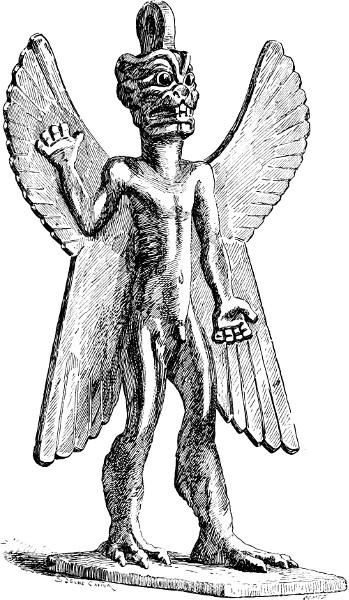
Fig. 32.—The demon of the South-West Wind.
Louvre. Actual size.
Drawn by Saint-Elme Gautier.
Nothing could be clearer than the governing idea of this conception.
The artist has wished to unite in a single being the highest powers
of life and nature—the bull, the lion, the eagle: these are types of
physical force differently applied. Patient and tenacious in the bull,
who drags the plough and transports the heaviest burdens; violent
and impetuous in the lion, while in the king of birds the formidable
strength of beak and talons add to the fear inspired by his lightning
flight. Finally, the head and countenance are those of a man, the
impersonation of intelligent force, of will governed by reflection,
before which every living thing has to bow.
The root of this conception is the same as that by which the Egyptian
sphinx was suggested. The chief differences lie in the greater
complexity of the winged bull and in its less quiescent attitude. The
sphinx combines but two elements, the man and the lion; its pose is
easier and perhaps more natural than that of the Assyrian animal. It is
extended on the ground, its paws stretched idly before it, an attitude
that could be preserved without fatigue for an indefinite time, and
therefore in complete accordance with its governing idea, and with the
function it had to fill at the gates of a palace or temple. That idea,
for the bull as well as the sphinx, was force in repose. But the bull
stands upright, and, when looked at from one side, seems to walk. We
feel that if he did complete his stride he would bring the structure
that stands on his loins down about our ears.
Here, as in most cases where comparison is possible, the advantage
remains with Egypt. But yet the Assyrian type is by no means without
a certain nobility and beauty of its own. In spite of their colossal
dimensions, in spite of the supernatural vigour of their limbs and
the exaggerated energy and salience of their muscles, there is a kind
of robust grace in the leading lines and proportions of these figures
to which we cannot be indifferent, and their effect is increased by
the wings that lie along their backs and furnish so happily the upper
part of the huge alabaster slabs, above which nothing rises but the
horned tiara. Finally, the face with its strongly marked features, with
its frame of closely curled hair and beard arranged in the strictest
symmetry, is still more remarkable than all the rest (Fig. 33). The
expression is grave and proud, and sometimes almost smiling. It is in
fine harmony with the general idea that led the Chaldæans to create
these mysterious but kindly beings, and to endow them with their mighty
frames of stone.[101]
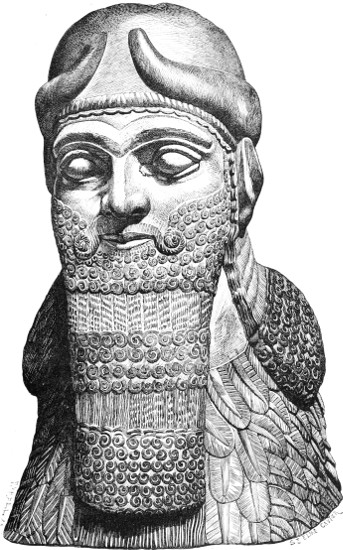
Fig. 33.—Head of a winged bull of
Assurbanipal. British Museum. Height 38 inches.
Drawn by Saint-Elme Gautier.
These bulls have only been actually found in Assyria, but numerous and
precise texts have been deciphered by which their existence at the
gateways of Chaldæan temples and palaces has been proved.[102] They are
not now to be met with in the country of their origin, because their
material was too rare in the lower part of the great basin to escape
the attacks of spoilers. Soft or hard, volcanic or calcareous, stone
was there precious and difficult to find. Sooner or later such objects
as these would be dragged from their ancient sites and broken up to be
used anew. If chance had not so willed that the Assyrian palaces were
preserved for us by entombment in their own ruins, we should now have
known nothing of a type that played a great part in the decoration
of Mesopotamian buildings, and, by its originality, made a great
impression upon neighbouring peoples; or at least we should only know
it by reproductions on a very small scale, like those we meet with on
the cylinders, or by imitations vastly inferior to the originals, like
those of the palaces at Persepolis.
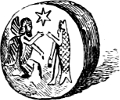
Fig. 34.—Cone of chalcedony. In the National
Library at Paris. Actual size.
Instead of a human head on the body of a beast, we sometimes find the
process reversed, but always with an amount of taste and reserve to
which we are compelled to render due praise. We may, of course, quote
instances in which the head of an eagle is put upon a human body (Vol.
I. Fig. 8), or the shoulders of a man concealed under a fish’s scales
(Vol. I. Fig. 9, and above, Fig. 34); but even then the sculptor has
succeeded in giving to the characteristic lines and attitudes of the
human figure the predominance that belongs to them, and, as it were,
has made them cast an air of nobility over the whole composition.
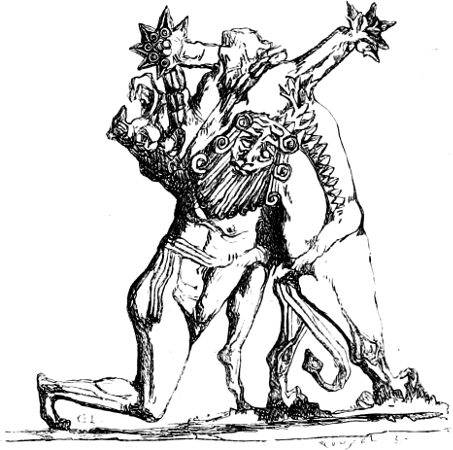
Fig. 35.—Izdubar and lion. Double the actual
size. From a cylinder in the British Museum.
It is thus with a curious type to which our reader’s attention should
be drawn; we mean that of the personage called Izdubar by some
Assyriologists, and Hea-bani by others. Whichever name we may choose,
the person in question was “a mighty hunter,” like the Nimrod of
Genesis, a hero distinguished for his valour and for the difficulties
he overcame. So that he might be free in his movements and ready for
every work of activity and vigour, he is naked. Even under the dry
method of the Chaldæan gem engraver we can appreciate the amplitude
of his form and the power of his muscles. He is also distinguished by
the size of his face, which is always fully seen, and seems to be the
result of a compromise between the features of a man and those of a
lion. This deliberately exaggerated head is enframed in long shaggy
hair. Upon some cylinders we see Izdubar in a state of repose, behind
the throne of a god to whom he acts as acolyte or guard of honour (Vol.
I., Fig. 17), elsewhere he is seen in the exercise of his functions,
if we may call them so, accomplishing some such task as those that
made the fame of the Greek Hercules, whose ancestor he may perhaps have
been. We find him on a cylinder in the British Museum carrying off a
slain lion on his shoulders (Fig. 35).
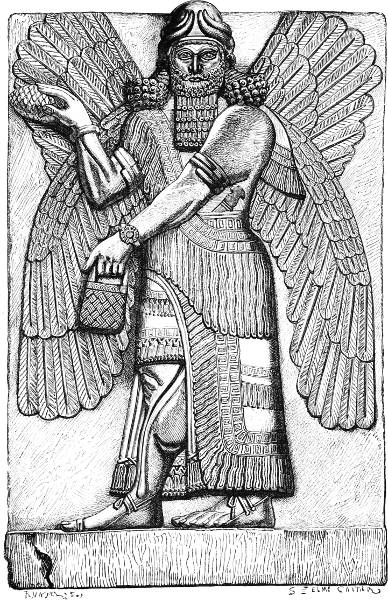
Fig. 36.—Winged genius. Louvre. Height 10
feet. Drawn by Saint-Elme Gautier.
We again find the human form predominant in those great winged genii
for which Chaldæan art had so strong a predilection (Figs. 4 and 29).
The two pairs of wings are very happily allied to the body, and both
Greek and modern art has had recourse to the type thus created, the
former for the figures of certain minor divinities, especially for that
of Victory, and Christian art for its angels. In both these instances,
however, we find but a single pair of wings. The artists of Assyria,
especially in their rare attempts to treat the figure from a front
view, have used the two pairs of wings with great felicity to furnish
the background, against which the human form stands out in all the
vigour of its robust muscularity. Our readers may judge of this from
our reproduction of one of the reliefs brought to the Louvre from
Khorsabad (Fig. 36).
These winged men serve as a kind of transition between the complex
beings noticed above, and the sculptures in which the human form is
treated without any supernatural additions. So far as we can guess in
our present uncertainty as to the ranks of the celestial hierarchy
of Chaldæa, it would appear that the forms and features of men and
women were alone thought worthy to represent the greatest of their
divinities. Take the statue of Nebo, figured on page 81 of our last
volume, take the gods introduced into the ceremonies we have already
figured (Vol. I., Figs. 13 and 14), after reliefs from Nimroud and
Kouyundjik (Fig. 37).[103] In this last-named work the god, Raman or
Marduk, holds a flower. At Nimroud there is a god with horned forehead
who grasps an axe in one hand and a thunderbolt in the other. In the
female figure, twice repeated with slightly different attributes, that
precedes the god, Istar has been recognized. See also the statue of
Istar in Vol. I., Fig. 16, and the image of that Chaldæan Venus so
often repeated on the cylinders (Figs. 38 and 39). In form Istar is but
a woman, and the artist would have made her beautiful if he had known
how. She is shown naked, against the general custom of an art that
everywhere else hid the human body under ample draperies. This nudity
must have been intended to suggest those feminine charms by which
desire is awakened and life preserved on the world.
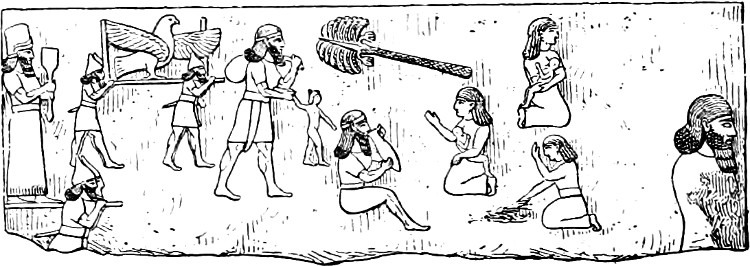
Fig. 37.—Carrying the gods. From the palace of
Sennacherib; from Layard.
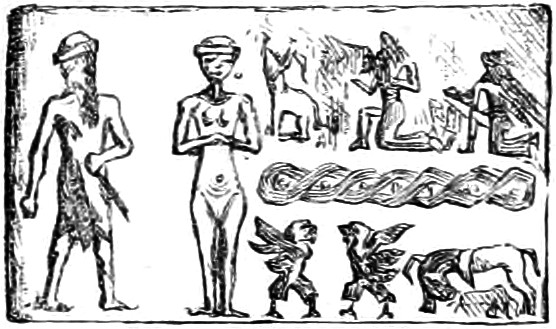
Fig. 38.—Istar and the sacrificing priest.
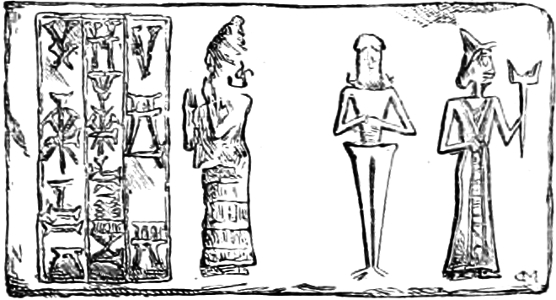
Fig. 39.—Istar between two personages.
Hague Museum.
The supreme gods, the Bels or Lords, were treated in the same way when
all the majesty of their station had to be suggested. Each of these
had his domicile in one of the principal sanctuaries of Chaldæa and
Syria. At Sippara it was Samas, or the sun personified (Vol. I., Fig.
71); upon the seal of Ourkam (Vol. I., Fig. 3), upon another cylinder
on which there are many curious and inexplicable details (Fig. 17),
and upon a last monument of the same kind which dates from the early
centuries of Chaldæan civilization (Fig. 40), it is a Bel whose name
escapes us;[104] but in all the theme is the same, and the type almost
exactly similar. We can hardly be mistaken in recognizing a god in the
personage seated on a richly decorated throne, towards whom two or
three figures, sometimes of smaller size than himself, advance in an
attitude of respectful homage. He is crowned with a lofty tiara, a long
beard flows over his breast, a robe of fine plaited stuff enwraps his
whole body and falls to his feet. He is a man in the prime of life; his
air and costume must have been taken from those of the king. May we not
look upon him as the first sketch for the Greek Zeus, the Zeus of Homer
and Phidias?
This type is never disfigured by any of those attempts, of which the
Chaldæans were so fond, to add to the significance of the human figure
by endowing it with features borrowed from various lower animals.
It should be noticed, however, that on one of the cylinders we have
figured (Vol. I., Fig. 17) there is a personage with two faces, like
the Roman Janus. But this is not the seated god. It is not the great
deity before whom the other actors in the scene stand erect, it is
one of the secondary personages, one of the inferior divinities who
bring offerings or receive instructions, in short, one of those genii
whose numerous and complex attributes first suggested these fantastic
combinations.
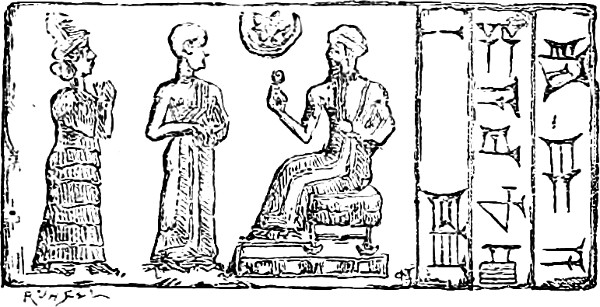
Fig. 40.—Lapis-lazuli cylinder. In the French
National Library.
We find then that when the Chaldæans set themselves to search for the
most suitable way of figuring their gods, they ended by thoroughly
appreciating the excellence of the human form; with a few exceptions,
they abandoned the idea of correcting and perfecting it; they
were content to copy it sincerely and unaffectedly, to render the
characteristic features of the maid and the mother, the youth and the
man of mature age to whom years have lent dignity without taking
away vitality. These forms they covered as a rule with ample drapery,
but for certain types, those, for instance, of the goddess of love
and fecundity, and the demi-god whom we have compared to the Greek
Hercules, they had recourse to all the frankness of nudity. How was
it that under such conditions they never succeeded in endowing their
goddesses with grace, or their gods with nobility of form? Can it be
denied that the few nude figures they have left us are far inferior,
not only to those the Greeks were afterwards to design with so sure
a hand, but even to the hundreds and thousands of human forms with
which the Egyptians had already peopled their bas-reliefs and funerary
pictures?
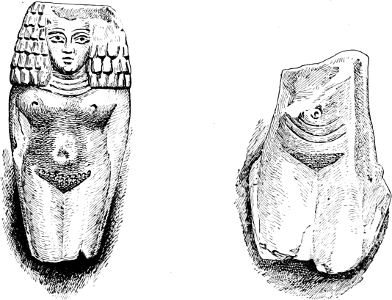
Figs. 41, 42.—Fragments of an ivory statuette.
British Museum. Actual size.
Their first fault lay in an exaggerated striving after fidelity. They
insisted blindly on certain details which are elsewhere suppressed or
dissimulated, in obedience to a compromise which has been so generally
accepted that it must surely be founded on reason. We may judge of this
by two ivory fragments chosen from among those that were found in such
numbers at Nimroud. They are, in all probability, statuettes of Istar
(Figs. 41 and 42). The sculptor had noticed that the female pelvis
was larger than the male, but he exaggerates its size and that of the
bosom. The deep folds of the abdomen indicate an exhausted vitality,
that of a woman who has been many times a mother, and other details of
this region are rendered with a clumsy insistance.[105]
There is no evidence in Chaldæan art of the feeling for proportion
which distinguishes Egyptian sculpture. Its renderings of the human
figure are nearly always too short and thickset; even those works
which by their general facility and justness of movement most strongly
attract our admiration, are not free from this fault. Its effects may
be estimated very clearly from the stele representing Marduk-idin-akhi,
a king of Babylon (Fig. 43), whose date is placed in about the
twelfth century B.C. It is true that the defect in question
is more conspicuous in this relief than, perhaps, in any other work
of the school to which we can point; but in all it is more or less
perceptible. In Assyria, under the later Sargonids, sculptors made an
effort to correct it, but even their comparatively slender figures have
a certain heaviness. Assyrian sculpture has many good points, but it
is never elegant. The Assyrian and Chaldæan sculptors were discouraged
from acquiring a complete knowledge of the human form by the fact that
it was not demanded by their patrons. The public who judged their
works did not perceive their shortcomings in that respect. There was
nothing in their daily life, or in the requirements they laboured to
fulfil, which either assisted them to make good their deficiencies, or
compelled them to do it for themselves. They seldom beheld the nude
form, still more seldom did they have to introduce it into their works.
The Greek writers speak of it as a peculiarity of “the barbarians,”
whether Syrians or Chaldæans, Lydians or Persians, that they were
ashamed to be seen naked, the men as much as the women. Such a scruple,
especially in the male, would seem hardly comprehensible to the Greek
accustomed to the nudity of the gymnasium.[106]
The origin of such a notion is to be sought, perhaps, so far as
Mesopotamia is concerned, in a wise hygiene and in the rapid changes
of an uncertain climate. The difference between the extremes of summer
and winter temperature is far greater than in Egypt or on the Ionian
coasts, and precautions had to be taken at one time against a scorching
sun, at another against the cold of the nights. However this may
have been, it is certain that these people, although they lived in
a hot country, went about in a costume that covered their bodies as
completely as that of modern Europe. It consisted of a long tunic, a
tunica talaria (?) as the Romans would call it, and a mantle.
The tunic left nothing exposed but the head and neck, the forearms, and
the feet and ankles. It must have been of linen or hempen cloth;[107]
when worn by a rich man it was embroidered and decorated about the
foot with a sort of gimp fringe. The tunics of the poor were short and
plain, often coming hardly lower than the knee. They were also looser
and better fitted to work in; but they are never wanting altogether,
even to the men of the corvée, the slaves and prisoners of war
whom we see employed in the construction of the royal buildings (Vol.
I. Figs. 151 and 152). Women were dressed in chemises coming down to
their feet (Vol. I. Fig. 30), resembling the long robe of coarse blue
cotton which still forms the only garment of the peasant women of Egypt
and Syria. Sometimes we find a sort of cape thrown over the tunic (Vol.
I. Fig. 31, and below, Fig. 44).
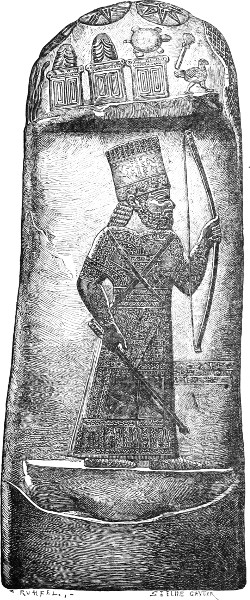
Fig. 43.—Merodach or Marduk-idin-akhi. From
a basalt stele in the British Museum. Height 24 inches. Drawn by
Saint-Elme Gautier.
As for the mantle, it was a fringed shawl, and, like the Greek
peplos or the Roman toga, could be arranged in many
different ways. In the painting at Beni-Hassan which shows us the
arrival in Egypt of a band of Asiatic emigrants,[108] it leaves one
shoulder and both arms uncovered, and forms a kind of frock round the
body, which it entirely conceals. In the old Chaldæan statues from
Sirtella the arrangement is more graceful (see Plate VI.); the piece of
cloth is folded double and carried obliquely round the body so as to
cover the left arm and shoulder and leave the right bare. The end is
simply passed under the first fold, by which it is tightly held.[109]
There is no trace of a tunic. In Assyria the mantle was variously
arranged. It always left one shoulder free, which was covered, however,
by the tunic. As a rule it reached to the feet (Vol. I. Fig. 22), but
sometimes it was so contrived as to leave one leg exposed from the knee
downwards. The robes of Sargon praying before the sacred tree are thus
arranged (Fig. 45).
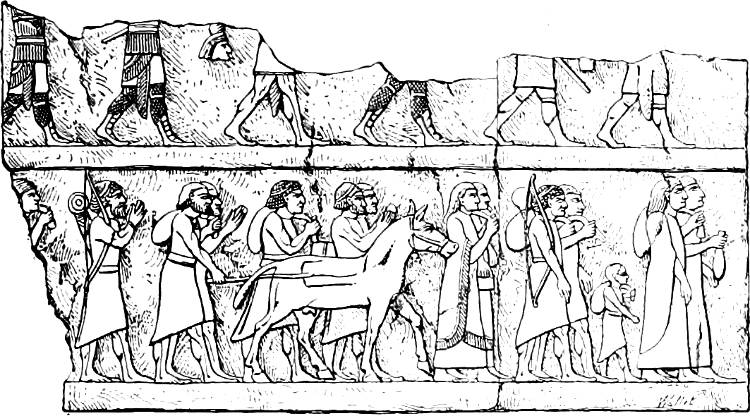
Fig. 44.—Captives on the march. From the
palace of Sennacherib.
As for the women’s dress, it was still more impenetrable than that of
the men. In the Assyrian bas-reliefs there are very few figures of
women on any considerable scale. We can hardly point to an instance,
except in the slab where Assurbanipal and his queen are shown feasting
in a garden (Vol. I. Fig. 28). In this carved picture the queen is
robed in a tunic and mantle, over which the embroiderers needle
has thrown a profusion of those rosettes that are so popular in
Mesopotamia!! art. We are allowed to glean no hint of the personal
charms of the favoured sultana, who must have been young and beautiful.
They are entirely masked by the envelope in which she is wrapped.
In all this we are far enough from the semi-nudity of the Egyptian
sculptures, to say nothing of the frank display of the Greeks. On the
banks of the Nile, where the climate had no violent changes and the
air was deliciously dry and limpid, both poor and rich, both the king
and his subjects, were contented with the white drawers, which were
carefully plaited and knotted about the hips. On great occasions,
when, as we should say, they wished to dress themselves, they put on
long, bright-coloured, and elegantly embroidered robes; but those robes
were of a fine linen tissue, every contour of the body could be easily
followed through them, the age and character of every form could be
distinctly appreciated.
The artist, even when he had to represent the wives and daughters of
Pharaoh or the most august of the female deities, showed under their
draperies the contours of their breasts, their hips, and the insertions
of their limbs.[110] Still more transparent were the robes in which
the dancing and singing women who occur so often in the tomb pictures
were draped.[111] The calculated indiscretions of this sort of coa
vestis invited the painter and sculptor to do justice to the
elegance of the female form.
How different and how much less favourable were the conditions under
which the Assyrian sculptor exercised his art! For him the contours
of the body and the attachments of the limbs were hidden behind heavy
tunics covered with embroidery, and shawls often folded double. If by
chance he caught a passing glimpse of the forms beneath, to what use
could he put it? Two or three at the most of the divine types upon
which his skill was most frequently employed involved a very partial
nudity; most of the gods, and nearly all the men, were draped. In a few
very rare instances we find an Assyrian stripped of his clothes and
crossing a river by means of an inflated skin.[112] But these figures,
though fairly well drawn, are very small in scale, and occupy but a
subordinate place in the bas-relief where they occur.[113]
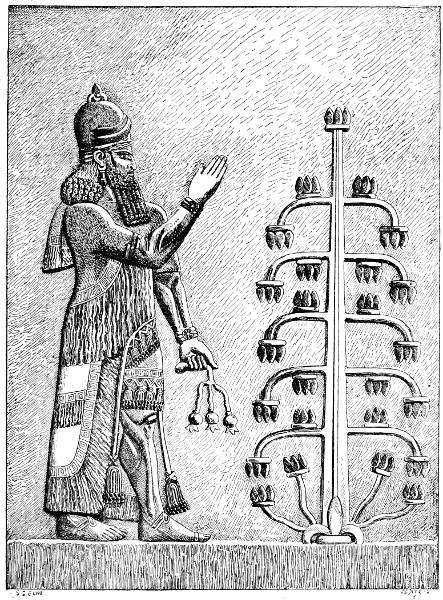
Fig. 45.—Sargon before the sacred tree.
Louvre. Drawn by Saint-Elme Gautier.
Corpses stripped naked by the victor on the battle-field are of more
frequent occurrence; but these, being the bodies of despised and hated
enemies, are treated in very summary fashion.[114] We may say the same
of the prisoners whom they behead and flay alive.[115] The mutilated
statue of a nude female, rather less than life, which bears a votive
inscription of Assurbilkala, the son of Tiglath-Pileser, and is now
in the British Museum, is a great rarity. It is believed to represent
Istar. The execution is careful, but the forms are clumsy and the
proportions bad; the bust is a great deal too short.[116]
By his failure to appreciate living form for its own sake, for its
beauty of line and harmony of proportion, the Mesopotamian sculptor
put a voluntary limit to his ambition. He renounced, in advance, the
only means within his reach of borrowing from the human figure the
elements for a representation of the deity which should preserve a
character of indefinite existence, of natural and sovereign excellence.
But this abstention, or, if you like, this impotence, did not prevent
Assyrian artists from fulfilling, in the most brilliant fashion, the
other part of the task to which they were called by the habits and
requirements of the society for which they laboured. The sculptors were
mainly employed by the king; their chief business was to multiply his
images; they were charged to commemorate the sovereign in every act of
his life, in every one of the many parts involved by his indefatigable
activity as builder, chief-justice, hunter, commander-in-chief, and
supreme pontiff. From the king himself to the last of his soldiers or
prisoners, every one who had his own marked place in a picture was
draped; the sculptor could reproduce every episode of the royal life
in the truest and most animated fashion, without ever having learnt to
draw the nude. In fact, he was not called upon, like the Greek artist,
to procure for the æsthetic sense the pure joys that are given by
the sight of noble forms or movements well rendered; his duty was to
commemorate by a series of clear and lively images those events that
were celebrated in words in the text inscribed upon the very alabaster
slabs beneath his hand.
Assyrian sculpture had this documentary character in the very highest
degree; its creations, in the intention of those by whom they were
commissioned, were less works of art than records.[117] The long
inscriptions and the endless series of pictures with which the palace
walls were covered were no more than an illustrated book.
And in what class of literature should that book be placed? It has
been called an epic illustrated by sculptors—a description that seems
hardly just. For in every epic worthy of the name the marvellous
occupies an important place, while in these reliefs it scarcely has a
place at all. With few exceptions the belief in a superior and divine
world makes itself felt in Assyrian art only in those effigies of gods
and demons we have already described. And such images have their places
rigidly fixed by tradition; they stand at the palace gates, but are
scarcely ever found within its saloons, and are entirely absent from
the marches, battles, and sieges. Here and there among such pictures,
but at long intervals, we find some feature that reminds us of the aid
that Assur and the other national gods afforded their worshippers;
now it is an eagle floating over the king’s chariot;[118] now the god
himself, surrounded by a winged circle, draws his bow and launches
his formidable shafts against the enemies of his people.[119] He is
thus represented mounted on a galloping bull in the ring by which the
standards of the Assyrian legions were surmounted.
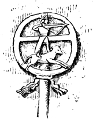
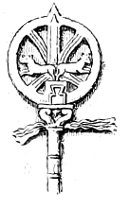
Fig. 46.—Assyrian standard; from Layard.
All these details were small in scale and unobtrusive. The rôle
played by the architect was similar to that of the draughtsmen and
photographers who sometimes accompany princes and generals on a modern
campaign. The programme placed before him was as narrow as it could
well be; he was required to be faithful and precise, not to give proof
of inventive power.
The sculptor was, in a way, the editor of the military bulletins; his
work was the newspaper of the day, explaining the political events
of his time to those who could understand no other writing. There is
complete coherence between his figures and the inscribed texts they
accompany. Look, for instance, at the series of slabs from the Palace
of Sennacherib, in which his Jewish campaign is retraced.[120] The
final scene is thus described in words within a cartouche above the
heads of the figures: “Sennacherib, king of Assyria, seated upon his
throne of state, causes the prisoners taken in the town of Lachish to
pass before him,”[121] In order to show the details of the magnificent
chair upon which the king is seated we have reproduced only the two
principal actors, in the sovereign and his grand vizier (Fig. 47). If
we had been able to place the whole composition before our readers they
would have seen how thoroughly the inscription describes it. Behind
the general who is presenting the vanquished to the king, appear the
prisoners, some prostrate, others kneeling or standing upright, but all
turned towards their conqueror with gestures of supplication.
The spaces to be covered were vast, but the warlike kings of Assyria
cut out enough work for their sculptors to keep them always busy.
Every campaign, and every battle, every siege or passage of a river,
seemed to them worthy of commemoration by the chisel. Those to whom
the work was given were forced therefore to multiply figures; the task
was complicated and yet had to be finished with extreme rapidity.
The sovereign was in a hurry to enjoy the spectacle he had promised
himself, he wished to inhabit for as many years as possible the
dwelling whose walls, like so many magic mirrors, would reflect his own
prowess and glory. And so the sculptor had to produce much and produce
fast; we can therefore understand how it was that his creations never
lost a certain look of improvisation. They had the good qualities of
such a mode of work; namely, force, vitality, and abandon, but
combined with all its defects, inequality, incoherence, and frequent
repetition.
In order to cover the surface abandoned to the sculptor as quickly as
possible, the work had to be divided; every one who was thought to
be capable of wielding a chisel had to be pressed into the service.
Sculptors of established fame who had already helped to decorate more
than one palace, mediocre artists with more age and experience than
talent, young apprentices entering the workshops for the first time,
all were enlisted, and each received his share of the common task.
Under such conditions, and especially when the utmost expedition was
required, the collective work could not help showing signs of the
many and variously skilled hands that had been employed upon it. Even
with the Greeks, and even, which is still more to the point, with the
Athenians of the age of Pericles, something of the same kind is to be
noticed. The frieze of that temple of Pallas, which is, perhaps, the
most carefully wrought creation of human hands, is not all equally fine
in execution. Some parts show the work merely of a skilful carver,
while before others we feel that here has been the hand of the great
master himself, that the play of the chisel has been governed by
the brain that traced the original sketch and thought out the whole
marvellous conception.
And these differences are still more obvious in the great compositions
turned out so rapidly by Assyrian sculptors. Examine at your leisure
the long series of pictures from a single palace that hang on the
walls of the British Museum—the only place where such a comparison
is possible—and you will be astonished at the inequality of their
execution. Among those taken from a single room some are far better
than others. Here and there we find figures that seem to have been
touched upon and corrected by an experienced artist, while their
immediate neighbours are treated in a soft and hesitating fashion.
Curiously enough the figures representing enemies are, as a rule, very
roughly modelled; sometimes they are hardly more than blocked out. It
seems as if they wished, from the beginning, to have no mistake as
to relative dignity between the soldiers of Assur and those men of
inferior race whom they condescended to slay.[122]
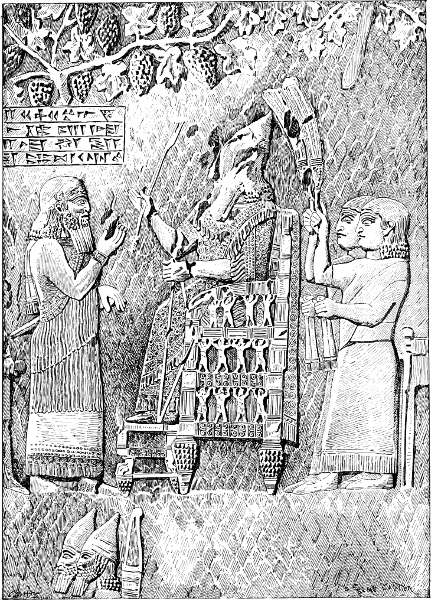
Fig. 47.—Sennacherib before Lachish, British
Museum. From an unpublished drawing by Félix Thomas.
A hurried artist repeats himself deliberately. Repetition spares him
the fatigue of reflection and invention. The Assyrians loved to
represent processions. Sometimes these consist of the king’s servants
carrying the ensign of royalty behind him (Vol. I. Figs. 22, 23, and
24); sometimes of priests carrying the images of the gods (Vol. I.
Figs. 13 and 14); but more often of war chariots, cavalry, and infantry
(Fig. 15), or bands of prisoners conducted by foot soldiers (Fig. 48).
To groups and single individuals progressing in long succession the
sculptor gave a certain rhythm that is not without its dignity, but yet
his treatment of such themes is deficient in variety. The same fault
occurs in Egyptian dealings with similar subjects; the figures seem
all to reproduce a single type, as if they had been stencilled. The
designer has made no real effort to avoid monotony; he has no suspicion
of those skilful combinations by which the Greek sculptor would succeed
in reconciling the unity of the whole with variety of detail; he makes
no attempt to make those slight changes between one group and another
that please and amuse the eye without hurting the general symmetry, or
breaking those great leading lines by which the general character and
movement of the composition is determined.[123]
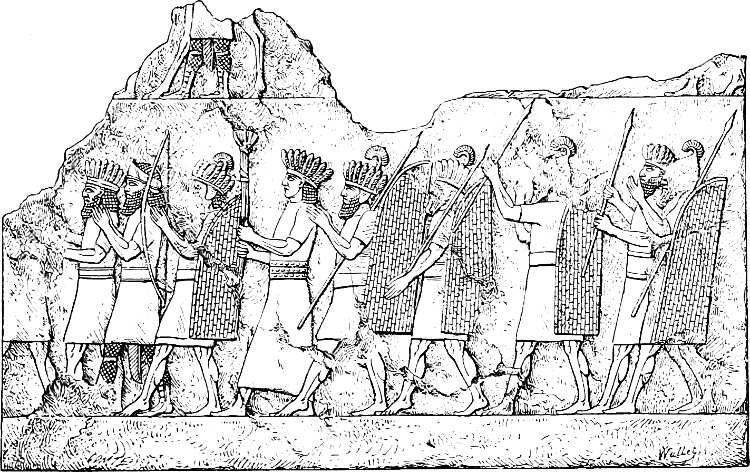
Fig. 48.—Procession of captives; from Layard.
The necessity for haste accounts for another defect of the same art. It
was because he had no time that the sculptor did not choose and select,
like the Greeks. The size of our page prevents us from reproducing
one of those pictures in which the triumphs of Sennacherib are
commemorated,[124] but some idea of that great military chronicle may
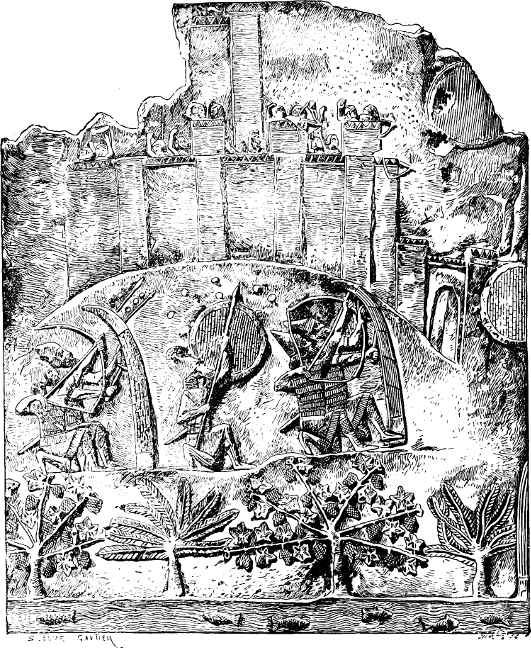
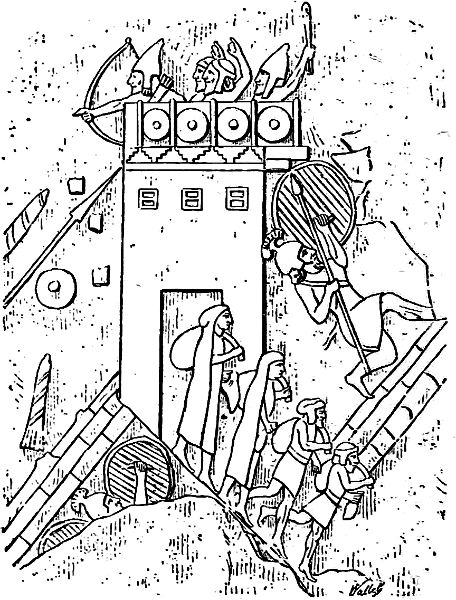
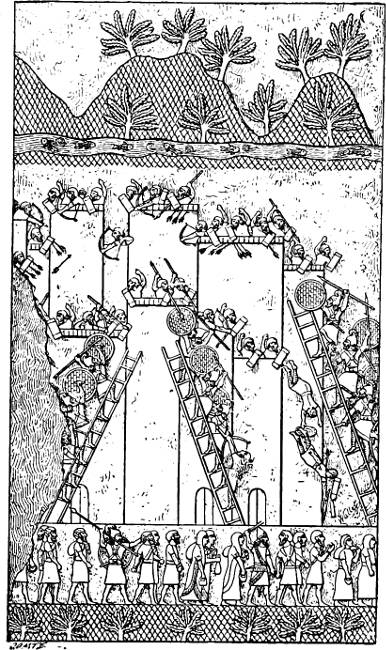
be formed from the assault on page 30 (Fig. 30). There is nothing like
a central group in which the episodes and incidents of the conflict
could, as it were, be gathered up and epitomized. The sculptor exhausts
himself in striving after the confused wealth of reality; our eye loses
itself among the groups of combatants who seem to be sown broadcast
over the field of the relief. The historian may find in it many curious
details, but he who looks only for aesthetic enjoyment is soon bored.
The whole composition is as confused as a real hand-to-hand fight.
In spite of all these defects, or perhaps owing to their existence,
the realistic sculpture of Assyria must have had a strong attraction,
not only for the kings, to whom it was a sort of apotheosis, but for
their subjects, their officers, and for the soldiers who fought in the
campaigns and brought off their share of the glory and spoil. We may
well find these battle panoramas not a little wearisome; but if we put
ourselves in the place of those who were actors in the scenes they
portray, of those who could search among their countless, and, to us,
often ambiguous incidents, and find, or think they found, their own
deeds and persons introduced by the sculptor into his crowded pages,
how great will be the change. The fatigue we feel will be changed into
the interest that never palls of fighting one’s battles over again,
and into the natural pride aroused by the pages of a history that
chronicled no defeat, that spoke of nothing but the long sequence of
victories won by the legions of Assyria over every nation that had the
temerity to oppose her arms.
Such a spectacle had its eloquence and could not fail to react strongly
upon those who gazed upon it, to incite them to new triumphs and to the
renewed spoliation of their neighbours. In spite of its shortcomings,
such an art had, then, one great merit; it was, in the highest degree,
national; it was frankly inspired by the most universal passion of the
people among whom it was born, by the ideas it suggested it helped to
keep that passion alive and to add to its force, and so contributed not
a little to develop the habits and sentiments in which the power and
originality of a violent, fanatical, and warlike race consisted.
If the national dress and social régime, as well as the natural
conditions of the country had their effect upon Mesopotamian art, so
too had the materials employed. In our study of Egyptian sculpture we
endeavoured to show how greatly the artist depended on his material,
and what a strongly modifying effect the latter had upon the nature of
the interpretation he could give to his thought.[125]
The monuments of Assyria especially invite the same remark. The
Chaldæans seem to have made use, as a rule, of very hard rocks for
their sculptures, rocks similar to those used by the later Egyptians
for their more important works. In Chaldæa a stone statue was a rare
object. On the few occasions when a Chaldæan prince, or even private
individual, indulged in such a luxury, he did not spare expense; once
in a way the cost did not matter; it was of far greater moment that
the work should be durable, and blocks were brought from any distance
that might be necessary to ensure that result. Thus it is that nearly
all the monuments that have been recovered in the lower valley of the
Euphrates are of basalt, diorite, or dolerite. The difference between
the styles of the Egyptian and Chaldæan sculptures was not caused,
then, by the materials employed, but by something far less easily
defined—by the peculiar genius of the two peoples. They neither saw
nature with the same eyes nor interpreted it in the same spirit.
The situation was rather different in Assyria. There a plentiful supply
of easily-cut stone, alabaster, and several varieties of limestone
of more or less hardness was to be had. These facilities had a
double consequence: they led the Ninevite artist to make lavish use
of sculpture in the decoration of buildings, and they had no little
influence upon their habits of design and upon the executive processes
they adopted. The most peculiar, the truly characteristic feature of
their bas-reliefs so far as execution is concerned, is the combination
of incisiveness and looseness in their handling. We feel that the
chisel, in spite of the haste with which it worked, has been strongly
driven. It is not so in the case of other countries; as a rule where
work is rapid it is also slight and superficial. This apparent anomaly
is to be explained by the qualities of the material. The alabaster
used at Khorsabad and Kouyundjik is so soft that we can scratch it
with the finger-nail, and even the limestone preferred by the artists
of Assurbanipal is not much harder.[126] How this tempts the hand!
Whether one tries to or not one writes boldly with a goose quill, and
here the docility of the material becomes a danger. The carver’s tool,
when it meets with no real resistance, runs away with the hand, and the
sculptor is insensibly led on to over-accent his intentions, and to
exaggerate his effects.
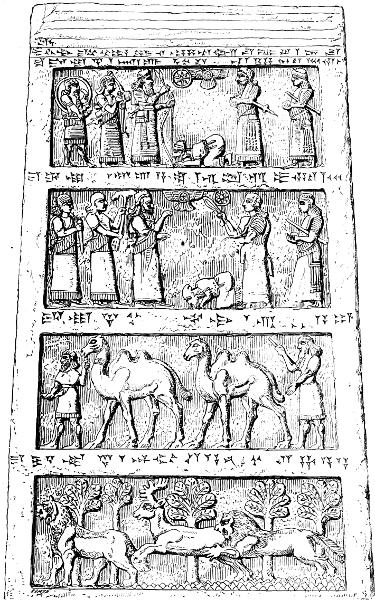
Fig. 49.—One face of the obelisk of
Shalmaneser II. British Museum. Drawn by Bourgoin.
Sometimes the Assyrians attacked the harder stones, which they obtained
from certain districts of Kurdistan and the neighbourhood of the
extinct volcanoes of the Sinjar, between the valleys of the Tigris
and the Khabour;[127] we shall be content with quoting as examples a
basalt statue found at Kaleh-Shergat and the obelisk of Shalmaneser
II., in the British Museum, which is cut from the same material (Vol.
I. Fig. 111, and below, Fig. 49).[128] It deals with the homage done
and the tribute offered to the king by five conquered nations. Among
the offerings are several strange animals.[129] The small building
at Khorsabad which has been called sometimes a throne-room and
sometimes a temple, was decorated with reliefs in basalt,[130] but the
use of these hard rocks was always very rare in Assyria. The habits
of the northern artists were formed in cutting the softer stones,
and their use of such materials explains not only their prodigious
fecundity but certain qualities and defects of their style.
Both Chaldæa and Assyria made too constant and skilful use of plastic
clay in their architecture for it to have been possible that they
should overlook its capabilities as a material for the sculptor,
especially in the production of small objects like sepulchral
statuettes. Both nations have transmitted to us a vast quantity of such
figures. In both cases they are solid; those of Chaldæa are stamped in
a mould in a single piece; their reverse is flat and roughly smoothed
by the hand; the clay is fine and close-grained, and so hard and well
fired that it cannot be scratched with a metal point (Fig. 50).[131]
The execution of the Assyrian figures is more simple. They are solidly
modelled in clay, and without the use of a mould, although we often
find a series made after one pattern and giving a high idea of the
Assyrian modeller’s skill (Fig. 51). The coarseness of the material
however is surprising; it is a dark grey earth, unequal, knotty,
without any mixture of sand, but marked with cross hatchings left
by the straw with which it seems to have been mixed. The body is so
friable that it crumbles in the hand, but as it resists water it must
have undergone a gentle burning.[132]
Examples are also to be found of objects in earthenware or terra-cotta
coated with a vitreous glaze, like those that the Egyptians
manufactured in such enormous quantities.[133] In these cases the
figure is cast in a mould, and the enamel is either blue or green, as
in Egypt (Fig. 52).[134]
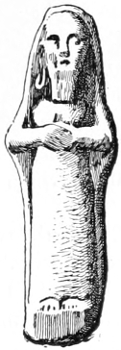
Fig. 50.—Statuette of a priest. Louvre; from Heuzey.
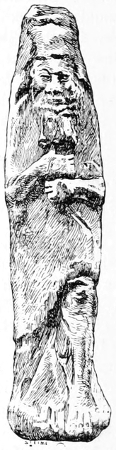
Fig. 51.—Dagon. British Museum. Actual size.
Clay was used for other things besides these small statuettes; it
seems to have been employed in the first sketches from which the
sculptor chiselled the alabaster slabs, at least when he attacked
the more important and complex groups. We can hardly refuse to
recognize such a purpose in a fine fragment brought from the palace of
Assurbanipal to the British Museum. It is all that is left of a relief
in terra-cotta. The grain is much finer and the colour far redder
than in statuettes from the same place. In its present state this
slab is about a foot high, and mutilated as it is, its subject may be
recognized as an incident in the royal hunt, the rest of which helps
to fill the Assyrian basement room. The larger part of the principal
figure is wanting, but enough of him remains to leave no doubt as to
the character of the scene; it represents a king attacked on two sides
by lions, and defending himself with his lance. The firm and precise
execution of the lions’ paws and of the king’s body should be noticed.
According to the scale obtaining in the sculptures preserved this model
was carried out on a half scale. So little of the group is left that
we cannot make sure whether the reliefs now in London contain the
episode of which this is the original sketch or not.[135] So far as
we can tell, however, the exact passage executed after this model is
not in the museum, but we must not forget that a large number of the
sculptures were left in the palace where they were found; Mr. Rassam
only removed the finest and those in the best condition.
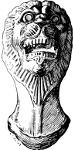
Fig. 52.—Head of a lioness. Louvre. Actual size.
The small winged bull carved in the finest limestone, which Mr. George
Smith brought from Nimroud, was, no doubt, a model of the same sort
(see Vol. I. Figs. 83 and 84). Its execution is of the most careful
description, and yet it can hardly have had any other use. We may say
the same of the square slab of terra-cotta just mentioned; its figures
are too small for the decoration of palace saloons, and the material
is too common to have formed a part of those rich schemes of ornament
whose existence is attested by the texts as well as by the remains. We
can suggest no more plausible explanation of these little monuments, or
one in more complete accord with the necessities of rapid production.
We have already shown that a vast number of hands were required for the
prompt execution of these great sculptural works, and the provision of
such models, whether in stone or terra-cotta, would do much towards
preventing the evil consequences of employing so many different and
variously gifted journeymen. The master produced the model, and
nothing was required from the carvers who copied it but skill in
enlarging and in the handling of their tools.
From the earliest times of which any remains have come down to us the
Chaldæans understood how to make use of all the different materials
that offer facilities to the artist for the rendering of living form.
Until bronzes dating from the times of the pyramid builders were
found,[136] it was thought that they had anticipated the Egyptians
in the art of making that precious alloy and casting it in earthen
moulds.[137] This conjecture was suggested by the discovery, near
Bagdad, of a metal statuette, which is now in the Louvre (Fig. 53). It
is what the Greeks called a canephoros. A young woman carries
a basket on her completely shaven head, keeping it in place with her
hands. From her waist upwards she is nude, but the lower part of her
figure is wrapped in a kind of narrow skirt, on which is engraved a
votive inscription containing the name of a king Kourdourmapouk, who is
believed to have flourished in the sixteenth century before our era.
The casting is solid.
The bronzes inscribed with the name of Gudea (Vol. I. Figs. 146–148)
are perhaps still more ancient. The motive of one is identical with
that of this canephoros. Metal working cannot have begun with such
objects as these; it is pretty certain that forging metals was
everywhere an earlier process than casting them. Before learning to
prepare the mould and to force the liquid copper into its farthest
recesses, men must have commenced by beating it into plates upon the
anvil. When they had gathered sufficient skill to make these plates
very thin and pliant, the next thing they attempted was to ornament
them, which they first did by hammering one of their sides, and so
producing reliefs on the other which could be brought to sufficient
perfection by repeating the process with varying degrees of strength
and delicacy, and by chasing. This is what is called repoussé
work.
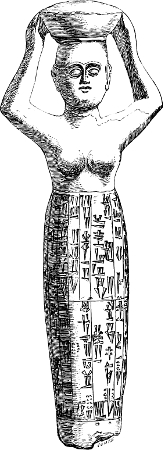
Fig. 53.—Canephoros. Louvre. Height 10½ inches.
There is no doubt that these processes were invented in the southern
cities. The oldest of the Warka tombs show that metals were abundant
from a very ancient period, and that their use was well understood;
but we do not possess any important examples of repoussé work
dating from the early days of Chaldæa. It is otherwise with Assyria.
The exploration of her palaces has brought to light numerous fragments
of ornamental sheathing in bronze; plaques and bands, sometimes curved,
sometimes straight, according to the surface to which they were
applied, were covered in some cases with mere ornamental designs, in
others with numerous figures. Only within the last few years have we
learnt to how high a pitch the sculptors of Mesopotamia had carried
this art, and how well they understood that the rough form left by the
hammer should be completed and defined with the burin and chisel. The
most important discovery of the kind was made as recently as 1878, by
Mr. Hormuzd Rassam, who found the bronze gates to which we have already
more than once alluded, in the mound of Balawat.[138] Shalmaneser
II., who built the palace to which these gates belonged, caused his
victorious campaigns and his sacrifices to the gods to be represented
upon them. We have already reproduced many of these curious reliefs
(Vol. I., Figs. 51, 68, 73, 158; and above, Fig. 28); a last example
will help to show the facility of the Assyrian artist and the boldness
of his rendering of animals and men (Fig. 54). He played with bronze as
he did with alabaster; in both his handling was firm and rapid and his
modelling at once broad and strongly felt.[139]
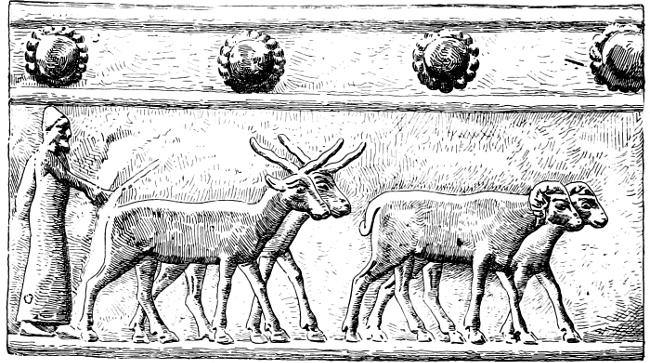
Fig. 54.—Man driving goats and sheep. From the
Balawat gates. British Museum.
Drawn by Saint-Elme Gautier.
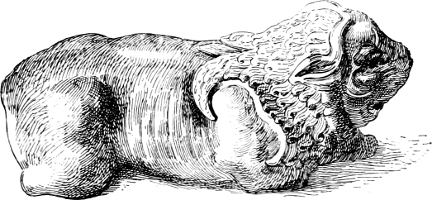
Fig. 55.—Lion carved in wood. Louvre. Length 4
inches. Drawn by Saint-Elme Gautier.
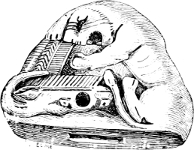
Fig. 56.—Ivory seal. Louvre. Actual size.
Drawn by Saint-Elme Gautier.
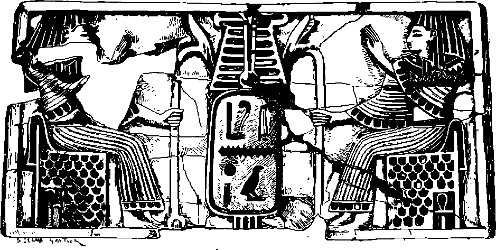
Fig. 57.—Ivory tablet in the British Museum.
Drawn by Saint-Elme Gautier.
This peculiar handling, at once free and a little hard, is to be found
in all the works of these people. It may be recognized in a wooden
lion, unfortunately much mutilated, which belongs to the Louvre (Fig.
55), and in those carvings upon the shells of pearl oysters that have
been found in such numbers, especially in Lower Chaldæa.[140] The
ivories alone are, sometimes at least, without this peculiar character.
They display a certain harshness in which the distinguishing mark
of Chaldæan origin has been recognized. We may give as an instance
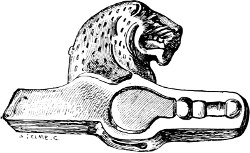
the small object thus described in the catalogue of the Louvre: “Lion
devouring a wild goat, of which only the head and neck are visible.
This group ornaments one face of a small object, rounded above and
with a flat base. There is an oblong slit in the latter. The object is
apparently a seal” (Fig. 56).[141] On the other hand, although most of
the ivory carvings that were used for the handles of walking-sticks and
daggers and such purposes, show the characteristics we have mentioned,
it must be acknowledged that the ivory tablets from Nimroud are free,
for the most part, from the style we have attempted to define as that
proper to Chaldæa and Assyria. The treatment is lighter and more
elegant, reminding us of Egypt. Must we believe that when the Assyrians
attacked this beautiful material they changed their confirmed habits
and gave a refinement to their touch it had never known before? Such an
idea seems very improbable. We know that their ornamentists borrowed
certain motives from the Egyptians, such as the winged globe, the
lotus-garland, the sphinx; but in doing so they stamped them with
their own personal and independent taste. It seems likely, therefore,
that the more carefully wrought of these ivories were imported from
abroad, either from Egypt itself, or from its imitator, Phœnicia. In
the fragments we have already figured (Vol. I. Figs. 129 and 130) the
features and head-dresses are easily recognized as Egyptian. This
character is still more marked in another tablet from Nimroud, of which
there are several repetitions in the British Museum (Fig. 57). Two
women are seated opposite to each other. They are Egyptian in every
detail. Their attitudes and symmetrical arrangement; their robes and
head coverings; the action of their hands, one raised in adoration,
the other holding the hare-headed staff; the crux ansata under
their chairs, all are continually found in the monuments of the Nile
valley. A still more decisive feature is the oval surmounted by two
ostrich plumes in the centre of the plaque. This is not inscribed with
hieroglyphs taken at random, as in the small objects of Phœnician
origin on which those characters are used merely as decoration, but
with a royal name, Auben, or Auben-Ra.[142] It is true that no such
name has as yet been encountered on any other monument, but it may
very well have been that of one of those petty monarchs who swarmed
in the Delta towards the time of the Ethiopian conquest. Most of them
left very slight traces; not a few are known only by a single text.
This tablet may have been carved, then, either in Egypt, or in Phœnicia
after an Egyptian model. In any case, it seems clear to us that it is
not the work of an Assyrian or Chaldæan. Other objects in the same
material do not, like this, bear an irrefutable mark of their origin,
but they are so like it in treatment that we are tempted to say they
must have been produced under the same influence. Look at this fragment
of a winged sphinx (Fig. 58). Its general physiognomy, the head-dress,
the peculiar rendering of the wing-feathers, are none of them Chaldæan,
but we often find them in Phœnicia and Cyprus. We may say the same of
the fine piece in which two fantastic animals standing upon a peculiar
and elaborate capital are surrounded by gracefully designed flowers and
leafage (Fig. 59).
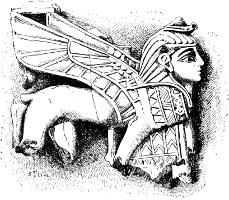
Fig. 58.—Ivory fragment in the British Museum.
Actual size. Drawn by Saint-Elme Gautier.
In attempting to give a clear idea of Chaldæo-Assyrian sculpture we
must, therefore, put aside the more artistic among the numerous ivory
carvings found in the ruins at Nimroud, and especially in the palace
of Assurbanipal. It would seem that such things were imported from
abroad when something better than the ivory knobs and handles made in
the country was required. When we come to speak of metal cups we shall
have to repeat this remark.
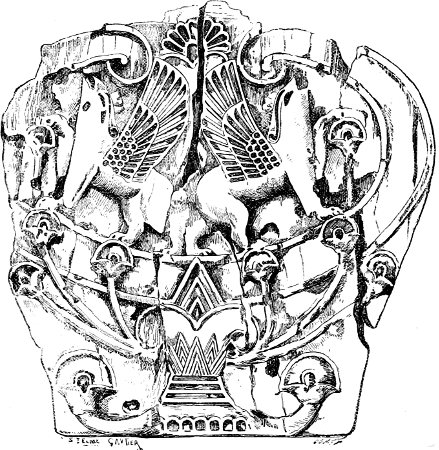
Fig. 59.—Ivory tablet in the British Museum.
Actual size. Drawn by Saint-Elme Gautier.
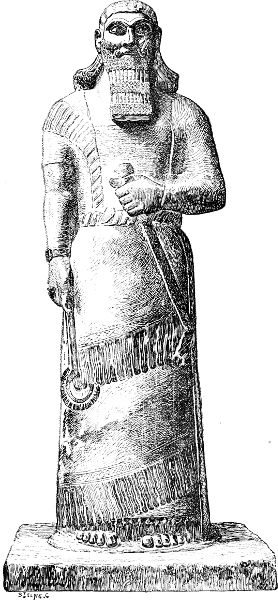
Fig. 60.—Statue of Assurnazirpal. Height 41
inches. British Museum. Drawn by Saint-Elme Gautier.
It may be said that we should have postponed our notice of these
objects, and, if they had all borne as incontestable a mark of their
origin as the tablet with the royal oval, we should have done so, we
should have reserved both the carved ivories and the engraved cups of
metal until we reached those pages of our history in which the arts of
Phœnicia will be treated. But, unfortunately, when we come to details
it is not always easy to establish the distinction between objects of
foreign manufacture and those productions of the same kind that were
made at home; in many cases it requires the tact and instinct of the
archæologist to know one from the other. Such faculties are always, in
some degree, liable to err, while in many cases it is very difficult
to give reasons for the conclusions arrived at by their exercise. The
simplest way out of the difficulty has seemed to us to describe these
remains at the same time as the main compositions to which they were
formerly attached. But while we do so we keep their doubtful character
in mind; in our definition of the style of Chaldæo-Assyrian sculpture
we shall only have recourse to them under great reserve, especially as
the style in question is to be amply studied without their help.
The art of Mesopotamia, like that of Egypt, had its conventions, some
of which were peculiar to itself, while others are common to all
nations that have arrived at sovereign power and maturity of knowledge.
Like all those who attempt plastic figuration by the light of nature,
the artists of Mesopotamia began with profiles. In speaking of Egyptian
sculpture we had occasion to show how this method of representation
is always followed by first beginners,[143] as it is the simplest and
easiest of all. The Chaldæo-Assyrian artists, unlike those of Egypt and
Greece, were unaccustomed to the nude, and were therefore without the
incentive it supplies to fight against nature and to make her live in
all her variety of aspect, a variety which work in the round is alone
able to grasp without the aid of convention. One consequence of this
is that almost exclusive love of the bas-relief in which Mesopotamian
art is unlike that of any other people. In its very beginning it
seems to have made a vigorous and promising effort to rise to the
production of statues in the round, but discouragement appears to
have rapidly followed, and in later years but a very few attempts,
and those attended with no great success, were made. The salience of
figures was increased or diminished according to their place and the
part they played, but the idea of detaching them altogether from the
background and giving them an independent existence of their own, was
soon abandoned. Under the first Chaldæan empire, real statues, round
which we can walk, were modelled (see Plates VI. and VII.). In several
of these, although the forms are not so round as in nature, the back is
as carefully treated as the front. On the other hand, the few Assyrian
statues that have come down to us are all too thin from front to back,
while their backs are hardly more than roughly-dressed stone. You feel
at once that they were made to stand against a wall, and you think of
children and of those whose limbs are so infirm that they cannot stand
without support. Before such things, we are far enough, not only from
the grace, vitality, and freedom of the Greeks, but even from the proud
repose of the Egyptian colossi. Although our figures show, of course,
only the front view, this impression is very striking in the statues of
Nebo (Vol. I. Fig. 15) and Assurnazirpal (Fig. 60), which have migrated
from Nimroud to the British Museum. The latter was found by Layard at
the entrance of one of the temples whose plans we have given (Vol. I.
Fig. 189). It is cut from a very hard and close-grained limestone,
and stands upon a pedestal that is nothing but another block of the
same material. We have been compelled, in order to keep our figure
sufficiently large, to reduce this block to the dimensions of a shallow
plinth. In reality it is a cube thirty-one inches high and twenty-one
and three-quarter inches wide.[144]
PLATE VI
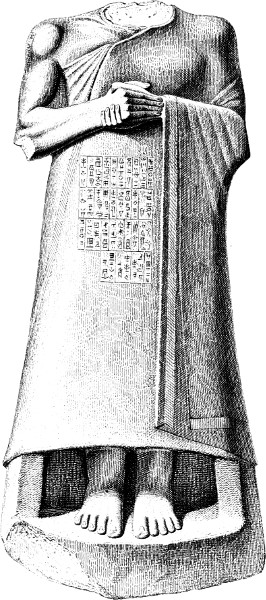
ROYAL STATUE
Louvre
J. Bourgoin, del. Imp. Ch. Chardon Sulpis, sc.
The statues of Nebo and Assurnazirpal are standing figures, but,
at Kaleh-Shergat, Layard found a seated figure of Shalmaneser II.
(Fig. 61).[145] It is in black basalt and has no head. It is of
great interest because it recalls the very oldest Chaldæan statues
both in material and attitude. It has suffered so much, however,
and its workmanship seems to have been so sketchy, that even in the
original itself the details of modelling and costume are hardly to be
recognized. We give a slight sketch of it merely to show its pose.
These statues, if they deserve such a name, show the work of the
Assyrians at its feeblest; the plastic genius of the people must not be
judged from them, but from the genre in which they were most at
home, from the long lines of figures that stand out in various salience
from the palace walls. Among the productions of this latter class that
have come down to our time we find every degree of relief, from the
bas-relief strictly speaking, to what is but little removed from the
round.
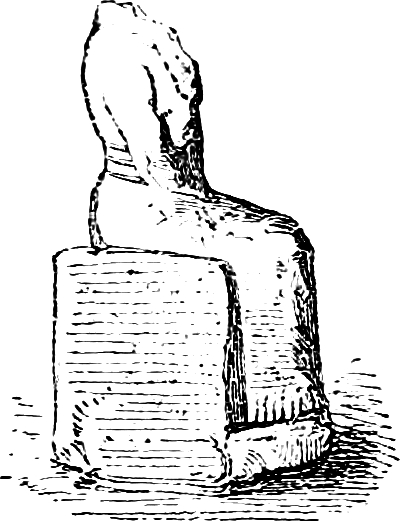
Fig. 61.—Statue of Shalmaneser II. Height 58
inches. British Museum.
Let us begin with the bas-relief. It is with sculptures executed on
this principle that the walls of temples and palaces were covered,
as if with a stone tapestry. The Assyrian process is identical in
principle with that afterwards adopted by the Greeks, as, on the whole,
the most convenient for the purpose in view. We find no examples of
the Egyptian fashion of defining the outlines of figures by a deep
groove cut with the point, nor of those figures that were, so to speak,
let into and modelled within the surface of the wall.[146] In both
Chaldæa and Assyria the figure stands out from the bed of the relief
from two or three millimetres to a centimetre, according to its size.
The bed is nowhere hollowed, it is one even surface, except that where
the figures are very small, and consequently of very slight relief,
the sculptor has reinforced them with an incised outline one or two
millimetres deep. This artifice must be examined on the monuments
themselves; it could hardly be shown in reproductions on a reduced
scale.
Most of the great bas-reliefs have but one plane, and to this they owe
the simplicity that gives them a certain nobility in spite of their
monotonous design (see Vol. I. Figs. 4, 5, 6, 8, 13, 22, 23, 24, &c.).
Examples of two planes, in which the figures are grouped in couples,
the nearest to the spectator in each couple covering a large part of
his companion, are by no means rare (see Fig. 62); we may say the
same of those in which a background of trees is introduced beyond the
figures (Fig. 63). This arrangement is especially frequent in the more
complicated pictures, where the figures are small and numerous; but
even in the last century of the Assyrian monarchy, when the sculptor
showed an ever-increasing desire to draw attention and excite interest
by the introduction of these picturesque details, he never quits his
hold of a right instinct for the true conditions of the bas-relief.
Unlike the Roman sculptors, and even those of the Renaissance, he shows
no hankering after those effects that seem to get rid of the bed; he
never destroys the clarity of his conception by unduly multiplying the
planes. He did not understand how to put objects in perspective or
manage foreshortening, and this ignorance served him well; it preserved
him from the temptation into which more skilful artists are so prone to
fall; it prevented him from forgetting “that the design best suited to
the bas-relief is purely geometrical in its essentials.”[147]
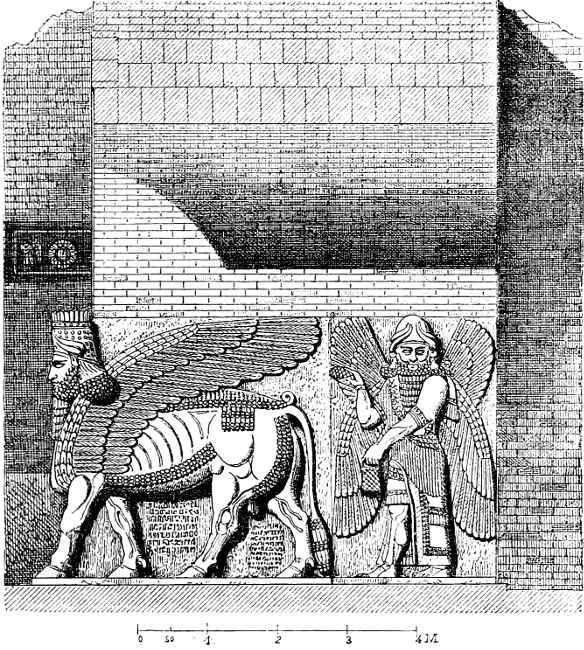
The relief, of course, becomes higher as the size of the figures
increases. It is as much as from eight to ten inches in the winged
genii (Figs. 27 and 34) that accompany and divide the bulls on the
decorated façades and in the gateways. Even when it is highest the
salience does not go beyond what is called mezzo-relievo; that
is to say, no part of the principal or accessory figure, of the genius
himself or of the lion, stands out from the wall in the round, as, for
instance, do the heads and limbs in the metopes of the Parthenon.
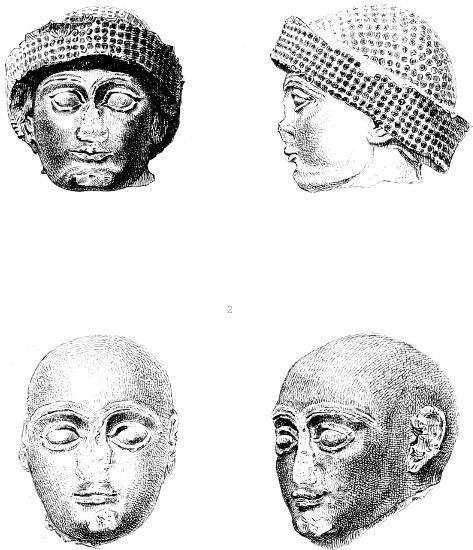
TWO CHALDÆAN HEADS
J. Bourgoin, del. Ramus sc.
Imp. Ch. Chardon
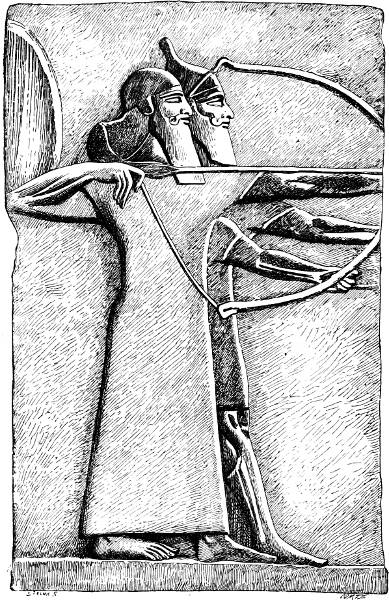
Fig. 62.—Pair of warriors. Louvre. Drawn by
Saint-Elme Gautier.
The same remark holds good of the colossal figures of lions (Plate
VIII.) and winged bulls (Plate IX.) which acted as guardians of the
palace. We have already explained the ideas attached to these monsters
by the Assyrians,[148] we shall here dwell upon some peculiarities of
their execution. In these images there is a compromise between “the
round” and the bas-relief of a very original and peculiar character.
Looked at from in front these lions and bulls seem to be independent
statues; the head, the chest, the legs stand out with as much freedom
and amplitude of development as in nature; but step a little to one
side, to the right or the left as the case may be, and their aspect
will change. You will then see that only the fore-part of the animal
is disengaged from the block of alabaster or limestone in which it is
cut, the rest of the body remains imprisoned in its substance. The
contours alone are indicated, in low relief, on the two sides of the
ponderous slab. Thus we have half, or rather a quarter, of the statue
standing out from sixteen to twenty inches in front of the slab on
which the sides are shown in silhouette. It looks as if the image had
made an effort to shake itself clear of the mass of stone and had only
partially succeeded. We find ourselves wondering whether, if Nineveh
had not perished and the development of her art had gone on without
interruption, these great beasts would not have ended by conquering
their liberty and winning for themselves an existence independent of
the walls to which they were attached. But the nature of the material
employed says no—alabaster is too soft, and the legs of the lions and
bulls could not support their massive bodies without assistance.
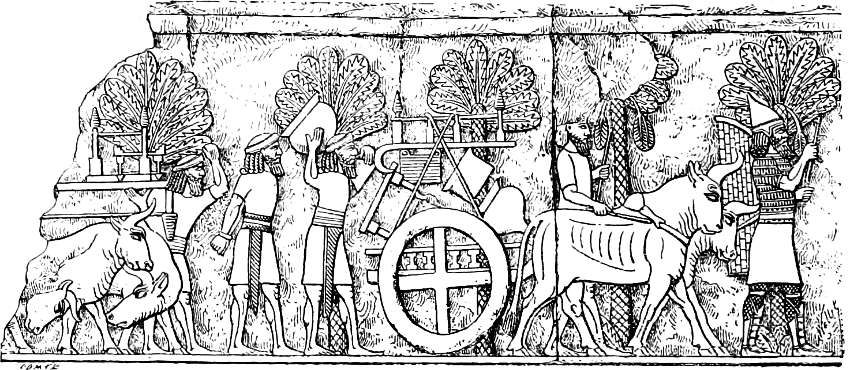
Fig. 63.—Prisoners. From the palace of
Sennacherib; from Layard.
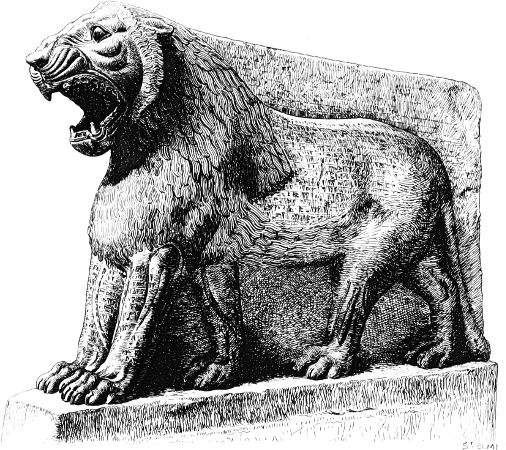
LION FROM THE PALACE OF ASSURNAZIRPAL, NIMROUD
British Museum
Saint-Elme Gautier del etsc Imp. Ch. Chardon
There are other peculiarities in these images. Looked at from in front
they appear stationary, their two fore-feet being on the same plane and
close together; any other arrangement would have been awkward. But
if we look at them from the side they appear to be walking, in which
attitude alone would all the four legs be visible and clear of each
other. In most cases the bulls were not parallel to the façades they
decorated, but perpendicular to them;[149] they faced the visitor as he
approached the gate, and it was not until he entered the passage that
he got a side view of their bodies stretching along its walls (Figs.
26 and 27). Some contrivance was sought by which their figures should
appear complete from both points of view, and the following expedient
was hit upon. As soon as you had entered the passage between the bulls,
you could, of course, no longer see more than the fore-leg nearest
you; the other was hidden by it. The latter was then repeated by the
sculptor and thrown back under the body of the animal, which, in the
result, had five legs.
The idea is a better one than we are at first inclined to believe.
More than once, perhaps, at the Louvre or the British Museum, you have
paused before these colossal images, you have measured their height
with your eye and admired their tranquil majesty. But have you ever
noticed the artifice I have just described? To see it clearly you must
choose a standpoint on the right or left front, as our draughtsman
has done (Plates VIII. and IX.). If no chance has led you to such a
standpoint in the first instance, if you have, as is most likely,
looked at the figure first in front and then from the side, you have
probably never suspected the sort of trick that the sculptor has played
upon you. This contrivance is one of the distinguishing marks of
Ninevite art;[150] it occurs nowhere else, unless in monuments such as
those of Cappadocia, which are more or less feeble copies of Assyrian
models.[151]
The conventions that remain to be noticed will not detain us so long.
They are such as have been practised in all imperfect schools of
art,—in all, in fact, that preceded the art of the Greeks.
Even in the greatest and most perfect schools of sculpture, the
bas-relief, as if influenced by a souvenir of its origin, prefers
figures in profile to those in full face. In those exceptional
instances in which the Assyrians abandoned this preference, as, for
example, in the decoration of entrances, they were visibly embarrassed.
They did not understand how to foreshorten the feet, therefore they put
the lower part of the figure in profile while the upper part faced the
spectator (see Fig. 34).[152] This puts the figure in a painful and
awkward attitude which could not be imitated by a living man without
a violent effort, or retained for more than a second or two. It is
the same when they wish to make a figure turn; the movement of the
shoulders and neck is so clumsily rendered that the sculptor seems to
have put on the head the wrong side foremost.[153] In general, however,
the ample draperies help the artist out of his difficulties. Thanks to
the veil which hides his ignorance of the attachment of limbs and the
play of muscles, he succeeds in avoiding those dislocations that are so
frequent in the Egyptian bas-reliefs and sometimes result in obvious
deformity.[154]
When he had to render the human countenance the sculptor of Babylon or
Nineveh fell into the same fault as he of Memphis; he placed a full, or
nearly a full, eye in his profiles, and for the same reason.[155] This
defect is not always so conspicuous as in a bas-relief from Nimroud
representing a tributary of Assurnazirpal bringing two apes, one of
which stands on his master’s shoulders while the other leaps before his
feet (Fig. 64); but it is never absent altogether.
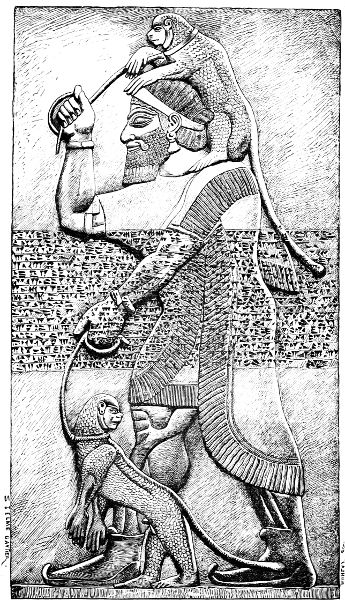
Fig. 64.—Vassal bringing monkeys. Height 8
feet. British Museum.
Drawn by Saint-Elme Gautier.
If in its fidelity to habits that we may call childish the sculpture
of Mesopotamia bears a strong resemblance to that of Egypt, it is
nevertheless far inferior to it in other respects. The artist never
seems to have looked closely enough or with a sufficiently awakened eye
to perceive the differences that distinguish one individual or even
one race from another; at least if he saw them he did not understand
how to reproduce them; he did not even try to do so. From the very
beginning—so far as we know it—the art of the Nile valley turned
out portraits both of Pharaoh and of private individuals that are
astonishing in their truth and life.[156] Even in those executed in a
more summary fashion and not in any way to be classed as masterpieces,
we find a singular aptitude in seizing and noting those peculiarities
which make of every human face an unique creation, a medal of which
but one example has been struck. Ethnic characteristics are given with
no less truth; we have seen elsewhere how many faithful portraits they
have left of the races with whom they entertained long and unbroken
relations.[157]
Very few traces of this talent or disposition are to be found in the
monuments of Mesopotamia. Of course in a draped school of sculpture
we could hardly expect to find any great preoccupation with the
various beauties of the human body. Given the Assyrian costume, it was
impossible that the Assyrian artist should aspire to bring out those
beauties. In many works from the Nile valley the influence of the sex,
the age, and even the profession upon the development of the muscles,
upon, if we may be allowed the expression, the physiognomy of the
flesh, is skilfully shown in the modelling.[158] But faces were not
concealed by the Assyrian draperies; why then were their distinctive
marks of individuality so consistently ignored? The sculptor should
have concentrated his attention upon them all the more, and so arrived
at a faithful portrait. He did not do so however. Neither Assyrian
nor Chaldæan had any such ambition. By a process of selection and
abstraction they arrived at a kind of mean, at a certain ideal of manly
beauty which served them to the end. That ideal is characterized by
the abundance and symmetrical arrangement of the hair and beard, by a
low forehead, heavy and strongly-arched eyebrows, a hooked and rounded
nose, a small mouth with full but not too heavy lips, a strong, rounded
chin, and limbs whose muscular development betrayed their vigour.
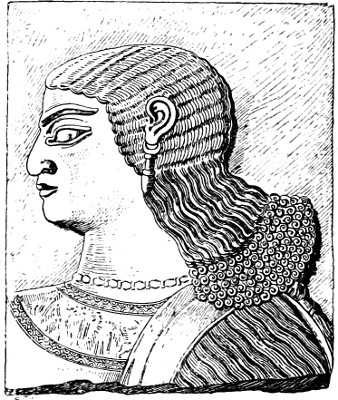
Fig. 65.—Head of a eunuch; from Layard.
The universal acceptance of this type is proved chiefly by the
Assyrian sculpture. The fact is that among all the thousands of figures
it produced there are but two heads, the one with, the other without, a
beard. We have already encountered the first in all the scenes in which
the king, his ministers, his officers or his soldiers appear. It is
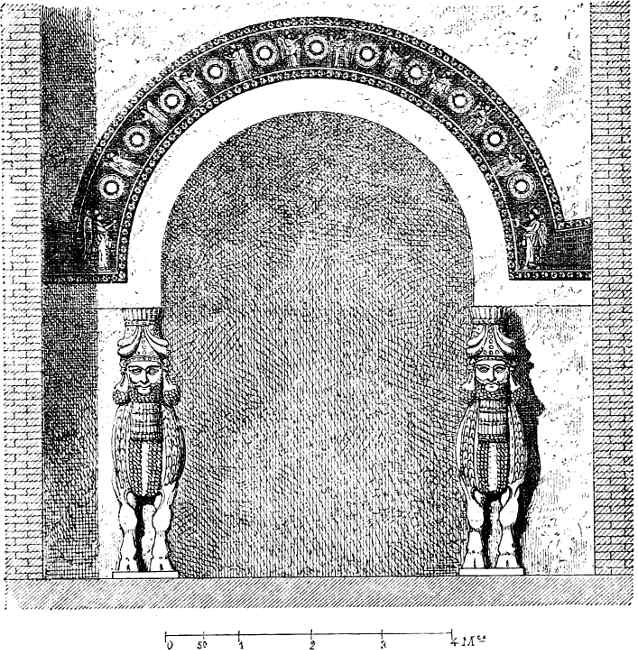
also used for the gods (Vol. I. Figs. 13 and 15) and the winged bulls,
whose heads, perhaps, like the Egyptian sphinxes, were supposed to be
reproductions of the royal features. The beardless variety seems, in
the royal processions, to be confined to those eunuchs who have always
played such an important part at Oriental courts (Vol. I. Figs. 23 and
24, and Vol. II. Plate X.); the fleshy heaviness of their cheeks and
necks (Fig. 65) has been thought to confirm this idea. But we should be
mistaken if we recognized these miserable beings in all the beardless
figures. The latter are so numerous in some compositions that no such
explanation is admissible. In many instances they seem to represent
people of the lowest class, peasants, labourers, and slaves (see Vol.
I. Figs. 45, 151, 152, and Vol. II. Figs. 44 and 48). As the oldest
sculptures of Chaldæa suffice to prove, the habit of wearing the hair
and beard long did not date from the earlier years of that country. In
those sculptures we find heads completely shaved. It is possible that
the ancient custom was changed when the formidable army to which
Assyria owed its power and fortune was created. The beard may then have
become, as the moustache used to be with us, a sign of the military
caste. We never find soldiers or their officers without it;[159] but
their hair and beards are shorter than those of the king and his
ministers (Fig. 66); they do not fall upon the chest and shoulders
in several rows of curls carefully arranged.[160] In the reliefs the
amplitude and length of the beard are always a sign of the highest rank.
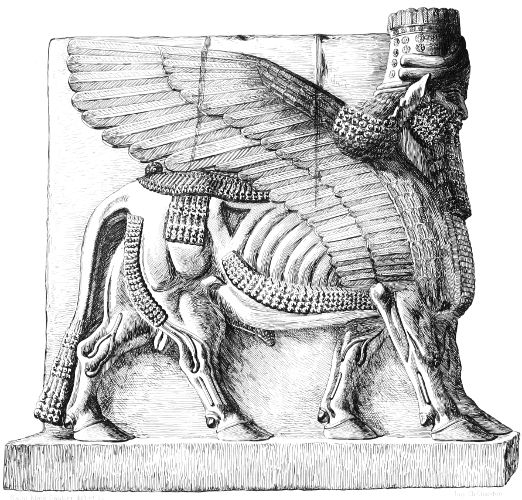
WINGED BULL
FROM KHORSABAD
Louvre
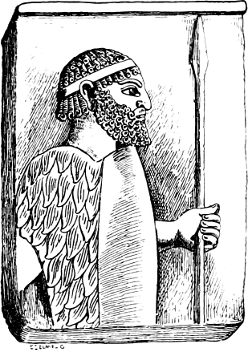
Fig. 66.—Assyrian soldier; from the Louvre.
Height of slab 2 feet.
The temples, the forehead, and the nape of the neck were lost under
this abundant hair, while the beard covered all below the cheek-bones
and the tiara the top of the head. Beyond the nose and eyes there was
hardly anything left by which one individual could be distinguished
from another. Now the Assyrian race was a race in the proper sense of
the word; it was homogeneous and pure-blooded. Between one member and
another of the aristocracy that reigned and fought, these two features
would vary little. All their noses were more or less aquiline, all or
nearly all their eyes large and black. The national fashion of wearing
the hair would suppress many of the characteristics by which we know
one man from another. From all this it results that the crowd of
kings and nobles who furnished the sculptor with his favourite theme
are vastly like each other. This similarity or rather uniformity was
ill calculated to awaken the sense of portraiture in the artist. The
features that distinguished one king from another are slurred over by
the sculptor simply because they were in reality so lightly marked that
he hardly perceived their existence.
PLATE V
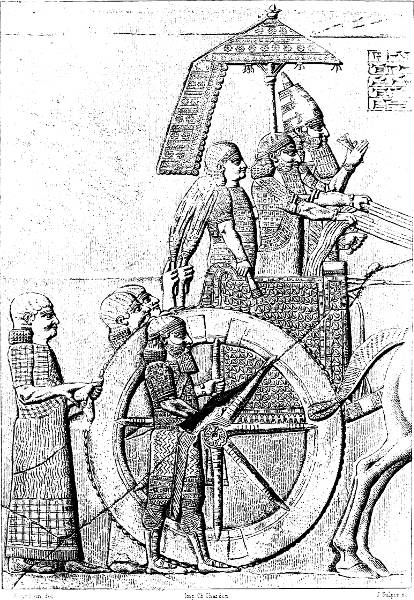
J.Bourgoin del. Imp.Ch.Chardon. J.Sulpis.sc.
ASSURBANIPAL IN HIS CHARIOT
FROM KOUYUNDJIK
Louvre
We know that this opinion is not shared by all those who have busied
themselves with the Assyrian monuments. It has been said and, in the
belief of some, proof has been given, that we possess the elements of
an Assyrian iconography, that the images of the kings, in the steles
and on the palace walls, are true and faithful portraits.[161] We
believe this to be a mistake. No doubt the proportions of the body,
the expression of the face, and the general lines of the profile, are
not the same for Assurnazirpal, Sargon, and the sons and grandsons of
that prince. But what must we conclude from that? Only that Assyria
did not escape, any more than Egypt, from the action of that law of
change which is the very condition of life; that from one century and
one reign to another the taste and execution of the Assyrian sculptors
were modified, though in a very feeble degree. Thus figures are
shorter and more thickset in the north-western palace at Nimroud than
at Khorsabad or Kouyundjik; they are finer in their proportions, more
graceful, and altogether better in their art under Assurbanipal than
under his grandfather, the founder of the dynasty. Art, as we shall
bring abundant evidence to prove, followed the same path at Nineveh as
everywhere else. This is not to be denied; but before the hypothesis
against which we contend can be accepted, its advocates must show
that, in each series of monuments, the king is to be distinguished
by his personal features from the people about him. You must not take
the evidence of drawings or even of photographs; you must examine
the originals themselves. This I have done with the most scrupulous
attention both in the British Museum and the Louvre. I have carefully
examined and compared the four great series of royal bas-reliefs that
have come down to us, belonging respectively to Assurnazirpal, Sargon,
Sennacherib, and Assurbanipal. If such an examination be made without
prejudice, I am satisfied that only one conclusion can be come to. In
all the pictures dating from one reign the king himself differs not at
all from his officers and nobles; he is only to be recognized by his
lofty tiara, an ornament that he alone had the right to wear, by his
sceptre or some other attribute of the kind, by his richer costume,
and, finally, by his greater stature. The sculptor always makes him
taller than his subjects, still more than his enemies and captives
(Vol. I. Fig. 22, and Fig. 15 above). This latter proceeding seems
childish, but it is so natural, and is found in so many countries,
that it is not at all astonishing. The sculptor has counted upon all
these attributes to show, at a glance, which is the king; and they are,
in fact, of a nature to prevent any chance of a mistake. He has not
troubled himself to seek in his royal features for something by which
he might be distinguished from the people about him. Winged genii, king
and viziers, all have the same eye, the same nose and the same mouth.
One would say that for each group of bas-reliefs the original designer
only drew one head, which was repeated by tracing or some other process
as often as there might be heads in the composition, and that it was
afterwards carved and modelled in the alabaster by the chisel of the
journeyman.
No, in spite of all that has been said, the Assyrians made no
portraits. They did not even attempt to mark in any precise fashion,
those physical characteristics by which they themselves were so
sharply divided from many of the races by whom they were surrounded.
Among the numerous peoples that figure in the sieges and battles that
cover the palace walls, although some, like the Chaldæans, the Jews,
and the Syrians, were near relations of their own, others belonged
either to the Aryan or Turanian family; but any one who will examine
the reliefs as we have done, will see that all the prisoners of
war and other vanquished enemies have the same features as their
conquerors.[162] The only exception to which we can point is in the
case of certain bas-reliefs of Assurbanipal in which the episodes of
an expedition into Susiana are retraced. There we can perceive in some
of the figures—by no means in all—an endeavour on the part of the
sculptor to mark the difference of race otherwise than by details of
costume and head-dress. Here and there we find a head that suggests a
negro;[163] but his characteristics are never as clearly marked as in
Egypt. This may be merely the result of caprice on the part of some
individual artist who has amused himself by reproducing with the edge
of the chisel some head which had struck his fancy; but even here we
only find one profile several times repeated. The modelling is far from
searching, but wherever the work is in fair condition and the scale not
too small the character we have described may be easily distinguished.
The only differences over which the Assyrian sculptors naturally
troubled themselves were those of costume and equipment; thus we find
them recording that the people subdued in one of the expeditions of
Sennacherib wore a crown or wreath of feathers about their heads (Fig.
48).[164] So, too, in the relief of a man with apes, the foot-covering,
a kind of buskin with upturned toes (Fig. 64), should be noticed. But
the lines of his profile remain unchanged; and yet there can be no
doubt that the sculptor here meant to represent a man of negro race,
because, as Layard, who dug up the monument, tells us, traces of black
paint might be distinctly perceived upon the faces of this man and his
companions.[165] On a Babylonian stele that we have already figured
(Fig. 43), some have attempted to recognize a Mongol type, and thence
to confirm the hypothesis that would make a Turanian race the founders
of the Chaldæan civilization. This, too, we think a mistake.[166]
At first sight this curious monument surprises those who are accustomed
to Assyrian art, but the nature of the material has not a little to do
with that. The hardness and darkness of basalt affect the treatment
of the sculptor in quite a different way from a gypseous stone like
alabaster. Add to this that the proportions are quite unlike those of
the Ninevite reliefs. This Marduk-idin-akhi is a work of the ancient
school, which made its figures far shorter than those of such Assyrian
reliefs as have come down to us. Finally the head-dress should be
noticed. In place of being conical it is cylindrical, a form which
overweights the figure and shortens its apparent proportions. On the
whole, any one looking at this stele without bias on one side or the
other, will, we think, acknowledge that the type it presents is the
same as the figures at Nimroud, Khorsabad, and Kouyundjik. It is,
moreover, identical with that we see in monuments even older than this
royal Babylonian stele, such as the fragmentary relief found by M. de
Sarzec at Sirtella (Fig. 67).
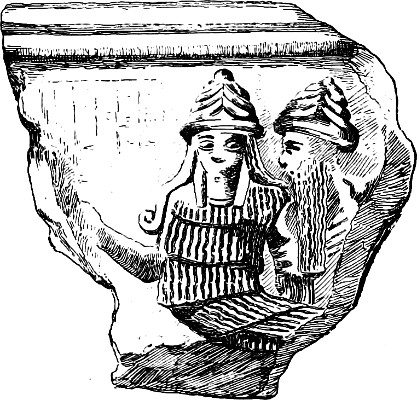
Fig. 67.—Fragment of a Chaldæan bas-relief.
Louvre. Limestone. Height 3¾ inches.
The type which crops up so often in the pages of this history was
fixed, in all its main features, in the earliest attempts at plastic
art made by the Chaldæans. By them it was transmitted to their
scholars, the Assyrians, and during long centuries, until the fall of
Nineveh and Babylon, the painters and sculptors of Mesopotamia, from
the shores of the Persian Gulf to the foot of the mountains of Armenia,
did not cease to reproduce and perpetuate it, I might say to satiety;
they reproduced it with infinite patience, and, so far as we can see,
without once suspecting that the human visage might sometimes vary its
lines and present another aspect.
In the preceding pages our chief aim has been to determine the
nature and the mode of action of the influences under which the
Assyro-Chaldæan sculptor had to do his work. We have explained how
certain conditions hampered his progress and in some respects arrested
the development of his skill.
The height to which the plastic genius of this people might have
carried their art had their social habits been more favourable to the
study of the nude, may perhaps be better judged from their treatment of
animals than anything else. Some of these, both in relief and in the
round, are far superior to their human figures, and even now excite the
admiration of sculptors.
The cause of this difference is easily seen. When an artist had to
represent an animal, his study of its form was not embarrassed by any
such obstacle as a long and heavy robe. The animal could be watched
in its naked simplicity and all its instinctive and characteristic
movements grasped. The sculptor could follow each contour of his model;
he could take account of the way in which the limbs were attached to
the trunk; he saw the muscles swell beneath the skin, he saw them
tighten with exertion and relax when at rest. He was not indifferent
to such a sight; on the contrary, he eagerly drank in the instruction
it afforded, and of all the works he produced those in which such
knowledge is put into action are by far the most perfect; they show us
better than anything else how great were his native gifts, and what a
fund of sympathy with the beauties of life and with its inexhaustible
variety his nature contained. Whether he model an animal separately or
introduce it into some historic scene, it is always well rendered both
in form and movement.
This is to be most clearly seen in the rich and varied series of
Assyrian reliefs, but the less numerous works of the same kind of
Babylonian origin show the same tendency and at least equal talent.
In copying the principal types of the animal world with fidelity and
vigour, the Assyrian sculptors only followed the example set them by
their south-country masters.
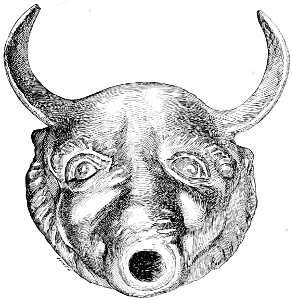
Fig. 68.—Head of a cow, bronze. British
Museum. Width across the cheeks 3¾ inches.
A cow’s head in bronze, which was brought from Bagdad by Mr. Rassam,
is broad in treatment and of great truth (Fig. 68); the same good
qualities are to be found in a terra-cotta tablet found by Sir Henry
Rawlinson in the course of his excavations in the Birs-Nimroud (Fig.
69). It represents a man, semi-nude and beardless and with a stout
stick in his hand, leading a large and powerfully made dog by a plaited
strap. It is a sort of mastiff that might be used for hunting the wild
beasts in the desert and marshes, the wild boar, hyena, and panther,
if not the lion. The characteristics of the species are so well marked
that naturalists have believed themselves able to recognise it as
that of a dog which is still extant, not in Mesopotamia indeed, but in
Central Asia.[167] We may seek in it for the portrait of one of those
Indian hounds kept, in the time of Herodotus, by the Satrap of Babylon.
His pack was so numerous that it took the revenues of four large
villages to support it.[168]
Similar subjects were represented upon other tablets of the same
origin. One of them shows a lion about to devour a bull and disturbed
by a man brandishing a mace. Nothing could be more faithful than the
action of the animal; without letting go his prey he raises a paw, its
claws opened and extended and ready to be buried in the side of the
rash person who interrupts his meal.[169]
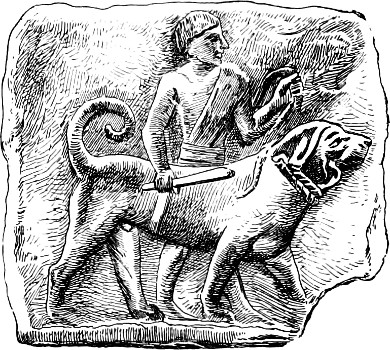
Fig. 69.—Terra-cotta tablet. British Museum.
Height 3⅗ inches.
We may also mention a cylinder which, from its style, M. Ménant does
not hesitate to ascribe to the first Chaldæan monarchy. It represents
two oxen in a field of wheat. The latter, by a convention that also
found favour with the Greeks, is indicated by two of those huge
ears that so greatly astonished Herodotus.[170] Was it on a similar
principle that the Chaldæan engraver gave his oxen but one horn apiece?
In spite of this singularity and the peculiar difficulties offered
by work in intaglio on a very hard material, the forms are well
understood, and the artist has not been content to give them merely in
outline. At the croup and under the belly an effort has been made to
model the figure and to mark its thickness.
Judging from their style and inscriptions, several more of these
engraved stones may be ascribed to the oldest Chaldæan schools of art,
but we are satisfied with again reminding our readers that it was in
Lower Mesopotamia that everything had its beginning. We shall take our
remaining examples from the richer deposits of Assyria.
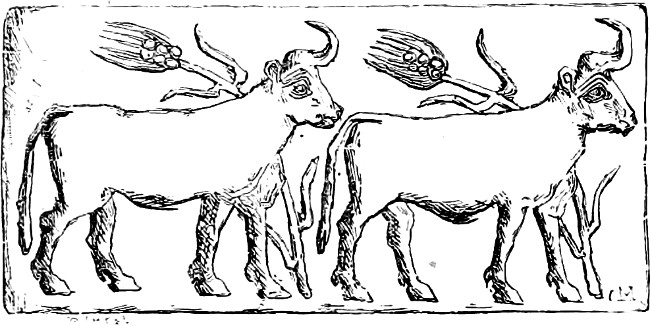
Fig. 70.—Cylinder of black marble. National
Library, Paris.
Among all those animals that attracted the attention of man either by
their size or strength, either by the services they rendered or the
terror they caused, there were none that the chisel of the Assyrian
sculptor did not treat and treat with taste and skill. With their
passion for the chase the kings and nobles of Assyria were sure to
love dogs and to train them with scrupulous care.[171] They did more.
They employed sculptors in making portraits of them. In the palace of
Assurbanipal terra-cotta statuettes of his best dogs have been found
(Fig. 71). They belong to the same race as the Chaldæan mastiff above
mentioned, but their strength, their fire, I might almost say their
ferocity, is better shown in those pictures where they are no longer
in a state of repose, but in movement and action. Look at the series
of slabs representing the departure for the chase. The hounds are held
in the leash by attendants who carry bags on their shoulders for the
smaller game (see Fig. 72). Mark the tightened cord, the straining
bodies, the tension of every muscle in their desire to get at their
quarry! We can almost fancy we hear the deep, confused bayings with
which they prelude the regular music of the hunt itself when the game
is afoot. These animals are represented with no less truth and vivacity
when a kill has taken, or is about to take, place. As an example of
this we may point out a relief from the same palace in which two of
these bloodhounds launch themselves upon a wild ass whose flight has
been arrested by an arrow. The ass still manages to stagger along, but
he will not go far; the hounds are already upon him and have buried
their teeth in his flanks and croup.[172]
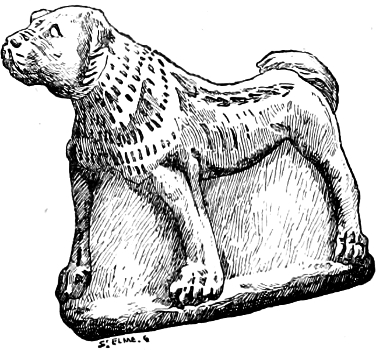
Fig. 71.—Terra-cotta dog. British Museum.
Height 2⅖ inches.
Other domestic animals are figured with no less sure a hand; to each
is given the proportions and attitudes that really characterise it. We
shall now study them all in succession; others have done so, and have
found much precious information upon the fauna of Western Asia and upon
the state of Mesopotamian civilization;[173] we shall content ourselves
with mentioning the principal types and those in which the sculptor has
shown most skill.
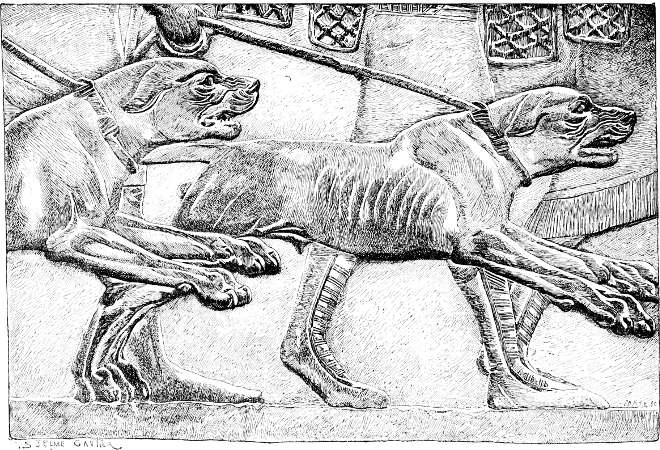
Fig. 72.—The hounds of Assurbanipal. British
Museum. Height 26 inches. Drawn by Saint-Elme Gautier.
The colossi of the gateways have already given us an opportunity for
showing how art enlisted the powerful limbs and natural majesty of
the bull in its service. Elsewhere the bovine race occupies a less
important part in Assyrian sculpture than in that of Egypt, in whose
tombs scenes of agricultural art are of such constant occurrence. We
find, however, the wild bull,[174] which the kings of Calah hunted
in the neighbouring desert (Fig. 15), and the draught ox, which,
after a lucky raid, the terrors of Asia drive before them with their
prisoners and other booty (Vol. I. Fig. 30).[175]—We may also point
to the heifer’s head in ivory which acts as tail-piece to the third
chapter of our first volume. We sometimes find also sheep and goats
of both sexes (Fig. 54);[176] but of all the animals that have close
relations with man, that which occurs most often on the palace walls is
the horse. They did not use him as a beast of burden; it was the mule
that was used for drawing carts (Vol. I. Fig. 31), for carrying women
and children and merchandise (Vol. I. Figs. 30 and 115). As with the
Arabs of to-day, the horse was reserved for war and hunting. But the
Assyrians were not, like the Egyptians, content to harness him to the
chariot; they rode him as well. Their armies comprised a numerous and
well-provided cavalry; and the Assyrian artist drew the horse a great
deal better than his Egyptian confrère.
The horses we meet with in the Assyrian sculptures are of a heavier
breed than Arabs; they are generally shorter and more thickly set.
Travellers believe the breed to still exist in the horses of Kurdistan,
a country which was bordered by ancient Assyria and dependent upon
it.[177] The head is small, well-formed, and well-carried (Fig. 73),
the shoulders sloping, the neck and limbs well set on, and the muscles
strongly marked. We have already had occasion to figure horses at full
speed (Vol. I. Fig. 5), standing still (Vol. I. Figs. 67 and 115),
and proceeding at a slow pace (Figs. 21 and 31).[178] No observer can
avoid being struck by the truth of attitude, and movement given by the
Assyrian sculptor to horses both driven and mounted. Nowhere is this
merit more conspicuous than in one of those bas-reliefs of Assurbanipal
that figure the episodes of a chase of wild asses (Fig. 74).
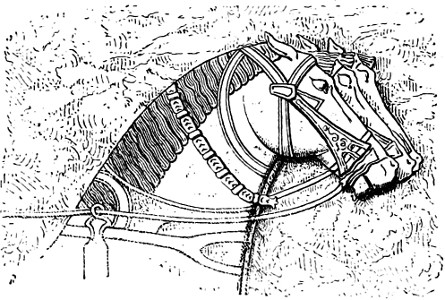
Fig. 73.—Chariot horses; from Layard.
Contrary to their usual habits the herd have allowed themselves to
be surprised. One of those armies of beaters who are yet employed by
eastern sovereigns on such occasions, has driven them upon the hunters.
The latter, preceded by their dogs, throw themselves upon the herd,
which breaks up in all directions. They pierce those that are within
reach with their arrows; those that do not fall at once are pursued and
brought down by the hounds. We cannot reproduce the whole scene,[179]
but we doubt whether there is any school of animal painters that has
produced anything more true to nature than the action of this poor
beast stopping in the middle of his flight to launch futile kicks at
his pursuers.
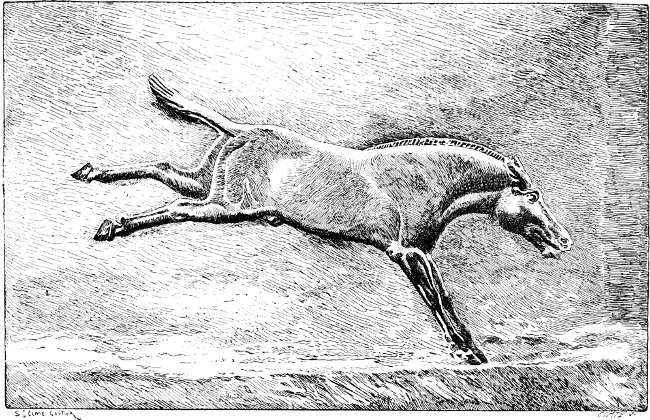
Fig. 74.—Wild ass. From the hunt of
Assurbanipal, in the British Museum. Drawn by Saint-Elme Gautier.
The ibex and the wild goat figure in the same sculptured pictures.
One marching in front of the herd turns and anxiously sniffs the
wind, while her companion quietly browses by her side; farther off,
two kids trot by the side of their mother. The alarm has not yet been
given, but upon the next slab the artist shows the headlong flight
that follows the discovery of the enemy. Naturally it is the wild
and domestic animals of Mesopotamia and the districts about that
are most commonly figured in these reliefs, but the sculptor also
took advantage of every opportunity and pretext for introducing into
his repertory those rare and curious animals which were only seen in
Nineveh on rare occasions. Thus the camel that we find in so many
pictures is the same as that which now occupies the same region and
marches in its slow caravans;[180] but on the obelisk of Shalmaneser
we find the double-humped Bactrian camel (Fig. 49).[181] The clumsy
tribe of the pachyderms is not only represented by the wild boars that
still have their lairs in the marshes of the lower Euphrates;[182] the
rhinoceros and the Indian elephant also occur on the obelisk (Vol. I.
Fig. 111).[183] The apes shown in our Fig. 64 also seem to belong to an
Indian species.[184]
The sculptor was not always as happily inspired by these exotic
animals as by those of his own country, and in that there is nothing
surprising. He only caught a passing glimpse of them as they defiled,
perhaps, before the people in some triumphal procession. On the other
hand, the fauna of his native land were known to him through long
habit, and yet his reproductions of the elephant and the dromedary
are very good, much better than those of the semi-human ape. His idea
of the rhinoceros is very faulty; the single horn planted on the nose
leaves no doubt as to his meaning, but the lion’s mane with which the
animal’s back is clothed has never belonged to the rhinoceros. The
artist may have worked from a description.
In these pictures birds hold a very secondary place; Assyrian sculpture
was hardly light enough of hand to render their forms and feathers. For
such a task, indeed, painting with its varied handling, its delicate
lines and brilliant colours is required. It was with the brush that the
Egyptians succeeded, in the frescoes of their tombs, in figuring the
principal birds of the Nile Valley with all their elegance of form and
brilliant variety of plumage. In Assyria, among a nation of soldiers
and in an art whose chief inspiration had to do with war, the only
bird we find often reproduced is the eagle, the symbol of victory,
who floats over the chariot of the king, and the vulture who devoured
where they fell the bodies of the enemies of Assyria; and even these
images are rather careless and conventional, which may perhaps be
accounted for by their partially symbolic character and their frequent
repetition.[185] A group of partridges rising and, in those sculptures
of the later Sargonids in which the artists show a love for picturesque
detail, birds hopping in the trees or watching over their nestlings,
have been mentioned as showing technical excellence of the same kind
as the hunting scenes.[186] The ostrich appears on the elaborate
decorations of the royal robes (Fig. 75) and upon the cylinders (Fig.
76). Perhaps it was considered sacred.
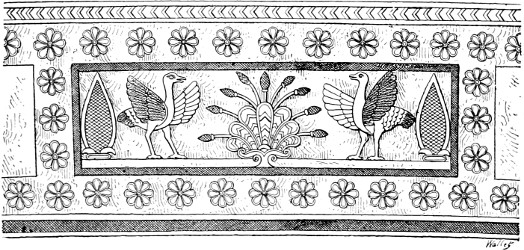
Fig. 75.—Embroidery on the king’s robe; from
Layard.
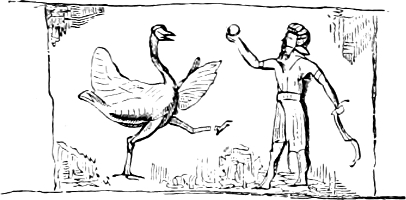
Fig. 76.—Fight between a man and an ostrich.
Chalcedony. National Library, Paris.
As for fishes, crabs, and shells, these were scattered broadcast over
the watercourses in the reliefs, but they are never studied with any
great care (see Vol. I., Figs. 34 and 157), nor is any attempt made to
distinguish their species. They seem to have been introduced merely as
hints to the spectator, to dispel any doubt he may entertain as to the
meaning of those sinuous lines by which the sculptor suggested rivers
and the sea. Where these indications are not given we might indeed very
easily mistake the artist’s intention (see Vol. I., Figs. 38 and 71).
Some of the animals in the Assyrian reliefs are then nothing but
determinative signs, a kind of pictorial gloss. Of these it will
suffice to mention the existence. Their forms are so much generalized
that they offer no matter for study. On the other hand, our best
attention should be given to those figures whose modelling has
strongly interested the artist, who has taken a lively pleasure in
reproducing their various aspects and in making them live again in
all the originality of their powerful and exceptional natures. In
this respect the lion deserves particular notice. He interested the
Assyrian sculptors more profoundly than any other animal and they
devoted extraordinary attention to illustrating his various attitudes
and characteristics. One is inclined to believe that the more skilful
among them chose a lion for treatment when they wished to display all
the talent they possessed and to gain a reputation for complete mastery
of their art.[187]
Here we find the great beast stretched carelessly upon the ground, full
of confidence in his strength and careless of danger (Plate XI.); there
he rises to his feet and advances ready to collect himself and spring
upon any threatening enemy or passing prey (Plate VIII.). We sometimes
find both these motives united, as in a bas-relief of Assurbanipal,
which is unfortunately mutilated (Fig. 77). Here a lioness is stretched
upon the ground, her head upon her forepaws and her tail outstretched
behind her, in a favourite attitude of very young cats. The lion stands
upright before her in a proud, extended attitude like that of the
colossal lion from Nimroud (Plate VIII.); his head and the hind parts
of his body are unfortunately missing.
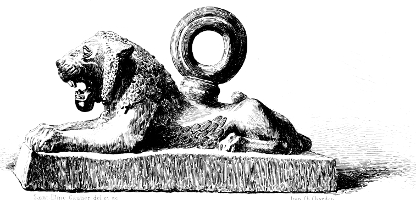
BRONZE LION
FROM KHORSABAD
Louvre
Elsewhere we find the lion cautiously emerging from a stoutly-built
timber cage (Fig. 78). He has been captured in a net or snare and shut
up in this narrow prison until the day of some great hunt.[188] When
that arrives the door is raised at a given signal by a man perched on
the top of the cage and protected by a timber grating. In spite of this
defence the service would hardly be free from danger but that the lion
is too pleased to find himself at liberty to look behind him.[189]
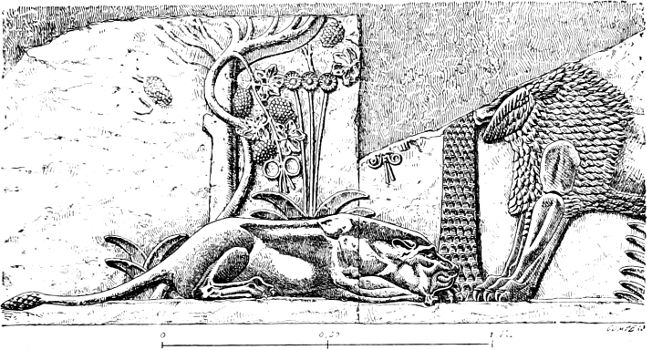
Fig. 77.—Lion and lioness in a park. British Museum.
The lion finds himself confronted by the Royal huntsman who fights, as
a rule, from his chariot, where two or three companions, chosen from
his bravest and most skilful servants, are ready to lend him help if
necessary. The British Museum possesses a great number of sculptured
pictures in which every incident of the hunt is figured up to its
inevitable end. We reproduce two figures from the slabs representing
the great hunt of Assurbanipal. The first shows a huge lion mortally
wounded by an arrow which still stands in his body. It has transfixed
some great vessel, and the blood gushes in a wide torrent from his
open mouth. Already the chills of death are upon him and yet with his
back arched, and his feet brought together and grasping the soil, he
collects his energies in a last effort to prevent himself rolling over
helplessly on the sand.
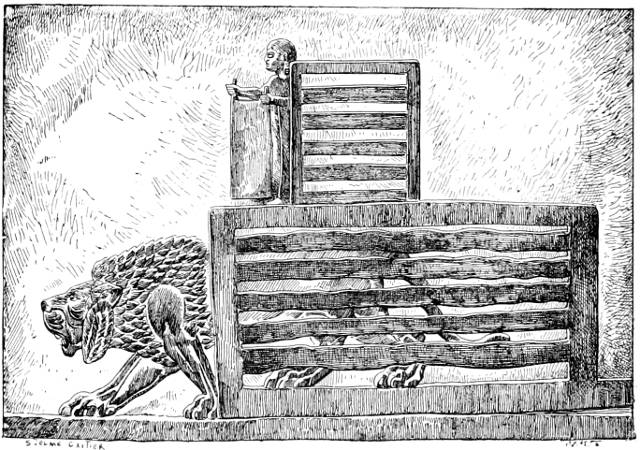
Fig. 78.—Lion coming out of his cage. Height
of relief about 22 inches. British Museum.
Drawn by Saint-Elme Gautier.
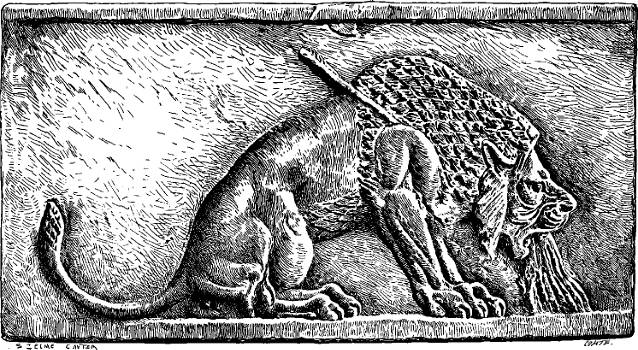
Fig. 79.—Wounded lion. Height of slab about 22
inches. British Museum. Drawn by Saint-Elme Gautier.
Still more expressive, perhaps, and more pathetic, is the picture of
a lioness struck down by the same hand, but in a different fashion
(Fig. 80). One of three arrows that have reached her has transfixed
the spinal column at the loins. All the hinder part of the body is
paralysed. The hind feet drag helplessly on the ground, while the poor
animal still manages for a moment to support herself on her fore
paws. She still faces the enemy, her half opened jaws are at once
agonised and menacing, and, as we gaze upon her, we can almost fancy
that we hear her last groan issue from her dying lips.
We might multiply these examples if we chose, but the two fragments
we have reproduced will, we hope, send our readers to the British
Museum to see the Hunt of Assurbanipal for themselves. In any
case they are enough to prove that the Assyrian sculptor studied the
lion from nature. He was not without opportunities. He was, no doubt,
allowed to assist at those great hunts of which he was to be the
official chronicler. He there saw the king of beasts throw himself on
the spears of the footmen or fly before the arrows of the charioteers,
and break the converging line of beaters; he saw him fall under his
repeated wounds and struggle in his last convulsions. Later on he
could supplement his recollections, he could complete and correct
his sketches by the examination of the victims.[190] At the end of
the day the “bag” was displayed as it is now at the end of a modern
battue, when the keepers bring pheasants, hares and rabbits,
and lay them in long rows in some clearing or corner of the covert. In
one of the Kouyundjik reliefs we see the king standing before an altar
and doing his homage to the gods after the emotions and dangers of a
hunt that was almost a battle.[191] He seems to pour the wine of the
libation upon four dead lions, which his attendants have arranged in
line upon the ground.
There must also have been tame lions in the palaces and royal parks.
Even now they are often to be met with in that country, under the
tent of the Arab chief or in the house of the bey or pacha.[192] When
captured quite young the lion is easily educated, and, provided
that his appetite is never allowed to go unsatisfied, he may be an
inoffensive and almost a docile companion until he is nearly full
grown. We are ready to believe that the lion and lioness shown in our
Fig. 77 were tame ones. The background of the relief suggests a park
attached to the royal residence, rather than a marsh, jungle or desert.
Vines heavy with fruit and bending flowers rise above the dozing
lioness; we can hardly suppose that wild animals could intrude into
such a garden. It follows, then, that the artist could study his models
as they moved at freedom among the trees of the royal demesne, basking
idly in the sun or stretching themselves when they rose, or burying
their gleaming teeth on the living prey thrown to them by their keepers.
Thanks to such facilities as these the Ninevite sculptors have handed
down to us more faithful reproductions of the lion than their more
skilful successors of Greece or Rome. For the latter the lion was
little more than a conventional type from which ornamental motives
might be drawn. Sometimes no doubt they obtained very fine effects from
it, but they always considered themselves free to modify and amplify,
according to the requirements of the moment. Thus they were often led
to give him full and rounded forms, which had a beauty of their own but
were hardly true to nature. The Assyrian never committed that fault. He
knew that the great flesh-eating beasts never grew fat, that they were
all nerve and muscle, without any of those adipose tissues which reach
so great a development in herbivorous animals, like the sheep or ox, or
those that eat anything that comes, like the pig. Look at the bronze
lion from Khorsabad figured in our Plate XI., and see how lean he is at
the croup in spite of the power in his limbs, and how the bones of his
shoulder and thigh stand out beneath the skin.
This characteristic is less strongly marked in the bas-reliefs, which
hardly enjoy the same facilities for emphasising structure as work
in the round. On the other hand the other features of the leonine
physiognomy are rendered with singular energy. Anything finer in its
way than the head of the colossal lion from Nimroud figured in our
Plate VIII. can hardly be imagined.
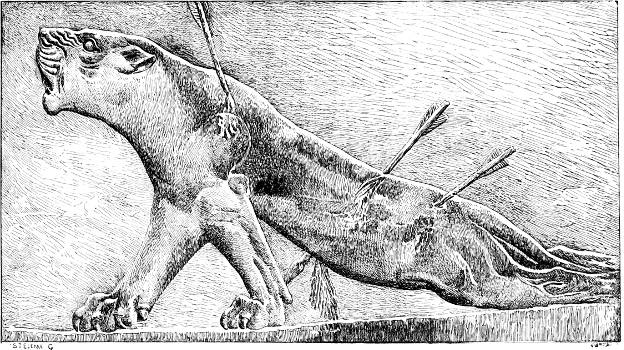
Fig. 80.—Wounded lioness. Height of slab about
15 inches. British Museum. Drawn by Saint-Elme Gautier.
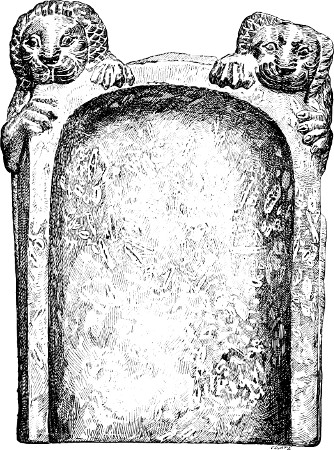
Fig. 81.—Niche decorated with two lions.
Height 6½ inches. British Museum.
Drawn by Saint-Elme Gautier.
Seeing how familiar they were with this animal, the artists of
Mesopotamia could hardly have failed to employ him as a motive in
ornament. In such a case, of course, they did not insist so strongly
upon fidelity to fact as in the historical bas-reliefs, but whether
they made use of his figure as a whole or confined themselves to the
head or paws, they always preserved the true character and originality
of the forms. This may be clearly seen in an object belonging to the
British Museum (Fig. 81). We do not exactly know where it was found and
we cannot say what may have been its use. It is a kind of shallow niche
cut from a fossiliferous rock.[193] It is hardly deep enough to have
sheltered an idol or statuette of any kind. But whatever it may have
been nothing could be more natural than the action of the two lions
that show themselves at the two upper angles. They hang tightly to the
edge of the stone with their extended claws, giving rise to a happy,
piquant, and unstudied effect. The scabbard in our next illustration
is no less happily conceived; the lions at its foot who seem about to
climb up the sheath with the playfulness of kittens, should be noticed
(Fig. 82). Again, we find the lion introduced into those embroideries
on the royal robes of which we have already had occasion to speak.
In the example figured here (Fig. 83) he is fighting an animal whose
feet and legs are those of a bull, although its stature is greater and
its form more slender than those of the antelope. It appears to be a
unicorn, a fantastic animal that has always played a great part in
oriental fables.
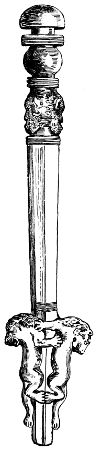
Fig. 82.—Sword and scabbard. From a Khorsabad
bas-relief. Louvre.
The lion’s head with its powerful muscular development, its fine mouth,
and picturesque masses of floating hair, has often furnished ceramists,
gold and silversmiths, and art workmen of every kind with motives for
use upon their creations. A fine example of this is reproduced on the
title-pages of these volumes. It belongs to the Luynes collection in
the French National Library. The material is gold, and a small staple
attached to the neck shows that it once belonged to some object now
lost. Our reproduction is of the same size as the original. In spite of
its small dimensions its workmanship is no less remarkable for freedom
and nobility of style than the colossal head from Nimroud. Something of
the same qualities but with more finish in the details is to be found
in a terra-cotta fragment covered with a green glaze which now belongs
to the collection in the Louvre. These objects, which have come down
to us in considerable numbers, must have been used as applied work, in
the decoration of vases, utensils, and other small pieces of furniture
(Fig. 84). The object figured at the end of the last chapter belongs to
the same class. There is a hollow or mortice in its base by which it
was attached to some knife or poignard to form its handle.
The lion’s paw was used in the same fashion and no less often. Its
expressive form and the elegant curves of its claws are found on
numerous altars, tables, and thrones (Vol. I., Fig. 168; and above,
Fig. 47).[194]
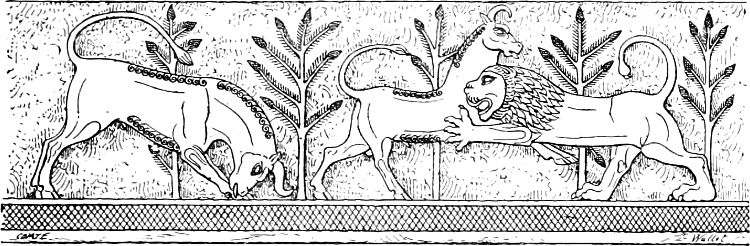
Fig. 83.—Combat between a lion and a unicorn.
From Layard.
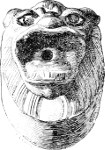
Fig. 84.—Lion’s head in enamelled earthenware.
Louvre. Actual size.
Drawn by Saint-Elme Gautier.
We find the same truth of design in many small earthenware articles,
even when they reproduce a type less interesting and less majestic
than that of the lion. A good instance of this is afforded by the goat
of white earthenware covered with a blue glaze which was found at
Khorsabad by Place (Fig. 85). It is but a sketch. The modeller has not
entered into any details of the form, but he has thoroughly grasped
its general character. The terra-cottas properly speaking, those that
have received no glaze or enamel, are, as a rule, less carefully
executed, but even in them we can perceive, though in a less degree,
the certainty of eye, the same promptitude in seizing and rendering the
special physiognomy of an animal. We feel this very strongly in what
is by no means the work of a skilful modeller, the dog figured below
(Fig. 86). The head and fore quarters of one of the mastiffs of the
bas-reliefs may here be recognized (see Fig. 72).
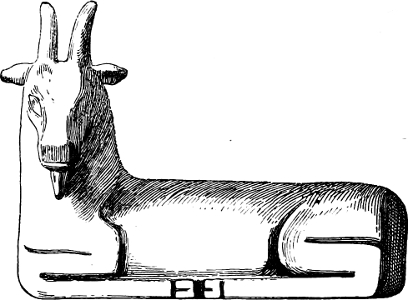
Fig. 85.—Recumbent goat. Enamelled
earthenware. Actual size.
Drawn by Saint-Elme Gautier.
The same desire for precision, or rather comprehension, of form,
is to be found even in those imaginary beings which the artists of
Chaldæa and Assyria took such pleasure in multiplying. Although in
their fantastic creations they brought together features belonging to
animals of totally different classes, they made a point of drawing
those features with the greatest precision. This is well illustrated by
an object in the Luynes collection (Fig. 87). Nowhere is the arbitrary
combination of forms having nothing in common pushed farther than
here. A ram’s horns grow on a bull’s head, which, again, has a bird’s
beak; the body, the tail, the fore paws are those of a lion, while the
hind legs and feet and the wings that spring from the shoulders are
borrowed from the eagle.[195]
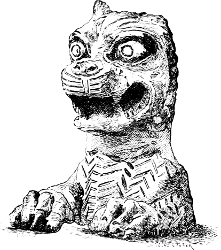
Fig. 86.—Dog. Terra-cotta. British Museum.
Height about 5 inches.
Drawn by Saint-Elme Gautier.
We have already described the most remarkable of all these composite
types, the man-headed bull and lion; we have attempted to explain the
intellectual idea which gave them birth; we have yet to point out a
variety which is not without importance. The lion has sometimes been
given, not only the head, but also the arms and bust of a man. In one
of the entrances to the palace of Assurbanipal there was a colossus
of this kind (Vol. I., Fig. 114).[196] With one arm this man-lion
presses against his body what seems to be a goat or a deer, while the
other, hanging at his side, holds a flowering branch. This figure, like
almost all of those found in the doorways, is winged. Another example
of the same type is to be found in a bas-relief of Assurbanipal; it
is, however, simplified, and it looks, on the whole, more probable
(Fig. 88). The wings have disappeared; there are but two natures to
be joined, and the junction seems to be made without effort; the lion
furnishes strength and rapidity, the man the various powers of the arm
and hand, and the beauty of the thinking and speaking head. The divine
character of the personage thus figured is indicated by the three pairs
of horns bent round the dome-like tiara, and also by the place he
occupies in the inferior compartment of a relief on which, at the top,
appear those lion-headed genii we have already figured (Vol. I., Fig.
6).
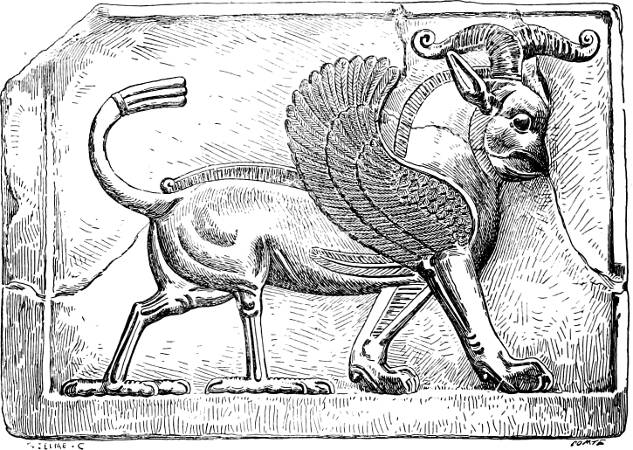
Fig. 87.—Fantastic animal. National Library,
Paris. Height 5¼ inches.
Drawn by Saint-Elme Gautier.
In this last composition we have a foretaste of the centaur. Replace
the lion by a horse and the likeness is complete. Even now it is very
great. At the first moment, before we have time to notice the claws and
divided toes, we seem to recognize the fabulous animal of the Greeks
upon the walls of an Assyrian palace.
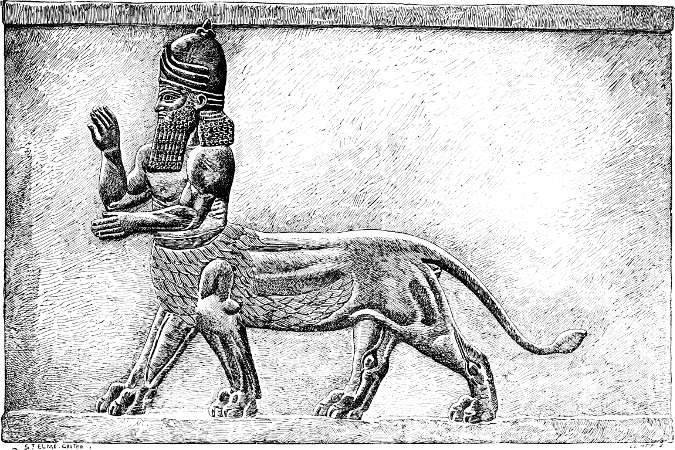
Fig. 88.—Man-lion. British Museum. Height
about 27 inches. Drawn by Saint-Elme Gautier.
Another composite animal familiar to the imaginations both of Greeks
and Mesopotamians was the winged horse, the Hellenic Pegasus (Fig. 89).
The example we have chosen is full of grace and nobility. We feel that
the wings have given additional lightness and almost a real capacity
for leaving the ground.
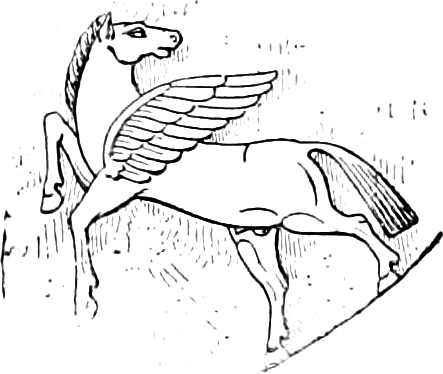
Fig. 89.—Winged horse. From Layard.
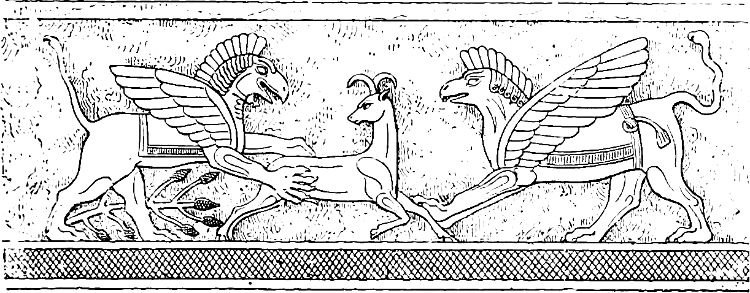
Fig. 90.—Griffins seizing a goat. From Layard.
The whole of the fabulous tribe of griffins, by which we mean an animal
with the body of a lion or panther and the wings and head of a bird
of prey, is richly represented in Assyrian art. The griffin recurs
continually in the embroidery of the royal robes of Assurnazirpal (Fig.
90). The bird with a human head, the prototype of the Greek harpies
and sirens, is also to be frequently met with. We find it introduced
in those applied pieces which, after being cast and finished with
the burin, were used by bronze workers in the decoration of vases of
beaten metal. The diameters of the vases may easily be calculated from
the inner curve of the applied plaques;[197] the latter were used to
strengthen the vessels at the points where the movable handles, like
those of a modern bucket, were attached. These handles were hooked to a
ring or fastened to the back of the figure on the plaque.[198] The head
of the figure gave something to catch hold of when the vessel was upon
the table, with its handle down. The form in question (see Fig. 91) was
chosen by the artist on account of its fitness for the work to be done;
the tail and wings embrace the swelling sides very happily; but yet it
would never have been so employed had it not belonged to the ordinary
repertory of the ornamentist.
Of all these types the only one that does not seem to have been
invented by those who made use of it is that of the winged sphinxes
used as supports in the palace of Esarhaddon (Vol. I., Fig. 85). The
human-headed lion is certainly found long before, but it is not until
the later reigns that he takes the couchant attitude and something of
the physiognomy of the Egyptian sphinx.
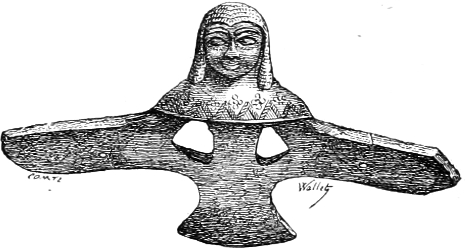
Fig. 91.—Human-headed bird. From De
Longperier. One-third of the actual size.
Under the Sargonids communication with Egypt became so frequent that
certain motives from the Nile valley were introduced into the Assyrian
system of ornament, but the part they played was always a subordinate
one. In creations such as those we have just been studying Chaldæa and
Assyria certainly displayed more inventive power than was ever shown by
Egypt. Speaking broadly, there was no possible combination they did not
attempt. It was from Chaldæo-Assyrian artists that Syria, Judæa, and
Phœnicia, as well as Asia Minor, borrowed their imaginary animals; and,
thanks to these middle-men, it was also to the artists of the double
valley that the early ceramists and modellers of Greece owed not a few
of the motives they transmitted to the great periods of classic art,
and, through the latter, to the art of the Renaissance and of our own
day.
So far we have made no distinction between Chaldæan and Assyrian
sculpture. They made, in fact, but one art. In both countries we find
the same themes and the same treatment—the same way of looking at
nature and the same conventional methods of interpreting it. The common
characteristics are numerous enough to justify us in attributing to
one and the same school the works produced both in the southern and
northern provinces. If we take them en bloc, and put them side
by side with the productions of any other great nation of antiquity,
we shall be at once struck by the close resemblance between all the
monuments from the valley of the Tigris and Euphrates, whether they
come from Sirtella or Babylon, Calah or Nineveh. The connoisseur can
point out a Mesopotamian creation at a glance, mingled with works from
Egypt, Phœnicia, or Greece though it may be. In order to define the
Chaldæo-Assyrian style, he may take the first object that comes to
hand, without caring much whether it come from the upper country or the
neighbourhood of the Persian Gulf.
And yet between those cities of primitive Chaldæa that almost rivalled
Memphis in age, and the towns of Assyria which only commenced to
flourish in centuries that we may almost call modern, it is impossible
that the spirit of the plastic arts and their executive processes can
have remained without change. Between the earliest and the latest
monuments, between the images of Gudea and those of Assurbanipal,
there are, at least, shades of difference. It is certain that the old
Chaldæan art and the art of Assyria were not two different arts, but
they were two successive movements of the same art—two phases in its
development. We have still to distinguish between these two phases by
studying, one after the other, the history of Chaldæan and that of
Assyrian sculpture.
In the course of this study, and especially in the case of the older
civilization, we shall encounter many gaps. The monuments are few, and,
even of those that we have, many are not a little embarrassing. They
are often uninscribed and we are then without even the help afforded
by the language and the style of the character in fixing a date.
Fortunately this is not always the case; there are often indications
that enable us to form certain groups, and, if not to assign absolute
dates, at least to determine their relative places in a chronological
series.
Of all these groups the best established and almost the only ones
that can be used as the heads of series are those whose elements have
been furnished by the explorations undertaken by M. de Sarzec, French
vice-consul at Bassorah, at Tello, upon the site of a town which we
shall follow the majority of Assyriologists in calling Sirtella. We
have written the history of these excavations elsewhere; we have
explained how greatly they do honour to the artistic spirit, the
perseverance, and the energy of M. de Sarzec;[199] we have given the
history of the negotiations and of the vote in Parliament which led to
the acquisition by the Louvre of all the objects discovered. It will
be sufficient to say here that the works began in the winter of 1876
and came to an end in 1881, and that the purchase of M. de Sarzec’s
collection took place in the latter year, under the administration of
M. Jules Ferry.
The name of Tello, which has become famous so suddenly, is to be found
on no map of Asia to which we have access. The place thus designated by
the Arabs in consequence of the numerous mounds, or tells, that
are sprinkled about, is situated quite in the desert, on the left bank
of the Shat-el-Haï, above Chatra and below Saïd-Hassan, which are on
the other side of the channel, and about an hour and a quarter’s march
to the east.[200]
This site seems to have been inhabited down to the very last days of
antiquity, so that monuments have been found there of all ages; for the
moment, however, we are only concerned with those that belong to the
early Chaldæan monarchy. Among these there are some that date from the
very beginning of Chaldæan civilization. This we know not only from
their style; arguments based on such evidence alone might leave room
for doubt; some might even contend that the development of art did not
proceed equally over the whole of that extensive country; it might be
asserted that here and there it was in a far less advanced state than
at other centres. The age of these monuments is fixed by much less
debateable signs, namely, by the character of the symbols of which
their inscribed texts are composed (see Vol I., Fig. 2, and below, Fig.
92).
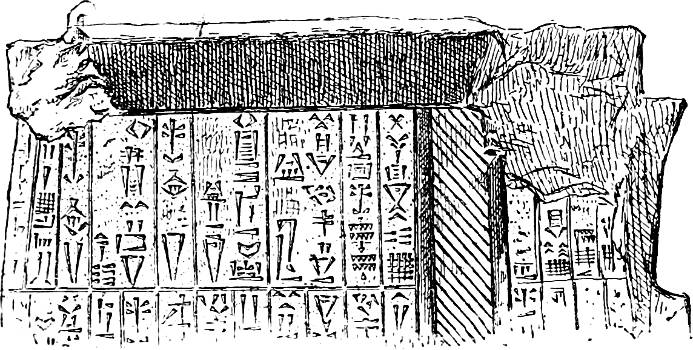
Fig. 92.—Inscription engraved on one of the
seated Chaldæan statues. Louvre.
We have already explained[201] that in the monuments from Sirtella
these symbols were not all wedges, or arrow-heads, whose exclusive use
did not commence until afterwards; we have shown how their original
ideographic nature is still to be traced in many characters. Compare
the inscription here figured with those on our Assyrian monuments. Put
it side by side with the narrative that runs across all the reliefs
of Assurnazirpal at Nimroud (Vol. I., Fig. 4, and, above, Fig. 64):
you will see at once what a profound change has taken place and how
many centuries must have intervened between such different ways of
employing the same alphabet. At Tello the material was less kindly;
it was not, as in Assyria, limestone or gypsum; it was a diorite
or dolerite as stubborn as the hardest rocks of Egypt.[202] The
widely-spaced characters are none the less distinct; their cutting
is, in fact, marvellous in its decision and clearness. We feel that
the scribe traced each letter with much the same care and respect as
he would have shown in performing a religious rite. In the eyes of
the people who saw these complicated symbols grow under the chisel,
writing still had a beauty of its own as well as a mysterious prestige;
it was only legible by the initiated, and they were few in number; it
was admired for itself, for the power it possessed of representing
the facts of nature and the thoughts of mankind; it was a precious,
almost a magic, secret. By the time that the palaces of the Assyrian
monarchs began to be raised on the banks of the Tigris it was no longer
so; writing had gone on for so many centuries that people had become
thoroughly accustomed to it and to its merits; all that one desired,
when he took the chisel in hand, was to be understood. The text in
which Assurnazirpal celebrates the erection of his palace and claims
for it the protection of the great gods of Assyria, is written in very
small, closely-set characters, engraved by a skilful and rapid hand in
the soft and kindly stone; the inequalities of the surface, the details
of the sculptures and the shadows they cast, make a letter difficult
to read here and there. Nowhere, neither here nor in any other of the
great Assyrian inscriptions, do we find the signs of care, the look of
simple and serious sincerity, that distinguishes the ancient writing of
Chaldæa. At Calah and Nineveh we have before us the work of a society
already far advanced, a society which lives in the past and makes use,
with mere mechanical skill, of the processes created and brought to a
first perfection many centuries before.
Of all the monuments found at Tello, the oldest, apparently, is a
great stele of white stone, both sides of which are covered with
bas-reliefs and inscriptions. Unfortunately it had been broken into
numerous pieces, and, as these have not all been recovered, it is
impossible to restore it entirely. The style of its writing seems the
farthest removed from the form into which it finally developed, and its
symbols seem to be nearer their original imitativeness than anywhere
else. “Inexperience is everywhere to be recognized in the drawing of
the figures; eyes are almost triangular and ears roughly blocked out;
the aquiline type of nose is but a continuation of the line of the
forehead, into which it blends; the Semitic profile is more strongly
marked than in the monuments of the following age.”[203]
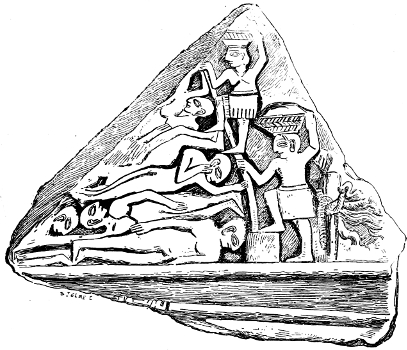
Fig. 93.—Fragment of a stele; from Tello.
Height 1 foot. Louvre.
Drawn by Saint-Elme Gautier.
The bas-reliefs represent strange scenes of war, of carnage, of burial.
Here we find corpses arranged in line so that the head of one is
touching the feet of his neighbour (Fig. 93); they look as if they were
piled one above another, but this, we believe, is an illusion due to
want of skill on the part of the artist. He puts objects one above
another on the field of his relief which, in reality, were laid side
by side. We must imagine these corpses spread over the surface of the
ground and covered with earth. If the sculptor had introduced the soil
above them, the corpses would have been invisible; so he has left it
out. The two figures on the left, who mount an inclined plane[204] with
baskets on their heads, what are they carrying? Offerings to be placed
on the summit of the sepulchre? or earth to raise the tumulus to a
greater height? We prefer the latter suggestion. When earth or rubbish
has to be removed in the modern East, when excavations are made, for
instance, the work is set about in the fashion here commemorated;
the action of these two figures seems, moreover, to indicate that
the weight they are carrying is greater than a basket full of cakes,
fruits, and other things of that kind would account for.
If on this fragment we have a representation of the honours paid by the
people of Sirtella to companions slain in battle, another compartment
of the same relief shows us the lot reserved by the hate and vengeance
of the victor for the corpses of his enemies (Fig. 94). Birds of prey
are tearing them limb from limb on the place where they fell. In their
beaks and claws they held the heads, hands, and arms of dismembered
bodies. The savagery of all this suggests a remote epoch, when
civilization had done little to soften original brutality.
A last fragment belongs to another composition (Fig. 95). It comes
from a relief showing either the departure of an army for the field
or its triumphal return. Very little is left, but that little is
significant;—a hand holding one of those military standards whose use
by the Assyrians we have already noticed (see above, Fig. 46), and the
head of a personage, perhaps the king, walking in the procession; and
that is all. The head-covering of the latter individual seems to be a
kind of feather crown with a metal or ivory aigrette or cockade in the
centre of one side, reminding us in its shape of the head of one of
the great Assyrian bulls; it would seem to be a symbol of strength and
victory.
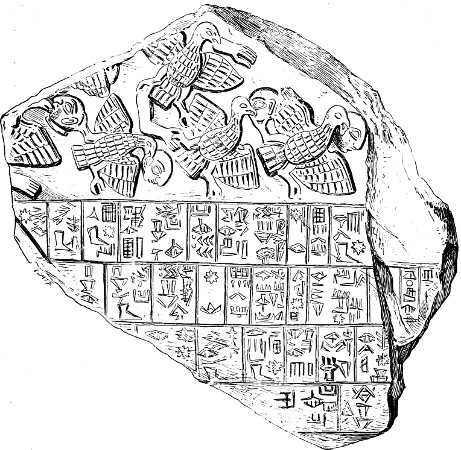
Fig. 94.—Fragment of a stele; from Tello.
Height 9¾ inches. Louvre.
Drawn by Saint-Elme Gautier.
In the monograph now under preparation by MM. de Sarzec and Heuzey a
description of several smaller and still more fragmentary pieces of
the same monument will be found. There is one of which the subject may
still be traced. We have been prevented from reproducing it by its
bad condition. It again shows a battle field. Two rows of corpses are
stretched upon the ground; behind them are several standing figures.
We may thus re-establish with but little room for mistake the whole
economy of the composition. It was made to commemorate some military
expedition in which the prince who reigned at Sirtella was successful.
We do not know whether the fight itself was represented or not, but we
have before our eyes the consequences of victory. One picture shows
the insults inflicted upon the lifeless bodies of the hated enemy; two
more celebrate the care taken by the victors of their dead and the
honours rendered to their memory; finally the march of the successful
army is portrayed. We have here, then, a well thought-out combination,
a serious effort to seize and figure the different moments in a
complicated action. The execution is, however, of singular awkwardness.
The first halting experiments of the Chaldæan chisel, what we may call
the primitive art of Chaldæa, is preserved for us in the fragments of
this great stele.[205]
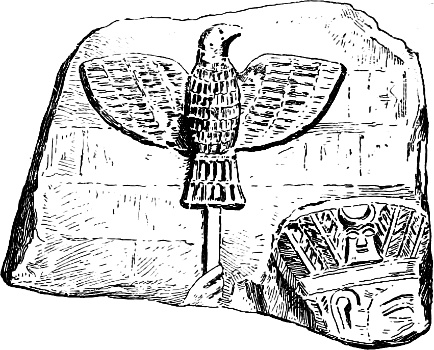
Fig. 95.—Fragment of a stele; from Tello.
About one-third of the original size. Louvre.
Drawn by Saint-Elme Gautier.
A second and still more curious group of monuments is composed of eight
statues of different sizes with inscriptions of Gudea, and of a ninth
on which occurs a name read Ourbaou by some and Likbagas
by others.[206] It is the smallest of all those exhibited at the
Louvre. All these figures are broken at the junction of the neck with
the body.[207] We may put beside them two heads whose proportions are
about the same as theirs, which were found, one among the mutilated
statues, the other in the ruins of a neighbouring building. The
material is similar, a very hard and dark igneous rock. The execution
corresponds exactly with that of the torsos, to one of which the first
named head may perhaps have belonged.
M. de Sarzec tells us that these statues were found in the great
edifice at Tello, almost all on the soil of the central court.[208]
Some are standing, others seated;[209] we give an example of each
type (Plate VI., Figs. 96 and 98). In these effigies we may notice
an arrangement that we have more than once encountered in Assyrian
reliefs, but which has never, so far as we know, been employed in the
arts of any other people. “All these statues, without exception, have
their hands folded within each other and placed against their chests,
an attitude still used in the East to mark the respectful attention
of the servant awaiting his master’s orders. If, as we have every
reason to believe, these figures were placed in a sacred inclosure, in
front of the images of the gods or of the symbols that recalled their
power, this attitude of submission and respect became one of religious
veneration (Fig. 97).”[210]
At Nimroud and Khorsabad this expressive gesture is sometimes given
to eunuchs in the presence of their masters, sometimes to kings
when standing before the effigies of their gods. It is thoroughly
well-fitted for those votive statues that proclaim themselves in their
inscriptions to be offerings to the deity. In consecrating an image
of himself on the threshold of the sanctuary, the king assured the
perpetuity of his prayers and acts of homage; he remained for ever
in an attitude of worship before his god—in an attitude whose calm
gravity was well calculated to suggest the idea of a divine repose to
which death was the passport.
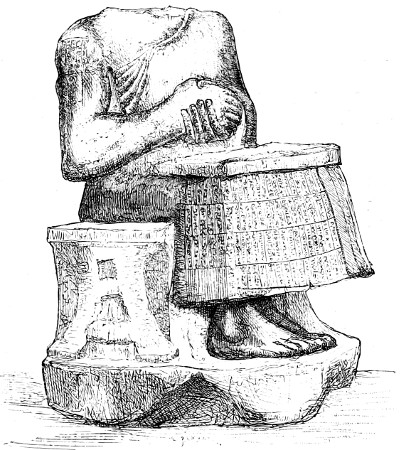
Fig. 96.—Statue; from Tello. Height 37 inches.
Louvre. Drawn by Bourgoin.
The chief point of interest for us lies in the execution of these
statues. They embody a very sensible progress. Art has thrown off the
hesitations of its first youth and attacks the stubborn material with
much certainty and no little science; and yet the most striking quality
is less the successful grappling with a mechanical difficulty, than
the feeling for nature and the general striving for truth; a striving
which has not been discouraged by the resistance of the material. This
resistance has resulted in a method that makes use of wide, smooth
surfaces; and yet the workmanship has a freedom that a too great
fondness for superficial polish too often took away from the diorite
monuments of Egypt. The bare right arm and shoulder are remarkable
passages. The strongly-marked muscles of the back and the freedom with
which the bony framework is shown under the flesh and skin should also
be noticed. All these parts are treated with a breadth that gives a
fine look of power to the otherwise short and thickset figure. And yet
the vigour of the handling never goes beyond what is sober and discreet
(Fig. 98). The same character is to be found in the hands, where
joints, bones, and nails are studied with minute care, and in the feet,
where power of foothold and the shapes of the toes are thoroughly well
indicated.
Fig. 97.—The hands of a statue; from Tello.
Louvre. Drawn by Bourgoin.
The treatment of the two heads is no less excellent (Plate VII). The
eyes are straight and widely opened; the heavy brows join in the
middle; the strong and salient chin, as well as the crown of the head,
is shaved in the fragment in which it is left bare.[211] Under the kind
of hat or turban in the other there would be a head no less bald. In
our own day the small cap of cotton or linen covered by the twisted
scarf or shawl of the Turk or Hindoo, conceals little but the smooth
skin of the skull.[212] The custom had yet to be introduced of wearing
the long and closely-curled hair and beard that we find reproduced in
the sculptures of Nineveh. The nose is broken in both heads, but if
we may judge from the statuettes and bas-reliefs of the same epoch,
especially from a curious fragment recovered in the course of the
same excavations, it must have been arched—but not so much as the
Assyrian noses—and a little thick at the end. Taking the face as a
whole it is square in structure, like the body; in the few examples of
Assyrian heads in the round that we possess the oval of the face seems
longer, but the beard by which the whole of its lower part is concealed
renders any comparison difficult. We do not think, however, that there
is any necessity to raise a question of race. “It is only subject to
the greatest reserve that we can venture to say anything as to the
ethnography of the types created by sculpture, especially when those
types are archaic, and therefore exposed more than all others to the
influence of school conventions.[213] It is a common habit with antique
sculptors to allow traces of their work in its rough shape to subsist
in the finished creation. In all countries the march of art has been
from square and angular to round and flowing shapes, from short and
thickset to graceful and slender proportions.”[214]
The tendencies shown in the rendering of the face and the uncovered
parts of the body are also to be recognized in the treatment of the
drapery. “The sculptor has attempted with much truth and simplicity to
suggest the relief of the drapery and the direction of its folds. This
early and timid attempt at studying folds is all the more remarkable
as nothing like it is to be found either in Egyptian sculpture or
in the later works of Assyria. It bears witness to a sculpturesque
instinct that does not reappear until we arrive at the art of the
Greeks and the magnificent development of draperies and their
significance which we then encounter.”[215]
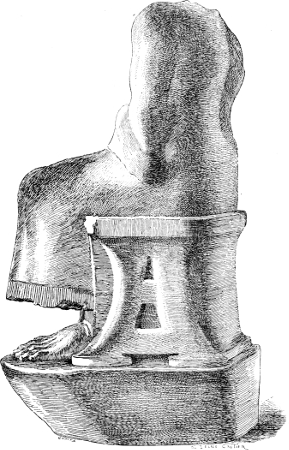
Fig. 98.—The large statue from Tello. Height 5
feet 3 inches. Louvre. Drawn by Saint-Elme Gautier.
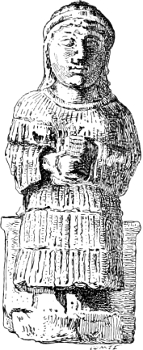
Fig. 99.—Female statuette. Alabaster. Height
about 8 inches.
The figures we have been describing seem to us to represent The
Archaic age of Chaldæan art. The characteristics to which the
name of archaism has been given are easier to feel than to define. The
proportions, especially in the seated figures, are here very short and
broad, so much so that they seem to want length even when compared to
the thickset forms in the Nimroud bas-reliefs. There is some evidence
that the neck was very short and thick and the head large for the body,
as we see it indeed in the statuette of a woman sitting, in which our
lamented colleague de Longpérier was the first to recognize the work of
some ancient Chaldæan artist (Fig. 99).[216] In the figures from Tello
the elbow and the lower edge of the robe make those sharp angles which
Assyrian sculptors set themselves to round off in later days. There is
no attempt at grace; directness and truth of expression are all that
the artist has cared about.
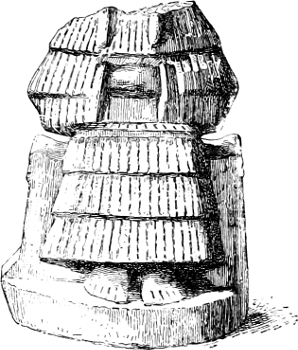
Fig. 100.—Statuette; from Tello. Actual size.
Louvre. Drawn by Bourgoin.
We should ascribe several other objects found at Tello to the same
period. These are in the first place the votive bronzes inscribed with
the name of Gudea, which M. de Sarzec drew from their hiding places
(Vol. I., Figs. 146–148); secondly, a statuette carved from a rather
soft, fine-grained stone (Fig. 100). By its attitude it reminds us of
the statues of Gudea, while the treatment of its drapery is more like
the alabaster figure that we have chosen for reproduction from the
old Louvre collections. Those symmetrical folds that appear to have
been obtained with an iron, and that we have already seen imitated
on the oldest Chaldæan cylinders (Vol. I., Figs. 3, 17, and 20; and
above, Figs. 39 and 40), may be observed in its draperies. Thirdly, a
bas-relief in soft stone, of which two compartments still remain, would
date from the same period (Fig. 101). In its original condition it may
have comprised some further divisions, for the subject as we see it in
the fragment preserved is by no means clear. In the upper compartment
there are four figures diminishing in size from left to right. The
male figure on the left bears what seems to be an instrument of music,
a kind of cymbal upon which he would beat with the hammer-shaped
object in his right hand. The three individuals behind him are all in
attitudes of submission and respect. In the lower division a seated
individual twangs the cords of a harp. In front his instrument is
decorated with the image of a bull, recalling the richly ornamented
harps that we find so often figured in the Egyptian tombs.[217] Another
figure, again in the attitude of respect, stands before the harpist. It
seems to be that of a woman, but the relief is in such a condition that
nothing but the general contours can be made out.
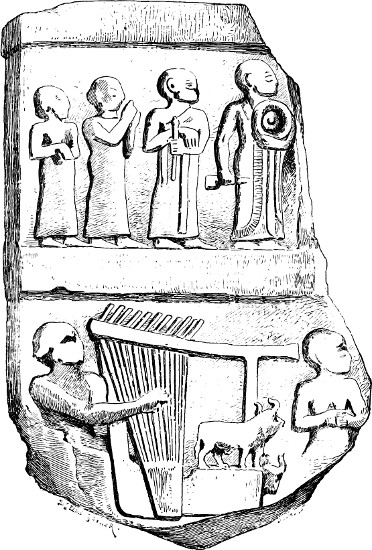
Fig. 101.—Fragment of a relief; from Tello.
Height 44 inches. Louvre.
Chaldæan art did not stop here. Once arrived at the degree of mastery
shown by the statues of Gudea, it made progress of which, indeed, we
are unable to measure the rapidity; but whose results are now before
our eyes. We can hardly doubt that it reached a pitch of executive
skill which often gave quite remarkable delicacy and finesse to
the most insignificant details of sculpture and ornament. This had
already suggested itself to M. Heuzey in the course of his study of
the small Chaldæo-Babylonian figures belonging to the collection of
terra-cottas in the Louvre;[218] he found the same merits in several
of the fragments collected by M. de Sarzec.[219] We have been unable
to reproduce all the pieces to which he alludes; some are too small to
be rendered in a fashion that would do justice to the excellence of
their treatment;[220] but that we may give some idea of the third group
we are thus led to form, we shall figure two or three small objects,
which the visitor will find without difficulty in the cases of the
Louvre. One of these is a fragment from a bas-relief on which nothing
remains but a foot, charmingly modelled, and a piece of ornament
representing a vase from which two streams of water, each supporting
a fish, are flowing (Fig. 102). The hardly sensible relief and the
extreme finesse of this motive, remind us of the marvels of Japanese
workmanship.[221] Still more striking is a small, a very small, head in
steatite, reproducing the same type as the large statues with a grace
and precision that make it a veritable gem (Fig. 103). The eyes have
the oblique inclination that was afterwards to become so conspicuous in
the Assyrian reliefs, but in a very slight degree. We may apply almost
the same remarks to another but less well preserved head in diorite.
Unlike all those we have as yet encountered, it is not shaven. In spite
of the stubborn material the twists and turns of the hair and beard are
sculptured in relief with admirable skill and precision.
It was during this period that the custom was introduced of allowing
the hair and beard to grow, so that their crisp curls should form a
close frame for the face. This fashion was in the ascendant when a
bas-relief, of which, to our great regret, we only possess a small
fragment greatly damaged by fire (Fig. 67), was chiselled. It is
remarkable both for the fineness of its workmanship and its curious
subject. It shows the upper parts of two figures, entwined. That on the
right, from the long hair flowing over the shoulders, must be a woman.
The tall horned caps worn by both figures proclaim them to be a royal
or divine couple.
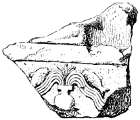
Fig. 102.—Fragment of a relief; from Tello.
Actual size. Louvre.
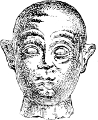
Fig. 103.—Head; from Tello. Actual size.
Louvre.
We find the same characteristics in a fifth monument from the same
place, whose composition at least is not wanting in originality. This
is a support of some kind, perhaps the foot of a vase, cut in rock so
hard, dark, and metal-like in its reflections, that at the first glance
it might almost be taken for bronze. Its general form is circular.
Above a plinth decorated with roughly chiselled squares and around a
central cylinder, sit a number of individuals with long beards and
hair. Their hands are placed upon their knees; the attitudes of the
limbs and the modelling of the feet remind us of the statues of Gudea;
but these figures are nude and their arrangement has more ease and
variety. The general motive is especially interesting; it is both
singular and happy, and proves that art was sufficiently advanced to
understand how to decorate common objects by the addition of figures
skilfully grouped and placed in natural and picturesque attitudes (Fig.
104).
It can never be sufficiently deplored that none of these monuments are
either of a fair size or in a good state of preservation. We can only
judge of the school by the small fragments we have been describing.
What name are we to give to the art of which we thus catch a glimpse?
Is it not better to employ some expression that has been sanctified by
custom, and one to which the critic and historian instinctively turns?
When he seeks for a special term to denote the different phases of an
organic development, what does he call the phase in which execution is
at once free and informed with knowledge, when the hand of the artist,
having won complete mastery over itself and over the material on which
it is employed, allows him to reproduce those aspects of nature by
which he has been charmed and interested? He calls it the classic
period, or the period in which works fit to be placed, as models,
before the artists of future ages, were produced. If we adopt this
nomenclature, the third of the periods we have just been discussing
will be for us the Classic age of Chaldæa.
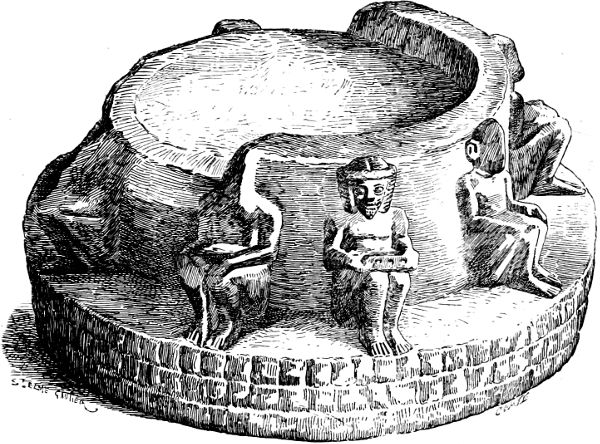
Fig. 104.—Stone pedestal; from Tello. Greatest
diameter 6 inches. Louvre.
Although the remains from Sirtella give an opportunity for the study of
Chaldæan art that is to be equalled nowhere else in Europe, still the
British Museum and the old collections of the Louvre contain more than
one object calculated to enrich, if not to complete, the series we have
established.
A bronze in the former gallery (Fig. 105) seems to date from the
earliest period of Chaldæan art. It has been thought to represent a
goddess, Istar perhaps, although there is nothing in the modelling
of the bosom to suggest the female sex. The whole work is, however,
so rough and barbarous that the author may very well have left out
all details of the kind through sheer inability to render them. Like
the bronzes of Tello, this figure—which is without legs—ends in a
cylindrical stem. It was in all probability meant to be placed in one
of those hiding places we have already described.
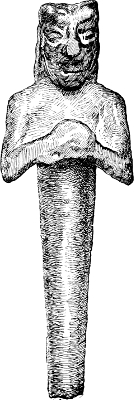
Fig. 105.—Chaldæan statuette. Height 6½
inches. British Museum. Drawn by Saint-Elme Gautier.
Monuments from the Archaic age are less rare. We have already had
occasion to notice some of them, the tablet from Sippara with the god
Shamas (Vol. I. Fig. 71), for instance, the canephorus inscribed
with the name of the king Kourdourmapouk (Fig. 53), and the stele of
Merodach-Idin-Akhi (Fig. 63). The canephorus must have been the oldest
of these objects. Its head is entirely shaven and in its attitude it
resembles the bronzes of Gudea (Vol. I. Fig. 147). We are induced to
bring down the tablet nearer to our own day because the individuals
shown in it wear both beard and long hair. These are not confined to
the god himself and the two divine personages who support the disk
placed on the altar and representing the sun; they are common to the
three figures advancing in an attitude of worship. The first appears to
be a priest. Among other interesting details we may point out, under
the throne of Shamas, the two strong-limbed deities whom Assyriologists
call Izdubar and Hea-bani, and, in Shamas’s right hand, the staff
with a ring attached that is found elsewhere than in Mesopotamia. The
draperies of the god and those of the third worshipper are arranged in
the crimped folds of which we have spoken above. Here art is fairly
advanced. Putting on one side the convention which allows the deity to
be made much taller than mortals, the proportions of the figures are
good, their attitudes well understood and expressive. The workmanship
of the stele of Merodach-Idin-Akhi is far inferior to that of the
Sippara tablet. It belongs to a series of monuments in which, as we
shall explain farther on, the workmanship is, as a rule, very mediocre.
We shall also mention a few fragmentary statues of very hard stone
which have been seen by travellers in Chaldæa,[222] and a few remains
of the same kind that are now in the British Museum; but of the first
we have only short and vague descriptions, while, among the second,
there is not a piece that can be compared to the statues of Gudea in
the Louvre. During all this period the volcanic rocks appear to have
been extensively employed; we still think they were obtained either
from the borders of the Arabian desert, or by way of the two rivers
from the mountains at the head of the double valley.
To the same school we may attribute a bronze from Hillah, now in the
Louvre (Fig. 106). It represents a priest robed in a long tunic with
five flounces of crimped work. His hair is brought together at the
back of his head, and he wears a low tiara with the usual horns folded
about it. His beard is short and broad. With his two hands—which
are broken—he holds a small ibex against his chest. We have already
encountered this motive in Assyria (see Vol. I. Fig. 114).
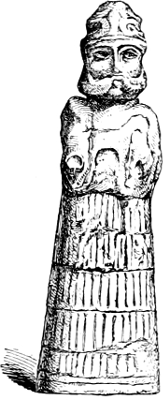
Fig. 106.—Statuette of a priest. Height 5¼
inches. Louvre.
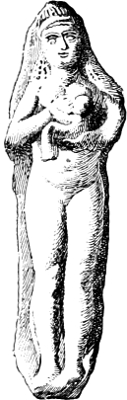
Fig. 107.—Statuette of a woman. Terra-cotta.
Louvre. Height 5¾ inches.
It is chiefly, however, among the terra-cotta statuettes that we
find good examples of that more elegant and refined form of art of
which we catch certain glimpses in some of the Tello fragments. The
figure of a priest happily draped in a mantle that covers his head
and shoulders from behind, has already been given (Fig. 50). We may
here add two more specimens of the same kind. Their merits, however,
can only be fairly appreciated in the originals, on account of their
small size. One of the very best things produced by Chaldæan art is
the statuette of a nude woman, standing and suckling her infant (Fig.
107);[223] her large, and perhaps slightly empty forms are modelled
with ease and artistic feeling. She is, in all probability, a goddess
of maternity.[224] In the statuette reproduced in our Fig. 108, the
treatment is less free, its precision is a little dry and hard. The
personage represented employs the gesture proper to the nursing
goddesses (see Vol. I. Fig. 16), although robed from head to foot. Her
garment ends below in a deep fringe. On her head there is a Persian
tiara.[225]
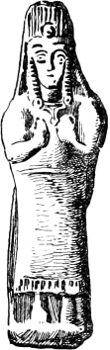
Fig. 108.—Terra-cotta statuette. Height 4¼
inches. Louvre.
This latter figure, in spite of certain qualities to which we are by no
means blind, belongs to a period of decadence which lasted, perhaps,
throughout the Persian domination, and even as late as the Seleucidæ
and Parthians. The types consecrated by religious tradition were
repeated, but repeated with a hesitating and indifferent hand, and
with little reference to nature. The faults inherent in this kind of
workmanship are still more conspicuous in the example, given in Fig. 16
of the first volume, of a type which was very common both in Chaldæa
and Susiana.[226] Whether we call her Istar or Anahit this goddess
seems to have enjoyed a very lasting popularity in the whole region
of which Mesopotamia forms the centre. The art of Chaldæa survived
itself, so to speak, and reappeared after the fall of the national
independence, just as the art of Egypt had a renewal of life under the
Ptolemies and the Roman emperors. It is to these centuries that we
should ascribe a limestone head found by M. de Sarzec at Tello (Fig.
109). In its execution there is none of the firmness and feeling for
nature that is so conspicuous in the monuments from the three periods
that we have endeavoured to establish.
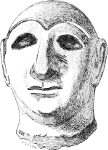
Fig. 109.—Head; from Tello. Actual size.
Louvre.
It is mainly to the second Chaldee empire that a whole series of
monuments belongs whose characteristics constitute them a class
apart;[227] we mean those tablets, generally of some very hard stone,
which are inscribed with what we should call title-deeds. Two-thirds of
their surface is occupied by several columns of close and fine writing,
in which the stipulations of the contract securing the rights of the
proprietor are recited. On the upper part, and dominated by several
stars and by a great serpent stretching across the upper edge, some
emblems are grouped, and these are almost exactly the same in all known
examples. There are altars upon which the wedge or arrow-head, the
primordial element of that writing without which the preservation of
the contract would have been impossible, is either laid upon its side
or set up on end. Other altars support horned tiaras, a horse-shoe,
and another object which has been made unrecognizable by an unlucky
fracture. With these things are mingled several animals, real and
fantastic, and many symbols, no doubt of a sacred character, for we
find them hung round the necks of Assyrian kings or placed in front of
them on the field of their steles.
On one of these monuments, the one we have chosen as the type of the
whole series, a double river seems to flow round the stone, and to
embrace in its windings the mystic scene we have described. This is
the Caillou Michaux, now in the French National Library. In
Fig. 110 we give a reproduction of it as a whole, and in Figs. 111
and 112 the upper parts of its two faces on a larger scale.[228] The
particular value of each symbol here engraved, is still, and perhaps
will always remain, an enigma, but the general significance of their
introduction into these documents is easily understood. They give a
religious character, a sort of divine sanction, to the titles inscribed
upon the stone; they act as witnesses and guarantees. The landmark
thus prepared, was set, no doubt, like the Athenian ὅροι, at the
limits of the field whose ownership it declared. It became a kind of
talisman.[229]
The workmanship of the upper division is very dry and hard; it is not
art. These images were not intended to charm the eye; they were only
placed on the stone on account of their supposed power of interesting
the gods in the preservation of the rights and titles thereon set out.
Their execution was therefore left to mere workmen, who sculptured
the symbols and animal forms in the most mechanical and perfunctory
fashion. They never dreamt of referring to nature and so giving some
variety to the traditional forms. This art, if we may call it so, was
hieratic in the fullest sense of the term.
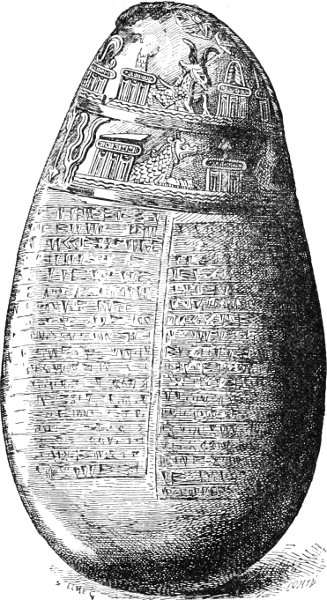
Fig. 110.—The Caillou Michaux. Height 19¾
inches. Drawn by Saint-Elme Gautier.
From our point of view, then, we should gain nothing by multiplying
the number of these monuments. They are chiefly interesting to the
historian of law and religious beliefs in Chaldæa. The remains for
whose recovery we look with the most anxious hope are those of what we
have called the classic age of Chaldæan art, an art that must have
reached its apogee in the days of Nabopolassar and Nebuchadnezzar.
Speaking broadly, we can show nothing produced by the sculptors,
painters, and ornamentists who were employed on the decoration of those
great buildings which even the Jewish prophets could not help admiring,
while they abused the princes who built them and the gods to whom they
were consecrated. The earliest Greek travellers, such as Herodotus and
Ctesias, only saw the ruins of these magnificent structures and of
their rich adornment of enamels, frescoes, and sculptured figures; and
yet how great was their wonder! We can hardly reflect without emotion
upon what we have lost in great works in stone and metal carried out in
the style of which certain fragments from Tello and a few terra-cotta
statuettes give us some faint idea.[230]
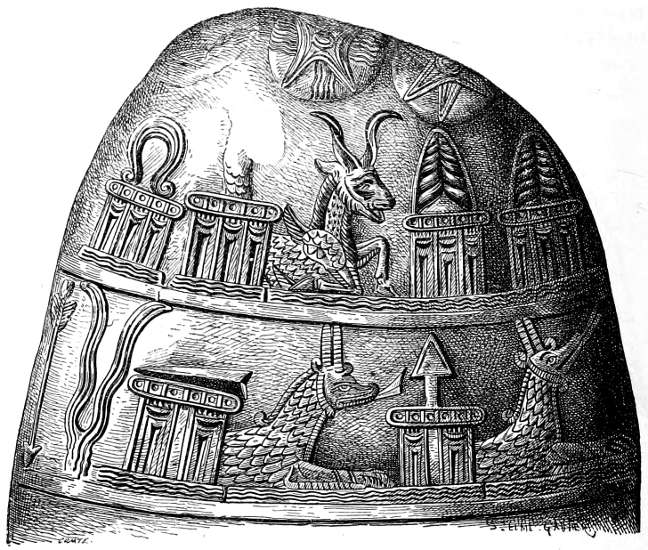
Fig. 111.—The Caillou Michaux, obverse. Drawn
by Saint-Elme Gautier.
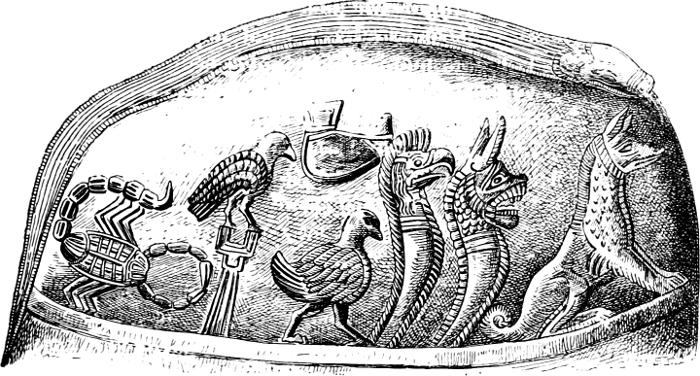
Fig. 112.—The Caillou Michaux, reverse. Drawn
by Saint-Elme Gautier.
That such works did once exist we are told by the Greek historians.
Herodotus, after having described the temple of Bel and the sanctuary
on its summit in which no image of the deity was set up, goes on, “In
this temple at Babylon there is another sanctuary lower down, where
a great seated statue of Zeus may be seen.[231] Near this statue
there is a large table of gold, the throne and its steps are of the
same material. The whole, according to the Chaldæans, is worth eight
hundred talents of gold ... at one time the sacred inclosure also
contained a statue of massive gold twelve cubits high. I did not see
it. I content myself with repeating what the Chaldæans told me about
it. Darius, the son of Hystaspes, formed a project to carry it off, but
he did not dare to execute it. Xerxes, the son of Darius, caused the
priest to be put to death by whom the enterprise was opposed, and took
possession of the statue.” We here have the evidence of an eye-witness.
The seated statue of Bel, without being of the colossal size ascribed
by the Chaldæans to the image destroyed by Darius, must yet, if we may
judge from the expression of Herodotus, have been larger than nature.
We may gather some notion as to its pose and general appearance from
certain figures carved upon the cylinders (Fig. 40), just as, in
Greece, the more famous and venerable of her religious statues were
reproduced upon coins and gems. As to this Babylonian statue, the one
doubt we have relates to the value put upon it by the Chaldæans. Had
the statue and its surroundings really been of massive gold, would the
Persians have spared it when the other was overthrown and broken up?
It is possible that in spite of the historian’s assertion the work he
describes was only gilded bronze.
And as for the image twelve cubits high, we may express the same
doubts. Ctesias seems to have received better information as to how
these figures were made than Herodotus, and, through Diodorus, he
tells us that they consisted of metal plates beaten into shape with
the hammer.[232] Whether Ctesias or his informants did or did not
exaggerate their true dimensions (Diodorus speaks of a Bel forty feet
high), or whether these figures were of gold or gilded brass, is of
comparatively slight importance; we are interested chiefly in the
information he gives as to the method of fabrication. Ever since the
discovery of the Balawat gates proved to what a height the student art
of Assyria carried the manipulation of metal by the repoussé
process, we have had no difficulty in believing that the sculptors of
Babylon in the time of Nebuchadnezzar could build up images of colossal
size and fine decorative effect by means of plaques united with rivets.
If we may believe the rest of Diodorus’s description, the Chaldæan
artists combined the glory of gold and silver with the purity of ivory
and the bright and varied colours of precious stones. And all this we
see good reason to admit when we have examined at the British Museum
those ivories in which lapis lazuli and other substances of the same
kind even now fill up the hollows of the design, while the field still
glitters here and there with some last fragments of the gold with which
it was once incrusted. The skilful workmen who discovered the secret
of this kind of mosaic, may very well have learnt to combine these
beautiful materials so well that the statues upon which they were used
would even have rivalled the chryselephantine masterpieces of Phidias;
in richness and harmony of tones, at least, if not in nobility and
purity of form.
Assyrian sculpture is far from leading us into the remote centuries
from which some of the Chaldæan works must date. It had no period
of infancy or childish effort. The Semites of the north were the
pupils of their southern brothers, from whom they obtained an art
already mature. The oldest known Assyrian monument dates from the
reign of Tiglath-Pileser I., or about the end of the twelfth century
B.C.; it is a bas-relief chiselled upon a rock near the
sources of the Tigris, about fifty miles north of Diarbekir and near
the village of Korkhar. It represents the king standing upright,
his right hand extended and his left holding a sceptre; at present,
however, we only know it by the very poor sketch given by Professor
Rawlinson.[233] It is almost the only monument extant from the
time when the capital of the monarchy was on the site now known as
Kaleh-Shergat. One other may be named, the female torso in the
British Museum, to which we have already referred;[234] on it the name
of Assurbilkala, who succeeded Tiglath-Pileser I., may be read.
The monumental history of Assyria really begins two centuries later,
with the great buildings erected by Assurnazirpal at Calah (Nimroud),
his favourite residence. Assyrian art then reached a level that,
speaking generally, it never surpassed. In the following centuries it
innovated, it became more complex and certainly more refined, but it
produced nothing essentially nobler than certain Nimroud bas-reliefs,
in which the king is seated among his great officers or before his
gods, and always in the attitude of prayer and sacrifice. We have
already given several examples of these reliefs (Vol. I. Fig. 4, and
above, Figs. 15 and 64); we may here add one more (Fig. 113). Leaning
on his bow with his left hand, the king, richly dressed, lifts in his
right the patera whose contents he is about to pour as a libation to
the deity. Facing him stands a gigantic eunuch, who waves over his
master’s head one of those fly-flappers that, with the parasol, have
always been among the insignia of Oriental royalty (see Plate X.).
These figures are rather short in their proportions, and the muscular
development of their arms, which alone are bare, is violently
exaggerated, but yet as a whole the work has a certain grandeur and
nobility. The lines are well balanced. Both the king and his attendant
seem fully impressed with the gravity of the rite over which they are
busy. There is dignity in their attitudes, but no stiffness; their
gestures are easy and expressive without being too much accented.
In our engraving we have only been able to include the two isolated
figures, in the original there are several more all occupied over
the same rite. Even the British Museum has only a few fragments from
these vast compositions. For those who saw them in their original
completeness, well lighted and distributed in their right order along
the walls of spacious saloons, they must have seemed majestic enough.
In his palace decorations the Assyrian artist set himself to free
his figures from all unnecessary surroundings and to simplify his
theme as much as he could. But we must make a distinction between
those reliefs that may be called historical, such as the pictures
of battles and sieges, and those in which the king is shown in the
accomplishment of some duty belonging to his position, and part of
his daily or periodical routine. It is to the latter class that the
most carefully-executed works belong. In these no particular locality
is specified; like that of the Panathenaic procession, it is left
undetermined, and the mind of the spectator is silently invited to fill
it in for himself. Those who frequented the palace were accustomed to
see the king upon his throne, or traversing the wide quadrangle, or
pouring libations on the altar that stood in front of the temple; so
that they had no difficulty in imagining all that the sculptor had left
unsaid. In the hunting pictures the same method was followed with but
little modification. A flat surface suggesting the unbroken expanse of
the desert, was the only indication of a locus in quo.
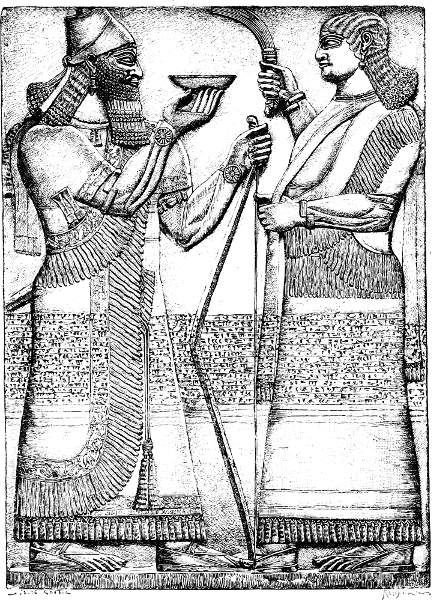
Fig. 113.—Assurnazirpal offering a libation.
Height 7 feet 8 inches. British Museum.
Drawn by Saint-Elme Gautier.
It would have been difficult, or rather impossible, to adhere to such
a rule in those reliefs in which the actual incidents of military
expeditions were retraced. In them the sculptor thought it necessary to
insert such details as would permit the various episodes commemorated
to be identified. One of the simplest means of insuring the desired
result was to render not only buildings, such as castles and fortified
towns, but also the natural features of the scene, with the greatest
possible truth. This the Assyrian artist did, as a rule, with
excellent judgment. Thus, if an action or campaign had been fought
in a mountainous country, he made use of a kind of lattice-work or
reticulation, which every spectator thoroughly understood (see Vol. I.
Figs. 39 and 43); if among forests, he introduced numerous trees among
his figures. He made little attempt to distinguish between one kind of
tree and another, but in most cases employed forms as conventional as
that by which he indicated hills (Fig. 114).
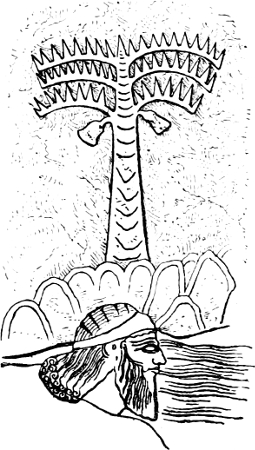
Fig. 114.—Tree on a river bank; from Layard.
One of the chief merits and most striking features of Assyrian
sculpture is, then, its power of selection, its rejection of all that
is superfluous, its comprehension, in fact, of the true spirit and
special conditions of the art. The field has none of those encumbering
accessories which, under the pretext of furnishing and defining, only
serve, so to speak, to take away air and elbow-room from the figures.
When certain complementary features are required to make the subject
clear, the sculptor introduces them, but he never gives more than is
strictly necessary. He never gives way to the temptation to exaggerate
such details, or treats them as if they had an interest and importance
of their own. Such sobriety found its reward. His work no doubt
remained faulty in many respects and inferior to that of his Egyptian
forerunner, still more to that of his Greek successor; but yet it had
an air of frankness, of pride and dignity, to which the more complex
and superficially more skilful compositions of the following epoch too
seldom attained.
The good qualities of this early Assyrian school are no less
conspicuous in the colossal figures with which the doorways of palaces
and temples were decorated. The head of the winged bull has nowhere a
more lofty expression or one more full of dignity than at Nimroud (see
below, Fig. 133). The chisels of these northern artists never created
anything more bold, energetic, and lifelike than the figures from the
small temple built by Assurnazirpal (Vol. I. Fig. 188); we need only
mention the colossal lion in the British Museum (Plate VIII.) and the
grimacing demon whom a beneficent god seems to be expelling from the
sanctuary in spite of his threats and grinning teeth.[235]
And yet this art which is so masterly in some respects is very
primitive and naïve in others. We cannot help being amazed, for
instance, at the wide band of wedges that the scribe has been allowed
to cut across all the lines and contours left by the sculptor. This
proceeding is to be explained, of course, by the essentially historical
and anecdotic character of Assyrian art, but nevertheless it betrays
the contempt for æsthetic effect which is one of the characteristics
of archaic art in Assyria. This feature is by no means without
importance, and Sir Henry Layard seems to us to have been ill advised
in deliberately suppressing it. In his otherwise faithful reproductions
of the best preserved among the bas-reliefs of Assurnazirpal he has
everywhere left out the continuous band of inscription which runs
across them at about two-thirds of their height. By such a proceeding
he has sensibly modified their decorative value.[236]
We must be on our guard against attributing such primitive simplicity
to inexperience in the use of the chisel. In the finest works of later
years that instrument was never wielded with more assured skill than
in the delicate carvings in which the embroidery on the royal robes
are reproduced. We have already put several of these motives before
our readers; in Fig. 115 we give a last exquisite morsel. It shows a
winged lion with the head of a woman, and a king or priest who holds
one of her paws in his left hand, while with his right he seems to
threaten her with a mace.
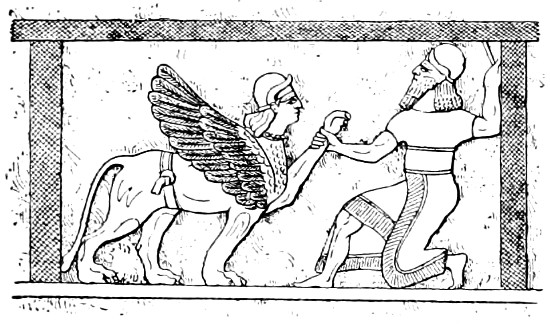
Fig. 115.—Detail from the royal robe of
Assurnazirpal; from Layard.
Such dexterity as this is not to be seen in works in the round (see
Fig. 60). But with the reign of Assurnazirpal commences another
series of royal monuments in which the artist, not being compelled
to quit work in relief, felt himself more at home. We refer to
those round-headed steles on which the standing figure of the king
is relieved against a flat ground bordered by a raised edge. An
inscription is engraved sometimes upon the bed of the relief, sometimes
on the reverse of the stele. An effigy of Assurnazirpal belonging
to this class is now in the British Museum. It was discovered still
standing in the entrance to one of the temples built by that sovereign
on the platform of Calah. Before the stele there was an altar similar
to that shown on page 256 of our first volume. This altar is also in
the British Museum.[237] From the existence of these steles it has
been concluded, with no little probability, that the Assyrian kings,
or at least some of them, received divine honours after their deaths.
We have chosen that of Samas-vul II. for reproduction, on account of
its good condition (Fig. 116). It differs but little from the stele of
Assurnazirpal. High up in the field and in front of the head may be
noticed symbols like those on the land marks (see Figs. 111, 112, and
143). The king’s right hand is raised in the attitude of adoration.
In his left he holds a sceptre, with a ball of ivory or metal at one
end and a tassel at the other. These steles must have been set up in
great numbers. We find them represented in the reliefs (Vol. I. Figs.
42 and 112, and Plate XII.) and upon cylinders (ib. Fig. 69).
They were raised as a sign of annexation in conquered countries, and an
invocation engraved upon the stone put them under the protection of the
Assyrian gods, who were charged with the punishment of any who might
lay hands upon them.[238]
In the British Museum there are fragments of a sculptured obelisk on
which the wars and hunts of Assurnazirpal are figured. It is taller
than that of his son Shalmaneser II., being nearly ten feet high, but
as the material is a soft limestone, it is in far worse preservation;
we only mention it to show that Assyrian art was in possession of all
its resources in the time of this king.
Under none of the princes who reigned at Calah did sculpture show
any sensible change of style; but yet, perhaps, in certain passages
of the Balawat gates we may recognize the first signs of a tendency
that was to become strongly marked under the Sargonids. The field
of the relief there contains a far greater number of picturesque
and explanatory details than the great bas-reliefs of Nimroud. The
campaigns and victories of Shalmaneser II. was the theme put before
the sculptor. In order to do it justice he had to carry the spectator
into countries of various aspects, and to give their true character to
military struggles whose conditions were incessantly changing. He did
not think success was to be attained by confining himself to figuring
the cities and fortresses besieged and taken by the Assyrian army; he
introduced features for the purpose of determining the seat of war.
Such accessories were better placed among figures on a small scale
than among those surpassing or even approaching life size; and without
knowing exactly why, the artist seems to have been warned of this by
a secret and delicate instinct. These strips of bronze are ten inches
high; each is divided into two horizontal divisions by a narrow band of
rosettes, which is also repeated at the top and bottom of each strip.
The figures are on an average about three and a half inches high (see
Fig. 117 and Plate XII.).
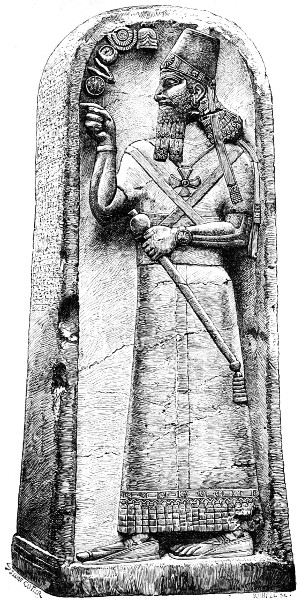
Fig. 116.—Stele of Samas-vul II. Height 7 feet
2 inches. British Museum.
Drawn by Saint-Elme Gautier.
PLATE XII
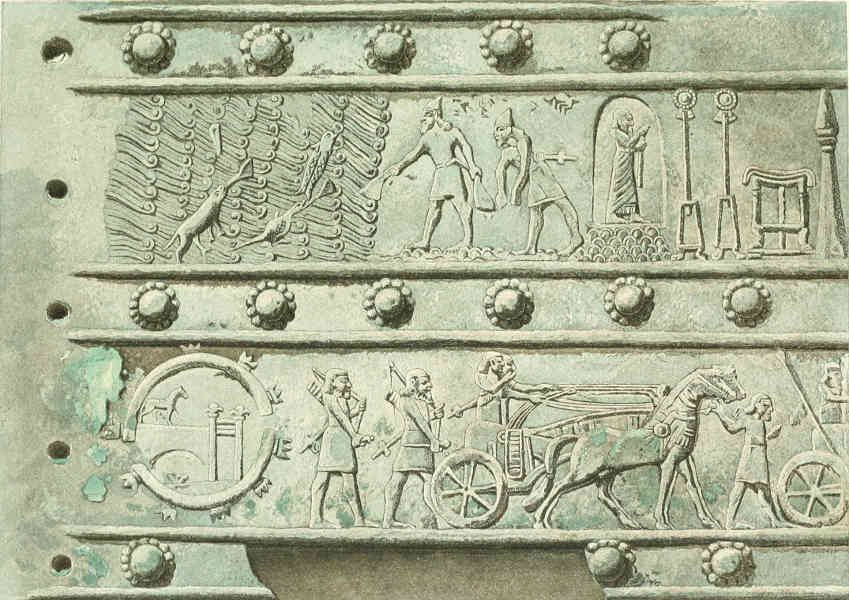
FROM THE BALAWAT GATES
British Museum
Our Plate XII. is an exact copy from a part of the band marked B in
the provisional numeration adopted by Dr. Birch.[239] According to the
inscription upon it this part of the work commemorates a sacrifice
offered by Shalmaneser on the borders of the Lake Van, in Armenia. The
figure of the king is not included in our plate, but it contains all
the sacred vessels of which he made use for the ceremony. Beginning on
the left we find a sort of great candelabrum, a three-legged altar, and
two standards upon tripods. Must these be accepted as military ensigns
of the same class as that shown in Fig. 46 or as religious emblems of
the sun and moon? The question is hardly one for us to discuss. Next
comes a stele raised upon a rock, or perhaps carved upon its surface.
Other reliefs of the same series show us that Shalmaneser erected these
steles in every country he conquered. Further to the right we see
soldiers throwing into the lake the limbs of the animals sacrificed.
This must be an offering to the deity of its waters, perhaps to Anou,
who was believed to reside in rivers and lakes as well as in the sea.
The denizens of the lake seize upon the morsels thus put in their way;
among them we may recognize a large fish, a tortoise, and a quadruped,
that may perhaps be an otter.[240]
In the lower division we see the Assyrian army on the march. On the
right Mr. Pinches recognizes a fortified camp in which horses were
left for flight in case of defeat. There is, indeed, one of these
fortified walls shown in projection, of which we have already spoken,
but the horse is placed upon a clearly indicated arch. What is this
arch doing in the middle of the camp? We ask ourselves whether this
circular structure may not be intended to represent a fortified
tête-de-pont. It is abundantly proved that the Assyrians and
Chaldæans made great use of the vault. Why should they not have
employed it for bridges elsewhere than at Babylon? and wherever there
were bridges on the great roads and near their own frontiers what
could be more natural than to defend them by works flanked, like this,
with towers? The horse would then be about to cross the bridge, and
his introduction would be explained simply by the sculptor’s desire
to give all possible clearness to a representation which could never
be complete. He seems to advance with some precaution as if the floor
of the bridge, which is indicated merely by a straight line, was made
of tree trunks or roughly squared planks badly joined. We offer this
hypothesis for what it may be worth. Next come two archers, and then
chariots. The ground must be difficult, for not only does the driver
support his horses with a tightened rein, but a man on foot walks in
front and holds them by the head.
We find a scene entirely similar but still better treated in the upper
division of another plaque (see Fig. 117).[241] Here we may see that
the chariots are progressing not without difficulty and even danger, in
the very bed of a torrent. The movement of the men who lead the horses
is well understood and skilfully rendered; we feel how carefully they
have to conduct their advance among the blocks of stone that encumber
the bed of the stream and the tumbling water that conceals the nature
of the ground. In the lower division we are presented with one of those
scenes that are so common in Assyrian reliefs. The king in his royal
robes appears on the left; a line of prisoners guarded by archers
approach him and beg for mercy, while the foremost among them “kiss
the dust beneath his feet,” to use an oriental expression in its most
literal sense.
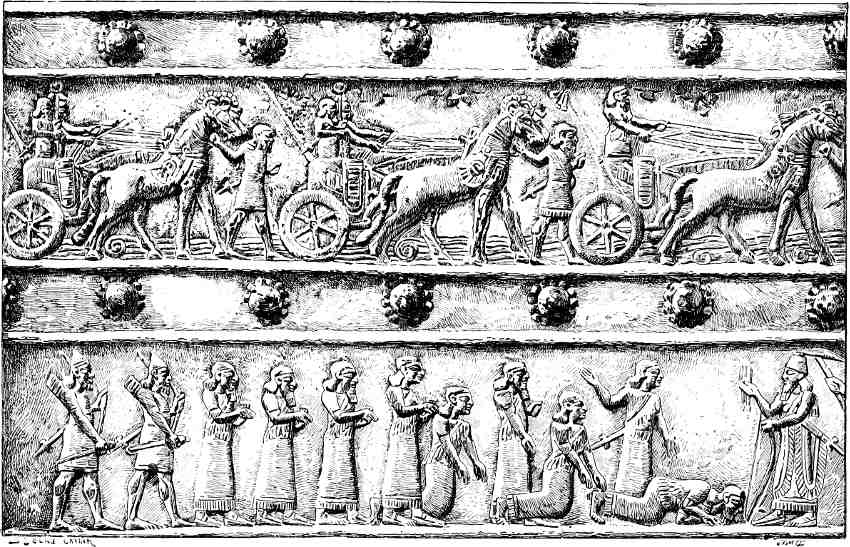
Fig. 117.—Two fragments from the Balawat
gates. British Museum. Drawn by Saint-Elme Gautier.
We should have been willing, had it been possible, to make further
extracts from this curious series of reliefs; to have shown, here naked
prisoners defiling under the eyes of the conqueror, there Assyrian
archers shooting at the heaped-up heads of their slain enemies. But
we have perforce been content with giving, by a few carefully chosen
examples, a fair idea of the work that intervened between the
sculptors of Assurnazirpal and those of the Sargonids.
It is probable that the scheme of this vast composition was due to a
single mind; from one end to the other there is an obvious similarity
of thought and style. But several different hands must have been
employed upon its execution, which is far from being of equal merit
throughout. It is on examining the original that we are struck by these
inequalities. Thus, in some of the long rows of captives the handling
is timid and without meaning, while in others it has all the firmness
and decision of the best among the alabaster or limestone reliefs; the
muscular forms, the action of the calf and knee, are well understood
and frankly reproduced. The passages we have chosen for illustration
are among the best in this respect. Taking them all in all these bronze
reliefs are among the works that do most honour to Assyrian art.
The only monument that has come down to us from the reign of Vulush
III., the successor of Samas-vul, is a statue, or rather a pair of
statues, of Nebo; the better of the two is reproduced in Fig. 15 of our
first volume. These sacred images are of very slight merit from an art
point of view; we should hardly have referred to them but for their
votive inscriptions. From these we learn that they were consecrated
in the Temple of Nebo by the prefect of Calah in order to bespeak the
protection of that god for the king. But the latter is not named alone;
the faithful subject says that he offers these idols “for his master
Vulush and his mistress Sammouramit.”
In this latter name it is difficult not to recognize the Semiramis
of the Greeks, and we are led to ask ourselves whether the queen of
Vulush may not have afforded a prototype for that legendary princess.
This association of a female name with that of the king is almost
without parallel either in Chaldæa or Assyria. In royal documents, as
well as in those of a more private character, there is no more mention
of the royal wives than if they did not exist. Only one explanation
can be given of the apparent anomaly, and that is that Sammouramit,
for reasons that may be easily guessed, enjoyed a quite exceptional
position. It was in those days that, from one reign to another, the
princes of Calah attempted to complete the subjugation of Chaldæa.
It may have happened that in order to put an end to a state of
never-ending rebellion, Vulush married the heiress of some powerful
and popular family of the lower country, and, that he might be looked
upon as the legitimate ruler of Babylon, joined her name with his in
the royal style and title. This hypothesis finds some confirmation
in what Herodotus tells us about Semiramis. She was, he says, queen
of Babylon five generations before Nitocris, which would be about a
century and a half. He adds that she caused the quays of the Euphrates
to be built.[242] This takes us back to rather beyond the middle of
the eighth century B.C., that is very near to the date which
Assyrian chronology would fix for the reign of Vulush (810–781). As
the last representative of the old national dynasty, this Semiramis,
associated as she was in the exercise, or at least in the show, of
sovereign power both in Assyria and Chaldæa, would not be forgotten
by her countrymen, and the population of Babylon would be especially
likely to magnify the part she had played. There is nothing fabulous
in the tradition as Herodotus gives it, although it may, perhaps, go
beyond the truth here and there. Ctesias, however, goes much farther.
He brings together and amplifies tales which had already received many
additions in the half century that separated him from Herodotus, and
he thus creates the type of that Semiramis, the wife of Ninus and the
conqueror of all Asia, who so long held an undeserved place in ancient
history.[243]
The last Calah prince who has left us anything is Tiglath-Pileser II.
(745–727). We have already described how his palace was destroyed by
Esarhaddon, who employed its materials for his own purposes.[244] At
the British Museum there are a few fragments which have been recognized
by their inscriptions as belonging to his work (Vol. I. Fig. 26)[245];
they are quite similar to those of his immediate predecessors.
With the new dynasty founded by Sargon at the end of the eighth century
taste changed fast enough. In those bas-reliefs in the Khorsabad palace
which represent that king’s campaigns, many details are treated in a
spirit very different from that of former days. Trees, for instance,
are no longer abstract signs standing for no one kind of vegetation
more than another; the sculptor begins to notice their distinguishing
features and to give their proper physiognomy to the different
countries overrun by the Assyrians. But these landscape backgrounds are
not to be found in all the bas-reliefs of Khorsabad.[246]
The art of Sargon was an art of transition. While on the one hand it
endeavoured to open up new ground, on the other it travelled on the
old ways and followed many of the ancient errors; it had a marked
predilection for figures larger than nature, and bas-reliefs treating
of royal pageants and processions remind us by the simplicity of
their conception of those of Assurnazirpal. We have already given
many fragments (Vol I. Figs. 22–24, and 29), and now we give another,
a vizier and a eunuch standing before the king in the characteristic
attitude of respect (Fig. 118). The inscription which cut the figures
of Assurnazirpal so awkwardly in two has disappeared; the proportions
have gained in slenderness, and the muscular development, though still
strongly marked, has lost some of its exaggeration. All this shows
progress, and yet on the whole the Louvre relief is less happy in its
effect than the best of the Nimroud sculptures in the British Museum.
The execution is neither so firm nor so frank; the relief is much
higher and the modelling a little heavy and bulbous in consequence.
This result may also be caused to some extent by the nature of the
material, which is a softer alabaster than was employed, so far as we
know, in any other part of Assyria. At Nimroud a fine limestone was
chiefly used.
We shall be contented with mentioning the stele of Sargon, found near
Larnaca, in Cyprus, in 1845. It is most important as an historical
monument; it proves that, as a sequel to his Syrian conquests, the
terror of Sargon’s name was so widespread that even the inhabitants of
the islands thought it prudent to declare themselves his vassals, and
to set up his image as a sign of homage rendered and allegiance sworn.
But the stone is now too much broken to be of any great interest as a
work of art.[247]
The artistic masterpiece of this epoch is the bronze lion figured in
our Plate XI. It had been suggested that its use was to hold down the
cords of a tent or the lower edge of tapestries, a purpose for which
the weight of the bronze and the ring fixed in its back make it well
suited. This idea had to be abandoned, however, when a whole series of
similar figures marked with the name of Sennacherib was found. Their
execution was hardly equal to that of the lion we have figured, but
their general characteristics were the same, and they had rings on
their backs.[248]
These lions are sixteen in number; they form a series in which the size
of the animal becomes steadily smaller with each example; the largest
is a foot long, the smallest hardly more than an inch. The decrease
seems to follow a certain rule, but rust has affected them too greatly
for it to be easy to base any metrological calculation upon their
weight. But all doubt as to their use is removed by the inscriptions
in cuneiform and in ancient Aramaic characters with which several of
them are engraved. The Aramaic inscriptions all begin with the word
mine; then comes a figure indicating the number of mines,
or of subdivisions of the mine that the weight represents;
finally, there is the name of some personage, who may perhaps have been
a magistrate charged with the regulation and verification of weights.
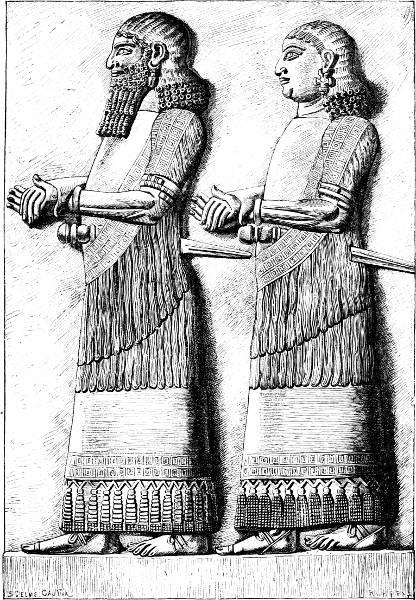
Fig. 118.—Bas-relief from Khorsabad. Height 9
feet 5 inches. Louvre.
With the accession of Sennacherib, a sensible change comes over the
aspect of the reliefs. What until now has been the exception becomes
the rule. On almost every slab we find a complex and carefully treated
landscape background. The artist is not satisfied with indicating the
differences between conifers, cypresses, and pines (Vol. I. Figs,
41–43), palms (ib. Figs. 30 and 34; and above, Fig. 21), the
vine (Fig. 47), and the tall reeds and grasses of the marsh (Fig. 119)
are also imitated.[249]
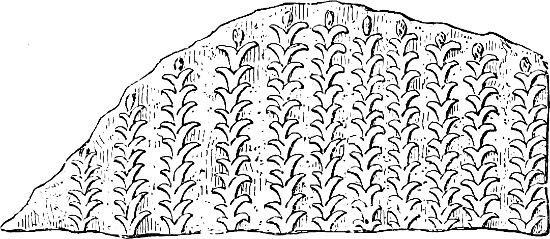
Fig. 119.—Marsh vegetation; from Layard.
We feel that the sculptor wished to reproduce all those subordinate
features of nature by which his eye was amused on the Assyrian plains;
he seems almost to have taken photographs from nature, and then to
have transferred them to the palace walls by the aid of his patient
chisel. Look, for instance, at the reliefs in which the process
of building Sennacherib’s palace is narrated. The sculptor is not
content with retracing, in a spirit of uncompromising reality, all the
operations implied by so great an undertaking; he gives backgrounds to
his pictures in which he introduces, on a smaller scale, many details
that have nothing to do with the main subject of the relief. Thus we
find a passage in which men are shown carting timber, and another in
which they are dragging a winged bull, both surmounted by a grove of
cypresses, while still higher on the slab, and, therefore, in the
intention of the sculptor, on a more distant horizon, we see a river,
upon which boatmen propel their clumsy vessels, and fishermen, astride
on inflated skins, drift with the stream, while fishes nibble at their
baited lines.[250]
Neither boatmen nor fishermen have anything to do with the building of
the great edifice that occupies so many minds and arms within a stone’s
throw of where they labour. They are introduced merely to amuse the
eye of the spectator by the faithful representation of life; a passage
of what we call genre has crept into an historical picture.
Elsewhere it is landscape proper that is thus introduced. One of the
slabs of this same series ends in a row of precipitous heights covered
with cypresses, vines, fig and pomegranate trees, and a sort of dwarf
palm or chamærops.[251]
They thought no doubt that the spectators of such pictures would be
delighted to have the shadowy freshness of the orchards that bordered
the Tigris, the variety of their foliage and the abundant fruit under
which their branches bent to the ground, thus recalled to their minds.
The group of houses that we have figured for the sake of their domed
roofs, forms a part of one of these landscape backgrounds (Vol. I. Fig.
43).[252]
We might multiply examples if we chose. There is hardly a relief
from Sennacherib’s palace in which some of those details which
excite curiosity by their anecdotic and picturesque character are
not introduced.[253] We find evidence of the same propensity in the
decoration of the long, inclined passage that led from the summit of
the mound down to the banks of the Tigris. There the sculptor has
represented what must have actually taken place in the passage every
day; on the one hand grooms leading their horses to water, on the other
servants carrying up meat, fruit, and drink for the service of the
royal table and for the army of officers and dependants of every kind
that found lodging in the palace.[254]
This active desire to imitate reality as faithfully as possible had
another consequence. It led to the multiplication of figures, and
therefore to the diminution of their scale. No figures like those
that occupy the whole heights of the slabs at Nimroud and Khorsabad
have been found in the palace of Sennacherib. In the latter a slab is
sometimes cut up into seven or eight horizontal divisions.[255] The
same landscape, the same people, the same action is continued from
one division to another over the whole side of a room. The subjects
were not apportioned by slabs, but by horizontal bands; whence we may
conclude that the limestone or alabaster was chiselled in place and not
in the sculptor’s studio.
We have not engraved one of these reliefs in its entirety; with its
half-dozen compartments one above another and its hundred or hundred
and fifty figures, it would have been necessary to reduce the latter to
such a degree that they could only be seen properly with a magnifying
glass. The originals themselves, or the large plates given by Layard
in his Monuments, must be consulted before the dangers of this
mode of proceeding can be appreciated. The confusion to which we have
pointed as one of the cardinal defects of Assyrian sculpture, is
nowhere more conspicuous than in the battle pictures from Sennacherib’s
palace. It is, however, only to be found in the historical subjects.
When the sculptor has to deal with religious scenes he returns to the
simplicity of composition and the dignity of pose that we noticed in
the reliefs of Assurnazirpal.
This may be seen in the figures carved on the rock of Bavian by the
orders of Sennacherib. The village which has given its name to this
monument lies about five and thirty miles north-north-east of Mossoul,
at the foot of the first Kurdistan hills and at the mouth of a narrow
and picturesque valley, through which flows the rapid and noisy Gomel
on its way to the ancient Bumados, the modern Ghazir, which in
its turn flows southwards into the Zab.
The sculptures consist of several separate groups cut on one of the
lofty walls of the ravine. Some are accompanied by inscriptions, but
the latter speak of canals cut by the king for the irrigation of his
country and of military expeditions, and do not explain why such
elaborate sculptures should have been carried out in a solitary gorge,
through which no important road can ever have passed.[256]
The valley, which is very narrow, is a cul-de-sac. May we suppose that
during the summer heats the king set up his tent in it and passed
his time in hunting? According to Layard’s description the scene is
charming and picturesque. “The place, from its picturesque beauty
and its cool refreshing shade even in the hottest day of summer, is
a grateful retreat, well suited to devotion and to holy rites. The
brawling stream almost fills the bed of the narrow ravine with its
clear and limpid waters. The beetling cliffs rise abruptly on each side
and above them tower the wooded declivities of the Kurdish hills. As
the valley opens into the plain the sides of the limestone mountains
are broken into a series of distinct strata, and resemble a vast flight
of steps leading up to the high lands of central Asia. The banks of
the torrent are clothed with shrubs and dwarf trees, among which are
the green myrtle and the gay oleander bending under the weight of
its rosy blossoms.”[257] Such a gorge left no room for a palace and
its mound,[258] but a subterranean temple may have been cut in the
limestone rock for one of the great Assyrian deities, and its entrance
may now be hidden, or even its chambers filled up and obliterated, by
landslips and falling rocks, and two huge masses of stone that now
obstruct the flow of the torrent may be fragments from its decoration.
They bear the figures of two winged bulls, standing back to back and
separated by the genius who is called the lion-strangler.[259]
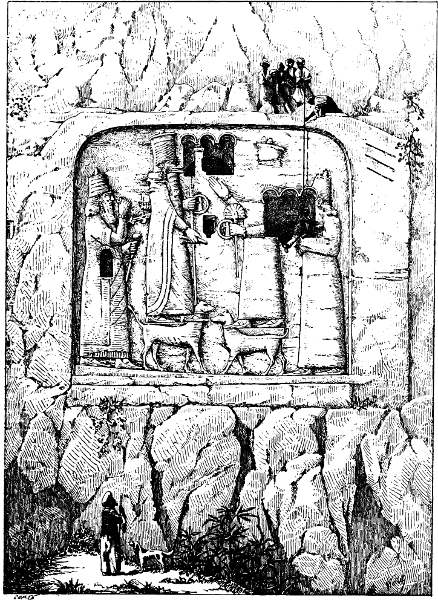
Fig. 120.—The great bas-relief at Bavian; from
Layard.
The principal relief fills up a frame 30 feet 4 inches wide and 29
feet high (see Fig. 120). The bed has been cut away by the chisel to
a depth of about 8 inches. Sheltered by the raised edge thus left
standing the figures would have been in excellent condition but for
the unhappy idea that struck some one in later years, of opening
chambers in the rock at the back and cutting entrances to them actually
through the figures. These hypogea do not seem to have been tombs.
They contain no receptacles for bodies, but only benches. They were,
in all probability, cells for Christian hermits, cut at the time when
monastic life was first developed and placed where we see them with the
idea of at once desecrating pagan idols and sanctifying a site which
they had polluted. In Phrygia and Cappadocia we found many rock-cut
chambers in which evidence of the presence of these pious hermits was
still to be gathered. In some, for instance, we found the remains of
religious paintings. As examples we may mention the royal tombs of
Amasia, which were thus converted into oratories.[260]
The composition contains four figures. Two in the middle face each
other and seem to be supported by animals resembling dogs in their
general outlines. They are crowned with tiaras, cylindrical in shape
and surrounded with horns. One of these figures has its right hand
raised and its left lowered; his companion’s gesture is the same, but
reversed. The general attitudes, too, are similar, but the head of
one figure has disappeared, so that we can not tell whether it was
bearded like its companion or not. They each carry a sceptre ending
in a palmette and with a ring attached to it at about the middle of
the staff. In the centre of this ring a small standing figure may be
distinguished. Behind each of these two chief personages, and near the
frame of the relief, two subordinate figures appear. In attitude and
costume they are the repetition of each other. Their right hands are
raised in worship, while in their left they hold short, ball-headed
sceptres.
The two figures in the centre must represent gods. The king is never
placed on the backs of living animals in this singular fashion; but
we can understand how, by an easily-followed sequence of ideas, such
a method of suggesting the omnipotence of the deity was arrived at.
Neither did the kings of the period we are considering wear this
cylindrical tiara. In the palaces of the Sargonids it is reserved for
the winged bulls. It is larger than the royal tiara, from which it is
also distinguished by its embracing horns. Finally, the ringed sceptre
is identical with the one held by Samas, in the Sippara tablet (Vol. I.
Fig. 71). No one will hesitate as to the real character of these two
personages; the only point doubtful is as to whether the one on the
left is a god or a goddess. The mantle worn by the right hand figure is
wanting; but the question cannot be decided, because the head has been
completely destroyed. In any case, the difference of costume proves
that two separate deities, between whom there was some relation that
escapes our grasp, were here represented.
As for the two figures placed behind the gods, they would have been
quite similar had they been in equally good condition. They represent
Sennacherib himself, with the head-dress and robes that he wears in the
sculptures of his palace at Nineveh. He caused his image to be carved
on both sides of the relief, not for the sake of symmetry, but in order
to show that his worship was addressed no less to one than the other of
the two deities.
This rock-cut picture is not the only evidence of Sennacherib’s desire
to leave a tangible witness of his piety and glory in this narrow
valley. In another frame we find some more colossal figures, only one
of which is fairly well preserved; it is that of a cavalier who, with
his lance at rest, seems to be in act to charge an enemy. His attitude
and movement recall those of a mediæval knight at a tournament.[261]
Layard counted eleven smaller reliefs sprinkled over the face of the
rock. Some are easily accessible, while others are situated so high up
that they can hardly be distinguished from below. Each of these has an
arched top like that of the royal steles (see Fig. 116) and incloses
a figure of the king about five feet six inches high. Above his head
symbols like those on the Babylonian landmarks (see Figs. 43 and 111)
and the Assyrian steles (Fig. 116) are introduced.[262] Three of these
reliefs had inscriptions, and to copy them Layard caused himself to be
let down by ropes from the top of the cliff, the ropes being held by
Kurds who could hardly have had much experience of such employment.
The illustration we have borrowed from his pages shows the adventurous
explorer swinging between sky and earth (Fig. 120).
As a last example of these works cut in the rock, we may here mention a
fountain that was cleared and for the moment restored to its original
state by Mr. Layard (Fig. 121). By means of conduits cut in the living
rock, they had managed to lead the water of the stream to a series
of basins cut one below the other. The sketch we reproduce shows the
lowest basin, which is close to the path. The face of the rock above
it is smoothed and carved into a not inelegant relief. The water seems
to pour from the neck of a large vase, seen in greatly foreshortened
perspective. Two lions, symmetrically arranged, lean with their
fore-feet upon the edge of the vase.[263] The work is interesting,
as it is the only thing left to show how the Assyrians decorated a
fountain.
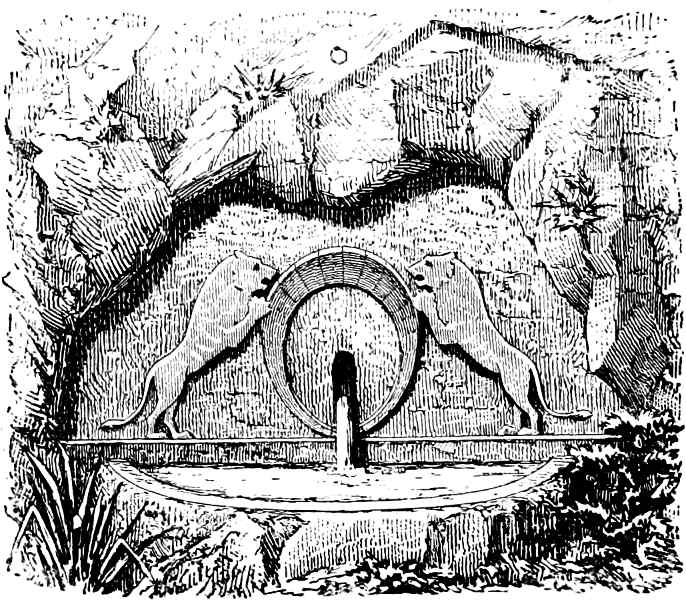
Fig. 121.—Fountain; from Layard.
The Assyrians thus found, in the very neighbourhood of their capital,
great surfaces of rock almost smooth and irresistibly inviting to the
chisel. Their unceasing expeditions led them into countries where,
on every hand, they were tempted by similar facilities for wedding
the likenesses of their princes to the very substance of the soil,
for confiding the record of their victories to those walls of living
rock that would seem, to them, unassailable by time or weather. Their
confidence was often misplaced. In some places the water has poured
down the face of the rock and worn away the figures; in others,
landslips have carried the cliff and its sculptures bodily into the
valley. In some instances, no doubt, the accumulations cover figures
still in excellent condition, but several of these fallen sculptures
have already been cleared.
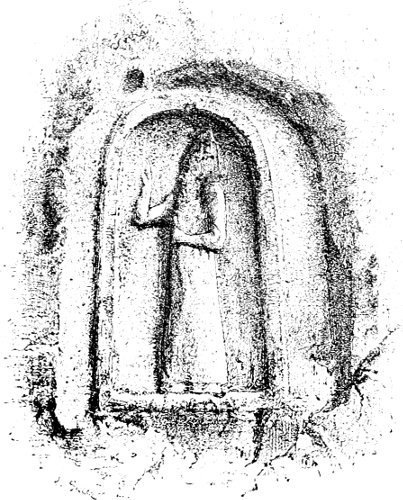
Fig. 122.—Assyrian bas-relief in the
Nahr-el-Kelb. Drawn by P. Sellier.
We have already spoken of the bas-relief of Korkhar;[264] it is about
three hundred miles from Nineveh, but the Assyrian conquerors left
traces of their passage even farther from the capital than that, in the
famous pass of the Lycos, for instance, near modern Beyrout, and now
called Nahr-el-Kelb, or river of the dog. A rock-cut road
passes through it, which has been followed from the remotest times by
armies advancing from the north upon Egypt, or from the latter country
towards Damascus and the fords of the Euphrates. Following the Pharaohs
of the nineteenth dynasty, Esarhaddon caused his own image and royal
titles to be cut in this defile; they may still be seen there, on rocks
whose feet stand in the bed of the torrent (Fig. 122).[265]
Without going so far as northern Syria we might find, if we may believe
the natives of the country, plenty of sculptures in the valleys that
open upon the Assyrian plain if they were carefully explored. Near
Ghunduk, a village about forty-five miles north-west of Mossoul, Layard
noticed two reliefs of the kind, one representing a hunt, the other
a religious sacrifice.[266] But after Bavian the most important of
all these remains yet discovered is that at Malthaï. This village is
about seventy-five miles north of Mossoul, in a valley forming one of
the natural gateways of Kurdistan. The road by which the traveller
reaches Armenia and Lake Van runs through the valley.[267] There, in
the fertile stretch of country that lies between two spurs standing
out from the main chain, stands a tell, or mound, which seems
to have been raised by the hand of man. Place opened trenches in it
without result, but he himself confesses that his explorations were
not carried far enough, and, the beauty of the site and other things
being considered, he persists in believing that the kings of Assyria
must have had a palace, or at least a country lodge, in the valley.
However this may be, the bas-reliefs, of which Place was the first
to make an exact copy, suffice to prove that this site attracted
particular attention from the Assyrians (see Fig. 123). They are to be
found on the mountain side, at about two-thirds of its total height,
or some thousand feet above the level of the valley. In former days
they must have been inaccessible without artificial aids. It is only by
successive falls of rock that the rough zig-zag path by which we can
now approach them has been formed. The figures, larger than nature, are
arranged in a long row and in a single plane. Place was obliged, by
the size and shape of his page, to give them in two instalments in the
plate of which our Fig. 123 is a copy. In the absence of a protecting
edge they have suffered more than the figures at Bavian. They have,
indeed, a slight projection or cornice above, but its salience is
hardly greater than that of the figures themselves.
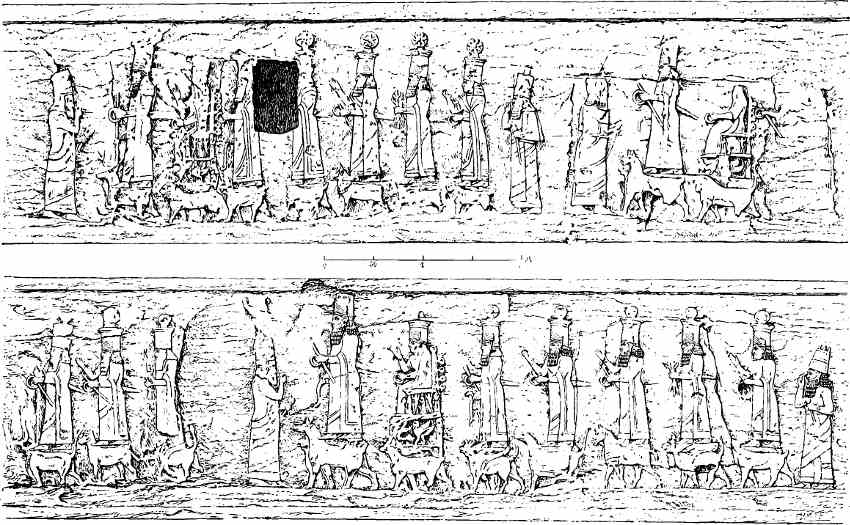
Fig. 123.—The bas-reliefs of Malthaï; from
Place. About one forty-fifth of actual size.
The composition contains three groups, or rather one group repeated
three times without sensible differences. The middle group, which is
divided between the upper and lower parts in our woodcut, has been more
seriously injured by the weather than those on each side of it; three
of its figures have almost disappeared. The first group to the right in
the upper division has part of its surface cut away by a door giving
access to a rock-cut chamber behind the relief, like those at Bavian.
It is, then, in the left-hand group that the subject and treatment can
now be most clearly grasped.
In the first place, we may see at a glance that the theme is
practically the same as at Bavian; it is a king adoring the great
national gods. But the latter are now seven in number instead of two;
instead of being face to face they are all turned in one direction,
towards the king; but the latter is none the less repeated behind each
group. There are some other differences. Among the animals who serve
to raise the gods above the level of mere humanity we may distinguish
the dog, the lion, the horse, and the winged bull. The gods are in
the same attitude as at Bavian; their insignia are the same, those
sceptres with a ring in the middle, which we never find except in the
hands of deities. The sixth in the row also grasps the triple-pointed
object that we have already recognised as the prototype of the Greek
thunderbolt.[268] Finally, each god has the short Assyrian sword upon
his thigh. To this there is one exception, in the second figure of each
group. This figure is seated upon a richly-decorated throne, and has no
beard, so that we may look upon it as representing a goddess. The last
of the seven deities is also beardless, and, in spite of the sword and
the standing attitude, may also be taken to represent a goddess. The
tiaras, which are like those of Bavian in shape, each bear a star, the
Assyrian ideogram for God.[269]
There is no inscription, but both Place and Layard agree that the
proportions of the figures, and their execution, and the costume of
the king, declare the work to have been carried out in the time of the
Sargonids, probably under Sennacherib, but if not, during the reign
either of his father, his son, or his grandson.
We have been led to give a reproduction and detailed description
of these reliefs, chiefly because they acted as a school for the
people about them. We find this habit of cutting great sculpturesque
compositions on cliff-faces followed, on the one hand by the natives
of Iran, on the other by those of Cappadocia, and in the works they
produced there are points of likeness to the Assyrian reliefs that can
by no means be accidental. When the proper time comes we shall, we
believe, be able to show that there was direct and deliberate imitation.
It was not only on these rock-cut sculptures that the gods appeared
thus perched on the backs of animals; the motive was carried far afield
by small and easily-portable objects, on which it very often occurs. It
is to be found on many of the cylinders; we reproduce two as examples.
Each of these shows us an individual in an attitude of worship before a
god standing on a bull’s back. The main difference between the two is
one of style. The cylinder engraved in Fig. 124 dates from the early
Chaldæan monarchy, while its companion (Fig. 125) is ascribed by M.
Ménant to the Assyrian dynasty of Calah.[270]
By their simplicity of arrangement and the nudity of their field,
the sculptures of Bavian and Malthaï belong in some sense to the
archaic period, but their figures are designed with that finer sense
of proportion that distinguished Assyrian art from the reign of
Sennacherib onwards. It was, however, in the palaces that the new
tendency towards grace and slenderness chiefly made itself felt. We
have no sculptures to speak of from the time of Esarhaddon, but no
monarch has left us monuments more numerous or in better preservation
than his son Assurbanipal. A visit to London is necessary, however, for
their proper examination, as they have not yet been made the subject
of any such publication as that devoted by Mr. Layard to remains from
the time of Sennacherib and Assurnazirpal. Some idea of them may be
formed, however, from the numerous fragments figured in these pages
(Vol. I., Figs. 5, 27, 28; below, Figs. 162, 172, 174, 177–180, 188).
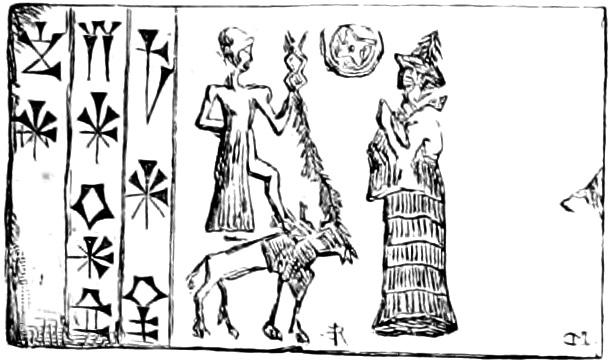
Fig. 124.—Chaldæan Cylinder. Hematite.[271]
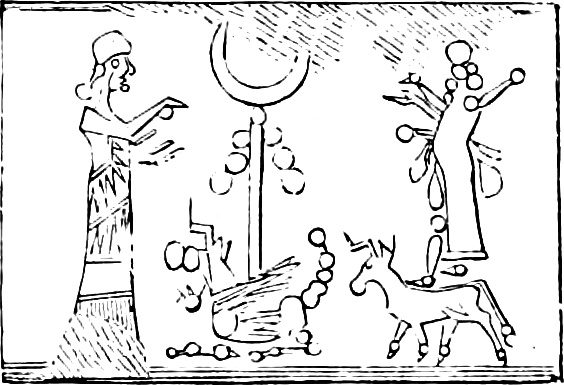
Fig. 125.—Assyrian Cylinder.[272]
Speaking generally, the sculptors of Assurbanipal were the pupils of
those of Sennacherib, with, perhaps, a larger endowment of taste and
skill. Under them Assyrian art aimed higher than ever before. It was
fascinated by movement, and endeavoured to render its accidents and
unforeseen turns. From this point of view we must draw particular
attention to the pictures representing the campaign of Assurbanipal
against the Elamites. In these the figures are more numerous and more
closely packed than anywhere else, and the chisel has attacked episodes
more complicated and more difficult to treat. Here, for instance, is
a chariot upset upon the battle-field; it is turned completely over,
while the struggling horses pull different ways, and the occupants are
thrown out head foremost. There are many technical defects and mistakes
of drawing, but the attempt is none the less interesting.
Some of the reliefs show the same confused accumulation of figures
as in the time of Sennacherib. Now and then we find as many as six
horizontal divisions, each from ten to fourteen inches high. But
their height obeys no regular or constant rule. The central division,
with the king in his chariot, is two feet high. No attempt is made to
distinguish planes by varying the size of the figures, to mark the
successive moments of the action by dividing the groups, or to give
prominence to the main incidents; the confusion is unbroken. Here, as
in all the battle pieces, a very singular convention may be noticed.
There are no dead or beaten Assyrians. If we may believe the artist,
the kings of Nineveh won all their battles without losing a man!
The hunting scenes are arranged with more judgment. In certain
respects we might place them in the same class as the great reliefs
from Nimroud. By right of their dignity and breadth, the latter must
be considered the masterpieces of Assyrian sculpture, but these later
works can boast an amount of energy and vitality and a truthfulness of
handling that are worthy of no stinted praise. The master by whom the
conception was thought out abandoned the overloaded backgrounds that
his immediate predecessors had brought into vogue. He concentrated his
attention on the figures, to which he gave all the value he could. They
stand out with singular force against a field whose unbroken surfaces
happily suggest the immensity of the naked plains on which the hunts
took place. We have already shown how well the distinctive features
and movements of the dog, the lion, and the wild ass are rendered; in
our Fig. 126 we give another example of the same kind. A sentiment
of real interest is stirred in us on behalf of these wild goats with
their young, who run and feed on the steppe while horsemen and beaters
prepare to drive them into the treacherous nets.
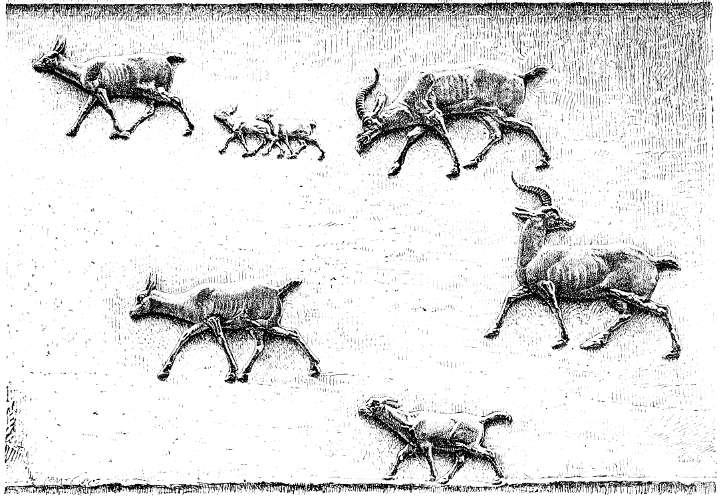
Fig. 126.—Wild goats. British Museum. Drawn by
Wallet.
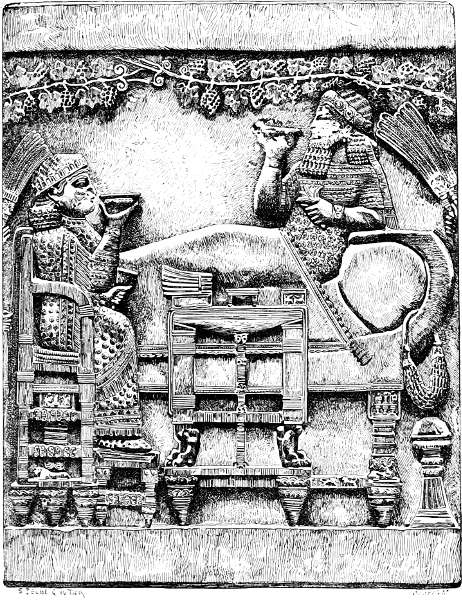
Fig. 127.—The feast of Assurbanipal. British
Museum. Drawn by Saint-Elme Gautier.
Elsewhere, on the other hand, the sculptor has furnished the beds of
his reliefs with certain vegetable and floral forms chiselled with
the greatest care. We may give, as an example, the kind of royal park
or garden in which we saw a pair of tame lions (see above, Fig. 77).
Behind the animals, to the right, there is a tree round which a vine
clings and mounts. It is heavy with clusters of ripe fruit, and even
the curling tendrils with which its branches end are not forgotten. On
the left there is a palm tree, or, at least, its trunk. Between the
vine and the palm tall flowering stems rear their heads. The artist
has wished us to understand that fruits, sweet-smelling flowers, and
umbrageous leafage, combined to make these gardens the most agreeable
of retreats for a king fatigued with war against human enemies or the
beasts of the desert. The same intention is traceable on the famous
slab already figured (Vol. I. Figs. 27 and 28), which shows the king
and queen at table in one of these royal gardens. We reproduce the
chief group on a larger scale in order that the beauty of the execution
may have a chance of making itself felt (Fig. 127). Notice the
treatment of the vine that bends over the heads of the royal couple.
The heads themselves have suffered, but all the rest of the plaque is
in excellent condition. Notice the pattern on the royal robes, and the
details of the furniture. The latter may be recognized as truthful
renderings of the magnificent chairs and tables of bronze, inlaid with
ivory and lapis-lazuli, of which so many fragments have been found in
the Assyrian palaces. Every detail that the chisel could render has
been faithfully copied. Except in colour and material, the objects
themselves are before us. The fringed coverlet thrown over the king’s
knees, the cushion on which he leans, the garland thrown over the arm
of his couch, the system of metal uprights and cross pieces of which
the queen’s throne, the king’s bed, and the small table placed between
them consist, might all be restored without difficulty. The chiselled
feet of all these objects resemble fir-cones in shape. In the case of
the table they are connected with its body by lion’s paws. On the lower
bar of the queen’s chair there is a small couchant lion.
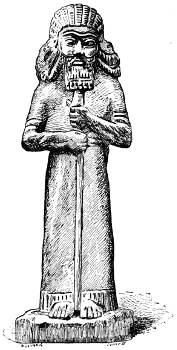
Fig. 128.—Terra-cotta statuette. Actual size.
British Museum. Drawn by Saint-Elme Gautier.
It may be thought, perhaps with truth, that the sculptor has overdone
these details, and that his figures are, in some degree, sacrificed to
the decorations about them. Other examples from the same series, give
a higher idea of the sculpture of this time; we may cite especially
a fragment possessed by the Louvre, in which the treatment is of the
skilfullest (Plate X). It represents Assurbanipal in his war-chariot
at the head of his army. The chariot itself, and all the accessories,
such as the umbrella and the robes of the king and his attendants, are
treated with great care but they do not unduly attract the eye of the
spectator. We can enjoy, as a whole, the group formed by the figures in
the chariot, and those who march beside and behind it. Its arrangement
is clear and well balanced; there is no crowding, the spacing of the
figures is well judged and the movement natural and suggestive. The
king dominates the composition as he should, and his umbrella happily
gathers the lines of the whole into a pyramid. In all this there is
both knowledge and taste.
The best of the Assyrian terra-cottas also belong to this period. The
merit of their execution may be gathered from the annexed statuette,
which comes from the palace of Assurbanipal (Fig. 128). From the staff
in its hands it has been supposed to represent a king, but we know that
every Assyrian was in the habit of carrying a stick with a more or less
richly ornamented head, and here we find neither a tiara nor the kind
of necklace which the sovereign generally wore (see Fig. 116). I am
inclined to think it is the image of a priest.
In conclusion we may say that, in some respects, Assyrian sculpture was
in a state of progression when the fall of Nineveh came to arrest its
development and to destroy the hopes it inspired.
We have now studied Mesopotamian sculpture in its favourite themes,
in its principal conventions, and in the fluctuations of its taste
and methods of work; we have yet to ask whether this sculpture, which
differed in so many ways from the plastic art of Egypt, differed from
it also in absence of colour. We have put off this question until now,
because we had first to determine what materials the architect and
sculptor employed, how they employed them, and what part was played by
figures in relief and in the round in the architectonic creations of
Chaldæa and Assyria.
In speaking of Egypt we have explained how a brilliant light destroys
the apparent modelling of objects, how, by the reflections it casts
into the shadows, it interferes with our power to distinguish one
distant plane from another.[273] In every country where a vertical sun
shines in an unclouded sky, the decorator has had to invoke the help
of colour against the violence of the light, has had to accept its aid
in strengthening his contours, and in making his figures and ornaments
stand out against their ground. In describing Egyptian polychromy
we said that we should find the same tendency among other nations,
different in character and origin, but subjected to the influence of
similar surroundings. We also allowed it to be seen that we should have
to notice many changes of fashion in this employment of colour. Colour
played a different and more important part in one place or period than
in another, and it is not always easy to specify the causes of the
difference. In the Egyptian monuments hardly a square inch of surface
can be found over which the painter has not drawn his brush; elsewhere,
in Greece for instance, we shall find him more discreet, and his
artificial tints restricted to certain well-defined parts of a figure
or building.
Did Assyria follow the teaching of Egypt, or did she strike out a line
of her own, and set an example of the reserve that was afterwards to
find favour in Greece? That is the question to be answered. Before we
can do so we must produce and compare the evidence brought forward
by Botta, Layard, Place and others, who saw the Assyrian sculptures
reappear in the light of day. Ever since those sculptures were
recovered they have been exposed to the air; they have undergone all
the handling and rubbing involved in a voyage to Europe; and for the
last twenty or thirty years they have been subjected to the dampness
of our climate. We need, then, feel no surprise that traces of colour
still visible when the pick-axe of the explorer freed the alabaster
slabs from their envelope of earth have now disappeared.
Before examining our chief witnesses, the men who dug up Khorsabad,
and Nimroud, and Kouyundjik, we may, to some extent, foretell their
answers. We have already explained how the Mesopotamian architect made
use of colour to mask the poverty of his construction and to furnish
the great bare walls of his clay buildings. Both inside and outside,
the Assyrian palaces had the upper parts of their walls and the
archivolts of their doors decorated with enamelled bricks or paintings
in distemper. Is it to be supposed that where the reliefs began all
artificial tinting left off, and that the eye had nothing but the dull
grey of gypsum and limestone to wander to from the rich dyes of the
carpets with which the floors were strewn? Nothing could well be more
disagreeable than such a contrast. In our own day, and over the whole
of the vast continent that stretches from China to Asia Minor, there is
not a stuff, however humble, that is woven on the loom or embroidered
by the needle, but betrays an instinctive feeling for harmony so true
and subtle that every artist wonders at it, and the most tasteful of
our art workmen despair of reaching its perfection, and yet many of
these faultless harmonies were conceived and realized in the tent of
the nomad shepherd. We can hardly believe that in the palace where
official art lavished all its resources in honour of its master, there
could be any part from which the gaiety that colour gives was entirely
excluded, especially if it was exactly the part to which the eye of
every visitor would be most surely attracted.
Before going into the question of evidence one might, therefore, make
up our minds that the Assyrian architect never allowed any such element
of failure to be introduced into his work; and the excavations have
made that conclusion certain. The Assyrian reliefs were coloured, but
they were not coloured all over like those of Egypt; the grain of the
stone did not disappear, from one end of the frieze to the other, under
a layer of painted stucco. Flandin, the draughtsman attached to the
expedition of M. Botta, alone speaks of a coat of ochre spread over
the bed of the relief and over the nude portions of the figures;[274]
he confesses, however, that the traces were very slight and that they
occurred only on a slab here and there. Botta, who saw the same slabs,
thought his colleague mistaken.[275] Place is no less decided: “None
of us,” he says, “could find any traces of paint upon the undraped
portions of the figures, and it would be very extraordinary if among
so many bare arms and bare legs, to say nothing of faces, not one
should have retained any vestige of colour if they had all once been
painted.”[276] We might be inclined to ask whether the traces of
pigment that have been noticed here and there upon the alabaster might
not have been the remains of a more widespread coloration, the rest of
which had disappeared. Strong in his experience, Place thus answers
any doubts that might be expressed on this point: “We never found an
ornament, a weapon, a shoe or sandal, partially coloured; they were
either coloured all over or left bare, while objects in close proximity
were without any hue but their own. Sometimes eyes and eyebrows were
painted, while hair and beard were left untouched; sometimes the tiara
with which a figure was crowned or the fan it carried in its hand was
painted while the hand itself and the hair that curled about the head
showed not the slightest trace of such an operation; elsewhere colour
was only to be found on a baldrick, on sandals, or the fringes of a
robe.” Wherever these colours existed at all they were so fresh and
brilliant at the time of discovery that no one thought of explaining
their absence from certain parts of the work by the destruction of the
pigment. “How is it,” continues Place, “that, if robes were painted
all over, we only found colour on certain accessories, on fringes and
embroideries? How is it that if the winged bulls were coated in paint
from head to foot, not one of the deep grooves in their curled beards
and hair has preserved the slightest vestige of colour, while the white
and black of their eyes, which are salient rather than hollowed, remain
intact? Finally, we may mention the following purely accidental, and
therefore all the more significant, fact: a smudge of black paint,
some two feet long, was still clearly visible on the breast of one of
the colossi in the doorway of room 19.[277] How can we account for the
persistence of this smudge, which must have fallen upon the monster’s
breast while they were painting its hair, if we are to suppose that the
whole of its body was covered with a tint which has disappeared and
left no sign?”
Such evidence is decisive. The colouring of the Assyrian reliefs must
always have been partial. The sculptor employed the painter merely to
give a few strokes of the brush which, by the frankness and vivacity of
their accent, should bring the frieze into harmony with the wall that
enframed it. Nothing more was required to destroy the dull monotony of
the long band of stone. At the same time these touches of colour helped
to draw attention to certain details upon which the sculptor wished to
insist.
For all this, four colours were enough. Observers agree in saying that
black, white, red and blue made up the whole palette.[278] These tints
were everywhere employed pretty much in the same fashion.[279]
In those figures in which drapery covered all but the head, the latter
was, of course, more important than ever. The artist therefore set
himself to work to increase its effect as much as he could. He painted
the eyeball white, the pupil and iris, the eyebrows, the hair and the
beard, black; sometimes the edges of the eyelids were defined with
the same colour. The band about the head of the king or vizier is
often coloured red, as well as the rosettes which in other figures
sometimes decorate the royal tiara. The same tint is used upon fringes,
baldricks, sandals, earrings, parasols and fly-flappers, sceptres, the
harness of horses and the ornamental studs or bosses with which it was
covered, and the points of weapons.[280] In some instances blue is
substituted for red in these details. Place speaks of a fragment lost
in the Tigris on which the colours were more brilliant than usual;
upon it the king held a fan of peacock’s feathers coloured with the
brightest mineral blue.[281]
When figures held a flower in their hands it was blue, and at Khorsabad
a bird on the wing was covered with the same tint.[282] In some
bas-reliefs red and blue alternate in the sandals of the figures and
harness of the horses.[283] We find a red bow with a
blue quiver.[284]
The flames of towns taken and set on fire by the Assyrians were
coloured red in many of the Khorsabad reliefs.[285]
A few traces of colour may still be discovered upon some of Sargon’s
sculptures in the Louvre and upon those of Assurnazirpal in the British
Museum.[286] I could find no remains of colour either upon the reliefs
of Assurbanipal or upon those of Sennacherib, where, moreover, Layard
tells us he could discover none.[287]
It would be very strange however, if in these palaces of the last of
the Sargonids the decorator had deliberately renounced the beauties of
that discreet system of polychromy of which the traces are to be found
in all the earlier palaces. It is possible that these touches of colour
were reserved for the last when the palaces were erected, and that
something may have happened to prevent them from being placed on the
sculptures of these two sovereigns.
So far as we can discover, no trace of colour has been found on any
of the arched steles or isolated statues left to us by Chaldæa and
Assyria. This abstention is to be explained by the nature of the
materials at the disposal of the sculptor in Chaldæa, the cradle of
his art. These were chiefly igneous rocks, very hard, very close in
grain and dark in colour, and susceptible of a very high polish. The
existence of such a polish disposes of any idea that the figures to
which it was given were ever painted. The pigment would not have stayed
long on such a surface, and besides, the reds and blues known to the
Ninevite artists would have had a very poor effect on a blue-black
ground.
On the other hand, when they set to work to model in clay the Assyrians
could give free rein to their love for colour. Most of the statuettes
found in the ruins of their palaces had been covered with a single
uniform tint, which, thanks to the porous nature of the material, is
still in fair preservation. The tint varies between one figure and
another, and, as they are mostly figures of gods or demons, the idea
has been suggested that their colours are emblematic.[288] Thus the
Louvre possesses a statuette from Khorsabad representing a god crowned
with a double-horned tiara, and covered all over, flesh and drapery
alike, with an azure blue.[289] A demon with the head of a carnivorous
animal, from the same place, is painted black, a colour that seems
to suggest a malevolent being walking in the night and dwelling in
subterranean regions.[290]
The Assyrians also made use of what has been sometimes called natural
polychromy, that is to say they introduced different materials into
the composition of a single figure, each having a colour of its own
and being used to suggest a similar tint in the object represented.
Several fragments of this kind may be seen in the cases of the British
Museum.[291] We may give as examples some eyes in black marble; the
ball itself is ivory while the pupil and iris are of blue paste, a
sandy frit in which the colour sank deeply before firing. Beards and
hair were also made of this material; they have been found in several
instances, without the heads to which they belonged. In the ruins from
which he took these objects, Layard saw arms, legs and torsos of wood.
They were so completely carbonized by fire that they could not be
removed; at the least touch they crumbled into powder.
With wood, with enamel and coloured earths, with stones, both soft
and hard, and metals both common, like bronze, and precious, like
gold and silver, the sculptor built up statues and statuettes in
which the peculiar beauty to be attained by the juxtaposition of such
heterogeneous materials, was steadily kept in view. With inferior taste
and less feeling for purity of form than the Greeks, this art was
identical in principal with the chryselephantine sculpture that created
the Olympian Zeus and the Athene of the Parthenon.
The idea that sculpture is the art in which form is treated to
the exclusion of colour is quite a modern one.[292] The sculptor
of Assyria was as ready to mix colour with his contours as his
confrère of Egypt, but he made use of it in more sober and
reserved fashion. How are we to explain the difference? It is easier to
prove the fact than to give a reason for it. It may be said that the
sunlight is less constant and less blinding in Mesopotamia than in the
Nile valley, and that the artist was not called upon to struggle with
such determination, by the profusion and brightness of his colours,
against the devouring illumination that impoverishes outlines and
obliterates modelling. We must also bear in mind the habits formed
by work in such materials as basalt and diorite, which did not lend
themselves kindly to the use of bright colours.
In any case the fact itself seems incontestable. We cannot say of the
Ninevite reliefs as we said of those of Thebes, that they resembled a
brilliant tapestry stretched over the flat wall-surfaces. If, in most
of the buildings, touches of paint freely placed upon the accessories
and even upon the figures and faces, lightened and varied the general
appearance of the sculptures, still the naked stone was left to show
all over the bed and over the greater part of the figures. From this
we must not conclude, however, that the Assyrians and Chaldæans did
not possess, and possess in a very high degree, the love for bold and
brilliant colour-schemes which even now distinguishes their degenerate
posterity, the races inhabiting the Euphrates valley and the plateau
of Iran. But they gratified their innate and hereditary taste in a
different way. It was to their woven stuffs, to their paintings in
distemper and their enamelled faïence that the buildings of Mesopotamia
owed that gaiety of appearance which has led us to compare them with
the mosques of Turkey and Persia.
“Every Babylonian had a seal,” says Herodotus;[293] this fact seems to
have struck him directly he began to explore the streets and bazaars of
the great oriental city. These seals, which appear to have attracted
the eye of the historian by the open manner in which they were carried
and the continual use made of them in every transaction of life, public
or private, are now in our museums. They are to be found in hundreds in
all the galleries and private collections of Europe.[294]
When Chaldæan civilization became sufficiently advanced for writing to
be in widespread use and for every man to provide himself with his own
personal seal, no great search for convenient materials was necessary.
The rounded pebbles of the river beds gave all that was wanted. The
instinct for personal adornment is one of the earliest felt by mankind,
and just as the children of to-day search in the shingle of a beach for
stones more attractive than the rest, either by their bright colours,
or vivid markings or transparency of paste, so also did the fathers of
civilization. And when they had found such stones they drilled holes
through them and made them into earrings, necklaces and bracelets.
More than one set of pebble ornaments has been preserved for us in the
Chaldæan tombs. In many instances forms sketched out by the accidents
of nature have been carried to completion by the hand of man (Fig.
129). They were not long contented with thus turning a pebble into a
jewel. The fancy took them to engrave designs or figures upon them so
as to give a peculiar value to the single stone or to sets strung into
a necklace, which thus became a kind of amulet (Fig. 130).
In the first instance this engraving was nothing more than an ornament.
But one day it occurred to some possessor of such a stone to take an
impression upon plastic clay. Those who saw the image thus obtained
were struck by its precision, and were soon led to make use of it for
authenticating acts and transactions of every kind. The presence of
such an impression upon a document would perpetuate the memory of the
man who put it there, and would be equivalent to what we call a sign
manual.
But even when it developed into a seal the engraved stone did not lose
its talismanic value. In order to preserve its quasi-magic character,
nothing more was required than the presence of a god among the figures
engraved upon it. By carrying upon his person the image of the deity in
which he placed his confidence, the Chaldæan covered himself with his
protection as with a shield, and something of the same virtue passed
into the impressions which the seal could produce in such infinite
numbers.
Fig. 129.—River pebble which has formed part
of a necklace.
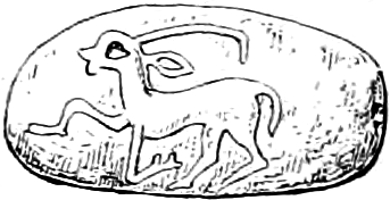
Fig. 130.—River pebble engraved; from De
Gobineau.
No subject occurs more often on the cylinders than the celestial gods
triumphing over demons. Such an image when impressed upon the soft
clay would preserve sealed-up treasures from attempts inspired by the
infernal powers, and would interest the gods in the maintenance of any
contract to which it might be appended.[295]
To all this we must add that superstitions, of which traces subsist in
the East to this day, ascribed magic power to certain stones. Hematite,
for instance, as its name suggests, was supposed to stop bleeding,
while even the Greeks believed that a carnelian gave courage to any one
who wore it on his finger.
When engraving on hard stone was first attempted, it was, then, less
for the love of art than for the profit to be won by the magic virtues
and mysterious affinities, both of the material itself, and of the
image cut in its substance. Then, with the increase of material
comfort, and the development of social relations, came the desire of
every Chaldæan to possess a seal of his own, a signet that should
distinguish him from his contemporaries and be his own peculiar
property, the permanent symbol of his own person and will. So far as
we can tell, none but the lowest classes were without their seals;
these latter when they were parties or witnesses to a contract, were
contented with impressing their fingernails on the soft clay. Such
marks may be found on more than one terra-cotta document; they answer
to the cross with which our own uneducated classes supply the place of
a signature.
When the use of the seal became general, efforts were made to
add to its convenience. In order to get a good impression it was
necessary that the design should be cut on a fairly even and
regular surface. The river pebbles were mostly ovoid in form and
could easily be made cylindrical by friction, and the latter shape
at last became so universal that these little objects are always
known as cylinders. These cylinders were long neglected, but
within the last few years they have been the subject of some curious
researches.[296] They may be studied from two different points of view.
We may either give our attention to the inscriptions cut upon them and
to their general historical significance, or we may endeavour to learn
what they may have to teach as to the religious myths and beliefs of
Chaldæa. As for us we are interested in them chiefly as works of art.
It will be our duty to give some idea of the artistic value of the
figures they bear, and to describe the process by which the engraving
was carried out.
The cylinders are, as a rule, from two to three-fifths of an inch in
diameter, and from three quarters of an inch to an inch and a half in
length. Some are as much as an inch and three quarters, or even two
inches long, but they are quite exceptional.[297] The two ends are
always quite plain—the engraving is confined to the convex surface.
As a rule the latter is parallel to the axis, but in some cases it is
hollowed in such a fashion that the diameter of the cylinder is greater
at the ends than in the middle (Fig. 131).
Nearly every cylinder is pierced lengthwise, a narrow hole going right
through it. Those that have been found without this hole are so very
few in number that we may look upon them as unfinished. In some cases
the hole has been commenced at both ends, but the drill has stopped
short of the centre, which still remains solid.
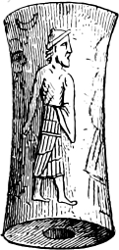
Fig. 131.—Concave-faced cylinder; from Soldi.
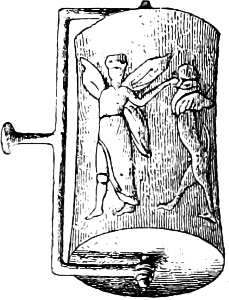
Fig. 132.—Cylinder with modern mount; from
Rawlinson.
The cylinders were suspended by these holes, but how? In casting about
for an answer to this question, the idea that the Babylonian attached
the greatest importance to the clear reproduction, in the clay, of
every detail of the design engraved upon his seal, has been taken as
a starting point, and a system of mounting invented for him which
would leave nothing to be desired in that respect (see Fig. 132). It
is a reproduction, in small, of a garden roller; as a restoration,
however, it can hardly be justified by the evidence of the monuments.
Examine the terra-cotta tablets on which these seals were used, and you
will see that their ancient possessors did not, as a rule, attempt to
impress the whole of the scenes cut in them upon the soft clay. It is
rare to find an impression as sharp and complete as that on the tablet
from Kouyundjik, which we borrow from Layard (Fig. 133). In the great
majority of cases signatories were content with using only one side
of their seals, usually the side on which their names were engraved.
Sometimes when they wished to transfer the whole of their cylinder to
the clay, they did so by several partial and successive pressures.[298]
The imperfect stamp with which the Chaldæans were satisfied could
easily be produced without the help of such a complicated contrivance
as that shown in our Fig. 132. Nothing more was necessary than to
lay the cylinder upon the soft clay and press it with the thumb and
fore-finger. The hole through its centre was used not to receive an
armature upon which it might turn, but merely for suspending it to
some part of the dress or person. In most cases it must have been hung
by a simple cord passed round the neck. Now and then, however, the
remains of a metal mount have been found in place, but this is never
shaped like that shown above. It is a bronze stem solidly attached to
the cylinder, and with a ring at its upper extremity (Fig. 134).[299]
Cylinders are also found with a kind of ring at one end cut in the
material itself (Fig. 135).
How were these cylinders carried? They must have been attached to the
person or dress, both for the sake of the protecting the image with
which most of them were engraved, and for convenience and readiness
in use as seals. In Chaldæa the fashion seems to have been, at one
time, to fasten them to the wrist. In those tombs at Warka and Mugheir
that we have described, the cylinders were found on the floors of the
tomb-chambers, close to the wrist-bones of the skeletons; and the
latter had not been moved since the bodies to which they had belonged
were laid in the grave.[300] This fashion was apparently abandoned
by the Assyrians, for in those reliefs which reproduce the smallest
details of dress and ornament with such elaboration, we can never find
any trace of the seal beside the bracelets. It is probable that it was
hung round the neck and put inside the dress, in front, for greater
security. It never occurs among the emblematic objects of which the
necklace that spreads over the chest outside the robe, is made up. To
this day traders in the East keep their seals in a little bag which
they carry in an inside pocket.
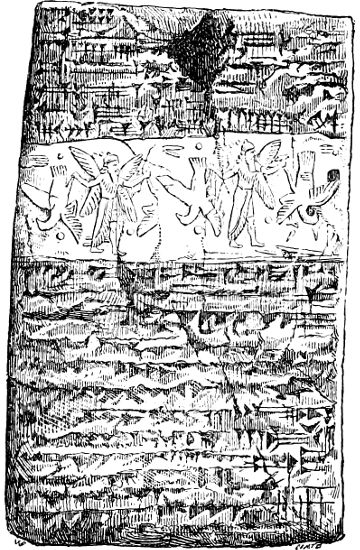
Fig. 133.—Tablet with impression from a
cylinder; from Layard.
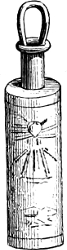
Fig. 134.—Cylinder with ancient bronze mount;
from Soldi.
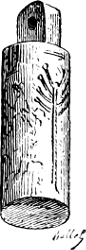
Fig. 135.—Cylinder and attachment in one; from
Soldi.
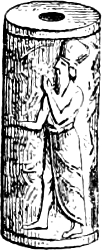
Fig. 136.—Chaldæan cylinder; from Ménant.
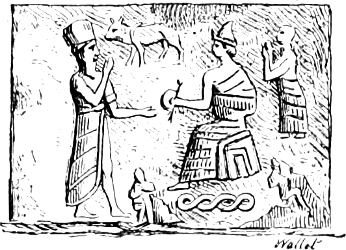
Fig. 137.—Impression from the same cylinder.
The practical requirements of the Mesopotamians were satisfied with a
hasty impression from their seals, but we must be more difficult to
please. Before we can study the cylinder with any completeness we must
have an impression in which no detail of the intaglio is omitted; such
a proof is to be obtained by a complete turn of the cylinder upon some
very plastic material, such as modelling-wax, or fine and carefully
mixed plaster-of-Paris. The operation requires considerable skill.
When it is well performed it results in a minute bas-relief, a flat
projection, in reverse, of the whole intaglio. The subject represented
and its execution can be much better seen in a proof like this than on
the original object, it is therefore by the help of such impressions
that cylinders are always studied; we make use of them throughout this
work. Our Figs. 136 and 137 give some idea of the change in appearance
between a cylinder and its impression.
The cutting on the cylinders, or rather on all the engraved stones of
western Asia, is in intaglio. This is the earliest form of engraving
upon pietra-dura in every country; the cameo is always a
much later production; it is only to be found in the last stage of
development, when tools and processes have been carried to perfection.
It is much easier to scratch the stone and then to add with the point
some definition to the figure thus obtained, than to cut away the
greater part of the surface and leave the design in relief. The latter
process would have been especially difficult when the inscriptions
borne by many of the seals came to be dealt with. What long and painful
labour it would have required to thus detach the slender lines of the
cuneiform characters from the ground! And why should any attempt of
the kind be made? As soon as these engraved stones began to be used
as seals, there was every reason why the ancient process should be
retained. The designs and characters impressed upon deeds and other
writings were clearer and more legible in relief than in intaglio.
And it must be remembered that with the exception of some late bricks
on which letters are raised by wooden stamps, the wedges were always
hollowed out. We find but one period in the history of Chaldæa when,
as under the early dynasties of Egypt, her written characters were
chiselled in relief. It is, then, apparent that the artists of Chaldæa
would have done violence to their own convictions and departed from
long established habits, had they deserted intaglio for work in relief.
That they did not do so, even when their skill was at its highest
point, need cause us no surprise.
The Chaldæans naturally began with the softest materials, such as
wood, bone, and the shells picked up on the shores of the Persian
Gulf. Fragments of some large pearl oysters and of the Tridacna
squamosa, on which flowers, leaves, and horses have been engraved
with the point, have been brought from lower Chaldæa to London (see
Fig. 138).[301] Limestone, black, white, and veined marble, and the
steatite of which most of the cylinders are made, were not much
more difficult. These substances may easily be cut with a sharp
flint, or with metal tools either pointed or chisel-shaped. With
a little more effort and patience still harder materials, such as
porphyry and basalt; or the ferruginous marbles—serpentine, syenite,
hematite—could be overcome. The oldest cylinders of all, those that
are attributed to the first Chaldæan monarchy, are mostly of these
stubborn materials; their execution was easy enough to the men who
produced the statues of Gudea.[302] All that such men required to pass
from the carving of life-size figures to the cutting of gems was good
eyesight and smaller tools.
It was only towards the end of this period that more unkindly stones
began to be used, such as jasper and the different kinds of agate,
onyx, chalcedony, rock-crystal, garnets, &c. The employment of such
materials implies that of the characteristic processes of gem-cutting,
whose peculiarity consists in the substitution of friction for cutting,
in the supercession of a pointed or edged tool by a powder taken from a
substance harder, or at least as hard, as the one to be operated upon.
“The modern engraver upon precious stones,” says M. Soldi, “sets about
his work in this fashion. He begins by building up a wax model of his
proposed design upon slate. He then takes the stone to be engraved, and
fixes it in the end of a small wooden staff. This done he makes use,
for the actual engraving, of a kind of lathe, consisting of a small
steel wheel which is set in motion by a large cast-iron flywheel turned
by the foot. To the little wheel are attached small tools of soft
iron, some ending in a rounded button, others in a cutting edge. The
craftsman holds the staff with the stone in his left hand; he brings
it into contact with the instrument in the lathe, while, from time to
time, he drops a mixture of olive oil and diamond dust upon it with his
right hand; with the help of this powder the instrument grinds out all
the required hollows one after the other.”[303]
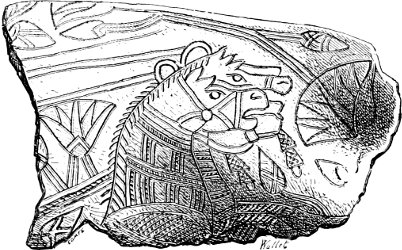
Fig. 138.—Engraved shell. British Museum.
The first engravers who attacked precious stones had no diamond dust.
They supplied its place with emery powder, which was to be found in
unlimited quantities in the islands of the Archipelago, whence it was
imported by the Phœnicians at a very early date. Moreover there was
nothing to prevent them crushing the precious stones belonging to the
class called corundum, such as sapphires, rubies, amethysts,
emeralds, and the oriental topaz. No doubt the lathe or wheel was a
comparatively late invention. M. Soldi thinks it hardly came into use
in Mesopotamia till about the eighth century B.C. Before that the
continuous rotary movement that was so necessary for the satisfactory
conduct of the operation was obtained by other means. According to M.
Soldi they must have employed for many centuries a hand-drill turned by
a bow, like that of a modern centre-bit or wimble.[304]
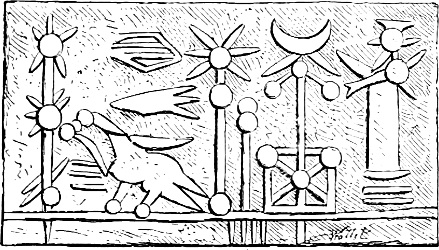
Fig. 139.—Chalcedony cylinder. British Museum.
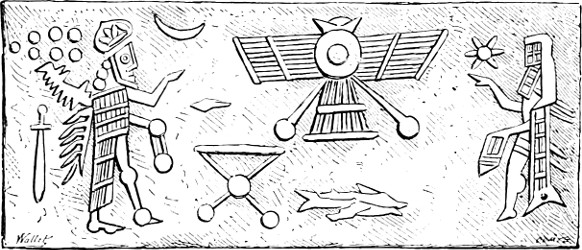
Fig. 140.—Cylinder of black jasper. British
Museum.
On examining the oldest Mesopotamian engravings on precious stones
a skilled craftsman would see at once that nearly all the work had
been done with only two instruments—one for the round hollows and
another for the straight lines. In the designs cut with these tools
we find curiously complete likenesses of the small lay figures with
ball-and-socket joints used by painters. Some idea of the strange
results produced by these first attempts at gem-engraving may be
formed from our reproductions of two cylinders in the collection at
the British Museum. The influence of the process, the tyranny of the
implement, if we may use such a phrase, is conspicuous in both. Note,
for instance, in the first design, which is, apparently, a scene of
sacrifice (Fig. 139), how the head and shoulder of the figure on the
left are each indicated by a circular hollow. The same primitive system
has been used in the cylinder where the god Anou is separated from
another deity by the winged globe (Fig. 140). The design is here more
complex. The bodies of the two divinities and the wings of the globe
are indicated by numerous vertical and horizontal grooves set close
together; but the circular hollows appear not only in the globe and in
the piece of furniture that occupies the foreground, but also in the
knees, calves, ankles, and other parts of the two figures.
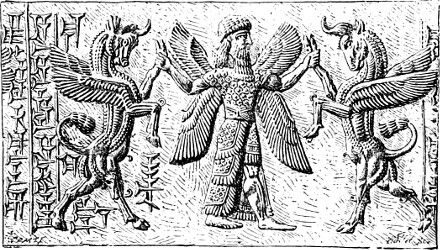
Fig. 141.—Assyrian cylinder. British Museum.
Drawn by Wallet.
As time went on they learnt to use their tools with more freedom and
more varied skill. We shall not attempt to follow M. Soldi in tracing
the art through all its successive stages.[305] As an example of the
skill to which the Mesopotamian artist had attained towards the seventh
century B.C. we may quote a splendid cornelian cylinder belonging to
the British Museum (Fig. 141).[306] The subject is extremely simple. In
its general lines it continually recurs on the bas-reliefs and gems of
the Sargonid period. A winged personage, with his arms extended, stands
between two fantastic winged quadrupeds and grasps each by a fore-paw.
The chief actor in the scene is very like the winged genius whom we
encounter so often on the walls of the palaces (see above, Fig. 36),
while both in the exaggerated modelling of the legs and in the care
with which the smallest details of the costume are carried out, the
special features that distinguished the sculpture of the time may be
recognized. The execution is firm and significant, though a little dry
and hard. It is made up of short cuts, close together; the engraver did
not understand how to give his work that high polish and finish that
enabled the Greeks to express the subtlest contours of the living form.
From this period onwards the artists of Mesopotamia and, in later
years, those who worked for the Medes and Persians, put into use all
the precious stones that were afterwards engraved by the Greeks and
Romans. Their tools and processes cannot have greatly differed from
those handed down by antiquity to the gem-cutters of the middle ages
and the Italian renaissance. If their results were inferior to those
obtained by Pyrgoteles and Dioscorides,[307] it was because oriental
art never had the knowledge of the nude or the passion for beauty of
form which made Greek art so original. Intaglio is only a bas-relief
reversed and greatly diminished in size; the style and spirit of
contemporary sculpture are reflected in it as the objects of nature are
reflected in the mirror of the human eye. For want of proper tools it
may lag behind sculpture, but it will never outstrip it.
The close connection between the two arts is nowhere more strongly
marked than in some of the cylinders belonging to the first monarchy.
Although the artist was content in most cases with mere outlines, he
now and then lavished more time and trouble on his work, and gave to
his modelling something of the breadth and truth that we find in the
statues from Tello. These merits are seen at their best in a fine
cylinder belonging to the New York Museum (Fig. 142). It represents
Izdubar and his companion Hea-bani, the Hercules and Theseus of
Chaldæan mythology, engaged in a hand-to-hand struggle with a wild bull
and a lion, a scene which may be taken as personifying the struggle
between the divine protectors of mankind on the one hand, and the blind
forces of nature assisted by all the supernatural powers of evil on
the other.[308] We have already had occasion to speak of Izdubar, who
is always represented nude and very muscular. As for his companion,
he combines the head and bust of a man with the hind quarters of a
bull.[309] There is a certain conventionality in the attitude of
the lion and in the way his claws are represented, and the movement
of Hea-bani’s left arm is ungraceful; but the antelope under the
inscription and the bull overpowered by Izdubar are rendered with a
truth of judgment and touch that all connoisseurs will appreciate. We
may say the same of the two heroes; their muscular development is given
with frankness but without exaggeration; the treatment generally is
free and broad.
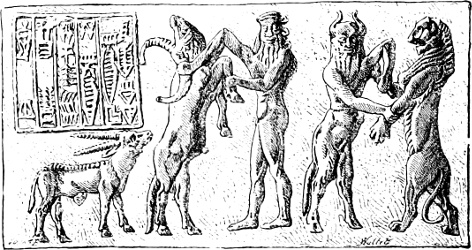
Fig. 142.—Chaldæan cylinder. Marble or
porphyry. New York Museum.
Between this cylinder and the one quoted on the last page as among the
masterpieces of Ninevite art, there is the same difference as between
the statues of Tello and the bas-reliefs of Nimroud and Khorsabad. The
engraver, who some fifteen centuries before our era, cut upon marble
this episode from one of the favourite myths of Chaldæa, may not have
been able to manipulate precious stones with such ease and dexterity
as the artist of Sargon or Sennacherib who made the cylinder in the
British Museum, but he had the true feeling for life and form in a far
higher degree.
So far we have studied the cylinders from the standpoint of their use
and the material of which they are composed; we have described the
processes employed in cutting them and the changes undergone in the
course of centuries in the style of art they display. We have yet to
speak of the principal types and scenes to be found upon them. We
cannot pretend, however, to give the details in any complete fashion.
For that a whole book would be necessary, such as the one promised by
M. Ménant.
This is not because the themes treated show any great variety; they
have, in fact, far less originality than might at first be thought.
Compare the impressions from different cabinets and attempt to classify
them in order of subject; you will find the same types and scenes
repeated, with but slight changes, on a great number of specimens, and
you will soon discover that hundreds of cylinders may be divided into
a very small number of groups. In each group, too, many individual
specimens will only be distinguishable from each other by their
inscriptions. All this is to be easily accounted for.
The finest cylinders, whether in design or material, must have been
commissioned by kings, nobles, and priests, while the common people
bought theirs ready-made. When any one of the latter wished to buy a
seal he went to the merchant and chose it from his stock, which was
composed of the patron gods and religious scenes which happened to be
most in fashion at the time. As soon as the purchaser had made his
selection he caused his own name to be engraved in the space left for
the purpose, and it was this inscription, rather than the scene beside
it, that gave its personal character to the seal. The production of
these objects was a real industry, carried on all over the country and
for many centuries, and continually reproducing the same traditional
and consecrated types.
M. Ménant believes himself able to determine where most if not all
the cylinders of the early monarchy were produced. He talks of the
schools of Ur, of Erech, of Arade, and in many cases the signs on which
he relies appear to have a serious value. But we shall not attempt
even to give a résumé of the arguments he uses to justify the
classification he was the first to sketch out; we could not do so
without multiplying our illustrations and extending our letterpress to
an extravagant degree. Judging from the examples quoted by M. Ménant
himself in support of his own theory, the workshops of different towns
in the course of a single period were distinguished rather by their
predilection for particular themes than by anything peculiar in their
styles of execution; the same processes and the same way of looking at
living forms may be recognised in all. We may, then, treat all these
early works of the Chaldæan gem-engravers as the productions of a
single school; and in this history we only propose to note and discuss
the general direction of the great art currents. We cannot follow all
the arms and side streams into which the main river is subdivided.
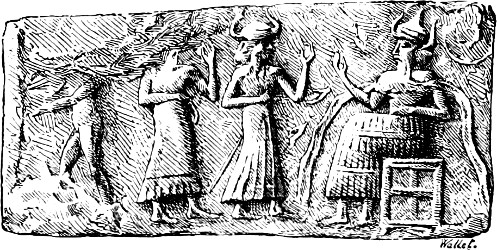
Fig. 143.—Chaldæan cylinder. Green serpentine.
Louvre. Drawn by Wallet.
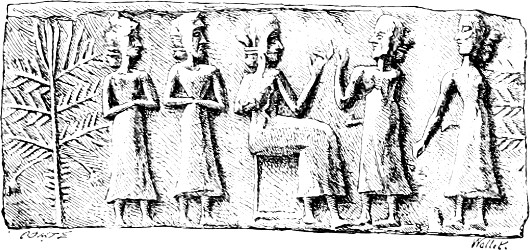
Fig. 144.—Chaldæan cylinder. Basalt. Louvre.
Drawn by Wallet.
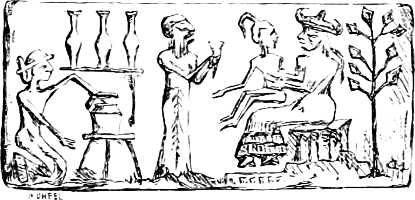
Fig. 145.—Chaldæan cylinder. Basalt. Louvre.
One of the favourite subjects at this time was the scene of worship we
have already encountered on the Sippara tablet (Vol. I., Fig. 71.); in
the cylinders as well as on the larger tablet the worshipper is led
by a priest into the presence of an enthroned divinity. The temple,
indicated in the tablet, is suppressed in the seals, where the space is
so much less, but otherwise the composition is the same. It would be
difficult to imagine anything better fitted for objects of a talismanic
character, which were also to be used for the special purpose of these
cylinders. Whenever the Chaldæan put his seal upon clay he renewed
the act of prayer and faith which the engraver had figured upon it;
he took all men to witness his faith in the protection of Anou, of
Samas, or of some other god. We need therefore feel no surprise at
encountering this subject upon the cylinders of Ourkam, (Vol. I., Fig.
3), and his son Dungi,[310] princes in whom the oldest Chaldæan royalty
was embodied. Both of these seals seem to have been engraved in Ur,
the home of that dynasty. We have given several other variants of the
same theme (Vol. I., Figs. 17–20, and above, Figs. 40 and 124);[311]
here are two more found by M. de Sarzec at Tello (Figs. 143, 144). In
the first of these two streams seem to flow from the shoulders of the
seated deity; they may have some connection with that worship of the
two great rivers whose traces appear elsewhere.[312] In the second
example, which is not a little rough and summary in its execution, the
figures are believed to be those of women, on account of the way in
which the hair is arranged. It is clubbed with ribbons at the back of
the neck. The artist seems also to have tried to suggest the amplitude
of the female bosom. On the whole we may believe the scene to represent
a goddess—Istar perhaps—surrounded by worshippers of her own sex.
In the Louvre there is a cylinder with a scene of the same kind, but
more complex and, for us, more obscure (Fig. 145). A seated figure,
apparently female from the long hair flowing over the shoulders, sits
upon a low stool and holds a child upon her knees. In front of the
group thus formed stands a man who seems to be offering some beverage
in a horn-shaped cup. Behind him there are three not inelegant vases
upon a bracket, and a man kneeling beside a large jar upon a tripod.
The latter holds in his hand the spoon with which he has filled the
goblet presented by his companion. We may, perhaps, take the whole
scene as a preparation for a feast offered to one of those goddesses
of maternity whom we find on the terra-cottas (see above Fig. 107).
We shall not here go into the question whether we may see in all this
an episode in the legend of the ancient Sargon, the royal infant whom
his mother exposed upon the water after his clandestine birth; after
commencing like Moses, the hero of this adventure was found and brought
up by a boatman, and became the founder of an empire when he grew to
manhood, like Cyrus and Romulus.[313]
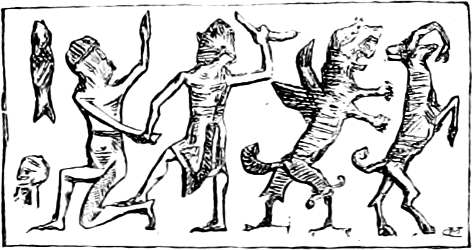
Fig. 146.—Chaldæan cylinder. Montigny
collection.
If we may believe M. Ménant some of the cylinders belonging to this
period represent human sacrifices. Such he supposes to be the theme of
the example reproduced in Fig. 146. The figure with arm uplifted would
be the priest brandishing his mace over the kneeling victim, who turns
and begs in vain for mercy. The issue of the unequal struggle is hinted
at by the dissevered head introduced in the lower left-hand corner. To
make our description complete we must notice the subordinate passage,
a rampant leopard, winged, preparing to devour a gazelle.[314] The
conjecture is specious, but until confirmatory texts are discovered, it
will remain a conjecture. Those texts that have been quoted in support
of it are vague in the first place, and, in the second, they appear
to refer less to the sacrifice of human victims than to holocausts of
infants, who must have been thrown into the flames as they were in
Phœnicia. Why should we not look upon it as an emblem of the royal
victories, an emblem similar in kind to the group that recurs so
persistently in Egyptian sculpture, from the time of the ancient Empire
to that of the Ptolemies?[315] The gesture in each case is almost
exactly the same; the weapon raised over the vanquished both in the
Theban relief and the Chaldæan cylinder is well fitted to suggest the
power of the conqueror and his cruel revenges. We have reproduced this
example less for its subject than for the character of its execution.
The figures are modelled in a very rough-and-ready fashion; we might
almost call it a sketch upon stone. The movement, however, of the two
chief figures is well understood and expressive.
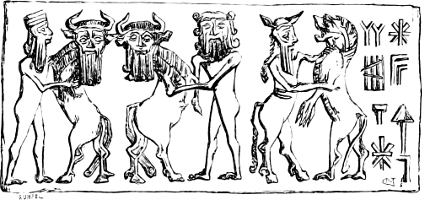
Fig. 147.—Chaldæan cylinder. Basalt.
Another and perhaps still richer series is composed of stones on which
the war waged by Izdubar and his faithful Hea-bani against the monsters
is figured.[316] We have already shown Izdubar carrying off a lion
he has killed (see above, Fig. 35). Another task of the Mesopotamian
Hercules is shown in Fig. 147, where he is engaged in a struggle with
the celestial human-headed bull, who has been roused to attack the hero
by Istar, whose love the hero has refused.[317]
In this cylinder it will be noticed that Izdubar is repeated twice,
once in profile and once full face. Close to him Hea-bani is wrestling
with a lion, the bull’s companion and assistant. In another example
we find Izdubar alone (Fig. 148) and maintaining a vigorous struggle
against a bull with long straight horns, and at the same time turning
his head so as to follow a combat between a lion and ibex that is going
on behind him.[318] The action of both these latter animals is rendered
with great freedom and truth. We have already had to draw attention
to the merit that distinguishes not a few of the animals in these
cylinders.[319] This merit is to be found in almost every composition
in which the artist has been content to make use of natural types. It
is only when he compiles impossible monsters that the forms become
awkward and confused. An instance of this may be found in a cylinder
found by M. de Sarzec at Tello, on which winged quadrupeds seizing
and devouring gazelles are portrayed (Fig. 149). Too many figures are
brought together in the narrow space and the result is confusion. We
are not, however, disposed to accept this cylinder as belonging to the
first years of Chaldæan art. It is of veined agate, a material that
was not among the earliest employed; but there are many more on which
similar scenes are engraved, and which, by their execution, may be
safely placed among the most ancient products of art.[320]
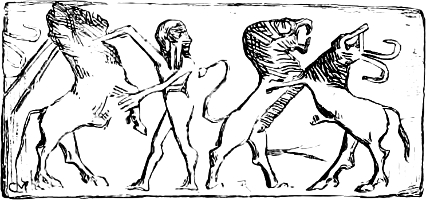
Fig. 148.—Chaldæan cylinder. Black marble.
French National Library.
One of the earliest types invented by the imaginations of these
people was that of the strange and chaotic beings who, according to
the traditions collected by Berosus, lived upon the earth before the
creation of man, creatures in which the forms and limbs afterwards
separated and distinguished by nature, were mixed up as if by accident.
The text in question is of the very greatest interest and value. It
proves that the composite figures of which Chaldæan art was so fond
were not a simple caprice of the artists who made them, but were
suggested by a cosmic theory of which they formed, as it were, a
plastic embodiment and illustration.
“There was a time,” says Berosus, “when all was water and darkness, in
which monstrous animals were spontaneously engendered: men with two
wings, and some with four; with two faces, and two heads, the one male
and the other female, and with the other features of both sexes united
in their single bodies; men with the legs and horns of a goat and the
feet of a horse; others with the hind quarters of a horse and the upper
part of a man, like the hippocentaurs. There were also bulls with human
heads, dogs with four bodies and fishes’ tails, and other quadrupeds in
which various animal forms were blended, fishes, reptiles, serpents,
and all kinds of monsters with the greatest variety in their forms,
monsters whose images we see in the paintings of the temple of Bel at
Babylon.”[321] Of all these fantastic creatures there are hardly any
but may be found on some cylinder, and if there be one or two still
missing, it is very probable that future discoveries will fill up the
gap.
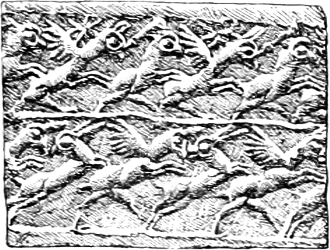
Fig. 149.—Chaldæan cylinder of veined agate.
Louvre.
Before quitting these remains from the earliest school of gem
engraving, we must draw attention for a moment to the way in which
it treats costume. In most cases the folds of the stuff are imitated
by very fine parallel strokes. Sometimes, as, for instance, in the
figure on the right of Ourkam’s seal (Vol. I., Fig. 3), these close
and slightly sinuous lines extend without interruption from the top to
the bottom of the dress, but in most cases they are crossed by several
transverse bands, probably coloured, either woven into the material or
sewn upon it (see Vol. I., Figs. 3, 17, and 20, and above, Figs. 39 and
41). We have already encountered this method of treating drapery in
certain statuettes from the same place and time (Figs. 99 and 100), but
we never find it in Assyria or in Chaldæa after the fall of Nineveh,
either in statues or on engraved stones.
There is another characteristic detail that should not be forgotten,
namely, the caps turned up at the side in the shape of horns (Vol. I.,
Fig. 17 and above, Fig. 143). By this head-dress and the plaited robes
a Chaldæan cylinder may be at once recognised as dating from these
remote ages. Fashions and methods of execution changed as soon as the
preponderance of Assyrian royalty was assured. Artists of merit must
then have migrated northwards and opened workshops in the cities of
the Tigris; but production was never so great as in the south. Every
traveller in those regions notices that there are far more cylinders
to be purchased in the bazaars of Bagdad and Bassorah than in those
of Mossoul.[322] The glyptic art of Assyria was an exotic, like her
sculpture and her architecture.
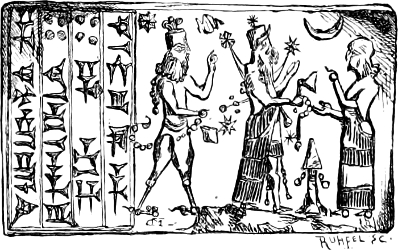
Fig. 150.—Archaic Assyrian cylinder. In the
Uffizi, Florence.
In attempting to define the characteristics of the Assyrian cylinders,
and to distinguish them from those of Chaldæa, we may take as points of
departure and as types of the new class, a few seals bearing legends
that enable us to give them a positive date. Thus we may learn from a
signet that once belonged to the governor of Calah what the execution
of the artists employed by the princes of Elassar and Nimroud was
like (Fig. 150). We need not hesitate to assign this cylinder to the
first Assyrian monarchy. The workmanship, at once careful and awkward,
belongs to a time when all the difficulties of gem engraving had not
yet been overcome. In the wings of the genius and the legs of the
personage who follows him the management of the instrument used is that
of an art still in its infancy. In this seal then we have a valuable
example of what we may call The Archaic Assyrian Cylinder.
We have already figured several in which the same characteristics
appear (Figs. 124, 139, and 140). In the same class we may put a number
of cylinders on which scenes of worship are represented with slight
variations (Figs. 151 and 152).[323] The figure of the king standing
before the altar with his right hand upon his bow resembles the
Assurnazirpal in several of the Nimroud reliefs (see above, Fig. 140).
The Balawat gates and other remains from the same time have already
made us acquainted with the accessories of the act of worship figured
in the last of these two cylinders, especially with the short column
surmounted by a cone (Plate XII).
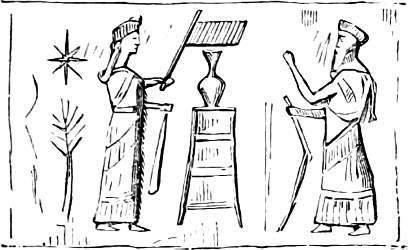
Fig. 151.—Assyrian cylinder. Serpentine.
National Library, Paris.
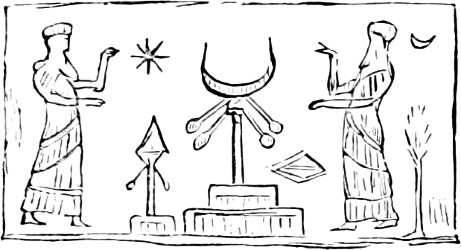
Fig. 152.—Assyrian cylinder. Serpentine.
National Library, Paris.
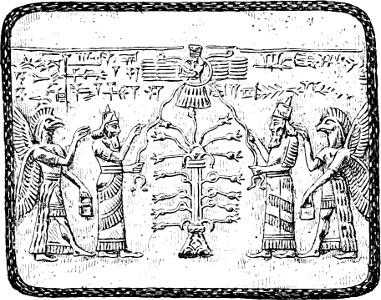
Fig. 153.—Assyrian cylinder. British Museum.
Drawn by Wallet.
We now come to the epoch of the Sargonids with its still more refined
and skilful art, of which an exquisite cylinder in the British Museum
may be taken as an example (Fig. 153). The name of a personage called
Musesinip has been read upon it, and it is believed to be a reduction
from a contemporary bas-relief. In the centre appears the holy tree
with the supreme deity floating over it in the winged disk. On each
side of the tree is the figure of a king with a winged eagle-headed
genius behind him. These last-named creatures have their right hands
raised, while in their left they hold the bronze buckets we have
already encountered at Nimroud (Vol. I., Fig. 8). There is one detail
which is not to be found, so far as I know, in the bas-reliefs, namely,
the double cord that descends from the winged disk into the hands
of the king. The artist, no doubt, meant to symbolize by this the
communication established by prayer between the prince and his divine
protector.
Among the dated and authenticated examples from this epoch the cylinder
inscribed with the name of Ursana, king of Musasir and adversary of
Sargon, may be quoted.[324] We do not reproduce it because it differs
so little from the example of Assyrian gem engraving given in our
Fig. 141. The same genius appears in the middle, but instead of two
winged monsters he holds two ostriches by the neck. We have already
encountered this fight between a man and an ostrich on a stone dating
from the same century (Fig. 75). We may name as a last example the
stone found by Layard at Kouyundjik, which may be the very signet of
Sennacherib himself (Vol. I., Fig. 70).
If we place all these impressions side by side we shall find they have
a certain number of common characteristics which will enable us to
recognize those of Assyrian parentage even when they bear no lettering,
or when their inscriptions tell us nothing as to their origin. In the
first place they are mostly of fine materials, such as chalcedony or
onyx. Secondly, they contain sacred emblems and types that are not to
be found in the primitive arts of Chaldæa, such as the mystic tree,
the winged globe, the eagle-headed genius, &c. Thirdly, the fantastic
animals of Assyria are different in general appearance from those of
the southern kingdom; and, finally, the costume of the two countries is
not the same. In the cylinders from Calah and Nineveh we find neither
the flounced robes nor the cap with turned-up borders. As in the
palace reliefs, the mantle-fringes cross the figure slanting-wise—an
obliquity which affords a ready means of distinguishing between a
native of Assyria and one of Chaldæa.
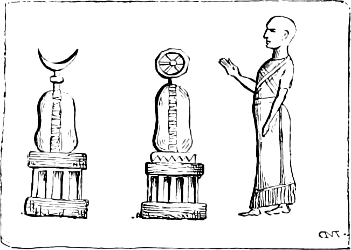
Fig. 154.—Chaldæan cylinder dating from the
second monarchy. Black jasper. British Museum.
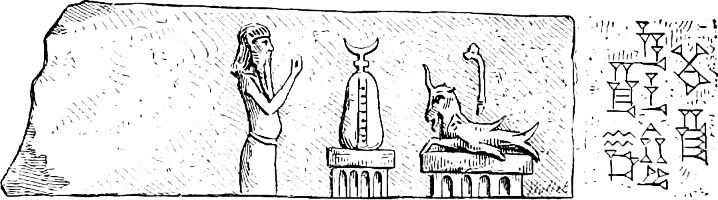
Fig. 155.—Impression of a cylinder on a
contract; from Ménant.[2]
The use of the cylinder persisted after the fall of Nineveh and
throughout the second Chaldæan monarchy, but the types from this late
epoch display very little invention or variety. The most common of all
shows a personage standing bare-headed before two altars, one bearing
the disk of the sun, the other that of the moon (Fig. 154).[325]
This individual is sometimes bearded, sometimes shaven. His costume
is neither that of early Chaldæa nor the twisted robe of Assyria.
Sometimes one of the altars or the field is occupied by a monster with
a goat’s head and a fish’s body and tail, as in the impression left
by a cylinder on a contract dated “the twelfth year of Darius, king
of Babylon, king of the nations” (Fig. 155).[326] The use of these
types lasted in the valley of the Euphrates all through the Achæmenid
supremacy. No inscriptions were used. Names and dates were engraved by
hand on the clay after the seal had been placed upon it. We can see
clearly from the monotony of the images, which are repeated almost
unchanged on hundreds of tablets, that the art of gem-engraving was in
full decadence. The people were enslaved, they lived upon the memory of
their past, creating neither new forms nor new ideas. They no longer
attempted to make their seals works of art; they looked upon them as
mere utensils.
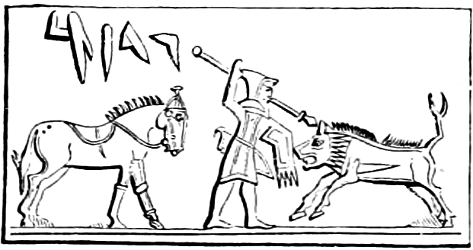
Fig. 156.—Cylinder with Aramaic characters.
Vienna Museum.
Cylinders are sometimes found in this region inscribed with Aramaic
characters, like the weights from Nimroud. Such, for instance, is one
representing a dismounted hunter meeting the charge of a lion,[327]
while his horse stands behind him and awaits the issue of the struggle
(Fig. 156). The costume of the hunter is neither Assyrian nor Chaldæan.
He has been supposed to represent a Scythian. The Scythian figured at
Bisitun has the same pointed bonnet or cowl. Cylinders of this kind
will long be a difficulty for the classifier.[328]
The cylindrical form was not the only one used by the inhabitants of
Mesopotamia for their seals. Small objects in pietra dura of a
different shape are now often found in the country, and are beginning
to hold their own in our museums; these are pyramids, spheroids,
and especially cones. Every cone, except one or two which may never,
perhaps, have been finished, is pierced near its summit with a hole for
suspension. There has never been any doubt from the first that they
were signets. Their bases, which are generally flat, but sometimes
convex or concave, are always engraved in intaglio. The impression was
thus obtained at one stroke, at one pressure of the hand, and it was
in all probability the greater ease with which that operation could be
carried out that in time led to the supercession of the cylinder by the
cone. The use of the latter became almost universal in the time of the
Seleucidæ and Parthians.
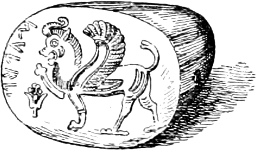
Fig. 157.—Cone. Sapphirine chalcedony.[329]
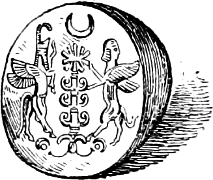
Fig. 158.—Cone. Sapphirine chalcedony.[330]
It is when they grow old that both nations and individuals turn their
attention to ease and comfort. The Chaldees were long contented with
the cylinder, although, as a seal, it was a very imperfect contrivance.
The ancient monarchy never seems to have made use of flat signets. The
impression of one has been sought for in vain on those contracts of
the time of Hammourabi, where so many cylinders have left their mark.
The oldest document on which the trace of a circular seal has been
recognized belongs to the northern kingdom, and dates from the reign
of Bin-Nirari, who occupied the throne of Assyria towards the end of
the ninth century B.C. From this moment the use of the cone becomes
rapidly common. Under the Sargonids, and still more during the second
Chaldee monarchy and under the Achæmenids, it superseded the cylinder.
The dates inscribed on the tablets prove their age; the space on the
cones themselves was too narrow, as a rule, for a legend. On a few
specimens we find one or two characters engraved, generally a divine
monogram or the traditional emblems of the sidereal powers. A few cones
have inscriptions in Aramaic characters (see Fig. 157); on the example
figured we again encounter the strange composite beast we have already
seen upon a stone tablet and a cylinder (Figs. 87 and 141). In spite
of the alphabet employed, this cone must have been engraved either in
Nineveh or its neighbourhood.
The narrowness of the field explains the want of variety in the
subjects. In a small circle like this there was no room for more than
a single figure with a few accessories, or, at most, for two figures.
We cannot expect to find scenes as varied and complicated as those upon
the cylinders. A very small number of the simplest themes formed the
stock-in-trade of the engraver.
There are about four hundred specimens in the British Museum, and as
many more in Paris, in the Louvre and the Cabinet des Antiques.
In the presence of them all we can only confess to a feeling of
embarrassment. They are never arranged in chronological order; Assyrian
intaglios are mixed up with those from Chaldæa, from Phœnicia and
Persia. Certain types were reproduced and copied in this region even
as late as the Arsacids and Sassanids. We shall choose a few, however,
which we may with some certainty attribute to Assyria. There is in the
first place one on which two winged figures seem to be adorning the
sacred tree (Fig. 158). We find the impression of an almost exactly
similar cone on a contract dated 650 B.C. The only differences lie in
the more careful execution of the latter seal and in the substitution
of the radiant disk of the sun for the crescent moon.[331] In another
impression we find the radiant disk changed into the winged globe.[332]
The shape and fringe of the Assyrian robe may be recognized in the
intaglio in which a man with long hair and beard does homage to a
winged genius (Fig. 159). The worshipper is standing, but behind him
appears a kneeling figure. This posture is rare, but it is met with in
a few instances on monuments from this period, and is always used to
suggest the profound respect with which a man does obeisance either to
his god or his king.[333]
We need not hesitate to ascribe to the second Chaldæan monarchy a cone
with a bearded individual standing before an altar on which lies a
fantastic animal (Fig. 160); above his head appear the sun, the moon,
and a star. We have already mentioned two examples of this theme, which
begins to appear in the time of Nebuchadnezzar and remains in fashion
until the Macedonian conquest.[334]
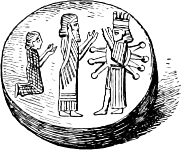
Fig. 159.—Amethyst cone. National Library,
Paris.[335]
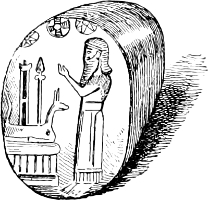
Fig. 160.—Agate cone. National Library,
Paris.[336]
Among the themes in most frequent use under the Sargonids we might have
quoted the single combat of the king with a lion, the god
standing upon a lion’s back, the king over whose head a servant
holds an umbrella, the heads and bodies of different animals, and
others.[337] We cannot pretend, however, to enumerate them all. It is
sufficient to show, as we have done, that after the ninth century at
latest both cylinders and cones were produced in the same workshops,
and that the differences in their figuration are to be explained by the
dimensions and form of the new surface. Those who have supposed that
the use of flat seals only commenced under the Achæmenids are mistaken.
All that we can say with truth is that intaglios cut upon sections of
cones, spheres and pyramids are less ancient than the cylinders of Ur,
Erech, Accad and Sippara.
This is proved by the dated contracts to which we have already so often
had to refer; but supposing no such contracts to have been in existence
we could have arrived at the same conclusion by another path. Cones in
calcareous stone, in marble, or even in pietra dura are either
wanting altogether, or very few and far between; they are almost all in
precious stones, most of them in carnelian and chalcedony. Sapphirine
chalcedony, with its fine bluish tint, seems to have been most in
favour.
In Egypt we found intaglios upon metal as well as upon lapidary
substances.[338] This use of metal was a result of mounting seals in
circles of gold or silver. Precious stones were rare and difficult
to cut; what could be more natural than to substitute metal for them
and to make the bezel of a ring of the same material as its hoop. For
its engraving neither lathe nor diamond dust was wanted; the burin
alone was necessary, and the figures cut by it gave a result no less
satisfactory than those obtained by the slower process and in the more
stubborn material. The temptation was great for the Egyptian artist,
and we are not surprised that he succumbed to it, but it did not exist
for the Chaldæan engraver. The latter had only to deliver a stone which
his client could wear fastened to his wrist, or hung round his neck
by a cord. He had no direct and intimate relations with the worker
in metal; he was not compelled to call in the latter to mount his
creation. Sometimes, under the influence perhaps of foreign models,
he may have attempted to substitute metal for stone, but isolated
attempts did not make a school. We can point to only one example of
such work. The British Museum possesses a silver cylinder, but the only
interesting thing about it is its material.[339] The composition of the
type is naive and its execution rough. All this allows us to believe
that metal seals were very rare and never came into general use.
Oriental artists, at least during the period of which we are now
speaking, hardly ever practised any kind of gem-cutting but intaglio,
but there are two stones in existence in which first attempts at a
process that must have led in time to the production of cameos, may be
traced. “In one of these gems, an onyx, the upper layer is cut away
from the one below it and an inscription left. In the other the eyes
and neck of a serpent are rendered with the aid of three different
tints in the stone.”[340]
We have now reached the end of our inquiry into the history of
Mesopotamian sculpture—an inquiry that we have endeavoured to make
as complete as the existing remains would allow. So far as Chaldæa is
concerned, these are very few in number. On the other hand, the three
centuries over which the Assyrian power extended are pictured in such
a vast number of reliefs that we are embarrassed by their number as
much as by their want of variety. Our difficulty in the case of Assyria
has been to make a selection from a vast quantity of objects that tell
us the same thing again and again, while, in the case of Chaldæa, it
has been to insure that none of the scanty salvage from so great a
wreck should be lost. We have more than once had to make induction and
conjecture take the place of examination and assertion before we could
complete even a rough sketch of the development of Chaldæan art.
There is one question that must have been asked by many of our readers
before these pages came in their way, but is now, we venture to hope,
fully answered, and that is, whether the Semites of Chaldæa drew
their first inspiration from a foreign source, or whether it was an
original result from the natural aptitudes of the race. Ancient as
civilization may have been in the Euphrates valley, it was still more
ancient, to all appearance, in the valley of the Nile. And yet all who
have examined the figures we have placed before them must acknowledge
the originality and independence of Chaldæan art. No; the sculptors
of Memphis and Thebes were not the masters of those of Babylon and
Nineveh; they preceded them indeed, but they left them no teaching and
no models to copy.
This is proved in the first place by the difference, we might say the
opposition, between the two styles. The Egyptian sculptor simplifies,
abridges, and summarizes form; the Assyrian amplifies it and accents
its details. The former seems to see the human body through a veil
of gauze, which hides the accidents of the surface and the secondary
forms, allowing nothing to be clearly grasped but the contour and the
great leading lines. One would say that the second studied nature
through a magnifying-glass; he insists upon what the first slurs over.
This is not the only difference between the two methods and the two
interpretations. The Egyptian artist can seize the character of a
movement with much justice and vivacity, but he endeavours to ennoble
it by giving it a general and typical value. This he does, for example,
in the gesture of the king who brandishes his mace or sword over the
head of his conquered enemy while he holds him by the hair with his
other hand.[341]
He thinks more about elegance in arranging the posture of his figures;
look, for instance, at the men and women carrying offerings, at the
dancers and musicians who abound in the reliefs and pictures. His
favourite attitude, however, is one expressive of force in repose.
We cannot deny that in his figures in the round the Mesopotamian
sculptor showed the same predilection, but his choice was suggested,
or rather imposed, by the resistance of the materials he employed and
the necessity of avoiding certain executive difficulties over which
he could not triumph. We can hardly see how he could have given his
figures more animation or have better expressed the freedom of their
limbs and the swing of their bodies; the stones he used were either
too hard or too soft, and he was without the needful skill in the
management of his tools.
It is in the reliefs, where he is more at his ease, that he allows us
to see whither his natural inclinations would lead him. They contain
hardly any seated figures. Man is there always on his feet and in
action. Movement, to interest the Mesopotamian artist, need not be the
expression of an idea, or the cause of graceful lines. It pleases him
for its own sake by its freedom and unexpectedness, I am almost tempted
to say, by its violence.
This feeling is visible chiefly in the battle pictures and hunting
scenes. In these, no doubt, the drawing of limbs, &c., often leaves
much to be desired. The hand has been unable to render all that the eye
has seen. The unveiled human body has not been displayed often enough
to the sculptor for him to know thoroughly the construction of its
framework and the mode of attachment of its limbs. On the other hand,
when animals have to be treated, with what singular power and complete
success the same artist has often represented the tension of the
contracting muscles, the speed of the horse as he stretches himself in
the gallop, the spring of the lion as he throws himself upon the spear
(see Fig. 161), and, finally, the trembling of the flesh in the last
struggle against suffering and death! It is in the Assyrian monuments
that these things are treated with the greatest success. A people of
soldiers and hunters, whose truculent energy gave them the empire of
all western Asia, they had neither the mild humour nor the fine taste
of the Egyptians, they were less easily moved, and we find ourselves
wondering that they never hit upon the fights of gladiators as a
national pastime. They were touched and interested by force passing
from repose into action, by force putting forth all its energies in
contempt of danger and in spite of the most determined resistance.
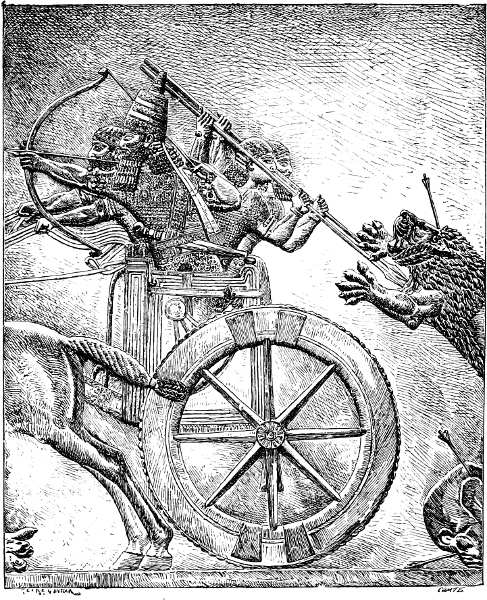
Fig. 161.—Assurbanipal attacked by lions.
British Museum. Drawn by Saint-Elme Gautier.
The temperaments of the two nations were, then, vastly different,
and by the time their mutual relations became close and continuous,
each had thought too much, had worked too much, and created too much
for itself to be in any great danger of losing its originality under
the influence of the other. Moreover, the two civilizations never
penetrated within one another. Their moments of contact were short
and superficial. Under the great Theban conquerors of the eighteenth
dynasty, the Egyptian armies advanced to the Euphrates, and the princes
of Mesopotamia may, for a time, have recognized the suzerainty of
the Pharaohs; this is proved to some extent by the numerous scarabs
engraved with the name of Thothmes III., which have been found in the
valley of the Khabour,[342] but after the nineteenth dynasty their
hold upon these distant conquests must have been lost. Their access to
them was barred by the Khetas, in Syria, and, a few centuries later,
it was the Sargonids who invaded Egypt and admired its monuments so
much that they carried some of them away, such as the lion found at
Bagdad. It bears the oval of a Pharaoh who is believed to be one of
the shepherd kings.[343] In the interval the importation of objects of
luxury, which was carried on through the Phœnicians, had introduced a
few foreign motives into the repertory of the Assyrian artists, such as
the crouching sphinx and the lotus flower; the winged globe may also
be Egyptian; but these borrowings never go beyond details; even if
they were far more numerous than they are, they would not deprive the
sculpture of the Mesopotamian Semites of its right to be considered an
independent and autonomous form of art, whose merits and defects are
to be explained by the inborn genius of the race, by its manner and
beliefs, by the natural conditions of its home, and the qualities of
the different materials employed.[344]
It is in the same order of ideas that we must seek a reason for the
differences we have remarked between the art of the early Chaldæan
monarchy as it has been revealed to us in the monuments recently
discovered, and Assyrian art as we have known it ever since the
explorations at Khorsabad, Nimroud, and Kouyundjik. In all this there
is a most interesting question for the study of the historian. Of what
nature was the bond by which the sculptors of Calah and Nineveh were
allied to those who had chiselled the Sirtella statues, perhaps a
thousand years before? What place does the brilliant and prolific art
of Assyria occupy in the series of phases whose succession was governed
by the laws that have presided over the development of human societies
in every age and place? Until within the last few months we should have
found it difficult to give a satisfactory answer to this question.
Assyrian art offered contradictory features to the observer, and it
was not easy to understand how, with so lively a feeling for form, and
especially for movement, it could have admitted so much conventionality
and repeated itself with so much insistence and prolixity. The
combination of skill and awkwardness, of energy and platitude, was more
than surprising. But the problem resolves itself as soon as we go back
to the art of Chaldæa, the first-born of the two sister nations, and
the pioneer of Mesopotamian civilization.
Assyrian art, even in its most ancient productions, was not, as we once
believed, a primitive or even an archaic art; neither was it what we
call a classic art, an art employing the skill it has acquired for the
renewed study of nature and the sincere imitation of its beauties. We
shall not call it a debased art or an art in its decadence; to do so
would be to exaggerate our meaning; but it was an art no longer in its
progress, an art that, for the sake of rapid and ample production,
made use of conventional formulæ invented by deceased masters and
handed down by tradition.
Perhaps we may give a clearer notion of what we mean by a comparison.
Under all the reserves implied by such collations, we should say that
Chaldæan art was to that of Assyria what the Greek art of Phidias,
Praxiteles, and Lysippus was to the Alexandrian and Græco-Roman art
which we now call Hellenistic. In the studios of Nineveh, as
in those of Pergamus, of Rhodes, of Antioch, of Rome, great activity,
great skill, and no little science were to be found; even originality
was sought for, but it was sought rather than won. Thus we find in
Macedonian and Roman Greece, here a school drawing attention by
audacious and perhaps theatrical execution, there another devoting its
skill to pathetic subjects, and attempting to render physical agony by
contracted muscles. So it is in Assyria. The ease with which alabaster
and soft limestone could be cut allowed the artists who worked for
Assurnazirpal to give to the ornamentation of the rich stuffs they
figured a delicacy and refinement that were impossible in the stubborn
stones of Chaldæa. Two centuries later the sculptors of Assurbanipal
sought a new element of success in the complication of their scenes,
in the grace of their execution, in the picturesque details of their
landscape backgrounds, in the increased slenderness of their figures,
and in a certain elegance spread over their compositions as a whole.
It is certain that neither the Greek of the later centuries nor the
Assyrian invented and created in the proper sense of the word. The
Greek sculptor, thanks to a deeper comprehension of the true conditions
of art and to the necessity under which he laboured of reproducing the
nude, certainly did not remit his care for modelling, but he looked
at the contours and the significance of the human body rather with
the eyes of his masters and predecessors than with his own. It was to
those masters that he was indebted for his propensity to see one set of
features rather than another, and to give that interpretation to form
that, taken altogether, constitutes the Greek style.
The Assyrian sculptor was in much the same case, but as his figures
were draped, almost without exception, it was much easier for him to
put nature aside altogether and to fall into manner and routine. It is
only when he has to represent animals that he seems to work from the
living model. The human body, hidden under its long and heavy robes,
did not discover enough to awake his interest; all that he sees—the
features and the profile of the face, the throat, the lower parts of
the arms and legs—he treats after the examples left to him by his
Chaldæan leader. In the whole of Assyrian sculpture there is no passage
studied from nature with faith and sincerity, like the hand, the
shoulder, and the back in the statues of Gudea. The Chaldæan sculptor
had a taste for strong modelling, and in this his Assyrian pupil copied
him with such an excess of zeal that he arrived at exaggeration and
pure convention. He knotted the knees of his figures, he gave them
knee-caps standing out like huge bosses, and muscles so stretched and
salient that they look like cables rather than flesh and blood. It is
an early edition of what is now an old story. The master is betrayed by
the pupil, who copies his mannerisms rather than his beauties and turns
many of his fine qualities into defects.
We may now see how much the Chaldæan excavations and the collection
which the Louvre owes to M. de Sarzec are calculated to teach the
historian of art. These discoveries, by their intrinsic importance and
by the light they have thrown on the origin of a great civilization,
may almost be compared to those of Lepsius and Mariette, to the
systematic researches and happy finds that have revealed the Egypt
of the ancient empire to us. Assyrian art is no longer a puzzling
phenomenon. Like the Egyptian art of the Theban epoch, it was preceded
by a realistic and naturalistic, an inquisitive, simple-minded, and
single-hearted art, which had faithfully studied the human form and had
thus created one of the original styles of antiquity, a style, perhaps,
in which Greece at its first beginning found the most useful lessons
and the most fertile suggestions.
As we have already confessed, we can form but a very imperfect notion
of what the art of Chaldæa was in its best days, in its period of youth
and freshness. The remains are few and small; they are heads separated
from the bodies to which they once belonged, chips from broken reliefs
and a few small bronze and terra-cotta statuettes. Even supposing that
new discoveries come to fill up the gaps, so that the development of
Chaldæo-Assyrian art may be embraced as a whole, even then it would,
we believe, be interior to that of Egypt. No doubt it possesses certain
qualities not to be found in the latter. The statues from Tello have
a freedom and vigour of modelling in certain parts that can hardly be
prized too highly, and the Memphite artist never chiselled anything so
full of intense life and movement as the animals at Kouyundjik; but
without again referring to faults already treated at length we may
say that the supreme defect of Mesopotamian sculpture is its want of
variety.
It is a powerful but monotonous art. For each class of figures it had
but one mould. It seems never to have suspected how unlike men are to
each other when they are looked at closely; we are tempted to believe
that it never made a portrait in the true sense of the word. It held
through many centuries to the general and abstract types created at
first, and repeated them with a constancy that inevitably causes some
weariness in the spectator. It also committed the mistake of spreading
a single colour, speaking metaphorically, over all its pictures; as
a musician would say, all its compositions were in the same key; it
was always serious; it did not understand how to laugh or unbend. In
the elaboration of its demons it certainly cast about for as much
ugliness as it could find, but that was to frighten and not to amuse.
In all the remains of Assyrian art there is no trace of playful humour,
of the light-hearted gaiety that is so conspicuous in more than one
Egyptian monument. In the subordinate parts of some of the reliefs
from the Sargonid period we find certain groups and scenes belonging
to what we should call genre, but neither here, nor in the
bronzes, nor in engraved gems, nor even in the terra-cottas, do we find
anything that approaches caricature. The comic element, without which
no representation of life can be faithful and complete, is entirely
wanting.
A final defect of Assyrian art is the almost total absence of woman
from its creations. In Chaldæa we found her in the small bronzes and in
a few clay figures; the canephorus with bare arms and bust, the nursing
goddesses who bear a child in their arms or who press their breasts
with their open hands, will be remembered, but it would seem that such
subjects were treated only in figures of very small dimensions. In
the fragmentary reliefs and statues from Chaldæa there is nothing to
suggest that female forms, either wholly or partially nude, were either
cast or chiselled in anything approaching life size. Still less were
such things made in Assyria, where no terra-cotta figure even of the
deity to whom the names of Istar, Beltis, Mylitta, and Zarpanitu have
all been given, has yet been found. It was, however, at Kouyundjik
that the only nude female torso yet discovered in Mesopotamia was dug
up. It bears the name Assurbilkala, and is now, as we have said above,
in the British Museum.[345] Among the ivories, indeed, we find female
statuettes in which we are tempted to recognize the same goddess; but
where were those ivories carved? We have good reason to believe that
not a few are of Phœnician workmanship.
The real national art of Assyria must be sought in the palace reliefs,
and in that long illustrated chronicle of the court, the chase, and
the royal campaigns, woman plays a very subordinate part. It has been
thought that a tall, beardless individual who occurs near one of the
doorways of Assurnazirpal’s palace, in the place generally reserved
for divinities, should be accepted as a goddess (Fig. 162).[346] She
is winged, and her hair is gathered together at the back of the neck,
one long knotted and tasselled tress falling nearly to her loins. Her
right arm is raised, her left lowered; in her left hand she holds a
small wreath or garland. A wide girdle at the waist confines a long
robe falling to the feet, and a fringed and flounced mantle. Nothing
is seen through this drapery, such as amplitude of bosom or hips, to
suggest the female sex, while the jewels that may be noticed on the
neck and wrists and in the ears are also to be found on figures that
are certainly male. In fact there is nothing to suggest a woman but
the arrangement of the hair and a certain unwonted refinement in the
execution of the features. And it is only by external signs like these,
by the pose and the costume, that the few women in the bas-reliefs
are to be recognized. This observation holds good for the queen of
Assurbanipal as well as for the musicians who celebrate his victories
and the captives led into slavery by the Assyrian armies.
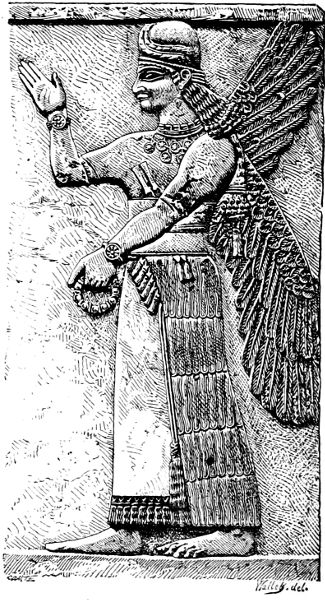
Fig. 162.—Figure of a goddess. British Museum.
Drawn by Wallet.
We can hardly say then that woman had any place in Assyrian art; she
was represented, if at all, only by her robes. In the long series of
reliefs you find none of the charming variety given to Egyptian art by
the slender forms of goddesses, queens, dancers, and players on the
mandolin, who crowd the pictures and allow the graceful contours of
their youthful bodies to be seen through their transparent robes. In
spite, then, of all its merits, the art of the Assyrian sculptor is
far from complete. His neglect of the soft nobleness inherent in the
beauty of woman deprived him of a precious resource; his works are
without the telling contrasts that nature has set up between the forms
of man and those of his mate. We have endeavoured to do him justice;
we have sought to put in full light the merits by which he attracts our
admiration, but we cannot help seeing that he lacks something that we
have found in Egypt and shall find again in Greece; he is without the
charm of grace and light.
CHAPTER IV. THE INDUSTRIAL ARTS. — § 1.— Ceramics. — § 2.— Metallurgy. — § 3. Furniture. — § 4. Metal Dishes and Utensils. — § 5. Arms. — § 6. Instruments of the Toilet and Jewelry. — § 7. Textiles. — § 8. Commerce.
Of all the materials put in use by the inhabitants of Mesopotamia,
clay was the first and by far the most important. Clay furnished the
sun-dried bricks of which the great buildings were constructed, the
burnt bricks with which the artificial mounds on which those buildings
stood were cased, and the enamelled bricks that enabled certain parts
to be covered with a rich polychromatic decoration. The figures of
the gods and demons they worshipped and the tombs into which they
were thrust after death were both made of this same material. It was
upon clay that they learnt to write; it was to slabs of terra-cotta
that their kings confided the memory of their victories and acts
of devotion, and the private population their engagements and the
contracts into which they entered. For thousands of years tablets of
clay thus received not only long texts, but those impressions from
seals, each one of which represents a signature. While wet and soft,
clay readily accepted any symbol that man chose to place upon it; once
it was burnt, those symbols became practically indestructible.
Accustomed to employ the unrivalled docility of kneaded earth in so
many ways, the Chaldæans must, at a very early date, have used it for
domestic purposes, for cooking, for holding grain, fruits, and liquids.
Like every one else they must have begun by shaping such utensils with
their fingers and drying them in the sun. Few remains of these early
attempts have been preserved. The invention of the potter’s wheel and
firing-oven must have taken place at a very remote period both in
Egypt and Chaldæa. The oldest vases found in the country, those taken
from tombs at Warka and Mugheir, have been burnt in the oven. Some,
however, do not seem to have been ‘thrown’ on the wheel. The thickness
of their walls and their irregular shape suggest that the potter
fashioned them with the back and palm of his hand (Figs. 163–165). The
paste is coarse; it is mixed with chopped straw, which shows here and
there on the surface; there is neither ornament nor glaze, and the
curves are without grace.[361]
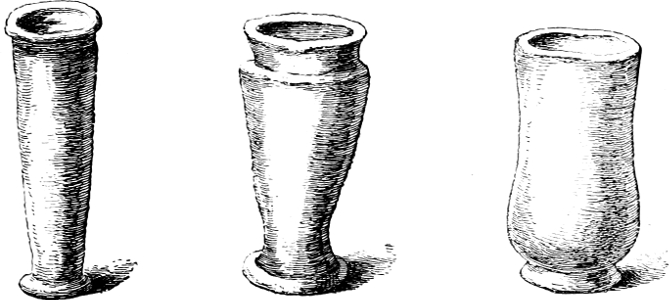
Figs. 163–165.—Chaldæan vases of the first
period. British Museum.
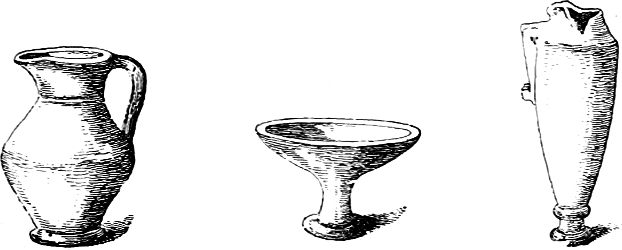
Figs. 166–168.—Chaldæan vases of the second
period. British Museum.
Some other vases found in the same cemeteries are ascribed to a later
epoch. They give evidence of a real progress in art. We have already
figured two examples in our first volume (Figs. 159 and 160); three
more are given in Figs. 166–168. The body is finer, and sometimes
covered with a slight glaze; there is still no decoration, but the
forms are obviously meant, and not without distinction. These objects
have been thrown on the wheel, and the dexterity of their maker is
further shown by the skill with which their handles are attached.
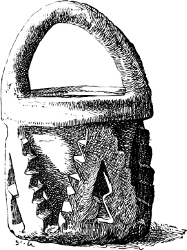
Fig. 169.—Chaldæan vase, about 4 inches high.
British Museum.
We have no means of assigning even an approximate date to the vases
found in other parts of Chaldæa. A curious vase from Hillah may be
ascribed to a much later period, however, on the evidence of its shape
alone (Fig. 169). It has the general form of a bucket. The body is
decorated with indented triangles cut in its thickness and detached
from the background. In all this there is a striving after effect that
suggests the decadence. Nothing like it has been found in Assyria
dating from the ninth, eighth, or seventh centuries. Sir H. Layard
brought from Nimroud a certain number of vases showing a real progress
even when compared with the remains from the second period of Chaldæan
ceramics. Among these were some quaintly shaped pieces, such as the
hexagonal vase with slightly concave sides reproduced in Fig. 170. To
the same class belongs the very common form, with a pointed base, that
could be thrust into the sand (Fig. 171), and the large bottles shown
in Figs. 172 and 173. By the side of these not very graceful pieces
we find some with shapes at once simple and happy, and comparable, in
more than one instance, to those that the Greeks were to adopt in later
years. Goblets with feet and without (Figs. 174–176), a well-shaped
ewer (Fig. 177) and some variously contoured amphoræ, should be
noticed. One of the latter has a long neck and two very small handles
(Fig. 178), the handles of the other two are larger and more boldly
salient, while in one they are twisted to look like ropes.
The vase last figured, like many others from the same place, is glazed,
and glazed in two colours, a bluish-green round the neck and a decided
yellow upon the body. At the line where they meet the two colours run
one into the other, producing a far from disagreeable effect.
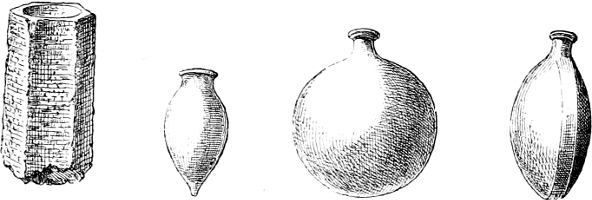
Figs. 170–173.—Assyrian vases; from Layard.
It will be noticed that the decoration upon all these objects is very
slight. We can point to little beyond the double row of chevrons on one
of the amphoræ (Fig. 178), and the collar of reversed leaves round a
kind of alabastron found at the same place (Fig. 181).
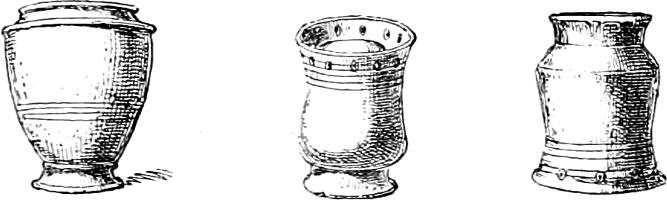
Figs. 174–176.—Goblets; from Layard.
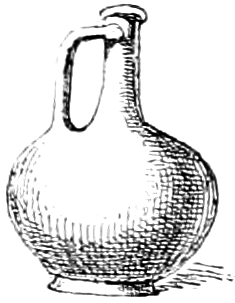
Fig. 177.—Ewer; from Layard.
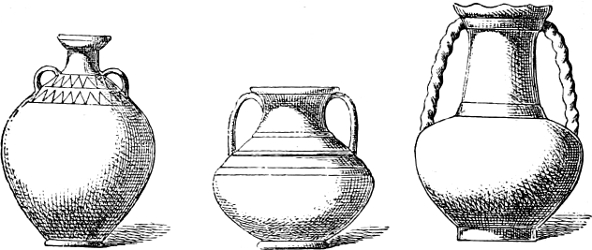
Figs. 178–180.—Amphoræ; from Layard.
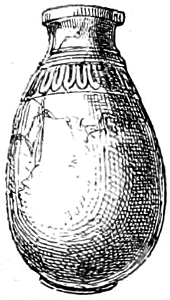
Fig. 181.—Alabastron; from Layard.
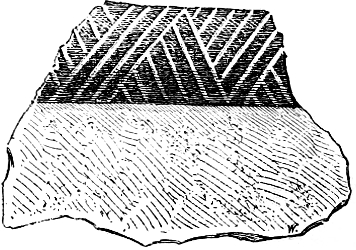
Fig. 182.—Fragment of a vase. British Museum.
The taste for decorating their works seems to have spread among the
Assyrian potters between the ninth and seventh centuries B.C.
At least many traces of it have been found among the remains at
Kouyundjik. The date is fixed for us by a fragment on which the name
of Esarhaddon occurs, the letters of which it is composed standing out
in light against a dull black background. There is no further ornament
than a line of zig-zags traced with some brown pigment. The fragment
we reproduce (Fig. 182) formed part of another vase decorated in the
same way. We cannot point to a single complete specimen of this work,
but by comparing many pieces all from the same place, we may gain some
idea of the taste in pottery that prevailed under the Sargonids. A vase
upon which certain Aramaic characters were traced with the brush was
decorated with bands of a reddish-brown pigment turning round the neck
and body at irregular intervals (Fig. 183).[362] Elsewhere we find a
more complicated form of the same ornament. The horizontal bands are
separated by a kind of trellis-work, in which the lines cross each
other, sometimes at right angles and sometimes obliquely, while in the
blank spaces we find a motive often repeated, which might be taken at
first sight for a Greek sigma. The resemblance, we need hardly
say, is purely accidental (Fig. 184). We may also mention a fragment
where the surface is sprinkled with reddish-brown spots on a light
yellow ground (Fig. 185). So far as we know the only complete example
of this decoration is the fine goblet dug up by Place in the Jigan
mound (Fig. 186).[363]
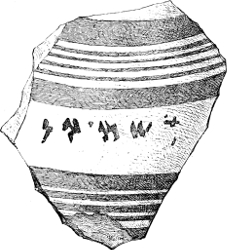
Fig. 183.—Fragment of a vase. British Museum.
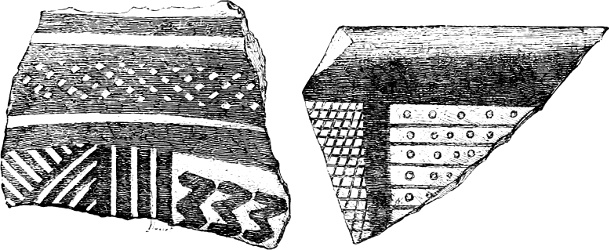
Figs. 184, 185.—Fragments of vases. British
Museum.
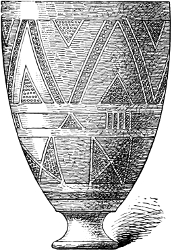
Fig. 186.—Goblet. Height, 5 inches. Louvre.
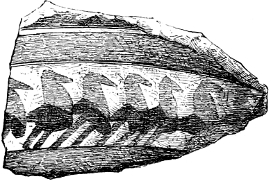
Fig. 187.—Fragment of a vase. Actual size.
British Museum.
In all these fragments the decoration is purely geometrical; it is
composed of lines, spots, and other motives having no relation to
the organic world. A step in advance of this seems, however, to have
been taken. On some other fragments from the same districts, files
of roughly-suggested birds appear upon the bands and between opposed
triangles (Figs. 187 and 188). We shall find the same motive in Cyprus,
at Mycenæ, and at Athens, in the pottery forming the transition between
the purely geometrical period and that in which imitation of life
begins. In a fragment which is tantalizingly small we catch a glimpse
of three lion’s paws playing with a chess-board ornament. A row of
cuneiform characters runs along the lower part (Fig. 189).
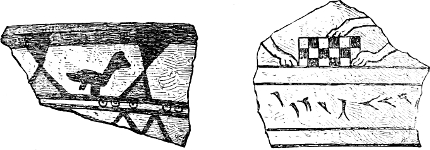
Figs. 188, 189.—Fragments of vases. Actual
sizes. British Museum.
These fragments, taken altogether, show that a certain effort was made
to produce decorated pottery towards the end of the Assyrian period.
Why was the attempt not carried farther? Why were earthenware vases not
covered with ornamental designs that might be compared for richness
and variety with those chiselled in or beaten out of stone or wood,
ivory or metal? The reason may, we think, be guessed. Clay appeared
such a common material that they never thought of using it for objects
of luxury, for anything that required great skill in the making, or in
which its proprietor could take any pride. When they wanted fine vases
they turned to bronze; bronze could be gilded, it could be damascened
with gold and silver, and when so treated was more pleasing to the eye
and more provocative of thought and ingenuity on the part of the artist
than mere clay. It was reserved for Greece to erect the painted vase
into a work of art. Her taste alone was able to make us forget the
poverty of the material in the nobility of the form and the beauty of
the decoration; we shall see that her artists were the first to give to
an earthenware jar or cup a value greater, for the true connoisseur,
than if they were of massive gold or silver.
During the period on which we are now engaged, the Mesopotamians
sometimes attempted to cover their vases with enamel. The British
Museum has several specimens of a pottery covered with a blue glaze
like that of the Egyptian faïence.[364] Here and there the blue has
turned green under the action of time. One of the vases reproduced
above (Fig. 180) belongs to this class. Vases of the same kind, covered
with a rather thick layer of blue and yellow enamel, have been found
among the rubbish in the Birs-Nimroud at Babylon,[365] but it is
difficult to fix an exact date for them with any confidence. On the
other hand, it is generally agreed that the large earthenware coffins
brought from the funerary mounds of Lower Chaldæa are very much later.
In style the small figures with which they are decorated resemble the
medals and rock sculptures of the Parthians and Sassanids.[366]
The art of making glass, which dates in Egypt at least as far back
as the first Theban dynasty,[367] was invented in Mesopotamia, or
imported into it, at a very early period. No glass objects have been
found in the oldest Chaldæan tombs, but they abound in the ruins of the
Assyrian palaces. A great number of small glass bottles, resembling the
Greek alabastron or aryballos in shape,[368] have been
dug up; many of them have been made brilliantly iridescent by their
long sojourn in the earth.[369] A vase found by Layard at Nimroud,
and engraved with Sargon’s name just below the neck, is generally
quoted as the oldest known example of transparent glass (see Fig.
190).[370] It has been blown solid, and then the inside cut out by
means of an instrument which has left easily-visible traces of its
passage; this instrument was no doubt mounted on a lathe. Sir H. Layard
believes, however, that many of the glass objects he found are much
older, and date from the very beginning of the Assyrian monarchy, but
their material is opaque and coloured.[371] Some bracelets of black
glass, which were dug up at Kouyundjik, prove that common jewelry
was sometimes made of that material; glass beads, sometimes round,
sometimes flat, have also been found.[372] A glass cylinder or tube, of
unknown use, was found by Layard at Kouyundjik; it is covered with a
decoration made up of lozenges with a concave surface (Fig. 191).
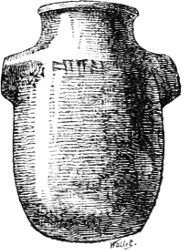
Fig. 190.—Glass vase or bottle. Height 3½
inches. British Museum.
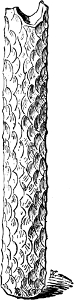
Fig. 191.—Glass tube. Height 8¾ inches.
British Museum.
It is curious that no cylinders or cones of terra-cotta or glass have
come down to us from the Assyro-Chaldæan period. Clay was doubtless
thought too common a material for such uses, and as for glass, they
had not yet learnt how to make it a worthy substitute for pietra
dura, as the Greeks and Romans did in later years.
Before we quit the subject of glass we must not forget to mention
a very curious object found by Layard at Nimroud, in the palace of
Assurnazirpal, and in the neighbourhood of the glass bottle and the
two alabaster vases on which the name of Sargon appears. It is a lens
of rock-crystal; its convex face seems to have been set up, with some
clumsiness, opposite to the lapidary on his wheel. In spite of the
imperfect cutting, it may have been used either as a magnifying, or,
with a very strong sun, as a burning, glass.[373] The fineness of the
work on some of the cylinders, and the minuteness of the wedges on some
of the terra-cotta tubs, had already excited attention, and it was
asked whether the Assyrians might not have been acquainted with some
aid to eyesight like our magnifying glass. It is difficult, however,
to come to any certain conclusion from a single find like this; but if
any more lenses come to light we may fairly suppose that the scribes
and lapidaries of Mesopotamia understood how thus to reinforce their
eyesight. In any case it is pretty certain that this is the oldest
object of the kind transmitted to us by antiquity.
Even at the time to which we are carried back by the oldest of the
graves at Warka and Mugheir, metallurgy was already far advanced in
Chaldæa. Tools and weapons of stone are still found in those tombs in
great numbers;[374] but side by side with them we find copper, bronze,
lead, iron, and gold. Silver alone is absent.
Copper seems to have been the first of all the metals to attract the
notice of man, and to be manufactured by him. This is to be accounted
for partly by the frequency of its occurrence in its native state,
partly by the fact that it can be smelted at a comparatively low
temperature. Soft and ductile, copper has rendered many services to man
from a very early period, and, both in Chaldæa and the Nile valley, he
very soon learnt to add greatly to its hardness by mixing a certain
quantity of tin with it. Where did the latter material come from? This
question we can no more answer in the case of Mesopotamia than in that
of Egypt; no deposits of tin have yet been discovered in the mountain
chains of Kurdistan or Armenia.[375] However this may be, the use of
tin, and the knowledge of its properties as an alloy with copper,
dates from a very remote period in the history of civilization. In its
natural state, tin is always found in combination, but the ore which
contains it in the form of an oxide does not look like ordinary rock;
it is black and very dense; as soon as attention was turned to such
things it must have been noticed, and no great heat was required to
make it yield the metal it contained. We do not know where the first
experiments were made. The uses of pure tin are very limited, and
we cannot even guess how the remarkable discovery was made that its
addition in very small quantities to copper would give the precious
metal that we call bronze. In the sepulchral furniture with which the
oldest of the Chaldæan tombs were filled we already find more bronze
than pure copper.[376]
Lead is rare. A jar of that metal, and the fragment of a pipe dug up
by Loftus at Mugheir may be mentioned.[377] It is curious that iron
though still far from common, was not unknown. Iron nowhere exists in
its native state on the surface of our planet, except in aerolites. Its
discovery and elimination from the ore requires more time and effort
and a far higher temperature than copper or tin. Those difficulties had
already been surmounted, but the smelting of iron ore was still such
a tedious operation that bronze was in much more common use. Iron was
looked upon as a precious metal; neither arms, nor utensils, nor tools
of any kind were made of it; it was employed almost exclusively for
personal ornaments, such as rings and bracelets.[378]
Gold, which is found pure in the veins of certain rocks and in the beds
of mountain torrents, and in pieces of a size varying from that of a
grain of dust to nuggets of many pounds, must very soon have attracted
the attention of man, and excited his curiosity, by its colour and
brilliancy. We find it in the tombs mixed with objects of stone and
bronze. Round beads for necklaces, earrings and finger rings of not
inelegant design were made of it.
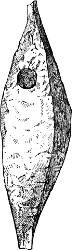
Fig. 192.—Iron mattock; from Place.
If, when the Chaldæans built their first cities, they already knew how
to put metals to such varied uses, they could hardly have failed to
take farther strides in the same direction. In order to measure the
progress made, we have only to establish ourselves among the Assyrian
ruins and to cast an eye over the plunder taken from them by Botta,
Layard, and Place. Metal is there found in every form, and worked with
a skill that laughs at difficulties. Silver and antimony are found
by the side of the metals already mentioned,[379] and, stranger than
all, iron is abundant. The excavations at Warka seem to prove that
the Chaldæans made use of iron sooner than the Egyptians;[380] in any
case it was manufactured and employed in far greater quantities in
Mesopotamia than in the Nile valley. Nowhere in Egypt has any find
been made that can be compared to the room full of instruments found
at Khorsabad, to the surprise and delight of M. Place.[381] There were
hooks and grappling irons fastened by heavy rings to chain-cables,
similar to those now in use for ships’ anchors; there were picks,
mattocks, hammers, ploughshares. The iron was excellent. The smith
employed upon the excavations made some of it into sickles, into tires
for the wheels of a cart, into screws and screw-nuts. Except the
Persian iron, which enjoys a well-merited reputation, he had never,
he said, handled any better than this. Its resonance was remarkable.
When the hammer fell upon it it rang like a bell. All these instruments
were symmetrically arranged along one side of the chamber, forming a
wall of iron that it took three days to dig out. After measurement,
Place estimated the total weight at one hundred and sixty thousand
kilogrammes (about 157 tons).[382]
According to the same explorer some of these implements, resembling the
sculptor’s sharp mallet in shape, were armed with steel points (Fig.
192).[383] Until his assertion is confirmed, we may ask whether Place
may not, in this instance, have been deceived by appearances. Before we
can allow that the Assyrians knew how to increase the hardness of iron
by treating it with a dose of carbon, we must have the evidence of some
competent and careful analyst.
It is certain, however, that in the ninth and eighth centuries this
people used iron more freely than any other nation of the time. Thus
several objects which appear at the first glance to be of solid bronze
have an iron core within a more or less thin sheath of the other metal.
Dr. Birch called my attention to numerous examples of this manufacture
at the British Museum, in fragments of handles, of tires and various
implements and utensils, from Kouyundjik and Nimroud. The iron could
be distinctly seen at the fractures. The Assyrians clung to the bronze
envelope because that metal was more agreeable to the eye and more
easily decorated than iron, but it was upon the latter substance that
they counted to give the necessary hardness and resistance. The contact
and adhesion between the two metals was complete. From this, experts
have concluded that the bronze was run upon the iron in a liquid
state.[384]
It is easy enough to understand how the inhabitants of Mesopotamia
came to make such an extensive use of iron in the instruments of their
industry; it was because they were nearer than any other nation to what
we may call the sources of iron. By this we mean the country in which
all the traditions collected and preserved by the Greeks agreed in
placing the cradle of metallurgy—the region bounded by the Euxine, the
Caucasus, the Caspian, the western edge of the tableland of Iran, the
plains of Mesopotamia, the Taurus, and the high lands of Cappadocia.
To find the deposits from which Nineveh and Babylon drew inexhaustible
supplies, it is unnecessary to go as far as the northern slopes of
Armenia, to the country of the Chalybes, the legendary ancestors of our
mining engineers. The mountains of the Tidjaris, a few days’ journey
from Mossoul, contain mineral wealth that would be worked with the
greatest profit in any country but Turkey.[385]
Bronze was reserved for such objects as we should make of some precious
metal. Botta and Place found numerous fragments of bronze, but it is
to Layard that we owe the richest and most varied collection of bronze
utensils. It was found by him in one room of Assurnazirpal’s palace at
Nimroud.[386] The metal has been analysed and found to contain ten per
cent. of tin, on the average.[387] These proportions we may call normal
and calculated to give the best results. In one of the small bells that
were hung to the horses’ necks the proportion was rather different;
there was about fifteen per cent. of tin. By this means it was hoped to
obtain a clearer toned and more resonant alloy.
Pure copper seems to have been restricted to kitchen utensils, such as
the large cauldrons that were often used as coffers in which to keep
small objects of metal, like the little bells of which we have spoken,
rosettes, buttons and the feet of tables and chairs not yet mounted,
etc.[388] It is probable that these vessels were also used for heating
water and cooking food.
All these metals, and especially iron and copper, were dearer perhaps
in Chaldæa than in Assyria, because Babylon was farther from the
mineral region than Nineveh; but the southern artizans were no less
skilful than their northern rivals. In our review of the metal
industries we shall borrow more frequently from the north than from the
south, but the only reason for the inequality is that Chaldæa has never
been the scene of exhaustive and prolific excavations like those of
Assyria.
Cursing Nineveh and exulting in the prospect of her fall, the prophet
Nahum calls to all those who had been crushed by the Assyrian hosts; he
summons all the nations of the east to take their part in the work of
revenge and their share in the spoil to be won. “Take ye the spoil of
silver,” he cries, “take ye the spoil of gold; for there is none end of
the store and glory out of all the pleasant furniture.”[389] We shall
find all this among our spoils of Nineveh. The princes and nobles of
Assyria seem to have had a peculiar love for luxurious furniture. To
see this we have only to look at the bas-reliefs, where the artist took
the greatest care to imitate every detail of the thrones on which he
placed his gods and kings; and many fragments of these richly decorated
chairs have been recovered in the course of the excavations; with the
help of the sculptures they could be put together and the missing
parts supplied. The elements of many such restorations exist in the
British Museum, and we may well ask why no attempt has been made to
reconstitute an Assyrian throne with their help, so as to give an exact
idea of the kind of state chair used by a Shalmaneser or a Sennacherib.
In order to carry out such a restoration successfully we should have
to begin by renewing all the wooden parts of the piece, the legs, back
and cross-bars. Wood alone could be used for such purposes. Metal
would be too heavy if solid, and not stiff and firm enough if hollow.
We have, besides, direct proof that the Assyrian joiner so understood
his work. “I found among the ruins,” says one explorer, “small bulls’
heads of copper, repoussé and carefully chased, inside of
which a few fragments of dried wood still remained. These pieces had
certainly belonged to chairs exactly similar to those figured in the
reliefs.”[390]
At Nimroud, in the room in Assurnazirpal’s palace in which so many
precious objects were discovered, Layard found the royal throne, and
close beside it, the stool upon which the royal feet were placed, an
arrangement of which we may gain an exact idea from the reliefs (Figs.
47 and 127). The sides of this chair were ornamented with bronze
plaques nailed on to wooden panels, and representing winged genii
fighting with monsters. The arms were ornamented at the end with rams’
heads, and their points of junction with the uprights of the back were
strengthened with metal tubes.[391] All the wood had disappeared, but
it was impossible to look at the remains for a moment without seeing
how they were originally put together and what office they had to fill
in the complete piece. Most of the fragments are now in the British
Museum.
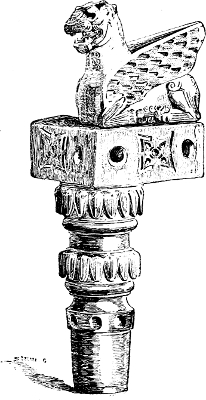
Fig. 193.—Fragment of a throne. Height 18
inches. Drawn by Saint-Elme Gautier.
The same collection has been recently enriched by the fragments of
another throne, from Van.[392] A claw foot, uprights ending in several
rows of dentations, and two winged bulls that once in all probability
formed part of the arms, are among the parts preserved. The bulls
are without faces, which may have been carried out in some other
materials, gold perhaps, or ivory. The wings also are covered with
hollows in which inlays of ivory or lapis may have been fixed. From
Van also came the remains of another throne which now belongs to M.
de Vogué, who has been good enough to allow us to reproduce the more
important fragments. The best of these is one of the front feet which
ends at the top in a rectangular tablet on which a winged lion is
crouched (Fig. 193). Another piece seems to have been one of the cross
pieces of the back;[393] the round sockets with which one face of it
is nearly covered must once have been filled with precious stones.
This lion, like that on the London chair, also has its wings covered
with incisions, and its eyeballs represented by gaping hollows. The
effect of the whole was heightened by threads of gold inlaid on its
leading lines, such as round the grinning jaws of the lion. The largest
piece is a hollow casting, but very heavy. The various members were
connected by tenons and mortices; some of the latter are shown in our
illustrations. The large rectangular openings on the upper surface of
the cross-bar received a metal stem to which some small figures were
attached; their bases have left marks on the cross-bar which may still
be distinguished. Their feet were surrounded by a line of gilding.
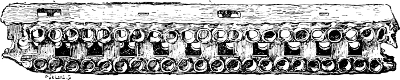
Fig. 194.—Fragment of a throne. Length 18
inches. Drawn by Saint-Elme Gautier.
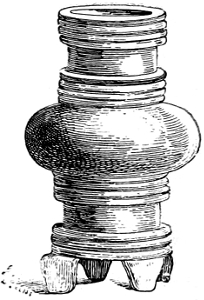
Fig. 195.—Bronze foot of a piece of furniture.
Louvre.
These pieces of furniture show great variety in their forms and
decorative motives. Sometimes the ornament is purely geometrical, like
that of the foot shown in our Fig. 195, where it is composed of several
rings placed one above the other with a bold torus-like swell in the
middle. More frequently, however, the bronze uprights end in capitals
resembling a bunch of leaves in shape. We have already encountered
this type in the ivories, where it occurs in the balustrade of a small
window (Vol. I., Fig. 129); we also find it strongly marked in the
throne from Van, where the drooping leaves are chiselled with much
care. We find the same motive in a small sandstone capital in the
British Museum. It is in one piece with its shaft. We are inclined to
think it a part of some stone chair in which the forms of wooden and
bronze furniture were copied (Fig. 196).[394]
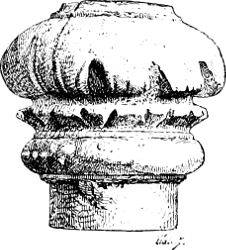
Fig. 196.—Capital and upper part of a small
column. Height 2 feet. British Museum.
Two pieces of the same kind found at Nimroud are more complex in
design. In one we have a bouquet of leaves reminding us of the
Corinthian capital (Fig. 197), while, in the other, a band seems to
hold two lance heads, opposed to each other at their base, and two
bean-shaped fruits, against the shaft (198). As for the feet of all
kinds of furniture, the favourite shapes are pine cones (Figs. 47 and
127) and lions’ paws (Figs. 47 and 199).
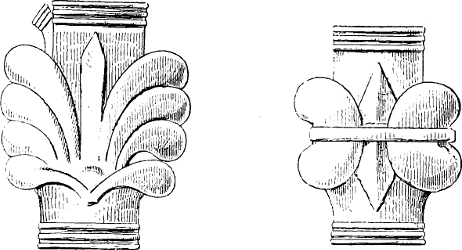
Figs. 197, 198.—Fragments of bronze furniture;
from Layard.
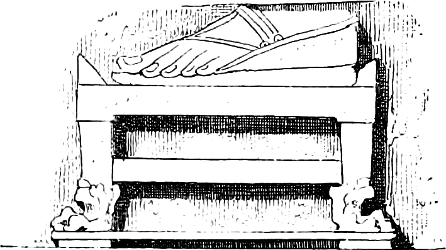
Fig. 199.—Footstool, from a bas-relief; from
Layard.
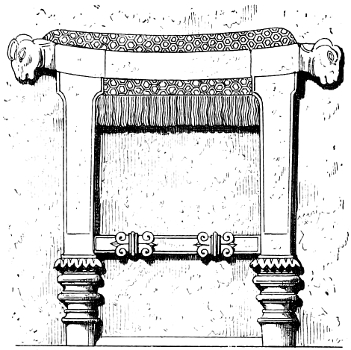
Fig. 200.—Stool; from Layard.
These elaborate decorations are found not only on the royal thrones but
also on the footstools which are their necessary complement (Fig. 199),
and on the seats without backs which were used, perhaps, instead of
the more unwieldy throne when the king was away from his capital (Fig.
200). The footstool has lions’-claw feet, the more important object has
rams’ heads at each end of the upper cross-bar;[395] the leg shows
the capital with drooping leaves noticed above; volutes, opposed to
each other as in the capital from Persepolis, ornament the cross-bar
which holds the uprights together. In this piece of furniture, where
the sculptor has confined himself to the scrupulous reproduction of
his model, we may see how these objects were upholstered. A cushion
of some woven material with long bright-coloured woollen fringes, was
fitted to the seat. The whole is characterized by happy proportions and
severe simplicity of design. We know from the Sippara tablet that even
the gods were sometimes content with such a seat (Vol. I., Fig. 71).
The figures of Izdubar and Hea-bani are there introduced between the
uprights of Samas’s stool.
One of the most complex and effective of all these examples of
decorative art is the throne upon which Sennacherib is seated before
the captured city of Lachish (Fig. 47). The space between the uprights
is occupied by three rows of small male figures, who with their
uplifted arms and heads gently thrown back, seem to bear the weight
of the cross pieces. This naïve device is also to be met with in the
sculptures of Persia; it is suggestive of the absolute power which
places the king so far above his subjects that nothing is left for them
but to support and add to the edifice of his grandeur.[396]
Bronze and wood were not the only materials used in these objects of
regal luxury. As in the throne of Solomon,[397] the glory of gold and
the creamy whiteness of ivory were mingled with the sombre tones of
bronze. This is proved by the thrones from Van, and it was noticed by
the explorers of the Assyrian ruins; small fragments of ivory were
mixed with the pieces of bronze that have been recognized as the
débris of furniture.[398] Some pieces of rock-crystal, found in
the palace of Sennacherib, appear also to have helped to ornament a
chair.[399]
It is easy to guess how ivory was used on these objects. Look at the
throne of Sennacherib (Fig. 47), the couch of Assurnazirpal, the table
on which his cup is placed and the high chair of his queen (Fig. 127).
The cross-bars and uprights are divided into numerous small panels or
divisions; each panel may have inframed a plaque of carved ivory.
Were all these plaques made in Mesopotamia? or were they imported from
Phœnicia and Egypt? The frankly Egyptian character of some among the
tablets we have reproduced (see Vol. I. Figs. 129 and 130; and above,
Figs. 57, 58 and 59) forbid us to deny that some of the ivories were
imported;[400] but we believe that to have been the exception rather
than the rule. We know both from the sculptured reliefs and from actual
finds that ivory was brought into Assyria in its rough state. Layard
found some elephant’s tusks in the royal houses at Nimroud,[401] and we
see others brought by tributaries as presents to the king, both in the
reliefs of Assurnazirpal’s palace,[402] and in those of Shalmaneser’s
obelisk.[403]
Hence it appears probable that ivory was worked at Nineveh and Babylon,
and that probability is changed into a certainty when we examine the
other ivories in the same collection. Although not a few of the ivories
chiselled in relief offer motives that are strange to Mesopotamian art,
it is not so with a series of tablets on which the designs are carried
out in pure line and with extreme refinement (Fig. 201). Figures and
ornaments are purely Assyrian; winged genii wearing the horned tiara,
dressed as in the reliefs, and surrounded with the rosettes and cable
pattern to which we have so often referred, and other motives of the
same kind. Among the latter may be noticed the variety of knop and
flower border that we find so often in the painted and enamelled
decoration, in which the knop is replaced by a disk (see Vol. I., Figs.
117 and 118).
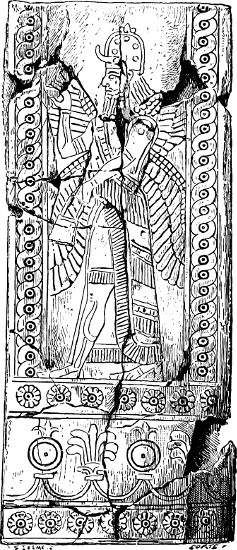
Fig. 201.—Ivory panel. Actual size. British
Museum. Drawn by Saint-Elme Gautier.
We believe the truth to be as follows. A considerable quantity of
Indian ivory entered Mesopotamia by the Persian Gulf and the caravan
routes. It was there carved by native artists into the various shapes
required, but, especially during the heyday of the Assyrian monarchy,
it was far from supplying the whole demand. Africa, through Phœnicia,
was called upon to make up the deficiency. But the African ivory was
not imported in its raw state, it came in in the form of skilfully
chiselled plaques that only required mounting; the merchants, through
whom the trade was carried on, delivered sets of these plaques for
beds, or chairs, or what not. We thus get at some reason for the
difference in style between the tablets in relief and those engraved by
the point. The latter represent native art; in the former, where we so
often see the characteristic gods, sphinxes, costumes, head-dresses,
and even cartouches of the Egyptian monuments, we may recognize the
product of the Nile delta, or even of Tyre and Sidon. The inscriptions
on several fragments seem to confirm this hypothesis. I have seen no
ivory tablets with cuneiform characters, but plenty with those of the
Phœnician alphabet.[404]
Fig. 202.—Dagger hilt. Ivory. Actual size.
Louvre.
Ivory was used for many purposes; we have described how it was employed
upon ceilings and doors;[405] we have just seen how it helped to
ornament articles of furniture; it also supplied the material for
many useful and ornamental objects, such as sceptres, boxes, cups,
knife-handles, etc. (Fig. 202). Did the Assyrians understand how
to give still greater variety to the appearance of these things by
staining the ivory? At first sight it might appear that they did. Among
the specimens in the British Museum some have the fine yellow colour of
the Renaissance ivories; others are white, grey, brown or even quite
black. These tints, as I myself ascertained, are not superficial; they
extend entirely through the pieces. But we do not believe they were
produced by any artificial process. If the Assyrians had understood how
to dye ivory, would they not have dyed it red and blue as well as the
colours above mentioned? But they did nothing of the sort. The tints
in question are, then, to be otherwise explained. They are not the
direct result of fire. Wherever the flame has touched the ivory it has
calcined it, and left nothing but a whitish friable substance. They
may, however, have been caused by the long continued impregnation with
smoke and carbon received from a soil filled with ashes and washed by
the rain. An effect of the same kind is produced upon objects buried in
a peaty soil. In any case several of the fragments that have come down
to us are of a fine, glossy black, like that of ebony.[406]
In beds, tables, chairs, and footstools the framework was of wood
and the decoration of metal, an important rôle being assigned
to incrustations of ivory, of lapis lazuli, of crystals, and other
materials of the kind. But there were also pieces of furniture whose
purpose made them well fitted to be carried out entirely in bronze;
such, for example, were the tripods on which the braziers or censers,
used in sacrifices, were placed. We have seen these figured in the
reliefs (Vol. I., Figs. 68 and 155); the Louvre possesses one that was
found at Babylon (Fig. 203). It is formed of three stems very slightly
inclined inwards, and bound together at the top by a circle decorated
with incised ornaments and four rams’ heads in relief. Towards the
bottom they are held together by three straight cross-bars, the points
of junction with the legs being masked by three human faces. The feet
are shaped after those of oxen. Cords are twisted round the point of
junction of foot and leg, then crossed in front of the fetlock and
knotted at the back.[407]
The chafing-dishes placed upon these bronze tripods were of the
same material. Chaldæans and Assyrians, although they neglected to
give their earthen vessels any great beauty of form or richness of
decoration, attached great importance to their metal vases. The bronze
vessel seems to have been one of the chief objects of luxury both in
the temple and the palace. The peculiarities offered by certain of
these objects and the interest of the problems they suggest, make it
necessary that they should be studied separately and in some detail.
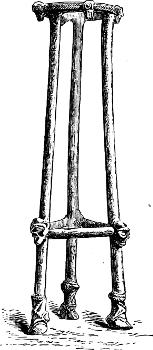
Fig. 203.—Bronze tripod. 13 inches high.
Louvre.
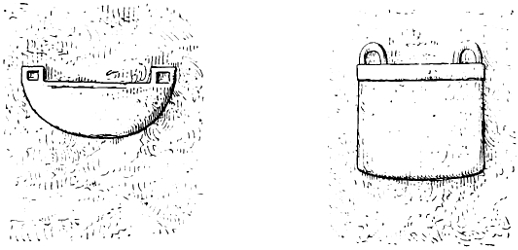
Figs. 204, 205.—Metal vases. From Layard.
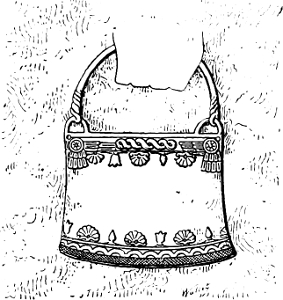
Fig. 206.—Metal bucket. From Layard.
Metal vases are often represented in the bas-reliefs, where we find
them sometimes of very simple form, like the bowl (Fig. 204) and bucket
(Fig. 205) here figured, which may have been of copper. They are
provided on the upper edge with small loops through which a cord might
be passed. As for the buckets that were used in the ritual of public
worship, and that the sculptor put in the hands of the winged genii
adoring the sacred tree (Vol. I., Figs. 4 and 8), they were certainly
of bronze, both body and handle. Their forms are very elegant, and
their walls are ornamented at the top and bottom with twisted and wavy
lines, with palmettes and flowers both open and closed. In the example
we figure (Fig. 206) the winged globe, which is introduced just below
the upper edge, attests the religious character of the object.[408]
The bas-reliefs tell us nothing about those large vessels, analogous,
no doubt, to the λέβης and κρατὴρ of the Greeks, upon the sides of
which the human-headed birds with extended wings, one of which we
have already figured, were fixed (Fig. 91). Neither has any complete
specimen of the class yet been discovered in the excavations. The
frequent employment of this motive is proved, however, by the number of
these detached pieces that we possess. They all come from Van, but they
belonged to different vases. We here engrave a second example (Fig.
207). The ring on the back by which the handle was attached will be
noticed. As in the throne described above the bronze was relieved with
inlaid ornament; there is a hollow in the breast in which it was set.
In the originals the rivet-holes which afforded a means of fixing them
may be seen; in one or two the heads of the rivets are still in place.
This specimen differs from one figured on page 172, in that it has two
heads.
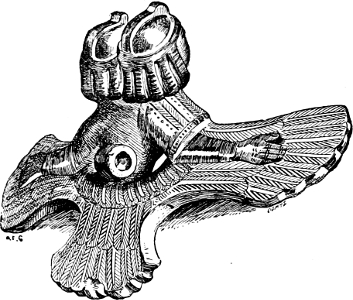
Fig. 207.—Applied piece. Height 9 inches;
width 14 inches. From the collection of M. de Vogüé.
We do not multiply examples of the vessels used to transport liquids,
because their decorative forms were found pretty equally distributed
all over Chaldæa and Assyria. We have every reason to believe that
they were produced in great numbers in all the towns of Mesopotamia.
On the other hand, there is a whole class of vessels that perplex
and embarrass archæologists almost as much as they delight them—the
class of metal cups. This name is to some extent a misnomer.
We shall employ it for the sake of simplicity, but most of the objects
in question are rather what we should call dishes or platters than
cups. They belong to the same class as the Greek φιύλη and the Roman
patera. Their vertical section is shown at the bottom of our
Fig. 208. The slight ridge underneath, caused by the gentle elevation
of the flat bottom, enabled the dish to be more firmly grasped than
would otherwise have been possible.
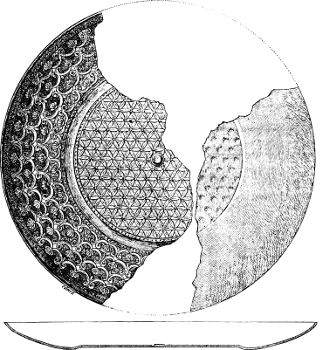
Fig. 208.—Bronze platter. From Layard.
Such things must have been comparatively rare and costly. In a
store-room of the North-Western Palace at Nimroud, Layard found a great
number of them, packed one within another in cauldrons like those
mentioned above; others, of less value no doubt, were stacked against
the wall. At first the explorers were inclined to think that they all
dated from the reign of Assurnazirpal, the founder of the building; but
many things combined to suggest that the palace was repaired by Sargon
and even inhabited by him.[409] He may have lived there until his own
house at Khorsabad was finished. It is possible, therefore, that some
or all of these cups date from the eighth century B.C.
In many instances oxydization had gone so far that the cups could
not be lifted without falling to pieces; others, however, though
covered with a thick coat of oxide, were brought away and successfully
cleaned.[410] At the British Museum I compiled a catalogue of
forty-four plates or cups of this kind, nearly all from the same
treasure, while in the store rooms of the same institution there are
many more waiting to be cleaned and rendered fit for exhibition. All
these, with a few exceptions, are ornamented, the simplest among them
having a star or rosette in the centre. Wherever the bronze has not
been completely eaten away the decoration may be recovered, and often
it is still singularly clear and sharp. A few cups that had been
protected by those placed above them showed, when discovered, such
brilliant copper tones that the workmen at first thought they were of
gold. The mistake was soon recognized, but we may well believe that
the conquerors of half Asia numbered gold and silver vessels among the
treasures stored in their palaces; as yet, however, none have been
found. All these cups, like the deeper vessels recovered at the same
time, were of bronze; the precious metals only appear in the form of
small inlays and incrustations in the alloy. In the centre of the
rosettes with which some of the bands are decorated a small silver
stud, slightly raised above the rest of the surface, is sometimes
placed, and in a few cases the points of the great rosette that
occupies the centre of the plate radiate from a centre of gold, silver
being banished to the small rosettes at the edge. Again, the middle is
sometimes a kind of boss, over the whole of which traces of gold may
still be distinguished.
The decoration of these pateræ is always inside: on the outside
nothing is to be seen but the confused reverse of the pattern, such as
may be seen on the left of our Fig. 208. I have found but one exception
to this rule in a much deeper cup on the outside of which a lion hunt
is represented.[411] In that case figures engraved within the vase
would have been invisible, for it is very deep.
In most cases the ruling principle of the decoration is the division
of the disk into three, four, or five concentric circles, but in some
instances the whole field, with the exception of a simple border, is
occupied by one subject. In those cups upon which the greatest care
and thought seem to have been lavished, the figures are beaten up
into relief with the hammer and then finished with the burin. In the
others the whole design is carried out with the latter tool, which
is sometimes used with a degree of refinement that is amazing. As an
example of this we may quote a patera that has been cleaned
and put on view quite recently. Stags march in file around its five
concentric zones, which are all of the same width. It is difficult
to explain either the fineness of the lines or the regularity of the
design, each animal being an accurate reproduction of his neighbour and
the intervening spaces being exactly equal. One is almost tempted to
believe that the work must have been done by machinery.
We know, however, that such mechanical helps were unknown to the
ancients, and, although there are many cups and vases at the museum
bearing a strong mutual resemblance, we cannot point to any two that
are exactly similar. To give a fair idea of the variety of their
designs we should have to reproduce not only all the cups figured
by Sir H. Layard, but several more that have only been prepared for
exhibition quite lately. Among the latter are some very curious ones.
We cannot afford the space for all this, and must be content to give a
few examples chosen from those on which the ornament is most definite
and clearly marked.
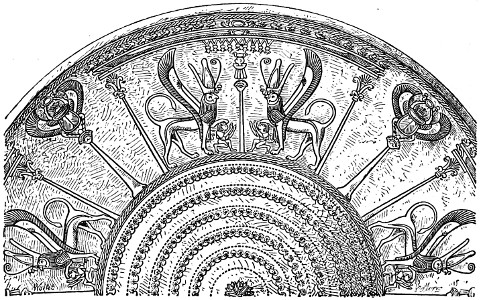
Fig. 209.—Bronze platter. Diameter about 9
inches. British Museum. Drawn by Wallet.
It was noticed by those who saw the veil of oxide drawn away from the
ornamentation of these bronze vessels that a large proportion of them
were Egyptian rather than Assyrian in their general physiognomy. Some
of them displayed motives familiar to all those who have travelled in
the Nile valley. Take, for instance, the fragment we have borrowed from
one of the best preserved of them all (Fig. 209).[412] Neither the
minute lines of palmettes in the centre, nor the birds that occur in
the outer border, have, perhaps, any great significance, but nothing
could be more thoroughly Egyptian than the zone of figures between the
two. The same group is there four times repeated. Two griffins crowned
with the pschent, or double tiara of upper and lower Egypt,
have each a foot resting upon the head of a kneeling child, but their
movement is protective rather than menacing. Instead of struggling, the
child raises its hands in a gesture of adoration. Between the griffins
and behind them occur slender columns, quite similar to those we have
so often encountered in the open architecture of Egypt.[413] Between
the groups thus constituted are thicker shafts bearing winged scarabs
on their campaniform capitals. These same columns and capitals occur on
another cup from which we detach them in order to show their details
more clearly.[414] In one instance the terminal of the shaft is unlike
anything hitherto found elsewhere; it is a sphere (Fig. 210); but the
contour of the next is thoroughly Egyptian (Fig. 211), and the symbols
on the last three, a scarab and two uræi, proclaim their origin no less
clearly (Figs. 212 to 214).
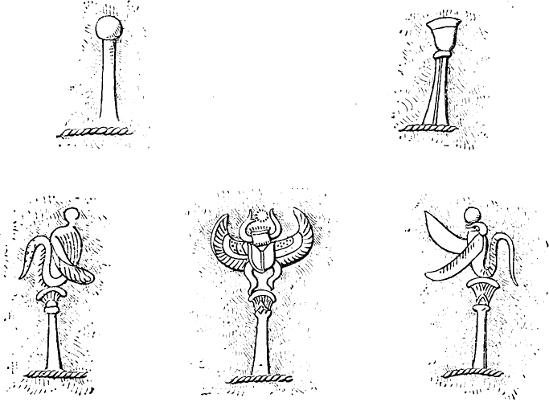
Figs. 210–214.—Columns or standards figured
upon a bronze cup; from Layard.
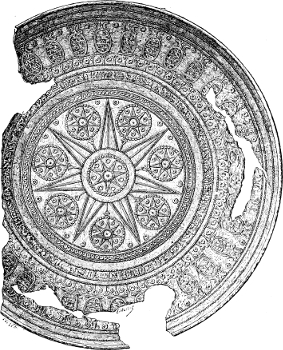
Fig. 215.—Bronze platter. Diameter 8 inches.
British Museum. Drawn by Wallet.
We gather the same impression from a platter only cleaned quite lately
and consequently not to be found in Sir H. Layard’s works; it is now
reproduced for the first time (Fig. 215). The whole decoration is
finely carried out in line with the burin. The middle is occupied by a
seven pointed star or rosette, nine times repeated. Around this elegant
and complex motive there are concentric circles, the third of which,
counting from the centre, is filled up with small figures hardly to
be distinguished by the naked eye. We divine rather than see lions,
birds, seated men, and certain groups of symbols, such as three lines
broken and placed one above the other, which are continually recurring
in the hieroglyphic writing of Egypt. The fifth zone has conventional
papyrus stems alternating with rosettes. The sixth, much larger, is
filled with ovals surmounted by two plumes and the uræus, that is by
the royal cartouch of Egypt in its usual form. The interior of each
oval contains very small groups of figures separated from one another
by four horizontal lines.
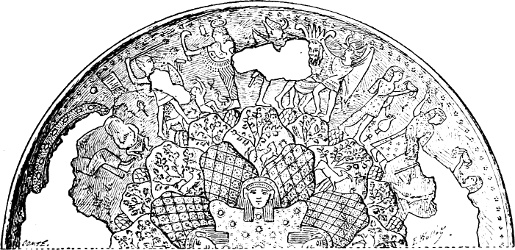
Fig. 216.—Part of a bronze cup or platter.
Diameter about 9 inches. British Museum.
We may quote a cup figured by Layard as a last example of this exotic
style of decoration. In the centre there are four full-face heads with
Egyptian wigs (Fig. 216). Around them a mountainous country is figured
in relief, and sprinkled with trees and stags engraved with the point.
The wide border, which is unfortunately very much mutilated, is covered
with groups of figures apparently copied from some Egyptian monument,
if we may judge from the attitudes and costume. One figure, whose torso
has entirely disappeared, wears the pschent and brandishes a
mace over his head; the movement is almost identical with that of the
victorious Pharaoh with whom we are so familiar. A goddess, who might
be Isis, stands opposite to him. In another part of the border there is
a misshapen monster crowned with feathers and resembling the Egyptian
Bes.[415]
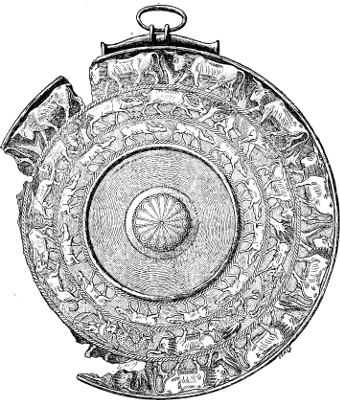
Fig. 217.—Bronze cup. Diameter 11 inches; from
Layard.
Side by side with these platters we find others on which nothing
occurs to suggest foreign influence. Take, for instance, the example
reproduced in Fig. 208. In the centre there is a small silver boss,
while the rest of the flat surface is occupied by the fine diaper
pattern made up of six-petalled flowers that we have already met with
on the carved thresholds (Vol. I. Fig. 96). The hollow border is
ornamented with four lines of palmettes united by an undulating line,
a motive which is no less Assyrian than the first (Vol. I., Figs. 128,
138, 139, etc.). In Fig. 217 we reproduce a cup on which its original
mounting, or ring by which it was suspended, is still in place. The
whole of the decoration is pure Assyrian. The rosette is exactly
similar to many of those found on the enamelled bricks (see Vol. I.,
Figs. 122, 123). In the first of the three zones, gazelles march in
file; in the second, a bull, a gazelle, an ibex, and a winged griffin,
followed by the same animals attacked by lions and making fourteen
figures in all; in the third zone fourteen heavy-crested bulls follow
one another round the dish. All these animals are among those most
constantly treated by the Assyrian sculptor; their shapes and motions
are as well understood and as well rendered as in the bas-reliefs. The
bulls especially are grandly designed. Moreover, the idea of employing
all these animals for the adornment of such a surface is entirely in
the spirit of Assyrian decoration. We shall meet with it again in the
shields from Van; we figure the best preserved of the latter on page
347.
It would be easy to give more examples, either from Layard or from our
own catalogue of these objects, of the purely Assyrian style on the
one hand, or of that in which the influence of Egyptian models is so
clearly shown, on the other. It is enough, however, that we have proved
that these little monuments may be divided into two clearly marked
classes. Did the two groups thus constituted share the same origin?
Did they both come from the same birth-place? Further discoveries may
enable us to answer this question with certainty, and even now we may
try to pave the way to its solution.
There would be no difficulty if these bronze vessels bore cuneiform
inscriptions, especially if the latter formed a part of the decorative
composition, as in the palace reliefs, and were cut by the same hand.
But this, so far as we know at present, was never the case. In some
fragments of pottery we have found cuneiform characters (Fig. 185),
and the name of Sargon has even been read on a glass phial (Fig. 190),
but—and we cannot help feeling some surprise at the fact—none of
these objects of a material far more precious bear a trace of the
Mesopotamian form of writing. I do not know that a single wedge has
been discovered upon them. A certain number of them are inscribed,
but inscribed without exception with those letters which Phœnicia is
supposed to have evolved out of the cursive writing of Egypt.[416]
They were not introduced with any idea of enriching the design, as
they always occur on the blank side of the vessel. They are close to
the edge, and their lines are very slender, suggesting that they were
meant to attract as little attention as possible. They consist of but
a single name, that of the maker, or, more probably, the proprietor of
the cup.[417]
May we take it that these inscriptions afford a key to the mystery?
that they prove the vases upon which they occur at least to have
been made in Phœnicia? We could only answer such a question in the
affirmative if peculiarities of writing and language belonging only to
Phœnicia properly speaking were to be recognized on them; but the texts
are too short to enable us to decide to which of the Semitic idioms
they should be referred, while the forms of the letters do not differ
from those on some of the intaglios (Figs. 156 and 157) and earthenware
vases (Fig. 183), and upon the series of weights bearing the name of
Sennacherib.[418] The characters belong to that ancient Aramæan form of
writing which seems to have been practised in Mesopotamia in very early
times as a cursive and popular alphabet.
The inscriptions, then, do little to help us out of our embarrassment,
and we are obliged to turn to the style of the vessels and their
decoration for a solution to our doubts. The conviction at which we
soon arrive after a careful study of their peculiarities is that even
those on which Egyptian motives are most numerous and most frankly
employed were not made in Egypt. In the first place we remember that
the Egyptians do not seem to have made any extensive use of such
platters; their libations were poured from vases of a different shape,
and the cups sometimes shown in the hands of a Pharaoh always have a
foot.[419] Moreover, in the paintings and bas-reliefs of Egypt, where
so many cups and vases of every kind are figured, and especially the
rich golden vessel that must have occupied such an important place in
the royal treasure, we only find the shape in question in a few rare
instances.[420]
After this general statement we may go into the details. In these
the hand of the imitator is everywhere visible; he borrows motives
and adapts them to his own habits and tastes. Take as an example the
platter to which a double frieze of hieroglyphs gives a peculiarly
Egyptian physiognomy (Fig. 215). An Egyptian artist would never
employ hieroglyphs in such a position without giving them some real
significance, such as the name of a king or deity. Here, on the other
hand, an Egyptologist has only to glance at the cartouches to see that
their hieroglyphs are brought together at haphazard and that no sense
is to be got out of them. This is obvious even by the arrangement of
the several characters in the oval without troubling to examine them
one by one. They are divided into groups by straight lines, like those
of a copy book. The Egyptian scribe never made use of such divisions;
he distributed his characters over the field of the oval according
to their sense and shape. The arrangement here followed is only to
be explained by habits formed in the use of a writing that goes in
horizontal lines from left to right or right to left. There is, in
fact, nothing Egyptian but the shape of the ovals, and the motive with
which they are crowned. The pretended hieroglyphs are nothing but
rather clumsily executed pasticcios. And it must be noticed that even
this superficial Egyptianism is absent from the centre of the dish. In
those Theban ceilings which display such a wealth of various decoration
we may find a simple rosette here and there, or rather a flower with
four or eight petals, but these petals are always rounded at the
end; nowhere do we find anything that can be compared to the great
seven-pointed star which is here combined so ingeniously with eight
more of the same pattern but of smaller size. On the other hand this
motive is to be found on a great number of cups where no reminiscence
of Egypt can be traced. The ruling idea is the same as that of the
diaper-work in the thresholds from Khorsabad and Nimroud (see Vol. I.,
Fig. 135).
After such an example we might look upon the demonstration as made,
but it may be useful to complete it by analyzing the other cups we
have placed in the same class. That on which the scarabs on standards
and the opposed sphinxes appear (Fig. 209) seems pure Egyptian at
first sight; but if we take each motive by itself we find variations
that are not insignificant. In Egyptian paintings, when the scarab
is represented with extended wings they are spread out horizontally,
and not crescent-wise over its head.[421] We may say the same of the
sphinx. The griffin crowned with the pschent is to be found in
Egypt as well as the winged sphinx,[422] but the Egyptian griffins had
no wings,[423] and those of the sphinxes were folded so as to have
their points directed to the ground. In the whole series of Egyptian
monuments I cannot point to a fictitious animal like this griffin. It
is in the fanciful creations of the Assyrians alone that these wings,
standing up and describing a curve with its points close to the head
of the beast that wears them (see Fig. 87), is to be seen. It is an
Assyrian griffin masquerading under the double crown of Egypt, but a
trained eye soon penetrates the disguise.
The arrangement, too, of the group is Assyrian. When the Egyptians
decorated a jewel, a vessel, or a piece of furniture by combining
two figures in a symmetrical fashion, they put them back to back
rather than face to face.[424] Very few examples can be quoted of the
employment in Egypt of an arrangement that is almost universal in
Assyria. In the latter country this opposition of two figures is so
common as to be common-place; they are usually separated from each
other by a palmette, a rosette, a column or even a human figure (see
Vol. I., Figs. 8, 124, 138, 139; and above, Figs. 75, 90, 141, 152,
153, 158, etc.), and it was certainly from Mesopotamia that Asia Minor
borrowed the same motive, which is so often found in the tombs of
Phrygia and in Greece as far as Mycenæ, whither it was carried from
Lydia by the Tantalides.[425]
The same remarks will apply to the cup partially reproduced in our
Fig. 216. The ornament of the centre and of the outer band is Egyptian
in its origin, but the mountainous country with its stags and its
trees, that lies between—have we found anything like it in Egypt?
The mountains are suggested in much the same fashion as in the palace
reliefs, and we know how much fonder the sculptors of Mesopotamia were
of introducing the ibex, the stag, the gazelle, etc., into their work
than those of Egypt. The rocky hills and sterile deserts that bounded
the Nile valley were far less rich in the wilder ruminants than the
wooded hills of Kurdistan and the grassy plains of the double valley.
There is one last fact to be mentioned which will, we believe, put
the question beyond a doubt. Of all antique civilization, that which
has handed down to us the most complete material remains is the
civilization of Egypt. Thanks to the tomb there is but little of it
lost. Granting that these cups were made in Egypt, how are we to
explain the fact that not a single specimen has been found in the
country? About sixty in all have been recovered; their decoration
is distinguished by much variety, but when we compare them one with
another we find an appreciable likeness between any two examples. The
forms, the execution, the ornamental motives are often similar, or, at
least, are often treated in the same spirit. The majority come from
Assyria, but some have been found in Cyprus, in Greece, in Campania,
Latium, and Etruria. Over the whole area of the ancient world there is
but one country from which they are totally absent, and that country is
Egypt.
We may, then, consider it certain that it was not Egyptian industry
that scattered these vessels so widely, from the banks of the Euphrates
to those of the Arno and the Tiber, not even excepting from this
statement those examples on which Egyptian taste has left the strongest
mark. Egypt thus put out of the question, we cannot hesitate between
Mesopotamia and Phœnicia. If the cups of Nimroud were not made where
they were found, it was from Phœnicia that they were imported. The
composite character of the ornamentation with which many of them were
covered is consistent with all we know of the taste and habits of
Phœnician industry, as we shall have occasion to show in the sequel.
On the other hand we must not forget at how early a date work in metal
was developed in the workshops of Mesopotamia. Exquisite as it is, the
decoration of the best of these vases would be child’s play to the
master workmen who hammered and chiselled such pictures in bronze as
those that have migrated from Balawat to the British Museum.
We are inclined to believe that the fabrication of these cups began
in Mesopotamia; that the first models were issued from the workshops
of Babylon and Nineveh, and exported thence into Syria; and that the
Phœnicians, who imitated everything—everything, at least, that had
a ready sale—acclimatized the industry among themselves and even
carried it to perfection. In order to give variety to the decoration of
the vases sent by them to every country of Western Asia and Southern
Europe, they drew more than once from that storehouse of Egyptian ideas
into which they were accustomed to dive with such free hands; and this
would account for the combination of motives of different origin that
we find on some of the cups. Vases thus decorated must have become
very popular, and both as a result of commerce and of successful wars,
must have entered the royal treasures of Assyria in great numbers. We
know how often, after the tenth century, the sovereigns of Calah and
Nineveh overran Palestine, as well as Upper and Lower Syria. After each
campaign long convoys of plunder wended their way through the defiles
of the Amanus and Anti-Lebanon, and the fords of the Euphrates, to the
right bank of the Tigris. The Assyrian conquerors were not content with
crowding the store-rooms of their palaces with the treasures thus won,
they often transported the whole population of a town or district into
their own country. Among the Syrians thus transplanted there must have
been artizans, some of whom endeavoured to live by the exercise of
their calling and by opening shops in the bazaars of Babylon, Calah,
and Nineveh. Clients could be easily gained by selling carved ivories
and these engraved cups at prices much smaller than those demanded when
the cost of transport from the Phœnician coast had to be defrayed.
In one of these two ways it is, then, easy to explain the introduction
of these foreign motives into Assyria, where they would give renewed
life to a system of ornament whose resources were showing signs of
exhaustion. This tendency must have become especially pronounced about
the time of the Sargonids, when Assyria was the mistress of Phœnicia
and invaded the Nile valley more than once. To this period I should be
most ready to ascribe the majority of the bronze cups; the landscapes,
hunts and processions of wild animals with which many of them are
engraved, seem to recall the style and taste of the bas-reliefs of
Sennacherib and Assurbanipal rather than the more ancient schools of
sculpture.
In any case it would be difficult, if not impossible, to distinguish
between the vases engraved in Mesopotamia by native workmen and those
imported from Phœnicia, or made at Nineveh by workmen who had received
their training at Tyre or Byblos. The resemblances between the two are
too many and too great. At most we may unite all the platters found in
Mesopotamia into a single group, and point out a general distinction
between them and those that have been discovered in the Mediterranean
basin. The ornament on the Nimroud cups is, on the whole, simpler than
on those found in Cyprus and Italy; the figure plays a less important
part in the former, and the compositions are more simple. The Assyrian
cups, or, to be more accurate, those found in Assyria, represent
the earliest phase of this art, or industry, whichever it should be
called. In later years, after the fall of Nineveh, when Phœnicia had
the monopoly of the manufacture, she was no longer content with purely
decorative designs and small separate pictures. Her bronze-workers
multiplied their figures and covered the concentric zones with real
subjects, with scenes whose meaning and intention can often be readily
grasped. This we shall see when the principal examples of this kind of
art come under review in our chapters upon Phœnicia.[426]
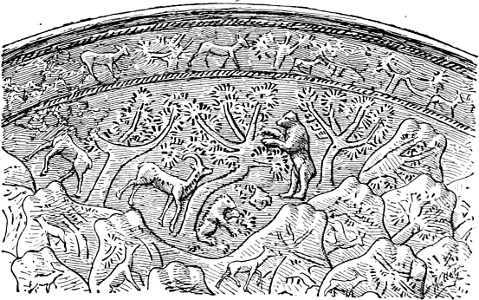
Fig. 218.—Bronze cup. British Museum.
Meanwhile, we shall not attempt to establish distinctions that are
nearly always open to contest; they would, besides, require an amount
of minute detail which would here be quite out of place. To give but
one example of the evidence which might lead to at least plausible
conclusions, we might see pure Assyrian workmanship in the cup figured
below (Fig. 218),[427] where mountains, trees, and animals stand up in
slight relief, both hammer and burin having been used to produce the
desired result. Among these animals we find a bear, which must have
been a much more familiar object to the Assyrians living below the
mountain-chains of Armenia and Kurdistan than to the dwellers upon the
Syrian coast. In the inscribed records of their great hunts, the kings
of Assyria often mention the bear.[428] Nothing that can be compared
to these wooded hills peopled by wild beasts is to be found on the
cups from Cyprus or Italy. I may say the same of another cup on which
animals of various species are packed so closely together that they
recall the engravings on some of the cylinders (see Fig. 149).[429]
On the other hand, there are plenty of motives which may just as easily
have had their origin in one country as the other. The two vultures,
for instance, preparing to devour a hare stretched upon its back, which
we figure below (Fig. 219).[430]
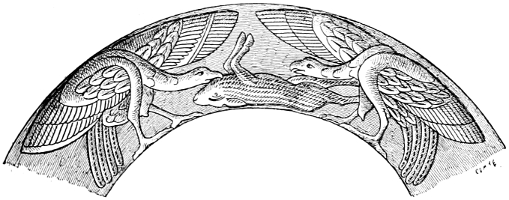
Fig. 219.—Border of a cup; from Layard.
It may be thought that we have dwelt too long upon these cups; but
the sequel of our history will show why we have examined them with an
attention that, perhaps, neither their number nor their beauty may
appear to justify. They are first met with in Assyria, but they must
have existed in thousands among the Greeks and Italiots. Light, solid,
and easy to carry, they must have furnished western artists with some
of their first models. As we shall see, they not only afforded types
and motives for plastic reproduction, but, by inciting them to find a
meaning for the scenes figured upon them, they suggested myths to the
foreign populations to whom they came.
We shall not, of course, study Assyrian arms from the military point
of view. That question has been treated with all the care it deserves
by Rawlinson and Layard.[431] From the stone axes and arrow-heads that
have been found in the oldest Chaldæan tombs, to the fine weapons and
defensive armour in iron and bronze, used by the soldiers of Nineveh in
its greatest years, by the cavalry, the infantry, and the chariot-men
of Sargon and Sennacherib, the progress is great and must have required
many long centuries of patient industry. In Assyria no trade can have
occupied more hands or given rise to more invention than that of the
armourer. For two centuries the Assyrian legions found no worthy rivals
on the battlefields of Asia; and, although their superiority was mainly
due, of course, to qualities of physical vigour and moral energy
developed by discipline, their unvarying success was in some degree the
result of their better arms. Without dwelling upon this point we may
just observe that when war is the chief occupation of a race, its arms
are sure to be carried to an extreme degree of luxury and perfection.
Some idea of their elaboration in the case of Assyria may be gained
from the reliefs and from the original fragments that have come down to
us.
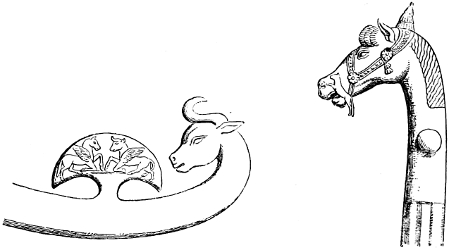
Figs. 220, 221.—Chariot poles; from a
bas-relief.
It was from the animal kingdom that the Assyrian armourer borrowed most
of the forms with which he embellished the weapons and other military
implements he made. Thus we find the chariot poles ending in the head
of a bull, a horse, or a swan (Figs. 220 and 221).[432] Elsewhere we
find a bow no less gracefully contrived; its two extremities are shaped
into the form of a swan’s head bent into the neck.[433]
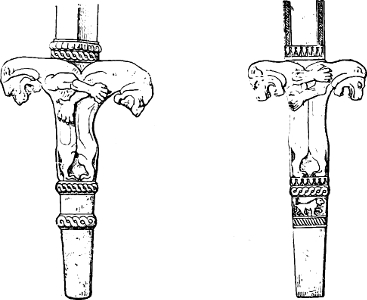
Figs. 222, 223.—Sword scabbards, from the
reliefs; from Layard.
The sword is the king of weapons. By a kind of instinctive metaphor
every language makes it the symbol of the valour and prowess of him who
wears it. It was, therefore, only natural that the Assyrian scabbard,
especially when worn by the king, should be adorned with lions (Figs.
82, 222, 223). These were of bronze, no doubt, and applied. In the
last of our three examples a small lion is introduced below the larger
couple. The sword-blade itself may have been decorated in the same
fashion. The Assyrians understood damascening, an art that in after
ages was to render famous the blades forged in the same part of the
world, at Damascus and Bagdad. The Arab armourers did no more, perhaps,
than practise an art handed down to them from immemorial times, and
brought to perfection many centuries before in the workshops of
Mesopotamia. At any rate we know that two small bronze cubes found at
Nimroud were each ornamented on one face with the figure in outline
of a scarab with extended wings, and that the scarab in question was
carried out by inlaying a thread of gold into the bronze (Fig. 224).
Meanwhile we may point to an Assyrian scimitar, the blade of which is
inscribed with cuneiform characters.[434]
In the reliefs we find a large number of shields with their round
or elliptical surfaces divided into concentric zones.[435] A recent
discovery enables us to say how these zones were filled, at least in
the case of shields belonging to kings or chiefs. In 1880 Captain
Clayton found, on the site of an ancient building at Toprak-Kilissa,
in the neighbourhood of Van, four shields, or rather their remains,
among a number of other objects. These shields are now in the British
Museum. Upon one fragment we may read an inscription of Rushas, king of
Urardha, or Armenia, in the time of Assurbanipal.[436]
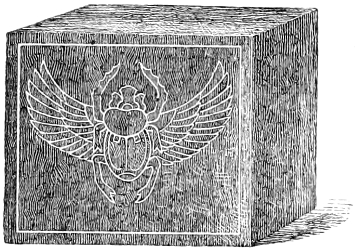
Fig. 224.—Bronze cube damascened with gold;
from Layard.
This inscription, which is votive in its tenor, combines with the
examination of the objects themselves, to prove that these shields are
not real arms, made for the uses of war. The bronze is so thin—not
more than a millimetre and a half in thickness—that even if nailed
upon wood or backed with leather it could have afforded no serious
protection, and its reliefs must have been disfigured and flattened
with the least shock. The edge alone is strengthened by a hoop of
iron. The shields are votive, and must have been hung on the walls
of a temple, like those we see thus suspended in a bas-relief of
Sargon (Vol. I. Fig. 190), a relief in which a temple of this same
Armenia is represented.[437] But although they were made for purposes
of decoration, these arms were none the less copies of those used in
actual war, except in the matter of weight and solidity; thus they were
furnished with loops for the arms, but these were too narrow to allow
the limb of a man of average size to pass through them with any freedom.
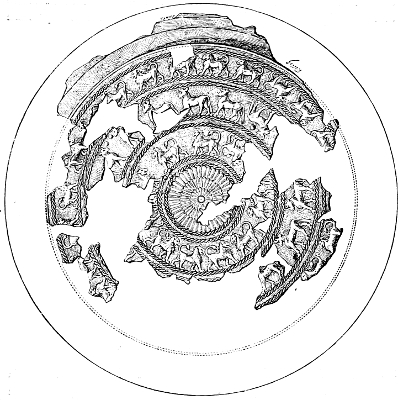
Fig. 225.—Votive shield. Diameter about 34½
inches. Drawn by R. Elson.
For us the most interesting point about them is their decoration, which
is identical in principle with several of the bronze platters lately
discussed (see Fig. 217). This may be clearly seen in our reproduction
of the shield which has suffered least from rust (Fig. 225).[438] In
the centre there is a rosette with many radiations; next come three
circular bands separated from each other and from the central boss by
a double cable ornament. The innermost and outermost zones are filled
with lions passant, the one between with bulls in the same attitude.
And here we find a curious arrangement of which we can point to no
other example: both lions and bulls have their feet turned sometimes
to the centre of the shield, sometimes to its outer edge. The general
character of the form is well grasped in both cases; but the design has
neither the breadth nor firmness of that upon the cup to which we have
already compared this shield (Fig. 217). The armourers were inferior in
skill to the gold and silversmiths—we can think of no more appropriate
name for them—by whom the metal cups were beaten and chased, although
they made use of the same models and motives. No one would attribute
a Phœnician origin to these bucklers; they were found in Armenia and
were covered with cuneiform inscriptions. They must have been made
either in Assyria, or in a neighbouring country that borrowed all from
Assyria, its arts and industries as well as its written characters. The
Assyrians attached too much importance to their arms and made too great
a consumption of them to be content with importing them from a foreign
country.
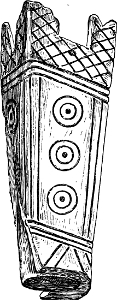
Fig. 226.—Knife-handle. Bone. Louvre.
When we turn to objects of less importance, such as daggers and
knives, we find their handles also often modelled after animals’ heads.
We have already figured more than one example (Vol. I., tail-piece to
chapter II., and Vol. II., tail-piece to chapter I.). But sometimes
they were content with a more simple form of decoration belonging
to the class of ornament we call geometrical, which they combined
with those battlement shapes that, as we have seen, the enameller
also borrowed from the architect (Vol. I. Fig. 118). A by no means
ungraceful result was obtained by such simple means (Figs. 202 and
226). These knife-handles are interesting not so much on account of
their workmanship as for their tendency and the taste they display.
They were objects of daily use and manufacture. Cut from ivory and
bone, they were sold in hundreds in the bazaars. But in every detail
we can perceive a desire to make the work please the eye. The evidence
of this desire has already struck us in Egypt; it will be no less
conspicuous in Greece. In these days, how many useful objects turned
out by our machines have no such character. Those who design them think
only of their use. They are afraid of causing complications by any
attempt to make one different from the other or to give varied shapes
to tools all meant for the same service. They renounce in advance the
effort of personal invention and the love for ornament that gives
an interest of its own to the slightest fragments from an ancient
industry, and raises it almost to the dignity of a work of art.
The preoccupation to which we have just alluded, the love for an
agreeable effect, is strongly marked in several things which are
now always left without ornament. A single example will be enough
to show the difference. Nowadays all that we ask of a comb is to
do its duty without hurting the head or pulling out the hair; that
its teeth shall be conveniently spaced and neither too hard nor too
pliant. These conditions fulfilled, it would not be out of place in
the most luxurious dressing-room. The ancients were more exacting, as
a series of ebony combs in the Louvre is sufficient to show (Figs.
227–229).[439] They have two rows of teeth, one coarse, the other
fine, and each is ornamented in the middle with a figure in open-work
(Figs. 228–229) or raised in relief on a flat bed (Fig. 227). Only a
part of the latter comb is preserved. The frame round the figures is
cut into the shape of a cable above and below, and into rosettes at the
ends. On one side of the comb there is a walking lion, on the other the
winged sphinx shown in our engraving. Its body is that of a lion, it
is mitred and wears a pointed beard. In the second example we have a
lion with lowered head within a frame with a kind of egg moulding. The
forms are so heavy that at first we have some difficulty in recognizing
the species. In our last specimen both design and execution are much
better. A lion is carved in the round within a frame ornamented with
a double row of zig-zag lines. The modelling has been carried out by
a skilful artist and is not unworthy of a place beside the Ninevite
reliefs.
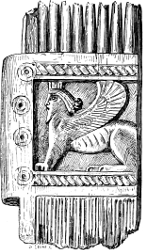
Fig. 227.—Comb. Actual size. Louvre.
We know of nothing among the spoils of Assyria that can be compared to
those wooden spoons that the Egyptian workman carved with so light a
hand;[440] but two objects found at Kouyundjik prove that the Assyrians
knew how to give forms elegant and graceful enough, though less
original, to objects of the same kind. One of these is a bronze fork,
the other a spoon of the same material. Cables, zig-zags, and beads
are used to ornament them, and the whole is a good example of Assyrian
taste in little things.
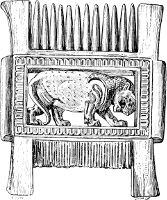
Fig. 228.—Comb. Actual size. Louvre.
So far we have treated Assyrian metal-work of the ornamental kind only
as it is seen in bronze. Hardly any objects of gold or silver have,
in fact, been discovered in Mesopotamia. And yet it is impossible
that those two metals can have been very rare in the Nineveh of the
Sargonids or the Babylon of Nebuchadnezzar; war and industry certainly
led to considerable accumulations of both. We must find a reason for
their absence in the success with which the Assyrian tomb has so far
avoided discovery. The tomb alone could offer a safe asylum to such
treasures, and preserve them in its shadows for the inquisitive eyes
of modern archæologists. Before being abandoned to the slow effects of
time, the temples and palaces were pillaged. Here and there, however,
in some well contrived hiding-place or forgotten corner, a few trinkets
may have escaped the eyes of greedy conquerors, or of the later
marauders who sounded the ruins in every direction for the sake of the
precious metals they might contain.
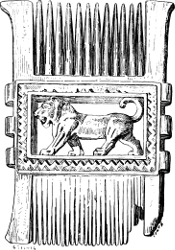
Fig. 229.—Comb. Actual size. Louvre.
The oldest jewels left to us by these peoples are those found in the
most ancient tombs at Warka. Their forms are simple enough—bronze
bracelets made of a bar tapering rapidly to each end and beaten with a
hammer into a slight oval (Figs. 232, 233). These bars are sometimes
very thick, as our first example shows. The golden ear-drops from the
same tombs (Fig. 234) are made in the same way.
At Nineveh the art is more advanced. We may form our ideas of it from
the bas-reliefs, where people are shown with jewels about their arms,
their necks, and hanging on their cheeks; and also from a few original
specimens that have escaped the general wreck. In the foundations of
Sargon’s palace, under the massive threshold, were found too, together
with a large number of cylinders, the remains of necklaces made up
of pierced stones, such as carnelian, red and yellow jasper, brown
sardonyx, amethyst, &c., cut into cylinders, polygons, medallions,
and into the shapes of a pear and of an olive or date-stone (Fig.
235). This use of precious stones was a survival from the days when
pebbles were turned to the same purpose. Earrings were made in the same
fashion (Figs. 236, 237). In one of the reliefs we see a eunuch wearing
a necklace in which double cones alternate with disks (Fig. 238).
The same elements could of course be used for bracelets or armlets,
by shortening the wire on which they were strung. From an art point
of view such a jewel was quite primitive; all its beauty lay in the
rich colours of its separate stones, among which beads of glass and
enamelled earthenware have also been found.
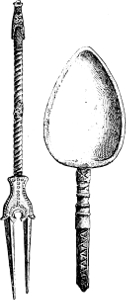
Figs. 230, 231.—Bronze fork and spoon; from
Smith’s Assyrian Discoveries.
Kings and other high personages were not content with such simple
adornments. It would seem that princes wore necklaces made up of
separate pieces each of which had an emblematic signification of its
own (Fig. 239), because we find them constantly reappearing in the
reliefs, sometimes around the sovereign’s neck, sometimes distributed
over the field of a stele. In the stele of Samas-Vul, the king only
wears a single ornament on his breast; it is exactly similar to what we
call a Maltese cross (Fig. 116).
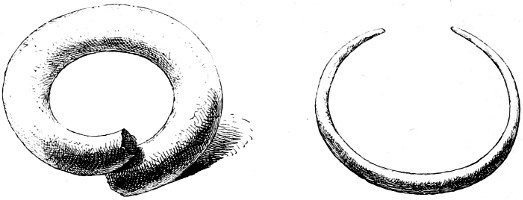
Figs. 232, 233.—Bracelets; from Rawlinson.
Fig. 234.—Ear-drop. British Museum.
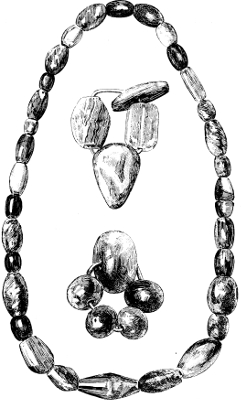
Figs. 235–237.—Necklace and ear-drops. Louvre.
Drawn by Saint-Elme Gautier.
These ornaments must have been of gold and of some considerable size.
The grand vizier, and the king when his tiara is absent, wear a diadem
about their foreheads in which the rosette is the chief element of the
decoration (Vol. I. Figs. 25 and 29). The queen’s diadem, in the “Feast
of Assurbanipal,” is crenellated (Fig. 117), reminding us of that worn
by the Greek Cybele. In the same monuments the wrists of kings and
genii are surrounded with massive bracelets (Vol. I. Figs. 4, 8, 9, 15,
23, 24, 29, &c.). In the Louvre there is a bronze bracelet of exactly
the same type (Fig. 24C).[441] We
may see them figured among
the objects offered in tribute in a bas-relief at Nimroud (Fig. 241).
From the same reliefs we gather several examples of ear-pendents (Figs.
242–244). It is probable that the same models were carried out in gold,
silver, or bronze, according to the rank and fortune of the people for
whom they were made.[442] The forms were not altogether happy.
Fig. 238.—Necklace; from Layard.
And yet the Assyrian workmen could sometimes turn out lighter and more
graceful objects than these. It was, no doubt, when they laboured for
the softer sex that they modified their methods of work. The figure
of a winged genius in which we ventured to recognise a goddess wears
several necklaces, and one of them looks like a chain with alternately
thin and stout members (Fig. 162). Now, at Kouyundjik, a necklace has
been found (Fig. 245) bearing no little resemblance to the one here
copied by the sculptor. It is composed of slender gold tubes, separated
from each other by beads of the same metal. These beads are alternately
ribbed and smooth. The workmanship is good and very careful.
Fig. 239.—Royal necklace; from Rawlinson.
That these articles of personal jewelry were made in the country is
proved by the fact that not a few of the moulds used by the jewellers
for the patterns most in favour have been found. They are small slabs
of serpentine or very hard limestone, in one face of which the desired
pattern is cut in intaglio (Figs. 246 and 247). Wherever the pattern
communicates with the outer edge by a small opening, it may have been
used to receive the liquid metal; where no such gutter exists, the
design must have been stamped, the leaves of metal being placed over
the hollow and beaten into it with a mallet.[443]
Fig. 240.—Bracelet. Diameter 5 inches. Louvre.
Drawn by Saint-Elme Gautier.
It was by this latter process, no doubt, that those buttons which
have been found in such quantities by every one who has explored the
Assyrian palaces, were made. They are sometimes small disks ornamented
with concentric bands (Fig. 248), sometimes lozenges with beaded edges
(Fig. 249). These buttons have sometimes staples for attachment like
ours, but more often they are pierced with a small hole for the passage
of a metal thread. They were thus fixed on the king’s robes and the
harness of his horses. Our Fig. 250, which is copied from a bas-relief
at Kouyundjik, shows how the leather bands that encircled the necks of
the chariot-horses and supported bells, metal rosettes and coloured
tassels, were decorated.[444]
Fig. 241.—Bracelets; from Layard.
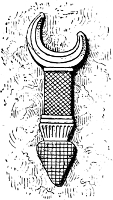
Fig. 242.—Ear-drop; from Layard.
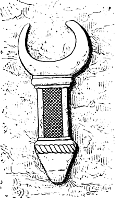
Figs. 243, 244.—Ear-drops; from Layard.
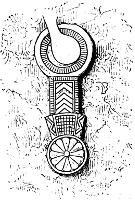
Figs. 248, 249.—Gold buttons. British Museum.
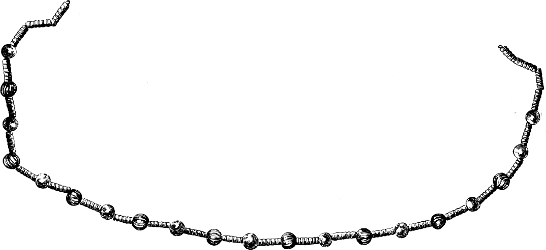
Fig. 245.—Necklace. British Museum.
The habits and tastes of the Oriental saddler have not changed since
the days of antiquity. We cannot get a better idea of Assyrian harness
than by examining the sets exposed for sale in the present day in the
bazaars of Turkey, Persia, and India. More than once, when some Kurdish
bey rode past him on his Arab, Sir H. Layard felt as if he had seen
a vision from one of the Ninevite reliefs. The leather stitched with
bright coloured threads, the housings of gaudy wool, the hawk’s bells
tinkling round the horse’s neck, were all survivals from the past.
The equipment of a Spanish mule, or the harness that used to be worn
by the waggon teams of Eastern France within the memory of men not yet
old, gives some idea of the effect produced.
Figs. 246, 247.—Moulds for trinkets; from
Layard.
Figs. 248, 249.—Gold buttons. British Museum.
Fig. 250.—Part of the harness of a
chariot-horse.
Personal jewelry and the apparatus of the toilet seem to have been no
less elaborate in the Babylon of Nebuchadnezzar than in the Nineveh
of Sennacherib, but we possess very few objects that can be surely
referred to that period. To the very last years of the Chaldæan
empire, if not to a still later date, must be ascribed two golden
earrings now in the British Museum (Figs. 251 and 252). They represent
a naked child, with long hair and a head much too large for its body.
We are told that they were found in a tomb at Niffer, with other
objects whose Chaldæan character was very strongly marked. Without this
assurance we should be tempted to think their date no more remote than
that of the Seleucidæ.
Among the knobs, or buttons, used so largely by joiners, tailors, and
saddlers, some have been found of ivory and of mother-of-pearl. The
jewellers, too, must have used these substances, which would give them
an opportunity for effective colour harmonies. Thus Layard mentions an
ear-pendent that he found at Kouyundjik, which had two pearls let into
a roll of gold.[445]
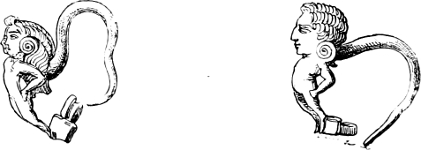
Figs. 251, 252.—Ear-pendents. British Museum.
On the other hand no amber has been found in Mesopotamia. That
substance was widely used by the Mediterranean nations as early as
the tenth century before our era, but it does not seem to have been
carried into the interior of Asia. It has been asserted that one of the
cuneiform texts mentions it;[446] that assertion we cannot dispute, but
it is certain that neither in the British Museum nor in the Louvre,
among the countless objects that have been brought from the Chaldæan
and Assyrian ruins to those great store-houses of ancient art, has
the smallest fragment of amber been discovered. If it ever entered
Mesopotamia, how could it have been more fitly used than in necklaces,
to the making of which glass, enamelled earthenware, and every
attractive stone within reach, contributed?[447]
Among people who looked upon nudity as shameful, the robe and its
decorations were of no little importance. Both in Chaldæa and Assyria
it was carried to a great pitch of luxury by the noble and wealthy.
They were not content with fine tissues, with those delicate and snowy
muslins for which the kings of Persia and their wives were, in later
years, to ransack the bazaars of Babylon.[448] They required their
stuffs to be embroidered with rich and graceful ornament, in which
brilliant colour and elegant design should go hand in hand.[449] The
Chaldæans were the first to set this example, as we know from the most
ancient cylinders, from the Tello monuments and from the stele of
Merodach-idin-akhi (Fig. 233). But it would seem that the Assyrians
soon left their teachers behind, and in any case the bas-reliefs
enable us to become far better acquainted with the costume of the
northern people than with that of their southern neighbours. Helped and
tempted by the facilities of a material that offered but a very slight
resistance to his chisel, the Assyrian sculptor amused himself now by
producing a faithful copy of the royal robes in every detail of their
patient embroidery, now by imitating in the broad thresholds, the
intersecting lines, the stars and garlands woven by the nimble shuttle
in the soft substance of the carpets with which the floors of every
divan were covered.
The images on the royal robes must have been entirely embroidered
(Figs. 253 and 254). They cannot have been metal cuirasses engraved
with the point, as we might at the first glance be tempted to think.
In the relief there is no salience suggesting the attachment of any
foreign substance. Neither have we any reason to believe that work of
such intricate delicacy could be carried out in metal. It was by the
needle and on a woollen surface that these graceful images were built
up.
The skill of the Babylonian embroiderers was famous until the last days
of antiquity.[450] During the Roman period their works were paid for by
their weight in gold.[451] Even now the women of every eastern village
cover materials often coarse enough in themselves with charming works
of the same kind. They decorate thus their long hempen chemises, their
aprons and jackets, their scarves, and the small napkins that are used
sometimes as towels and sometimes to lay on the floor about the low
tables on which their food is served.
It is likely that the Assyrian process was embroidery in its strictest
sense. In the modern bazaars of Turkey and Persia table-covers of
applied work may be bought, in which hundreds of little pieces of
cloth have been used to make up a pattern of many colours; but in the
sculptured embroideries the surfaces are cut up by numerous lines which
could hardly have been produced, in the original, otherwise than by
the needle. This, however, is a minor question. Our attention must be
directed to the composition of the pictures and to the taste which
inspired and regulated their arrangement.
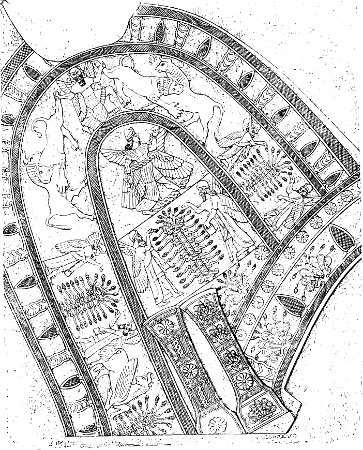
Fig. 253.—Embroidery on the upper part of the
king’s mantle; from Layard.
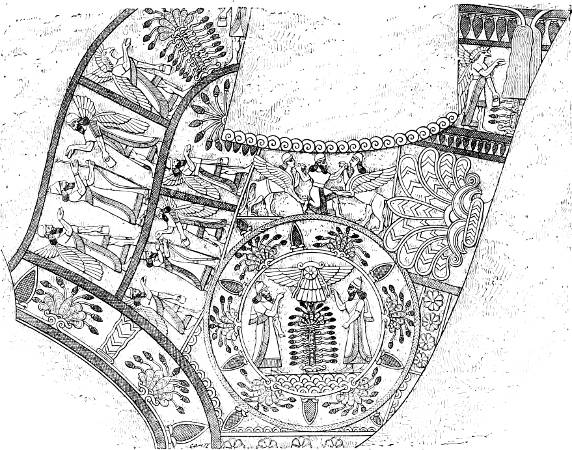
Fig. 254.—Embroidery upon a royal mantle; from
Layard.
Fig. 255.—Embroidered pectoral; from Layard.
The principle of the decoration as a whole is almost identical with
that of the bronze platters. A central motive is surrounded by parallel
bands of ornaments in which groups of figures are symmetrically
disposed. Outside this again are narrow borders composed of forms
borrowed chiefly from the vegetable kingdom, such as conventional
flowers and buds, palmettes, and rosettes. The figures are strongly
religious in character; here we find winged genii, like those about the
palace doors, adoring the sacred tree, floating in space, or playing
with lions (see Fig. 253); in another corner the king himself is
introduced, standing between two monitory genii, or in act of homage to
the winged disk and mystic palm.
All these images are skilfully arranged, in compartments bounded by
gracefully curving lines. The designer has understood how to cover
his surface without crowding or confusion, and has shown a power of
invention and a delicate taste that can hardly be surpassed by any
other product of Mesopotamian art. There is no trace of the heaviness
to which we alluded in our section on jewelry.
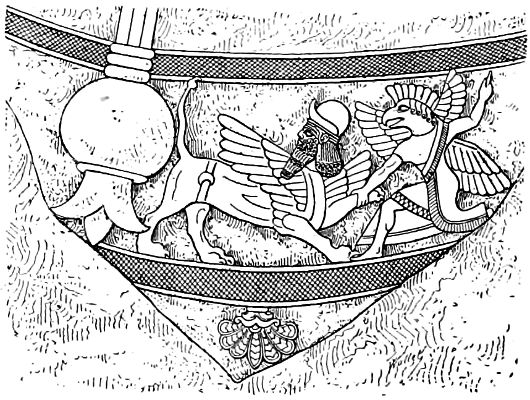
Fig. 256.—Detail of embroidery; from Layard.
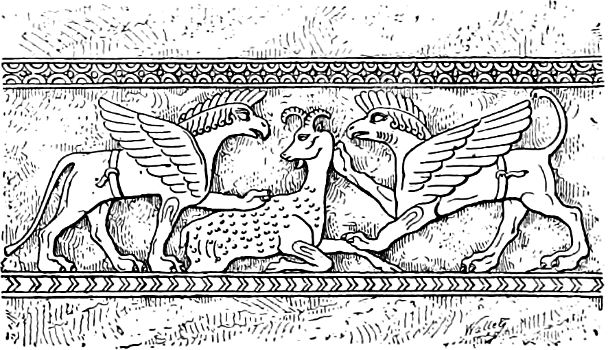
Fig. 257.—Detail of embroidery; from Layard.
Fig. 258.—Detail of embroidery; from Layard.
The impression made by these compositions as a whole is intensified
when we examine their separate details. The variety of the combinations
employed is very striking. Sometimes the ornament is entirely linear
and vegetable in its origin. Look, for instance, at the kind of square
brooch worn on his breast by one of the winged genii at Nimroud (Fig.
255). The sacred tree surrounded by a square frame of rosettes and wavy
lines occupies the centre, the palmette throws out its wide fronds
at one end. In another example we find a human-headed lion, mitred
and bearded, struggling with an eagle-headed genius. On the right of
our woodcut (Fig. 256) a bud or flower like that of the silene
inflata, hangs over the band of embroidery; it is a pendent from
the necklace. Sometimes we find real combined with fictitious animals.
In Fig. 257 two griffins have brought down a spotted deer. Elsewhere
we see a winged bull perched upon a large rosette in an attitude that
is at once unexpected and not ungraceful (Fig. 258). Finally the king
himself or a personage resembling him is often represented struggling
with fictitious monsters (Fig. 259). In this figure notice the rosettes
that are scattered promiscuously over the field. We shall encounter
the same prodigality of ornament in the oldest Greek vases, whose
decorators seem to have been afraid to leave a corner of their surface
unoccupied.
In his way the weaver was no less skilful than the embroiderer, but he
could not give quite so much rein to his fancy as his fellow workmen.
The shuttle was less free than the needle. In its passage through the
threads of the warp it could hardly do more than trace symmetrical
designs and repeat them at regular intervals. We must seek for the
patterns of Chaldæo-Assyrian carpets in the sculptured thresholds of
the palaces. In these the general principle never varied, but the
composition changed just as it does to-day in the carpets and rugs
imported from Turkey and Persia. In any case there was a border into
which the softest and most delicate colours were introduced. As a
rule it must have been decorated with one of those “knop and flower”
ornaments originally invented by the Egyptians.[452] The space so
inclosed was sometimes divided into coffer-like compartments or
panels, sometimes it was filled with a single diaper pattern, as in
the threshold from Khorsabad (Vol. I. Fig. 96). No figures of men or
animals are to be found here. The simple and perhaps monotonous forms
borrowed from the vegetable kingdom, were thoroughly well suited for
stuffs destined to be stepped upon by countless feet. If, in our
fancy, we clothe the patterns of the carved sills in all the charm
of varied colour, we obtain a glowing surface that may be compared,
at a respectful distance, with the gorgeous colour harmonies of the
Mesopotamian plains, when the spring showers have clothed them in a
robe of brilliant green, studded with the pure white of the marguerite,
the gold of the ranunculus, and the rich satin of the purple tulip.
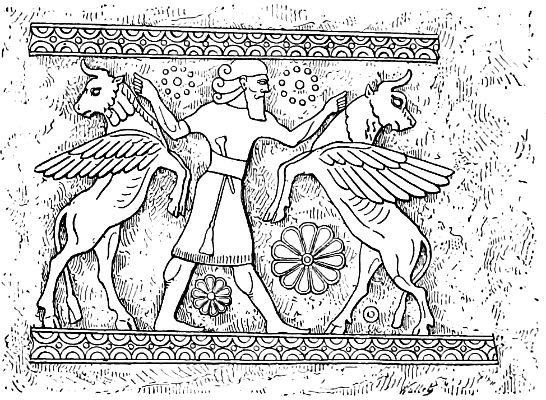
Fig. 259.—Detail of embroidery; from Layard.
The industry whose products we have been describing presupposed an
active and widely extended commerce. It made use of many things
that were not to be found within its own country, and it produced
so much that it could not fail to seek for profitable exchanges.
“Thou [Nineveh] hast multiplied thy merchants above the stars of
heaven,”[453] says the prophet Nahum; and Ezekiel calls Chaldæa “a land
of traffic” and Babylon “a city of merchants.”[454]
Like Egypt, neither Chaldæa nor Assyria understood the use of money,
but its absence did not affect their trade. Whether their system was
one of barter, or whether they employed the precious metals in rough
ingots or rings of a certain weight, weighing them in the balance for
each transaction, we cannot say, but we know that the great cities
of Mesopotamia had intimate business relations with the surrounding
countries for many centuries, and that their merchants had ingenious
methods of mobilizing their capital. It is even asserted that they
made use of the bill of exchange or of something strongly resembling
it.[455]
It was only at its southern extremity that Mesopotamia had a sea-board,
and we have very little information as to its maritime commerce.
There seems to be no doubt, however, that it held communication with
India by sea. Ur, the oldest of the successive capitals of Chaldæa,
was near the Persian Gulf, and its ships are often mentioned in the
inscriptions.[456]
As civilization advanced those vessels must have increased in number.
Isaiah speaks of the ships of the Chaldæans.[457] The regular winds
of the Indian Ocean enabled a sea traffic to be carried on without
danger; ships could proceed to the mouths of the Indus and return to
the Persian Gulf almost to the day. That communication of some kind
existed between the two countries can be proved. The zebu, or
humped ox, is often represented on the Mesopotamian monuments; and that
animal is indigenous in India, where its domestication dates back to
the remotest antiquity. Among the half decomposed beams that have been
disinterred from the ruins in Lower Chaldæa, some of teak have been
recognized.[458] Now the home of that tree is in India; it is to be
found neither in Chaldæa nor in any other part of Western Asia. Finally
a large proportion of the ivory consumed by the artificers of Babylon
and Nineveh must have come from India. The same ships may have brought
African ivory from the land of the Somalis, and, as they coasted along
Arabia they may have increased their cargoes with myrrh, incense, and
other aromatic spices from that country.[459]
But it was in the main by land that Mesopotamia imported her raw
material and exported her manufactures. There must have been continual
intercourse by caravan between Assyria and the Indus valley. The
route must have been by Cabul, Herat, the gates of the Caspian and
Media.[460] Several passes led down to the Tigris valley from the
plateau of Iran. Longer and more difficult roads brought Armenia and
the Caucasus into relations with Nineveh; but, as Herodotus noticed,
the rafts of inflated skins, or keleks as they are now called,
could be used to float the stones and metals, the leather and the wool
of the hilly regions down to the Assyrian capital and the cities of
Chaldæa. Timber also would come down with the stream. Towards the west
the roads that crossed the fords of the Euphrates, either at Thapsacus,
or higher up, at Karkhemish, put Assyria into communication with Asia
Minor by the defiles of the Taurus, and with Upper Syria and Damascus
by the desert and the oasis of Tadmor. It was by this latter route
that the great ports on the Syrian coast received those draperies and
carpets which Ezekiel was so careful to enumerate when he pictured the
commerce of Tyre. Addressing that queen of the sea whose fall made him
leap for joy, he cries: “Haran, and Canneh, and Eden, the merchants of
Sheba, Asshur and Chilmad were thy merchants. These were thy merchants
in all sorts of things, in blue clothes, and broidered work, and in
chests of rich apparel, bound with cords, and made of cedar among thy
merchandize.”