Sculpture.
The art of imitating living forms by means of sculpture was no less
ancient in Egypt than architecture. We do not mean to say that it
already existed in those remote ages when the first ancestors of the
Egyptian people built their mud cabins upon the banks of the Nile; but
as soon as their dwellings became something more than mere shelters
and began to be affected by the desire for beauty, the figures of men
and animals took a considerable place in their decoration. The oldest
mastabas that have been discovered have bas-reliefs upon their walls
and statues in their mummy-pits.
The existence of these statues and their relative perfection show that
sculpture had advanced with strides no less rapid than those of the
sister art. It may even be said that its progress had been greater
than that of architecture. Given the particular kind of expressive
beauty which formed the ambition of the Egyptian sculptor, he produced
masterpieces as early as the time of the Pyramid builders. We cannot
say as much of the architect. The latter showed himself, indeed, a
master in the mechanical processes of dressing and fixing stone, but
the arrangement of his buildings was simple, we might say elementary,
and many centuries had to pass before he had become capable of
imagining and creating the sumptuous temples of the New Empire, with
those ample porticos and great hypostyle halls which were the
culminating achievements of Egyptian architecture.
In order to explain this curious inequality we need not inquire which
of the two arts presents the fewest difficulties. It is with nations
as with individuals. Some among them succeed with ease in matters
which embarrass their neighbours. It is a question of circumstances,
of natural qualifications, and of surroundings. Among the Egyptians
the progress of sculpture was accelerated by that national belief in a
posthumous life for the body which we have described in connection
with their funerary architecture. By the existence of this constant
and singular belief we may explain both the early maturity of Egyptian
sculpture and the great originality of their most ancient style.
We have already described the arrangements which were necessary to
enable the inhabitant of the tomb to resist annihilation. Those
arrangements were of two kinds, a provision of food and drink, which
had to be constantly renewed, either in fact or by the magic
multiplication which followed prayer, and a permanent support for the
ka or double, a support that should fill the place of the living
body of which it had been deprived by dissolution. This support was
afforded to some extent by the mummy; but the mummy was liable to be
destroyed or to perish by the action of time. The Egyptians were led
to provide against such a catastrophe by the invention of the funerary
statue. In the climate of Egypt, stone, and even wood, had far better
chances of duration than the most carefully embalmed body. Statues had
the additional advantage that they could be multiplied at will. There
was nothing to prevent ten, twenty, any number of them, being placed
in a tomb.[170] If but one of these images survived all the accidents
of time, the double would be saved from that annihilation to which
it would otherwise be condemned.
Working under the impulse of such an idea, the sculptor could not fail
to do his best to endow his statue with the characteristic features of
the original. "It is easy, then, to understand why those Egyptian
statues which do not represent gods are always portraits of some
individual, executed with all the precision of which the artists were
capable. They were not ideal figures to which the desire for beauty of
line and expression had much to say, they were stone bodies, bodies
which had to reproduce all the individual contours of their
flesh-and-blood originals. When the latter was ugly, its reproduction
had to be ugly also, and ugly in the same way. If these principles
were disregarded the double would be unable to find the support which
was necessary to it."[171]
The first Egyptian statue was not so much a work of art as a cast from
nature. If photography had been invented in the time of Menes,
photographers would have made their fortunes in Egypt. Those
sun-portraits, which are supposed to present a perfect resemblance,
would have been put in the tomb of a deceased man in hundreds. Wanting
such things, they were contented to copy his figure faithfully in
stone or wood. His ordinary attitude, his features and costume, were
imitated with such scrupulous sincerity that the serdabs were filled
with faithful duplicates of himself. To obtain such a likeness the
artist cannot have trusted to his memory. His employer must have sat
before him, the stone body must have been executed in presence of him
whose immortality it had to ensure. In no other way could those
effigies have been produced whose iconic character is obvious at first
sight, effigies to which a contemporary would have put a name without
the slightest hesitation.
This individuality is not, however, equally well preserved in all
Egyptian sculpture, a remark which applies to the early dynasties as
well as to the later ones, though not in the same degree. In those
early ages the beliefs which led the Egyptian to inclose duplicates of
his own body in his last resting-place were more powerful over his
spirit, and the artist had to exert himself to satisfy the
requirements of his employers in the matter of fidelity. Again, those
centuries had not to struggle against such an accumulation of
precedents and fixed habits, in a word, against so much
conventionality as those which came after. There were no formulæ,
sanctioned by long custom, to relieve the artist from the necessity
for original thought and continual reference to nature; he was
compelled to make himself acquainted both with the general features of
his race and those of his individual employers. This necessity gave
him the best possible training. Portraiture taken up with intelligence
and practised with a passionate desire for truth has always been the
best school for the formation of masters in the plastic arts.
In those early centuries, then, Egypt produced a few statues which
were masterpieces of artistic expression, which were admirable
portraits. In all countries, however, great works are rare. The
sepulchral statues were far from being all equal in value to those of
the Sheik-el-Beled, of Ra-Hotep from Meidoum, or of the scribe in the
Louvre. This intelligent and scientific interpretation of nature was
not reached at a bound; Egyptian sculpture had its archaic period as
well as that of Greece.
Moreover, even when the art had come to maturity, there was, as in
other countries a crowd of mediocre artists whose work was to be
obtained at a cost smaller than that of the eminent men whom they
surrounded. The leading sculptors were fully employed by the kings and
great lords, by ministers and functionaries of high rank: their less
able brethren worked for that great class of functionaries of the
second order, who composed what may be called the Egyptian middle
class. It is probable too, that, although his work was to be hidden in
the darkness of the serdab, the artist took more care in reproducing
the features of a great personage whose appearance might be known from
one end of the Nile valley to the other, than when employed by some
comparatively humble individual. Before descending into the tomb, the
statue must for a time have been open to inspection, and its creator
must have had the chance of receiving those praises which neither poet
nor artist has been able to do without, from the days of Memphis to
those of Modern Europe.
In most cases, however, he had to reproduce the features and contours
of some obscure but honest scribe, some insignificant unit among the
thousands who served Cheops or Chephren; and his conscience was more
easily satisfied. If we pass in review those limestone figures which
are beginning to be comparatively common in our museums, we receive
the impression that many among them bear only a general resemblance to
their originals; they preserve the Egyptian type of feature, the
individual marks of sex and age, the costume, the familiar attitude,
and the attributes and accessories required by custom, and that is
all. It may even be that, like a certain category of funerary steles
among the Greeks of a later age, these inferior works were bought in
shops ready carved and painted, and that the mere inscription of a
name was supposed to give them that iconic character upon which so
much depended. A name indeed is not always found upon these images,
but it is always carved upon the tombs in which they were placed, and
its appearance there was sufficient to consecrate the statues and all
other contents of the sepulchre to the support of the double to which
it belonged. Whether it was copied from a sitter or bought ready-made,
the statue became from the moment of its consecration an auxiliary
body for the double. It preserved more of the appearance of life than
the corpse saturated with mineral essences and hidden under countless
bandages; the half-open smiling lips seemed about to speak, and the
eyes, to which the employment of enamel and polished metal give a
singular brilliance, seemed instinct with life.
The first statues produced by the Egyptians were sepulchral in
character, and in the intentions both of those who made them and of
those who gave the commissions, they were portraits, executed with
such fidelity that the double should confidingly attach himself to
them and not feel that he had been despoiled of his corporeal support.
As the power and wealth of the Egyptians grew, their artistic
aspirations grew also. They rose by degrees to the conception of an
ideal, but even when they are most visibly aiming at grandeur of style
the origin of their art may still be divined; in their happiest and
most noble creations the persistent effect of their early habits of
thought and belief is still to be surely traced.
The most ancient monument of sculpture to which we can assign, if not
a date, at least a chronological place in the list of Egyptian kings,
is a rock-cut monument in the peninsula of Sinai. This is in the
Wadi-maghara, and represents Snefrou, the last monarch of the third
dynasty, destroying a crouching barbarian with his mace. In spite of
its historic importance, we refrain from producing this bas-relief
because its dilapidated state takes away its interest from an artistic
point of view.[172]
There are, besides, other statues in existence to which egyptologists
ascribe a still greater age. The Louvre contains three before which
the historian of art must halt for a moment.
Two of these are very much alike, and bear the name of a personage
called Sepa, who enjoyed the style and dignity of prophet and priest
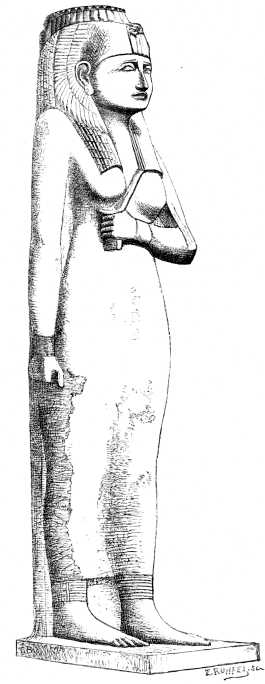
of the white bull. The third is the presentment of Nesa, who is
called a relation of the king, and was, in all probability, the wife
of Sepa (Fig. 172). These statues were of soft limestone. Both man and
woman have black wigs with squared ends, which descend, in the case of
the former, to the shoulders, in that of the latter, to the breasts.
Sepa holds a long staff in his left hand, and in his right the sceptre
called pat, a sign of authority. His only robe is a plain schenti,
a kind of cotton breeches fastened round his waist by a band. His
trunk and legs are bare, and the latter are only half freed from the
stone in which they are carved. Nesa is dressed in a long chemise with
a triangular opening between the breasts. Upon her arms she has
bracelets composed of twelve rings. In each figure the wig, the
pupils, eyelids, and eyebrows, are painted black, while there is a
green stripe under the eyes. The bracelets are also green.
De Rougé asserted boldly that these were the oldest statues in the
world.[173] He believed them to date from the third dynasty, and his
successors do not think he exaggerated; they would perhaps give the
works in question an even more venerable age.
This impression of great antiquity is not caused by the short
inscriptions on the plinths. The well-carved hieroglyphs which compose
them are in relief, but this peculiarity is found in monuments of the
fourth and fifth dynasties. The physiognomies and general style of the
figures are much more significant. They betray an art whose aims and
instincts are well developed, although it has not yet mastered its
mechanical processes. The sculptor knows thoroughly what he wants, but
his hand still lacks assurance and decision. He has set out upon the
way which will be trodden with ever-increasing firmness by his
successors. He follows nature faithfully. Observe how frankly the
breadth of Sepa's shoulders is insisted upon, how clearly the
collar-bones and the articulations of the knees are marked. The
rounded contours of Nesa's thighs betray the same sincerity. And yet
there is a certain timidity and awkwardness in the group which becomes
clearly perceptible when we compare it with works in its neighbourhood
which date from the fifth dynasty. The workmanship lacks freedom, and
the modelling is over-simplified. The arms, which elsewhere are laid
upon the knees, or, in the case of the woman, passed round the neck
of her husband, are too rigid. One is held straight down by the body,
the other is bent at a right angle across the stomach. The pose is
stiff, the placid features lack expression and will.
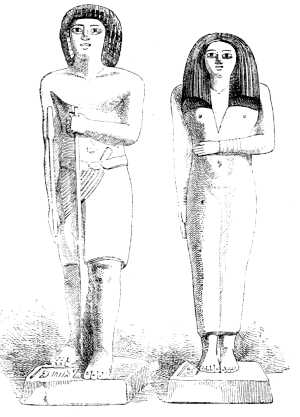
Fig. 172.—Sepa and Nesa, Louvre. Four feet eight inches high.
The induction to which we have been led by the style of these figures
is confirmed by an observation made during recent explorations in the
necropolis of Memphis. The patch of green paint under the eyes has, as
yet, only been found in statues from a certain peculiar class of tombs
at Gizeh and Sakkarah. These are chambers cut in the rock, in which
the roofs are carved into imitations of timber ceilings of palm wood.
Some of the texts which have been found in them contain the name of a
king whose chronological place has not yet been satisfactorily
determined, but who seems to have been anterior to Snefrou. The
figures upon which the adornment in question occurs would appear
therefore to be contemporary with the oldest tombs in the
neighbourhood of the pyramids.[174]
RA-HOTEP AND NEFERT
BOULAK MUSEUM
Imp. Ch. Chardon
Progress was rapid between the end of the third dynasty and that of
the fourth. It was during the latter dynasty that the art of the
Ancient Empire produced its masterpieces. Mariette attributes the two
famous statues found in a tomb near the pyramid of Meidoum to the
reign of Snefrou, the predecessor of Cheops. They are exhibited, under
glass, in the Boulak Museum (Plate IX).[175]
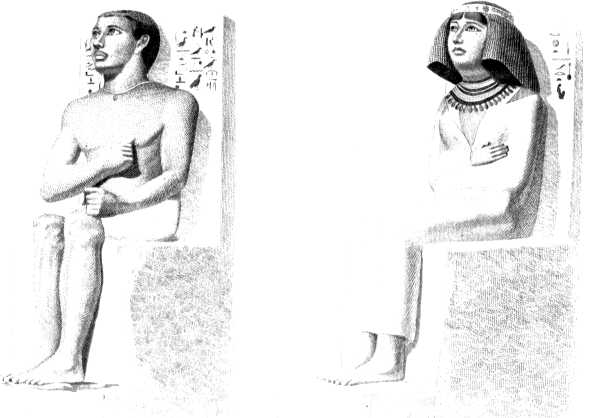
"One of them represents Ra-hotep, a prince of the blood, who enjoyed
the dignity of general of infantry, a very rare title under the
Ancient Empire; the other is a woman, Nefert, the beauty; her statue
also informs us that she was related to the king. We do not know
whether she was the wife or sister of Ra-hotep. The interest excited
by the extreme beauty of these figures is increased by our certainty
of their prodigious antiquity. In the mastaba where they were found
everything is frankly archaic, everything is as old as the oldest of
the tombs at Sakkarah, and those date from before the fourth dynasty.
A neighbouring tomb which, as is proved by the connection between
their structures, dates from the same period as that of Ra-hotep, is
that of a functionary attached to the person of Snefrou I. We may,
therefore, fairly assign the two statues from Meidoum to the last
reign of the third dynasty."[176]
Each of these figures, with its chair-shaped seat, is carved from a
single block of limestone about four feet high. The man is almost
nude; his only dress is a ribbon about his neck, and white breeches
like those to which we have already alluded. The woman is robed in the
long chemise, open between the breasts, which we have seen upon Nesa.
Besides this a wide and richly designed necklace spreads over her
chest. Upon her head she has a square-cut black wig, which, however,
allows her natural hair to be visible in front. Over the wig she has a
low flat cap with a decorated border. The carnations of the man are
brownish red, those of the woman light yellow.
These statues betray an art much more advanced than that of Sepa and
Nesa. The pose is much easier and more natural, but the right arm of
Ra-hotep is stiff and held in a fashion which would soon cause cramp
in a living man. The modelling of the body is free and true, though
without much knowledge or subtlety. The breasts, arms, and legs of
Nefert are skilfully suggested under her robe. But the care of the
sculptor has been mainly given to the heads. By means of chisel and
paint-brush he has given them an individuality which is not readily
forgotten. The arched eyebrows surmount large well-opened eyes; the
eyelids seem to be edged with heavy lashes and to stand out well from
the eyeball. In the case of the latter the limestone has retained its
primitive whiteness, giving a strong contrast with the pupil and iris
(Fig. 173). The noses, especially that of Ra-hotep are fine and
pointed; the thick but well-drawn lips seem about to speak. Her smooth
cheeks and soft dark eyes, eyes which are still common among the women
of the East, give Nefert a very attractive look. Her smiling and
restful countenance is in strong contrast to that of Ra-hotep, which
is full of life and animation not unmingled with a little hardness.
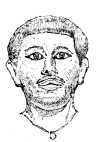
Fig. 173.—Ra-hotep. Drawn by Bourgoin.
The longer we look at these figures the less ready are we to turn away
from them. They are portraits, and portraits of marvellous sincerity.
If they could be gifted with life to-morrow, if we could encounter
Ra-hotep and Nefert working under the sun of Egypt, the man semi-nude,
sowing the grain or helping to make an embankment, his companion robed
in the long blue chemise of the fellah women and balancing a pitcher
upon her head, we should know them at once and salute them by name as
old acquaintances. We find none of the marks of inexperience and
archaism which are so conspicuous in the statues of Sepa and Nesa. A
few later figures may seem to us more delicately modelled and more
full of detail, but taking them all in all, we cannot look upon these
statues as other than the creations of a mature art, of an art which
was already in full command of its resources, and of a sculptor who
had a well-marked personal and original style of his own.
We find the same qualities in another group of monuments ascribed by
Mariette to no less remote a period.[177] The same eye for proportion,
the same life-like expression, the same frankness and confidence of
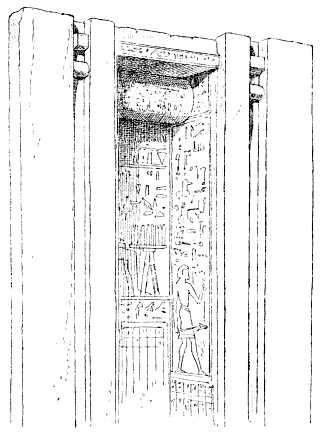
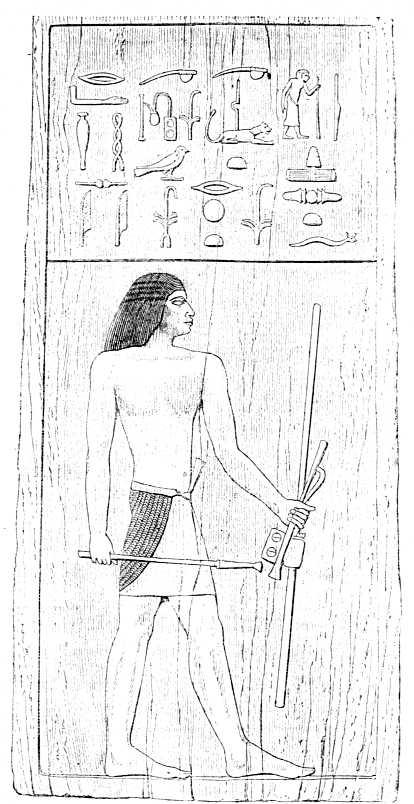
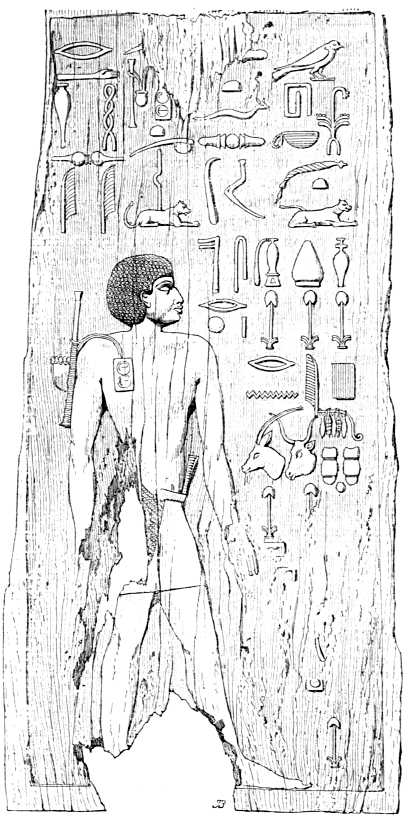
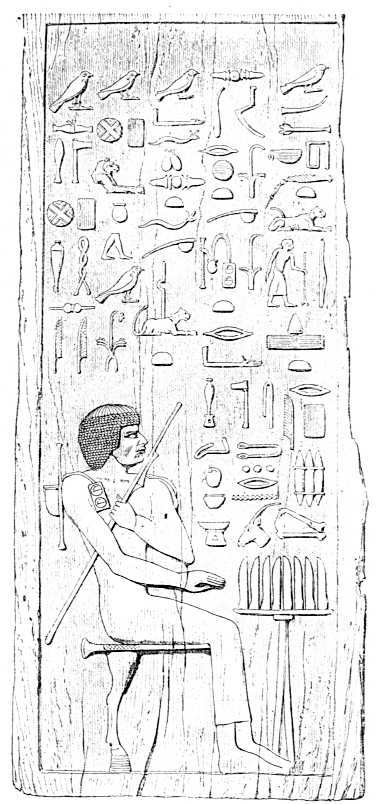
hand are to be found in those sculptured wooden panels of which the
museum at Boulak possesses four fine examples. They were found at
Sakkarah in the tomb of a personage called Hosi, where they were
enframed in four blind doorways. They are on the average about 3 feet
10 inches high and 1 foot 8 inches wide. The drawings which we
reproduce give a good idea of the peculiarities of style and execution
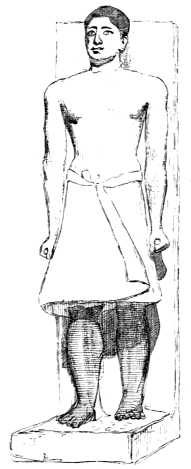
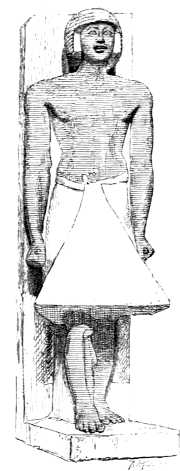
by which they are distinguished (Figs. 174-176).[178]
At first sight these carvings are a little embarrassing to the eye
accustomed to works in stone. The type of figure presented is less
thickset. The body, instead of being muscular, is nervous and wiry.
The arms and legs are thin and long. In the head especially do we find
unaccustomed features; the nose, instead of being round, is strongly
aquiline; the lips, instead of being thick and fleshy, as in almost
all other Egyptian heads, are thin and compressed. The profile is
strongly marked and rather severe. The general type is Semitic rather
than Egyptian. And yet the inscriptions which surround them prove that
the originals were pure Egyptians of the highest class. One of them,
he who is represented standing in two different attitudes, is Ra-hesi;
the other, who is sitting before a table of offerings, bears the name
of Pekh-hesi. The decipherable part of the inscription tells us that
he was a scribe, highly placed, and in great favour with the king.
The tomb in which these panels were found was not built on the usual
plan of the mastaba. Mariette alludes to certain peculiarities which
are to be found in it, but he does not describe them in detail. The
hieroglyphs are grouped in a peculiar fashion; many of them are of a
very uncommon form. The arrangement of the objects borne in the left
hand of Ra-hesi is quite unique. Struck by these singularities,
Mariette asserts that "the style of these panels is to Egyptian art
what the style called archaic is to that of Greece."[179] This
assertion seems to us inaccurate. Not that we mean to contest the
validity of the reasons which Mariette gives for ascribing these
panels to an epoch anterior to the great pyramids; but, whatever may
be their age, it seems to be impossible, in view of the style in which
they are executed, to call them archaic. They show no more archaism
than the statues of Meidoum. The Egyptian artist never carved wood
with greater decision or with more subtlety and finesse than are to be
seen in these panels. As for the differences of execution which have
been noticed between these figures and the stone statues of the same
epoch, they may easily be explained by the change of material and by
the Egyptian love for fidelity of imitation. Wood is not attacked in
the same fashion as soft stone. Its constitution does not lend itself
to the ample and rounded forms of lapidary sculpture. It demands,
especially when a low relief is used, a more delicate and subtle
modelling. Again, these were portraits; all the Egyptians were not
like one another, especially in that primitive Egypt in which perhaps
various races had not yet been blended into a homogeneous population.
Among the contemporaries of Cheops, as in our day, there were fat
people and thin people. Men who were tall and slender, and men who
were short and thickset. Countenances varied both in features and
expression.[180] In time art succeeded in evolving from all these
diversities a type of Egyptian manhood and beauty. As the ages passed
away the influence of that type became more and more despotic. It
became almost universal, except in those cases where there was a rigid
obligation to reproduce the personal characteristics of an individual
with fidelity. But at the end of the third dynasty that consummation
was still far off. And we need feel no surprise that the higher we
mount in the stream of Egyptian civilization the more particular are
the concrete images which it offers to us, and the more striking the
variation between one work of art and another.
It must not be supposed, however, that the features which we have
mentioned as peculiar in the cases of Ra-hesi and Pekh-hesi are not to
be found elsewhere. If we examine the profile of Nefert, still more
that of Ra-hotep, we shall find that they also have the sloping
forehead and aquiline nose. The body of Ra-hotep is rounder and fatter
than those in the wooden reliefs, but the lines of his countenance
have a strong resemblance to those which have excited remark in the
figures on the panels.
Fig. 174.—Wooden panel from the Tomb of Hosi. Drawn by Bourgoin.
Fig. 175.—Wooden panel from the Tomb of Hosi. Drawn by Bourgoin.
Fig. 176.—Wooden panel from the Tomb of Hosi. Drawn by Bourgoin
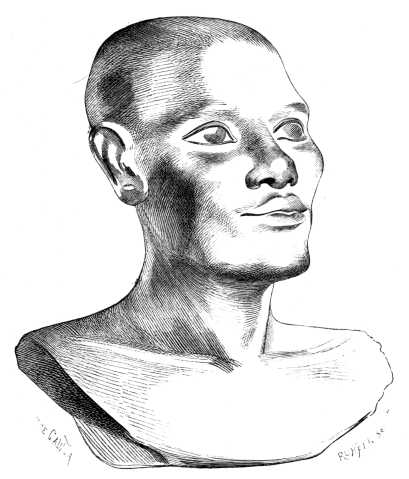
In the case of a limestone head, covered with red paint, which stands
in the Salle Civile, in the Louvre, the cranium is no less
elongated, the cheekbones are no less large, the cheeks themselves are
as hollow, the chin as protuberant, and the whole head as bony and
fleshless. We do not know whence it came, but we have no hesitation in
agreeing with De Rougé, Mariette, and Maspero, that this head is a
masterpiece from one of the early dynasties. It may be put by the side
of the Meidoum couple for its vitality and individual expression. The
unknown original must have been ugly almost to vulgarity, but it
rouses in the spectator the same kind of admiration as a Tuscan bust
of the fifteenth century, and a pleasure which is not diminished by
the knowledge that the man whose faithful image is under his eyes
passed from the world some five or six thousand years ago (Fig. 177).
The little figure which occupies the place of honour in this same
saloon (Plate X.), though more famous, is hardly superior to the
fragment just described. It was found by Mariette in the tomb of
Sekhem-ka, during his excavation of the Serapeum. Other figures of the
same kind were found with it, but are hardly equal to it in merit.
They are believed to date from the fifth or sixth dynasty.
This scribe is seated, cross-legged, in an attitude still familiar to
those who have visited the East. The most superficial visitor to the
Levant must have seen, in the audience-hall of the cadi or pacha,
the kiatib crouching exactly in the same fashion before the chair or
divan, registering sentences with his rapid kalem, or writing out
despatches. Our scribe is listening; his thin and bony features are
vibrating with intelligence; his black eye-balls positively sparkle;
his mouth is only closed because respect keeps him silent. His
shoulders are high and, square, his chest ample, his pectoral muscles
very large. People who follow a very sedentary occupation generally
put on much fat on the front of their bodies, and this scribe is no
exception to the rule. His arms are free of his sides; their position
is easy and natural. One hand holds a strip of papyrus upon which he
writes with the other, his pen being a reed. The lower parts of the
body and the thighs are covered with a pair of drawers, whose
white colour contrasts with the brownish red of the carnations. The
breadth and truth with which the knee-joints are indicated should be
remarked. The only details that have, to a certain extent, been
"scamped," are the feet. Trusting to their being half hidden by the
folded legs, the sculptor has left them in a very rudimentary
condition.
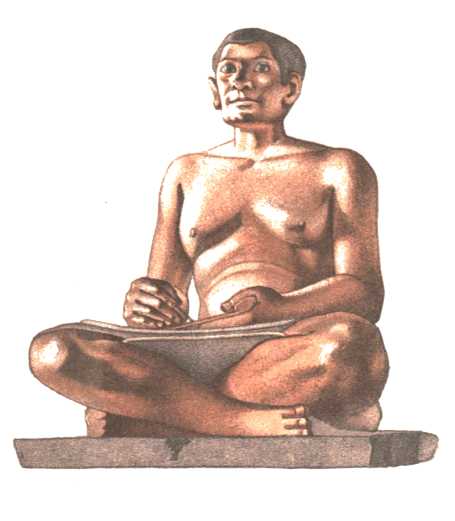
THE SCRIBE
(LOUVRE)
Imp. Dufrenoy
The eyes form the most striking feature in this figure. "They consist
of an iris of rock crystal surrounding a metal pupil, and set in an
eyeball of opaque white quartz. The whole is framed in continuous
eyelids of bronze."[181]
This clever contrivance gives singular vitality and animation to the
face. Even the Grecian sculptor never produced anything so vivacious.
The latter, indeed began by renouncing all attempts to imitate the
depth and brilliancy of the human eye. His point of departure differed
entirely from that of his Memphite predecessor; his conception of his
art led him, where the Egyptian would have used colour, to be content
with the general characteristics of form and with its elevation to the
highest pitch of nobility of which it was capable. This is not the
place for a comparison of the two systems, but accepting the
principles of art which prevailed in early Egypt, we must do justice
to those masters who were contemporary with the Pyramids. It must be
acknowledged that they produced works which are not to be surpassed in
their way by the greatest portraits of modern Europe. In later years
the Egyptian sculptor ceased to paint the eyes. Even in the time of
the Ancient Empire the Egyptian custom in this particular was the same
as the Greek, so far as statues in hard stone were concerned. The
great statue of Chephren is an instance. In it the chisel has merely
reproduced the contours of the eyelids and the salience of the
eyeball. No attempt has been made to imitate the iris or to give
brightness to the pupil. In none of the royal statues that have come
down to our time do we find any effort to produce this kind of
illusion, either by the use of paint or by the insertion of naturally
coloured substances.
There is a statue at Boulak which may, perhaps, be preferred even to
the scribe of the Louvre. We have already alluded to it as the
Sheik-el-Beled (Fig. 7, Vol. I.). In its present state (it is
without either feet or base) it has no inscription but it is sometimes
called Ra-em-ké, because that was the name of the person in whose
tomb it was found. It is of wood, and, with the exception of its lower
members, is in marvellous preservation. The eyes are similar to those
of the scribe, and seem to be fixed upon the spectator while their
owner advances upon him. The type is very different from those we have
hitherto been describing. The face is round and flat, and so is the
trunk. The smiling good humour of the expression and the embonpoint
of the person indicate a man well nourished and comfortably off, a man
content both with himself and his neighbours.[182]
Fig. 177.—Limestone head, in the Louvre. Drawn by Saint-Elme Gautier.
This statue is dressed in a different fashion from those we have
hitherto encountered. The sheik has his hips covered with a kind of
petticoat gathered into pleats in front. His legs, torso, and arms are
bare. The last named are of separate pieces of wood, and one of them,
the bent one, is made in two parts. When the statue was first finished
the joints were invisible. The whole body was covered with fine linen,
like a skin. Upon this linen a thin layer of plaster was spread, by
means of which, when wet, refinement could be added to the contours by
the modelling stick; the colours of nature were afterwards added by
the brush. Such figures as these have therefore come down to us in a
condition which resembles their primitive state much less than that of
the works in stone. They have, so to speak, lost their epidermis, and
with it the colours which served to distinguish the flesh from the
drapery.[183]
It would seem that the sculptor in wood often counted upon this final
coat of stucco to perfect his modelling. There are in fact wooden
statues which seem to have been but roughly blocked out by the chisel.
There are three figures in the Louvre in which this character is very
conspicuous. The largest of the three is reproduced in our Fig.
178.[184] Acacia and sycamore wood is used for this kind of work.[185]
Finally, in this epoch or perhaps a little later, under the fifth and
sixth dynasties, funerary statues were cast in bronze. This notable
fact was first proclaimed by M. de Longperier. We quote the
observations which he addressed to the Academy of Inscriptions.[186]
"The fact that bronze was employed in Egypt in very ancient times has
long been ascertained. The knob from the Sceptre of Papi, a Pharaoh of
the sixth dynasty, which exists in the British Museum, is enough to
prove this fact. M. Chabas has called our attention to the fact that
bronze is mentioned in texts which date from a period anterior to the
construction of the great Pyramids.[187]
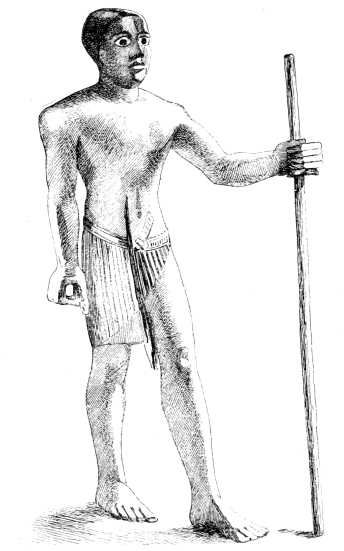
Fig. 178.—Wooden statue in the Louvre. Three feet eight inches high. Drawn by Saint-Elme Gautier.
"That the earliest Egyptian bronzes representing the human figure
are much older than was formerly thought, is proved by two statuettes
belonging to M. Gustave Posno. One of these is twenty-six inches high,
the other nineteen. They merit a short description: 'No 1: A man
standing; left foot forward, the left hand closed and raised to a
level with the breast. This hand, doubtless, held a spear. The right
hand which hangs straight down by the thigh formerly clasped, in all
probability, the small sceptre which is represented in many
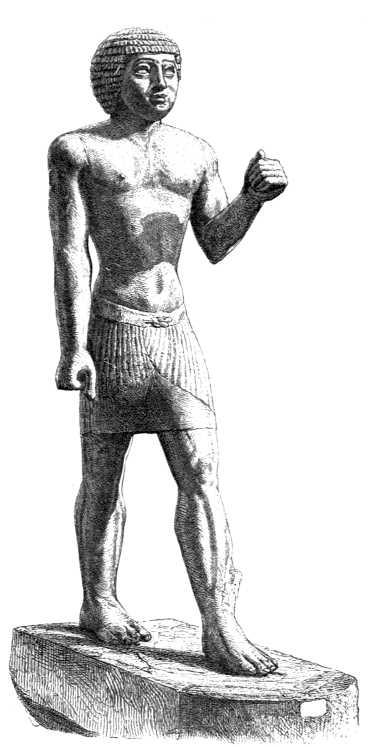
bas-reliefs. The loins are girt with the garment called the schenti,
the band of which supports a dagger. The hair is arranged into regular
rows of small square knobs. The eyes and eyebrows, which were inlaid,
have disappeared (Fig. 179).'[188]
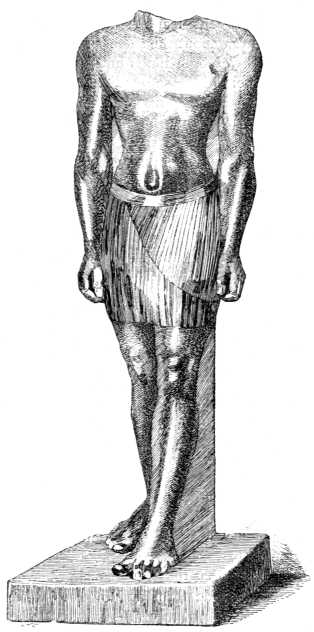
Fig. 179.—Bronze statuette. Two feet two inches high. Drawn by Saint-Elme Gautier.
"'No 2: A man standing; his loins girt with the schenti, his left
foot forward, his right hand raised to the level of his breast, the
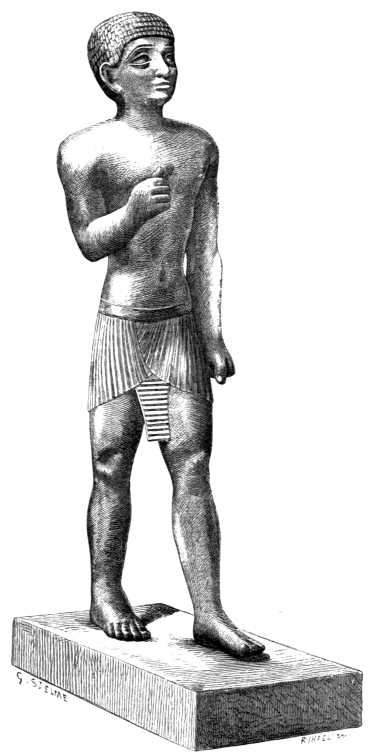
left hanging by his left thigh. The inlaid eyes and eyebrows have been
abstracted. His hair, which is less abundant than that of his
companion and allows the contour of his head to be easily seen, is
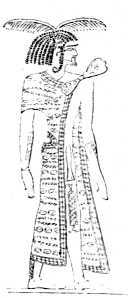
arranged into very small knobs. A vertical inscription on the left
side of his chest gives the name of the personage, in or after which
appears the ethnic Schasou, which seems to indicate an Oriental
origin.' The Schasous are mentioned in several Egyptian texts and seem
to have occupied the country which bordered Egypt on the North-East
(Fig. 180)."[189]
"In these two statuettes the muscles of the arms and legs, and the
articulation of the knees, are expressed with a care and truth which
denote a very remote age. We cannot fail to recognize a phase of art
earlier than the Second Empire. But if the first mentioned figure
recalls, by its features and the management of the hair, the
sculptures in stone of the fifth and sixth dynasties, the second
cannot, perhaps, be referred to quite such an early period. In the
latter the vertical line of the back and right leg slopes slightly
forward, betraying an attempt to express movement; the dorsal line of
the first figure is, on the other hand, quite perpendicular.
"Even in the photographs certain details are visible, such as the form
of the hair, the features, the rendering of the anatomical contours,
which denote a school anterior to that of the eighteenth dynasty.
Fig. 180.—Bronze statuette. One foot seven inches high. Drawn by Saint-Elme Gautier.
"Egypt, then, was first in the field in bronze casting, as she was in
stone and wood carving. One at least of the Posno statuettes carries
us so far back in the history of humanity that it is difficult to see
where we can look for earlier works of art, especially of so advanced
a style. We have already ascertained that the first named of these two
figures is far superior, both in style and modelling, to the Asiatic
canephorus of Afadj,[190] a work which was dedicated to a goddess by a
king, and must therefore be considered a good example of the art of
Western Asia."
We agree with M. de Longperier in all but one point, and that one as
to which he is careful not to commit himself. According to him the
second figure is later than the sixth dynasty and earlier than the
eighteenth, so that it would belong to the first Theban Empire. But we
do not see why, supposing the Egyptians of the Ancient Empire capable
of making the first figure, they should not have made the second.
Between the two statuettes there are but slight differences of
handling, differences much the same as those to be found in the wooden
and stone statues which we have already mentioned. Neither the artists
nor their sitters had quite the same capabilities.
The technical skill shown in these bronzes is extraordinary. The most
ancient Etruscan and Greek bronzes are solid castings, on the base of
which are rough protuberances, sometimes of considerable length,
resulting from the fact that the metal was allowed to solidify in the
orifice by which it was poured into the mould. Here there is nothing
of the kind. No imperfection in the mechanical part of the work is
allowed to interfere with its artistic effect. The casting is light,
hollow, and in one piece; the method employed must have been excellent
in itself and thoroughly understood.[191] They also understood how to
add finish by chasing the metal after its relief from the mould. The
small circular ornaments on the chest of the second figure, ornaments
which are so delicate in execution that they could not be reproduced
in our engraving without giving them too much importance, and the
hieroglyphs cut in the same figure, are instances of this.
That so few bronze statuettes have come down to us seems to show that
the use of the metal by sculptors was quite exceptional. They used
wood far more than bronze, and stone more than wood. Most of the
sepulchral statues are cut in soft limestone
(see Figs. 6, 49, 88, 89, Vol. I., and Fig. 172, Vol. II.). Sometimes these statues are
isolated, sometimes they form family groups, often consisting of
father, mother, and children.
Statues of men are the most numerous. Differences between one and
another are many and frequent, but they are, on the whole, less
striking than the points of resemblance. Here we find a head bare,
there enveloped in either a square or rounded wig. The bodies are
never completely nude, and the garment which covers their middles is
arranged in a variety of ways. Fashions, both for men and women, seem
to have changed in Egypt as elsewhere. In the statues ascribed to the
last dynasties of the Ancient Empire the national type seems more
fixed and accentuated than in earlier works. These funerary statues
are the portraits of vigorous and powerful men, with broad shoulders,
well-developed pectoral muscles, thin flanks and muscular legs.
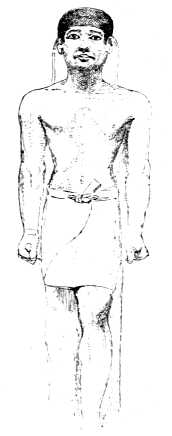
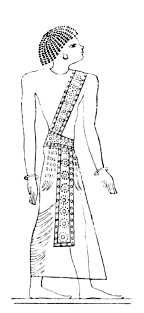
Ra-nefer, priest of Ptah and Sokar, stands upright, his arms by his
sides, and each hand grasping a roll of papyrus (Fig. 181).[192] A
dagger is passed through the belt of his drawers.
The person represented in Fig. 182 is distinguished from Ra-nefer by
the fashion in which he wears his hair and by his costume. His loose
skirt is arranged in front so as to form a kind of triangular apron.
This peculiar fall of the garment was obtained by the use of starch
and an instrument similar to our flat-iron. It is better seen in the
statue of Ti, the great personage to whose gorgeous tomb we have so
often referred.[193] The Albanians obtain the curious folds of their
kilts in the same fashion.[194] Ti wears a periwig of a different kind
from that of Ra-nefer. The Egyptians shaved their heads from motives
of cleanliness. The priests were compelled to do so by the rules of
their religion, which made purity of person even more imperative upon
them than upon the laymen. It was necessary, however, that the head
should be thoroughly protected from the sun, hence the wig. The shaved
Mohammedans of our day replace the periwig with the turban.
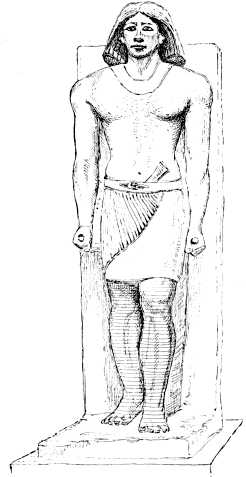
Fig. 181.—Ra-nefer. Boulak. Drawn by Bourgoin.
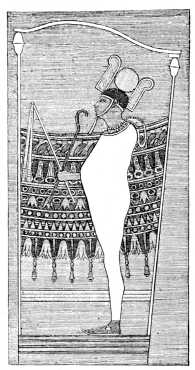
One wooden statue at Boulak offers a variety of costume which is at
present unique among the remains of Egyptian civilization. It is,
unfortunately, in very bad preservation. It represents a man,
standing, and draped in an ample robe which covers him from head to
foot. His right arm is free; it is held across the body, and meets the
left hand, which is thrust through an opening in the robe. The place
where this statue was found, the material of which it consists, and
the character of the workmanship, all combine to prove that it is a
production of the early dynasties (Fig. 184).[195]
Fig. 182.—Statue in the Boulak Museum. Drawn by Bourgoin.
Fig. 183.—Statue of Ti. Boulak. Drawn by Bourgoin.
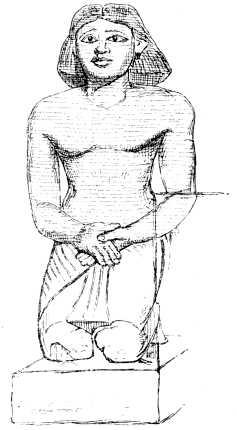
A few kneeling statues have also been found. The anonymous personage
whose portrait is reproduced in Fig. 185 is upon his knees. His
clasped hands rest upon his thighs. His eyes are inlaid; they are
formed of numerous small pieces skilfully put together.[196]
There is no less variety in those groups where the sculptor has been
charged to represent a whole family reunited in the tomb. Sometimes
the husband is sitting and the wife standing. She has her left arm
round his neck, the left hand resting on his left shoulder, while with
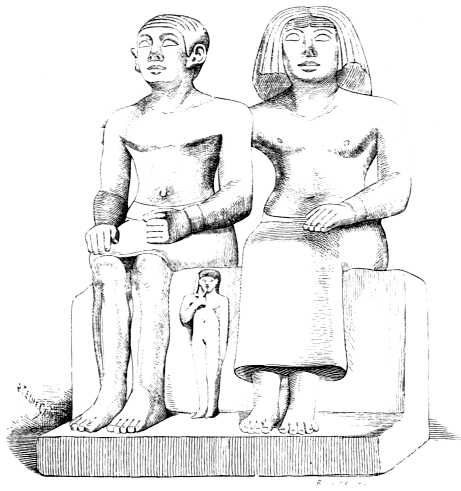
her right hand she holds his right arm (Fig. 88, Vol. I.). Sometimes a
father and mother are seated upon the same bench, but here too the
woman confesses her dependence on, and shows her confidence in, her
master by the same affectionate gesture (Fig. 186). Both are of the
same height, but between them, and leaning against the bench upon
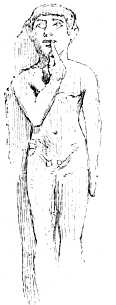
which they are seated, appears their child, quite small. His gesture
is that to which the Egyptian artist has recourse when he wishes to
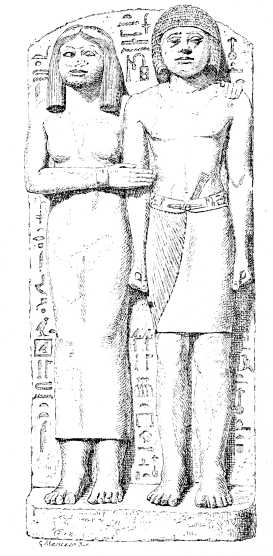
express early childhood (Fig. 187). We also find the husband and wife
standing erect in front of a slab; the relation which they bear to
each other is here also indicated by the position of the woman's arms
(Fig. 188).[197]
Sometimes the woman is altogether absent (Fig. 89,
Vol. I.). The head of the family is placed by himself, on a raised
seat. In front of this seat, and hardly reaching to their father's
knees, are two children, boy and girl, the boy holding the right leg,
the girl the left. The boy has the lock of hair pendent over the right
ear, which, like the finger in the mouth, is a sign of tender years.
He is nude; the girl is dressed in an ornamental robe reaching to her
ankles. There is a piquant contrast between these two tender little
bodies with their childish heads, and the virile power of the father
and protector who towers so high above them.
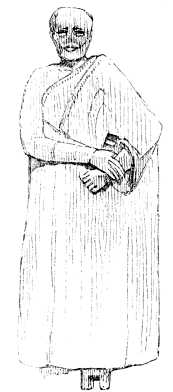
Fig. 184.—Wooden statue, Boulak. Drawn by Bourgoin.
Fig. 185.—Statue in limestone, Boulak. Drawn by Bourgoin.
Fig. 186.—Limestone group in the Louvre. Height twenty-eight inches. Drawn by Saint-Elme Gautier.
Fig. 187.—Wooden statuette, Boulak. Drawn by Bourgoin.
Fig. 188.—Nefer-hotep and Tenteta. Boulak.
These limestone groups do not, as a rule, appear to have been executed
with any great care. Their makers do not seem to have taken much pains
to give them an individuality of their own; but in spite of this
feebleness of execution, they please by their composition. They are
well arranged, their attitudes are simple and their gestures
expressive. As a whole they have an air of calmness and repose which
is thoroughly in accord with the ideas of the Egyptians on the
question of life and death.
Fig. 189.—Limestone statue, Boulak. Drawn by Bourgoin.
Fig. 190.—Limestone statue, Boulak. Drawn by Bourgoin.
From the same memphite tombs many limestone statues have been
recovered, representing, not the defunct himself, but those who mourn
his decease and the crowd of retainers attached to his person. All
these are expected to carry on their labours for his benefit and to be
ready to satisfy his wants through all eternity. Here we find one
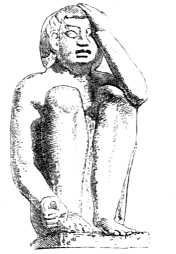
seated upon the ground, his hand upon his head in sign of grief (Fig.
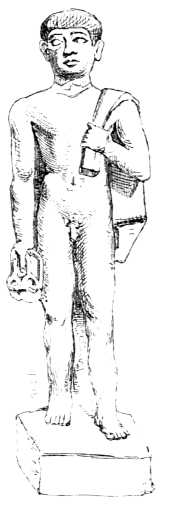
189).[198] There a young man, completely naked, advancing with a sack
upon his left shoulder which falls down to the centre of his back. He
carries a bouquet of flowers in his right hand (Fig. 190).[199] A man
seated upon the ground holds a vase between his knees, into which he
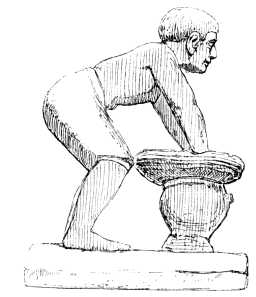
has plunged his right hand (Fig. 191).[200] Another bends over a
wide-mouthed jar of mortar in which he is mixing flour and water (Fig.
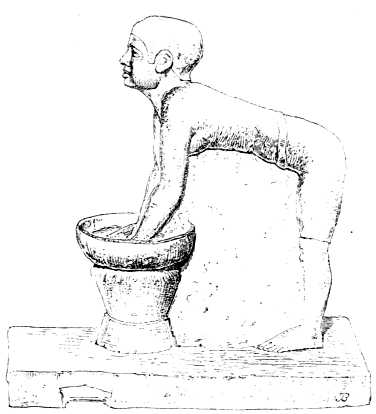
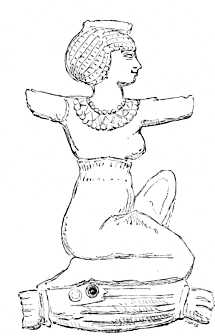
192). A young woman, in a similar attitude, is occupied over the same
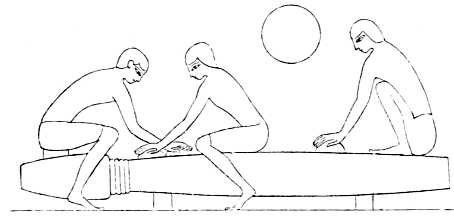
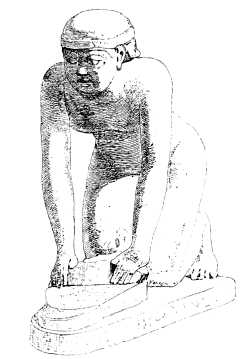
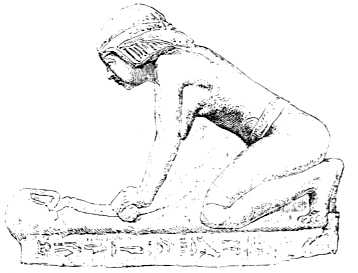
task (Fig. 193). Other women are rolling the paste thus obtained on a
plank, or rather upon a stone slab, before which they kneel upon the
ground. The muscular exertion necessary for the operation is rendered
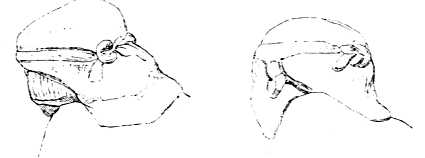
with great skill (Figs. 193 and 194).[201] Women are still to be
encountered at Elephantiné and in Nubia, wearing the same head-dress
and carrying out the same operation in the same attitude and with
exactly similar utensils. We reproduce two sketches by M. Bourgoin,
which show the details of this head-covering, which, among the women
of the lower orders, supplied the piece of the wig; it consists of a
piece of stuff held upon the head by a ribbon knotted at the back of
the neck (Figs. 196 and 197).
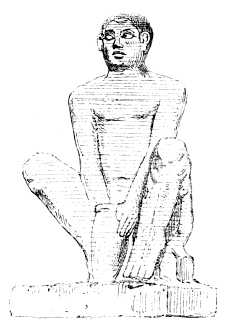
Fig. 191.—Limestone statue, Boulak. Drawn by Bourgoin.
Fig. 192.—Limestone statue, Boulak. Drawn by Bourgoin.
Fig. 193.—Woman kneading dough, Boulak. Drawn by Bourgoin.
Mariette brought all these figures to Paris in 1878, where they
excited the greatest interest among artists and archæologists. They
were eminently well fitted to enlighten those who are able to see and
to do away with many rooted prejudices. What an abyss of difference
they showed between Egyptian art as it used to be defined some thirty
years ago and the reality. The stiffness and rigidity which used to be
so universally attributed to the productions of the sculptors of
Memphis and Thebes, were forgotten before their varied motives and
free natural attitudes. The whole of these works, in fact, are imbued
with a spirit which is diametrically opposed to the unchanging
inflexibility which used to be considered the chief characteristic of
Egyptian art. They are distinguished by an extraordinary ease of
attitude, and by that curious elasticity of body which still remains
one of the most conspicuous physical qualities of the race.
"The suppleness of body which distinguished the female fellah is
marvellous. She rarely sits down. When she requires rest she crouches
with her knees in the air in an attitude which we should find
singularly fatiguing. So too with the men. Their habitual posture
corresponds to that shown on the steles: the knees drawn up in front
of the face to the height of the nose, or on each side of the head and
level with the ears. These attitudes are not graceful, but when the
bodies thus drawn together are raised to their full height they are
superb. They are, to borrow a happy expression of Fromentin, 'at once
awkward and magnificent; when crouching and at rest they look like
monkeys; when they stand up they are living statues.'"[202]
Fig. 194.—Woman making bread, Boulak. Drawn by Bourgoin.
This early art never carried its powers of observation and its
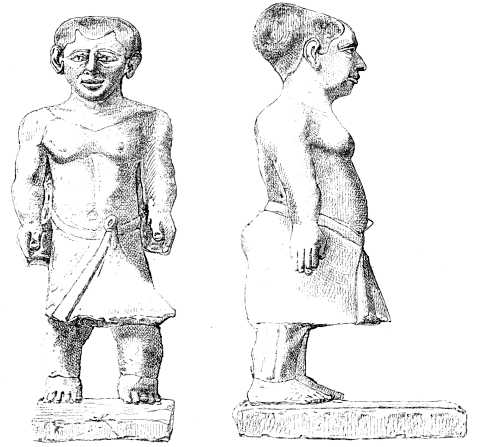
exactitude of reproduction farther than in the statue of Nem-hotep,
which we show in full-face and profile in Figs. 198 and 199. Whether
we call him, with Mariette, a cook, or, with Maspero, a master of the
wardrobe or keeper of perfumes, it cannot be doubted that. Nem-hotep
was a person of importance. One of the fine tombs at Sakkarah was his.
He certainly did not make his way at court by the graces of his
person. He was a dwarf with all the characteristics that distinguish
those unlucky beings. His head was too large, his torso very long, his
arms and legs very short; besides which he was marvellously
dolichocephalic.
Fig. 195.—Bread maker, Boulak. Drawn by Bourgoin.
Figs. 196, 197.—Details of head-dresses.
The sincerity of Egyptian art is conspicuously shown in its treatment
of the foot. Winckelmann noticed that the feet in Egyptian statues
were larger and fatter than in those of Greece. The great toes are
straight, no articulations being shown. The second toe is always the
longest, and the little toe is not bent in the middle but straight
like the others. These peculiarities spring from the Egyptian habit of
walking bare-foot on the Nile mud; they are very strongly marked in
the feet of the modern fellah.[203]
The general characteristics of these works in the round are repeated
in the bas-reliefs of the mastabas at Gizeh and Sakkarah. Of these we
have already given numerous illustrations; we shall therefore be
content with reproducing one or two which are more than usually
conspicuous for their artistic merit.
Figs. 198, 199.—Nem-hotep; limestone statue at Boulak.
The sculptures of Wadi-maghara and the wooden panels from the Tomb of
Hosi are enough to prove that work in relief was as old in Egypt as
work in the round. In the mastabas sculptures in low-relief served to
multiply the images of the defunct. He is figured upon the steles
which occupy the principal wall, as well as in various other parts of
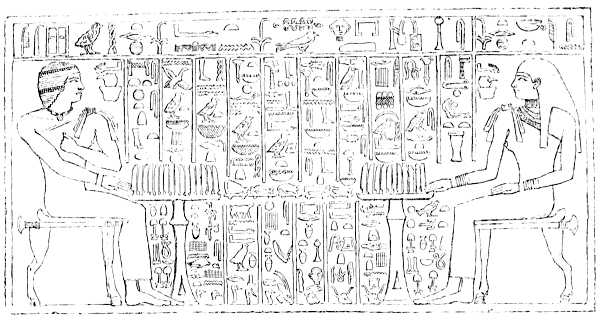
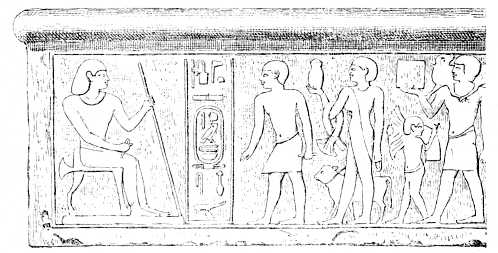
the tomb. Sometimes he is shown seated before the table of
offerings (Fig. 200), sometimes standing upright
(Figs. 57 and 120, Vol. I.). But the sculptor did not restrict himself to these two
motives. In the preparation and presentation of the funeral gifts he
found many themes, to which he was able to give more or less
development according to the space at his command.
Fig. 200.—Funerary bas-relief; Sakkarah. Drawn by Bourgoin.
Fig. 201.—Bas-relief from the Tomb of Ti, Sakkarah.
Even in the earliest attempts that have come down to us, the Egyptian
sculptor shows a complete grasp of the peculiar features of the
domesticated animals of the country. Men accustomed to the careful
study of the human figure could make light of rendering those of
beasts, with their more striking distinctions between one species and
another. In the time when the oldest existing tombs were constructed,
the ass was already domesticated in Egypt. Then as now, he was the
most indispensable of the servants of mankind. There were, in all
probability, as many donkeys in the streets of Memphis under Cheops as
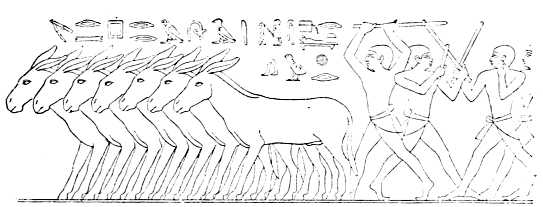
there are now in Cairo under Tewfik. Upon the walls of the mastabas we
see them trotting in droves under the cries and sticks of their
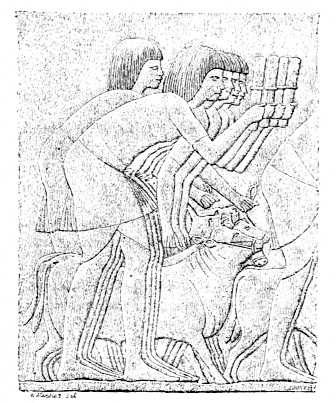
drivers (Fig. 201), we see the foals, with their awkward gait and long
pricked ears, walking by the sides of their mothers (Fig. 202), the
latter are heavily laden and drag their steps; the drivers brandish
their heavy sticks, but threaten their patient brutes much oftener
than they strike them. This is still the habit of those donkey boys,
who, upon the Esbekieh, naïvely offer you "M. de Lesseps' donkey."
The bas-relief to which we are alluding consists only of a slight
outline, but that outline is so accurate and full of character, that
we have no difficulty in identifying the ass of Egypt, with his
graceful carriage of the head and easy, brisk, and dainty motion.
The same artists have figured another of the companions of man with
equal fidelity; namely, the deep-sided, long-tailed, long-horned,
Egyptian ox. Sometimes he lies upon the earth, ruminating (Fig. 29,
Vol. I.); sometimes he is driven between two peasants, the one leading
him by a rope, the other bringing up the rear with a stick held in
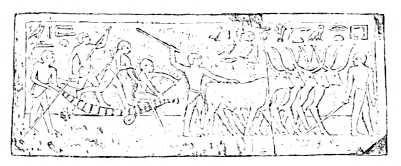
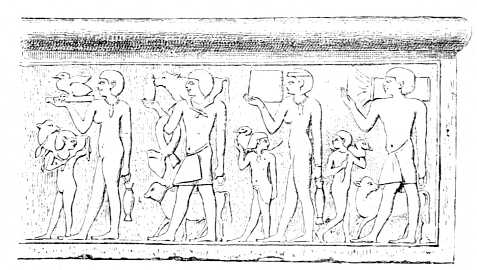
readiness against any outburst of self-will (Fig. 203). In another
relief we see a drove advancing by the side of a canal, upon which a
boat with three men is making way by means of pole and paddle. One
herdsman walks in front of the oxen, another marches behind and urges
them on by voice and gesture (Fig. 204). In another place we find a
cow being milked by a crouching herdsman. She seems to lend herself to
the operation in the most docile manner in the world, and we are
inclined to wonder what need there is of a second herdsman who sits
before her nose and holds one of her legs in both his hands. The
precaution, however, may not be superfluous, an ox-fly might sting her
into sudden movement, and then if there was no one at hand to restrain
her, the milk, which already nears the summit of the pail, might be
lost (Fig. 30, Vol. I.).
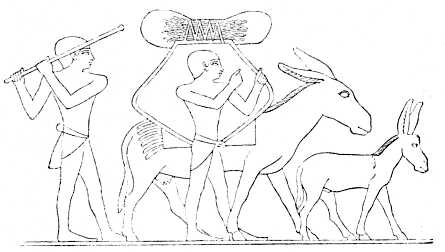
Fig. 202.—Bas-relief from the Tomb of Ti, Sakkarah.
By careful selection from the sepulchral bas-reliefs, we might, if we
chose, present to our readers reproductions of the whole fauna of
Ancient Egypt, the lion, hyena, leopard, jackal, fox, wolf, ibex,
gazelle, the hare, the porcupine, the crocodile, the hippopotamus, the
different fishes in the Nile, the birds in the marshes, the flamingo,
the ibis, duck, stork, crane, and goose, the dog and the cat, the goat
and the pig. Everywhere we find the same aptitude for summarizing the
distinctive characteristics of a species. This accuracy of observation
has been recognized by every connoisseur who has treated the subject.
"In the Boulak Museum," says M. Gabriel Charmes, "there is a row of
Nile geese painted with such precision, that I have seen a naturalist
stand amazed at their truth to nature and the fidelity with which they
reproduce the features of the race. Their colours, too, are as bright
and uninjured as upon the day when they were last touched by the brush
of the artist."[204]
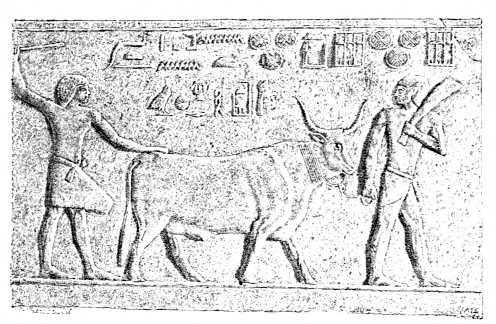
Fig. 203.—Sepulchral bas-relief, Boulak.
Fig. 204.—Bas-relief from the Tomb of Ra-ka-pou, Boulak.
The figures of men and animals to which our attention has been given
all belong to the domain of portraiture. The artist imitates the forms
of those who sit to him and of the animals of the country; he copies
the incidents of the daily life about him, but his ambition goes no
farther. All art is a translation, an interpretation, and, of course,
the sculptors of the mastabas had their own individual ways of looking
at their models. But they made no conscious effort to add anything to
them, they did not attempt to select, to give one feature predominance
over another, or to combine various features in different proportions
from those found in ordinary life, and by such means to produce
something better than mere repetitions of their accidental models.
They tried neither to invent nor to create.
And yet the Egyptians must have begun at this period to give concrete
forms to their gods. In view of the hieroglyphs of which Egyptian
writing consisted, we have some difficulty in imagining a time when
the names of their deities were not each attached to a material image
with well marked features of its own. To write the name of a god was
to give his portrait, a portrait whose sketchy outlines only required
to be filled in by the sculptor to be complete. Egypt, therefore, must
have possessed images of her gods at a very early date, but as they
were not placed in the tombs they have disappeared long before our
day, and we are thus unable to decide how far the necessity for their
production may have stimulated the imaginative faculties of the early
sculptors. In presence, however, of the Great Sphinx at Gizeh, in
which we find one of those composite forms so often repeated in later
centuries, we may fairly suspect that many more of the divine types
with which we are familiar had been established. The Sphinx proves
that the primitive Egyptians were already bitten with the mania for
colossal statues. Even the Theban kings never carved any figure more
huge than that which keeps watch over the necropolis of Gizeh (Fig.
157, Vol. I.). But Egypt had other gods than these first-fruits of her
reflective powers, than those mysterious beings who personified for
her the forces which had created the world and preserved its
equilibrium. She had her kings, children of the sun, present and
visible deities who maintained upon the earth, and especially in the
valley of the Nile, the ever-threatened order established by their
divine progenitors. Until quite recently it was impossible to say for
certain whether or no the Egyptians of the Ancient Empire had
attempted to impress upon the images of their kings the national
belief in their divine origin and almost supernatural power. But
Mariette—again Mariette—recovered from the well in the Temple of the
Sphinx at Gizeh, nine statues or statuettes of Chephren. The
inscriptions upon the plinths of these statues enable us to recognize
for certain the founder of the second pyramid.
Most of these figures were broken beyond recovery, but two have been
successfully restored. One of these, which is but little mutilated, is
of diorite (Fig. 205); the other, in a much worse condition, is of
green basalt (Fig. 56, Vol. I.).[205]
An initial distinction between these royal statues and the portraits
of private individuals is found in the materials employed. For
subjects even of high rank, wood or limestone was good enough, but
when the august person of the monarch had to be immortalized a
substance which was at once harder and more beautiful was employed.
The Egyptians had no marble, and when they wished to do particular
honour to their models they made use of those volcanic rocks, whose
close grain and dusky brilliance of tone make them resemble metal. The
slowness and difficulty with which these dense rocks yielded to the
tools of the sculptor increased the value of the result, while their
hardness added immensely to their chances of duration. It would seem
that figures which only took form under the tools of skilful and
patient workmen after years of persevering labour might defy the
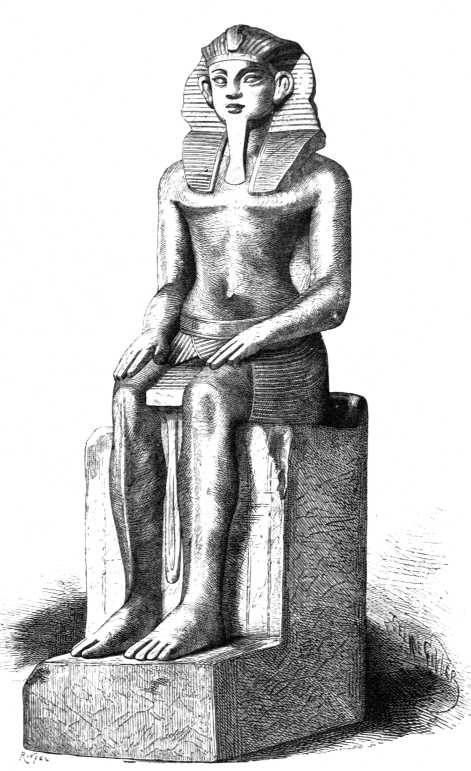
attacks of time or of human enemies. Look at the statue on the next
page. It is very different from the figures we have been noticing,
although it resembles them in many details. Like many of his subjects
the king is seated. His head, instead of being either bare or covered
with the heavy wig, is enframed in that royal head-dress which has
been known, ever since the days of Champollion, as the klaft.[206]
It consists of an ample band of linen covering the upper part of the
forehead, the cranium, and the nape of the neck. It stands out boldly
on each side of the face, and hangs down in two pleated lappets upon
the chest. The king's chin is not shaved like those of his subjects.
It is adorned like that of a god with the long and narrow tuft of hair
which we call the Osiride beard. At the back of Chephren's head,
which is invisible in our illustration, there is a hawk, the symbol of
protection. His trunk and legs are bare; his only garment is, in fact,
the schenti about his middle. His left hand lies upon his knee, his
right hand holds a rod of some kind. The details of the chair are
interesting. The arms end in lions' heads, and the feet are paws of
the same animal. Upon the sides are figured in high relief the two
plants which symbolize the upper and lower country respectively; they
are arranged around the hieroglyph sam, signifying union.
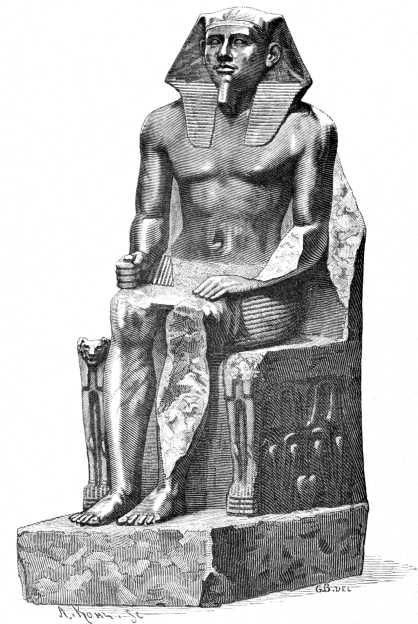
Fig. 205.—Statue of Chephren. Height five feet seven inches. Boulak. Drawn by G. Bénédite.
The other statue, which now consists of little more than the head and
trunk, differs from the first only in a few details. The chair is
without a back, and, curiously enough, the head is that of a much
older man than the Chephren of the diorite statue. This difference
makes it pretty certain that both heads were modelled directly from
nature.
These royal statues are, then, portraits like the rest, but when in
their presence we feel that they are more than portraits, that there
is something in their individuality which could not have been rendered
by photography or by casts from nature, had such processes been
understood by their authors. In spite of the unkindly material the
execution is as free as that of the stone figures. The face, the
shoulders, the pectoral muscles, and especially the knees, betray a
hand no less firm and confident than those which carved the softer
rocks. The diorite Chephren excels ordinary statues in size—for it is
larger than nature—in the richness of its throne, in the arrangement
of the linen hood which gives such dignity to the head, in the
existence of the beard which gives length and importance to the face.
The artist has never lost sight of nature; he has never forgotten that
it was his business to portray Chephren and not Cheops or Snefrou; and
yet he has succeeded in giving to his work the significance of a type.
He has made it the embodiment of the Egyptian belief in the
semi-divine nature of their Pharaohs. By its size, its pose, its
expression and arrangement he has given it a certain ideality. We may
see in these two statues, for similar qualities are to be found in the
basalt figure, the first effort made by the genius of Egyptian art to
escape from mere realism and to bring the higher powers of the
imagination into play.
The reign of those traditional forms which were to be so despotic in
Egypt began at the same time. The type created by the sculptors of the
fourth dynasty, or perhaps earlier, for the representation of the
Pharaoh in all the mysterious dignity of his position, was thought
satisfactory. The calm majesty of these figures, their expression of
force in repose and of illimitable power, left so little to be desired
that they were accepted there and thereafter. Centuries rolled away,
the royal power fell again and again before foreign enemies and
internal dissensions, but with every restoration of the national
independence and of the national rulers, the old form was revived.
There are variants upon it; some royal statues show Pharaoh standing,
others show him sitting and endowed with the attributes of Osiris,
but, speaking generally, the favourite model of the kings and of the
sculptors whom they employed was that which is first made known to us
by the statue of him to whom we owe the second pyramid. The only
differences between it and the colossi of Amenophis III. at Thebes are
to be found in their respective sizes, in their original condition,
and in the details of their features.
The moulds in which the thoughts of the Egyptians were to receive
concrete expression through so many centuries were formed, then, by
their ancestors of the Ancient Empire. All the later revivals of
artistic activity consisted in attempts to compose variations upon
these early themes, to remodel them, with more or less felicity,
according to the fashion of the day. Style and technical methods were
modified with time, but types, that is the attitudes and motives
employed to characterise the age, the mental power, and the social
condition of the different persons represented, underwent little or no
change.
This period of single-minded and devoted study of nature ought also to
have transmitted to later times its care and skill in portraiture, and
its realistic powers generally, to use a very modern phrase. Egyptian
painters and sculptors never lost those qualities entirely; they
always remained fully alive to the differences of conformation and
physiognomy which distinguished one individual, or one class, from
another; but as the models furnished by the past increased in number,
their execution became more facile and superficial, and their
reference to nature became less direct and continual. Neither the art
of Thebes nor that of Sais seems to have produced anything so original
and expressive as the two statues from Meidoum or the
Sheik-el-beled, at Boulak, or the scribe in the Louvre.
We may easily understand what surprise and admiration the discovery of
this early phase of Egyptian art excited among archæologists. When the
exploration of the Memphite necropolis revealed what had up to that
time been an unknown world, Nestor L'Hôte, one of the companions of
Champollion, was the first to comprehend its full importance. He was
not a savant; he was an intelligent and faithful draughtsman and his
artistic nature enabled him to appreciate, even better than the
illustrious founder of egyptology, the singular charm of an art free
from convention and routine. In his letters from Egypt, Champollion
showed himself impressed mainly by the grandeur and nobility of the
Theban remains; L'Hôte, on the other hand, only gave vent to his
enthusiasm when he had had a glimpse of one or two of those mastabas
which were afterwards to be explored by Lepsius and Mariette. Writing
of the tomb of Menofré, barber to one of the earliest Memphite kings,
he says: "The sculptures of this tomb are remarkable for their
elegance and the finesse of their execution. Their relief is so slight
that it may be compared to that of a five-franc piece. Such consummate
workmanship in a structure so ancient confirms the assertion that the
higher we mount upon the stream of Egyptian civilization the more
perfect do her works of art become. By this it would appear that the
genius of the Egyptian people, unlike that of other races, was born in
a state of maturity."[207]
"Of Egyptian art," he says elsewhere, "we know only the decadence."
Such an assertion must have appeared paradoxical at a time when the
Turin Museum already possessed, and exhibited, so many fine statues of
the Theban kings. And yet Nestor L'Hôte was right, as the discoveries
made since his time have abundantly proved, and that fact must be our
excuse for devoting so large a part of our examination of Egyptian
sculpture to the productions of the Ancient Empire.
After the sixth dynasty comes an obscure and barren period, whose
duration and general character are still unknown to egyptologists.
Order began to be re-established in the eleventh dynasty, under the
Entefs and Menthouthoteps, but the monuments found in more ancient
Theban tombs are rude and awkward in an extreme degree, as Mariette
has shown.[208] It was not until the twelfth dynasty, when all Egypt
was again united under the sceptre of the Ousourtesens and Amenemhats,
that art made good its revival. It made use of the same
materials—limestone, wood, and the harder rocks—but their
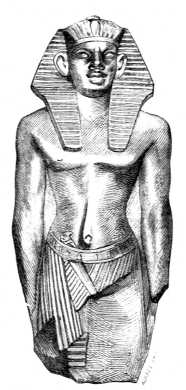
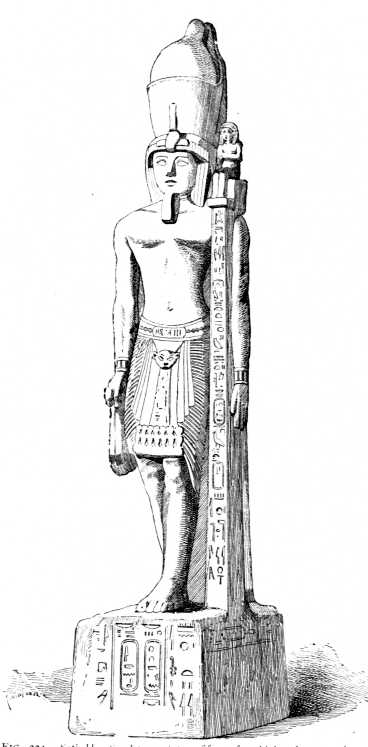
proportions were changed. In Fig. 206 a wooden statue attributed to
this period is reproduced. The legs are longer, the torso more
flexible, than in the statue of Chephren and other productions of the
early centuries.
Compared with their predecessors other statues of this period will be
found to have the same characteristics. It has been asserted that the
Egyptians, as a race, had become more slender from the effects of
their warm and dry climate. It is impossible now to decide how much of
the change may fairly be attributed to such a cause, and how much to a
revolution in taste. Even among the figures of the Ancient Empire
there are examples to be found of these slender proportions, but they
certainly appear to have been in peculiar favour with the sculptors of
the later epoch. Except in this particular, the differences are not
very great. The attitudes are the same. See, for instance, the statue
in grey sandstone of the scribe Menthouthotep, which was found by
Mariette at Karnak and attributed by him to this epoch. Both by its
pose and by the folds of fat which cross the front of the trunk, it
reminds us of the figures of scribes left to us by the Ancient Empire.
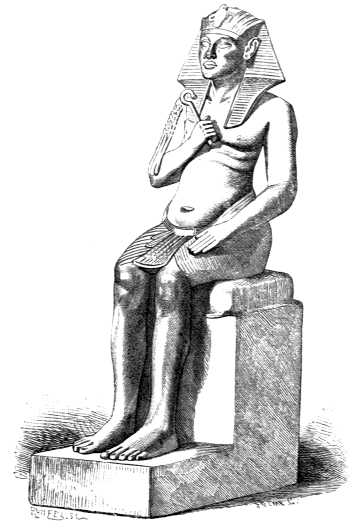
The nobler types also reappear. There is in the Louvre a statue in red
granite representing a Sebek-hotep of the thirteenth dynasty (Fig.
207). He sits in the same attitude, with the same head-dress and the
same costume, as the Chephren of Boulak. There is one difference,
however, his forehead is decorated with the uræus, the symbol of
royal dignity, which Chephren lacks.[209] The dimensions, too, are
different. We do not know whether the Ancient Empire made colossal
statues of its kings or not, but this Sebek-hotep exceeds the stature
of mankind sufficiently to make it worthy of the name.
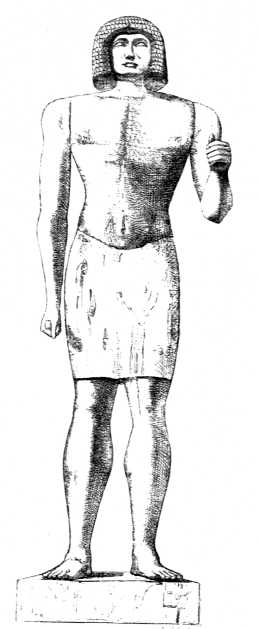
Fig. 206.—Wooden statue, Boulak. Drawn by Bénédite.
The Louvre possesses another monument giving a high idea of the taste
of the sculptors belonging to this period, we mean the red-granite
sphinx (Fig. 41, Vol. I.), which was successively appropriated by one
of the shepherd kings and by a Theban Pharaoh of the nineteenth
dynasty: the ovals of both are to be found upon it. Like so many other
things from Tanis, this sphinx must date from a Pharaoh of the
thirteenth dynasty. This De Rougé has clearly shown.[210] Tanis seems
to have been a favoured residence of those princes, and most of their
statues have been found in it. A leg in black granite, now in the
Berlin Museum, is considered the masterpiece of these centuries. It is
all that remains of a colossal statue of Ousourtesen.[211]
According to Mariette, many of those fine statues in the Turin Museum
which bear the names of princes belonging to the eighteenth dynasty,
Amenhoteps and Thothmeses, must have been made by order of the princes
of the twelfth and thirteenth dynasties. In later years they were
appropriated, in the fashion well known in Egypt, by the Pharaohs of
the Second Theban Empire, who substituted their cartouches for those
of the original owners. On more than one of the statues signs of the
operation may still be traced, and in other cases the usurpation may
be divined by carefully studying the style and workmanship.[212]
It was in the ruins of the same city that Mariette discovered a group
of now famous remains in which he himself, De Rougé, Devéria, and
others, recognised works carried out by Egyptian artists for the
shepherd kings. These works have an individual character which is
peculiar to themselves.[213] They differ greatly from the ordinary
type of Egyptian statues, and must have preserved the features of
those foreign invaders whose memory was so long held in detestation in
Egypt. This supposition is founded upon the presumed identity of Tanis
with Avaris, the strong place which formed the centre of the Hyksos
power for so many generations.
Fig. 207.—Sebek-hotep III. Colossal statue in red granite. Height nine feet. Louvre. Drawn by Saint-Elme Gautier.
Confirmation of this theory is found in the existence of an oval
bearing the name of Apepi, one of the shepherd kings, upon the
shoulder of a sphinx from Tanis. The aspect of this sphinx, and the
features and costume of certain figures discovered upon the same site
and dispersed among the museums of Europe, are said to have much in
common with the ethnic peculiarities of the Syrian tribe by which
Middle and Lower Egypt was occupied. M. Maspero, however, who has
recently devoted fresh attention to these curious monuments, is
inclined to doubt the justness of this conclusion. The position of the
cartouche of Apepi suggests that it may be due to one of those
usurpations which we have mentioned. For the present, therefore, it
may be as well to class these monuments simply among the Tanite
remains. Tanis, like some other Egyptian cities, had a style of its
own, but we are without the knowledge required for a determination of
its origin. We shall be content with describing its most important
works and with calling attention to their remarkable originality.
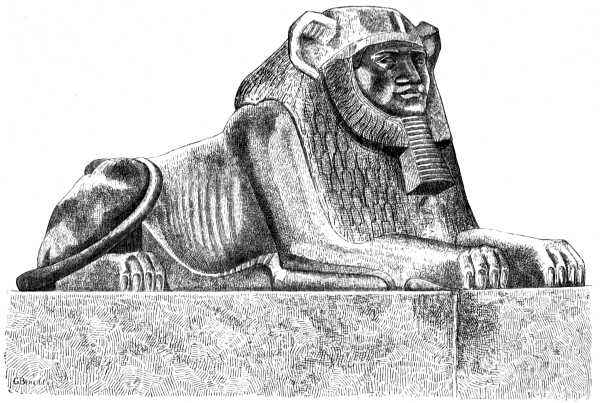
The most important and the best preserved of all these monuments is a
sphinx of black granite which was recovered, in a fragmentary
condition, from the ruins of the principal temple at Tanis (Fig. 208).
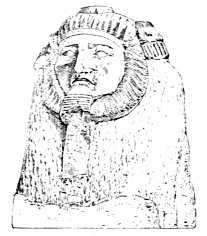
Three more were found at the same time, but they were in a still worse
state of preservation. The fore-part of one of them is figured in the
adjoining woodcut.
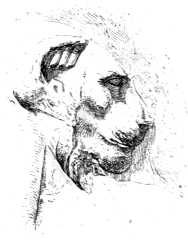
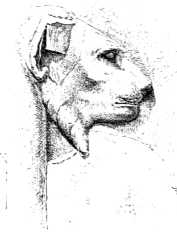
"There is a great gulf," says Mariette, "between the energetic power
which distinguishes the head of this sphinx and the tranquil majesty
with which most of these colossi are endowed. The face is round and
rugged, the eyes small, the nose flat, the mouth loftily contemptuous.
A thick lion-like mane enframes the countenance and adds to its
energetic expression. It is certain that the work before us comes from
the hands of an Egyptian artist, and, on the other hand, that his
sitter was not of Egyptian blood."[214]
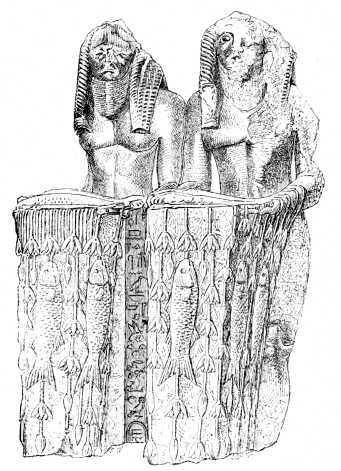
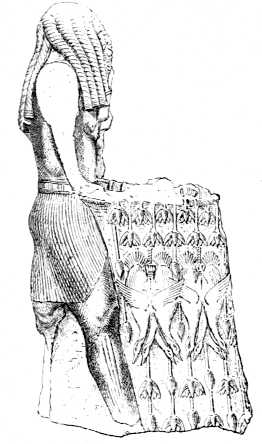
The group of two figures upon a common base, which is such a
conspicuous object in the Hyksos chamber at Boulak, seems to have had
a similar origin. We give a front and a side view of it
(Figs. 210 and 211), and borrow the following description from Mariette.[215]
Fig. 208.—Sphinx in black granite; from Tanis. Drawn by G. Bénédite.
"Huge full-bottomed wigs, arranged into thick tresses, cover the heads
of the two figures. Their hard and strongly-marked features
(unfortunately much broken) bear a great resemblance to those of the
lion-maned sphinxes. The upper lips are shaven but the cheeks and
chins are covered with long wavy beards. Each of them sustains on his
outstretched arms an ingenious arrangement of fishes, aquatic birds,
and lotus flowers.
"No monument can be referred with greater certainty than this to the
disturbed period when the Shepherds were masters of Egypt. It is
difficult to decide upon its exact meaning. In spite of the mutilation
which prevents us from ascertaining whether they bore the uræus upon
their foreheads, it cannot be doubted that the originals of the two
statues were kings. In after years Psousennes put his cartouche upon
the group, which assuredly he would never have done if he believed it
to represent two private individuals. But who could the two kings have
been who were thus associated in one act and must therefore have been
contemporaries?"
Fig. 209.—Head and shoulders of a Tanite Sphinx in black granite. Drawn by G. Bénédite.
This explanation seems to carry with it certain grave objections. It
is not, in the first place, so necessary as Mariette seems to think
that we should believe them to be kings. Similar objects—fishes, and
aquatic flowers and birds—are grouped in the same fashion upon works
which, to our certain knowledge, neither come from Tanism or date from
the Shepherd supremacy. Their appearance indicates an offering to the
Nile, and we can readily understand how Psousennes claimed the merit
of the offering by inscribing his name upon it, even although he were
not the real donor.
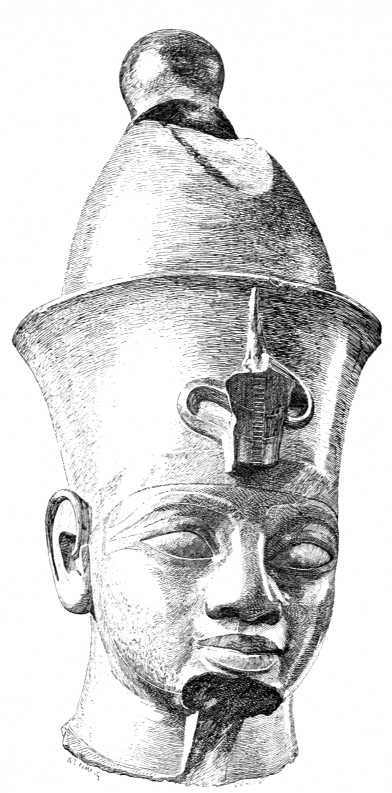
Mariette does not hesitate to ascribe to the same series a figure
discovered in the Fayoum, upon the site of the city which the Greeks
called Crocodilopolis (Fig. 212). He describes it thus:—[216]
"Upper part of a broken colossal statue, representing a king standing
erect. No inscription.
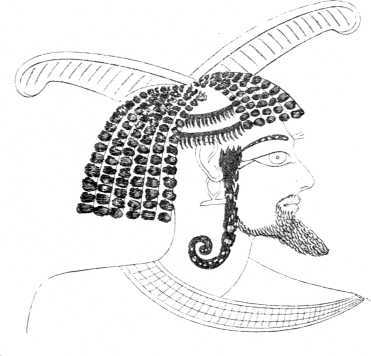
"The general form of the head, the high cheek-bones, the thick lips,
the wavy beard that covers the lower part of the cheeks, the curious
wig, with its heavy tresses, are all worthy of remark; they give a
peculiar and even unique expression to the face. The curious ornaments
which lie upon the chest should also be noticed. The king is covered
with panther skins; the heads of two of those animals appear over his
shoulders.
Fig. 210.—Group from Tanis; grey sandstone. Drawn by Bourgoin.
Fig. 211.—Side view of the same group. Drawn by Bourgoin.
"The origin of this statue, which was found at Mit-fares in the
Fayoum, admits of no doubt. The kings who decorated the temple at
Tanis with the fine sphinxes and groups of fishermen which I found
among its ruins, must also have transported the vigorous fragments
which we have before our eyes to the other side of Egypt."
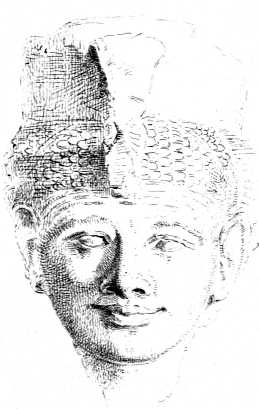
Finally, Devéria and De Rougé have suggested that a work of the same
school is to be recognized in the fragment of a statuette of green
basalt, which belongs to the Louvre and is figured upon page 237.[217]
They point to similarities of feature and of race characteristics. The
face of the Louvre statuette has a truculence of expression not unlike
that of the Tanite monuments, while the workmanship is purely Egyptian
and of the best quality; the flexibility of body, which is one of the
most constant qualities in the productions of the first Theban
Empire, being especially characteristic. The king represented wears
the klaft with the uræus in front of it; his schenti is finely
pleated and a dagger with its handle carved into the shape of a hawk's
head is thrust into his girdle. The support at the back has,
unfortunately, been left without the usual inscription and we have no
means of ascertaining the age of the fragment beyond the style, the
workmanship, and the very peculiar physiognomy. Devéria suggests that
it preserves the features of one of the shepherd kings, some of whose
images Mariette thought he had discovered at Tanis and in the
Fayoum.[218]
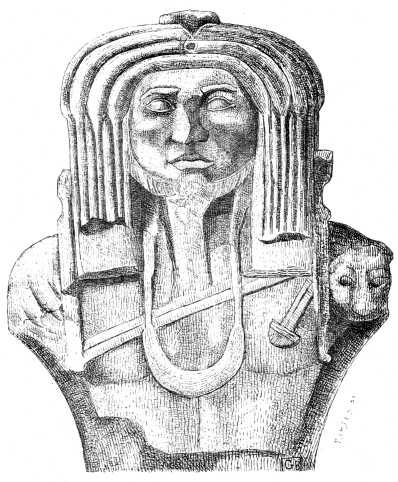
Fig. 212.—Upper part of a royal statue. Grey granite. Boulak. Drawn by G. Bénédite.
It cannot be denied that there are many striking points of
resemblance between the different works which we have here brought
together. Mariette laid great stress upon what he regarded as one of
his most important discoveries. This is his definition of the type
which the Egyptian artist set himself to reproduce with his habitual
exactness: "The eyes are small, the nose vigorous, arched, and flat at
the end, the cheeks are large and bony, and the mouth is remarkable
for the way in which its extremities are drawn down. The face as a
whole is in harmony with the harshness of its separate features, and
the matted hair in which the head seems to be sunk adds to the
singularity of its appearance."[219]
Fig. 213.—Fragmentary statuette of a king; height seven inches. Drawn by Saint-Elme Gautier.
Both Mariette and Ebers declare that this type has been preserved to
our day with astonishing persistence. In the very district in which
the power of the shepherds was greatest, in the neighbourhood of that
Lake Menzaleh which almost bathes the ruins of Tanis, the poor and
half savage fishermen who form the population of the district possess
the strongly marked features which are so easily distinguished from
the rounder and softer physiognomies of the true Egyptian fellah.
Ahmes must have been content with the expulsion of the chiefs only of
those Semitic tribes who had occupied this region for so many
centuries. The mass of the people must have been too strongly attached
to the fertile lands where they dwelt to refuse obedience to the
conqueror, and more than one immigration, like that of the Hebrews,
may have come in later times to renew the Arab and Syrian
characteristics of the race.[220]
Whatever we may think of these conjectures and assertions, the
sculptors of the First Theban Empire and of the Hyksos period took up
and carried on the traditions of the Ancient Empire. The processes are
the same except that in a few particulars they are improved. More
frequent use is made of the harder rocks such as granite, basalt, and
diorite, and a commencement is made in the art of gem-cutting.
Even the bas-relief carries on the themes which had been in favour in
the first years of the monarchy. We have already illustrated two
steles of this period (Figs. 86 and 164, Vol. I.). In the second, and
especially in the woman, may be noticed those elongated proportions
which characterize the sculpture of the first Theban dynasties. Apart
from the steles, which come mostly from Abydos, we have few
bas-reliefs which may be referred to this epoch. The mastabas with
their sculptured walls were no longer constructed, and the most
interesting hypogea of the middle Empire, those of Beni-Hassan, were
decorated with paintings only. The sepulchral grottos of El-Bercheh
possess bas-reliefs dating from the twelfth dynasty, and the quality
of their workmanship may be seen in our Fig. 43, Vol. II. The style is
less free and more conventional than that of the mastabas. The men who
haul upon the ropes and those who march in front of them, are all
exact repetitions one of another, causing an effect which is very
monotonous. The paintings of Beni-Hassan, which are freer and more
full of variety, are more able to sustain a comparison with the
decorations of the mastabas. Even then, however, we find too much
generalization. Except in a few instances there is a less true and
sincere feeling for nature, and a lack of those picturesque motives
and movements caught flying, so to speak, by an artist who seems to be
amused by what he sees and to take pleasure in reproducing it, which
are so abundant in the mastabas.
The excavations at Tanis have helped us to understand many things upon
which our information had been and still is very imperfect. We are no
longer obliged to accept Manetho's account of the Shepherd invasion.
In his desire to take at least a verbal revenge upon the conquerors of
his country the historian seems to have greatly exaggerated their
misdeeds. We know now not only that the native princes continued to
reign in Upper Egypt, but also that the interlopers adopted, in the
Delta, the manners and customs of their Egyptian subjects. So far as
we can tell, there were neither destructions of monumental buildings
nor ruptures with the national traditions. Thus the art of the three
great Theban dynasties, from Ahmes to the last of the Rameses, seems a
prolongation of that of the Ousourtesens and Sebek-hoteps. There are
no appreciable differences in their styles or in their processes, but,
as in their architecture, their works of art as a whole show an
extraordinary development, a development which corresponds to the
great and sudden increase in the power and wealth of the country. The
warlike kings who made themselves masters of Ethiopia and of Western
Asia, had aspirations after the colossal. Their buildings reached
dimensions hitherto unknown, and while their vast wall spaces gave
great opportunities to the sculptor they demanded efforts of invention
and arrangement from him to which he had previously been a stranger.
These great surfaces had to be filled with historic scenes, with
combats, victories, and triumphal promenades, with religious scenes,
with pictures of homage and adoration. The human figure in its natural
size was no longer in proportion to these huge constructions. In order
to obtain images of the king which should correspond to the extent and
magnificence of the colonnades and obelisks, the slight excess over
the real stature of human beings which contented the sculptors of the
Ancient Empire was no longer sufficient. Whether they were cut, as at
Ipsamboul, out of a mountain side, or, as at Thebes, Memphis, and
Tanis out of a gigantic monolith, their proportions were all far
beyond those of mankind. Sometimes the mortals who frequented the
temples came nearly as high as their knees, but oftener they failed to
reach their ankle-bones. The New Empire had a mania for these colossal
figures. It sprinkled them over the whole country, but at Thebes they
are more thickly gathered than elsewhere. In the immediate
neighbourhood of the two seated statues of Amenophis III., the
savants of the French Commission found the remains of fifteen more
colossi.[221]
There were at least as many on the right bank. On the avenue leading
through the four southern pylons at Karnak, the same explorers found
twelve colossal monoliths, each nearly thirty-five feet high but all
greatly mutilated, and the former existence of others was revealed to
them by fragments scattered about the ground. They were able to reckon
up eighteen altogether on this south side of the building.[222]
Similar stone giants peopled the other religious or political capitals
of Egypt—Abydos, Memphis, Tanis, Sais, etc. The largest of all,
however, are the colossi at Ipsamboul representing Rameses II. They
are about seventy feet high. Among those cut from one enormous block
brought from Syene or elsewhere, the best known are those of Amenophis
III. at Thebes. They are fifty-two feet high without the pedestal. But
the statue of Rameses II., which stood in the second court of the
Ramesseum, must have been more than fifty-six feet high, as we may
calculate from the fragments which remain. The head is greatly
mutilated but the foot is over thirteen feet long.[223]
These statues were generally seated in the attitude which we have
already described in speaking of Chephren and Sebek-hotep. Some,
however, were standing, such as the colossal figure of Rameses which
stood before the Temple of Ptah at Memphis. This figure, which is
about forty-four feet high, is cut from a single block of very fine
and hard limestone. It lies face downwards and surrounded by palm
trees, in a depression of the soil near the village of Mitrahineh. In
this position it is covered by the annual inundation. The English, to
whom it belongs, have hitherto failed to take possession of it owing
to the difficulty of transport, and yet it is one of the most careful
productions of the nineteenth dynasty. The head is full of
individuality and its execution excellent.
THE QUEEN TAIA
BOULAK MUSEUM
J. Bourgon del. Imp. Ch. Chardon Ramus sc.
In spite of their taste for these colossal figures, the Egyptian
sculptors of this period rivalled their predecessors in the skill and
sincerity with which they brought out their sitter's individuality. It
was not, perhaps, their religious beliefs which imposed this effort
upon them. The readiness which successive kings showed in
appropriating the statues of their ancestors to themselves by simply
placing their ovals upon them, proved that the ideas which were
attached by the fathers of the Egyptian race to their graven images
had lost their force. Effigies which were brought into the service of
a new king by a mere change of inscription, were nothing more than
monuments to his pride, destined to transmit his name and glory to
future generations. The early taste, however, was not extinguished.
When the sculptor was charged with the representation of one of those
kings who had made Egypt great, or one of the queens who were often
associated in the sovereign power, he took the same pains as those of
the early Empire to make a faithful copy of his august model.
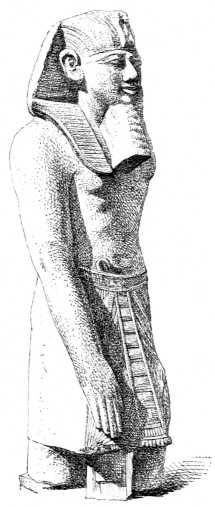
Fig. 214.—Thothmes III. Boulak. Granite.
Among the monuments of faithful portraiture which this period has left
us the statues of Thothmes III. are conspicuous. The features of this
prince are to be recognized in a standing figure at Boulak (Fig. 214),
but they are much more strongly marked in a head which was found at
Karnak and is now in the British Museum (Fig. 215). It formerly
belonged to a colossal statue erected by that prince in the part of
the temple built by himself. The features seem in no way Egyptian.
The form of the nose, the upturned corners of the eyes, the curves of
the lips, and the general contours of the face are all suggestive of
Armenian blood.[224] Others have thought it showed traces of negro
descent. In the first-named statue these characteristics are less
conspicuous because its execution as a whole is less careful and
masterly. The same physiognomy is to be found in a porphyry sphinx
belonging to the Boulak collection.[225]
There is a strong contrast between the features of Thothmes and those
of Amenophis III. the founder of Luxor. Of this we may judge by a
head, as well preserved as that of Thothmes, which was found behind
one of the statues of Amenophis at Gournah. It also is in the British
Museum. The face is long and finely cut, with an expression and
general appearance which we should call distinguished; the nose is
long and thin; the chin well chiselled and bold in outline.[226]
Obliged to draw the line somewhere we have not reproduced this figure,
but in Plate XI. we give a female head, discovered by Mariette at
Karnak, and believed to be that of Taia, the queen of Amenophis III.
Whether rightly named or not, this colossal fragment is one of the
masterpieces of Egyptian sculpture.[227]
Mariette enumerates various reasons for believing Taia to have been
neither of royal nor even of Egyptian blood. She might have been
Asiatic; the empire of her husband extended as far as Mesopotamia. The
point has little importance, but as M. Charmes says, "when we stop in
admiration before the head of Taia, at Boulak, we feel ourselves
unconsciously driven by her charms ... to forge a whole history, an
historical romance, of which her enigmatic personality is the centre
and inspiration, and to fancy her the chief author of these religious
tragedies which disturbed her epoch and left a burning trace which has
not yet disappeared."[228]
M. Charmes here alludes to the changes which Amenophis IV. wished to
introduce into the national religion when he attempted to destroy the
name and images of Amen, and to replace them with those of a solar
god, who was represented by a symbol not previously encountered in the
monuments (Fig. 2). If Mariette's hypotheses remain uncontradicted by
later discoveries, we may admit Taia to be the mother of Amenophis
IV., and to her influence in all probability would her son's denial
and persecution of the great Theban deity be due. Our present
interest, however, is with the features of Amenophis. They have been
faithfully handed down to us by the artists employed at
Tell-el-Amarna.[229] By the help of these bas-reliefs a statuette in
yellow steatite, now in the Louvre (Fig. 216), has been recognized as
a portrait of this Pharaoh. Its workmanship is very fine.
Fig. 215.—Thothmes III. British Museum. Red granite. Drawn by Saint-Elme Gautier.
Some have thought that in these bas-reliefs, and in the Louvre
statuette, the "facial characteristics and the peculiar shapes of
breast and abdomen by which eunuchs are distinguished, are to be
found."[230] On the other hand, we know that while still very young
Amenophis IV. married the queen Nowertiouta, and that he had seven
daughters by her. "It is probable, therefore, that if the misfortune
alluded to really befell him, it was during the wars waged by
Amenophis III. against the negro races of the south." In any case,
Amenophis IV. bore no resemblance to any one of the long procession of
princes whose portraits have come down to us, from the early dynasties
of the Ancient Empire to the Roman conquest. Lepsius devotes a series
of plates to the iconography of the Egyptian kings, and among them all
we find nothing that can be compared to the almost fantastic
personality of Amenophis, with his low, unintellectual forehead, his
pendulous cheeks, his feminine contours, and his general expression of
gloom and melancholy. The fidelity with which all these unpleasing
features are reproduced is extraordinary, and can only be accounted
for by the existence of a tradition so well established that no one
thought of breaking through it, even when the portrait of a
semi-divine monarch was in question.
There are other works dating from this period which show the same
desire for truth at any price. One of the series of bas-reliefs
discovered by Mariette in the Temple of Dayr-el-Bahari may be given
as an instance. The subject of these reliefs is the expedition
undertaken by the regent Hatasu against the country of Punt.[231]
Fig. 216.—Statuette of Amenophis IV. Height twenty inches. Louvre. Drawn by Saint-Elme Gautier.
"In the most curious of these sculptures the savage chief advances as
a suppliant. His wife walks behind him. Her hair is carefully dressed
and plaited into a thick tail at the back; a necklace of large discs
is round her neck. Her dress is a long yellow chemise, without
sleeves, and reaching to the middle of her legs. Her features are
regular enough, but virile rather than feminine, and all the rest of
her person is repulsive. Her arms, legs, and chest, are loaded with
fat, while her person projects so far in the rear as to result in a
deformity over which the artist has dwelt with curious complacence."
The legs, so far as the chemise allows them to be seen, are so large
that they suggest incipient elephantiasis. The Egyptian artist was
induced, no doubt, to dwell upon such a monstrosity by the instructive
contrast which it presented with the cultivated beauty of his own
race.[232]
Realist as he was when he chose to take up that vein, the Egyptian
sculptor attained, however, to a high degree of grace and purity,
especially in his representations of historic and religious scenes.
When he had not the exceptional ugliness of an Amenophis IV. to deal
with, he gave to the personages in his bas-reliefs a look of serious
gravity and nobility which cannot fail to impress the greatest
enthusiast for Greek models. He was no longer content with the sincere
imitation of what he saw, like the artists of the Early Empire; his
efforts were directed to giving everlasting forms to those superhuman
beings, the Egyptian gods and Egyptian kings, with their sons and
favourites, who lived in hourly communion with them. Egyptian art at
last had an ideal, which it never realized with more success than in
certain bas-reliefs of this epoch.
Mariette quotes, as one of the most learned productions of the
Egyptian chisel, a bas-relief at Gebel-Silsilis representing a goddess
nourishing Horus from her own breast. "The design of this composition
is remarkable for its purity," he says, "and the whole picture
breathes a certain soft tranquillity which both charms and surprises a
modern connoisseur."[233]
We have not reproduced this work, but an idea of its style and
composition may be formed from a bas-relief of the time of Rameses
II., which we have taken from the speos of Beit-el-Wali (Fig. 255,
Vol. I.). The theme is the same. A scene of adoration taken from a
pier at Thebes (Fig. 176, Vol. I.) and, still more, a fine bas-relief
in which Amenophis III. does homage to Amen, to whom he is presented
by Phré, may also be compared with the work at Gebel-Silsilis. The
movements are free and elegant, and nothing could be more expressive
than the gestures of the two deities, than the attitude, at once proud
and respectful, of the kneeling prince. The whole scene is imbued with
sincere and grateful piety (Fig. 33, Vol. I.).
We find the same theme, with some slight variations, in the bas-relief
at Abydos figured on page 390, Vol. I. The sculptures in the temple
with which Seti I. adorned this city may be considered the
masterpieces of Egyptian art in their own genre. Their firm and
sober execution, and the severe simplicity of their conception, are
well shown in our third plate. This royal figure, which we were
compelled to detach from its companions in order that we might give it
on a scale large enough to be of service, forms part of a composition
which has been thus described by M. Charles Blanc: "Seated upon the
round base of a column, we examined the noblest bas-reliefs in the
world. Seti was present in his own temple. His noble head, at once
human and heroic, mild and proud, stood out from the wall and seemed
to regard us with a gentle smile. A wandering ray of sunlight
penetrated into the temple, and, falling upon the gentle salience of
the sculptured figures, gave them a relief and animation which was
almost illusive. A procession of young girls, whose graceful forms are
veiled only by their chastity, advance towards the hero with as much
freedom as respect will allow.... Their beauty attracts us while their
dignity forbids all approach. The scene lives before us, and yet the
stone is but grazed with the chisel and casts but the gentlest shadow.
But the delicacy of the workmanship is combined with such vigour of
design and such true sincerity of feeling that these young women, who
represent the provinces of Egypt, seem to live and breathe before
us."[234]
The same qualities are found, though in less perfection, in those
bas-reliefs which commemorate the conquests and military exploits of
the great Theban Pharaohs on the pylons and external faces of the
temple walls. The space to be covered is larger, the scene to be
represented more complicated, than in the religious pictures, which,
as a rule, include very few actors. The artist is no longer working
for a narrow audience of gods, kings, and priests. His productions are
addressed to the people at large, and he attempts therefore to dazzle
and astonish the crowd rather than to please the more fastidious
tastes of their social leaders. His execution is more rapid and less
thoughtful, as may be seen in our illustrations taken from the battle
scenes of Karnak, Luxor, the Ramesseum, and Medinet-Abou
(Figs. 13, 85, 173, 174, 253, and 254, Vol. I.). In each of these scenes there is
a central figure to which our attention is immediately attracted. It
is that of the king, and is far larger than those of his subjects and
enemies.
Sometimes he is on foot, his threatening mace raised above the heads
of his prisoners, who kneel before him and raise their hands in
supplication, as in a fine bas-relief at Karnak (Fig. 85, Vol. I.);
more often he is represented standing in his chariot and dominating
the tumult about him like a demi-god, driving a panic-stricken crowd
before him sword in hand, or about to cleave the head of some hostile
chief, whose relaxed members seem already to have felt the mortal
stroke (Fig. 13, Vol. I.). Elsewhere we see him bending his bow and
launching his arrows against the flying barbarians (Fig. 174, Vol.
I.). "We could never look at this beautiful figure without fresh
admiration," say the authors of the Description, "it is the Apollo
Belvedere of Egypt."[235] Again we see the king returning victorious
from his wars, long rows of prisoners march behind and before him,
their hands tied at their backs and attached by a rope to the chariot
of the conqueror. The horses which, in the battle scenes, we saw
rearing and trampling the dead and dying beneath their feet, advance
quietly and under the control of the tightened rein, and their dainty
walk suggests that they too have a share in the universal satisfaction
that follows a war well ended.
In all these reliefs the principal figure, that of the prince, is free
and bold in design, and full of pride and dignity. These
characteristics are also found in some of the secondary figures, such
as those soldiers of the enemy who still resist, or the prisoners who
resign themselves to the sovereign's mace (Figs. 13 and 85, Vol. I.).
But the wounded and fugitives in these battle pictures are curiously
confused in drawing and arrangement. If we take these little figures
separately many of them are drawn and modelled well enough, but, taken
as a whole, they are huddled up into far too narrow a space, and seem
heaped upon each other in impossible fashion. The Egyptian sculptor
has been fired with the desire to emulate with his chisel the great
deeds of his royal master, and, in his ignorance, he has passed the
limits which an art innocent of perspective cannot overleap without
disaster.
The persistent tendency towards slightness of proportion, which we
have already noticed in speaking of the First Theban Empire, is even
more conspicuous in the figures of these reliefs than in the royal
statues (Figs. 13, 50, 53, 84, 165, and 175, Vol. I.). Neither in
these historical bas-reliefs, nor in those of the tombs, do we ever
encounter the short thickset figures which are so common in the
Ancient Empire.
In the paintings and bas-reliefs of Thebes this slenderness is more
strongly marked in the women than in the men, and everything goes to
prove that it was considered essential to beauty in the female sex.
Goddesses and queens, dancing girls and hired musicians, all have the
same elongated proportions. This propensity is more clearly seen
perhaps in the pictures of the Almees and Gawasi of Ancient Egypt than
anywhere else. Look, for instance, at our reproduction of a bas-relief
in the Boulak Museum (Fig. 217). It represents a funeral dance to a
sound of tambourines, accompanied in all probability by those
apologetic songs, called θρῆνοι by the Greeks, of which M.
Maspero has translated so many curious fragments.[236] All these
women, who are practically naked in their long transparent robes, wear
their hair in thick pendent tresses. Two young girls, quite nude, seem
to regulate the time with castanets. A number of men, coming from the
right, appear to reprove by their gestures the energetic motions of
the women. This bas-relief is an isolated fragment, and without a
date. It was found in the necropolis of Memphis and from its style
Prisse ascribes it to the nineteenth dynasty, "a time when artists
were mannered in their treatment of the female form, combining great
softness of contour with an impossible slenderness of build. The
execution is careless, but the movements and attitudes are truthful
enough."[237] Our Plate XII. shows figures of the same general
proportions, though rather better drawn.
This curious mannerism began to establish itself during the first
renascence of Egyptian art under the twelfth dynasty. It was to last,
and even to grow more conspicuous, until the centuries of final
decadence. The growing influence of conventionality is to be seen in
other signs also. As art repeated and multiplied its representations,
and the spaces which it had to decorate increased in number and size,
it had at its disposal, as we may say, a larger number of moulds and
made more frequent employment of certain groups and figures which were
repeated without material change. In the decorations of this period we
find long rows of figures which are practically identical with each
other. They look as if they had been produced by stencil plates. With
all their apparent richness and their wealth of imagery the sculpture
and painting of Thebes show a poverty of invention which is not to be
found in the art of the early dynasties.[238]
The gradual falling off in their powers of observing and reproducing
natural forms is singularly well shown in their imperfect treatment of
those animals which had been unknown to their predecessors. The horse
does not seem to have been introduced into Egypt until the time of the
shepherd kings, but he soon conquered a high place among the servitors
of the upper classes of Egyptians. He became one of the favourite
themes of contemporary art. In all the great pictures of battle he
occupies a central position, and he is always associated with the
prowess of the sovereign. And yet he is almost always badly drawn. His
movement is sometimes not without considerable vigour and even
nobility, but his forms lack truth, he is generally far too thin and
elongated. His head is well set on and his neck and shoulders good,
but his body is weak and unsubstantial (Figs. 13 and 174, Vol. I.).
The bad effects of conventionality are here strongly felt. The same
horse, in one of the two or three attitudes between which the Egyptian
sculptor had to choose according to the scene to be treated, appears
everywhere. The sculptors of the Memphite tombs saw with a very
different eye when they set themselves to surround the doubles of
their employers with the images of the domestic animals to whom
they were accustomed in life.
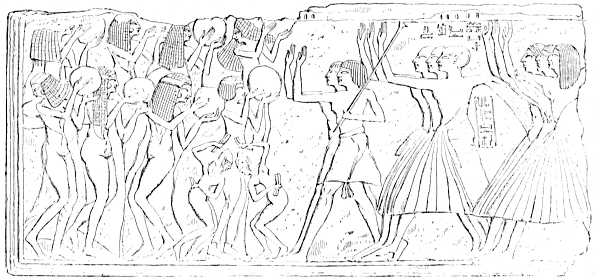
Fig. 217.—Funeral Dance. Bas-relief in limestone. Boulak. Drawn by Bourgoin.
The difference can be seen, however, without going back to the Ancient
Empire. Compare the great historical bas-reliefs of the temples and
royal cenotaphs with the more modest decorations of certain private
sepulchres, such as those which were found in the tomb of Chamhati,
superintendent of the royal domains under the eighteenth dynasty (Fig.
218). The sculptors return with pleasure to those scenes of country
life of which the pyramid builders were so fond. The fragment we
reproduce shows the long row of labourers bending over their hoes, the
sower casting his seed, the oxen attached to the plough and slowly
cutting the furrow under the whip and voice of their drivers. Neither
men nor beasts are drawn with as sure a hand as in the tomb of Ti, but
yet the whole appears more sincere than productions of a more official
kind. The oldest and most faithful assistant to the Egyptian fellah,
the draught ox, is at least much more like nature than the charger of
the Theban battle pictures.
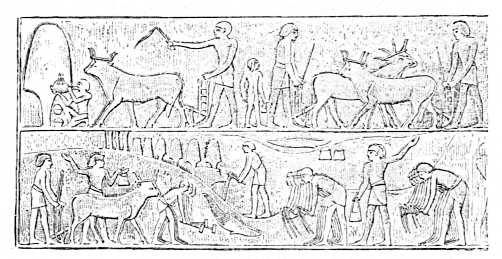
Fig. 218.—Bas-relief from the tomb of Chamhati. Boulak.
The dangers of routine and of a conventional mode of work seem now and
then to have been felt by the Theban artists. They appear to have set
themselves deliberately to rouse attention and interest by introducing
foreign types into their eternal battle pieces, and by insisting upon
their differences of feature, of complexion, of arms and costume. They
were also fond of depicting other countries and the strange animals
that inhabited them, as in the bas-relief which shows a giraffe
promenading among tropical palms.[239] But in spite of all these
meritorious efforts, they do not touch our feelings like the primitive
artists of Gizeh and Sakkarah, or even of Beni-Hassan. Try as they
will, they cannot conceal that soulless and mechanical facility which
is so certain to fatigue the spectator. If we turn over the pages of
Lepsius, we always find ourselves dwelling with pleasure upon the
sculptures from the mastabas, in spite of their apparent similarity,
while we have soon had enough of the pompous and crowded bas-reliefs
from Karnak, Luxor, the Ramesseum and Medinet-Abou.
These defects are less conspicuous in figures in the round, and
especially in the statues of kings. I do not know that the sculptors
of the Setis and the Rameses ever produced anything equal to the
portraits of Thothmes, Amenophis, and Taia, but there are statues of
Rameses II. intact, which may be reckoned among the fine examples of
Egyptian art. The features of no prince that ever existed were
reproduced more often than those of this Rameses, who built so much
and reigned so long. These reproductions, as might be supposed, differ
very greatly in value.
In the huge colossi which sit before the Great Temple at Ipsamboul
(Fig. 248, Vol. I.), the limbs are not modelled with the careful
precision which would be required in the case of a life-size statue.
The arms and legs appear rather heavy on close inspection, and in a
photograph those parts which are nearest to the camera, namely, the
legs and the knees, seem too large for the rest of the figure. But the
heads are characterized by a breadth and freedom of execution which
brings out the desired expression with great effect when looked at
from a proper distance. This expression is one of thoughtful mildness
and imperturbable serenity. It is exactly suited to the image of a
deified king, sitting as eternal guardian of the temple which his
workmen had hewn out in the bowels of the mountain.
Some discrimination must be exercised between the statues of Rameses
which approach the natural size. We do not look upon his portrait when
a child, which is now in the Louvre, as a masterpiece (Fig. 219). The
noble lines of the profile, recalling his father Seti, are indeed his,
but the eye is too large and the hands are treated with an elegance
which is more than a little mannered. The uræus on his brow and the
titles engraved by his side show that he was already king, but we can
see that he was still very young, not so much by the juvenile contours
of his body, as by the finger in his mouth and the lock of hair
hanging upon his right shoulder. A statue at Boulak (Fig. 220) shows
signs of carelessness rather than of affectation. In it Rameses is
still a young man. The eyes, the small mouth, the calm and smiling
visage, are all well modelled, but the legs are quite shapeless.
Fig. 219.—Portrait of Rameses II. while a child, actual size. Limestone. In the Louvre.
Fig. 220.—Statue of Rameses II. Boulak.
Some good bas-reliefs date from this reign. Among others we may name
those prisoners of war bound together, which Champollion copied from
the plinth of a royal statue in the Ramesseum (Fig. 221). The race
characteristics are very well marked. The prognathous negro, with his
thick lips, short nose, sloping brow, and woolly poll; the Asiatic,
an Assyrian perhaps, with his regular, finely-chiselled profile and
his knotted head-dress, are easily recognized. The movement of these
two figures is also happy, its only defect is its want of variety. The
same remarks may be applied to those sculptures on the external walls
of the small temple at Abydos, which represent the soldiers belonging
to the legion of the Chardanes or Sharuten, the supposed ancestors of
the Sardinians. Their picturesque costume and singular arms have been
described more than once. A metal stem and a ball between two
crescent-shaped horns surmount their helmets; they are tall and
slender, with small heads and short round noses.[240]
The finest statue of Rameses II. that has come down to our time is,
perhaps, the one in the Turin Museum (Fig. 222). Its execution is most
careful, and its state of preservation marvellous. The head is full of
individuality and distinction. One of the king's sons is shown, on a
very small scale, leaning against the foot of his father's seat.
Fig. 221.—Prisoners of war; Ramesseum. From Champollion, pl. 322.
Boulak possesses the upper part of a broken statue of Rameses, which
is not inferior to this in artistic merit. The contours are singularly
pure and noble.
Most of those who are authorities on the subject agree that art fell
into decay towards the end of Rameses the second's long reign of
sixty-seven years. Carried away by his mania for building, the king
thought more of working rapidly than well. In his impatience to see
his undertakings finished, he must have begun by using up the
excellent architects and decorative artists left to him by his father.
He left them no time to instruct pupils or to form a school, and so in
his old age he found himself compelled to employ mediocrities. "The
steles, inscriptions, and other monuments of the last years of Rameses
II. are to be recognized at a glance by their detestable style," says
Mariette.[241] With the fine bas-relief at Abydos which is reproduced
in our Plate III., Vol. I., Mariette contrasts another which is to be
found in a neighbouring hall and represents Rameses II. in the same
attitude. In the former, the figure of Seti is expressed in the most
delicate low relief, in the latter the contours of Rameses are
coarsely indicated by a deeply-cut outline.[242] So too M. Charles
Blanc: "As we pass from the tomb of Seti I. to those of Seti II. and
Rameses IV., the decadence of Egyptian art makes itself felt, partly
in the character of the pictures, which no longer display the
firmness, the delicacy, or the significance, of those which we admired
in the tomb of the first-named monarch, partly in the exaggerated
relief of the sculptures."[243]
Unless Mariette was mistaken in his identification of one of the most
remarkable fragments in the Boulak Museum, Thebes must have possessed
first-rate artists even at the death of Rameses. M. Charmes thus
speaks of the fragment (Fig. 223) in question: "By a happy
inspiration, Mariette has given the bust of Queen Taia a pendant which
equals it in attractiveness, which surpasses it, perhaps, in delicacy
of treatment … it is the head of a king surmounted by a huge cap which
weights it without adding to its beauty. It formerly belonged to a
statue which is now broken up. The young king was standing; in his
left hand he held a ram-headed staff.… It is impossible to give an
idea of the youthful, almost childish grace, of the soft and
melancholy charm in a countenance which seems overspread with the
shadow of some unhappy fate. How did its author contrive to cut from
such an unkindly material as granite, these frank and fearless eyes,
that slender nose with its refined nostrils, and these lips, which are
so soft and full of vitality, that they seem modelled in nothing
harder than wax. We are in presence of one of the finest relics of
Egyptian sculpture, and nothing more exquisite has been produced by
the art of any other people. The inscription is mutilated by a fissure
in the granite, but Mariette believes that the statue represents
Menephtah, the son of Rameses II."[244]
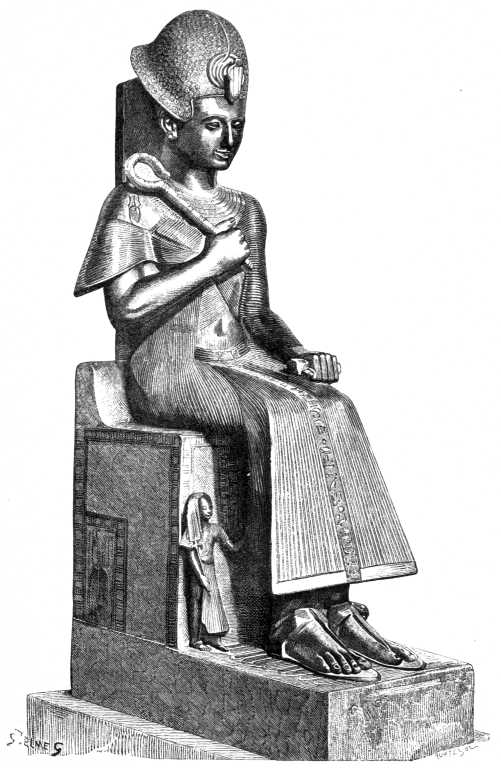
Fig. 222.—Statue of Rameses II. in the Turin Museum. Granite. Drawn by Saint-Elme Gautier.
Fig. 223.—Head of Menephtah. Boulak. Drawn by Saint-Elme Gautier.
There is a colossal statue of Seti II., the son of this Menephtah, in
the Louvre (Fig. 224). Although the material of which it consists,
namely sandstone, is much less rebellious than granite, the features,
which have a family resemblance to those of Menephtah, are executed in
a much more summary fashion than in the Boulak statue, and yet the
execution is that of a man who knew his business. The modelling of the
muscular arms is especially vigorous.[245]
Fig. 224.—Seti II. Sandstone statue, fifteen feet high. Louvre. Drawn by Saint-Elme Gautier.
There are hardly any royal statues left to us which we can ascribe
with certainty to the twentieth dynasty, but at Medinet-Abou, both on
the walls of the temple and in the Royal Pavilion there are
bas-reliefs which show that the sculpture of Rameses III., the last of
the great Theban Pharaohs, knew how to hold its own among the other
glories of the reign. We have given a few examples of the pictures in
which the king is shown as a warrior and as a high priest
(Figs. 172 and 173, Vol. I.); other groups should not be forgotten in which he is
exhibited during his hours of relaxation in his harem, among his wives
and daughters.
Under the last of the Rameses the Egyptians lost their military spirit
and, with it, their foreign possessions in the South and East.
Inclosed within its own frontiers, between the cataracts in the South
and the Mediterranean in the North, and enfeebled by the domination of
the priests and scribes, the country became divided into two kingdoms,
that of Thebes, under a theocratic dynasty, and that of Tanis in which
the royal names betray a strong Semitic influence.
That worship of Asiatic divinities which, though never mentioned in
official monuments, is so often alluded to in the steles, must then
have taken hold of the people of Lower Egypt. Among these were Resheb,
the Syrian Apollo; Kadesh, who bore the name of a famous Syrian
fortress, and was but one form of the great Babylonian goddess Anahit,
the Anaitis of the Greeks. Kadesh is sometimes represented standing
upon a lion passant (Fig. 225).
Exhausted by its internal conflicts, Egypt produced few monumental
works for several centuries. Many kings, however, of this barren
period, and especially Sheshonk, have left at Karnak records of their
military victories and of their efforts to re-establish the national
unity. After the twenty-fourth dynasty Egypt became the vassal of that
Ethiopian kingdom whose civilization was no more than a plagiarism
from her own. During the half century that this vassalage endured,
the southern conquerors gave full employment to such artists as Egypt
had preserved. The latter were set to reproduce the features of the
Ethiopian kings, but the works which resulted are very unequal in
merit.
Sabaco caused the sides of the great door in the pylon of Rameses at
Karnak to be repaired. The execution of the figures is by no means
satisfactory. "The relief is too bold; the muscular development of the
heroes represented is exaggerated to a meaningless degree; coarse
vigour has taken the place of graceful strength."[246]
Fig. 225.—The Goddess Kadesh; from Wilkinson, Fig. 55.
But although these bas-reliefs, the only ones of the period which have
been encountered, are evidently inspired by the decadence, the
Egyptian sculptors seem to have still preserved much of their skill in
portraiture. Mariette believes that a royal head in the Museum at
Cairo represents Tahraka, the third of the Ethiopian sovereigns. It is
disfigured by the loss of the nose. The remaining features are coarse
and strongly marked and the general type is foreign rather than
Egyptian.[247] However this may be, it cannot be denied that in the
alabaster statue of Ameneritis, which was found at Karnak by Mariette,
we have a monument of this phase in Egyptian art remarkable both for
taste and knowledge (Fig. 226).[248]
During the Ethiopian occupation Queen Ameneritis played an important
rôle in the affairs of Egypt. While her brother Sabaco was yet alive
she was dignified with the title of regent, later she brought her
rights to the double crown of Upper and Lower Egypt to the usurper
Piankhi, whom she married and made the father of Shap-en-Ap, who
afterwards became the mother of Psemethek I.
Fig. 226.—Statue of Ameneritis. Alabaster. Boulak. Drawn by G. Bénédite.
The head of Ameneritis is covered with the full-bottomed wig worn by
goddesses. She holds a whip in her left hand and a sort of purse in
her right; there are bangles upon her wrist and ankles and the
contours of her body are frankly displayed beneath the long
chemise-like robe, which falls almost to her ankles.
The features are resolute and intelligent rather than beautiful, the
squareness of the lower jaw and the firm line of the mouth being
especially significant.
We have, then, every reason to believe this to be a good portrait.
Both form and expression are just what might be expected in a
high-born Egyptian female possessed of sovereign power. The treatment
of the body is rather conventional. The bust, so far as it can be
traced under the clinging robe, is younger than the head, which is
that of a woman in middle life. With these reserves the statue is very
pleasing. The arms are a little stiff, but the figure as a whole is
characterized by a chaste and sober elegance. The modelling is not
insisted upon too much, but its undulating contours are discreetly
indicated under the soft though by no means transparent drapery. The
whole work is imbued with the spirit of Saite art, an aftermath which
was characterized by grace and refinement rather than by freedom and
power.
After the last of the Ramessids the decadence of Egypt was continuous,
but in the seventh century B.C. while the Ethiopians and Assyrians
contended for the possession of the country, it was particularly
rapid. Under Psemethek, however, there was a revival. The foreigners
were driven out, the national unity was re-established, and Syria was
again brought under the Egyptian sceptre. An artistic renascence
coincided with this restoration of political well being, and the
princes of the twenty-sixth dynasty set themselves to restore the
monuments which had perished during the intestine troubles and foreign
inroads. Their attention was mainly directed to the architectural
monuments of Lower Egypt; but little now remains of the buildings
which drew so much praise from the Greek travellers. Their sculptured
achievements have been more fortunate. Their statues were sprinkled
over the whole country, and many of them have been found at Memphis,
at Thebes, and even among the ruins of cities which have long ago
disappeared. Thus we find that most Egyptian collections contain
figures which may be assigned to this time, or rather to this school,
for the style held its own even as late as the first two or three
Ptolemies. Among them may be mentioned the pastophorus[249] of the
Vatican, the Arsaphes[250] of the British Museum, the statues of
serpentine found at Sakkarah in the tomb of a certain Psemethek, a
high officer under the thirtieth dynasty,[251] and the fine bronzes
of Osiris discovered at Medinet-Abou.[252] All the bronzes found in
the Serapeum belong to the same category.[253]
By means of secondary remains, such as sphinxes, steles, and scarabs,
we can just contrive to get a glimpse at the features of those
brilliant sovereigns who, after dazzling Egypt and the surrounding
countries early in the seventh century B.C., fell before the first
attacks of the Persians.[254] Many of their effigies must have been
destroyed by the invaders, either at their first conquest, or during
the three subsequent occasions when they were compelled to
re-establish their ascendency by force. A similar fate must have
overtaken the statues of Inarôs and Nectanebo, who succeeded for a
time in restoring the independence of their country. For the whole of
this period the royal iconography is much more scanty than for the two
Theban empires.
We shall not dwell upon the figure in green basalt which stands in the
middle of the Salle Historique in the Louvre. We know from the
inscription upon its girdle that it represents the king Psemethek II.
The execution is careful, but the work has suffered great mutilation,
the head and parts of the limbs being modern restorations.[255] On the
other hand, the two little bronze sphinxes which stand upon the
chimney-piece in the same room are in excellent condition. According
to De Rougé their heads reproduce the features of Ouaphra, the Apries
of the Greeks (Fig. 227).[256] In the ground-floor gallery there are
several sphinxes which, according to their inscriptions, should
include portraits of some of those princes who between 527 and 332
B.C. temporarily freed Egypt from the Persian yoke; Nepherites,
Achoris, Nectanebo, &c. None of them, however, show enough
individuality in their features to suggest that they were copied from
nature. Their heads are all clothed indiscriminately in the same
elegance of contour, and in looking at them we find ourselves far
indeed from the admirable portraits of the early empire, or even from
that statue of Ameneritis which closes the series of royal effigies.
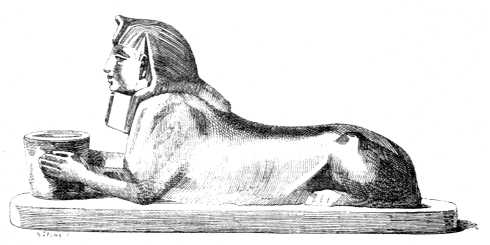
Fig. 227.—Bronze Sphinx. Louvre. Drawn by Saint-Elme Gautier.
The chief pre-occupation of the Saite sculptor was to obtain
suppleness of modelling and an apparent finish of execution, both of
which, in his opinion, were effective in proportion as the material
used was hard and unyielding.[257] His chisel was employed much more
than formerly in fusing together the various layers of muscle which
form the walls of the human structure. He did not lay so much stress
on the skeleton, or on the leading lines of the figure, as his early
predecessors. His care was mainly devoted to rendering the subtle
outward curves and contours, and this he often carries to such excess
as to produce a result which is simply wearisome from its want of
energy and accent. There is a group at Boulak upon which too much
praise has been lavished, to which this stricture thoroughly applies.
It represents one of the Psemetheks, clothed in a long robe, standing
before the goddess Hathor who is in the form of a cow. The head and
torso are finely chiselled, but, through an exaggerated desire for
elegance, the arms have been made far too long, and the divine cow is
entirely without truth or expression. This defect is still more
conspicuous in the two figures of Isis and Osiris that were found with
this group. Their execution has reached the extremity of coldness
through the excessive use of file and sand-paper.[258]
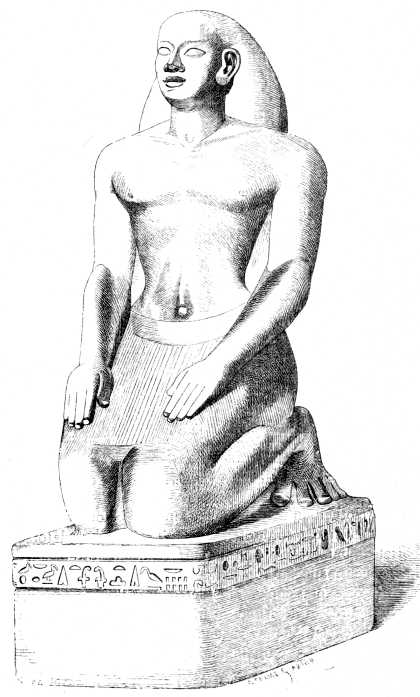
Fig. 228.—Statue of Nekht-har-heb, Louvre. Drawn by Saint-Elme Gautier.
Sometimes the sculptor knows where to leave off, and the result is
better. The sandstone statue of Nekht-har-heb, in the Louvre, is one
of the best productions of the Saite artists (Fig. 228).[259] The
execution of hands and feet is sketchy, and the countenance is without
much expression, but the attitudes of the arms and legs, the modelling
of the trunk, and the pose of the head, unite breadth with facility
and dignity to such a degree, that we are reminded, for a moment, of
a Greek marble. In spite of the singular attitude there is much in the
execution which recalls a much more ancient work, the statue of
Ouah-ab-ra, which dates from the twenty-sixth dynasty (Fig. 51, Vol.
I.)[260]
Fig. 229—Statue of Horus, Louvre. Drawn by Saint-Elme Gautier.
Not less remarkable is the headless statue of a personage called
Horus, which dates from about the same period (Fig. 229).[261] It is
of black granite and yet both limbs and torso are as delicately
modelled as if they were of the softest limestone. The attitude of the
arms is unusually easy and natural, and the whole figure is freer and
less constrained than anything we find in the ancient statues. There
is, too, a certain spirit of innovation discoverable in the feet. The
toes are well separated and slightly bent, instead of being flat and
close together.
Fig. 230.—Bas-relief from Memphis. Length forty inches, height ten inches, Boulak. Drawn by Bourgoin.
Fig. 231.—Continuation of Fig. 230.
The same style, taste, and general tendency are to be found in the
steles and in the decoration of the tombs. In a few sepulchral
bas-reliefs we can detect a desire to imitate the compositions on the
walls of the mastabas. Such attempts were quite natural, and we need
feel no surprise that the Egyptians in their decline should have
turned to the artistic form and motives which had been invented in
their distant and vigorous youth. The old age of many other races has
shown the same tendency in their arts and literature.
The beautiful band of sculpture in low relief which was found,
together with another very similar to it, at Mitrahineh, upon the
site of ancient Memphis, might easily be taken at first sight for a
production of the early centuries (Figs. 230 and 231). It formed the
lintel to the door of a house dating from the Greek or Roman period,
for which purpose it had doubtless been carried off from some
tomb.[262] At one end a dignified individual is seated upon a
low-backed chair, in his left hand he holds the long wand of office,
in his right a ribbon. His name and titles are engraved in front of
him: he was a writer, and was called Psemethek-nefer-sam. A scribe
bends respectfully before him and introduces a procession of men,
women, and children, who bring offerings of various kinds, jars of
liquid, coffers, flowers, birds, and calves led by a string. It is the
favourite theme of the mastabas over again. The attitudes are similar,
but the execution is different. There is a lack of firmness and
rotundity in the modelling, and considerably more striving after
elegance. The children especially should be noticed; the fashion in
which they all turn towards their elders betrays a desire on the part
of the artist to give freshness and piquancy to his composition.
Most of those bronze figures of the gods, which are so plentiful in
the European museums, date from this period. We have reproduced
several of them in our chapter upon the Egyptian pantheon
(Figs. 34-37, Vol. I.). With the advent of Alexander and his successors, a
number of Greek artists became domiciled in Egypt; they employed their
talents in the service of the priests and scribes without attempting
in any way to affect the religion, the institutions, or the habits of
the people. The Egyptian artists were heirs to the oldest of all
civilizations, their traditions were so firmly established, and their
professional education was so systematic, that they could hardly
consent to modify their ideas at the first contact with a race whom
they secretly despised, although they were compelled to admit their
political and military supremacy. Many years had to pass before
Egyptian sculpture, and with it the written character and language,
became debased as we find it in certain Roman and Ptolemaic temples.
Several generations had to come and go before a hybrid Egypto-Greek
style, a style which preserved the most unhappy forms and conventions
of Egyptian art while it lost all its native freshness and
originality, imposed itself finally upon the country.
The worst of the Saite statues are still national in style. It is an
Egyptian soul that inhabits their bodies, that breathes through the
features, and places its mark upon every detail of the personality
represented. This is no longer the case with the figures which, from
the time of Augustus to that of Hadrian, seem to have been
manufactured in such quantities for the embellishment of Roman villas.
Costumes, accessories, and attitudes are all Egyptian, but the model
upon which they are displayed is Greek. Until the beginning of the
present century archæologists were deceived by the masquerade, and
were unable to distinguish between pasticcios, many of which may not
even have been made in Egypt, and the really authentic works of the
unspoiled Egyptian artists. Such mistakes are no longer probable, but
even now it is difficult to say exactly where the art of Sais was
blended into that of the Ptolemies. When there is no epigraph upon
which to depend the most skilful archæologist may here make mistakes.
There are, however, a few figures in which the influence of the Greek
works brought to Alexandria by the descendants of Lagus, may be
detected in an incipient stage. The motives and attributes are still
purely Egyptian, but the modelling, the carriage of the head, and the
attitude are modified, and we see, almost by intuition, that the Greek
style is about to smother the Egyptian. This evidence of transition
is, we think, very marked in a bronze group of Isis suckling Horus
in the Louvre (Fig. 55, Vol. I.), and in Horus enthroned supported by
lions (Fig. 232). And yet the difference between these things and
those which are frankly Græco-Roman is great, and at once strikes
those who come upon the latter in the galleries of Boulak, where they
are mixed up with so many creations of Egyptian genius. The
distinction is equally obvious in works produced by foreign sculptors
established in Egypt, and in those by Egyptians working under Greek
masters. Look at the head found at Tanis, which is reproduced both in
full face and profile in Fig. 233. It is of black granite, like so
many Egyptian statues, but we feel at once that there is nothing
Egyptian about it but the material. It is obviously a portrait of a
man of mature age; the face is beardless, the curly hair cut short.
During the Greek and Roman period the temple of San was enriched by
the statues of private individuals, and doubtless this fragment
belonged to one of them. Tradition says that the statue was placed in
front of a pier with which it was connected by the Ionic moulding
which is still to be traced upon the right side of the head. With this
exception the treatment is that of the best Augustan period. The
person represented may very well have been one of the first Roman
governors of Egypt.[263]
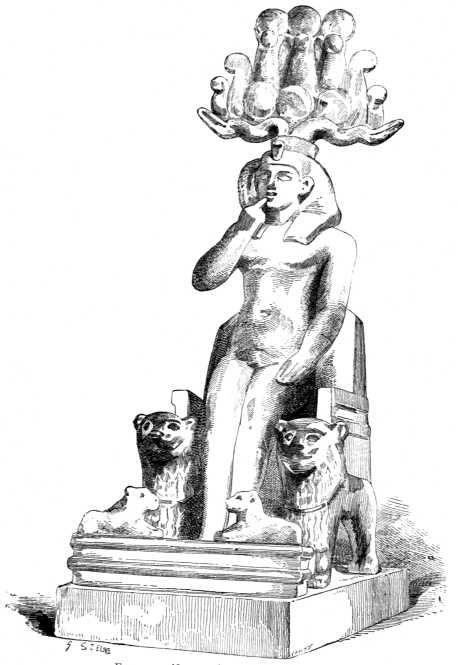
Fig. 232.—Horus enthroned. Bronze. Louvre.
Fig. 233.—Roman head, Boulak. Drawn by Bourgoin.
When we come to study Greek sculpture we shall find that the
masterpieces in which its highest powers are displayed, are statues of
divinities, such as the Athené of the Parthenon and the Olympian Zeus.
In our review of the Egyptian works of the same kind we have not had
occasion to call attention to a single god or goddess. Their
representation was not, as in Greece, the aim of the highest art. The
figures of deities were, indeed, numerous enough in Egypt, but the
national artist did not show such originality in their conception as
in those of kings and private individuals. This phenomenon may seem
inconsistent with what we know of the piety of the Egyptians and the
place occupied by religion in their daily life; it is to be easily
explained, however, by the origin of Egyptian sculpture and the part
which the statues of the gods played in it.
Egyptian art began with portraiture. As soon as it was capable of
carving and painting stone it was realistic, not so much by instinct
and taste as by duty. After such a beginning it found great difficulty
in raising itself above intelligent and faithful reproduction of fact.
Such inventive powers as it possessed were spent in creating a type
for the royal majesty, and in that case it had concrete reality as a
starting point. When it came to representing the gods it had no such
help. It could not fall back upon fidelity to fact, and, unlike the
Greeks of after ages, it was unable to give them distinction by the
superior nobility and dignity of their physical contours and features.
It was reduced to differentiating them by the variety of their
attributes. By such a proceeding it obtained an almost infinite number
of divine types, but each type was only recognizable on condition that
its pose and accessories, once determined, should remain without
material change. There was none of the mobility and elasticity which
distinguishes the dwellers on the Greek Olympus, as may be clearly
seen by comparing the poverty and want of variety of a Horus or a Bast
with the infinite diversity of an Apollo or an Artemis.
When the Egyptian sculptor had to endow the national gods with
concrete forms he found himself, then, in a condition much less
favourable than that of his Greek successors. This position, too, was
materially affected by the fact that the best site in the temple, the
centre of the naos, was reserved for a symbol, sometimes living,
sometimes inanimate, which was looked upon as the true representative
of the god. It was to this symbol, jealously hidden from all but the
high priest and the king, that the prayers of the faithful were
addressed. It has been called a survival from the early fetish
worship. Perhaps it was so. But at present we are only concerned with
its unfortunate results upon artistic development. His statues being
excluded from the place of honour, the sculptor was not, as in Greece,
stimulated to combine all the qualities ascribed by the nation to its
gods in one supreme effort of his knowledge and skill; he was not
raised above himself by the desire to produce a work which might give
point to the magnificence of a temple and augment the piety of a race.
Mariette was right in insisting upon this difference. "The temples,"
he says, "hardly contain a statue which is not votive. Sometimes these
statues are found irregularly distributed about the foundations or in
the sand, sometimes they are of large size and are arranged along the
walls, but they hardly ever exceed the life-size of a man. I cannot
say that each temple had a figure which could be specially called the
statue of that temple. The divine images were plentiful enough; but
each had its own particular ministration. In the prayers addressed to
it the name of its consecrator was always included. Such a thing as a
statue forming the central object of a temple and representing its god
without votive appropriation did not, perhaps, exist."[264]
Figures of Sekhet, the goddess with the head of a lioness, have been
discovered in hundreds in the building at Karnak known as the Temple
of Mouth, or Maut. This mine of statues has been worked ever since
1760, and all the museums of Europe have shared the results.[265]
Being so numerous these statues could not have reached great
excellence of execution. They were devotional objects produced in
mechanical fashion, and there is little chance of finding a
masterpiece of sculpture among them. In an inscription at Karnak we
find Thothmes III. boasting of having endowed the temple with a statue
of Amen "such that no other temple could show one equal to it."[266]
This Amen must have excelled its rivals in richness of material and in
perfection of polish. It is unlikely that it was much superior to them
in nobility or true beauty.
The position occupied by the statue in the cella of a Greek temple
finds something like a parallel, however, in the rock-cut temples of
Nubia. We allude to these groups of three or four figures, carved in
the living rock, which have been found seated in the farthest recesses
at Ipsamboul, Derri, and elsewhere. These figures are now so mutilated
that their merit as works of art cannot be decided.
We may safely say that if the temples proper, such as those of Karnak
and Luxor, had contained master-statues corresponding in any way to
those of the Greeks, they would have been of colossal size. But
although the soil of Thebes is almost paved with the fragments of
royal colossi, not a single vestige of any gigantic statue of Amen has
ever been discovered. All that we know of those few divine statues to
which special veneration was paid excludes any idea of size exceeding
that of man. The statues of Amen and Khons, at Thebes and Napata,
which nodded their approval when consulted by the king as to his
future plans, were certainly not colossi.[267] And as for the figure
of Khons, which took a voyage into Syria to cure the sister-in-law of
one of the latter Ramessids, we can hardly believe it was more than a
statuette.[268]
In spite of their number the statues of the gods must have attracted
much less attention than those of the kings. The Pharaoh who built a
temple filled it with his own effigies; his colossi sat before the
gate, they helped to form those structural units which we call Osiride
piers, and figures of smaller size were ranged under the porticos. In
that part of the Great Temple at Karnak which dates from the
eighteenth dynasty, statues of Thothmes III. alone have been found to
the number of several dozens; their broken fragments may be identified
in every corner.[269]
Among the countless votive offerings with which a great building like
that at Karnak was filled, there were a few statues of private
individuals. "The right to erect statues in the temples belonged (as
we should say) to the crown. We find therefore that most of the
private statues found in the sacred inclosures are inscribed with a
special formula: 'Granted, by the king's favour, to so and so, the son
of so and so....' Permission to place a statue in a temple was only
given as a reward for services rendered. The temple might be either
that of the favoured individual's native town, or one for which he had
peculiar veneration.... Civil and foreign wars, the decay of cities,
and the destruction of idols by the Christians, have combined to
render statues of private persons from public temples of very rare
occurrence in our collections."[270]
The tombs were the proper places for private statues; we have seen
that at Memphis they were set up in the courtyards and hidden in the
serdabs, that at Thebes they were placed, either upright or sitting,
in the depths of the hypogea.[271]
Figures in the round, whether gods, kings, or private persons, were
always isolated. They were sometimes placed one by the side of the
other, but they never formed groups in the strict sense of the word.
In the whole of Egyptian sculpture there is but one group, that of the
father, mother, and children; and this was repeated without material
change for thousands of years. The Egyptian artist can hardly be said
to have composed or invented it; it was, so to speak, imposed upon him
by nature. Those groups which became so numerous in Hellenic art as
soon as it arrived at maturity, in which various forms and opposed or
complementary movements were so combined as to produce a just
equilibrium, are absolutely wanting in Egypt.
The Greeks were the first of the antique races to love the human form
for itself, for the inherent beauty of its lines and attitudes.
Certain traces of this sentiment are to be found in the decorative art
of Egypt, in which motives that are at once ingenious and picturesque
are often met with, but it is almost entirely absent from sculpture.
Modelled forms are hardly ever anything more than skilful tracings
from reality. In the sepulchral system the sculptor supplies relays of
bodies, stone mummies which may take the place of the embalmed corpse
when it is worn out; in the temples his business is to set up concrete
symbols of an idea, emblems of one of the divine powers, or of the
majesty of Pharaoh.
The infinite number of combinations which may be obtained by the
association of several persons of different ages and sexes in one
action, makes the group the highest achievement of an art at once
passionate and scientific, such as the sculpture of Greece and
Florence. To such a height the Egyptians never soared, but they well
understood the more or less conventional methods which are at the
command of the sculptor. They produced figures in the round by
thousands; most of them were smaller than nature, many were life-size,
while a few surpassed it with an audacity to which no parallel can be
found elsewhere. Here and there we find a figure, no more than some
three or four inches high, to which its maker has contrived to give a
freedom of attitude, a breadth of execution, and a nobility of
presence which are quite astonishing. Look, for instance, at the
reproduction of a little wooden statuette which borders this page
(Fig. 234); it is identical in size with the original. Its date is
unknown, but we should be inclined to refer it to the Ancient Empire.
The air of this little personage is so proud and dignified that he
might well be a reduction from a colossus.
Fig. 234.—Wooden statuette belonging to M. Delaroche-Vernet. Drawn by Saint-Elme Gautier.
What we call busts, that is, figures which consist of nothing but the
head and the upper part of the trunk, were not unknown to the
Egyptians. All the descriptions mention the existence in the Ramesseum
of two colossal busts of Rameses II., the one in black, the other in a
parti-coloured black and red, granite.
It would seem that all the colossi were of stone, especially of the
harder kinds. Wood was used for life-size figures and statuettes,
particularly the latter. Terra-cotta coated with enamel was hardly
used for anything but very small figures. It was the same with bronze,
which was seldom employed in large figures. We do not know whether the
Egyptians in their days of independence made bronzes as large and
larger than life, as the Greeks constantly did. One of the largest
pieces known is the Horus in the Posno collection (Fig. 44, Vol. I.).
It is about three feet high. It forms a single casting with the
exception of the arms, which were added afterwards. The finish of the
head is remarkable, and the eyes appear to have been encrusted with
enamel or some other precious material, which has since disappeared.
The hands seem to have held some vessel for pouring libations which,
being of silver or gold, must have been detached at a very early
period. The execution recalls the finest style of the eighteenth
dynasty.
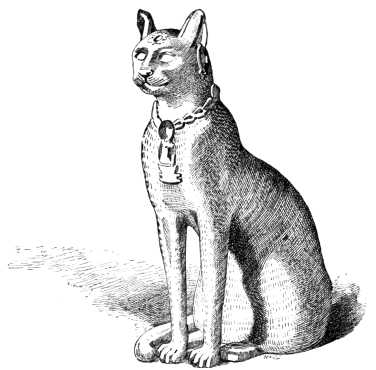
Fig. 235.—Bronze cat. Drawn by Saint-Elme Gautier.
The highest use to which sculpture can be put is the rendering of the
human figure, but Egyptian sculptors did not disdain to employ their
chisels upon the portraiture of those animals which were objects of
devotion in their country. We possess excellent representations of
most of these; the figure of a cat which we take from the cases of the
Louvre is an average specimen (Fig. 235). The lion was equally well
rendered. In the bas-reliefs we sometimes find him turned into a sort
of heraldic animal by the addition of emblematic designs upon his
flanks and shoulders (Fig. 236); but, even where he is most
simplified, his outlines and general movements are truthful in the
main. Sometimes we find him in full relief, modelled with singular
power and sincerity. This is the case with a bronze lion which must
once have formed a part of some kind of padlock, if we may judge from
the few links of a chain which are still attached to it.[272] Although
this animal bears the ovals of Apries, and therefore belongs to the
lowest period of Egyptian art, its style is vigorous in no common
degree.
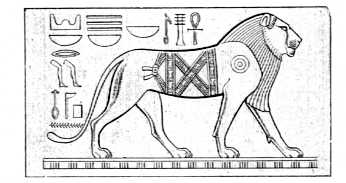
Fig. 236.—Lion, from a Theban bas-relief; from Prisse.
The Egyptians were as much impressed as other eastern peoples by the
strength and beauty of these animals, which in their days must have
abounded in the deserts of Syria and Ethiopia. They were chosen to be
the emblems of royal courage;[273] a lion's head was placed upon the
shoulders of Hobs, and that of a lioness upon the shoulders of Sekhet.
Finally it was from the lion that the first idea of that fictitious
animal which the Greeks called a sphinx, was taken.
"At first the sphinx can have been nothing but a lion placed to guard
the entrance to a temple. The combination of a man's head, which was
always that of a king, with a lion's body, must have been a result of
the national love for symbolism. The king himself, as represented by
this association of physical with intellectual strength, acted as
guardian of the building which he had founded. There was a radical
distinction between the Greek sphinx and that of the Egyptians. The
latter propounded no enigma to the passer-by, and the author of the
treatise, Upon Isis and Osiris, was in sympathy with his times when
he wrote: 'There was nothing behind the mysteries of the Egyptians but
their philosophy, which was seen as if through a veil. Thus they
placed sphinxes before the gates of their temples, meaning by that to
say that their theology contained all the secrets of wisdom under an
enigmatic form.' Evidently, the Egyptians did not mean so much as is
sometimes thought."[274]
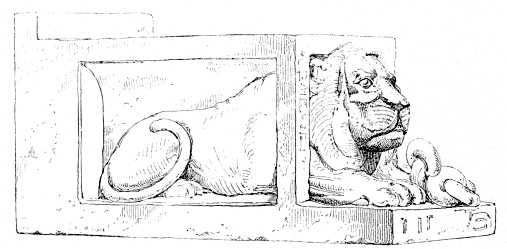
Fig. 237.—Bronze lion, Boulak. Drawn by Bourgoin.
We have already reproduced many examples of what may be called the
classic form of sphinx, his head covered with the klaft and his paws
extended before him (Figs. 41 and 157, Vol. I.). But the type included
several secondary varieties. Sometimes the forepaws are replaced by
human hands holding symbolic objects (Figs. 227 and 238); sometimes
the head of a hawk is substituted for that of a man. The animals which
form many of the dromoi at Karnak are called crio-sphinxes (Fig.
205, Vol. I.), but the name is an unhappy one, because they have
nothing in common with a sphinx but the position. They are rams and
nothing else.
The Greek word σφίγξ is feminine. The sphinx with female
breasts is, however, very rare in Egypt. Wilkinson only knew of one,
in which the Queen Mut-neter of the eighteenth dynasty was
represented.[275]
Fig. 238.—Sphinx with human hands. Bas-relief; from Prisse.
The Egyptians were not content with confusing the figures of men and
animals in their images of the gods, they combined those of quadrupeds
and birds in the same fashion. Thus we sometimes find wings upon the
backs of gazelles and antelopes, and now and then a curious animal
compounded of a hawk's head and a nondescript body (Fig. 239). Whether
such fantastic quadrupeds were consciously and deliberately invented
by the Egyptian artists or not, we have no means of deciding. In a
period when there was none of that scientific culture which alone
enables men to distinguish the possible from the impossible, they may
well have believed in winged and bird-headed animals with four legs.
For the Greeks of Homer's time, and even for their children's
children, the chimera and his kindred were real. They knew where they
lived, and they described their habits. In a picture at Beni-Hassan,
these imaginary beasts are shown flying before the hunter, and mixed
up with the undoubted denizens of the mountains and deserts.[276]
Such representations must have been common upon those objects—partly
manufactured in Egypt, partly imitated in Phœnicia—which the
enterprising inhabitants of the latter country distributed all over
Western Asia, and the basin of the Mediterranean. They had a large
share of that mystic and enigmatic character which has always been an
attraction in the eye of the decorator. They may have helped to
develop a belief that the curious beings represented upon them existed
in some corner of the world, and they certainly did much to form those
decorative types which have been handed down through Greece to the
modern ornamentist.
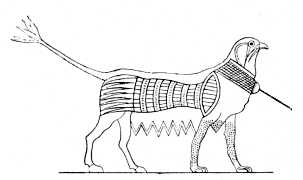
Fig. 239.—Quadruped with the head of a bird. From Champollion, pl. 428 bis.
Work in low relief held such an important place in the affections of
the Egyptian sculptor that we must study its processes in some detail.
In the first place, it was almost invariably painted. Those
bas-reliefs which show no trace of colour may be looked upon as
unfinished.
Secondly, the depth of the relief varied as much as it could, from the
almost detached figures of the Osiride piers to the delicate salience
of the carvings upon the steles and tomb-walls. A few works in very
high relief have been found in the mastabas (Fig. 120, Vol. I.),[277]
but they are quite exceptional; the depth is usually from two to
three millimetres. It is the same with the Theban tombs. It is only in
the life-size figures that the relief becomes as much as a centimetre,
or a centimetre and a half in depth; articulations, the borders of
drapery, and the bounding lines of the contour, are indicated with
much less salience.
The processes used in Egyptian reliefs were three in number, one of
those three, at least, being almost unknown elsewhere.
The commonest of the three is the same as that in favour with the
Greeks, by which the figures are left standing out from a smooth bed,
which is sometimes slightly hollowed in the neighbourhood of their
contours. When limestone was used, this method was almost always
preferred, as that material allowed the beds to be dressed without any
difficulty.
Sometimes, on the other hand, the figure is modelled in relief in a
sunk hollow, which is from half an inch to an inch and a half deep
(Fig. 240). This method of proceeding, which is peculiar to Egypt, was
doubtless suggested by the desire to protect the image as much as
possible. For this purpose it was singularly efficient, the high "bed"
of the relief guarding it both from accidental injury, and from the
effects of weather and time. It had one disadvantage, however, in the
confusing shadows which obscured a part of the modelling. This process
was used, as a rule, for the carvings on granite and basalt sarcophagi
(Fig. 195, Vol. I.). It would have cost too much time and labour to
have sunk and polished the surrounding surfaces. This method, when
once taken up, was extended to limestone, and thus we find, among
those objects in the Louvre which were discovered in the Serapeum, a
stele of extremely delicate workmanship, representing Amasis in
adoration before an apis. The head of Amasis is damaged, and we have
preferred to give as a specimen the fine head of Rameses II.,
chiselled in a slab of limestone, which is also in the Louvre (Fig.
240).
In the third system the surface of the figures and the bed, or field,
of the relief are kept on one level. The contours are indicated by
hollow lines cut into the stone. In this case there is very little
modelling. There is not enough depth to enable the sculptor to
indicate different planes, and his work becomes little more than a
silhouette in which the outline is shown by a hollow instead of by the
stroke of a pencil or brush. When more rapid progress than usual had
to be made the Egyptian artist was content with this outline. Most of
those vast historical and biographical scenes which cover the walls of
the Ramesseum and Medinet-Abou (Fig. 173, Vol. I.), were executed by
it.
Fig. 240.—Portrait of Rameses II., Louvre. Drawn by Saint-Elme Gautier.
Most of our existing reliefs have come from tombs. In the mastabas
their production was easy enough. The sculptor simply carved the faces
of their limestone walls. But in the hypogea the difficulties were
frequently great, and yet they were always surmounted. The bas-reliefs
in such places were, as a rule, on a small scale. Consequently, the
knobs of flint and the petrified shells with which the sculptor's
chisel was continually coming in contact, must have embarrassed him in
no slight degree. Whereever such unkindly lumps were found, they were
extracted from the rock, the rough holes which they left were squared
and filled up either with a cement which became very hard with time,
or with pieces of stone accurately adjusted. In the latter case, the
joints have been made with such care that it is very difficult to
discover them. In some tomb chambers these insertions are so numerous
that they make up not less than a quarter of the whole surface.[278]
As soon as the carvings upon the walls were finished, the latter were
covered with a thin layer of stucco. This was hardly ever omitted; it
was laid upon rock, cement, and limestone indiscriminately. It
afforded a better and a more tenacious ground for coloured decoration
than the naked stone.[279]
The principal place in these bas-reliefs is occupied by human figures,
and after them by those of animals. The accessories, such as the
landscape and inanimate objects are for the most part only slightly
indicated, all the labours of agriculture are illustrated, but only so
far as the action of man is immediately concerned. There is never more
in the way of background than is absolutely necessary for the right
comprehension of the scene.[280] The Greeks followed the same rule. In
this respect the Egyptians were well advised. Their artistic instincts
must have warned them of the true conditions of work in relief, which
cannot, without the greatest peril, attempt to rival the complex
achievements of painting.
To this practice we might suggest a few exceptions, in certain
chiselled pictures at Tell-el-Amarna, and even Thebes itself, in which
the artist seems to have amused himself by reproducing the beauties of
nature, of groves and gardens surrounding palaces and humbler
dwellings, partly for their own sake, partly attracted by some
unwonted aspects of the scene which seem to have been borrowed from
neighbouring countries.
In most cases the Egyptian sculptor made man the centre and raison
d'être of his work, and yet, here and there, he shows himself
curiously solicitous as to the effective arrangement of the scene
about him. It is not without reason, therefore, that some have found
in the Egyptian bas-relief, the origin, the first rough sketch, of
those landscapes of which Hellenistic, or as some would say,
Alexandrian, art was so fond. One of the most famous of these is the
Palestrina mosaic, which presents us with an Egyptian landscape
during the inundation; its buildings, its animals, and the curious
scenes caused by the rising Nile, are rendered with great
vivacity.[281]
A highly civilized society like that of Egypt even in the days of the
Ancient Empire, must have felt the necessity for some kind of seal.
The names and images engraved upon rings must have been used as
signatures even at that early date. We know that from that time
forward the impressions thus made upon wax and clay were employed in
business and other transactions. No engraved stones have come down to
us from the early dynasties, and yet their production must have been
easy enough to those who carved the diorite statue of Chephren. Under
the first Theban Empire, the Egyptians practised the cutting of
amethysts, cornelians, garnets, jasper, lapis-lazuli, green-spar and
white feldspar, obsidian, serpentine, steatite, rock crystal, red
quartz, sardonyx, &c.[282] We do not know whether those early workmen
employed the lapidary's wheel or not,[283] but we may safely say that
they produced some of the finest works of the kind which are known to
us. The annexed illustration of one of the rarest treasures of the
Egyptian collection in the Louvre, will bear out our words (Fig. 241).
"A gold ring with a movable square stone, a sardonyx, upon which a
personage seated before an altar is engraved with extraordinary
finish. The altar bears the name Ha-ro-bes. The figure is clothed in
a schenti; a thick necklace is about his neck: his hair is in short
thick curls: his legs are largely and firmly drawn.
"We are helped to the date of this little work by the engraving on
the reverse, which represents a king wearing the red crown and armed
with a mace, with which he is about to strike an enemy whom he grasps
by the hair. The name of this king is engraved beside him: Ra-en-ma,
that is Amenemhat III. The workmanship of this face is, perhaps,
inferior to that of the obverse, the forms are comparatively meagre
and dry; it is however far from being bad."[284]
Fig. 241.—Intaglio upon sardonyx, obverse. Louvre collection. Twice the actual size.
Fig. 242.—Reverse of the same intaglio.
The cornelian statuette of Ousourtesen I., which the Louvre has
unhappily lost, belonged to the same period. In the three days of
July, 1830, a terrible fire was directed upon the crowd by the Swiss
stationed in the colonnade of the Louvre. The assailants succeeded,
however, in penetrating into the palace and invading the galleries.
After their final retirement the only thing which was ascertained
beyond a doubt to be missing, was this little statuette, which has
never been heard of since. It was equally valuable for its rarity and
the beauty of its workmanship.[285]
The artists of the Second Theban Empire do not seem to have excelled
those of the first, but their works have come down to us in much
greater numbers. The Louvre possesses a considerable number of rings
engraved with the names Thothmes, Amenophis, and others belonging to
the eighteenth and nineteenth dynasties. Their character may be
divined from two examples.
Fig. 243.—Intaglio upon jasper. Louvre. Actual size.
Fig. 244.—Reverse of the same intaglio.
"In 1877 the Louvre obtained the stone of a ring finely engraved on
each side with representations of the Pharaoh Thothmes II. It is a
green jasper, quadrangular in shape. On one side the Pharaoh,
designated by his name Aa-kheper-ra, has seized a lion by the tail
and is about to strike it with his mace. This scene is emblematic of
the victorious and fearless strength of the sovereign. Its rarity is
extreme. Its significance is enforced by the word kuen or valour
(Fig. 243). On the other side Thothmes is shown discharging his arrows
from the commanding height of his chariot against the enemies who face
him; one falls backwards, another is being trampled under the feet of
the king's horses (Fig. 244). Such a representation is common enough
upon the outsides of the temples, but it is not often found upon
little objects like these."[286]
Fig. 245.—Seal of Armais. Louvre. Actual size.
Sometimes the ring is all of one material, characters and figures
being cut in the metal of which it consists. It is so in the case of
the most conspicuous object among the Egyptian jewels in the Louvre
(Fig. 245), an object which can never have been intended for the
finger; it is too large: it must have been made for use only as a
seal. It is thus described by M. Pierret: "Seal formed of a ring and
movable bezel, both of gold. Upon one face of the bezel the oval of
King Armais, the last prince of the eighteenth dynasty, is engraved.
Upon the other a lion passant, the emblem of royal power; it is
surmounted by the words Nepkhopesch, lord of valour. Upon the third
and fourth sides are a scorpion and a crocodile respectively. The
execution of this little work is admirable; the design and action of
the lion are especially fine."[287]
The ring given by Pharaoh to Joseph as a sign of the authority
delegated to him, may have been such as this.[288] The cheapest rings
had bezels of faience or schist covered with enamel. The scarabs were
cut as a rule from soft stone.
In gem-cutting the Egyptians made use both of the intaglio process and
of relief, but the greater fitness of the former for the work to be
done by a signet made it their especial favourite. They were ignorant
of the process we call cameo, in which the differently coloured layers
of the sardonyx are taken advantage of to produce contrast of tint
between the relief and its bed.
A few Egyptian cylinders, in earthenware or soft stone enamelled, are
known. They bear royal ovals; the British Museum has one which seems
to date from the twelfth dynasty. Their employment seems never to have
become very general.[289]
Whether it were employed upon wood, upon limestone, or upon the harder
rocks, whether it were cutting colossi in the flanks of the sandstone
hills, or carving the minute images of its gods and kings in the stone
of a signet ring, the art of Egypt never shook itself free from those
intellectual conceptions which were impressed upon its first
creations; it remained true to the tendencies of its infancy; it
preserved the same fundamental qualities and defects; it looked upon
nature with the same eyes, and interpreted her in the same fashion,
from the first moment to the last.
These methods and processes, and the conventionalities of artistic
interpretation which maintained themselves through all the changes of
taste, have still to be considered. They are the common features by
which works which differ greatly in execution are brought into
connection, and are to be found as clearly marked in a statue dating
from the time of Amasis and Nectanebo as in one from the Ancient
Empire.
Some of the conventions of Egyptian art are to be explained by the
constitution of the human mind and by the conditions under which it
works when it attempts plastic reproductions for the first time;
others appear to spring from certain habits of thought peculiar to
Egyptian civilization. There is yet a third class which must be
referred to purely technical causes, such as the capabilities of the
materials and tools employed. The influence which these exercised over
the artistic expression of thought has been too often underrated. We
shall endeavour to recognize their full importance.
When we glance at an Egyptian bas-relief, we perceive in it certain
imperfections of rendering which we may have often noticed before,
either in the early works of other races or in the formless designs
which quite young children scribble upon paper. The infancy of art and
the art of infancy have much in common.
We are accustomed to processes which are scientifically exact.
Profiting by the accumulated learning of so many centuries even the
school-boy, among us, understands perspective. We are, therefore, apt
to feel too much surprise at the awkwardness and inaccuracy which we
find in the works of primitive schools, in transcripts produced by man
in the presence of nature without any help from the experience of
older civilizations. If we wish to do justice to those early artists,
we must endeavour to realize the embarrassment which must have been
theirs, when they attempted to reproduce upon a flat surface those
bodies which offered themselves to their eyes with their three
dimensions of height, width, and depth, and with all the complications
arising from foreshortening and perspective, from play of light and
shade, and from varied colour. Other perplexities must have arisen
from the intersection and variety of lines, from the succession of
planes, from the necessity for rendering or at least suggesting the
thickness of objects!
When the desire to imitate natural objects began to make itself felt
in man he received his first drawing lesson from the sun. Morning and
evening its almost horizontal rays threw his silhouette sharply upon
the white rocks and walls, and nothing was easier than to fix the
outline of the image thus projected with a piece of charcoal or burnt
wood; after this beginning it was easy to imitate such a sun-picture
either in large or in small. Such figures were of necessity profiles,
as the silhouette given by a head viewed in front would be very
uncertain and indistinct.
The profiles of men and of the lower animals must, then, have played a
chief part in these early efforts towards design. In this there is
nothing at variance with our daily experience. The back view need
hardly be taken into account, and there are two lateral positions, the
right and left profiles, against one for the front face. Finally, the
fact that the front face consists of two parts which have to be kept
in absolute symmetry with one another, makes it much more difficult of
treatment by the novice. Even in the productions of skilful artists we
often find that this symmetry has been missed. It is the profile that
is first attacked by beginners in the art of drawing, and it is the
profile which always remains most comprehensible for simple
intelligences. The fellah who is present at the opening of one of
those tombs which were constructed by his remote ancestors, at once
recognizes the animals represented and the meaning of their attitudes
and grouping. Wilkinson noticed this on several occasions. But if an
European drawing be shown to the same man, he will be hopelessly
bewildered by the foreshortening, the perspective, and the play of
light and shade. He will no longer be able to distinguish a bull from
a horse or an ass.
In their bas-reliefs, and in their paintings, the Egyptian artists
made almost exclusive use of the profile,[290] but, by a singular
compromise, we sometimes find it combined with an attitude of body
which would strictly require a full, or at least a three-quarter face.
The silhouette in its integrity seems to have been thought
insufficient, and the desire to reproduce a more complete image led
them to invent the compromise in question.
In Egyptian profiles the eye is drawn as if for a full face. It has
been asserted that this is the result of profound calculation, that,
"in spite of facts, the Egyptian painter chose to give predominant
importance to that organ in the human visage which is the window of
the soul."[291] We believe that the true explanation is rather more
simple. While the lines of the nose and mouth are more clearly marked
in the profile than in the front face, it is in the latter only that
the eye is able to display its full beauty. When seen from the side it
is small, its lines are short and abrupt, and the slightest change in
the position of the head affects its contours in a fashion which is
very puzzling to the unlearned artist. When a child attempts to draw a
head it gives their true form to the lips and the nose, but in nine
cases out of ten it draws the eye as if seen in full face; and art in
its childhood did as children do still.
We find a similar want of concord between the trunk and the limbs.
Feet and legs are shown in profile while the body to which they belong
stands squarely facing us. Both the shoulders are seen in equal
fulness, and the attachment of the arms is often faulty (Fig. 246).
Sometimes they seem to be broken at the shoulder. Again, the hands are
nearly always in such a position as to exclude all doubt as to the
number of fingers they possess.
It appears, therefore, that the artist chose the aspect which seemed
to him the most natural for each part of the body. It was the
resulting contradiction that was against nature. The feeling from
which it sprang was identical with that which led Egyptian artists, to
make what we may call "projections" when they wished to represent
buildings. The fixed idea of the draughtsman was to show all the sides
of his object at a glance, to exhibit details which in reality were
partly hidden by each other. Thus we find that, in certain
bas-reliefs, both clothes and the nudity which those clothes were
intended to cover are carefully portrayed. In a bas-relief at
Tell-el-Amarna, a queen who is waiting on Amenophis IV. is dressed in
a long robe reaching to her feet, and yet all her forms are rendered
with as much care and detail as if there were no veil between their
beauty and the eye of the spectator (Fig. 247).
Fig. 246.—Bas-relief from Sakkarah. Fifth dynasty.
An arbitrary combination of a similar character is employed by the
Egyptian artist when he wishes to show a number of persons behind one
another on a horizontal plane; he places them vertically one above the
other. The great battle pictures at Thebes are an instance of this
(Fig. 13, Vol. I.). Enemies still fighting are mingled with dead and
wounded into one confused heap in front of Pharaoh's car, and reach
from top to bottom of the relief. The same convention is to be found
in the ranks of prisoners, workmen, or soldiers, marching over a flat
surface; they are arranged in a kind of echelon upon the field of the
relief (Fig. 42).[292]
Faulty though these conventions seem to us, they did not disturb the
Egyptian spectator. He was familiar with them by long usage, and his
intellect easily re-established the true relation between the various
parts of objects so strangely distorted. Even as art matured and as,
in some respects, the skill of the Egyptian sculptor increased, he
never felt himself impelled to abandon these primitive methods of
interpretation. Graphic conventions are like those belonging to
written and spoken language; when once established, even those which
seem most absurd to the stranger are rendered acceptable by habit, and
the native does not even suspect the existence of anomalies which
bewilder the foreign visitor.
Fig. 247.—The Queen waiting on Amenophis IV.: Tell-el-Amarna. From Prisse.
Speaking generally, we may say that there is no perspective in
Egyptian paintings and reliefs. And yet we find sincere efforts to
render things in a less arbitrary fashion in certain works dating
from the Second Theban Empire. Look, for instance, at the attempt made
by an artist in the tomb of Chamhati to show five persons walking
almost in line. Instead of being one above another they are on one
level (Fig. 248). One of the five is rather behind the rest; the head
and most of his body are visible. The other four advance to their
front. In order that they may all be seen, the sculptor has shown them
as they would appear to one standing on their right and slightly in
front; the relief, therefore, has four planes. The three farther
figures are shown by the contours alone. This is perspective, although
it is hardly correct. The retreating line of polls sinks as it should,
but so do the elbows, and they ought to rise.
Fig. 248.—Bas-relief from the eighteenth dynasty. From Prisse.
This relief gives evidence of considerable progress and, supposing it
to be the first of its kind, the sculptor who made it would deserve
the credit of having breathed a new life into Egyptian art. But he was
not the first; others had made use of the same method, but always
within strictly defined limits. It was employed when a few persons
had to be brought in who were all in one attitude and making the same
gesture,[293] but it was never used as a starting-point for
modifications upon the traditional modes of rendering either isolated
figures or groups of figures. The Egyptians made use of these until
the last days of their civilization without ever appearing to suspect
their childish character.
In the case of animals, a firmly-drawn profile was enough to make them
easily recognizable. And yet, even in the time of the Ancient Empire,
we find distinct efforts to give some variety to these silhouettes.
Sometimes the oxen turn their heads towards the spectator, sometimes
they swing them round to their flanks, as if to chase away the flies:
but even then the heads are shown in profile.[294] At Beni-Hassan we
find an advance upon this. In a hunting scene, a lion, who has just
brought down an ibex, is shown full face,[295] but neither here or
anywhere else has an attempt been made to draw the body of the animal
otherwise than in profile.
In his family groups the Egyptian sculptor marked the superiority of
the husband and father in a similarly naïve fashion. He made him much
taller than the persons about him. The same contrivance was employed
to mark the distinction between gods or kings and ordinary men, and
between the latter and animals (Fig. 57, Vol. I.). This solution of
the problem is universal in the infancy of art. It was adopted by the
Assyrians, the Persians, the primitive Greeks, and our own ancestors
of the middle ages. It is easier to give a figure double or threefold
its proper size than to add greatly to the dignity and nobility of its
character.
In their desire to evade difficulties, the Egyptians slurred over
distinctions upon which a more advanced art would have insisted. For
them every man was in the prime of life, every woman possessed of the
elegant contours of a marriageable virgin. In their work in the round
they proved themselves capable of bringing out individuality, but they
restricted their attentions to the face and hardly attempted to show
how the passage of years affects the contours and the firmness of
flesh in both sexes. In their bas-reliefs and pictures, they employed
outline only. The substance of their figures was modelled neither
materially nor in colour. With such feeble resources as these the
artist would have had great difficulty in suggesting all the
differences of age. He therefore took a middle course. To each sex he
gave that appearance which seemed best calculated to bring out its
peculiar beauties. The one he portrayed in the fulness of manhood, the
other as a young girl. When it was necessary to determine the age of
his subject with some precision he took refuge in such conventional
signs as the finger in the mouth and the long lock of infancy (Fig.
249).
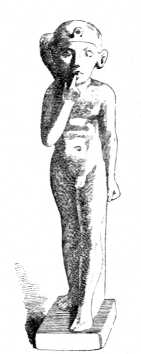
Fig. 249.—Horus as a child, enamelled earthenware. Actual size. Louvre.
The sculptors of the Ancient Empire, who laid such stress upon exact
resemblance, seem to have now and then attempted to mark the advancing
age of their models. The head of the great statue of Chephren is that
of a man still young (Fig. 205); that of another statue of the same
king betrays the approach of old age. This example does not seem to
have been followed in later ages. We are tempted to think that each
sovereign on his accession to the throne employed some artist of note
to make his portrait. The latter would set himself to work; would
study his model at first hand, for Pharaoh would perhaps condescend to
sit to him; would bring out the peculiarities of visage which he saw,
and over the whole face and form of the king would spread that air of
flourishing vigour and youth which is common to nearly all the royal
statues. An image would be thus elaborated which should combine both
the truth of portraiture with the conventional semi-divine type. With
the passage of time, according to the talent of the artist, and
perhaps to the character of the royal features, one of these elements
would encroach upon the other. But once established this image would
become a kind of official and authentic standard of the royal
appearance, and would serve as a model for all who might be charged
during the rest of the reign with the reproduction of the king's
person.
There are many facts which support this hypothesis. Among the
countless images of Rameses II. for instance there are some which
according to their inscriptions must have been executed when he was at
least eighty years old; and yet they show him as a young man.
Almost the same thing takes place in our own times. In monarchical
states the sovereign appears upon the coinage as he was at his
accession. His features and the delicacy of his skin are unaffected by
the years, for the die made in his youth has to serve for his old age.
We may almost say the same of the statues and busts in which the royal
features are repeated in the public buildings and public places of the
capital. A single portrait which has once been moderately faithful is
repeated to infinity. We find it everywhere, upon paper, and canvas,
and plaster, and marble, multiplied by every process that science has
given to art. It keeps its official and accepted authenticity long
after age, care, and disease, have made its original
unrecognizable.[296]
There is one convention peculiar to Egyptian art which is not to be
accounted for so easily as the last named. So far as we know, no
reason has ever yet been given for the almost invariable habit of
making such figures as are supposed to be walking thrust their left
legs forward. Almost the only exceptions are in the cases of those
figures in the bas-reliefs which are turned to the spectator's left.
The right leg is then thrust forward (Figs. 18, 24, &c., Vol. I.).
Among works in the round there is hardly an exception to the ordinary
rule. Are we to look upon it as the effects of caprice? of accident
confirmed into a habit? Or was it a result of a superstition
analogous, or, rather, contrary to that of the Romans? The latter
always took care to cross a threshold with the right foot foremost; in
Egypt they may have attached the same ideas to the left foot.
Egyptologists should be able to tell us whether there is anything in
the texts to suggest the existence of such a superstition.
Apart from its ethnic characteristics, the work of the Egyptian
sculptor is endowed with a peculiar physiognomy by a certain stiffness
and rigidity which it hardly ever succeeds in shaking off, even when
it represents figures in motion. A support in the shape of a column at
the back is nearly always introduced; the arms are held close to the
sides; a huge head-dress often enframes the head and hangs down upon
the shoulders in two equal masses; a long and narrow beard springs
from under the chin and lies upon the chest.
Freedom and variety of attitude is equally absent from the seated
statues. The knees are brought together and the hands supported upon
them. We never find an arm raised, a hand opened as if to give force
to speech, or a leg stretched out to relieve the stiffness of the
lines. There is no striving for that suppleness of limb and variety of
pose which the Greeks contrived to obtain even in their Iconic
figures. The face is often full of animation and individual vitality,
the modelling of the trunk and limbs marvellously true and broad, but
the body as a whole is too symmetrical in action and entirely without
abandon. The natural movements which spring from ease and liberty
are never employed. Forced and conventional attitudes are universal.
A reason for this has been sought in the supremacy of the sacerdotal
caste. The priests, we are told, must soon have adopted such a type,
or rather several varieties of such a type, as seemed to them
expressive of their own ideas of man when deified by death, of the
king as the son of the gods, of the gods themselves as the protectors
of the Egyptian race. They imposed the perpetuation and constant
reproduction of this type upon artists as a sacred duty, and thus the
Egyptian style was hieratic in its origin and essence.
Such an assertion is easily made. Hieratic is one of those
convenient adjectives whose vagueness discourages critical
examination. What evidence is there that ancient Egypt was ever a
theocracy, in the proper sense of the word? Only once, during so many
centuries, did the Egyptian priests attempt to encroach upon the
privileges of the king. Towards the close of the twentieth dynasty the
prophets of Amen, at Thebes, tried hard to substitute their own
authority for that of the last of the Rameses,[297] but the success of
their usurpation was very shortlived. In Ethiopia alone, among a
people much less highly civilized, sacerdotalism seems to have
acquired an uncontested pre-eminence. In Egypt the king was always the
first of the priests. With the help of an army of scribes and
officials he governed the country and made war; he initiated and
carried on great public works; he developed the industry and commerce
of his subjects. Trade and conquest brought him into relation with
surrounding peoples, and from them he recruited his armies and
obtained agents of every kind.
The active and warlike heads of a great empire like this were never
the slaves of a despotic clergy. Such a society never allowed the
mechanical reproduction of orthodox types to be forced upon its
artists, until, indeed, its final decadence deprived it of all power
to invent new forms. We have seen how great was the variety of plan
and decoration in Egyptian religious architecture, from the marked
simplicity of the temple near the sphinx, to the sumptuous majesty of
the Theban buildings and the elegance of those of Sais. The style and
taste of Egyptian sculpture underwent a change at each renascence of
art. Why, then, did its practitioners remain faithful to certain
conventional methods of interpretation, whose falsity they must have
perceived, while they modified their work in so many other
particulars? No text has ever been put before us, I will not say from
a Greek, but from an Egyptian source, which suggests that their hands
were less free from religious prescription than those of the
architects.
We agree with M. Émile Soldi, who was the first to throw doubt upon
the accepted theories, that the explanation of the apparent anomaly is
to be sought elsewhere.[298] The tyranny from which the Egyptian
sculptor never succeeded in completely freeing himself was not that of
the priests but of the material in which he worked. Aided by his
personal experience M. Soldi has put this fact very clearly before us.
Being at once a sculptor, a medallist, and an engraver upon precious
stones, he is enabled to judge at first hand of the influence which
the material or tool employed may exercise over the style of a work of
art. The style of such a work is the complex product of numerous and
very different factors. To determine the part played by each of these
factors is not always easy; there are too many opportunities for
error. We believe, however, that certain of the most peculiar and
persistent characteristics of Egyptian sculpture are due to the
hardness of their material and the imperfection of the tools employed.
We know the connection between the funerary statues of the Egyptians
and their second life; while those statues endured, the existence of
the double was safe guarded. The more solid the statue, the better its
chance; if the former was indestructible the life dependent upon it
would be eternal. It was under the impulse of this idea that the
Egyptians of the Ancient Empire attacked such unkindly materials as
granite, diorite, and basalt. Such statues were beyond the reach of
private individuals. They were reserved for royalty. Of all the works
of the sculptor they were the most carefully and admirably wrought.
They set the fashion, and helped to create those habits which did not
lose their hold even when less rebellious substances came into use.
How did they contrive to cut such hard rocks? Even in our time it can
only be done by dint of long and painful labour and with the aid of
steel chisels of the finest temper. The workman is obliged to stop
every minute to renew the edge of his instrument. But it is agreed on
all hands that the contemporaries of Chephren had to do without steel
chisels. Egyptologists still discuss the question as to whether the
Egyptians made use of iron or not, but even those who believe that its
name occurs among the hieroglyphs admit that its introduction was late
and its employment very restricted.[299] The weapons and tools of the
early Egyptians were of bronze when they were not of stone or hardened
wood; and it has never been proved that either the Egyptians or any
other ancient people understood how to temper that metal in such a
fashion that its hardness approached that of steel. Modern science has
in vain searched for this secret.[300] In any case it is only in a few
rare instances, and upon remains from the New Empire, that the
peculiar markings left by the chisel have been discovered. Those
statues and sarcophagi which have been cut from igneous rocks still
bear traces which may be recognized by the eye of the connoisseur, of
the processes which were employed by their makers.
"Granite," says M. Soldi, "is most easily worked by hammering its
surface. To begin with, a heavy tool called a point is brought into
play. This is driven into the material by repeated blows from the
hammer, starring the surface of the granite, and driving off pieces on
all sides. We believe that this point was the habitual instrument of
the Egyptians, not only in roughing out their blocks, but even in
modelling a head-dress or sinking a hieroglyph. Such a tool could not
trace clear and firm contours like those of the chisel, and the
peculiar character of its workmanship is to be easily recognized in
the broken and irregular outline of many of the monuments in the
Louvre."
Another tool employed upon granite in these days is a kind of hammer,
the head of which consists of several points symmetrically arranged.
We may judge of its effects by the appearance of our curb stones,
which are dressed by it; there is nothing to show that it was used by
the Egyptians. A kind of hatchet with two blades is also used for the
same work, and it appears to have been employed by the Egyptians, "who
used it hammer fashion, beating the surface of the material, and
driving off chips of various sizes according to the weight of the
instrument. By these means the desired form could be given with
sufficient rapidity and precision to make the chisel superfluous."
Most of the Egyptian statues in hard stone seem to have been modelled
by the help of an instrument of this kind.
"The surfaces produced by such tools as these had to be polished, the
sketchy roughness left by the point had to be taken down; we find
therefore that the Egyptians always polished their statues."
The Egyptians do not seem to have known either the file or the
rasp, a variety of file which is now greatly employed. The dry
markings left by those tools are nowhere to be seen. In the case of
broad surfaces it is probable that a polish was given by hand boards
sprinkled with powdered sandstone and wetted through a hole in the
middle. Flat stones may have sometimes replaced these wooden disks.
When a more brilliant polish was required, emery must have been used.
This substance was found in abundance in the islands of the
Archipelago, and must have been brought to Egypt by the Phœnicians.
Without it the Egyptian artists could not have produced their engraved
gems.
By dint of continually retempering the bronze and renewing its edge,
the sculptors of the New Empire succeeded in cutting hieroglyphs upon
a certain number of works in the harder rocks. Perhaps, too, iron may
by that time have come into more general use, and they may have learnt
how to give it extra hardness by tempering. But when granite and
kindred materials had to be cut, the work was commenced with point and
hammer as above described. In the case of some of those very large
figures which had been rather roughly blocked out in the first
instance, the final polishing has not quite obliterated the hollows
left by those rude instruments in the stone, especially where the
journeyman has struck a little too hard. An instance of this may be
seen on the red granite sphinx in the Louvre (Fig. 41, Vol. I.).
M. Soldi is inclined to think that at one period at least the
Egyptians used stone weapons rather than metal ones in their attacks
upon the harder rocks. He tells us that he himself has succeeded in
cutting granites of various hardness with a common flint from the
neighbourhood of Paris. He has done the same with diorite, both by
driving off small chips from it and by pulverizing its surface with
the help of jasper. "This method," he adds, "is excessively long and
tedious, and the jasper, though harder than the diorite, is greatly
damaged in the process. But yet it proves that a statue may be
produced in such fashion, by dint of a great consumption of time and
patience."[301] We must also remember that the hardest rocks are
easier to cut when they are first drawn from the quarry, than after
they have been exposed for a time to the air.
The colours in the bas-reliefs are too much conventionalized to be of
any use in helping us to determine the material of which Egyptian
implements were made. But the forms of all the tools of which we have
been speaking are to be found there. A bas-relief in the tomb of Ti,
in which the manufacture of sepulchral statues is shown, is the oldest
monument which may be quoted in support of our remarks (Fig. 250). On
the left two journeymen are roughly blocking out a statue. Each holds
in his left hand[302] a long and slender tool which cannot be other
than a chisel; this he strikes with a hammer. Two more are at work
polishing another statue, upon which the chisel has finished its work.
It is impossible to say whether the egg-shaped tools which they use
are of stone or wood. As for the statues themselves they must be
limestone figures similar to those which were actually found in the
tomb of Ti (Fig. 183). In the tomb of Obai, at Gournah, we see a
sculptor modelling the fore-paws of a lion (Fig. 251). His blows are
vertical instead of horizontal, but his instruments are identical with
those shown in the tomb of Ti. From the fifth dynasty to the time of
the Rameses, the same bronze chisel and pear-shaped mallet had held
their own.[303]
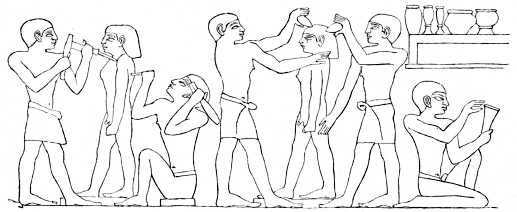
Fig. 250.—Bas-relief from the tomb of Ti.
Two paintings at Thebes show us the process of executing a royal
colossus in granite (Figs. 252 and 253). Standing upon the plinth and
upon the planks of a scaffold, several workmen do their best to hasten
the completion of the work, which is already far advanced. Seated upon
the topmost pole of the scaffold one workman is busy polishing the
front of the pschent; another stands behind the image, and, holding
his palette in one hand and his brush in the other, spreads his
colours upon its posterior support. It may be asked what the man is
doing who is engaged with both hands upon the chest of the statue. For
an answer to that question we must turn to the second picture, in
which we are shown a seated colossus under the hands of its makers.
The workman who kneels before its head is making use of two
implements. With his left hand he applies to the face of the statue a
pointed instrument, which he is about to strike with the object held
in his right. This action will cause splinters to fly from the
granite. These two instruments are the same as those wielded by the
workman who leans upon the chest of the standing colossus. The latter
seems, however, to pause for a moment's consideration before
proceeding with his work. One of these tools is the point of stone
or metal, the other acts as mallet or hammer. The same tool is to be
recognised in the hand of the man who is at work upon the seat of the
statue; he, however, uses it without any hammer.[304] Leaning upon one
of the cross-pieces of the scaffolding he beats with all his force
upon the stone. The work was perhaps begun in this fashion. In the
same tomb the representation of a sphinx receiving the final touches
which is figured above occurs (Fig. 254). In this painting the
polishing tool is a disk, similar to that in use by one of the workmen
in Fig. 253. The figure on the left carries in a saucer the powder
used for polishing the granite. In his right hand he holds a kind of
brush which was used for spreading the powder upon the surfaces to be
rubbed.
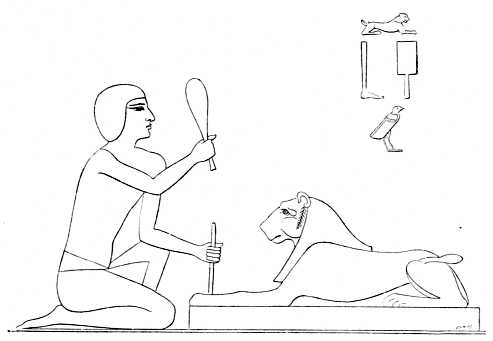
Fig. 251.—Bas-relief at Thebes (Champollion, pl. 180).
Fig. 255 shows a workman fashioning a tet with a kind of hatchet or
mattock, which he uses much as if it were a mallet.
Fig. 252.—From a painting at Thebes (Champollion, pl. 161).
The only doubt that remains is as to the material employed by the
Egyptian sculptors in their attacks upon the granite. Were their
mallets and points of stone or of metal? They could only dispose of
instruments which, with the exception of the chisel, were incompatible
with really delicate workmanship. With the latter instrument the
skilful carver can obtain any effect he requires from a material
which is neither too hard nor too soft—such as marble; but the rocks
from which the Egyptians struck their finest work do not lend
themselves kindly to the chisel. To obtain the effects required they
had to expend as much time and patience upon them as upon their works
of architecture. But in spite of the industry and skill of workmen who
did not count their hours, there must always have been a certain
inequality and rudeness in works carried out by instruments that
bruised and shattered rather than cut. The stubbornness of the
material, and the defects of the tools employed, had a double
consequence. In order to avoid all danger of spoiling his figure when
roughing it out, the artist was compelled to err on the side of over
solidity and heaviness; he was obliged to multiply the points of
support, and to avoid anything like delicacy or slightness of parts.
On the other hand, he was forced to fine down and almost to obliterate
the suggestive contours of the living form by the final polish, in
order to correct the irregularities due to the rude and uncertain
nature of his implements.
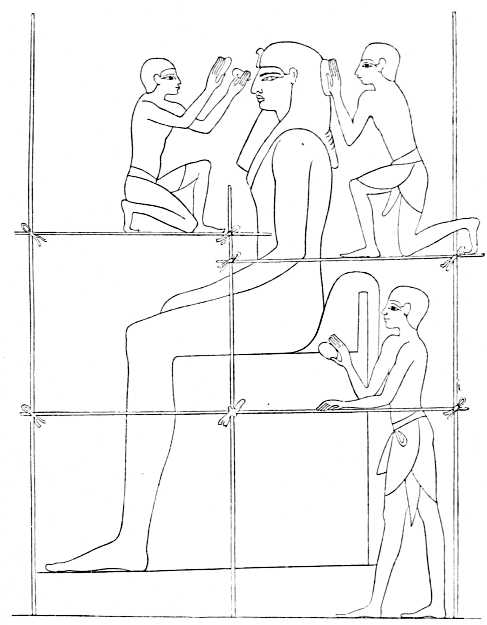
Fig. 253.—Painting at Thebes (Champollion, pl. 161).
Fig. 254.—Painting at Thebes (Champollion, pl. 161).
All this explains the absolute necessity for the supporting blocks
reserved by the Egyptian sculptor at the back of his statues, and for
the great massiveness of their forms. To begin with, the comparative
slenderness of the attachment between the head and the body was an
element of danger. The repeated blows struck by the mallet upon the
point might break it off unless precautions were taken. We find,
therefore, that the klaft head-dress was introduced as often as
possible. Its large ends fell down upon each breast, and acted as
buttresses to the head. When the klaft was not used the hair was
brought together in a solid mass, and, falling to the shoulders, gave
strength to the neck. We may say the same of the long and thick
beard, the shape of which was modified under the pressure of the same
necessity. It is never disengaged and turned up at the end, as we see
it in the paintings. "...The head covering, which is sometimes very
tall and slender, is always supported at the back for nearly the whole
of its height and width. The figure itself is supported either at the
back or the side by a pier of varying thickness...."[305] The stone is
left between the two legs when one is thrust forward, between the arms
and the side, and in the hollows above the hips. Nothing could have
been easier than to remove these masses, after the work was otherwise
complete, by means of the drill. But that instrument, by which the
necessary holes could have been made without dangerous shocks, was
certainly unknown to the Egyptians. They could only have removed the
masses in question by the striking processes we have mentioned,
processes which might result in the breaking of an arm or a leg. The
hardest materials are also, in a sense, the most brittle. If it was
difficult for the sculptor to free the limbs and head of his statue
from the rock in which they were partly imprisoned, how much more
difficult, nay, how impossible, it must have been to give them any
energetic movement—that of running, for instance, or fighting. The
beauty and expressiveness of such movements did not escape his
observation, but a want of material resources compelled him to forego
their reproduction.
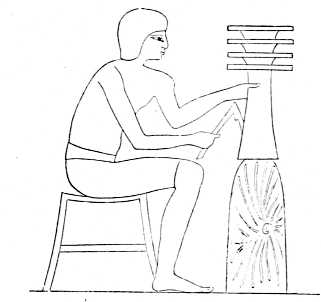
Fig. 255.—Painting at Thebes (Champollion, pl. 186).
Fig. 256.—Bronze statuette. Actual size. Boulak.
The truth of these observations is confirmed by the fact that when the
chisel came to be used upon less unkindly materials, the Egyptian
sculptor shook himself free of more than one of those despotic
conventions which tyrannized over the makers of the royal colossi. The
wooden statues have no supporting mass at the back or side; the legs
are separated and free; the arms are no longer fixed to the sides, but
are often bent into easy positions (Fig. 7, Vol. I., and Fig. 178). We
may say the same of bronze (Figs. 179 and 180). We may judge of the
freedom which was often given to works in the latter material by the
beautiful little statuette figured upon this page (Fig. 256). The
limestone figures are not so free. Convenient instruments for ridding
them of superfluous stone were wanting, and, moreover, there was a
certain temptation to imitate those statues in the harder rocks which
were looked upon as the highest achievements of the national art. The
figures were often supported by a mass of stone in which the posterior
surfaces of the legs were imbedded. Sometimes, however, this support
was absent, and in that case attitudes became extremely various
(Fig. 48, Vol. I., and Figs. 192, 194, 195, Vol. II.), perfect ease and
suppleness being often attained. Further confirmation of our theory is
afforded by those little ornamental articles which may be referred to
the industrial rather than the fine arts. In them we find the figures
of men and animals introduced with the most playful and easy skill.
The spontaneity of their grouping and the facility with which the most
lively actions are pressed into the service of the artist, are
remarkable. The graceful and almost athletic figures of swimming girls
which form the handles of so many perfume spoons may be given as
instances of this (Fig. 257). The qualities which are so conspicuous
in these little works are absent from the official and monumental art
of Egypt, because the materials and tools employed hindered their
development and prevented the happy genius of the Egyptian people from
reaching complete fruition.
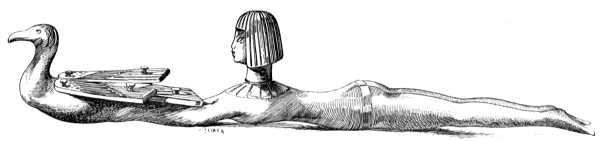
Fig. 257.—Spoon for perfumes. Louvre. Drawn by Saint-Elme Gautier.
This influence is to be recognized in the modelling as well as in the
pose of Egyptian statues: their general forms are fairly well
understood and expressed, but there is none of that power to suggest
the muscles under the skin, and the bones under the muscles, which
distinguishes Greek sculpture. The suppleness and elasticity of living
flesh are entirely wanting. Everything is in its place, but details
are as much suppressed as if the work were to be seen at a distance at
which they would be invisible.
The admirable portraits which have been unearthed in such numbers and
the skilful modelling of many an isolated work, prove that it was
neither the power of observation nor that of manipulation that was
wanting. Why, then, was it that the Egyptians failed to advance
farther upon the road that led to mastery in their art? It was due to
their infatuation for granite. Even when they worked in soft stone
their manipulation was governed by the capabilities of the more
stubborn material. The chisel alone can give those truthful and
delicate contours without which no sculpture can reach perfection, and
the chisel could hardly be used on any material but limestone or wood.
The granite or basalt statue, roughly blocked out with tools which
imperfectly obeyed the hand, could only be brought to completion with
the sand or emery of the polisher. No refinement of execution could be
hoped for under such conditions. Every surface was flattened and every
expressive ridge smoothed down, and the appearance of superficial
finish thus obtained involved many sacrifices.
The abuse of this latter process is one of the great defects of
Egyptian technique; but there was another, and, perhaps, more potent
cause of failure. The method of writing adopted by the Egyptians, and
elaborated at a very early date, must have had a greater effect upon
their plastic arts than has generally been supposed. The characters
employed by them, at least in monumental situations, were not merely
symbols of sounds, as the characters of later syllabic or alphabetic
forms of writing became; they were direct images of objects. Practical
requirements soon led to the simplification of such objects, to the
suppression of all details beyond those necessary for identification.
The figures employed were thus soon reduced to mere empty outlines.
Shadow and colour, all those details which distinguish the species of
a genus and the individuals of a species, were carefully and
systematically eliminated. The sign which stood for a lion or a man,
was the same for all lions and all men, although between one man or
one lion and another there are differences of stature, of age, of
colour, of strength, and of beauty.
Now, in the early ages of Egyptian civilization, when the hieroglyphs
in the Memphite necropolis were chiselled in relief, the same hand
must have been employed upon the portraits of any particular
inhabitants of a tomb and upon the inscriptions which accompanied
them. Thus we find upon the panels from the tomb of Hosi
(Figs. 174-6), that there is no appreciable difference between the technique
of the figures and of the accompanying characters. The same firm and
lively handling is visible in both. The images which play the part of
written characters are much smaller than the three portraits, and that
is all. The crafts of scribe and sculptor were thus combined in one
man; his chisel traced indifferently funerary portraits and
hieroglyphs. When the use of papyrus led to much and rapid writing,
the two professions were separated. The scribe wrote sometimes with
the kalem upon papyrus, sometimes with the brush or the point upon
wood, stucco, or stone. But he always found enough to do in his own
profession without combining it with another.
Sculptors and painters multiplied on their side with the
multiplication of the royal and divine images; they represented the
king fighting against the enemies of Egypt or returning thanks to the
gods for their assistance, and the king's subjects accompanying him to
battle, or busied over the varied labours of a civilized society. They
had to observe life and to study nature. By dint of so doing they
created a style, a certain method of looking at and interpreting
natural facts which became common to all the artists of Egypt. One of
the most striking features of this style is the continual endeavour to
strip form of all that is accidental and particular, to generalize and
simplify it as much as possible, a tendency which finds a very natural
explanation in the early endeavours of the Egyptians to represent, in
their writing, the concrete shapes of every being in earth or sky.
This habit of making plastic epitomes of men and animals, and even of
inanimate things, was confirmed by the persistent use of ideographic
characters during all the centuries of Egyptian civilization. The
profession of the scribe was in time separated from that of the
sculptor, but the later preserved some of the marked characteristics
which it put on before this division of labour was finally
established. The Egyptian eye had become accustomed to see things
represented in that simplified aspect of which the hieroglyphs are so
striking an example, and to deprive individuals, by a kind of
unconscious abstraction, of those details by which they stood out from
their species as a whole.
The most original features of Egyptian sculpture and its arrested
development must, then, be referred, on the one hand to the nature of
the materials employed, and, on the other, to the habits contracted
during many centuries of ideographic writing.[306] It has long been
the fashion to attribute capital importance to what is called a canon,
in describing the origin of the Egyptian style. The ideas which have
been published on this question seem to us manifestly exaggerated; we
must examine them a little closely.
The word canon comes from the Greek κάνων, a rule. As
applied to the arts it has been defined as "a system of measurements
by the use of which it should be possible to tell the size of any part
by that of the whole, or the size of the whole by that of any one of
its parts."[307] The idea of proportion, upon which every canon must
rest, is a creation of the brain. A canon, therefore, is the result of
those searching and comprehensive generalizations of which only races
with great intellectual gifts are capable. Each of the arts may have
its canon, or rule of proportion, establishing a proper relation
between all the elements of its creations and easily expressible in
figures.
The finest examples of a canon as applied to architecture are
furnished by the Greek orders. Given the smallest member of an Ionic
or Doric order, the dimensions of all the other members of the column
and its entablature may be calculated with almost complete accuracy.
There is nothing of the kind in Egyptian architecture. There is no
constant proportion between the heights and thicknesses of the shaft,
the capital, and the entablature; there is no constant relation
between their shapes. In a single building, and in a single order, we
find proportions varying between one hall or court and another.
The word canon has an analogous sense when applied to sculpture. We
establish a canon when we say that a figure should be so many heads
high, and that its limbs should bear a certain proportion to the same
unit. It would be the same if, as has often been proposed, the medius
of the hand were erected into the unit of measurement, except that the
figure would then be divided into a larger number of parts. Both
ancients and moderns have investigated this question, but we need not
dwell upon the results of their inquiries. The Greeks had the canon of
Polycletus; the Romans that of Vitruvius, while Leonardo da Vinci set
an example to the numerous artists who have investigated the question
since his time.[308]
Had the Egyptians a canon? Did they choose some one part of the human
body and keep all the other parts in a constant mathematical relation
with it? Did their canon, if they had one, change with time? Is it
true that, in deference to the said canon, all the artists of Egypt
living at one time gave similar proportions to their figures?
It has sometimes been pretended that in each century the priests
decided upon the dimensions, or at least upon the proportions, to be
given by artists to their figures. Such an assertion can hardly be
brought into harmony with the facts observed.
The often quoted words of Diodorus have been taken as a text: "The
Egyptians claim as their disciples the oldest of the Greek sculptors,
especially Telecles and Theodoros, both sons of Rhæcos, who executed
the statue of the Pythian Apollo for the inhabitants of Samos. Half of
this statue, it is said, was executed at Samos by Telecles, the other
half at Ephesus by Theodoros, and the two parts so exactly fitted each
other that the whole statue appeared to be the work of a single
sculptor. After having arranged and blocked out their stone, the
Egyptians executed the work in such fashion that all the parts adapted
themselves one to another in the smallest details. To this end they
divided the human figure into twenty-one parts and a quarter, upon
which the whole symmetry of the work was regulated."[309]
We may ask what authority should attach to the words of Diodorus, a
contemporary of Augustus, in a matter referring to the Pharaonic
period. But when the monuments began to be examined it was proclaimed
that they confirmed his statements. Figures were found upon the
tomb-walls which were divided into equal parts by lines cutting each
other at right angles. These, of course, were the canonical standards
mentioned by Plato and Diodorus.
Great was the disappointment when these squares were counted. In one
picture containing three individuals, two seated figures, one beside
the other, are inscribed in fifteen of the squares; a standing figure
in front of them occupies sixteen.[310] Another figure is comprised in
nineteen squares.[311] In another place we find twenty-two squares and
a quarter between the sole of the foot and the crown of the head.[312]
In yet another, twenty-three.[313] As for the division given by
Diodorus, it never occurs at all, and in fact it is hardly to be
reconciled with the natural punctuation of the human body by its
articulation and points of section.
To surmount the difficulty the theory of successive canons was
started; some declared for two,[314] some for three.[315] This theory
requires explanation also. Do its advocates mean that in all the
figures of a single epoch there is a scale of proportion so constant
that we must seek for its cause in an external peremptory regulation?
If, however, we doubt the evidence of our eyes and study the plates in
Lepsius or the monuments in our museums, measure in hand, we shall see
at once that no such theory will hold water. Under the Ancient Empire
proportions varied appreciably between one figure and another. As a
rule they were short rather than tall; but while on the one hand we
encounter certain forms of very squat proportions, amounting almost to
deformity (Fig. 120, Vol. I.), we also find some whose forms are very
lengthy (Fig. 101, Vol. I.). The artists of Thebes adopted a more
slender type, but with them too we find nothing like a rigorous
uniformity. Again, the elongation of the lower part of the body is
much more strongly marked in the funerary statuettes (Fig. 50, Vol.
I.) and in the paintings (Plate XII.) than in statues of the natural
size (Figs. 211, 216) and in the colossi. If there had been a canon in
the proper sense of the term its authority would have applied as much
to those statuettes and bas-reliefs as to the full-sized figures. But,
as a fact, the freedom of the artist is obvious; his conception is
modified only by the material in which he worked. He could not make a
great statue in stone too slender below, as it would want base and
solidity; but as soon as he was easy on that score he allowed himself
to be carried away by the temptation to exaggerate what seemed to him
an especially graceful feature.
We see, then, that art in Egypt went through pretty much the same
changes and developments as in other countries in which it enjoyed a
long and busy life. Taste changed with the centuries. It began by
insisting on muscular vigour, as displayed in great breadth of
shoulder and thickset proportions generally. In later years elegance
became the chief object, and slenderness of proportion was sometimes
pushed even to weakness. In each of these periods all plastic figures
naturally approached the type which happened to be in fashion, and in
that sense alone is it just to assert that Egyptian art had two
different and successive canons.
The question as to whether the Egyptians ever adopted a unit of
measurement in their rendering of the human figure or not, is
different. Wilkinson and Lepsius thought they had discovered such a
unit in the length of the foot, Prisse and Ch. Blanc in that of the
medius. There is nothing in the texts to support either theory, and an
examination of the monuments themselves shows that sometimes one,
sometimes the other of the two units, is most in accordance with their
measurements. Between the Ancient Empire and the New proportions
differed so greatly that it is impossible to refer them to one unit.
Among the works of a single period we find some that may be divided
exactly by one of the two; others which have a fraction too much or
too little. It has not yet been proved, therefore, that the Egyptians
ever adopted such a rigorous system as that attributed to them. Like
all races that have greatly practised design, they established certain
relations between one part of their figures and another, relations
which gradually became more constant as the national art lost its
freedom and vitality; and they arrived at last at the mechanical
reproduction of a single figure without troubling themselves to
calculate how many lengths of the head, the nose, the foot, or the
medius, it might contain. Their eyes were their compasses, and they
worked—at least under the New Empire and during the Græco-Roman
period—from models which represented the experience of the past. It
is therefore unnecessary to search for an explanation of the
uniformity which characterises their works in the following of a rigid
mathematical system; we must be content to see in it the natural
result of an artistic education into which, as the centuries succeeded
one another, the imitation of previous types, and the application of
traditional recipes entered more and more.
As for the designs traced within lines which cross each other at
regular intervals, they can be nothing but drawings squared for
transferring purposes. Squaring is the usual process employed by
artists when they wish to repeat a figure in different dimensions from
those of the original. Having divided the latter by horizontal and
perpendicular lines cutting each other at regular intervals, they go
through the same operation upon the blank surface to which the figure
is to be transferred, making the lines equal in number to those upon
the original, but the resulting squares larger if the copy is to be
larger, smaller if it is to be smaller, than that original. Egyptian
decorators often made use of this process for the transference of
sketches upon papyrus, stone, or wood, to the wall. Of this practice
we give two examples. The first is an elaborate composition in which
several modifications and corrections of lines and attitudes may be
traced (Fig. 258); the second is an isolated figure (Fig. 259). In
each case the figures extend vertically over nineteen squares. The
first dates from the eighteenth, the second from the nineteenth
dynasty.[316]
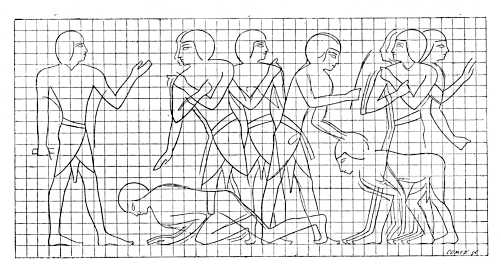
Fig. 258.—Design transferred by squaring. From Prisse.
The same device is sometimes made use of to transfer heads, and even
animals, from a small sketch to the wall. In the tomb of Amenophis
III., in the Bab-el-Molouk, there is a fine portrait of a prince thus
squared;[317] at Beni-Hassan we find a cow and an antelope treated in
the same fashion.[318]
Traces of another and yet more simple process are to be found. Before
drawing the figures in his bas-reliefs the artist sometimes marked in
red on the walls the vertical and horizontal lines which would give
the poise of the body, the height of the shoulders and armpits, and of
the lower edge of the drawers. The positions of secondary anatomical
points were marked upon these lines, and the whole formed a rough
guide for the hand of the designer.[319]
The fact that these lines and squares are only found upon a small
number of paintings and bas-reliefs does not prove that their
employment was in any way exceptional. It is probable that one of the
two processes was generally used, but that the colour spread both upon
figures and ground hides their traces. The few pictures in which they
are now to be traced were never completed.
Most of the painters and sculptors to whom the decorations of tombs
and temples were confided must have had recourse to these
contrivances, but here and there were artists who had sufficient skill
and self-confidence to make their sketches directly upon the wall
itself. More than one instance of this has been discovered in those
Theban tombs whose decorations were left unfinished. In a few cases
the design has been made in red chalk by a journeyman and afterwards
corrected, in black chalk, by the master.[320]
Fig. 259.—Design transferred by squaring. From Prisse.
As the bas-relief was thus preceded a sketch which was more or less
liable to modification, it would seem probable that a similar custom
obtained in the case of the statue. It appears especially unlikely
that those great figures in the harder rocks which represented such
an enormous outlay of manual labour, would be attacked without some
guide which should preserve them from the chance of ruin by some
ill-considered blow. Did the Egyptian sculptor begin, then, with a
clay sketch? There is no positive information on the subject, but in
all those numerous bas-reliefs which represent sculptors at work,
there is not one in which the artist has before him anything in the
shape of a model or sketch to guide him in his task. It is possible
that the sameness of his statues, especially of his colossal figures
in granite or sandstone, enabled the Egyptian to dispense with an aid
which the infinite variety of later schools was to render necessary.
The Egyptian sculptor was contented with a few simple attitudes which
he reproduced again and again. He doubtless began by marking the
salient points and relative heights of the different parts upon his
block. The rock was so hard that there was little risk of his
journeymen spoiling the material by taking away too much, supposing
them to be carefully overlooked. Marble would have been far more
liable to such an accident. Even Michael Angelo, when he worked the
marble with his own hands, spoilt more than one fine block from
Carrara.
Although we have no evidence to show that the Egyptians understood the
use of clay models, we have some idea of the process by which they
were enabled to do without them, and of the nature of their
professional education. The chief Egyptian museums possess works which
have been recognized as graduated exercises in the technique of
sculpture. They are of limestone, and of no great size—from four to
ten inches high. The use of these little models is shown to have been
almost universal by the fact that Mariette found them on nearly every
ancient site that he excavated. Their true character is beyond
doubt.[321] At Boulak there are twenty-seven sculptured slabs which
were found at Tanis. One is no more than a rough sketch, just begun.
By its side is a completed study of the same subjects. Some of these
slabs are carved on both sides; on others we find one motive treated
twice, side by side, once in the state of first sketch, and again as a
finished study. The plaques which bear the heads of cynocephali, of
lions and lionesses, are remarkable for the freedom of their execution
(Figs. 260, 261, and 262).[322] The same may be said of fifteen royal
heads found at Sakkarah. They should be examined together. They
range[323]
in order from No. 623, which is a roughly-blocked-out
sketch, to 637, a finished head. One of these models is divided down
the middle, so as to give accent to the profile. A few of them are
squared in order to test the proportions. But even here no canon of
proportion is to be found. "If the squares were based upon some
unchanging unit, they would be identical in every model in which they
occur. But in one of these heads we find three horizontal divisions
between the uræus and the chin; in another four. In most cases the
number of the squares seems to have been entirely due to the
individual caprice or convenience of the artist. There are but two
examples in which another rule seems to have been followed; in them
the proportions of the squares are identical, and their intersections
fall upon the same points. All that may be fairly deduced from this,
however, is that they are the work of the same hands."[324] A second
series of royal heads was found at Tanis; others have been discovered
in the Fayoum. Boulak also possesses models of the ram, the jackal,
and the uræus, of arms, legs, hands, &c. Upon a plaque from Tanis the
figure of Isis appears twice, once as a sketch and once as a finished
study.
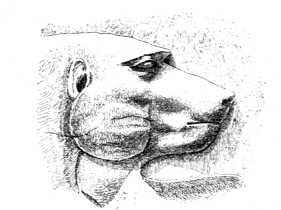
Fig. 260.—Head of a Cynocephalus.
Fig. 261.—Head of a Lion.
Fig. 262.—Head of a Lioness.
From the style of these remains Mariette is disposed to think that
they were not earlier than the Saite epoch. As the Egyptian intellect
gradually lost its inventive powers, the study of such models as these
must have played a more and more important part in artistic education;
but we have no reason to believe that their use was confined to the
later ages of the monarchy. As artists became accustomed to reproduce
certain fixed types, they gradually lost their familiarity with
nature, and their works became ever more uniform and monotonous. This
tendency is to be easily recognized in Egyptian work long before the
days of Amasis and the Psemetheks; in some degree it is found even in
the productions of the Ancient Empire. The use of the models in
question may have become general at the beginning of the Middle
Empire. But their introduction was not due to the priests, but to the
masters in the arts, who saw that they offered a sure and rapid method
of instructing their scholars.
Yet one more cause of the monotony of type which distinguished
Egyptian art after its first renascence remains to be noticed. The
Egyptians were fully conscious of the great antiquity of their
civilization. They thought of other nations much as the Greeks and
Romans of a later age thought of those whom they called barbarians.
When the scribes had to speak of foreigners they made use of a
complete vocabulary of contemptuous terms, and, as always occurs, the
pride of race upon which they were based long survived the condition
of things which formed its justification. The Greek conquest was
necessary to cure the Egyptians of their disdain, or, at least, to
compel them to hide it. Now the visible sign of their superiority was
the beauty of the national type, as elaborated by judicious selection
and represented in art since the earliest days of the monarchy. The
Egyptian was proud of himself when he compared the refined features of
his gods and kings, their graceful attitudes and smiling looks, with
the thick and heavy lines of the negro or the hard and truculent
features of the Libyan and the Syrian nomad. In attempting to
innovate, some danger of lowering the nobility of the type would be
incurred. The pressure of neighbouring races ended by throwing back
the Egyptian frontiers. At one time they were forcibly curtailed by
victorious invasion; at others they were weakened here and there,
allowing the entrance of the shepherds, of foreign merchants, and of
mercenaries of various nationalities. The purity of the Egyptian blood
was menaced, and at all hazards it was necessary to preserve without
alteration the ideal image of the race, the concrete emblem of its
glorious past and the pledge of its high destinies. It was thus that
in Egypt progress was hampered by fear of retrogression. Perfection is
impossible to those who fear a fall.
Another obstacle that helped to prevent the Egyptians from reaching
the perfection which their early achievements seemed to promise, was
their love for colour. They did not establish a sufficiently sharp
line of demarcation between painting and sculpture. They always
painted their statues, except when they carved them in materials which
had a rich natural hue of their own, a hue to which additional
vivacity was given by a high polish. By this means varied tints were
obtained which were in harmony with the polychromatic decoration which
was so near their hearts. Their excuse is to be found in their
ignorance of statuary marble and of the clear and flesh-like tones and
texture which it puts on under the sculptor's chisel.
The Egyptians, however, never committed the fault of colouring their
statues in an imitative fashion, like those who make wax figures.
Their hues were always conventional. Moreover, they were never either
broken or shaded, which is sufficient to show that no idea of
realistic imitation was implied in their use.[325] Sculpture is
founded upon an artificial understanding by which tangible form and
visible colour are dissociated from each other. When the sculptor
looks to the help of the painter he runs great risk of failing to give
all the precision and beauty of which form by itself is capable, to
his work. Even the Greeks did not grasp this truth at once. The
Egyptians had at least a glimmering of it, and we must thank them for
having employed polychromy in their sculpture in a discreet fashion.
We have attempted to give an idea of the origin of Greek sculpture, of
its development and its decadence. We have noticed those slow changes
of taste and style which sometimes required a thousand years for their
evolution, for a century in Egypt was hardly equal to a generation
elsewhere. After proving that Egypt did not escape the universal law
of change, we studied the methods and conventions which were peculiar
to her sculptors and impressed their works with certain common
characteristics. The union of these characteristics formed the
Egyptian style. We must now define that style, and attempt to make its
originality clear to our readers.
In its commencement Egyptian art was entirely realistic. It was made
realistic both by the conceptions which presided at its birth and by
the wants which it was called upon to satisfy. The task to which it
applied itself with a skill and conscience which are little less than
marvellous, was the exact representation of all that met its vision.
In the bas-relief it reproduced the every-day scenes of agricultural
life and of the national worship; in the statue it portrayed
individuals with complete fidelity. But even in those early ages
imagination was not asleep. It was continually seeking to invent forms
which should interpret its favourite ideas. It figured the exploits of
the king, the defender of the national civilization, in the form of a
warrior brandishing his mace over the heads of his enemies. In the
royal statues everything combined to mark the gulf between the Pharaoh
and his subjects, their materials, size, attitude, and expression,
although in natural life there can have been no such distinction.
Finally the Great Sphinx at Gizeh is sufficient to prove that the
Egyptians, in their endeavour to make the great deities whom they had
conceived visible to the eye, had attempted to create composite types
of which the elements were indeed existent in nature, but separate and
distinct.
After the first renascence their imaginations played more freely. They
multiplied the combinations under which their gods were personified.
They transformed and idealized the human figure by the gigantic
proportions which they gave to it in the seated statues of the king,
and in those upright colossi in which the majesty of Pharaoh and the
divinity of Osiris are combined in one individual. The sculptors
portrayed the king in attitudes which had never been seen by mortal
eyes. Sometimes he is seated upon the knee of a goddess and drawing
nourishment from her breast; sometimes he bends, like a respectful and
loving son, before his father Amen, who blesses him, and seems by his
gesture to convey to him some of his own omnipotence and immortality.
Again he is presented to us in the confusion of battle, towering so
high above his adversaries that we can only wonder how they had the
temerity to stand up against him. Events hardly passed thus in those
long and arduous campaigns against the Khetas and the People of the
sea, in which more than one of the Theban Pharaohs spent their lives.
Victory, when it was victory, was long and hotly disputed. Superiority
of discipline and armament told at last and decided the contest in
favour of the Egyptians, who were inferior in strength and stature to
most of their enemies, especially to those who came from Asia Minor
and the Grecian islands.
It is hardly just, therefore, to say, as has been said,[326] that
"Egyptian art had only one aim, the exact rendering of reality; in it
all qualities of observation are developed to their utmost
capabilities, those of imagination are wanting." Egyptian art is not
like the sensitized plate of the photographer. It does not confine
itself to the faithful reproduction of the objects placed before it.
Painters and sculptors were not content, as has been pretended, with
the art that can be seen, as opposed to the art that can be
imagined, and an injustice is done to them by those who would
confine the latter to the Aryan race. The apparent precision of such
an assertion makes it all the more misleading. Egyptian art was
realistic in its inception and always remained so to a certain degree,
but with the passage of time the creative intellect began to play a
part in the production of plastic works; it added to and combined the
elements which it took from nature, and thus created imaginary beings
which differed from natural fact by their proportions, their beauty,
and their composition. The Egyptian artist had his ideal as well as
the Greek.
In saying, then, that the art of Egypt was realistic, we have only
laid the first stone of the definition we wish to establish. Its
original character was, perhaps, still more due to another feature,
namely to its elimination or suppression of detail. This elimination,
far from diminishing with time, went on increasing as the country grew
older. It may be traced to the action of two causes. In the first
place, the influence of the ideographic writing upon the national
style can hardly be exaggerated. The concrete images of things could
only be introduced into it by means of simplification and
generalization. In such a school the eye learnt to despoil form of all
those details which were merely accidental, of all that made it
particular. It sought for the species, or even the genus, rather than
the individual. This tendency was increased by the peculiar properties
of the materials upon which the Egyptians lavished their skill and
patience. The harder rocks turned the edges of their bronze chisels,
and compelled them to choose between roughly-blocked-out sketches and
a laborious polish which obliterated all those minor details of
modelling which should vary according to the sex, the age, and the
muscular exertion of the persons represented. We see, then, that the
rebellious nature of the granite, and the imperfect methods which it
imposed, completed the lessons begun by that system of figured writing
which dates from the remotest periods of Egyptian civilization.
There is an obvious contradiction between the tendency which we have
just noticed, and those habits of realistic imitation whose existence
has been explained by the desire to secure a posthumous existence for
the dead. The history of Egyptian sculpture, is, in fact, the history
of a contest in the mind of the artist between these two opposing
forces. In the early years of the monarchy, his first duty was to
supply a portrait statue, the chief merit of which should lie in the
fidelity of its resemblance. Of this task he acquitted himself most
skilfully and conscientiously, reproducing every individual
peculiarity, and even deformity of his model. His chief attention was
given to the face, as being the member by which men are principally
distinguished one from another. Even then, and in the funerary
statues, the body was much more general in its forms than the head. In
the course of succeeding ages the sculptor was able, whenever he
wished to make a faithful portrait either of an individual man or of a
race, to bring this faculty into play and to clearly mark the
differences between races or between the individuals of a race, by the
varying character of the head. But yet his art showed an ever
increasing tendency to follow the bent which had been given to it by
the practice of glyptic writing, and by the long contest with unkindly
materials. After the close of the Ancient Empire Egyptian art became
ambitious of a higher style. Under the Theban Pharaohs it worked hard
to attain it, and it knew no better means to the desired end than the
continual simplification and generalization of form.
This is the great distinguishing characteristic of the Egyptian style.
The uniformity, stiffness, and restraint of the attitudes, the
over-rigorous symmetry of the parts and of the limbs, and the close
alliance of the latter with the bodies, are only secondary features.
We shall find them in the works of every race compelled to make use of
materials that were either too hard or too soft. Moreover, these are
the constant characteristics of archaic art, and it must not be
forgotten that even in Egypt many wooden and limestone figures have
been unearthed which surprise us by the freedom of their attitudes and
movements. The true originality of the Egyptian style consists in its
deliberately epitomizing that upon which the artists of other
countries have elaborately dwelt, in its lavishing all its executive
powers upon chief masses and leading lines, and in the marvellous
judgment with which it seizes their real meaning, their proportions,
and the sources of their artistic effect.
As figures increased in size this tendency towards the suppression of
detail increased also, and so too did their fitness for the
architectonic rôle they had to play. The colossi which flank the
entrances to an Egyptian temple have been often criticised from an
erroneous standpoint. They have been treated as if they were meant to
be self-sufficient and independent. Their massiveness and want of
vitality have been blamed; it has been said that the seated figures
could not rise, nor the standing ones walk. To form a just estimate of
their merit we must take them with the monuments of which they formed
a part. We must rouse our imaginations, and picture them to ourselves
with their flanking colonnades about them, with the pylons at their
backs, and the obelisks at their sides. We must close our eyes for a
moment and reconstruct this combination of architectural and
sculpturesque lines. We shall then readily perceive how entirely these
colossi were in harmony with their surroundings. Their vertical and
horizontal lines echoed those of the monument to which they were
attached. The rhythm of the long colonnades was carried on by their
repetition of a single attitude, while their colossal dimensions and
immovable solidity brought them into complete accord with the huge
structures by which they were surrounded. It has been said that, more
than any of its rivals, "the architecture of Egypt impresses us with
the idea of absolute stability, of infinite duration." Could anything
be in more complete harmony with such an art than the grave and
majestic attitudes of these seated Pharaohs, attitudes which from
every line breathe a profound calm, a repose without change and
without end.